EP4289948B1 - Verfahren und zusammensetzungen zur rna-gesteuerten ziel-dna-modifikation und zur rna-gesteuerten transkriptionsmodulation - Google Patents
Verfahren und zusammensetzungen zur rna-gesteuerten ziel-dna-modifikation und zur rna-gesteuerten transkriptionsmodulation Download PDFInfo
- Publication number
- EP4289948B1 EP4289948B1 EP23187511.3A EP23187511A EP4289948B1 EP 4289948 B1 EP4289948 B1 EP 4289948B1 EP 23187511 A EP23187511 A EP 23187511A EP 4289948 B1 EP4289948 B1 EP 4289948B1
- Authority
- EP
- European Patent Office
- Prior art keywords
- dna
- rna
- sequence
- targeting rna
- targeting
- Prior art date
- Legal status (The legal status is an assumption and is not a legal conclusion. Google has not performed a legal analysis and makes no representation as to the accuracy of the status listed.)
- Active
Links
Images


























Classifications
-
- A—HUMAN NECESSITIES
- A01—AGRICULTURE; FORESTRY; ANIMAL HUSBANDRY; HUNTING; TRAPPING; FISHING
- A01H—NEW PLANTS OR NON-TRANSGENIC PROCESSES FOR OBTAINING THEM; PLANT REPRODUCTION BY TISSUE CULTURE TECHNIQUES
- A01H6/00—Angiosperms, i.e. flowering plants, characterised by their botanic taxonomy
- A01H6/46—Gramineae or Poaceae, e.g. ryegrass, rice, wheat or maize
- A01H6/4684—Zea mays [maize]
-
- A—HUMAN NECESSITIES
- A01—AGRICULTURE; FORESTRY; ANIMAL HUSBANDRY; HUNTING; TRAPPING; FISHING
- A01K—ANIMAL HUSBANDRY; AVICULTURE; APICULTURE; PISCICULTURE; FISHING; REARING OR BREEDING ANIMALS, NOT OTHERWISE PROVIDED FOR; NEW BREEDS OF ANIMALS
- A01K67/00—Rearing or breeding animals, not otherwise provided for; New or modified breeds of animals
- A01K67/027—New or modified breeds of vertebrates
-
- A—HUMAN NECESSITIES
- A61—MEDICAL OR VETERINARY SCIENCE; HYGIENE
- A61K—PREPARATIONS FOR MEDICAL, DENTAL OR TOILETRY PURPOSES
- A61K38/00—Medicinal preparations containing peptides
- A61K38/16—Peptides having more than 20 amino acids; Gastrins; Somatostatins; Melanotropins; Derivatives thereof
- A61K38/43—Enzymes; Proenzymes; Derivatives thereof
- A61K38/46—Hydrolases (3)
- A61K38/465—Hydrolases (3) acting on ester bonds (3.1), e.g. lipases, ribonucleases
-
- A—HUMAN NECESSITIES
- A61—MEDICAL OR VETERINARY SCIENCE; HYGIENE
- A61P—SPECIFIC THERAPEUTIC ACTIVITY OF CHEMICAL COMPOUNDS OR MEDICINAL PREPARATIONS
- A61P31/00—Antiinfectives, i.e. antibiotics, antiseptics, chemotherapeutics
-
- A—HUMAN NECESSITIES
- A61—MEDICAL OR VETERINARY SCIENCE; HYGIENE
- A61P—SPECIFIC THERAPEUTIC ACTIVITY OF CHEMICAL COMPOUNDS OR MEDICINAL PREPARATIONS
- A61P31/00—Antiinfectives, i.e. antibiotics, antiseptics, chemotherapeutics
- A61P31/04—Antibacterial agents
-
- A—HUMAN NECESSITIES
- A61—MEDICAL OR VETERINARY SCIENCE; HYGIENE
- A61P—SPECIFIC THERAPEUTIC ACTIVITY OF CHEMICAL COMPOUNDS OR MEDICINAL PREPARATIONS
- A61P31/00—Antiinfectives, i.e. antibiotics, antiseptics, chemotherapeutics
- A61P31/12—Antivirals
-
- A—HUMAN NECESSITIES
- A61—MEDICAL OR VETERINARY SCIENCE; HYGIENE
- A61P—SPECIFIC THERAPEUTIC ACTIVITY OF CHEMICAL COMPOUNDS OR MEDICINAL PREPARATIONS
- A61P35/00—Antineoplastic agents
-
- A—HUMAN NECESSITIES
- A61—MEDICAL OR VETERINARY SCIENCE; HYGIENE
- A61P—SPECIFIC THERAPEUTIC ACTIVITY OF CHEMICAL COMPOUNDS OR MEDICINAL PREPARATIONS
- A61P43/00—Drugs for specific purposes, not provided for in groups A61P1/00-A61P41/00
-
- C—CHEMISTRY; METALLURGY
- C12—BIOCHEMISTRY; BEER; SPIRITS; WINE; VINEGAR; MICROBIOLOGY; ENZYMOLOGY; MUTATION OR GENETIC ENGINEERING
- C12N—MICROORGANISMS OR ENZYMES; COMPOSITIONS THEREOF; PROPAGATING, PRESERVING, OR MAINTAINING MICROORGANISMS; MUTATION OR GENETIC ENGINEERING; CULTURE MEDIA
- C12N15/00—Mutation or genetic engineering; DNA or RNA concerning genetic engineering, vectors, e.g. plasmids, or their isolation, preparation or purification; Use of hosts therefor
- C12N15/09—Recombinant DNA-technology
- C12N15/10—Processes for the isolation, preparation or purification of DNA or RNA
- C12N15/102—Mutagenizing nucleic acids
-
- C—CHEMISTRY; METALLURGY
- C12—BIOCHEMISTRY; BEER; SPIRITS; WINE; VINEGAR; MICROBIOLOGY; ENZYMOLOGY; MUTATION OR GENETIC ENGINEERING
- C12N—MICROORGANISMS OR ENZYMES; COMPOSITIONS THEREOF; PROPAGATING, PRESERVING, OR MAINTAINING MICROORGANISMS; MUTATION OR GENETIC ENGINEERING; CULTURE MEDIA
- C12N15/00—Mutation or genetic engineering; DNA or RNA concerning genetic engineering, vectors, e.g. plasmids, or their isolation, preparation or purification; Use of hosts therefor
- C12N15/09—Recombinant DNA-technology
- C12N15/11—DNA or RNA fragments; Modified forms thereof; Non-coding nucleic acids having a biological activity
- C12N15/111—General methods applicable to biologically active non-coding nucleic acids
-
- C—CHEMISTRY; METALLURGY
- C12—BIOCHEMISTRY; BEER; SPIRITS; WINE; VINEGAR; MICROBIOLOGY; ENZYMOLOGY; MUTATION OR GENETIC ENGINEERING
- C12N—MICROORGANISMS OR ENZYMES; COMPOSITIONS THEREOF; PROPAGATING, PRESERVING, OR MAINTAINING MICROORGANISMS; MUTATION OR GENETIC ENGINEERING; CULTURE MEDIA
- C12N15/00—Mutation or genetic engineering; DNA or RNA concerning genetic engineering, vectors, e.g. plasmids, or their isolation, preparation or purification; Use of hosts therefor
- C12N15/09—Recombinant DNA-technology
- C12N15/11—DNA or RNA fragments; Modified forms thereof; Non-coding nucleic acids having a biological activity
- C12N15/113—Non-coding nucleic acids modulating the expression of genes, e.g. antisense oligonucleotides; Antisense DNA or RNA; Triplex- forming oligonucleotides; Catalytic nucleic acids, e.g. ribozymes; Nucleic acids used in co-suppression or gene silencing
-
- C—CHEMISTRY; METALLURGY
- C12—BIOCHEMISTRY; BEER; SPIRITS; WINE; VINEGAR; MICROBIOLOGY; ENZYMOLOGY; MUTATION OR GENETIC ENGINEERING
- C12N—MICROORGANISMS OR ENZYMES; COMPOSITIONS THEREOF; PROPAGATING, PRESERVING, OR MAINTAINING MICROORGANISMS; MUTATION OR GENETIC ENGINEERING; CULTURE MEDIA
- C12N15/00—Mutation or genetic engineering; DNA or RNA concerning genetic engineering, vectors, e.g. plasmids, or their isolation, preparation or purification; Use of hosts therefor
- C12N15/09—Recombinant DNA-technology
- C12N15/63—Introduction of foreign genetic material using vectors; Vectors; Use of hosts therefor; Regulation of expression
-
- C—CHEMISTRY; METALLURGY
- C12—BIOCHEMISTRY; BEER; SPIRITS; WINE; VINEGAR; MICROBIOLOGY; ENZYMOLOGY; MUTATION OR GENETIC ENGINEERING
- C12N—MICROORGANISMS OR ENZYMES; COMPOSITIONS THEREOF; PROPAGATING, PRESERVING, OR MAINTAINING MICROORGANISMS; MUTATION OR GENETIC ENGINEERING; CULTURE MEDIA
- C12N15/00—Mutation or genetic engineering; DNA or RNA concerning genetic engineering, vectors, e.g. plasmids, or their isolation, preparation or purification; Use of hosts therefor
- C12N15/09—Recombinant DNA-technology
- C12N15/63—Introduction of foreign genetic material using vectors; Vectors; Use of hosts therefor; Regulation of expression
- C12N15/70—Vectors or expression systems specially adapted for E. coli
-
- C—CHEMISTRY; METALLURGY
- C12—BIOCHEMISTRY; BEER; SPIRITS; WINE; VINEGAR; MICROBIOLOGY; ENZYMOLOGY; MUTATION OR GENETIC ENGINEERING
- C12N—MICROORGANISMS OR ENZYMES; COMPOSITIONS THEREOF; PROPAGATING, PRESERVING, OR MAINTAINING MICROORGANISMS; MUTATION OR GENETIC ENGINEERING; CULTURE MEDIA
- C12N15/00—Mutation or genetic engineering; DNA or RNA concerning genetic engineering, vectors, e.g. plasmids, or their isolation, preparation or purification; Use of hosts therefor
- C12N15/09—Recombinant DNA-technology
- C12N15/63—Introduction of foreign genetic material using vectors; Vectors; Use of hosts therefor; Regulation of expression
- C12N15/74—Vectors or expression systems specially adapted for prokaryotic hosts other than E. coli, e.g. Lactobacillus, Micromonospora
- C12N15/746—Vectors or expression systems specially adapted for prokaryotic hosts other than E. coli, e.g. Lactobacillus, Micromonospora for lactic acid bacteria (Streptococcus; Lactococcus; Lactobacillus; Pediococcus; Enterococcus; Leuconostoc; Propionibacterium; Bifidobacterium; Sporolactobacillus)
-
- C—CHEMISTRY; METALLURGY
- C12—BIOCHEMISTRY; BEER; SPIRITS; WINE; VINEGAR; MICROBIOLOGY; ENZYMOLOGY; MUTATION OR GENETIC ENGINEERING
- C12N—MICROORGANISMS OR ENZYMES; COMPOSITIONS THEREOF; PROPAGATING, PRESERVING, OR MAINTAINING MICROORGANISMS; MUTATION OR GENETIC ENGINEERING; CULTURE MEDIA
- C12N15/00—Mutation or genetic engineering; DNA or RNA concerning genetic engineering, vectors, e.g. plasmids, or their isolation, preparation or purification; Use of hosts therefor
- C12N15/09—Recombinant DNA-technology
- C12N15/87—Introduction of foreign genetic material using processes not otherwise provided for, e.g. co-transformation
- C12N15/90—Stable introduction of foreign DNA into chromosome
-
- C—CHEMISTRY; METALLURGY
- C12—BIOCHEMISTRY; BEER; SPIRITS; WINE; VINEGAR; MICROBIOLOGY; ENZYMOLOGY; MUTATION OR GENETIC ENGINEERING
- C12N—MICROORGANISMS OR ENZYMES; COMPOSITIONS THEREOF; PROPAGATING, PRESERVING, OR MAINTAINING MICROORGANISMS; MUTATION OR GENETIC ENGINEERING; CULTURE MEDIA
- C12N15/00—Mutation or genetic engineering; DNA or RNA concerning genetic engineering, vectors, e.g. plasmids, or their isolation, preparation or purification; Use of hosts therefor
- C12N15/09—Recombinant DNA-technology
- C12N15/87—Introduction of foreign genetic material using processes not otherwise provided for, e.g. co-transformation
- C12N15/90—Stable introduction of foreign DNA into chromosome
- C12N15/902—Stable introduction of foreign DNA into chromosome using homologous recombination
-
- C—CHEMISTRY; METALLURGY
- C12—BIOCHEMISTRY; BEER; SPIRITS; WINE; VINEGAR; MICROBIOLOGY; ENZYMOLOGY; MUTATION OR GENETIC ENGINEERING
- C12N—MICROORGANISMS OR ENZYMES; COMPOSITIONS THEREOF; PROPAGATING, PRESERVING, OR MAINTAINING MICROORGANISMS; MUTATION OR GENETIC ENGINEERING; CULTURE MEDIA
- C12N15/00—Mutation or genetic engineering; DNA or RNA concerning genetic engineering, vectors, e.g. plasmids, or their isolation, preparation or purification; Use of hosts therefor
- C12N15/09—Recombinant DNA-technology
- C12N15/87—Introduction of foreign genetic material using processes not otherwise provided for, e.g. co-transformation
- C12N15/90—Stable introduction of foreign DNA into chromosome
- C12N15/902—Stable introduction of foreign DNA into chromosome using homologous recombination
- C12N15/907—Stable introduction of foreign DNA into chromosome using homologous recombination in mammalian cells
-
- C—CHEMISTRY; METALLURGY
- C12—BIOCHEMISTRY; BEER; SPIRITS; WINE; VINEGAR; MICROBIOLOGY; ENZYMOLOGY; MUTATION OR GENETIC ENGINEERING
- C12N—MICROORGANISMS OR ENZYMES; COMPOSITIONS THEREOF; PROPAGATING, PRESERVING, OR MAINTAINING MICROORGANISMS; MUTATION OR GENETIC ENGINEERING; CULTURE MEDIA
- C12N5/00—Undifferentiated human, animal or plant cells, e.g. cell lines; Tissues; Cultivation or maintenance thereof; Culture media therefor
- C12N5/10—Cells modified by introduction of foreign genetic material
-
- C—CHEMISTRY; METALLURGY
- C12—BIOCHEMISTRY; BEER; SPIRITS; WINE; VINEGAR; MICROBIOLOGY; ENZYMOLOGY; MUTATION OR GENETIC ENGINEERING
- C12N—MICROORGANISMS OR ENZYMES; COMPOSITIONS THEREOF; PROPAGATING, PRESERVING, OR MAINTAINING MICROORGANISMS; MUTATION OR GENETIC ENGINEERING; CULTURE MEDIA
- C12N9/00—Enzymes; Proenzymes; Compositions thereof; Processes for preparing, activating, inhibiting, separating or purifying enzymes
- C12N9/14—Hydrolases (3)
- C12N9/16—Hydrolases (3) acting on ester bonds (3.1)
- C12N9/22—Ribonucleases [RNase]; Deoxyribonucleases [DNase]
-
- C—CHEMISTRY; METALLURGY
- C12—BIOCHEMISTRY; BEER; SPIRITS; WINE; VINEGAR; MICROBIOLOGY; ENZYMOLOGY; MUTATION OR GENETIC ENGINEERING
- C12Q—MEASURING OR TESTING PROCESSES INVOLVING ENZYMES, NUCLEIC ACIDS OR MICROORGANISMS; COMPOSITIONS OR TEST PAPERS THEREFOR; PROCESSES OF PREPARING SUCH COMPOSITIONS; CONDITION-RESPONSIVE CONTROL IN MICROBIOLOGICAL OR ENZYMOLOGICAL PROCESSES
- C12Q1/00—Measuring or testing processes involving enzymes, nucleic acids or microorganisms; Compositions therefor; Processes of preparing such compositions
- C12Q1/68—Measuring or testing processes involving enzymes, nucleic acids or microorganisms; Compositions therefor; Processes of preparing such compositions involving nucleic acids
- C12Q1/6844—Nucleic acid amplification reactions
- C12Q1/686—Polymerase chain reaction [PCR]
-
- H—ELECTRICITY
- H01—ELECTRIC ELEMENTS
- H01L—SEMICONDUCTOR DEVICES NOT COVERED BY CLASS H10
- H01L21/00—Processes or apparatus adapted for the manufacture or treatment of semiconductor or solid state devices or of parts thereof
- H01L21/02—Manufacture or treatment of semiconductor devices or of parts thereof
- H01L21/02104—Forming layers
- H01L21/02107—Forming insulating materials on a substrate
- H01L21/02296—Forming insulating materials on a substrate characterised by the treatment performed before or after the formation of the layer
- H01L21/02299—Forming insulating materials on a substrate characterised by the treatment performed before or after the formation of the layer pre-treatment
- H01L21/02312—Forming insulating materials on a substrate characterised by the treatment performed before or after the formation of the layer pre-treatment treatment by exposure to a gas or vapour
-
- H—ELECTRICITY
- H01—ELECTRIC ELEMENTS
- H01L—SEMICONDUCTOR DEVICES NOT COVERED BY CLASS H10
- H01L21/00—Processes or apparatus adapted for the manufacture or treatment of semiconductor or solid state devices or of parts thereof
- H01L21/02—Manufacture or treatment of semiconductor devices or of parts thereof
- H01L21/02104—Forming layers
- H01L21/02365—Forming inorganic semiconducting materials on a substrate
-
- H—ELECTRICITY
- H10—SEMICONDUCTOR DEVICES; ELECTRIC SOLID-STATE DEVICES NOT OTHERWISE PROVIDED FOR
- H10H—INORGANIC LIGHT-EMITTING SEMICONDUCTOR DEVICES HAVING POTENTIAL BARRIERS
- H10H20/00—Individual inorganic light-emitting semiconductor devices having potential barriers, e.g. light-emitting diodes [LED]
- H10H20/01—Manufacture or treatment
- H10H20/011—Manufacture or treatment of bodies, e.g. forming semiconductor layers
- H10H20/013—Manufacture or treatment of bodies, e.g. forming semiconductor layers having light-emitting regions comprising only Group III-V materials
- H10H20/0137—Manufacture or treatment of bodies, e.g. forming semiconductor layers having light-emitting regions comprising only Group III-V materials the light-emitting regions comprising nitride materials
-
- A—HUMAN NECESSITIES
- A61—MEDICAL OR VETERINARY SCIENCE; HYGIENE
- A61K—PREPARATIONS FOR MEDICAL, DENTAL OR TOILETRY PURPOSES
- A61K48/00—Medicinal preparations containing genetic material which is inserted into cells of the living body to treat genetic diseases; Gene therapy
-
- C—CHEMISTRY; METALLURGY
- C07—ORGANIC CHEMISTRY
- C07K—PEPTIDES
- C07K2319/00—Fusion polypeptide
- C07K2319/70—Fusion polypeptide containing domain for protein-protein interaction
- C07K2319/71—Fusion polypeptide containing domain for protein-protein interaction containing domain for transcriptional activaation, e.g. VP16
-
- C—CHEMISTRY; METALLURGY
- C07—ORGANIC CHEMISTRY
- C07K—PEPTIDES
- C07K2319/00—Fusion polypeptide
- C07K2319/85—Fusion polypeptide containing an RNA binding domain
-
- C—CHEMISTRY; METALLURGY
- C12—BIOCHEMISTRY; BEER; SPIRITS; WINE; VINEGAR; MICROBIOLOGY; ENZYMOLOGY; MUTATION OR GENETIC ENGINEERING
- C12N—MICROORGANISMS OR ENZYMES; COMPOSITIONS THEREOF; PROPAGATING, PRESERVING, OR MAINTAINING MICROORGANISMS; MUTATION OR GENETIC ENGINEERING; CULTURE MEDIA
- C12N2310/00—Structure or type of the nucleic acid
- C12N2310/10—Type of nucleic acid
- C12N2310/11—Antisense
-
- C—CHEMISTRY; METALLURGY
- C12—BIOCHEMISTRY; BEER; SPIRITS; WINE; VINEGAR; MICROBIOLOGY; ENZYMOLOGY; MUTATION OR GENETIC ENGINEERING
- C12N—MICROORGANISMS OR ENZYMES; COMPOSITIONS THEREOF; PROPAGATING, PRESERVING, OR MAINTAINING MICROORGANISMS; MUTATION OR GENETIC ENGINEERING; CULTURE MEDIA
- C12N2310/00—Structure or type of the nucleic acid
- C12N2310/10—Type of nucleic acid
- C12N2310/13—Decoys
-
- C—CHEMISTRY; METALLURGY
- C12—BIOCHEMISTRY; BEER; SPIRITS; WINE; VINEGAR; MICROBIOLOGY; ENZYMOLOGY; MUTATION OR GENETIC ENGINEERING
- C12N—MICROORGANISMS OR ENZYMES; COMPOSITIONS THEREOF; PROPAGATING, PRESERVING, OR MAINTAINING MICROORGANISMS; MUTATION OR GENETIC ENGINEERING; CULTURE MEDIA
- C12N2310/00—Structure or type of the nucleic acid
- C12N2310/10—Type of nucleic acid
- C12N2310/14—Type of nucleic acid interfering nucleic acids [NA]
-
- C—CHEMISTRY; METALLURGY
- C12—BIOCHEMISTRY; BEER; SPIRITS; WINE; VINEGAR; MICROBIOLOGY; ENZYMOLOGY; MUTATION OR GENETIC ENGINEERING
- C12N—MICROORGANISMS OR ENZYMES; COMPOSITIONS THEREOF; PROPAGATING, PRESERVING, OR MAINTAINING MICROORGANISMS; MUTATION OR GENETIC ENGINEERING; CULTURE MEDIA
- C12N2310/00—Structure or type of the nucleic acid
- C12N2310/10—Type of nucleic acid
- C12N2310/20—Type of nucleic acid involving clustered regularly interspaced short palindromic repeats [CRISPR]
-
- C—CHEMISTRY; METALLURGY
- C12—BIOCHEMISTRY; BEER; SPIRITS; WINE; VINEGAR; MICROBIOLOGY; ENZYMOLOGY; MUTATION OR GENETIC ENGINEERING
- C12N—MICROORGANISMS OR ENZYMES; COMPOSITIONS THEREOF; PROPAGATING, PRESERVING, OR MAINTAINING MICROORGANISMS; MUTATION OR GENETIC ENGINEERING; CULTURE MEDIA
- C12N2310/00—Structure or type of the nucleic acid
- C12N2310/30—Chemical structure
- C12N2310/31—Chemical structure of the backbone
-
- C—CHEMISTRY; METALLURGY
- C12—BIOCHEMISTRY; BEER; SPIRITS; WINE; VINEGAR; MICROBIOLOGY; ENZYMOLOGY; MUTATION OR GENETIC ENGINEERING
- C12N—MICROORGANISMS OR ENZYMES; COMPOSITIONS THEREOF; PROPAGATING, PRESERVING, OR MAINTAINING MICROORGANISMS; MUTATION OR GENETIC ENGINEERING; CULTURE MEDIA
- C12N2310/00—Structure or type of the nucleic acid
- C12N2310/30—Chemical structure
- C12N2310/32—Chemical structure of the sugar
-
- C—CHEMISTRY; METALLURGY
- C12—BIOCHEMISTRY; BEER; SPIRITS; WINE; VINEGAR; MICROBIOLOGY; ENZYMOLOGY; MUTATION OR GENETIC ENGINEERING
- C12N—MICROORGANISMS OR ENZYMES; COMPOSITIONS THEREOF; PROPAGATING, PRESERVING, OR MAINTAINING MICROORGANISMS; MUTATION OR GENETIC ENGINEERING; CULTURE MEDIA
- C12N2310/00—Structure or type of the nucleic acid
- C12N2310/30—Chemical structure
- C12N2310/33—Chemical structure of the base
-
- C—CHEMISTRY; METALLURGY
- C12—BIOCHEMISTRY; BEER; SPIRITS; WINE; VINEGAR; MICROBIOLOGY; ENZYMOLOGY; MUTATION OR GENETIC ENGINEERING
- C12N—MICROORGANISMS OR ENZYMES; COMPOSITIONS THEREOF; PROPAGATING, PRESERVING, OR MAINTAINING MICROORGANISMS; MUTATION OR GENETIC ENGINEERING; CULTURE MEDIA
- C12N2310/00—Structure or type of the nucleic acid
- C12N2310/30—Chemical structure
- C12N2310/35—Nature of the modification
- C12N2310/351—Conjugate
- C12N2310/3519—Fusion with another nucleic acid
-
- C—CHEMISTRY; METALLURGY
- C12—BIOCHEMISTRY; BEER; SPIRITS; WINE; VINEGAR; MICROBIOLOGY; ENZYMOLOGY; MUTATION OR GENETIC ENGINEERING
- C12N—MICROORGANISMS OR ENZYMES; COMPOSITIONS THEREOF; PROPAGATING, PRESERVING, OR MAINTAINING MICROORGANISMS; MUTATION OR GENETIC ENGINEERING; CULTURE MEDIA
- C12N2310/00—Structure or type of the nucleic acid
- C12N2310/50—Physical structure
- C12N2310/53—Physical structure partially self-complementary or closed
- C12N2310/531—Stem-loop; Hairpin
-
- C—CHEMISTRY; METALLURGY
- C12—BIOCHEMISTRY; BEER; SPIRITS; WINE; VINEGAR; MICROBIOLOGY; ENZYMOLOGY; MUTATION OR GENETIC ENGINEERING
- C12N—MICROORGANISMS OR ENZYMES; COMPOSITIONS THEREOF; PROPAGATING, PRESERVING, OR MAINTAINING MICROORGANISMS; MUTATION OR GENETIC ENGINEERING; CULTURE MEDIA
- C12N2800/00—Nucleic acids vectors
- C12N2800/80—Vectors containing sites for inducing double-stranded breaks, e.g. meganuclease restriction sites
-
- C—CHEMISTRY; METALLURGY
- C12—BIOCHEMISTRY; BEER; SPIRITS; WINE; VINEGAR; MICROBIOLOGY; ENZYMOLOGY; MUTATION OR GENETIC ENGINEERING
- C12Y—ENZYMES
- C12Y301/00—Hydrolases acting on ester bonds (3.1)
- C12Y301/04—Phosphoric diester hydrolases (3.1.4)
-
- Y—GENERAL TAGGING OF NEW TECHNOLOGICAL DEVELOPMENTS; GENERAL TAGGING OF CROSS-SECTIONAL TECHNOLOGIES SPANNING OVER SEVERAL SECTIONS OF THE IPC; TECHNICAL SUBJECTS COVERED BY FORMER USPC CROSS-REFERENCE ART COLLECTIONS [XRACs] AND DIGESTS
- Y02—TECHNOLOGIES OR APPLICATIONS FOR MITIGATION OR ADAPTATION AGAINST CLIMATE CHANGE
- Y02A—TECHNOLOGIES FOR ADAPTATION TO CLIMATE CHANGE
- Y02A50/00—TECHNOLOGIES FOR ADAPTATION TO CLIMATE CHANGE in human health protection, e.g. against extreme weather
- Y02A50/30—Against vector-borne diseases, e.g. mosquito-borne, fly-borne, tick-borne or waterborne diseases whose impact is exacerbated by climate change
Definitions
- CRISPR clustered regularly interspaced short palindromic repeats
- CRISPR-associated (Cas) system systems to confer resistance to foreign DNA elements.
- Type II CRISPR system from Streptococcus pyogenes involves only a single gene encoding the Cas9 protein and two RNAs - a mature CRISPR RNA (crRNA) and a partially complementary trans-acting RNA (tracrRNA) - which are necessary and sufficient for RNA-guided silencing of foreign DNAs.
- Deltcheva (Nature 471, 2011) relates to CRSPR RNA maturation by trans-encoded small RNA and host factor RNase III.
- RNA interference RNA interference
- compositions of the invention do not comprise human germ cells, human embryos or human embryonic germ cells.
- the methods of the invention do not comprise the use of human embryos of human embryonic germ cells.
- the invention provides a single-molecule DNA-targeting RNA which binds to a site-directed modifying polypeptide and targets said site-directed modifying polypeptide to a specific location within a target DNA, wherein said single-molecule DNA-targeting RNA comprises:
- the invention provides a single-molecule DNA-targeting RNA comprising:
- the invention provides a DNA polynucleotide comprising a nucleotide sequence that encodes the DNA-targeting RNA of any one of the above embodiments.
- the invention provides recombinant expression vector comprising the above DNA polynucleotide.
- the invention provides a DNA-targeting RNA comprising:
- the invention provides a complex which is formed by
- the invention provides a composition comprising:
- the present disclosure provides a DNA-targeting RNA that comprises a targeting sequence and, together with a modifying polypeptide, provides for site-specific modification of a target DNA and/or a polypeptide associated with the target DNA.
- Compositions are also provided.
- RNA-targeting RNA comprising: (i) a first segment comprising a nucleotide sequence that is complementary to a sequence in a target DNA; and (ii) a second segment that interacts with a site-directed modifying polypeptide.
- the first segment comprises 8 nucleotides that have 100% complementarity to a sequence in the target DNA.
- the second segment comprises a nucleotide sequence with at least 60% identity over a stretch of at least 8 contiguous nucleotides to any one of the nucleotide sequences set forth in SEQ ID NOs:431-682 (e.g., 431-562).
- the second segment comprises a nucleotide sequence with at least 60% identity over a stretch of at least 8 contiguous nucleotides to any one of the nucleotide sequences set forth in SEQ ID NOs:563-682.
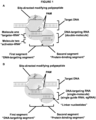
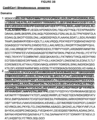
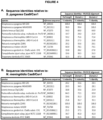
- the site-directed modifying polypeptide comprises an amino acid sequence having at least about 75% amino acid sequence identity to amino acids 7-166 or 731-1003 of the Cas9/Csn1 amino acid sequence depicted in Figure 3 , or to the corresponding portions in any of the amino acid sequences set forth as SEQ ID NOs: 1-256 and 795-1346.
- a DNA polynucleotide comprising a nucleotide sequence that encodes the DNA-targeting RNA.
- a recombinant expression vector comprises the DNA polynucleotide.
- the nucleotide sequence encoding the DNA-targeting RNA is operably linked to a promoter.
- the promoter is an inducible promoter.
- the nucleotide sequence encoding the DNA-targeting RNA further comprises a multiple cloning site.
- a recombinant expression vector comprising: (i) a nucleotide sequence encoding a DNA-targeting RNA, wherein the DNA-targeting RNA comprises: (a) a first segment comprising a nucleotide sequence that is complementary to a sequence in a target DNA; and (b) a second segment that interacts with a site-directed modifying polypeptide; and (ii) a nucleotide sequence encoding the site-directed modifying polypeptide comprising: (a) an RNA-binding portion that interacts with the DNA-targeting RNA; and (b) an activity portion that exhibits site-directed enzymatic activity, wherein the site of enzymatic activity is determined by the DNA-targeting RNA.
- compositions comprising: (i) a DNA-targeting RNA, the DNA-targeting RNA comprising: (a) a first segment comprising a nucleotide sequence that is complementary to a sequence in a target DNA; and (b) a second segment that interacts with a site-directed modifying polypeptide; and (ii) the site-directed modifying polypeptide, the site-directed modifying polypeptide comprising: (a) an RNA-binding portion that interacts with the DNA-targeting RNA; and (b) an activity portion that exhibits site-directed enzymatic activity, wherein the site of enzymatic activity is determined by the DNA-targeting RNA and wherein the site-directed modifying polypeptide is a naturally-occurring Cas9 endonuclease.
- the first segment of the DNA-targeting RNA comprises 8 nucleotides that have at least 100% complementarity to a sequence in the target DNA.
- the second segment of the DNA-targeting RNA comprises a nucleotide sequence with at least 60% identity over a stretch of at least 8 contiguous nucleotides to any one of the nucleotide sequences set forth in SEQ ID NOs:431-682 (e.g., SEQ ID NOs:563-682).
- the second segment of the DNA-targeting RNA comprises a nucleotide sequence with at least 60% identity over a stretch of at least 8 contiguous nucleotides to any one of the nucleotide sequences set forth in SEQ ID NOs:431-562.
- the enzymatic activity modifies the target DNA. Tthe enzymatic activity is nuclease activity.
- the DNA-targeting RNA is a double-molecule DNA-targeting RNA and the composition comprises both a targeter-RNA and an activator-RNA, the duplex-forming segments of which are complementary and hybridize to form the second segment of the DNA-targeting RNA.
- the duplex-forming segment of the activator-RNA comprises a nucleotide sequence with at least 60% identity over a stretch of at least 8 contiguous nucleotides to any one of the nucleotide sequences set forth in SEQ ID NO:SEQ ID NOs:431-682.
- polynucleotide and “nucleic acid,” used interchangeably herein, refer to a polymeric form of nucleotides of any length, either ribonucleotides or deoxyribonucleotides. Thus, this term includes, but is not limited to, single-, double-, or multi-stranded DNA or RNA, genomic DNA, cDNA, DNA-RNA hybrids, or a polymer comprising purine and pyrimidine bases or other natural, chemically or biochemically modified, non-natural, or derivatized nucleotide bases.
- Oligonucleotide generally refers to polynucleotides of between about 5 and about 100 nucleotides of single- or double-stranded DNA.
- oligonucleotide is also known as “oligomers” or “oligos” and may be isolated from genes, or chemically synthesized by methods known in the art.
- polynucleotide and nucleic acid should be understood to include, as applicable to the embodiments being described, single-stranded (such as sense or antisense) and double-stranded polynucleotides.
- a “stem-loop structure” refers to a nucleic acid having a secondary structure that includes a region of nucleotides which are known or predicted to form a double strand (step portion) that is linked on one side by a region of predominantly single-stranded nucleotides (loop portion).
- the terms “hairpin” and “fold-back” structures are also used herein to refer to stem-loop structures. Such structures are well known in the art and these terms are used consistently with their known meanings in the art.
- a stem-loop structure does not require exact base-pairing.
- the stem may include one or more base mismatches.
- the base-pairing may be exact, i.e. not include any mismatches.
- RNA nucleic acid
- RNA complementary to nucleic acid
- anneal or “hybridize”
- a nucleic acid specifically binds to a complementary nucleic acid
- standard Watson-Crick base-pairing includes: adenine (A) pairing with thymidine (T), adenine (A) pairing with uracil (U), and guanine (G) pairing with cytosine (C) [DNA, RNA].
- A adenine
- U uracil
- G guanine
- C cytosine
- G/U base-pairing is partially responsible for the degeneracy (i.e., redundancy) of the genetic code in the context of tRNA anti-codon base-pairing with codons in mRNA.
- a guanine (G) of a protein-binding segment (dsRNA duplex) of a subject DNA-targeting RNA molecule is considered complementary to a uracil (U), and vice versa.
- G guanine
- U uracil
- Hybridization and washing conditions are well known and exemplified in Sambrook, J., Fritsch, E. F. and Maniatis, T. Molecular Cloning: A Laboratory Manual, Second Edition, Cold Spring Harbor Laboratory Press, Cold Spring Harbor (1989), particularly Chapter 11 and Table 11.1 there in; and Sambrook, J. and Russell, W., Molecular Cloning: A Laboratory Manual, Third Edition, Cold Spring Harbor Laboratory Press, Cold Spring Harbor (2001 ).
- the conditions of temperature and ionic strength determine the "stringency" of the hybridization.
- Hybridization requires that the two nucleic acids contain complementary sequences, although mismatches between bases are possible.
- the conditions appropriate for hybridization between two nucleic acids depend on the length of the nucleic acids and the degree of complementation, variables well known in the art. The greater the degree of complementation between two nucleotide sequences, the greater the value of the melting temperature (Tm) for hybrids of nucleic acids having those sequences.
- Tm melting temperature
- For hybridizations between nucleic acids with short stretches of complementarity e.g. complementarity over 35 or less, 30 or less, 25 or less, 22 or less, 20 or less, or 18 or less nucleotides
- the position of mismatches becomes important (see Sambrook et al., supra, 11.7-11.8).
- the length for a hybridizable nucleic acid is at least about 10 nucleotides.
- Illustrative minimum lengths for a hybridizable nucleic acid are: at least about 15 nucleotides; at least about 20 nucleotides; at least about 22 nucleotides; at least about 25 nucleotides; and at least about 30 nucleotides).
- the temperature and wash solution salt concentration may be adjusted as necessary according to factors such as length of the region of complementation and the degree of complementation.
- polynucleotide need not be 100% complementary to that of its target nucleic acid to be specifically hybridizable or hybridizable. Moreover, a polynucleotide may hybridize over one or more segments such that intervening or adjacent segments are not involved in the hybridization event (e.g., a loop structure or hairpin structure).
- a polynucleotide can comprise at least 70%, at least 80%, at least 90%, at least 95%, at least 99%, or 100% sequence complementarity to a target region within the target nucleic acid sequence to which they are targeted.
- an antisense nucleic acid in which 18 of 20 nucleotides of the antisense compound are complementary to a target region, and would therefore specifically hybridize would represent 90 percent complementarity.
- the remaining noncomplementary nucleotides may be clustered or interspersed with complementary nucleotides and need not be contiguous to each other or to complementary nucleotides.
- Percent complementarity between particular stretches of nucleic acid sequences within nucleic acids can be determined routinely using BLAST programs (basic local alignment search tools) and PowerBLAST programs known in the art ( Altschul et al., J. Mol.
- binding domain it is meant a protein domain that is able to bind non-covalently to another molecule.
- a binding domain can bind to, for example, a DNA molecule (a DNA-binding protein), an RNA molecule (an RNA-binding protein) and/or a protein molecule (a protein-binding protein).
- a protein domain-binding protein it can bind to itself (to form homodimers, homotrimers, etc.) and/or it can bind to one or more molecules of a different protein or proteins.
- a group of amino acids having aliphatic side chains consists of glycine, alanine, valine, leucine, and isoleucine; a group of amino acids having aliphatic-hydroxyl side chains consists of serine and threonine; a group of amino acids having amide containing side chains consisting of asparagine and glutamine; a group of amino acids having aromatic side chains consists of phenylalanine, tyrosine, and tryptophan; a group of amino acids having basic side chains consists of lysine, arginine, and histidine; a group of amino acids having acidic side chains consists of glutamate and aspartate; and a group of amino acids having sulfur containing side chains consists of cysteine and methionine.
- Exemplary conservative amino acid substitution groups are: valine-leucine-isoleucine, phenyla
- a polynucleotide or polypeptide has a certain percent "sequence identity" to another polynucleotide or polypeptide, meaning that, when aligned, that percentage of bases or amino acids are the same, and in the same relative position, when comparing the two sequences. Sequence identity can be determined in a number of different manners.
- sequences can be aligned using various methods and computer programs (e.g., BLAST, T-COFFEE, MUSCLE, MAFFT, etc.), available over the world wide web at sites including ncbi.nlm.nili.gov/BLAST, ebi.ac.uk/Tools/msa/tcoffee/, ebi.ac.uk/Tools/msa/muscle/, mafft.cbrc.jp/alignment/software/. See, e.g., Altschul et al. (1990), J. Mol. Bioi. 215:403-10 .
- a DNA sequence that "encodes" a particular RNA is a DNA nucleic acid sequence that is transcribed into RNA.
- a DNA polynucleotide may encode an RNA (mRNA) that is translated into protein, or a DNA polynucleotide may encode an RNA that is not translated into protein (e.g. tRNA, rRNA, or a DNA-targeting RNA; also called “non-coding” RNA or "ncRNA”).
- a "protein coding sequence” or a sequence that encodes a particular protein or polypeptide is a nucleic acid sequence that is transcribed into mRNA (in the case of DNA) and is translated (in the case of mRNA) into a polypeptide in vitro or in vivo when placed under the control of appropriate regulatory sequences.
- the boundaries of the coding sequence are determined by a start codon at the 5' terminus (N-terminus) and a translation stop nonsense codon at the 3' terminus (C-terminus).
- a coding sequence can include, but is not limited to, cDNA from prokaryotic or eukaryotic mRNA, genomic DNA sequences from prokaryotic or eukaryotic DNA, and synthetic nucleic acids.
- a transcription termination sequence will usually be located 3' to the coding sequence.
- a "promoter sequence” is a DNA regulatory region capable of binding RNA polymerase and initiating transcription of a downstream (3' direction) coding or non-coding sequence.
- the promoter sequence is bounded at its 3' terminus by the transcription initiation site and extends upstream (5' direction) to include the minimum number of bases or elements necessary to initiate transcription at levels detectable above background.
- a transcription initiation site within the promoter sequence will be found a transcription initiation site, as well as protein binding domains responsible for the binding of RNA polymerase.
- Eukaryotic promoters will often, but not always, contain "TATA" boxes and "CAT” boxes.
- Various promoters, including inducible promoters may be used to drive the various vectors of the present invention.
- a promoter can be a constitutively active promoter (i.e., a promoter that is constitutively in an active/"ON” state), it may be an inducible promoter (i.e., a promoter whose state, active/"ON” or inactive/"OFF", is controlled by an external stimulus, e.g., the presence of a particular temperature, compound, or protein.), it may be a spatially restricted promoter (i.e., transcriptional control element, enhancer, etc.)(e.g., tissue specific promoter, cell type specific promoter, etc.), and it may be a temporally restricted promoter (i.e., the promoter is in the "ON" state or "OFF” state during specific stages of embryonic development or during specific stages of a biological process, e.g., hair follicle cycle in mice).
- a constitutively active promoter i.e., a promoter that is constitutively in an active/"ON” state
- it may be an inducible promote
- Suitable promoters can be derived from viruses and can therefore be referred to as viral promoters, or they can be derived from any organism, including prokaryotic or eukaryotic organisms. Suitable promoters can be used to drive expression by any RNA polymerase (e.g., pol I, pol II, pol III).
- RNA polymerase e.g., pol I, pol II, pol III
- Exemplary promoters include, but are not limited to the SV40 early promoter, mouse mammary tumor virus long terminal repeat (LTR) promoter; adenovirus major late promoter (Ad MLP); a herpes simplex virus (HSV) promoter, a cytomegalovirus (CMV) promoter such as the CMV immediate early promoter region (CMVIE), a rous sarcoma virus (RSV) promoter, a human U6 small nuclear promoter (U6) ( Miyagishi et al. , Nature Biotechnology 20, 497 - 500 (2002 )), an enhanced U6 promoter (e.g., Xia et al., Nucleic Acids Res. 2003 Sep 1;31(17 )), a human H1 promoter (H1), and the like.
- LTR mouse mammary tumor virus long terminal repeat
- Ad MLP adenovirus major late promoter
- HSV herpes simplex virus
- CMV cytomegalovirus
- inducible promoters include, but are not limited toT7 RNA polymerase promoter, T3 RNA polymerase promoter, Isopropyl-beta-D-thiogalactopyranoside (IPTG)-regulated promoter, lactose induced promoter, heat shock promoter, Tetracycline-regulated promoter, Steroid-regulated promoter, Metal-regulated promoter, estrogen receptor-regulated promoter, etc.
- Inducible promoters can therefore be regulated by molecules including, but not limited to, doxycycline; RNA polymerase, e.g., T7 RNA polymerase; an estrogen receptor; an estrogen receptor fusion; etc.
- the promoter is a spatially restricted promoter (i.e., cell type specific promoter, tissue specific promoter, etc.) such that in a multi-cellular organism, the promoter is active (i.e., "ON") in a subset of specific cells.
- spatially restricted promoters may also be referred to as enhancers, transcriptional control elements, control sequences, etc.
- any convenient spatially restricted promoter may be used and the choice of suitable promoter (e.g., a brain specific promoter, a promoter that drives expression in a subset of neurons, a promoter that drives expression in the germline, a promoter that drives expression in the lungs, a promoter that drives expression in muscles, a promoter that drives expression in islet cells of the pancreas, etc.) will depend on the organism.
- various spatially restricted promoters are known for plants, flies, worms, mammals, mice, etc.
- a spatially restricted promoter can be used to regulate the expression of a nucleic acid encoding a subject site-directed modifying polypeptide in a wide variety of different tissues and cell types, depending on the organism.
- Some spatially restricted promoters are also temporally restricted such that the promoter is in the "ON" state or "OFF" state during specific stages of embryonic development or during specific stages of a biological process (e.g., hair follicle cycle in mice).
- spatially restricted promoters include, but are not limited to, neuron-specific promoters, adipocyte-specific promoters, cardiomyocyte-specific promoters, smooth muscle-specific promoters, photoreceptor-specific promoters, etc.
- Neuron-specific spatially restricted promoters include, but are not limited to, a neuron-specific enolase (NSE) promoter (see, e.g., EMBL HSENO2, X51956); an aromatic amino acid decarboxylase (AADC) promoter; a neurofilament promoter (see, e.g., GenBank HUMNFL, L04147); a synapsin promoter (see, e.g., GenBank HUMSYNIB, M55301); a thy-1 promoter (see, e.g., Chen et al. (1987) Cell 51:7-19 ; and Llewellyn, et al. (2010) Nat. Med.
- NSE neuron-specific enolase
- AADC aromatic amino acid decarboxylase
- a myelin basic protein (MBP) promoter a Ca2+-calmodulin-dependent protein kinase II-alpha (CamKII ⁇ ) promoter (see, e.g., Mayford et al. (1996) Proc. Natl. Acad. Sci. USA 93:13250 ; and Casanova et al. (2001) Genesis 31:37 ); a CMV enhancer/platelet-derived growth factor- ⁇ promoter (see, e.g., Liu et al. (2004) Gene Therapy 11:52-60 ); and the like.
- MBP myelin basic protein
- Ca2+-calmodulin-dependent protein kinase II-alpha promoter see, e.g., Mayford et al. (1996) Proc. Natl. Acad. Sci. USA 93:13250 ; and Casanova et al. (2001) Genesis 31:37
- CMV enhancer/platelet-derived growth factor- ⁇ promoter see, e.g.
- Adipocyte-specific spatially restricted promoters include, but are not limited to aP2 gene promoter/enhancer, e.g., a region from -5.4 kb to +21 bp of a human aP2 gene (see, e.g., Tozzo et al. (1997) Endocrinol. 138:1604 ; Ross et al. (1990) Proc. Natl. Acad. Sci. USA 87:9590 ; and Pavjani et al. (2005) Nat. Med. 11:797 ); a glucose transporter-4 (GLUT4) promoter (see, e.g., Knight et al. (2003) Proc. Natl. Acad. Sci.
- aP2 gene promoter/enhancer e.g., a region from -5.4 kb to +21 bp of a human aP2 gene (see, e.g., Tozzo et al. (1997) Endocrinol.
- fatty acid translocase (FAT/CD36) promoter see, e.g., Kuriki et al. (2002) Biol. Pharm. Bull. 25:1476 ; and Sato et al. (2002) J. Biol. Chem. 277:15703 ); a stearoyl-CoA desaturase-1 (SCD1) promoter ( Tabor et al. (1999) J. Biol. Chem. 274:20603 ); a leptin promoter (see, e.g., Mason et al. (1998) Endocrinol. 139:1013 ; and Chen et al. (1999) Biochem. Biophys. Res. Comm.
- FAT/CD36 fatty acid translocase
- an adiponectin promoter see, e.g., Kita et al. (2005) Biochem. Biophys. Res. Comm. 331:484 ; and Chakrabarti (2010) Endocrinol. 151:2408 ); an adipsin promoter (see, e.g., Platt et al. (1989) Proc. Natl. Acad. Sci. USA 86:7490 ); a resistin promoter (see, e.g., Seo et al. (2003) Molec. Endocrinol. 17:1522 ); and the like.
- Cardiomyocyte-specific spatially restricted promoters include, but are not limited to control sequences derived from the following genes: myosin light chain-2, ⁇ -myosin heavy chain, AE3, cardiac troponin C, cardiac actin, and the like.
- Franz et al. (1997) Cardiovasc. Res. 35:560-566 ; Robbins et al. (1995) Ann. N.Y. Acad. Sci. 752:492-505 ; Linn et al. (1995) Circ. Res. 76:584-591 ; Parmacek et al. (1994) Mol. Cell. Biol. 14:1870-1885 ; Hunter et al. (1993) Hypertension 22:608-617 ; and Sartorelli et al. (1992) Proc. Natl. Acad. Sci. USA 89:4047-4051 .
- Smooth muscle-specific spatially restricted promoters include, but are not limited to an SM22 ⁇ promoter (see, e.g., Akyürek et al. (2000) Mol. Med. 6:983 ; and U.S. Patent No. 7,169,874 ); a smoothelin promoter (see, e.g., WO 2001/018048 ); an ⁇ -smooth muscle actin promoter; and the like.
- a 0.4 kb region of the SM22 ⁇ promoter, within which lie two CArG elements has been shown to mediate vascular smooth muscle cell-specific expression (see, e.g., Kim, et al. (1997) Mol. Cell. Biol. 17, 2266-2278 ; Li, et al., (1996) J. Cell Biol. 132, 849-859 ; and Moessler, et al. (1996) Development 122, 2415-2425 ).
- Photoreceptor-specific spatially restricted promoters include, but are not limited to, a rhodopsin promoter; a rhodopsin kinase promoter ( Young et al. (2003) Ophthalmol. Vis. Sci. 44:4076 ); a beta phosphodiesterase gene promoter ( Nicoud et al. (2007) J. Gene Med. 9:1015 ); a retinitis pigmentosa gene promoter (Nicoud et al. (2007) supra); an interphotoreceptor retinoid-binding protein (IRBP) gene enhancer (Nicoud et al. (2007) supra); an IRBP gene promoter ( Yokoyama et al. (1992) Exp Eye Res. 55:225 ); and the like.
- a rhodopsin promoter Young et al. (2003) Ophthalmol. Vis. Sci. 44:4076
- a beta phosphodiesterase gene promoter Nicoud et al
- DNA regulatory sequences refer to transcriptional and translational control sequences, such as promoters, enhancers, polyadenylation signals, terminators, protein degradation signals, and the like, that provide for and/or regulate transcription of a non-coding sequence (e.g., DNA-targeting RNA) or a coding sequence (e.g., site-directed modifying polypeptide, or Cas9/Csn1 polypeptide) and/or regulate translation of an encoded polypeptide.
- a non-coding sequence e.g., DNA-targeting RNA
- a coding sequence e.g., site-directed modifying polypeptide, or Cas9/Csn1 polypeptide
- nucleic acid refers to a nucleic acid, polypeptide, cell, or organism that is found in nature.
- a polypeptide or polynucleotide sequence that is present in an organism (including viruses) that can be isolated from a source in nature and which has not been intentionally modified by a human in the laboratory is naturally occurring.
- chimeric refers to two components that are defined by structures derived from different sources.
- a chimeric polypeptide e.g., a chimeric Cas9/Csn1 protein
- the chimeric polypeptide includes amino acid sequences that are derived from different polypeptides.
- a chimeric polypeptide may comprise either modified or naturally-occurring polypeptide sequences (e.g., a first amino acid sequence from a modified or unmodified Cas9/Csn1 protein; and a second amino acid sequence other than the Cas9/Csn1 protein).
- chimeric in the context of a polynucleotide encoding a chimeric polypeptide includes nucleotide sequences derived from different coding regions (e.g., a first nucleotide sequence encoding a modified or unmodified Cas9/Csn1 protein; and a second nucleotide sequence encoding a polypeptide other than a Cas9/Csn1 protein).
- chimeric polypeptide refers to a polypeptide which is made by the combination (i.e., "fusion") of two otherwise separated segments of amino sequence, usually through human intervention.
- a polypeptide that comprises a chimeric amino acid sequence is a chimeric polypeptide.
- Some chimeric polypeptides can be referred to as "fusion variants.”
- Heterologous means a nucleotide or polypeptide sequence that is not found in the native nucleic acid or protein, respectively.
- the RNA-binding domain of a naturally-occurring bacterial Cas9/Csn1 polypeptide may be fused to a heterologous polypeptide sequence (i.e. a polypeptide sequence from a protein other than Cas9/Csn1 or a polypeptide sequence from another organism).
- the heterologous polypeptide sequence may exhibit an activity (e.g., enzymatic activity) that will also be exhibited by the chimeric Cas9/Csn1 protein (e.g., methyltransferase activity, acetyltransferase activity, kinase activity, ubiquitinating activity, etc.).
- a heterologous nucleic acid sequence may be linked to a naturally-occurring nucleic acid sequence (or a variant thereof) (e.g., by genetic engineering) to generate a chimeric nucleotide sequence encoding a chimeric polypeptide.
- a variant Cas9 site-directed polypeptide may be fused to a heterologous polypeptide (i.e. a polypeptide other than Cas9), which exhibits an activity that will also be exhibited by the fusion variant Cas9 site-directed polypeptide.
- a heterologous nucleic acid sequence may be linked to a variant Cas9 site-directed polypeptide (e.g., by genetic engineering) to generate a nucleotide sequence encoding a fusion variant Cas9 site-directed polypeptide.
- Recombinant means that a particular nucleic acid (DNA or RNA) is the product of various combinations of cloning, restriction, polymerase chain reaction (PCR) and/or ligation steps resulting in a construct having a structural coding or non-coding sequence distinguishable from endogenous nucleic acids found in natural systems.
- DNA sequences encoding polypeptides can be assembled from cDNA fragments or from a series of synthetic oligonucleotides, to provide a synthetic nucleic acid which is capable of being expressed from a recombinant transcriptional unit contained in a cell or in a cell-free transcription and translation system.
- Genomic DNA comprising the relevant sequences can also be used in the formation of a recombinant gene or transcriptional unit. Sequences of non-translated DNA may be present 5' or 3' from the open reading frame, where such sequences do not interfere with manipulation or expression of the coding regions, and may indeed act to modulate production of a desired product by various mechanisms (see “DNA regulatory sequences", below). Alternatively, DNA sequences encoding RNA (e.g., DNA-targeting RNA) that is not translated may also be considered recombinant.
- the term "recombinant" nucleic acid refers to one which is not naturally occurring, e.g., is made by the artificial combination of two otherwise separated segments of sequence through human intervention.
- This artificial combination is often accomplished by either chemical synthesis means, or by the artificial manipulation of isolated segments of nucleic acids, e.g., by genetic engineering techniques. Such is usually done to replace a codon with a codon encoding the same amino acid, a conservative amino acid, or a non-conservative amino acid. Alternatively, it is performed to join together nucleic acid segments of desired functions to generate a desired combination of functions. This artificial combination is often accomplished by either chemical synthesis means, or by the artificial manipulation of isolated segments of nucleic acids, e.g., by genetic engineering techniques.
- a recombinant polynucleotide encodes a polypeptide
- the sequence of the encoded polypeptide can be naturally occurring ("wild type") or can be a variant (e.g., a mutant) of the naturally occurring sequence.
- the term "recombinant" polypeptide does not necessarily refer to a polypeptide whose sequence does not naturally occur.
- a "recombinant" polypeptide is encoded by a recombinant DNA sequence, but the sequence of the polypeptide can be naturally occurring ("wild type") or non-naturally occurring (e.g., a variant, a mutant, etc.).
- a "recombinant" polypeptide is the result of human intervention, but may be a naturally occurring amino acid sequence.
- a “vector” or “expression vector” is a replicon, such as plasmid, phage, virus, or cosmid, to which another DNA segment, i.e. an "insert", may be attached so as to bring about the replication of the attached segment in a cell.
- An "expression cassette” comprises a DNA coding sequence operably linked to a promoter.
- "Operably linked” refers to a juxtaposition wherein the components so described are in a relationship permitting them to function in their intended manner. For instance, a promoter is operably linked to a coding sequence if the promoter affects its transcription or expression.
- Suitable DNA/RNA binding conditions include physiological conditions normally present in a cell.
- Other suitable DNA/RNA binding conditions e.g., conditions in a cell-free system
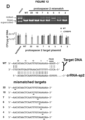
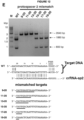
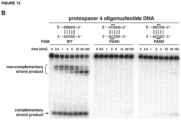
- the strand of the target DNA that is complementary to and hybridizes with the DNA-targeting RNA is referred to as the "complementary strand” and the strand of the target DNA that is complementary to the “complementary strand” (and is therefore not complementary to the DNA-targeting RNA) is referred to as the "noncomplementary strand” or “non-complementary strand” (see Figure 12 ).
- site-directed modifying polypeptide or "RNA-binding site-directed polypeptide” or “RNA-binding site-directed modifying polypeptide” or “site-directed polypeptide” it is meant a polypeptide that binds RNA and is targeted to a specific DNA sequence.
- a site-directed modifying polypeptide as described herein is targeted to a specific DNA sequence by the RNA molecule to which it is bound.
- the RNA molecule comprises a sequence that is complementary to a target sequence within the target DNA, thus targeting the bound polypeptide to a specific location within the target DNA (the target sequence).
- cleavage it is meant the breakage of the covalent backbone of a DNA molecule. Cleavage can be initiated by a variety of methods including, but not limited to, enzymatic or chemical hydrolysis of a phosphodiester bond. Both single-stranded cleavage and double-stranded cleavage are possible, and double-stranded cleavage can occur as a result of two distinct single-stranded cleavage events. DNA cleavage can result in the production of either blunt ends or staggered ends.
- a complex comprising a DNA-targeting RNA and a site-directed modifying polypeptide is used for targeted double-stranded DNA cleavage.
- Nuclease and “endonuclease” are used interchangeably herein to mean an enzyme which possesses catalytic activity for DNA cleavage.
- cleavage domain or “active domain” or “nuclease domain” of a nuclease it is meant the polypeptide sequence or domain within the nuclease which possesses the catalytic activity for DNA cleavage.
- a cleavage domain can be contained in a single polypeptide chain or cleavage activity can result from the association of two (or more) polypeptides.
- a single nuclease domain may consist of more than one isolated stretch of amino acids within a given polypeptide.
- DNA-targeting RNA or “DNA-targeting RNA polynucleotide” (also referred to herein as a “guide RNA” or “gRNA”).
- a subject DNA-targeting RNA comprises two segments, a “DNA-targeting segment” and a “protein-binding segment.”
- segment it is meant a segment/section/region of a molecule, e.g., a contiguous stretch of nucleotides in an RNA.
- a segment can also mean a region/section of a complex such that a segment may comprise regions of more than one molecule.
- the protein-binding segment (described below) of a DNA-targeting RNA is one RNA molecule and the protein-binding segment therefore comprises a region of that RNA molecule.
- the protein-binding segment (described below) of a DNA-targeting RNA comprises two separate molecules that are hybridized along a region of complementarity.
- a protein-binding segment of a DNA-targeting RNA that comprises two separate molecules can comprise (i) base pairs 40-75 of a first RNA molecule that is 100 base pairs in length; and (ii) base pairs 10-25 of a second RNA molecule that is 50 base pairs in length.
- the definition of "segment,” unless otherwise specifically defined in a particular context, is not limited to a specific number of total base pairs, is not limited to any particular number of base pairs from a given RNA molecule, is not limited to a particular number of separate molecules within a complex, and may include regions of RNA molecules that are of any total length and may or may not include regions with complementarity to other molecules.
- the DNA-targeting segment (or "DNA-targeting sequence”) comprises a nucleotide sequence that is complementary to a specific sequence within a target DNA (the complementary strand of the target DNA).
- the protein-binding segment (or "protein-binding sequence”) interacts with a site-directed modifying polypeptide.
- site-directed modifying polypeptide is a Cas9 or Cas9 related polypeptide (described in more detail below)
- site-specific cleavage of the target DNA occurs at locations determined by both (i) base-pairing complementarity between the DNA-targeting RNA and the target DNA; and (ii) a short motif (referred to as the protospacer adjacent motif (PAM)) in the target DNA.
- PAM protospacer adjacent motif
- the protein-binding segment of a subject DNA-targeting RNA comprises two complementary stretches of nucleotides that hybridize to one another to form a double stranded RNA duplex (dsRNA duplex).
- a subject nucleic acid e.g., a DNA-targeting RNA, a nucleic acid comprising a nucleotide sequence encoding a DNA-targeting RNA; a nucleic acid encoding a site-directed polypeptide; etc.
- a modification or sequence that provides for an additional desirable feature (e.g., modified or regulated stability; subcellular targeting; tracking, e.g., a fluorescent label; a binding site for a protein or protein complex; etc.).
- Non-limiting examples include: a 5' cap (e.g., a 7-methylguanylate cap (m7G)); a 3' polyadenylated tail (i.e., a 3' poly(A) tail); a riboswitch sequence (e.g., to allow for regulated stability and/or regulated accessibility by proteins and/or protein complexes); a stability control sequence; a sequence that forms a dsRNA duplex (i.e., a hairpin)); a modification or sequence that targets the RNA to a subcellular location (e.g., nucleus, mitochondria, chloroplasts, and the like); a modification or sequence that provides for tracking (e.g., direct conjugation to a fluorescent molecule, conjugation to a moiety that facilitates fluorescent detection, a sequence that allows for fluorescent detection, etc.); a modification or sequence that provides a binding site for proteins (e.g., proteins that act on DNA, including transcriptional activators, transcriptional repressors, DNA
- a DNA-targeting RNA comprises an additional segment at either the 5' or 3' end that provides for any of the features described above.
- a suitable third segment can comprise a 5' cap (e.g., a 7-methylguanylate cap (m7G)); a 3' polyadenylated tail (i.e., a 3' poly(A) tail); a riboswitch sequence (e.g., to allow for regulated stability and/or regulated accessibility by proteins and protein complexes); a stability control sequence; a sequence that forms a dsRNA duplex (i.e., a hairpin)); a sequence that targets the RNA to a subcellular location (e.g., nucleus, mitochondria, chloroplasts, and the like); a modification or sequence that provides for tracking (e.g., direct conjugation to a fluorescent molecule, conjugation to a moiety that facilitates fluorescent detection, a sequence that allows for fluorescent detection, etc.); a modification or sequence
- a subject DNA-targeting RNA and a subject site-directed modifying polypeptide form a complex (i.e., bind via non-covalent interactions).
- the DNA-targeting RNA provides target specificity to the complex by comprising a nucleotide sequence that is complementary to a sequence of a target DNA.
- the site-directed modifying polypeptide of the complex provides the site-specific activity.
- the site-directed modifying polypeptide is guided to a target DNA sequence (e.g. a target sequence in a chromosomal nucleic acid; a target sequence in an extrachromosomal nucleic acid, e.g.
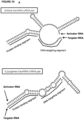
- a subject DNA-targeting RNA comprises two separate RNA molecules (RNA polynucleotides: an "activator-RNA” and a “targeter-RNA”, see below) and is referred to herein as a “double-molecule DNA-targeting RNA” or a "two-molecule DNA-targeting RNA.”
- the subject DNA-targeting RNA is a single RNA molecule (single RNA polynucleotide) and is referred to herein as a "single-molecule DNA-targeting RNA,” a “single-guide RNA,” or an "sgRNA.”
- the term "DNA-targeting RNA” or “gRNA” is inclusive, referring both to double-molecule DNA-targeting RNAs and to single-molecule DNA-targeting RNAs (i.e., sgRNAs).
- An exemplary two-molecule DNA-targeting RNA comprises a crRNA-like (“CRISPR RNA” or “targeter-RNA” or “crRNA” or “crRNA repeat”) molecule and a corresponding tracrRNA-like (“trans-acting CRISPR RNA” or “activator-RNA” or “tracrRNA”) molecule.
- a crRNA-like molecule comprises both the DNA-targeting segment (single stranded) of the DNA-targeting RNA and a stretch ("duplex-forming segment") of nucleotides that forms one half of the dsRNA duplex of the protein-binding segment of the DNA-targeting RNA.
- a corresponding tracrRNA-like molecule comprises a stretch of nucleotides (duplex-forming segment) that forms the other half of the dsRNA duplex of the protein-binding segment of the DNA-targeting RNA.
- a stretch of nucleotides of a crRNA-like molecule are complementary to and hybridize with a stretch of nucleotides of a tracrRNA-like molecule to form the dsRNA duplex of the protein-binding domain of the DNA-targeting RNA.
- each crRNA-like molecule can be said to have a corresponding tracrRNA-like molecule.
- the crRNA-like molecule additionally provides the single stranded DNA-targeting segment.
- a crRNA-like and a tracrRNA-like molecule hybridize to form a DNA-targeting RNA.
- the exact sequence of a given crRNA or tracrRNA molecule is characteristic of the species in which the RNA molecules are found.
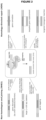
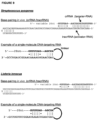
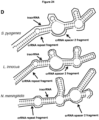
- Various crRNAs and tracrRNAs are depicted in corresponding complementary pairs in Figures 8 .
- a subject double-molecule DNA-targeting RNA can comprise any corresponding crRNA and tracrRNA pair.
- a subject double-molecule DNA-targeting RNA can comprise any corresponding crRNA and tracrRNA pair.
- activator-RNA is used herein to mean a tracrRNA-like molecule of a double-molecule DNA-targeting RNA.
- targeter-RNA is used herein to mean a crRNA-like molecule of a double-molecule DNA-targeting RNA.
- duplex-forming segment is used herein to mean the stretch of nucleotides of an activator-RNA or a targeter-RNA that contributes to the formation of the dsRNA duplex by hybridizing to a stretch of nucleotides of a corresponding activator-RNA or targeter-RNA molecule.
- an activator-RNA comprises a duplex-forming segment that is complementary to the duplex-forming segment of the corresponding targeter-RNA.
- an activator-RNA comprises a duplex-forming segment while a targeter-RNA comprises both a duplex-forming segment and the DNA-targeting segment of the DNA-targeting RNA. Therefore, a subject double-molecule DNA-targeting RNA can be comprised of any corresponding activator-RNA and targeter-RNA pair.
- stem cell is used herein to refer to a cell (e.g., plant stem cell, vertebrate stem cell) that has the ability both to self-renew and to generate a differentiated cell type (see Morrison et al. (1997) Cell 88:287-298 ).
- the adjective "differentiated”, or “differentiating” is a relative term.
- a “differentiated cell” is a cell that has progressed further down the developmental pathway than the cell it is being compared with.
- pluripotent stem cells can differentiate into lineage-restricted progenitor cells (e.g., mesodermal stem cells), which in turn can differentiate into cells that are further restricted (e.g., neuron progenitors), which can differentiate into end-stage cells (i.e., terminally differentiated cells, e.g., neurons, cardiomyocytes, etc.), which play a characteristic role in a certain tissue type, and may or may not retain the capacity to proliferate further.
- progenitor cells e.g., mesodermal stem cells
- end-stage cells i.e., terminally differentiated cells, e.g., neurons, cardiomyocytes, etc.
- Stem cells may be characterized by both the presence of specific markers (e.g., proteins, RNAs, etc.) and the absence of specific markers.
- Stem cells may also be identified by functional assays both in vitro and in vivo, particularly assays relating to the ability of stem cells to give rise to multiple differentiated
- PSCs pluripotent stem cells
- Pluripotent stem cell or “PSC” is used herein to mean a stem cell capable of producing all cell types of the organism. Therefore, a PSC can give rise to cells of all germ layers of the organism (e.g., the endoderm, mesoderm, and ectoderm of a vertebrate). Pluripotent cells are capable of forming teratomas and of contributing to ectoderm, mesoderm, or endoderm tissues in a living organism. Pluripotent stem cells of plants are capable of giving rise to all cell types of the plant (e.g., cells of the root, stem, leaves, etc.).
- PSCs of animals can be derived in a number of different ways.
- embryonic stem cells ESCs
- iPSCs induced pluripotent stem cells
- somatic cells Takahashi et. al, Cell. 2007 Nov 30;131(5):861-72 ; Takahashi et. al, Nat Protoc. 2007;2(12):3081-9 ; Yu et. al, Science. 2007 Dec 21;318(5858):1917-20. Epub 2007 Nov 20 ).
- PSC refers to pluripotent stem cells regardless of their derivation
- the term PSC encompasses the terms ESC and iPSC.
- PSCs may be in the form of an established cell line, they may be obtained directly from primary embryonic tissue, or they may be derived from a somatic cell. PSCs can be target cells of the methods described herein.
- embryonic stem cell a PSC that was isolated from an embryo, typically from the inner cell mass of the blastocyst.
- Stem cells of interest also include embryonic stem cells from other primates, such as Rhesus stem cells and marmoset stem cells.
- the stem cells may be obtained from any mammalian species, e.g. human, equine, bovine, porcine, canine, feline, rodent, e.g. mice, rats, hamster, primate, etc. ( Thomson et al. (1998) Science 282:1145 ; Thomson et al. (1995) Proc. Natl. Acad. Sci USA 92:7844 ; Thomson et al. (1996) Biol. Reprod.
- ESCs In culture, ESCs typically grow as flat colonies with large nucleo-cytoplasmic ratios, defined borders and prominent nucleoli. In addition, ESCs express SSEA-3, SSEA-4, TRA-1-60, TRA-1-81, and Alkaline Phosphatase, but not SSEA-1. Examples of methods of generating and characterizing ESCs may be found in, for example, US Patent No. 7,029,913 , US Patent No. 5,843,780 , and US Patent No. 6,200,806 . Methods for proliferating hESCs in the undifferentiated form are described in WO 99/20741 , WO 01/51616 , and WO 03/020920 .
- EGSC embryonic germ stem cell
- EG cell a PSC that is derived from germ cells and/or germ cell progenitors, e.g. primordial germ cells, i.e. those that would become sperm and eggs.
- Embryonic germ cells EG cells
- Examples of methods of generating and characterizing EG cells may be found in, for example, US Patent No. 7,153,684 ; Matsui, Y., et al., (1992) Cell 70:841 ; Shamblott, M., et al. (2001) Proc. Natl. Acad. Sci.
- iPSC induced pluripotent stem cell
- PSC induced pluripotent stem cell
- iPSCs can be derived from multiple different cell types, including terminally differentiated cells. iPSCs have an ES cell-like morphology, growing as flat colonies with large nucleo-cytoplasmic ratios, defined borders and prominent nuclei.
- iPSCs express one or more key pluripotency markers known by one of ordinary skill in the art, including but not limited to Alkaline Phosphatase, SSEA3, SSEA4, Sox2, Oct3/4, Nanog, TRA160, TRA181, TDGF 1, Dnmt3b, FoxD3, GDF3, Cyp26a1, TERT, and zfp42.
- Examples of methods of generating and characterizing iPSCs may be found in, for example, U.S. Patent Publication Nos. US20090047263 , US20090068742 , US20090191159 , US20090227032 , US20090246875 , and US20090304646 .
- somatic cells are provided with reprogramming factors (e.g. Oct4, SOX2, KLF4, MYC, Nanog, Lin28, etc.) known in the art to reprogram the somatic cells to become pluripotent stem cells.
- reprogramming factors e.g. Oct4, SOX2, KLF4, MYC, Nanog, Lin28, etc.
- somatic cell it is meant any cell in an organism that, in the absence of experimental manipulation, does not ordinarily give rise to all types of cells in an organism.
- somatic cells are cells that have differentiated sufficiently that they will not naturally generate cells of all three germ layers of the body, i.e. ectoderm, mesoderm and endoderm.
- somatic cells would include both neurons and neural progenitors, the latter of which may be able to naturally give rise to all or some cell types of the central nervous system but cannot give rise to cells of the mesoderm or endoderm lineages.
- mitotic cell it is meant a cell undergoing mitosis.
- Mitosis is the process by which a eukaryotic cell separates the chromosomes in its nucleus into two identical sets in two separate nuclei. It is generally followed immediately by cytokinesis, which divides the nuclei, cytoplasm, organelles and cell membrane into two cells containing roughly equal shares of these cellular components.
- post-mitotic cell it is meant a cell that has exited from mitosis, i.e., it is "quiescent", i.e. it is no longer undergoing divisions. This quiescent state may be temporary, i.e. reversible, or it may be permanent.
- meiotic cell it is meant a cell that is undergoing meiosis.
- Meiosis is the process by which a cell divides its nuclear material for the purpose of producing gametes or spores. Unlike mitosis, in meiosis, the chromosomes undergo a recombination step which shuffles genetic material between chromosomes. Additionally, the outcome of meiosis is four (genetically unique) haploid cells, as compared with the two (genetically identical) diploid cells produced from mitosis.
- HDR homology-directed repair
- Homology-directed repair may result in an alteration of the sequence of the target molecule (e.g., insertion, deletion, mutation), if the donor polynucleotide differs from the target molecule and part or all of the sequence of the donor polynucleotide is incorporated into the target DNA.
- the donor polynucleotide, a portion of the donor polynucleotide, a copy of the donor polynucleotide, or a portion of a copy of the donor polynucleotide integrates into the target DNA.
- non-homologous end joining it is meant the repair of double-strand breaks in DNA by direct ligation of the break ends to one another without the need for a homologous template (in contrast to homology-directed repair, which requires a homologous sequence to guide repair). NHEJ often results in the loss (deletion) of nucleotide sequence near the site of the double-strand break.
- treatment generally mean obtaining a desired pharmacologic and/or physiologic effect.
- the effect may be prophylactic in terms of completely or partially preventing a disease or symptom thereof and/or may be therapeutic in terms of a partial or complete cure for a disease and/or adverse effect attributable to the disease.
- Treatment covers any treatment of a disease or symptom in a mammal, and includes: (a) preventing the disease or symptom from occurring in a subject which may be predisposed to acquiring the disease or symptom but has not yet been diagnosed as having it; (b) inhibiting the disease or symptom, i.e., arresting its development; or (c) relieving the disease, i.e., causing regression of the disease.
- the therapeutic agent may be administered before, during or after the onset of disease or injury.
- the treatment of ongoing disease, where the treatment stabilizes or reduces the undesirable clinical symptoms of the patient, is of particular interest. Such treatment is desirably performed prior to complete loss of function in the affected tissues.
- the non-claimed therapy will desirably be administered during the symptomatic stage of the disease, and in some cases after the symptomatic stage of the disease.
- the terms “individual,” “subject,” “host,” and “patient,” are used interchangeably herein and refer to any mammalian subject for whom diagnosis, treatment, or therapy is desired, particularly humans.
- the present disclosure provides a DNA-targeting RNA that comprises a targeting sequence and, together with a modifying polypeptide which is a naturally-occurring Cas9, provides for site-specific modification of a target DNA and/or a polypeptide associated with the target DNA.
- Compositions comprising the DNA-targeting RNA are also provided.
- a subject DNA-targeting RNA that directs the activities of an associated polypeptide (e.g., a site-directed modifying polypeptide) to a specific target sequence within a target DNA.
- a subject DNA-targeting RNA comprises: a first segment (also referred to herein as a "DNA-targeting segment” or a "DNA-targeting sequence”) and a second segment (also referred to herein as a "protein-binding segment” or a "protein-binding sequence”).
- the DNA-targeting segment of a subject DNA-targeting RNA comprises a nucleotide sequence that is complementary to a sequence in a target DNA.
- the DNA-targeting segment of a subject DNA-targeting RNA interacts with a target DNA in a sequence-specific manner via hybridization (i.e., base pairing).
- the nucleotide sequence of the DNA-targeting segment may vary and determines the location within the target DNA that the DNA-targeting RNA and the target DNA will interact.
- the DNA-targeting segment of a subject DNA-targeting RNA can be modified (e.g., by genetic engineering) to hybridize to any desired sequence within a target DNA.
- the DNA-targeting segment can have a length of from about 12 nucleotides to about 100 nucleotides.
- the DNA-targeting segment can have a length of from about 12 nucleotides (nt) to about 80 nt, from about 12 nt to about 50nt, from about 12 nt to about 40 nt, from about 12 nt to about 30 nt, from about 12 nt to about 25 nt, from about 12 nt to about 20 nt, or from about 12 nt to about 19 nt.
- the DNA-targeting segment can have a length of from about 19 nt to about 20 nt, from about 19 nt to about 25 nt, from about 19 nt to about 30 nt, from about 19 nt to about 35 nt, from about 19 nt to about 40 nt, from about 19 nt to about 45 nt, from about 19 nt to about 50 nt, from about 19 nt to about 60 nt, from about 19 nt to about 70 nt, from about 19 nt to about 80 nt, from about 19 nt to about 90 nt, from about 19 nt to about 100 nt, from about 20 nt to about 25 nt, from about 20 nt to about 30 nt, from about 20 nt to about 35 nt, from about 20 nt to about 40 nt, from about 20 nt to about 45 nt, from about 20 nt to about 50 nt, from about 20 nt,
- the nucleotide sequence (the DNA-targeting sequence) of the DNA-targeting segment that is complementary to a nucleotide sequence (target sequence) of the target DNA can have a length at least about 12 nt.
- the DNA-targeting sequence of the DNA-targeting segment that is complementary to a target sequence of the target DNA can have a length at least about 12 nt, at least about 15 nt, at least about 18 nt, at least about 19 nt, at least about 20 nt, at least about 25 nt, at least about 30 nt, at least about 35 nt or at least about 40 nt.
- the DNA-targeting sequence of the DNA-targeting segment that is complementary to a target sequence of the target DNA can have a length of from about 12 nucleotides (nt) to about 80 nt, from about 12 nt to about 50nt, from about 12 nt to about 45 nt, from about 12 nt to about 40 nt, from about 12 nt to about 35 nt, from about 12 nt to about 30 nt, from about 12 nt to about 25 nt, from about 12 nt to about 20 nt, from about 12 nt to about 19 nt, from about 19 nt to about 20 nt, from about 19 nt to about 25 nt, from about 19 nt to about 30 nt, from about 19 nt to about 35 nt, from about 19 nt to about 40 nt, from about 19 nt to about 45 nt, from about 19 nt to about 50 nt, from about 19 nt to about
- the DNA-targeting sequence of the DNA-targeting segment that is complementary to a target sequence of the target DNA is 20 nucleotides in length. In some cases, the DNA-targeting sequence of the DNA-targeting segment that is complementary to a target sequence of the target DNA is 19 nucleotides in length.
- the percent complementarity between the DNA-targeting sequence of the DNA-targeting segment and the target sequence of the target DNA can be at least 60% (e.g., at least 65%, at least 70%, at least 75%, at least 80%, at least 85%, at least 90%, at least 95%, at least 97%, at least 98%, at least 99%, or 100%). In some cases, the percent complementarity between the DNA-targeting sequence of the DNA-targeting segment and the target sequence of the target DNA is 100% over the seven contiguous 5'-most nucleotides of the target sequence of the complementary strand of the target DNA.
- the percent complementarity between the DNA-targeting sequence of the DNA-targeting segment and the target sequence of the target DNA is at least 60% over about 20 contiguous nucleotides. In some cases, the percent complementarity between the DNA-targeting sequence of the DNA-targeting segment and the target sequence of the target DNA is 100% over the fourteen contiguous 5'-most nucleotides of the target sequence of the complementary strand of the target DNA and as low as 0% over the remainder. In such a case, the DNA-targeting sequence can be considered to be 14 nucleotides in length (see Figure 12D-E ).
- the percent complementarity between the DNA-targeting sequence of the DNA-targeting segment and the target sequence of the target DNA is 100% over the seven contiguous 5'-most nucleotides of the target sequence of the complementary strand of the target DNA and as low as 0% over the remainder.
- the DNA-targeting sequence can be considered to be 7 nucleotides in length.
- the protein-binding segment of a subject DNA-targeting RNA interacts with a site-directed modifying polypeptide.
- the subject DNA-targeting RNA guides the bound polypeptide to a specific nucleotide sequence within target DNA via the above mentioned DNA-targeting segment.
- the protein-binding segment of a subject DNA-targeting RNA comprises two stretches of nucleotides that are complementary to one another. The complementary nucleotides of the protein-binding segment hybridize to form a double stranded RNA duplex (dsRNA) (see Figures 1A and 1B ).
- dsRNA double stranded RNA duplex
- a subject double-molecule DNA-targeting RNA comprises two separate RNA molecules.
- Each of the two RNA molecules of a subject double-molecule DNA-targeting RNA comprises a stretch of nucleotides that are complementary to one another such that the complementary nucleotides of the two RNA molecules hybridize to form the double stranded RNA duplex of the protein-binding segment ( Figure 1A ).
- the duplex-forming segment of the activator-RNA is at least about 60% identical to one of the activator-RNA (tracrRNA) molecules set forth in SEQ ID NOs:431-562, or a complement thereof, over a stretch of at least 8 contiguous nucleotides.
- the duplex-forming segment of the activator-RNA (or the DNA encoding the duplex-forming segment of the activator-RNA) is at least about 60% identical, at least about 65% identical, at least about 70% identical, at least about 75% identical, at least about 80% identical, at least about 85% identical, at least about 90% identical, at least about 95% identical, at least about 98% identical, at least about 99% identical, or 100 % identical, to one of the tracrRNA sequences set forth in SEQ ID NOs:431-562, or a complement thereof, over a stretch of at least 8 contiguous nucleotides.
- the duplex-forming segment of the targeter-RNA is at least about 60% identical to one of the targeter-RNA (crRNA) sequences set forth in SEQ ID NOs:563-679, or a complement thereof, over a stretch of at least 8 contiguous nucleotides.
- the duplex-forming segment of the targeter-RNA (or the DNA encoding the duplex-forming segment of the targeter-RNA) is at least about 65% identical, at least about 70% identical, at least about 75% identical, at least about 80% identical, at least about 85% identical, at least about 90% identical, at least about 95% identical, at least about 98% identical, at least about 99% identical or 100 % identical to one of the crRNA sequences set forth in SEQ ID NOs:563-679, or a complement thereof, over a stretch of at least 8 contiguous nucleotides.
- a two-molecule DNA-targeting RNA can be designed to allow for controlled (i.e., conditional) binding of a targeter-RNA with an activator-RNA. Because a two-molecule DNA-targeting RNA is not functional unless both the activator-RNA and the targeter-RNA are bound in a functional complex with dCas9, a two-molecule DNA-targeting RNA can be inducible (e.g., drug inducible) by rendering the binding between the activator-RNA and the targeter-RNA to be inducible.
- RNA aptamers can be used to regulate (i.e., control) the binding of the activator-RNA with the targeter-RNA. Accordingly, the activator-RNA and/or the targeter-RNA can comprise an RNA aptamer sequence.
- RNA aptamers are known in the art and are generally a synthetic version of a riboswitch.
- the terms "RNA aptamer” and “riboswitch” are used interchangeably herein to encompass both synthetic and natural nucleic acid sequences that provide for inducible regulation of the structure (and therefore the availability of specific sequences) of the RNA molecule of which they are part.
- RNA aptamers usually comprise a sequence that folds into a particular structure (e.g., a hairpin), which specifically binds a particular drug (e.g., a small molecule). Binding of the drug causes a structural change in the folding of the RNA, which changes a feature of the nucleic acid of which the aptamer is a part.
- an activator-RNA with an aptamer may not be able to bind to the cognate targeter-RNA unless the aptamer is bound by the appropriate drug;
- a targeter-RNA with an aptamer may not be able to bind to the cognate activator-RNA unless the aptamer is bound by the appropriate drug;
- a targeter-RNA and an activator-RNA, each comprising a different aptamer that binds a different drug may not be able to bind to each other unless both drugs are present.
- a two-molecule DNA-targeting RNA can be designed to be inducible.
- aptamers and riboswitches can be found, for example, in: Nakamura et al., Genes Cells. 2012 May;17(5):344-64 ; Vavalle et al., Future Cardiol. 2012 May;8(3):371-82 ; Citartan et al., Biosens Bioelectron. 2012 Apr 15;34(1): 1-11 ; and Liberman et al., Wiley Interdiscip Rev RNA. 2012 May-Jun;3(3):369-84 .
- Non-limiting examples of nucleotide sequences that can be included in a two-molecule DNA-targeting RNA include either of the sequences set forth in SEQ ID NOs:431-562, or complements thereof pairing with any sequences set forth in SEQ ID NOs:563-679, or complements thereof that can hybridize to form a protein binding segment.
- a subject single-molecule DNA-targeting RNA comprises two stretches of nucleotides (a targeter-RNA and an activator-RNA) that are complementary to one another, are covalently linked by intervening nucleotides ("linkers” or “linker nucleotides”), and hybridize to form the double stranded RNA duplex (dsRNA duplex) of the protein-binding segment, thus resulting in a stem-loop structure ( Figure 1B ).
- the targeter-RNA and the activator-RNA can be covalently linked via the 3' end of the targeter-RNA and the 5' end of the activator-RNA.
- targeter-RNA and the activator-RNA can be covalently linked via the 5' end of the targeter-RNA and the 3' end of the activator-RNA.
- the linker of a single-molecule DNA-targeting RNA can have a length of from about 3 nucleotides to about 100 nucleotides.
- the linker can have a length of from about 3 nucleotides (nt) to about 90 nt, from about 3 nucleotides (nt) to about 80 nt, from about 3 nucleotides (nt) to about 70 nt, from about 3 nucleotides (nt) to about 60 nt, from about 3 nucleotides (nt) to about 50 nt, from about 3 nucleotides (nt) to about 40 nt, from about 3 nucleotides (nt) to about 30 nt, from about 3 nucleotides (nt) to about 20 nt or from about 3 nucleotides (nt) to about 10 nt.
- the linker can have a length of from about 3 nt to about 5 nt, from about 5 nt to about 10 nt, from about 10 nt to about 15 nt, from about 15 nt to about 20 nt, from about 20 nt to about 25 nt, from about 25 nt to about 30 nt, from about 30 nt to about 35 nt, from about 35 nt to about 40 nt, from about 40 nt to about 50 nt, from about 50 nt to about 60 nt, from about 60 nt to about 70 nt, from about 70 nt to about 80 nt, from about 80 nt to about 90 nt, or from about 90 nt to about 100 nt.
- the linker of a single-molecule DNA-targeting RNA is 4 nt.
- An exemplary single-molecule DNA-targeting RNA comprises two complementary stretches of nucleotides that hybridize to form a dsRNA duplex.
- one of the two complementary stretches of nucleotides of the single-molecule DNA-targeting RNA (or the DNA encoding the stretch) is at least about 60% identical to one of the activator-RNA (tracrRNA) molecules set forth in SEQ ID Nos:431-562, or a complement thereof, over a stretch of at least 8 contiguous nucleotides.
- one of the two complementary stretches of nucleotides of the single-molecule DNA-targeting RNA is at least about 65% identical, at least about 70% identical, at least about 75% identical, at least about 80% identical, at least about 85% identical, at least about 90% identical, at least about 95% identical, at least about 98% identical, at least about 99% identical or 100 % identical to one of the tracrRNA sequences set forth in SEQ ID Nos:431-562, or a complement thereof, over a stretch of at least 8 contiguous nucleotides.
- one of the two complementary stretches of nucleotides of the single-molecule DNA-targeting RNA is at least about 60% identical to one of the targeter-RNA (crRNA) sequences set forth in SEQ ID Nos:563-679, or a complement thereof, over a stretch of at least 8 contiguous nucleotides.
- crRNA targeter-RNA
- one of the two complementary stretches of nucleotides of the single-molecule DNA-targeting RNA is at least about 65% identical, at least about 70% identical, at least about 75% identical, at least about 80% identical, at least about 85% identical, at least about 90% identical, at least about 95% identical, at least about 98% identical, at least about 99% identical or 100 % identical to one of the crRNA sequences set forth in SEQ ID Nos:563-679, or a complement thereof, over a stretch of at least 8 contiguous nucleotides.
- Appropriate naturally occurring cognate pairs of crRNAs and tracrRNAs can be routinely determined for SEQ ID Nos:431-679 by taking into account the species name and base-pairing (for the dsRNA duplex of the protein-binding domain) when determining appropriate cognate pairs (see Figure 8 as a non-limiting example).
- Figure 57 demonstrates that artificial sequences that share very little (roughly 50% identity) with naturally occurring a tracrRNAs and crRNAs can function with Cas9 to cleave target DNA as long as the structure of the protein-binding domain of the DNA-targeting RNA is conserved.
- RNA folding structure of a naturally occurring protein-binding domain of a DNA-targeting RNA can be taken into account in order to design artificial protein-binding domains (either two-molecule or single-molecule versions).
- the functional artificial DNA-targeting RNA of Figure 57 was designed based on the structure of the protein-binding segment of the naturally occurring DNA-targeting (e.g., including the same number of base pairs along the RNA duplex and including the same "bulge" region as present in the naturally occurring RNA).
- structures can readily be produced by one of ordinary skill in the art for any naturally occurring crRNA:tracrRNA pair from any species (see SEQ ID NOs:431-679 for crRNA and tracrRNA sequences from a wide variety of species), an artificial DNA-targeting-RNA can be designed to mimic the natural structure for a given species when using the Cas9 (or a related Cas9, see Figure 32A ) from that species.
- a suitable DNA-targeting RNA can be an artificially designed RNA (non-naturally occurring) comprising a protein-binding domain that was designed to mimic the structure of a protein-binding domain of a naturally occurring DNA-targeting RNA. (see SEQ ID NOs:431-679, taking into account the species name when determining appropriate cognate pairs).
- the protein-binding segment can have a length of from about 10 nucleotides to about 100 nucleotides.
- the protein-binding segment can have a length of from about 15 nucleotides (nt) to about 80 nt, from about 15 nt to about 50 nt, from about 15 nt to about 40 nt, from about 15 nt to about 30 nt or from about 15 nt to about 25 nt.
- the dsRNA duplex of the protein-binding segment can have a length from about 6 base pairs (bp) to about 50bp.
- the dsRNA duplex of the protein-binding segment can have a length from about 6 bp to about 40 bp, from about 6 bp to about 30bp, from about 6 bp to about 25 bp, from about 6 bp to about 20 bp, from about 6 bp to about 15 bp, from about 8 bp to about 40 bp, from about 8 bp to about 30bp, from about 8 bp to about 25 bp, from about 8 bp to about 20 bp or from about 8 bp to about 15 bp.
- the dsRNA duplex of the protein-binding segment can have a length from about from about 8 bp to about 10 bp, from about 10 bp to about 15 bp, from about 15 bp to about 18 bp, from about 18 bp to about 20 bp, from about 20 bp to about 25 bp, from about 25 bp to about 30 bp, from about 30 bp to about 35 bp, from about 35 bp to about 40 bp, or from about 40 bp to about 50 bp.
- the dsRNA duplex of the protein-binding segment has a length of 36 base pairs.
- the percent complementarity between the nucleotide sequences that hybridize to form the dsRNA duplex of the protein-binding segment can be at least about 60%.
- the percent complementarity between the nucleotide sequences that hybridize to form the dsRNA duplex of the protein-binding segment can be at least about 65%, at least about 70%, at least about 75%, at least about 80%, at least about 85%, at least about 90%, at least about 95%, at least about 98%, or at least about 99% .
- the percent complementarity between the nucleotide sequences that hybridize to form the dsRNA duplex of the protein-binding segment is 100%.
- a subject DNA-targeting RNA and a site-directed modifying polypeptide which is a naturally-occurring Cas9 endonuclease form a complex.
- the DNA-targeting RNA provides target specificity to the complex by comprising a nucleotide sequence that is complementary to a sequence of a target DNA (as noted above).
- the site-directed modifying polypeptide of the complex provides the site-specific activity.
- the site-directed modifying polypeptide is guided to a DNA sequence (e.g. a chromosomal sequence or an extrachromosomal sequence, e.g. an episomal sequence, a minicircle sequence, a mitochondrial sequence, a chloroplast sequence, etc.) by virtue of its association with at least the protein-binding segment of the DNA-targeting RNA (described above).
- a site-directed modifying polypeptide modifies target DNA (e.g., cleavage).
- a site-directed modifying polypeptide modifies target DNA (e.g., cleavage).
- a site-directed modifying polypeptide is also referred to herein as a "site-directed polypeptide” or an "RNA binding site-directed modifying polypeptide.”
- the site-directed modifying polypeptide (non-claimed as such) is a naturally-occurring modifying polypeptide.
- Exemplary naturally-occurring site-directed modifying polypeptides are set forth in SEQ ID NOs: 1-255 as a non-limiting and non-exhaustive list of naturally occurring Cas9/Csn1 endonucleases. These naturally occurring polypeptides (non-claimed as such), as disclosed herein, bind a DNA-targeting RNA, are thereby directed to a specific sequence within a target DNA, and cleave the target DNA to generate a double strand break.
- a site-directed modifying polypeptide comprises two portions, an RNA-binding portion and an activity portion.
- a subject site-directed modifying polypeptide comprises: (i) an RNA-binding portion that interacts with a DNA-targeting RNA, wherein the DNA-targeting RNA comprises a nucleotide sequence that is complementary to a sequence in a target DNA; and (ii) an activity portion that exhibits site-directed enzymatic activity (activity for DNA cleavage), wherein the site of enzymatic activity is determined by the DNA-targeting RNA.
- a subject site-directed modifying polypeptide (non-claimed as such) has enzymatic activity that modifies target DNA by nuclease activity.
- the site-directed modifying polypeptide comprises an amino acid sequence having at least about 75%, at least about 80%, at least about 85%, at least about 90%, at least about 95%, at least about 99%, or 100%, amino acid sequence identity to amino acids 7-166 or 731-1003 of the Cas9/Csn1 amino acid sequence depicted in Figure 3 , or to the corresponding portions in any of the amino acid sequences set forth as SEQ ID NOs: 1-256 and 795-1346.
- a subject DNA-targeting RNA comprises one or more modifications, e.g., a base modification, a backbone modification, etc, to provide the nucleic acid with a new or enhanced feature (e.g., improved stability).
- a nucleoside is a base-sugar combination.
- the base portion of the nucleoside is normally a heterocyclic base.
- the two most common classes of such heterocyclic bases are the purines and the pyrimidines.
- Nucleotides are nucleosides that further include a phosphate group covalently linked to the sugar portion of the nucleoside.
- the phosphate group can be linked to the 2', the 3', or the 5' hydroxyl moiety of the sugar.
- the phosphate groups covalently link adjacent nucleosides to one another to form a linear polymeric compound.
- the respective ends of this linear polymeric compound can be further joined to form a circular compound, however, linear compounds are generally suitable.
- linear compounds may have internal nucleotide base complementarity and may therefore fold in a manner as to produce a fully or partially double-stranded compound.
- the phosphate groups are commonly referred to as forming the internucleoside backbone of the oligonucleotide.
- the normal linkage or backbone of RNA and DNA is a 3' to 5' phosphodiester linkage.
- DNA-targeting RNAs containing modifications include DNA-targeting RNAs containing modified backbones or non-natural internucleoside linkages.
- DNA-targeting RNAs having modified backbones include those that retain a phosphorus atom in the backbone and those that do not have a phosphorus atom in the backbone.
- Suitable modified oligonucleotide backbones containing a phosphorus atom therein include, for example, phosphorothioates, chiral phosphorothioates, phosphorodithioates, phosphotriesters, aminoalkylphosphotriesters, methyl and other alkyl phosphonates including 3'-alkylene phosphonates, 5'-alkylene phosphonates and chiral phosphonates, phosphinates, phosphoramidates including 3'-amino phosphoramidate and aminoalkylphosphoramidates, phosphorodiamidates, thionophosphoramidates, thionoalkylphosphonates, thionoalkylphosphotriesters, selenophosphates and boranophosphates having normal 3'-5' linkages, 2'-5' linked analogs of these, and those having inverted polarity wherein one or more internucleotide linkages is a 3' to 3', 5' to 5'
- Suitable DNA-targeting RNAs having inverted polarity comprise a single 3' to 3' linkage at the 3'-most internucleotide linkage i.e. a single inverted nucleoside residue which may be a basic (the nucleobase is missing or has a hydroxyl group in place thereof).
- Various salts such as, for example, potassium or sodium), mixed salts and free acid forms are also included.
- MMI type internucleoside linkages are disclosed in the above referenced U.S. Pat. No. 5,489,677 . Suitable amide internucleoside linkages are disclosed in t U.S. Pat. No.
- DNA-targeting RNAs having morpholino backbone structures as described in, e.g., U.S. Pat. No. 5,034,506 .
- a subject DNA-targeting RNAs comprises a 6-membered morpholino ring in place of a ribose ring.
- a phosphorodiamidate or other non-phosphodiester internucleoside linkage replaces a phosphodiester linkage.
- Suitable modified polynucleotide backbones that do not include a phosphorus atom therein have backbones that are formed by short chain alkyl or cycloalkyl internucleoside linkages, mixed heteroatom and alkyl or cycloalkyl internucleoside linkages, or one or more short chain heteroatomic or heterocyclic internucleoside linkages.
- morpholino linkages formed in part from the sugar portion of a nucleoside
- siloxane backbones sulfide, sulfoxide and sulfone backbones
- formacetyl and thioformacetyl backbones methylene formacetyl and thioformacetyl backbones
- riboacetyl backbones alkene containing backbones; sulfamate backbones; methyleneimino and methylenehydrazino backbones; sulfonate and sulfonamide backbones; amide backbones; and others having mixed N, O, S and CH 2 component parts.
- a subject DNA-targeting RNAs can be a nucleic acid mimetic.
- the term "mimetic" as it is applied to polynucleotides is intended to include polynucleotides wherein only the furanose ring or both the furanose ring and the internucleotide linkage are replaced with non-furanose groups, replacement of only the furanose ring is also referred to in the art as being a sugar surrogate.
- the heterocyclic base moiety or a modified heterocyclic base moiety is maintained for hybridization with an appropriate target nucleic acid.
- PNA peptide nucleic acid
- the sugar-backbone of a polynucleotide is replaced with an amide containing backbone, in particular an aminoethylglycine backbone.
- the nucleotides are retained and are bound directly or indirectly to aza nitrogen atoms of the amide portion of the backbone.
- PNA peptide nucleic acid
- the backbone in PNA compounds is two or more linked aminoethylglycine units which gives PNA an amide containing backbone.
- the heterocyclic base moieties are bound directly or indirectly to aza nitrogen atoms of the amide portion of the backbone.
- Representative U.S. patents that describe the preparation of PNA compounds include, but are not limited to: U.S. Pat. Nos. 5,539,082 ; 5,714,331 ; and 5,719,262 .
- Another class of polynucleotide mimetic that has been studied is based on linked morpholino units (morpholino nucleic acid) having heterocyclic bases attached to the morpholino ring.
- a number of linking groups have been reported that link the morpholino monomeric units in a morpholino nucleic acid.
- One class of linking groups has been selected to give a non-ionic oligomeric compound.
- the non-ionic morpholino-based oligomeric compounds are less likely to have undesired interactions with cellular proteins.
- Morpholino-based polynucleotides are non-ionic mimics of oligonucleotides which are less likely to form undesired interactions with cellular proteins ( Dwaine A. Braasch and David R.
- Morpholino-based polynucleotides are disclosed in U.S. Pat. No. 5,034,506 .
- a variety of compounds within the morpholino class of polynucleotides have been prepared, having a variety of different linking groups joining the monomeric subunits.
- CeNA cyclohexenyl nucleic acids
- the furanose ring normally present in a DNA/RNA molecule is replaced with a cyclohexenyl ring.
- CeNA DMT protected phosphoramidite monomers have been prepared and used for oligomeric compound synthesis following classical phosphoramidite chemistry.
- Fully modified CeNA oligomeric compounds and oligonucleotides having specific positions modified with CeNA have been prepared and studied (see Wang et al., J. Am. Chem. Soc., 2000, 122, 8595-8602 ).
- the incorporation of CeNA monomers into a DNA chain increases its stability of a DNA/RNA hybrid.
- CeNA oligoadenylates formed complexes with RNA and DNA complements with similar stability to the native complexes.
- the study of incorporating CeNA structures into natural nucleic acid structures was shown by NMR and circular dichroism to proceed with easy conformational adaptation.
- a further modification includes Locked Nucleic Acids (LNAs) in which the 2'-hydroxyl group is linked to the 4' carbon atom of the sugar ring thereby forming a 2'-C,4'-C-oxymethylene linkage thereby forming a bicyclic sugar moiety.
- the linkage can be a methylene (-CH 2 -), group bridging the 2' oxygen atom and the 4' carbon atom wherein n is 1 or 2 ( Singh et al., Chem. Commun., 1998, 4, 455-456 ).
- LNA monomers adenine, cytosine, guanine, 5-methylcytosine, thymine and uracil, along with their oligomerization, and nucleic acid recognition properties have been described ( Koshkin et al., Tetrahedron, 1998, 54, 3607-3630 ). LNAs and preparation thereof are also described in WO 98/39352 and WO 99/14226 .
- a subject DNA-targeting RNA for use can also include one or more substituted sugar moieties.
- Suitable polynucleotides comprise a sugar substituent group selected from: OH; F; O-, S-, or N-alkyl; O-, S-, or N-alkenyl; O-, S- or N-alkynyl; or O-alkyl-O-alkyl, wherein the alkyl, alkenyl and alkynyl may be substituted or unsubstituted C.sub.1 to C 10 alkyl or C 2 to C 10 alkenyl and alkynyl.
- Suitable polynucleotides comprise a sugar substituent group selected from: C 1 to C 10 lower alkyl, substituted lower alkyl, alkenyl, alkynyl, alkaryl, aralkyl, O-alkaryl or O-aralkyl, SH, SCH 3 , OCN, Cl, Br, CN, CF 3 , OCF 3 , SOCH 3 , SO 2 CH 3 , ONO 2 , NO 2 , N 3 , NH 2 , heterocycloalkyl, heterocycloalkaryl, aminoalkylamino, polyalkylamino, substituted silyl, an RNA cleaving group, a reporter group, an intercalator, a group for improving the pharmacokinetic properties of an oligonucleotide, or a group for improving the pharmacodynamic properties of an oligonucleotide, and other substituents having similar properties.
- a sugar substituent group selected from: C 1 to C 10 lower alkyl,
- a suitable modification includes 2'-methoxyethoxy (2'-O-CH 2 CH 2 OCH 3 , also known as 2'-O-(2-methoxyethyl) or 2'-MOE) ( Martin et al., Helv. Chim. Acta, 1995, 78, 486-504 ) i.e., an alkoxyalkoxy group.
- a further suitable modification includes 2'-dimethylaminooxyethoxy, i.e., a O(CH 2 ) 2 ON(CH 3 ) 2 group, also known as 2'-DMAOE, as described in examples hereinbelow, and 2'-dimethylaminoethoxyethoxy (also known in the art as 2'-O-dimethyl-amino-ethoxy-ethyl or 2'-DMAEOE), i.e., 2'-O-CH 2 -O-CH 2 -N(CH 3 ) 2 .
- 2'-sugar substituent groups may be in the arabino (up) position or ribo (down) position.
- a suitable 2'-arabino modification is 2'-F.
- Similar modifications may also be made at other positions on the oligomeric compound, particularly the 3' position of the sugar on the 3' terminal nucleoside or in 2'-5' linked oligonucleotides and the 5' position of 5' terminal nucleotide.
- Oligomeric compounds may also have sugar mimetics such as cyclobutyl moieties in place of the pentofuranosyl sugar.
- a subject DNA-targeting RNA may also include nucleobase (often referred to in the art simply as “base”) modifications or substitutions.
- nucleobases include the purine bases adenine (A) and guanine (G), and the pyrimidine bases thymine (T), cytosine (C) and uracil (U).
- nucleobases include tricyclic pyrimidines such as phenoxazine cytidine(1H-pyrimido(5,4-b)(1,4)benzoxazin-2(3H)-one), phenothiazine cytidine (1H-pyrimido(5,4-b)(1,4)benzothiazin-2(3H)-one), G-clamps such as a substituted phenoxazine cytidine (e.g.
- Heterocyclic base moieties may also include those in which the purine or pyrimidine base is replaced with other heterocycles, for example 7-deaza-adenine, 7-deazaguanosine, 2-aminopyridine and 2-pyridone.
- Further nucleobases include those disclosed in U.S. Pat. No. 3,687,808 , those disclosed in The Concise Encyclopedia Of Polymer Science And Engineering, pages 858-859, Kroschwitz, J. I., ed. John Wiley & Sons, 1990 , those disclosed by Englisch et al., Angewandte Chemie, International Edition, 1991, 30, 613 , and those disclosed by Sanghvi, Y.
- nucleobases are useful for increasing the binding affinity of an oligomeric compound.
- These include 5-substituted pyrimidines, 6-azapyrimidines and N-2, N-6 and O-6 substituted purines, including 2-aminopropyladenine, 5-propynyluracil and 5-propynylcytosine. 5-methylcytosine substitutions have been shown to increase nucleic acid duplex stability by 0.6-1.2° C.
- Another possible modification of a subject DNA-targeting RNA involves chemically linking to the polynucleotide one or more moieties or conjugates which enhance the activity, cellular distribution or cellular uptake of the oligonucleotide.
- moieties or conjugates can include conjugate groups covalently bound to functional groups such as primary or secondary hydroxyl groups.
- Conjugate groups include, but are not limited to, intercalators, reporter molecules, polyamines, polyamides, polyethylene glycols, polyethers, groups that enhance the pharmacodynamic properties of oligomers, and groups that enhance the pharmacokinetic properties of oligomers.
- Suitable conjugate groups include, but are not limited to, cholesterols, lipids, phospholipids, biotin, phenazine, folate, phenanthridine, anthraquinone, acridine, fluoresceins, rhodamines, coumarins, and dyes.
- Groups that enhance the pharmacodynamic properties include groups that improve uptake, enhance resistance to degradation, and/or strengthen sequence-specific hybridization with the target nucleic acid.
- Groups that enhance the pharmacokinetic properties include groups that improve uptake, distribution, metabolism or excretion of a subject nucleic acid.
- Conjugate moieties include but are not limited to lipid moieties such as a cholesterol moiety ( Letsinger et al., Proc. Natl. Acad. Sci. USA, 1989, 86, 6553-6556 ), cholic acid ( Manoharan et al., Bioorg. Med. Chem. Let., 1994, 4, 1053-1060 ), a thioether, e.g., hexyl-S-tritylthiol ( Manoharan et al., Ann. N.Y. Acad. Sci., 1992, 660, 306-309 ; Manoharan et al., Bioorg. Med. Chem.
- lipid moieties such as a cholesterol moiety ( Letsinger et al., Proc. Natl. Acad. Sci. USA, 1989, 86, 6553-6556 ), cholic acid ( Manoharan et al., Bioorg. Med. Chem. Let., 1994, 4,
- Acids Res., 1990, 18, 3777-3783 a polyamine or a polyethylene glycol chain ( Manoharan et al., Nucleosides & Nucleotides, 1995, 14, 969-973 ), or adamantane acetic acid ( Manoharan et al., Tetrahedron Lett., 1995, 36, 3651-3654 ), a palmityl moiety ( Mishra et al., Biochim. Biophys. Acta, 1995, 1264, 229-237 ), or an octadecylamine or hexylamino-carbonyl-oxycholesterol moiety ( Crooke et al., J. Pharmacol. Exp. Ther., 1996, 277, 923-937 . ⁇
- a conjugate may include a "Protein Transduction Domain” or PTD (also known as a CPP - cell penetrating peptide), which may refer to a polypeptide, polynucleotide, carbohydrate, or organic or inorganic compound that facilitates traversing a lipid bilayer, micelle, cell membrane, organelle membrane, or vesicle membrane.
- PTD Protein Transduction Domain
- a PTD attached to another molecule which can range from a small polar molecule to a large macromolecule and/or a nanoparticle, facilitates the molecule traversing a membrane, for example going from extracellular space to intracellular space, or cytosol to within an organelle.
- a PTD is covalently linked to a nucleic acid (e.g., a DNA-targeting RNA, a polynucleotide encoding a DNA-targeting RNA, etc.).
- exemplary PTDs include but are not limited to a minimal undecapeptide protein transduction domain (corresponding to residues 47-57 of HIV-1 TAT comprising YGRKKRRQRRR; SEQ ID NO:264); a polyarginine sequence comprising a number of arginines sufficient to direct entry into a cell (e.g., 3, 4, 5, 6, 7, 8, 9, 10, or 10-50 arginines); a VP22 domain ( Zender et al. (2002) Cancer Gene Ther.
- RRQRRTSKLMKR SEQ ID NO:265
- Transportan GWTLNSAGYLLGKINLKALAALAKKIL SEQ ID NO:266
- KALAWEAKLAKALAKALAKHLAKALAKALKCEA SEQ ID NO:267
- RQIKIWFQNRRMKWKK SEQ ID NO:268
- Exemplary PTDs include but are not limited to, YGRKKRRQRRR (SEQ ID NO:264), RKKRRQRRR (SEQ ID NO:269); an arginine homopolymer of from 3 arginine residues to 50 arginine residues;
- Exemplary PTD domain amino acid sequences include, but are not limited to, any of the following: YGRKKRRQRRR (SEQ ID NO:264); RKKRRQRR (SEQ ID NO:270); YARAAARQARA (SEQ ID NO:271); THRLPRRRRRR (SEQ ID NO:272); and GGRRARRRRRR (SEQ ID NO:273).
- the PTD is an activatable CPP (ACPP) ( Aguilera et al. (2009) Integr Biol (Camb) June; 1(5-6): 371-381 ).
- ACPPs comprise a polycationic CPP (e.g., Arg9 or "R9") connected via a cleavable linker to a matching polyanion (e.g., Glu9 or "E9”), which reduces the net charge to nearly zero and thereby inhibits adhesion and uptake into cells.
- a polyanion e.g., Glu9 or "E9
- the second of the two separate RNA polynucleotide molecules comprises a nucleotide sequence having at least about 60%, at least about 65%, at least about 70%, at least about 75%, at least about 80%, at least about 85%, at least about 90%, at least about 95%, at least about 98%, at least about 99%, or 100% nucleotide sequence identity over a stretch of at least 8 contiguous nucleotides to any one of the nucleotide sequences set forth in SEQ ID NOs:563-679, or complements thereof.
- a suitable DNA-targeting RNA is a single RNA polynucleotide and comprises a first nucleotide sequence having at least about 60%, at least about 65%, at least about 70%, at least about 75%, at least about 80%, at least about 85%, at least about 90%, at least about 95%, at least about 98%, at least about 99%, or 100% nucleotide sequence identity over a stretch of at least 8 contiguous nucleotides to any one of the nucleotide sequences set forth in SEQ ID NOs:431-562 and a second nucleotide sequence having at least about 60%, at least about 65%, at least about 70%, at least about 75%, at least about 80%, at least about 85%, at least about 90%, at least about 95%, at least about 98%, at least about 99%, or 100% nucleotide sequence identity over a stretch of at least 8 contiguous nucleotides to any one of the nucleotide sequences set forth in SEQ ID NOs
- the DNA-targeting RNA is a double-molecule DNA-targeting RNA and the targeter-RNA comprises the sequence 5'GUUUUAGAGCUA-3' (SEQ ID NO:679) linked at its 5' end to a stretch of nucleotides that are complementary to a target DNA.
- the DNA-targeting RNA is a double-molecule DNA-targeting RNA and the activator-RNA comprises the sequence 5' UAGCAAGUUAAAAUAAGGCUAGUCCG-3' (SEQ ID NO://).
- the DNA-targeting RNA is a single-molecule DNA-targeting RNA and comprises the sequence 5'-GUUUUAGAGCUA-linker-UAGCAAGUUAAAAUAAGGCUAGUCCG-3' linked at its 5' end to a stretch of nucleotides that are complementary to a target DNA (where "linker” denotes any a linker nucleotide sequence that can comprise any nucleotide sequence) (SEQ ID NO://).
- Other exemplary single-molecule DNA-targeting RNAs include those set forth in SEQ ID NOs: 680-682.
- a nucleic acid comprising a nucleotide sequence encoding a subject single-molecule DNA-targeting RNA.
- a subject single-molecule DNA-targeting RNA-encoding nucleic acid is an expression vector, e.g., a recombinant expression vector.
- the recombinant expression vector may be a viral construct, e.g., a recombinant adeno-associated virus construct (see, e.g., U.S. Patent No. 7,078,387 ), a recombinant adenoviral construct, a recombinant lentiviral construct, a recombinant retroviral construct, etc.
- a viral construct e.g., a recombinant adeno-associated virus construct (see, e.g., U.S. Patent No. 7,078,387 ), a recombinant adenoviral construct, a recombinant lentiviral construct, a recombinant retroviral construct, etc.
- Suitable expression vectors include, but are not limited to, viral vectors (e.g. viral vectors based on vaccinia virus; poliovirus; adenovirus (see, e.g., Li et al., Invest Opthalmol Vis Sci 35:2543 2549, 1994 ; Borras et al., Gene Ther 6:515 524, 1999 ; Li and Davidson, PNAS 92:7700 7704, 1995 ; Sakamoto et al., H Gene Ther 5:1088 1097, 1999 ; WO 94/12649 , WO 93/03769 ; WO 93/19191 ; WO 94/28938 ; WO 95/11984 and WO 95/00655 ); adeno-associated virus (see, e.g., Ali et al., Hum Gene Ther 9:81 86, 1998 , Flannery et al., PNAS 94:6916 6921, 1997 ; Bennett
- SV40 herpes simplex virus
- human immunodeficiency virus see, e.g., Miyoshi et al., PNAS 94:10319 23, 1997 ; Takahashi et al., J Virol 73:7812 7816, 1999
- a retroviral vector e.g., Murine Leukemia Virus, spleen necrosis virus, and vectors derived from retroviruses such as Rous Sarcoma Virus, Harvey Sarcoma Virus, avian leukosis virus, a lentivirus, human immunodeficiency virus, myeloproliferative sarcoma virus, and mammary tumor virus
- retroviral vector e.g., Murine Leukemia Virus, spleen necrosis virus, and vectors derived from retroviruses such as Rous Sarcoma Virus, Harvey Sarcoma Virus, avian leukosis virus, a lentivirus, human immunodeficiency virus, mye
- Suitable expression vectors are known to those of skill in the art, and many are commercially available.
- the following vectors are provided by way of example; for eukaryotic host cells: pXT1, pSG5 (Stratagene), pSVK3, pBPV, pMSG, and pSVLSV40 (Pharmacia).
- any other vector may be used so long as it is compatible with the host cell.
- any of a number of suitable transcription and translation control elements including constitutive and inducible promoters, transcription enhancer elements, transcription terminators, etc. may be used in the expression vector (see e.g., Bitter et al. (1987) Methods in Enzymology, 153:516-544 ) .
- a nucleotide sequence encoding a single-molecule DNA-targeting RNA is operably linked to a control element, e.g., a transcriptional control element, such as a promoter.
- the transcriptional control element may be functional in either a eukaryotic cell, e.g., a mammalian cell; or a prokaryotic cell (e.g., bacterial or archaeal cell).
- a nucleotide sequence encoding a single-molecule DNA-targeting RNA is operably linked to multiple control elements that allow expression of the nucleotide sequence encoding a single-molecule DNA-targeting RNA in both prokaryotic and eukaryotic cells.
- eukaryotic promoters include those from cytomegalovirus (CMV) immediate early, herpes simplex virus (HSV) thymidine kinase, early and late SV40, long terminal repeats (LTRs) from retrovirus, and mouse metallothionein-I. Selection of the appropriate vector and promoter is well within the level of ordinary skill in the art.
- the expression vector may also contain a ribosome binding site for translation initiation and a transcription terminator.
- the expression vector may also include appropriate sequences for amplifying expression.
- the expression vector may also include nucleotide sequences encoding protein tags (e.g., 6xHis tag, hemagglutinin tag, green fluorescent protein, etc.) that are fused to the site-directed modifying polypeptide, thus resulting in a chimeric polypeptide.
- protein tags e.g., 6xHis tag, hemagglutinin tag, green fluorescent protein, etc.
- a nucleotide sequence encoding a single-molecule DNA-targeting RNA is operably linked to an inducible promoter. In some embodiments, a nucleotide sequence encoding a single-molecule DNA-targeting RNA is operably linked to a constitutive promoter.
- nucleic acid e.g., an expression construct
- Suitable methods include e.g., viral or bacteriophage infection, transfection, conjugation, protoplast fusion, lipofection, electroporation, calcium phosphate precipitation, polyethyleneimine (PEI)-mediated transfection, DEAE-dextran mediated transfection, liposome-mediated transfection, particle gun technology, calcium phosphate precipitation, direct micro injection, nanoparticle-mediated nucleic acid delivery (see, e.g., Panyam et., al Adv Drug Deliv Rev. 2012 Sep 13. pii: S0169-409X(12)00283-9. doi: 10.1016/j.addr.2012.09.023 ), and the like.
- PKI polyethyleneimine
- a subject DNA-targeting RNA and a naturally-occurring Cas9 polypeptide form a complex.
- the DNA-targeting RNA provides target specificity to the complex by comprising a nucleotide sequence that is complementary to a sequence of a target DNA.
- the naturally-occurring Cas9 polypeptide of the complex provides the site-specific activity.
- a subject complex modifies a target DNA, leading to DNA cleavage,
- the target DNA may be, for example, chromosomal DNA in cells in vitro, etc.
- the site-directed modifying polypeptide exhibits nuclease activity that cleaves target DNA at a target DNA sequence defined by the region of complementarity between the DNA-targeting RNA and the target DNA.
- the site-directed modifying polypeptide is a naturally-occurring Cas9 polypeptide, and site-specific cleavage of the target DNA occurs at locations determined by both (i) base-pairing complementarity between the DNA-targeting RNA and the target DNA; and (ii) a short motif [referred to as the protospacer adjacent motif (PAM)] in the target DNA.
- PAM protospacer adjacent motif
- the PAM sequence of the non-complementary strand is 5'-XGG-3', where X is any DNA nucleotide and X is immediately 3' of the target sequence of the non-complementary strand of the target DNA (see Figure 10 ).
- the PAM sequence of the complementary strand is 5'-CCY-3', where Y is any DNA nucleotide and Y is immediately 5' of the target sequence of the complementary strand of the target DNA (see Figure 10 where the PAM of the non-complementary strand is 5'-GGG-3' and the PAM of the complementary strand is 5'-CCC-3').
- Cas9 proteins may be advantageous to use in the various provided methods in order to capitalize on various enzymatic characteristics of the different Cas9 proteins (e.g., for different PAM sequence preferences; for increased or decreased enzymatic activity; for an increased or decreased level of cellular toxicity; to change the balance between NHEJ, homology-directed repair, single strand breaks, double strand breaks, etc.).
- Cas9 proteins from various species may require different PAM sequences in the target DNA.
- the PAM sequence requirement may be different than the 5'-XGG-3' sequence described above.
- Cas9 orthologues from a wide variety of species have been identified herein and the proteins share only a few identical amino acids. All identified Cas9 orthologs have the same domain architecture with a central HNH endonuclease domain and a split RuvC/RNaseH domain (See Figures 3A , 3B , Figure 5 , and Table 1). Cas9 proteins share 4 key motifs with a conserved architecture. Motifs 1, 2, and 4 are RuvC like motifs while motif 3 is an HNH-motif.
- the nuclease activity cleaves target DNA to produce double strand breaks. These breaks are then repaired by the cell in one of two ways: non-homologous end joining, and homology-directed repair ( Figure 2 ).
- non-homologous end joining NHEJ
- the double-strand breaks are repaired by direct ligation of the break ends to one another. As such, no new nucleic acid material is inserted into the site, although some nucleic acid material may be lost, resulting in a deletion.
- a donor polynucleotide with homology to the cleaved target DNA sequence is used as a template for repair of the cleaved target DNA sequence, resulting in the transfer of genetic information from the donor polynucleotide to the target DNA.
- new nucleic acid material may be inserted/copied into the site.
- a target DNA is contacted with a subject donor polynucleotide.
- the modifications of the target DNA due to NHEJ and/or homology-directed repair lead to, for example, gene correction, gene replacement, gene tagging, transgene insertion, nucleotide deletion, gene disruption, gene mutation, etc.
- cleavage of DNA by a naturally-occurring Cas9 polypeptide may be used to delete nucleic acid material from a target DNA sequence (e.g., to disrupt a gene that makes cells susceptible to infection (e.g. the CCR5 or CXCR4 gene, which makes T cells susceptible to HIV infection), to remove disease-causing trinucleotide repeat sequences in neurons, to create gene knockouts and mutations as disease models in research, etc.) by cleaving the target DNA sequence and allowing the cell to repair the sequence in the absence of an exogenously provided donor polynucleotide.
- a target DNA sequence e.g., to disrupt a gene that makes cells susceptible to infection (e.g. the CCR5 or CXCR4 gene, which makes T cells susceptible to HIV infection), to remove disease-causing trinucleotide repeat sequences in neurons, to create gene knockouts and mutations as disease models in research, etc.
- a subject naturally-occurring Cas9 polypeptide can be codon-optimized. This type of optimization is known in the art and entails the mutation of foreign-derived DNA to mimic the codon preferences of the intended host organism or cell while encoding the same protein. Thus, the codons are changed, but the encoded protein remains unchanged.
- a human codon-optimized Cas9 or variant, e.g., enzymatically inactive variant
- SEQ ID NO:256 for an example.
- Any suitable site-directed modifying polypeptide e.g., any naturally-occurring Cas9 such as any of the sequences set forth in SEQ ID NOs: 1-256 and 795-1346
- Any suitable site-directed modifying polypeptide can be codon optimized.
- the intended host cell were a mouse cell
- a mouse codon-optimized Cas9 or variant, e.g., enzymatically inactive variant
- codon optimization is not required, it is acceptable and may be preferable in certain cases.
- a subject method involves contacting a target DNA or introducing into a cell (or a population of cells) one or more nucleic acids comprising nucleotide sequences encoding a single-molecule DNA-targeting RNA.
- Suitable nucleic acids comprising nucleotide sequences encoding a single-molecule DNA-targeting RNA include expression vectors, where an expression vector comprising a nucleotide sequence encoding a single-molecule DNA-targeting RNA is a "recombinant expression vector.”
- the recombinant expression vector is a viral construct, e.g., a recombinant adeno-associated virus construct (see, e.g., U.S. Patent No. 7,078,387 ), a recombinant adenoviral construct, a recombinant lentiviral construct, etc.
- a viral construct e.g., a recombinant adeno-associated virus construct (see, e.g., U.S. Patent No. 7,078,387 ), a recombinant adenoviral construct, a recombinant lentiviral construct, etc.
- Suitable expression vectors include, but are not limited to, viral vectors (e.g. viral vectors based on vaccinia virus; poliovirus; adenovirus (see, e.g., Li et al., Invest Opthalmol Vis Sci 35:2543 2549, 1994 ; Borras et al., Gene Ther 6:515 524, 1999 ; Li and Davidson, PNAS 92:7700 7704, 1995 ; Sakamoto et al., H Gene Ther 5:1088 1097, 1999 ; WO 94/12649 , WO 93/03769 ; WO 93/19191 ; WO 94/28938 ; WO 95/11984 and WO 95/00655 ); adeno-associated virus (see, e.g., Ali et al., Hum Gene Ther 9:81 86, 1998 , Flannery et al., PNAS 94:6916 6921, 1997 ; Bennett
- SV40 herpes simplex virus
- human immunodeficiency virus see, e.g., Miyoshi et al., PNAS 94:10319 23, 1997 ; Takahashi et al., J Virol 73:7812 7816, 1999
- a retroviral vector e.g., Murine Leukemia Virus, spleen necrosis virus, and vectors derived from retroviruses such as Rous Sarcoma Virus, Harvey Sarcoma Virus, avian leukosis virus, a lentivirus, human immunodeficiency virus, myeloproliferative sarcoma virus, and mammary tumor virus
- retroviral vector e.g., Murine Leukemia Virus, spleen necrosis virus, and vectors derived from retroviruses such as Rous Sarcoma Virus, Harvey Sarcoma Virus, avian leukosis virus, a lentivirus, human immunodeficiency virus, mye
- Suitable expression vectors are known to those of skill in the art, and many are commercially available.
- the following vectors are provided by way of example; for eukaryotic host cells: pXT1, pSG5 (Stratagene), pSVK3, pBPV, pMSG, and pSVLSV40 (Pharmacia).
- any other vector may be used so long as it is compatible with the host cell.
- a nucleotide sequence encoding a single-molecule DNA-targeting RNA is operably linked to a control element, e.g., a transcriptional control element, such as a promoter.
- a control element e.g., a transcriptional control element, such as a promoter.
- the transcriptional control element may be functional in either a eukaryotic cell, e.g., a mammalian cell, or a prokaryotic cell (e.g., bacterial or archaeal cell).
- a nucleotide sequence encoding a single-molecule DNA-targeting RNA is operably linked to multiple control elements that allow expression of the nucleotide sequence encoding a DNA-targeting RNA and/or a site-directed modifying polypeptide in both prokaryotic and eukaryotic cells.
- any of a number of suitable transcription and translation control elements including constitutive and inducible promoters, transcription enhancer elements, transcription terminators, etc. may be used in the expression vector (e.g., U6 promoter, H1 promoter, etc.; see above) (see e.g., Bitter et al. (1987) Methods in Enzymology, 153:516-544 ).
- Nucleotides encoding a single-molecule DNA-targeting RNA may be provided to the cells using well-developed transfection techniques; see, e.g. Angel and Yanik (2010) PLoS ONE 5(7): e11756 , and the commercially available TransMessenger ® reagents from Qiagen, Stemfect TM RNA Transfection Kit from Stemgent, and TransIT ® -mRNA Transfection Kit from Mirus Bio LLC. See also Beumer et al. (2008) Efficient gene targeting in Drosophila by direct embryo injection with zinc-finger nucleases. PNAS 105(50):19821-19826 .
- nucleic acids encoding a single-molecule DNA-targeting RNA may be provided on DNA vectors.
- Many vectors e.g. plasmids, cosmids, minicircles, phage, viruses, etc., useful for transferring nucleic acids into target cells are available.
- the vectors comprising the nucleic acid(s) may be maintained episomally, e.g. as plasmids, minicircle DNAs, viruses such cytomegalovirus, adenovirus, etc., or they may be integrated into the target cell genome, through homologous recombination or random integration, e.g. retrovirus-derived vectors such as MMLV, HIV-1, ALV, etc.
- Vectors may be provided directly to the subject cells.
- the cells are contacted with vectors comprising the nucleic acid encoding single-molecule DNA-targeting RNA such that the vectors are taken up by the cells.
- Methods for contacting cells with nucleic acid vectors that are plasmids including electroporation, calcium chloride transfection, microinjection, and lipofection are well known in the art.
- the cells are contacted with viral particles comprising the nucleic acid encoding a single-molecule DNA-targeting RNA.
- Retroviruses for example, lentiviruses, are particularly suitable to the method of the invention. Commonly used retroviral vectors are "defective", i.e. unable to produce viral proteins required for productive infection.
- the retroviral nucleic acids comprising the nucleic acid are packaged into viral capsids by a packaging cell line.
- Different packaging cell lines provide a different envelope protein (ecotropic, amphotropic or xenotropic) to be incorporated into the capsid, this envelope protein determining the specificity of the viral particle for the cells (ecotropic for murine and rat; amphotropic for most mammalian cell types including human, dog and mouse; and xenotropic for most mammalian cell types except murine cells).
- the appropriate packaging cell line may be used to ensure that the cells are targeted by the packaged viral particles.
- nucleic acids can also introduced by direct micro-injection (e.g., injection of RNA into a zebrafish embryo).
- Vectors used for providing the nucleic acids encoding single-molecule DNA-targeting RNA to the subject cells will typically comprise suitable promoters for driving the expression, that is, transcriptional activation, of the nucleic acid of interest.
- the nucleic acid of interest will be operably linked to a promoter.
- This may include ubiquitously acting promoters, for example, the CMV- ⁇ -actin promoter, or inducible promoters, such as promoters that are active in particular cell populations or that respond to the presence of drugs such as tetracycline.
- transcriptional activation it is intended that transcription will be increased above basal levels in the target cell by at least about 10 fold, by at least about 100 fold, more usually by at least about 1000 fold.
- vectors used for providing a single-molecule DNA-targeting RNA to the subject cells may include nucleic acid sequences that encode for selectable markers in the target cells, so as to identify cells that have taken up the single-molecule DNA-targeting RNA.
- a subject DNA-targeting RNA may instead be used to contact DNA or introduced into cells as RNA.
- Methods of introducing RNA into cells are known in the art and may include, for example, direct injection, transfection, or any other method used for the introduction of DNA.
- DNA-targeting RNAs that have been modified using ordinary molecular biological techniques and synthetic chemistry so as , to change the target sequence specificity, to optimize solubility properties, or to render them more suitable as a therapeutic agent.
- the naturally-occurring Cas9 endonuclease may also be isolated and purified in accordance with conventional methods of recombinant synthesis.
- a lysate may be prepared of the expression host and the lysate purified using HPLC, exclusion chromatography, gel electrophoresis, affinity chromatography, or other purification technique.
- the compositions which are used will comprise at least 20% by weight of the desired product, more usually at least about 75% by weight, preferably at least about 95% by weight, and for therapeutic purposes, usually at least about 99.5% by weight, in relation to contaminants related to the method of preparation of the product and its purification. Usually, the percentages will be based upon total protein.
- the DNA-targeting RNA and/or the naturally-occurring Cas9 endonuclease and/or the donor polynucleotide are provided to the cells for about 30 minutes to about 24 hours, e.g., 1 hour, 1.5 hours, 2 hours, 2.5 hours, 3 hours, 3.5 hours 4 hours, 5 hours, 6 hours, 7 hours, 8 hours, 12 hours, 16 hours, 18 hours, 20 hours, or any other period from about 30 minutes to about 24 hours, which may be repeated with a frequency of about every day to about every 4 days, e.g., every 1.5 days, every 2 days, every 3 days, or any other frequency from about every day to about every four days.
- the agent(s) may be provided to the cells one or more times, e.g. one time, twice, three times, or more than three times, and the cells allowed to incubate with the agent(s) for some amount of time following each contacting event e.g. 16-24 hours, after which time the media is replaced with fresh media and the cells are cultured further.
- the complexes may be provided simultaneously (e.g. as two polypeptides and/or nucleic acids), or delivered simultaneously. Alternatively, they may be provided consecutively, e.g. the targeting complex being provided first, followed by the second targeting complex, etc. or vice versa.
- an effective amount of the DNA-targeting RNA and/or naturally-occurring Cas9 endonuclease and/or donor polynucleotide is provided to the target DNA or cells to induce cleavage.
- An effective amount of the DNA-targeting RNA and/or naturally-occurring Cas9 endonuclease and/or donor polynucleotide is the amount to induce a 2--fold increase or more in the amount of target modification observed between two homologous sequences relative to a negative control, e.g. a cell contacted with an empty vector or irrelevant polypeptide.
- an effective amount or dose of the DNA-targeting RNA and/or naturally-occurring Cas9 endonuclease and/or donor polynucleotide will induce a 2-fold increase, a 3-fold increase, a 4-fold increase or more in the amount of target modification observed at a target DNA region, in some instances a 5-fold increase, a 6-fold increase or more, sometimes a 7-fold or 8-fold increase or more in the amount of recombination observed, e.g. an increase of 10-fold, 50-fold, or 100-fold or more, in some instances, an increase of 200-fold, 500-fold, 700-fold, or 1000-fold or more, e.g.
- a silent reporter construct comprising complementary sequence to the targeting segment (targeting sequence) of the DNA-targeting RNA flanked by repeat sequences that, when recombined, will reconstitute a nucleic acid encoding an active reporter may be cotransfected into the cells, and the amount of reporter protein assessed after contact with the DNA-targeting RNA and/or naturally-occurring Cas9 endonuclease and/or donor polynucleotide, e.g.
- the extent of recombination at a genomic DNA region of interest comprising target DNA sequences may be assessed by PCR or Southern hybridization of the region after contact with a DNA-targeting RNA and/or naturally-occurring Cas9 endonuclease and/or donor polynucleotide, e.g. 2 hours, 4 hours, 8 hours, 12 hours, 24 hours, 36 hours, 48 hours, 72 hours or more after contact with the DNA-targeting RNA and/or site-directed modifying polypeptide and/or donor polynucleotide.
- a DNA-targeting RNA and/or naturally-occurring Cas9 endonuclease and/or donor polynucleotide may occur in any culture media and under any culture conditions that promote the survival of the cells.
- cells may be suspended in any appropriate nutrient medium that is convenient, such as Iscove's modified DMEM or RPMI 1640, supplemented with fetal calf serum or heat inactivated goat serum (about 5-10%), L-glutamine, a thiol, particularly 2-mercaptoethanol, and antibiotics, e.g. penicillin and streptomycin.
- the culture may contain growth factors to which the cells are responsive.
- Growth factors are molecules capable of promoting survival, growth and/or differentiation of cells, either in culture or in the intact tissue, through specific effects on a transmembrane receptor. Growth factors include polypeptides and non-polypeptide factors. Conditions that promote the survival of cells are typically permissive of nonhomologous end joining and homology-directed repair.
- a polynucleotide comprising a donor sequence to be inserted is also provided to the cell.
- a donor sequence or “donor polynucleotide” it is meant a nucleic acid sequence to be inserted at the cleavage site induced by a site-directed modifying polypeptide.
- the donor polynucleotide will contain sufficient homology to a genomic sequence at the cleavage site, e.g. 70%, 80%, 85%, 90%, 95%, or 100% homology with the nucleotide sequences flanking the cleavage site, e.g.
- Donor sequences can be of any length, e.g.
- nucleotides or more 10 nucleotides or more, 50 nucleotides or more, 100 nucleotides or more, 250 nucleotides or more, 500 nucleotides or more, 1000 nucleotides or more, 5000 nucleotides or more, etc.
- the donor sequence is typically not identical to the genomic sequence that it replaces. Rather, the donor sequence may contain at least one or more single base changes, insertions, deletions, inversions or rearrangements with respect to the genomic sequence, so long as sufficient homology is present to support homology-directed repair.
- the donor sequence comprises a non-homologous sequence flanked by two regions of homology, such that homology-directed repair between the target DNA region and the two flanking sequences results in insertion of the non-homologous sequence at the target region.
- Donor sequences may also comprise a vector backbone containing sequences that are not homologous to the DNA region of interest and that are not intended for insertion into the DNA region of interest.
- the homologous region(s) of a donor sequence will have at least 50% sequence identity to a genomic sequence with which recombination is desired. In certain embodiments, 60%, 70%, 80%, 90%, 95%, 98%, 99%, or 99.9% sequence identity is present. Any value between 1% and 100% sequence identity can be present, depending upon the length of the donor polynucleotide.
- the donor sequence may comprise certain sequence differences as compared to the genomic sequence, e.g. restriction sites, nucleotide polymorphisms, selectable markers (e.g., drug resistance genes, fluorescent proteins, enzymes etc.), etc., which may be used to assess for successful insertion of the donor sequence at the cleavage site or in some cases may be used for other purposes (e.g., to signify expression at the targeted genomic locus).
- selectable markers e.g., drug resistance genes, fluorescent proteins, enzymes etc.
- sequence differences may include flanking recombination sequences such as FLPs, loxP sequences, or the like, that can be activated at a later time for removal of the marker sequence.
- the donor sequence may be provided to the cell as single-stranded DNA, single-stranded RNA, double-stranded DNA, or double-stranded RNA. It may be introduced into a cell in linear or circular form. If introduced in linear form, the ends of the donor sequence may be protected (e.g., from exonucleolytic degradation) by methods known to those of skill in the art. For example, one or more dideoxynucleotide residues are added to the 3' terminus of a linear molecule and/or self-complementary oligonucleotides are ligated to one or both ends. See, for example, Chang et al. (1987) Proc. Natl.
- Additional methods for protecting exogenous polynucleotides from degradation include, but are not limited to, addition of terminal amino group(s) and the use of modified internucleotide linkages such as, for example, phosphorothioates, phosphoramidates, and O-methyl ribose or deoxyribose residues.
- additional lengths of sequence may be included outside of the regions of homology that can be degraded without impacting recombination.
- a donor sequence can be introduced into a cell as part of a vector molecule having additional sequences such as, for example, replication origins, promoters and genes encoding antibiotic resistance.
- donor sequences can be introduced as naked nucleic acid, as nucleic acid complexed with an agent such as a liposome or poloxamer, or can be delivered by viruses (e.g., adenovirus, AAV), as described above for nucleic acids encoding a DNA-targeting RNA and/or site-directed modifying polypeptide and/or donor polynucleotide.
- viruses e.g., adenovirus, AAV
- compositions that include one or more a DNA-targeting RNA and/or site-directed modifying polypeptide and/or donor polynucleotide present in a pharmaceutically acceptable vehicle.
- “Pharmaceutically acceptable vehicles” may be vehicles approved by a regulatory agency of the Federal or a state government or listed in the U.S. Pharmacopeia or other generally recognized pharmacopeia for use in mammals, such as humans.
- vehicle refers to a diluent, adjuvant, excipient, or carrier with which a compound of the invention is formulated for administration to a mammal.
- Such pharmaceutical vehicles can be lipids, e.g. liposomes, e.g.
- liposome dendrimers such as water and oils, including those of petroleum, animal, vegetable or synthetic origin, such as peanut oil, soybean oil, mineral oil, sesame oil and the like, saline; gum acacia, gelatin, starch paste, talc, keratin, colloidal silica, urea, and the like.
- auxiliary, stabilizing, thickening, lubricating and coloring agents may be used.
- Pharmaceutical compositions may be formulated into preparations in solid, semisolid, liquid or gaseous forms, such as tablets, capsules, powders, granules, ointments, solutions, suppositories, injections, inhalants, gels, microspheres, and aerosols.
- administration of the a DNA-targeting RNA and/or naturally-occurring Cas9 endonuclease and/or donor polynucleotide can be achieved in various ways, including oral, buccal, rectal, parenteral, intraperitoneal, intradermal, transdermal, intratracheal, intraocular, etc., administration.
- the active agent may be systemic after administration or may be localized by the use of regional administration, intramural administration, or use of an implant that acts to retain the active dose at the site of implantation.
- the active agent may be formulated for immediate activity or it may be formulated for sustained release.
- BBB blood-brain barrier
- osmotic means such as mannitol or leukotrienes
- vasoactive substances such as bradykinin.
- a BBB disrupting agent can be co-administered with the therapeutic compositions of the invention when the compositions are administered by intravascular injection.
- a syringe e.g. intravitreally or intracranially
- continuous infusion e.g. by cannulation, e.g. with convection
- implanting a device upon which the agent has been reversibly affixed see e.g. US Application Nos. 20080081064 and 20090196903 ).
- an effective amount of a DNA-targeting RNA and/or site-directed modifying polypeptide and/or donor polynucleotide are provided.
- an effective amount or effective dose of a DNA-targeting RNA and/or site-directed modifying polypeptide and/or donor polynucleotide in vivo is the amount to induce a 2 fold increase or more in the amount of recombination observed between two homologous sequences relative to a negative control, e.g. a cell contacted with an empty vector or irrelevant polypeptide.
- the amount of recombination may be measured by any convenient method, e.g. as described above and known in the art.
- the calculation of the effective amount or effective dose of a DNA-targeting RNA and/or site-directed modifying polypeptide and/or donor polynucleotide to be administered is within the skill of one of ordinary skill in the art, and will be routine to those persons skilled in the art.
- the final amount to be administered will be dependent upon the route of administration and upon the nature of the disorder or condition that is to be treated.
- the effective amount given to a particular patient will depend on a variety of factors, several of which will differ from patient to patient.
- a competent clinician will be able to determine an effective amount of a therapeutic agent to administer to a patient to halt or reverse the progression the disease condition as required.
- a clinician can determine the maximum safe dose for an individual, depending on the route of administration. For instance, an intravenously administered dose may be more than an intrathecally administered dose, given the greater body of fluid into which the therapeutic composition is being administered. Similarly, compositions which are rapidly cleared from the body may be administered at higher doses, or in repeated doses, in order to maintain a therapeutic concentration.
- the competent clinician will be able to optimize the dosage of a particular therapeutic in the course of routine clinical trials.
- a DNA-targeting RNA and/or naturally-occurring Cas9 endonuclease and/or donor polynucleotide may be obtained from a suitable commercial source.
- the total pharmaceutically effective amount of the a DNA-targeting RNA and/or naturally-occurring Cas9 endonuclease and/or donor polynucleotide administered parenterally per dose will be in a range that can be measured by a dose response curve.
- Therapies based on a DNA-targeting RNA and/or naturally-occurring Cas9 endonuclease and/or donor polynucleotides i.e. preparations of a DNA-targeting RNA and/or naturally-occurring Cas9 endonuclease and/or donor polynucleotide to be used for therapeutic administration, must be sterile. Sterility is readily accomplished by filtration through sterile filtration membranes (e.g., 0.2 ⁇ m membranes).
- Therapeutic compositions generally are placed into a container having a sterile access port, for example, an intravenous solution bag or vial having a stopper pierceable by a hypodermic injection needle.
- the therapies based on a DNA-targeting RNA and/or naturally-occurring Cas9 endonuclease and/or donor polynucleotide may be stored in unit or multi-dose containers, for example, sealed ampules or vials, as an aqueous solution or as a lyophilized formulation for reconstitution.
- a lyophilized formulation 10-mL vials are filled with 5 ml of sterile-filtered 1% (w/v) aqueous solution of compound, and the resulting mixture is lyophilized.
- the infusion solution is prepared by reconstituting the lyophilized compound using bacteriostatic Water-for-Injection.
- compositions can include, depending on the formulation desired, pharmaceutically-acceptable, non-toxic carriers of diluents, which are defined as vehicles commonly used to formulate pharmaceutical compositions for animal or human administration.
- diluents are selected so as not to affect the biological activity of the combination. Examples of such diluents are distilled water, buffered water, physiological saline, PBS, Ringer's solution, dextrose solution, and Hank's solution.
- the pharmaceutical composition or formulation can include other carriers, adjuvants, or non-toxic, nontherapeutic, nonimmunogenic stabilizers, excipients and the like.
- the compositions can also include additional substances to approximate physiological conditions, such as pH adjusting and buffering agents, toxicity adjusting agents, wetting agents and detergents.
- the composition can also include any of a variety of stabilizing agents, such as an antioxidant for example.
- the polypeptide can be complexed with various well-known compounds that enhance the in vivo stability of the polypeptide, or otherwise enhance its pharmacological properties (e.g., increase the half-life of the polypeptide, reduce its toxicity, enhance solubility or uptake). Examples of such modifications or complexing agents include sulfate, gluconate, citrate and phosphate.
- the nucleic acids or polypeptides of a composition can also be complexed with molecules that enhance their in vivo attributes. Such molecules include, for example, carbohydrates, polyamines, amino acids, other peptides, ions (e.g., sodium, potassium, calcium, magnesium, manganese), and lipids.
- the pharmaceutical compositions can be administered for prophylactic and/or therapeutic treatments.
- Toxicity and therapeutic efficacy of the active ingredient can be determined according to standard pharmaceutical procedures in cell cultures and/or experimental animals, including, for example, determining the LD50 (the dose lethal to 50% of the population) and the ED50 (the dose therapeutically effective in 50% of the population).
- the dose ratio between toxic and therapeutic effects is the therapeutic index and it can be expressed as the ratio LD50/ED50. Therapies that exhibit large therapeutic indices are preferred.
- the data obtained from cell culture and/or animal studies can be used in formulating a range of dosages for humans.
- the dosage of the active ingredient typically lines within a range of circulating concentrations that include the ED50 with low toxicity.
- the dosage can vary within this range depending upon the dosage form employed and the route of administration utilized.
- compositions intended for in vivo use are usually sterile. To the extent that a given compound must be synthesized prior to use, the resulting product is typically substantially free of any potentially toxic agents, particularly any endotoxins, which may be present during the synthesis or purification process.
- compositions for parental administration are also sterile, substantially isotonic and made under GMP conditions.
- the effective amount of a therapeutic composition to be given to a particular patient will depend on a variety of factors, several of which will differ from patient to patient.
- a competent clinician will be able to determine an effective amount of a therapeutic agent to administer to a patient to halt or reverse the progression the disease condition as required.
- a clinician can determine the maximum safe dose for an individual, depending on the route of administration. For instance, an intravenously administered dose may be more than an intrathecally administered dose, given the greater body of fluid into which the therapeutic composition is being administered. Similarly, compositions which are rapidly cleared from the body may be administered at higher doses, or in repeated doses, in order to maintain a therapeutic concentration.
- the competent clinician will be able to optimize the dosage of a particular therapeutic in the course of routine clinical trials.
- the present invention provides a composition comprising a subject DNA-targeting RNA and a naturally-occurring Cas9 endonuclease.
- a subject composition is useful for carrying out a non-claimed method of the present disclosure, e.g., a non-claimed method for site-specific modification of a target DNA; etc.
- compositions comprising a DNA-targeting RNA and a site-directed modifying polypeptide
- the present invention provides a composition comprising: (i) a DNA-targeting RNA or a DNA polynucleotide encoding the same; and ii) a naturally-occurring Cas9 endonuclease. In some cases
- the present invention provides a composition comprising: (i) a DNA-targeting RNA, as described above, the DNA-targeting RNA comprising: (a) a first segment comprising a nucleotide sequence that is complementary to a sequence in a target DNA; and (b) a second segment that interacts with a site-directed modifying polypeptide which is a naturally-occurring Cas9 endonuclease; and (ii) the site-directed modifying polypeptide, or a polynucleotide encoding the same, the site-directed modifying polypeptide comprising: (a) an RNA-binding portion that interacts with the DNA-targeting RNA; and (b) an activity portion that exhibits site-directed enzymatic activity, wherein the site of enzymatic activity is determined by the DNA-targeting RNA.
- a subject composition comprises: a composition comprising: (i) a subject DNA-targeting RNA, the DNA-targeting RNA comprising: (a) a first segment comprising a nucleotide sequence that is complementary to a sequence in a target DNA; and (b) a second segment that interacts with a site-directed modifying polypeptide which is a naturally-occurring Cas9 endonuclease; and (ii) the site-directed modifying polypeptide, the site-directed modifying polypeptide comprising: (a) an RNA-binding portion that interacts with the DNA-targeting RNA; and (b) an activity portion that exhibits site-directed enzymatic activity, wherein the site of enzymatic activity is determined by the DNA-targeting RNA.
- a subject composition includes both RNA molecules of a double-molecule DNA-targeting RNA.
- a subject composition includes an activator-RNA that comprises a duplex-forming segment that is complementary to the duplex-forming segment of a targeter-RNA (see Figure 1A ).
- the duplex-forming segments of the activator-RNA and the targeter-RNA hybridize to form the dsRNA duplex of the protein-binding segment of the DNA-targeting RNA.
- the targeter-RNA further provides the DNA-targeting segment (single stranded) of the DNA-targeting RNA and therefore targets the DNA-targeting RNA to a specific sequence within the target DNA.
- the duplex-forming segment of the activator-RNA comprises a nucleotide sequence that has at least about 70%, at least about 80%, at least about 90%, at least about 95%, at least about 98%, or 100% identity with the sequence 5'-UAGCAAGUUAAAAU-3' (SEQ ID NO:562).
- the duplex-forming segment of the targeter-RNA comprises a nucleotide sequence that has at least about 70%, at least about 80%, at least about 90%, at least about 95%, at least about 98%, or 100% identity with the sequence 5'-GUUUUAGAGCUA-3' (SEQ ID NO:679).
- a subject composition can comprise, in addition to i) a subject DNA-targeting RNA; and ii) a which is a naturally-occurring Cas9 endonuclease, one or more of: a salt, e.g., NaCl, MgCl 2 , KCl, MgSO 4 , etc.; a buffering agent, e.g., a Tris buffer, HEPES, MES, MES sodium salt, MOPS, TAPS, etc.; a solubilizing agent; a detergent, e.g., a non-ionic detergent such as Tween-20, etc.; a protease inhibitor; a reducing agent (e.g., dithiothreitol); and the like.
- a salt e.g., NaCl, MgCl 2 , KCl, MgSO 4 , etc.
- a buffering agent e.g., a Tris buffer, HEPES, MES,
- the components of the composition are individually pure, e.g., each of the components is at least about 75%, at least about 80%, at least about 90%, at least about 95%, at least about 98%, at least about 99%, or at least 99%, pure. In some cases, the individual components of a subject composition are pure before being added to the composition.
- a site-directed modifying polypeptide present in a subject composition is pure, e.g., at least about 75%, at least about 80%, at least about 85%, at least about 90%, at least about 95%, at least about 98%, at least about 99%, or more than 99% pure, where "% purity" means that the site-directed modifying polypeptide is the recited percent free from other proteins (e.g., proteins other than the site-directed modifying polypeptide), other macromolecules, or contaminants that may be present during the production of the site-directed modifying polypeptide.
- nucleic acid refers to a nucleic acid, polypeptide, cell, or organism that is found in nature.
- a polypeptide or polynucleotide sequence that is present in an organism (including viruses) that can be isolated from a source in nature and which has not been intentionally modified by a human in the laboratory is naturally occurring.
- Heterologous means a nucleotide or polypeptide sequence that is not found in the native nucleic acid or protein, respectively.
- a variant Cas9 site-directed polypeptide may be fused to a heterologous polypeptide (i.e. a polypeptide other than Cas9).
- the heterologous polypeptide may exhibit an activity (e.g., enzymatic activity) that will also be exhibited by the fusion variant Cas9 site-directed polypeptide.
- a heterologous nucleic acid sequence may be linked to a variant Cas9 site-directed polypeptide (e.g., by genetic engineering) to generate a nucleotide sequence encoding a fusion variant Cas9 site-directed polypeptide.
- chimeric polypeptide refers to a polypeptide which is not naturally occurring, e.g., is made by the artificial combination of two otherwise separated segments of amino sequence through human intervention. Thus, a chimeric polypeptide is also the result of human intervention. Thus, a polypeptide that comprises a chimeric amino acid sequence is a chimeric polypeptide.
- site-directed polypeptide or "RNA-binding site-directed polypeptide” or “RNA-binding site-directed polypeptide” it is meant a polypeptide that binds RNA and is targeted to a specific DNA sequence.
- a site-directed polypeptide as described herein is targeted to a specific DNA sequence by the RNA molecule to which it is bound.
- the RNA molecule comprises a sequence that is complementary to a target sequence within the target DNA, thus targeting the bound polypeptide to a specific location within the target DNA (the target sequence).
- a subject nucleic acid e.g., a DNA-targeting RNA, a nucleic acid comprising a nucleotide sequence encoding a single.molecule DNA-targeting RNA; etc.
- a modification or sequence that provides for an additional desirable feature (e.g., modified or regulated stability; subcellular targeting; tracking, e.g., a fluorescent label; a binding site for a protein or protein complex; etc.).
- Non-limiting examples include: a 5' cap (e.g., a 7-methylguanylate cap (m 7 G)); a 3' polyadenylated tail (i.e., a 3' poly(A) tail); a riboswitch sequence (e.g., to allow for regulated stability and/or regulated accessibility by proteins and/or protein complexes); a modification or sequence that targets the RNA to a subcellular location (e.g., nucleus, mitochondria, chloroplasts, and the like); a modification or sequence that provides for tracking (e.g., direct conjugation to a fluorescent molecule, conjugation to a moiety that facilitates fluorescent detection, a sequence that allows for fluorescent detection, etc.); a modification or sequence that provides a binding site for proteins (e.g., proteins that act on DNA, including transcriptional activators, transcriptional repressors, DNA methyltransferases, DNA demethylases, histone acetyltransferases, histone deacety
- a DNA-targeting RNA comprises an additional segment at either the 5' or 3' end that provides for any of the features described above.
- a suitable third segment can comprise a 5' cap (e.g., a 7-methylguanylate cap (m 7 G)); a 3' polyadenylated tail (i.e., a 3' poly(A) tail); a riboswitch sequence (e.g., to allow for regulated stability and/or regulated accessibility by proteins and protein complexes); a sequence that targets the RNA to a subcellular location (e.g., nucleus, mitochondria, chloroplasts, and the like); a modification or sequence that provides for tracking (e.g., direct conjugation to a fluorescent molecule, conjugation to a moiety that facilitates fluorescent detection, a sequence that allows for fluorescent detection, etc.); a modification or sequence that provides a binding site for proteins (e.g., proteins that act on DNA, including transcriptional activators, transcriptional repress
- a subject DNA-targeting RNA and a subject site-directed polypeptide which is a naturally-occurring Cas9 endonuclease form a complex (i.e., bind via non-covalent interactions).
- the DNA-targeting RNA provides target specificity to the complex by comprising a nucleotide sequence that is complementary to a sequence of a target DNA.
- the site-directed polypeptide of the complex provides the site-specific activity.
- the site-directed polypeptide is guided to a target DNA sequence (e.g. a target sequence in a chromosomal nucleic acid; a target sequence in an extrachromosomal nucleic acid, e.g.
- a subject DNA-targeting RNA comprises two separate RNA molecules (RNA polynucleotides) and is referred to herein as a "double-molecule DNA-targeting RNA” or a "two-molecule DNA-targeting RNA.”
- a subject DNA-targeting RNA is a single RNA molecule (single RNA polynucleotide) and is referred to herein as a "single-molecule DNA-targeting RNA.”.
- DNA-targeting RNA is inclusive, referring to both single-molecule DNA-targeting RNAs and double-molecule DNA-targeting RNAs.
- a subject two-molecule DNA-targeting RNA comprises two separate RNA molecules (a "targeter-RNA” and an “activator-RNA”).
- Each of the two RNA molecules of a subject two-molecule DNA-targeting RNA comprises a stretch of nucleotides that are complementary to one another such that the complementary nucleotides of the two RNA molecules hybridize to form the double stranded RNA duplex of the protein-binding segment.
- a subject single-molecule DNA-targeting RNA comprises two stretches of nucleotides (a targeter-RNA and an activator-RNA) that are complementary to one another, are covalently linked by intervening nucleotides ("linkers” or “linker nucleotides”), and hybridize to form the double stranded RNA duplex (dsRNA duplex) of the protein-binding segment, thus resulting in a stem-loop structure.
- the targeter-RNA and the activator-RNA can be covalently linked via the 3' end of the targeter-RNA and the 5' end of the activator-RNA.
- targeter-RNA and the activator-RNA can be covalently linked via the 5' end of the targeter-RNA and the 3' end of the activator-RNA.
- An exemplary two-molecule DNA-targeting RNA comprises a crRNA-like (“CRISPR RNA” or “targeter-RNA” or “crRNA” or “crRNA repeat”) molecule and a corresponding tracrRNA-like (“trans-acting CRISPR RNA” or “activator-RNA” or “tracrRNA”) molecule.
- a crRNA-like molecule comprises both the DNA-targeting segment (single stranded) of the DNA-targeting RNA and a stretch ("duplex-forming segment") of nucleotides that forms one half of the dsRNA duplex of the protein-binding segment of the DNA-targeting RNA.
- a corresponding tracrRNA-like molecule comprises a stretch of nucleotides (duplex-forming segment) that forms the other half of the dsRNA duplex of the protein-binding segment of the DNA-targeting RNA.
- a stretch of nucleotides of a crRNA-like molecule are complementary to and hybridize with a stretch of nucleotides of a tracrRNA-like molecule to form the dsRNA duplex of the protein-binding domain of the DNA-targeting RNA.
- each crRNA-like molecule can be said to have a corresponding tracrRNA-like molecule.
- the crRNA-like molecule additionally provides the single stranded DNA-targeting segment.
- a crRNA-like and a tracrRNA-like molecule hybridize to form a DNA-targeting RNA.
- the exact sequence of a given crRNA or tracrRNA molecule is characteristic of the species in which the RNA molecules are found.
- activator-RNA is used herein to mean a tracrRNA-like molecule of a double-molecule DNA-targeting RNA.
- targeter-RNA is used herein to mean a crRNA-like molecule of a double-molecule DNA-targeting RNA.
- duplex-forming segment is used herein to mean the stretch of nucleotides of an activator-RNA or a targeter-RNA that contributes to the formation of the dsRNA duplex by hybridizing to a stretch of nucleotides of a corresponding activator-RNA or targeter-RNA molecule.
- an activator-RNA comprises a duplex-forming segment that is complementary to the duplex-forming segment of the corresponding targeter-RNA.
- an activator-RNA comprises a duplex-forming segment while a targeter-RNA comprises both a duplex-forming segment and the DNA-targeting segment of the DNA-targeting RNA. Therefore, a subject double-molecule DNA-targeting RNA can be comprised of any corresponding activator-RNA and targeter-RNA pair.
- a two-molecule DNA-targeting RNA can be designed to allow for controlled (i.e., conditional) binding of a targeter-RNA with an activator-RNA. Because a two-molecule DNA-targeting RNA is not functional unless both the activator-RNA and the targeter-RNA are bound in a functional complex with Cas9, a two-molecule DNA-targeting RNA can be inducible (e.g., drug inducible) by rendering the binding between the activator-RNA and the targeter-RNA to be inducible.
- RNA aptamers can be used to regulate (i.e., control) the binding of the activator-RNA with the targeter-RNA. Accordingly, the activator-RNA and/or the targeter-RNA can comprise an RNA aptamer sequence.
- RNA aptamers are known in the art and are generally a synthetic version of a riboswitch.
- the terms "RNA aptamer” and “riboswitch” are used interchangeably herein to encompass both synthetic and natural nucleic acid sequences that provide for inducible regulation of the structure (and therefore the availability of specific sequences) of the RNA molecule of which they are part.
- RNA aptamers usually comprise a sequence that folds into a particular structure (e.g., a hairpin), which specifically binds a particular drug (e.g., a small molecule). Binding of the drug causes a structural change in the folding of the RNA, which changes a feature of the nucleic acid of which the aptamer is a part.
- an activator-RNA with an aptamer may not be able to bind to the cognate targeter-RNA unless the aptamer is bound by the appropriate drug;
- a targeter-RNA with an aptamer may not be able to bind to the cognate activator-RNA unless the aptamer is bound by the appropriate drug;
- a targeter-RNA and an activator-RNA, each comprising a different aptamer that binds a different drug may not be able to bind to each other unless both drugs are present.
- a two-molecule DNA-targeting RNA can be designed to be inducible.
- aptamers and riboswitches can be found, for example, in: Nakamura et al., Genes Cells. 2012 May;17(5):344-64 ; Vavalle et al., Future Cardiol. 2012 May;8(3):371-82 ; Citartan et al., Biosens Bioelectron. 2012 Apr 15;34(1):1-11 ; and Liberman et al., Wiley Interdiscip Rev RNA. 2012 May-Jun;3(3):369-84 .
- Non-limiting examples of nucleotide sequences that can be included in a two-molecule DNA-targeting RNA include targeter RNAs (e.g., SEQ ID NOs:566-567) that can pair with the duplex forming segment of any one of the activator RNAs set forth in SEQ ID NOs:671-678.
- An exemplary single-molecule DNA-targeting RNA comprises two complementary stretches of nucleotides that hybridize to form a dsRNA duplex.
- one of the two complementary stretches of nucleotides of the single-molecule DNA-targeting RNA (or the DNA encoding the stretch) is at least about 60% identical to one of the activator-RNA (tracrRNA) sequences set forth in SEQ ID NOs:431-562 over a stretch of at least 8 contiguous nucleotides.
- one of the two complementary stretches of nucleotides of the single-molecule DNA-targeting RNA is at least about 65% identical, at least about 70% identical, at least about 75% identical, at least about 80% identical, at least about 85% identical, at least about 90% identical, at least about 95% identical, at least about 98% identical, at least about 99% identical or 100 % identical to one of the tracrRNA sequences set forth in SEQ ID NOs:431-562over a stretch of at least 8 contiguous nucleotides.
- one of the two complementary stretches of nucleotides of the single-molecule DNA-targeting RNA is at least about 60% identical to one of the targeter-RNA (crRNA) sequences set forth in SEQ ID NOs:563-679 over a stretch of at least 8 contiguous nucleotides.
- one of the two complementary stretches of nucleotides of the single-molecule DNA-targeting RNA is at least about 65% identical, at least about 70% identical, at least about 75% identical, at least about 80% identical, at least about 85% identical, at least about 90% identical, at least about 95% identical, at least about 98% identical, at least about 99% identical or 100 % identical to one of the crRNA sequences set forth in SEQ ID NOs:563-679 over a stretch of at least 8 contiguous nucleotides.
- Standard abbreviations may be used, e.g., bp, base pair(s); kb, kilobase(s); pl, picoliter(s); s or sec, second(s); min, minute(s); h or hr, hour(s); aa, amino acid(s); kb, kilobase(s); bp, base pair(s); nt, nucleotide(s); i.m., intramuscular(ly); i.p., intraperitoneal(ly); s.c., subcutaneous(ly); and the like.
- Example 1 Use of Cas9 to generate modifications in target DNA.
- Streptococcus pyogenes cultured in THY medium (Todd Hewitt Broth (THB, Bacto, Becton Dickinson) supplemented with 0.2% yeast extract (Oxoid)) or on TSA (trypticase soy agar, BBL, Becton Dickinson) supplemented with 3% sheep blood, was incubated at 37°C in an atmosphere supplemented with 5% CO 2 without shaking.
- Escherichia coli cultured in Luria-Bertani (LB) medium and agar, was incubated at 37°C with shaking.
- suitable antibiotics were added to the medium at the following final concentrations: ampicillin, 100 ⁇ g/ml for E.
- Bacterial cell growth was monitored periodically by measuring the optical density of culture aliquots at 620 nm using a microplate reader (SLT Spectra Reader).
- Plasmid DNA transformation into E. coli cells was performed according to a standard heat shock protocol. Transformation of S. pyogenes was performed as previously described with some modifications. The transformation assay performed to monitor in vivo CRISPR/Cas activity on plasmid maintenance was essentially carried out as described previously. Briefly, electrocompetent cells of S. pyogenes were equalized to the same cell density and electroporated with 500 ng of plasmid DNA. Every transformation was plated two to three times and the experiment was performed three times independently with different batches of competent cells for statistical analysis. Transformation efficiencies were calculated as CFU (colony forming units) per ⁇ g of DNA. Control transformations were performed with sterile water and backbone vector pEC85.
- DNA manipulations including DNA preparation, amplification, digestion, ligation, purification, agarose gel electrophoresis were performed according to standard techniques with minor modifications.
- Protospacer plasmids for the in vitro cleavage and S. pyogenes transformation assays were constructed as described previously (4).
- Additional pUC19-based protospacer plasmids for in vitro cleavage assays were generated by ligating annealed oligonucleotides between digested EcoRI and BamHI sites in pUC19.
- the GFP gene-containing plasmid has been described previously (41). Kits (Qiagen) were used for DNA purification and plasmid preparation.
- Plasmid mutagenesis was performed using QuikChange ® II XL kit (Stratagene) or QuikChange site-directed mutagenesis kit (Agilent). VBC-Biotech Services, Sigma-Aldrich and Integrated DNA Technologies supplied the synthetic oligonucleotides and RNAs.
- Plasmids for speM spacer 2 (CRISPR Type II-A, SF370; protospacer prophage ⁇ 8232.3 from MGAS8232) analysis in vitro and in S. pyogenes (template: chr. DNA MGAS8232 or plasmids containing speM fragments)
- Plasmids for SPy_0700 spacer 1 (CRISPR Type II-A, SF370; protospacer prophage ⁇ 370.1 from SF370) analysis in vitro and in S. pyogenes (template: chr. DNA SF370 or plasmids containing SPy_0700 fragments)
- Oligonucleotides for verification of plasmid constructs and cutting sites by sequencing analysis Oligonucleotides for verification of plasmid constructs and cutting sites by sequencing analysis
- oliRN228 R sequencing: SEQ ID NO:380
- DNA oligonucleotides as substrates for cleavage assays (protospacer in bold, PAM underlined)
- RNA was in vitro transcribed using T7 Flash in vitro Transcription Kit (Epicentre, Illumina company) and PCR-generated DNA templates carrying a T7 promoter sequence. RNA was gel-purified and quality-checked prior to use. The primers used for the preparation of RNA templates from S. pyogenes SF370, Listeria innocua Clip 11262 and Neisseria meningitidis A Z2491 are described above.
- the protein was purified by a combination of affinity, ion exchange and size exclusion chromatographic steps. Briefly, cells were lysed in 20 mM Tris pH 8.0, 500 mM NaCl, 1 mM TCEP (supplemented with protease inhibitor cocktail (Roche)) in a homogenizer (Avestin). Clarified lysate was bound in batch to Ni-NTA agarose (Qiagen). The resin was washed extensively with 20 mM Tris pH 8.0, 500 mM NaCl and the bound protein was eluted in 20 mM Tris pH 8.0, 250 mM NaCl, 10% glycerol.
- the His6-MBP affinity tag was removed by cleavage with TEV protease, while the protein was dialyzed overnight against 20 mM HEPES pH 7.5, 150 mM KCl, 1 mM TCEP, 10% glycerol.
- the cleaved Cas9 protein was separated from the fusion tag by purification on a 5 ml SP Sepharose HiTrap column (GE Life Sciences), eluting with a linear gradient of 100 mM - 1 M KCl.
- the protein was further purified by size exclusion chromatography on a Superdex 200 16/60 column in 20 mM HEPES pH 7.5, 150 mM KCl and 1 mM TCEP.
- Eluted protein was concentrated to ⁇ 8 mg/ml, flash-frozen in liquid nitrogen and stored at -80°C.
- Cas9 D10A, H840A and D10A/H840A point mutants were generated using the QuikChange site-directed mutagenesis kit (Agilent) and confirmed by DNA sequencing.
- the proteins were purified following the same procedure as for the wildtype Cas9 protein.
- Cas9 orthologs from Streptococcus thermophilus (LMD-9,YP_820832.1), L. innocua (Clip11262, NP_472073.1), Campylobacter jejuni (subsp. jejuni NCTC 11168, YP _002344900.1) and N. meningitidis (Z2491, YP_002342100.1) were expressed in BL21 Rosetta (DE3) pLysS cells (Novagen) as His6-MBP (N. meningitidis and C. jejuni), His6-Thioredoxin (L. innocua) and His6-GST (S. thermophilus) fusion proteins, and purified essentially as for S.
- pyogenes Cas9 with the following modifications. Due to large amounts of co-purifying nucleic acids, all four Cas9 proteins were purified by an additional heparin sepharose step prior to gel filtration, eluting the bound protein with a linear gradient of 100 mM - 2 M KCl. This successfully removed nucleic acid contamination from the C. jejuni, N. meningitidis and L. innocua proteins, but failed to remove co-purifying nucleic acids from the S. thermophilus Cas9 preparation. All proteins were concentrated to 1-8 mg/ml in 20 mM HEPES pH 7.5, 150 mM KCl and 1 mM TCEP, flash-frozen in liquid N2 and stored at -80°C.
- tracrRNA and crRNA were pre-annealed prior to the reaction by heating to 95°C and slowly cooling down to room temperature.
- Native or restriction digest-linearized plasmid DNA 300 ng ( ⁇ 8 nM) was incubated for 60 min at 37°C with purified Cas9 protein (50-500 nM) and tracrRNA:crRNA duplex (50-500 nM, 1: 1) in a Cas9 plasmid cleavage buffer (20 mM HEPES pH 7.5, 150 mM KCl, 0.5 mM DTT, 0.1 mM EDTA) with or without 10 mM MgCl 2 .
- the reactions were stopped with 5X DNA loading buffer containing 250 mM EDTA, resolved by 0.8 or 1% agarose gel electrophoresis and visualized by ethidium bromide staining.
- 5X SDS loading buffer (30% glycerol, 1.2% SDS, 250 mM EDTA) prior to loading on the agarose gel.
- Protospacer 2 plasmid DNA (5 nM) was incubated for 1 h at 37°C with Cas9 (50 nM) pre-incubated with 50 nM tracrRNA:crRNA-sp2 in cleavage buffer (20 mM HEPES pH 7.5, 150 mM KCl, 0.5 mM DTT, 0.1 mM EDTA) supplemented with 1, 5 or 10 mM MgCl 2 , 1 or 10 mM of MnCl 2 , CaCl 2 , ZnCl 2 , CoCl 2 , NiSO 4 or CuSO 4 . The reaction was stopped by adding 5X SDS loading buffer (30% glycerol, 1.2% SDS, 250 mM EDTA), resolved by 1% agarose gel electrophoresis and visualized by ethidium bromide staining.
- 5X SDS loading buffer (30% glycerol, 1.2% SDS, 250 mM EDTA
- Cas9 (25 nM) was pre-incubated 15 min at 37°C in cleavage buffer (20 mM HEPES pH 7.5, 150 mM KCl, 10 mM MgCl 2 , 0.5 mM DTT, 0.1 mM EDTA) with duplexed tracrRNA:crRNA-sp2 (25 nM, 1: 1) or both RNAs (25 nM) not preannealed and the reaction was started by adding protospacer 2 plasmid DNA (5 nM). The reaction mix was incubated at 37°C.
- Cas9 (1 nM) was pre-incubated for 15 min at 37°C in cleavage buffer (20 mM HEPES pH 7.5, 150 mM KCl, 10 mM MgCl 2 , 0.5 mM DTT, 0.1 mM EDTA) with pre-annealed tracrRNA:crRNA-sp2 (1 nM, 1: 1).
- the reaction was started by addition of protospacer 2 plasmid DNA (5 nM). At defined time intervals, samples were withdrawn and the reaction was stopped by adding 5X SDS loading buffer (30% glycerol, 1.2% SDS, 250 mM EDTA).
- the cleavage reaction was resolved by 1% agarose gel electrophoresis, stained with ethidium bromide and the percentage of cleavage was analyzed by densitometry. The results of four independent experiments were plotted against time (min).
- DNA oligonucleotides (10 pmol) were radiolabeled by incubating with 5 units T4 polynucleotide kinase (New England Biolabs) and ⁇ 3-6 pmol ( ⁇ 20-40 mCi) [ ⁇ -32P]-ATP (Promega) in 1X T4 polynucleotide kinase reaction buffer at 37°C for 30 min, in a 50 ⁇ L reaction. After heat inactivation (65°C for 20 min), reactions were purified through an Illustra MicroSpin G-25 column (GE Healthcare) to remove unincorporated label.
- T4 polynucleotide kinase New England Biolabs
- ⁇ 3-6 pmol ⁇ 20-40 mCi
- [ ⁇ -32P]-ATP Promega
- Duplex substrates (100 nM) were generated by annealing labeled oligonucleotides with equimolar amounts of unlabeled complementary oligonucleotide at 95°C for 3 min, followed by slow cooling to room temperature.
- tracrRNA and crRNA were annealed by heating to 95°C for 30 s, followed by slow cooling to room temperature.
- Cas9 (500 nM final concentration) was pre-incubated with the annealed tracrRNA:crRNA duplex (500 nM) in cleavage assay buffer (20 mM HEPES pH 7.5, 100 mM KCl, 5 mM MgCl 2 , 1 mM DTT, 5% glycerol) in a total volume of 9 ⁇ l. Reactions were initiated by the addition of 1 ⁇ l target DNA (10 nM) and incubated for 1 h at 37°C. Reactions were quenched by the addition of 20 ⁇ l of loading dye (5 mM EDTA, 0.025% SDS, 5% glycerol in formamide) and heated to 95°C for 5 min.
- loading dye 5 mM EDTA, 0.025% SDS, 5% glycerol in formamide
- Cleavage products were resolved on 12% denaturing polyacrylamide gels containing 7 M urea and visualized by phosphorimaging (Storm, GE Life Sciences). Cleavage assays testing PAM requirements ( Figure 13B ) were carried out using DNA duplex substrates that had been pre-annealed and purified on an 8% native acrylamide gel, and subsequently radiolabeled at both 5' ends. The reactions were set-up and analyzed as above.
- Vector NTI package (Invitrogen) was used for DNA sequence analysis (Vector NTI) and comparative sequence analysis of proteins (AlignX).
- RNA secondary structures and co-folding models were predicted with RNAfold and RNAcofold, respectively and visualized with VARNA (44).
- RNA mediated adaptive defense systems called clustered regularly interspaced short palindromic repeats (CRISPR)/CRISPR-associated (Cas) that protect organisms from invading viruses and plasmids (1-3).
- CRISPR clustered regularly interspaced short palindromic repeats
- Cas CRISPR-associated
- ds double-stranded
- the dual-tracrRNA:crRNA when engineered as a single RNA chimera, also directs sequence-specific Cas9 dsDNA cleavage. These studies reveal a family of endonucleases that use dual-RNAs for site-specific DNA cleavage and highlight the ability to exploit the system for RNA-programmable genome editing.
- CRISPR/Cas defense systems rely on small RNAs for sequence-specific detection and silencing of foreign nucleic acids.
- CRISPR/Cas systems are composed of cas genes organized in operon(s) and CRISPR array(s) consisting of genome-targeting sequences (called spacers) interspersed with identical repeats (1-3).
- CRISPR/Cas-mediated immunity occurs in three steps. In the adaptive phase, bacteria and archaea harboring one or more CRISPR loci respond to viral or plasmid challenge by integrating short fragments of foreign sequence (protospacers) into the host chromosome at the proximal end of the CRISPR array (1-3).
- pre-crRNA CRISPR RNA
- enzymatic cleavage yields the short crRNAs that can pair with complementary protospacer sequences of invading viral or plasmid targets (4-11).
- Target recognition by crRNAs directs the silencing of the foreign sequences by means of Cas proteins that function in complex with the crRNAs (10, 12-20).
- CRISPR/Cas systems There are three types of CRISPR/Cas systems (21-23).
- the type I and III systems share some overarching features: specialized Cas endonucleases process the pre-crRNAs, and oncemature, each crRNA assembles into a large multi-Cas protein complex capable of recognizing and cleaving nucleic acids complementary to the crRNA.
- type II systems process precrRNAs by a different mechanism in which a trans-activating crRNA (tracrRNA) complementary to the repeat sequences in pre-crRNA triggers processing by the double-stranded (ds) RNAspecific ribonuclease RNase III in the presence of the Cas9 (formerly Csn1) protein ( Figure 15 ) (4, 24).
- Cas9 is thought to be the sole protein responsible for crRNA-guided silencing of foreign DNA (25-27).
- Cas9 proteins constitute a family of enzymes that require a base-paired structure formed between the activating tracrRNA and the targeting crRNA to cleave target dsDNA.
- Site-specific cleavage occurs at locations determined by both base-pairing complementarity between the crRNA and the target protospacer DNA and a short motif [referred to as the protospacer adjacent motif (PAM)] juxtaposed to the complementary region in the target DNA.
- PAM protospacer adjacent motif
- Cas9 is a DNA endonuclease guided by two RNAs
- Cas9 the hallmark protein of type II systems, has been hypothesized to be involved in both crRNA maturation and crRNA-guided DNA interference ( Figure 15 ) (4, 25-27). Cas9 is involved in crRNA maturation (4), but its direct participation in target DNA destruction has not been investigated.
- an overexpression system to purify Cas9 protein derived from the pathogen Streptococcus pyogenes ( Figure 16 , see supplementary materials and methods) and tested its ability to cleave a plasmid DNA or an oligonucleotide duplex bearing a protospacer sequence complementary to a mature crRNA, and a bona fide PAM.
- the cleavage reaction required both magnesium and the presence of a crRNA sequence complementary to the DNA; a crRNA capable of tracrRNA base pairing but containing a noncognate target DNA-binding sequence did not support Cas9-catalyzed plasmid cleavage ( Figure 10A ; Figure 17A , compare crRNA-sp2 to crRNA-sp1; and Figure 18A ).
- Figure 10B and Figure 17 , B and C The trans-activating tracrRNA is a small noncoding RNA with two critical functions: triggering pre-crRNA processing by the enzyme RNase III (4) and subsequently activating crRNA-guided DNA cleavage by Cas9.
- Cleavage of both plasmid and short linear dsDNA by tracrRNA:crRNA-guided Cas9 is site specific ( Figure 10 , C to E, and Figure 19 , A and B). Plasmid DNA cleavage produced blunt ends at a position three base pairs upstream of the PAM sequence ( Figure 10 , C and E, and Figure 19 , A and C) (26). Similarly, within short dsDNA duplexes, the DNA strand that is complementary to the target-binding sequence in the crRNA (the complementary strand) is cleaved at a site three base pairs upstream of the PAM( Figure 10 , D and E, and Figure 19 , B and C).
- the noncomplementary DNA strand is cleaved at one or more sites within three to eight base pairs upstream of the PAM. Further investigation revealed that the noncomplementary strand is first cleaved endonucleolytically and subsequently trimmed by a 3'-5' exonuclease activity ( Figure 18B ).
- the cleavage rates by Cas9 under single-turnover conditions ranged from 0.3 to 1 min-1, comparable to those of restriction endonucleases ( Figure 20A ), whereas incubation of wildtype (WT) Cas9-tracrRNA:crRNA complex with a fivefold molar excess of substrate DNA provided evidence that the dual-RNA-guided Cas9 is a multiple-turnover enzyme ( Figure 20B ).
- an invading plasmid can, in principle, be cleaved multiple times by Cas9 proteins programmed with different crRNAs.
- FIG 10 (A) Cas9 was programmed with a 42-nucleotide crRNA-sp2 (crRNA containing a spacer 2 sequence) in the presence or absence of 75-nucleotide tracrRNA. The complex was added to circular or XhoI-linearized plasmid DNA bearing a sequence complementary to spacer 2 and a functional PAM. crRNA-sp1, specificity control; M, DNA marker; kbp, kilo-base pair. See Figure 17A .
- (D) The cleavage products from Figure 10B were analyzed alongside 5' end-labeled size markers derived from the complementary and noncomplementary strands of the target DNA duplex. M, marker; P, cleavage product. See Figure 19 , B and C.
- (E) Schematic representation of tracrRNA, crRNA-sp2, and protospacer 2 DNA sequences. Regions of crRNA complementarity to tracrRNA (overline) and the protospacer DNA (underline) are represented. The PAM sequence is labeled; cleavage sites mapped in (C) and (D) are represented by white-filled arrows (C), a black-filled arrow [(D), complementary strand], and a black bar [(D), noncomplementary strand].
- Figure 15 depicts the type II RNA-mediated CRISPR/Cas immune pathway.
- the expression and interference steps are represented in the drawing.
- the type II CRISPR/Cas loci are composed of an operon of four genes encoding the proteins Cas9, Cas1, Cas2 and Csn2, a CRISPR array consisting of a leader sequence followed by identical repeats (black rectangles) interspersed with unique genome-targeting spacers (diamonds) and a sequence encoding the trans-activating tracrRNA.
- Represented here is the type II CRISPR/Cas locus of S. pyogenes SF370 (Accession number NC_002737) (4).
- the CRISPR array is transcribed as a precursor CRISPR RNA (pre-crRNA) molecule that undergoes a maturation process specific to the type II systems (4).
- pre-crRNA CRISPR RNA
- tracrRNA is transcribed as two primary transcripts of 171 and 89 nt in length that have complementarity to each repeat of the pre-crRNA.
- the first processing event involves pairing of tracrRNA to pre-crRNA, forming a duplex RNA that is recognized and cleaved by the housekeeping endoribonuclease RNase III in the presence of the Cas9 protein.
- RNase III-mediated cleavage of the duplex RNA generates a 75-nt processed tracrRNA and a 66-nt intermediate crRNAs consisting of a central region containing a sequence of one spacer, flanked by portions of the repeat sequence.
- a second processing event mediated by unknown ribonuclease(s), leads to the formation of mature crRNAs of 39 to 42 nt in length consisting of 5'-terminal spacer-derived guide sequence and repeat-derived 3'-terminal sequence.
- mature tracrRNA remains paired to the mature crRNAs and bound to the Cas9 protein.
- the dual tracrRNA:crRNA structure acts as guide RNA that directs the endonuclease Cas9 to the cognate target DNA.
- Target recognition by the Cas9-tracrRNA:crRNA complex is initiated by scanning the invading DNA molecule for homology between the protospacer sequence in the target DNA and the spacer-derived sequence in the crRNA.
- DNA targeting requires the presence of a short motif (NGG, where N can be any nucleotide) adjacent to the protospacer (protospacer adjacent motif - PAM).
- Cas9 Following pairing between the dual-RNA and the protospacer sequence, an R-loop is formed and Cas9 subsequently introduces a double-stranded break (DSB) in the DNA. Cleavage of target DNA by Cas9 requires two catalytic domains in the protein. At a specific site relative to the PAM, the HNH domain cleaves the complementary strand of the DNA while the RuvC-like domain cleaves the noncomplementary strand.
- FIG. 16 S. pyogenes Cas9 was expressed in E. coli as a fusion protein containing an N-terminal His6-MBP tag and purified by a combination of affinity, ion exchange and size exclusion chromatographic steps.
- the affinity tag was removed by TEV protease cleavage following the affinity purification step.
- Cas9 elutes as a single monomeric peak devoid of contaminating nucleic acids, as judged by the ratio of absorbances at 280 and 260 nm.
- the protospacer 1 sequence originates from S. pyogenes SF370 (M1) SPy_0700, target of S. pyogenes SF370 crRNAsp1 (4).
- the protospacer 1 sequence was manipulated by changing the PAM from a nonfunctional sequence (TTG) to a functional one (TGG).
- the protospacer 4 sequence originates from S. pyogenes MGAS10750 (M4) MGAS10750_Spy1285, target of S. pyogenes SF370 crRNA-sp4 (4).
- cleavage products were resolved by agarose gel electrophoresis and visualized by ethidium bromide staining. M, DNA marker; fragment sizes in base pairs are indicated.
- B Protospacer 1 oligonucleotide DNA cleavage guided by cognate tracrRNA:crRNA-sp1 duplex. The cleavage products were resolved by denaturing polyacrylamide gel electrophoresis and visualized by phosphorimaging. Fragment sizes in nucleotides are indicated.
- C Protospacer 4 oligonucleotide DNA cleavage guided by cognate tracrRNA:crRNA-sp4 duplex.
- FIG 18 also see Figure 10 .
- A Protospacer 2 plasmid DNA was incubated with Cas9 complexed with tracrRNA:crRNA-sp2 in the presence of different concentrations of Mg 2+ , Mn 2+ , Ca 2+ , Zn 2+ , Co 2+ , Ni 2+ or Cu 2+ . The cleavage products were resolved by agarose gel electrophoresis and visualized by ethidium bromide staining. Plasmid forms are indicated.
- B A protospacer 4 oligonucleotide DNA duplex containing a PAM motif was annealed and gel-purified prior to radiolabeling at both 5' ends.
- duplex (10 nM final concentration) was incubated with Cas9 programmed with tracrRNA (nucleotides 23-89) and crRNAsp4 (500 nM final concentration, 1:1). At indicated time points (min), 10 ⁇ l aliquots of the cleavage reaction were quenched with formamide buffer containing 0.025% SDS and 5 mM EDTA, and analyzed by denaturing polyacrylamide gel electrophoresis as in Figure 10B . Sizes in nucleotides are indicated.
- FIG 19 (A) Mapping of protospacer 1 plasmid DNA cleavage. Cleavage products from Figure 17A were analyzed by sequencing as in Figure 10C . Note that the 3' terminal A overhang (asterisk) is an artifact of the sequencing reaction. (B) Mapping of protospacer 4 oligonucleotide DNA cleavage. Cleavage products from Figure 17C were analyzed by denaturing polyacrylamide gel electrophoresis alongside 5' endlabeled oligonucleotide size markers derived from the complementary and noncomplementary strands of the protospacer 4 duplex DNA. M, marker; P, cleavage product. Lanes 1-2: complementary strand. Lanes 3-4: non-complementary strand.
- tracrRNA:crRNA forms a dual-RNA structure directed to complementary protospacer DNA through crRNA-protospacer DNA pairing. The regions of crRNA complementary to tracrRNA and the protospacer DNA are overlined and underlined, respectively.
- cleavage sites in the complementary and noncomplementary DNA strands mapped in (A) (top) and (B) (bottom) are represented with arrows (A and B, complementary strand) and a black bar (B, noncomplementary strand) above the sequences, respectively.
- Figure 20 Single turnover kinetics of Cas9 under different RNA pre-annealing and protein-RNA pre-incubation conditions.
- Protospacer 2 plasmid DNA was incubated with either Cas9 pre-incubated with pre-annealed tracrRNA:crRNA-sp2 ( ⁇ ), Cas9 not pre-incubated with pre-annealed tracrRNA:crRNA-sp2 (•), Cas9 pre-incubated with not pre-annealed tracrRNA and crRNA-sp2 ( ⁇ ) or Cas9 not pre-incubated with not pre-annealed RNAs ( ⁇ ).
- the cleavage activity was monitored in a time-dependent manner and analyzed by agarose gel electrophoresis followed by ethidium bromide staining. The average percentage of cleavage from three independent experiments is plotted against the time (min) and fitted with a nonlinear regression. The calculated cleavage rates ( k obs ) are shown in the table. The results suggest that the binding of Cas9 to the RNAs is not rate-limiting under the conditions tested. Plasmid forms are indicated. The obtained k obs values are comparable to those of restriction endonucleases which are typically of the order of 1-10 per min (45-47). (B) Cas9 is a multiple turnover endonuclease.
- FIG 11(A) (Top) Schematic representation of Cas9 domain structure showing the positions of domain mutations.
- Complexes of WT or nuclease mutant Cas9 proteins with tracrRNA: crRNA-sp2 were assayed for endonuclease activity as in Figure 10A .
- FIG. 3 The amino-acid sequence of Cas9 from S. pyogenes (SEQ ID NO:8) is represented. Cas9/Csn1 proteins from various diverse species have 2 domains that include motifs homologous to both HNH and RuvC endonucleases.
- Motifs 1-4 motif numbers are marked on left side of sequence
- the three predicted RuvC-like motifs (1, 2, 4) and the predicted HNH motif (3) are overlined.
- Residues Asp10 and His840, which were substituted by Ala in this study are highlighted by an asterisk above the sequence. Underlined residues are highly conserved among Cas9 proteins from different species.
- Figure 21 Protospacer DNA cleavage by cognate tracrRNA:crRNA-directed Cas9 mutants containing mutations in the HNH or RuvC-like domain.
- A Protospacer 1 plasmid DNA cleavage. The experiment was performed as in Figure 11A . Plasmid DNA conformations and sizes in base pairs are indicated.
- B Protospacer 4 oligonucleotide DNA cleavage. The experiment was performed as in Figure 11B . Sizes in nucleotides are indicated.
- the predicted tracrRNA:crRNA secondary structure includes base pairing between the 22 nucleotides at the 3' terminus of the crRNA and a segment near the 5' end of the mature tracrRNA ( Figure 10E ). This interaction creates a structure in which the 5'-terminal 20 nucleotides of the crRNA, which vary in sequence in different crRNAs, are available for target DNA binding. The bulk of the tracrRNA downstream of the crRNA base pairing region is free to form additional RNA structure(s) and/or to interact with Cas9 or the target DNA site.
- Electrophoretic mobility shift assays were performed using protospacer 4 target DNA duplex and Cas9 (containing nuclease domain inactivating mutations D10A and H840) alone or in the presence of crRNA-sp4, tracrRNA (75nt), or both.
- the target DNA duplex was radiolabeled at both 5' ends.
- Cas9 (D10/H840A) and complexes were titrated from 1 nM to 1 ⁇ M. Binding was analyzed by 8% native polyacrylamide gel electrophoresis and visualized by phosphorimaging. Note that Cas9 alone binds target DNA with moderate affinity. This binding is unaffected by the addition of crRNA, suggesting that this represents sequence nonspecific interaction with the dsDNA. Furthermore, this interaction can be outcompeted by tracrRNA alone in the absence of crRNA. In the presence of both crRNA and tracrRNA, target DNA binding is substantially enhanced and yields a species with distinct electrophoretic mobility, indicative of specific target DNA recognition.
- the dual-hybrid RNA duplexes consist of species specific tracrRNA and a heterologous crRNA.
- the heterologous crRNA sequence was engineered to contain S. pyogenes DNA-targeting sp2 sequence at the 5' end fused to L. innocua or N. meningitidis tracrRNA-binding repeat sequence at the 3' end.
- Cas9 orthologs from S. thermophilus and L. innocua, but not from N. meningitidis or C. jejuni can be guided by S. pyogenes cognate dual-RNA to cleave the protospacer oligonucleotide DNA, albeit with decreased efficiency. Note that the cleavage site on the complementary DNA strand is identical for all three orthologs. Cleavage of the noncomplementary strand occurs at distinct positions.
- C Amino acid sequence identity of Cas9 orthologs. S . pyogenes, S. thermophilus and L. innocua Cas9 orthologs share high percentage of amino acid identity. In contrast, the C. jejuni and N.
- meningitidis Cas9 proteins differ in sequence and length ( ⁇ 300-400 amino acids shorter).
- D Co-foldings of engineered species-specific heterologous crRNA sequences with the corresponding tracrRNA orthologs from S. pyogenes (experimentally confirmed, (4)), L. innocua (predicted) or N. meningitidis (predicted). tracrRNAs; crRNA spacer 2 fragments; and crRNA repeat fragments are traced and labeled.
- L . innocua and S. pyogenes hybrid tracrRNA:crRNA-sp2 duplexes share very similar structural characteristics, albeit distinct from the N. meningitidis hybrid tracrRNA:crRNA.
- Figure 25 A series of 8-nucleotide DNA probes complementary to regions in the crRNA encompassing the DNA-targeting region and tracrRNA-binding region were analyzed for their ability to hybridize to the crRNA in the context of a tracrRNA:crRNA duplex and the Cas9-tracrRNA:crRNA ternary complex.
- A Schematic representation of the sequences of DNA probes used in the assay and their binding sites in crRNA-sp4.
- B-C Electrophoretic mobility shift assays of target DNA probes with tracrRNA:crRNA-sp4 or Cas9-tracrRNA:crRNA-sp4. The tracrRNA(15-89) construct was used in the experiment. Binding of the duplexes or complexes to target oligonucleotide DNAs was analyzed on a 16% native polyacrylamide gel and visualized by phosphorimaging.
- a short sequence motif dictates R-loop formation
- PAM short sequence motif that is preserved in the foreign genome
- PAM motifs are only a few base pairs in length, and their precise sequence and position vary according to the CRISPR/Cas system type (32).
- the PAM conforms to an NGG consensus sequence, containing two G: C base pairs that occur one base pair downstream of the crRNA binding sequence, within the target DNA (4). Transformation assays demonstrated that the GG motif is essential for protospacer plasmid DNA elimination by CRISPR/Cas in bacterial cells ( Figure 26A ), consistent with previous observations in S.
- thermophilus (27).
- the motif is also essential for in vitro protospacer plasmid cleavage by tracrRNA:crRNA-guided Cas9 ( Figure 26B ).
- tracrRNA:crRNA-guided Cas9 Figure 26B .
- FIG. 13 (A) Dual RNA-programmed Cas9 was tested for activity as in Figure 10B . WT and mutant PAM sequences in target DNAs are indicated with lines. (B) Protospacer 4 target DNA duplexes (labeled at both 5' ends) containing WT and mutant PAM motifs were incubated with Cas9 programmed with tracrRNA:crRNA-sp4 (nucleotides 23 to 89). At the indicated time points (in minutes), aliquots of the cleavage reaction were taken and analyzed as in Figure 10B .
- Electrophoretic mobility shift assays were performed using RNA-programmed Cas9 (D10A/H840A) and protospacer 4 target DNA duplexes [same as in (B)] containing WT and mutated PAM motifs.
- the Cas9 (D10A/H840A)-RNA complex was titrated from 100 pM to 1 mM.
- Wild-type protospacer 4 plasmids with a functional or mutated PAM were cleaved with Cas9 programmed with tracrRNA and crRNA-sp2.
- the cleavage reactions were carried out in the presence of the XmnI restriction endonuclease to visualize the Cas9 cleavage products as two fragments ( ⁇ 1880 and ⁇ 800 bp). Fragment sizes in base pairs are indicated.
- This single transcript effectively fuses the 3' end of crRNA to the 5' end of tracrRNA, thereby mimicking the dual-RNA structure required to guide site-specific DNA cleavage by Cas9.
- cleavage assays using plasmid DNA we observed that the longer chimeric RNA was able to guide Cas9-catalyzed DNA cleavage in a manner similar to that observed for the truncated tracrRNA:crRNA duplex ( Figure 14A and Figure 27 , A and C).
- the shorter chimeric RNA did not work efficiently in this assay, confirming that nucleotides that are 5 to 12 positions beyond the tracrRNA:crRNA base-pairing interaction are important for efficient Cas9 binding and/or target recognition.
- FIG. 28 (A) Schematic representation of the GFP expression plasmid pCFJ127. The targeted portion of the GFP open reading frame is indicated with a black arrowhead. (B) Close-up of the sequence of the targeted region. Sequences targeted by the chimeric RNAs are shown with gray bars. PAM dinucleotides are boxed. A unique SalI restriction site is located 60 bp upstream of the target locus. (C) Left: Target DNA sequences are shown together with their adjacent PAM motifs. Right: Sequences of the chimeric guide RNAs. (D) pCFJ127 was cleaved by Cas9 programmed with chimeric RNAs GFP1-5, as indicated. The plasmid was additionally digested with SalI and the reactions were analyzed by electrophoresis on a 3% agarose gel and visualized by staining with SYBR Safe.
- a DNA interference mechanism was identified, involving a dual-RNA structure that directs a Cas9 endonuclease to introduce site-specific double-stranded breaks in target DNA.
- the tracrRNA:crRNA-guided Cas9 protein makes use of distinct endonuclease domains (HNH and RuvC-like domains) to cleave the two strands in the target DNA.
- Target recognition by Cas9 requires both a seed sequence in the crRNA and a GG dinucleotide-containing PAM sequence adjacent to the crRNA-binding region in the DNA target.
- the Cas9 endonuclease can be programmed with guide RNA engineered as a single transcript to target and cleave any dsDNA sequence of interest.
- the system is efficient, versatile, and programmable by changing the DNA target-binding sequence in the guide chimeric RNA.
- Zinc-finger nucleases and transcription-activator-like effector nucleases have attracted considerable interest as artificial enzymes engineered to manipulate genomes (35-38). This represents alternative methodology based on RNA-programmed Cas9 that facilitates gene-targeting and genome-editing applications.
- Cas9 can be expressed and localized to the nucleus of human cells, and that it assembles with single-guide RNA ("sgRNA"; encompassing the features required for both Cas9 binding and DNA target site recognition) in a human cell.
- sgRNA single-guide RNA
- These complexes can generate double stranded breaks and stimulate non-homologous end joining (NHEJ) repair in genomic DNA at a site complementary to the sgRNA sequence, an activity that requires both Cas9 and the sgRNA.
- NHEJ non-homologous end joining
- Extension of the RNA sequence at its 3' end enhances DNA targeting activity in living cells.
- experiments using extracts from transfected cells show that sgRNA assembly into Cas9 is the limiting factor for Cas9-mediated DNA cleavage.
- Ligation-independent cloning was used to insert this sequence into a pcDNA3.1-derived GFP and mCherry LIC vectors (vectors 6D and 6B, respectively, obtained from the UC Berkeley MacroLab), resulting in a Cas9-HA-NLS-GFP and Cas9-HA-NLS-mCherry fusions expressed under the control of the CMV promoter.
- Guide sgRNAs were expressed using expression vector pSilencer 2.1-U6 puro (Life Technologies) and pSuper (Oligoengine).
- RNA expression constructs were generated by annealing complementary oligonucleotides to form the RNA-coding DNA sequence and ligating the annealed DNA fragment between the BamHI and HindIII sites in pSilencer 2.1-U6 puro and BglII and HindIII sites in pSuper.
- HEK293T cells were maintained in Dulbecco's modified eagle medium (DMEM) supplemented with 10% fetal bovine serum (FBS) in a 37°C humidified incubator with 5% CO 2 .
- DMEM Dulbecco's modified eagle medium
- FBS fetal bovine serum
- HEK293T cells were transiently transfected with plasmid DNA using either X-tremeGENE DNA Transfection Reagent (Roche) or Turbofect Transfection Reagent (Thermo Scientific) with recommended protocols. Briefly, HEK293T cells were transfected at 60-80% confluency in 6-well plates using 0.5 ⁇ g of the Cas9 expression plasmid and 2.0 ⁇ g of the RNA expression plasmid.
- the Surveyor assay was performed as previously described [10,12,13]. Briefly, the human clathrin light chain A (CLTA) locus was PCR amplified from 200 ng of genomic DNA using a high fidelity polymerase, Herculase II Fusion DNA Polymerase (Agilent Technologies) and forward primer 5'-GCAGCAGAAGAAGCCTTTGT-3' (SEQ ID NO://) and reverse primer 5'-TTCCTCCTCTCCCTCCTCTC-3' (SEQ ID NO://). 300 ng of the 360 bp amplicon was then denatured by heating to 95°C and slowly reannealed using a heat block to randomly rehybridize wild type and mutant DNA strands.
- CLTA human clathrin light chain A
- RNA was in vitro transcribed using recombinant T7 RNA polymerase and a DNA template generated by annealing complementary synthetic oligonucleotides as previously described [14]. RNAs were purified by electrophoresis on 7M urea denaturing acrylamide gel, ethanol precipitated, and dissolved in DEPC-treated water.
- RNAs were crosslinked onto the Nytran membrane in UV-Crosslinker (Strategene) and were pre-hybridized at 45°C for 3 hours in a buffer containing 40% formamide, 5X SSC, 3X Dernhardt's (0.1% each of ficoll, polyvinylpyrollidone, and BSA) and 200 ⁇ g/ml Salmon sperm DNA.
- the pre-hybridized membranes were incubated overnight in the prehybridization buffer supplemented with 5'- 32 P-labeled antisense DNA oligo probe at 1 million cpm/ml. After several washes in SSC buffer (final wash in 0.2X SCC), the membranes were imaged phosphorimaging.
- Cas9 was co-expressed together with an sgRNA designed to target the human clathrin light chain (CLTA) gene.
- CLTA genomic locus has previously been targeted and edited using ZFNs [10].
- the 160 kDa Cas9 protein was expressed as a fusion protein bearing an HA epitope, a nuclear localization signal (NLS), and green fluorescent protein (GFP) attached to the C-terminus of Cas9 ( Figure 29A ).
- Figure 29 demonstrates that co-expression of Cas9 and guide RNA in human cells generates double-strand DNA breaks at the target locus.
- A Top; schematic diagram of the Cas9-HA-NLS-GFP expression construct. Bottom; lysate from HEK293T cells transfected with the Cas9 expression plasmid was analyzed by Western blotting using an anti-HA antibody.
- B Fluorescence microscopy of HEK293T cells expressing Cas9-HA-NLS-GFP.
- C Design of a single-guide RNA (sgRNA, i.e., a single-molecule DNA-targeting RNA) targeting the human CLTA locus.
- sgRNA single-guide RNA
- Top schematic diagram of the sgRNA target site in exon 7 of the human CLTA gene.
- the target sequence that hybridizes to the guide segment of CLTA1 sgRNA is indicated by "CLTA1 sgRNA.”
- the GG di-nucleotide protospacer adjacent motif (PAM) is marked by an arrow. Black lines denote the DNA binding regions of the control ZFN protein.
- the translation stop codon of the CLTA open reading frame is marked with a dotted line for reference.
- Middle schematic diagram of the sgRNA expression construct. The RNA is expressed under the control of the U6 Pol III promoter and a poly(T) tract that serves as a Pol III transcriptional terminator signal.
- Bottom sgRNA-guided cleavage of target DNA by Cas9.
- the sgRNA consists of a 20-nt 5'-terminal guide segment followed by a 42-nt stem-loop structure required for Cas9 binding.
- Cas9-mediated cleavage of the two target DNA strands occurs upon unwinding of the target DNA and formation of a duplex between the guide segment of the sgRNA and the target DNA. This is dependent on the presence of a PAM motif (appropriate for the Cas9 being used, e.g., GG dinucleotide, see Example 1 above) downstream of the target sequence in the target DNA. Note that the target sequence is inverted relative to the upper diagram.
- D Northern blot analysis of sgRNA expression in HEK239T cells.
- lysates prepared from the transfected cells were incubated with plasmid DNA harboring a fragment of the CLTA gene targeted by the CLTA1 sgRNA. Plasmid DNA cleavage was not observed upon incubation with lysate prepared from cells transfected with the Cas9-HA-NLS-GFP expression vector alone, consistent with the Surveyor assay results. However, robust plasmid cleavage was detected when the lysate was supplemented with in vitro transcribed CLTA1 sgRNA ( Figure 30A ).
- Figure 30 demonstrates that cell lysates contain active Cas9:sgRNA and support site-specific DNA cleavage.
- Figure 31 demonstrates that 3' extension of sgRNA constructs enhances site-specific NHEJ-mediated mutagenesis.
- the construct for CLTA1 sgRNA expression top was designed to generate transcripts containing the original Cas9-binding sequence (v1.0), or dsRNA duplexes extended by 4 base pairs (v2.1) or 10 base pairs (v2.2).
- Example 3 The tracrRNA and Cas9 families of type II CRISPR-Cas immunity systems
- TSA trypticase soy agar, Trypticase TM Soy Agar (TSA II) BD BBL, Becton Dickinson
- BHI boin heart infusion, BD Bacto TM Brain Heart Infusion, Becton Dickinson
- THY medium Todd Hewitt Broth (THB, Bacto, Becton Dickinson) supplemented with 0.2% yeast extract (Servabacter ® ) was used for S. mutans, BHI broth for L.
- C. jejuni NCTC 11168 (ATCC 700819), F. novicida U112, L. innocua Clip11262, N. meningitidis A Z2491 and S. mutans UA159 were cultivated until mid-logarithmic growth phase and total RNA was extracted with TRIzol (Sigma-Aldrich). 10 ⁇ g of total RNA from each strain were treated with TURBO TM DNase (Ambion) to remove any residual genomic DNA. Ribosomal RNAs were removed by using the Ribo-Zero TM rRNA Removal Kits ® for Gram-positive or Gram-negative bacteria (Epicentre) according to the manufacturer's instructions.
- RNA Clean & Concentrator TM -5 kit Zymo Research
- the libraries were prepared using ScriptMiner TM Small RNA-Seq Library Preparation Kit (Multiplex, Illumina ® compatible) following the manufacturer's instructions. RNAs were treated with the Tobacco Acid Pyrophosphatase (TAP) (Epicentre). Columns from RNA Clean & Concentrator TM -5 (Zymo Research) were used for subsequent RNA purification and the Phusion ® High-Fidelity DNA Polymerase (New England Biolabs) was used for PCR amplification.
- TAP Tobacco Acid Pyrophosphatase
- RNA-Seq Barcode Primers (Illumina ® - compatible) Epicentre) and the samples were sequenced at the Next Generation Sequencing (CSF NGS Unit; on the web at "csf.” followed by "ac.at") facilty of the Vienna Biocenter, Vienna, Austria (Illumina single end sequencing).
- RNA sequencing reads were split up using the illumina2bam tool and trimmed by (i) removal of Illumina adapter sequences (cutadapt 1.0) and (ii) removal of 15 nt at the 3' end to improve the quality of reads. After removal of reads shorter than 15 nt, the cDNA reads were aligned to their respective genome using Bowtie by allowing 2 mismatches: C. jejuni (GenBank: NC_002163), F. novicida (GenBank: NC_008601), N. meningitidis (GenBank: NC_003116), L. innocua (GenBank: NC_003212) and S. mutans (GenBank: NC_004350).
- a file containing the number of reads starting (5') and ending (3') at each single nucleotide position was created and visualized in IGV.
- the total number of reads retrieved was calculated using SAMtools.
- Position-Specific Iterated (PSI)-BLAST program was used to retrieve homologues of the Cas9 family in the NCBI non redundant database. Sequences shorter than 800 amino acids were discarded.
- the BLASTClust program set up with a length coverage cutoff of 0.8 and a score coverage threshold (bit score divided by alignment length) of 0.8 was used to cluster the remaining sequences ( Figure 38 ). This procedure produced 78 clusters (48 of those were represented by one sequence only). One (or rarely a few representatives) were selected from each cluster and multiple alignment for these sequences was constructed using the MUSCLE program with default parameters, followed by a manual correction on the basis of local alignments obtained using PSI-BLAST and HHpred programs.
- Figure 38 depicts sequences that were grouped according to the BLASTclust clustering program. Only sequences longer than 800 amino acids were selected for the BLASTclust analysis (see Materials and Methods). Representative strains harboring cas9 orthologue genes were used. Some sequences did not cluster, but were verified as Cas9 sequences due to the presence of conserved motifs and/or other cas genes in their immediate vicinity.
- the CRISPR repeat sequences were retrieved from the CRISPRdb database or predicted using the CRISPRFinder tool ( Grissa I et al., BMC Bioinformatics 2007; 8:172 ; Grissa I et al., Nucleic Acids Res 2007 ).
- the cas genes were identified using the BLASTp algorithm and/or verified with the KEGG database (on the web at "www.” followed by kegg.jp/).
- the putative antirepeats were identified using the Vector NTI ® software (Invitrogen) by screening for additional, degenerated repeat sequences that did not belong to the repeat-spacer array on both strands of the respective genomes allowing up to 15 mismatches.
- the transcriptional promoters and rho-independent terminators were predicted using the BDGP Neural Network Promoter Prediction program ("www.” followed by fruitfly.org/seq_tools/promoter.html) and the TransTennHP software, respectively.
- the multiple sequence alignments were performed using the MUSCLE program with default parameters. The alignments were analyzed for the presence of conserved structure motifs using the RNAalifold algorithm of the Vienna RNA package 2.0.
- Type II CRISPR-Cas systems are widespread in bacteria.
- type II CRISPR-Cas loci are typically composed of three to four cas genes organized in an operon ( Figure 32A-B ).
- Cas9 is the signature protein characteristic for type II and is involved in the steps of expression and interference.
- Cas1 and Cas2 are core proteins that are shared by all CRISPR-Cas systems and are implicated in spacer acquisition.
- Csn2 and Cas4 are present in only a subset of type II systems and were suggested to play a role in adaptation.
- Figure 32 depicts (A) a phylogenetic tree of representative Cas9 sequences from various organisms as well as (B) representative Cas9 locus architecture. Bootstrap values calculated for each node are indicated. Same color branches represent selected subclusters of similar Cas9 orthologues. CRISPR repeat length in nucleotides, average Cas9 protein size in amino acids (aa) and consensus locus architecture are shown for every subcluster. *- gi
- Type II-A is characterized by cas9- csx12, cas1, cas2, cas4.
- Type II-B is characterized by cas9, cas1, cas2 followed by a csn2 variant.
- Type II-C is characterized by a conserved cas9, cas1, cas2 operon (See also Figure 38 ).
- the Cas9 orthologues share only a few identical amino acids and all retrieved sequences have the same domain architecture with a central HNH endonuclease domain and splitted RuvC/RNaseH domain.
- the lengths of Cas9 proteins range from 984 (Campylobacter jejuni) to 1629 (Francisella novicida) amino acids with typical sizes of ⁇ 1100 or ⁇ 1400 amino acids.
- Cas9 orthologues grouped into three major, monophyletic clusters with some outlier sequences.
- the observed topology of the Cas9 tree is well in agreement with the current classification of type II loci, with previously defined type II-A and type II-B forming separate, monophyletic clusters.
- Cas9 subclustering reflects diversity in type II CRISPR-Cas loci architecture
- the repeat length is 36 nucleotides (nt) with some variations for two of the Cas9 tree subclusters.
- the CRISPR repeats are 37 nt long.
- the small subcluster composed of sequences from bacteria belonging to the Bacteroidetes phylum ( Figure 32 ) is characterized by unusually long CRISPR repeats, up to 48 nt in size.
- the third major cluster ( Figure 32 ) and the outlier loci ( Figure 32 ), consist mainly of the minimum operon composed of the cas9, cas 1 and cas2 genes, with an exception of some incomplete loci that are discussed later. All other loci of the two first major clusters are associated with a fourth gene, mainly cas4, specific to type II-A or csn2- like, specific to type II-B ( Figure 32 ).
- a fourth gene mainly cas4, specific to type II-A or csn2- like, specific to type II-B ( Figure 32 ).
- thermophilus CRISPR3 ( Figure 32 ).
- One of those uncharacterized proteins is exclusively associated with type II-B loci of Mycoplasma species ( Figure 32 and Figure 33 ).
- Two others were found encoded in type II-B loci of Staphylococcus species ( Figure 33 ). In all cases the cas operon architecture diversity is thus consistent with the subclustering of Cas9 sequences.
- Type II-A is associated with Csx12- like Cas9 and Cas4
- type II-B is associated with Csn2-like
- type II-C only contains the minimal set of the cas9, cas 1 and cas2 genes, as depicted in Figure 32 .
- Figure 33 depicts the architecture of type II CRISPR-Cas from selected bacterial species.
- the vertical bars group the loci that code for Cas9 orthologues belonging to the same tree subcluster (compare with Figure 32 ).
- Horizontal black bar leader sequence; black rectangles and diamonds, repeat-spacer array.
- Predicted anti-repeats are represented by arrows indicating the direction of putative tracrRNA orthologue transcription. Note that for the loci that were not verified experimentally, the CRISPR repeat-spacer array is considered here to be transcribed from the same strand as the cas operon. The transcription direction of the putative tracrRNA orthologue is indicated accordingly.
- Type II loci selected earlier based on the 75 representative Cas9 orthologues were screened for the presence of putative tracrRNA orthologues.
- Our previous analysis performed on a restricted number of tracrRNA sequences revealed that neither the sequences of tracrRNAs nor their localization within the CRISPR-Cas loci seemed to be conserved.
- tracrRNAs are also characterized by an anti-repeat sequence capable of base-pairing with each of the pre-crRNA repeats to form tracrRNA:precrRNA repeat duplexes that are cleaved by RNase III in the presence of Cas9.
- RNA sequencing analysis confirmed this observation.
- the repeat-spacer array is transcribed in the opposite direction of the cas operon (see paragraph 'Deep RNA sequencing validates expression of novel tracrRNA orthologues' and Figures 33 and 34 ) while in S. pyogenes, S.
- jejuni repeat-spacer array would be opposite to the orientation determined experimentally (RNA sequencing and Northern blot analysis). As the predicted orientation is not consistent within the clusters and as in most of the cases we could detect potential promoters on both ends of the arrays, we considered transcription of the repeat-spacer arrays to be in the same direction as transcription of the cas operon, if not validated otherwise.
- Figure 37 lists all tracrRNA orthologues and mature crRNAs retrieved by sequencing for the bacterial species studied, including coordinates (region of interest) and corresponding cDNA sequences (5' to 3'). The arrows represent the transcriptional direction (strand). Number of cDNA reads (calculated using SAMtools), coverage numbers (percentage of mapped reads) and predominant ends associated with each transcript are indicated. Numbers of reads starting or stopping at each nucleotide position around the 5' and 3' ends of each transcript are displayed. The sizes of each crRNA mature forms are indicated. The number allocated to each crRNA species corresponds to the spacer sequence position in the pre-crRNA, according to the CRISPRdb. The number allocated to each tracrRNA species corresponds to different forms of the same transcript.
- Figure 44 depicts predicted pre-crRNA repeat:tracrRNA anti-repeat basepairing in selected bacterial species.
- the CRISPR loci belong to the type II (Nmeni/CASS4) CRISPR-Cas system. Nomenclature is according to the CRISPR database (CRISPRdb). Note that S. thermophilus LMD-9 and W. succinogenes contain two type II loci.
- c Upper sequence, pre-crRNA repeat consensus sequence (5' to 3'); lower sequence, tracrRNA homologue sequence annealing to the repeat (anti-repeat; 3' to 5'). Note that the repeat sequence given is based on the assumption that the CRISPR repeat-spacer array is transcribed from the same strand as the cas operon.
- Figure 36 depicts the expression of bacterial tracrRNA orthologues and crRNAs revealed by deep RNA sequencing. Expression profiles of tracrRNA orthologues and crRNAs of selected bacterial strains are represented along the corresponding genomes by bar charts (Images captured from the Integrative Genomics Viewer (IGV) tool). Campylobacter jejuni (GenBank: NC_002163), Francisella novicida (GenBank: NC_008601), Neisseria meningitidis (GenBank: NC_003116), Listeria innocua (GenBank: NC _003212) and Streptococcus mutans (GenBank: NC_004350). Genomic coordinates are given.
- RNA-seq revealed by RNA sequencing (Table S3); first read, first 5'-end position retrieved by sequencing; most prominent, abundant 5'-end according to RNA-seq data; predicted, in silico prediction of transcription start site; underlined, 5'-end chosen for the primary tracrRNA to be aligned.
- c Estimated 3' end according to RNA-seq data and transcriptional terminator prediction.
- tracrRNA and pre-crRNA co-processing sites lie in the anti-repeat:repeat region.
- tracrRNA:crRNA duplexes after initial cleavage by RNase III would result in a shorter repeat-derived part in mature crRNAs, producing shorter tracrRNA:crRNA duplexes stabilized by a triple G:C base-pairing for interaction with the endonuclease Cas9 and subsequent cleavage of target DNAs.
- the N. meningitidis RNA duplex seems to be processed at two primary sites further to the 3' end of the CRISPR repeat, resulting in a long repeat-derived part in mature crRNA and stable RNA:RNA interaction despite the central bulge within the duplex.
- the tracrRNA:pre-crRNA duplex of F the putative trimming of tracrRNA:crRNA duplexes after initial cleavage by RNase III would result in a shorter repeat-derived part in mature crRNAs, producing shorter tracrRNA:crRNA duplexes stabilized by a triple G:C base-pairing for interaction with the endonuclea
- novicida seems to be cleaved within the region of low complementarity and some of the retrieved abundant 5' ends of tracrRNA suggest its further trimming without concomitant trimming of crRNA. Differences in primary transcript sizes and in the location of processing sites result in various lengths of processed tracrRNAs ranging from ⁇ 65 to 85 nt. The coordinates and sizes of the prominent processed tracrRNA transcripts are shown in Table 2 and Figure 37 . The observed processing patterns of tracrRNA and crRNA are well in agreement with the previously proposed model of two maturation events.
- the average identity of the analyzed tracrRNA sequences is 56%, comparable to the identity of random RNA sequences. This observation further confirms that the prediction of tracrRNA orthologues based on sequence similarity can be performed only in the case of closely related loci. We also sought for possible tracrRNA structure conservation but could not find any significant similarity except one co-variation and conserved transcriptional terminator structure ( Figure 35 ).
- Figure 35 depicts sequence diversity of tracrRNA orthologues. tracrRNA sequence multiple alignment. S. thermophilus and S. thermophilus2, tracrRNA associated with SEQ ID NO:41 and SEQ ID NO:40 Cas9 orthologues, accordingly. Black, highly conserved; dark grey, conserved; light grey, weakly conserved. Predicted consensus structure is depicted on the top of the alignment. Arrows indicate the nucleotide covariations. S. pyogenes SF370, S. mutans UA159, L. innocua Clip11262, C. jejuni NCTC 11168, F. novicida U112 and N.
- meningitidis A Z2491 tracrRNAs were validated by RNA sequencing and Northern blot analysis.
- S. thermophiles LMD-9 tracrRNA was validated by Northern blot analysis.
- P. multocida Pm70 tracrRNA was predicted from high similarity of the CRISPR-Cas locus with that of N. meningitidis A Z2491.
- M. mobile 163K tracrRNA was predicted in silico from strong predictions of transcriptional promoter and terminator.
- Example 4 Cas9 can use artificial guide RNAs, not existing in nature, to perform target DNA cleavage
- An artificial crRNA and an artificial tracrRNA were designed based on the protein-binding segment of naturally occurring transcripts of S. pyogenes crRNA and tracrRNAs, modified to mimic the asymmetric bulge within natural S. pyogenes crRNA:tracrRNA duplex (see the bulge in the protein-binding domain of both the artificial (top) and natural (bottom) RNA molecules depicted in Figure 39A ).
- the artificial tracrRNA sequence shares less than 50% identity with the natural tracrRNA.
- the predicted secondary structure of the crRNA:tracrRNA protein-binding duplex is the same for both RNA pairs, but the predicted structure of the rest of the RNAs is much different.
- Figure 39 demonstrates that artificial sequences that share very little (roughly 50% identity) with naturally occurring a tracrRNAs and crRNAs can function with Cas9 to cleave target DNA as long as the structure of the protein-binding domain of the DNA-targeting RNA is conserved.
- A Co-folding of S . pyogenes tracrRNA and crRNA and artificial tracrRNA and crRNA.
- B Combinations of S . pyogenes Cas9 and tracrRNA:crRNA orthologs were used to perform plasmid DNA cleavage assays .Spy - S. pyogenes, Lin - L. innocua, Nme - N.
- S. pyogenes Cas9 can be guided by some, but not all tracrRNA:crRNA orthologs naturally occurring in selected bacterial species. Notably, S . pyogenes Cas9 can be guided by the artificial tracrRNA:crRNA pair, which was designed based on the structure of the protein-binding segment of the naturally occurring DNA-targeting RNA using sequence completely unrelated to the CRISPR system.
- the artificial "tracrRNA” activator RNA
- the artificial "crRNA” targeter RNA used was: 5'- GAGAUUUAUGAAAAGGGAAAAC-3' (SEQ ID NO: 1348).
- a transgenic mouse expressing Cas9 (either unmodified, modified to have reduced enzymatic activity, modified as a fusion protein for any of the purposes outline above) is generated using a convenient method known to one of ordinary skill in the art (e.g., (i) gene knock-in at a targeted locus (e.g., ROSA 26) of a mouse embryonic stem cell (ES cell) followed by blastocyst injection and the generation of chimeric mice; (ii) injection of a randomly integrating transgene into the pronucleus of a fertilized mouse oocyte followed by ovum implantation into a pseudopregnant female; etc.).
- a convenient method known to one of ordinary skill in the art e.g., (i) gene knock-in at a targeted locus (e.g., ROSA 26) of a mouse embryonic stem cell (ES cell) followed by blastocyst injection and the generation of chimeric mice; (ii) injection of a randomly integrating transgen
Landscapes
- Health & Medical Sciences (AREA)
- Life Sciences & Earth Sciences (AREA)
- Genetics & Genomics (AREA)
- Engineering & Computer Science (AREA)
- Chemical & Material Sciences (AREA)
- Organic Chemistry (AREA)
- Biomedical Technology (AREA)
- Bioinformatics & Cheminformatics (AREA)
- Zoology (AREA)
- Wood Science & Technology (AREA)
- Biotechnology (AREA)
- General Engineering & Computer Science (AREA)
- Molecular Biology (AREA)
- General Health & Medical Sciences (AREA)
- Biochemistry (AREA)
- Microbiology (AREA)
- Physics & Mathematics (AREA)
- Biophysics (AREA)
- Plant Pathology (AREA)
- Medicinal Chemistry (AREA)
- Animal Behavior & Ethology (AREA)
- Chemical Kinetics & Catalysis (AREA)
- Veterinary Medicine (AREA)
- Public Health (AREA)
- Pharmacology & Pharmacy (AREA)
- Mycology (AREA)
- Nuclear Medicine, Radiotherapy & Molecular Imaging (AREA)
- General Chemical & Material Sciences (AREA)
- Proteomics, Peptides & Aminoacids (AREA)
- Environmental Sciences (AREA)
- Cell Biology (AREA)
- Communicable Diseases (AREA)
- Oncology (AREA)
- Immunology (AREA)
- Crystallography & Structural Chemistry (AREA)
- Epidemiology (AREA)
- Gastroenterology & Hepatology (AREA)
- Animal Husbandry (AREA)
- Biodiversity & Conservation Biology (AREA)
- Developmental Biology & Embryology (AREA)
Claims (25)
- Auf DNA gerichtete Einzelmolekül-RNA, die an ein ortsgerichtet modifizierendes Polypeptid bindet und das ortsgerichtet modifizierende Polypeptid auf eine bestimmte Stelle innerhalb einer Ziel-DNA richtet, wobei die auf DNA gerichtete Einzelmolekül-RNA umfasst:(a) ein auf DNA gerichtetes Segment, umfassend eine Nucleotidsequenz, die komplementär zu einer Sequenz in der Ziel-DNA ist, und(b) ein proteinbindendes Segment, das mit dem ortsgerichtet modifizierenden Polypeptid wechselwirkt, das eine natürlich vorkommende Endonuclease Cas9 ist, wobei das proteinbindende Segment zwei komplementäre Abschnitte von Nucleotiden umfasst, die hybridisieren, um einen Doppelstrang-RNA-Duplex (dsRNA-Duplex) zu bilden, undwobei die auf DNA gerichtete Einzelmolekül-RNA, zusammen mit dem ortsgerichtet modifizierenden Polypeptid, das eine natürlich vorkommende Endonuclease Cas9 ist, für eine ortsspezifische Spaltung der Ziel-DNA sorgt, um einen Doppelstrangbruch zu erzeugen.
- Auf DNA gerichtete Einzelmolekül-RNA nach Anspruch 1, wobei die Nucleotidsequenz des auf DNA gerichteten Segmentes, die komplementär zu einer Sequenz in der Ziel-DNA ist, größer als 15 Nucleotide ist.
- Auf DNA gerichtete Einzelmolekül-RNA, die an ein ortsgerichtet modifizierendes Polypeptid bindet und das ortsgerichtet modifizierende Polypeptid auf eine bestimmte Stelle innerhalb einer Ziel-DNA richtet, wobei die auf DNA gerichtete Einzelmolekül-RNA umfasst:(a) ein auf DNA gerichtetes Segment, umfassend eine Nucleotidsequenz, die komplementär zu einer Sequenz in einer Ziel-DNA ist, und(b) ein proteinbindendes Segment, das mit dem ortsgerichtet modifizierenden Polypeptid wechselwirkt, das eine natürlich vorkommende Endonuclease Cas9 ist, wobei das proteinbindende Segment zwei komplementäre Abschnitte von Nucleotiden umfasst, die hybridisieren, um einen Doppelstrang-RNA-Duplex (dsRNA-Duplex) zu bilden,wobei die Nucleotidsequenz, die komplementär zu einer Sequenz in der Ziel-DNA ist, größer als 15 Nucleotide ist.
- Auf DNA gerichtete Einzelmolekül-RNA nach Anspruch 3,
wobei die auf DNA gerichtete Einzelmolekül-RNA, zusammen mit einem ortsgerichtet modifizierenden Polypeptid, das eine natürlich vorkommende Endonuclease Cas9 ist, für eine ortsspezifische Spaltung der Ziel-DNA sorgt, um einen Doppelstrangbruch zu erzeugen. - Auf DNA gerichtete Einzelmolekül-RNA nach einem der Ansprüche 1 und 4,wobei es die auf DNA gerichtete Einzelmolekül-RNA ist, die einem Komplex, gebildet durch die auf DNA gerichtete RNA und die natürlich vorkommende Endonuclease Cas9, durch die Sequenz des auf DNA gerichteten Segmentes, die komplementär zu der Sequenz in der Ziel-DNA ist, Spezifität für die Ziel-DNA verleiht, undwobei es die natürlich vorkommende Endonuclease Cas9 des Komplexes ist, die dem Komplex Nucleaseaktivität verleiht, wobei die Nucleaseaktivität die Ziel-DNA an einer Ziel-DNA-Sequenz, die durch die Region der Komplementarität zwischen der auf DNA gerichteten RNA und der Ziel-DNA definiert ist, spaltet.
- Auf DNA gerichtete Einzelmolekül-RNA nach einem der Ansprüche 1-5, wobei die zwei komplementären Abschnitte von Nucleotiden durch dazwischentretende Nucleotide kovalent verbunden sind.
- Auf DNA gerichtete Einzelmolekül-RNA nach einem der Ansprüche 1-6, wobei der erste der zwei komplementären Abschnitte des proteinbindenden Segmentes einen crRNA-Wiederholungsabschnitt umfasst und wobei der zweite der zwei komplementären Abschnitte des proteinbindenden Segmentes einen tracrRNA-Abschnitt umfasst.
- Auf DNA gerichtete Einzelmolekül-RNA nach Anspruch 7, wobei der crRNA-Wiederholungsabschnitt und der tracrRNA-Abschnitt von S. pyogenes stammen.
- Auf DNA gerichtete Einzelmolekül-RNA nach einem der Ansprüche 1-8, wobei die natürlich vorkommende Endonuclease Cas9 von S. pyogenes stammt.
- Auf DNA gerichtete Einzelmolekül-RNA nach einem der Ansprüche 1-9, wobei die auf DNA gerichtete Einzelmolekül-RNA Nucleinsäuremodifikationen, ausgewählt aus der Gruppe bestehend aus modifizierten Rückgraten und modifizierten Internucleosid-Verknüpfungen, Nucleinsäure-Mimetika, modifizierten Zuckereinheiten, Basenmodifikationen und -substitutionen und Konjugaten, umfasst.
- DNA-Polynucleotid, umfassend eine Nucleotidsequenz, die die auf DNA gerichtete RNA nach einem der Ansprüche 1-9 codiert.
- Rekombinanter Expressionsvektor, umfassend das DNA-Polynucleotid nach Anspruch 11.
- Rekombinanter Expressionsvektor nach Anspruch 12, wobei die Nucleotidsequenz, die die auf DNA gerichtete Einzelmolekül-RNA codiert, mit einem Promotor funktionell verknüpft ist.
- Rekombinanter Expressionsvektor nach Anspruch 13, wobei der Promotor ein induzierbarer Promotor ist.
- Auf DNA gerichtete RNA, die an ein ortsgerichtet modifizierendes Polypeptid bindet und das ortsgerichtet modifizierende Polypeptid auf eine bestimmte Stelle innerhalb einer Ziel-DNA richtet, wobei die auf DNA gerichtete RNA umfasst:(a) ein auf DNA gerichtetes Segment, umfassend eine Nucleotidsequenz, die komplementär zu einer Zielsequenz in einer Ziel-DNA ist, und(b) ein proteinbindendes Segment, das mit dem ortsgerichtet modifizierenden Polypeptid wechselwirkt, das eine natürlich vorkommende Endonuclease Cas9 ist, wobei das proteinbindende Segment zwei komplementäre Abschnitte von Nucleotiden umfasst, die hybridisieren, um einen Doppelstrang-RNA-Duplex (dsRNA-Duplex) zu bilden,wobei die auf DNA gerichtete RNA Nucleinsäuremodifikationen, ausgewählt aus der Gruppe bestehend aus modifizierten Rückgraten und modifizierten Internucleosid-Verknüpfungen, Nucleinsäure-Mimetika, modifizierten Zuckereinheiten, Basenmodifikationen und -substitutionen und Konjugaten, umfasst.
- Auf DNA gerichtete RNA nach Anspruch 15, wobei die auf DNA gerichtete RNA eine auf DNA gerichtete Zweimolekül-RNA ist.
- Auf DNA gerichtete RNA nach Anspruch 15, wobei die auf DNA gerichtete RNA eine auf DNA gerichtete Einzelmolekül-RNA ist.
- Auf DNA gerichtete Einzelmolekül-RNA nach Anspruch 17, wobei die zwei komplementären Abschnitte von Nucleotiden durch dazwischentretende Nucleotide kovalent verbunden sind.
- Auf DNA gerichtete RNA nach einem der Ansprüche 15-18,
wobei die auf DNA gerichtete RNA, zusammen mit einem ortsgerichtet modifizierenden Polypeptid, das eine natürlich vorkommende Endonuclease Cas9 ist, für eine ortsspezifische Spaltung der Ziel-DNA sorgt, um einen Doppelstrangbruch zu erzeugen. - Auf DNA gerichtete RNA nach Anspruch 18,wobei es die auf DNA gerichtete RNA ist, die einem Komplex, gebildet durch die auf DNA gerichtete RNA und die natürlich vorkommende Endonuclease Cas9, durch die Sequenz des auf DNA gerichteten Segmentes, die komplementär zu der Sequenz in der Ziel-DNA ist, Spezifität für die Ziel-DNA verleiht, undwobei es die natürlich vorkommende Endonuclease Cas9 des Komplexes ist, die dem Komplex Nucleaseaktivität verleiht, wobei die Nucleaseaktivität die Ziel-DNA an einer Ziel-DNA-Sequenz, die durch die Region der Komplementarität zwischen der auf DNA gerichteten RNA und der Ziel-DNA definiert ist, spaltet.
- Auf DNA gerichtete RNA nach einem der Ansprüche 15-20, wobei der erste der zwei komplementären Abschnitte des proteinbindenden Segmentes einen crRNA-Wiederholungsabschnitt umfasst und wobei der zweite der zwei komplementären Abschnitte des proteinbindenden Segmentes einen tracrRNA-Abschnitt umfasst.
- Auf DNA gerichtete RNA nach Anspruch 21, wobei der crRNA-Wiederholungsabschnitt und der tracrRNA-Abschnitt von S. pyogenes stammen.
- Auf DNA gerichtete RNA nach einem der Ansprüche 15-22, wobei die natürlich vorkommende Endonuclease Cas9 von S. pyogenes stammt.
- Komplex, der gebildet wird durch(i) eine auf DNA gerichtete Einzelmolekül-RNA nach einem der Ansprüche 1-10 oder eine auf DNA gerichtete RNA nach einem der Ansprüche 15-23, und(ii) ein ortsgerichtet modifizierendes Polypeptid, das eine natürlich vorkommende Endonuclease Cas9 ist.
- Zusammensetzung, umfassend:(i) eine auf DNA gerichtete Einzelmolekül-RNA nach einem der Ansprüche 1-10 oder eine auf DNA gerichtete RNA nach einem der Ansprüche 15-23, und(ii) ein ortsgerichtet modifizierendes Polypeptid, das eine natürlich vorkommende Endonuclease Cas9 ist.
Priority Applications (4)
| Application Number | Priority Date | Filing Date | Title |
|---|---|---|---|
| RS20250443A RS66774B1 (sr) | 2012-05-25 | 2013-03-15 | Postupci i kompozicije za modifikaciju ciljane dnk upravljenu pomoću rnk i za modulaciju transkripcije upravljanu rnk |
| SI201332099T SI4289948T1 (sl) | 2012-05-25 | 2013-03-15 | Metode in sestavki za modifikacijo ciljne dnk, usmerjene v rnk, in za modulacijo transkripcije, usmerjene v rnk |
| EP25159662.3A EP4570908A3 (de) | 2012-05-25 | 2013-03-15 | Verfahren und zusammensetzungen zur rna-gerichteten ziel-dna-modifikation und zur rna-gerichteten transkriptionsmodulation |
| HRP20250549TT HRP20250549T1 (hr) | 2012-05-25 | 2013-03-15 | Postupak i sastavi za modificiranje ciljne dnk s pomoću rnk i za modulaciju transkripcije s pomoću rnk |
Applications Claiming Priority (9)
| Application Number | Priority Date | Filing Date | Title |
|---|---|---|---|
| US201261652086P | 2012-05-25 | 2012-05-25 | |
| US201261716256P | 2012-10-19 | 2012-10-19 | |
| US201361757640P | 2013-01-28 | 2013-01-28 | |
| US201361765576P | 2013-02-15 | 2013-02-15 | |
| EP17163434.8A EP3241902B1 (de) | 2012-05-25 | 2013-03-15 | Verfahren und zusammensetzungen zur rna-gesteuerten ziel-dna-modifikation und zur rna-gesteuerten transkriptionsmodulation |
| EP13793997.1A EP2800811B1 (de) | 2012-05-25 | 2013-03-15 | Verfahren und zusammensetzungen zur rna-gerichteten ziel-dna-modifikation und zur rna-gerichteten transkriptionsmodulation |
| EP18152360.6A EP3401400B1 (de) | 2012-05-25 | 2013-03-15 | Verfahren und zusammensetzungen zur rna-gesteuerten ziel-dna-modifikation und zur rna-gesteuerten transkriptionsmodulation |
| PCT/US2013/032589 WO2013176772A1 (en) | 2012-05-25 | 2013-03-15 | Methods and compositions for rna-directed target dna modification and for rna-directed modulation of transcription |
| EP19157590.1A EP3597749B1 (de) | 2012-05-25 | 2013-03-15 | Verfahren und zusammensetzungen zur rna-gesteuerten ziel-dna-modifikation und zur rna-gesteuerten transkriptionsmodulation |
Related Parent Applications (5)
| Application Number | Title | Priority Date | Filing Date |
|---|---|---|---|
| EP18152360.6A Division EP3401400B1 (de) | 2012-05-25 | 2013-03-15 | Verfahren und zusammensetzungen zur rna-gesteuerten ziel-dna-modifikation und zur rna-gesteuerten transkriptionsmodulation |
| EP13793997.1A Division EP2800811B1 (de) | 2012-05-25 | 2013-03-15 | Verfahren und zusammensetzungen zur rna-gerichteten ziel-dna-modifikation und zur rna-gerichteten transkriptionsmodulation |
| EP17163434.8A Division EP3241902B1 (de) | 2012-05-25 | 2013-03-15 | Verfahren und zusammensetzungen zur rna-gesteuerten ziel-dna-modifikation und zur rna-gesteuerten transkriptionsmodulation |
| EP19157590.1A Division EP3597749B1 (de) | 2012-05-25 | 2013-03-15 | Verfahren und zusammensetzungen zur rna-gesteuerten ziel-dna-modifikation und zur rna-gesteuerten transkriptionsmodulation |
| EP19157590.1A Previously-Filed-Application EP3597749B1 (de) | 2012-05-25 | 2013-03-15 | Verfahren und zusammensetzungen zur rna-gesteuerten ziel-dna-modifikation und zur rna-gesteuerten transkriptionsmodulation |
Related Child Applications (2)
| Application Number | Title | Priority Date | Filing Date |
|---|---|---|---|
| EP25159662.3A Division EP4570908A3 (de) | 2012-05-25 | 2013-03-15 | Verfahren und zusammensetzungen zur rna-gerichteten ziel-dna-modifikation und zur rna-gerichteten transkriptionsmodulation |
| EP25159662.3A Previously-Filed-Application EP4570908A3 (de) | 2012-05-25 | 2013-03-15 | Verfahren und zusammensetzungen zur rna-gerichteten ziel-dna-modifikation und zur rna-gerichteten transkriptionsmodulation |
Publications (3)
| Publication Number | Publication Date |
|---|---|
| EP4289948A2 EP4289948A2 (de) | 2023-12-13 |
| EP4289948A3 EP4289948A3 (de) | 2024-04-17 |
| EP4289948B1 true EP4289948B1 (de) | 2025-02-26 |
Family
ID=49624232
Family Applications (7)
| Application Number | Title | Priority Date | Filing Date |
|---|---|---|---|
| EP19157590.1A Active EP3597749B1 (de) | 2012-05-25 | 2013-03-15 | Verfahren und zusammensetzungen zur rna-gesteuerten ziel-dna-modifikation und zur rna-gesteuerten transkriptionsmodulation |
| EP21207127.8A Withdrawn EP4043564A1 (de) | 2012-05-25 | 2013-03-15 | Verfahren und zusammensetzungen zur rna-geleiteten ziel-dna-modifikation und zur rna-geleiteten transkriptionsmodulation |
| EP18152360.6A Revoked EP3401400B1 (de) | 2012-05-25 | 2013-03-15 | Verfahren und zusammensetzungen zur rna-gesteuerten ziel-dna-modifikation und zur rna-gesteuerten transkriptionsmodulation |
| EP25159662.3A Pending EP4570908A3 (de) | 2012-05-25 | 2013-03-15 | Verfahren und zusammensetzungen zur rna-gerichteten ziel-dna-modifikation und zur rna-gerichteten transkriptionsmodulation |
| EP17163434.8A Revoked EP3241902B1 (de) | 2012-05-25 | 2013-03-15 | Verfahren und zusammensetzungen zur rna-gesteuerten ziel-dna-modifikation und zur rna-gesteuerten transkriptionsmodulation |
| EP23187511.3A Active EP4289948B1 (de) | 2012-05-25 | 2013-03-15 | Verfahren und zusammensetzungen zur rna-gesteuerten ziel-dna-modifikation und zur rna-gesteuerten transkriptionsmodulation |
| EP13793997.1A Revoked EP2800811B1 (de) | 2012-05-25 | 2013-03-15 | Verfahren und zusammensetzungen zur rna-gerichteten ziel-dna-modifikation und zur rna-gerichteten transkriptionsmodulation |
Family Applications Before (5)
| Application Number | Title | Priority Date | Filing Date |
|---|---|---|---|
| EP19157590.1A Active EP3597749B1 (de) | 2012-05-25 | 2013-03-15 | Verfahren und zusammensetzungen zur rna-gesteuerten ziel-dna-modifikation und zur rna-gesteuerten transkriptionsmodulation |
| EP21207127.8A Withdrawn EP4043564A1 (de) | 2012-05-25 | 2013-03-15 | Verfahren und zusammensetzungen zur rna-geleiteten ziel-dna-modifikation und zur rna-geleiteten transkriptionsmodulation |
| EP18152360.6A Revoked EP3401400B1 (de) | 2012-05-25 | 2013-03-15 | Verfahren und zusammensetzungen zur rna-gesteuerten ziel-dna-modifikation und zur rna-gesteuerten transkriptionsmodulation |
| EP25159662.3A Pending EP4570908A3 (de) | 2012-05-25 | 2013-03-15 | Verfahren und zusammensetzungen zur rna-gerichteten ziel-dna-modifikation und zur rna-gerichteten transkriptionsmodulation |
| EP17163434.8A Revoked EP3241902B1 (de) | 2012-05-25 | 2013-03-15 | Verfahren und zusammensetzungen zur rna-gesteuerten ziel-dna-modifikation und zur rna-gesteuerten transkriptionsmodulation |
Family Applications After (1)
| Application Number | Title | Priority Date | Filing Date |
|---|---|---|---|
| EP13793997.1A Revoked EP2800811B1 (de) | 2012-05-25 | 2013-03-15 | Verfahren und zusammensetzungen zur rna-gerichteten ziel-dna-modifikation und zur rna-gerichteten transkriptionsmodulation |
Country Status (41)
Families Citing this family (1564)
| Publication number | Priority date | Publication date | Assignee | Title |
|---|---|---|---|---|
| EP3184632B1 (de) | 2009-02-26 | 2024-04-03 | Poseida Therapeutics, Inc. | Hyperaktive piggybac-transposasen |
| US9445581B2 (en) | 2012-03-28 | 2016-09-20 | Kymab Limited | Animal models and therapeutic molecules |
| PL3241435T3 (pl) | 2009-07-08 | 2021-12-13 | Kymab Limited | Modele zwierzęce i cząsteczki terapeutyczne |
| US9585920B2 (en) | 2011-02-04 | 2017-03-07 | Katherine Rose Kovarik | Method and system for treating cancer cachexia |
| US9457077B2 (en) | 2009-11-18 | 2016-10-04 | Katherine Rose Kovarik | Method and system for targeting the microbiome to promote health and treat allergic and inflammatory diseases |
| WO2011140441A2 (en) | 2010-05-06 | 2011-11-10 | Children's Hospital Medical Center | Methods and systems for converting precursor cells into intestinal tissues through directed differentiation |
| US12257272B2 (en) | 2015-12-24 | 2025-03-25 | Seed Health, Inc. | Method and system for reducing the likelihood of developing depression in an individual |
| US11357722B2 (en) | 2011-02-04 | 2022-06-14 | Seed Health, Inc. | Method and system for preventing sore throat in humans |
| US11951140B2 (en) | 2011-02-04 | 2024-04-09 | Seed Health, Inc. | Modulation of an individual's gut microbiome to address osteoporosis and bone disease |
| US10835560B2 (en) | 2013-12-20 | 2020-11-17 | Joseph E. Kovarik | Reducing the likelihood of skin cancer in an individual human being |
| US10085938B2 (en) | 2011-02-04 | 2018-10-02 | Joseph E. Kovarik | Method and system for preventing sore throat in humans |
| US10245288B2 (en) | 2011-02-04 | 2019-04-02 | Joseph E. Kovarik | Method and system for reducing the likelihood of developing NASH in an individual diagnosed with non-alcoholic fatty liver disease |
| US11523934B2 (en) | 2011-02-04 | 2022-12-13 | Seed Health, Inc. | Method and system to facilitate the growth of desired bacteria in a human's mouth |
| US9730967B2 (en) | 2011-02-04 | 2017-08-15 | Katherine Rose Kovarik | Method and system for treating cancer cachexia |
| US10010568B2 (en) | 2011-02-04 | 2018-07-03 | Katherine Rose Kovarik | Method and system for reducing the likelihood of a spirochetes infection in a human being |
| US10583033B2 (en) | 2011-02-04 | 2020-03-10 | Katherine Rose Kovarik | Method and system for reducing the likelihood of a porphyromonas gingivalis infection in a human being |
| US11951139B2 (en) | 2015-11-30 | 2024-04-09 | Seed Health, Inc. | Method and system for reducing the likelihood of osteoporosis |
| US10314865B2 (en) | 2011-02-04 | 2019-06-11 | Katherine Rose Kovarik | Method and system for treating cancer and other age-related diseases by extending the healthspan of a human |
| US10687975B2 (en) | 2011-02-04 | 2020-06-23 | Joseph E. Kovarik | Method and system to facilitate the growth of desired bacteria in a human's mouth |
| US10842834B2 (en) | 2016-01-06 | 2020-11-24 | Joseph E. Kovarik | Method and system for reducing the likelihood of developing liver cancer in an individual diagnosed with non-alcoholic fatty liver disease |
| US11191665B2 (en) | 2011-02-04 | 2021-12-07 | Joseph E. Kovarik | Method and system for reducing the likelihood of a porphyromonas gingivalis infection in a human being |
| US11844720B2 (en) | 2011-02-04 | 2023-12-19 | Seed Health, Inc. | Method and system to reduce the likelihood of dental caries and halitosis |
| US9987224B2 (en) | 2011-02-04 | 2018-06-05 | Joseph E. Kovarik | Method and system for preventing migraine headaches, cluster headaches and dizziness |
| US12279989B2 (en) | 2011-02-04 | 2025-04-22 | Seed Health, Inc. | Method and system for increasing beneficial bacteria and decreasing pathogenic bacteria in the oral cavity |
| US11273187B2 (en) | 2015-11-30 | 2022-03-15 | Joseph E. Kovarik | Method and system for reducing the likelihood of developing depression in an individual |
| US10111913B2 (en) | 2011-02-04 | 2018-10-30 | Joseph E. Kovarik | Method of reducing the likelihood of skin cancer in an individual human being |
| US10086018B2 (en) | 2011-02-04 | 2018-10-02 | Joseph E. Kovarik | Method and system for reducing the likelihood of colorectal cancer in a human being |
| US11998479B2 (en) | 2011-02-04 | 2024-06-04 | Seed Health, Inc. | Method and system for addressing adverse effects on the oral microbiome and restoring gingival health caused by sodium lauryl sulphate exposure |
| US11419903B2 (en) | 2015-11-30 | 2022-08-23 | Seed Health, Inc. | Method and system for reducing the likelihood of osteoporosis |
| US10940169B2 (en) | 2015-11-30 | 2021-03-09 | Joseph E. Kovarik | Method for reducing the likelihood of developing cancer in an individual human being |
| US10512661B2 (en) | 2011-02-04 | 2019-12-24 | Joseph E. Kovarik | Method and system for reducing the likelihood of developing liver cancer in an individual diagnosed with non-alcoholic fatty liver disease |
| US10548761B2 (en) | 2011-02-04 | 2020-02-04 | Joseph E. Kovarik | Method and system for reducing the likelihood of colorectal cancer in a human being |
| MX2013010911A (es) | 2011-03-23 | 2015-03-03 | Pioneer Hi Bred Int | Metodos para producir un locus de rasgo transgenico complejo. |
| SI2726613T1 (sl) | 2011-06-30 | 2018-10-30 | Arrowhead Pharmaceuticals, Inc. | Sestavki in postopki za zaviranje izražanja gena virusa hepatitisa B |
| US10323236B2 (en) | 2011-07-22 | 2019-06-18 | President And Fellows Of Harvard College | Evaluation and improvement of nuclease cleavage specificity |
| EP3839049A3 (de) | 2011-09-19 | 2021-10-20 | Kymab Limited | Massgeschneiderte antikörper, variable domänen und ketten für menschliche verwendung |
| WO2013045916A1 (en) | 2011-09-26 | 2013-04-04 | Kymab Limited | Chimaeric surrogate light chains (slc) comprising human vpreb |
| EP2766498B1 (de) | 2011-10-14 | 2019-06-19 | President and Fellows of Harvard College | Sequenzierung durch strukturanordnung |
| US9253965B2 (en) | 2012-03-28 | 2016-02-09 | Kymab Limited | Animal models and therapeutic molecules |
| US10465042B2 (en) | 2011-12-02 | 2019-11-05 | Yale University | Poly(amine-co-ester) nanoparticles and methods of use thereof |
| US11458157B2 (en) | 2011-12-16 | 2022-10-04 | Targetgene Biotechnologies Ltd. | Compositions and methods for modifying a predetermined target nucleic acid sequence |
| ES2991004T3 (es) | 2011-12-22 | 2024-12-02 | Harvard College | Métodos para la detección de analitos |
| GB201122458D0 (en) | 2011-12-30 | 2012-02-08 | Univ Wageningen | Modified cascade ribonucleoproteins and uses thereof |
| US9637739B2 (en) | 2012-03-20 | 2017-05-02 | Vilnius University | RNA-directed DNA cleavage by the Cas9-crRNA complex |
| US10251377B2 (en) | 2012-03-28 | 2019-04-09 | Kymab Limited | Transgenic non-human vertebrate for the expression of class-switched, fully human, antibodies |
| GB2502127A (en) | 2012-05-17 | 2013-11-20 | Kymab Ltd | Multivalent antibodies and in vivo methods for their production |
| JP6275120B2 (ja) | 2012-04-25 | 2018-02-07 | リジェネロン・ファーマシューティカルズ・インコーポレイテッドRegeneron Pharmaceuticals, Inc. | 大きい標的化ベクターによるヌクレアーゼ媒介標的化 |
| EP2841572B1 (de) | 2012-04-27 | 2019-06-19 | Duke University | Genetische korrektur mutierter gene |
| US20160046961A1 (en) | 2012-05-25 | 2016-02-18 | Emmanuelle Charpentier | Methods and Compositions for RNA-Directed Target DNA Modification and For RNA-Directed Modulation of Transcription |
| WO2013177560A1 (en) | 2012-05-25 | 2013-11-28 | The Regents Of The University Of California | Microfluidic systems for particle trapping and separation |
| CN104540382A (zh) * | 2012-06-12 | 2015-04-22 | 弗·哈夫曼-拉罗切有限公司 | 用于产生条件性敲除等位基因的方法和组合物 |
| WO2013192278A1 (en) | 2012-06-19 | 2013-12-27 | Regents Of The University Of Minnesota | Gene targeting in plants using dna viruses |
| JP2015527889A (ja) * | 2012-07-25 | 2015-09-24 | ザ ブロード インスティテュート, インコーポレイテッド | 誘導可能なdna結合タンパク質およびゲノム撹乱ツール、ならびにそれらの適用 |
| KR102575770B1 (ko) * | 2012-10-23 | 2023-09-08 | 주식회사 툴젠 | 표적 DNA에 특이적인 가이드 RNA 및 Cas 단백질을 암호화하는 핵산 또는 Cas 단백질을 포함하는, 표적 DNA를 절단하기 위한 조성물 및 이의 용도 |
| KR101706085B1 (ko) | 2012-10-23 | 2017-02-14 | 주식회사 툴젠 | 표적 DNA에 특이적인 가이드 RNA 및 Cas 단백질을 암호화하는 핵산 또는 Cas 단백질을 포함하는, 표적 DNA를 절단하기 위한 조성물 및 이의 용도 |
| JP6502259B2 (ja) | 2012-11-16 | 2019-04-17 | トランスポサジェン バイオファーマシューティカルズ, インコーポレイテッド | 部位特異的酵素および使用方法 |
| DK3502240T3 (da) | 2012-11-27 | 2021-08-09 | Childrens Medical Ct Corp | Målretning af distale bcl11a-reguleringselementer til føtal hæmoglobinreinduktion |
| EP2928496B1 (de) * | 2012-12-06 | 2019-10-09 | Sigma Aldrich Co. LLC | Crispr-basierte genommodifizierung und -regulierung |
| US20140310830A1 (en) | 2012-12-12 | 2014-10-16 | Feng Zhang | CRISPR-Cas Nickase Systems, Methods And Compositions For Sequence Manipulation in Eukaryotes |
| US8993233B2 (en) | 2012-12-12 | 2015-03-31 | The Broad Institute Inc. | Engineering and optimization of systems, methods and compositions for sequence manipulation with functional domains |
| WO2014093701A1 (en) * | 2012-12-12 | 2014-06-19 | The Broad Institute, Inc. | Functional genomics using crispr-cas systems, compositions, methods, knock out libraries and applications thereof |
| CN105121648B (zh) * | 2012-12-12 | 2021-05-07 | 布罗德研究所有限公司 | 用于序列操纵的系统、方法和优化的指导组合物的工程化 |
| EP2784162B1 (de) | 2012-12-12 | 2015-04-08 | The Broad Institute, Inc. | Konstruktion von Systemen, Verfahren und optimierte Führungszusammensetzungen zur Sequenzmanipulation |
| ES2701749T3 (es) | 2012-12-12 | 2019-02-25 | Broad Inst Inc | Métodos, modelos, sistemas y aparatos para identificar secuencias diana para enzimas Cas o sistemas CRISPR-Cas para secuencias diana y transmitir resultados de los mismos |
| JP2016501531A (ja) * | 2012-12-12 | 2016-01-21 | ザ・ブロード・インスティテュート・インコーポレイテッド | 配列操作および治療適用のための系、方法および組成物の送達、エンジニアリングおよび最適化 |
| CA2894668A1 (en) | 2012-12-12 | 2014-06-19 | The Broad Institute, Inc. | Crispr-cas systems and methods for altering expression of gene products in eukaryotic cells |
| CN105209621B (zh) | 2012-12-12 | 2021-05-25 | 布罗德研究所有限公司 | 对用于序列操纵的改进的系统、方法和酶组合物进行的工程化和优化 |
| US8697359B1 (en) | 2012-12-12 | 2014-04-15 | The Broad Institute, Inc. | CRISPR-Cas systems and methods for altering expression of gene products |
| US9970024B2 (en) | 2012-12-17 | 2018-05-15 | President And Fellows Of Harvard College | RNA-guided human genome engineering |
| EP3919505B1 (de) | 2013-01-16 | 2023-08-30 | Emory University | Verwendungen von cas9-nukleinsäurekomplexen |
| US11135273B2 (en) | 2013-02-07 | 2021-10-05 | The Rockefeller University | Sequence specific antimicrobials |
| US10660943B2 (en) | 2013-02-07 | 2020-05-26 | The Rockefeller University | Sequence specific antimicrobials |
| CN103981147B (zh) | 2013-02-08 | 2017-11-10 | 中国科学院上海生命科学研究院 | 一种新的制备肝实质细胞的方法 |
| EP2963113B1 (de) * | 2013-02-14 | 2019-11-06 | Osaka University | Verfahren zur isolierung von spezifischen genomischen bereichen unter verwendung eines spezifisch an endogene dna-sequenz bindenden moleküls |
| BR112015019950B1 (pt) | 2013-02-20 | 2023-02-14 | Regeneron Pharmaceuticals, Inc | Método para gerar linhagem de células-tronco embrionárias (es) de rato, e, cultura in vitro |
| JP2016507244A (ja) * | 2013-02-27 | 2016-03-10 | ヘルムホルツ・ツェントルム・ミュンヒェン・ドイチェス・フォルシュンクスツェントルム・フューア・ゲズントハイト・ウント・ウムベルト(ゲーエムベーハー)Helmholtz Zentrum MuenchenDeutsches Forschungszentrum fuer Gesundheit und Umwelt (GmbH) | Cas9ヌクレアーゼによる卵母細胞における遺伝子編集 |
| US10138509B2 (en) | 2013-03-12 | 2018-11-27 | President And Fellows Of Harvard College | Method for generating a three-dimensional nucleic acid containing matrix |
| ES2901396T3 (es) | 2013-03-14 | 2022-03-22 | Caribou Biosciences Inc | Composiciones y métodos de ácidos nucleicos dirigidos a ácido nucleico |
| BR112015022522B1 (pt) * | 2013-03-15 | 2023-09-26 | Regents Of The University Of Minnesota | Método para a modificação do material genômico em uma célula vegetal e vetor viral |
| CA3206344A1 (en) * | 2013-03-15 | 2014-09-18 | Cibus Us Llc | Methods and compositions for increasing efficiency of targeted gene modification using oligonucleotide-mediated gene repair |
| US20140349400A1 (en) * | 2013-03-15 | 2014-11-27 | Massachusetts Institute Of Technology | Programmable Modification of DNA |
| US10760064B2 (en) * | 2013-03-15 | 2020-09-01 | The General Hospital Corporation | RNA-guided targeting of genetic and epigenomic regulatory proteins to specific genomic loci |
| US20140273230A1 (en) * | 2013-03-15 | 2014-09-18 | Sigma-Aldrich Co., Llc | Crispr-based genome modification and regulation |
| US9957515B2 (en) | 2013-03-15 | 2018-05-01 | Cibus Us Llc | Methods and compositions for targeted gene modification |
| US9234213B2 (en) | 2013-03-15 | 2016-01-12 | System Biosciences, Llc | Compositions and methods directed to CRISPR/Cas genomic engineering systems |
| EP2971041B1 (de) | 2013-03-15 | 2018-11-28 | The General Hospital Corporation | Verwendung von rna-geführten foki-nukleasen (rfns) zur erhöhung der spezifität für rna-geführte genomeditierung |
| JP2016516408A (ja) * | 2013-03-15 | 2016-06-09 | サイバス ユーエス エルエルシー | オリゴヌクレオチド仲介型遺伝子修復を使用した標的遺伝子修飾 |
| US12331303B2 (en) | 2013-03-15 | 2025-06-17 | Cibus Us Llc | Methods and compositions for increasing efficiency of targeted gene modification using oligonucleotide-mediated gene repair |
| US9788534B2 (en) | 2013-03-18 | 2017-10-17 | Kymab Limited | Animal models and therapeutic molecules |
| US9828582B2 (en) | 2013-03-19 | 2017-11-28 | Duke University | Compositions and methods for the induction and tuning of gene expression |
| SI3456831T1 (sl) | 2013-04-16 | 2021-11-30 | Regeneron Pharmaceuticals, Inc., | Ciljna modifikacija podganjega genoma |
| US20160186208A1 (en) * | 2013-04-16 | 2016-06-30 | Whitehead Institute For Biomedical Research | Methods of Mutating, Modifying or Modulating Nucleic Acid in a Cell or Nonhuman Mammal |
| US9783618B2 (en) | 2013-05-01 | 2017-10-10 | Kymab Limited | Manipulation of immunoglobulin gene diversity and multi-antibody therapeutics |
| US9783593B2 (en) | 2013-05-02 | 2017-10-10 | Kymab Limited | Antibodies, variable domains and chains tailored for human use |
| US11707056B2 (en) | 2013-05-02 | 2023-07-25 | Kymab Limited | Animals, repertoires and methods |
| AU2014262867B2 (en) * | 2013-05-10 | 2019-12-05 | Sangamo Therapeutics, Inc. | Delivery methods and compositions for nuclease-mediated genome engineering |
| WO2014186435A2 (en) | 2013-05-14 | 2014-11-20 | University Of Georgia Research Foundation, Inc. | Compositions and methods for reducing neointima formation |
| EP3730615A3 (de) | 2013-05-15 | 2020-12-09 | Sangamo Therapeutics, Inc. | Verfahren und zusammensetzungen zur behandlung eines genetischen leidens |
| WO2014186686A2 (en) * | 2013-05-17 | 2014-11-20 | Two Blades Foundation | Targeted mutagenesis and genome engineering in plants using rna-guided cas nucleases |
| EP3778899A1 (de) * | 2013-05-22 | 2021-02-17 | Northwestern University | Rna-gerichtete dna-spaltung und genmanipulation durch das enzym cas9 aus neisseria meningitidis |
| AU2014273082B2 (en) * | 2013-05-29 | 2018-11-08 | Cellectis | A method for producing precise DNA cleavage using Cas9 nickase activity |
| US11414695B2 (en) | 2013-05-29 | 2022-08-16 | Agilent Technologies, Inc. | Nucleic acid enrichment using Cas9 |
| EP3004339B1 (de) * | 2013-05-29 | 2021-07-07 | Cellectis | Neues kompaktes gerüst von cas9 im typ-ii-crispr-system |
| US9267135B2 (en) * | 2013-06-04 | 2016-02-23 | President And Fellows Of Harvard College | RNA-guided transcriptional regulation |
| MY197877A (en) | 2013-06-04 | 2023-07-22 | Harvard College | Rna-guided transcriptional regulation |
| CA2914519A1 (en) * | 2013-06-05 | 2014-12-11 | Duke University | Rna-guided gene editing and gene regulation |
| WO2014201015A2 (en) | 2013-06-11 | 2014-12-18 | The Regents Of The University Of California | Methods and compositions for target dna modification |
| US20160145631A1 (en) | 2013-06-14 | 2016-05-26 | Cellectis | Methods for non-transgenic genome editing in plants |
| WO2014204724A1 (en) | 2013-06-17 | 2014-12-24 | The Broad Institute Inc. | Delivery, engineering and optimization of tandem guide systems, methods and compositions for sequence manipulation |
| SG10201710487VA (en) | 2013-06-17 | 2018-01-30 | Broad Inst Inc | Delivery, Use and Therapeutic Applications of the Crispr-Cas Systems and Compositions for Targeting Disorders and Diseases Using Viral Components |
| EP3725885A1 (de) | 2013-06-17 | 2020-10-21 | The Broad Institute, Inc. | Funktionale genomik unter verwendung von crispr-cas-systemen, zusammensetzungen, verfahren, schirme und anwendungen davon |
| EP3825406A1 (de) | 2013-06-17 | 2021-05-26 | The Broad Institute Inc. | Abgabe und verwendung von crispr-cas-systemen, vektoren und zusammensetzungen für leber-targeting und -behandlung |
| EP3011030B1 (de) | 2013-06-17 | 2023-11-08 | The Broad Institute, Inc. | Optimierte crispr-cas-doppel-nickase-systeme, verfahren und zusammensetzungen zur sequenzmanipulation |
| EP3620524A1 (de) * | 2013-06-17 | 2020-03-11 | The Broad Institute, Inc. | Freisetzung, manipulation und optimierung von systeme, verfahren und zusammensetzungen für targeting und modellierung von erkrankungen und störungen postmitotischer zellen |
| US10011850B2 (en) | 2013-06-21 | 2018-07-03 | The General Hospital Corporation | Using RNA-guided FokI Nucleases (RFNs) to increase specificity for RNA-Guided Genome Editing |
| CN105518144A (zh) * | 2013-07-09 | 2016-04-20 | 哈佛大学校长及研究员协会 | 多重rna向导的基因组工程 |
| RU2748433C2 (ru) * | 2013-07-10 | 2021-05-25 | Президент Энд Фэллоуз Оф Харвард Коллидж | ОРТОГОНАЛЬНЫЕ БЕЛКИ Cas9 ДЛЯ РНК-НАПРАВЛЯЕМОЙ РЕГУЛЯЦИИ И РЕДАКТИРОВАНИЯ ГЕНОВ |
| JP6482546B2 (ja) * | 2013-07-19 | 2019-03-13 | ラリクス・バイオサイエンス・リミテッド・ライアビリティ・カンパニーLarix Bioscience, Llc | 二重対立遺伝子ノックアウトを生成するための方法および組成物 |
| US11306328B2 (en) * | 2013-07-26 | 2022-04-19 | President And Fellows Of Harvard College | Genome engineering |
| US10421957B2 (en) | 2013-07-29 | 2019-09-24 | Agilent Technologies, Inc. | DNA assembly using an RNA-programmable nickase |
| US9944925B2 (en) | 2013-08-02 | 2018-04-17 | Enevolv, Inc. | Processes and host cells for genome, pathway, and biomolecular engineering |
| US20150044772A1 (en) * | 2013-08-09 | 2015-02-12 | Sage Labs, Inc. | Crispr/cas system-based novel fusion protein and its applications in genome editing |
| US20150044192A1 (en) | 2013-08-09 | 2015-02-12 | President And Fellows Of Harvard College | Methods for identifying a target site of a cas9 nuclease |
| US9359599B2 (en) | 2013-08-22 | 2016-06-07 | President And Fellows Of Harvard College | Engineered transcription activator-like effector (TALE) domains and uses thereof |
| CA2922089C (en) | 2013-08-22 | 2022-07-05 | E. I. Du Pont De Nemours And Company | Plant genome modification using guide rna/cas endonuclease systems and methods of use |
| DK3041498T3 (da) | 2013-09-05 | 2022-05-09 | Massachusetts Inst Technology | Afstemning af mikrobielle populationer med programmerbare nukleaser |
| US9322037B2 (en) | 2013-09-06 | 2016-04-26 | President And Fellows Of Harvard College | Cas9-FokI fusion proteins and uses thereof |
| US9228207B2 (en) | 2013-09-06 | 2016-01-05 | President And Fellows Of Harvard College | Switchable gRNAs comprising aptamers |
| US9737604B2 (en) | 2013-09-06 | 2017-08-22 | President And Fellows Of Harvard College | Use of cationic lipids to deliver CAS9 |
| IL312865B2 (en) | 2013-09-11 | 2025-06-01 | Eagle Biologics Inc | Liquid protein formulations containing viscosity-lowering agents |
| EP3988649B1 (de) | 2013-09-18 | 2024-11-27 | Kymab Limited | Verfahren, zellen und organismen |
| CA2925723A1 (en) | 2013-10-01 | 2015-04-09 | Kymab Limited | Animal models and therapeutic molecules |
| WO2015065964A1 (en) | 2013-10-28 | 2015-05-07 | The Broad Institute Inc. | Functional genomics using crispr-cas systems, compositions, methods, screens and applications thereof |
| US10584358B2 (en) | 2013-10-30 | 2020-03-10 | North Carolina State University | Compositions and methods related to a type-II CRISPR-Cas system in Lactobacillus buchneri |
| UA121459C2 (uk) * | 2013-11-04 | 2020-06-10 | Дау Агросаєнсиз Елелсі | Рекомбінантна молекула нуклеїнової кислоти для трансформації рослини сої |
| US10752906B2 (en) * | 2013-11-05 | 2020-08-25 | President And Fellows Of Harvard College | Precise microbiota engineering at the cellular level |
| KR102523466B1 (ko) | 2013-11-07 | 2023-04-20 | 에디타스 메디신, 인코포레이티드 | 지배적인 gRNA를 이용하는 CRISPR-관련 방법 및 조성물 |
| WO2015070062A1 (en) * | 2013-11-07 | 2015-05-14 | Massachusetts Institute Of Technology | Cell-based genomic recorded accumulative memory |
| US20160298096A1 (en) * | 2013-11-18 | 2016-10-13 | Crispr Therapeutics Ag | Crispr-cas system materials and methods |
| US10787684B2 (en) | 2013-11-19 | 2020-09-29 | President And Fellows Of Harvard College | Large gene excision and insertion |
| US9074199B1 (en) | 2013-11-19 | 2015-07-07 | President And Fellows Of Harvard College | Mutant Cas9 proteins |
| ES2975317T3 (es) | 2013-12-11 | 2024-07-04 | Regeneron Pharma | Métodos y composiciones para la modificación dirigida de un genoma |
| US9546384B2 (en) | 2013-12-11 | 2017-01-17 | Regeneron Pharmaceuticals, Inc. | Methods and compositions for the targeted modification of a mouse genome |
| JP2017503485A (ja) | 2013-12-12 | 2017-02-02 | ザ・ブロード・インスティテュート・インコーポレイテッド | 遺伝子産物の発現、構造情報、及び誘導性モジュラーcas酵素を変更するためのcrispr−cas系並びに方法 |
| EP3080271B1 (de) | 2013-12-12 | 2020-02-12 | The Broad Institute, Inc. | Systeme, verfahren und zusammensetzungen zur sequenzmanipulation mit optimierten funktionellen crispr-cas-systemen |
| KR20160089530A (ko) * | 2013-12-12 | 2016-07-27 | 더 브로드 인스티튜트, 인코퍼레이티드 | Hbv 및 바이러스 질병 및 질환을 위한 crisprcas 시스템 및 조성물의 전달,용도 및 치료적 적용 |
| WO2015089364A1 (en) | 2013-12-12 | 2015-06-18 | The Broad Institute Inc. | Crystal structure of a crispr-cas system, and uses thereof |
| WO2015089462A1 (en) * | 2013-12-12 | 2015-06-18 | The Broad Institute Inc. | Delivery, use and therapeutic applications of the crispr-cas systems and compositions for genome editing |
| EP3470089A1 (de) * | 2013-12-12 | 2019-04-17 | The Broad Institute Inc. | Freisetzung, verwendung und therapeutische anwendungen der crispr-cas-systeme und zusammensetzungen für störungen und erkrankungen mittels partikelfreisetzungskomponenten |
| BR112016013547A2 (pt) * | 2013-12-12 | 2017-10-03 | Broad Inst Inc | Composições e métodos de uso de sistemas crispr-cas em distúrbios de repetições de nucleotídeos |
| EP3080266B1 (de) * | 2013-12-12 | 2021-02-03 | The Regents of The University of California | Verfahren und zusammensetzungen zur modifizierung einer einzelsträngigen zielnukleinsäure |
| US20150166982A1 (en) | 2013-12-12 | 2015-06-18 | President And Fellows Of Harvard College | Methods for correcting pi3k point mutations |
| EP4219699A1 (de) | 2013-12-12 | 2023-08-02 | The Broad Institute, Inc. | Konstruktion von systemen, verfahren und optimierten führungszusammensetzungen mit neuen architekturen zur sequenzmanipulation |
| JP2017505756A (ja) | 2013-12-13 | 2017-02-23 | ザ ジェネラル ホスピタル コーポレイション | 可溶性高分子量(hmw)タウ種およびその用途 |
| WO2015086795A1 (en) * | 2013-12-13 | 2015-06-18 | Cellectis | Cas9 nuclease platform for microalgae genome engineering |
| US20150191744A1 (en) * | 2013-12-17 | 2015-07-09 | University Of Massachusetts | Cas9 effector-mediated regulation of transcription, differentiation and gene editing/labeling |
| MX2016007797A (es) | 2013-12-19 | 2016-09-07 | Amyris Inc | Metodos para integracion genomica. |
| US10640569B2 (en) | 2013-12-19 | 2020-05-05 | Novartis Ag | Human mesothelin chimeric antigen receptors and uses thereof |
| US12005085B2 (en) | 2013-12-20 | 2024-06-11 | Seed Health, Inc. | Probiotic method and composition for maintaining a healthy vaginal microbiome |
| US11529379B2 (en) | 2013-12-20 | 2022-12-20 | Seed Health, Inc. | Method and system for reducing the likelihood of developing colorectal cancer in an individual human being |
| US12329783B2 (en) | 2013-12-20 | 2025-06-17 | Seed Health, Inc. | Method and system to improve the health of a person's skin microbiome |
| US11833177B2 (en) | 2013-12-20 | 2023-12-05 | Seed Health, Inc. | Probiotic to enhance an individual's skin microbiome |
| US11826388B2 (en) | 2013-12-20 | 2023-11-28 | Seed Health, Inc. | Topical application of Lactobacillus crispatus to ameliorate barrier damage and inflammation |
| US11980643B2 (en) | 2013-12-20 | 2024-05-14 | Seed Health, Inc. | Method and system to modify an individual's gut-brain axis to provide neurocognitive protection |
| US11213552B2 (en) | 2015-11-30 | 2022-01-04 | Joseph E. Kovarik | Method for treating an individual suffering from a chronic infectious disease and cancer |
| US11642382B2 (en) | 2013-12-20 | 2023-05-09 | Seed Health, Inc. | Method for treating an individual suffering from bladder cancer |
| MY178233A (en) | 2013-12-20 | 2020-10-07 | Hutchinson Fred Cancer Res | Tagged chimeric effector molecules and receptors thereof |
| US12246043B2 (en) | 2013-12-20 | 2025-03-11 | Seed Health, Inc. | Topical application to treat acne vulgaris |
| US11026982B2 (en) | 2015-11-30 | 2021-06-08 | Joseph E. Kovarik | Method for reducing the likelihood of developing bladder or colorectal cancer in an individual human being |
| US11969445B2 (en) | 2013-12-20 | 2024-04-30 | Seed Health, Inc. | Probiotic composition and method for controlling excess weight, obesity, NAFLD and NASH |
| US11998574B2 (en) | 2013-12-20 | 2024-06-04 | Seed Health, Inc. | Method and system for modulating an individual's skin microbiome |
| US11839632B2 (en) | 2013-12-20 | 2023-12-12 | Seed Health, Inc. | Topical application of CRISPR-modified bacteria to treat acne vulgaris |
| US11672835B2 (en) | 2013-12-20 | 2023-06-13 | Seed Health, Inc. | Method for treating individuals having cancer and who are receiving cancer immunotherapy |
| US10287354B2 (en) | 2013-12-20 | 2019-05-14 | Novartis Ag | Regulatable chimeric antigen receptor |
| US12318377B2 (en) | 2013-12-20 | 2025-06-03 | Seed Health, Inc. | Method and system for reducing the likelihood of a porphyromonas gingivalis infection in a human being |
| EP3090044B1 (de) * | 2013-12-26 | 2021-11-03 | The General Hospital Corporation | Multiplex-führungs-rnas |
| WO2015103153A1 (en) * | 2013-12-31 | 2015-07-09 | The Regents Of The University Of California | Cas9 crystals and methods of use thereof |
| WO2015105928A1 (en) | 2014-01-08 | 2015-07-16 | President And Fellows Of Harvard College | Rna-guided gene drives |
| CA2936936A1 (en) | 2014-01-14 | 2015-07-23 | Lam Therapeutics, Inc. | Mutagenesis methods |
| WO2015112896A2 (en) | 2014-01-24 | 2015-07-30 | North Carolina State University | Methods and compositions for sequences guiding cas9 targeting |
| US10787654B2 (en) * | 2014-01-24 | 2020-09-29 | North Carolina State University | Methods and compositions for sequence guiding Cas9 targeting |
| US10354746B2 (en) * | 2014-01-27 | 2019-07-16 | Georgia Tech Research Corporation | Methods and systems for identifying CRISPR/Cas off-target sites |
| US11315659B2 (en) * | 2014-01-27 | 2022-04-26 | Georgia Tech Research Corporation | Methods and systems for identifying nucleotide-guided nuclease off-target sites |
| WO2015116686A1 (en) * | 2014-01-29 | 2015-08-06 | Agilent Technologies, Inc. | Cas9-based isothermal method of detection of specific dna sequence |
| CA2938669A1 (en) | 2014-02-04 | 2015-08-13 | Igenomx International Genomics Corporation | Genome fractioning |
| CA3161903C (en) * | 2014-02-11 | 2025-09-09 | Univ Colorado Regents | Crispr enabled multiplexed genome engineering |
| US20180142307A1 (en) * | 2014-02-11 | 2018-05-24 | California Institute Of Technology | Recording and mapping lineage information and molecular events in individual cells |
| US10287590B2 (en) | 2014-02-12 | 2019-05-14 | Dna2.0, Inc. | Methods for generating libraries with co-varying regions of polynuleotides for genome modification |
| EP3105325B2 (de) | 2014-02-13 | 2024-10-23 | Takara Bio USA, Inc. | Verfahren zur abreicherung eines zielmoleküls aus einer anfänglichen sammlung von nukleinsäuren sowie zusammensetzungen und kits zur durchführung davon |
| CN106232823A (zh) | 2014-02-18 | 2016-12-14 | 杜克大学 | 灭活病毒复制的组合物及其制备和使用方法 |
| WO2015127439A1 (en) * | 2014-02-24 | 2015-08-27 | Sangamo Biosciences, Inc. | Methods and compositions for nuclease-mediated targeted integration |
| EP3971283A1 (de) | 2014-02-27 | 2022-03-23 | Monsanto Technology LLC | Zusammensetzungen und verfahren zur stellengerichteten genommodifikation |
| CN103820454B (zh) * | 2014-03-04 | 2016-03-30 | 上海金卫生物技术有限公司 | CRISPR-Cas9特异性敲除人PD1基因的方法以及用于特异性靶向PD1基因的sgRNA |
| WO2015134812A1 (en) | 2014-03-05 | 2015-09-11 | Editas Medicine, Inc. | Crispr/cas-related methods and compositions for treating usher syndrome and retinitis pigmentosa |
| CN106459957B (zh) * | 2014-03-05 | 2020-03-20 | 国立大学法人神户大学 | 用于特异性转变靶向dna序列的核酸碱基的基因组序列的修饰方法、及其使用的分子复合体 |
| US11339437B2 (en) | 2014-03-10 | 2022-05-24 | Editas Medicine, Inc. | Compositions and methods for treating CEP290-associated disease |
| US11141493B2 (en) | 2014-03-10 | 2021-10-12 | Editas Medicine, Inc. | Compositions and methods for treating CEP290-associated disease |
| US9938521B2 (en) | 2014-03-10 | 2018-04-10 | Editas Medicine, Inc. | CRISPR/CAS-related methods and compositions for treating leber's congenital amaurosis 10 (LCA10) |
| EP3116305B1 (de) * | 2014-03-14 | 2023-12-06 | Cibus US LLC | Verfahren und zusammensetzungen zur erhöhung der effizienz von gezielter genmodifizierung mit oligonukleotidvermittelter genreparatur |
| EP3593812A3 (de) | 2014-03-15 | 2020-05-27 | Novartis AG | Behandlung von krebs mithilfe eines chimären antigenrezeptors |
| EP3811970A1 (de) | 2014-03-15 | 2021-04-28 | Novartis AG | Regulierbarer chimärer antigenrezeptor |
| EP3628334B1 (de) | 2014-03-21 | 2023-06-28 | Genzyme Corporation | Gentherapie für retinitis pigmentosa |
| CN112964883A (zh) * | 2014-03-24 | 2021-06-15 | 艾摩科诊断公司 | 用于全身性和非全身性自身免疫紊乱的改进的抗核抗体检测和诊断 |
| EP3122870B1 (de) * | 2014-03-25 | 2022-06-29 | Ginkgo Bioworks Inc. | Verfahren und genetische systeme zur zellen-engineering |
| US11242525B2 (en) | 2014-03-26 | 2022-02-08 | Editas Medicine, Inc. | CRISPR/CAS-related methods and compositions for treating sickle cell disease |
| AU2015237746B2 (en) * | 2014-03-28 | 2020-01-30 | Aposense Ltd. | Compounds and methods for trans-membrane delivery of molecules |
| US11318206B2 (en) | 2014-03-28 | 2022-05-03 | Aposense Ltd | Compounds and methods for trans-membrane delivery of molecules |
| WO2015153791A1 (en) * | 2014-04-01 | 2015-10-08 | Editas Medicine, Inc. | Crispr/cas-related methods and compositions for treating herpes simplex virus type 2 (hsv-2) |
| EP3540061A1 (de) | 2014-04-02 | 2019-09-18 | Editas Medicine, Inc. | Verfahren und zusammensetzungen in zusammenhang mit crispr/cas zur behandlung eines primären offenwinkelglaukoms |
| CN106170550A (zh) * | 2014-04-03 | 2016-11-30 | 麻省理工学院 | 用于产生导引rna的方法和组合物 |
| KR102487608B1 (ko) | 2014-04-07 | 2023-01-12 | 노파르티스 아게 | 항-cd19 키메라 항원 수용체를 사용한 암의 치료 |
| US11439712B2 (en) | 2014-04-08 | 2022-09-13 | North Carolina State University | Methods and compositions for RNA-directed repression of transcription using CRISPR-associated genes |
| EP3800248A3 (de) * | 2014-04-18 | 2021-08-04 | Editas Medicine, Inc. | Crispr-cas-assoziierte verfahren, zusammensetzungen und komponenten für krebsimmuntherapie |
| DK3134130T3 (da) | 2014-04-25 | 2019-08-26 | Childrens Medical Center | Sammensætninger og fremgangsmåder til behandling af hæmoglobinopatier |
| AR100216A1 (es) | 2014-04-28 | 2016-09-21 | Recombinetics Inc | Edición de genes multiplexados |
| WO2015168404A1 (en) * | 2014-04-30 | 2015-11-05 | Massachusetts Institute Of Technology | Toehold-gated guide rna for programmable cas9 circuitry with rna input |
| ES2966886T3 (es) | 2014-05-09 | 2024-04-24 | Univ Yale | Partículas recubiertas con poliglicerol hiperramificado y métodos de elaboración y uso de las mismas |
| US11918695B2 (en) | 2014-05-09 | 2024-03-05 | Yale University | Topical formulation of hyperbranched polymer-coated particles |
| WO2015175642A2 (en) * | 2014-05-13 | 2015-11-19 | Sangamo Biosciences, Inc. | Methods and compositions for prevention or treatment of a disease |
| JP6193513B2 (ja) | 2014-05-19 | 2017-09-06 | ファイザー・インク | Asgpr標的化剤としての置換6,8−ジオキサビシクロ[3.2.1]オクタン−2,3−ジオール化合物 |
| WO2015179540A1 (en) * | 2014-05-20 | 2015-11-26 | Regents Of The University Of Minnesota | Method for editing a genetic sequence |
| EP3712254A1 (de) | 2014-05-28 | 2020-09-23 | Children's Hospital Medical Center | Verfahren und systeme zur umwandlung von vorläuferzellen in magengewebe durch gezielte differenzierung |
| JP2017518075A (ja) | 2014-05-30 | 2017-07-06 | ザ ボード オブ トラスティーズ オブ ザ レランド スタンフォード ジュニア ユニバーシティー | 潜伏性ウイルス感染を処置するための組成物および方法 |
| WO2015188056A1 (en) * | 2014-06-05 | 2015-12-10 | Sangamo Biosciences, Inc. | Methods and compositions for nuclease design |
| HUE049776T2 (hu) | 2014-06-06 | 2020-10-28 | Regeneron Pharma | Módszerek és készítmények egy célzott lókusz módosítására |
| EP3155116A4 (de) | 2014-06-10 | 2017-12-27 | Massachusetts Institute Of Technology | Verfahren zur genbearbeitung |
| US11274302B2 (en) * | 2016-08-17 | 2022-03-15 | Diacarta Ltd | Specific synthetic chimeric Xenonucleic acid guide RNA; s(XNA-gRNA) for enhancing CRISPR mediated genome editing efficiency |
| HUE061007T2 (hu) | 2014-06-11 | 2023-05-28 | Univ Duke | Gyors és dinamikus áramlásszabályozásra szolgáló összetételek és módszerek szintetikus matabolikus szelepek segítségével |
| US11491480B2 (en) | 2014-06-13 | 2022-11-08 | Children's Medical Center Corporation | Products and methods to isolate mitochondria |
| JP2017518082A (ja) * | 2014-06-17 | 2017-07-06 | ポセイダ セラピューティクス, インコーポレイテッド | ゲノム中の特異的遺伝子座にタンパク質を指向させるための方法およびその使用 |
| PT3354732T (pt) | 2014-06-23 | 2020-04-02 | Regeneron Pharma | Montagem de dna mediada por nuclease |
| IL286474B2 (en) | 2014-06-23 | 2023-11-01 | Massachusetts Gen Hospital | Genome-wide random identification of DSBS assessed by sequencing (guide-sequence) |
| KR102386101B1 (ko) | 2014-06-26 | 2022-04-14 | 리제너론 파마슈티칼스 인코포레이티드 | 표적화된 유전자 변형을 위한 방법 및 그 조성물, 및 사용 방법 |
| CA2954626A1 (en) | 2014-07-11 | 2016-01-14 | E. I. Du Pont De Nemours And Company | Compositions and methods for producing plants resistant to glyphosate herbicide |
| US10179932B2 (en) | 2014-07-11 | 2019-01-15 | President And Fellows Of Harvard College | Methods for high-throughput labelling and detection of biological features in situ using microscopy |
| US20170219596A1 (en) * | 2014-07-14 | 2017-08-03 | The Regents Of The University Of California | A protein tagging system for in vivo single molecule imaging and control of gene transcription |
| US11254933B2 (en) * | 2014-07-14 | 2022-02-22 | The Regents Of The University Of California | CRISPR/Cas transcriptional modulation |
| MX2017000646A (es) | 2014-07-15 | 2017-04-27 | Juno Therapeutics Inc | Celulas geneticamente modificadas para terapia celular adoptiva. |
| US20160053304A1 (en) * | 2014-07-18 | 2016-02-25 | Whitehead Institute For Biomedical Research | Methods Of Depleting Target Sequences Using CRISPR |
| US20160053272A1 (en) * | 2014-07-18 | 2016-02-25 | Whitehead Institute For Biomedical Research | Methods Of Modifying A Sequence Using CRISPR |
| US11542488B2 (en) | 2014-07-21 | 2023-01-03 | Novartis Ag | Sortase synthesized chimeric antigen receptors |
| EP3193915A1 (de) | 2014-07-21 | 2017-07-26 | Novartis AG | Kombinationen aus niedrigen, immunfördernden dosen von mtor-inhibitoren und cars |
| RU2751660C2 (ru) | 2014-07-21 | 2021-07-15 | Новартис Аг | Лечение злокачественного новообразования с использованием гуманизированного химерного антигенного рецептора против всма |
| CN107109419B (zh) | 2014-07-21 | 2020-12-22 | 诺华股份有限公司 | 使用cd33嵌合抗原受体治疗癌症 |
| AU2015294354B2 (en) * | 2014-07-21 | 2021-10-28 | Illumina, Inc. | Polynucleotide enrichment using CRISPR-Cas systems |
| US10077453B2 (en) | 2014-07-30 | 2018-09-18 | President And Fellows Of Harvard College | CAS9 proteins including ligand-dependent inteins |
| EP4205749A1 (de) | 2014-07-31 | 2023-07-05 | Novartis AG | Subset-optimierte chimäre antigenrezeptorhaltige zellen |
| US20160076093A1 (en) * | 2014-08-04 | 2016-03-17 | University Of Washington | Multiplex homology-directed repair |
| JP6715419B2 (ja) | 2014-08-06 | 2020-07-01 | トゥールジェン インコーポレイテッド | カンピロバクター・ジェジュニcrispr/casシステムに由来するrgenを使用したゲノム編集 |
| WO2016022866A1 (en) * | 2014-08-07 | 2016-02-11 | Agilent Technologies, Inc. | Cis-blocked guide rna |
| US10513711B2 (en) | 2014-08-13 | 2019-12-24 | Dupont Us Holding, Llc | Genetic targeting in non-conventional yeast using an RNA-guided endonuclease |
| US11071289B2 (en) | 2014-08-14 | 2021-07-27 | Biocytogen Boston Corp | DNA knock-in system |
| EP3180359A1 (de) | 2014-08-14 | 2017-06-21 | Novartis AG | Behandlung von krebs mit einem chimären gfr-alpha-4-antigenrezeptor |
| US9879270B2 (en) * | 2014-08-15 | 2018-01-30 | Wisconsin Alumni Research Foundation | Constructs and methods for genome editing and genetic engineering of fungi and protists |
| WO2016028887A1 (en) | 2014-08-19 | 2016-02-25 | Pacific Biosciences Of California, Inc. | Compositions and methods for enrichment of nucleic acids |
| US10435685B2 (en) | 2014-08-19 | 2019-10-08 | Pacific Biosciences Of California, Inc. | Compositions and methods for enrichment of nucleic acids |
| SG11201700770PA (en) | 2014-08-19 | 2017-03-30 | Novartis Ag | Anti-cd123 chimeric antigen receptor (car) for use in cancer treatment |
| JP6806668B2 (ja) * | 2014-08-19 | 2021-01-06 | プレジデント アンド フェローズ オブ ハーバード カレッジ | 核酸をプロービングおよびマッピングするためのrna誘導型システム |
| ES2730378T3 (es) | 2014-08-27 | 2019-11-11 | Caribou Biosciences Inc | Procedimientos para incrementar la eficiencia de la modificación mediada por Cas9 |
| WO2016033298A1 (en) | 2014-08-28 | 2016-03-03 | North Carolina State University | Novel cas9 proteins and guiding features for dna targeting and genome editing |
| US10570418B2 (en) | 2014-09-02 | 2020-02-25 | The Regents Of The University Of California | Methods and compositions for RNA-directed target DNA modification |
| WO2016040030A1 (en) | 2014-09-12 | 2016-03-17 | E. I. Du Pont De Nemours And Company | Generation of site-specific-integration sites for complex trait loci in corn and soybean, and methods of use |
| KR102804360B1 (ko) | 2014-09-17 | 2025-05-12 | 노파르티스 아게 | 입양 면역요법을 위한 키메라 수용체에 의한 세포독성 세포의 표적화 |
| WO2016049024A2 (en) * | 2014-09-24 | 2016-03-31 | The Broad Institute Inc. | Delivery, use and therapeutic applications of the crispr-cas systems and compositions for modeling competition of multiple cancer mutations in vivo |
| US10370673B2 (en) | 2014-09-26 | 2019-08-06 | Purecircle Sdn Bhd | Single nucleotide polymorphism (SNP) markers for stevia |
| WO2016054106A1 (en) * | 2014-09-29 | 2016-04-07 | The Regents Of The University Of California | SCAFFOLD RNAs |
| CN107002098A (zh) | 2014-09-29 | 2017-08-01 | 杰克逊实验室 | 通过电穿孔高效率、高通量产生遗传修饰哺乳动物 |
| SG11201702614SA (en) | 2014-10-01 | 2017-04-27 | Eagle Biolog Inc | Polysaccharide and nucleic acid formulations containing viscosity-lowering agents |
| WO2016050512A1 (en) | 2014-10-03 | 2016-04-07 | Bayer Cropscience Nv | Methods and means for increasing stress tolerance and biomass in plants |
| EP3204496A1 (de) | 2014-10-10 | 2017-08-16 | Editas Medicine, Inc. | Zusammensetzungen und verfahren zur förderung einer homologiegerichteten reparatur |
| US10428310B2 (en) | 2014-10-15 | 2019-10-01 | Regeneron Pharmaceuticals, Inc. | Methods and compositions for generating or maintaining pluripotent cells |
| EP3207131B1 (de) * | 2014-10-17 | 2022-09-28 | Howard Hughes Medical Institute | Genomische sonden |
| US20170306306A1 (en) * | 2014-10-24 | 2017-10-26 | Life Technologies Corporation | Compositions and Methods for Enhancing Homologous Recombination |
| GB201418965D0 (de) | 2014-10-24 | 2014-12-10 | Ospedale San Raffaele And Fond Telethon | |
| AU2015339744B2 (en) | 2014-10-31 | 2021-03-25 | The Trustees Of The University Of Pennsylvania | Altering gene expression in CART cells and uses thereof |
| JP6788584B2 (ja) * | 2014-10-31 | 2020-11-25 | マサチューセッツ インスティテュート オブ テクノロジー | Crisprについての超並列コンビナトリアル遺伝学 |
| WO2016073559A1 (en) * | 2014-11-05 | 2016-05-12 | The Regents Of The University Of California | Methods for autocatalytic genome editing and neutralizing autocatalytic genome editing |
| DK3215611T3 (da) * | 2014-11-06 | 2019-11-25 | Du Pont | Peptid-medieret indgivelse af rna-guidet endonuklease i celler |
| CA2963820A1 (en) | 2014-11-07 | 2016-05-12 | Editas Medicine, Inc. | Methods for improving crispr/cas-mediated genome-editing |
| WO2016080097A1 (ja) * | 2014-11-17 | 2016-05-26 | 国立大学法人東京医科歯科大学 | 簡便で高効率の遺伝子改変非ヒト哺乳動物の作製方法 |
| CN104531632A (zh) * | 2014-11-18 | 2015-04-22 | 李云英 | 快速降解的Cas9-ODC422-461融合蛋白及其应用 |
| CN107208078B (zh) | 2014-11-21 | 2021-07-16 | 瑞泽恩制药公司 | 使用成对向导rna进行靶向遗传修饰的方法和组合物 |
| JP6860483B2 (ja) * | 2014-11-26 | 2021-04-14 | テクノロジー イノベーション モメンタム ファンド(イスラエル)リミテッド パートナーシップTechnology Innovation Momentum Fund(israel)Limited Partnership | 細菌遺伝子の標的化削減 |
| GB201421096D0 (en) | 2014-11-27 | 2015-01-14 | Imp Innovations Ltd | Genome editing methods |
| US10479997B2 (en) | 2014-12-01 | 2019-11-19 | Novartis Ag | Compositions and methods for diagnosis and treatment of prostate cancer |
| US10900034B2 (en) * | 2014-12-03 | 2021-01-26 | Agilent Technologies, Inc. | Guide RNA with chemical modifications |
| EP3229586B1 (de) | 2014-12-10 | 2025-07-30 | Regents of the University of Minnesota | Genetisch modifizierte zellen, gewebe und organe zur behandlung von krankheiten |
| KR101796518B1 (ko) * | 2014-12-12 | 2017-11-14 | 한국한의학연구원 | 일체형 유전자 치료 유도만능줄기세포 제작방법 |
| EP3985115A1 (de) | 2014-12-12 | 2022-04-20 | The Broad Institute, Inc. | Geschützte guide-rnas (pgrnas) |
| WO2016094874A1 (en) * | 2014-12-12 | 2016-06-16 | The Broad Institute Inc. | Escorted and functionalized guides for crispr-cas systems |
| EP3230445B1 (de) * | 2014-12-12 | 2024-01-24 | Tod M. Woolf | Zusammensetzungen und verfahren zur editierung von nukleinsäuren in zellen mit oligonukleotiden |
| EP3234136B1 (de) | 2014-12-16 | 2024-08-21 | C3J Therapeutics, Inc. | Zusammensetzungen von und verfahren für virales in vitro genomengineering |
| EP3234117B1 (de) * | 2014-12-17 | 2021-03-03 | DuPont US Holding, LLC | Zusammensetzungen und verfahren zur effizienten geneditierung in e. coli unter verwendung von rna/cas-endonuklease-führungssystemen in kombination mit kreisförmigen schablonen zur polynukleotidmodifikation |
| CN107208096B (zh) | 2014-12-18 | 2021-02-12 | 综合基因技术公司 | 基于crispr的组合物和使用方法 |
| WO2016097751A1 (en) * | 2014-12-18 | 2016-06-23 | The University Of Bath | Method of cas9 mediated genome engineering |
| CN107208113A (zh) | 2014-12-19 | 2017-09-26 | 瑞泽恩制药公司 | 用于通过单步多重靶向进行靶向遗传修饰的方法和组合物 |
| WO2016098078A2 (en) | 2014-12-19 | 2016-06-23 | Novartis Ag | Dimerization switches and uses thereof |
| US10196613B2 (en) | 2014-12-19 | 2019-02-05 | Regeneron Pharmaceuticals, Inc. | Stem cells for modeling type 2 diabetes |
| AU2015364286B2 (en) | 2014-12-20 | 2021-11-04 | Arc Bio, Llc | Compositions and methods for targeted depletion, enrichment, and partitioning of nucleic acids using CRISPR/Cas system proteins |
| WO2016106121A1 (en) | 2014-12-23 | 2016-06-30 | Syngenta Participations Ag | Methods and compositions for identifying and enriching for cells comprising site specific genomic modifications |
| AU2015369725A1 (en) | 2014-12-24 | 2017-06-29 | Massachusetts Institute Of Technology | CRISPR having or associated with destabilization domains |
| SG11201704272YA (en) * | 2014-12-31 | 2017-06-29 | Synthetic Genomics Inc | Compositions and methods for high efficiency in vivo genome editing |
| DK3242950T3 (da) * | 2015-01-06 | 2021-12-20 | Dsm Ip Assets Bv | Crispr-cas-system til en trådformet svampeværtscelle |
| US11208638B2 (en) | 2015-01-12 | 2021-12-28 | The Regents Of The University Of California | Heterodimeric Cas9 and methods of use thereof |
| MA41349A (fr) * | 2015-01-14 | 2017-11-21 | Univ Temple | Éradication de l'herpès simplex de type i et d'autres virus de l'herpès associés guidée par arn |
| EA039511B1 (ru) | 2015-01-27 | 2022-02-04 | Инститьют Оф Дженетикс Энд Девелопментал Байолоджи, Чайниз Акэдеми Оф Сайенсиз | Способ сайт-направленной модификации целого растения посредством транзиентной экспрессии гена |
| US10059940B2 (en) * | 2015-01-27 | 2018-08-28 | Minghong Zhong | Chemically ligated RNAs for CRISPR/Cas9-lgRNA complexes as antiviral therapeutic agents |
| EP3250689B1 (de) | 2015-01-28 | 2020-11-04 | The Regents of The University of California | Verfahren und zusammensetzungen zur markierung einer einzelsträngigen zielnukleinsäure |
| LT3250691T (lt) * | 2015-01-28 | 2023-09-11 | Caribou Biosciences, Inc. | Crispr hibridiniai dnr/rnr polinukleotidai ir naudojimo būdai |
| AU2016211161C1 (en) * | 2015-01-30 | 2023-11-23 | The Regents Of The University Of California | Protein delivery in primary hematopoietic cells |
| US10494646B2 (en) | 2015-02-02 | 2019-12-03 | Meiragtx Uk Ii Limited | Regulation of gene expression by aptamer-mediated modulation of alternative splicing |
| JP6895380B2 (ja) | 2015-02-06 | 2021-06-30 | ナショナル ユニバーシティ オブ シンガポール | 治療免疫細胞の有効性を改良するための方法 |
| US10676726B2 (en) | 2015-02-09 | 2020-06-09 | Duke University | Compositions and methods for epigenome editing |
| WO2016133165A1 (ja) * | 2015-02-19 | 2016-08-25 | 国立大学法人徳島大学 | Cas9 mRNAを哺乳動物の受精卵にエレクトロポレーションにより導入する方法 |
| WO2016137949A1 (en) * | 2015-02-23 | 2016-09-01 | Voyager Therapeutics, Inc. | Regulatable expression using adeno-associated virus (aav) |
| WO2016135559A2 (en) | 2015-02-23 | 2016-09-01 | Crispr Therapeutics Ag | Materials and methods for treatment of human genetic diseases including hemoglobinopathies |
| EP3262172A2 (de) | 2015-02-23 | 2018-01-03 | Crispr Therapeutics AG | Materialien und verfahren zur behandlung von hämoglobinopathien |
| US10968536B2 (en) | 2015-02-25 | 2021-04-06 | Jumpcode Genomics, Inc. | Methods and compositions for sequencing |
| JP6817215B2 (ja) | 2015-03-03 | 2021-01-20 | ザ ジェネラル ホスピタル コーポレイション | 変更PAM特異性を有する遺伝子操作CRISPR−Cas9ヌクレアーゼ |
| WO2016142427A1 (en) | 2015-03-10 | 2016-09-15 | INSERM (Institut National de la Santé et de la Recherche Médicale) | Method ank kit for reprogramming somatic cells |
| EP3858992A1 (de) | 2015-03-13 | 2021-08-04 | The Jackson Laboratory | Dreikomponentiges crispr/cas-komplexsystem und verwendungen davon |
| WO2016149422A1 (en) * | 2015-03-16 | 2016-09-22 | The Broad Institute, Inc. | Encoding of dna vector identity via iterative hybridization detection of a barcode transcript |
| US12043835B2 (en) | 2015-03-16 | 2024-07-23 | Institute Of Genetics And Developmental Biology, Chinese Academy Of Sciences | Method for making site-directed modification to plant genomes by using non-inheritable materials |
| US10066256B2 (en) | 2015-03-17 | 2018-09-04 | Bio-Rad Laboratories, Inc. | Detection of genome editing |
| CN107532177A (zh) | 2015-03-24 | 2018-01-02 | 加利福尼亚大学董事会 | 腺相关病毒变体及其使用方法 |
| WO2016154596A1 (en) * | 2015-03-25 | 2016-09-29 | Editas Medicine, Inc. | Crispr/cas-related methods, compositions and components |
| US10450576B2 (en) | 2015-03-27 | 2019-10-22 | E I Du Pont De Nemours And Company | Soybean U6 small nuclear RNA gene promoters and their use in constitutive expression of small RNA genes in plants |
| EP4600366A3 (de) | 2015-03-31 | 2025-10-22 | SOHM, Inc. | Cas-9-retrovirale integrasesysteme zur gezielten inkorporation einer dna-sequenz in ein genom einer zelle |
| JP6873911B2 (ja) | 2015-04-06 | 2021-05-19 | ザ ボード オブ トラスティーズ オブ ザ レランド スタンフォード ジュニア ユニバーシティー | 初代細胞において標的核酸の遺伝子調節を誘導するためにインビトロで行う方法 |
| WO2016167300A1 (ja) * | 2015-04-13 | 2016-10-20 | 国立大学法人東京大学 | 光依存的に又は薬物存在下でヌクレアーゼ活性若しくはニッカーゼ活性を示す、又は標的遺伝子の発現を抑制若しくは活性化するポリペプチドのセット |
| AU2016249402B2 (en) | 2015-04-15 | 2021-09-09 | Synthetic Genomics, Inc. | Algal chloroplastic SRP54 mutants |
| US11674144B2 (en) * | 2015-04-16 | 2023-06-13 | California Institute Of Technology | Fractional regulation of transcription |
| WO2016172583A1 (en) | 2015-04-23 | 2016-10-27 | Novartis Ag | Treatment of cancer using chimeric antigen receptor and protein kinase a blocker |
| CA2982966C (en) * | 2015-04-24 | 2024-02-20 | Editas Medicine, Inc. | Evaluation of cas9 molecule/guide rna molecule complexes |
| US11827904B2 (en) | 2015-04-29 | 2023-11-28 | Fred Hutchinson Cancer Center | Modified stem cells and uses thereof |
| US11845928B2 (en) * | 2015-05-04 | 2023-12-19 | Tsinghua University | Methods and kits for fragmenting DNA |
| RU2017142352A (ru) | 2015-05-06 | 2019-06-06 | Снипр Текнолоджиз Лимитед | Изменение популяций микроорганизмов и модификация микробиоты |
| EP3763814A1 (de) * | 2015-05-08 | 2021-01-13 | The Children's Medical Center Corporation | Abzielung auf funktionelle regionen des bcl11a-enhancers zur reinduktion von fetalem hämoglobin |
| US11253616B2 (en) | 2017-09-06 | 2022-02-22 | The Trustees Of The University Of Pennsylvania | Small molecules for dual function positron emission tomography (PET) and cell suicide switches |
| WO2016182959A1 (en) | 2015-05-11 | 2016-11-17 | Editas Medicine, Inc. | Optimized crispr/cas9 systems and methods for gene editing in stem cells |
| WO2016183402A2 (en) * | 2015-05-13 | 2016-11-17 | President And Fellows Of Harvard College | Methods of making and using guide rna for use with cas9 systems |
| US11535871B2 (en) * | 2015-05-14 | 2022-12-27 | University Of Southern California | Optimized gene editing utilizing a recombinant endonuclease system |
| AU2016265560B2 (en) | 2015-05-15 | 2022-07-28 | Pioneer Hi-Bred International, Inc. | Rapid characterization of Cas endonuclease systems, PAM sequences and guide RNA elements |
| US20180142236A1 (en) * | 2015-05-15 | 2018-05-24 | Ge Healthcare Dharmacon, Inc. | Synthetic single guide rna for cas9-mediated gene editing |
| EP3095870A1 (de) | 2015-05-19 | 2016-11-23 | Kws Saat Se | Verfahren zur in-planta-transformation von pflanzen und darauf basierte herstellungsverfahren und daraus erhältliche produkte |
| US10966414B2 (en) | 2015-05-26 | 2021-04-06 | California Institute Of Technology | Population control using engineered translocations |
| CN108026536A (zh) | 2015-05-29 | 2018-05-11 | 北卡罗来纳州立大学 | 使用crispr核酸筛选细菌、古细菌、藻类和酵母的方法 |
| US10117911B2 (en) | 2015-05-29 | 2018-11-06 | Agenovir Corporation | Compositions and methods to treat herpes simplex virus infections |
| US10883103B2 (en) | 2015-06-02 | 2021-01-05 | Monsanto Technology Llc | Compositions and methods for delivery of a polynucleotide into a plant |
| EP3303634B1 (de) | 2015-06-03 | 2023-08-30 | The Regents of The University of California | Cas9-varianten und verfahren zur verwendung davon |
| EP3303585A4 (de) | 2015-06-03 | 2018-10-31 | Board of Regents of the University of Nebraska | Dna-editierung mit verwendung von einzelstrang-dna |
| WO2016193945A2 (en) | 2015-06-05 | 2016-12-08 | Novartis Ag | Methods and compositions for diagnosing, treating, and monitoring treatment of shank3 deficiency associated disorders |
| EP3307887A1 (de) | 2015-06-09 | 2018-04-18 | Editas Medicine, Inc. | Crispr/cas-assoziierte verfahren und zusammensetzungen zur verbesserung von transplantationen |
| US20160362667A1 (en) | 2015-06-10 | 2016-12-15 | Caribou Biosciences, Inc. | CRISPR-Cas Compositions and Methods |
| GB201510296D0 (en) * | 2015-06-12 | 2015-07-29 | Univ Wageningen | Thermostable CAS9 nucleases |
| CA2985714C (en) | 2015-06-12 | 2024-02-06 | Lonza Walkersville, Inc. | Methods for nuclear reprogramming using synthetic transcription factors |
| ES2960226T3 (es) | 2015-06-15 | 2024-03-01 | Univ North Carolina State | Métodos y composiciones para la administración eficiente de ácidos nucleicos y antimicrobianos basados en ARN |
| IL316159A (en) | 2015-06-15 | 2024-12-01 | Mpeg La Llc | Defined Oligonucleotide Multimers and Methods for Manufacture Thereof |
| PT3310909T (pt) * | 2015-06-17 | 2021-09-09 | Poseida Therapeutics Inc | Composições e métodos para dirigir proteínas para loci específicos no genoma |
| JP2018518182A (ja) | 2015-06-17 | 2018-07-12 | ザ ユーエービー リサーチ ファンデーション | ゲノム編集のためのcrispr/cas9複合体 |
| US11555207B2 (en) | 2015-06-17 | 2023-01-17 | The Uab Research Foundation | CRISPR/Cas9 complex for introducing a functional polypeptide into cells of blood cell lineage |
| RU2752834C2 (ru) * | 2015-06-18 | 2021-08-09 | Те Брод Инститьют, Инк. | Мутации фермента crispr, уменьшающие нецелевые эффекты |
| US9790490B2 (en) | 2015-06-18 | 2017-10-17 | The Broad Institute Inc. | CRISPR enzymes and systems |
| CA3012607A1 (en) * | 2015-06-18 | 2016-12-22 | The Broad Institute Inc. | Crispr enzymes and systems |
| WO2016205759A1 (en) | 2015-06-18 | 2016-12-22 | The Broad Institute Inc. | Engineering and optimization of systems, methods, enzymes and guide scaffolds of cas9 orthologs and variants for sequence manipulation |
| AU2016285724A1 (en) | 2015-06-29 | 2017-11-16 | Ionis Pharmaceuticals, Inc. | Modified CRISPR RNA and modified single CRISPR RNA and uses thereof |
| US11279928B2 (en) | 2015-06-29 | 2022-03-22 | Massachusetts Institute Of Technology | Compositions comprising nucleic acids and methods of using the same |
| JP6765665B2 (ja) * | 2015-07-13 | 2020-10-07 | 国立研究開発法人農業・食品産業技術総合研究機構 | 不稔化植物、不稔化植物の作出方法、及びベクター |
| MA42895A (fr) | 2015-07-15 | 2018-05-23 | Juno Therapeutics Inc | Cellules modifiées pour thérapie cellulaire adoptive |
| JP7044373B2 (ja) | 2015-07-15 | 2022-03-30 | ラトガース,ザ ステート ユニバーシティ オブ ニュージャージー | ヌクレアーゼ非依存的な標的化遺伝子編集プラットフォームおよびその用途 |
| WO2017015101A1 (en) * | 2015-07-17 | 2017-01-26 | University Of Washington | Methods for maximizing the efficiency of targeted gene correction |
| WO2017015637A1 (en) | 2015-07-22 | 2017-01-26 | Duke University | High-throughput screening of regulatory element function with epigenome editing technologies |
| CN108472314A (zh) | 2015-07-31 | 2018-08-31 | 明尼苏达大学董事会 | 修饰的细胞和治疗方法 |
| WO2017024047A1 (en) * | 2015-08-03 | 2017-02-09 | Emendobio Inc. | Compositions and methods for increasing nuclease induced recombination rate in cells |
| EP3331905B1 (de) | 2015-08-06 | 2022-10-05 | Dana-Farber Cancer Institute, Inc. | Gezielte proteindegradierung zur attenuierung adoptiver t-zell-therapie in zusammenhang mit unerwünschten entzündungsreaktionen |
| CN108271387B (zh) | 2015-08-07 | 2023-06-27 | 箭头药业股份有限公司 | 乙型肝炎病毒感染的RNAi疗法 |
| US11667691B2 (en) | 2015-08-07 | 2023-06-06 | Novartis Ag | Treatment of cancer using chimeric CD3 receptor proteins |
| US9580727B1 (en) * | 2015-08-07 | 2017-02-28 | Caribou Biosciences, Inc. | Compositions and methods of engineered CRISPR-Cas9 systems using split-nexus Cas9-associated polynucleotides |
| JP2018527920A (ja) | 2015-08-14 | 2018-09-27 | インスティテュート・オブ・ジェネティクス・アンド・ディヴェロプメンタル・バイオロジー、チャイニーズ・アカデミー・オブ・サイエンシズInstitute of Genetics and Developmental Biology, Chinese Academy of Sciences | 部位特異的ヌクレオチド置換によりグリホサート耐性イネを取得するための方法 |
| AU2016309948B2 (en) | 2015-08-14 | 2021-05-20 | The University Of Sydney | Connexin 45 inhibition for therapy |
| CA2995983A1 (en) | 2015-08-19 | 2017-02-23 | Arc Bio, Llc | Capture of nucleic acids using a nucleic acid-guided nuclease-based system |
| EP3337491A4 (de) | 2015-08-19 | 2019-04-10 | Children's Research Institute, Children's National Medical Center | Zusammensetzungen und verfahren zur behandlung von transplantat-wirt-reaktion |
| ES2929110T3 (es) * | 2015-08-25 | 2022-11-24 | Univ Duke | Composiciones y métodos para mejorar la especificidad en ingeniería genética usando endonucleasas guiadas por ARN |
| HK1257676A1 (zh) * | 2015-08-28 | 2019-10-25 | The General Hospital Corporation | 工程化 crispr-cas 9 核酸酶 |
| US11236347B2 (en) | 2015-08-28 | 2022-02-01 | Pioneer Hi-Bred International, Inc. | Ochrobactrum-mediated transformation of plants |
| US9512446B1 (en) | 2015-08-28 | 2016-12-06 | The General Hospital Corporation | Engineered CRISPR-Cas9 nucleases |
| US9926546B2 (en) | 2015-08-28 | 2018-03-27 | The General Hospital Corporation | Engineered CRISPR-Cas9 nucleases |
| EP3344771A4 (de) | 2015-08-31 | 2019-03-20 | Agilent Technologies, Inc. | Verbindungen und verfahren zur crispr/cas-basierten genomeditierung durch homologe rekombination |
| WO2017040709A1 (en) | 2015-08-31 | 2017-03-09 | Caribou Biosciences, Inc. | Directed nucleic acid repair |
| US11453864B2 (en) | 2015-09-08 | 2022-09-27 | University Of Massachusetts | DNase H activity of Neisseria meningitidis Cas9 |
| US11773455B2 (en) * | 2015-09-09 | 2023-10-03 | Psomagen, Inc. | Method and system for microbiome-derived diagnostics and therapeutics infectious disease and other health conditions associated with antibiotic usage |
| ES2938623T3 (es) * | 2015-09-09 | 2023-04-13 | Univ Kobe Nat Univ Corp | Método para convertir una secuencia del genoma de una bacteria gram-positiva mediante una conversión específica de una base de ácido nucleico de una secuencia de ADN seleccionada como diana y el complejo molecular utilizado en el mismo |
| EP3346912A4 (de) * | 2015-09-09 | 2019-08-21 | Ubiome Inc. | Verfahren und system für mikrobiom-derivierte diagnostika und therapeutika für erkrankungen im zusammenhang mit zerebro-kraniofazialer gesundheit |
| WO2017044776A1 (en) * | 2015-09-10 | 2017-03-16 | Texas Tech University System | Single-guide rna (sgrna) with improved knockout efficiency |
| AU2016319110B2 (en) | 2015-09-11 | 2022-01-27 | The General Hospital Corporation | Full interrogation of nuclease DSBs and sequencing (FIND-seq) |
| ES2899308T3 (es) | 2015-09-14 | 2022-03-10 | Univ Texas | Dendrímeros lipocatiónicos y usos de los mismos |
| EP3352795B1 (de) * | 2015-09-21 | 2020-08-12 | The Regents of The University of California | Zusammensetzungen und verfahren zur zielnukleinsäuremodifikation |
| WO2017053879A1 (en) | 2015-09-24 | 2017-03-30 | Editas Medicine, Inc. | Use of exonucleases to improve crispr/cas-mediated genome editing |
| WO2017053729A1 (en) | 2015-09-25 | 2017-03-30 | The Board Of Trustees Of The Leland Stanford Junior University | Nuclease-mediated genome editing of primary cells and enrichment thereof |
| WO2017058751A1 (en) * | 2015-09-28 | 2017-04-06 | North Carolina State University | Methods and compositions for sequence specific antimicrobials |
| WO2017058791A1 (en) * | 2015-09-29 | 2017-04-06 | Agenovir Corporation | Compositions and methods for treatment of latent viral infections |
| WO2017059313A1 (en) | 2015-09-30 | 2017-04-06 | The General Hospital Corporation | Comprehensive in vitro reporting of cleavage events by sequencing (circle-seq) |
| WO2017059241A1 (en) | 2015-10-02 | 2017-04-06 | The United States Of America, As Represented By The Secretary, Department Of Health And Human Services | Lentiviral protein delivery system for rna-guided genome editing |
| AU2016334225B2 (en) | 2015-10-09 | 2022-11-10 | Monsanto Technology Llc | Novel RNA-guided nucleases and uses thereof |
| DK4144844T3 (da) | 2015-10-12 | 2025-11-24 | Dupont Us Holding Llc | Beskyttede dna-templates til genmodificering og øget homolog rekombination i celler og fremgangsmåder til anvendelse deraf |
| US11970710B2 (en) | 2015-10-13 | 2024-04-30 | Duke University | Genome engineering with Type I CRISPR systems in eukaryotic cells |
| US9862941B2 (en) | 2015-10-14 | 2018-01-09 | Pioneer Hi-Bred International, Inc. | Single cell microfluidic device |
| FR3042506B1 (fr) * | 2015-10-16 | 2018-11-30 | IFP Energies Nouvelles | Outil genetique de transformation de bacteries clostridium |
| IL258491B2 (en) | 2015-10-16 | 2023-09-01 | Univ Columbia | Preparations and methods for inhibiting antigens of a particular lineage |
| CN108138156A (zh) | 2015-10-20 | 2018-06-08 | 先锋国际良种公司 | 用于无标记基因组修饰的方法和组合物 |
| WO2017068077A1 (en) * | 2015-10-20 | 2017-04-27 | Institut National De La Sante Et De La Recherche Medicale (Inserm) | Methods and products for genetic engineering |
| EP3365441A1 (de) | 2015-10-22 | 2018-08-29 | The Broad Institute Inc. | Crispr-enzyme des typs vi-b und systeme |
| EP3365461B1 (de) | 2015-10-22 | 2020-10-14 | Institut National de la Sante et de la Recherche Medicale (INSERM) | Endonuklease-barcoding |
| CA3002827A1 (en) | 2015-10-23 | 2017-04-27 | President And Fellows Of Harvard College | Nucleobase editors and uses thereof |
| DK3350327T3 (en) | 2015-10-23 | 2019-01-21 | Caribou Biosciences Inc | CONSTRUCTED CRISPR CLASS-2-NUCLEIC ACID TARGETING-NUCLEIC ACID |
| AU2016344609B2 (en) | 2015-10-28 | 2022-05-12 | Vertex Pharmaceuticals Incorporated | Materials and methods for treatment of duchenne muscular dystrophy |
| EP3371329A4 (de) | 2015-11-03 | 2019-06-19 | President and Fellows of Harvard College | Verfahren und vorrichtung zur volumetrischen bildgebung einer dreidimensionalen nukleinsäurehaltigen matrix |
| EP3371306B8 (de) | 2015-11-04 | 2023-02-22 | Vertex Pharmaceuticals Incorporated | Materialien und verfahren zur behandlung von hämoglobinopathien |
| JP2018532415A (ja) | 2015-11-06 | 2018-11-08 | ザ ジャクソン ラボラトリー | 大きなゲノムdnaノックインおよびその使用 |
| CN109328231A (zh) | 2015-11-06 | 2019-02-12 | 克里斯普治疗股份公司 | 用于治疗1a型糖原贮积病的材料和方法 |
| BR112018007796A2 (pt) | 2015-11-06 | 2018-10-30 | Du Pont | plantas de soja, partes de plantas de soja ou sementes de soja, método para selecionar uma célula de soja, métodos de seleção de uma célula de soja e de produção de um locus e molécula de ácido nucleico |
| EP3374501B1 (de) | 2015-11-11 | 2023-07-12 | Lonza Ltd | Crispr-assoziierte (cas) proteine mit verminderter immunogenität |
| JP2018537448A (ja) * | 2015-11-12 | 2018-12-20 | ファイザー・インコーポレイテッド | CRISPR−Cas9を用いた組織特異的ゲノム操作 |
| WO2017083766A1 (en) * | 2015-11-13 | 2017-05-18 | Massachusetts Institute Of Technology | High-throughput crispr-based library screening |
| JP7418957B2 (ja) | 2015-11-16 | 2024-01-22 | リサーチ インスティチュート アット ネイションワイド チルドレンズ ホスピタル | タイチン系ミオパチー及び他のタイチノパチーの治療のための材料及び方法 |
| US10669320B2 (en) | 2015-11-18 | 2020-06-02 | The Regents Of The University Of Michigan | Mps1 and KNL1 phosphorylation system |
| EP3382019B1 (de) | 2015-11-27 | 2022-05-04 | National University Corporation Kobe University | Verfahren zur umwandlung einer monokotpflanzengenomsequenz, in der eine nukleinsäurebasis in gezielter dna-sequenz spezifisch umgewandelt wird, und darin verwendeter molekularkomplex |
| US12239706B2 (en) | 2015-11-30 | 2025-03-04 | Seed Health, Inc. | Method and system for protecting monarch butterflies from pesticides |
| US11529412B2 (en) | 2015-11-30 | 2022-12-20 | Seed Health, Inc. | Method and system for protecting honey bees from pesticides |
| US10933128B2 (en) | 2015-11-30 | 2021-03-02 | Joseph E. Kovarik | Method and system for protecting honey bees from pesticides |
| WO2017095944A1 (en) | 2015-11-30 | 2017-06-08 | Flagship Pioneering, Inc. | Methods and compositions relating to chondrisomes from blood products |
| US10568916B2 (en) | 2015-11-30 | 2020-02-25 | Joseph E. Kovarik | Method and system for protecting honey bees, bats and butterflies from neonicotinoid pesticides |
| EA201891317A3 (ru) | 2015-11-30 | 2019-04-30 | Дьюк Юниверсити | Терапевтические мишени для коррекции гена дистрофина человека с помощью редактирования генов и способы их применения |
| US10086024B2 (en) | 2015-11-30 | 2018-10-02 | Joseph E. Kovarik | Method and system for protecting honey bees, bats and butterflies from neonicotinoid pesticides |
| US10675347B2 (en) | 2015-11-30 | 2020-06-09 | Joseph E. Kovarik | Method and system for protecting honey bees from fipronil pesticides |
| EP3384024B1 (de) | 2015-12-01 | 2022-02-02 | CRISPR Therapeutics AG | Materialien und verfahren zur behandlung von alpha-1-antitrypsin-defizienz |
| US10946042B2 (en) | 2015-12-01 | 2021-03-16 | The Trustees Of The University Of Pennsylvania | Compositions and methods for selective phagocytosis of human cancer cells |
| ES2735773T3 (es) * | 2015-12-04 | 2019-12-20 | Caribou Biosciences Inc | Acidos nucleicos manipulados dirigidos a ácidos nucleicos |
| US9988624B2 (en) | 2015-12-07 | 2018-06-05 | Zymergen Inc. | Microbial strain improvement by a HTP genomic engineering platform |
| WO2017100376A2 (en) | 2015-12-07 | 2017-06-15 | Zymergen, Inc. | Promoters from corynebacterium glutamicum |
| EP3386550B1 (de) | 2015-12-07 | 2021-01-20 | Arc Bio, LLC | Verfahren zur herstellung und verwendung von leitnukleinsäuren |
| US11208649B2 (en) | 2015-12-07 | 2021-12-28 | Zymergen Inc. | HTP genomic engineering platform |
| DK3387134T3 (da) | 2015-12-11 | 2020-12-21 | Danisco Us Inc | Fremgangsmåder og sammensætninger til øget nukleasemedieret genommodifikation og reducerede virkninger uden for målstedet |
| WO2017106569A1 (en) | 2015-12-18 | 2017-06-22 | The Regents Of The University Of California | Modified site-directed modifying polypeptides and methods of use thereof |
| WO2017106795A1 (en) | 2015-12-18 | 2017-06-22 | Oncosec Medical Incorporated | Plasmid constructs for heterologous protein expression and methods of use |
| EP3392337B1 (de) * | 2015-12-18 | 2024-03-06 | Japan Science and Technology Agency | Genetische veränderung eines nicht-menschlichen organismus, eizellen, befruchtete eizellen und verfahren zur modifizierung von zielgenen |
| WO2017106767A1 (en) * | 2015-12-18 | 2017-06-22 | The Scripps Research Institute | Production of unnatural nucleotides using a crispr/cas9 system |
| WO2017105991A1 (en) | 2015-12-18 | 2017-06-22 | Danisco Us Inc. | Methods and compositions for t-rna based guide rna expression |
| KR102698595B1 (ko) * | 2015-12-18 | 2024-08-23 | 다니스코 유에스 인크. | 중합효소 ii(pol-ii) 기반의 가이드 rna 발현을 위한 방법 및 조성물 |
| US11542466B2 (en) | 2015-12-22 | 2023-01-03 | North Carolina State University | Methods and compositions for delivery of CRISPR based antimicrobials |
| BR112018012894A2 (en) | 2015-12-23 | 2018-12-04 | Crispr Therapeutics Ag | Materials and Methods for Treatment of Amyotrophic Lateral Sclerosis and / or Frontotemporal Lobular Degeneration |
| US11026969B2 (en) | 2015-12-23 | 2021-06-08 | Fred Hutchinson Cancer Research Center | High affinity T cell receptors and uses thereof |
| EP3397756B1 (de) | 2015-12-30 | 2023-03-08 | Novartis AG | Immuneffektorzelltherapien mit verbesserter wirksamkeit |
| WO2017123556A1 (en) | 2016-01-11 | 2017-07-20 | The Board Of Trustees Of The Leland Stanford Junior University | Chimeric proteins and methods of immunotherapy |
| AU2017207284B2 (en) | 2016-01-11 | 2023-01-05 | The Board Of Trustees Of The Leland Stanford Junior University | Chimeric proteins and methods of regulating gene expression |
| US11441146B2 (en) | 2016-01-11 | 2022-09-13 | Christiana Care Health Services, Inc. | Compositions and methods for improving homogeneity of DNA generated using a CRISPR/Cas9 cleavage system |
| US11427837B2 (en) * | 2016-01-12 | 2022-08-30 | The Regents Of The University Of California | Compositions and methods for enhanced genome editing |
| WO2017124086A1 (en) | 2016-01-15 | 2017-07-20 | The Jackson Laboratory | Genetically modified non-human mammals by multi-cycle electroporation of cas9 protein |
| CA3011472A1 (en) | 2016-01-15 | 2017-07-20 | The Children's Medical Center Corporation | Therapeutic use of mitochondria and combined mitochondrial agents for transplantation |
| EP3199632A1 (de) | 2016-01-26 | 2017-08-02 | ACIB GmbH | Temperaturinduzierbares crispr-/cas-system |
| US11136589B2 (en) | 2016-01-26 | 2021-10-05 | Pioneer Hi-Bred International, Inc. | Waxy corn |
| JP6800171B2 (ja) * | 2016-01-30 | 2020-12-16 | 株式会社ボナック | 人工単一ガイドrna及びその用途 |
| US20190038771A1 (en) | 2016-02-02 | 2019-02-07 | Crispr Therapeutics Ag | Materials and methods for treatment of severe combined immunodeficiency (scid) or omenn syndrome |
| WO2017136794A1 (en) | 2016-02-03 | 2017-08-10 | Massachusetts Institute Of Technology | Structure-guided chemical modification of guide rna and its applications |
| CN109072248A (zh) | 2016-02-09 | 2018-12-21 | 希博斯美国有限公司 | 采用寡核苷酸介导的基因修复提高靶向基因修饰的效率的方法和组合物 |
| US20190048415A1 (en) * | 2016-02-10 | 2019-02-14 | The Regents Of The University Of Michigan | Detection of nucleic acids |
| US10876129B2 (en) | 2016-02-12 | 2020-12-29 | Ceres, Inc. | Methods and materials for high throughput testing of mutagenized allele combinations |
| US11339427B2 (en) | 2016-02-12 | 2022-05-24 | Jumpcode Genomics, Inc. | Method for target specific RNA transcription of DNA sequences |
| US9896696B2 (en) | 2016-02-15 | 2018-02-20 | Benson Hill Biosystems, Inc. | Compositions and methods for modifying genomes |
| US11136597B2 (en) | 2016-02-16 | 2021-10-05 | Yale University | Compositions for enhancing targeted gene editing and methods of use thereof |
| AU2017221424A1 (en) | 2016-02-16 | 2018-09-20 | Yale University | Compositions and methods for treatment of cystic fibrosis |
| WO2017143071A1 (en) | 2016-02-18 | 2017-08-24 | The Regents Of The University Of California | Methods and compositions for gene editing in stem cells |
| US20190112353A1 (en) | 2016-02-18 | 2019-04-18 | Crispr Therapeutics Ag | Materials and methods for treatment of severe combined immunodeficiency (scid) or omenn syndrome |
| EP3653709B1 (de) | 2016-02-22 | 2020-12-09 | Caribou Biosciences, Inc. | Verfahren zur modulation von dna-reparaturergebnissen |
| CN105646719B (zh) * | 2016-02-24 | 2019-12-20 | 无锡市妇幼保健院 | 一种高效定点转基因的工具及其应用 |
| WO2017147278A1 (en) | 2016-02-25 | 2017-08-31 | The Children's Medical Center Corporation | Customized class switch of immunoglobulin genes in lymphoma and hybridoma by crispr/cas9 technology |
| CA3015665C (en) * | 2016-02-26 | 2020-09-22 | Lanzatech New Zealand Limited | Crispr/cas systems for c1-fixing bacteria |
| WO2017151444A1 (en) | 2016-02-29 | 2017-09-08 | Agilent Technologies, Inc. | Methods and compositions for blocking off-target nucleic acids from cleavage by crispr proteins |
| CA3016571A1 (en) | 2016-03-04 | 2017-09-08 | Indoor Biotechnologies Inc. | Fel d 1 knockouts and associated compositions and methods based on crispr-cas9 genomic editing |
| WO2017155715A1 (en) | 2016-03-11 | 2017-09-14 | Pioneer Hi-Bred International, Inc. | Novel cas9 systems and methods of use |
| US20190161742A1 (en) | 2016-03-11 | 2019-05-30 | Pioneer Hi-Bred International, Inc. | Novel cas9 systems and methods of use |
| EP3699280A3 (de) | 2016-03-11 | 2020-11-18 | Pioneer Hi-Bred International, Inc. | Neuartige cas9-systeme und verfahren zur verwendung |
| WO2017160689A1 (en) * | 2016-03-15 | 2017-09-21 | University Of Massachusetts | Anti-crispr compounds and methods of use |
| JP2019515654A (ja) | 2016-03-16 | 2019-06-13 | ザ ジェイ. デヴィッド グラッドストーン インスティテューツ | 肥満及び/又は糖尿病を処置するための方法及び組成物、並びに候補処置薬剤を識別するための方法及び組成物 |
| US11083799B2 (en) | 2016-03-16 | 2021-08-10 | Crispr Therapeutics Ag | Materials and methods for treatment of hereditary haemochromatosis |
| EP3219799A1 (de) | 2016-03-17 | 2017-09-20 | IMBA-Institut für Molekulare Biotechnologie GmbH | Bedingte crispr-sgrna-expression |
| WO2017165862A1 (en) | 2016-03-25 | 2017-09-28 | Editas Medicine, Inc. | Systems and methods for treating alpha 1-antitrypsin (a1at) deficiency |
| WO2017165826A1 (en) | 2016-03-25 | 2017-09-28 | Editas Medicine, Inc. | Genome editing systems comprising repair-modulating enzyme molecules and methods of their use |
| WO2017172860A1 (en) * | 2016-03-31 | 2017-10-05 | President And Fellows Of Harvard College | Methods and compositions for the single tube preparation of sequencing libraries using cas9 |
| US20190117799A1 (en) | 2016-04-01 | 2019-04-25 | The Brigham And Women's Hospital, Inc. | Stimuli-responsive nanoparticles for biomedical applications |
| US11236313B2 (en) | 2016-04-13 | 2022-02-01 | Editas Medicine, Inc. | Cas9 fusion molecules, gene editing systems, and methods of use thereof |
| EP3443081A4 (de) | 2016-04-13 | 2019-10-30 | Duke University | Crispr/cas9-basierte repressoren zur in-vivo-ausschaltung von gen-targets und verfahren zur verwendung |
| SG11201808920RA (en) * | 2016-04-14 | 2018-11-29 | Boco Silicon Valley Inc | Genome editing of human neural stem cells using nucleases |
| ES2933961T3 (es) | 2016-04-15 | 2023-02-15 | Memorial Sloan Kettering Cancer Center | Células T transgénicas y composiciones de células T de receptor de antígeno quimérico y métodos relacionados |
| MX2018012615A (es) | 2016-04-15 | 2019-05-30 | Novartis Ag | Composiciones y metodos para la expresion selectiva de proteinas. |
| US12065667B2 (en) | 2016-04-16 | 2024-08-20 | Ohio State Innovation Foundation | Modified Cpf1 MRNA, modified guide RNA, and uses thereof |
| SG10202010261YA (en) | 2016-04-18 | 2020-11-27 | Crispr Therapeutics Ag | Materials and methods for treatment of hemoglobinopathies |
| BR112018071439A2 (pt) * | 2016-04-22 | 2019-03-19 | Intellia Therapeutics, Inc. | composições e métodos para o tratamento de doenças associadas com repetições de três nucleotídeos no fator de transcrição quatro |
| CN109415761B (zh) | 2016-04-25 | 2022-09-20 | 哈佛学院董事及会员团体 | 用于原位分子检测的杂交链反应方法 |
| WO2017189683A1 (en) | 2016-04-26 | 2017-11-02 | Massachusetts Institute Of Technology | Extensible recombinase cascades |
| WO2017189914A1 (en) | 2016-04-27 | 2017-11-02 | Massachusetts Institute Of Technology | Sequence-controlled polymer random access memory storage |
| US11410746B2 (en) | 2016-04-27 | 2022-08-09 | Massachusetts Institute Of Technology | Stable nanoscale nucleic acid assemblies and methods thereof |
| WO2017191503A1 (en) | 2016-05-05 | 2017-11-09 | Crispr Therapeutics Ag | Materials and methods for treatment of hemoglobinopathies |
| JP6872560B2 (ja) * | 2016-05-06 | 2021-05-19 | エム. ウルフ、トッド | プログラム可能ヌクレアーゼのあるゲノム編集及びプログラム可能ヌクレアーゼのないゲノム編集のための改善された方法 |
| CN115837006A (zh) | 2016-05-06 | 2023-03-24 | 布里格姆及妇女医院股份有限公司 | 用于向软骨中受控递送被囊封的药剂的二元自组装凝胶 |
| WO2017197128A1 (en) | 2016-05-11 | 2017-11-16 | Yale University | Poly(amine-co-ester) nanoparticles and methods of use thereof |
| US11499158B2 (en) | 2016-05-13 | 2022-11-15 | Kaneka Corporation | Method for modifying plant |
| JP2017205104A (ja) * | 2016-05-13 | 2017-11-24 | 株式会社カネカ | 植物のゲノム編集方法 |
| EP3456181A4 (de) | 2016-05-13 | 2019-12-25 | Kaneka Corporation | Verfahren zur herstellung einer transformierten pflanze |
| EP3457840B1 (de) | 2016-05-20 | 2024-04-10 | Regeneron Pharmaceuticals, Inc. | Verfahren zur durchbrechung einer immunologischen toleranz unter verwendung mehrerer guide-rnas |
| US11286493B2 (en) | 2016-05-27 | 2022-03-29 | The Regents Of The University Of California | Methods and compositions for targeting RNA polymerases and non-coding RNA biogenesis to specific loci |
| WO2017205846A1 (en) * | 2016-05-27 | 2017-11-30 | Aadigen, Llc | Peptides and nanoparticles for intracellular delivery of genome-editing molecules |
| IL295358B2 (en) | 2016-06-02 | 2023-09-01 | Sigma Aldrich Co Llc | Use of programmable DNA-binding proteins to enhance targeted genome modification |
| GB201609811D0 (en) | 2016-06-05 | 2016-07-20 | Snipr Technologies Ltd | Methods, cells, systems, arrays, RNA and kits |
| US10767175B2 (en) * | 2016-06-08 | 2020-09-08 | Agilent Technologies, Inc. | High specificity genome editing using chemically modified guide RNAs |
| US11779657B2 (en) | 2016-06-10 | 2023-10-10 | City Of Hope | Compositions and methods for mitochondrial genome editing |
| AU2017286122A1 (en) | 2016-06-14 | 2018-11-22 | Pioneer Hi-Bred International, Inc. | Use of Cpf1 endonuclease for plant genome modifications |
| CN109312386B (zh) * | 2016-06-15 | 2022-10-25 | 株式会社图尔金 | 使用中靶靶标和脱靶靶标的多重靶标系统筛选靶特异性核酸酶的方法及其用途 |
| US10337051B2 (en) | 2016-06-16 | 2019-07-02 | The Regents Of The University Of California | Methods and compositions for detecting a target RNA |
| JP7267013B2 (ja) * | 2016-06-17 | 2023-05-01 | ザ・ブロード・インスティテュート・インコーポレイテッド | Vi型crisprオルソログ及び系 |
| WO2017222773A1 (en) | 2016-06-20 | 2017-12-28 | Pioneer Hi-Bred International, Inc. | Novel cas systems and methods of use |
| US11293021B1 (en) | 2016-06-23 | 2022-04-05 | Inscripta, Inc. | Automated cell processing methods, modules, instruments, and systems |
| LT3474669T (lt) | 2016-06-24 | 2022-06-10 | The Regents Of The University Of Colorado, A Body Corporate | Barkodu pažymėtų kombinatorinių bibliotekų generavimo būdai |
| EP3474849B1 (de) | 2016-06-27 | 2025-05-21 | The Broad Institute, Inc. | Zusammensetzungen und verfahren zur erkennung und behandlung von diabetes |
| WO2018005589A1 (en) | 2016-06-28 | 2018-01-04 | Cellectis | Altering expression of gene products in plants through targeted insertion of nucleic acid sequences |
| ES2989940T3 (es) | 2016-06-29 | 2024-11-28 | Crispr Therapeutics Ag | Materiales y métodos para el tratamiento de la ataxia de Friedreich y otros trastornos relacionados |
| WO2018002812A1 (en) | 2016-06-29 | 2018-01-04 | Crispr Therapeutics Ag | Materials and methods for treatment of myotonic dystrophy type 1 (dm1) and other related disorders |
| EP3478313B1 (de) | 2016-06-29 | 2022-05-04 | CRISPR Therapeutics AG | Materialien und verfahren zur behandlung von amyotropher lateralsklerose (als) und anderen verwandten erkrankungen |
| EP3478845A4 (de) | 2016-06-30 | 2019-07-31 | Zymergen, Inc. | Verfahren zur erzeugung einer glucose-permease-bibliothek und verwendungen davon |
| WO2018005655A2 (en) | 2016-06-30 | 2018-01-04 | Zymergen Inc. | Methods for generating a bacterial hemoglobin library and uses thereof |
| AU2017292173B2 (en) | 2016-07-06 | 2022-01-13 | Vertex Pharmaceuticals Incorporated | Materials and methods for treatment of pain related disorders |
| CN110214149B (zh) | 2016-07-06 | 2024-05-14 | 沃泰克斯药物股份有限公司 | 用于治疗疼痛相关病症的材料和方法 |
| WO2018007871A1 (en) | 2016-07-08 | 2018-01-11 | Crispr Therapeutics Ag | Materials and methods for treatment of transthyretin amyloidosis |
| JP7219376B2 (ja) | 2016-07-15 | 2023-02-08 | ノバルティス アーゲー | キメラ抗原受容体をキナーゼ阻害薬と併用して使用したサイトカイン放出症候群の治療及び予防 |
| JP2019524098A (ja) | 2016-07-15 | 2019-09-05 | ソーク インスティテュート フォー バイオロジカル スタディーズ | 非分裂細胞のゲノム編集のための方法と組成物 |
| EP4275747A3 (de) | 2016-07-19 | 2024-01-24 | Duke University | Therapeutische anwendungen von cpf1-basierter genomeditierung |
| WO2018015444A1 (en) | 2016-07-22 | 2018-01-25 | Novozymes A/S | Crispr-cas9 genome editing with multiple guide rnas in filamentous fungi |
| WO2018020323A2 (en) | 2016-07-25 | 2018-02-01 | Crispr Therapeutics Ag | Materials and methods for treatment of fatty acid disorders |
| CN106191043B (zh) * | 2016-07-26 | 2019-07-02 | 吉林大学 | 一种基因片段、载体pPlasmid-Clearance及应用 |
| DK3491014T5 (da) | 2016-07-28 | 2024-09-02 | Regeneron Pharma | Allel-specifik primer eller sonde, som er hybridiseret til et nucleinsyremolekyle, som koder for en GPR156 variant |
| AU2017302657A1 (en) | 2016-07-29 | 2019-02-14 | Regeneron Pharmaceuticals, Inc. | Mice comprising mutations resulting in expression of c-truncated fibrillin-1 |
| CA3032822A1 (en) | 2016-08-02 | 2018-02-08 | Editas Medicine, Inc. | Compositions and methods for treating cep290 associated disease |
| KR102827276B1 (ko) | 2016-08-03 | 2025-07-01 | 프레지던트 앤드 펠로우즈 오브 하바드 칼리지 | 아데노신 핵염기 편집제 및 그의 용도 |
| US11078481B1 (en) | 2016-08-03 | 2021-08-03 | KSQ Therapeutics, Inc. | Methods for screening for cancer targets |
| JOP20170161A1 (ar) | 2016-08-04 | 2019-01-30 | Arrowhead Pharmaceuticals Inc | عوامل RNAi للعدوى بفيروس التهاب الكبد ب |
| JP7201153B2 (ja) | 2016-08-09 | 2023-01-10 | プレジデント アンド フェローズ オブ ハーバード カレッジ | プログラム可能cas9-リコンビナーゼ融合タンパク質およびその使用 |
| KR101710026B1 (ko) | 2016-08-10 | 2017-02-27 | 주식회사 무진메디 | Cas9 단백질 및 가이드 RNA의 혼성체를 함유하는 나노 리포좀 전달체 조성물 |
| US20190264193A1 (en) | 2016-08-12 | 2019-08-29 | Caribou Biosciences, Inc. | Protein engineering methods |
| SG11201901184QA (en) | 2016-08-12 | 2019-03-28 | Toolgen Inc | Manipulated immunoregulatory element and immunity altered thereby |
| AU2017312953A1 (en) * | 2016-08-16 | 2019-01-24 | The Regents Of The University Of California | Method for finding low abundance sequences by hybridization (flash) |
| CA3034101A1 (en) * | 2016-08-19 | 2018-02-22 | Bluebird Bio, Inc. | Genome editing enhancers |
| US11434476B2 (en) * | 2016-08-19 | 2022-09-06 | Whitehead Institute For Biomedical Research | Methods of editing DNA methylation |
| KR20230155013A (ko) * | 2016-08-20 | 2023-11-09 | 아벨리노 랩 유에스에이, 인크. | 단일 가이드 RNA, CRISPR/Cas9 시스템, 및 이의 사용방법 |
| US11542509B2 (en) | 2016-08-24 | 2023-01-03 | President And Fellows Of Harvard College | Incorporation of unnatural amino acids into proteins using base editing |
| KR102552848B1 (ko) | 2016-08-29 | 2023-07-06 | 더 리전츠 오브 더 유니버시티 오브 캘리포니아 | 피부 치료를 위한 이온성 약제에 기초한 국소 제형 |
| US11078483B1 (en) | 2016-09-02 | 2021-08-03 | KSQ Therapeutics, Inc. | Methods for measuring and improving CRISPR reagent function |
| CN106399311A (zh) * | 2016-09-07 | 2017-02-15 | 同济大学 | 用于Chip‑seq全基因组结合谱的内源蛋白标记的方法 |
| JP2019533139A (ja) | 2016-09-08 | 2019-11-14 | アンスティチュ ナショナル ドゥ ラ サンテ エ ドゥ ラ ルシェルシュ メディカル | ネフローゼ症候群を診断及び処置するための方法 |
| WO2018049168A1 (en) | 2016-09-09 | 2018-03-15 | The Board Of Trustees Of The Leland Stanford Junior University | High-throughput precision genome editing |
| WO2018053037A1 (en) | 2016-09-13 | 2018-03-22 | The Jackson Laboratory | Targeted enhanced dna demethylation |
| AU2017331362B2 (en) | 2016-09-23 | 2025-01-23 | Fred Hutchinson Cancer Center | TCRs specific for minor histocompatibility (H) antigen HA-1 and uses thereof |
| US20190225974A1 (en) | 2016-09-23 | 2019-07-25 | BASF Agricultural Solutions Seed US LLC | Targeted genome optimization in plants |
| WO2018057837A1 (en) * | 2016-09-23 | 2018-03-29 | Ionis Pharmaceuticals, Inc. | Gene therapy and targeted delivery of conjugated compounds |
| EP3519577A1 (de) | 2016-09-28 | 2019-08-07 | Novartis AG | Poröses membranbasiertes makromolekülabgabesystem |
| JP6829761B2 (ja) * | 2016-09-29 | 2021-02-10 | エフ.ホフマン−ラ ロシュ アーゲーF. Hoffmann−La Roche Aktiengesellschaft | 遺伝子編集モジュールおよび遺伝子送達アプローチを解析および最適化するための方法 |
| GB201616590D0 (en) | 2016-09-29 | 2016-11-16 | Oxford Nanopore Technologies Limited | Method |
| KR20230170126A (ko) | 2016-09-30 | 2023-12-18 | 더 리젠츠 오브 더 유니버시티 오브 캘리포니아 | Rna-가이드된 핵산 변형 효소 및 이의 사용 방법 |
| EP3532089A4 (de) * | 2016-09-30 | 2020-05-13 | The Regents of The University of California | Rna-geführte nukleinsäuremodifizierende enzyme und verfahren zur verwendung davon |
| US10669539B2 (en) | 2016-10-06 | 2020-06-02 | Pioneer Biolabs, Llc | Methods and compositions for generating CRISPR guide RNA libraries |
| MX2019003886A (es) | 2016-10-07 | 2019-08-05 | Novartis Ag | Receptores de antigenos quimericos para el tratamiento del cancer. |
| WO2018069232A1 (en) | 2016-10-10 | 2018-04-19 | INSERM (Institut National de la Santé et de la Recherche Médicale) | Methods for predicting the risk of having cardiac hypertrophy |
| US11090653B2 (en) | 2016-10-11 | 2021-08-17 | The Regents Of The University Of California | Systems and methods to encapsulate and preserve organic matter for analysis |
| EP4242330A3 (de) | 2016-10-13 | 2023-11-22 | Pioneer Hi-Bred International, Inc. | Erzeugung von gegen nördlicher blattfleckenkrankheit resistentem mais |
| KR20240007715A (ko) | 2016-10-14 | 2024-01-16 | 프레지던트 앤드 펠로우즈 오브 하바드 칼리지 | 핵염기 에디터의 aav 전달 |
| KR102662249B1 (ko) | 2016-10-14 | 2024-05-03 | 더 제너럴 하스피탈 코포레이션 | 후성적으로 조절되는 부위-특이적 뉴클레아제 |
| GB201617559D0 (en) | 2016-10-17 | 2016-11-30 | University Court Of The University Of Edinburgh The | Swine comprising modified cd163 and associated methods |
| WO2018075664A1 (en) | 2016-10-18 | 2018-04-26 | Regents Of The University Of Minnesota | Tumor infiltrating lymphocytes and methods of therapy |
| US11766400B2 (en) | 2016-10-24 | 2023-09-26 | Yale University | Biodegradable contraceptive implants |
| WO2018081531A2 (en) | 2016-10-28 | 2018-05-03 | Ariad Pharmaceuticals, Inc. | Methods for human t-cell activation |
| US20180119141A1 (en) | 2016-10-28 | 2018-05-03 | Massachusetts Institute Of Technology | Crispr/cas global regulator screening platform |
| EP3535396A1 (de) | 2016-11-01 | 2019-09-11 | Novartis AG | Verfahren und zusammensetzungen zur verbesserung der genbearbeitung |
| US11732258B2 (en) * | 2016-11-02 | 2023-08-22 | President And Fellows Of Harvard College | Engineered guide RNA sequences for in situ detection and sequencing |
| WO2018081978A1 (zh) * | 2016-11-03 | 2018-05-11 | 深圳华大基因研究院 | 提高基因编辑效率的方法和系统 |
| KR102546194B1 (ko) | 2016-11-04 | 2023-06-21 | 칠드런즈 호스피탈 메디칼 센터 | 간 유사 장기 조성물 및 이를 제조 및 사용하는 방법 |
| AU2017355507B2 (en) | 2016-11-04 | 2023-09-21 | Flagship Pioneering Innovations V. Inc. | Novel plant cells, plants, and seeds |
| CN109906030B (zh) | 2016-11-04 | 2022-03-18 | 安健基因公司 | 用于产生仅重链抗体的经基因修饰的非人动物和方法 |
| EP3538140A1 (de) | 2016-11-14 | 2019-09-18 | Institut National de la Sante et de la Recherche Medicale (INSERM) | Verfahren und pharmazeutische zusammensetzungen zur modulation von stammzellenproliferation oder -differenzierung |
| KR20190089175A (ko) * | 2016-11-18 | 2019-07-30 | 진에딧 인코포레이티드 | 표적 핵산 변형을 위한 조성물 및 방법 |
| KR20190085528A (ko) | 2016-11-22 | 2019-07-18 | 싱가포르국립대학교 | T 세포 악성종양의 면역요법을 위한 키메라 항원 수용체 및 cd7 발현의 차단 |
| CA3044531A1 (en) | 2016-11-28 | 2018-05-31 | The Board Of Regents Of The University Of Texas System | Prevention of muscular dystrophy by crispr/cpf1-mediated gene editing |
| WO2018100190A1 (en) | 2016-12-02 | 2018-06-07 | INSERM (Institut National de la Santé et de la Recherche Médicale) | Methods and compositions for diagnosing renal cell carcinoma |
| US9816093B1 (en) | 2016-12-06 | 2017-11-14 | Caribou Biosciences, Inc. | Engineered nucleic acid-targeting nucleic acids |
| CA3046220A1 (en) | 2016-12-08 | 2018-06-14 | The Board Of Regents Of The University Of Texas System | Dmd reporter models containing humanized duschene muscular dystrophy mutations |
| WO2018111944A1 (en) | 2016-12-12 | 2018-06-21 | Whitehead Institute For Biomedical Research | Regulation of transcription through ctcf loop anchors |
| US11753460B2 (en) | 2016-12-13 | 2023-09-12 | Seattle Children's Hospital | Methods of exogenous drug activation of chemical-induced signaling complexes expressed in engineered cells in vitro and in vivo |
| JP7317706B2 (ja) | 2016-12-14 | 2023-07-31 | リガンダル インコーポレイテッド | 核酸およびタンパク質ペイロード送達のための方法および組成物 |
| CN110312792B (zh) | 2016-12-14 | 2024-04-09 | 瓦赫宁根大学 | 热稳定的Cas9核酸酶 |
| WO2018112470A1 (en) | 2016-12-16 | 2018-06-21 | The Brigham And Women's Hospital, Inc. | Co-delivery of nucleic acids for simultaneous suppression and expression of target genes |
| WO2018119010A1 (en) | 2016-12-19 | 2018-06-28 | Editas Medicine, Inc. | Assessing nuclease cleavage |
| US12241074B2 (en) | 2016-12-22 | 2025-03-04 | Monsanto Technology Llc | Genome editing-based crop engineering and production of brachytic plants |
| WO2018118585A1 (en) * | 2016-12-22 | 2018-06-28 | Agenovir Corporation | Antiviral compositions |
| US10745677B2 (en) | 2016-12-23 | 2020-08-18 | President And Fellows Of Harvard College | Editing of CCR5 receptor gene to protect against HIV infection |
| JP7456605B2 (ja) * | 2016-12-23 | 2024-03-27 | プレジデント アンド フェローズ オブ ハーバード カレッジ | Pcsk9の遺伝子編集 |
| EP3562515A4 (de) | 2016-12-29 | 2020-11-18 | Applied StemCell, Inc. | Geneditierverfahren unter verwendung eines virus |
| EP3342868B1 (de) | 2016-12-30 | 2019-12-25 | Systasy Bioscience GmbH | Konstrukte und screening-verfahren |
| US11859219B1 (en) | 2016-12-30 | 2024-01-02 | Flagship Pioneering Innovations V, Inc. | Methods of altering a target nucleotide sequence with an RNA-guided nuclease and a single guide RNA |
| JOP20190166A1 (ar) | 2017-01-05 | 2019-07-02 | Univ Texas | استراتيجية مثلى من أجل تعديلات تخطي إكسون باستخدام crispr/cas9 مع متواليات توجيه ثلاثي |
| JP7219972B2 (ja) | 2017-01-05 | 2023-02-09 | ラトガース,ザ ステート ユニバーシティ オブ ニュー ジャージー | Dna二本鎖切断に非依存的な標的化遺伝子編集プラットフォームおよびその用途 |
| WO2018127585A1 (en) | 2017-01-06 | 2018-07-12 | Txcell | Monospecific regulatory t cell population with cytotoxicity for b cells |
| EP3565907B1 (de) | 2017-01-06 | 2022-05-04 | Editas Medicine, Inc. | Verfahren zur beurteilung der nukleasespaltung |
| EP3346001A1 (de) | 2017-01-06 | 2018-07-11 | TXCell | Monospezifische regulatorische t-zellpopulation mit zytotoxizität gegenüber b-zellen |
| US11230710B2 (en) | 2017-01-09 | 2022-01-25 | Aposense Ltd | Compounds and methods for trans-membrane delivery of molecules |
| WO2018129544A1 (en) | 2017-01-09 | 2018-07-12 | Whitehead Institute For Biomedical Research | Methods of altering gene expression by perturbing transcription factor multimers that structure regulatory loops |
| AU2018208463A1 (en) | 2017-01-10 | 2019-08-01 | Christina Care Gene Editing Institute, Inc. | Methods for in vitro site-directed mutagenesis using gene editing technologies |
| WO2018131551A1 (ja) * | 2017-01-13 | 2018-07-19 | 学校法人自治医科大学 | 肝臓ゲノム上の凝固関連因子遺伝子を破壊するためのaavベクター |
| CA3047416A1 (en) | 2017-01-20 | 2018-07-26 | The Regents Of The University Of California | Targeted gene activation in plants |
| EP3571321A1 (de) | 2017-01-23 | 2019-11-27 | Regeneron Pharmaceuticals, Inc. | Varianten von hydroxysteroid-17-beta-dehydrogenase 13 (hsd17b13) und verwendungen davon |
| WO2018140362A1 (en) | 2017-01-26 | 2018-08-02 | The Regents Of The University Of California | Targeted gene demethylation in plants |
| ES2912408T3 (es) | 2017-01-26 | 2022-05-25 | Novartis Ag | Composiciones de CD28 y métodos para terapia con receptores quiméricos para antígenos |
| CA3051585A1 (en) | 2017-01-28 | 2018-08-02 | Inari Agriculture, Inc. | Novel plant cells, plants, and seeds |
| US20190375815A1 (en) | 2017-01-31 | 2019-12-12 | Novartis Ag | Treatment of cancer using chimeric t cell receptor proteins having multiple specificities |
| US11345938B2 (en) | 2017-02-02 | 2022-05-31 | Cargill, Incorporated | Genetically modified cells that produce C6-C10 fatty acid derivatives |
| TW201839136A (zh) | 2017-02-06 | 2018-11-01 | 瑞士商諾華公司 | 治療血色素異常症之組合物及方法 |
| CN110494560A (zh) | 2017-02-06 | 2019-11-22 | 齐默尔根公司 | 通过发酵产生酪胺的经改造的生物合成途径 |
| US10995333B2 (en) * | 2017-02-06 | 2021-05-04 | 10X Genomics, Inc. | Systems and methods for nucleic acid preparation |
| US11311609B2 (en) | 2017-02-08 | 2022-04-26 | Dana-Farber Cancer Institute, Inc. | Regulating chimeric antigen receptors |
| KR20190116282A (ko) | 2017-02-10 | 2019-10-14 | 지머젠 인코포레이티드 | 복수의 숙주를 위한 다중 dna 구조체의 조립 및 편집을 위한 모듈식 범용 플라스미드 디자인 전략 |
| EP3579872A1 (de) | 2017-02-10 | 2019-12-18 | INSERM (Institut National de la Santé et de la Recherche Médicale) | Verfahren und pharmazeutische zusammensetzungen zur behandlung von krebs in verbindung mit aktivierung der mapk-leitungsbahn |
| KR102357193B1 (ko) | 2017-02-21 | 2022-02-04 | 듀크 유니버시티 | 견고한 동적 대사 조절을 위한 조성물 및 방법 |
| EP3585895A1 (de) | 2017-02-22 | 2020-01-01 | CRISPR Therapeutics AG | Zusammensetzungen und verfahren zur geneditierung |
| EP3585899A1 (de) | 2017-02-22 | 2020-01-01 | CRISPR Therapeutics AG | Materialien und verfahren zur behandlung von primärer hyperoxalurie typ 1 (ph1) und anderen mit dem alanin-glyoxylataminotransferase (agxt)-gen assoziierten erkrankungen oder störungen |
| WO2018154418A1 (en) | 2017-02-22 | 2018-08-30 | Crispr Therapeutics Ag | Materials and methods for treatment of early onset parkinson's disease (park1) and other synuclein, alpha (snca) gene related conditions or disorders |
| WO2018154439A1 (en) | 2017-02-22 | 2018-08-30 | Crispr Therapeutics Ag | Materials and methods for treatment of spinocerebellar ataxia type 1 (sca1) and other spinocerebellar ataxia type 1 protein (atxn1) gene related conditions or disorders |
| EP3585900B1 (de) | 2017-02-22 | 2022-12-21 | CRISPR Therapeutics AG | Materialien und methoden zur behandlung von spinocerebellar ataxia typ 2 (sca2) und anderen spinocerebellar ataxia typ 2 protein (atxn2) gen verwandten erkrankungen oder störungen |
| EP3589291A4 (de) | 2017-02-28 | 2020-11-25 | Vor Biopharma, Inc. | Zusammensetzungen und verfahren zur hemmung von zelllinienspezifischen proteinen |
| EP3589647A1 (de) | 2017-02-28 | 2020-01-08 | Novartis AG | Shp-inhibitor-zusammensetzungen und verwendungen zur chimären antigenrezeptortherapie |
| US12460249B2 (en) | 2017-03-08 | 2025-11-04 | The Regents Of The University Of Michigan | Protein analyte detection by analizing time-dependent signals from transient binding events of labeled low-affinity probes |
| US12390514B2 (en) | 2017-03-09 | 2025-08-19 | President And Fellows Of Harvard College | Cancer vaccine |
| US11898179B2 (en) | 2017-03-09 | 2024-02-13 | President And Fellows Of Harvard College | Suppression of pain by gene editing |
| WO2018165629A1 (en) | 2017-03-10 | 2018-09-13 | President And Fellows Of Harvard College | Cytosine to guanine base editor |
| EP3595694A4 (de) * | 2017-03-14 | 2021-06-09 | The Regents of The University of California | Manipulation von crispr cas9-immuntarnung |
| WO2018170184A1 (en) | 2017-03-14 | 2018-09-20 | Editas Medicine, Inc. | Systems and methods for the treatment of hemoglobinopathies |
| WO2018167119A1 (en) | 2017-03-15 | 2018-09-20 | INSERM (Institut National de la Santé et de la Recherche Médicale) | Pharmaceutical compositions for the treatment of thrombosis in patients suffering from a myeloproliferative neoplasm |
| AU2018234830B2 (en) | 2017-03-15 | 2023-03-02 | Fred Hutchinson Cancer Center | High affinity MAGE-A1-specific TCRs and uses thereof |
| BR112019019655A2 (pt) | 2017-03-23 | 2020-04-22 | Harvard College | editores de nucleobase que compreendem proteínas de ligação a dna programáveis por ácido nucleico |
| US10980779B2 (en) | 2017-03-24 | 2021-04-20 | Inserm (Institut National De La Sante Et De La Recherche Medicale) | GFI1 inhibitors for the treatment of hyperglycemia |
| WO2018172508A1 (en) | 2017-03-24 | 2018-09-27 | INSERM (Institut National de la Santé et de la Recherche Médicale) | Methods and compositions for treating melanoma |
| EP3601576A1 (de) | 2017-03-24 | 2020-02-05 | CureVac AG | Für crispr-assoziierte proteine kodierende nukleinsäuren und verwendungen davon |
| EP3985113A1 (de) | 2017-03-28 | 2022-04-20 | Locanabio, Inc. | Crispr-assoziiertes (cas) protein |
| CA3056650A1 (en) | 2017-03-30 | 2018-10-04 | Pioneer Hi-Bred International, Inc. | Methods of identifying and characterizing gene editing variations in nucleic acids |
| WO2018178237A1 (en) | 2017-03-30 | 2018-10-04 | INSERM (Institut National de la Santé et de la Recherche Médicale) | Methods for the treatment of mitochondrial genetic diseases |
| US20200113821A1 (en) | 2017-04-04 | 2020-04-16 | Yale University | Compositions and methods for in utero delivery |
| KR20190139869A (ko) | 2017-04-11 | 2019-12-18 | 리제너론 파마슈티칼스 인코포레이티드 | 하이드록시스테로이드 (17-베타) 탈수소효소(hsd17b) 패밀리의 구성원의 조절인자의 활성도를 스크리닝하기 위한 검정 |
| JP7248586B2 (ja) | 2017-04-14 | 2023-03-29 | チルドレンズ ホスピタル メディカル センター | 複数ドナー幹細胞組成物およびそれを作製する方法 |
| US11913015B2 (en) | 2017-04-17 | 2024-02-27 | University Of Maryland, College Park | Embryonic cell cultures and methods of using the same |
| US11834670B2 (en) * | 2017-04-19 | 2023-12-05 | Global Life Sciences Solutions Usa Llc | Site-specific DNA modification using a donor DNA repair template having tandem repeat sequences |
| BR112019021977A2 (pt) | 2017-04-20 | 2020-06-16 | Egenesis, Inc. | Métodos para a geração de animais geneticamente modificados |
| EP3612174B1 (de) | 2017-04-21 | 2023-02-22 | Institut National de la Santé et de la Recherche Médicale (INSERM) | Verfahren und pharmazeutische zusammensetzungen zur behandlung von störungen und krankheiten im zusammenhang mit beeinträchtigter cftr-funktion |
| JP7379160B2 (ja) | 2017-04-21 | 2023-11-14 | ザ ジェネラル ホスピタル コーポレイション | CRISPR-Cpf1を使用する誘導性で調整可能な多重ヒト遺伝子制御 |
| EP4481049A3 (de) | 2017-04-21 | 2025-03-19 | The General Hospital Corporation | Varianten von cpf1 (cas12a) mit veränderter pam-spezifität |
| CN110891965A (zh) | 2017-04-24 | 2020-03-17 | 杜邦营养生物科学有限公司 | 植物中使用的抗crispr蛋白的方法和组合物 |
| EP3615068A1 (de) | 2017-04-28 | 2020-03-04 | Novartis AG | Auf bcma abzielender wirkstoff und kombinationstherapie mit einem gamma-sekretase-inhibitor |
| US20200055948A1 (en) | 2017-04-28 | 2020-02-20 | Novartis Ag | Cells expressing a bcma-targeting chimeric antigen receptor, and combination therapy with a gamma secretase inhibitor |
| EP3615672A1 (de) | 2017-04-28 | 2020-03-04 | Editas Medicine, Inc. | Verfahren und systeme zur analyse von guide-rna-molekülen |
| US12157883B2 (en) * | 2017-05-05 | 2024-12-03 | California Institute Of Technology | DNA sequence modification-based gene drive |
| WO2018202921A2 (en) | 2017-05-05 | 2018-11-08 | Universitat Autònoma De Barcelona | Nanostructured proteins and uses thereof |
| AU2018264636B2 (en) | 2017-05-08 | 2022-03-17 | Toolgen Incorporated | Artificially manipulated immune cell |
| WO2018209158A2 (en) | 2017-05-10 | 2018-11-15 | Editas Medicine, Inc. | Crispr/rna-guided nuclease systems and methods |
| BR112019023608A2 (pt) | 2017-05-12 | 2020-05-26 | Crispr Therapeutics Ag | Materiais e métodos para células manipuladas e seus usos em imuno-oncologia |
| US11560566B2 (en) | 2017-05-12 | 2023-01-24 | President And Fellows Of Harvard College | Aptazyme-embedded guide RNAs for use with CRISPR-Cas9 in genome editing and transcriptional activation |
| WO2018213351A1 (en) * | 2017-05-16 | 2018-11-22 | The Regents Of The University Of California | Thermostable rna-guided endonucleases and methods of use thereof |
| US11439692B2 (en) | 2017-05-17 | 2022-09-13 | Modalis Therapeutics Corporation | Method of treating diseases associated with MYD88 pathways using CRISPR-GNDM system |
| US20200171022A1 (en) | 2017-05-17 | 2020-06-04 | Inserm (Institut National De La Santé Et Da La Recherche Médicale) | Flt3 inhibitors for improving pain treatments by opioids |
| WO2018218038A1 (en) | 2017-05-24 | 2018-11-29 | Effector Therapeutics, Inc. | Methods and compositions for cellular immunotherapy |
| JP2020521446A (ja) | 2017-05-25 | 2020-07-27 | ザ ジェネラル ホスピタル コーポレイション | 二部塩基エディター(bbe)構造およびii型−c−cas9ジンクフィンガー編集 |
| WO2018218135A1 (en) | 2017-05-25 | 2018-11-29 | The Children's Medical Center Corporation | Bcl11a guide delivery |
| CN108977442B (zh) * | 2017-06-05 | 2023-01-06 | 广州市锐博生物科技有限公司 | 用于dna编辑的系统及其应用 |
| DK3635102T3 (da) | 2017-06-05 | 2025-10-27 | Regeneron Pharma | B4galt1-varianter og anvendelser deraf |
| CN110719956A (zh) | 2017-06-06 | 2020-01-21 | 齐默尔根公司 | 用于改良真菌菌株的高通量基因组工程改造平台 |
| US20200370058A1 (en) | 2017-06-06 | 2020-11-26 | Zymergen Inc. | A htp genomic engineering platform for improving escherichia coli |
| WO2018224615A1 (en) | 2017-06-08 | 2018-12-13 | INSERM (Institut National de la Santé et de la Recherche Médicale) | Methods and compositions for treating hyperpigmentation disorders |
| US10780438B2 (en) | 2017-06-09 | 2020-09-22 | The Regents Of The University Of California | High-efficiency encapsulation in droplets based on hydrodynamic vortices control |
| US10428319B2 (en) | 2017-06-09 | 2019-10-01 | Editas Medicine, Inc. | Engineered Cas9 nucleases |
| US11517901B2 (en) | 2017-06-09 | 2022-12-06 | The Regents Of The University Of California | High-efficiency particle encapsulation in droplets with particle spacing and downstream droplet sorting |
| WO2018231730A2 (en) * | 2017-06-12 | 2018-12-20 | California Institute Of Technology | Conditional guide rnas |
| US20200123203A1 (en) | 2017-06-13 | 2020-04-23 | Flagship Pioneering Innovations V, Inc. | Compositions comprising curons and uses thereof |
| BR112019026625A2 (pt) | 2017-06-15 | 2020-06-30 | The Regents Of The University Of California | inserções de dna não viral direcionadas |
| NZ760730A (en) | 2017-06-23 | 2023-04-28 | Inscripta Inc | Nucleic acid-guided nucleases |
| US10011849B1 (en) | 2017-06-23 | 2018-07-03 | Inscripta, Inc. | Nucleic acid-guided nucleases |
| US9982279B1 (en) | 2017-06-23 | 2018-05-29 | Inscripta, Inc. | Nucleic acid-guided nucleases |
| EP4623922A2 (de) | 2017-06-25 | 2025-10-01 | SNIPR Technologies Limited | Veränderung von mikrobiellen populationen und modifizierung der darmflora |
| CN110996658B (zh) | 2017-06-27 | 2024-03-26 | 瑞泽恩制药公司 | 包含人源化asgr1基因座的非人动物 |
| JP2020530979A (ja) | 2017-06-30 | 2020-11-05 | インスクリプタ, インコーポレイテッド | 自動細胞処理方法、モジュール、機器及びシステム |
| WO2019003193A1 (en) | 2017-06-30 | 2019-01-03 | Novartis Ag | METHODS FOR TREATING DISEASES USING GENE EDITING SYSTEMS |
| US10392616B2 (en) | 2017-06-30 | 2019-08-27 | Arbor Biotechnologies, Inc. | CRISPR RNA targeting enzymes and systems and uses thereof |
| KR20200023454A (ko) | 2017-06-30 | 2020-03-04 | 코덱시스, 인코포레이티드 | T7 rna 폴리머라제 변이체 |
| WO2019006418A2 (en) | 2017-06-30 | 2019-01-03 | Intima Bioscience, Inc. | ADENO-ASSOCIATED VIRAL VECTORS FOR GENE THERAPY |
| EP3645711A4 (de) | 2017-06-30 | 2021-04-21 | Codexis, Inc. | T7-rna-polymerasevarianten |
| CA3069321A1 (en) | 2017-07-11 | 2019-01-17 | Synthorx, Inc. | Incorporation of unnatural nucleotides and methods thereof |
| WO2019014564A1 (en) | 2017-07-14 | 2019-01-17 | Editas Medicine, Inc. | SYSTEMS AND METHODS OF TARGETED INTEGRATION AND GENOME EDITING AND DETECTION THEREOF WITH INTEGRATED PRIMING SITES |
| EP3427756A1 (de) | 2017-07-14 | 2019-01-16 | Universidad Autónoma De Barcelona (UAB) | Therapeutische nanokonjugate und verwendungen davon |
| WO2019036140A1 (en) | 2017-07-17 | 2019-02-21 | Zymergen Inc. | METALLO-ORGANIC STRESS MATERIALS |
| US20190316101A1 (en) | 2017-07-18 | 2019-10-17 | Howard Hughes Medical Institute | Methods and compositions for genetically manipulating genes and cells |
| WO2019016310A1 (en) | 2017-07-20 | 2019-01-24 | INSERM (Institut National de la Santé et de la Recherche Médicale) | METHODS AND COMPOSITIONS FOR TREATING CANCERS |
| EP3658173A1 (de) | 2017-07-25 | 2020-06-03 | INSERM (Institut National de la Santé et de la Recherche Médicale) | Verfahren und pharmazeutische zusammensetzungen zur modulation von monozytopoese |
| CN109295054B (zh) * | 2017-07-25 | 2024-02-06 | 广州普世利华科技有限公司 | 用于靶向病原体基因RNA的gRNA及基于C2c2的病原体基因的检测方法及试剂盒 |
| JP2020534795A (ja) | 2017-07-28 | 2020-12-03 | プレジデント アンド フェローズ オブ ハーバード カレッジ | ファージによって支援される連続的進化(pace)を用いて塩基編集因子を進化させるための方法および組成物 |
| EP3585159B1 (de) | 2017-07-31 | 2025-05-14 | Regeneron Pharmaceuticals, Inc. | Verfahren zum testen der fähigkeit einer crispr/cas9-nuklease, einen genomischen zielort in vivo zu modifizieren, unter verwendung einer cas-transgenen maus oder ratte, deren genom eine cas9-expressionskassette enthält |
| AU2018309714A1 (en) | 2017-07-31 | 2020-01-30 | Regeneron Pharmaceuticals, Inc. | Assessment of CRISPR/Cas-induced recombination with an exogenous donor nucleic acid in vivo |
| US11021719B2 (en) | 2017-07-31 | 2021-06-01 | Regeneron Pharmaceuticals, Inc. | Methods and compositions for assessing CRISPER/Cas-mediated disruption or excision and CRISPR/Cas-induced recombination with an exogenous donor nucleic acid in vivo |
| US20200255859A1 (en) | 2017-07-31 | 2020-08-13 | Reflection Biotechnologies Limited | Cellular models of and therapies for ocular diseases |
| CN111278848B (zh) | 2017-08-04 | 2023-06-27 | 北京大学 | 特异性识别甲基化修饰dna碱基的tale rvd及其应用 |
| CN111278983A (zh) | 2017-08-08 | 2020-06-12 | 北京大学 | 基因敲除方法 |
| EP3950957A1 (de) | 2017-08-08 | 2022-02-09 | Depixus | In-vitro-isolierung und anreicherung von nukleinsäuren mittels ortsspezifischer nuklease |
| CN111373040B (zh) | 2017-08-09 | 2024-07-12 | 本森希尔股份有限公司 | 修饰基因组的组合物和方法 |
| WO2019033057A1 (en) | 2017-08-11 | 2019-02-14 | Fred Hutchinson Cancer Research Center | SPECIFIC BRAF TCR AND USES THEREOF |
| WO2019036599A1 (en) * | 2017-08-18 | 2019-02-21 | The Board Of Regents Of The University Of Texas System | EXON DELETION CORRECTION OF MUTATIONS OF DUCHENNE MUSCLE DYSTROPHY IN ACTINE DYSTROPHINE BINDING DOMAIN 1 Using a GENOME CRISPR EDITION |
| WO2019040645A1 (en) * | 2017-08-22 | 2019-02-28 | Napigen, Inc. | MODIFICATION OF THE GENOME OF ORGANITIES USING A POLYNUCLEOTIDE GUIDED ENDONUCLEASE |
| BR112020003596A2 (pt) | 2017-08-23 | 2020-09-01 | The General Hospital Corporation | nucleases de crispr-cas9 engenheiradas com especificidade de pam alterada |
| US10738327B2 (en) | 2017-08-28 | 2020-08-11 | Inscripta, Inc. | Electroporation cuvettes for automation |
| WO2019139645A2 (en) | 2017-08-30 | 2019-07-18 | President And Fellows Of Harvard College | High efficiency base editors comprising gam |
| WO2019050948A1 (en) * | 2017-09-05 | 2019-03-14 | Regeneron Pharmaceuticals, Inc. | ADMINISTRATION OF A GENE EDITION SYSTEM HAVING ONLY ONE RETROVIRAL PARTICLE AND METHODS OF GENERATING AND USING |
| WO2019051135A1 (en) | 2017-09-06 | 2019-03-14 | Fred Hutchinson Cancer Research Center | METHODS FOR IMPROVING ADOPTIVE CELL THERAPY |
| WO2019051128A1 (en) | 2017-09-06 | 2019-03-14 | Fred Hutchinson Cancer Research Center | SPECIFIC STREP LABEL CHIMERIC RECEPTORS AND USES THEREOF |
| DK3679158T3 (da) | 2017-09-06 | 2025-06-23 | Regeneron Pharma | Enkelt immunoglobulin interleukin-1-receptor-relaterede (sigirr) varianter og anvendelser deraf |
| RU2020112313A (ru) | 2017-09-07 | 2021-10-08 | Ридженерон Фармасьютикалз, Инк. | Варианты члена 1 семейства 14 переносчиков растворенных веществ (slc14a1)и их применение |
| US11649442B2 (en) | 2017-09-08 | 2023-05-16 | The Regents Of The University Of California | RNA-guided endonuclease fusion polypeptides and methods of use thereof |
| US20190076814A1 (en) * | 2017-09-11 | 2019-03-14 | Synthego Corporation | Biopolymer synthesis system and method |
| US20200362038A1 (en) * | 2017-09-11 | 2020-11-19 | The Regents Of The University Of California | Antibody-mediated delivery of cas9 to mammalian cells |
| WO2019051642A1 (zh) * | 2017-09-12 | 2019-03-21 | 广州中科蓝华生物科技有限公司 | 一种转染细胞内寄生虫的试剂盒及其应用 |
| WO2019055862A1 (en) | 2017-09-14 | 2019-03-21 | Fred Hutchinson Cancer Research Center | HIGH AFFINITY T CELL RECEPTORS AND USES THEREOF |
| TW201920661A (zh) | 2017-09-18 | 2019-06-01 | 大陸商博雅輯因(北京)生物科技有限公司 | 一種基因編輯t細胞及其用途 |
| US11555195B2 (en) | 2017-09-18 | 2023-01-17 | Futuragene Israel Ltd. | Tissue-specific expression control of DELLA polypeptides |
| US11453865B2 (en) * | 2017-09-19 | 2022-09-27 | Massachusetts Institute Of Technology | Applications of engineered Streptococcus canis Cas9 variants on single-base PAM targets |
| JP7284156B2 (ja) | 2017-09-19 | 2023-05-30 | アドバクシス, インコーポレイテッド | 細菌またはListeria株の凍結乾燥のための組成物および方法 |
| WO2019057649A1 (en) | 2017-09-19 | 2019-03-28 | INSERM (Institut National de la Santé et de la Recherche Médicale) | METHODS AND PHARMACEUTICAL COMPOSITIONS FOR THE TREATMENT OF ACUTE MYELOID LEUKEMIA |
| US20190218532A1 (en) * | 2017-09-19 | 2019-07-18 | Massachusetts Institute Of Technology | Streptococcus Canis Cas9 as a Genome Engineering Platform with Novel PAM Specificity |
| JP7281774B2 (ja) | 2017-09-19 | 2023-05-26 | ザ・ユニバーシティ・オブ・ブリティッシュ・コロンビア | 抗hla-a2抗体及びその使用方法 |
| IT201700105372A1 (it) * | 2017-09-20 | 2019-03-20 | Fondazione St Italiano Tecnologia | Molecola di acido nucleico funzionale e relativo uso |
| KR102740924B1 (ko) | 2017-09-20 | 2024-12-13 | 더 유니버시티 오브 브리티쉬 콜롬비아 | 신규한 항-hla-a2 항체 및 이의 용도 |
| WO2019057742A1 (en) | 2017-09-20 | 2019-03-28 | INSERM (Institut National de la Santé et de la Recherche Médicale) | METHODS AND PHARMACEUTICAL COMPOSITIONS FOR MODULATION OF AUTOPHAGIA |
| EP3688168A4 (de) | 2017-09-25 | 2021-07-14 | Agrospheres, Inc. | Zusammensetzungen und verfahren zur skalierbaren produktion und freisetzung von biologika |
| US11572574B2 (en) * | 2017-09-28 | 2023-02-07 | Toolgen Incorporated | Artificial genome manipulation for gene expression regulation |
| EP3690045A2 (de) * | 2017-09-29 | 2020-08-05 | Toolgen Incorporated | Genmanipulation zur behandlung von netzhautdysfunktion |
| US20190098879A1 (en) | 2017-09-29 | 2019-04-04 | Regeneron Pharmaceuticals, Inc. | Non-Human Animals Comprising A Humanized TTR Locus And Methods Of Use |
| KR102822306B1 (ko) * | 2017-09-29 | 2025-06-19 | 인텔리아 테라퓨틱스, 인크. | 게놈 편집을 위한 폴리뉴클레오티드, 조성물 및 방법 |
| CA3074927A1 (en) | 2017-09-30 | 2019-04-04 | Inscripta, Inc. | Flow through electroporation instrumentation |
| JP2020536993A (ja) | 2017-10-05 | 2020-12-17 | ザイマージェン インコーポレイテッド | 光学的に透明なポリイミド |
| WO2019071276A1 (en) | 2017-10-06 | 2019-04-11 | Camp4 Therapeutics Corporation | METHODS AND COMPOSITIONS FOR THE TREATMENT OF UREA CYCLE DISORDERS, IN PARTICULAR OF OTC DEFICIENCY |
| WO2019074793A1 (en) | 2017-10-10 | 2019-04-18 | Children's Hospital Medical Center | OESOPHAGIAN TISSUE COMPOSITIONS AND / OR ORGANOIDS AND METHODS OF MAKING SAME |
| IL273550B2 (en) | 2017-10-11 | 2025-09-01 | Regeneron Pharma | HSD17B13 inhibition in the treatment of liver disease in patients expressing the I148M variant of PNPLA3 |
| EP3694993A4 (de) | 2017-10-11 | 2021-10-13 | The General Hospital Corporation | Verfahren zur detektion einer ortsspezifischen und unerwünschten genomischen desaminierung, die durch baseneditierungstechnologien induziert wird |
| WO2019075409A1 (en) | 2017-10-12 | 2019-04-18 | The Regents Of The University Of California | ISOLATION AND IDENTIFICATION WITHOUT MICROFLUIDIC LABEL OF CELLS USING FLUORESCENCE LIFE IMAGING (FLIM) |
| MX2020003565A (es) | 2017-10-16 | 2020-10-08 | Regeneron Pharma | Variantes de cornulina (crnn) y sus usos. |
| CN111757937A (zh) | 2017-10-16 | 2020-10-09 | 布罗德研究所股份有限公司 | 腺苷碱基编辑器的用途 |
| US20220080055A9 (en) | 2017-10-17 | 2022-03-17 | Crispr Therapeutics Ag | Compositions and methods for gene editing for hemophilia a |
| US11745179B2 (en) * | 2017-10-20 | 2023-09-05 | The Regents Of The University Of California | Microfluidic systems and methods for lipoplex-mediated cell transfection |
| EP3697435A1 (de) | 2017-10-20 | 2020-08-26 | Fred Hutchinson Cancer Research Center | Zusammensetzungen und verfahren zur immuntherapie gegen tigit und/oder cd112r oder mit cd226-überexpression |
| US11499127B2 (en) | 2017-10-20 | 2022-11-15 | The Regents Of The University Of California | Multi-layered microfluidic systems for in vitro large-scale perfused capillary networks |
| US12227742B2 (en) | 2017-10-23 | 2025-02-18 | The Broad Institute, Inc. | Nucleic acid modifiers |
| WO2019081428A1 (en) | 2017-10-23 | 2019-05-02 | INSERM (Institut National de la Santé et de la Recherche Médicale) | COMPOUNDS FOR THE TREATMENT OF CMV RELATED DISEASES |
| KR102013798B1 (ko) | 2017-10-25 | 2019-08-23 | 성균관대학교산학협력단 | 노화 모델 제조 방법 및 이에 의해 제조된 세포 또는 동물 노화 모델 |
| US20210180091A1 (en) | 2017-10-26 | 2021-06-17 | Vertex Pharmaceuticals Incorporated | Materials and methods for treatment of hemoglobinopathies |
| WO2019084552A1 (en) | 2017-10-27 | 2019-05-02 | The Regents Of The University Of California | TARGETED REPLACEMENT OF ENDOGENIC T CELL RECEPTORS |
| CN109722415B (zh) | 2017-10-27 | 2021-01-26 | 博雅辑因(北京)生物科技有限公司 | 一种造血干细胞的培养组合物、培养基以及造血干细胞的培养方法 |
| US20210179709A1 (en) | 2017-10-31 | 2021-06-17 | Novartis Ag | Anti-car compositions and methods |
| JP2021503278A (ja) | 2017-11-01 | 2021-02-12 | ザ リージェンツ オブ ザ ユニバーシティ オブ カリフォルニア | CasZ組成物及び使用方法 |
| US20210180053A1 (en) | 2017-11-01 | 2021-06-17 | Novartis Ag | Synthetic rnas and methods of use |
| WO2019089808A1 (en) | 2017-11-01 | 2019-05-09 | The Regents Of The University Of California | Class 2 crispr/cas compositions and methods of use |
| US12227753B2 (en) | 2017-11-01 | 2025-02-18 | The Regents Of The University Of California | CasY compositions and methods of use |
| EP3704237A1 (de) * | 2017-11-02 | 2020-09-09 | Arbor Biotechnologies, Inc. | Neuartige crispr-assoziierte transposonsysteme und bestandteile |
| MA50579A (fr) | 2017-11-09 | 2020-09-16 | Crispr Therapeutics Ag | Systèmes crispr/cas ou crispr/cpf1 à auto-inactivation (sin) et leurs utilisations |
| WO2019094735A1 (en) | 2017-11-10 | 2019-05-16 | Regeneron Pharmaceuticals, Inc. | Non-human animals comprising slc30a8 mutation and methods of use |
| EP3707150A1 (de) | 2017-11-10 | 2020-09-16 | Massachusetts Institute Of Technology | Mikrobielle herstellung von reinen einzelsträngigen nukleinsäuren |
| AU2018364993B2 (en) * | 2017-11-10 | 2022-10-06 | University Of Massachusetts | Targeted CRISPR delivery platforms |
| WO2019092042A1 (en) | 2017-11-10 | 2019-05-16 | Novozymes A/S | Temperature-sensitive cas9 protein |
| US20210180059A1 (en) | 2017-11-16 | 2021-06-17 | Astrazeneca Ab | Compositions and methods for improving the efficacy of cas9-based knock-in strategies |
| WO2019100053A1 (en) | 2017-11-20 | 2019-05-23 | University Of Georgia Research Foundation, Inc. | Compositions and methods for modulating hif-2α to improve muscle generation and repair |
| WO2019101995A1 (en) | 2017-11-27 | 2019-05-31 | INSERM (Institut National de la Santé et de la Recherche Médicale) | Methods and pharmaceutical compositions for cardiac regeneration |
| US20190160120A1 (en) * | 2017-11-29 | 2019-05-30 | Snipr Biome Aps | Dna, methods etc |
| AU2018375796B2 (en) | 2017-11-30 | 2024-11-21 | Regeneron Pharmaceuticals, Inc. | Non-human animals comprising a humanized TRKB locus |
| US20220267403A1 (en) | 2017-12-01 | 2022-08-25 | Fred Hutchinson Cancer Research Center | Binding proteins specific for 5t4 and uses thereof |
| MA51107A (fr) | 2017-12-05 | 2020-10-14 | Vertex Pharma | Cellules souches et progénitrices hématopoïétiques humaines cd34+ modifiées par crispr-cas9 et utilisations associées |
| CN111918960B (zh) * | 2017-12-05 | 2025-01-28 | 比奥普来克斯有限公司 | 预防微生物感染的方法和组合物 |
| WO2019113132A1 (en) | 2017-12-05 | 2019-06-13 | Caribou Biosciences, Inc. | Modified lymphocytes |
| CA3084263A1 (en) | 2017-12-07 | 2019-06-13 | Zymergen Inc. | Engineered biosynthetic pathways for production of (6e)-8-hydroxygeraniol by fermentation |
| JP2021505158A (ja) | 2017-12-08 | 2021-02-18 | シンセティック ジェノミクス インコーポレーテッド | Tprドメイン含有タンパク質の遺伝子改変を介した藻類脂質生産性の改善方法 |
| CN111344402A (zh) | 2017-12-14 | 2020-06-26 | Ezy生物科技有限公司 | 受试者特异性肿瘤抑制细胞及其用途 |
| US11578323B2 (en) | 2017-12-14 | 2023-02-14 | Bayer Healthcare Llc | RNA-programmable endonuclease systems and their use in genome editing and other applications |
| US11661599B1 (en) | 2017-12-14 | 2023-05-30 | National Technology & Engineering Solutions Of Sandia, Llc | CRISPR-Cas based system for targeting single-stranded sequences |
| JP2021508490A (ja) | 2017-12-15 | 2021-03-11 | フラッグシップ パイオニアリング イノベーションズ シックス,エルエルシー | 環状ポリリボヌクレオチドを含む組成物及びその使用 |
| EP3724214A4 (de) | 2017-12-15 | 2021-09-01 | The Broad Institute Inc. | Systeme und verfahren zur vorhersage von reparaturergebnissen in der gentechnik |
| BR112020011011A2 (pt) | 2017-12-15 | 2020-11-17 | Danisco Us Inc. | variantes de cas9 e métodos de uso |
| WO2019123429A1 (en) | 2017-12-21 | 2019-06-27 | Casebia Therapeutics Llp | Materials and methods for treatment of usher syndrome type 2a |
| WO2019126626A1 (en) | 2017-12-21 | 2019-06-27 | Children's Hospital Medical Center | Digitalized human organoids and methods of using same |
| US20190201548A1 (en) | 2017-12-29 | 2019-07-04 | Rubius Therapeutics, Inc. | Gene editing and targeted transcriptional modulation for engineering erythroid cells |
| AU2018395054B2 (en) | 2017-12-29 | 2025-04-24 | The Scripps Research Institute | Unnatural base pair compositions and methods of use |
| CN111527101B (zh) | 2017-12-29 | 2025-01-03 | 合成基因组股份有限公司 | 用于改善生长的光合生物基因调节 |
| CA3087294A1 (en) | 2018-01-01 | 2019-07-04 | Aposense Ltd. | Compounds and methods for trans-membrane delivery of molecules |
| EP3735590A1 (de) | 2018-01-04 | 2020-11-11 | INSERM (Institut National de la Santé et de la Recherche Médicale) | Verfahren und zusammensetzungen zur behandlung von resistentem melanom |
| EP3735462A1 (de) | 2018-01-05 | 2020-11-11 | The Board of Regents of The University of Texas System | Therapeutische crispr/cas9-zusammensetzungen und verwendungsverfahren |
| CN118834883A (zh) | 2018-01-09 | 2024-10-25 | 希博斯美国有限公司 | 防碎基因和突变 |
| WO2019140278A1 (en) | 2018-01-11 | 2019-07-18 | Fred Hutchinson Cancer Research Center | Immunotherapy targeting core binding factor antigens |
| US12215320B2 (en) | 2018-01-12 | 2025-02-04 | Crispr Therapeutics Ag | Compositions and methods for gene editing by targeting transferrin |
| US11268092B2 (en) | 2018-01-12 | 2022-03-08 | GenEdit, Inc. | Structure-engineered guide RNA |
| CN111566121A (zh) | 2018-01-12 | 2020-08-21 | 巴斯夫欧洲公司 | 小麦7a染色体上决定每穗小穗数QTL的基因 |
| US12121524B2 (en) * | 2018-01-17 | 2024-10-22 | Vertex Pharmaceuticals Incorporated | DNA-PK inhibitors |
| EP3740483B1 (de) | 2018-01-17 | 2023-01-11 | Vertex Pharmaceuticals Incorporated | Chinoxalinonverbindungen, zusammensetzungen, verfahren und kits zur erhöhung der genomeditierungseffizienz |
| WO2019145413A1 (en) | 2018-01-25 | 2019-08-01 | INSERM (Institut National de la Santé et de la Recherche Médicale) | Antagonists of il-33 for use in methods for preventing ischemia reperfusion injury in an organ |
| WO2019147275A1 (en) * | 2018-01-26 | 2019-08-01 | Integrated Dna Technologies, Inc. | Crispr-based compositions and methods of use |
| EP3743516A4 (de) * | 2018-01-26 | 2021-10-13 | The Children's Medical Center Corporation | Targeting von distalen bcl11a-regulatorischen elementen mit einer cas9-cas9-fusion zur reduzierung des fötalen hämoglobins |
| US11926835B1 (en) | 2018-01-29 | 2024-03-12 | Inari Agriculture Technology, Inc. | Methods for efficient tomato genome editing |
| EP3746124A4 (de) | 2018-01-30 | 2021-10-27 | Foghorn Therapeutics Inc. | Verbindungen und verwendungen davon |
| BR112020015173A2 (pt) | 2018-01-31 | 2020-12-29 | Research Institute At Nationwide Children's Hospital | Terapia gênica para distrofia muscular da cintura e membros do tipo 2c |
| EP3746557A1 (de) | 2018-01-31 | 2020-12-09 | The Board Of Regents Of The University Of Texas System | Zusammensetzungen und verfahren zur korrektur von dystrophin-mutationen in menschlichen kardiomyozyten |
| WO2019150309A1 (en) | 2018-02-02 | 2019-08-08 | Hammack Scott | Modulators of gpr68 and uses thereof for treating and preventing diseases |
| WO2019152941A1 (en) | 2018-02-05 | 2019-08-08 | Caribou Biosciences, Inc. | Engineered gut microbes for reduction of reactivation of detoxified drugs |
| EP3749767A1 (de) | 2018-02-05 | 2020-12-16 | Vertex Pharmaceuticals Incorporated | Materialien und verfahren zur behandlung von hämoglobinopathien |
| EP3749768A1 (de) | 2018-02-05 | 2020-12-16 | Vertex Pharmaceuticals Incorporated | Materialien und verfahren zur behandlung von hämoglobinopathien |
| EP3749764A1 (de) | 2018-02-08 | 2020-12-16 | Zymergen, Inc. | Genom-editierung unter verwendung von crispr in corynebacterium |
| SG11202007382TA (en) | 2018-02-15 | 2020-08-28 | Sigma Aldrich Co Llc | Engineered cas9 systems for eukaryotic genome modification |
| EP3752616A1 (de) | 2018-02-16 | 2020-12-23 | CRISPR Therapeutics AG | Zusammensetzungen und verfahren zur geneditierung durch targeting von fibrinogen-alpha |
| WO2019158675A1 (en) | 2018-02-16 | 2019-08-22 | INSERM (Institut National de la Santé et de la Recherche Médicale) | Methods and compositions for treating vitiligo |
| WO2019161340A1 (en) | 2018-02-19 | 2019-08-22 | Yale University | Phosphopeptide-encoding oligonucleotide libraries and methods for detecting phosphorylation-dependent molecular interactions |
| EP3755792A4 (de) | 2018-02-23 | 2021-12-08 | Pioneer Hi-Bred International, Inc. | Neue cas9-orthologe |
| US20210079061A1 (en) | 2018-02-26 | 2021-03-18 | Fred Hutchinson Cancer Research Center | Compositions and methods for cellular immunotherapy |
| US11713472B2 (en) | 2018-03-06 | 2023-08-01 | The Board Of Trustees Of The University Of Illinois | Genome editing in Archaea |
| US20210003558A1 (en) | 2018-03-09 | 2021-01-07 | Advaxis, Inc. | Compositions and methods for evaluating attenuation and infectivity of listeria strains |
| CN111886337B (zh) * | 2018-03-12 | 2025-01-07 | 先锋国际良种公司 | 形态发生因子用于改善基因编辑的用途 |
| MX2020009487A (es) | 2018-03-14 | 2020-12-10 | Editas Medicine Inc | Sistemas y metodos para el tratamiento de hemoglobinopatias. |
| EP3765094A4 (de) | 2018-03-15 | 2021-12-22 | KSQ Therapeutics, Inc. | Genregulatorische zusammensetzungen und verfahren zur verbesserten immuntherapie |
| CN116349651A (zh) | 2018-03-19 | 2023-06-30 | 瑞泽恩制药公司 | 使用crispr/cas系统对动物进行转录调制 |
| AU2019239957A1 (en) | 2018-03-19 | 2020-09-10 | Bayer Healthcare Llc | Novel RNA-programmable endonuclease systems and uses thereof |
| EP3768836B1 (de) | 2018-03-20 | 2023-12-20 | Tsinghua University | Tiermodell für morbus alzheimer und seine verwendung |
| KR20250154534A (ko) | 2018-03-21 | 2025-10-28 | 리제너론 파마슈티칼스 인코포레이티드 | 17β-하이드록시스테로이드 데하이드로게나제 유형 13 (HSD17B13) iRNA 조성물 및 그것의 사용 방법 |
| US10760075B2 (en) | 2018-04-30 | 2020-09-01 | Snipr Biome Aps | Treating and preventing microbial infections |
| JP6727680B2 (ja) * | 2018-03-26 | 2020-07-22 | 国立大学法人神戸大学 | 細胞の有する二本鎖dnaの標的部位を改変する方法 |
| EP3775229A4 (de) | 2018-03-27 | 2021-12-15 | The Trustees Of The University Of Pennsylvania | Modifizierte immunzellen mit verbesserter funktion und screening-verfahren dafür |
| WO2019186275A1 (en) * | 2018-03-27 | 2019-10-03 | G+Flas Life Sciences | Sequence-specific in vivo cell targeting |
| WO2019190874A1 (en) | 2018-03-29 | 2019-10-03 | Inscripta, Inc. | Automated control of cell growth rates for induction and transformation |
| EA202092382A1 (ru) | 2018-04-04 | 2021-02-02 | САЙБАС ЮЭс ЛЛС | Гены fad2 и мутации |
| WO2019193375A1 (en) | 2018-04-04 | 2019-10-10 | INSERM (Institut National de la Santé et de la Recherche Médicale) | Use of fzd7 inhibitors for the treatment of retinal neovascularization |
| WO2019195738A1 (en) | 2018-04-06 | 2019-10-10 | Children's Medical Center Corporation | Compositions and methods for somatic cell reprogramming and modulating imprinting |
| US10376889B1 (en) | 2018-04-13 | 2019-08-13 | Inscripta, Inc. | Automated cell processing instruments comprising reagent cartridges |
| MX2020010808A (es) | 2018-04-13 | 2021-03-02 | Sangamo Therapeutics France | Receptor de antigeno quimerico especifico para el receptor de interleucina-23. |
| AU2019256287A1 (en) | 2018-04-17 | 2020-11-12 | The General Hospital Corporation | Sensitive in vitro assays for substrate preferences and sites of nucleic acid binding, modifying, and cleaving agents |
| WO2019204668A1 (en) | 2018-04-18 | 2019-10-24 | Casebia Therapeutics Limited Liability Partnership | Compositions and methods for knockdown of apo(a) by gene editing for treatment of cardiovascular disease |
| AU2019255789B2 (en) | 2018-04-19 | 2025-11-20 | The Regents Of The University Of California | Compositions and methods for gene editing |
| US10526598B2 (en) | 2018-04-24 | 2020-01-07 | Inscripta, Inc. | Methods for identifying T-cell receptor antigens |
| US10858761B2 (en) | 2018-04-24 | 2020-12-08 | Inscripta, Inc. | Nucleic acid-guided editing of exogenous polynucleotides in heterologous cells |
| WO2019209926A1 (en) | 2018-04-24 | 2019-10-31 | Inscripta, Inc. | Automated instrumentation for production of peptide libraries |
| SG11202007874XA (en) | 2018-04-27 | 2020-09-29 | Seattle Childrens Hospital Dba Seattle Childrens Res Inst | Rapamycin resistant cells |
| WO2019210034A1 (en) | 2018-04-27 | 2019-10-31 | Advaxis, Inc. | Compositions and methods for evaluating potency of listeria-based immunotherapeutics |
| EP3784351A1 (de) | 2018-04-27 | 2021-03-03 | Novartis AG | Car-t-zelltherapien mit erhöhter wirksamkeit |
| US12350284B2 (en) | 2018-05-02 | 2025-07-08 | The Children's Medical Center Corporation | BCL11A microRNAs for treating hemoglobinopathies |
| BR112020022612A2 (pt) | 2018-05-10 | 2021-02-09 | Auxolytic Ltd | métodos e composições de terapia genética usando células reguláveis auxotróficas |
| CN112105732A (zh) * | 2018-05-10 | 2020-12-18 | 先正达参股股份有限公司 | 用于多核苷酸的靶向编辑的方法和组合物 |
| CA3100050A1 (en) | 2018-05-11 | 2019-11-14 | Lupagen, Inc. | Systems and methods for closed loop, real-time modifications of patient cells |
| US12133884B2 (en) | 2018-05-11 | 2024-11-05 | Beam Therapeutics Inc. | Methods of substituting pathogenic amino acids using programmable base editor systems |
| JP2021523745A (ja) | 2018-05-16 | 2021-09-09 | シンテゴ コーポレイション | ガイドrna設計および使用のための方法およびシステム |
| KR20210010555A (ko) | 2018-05-17 | 2021-01-27 | 리젠츠 오브 더 유니버시티 오브 미네소타 | 약물 저항성 면역 세포 및 그의 사용 방법 |
| WO2019226603A1 (en) * | 2018-05-22 | 2019-11-28 | The Regents Of The University Of California | Trna/pre-mirna compositions and use in treating cancer |
| WO2019226953A1 (en) | 2018-05-23 | 2019-11-28 | The Broad Institute, Inc. | Base editors and uses thereof |
| SG11202010996QA (en) | 2018-05-23 | 2020-12-30 | Nat Univ Singapore | Blockade of cd2 surface expression and expression of chimeric antigen receptors for immunotherapy of t-cell malignancies |
| EP3572512A1 (de) | 2018-05-24 | 2019-11-27 | B.R.A.I.N. Ag | Verfahren zum engineering eines proteins |
| US11866719B1 (en) | 2018-06-04 | 2024-01-09 | Inari Agriculture Technology, Inc. | Heterologous integration of regulatory elements to alter gene expression in wheat cells and wheat plants |
| JP7708660B2 (ja) * | 2018-06-05 | 2025-07-15 | ライフエディット,インコーポレイティド | Rna誘導型ヌクレアーゼ、その活性な断片とバリアント、ならびに利用法 |
| WO2019236893A2 (en) * | 2018-06-07 | 2019-12-12 | Allen Institute | Stem cell lines containing endogenous, differentially-expressed tagged proteins, methods of production, and use thereof |
| FR3082208A1 (fr) | 2018-06-11 | 2019-12-13 | Fondation Mediterranee Infection | Methode de modification d'une sequence cible d'acide nucleique d'une cellule hote |
| SG11202011830SA (en) | 2018-06-13 | 2020-12-30 | Novartis Ag | Bcma chimeric antigen receptors and uses thereof |
| WO2019246488A1 (en) | 2018-06-21 | 2019-12-26 | Duke University | Compositions and methods for the production of pyruvic acid and related products using dynamic metabolic control |
| EP3814369A1 (de) | 2018-06-29 | 2021-05-05 | Stichting Het Nederlands Kanker Instituut- Antoni van Leeuwenhoek Ziekenhuis | Tweak-rezeptor-agonisten zur verwendung in kombination mit der immuntherapie einer krebsart |
| KR20210028162A (ko) | 2018-06-29 | 2021-03-11 | 더 리서치 인스티튜트 앳 네이션와이드 칠드런스 하스피탈 | 지대근 이영양증 2a형을 치료하기 위한 재조합 아데노 연관 바이러스 생성물 및 방법 |
| US12338436B2 (en) | 2018-06-29 | 2025-06-24 | Editas Medicine, Inc. | Synthetic guide molecules, compositions and methods relating thereto |
| CA3108767A1 (en) | 2018-06-30 | 2020-01-02 | Inscripta, Inc. | Instruments, modules, and methods for improved detection of edited sequences in live cells |
| US12473533B2 (en) | 2018-07-09 | 2025-11-18 | The Regents Of The University Of California | Gene targets for T-cell-based immunotherapy |
| CA3105658A1 (en) | 2018-07-13 | 2020-01-16 | The Regents Of The University Of California | Retrotransposon-based delivery vehicle and methods of use thereof |
| US12018297B2 (en) | 2018-07-16 | 2024-06-25 | The Regents Of The University Of Michigan | Nuclease-mediated nucleic acid modification |
| WO2020018964A1 (en) | 2018-07-20 | 2020-01-23 | Fred Hutchinson Cancer Research Center | Compositions and methods for controlled expression of antigen-specific receptors |
| MX2021000965A (es) * | 2018-07-24 | 2021-06-15 | Flagship Pioneering Innovations Vi Llc | Composiciones que comprenden polirribonucleotidos circulares y usos de estas. |
| CA3106634A1 (en) | 2018-07-26 | 2020-01-30 | Children's Hospital Medical Center | Hepato-biliary-pancreatic tissues and methods of making same |
| EP3830267A1 (de) * | 2018-07-31 | 2021-06-09 | Intellia Therapeutics, Inc. | Zusammensetzungen und verfahren für hydroxysäure-oxidase 1 (hao1)-geneditierung zur behandlung von primärer hyperoxalurie typ 1 (ph1) |
| WO2020028617A1 (en) | 2018-08-01 | 2020-02-06 | University Of Georgia Research Foundation, Inc. | Compositions and methods for improving embryo development |
| WO2020028717A1 (en) * | 2018-08-01 | 2020-02-06 | University Of Maryland, Baltimore | MODULATION OF mTORC1 ACTIVITY AND AUTOPHAGY VIA CIB2-RHEB INTERACTION |
| EP3830301B1 (de) | 2018-08-01 | 2024-05-22 | Mammoth Biosciences, Inc. | Programmierbare nuklease-zusammensetzungen und verwendungsverfahren dafür |
| AU2019317066A1 (en) | 2018-08-07 | 2021-02-18 | Modalis Therapeutics Corporation | Novel transcription activator |
| KR20210046006A (ko) | 2018-08-10 | 2021-04-27 | 상가모 테라퓨틱스 프랑스 | Tnfr2 도메인을 포함하는 신규한 car 작제물 |
| US10752874B2 (en) | 2018-08-14 | 2020-08-25 | Inscripta, Inc. | Instruments, modules, and methods for improved detection of edited sequences in live cells |
| US11142740B2 (en) | 2018-08-14 | 2021-10-12 | Inscripta, Inc. | Detection of nuclease edited sequences in automated modules and instruments |
| US10532324B1 (en) | 2018-08-14 | 2020-01-14 | Inscripta, Inc. | Instruments, modules, and methods for improved detection of edited sequences in live cells |
| JP2021533773A (ja) | 2018-08-15 | 2021-12-09 | ザイマージェン インコーポレイテッド | ハイスループット代謝操作におけるCRISPRiの適用 |
| US12150967B2 (en) | 2018-08-18 | 2024-11-26 | Seed Health, Inc. | Methods and compositions for honey bee health |
| US12421507B2 (en) * | 2018-08-20 | 2025-09-23 | The Broad Institute, Inc. | Methods and compositions for optochemical control of CRISPR-CAS9 |
| US12275964B2 (en) | 2018-08-22 | 2025-04-15 | The Regents Of The University Of California | Variant type V CRISPR/Cas effector polypeptides and methods of use thereof |
| MX2021001938A (es) | 2018-08-22 | 2021-04-19 | Fred Hutchinson Cancer Center | Inmunoterapia dirigida a antigenos kras o her2. |
| IL280951B2 (en) | 2018-08-23 | 2024-08-01 | Sangamo Therapeutics Inc | Engineered target specific base editors |
| JP2022520138A (ja) | 2018-08-28 | 2022-03-29 | ブイオーアール バイオファーマ インコーポレーテッド | 遺伝子操作された造血幹細胞およびそれらの使用 |
| CA3110089A1 (en) | 2018-08-28 | 2020-03-05 | Fred Hutchinson Cancer Research Center | Methods and compositions for adoptive t cell therapy incorporating induced notch signaling |
| CA3110289A1 (en) | 2018-08-30 | 2020-03-05 | The University Of North Carolina At Chapel Hill | Feedback enabled synthetic genes, target seed match cassettes, and their uses |
| CA3108892A1 (en) | 2018-08-30 | 2020-04-23 | Inscripta, Inc. | Improved detection of nuclease edited sequences in automated modules and instruments |
| US11479762B1 (en) | 2018-08-31 | 2022-10-25 | Inari Agriculture Technology, Inc. | Compositions, systems, and methods for genome editing |
| WO2020047344A1 (en) | 2018-08-31 | 2020-03-05 | Yale University | Compositions and methods for enhancing donor oligonucleotide-based gene editing |
| CN112912502A (zh) | 2018-08-31 | 2021-06-04 | 耶鲁大学 | 用于增强基于三链体和核酸酶的基因编辑的组合物和方法 |
| WO2020048942A1 (en) | 2018-09-04 | 2020-03-12 | INSERM (Institut National de la Santé et de la Recherche Médicale) | Methods and pharmaceutical compositions for enhancing cytotoxic t lymphocyte-dependent immune responses |
| EP3846909A1 (de) | 2018-09-05 | 2021-07-14 | Institut National de la Santé et de la Recherche Médicale (INSERM) | Verfahren und zusammensetzungen zur behandlung von asthma und allergischen erkrankungen |
| EP3847251A1 (de) | 2018-09-07 | 2021-07-14 | Astrazeneca AB | Zusammensetzungen und verfahren für verbesserte nukleasen |
| US12454694B2 (en) | 2018-09-07 | 2025-10-28 | Beam Therapeutics Inc. | Compositions and methods for improving base editing |
| US10724052B2 (en) | 2018-09-07 | 2020-07-28 | Crispr Therapeutics Ag | Universal donor cells |
| EP3849545A1 (de) | 2018-09-10 | 2021-07-21 | Institut National de la Santé et de la Recherche Médicale (INSERM) | Verfahren zur behandlung von neurofibromatose |
| US12428622B2 (en) | 2018-09-12 | 2025-09-30 | Children's Hospital Medical Center | Organoid compositions for the production of hematopoietic stem cells and derivatives thereof |
| ES2974200T3 (es) | 2018-09-13 | 2024-06-26 | Regeneron Pharma | Rata nuligénica para el gen del factor H del complemento como modelo de glomerulopatía C3 |
| RU2706298C1 (ru) * | 2018-09-14 | 2019-11-15 | Закрытое Акционерное Общество "Биокад" | НУКЛЕАЗА PaCas9 |
| AU2019342197B2 (en) | 2018-09-21 | 2025-10-16 | President And Fellows Of Harvard College | Methods and compositions for treating diabetes, and methods for enriching mRNA coding for secreted proteins |
| US20240165232A1 (en) | 2018-09-24 | 2024-05-23 | Fred Hutchinson Cancer Research Center | Chimeric receptor proteins and uses thereof |
| WO2020064702A1 (en) | 2018-09-25 | 2020-04-02 | INSERM (Institut National de la Santé et de la Recherche Médicale) | Use of antagonists of th17 cytokines for the treatment of bronchial remodeling in patients suffering from allergic asthma |
| GB201815820D0 (en) | 2018-09-28 | 2018-11-14 | Univ Wageningen | Off-target activity inhibitors for guided endonucleases |
| WO2020072248A1 (en) | 2018-10-01 | 2020-04-09 | North Carolina State University | Recombinant type i crispr-cas system |
| WO2020072254A1 (en) | 2018-10-01 | 2020-04-09 | North Carolina State University | Recombinant type i crispr-cas system and uses thereof for killing target cells |
| WO2020072250A1 (en) | 2018-10-01 | 2020-04-09 | North Carolina State University | Recombinant type i crispr-cas system and uses thereof for genome modification and alteration of expression |
| US12203123B2 (en) | 2018-10-01 | 2025-01-21 | North Carolina State University | Recombinant type I CRISPR-Cas system and uses thereof for screening for variant cells |
| WO2020070062A1 (en) | 2018-10-01 | 2020-04-09 | INSERM (Institut National de la Santé et de la Recherche Médicale) | Use of tim-3 inhibitors for the treatment of exacerbations in patients suffering from severe asthma |
| WO2020071528A1 (ja) | 2018-10-04 | 2020-04-09 | 株式会社カネカ | 植物のゲノム編集に用いられるdna構築物 |
| US12351634B2 (en) | 2018-10-09 | 2025-07-08 | INSERM (Institut National de la Santé et de la Recherche Médicale) | Use of cilengitide for ameliorating cardiac fibrosis occurring in response to myocardial infarction |
| WO2020076976A1 (en) | 2018-10-10 | 2020-04-16 | Readcoor, Inc. | Three-dimensional spatial molecular indexing |
| US11851663B2 (en) | 2018-10-14 | 2023-12-26 | Snipr Biome Aps | Single-vector type I vectors |
| CN113348247A (zh) | 2018-10-15 | 2021-09-03 | 泰莱托恩基金会 | 基因组编辑方法与构建体 |
| BR112021007306A2 (pt) | 2018-10-16 | 2021-07-27 | Pioneer Hi-Bred International, Inc. | mapeamento fino por edição genômica e identificação de gene causal |
| JP7520826B2 (ja) | 2018-10-17 | 2024-07-23 | クリスパー・セラピューティクス・アクチェンゲゼルシャフト | 導入遺伝子を送達するための組成物および方法 |
| WO2020081588A1 (en) | 2018-10-17 | 2020-04-23 | Dana-Farber Cancer Institute, Inc. | Swi/snf family chromatin remodeling complexes and uses thereof |
| WO2020079162A1 (en) | 2018-10-18 | 2020-04-23 | INSERM (Institut National de la Santé et de la Recherche Médicale) | Methods for inducing full ablation of hematopoiesis |
| CA3116331A1 (en) | 2018-10-18 | 2020-04-23 | Intellia Therapeutics, Inc. | Compositions and methods for expressing factor ix |
| TW202028461A (zh) | 2018-10-18 | 2020-08-01 | 美商英特利亞醫療公司 | 核酸構築體及使用方法 |
| CN113195721A (zh) | 2018-10-18 | 2021-07-30 | 英特利亚治疗股份有限公司 | 治疗α-1抗胰蛋白酶缺乏症的组合物和方法 |
| BR112021007343A2 (pt) | 2018-10-18 | 2021-08-03 | Intellia Therapeutics, Inc. | composições e métodos para expressão de transgene a partir de um lócus de albumina |
| US11214781B2 (en) | 2018-10-22 | 2022-01-04 | Inscripta, Inc. | Engineered enzyme |
| AU2019368215B2 (en) | 2018-10-22 | 2023-05-18 | Inscripta, Inc. | Engineered enzymes |
| US11946047B2 (en) * | 2018-10-23 | 2024-04-02 | Texas Tech University System | Treatment strategies against anthrax by interfering with critical host factors |
| US11407995B1 (en) | 2018-10-26 | 2022-08-09 | Inari Agriculture Technology, Inc. | RNA-guided nucleases and DNA binding proteins |
| UY38427A (es) | 2018-10-26 | 2020-05-29 | Novartis Ag | Métodos y composiciones para terapia con células oculares |
| US12281338B2 (en) | 2018-10-29 | 2025-04-22 | The Broad Institute, Inc. | Nucleobase editors comprising GeoCas9 and uses thereof |
| US20210388389A1 (en) | 2018-10-30 | 2021-12-16 | Yale University | Compositions and methods for rapid and modular generation of chimeric antigen receptor t cells |
| MX2021005028A (es) | 2018-10-31 | 2021-08-24 | Zymergen Inc | Ensamble determinista multiplexado de genotecas de adn. |
| EP3874048A1 (de) * | 2018-11-01 | 2021-09-08 | Keygene N.V. | Dual-guide-rna zur crispr/cas-genomänderung in pflanzenzellen |
| US11434477B1 (en) | 2018-11-02 | 2022-09-06 | Inari Agriculture Technology, Inc. | RNA-guided nucleases and DNA binding proteins |
| EP3877517A4 (de) | 2018-11-09 | 2022-09-07 | Inari Agriculture, Inc. | Rna-gesteuerte nukleasen und dna-bindungsproteine |
| KR20210102231A (ko) | 2018-11-09 | 2021-08-19 | 프레드 헛친슨 켄서 리서치 센터 | 메소텔린에 특이적인 t 세포 수용체 및 면역요법에서의 그의 용도 |
| US12194327B2 (en) | 2018-11-14 | 2025-01-14 | University Of Florida Research Foundation, Inc. | Materials and methods for modifying Wolbachia and paratransformation of arthropods |
| AU2019381460A1 (en) | 2018-11-16 | 2021-06-17 | Astellas Pharma Inc. | Method for treating muscular dystrophy by targeting Utrophin gene |
| RU2712497C1 (ru) * | 2018-11-26 | 2020-01-29 | Автономная некоммерческая образовательная организация высшего образования Сколковский институт науки и технологий | Средство разрезания ДНК на основе Cas9 белка из биотехнологически значимой бактерии Clostridium cellulolyticum |
| TWI850282B (zh) | 2018-11-27 | 2024-08-01 | 香港商弘年發展有限公司 | 用於治療癌症之質體建構體和使用方法 |
| AU2019387219B2 (en) | 2018-11-28 | 2025-04-24 | Bayer Healthcare Llc | Optimized mRNA encoding CAS9 for use in LNPs |
| AU2019390691B2 (en) | 2018-11-28 | 2025-08-14 | Keygene N.V. | Targeted enrichment by endonuclease protection |
| EP3887516A1 (de) * | 2018-11-29 | 2021-10-06 | Flagship Pioneering Innovations V, Inc. | Verfahren zur modulation von rna |
| WO2020112195A1 (en) | 2018-11-30 | 2020-06-04 | Yale University | Compositions, technologies and methods of using plerixafor to enhance gene editing |
| KR20200071198A (ko) | 2018-12-10 | 2020-06-19 | 네오이뮨텍, 인코퍼레이티드 | Nrf2 발현 조절 기반 T 세포 항암면역치료법 |
| US11166996B2 (en) | 2018-12-12 | 2021-11-09 | Flagship Pioneering Innovations V, Inc. | Anellovirus compositions and methods of use |
| EP3896155A4 (de) * | 2018-12-12 | 2022-08-17 | Kyushu University, National University Corporation | Herstellungsverfahren für genomeditierte zellen |
| AU2019398351A1 (en) | 2018-12-14 | 2021-06-03 | Pioneer Hi-Bred International, Inc. | Novel CRISPR-Cas systems for genome editing |
| EP3898958A1 (de) * | 2018-12-17 | 2021-10-27 | The Broad Institute, Inc. | Crispr-assoziierte transposase-systeme und verfahren zu deren verwendung |
| AU2019400930A1 (en) | 2018-12-19 | 2021-07-01 | King's College London | Immunotherapeutic methods and compositions |
| SG11202105189RA (en) | 2018-12-20 | 2021-06-29 | Regeneron Pharma | Nuclease-mediated repeat expansion |
| JP2022514778A (ja) | 2018-12-21 | 2022-02-15 | ノースウェスタン ユニバーシティ | 筋膜損傷の予防および治療におけるアネキシンの使用 |
| SG11202106452YA (en) * | 2018-12-24 | 2021-07-29 | Visterra Inc | Methods for identifying epitopes and paratopes |
| WO2020136216A1 (en) | 2018-12-27 | 2020-07-02 | INSERM (Institut National de la Santé et de la Recherche Médicale) | Methods of identifying subjects having or at risk of having a coagulation related disorder |
| AU2019416108B2 (en) | 2018-12-27 | 2025-10-23 | Life Edit Therapeutics, Inc. | Polypeptides useful for gene editing and methods of use |
| CN113518829A (zh) * | 2018-12-31 | 2021-10-19 | Htg分子诊断有限公司 | 检测同一样品中dna和rna的方法 |
| KR20220008253A (ko) | 2019-01-03 | 2022-01-20 | 엥스띠뛰 나씨오날 드 라 쌍떼 에 드 라 흐쉐르슈 메디깔 (인쎄름) | 암을 앓는 대상에서 cd8+ t 세포 의존성 면역 반응을 향상시키기 위한 방법 및 약학적 조성물 |
| EP3931313A2 (de) | 2019-01-04 | 2022-01-05 | Mammoth Biosciences, Inc. | Verbesserungen an programmierbarer nuklease und zusammensetzungen und verfahren zur nukleinsäureamplifikation und -detektion |
| TWI852977B (zh) * | 2019-01-10 | 2024-08-21 | 美商健生生物科技公司 | 前列腺新抗原及其用途 |
| EP3911746A1 (de) | 2019-01-14 | 2021-11-24 | Institut National de la Santé et de la Recherche Médicale (INSERM) | Verfahren und kits zur erzeugung und auswahl einer variante eines bindeproteins mit erhöhter bindungsaffinität und/oder -spezifität |
| WO2020150144A1 (en) | 2019-01-15 | 2020-07-23 | Seminis Vegetable Seeds, Inc. | Green bean plants with improved disease resistance |
| JP2022522265A (ja) | 2019-01-16 | 2022-04-15 | アンスティチュ ナショナル ドゥ ラ サンテ エ ドゥ ラ ルシェルシュ メディカル | エリスロフェロンの変異体及びその使用 |
| CN113597318A (zh) | 2019-01-17 | 2021-11-02 | 巴塞罗那自治大学(Uab) | 治疗性纳米缀合物及其用途 |
| US12351837B2 (en) | 2019-01-23 | 2025-07-08 | The Broad Institute, Inc. | Supernegatively charged proteins and uses thereof |
| US11419932B2 (en) | 2019-01-24 | 2022-08-23 | Massachusetts Institute Of Technology | Nucleic acid nanostructure platform for antigen presentation and vaccine formulations formed therefrom |
| US20220249625A1 (en) * | 2019-01-29 | 2022-08-11 | Flagship Pioneering Innovations V, Inc. | Compositions comprising an endonuclease and methods for purifying an endonuclease |
| US12384776B2 (en) | 2019-01-29 | 2025-08-12 | Foghorn Therapeutics Inc. | Compounds and uses thereof |
| WO2020161083A1 (en) | 2019-02-04 | 2020-08-13 | INSERM (Institut National de la Santé et de la Recherche Médicale) | Methods and compositions for modulating blood-brain barrier |
| WO2020163396A1 (en) | 2019-02-04 | 2020-08-13 | The General Hospital Corporation | Adenine dna base editor variants with reduced off-target rna editing |
| US12460230B2 (en) | 2019-02-10 | 2025-11-04 | The J. David Gladstone Institutes | Modified mitochondrion and methods of use thereof |
| US10947517B2 (en) | 2019-02-15 | 2021-03-16 | Sigma-Aldrich Co. Llc | CRISPR/Cas fusion proteins and systems |
| MA54951A (fr) | 2019-02-15 | 2021-12-22 | Bayer Healthcare Llc | Édition de gène pour l'hémophilie a avec une expression de facteur viii améliorée |
| WO2020169472A2 (en) | 2019-02-18 | 2020-08-27 | INSERM (Institut National de la Santé et de la Recherche Médicale) | Methods of inducing phenotypic changes in macrophages |
| GB201902277D0 (en) | 2019-02-19 | 2019-04-03 | King S College London | Therapeutic agents |
| GB2613715B (en) | 2019-02-20 | 2023-12-06 | Fred Hutchinson Cancer Center | Binding proteins specific for RAS neoantigens and uses thereof |
| WO2020176389A1 (en) | 2019-02-25 | 2020-09-03 | Caribou Biosciences, Inc. | Plasmids for gene editing |
| SG11202109113TA (en) | 2019-02-26 | 2021-09-29 | Res Inst Nationwide Childrens Hospital | Adeno-associated virus vector delivery of b-sarcoglycan and the treatment of muscular dystrophy |
| WO2020180699A1 (en) * | 2019-03-01 | 2020-09-10 | Arbor Biotechnologies, Inc. | Novel crispr dna targeting enzymes and systems |
| WO2020178759A1 (en) | 2019-03-04 | 2020-09-10 | King Abdullah University Of Science And Technology | Compositions and methods of targeted nucleic acid enrichment by loop adapter protection and exonuclease digestion |
| CN113811607A (zh) | 2019-03-07 | 2021-12-17 | 加利福尼亚大学董事会 | CRISPR-Cas效应子多肽和其使用方法 |
| US11053515B2 (en) | 2019-03-08 | 2021-07-06 | Zymergen Inc. | Pooled genome editing in microbes |
| JP2022524043A (ja) | 2019-03-08 | 2022-04-27 | ザイマージェン インコーポレイテッド | 微生物の反復ゲノム編集 |
| MX2021010938A (es) | 2019-03-11 | 2022-01-06 | Sorrento Therapeutics Inc | Proceso mejorado para integración de constructos de adn utilizando endonucleasas guiadas por arn. |
| MX2021010837A (es) | 2019-03-11 | 2021-10-14 | Fred Hutchinson Cancer Center | Receptores en linfocitos t de la proteina 1 de tumor de wilms (wt1) de alta avidez. |
| US20220145274A1 (en) * | 2019-03-12 | 2022-05-12 | Crispr Therapeutics Ag | Novel high fidelity rna-programmable endonuclease systems and uses thereof |
| CA3127814C (en) | 2019-03-18 | 2024-05-14 | Regeneron Pharmaceuticals, Inc. | Crispr/cas dropout screening platform to reveal genetic vulnerabilities associated with tau aggregation |
| SG11202108091YA (en) | 2019-03-18 | 2021-08-30 | Regeneron Pharma | Crispr/cas screening platform to identify genetic modifiers of tau seeding or aggregation |
| GB2601617B (en) | 2019-03-19 | 2024-02-21 | Broad Inst Inc | Methods and compositions for editing nucleotide sequences |
| US10815467B2 (en) | 2019-03-25 | 2020-10-27 | Inscripta, Inc. | Simultaneous multiplex genome editing in yeast |
| US12480117B2 (en) | 2019-03-25 | 2025-11-25 | Flagship Pioneering Innovations Vi, Llc | Compositions comprising modified circular polyribonucleotides and uses thereof |
| US11001831B2 (en) | 2019-03-25 | 2021-05-11 | Inscripta, Inc. | Simultaneous multiplex genome editing in yeast |
| CA3128376A1 (en) | 2019-03-27 | 2020-10-01 | Pioneer Hi-Bred International, Inc. | Plant explant transformation |
| WO2020193740A1 (en) | 2019-03-28 | 2020-10-01 | INSERM (Institut National de la Santé et de la Recherche Médicale) | New strategy for treating pancreatic cancer |
| WO2020201073A1 (en) | 2019-03-29 | 2020-10-08 | INSERM (Institut National de la Santé et de la Recherche Médicale) | Methods for the treatment of keloid, hypertrophic scars and/or hyperpigmentation disorders |
| EP3947737A2 (de) | 2019-04-02 | 2022-02-09 | INSERM (Institut National de la Santé et de la Recherche Médicale) | Verfahren zur vorhersage und vorbeugung von krebs bei patienten mit prämalignen läsionen |
| JP7524214B2 (ja) | 2019-04-03 | 2024-07-29 | リジェネロン・ファーマシューティカルズ・インコーポレイテッド | 抗体コード配列をセーフハーバー遺伝子座に挿入するための方法および組成物 |
| JP7506686B2 (ja) | 2019-04-04 | 2024-06-26 | リジェネロン・ファーマシューティカルズ・インコーポレイテッド | ヒト化凝固因子12遺伝子座を含む非ヒト動物 |
| CA3133359C (en) | 2019-04-04 | 2023-04-11 | Regeneron Pharmaceuticals, Inc. | Methods for scarless introduction of targeted modifications into targeting vectors |
| EP3947656A1 (de) | 2019-04-05 | 2022-02-09 | Danisco US Inc. | Verfahren zur integration von polynukleotiden in das genom von bacillus unter verwendung von zwei zirkulären rekombinanten dna-konstrukten und zusammensetzungen davon |
| WO2020204159A1 (ja) | 2019-04-05 | 2020-10-08 | 国立大学法人大阪大学 | ノックイン細胞の作製方法 |
| US20220177923A1 (en) | 2019-04-05 | 2022-06-09 | Danisco Us Inc | Methods for integrating a donor DNA sequence into the genome of bacillus using linear recombinant DNA constructs and compositions thereof |
| WO2020208082A1 (en) | 2019-04-09 | 2020-10-15 | INSERM (Institut National de la Santé et de la Recherche Médicale) | Method for treating cmv related diseases |
| MA55598A (fr) | 2019-04-12 | 2022-02-16 | Astrazeneca Ab | Compositions et méthodes pour l'édition génétique améliorée |
| GB201905360D0 (en) | 2019-04-16 | 2019-05-29 | Univ Nottingham | Fungal strains, production and uses thereof |
| EP3956349A1 (de) | 2019-04-17 | 2022-02-23 | The Broad Institute, Inc. | Adeninbaseneditoren mit reduzierten off-target-effekten |
| US20220251152A1 (en) | 2019-04-24 | 2022-08-11 | Novartis Ag | Compositions and methods for selective protein degradation |
| EP3963109A1 (de) | 2019-04-30 | 2022-03-09 | INSERM (Institut National de la Santé et de la Recherche Médicale) | Verfahren und zusammensetzungen zur behandlung von melanom |
| AU2020265060A1 (en) | 2019-04-30 | 2021-12-16 | Edigene (Guangzhou) Inc. | Method for predicting effectiveness of treatment of hemoglobinopathy |
| KR20250060327A (ko) | 2019-04-30 | 2025-05-07 | 에멘도바이오 인코포레이티드 | 신규한 omni-50 crispr 뉴클레아제 |
| US11692197B2 (en) | 2019-05-06 | 2023-07-04 | Inari Agriculture Technology, Inc. | Delivery of biological molecules to plant cells |
| WO2020225606A1 (en) | 2019-05-08 | 2020-11-12 | Crispr Therapeutics Ag | Crispr/cas all-in-two vector systems for treatment of dmd |
| CN113825838A (zh) | 2019-05-10 | 2021-12-21 | 巴斯夫欧洲公司 | 增强植物中基因表达的调节性核酸分子 |
| US20220228153A1 (en) | 2019-05-23 | 2022-07-21 | Vor Biopharma Inc. | Compositions and methods for cd33 modification |
| WO2020239623A1 (en) | 2019-05-24 | 2020-12-03 | INSERM (Institut National de la Santé et de la Recherche Médicale) | Use of ngal inhibitors for the treating chronic wound |
| JP2022534381A (ja) | 2019-05-29 | 2022-07-29 | モンサント テクノロジー エルエルシー | ゲノム編集を使用してドミナントアレルを生成する方法及び組成物 |
| US20220229072A1 (en) | 2019-06-04 | 2022-07-21 | INSERM (Institut National de la Santé et de la Recherche Médicale) | Use of cd9 as a biomarker and as a biotarget in glomerulonephritis or glomerulosclerosis |
| US20220307021A1 (en) | 2019-06-04 | 2022-09-29 | INSERM (Institut National de la Santé et de la Recherche Médicale) | A neuropilin antagonist in combination with a p38alpha-kinase inhibitor for the treatment of cancer |
| US11891618B2 (en) | 2019-06-04 | 2024-02-06 | Regeneron Pharmaceuticals, Inc. | Mouse comprising a humanized TTR locus with a beta-slip mutation and methods of use |
| CN113939593A (zh) | 2019-06-06 | 2022-01-14 | 因思科瑞普特公司 | 用于递归的核酸指导的细胞编辑的处治 |
| WO2020247812A1 (en) | 2019-06-07 | 2020-12-10 | Regeneron Pharmaceuticals, Inc. | Non-human animals comprising a humanized albumin locus |
| PH12021553076A1 (en) | 2019-06-07 | 2023-08-14 | Scribe Therapeutics Inc | Engineered casx systems |
| WO2020249769A1 (en) | 2019-06-14 | 2020-12-17 | INSERM (Institut National de la Santé et de la Recherche Médicale) | Methods and compositions for treating ocular diseases related to mitochondrial dna maintenance |
| JP7664854B2 (ja) | 2019-06-14 | 2025-04-18 | リジェネロン・ファーマシューティカルズ・インコーポレイテッド | タウオパチーのモデル |
| US10907125B2 (en) | 2019-06-20 | 2021-02-02 | Inscripta, Inc. | Flow through electroporation modules and instrumentation |
| CA3139124C (en) | 2019-06-21 | 2023-01-31 | Inscripta, Inc. | Genome-wide rationally-designed mutations leading to enhanced lysine production in e. coli |
| US10927385B2 (en) | 2019-06-25 | 2021-02-23 | Inscripta, Inc. | Increased nucleic-acid guided cell editing in yeast |
| US11905532B2 (en) | 2019-06-25 | 2024-02-20 | Massachusetts Institute Of Technology | Compositions and methods for molecular memory storage and retrieval |
| EP3990633A1 (de) | 2019-06-25 | 2022-05-04 | Inari Agriculture Technology, Inc. | Genomeditierung mit verbesserter homologieabhängiger reparatur |
| AU2020302081A1 (en) | 2019-06-27 | 2021-12-23 | Regeneron Pharmaceuticals, Inc. | Modeling TDP-43 proteinopathy |
| WO2021001431A1 (en) | 2019-07-02 | 2021-01-07 | INSERM (Institut National de la Santé et de la Recherche Médicale) | Use of pi3ka-selective inhibitors for treating metastatic disease in patients suffering from pancreatic cancer |
| US20220354863A1 (en) | 2019-07-02 | 2022-11-10 | Inserm (Institut National De La Santè Et De La Recherch Médicale) | Methods for the prophylactic treatment of cancer in patients suffering from pancreatitis |
| GB201909597D0 (en) | 2019-07-03 | 2019-08-14 | Univ Wageningen | Crispr type v-u1 system from mycobacterium mucogenicum and uses thereof |
| WO2021010303A1 (ja) | 2019-07-12 | 2021-01-21 | 国立研究開発法人理化学研究所 | 顕性型変異遺伝子に由来する疾患の治療剤 |
| US10653731B1 (en) | 2019-07-15 | 2020-05-19 | Vigene Biosciences Inc. | Recombinantly-modified adeno-associated virus (rAAV) having improved packaging efficiency |
| US10557149B1 (en) | 2019-07-15 | 2020-02-11 | Vigene Biosciences, Inc. | Recombinantly-modified adeno-associated virus helper vectors and their use to improve the packaging efficiency of recombinantly-modified adeno-associated virus |
| US10801042B1 (en) | 2019-07-15 | 2020-10-13 | Vigene Biosciences, Inc. | Use of ion concentrations to increase the packaging efficiency of recombinant adeno-associated virus |
| EP3999091A1 (de) | 2019-07-15 | 2022-05-25 | MedImmune Limited | Dreiteilige systeme zur proteindimerisierung und verwendungsverfahren |
| WO2021009299A1 (en) | 2019-07-17 | 2021-01-21 | INSERM (Institut National de la Santé et de la Recherche Médicale) | Bcl-xl:fkbp12 fusion proteins suitable for screening agents capable of slowing down the aging process |
| US20220249426A1 (en) | 2019-07-24 | 2022-08-11 | Inserm (Institut National De La Santé Et De La Recherch Médicale) | Inhibitors of the sting pathway for the treatment of hidradenitis suppurativa |
| CN114401743A (zh) | 2019-08-02 | 2022-04-26 | 法国国家健康和医学研究院 | 中和颗粒酶b用于向经历过心肌梗塞的受试者提供心脏保护 |
| WO2021028359A1 (en) | 2019-08-09 | 2021-02-18 | Sangamo Therapeutics France | Controlled expression of chimeric antigen receptors in t cells |
| US12179199B2 (en) | 2019-08-09 | 2024-12-31 | The Regents Of The University Of California | Microfluidic single-cell pairing array for studying cell-cell interactions in isolated compartments |
| CN114641568B (zh) * | 2019-08-12 | 2024-09-06 | 生命编辑制药股份有限公司 | Rna指导的核酸酶及其活性片段及变体以及使用方法 |
| JP7737978B2 (ja) | 2019-08-20 | 2025-09-11 | フレッド ハッチンソン キャンサー センター | Wt-1に特異的なt細胞免疫療法 |
| PL4017871T3 (pl) | 2019-08-21 | 2024-07-08 | Research Institute At Nationwide Children's Hospital | Dostarczanie alfa-sarkoglikanu za pomocą wektora wirusa związanego z adenowirusami i leczenie dystrofii mięśniowej |
| AU2020338011A1 (en) | 2019-08-28 | 2022-03-10 | Vor Biopharma Inc. | Compositions and methods for CLL1 modification |
| JP2022546046A (ja) * | 2019-08-28 | 2022-11-02 | ザ ボード オブ トラスティーズ オブ ザ レランド スタンフォード ジュニア ユニバーシティー | 修飾された環状rna及びその使用法 |
| AU2020336211A1 (en) | 2019-08-28 | 2022-03-10 | Vor Biopharma Inc. | Compositions and methods for CD123 modification |
| JP7708436B2 (ja) | 2019-08-30 | 2025-07-15 | イェール ユニバーシティー | 核酸を細胞に送達するための組成物および方法 |
| US20220333133A1 (en) | 2019-09-03 | 2022-10-20 | Voyager Therapeutics, Inc. | Vectorized editing of nucleic acids to correct overt mutations |
| CA3150230A1 (en) | 2019-09-04 | 2021-03-11 | Pengfei YUAN | METHOD FOR EVALUATING GENE EDITING THERAPY BASED ON OFF-TARGET EVALUATION |
| US11116798B2 (en) | 2019-09-05 | 2021-09-14 | Crispr Therapeutics Ag | Universal donor cells |
| EP4025697A1 (de) | 2019-09-05 | 2022-07-13 | Benson Hill, Inc. | Zusammensetzungen und verfahren zur modifizierung von genomen |
| BR112022004026A2 (pt) | 2019-09-05 | 2022-08-16 | Crispr Therapeutics Ag | Células doadoras universais |
| US20220340975A1 (en) | 2019-09-05 | 2022-10-27 | INSERM (Institute National de la Santé et de la Recherche Médicale) | Method of treatment and pronostic of acute myeloid leukemia |
| JP2022547564A (ja) * | 2019-09-10 | 2022-11-14 | サイエンス ソリューションズ エル・エル・シー | 新規なクラス2のii型及びv型crispr-cas rna誘導型エンドヌクレアーゼ |
| CN114729382A (zh) | 2019-09-12 | 2022-07-08 | 巴斯夫欧洲公司 | 增强植物中基因表达的调节性核酸分子 |
| WO2021047775A1 (en) | 2019-09-12 | 2021-03-18 | INSERM (Institut National de la Santé et de la Recherche Médicale) | Use of inhibitors of tgfb/activinb signaling pathway for the treatment of patients suffering from medulloblastoma group 3 |
| CA3153980A1 (en) | 2019-09-13 | 2021-03-18 | Regeneron Pharmaceuticals, Inc. | Transcription modulation in animals using crispr/cas systems delivered by lipid nanoparticles |
| AU2020352552A1 (en) | 2019-09-23 | 2022-03-17 | Omega Therapeutics, Inc. | Compositions and methods for modulating hepatocyte nuclear factor 4-alpha (HNF4α) gene expression |
| CN114391040A (zh) | 2019-09-23 | 2022-04-22 | 欧米茄治疗公司 | 用于调节载脂蛋白b(apob)基因表达的组合物和方法 |
| EP4038185A1 (de) * | 2019-09-30 | 2022-08-10 | Sigma-Aldrich Co. LLC | Modulation von mikrobiotazusammensetzungen mit zielgerichteten nukleasen |
| WO2021063968A1 (en) | 2019-09-30 | 2021-04-08 | INSERM (Institut National de la Santé et de la Recherche Médicale) | Method and composition for diagnosing chronic obstructive pulmonary disease |
| CA3153197A1 (en) * | 2019-10-03 | 2021-04-08 | Ryan T. Gill | Crispr systems with engineered dual guide nucleic acids |
| WO2021064180A1 (en) | 2019-10-03 | 2021-04-08 | INSERM (Institut National de la Santé et de la Recherche Médicale) | Methods and compositions for modulating macrophages polarization |
| WO2021069387A1 (en) | 2019-10-07 | 2021-04-15 | Basf Se | Regulatory nucleic acid molecules for enhancing gene expression in plants |
| WO2021072328A1 (en) | 2019-10-10 | 2021-04-15 | The Broad Institute, Inc. | Methods and compositions for prime editing rna |
| JP7640461B2 (ja) | 2019-10-11 | 2025-03-05 | 住友化学株式会社 | 核酸オリゴマーの製造方法 |
| EP3808766A1 (de) | 2019-10-15 | 2021-04-21 | Sangamo Therapeutics France | Interleukin-23-rezeptor-spezifischer chimärer antigen-rezeptor |
| US20230174972A1 (en) * | 2019-10-15 | 2023-06-08 | Agency For Science, Technology And Research | Assays For Measuring Nucleic Acid Modifying Enzyme Activity |
| WO2021078359A1 (en) | 2019-10-21 | 2021-04-29 | INSERM (Institut National de la Santé et de la Recherche Médicale) | Use of inhibitors of cubilin for the treatment of chronic kidney diseases |
| WO2021081264A1 (en) | 2019-10-24 | 2021-04-29 | Pairwise Plants Services, Inc. | Optimized crispr-cas nucleases and base editors and methods of use thereof |
| EP4051286A1 (de) | 2019-10-29 | 2022-09-07 | Institut National de la Santé et de la Recherche Médicale (INSERM) | Verfahren und zusammensetzungen zur behandlung von uvealem melanom |
| BR112022008861A2 (pt) | 2019-11-08 | 2022-08-23 | Regeneron Pharma | Construto de ácido nucleico, vetor, nanopartícula lipídica, célula, composição para uso na expressão de retinosquisina, método para integrar uma sequência de codificação, e, método para modificar um gene rs1 |
| US20210139935A1 (en) * | 2019-11-13 | 2021-05-13 | Crispr Therapeutics Ag | Methods of manufacturing car-t cells |
| BR112022009152A2 (pt) * | 2019-11-13 | 2022-07-26 | Crispr Therapeutics Ag | Processo de fabricação para preparar células t expressando receptores de antígenos quiméricos |
| US11203762B2 (en) | 2019-11-19 | 2021-12-21 | Inscripta, Inc. | Methods for increasing observed editing in bacteria |
| EP4061939A1 (de) | 2019-11-19 | 2022-09-28 | Danisco US Inc. | Selektionsmarkerfreies verfahren zur modifizierung des genoms von bacillus und zusammensetzungen davon |
| US12338468B2 (en) | 2019-11-20 | 2025-06-24 | Corbion Biotech, Inc. | Sucrose invertase variants |
| JP2023503429A (ja) | 2019-11-22 | 2023-01-30 | アンスティチュ ナショナル ドゥ ラ サンテ エ ドゥ ラ ルシェルシュ メディカル | 白血病幹細胞を根絶することによる、急性骨髄性白血病の処置のための、アドレノメデュリン阻害剤 |
| CN110938659B (zh) * | 2019-11-22 | 2022-05-10 | 广东省微生物研究所(广东省微生物分析检测中心) | 一种提高纤维堆囊菌埃博霉素产量的dCas9载体及其构建方法 |
| WO2021108363A1 (en) | 2019-11-25 | 2021-06-03 | Regeneron Pharmaceuticals, Inc. | Crispr/cas-mediated upregulation of humanized ttr allele |
| AU2020394441B2 (en) | 2019-11-26 | 2025-11-13 | Novartis Ag | CD19 and CD22 chimeric antigen receptors and uses thereof |
| JP7705856B2 (ja) | 2019-11-27 | 2025-07-10 | アンスティチュ ナショナル ドゥ ラ サンテ エ ドゥ ラ ルシェルシュ メディカル | 子宮内膜症の処置のためのニューロピリンアンタゴニストの使用 |
| CA3158729A1 (en) | 2019-11-27 | 2021-06-03 | Virginia Kincaid | Multipartite luciferase peptides and polypeptides |
| US20230357796A1 (en) | 2019-11-27 | 2023-11-09 | Danmarks Tekniske Universitet | Constructs, compositions and methods thereof having improved genome editing efficiency and specificity |
| CN114945273B (zh) | 2019-11-29 | 2025-08-12 | 巴斯夫欧洲公司 | 增加植物对抗真菌感染的抗性 |
| EP4069852A1 (de) | 2019-12-03 | 2022-10-12 | Basf Se | Regulatorische nukleinsäuremoleküle zur steigerung der genexpression bei pflanzen |
| WO2021113494A1 (en) | 2019-12-03 | 2021-06-10 | Beam Therapeutics Inc. | Synthetic guide rna, compositions, methods, and uses thereof |
| CN118638870A (zh) | 2019-12-10 | 2024-09-13 | 因思科瑞普特公司 | 新颖的mad核酸酶 |
| US10704033B1 (en) | 2019-12-13 | 2020-07-07 | Inscripta, Inc. | Nucleic acid-guided nucleases |
| GB201918586D0 (en) | 2019-12-17 | 2020-01-29 | Patterson James | Engineered platelets for targeted delivery of a therapeutic agent |
| AU2020407048A1 (en) | 2019-12-18 | 2022-06-09 | Inscripta, Inc. | Cascade/dCas3 complementation assays for in vivo detection of nucleic acid-guided nuclease edited cells |
| KR20220116504A (ko) | 2019-12-19 | 2022-08-23 | 바스프 에스이 | 정밀 화학물의 제조에서 공시 수율, 탄소-전환-효율 및 탄소 기질 적응성의 증가 |
| WO2021122528A1 (en) | 2019-12-20 | 2021-06-24 | Basf Se | Decreasing toxicity of terpenes and increasing the production potential in micro-organisms |
| IL271656A (en) | 2019-12-22 | 2021-06-30 | Yeda Res & Dev | System and methods for identifying cells that have undergone genome editing |
| EP3842452A1 (de) | 2019-12-26 | 2021-06-30 | Universitat Autònoma de Barcelona | Gerüstproteine und therapeutische nanokonjugate auf nidogenbasis |
| JP2023509058A (ja) | 2019-12-30 | 2023-03-06 | 博雅▲緝▼因(北京)生物科技有限公司 | T細胞リンパ腫細胞を標的とするユニバーサルcar-tならびにその調製方法及び使用 |
| US20230054266A1 (en) | 2019-12-30 | 2023-02-23 | Edigene Biotechnology Inc. | Method for purifying ucart cell and use thereof |
| WO2021138560A2 (en) | 2020-01-02 | 2021-07-08 | The Trustees Of Columbia University In The City Of New York | Programmable and portable crispr-cas transcriptional activation in bacteria |
| CN110982820A (zh) * | 2020-01-03 | 2020-04-10 | 云南中烟工业有限责任公司 | 一种烟草单倍体的基因编辑方法 |
| US10689669B1 (en) | 2020-01-11 | 2020-06-23 | Inscripta, Inc. | Automated multi-module cell processing methods, instruments, and systems |
| EP4090770A1 (de) | 2020-01-17 | 2022-11-23 | INSERM (Institut National de la Santé et de la Recherche Médicale) | Verfahren und zusammensetzungen zur behandlung von melanom |
| US20230073514A1 (en) | 2020-01-21 | 2023-03-09 | Limagrain Europe | Wheat haploid inducer plant and uses |
| EP4093864A4 (de) * | 2020-01-24 | 2024-04-10 | The General Hospital Corporation | Uneingeschränktes genom-targeting mit nahezu pamlosen technischen crispr-cas9-varianten |
| US12264341B2 (en) | 2020-01-24 | 2025-04-01 | The General Hospital Corporation | CRISPR-Cas enzymes with enhanced on-target activity |
| WO2021154706A1 (en) | 2020-01-27 | 2021-08-05 | Inscripta, Inc. | Electroporation modules and instrumentation |
| AU2021212668A1 (en) | 2020-01-28 | 2022-08-18 | Regeneron Pharmaceuticals, Inc. | Non-human animals comprising a humanized PNPLA3 locus and methods of use |
| JP7561195B2 (ja) | 2020-01-29 | 2024-10-03 | フォグホーン セラピューティクス インコーポレイテッド | 化合物及びその使用 |
| EP4098655A4 (de) | 2020-01-29 | 2024-02-28 | Sumitomo Chemical Company, Limited | Verfahren zum produzieren von nukleinsäure-oligomeren |
| ES2981209T3 (es) | 2020-01-29 | 2024-10-07 | Sumitomo Chemical Co | Proceso de preparación de oligómero de ácido nucleico |
| WO2021158883A1 (en) | 2020-02-07 | 2021-08-12 | Regeneron Pharmaceuticals, Inc. | Non-human animals comprising a humanized klkb1 locus and methods of use |
| US20230357784A1 (en) | 2020-02-21 | 2023-11-09 | Limagrain Europe | Prime editing technology for plant genome engineering |
| WO2021173612A1 (en) | 2020-02-26 | 2021-09-02 | Sorrento Therapeutics, Inc. | Activatable antigen binding proteins with universal masking moieties |
| AU2021232598A1 (en) | 2020-03-04 | 2022-09-08 | Regeneron Pharmaceuticals, Inc. | Methods and compositions for sensitization of tumor cells to immune therapy |
| US20230122226A1 (en) * | 2020-03-05 | 2023-04-20 | Board Of Regents Of The University Of Nebraska | Crispr/cas9 system for multistrain hiv-1 treatment |
| WO2021183720A1 (en) | 2020-03-11 | 2021-09-16 | Omega Therapeutics, Inc. | Compositions and methods for modulating forkhead box p3 (foxp3) gene expression |
| JP2023517992A (ja) | 2020-03-12 | 2023-04-27 | インスティチュート フォー ベーシック サイエンス | ゲノム配列変異を有する細胞死滅誘導用組成物及び該組成物を用いた細胞死滅誘導方法 |
| EP4121522A4 (de) | 2020-03-19 | 2024-06-19 | Intellia Therapeutics, Inc. | Verfahren und zusammensetzungen zur gerichteten genomeditierung |
| KR20230004510A (ko) | 2020-03-20 | 2023-01-06 | 인썸(인스티튜트 내셔날 드 라 싼테 에 드 라 리셰르셰메디칼르) | 인간 cd45rc에 특이적인 키메라 항원 수용체 및 이의 용도 |
| WO2021195079A1 (en) | 2020-03-23 | 2021-09-30 | Regeneron Pharmaceuticals, Inc. | Non-human animals comprising a humanized ttr locus comprising a v30m mutation and methods of use |
| EP4129050A4 (de) | 2020-03-26 | 2024-05-08 | National Agriculture And Food Research Organization | Verfahren zur herstellung einer temperaturempfindlichen männlichen sterilen pflanze |
| EP4130018A4 (de) | 2020-03-27 | 2024-04-17 | Sumitomo Chemical Company, Limited | Verfahren zur herstellung eines nukleinsäureoligomers |
| WO2021202938A1 (en) | 2020-04-03 | 2021-10-07 | Creyon Bio, Inc. | Oligonucleotide-based machine learning |
| WO2021204877A2 (en) | 2020-04-08 | 2021-10-14 | Astrazeneca Ab | Compositions and methods for improved site-specific modification |
| US20230132275A1 (en) | 2020-04-08 | 2023-04-27 | INSERM (Institut National de la Santé et de la Recherche Médicale) | Use of cdon inhibitors for the treatment of endothelial dysfunction |
| TW202208626A (zh) | 2020-04-24 | 2022-03-01 | 美商生命編輯公司 | Rna引導核酸酶及其活性片段與變體,以及使用方法 |
| US20230167191A1 (en) | 2020-04-24 | 2023-06-01 | Sorrento Therapeutics, Inc. | Memory Dimeric Antigen Receptors (mDARs) |
| US20210332388A1 (en) | 2020-04-24 | 2021-10-28 | Inscripta, Inc. | Compositions, methods, modules and instruments for automated nucleic acid-guided nuclease editing in mammalian cells |
| JP2023522784A (ja) | 2020-04-27 | 2023-05-31 | ノバルティス アーゲー | 眼細胞療法のための方法及び組成物 |
| AU2021268649A1 (en) | 2020-05-04 | 2022-10-20 | Saliogen Therapeutics, Inc. | Transposition-based therapies |
| CA3179710A1 (en) | 2020-05-05 | 2021-11-11 | Andrew Mark CIGAN | Methods for improving the health of porcine species by targeted inactivation of cd163 |
| EP4146797A1 (de) | 2020-05-06 | 2023-03-15 | Orchard Therapeutics (Europe) Limited | Behandlung von neurodegenerativen erkrankungen |
| WO2021224401A1 (en) | 2020-05-07 | 2021-11-11 | INSERM (Institut National de la Santé et de la Recherche Médicale) | Methods and compositions for determining a reference range of β-galactose exposure platelet |
| EP4146804A1 (de) | 2020-05-08 | 2023-03-15 | The Broad Institute Inc. | Verfahren und zusammensetzungen zur gleichzeitigen bearbeitung beider stränge einer doppelsträngigen zielnukleotidsequenz |
| JP2023526007A (ja) | 2020-05-13 | 2023-06-20 | アンスティチュ ナショナル ドゥ ラ サンテ エ ドゥ ラ ルシェルシュ メディカル | β-ヘモグロビン異常症の処置のための塩基編集アプローチ |
| WO2021230385A1 (en) | 2020-05-15 | 2021-11-18 | Astellas Pharma Inc. | Method for treating muscular dystrophy by targeting utrophin gene |
| US11787841B2 (en) | 2020-05-19 | 2023-10-17 | Inscripta, Inc. | Rationally-designed mutations to the thrA gene for enhanced lysine production in E. coli |
| US12383555B2 (en) | 2020-05-20 | 2025-08-12 | Foghorn Therapeutics Inc. | Methods of treating cancers |
| US11263022B2 (en) * | 2020-05-21 | 2022-03-01 | Microsoft Technology Licensing, Llc | Mechanism to turn on/off post-processing features in the device media foundation transform |
| EP4161552A1 (de) | 2020-06-05 | 2023-04-12 | The Broad Institute, Inc. | Zusammensetzungen und verfahren zur behandlung von neoplasien |
| WO2021245224A1 (en) | 2020-06-05 | 2021-12-09 | INSERM (Institut National de la Santé et de la Recherche Médicale) | Methods and pharmaceutical compositions for treating ocular diseases |
| EP4165169A1 (de) | 2020-06-11 | 2023-04-19 | Novartis AG | Zbtb32 inhibitoren und deren verwendungen |
| CN111748539B (zh) * | 2020-06-11 | 2021-10-22 | 中国农业科学院农产品加工研究所 | CRISPR/LpCas9基因编辑系统及其应用 |
| WO2021255204A1 (en) | 2020-06-18 | 2021-12-23 | INSERM (Institut National de la Santé et de la Recherche Médicale) | New strategy for treating pancreatic cancer |
| AU2021297245A1 (en) | 2020-06-23 | 2023-02-02 | Illumina Software, Inc. | Methods for diagnosing respiratory pathogens and predicting covid-19 related outcomes |
| EP4171215A2 (de) | 2020-06-26 | 2023-05-03 | Regeneron Pharmaceuticals, Inc. | Nicht-humane tiere mit einem humanisierten ace2-locus |
| WO2022009052A2 (en) | 2020-07-06 | 2022-01-13 | Janssen Biotech, Inc. | Prostate neoantigens and their uses |
| WO2022008597A1 (en) | 2020-07-08 | 2022-01-13 | INSERM (Institut National de la Santé et de la Recherche Médicale) | Methods and pharmaceutical composition for the treatment of infectious diseases |
| US20230340524A1 (en) * | 2020-07-08 | 2023-10-26 | The Jackson Laboratory | Transgenic mouse models supporting human innate immune function |
| EP4179082A4 (de) | 2020-07-09 | 2025-07-23 | Modalis Therapeutics Corp | Verfahren zur behandlung von morbus alzheimer durch abzielung auf das mapt-gen |
| EP4179079A1 (de) | 2020-07-10 | 2023-05-17 | Horizon Discovery Limited | Verfahren zur herstellung genetisch modifizierter zellen |
| AU2021204717A1 (en) | 2020-07-15 | 2022-02-03 | Seminis Vegetable Seeds, Inc. | Green Bean Plants with Improved Disease Resistance |
| JP2023534693A (ja) | 2020-07-15 | 2023-08-10 | ライフエディット セラピューティクス,インコーポレイティド | ウラシル安定化タンパク質並びにその活性断片及びバリアント並びに使用方法 |
| EP4189071A1 (de) | 2020-08-03 | 2023-06-07 | Institut National de la Santé et de la Recherche Médicale (INSERM) | Population von treg-zellen, die funktionell mit einer regulatorischen aktivität behaftet sind, und ihre verwendung zur adoptiven therapie |
| US20230295615A1 (en) | 2020-08-07 | 2023-09-21 | The Jackson Laboratory | Targeted Sequence Insertion Compositions and Methods |
| KR20230044537A (ko) | 2020-08-13 | 2023-04-04 | 예일 유니버시티 | 원하는 표현형을 갖는 car t 세포의 조작 및 선택을 위한 조성물 및 방법 |
| US20220049303A1 (en) | 2020-08-17 | 2022-02-17 | Readcoor, Llc | Methods and systems for spatial mapping of genetic variants |
| US20220056470A1 (en) | 2020-08-18 | 2022-02-24 | Pioneer Hi-Bred International, Inc. | Multiple disease resistance genes and genomic stacks thereof |
| WO2022040454A1 (en) | 2020-08-20 | 2022-02-24 | A2 Biotherapeutics, Inc. | Compositions and methods for treating mesothelin positive cancers |
| MX2023002017A (es) | 2020-08-20 | 2023-04-28 | A2 Biotherapeutics Inc | Composiciones y métodos para tratar cánceres positivos para ceacam. |
| SI4058474T1 (sl) | 2020-08-20 | 2024-09-30 | A2 Biotherapeutics, Inc. | Sestavki in metode za zdravljenje egfr pozitivnih rakov |
| MX2023002281A (es) * | 2020-08-24 | 2023-05-16 | Metagenomi Inc | Sistemas y metodos para transposicion de secuencias de nucleotidos de carga. |
| US20240238344A1 (en) | 2020-08-28 | 2024-07-18 | Vor Biopharma Inc. | Compositions and methods for cd123 modification |
| WO2022047168A1 (en) | 2020-08-28 | 2022-03-03 | Vor Biopharma Inc. | Compositions and methods for cll1 modification |
| IL301014A (en) | 2020-08-31 | 2023-05-01 | Univ Yale | Compositions and methods for delivery of nucleic acids to cells |
| BR112023003972A2 (pt) | 2020-09-04 | 2023-04-18 | Univ Kobe Nat Univ Corp | Complexos de um módulo de reconhecimento de sequência de ácido nucleico ligado a uma desaminase e de um fragmento amino-terminal de um módulo de reconhecimento de sequência de ácido nucleico, uma desaminase e um fragmento carboxi-terminal de um módulo de reconhecimento de sequência de ácido nucleico ligado ao mesmo, ácido nucleico, vetor, e, método para alterar um sítio alvo de um ácido desoxirribonucleico de fita dupla de uma célula |
| WO2022056254A2 (en) | 2020-09-11 | 2022-03-17 | LifeEDIT Therapeutics, Inc. | Dna modifying enzymes and active fragments and variants thereof and methods of use |
| JP2023541457A (ja) | 2020-09-14 | 2023-10-02 | ブイオーアール バイオファーマ インコーポレーテッド | Cd38修飾のための化合物および方法 |
| WO2022056459A1 (en) | 2020-09-14 | 2022-03-17 | Vor Biopharma, Inc. | Compositions and methods for cd5 modification |
| EP4214314A4 (de) | 2020-09-15 | 2024-10-16 | Inscripta, Inc. | Crispr-editierung zum einbetten von nukleinsäurelandepads in genome von lebenden zellen |
| WO2022061115A1 (en) | 2020-09-18 | 2022-03-24 | Vor Biopharma Inc. | Compositions and methods for cd7 modification |
| CA3193089A1 (en) | 2020-09-18 | 2022-03-24 | Jamie KERSHNER | Constructs and uses thereof for efficient and specific genome editing |
| CN116209668A (zh) | 2020-09-24 | 2023-06-02 | 住友化学株式会社 | 核酸寡聚物的制造方法 |
| WO2022066973A1 (en) | 2020-09-24 | 2022-03-31 | Fred Hutchinson Cancer Research Center | Immunotherapy targeting pbk or oip5 antigens |
| WO2022067033A1 (en) * | 2020-09-24 | 2022-03-31 | Flagship Pioneering Innovations V, Inc. | Compositions and methods for inhibiting gene expression |
| CN116724053A (zh) | 2020-09-24 | 2023-09-08 | 弗雷德哈钦森癌症中心 | 靶向sox2抗原的免疫治疗 |
| WO2022067240A1 (en) | 2020-09-28 | 2022-03-31 | Vor Biopharma, Inc. | Compositions and methods for cd6 modification |
| WO2022072643A1 (en) | 2020-09-30 | 2022-04-07 | Vor Biopharma Inc. | Compositions and methods for cd30 gene modification |
| US10947552B1 (en) | 2020-09-30 | 2021-03-16 | Alpine Roads, Inc. | Recombinant fusion proteins for producing milk proteins in plants |
| US10894812B1 (en) | 2020-09-30 | 2021-01-19 | Alpine Roads, Inc. | Recombinant milk proteins |
| AU2021353004A1 (en) | 2020-09-30 | 2023-04-13 | Nobell Foods, Inc. | Recombinant milk proteins and food compositions comprising the same |
| US20220290136A1 (en) | 2020-09-30 | 2022-09-15 | Crispr Therapeutics Ag | Materials and methods for treatment of amyotrophic lateral sclerosis |
| EP4222256A1 (de) | 2020-10-02 | 2023-08-09 | Limagrain Europe | Crispr-vermitteltes gerichtetes codon-re-write |
| US20230375571A1 (en) | 2020-10-05 | 2023-11-23 | INSERM (Institut National de la Santé et de la Recherche Médicale) | Gdf3 as biomarker and biotarget in post-ischemic cardiac remodeling |
| WO2022074058A1 (en) | 2020-10-06 | 2022-04-14 | Keygene N.V. | Targeted sequence addition |
| TW202222841A (zh) | 2020-10-06 | 2022-06-16 | 福瑞德哈金森腫瘤研究中心 | 用於治療表現mage-a1之疾病的組成物及方法 |
| WO2022079020A1 (en) | 2020-10-13 | 2022-04-21 | Centre National De La Recherche Scientifique (Cnrs) | Targeted-antibacterial-plasmids combining conjugation and crispr /cas systems and uses thereof |
| JP2023546597A (ja) | 2020-10-21 | 2023-11-06 | マサチューセッツ インスティテュート オブ テクノロジー | 部位特異的標的化エレメントによるプログラム可能な付加(paste)を使用した部位特異的遺伝子操作のためのシステム、方法及び組成物 |
| WO2022084531A1 (en) | 2020-10-23 | 2022-04-28 | INSERM (Institut National de la Santé et de la Recherche Médicale) | Methods and compositions for treating glioma |
| KR20230097089A (ko) | 2020-10-27 | 2023-06-30 | 보르 바이오파마 인크. | 조혈 악성종양을 치료하기 위한 조성물 및 방법 |
| WO2022094245A1 (en) | 2020-10-30 | 2022-05-05 | Vor Biopharma, Inc. | Compositions and methods for bcma modification |
| JP2023549139A (ja) * | 2020-11-04 | 2023-11-22 | エメンドバイオ・インコーポレイテッド | 新規omni-50 crisprヌクレアーゼ-rna複合体 |
| CN112553195B (zh) * | 2020-11-05 | 2022-04-05 | 南方医科大学 | 一种用于CRISPR-Cas9定点突变编辑DNMT1基因的试剂及其应用 |
| US20230416709A1 (en) | 2020-11-06 | 2023-12-28 | Editforce, Inc. | Foki nuclease domain mutant |
| KR102875461B1 (ko) | 2020-11-09 | 2025-10-24 | 삼성전자주식회사 | 전자 장치 및 그의 연락처를 관리하는 방법 |
| US11512297B2 (en) | 2020-11-09 | 2022-11-29 | Inscripta, Inc. | Affinity tag for recombination protein recruitment |
| AU2021378316A1 (en) | 2020-11-13 | 2023-06-01 | Novartis Ag | Combination therapies with chimeric antigen receptor (car)-expressing cells |
| AU2021380830A1 (en) | 2020-11-13 | 2023-06-08 | Vor Biopharma Inc. | Methods and compositions relating to genetically engineered cells expressing chimeric antigen receptors |
| EP4244391A1 (de) | 2020-11-16 | 2023-09-20 | INSERM (Institut National de la Santé et de la Recherche Médicale) | Verfahren und zusammensetzungen zur vorhersage und behandlung von uvealem melanom |
| EP4251761A1 (de) | 2020-11-24 | 2023-10-04 | Keygene N.V. | Gezielte anreicherung mittels nanoporenselektiver sequenzierung |
| WO2022115506A2 (en) | 2020-11-24 | 2022-06-02 | University Of Houston System | Salicylic acid-inducible gene expression compositions and systems for cells |
| WO2022113056A1 (en) | 2020-11-30 | 2022-06-02 | Crispr Therapeutics Ag | Gene-edited natural killer cells |
| EP4256052A1 (de) | 2020-12-02 | 2023-10-11 | Decibel Therapeutics, Inc. | Crispr-sam-biosensorzelllinien und verfahren zur verwendung davon |
| AU2021392719B2 (en) | 2020-12-03 | 2025-08-14 | Scribe Therapeutics Inc. | Engineered class 2 type v crispr systems |
| WO2022132836A2 (en) | 2020-12-14 | 2022-06-23 | Fred Hutchinson Cancer Research Center | Compositions and methods for cellular immunotherapy |
| MX2023007643A (es) | 2020-12-23 | 2023-09-04 | Flagship Pioneering Innovations V Inc | Ensamblaje in vitro de cápsides de anellovirus que encierran arn. |
| WO2022147133A1 (en) | 2020-12-30 | 2022-07-07 | Intellia Therapeutics, Inc. | Engineered t cells |
| EP4271798A1 (de) | 2020-12-30 | 2023-11-08 | CRISPR Therapeutics AG | Zusammensetzungen und verfahren zur differenzierung von stammzellen in nk-zellen |
| CA3202219A1 (en) | 2020-12-31 | 2022-07-07 | Vor Biopharma Inc. | Compositions and methods for cd34 gene modification |
| US11566230B2 (en) | 2020-12-31 | 2023-01-31 | Crispr Therapeutics Ag | Universal donor cells |
| EP4271802A4 (de) | 2021-01-04 | 2024-12-04 | Inscripta, Inc. | Mad-nukleasen |
| WO2022148955A1 (en) | 2021-01-05 | 2022-07-14 | Horizon Discovery Limited | Method for producing genetically modified cells |
| WO2022150269A1 (en) | 2021-01-07 | 2022-07-14 | Inscripta, Inc. | Mad nucleases |
| US20240318159A1 (en) | 2021-01-12 | 2024-09-26 | Mitolab Inc. | Context-dependent, double-stranded dna-specific deaminases and uses thereof |
| KR102876548B1 (ko) * | 2021-01-21 | 2025-10-30 | 한국생명공학연구원 | Francisella novicida Cas9 모듈 기반의 역전사 효소를 사용한 유전체 치환 및 삽입 기술 |
| EP4284925A4 (de) | 2021-01-26 | 2025-08-13 | California Inst Of Techn | Allosterische bedingte guide-rnas zur zellselektiven regulierung von crispr/cas |
| AU2022216614A1 (en) | 2021-02-05 | 2023-02-23 | Christiana Care Gene Editing Institute, Inc. | Methods of and compositions for reducing gene expression and/or activity |
| US20240425885A1 (en) * | 2021-02-08 | 2024-12-26 | Emendobio Inc. | OMNI 90-99, 101, 104-110, 114, 116, 118-123, 125, 126, 128, 129, and 131-138 CRISPR NUCLEASE |
| CA3206576A1 (en) * | 2021-02-08 | 2022-08-11 | Lior IZHAR | Omni 103 crispr nuclease |
| IL304857A (en) | 2021-02-16 | 2023-10-01 | A2 Biotherapeutics Inc | Preparations and methods for treating HER2 POSITIVE cancer |
| US11884924B2 (en) | 2021-02-16 | 2024-01-30 | Inscripta, Inc. | Dual strand nucleic acid-guided nickase editing |
| WO2022182801A1 (en) | 2021-02-25 | 2022-09-01 | Artisan Development Labs, Inc. | Compositions and methods for targeting, editing, or modifying genes |
| EP4297799A1 (de) | 2021-02-25 | 2024-01-03 | Institut National de la Santé et de la Recherche Médicale (INSERM) | Allelspezifische genomeditierung der nr2e3-mutation g56r |
| US20240141399A1 (en) * | 2021-03-01 | 2024-05-02 | The Regents Of The University Of California | Methods for generating a crispr array |
| GB202103131D0 (en) | 2021-03-05 | 2021-04-21 | Biosystems Tech Limited | Method for preparation of research organisms |
| EP4308118A1 (de) | 2021-03-17 | 2024-01-24 | Institut National de la Santé et de la Recherche Médicale (INSERM) | Verfahren und zusammensetzungen zur melanombehandlung |
| WO2022204093A1 (en) | 2021-03-22 | 2022-09-29 | LifeEDIT Therapeutics, Inc. | Dna modifyng enzymes and active fragments and variants thereof and methods of use |
| US20240182890A1 (en) | 2021-04-07 | 2024-06-06 | Astrazeneca Ab | Compositions and methods for site-specific modification |
| WO2022214632A1 (en) | 2021-04-07 | 2022-10-13 | Neoplants Sas | Compositions and methods for indoor air remediation |
| WO2022214681A1 (en) | 2021-04-09 | 2022-10-13 | INSERM (Institut National de la Santé et de la Recherche Médicale) | Methods for the treatment of anaplastic large cell lymphoma |
| US20240200059A1 (en) | 2021-04-09 | 2024-06-20 | Vor Biopharma Inc. | Photocleavable guide rnas and methods of use thereof |
| JP2024513588A (ja) | 2021-04-15 | 2024-03-26 | キージーン ナムローゼ フェンノートシャップ | 遺伝性突然変異のための可動性エンドヌクレアーゼ |
| JP2024514169A (ja) | 2021-04-15 | 2024-03-28 | キージーン ナムローゼ フェンノートシャップ | 共再生難再生性植物体 |
| CA3215435A1 (en) | 2021-04-16 | 2022-10-20 | Giuseppe Ciaramella | Genetic modification of hepatocytes |
| CA3214540A1 (en) | 2021-04-22 | 2022-10-27 | Pasi A. Janne | Compositions and methods for treating cancer |
| US20240158861A1 (en) | 2021-04-23 | 2024-05-16 | INSERM (Institut National de la Santé et de la Recherche Médicale) | Methods and compositions for treating cell senescence accumulation related disease |
| US20240247285A1 (en) | 2021-05-10 | 2024-07-25 | Sqz Biotechnologies Company | Methods for delivering genome editing molecules to the nucleus or cytosol of a cell and uses thereof |
| CN117396602A (zh) | 2021-05-27 | 2024-01-12 | 阿斯利康(瑞典)有限公司 | 具有增强的稳定性的cas9效应蛋白 |
| WO2022251644A1 (en) | 2021-05-28 | 2022-12-01 | Lyell Immunopharma, Inc. | Nr4a3-deficient immune cells and uses thereof |
| US20250179481A1 (en) | 2021-06-01 | 2025-06-05 | Celyntra Therapeutics Sa | Compositions and methods for targeting, editing, or modifying genes |
| US20240102007A1 (en) | 2021-06-01 | 2024-03-28 | Arbor Biotechnologies, Inc. | Gene editing systems comprising a crispr nuclease and uses thereof |
| WO2022254337A1 (en) | 2021-06-01 | 2022-12-08 | Novartis Ag | Cd19 and cd22 chimeric antigen receptors and uses thereof |
| CA3221008A1 (en) | 2021-06-02 | 2022-12-08 | Brian CAFFERTY | Circular guide rnas for crispr/cas editing systems |
| US20230052243A1 (en) | 2021-06-02 | 2023-02-16 | Lyell Immunopharma, Inc. | Nr4a-deficient cells expressing c-jun and uses thereof |
| US20240279687A1 (en) | 2021-06-07 | 2024-08-22 | Yale University | Peptide nucleic acids for spatiotemporal control of crispr-cas binding |
| EP4352215A1 (de) | 2021-06-11 | 2024-04-17 | LifeEDIT Therapeutics, Inc. | Rna-polymerase-iii-promotoren und verfahren zur verwendung |
| GB202108585D0 (en) | 2021-06-16 | 2021-07-28 | Rockend Ltd | Methods and compositions |
| WO2022266538A2 (en) | 2021-06-18 | 2022-12-22 | Artisan Development Labs, Inc. | Compositions and methods for targeting, editing or modifying human genes |
| US20230014010A1 (en) | 2021-06-23 | 2023-01-19 | Crispr Therapeutics Ag | Engineered cells with improved protection from natural killer cell killing |
| WO2022272293A1 (en) * | 2021-06-23 | 2022-12-29 | The Board Of Trustees Of The Leland Stanford Junior University | Compositions and methods for efficient retron production and genetic editing |
| US20240384304A1 (en) | 2021-07-06 | 2024-11-21 | Vor Biopharma Inc. | Inhibitor oligonucleotides and methods of use thereof |
| WO2023283359A2 (en) | 2021-07-07 | 2023-01-12 | Omega Therapeutics, Inc. | Compositions and methods for modulating secreted frizzled receptor protein 1 (sfrp1) gene expression |
| US20240352452A1 (en) * | 2021-07-09 | 2024-10-24 | The Brigham And Women's Hospital, Inc. | Crispr-based protein barcoding and surface assembly |
| US20250250319A1 (en) | 2021-07-15 | 2025-08-07 | Fred Hutchinson Cancer Center | Chimeric transmembrane polypeptides comprising a tgf beta receptor extracellular domain, a transmembrane domain and an interleukin receptor 2 intracellular signalling domain and its use in therapy |
| WO2023004409A1 (en) | 2021-07-23 | 2023-01-26 | Beam Therapeutics Inc. | Guide rnas for crispr/cas editing systems |
| CA3227105A1 (en) | 2021-07-30 | 2023-02-02 | Tune Therapeutics, Inc. | Compositions and methods for modulating expression of methyl-cpg binding protein 2 (mecp2) |
| US20240254483A1 (en) | 2021-07-30 | 2024-08-01 | Tune Therapeutics, Inc. | Compositions and methods for modulating expression of frataxin (fxn) |
| US20250122534A1 (en) | 2021-08-02 | 2025-04-17 | Vor Biopharma Inc. | Compositions and methods for gene modification |
| KR102573948B1 (ko) | 2021-08-09 | 2023-09-01 | 경상국립대학교산학협력단 | Mips1과 이의 상동체 동시 타겟 유전자교정 시스템 및 이의 용도 |
| KR102584891B1 (ko) | 2021-08-09 | 2023-10-04 | 경상국립대학교산학협력단 | GmIPK1 유전자교정 시스템 및 이의 용도 |
| KR102574819B1 (ko) | 2021-08-09 | 2023-09-04 | 경상국립대학교산학협력단 | P34와 이의 상동체 동시 타겟 유전자교정 시스템 및 이의 용도 |
| KR102573952B1 (ko) | 2021-08-09 | 2023-09-01 | 경상국립대학교산학협력단 | E2와 이의 상동체 동시 타겟 유전자교정 시스템 및 이의 용도 |
| KR102573947B1 (ko) | 2021-08-09 | 2023-09-01 | 경상국립대학교산학협력단 | 콩 유전자교정 효율 증대를 위한 유전자교정 시스템 및 이의 용도 |
| EP4144841A1 (de) * | 2021-09-07 | 2023-03-08 | Bayer AG | Neue programmierbare rna-endonuklease-systeme mit verbesserter pam-spezifität und deren verwendung |
| EP4399310A4 (de) | 2021-09-08 | 2025-07-16 | Arbor Biotechnologies Inc | Zusammensetzungen mit einer crispr-nuklease und verwendungen davon |
| WO2023039586A1 (en) | 2021-09-10 | 2023-03-16 | Agilent Technologies, Inc. | Guide rnas with chemical modification for prime editing |
| MX2024003455A (es) * | 2021-09-21 | 2024-04-03 | Scribe Therapeutics Inc | Sistemas de represores de casx dise?ados por ingenieria genetica. |
| WO2023049926A2 (en) | 2021-09-27 | 2023-03-30 | Vor Biopharma Inc. | Fusion polypeptides for genetic editing and methods of use thereof |
| JP2024536851A (ja) | 2021-09-27 | 2024-10-08 | モンサント テクノロジー エルエルシー | 単子葉植物種子から切除された胚外植片を形質転換するための組成物及び方法 |
| WO2023056291A1 (en) | 2021-09-28 | 2023-04-06 | Acrigen Biosciences | Compositions and methods for nucleic acid modifications |
| EP4409000A1 (de) | 2021-09-28 | 2024-08-07 | INSERM (Institut National de la Santé et de la Recherche Médicale) | Ansätze zur baseneditierung zur behandlung von beta-hämoglobinopathien |
| KR20240082343A (ko) | 2021-09-28 | 2024-06-10 | 스미또모 가가꾸 가부시끼가이샤 | 정제 디클로로아세트산의 제조 방법 |
| KR20240067112A (ko) | 2021-09-30 | 2024-05-16 | 아카우오스, 인크. | Kcnq4-연관 청력손실을 치료하기 위한 조성물 및 방법 |
| WO2023052508A2 (en) | 2021-09-30 | 2023-04-06 | Astrazeneca Ab | Use of inhibitors to increase efficiency of crispr/cas insertions |
| KR102703683B1 (ko) | 2021-10-06 | 2024-09-09 | 주식회사 진코어 | 유전자 편집을 위한 TaRGET 시스템 및 이의 용도 |
| WO2023064813A2 (en) * | 2021-10-13 | 2023-04-20 | University Of Massachusetts | Modified guide rnas for neisseria meningitidis cas9 |
| IL311962A (en) | 2021-10-14 | 2024-06-01 | Lonza Sales Ag | Modified producer cells for extracellular vesicle production |
| MX2024003887A (es) | 2021-10-14 | 2024-07-09 | Arsenal Biosciences Inc | Células inmunitarias que tienen arnch coespresados y sistemas de compuerta lógica. |
| WO2023064732A1 (en) | 2021-10-15 | 2023-04-20 | Georgia State University Research Foundation, Inc. | Delivery of therapeutic recombinant uricase using nanoparticles |
| US12285497B2 (en) | 2021-10-15 | 2025-04-29 | Research Institute At Nationwide Children's Hospital | Self-complementary adeno-associated virus vector and its use in treatment of muscular dystrophy |
| WO2023070043A1 (en) | 2021-10-20 | 2023-04-27 | Yale University | Compositions and methods for targeted editing and evolution of repetitive genetic elements |
| CA3234809A1 (en) | 2021-10-20 | 2023-04-27 | Steven Goldman | Isolated glial progenitor cells for use in the competition treatment of age-related white matter loss |
| EP4421164A4 (de) | 2021-10-22 | 2025-11-12 | Tokyo Metropolitan Inst Medical Science | Tier für neurodegenerative und amyotrophe modelle |
| EP4422661A1 (de) | 2021-10-26 | 2024-09-04 | Regeneron Pharmaceuticals, Inc. | Überexpression von lemd2, lemd3 oder chmp7 als therapeutische modalität für tauopathie |
| MX2024005124A (es) | 2021-10-27 | 2024-05-16 | Regeneron Pharma | Composiciones y metodos para expresar el factor ix para terapia para la hemofilia b. |
| EP4423271A2 (de) | 2021-10-28 | 2024-09-04 | Regeneron Pharmaceuticals, Inc. | Crispr/cas-assoziierte verfahren und zusammensetzungen zum ausklopfen von c5 |
| CA3237300A1 (en) | 2021-11-01 | 2023-05-04 | Tome Biosciences, Inc. | Single construct platform for simultaneous delivery of gene editing machinery and nucleic acid cargo |
| US20240426823A1 (en) | 2021-11-03 | 2024-12-26 | Institut National de la Santé et de la Recherche Médicale | Methods and compositions for treating triple negative breast cancer (tnbc) |
| US20250043269A1 (en) | 2021-11-03 | 2025-02-06 | The J. David Gladstone Institutes, a testamentary trust established under the Will of J. David Glad | Precise Genome Editing Using Retrons |
| CA3231899A1 (en) | 2021-11-04 | 2023-05-11 | Trevor Stitt | Non-human animals comprising a modified cacng1 locus |
| EP4430186A1 (de) | 2021-11-09 | 2024-09-18 | Vor Biopharma Inc. | Zusammensetzungen und verfahren zur erm2-modifikation |
| EP4433512A2 (de) | 2021-11-19 | 2024-09-25 | The Trustees of The University of Pennsylvania | Manipuliertes pan-leukozytenantigen cd45 zur erleichterung der car-t-zelltherapie |
| GB202117314D0 (en) | 2021-11-30 | 2022-01-12 | Clarke David John | Cyclic nucleic acid fragmentation |
| WO2023099591A1 (en) | 2021-12-01 | 2023-06-08 | INSERM (Institut National de la Santé et de la Recherche Médicale) | Methods for increasing fetal hemoglobin content by editing the +55-kb region of the erythroid-specific bcl11a enhancer |
| CN118632622A (zh) | 2021-12-08 | 2024-09-10 | 瑞泽恩制药公司 | 突变型肌纤蛋白疾病模型及其用途 |
| EP4444874A1 (de) | 2021-12-09 | 2024-10-16 | Zygosity Limited | Vektor |
| US20230193310A1 (en) | 2021-12-10 | 2023-06-22 | Seminis Vegetabe Seeds, Inc. | Lettuce plants having resistance to downy mildew |
| WO2023105244A1 (en) | 2021-12-10 | 2023-06-15 | Pig Improvement Company Uk Limited | Editing tmprss2/4 for disease resistance in livestock |
| GB202118058D0 (en) | 2021-12-14 | 2022-01-26 | Univ Warwick | Methods to increase yields in crops |
| US20230279442A1 (en) | 2021-12-15 | 2023-09-07 | Versitech Limited | Engineered cas9-nucleases and method of use thereof |
| WO2023111173A1 (en) | 2021-12-16 | 2023-06-22 | INSERM (Institut National de la Santé et de la Recherche Médicale) | An ezh2 degrader or inhibitor for use in the treatment of resistant acute myeloid leukemia |
| WO2023111225A1 (en) | 2021-12-17 | 2023-06-22 | Keygene N.V. | Double decapitation of plants |
| US20250049006A1 (en) | 2021-12-20 | 2025-02-13 | C/O Regeneron Pharmaceuticals, Inc. | Non-human animals comprising humanized ace2 and tmprss loci |
| EP4453196A1 (de) | 2021-12-21 | 2024-10-30 | Alia Therapeutics Srl | Typ-ii-cas-proteine und anwendungen davon |
| US20250041261A1 (en) | 2021-12-21 | 2025-02-06 | Institut National de la Santé et de la Recherche Médicale | Methods and compositions for treating melanoma |
| CA3244164A1 (en) | 2021-12-21 | 2023-06-29 | Benson Hill Inc | GENOME COMPOSITIONS AND MODIFICATION PROCESSES |
| US20250057980A1 (en) | 2021-12-22 | 2025-02-20 | Tome Biosciences, Inc. | Co-Delivery of a Gene Editor Construct and a Donor Template |
| MX2024007908A (es) | 2021-12-23 | 2024-09-10 | Univ Massachusetts | Tratamiento terapeutico para trastorno asociado con x fragil. |
| KR20240128067A (ko) | 2021-12-29 | 2024-08-23 | 브리스톨-마이어스 스큅 컴퍼니 | 랜딩 패드 세포주의 생성 |
| CA3247927A1 (en) | 2022-01-14 | 2023-07-20 | Tune Therapeutics Inc | Compositions, systems and methods for programming T-lymphocyte phenotypes by targeted gene repression |
| WO2023137471A1 (en) | 2022-01-14 | 2023-07-20 | Tune Therapeutics, Inc. | Compositions, systems, and methods for programming t cell phenotypes through targeted gene activation |
| WO2023141602A2 (en) | 2022-01-21 | 2023-07-27 | Renagade Therapeutics Management Inc. | Engineered retrons and methods of use |
| EP4466349A1 (de) | 2022-01-24 | 2024-11-27 | LifeEDIT Therapeutics, Inc. | Rna-geführte nukleasen und aktive fragmente und varianten davon und verfahren zur verwendung |
| EP4469574A1 (de) | 2022-01-25 | 2024-12-04 | INSERM (Institut National de la Santé et de la Recherche Médicale) | Ansätze zur baseneditierung zur behandlung von beta-thalassämie |
| WO2023144235A1 (en) | 2022-01-27 | 2023-08-03 | INSERM (Institut National de la Santé et de la Recherche Médicale) | Methods for monitoring and treating warburg effect in patients with pi3k-related disorders |
| WO2023150181A1 (en) | 2022-02-01 | 2023-08-10 | President And Fellows Of Harvard College | Methods and compositions for treating cancer |
| JP2025508677A (ja) | 2022-02-02 | 2025-04-10 | リジェネロン・ファーマシューティカルズ・インコーポレイテッド | ポンペ病の処置のための抗TfR:GAA及び抗CD63:GAAの挿入 |
| EP4475671A1 (de) | 2022-02-07 | 2024-12-18 | Regeneron Pharmaceuticals, Inc. | Zusammensetzungen und verfahren zur definition optimaler behandlungszeitrahmen bei lysosomaler erkrankung |
| EP4223877A1 (de) * | 2022-02-08 | 2023-08-09 | Eberhard Karls Universität Tübingen Medizinische Fakultät | System und verfahren zum editieren von genomischer dna zum modulieren des spleissens |
| CN118613498A (zh) | 2022-02-11 | 2024-09-06 | 瑞泽恩制药公司 | 用于筛选4R Tau靶向剂的组合物和方法 |
| EP4479534A1 (de) | 2022-02-14 | 2024-12-25 | Institut National de la Santé et de la Recherche Médicale (INSERM) | Behandlung von leberkrebs durch unterbrechung der beta-catenin/tcf-4-bindungsstelle stromaufwärts von meg3 im dlk1/dio3-lokus |
| EP4479536A1 (de) | 2022-02-17 | 2024-12-25 | The Board Of Regents Of The University Of Texas System | Crispr/spcas9-variante und verfahren zur verbesserten korrektur von mutationen bei duchenne-muskeldystrophie |
| EP4479143A1 (de) | 2022-02-18 | 2024-12-25 | Institut National de la Santé et de la Recherche Médicale (INSERM) | Verwendung von tcr-defizienten car-tregs in kombination mit monoklonalen anti-tcr-komplex-antikörpern zur induzierung von dauerhafter toleranz |
| AU2022201166B2 (en) * | 2022-02-21 | 2024-02-22 | Zhuhai Shu Tong Medical Technology Co., Ltd. | Type ii crispr/cas9 genome editing system and the application thereof |
| US12157886B2 (en) * | 2022-02-21 | 2024-12-03 | Zhuhai Shu Tong Medical Technology Co., Ltd. | Type II CRISPR/Cas9 genome editing system and the application thereof |
| US20250179531A1 (en) | 2022-02-25 | 2025-06-05 | Vor Biopharma Inc. | Compositions and methods for homology-directed repair gene modification |
| EP4482955A2 (de) * | 2022-02-25 | 2025-01-01 | Duke University | Crispr-cas9-zusammensetzungen und verfahren mit einem neuartigen cas9-protein zur genomeditierung und genregulierung |
| WO2023167882A1 (en) | 2022-03-01 | 2023-09-07 | Artisan Development Labs, Inc. | Composition and methods for transgene insertion |
| CA3245130A1 (en) | 2022-03-01 | 2023-09-07 | Crispr Therapeutics Ag | METHODS AND COMPOSITIONS FOR THE TREATMENT OF DISORDERS RELATED TO ANGIOPOIETIN-TYPE PROTEIN 3 (ANGPTL3) |
| WO2023182274A1 (ja) | 2022-03-23 | 2023-09-28 | 住友化学株式会社 | 核酸オリゴマーの製造方法 |
| US20230302423A1 (en) | 2022-03-28 | 2023-09-28 | Massachusetts Institute Of Technology | Rna scaffolded wireframe origami and methods thereof |
| JP2025511728A (ja) | 2022-04-04 | 2025-04-16 | ブイオーアール バイオファーマ インコーポレーテッド | エピトープを操作することを媒介するための組成物及び方法 |
| WO2023194359A1 (en) | 2022-04-04 | 2023-10-12 | Alia Therapeutics Srl | Compositions and methods for treatment of usher syndrome type 2a |
| WO2023205744A1 (en) | 2022-04-20 | 2023-10-26 | Tome Biosciences, Inc. | Programmable gene insertion compositions |
| CN114864002B (zh) * | 2022-04-28 | 2023-03-10 | 广西科学院 | 一种基于深度学习的转录因子结合位点识别方法 |
| CN119487200A (zh) | 2022-04-29 | 2025-02-18 | 瑞泽恩制药公司 | 用于基因治疗方法的组织特异性基因外安全港的鉴定 |
| WO2023215725A1 (en) | 2022-05-02 | 2023-11-09 | Fred Hutchinson Cancer Center | Compositions and methods for cellular immunotherapy |
| CN119136844A (zh) | 2022-05-02 | 2024-12-13 | 泰莱托恩基金会第三部门组织 | 用于基因编辑的同源非依赖性靶向整合 |
| WO2023215831A1 (en) | 2022-05-04 | 2023-11-09 | Tome Biosciences, Inc. | Guide rna compositions for programmable gene insertion |
| CA3256953A1 (en) | 2022-05-09 | 2023-11-16 | Regeneron Pharma | VECTORS AND METHODS FOR IN VIVO ANTIBODY PRODUCTION |
| WO2023217888A1 (en) | 2022-05-10 | 2023-11-16 | Institut National de la Santé et de la Recherche Médicale | Base editing approaches for correcting the cd39 (cag>tag) mutation in patients suffering from βeta-thalassemia |
| WO2023219657A1 (en) * | 2022-05-13 | 2023-11-16 | Sri International | Programmable recruitment of transcription factors to endogenous genes |
| CA3253951A1 (en) | 2022-05-19 | 2023-11-23 | Lyell Immunopharma Inc | NR4A3 Targeted Polynucleotides and Their Uses |
| WO2023225670A2 (en) | 2022-05-20 | 2023-11-23 | Tome Biosciences, Inc. | Ex vivo programmable gene insertion |
| WO2023225410A2 (en) | 2022-05-20 | 2023-11-23 | Artisan Development Labs, Inc. | Systems and methods for assessing risk of genome editing events |
| WO2023230549A2 (en) | 2022-05-25 | 2023-11-30 | Flagship Pioneering Innovations Vii, Llc | Compositions and methods for modulation of tumor suppressors and oncogenes |
| EP4650780A2 (de) | 2022-05-25 | 2025-11-19 | Flagship Pioneering Innovations VII, LLC | Zusammensetzungen und verfahren zur modulation zirkulierender faktoren |
| WO2023230570A2 (en) | 2022-05-25 | 2023-11-30 | Flagship Pioneering Innovations Vii, Llc | Compositions and methods for modulating genetic drivers |
| AU2023275550A1 (en) | 2022-05-25 | 2024-11-21 | Flagship Pioneering Innovations Vii, Llc | Compositions and methods for modulating cytokines |
| KR20250017231A (ko) | 2022-05-25 | 2025-02-04 | 플래그쉽 파이어니어링 이노베이션스 Vii, 엘엘씨 | 면역 반응을 조절하기 위한 조성물 및 방법 |
| JP2025521154A (ja) | 2022-05-31 | 2025-07-08 | リジェネロン・ファーマシューティカルズ・インコーポレイテッド | C9orf72反復伸長疾患のためのcrispr干渉療法 |
| WO2023235725A2 (en) | 2022-05-31 | 2023-12-07 | Regeneron Pharmaceuticals, Inc. | Crispr-based therapeutics for c9orf72 repeat expansion disease |
| US20250344681A1 (en) | 2022-05-31 | 2025-11-13 | Regeneron Pharmaceuticals, Inc. | Animal model of tdp-43 proteinopathy |
| WO2023233342A2 (en) | 2022-06-01 | 2023-12-07 | Crispr Therapeutics Ag | Gene-edited natural killer cells |
| WO2023233339A1 (en) | 2022-06-01 | 2023-12-07 | Crispr Therapeutics Ag | Compositions and methods for differentiating stem cells into nk cells |
| WO2023250288A2 (en) | 2022-06-21 | 2023-12-28 | Seminis Vegetable Seeds, Inc. | Novel qtls conferring resistance to cucumber mosaic virus |
| AU2023289696A1 (en) | 2022-06-24 | 2025-01-16 | Tune Therapeutics, Inc. | Compositions, systems, and methods for reducing low-density lipoprotein through targeted gene repression |
| EP4547821A1 (de) | 2022-06-29 | 2025-05-07 | Intellia Therapeutics, Inc. | Gentechnisch hergestellte t-zellen |
| GB202209518D0 (en) | 2022-06-29 | 2022-08-10 | Snipr Biome Aps | Treating & preventing E coli infections |
| EP4548351A1 (de) | 2022-06-30 | 2025-05-07 | Pioneer Hi-Bred International, Inc. | Durch künstliche intelligenz vermittelte verfahren und systeme zur genomeditierung |
| EP4299739A1 (de) | 2022-06-30 | 2024-01-03 | Inari Agriculture Technology, Inc. | Zusammensetzungen und verfahren zur genomeditierung |
| WO2024005863A1 (en) | 2022-06-30 | 2024-01-04 | Inari Agriculture Technology, Inc. | Compositions, systems, and methods for genome editing |
| GB2621813A (en) | 2022-06-30 | 2024-02-28 | Univ Newcastle | Preventing disease recurrence in Mitochondrial replacement therapy |
| JP7152094B1 (ja) * | 2022-06-30 | 2022-10-12 | リージョナルフィッシュ株式会社 | tracrRNAユニット、及びゲノム編集方法 |
| EP4299733A1 (de) | 2022-06-30 | 2024-01-03 | Inari Agriculture Technology, Inc. | Zusammensetzungen, systeme und verfahren zum genomeditieren |
| WO2024005864A1 (en) | 2022-06-30 | 2024-01-04 | Inari Agriculture Technology, Inc. | Compositions, systems, and methods for genome editing |
| WO2024008799A1 (en) | 2022-07-06 | 2024-01-11 | Institut National de la Santé et de la Recherche Médicale | Methods for the treatment of proliferative glomerulonephritis |
| WO2024015881A2 (en) | 2022-07-12 | 2024-01-18 | Tune Therapeutics, Inc. | Compositions, systems, and methods for targeted transcriptional activation |
| WO2024015925A2 (en) | 2022-07-13 | 2024-01-18 | Vor Biopharma Inc. | Compositions and methods for artificial protospacer adjacent motif (pam) generation |
| WO2024013514A2 (en) | 2022-07-15 | 2024-01-18 | Pig Improvement Company Uk Limited | Gene edited livestock animals having coronavirus resistance |
| MA71557A (fr) | 2022-07-18 | 2025-05-30 | Renagade Therapeutics Management Inc. | Composants d'édition génique, systèmes et procédés d'utilisation |
| EP4558633A1 (de) | 2022-07-22 | 2025-05-28 | Institut National de la Santé et de la Recherche Médicale | Baseneditieransätze zur korrektur der ivs2-1 (g>a)-mutation bei patienten mit beta-thalassämie |
| CA3262625A1 (en) | 2022-07-22 | 2024-01-25 | Univ Johns Hopkins | ADMINISTRATION OF TARGETED INTRACELLULAR CRISPR/CAS SYSTEM ACTIVATED BY DENDRIMER AND GENE EDITING |
| WO2024020587A2 (en) | 2022-07-22 | 2024-01-25 | Tome Biosciences, Inc. | Pleiopluripotent stem cell programmable gene insertion |
| WO2024026313A1 (en) | 2022-07-25 | 2024-02-01 | The Regents Of The University Of California | Methods of producing and using avian embryonic stem cells and avian telencephalic organoids |
| WO2024023734A1 (en) | 2022-07-26 | 2024-02-01 | Bit Bio Limited | MULTI-gRNA GENOME EDITING |
| WO2024024873A1 (ja) | 2022-07-28 | 2024-02-01 | 住友化学株式会社 | チオ化溶液 |
| EP4561636A1 (de) | 2022-07-29 | 2025-06-04 | Regeneron Pharmaceuticals, Inc. | Zusammensetzungen und verfahren zur transferrinrezeptor (tfr)-vermittelten abgabe an das gehirn und den muskel |
| JP2025527122A (ja) | 2022-07-29 | 2025-08-20 | リジェネロン・ファーマシューティカルズ・インコーポレイテッド | 改変型トランスフェリン受容体座位を含む非ヒト動物 |
| WO2024028433A1 (en) | 2022-08-04 | 2024-02-08 | Institut National de la Santé et de la Recherche Médicale | Methods for the treatment of lymphoproliferative disorders |
| CN119562964A (zh) | 2022-08-05 | 2025-03-04 | 瑞泽恩制药公司 | tdp-43的抗聚集变体 |
| WO2024036190A2 (en) | 2022-08-09 | 2024-02-15 | Pioneer Hi-Bred International, Inc. | Guide polynucleotide multiplexing |
| KR20250058785A (ko) | 2022-08-12 | 2025-04-30 | 라이프 에디트 테라퓨틱스, 인크. | Rna-가이드된 뉴클레아제 및 그의 활성 단편 및 변이체 및 사용 방법 |
| TW202426641A (zh) | 2022-08-19 | 2024-07-01 | 美商圖恩療法股份有限公司 | 以靶向基因抑制來調節b型肝炎病毒之組合物、系統和方法 |
| WO2024044723A1 (en) | 2022-08-25 | 2024-02-29 | Renagade Therapeutics Management Inc. | Engineered retrons and methods of use |
| CN120322549A (zh) | 2022-08-25 | 2025-07-15 | 生命编辑治疗股份有限公司 | 利用锁核酸对向导rna化学修饰以用于rna引导的核酸酶介导的基因编辑 |
| WO2024042165A2 (en) | 2022-08-26 | 2024-02-29 | UCB Biopharma SRL | Novel rna-guided nucleases and nucleic acid targeting systems comprising such rna-guided nucleases |
| WO2024042168A1 (en) | 2022-08-26 | 2024-02-29 | UCB Biopharma SRL | Novel rna-guided nucleases and nucleic acid targeting systems comprising such rna-guided nucleases |
| WO2024047110A1 (en) | 2022-08-31 | 2024-03-07 | Institut National de la Santé et de la Recherche Médicale | Method to generate more efficient car-t cells |
| WO2024047247A1 (en) | 2022-09-02 | 2024-03-07 | Institut National de la Santé et de la Recherche Médicale | Base editing approaches for the treatment of amyotrophic lateral sclerosis |
| EP4583905A1 (de) | 2022-09-06 | 2025-07-16 | Institut National de la Santé et de la Recherche Médicale | Neuartige car-t-doppelspaltzellen zur behandlung von cd38-positiven hämatologischen malignomen |
| WO2024056659A1 (en) | 2022-09-13 | 2024-03-21 | Institut National de la Santé et de la Recherche Médicale | Method for treating prostate cancer and other epithelial cancers |
| EP4587564A2 (de) | 2022-09-16 | 2025-07-23 | Alia Therapeutics Srl | Enqp-typ-ii-cas-proteine und anwendungen davon |
| JP2025531268A (ja) | 2022-09-19 | 2025-09-19 | チューン セラピューティクス インコーポレイテッド | T細胞機能を調節するための組成物、システム、および方法 |
| IL319696A (en) * | 2022-09-19 | 2025-05-01 | Emendobio Inc | Biallelic silencing of CISH |
| WO2024064824A2 (en) | 2022-09-21 | 2024-03-28 | Yale University | Compositions and methods for identification of membrane targets for enhancement of nk cell therapy |
| WO2024064952A1 (en) | 2022-09-23 | 2024-03-28 | Lyell Immunopharma, Inc. | Methods for culturing nr4a-deficient cells overexpressing c-jun |
| WO2024064958A1 (en) | 2022-09-23 | 2024-03-28 | Lyell Immunopharma, Inc. | Methods for culturing nr4a-deficient cells |
| WO2024073606A1 (en) | 2022-09-28 | 2024-04-04 | Regeneron Pharmaceuticals, Inc. | Antibody resistant modified receptors to enhance cell-based therapies |
| WO2024073751A1 (en) | 2022-09-29 | 2024-04-04 | Vor Biopharma Inc. | Methods and compositions for gene modification and enrichment |
| US20240224964A9 (en) | 2022-09-29 | 2024-07-11 | Regeneron Pharmaceuticals, Inc. | Correction of hepatosteatosis in humanized liver animals through restoration of il6/il6r/gp130 signaling in human hepatocytes |
| WO2024077174A1 (en) | 2022-10-05 | 2024-04-11 | Lyell Immunopharma, Inc. | Methods for culturing nr4a-deficient cells |
| JP2025536260A (ja) | 2022-10-11 | 2025-11-05 | イェール ユニバーシティー | 細胞透過性抗体の組成物および使用方法 |
| JP7353602B1 (ja) | 2022-10-14 | 2023-10-02 | 株式会社インプランタイノベーションズ | ゲノム編集方法およびゲノム編集用組成物 |
| EP4605524A1 (de) | 2022-10-20 | 2025-08-27 | Basf Se | Regulatorische nukleinsäuremoleküle zur erhöhung der genexpression in pflanzen |
| WO2024084034A1 (en) | 2022-10-21 | 2024-04-25 | Institut National de la Santé et de la Recherche Médicale | Methods and pharmaceutical compositions for the treatment of osteoarthritis |
| AU2023364547A1 (en) | 2022-10-21 | 2025-04-10 | Watchmaker Genomics, Inc. | Methods and compositions for sequencing library normalization |
| JPWO2024089953A1 (de) | 2022-10-27 | 2024-05-02 | ||
| CN115678903B (zh) * | 2022-11-03 | 2024-04-02 | 贵州大学 | 一种白背飞虱Ago1基因、合成dsRNA的方法及其应用 |
| KR20250126155A (ko) | 2022-11-04 | 2025-08-22 | 라이프 에디트 테라퓨틱스, 인크. | 내부 삽입 부위를 갖는 진화된 아데닌 데아미나제 및 rna-가이드 뉴클레아제 융합 단백질 및 사용 방법 |
| AU2023371614A1 (en) | 2022-11-04 | 2025-05-15 | Regeneron Pharmaceuticals, Inc. | Calcium voltage-gated channel auxiliary subunit gamma 1 (cacng1) binding proteins and cacng1-mediated delivery to skeletal muscle |
| WO2024102434A1 (en) | 2022-11-10 | 2024-05-16 | Senda Biosciences, Inc. | Rna compositions comprising lipid nanoparticles or lipid reconstructed natural messenger packs |
| CN120500498A (zh) | 2022-11-14 | 2025-08-15 | 瑞泽恩制药公司 | 用于成纤维细胞生长因子受体3介导的至星形胶质细胞的递送的组合物及方法 |
| CN120112547A (zh) | 2022-11-16 | 2025-06-06 | 瑞泽恩制药公司 | 包含膜结合il-12和蛋白酶可裂解接头的嵌合蛋白 |
| EP4619535A1 (de) | 2022-11-16 | 2025-09-24 | Alia Therapeutics Srl | Typ-ii-cas-proteine und anwendungen davon |
| KR20250126156A (ko) | 2022-11-18 | 2025-08-22 | 교토후고리츠다이가쿠호진 | 미토파지 유도를 위한 조성물 및 그의 용도 |
| WO2024118876A1 (en) | 2022-12-01 | 2024-06-06 | Genencor International Bv | Iterative multiplex genome engineering in microbial cells using a recombinant self-excisable selection marker system |
| WO2024118882A1 (en) | 2022-12-01 | 2024-06-06 | Genencor International Bv | Iterative multiplex genome engineering in microbial cells using a selection marker swapping system |
| WO2024118881A1 (en) | 2022-12-01 | 2024-06-06 | Genencor International Bv | Iterative muliplex genome engineering in microbial cells using a bidirectional selection marker system |
| IL320934A (en) | 2022-12-01 | 2025-07-01 | Univ Yale | Stimuli-responsive traceless engineering platform for intracellular payload delivery |
| EP4630543A1 (de) | 2022-12-06 | 2025-10-15 | Pioneer Hi-Bred International, Inc. | Verfahren und zusammensetzungen zur gemeinsamen abgabe von t-dnas zur expression mehrerer guide-polynukleotide in pflanzen |
| WO2024123789A1 (en) | 2022-12-07 | 2024-06-13 | Sanofi | Predicting indel frequencies |
| WO2024127369A1 (en) | 2022-12-16 | 2024-06-20 | LifeEDIT Therapeutics, Inc. | Guide rnas that target foxp3 gene and methods of use |
| WO2024127370A1 (en) | 2022-12-16 | 2024-06-20 | LifeEDIT Therapeutics, Inc. | Guide rnas that target trac gene and methods of use |
| WO2024138194A1 (en) | 2022-12-22 | 2024-06-27 | Tome Biosciences, Inc. | Platforms, compositions, and methods for in vivo programmable gene insertion |
| WO2024133723A1 (en) | 2022-12-22 | 2024-06-27 | Institut National de la Santé et de la Recherche Médicale | Methods for decreasing therapeutic acquired resistance to chemotherapy and/or radiotherapy |
| EP4638783A2 (de) | 2022-12-22 | 2025-10-29 | Intellia Therapeutics, Inc. | Verfahren zur analyse von nukleinsäurefrachten von lipidnukleinsäureanordnungen |
| CA3275398A1 (en) | 2022-12-22 | 2024-06-27 | Keygene Nv | REGENERATION BY PROTOPLASTIC CALL GRAFTING |
| KR20250128304A (ko) | 2022-12-26 | 2025-08-27 | 스미또모 가가꾸 가부시끼가이샤 | 올리고뉴클레오티드의 제조 방법 |
| WO2024149810A2 (en) | 2023-01-11 | 2024-07-18 | Alia Therapeutics Srl | Type ii cas proteins and applications thereof |
| CN120936625A (zh) | 2023-01-12 | 2025-11-11 | 新加坡国立大学 | 用于t细胞和nk细胞恶性肿瘤的免疫疗法的cd8表达阻断和嵌合抗原受体 |
| AU2024212632A1 (en) | 2023-01-27 | 2025-08-21 | Regeneron Pharmaceuticals, Inc. | Modified rhabdovirus glycoproteins and uses thereof |
| WO2024163683A2 (en) | 2023-02-01 | 2024-08-08 | Tune Therapeutics, Inc. | Systems, compositions, and methods for modulating expression of methyl-cpg binding protein 2 (mecp2) and x-inactive specific transcript (xist) |
| EP4658066A1 (de) | 2023-02-01 | 2025-12-10 | Regeneron Pharmaceuticals, Inc. | Tiere mit modifiziertem klhdc7b-locus |
| WO2024163678A2 (en) | 2023-02-01 | 2024-08-08 | Tune Therapeutics, Inc. | Fusion proteins and systems for targeted activation of frataxin (fxn) and related methods |
| WO2024163615A1 (en) | 2023-02-02 | 2024-08-08 | University Of Florida Research Foundation, Incorporated | Brain-derived neurotrophic factor-nano luciferase transgenic rodents and methods of use thereof |
| WO2024165484A1 (en) | 2023-02-06 | 2024-08-15 | Institut National de la Santé et de la Recherche Médicale | Enrichment of genetically modified hematopoietic stem cells through multiplex base editing |
| WO2024168097A2 (en) * | 2023-02-07 | 2024-08-15 | Applied Stemcell, Inc. | Integrase variants for gene insertion in human cell |
| WO2024168312A1 (en) | 2023-02-09 | 2024-08-15 | Vor Biopharma Inc. | Methods for treating hematopoietic malignancy |
| WO2024168348A1 (en) * | 2023-02-10 | 2024-08-15 | Tryptagenix, Inc. | Production of monoterpene indole alkaloid compounds in a heterologous host |
| KR20250151430A (ko) | 2023-02-15 | 2025-10-21 | 아버 바이오테크놀로지스, 인크. | 스타스민 2(stmn2) 전사체에서 비정상적인 스플라이싱을 억제하는 유전자 편집 방법 |
| IT202300004443A1 (it) | 2023-03-09 | 2024-09-09 | Int Centre For Genetic Engineering And Biotechnology Icgeb | Sequenza codificante per alfa galattosidasi a umana per il trattamento della malattia di fabry |
| KR20250160500A (ko) | 2023-03-20 | 2025-11-13 | 파이어니어 하이 부렛드 인터내쇼날 인코포레이팃드 | 변경된 pam 인식을 갖는 cas 폴리펩티드 |
| WO2024196965A1 (en) | 2023-03-23 | 2024-09-26 | Carbon Biosciences, Inc. | Parvovirus compositions and related methods for gene therapy |
| US12383615B2 (en) | 2023-03-23 | 2025-08-12 | Carbon Biosciences, Inc. | Protoparvovirus compositions comprising a protoparvovirus variant VP1 capsid polypeptide and related methods |
| WO2024201368A1 (en) | 2023-03-29 | 2024-10-03 | Astrazeneca Ab | Use of inhibitors to increase efficiency of crispr/cas insertions |
| WO2024206911A2 (en) | 2023-03-30 | 2024-10-03 | Children's Hospital Medical Center | Clinical-grade organoids |
| WO2024206714A1 (en) * | 2023-03-31 | 2024-10-03 | Mammoth Biosciences, Inc. | Engineered effector proteins, compositions, systems and methods of use thereof |
| WO2024211287A1 (en) | 2023-04-03 | 2024-10-10 | Seagen Inc. | Production cell lines with targeted integration sites |
| AU2024253550A1 (en) * | 2023-04-07 | 2025-10-16 | Genentech, Inc. | Modified guide rnas |
| US20240344079A1 (en) | 2023-04-14 | 2024-10-17 | Seminis Vegetable Seeds, Inc. | Methods and compositions for peronospora resistance in spinach |
| WO2024220135A1 (en) | 2023-04-17 | 2024-10-24 | University Of Massachusetts | Prime editing systems having pegrna with reduced auto-inhibitory interaction |
| IT202300007968A1 (it) | 2023-04-21 | 2024-10-21 | Fond Telethon Ets | Metodi di editing genomico e costrutti |
| WO2024218295A1 (en) | 2023-04-21 | 2024-10-24 | Vib Vzw | Allelic combinations in crops for yield increase |
| WO2024226499A1 (en) | 2023-04-24 | 2024-10-31 | The Broad Institute, Inc. | Compositions and methods for modifying fertility |
| WO2024226156A1 (en) | 2023-04-27 | 2024-10-31 | University Of Massachusetts | Cas-embedded cytidine deaminase ribonucleoprotein complexes having improved base editing specificity and efficiency |
| WO2024227131A1 (en) * | 2023-04-27 | 2024-10-31 | Rensselaer Polytechnic Institute | Recombinant enzyme for the accurate insertion of dna sequences in eukaryotic cells |
| WO2024233328A1 (en) * | 2023-05-05 | 2024-11-14 | Insmed Incorporated | Nannochloropsis-producing viruses and methods and compositions for making the same |
| WO2024234006A1 (en) | 2023-05-11 | 2024-11-14 | Tome Biosciences, Inc. | Systems, compositions, and methods for targeting liver sinusodial endothelial cells (lsecs) |
| WO2024233894A1 (en) * | 2023-05-11 | 2024-11-14 | University Of Massachusetts | Compositions and methods for improved genome editing with nme2cas9 and nme2-smucas9 variants |
| AU2024270764A1 (en) | 2023-05-15 | 2025-12-04 | Nchroma Bio, Inc. | Compositions and methods for epigenetic regulation of hbv gene expression |
| WO2024235991A1 (en) | 2023-05-15 | 2024-11-21 | UCB Biopharma SRL | Rna-guided nucleases and nucleic acid targeting systems comprising such rna-guided nucleases |
| WO2024236336A1 (en) | 2023-05-17 | 2024-11-21 | Institut National de la Santé et de la Recherche Médicale | Lipc variant in the treatment of hypercholesterolemia and atherosclerotic cardiovascular disease |
| WO2024238977A2 (en) | 2023-05-18 | 2024-11-21 | Children's Hospital Medical Center | Liver organoids with intrahepatic sympathetic nerves, and methods of use thereof |
| WO2024243438A2 (en) | 2023-05-23 | 2024-11-28 | Omega Therapeutics, Inc. | Compositions and methods for reducing cxcl9, cxcl10, and cxcl11 gene expression |
| WO2024245951A1 (en) | 2023-05-26 | 2024-12-05 | Institut National de la Santé et de la Recherche Médicale | Combination of slc8a1 inhibitor and mitochondria-targeted antioxidant for treating melanoma |
| WO2024246162A1 (en) | 2023-05-30 | 2024-12-05 | Institut National de la Santé et de la Recherche Médicale | Method and pharmaceutical composition for use in the treatment of focal cortical dysplasia |
| AU2024285988A1 (en) | 2023-06-08 | 2025-11-20 | Regeneron Pharmaceuticals, Inc. | Animal model with rapid onset of alzheimer's amyloid beta plaque pathology |
| WO2024259135A1 (en) | 2023-06-13 | 2024-12-19 | Intellia Therapeutics, Inc. | Assays for analysis of ribonucleic acid (rna) molecules |
| WO2024259309A1 (en) | 2023-06-15 | 2024-12-19 | Regeneron Pharmaceuticals, Inc. | Gene therapy for hearing disorders |
| WO2024256635A1 (en) | 2023-06-15 | 2024-12-19 | Institut National de la Santé et de la Recherche Médicale | Dpm1 inhibitor for treating cancer |
| CN118475621A (zh) | 2023-06-19 | 2024-08-09 | 杭州恩和生物科技有限公司 | 生产7-脱氢胆固醇的融合多肽及其使用方法 |
| WO2024261302A1 (en) | 2023-06-22 | 2024-12-26 | Institut National de la Santé et de la Recherche Médicale | Nlrp3 inhibitors, pak1/2 inhibitors and/or caspase 1 inhibitors for use in the treatment of rac2 monogenic disorders |
| WO2024263961A2 (en) | 2023-06-23 | 2024-12-26 | Children's Hospital Medical Center | Methods of matrix-free suspension culture |
| WO2024261323A1 (en) | 2023-06-23 | 2024-12-26 | Astrazeneca Ab | Molecular switches |
| WO2025003344A1 (en) | 2023-06-28 | 2025-01-02 | Alia Therapeutics Srl | Type ii cas proteins and applications thereof |
| WO2025006963A1 (en) | 2023-06-30 | 2025-01-02 | Regeneron Pharmaceuticals, Inc. | Methods and compositions for increasing homology-directed repair |
| WO2025012316A2 (en) | 2023-07-10 | 2025-01-16 | Universiteit Gent | Method of genome-editing |
| WO2025017030A1 (en) | 2023-07-17 | 2025-01-23 | Institut National de la Santé et de la Recherche Médicale | Prime editing of the -200 region in the hbg1 and/or hbg2 promoter for increasing fetal hemoglobin content in a eukaryotic cell |
| WO2025017033A1 (en) | 2023-07-17 | 2025-01-23 | Institut National de la Santé et de la Recherche Médicale | Prime editing of the -115 region in the hbg1 and/or hbg2 promoter for increasing fetal hemoglobin content in a eukaryotic cell |
| WO2025021839A1 (en) | 2023-07-25 | 2025-01-30 | Institut National de la Santé et de la Recherche Médicale | Method to treat metabolic disorders |
| WO2025022367A2 (en) | 2023-07-27 | 2025-01-30 | Life Edit Therapeutics, Inc. | Rna-guided nucleases and active fragments and variants thereof and methods of use |
| WO2025029654A2 (en) | 2023-07-28 | 2025-02-06 | Regeneron Pharmaceuticals, Inc. | Use of bgh-sv40l tandem polya to enhance transgene expression during unidirectional gene insertion |
| US20250049896A1 (en) | 2023-07-28 | 2025-02-13 | Regeneron Pharmaceuticals, Inc. | Anti-tfr:acid sphingomyelinase for treatment of acid sphingomyelinase deficiency |
| TW202513801A (zh) | 2023-07-28 | 2025-04-01 | 美商雷傑納榮製藥公司 | 用於治療龐貝氏症之抗TfR:GAA及抗CD63:GAA插入 |
| WO2025029840A1 (en) | 2023-07-31 | 2025-02-06 | Tune Therapeutics, Inc. | Compositions and methods for multiplexed activation and repression of t cell gene expression |
| WO2025029835A1 (en) | 2023-07-31 | 2025-02-06 | Tune Therapeutics, Inc. | Compositions and methods for modulating il-2 gene expression |
| WO2025027165A1 (en) | 2023-08-01 | 2025-02-06 | Basf Plant Science Company Gmbh | Increased resistance by expression of an ics protein |
| WO2025027166A1 (en) | 2023-08-01 | 2025-02-06 | Basf Plant Science Company Gmbh | Increased resistance by expression of msbp1 protein |
| WO2025030010A1 (en) | 2023-08-01 | 2025-02-06 | Vor Biopharma Inc. | Compositions comprising genetically engineered hematopoietic stem cells and methods of use thereof |
| WO2025032112A1 (en) | 2023-08-08 | 2025-02-13 | Institut National de la Santé et de la Recherche Médicale | Methods for the treatment of type 2-mediated diseases |
| WO2025038494A1 (en) | 2023-08-11 | 2025-02-20 | Tune Therapeutics, Inc. | Compositions, systems, and methods for lymphoid cell differentiation using targeted gene activation |
| WO2025038750A2 (en) | 2023-08-14 | 2025-02-20 | President And Fellows Of Harvard College | Methods and compositions for treating cancer |
| WO2025038948A2 (en) * | 2023-08-16 | 2025-02-20 | The Regents Of The University Of California | Alpha-crystalline domain proteins and their use in genome modification |
| EP4512403A1 (de) | 2023-08-22 | 2025-02-26 | Friedrich-Schiller-Universität Jena | Neuropeptid b und w-rezeptor als ziel zur behandlung von stimmungsstörungen und/oder chronischem stress |
| WO2025049524A1 (en) | 2023-08-28 | 2025-03-06 | Regeneron Pharmaceuticals, Inc. | Cxcr4 antibody-resistant modified receptors |
| WO2025049959A2 (en) | 2023-09-01 | 2025-03-06 | Renagade Therapeutics Management Inc. | Gene editing systems, compositions, and methods for treatment of vexas syndrome |
| WO2025050069A1 (en) | 2023-09-01 | 2025-03-06 | Tome Biosciences, Inc. | Programmable gene insertion using engineered integration enzymes |
| WO2025059073A1 (en) | 2023-09-11 | 2025-03-20 | Tune Therapeutics, Inc. | Epigenetic editing methods and systems for differentiating stem cells |
| WO2025059215A1 (en) | 2023-09-12 | 2025-03-20 | Aadigen, Llc | Methods and compositions for treating or preventing cancer |
| WO2025059184A1 (en) | 2023-09-12 | 2025-03-20 | Pioneer Hi-Bred International, Inc. | Methods and compositions for generating genome-edited paternal doubled haploids |
| WO2025064408A1 (en) | 2023-09-18 | 2025-03-27 | The Broad Institute, Inc. | Compositions and methods for treating cardiovascular disease |
| GB202314578D0 (en) | 2023-09-22 | 2023-11-08 | Univ Manchester | Methods of producing homoplasmic modified plants or parts thereof |
| WO2025072803A1 (en) | 2023-09-29 | 2025-04-03 | Children's Hospital Medical Center | Ntrk2 signaling-mediated alveolar capillary injury and repair |
| EP4554371A1 (de) | 2023-10-03 | 2025-05-21 | Inari Agriculture Technology, Inc. | Virale freisetzung von grna an das szinus |
| WO2025076306A1 (en) | 2023-10-06 | 2025-04-10 | University Of Massachusetts | Prime editors having improved prime editing efficiency |
| WO2025078851A1 (en) | 2023-10-11 | 2025-04-17 | Institut National De La Sante Et De La Recherche Medicale (Inserm) | Methods of treating cognitive deficit |
| WO2025081123A1 (en) | 2023-10-12 | 2025-04-17 | Fred Hutchinson Cancer Center | Methods and compositions for improving t cell immunotherapy |
| WO2025081042A1 (en) | 2023-10-12 | 2025-04-17 | Renagade Therapeutics Management Inc. | Nickase-retron template-based precision editing system and methods of use |
| WO2025078632A1 (en) | 2023-10-12 | 2025-04-17 | Institut National de la Santé et de la Recherche Médicale | Methods of prognosis and treatment of patients suffering from cancer |
| WO2025083169A1 (en) | 2023-10-17 | 2025-04-24 | Tenpoint Therapeutics Limited | Combination of a vegf inhibitor and a complement pathway inhibitor for treating ocular disorders |
| WO2025090427A1 (en) | 2023-10-23 | 2025-05-01 | University Of Rochester | Glial-targeted relief of hyperexcitability in neurodegenerative diseases |
| WO2025096638A2 (en) | 2023-10-30 | 2025-05-08 | Turnstone Biologics Corp. | Genetically modified tumor infilitrating lymphocytes and methods of producing and using the same |
| WO2025101820A1 (en) | 2023-11-08 | 2025-05-15 | Fred Hutchinson Cancer Center | Compositions and methods for cellular immunotherapy |
| TW202523695A (zh) | 2023-11-22 | 2025-06-16 | 美商旗艦先鋒創新有限責任(Vii)公司 | 用於治療非酒精性脂肪性肝病之方法及組成物 |
| WO2025122754A1 (en) | 2023-12-07 | 2025-06-12 | Regeneron Pharmaceuticals, Inc. | Gaa knockout non-human animals |
| WO2025132479A1 (en) | 2023-12-18 | 2025-06-26 | Institut National de la Santé et de la Recherche Médicale | Flt3 inhibitor for modulating macrophages polarization |
| WO2025137439A2 (en) | 2023-12-20 | 2025-06-26 | Intellia Therapeutics, Inc. | Engineered t cells |
| WO2025155753A2 (en) | 2024-01-17 | 2025-07-24 | Renagade Therapeutics Management Inc. | Improved gene editing system, guides, and methods |
| WO2025153608A1 (en) | 2024-01-18 | 2025-07-24 | Institut National de la Santé et de la Recherche Médicale | Wip1 inhibitor for the treatment of glomerular disease |
| WO2025158400A1 (en) | 2024-01-24 | 2025-07-31 | Yale University | Compositions and methods of natural killer cell hyperboosts for enhancement of nk cell therapy |
| WO2025160340A2 (en) | 2024-01-26 | 2025-07-31 | Regeneron Pharmaceuticals, Inc. | Combination immunosuppression for inhibiting an immune response and enabling immunogen administration and re-administration |
| WO2025160324A2 (en) | 2024-01-26 | 2025-07-31 | Regeneron Pharmaceuticals, Inc. | Methods and compositions for using plasma cell depleting agents and/or b cell depleting agents to suppress host anti-aav antibody response and enable aav transduction and re-dosing |
| WO2025162980A1 (en) | 2024-01-30 | 2025-08-07 | Institut National de la Santé et de la Recherche Médicale | Methods for the treatment of breast cancer using a jnk-1 inhibitor |
| WO2025162985A1 (en) | 2024-01-30 | 2025-08-07 | Basf Plant Science Company Gmbh | Increased plant disease resistance by expression of a glycine-rich protein |
| WO2025168705A1 (en) | 2024-02-08 | 2025-08-14 | Vib Vzw | Means and methods for the production of saponins with endosomal escape-enhancing properties |
| WO2025171210A1 (en) | 2024-02-09 | 2025-08-14 | Arbor Biotechnologies, Inc. | Compositions and methods for gene editing via homology-mediated end joining |
| WO2025174908A1 (en) | 2024-02-12 | 2025-08-21 | Life Edit Therapeutics, Inc. | Novel rna-guided nucleases and proteins for polymerase editing |
| WO2025174765A1 (en) | 2024-02-12 | 2025-08-21 | Renagade Therapeutics Management Inc. | Lipid nanoparticles comprising coding rna molecules for use in gene editing and as vaccines and therapeutic agents |
| WO2025184603A2 (en) | 2024-03-01 | 2025-09-04 | Regeneron Pharmaceuticals, Inc. | The use of cd40 inhibitors for inhibiting an immune response and enabling immunogen administration and re-administration |
| US20250276092A1 (en) | 2024-03-01 | 2025-09-04 | Regeneron Pharmaceuticals, Inc. | Methods and compositions for re-dosing aav using anti-cd40 antagonistic antibody to suppress host anti-aav antibody response |
| WO2025184759A1 (en) | 2024-03-04 | 2025-09-12 | Pioneer Hi-Bred International, Inc. | Maize plants comprising resistance to gray leaf spot and compositions and methods for selecting and producing the same |
| WO2025191018A1 (en) | 2024-03-13 | 2025-09-18 | Institut National de la Santé et de la Recherche Médicale | Mrgpre binding agent for use in the treatment of inflammatory and pain disorders |
| WO2025194019A1 (en) | 2024-03-14 | 2025-09-18 | Flagship Pioneering Innovations Vii, Llc | Methods for treating liver fibrosis and non-alcoholic fatty liver disease |
| WO2025202874A1 (en) | 2024-03-25 | 2025-10-02 | Crispr Therapeutics Ag | Genetically modified cells expressing glp-1 receptor agonist |
| WO2025202473A1 (en) | 2024-03-28 | 2025-10-02 | Revvity Discovery Limited | A nucleic acid deaminase, a base editor and uses thereof |
| WO2025210123A1 (en) | 2024-04-03 | 2025-10-09 | Institut National de la Santé et de la Recherche Médicale | Methods and pharmaceutical composition for treating cancers |
| WO2025212920A1 (en) | 2024-04-03 | 2025-10-09 | Children's Hospital Medical Center | Multi-zonal liver organoids |
| WO2025217202A1 (en) | 2024-04-08 | 2025-10-16 | Children's Hospital Medical Center | Bile duct organoid |
| WO2025217398A1 (en) | 2024-04-10 | 2025-10-16 | Lyell Immunopharma, Inc. | Methods for culturing cells with improved culture medium |
| WO2025224107A1 (en) | 2024-04-22 | 2025-10-30 | Basecamp Research Ltd | Method and compositions for detecting off-target editing |
| WO2025224182A2 (en) | 2024-04-23 | 2025-10-30 | Basecamp Research Ltd | Single construct platform for simultaneous delivery of gene editing machinery and nucleic acid cargo |
| WO2025224297A1 (en) | 2024-04-26 | 2025-10-30 | Institut National de la Santé et de la Recherche Médicale | Antibodies having specificity to tgfbi and uses thereof |
| WO2025226912A1 (en) * | 2024-04-26 | 2025-10-30 | Sri International | Cell-type specific delivery of gene editors and methods of use thereof |
| WO2025224715A1 (en) | 2024-04-26 | 2025-10-30 | King Abdullah Univeristy Of Science And Technology | Methods for improving precise genome modification and reducing unwanted mutations by crispr-cas editing |
| EP4643858A1 (de) | 2024-04-29 | 2025-11-05 | Institut National de la Santé et de la Recherche Médicale | Verfahren und pharmazeutische zusammensetzung zur behandlung von gebärmuttererkrankungen |
| WO2025228998A1 (en) | 2024-04-30 | 2025-11-06 | Institut National de la Santé et de la Recherche Médicale | Use of hdac4 inhibitors for the treatment of melanoma |
| CN118127022B (zh) * | 2024-04-30 | 2024-07-12 | 四川大学 | 变异链球菌环状RNA circcsbD及应用、其过表达菌株及构建方法和应用 |
| WO2025235388A1 (en) | 2024-05-06 | 2025-11-13 | Regeneron Pharmaceuticals, Inc. | Transgene genomic identification by nuclease-mediated long read sequencing |
| WO2025240947A1 (en) | 2024-05-17 | 2025-11-20 | University Of Massachusetts | Therapeutic treatment for fragile x-associated disorder |
| WO2025245169A1 (en) | 2024-05-21 | 2025-11-27 | Fred Hutchinson Cancer Center | Immunotherapy cells equipped with a collagen-targeting payload |
| WO2025245188A2 (en) | 2024-05-21 | 2025-11-27 | Flagship Pioneering Innovations Vii, Llc | Methods of treating liver steatosis and non-alcoholic fatty liver disease |
| CN119867017B (zh) * | 2025-01-13 | 2025-11-18 | 西南医科大学 | 一种同时检测果蝇采食量和排泄物面积的方法 |
Citations (3)
| Publication number | Priority date | Publication date | Assignee | Title |
|---|---|---|---|---|
| WO2014093712A1 (en) | 2012-12-12 | 2014-06-19 | The Broad Institute, Inc. | Engineering of systems, methods and optimized guide compositions for sequence manipulation |
| WO2014093661A2 (en) | 2012-12-12 | 2014-06-19 | The Broad Institute, Inc. | Crispr-cas systems and methods for altering expression of gene products |
| WO2014093595A1 (en) | 2012-12-12 | 2014-06-19 | The Broad Institute, Inc. | Crispr-cas component systems, methods and compositions for sequence manipulation |
Family Cites Families (209)
| Publication number | Priority date | Publication date | Assignee | Title |
|---|---|---|---|---|
| US106048A (en) | 1870-08-02 | Materials of different | ||
| DE1133825B (de) | 1960-06-15 | 1962-07-26 | Danfoss Ved Ing M Clausen | Elektromagnetisches Relais |
| US3687808A (en) | 1969-08-14 | 1972-08-29 | Univ Leland Stanford Junior | Synthetic polynucleotides |
| US4952496A (en) | 1984-03-30 | 1990-08-28 | Associated Universities, Inc. | Cloning and expression of the gene for bacteriophage T7 RNA polymerase |
| US5034506A (en) | 1985-03-15 | 1991-07-23 | Anti-Gene Development Group | Uncharged morpholino-based polymers having achiral intersubunit linkages |
| WO1988008450A1 (en) | 1987-05-01 | 1988-11-03 | Birdwell Finlayson | Gene therapy for metabolite disorders |
| US5350689A (en) | 1987-05-20 | 1994-09-27 | Ciba-Geigy Corporation | Zea mays plants and transgenic Zea mays plants regenerated from protoplasts or protoplast-derived cells |
| US5585362A (en) | 1989-08-22 | 1996-12-17 | The Regents Of The University Of Michigan | Adenovirus vectors for gene therapy |
| US5451513A (en) | 1990-05-01 | 1995-09-19 | The State University of New Jersey Rutgers | Method for stably transforming plastids of multicellular plants |
| US5767367A (en) | 1990-06-23 | 1998-06-16 | Hoechst Aktiengesellschaft | Zea mays (L.) with capability of long term, highly efficient plant regeneration including fertile transgenic maize plants having a heterologous gene, and their preparation |
| US5489677A (en) | 1990-07-27 | 1996-02-06 | Isis Pharmaceuticals, Inc. | Oligonucleoside linkages containing adjacent oxygen and nitrogen atoms |
| US5602240A (en) | 1990-07-27 | 1997-02-11 | Ciba Geigy Ag. | Backbone modified oligonucleotide analogs |
| US5222982A (en) | 1991-02-11 | 1993-06-29 | Ommaya Ayub K | Spinal fluid driven artificial organ |
| EP0571525A1 (de) | 1991-02-11 | 1993-12-01 | OMMAYA, Ayub K. | Durch spinale flüssigkeit angetriebenes, künstliches organ |
| US5714331A (en) | 1991-05-24 | 1998-02-03 | Buchardt, Deceased; Ole | Peptide nucleic acids having enhanced binding affinity, sequence specificity and solubility |
| US5539082A (en) | 1993-04-26 | 1996-07-23 | Nielsen; Peter E. | Peptide nucleic acids |
| US5719262A (en) | 1993-11-22 | 1998-02-17 | Buchardt, Deceased; Ole | Peptide nucleic acids having amino acid side chains |
| DK0648271T3 (da) | 1991-08-20 | 2003-07-21 | Us Gov Health & Human Serv | Adenovirusmedieret overførsel af gener til mave-/tarmkanal |
| US7150982B2 (en) | 1991-09-09 | 2006-12-19 | Third Wave Technologies, Inc. | RNA detection assays |
| US5252479A (en) | 1991-11-08 | 1993-10-12 | Research Corporation Technologies, Inc. | Safe vector for gene therapy |
| FR2688514A1 (fr) | 1992-03-16 | 1993-09-17 | Centre Nat Rech Scient | Adenovirus recombinants defectifs exprimant des cytokines et medicaments antitumoraux les contenant. |
| US7153684B1 (en) | 1992-10-08 | 2006-12-26 | Vanderbilt University | Pluripotential embryonic stem cells and methods of making same |
| EP1024198A3 (de) | 1992-12-03 | 2002-05-29 | Genzyme Corporation | Pseudo-adenovirenvectors zur Gentherapie der Hämophilien |
| DE69434486T2 (de) | 1993-06-24 | 2006-07-06 | Advec Inc. | Adenovirus vektoren für gentherapie |
| DE69434594T2 (de) | 1993-10-25 | 2006-09-21 | Canji, Inc., San Diego | Rekombinante adenoviren-vektor und verfahren zur verwendung |
| US5576198A (en) | 1993-12-14 | 1996-11-19 | Calgene, Inc. | Controlled expression of transgenic constructs in plant plastids |
| US5545818A (en) | 1994-03-11 | 1996-08-13 | Calgene Inc. | Expression of Bacillus thuringiensis cry proteins in plant plastids |
| US5545817A (en) | 1994-03-11 | 1996-08-13 | Calgene, Inc. | Enhanced expression in a plant plastid |
| US5843780A (en) | 1995-01-20 | 1998-12-01 | Wisconsin Alumni Research Foundation | Primate embryonic stem cells |
| US6583336B1 (en) | 1995-08-30 | 2003-06-24 | Basf Plant Science Gmbh | Stimulation of homologous recombination in eukaryotic organisms or cells by recombination promoting enzymes |
| ES2222518T3 (es) | 1996-08-29 | 2005-02-01 | BAUSCH & LOMB INCORPORATED | Control de frecuencia y de potencia de dos bucles. |
| JP3756313B2 (ja) | 1997-03-07 | 2006-03-15 | 武 今西 | 新規ビシクロヌクレオシド及びオリゴヌクレオチド類縁体 |
| ATE293123T1 (de) | 1997-09-12 | 2005-04-15 | Exiqon As | Bi- und tri-zyklische - nukleosid, nukleotid und oligonukleotid-analoga |
| EP1025204A4 (de) | 1997-10-23 | 2001-02-28 | Geron Corp | Methoden und materialien zur kultivierung von von primaten abgeleiteten primordialen stammzellen |
| US20040186071A1 (en) | 1998-04-13 | 2004-09-23 | Bennett C. Frank | Antisense modulation of CD40 expression |
| US20020182673A1 (en) | 1998-05-15 | 2002-12-05 | Genentech, Inc. | IL-17 homologous polypedies and therapeutic uses thereof |
| US7410798B2 (en) | 2001-01-10 | 2008-08-12 | Geron Corporation | Culture system for rapid expansion of human embryonic stem cells |
| US6667176B1 (en) | 2000-01-11 | 2003-12-23 | Geron Corporation | cDNA libraries reflecting gene expression during growth and differentiation of human pluripotent stem cells |
| US7078387B1 (en) | 1998-12-28 | 2006-07-18 | Arch Development Corp. | Efficient and stable in vivo gene transfer to cardiomyocytes using recombinant adeno-associated virus vectors |
| WO2000046386A2 (en) | 1999-02-03 | 2000-08-10 | The Children's Medical Center Corporation | Gene repair involving the induction of double-stranded dna cleavage at a chromosomal target site |
| US7229961B2 (en) | 1999-08-24 | 2007-06-12 | Cellgate, Inc. | Compositions and methods for enhancing drug delivery across and into ocular tissues |
| EP2269654A3 (de) | 1999-08-24 | 2011-04-13 | Cellgate Inc. | Verbesserung des Verabreichung von Arzneimitteln durch und in epitheliale Gewebe rch Verwendung von Oligoarginin-Gruppen |
| EP1083231A1 (de) | 1999-09-09 | 2001-03-14 | Introgene B.V. | Promotor zur Expression in glatten Muskelzellen und Verwendungen davon |
| US7256286B2 (en) | 1999-11-30 | 2007-08-14 | The Board Of Trustees Of The Leland Stanford Junior University | Bryostatin analogues, synthetic methods and uses |
| US20020119570A1 (en) | 2000-09-25 | 2002-08-29 | Kyonggeun Yoon | Targeted gene correction by single-stranded oligodeoxynucleotides |
| ES2330083T3 (es) | 2000-10-27 | 2009-12-04 | Novartis Vaccines And Diagnostics S.R.L. | Acidos nucleicos y proteinas de estreptococos de los grupos a y b. |
| MXPA03007358A (es) | 2001-02-16 | 2004-12-13 | Cellgate Inc | Transportadores que contienen porciones de arginina separadas. |
| KR20040022449A (ko) | 2001-07-12 | 2004-03-12 | 유니버시티 오브 매사추세츠 | 유전자 불활성화를 매개하는 소형 간섭 rna의 생체내제조 |
| US7169874B2 (en) | 2001-11-02 | 2007-01-30 | Bausch & Lomb Incorporated | High refractive index polymeric siloxysilane compositions |
| US20060253913A1 (en) | 2001-12-21 | 2006-11-09 | Yue-Jin Huang | Production of hSA-linked butyrylcholinesterases in transgenic mammals |
| WO2003087341A2 (en) | 2002-01-23 | 2003-10-23 | The University Of Utah Research Foundation | Targeted chromosomal mutagenesis using zinc finger nucleases |
| US20030232410A1 (en) | 2002-03-21 | 2003-12-18 | Monika Liljedahl | Methods and compositions for using zinc finger endonucleases to enhance homologous recombination |
| US7539579B2 (en) | 2002-04-09 | 2009-05-26 | Beattie Kenneth L | Oligonucleotide probes for genosensor chips |
| US9447434B2 (en) | 2002-09-05 | 2016-09-20 | California Institute Of Technology | Use of chimeric nucleases to stimulate gene targeting |
| US8053232B2 (en) | 2004-01-23 | 2011-11-08 | Virxsys Corporation | Correction of alpha-1-antitrypsin genetic defects using spliceosome mediated RNA trans splicing |
| US7972854B2 (en) | 2004-02-05 | 2011-07-05 | Sangamo Biosciences, Inc. | Methods and compositions for targeted cleavage and recombination |
| US7919277B2 (en) | 2004-04-28 | 2011-04-05 | Danisco A/S | Detection and typing of bacterial strains |
| US7892224B2 (en) | 2005-06-01 | 2011-02-22 | Brainlab Ag | Inverse catheter planning |
| US7534819B2 (en) | 2005-06-10 | 2009-05-19 | University Of Washington | Compositions and methods for intracellular delivery of biotinylated cargo |
| AU2006272634B2 (en) | 2005-07-26 | 2013-01-24 | Sangamo Therapeutics, Inc. | Targeted integration and expression of exogenous nucleic acid sequences |
| US10022457B2 (en) | 2005-08-05 | 2018-07-17 | Gholam A. Peyman | Methods to regulate polarization and enhance function of cells |
| JP2009506670A (ja) | 2005-08-24 | 2009-02-12 | トムソン ライセンシング | 地上波放送受信機を用いてロービング装置のポップ画面ダイアログを生成する方法および装置 |
| WO2007025097A2 (en) | 2005-08-26 | 2007-03-01 | Danisco A/S | Use |
| US8278104B2 (en) | 2005-12-13 | 2012-10-02 | Kyoto University | Induced pluripotent stem cells produced with Oct3/4, Klf4 and Sox2 |
| ZA200804673B (en) | 2005-12-13 | 2009-11-25 | Univ Kyoto | Nuclear reprogramming factor |
| US20090227032A1 (en) | 2005-12-13 | 2009-09-10 | Kyoto University | Nuclear reprogramming factor and induced pluripotent stem cells |
| US9677123B2 (en) | 2006-03-15 | 2017-06-13 | Siemens Healthcare Diagnostics Inc. | Degenerate nucleobase analogs |
| PL2019683T5 (pl) | 2006-04-25 | 2022-12-05 | The Regents Of The University Of California | Podawanie czynników wzrostu do leczenia zaburzeń OUN |
| DK2016183T3 (da) | 2006-05-10 | 2011-09-19 | Deinove Sa | Fremgangsmåde til kromosomal modificering ved anvendelse af et nyt DNA-reparationssystem |
| ATE530669T1 (de) | 2006-05-19 | 2011-11-15 | Danisco | Markierte mikroorganismen und entsprechende markierungsverfahren |
| ATE536371T1 (de) | 2006-05-25 | 2011-12-15 | Sangamo Biosciences Inc | Verfahren und zusammensetzungen zur gendeaktivierung |
| WO2007144770A2 (en) | 2006-06-16 | 2007-12-21 | Danisco A/S | Bacterium |
| EP2518155B1 (de) | 2006-08-04 | 2014-07-23 | Georgia State University Research Foundation, Inc. | Enzymsensoren, Verfahren zur Herstellung und Anwendung Solcher Sensoren Sowie Verfahren zur Erkennung von Protease-Aktivität |
| WO2008060360A2 (en) | 2006-09-28 | 2008-05-22 | Surmodics, Inc. | Implantable medical device with apertures for delivery of bioactive agents |
| NZ592231A (en) | 2007-03-02 | 2012-07-27 | Danisco | Methods to generate bacteriophage resistant bacterial strains and produce bacteriophage CRISPR loci phage mutants |
| CN102296078B (zh) | 2007-05-31 | 2013-07-10 | 厦门大学 | 可用于艾滋病治疗的rna干扰靶点 |
| JP2008307007A (ja) | 2007-06-15 | 2008-12-25 | Bayer Schering Pharma Ag | 出生後のヒト組織由来未分化幹細胞から誘導したヒト多能性幹細胞 |
| CA3240562A1 (en) * | 2007-12-04 | 2009-06-11 | Remedy Pharmaceuticals, Inc. | Improved formulations and methods for lyophilization and lyophilates provided thereby |
| US9683232B2 (en) | 2007-12-10 | 2017-06-20 | Kyoto University | Efficient method for nuclear reprogramming |
| EP2257250A2 (de) | 2008-01-29 | 2010-12-08 | Gilbert H. Kliman | Arzneimittelspendevorrichtungen, kits und verfahren dafür |
| US8546553B2 (en) | 2008-07-25 | 2013-10-01 | University Of Georgia Research Foundation, Inc. | Prokaryotic RNAi-like system and methods of use |
| WO2010021692A1 (en) | 2008-08-22 | 2010-02-25 | Sangamo Biosciences, Inc. | Methods and compositions for targeted single-stranded cleavage and targeted integration |
| US8383604B2 (en) | 2008-09-15 | 2013-02-26 | Children's Medical Center Corporation | Modulation of BCL11A for treatment of hemoglobinopathies |
| US20100076057A1 (en) * | 2008-09-23 | 2010-03-25 | Northwestern University | TARGET DNA INTERFERENCE WITH crRNA |
| US9404098B2 (en) | 2008-11-06 | 2016-08-02 | University Of Georgia Research Foundation, Inc. | Method for cleaving a target RNA using a Cas6 polypeptide |
| EP2362915B1 (de) | 2008-11-07 | 2016-12-21 | DuPont Nutrition Biosciences ApS | Bifidobakterien-crispr-sequenzen |
| HRP20140809T1 (hr) | 2008-12-12 | 2014-10-10 | Dupont Nutrition Biosciences Aps | Genetiäśka skupina sojeva streptococcus thermophilus jedinstvenih reoloških svojstava za fermentaciju mlijeäśnih proizvoda |
| WO2010075424A2 (en) | 2008-12-22 | 2010-07-01 | The Regents Of University Of California | Compositions and methods for downregulating prokaryotic genes |
| GB0823658D0 (en) | 2008-12-30 | 2009-02-04 | Angiomed Ag | Stent delivery device |
| EP2206723A1 (de) | 2009-01-12 | 2010-07-14 | Bonas, Ulla | Modulare DNA-bindende Domänen |
| CA2756833C (en) | 2009-04-09 | 2019-11-19 | Sangamo Biosciences, Inc. | Targeted integration into stem cells |
| WO2010117646A1 (en) | 2009-04-09 | 2010-10-14 | Motorola, Inc. | Retransmission technique for a communication network |
| EP3733214A1 (de) | 2009-04-30 | 2020-11-04 | Ospedale San Raffaele S.r.l. | Genvektor |
| US20120192298A1 (en) | 2009-07-24 | 2012-07-26 | Sigma Aldrich Co. Llc | Method for genome editing |
| JP2013500018A (ja) | 2009-07-24 | 2013-01-07 | シグマ−アルドリッチ・カンパニー・リミテッド・ライアビリティ・カンパニー | ゲノム編集のための方法 |
| WO2011016840A2 (en) | 2009-07-28 | 2011-02-10 | Sangamo Biosciences, Inc. | Methods and compositions for treating trinucleotide repeat disorders |
| US20110104787A1 (en) | 2009-11-05 | 2011-05-05 | President And Fellows Of Harvard College | Fusion Peptides That Bind to and Modify Target Nucleic Acid Sequences |
| US20110294114A1 (en) | 2009-12-04 | 2011-12-01 | Cincinnati Children's Hospital Medical Center | Optimization of determinants for successful genetic correction of diseases, mediated by hematopoietic stem cells |
| WO2011072246A2 (en) * | 2009-12-10 | 2011-06-16 | Regents Of The University Of Minnesota | Tal effector-mediated dna modification |
| CA2788850C (en) | 2010-02-09 | 2019-06-25 | Sangamo Biosciences, Inc. | Targeted genomic modification with partially single-stranded donor molecules |
| US10087431B2 (en) | 2010-03-10 | 2018-10-02 | The Regents Of The University Of California | Methods of generating nucleic acid fragments |
| CN103038338B (zh) | 2010-05-10 | 2017-03-08 | 加利福尼亚大学董事会 | 核糖核酸内切酶组合物及其使用方法 |
| AU2011256838B2 (en) | 2010-05-17 | 2014-10-09 | Sangamo Therapeutics, Inc. | Novel DNA-binding proteins and uses thereof |
| US20140148361A1 (en) | 2010-06-07 | 2014-05-29 | Barry L. Stoddard | Generation and Expression of Engineered I-ONUI Endonuclease and Its Homologues and Uses Thereof |
| CN103168101A (zh) | 2010-07-23 | 2013-06-19 | 西格马-奥尔德里奇有限责任公司 | 使用靶向核酸内切酶和单链核酸的基因组编辑 |
| EP2601611B1 (de) | 2010-08-02 | 2020-12-09 | Integrated Dna Technologies, Inc. | Verfahren zur vorhersage der stabilität und schmelztemperaturen von nukleinsäureduplexen |
| WO2012054726A1 (en) | 2010-10-20 | 2012-04-26 | Danisco A/S | Lactococcus crispr-cas sequences |
| KR20120096395A (ko) | 2011-02-22 | 2012-08-30 | 주식회사 툴젠 | 뉴클레아제에 의해 유전자 변형된 세포를 농축시키는 방법 |
| US20140113376A1 (en) | 2011-06-01 | 2014-04-24 | Rotem Sorek | Compositions and methods for downregulating prokaryotic genes |
| IL293650B2 (en) | 2011-09-21 | 2024-10-01 | Sangamo Therapeutics Inc | Methods and compositions for regulation of transgene expression |
| US8450107B1 (en) | 2011-11-30 | 2013-05-28 | The Broad Institute Inc. | Nucleotide-specific recognition sequences for designer TAL effectors |
| US9046593B2 (en) | 2011-12-15 | 2015-06-02 | The Boeing Company | Method and apparatus for detecting and classifying signals |
| GB201122458D0 (en) | 2011-12-30 | 2012-02-08 | Univ Wageningen | Modified cascade ribonucleoproteins and uses thereof |
| NZ630900A (en) | 2012-02-24 | 2016-10-28 | Hutchinson Fred Cancer Res | Compositions and methods for the treatment of hemoglobinopathies |
| AU2013225950B2 (en) | 2012-02-29 | 2018-02-15 | Sangamo Therapeutics, Inc. | Methods and compositions for treating huntington's disease |
| US9637739B2 (en) | 2012-03-20 | 2017-05-02 | Vilnius University | RNA-directed DNA cleavage by the Cas9-crRNA complex |
| WO2013141680A1 (en) | 2012-03-20 | 2013-09-26 | Vilnius University | RNA-DIRECTED DNA CLEAVAGE BY THE Cas9-crRNA COMPLEX |
| AU2013204327B2 (en) | 2012-04-20 | 2016-09-01 | Aviagen | Cell transfection method |
| CA2871008C (en) | 2012-04-23 | 2022-11-22 | Bayer Cropscience Nv | Targeted genome engineering in plants |
| JP6275120B2 (ja) | 2012-04-25 | 2018-02-07 | リジェネロン・ファーマシューティカルズ・インコーポレイテッドRegeneron Pharmaceuticals, Inc. | 大きい標的化ベクターによるヌクレアーゼ媒介標的化 |
| MX344903B (es) | 2012-05-02 | 2017-01-11 | Dow Agrosciences Llc | Modificación dirigida de deshidrogenasa de malato. |
| HK1208051A1 (en) | 2012-05-07 | 2016-02-19 | 桑格摩生物科学股份有限公司 | Methods and compositions for nuclease-mediated targeted integration of transgenes |
| US11120889B2 (en) | 2012-05-09 | 2021-09-14 | Georgia Tech Research Corporation | Method for synthesizing a nuclease with reduced off-site cleavage |
| US20160046961A1 (en) * | 2012-05-25 | 2016-02-18 | Emmanuelle Charpentier | Methods and Compositions for RNA-Directed Target DNA Modification and For RNA-Directed Modulation of Transcription |
| EP2854866A4 (de) | 2012-05-30 | 2015-12-23 | Baylor College Medicine | Superhelikale minivektoren als werkzeug für dns-reparatur, -änderung und -ersatz |
| US9102936B2 (en) | 2012-06-11 | 2015-08-11 | Agilent Technologies, Inc. | Method of adaptor-dimer subtraction using a CRISPR CAS6 protein |
| CN104540382A (zh) | 2012-06-12 | 2015-04-22 | 弗·哈夫曼-拉罗切有限公司 | 用于产生条件性敲除等位基因的方法和组合物 |
| EP2674501A1 (de) | 2012-06-14 | 2013-12-18 | Agence nationale de sécurité sanitaire de l'alimentation,de l'environnement et du travail | Verfahren zur Erkennung und Identifikation von enterohämorragischen Escherichia coli |
| WO2013188638A2 (en) | 2012-06-15 | 2013-12-19 | The Regents Of The University Of California | Endoribonucleases and methods of use thereof |
| WO2013192278A1 (en) | 2012-06-19 | 2013-12-27 | Regents Of The University Of Minnesota | Gene targeting in plants using dna viruses |
| DK3444342T3 (da) | 2012-07-11 | 2020-08-24 | Sangamo Therapeutics Inc | Fremgangsmåder og sammensætninger til behandlingen af lysosomale aflejringssygdomme |
| EP2872154B1 (de) | 2012-07-11 | 2017-05-31 | Sangamo BioSciences, Inc. | Verfahren und zusammensetzungen zur freisetzung von biologischen wirkstoffen |
| JP2015527889A (ja) | 2012-07-25 | 2015-09-24 | ザ ブロード インスティテュート, インコーポレイテッド | 誘導可能なdna結合タンパク質およびゲノム撹乱ツール、ならびにそれらの適用 |
| HK1207111A1 (en) | 2012-08-03 | 2016-01-22 | 加利福尼亚大学董事会 | Methods and compositions for controlling gene expression by rna processing |
| IN2015DN01480A (de) | 2012-08-29 | 2015-07-03 | Sangamo Biosciences Inc | |
| UA119135C2 (uk) | 2012-09-07 | 2019-05-10 | ДАУ АГРОСАЙЄНСІЗ ЕлЕлСі | Спосіб отримання трансгенної рослини |
| EP3406715B1 (de) | 2012-09-07 | 2023-12-13 | Corteva Agriscience LLC | Fad3-performance-loci und zugehörige zielstellenspezifische bindungsproteine zur induzierung zielgerichteter brüche |
| UA118090C2 (uk) | 2012-09-07 | 2018-11-26 | ДАУ АГРОСАЙЄНСІЗ ЕлЕлСі | Спосіб інтегрування послідовності нуклеїнової кислоти, що представляє інтерес, у ген fad2 у клітині сої та специфічний для локусу fad2 білок, що зв'язується, здатний індукувати спрямований розрив |
| EP3789405A1 (de) | 2012-10-12 | 2021-03-10 | The General Hospital Corporation | Transkriptionsaktivator-like-effektor-lysinspezifische demethylase-1 (lsd1)-fusionsproteine |
| KR101706085B1 (ko) | 2012-10-23 | 2017-02-14 | 주식회사 툴젠 | 표적 DNA에 특이적인 가이드 RNA 및 Cas 단백질을 암호화하는 핵산 또는 Cas 단백질을 포함하는, 표적 DNA를 절단하기 위한 조성물 및 이의 용도 |
| CN105073981A (zh) | 2012-10-30 | 2015-11-18 | 重组股份有限公司 | 动物中性成熟的控制 |
| BR112015009812A2 (pt) | 2012-10-31 | 2017-08-22 | Cellectis | Método para a inserção genética específica em um genoma de planta, célula de planta transformada e seu uso, planta resistente a herbicidas, kit, vetor, e célula hospedeira |
| US20140127752A1 (en) | 2012-11-07 | 2014-05-08 | Zhaohui Zhou | Method, composition, and reagent kit for targeted genomic enrichment |
| EP2928496B1 (de) | 2012-12-06 | 2019-10-09 | Sigma Aldrich Co. LLC | Crispr-basierte genommodifizierung und -regulierung |
| WO2014093479A1 (en) | 2012-12-11 | 2014-06-19 | Montana State University | Crispr (clustered regularly interspaced short palindromic repeats) rna-guided control of gene regulation |
| EP2784162B1 (de) | 2012-12-12 | 2015-04-08 | The Broad Institute, Inc. | Konstruktion von Systemen, Verfahren und optimierte Führungszusammensetzungen zur Sequenzmanipulation |
| WO2014093701A1 (en) | 2012-12-12 | 2014-06-19 | The Broad Institute, Inc. | Functional genomics using crispr-cas systems, compositions, methods, knock out libraries and applications thereof |
| ES2701749T3 (es) | 2012-12-12 | 2019-02-25 | Broad Inst Inc | Métodos, modelos, sistemas y aparatos para identificar secuencias diana para enzimas Cas o sistemas CRISPR-Cas para secuencias diana y transmitir resultados de los mismos |
| US8993233B2 (en) | 2012-12-12 | 2015-03-31 | The Broad Institute Inc. | Engineering and optimization of systems, methods and compositions for sequence manipulation with functional domains |
| CN105209621B (zh) | 2012-12-12 | 2021-05-25 | 布罗德研究所有限公司 | 对用于序列操纵的改进的系统、方法和酶组合物进行的工程化和优化 |
| US20140310830A1 (en) | 2012-12-12 | 2014-10-16 | Feng Zhang | CRISPR-Cas Nickase Systems, Methods And Compositions For Sequence Manipulation in Eukaryotes |
| JP2016501531A (ja) | 2012-12-12 | 2016-01-21 | ザ・ブロード・インスティテュート・インコーポレイテッド | 配列操作および治療適用のための系、方法および組成物の送達、エンジニアリングおよび最適化 |
| AR093946A1 (es) | 2012-12-13 | 2015-07-01 | Dow Agrosciences Llc | Un proceso mejorado para el aislamiento del acido 4-amino-3-cloro-6-(4-cloro-2-fluor-3-metoxi-fenil)piridina-2-carboxilico |
| JP6473419B2 (ja) | 2012-12-13 | 2019-02-20 | ダウ アグロサイエンシィズ エルエルシー | 部位特異的ヌクレアーゼ活性のdna検出方法 |
| US8939652B2 (en) | 2012-12-13 | 2015-01-27 | Us Synthetic Corporation | Roller bearing apparatuses including compliant rolling elements, and related methods of manufacture |
| US9970024B2 (en) | 2012-12-17 | 2018-05-15 | President And Fellows Of Harvard College | RNA-guided human genome engineering |
| NL2010038C2 (en) | 2012-12-21 | 2014-06-24 | Koni Bv | Shock absorber. |
| ES2705033T3 (es) | 2012-12-27 | 2019-03-21 | Keygene Nv | Método para eliminar un ligamiento genético en una planta |
| EP3919505B1 (de) | 2013-01-16 | 2023-08-30 | Emory University | Verwendungen von cas9-nukleinsäurekomplexen |
| CN103233028B (zh) | 2013-01-25 | 2015-05-13 | 南京徇齐生物技术有限公司 | 一种无物种限制无生物安全性问题的真核生物基因打靶方法及螺旋结构dna序列 |
| WO2014127287A1 (en) | 2013-02-14 | 2014-08-21 | Massachusetts Institute Of Technology | Method for in vivo tergated mutagenesis |
| BR112015019950B1 (pt) | 2013-02-20 | 2023-02-14 | Regeneron Pharmaceuticals, Inc | Método para gerar linhagem de células-tronco embrionárias (es) de rato, e, cultura in vitro |
| JP6491113B2 (ja) | 2013-02-25 | 2019-03-27 | サンガモ セラピューティクス, インコーポレイテッド | ヌクレアーゼ媒介性遺伝子破壊を増強するための方法および組成物 |
| EP2971041B1 (de) | 2013-03-15 | 2018-11-28 | The General Hospital Corporation | Verwendung von rna-geführten foki-nukleasen (rfns) zur erhöhung der spezifität für rna-geführte genomeditierung |
| BR112015022522B1 (pt) | 2013-03-15 | 2023-09-26 | Regents Of The University Of Minnesota | Método para a modificação do material genômico em uma célula vegetal e vetor viral |
| US20140273230A1 (en) | 2013-03-15 | 2014-09-18 | Sigma-Aldrich Co., Llc | Crispr-based genome modification and regulation |
| US20140364333A1 (en) | 2013-03-15 | 2014-12-11 | President And Fellows Of Harvard College | Methods for Live Imaging of Cells |
| US11332719B2 (en) | 2013-03-15 | 2022-05-17 | The Broad Institute, Inc. | Recombinant virus and preparations thereof |
| US9234213B2 (en) | 2013-03-15 | 2016-01-12 | System Biosciences, Llc | Compositions and methods directed to CRISPR/Cas genomic engineering systems |
| US10760064B2 (en) | 2013-03-15 | 2020-09-01 | The General Hospital Corporation | RNA-guided targeting of genetic and epigenomic regulatory proteins to specific genomic loci |
| EP4286517A3 (de) | 2013-04-04 | 2024-03-13 | President and Fellows of Harvard College | Therapeutische verwendungen einer genomänderung mit crispr-/cas-systemen |
| RU2723130C2 (ru) | 2013-04-05 | 2020-06-08 | ДАУ АГРОСАЙЕНСИЗ ЭлЭлСи | Способы и композиции для встраивания экзогенной последовательности в геном растений |
| SI3456831T1 (sl) | 2013-04-16 | 2021-11-30 | Regeneron Pharmaceuticals, Inc., | Ciljna modifikacija podganjega genoma |
| CN103224947B (zh) | 2013-04-28 | 2015-06-10 | 陕西师范大学 | 一种基因打靶系统 |
| AU2014262867B2 (en) | 2013-05-10 | 2019-12-05 | Sangamo Therapeutics, Inc. | Delivery methods and compositions for nuclease-mediated genome engineering |
| EP3778899A1 (de) | 2013-05-22 | 2021-02-17 | Northwestern University | Rna-gerichtete dna-spaltung und genmanipulation durch das enzym cas9 aus neisseria meningitidis |
| WO2014191021A1 (en) | 2013-05-28 | 2014-12-04 | Telefonaktiebolaget L M Ericsson (Publ) | Method, apparatus and computer program for updating a prioritization level of a service data flow based on traffic size per time unit of said data flow |
| US11414695B2 (en) | 2013-05-29 | 2022-08-16 | Agilent Technologies, Inc. | Nucleic acid enrichment using Cas9 |
| US9267135B2 (en) | 2013-06-04 | 2016-02-23 | President And Fellows Of Harvard College | RNA-guided transcriptional regulation |
| NL2010994C2 (en) | 2013-06-17 | 2014-12-18 | Fuji Seal Europe Bv | Container sleeving method and device. |
| SG10201710487VA (en) | 2013-06-17 | 2018-01-30 | Broad Inst Inc | Delivery, Use and Therapeutic Applications of the Crispr-Cas Systems and Compositions for Targeting Disorders and Diseases Using Viral Components |
| EP3825406A1 (de) | 2013-06-17 | 2021-05-26 | The Broad Institute Inc. | Abgabe und verwendung von crispr-cas-systemen, vektoren und zusammensetzungen für leber-targeting und -behandlung |
| EP3725885A1 (de) | 2013-06-17 | 2020-10-21 | The Broad Institute, Inc. | Funktionale genomik unter verwendung von crispr-cas-systemen, zusammensetzungen, verfahren, schirme und anwendungen davon |
| EP3011035B1 (de) | 2013-06-17 | 2020-05-13 | The Broad Institute, Inc. | Test zur quantitativen bewertung der zielstellenspaltung durch eine oder mehrere crispr-cas führungssequenzen |
| WO2014204724A1 (en) | 2013-06-17 | 2014-12-24 | The Broad Institute Inc. | Delivery, engineering and optimization of tandem guide systems, methods and compositions for sequence manipulation |
| EP3011030B1 (de) | 2013-06-17 | 2023-11-08 | The Broad Institute, Inc. | Optimierte crispr-cas-doppel-nickase-systeme, verfahren und zusammensetzungen zur sequenzmanipulation |
| EP3620524A1 (de) | 2013-06-17 | 2020-03-11 | The Broad Institute, Inc. | Freisetzung, manipulation und optimierung von systeme, verfahren und zusammensetzungen für targeting und modellierung von erkrankungen und störungen postmitotischer zellen |
| CN103343120B (zh) | 2013-07-04 | 2015-03-04 | 中国科学院遗传与发育生物学研究所 | 一种小麦基因组定点改造方法 |
| RU2748433C2 (ru) | 2013-07-10 | 2021-05-25 | Президент Энд Фэллоуз Оф Харвард Коллидж | ОРТОГОНАЛЬНЫЕ БЕЛКИ Cas9 ДЛЯ РНК-НАПРАВЛЯЕМОЙ РЕГУЛЯЦИИ И РЕДАКТИРОВАНИЯ ГЕНОВ |
| US10421957B2 (en) | 2013-07-29 | 2019-09-24 | Agilent Technologies, Inc. | DNA assembly using an RNA-programmable nickase |
| EP3065540B1 (de) | 2013-11-04 | 2021-12-15 | Corteva Agriscience LLC | Optimale maispflanzen |
| MX362066B (es) | 2013-11-04 | 2019-01-07 | Dow Agrosciences Llc | Loci óptimos de soya. |
| UA121459C2 (uk) | 2013-11-04 | 2020-06-10 | Дау Агросаєнсиз Елелсі | Рекомбінантна молекула нуклеїнової кислоти для трансформації рослини сої |
| KR102523466B1 (ko) | 2013-11-07 | 2023-04-20 | 에디타스 메디신, 인코포레이티드 | 지배적인 gRNA를 이용하는 CRISPR-관련 방법 및 조성물 |
| US20160298096A1 (en) | 2013-11-18 | 2016-10-13 | Crispr Therapeutics Ag | Crispr-cas system materials and methods |
| US10787684B2 (en) | 2013-11-19 | 2020-09-29 | President And Fellows Of Harvard College | Large gene excision and insertion |
| US9546384B2 (en) | 2013-12-11 | 2017-01-17 | Regeneron Pharmaceuticals, Inc. | Methods and compositions for the targeted modification of a mouse genome |
| EP3470089A1 (de) | 2013-12-12 | 2019-04-17 | The Broad Institute Inc. | Freisetzung, verwendung und therapeutische anwendungen der crispr-cas-systeme und zusammensetzungen für störungen und erkrankungen mittels partikelfreisetzungskomponenten |
| US20150166982A1 (en) | 2013-12-12 | 2015-06-18 | President And Fellows Of Harvard College | Methods for correcting pi3k point mutations |
| EP3090044B1 (de) | 2013-12-26 | 2021-11-03 | The General Hospital Corporation | Multiplex-führungs-rnas |
| WO2015116686A1 (en) | 2014-01-29 | 2015-08-06 | Agilent Technologies, Inc. | Cas9-based isothermal method of detection of specific dna sequence |
| WO2015117041A1 (en) | 2014-01-30 | 2015-08-06 | Nair Ramesh B | Gene modification-mediated methods and compositions for generating dominant traits in eukaryotic systems |
| US20150225801A1 (en) | 2014-02-11 | 2015-08-13 | California Institute Of Technology | Recording and mapping lineage information and molecular events in individual cells |
| WO2015127439A1 (en) | 2014-02-24 | 2015-08-27 | Sangamo Biosciences, Inc. | Methods and compositions for nuclease-mediated targeted integration |
| EP3929279A1 (de) | 2014-03-18 | 2021-12-29 | Sangamo Therapeutics, Inc. | Verfahren und zusammensetzungen zur regulierung der zinkfingerproteinexpression |
| EP3126497B1 (de) | 2014-04-01 | 2018-12-12 | Editas Medicine, Inc. | Crispr/cas-bezogene verfahren und zusammensetzungen zur behandlung von hsv-1 infektionen |
| DE102015226614A1 (de) | 2015-12-23 | 2017-06-29 | Robert Bosch Gmbh | Verfahren zum Betreiben eines Kraftfahrzeugs, Steuerungseinheit für ein Antriebssystem und ein Antriebssystem |
| US10250380B2 (en) | 2016-12-12 | 2019-04-02 | Qualcomm Incorporated | Techniques for unified synchronization channel design in new radio |
| US11352698B2 (en) | 2019-04-25 | 2022-06-07 | Samsung Electronics Co., Ltd. | Atomic layer deposition apparatus and methods of fabricating semiconductor devices using the same |
-
2013
- 2013-03-15 US US14/403,475 patent/US20160046961A1/en not_active Abandoned
- 2013-03-15 DK DK17163434.8T patent/DK3241902T3/en active
- 2013-03-15 BR BR112014029441-0A patent/BR112014029441B1/pt active IP Right Grant
- 2013-03-15 SI SI201331467T patent/SI3401400T1/sl unknown
- 2013-03-15 MA MA37663A patent/MA37663B1/fr unknown
- 2013-03-15 NZ NZ728024A patent/NZ728024A/en unknown
- 2013-03-15 DK DK13793997.1T patent/DK2800811T3/en active
- 2013-03-15 TR TR2018/06812T patent/TR201806812T4/tr unknown
- 2013-03-15 PT PT18152360T patent/PT3401400T/pt unknown
- 2013-03-15 SI SI201330747T patent/SI2800811T1/sl unknown
- 2013-03-15 PL PL18152360T patent/PL3401400T3/pl unknown
- 2013-03-15 HR HRP20231042TT patent/HRP20231042T1/hr unknown
- 2013-03-15 GE GEAP201313674A patent/GEP20217251B/en unknown
- 2013-03-15 PE PE2019000945A patent/PE20190844A1/es unknown
- 2013-03-15 ES ES19157590T patent/ES2960803T3/es active Active
- 2013-03-15 MX MX2019001995A patent/MX369077B/es unknown
- 2013-03-15 PL PL19157590.1T patent/PL3597749T3/pl unknown
- 2013-03-15 RS RS20230851A patent/RS64622B1/sr unknown
- 2013-03-15 RS RS20250443A patent/RS66774B1/sr unknown
- 2013-03-15 ES ES23187511T patent/ES3028090T3/es active Active
- 2013-03-15 RS RSP20190673 patent/RS59199B1/sr unknown
- 2013-03-15 HR HRP20171163TT patent/HRP20171163T1/hr unknown
- 2013-03-15 PT PT137939971T patent/PT2800811T/pt unknown
- 2013-03-15 EP EP19157590.1A patent/EP3597749B1/de active Active
- 2013-03-15 EP EP21207127.8A patent/EP4043564A1/de not_active Withdrawn
- 2013-03-15 CA CA2872241A patent/CA2872241C/en active Active
- 2013-03-15 HK HK15104473.1A patent/HK1204003A1/xx unknown
- 2013-03-15 EP EP18152360.6A patent/EP3401400B1/de not_active Revoked
- 2013-03-15 PT PT171634348T patent/PT3241902T/pt unknown
- 2013-03-15 FI FIEP19157590.1T patent/FI3597749T3/fi active
- 2013-03-15 LT LTEP13793997.1T patent/LT2800811T/lt unknown
- 2013-03-15 PL PL17163434T patent/PL3241902T3/pl unknown
- 2013-03-15 DE DE202013012241.2U patent/DE202013012241U1/de not_active Expired - Lifetime
- 2013-03-15 LT LTEP19157590.1T patent/LT3597749T/lt unknown
- 2013-03-15 GB GB1420270.9A patent/GB2518764C/en active Active
- 2013-03-15 WO PCT/US2013/032589 patent/WO2013176772A1/en not_active Ceased
- 2013-03-15 LT LTEP18152360.6T patent/LT3401400T/lt unknown
- 2013-03-15 MY MYPI2014003102A patent/MY184753A/en unknown
- 2013-03-15 EP EP25159662.3A patent/EP4570908A3/de active Pending
- 2013-03-15 PT PT191575901T patent/PT3597749T/pt unknown
- 2013-03-15 EP EP17163434.8A patent/EP3241902B1/de not_active Revoked
- 2013-03-15 PT PT231875113T patent/PT4289948T/pt unknown
- 2013-03-15 ES ES17163434.8T patent/ES2670718T3/es active Active
- 2013-03-15 EA EA201401319A patent/EA038924B1/ru unknown
- 2013-03-15 LT LTEP17163434.8T patent/LT3241902T/lt unknown
- 2013-03-15 KR KR1020177034069A patent/KR20170134766A/ko active Pending
- 2013-03-15 SI SI201332099T patent/SI4289948T1/sl unknown
- 2013-03-15 JP JP2015514015A patent/JP6343605B2/ja active Active
- 2013-03-15 CN CN201380038920.6A patent/CN104854241B/zh active Active
- 2013-03-15 AU AU2013266968A patent/AU2013266968B2/en active Active
- 2013-03-15 PE PE2019000944A patent/PE20190843A1/es unknown
- 2013-03-15 FI FIEP23187511.3T patent/FI4289948T3/fi active
- 2013-03-15 RS RS20180482A patent/RS57287B1/sr unknown
- 2013-03-15 ES ES13793997.1T patent/ES2636902T3/es active Active
- 2013-03-15 DK DK18152360.6T patent/DK3401400T3/da active
- 2013-03-15 SG SG10201701800YA patent/SG10201701800YA/en unknown
- 2013-03-15 LT LTEP23187511.3T patent/LT4289948T/lt unknown
- 2013-03-15 DK DK19157590.1T patent/DK3597749T5/da active
- 2013-03-15 SG SG10201809817UA patent/SG10201809817UA/en unknown
- 2013-03-15 PE PE2014002211A patent/PE20150336A1/es active IP Right Grant
- 2013-03-15 GB GB1601071.2A patent/GB2537000C/en active Active
- 2013-03-15 MX MX2017010309A patent/MX362866B/es unknown
- 2013-03-15 HU HUE19157590A patent/HUE064300T2/hu unknown
- 2013-03-15 SI SI201331048T patent/SI3241902T1/en unknown
- 2013-03-15 DE DE202013012240.4U patent/DE202013012240U1/de not_active Expired - Lifetime
- 2013-03-15 ME MEP-2019-155A patent/ME03530B/de unknown
- 2013-03-15 PE PE2019000943A patent/PE20190842A1/es unknown
- 2013-03-15 MX MX2014014477A patent/MX349744B/es active IP Right Grant
- 2013-03-15 EP EP23187511.3A patent/EP4289948B1/de active Active
- 2013-03-15 SI SI201332059T patent/SI3597749T1/sl unknown
- 2013-03-15 ME MEP-2017-180A patent/ME02836B/de unknown
- 2013-03-15 ES ES18152360T patent/ES2728782T3/es active Active
- 2013-03-15 EP EP13793997.1A patent/EP2800811B1/de not_active Revoked
- 2013-03-15 HR HRP20250549TT patent/HRP20250549T1/hr unknown
- 2013-03-15 PL PL13793997T patent/PL2800811T3/pl unknown
- 2013-03-15 KR KR1020147036096A patent/KR20150016588A/ko not_active Ceased
- 2013-03-15 HU HUE18152360A patent/HUE043861T2/hu unknown
- 2013-03-15 SG SG11201407702XA patent/SG11201407702XA/en unknown
- 2013-03-15 DK DK23187511.3T patent/DK4289948T3/da active
- 2013-03-15 DE DE202013012242.0U patent/DE202013012242U1/de not_active Expired - Lifetime
- 2013-03-15 MY MYPI2018700285A patent/MY189533A/en unknown
- 2013-03-15 US US13/842,859 patent/US10266850B2/en active Active
- 2013-03-15 PL PL23187511.3T patent/PL4289948T3/pl unknown
- 2013-03-15 RS RS20170783A patent/RS56119B1/sr unknown
- 2013-03-15 UA UAA201413835A patent/UA118014C2/uk unknown
- 2013-03-15 NZ NZ714353A patent/NZ714353A/en unknown
- 2013-03-15 HU HUE17163434A patent/HUE038850T2/hu unknown
- 2013-03-15 CN CN201710585690.5A patent/CN107603976B/zh active Active
-
2014
- 2014-11-02 IL IL235461A patent/IL235461B/en active IP Right Grant
- 2014-11-19 PH PH12014502574A patent/PH12014502574B1/en unknown
- 2014-11-24 CR CR20140538A patent/CR20140538A/es unknown
- 2014-11-25 TN TN2014000493A patent/TN2014000493A1/fr unknown
- 2014-11-25 CL CL2014003208A patent/CL2014003208A1/es unknown
- 2014-11-25 EC ECIEPI201428704A patent/ECSP14028704A/es unknown
- 2014-11-25 MX MX2019012772A patent/MX2019012772A/es unknown
- 2014-11-25 CO CO14259531A patent/CO7151523A2/es unknown
-
2015
- 2015-04-13 US US14/685,516 patent/US20160068864A1/en not_active Abandoned
- 2015-04-13 US US14/685,514 patent/US20160060654A1/en not_active Abandoned
- 2015-04-13 US US14/685,504 patent/US10301651B2/en active Active
- 2015-04-13 US US14/685,502 patent/US10000772B2/en active Active
- 2015-04-13 US US14/685,513 patent/US20160060653A1/en not_active Abandoned
- 2015-07-03 GB GBGB1511669.2A patent/GB201511669D0/en not_active Ceased
- 2015-11-16 US US14/942,782 patent/US10227611B2/en active Active
-
2016
- 2016-04-04 US US15/090,511 patent/US20170051312A1/en not_active Abandoned
- 2016-04-26 US US15/138,604 patent/US10113167B2/en active Active
-
2017
- 2017-02-16 US US15/435,233 patent/US10407697B2/en active Active
- 2017-08-08 CY CY20171100846T patent/CY1119282T1/el unknown
- 2017-09-07 AU AU2017225060A patent/AU2017225060B2/en active Active
- 2017-11-03 US US15/803,424 patent/US10519467B2/en active Active
-
2018
- 2018-03-07 US US15/915,020 patent/US20190062790A1/en not_active Abandoned
- 2018-03-19 US US15/925,544 patent/US10385360B2/en active Active
- 2018-04-06 US US15/947,718 patent/US20180230497A1/en active Pending
- 2018-04-06 US US15/947,680 patent/US20180230495A1/en active Pending
- 2018-04-06 US US15/947,700 patent/US20180230496A1/en active Pending
- 2018-04-23 US US15/959,762 patent/US20180237801A1/en not_active Abandoned
- 2018-04-23 US US15/959,715 patent/US20180298406A1/en not_active Abandoned
- 2018-04-23 US US15/959,782 patent/US20180245100A1/en not_active Abandoned
- 2018-04-23 US US15/959,735 patent/US20180298407A1/en not_active Abandoned
- 2018-04-23 US US15/959,802 patent/US20180273981A1/en not_active Abandoned
- 2018-04-27 US US15/965,603 patent/US20180251791A1/en not_active Abandoned
- 2018-04-27 US US15/965,598 patent/US20180245101A1/en not_active Abandoned
- 2018-05-16 US US15/981,809 patent/US20180251795A1/en active Pending
- 2018-05-16 US US15/981,807 patent/US20180251793A1/en active Pending
- 2018-05-16 CY CY20181100506T patent/CY1120291T1/el unknown
- 2018-05-16 US US15/981,808 patent/US20180251794A1/en active Pending
- 2018-05-21 HR HRP20180794TT patent/HRP20180794T1/hr unknown
- 2018-05-21 JP JP2018097369A patent/JP6692856B2/ja active Active
- 2018-07-11 US US16/033,005 patent/US10415061B2/en active Active
- 2018-07-11 US US16/033,016 patent/US10308961B2/en active Active
- 2018-07-11 US US16/033,002 patent/US10421980B2/en active Active
- 2018-09-03 IL IL261567A patent/IL261567B/en active IP Right Grant
- 2018-09-03 IL IL261569A patent/IL261569B/en unknown
- 2018-09-03 IL IL261566A patent/IL261566B/en unknown
- 2018-09-03 IL IL261565A patent/IL261565B/en unknown
- 2018-09-03 IL IL261568A patent/IL261568B/en unknown
- 2018-09-03 IL IL261570A patent/IL261570B/en unknown
- 2018-09-03 IL IL261563A patent/IL261563A/en unknown
- 2018-09-19 US US16/136,168 patent/US20190002923A1/en active Pending
- 2018-09-19 US US16/136,159 patent/US20190002921A1/en active Pending
- 2018-09-19 US US16/136,175 patent/US20190010520A1/en active Pending
- 2018-09-19 US US16/136,165 patent/US20190002922A1/en active Pending
- 2018-11-27 US US16/201,848 patent/US10337029B2/en active Active
- 2018-11-27 US US16/201,853 patent/US10358659B2/en active Active
- 2018-11-27 US US16/201,855 patent/US10351878B2/en active Active
- 2018-11-27 US US16/201,865 patent/US10669560B2/en active Active
- 2018-11-27 US US16/201,836 patent/US10358658B2/en active Active
- 2018-11-27 US US16/201,862 patent/US10626419B2/en active Active
-
2019
- 2019-02-14 US US16/276,361 patent/US20190169645A1/en active Pending
- 2019-02-14 US US16/276,374 patent/US20190169648A1/en active Pending
- 2019-02-14 US US16/276,368 patent/US20190169647A1/en active Pending
- 2019-02-14 US US16/276,343 patent/US10400253B2/en active Active
- 2019-02-14 US US16/276,365 patent/US20190169646A1/en active Pending
- 2019-02-14 US US16/276,352 patent/US10640791B2/en active Active
- 2019-02-14 US US16/276,348 patent/US10428352B2/en active Active
- 2019-02-14 US US16/276,356 patent/US10443076B2/en active Active
- 2019-02-15 US US16/277,090 patent/US10487341B2/en active Active
- 2019-03-18 AU AU2019201850A patent/AU2019201850B2/en active Active
- 2019-04-10 US US16/380,758 patent/US10526619B2/en active Active
- 2019-04-10 US US16/380,781 patent/US10533190B2/en active Active
- 2019-04-11 US US16/382,097 patent/US10563227B2/en active Active
- 2019-04-11 US US16/382,096 patent/US10550407B2/en active Active
- 2019-04-11 US US16/382,093 patent/US10513712B2/en active Active
- 2019-04-11 US US16/382,100 patent/US10570419B2/en active Active
- 2019-04-12 US US16/383,443 patent/US10597680B2/en active Active
- 2019-04-12 US US16/383,412 patent/US10612045B2/en active Active
- 2019-04-12 US US16/383,433 patent/US10676759B2/en active Active
- 2019-04-12 US US16/383,422 patent/US10577631B2/en active Active
- 2019-04-16 US US16/385,383 patent/US11634730B2/en active Active
- 2019-04-16 US US16/385,360 patent/US20200071728A1/en not_active Abandoned
- 2019-05-20 CY CY20191100536T patent/CY1121657T1/el unknown
- 2019-05-28 HR HRP20190965TT patent/HRP20190965T1/hr unknown
- 2019-11-21 JP JP2019210828A patent/JP6887479B2/ja active Active
-
2020
- 2020-02-13 US US16/790,368 patent/US10752920B2/en active Active
- 2020-03-20 US US16/825,807 patent/US20200277631A1/en not_active Abandoned
- 2020-04-27 US US16/859,182 patent/US20200308605A1/en not_active Abandoned
- 2020-06-04 US US16/892,663 patent/US10793878B1/en active Active
- 2020-06-04 US US16/892,631 patent/US10774344B1/en active Active
- 2020-06-10 US US16/898,161 patent/US20200325495A1/en not_active Abandoned
- 2020-06-10 US US16/898,197 patent/US20200308607A1/en not_active Abandoned
- 2020-06-10 US US16/898,186 patent/US20200308606A1/en not_active Abandoned
- 2020-07-21 US US16/935,016 patent/US10982230B2/en active Active
- 2020-07-21 US US16/935,023 patent/US10982231B2/en active Active
- 2020-07-21 US US16/935,007 patent/US10900054B2/en active Active
- 2020-07-21 US US16/935,011 patent/US10988780B2/en active Active
- 2020-10-23 US US17/079,070 patent/US11242543B2/en active Active
- 2020-10-29 US US17/084,023 patent/US11028412B2/en active Active
- 2020-10-29 US US17/084,014 patent/US11186849B2/en active Active
- 2020-10-29 US US17/084,020 patent/US10988782B2/en active Active
- 2020-11-23 US US17/102,050 patent/US11001863B2/en active Active
- 2020-11-23 US US17/102,059 patent/US11008590B2/en active Active
- 2020-11-23 US US17/102,031 patent/US11008589B2/en active Active
-
2021
- 2021-02-12 AU AU2021200952A patent/AU2021200952B2/en not_active Expired - Fee Related
- 2021-04-01 US US17/220,692 patent/US11674159B2/en active Active
- 2021-04-01 US US17/220,693 patent/US11814645B2/en active Active
- 2021-05-18 JP JP2021083800A patent/JP2021121205A/ja not_active Withdrawn
- 2021-05-21 US US17/326,791 patent/US11293034B2/en active Active
- 2021-05-21 US US17/326,818 patent/US11274318B2/en active Active
- 2021-05-21 US US17/326,805 patent/US11401532B2/en active Active
- 2021-06-15 US US17/348,590 patent/US20210310028A1/en not_active Abandoned
- 2021-06-15 US US17/348,619 patent/US12180504B2/en active Active
- 2021-06-15 US US17/348,596 patent/US12180503B2/en active Active
- 2021-09-21 US US17/481,063 patent/US11970711B2/en active Active
- 2021-09-21 US US17/481,052 patent/US11332761B2/en active Active
- 2021-09-21 US US17/481,085 patent/US12123015B2/en active Active
- 2021-10-29 US US17/514,908 patent/US20220127645A1/en not_active Abandoned
- 2021-10-29 US US17/514,883 patent/US20220119845A1/en not_active Abandoned
- 2021-10-29 US US17/514,936 patent/US20220119848A1/en not_active Abandoned
- 2021-10-29 US US17/514,940 patent/US20220112521A1/en not_active Abandoned
- 2021-10-29 US US17/514,893 patent/US20220073952A1/en not_active Abandoned
- 2021-10-29 US US17/514,919 patent/US20220119846A1/en not_active Abandoned
- 2021-10-29 US US17/514,929 patent/US20220119847A1/en not_active Abandoned
- 2021-12-22 US US17/559,860 patent/US12215343B2/en active Active
-
2022
- 2022-03-24 US US17/703,849 patent/US11549127B2/en active Active
- 2022-03-24 US US17/703,845 patent/US11473108B2/en active Active
- 2022-03-24 US US17/703,861 patent/US11479794B2/en active Active
- 2022-11-10 US US18/054,538 patent/US20230227859A1/en not_active Abandoned
- 2022-12-09 US US18/064,011 patent/US20230212614A1/en not_active Abandoned
-
2023
- 2023-06-30 JP JP2023107774A patent/JP2023123755A/ja active Pending
- 2023-10-11 AU AU2023248113A patent/AU2023248113A1/en active Pending
-
2024
- 2024-06-24 US US18/751,730 patent/US20240417756A1/en active Pending
- 2024-10-25 US US18/926,911 patent/US20250122537A1/en active Pending
-
2025
- 2025-01-03 US US19/009,690 patent/US20250146024A1/en active Pending
- 2025-05-21 JP JP2025084873A patent/JP2025148318A/ja active Pending
Patent Citations (3)
| Publication number | Priority date | Publication date | Assignee | Title |
|---|---|---|---|---|
| WO2014093712A1 (en) | 2012-12-12 | 2014-06-19 | The Broad Institute, Inc. | Engineering of systems, methods and optimized guide compositions for sequence manipulation |
| WO2014093661A2 (en) | 2012-12-12 | 2014-06-19 | The Broad Institute, Inc. | Crispr-cas systems and methods for altering expression of gene products |
| WO2014093595A1 (en) | 2012-12-12 | 2014-06-19 | The Broad Institute, Inc. | Crispr-cas component systems, methods and compositions for sequence manipulation |
Non-Patent Citations (13)
| Title |
|---|
| CAROLIN ANDERS, NIEWOEHNER OLE, DUERST ALESSIA, JINEK MARTIN: "Author manuscript: Structural basis of PAM-dependent target DNA recognition by the Cas9 endonuclease", NATURE, SPRINGER NATURE LIMITED, LONDON, vol. 513, no. 7519, 1 September 2014 (2014-09-01), London, pages 1 - 22, XP055538018, ISSN: 0028-0836, DOI: 10.1038/nature13579 |
| CHEN JANICE S., DOUDNA JENNIFER A.: "The chemistry of Cas9 and its CRISPR colleagues", NATURE REVIEWS CHEMISTRY, NATURE PUBLISHING GROUP UK, LONDON, vol. 1, no. 10, 4 October 2017 (2017-10-04), London , pages 0078 - 15, XP093342302, ISSN: 2397-3358, DOI: 10.1038/s41570-017-0078 |
| COLLIAS DAPHNE, BEISEL CHASE L.: "CRISPR technologies and the search for the PAM-free nuclease", NATURE COMMUNICATIONS, NATURE PUBLISHING GROUP, UK, vol. 12, no. 1, 22 January 2021 (2021-01-22), UK, pages 1 - 12, XP093099053, ISSN: 2041-1723, DOI: 10.1038/s41467-020-20633-y |
| COREY D R: "Chemical modification: the key to clinical application of RNA interference ?", JOURNAL OF CLINICAL INVESTIGATION, AMERICAN SOCIETY FOR CLINICAL INVESTIGATION, vol. 117, no. 12, 3 December 2007 (2007-12-03), pages 3615 - 3622, XP002558508, ISSN: 0021-9738, DOI: 10.1172/JCI33483 |
| D10 - Preliminary opinion of the Board of Appeal in the opposition proceedings of European patent EP 3 401 400 B1 |
| D9 - Preliminary opinion of the Board of Appeal in the opposition proceedings of European patent EP 2 800 811 B1 |
| ELITZA DELTCHEVA, KRZYSZTOF CHYLINSKI, CYNTHIA M. SHARMA, KARINE GONZALES, YANJIE CHAO, ZAID A. PIRZADA, MARIA R. ECKERT, JöR: "CRISPR RNA maturation by trans-encoded small RNA and host factor RNase III", NATURE, SPRINGER NATURE LIMITED, LONDON, vol. 471, no. 7340, 31 March 2011 (2011-03-31), London, pages 602 - 607,2pp, XP055068535, ISSN: 0028-0836, DOI: 10.1038/nature09886 |
| LE RHUN ANAÏS, ESCALERA-MAURER ANDRÉS, BRATOVIČ MAJDA, CHARPENTIER EMMANUELLE: "CRISPR-Cas in Streptococcus pyogenes", RNA BIOLOGY, TAYLOR & FRANCIS GROUP, vol. 16, no. 4, 3 April 2019 (2019-04-03), pages 380 - 389, XP093079848, ISSN: 1547-6286, DOI: 10.1080/15476286.2019.1582974 |
| M. JINEK, K. CHYLINSKI, I. FONFARA, M. HAUER, J. A. DOUDNA, E. CHARPENTIER: "A Programmable Dual-RNA-Guided DNA Endonuclease in Adaptive Bacterial Immunity", SCIENCE ADVANCES, AMERICAN ASSOCIATION FOR THE ADVANCEMENT OF SCIENCE, US, vol. 337, no. 6096, 17 August 2012 (2012-08-17), US , pages 816 - 821, XP055067740, ISSN: 0036-8075, DOI: 10.1126/science.1225829 |
| MARTIN JINEK, ALEXANDRA EAST, AARON CHENG, STEVEN LIN, ENBO MA, JENNIFER DOUDNA: "RNA-programmed genome editing in human cells", ELIFE, ELIFE SCIENCES PUBLICATIONS LTD., GB, vol. 2, 29 January 2013 (2013-01-29), GB , pages 1 - 9, XP055245475, ISSN: 2050-084X, DOI: 10.7554/eLife.00471 |
| ROZNERS ERIKS: "Chemical Modifications of CRISPR RNAs to Improve Gene-Editing Activity and Specificity", JOURNAL OF THE AMERICAN CHEMICAL SOCIETY, ACS PUBLICATIONS, vol. 144, no. 28, 20 July 2022 (2022-07-20), pages 12584 - 12594, XP093072674, ISSN: 0002-7863, DOI: 10.1021/jacs.2c02633 |
| SAMUEL H. STERNBERG, SY REDDING, MARTIN JINEK, ERIC C. GREENE, JENNIFER A. DOUDNA: "DNA interrogation by the CRISPR RNA-guided endonuclease Cas9", NATURE, ¬MACMILLAN JOURNALS LTD., ETC.|, vol. 507, no. 7490, pages 62 - 67, XP055161285, ISSN: 00280836, DOI: 10.1038/nature13011 |
| WORKMAN RACHAEL E.; PAMMI TEJA; NGUYEN BINH T.K.; GRAEFF LEONARDO W.; SMITH ERIKA; SEBALD SUZANNE M.; STOLTZFUS MARIE J.; EULER CH: "A natural single-guide RNA repurposes Cas9 to autoregulate CRISPR-Cas expression", CELL, ELSEVIER, AMSTERDAM NL, vol. 184, no. 3, 8 January 2021 (2021-01-08), Amsterdam NL , pages 675, XP086487252, ISSN: 0092-8674, DOI: 10.1016/j.cell.2020.12.017 |
Also Published As
Similar Documents
| Publication | Publication Date | Title |
|---|---|---|
| EP4289948B1 (de) | Verfahren und zusammensetzungen zur rna-gesteuerten ziel-dna-modifikation und zur rna-gesteuerten transkriptionsmodulation | |
| HK40099448A (en) | Methods and compositions for rna-directed target dna modification and for rna-directed modulation of transcription | |
| HK40099448B (en) | Methods and compositions for rna-directed target dna modification and for rna-directed modulation of transcription | |
| HK40012638B (en) | Methods and compositions for rna-directed target dna modification and for rna-directed modulation of transcription | |
| HK40071464A (en) | Methods and compositions for rna-directed target dna modification and for rna-directed modulation of transcription | |
| HK40012638A (en) | Methods and compositions for rna-directed target dna modification and for rna-directed modulation of transcription | |
| HK1260088A1 (en) | Methods and compositions for rna-directed target dna modification and for rna-directed modulation of transcription | |
| HK1260088B (en) | Methods and compositions for rna-directed target dna modification and for rna-directed modulation of transcription |
Legal Events
| Date | Code | Title | Description |
|---|---|---|---|
| REG | Reference to a national code |
Ref country code: HR Ref legal event code: TUEP Ref document number: P20250549T Country of ref document: HR |
|
| PUAI | Public reference made under article 153(3) epc to a published international application that has entered the european phase |
Free format text: ORIGINAL CODE: 0009012 |
|
| STAA | Information on the status of an ep patent application or granted ep patent |
Free format text: STATUS: THE APPLICATION HAS BEEN PUBLISHED |
|
| AC | Divisional application: reference to earlier application |
Ref document number: 2800811 Country of ref document: EP Kind code of ref document: P Ref document number: 3241902 Country of ref document: EP Kind code of ref document: P Ref document number: 3401400 Country of ref document: EP Kind code of ref document: P Ref document number: 3597749 Country of ref document: EP Kind code of ref document: P |
|
| AK | Designated contracting states |
Kind code of ref document: A2 Designated state(s): AL AT BE BG CH CY CZ DE DK EE ES FI FR GB GR HR HU IE IS IT LI LT LU LV MC MK MT NL NO PL PT RO RS SE SI SK SM TR |
|
| REG | Reference to a national code |
Ref country code: DE Ref legal event code: R079 Free format text: PREVIOUS MAIN CLASS: C12N0009220000 Ipc: C12N0015110000 Ref document number: 602013086556 Country of ref document: DE |
|
| PUAL | Search report despatched |
Free format text: ORIGINAL CODE: 0009013 |
|
| AK | Designated contracting states |
Kind code of ref document: A3 Designated state(s): AL AT BE BG CH CY CZ DE DK EE ES FI FR GB GR HR HU IE IS IT LI LT LU LV MC MK MT NL NO PL PT RO RS SE SI SK SM TR |
|
| RIC1 | Information provided on ipc code assigned before grant |
Ipc: C12N 15/113 20100101ALI20240308BHEP Ipc: A61K 38/46 20060101ALI20240308BHEP Ipc: C12N 9/22 20060101ALI20240308BHEP Ipc: C12N 15/90 20060101ALI20240308BHEP Ipc: C12N 15/10 20060101ALI20240308BHEP Ipc: C12N 15/63 20060101ALI20240308BHEP Ipc: C12N 15/11 20060101AFI20240308BHEP |
|
| REG | Reference to a national code |
Ref country code: HK Ref legal event code: DE Ref document number: 40099448 Country of ref document: HK |
|
| STAA | Information on the status of an ep patent application or granted ep patent |
Free format text: STATUS: REQUEST FOR EXAMINATION WAS MADE |
|
| 17P | Request for examination filed |
Effective date: 20241016 |
|
| RAX | Requested extension states of the european patent have changed |
Extension state: ME Payment date: 20241016 Extension state: BA Payment date: 20241016 |
|
| RBV | Designated contracting states (corrected) |
Designated state(s): AL AT BE BG CH CY CZ DE DK EE ES FI FR GB GR HR HU IE IS IT LI LT LU LV MC MK MT NL NO PL PT RO RS SE SI SK SM TR |
|
| GRAP | Despatch of communication of intention to grant a patent |
Free format text: ORIGINAL CODE: EPIDOSNIGR1 |
|
| STAA | Information on the status of an ep patent application or granted ep patent |
Free format text: STATUS: GRANT OF PATENT IS INTENDED |
|
| GRAS | Grant fee paid |
Free format text: ORIGINAL CODE: EPIDOSNIGR3 |
|
| GRAA | (expected) grant |
Free format text: ORIGINAL CODE: 0009210 |
|
| STAA | Information on the status of an ep patent application or granted ep patent |
Free format text: STATUS: THE PATENT HAS BEEN GRANTED |
|
| INTG | Intention to grant announced |
Effective date: 20250116 |
|
| AC | Divisional application: reference to earlier application |
Ref document number: 2800811 Country of ref document: EP Kind code of ref document: P Ref document number: 3241902 Country of ref document: EP Kind code of ref document: P Ref document number: 3401400 Country of ref document: EP Kind code of ref document: P Ref document number: 3597749 Country of ref document: EP Kind code of ref document: P |
|
| AK | Designated contracting states |
Kind code of ref document: B1 Designated state(s): AL AT BE BG CH CY CZ DE DK EE ES FI FR GB GR HR HU IE IS IT LI LT LU LV MC MK MT NL NO PL PT RO RS SE SI SK SM TR |
|
| REG | Reference to a national code |
Ref country code: DE Ref legal event code: R026 Ref document number: 602013086556 Country of ref document: DE Ref country code: GB Ref legal event code: FG4D |
|
| PLBI | Opposition filed |
Free format text: ORIGINAL CODE: 0009260 |
|
| REG | Reference to a national code |
Ref country code: CH Ref legal event code: EP |
|
| P01 | Opt-out of the competence of the unified patent court (upc) registered |
Free format text: CASE NUMBER: APP_6943/2025 Effective date: 20250211 |
|
| REG | Reference to a national code |
Ref country code: DE Ref legal event code: R096 Ref document number: 602013086556 Country of ref document: DE |
|
| REG | Reference to a national code |
Ref country code: IE Ref legal event code: FG4D |
|
| 26 | Opposition filed |
Opponent name: STRAWMAN LIMITED Effective date: 20250226 |
|
| PGFP | Annual fee paid to national office [announced via postgrant information from national office to epo] |
Ref country code: SE Payment date: 20250331 Year of fee payment: 13 |
|
| PGFP | Annual fee paid to national office [announced via postgrant information from national office to epo] |
Ref country code: MC Payment date: 20250331 Year of fee payment: 14 |
|
| PGFP | Annual fee paid to national office [announced via postgrant information from national office to epo] |
Ref country code: IS Payment date: 20250327 Year of fee payment: 13 Ref country code: DE Payment date: 20250327 Year of fee payment: 13 |
|
| PGFP | Annual fee paid to national office [announced via postgrant information from national office to epo] |
Ref country code: NL Payment date: 20250331 Year of fee payment: 13 Ref country code: FI Payment date: 20250331 Year of fee payment: 13 |
|
| PGFP | Annual fee paid to national office [announced via postgrant information from national office to epo] |
Ref country code: IE Payment date: 20250331 Year of fee payment: 13 |
|
| PGFP | Annual fee paid to national office [announced via postgrant information from national office to epo] |
Ref country code: AT Payment date: 20250305 Year of fee payment: 13 |
|
| PGFP | Annual fee paid to national office [announced via postgrant information from national office to epo] |
Ref country code: FR Payment date: 20250331 Year of fee payment: 13 |
|
| PGFP | Annual fee paid to national office [announced via postgrant information from national office to epo] |
Ref country code: GB Payment date: 20250326 Year of fee payment: 13 |
|
| REG | Reference to a national code |
Ref country code: DK Ref legal event code: T3 Effective date: 20250423 |
|
| REG | Reference to a national code |
Ref country code: FI Ref legal event code: FGE |
|
| PGFP | Annual fee paid to national office [announced via postgrant information from national office to epo] |
Ref country code: MT Payment date: 20250304 Year of fee payment: 13 |
|
| REG | Reference to a national code |
Ref country code: NL Ref legal event code: FP |
|
| REG | Reference to a national code |
Ref country code: SE Ref legal event code: TRGR |
|
| REG | Reference to a national code |
Ref country code: PT Ref legal event code: SC4A Ref document number: 4289948 Country of ref document: PT Date of ref document: 20250516 Kind code of ref document: T Free format text: AVAILABILITY OF NATIONAL TRANSLATION Effective date: 20250512 |
|
| PGFP | Annual fee paid to national office [announced via postgrant information from national office to epo] |
Ref country code: LU Payment date: 20250331 Year of fee payment: 13 |
|
| REG | Reference to a national code |
Ref country code: HR Ref legal event code: ODRP Ref document number: P20250549T Country of ref document: HR Payment date: 20250516 Year of fee payment: 13 |
|
| REG | Reference to a national code |
Ref country code: ES Ref legal event code: FG2A Ref document number: 3028090 Country of ref document: ES Kind code of ref document: T3 Effective date: 20250618 |
|
| REG | Reference to a national code |
Ref country code: HR Ref legal event code: T1PR Ref document number: P20250549 Country of ref document: HR |
|
| REG | Reference to a national code |
Ref country code: SK Ref legal event code: T3 Ref document number: E 46325 Country of ref document: SK |
|
| PGFP | Annual fee paid to national office [announced via postgrant information from national office to epo] |
Ref country code: PL Payment date: 20250401 Year of fee payment: 13 |
|
| PGFP | Annual fee paid to national office [announced via postgrant information from national office to epo] |
Ref country code: ES Payment date: 20250428 Year of fee payment: 13 Ref country code: DK Payment date: 20250513 Year of fee payment: 13 |
|
| PGFP | Annual fee paid to national office [announced via postgrant information from national office to epo] |
Ref country code: LT Payment date: 20250304 Year of fee payment: 13 |
|
| PGFP | Annual fee paid to national office [announced via postgrant information from national office to epo] |
Ref country code: RS Payment date: 20250404 Year of fee payment: 13 Ref country code: NO Payment date: 20250401 Year of fee payment: 13 |
|
| PGFP | Annual fee paid to national office [announced via postgrant information from national office to epo] |
Ref country code: BE Payment date: 20250408 Year of fee payment: 13 Ref country code: IT Payment date: 20250523 Year of fee payment: 13 Ref country code: AL Payment date: 20250521 Year of fee payment: 13 |
|
| PGFP | Annual fee paid to national office [announced via postgrant information from national office to epo] |
Ref country code: HR Payment date: 20250516 Year of fee payment: 13 |
|
| PGFP | Annual fee paid to national office [announced via postgrant information from national office to epo] |
Ref country code: PT Payment date: 20250521 Year of fee payment: 13 Ref country code: LV Payment date: 20250416 Year of fee payment: 13 |
|
| PG25 | Lapsed in a contracting state [announced via postgrant information from national office to epo] |
Ref country code: BG Free format text: LAPSE BECAUSE OF FAILURE TO SUBMIT A TRANSLATION OF THE DESCRIPTION OR TO PAY THE FEE WITHIN THE PRESCRIBED TIME-LIMIT Effective date: 20250226 |
|
| PGFP | Annual fee paid to national office [announced via postgrant information from national office to epo] |
Ref country code: GR Payment date: 20250516 Year of fee payment: 13 |
|
| PGFP | Annual fee paid to national office [announced via postgrant information from national office to epo] |
Ref country code: CH Payment date: 20250401 Year of fee payment: 13 |
|
| PGFP | Annual fee paid to national office [announced via postgrant information from national office to epo] |
Ref country code: TR Payment date: 20250512 Year of fee payment: 13 Ref country code: SK Payment date: 20250304 Year of fee payment: 13 |
|
| PGFP | Annual fee paid to national office [announced via postgrant information from national office to epo] |
Ref country code: CZ Payment date: 20250305 Year of fee payment: 13 |
|
| PGFP | Annual fee paid to national office [announced via postgrant information from national office to epo] |
Ref country code: SI Payment date: 20250303 Year of fee payment: 13 |
|
| REG | Reference to a national code |
Ref country code: EE Ref legal event code: FG4A Ref document number: E025058 Country of ref document: EE Effective date: 20250417 |
|
| REG | Reference to a national code |
Ref country code: GR Ref legal event code: EP Ref document number: 20250400883 Country of ref document: GR Effective date: 20250613 |
|
| PG25 | Lapsed in a contracting state [announced via postgrant information from national office to epo] |
Ref country code: SM Free format text: LAPSE BECAUSE OF FAILURE TO SUBMIT A TRANSLATION OF THE DESCRIPTION OR TO PAY THE FEE WITHIN THE PRESCRIBED TIME-LIMIT Effective date: 20250226 |
|
| PGFP | Annual fee paid to national office [announced via postgrant information from national office to epo] |
Ref country code: EE Payment date: 20250714 Year of fee payment: 13 |
|
| PG25 | Lapsed in a contracting state [announced via postgrant information from national office to epo] |
Ref country code: RO Free format text: LAPSE BECAUSE OF FAILURE TO SUBMIT A TRANSLATION OF THE DESCRIPTION OR TO PAY THE FEE WITHIN THE PRESCRIBED TIME-LIMIT Effective date: 20250226 |
|
| PGFP | Annual fee paid to national office [announced via postgrant information from national office to epo] |
Ref country code: MK Payment date: 20250424 Year of fee payment: 13 |
|
| PLAB | Opposition data, opponent's data or that of the opponent's representative modified |
Free format text: ORIGINAL CODE: 0009299OPPO |
|
| PLBI | Opposition filed |
Free format text: ORIGINAL CODE: 0009260 |