EP3105325B2 - Verfahren zur abreicherung eines zielmoleküls aus einer anfänglichen sammlung von nukleinsäuren sowie zusammensetzungen und kits zur durchführung davon - Google Patents
Verfahren zur abreicherung eines zielmoleküls aus einer anfänglichen sammlung von nukleinsäuren sowie zusammensetzungen und kits zur durchführung davon Download PDFInfo
- Publication number
- EP3105325B2 EP3105325B2 EP14882441.0A EP14882441A EP3105325B2 EP 3105325 B2 EP3105325 B2 EP 3105325B2 EP 14882441 A EP14882441 A EP 14882441A EP 3105325 B2 EP3105325 B2 EP 3105325B2
- Authority
- EP
- European Patent Office
- Prior art keywords
- nucleic acid
- nuclease
- target
- nucleic acids
- target nucleic
- Prior art date
- Legal status (The legal status is an assumption and is not a legal conclusion. Google has not performed a legal analysis and makes no representation as to the accuracy of the status listed.)
- Active
Links
Images





Classifications
-
- C—CHEMISTRY; METALLURGY
- C12—BIOCHEMISTRY; BEER; SPIRITS; WINE; VINEGAR; MICROBIOLOGY; ENZYMOLOGY; MUTATION OR GENETIC ENGINEERING
- C12Q—MEASURING OR TESTING PROCESSES INVOLVING ENZYMES, NUCLEIC ACIDS OR MICROORGANISMS; COMPOSITIONS OR TEST PAPERS THEREFOR; PROCESSES OF PREPARING SUCH COMPOSITIONS; CONDITION-RESPONSIVE CONTROL IN MICROBIOLOGICAL OR ENZYMOLOGICAL PROCESSES
- C12Q1/00—Measuring or testing processes involving enzymes, nucleic acids or microorganisms; Compositions therefor; Processes of preparing such compositions
- C12Q1/68—Measuring or testing processes involving enzymes, nucleic acids or microorganisms; Compositions therefor; Processes of preparing such compositions involving nucleic acids
- C12Q1/6806—Preparing nucleic acids for analysis, e.g. for polymerase chain reaction [PCR] assay
-
- C—CHEMISTRY; METALLURGY
- C12—BIOCHEMISTRY; BEER; SPIRITS; WINE; VINEGAR; MICROBIOLOGY; ENZYMOLOGY; MUTATION OR GENETIC ENGINEERING
- C12N—MICROORGANISMS OR ENZYMES; COMPOSITIONS THEREOF; PROPAGATING, PRESERVING, OR MAINTAINING MICROORGANISMS; MUTATION OR GENETIC ENGINEERING; CULTURE MEDIA
- C12N15/00—Mutation or genetic engineering; DNA or RNA concerning genetic engineering, vectors, e.g. plasmids, or their isolation, preparation or purification; Use of hosts therefor
- C12N15/09—Recombinant DNA-technology
- C12N15/10—Processes for the isolation, preparation or purification of DNA or RNA
- C12N15/1003—Extracting or separating nucleic acids from biological samples, e.g. pure separation or isolation methods; Conditions, buffers or apparatuses therefor
Definitions
- Messenger RNAs in eukaryotic systems may be collectively amplified and analyzed using an oligo-dT primer to initiate first strand cDNA synthesis by priming on the poly A tail, thereby reducing or avoiding contamination by unwanted nucleic acids - such as ribosomal RNAs, mitochondrial RNAs and genomic DNA.
- a requirement for this approach is that the RNA is intact and not degraded, e.g., the poly A tails are not lost or disconnected from the body of the RNA message.
- many otherwise useful and interesting biological specimens - such as biopsied material retained as formalin-fixed and paraffin embedded tissue samples (FFPE samples) often suffer from such degradation making oligo-dT priming impractical for such samples.
- RNA sequences do not have poly A tails - e.g., non-coding RNAs and non-eukaryotic RNAs.
- random priming can be used to generally amplify all nucleotide species in the sample.
- random priming will also result in the amplification of potentially unwanted sequences - such as genomic DNA or ribosomal RNA.
- WO 2013/191775 discloses methods for generating next-generation sequencing libraries in which non-desired nucleic acid sequences have been depleted. The method comprises generating double-stranded DNA fragments from selected single-stranded DNA templates by primer extension, and treating the population of DNA fragments with a restriction endonuclease specific for double-stranded DNA.
- Morlan et al. discloses a method for selective depletion of abundant RNA species from human total RNA isolated from formalin-fixed, paraffin-embedded tissue. The method comprises using DNA probes targeting mitochondrial RNA and ribosomal RNA, and then digesting the RNA/DNA substrate with non-sequence-specific RNase H.
- the present invention relates to a method of selectively depleting target cDNAs from a sample as defined in the claims.
- Described herein are methods of depleting a target nucleic acid from an initial collection of nucleic acids. Aspects of the methods include contacting the initial collection with a nucleic acid guided nuclease specific for the target nucleic acid in a manner sufficient to deplete the target nucleic acid from the initial collection.
- depletion of a target nucleic acid may vary, e.g., where depleting may include cleaving a target nucleic acid in, or selectively separating a target nucleic acid from, the initial collection of nucleic acids.
- compositions and kits for practicing embodiments of the methods are also described.
- Described herein are methods of depleting a target nucleic acid from an initial collection of nucleic acids. Aspects of the methods include contacting the initial collection with a nucleic acid guided nuclease specific for the target nucleic acid in a manner sufficient to deplete the target nucleic acid from the initial collection. Depending on a given application, depletion of a target nucleic acid may vary, e.g., where depleting may include cleaving a target nucleic acid in, or selectively separating a target nucleic acid from, the initial collection of nucleic acids. Also provided are compositions and kits for practicing embodiments of the methods.
- aspects of the disclosure include methods of selectively depleting a target nucleic acid from an initial collection of nucleic acids.
- the invention relates to a method of selectively depleting target cDNAs from a sample.
- depleting a target nucleic acid is meant reducing the amount of the target nucleic acid in the initial collection of nucleic acids.
- a target nucleic acid may be depleted by cleavage of the target nucleic acid at one or more locations within the target nucleic acid by one or more nucleic acid guided nuclease(s) in which the nuclease component(s) have nuclease activity.
- depleting the target nucleic acids comprises contacting the sample with a nucleic acid guided nuclease specific for the target cDNAs in a manner sufficient to deplete the target cDNAs from the sample, wherein the nucleic acid guided nuclease comprises a RNA guide component and a nuclease component, and the RNA guide component guides the nuclease component to the target nucleic acid.
- the non-depleted nucleic acids present in the initial collection may then be used in a downstream application of interest, such as nucleic acid amplification, nucleic acid sequencing, gene expression analysis (e.g., by array hybridization, quantitative RT-PCR, massively parallel sequencing, etc.), or any other downstream application of interest.
- a target nucleic acid may be depleted by removal (and optionally, recovery) of the target nucleic acid from the initial collection of nucleic acids.
- removal of a target nucleic acid from the initial collection is effected using a nucleic acid guided nuclease that includes a cleavage-deficient nuclease, which nuclease may include a heterologous component (e.g., a tag) that facilitates removal of the nuclease (and accordingly, the target nucleic acid to which the nuclease is bound) from the initial collection of nucleic acids.
- a heterologous component e.g., a tag
- a subsequent collection of nucleic acids enriched for the target sequences may be obtained.
- This enriched sample e.g., an exome-enriched sample, a sample enriched for a panel of genes of interest, etc.
- This enriched sample may then be used in a downstream application of interest, such as nucleic acid amplification, nucleic acid sequencing, gene expression analysis (e.g., by array hybridization, quantitative RT-PCR, massively parallel sequencing, etc.), or any other downstream application of interest.
- depleting target nucleic acids present in the initial collection includes depleting certain species of target nucleic acids by cleavage of such target nucleic acids, and depleting certain other species of target nucleic acids by removal (and optionally, recovery) of such target nucleic acids from the initial collection of nucleic acids.
- a target nucleic acid may vary.
- nucleic acid is meant a polymer of any length, e.g., 10 bases or longer, 20 bases or longer, 50 bases or longer, 100 bases or longer, 500 bases or longer, 1000 bases or longer, 2000 bases or longer, 3000 bases or longer, 4000 bases or longer, 5000 bases or longer, 10,000 bases or longer, 50,000 or more bases composed of nucleotides, e.g., ribonucleotides or deoxyribonucleotides.
- the length of the nucleic acids is 100,000 bases or less, e.g., 75,000 bases or less, including 50,000 bases or less, e.g., 25,000 bases or less, such as 10,000 bases or less, 5,000 bases or less, 2,000 bases or less, 1,000 bases or less, or 500 bases or less.
- Depleting a target nucleic acid from the initial collection partially reduces, if not completely eliminates, the presence of the target nucleic acid in the collection.
- the copy number of a given target nucleic acid in the initial collection of nucleic acids is reduced by 5% or more, such as 10% or more, e.g., 25% or more, including 50%, 75%, 90% or more, including embodiments where the presence of the target nucleic acid is completely eliminated.
- Depleting a target nucleic acid reduces the percentage of the target nucleic acid in a sample with respect to the total nucleic acid in the sample.
- the percent remaining of the target nucleic acid as compared to the initial amount of target nucleic acid in the sample is 50%, 40%, 30%, 25%, 20%, 19%, 18%, 17%, 16%, 15%, 14%, 13%, 12%, 11%, 10%, 9%, 8%, 7%, 6%, 5%, 4%, 3%, 2%, 1%, or less, including 0.5%, 0.1%, 0.01% or less.
- a type of nucleic acid e.g., a desirable nucleic acid
- a type of nucleic acid e.g., DNA, mRNA, microRNA (miRNA), and/or the like
- a type of nucleic acid is enriched in the sample such that the percentage of the type of nucleic acid remaining in the sample relative to the total is 5% or more, such as 10% or more, 25% or more, 30% or more, 40% or more, 50% or more, 60% or more, 70% or more, 75% or more, including 80%, 81%, 82%, 83%, 84%, 85%, 86%, 87%, 88%, 89%, 90%, 91%, 92%, 93%, 94%, 95%, 96%, 97%, 98%, 99%, and 99.5% or more.
- nucleic acid guided nuclease is an association (e.g., a complex) that includes a nuclease component and a nucleic acid guide component.
- the nucleic acid guided nuclease may have nuclease/cleavage activity, e.g., catalyzes the hydrolysis of a target nucleic acid (e.g., a target DNA, a target RNA, etc.) into two or more products thereby depleting the target nucleic acid.
- a target nucleic acid e.g., a target DNA, a target RNA, etc.
- Cleavage products may be removed from the sample if desired (e.g., to purify the remaining collection of nucleic acids).
- the number of distinct nucleic acid guided nucleases used and/or the location(s) of the target nucleic acid cleaved by the nucleic acid guided nuclease(s) may be selected such that all or nearly all of the target nucleic acid fragments are sufficiently small to be removed by nucleic acid purification steps such as ethanol or isopropanol precipitation, spin column purification (e.g., using NucleoSpin ® Clean-Up columns by Clontech Laboratories, Inc.
- the nuclease component may generate double-stranded breaks in the target nucleic acid, or the nuclease may be a nuclease that introduces a break in a single strand of a double-stranded target nucleic acid (e.g., the nuclease component may be a nickase).
- the nuclease is a modified nuclease that does not have nuclease activity (e.g., is cleavage deficient) as a result of the modification.
- Such nucleases may be employed to deplete the target nucleic acid, e.g., upon removal of the target nucleic acid present in a complex formed between the nucleic acid guided nuclease and the target nucleic acid, from the initial collection of nucleic acids, which in certain aspects is facilitated by a tag (e.g., an epitope tag) provided on the nuclease.
- nuclease component may be employed by a practitioner of the subject methods.
- the nuclease component may be a wild-type enzyme that exhibits nuclease activity, or a modified variant thereof that retains its nuclease activity.
- the nuclease component may be a non-nuclease protein operatively linked to a heterologous nuclease (or "cleavage") domain, such that the protein is capable of cleaving the target nucleic acid by virtue of being linked to the nuclease domain.
- Suitable cleavage domains are known and include, e.g., the DNA cleavage domain of the Fokl restriction endonuclease.
- the nuclease component of a nucleic acid guided nuclease may be a Cas9 (e.g., a wild-type Cas9 or cleavage deficient Cas9) or other nuclease operably linked to a cleavage domain, such as a Fokl cleavage domain.
- a Cas9 e.g., a wild-type Cas9 or cleavage deficient Cas9
- other nuclease operably linked to a cleavage domain such as a Fokl cleavage domain.
- the nuclease is a mutant that is cleavage deficient - e.g., Sp, a Cas9 D10A mutant, a Cas9 H840A mutant, a Cas9 D10A/H840A mutant (see, e.g., Sander & Joung (2014) Nature Biotechnology 32:347-355 doi:10.1038/nbt.2842 ), or any other suitable cleavage deficient mutant.
- TALE transcription-activator-like effector
- the nuclease domain is derived from an endonuclease.
- Endonucleases from which a nuclease/cleavage domain can be derived include, but are not limited to: a Cas nuclease (e.g., a Cas9 nuclease), an Argonaute nuclease (e.g., Tth Ago, mammalian Ago2, etc.), S1 Nuclease; mung bean nuclease; pancreatic DNase I; micrococcal nuclease; yeast HO endonuclease; a restriction endonuclease; a homing endonuclease; and the like; see also Mishra (Nucleases: Molecular Biology and Applications (2002) ISBN-10: 0471394610 ).
- the nuclease component of the nucleic acid guided nuclease is a Cas9 nuclease of Francisella novicida (or any suitable variant thereof), which uses a scaRNA to target RNA for degradation (see Sampson et al. (2013) Nature 497:254-257 ).
- the nucleic acid guided nuclease includes a CRISPR-associated (or "Cas") nuclease.
- the CRISPR/Cas system is an RNA-mediated genome defense pathway in archaea and many bacteria having similarities to the eukaryotic RNA interference (RNAi) pathway.
- RNAi RNA interference
- the pathway arises from two evolutionarily (and often physically) linked gene loci: the CRISPR (clustered regularly interspaced short palindromic repeats) locus, which encodes RNA components of the system; and the Cas (CRISPR-associated) locus, which encodes proteins.
- the Type II CRISPR system carries out double-strand breaks in target DNA in four sequential steps.
- Third, the mature crRNA:tracrRNA complex directs Cas9 to the target DNA via Watson-Crick base-pairing between the spacer on the crRNA and the protospacer on the target DNA next to the protospacer adjacent motif (PAM), an additional requirement for target recognition.
- Cas9 mediates cleavage of target DNA to create a double-stranded break within the protospacer.
- CRISPR systems Types I and III both have Cas endonucleases that process the pre-crRNAs, that, when fully processed into crRNAs, assemble a multi-Cas protein complex that is capable of cleaving nucleic acids that are complementary to the crRNA.
- crRNAs are produced by a mechanism in which a trans-activating RNA (tracrRNA) complementary to repeat sequences in the pre-crRNA, triggers processing by a double strand-specific RNase III in the presence of the Cas9 protein.
- tracrRNA trans-activating RNA
- Cas9 is then able to cleave a target DNA that is complementary to the mature crRNA in a manner dependent upon base-pairing between the crRNA and the target DNA, and the presence of a short motif in the crRNA referred to as the PAM sequence (protospacer adjacent motif).
- PAM sequence protospacer adjacent motif
- sgRNA single-guide RNA
- the requirement of a crRNA-tracrRNA complex can be avoided by use of an engineered fusion of crRNA and tracrRNA to form a "single-guide RNA" (sgRNA) that comprises the hairpin normally formed by the annealing of the crRNA and the tracrRNA.
- sgRNA single-guide RNA
- the sgRNA guides Cas9 to cleave target DNA when a double-stranded RNA:DNA heterodimer forms between the Cas-associated RNAs and the target DNA.
- This system including the Cas9 protein and an engineered sgRNA containing a PAM sequence, has been used for RNA guided genome editing with editing efficiencies similar to ZFNs and TALENs. See, e.g., Hwang et al. (2013) Nature Biotechnology 31 (3):227 .
- the nuclease component of the nucleic acid guided nuclease is a CRISPR-associated protein, such as a Cas protein.
- Cas proteins include Cas1, Cas1B, Cas2, Cas3, Cas4, Cas5, Cas6, Cas7, Cas8, Cas9 (also known as Csn1 and Csx12), Cas10, Csy1, Csy2, Csy3, Cse1, Cse2, Csc1, Csc2, Csa5, Csn2, Csm2, Csm3, Csm4, Csm5, Csm6, Cmr1, Cmr3, Cmr4, Cmr5, Cmr6, Csb1, Csb2, Csb3, Csx17, Csx14, Csx10, Csx16, CsaX, Csx3, Csx1, Csx15, Csf1, Csf2, Csf3, Csf4, homologues thereof, or modified versions thereof.
- the nuclease component of the nucleic acid guided nuclease is Cas9.
- the Cas9 may be from any organism of interest, including but not limited to, Streptococcus pyogenes ("spCas9", Uniprot Q99ZW2) having a PAM sequence of NGG; Neisseria meningitidis (“nmCas9", Uniprot C6S593) having a PAM sequence of NNNNGATT; streptococcus thermophilus (“stCas9", Uniprot Q5M542) having a PAM sequence of NNAGAA, and Treponema denticols (“tdCas9", Uniprot M2B9U0) having a PAM sequence of NAAAAC.
- FIG. 1 An example nucleic acid guided nuclease that includes a Cas9 nuclease and an sgRNA guide component, in which the sgRNA guide component is aligned with a complementary region of a generalized target nucleic acid, is schematically illustrated in FIG. 1 .
- the nuclease component of the nucleic acid guided nuclease is an Argonaute (Ago) nuclease.
- Ago proteins are a family of evolutionarily conserved proteins central to the RNA interference (RNAi) platform and microRNA (miRNA) function and biogenesis. They are best known as core components of the RNA-induced silencing complex (RISC) required for small RNA-mediated gene regulatory mechanisms.
- RISC RNA-induced silencing complex
- Ago guided by a small RNA e.g., siRNA, miRNA, piRNA, etc.
- RISC RNA-induced silencing complex
- Mammals have eight Argonaute proteins, which are divided into two subfamilies: the Piwi clade and the Ago clade. Of the wild-type Ago proteins (Ago1-4, or EIF2C1-4), only Ago2 has endonuclease activity. The crystal structure of full-length human Ago2 (Uniprot Q9UKV8) has been solved. See, e.g., Elkayam et al. (2012) Cell 150(1): 100-110 . Similar to the bacteria counterpart, human Ago2 is a bilobular structure comprising the N-terminal (N), PAZ, MID, and PIWI domains. The PAZ domain anchors the 3'end of the small RNAs and is dispensable for the catalytic activity of Ago2. However, PAZ domain deletion disrupts the ability of the non-catalytic Agos to unwind small RNA duplex and to form functional RISC.
- the nuclease component of the nucleic acid guided nuclease is an Ago nuclease
- the nuclease may be an Ago nuclease that cleaves DNA duplexes, RNA duplexes, or DNA-RNA duplexes.
- the Ago nuclease may be derived from any suitable organism, such as a prokaryotic or eukaryotic organism. In certain aspects, the Ago is a prokaryotic Ago.
- Prokaryotic Agos of interest include, but are not limited to, Thermus thermophiles Ago ("Tth Ago"), such as the Tth Ago nucleases described in Wang et al.
- the nucleic acid guided nuclease may include a nuclease having nuclease activity (e.g., catalyzes the hydrolysis of a target nucleic acid (e.g., a target DNA, a target RNA, etc.)), or may be a modified nuclease that does not have nuclease activity (e.g., is cleavage deficient) as a result of the modification.
- the nuclease component e.g., a Cas nuclease component
- the method results in the production of a product composition comprising target nucleic acid/nucleic acid guided nuclease complexes.
- the target nucleic acid When part of the resultant complex, the target nucleic acid is no longer free in the collection of nucleic acids, and therefore has been depleted from the initial collection of nucleic acids.
- the nuclease component of the complex is a cleavage competent nuclease, but the nucleic acid guided nuclease remains bound to a fragment of the target nucleic acid subsequent to cleavage of the target nucleic acid.
- the method further includes separating (e.g., removing) target nucleic acid/nucleic acid guided nuclease complexes (e.g., including a cleavage competent nuclease component and/or a cleavage deficient nuclease component such as a D10A Cas9 mutant, a H840A Cas9 mutant, a D10A/H840A Cas9 mutant, and/or the like) from other constituents of the product composition.
- target nucleic acid/nucleic acid guided nuclease complexes e.g., including a cleavage competent nuclease component and/or a cleavage deficient nuclease component such as a D10A Cas9 mutant, a H840A Cas9 mutant, a D10A/H840A Cas9 mutant, and/or the like
- the nuclease component may include a tag, e.g., an epitope tag, FLAG tag, HA tag, His tag, Myc tag, S-tag, SBP tag, Softag, GST tag, GFP tag, biotin, streptavidin, 6-His tag, etc., e.g., to facilitate separation of the complexes (e.g., by affinity purification) from the other components of the initial collection.
- a tag e.g., an epitope tag, FLAG tag, HA tag, His tag, Myc tag, S-tag, SBP tag, Softag, GST tag, GFP tag, biotin, streptavidin, 6-His tag, etc.
- the method when the method involves the formation of target nucleic acid/nucleic acid guided nuclease complexes, the method further includes recovering the target nucleic acids from the complexes.
- Any suitable strategy for recovering the target nucleic acids may be employed. Such strategies may include separating the complexes from other constituents of the composition, and then disassociating the target nucleic acids from the nucleic acid guided nucleases.
- the nuclease component of the nucleic acid guided nuclease includes a tag (e.g., an epitope tag), and the complexes may be separated from other constituents by affinity purification.
- the complexes may be immobilized on the surface of a solid phase (e.g., a column, a plate, beads (e.g., agarose or magnetic beads), and/or the like) that includes a binding partner of the tag (e.g., an antibody or other suitable binding partner that binds the tag), and then washed to remove any residual constituents of the composition.
- a solid phase e.g., a column, a plate, beads (e.g., agarose or magnetic beads), and/or the like
- a binding partner of the tag e.g., an antibody or other suitable binding partner that binds the tag
- the target nucleic acids may then be recovered from the nucleic acid guided nucleases using a suitable elution buffer (e.g., a buffer that includes a protein denaturation agent, such as sodium dodecyl sulfate (SDS)), using a buffer that includes a reagent that digests the nuclease component (e.g., proteinase K), using heat denaturation, and/or the like, to disrupt the interactions between the target nucleic acids and the nucleic acid guided nuclease.
- a suitable elution buffer e.g., a buffer that includes a protein denaturation agent, such as sodium dodecyl sulfate (SDS)
- SDS sodium dodecyl sulfate
- a buffer that includes a reagent that digests the nuclease component e.g., proteinase K
- heat denaturation e.g., heat denaturation, and/or the like
- the nucleic acid guided nuclease includes a nucleic acid guide component.
- Any suitable nucleic acid guide component capable of guiding the nuclease component to the target nucleic acid may be employed.
- the nucleic acid guide component may be single-stranded or double-stranded as appropriate for the particular nuclease component employed.
- the nucleic acid quided nuclease comprises a RNA guide component.
- the nucleic acid guide component may be one or more nucleic acid polymers of any suitable length.
- the nucleic acid guide component is a nucleic acid polymer (e.g., a single- or double-stranded RNA or DNA) of from 10 to 200 nucleotides in length, such as from 10 to 150 nucleotides in length, including from 10 to 100, from 10 to 90, from 10 to 80, from 10 to 70, from 10 to 60, from 10 to 50, from 10 to 40, from 10 to 30, from 10 to 25, from 10 to 20, or from 10 to 15 nucleotides in length.
- a nucleic acid polymer e.g., a single- or double-stranded RNA or DNA
- At least a portion of the nucleic acid guide component is complementary (e.g., 100% complementary or less than 100% complementary) to at least a portion of a target nucleic acid of interest.
- the sequence of all or a portion of the nucleic acid guide component may be selected by a practitioner of the subject methods to be sufficiently complementary to a target nucleic acid of interest to specifically guide the nuclease component to the target nucleic acid.
- the nucleic acid sequences of target nucleic acids of interest are readily available from resources such as the nucleic acid sequence databases of the National Center for Biotechnology Information (NCBI), the European Molecular Biology Laboratory-European Bioinformatics Institute (EMBL-EBI), and the like.
- the target nucleic acid(s) of interest is one or both of human 18S rRNA (1.9 kb) and/or human 28S rRNA
- the nucleotide sequences of the 18S rRNA are readily available as those of NCBI reference sequences NR_003286.2 and NR_003287.2, respectively.
- a nucleic acid guide component may be designed such that all or a portion of the nucleic acid guide component is sufficiently complementary to a target region of the target nucleic acid to specifically guide the nucleic acid guided nuclease under hybridization conditions to the target region of the target nucleic acid, e.g., for cleavage at the target region by the nuclease to deplete the target nucleic acid.
- Hybridization conditions may include conditions in which the nucleic acid guide component specifically hybridizes to a target region of the target nucleic acid, interactions between the target nucleic acid and nuclease component, or both. Whether a nucleic acid guide component specifically hybridizes to a target nucleic acid is determined by such factors as the degree and length of complementarity between the nucleic acid guide component and the target nucleic acid, and the temperature at which the hybridization/contacting occurs, which may be informed by the melting temperature (T M ) of the region of the nucleic acid guide component that is complementary to the target region of the target nucleic acid.
- T M melting temperature
- the melting temperature refers to the temperature at which half of the nucleic acid guide component-target nucleic acid duplexes remain hybridized and half of the duplexes dissociate into single strands.
- the nucleic acid guide component is an RNA guide component (or "guide RNA").
- the RNA guide component may include one or more RNA molecules.
- the RNA guide component may include two separately transcribed RNAs (e.g., a crRNA and a tracrRNA) which form a duplex that guides the nuclease component (e.g., Cas9) to the target nucleic acid.
- the RNA guide component is a single RNA molecule, which may correspond to a wild-type single guide RNA, or alternatively, may be an engineered single guide RNA.
- the nucleic acid guide component is an engineered single guide RNA that includes a crRNA portion fused to a tracrRNA portion, which single guide RNA is capable of guiding a nuclease (e.g., Cas9) to the target nucleic acid.
- a nuclease e.g., Cas9
- the nucleic acid guide component is a DNA guide component, e.g., a single-stranded or double-stranded guide DNA.
- the guide DNA is phosphorylated at one or both ends.
- the guide DNA may be a 5'-phosphorylated guide DNA oligonucleotide of any suitable length (e.g., any of the lengths set forth above, including for example, from 10 to 30 nucleotides in length).
- nucleic acid guided nucleases that include such phosphorylated guide DNA oligonucleotides and Tth Ago efficiently deplete a target nucleic acid of interest from an initial collection of nucleic acids based on complementarity between the guide DNA oligonucleotide and the target nucleic acid of interest (see, e.g., the Examples section herein).
- the methods of the present disclosure include contacting an initial collection of nucleic acids with a nucleic acid guided nuclease specific for the target nucleic acid of interest in a manner sufficient to deplete the target nucleic acid from the initial collection.
- contacting the initial collection of nucleic acids with a nucleic acid guided nuclease includes combining in a reaction mixture the initial collection of nucleic acids, a nucleic acid guide component, and a nuclease component.
- the nucleic acid guide component and the nuclease component may be stably associated (e.g., as a complex) prior to being added to the reaction mixture, or these components may be added separately for subsequent association with each other and targeting/depletion of the target nucleic acid.
- at least a portion of the contacting step occurs under conditions in which the nuclease component is active and able to cleave the target nucleic acid.
- the conditions under which the initial collection of nucleic acids is contacted with the nucleic acid guided nuclease may vary.
- the conditions may include a temperature at which the nucleic acid guide component specifically hybridizes to the target nucleic acid, such as from 0°C to 10°C (e.g., 4°C), from 10°C to 20°C (e.g., 16°C), from 20°C to 30°C (e.g., 25°C), from 30°C to 40°C (e.g., 37°C), from 40°C to 50°C, from 50°C to 60°C, from 60°C to 70°C, or from 70°C to 80°C.
- a temperature at which the nucleic acid guide component specifically hybridizes to the target nucleic acid such as from 0°C to 10°C (e.g., 4°C), from 10°C to 20°C (e.g., 16°C), from 20°C to 30°C (e.g., 25°C),
- nucleic acids of the initial collection of nucleic acids are denatured (e.g., heat-denatured) to generate single-stranded nucleic acids prior to the contacting step to facilitate hybridization of the nucleic acid guide component to the target nucleic acid.
- the contacting conditions may include a temperature at which the particular nuclease employed is active, e.g., has nuclease activity.
- Such temperatures may vary, and in certain aspects include temperatures from 0°C to 10°C (e.g., 4°C), from 10°C to 20°C (e.g., 16°C), from 20°C to 30°C (e.g., 25°C), from 30°C to 40°C (e.g., 37°C), from 40°C to 50°C, from 50°C to 60°C, from 60°C to 70°C, or from 70°C to 80°C.
- the nuclease activity of certain nucleases depends on the presence of one or more cofactors.
- the contacting conditions may include providing any necessary cofactors to the reaction mixture.
- the cofactor(s) is one or more divalent cations, such as Mg 2+ , Mn 2+ , Ca 2+ , and/or the like.
- the reaction mixture may include one or more buffers (e.g., a Tris buffer, a PBS buffer, or the like) to ensure that the contacting occurs a suitable pH, e.g., at which the nuclease exhibits nuclease activity.
- the contacting conditions may include the pH of the reaction mixture being from pH 4.5 to 8.5, such as from 4.5 to 5.5, from 5.5 to 6.5, from 6.5 to 7.5, or from 7.5 to 8.5.
- the contacting step may be performed such that the final concentrations of the initial collection of nucleic acids, the nucleic acid guide component, and the nuclease component are suitable to deplete the target nucleic acid.
- the final concentration of the initial collection of nucleic acids may be from 0.1 pg/ ⁇ l to 10 ⁇ g/ ⁇ l
- the final concentration of the nucleic acid guide component may be from 25 pM to 50 ⁇ M
- the final concentration of the nuclease component may be from 25 pM to 50 ⁇ M.
- aspects of the disclosure include methods of making a nucleic acid guided nuclease, e.g., any of the nucleic acid guided nucleases described elsewhere herein.
- Approaches for making the nucleic acid guided nuclease may vary.
- the methods include expressing a nucleic acid guide component and a nuclease component from the same or different expression plasmids. Plasmids and associated protocols for expressing a nucleic acid guide component and/or a nuclease component are commercially available and include, e.g., the GeneArt ® CRISPR nuclease vectors (Life Technologies, Carlsbad, CA).
- the present disclosure also provides PCR-based methods of producing a nucleic acid guide component specific for a target nucleic acid of interest.
- a user may design an oligonucleotide primer (shown here as the forward "F" primer) that includes: a sequence complementary to a promoter sequence of interest (e.g., a T7, U6, T3 or other promoter); a sequence complementary to an sgRNA guide sequence specific for a target nucleic acid of interest (e.g., specific for a target cDNA transcribed from an rRNA); and a sequence complementary to at least a portion of an sgRNA scaffold sequence.
- a promoter sequence of interest e.g., a T7, U6, T3 or other promoter
- an sgRNA guide sequence specific for a target nucleic acid of interest e.g., specific for a target cDNA transcribed from an rRNA
- a sequence complementary to at least a portion of an sgRNA scaffold sequence e
- This forward primer may be used in conjunction with an oligonucleotide primer (shown here as the reverse "R" primer) having a sequence complementary to at least a portion of the sgRNA scaffold sequence and any other useful sequences (e.g., a poly dT tract) for producing an sgRNA.
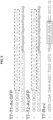
- PCR amplification using these primers and a template that includes the scaffold and any other desirable elements produces a template (designated in FIG. 2 as the "DNA template of sgRNA" from which a particular sgRNA may be transcribed by in vitro transcription and employed in conjunction with a nuclease for, e.g., selective depletion of a target nucleic acid according to the methods of the present disclosure. Shown in FIG.
- T7-T1-AcGFP and T7-T2-AcGFP are example forward (T7-T1-AcGFP and T7-T2-AcGFP) and reverse (T7-Rev) oligonucleotides for producing templates from which sgRNAs may be produced by in vitro transcription, e.g., according to the example shown in FIG. 2 .
- the sequence outlined with dashed rectangles is the T7 promoter sequence.
- Underlined sequences are 20 bp crRNA sequences.
- a polyA sequence is outlined with a solid rectangle.
- the initial collection of nucleic acids may vary. Examples of initial collection of nucleic acids of interest include collections of double-stranded nucleic acids (e.g., double-stranded DNA), collections of single stranded nucleic acids (e.g., single-stranded RNA or DNA), mixed collections of double and single stranded nucleic acids, etc.
- the complexity of the initial collection may also vary, where in some instances the collection includes 5 or more, 10 or more, 25 or more, 50 or more, 100 or more, 250 or more, 500 or more, 1000 or more, 5,000 or more, including 10,000, 100,000 or more, 500,000 or more, 1 million or more, 100 million or more, or 1 billion or more distinct nucleic acids of differing sequence.
- the initial collection of nucleic acids may include deoxyribonucleic acids, ribonucleic acids, or mixtures thereof.
- the initial collection of nucleic acids of interest is a collection of nucleic acids (e.g., undesired and desired nucleic acids) isolated from a nucleic acid source of interest, including but not limited to, a nucleic acid sample isolated from a single cell, a plurality of cells (e.g., cultured cells), a tissue, an organ, or an organism, e.g., bacteria, yeast, or a collection of organisms (such as a metagenomic sample, e.g., sea water containing multiple organisms, a fecal sample containing many distinct bacterial species, a buccal swab, etc.), or the like.
- a nucleic acid sample isolated from a single cell, a plurality of cells (e.g., cultured cells), a tissue, an organ, or an organism, e.g., bacteria, yeast, or a collection of organisms (such as a metagenomic sample, e.g., sea water containing multiple organisms,
- sample relates to a material or mixture of materials, typically, although not necessarily, in liquid form, containing nucleic acids and/or proteins which one desires to deplete from an initial collection (e.g., by cleavage or removal as described elsewhere herein).
- the nucleic acid sample is isolated from a cell(s), tissue, organ, and/or the like of a mammal (e.g., a human, a rodent (e.g., a mouse), or any other mammal of interest).
- the nucleic acid sample is isolated from a source other than a mammal, such as bacteria, yeast, insects (e.g., drosophila), amphibians (e.g., frogs (e.g., Xenopus )), viruses, plants, or any other non-mammalian nucleic acid sample source.
- a source other than a mammal such as bacteria, yeast, insects (e.g., drosophila), amphibians (e.g., frogs (e.g., Xenopus )), viruses, plants, or any other non-mammalian nucleic acid sample source.
- the initial collection of nucleic acids of interest is not genomic DNA.
- kits for isolating nucleic acids from such sources such as the NucleoSpin ® , NucleoMag ® and NucleoBond ® genomic DNA or RNA isolation kits by Clontech Laboratories, Inc. (Mountain View, CA) - are commercially available.
- the nucleic acid is isolated from a fixed biological sample, e.g., formalin-fixed, paraffin-embedded (FFPE) tissue.
- FFPE formalin-fixed, paraffin-embedded
- Nucleic acids from FFPE tissue may be isolated using commercially available kits - such as the NucleoSpin ® FFPE DNA or RNA isolation kits by Clontech Laboratories, Inc. (Mountain View, CA).
- the initial collection of nucleic acids of interest is produced from a precursor collection of nucleic acids of interest.
- the initial collection of nucleic acids of interest may be a collection of DNAs (e.g., cDNAs) transcribed from a precursor collection of nucleic acids of interest (e.g., RNAs).
- the initial collection of nucleic acids of interest is a collection of cDNAs transcribed from a precursor collection of RNAs of interest, where the precursor collection of RNAs of interest include mRNAs, miRNAs, rRNAs, and/or the like, and the target nucleic acid to be depleted is cDNA transcribed from rRNAs present in the precursor collection of nucleic acids.
- Generating a collection of cDNAs of interest from a precursor collection of RNAs of interest may include carrying out a reverse transcription reaction by combining the precursor collection of RNAs of interest with a suitable polymerase, dNTPs, buffer components that establish an appropriate pH, one or more salts (e.g., KCI), one or more metal cofactors (e.g., Mg 2+ or Mn 2+ ), and the like, under conditions suitable for a polymerase-mediated extension reaction to occur.
- a suitable polymerase e.g., dNTPs, buffer components that establish an appropriate pH, one or more salts (e.g., KCI), one or more metal cofactors (e.g., Mg 2+ or Mn 2+ ), and the like.
- nuclease inhibitors e.g., an RNase inhibitor and/or a DNase inhibitor
- additives for facilitating amplification/replication of GC rich sequences e.g., GC-Melt TM reagent (Clontech Laboratories, Inc.
- Polymerases that find use in generating a collection of cDNAs of interest from a precursor collection of RNAs of interest include, but are not limited to, reverse transcriptases, such as a retroviral reverse transcriptase, retrotransposon reverse transcriptase, retroplasmid reverse transcriptases, retron reverse transcriptases, bacterial reverse transcriptases, group II intron-derived reverse transcriptase, and mutants, variants derivatives, or functional fragments thereof.
- the reverse transcriptase may be a Moloney Murine Leukemia Virus reverse transcriptase (MMLV RT) or a Bombyx mori reverse transcriptase (e.g., Bombyx mori R2 non-LTR element reverse transcriptase).
- the polymerase is capable of template switching.
- Template switching polymerases are commercially available and include SMARTScribe TM reverse transcriptase and PrimeScript TM reverse transcriptase available from Clontech Laboratories, Inc. (Mountain View, CA).
- a mix of two or more different polymerases is added to the reaction mixture, e.g., for improved processivity, proof-reading, and/or the like.
- the polymerase e.g., a reverse transcriptase such as an MMLV RT or a Bombyx mori RT
- U/ ⁇ L units/ ⁇ L
- the polymerase is present in the reaction mixture at a final concentration of from 0.1 to 200 units/ ⁇ L (U/ ⁇ L), such as from 0.5 to 100 U/ ⁇ L, such as from 1 to 50 U/ ⁇ L, including from 5 to 25 U/ ⁇ L, e.g., 20 U/ ⁇ L.
- the initial collection of nucleic acids of interest is produced from a precursor collection of nucleic acids of interest by shearing/fragmenting the precursor collection of nucleic acids of interest, e.g., when it is desirable to control the size of the nucleic acids in the initial collection of nucleic acids of interest.
- Shearing/fragmentation strategies include, but are not limited to, passing a precursor collection of nucleic acids of interest one or more times through a micropipette tip or fine-gauge needle, nebulizing the sample, sonicating the sample (e.g., using a focused-ultrasonicator by Covaris, Inc.
- bead-mediated shearing e.g., using one or more DNA- or RNA-shearing enzymes
- enzymatic shearing e.g., using one or more DNA- or RNA-shearing enzymes
- chemical based fragmentation e.g., using divalent cations (e.g., Mg 2+ , Mn 2+ , and/or Zn 2+ )
- fragmentation buffer e.g., a high pH buffer
- heat or any other suitable approach for shearing/fragmenting a precursor collection of nucleic acids of interest to generate a shorter initial collection of nucleic acids of interest.
- the initial collection of nucleic acids of interest generated by shearing/fragmentation has a length of from 50 to 10,000 nucleotides, from 100 to 5000 nucleotides, from 150 to 2500 nucleotides, from 200 to 1000 nucleotides, e.g., from 250 to 500 nucleotides in length, for example.
- the initial collection of nucleic acids of interest includes nucleic acids (e.g., double-stranded DNA, such as double-stranded cDNA) having one or more sequencing adapter constructs at one or both ends of the nucleic acids.
- nucleic acids e.g., double-stranded DNA, such as double-stranded cDNA
- sequencing adapter constructs at one or both ends of the nucleic acids.
- sequencing platform adapter construct is meant a nucleic acid construct that includes at least a portion of a nucleic acid domain (e.g., a sequencing platform adapter nucleic acid sequence) or complement thereof utilized by a sequencing platform of interest, such as a sequencing platform provided by Illumina ® (e.g., the HiSeq TM , MiSeq TM and/or Genome Analyzer TM sequencing systems); Ion Torrent TM (e.g., the Ion PGM TM and/or Ion Proton TM sequencing systems); Pacific Biosciences (e.g., the PACBIO RS II sequencing system); Life Technologies TM (e.g., a SOLiD sequencing system); Roche (e.g., the 454 GS FLX+ and/or GS Junior sequencing systems); or any other sequencing platform of interest.
- a sequencing platform provided by Illumina ® (e.g., the HiSeq TM , MiSeq TM and/or Genome Analyzer TM sequencing systems
- the methods of the present disclosure find use in depleting one or more subpopulations of target nucleic acids in the initial collection (e.g., undesirable sequences such as cDNAs transcribed from rRNAs or particular subtypes thereof; or desirable sequences which are depleted by removal from the initial collection, recovered to produce a sample enriched for the desirable nucleic acids), followed by sequencing the desirable nucleic acids.
- target nucleic acids e.g., undesirable sequences such as cDNAs transcribed from rRNAs or particular subtypes thereof; or desirable sequences which are depleted by removal from the initial collection, recovered to produce a sample enriched for the desirable nucleic acids
- a single cleavage event by a nucleic acid guided nuclease in a target nucleic acid renders the fragmented target nucleic acid invisible to the sequencer.
- the sequencing platform adapter construct includes a nucleic acid domain selected from: a domain (e.g., a "capture site” or “capture sequence”) that specifically binds to a surface-attached sequencing platform oligonucleotide (e.g., the P5 or P7 oligonucleotides attached to the surface of a flow cell in an Illumina ® sequencing system); a sequencing primer binding domain (e.g., a domain to which the Read 1 or Read 2 primers of the Illumina ® platform may bind); a barcode domain (e.g., a domain that uniquely identifies the sample source of the nucleic acid being sequenced to enable sample multiplexing by marking every molecule from a given sample with a specific barcode or "tag”); a barcode sequencing primer binding domain (a domain to which a primer used for sequencing a barcode binds); a molecular identification domain (e.g., a molecular index tag, such as a randomized tag
- the subject methods include contacting the initial collection of nucleic acids with a plurality (e.g., a "pool” or “library”) of two or more distinct nucleic acid guided nucleases.
- the nucleic acid guided nucleases may be distinct in any desired respects.
- the methods may employ a pool of nucleic acid guided nucleases in which the pool includes a single type of nuclease component (e.g., a nuclease which may have nuclease activity or, alternatively, be cleavage deficient) and two or more species of nucleic acid guide components having different nucleotide sequences.
- the two or more species of nucleic acid guide components may be designed such that the resulting different nucleic acid guided nucleases target multiple regions of a single target nucleic acid, target multiple different target nucleic acids, target multiple regions of multiple different target nucleic acids, etc.
- the plurality of two or more distinct nucleic acid guided nucleases may include two or more types of nuclease components.
- the methods may employ a pool/library of any desired combination of nucleases that differ from one another with respect to the origin of the nuclease (e.g., nucleases from different prokaryotic and/or eukaryotic species), nucleases that differ from one another with respect to nuclease activity (e.g., the pool/library may include one or more nucleases that have nuclease activity, one or more nucleases that are cleavage deficient, one or more nickases, or any combination thereof), PAM sequence (e.g., the pool/library may include nucleases that utilize guide nucleic acids having different PAM sequences), and any other combination of nuclease components suitable for depleting one or more target nucleic acids from the initial collection.
- a pool of different nuclease components may be used in conjunction with a pool of different nucleic acid guide components to achieve a desired level of depletion of a desired number of target nucleic acids.
- the depletion may include cleaving target nucleic acids present in the initial collection (e.g., one or more ribosomal and/or mitochondrial RNAs), removing target nucleic acids from the initial collection (e.g., to produce a nucleic acid sample enriched for the target nucleic acids removed from the initial collection), or both.
- aspects of the present disclosure include methods of selectively depleting a subpopulation of nucleic acids (e.g., rRNA- and/or mtRNA-derived nucleic acids) from an initial collection of nucleic acids.
- the methods may include contacting the initial collection of nucleic acids with a library of nucleic acid guided nucleases in a manner sufficient to deplete the subpopulation from the initial collection, where the library includes two or more distinct nucleic acid guided nucleases specific for two or more members and/or multiple regions of a single member of the subpopulation of nucleic acids.
- the size of the library may vary.
- the library may include 2 or more, 3 or more, 4 or more, 5 or more, 10 or more, 25 or more, 100 or more, 500 or more, 1000 or more, 10000 or more, 50000 or more, 100000 or more, 500000 or more, or 1 million or more distinct nucleic acid guided nucleases, etc.
- the library includes two or more, but 1 million or less, 500000 or less, 100000 or less, 50000 or less, 10000 or less, 1000 or less, 500 or less, 100 or less, 25 or less, 10 or less, 5, 4, or 3 distinct nucleic acid guided nucleases.
- aspects of the present disclosure further include methods of making a library of nucleic acid guided nucleases. Such methods may include producing a plurality of distinct nucleic acid guide components using the PCR-based approach shown in FIG. 2 and described above. In certain examples, the methods include combining a plurality of distinct guide nucleic acids with a one or more distinct nucleases in a manner sufficient to produce the library of nucleic acid guided nucleases.
- the nuclease may vary, and in some instances is a Cas nuclease (e.g., Cas9) or Ago nuclease, which independently may or may not have cleavage activity.
- the size of the produced library may vary, and in some instances includes 2 or more, 3 or more, 4 or more, 5 or more, 10 or more, 25 or more, 100 or more, 500 or more, 1000 or more, 10,000 or more, 50,000 or more, 100,000 or more, 500,000 or more, or 1 million or more distinct nucleic acid guided nucleases.
- the produced library includes two or more, but 1 million or less, 500,000 or less, 100,000 or less, 50,000 or less, 10,000 or less, 1000 or less, 500 or less, 100 or less, 25 or less, 10 or less, 5, 4, or 3 distinct nucleic acid guided nucleases.
- the nucleic acid guides include separate crRNA and tracrRNA, or a component that includes functional elements thereof, e.g., an sgRNA.
- the methods include producing the nucleic acid guides, e.g., by expressing the nucleic acid guides from plasmids encoding the nucleic acid guides, or by PCR and in vitro transcription, such as described in greater detail above and shown in FIG. 2 .
- the nucleic acid guides are produced by solid phase synthesis (e.g., as in standard oligonucleotide synthesis).
- the nucleic acid guided nucleases of the produced library each include a nucleic acid guide component (e.g., a RNA or DNA guide component) and a nuclease component, e.g., a Cas nuclease component (such as Cas9), an Argonaute nuclease component (e.g., Tth Ago, Ago2, or the like).
- the nuclease component may exhibit cleavage activity or be a cleavage deficient mutant.
- the nuclease component may further include a tag, such as described above.
- compositions include a plurality of distinct nucleic acid guided nucleases.
- the plurality of distinct nucleic acid guided nucleases may include 2 or more, 3 or more, 4 or more, 5 or more, 10 or more, 25 or more, 100 or more, 500 or more, 1000 or more, 10,000 or more, 50,000 or more, 100,000 or more, 500,000 or more, or 1 million or more distinct nucleic acid guided nucleases, etc.
- the plurality of distinct nucleic acid guided nucleases includes two or more, but 1 million or less, 500,000 or less, 100,000 or less, 50,000 or less, 10,000 or less, 1000 or less, 500 or less, 100 or less, 25 or less, 10 or less, 5, 4, or 3 distinct nucleic acid guided nucleases.
- the distinct nucleic acid guided nucleases are distinct based on: the nucleic acid guided nucleases having differing nuclease components; and/or the nucleic acid guided nucleases having nucleic acid guide components of differing nucleotide sequence.
- the distinct nucleic acid guided nucleases may target different regions of the same target nucleic acid based on the guide components having differing sequences complementary to different regions of the same target nucleic acid, and/or the distinct nucleic acid guided nucleases may target different target nucleic acids based on the guide components having differing sequences complementary to the different target nucleic acids and/or different species of nucleases (e.g., different Cas9 species) with different PAM sequence requirements so as to broaden the array of target sequences.
- different species of nucleases e.g., different Cas9 species
- compositions may be present in any suitable environment.
- the composition is present in a reaction tube (e.g., a 0.2 mL tube, a 0.6 mL tube, a 1.5 mL tube, or the like) or a well.
- the composition is present in two or more (e.g., a plurality of) reaction tubes or wells (e.g., a plate, such as a 96-well plate).
- the tubes and/or plates may be made of any suitable material, e.g., polypropylene, or the like.
- the tubes and/or plates in which the composition is present provide for efficient heat transfer to the composition (e.g., when placed in a heat block, water bath, thermocycler, and/or the like), so that the temperature of the composition may be altered within a short period of time, e.g., as necessary for a particular enzymatic reaction to occur.
- the composition is present in a thin-walled polypropylene tube, or a plate having thin-walled polypropylene wells.
- the reaction may be convenient for the reaction to take place on a solid surface or a bead, in such case, the initial collection of nucleic acids or the nucleic acid guided nuclease(s) may be attached to the solid support or bead by methods known in the art - such as biotin linkage or by covalent linkage) and reaction allowed to proceed on the support.
- compositions include, e.g., a microfluidic chip (e.g., a "lab-on-a-chip device").
- the composition may be present in an instrument configured to bring the composition to a desired temperature, e.g., a temperature-controlled water bath, heat block, or the like.
- the instrument configured to bring the composition to a desired temperature may be configured to bring the composition to a series of different desired temperatures, each for a suitable period of time (e.g., the instrument may be a thermocycler).
- the nucleic acid targeted for depletion can be any target nucleic acid selected by a practitioner of the subject methods.
- the target nucleic acid is an initial RNA (e.g., an rRNA or mtRNA, and not a reverse transcription product of an RNA).
- the target nucleic acid is a reverse (DNA) transcription product of an initial RNA (e.g., an rRNA or mtRNA).
- RNA e.g., the initial transcribed RNA
- RNA may be any type of RNA (or sub-type thereof) including, but not limited to, a ribosomal RNA (rRNA), a mitochondrial RNA (mtRNA), a microRNA (miRNA), a messenger RNA (mRNA), transfer RNA (tRNA), a small nucleolar RNA (snoRNA), a small nuclear RNA (snRNA), a long non-coding RNA (IncRNA), a non-coding RNA (ncRNA), a small interfering RNA (siRNA), a transacting small interfering RNA (ta-siRNA), a natural small interfering RNA (nat-siRNA), a transfer-messenger RNA (tmRNA), a precursor messenger RNA (pre-mRNA), a small Cajal body-specific RNA (scaRNA), a piwi-interacting RNA (piRNA), an endoribonuclease-prepared
- the target nucleic acids comprise cDNAs transcribed from ribosomal RNAs.
- the methods may include depleting all types of such transcription products in the sample (e.g., ribosomal RNA, transfer RNA, microRNA, and the like), or one or more particular types of such transcription products.
- the target nucleic acid is a transcription product of a ribosomal RNA (rRNA) template.
- the rRNA template in such instances may be a eukaryotic 28S, 26S, 25S, 18S, 5.8S, 5S rRNA, or any combination thereof.
- the rRNA template may be a prokaryotic 23S, 16S, 5S rRNA, or any combination thereof.
- the subject methods find use in depleting RNA transcription products other than those produced from ribosomal RNAs.
- the target nucleic acid may be a transcription product of a messenger RNA (mRNA), e.g., a highly expressed but clinically irrelevant mRNA from a pool of total RNA or mRNA (e.g., a globulin mRNA in a sample of total or polyA + blood RNA).
- mRNA messenger RNA
- RNA transcription products may be targeted for depletion, including a mitochondrial RNA (mtRNA), a precursor messenger RNA (pre-mRNA), a micro RNA (miRNA), a transfer RNA (tRNA), and any combination thereof.
- mtRNA mitochondrial RNA
- pre-mRNA precursor messenger RNA
- miRNA micro RNA
- tRNA transfer RNA
- the target transcription product may be a product of RNA from a particular organism, such as bacterial RNA or yeast RNA.
- the target nucleic acid is not genomic DNA.
- the target molecule is a target nucleic acid
- the target nucleic acid is a deoxyribonucleic acid (DNA), e.g., intronic or inter-genic DNA when it is desired to enrich a sample for exonic DNA (e.g., to enrich a sample for nucleic acids corresponding to the exome of a species of interest) by cleaving intronic or inter-genic DNA present in the initial collection, or by capturing the exonic sequences directly.
- DNA-based plasmids/vectors such as those used for in vitro transcription may be targeted for depletion by cleavage, e.g., after completion of an in vitro transcription reaction to enrich a nucleic acid sample for newly transcribed RNA.
- the nucleic acid guided nuclease(s) may be designed such that the frequency of cleavage and resulting fragment sizes of a particular target nucleic acid is selected by a practitioner of the subject methods.
- two or more nucleic acid guided nucleases that target different sequences within a target nucleic acid may be used in a multiplex fashion when it is desirable to cleave the target nucleic acid into 3 or more fragments.
- the targeted sequences of the target nucleic acid may be chosen to produce fragments of a desired size, e.g., fragments which are small enough to be removed from the sample using a spin column, alcohol precipitation, and/or the like.
- the subject methods find use in a variety of different applications, e.g., where it is desirable to deplete irrelevant and/or undesired molecules from a sample of interest; where it is desirable to deplete nucleic acids of interest by removing the nucleic acids of interest from the sample for subsequent recovery (thereby producing a sample enriched for the nucleic acids of interest; and/or the like.
- By depleting the irrelevant and/or undesired molecules, or removing desirable molecules to produce an enriched sample the complexity of the sample is reduced and the sample is enriched for molecules of interest.
- nucleic acids When the molecules of interest are nucleic acids, reduced complexity and enrichment of nucleic acids of interest may facilitate and/or improve the results of downstream applications such as nucleic acid amplification, nucleic acid sequencing, gene expression analysis (e.g., by array hybridization, quantitative RT-PCR, massively parallel sequencing, etc.), the preparation of pharmaceutical compositions in which a therapeutic nucleic acid of interest is to be included, and any other applications in which reduced sample complexity and enrichment of nucleic acids of interest is beneficial.
- nucleic acid amplification e.g., nucleic acid sequencing, gene expression analysis (e.g., by array hybridization, quantitative RT-PCR, massively parallel sequencing, etc.)
- gene expression analysis e.g., by array hybridization, quantitative RT-PCR, massively parallel sequencing, etc.
- certain embodiments of the subject methods include depleting nucleic acids from a sequencing library.
- the initial collection may be a collection of nucleic acids to be sequenced on a sequencing platform of interest (e.g., a high-throughput or "next generation" sequencing platform such as an Illumina ® - or Ion Torrent ® -based sequencing platform), but the collection includes irrelevant/undesirable nucleic acids which may complicate or interfere with obtaining the sequences of nucleic acids of interest (e.g., research or clinical interest) in the collection.
- a sequencing platform of interest e.g., a high-throughput or "next generation" sequencing platform such as an Illumina ® - or Ion Torrent ® -based sequencing platform
- the irrelevant/undesirable nucleic acids may be reduced or eliminated using the methods of the present disclosure, e.g., by nucleic acid guided nuclease-mediated cleavage, or by producing a sequencing sample that is enriched for sequences of interest by removal of such sequences from the initial collection using the methods of the present disclosure.
- depletion of a target nucleic acid renders the target nucleic acid invisible to the sequencing platform. That is, the depleted (e.g., cleaved) target nucleic acid is no longer suitable for sequencing on the sequencing platform of interest.
- a target nucleic acid e.g., an irrelevant/undesirable nucleic acid, such as a nucleic acid derived from an rRNA, an mtRNA, or the like
- the depleted (e.g., cleaved) target nucleic acid is no longer suitable for sequencing on the sequencing platform of interest.
- Illumina ® - and Ion Torrent ® -based sequencing platforms require nucleic acids having adapters at each end of the nucleic acids.
- the nucleic acids of the initial collection of nucleic acids include sequencing adapters at each end, where selective depletion of the target nucleic acid (e.g., cDNAs transcribed from rRNA) includes cleaving the target nucleic acid into at least two fragments, none of which will include sequencing adapters at each end as required for sequencing on an Illumina ® - or Ion Torrent ® -based sequencing platform.
- the target nucleic acid is rendered invisible to the sequencing platform, thereby reducing the "load" on the sequencing platform and the complexity of the sequencing results.
- the target nucleic acid can be rendered unsuitable for sequencing on the platform by, e.g., cleaving the target nucleic acid such that the length of most or all of the resulting fragments are too short to be sequenced on the sequencing platform.
- a purification procedure e.g., bead purification, such as SPRI bead-based purification
- the location(s) to be cleaved and the distance(s) between cleavage sites may be selected by a practitioner of the subject methods to generate cleavage fragments of the desired length, e.g., using available nucleic acid sequence information for a target nucleic acid of interest and designing nucleic acid guide component(s) with sequence complementarity to the selected cleavage site(s). In this way, the target nucleic acid is rendered invisible to the sequencing platform and the load on the sequencing platform and complexity of the sequencing results is reduced.
- the methods of the present disclosure also find use in selectively recovering one or more types of nucleic acids of interest from an initial collection of nucleic acids.
- depleting one or more types of target nucleic acids from the initial collection of nucleic acids includes capturing the target nucleic acid via formation of target nucleic acid/nucleic acid guided nuclease complexes, and then recovering the target nucleic acids from the complexes, e.g., for downstream analysis (e.g., quantitative analysis, sequence analysis, and/or the like).
- Target nucleic acid capture and recovery include, e.g., affinity-based approaches (which in certain aspects is facilitated by the nuclease component including an epitope/affinity tag), as described hereinabove. Accordingly, the subject methods find use in selectively obtaining one or more target nucleic acids of interest from collections of nucleic acids, which in certain aspects are complex collections of nucleic acids (e.g., a collection of cDNAs produced by reverse transcription of a total RNA sample, exons from a genomic library, or any other complex nucleic acid collections of interest).
- complex collections of nucleic acids e.g., a collection of cDNAs produced by reverse transcription of a total RNA sample, exons from a genomic library, or any other complex nucleic acid collections of interest.
- kits useful for practicing the subject methods may include one or more of any of the components described above in relation to the subject methods and compositions.
- the kits may include a primer and a template for generating PCR amplification products from which a nucleic acid guide component may be produced by in vitro transcription.
- Such reagents may include any reagents useful in practicing the method for producing a nucleic acid guide component (e.g., an sgRNA) shown in FIG. 2 and described hereinabove.
- the kit includes a reverse primer for use in conjunction with a forward primer provided by a user of the kit, where at least a portion of the forward primer includes a nucleic acid sequence complementary to a target nucleic acid selected for depletion by the user.
- kits include: a vector that includes a sgRNA scaffold template domain; a reverse primer configured for use with the vector in a PCR reaction; and an RNA polymerase.
- the reverse primer comprises a polyA domain and an sgRNA scaffold domain.
- the RNA polymerase may vary, in some embodiments the RNA polymerase is a T7 polymerase.
- the kit further includes one or more of a DNA polymerase; a PCR buffer; a nuclease (e.g., a Cas, Ago, or other nuclease) which may or may not have cleavage activity; a control nucleic acid; etc.
- kits may be present in separate containers, or multiple components may be present in a single container.
- the primer may be provided in a separate container, or in a container that includes a second component of the kit (e.g., a buffer or the like).
- the subject kit may further include instructions for using the components of the kit to practice the subject methods.
- the instructions for practicing the subject methods may be recorded on a suitable recording medium.
- the instructions may be printed on a substrate, such as paper or plastic, etc.
- the instructions may be present in the kits as a package insert, in the labeling of the container of the kit or components thereof (i.e., associated with the packaging or subpackaging) etc.
- the instructions are present as an electronic storage data file present on a suitable computer readable storage medium, e.g., portable flash drive, DVD, CD-ROM, diskette, etc.
- the actual instructions are not present in the kit, but means for obtaining the instructions from a remote source, e.g. via the internet, are provided.
- An example of this embodiment is a kit that includes a web address where the instructions can be viewed and/or from which the instructions can be downloaded.
- the means for obtaining the instructions is recorded on a suitable substrate.
- Example 1 Depletion of a Target PCR Fragment
- a nucleic acid guided nuclease was produced and, as proof of concept, used to deplete a PCR product having a target sequence corresponding to an rRNA sequence.
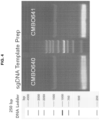
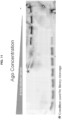
- two distinct sgDNA templates (CMBO640 and CMBO641) were generated by PCR using the Advantage ® HD polymerase (Clontech Laboratories, Mountain View, CA). The PCR products are seen as the main (lower) bands in the gel image shown in FIG. 4 .
- the PCR products are seen as the main (lower) bands in the gel image shown in FIG. 4 .
- Between 100-120 ng of the templates were used in an in vitro transcription reaction in accordance with the Takara T7 RNA polymerase manual to produce the corresponding sgRNAs.
- CMBO640 72 ng/ ⁇ l
- CMBO641 90 ng/ ⁇ l
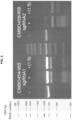
- sgRNAs were then tested for their ability, when combined with Cas9 (500 ng), to cleave a PCR product (260 ng) having a sequence corresponding to an rRNA sequence.
- the results are provided in FIG. 5 .
- combining Cas9, the COMBO640 and/or COMBO641 sgRNAs, and the PCR product results in cleavage of the PCR product.
- sgRNA1 fourth lane from the left
- sgRNA2 fifth lane from the left
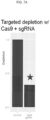
- next generation sequencing libraries A next generation sequencing library of cDNAs transcribed from human brain total RNA was treated with a sgRNA/Cas9 nucleic acid guided nuclease to deplete cDNAs corresponding to 18S rRNA by cleaving at position 1022-1041 of the cDNAs corresponding to 18S rRNA prior to sequencing the library.
- the resulting sequences were mapped to the rRNA and the number of reads overlapping 1022-1041 was divided by the total number of reads mapping to rRNA. The ratio was plotted and normalized to control.
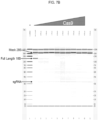
- a target cDNA corresponding to 18S rRNA was degraded using a pool of sgRNAs targeting the target cDNA along its length about every 50 bp.
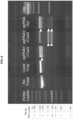
- the pool was generated by PCR amplifying 35 sgDNA templates (using the approach shown in FIG. 2 ), and then in vitro transcribing the corresponding 35 sgRNAs in a pooled in vitro transcription reaction. This is one of the key advantages of the method of the present disclosure shown in FIG.
- a model target was used that included a target corresponding to the full-length 18S RNA (25 ng) and 55 ng of a 5800 bp plasmid iPCR product (used as a surrogate for the 28S rRNA). This ratio approximates the ratio (in mass) of 18S and 28S rRNA in a 20 nM RNA-Seq library with no depletion. As shown in Panel B of FIG. 7 , the 18S fragment was thoroughly depleted/degraded by treatment with the sgRNA pool, while the iPCR fragment was unaffected.
- the target nucleic acid results in failure of the target to cluster on the sequencer (e.g., an Illumina ® sequencer) because, at most, the target only has a sequencing adapter at one of its ends following cleavage.
- the depleted target fragments are sufficiently small that they are lost following purification (e.g., SPRI bead purification) and thus not available for sequencing.
- Example 4 Depletion of 18s rRNA using a pool of nucleic acid guided nucleases
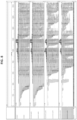
- sequencing libraries were generated from 100ng Human Brain Total RNA (Clontech) using the SMARTer Stranded RNA-Seq Kit (Clontech). 70ng of library was incubated with 0, 2, or 5 ⁇ g of recombinantly purified Cas9 and 0 or 191ng of the 35 sgRNA pool described in the previous experiment in 20 ⁇ l 1X NEB3.1 buffer for one hour at 37°C. The Cas9 was then heat inactivated for 10 minutes at 70°C. The libraries were then pooled and sequenced on a MiSeq instrument. The resulting sequences were mapped against the human genome, hg19, and rRNA transcripts simultaneously using the STAR aligner. FIG.
- FIG. 8 illustrates the reduction in sequence coverage of the 18S rRNA transcript resulting only from treatment with both Cas9 and the sgRNA pool.
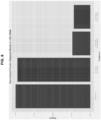
- the number of sequencing reads mapped to the 18S rRNA were normalized to the total number of reads sequenced and plotted in FIG. 9 , demonstrating an -75% reduction in sequences mapping to the 18S transcript.
- the sgRNA described in examples 1-4 contained the sgRNA scaffold shown in Figure 1 with the following target-specific sequences:
- the ability of the Argonaute (Ago) protein to deplete a target nucleic acid was assessed. His-tagged Tth Ago was expressed and purified ( FIG. 10 , Panel A). Depletion of a 5' FAM labelled ssDNA representative target was carried out by combining the 500nM single-stranded DNA, Tth Ago, and 100nM 5' phosphorylated targeting oligonucleotide complementary to the target single-stranded DNA and incubated at 75°C for one hour. As shown in FIG.
- FIG. 11 demonstrates a similar experiment, but with 20nM ssDNA target and 50nM guide DNA to be representative of depleting common library concentrations.
- Example 5 the guide DNA oligo was: /5'Phos/TGAGGTAGTAGGTTGTATAGT (SEQ ID NO:38); and the targeting oligo was: /5'6-FAM/AGGTGATAAGACTATACAACCTACTACCTCGAATGTCCGT (SEQ ID NO:39)
- Argonaute is capable of depleting target ssDNA molecules in solution.
- the double stranded material may be converted to a single strands by denaturation, such as with heat or high pH, or by degrading the non-target strand by exonuclease treatment.
- the mixture may be amplified by a common pair of PCR primers, only one of which is 5' phosphorylated.
- the amplified product could then be treated with A-exonuclease to yield a ssDNA product.
- This ssDNA product could then be used as a substrate for cleavage by Ago and a targeting oligonucleotide.
- RNA-Seq libraries were generated from 100ng Human Brain PolyA-plus RNA (Clontech) and the SMARTer Stranded RNA-Seq kit (Clontech). 10ng of library was combined with ⁇ 1.25 ⁇ g dCas9 and 76ng of a pool of 190 sgRNA designed every -50bp on the human 5S, 5.8S, 18S, 28S, mt12S, and mt16S sequences in 10 ⁇ l 1X NEB3.1.
- nucleic acid guided nucleases may be used to deplete target nucleic acids by removal of the target nucleic acids from an initial collection of nucleic acids, for subsequent recovery and production of a sample enriched for the target nucleic acids.
Landscapes
- Chemical & Material Sciences (AREA)
- Engineering & Computer Science (AREA)
- Life Sciences & Earth Sciences (AREA)
- Health & Medical Sciences (AREA)
- Organic Chemistry (AREA)
- Wood Science & Technology (AREA)
- Zoology (AREA)
- Genetics & Genomics (AREA)
- Bioinformatics & Cheminformatics (AREA)
- Biotechnology (AREA)
- General Engineering & Computer Science (AREA)
- Analytical Chemistry (AREA)
- Biomedical Technology (AREA)
- Molecular Biology (AREA)
- Proteomics, Peptides & Aminoacids (AREA)
- Microbiology (AREA)
- Biochemistry (AREA)
- General Health & Medical Sciences (AREA)
- Biophysics (AREA)
- Physics & Mathematics (AREA)
- Immunology (AREA)
- Chemical Kinetics & Catalysis (AREA)
- Crystallography & Structural Chemistry (AREA)
- Plant Pathology (AREA)
- Measuring Or Testing Involving Enzymes Or Micro-Organisms (AREA)
- Enzymes And Modification Thereof (AREA)
Claims (8)
- Verfahren zum selektiven Abreichern von Ziel-cDNAs aus einer Probe, wobei das Verfahren umfasst:Erhalten einer Probe, die Ziel-cDNAs und Nicht-Ziel-cDNAs umfasst, die jeweils durch reverse Transkription einer Sammlung von RNAs produziert wurden, wobei die Ziel-cDNAs cDNAs umfassen, die aus ribosomalen RNAs transkribiert wurden,Kontaktieren der Probe mit einer Nukleinsäure-geführten Nuklease, die für die Ziel-cDNAs spezifisch ist, in einer ausreichenden Weise, um die Ziel-cDNAs aus der Probe abzureichern, wobei die Nukleinsäure-geführte Nuklease eine RNA-Führungskomponente und eine Nukleasekomponente umfasst und die RNA-Führungskomponente die Nukleasekomponente zu den Ziel-cDNAs führt, undEntfernen der Ziel-cDNAs aus der Probe, wodurch die Probe erzeugt wird, aus der die Ziel-cDNAs abgereichert wurden, die aus ribosomalen RNAs transkribiert wurden.
- Verfahren nach Anspruch 1, wobei die Ziel-cDNAs doppelsträngige Nukleinsäuren sind.
- Verfahren nach Anspruch 1, wobei die Ziel-cDNAs einzelsträngige Nukleinsäuren sind.
- Verfahren nach einem der Ansprüche 1 bis 3, wobei die Nukleasekomponente eine Cas-Nukleasekomponente umfasst.
- Verfahren nach Anspruch 4, wobei die Cas-Nukleasekomponente Spaltungsaktivität zeigt und das Verfahren zu einer Spaltung der Ziel-cDNAs führt, um die Ziel-cDNAs aus der Probe abzureichern.
- Verfahren nach einem der vorhergehenden Ansprüche, wobei das Verfahren Kontaktieren der Probe mit einer Vielzahl von zwei oder mehr unterschiedlichen Nukleinsäure-geführten Nukleasen umfasst.
- Verfahren gemäß einem vorhergehenden Anspruch, des Weiteren umfassend einen Schritt des Sequenzierens der Probe.
- Verfahren nach Anspruch 1, wobei die RNA-Führungskomponente sgRNAs umfasst, die auf menschliche 5S-, 5.8S-, 18S- und/oder 28S-RNAs zielen.
Applications Claiming Priority (3)
| Application Number | Priority Date | Filing Date | Title |
|---|---|---|---|
| US201461939658P | 2014-02-13 | 2014-02-13 | |
| US201462040804P | 2014-08-22 | 2014-08-22 | |
| PCT/US2014/072293 WO2015122967A1 (en) | 2014-02-13 | 2014-12-23 | Methods of depleting a target molecule from an initial collection of nucleic acids, and compositions and kits for practicing the same |
Publications (4)
| Publication Number | Publication Date |
|---|---|
| EP3105325A1 EP3105325A1 (de) | 2016-12-21 |
| EP3105325A4 EP3105325A4 (de) | 2018-02-14 |
| EP3105325B1 EP3105325B1 (de) | 2019-12-04 |
| EP3105325B2 true EP3105325B2 (de) | 2024-10-23 |
Family
ID=53774425
Family Applications (1)
| Application Number | Title | Priority Date | Filing Date |
|---|---|---|---|
| EP14882441.0A Active EP3105325B2 (de) | 2014-02-13 | 2014-12-23 | Verfahren zur abreicherung eines zielmoleküls aus einer anfänglichen sammlung von nukleinsäuren sowie zusammensetzungen und kits zur durchführung davon |
Country Status (6)
| Country | Link |
|---|---|
| US (5) | US10150985B2 (de) |
| EP (1) | EP3105325B2 (de) |
| JP (1) | JP6416939B2 (de) |
| CN (3) | CN113265394B (de) |
| CA (1) | CA2939621C (de) |
| WO (1) | WO2015122967A1 (de) |
Families Citing this family (69)
| Publication number | Priority date | Publication date | Assignee | Title |
|---|---|---|---|---|
| WO2013066438A2 (en) | 2011-07-22 | 2013-05-10 | President And Fellows Of Harvard College | Evaluation and improvement of nuclease cleavage specificity |
| SG11201404243WA (en) | 2012-01-26 | 2014-08-28 | Nugen Technologies Inc | Compositions and methods for targeted nucleic acid sequence enrichment and high efficiency library generation |
| US20150044192A1 (en) | 2013-08-09 | 2015-02-12 | President And Fellows Of Harvard College | Methods for identifying a target site of a cas9 nuclease |
| US9359599B2 (en) | 2013-08-22 | 2016-06-07 | President And Fellows Of Harvard College | Engineered transcription activator-like effector (TALE) domains and uses thereof |
| US9340799B2 (en) | 2013-09-06 | 2016-05-17 | President And Fellows Of Harvard College | MRNA-sensing switchable gRNAs |
| US9526784B2 (en) | 2013-09-06 | 2016-12-27 | President And Fellows Of Harvard College | Delivery system for functional nucleases |
| US9388430B2 (en) | 2013-09-06 | 2016-07-12 | President And Fellows Of Harvard College | Cas9-recombinase fusion proteins and uses thereof |
| CN106459995B (zh) | 2013-11-07 | 2020-02-21 | 爱迪塔斯医药有限公司 | 使用统治型gRNA的CRISPR相关方法和组合物 |
| US20150166984A1 (en) | 2013-12-12 | 2015-06-18 | President And Fellows Of Harvard College | Methods for correcting alpha-antitrypsin point mutations |
| EP4467654A3 (de) | 2014-02-04 | 2025-02-19 | Jumpcode Genomics, Inc. | Genomfraktionierung |
| EP4063503A1 (de) | 2014-02-11 | 2022-09-28 | The Regents of the University of Colorado, a body corporate | Crispr-aktiviertes multiplexed-genom-engineering |
| US10150985B2 (en) | 2014-02-13 | 2018-12-11 | Takara Bio Usa, Inc. | Methods of depleting a target molecule from an initial collection of nucleic acids, and compositions and kits for practicing the same |
| WO2016022363A2 (en) | 2014-07-30 | 2016-02-11 | President And Fellows Of Harvard College | Cas9 proteins including ligand-dependent inteins |
| US10435685B2 (en) | 2014-08-19 | 2019-10-08 | Pacific Biosciences Of California, Inc. | Compositions and methods for enrichment of nucleic acids |
| CN107002078A (zh) * | 2014-10-09 | 2017-08-01 | 生命技术公司 | Crispr寡核苷酸和基因剪辑 |
| EP3957745A1 (de) * | 2014-12-20 | 2022-02-23 | Arc Bio, LLC | Zusammensetzungen und verfahren zur gezielten abreicherung, anreicherung und aufteilung von nukleinsäuren unter verwendung von crispr/cas-systemproteinen |
| US10968536B2 (en) | 2015-02-25 | 2021-04-06 | Jumpcode Genomics, Inc. | Methods and compositions for sequencing |
| US10538758B2 (en) | 2015-08-19 | 2020-01-21 | Arc Bio, Llc | Capture of nucleic acids using a nucleic acid-guided nuclease-based system |
| SG10202104041PA (en) | 2015-10-23 | 2021-06-29 | Harvard College | Nucleobase editors and uses thereof |
| WO2017100343A1 (en) * | 2015-12-07 | 2017-06-15 | Arc Bio, Llc | Methods and compositions for the making and using of guide nucleic acids |
| US11339427B2 (en) | 2016-02-12 | 2022-05-24 | Jumpcode Genomics, Inc. | Method for target specific RNA transcription of DNA sequences |
| US20190112599A1 (en) * | 2016-03-31 | 2019-04-18 | President And Fellows Of Harvard College | Methods and Compositions for the Single Tube Preparation of Sequencing Libraries Using Cas9 |
| EP3455372B1 (de) * | 2016-05-11 | 2019-10-30 | Illumina, Inc. | Polynukleotidanreicherung und -amplifikation unter verwendung von argonautensystemen |
| ES2915562T3 (es) | 2016-06-24 | 2022-06-23 | Univ Colorado Regents | Métodos para generar bibliotecas combinatorias con código de barras |
| KR20250103795A (ko) | 2016-08-03 | 2025-07-07 | 프레지던트 앤드 펠로우즈 오브 하바드 칼리지 | 아데노신 핵염기 편집제 및 그의 용도 |
| US11661590B2 (en) | 2016-08-09 | 2023-05-30 | President And Fellows Of Harvard College | Programmable CAS9-recombinase fusion proteins and uses thereof |
| US11046995B2 (en) | 2016-08-16 | 2021-06-29 | The Regents Of The University Of California | Method for finding low abundance sequences by hybridization (FLASH) |
| WO2018039438A1 (en) | 2016-08-24 | 2018-03-01 | President And Fellows Of Harvard College | Incorporation of unnatural amino acids into proteins using base editing |
| SG11201903089RA (en) | 2016-10-14 | 2019-05-30 | Harvard College | Aav delivery of nucleobase editors |
| US11396676B2 (en) | 2016-10-21 | 2022-07-26 | Exosome Diagnostics, Inc. | Sequencing and analysis of exosome associated nucleic acids |
| EP3538662B1 (de) | 2016-11-10 | 2021-12-01 | Takara Bio USA, Inc. | Verfahren zur herstellung von verstärkten doppelsträngigen desoxyribonukleinsäuren und zusammensetzungen und kits zur verwendung darin |
| WO2018119359A1 (en) | 2016-12-23 | 2018-06-28 | President And Fellows Of Harvard College | Editing of ccr5 receptor gene to protect against hiv infection |
| EP3559255A1 (de) | 2016-12-23 | 2019-10-30 | Grail, Inc. | Verfahren zur hocheffizienten bibliothek-herstellung unter verwendung von doppelsträngigen adaptern |
| TW201839136A (zh) | 2017-02-06 | 2018-11-01 | 瑞士商諾華公司 | 治療血色素異常症之組合物及方法 |
| EP3592381A1 (de) | 2017-03-09 | 2020-01-15 | President and Fellows of Harvard College | Krebsimpfstoff |
| US11898179B2 (en) | 2017-03-09 | 2024-02-13 | President And Fellows Of Harvard College | Suppression of pain by gene editing |
| WO2018165629A1 (en) | 2017-03-10 | 2018-09-13 | President And Fellows Of Harvard College | Cytosine to guanine base editor |
| WO2018176009A1 (en) | 2017-03-23 | 2018-09-27 | President And Fellows Of Harvard College | Nucleobase editors comprising nucleic acid programmable dna binding proteins |
| WO2018183918A1 (en) | 2017-03-30 | 2018-10-04 | Grail, Inc. | Enhanced ligation in sequencing library preparation |
| US11118222B2 (en) | 2017-03-31 | 2021-09-14 | Grail, Inc. | Higher target capture efficiency using probe extension |
| WO2018209320A1 (en) | 2017-05-12 | 2018-11-15 | President And Fellows Of Harvard College | Aptazyme-embedded guide rnas for use with crispr-cas9 in genome editing and transcriptional activation |
| WO2018232382A1 (en) * | 2017-06-16 | 2018-12-20 | Applied Stemcell, Inc. | Gene editing methods with increased knock-in efficiency |
| US10011849B1 (en) | 2017-06-23 | 2018-07-03 | Inscripta, Inc. | Nucleic acid-guided nucleases |
| US9982279B1 (en) | 2017-06-23 | 2018-05-29 | Inscripta, Inc. | Nucleic acid-guided nucleases |
| CN111801345A (zh) | 2017-07-28 | 2020-10-20 | 哈佛大学的校长及成员们 | 使用噬菌体辅助连续进化(pace)的进化碱基编辑器的方法和组合物 |
| EP3676376B1 (de) | 2017-08-30 | 2025-01-15 | President and Fellows of Harvard College | Hocheffiziente baseneditoren mit gam |
| US11795443B2 (en) | 2017-10-16 | 2023-10-24 | The Broad Institute, Inc. | Uses of adenosine base editors |
| WO2019118949A1 (en) | 2017-12-15 | 2019-06-20 | The Broad Institute, Inc. | Systems and methods for predicting repair outcomes in genetic engineering |
| US12157760B2 (en) | 2018-05-23 | 2024-12-03 | The Broad Institute, Inc. | Base editors and uses thereof |
| EP3820495A4 (de) | 2018-07-09 | 2022-07-20 | The Broad Institute Inc. | Rna-programmierbare epigenetische rna-modifikatoren und deren verwendungen |
| CN109055499B (zh) * | 2018-08-30 | 2021-01-19 | 杭州杰毅生物技术有限公司 | 基于CRISPR-Cas的等温核酸检测方法及试剂盒 |
| WO2020076976A1 (en) | 2018-10-10 | 2020-04-16 | Readcoor, Inc. | Three-dimensional spatial molecular indexing |
| WO2020092453A1 (en) | 2018-10-29 | 2020-05-07 | The Broad Institute, Inc. | Nucleobase editors comprising geocas9 and uses thereof |
| EP3650555B1 (de) * | 2018-11-07 | 2024-02-21 | Siemens Healthineers AG | Ziel-irrelevante guide-rna für crispr |
| CN113166798B (zh) * | 2018-11-28 | 2025-05-02 | 主基因有限公司 | 通过核酸内切酶保护的靶向富集 |
| WO2020131383A1 (en) * | 2018-12-18 | 2020-06-25 | Takara Bio Usa, Inc. | Normalization of nucleic acid samples and compositions for use in the same |
| US12351837B2 (en) | 2019-01-23 | 2025-07-08 | The Broad Institute, Inc. | Supernegatively charged proteins and uses thereof |
| US20220145359A1 (en) * | 2019-02-12 | 2022-05-12 | Jumpcode Genomics, Inc. | Methods for targeted depletion of nucleic acids |
| EP3942043A2 (de) | 2019-03-19 | 2022-01-26 | The Broad Institute, Inc. | Verfahren und zusammensetzungen zur editierung von nukleotidsequenzen |
| WO2020214842A1 (en) | 2019-04-17 | 2020-10-22 | The Broad Institute, Inc. | Adenine base editors with reduced off-target effects |
| CN109880891B (zh) * | 2019-04-22 | 2021-07-30 | 上海交通大学 | 基于核酸酶偶联pcr原理富集低丰度dna突变的检测技术体系及应用 |
| US12435330B2 (en) | 2019-10-10 | 2025-10-07 | The Broad Institute, Inc. | Methods and compositions for prime editing RNA |
| EP4047091A4 (de) * | 2019-10-18 | 2023-11-15 | Epigeneron, Inc. | Verfahren zum nachweis einer zielnukleinsäure, verfahren zur detektion eines nukleinsäurebindenden moleküls und verfahren zur bestimmung der nukleinsäurebindenden fähigkeit |
| EP3816299A1 (de) * | 2019-10-31 | 2021-05-05 | Siemens Healthcare GmbH | Verfahren zur herstellung einer personalisierten, ziel-irrelevanten führungs-rna für crispr |
| CN115552015A (zh) * | 2020-02-28 | 2022-12-30 | 香港中文大学 | 经由同时敲入和基因破坏来改造免疫细胞 |
| JP2023520936A (ja) * | 2020-04-10 | 2023-05-22 | マンモス バイオサイエンシズ インコーポレイテッド | 核酸検出のためのハイプレックスガイドプーリング |
| WO2021216708A1 (en) * | 2020-04-22 | 2021-10-28 | 10X Genomics, Inc. | Methods for spatial analysis using targeted rna depletion |
| BR112022022603A2 (pt) | 2020-05-08 | 2023-01-17 | Broad Inst Inc | Métodos e composições para edição simultânea de ambas as fitas de sequência alvo de nucleotídeos de fita dupla |
| WO2024081156A1 (en) * | 2022-10-14 | 2024-04-18 | Vedabio, Inc. | Detection of nucleic acid and non-nucleic acid target molecules |
Family Cites Families (46)
| Publication number | Priority date | Publication date | Assignee | Title |
|---|---|---|---|---|
| US6759226B1 (en) * | 2000-05-24 | 2004-07-06 | Third Wave Technologies, Inc. | Enzymes for the detection of specific nucleic acid sequences |
| CA2439074A1 (en) * | 2001-03-09 | 2002-09-19 | Nugen Technologies, Inc. | Methods and compositions for amplification of rna sequences |
| AU2003251286B2 (en) | 2002-01-23 | 2007-08-16 | The University Of Utah Research Foundation | Targeted chromosomal mutagenesis using zinc finger nucleases |
| US20030232410A1 (en) | 2002-03-21 | 2003-12-18 | Monika Liljedahl | Methods and compositions for using zinc finger endonucleases to enhance homologous recombination |
| US6991915B2 (en) * | 2002-07-26 | 2006-01-31 | Applera Corporation | Modified Cdc14 phosphatase proteins and constructs for improved expression and purification |
| US8409861B2 (en) | 2003-08-08 | 2013-04-02 | Sangamo Biosciences, Inc. | Targeted deletion of cellular DNA sequences |
| US7919277B2 (en) | 2004-04-28 | 2011-04-05 | Danisco A/S | Detection and typing of bacterial strains |
| EP2292274A1 (de) | 2004-09-16 | 2011-03-09 | Sangamo BioSciences, Inc. | Zusammensetzungen und Methoden zur Protein Herstellung |
| NZ597299A (en) | 2005-08-26 | 2013-03-28 | Dupont Nutrition Biosci Aps | Use of a cas gene in combination with CRISPR repeats for modulating resistance in a cell |
| US20110269813A1 (en) | 2007-02-01 | 2011-11-03 | Genesegues, Inc. | Gene Silencing by Single-Stranded Polynucleotides |
| EP2209912A1 (de) * | 2007-10-26 | 2010-07-28 | Rosetta Inpharmatics LLC | Cdna-synthese mit nicht-zufallsprimern |
| WO2010011961A2 (en) | 2008-07-25 | 2010-01-28 | University Of Georgia Research Foundation, Inc. | Prokaryotic rnai-like system and methods of use |
| US20100076057A1 (en) | 2008-09-23 | 2010-03-25 | Northwestern University | TARGET DNA INTERFERENCE WITH crRNA |
| US9404098B2 (en) | 2008-11-06 | 2016-08-02 | University Of Georgia Research Foundation, Inc. | Method for cleaving a target RNA using a Cas6 polypeptide |
| US20110040081A1 (en) * | 2009-08-14 | 2011-02-17 | Epicentre Technologies Corporation | METHODS, COMPOSITIONS, AND KITS FOR GENERATING rRNA-DEPLETED SAMPLES OR ISOLATING rRNA FROM SAMPLES |
| US9005891B2 (en) * | 2009-11-10 | 2015-04-14 | Genomic Health, Inc. | Methods for depleting RNA from nucleic acid samples |
| EP3156062A1 (de) | 2010-05-17 | 2017-04-19 | Sangamo BioSciences, Inc. | Neuartige dna-bindende proteine und verwendungen davon |
| US8980553B2 (en) * | 2011-04-02 | 2015-03-17 | New England Biolabs, Inc. | Methods and compositions for enriching either target polynucleotides or non-target polynucleotides from a mixture of target and non-target polynucleotides |
| JP6316185B2 (ja) * | 2011-05-06 | 2018-04-25 | キアゲン ゲーエムベーハー | 内部標識プライマーを含む核酸の配列決定、増幅および検出のための方法 |
| DK2836226T3 (en) | 2012-02-24 | 2017-09-18 | Hutchinson Fred Cancer Res | COMPOSITIONS AND PROCEDURES FOR TREATING HEMOGLOBINOPATHY |
| JP2013178140A (ja) * | 2012-02-28 | 2013-09-09 | Sharp Corp | 核酸−タンパク質複合体の単離装置 |
| NZ629427A (en) | 2012-02-29 | 2016-04-29 | Sangamo Biosciences Inc | Methods and compositions for treating huntington’s disease |
| US9637739B2 (en) | 2012-03-20 | 2017-05-02 | Vilnius University | RNA-directed DNA cleavage by the Cas9-crRNA complex |
| WO2013141680A1 (en) * | 2012-03-20 | 2013-09-26 | Vilnius University | RNA-DIRECTED DNA CLEAVAGE BY THE Cas9-crRNA COMPLEX |
| JP6559063B2 (ja) | 2012-05-07 | 2019-08-14 | サンガモ セラピューティクス, インコーポレイテッド | 導入遺伝子のヌクレアーゼ媒介標的化組み込みのための方法および組成物 |
| US11120889B2 (en) | 2012-05-09 | 2021-09-14 | Georgia Tech Research Corporation | Method for synthesizing a nuclease with reduced off-site cleavage |
| LT3401400T (lt) | 2012-05-25 | 2019-06-10 | The Regents Of The University Of California | Būdai ir kompozicijos, skirtos rnr molekulės nukreipiamai tikslinės dnr modifikacijai ir rnr molekulės nukreipiamam transkripcijos moduliavimui |
| JP6181751B2 (ja) * | 2012-06-18 | 2017-08-16 | ニューゲン テクノロジーズ, インコーポレイテッド | 望まれない核酸配列のネガティブ選択のための組成物および方法 |
| EP2872154B1 (de) | 2012-07-11 | 2017-05-31 | Sangamo BioSciences, Inc. | Verfahren und zusammensetzungen zur freisetzung von biologischen wirkstoffen |
| CA2875618C (en) | 2012-07-11 | 2021-04-27 | Sangamo Biosciences, Inc. | Methods and compositions for the treatment of lysosomal storage diseases |
| JP2015527889A (ja) | 2012-07-25 | 2015-09-24 | ザ ブロード インスティテュート, インコーポレイテッド | 誘導可能なdna結合タンパク質およびゲノム撹乱ツール、ならびにそれらの適用 |
| WO2014043143A1 (en) | 2012-09-11 | 2014-03-20 | Life Technologies Corporation | Nucleic acid amplification |
| KR101878755B1 (ko) | 2012-11-20 | 2018-07-16 | 삼성전자주식회사 | 광 이용 효율이 향상된 디스플레이 패널, 상기 디스플레이 패널을 포함하는 디스플레이 장치, 및 상기 디스플레이 패널의 제조 방법 |
| US20140349400A1 (en) | 2013-03-15 | 2014-11-27 | Massachusetts Institute Of Technology | Programmable Modification of DNA |
| US11414695B2 (en) | 2013-05-29 | 2022-08-16 | Agilent Technologies, Inc. | Nucleic acid enrichment using Cas9 |
| CN105283553B (zh) | 2013-06-11 | 2021-06-25 | 克隆技术实验室有限公司 | 蛋白质富集的微泡及其制备和使用方法 |
| EP3835419A1 (de) | 2013-12-12 | 2021-06-16 | The Regents of The University of California | Verfahren und zusammensetzungen zur modifizierung einer einzelsträngigen zielnukleinsäure |
| US9850525B2 (en) | 2014-01-29 | 2017-12-26 | Agilent Technologies, Inc. | CAS9-based isothermal method of detection of specific DNA sequence |
| EP4467654A3 (de) * | 2014-02-04 | 2025-02-19 | Jumpcode Genomics, Inc. | Genomfraktionierung |
| US10150985B2 (en) * | 2014-02-13 | 2018-12-11 | Takara Bio Usa, Inc. | Methods of depleting a target molecule from an initial collection of nucleic acids, and compositions and kits for practicing the same |
| WO2015183025A1 (ko) | 2014-05-28 | 2015-12-03 | 주식회사 툴젠 | 표적 특이적 뉴클레아제를 이용한 표적 dna의 민감한 검출 방법 |
| US20160053304A1 (en) | 2014-07-18 | 2016-02-25 | Whitehead Institute For Biomedical Research | Methods Of Depleting Target Sequences Using CRISPR |
| CN112941065A (zh) | 2014-07-21 | 2021-06-11 | 亿明达股份有限公司 | 使用crispr-cas系统的多核苷酸富集 |
| WO2016028887A1 (en) | 2014-08-19 | 2016-02-25 | Pacific Biosciences Of California, Inc. | Compositions and methods for enrichment of nucleic acids |
| EP3957745A1 (de) | 2014-12-20 | 2022-02-23 | Arc Bio, LLC | Zusammensetzungen und verfahren zur gezielten abreicherung, anreicherung und aufteilung von nukleinsäuren unter verwendung von crispr/cas-systemproteinen |
| US10538758B2 (en) | 2015-08-19 | 2020-01-21 | Arc Bio, Llc | Capture of nucleic acids using a nucleic acid-guided nuclease-based system |
-
2014
- 2014-12-23 US US14/582,081 patent/US10150985B2/en active Active
- 2014-12-23 CN CN202110413127.6A patent/CN113265394B/zh active Active
- 2014-12-23 CN CN202110413123.8A patent/CN113215219A/zh active Pending
- 2014-12-23 CN CN201480077658.0A patent/CN106232814B/zh active Active
- 2014-12-23 CA CA2939621A patent/CA2939621C/en active Active
- 2014-12-23 JP JP2016569549A patent/JP6416939B2/ja active Active
- 2014-12-23 WO PCT/US2014/072293 patent/WO2015122967A1/en not_active Ceased
- 2014-12-23 EP EP14882441.0A patent/EP3105325B2/de active Active
-
2018
- 2018-10-08 US US16/154,414 patent/US10988796B2/en active Active
-
2021
- 2021-04-20 US US17/235,702 patent/US11884963B2/en active Active
-
2022
- 2022-09-29 US US17/955,938 patent/US20250109425A1/en active Pending
- 2022-09-29 US US17/955,931 patent/US12497647B2/en active Active
Also Published As
| Publication number | Publication date |
|---|---|
| US10150985B2 (en) | 2018-12-11 |
| US20190062805A1 (en) | 2019-02-28 |
| US20150225773A1 (en) | 2015-08-13 |
| EP3105325B1 (de) | 2019-12-04 |
| JP2017505640A (ja) | 2017-02-23 |
| CN113265394B (zh) | 2024-08-06 |
| CA2939621A1 (en) | 2015-08-20 |
| CA2939621C (en) | 2019-10-15 |
| US20210238655A1 (en) | 2021-08-05 |
| US12497647B2 (en) | 2025-12-16 |
| WO2015122967A1 (en) | 2015-08-20 |
| CN106232814B (zh) | 2021-05-11 |
| US11884963B2 (en) | 2024-01-30 |
| US20250109424A1 (en) | 2025-04-03 |
| CN113215219A (zh) | 2021-08-06 |
| JP6416939B2 (ja) | 2018-10-31 |
| CN113265394A (zh) | 2021-08-17 |
| EP3105325A1 (de) | 2016-12-21 |
| US10988796B2 (en) | 2021-04-27 |
| US20250109425A1 (en) | 2025-04-03 |
| CN106232814A (zh) | 2016-12-14 |
| EP3105325A4 (de) | 2018-02-14 |
Similar Documents
| Publication | Publication Date | Title |
|---|---|---|
| US12497647B2 (en) | Methods of depleting a target molecule from an initial collection of nucleic acids, and compositions and kits for practicing the same | |
| US11124828B2 (en) | Methods for adding adapters to nucleic acids and compositions for practicing the same | |
| EP3350732B1 (de) | Verfahren zur erzeugung einer bibliothek mit sequenzierung der nächsten generation (ngs) aus einer ribonukleinsäure (rna)-probe und kit zur durchführung davon | |
| US11149303B2 (en) | Methods of depleting a target nucleic acid in a sample and kits for practicing the same | |
| US20220348999A1 (en) | Normalization of Nucleic Acid Samples and Compositions for Use in the Same | |
| KR20170138566A (ko) | 가닥 특이적 cDNA 라이브러리를 작제하기 위한 조성물 및 방법 | |
| US20260139292A1 (en) | Methods of Depleting a Target Molecule from an Initial Collection of Nucleic Acids, and Compositions and Kits for Practicing the Same | |
| HK40057057A (en) | Methods of depleting a target molecule from an initial collection of nucleic acids, and compositions and kits for practicing the same | |
| HK40057072A (en) | Methods of depleting a target molecule from an initial collection of nucleic acids, and compositions and kits for practicing the same | |
| HK40057072B (zh) | 从核酸的初始集合中耗尽靶分子的方法、以及用於实践其的组合物和试剂盒 | |
| WO2023194331A1 (en) | CONSTRUCTION OF SEQUENCING LIBRARIES FROM A RIBONUCLEIC ACID (RNA) USING TAILING AND LIGATION OF cDNA (TLC) | |
| WO2021083700A1 (en) | A method to prepare personalized target-irrelevant guide rna pool for crispr |
Legal Events
| Date | Code | Title | Description |
|---|---|---|---|
| PUAI | Public reference made under article 153(3) epc to a published international application that has entered the european phase |
Free format text: ORIGINAL CODE: 0009012 |
|
| STAA | Information on the status of an ep patent application or granted ep patent |
Free format text: STATUS: REQUEST FOR EXAMINATION WAS MADE |
|
| 17P | Request for examination filed |
Effective date: 20160906 |
|
| AK | Designated contracting states |
Kind code of ref document: A1 Designated state(s): AL AT BE BG CH CY CZ DE DK EE ES FI FR GB GR HR HU IE IS IT LI LT LU LV MC MK MT NL NO PL PT RO RS SE SI SK SM TR |
|
| AX | Request for extension of the european patent |
Extension state: BA ME |
|
| DAX | Request for extension of the european patent (deleted) | ||
| RIN1 | Information on inventor provided before grant (corrected) |
Inventor name: BETTS, CRAIG Inventor name: FARMER, ANDREW ALAN Inventor name: BOLDUC, NATHALIE |
|
| RIC1 | Information provided on ipc code assigned before grant |
Ipc: C12N 15/10 20060101AFI20170908BHEP Ipc: G06F 19/10 20110101ALI20170908BHEP Ipc: C12Q 1/68 20060101ALI20170908BHEP |
|
| A4 | Supplementary search report drawn up and despatched |
Effective date: 20180117 |
|
| RIC1 | Information provided on ipc code assigned before grant |
Ipc: G06F 19/10 20110101ALI20180111BHEP Ipc: C12Q 1/68 20180101ALI20180111BHEP Ipc: C12N 15/10 20060101AFI20180111BHEP |
|
| STAA | Information on the status of an ep patent application or granted ep patent |
Free format text: STATUS: EXAMINATION IS IN PROGRESS |
|
| 17Q | First examination report despatched |
Effective date: 20180904 |
|
| REG | Reference to a national code |
Ref country code: DE Ref legal event code: R079 Ref document number: 602014058059 Country of ref document: DE Free format text: PREVIOUS MAIN CLASS: C12N0015100000 Ipc: C12N0015110000 |
|
| RIC1 | Information provided on ipc code assigned before grant |
Ipc: C12N 15/11 20060101AFI20190522BHEP Ipc: C12N 15/113 20100101ALI20190522BHEP |
|
| GRAP | Despatch of communication of intention to grant a patent |
Free format text: ORIGINAL CODE: EPIDOSNIGR1 |
|
| STAA | Information on the status of an ep patent application or granted ep patent |
Free format text: STATUS: GRANT OF PATENT IS INTENDED |
|
| INTG | Intention to grant announced |
Effective date: 20190725 |
|
| GRAS | Grant fee paid |
Free format text: ORIGINAL CODE: EPIDOSNIGR3 |
|
| GRAA | (expected) grant |
Free format text: ORIGINAL CODE: 0009210 |
|
| STAA | Information on the status of an ep patent application or granted ep patent |
Free format text: STATUS: THE PATENT HAS BEEN GRANTED |
|
| AK | Designated contracting states |
Kind code of ref document: B1 Designated state(s): AL AT BE BG CH CY CZ DE DK EE ES FI FR GB GR HR HU IE IS IT LI LT LU LV MC MK MT NL NO PL PT RO RS SE SI SK SM TR |
|
| REG | Reference to a national code |
Ref country code: GB Ref legal event code: FG4D |
|
| REG | Reference to a national code |
Ref country code: CH Ref legal event code: EP |
|
| REG | Reference to a national code |
Ref country code: AT Ref legal event code: REF Ref document number: 1209443 Country of ref document: AT Kind code of ref document: T Effective date: 20191215 |
|
| REG | Reference to a national code |
Ref country code: DE Ref legal event code: R096 Ref document number: 602014058059 Country of ref document: DE |
|
| REG | Reference to a national code |
Ref country code: IE Ref legal event code: FG4D |
|
| REG | Reference to a national code |
Ref country code: NL Ref legal event code: MP Effective date: 20191204 |
|
| REG | Reference to a national code |
Ref country code: LT Ref legal event code: MG4D |
|
| PG25 | Lapsed in a contracting state [announced via postgrant information from national office to epo] |
Ref country code: NO Free format text: LAPSE BECAUSE OF FAILURE TO SUBMIT A TRANSLATION OF THE DESCRIPTION OR TO PAY THE FEE WITHIN THE PRESCRIBED TIME-LIMIT Effective date: 20200304 Ref country code: GR Free format text: LAPSE BECAUSE OF FAILURE TO SUBMIT A TRANSLATION OF THE DESCRIPTION OR TO PAY THE FEE WITHIN THE PRESCRIBED TIME-LIMIT Effective date: 20200305 Ref country code: LT Free format text: LAPSE BECAUSE OF FAILURE TO SUBMIT A TRANSLATION OF THE DESCRIPTION OR TO PAY THE FEE WITHIN THE PRESCRIBED TIME-LIMIT Effective date: 20191204 Ref country code: LV Free format text: LAPSE BECAUSE OF FAILURE TO SUBMIT A TRANSLATION OF THE DESCRIPTION OR TO PAY THE FEE WITHIN THE PRESCRIBED TIME-LIMIT Effective date: 20191204 Ref country code: SE Free format text: LAPSE BECAUSE OF FAILURE TO SUBMIT A TRANSLATION OF THE DESCRIPTION OR TO PAY THE FEE WITHIN THE PRESCRIBED TIME-LIMIT Effective date: 20191204 Ref country code: BG Free format text: LAPSE BECAUSE OF FAILURE TO SUBMIT A TRANSLATION OF THE DESCRIPTION OR TO PAY THE FEE WITHIN THE PRESCRIBED TIME-LIMIT Effective date: 20200304 Ref country code: FI Free format text: LAPSE BECAUSE OF FAILURE TO SUBMIT A TRANSLATION OF THE DESCRIPTION OR TO PAY THE FEE WITHIN THE PRESCRIBED TIME-LIMIT Effective date: 20191204 |
|
| PG25 | Lapsed in a contracting state [announced via postgrant information from national office to epo] |
Ref country code: RS Free format text: LAPSE BECAUSE OF FAILURE TO SUBMIT A TRANSLATION OF THE DESCRIPTION OR TO PAY THE FEE WITHIN THE PRESCRIBED TIME-LIMIT Effective date: 20191204 Ref country code: HR Free format text: LAPSE BECAUSE OF FAILURE TO SUBMIT A TRANSLATION OF THE DESCRIPTION OR TO PAY THE FEE WITHIN THE PRESCRIBED TIME-LIMIT Effective date: 20191204 |
|
| PG25 | Lapsed in a contracting state [announced via postgrant information from national office to epo] |
Ref country code: AL Free format text: LAPSE BECAUSE OF FAILURE TO SUBMIT A TRANSLATION OF THE DESCRIPTION OR TO PAY THE FEE WITHIN THE PRESCRIBED TIME-LIMIT Effective date: 20191204 |
|
| PG25 | Lapsed in a contracting state [announced via postgrant information from national office to epo] |
Ref country code: NL Free format text: LAPSE BECAUSE OF FAILURE TO SUBMIT A TRANSLATION OF THE DESCRIPTION OR TO PAY THE FEE WITHIN THE PRESCRIBED TIME-LIMIT Effective date: 20191204 Ref country code: EE Free format text: LAPSE BECAUSE OF FAILURE TO SUBMIT A TRANSLATION OF THE DESCRIPTION OR TO PAY THE FEE WITHIN THE PRESCRIBED TIME-LIMIT Effective date: 20191204 Ref country code: PT Free format text: LAPSE BECAUSE OF FAILURE TO SUBMIT A TRANSLATION OF THE DESCRIPTION OR TO PAY THE FEE WITHIN THE PRESCRIBED TIME-LIMIT Effective date: 20200429 Ref country code: ES Free format text: LAPSE BECAUSE OF FAILURE TO SUBMIT A TRANSLATION OF THE DESCRIPTION OR TO PAY THE FEE WITHIN THE PRESCRIBED TIME-LIMIT Effective date: 20191204 Ref country code: CZ Free format text: LAPSE BECAUSE OF FAILURE TO SUBMIT A TRANSLATION OF THE DESCRIPTION OR TO PAY THE FEE WITHIN THE PRESCRIBED TIME-LIMIT Effective date: 20191204 Ref country code: RO Free format text: LAPSE BECAUSE OF FAILURE TO SUBMIT A TRANSLATION OF THE DESCRIPTION OR TO PAY THE FEE WITHIN THE PRESCRIBED TIME-LIMIT Effective date: 20191204 |
|
| REG | Reference to a national code |
Ref country code: CH Ref legal event code: PL |
|
| REG | Reference to a national code |
Ref country code: BE Ref legal event code: MM Effective date: 20191231 |
|
| PG25 | Lapsed in a contracting state [announced via postgrant information from national office to epo] |
Ref country code: SK Free format text: LAPSE BECAUSE OF FAILURE TO SUBMIT A TRANSLATION OF THE DESCRIPTION OR TO PAY THE FEE WITHIN THE PRESCRIBED TIME-LIMIT Effective date: 20191204 Ref country code: IS Free format text: LAPSE BECAUSE OF FAILURE TO SUBMIT A TRANSLATION OF THE DESCRIPTION OR TO PAY THE FEE WITHIN THE PRESCRIBED TIME-LIMIT Effective date: 20200404 Ref country code: SM Free format text: LAPSE BECAUSE OF FAILURE TO SUBMIT A TRANSLATION OF THE DESCRIPTION OR TO PAY THE FEE WITHIN THE PRESCRIBED TIME-LIMIT Effective date: 20191204 |
|
| REG | Reference to a national code |
Ref country code: DE Ref legal event code: R026 Ref document number: 602014058059 Country of ref document: DE |
|
| PLBI | Opposition filed |
Free format text: ORIGINAL CODE: 0009260 |
|
| REG | Reference to a national code |
Ref country code: AT Ref legal event code: MK05 Ref document number: 1209443 Country of ref document: AT Kind code of ref document: T Effective date: 20191204 |
|
| PLAX | Notice of opposition and request to file observation + time limit sent |
Free format text: ORIGINAL CODE: EPIDOSNOBS2 |
|
| PG25 | Lapsed in a contracting state [announced via postgrant information from national office to epo] |
Ref country code: MC Free format text: LAPSE BECAUSE OF FAILURE TO SUBMIT A TRANSLATION OF THE DESCRIPTION OR TO PAY THE FEE WITHIN THE PRESCRIBED TIME-LIMIT Effective date: 20191204 |
|
| 26 | Opposition filed |
Opponent name: JUMPCODE GENOMICS, INC. Effective date: 20200904 |
|
| PG25 | Lapsed in a contracting state [announced via postgrant information from national office to epo] |
Ref country code: LU Free format text: LAPSE BECAUSE OF NON-PAYMENT OF DUE FEES Effective date: 20191223 Ref country code: DK Free format text: LAPSE BECAUSE OF FAILURE TO SUBMIT A TRANSLATION OF THE DESCRIPTION OR TO PAY THE FEE WITHIN THE PRESCRIBED TIME-LIMIT Effective date: 20191204 Ref country code: IE Free format text: LAPSE BECAUSE OF NON-PAYMENT OF DUE FEES Effective date: 20191223 |
|
| PG25 | Lapsed in a contracting state [announced via postgrant information from national office to epo] |
Ref country code: CH Free format text: LAPSE BECAUSE OF NON-PAYMENT OF DUE FEES Effective date: 20191231 Ref country code: PL Free format text: LAPSE BECAUSE OF FAILURE TO SUBMIT A TRANSLATION OF THE DESCRIPTION OR TO PAY THE FEE WITHIN THE PRESCRIBED TIME-LIMIT Effective date: 20191204 Ref country code: SI Free format text: LAPSE BECAUSE OF FAILURE TO SUBMIT A TRANSLATION OF THE DESCRIPTION OR TO PAY THE FEE WITHIN THE PRESCRIBED TIME-LIMIT Effective date: 20191204 Ref country code: LI Free format text: LAPSE BECAUSE OF NON-PAYMENT OF DUE FEES Effective date: 20191231 Ref country code: AT Free format text: LAPSE BECAUSE OF FAILURE TO SUBMIT A TRANSLATION OF THE DESCRIPTION OR TO PAY THE FEE WITHIN THE PRESCRIBED TIME-LIMIT Effective date: 20191204 Ref country code: BE Free format text: LAPSE BECAUSE OF NON-PAYMENT OF DUE FEES Effective date: 20191231 |
|
| PG25 | Lapsed in a contracting state [announced via postgrant information from national office to epo] |
Ref country code: IT Free format text: LAPSE BECAUSE OF FAILURE TO SUBMIT A TRANSLATION OF THE DESCRIPTION OR TO PAY THE FEE WITHIN THE PRESCRIBED TIME-LIMIT Effective date: 20191204 |
|
| PLBB | Reply of patent proprietor to notice(s) of opposition received |
Free format text: ORIGINAL CODE: EPIDOSNOBS3 |
|
| PG25 | Lapsed in a contracting state [announced via postgrant information from national office to epo] |
Ref country code: CY Free format text: LAPSE BECAUSE OF FAILURE TO SUBMIT A TRANSLATION OF THE DESCRIPTION OR TO PAY THE FEE WITHIN THE PRESCRIBED TIME-LIMIT Effective date: 20191204 |
|
| PG25 | Lapsed in a contracting state [announced via postgrant information from national office to epo] |
Ref country code: HU Free format text: LAPSE BECAUSE OF FAILURE TO SUBMIT A TRANSLATION OF THE DESCRIPTION OR TO PAY THE FEE WITHIN THE PRESCRIBED TIME-LIMIT; INVALID AB INITIO Effective date: 20141223 Ref country code: MT Free format text: LAPSE BECAUSE OF FAILURE TO SUBMIT A TRANSLATION OF THE DESCRIPTION OR TO PAY THE FEE WITHIN THE PRESCRIBED TIME-LIMIT Effective date: 20191204 |
|
| PLAB | Opposition data, opponent's data or that of the opponent's representative modified |
Free format text: ORIGINAL CODE: 0009299OPPO |
|
| R26 | Opposition filed (corrected) |
Opponent name: JUMPCODE GENOMICS, INC. Effective date: 20200904 |
|
| APBM | Appeal reference recorded |
Free format text: ORIGINAL CODE: EPIDOSNREFNO |
|
| APBP | Date of receipt of notice of appeal recorded |
Free format text: ORIGINAL CODE: EPIDOSNNOA2O |
|
| APAW | Appeal reference deleted |
Free format text: ORIGINAL CODE: EPIDOSDREFNO |
|
| APAY | Date of receipt of notice of appeal deleted |
Free format text: ORIGINAL CODE: EPIDOSDNOA2O |
|
| APBM | Appeal reference recorded |
Free format text: ORIGINAL CODE: EPIDOSNREFNO |
|
| APBP | Date of receipt of notice of appeal recorded |
Free format text: ORIGINAL CODE: EPIDOSNNOA2O |
|
| APAH | Appeal reference modified |
Free format text: ORIGINAL CODE: EPIDOSCREFNO |
|
| PG25 | Lapsed in a contracting state [announced via postgrant information from national office to epo] |
Ref country code: TR Free format text: LAPSE BECAUSE OF FAILURE TO SUBMIT A TRANSLATION OF THE DESCRIPTION OR TO PAY THE FEE WITHIN THE PRESCRIBED TIME-LIMIT Effective date: 20191204 |
|
| PG25 | Lapsed in a contracting state [announced via postgrant information from national office to epo] |
Ref country code: MK Free format text: LAPSE BECAUSE OF FAILURE TO SUBMIT A TRANSLATION OF THE DESCRIPTION OR TO PAY THE FEE WITHIN THE PRESCRIBED TIME-LIMIT Effective date: 20191204 |
|
| APBQ | Date of receipt of statement of grounds of appeal recorded |
Free format text: ORIGINAL CODE: EPIDOSNNOA3O |
|
| P01 | Opt-out of the competence of the unified patent court (upc) registered |
Effective date: 20230506 |
|
| APBU | Appeal procedure closed |
Free format text: ORIGINAL CODE: EPIDOSNNOA9O |
|
| PUAH | Patent maintained in amended form |
Free format text: ORIGINAL CODE: 0009272 |
|
| STAA | Information on the status of an ep patent application or granted ep patent |
Free format text: STATUS: PATENT MAINTAINED AS AMENDED |
|
| 27A | Patent maintained in amended form |
Effective date: 20241023 |
|
| AK | Designated contracting states |
Kind code of ref document: B2 Designated state(s): AL AT BE BG CH CY CZ DE DK EE ES FI FR GB GR HR HU IE IS IT LI LT LU LV MC MK MT NL NO PL PT RO RS SE SI SK SM TR |
|
| REG | Reference to a national code |
Ref country code: DE Ref legal event code: R102 Ref document number: 602014058059 Country of ref document: DE |
|
| PGFP | Annual fee paid to national office [announced via postgrant information from national office to epo] |
Ref country code: DE Payment date: 20251126 Year of fee payment: 12 |
|
| PGFP | Annual fee paid to national office [announced via postgrant information from national office to epo] |
Ref country code: GB Payment date: 20251127 Year of fee payment: 12 |
|
| PGFP | Annual fee paid to national office [announced via postgrant information from national office to epo] |
Ref country code: FR Payment date: 20251128 Year of fee payment: 12 |