EP1658349B1 - VERWENDUNG VON ÜBERGANGSMETALLKOMPLEXEN MIT CARBENLIGANDEN ALS EMITTER FÜR ORGANISCHE LICHT-EMITTIERENDE DIODEN (OLEDs) UND OLEDs - Google Patents
VERWENDUNG VON ÜBERGANGSMETALLKOMPLEXEN MIT CARBENLIGANDEN ALS EMITTER FÜR ORGANISCHE LICHT-EMITTIERENDE DIODEN (OLEDs) UND OLEDs Download PDFInfo
- Publication number
- EP1658349B1 EP1658349B1 EP04764255.8A EP04764255A EP1658349B1 EP 1658349 B1 EP1658349 B1 EP 1658349B1 EP 04764255 A EP04764255 A EP 04764255A EP 1658349 B1 EP1658349 B1 EP 1658349B1
- Authority
- EP
- European Patent Office
- Prior art keywords
- carbene
- ligands
- oder
- aryl
- alkyl
- Prior art date
- Legal status (The legal status is an assumption and is not a legal conclusion. Google has not performed a legal analysis and makes no representation as to the accuracy of the status listed.)
- Expired - Lifetime
Links
Images

Classifications
-
- B—PERFORMING OPERATIONS; TRANSPORTING
- B01—PHYSICAL OR CHEMICAL PROCESSES OR APPARATUS IN GENERAL
- B01J—CHEMICAL OR PHYSICAL PROCESSES, e.g. CATALYSIS OR COLLOID CHEMISTRY; THEIR RELEVANT APPARATUS
- B01J31/00—Catalysts comprising hydrides, coordination complexes or organic compounds
- B01J31/16—Catalysts comprising hydrides, coordination complexes or organic compounds containing coordination complexes
- B01J31/22—Organic complexes
- B01J31/2265—Carbenes or carbynes, i.e.(image)
- B01J31/2269—Heterocyclic carbenes
- B01J31/2273—Heterocyclic carbenes with only nitrogen as heteroatomic ring members, e.g. 1,3-diarylimidazoline-2-ylidenes
-
- C—CHEMISTRY; METALLURGY
- C07—ORGANIC CHEMISTRY
- C07F—ACYCLIC, CARBOCYCLIC OR HETEROCYCLIC COMPOUNDS CONTAINING ELEMENTS OTHER THAN CARBON, HYDROGEN, HALOGEN, OXYGEN, NITROGEN, SULFUR, SELENIUM OR TELLURIUM
- C07F15/00—Compounds containing elements of Groups 8, 9, 10 or 18 of the Periodic Table
- C07F15/0006—Compounds containing elements of Groups 8, 9, 10 or 18 of the Periodic Table compounds of the platinum group
- C07F15/0033—Iridium compounds
-
- C—CHEMISTRY; METALLURGY
- C09—DYES; PAINTS; POLISHES; NATURAL RESINS; ADHESIVES; COMPOSITIONS NOT OTHERWISE PROVIDED FOR; APPLICATIONS OF MATERIALS NOT OTHERWISE PROVIDED FOR
- C09B—ORGANIC DYES OR CLOSELY-RELATED COMPOUNDS FOR PRODUCING DYES, e.g. PIGMENTS; MORDANTS; LAKES
- C09B57/00—Other synthetic dyes of known constitution
-
- C—CHEMISTRY; METALLURGY
- C09—DYES; PAINTS; POLISHES; NATURAL RESINS; ADHESIVES; COMPOSITIONS NOT OTHERWISE PROVIDED FOR; APPLICATIONS OF MATERIALS NOT OTHERWISE PROVIDED FOR
- C09B—ORGANIC DYES OR CLOSELY-RELATED COMPOUNDS FOR PRODUCING DYES, e.g. PIGMENTS; MORDANTS; LAKES
- C09B57/00—Other synthetic dyes of known constitution
- C09B57/10—Metal complexes of organic compounds not being dyes in uncomplexed form
-
- C—CHEMISTRY; METALLURGY
- C09—DYES; PAINTS; POLISHES; NATURAL RESINS; ADHESIVES; COMPOSITIONS NOT OTHERWISE PROVIDED FOR; APPLICATIONS OF MATERIALS NOT OTHERWISE PROVIDED FOR
- C09K—MATERIALS FOR MISCELLANEOUS APPLICATIONS, NOT PROVIDED FOR ELSEWHERE
- C09K11/00—Luminescent materials, e.g. electroluminescent or chemiluminescent
- C09K11/06—Luminescent materials, e.g. electroluminescent or chemiluminescent containing organic luminescent materials
-
- H—ELECTRICITY
- H10—SEMICONDUCTOR DEVICES; ELECTRIC SOLID-STATE DEVICES NOT OTHERWISE PROVIDED FOR
- H10K—ORGANIC ELECTRIC SOLID-STATE DEVICES
- H10K85/00—Organic materials used in the body or electrodes of devices covered by this subclass
- H10K85/30—Coordination compounds
- H10K85/341—Transition metal complexes, e.g. Ru(II)polypyridine complexes
- H10K85/342—Transition metal complexes, e.g. Ru(II)polypyridine complexes comprising iridium
-
- B—PERFORMING OPERATIONS; TRANSPORTING
- B01—PHYSICAL OR CHEMICAL PROCESSES OR APPARATUS IN GENERAL
- B01J—CHEMICAL OR PHYSICAL PROCESSES, e.g. CATALYSIS OR COLLOID CHEMISTRY; THEIR RELEVANT APPARATUS
- B01J2531/00—Additional information regarding catalytic systems classified in B01J31/00
- B01J2531/10—Complexes comprising metals of Group I (IA or IB) as the central metal
- B01J2531/16—Copper
-
- B—PERFORMING OPERATIONS; TRANSPORTING
- B01—PHYSICAL OR CHEMICAL PROCESSES OR APPARATUS IN GENERAL
- B01J—CHEMICAL OR PHYSICAL PROCESSES, e.g. CATALYSIS OR COLLOID CHEMISTRY; THEIR RELEVANT APPARATUS
- B01J2531/00—Additional information regarding catalytic systems classified in B01J31/00
- B01J2531/10—Complexes comprising metals of Group I (IA or IB) as the central metal
- B01J2531/17—Silver
-
- B—PERFORMING OPERATIONS; TRANSPORTING
- B01—PHYSICAL OR CHEMICAL PROCESSES OR APPARATUS IN GENERAL
- B01J—CHEMICAL OR PHYSICAL PROCESSES, e.g. CATALYSIS OR COLLOID CHEMISTRY; THEIR RELEVANT APPARATUS
- B01J2531/00—Additional information regarding catalytic systems classified in B01J31/00
- B01J2531/10—Complexes comprising metals of Group I (IA or IB) as the central metal
- B01J2531/18—Gold
-
- B—PERFORMING OPERATIONS; TRANSPORTING
- B01—PHYSICAL OR CHEMICAL PROCESSES OR APPARATUS IN GENERAL
- B01J—CHEMICAL OR PHYSICAL PROCESSES, e.g. CATALYSIS OR COLLOID CHEMISTRY; THEIR RELEVANT APPARATUS
- B01J2531/00—Additional information regarding catalytic systems classified in B01J31/00
- B01J2531/50—Complexes comprising metals of Group V (VA or VB) as the central metal
- B01J2531/57—Niobium
-
- B—PERFORMING OPERATIONS; TRANSPORTING
- B01—PHYSICAL OR CHEMICAL PROCESSES OR APPARATUS IN GENERAL
- B01J—CHEMICAL OR PHYSICAL PROCESSES, e.g. CATALYSIS OR COLLOID CHEMISTRY; THEIR RELEVANT APPARATUS
- B01J2531/00—Additional information regarding catalytic systems classified in B01J31/00
- B01J2531/60—Complexes comprising metals of Group VI (VIA or VIB) as the central metal
-
- B—PERFORMING OPERATIONS; TRANSPORTING
- B01—PHYSICAL OR CHEMICAL PROCESSES OR APPARATUS IN GENERAL
- B01J—CHEMICAL OR PHYSICAL PROCESSES, e.g. CATALYSIS OR COLLOID CHEMISTRY; THEIR RELEVANT APPARATUS
- B01J2531/00—Additional information regarding catalytic systems classified in B01J31/00
- B01J2531/70—Complexes comprising metals of Group VII (VIIB) as the central metal
-
- B—PERFORMING OPERATIONS; TRANSPORTING
- B01—PHYSICAL OR CHEMICAL PROCESSES OR APPARATUS IN GENERAL
- B01J—CHEMICAL OR PHYSICAL PROCESSES, e.g. CATALYSIS OR COLLOID CHEMISTRY; THEIR RELEVANT APPARATUS
- B01J2531/00—Additional information regarding catalytic systems classified in B01J31/00
- B01J2531/80—Complexes comprising metals of Group VIII as the central metal
- B01J2531/82—Metals of the platinum group
- B01J2531/821—Ruthenium
-
- B—PERFORMING OPERATIONS; TRANSPORTING
- B01—PHYSICAL OR CHEMICAL PROCESSES OR APPARATUS IN GENERAL
- B01J—CHEMICAL OR PHYSICAL PROCESSES, e.g. CATALYSIS OR COLLOID CHEMISTRY; THEIR RELEVANT APPARATUS
- B01J2531/00—Additional information regarding catalytic systems classified in B01J31/00
- B01J2531/80—Complexes comprising metals of Group VIII as the central metal
- B01J2531/82—Metals of the platinum group
- B01J2531/822—Rhodium
-
- B—PERFORMING OPERATIONS; TRANSPORTING
- B01—PHYSICAL OR CHEMICAL PROCESSES OR APPARATUS IN GENERAL
- B01J—CHEMICAL OR PHYSICAL PROCESSES, e.g. CATALYSIS OR COLLOID CHEMISTRY; THEIR RELEVANT APPARATUS
- B01J2531/00—Additional information regarding catalytic systems classified in B01J31/00
- B01J2531/80—Complexes comprising metals of Group VIII as the central metal
- B01J2531/82—Metals of the platinum group
- B01J2531/827—Iridium
-
- B—PERFORMING OPERATIONS; TRANSPORTING
- B01—PHYSICAL OR CHEMICAL PROCESSES OR APPARATUS IN GENERAL
- B01J—CHEMICAL OR PHYSICAL PROCESSES, e.g. CATALYSIS OR COLLOID CHEMISTRY; THEIR RELEVANT APPARATUS
- B01J2531/00—Additional information regarding catalytic systems classified in B01J31/00
- B01J2531/80—Complexes comprising metals of Group VIII as the central metal
- B01J2531/82—Metals of the platinum group
- B01J2531/828—Platinum
-
- B—PERFORMING OPERATIONS; TRANSPORTING
- B01—PHYSICAL OR CHEMICAL PROCESSES OR APPARATUS IN GENERAL
- B01J—CHEMICAL OR PHYSICAL PROCESSES, e.g. CATALYSIS OR COLLOID CHEMISTRY; THEIR RELEVANT APPARATUS
- B01J31/00—Catalysts comprising hydrides, coordination complexes or organic compounds
- B01J31/16—Catalysts comprising hydrides, coordination complexes or organic compounds containing coordination complexes
- B01J31/22—Organic complexes
- B01J31/2265—Carbenes or carbynes, i.e.(image)
-
- C—CHEMISTRY; METALLURGY
- C09—DYES; PAINTS; POLISHES; NATURAL RESINS; ADHESIVES; COMPOSITIONS NOT OTHERWISE PROVIDED FOR; APPLICATIONS OF MATERIALS NOT OTHERWISE PROVIDED FOR
- C09K—MATERIALS FOR MISCELLANEOUS APPLICATIONS, NOT PROVIDED FOR ELSEWHERE
- C09K2211/00—Chemical nature of organic luminescent or tenebrescent compounds
- C09K2211/10—Non-macromolecular compounds
- C09K2211/1003—Carbocyclic compounds
- C09K2211/1007—Non-condensed systems
-
- C—CHEMISTRY; METALLURGY
- C09—DYES; PAINTS; POLISHES; NATURAL RESINS; ADHESIVES; COMPOSITIONS NOT OTHERWISE PROVIDED FOR; APPLICATIONS OF MATERIALS NOT OTHERWISE PROVIDED FOR
- C09K—MATERIALS FOR MISCELLANEOUS APPLICATIONS, NOT PROVIDED FOR ELSEWHERE
- C09K2211/00—Chemical nature of organic luminescent or tenebrescent compounds
- C09K2211/10—Non-macromolecular compounds
- C09K2211/1018—Heterocyclic compounds
-
- C—CHEMISTRY; METALLURGY
- C09—DYES; PAINTS; POLISHES; NATURAL RESINS; ADHESIVES; COMPOSITIONS NOT OTHERWISE PROVIDED FOR; APPLICATIONS OF MATERIALS NOT OTHERWISE PROVIDED FOR
- C09K—MATERIALS FOR MISCELLANEOUS APPLICATIONS, NOT PROVIDED FOR ELSEWHERE
- C09K2211/00—Chemical nature of organic luminescent or tenebrescent compounds
- C09K2211/10—Non-macromolecular compounds
- C09K2211/1018—Heterocyclic compounds
- C09K2211/1025—Heterocyclic compounds characterised by ligands
- C09K2211/1044—Heterocyclic compounds characterised by ligands containing two nitrogen atoms as heteroatoms
-
- C—CHEMISTRY; METALLURGY
- C09—DYES; PAINTS; POLISHES; NATURAL RESINS; ADHESIVES; COMPOSITIONS NOT OTHERWISE PROVIDED FOR; APPLICATIONS OF MATERIALS NOT OTHERWISE PROVIDED FOR
- C09K—MATERIALS FOR MISCELLANEOUS APPLICATIONS, NOT PROVIDED FOR ELSEWHERE
- C09K2211/00—Chemical nature of organic luminescent or tenebrescent compounds
- C09K2211/10—Non-macromolecular compounds
- C09K2211/1018—Heterocyclic compounds
- C09K2211/1025—Heterocyclic compounds characterised by ligands
- C09K2211/1059—Heterocyclic compounds characterised by ligands containing three nitrogen atoms as heteroatoms
-
- C—CHEMISTRY; METALLURGY
- C09—DYES; PAINTS; POLISHES; NATURAL RESINS; ADHESIVES; COMPOSITIONS NOT OTHERWISE PROVIDED FOR; APPLICATIONS OF MATERIALS NOT OTHERWISE PROVIDED FOR
- C09K—MATERIALS FOR MISCELLANEOUS APPLICATIONS, NOT PROVIDED FOR ELSEWHERE
- C09K2211/00—Chemical nature of organic luminescent or tenebrescent compounds
- C09K2211/18—Metal complexes
-
- C—CHEMISTRY; METALLURGY
- C09—DYES; PAINTS; POLISHES; NATURAL RESINS; ADHESIVES; COMPOSITIONS NOT OTHERWISE PROVIDED FOR; APPLICATIONS OF MATERIALS NOT OTHERWISE PROVIDED FOR
- C09K—MATERIALS FOR MISCELLANEOUS APPLICATIONS, NOT PROVIDED FOR ELSEWHERE
- C09K2211/00—Chemical nature of organic luminescent or tenebrescent compounds
- C09K2211/18—Metal complexes
- C09K2211/185—Metal complexes of the platinum group, i.e. Os, Ir, Pt, Ru, Rh or Pd
-
- H—ELECTRICITY
- H10—SEMICONDUCTOR DEVICES; ELECTRIC SOLID-STATE DEVICES NOT OTHERWISE PROVIDED FOR
- H10K—ORGANIC ELECTRIC SOLID-STATE DEVICES
- H10K2101/00—Properties of the organic materials covered by group H10K85/00
- H10K2101/10—Triplet emission
-
- H—ELECTRICITY
- H10—SEMICONDUCTOR DEVICES; ELECTRIC SOLID-STATE DEVICES NOT OTHERWISE PROVIDED FOR
- H10K—ORGANIC ELECTRIC SOLID-STATE DEVICES
- H10K50/00—Organic light-emitting devices
- H10K50/10—OLEDs or polymer light-emitting diodes [PLED]
- H10K50/11—OLEDs or polymer light-emitting diodes [PLED] characterised by the electroluminescent [EL] layers
-
- H—ELECTRICITY
- H10—SEMICONDUCTOR DEVICES; ELECTRIC SOLID-STATE DEVICES NOT OTHERWISE PROVIDED FOR
- H10K—ORGANIC ELECTRIC SOLID-STATE DEVICES
- H10K50/00—Organic light-emitting devices
- H10K50/10—OLEDs or polymer light-emitting diodes [PLED]
- H10K50/18—Carrier blocking layers
-
- H—ELECTRICITY
- H10—SEMICONDUCTOR DEVICES; ELECTRIC SOLID-STATE DEVICES NOT OTHERWISE PROVIDED FOR
- H10K—ORGANIC ELECTRIC SOLID-STATE DEVICES
- H10K50/00—Organic light-emitting devices
- H10K50/10—OLEDs or polymer light-emitting diodes [PLED]
- H10K50/18—Carrier blocking layers
- H10K50/181—Electron blocking layers
-
- H—ELECTRICITY
- H10—SEMICONDUCTOR DEVICES; ELECTRIC SOLID-STATE DEVICES NOT OTHERWISE PROVIDED FOR
- H10K—ORGANIC ELECTRIC SOLID-STATE DEVICES
- H10K85/00—Organic materials used in the body or electrodes of devices covered by this subclass
- H10K85/30—Coordination compounds
- H10K85/321—Metal complexes comprising a group IIIA element, e.g. Tris (8-hydroxyquinoline) gallium [Gaq3]
- H10K85/324—Metal complexes comprising a group IIIA element, e.g. Tris (8-hydroxyquinoline) gallium [Gaq3] comprising aluminium, e.g. Alq3
-
- Y—GENERAL TAGGING OF NEW TECHNOLOGICAL DEVELOPMENTS; GENERAL TAGGING OF CROSS-SECTIONAL TECHNOLOGIES SPANNING OVER SEVERAL SECTIONS OF THE IPC; TECHNICAL SUBJECTS COVERED BY FORMER USPC CROSS-REFERENCE ART COLLECTIONS [XRACs] AND DIGESTS
- Y02—TECHNOLOGIES OR APPLICATIONS FOR MITIGATION OR ADAPTATION AGAINST CLIMATE CHANGE
- Y02P—CLIMATE CHANGE MITIGATION TECHNOLOGIES IN THE PRODUCTION OR PROCESSING OF GOODS
- Y02P20/00—Technologies relating to chemical industry
- Y02P20/50—Improvements relating to the production of bulk chemicals
- Y02P20/582—Recycling of unreacted starting or intermediate materials
Definitions
- the present invention relates to the use of transition metal complexes containing at least one carbene ligand in organic light-emitting diodes (OLEDs), a light-emitting layer, block layer for electrons or excitons or block layer for holes containing these transition metal complexes, OLEDs containing these transition metal complexes and devices containing a contain OLED according to the invention.
- OLEDs organic light-emitting diodes
- OLEDs organic light-emitting diodes
- the property of materials is used to emit light when excited by electrical current.
- OLEDs are of particular interest as an alternative to cathode ray tubes and liquid crystal displays for the production of flat panel displays. Due to the very compact design and the intrinsically lower power consumption, devices containing OLEDs are particularly suitable for mobile applications, for example for applications in mobile phones, laptops, etc.
- Timothy J. Foley et al., Inorganic Chemistry, Vol. 42, No. 16, August 1, 2003, pp. 5023-5032 relates to lanthanide (III) monoporphyrinate complexes and their photophysical properties.
- the lanthanide complexes mentioned exhibit near-infrared (NIR) luminescence.
- the lanthanide complexes share a monoanionic borate ligand (hydridotris (1-pyrazolyl) borate (Tp)), a (cyclopentadienyl) -tris (diethylphosphinito) cobaltate ligand (L (OEt), or a dimethoxyethane (DME) ligand
- Tp dipyrazolyl borate
- OEt diethylphosphinito cobaltate ligand
- DME dimethoxyethane
- the monoporphyrinate used is 5,10,15,20-tetraphenylporphyrinate (TPP).
- TPP triphenylporphyrinate
- the lanthanide (III) monoporphyrinate complexes mentioned are tested as emitter materials in NIR in organic light-emitting diodes.
- WO 02/15645 relates to OLEDs having a light-emitting layer containing phosphorescent transition metal compounds.
- the transition metal compounds exhibit electrophosphorescence, especially in the blue region of the visible electromagnetic spectrum.
- the color coordinates of the in WO 02/15645 However, blue emitted in complexes which have been disclosed can be improved.
- WO 01/41512 relates to OLEDs having a light-emitting layer containing a molecule of the general formula L 2 MX, where M is more preferably iridium and L is selected from the group consisting of 2- (1-naphthyl) benzooxazole, 2-phenylbenzooxazole, 2-phenylbenzothiazole, 7,8-benzoquinoline, coumarene, thienylpyridine, phenylpyridine, benzothienylpyridine, 3-methoxy-2-phenylpyridine and tolylpyridine and X is selected from the group consisting of acetylacetonate, hexafluoroacetylacetonate, salicylidene, picolinate and 8-hydroxyquinolinate.
- M is more preferably iridium
- L is selected from the group consisting of 2- (1-naphthyl) benzooxazole, 2-phenylbenzooxazole, 2-
- WO 00/70655 relates to electroluminescent layers comprising, as a light-emitting substance, a phosphorescent organometallic iridium compound or osmium compound.
- Tris (2-phenylpyridine) iridium is preferably used as the light-emitting compound.
- Electroluminescence is understood as meaning both electrofluorescence and electrophosphorescence. Furthermore, the provision of further compounds for use as electron, exciton or hole blocking materials is of interest.
- Another object of the present application is to provide compounds for use as electron, exciton or hole blocking materials.
- the transition metal complexes of formula I can be used in any layer of an OLED, wherein the ligand skeleton or central metal can be varied to match desired properties of the metal complexes.
- the transition metal complexes of the formula I it is possible to use the transition metal complexes of the formula I in a block layer for electrons, a block layer for excitons, a block layer for holes or the light-emitting layer of the OLED.
- the compounds of the formula I are preferably used as emitter molecules in OLEDs.
- a bidentate ligand is to be understood as meaning a ligand which is coordinated in two places to the transition metal atom M 1 .
- the term “bidentate” is used synonymously with the term “bidentate”.
- a monodentate ligand is to be understood as meaning a ligand which coordinates at one point of the ligand with the transition metal atom M 1 .
- asymmetric bidentate ligand has a group A and a group B according to the general composition mentioned above.
- cis isomerism means that for complexes of the composition MA 2 B 4 the two groups A occupy adjacent corners of an octahedron, whereas the two groups A occupy opposite corners of an octahedron in the trans isomerism.
- three groups of the same type can either occupy the corners of an octahedral surface (facial isomer) or a meridian, that is, two of the three ligand binding sites are trans-mutually trans (meridional isomer).
- cis isomerism means that in complexes of the composition MA 2 B 2, both the two groups A and B occupy adjacent corners of a square, while both groups A and B both occupy the Trans-isomerism each occupy the two diagonally opposite corners of a square.
- cis / trans isomers in square planar metal complexes see, for example J. Huheey, E. Keiter, R, Keiter, Inorganic Chemistry: Principles of Structure and Reactivity, 2nd, revised edition, translated and expanded by Ralf Stendel, Berlin; New York: de Gruyter, 1995, pages 557 to 559 ,
- the various isomers of the metal complexes of the formula I can be separated by methods known to those skilled in the art, for example by chromatography, sublimation or crystallization.
- the present invention thus relates both to individual isomers of the transition metal complexes of the formula I as well as mixtures of different isomers in any desired mixing ratio.
- Transition metal complexes containing carbene ligands are known in the art. So concern equipmann et al., J. Am. Chem. Soc., 2002, 124, 10473-10481 and Danapoulos et al., J. Chem. Soc., Dalton Trans., 2002, 3090-3091 Iridium complexes containing a carbene ligand with the following structural unit exhibit. In Hitchcock et al. J. Organomet. Chem., 1982, 239, C26-C30 there are disclosed iridium (III) complexes having three monoanionic carbene ligands and having the following structural formula
- This complex shows photoluminescence.
- a use of the Re complex and the investigation of the electroluminescent behavior of the complex is not disclosed.
- US 6,160,267 and US 6,338,977 refer to a molecular light-emitting diode that changes color depending on surrounding vapors.
- Mandatory feature of in US 6,160,267 and US 6,338,977 disclosed Pt complexes is the presence of at least one Arylisonitrilrios.
- transition metal complexes of the formula I according to the present invention which carry at least one carbene ligand, as light-emitting substances in OLEDs, wherein the substances of this structure type according to formula I are suitable for electroluminescence in the red, green and blue region of the electromagnetic spectrum is mentioned in any of the above documents. It has thus been found that the transition metal complexes of the formula I according to the present application are suitable as light-emitting substances in OLEDs for the production of full-color displays.
- the transition metal complexes of the general formula I used according to the invention have a metal atom M 1 selected from the group consisting of Os, Rh, Ir, Ru, Pd and Pt, where Os (IV), Rh (III), Ir (I), Ir ( III), Ru (III), Ru (IV), Pd (II) and Pt (II) are preferable.
- Particularly preferably used metal atoms are Ru, Rh, Ir and Pt, preferably Ru (III), Ru (IV), Rh (III), Ir (I), Ir (III) and Pt (II).
- M 1 Ir or Pt preferably Ir (III) or Pt (II), very particularly preferably Ir (III).
- Suitable mono- or dianionic ligands L are the ligands commonly used as mono- or bidentate mono- or dianionic ligands.
- Suitable monoanionic monodentate ligands are for example halides, in particular Cl - and Br -, pseudohalides, in particular CN -, cyclopentadienyl (Cp -) alkyl radicals, that are linked to the transition metal M 1 via a sigma bond, for example CH 3, alkylaryl are linked to the transition metal M 1 via a sigma bond, for example benzyl.
- Suitable monoanionic bidentate ligands are, for example, acetylacetonate and its derivatives, picolinate, Schiff's bases, amino acids and those described in WO 02/15645 bidentate monoanionic ligands, with acetylacetonate and picolinate being preferred.
- Suitable neutral mono- or bidentate ligands are already mentioned above.
- Preferred neutral monodentate ligand selected from the group consisting of PPh 3, P (OPh) 3, AsPh 3, CO, pyridine, nitriles and their derivatives.
- Suitable neutral mono- or bidentate ligands are preferably 1,4-diphenyl-1,3-butadiene, 1-phenyl-1,3-pentadiene, 2,4-hexadiene, ⁇ 4 -cyclooctadiene and ⁇ 2 -cyclooctadiene (each 1 , 3 and 1.5 each).
- the number n of the carbene ligands is in neutral transition metal complexes in which the transition metal atom Ir (III) has a coordination number of 6, 1 to 3, preferably 2 or 3, particularly preferably 3. If n> 1, the carbene ligands may be the same or different, are preferred they equal.
- the number n of carbene ligands in transition metal complexes in which the transition metal atom Pt (II) has a coordination number of 4 is 1 or 2, preferably 2. If n> 1, the carbene ligands may be identical or different.
- the number m of the monoanionic ligands L in the abovementioned case is 0 to 2, preferably 0 to 1, particularly preferably 0. If m> 1, the ligands L may be identical or different, preferably they are identical.
- the number o of the neutral ligands K depends on whether the coordination number 6 of the Ir (III) or 4 of the Pt (II) has already been reached with the help of the carbene ligands and the ligands L. If, in the case that Ir (III) is used, n is three and three monoanionic bidentate carbene ligands are used, o in the above case is 0. If, in the case where Pt (II) is used, n is two and if two monoanionic bidentate carbene ligands are used, then o is also 0 in this case.
- a heteroaryl radical or a heteroaryl radical is to be understood as meaning radicals which differ from the abovementioned aryl radicals in that at least one carbon atom in the skeleton of the aryl radicals is replaced by a heteroatom.
- Preferred heteroatoms are N, O and S.
- one or two carbon atoms of the backbone of the aryl radicals are replaced by heteroatoms.
- the backbone is selected from electron-rich systems such as pyridyl and five-membered heteroaromatics such as pyrrole, furans.
- the backbone may be substituted at one, several or all substitutable positions of the backbone. Suitable substituents are the same as those already mentioned with respect to the aryl groups.
- alkyl radical or an alkyl group is to be understood as meaning a radical having 1 to 20 carbon atoms, preferably 1 to 10 carbon atoms, particularly preferably 1 to 8 carbon atoms.
- This alkyl radical may be branched or unbranched and may optionally be interrupted by one or more heteroatoms, preferably Si, N, O or S, more preferably N, O or S.
- this alkyl radical be substituted with one or more of the substituents mentioned with respect to the aryl groups. It is also possible that the alkyl radical carries one or more aryl groups. All of the aryl groups listed above are suitable.
- the alkyl radicals are particularly preferably selected from the group consisting of methyl and isopropyl.
- alkenyl radical or an alkenyl group is to be understood as meaning a radical which corresponds to the abovementioned alkyl radicals having at least two carbon atoms, with the difference that at least one C-C single bond of the alkyl radical is replaced by a C-C double bond.
- the alkenyl radical preferably has one or two double bonds.
- the at least one carbene ligand in the neutral transition metal complexes of the general formula I is a bidentate and / or monoanionic carbene ligand.
- the at least one carbene ligand is a monoanionic bidentate carbene ligand.
- Carbene ligands of formula II wherein Y is 4 , that is, the group of the formula the structure means and Y 3 means Carbene ligands are suitable in which Y 4 , that is, the group of the formula the structure means and Y3 a hydrogen, alkyl, aryl, heteroaryl or alkenyl radical, preferably a hydrogen, an alkyl, heteroaryl or an aryl radical means.
- Preferred transition metal complexes of the formula (I) are therefore those which contain at least one carbene ligand of the formula II, preferred embodiments of the carbene ligand of the formula II being mentioned above.
- transition metal complexes of the general formula I are those which have the general formula (IB)
- the transition metal complexes of the formula IB can - if a metal atom M 1 is used with the coordination number 6 - present as a facial or meridional isomer or mixture of isomers of facial and meridional isomer in any proportions, if they have a composition MA 3 B 3 - as stated above - exhibit.
- a metal atom M 1 is used with the coordination number 6 - present as a facial or meridional isomer or mixture of isomers of facial and meridional isomer in any proportions, if they have a composition MA 3 B 3 - as stated above - exhibit.
- transition metal complex of formula IB For example, facial and meridional isomers of the transition metal complex of formula IB are possible when n is 3 and m and o are 0.
- the transition metal complexes of the formula IB have a composition MA 2 B 4
- cis / trans isomers of complexes of formula IB are possible when M 1 is a metal atom of coordination number 6 and when n is 2 and m is 2, the two monodentate ligands L being the same and o being 0, or when o is 2 and the two monodentate ligands K are the same and m is 0.
- the number of preferred monoanionic bidentate carbene ligands n is at least 1 and at most 3.
- the number of preferred monionionic bidentate carbene ligands is 2 or 3, more preferably 3
- the carbene ligands may be the same or different at n> 1.
- the transition metal complexes of the formula IB can - if a metal atom M 1 is used with the coordination number 4, which forms square planar complexes - present as cis or trans isomers or as an isomeric mixture of cis or trans isomers in any proportions, if they have a composition MA 2 B 2 - as stated above - have.
- cis / trans isomers of the transition metal complexes of formula IB are possible when n is 2 and m and o are 0.
- the number n of the preferred monoanionic bidentate carbene ligands n is 1 or 2, preferably 2.
- transition metal complexes of the formula IBa to d selected from the group consisting of wherein the symbols have the meanings already mentioned above with respect to the preferred suitable carbene ligands.
- Ir (III) complexes very particular preference is given to those of the formulas b, c and d. Particular preference is given to those Ir (III) complexes in which Z and Z 'are CH, R 8 and R 9 are H, t, t' and v is 0 and the remaining radicals have the meanings already mentioned above with regard to the preferably suitable carbene ligands.
- neutral transition metal complexes are outstandingly suitable as emitter molecules in organic light-emitting diodes (OLEDs).
- OLEDs organic light-emitting diodes
- neutral transition metal complexes are suitable as electron, exciton or hole blockers in OLEDs, depending on the ligands used and the central metal used.
- the octahedral transition metal complexes in the form of their facial or meridional isomers or as a mixture of facial and meridional isomers in any proportions.
- the prerequisites for the formation of facial and meridional isomers have already been explained above.
- the subject of the present application are therefore also - in addition to fac-mer isomer mixtures - the pure facial or meridional isomers of the transition metal complexes of the invention IC, as far as these due to the substitution pattern of the central metal used may be present.
- the facial or meridional isomer of the transition metal complexes of formula IB it may be preferable to use either an isomerically pure facial or an isomerically pure meriodional isomer or a mixture of isomers of facial and meridional isomers wherein one of the isomers is in excess or both Isomers are present in the same amount.
- the individual isomers can be isolated from the corresponding mixture of isomers, for example by chromatography, sublimation or crystallization. Corresponding methods for separating the isomers are known to the person skilled in the art.
- the transition metal complexes of the general formula IC used according to the invention have a metal atom M 1 selected from the group consisting of -Rh (III), Ir (III), Ru (III), Ru (IV) and Pt (II), preferably Pt (II) or Ir (III). Particular preference is given to using Ir as the metal atom M 1 , preferably Ir (III).
- M 1 in the transition metal complexes used according to the invention is Ir (III), n 3 and m and o is 0, the three carbene ligands being particularly preferably the same.
- transition metal complexes of the formula IC used according to the invention can be prepared analogously to processes known to the person skilled in the art. Suitable preparation methods are, for example, in the reviews WA Hermann et al., Advances in Organometallic Chemistry, Vol. 48, 1 to 69 . WA Hermann et al., Angew. Chem. 1997, 109, 2256-2282 and G. Bertrand et al. Chem. Rev. 2000, 100, 39 to 91 and the literature cited therein.
- the transition metal complexes used according to the invention are prepared by deprotonation of the ligand precursors corresponding to the corresponding carbene ligands and subsequent reaction with suitable metal complexes containing the desired metal.
- the preparation of the transition metal complexes used according to the invention by direct use of Wanzlick olefins is possible.
- Suitable ligand precursors are known to the person skilled in the art. Preference is given to cationic precursors.
- the cationic precursors are deprotonated, it being possible for different intermediates to be formed, depending on the precursor.
- alkoxide derivatives, dimeric Wanzlick olefins or the free N-heterocyclic carbenes are formed.
- Alkoxide derivatives and Wanzlick olefins are preferably subjected to thermal loading in the presence of a suitable metal precursor, whereby cleavage of the alcohol or cleavage of the dimer takes place and the metal carbene compound is formed in the presence of suitable metal complexes.
- the free carbene is formed as an intermediate, the reaction is preferably carried out with cooling and subsequent heating to room temperature or, if necessary, further heating.
- Suitable solvents are, for example, aromatic and aliphatic solvents or ethers, for example toluene, tetrahydrofuran.
- Suitable solvents are, for example, aromatic and aliphatic solvents or ethers, for example toluene, tetrahydrofuran.
- alcohols or chlorinated hydrocarbons such as methylene chloride can be used.
- free carbenes can also be more fluid Ammonia, optionally in admixture with tetrahydrofuran, are used as solvent.
- the deprotonation of the ligand precursors can be carried out by basic metallates, basic anions such as metal acetates, acetylacetonates or alkoxylates or external bases such as KO t Bu, NaO'Bu, LiO t Bu, NaH, silylamides, amides and phosphazene bases.
- transition metal complexes of the formula IC with N-heterocyclic carbene ligands according to the invention by deprotonation of the corresponding cationic precursors selected from the group consisting of azolium salts, in particular imidazolium salts, benzimidazolium salts; Triazolium salts and azolidinium salts, especially imidazolidinium salts, with an external base, preferably KO'Bu or silylamides, more preferably silylamides, e.g. As potassium bis (trimethylsilyl) amide implemented.
- the resulting intermediate is then reacted with a complex of the desired metal.
- Suitable complexes of the desired metal are known to those skilled in the art.
- the desired metal in the metal complex used and the corresponding metal of the transition metal complex IC prepared therefrom need not have the same oxidation state.
- iridium (III) complexes of the general formula IC which are particularly preferred according to the present application
- the following iridium (III) complexes can be used, for example: [( ⁇ -Cl) Ir ( ⁇ 4 -1, 5-cod)] 2 , [( ⁇ -Cl) Ir ( ⁇ 2 -1,5-coe) 2 ] 2 , Ir (acac) 3 , IrCl 3 xn H 2 O, (tht) 3 IrCl 3 , wherein cod Cyclooctadiene, co-cyclooctene, acac acetylacetonate and tht tetrahydrothiophene.
- the reaction is preferably carried out in a solvent.
- Suitable solvents are preferably selected from the group consisting of aromatic, aliphatic solvents, ethers, alcohols and halogenated hydrocarbons. Alcohols and halogenated hydrocarbons are generally used only if no free carbene is formed in the reaction. Furthermore, liquid ammonia can be used as a solvent to generate free carbenes.
- Alkoxide derivatives or Wanzlick olefins are usually added at room temperature to the corresponding metal precursors and then thermally stressed, wherein in the case of the alkoxide derivatives of the corresponding alcohol is cleaved, or the dimeric Wanzlick olefins are cleaved and the metal-carbene compound is formed.
- temperatures of 20 to 120 ° C, preferably 25 to 110 ° C are suitable for this reaction.
- free carbenes are used as intermediates (for example imidazolin-2-ylidenes), they are preferably first added to the metal precursor with cooling, then heating to room temperature (20 to 25 ° C.) and, if appropriate, further heating. Thus, temperatures of -78 to + 120 ° C are suitable for this reaction.
- the ratio of metal complex to ligand precursor used depends on the desired complex bearing at least two carbene ligands.
- the metal atom is Ir (III), which is particularly preferred, and the desired transition metal complex contains three carbene ligands, which is also particularly preferred, the molar amount of ligand precursors must be about three times the molar amount of metal im Metal complex, wherein a small excess of the ligand precursor can be used.
- the molar ratio of metal in the metal complex to the molar amount of ligand precursors is thus preferably 1: 3 to 1: 5, particularly preferably 1: 3 to 1: 4.
- the molar amount of the base used depends on the molar amount of the ligand precursor used, wherein the base and the ligand precursor are used in a molar ratio of 2: 1 to 1: 1, preferably 1.5: 1 to 1.2: 1.
- X 'de notes an anionic group, preferably a halide, pseudohalide or another monoanionic group, for example Cl - , Br - , BF 4 - , PF 6 - , CN - , SCN - , particularly preferably BF 4 - , PF 6 - .
- the transition metal carbene complexes used according to the invention are outstandingly suitable as emitter substances, since they have an emission (electroluminescence) in the visible region of the electromagnetic spectrum.
- emission electroluminescence
- With the aid of the transition metal carbene complexes according to the invention as emitter substances it is possible to provide compounds which have electroluminescence in the red, green and blue regions of the electromagnetic spectrum.
- full-color displays as emitter substances with the aid of the transition metal carbene complexes used according to the invention.
- the accessibility of differently substituted carbene ligands and various transition metals makes it possible to produce emitter substances which emit light in various regions of the electromagnetic spectrum.
- the quantum yield is high and the stability of the transition metal carbene complexes in the device, in particular those with N-heterocyclic carbene ligands, is high.
- neutral transition metal complexes are suitable as electron, exciton or hole blockers in OLEDs, depending on the ligands used and the central metal used.
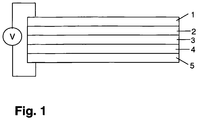
- the OLED does not have all of the layers mentioned, for example an OLED with the layers (1) (anode), (3) (light-emitting layer) and (5) (cathode) is also suitable. wherein the functions of the layers (2) (hole-transporting layer) and (4) (electron-transporting layer) are taken over by the adjacent layers. OLEDs comprising layers (1), (2), (3) and (5) or layers (1), (3), (4) and (5) are also suitable.
- the transition metal carbene complexes according to the present application can be used in various layers of an OLED. Another object of the present invention is therefore an OLED containing at least one transition metal carbene complex according to the present application.
- the transition metal carbene complexes are preferably used in the light-emitting layer as emitter molecules.
- Another object of the present invention is therefore a light-emitting layer containing at least one transition metal carbene complex as emitter molecule.
- Preferred transition metal carbene complexes, in particular transition metal carbene complexes with N-heterocyclic carbene ligands, have already been mentioned above.
- transition metal carbene complexes used according to the invention or in accordance with the invention can be present in bulk-without further additives-in the light-emitting layer or another layer of the OLED, preferably in the light-emitting layer.
- further compounds are present in the layers containing at least one transition metal carbene complex according to the present application, preferably in the light-emitting layer.
- a fluorescent dye may be present in the light-emitting layer to change the emission color of the transition metal carbene complex used as the emitter molecule.
- a diluent material can be used.
- the individual of the abovementioned layers of the OLED can in turn be composed of 2 or more layers.
- the hole-transporting layer may be composed of a layer into which holes are injected from the electrode and a layer that transports the holes away from the hole-injecting layer into the light-emitting layer.
- the electron-transporting layer may also consist of several layers, for example a layer in which electrons are injected through the electrode and a layer which receives electrons from the electron-injection layer and transports them into the light-emitting layer.
- These mentioned layers are each selected according to factors such as energy level, temperature resistance and charge carrier mobility, as well as the energy difference of said layers with the organic layers or the metal electrodes.
- the person skilled in the art is able to select the structure of the OLEDs in such a way that it is optimally adapted to the transition metal carbene complexes used according to the invention as emitter substances.
- the HOMO (highest occupied molecular orbital) of the hole-transporting layer should be aligned with the work function of the anode and the LUMO (lowest unoccupied molecular orbital) of the electron-transporting layer should be aligned with the work function of the cathode.
- a further subject of the present application is an OLED containing at least one light-emitting layer according to the invention.
- the further layers in the OLED may be constructed of any material commonly employed in such layers and known to those skilled in the art.
- the anode (1) is an electrode that provides positive charge carriers.
- it may be constructed of materials including a metal, a mixture of various metals, a metal alloy, a metal oxide, or a mixture of various metal oxides.
- the anode may be a conductive polymer. Suitable metals include the metals of Groups 11, 4, 5 and 6 of the Periodic Table of Elements and the transition metals of Groups 8 to 10.
- mixed metal oxides of Groups 12, 13 and 14 of the Periodic Table of the Elements are generally used used, for example, tin-tin oxide (ITO).
- ITO tin-tin oxide
- the anode (1) contains an organic material, for example polyaniline, such as in Nature, Vol. 357, pages 477 to 479 (June 11, 1992 ) is described. At least either the anode or the cathode should be at least partially transparent in order to be able to decouple the light formed.
- Suitable hole transport materials for the layer (2) of the OLED according to the invention are, for example, in Kirk-Othmer Encyclopedia of Chemical Technology, 4th Edition, Vol. 18, pages 837 to 860, 1996 disclosed. Both hole transporting molecules and polymers can be used as hole transport material.
- Commonly used hole transporting molecules are selected from the group consisting of 4,4'-bis [N- (1-naphthyl) -N-phenyl-amino] biphenyl ( ⁇ -NPD), N, N'-diphenyl-N, N Bis (3-methylphenyl) - [1,1'-biphenyl] -4,4'-diamine (TPD), 1,1-bis [(di-4-tolylamino) -phenyl] cyclohexane (TAPC), N , N'-bis (4-methylphenyl) -N, N'-bis (4-ethylphenyl) - [1,1 '- (3,3'-dimethyl) biphenyl] -4,4'-diamine (ETPD), Tetrakis (3-methylphenyl)) - N, N, N ', N'-2,5-phenylenediamine (PDA), ⁇ -phenyl-4-N, N-diphen
- oxinoid compounds such as tris (8-hydroxyquinolato) aluminum (Alq 3 )
- phenanthroline-based compounds such as 2,9-dimethyl, 4,7-diphenyl-1, 10
- the layer (4) can serve both to facilitate the electron transport and as a buffer layer or as a barrier layer in order to avoid quenching of the exciton at the interfaces of the layers of the OLED.
- the layer (4) reduces the mobility of the electrons and reduces quenching of the exciton.
- hole transporting materials and electron transporting materials some may fulfill several functions.
- some of the electron-conducting materials are simultaneously hole-blocking materials if they have a deep HOMO.
- the charge transport layers can also be electronically doped in order to improve the transport properties of the materials used, on the one hand to make the layer thicknesses more generous (avoidance of pinholes / short circuits) and on the other hand to minimize the operating voltage of the device.
- the hole transport materials can be doped with electron acceptors, for example phthalocyanines or arylamines such as TPD or TDTA can be doped with tetrafluorotetracyanoquinodimethane (F4-TCNQ).
- the electron transport materials may be doped with alkali metals, such as Alq 3 with lithium.
- the electronic doping is known in the art and Beipsiel in W. Gao, A. Kahn, J. Appl.
- the cathode (5) is an electrode which serves to introduce electrons or negative charge carriers.
- the cathode may be any metal or non-metal that has a lower work function than the anode.
- Suitable materials for the cathode are selected from the group consisting of Group 1 alkali metals, for example Li, Cs, Group 2 alkaline earth metals, Group 12 metals of the Periodic Table of the Elements comprising the rare earth metals and the lanthanides and actinides.
- metals such as aluminum, indium, calcium, barium, samarium and magnesium and combinations thereof can be used.
- lithium-containing organometallic compounds or LiF can be applied between the organic layer and the cathode to reduce the operating voltage.
- the OLED according to the present invention may additionally contain further layers which are known to the person skilled in the art.
- a layer can be applied between the layer (2) and the light-emitting layer (3), which facilitates the transport of the positive charge and / or the band gap of the layers to each other adapts.
- this further layer can serve as a protective layer.
- additional layers may be present between the light-emitting layer (3) and the layer (4) to facilitate the transport of the negative charge and / or to match the band gap between the layers.
- this layer can serve as a protective layer.
- the OLED does not have all of the aforementioned layers (1) to (5), for example, an OLED having the layers (1) (anode), (3) (light-emitting layer) and (5 ) (Cathode), wherein the functions of the layers (2) (hole-transporting layer) and (4) (electron-transporting layer) are taken over by the adjacent layers.
- OLEDs comprising layers (1), (2), (3) and (5) or layers (1), (3), (4) and (5) are also suitable.
- Suitable materials for the individual layers are known to the person skilled in the art and are described, for example, in US Pat WO 00/70655 disclosed.
- each of the mentioned layers of the OLED according to the invention can be composed of two or more layers. Further, it is possible that some or all of the layers (1), (2), (3), (4) and (5) are surface treated to increase the efficiency of charge carrier transport. The selection of materials for each of said layers is preferably determined by obtaining an OLED having a high efficiency.
- the preparation of the OLEDs according to the invention can be carried out by methods known to the person skilled in the art.
- the OLED is prepared by sequential vapor deposition of the individual layers onto a suitable substrate.
- Suitable substrates are, for example, glass or polymer films.
- conventional techniques can be used such as thermal evaporation, chemical vapor deposition and others.
- the organic layers may be coated from solutions or dispersions in suitable solvents using coating techniques known to those skilled in the art.
- Compositions which, in addition to the at least one transition metal carbene complex used according to the invention, comprise a polymeric material in one of the layers of the OLED, preferably in the light-emitting layer, are generally applied as a layer by means of solution-processing methods.
- the various layers have the following thicknesses: anode (2) 500 to 5000 ⁇ , preferably 1000 to 2000 ⁇ ; Hole-transporting layer (3) 50 to 1000 ⁇ , preferably 200 to 800 ⁇ , light-emitting layer (4) 10 to 1000 ⁇ , preferably 100 to 800 ⁇ , Electron-transporting layer (5) 50 to 1000 ⁇ , preferably 200 to 800 ⁇ , cathode (7) 200 to 10,000 ⁇ , preferably 300 to 5000 ⁇ .
- the location of the recombination zone of holes and electrons in the OLED according to the invention and thus the emission spectrum of the OLED can be influenced by the relative thickness of each layer.
- the thickness of the electron transport layer should preferably be selected so that the electron / holes recombination zone is in the light-emitting layer.
- the ratio of the layer thicknesses of the individual layers in the OLED depends on the materials used.
- the layer thicknesses of optionally used additional layers are known to the person skilled in the art.
- OLEDs can be obtained with high efficiency.
- the efficiency of the OLEDs according to the invention can be further improved by optimizing the other layers.
- highly efficient cathodes such as Ca, Ba or LiF can be used.
- Shaped substrates and new hole-transporting materials that bring about a reduction in the operating voltage or an increase in quantum efficiency are also usable in the OLEDs according to the invention.
- additional Layers may be present in the OLEDs to adjust the energy levels of the different layers and to facilitate electroluminescence.
- the OLEDs according to the invention can be used in all devices in which electroluminescence is useful. Suitable devices are preferably selected from stationary and mobile screens. Stationary screens are e.g. Screens of computers, televisions, screens in printers, kitchen appliances and billboards, lights and signboards. Mobile screens are e.g. Screens in cell phones, laptops, digital cameras, vehicles, and destination displays on buses and trains.
- Stationary screens are e.g. Screens of computers, televisions, screens in printers, kitchen appliances and billboards, lights and signboards.
- Mobile screens are e.g. Screens in cell phones, laptops, digital cameras, vehicles, and destination displays on buses and trains.
- transition metal carbene complexes used according to the invention can be used in OLEDs with inverse structure.
- the transition metal carbene complexes in these inverse OLEDs are preferably used again in the light-emitting layer.
- the construction of inverse OLEDs and the materials usually used therein are known to the person skilled in the art.
- transition metal complexes described above used according to the invention can be used in addition to the use in OLEDs as colorants which emit when exposed to light in the visible range of the electromagnetic spectrum (photoluminescence). Such colorants are preferably used as colorants in polymeric materials.
- Another object of the present application is therefore the use of the above-described transition metal complexes according to the invention for the mass coloration of polymeric materials.
- Suitable polymeric materials are polyvinyl chloride, cellulose acetate, polycarbonates, polyamides, polyurethanes, polyimides, polybenzimidazoles, melamine resins, silicones, polyesters, polyethers, polystyrene, polymethyl methacrylate, polyethylene, polypropylene, polyvinyl acetate, polyacrylonitrile, polybutadiene, polychlorobutadiene, polyisoprene or the copolymers of the listed monomers ,
- Ir (imidazolidine) 3 was synthesized according to a regulation of PB Hitchcock, MF Lappert, P. Terreros, J. Organomet. Chem. 1982, 239, C26-C30 produced. In contrast to the mentioned literature specification, the starting material used was the imidazolidinium salt and not the Wanzlick olefin.
- the Ir complex (7) is formed as a mixture of the kinetically preferred meridional (mer) isomer and the thermodynamically favored facial (fac) isomer.
- Crystals suitable for X-ray structure analysis were obtained under an inert gas atmosphere by dissolving slowly pentane pentane into a solution of a fac / mer isomer mixture of the Ir complex (7) in methylene chloride.
- Fig. 2 shows the crystal structure of the fac isomer of the Ir complex (7).
- the lengths of the Ir carbene carbon bonds of the three ligands correspond to 2.034 ⁇ , 1.997 ⁇ and 2.025 ⁇ , respectively, of an Ir-C single bond. Strikingly, the assembly of two molecules of the Ir complex (7) via one of the fused phenyl rings. The average distance between the involved phenyl rings is 3.6 ⁇ .
- Samples of the Ir complex (7) were measured at a concentration of 2 mg / L in toluene ("spectroscopic grade"). Different samples with different fac-mer isomer ratios were investigated.
- a normalized absorption spectrum corresponds to the measured optical density relative to the optical density in the absorption maximum, it is concentration-independent and describes only the band shape.
- the values z fac and z mer represent the proportions weighted according to the optical density in the absorption maximum and depend on the product of the molar extinction coefficient in the maximum ⁇ max and the concentration. They are not identical to the mole fractions. These can be obtained by means of the extinction coefficients at the absorption maximum ⁇ max ( fac and mer ) from z fac and z mer .
- the ratio z fac / z mer represents the ratio of the optical densities of the absorption maxima.
- N mer is the normalization factor, which guarantees that the sum spectrum is normalized to one.
- the values y fac and y mer depend on the excitation wavelength and indicate the proportion of the total emission according to emission intensity (equal to the product of absorption on the excitation wavelength OD ( ⁇ exc ) and quantum yield ⁇ ). They are not identical to the mole fractions. These can be obtained using the extinction coefficients at the absorption maximum ⁇ max ( fac and mer ) and the quantum yields of the two isomers from y fac and y mer .
- N mer is the normalization factor, which guarantees that the sum spectrum is normalized to one.
- the emitter in nitrogen-saturated solution shows an order of magnitude smaller luminescence quantum yield.
- This influence of solvent-hole quenching is also reflected in the luminescence decay times of the Ir complex (7): in toluene, nitrogen-saturated: 26.5 ns and 25.8 ns, respectively.
- the fac- isomer (Example 2d) absorbs significantly hypsochromic compared to the mer isomer (Example 2d) and has a shoulder at 330 nm.
- the 80/20 superposition of the fac / mer spectra identically gives the absorption spectrum of the original sample. Somewhat striking is the increased absorption of sample 2 by 280 nm. It should not be forgotten here that the absorption spectra are normalized spectra which represent only the spectral shape and not the absolute absorption strength.
- sample 3 The emission spectrum of sample 3 is much narrower and pure blue, as before, in toluene and in the powder.
- Sample 4 is at a maximum around 460 nm with a shoulder at 400-410 nm.
- a computational overlay 80/20 provides the spectrum of the mixture.
- the quantum yield of sample 4 is significantly lower than that of the 3 other samples.
- the accuracy of the measurement of quantum efficiencies in the case of films and those numerical values is in the region of 2% -points, much less accurate than in solution, because a film is poorer compared to the solution because it is less homogeneous.
- Fac - (7) has in the solid state with about 20% is almost twice as high as photoluminescence mer - (7). While fac- (7) emits in pure blue, the emission ranges from mer- (7) to turquoise areas. Due to the position of the emission and absorption bands, a non-radiative energy transfer from fac to mer isomer should be possible (conversely practically not), so that at application-relevant doping levels or emitter molecule spacings any contamination of mer - (7) the emission of the fac isomer partially quenched, regardless of the effect of the mer isomer as a trap for individual charges.
- the ITO substrate used as anode is first cleaned by boiling in isopropanol and acetone. In between, it is treated with ultrasound. Finally, the substrates in a dishwasher with commercial detergents for LCD production (Deconex® ® 20NS and neutralizing agent 25ORGANACID ®) to be cleaned. To remove any remaining organic residue, the substrate is exposed to a continuous ozone flow for 25 minutes. This treatment also improves hole injection as the work function of the ITO increases.
- PEDT spin-coated from aqueous solution to the test PSS (poly (3,4-ethylenedioxythiophene) -poly (styrenesulfonate)) (Baytron ® P VP Al 4083). This results in a thickness of 46 nm.
- PSS poly (3,4-ethylenedioxythiophene) -poly (styrenesulfonate)
- the emitter layer which is composed of PMMA (polymethacrylic acid methyl ester) dissolved in chlorobenzene and the emitter substance (complex (7), example 2c, example 2d).
- a 2% solution of PMMA in chlorobenzene is used.
- the dopant (emitter) is added in various concentrations.
- the 28% solution gives a thickness of approximately 61 nm after spin coating and the 40% solution gives a thickness of 77 nm.
- a mixture of isomers (fac / mer) of the emitter was used in which the facial isomer is the main component represents (Example 2c).
- a 30% solution was prepared using the isomerically pure fac emitter (Example 2d). This solution gives after spin coating a layer thickness of 27 nm.
- BCP 2,9-dimethyl-4,7-diphenyl-1,10-phenanthroline
- electroluminescence spectra are recorded at different currents or voltages. Furthermore, the current-voltage characteristic is measured in combination with the radiated light output. The light output can then be converted by calibration with a luminance meter into photometric quantities.
- the ITO substrate used as the anode is first cleaned for 10 minutes with isopropanol at 30 ° C in an ultrasonic bath and then for 10 minutes with chloroform also in an ultrasonic bath at 30 ° C. Thereafter, the substrate is etched for 20 minutes in the oxygen plasma to remove any remaining organic residues.
Landscapes
- Chemical & Material Sciences (AREA)
- Organic Chemistry (AREA)
- Engineering & Computer Science (AREA)
- Materials Engineering (AREA)
- Inorganic Chemistry (AREA)
- Chemical Kinetics & Catalysis (AREA)
- Crystallography & Structural Chemistry (AREA)
- Electroluminescent Light Sources (AREA)
Description
- Die vorliegende Erfindung betrifft die Verwendung von Übergangsmetallkomplexen enthaltend mindestens einen Carbenliganden in organischen Licht-emittierenden Dioden (OLEDs), eine Licht-emittierende Schicht, Blockschicht für Elektronen oder Excitonen oder Blockschicht für Löcher enthaltend diese Übergangsmetallkomplexe, OLEDs enthaltend diese Übergangsmetallkomplexe und Vorrichtungen, die ein erfindungsgemäßes OLED enthalten.
- In organischen Licht-emittierenden Dioden (OLED) wird die Eigenschaft von Materialien ausgenutzt, Licht zu emittieren, wenn sie durch elektrischen Strom angeregt werden. OLEDs sind insbesondere interessant als Alternative zu Kathodenstrahlröhren und Flüssigkristalldisplays zur Herstellung von Flachbildschirmen. Aufgrund der sehr kompakten Bauweise und des intrinsisch niedrigeren Stromverbrauchs eignen sich Vorrichtungen, enthaltend OLEDs insbesondere für mobile Anwendungen, zum Beispiel für Anwendungen in Handys, Laptops usw.
- Es wurden zahlreiche Materialien vorgeschlagen, die bei der Anregung durch elektrischen Strom Licht emittieren.
- Timothy J. Foley et al., Inorganic Chemistry, Bd. 42, Nr. 16, 1. August 2003, Seiten 5023 bis 5032 betrifft Lanthanid(III)-Monoporphyrinat-Komplexe und deren photophysikalische Eigenschaften. Die genannten Lanthanid-Komplexe zeigen im nahen Infrarot (NIR) Lumineszenz. Neben dem Porphyrinliganden tragen die Lanthanid-Komplexe einen monoanionischen Boratliganden (Hydridotris(1-pyrazolyl)borat (Tp)), einen (Cyclopentadienyl)-tris(diethylphosphinito)kobaltat-Liganden (L(OEt) oder einen Dimethoxyethan (DME)-Liganden gemeinsam mit einem Halogenidliganden. Bei dem eingesetzten Monoporphyrinat handelt es sich um 5,10,15,20-Tetraphenylporphyrinat (TPP). Die genannten Lanthanid(III)-Monoporphyrinat-Komplexe werden als Emittermaterialien im NIR in organischen Leuchtdioden getestet.
-
WO 02/15645 WO 02/15645 -
WO 01/41512 -
WO 00/70655 - Obwohl bereits Verbindungen bekannt sind, die im blauen, roten und grünen Bereich des elektromagnetischen Spektrums Elektrolumineszenz zeigen, ist die Bereitstellung von effizienteren Verbindungen, die technisch einsetzbar sind, wünschenswert. Unter Elektrolumineszenz ist sowohl Elektrofluoreszenz als auch Elektrophosphoreszenz zu verstehen. Des Weiteren ist die Bereitstellung von weiteren Verbindungen zum Einsatz als Elektronen, Excitonen oder Löcher blockierende Materialien von Interesse.
- Aufgabe der vorliegenden Anmeldung ist daher die Bereitstellung einer Verbindungsklasse, die zur Elektrolumineszenz im blauen, roten und grünen Bereich des elektromagnetischen Spektrums geeignet ist, wodurch die Herstellung von Vollfarbendisplays ermöglicht wird. Eine weitere Aufgabe der vorliegenden Anmeldung ist die Bereitstellung von Verbindungen zum Einsatz als Elektronen, Excitonen oder Löcher blockierende Materialien.
- Diese Aufgaben werden durch die Verwendung von neutralen Ubergangsmetallkomplexen der allgemeinen Formel I, enthaltend mindestens einen Carbenliganden in organischen Licht-emittierenden Dioden (OLEDs) gelöst

- M1
- Metallatom ausgewählt aus der Gruppe bestehend aus Rh, Ir, Pd, Pt, Ru und Os in jeder für das entsprechende Metallatom möglichen Oxidationsstufe;
- carben
- Carbenligand, der neutral oder monoanionisch und mono-, bi- oder tridentat sein kann; bei dem Carbenliganden kann es sich auch um einen Bis- oder Triscarbenliganden handeln;
- L
- mono- oder dianionischer Ligand, bevorzugt monoanionischer Ligand, der mono- oder bidentat sein kann;
- K
- neutraler mono- oder bidentater Ligand ausgewählt aus der Gruppe bestehend aus Phosphinen, bevorzugt Trialkyl-, Triaryl- oder Alkylarylphosphinen, besonders bevorzugt PAr3, wobei Ar ein substituierter oder unsubstituierter Arylrest ist und die drei Arylreste in PAr3 gleich oder verscheiden sein können, besonders bevorzugt PPh3, PEt3, PnBu3, PEt2Ph, PMe2Ph, PnBu2Ph; Phosphonaten und Derivaten davon, Arsenaten und Derivaten davon, Phosphiten, CO; Pyridinen, wobei die Pyridine mit Alkyl- oder Arylgruppen substituiert sein können; Nitrilen und Dienen, die einen π-Komplex mit M1 bilden, bevorzugt η4-Diphenyl-1,3-butadien, η4-1,3-Pentadien, η4-1-Phenyl-1,3-pentadien, η4-1,4-Dibenzyl-1,3-butadien, η4-2,4-Hexadien, η4-3-Methyl-1,3-pentadien, η4-1,4-Ditolyl-1,3-butadien, η4-1,4-Bis(trimethylsilyl)-1,3-butadien und η2- oder η4-Cyclooctadien (je 1,3 und je 1,5), besonders bevorzugt 1,4-Diphenyl-1,3-butadien, 1-Phenyl-1,3-pentadien, 2,4-Hexadien, Butadien, η2-Cycloocten, η4-1,3-Cyclooctadien und η4-1,5-Cyclooctadien;
- n
- Zahl der Carbenliganden, wobei n mindestens 1 ist und die Carbenliganden in dem Komplex der Formel I bei n >1 gleich oder verschieden sein können;
- m
- Zahl der Liganden L, wobei m 0 oder ≥ 1 sein kann und die Liganden L bei m > 1 gleich oder verschieden sein können;
- o
- Zahl der Liganden K, wobei o 0 oder ≥ 1 sein kann und die Liganden K bei o > 1 gleich oder verschieden sein können;
- Die Übergangsmetallkomplexe der Formel I können in jeder Schicht eines OLEDs eingesetzt werden, wobei das Ligandgerüst oder Zentralmetall zur Anpassung an gewünschte Eigenschaften der Metallkomplexe variiert werden kann. Beispielsweise ist der Einsatz der Übergangsmetallkomplexe der Formel I in einer Blockschicht für Elektronen, einer Blockschicht für Excitonen, einer Blockschicht für Löcher oder der Licht-emittierenden Schicht des OLEDs möglich. Bevorzugt werden die Verbindungen der Formel I als Emittermoleküle in OLEDs eingesetzt.
- Unter einem bidentaten Liganden ist ein Ligand zu verstehen, der an zwei Stellen an das Übergangsmetallatom M1 koordiniert ist. Im Sinne der vorliegenden Anmeldung wird der Begriff "zweizähnig" synonym mit dem Begriff "bidentat" verwendet.
- Unter einem monodentaten Liganden ist ein Ligand zu verstehen, der an einer Stelle des Liganden mit dem Übergangsmetallatom M1 koordiniert.
- In Abhängigkeit von der Koordinationszahl des eingesetzten Metalls M1 und der Natur und Zahl der eingesetzten Liganden L, K und carben können verschiedene Isomere der entsprechenden Metallkomplexe bei gleichem Metall M1 und gleicher Natur und Zahl der eingesetzten Liganden K, L und carben vorliegen. Zum Beispiel sind bei Komplexen mit einem Metall M1 mit der Koordinationszahl 6 (also oktaedrischen Komplexen), zum Beispiel Ir(III)-Komplexen, sowohl cis/trans-Isomere möglich, wenn es sich um Komplexe der allgemeinen Zusammensetzung MA2B4 handelt, als auch fac-mer-Isomere (facial/meridional-Isomere), wenn es sich um Komplexe der allgemeinen Zusammensetzung MA3B3 handelt. Bei quadratisch planaren Komplexen mit einem Metall M1 mit der Koordinationszahl 4, zum Beispiel Pt(II)-Komplexen, sind cis/trans-Isomere möglich, wenn es sich um Komplexe der allgemeinen Zusammmensetzung MA2B2 handelt. Bei den Symbolen A und B handelt es sich jeweils um eine Bindungsstelle eines Liganden, wobei nicht nur monodentate, sondern auch bidentate Liganden vorliegen können. Ein unsymmetrischer bidentater Ligand weist gemäß der vorstehend erwähnten allgemeinen Zusammensetzung eine Gruppe A und eine Gruppe B auf.
- Dem Fachmann ist bekannt, was unter cis/trans- bzw. fac-mer-Isomeren zu verstehen ist. Bei oktaedrischen Komplexen bedeutet cis-Isomerie, dass bei Komplexen der Zusammensetzung MA2B4 die beiden Gruppen A benachbarte Ecken eines Oktaeders belegen, während die beiden Gruppen A bei der trans-Isomerie einander gegenüber liegende Ecken eines Oktaeders belegen. Bei Komplexen der Zusammensetzung MA3B3 können drei Gruppen der gleichen Art entweder die Ecken einer Oktaederfläche besetzen (faciales Isomer) oder einen Meridian, das heißt zwei der drei Ligandenbindungsstellen sind zueinander trans-ständig (meridionales Isomer). Bezüglich der Definition von cis/trans-Isomeren bzw. fac-mer-Isomeren in oktaedrischen Metallkomplexen siehe zum Beispiel J. Huheey, E. Keiter, R. Keiter, Anorganische Chemie: Prinzipien von Struktur und Reaktivität, 2., neu bearbeitete Auflage, übersetzt und erweitert von Ralf Steudel, Berlin; New York: de Gruyter, 1995, Seiten 575, 576.
- Bei quadratisch planaren Komplexen bedeutet cis-Isomerie, dass bei Komplexen der Zusammensetzung MA2B2 sowohl die beiden Gruppen A als als auch die beiden Gruppen B benachbarte Ecken eines Quadrats belegen, während sowohl die beiden Gruppen A als auch die beiden Gruppen B bei der trans-Isomerie jeweils die beiden einander diagonal gegenüber liegenden Ecken eines Quadrats belegen. Bezüglich der Definition von cis/trans-Isomeren in quadratisch planaren Metallkomplexen siehe zum Beispiel J. Huheey, E. Keiter, R, Keiter, Anorganische Chemie: Prinzipien von Struktur und Reaktivität, 2., neu bearbeitete Auflage, übersetzt und erweitert von Ralf Stendel, Berlin; New York: de Gruyter, 1995, Seiten 557 bis 559.
- Im Allgemeinen können die verschiedenen Isomere der Metallkomplexe der Formel I nach dem Fachmann bekannten Verfahren, zum Beispiel durch Chromatographie, Sublimation oder Kristallisation, getrennt werden.
- Die vorliegende Erfindung betrifft somit sowohl jeweils einzelne Isomere der Übergangsmetallkomplexe der Formel I als auch Gemische verschiedener Isomere in jedem beliebigen Mischungsverhältnis.
- Übergangsmetallkomplexe, die Carbenliganden enthalten, sind im Stand der Technik bekannt. So betreffen Gründemann et al., J. Am. Chem. Soc., 2002, 124, 10473 bis 10481 und Danapoulos et al., J. Chem. Soc., Dalton Trans., 2002 3090 bis 3091 Iridumkomplexe, die einen Carbenliganden mit der folgenden Struktureinheit


- In keinem der genannten Dokumente sind jedoch Lumineszenzeigenschaften, insbesondere Elektrolumineszenzeigenschaften, der offenbarten Verbindungen bzw. deren Verwendungen in OLEDs offenbart.
- In Yam et al., Chem. Commun. 1989, 2261 bis 2262 und Yam et al., J. Chem. Soc. Dalton Trans., 2001, 1911 bis 1919 sind Ruthenium-Komplexe offenbart, die einen Carbenliganden aufweisen. Die photophysikalischen Eigenschaften dieser Carbenkomplexe, unter anderem die Photolumineszenz der Komplexe wurde in den genannten Dokumenten untersucht. Es werden jedoch keine Angaben bezüglich einer Verwendung dieser Komplexe gemacht, noch enthalten die Dokumente Angaben bezüglich der Elektrolumineszenz der untersuchten Verbindungen.
- Che et al., Organometallics 1998, 17, 1622 bis 1630 betrifft kationische Re-Komplexe, die einen Carbenliganden mit der folgenden Struktureinheit

- Dieser Komplex zeigt Photolumineszenz. Eine Verwendung des Re-Komplexes sowie die Untersuchung des Elektrolumineszenzverhaltens des Komplexes ist jedoch nicht offenbart.
-
US 6,160,267 undUS 6,338,977 betreffen eine molekulare Licht-emittierende Diode, die ihre Farbe in Abhängigkeit von sie umgebenden Dämpfen ändert. Diese Elektrode weist eine Sensor-Emitterschicht auf, die einen neutralen Platinkomplex enthält, wobei Platin durch zwei negativ geladene Liganden, ausgewählt aus der Gruppe bestehend aus CN-, NO2 - , NCO-, NCS-, Cl-, Br-, I- und Oxalat, ausgewählt sind und die weiteren zwei Liganden ausgewählt sind aus mindestens einer und maximal zwei Arylisonitrilgruppen und einem Fischer-Carben-Komplex, der die Formel =C(Y)-NH-C6H4-Alkyl aufweist, worin Y O-Alkyl, NH-Alkyl oder N(Alkyl)2 ist. Zwingendes Merkmal der inUS 6,160,267 undUS 6,338,977 offenbarten Pt-Komplexe ist die Anwesenheit mindestens einer Arylisonitrilgruppe. - Die Eignung von Übergangsmetallkomplexen der Formel I gemäß der vorliegenden Erfindung, die mindestens einen Carbenliganden tragen, als Licht-emittierende Substanzen in OLEDs, wobei die Substanzen dieses Strukturtyps gemäß Formel I zur Elektrolumineszenz im roten, grünen und blauen Bereich des elektromagnetischen Spektrums geeignet sind, ist in keinem der vorstehend genannten Dokumente erwähnt. Es wurde somit gefunden, dass die Übergangsmetallkomplexe der Formel I gemäß der vorliegenden Anmeldung als Licht-emittierende Substanzen in OLEDs zur Herstellung von Vollfarbendisplays geeignet sind.
- Die erfindungsgemäß verwendeten Übergangsmetallkomplexe der allgemeinen Formel I weisen ein Metallatom M1 ausgewählt aus der Gruppe bestehend aus Os, Rh, Ir, Ru, Pd und Pt auf, wobei Os(IV), Rh(III), Ir(I), Ir(III), Ru(III), Ru(IV), Pd(II) und Pt(II) bevorzugt sind. Besonders bevorzugt eingesetzte Metallatome sind Ru, Rh, Ir und Pt, bevorzugt Ru(III), Ru(IV), Rh(III), Ir(I), Ir(III) und Pt(II). Ganz besonders bevorzugt werden als Metallatom M1 Ir oder Pt eingesetzt, bevorzugt Ir(III) oder Pt(II), ganz besonders bevorzugt Ir(III).
- Geeignete mono- oder dianionische Liganden L, bevorzugt monoanionische Liganden L, die mono- oder bidentat sein können, sind die üblicherweise als mono- oder bidentate mono- oder dianionische Liganden eingesetzten Liganden.
- Geeignete monoanionische monodentate Liganden sind zum Beispiel Halogenide, insbesondere Cl- und Br-, Pseudohalogenide, insbesondere CN-, Cyclopentadienyl (Cp-), Alkylreste, die mit dem Übergangsmetall M1 über eine Sigmabindung verknüpft sind, zum Beispiel CH3, Alkylarylreste, die mit dem Übergangsmetall M1 über eine Sigmabindung verknüpft sind, zum Beispiel Benzyl.
- Geeignete monoanionische bidentate Liganden sind zum Beispiel Acetylacetonat und dessen Derivate, Picolinat, Schiffsche Basen, Aminosäuren sowie die in
WO 02/15645 - Geeignete neutrale mono- oder bidentate Liganden sind bereits vorstehend genannt. Bevorzugte neutrale monodentate Liganden sind ausgewählt aus der Gruppe bestehend aus PPh3, P(OPh)3, AsPh3, CO, Pyridin, Nitrilen und deren Derivaten. Geeignete neutrale mono- bzw. bidentate Liganden sind bevorzugt 1,4-Diphenyl-1,3-butadien, 1-Phenyl-1,3-pentadien, 2,4-Hexadien, η4-Cyclooctadien und η2-Cyclooctadien (je 1,3 und je 1,5).
- Die Zahl n der Carbenliganden beträgt in neutralen Übergangsmetallkomplexen, worin das Übergangsmetallatom Ir(llI) eine Koordinationszahl von 6 aufweist, 1 bis 3, bevorzugt 2 oder 3, besonders bevorzugt 3. Ist n > 1 können die Carbenliganden gleich oder verschieden sein, bevorzugt sind sie gleich.
- Die Zahl n der Carbenliganden beträgt in Übergangsmetallkomplexen, worin das Übergangsmetallatom Pt(II) eine Koordinationszahl von 4 aufweist, 1 oder 2, bevorzugt 2. Ist n > 1 können die Carbenliganden gleich oder verschieden sein.
- Die Zahl m der monoanionischen Liganden L beträgt in dem vorstehend genannten Fall 0 bis 2, bevorzugt 0 bis 1, besonders bevorzugt 0. Ist m > 1 können die Liganden L gleich oder verschieden sein, bevorzugt sind sie gleich.
- Die Zahl o der neutralen Liganden K ist abhängig davon, ob die Koordinationszahl 6 des Ir(III) oder 4 des Pt(II) mit Hilfe der Carbenliganden und der Liganden L bereits erreicht wurde. Ist - in dem Fall, dass Ir(III) eingesetzt wird - n drei und werden drei monoanionische bidentate Carbenliganden eingesetzt, so ist o in dem vorstehend genannten Fall 0. Ist - in dem Fall, dass Pt(II) eingesetzt wird - n zwei und werden zwei monoanionische bidentate Carbenliganden eingesetzt, so ist o in diesem Fall ebenfalls 0.
- In einer Ausführungsform betrifft die vorliegende Erfindung die Verwendung von Übergangsmetallkomplexen der Formel IA

- Do1
- Donoratom ausgewählt aus der Gruppe bestehend aus C, N, O, P und S, bevorzugt N, O, P und S, besonders bevorzugt N;
- r
- 2, wenn Do1 C ist,1, wenn Do1 N oder P ist und 0, wenn Do1 O oder S ist;
- Y1, Y2
- jeweils unabhängig voneinander Wasserstoff oder eine kohlenstoffhaltige Gruppe ausgewählt aus der Gruppe bestehend aus Alkyl-, Aryl-, Heteroaryl- und Alkenylgruppen, bevorzugt Alkyl- und Arylgruppen, oder
Y1 und Y2 bilden gemeinsam eine Brücke zwischen dem Donoratom Do1 und dem Stickstoffatom N, die mindestens zwei Atome, bevorzugt zwei bis drei Atome, besonders bevorzugt zwei Atome, aufweist, wovon mindestens eines ein Kohlenstoffatom ist, und die weiteren Atome bevorzugt Stickstoff- oder Kohlenstoffatome sind, wobei die Brücke gesättigt oder ungesättigt, bevorzugt ungesättigt, sein kann und die mindestens zwei Atome der Brücke substituiert oder unsubstituiert sein können; - Y3, Y4
- jeweils unabhängig voneinander ein Wasserstoff-, Alkyl-, Aryl-, Heteroaryl- oder Alkenylrest; bevorzugt Wasserstoff, ein Alkyl-, Heteroaryl- oder ein Arylrest,
- Die Symbole M1, L, K sowie n, m und o wurden bereits vorstehend erwähnt.
- Für die Gruppen Y1 und Y2 gilt im Sinne der vorliegenden Anmeldung:
- die Substituenten der Gruppen Y1 und Y2 können gemeinsam eine Brücke mit insgesamt drei bis fünf, bevorzugt vier Atomen, wovon ein oder zwei Atome Heteroatome, bevorzugt N, sein können und die restlichen Atome Kohlenstoffatome sind, so dass Y1 und Y2 gemeinsam mit dieser Brücke einen fünf- bis siebengliedrigen, bevorzugt sechsgliedrigen Ring bilden, der gegebenenfalls zwei - oder im Falle eines sechs- oder siebengliedrigen Rings - drei Doppelbindungen aufweisen kann und gegebenenfalls mit Alkyl- oder Arylgruppen substituiert sein kann und gegebenenfalls Heteroatome, bevorzugt N, enthalten kann, wobei ein sechsgliedriger aromatischer Ring, der mit Alkyl- oder Arylgruppen substituiert oder unsubstituiert ist, bevorzugt ist, oder der bevorzugte sechsgliedrige aromatische Ring ist mit weiteren Ringen, die gegebenenfalls mindestens ein Heteroatom, bevorzugt N, enthalten können, bevorzugt sechsgliedrigen aromatischen Ringen anelliert.
- Im Sinne der vorliegenden Anmeldung haben die Begriffe Arylrest oder -gruppe, Heteroarylrest oder -gruppe, Alkylrest oder -gruppe und Alkenylrest oder -gruppe die folgenden Bedeutungen:
- Unter einem Arylrest (oder -gruppe) ist ein Rest mit einem Grundgerüst von 6 bis 30 Kohlenstoffatomen, bevorzugt 6 bis 18 Kohlenstoffatomen zu verstehen, der aus einem aromatischen Ring oder mehreren kondensierten aromatischen Ringen aufgebaut ist. Geeignete Grundgerüste sind zum Beispiel Phenyl, Naphthyl, Anthracenyl oder Phenanthrenyl. Dieses Grundgerüst kann unsubstituiert sein (d. h., dass alle Kohlenstoffatome, die substituierbar sind, Wasserstoffatome tragen), oder an einer, mehreren oder allen substituierbaren Positionen des Grundgerüsts substituiert sein. Geeignete Substituenten sind zum Beispiel Alkylreste, bevorzugt Alkylreste mit 1 bis 8 Kohlenstoffatomen, besonders bevorzugt Methyl, Ethyl oder i-Propyl, Arylreste, bevorzugt C6-Arylreste, die wiederum substituiert oder unsubstituiert sein können, Heteroarylreste, bevorzugt Heteroarylreste, die mindestens ein Stickstoffatom enthalten, besonders bevorzugt Pyridylreste, Alkenylreste, bevorzugt Alkenylreste, die eine Doppelbindung tragen, besonders bevorzugt Alkenylreste mit einer Doppelbindung und 1 bis 8 Kohlenstoffatomen, oder Gruppen mit Donor- oder Akzeptorwirkung. Unter Gruppen mit Donorwirkung sind Gruppen zu verstehen, die einen +l- und/oder +M-Effekt aufweisen, und unter Gruppen mit Akzeptorwirkung sind Gruppen zu verstehen, die einen -I- und/oder -M-Effekt aufweisen. Geeignete Gruppen, mit Donor- oder Akzeptorwirkung sind Halogenreste, bevorzugt F, Cl, Br, besonders bevorzugt F, Alkoxyreste, Aryloxyreste, Carbonylreste, Esterreste, Aminreste, Amidreste, CH2F-Gruppen, CHF2-Gruppen, CF3-Gruppen, CN-Gruppen, Thiogruppen oder SCN-Gruppen. Ganz besonders bevorzugt tragen die Arylreste Substituenten ausgewählt aus der Gruppe bestehend aus Methyl, F, Cl, Aryloxy und Alkoxy. Bevorzugt ist der Arylrest oder die Arylgruppe ein C6-C18-Arylrest, besonders bevorzugt ein C6-Arylrest, der gegebenenfalls mit mindestens einem der vorstehend genannten Substituenten substituiert ist. Besonders bevorzugt weist der C6-C18-Arylrest, bevorzugt C6-Arylrest, einen oder zwei der vorstehend genannten Substituenten auf, wobei im Falle eines C6-Arylrests der eine Substituent in ortho-, meta- oder para-Position zur weiteren Verknüpfungsstelle des Arylrestes angeordnet ist, und - im Falle von zwei Substituenten - können diese jeweils in meta-Position oder ortho-Position zur weiteren Verknüpfungsstelle des Arylrestes angeordnet sein oder ein Rest ist in ortho-Position und ein Rest in meta-Position angeordnet oder ein Rest ist in ortho- oder meta-Position angeordnet und der weitere Rest ist in para-Position angeordnet.
- Unter einem Heteroarylrest oder einer Heteroarylgruppe sind Reste zu verstehen, die sich von den vorstehend genannten Arylresten dadurch unterscheiden, dass in dem Grundgerüst der Arylreste mindestens ein Kohlenstoffatom durch ein Heteroatom ersetzt ist. Bevorzugte Heteroatome sind N, O und S. Ganz besonders bevorzugt sind ein oder zwei Kohlenstoffatome des Grundgerüsts der Arylreste durch Heteroatome ersetzt. Insbesondere bevorzugt ist das Grundgerüst ausgewählt aus elektronenreichen Systemen wie Pyridyl und fünfgliedrigen Heteroaromaten wie Pyrrol, Furane. Das Grundgerüst kann an einer, mehreren oder allen substituierbaren Positionen des Grundgerüsts substituiert sein. Geeignete Substituenten sind die selben, die bereits bezüglich der Arylgruppen genannt wurden.
- Unter einem Alkylrest oder einer Alkylgruppe ist ein Rest mit 1 bis 20 Kohlenstoffatomen, bevorzugt 1 bis 10 Kohlenstoffatomen, besonders bevorzugt 1 bis 8 Kohlenstoffatomen zu verstehen. Dieser Alkylrest kann verzweigt oder unverzweigt sein und gegebenenfalls mit einem oder mehreren Heteroatomen, bevorzugt Si, N, O oder S, besonders bevorzugt N, O oder S, unterbrochen sein. Des Weiteren kann dieser Alkylrest mit einem oder mehreren der bezüglich der Arylgruppen genannten Substituenten substituiert sein. Es ist ebenfalls möglich, dass der Alkylrest eine oder mehrere Arylgruppen trägt. Dabei sind alle der vorstehend aufgeführten Arylgruppen geeignet. Besonders bevorzugt sind die Alkylreste ausgewählt aus der Gruppe bestehend aus Methyl und iso-Propyl.
- Unter einem Alkenylrest oder einer Alkenylgruppe ist ein Rest zu verstehen, der den vorstehend genannten Alkylresten mit mindestens zwei Kohlenstoffatomen entspricht, mit dem Unterschied, dass mindestens eine C-C-Einfachbindung des Alkylrests durch eine C-C-Doppelbindung ersetzt ist. Bevorzugt weist der Alkenylrest eine oder zwei Doppelbindungen auf.
- Unter einer Brücke, die mindestens zwei Atome aufweist, wovon mindestens eines ein Kohlenstoffatom ist und die weiteren Atome bevorzugt Stickstoff- oder Kohlenstoffatome sind, wobei die Brücke gesättigt oder bevorzugt ungesättigt sein kann und die mindestens zwei Atome der Brücke substituiert oder unsubstituiert sein können sind bevorzugt die folgenden Gruppen zu verstehen:
- Eine Brücke, die zwei Kohlenstoffatome oder ein Kohlenstoffatom und ein Stickstoffatom aufweist, wobei die Kohlenstoffatome bzw. ein Kohlenstoffatom und ein Stickstoffatom durch eine Doppelbindung miteinander verbunden sind, so dass die Brücke eine der folgenden Formeln aufweist, wobei die Brücke bevorzugt zwei Kohlenstoffatome aufweist:

- R13 und R14 bedeuten unabhängig voneinander Wasserstoff, Alkyl oder Aryl oder
- R13 und R14 bilden gemeinsam eine Brücke mit insgesamt 3 bis 5, bevorzugt 4, Atomen, wovon gegebenenfalls ein oder zwei Atome Heteroatome, bevorzugt N, sein können und die restlichen Atome Kohlenstoffatome sind, so dass diese Gruppe einen 5- bis 7-gliedrigen, bevorzugt sechsgliedrigen Ring bildet, der gegebenenfalls - neben der bereits vorhandenen Doppelbindung - eine - oder im Falle eines sechs- oder siebengliedrigen Rings - zwei weitere Doppelbindungen aufweisen kann und gegebenenfalls mit Alkyl- oder Arylgruppen substituiert sein kann. Bevorzugt ist dabei ein sechsgliedriger aromatischer Ring. Dieser kann mit Alkyl- oder Arylgruppen substituiert oder unsubstituiert sein. Des Weiteren ist es möglich, dass an diesem, bevorzugt sechsgliedrigen, aromatischen Ring ein oder mehrere weitere aromatische Ringe anelliert sind. Dabei ist jede denkbare Anellierung möglich. Diese anellierten Reste können wiederum substituiert sein, bevorzugt mit den in der allgemeinen Definition der Arylreste genannten Resten.
- Eine Brücke, die zwei Kohlenstoffatome aufweist, wobei die Kohlenstoffatome durch eine Einfachbindung miteinander verbunden sind, so dass die Brücke die folgende Formel aufweist:

- worin R4, R5, R6 und R7
- unabhängig voneinander Wasserstoff, Alkyl, Aryl, Heteroaryl oder Alkenyl bedeuten, bevorzugt Wasserstoff, Alkyl oder Aryl.
- Ganz besonders bevorzugt ist M1 in dem Übergangsmetallkomplex der Formel IA Ir(III).
- Die Gruppierung


- R4, R5, R6, R7, R8, R9 und R11
- Wasserstoff, Alkyl, Aryl, Heteroaryl, Alkenyl, oder ein Substituent mit Donor- oder Akzeptorwirkung bevorzugt ausgewählt aus Halogenresten, bevorzugt F, Cl, Br, besonders bevorzugt F, Alkoxyresten, Aryloxyresten, Carbonylresten, Esterresten, Aminresten, Amidresten, CH2F-Grupen, CHF2-Gruppen, CF3-Gruppen, CN-Gruppen, Thiogruppen und SCN-Gruppen;
- Erz
- Alkyl, Aryl, Heteroaryl, Alkenyl, bevorzugt Alkyl, Heteroaryl oder Aryl, oder jeweils 2 Reste R10 bilden gemeinsam einen anellierten Ring, der gegebenenfalls mindestens ein Heteroatom, bevorzugt N, enthalten kann, bevorzugt bilden jeweils 2 Reste Erz gemeinsam einen anellierten aromatischen C6-Ring, wobei an diesen, bevorzugt sechsgliedrigen, aromatischen Ring gegebenenfalls ein oder mehrere weitere aromatische Ringe anelliert sein können, wobei jede denkbare Anellierung möglich ist, und die anellierten Reste wiederum substituiert sein können; oder R10 bedeutet einen Rest mit Donor- oder Akzeptorwirkung, bevorzugt ausgewählt aus Halogenresten, bevorzugt F, Cl, Br, besonders bevorzugt F; Alkoxy-, Aryloxy-, Carbonyl-, Ester-, Aminogruppen, Amidresten, CHF2, CH2F, CF3, CN, Thiogruppen und SCN;
- v
- 0 bis 4, bevorzugt 0, 1 oder 2, ganz besonders bevorzugt 0, wobei, wenn v 0 ist, alle 4 möglichen Substituenten des Arylrests in Formel c Wasserstoffatome sind.
- Die Reste Y3 und Y4 wurden bereits vorstehend definiert.
- In einer weiteren bevorzugten Ausführungsform der vorliegenden Erfindung ist der mindestens eine Carbenligand in den neutralen Übergangsmetallkomplexen der allgemeinen Formel I ein bidentater und/oder monoanionischer Carbenligand. Ganz besonders bevorzugt ist der mindestens eine Carbenligand ein monoanionischer bidentater Carbenligand.
- Ganz besonders bevorzugt weist der mindestens eine Carbenligand in dem neutralen Übergangsmetall-Komplex der Formel I die folgende Formel (II) auf

- Do1
- Donoratom ausgewählt aus der Gruppe bestehend aus C, P, N, O und S, bevorzugt P, N, O und S, besonders bevorzugt N;
- Do2
- Donoratom ausgewählt aus der Gruppe bestehend aus C, N, P, O und S;
- r
- 2, wenn Do1 C ist, 1, wenn Do1 N oder P ist, und 0, wenn Do1 O oder S ist;
- s
- 2, wenn Do2 C ist, 1, wenn Do2 N oder P ist und 0, wenn Do2 O oder S ist;
- X
- Spacer ausgewählt aus der Gruppe bestehend aus Silylen, Alkylen, Arylen, Heteroarylen oder Alkenylen, bevorzugt Alkylen oder Arylen, besonders bevorzugt C1- bis C3-Alkylen oder C6-1,4-Arylen, wobei gegebenenfalls mindestens eines der vier weiteren Kohlenstoffatome mit Methyl-, Ethyl-, n-Propyl- oder i-Propylgruppen oder mit Gruppen mit Donor- oder Akzeptorwirkung ausgewählt aus Halogenresten, bevorzugt F, Cl, Br, besonders bevorzugt F, Alkoxyresten, Aryloxyresten, Carbonyl-, Ester-, Aminogruppen, Amidresten, CHF2, CH2F, CF3, CN, Thiogruppen und SCN substituiert sein kann, ganz besonders bevorzugt Methylen, Ethylen oder 1,4-Phenylen;
- p
- 0 oder 1, bevorzugt 0;
- q
- 0 oder 1, bevorzugt 0;
- Y1, Y2
- jeweils unabhängig voneinander Wasserstoff oder eine kohlenstoffhaltige Gruppe ausgewählt aus der Gruppe bestehend aus Alkyl-, Aryl-, Hetero-aryl- und Alkenylgruppen; bevorzugt Alkyl-, Heteroaryl- und Arylgruppen; oder
Y1 und Y2 bilden gemeinsam eine Brücke zwischen dem Donoratom Do1 und dem Stickstoffatom N, die mindestens zwei Atome, bevorzugt zwei bis drei Atome, besonders bevorzugt zwei Atome aufweist, wovon mindestens eines ein Kohlenstoffatom ist, wobei das mindestens eine weitere Atom bevorzugt ein Stickstoffatom ist, wobei die Brücke gesättigt oder ungesättigt, bevorzugt ungesättigt, sein kann und die mindestens zwei Atome der Brücke substituiert oder unsubstituiert sein können; - Y3
- ein Wasserstoff-, Alkyl-, Aryl-, Heteroaryl- oder Alkenylrest, bevorzugt ein Wasserstoff, ein Alkyl-, Heteroaryl- oder ein Arylrest oder

- R1, R2
- unabhängig voneinander Wasserstoff, Alkyl-, Aryl-, Heteroaryl- oder Alkenylreste, bevorzugt Wasserstoff, Alkylreste, Heteroarylreste oder Arylreste; oder
R1 und R2 bilden gemeinsam eine Brücke mit insgesamt drei bis fünf, bevorzugt vier Atomen, wovon ein oder zwei Atome Heteroatome, bevorzugt N, sein können und die restlichen Atome Kohlenstoffatome sind, so dass die Gruppe
- R3
- Wasserstoff, ein Alkyl-, Aryl-, Heteroaryl- oder Alkenylrest, bevorzugt Wasserstoff, ein Alkyl-, Heteroaryl- oder ein Arylrest.
- Bevorzugt sind solche Liganden der Formel II, worin p und/oder q 0 sind, d. h. dass in den Liganden der Formel II keine Spacer X und/oder keine Donoratome Do2 vorhanden sind.
- Die Gruppierung


- R4, R5, R6, R7, R8, R9 und R11
- Wasserstoff, Alkyl, Aryl, Heteroaryl, Alkenyl, oder ein Substituent mit Donor- oder Akzeptorwirkung ausgewählt aus Halogenresten, bevorzugt F, Cl, Br, besonders bevorzugt F, Alkoxyresten, Aryloxyresten, Carbonylresten, Esterresten, Aminresten, Amidresten, CH2F-Grupen, CHF2-Gruppen, CF3-Gruppen, CN-Gruppen, Thiogruppen und SCN-Gruppen, bevorzugt Wasserstoff, Alkyl, Heteroaryl oder Aryl;
- R10
- Alkyl, Aryl, Heteroaryl, Alkenyl, bevorzugt Alkyl oder Aryl, oder jeweils 2 Reste R10 bilden gemeinsam einen anellierten Ring, der gegebenenfalls mindestens ein Heteroatom, bevorzugt N, enthalten kann, bevorzugt bilden jeweils 2 Reste R10 gemeinsam einen anellierten aromatischen C6-Ring, wobei an diesen, bevorzugt sechsgliedrigen, aromatischen Ring gegebenenfalls ein oder mehrere weitere aromatische Ringe anelliert sein können, wobei jede denkbare Anellierung möglich ist, und die anellierten Reste wiederum substituiert sein können; oder R10 bedeutet einen Rest mit Donor- oder Akzeptorwirkung, bevorzugt ausgewählt aus der Gruppe bestehend aus Halogenresten, bevorzugt F, Cl, Br, besonders bevorzugt F; Alkoxy-, Aryloxy-, Carbonyl-, Ester-, Aminogruppen, Amidresten, CHF2, CH2F, CF3, CN, Thiogruppen und SCN;
- v
- 0 bis 4, bevorzugt 0, 1 oder 2, ganz besonders bevorzugt 0, wobei, wenn v 0 ist, die vier Kohlenstoffatome des Arylrests in Formel c, die gegebenenfalls mit R10 substituiert sind, Wasserstoffatome tragen;
- Y3
- wurde bereits vorstehend definiert.
- Die Gruppierung


- Z
- CH oder N, wobei Z in o-, m- oder p-Position zur Verknüpfungsstelle der Gruppierung mit dem Carbenliganden angeordnet sein kann;
- R12
- ein Alkyl-, Aryl-, Heteroaryl- oder Alkenylrest, bevorzugt ein Alkyl- oder Arylrest, oder jeweils 2 Reste R12 bilden gemeinsam einen anellierten Ring, der gegebenenfalls mindestens ein Heteroatom, bevorzugt N, enthalten kann, bevorzugt bilden jeweils 2 Reste R12 gemeinsam einen anellierten aromatischen C6-Ring, wobei an diesen, bevorzugt sechsgliedrigen, aromatischen Ring gegebenenfalls ein oder mehrere weitere aromatische Ringe anelliert sein können, wobei jede denkbare Anellierung möglich ist, und die anellierten Reste wiederum substituiert sein können; oder R12 bedeutet einen Rest mit Donor- oder Akzeptorwirkung, bevorzugt ausgewählt aus der Gruppe bestehend aus Halogenresten, bevorzugt F, Cl, Br, besonders bevorzugt F; Alkoxy-, Aryloxy-, Carbonyl-, Ester-, Aminogruppen, Amidresten, CHF2, CH2F, CF3, CN, Thiogruppen und SCN;
- t
- 0 bis 3, wobei, wenn t > 1 ist, die Reste R12 gleich oder verschieden sein können, bevorzugt ist t 0 oder 1, der Rest R12 befindet sich, wenn t 1 ist, in ortho-, meta- oder para-Position zur Verknüpfungsstelle mit dem Spacer X, bzw., wenn p 0 ist, zur Verknüpfungsstelle mit dem dem Carbenkohlenstoffatom benachbarten Stickstoffatom.
- In den Carbenliganden der Formel II kann Y3 gleich oder verschieden von der vorstehend definierten Gruppierung sein und die folgenden, bereits vorstehend erwähnten Bedeutungen aufweisen:
- ein Wasserstoff-, Alkyl-, Aryl-, Heteroaryl- oder Alkenylrest, bevorzugt ein Wasserstoff, ein Alkyl-, Heteroaryl- oder ein Arylrest
oder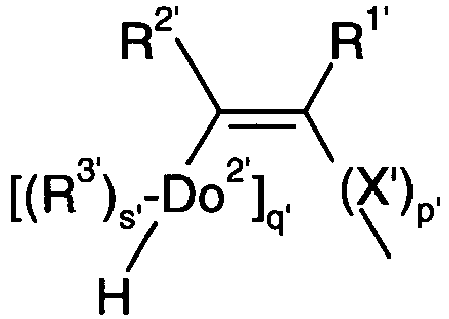
- wobei Do2', q', s', R3', R1', R2', X' und p' unabhängig die gleichen Bedeutungen wie Do2, q, s, R3, R1, R2, X und p aufweisen.
- Neben Carbenliganden der Formel II, worin Y4, das heißt die Gruppe der Formel


und Y3
sind Carbenliganden geeignet, worin Y4, das heißt die Gruppe der Formel

und Y3
ein Wasserstoff-, Alkyl-, Aryl-, Heteroaryl- oder Alkenylrest, bevorzugt ein Wasserstoff, ein Alkyl-, Heteroaryl- oder ein Arylrest
bedeutet. - Die Definitionen der Symbole entsprechen den vorstehend genannten Definitionen.
- Ganz besonders bevorzugt ist der mindestens eine Carbenligand der Formel II ausgewählt aus der Gruppe bestehend aus

- Z, Z'
- gleich oder verschieden, CH oder N;
- R12, R12'
- gleich oder verschieden, ein Alkyl-, Aryl-, Heteroaryl- oder Alkenylrest, bevorzugt ein Alkyl- oder Arylrest oder jeweils 2 Reste R12 bzw. R12' bilden gemeinsam einen anellierten Ring, der gegebenenfalls mindestens ein Heteroatom, bevorzugt N, enthalten kann, bevorzugt bilden jeweils 2 Reste R12 bzw. R12' gemeinsam einen anellierten aromatischen C6-Ring, wobei an diesen, bevorzugt sechsgliedrigen, aromatischen Ring gegebenenfalls ein oder mehrere weitere aromatische Ringe anelliert sein können, wobei jede denkbare Anellierung möglich ist, und die anellierten Reste wiederum substituiert sein können; oder R12 bzw. R12' bedeutet einen Rest mit Donor- oder Akzeptorwirkung, bevorzugt ausgewählt aus der Gruppe bestehend aus Halogenresten, bevorzugt F, Cl, Br, besonders bevorzugt F; Alkoxy-, Aryloxy-, Carbonyl-, Ester-, Aminogruppen, Amidresten, CHF2, CH2F, CF3, CN, Thiogruppen und SCN;
- t und t'
- gleich oder verschieden, bevorzugt gleich, 0 bis 3, wobei, wenn t bzw. t' > 1 ist, die Reste R12 bzw. R12' gleich oder verschieden sein können, bevorzugt ist t bzw. t' 0 oder 1, der Rest R12 bzw. R12' befindet sich, wenn t bzw. t' 1 ist, in ortho-, meta- oder para-Position zur Verknüpfungsstelle mit dem dem Carbenkohlenstoffatom benachbarten Stickstoffatom;
- R4, R5, R6, R7, R8, R9 und R11
- Wasserstoff, Alkyl, Aryl, Heteroaryl, Alkenyl oder ein Substituent mit Donoroder Akzeptorwirkung, bevorzugt ausgewählt aus Halogenresten, bevorzugt F, Cl, Br, besonders bevorzugt F, Alkoxyresten, Aryloxyresten, Carbonylresten, Esterresten, Aminresten, Amidresten, CH2F-Gruppen, CHF2-Gruppen, CF3-Gruppen, CN-Gruppen, Thiogruppen und SCN-Gruppen, bevorzugt Wasserstoff, Alkyl, Heteroaryl oder Aryl,
- R10
- Alkyl, Aryl, Heteroaryl oder Alkenyl, bevorzugt Alkyl, Heteroaryl oder Aryl, oder jeweils 2 Reste R10 bilden gemeinsam einen anellierten Ring, der gegebenenfalls mindestens ein Heteroatom, bevorzugt Stickstoff, enthalten kann, bevorzugt bilden jeweils 2 Reste R10 gemeinsam einen anellierten aromatischen C6-Ring, wobei an diesen, bevorzugt sechsgliedrigen, aromatischen Ring gegebenenfalls ein oder mehrere weitere aromatische Ringe anelliert sein können, wobei jede denkbare Anellierung möglich ist, und die anellierten Reste wiederum substituiert sein können; oder R10 bedeutet einen Rest mit Donor- oder Akzeptorwirkung, bevorzugt ausgewählt aus der Gruppe bestehend aus Halogenresten, bevorzugt F, Cl, Br, besonders bevorzugt F; Alkoxy-, Acyloxy-, Carbonyl-, Ester-, Aminogruppen, Amidresten, CHF2, CH2F, CF3, CN, Thiogruppen und SCN
- v
- 0 bis 4, bevorzugt 0, 1 oder 2, ganz besonders bevorzugt 0, wobei, wenn v 0 ist, die vier Kohlenstoffatome des Arylrests in Formel c, die gegebenenfalls mit R10 substituiert sind, Wasserstoffatome tragen.
- Bevorzugt verwendete Übergangsmetallkomplexe der Formel (I) sind somit solche, die mindestens einen Carbenliganden der Formel II enthalten, wobei bevorzugte Ausführungsformen des Carbenliganden der Formel II vorstehend erwähnt sind.
- Somit sind besonders bevorzugte Übergangsmetall-Komplexe der allgemeinen Formel I solche, die die allgemeine Formel (IB) aufweisen

- Die Bedeutungen der Symbole entsprechen den vorstehend bezüglich des Übergangsmetallkomplexes (I) und bezüglich des Carbenliganden (II) genannten Bedeutungen. Bevorzugte Ausführungsformen sind ebenfalls vorstehend genannt.
- Die Übergangsmetall-Komplexe der Formel IB können - wenn ein Metallatom M1 mit der Koordinationszahl 6 eingesetzt wird - als faciales oder meridionales Isomer oder Isomerengemisch aus facialem und meridionalem Isomer in beliebigen Mengenverhältnissen vorliegen, wenn sie eine Zusammensetzung MA3B3 - wie vorstehend ausgeführt - aufweisen. In Abhängigkeit von den Eigenschaften des facialen oder meridionalen Isomeren der Übergangsmetall-Komplexe der Formel IB kann es bevorzugt sein, entweder ein isomerenreines faciales oder ein isomerenreines meriodionales Isomer einzusetzen oder ein Isomerengemisch aus facialem und meridionalem Isomer, worin eines der Isomere im Überschuss vorliegt oder beide Isomere in gleicher Menge vorliegen. Beispielsweise sind faciale und meridionale Isomere des Übergangsmetallkomplexes der Formel IB möglich, wenn n 3 bedeutet und m und o 0 bedeuten. Für den Fall, dass die Übergangsmetall-Komplexe der Formel IB eine Zusammensetzung MA2B4 aufweisen, können die Übergangsmetallkomplexe in Form von cis/trans Isomeren in beliebigen Mengenverhältnissen vorliegen, wie vorstehend ausgeführt. In Abhängigkeit von den Eigenschaften des cis oder trans Isomeren der Übergangsmetall-Komplexe der Formel IB kann es bevorzugt sein, entweder ein isomerenreines cis oder ein isomerenreines trans Isomer einzusetzen oder ein Isomerengemisch aus cis und trans Isomer, worin eines der Isomere im Überschuss vorliegt oder beide Isomere in gleicher Menge vorliegen. Cis/trans-Isomere von Komplexen der Formel IB sind zum Beispiel möglich, wenn M1 ein Metallatom mit der Koordinationszahl 6 ist und wenn n 2 bedeutet und m 2 bedeutet, wobei die beiden monodentaten Liganden L gleich sind, und o 0 ist, oder wenn o 2 bedeutet und die beiden monodentaten Liganden K gleich sind, und m 0 ist.
- Für neutrale Übergangsmetallkomplexe, worin das Übergangsmetallatom Ir(111) mit einer Koordinationszahl von 6 ist, ist die Zahl der bevorzugten monoanionischen bidentaten Carbenliganden n mindestens 1 und maximal 3. Bevorzugt ist die Zahl der bevorzugt eingesetzten monanionischen bidentaten Carbenliganden 2 oder 3, besonders bevorzugt 3. Dabei können die Carbenliganden bei n > 1 gleich oder verschieden sein.
- Die Übergangsmetall-Komplexe der Formel IB können - wenn ein Metallatom M1 mit der Koordinationszahl 4 eingesetzt wird, das quadratisch planare Komplexe bildet - als cis- oder trans-Isomere oder als Isomerengemisch aus cis- oder trans-Isomeren in beliebigen Mengenverhältnissen vorliegen, wenn sie eine Zusammensetzung MA2B2 - wie vorstehend ausgeführt - aufweisen. Beispielsweise sind cis/trans-Isomere der Übergangsmetall-Komplexe der Formel IB möglich, wenn n 2 bedeutet und m und o 0 bedeuten.
- Für neutrale Übergansmetallkomplexe, worin das Übergangsmetallatom Pt(II) mit einer Koordinationszahl von 4 ist, ist die Zahl n der bevorzugten monoanionischen bidentaten Carbenliganden n 1 oder 2, bevorzugt 2. Dabei können die Carbenliganden bei n = 2 gleich oder verschieden sein.
- Ganz besonders bevorzugt ist ein Übergangsmetallkomplex, worin M1 Ir(III) ist, das eine Koordinationszahl von 6 aufweist. Ganz besonders bevorzugt ist n in diesem Ir(III)-Komplex 3, m 0, o 0, q 0, p 0, Do1 N und r 1, wobei die übrigen Symbole die bereits vorstehend genannten Bedeutungen aufweisen.
- Insbesondere bevorzugt sind Übergangsmetallkomplexe der Formel IBa bis d ausgewählt aus der Gruppe bestehend aus
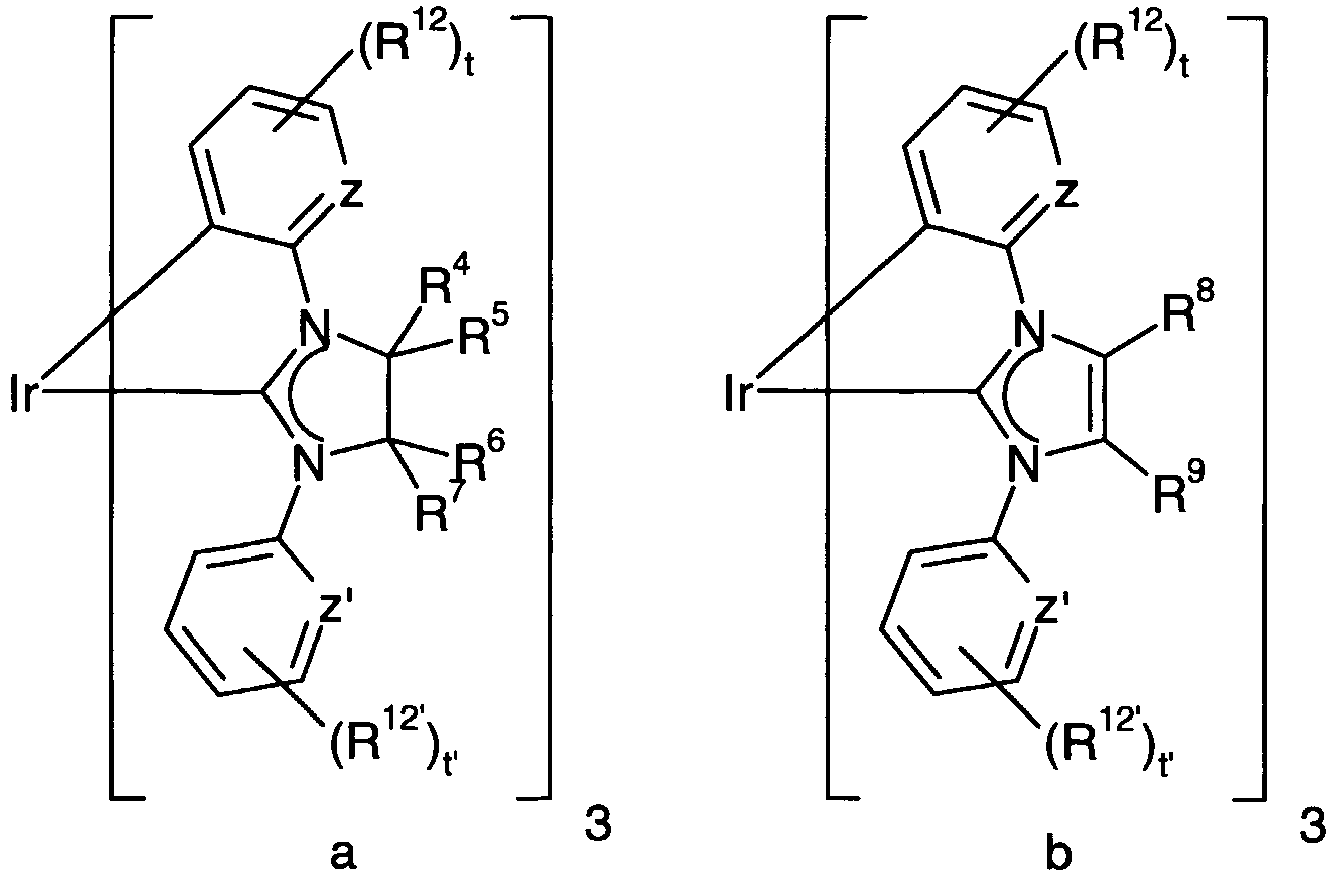

- Ganz besonders bevorzugt sind unter diesen Ir(III)-Komplexen solche der Formeln b, c und d. Insbesondere bevorzugt sind solche Ir(III)-Komplexe, worin Z und Z' CH, R8 und R9 H, t, t' und v 0 bedeuten und die übrigen Reste die bereits vorstehend bezüglich der bevorzugt geeigneten Carbenliganden genannten Bedeutungen aufweisen.
- Die vorstehend genannten neutralen Übergangsmetall-Komplexe sind hervorragend als Emittermoleküle in organischen Licht-emittierenden Dioden (OLEDs) geeignet. Durch einfache Variationen der Liganden oder des Zentralmetalls ist es möglich, Übergangsmetall-Komplexe bereit zu stellen, die Elektrolumineszenz im roten, grünen sowie insbesondere im blauen Bereich des elektromagnetischen Spektrums zeigen. Die erfindungsgemäß verwendeten neutralen Übergangsmetall-Komplexe eignen sich daher für den Einsatz in technisch verwendbaren Vollfarbendisplays.
- Des Weiteren sind die vorstehend genannten neutralen Übergangsmetallkomplexe als Elektronen-, Excitonen- oder Lochblocker in OLEDs geeignet, in Abhängigkeit von den eingesetzten Liganden und dem eingesetzten Zentralmetall.
- Ein weiterer Gegenstand der vorliegenden Anmeldung ist der Einsatz von neutralen Übergangsmetall-Komplexen der allgemeinen Formel IC in OLEDs

- M1
- Ru, Rh, Ir, Pt in jeder für das entsprechende Metallatom möglichen Oxidationsstufe, bevorzugt Ir und Pt;
- L
- mono- oder dianionischer Ligand, bevorzugt monoanionischer Ligand, der mono- oder bidentat sein kann;
- K
- neutraler mono- oder bidentater Ligand;
- n
- Zahl der Carbenliganden, wobei n mindestens 2 ist und die Carbenliganden in dem Übergangsmetall-Komplex gleich oder verschieden sein können;
- m
- Zahl der Liganden L, wobei m 0 oder ≥ 1 sein kann und die Liganden L bei m > 1 gleich oder verschieden sein können;
- o
- Zahl der Liganden K, wobei o 0 oder ≥ 1 sein kann und die Liganden K bei o > 1 gleich oder verschieden sein können;
- Do2
- Donoratom ausgewählt aus der Gruppe bestehend aus C, N, P, O und S;
- s
- 2, wenn Do2 C ist, 1, wenn Do2 N oder P ist und 0, wenn Do2 O oder S ist;
- X
- Spacer ausgewählt aus der Gruppe bestehend aus Silylen, Alkylen, Arylen, Heteroarylen oder Alkenylen, bevorzugt Alkylen oder Arylen, besonders bevorzugt C1- bis C3-Alkylen oder C6-1,4-Arylen, wobei gegebenenfalls mindestens eines der vier weiteren Kohlenstoffatome mit Methyl-, Ethyl-, n-Propyl- oder i-Propylgruppen oder mit Gruppen mit Donor- oder Akzeptorwirkung ausgewählt aus Halogenresten, bevorzugt F, Cl, Br, besonders bevorzugt F; Alkoxy-, Aryloxy-, Carbonyl-, Ester-, Aminogruppen, Amidresten, CHF2, CH2F, CF3, CN, Thiogruppen und SCN substituiert sein kann; ganz besonders bevorzugt Methylen, Ethylen oder 1,4-Phenylen;
- p
- 0 oder 1, bevorzugt 0;
- q
- 0 oder 1, bevorzugt 0;
- Y3
- ein Wasserstoff-, Alkyl-, Aryl-, Heteroaryl- oder Alkenylrest, bevorzugt ein Wasserstoff, ein Alkyl- oder ein Arylrest, oder

- R1, R2
- unabhängig voneinander Wasserstoff, Alkyl-, Aryl-, Heteroaryl- oder Alkenylreste, bevorzugt Wasserstoff, Alkylreste oder Arylreste,
oder
R1 und R2 bilden gemeinsam eine Brücke mit insgesamt drei bis fünf, bevorzugt vier Atomen, wovon ein oder zwei Atome Heteroatome, bevorzugt N, sein können und die restlichen Atome Kohlenstoffatome sind, so dass die Gruppe
- R3
- Wasserstoff, ein Alkyl-, Aryl-, Heteroaryl- oder Alkenylrest, bevorzugt Wasserstoff, ein Alkyl-, Heteroaryl- oder ein Arylrest,
- Y1, Y2
- bilden gemeinsam eine Brücke zwischen den Stickstoffatomen N, die mindestens zwei Atome aufweist, wovon mindestens eines ein Kohlenstoffatom ist, und die weiteren Atome bevorzugt Stickstoff- oder Kohlenstoffatome sind, wobei die Brücke gesättigt oder ungesättigt sein kann und die mindestens zwei Atome der Brücke substituiert oder unsubstituiert sein können, wobei - für den Fall, dass die Brücke zwei Kohlenstoffatome aufweist und gesättigt ist - mindestens eines der zwei Kohlenstoffatome substituiert ist; bevorzugt weist die Brücke zwei Atome auf, wobei die beiden Atome substituiert sein können, und ist ungesättigt.
- Bevorzugte und ganz besonders bevorzugte Ausführungsformen der Symbole in dem erfindungsgemäß eingesetzten Übergangsmetallkomplex der Formel IC sind bereits vorstehend bezüglich der erfindungsgemäß verwendeten Übergangsmetallkomplexe genannt.
- In Abhängigkeit von dem Substitutionsmuster an dem Zentralmetall M1 und bei Einsatz eines Zentalmetalls der Koordinationszahl 6, zum Beispiel Ir(III), können die oktaedrischen Übergangsmetallkomplexe in Form ihrer facialen oder meridionalen Isomere oder als Gemisch von facialen und meridionalen Isomeren in beliebigen Mengenverhältnissen vorliegen. Die Voraussetzungen zur Ausbildung facialer und meridionaler Isomere wurden bereits vorstehend erläutert. Gegenstand der vorliegenden Anmeldung sind somit ebenfalls - neben fac-mer-Isomerengemischen - die reinen facialen oder meridionalen Isomere der erfindungsgemäßen Übergangsmetall-Komplexe IC, soweit diese aufgrund des Substitutionsmusters an dem eingesetzten Zentralmetall vorliegen können. In Abhängigkeit von den Eigenschaften des facialen oder meridionalen Isomeren der Übergangsmetall-Komplexe der Formel IB kann es bevorzugt sein, entweder ein isomerenreines faciales oder ein isomerenreines meriodionales Isomer einzusetzen oder ein Isomerengemisch aus facialem und meridionalem Isomer, worin eines der Isomere im Überschuss vorliegt oder beide Isomere in gleicher Menge vorliegen. Die einzelnen Isomere können aus dem entsprechenden Isomerengemisch zum Beispiel durch Chromatographie, Sublimation oder Kristallisation isoliert werden. Entsprechende Verfahren zur Trennung der Isomere sind dem Fachmann bekannt.
- Bevorzugt ist die Gruppierung


- R4, R5, R6, R7, R8, R9 und R11
- unabhängig voneinander Wasserstoff, Alkyl, Aryl, Heteroaryl, Alkenyl oder ein Substituent mit Donor- oder Akzeptorwirkung, bevorzugt ausgewählt aus Halogenresten, bevorzugt F, Cl, Br, besonders bevorzugt F, Alkoxyresten, Aryloxyresten, Carbonylresten, Esterresten, Aminresten, Amidresten, CH2F-Grupen, CHF2-Gruppen, CF3-Gruppen, CN-Gruppen, Thiogruppen und SCN-Gruppen, bevorzugt Wasserstoff, Alkyl oder Aryl; wobei in Formel a mindestens einer der Reste R4, R5, R6 oder R7 nicht Wasserstoff bedeutet;
- R10
- Alkyl, Aryl, Heteroaryl Alkenyl, bevorzugt Alkyl oder Aryl, oder jeweils 2 Reste R10 bilden gemeinsam einen anellierten Ring, der gegebenenfalls mindestens ein Heteroatom, bevorzugt Stickstoff, enthalten kann, bevorzugt bilden jeweils 2 Reste R10 gemeinsam einen anellierten aromatischen C6-Ring, wobei an diesen, bevorzugt sechsgliedrigen, aromatischen Ring gegebenenfalls ein oder mehrere weitere aromatische Ringe anelliert sein können, wobei jede denkbare Anellierung möglich ist, und die anellierten Reste wiederum substituiert sein können; oder R10 bedeutet einen Rest mit Donor- oder Akzeptorwirkung, bevorzugt ausgewählt aus der Gruppe bestehend aus Halogenresten, bevorzugt F, Cl, Br, besonders bevorzugt F; Alkoxy-, Aryloxy-, Carbonyl-, Ester-, Aminogruppen, Amidresten, CHF2, CH2F, CF3, CN, Thiogruppen und SCN;
- v
- 0 bis 4, bevorzugt 0, 1 oder 2, ganz besonders bevorzugt 0, wobei, wenn v 0 ist, die vier Kohlenstoffatome des Arylrests in Formel c, die gegebenenfalls mit R10 substituiert sind, Wasserstoffatome tragen;
- Y3
- wurde bereits vorstehend definiert.
- Die Gruppierung


- Z
- CH oder N, wobei Z in o-, m- oder p-Position zur Verknüpfungsstelle der Gruppierung mit dem Carbenliganden angeordnet sein kann;
- R12
- ein Alkyl-, Aryl-, Heteroaryl-, Alkenylrest, bevorzugt ein Alkyl- oder Arylrest oder jeweils 2 Reste R12 bilden gemeinsam einen anellierten Ring, der gegebenenfalls mindestens ein Heteroatom, bevorzugt N, enthalten kann, bevorzugt bilden jeweils 2 Reste R12 gemeinsam einen anellierten aromatischen C6-Ring, wobei an diesen, bevorzugt sechsgliedrigen, aromatischen Ring gegebenenfalls ein oder mehrere weitere aromatische Ringe anelliert sein können, wobei jede denkbare Anellierung möglich ist, und die anellierten Reste wiederum substituiert sein können; oder R12 bedeutet einen Rest mit Donor- oder Akzeptorwirkung, bevorzugt ausgewählt aus der Gruppe bestehend aus Halogenresten, bevorzugt F, Cl, Br, besonders bevorzugt F; Alkoxy-, Aryloxy-, Carbonyl-, Ester-, Aminogruppen, Amidresten, CHF2, CH2F, CF3, CN, Thiogruppen und SCN;
- t
- 0 bis 3, wobei, wenn t > 1 ist, die Reste R12 gleich oder verschieden sein können, bevorzugt ist t 0 oder 1, der Rest R12 befindet sich, wenn t 1 ist, in ortho-, meta- oder para-Position zur Verknüpfungsstelle mit dem Spacer X, bzw., wenn p 0 ist, zur Verknüpfungsstelle mit dem dem Carbenkohlenstoffatom benachbarten Stickstoffatom.
- Y3
- kann gleich oder verschieden von der vorstehend definierten Gruppierung sein.
- Besonders bevorzugt weist der erfindungsgemäß eingesetzte Übergangsmetall-Komplex mindestens zwei Carbenliganden auf, die unabhängig voneinander ausgewählt sind aus der Gruppe bestehend aus

- Z, Z'
- gleich oder verschieden, bevorzugt gleich, CH oder N;
- R12, R12'
- gleich oder verschieden, bevorzugt gleich, ein Alkyl-, Aryl-, Heteroaryl-, Alkenylrest, bevorzugt ein Alkyl-, Heteroaryl- oder Arylrest oder jeweils 2 Reste R12 bzw. R12' bilden gemeinsam einen anellierten Ring, der gegebenenfalls mindestens ein Heteroatom, bevorzugt N, enthalten kann, bevorzugt bilden jeweils 2 Reste R12 bzw. R12' gemeinsam einen anellierten aromatischen C6-Ring, wobei an diesen, bevorzugt sechsgliedrigen, aromatischen Ring gegebenenfalls ein oder mehrere weitere aromatische Ringe anelliert sein können, wobei jede denkbare Anellierung möglich ist, und die anellierten Reste wiederum substituiert sein können; oder R12 bzw. R12' bedeutet einen Rest mit Donor- oder Akzeptorwirkung, bevorzugt ausgewählt aus der Gruppe bestehend aus Halogenresten, bevorzugt F, Cl, Br, besonders bevorzugt F; Alkoxy-, Aryloxy-, Carbonyl-, Ester-, Aminogruppen, Amidresten, CHF2, CH2F, CF3, CN, Thiogruppen und SCN;
- t und t'
- gleich oder verschieden, bevorzugt gleich, 0 bis 3, wobei, wenn t bzw. t' > 1 ist, die Reste R12 bzw. R12' gleich oder verschieden sein können, bevorzugt ist t bzw. t' 0 oder 1, der Rest R12 bzw. R12' befindet sich, wenn t bzw. t' 1 ist, in ortho-, meta- oder para-Position zur Verknüpfungsstelle mit dem dem Carbenkohlenstoffatom benachbarten Stickstoffatom;
- R8, R9 und R11
- Wasserstoff, Alkyl, Aryl, Heteroaryl, Alkenyl, oder ein Substituent mit Donoroder Akzeptorwirkung, bevorzugt ausgewählt aus Halogenresten, bevorzugt F, Cl, Br, besonders bevorzugt F, Alkoxyresten, Aryloxyresten, Carbonylresten, Esterresten, Aminresten, Amidresten, CH2F-Grupen, CHF2-Gruppen, CF3-Gruppen, CN-Gruppen, Thiogruppen und SCN-Gruppen, bevorzugt Wasserstoff, Alkyl oder Aryl;
- R10
- Alkyl, Aryl, Heteroaryl, Alkenyl, bevorzugt Alkyl, Heteroaryl oder Aryl, oder jeweils 2 Reste R10 bilden gemeinsam einen anellierten Ring, der gegebenenfalls mindestens ein Heteroatom, bevorzugt N, enthalten kann, bevorzugt bilden jeweils 2 Reste R10 gemeinsam einen anellierten aromatischen C6-Ring, wobei an diesen, bevorzugt sechsgliedrigen, aromatischen Ring gegebenenfalls ein oder mehrere weitere aromatische Ringe anelliert sein können, wobei jede denkbare Anellierung möglich ist, und die anellierten Reste wiederum substituiert sein können; oder R10 bedeutet einen Rest mit Donor- oder Akzeptorwirkung, bevorzugt ausgewählt aus der Gruppe bestehend aus Halogenresten, bevorzugt F, Cl, Br, besonders bevorzugt F; Alkoxy-, Aryloxy-, Carbonyl-, Ester-, Aminogruppen, Amidresten, CHF2, CH2F, CF3, CN, Thiogruppen und SCN;
- v
- 0 bis 4, bevorzugt 0, 1 oder 2, ganz besonders bevorzugt 0, wobei, wenn v 0 ist, die vier Kohlenstoffatome des Arylrests in Formel c, die gegebenenfalls mit R10 substituiert sind, Wasserstoffatome tragen.
- Besonders bevorzugt weisen die erfindungsgemäß eingesetzten Übergangsmetallkomplexe der allgemeinen Formel IC ein Metallatom M1 ausgewählt aus der Gruppe bestehend aus -Rh(III), Ir(III), Ru(III), Ru(IV) und Pt(II), bevorzugt Pt(II) oder Ir(III), auf. Besonders bevorzugt wird als Metallatom M1 Ir eingesetzt, bevorzugt Ir(III).
- In einer ganz besonders bevorzugten Ausführungsform ist M1 in den erfindungsgemäß eingesetzten Übergangsmetallkomplexen Ir(III), n 3 und m und o 0, wobei besonders bevorzugt die drei Carbenliganden gleich sind.
- I Die erfindungsgemäß eingesetzten Übergangsmetall-Komplexe der Formel IC können analog zu dem Fachmann bekannten Verfahren hergestellt werden. Geeignete Herstellungsverfahren sind zum Beispiel in den Übersichtsartikeln W. A. Hermann et al., Advances in Organometallic Chemistry, Vol. 48, 1 bis 69, W. A. Hermann et al., Angew. Chem. 1997, 109, 2256 bis 2282 und G. Bertrand et al. Chem. Rev. 2000, 100, 39 bis 91 und der darin zitierten Literatur aufgeführt.
- In einer Ausführungsform werden die erfindungsgemäß eingesetzten Übergangsmetallkomplexe durch Deprotonierung von den den entsprechenden Carbenliganden entsprechenden Ligandvorläufern und anschließende Umsetzung mit geeigneten, das gewünschte Metall enthaltenden, Metallkomplexen hergestellt. Daneben ist die Herstellung der erfindungsgemäß eingesetzten Übergangsmetallkomplexe durch direkte Verwendung von Wanzlick-Olefinen möglich.
- Geeignete Ligandvorläufer sind dem Fachmann bekannt. Bevorzugt handelt es sich um kationische Vorstufen.
- In einer bevorzugten Ausführungsform werden die kationischen Vorstufen deprotoniert, wobei je nach Vorläufer unterschiedliche Zwischenprodukte entstehen können. Je nach Reaktionsführung entstehen so beispielsweise Alkoxid-Derivate, dimere Wanzlick-Olefine oder die freien N-Heterocyclencarbene. Alkoxid-Derivate und Wanzlick-Olefine werden vorzugsweise in Gegenwart einer geeigneten Metallvorstufe thermisch belastet, wobei eine Abspaltung des Alkohols bzw. die Spaltung des Dimeren erfolgt und die Metallcarben-Verbindung in Anwesenheit von geeigneten Metallkomplexen gebildet wird. Wird als Zwischenprodukt das freie Carben gebildet, wird die Reaktion vorzugsweise unter Kühlung und anschließendem Erwärmen auf Raumtemperatur bzw. falls notwendig weiteres Erhitzen durchgeführt. Die Umsetzungen sind vorzugsweise in geeigneten Lösungsmitteln durchzuführen, wobei bei zweistufigen Varianten für beide Teilschritte das gleiche oder unterschiedliche Lösungsmittel verwendet werden können. Geeignete Lösungsmittel sind zum Beispiel aromatische und aliphatische Lösungsmittel oder Ether, zum Beispiel Toluol, Tetrahydrofuran. Soweit nicht mit freien Carbenen gearbeitet wird, können auch Alkohole oder chlorierte Kohlenwasserstoffe wie Methylenchlorid eingesetzt werden. Zur Herstellung freier Carbene kann auch flüssiger Ammoniak, gegebenenfalls im Gemisch mit Tetrahydrofuran, als Lösungsmittel eingesetzt werden.
- Die Deprotonierung der Ligandvorläufer kann durch basische Metallate, basische Anionen wie Metallacetate, Acetylacetonate oder Alkoxylate oder externe Basen wie KOtBu, NaO'Bu, LiOtBu, NaH, Silylamide, Amide sowie Phosphazenbasen erfolgen.
- Bevorzugt werden die erfindungsgemäß eingesetzten Übergangsmetallkomplexe der Formel IC mit N-heterocyclischen Carbenliganden durch Deprotonierung der entsprechenden kationischen Vorstufen ausgewählt aus der Gruppe bestehend aus Azoliumsalzen, insbesondere Imidazoliumsalzen, Benzimidazoliumsalzen; Triazoliumsalzen und Azolidiniumsalzen, insbesondere Imidazolidiniumsalzen, mit einer externen Base, bevorzugt KO'Bu oder Silylamide, besonders bevorzugt Silylamide, z. B. Kalium-bis-(trimethylsilyl)amid, umgesetzt. Das erhaltene Zwischenprodukt wird anschließend mit einem Komplex des gewünschten Metalls umgesetzt.
- Geeignete Komplexe des gewünschten Metalls sind dem Fachmann bekannt. Das gewünschte Metall in dem eingesetzten Metallkomplex und das entsprechende Metall des daraus hergestellten Übergangsmetallkomplexes IC müssen nicht dieselbe Oxidationsstufe aufweisen.
- Bei der Herstellung von Iridium(III)-Komplexen der allgemeinen Formel IC, die gemäß der vorliegenden Anmeldung besonders bevorzugt sind, können beispielsweise die folgenden Iridium(III)-Komplexe eingesetzt werden: [(µ-Cl)Ir(η4-1,5-cod)]2, [(µ-Cl)Ir(η2-1,5-coe)2]2, Ir(acac)3, IrCl3 x n H2O, (tht)3IrCl3, worin cod Cyclooctadien, coe Cycloocten, acac Acetylacetonat und tht Tetrahydrothiophen bedeuten.
- Die Umsetzung erfolgt bevorzugt in einem Lösungsmittel. Geeignete Lösungsmittel sind bevorzugt ausgewählt aus der Gruppe bestehend aus aromatischen, aliphatischen Lösungsmitteln, Ethern, Alkoholen und halogenierten Kohlenwasserstoffen. Alkohole und halogenierte Kohlenwasserstoffe werden im Allgemeinen nur dann eingesetzt, wenn in der Umsetzung kein freies Carben gebildet wird. Zur Generierung von freien Carbenen kann des Weiteren flüssiger Ammoniak als Lösungsmittel eingesetzt werden.
- Alkoxid-Derivate oder Wanzlick-Olefine werden üblicherweise bei Raumtemperatur zu den entsprechenden Metallvorstufen gegeben und anschließend thermisch belastet, wobei im Fall der Alkoxid-Derivate der entsprechende Alkohol abgespalten wird, bzw. die dimeren Wanzlick-Olefine gespalten werden und die Metall-Carben-Verbindung gebildet wird. Üblicherweise sind für diese Reaktion somit Temperaturen von 20 bis 120°C, bevorzugt 25 bis 110°C geeignet. Werden als Zwischenprodukte freie Carbene eingesetzt (z.B. Imidazolin-2-ylidene), so werden diese vorzugsweise zunächst unter Kühlung zur Metallvorstufe gegeben, anschließend erfolgt Erwärmung auf Raumtemperatur (20 bis 25°C) und gegebenenfalls anschließend weitere Erwärmung. Somit sind für diese Umsetzung Temperaturen von -78 bis +120°C geeignet.
- Das Verhältnis von eingesetztem Metallkomplex zu eingesetztem Ligandvorläufer ist abhängig von dem gewünschten Komplex, der mindestens zwei Carbenliganden trägt. Handelt es sich bei dem Metallatom um Ir(III), was besonders bevorzugt ist, und enthält der gewünschte Übergangsmetallkomplex drei Carbenliganden, was ebenfalls besonders bevorzugt ist, so muss die molare Menge an Ligandvorläufern etwa dreimal so groß sein wie die molare Menge an Metall im Metallkomplex, wobei ein geringer Überschuss des Ligandvorläufers eingesetzt werden kann. Das molare Verhältnis von Metall im Metallkomplex zur molaren Menge an Ligandvorläufern beträgt somit bevorzugt 1 : 3 bis 1 : 5, besonders bevorzugt 1 : 3 bis 1 : 4.
- Die molare Menge der eingesetzten Base ist abhängig von der molaren Menge des eingesetzten Ligandvorläufers wobei die Base und der Ligandvorläufer in einem molaren Verhältnis von 2 : 1 bis 1 : 1, bevorzugt 1,5 : 1 bis 1,2 : 1 eingesetzt werden.
- Im Folgenden ist beispielhaft die Herstellung von zwei erfindungsgemäß eingesetzten Iridiumkomplexen mit N-heterocyclischen Carbenliganden dargestellt:
-

- X' bedeutet eine anionische Gruppe, bevorzugt ein Halogenid, Pseudohalogenid oder eine andere monoanionische Gruppe, zum Beispiel Cl-, Br-, BF4 -, PF6 -, CN-, SCN-, besonders bevorzugt BF4-, PF6 -.
-
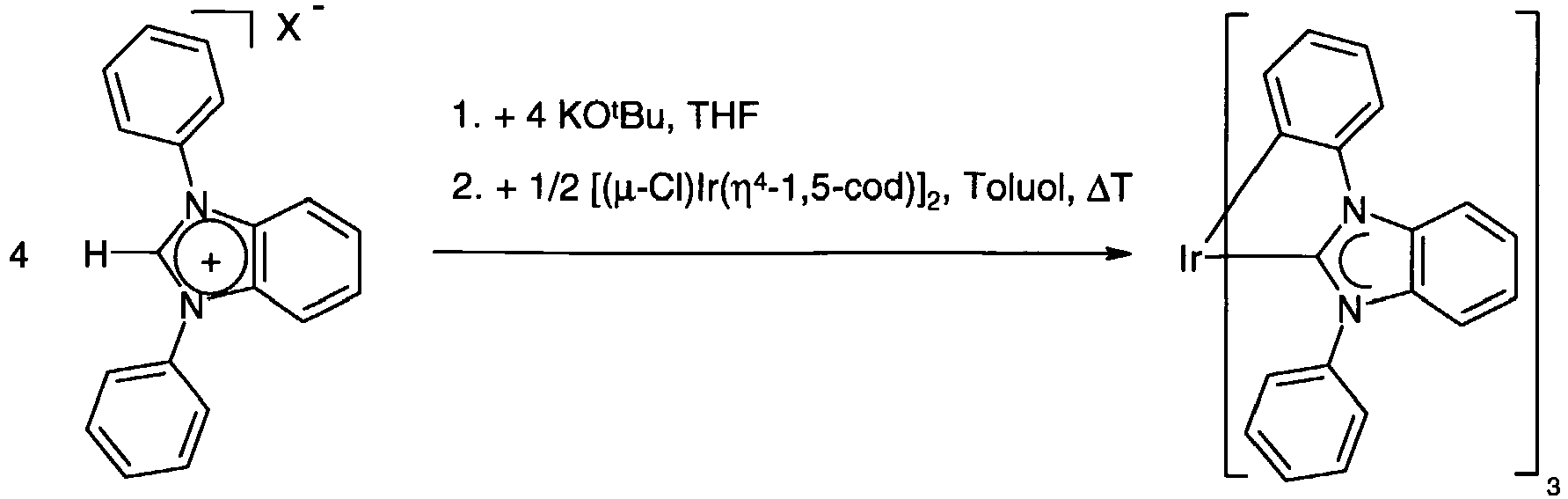
- Die erfindungsgemäß verwendeten Übergangsmetallcarbenkomplexe eignen sich hervorragend als Emittersubstanzen, da sie eine Emission (Elektrolumineszenz) im sichtbaren Bereich des elektromagnetischen Spektrums aufweisen. Mit Hilfe der erfindungsgemäß verwendeten Übergangsmetallcarbenkomplexe als Emittersubstanzen ist es möglich, Verbindungen bereit zu stellen, die Elektrolumineszenz im roten, grünen sowie im blauen Bereich des elektromagnetischen Spektrums aufweisen. Somit ist es möglich mit Hilfe der erfindungsgemäß verwendeten Übergangsmetallcarbenkomplexe als Emittersubstanzen technisch einsetzbare Vollfarbendisplays bereit zu stellen.
- Durch die Zugänglichkeit von verschieden substituierten Carbenliganden sowie verschiedenen Übergangsmetallen lassen sich Emittersubstanzen herstellen, die in verschiedenen Bereichen des elektromagnetischen Spektrums Licht emittieren. Dabei ist die Quantenausbeute hoch und die Stabilität der Übergangsmetallcarbenkomplexe im Device, insbesondere solcher mit N-heterocyclischen Carbenliganden, hoch.
- Des Weiteren sind die vorstehend genannten neutralen Übergangsmetallkomplexe als Elektronen-, Excitonen- oder Lochblocker in OLEDs geeignet, in Abhängigkeit von den eingesetzten Liganden und dem eingesetzten Zentralmetall.
- Organische Licht-emittierende Dioden sind grundsätzlich aus mehreren Schichten aufgebaut. (siehe
Figur 1 ) - 1. Anode
- 2. Löcher-transportierende Schicht
- 3. Licht-emittierende Schicht
- 4. Elektronen-transportierende Schicht
- 5. Kathode
- Es ist jedoch auch möglich, dass das OLED nicht alle der genannten Schichten aufweist, zum Beispiel ist ein OLED mit den Schichten (1) (Anode), (3) (Licht-emittierende Schicht) und (5) (Kathode) ebenfalls geeignet, wobei die Funktionen der Schichten (2) (Löcher-transportierende Schicht) und (4) (Elektronen-transportierende Schicht) durch die angrenzenden Schichten übernommen werden. OLEDs, die die Schichten (1), (2), (3) und (5) bzw. die Schichten (1), (3), (4) und (5) aufweisen, sind ebenfalls geeignet.
- Die Übergangsmetallcarbenkomplexe gemäß der vorliegenden Anmeldung können in verschiedenenen Schichten eines OLEDs eingesetzt werden. Ein weiterer Gegenstand der vorliegenden Erfindung ist daher ein OLED enthaltend mindestens einen Übergangsmetallcarbenkomplex gemäß der vorliegenden Anmeldung. Die Übergangsmetallcarbenkomplexe werden bevorzugt in der Licht-emittierenden Schicht als Emittermoleküle eingesetzt. Ein weiterer Gegenstand der vorliegenden Erfindung ist daher eine Licht-emittierende Schicht enthaltend mindestens einen Übergangsmetallcarbenkomplex als Emittermolekül. Bevorzugte Übergangsmetallcarbenkomplexe, insbesondere Übergangsmetallcarbenkomplexe mit N-heterocyclischen Carbenliganden, sind bereits vorstehend genannt.
- Die erfindungsgemaßen bzw erfindungsgemäß verwendeten Übergangsmetallcarbenkomplexe können in Substanz - ohne weitere Zusätze - in der Licht-emittierenden Schicht oder einer anderen Schicht des OLEDs, bevorzugt in der Licht-emittierenden Schicht, vorliegen. Es ist jedoch ebenfalls möglich, dass neben den erfindungsgemäß eingesetzten Übergangsmetallcarbenkomplexen weitere Verbindungen in den Schichten enthaltend mindestens einen Übergangsmetallcarbenkomplex gemäß der vorliegenden Anmeldung, bevorzugt in der Licht-emittierenden Schicht, vorliegen. Beispielsweise kann in der Licht-emittierenden Schicht ein fluoreszierender Farbstoff anwesend sein, um die Emissionsfarbe des als Emittermoleküls eingesetzten Übergangsmetallcarbenkomplexes zu verändern. Des Weiteren kann ein Verdünnungsmaterial eingesetzt werden. Dieses Verdünnungsmaterial kann ein Polymer sein, zum Beispiel Poly(N-vinylcarbazol) oder Polysilan. Das Verdünnungsmaterial kann jedoch ebenfalls ein kleines Molekül sein, zum Beispiel 4,4'-N, N'-Dicarbazolbiphenyl (CDP=CBP) oder tertiäre aromatische Amine. Wenn ein Verdünnungsmaterial eingesetzt wird, beträgt der Anteil der erfindungsgemäß eingesetzten Übergangsmetallcarbenkomplexe in der Licht-emittierenden Schicht im Allgemeinen weniger als 30 Gew.-%, bevorzugt weniger als 20 Gew.-%, besonders bevorzugt 3 bis 10 Gew.-%.
- Die einzelnen der vorstehend genannten Schichten des OLEDs können wiederum aus 2 oder mehreren Schichten aufgebaut sein. Beispielsweise kann die Löcher-transportierende Schicht aus einer Schicht aufgebaut sein, in die aus der Elektrode Löcher injiziert werden und einer Schicht, die die Löcher von der Lochinjektionsschicht weg in die Licht-emittierende Schicht transportiert. Die Elektronen-transportierende Schicht kann ebenfalls aus mehreren Schichten bestehen, zum Beispiel einer Schicht, worin Elektronen durch die Elektrode injiziert werden, und einer Schicht, die aus der Elektroneninjektionsschicht Elektronen erhält und in die Licht-emittierende Schicht transportiert. Diese genannten Schichten werden jeweils nach Faktoren wie Energieniveau, Temperaturresistenz und Ladungsträgerbeweglichkeit, sowie Energiedifferenz der genannten Schichten mit den organischen Schichten oder den Metallelektroden ausgewählt. Der Fachmann ist in der Lage, den Aufbau der OLEDs so zu wählen, dass er optimal an die erfindungsgemäß als Emittersubstanzen verwendeten Übergangsmetallcarbenkomplexe angepasst ist.
- Um besonders effiziente OLEDs zu erhalten, sollte das HOMO (höchstes besetztes Molekülorbital) der Loch-transportierenden Schicht mit der Arbeitsfunktion der Anode angeglichen sein und das LUMO (niedrigstes unbesetztes Molekülorbital) der elektronentransportierenden Schicht sollte mit der Arbeitsfunktion der Kathode angeglichen sein.
- Ein weiterer Gegenstand der vorliegenden Anmeldung ist ein OLED enthaltend mindestens eine erfindungsgemäße Licht-emittierende Schicht. Die weiteren Schichten in dem OLED können aus einem beliebigen Material aufgebaut sein, das üblicherweise in solchen Schichten eingesetzt wird und dem Fachmann bekannt ist.
- Die Anode (1) ist eine Elektrode, die positive Ladungsträger bereitstellt. Sie kann zum Beispiel aus Materialien aufgebaut sein, die ein Metall, eine Mischung verschiedener Metalle, eine Metalllegierung, ein Metalloxid oder eine Mischung verschiedener Metalloxide enthält. Alternativ kann die Anode ein leitendes Polymer sein. Geeignete Metalle umfassen die Metalle der Gruppen 11, 4, 5 und 6 des Periodensystems der Elemente sowie die Übergangsmetalle der Gruppen 8 bis 10. Wenn die Anode lichtdurchlässig sein soll, werden im Allgemeinen gemischte Metalloxide der Gruppen 12, 13 und 14 des Periodensystems der Elemente eingesetzt, zum Beispiel tndium-Zinn-Oxid (ITO). Es ist ebenfalls möglich, dass die Anode (1) ein organisches Material, zum Beispiel Polyanilin enthält, wie beispielsweise in Nature, Vol. 357, Seiten 477 bis 479 (11. Juni 1992) beschrieben ist. Zumindest entweder die Anode oder die Kathode sollten mindestens teilweise transparent sein, um das gebildete Licht auskoppeln zu können.
- Geeignete Lochtransportmaterialien für die Schicht (2) des erfindungsgemäßen OLEDs sind zum Beispiel in Kirk-Othmer Encyclopedia of Chemical Technologie, 4. Auflage, Vol. 18, Seiten 837 bis 860, 1996 offenbart. Sowohl Löcher transportierende Moleküle als auch Polymere können als Lochtransportmaterial eingesetzt werden. Üblicherweise eingesetzte Löcher transportierende Moleküle sind ausgewählt aus der Gruppe bestehend aus 4,4'-Bis[N-(1-naphthyl)-N-phenyl-amino]biphenyl (α-NPD), N, N'-Diphenyl-N, N'-Bis(3-methylphenyl)-[1,1'-biphenyl]-4,4'-diamin (TPD), 1,1-Bis[(di-4-tolylamino)-phenyl]cyclohexan (TAPC), N, N'-Bis(4-methylphenyl)-N, N'-Bis(4-ethylphenyl)-[1,1'-(3,3'-dimethyl)biphenyl]-4,4'-diamin (ETPD), Tetrakis-(3-methylphenyl))-N,N,N',N'-2,5-phenylendiamin (PDA), α-Phenyl-4-N,N-diphenylaminostyrol (TPS), p-(Diethylamino)-benzaldehyddiphenylhydrazon (DEH), Triphenylamin (TPA), Bis[4-(N,N-diethylamino)-2-methylphenyl)(4-methyl-phenyl)methan (MPMP), 1-Phenyl-3-[p-(diethylamino)styryl]-5-[p-(diethylamino)phenyl]pyrazolin (PPR oder DEASP), 1,2-trans-Bis(9H-carbazol-9-yl)cyclobutan (DCZB), N,N,N',N'-tetrakis(4-methy)phenyl)-(1,1'-biphenyl)-4,4'-diamin (TTB) 4,4',4"-tris(N,N-Diphenylamino)triphenylamin (TDTA) und Porphyrinverbindungen sowie Phthalocyaninen wie Kupferphthalocyanine. Üblicherweise eingesetzte Löcher transportierende Polymere sind ausgewählt aus der Gruppe bestehend aus Polyvinylcarbazolen, (Phenylmethyl)polysilanen, PEDOT (Poly(3,4-ethylendioxythiophen), bevorzugt PEDOT dotiert mit PSS (Polystyrolsulfonat), und Polyanilinen. Es ist ebenfalls möglich, Löcher transportierende Polymere durch Dotieren Löcher transportierender Moleküle in Polymere wie Polystyrol und Polycarbonat zu erhalten. Geeignete Löcher transportierende Moleküle sind die bereits vorstehend genannten Moleküle.
- Geeignete Elektronentransportmaterialien für die Schicht (4) der erfindungsgemäßen OLEDs umfassen mit oxinoiden Verbindungen chelatisierte Metalle wie Tris(8-hydroxychinolato)aluminium (Alq3), Verbindungen auf Phenanthrolinbasis wie 2,9-Dimethyl, 4,7-Diphenyl-1, 10-phenanthrolin (DDPA = BCP) oder 4,7-Diphenyl-1, 10-phenanthrolin (DPA) und Azolverbindungen wie 2-(4-Biphenylyl)-5-(4-t-butylphenyl)-1,3,4-oxadiazol (PBD) und 3-(4-Biphenylyl)-4-phenyl-5-(4-t-butylphenyl)-1,2,4-triazol (TAZ). Dabei kann die Schicht (4) sowohl zur Erleichterung des Elektronentransports dienen als auch als Pufferschicht oder als Sperrschicht, um ein Quenchen des Excitons an den Grenzflächen der Schichten des OLEDs zu vermeiden. Vorzugsweise verbessert die Schicht (4) die Beweglichkeit der Elektronen und reduziert ein Quenchen des Excitons.
- Von den vorstehend als Lochtransportmaterialien und Elektronen transportierende Materialien genannten Materialien können einige mehrere Funktionen erfüllen. Zum Beispiel sind einige der Elektronen leitenden Materialien gleichzeitig Löcher blockende Materialien, wenn sie ein tief liegendes HOMO aufweisen.
- Die Ladungstransportschichten können auch elektronisch dotiert sein, um die Transporteigenschaften der eingesetzten Materialien zu verbessern, um einerseits die Schichtdicken großzügiger zu gestalten (Vermeidung von Pinholes/Kurzschlüssen) und um andererseits die Betriebsspannung des Devices zu minimieren. Beispielsweise können die Lochtransportmaterialien mit Elektronenakzeptoren dotiert werden, zum Beispiel können Phthalocyanine bzw. Arylamine wie TPD oder TDTA mit Tetrafluorotetracyano-chinodimethan (F4-TCNQ) dotiert werden. Die Elektronentransportmaterialien können zum Beispiel mit Alkalimetallen dotiert werden, beispielsweise Alq3 mit Lithium. Die elektronische Dotierung ist dem Fachmann bekannt und zum Beipsiel in W. Gao, A. Kahn, J. Appl. Phys., Vol. 94, No. 1, 1 July 2003 (p-dotierte organische Schichten); A. G. Werner, F. Li, K. Harada, M. Pfeiffer, T. Fritz, K. Leo, Appl. Phys. Lett., Vol. 82, No. 25, 23 June 2003 und Pfeiffer et al., Organic Electronics 2003, 4, 89 - 103 offenbart.
- Die Kathode (5) ist eine Elektrode, die zur Einführung von Elektronen oder negativen Ladungsträgern dient. Die Kathode kann jedes Metall oder Nichtmetall sein, das eine geringere Arbeitsfunktion aufweist als die Anode. Geeignete Materialien für die Kathode sind ausgewählt aus der Gruppe bestehend aus Alkalimetallen der Gruppe 1, zum Beispiel Li, Cs, Erdalkalimetallen der Gruppe 2, Metallen der Gruppe 12 des Periodensystems der Elemente, umfassend die Seltenerdmetalle und die Lanthanide und Aktinide. Des Weiteren können Metalle wie Aluminium, Indium, Calcium, Barium, Samarium und Magnesium sowie Kombinationen davon eingesetzt werden. Weiterhin können Lithium enthaltende organometallische Verbindungen oder LiF zwischen der organischen Schicht und der Kathode aufgebracht werden, um die Betriebsspannung (Operating Voltage) zu vermindern.
- Das OLED gemäß der vorliegenden Erfindung kann zusätzlich weitere Schichten enthalten, die dem Fachmann bekannt sind. Beispielsweise kann zwischen der Schicht (2) und der Licht emittierenden Schicht (3) eine Schicht aufgebracht sein, die den Transport der positiven Ladung erleichtert und/oder die Bänderlücke der Schichten aneinander anpasst. Alternativ kann diese weitere Schicht als Schutzschicht dienen. In analoger Weise können zusätzliche Schichten zwischen der Licht emittierenden Schicht (3) und der Schicht (4) vorhanden sein, um den Transport der negativen Ladung zu erleichtern und/oder die Bänderlücke zwischen den Schichten aneinander anzupassen. Alternativ kann diese Schicht als Schutzschicht dienen.
- In einer bevorzugten Ausführungsform enthält das erfindungsgemäße OLED zusätzlich zu den Schichten (1) bis (5) mindestens eine der im Folgenden genannten weiteren Schichten:
- eine Loch-Injektionsschicht zwischen der Anode (1) und der Löchertransportierenden Schicht (2);
- eine Blockschicht für Elektronen und/oder Excitonen zwischen der Löchertransportierenden Schicht (2) und der Licht-emittierenden Schicht (3);
- eine Blockschicht für Löcher und/oder Excitonen zwischen der Licht-emittierenden Schicht (3) und der Elektronen-transportierenden Schicht (4);
- eine Elektronen-Injektionsschicht zwischen der Elektronen-transportierenden Schicht (4) und der Kathode (5).
- Es ist jedoch auch möglich, dass das OLED nicht alle der genannten Schichten (1) bis (5) aufweist, zum Beispiel ist ein OLED mit den Schichten (1) (Anode), (3) (Licht-emittierende Schicht) und (5) (Kathode) ebenfalls geeignet, wobei die Funktionen der Schichten (2) (Löcher-transportierende Schicht) und (4) (Elektronen-transportierende Schicht) durch die angrenzenden Schichten übernommen werden. OLEDs, die die Schichten (1), (2), (3) und (5) bzw. die Schichten (1), (3), (4) und (5) aufweisen, sind ebenfalls geeignet.
- Dem Fachmann ist bekannt, wie er (zum Beispiel auf Basis von elektrochemischen Untersuchungen) geeignete Materialien auswählen muss. Geeignete Materialien für die einzelnen Schichten sind dem Fachmann bekannt und z.B. in
WO 00/70655 - Des Weiteren kann jede der genannten Schichten des erfindungsgemäßen OLEDs aus zwei oder mehreren Schichten aufgebaut sein. Des Weiteren ist es möglich, dass einige oder alle der Schichten (1), (2), (3), (4) und (5) oberflächenbehandelt sind, um die Effizienz des Ladungsträgertransports zu erhöhen. Die Auswahl der Materialien für jede der genannten Schichten ist bevorzugt dadurch bestimmt, ein OLED mit einer hohen Effizienz zu erhalten.
- Die Herstellung des erfindungsgemäßen OLEDs kann nach dem Fachmann bekannten Methoden erfolgen. Im Allgemeinen wird das OLED durch aufeinanderfolgende Dampfabscheidung (Vapor deposition) der einzelnen Schichten auf ein geeignetes Substrat hergestellt. Geeignete Substrate sind zum Beispiel Glas oder Polymerfilme. Zur Dampfabscheidung können übliche Techniken eingesetzt werden wie thermische Verdampfung, Chemical Vapor Deposition und andere. In einem alternativen Verfahren können die organischen Schichten aus Lösungen oder Dispersionen in geeigneten Lösungsmitteln beschichtet werden, wobei dem Fachmann bekannte Beschichtungstechniken angewendet werden. Zusammensetzungen, die neben dem mindestens einen erfindungsgemäß eingesetzten Übergangsmetallcarbenkomplex ein polymeres Material in einer der Schichten des OLEDs, bevorzugt in der Licht-emittierenden Schicht, aufweisen, werden im Allgemeinen mittels lösungsverarbeitenden Verfahren als Schicht aufgebracht.
- Im Allgemeinen haben die verschiedenen Schichten folgende Dicken: Anode (2) 500 bis 5000 Å, bevorzugt 1000 bis 2000 Å; Löcher-transportierende Schicht (3) 50 bis 1000 Å, bevorzugt 200 bis 800 Å, Licht-emittierende Schicht (4) 10 bis 1000 Å, bevorzugt 100 bis 800 Å, Elektronen transportierende Schicht (5) 50 bis 1000 Å, bevorzugt 200 bis 800 Å, Kathode (7) 200 bis 10.000 Å, bevorzugt 300 bis 5000 Å. Die Lage der Rekombinationszone von Löchern und Elektronen in dem erfindungsgemäßen OLED und somit das Emissionsspektrum des OLED können durch die relative Dicke jeder Schicht beeinflusst werden. Das bedeutet, die Dicke der Elektronentransportschicht sollte bevorzugt so gewählt werden, dass die Elektronen/Löcher Rekombinationszone in der Licht-emittierenden Schicht liegt. Das Verhältnis der Schichtdicken der einzelnen Schichten in dem OLED ist von den eingesetzten Materialien abhängig. Die Schichtdicken von gegebenenfalls eingesetzten zusätzlichen Schichten sind dem Fachmann bekannt.
- Durch Einsatz des erfindungsgemäß verwendeten Übergangsmetallcarbenkomplexe in mindestens einer Schicht des erfindungsgemäßen OLEDs, bevorzugt als Emittermolekül in der Licht-emittierenden Schicht der erfindungsgemäßen OLEDs, können OLEDs mit hoher Effizienz erhalten werden. Die Effizienz der erfindungsgemäßen OLEDs kann des Weiteren durch Optimierung der anderen Schichten verbessert werden. Beispielsweise können hoch effiziente Kathoden wie Ca, Ba oder LiF eingesetzt werden. Geformte Substrate und neue Löcher-transportierende Materialien, die eine Reduktion der Operationsspannung oder eine Erhöhung der Quanteneffizienz bewirken, sind ebenfalls in den erfindungsgemäßen OLEDs einsetzbar. Des Weiteren können zusätzliche Schichten in den OLEDs vorhanden sein, um die Energielevel der verschiedenen Schichten einzustellen und um Elektrolumineszenz zu erleichtern.
- Die erfindungsgemäßen OLEDs können in allen Vorrichtungen eingesetzt werden, worin Elektrolumineszenz nützlich ist. Geeignete Vorrichtungen sind bevorzugt ausgewählt aus stationären und mobilen Bildschirmen. Stationäre Bildschirme sind z.B. Bildschirme von Computern, Fernsehern, Bildschirme in Druckern, Küchengeräten sowie Reklametafeln, Beleuchtungen und Hinweistafeln. Mobile Bildschirme sind z.B. Bildschirme in Handys, Laptops, Digitalkameras, Fahrzeugen sowie Zielanzeigen an Bussen und Bahnen.
- Weiterhin können die erfindungsgemäß eingesetzten Übergangsmetallcarbenkomplexe in OLEDs mit inverser Struktur eingesetzt werden. Bevorzugt werden die Übergangsmetallcarbenkomplexe in diesen inversen OLEDs wiederum in der Licht-emittierenden Schicht eingesetzt. Der Aufbau von inversen OLEDs und die üblicherweise darin eingesetzten Materialien sind dem Fachmann bekannt.
- Die vorstehend beschriebenen erfindungsgemäß eingesetzten Übergangsmetall-Komplexe können neben dem Einsatz in OLEDs als Färbemittel eingesetzt werden, die bei Einstrahlung von Licht im sichtbaren Bereich des elektromagnetischen Spektrums emittieren (Photolumineszenz). Solche Färbemittel werden bevorzugt als Färbemittel in polymeren Materialien eingesetzt.
- Ein weiterer Gegenstand der vorliegenden Anmeldung ist daher die Verwendung der vorstehend beschriebenen der erfindungsgemäß eingesetzten Übergangsmetall-Komplexe zur Massenfärbung polymerer Materialien.
- Geeignete polymere Materialien sind Polyvinylchlorid, Celluloseacetat, Polycarbonate, Polyamide, Polyurethane, Polyimide, Polybenzimidazole, Melaminharze, Silikone, Polyester, Polyether, Polystyrol, Polymethylmethacrylat, Polyethylen, Polypropylen, Polyvinylacetat, Polyacrylnitril, Polybutadien, Polychlorbutadien, Polyisopren bzw. die Copolymere der aufgeführten Monomere.
- Des Weiteren können die vorstehend beschriebenen erfindungsgemäß eingesetzten Übergangsmetallkomplexe in den folgenden Anwendungen eingesetzt werden:
- Anwendung der Übergangsmetallkomplexe als oder in Küpenfarbstoffe(n), zum Beispiel zur Färbung von Naturstoffen, Beispiele sind Papier, Holz, Stroh, Leder, Felle oder natürliche Fasermaterialien wie Baumwolle, Wolle, Seide, Jute, Sisal, Hanf, Flachs oder Tierhaare (zum Beispiel Rosshaar) und deren Umwandlungsprodukte wie zum Beispiel die Viskosefaser, Nitratseide oder Kupferrayon (Reyon)
- Anwendung der Übergangsmetallkomplexe als Farbmittel, zum Beispiel zur Färbung von Farben, Lacken und anderen Anstrichstoffen, Papierfarben, Druckfarben, Tinten und andere Farben für Mal- und Schreib-Zwecke.
- Anwendung der Übergangsmetallkomplexe als Pigmentfarbstoffe, zum Beispiel zur Färbung von Farben, Lacken und anderen Anstrichsstoffen, Papierfarben, Druckfarben, Tinten und andere Farben für Mal- und Schreib-Zwecke.
- Anwendung der Übergangsmetallkomplexe als Pigmente in der Elektrophotographie: zum Beispiel für Trockenkopiersysteme (Xerox-Verfahren) und Laserdrucker.
- Anwendung der Übergangsmetallkomplexe für Sicherheitsmarkierungs-Zwecke, wobei die große chemische und photochemische Beständigkeit und gegebenenfalls auch die Lumineszenz der Substanzen von Bedeutung ist. Bevorzugt ist dies für Schecks, Scheckkarten, Geldscheine Coupons, Dokumente, Ausweispapiere und dergleichen, bei denen ein besonderer, unverkennbarer Farbeindruck erzielt werden soll.
- Anwendung der Übergangsmetallkomplexe als Zusatz zu anderen Farben, bei denen eine bestimmte Farbnuance erzielt werden soll, bevorzugt sind besonders leuchtende Farbtöne.
- Anwendung der Übergangsmetallkomplexe zum Markieren von Gegenständen zum maschinellen Erkennen dieser Gegenstände über die Lumineszenz, bevorzugt ist die maschinelle Erkennung von Gegenständen zum Sortieren, zum Beispiel auch für das Recycling von Kunststoffen.
- Anwendung der Übergangsmetallkomplexe als Lumineszenzfarbstoffe für maschinenlesbare Markierungen, bevorzugt sind alphanumerische Aufdrucke oder Barcodes.
- Anwendung der Übergangsmetallkomplexe zur Frequenzumsetzung von Licht, zum Beispiel um aus kurzwelligem Licht längerwelliges, sichtbares Licht zu machen.
- Anwendung der Übergangsmetallkomplexe in Anzeigeelementen für vielerlei Anzeige-, Hinweis- und Markierungszwecke, zum Beispiel in passiven Anzeigeelementen, Hinweis- und Verkehrszeichen, wie Ampeln.
- Anwendung der Übergangsmetallkomplexe in Tintenstrahldruckern, bevorzugt in homogener Lösung als lumineszierende Tinte.
- Anwendung der Übergangsmetallkomplexe als Ausgangsmaterial für supraleitende organische Materialien.
- Anwendung der Übergangsmetallkomplexe für Feststoff-Lumineszenz-Markierungen.
- Anwendung der Übergangsmetallkomplexe für dekorative Zwecke.
- Anwendung der Übergangsmetallkomplexe zu Tracer-Zwecken, zum Beispiel in der Biochemie, Medizin, Technik und Naturwissenschaft. Hierbei können die Farbstoffe kovalent mit Substraten verknüpft sein oder über Nebenvalenzen wie Wasserstoffbrückenbindungen oder hydrophobe Wechselwirkungen (Adsorption).
- Anwendung der Übergangsmetallkomplexe als Lumineszenzfarbstoffe in hochempfindlichen Nachweisverfahren (siehe C. Aubert, J. Fünfschilling, I. Zschocke-Gränacher und H. Langhals, Z. Analyt. Chem. 320 (1985) 361).
- Anwendung der Übergangsmetallkomplexe als Lumineszenzfarbstoffe in Szintillatoren.
- Anwendung der Übergangsmetallkomplexe als Farbstoffe oder Lumineszenzfarbstoffe in optischen Lichtsammelsystemen.
- Anwendung der Übergangsmetallkomplexe als Farbstoffe oder Lumineszenzfarbstoffe in Lumineszenz-Solarkollektoren (siehe Langhals, Nachr. Chem. Tech. Lab. 28 (1980) 716).
- Anwendung der Übergangsmetallkomplexe als Farbstoffe oder Lumineszenzfarbstoffe in Lumineszenz-aktivierten Displays (siehe W. Greubel und G. Baur, Elektronik 26 (1977) 6).
- Anwendung der Übergangsmetallkomplexe als Farbstoffe oder Lumineszenzfarbstoffe in Kaltlichtquellen zur lichtinduzierten Polymerisation zur Darstellung von Kunststoffen.
- Anwendung der Übergangsmetallkomplexe als Farbstoffe oder Lumineszenzfarbstoffe zur Materialprüfung, zum Beispiel bei der Herstellung von Halbleiterschaltungen.
- Anwendung der Übergangsmetallkomplexe als Farbstoffe oder Lumineszenzfarbstoffe zur Untersuchung von Mikrostrukturen von integrierten Halbleiterbauteilen.
- Anwendung der Übergangsmetallkomplexe als Farbstoffe oder Lumineszenzfarbstoffe in Photoleitern.
- Anwendung der Übergangsmetallkomplexe als Farbstoffe oder Lumineszenzfarbstoffe in fotografischen Verfahren.
- Anwendung der Übergangsmetallkomplexe als Farbstoffe oder Lumineszenzfarbstoffe in Anzeige-, Beleuchtungs- oder Bildwandlersystemen, bei denen die Anregung durch Elektronen, Ionen oder UV-Strahlung erfolgt, zum Beispiel in Lumineszenzanzeigen, Braunschen Röhren oder in Leuchtstoffröhren.
- Anwendung der Übergangsmetallkomplexe als Farbstoffe oder Lumineszenzfarbstoffe als Teil einer integrierten Halbleiterschaltung, die Farbstoffe als solche oder in Verbindung mit anderen Halbleitern zum Beispiel in Form einer Epitaxie.
- Anwendung der Übergangsmetallkomplexe als Farbstoffe oder Lumineszenzfarbstoffe in Chemilumineszenzsystemen, zum Beispiel in Chemilumineszenz-Leuchtstäben, in Lumineszenzimmunessays oder anderen Lumineszenznachweisverfahren.
- Anwendung der Übergangsmetallkomplexe als Farbstoffe oder Lumineszenzfarbstoffe als Signalfarben, bevorzugt zum optischen Hervorheben von Schriftzügen und Zeichnungen oder anderen graphischen Produkten, zum Kennzeichnen von Schildern und anderen Gegenständen, bei denen ein besonderer optischer Farbeindruck erreicht werden soll.
- Anwendung der Übergangsmetallkomplexe als Farbstoffe oder Lumineszenzfarbstoffe in Farbstoff-Lasern, bevorzugt als Lumineszenzfarbstoffe zur Erzeugung von Laserstrahlen.
- Anwendung der Übergangsmetallkomplexe als aktive Substanzen für eine nichtlineare Optik, zum Beispiel für die Frequenzverdopplung und die Frequenzverdreifachung von Laserlicht.
- Anwendung der Übergangsmetallkomplexe als Rheologieverbesserer.
- Anwendung der Übergangsmetallkomplexe als Farbstoffe in photovoltaischen Anordnungen zur Umwandlung elektromagnetischer Strahlung in elektrische Energie.
- Die nachfolgenden Beispiele erläutern die Erfindung zusätzlich.
- Die notwendigen Ligandvorstufen wurden in Anlehnung an Literaturvorschriften hergestellt:
-

- Die Synthese erfolgt ausgehend von N,N-Diphenylethan-1,2-diamin in Anlehnung an Organic Letters, 1999, 1, 953-956; Angewandte Chemie, 2000, 112, 1672-1674. Das Bisamin wird dabei mit Triethlyformiat in Gegenwart von Ammoniumtetrafluoroborat umgesetzt.
Nach Rekristallisation in Ethanol wurde die Verbindung erhalten.
1H-NMR (400 MHz, DMSO): - δ = 4.60 (s, 4H, CH2), 7.40 (tt, 2H), 7.57 (dd, 4H), 7.65 (dd, 4H), 9.95 (s, 1H, C+H)
- δ=48.2, 118.4, 127.0, 129.6, 136.0, 151.7
-

- Die Synthese startet in Anlehnung an Chem. Ber. 1971, 104, 92-109 (besonders Seite 106) mit der Herstellung des Bisimins aus Glyoxal und Anilin, bzw. para-Toluidin. Die erhaltenen Schiffsche Basen werden gemäß Journal of Organometallic Chemistry 2002, 606, 49-54 durch Behandlung mit einer salzsauren Suspension von paraFormaldehyd in Dioxan in das entsprechende Imidazoliumchlorosalz überführt.
- δ = 7.64 (t,2H), 7.72 (t, 4H), 7.93 (d, 4H), 8.60 (d, 2H), 10.75 (s, 1H)
MS (ESI, ACN/H2O 8/2): - m/e = 221.0
- 1H-NMR (500 MHz, DMSO):
- δ = 2.42 (s, 6H), 7.49 (d, 4H), 7.88 (d, 4H), 8.61 (d, 2H,), 10.52 (t, 1H)
- Ein Austausch des Anions ist möglich durch Behandlung entweder mit AgBF4 bzw. NaBF4.
-

- Die Synthese erfolgt ausgehend von 1,2-Phenylendiamin. Nach Einführung der Acetylgruppen auf die Aminofunktionen wurde das erhaltene Amid gemäss der Vorschrift aus Synthetic Communications, 2000, 30, 3651-3668 mit Hilfe eines Kupferkatalysierten Protokolls die Phenylgruppierung eingeführt. Ohne Aufreinigung wurde das Material in kochender ethanolischer KOH-Lösung behandelt. Das Produkt wurde durch Chromatographie erhalten.
1H-NMR (CD2Cl2, 500 MHz): - δ = 5.70 (s, breit, 2H), 6.87 (t, 2H), 6.93 (d, 4H), 6.97 (dd, 2H), 7.22 (t, 4H), 7.28 (dd, 2H)
- Die Herstellung des benötigten Imidazoliumsalzes erfolgte durch Behandlung von N,N'-Diphenylbenzol-1,2-diamin durch Triethylameisensäureorthoester in Gegenwart von Ammoniumtetrafluoroborat. Durch Kristallisation wurde das Material erhalten.
1H-NMR (DMSO, 400 MHz): - δ = 7.74-7.84 (m, 8H), 7.91-7.98 (m, 6H), 10.57 (s, 1H)
-

- In einem mit Argon gespülten Kolben legte man im Argon-Gegenstrom 3,16 g (20 mmol) des 2,3-Diaminonaphthalen (Acros) und 6,28 g (40 mmol) destilliertes Brombenzol (Aldrich) in 80 mL Toluol (wasserfrei) vor. Durch anlegen eines Vakuums an den Kolben entgaste man die braune Suspension. Danach belüftete man sie wieder mit Argon und gab im Argongegenstrom eine Spatelspitze Pd2(dba)3, eine Spatelspitze 9,9-Dimethyl-4,5-bis(diphenylphosphino)xanthene (Xantphos), 2,70 g (28 mmol) Natriumtertbutylat und 0,36 g (20 mmol) entgastes Wasser zu. Die braune Suspension wurde bis zum Rückfluss erhitzt und 15 h bei Rückfluss rühren gelassen. Danach wurde sie auf Raumtemperatur kommen gelassen.
- Zur Aufarbeitung wurde der Ansatz mit Methylenchlorid verdünnt und zweimal gegen Wasser extrahiert, dann mit Natriumsulfat getrocknet und nach Filtration das Filtrat im Vakuum eingeengt. Der Rückstand wurde säulenchromatographisch aufgereinigt (Kieselgel, Methylenchlorid mit 5 mL Triethylamin pro L Methylenchlorid). Die Fraktionen, die das Produkt enthielten, wurden vereinigt, und im Vakuum vom Lösungsmittel befreit. Es wurden 2,7 g (43,5%) von Verbindung (4a) erhalten.
1H-NMR (CDCl3, 400 MHz): - δ = 5.85 (s, breit, NH), 6.97 (tt, 2H, J = 7.3 Hz, J = 1.2 Hz), 7.07 (dd, 4H, J = 8.7 Hz, J = 1.1 Hz), 7.28-7.32 (m, 6H), 7.60 (dd, 2H, J = 6.1 Hz, J = 3.1 Hz), 7.64 (s, 2H)
- m/e = 310.0, 311.0, 312.0 (M+)
-

- Einen Zweihalskolben spülte man 20 Minuten mit Stickstoff. Dann löste man 7,68 g (24,74 mmol) der 2,3-Di-N-phenylaminonaphthalin in 51,34 g (346,4 mmol) Triethylformiat bei 100°C und gab 2,59 g (24,74 mmol) Ammoniumtetrafluorborat auch unter Stickstoff Gegenstrom hinzu. Dann heizte man die Lösung bis zum Rückfluss und ließ 12 h unter Rückfluss rühren. Darauf wurde das Reaktionsgemisch auf Raumtemperatur gebracht.
- Zur Aufarbeitung wurde das Reaktionsgemisch über eine G4-Fritte abgesaugt und mit Orthoester gewaschen. Dann trochnete man ihn bei 50°C im Vakuumtrockenschrank. Das so erhaltene Material (6.05 g) wurde in Methylenchlorid gelöst und über einen Filter abgesaugt. Die Mutterlauge engte man im Vakuum ein und trocknete sie bei 50°C erneut im Vakkumtrockenschrank. Es wurden 5,37 g (53%) der Verbindung (4) erhalten.
1H-NMR (0114600902, 400 MHz, CD2Cl2): - δ = 7.69 (dd, 2H, J 2.9 Hz, J = 6.7 Hz), 7.76-7.82 (m, 6H), 7.91-7.95 (m, 4H), 8.10 (dd, 2H, J = 3.3 Hz, J = 6.6 Hz), 8.29 (s, etwas breiter, 2H), 9.75 (s, 1H)
-
Exp. 18,3 % F 67,2 % C 6,8 % N 4,10 % H Theor. 18.6 % F 67.6 % C 6.8 % N 4,16 % H - Ir(Imidazolidin)3 wurde in Anlehnung an eine Vorschrift von P. B. Hitchcock, M. F. Lappert, P. Terreros, J. Organomet. Chem. 1982, 239, C26-C30 hergestellt. Im Gegensatz zur erwähnten Literaturvorschrift wurde als Edukt das Imidazolidiniumsalz und nicht das Wanzlick-Olefin eingesetzt.
- Darstellung der Metallcarbenkomplexe (Alle beschriebenen Synthesen wurden unter Inertgasatmosphäre mittels Schlenk-Technik in absoluten Lösungsmitteln durchgeführt):
-

- In einem 100 mL Dreihalskolben wurden 3.0 g (9.6 mmol) des Imidazoliumsalzes (Verbindung (1)) in 40 mL Tetrahydrofuran suspendiert. Die hellbraune Suspension wurde bei Raumtemperatur mit einer Lösung von 1.11 g (9.7mmol) KOtBu in 10 mL THF versetzt. Der Ansatz wurde eine Stunde bei Raumtemperatur gerührt und anschließend zur Trockene eingeengt. Nach Wiederaufnahme in 30 mL Toluol wurde diese Suspension zu einer Lösung von 820 mg (1.2 mmol) [(µ-Cl)(η4-1,5-cod)Ir]2 in 20 mL Toluol zugegeben. Die Reaktionsmischung wurde 2 Stunden unter Rückfluß erhitzt, über Nacht bei Raumtemperatur gerührt und im Anschluß nochmals 3.5 Stunden unter Rückfluß erhitzt. Man ließ auf Raumtempertur abkühlen. Der Niederschlag wurde abfiltriert, mit Toluol gewaschen, mit Methylenchlorid extrahiert und das Methylenchlorid im Vakuum entfernt. Der Rückstand wurde einer säulen-chromatographischen Reinigung unterzogen. Es resultierte ein hellgelbes Pulver (240 mg, 15 %).
13C-NMR (CD2Cl2, 125 MHz): 200.0 (NCN), 149.3, 146.5, 142.5 (je Cq bzw. IrCPhenyl), 134.5, 127.2, 126.5, 125.5, 120.6, 119.7, 106.8 (je CHPhenyl), 53.8, 44.1 (NCH2CH2N).
Masse (EI): m/e = 856.
Optische Spektroskopie: λ = 533 nm (Hauptmaximum des Pulvers). -

- In einem 100 mL Dreihalskolben wurden 0.92 g (2.7 mmol) des Imidazoliumsalzes (Verbindung (2)) in 20 mL Tetrahydrofuran gelöst. Bei -8 °C wurden innerhalb von 10 Minuten 547 mL Base (0.5 M in Toluol, 2.8 mmol) zugesetzt und der Ansatz 1 Stunde bei Raumtemperatur gerührt.
- 310 mg (0.460 mmol) [(µ-Cl)(η4-1,5-cod)Ir]2 wurden in 20 mL THF gelöst, auf -78°C abgekühlt und hierzu tropfenweise die Salzmischung zugegeben. Der Ansatz wurde 2 h bei 60°C, über Nacht bei Raumtemperatur, 8h unter Rückfluß und anschließend über Nacht bei Raumtemperatur gerührt. Nach Filtration wurde bis zur Trockne eingeengt und der braune Rückstand einer säulenchromatographischen Reinigung unterzogen. Es wurde ein weißes Pulver erhalten (170 mg, 20 %)
1H-NMR (CD2Cl2, 500 MHz): 7.23 (1H, CHPhenyl bzw. NCHCHN), 7.02 (1H), 6.79 (2H), 6.68 (1H), 6.30 (2H), 5.85 (2H) (je CHPhenyl bzw. NCHCHN), 2.21 (3H, CH3), 2.01 (3H, CH3).
13C-NMR (CD2Cl2, 125 MHz): 174.8 (NCN), 149.3, 144.2, 137.6, 135.7, 132.3 (je Cq bzw. IrCPhenyl), 139.6, 127.8, 125.0, 120.2, 120.0, 113.4, 109.1 (CHPhenyl bzw. NCHCHN), 20.5, 19.9 (je CH3).
Masse (EI): m/e = 934.
Optische Spektroskopie: λ = 489 nm (Hauptmaximum des Pulvers). -

- In einem 100 mL Dreihalskolben wurden 0.99 g (2.8 mmol) des Benzimidazoliumsalzes (Verbindung (3)) in 20 mL THF suspendiert. Zu dieser hellgelben Suspension wurde eine Lösung von 0.32 g KOtBu in 10 mL THF bei Raumtemperatur zugegeben. Der Ansatz wurde 45 min bei Raumtemperatur gerührt und anschließend zur Trockene eingeengt. Nach Wiederaufnahme in 25 mL Toluol wurde diese Suspension zu einer Lösung von 310 mg [(µ-Cl)(η4-1,5-cod)Ir]2 (0.46 mmol) in 30 mL Toluol gegeben. Anschließend wurde der Ansatz 15 Minuten bei Raumtemperatur, über Nacht bei 80 °C, 8 Stunden unter Rückfluß, übers Wochenende bei Raumtemperatur und 5 Stunden unter Rückfluß erhitzt. Nach dem Abkühlen wurde der Niederschlag abgetrennt und das Filtrat eingeengt. Das erhaltene gelbe Pulver wurde einer säulenchromatographischen Reinigung unterzogen. Es wurde ein weißes Pulver erhalten (410 mg, 43 %)
- In einem 100 mL Dreihalskolben wurden 1.32 g (3.7 mmol) des Benzmidazoliumsalzes (Verbindung (3)) in 25 mL Toluol vorgelegt. Bei Raumtemperatur wurden innerhalb von 30 Minuten 7.5 mL Kalium-bistrimethylsilylamid (0,5 M in Toluol, 3.7 mmol) zugesetzt und der Ansatz 30 Minuten bei Raumtemperatur gerührt. 310 mg (0.46 mmol) [(µ-Cl)(η4-1,5-cod)Ir]2 wurden in 30 mL Toluol gelöst und bei Raumtemperatur tropfenweise mit der Salzmischung versetzt. Der Ansatz wurde eine Stunde bei Raumtemperatur gerührt, dann zwei Stunden bei 70 °C und im Anschluss über Nacht unter Rückfluss. Nach Filtration wurde bis zur Trockne eingeengt und der braune Rückstand einer säulenchromatographischen Reinigung unterzogen. Es wurde ein weißes Pulver erhalten (0.75 g, 82 %)
- Der Ir-Komplex (7) wird als Gemisch aus dem kinetisch bevorzugten meridionalen (mer)-Isomeren und dem thermodynamisch bevorzugten facialen (fac)-Isomeren gebildet.
1H-NMR (fac/mer-Isomerengemisch, Daten des Hauptisomers (fac-Isomer), CDCl3, 500 MHz): 8.03 (d, 1H), 7.85 (d, 1H), 7.21 (m, 2H), 7.01 (m, 1H), 6.93 (m, 1H), 6.65 (m, 1H), 6.61 (m, 1H), 6.53 (m, 1H), 6.47 (m, 1H), 6.35 (d, 1H), 6.20 (m, 1H), 6.11 (m, 1H) je (CHAryl bzw. NCHCHN).
13C-NMR (fac/mer-Isomerengemisch, Daten des Hauptisomers (fac-Isomer), CDCl3, MHz): 187.8 (NCN), 148.8, 147.8, 137.2, 136.9, 131.7 (je Cq bzw. IrCPhenyl), 135.9, 127.8, 127.3, 127.0, 126.6, 126.4, 123.6, 121.9, 120.8, 120.3, 111.6, 109.9, 109.5 (CHAryl).
Masse (fac/mer-Isomerengemisch, EI): m/e = 1000.0.
Elementaranalyse (fac/mer-Isomerengemisch, IrC54H39N6 ·3/4CH2Cl2): C 65.2 %, H 3.8 %, N 7.9 %, Cl 5.0; gef.: C 64.8 %, H 4.0 %, N 8.1 %, Cl 4.9 %.
Optische Spektroskopie: λ = 467 nm (fac/mer-Isomerengemisch, Hauptmaximum des Pulvers)
DTA (fac/mer-Isomerengemisch): Bei der Messung in Luft zeigt sich eine rasche Zersetzung bei ca. 350°C. Die Zersetzung der Probe in Inertgas beginnt ca. bei 380°C. (Messbedingungen: unter Luft: 28.0/5.0 (K/min)/750.0, unter Inertgas: 30.0/5.00 (K/min)/710). - Im DC (Laufmittel Toluol) sind 2 Spots zu erkennen, wobei das fac-Isomer bei RF = 0.5 läuft und das mer-Isomer bei ca. RF = 0.35.
- 0.46 g des zu trennenden Materials wurden in Toluol unter Zugabe von einer geringen Menge CH2Cl2 und unter Erwärmen auf ca. 30-40 °C gelöst. Anschließend wurden die beiden Isomere über Kieselgel (0,063-0,200mm J.T. Baker) mit Toluol als Laufmittel chromatographisch unter kleiner Fraktionierung aufgetrennt (Dimensionierung der Säule: 30cm lang, Durchmesser: 6 cm).
- Erhalten wurden fac-Isomer. 0.2886g
1H-NMR (CD2Cl2, 500 MHz) (fac):
δ = 8.10 (d, 3H), 7.94 (d, 3H), 7.28 (m, 6H), 7.06 (m, 3H), 7.02 (m, 3H), 6.74 (m, 3H), 6.68 (m, 3H), 6.60 (d, 3H), 6.56 (d, 3H), 6.42 (d, 3H), 6.29 (m, 3H), 6.18 (d, 3H).
mer-Isomer: 0,0364g
1H-NMR (CD2Cl2, 500 MHz, -20 °C) (mer): - δ = 8.30 (d, 1H), 7.89 (m, 2H), 7.73 (d, 1H), 7.56 (d, 1H), 7.31 (d, 1H), 7.28-7.16 (m, 5H), 7.08-7.01 (m, 3H), 6.98 (m, 1H), 6.93 (m, 1H), 6.85-6.20 (m, 21H), 5.78 (d, 1H), 5.64 (d, 1H).
-

- In einem 100 mL Dreihalskolben wurden 1.51 g (3.7 mmol) des Naphthimidazoliumsalzes in 40 mL Toluol vorgelegt. Bei RT °C wurden innerhalb von 30 Minuten 7.4 mL Kaliumbis(trimethylsilyl)amid (0,5 M in Toluol, 3.7 mmol) zugesetzt und der Ansatz 30 Minuten bei Raumtemperatur gerührt. 310 mg (0.46 mmol) [(µ-Cl)(η4-1,5-cod)Ir]2 wurden in 30 mL Toluol gelöst und bei Raumtemperatur tropfenweise mit der Salzmischung versetzt. Der Ansatz wurde eine Stunde bei Raumtemperatur gerührt, dann zwei Stunden bei 70 °C und dann über Nacht unter Rückfluß. Der Ansatz wurde bis zur Trockne eingeengt und der braune Rückstand einer säulenchromatographischen Reinigung unterzogen. Es wurde ein hellgelbes Pulver erhalten (0.37 g, 35 %).
1H-NMR (fac/mer-Isomerengemisch, Daten des Hauptisomers (fac-Isomer)): (CD2Cl2, 500 MHz): δ = 8.47 (s, 1H), 8.05 (m, 2H), 7.57 (d, 1H), 7.41 (m, 1H), 7.33 (d, 1H), 7.28 (t, 1H), 7.09 (m, 1H), 6.75 (s, 1H), 6.69 (d, 1H), 6.64 (t, 1H)6.57 (d, 1H), 6.52 (m, 1H), 6.24 (m, 2H).
13C-NMR (fac/mer-Isomerengemisch, Daten des Hauptisomers (fac-Isomer)): (CD2Cl2, 125 MHz): δ = 193.9 (NCN), 146.67, 137.6, 136.9, 131.4, 129.5, 128.4 (C), 135.7, 128.2, 127.5, 127.4, 127.3, 127.0, 126.8, 126.7, 124.2, 124.0, 123.7, 120.7, 111.8, 106.2, 105.4 (CH).
Masse (EI): m/e = 1151 (M-H+).
Elementaranalyse (fac/mer-Isomerengemisch, IrC69H45N6 · 1/2CH2Cl2): C 70.0 %, H 3.9
%, N7.1 %; gef.: C 69.9 %, H 4.2 %, N 7.0 %.
DTA: Bei der Messung in Luft zeigt sich eine Zersetzung ab ca. 360°C. (Messbedingungen: 35.0/5.0 (K/min)/720.0). - Zur Röntgenstrukturanalyse geeignete Kristalle wurden unter Inertgasatmosphäre durch Lösen langsames Eindiffundieren von Pentan in eine Lösung eines fac/mer-Isomerengemisches des Ir-Komplexes (7) in Methylenchlorid erhalten. In
Fig. 2 ist die Kristallstruktur des fac-Isomeren des Ir-Komplexes (7) dargestellt. Die Längen der Ir-Carbenkohlenstoffbindungen der drei Liganden entsprechen mit 2.034 Å, 1.997 Å und 2.025 Å je einer Ir-C-Einfachbindung. Auffällig ist die Zusammenlagerung von jeweils zwei Molekülen des Ir-Komplexes (7) über jeweils einen der anellierten Phenylringe. Der durchschnittliche Abstand der beteiligten Phenylringebenen beträgt 3.6 Å. - Proben des Ir-Komplexes (7) wurden in einer Konzentration von 2 mg/L in Toluol ("spectroscopic grade") vermessen. Dabei wurden verschiedene Proben mit unterschiedlichen fac-mer-Isomerenverhältnissen untersucht.
- Folgende Proben mit unterschiedlichen Isomerenreinheiten wurden bezüglich ihrer optischen Eigenschaften charakterisiert (Tab. 1) und im Folgenden gegenübergestellt.
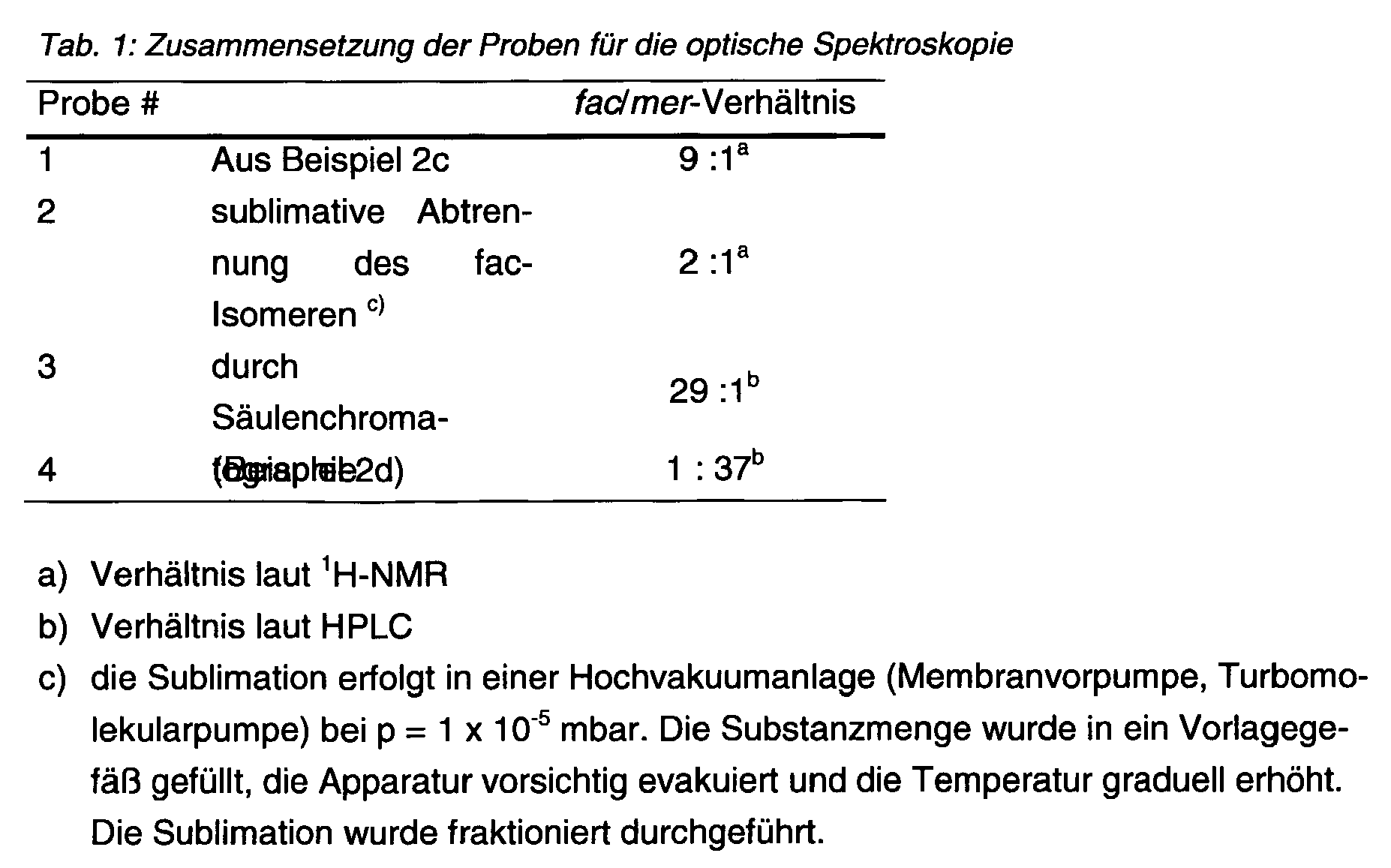
- Es wurden normierte Absorptionsspektren der Proben 1 bis 4 in Toluol ermittelt. Der Roh-Ir-Komplex (7) (Probe 1) und Probe 2 unterscheiden sich spektroskopisch in Toluollösung nicht. Das fac-Isomer (Probe 3) ist gegenüber dem mer-Isomer (Probe 4) um 6 nm hypsochrom verschoben und zeigt deutlich eine Schulter bei 335 nm. Eine rechnerische Überlagerung der fac- und mer-Spektren im Verhältnis von 80 / 20 liefert quasi-identisch das Absorptionspektrum der Ausgangsprobe (Probe 1). Dies bestätigt, dass die Ausgangsmischung beide Isomere in dem gewichteten Verhältnis zfac/zmer von 80/20 enthält.
- Ein normiertes Absorptionsspektrum entspricht der gemessenen optischen Dichte relativ zur optischen Dichte im Absorptionsmaximum, es ist konzentrationsunabhängig und beschreibt nur die Bandenform.

- Für die rechnerische Überlagerung gilt:


- Die Werte zfac und zmer geben die nach der optischen Dichte im Absorptionsmaximum gewichteten Anteile wieder und hängen vom Produkt aus dem molaren Extinktionskoeffizienten im Maximum εmax und der Konzentration ab. Sie sind nicht identisch mit den Molenbrüchen. Diese können mit Hilfe der Extinktionskoeffizienten am Absorptionsmaximum εmax (fac und mer) aus zfac und zmer erhalten werden. Das Verhältnis zfac / zmer gibt das Verhältnis der optischen Dichten der Absorptionsmaxima wieder. Nmer ist der Normierungsfaktor, der garantiert, dass das Summenspektrum auf eins normiert ist.
- Es wurden normierte Emissionspektren der Proben 1 bis 4 in Toluol ermittelt. In den Emissionsspektren unterscheiden sich fac- und mer-Isomer deutlich in Form und Lage der Maxima. Das mer-Spektrum ist deutlich bathochrom verschoben (Emissionsmaxima 395 vs. 461 nm). Der Beitrag des mer-Isomers in der Mischung zeigt sich in der Schulter um 450 nm im Emissionspektrum. Die Emissionsbande des fac-Isomers ist deutlich schmaler. Auch hier liefert eine rechnerische Überlagerung der normierten Emissionsspektren der beiden Isomere im Verhältnis von 80 / 20 das Spektrum der Ausgangsprobe.
- Für die rechnerische Überlagerung normierter Emissionsspektren gilt:


- Die Werte yfac und ymer hängen von der Anregungswellenlänge ab und geben die nach Emissionsintensität (gleich Produkt aus Absorption auf der Anregungswellenlänge OD (λexc) und Quantenausbeute Φ) gewichteten Anteile zur Gesamtemission an. Sie sind nicht identisch mit den Molenbrüchen. Diese können mit Hilfe der Extinktionskoeffizienten am Absorptionsmaximum εmax (fac und mer) und den Quantenausbeuten der beiden Isomere aus yfac und ymer erhalten werden. Nmer ist der Normierungsfaktor, der garantiert, dass das Summenspektrum auf eins normiert ist.
- Die gemessenen Photolumineszenzquantenausbeuten der vier Proben variieren in Toluol nicht, weder in luftgesättigter Lösung noch unter Stickstoff (Tab. 2).
Tab. 2: Quantenausbeuten der Photolumineszenz des Ir-Komplexes (7) in Toluol. QY1) / % Toluol luftgesättigt Exc2) 325 nm QY1) / % Toluol stickstoffgesättigt Exc2) 325 nm Probe 1 0,6 1,3 Probe 2 0,6 1,4 Probe 3 (fac) 0,6 1,3 Probe 4 (mer) nicht bestimmt 1,4 1) QY = Quantenausbeute
2) Exc = Anregungswellenlänge - Gegenüber Messungen in fester Matrix (zum Beispiel PMMA oder Diphenyl-di-o-tolylsilan (UGH 1)) zeigt der Emitter in stickstoffgesättigter Lösung eine um eine Größenordnung kleinere Lumineszenzquantenausbeute. Dieser Einfluss der Stoßlöschung durch Lösungsmittelmoleküle spiegelt sich auch in den Lumineszenzabklingzeiten des Ir-Komplexes (7) wieder: in Toluol, stickstoffgesättigt: 26,5 ns bzw. 25,8 ns vs. 10 % des Komplexes (7) in UGH1: 234 ns. Auffallend ist die geringe Empfindlichkeit gegenüber Sauerstoff. Diese erklärt sich aus der für einen Triplettemitter kurzen Lumineszenzabklingzeit in Toluol. Entsprechend der Löslichkeit von Sauerstoff in Toluol (1,97 10-3 mol/L) und einer Abklingzeit von ca. 26 ns, ist die bimolekulare Stoßlöschung durch Sauerstoff nicht sehr effektiv. Aber auch die Abklingzeit im Festkörper von 230 - 250 ns ist für einen Triplettemitter recht kurz und lässt auf eine effektive Spin-Bahn-Kopplung schließen.
- Um die Proben 1 bis 4 des Ir-Komplexes (7) weiter im verdünnten Festkörper zu charakterisieren, wurden entsprechende PMMA-Filme hergestellt. Für den PMMA-Film wurden 2 mg Farbstoff (Ir-Komplex (7), Beispiele 2c und 2d) pro 1 ml 10%ige (Massenprozent) PMMA-Lösung (PMMA in CH2Cl2) gelöst und mit einem 60 µm Rakel ein Film auf einen Objektträger ausgestrichen. Der Film trocknet sofort. Die Messungen in Toluol (spectroscopic grade) wurden bei einer Konzentration von 10 mg/l durchgeführt. Zur Entfernung des Sauerstoffs in der Lösung wurden vor der Messung 5 min lang Stickstoff (O2-Gehalt <150 ppm) durch die Lösung geleitet und während der Messung Stickstoff über die Flüssigkeitsoberfläche geleitet. Alle Messungen erfolgten bei Raumtemperatur.
- Das fac-Isomer (Beispiel 2d) absorbiert deutlich hypsochrom im Vergleich zum mer-Isomer (Beispiel 2d) und besitzt eine Schulter bei 330 nm. Die 80 / 20 Überlagerung der fac / mer-Spektren liefert identisch das Absorptionsspektrum der Ausgangsprobe. Etwas auffällig ist die verstärkte Absorption von Probe 2 um 280 nm. Es darf hier nicht vergessen werden, dass es sich bei den Absorptionsspektren um normierte Spektren handelt, die nur die Spektralform und nicht die absolute Absorptionsstärke wiedergeben.
- Das Emissionsspektrum von Probe 3 ist wie schon zuvor in Toluol und im Pulver deutlich schmaler und rein blau. Probe 4 liegt im Maximum um 460 nm mit einer Schulter bei 400 - 410 nm. Auch hier liefert eine rechnerische Überlagerung (80 / 20) das Spektrum der Mischung.
- Die Spektren in PMMA entsprechen denen in Toluol weitgehend. Jedoch spielt bei Lösungsspektren die Stoßlöschung der Phosphoreszenzemission eine Rolle, was keinen Einfluss auf die Emissionsspektren hat, aber die Photolumineszenzquantenausbeute vermindert. In der folgenden Tabelle 3 sind die Quantenausbeuten der 4 Proben in PMMA-Filmen und die Farbkoordinaten dargestellt.
Tab. 3: Photolumineszenzquantenausbeuten sowie Farbkoordinaten in PMMA. Probe # QY1) / % PMMA Exc2) 325 nm XRGB PMMA CIE 1931 YRGB PMMA CIE 1931 Probe 1 19 0,160 0,078 Probe 2 15 0,160 0,080 Probe 3 (fac) 17 0,160 0,047 Probe 4 (mer) 11 (exc 330 nm) 0,164 0,165 1) QY = Quantenausbeute
2) Exc = Anregungswellenlänge - Die Quantenausbeute von Probe 4 liegt signifikant niedriger als die der 3 anderen Proben. Die Genauigkeit der Messung der Quantenausbeuten liegt bei Filmen und bei diesen Zahlenwerten in der Gegend von 2 %-Punkten, deutlich ungenauer als in Lösung, weil ein Film im Vergleich zur Lösung schlechter definiert, weil weniger homogen ist.
- Die Untersuchungen zeigen, dass das fac- und das mer-Isomer des Ir-Komplexes (7) sich deutlich in ihren spektroskopischen Eigenschaften unterscheiden. Fac-(7) besitzt im Festkörper mit ca. 20 % eine fast doppelt so hohe Photolumineszenzquantenausbeute wie mer-(7). Während fac-(7) im rein Blauen emittiert, reicht die Emission von mer-(7) bis in türkisfarbene Bereiche. Aufgrund der Lage der Emissions- und Absorptionsbanden, sollte ein strahlungsloser Energietransfer von fac- zum mer-Isomer möglich sein (umgekehrt praktisch nicht), so dass bei anwendungsrelevanten Dotierungsgraden bzw. Emittermolekülabständen jede Verunreinigung von mer-(7) die Emission des fac-Isomers teilweise quencht, unabhängig von der Wirkung des mer-Isomers als Trap für einzelne Ladungen. Die daraus resultierende zusätzliche mer-Emission ist längerwellig und weniger effizient. Diese Interpretation wird gestützt durch die Messung der Konzentrationsabhängigkeit des Ir-Komplexes (7) in PMMA-Filmen. Für den Aufbau von Devices ist deshalb der Einsatz isomerenreiner Verbindungen des Ir-Komplexes (7) bevorzugt.
- Für den PMMA-Film wurden 2 mg Farbstoff (Ir-Komplex (8)) pro 1 ml 10%ige (Massenprozent) PMMA-Lösung (PMMA in CH2Cl2) gelöst und mit einem 60 µm Rakel ein Film auf einen Objektträger ausgestrichen. Der Film trocknet sofort. Die Messungen in Toluol (spectroscopic grade) wurden bei einer Konzentration von 10 mg/l durchgeführt. Zur Entfernung des Sauerstoffs in der Lösung wurden vor der Messung 5 min lang Stickstoff (O2-Gehalt <150 ppm) durch die Lösung geleitet und während der Messung Stickstoff über die Flüssigkeitsoberfläche geleitet. Alle Messungen erfolgten bei Raumtemperatur. Bei einer Anregungswellenlänge von 330 nm ergibt sich für den Emitter in PMMA eine Quantenausbeute von 10% und in Toluol eine Quantenausbeute von 3.6%. Das Emissionsmaximum liegt in Toluol und PMMA bei 512 nm. Die CIE-Koordinaten betragen in PMMA XRGB= 0.302, YRGB = 0.591.
- Die Elektrolumineszenz des Komplexes (7) (siehe Beispiele 2c, 2d) sowie des Komplexes (8) (siehe Beispiel 2e) wurde jeweils in einem Device mit dem folgenden Schichtaufbau getestet:
- Das als Anode eingesetzte ITO-Substrat wird zunächst durch Kochen in Isopropanol und Aceton gereinigt. Zwischendurch wird es mit Ultraschall behandelt. Abschließend werden die Substrate in einer Spülmaschine mit kommerziellen Reinigungsmitteln für die LCD Produktion (Deconex® 20NS und Neutralisationsmittel 25ORGANACID®) gesäubert. Zur Beseitigung eventuell verbliebener organischer Rückstände wird das Substrat für 25 Minuten einem kontinuierlichem Ozonfluss ausgesetzt. Diese Behandlung verbessert auch die Lochinjektion, da sich die Austrittsarbeit des ITOs erhöht.
- Anschließend wird PEDT:PSS (Poly(3,4-ethylendioxythiophen)-Poly(styrolsulfonat)) (Baytron® P VP Al 4083) aus wässriger Lösung auf die Probe aufgeschleudert. Dabei ergibt sich eine Dicke von 46 nm. Danach folgt die Emitterschicht, die sich aus in Chlorbenzol gelöstem PMMA (Polymethacrylsäuremethylester) und der Emittersubstanz (Komplex (7), Beispiel 2c, Beispiel 2d) zusammensetzt. Es wird eine zweiprozentige Lösung aus PMMA in Chlorbenzol verwendet. Der Dotant (Emitter) wird in verschiedenen Konzentrationen dazu gegeben.
- Die 28%ige Lösung ergibt nach dem Aufschleudern eine Dicke von ungefähr 61 nm und die 40%ige Lösung ergibt eine Dicke von 77 nm. Für diese Lösungen wurde ein Isomerengemisch (fac/mer) des Emitters eingesetzt, bei dem das faciale Isomer die Hauptkomponente stellt (Beispiel 2c). Des Weiteren wurde noch eine 30 %ige Lösung unter Verwendung des isomerenreinen fac-Emitters hergestellt (Beispiel 2d). Diese Lösung ergibt nach dem Aufschleudern eine Schichtdicke von 27 nm.
- Zur besseren Balance der Ladungsträger werden dann 40 nm BCP (2,9-Dimethyl-4,7-diphenyl-1,10-phenanthrolin) aufgedampft. BCP ist für seine gute Leitfähigkeit für Elektronen bekannt, außerdem blockt es durch sein tief gelegenes HOMO Löcher, die das PMMA somit nur schwer verlassen können. Abschließend wird 1 nm Lithiumfluorid und 130 nm Aluminium als Kathode abgeschieden.
- Zur Charakterisierung des Bauteils (OLED) werden dann Elektrolumineszenz-Spektren bei verschiedenen Strömen bzw. Spannungen aufgenommen. Weiterhin wird die Strom-Spannungskennlinie in Kombination mit der abgestrahlten Lichtleistung gemessen. Die Lichtleistung kann dann durch Kalibration mit einem Luminanzmeter in photometrische Größen umgerechnet werden.
- Für die oben beschriebenen Bauteile (OLED) ergeben sich somit die folgenden elektrooptischen Daten:
Device PMMA Schichtdicke Emissionsmaximum Photometrischer Wirkungsgrad Externe Quantenausbeute Leuchtdichte 28% Komplex 7 (fac/mer)1) 61 nm 453 nm 0.8 cd/A 1% 30 cd/m2 40% Komplex 7 (fac/mer)1) 77 nm 453 nm 0.65 cd/A 0.75% 75 cd/m2 30% Komplex 7 (reines fac)2) 27 nm 400 nm 0.53 cd/A 1.5% 80 cd/m2 1) Beispiel 2c
2) Beispiel 2d 3b) Deviceaufbau eines Devices enthaltend Komplex (8) als Emittersubstanz - Das als Anode eingesetzte ITO-Substrat wird zunächst für 10 Minuten mit Isopropanol bei 30 °C im Ultraschallbad und danach für 10 Minuten mit Chloroform ebenfalls im Ultraschallbad bei 30 °C gereinigt. Danach wird das Substrat zur Beseitigung eventuell verbliebener organischer Rückstände 20 Minuten im Sauerstoffplasma geätzt.
- Danach wird als Lochleiter NPD bei 2x10⁻⁵ mbar und einer Aufdampfrate von 0.2 Å/s auf das Substrat abgeschieden, so dass sich eine Schichtdicke von 40 nm ergibt. Anschließend wird Komplex (8) (Beispiel 2e) als 5 %iger Dotant zusammen mit dem Matrix-Material CBP aufgedampft. Die Dicke dieser Schicht beträgt ebenfalls 40 nm. Es folgen die BCP-Lochblockerschicht (6 nm) und eine Elektronenleiterschicht aus Alq3 mit 20 nm Dicke. Schließlich wird eine 1 nm dicke LiF-Schicht aufgebracht und abschließend die Al-Elektrode aufgedampft.
- Für das oben beschriebene Bauteil (OLED) erhält man einen photometrischen Wirkungsgrad von 6.4 cd/A bei einem Emissionsmaximum von 513 nm. Die maximale Leuchtdichte beträgt 1487 cd/m2.
Claims (12)
- Verwendung von neutralen Übergangsmetall-Komplexen der allgemeinen Formel (I) enthaltend mindestens einen Carbenliganden in organischen Lichtemittierenden Dioden
 M1 Metallatom ausgewählt aus der Gruppe bestehend aus Os, Rh, Ir, Ru, Pd und Pt in jeder für das entsprechende Metallatom möglichen Oxidati-onsstufe;carben Carbenligand, der neutral oder monoanionisch und mono-, bi- oder tridentat sein kann; bei dem Carbenliganden kann es sich auch um einen Bis- oder Triscarbenliganden handeln;L mono- oder dianionischer Ligand, der mono- oder bidentat sein kann;K neutraler mono- oder bidentater Ligand ausgewählt aus der Gruppe bestehend aus Phosphinen; Phosphonaten und Derivaten davon, Arsenaten und Derivaten davon; Phosphiten; CO; Pyridinen; Nitrilen und konjugierten Dienen, die einen π-Komplex mit M1 bilden;n Zahl der Carbenliganden, wobei n mindestens 1 ist und die Carbenliganden in dem Komplex der Formel I bei n >1 gleich oder verschieden sein können;m Zahl der Liganden L, wobei m 0 oder ≥ 1 sein kann und die Liganden L bei m > 1 gleich oder verschieden sein können;o Zahl der Liganden K, wobei o 0 oder ≥ 1 sein kann und die Liganden K bei o > 1 gleich oder verschieden sein können;wobei die Summe n + m + o von der Oxidationsstufe und Koordinationszahl des eingesetzten Metallatoms und von der Zähnigkeit der Liganden carben, L und K sowie von der Ladung der Liganden carben und L abhängig ist, mit der Bedingung, dass n mindestens 1 ist.
 - Verwendung nach Anspruch 1, dadurch gekennzeichnet, dass die neutralen Übergangsmetallkomplexe der Formel I als Emittermoleküle eingesetzt werden.
- Verwendung nach Anspruch 1 oder 2, dadurch gekennzeichnet, dass der mindestens eine Carbenligand bidentat ist.
- Verwendung nach einem der Ansprüche 1 bis 3, dadurch gekennzeichnet, dass der mindestens eine Carbenligand monoanionisch ist.
- Verwendung nach einem der Ansprüche 1 bis 4, dadurch gekennzeichnet, dass der mindestens eine Carbenligand die folgende Formel II aufweist
 Do1 Donoratom ausgewählt aus der Gruppe bestehend aus C, P, N, O und S, bevorzugt P, N, O und S;Do2 Donoratom ausgewählt aus der Gruppe bestehend aus C, N, P, O und S;r 2, wenn Do1 C ist, 1, wenn Do1 N oder P ist und 0, wenn Do1 O oder S ist;s 2, wenn Do2 C ist, 1, wenn Do2 N oder P ist und 0, wenn Do2 O oder S ist;X Spacer ausgewählt aus der Gruppe bestehend aus Silylen, Alkylen, Arylen, Heteroarylen oder Alkenylen;p 0 oder 1;q 0 oder 1;Y1, Y2 jeweils unabhängig voneinander Wasserstoff oder eine kohlenstoffhaltige Gruppe ausgewählt aus der Gruppe bestehend aus Alkyl-, Aryl-, Heteroaryl- und Alkenylgruppen; oder
Y1 und Y2 bilden gemeinsam eine Brücke zwischen dem Donoratom Do1 und dem Stickstoffatom N die mindestens zwei Atome aufweist, wovon mindestens eines ein Kohlenstoffatom ist,Y3 ein Wasserstoff-, Alkyl-, Aryl-, Heteroaryl- oder Alkenylrest; oder R1, R2 unabhängig voneinander Wasserstoff, Alkyl-, Aryl-, Heteroaryl- oder Al-kenylreste,
oder
R1 und R2 bilden gemeinsam eine Brücke mit insgesamt drei bis fünf Atomen, wovon ein oder zwei Atome Heteroatome sein können und die restlichen Atome Kohlenstoffatome sind, so dass die Gruppe R3 Wasserstoff, ein Alkyl-, Aryl-, Heteroaryl- oder Alkenylrest.
 - Verwendung nach Anspruch 5, dadurch gekennzeichnet, dass die Gruppierung

 R4, R5, R6, R7, R8, R9 und R11 Wasserstoff, Alkyl, Aryl, Heteroaryl oder Alkenyl oder ein Substituent mit Donor- oder Akzeptorwirkung;R10 Alkyl, Aryl, Heteroaryl oder Alkenyl oder jeweils 2 Reste R10 bilden gemeinsam einen anellierten Ring, oder R10 bedeutet einen Rest mit Donor- oder Akzeptorwirkung;v 0 bis 4, wobei, wenn v 0 ist, die vier Kohlenstoffatome des Arylrests in Formel c, die gegebenenfalls mit R10 substituiert sind, Wasserstoffatome tragen;Y3 ein Wasserstoff-, Alkyl-, Aryl-, Heteroaryl- oder Alkenylrest;
oder
- Verwendung nach Anspruch 5 oder 6, dadurch gekennzeichnet, dass die Gruppierung


worin die Symbole die folgenden Bedeutungen aufweisen:Z CH oder N, wobei Z in o-, m- oder p-Position zur Verknüpfungsstelle der Gruppierung mit dem Carbenliganden angeordnet sein kann;R12 ein Alkyl-, Aryl-, Heteroaryl-, Alkenylrest, oder jeweils 2 Reste R12 bilden gemeinsam einen anellierten Ring, der gegebenenfalls mindestens ein Heteroatom enthalten kann, oder R12 bedeutet einen Rest mit Donor- oder Akzeptorwirkung;t 0 bis 3, wobei, wenn t > 1 ist, die Reste R12 gleich oder verschieden sein können. - Verwendung nach einem der Ansprüche 5 bis 7, dadurch gekennzeichnet, dass der mindestens eine Carbenligand ausgewählt ist aus der Gruppe bestehend aus
 Z, Z' gleich oder verschieden CH oder NR12, R12' gleich oder verschieden ein Alkyl-, Aryl-, Heteroaryl- oder Alkenylrest, oder jeweils 2 Reste R12 bzw. R12' bilden gemeinsam einen anellierten Ring, der gegebenenfalls mindestens ein Heteroatom enthalten kann, oder R12 bzw. R12' bedeutet einen Rest mit Donor- oder Akzeptorwirkung;t und t' gleich oder verschieden 0 bis 3, wobei, wenn t bzw. t' > 1 ist, die Reste R12 bzw. R12' gleich oder verschieden sein können;R4, R5, R6, R7, R8, R9 und R11 Wasserstoff, Alkyl, Aryl, Heteroaryl oder Alkenyl oder ein Rest mit Donor- oder Akzeptorwirkung;R10 Alkyl, Aryl, Heteroaryl oder Alkenyl oder jeweils 2 Reste R10 bilden gemeinsam einen anellierten Ring, der gegebenenfalls mindestens ein Heteroatom enthalten kann, oder R10 bedeutet einen Rest mit Donor- oder Akzeptorwirkung;v 0 bis 4, wobei, wenn v 0 ist, die vier Kohlenstoffatome des Arylrests in Formel c, die gegebenenfalls mit R10 substituiert sind, Wasserstoffatome tragen.
 - OLED enthaltend mindestens einen neutralen Übergangsmetall-Komplex der allgemeinen Formel (I) enthaltend mindestens einen Carbenliganden
 M1 Metallatom ausgewählt aus der Gruppe bestehend aus Os, Rh, Ir, Ru, Pd und Pt in jeder für das entsprechende Metallatom möglichen Oxidationsstufe;carben Carbenligand, der neutral oder monoanionisch und mono-, bi- oder tridentat sein kann; bei dem Carbenliganden kann es sich auch um einen Bis- oder Triscarbenliganden handeln;L mono- oder dianionischer Ligand, der mono- oder bidentat sein kann;K neutraler mono- oder bidentater Ligand ausgewählt aus der Gruppe bestehend aus Phosphinen; Phosphonaten und Derivaten davon, Arsenaten und Derivaten davon; Phosphiten; CO; Pyridinen; Nitrilen und konjugierten Dienen, die einen π-Komplex mit M1 bilden;n Zahl der Carbenliganden, wobei n mindestens 1 ist und die Carbenliganden in dem Komplex der Formel I bei n >1 gleich oder verschieden sein können;m Zahl der Liganden L, wobei m 0 oder ≥ 1 sein kann und die Liganden L bei m > 1 gleich oder verschieden sein können;o Zahl der Liganden K, wobei o 0 oder ≥ 1 sein kann und die Liganden K bei o > 1 gleich oder verschieden sein können;wobei die Summe n + m + o von der Oxidationsstufe und Koordinationszahl des eingesetzten Metallatoms und von der Zähnigkeit der Liganden carben, L und K sowie von der Ladung der Liganden carben und L abhängig ist, mit der Bedingung, dass n mindestens 1 ist.
 - Licht-emittierende Schicht enthaltend mindestens einen neutralen Übergangsmetall-Komplex der allgemeinen Formel (I) enthaltend mindestens einen Carbenliganden
 M1 Metallatom ausgewählt aus der Gruppe bestehend aus Os, Rh, Ir, Ru, Pd und Pt in jeder für das entsprechende Metallatom möglichen Oxidationsstufe;carben Carbenligand, der neutral oder monoanionisch und mono-, bi- oder tridentat sein kann; bei dem Carbenliganden kann es sich auch um einen Bis- oder Triscarbenliganden handeln;L mono- oder dianionischer Ligand, der mono- oder bidentat sein kann;K neutraler mono- oder bidentater Ligand ausgewählt aus der Gruppe bestehend aus Phosphinen; Phosphonaten und Derivaten davon, Arsenaten und Derivaten davon; Phosphiten; CO; Pyridinen; Nitrilen und konjugierten Dienen, die einen π-Komplex mit M1 bilden;n Zahl der Carbenliganden, wobei n mindestens 1 ist und die Carbenliganden in dem Komplex der Formel I bei n >1 gleich oder verschieden sein können;m Zahl der Liganden L, wobei m 0 oder ≥ 1 sein kann und die Liganden L bei m > 1 gleich oder verschieden sein können;o Zahl der Liganden K, wobei o 0 oder ≥ 1 sein kann und die Liganden K bei o > 1 gleich oder verschieden sein können;wobei die Summe n + m + o von der Oxidationsstufe und Koordinationszahl des eingesetzten Metallatoms und von der Zähnigkeit der Liganden carben, L und K sowie von der Ladung der Liganden carben und L abhängig ist, mit der Bedingung, dass n mindestens 1 ist.
 - OLED enthaltend eine Licht-emittierende Schicht nach Anspruch 10.
- Vorrichtung ausgewählt aus der Gruppe bestehend aus stationären Bildschirmen wie Bildschirmen von Computern, Fernsehern, Bildschirmen in Druckern, Küchengeräten sowie Reklametafeln, Beleuchtungen, Hinweistafeln und mobilen Bildschirmen wie Bildschirmen in Handys, Laptops, Fahrzeugen sowie Zielanzeigen an Bussen und Bahnen enthaltend ein OLED wie in Anspruch 9 oder 11 definiert.
Priority Applications (2)
| Application Number | Priority Date | Filing Date | Title |
|---|---|---|---|
| EP20191338.1A EP3805338B1 (de) | 2003-08-19 | 2004-08-18 | Übergangsmetallkomplexe mit carbenliganden als emitter für organische lichtemittierende dioden (oleds) |
| EP17191410.4A EP3299437B1 (de) | 2003-08-19 | 2004-08-18 | Übergangsmetallkomplexe mit carbenliganden als emitter für organische licht-emittierende dioden (oleds) |
Applications Claiming Priority (2)
| Application Number | Priority Date | Filing Date | Title |
|---|---|---|---|
| DE10338550A DE10338550A1 (de) | 2003-08-19 | 2003-08-19 | Übergangsmetallkomplexe mit Carbenliganden als Emitter für organische Licht-emittierende Dioden (OLEDs) |
| PCT/EP2004/009269 WO2005019373A2 (de) | 2003-08-19 | 2004-08-18 | Übergangsmetallkomplexe mit carbenliganden als emitter für organische licht-emittierende dioden (oleds) |
Related Child Applications (2)
| Application Number | Title | Priority Date | Filing Date |
|---|---|---|---|
| EP17191410.4A Division EP3299437B1 (de) | 2003-08-19 | 2004-08-18 | Übergangsmetallkomplexe mit carbenliganden als emitter für organische licht-emittierende dioden (oleds) |
| EP20191338.1A Division EP3805338B1 (de) | 2003-08-19 | 2004-08-18 | Übergangsmetallkomplexe mit carbenliganden als emitter für organische lichtemittierende dioden (oleds) |
Publications (2)
| Publication Number | Publication Date |
|---|---|
| EP1658349A2 EP1658349A2 (de) | 2006-05-24 |
| EP1658349B1 true EP1658349B1 (de) | 2017-09-20 |
Family
ID=34201819
Family Applications (3)
| Application Number | Title | Priority Date | Filing Date |
|---|---|---|---|
| EP20191338.1A Expired - Lifetime EP3805338B1 (de) | 2003-08-19 | 2004-08-18 | Übergangsmetallkomplexe mit carbenliganden als emitter für organische lichtemittierende dioden (oleds) |
| EP17191410.4A Expired - Lifetime EP3299437B1 (de) | 2003-08-19 | 2004-08-18 | Übergangsmetallkomplexe mit carbenliganden als emitter für organische licht-emittierende dioden (oleds) |
| EP04764255.8A Expired - Lifetime EP1658349B1 (de) | 2003-08-19 | 2004-08-18 | VERWENDUNG VON ÜBERGANGSMETALLKOMPLEXEN MIT CARBENLIGANDEN ALS EMITTER FÜR ORGANISCHE LICHT-EMITTIERENDE DIODEN (OLEDs) UND OLEDs |
Family Applications Before (2)
| Application Number | Title | Priority Date | Filing Date |
|---|---|---|---|
| EP20191338.1A Expired - Lifetime EP3805338B1 (de) | 2003-08-19 | 2004-08-18 | Übergangsmetallkomplexe mit carbenliganden als emitter für organische lichtemittierende dioden (oleds) |
| EP17191410.4A Expired - Lifetime EP3299437B1 (de) | 2003-08-19 | 2004-08-18 | Übergangsmetallkomplexe mit carbenliganden als emitter für organische licht-emittierende dioden (oleds) |
Country Status (7)
| Country | Link |
|---|---|
| US (8) | US7846763B2 (de) |
| EP (3) | EP3805338B1 (de) |
| JP (1) | JP4351702B2 (de) |
| KR (1) | KR101186706B1 (de) |
| CN (2) | CN100573961C (de) |
| DE (1) | DE10338550A1 (de) |
| WO (1) | WO2005019373A2 (de) |
Families Citing this family (1205)
| Publication number | Priority date | Publication date | Assignee | Title |
|---|---|---|---|---|
| DE10338550A1 (de) * | 2003-08-19 | 2005-03-31 | Basf Ag | Übergangsmetallkomplexe mit Carbenliganden als Emitter für organische Licht-emittierende Dioden (OLEDs) |
| US7491823B2 (en) * | 2004-05-18 | 2009-02-17 | The University Of Southern California | Luminescent compounds with carbene ligands |
| US7655323B2 (en) * | 2004-05-18 | 2010-02-02 | The University Of Southern California | OLEDs utilizing macrocyclic ligand systems |
| US7598388B2 (en) * | 2004-05-18 | 2009-10-06 | The University Of Southern California | Carbene containing metal complexes as OLEDs |
| US7601436B2 (en) * | 2004-05-18 | 2009-10-13 | The University Of Southern California | Carbene metal complexes as OLED materials |
| US7534505B2 (en) * | 2004-05-18 | 2009-05-19 | The University Of Southern California | Organometallic compounds for use in electroluminescent devices |
| US7393599B2 (en) * | 2004-05-18 | 2008-07-01 | The University Of Southern California | Luminescent compounds with carbene ligands |
| DE102004040005A1 (de) * | 2004-08-18 | 2006-02-23 | Basf Ag | In Polymermatrices eingebettete Übergangsmetallcarbenkomplexe zur Verwendung in OLEDs |
| DE102004057072A1 (de) * | 2004-11-25 | 2006-06-01 | Basf Ag | Verwendung von Übergangsmetall-Carbenkomplexen in organischen Licht-emittierenden Dioden (OLEDs) |
| ATE430789T1 (de) | 2004-12-23 | 2009-05-15 | Ciba Holding Inc | Elektrolumineszierende metallkomplexe mit nukleophilen carbenliganden |
| KR101359288B1 (ko) | 2005-02-21 | 2014-02-10 | 미쓰비시 가가꾸 가부시키가이샤 | 유기 전계 발광 소자 및 그 제조 |
| JP5130606B2 (ja) * | 2005-02-25 | 2013-01-30 | コニカミノルタホールディングス株式会社 | 有機エレクトロルミネッセンス素子、その製造方法、表示装置及び照明装置 |
| WO2006106842A1 (ja) * | 2005-03-31 | 2006-10-12 | Idemitsu Kosan Co., Ltd. | 遷移金属錯体化合物及びそれを用いた有機エレクトロルミネッセンス素子 |
| US9070884B2 (en) | 2005-04-13 | 2015-06-30 | Universal Display Corporation | Hybrid OLED having phosphorescent and fluorescent emitters |
| JP5046548B2 (ja) * | 2005-04-25 | 2012-10-10 | 富士フイルム株式会社 | 有機電界発光素子 |
| TWI418606B (zh) * | 2005-04-25 | 2013-12-11 | Udc愛爾蘭有限公司 | 有機電致發光裝置 |
| US8586204B2 (en) | 2007-12-28 | 2013-11-19 | Universal Display Corporation | Phosphorescent emitters and host materials with improved stability |
| US9051344B2 (en) | 2005-05-06 | 2015-06-09 | Universal Display Corporation | Stability OLED materials and devices |
| CN100390185C (zh) * | 2005-05-11 | 2008-05-28 | 友达光电股份有限公司 | 发光材料及应用其的有机电激发光器件 |
| DE102005027548A1 (de) | 2005-06-14 | 2006-12-21 | Basf Ag | Verfahren zur Isomerisierung cyclometallierter, Carbenliganden enthaltender Übergangsmetallkomplexe |
| DE102005032332A1 (de) * | 2005-07-08 | 2007-01-11 | Merck Patent Gmbh | Metallkomplexe |
| JP5505382B2 (ja) * | 2005-08-01 | 2014-05-28 | 三菱化学株式会社 | 遷移金属錯体の製造方法 |
| KR20080037006A (ko) * | 2005-08-05 | 2008-04-29 | 이데미쓰 고산 가부시키가이샤 | 전이금속 착체화합물 및 그것을 이용한 유기 전기발광 소자 |
| JP2007045742A (ja) * | 2005-08-10 | 2007-02-22 | Mitsubishi Chemicals Corp | 遷移金属錯体の製造方法及び遷移金属錯体 |
| CN101258621A (zh) | 2005-09-05 | 2008-09-03 | 出光兴产株式会社 | 蓝色发光有机电致发光元件 |
| US20080233410A1 (en) * | 2005-11-17 | 2008-09-25 | Idemitsu Kosan Co., Ltd. | Transition metal complex compound |
| WO2007058255A1 (ja) * | 2005-11-17 | 2007-05-24 | Idemitsu Kosan Co., Ltd. | 遷移金属錯体化合物 |
| JPWO2007058104A1 (ja) | 2005-11-17 | 2009-04-30 | 出光興産株式会社 | 金属錯体化合物及びそれを用いた有機エレクトロルミネッセンス素子 |
| JPWO2007060826A1 (ja) * | 2005-11-24 | 2009-05-07 | コニカミノルタホールディングス株式会社 | 有機エレクトロルミネッセンス素子、表示装置及び照明装置 |
| TWI313292B (en) * | 2005-11-25 | 2009-08-11 | Chi Mei Optoelectronics Corp | Light-emitting element and iridium complex |
| WO2007069539A1 (ja) * | 2005-12-15 | 2007-06-21 | Konica Minolta Holdings, Inc. | 有機エレクトロルミネッセンス素子、表示装置および照明装置 |
| EP1803789A1 (de) | 2005-12-28 | 2007-07-04 | Novaled AG | Verwendung von Metallkomplexen als Emitter in einem elektronischen Bauelement und elektronisches Bauelement |
| US8410280B2 (en) * | 2006-01-31 | 2013-04-02 | Basf Se | Process for preparing transition metal-carbene complexes |
| JP5324229B2 (ja) | 2006-02-10 | 2013-10-23 | ユニバーサル ディスプレイ コーポレイション | シクロメタル化したイミダゾ[1,2−f]フェナントリジン及びジイミダゾ[1,2−a:1’,2’−c]キナゾリン配位子並びにそれらの等電子及びベンゾ縮合類縁体の金属錯体 |
| DE102006006412A1 (de) * | 2006-02-13 | 2007-08-16 | Merck Patent Gmbh | Elektronisches Bauteil, Verfahren zu dessen Herstellung und dessen Verwendung |
| DE112007000789B4 (de) | 2006-03-30 | 2012-03-15 | Novaled Ag | Verwendung von Bora-tetraazepentalenen |
| KR20090007389A (ko) * | 2006-04-04 | 2009-01-16 | 바스프 에스이 | 1개의 비카르벤 리간드 및 1 또는 2 개의 카르벤 리간드를 포함하는 전이 금속 착체 및 이의 oled에서의 용도 |
| KR101431844B1 (ko) | 2006-04-05 | 2014-08-25 | 바스프 에스이 | 이종 리간드 전이 금속-카르벤 착체 및 이의 유기 발광 다이오드(oled)에서의 용도 |
| EP1860709B1 (de) | 2006-05-24 | 2012-08-08 | Novaled AG | Verwendung von quadratisch planaren Übergangsmetallkomplexen als Dotand |
| DE502007002122D1 (de) * | 2006-06-26 | 2010-01-07 | Basf Se | Verwendung von pt- und pd-bis- und tetracarbenkomplexen mit verbrückten carbenliganden in oleds |
| EP2035526B1 (de) * | 2006-06-26 | 2021-11-17 | UDC Ireland Limited | Verwendung von übergangsmetallcarbenkomplexen, die keine cyclometallierung über nicht-carbene enthalten, in oleds |
| DE102006030860A1 (de) | 2006-07-04 | 2008-01-10 | Universität Regensburg | Oligomere von Isonitril-Metallkomplexen als Triplett-Emitter für OLED-Anwendungen |
| DE102006035018B4 (de) | 2006-07-28 | 2009-07-23 | Novaled Ag | Oxazol-Triplett-Emitter für OLED-Anwendungen |
| JP5722541B2 (ja) | 2006-09-14 | 2015-05-20 | チバ ホールディング インコーポレーテッドCiba Holding Inc. | 複素環式架橋ビフェニルおよびそれらのoledにおける使用 |
| CN100465168C (zh) * | 2006-09-15 | 2009-03-04 | 华东理工大学 | 噁二唑衍生物及其在电致发光材料中应用 |
| WO2008034758A2 (de) * | 2006-09-21 | 2008-03-27 | Basf Se | Oled-anzeige mit verlängerter lebensdauer |
| DE102006048202A1 (de) * | 2006-10-11 | 2008-04-17 | Universität Regensburg | Lanthanoid-Emitter für OLED-Anwendungen |
| DE102006051975B4 (de) | 2006-11-03 | 2012-04-19 | Merck Patent Gmbh | Photophysikalische OLED-Effizienz-Steigerung |
| JP5194568B2 (ja) * | 2006-11-27 | 2013-05-08 | 住友化学株式会社 | 発光性膜 |
| DE102007002420A1 (de) | 2007-01-17 | 2008-07-24 | Universität Regensburg | Polymere Anionen/Kationen |
| WO2008096609A1 (ja) * | 2007-02-05 | 2008-08-14 | Idemitsu Kosan Co., Ltd. | 遷移金属錯体化合物及びそれを用いた有機エレクトロルミネッセンス素子 |
| KR101578937B1 (ko) | 2007-03-07 | 2015-12-18 | 미쓰비시 가가꾸 가부시키가이샤 | 유기 디바이스용 조성물, 고분자막 및 유기 전계 발광 소자 |
| TWI573854B (zh) | 2007-03-08 | 2017-03-11 | 環球展覽公司 | 磷光材料 |
| US9130177B2 (en) | 2011-01-13 | 2015-09-08 | Universal Display Corporation | 5-substituted 2 phenylquinoline complexes materials for light emitting diode |
| US20130032785A1 (en) | 2011-08-01 | 2013-02-07 | Universal Display Corporation | Materials for organic light emitting diode |
| JP5484690B2 (ja) | 2007-05-18 | 2014-05-07 | ユー・ディー・シー アイルランド リミテッド | 有機電界発光素子 |
| JP5546450B2 (ja) | 2007-05-21 | 2014-07-09 | オスラム オプト セミコンダクターズ ゲゼルシャフト ミット ベシュレンクテル ハフツング | 燐光発光金属錯体化合物、燐光発光金属錯体化合物を含有する発光素子、及び、燐光発光金属錯体化合物の製造法 |
| CN101688114B (zh) | 2007-07-05 | 2014-07-16 | 巴斯夫欧洲公司 | 包含至少一种选自二甲硅烷基咔唑、二甲硅烷基二苯并呋喃、二甲硅烷基二苯并噻吩、二甲硅烷基二苯并磷杂环戊二烯、二甲硅烷基二苯并噻吩s-氧化物和二甲硅烷基二苯并噻吩s,s-二氧化物的二甲硅烷基化合物的有机发光二极管 |
| EP2165377B1 (de) | 2007-07-05 | 2021-04-28 | UDC Ireland Limited | Organische leuchtdioden enthaltend carben-übergangsmetall-komplex-emitter und mindestens eine verbindung ausgewählt aus disilylcarbazolen; disilyldibenzofuranen, disilyldibenzothiophenen, disilyldibenzophospholen, disilyldibenzothiophen-s-oxiden und disilyldibenzothiophen-s,s-dioxiden |
| JP5260905B2 (ja) * | 2007-07-12 | 2013-08-14 | 株式会社ジャパンディスプレイ | 有機el表示装置 |
| KR102342708B1 (ko) | 2007-08-08 | 2021-12-22 | 유니버셜 디스플레이 코포레이션 | 인광성 발광 다이오드의 단일 트리페닐렌 발색단 |
| CN101827834B (zh) | 2007-08-08 | 2015-11-25 | 通用显示公司 | 含苯并[9,10]菲的苯并稠合的噻吩或苯并稠合的呋喃化合物 |
| JP2009076865A (ja) | 2007-08-29 | 2009-04-09 | Fujifilm Corp | 有機電界発光素子 |
| JP5194652B2 (ja) * | 2007-09-03 | 2013-05-08 | コニカミノルタホールディングス株式会社 | 有機エレクトロルミネッセンス素子材料、有機エレクトロルミネッセンス素子、表示装置及び照明装置 |
| KR101548382B1 (ko) | 2007-09-14 | 2015-08-28 | 유디씨 아일랜드 리미티드 | 유기 전계 발광 소자 |
| WO2009037155A1 (en) | 2007-09-20 | 2009-03-26 | Basf Se | Electroluminescent device |
| JP5438941B2 (ja) | 2007-09-25 | 2014-03-12 | ユー・ディー・シー アイルランド リミテッド | 有機電界発光素子 |
| TWI418608B (zh) | 2007-09-28 | 2013-12-11 | Osram Opto Semiconductors Gmbh | 有機輻射發射元件 |
| DE102007046445A1 (de) | 2007-09-28 | 2009-04-16 | Osram Opto Semiconductors Gmbh | Organisches selbstemittierendes Bauteil |
| KR101577468B1 (ko) | 2007-10-02 | 2015-12-14 | 바스프 에스이 | Oled에서의 매트릭스 물질 및/또는 전자 차단체로서의 아크리딘 유도체의 용도 |
| US8383249B2 (en) * | 2007-10-04 | 2013-02-26 | Universal Display Corporation | Complexes with tridentate ligands |
| US8067100B2 (en) * | 2007-10-04 | 2011-11-29 | Universal Display Corporation | Complexes with tridentate ligands |
| WO2009050290A1 (de) * | 2007-10-17 | 2009-04-23 | Basf Se | Übergangsmetallkomplexe mit verbrückten carbenliganden und deren verwendung in oleds |
| ATE554095T1 (de) * | 2007-10-17 | 2012-05-15 | Basf Se | Übergangsmetallkomplexe mit verbrückten carbenliganden und deren verwendung in oleds |
| US20100258790A1 (en) * | 2007-10-24 | 2010-10-14 | Basf Se | Use of diphenylamino-bis(phenoxy)- and bis(diphenylamino)-phenoxytriazine compounds |
| JP5489445B2 (ja) | 2007-11-15 | 2014-05-14 | 富士フイルム株式会社 | 薄膜電界効果型トランジスタおよびそれを用いた表示装置 |
| US8319214B2 (en) | 2007-11-15 | 2012-11-27 | Fujifilm Corporation | Thin film field effect transistor with amorphous oxide active layer and display using the same |
| US7960547B2 (en) * | 2007-12-03 | 2011-06-14 | Chien-Hong Cheng | Transition metal complexes with carbene ligands and their application |
| WO2009073245A1 (en) | 2007-12-06 | 2009-06-11 | Universal Display Corporation | Light-emitting organometallic complexes |
| JP5438955B2 (ja) | 2007-12-14 | 2014-03-12 | ユー・ディー・シー アイルランド リミテッド | 白金錯体化合物及びこれを用いた有機電界発光素子 |
| WO2009085344A2 (en) | 2007-12-28 | 2009-07-09 | Universal Display Corporation | Dibenzothiophene-containing materials in phosphorescent light emitting diodes |
| JP5709528B2 (ja) | 2008-02-12 | 2015-04-30 | ビーエーエスエフ ソシエタス・ヨーロピアBasf Se | ジベンゾ[f,h]キノキサリンを用いたエレクトロルミネッセンス金属錯体 |
| JP5243972B2 (ja) | 2008-02-28 | 2013-07-24 | ユー・ディー・シー アイルランド リミテッド | 有機電界発光素子 |
| JP4555358B2 (ja) | 2008-03-24 | 2010-09-29 | 富士フイルム株式会社 | 薄膜電界効果型トランジスタおよび表示装置 |
| JP4531836B2 (ja) | 2008-04-22 | 2010-08-25 | 富士フイルム株式会社 | 有機電界発光素子並びに新規な白金錯体化合物及びその配位子となり得る新規化合物 |
| JP4531842B2 (ja) | 2008-04-24 | 2010-08-25 | 富士フイルム株式会社 | 有機電界発光素子 |
| KR101462653B1 (ko) * | 2008-05-20 | 2014-11-17 | 삼성전자 주식회사 | 카르벤 유도체를 이용한 나노입자 제조방법 |
| KR101702487B1 (ko) | 2008-06-06 | 2017-02-06 | 바스프 에스이 | 염소화 나프탈렌테트라카르복실산 유도체, 이의 제조 방법 및 유기 전자 장치에서의 그 용도 |
| JP4991634B2 (ja) * | 2008-06-09 | 2012-08-01 | キヤノン株式会社 | 有機el発光装置 |
| WO2009150151A1 (de) | 2008-06-10 | 2009-12-17 | Basf Se | Deuterierte übergangsmetall- komplexe und deren verwendung in organischen leuchtdioden - v |
| EP2288671B1 (de) | 2008-06-10 | 2012-08-15 | Basf Se | Neue übergangsmetall-komplexe und deren verwendung in organischen leuchtdioden - iii |
| CN102099942B (zh) | 2008-06-20 | 2013-05-15 | 巴斯夫欧洲公司 | 环状磷腈化合物及其在有机发光二极管中的用途 |
| WO2010002850A1 (en) | 2008-06-30 | 2010-01-07 | Universal Display Corporation | Hole transport materials containing triphenylene |
| DE102008033563A1 (de) * | 2008-07-17 | 2010-01-21 | Merck Patent Gmbh | Komplexe mit kleinen Singulett-Triplett-Energie-Abständen zur Verwendung in opto-elektronischen Bauteilen (Singulett-Harvesting-Effekt) |
| DE102008033929A1 (de) | 2008-07-18 | 2010-01-21 | Siemens Aktiengesellschaft | Phosphoreszente Metallkomplexverbindung, Verfahren zur Herstellung dazu und strahlungsemittierendes Bauelement |
| WO2010027583A1 (en) | 2008-09-03 | 2010-03-11 | Universal Display Corporation | Phosphorescent materials |
| TWI555734B (zh) | 2008-09-16 | 2016-11-01 | 環球展覽公司 | 磷光物質 |
| DE102008048336A1 (de) | 2008-09-22 | 2010-03-25 | Merck Patent Gmbh | Einkernige neutrale Kupfer(I)-Komplexe und deren Verwendung zur Herstellung von optoelektronischen Bauelementen |
| KR101678235B1 (ko) | 2008-09-25 | 2016-11-21 | 유니버셜 디스플레이 코포레이션 | 유기 셀레늄 재료들 및 유기 발광 소자들에서 이들의 사용 |
| CN102246328B (zh) | 2008-10-07 | 2016-05-04 | 欧司朗光电半导体有限公司 | 稠环体系取代的噻咯及其在有机电子器件中的用途 |
| US8119037B2 (en) | 2008-10-16 | 2012-02-21 | Novaled Ag | Square planar transition metal complexes and organic semiconductive materials using them as well as electronic or optoelectric components |
| DE102008053121A1 (de) | 2008-10-24 | 2010-04-29 | Merck Patent Gmbh | Doppelkomplex-Salze als Emitter in OLED-Vorrichtungen |
| JP5854839B2 (ja) | 2008-11-11 | 2016-02-09 | ユニバーサル ディスプレイ コーポレイション | 燐光発光体 |
| EP2344607B1 (de) | 2008-11-11 | 2013-04-10 | Merck Patent GmbH | Organische elektrolumineszenzvorrichtungen |
| DE102009022858A1 (de) | 2009-05-27 | 2011-12-15 | Merck Patent Gmbh | Organische Elektrolumineszenzvorrichtungen |
| DE102008056688A1 (de) | 2008-11-11 | 2010-05-12 | Merck Patent Gmbh | Materialien für organische Elektrolumineszenzvorrichtungen |
| US8815415B2 (en) | 2008-12-12 | 2014-08-26 | Universal Display Corporation | Blue emitter with high efficiency based on imidazo[1,2-f] phenanthridine iridium complexes |
| US9067947B2 (en) | 2009-01-16 | 2015-06-30 | Universal Display Corporation | Organic electroluminescent materials and devices |
| DE102009005290A1 (de) | 2009-01-20 | 2010-07-22 | Merck Patent Gmbh | Verbindungen für elektronische Vorrichtungen |
| JP5540507B2 (ja) * | 2009-01-22 | 2014-07-02 | 宇部興産株式会社 | 有機エレクトロルミネッセンス素子 |
| JP2010182449A (ja) | 2009-02-03 | 2010-08-19 | Fujifilm Corp | 有機el表示装置 |
| JP2010186723A (ja) | 2009-02-13 | 2010-08-26 | Fujifilm Corp | 有機el装置及びその製造方法 |
| EP2401254B1 (de) | 2009-02-26 | 2013-06-19 | Novaled AG | Chinonverbindungen als dotierstoff in der organischen elektronik |
| JP2010232163A (ja) | 2009-03-03 | 2010-10-14 | Fujifilm Corp | 発光表示装置の製造方法、発光表示装置、及び発光ディスプレイ |
| JP2010205650A (ja) | 2009-03-05 | 2010-09-16 | Fujifilm Corp | 有機el表示装置 |
| US11910700B2 (en) | 2009-03-23 | 2024-02-20 | Universal Display Corporation | Heteroleptic iridium complexes as dopants |
| US8722205B2 (en) | 2009-03-23 | 2014-05-13 | Universal Display Corporation | Heteroleptic iridium complex |
| US8709615B2 (en) | 2011-07-28 | 2014-04-29 | Universal Display Corporation | Heteroleptic iridium complexes as dopants |
| TWI496772B (zh) | 2009-04-28 | 2015-08-21 | Universal Display Corp | 具有甲基-d3取代之銥錯合物 |
| US8586203B2 (en) | 2009-05-20 | 2013-11-19 | Universal Display Corporation | Metal complexes with boron-nitrogen heterocycle containing ligands |
| US9028979B2 (en) * | 2009-06-18 | 2015-05-12 | Basf Se | Phenanthroazole compounds as hole transporting materials for electro luminescent devices |
| DE102009030475A1 (de) | 2009-06-24 | 2011-01-05 | Hartmut Prof. Dr. Yersin | Kupfer-Komplexe für optoelektronische Anwendungen |
| DE102009031021A1 (de) | 2009-06-30 | 2011-01-05 | Merck Patent Gmbh | Materialien für organische Elektrolumineszenzvorrichtungen |
| DE102009031683A1 (de) | 2009-07-03 | 2011-03-24 | Siemens Aktiengesellschaft | Phophoreszente Metallkomplexverbindung, Verfahren zur Herstellung dazu und strahlungsemittierendes Bauelement |
| DE102009032922B4 (de) | 2009-07-14 | 2024-04-25 | Merck Patent Gmbh | Materialien für organische Elektrolumineszenzvorrichtungen, Verfahren zu deren Herstellung, deren Verwendung sowie elektronische Vorrichtung |
| WO2011013626A1 (ja) | 2009-07-31 | 2011-02-03 | 富士フイルム株式会社 | 有機デバイス用蒸着材料及び有機デバイスの製造方法 |
| CN102414176A (zh) | 2009-08-27 | 2012-04-11 | 三菱化学株式会社 | 单胺化合物、电荷传输材料、电荷传输膜用组合物、有机场致发光元件、有机el显示装置及有机el照明 |
| JP5779318B2 (ja) | 2009-08-31 | 2015-09-16 | ユー・ディー・シー アイルランド リミテッド | 有機電界発光素子 |
| JP2011060549A (ja) | 2009-09-09 | 2011-03-24 | Fujifilm Corp | 有機el装置用光学部材及び有機el装置 |
| JP5473506B2 (ja) | 2009-09-14 | 2014-04-16 | ユー・ディー・シー アイルランド リミテッド | カラーフィルタ及び発光表示素子 |
| JP5657243B2 (ja) | 2009-09-14 | 2015-01-21 | ユー・ディー・シー アイルランド リミテッド | カラーフィルタ及び発光表示素子 |
| DE102009053644B4 (de) | 2009-11-17 | 2019-07-04 | Merck Patent Gmbh | Materialien für organische Elektrolumineszenzvorrichtungen |
| DE102009048791A1 (de) | 2009-10-08 | 2011-04-14 | Merck Patent Gmbh | Materialien für organische Elektrolumineszenzvorrichtungen |
| WO2011045337A1 (de) | 2009-10-14 | 2011-04-21 | Basf Se | Dinukleare platin-carben-komplexe und deren verwendung in oleds |
| KR101986469B1 (ko) | 2009-10-28 | 2019-06-05 | 유디씨 아일랜드 리미티드 | 이종 리간드 카르벤 착체 및 유기 전자장치에서의 이의 용도 |
| US8545996B2 (en) | 2009-11-02 | 2013-10-01 | The University Of Southern California | Ion-pairing soft salts based on organometallic complexes and their applications in organic light emitting diodes |
| DE102009052428A1 (de) | 2009-11-10 | 2011-05-12 | Merck Patent Gmbh | Verbindung für elektronische Vorrichtungen |
| DE102009053382A1 (de) | 2009-11-14 | 2011-05-19 | Merck Patent Gmbh | Materialien für elektronische Vorrichtungen |
| DE102009053836A1 (de) | 2009-11-18 | 2011-05-26 | Merck Patent Gmbh | Materialien für organische Elektrolumineszenzvorrichtungen |
| US8580394B2 (en) * | 2009-11-19 | 2013-11-12 | Universal Display Corporation | 3-coordinate copper(I)-carbene complexes |
| EP2513125B1 (de) | 2009-12-14 | 2014-10-29 | Basf Se | Metallkomplexe, enthaltend diazabenzimidazolcarben-liganden und deren verwendung in oleds |
| DE102010004803A1 (de) | 2010-01-16 | 2011-07-21 | Merck Patent GmbH, 64293 | Materialien für organische Elektrolumineszenzvorrichtungen |
| US8288187B2 (en) | 2010-01-20 | 2012-10-16 | Universal Display Corporation | Electroluminescent devices for lighting applications |
| DE102010005634A1 (de) | 2010-01-25 | 2011-07-28 | Siemens Aktiengesellschaft, 80333 | Neuartige Verwendung des Guanidinium-Kations und lichtemittierendes Bauelement |
| DE102010005697A1 (de) | 2010-01-25 | 2011-07-28 | Merck Patent GmbH, 64293 | Verbindungen für elektronische Vorrichtungen |
| DE102010005632A1 (de) | 2010-01-25 | 2011-07-28 | Siemens Aktiengesellschaft, 80333 | Phosphoreszente Metallkomplexverbindung, Verfahren zur Herstellung und lichtemittierendes Bauelement |
| US9156870B2 (en) | 2010-02-25 | 2015-10-13 | Universal Display Corporation | Phosphorescent emitters |
| DE102010009903A1 (de) | 2010-03-02 | 2011-09-08 | Merck Patent Gmbh | Verbindungen für elektronische Vorrichtungen |
| US9175211B2 (en) | 2010-03-03 | 2015-11-03 | Universal Display Corporation | Phosphorescent materials |
| JP5423706B2 (ja) | 2010-03-15 | 2014-02-19 | 三菱化学株式会社 | 有機電界発光素子の製造方法、有機電界発光素子、有機el照明、及び有機el表示装置 |
| CN102823013B (zh) | 2010-03-25 | 2016-08-03 | 通用显示公司 | 可溶液处理的掺杂的三芳基胺空穴注入材料 |
| DE102010012738A1 (de) | 2010-03-25 | 2011-09-29 | Merck Patent Gmbh | Materialien für organische Elektrolumineszenzvorrichtungen |
| DE102010013068A1 (de) | 2010-03-26 | 2011-09-29 | Merck Patent Gmbh | Verbindungen für elektronische Vorrichtungen |
| US8637857B2 (en) | 2010-04-06 | 2014-01-28 | Basf Se | Substituted carbazole derivatives and use thereof in organic electronics |
| JP6035706B2 (ja) | 2010-04-09 | 2016-11-30 | 三菱化学株式会社 | 有機電界素子用組成物の製造方法、有機電界素子用組成物、有機電界発光素子の製造方法、有機電界発光素子、有機el表示装置および有機el照明 |
| DE102010014933A1 (de) | 2010-04-14 | 2011-10-20 | Merck Patent Gmbh | Materialien für elektronische Vorrichtungen |
| US8691401B2 (en) | 2010-04-16 | 2014-04-08 | Basf Se | Bridged benzimidazole-carbene complexes and use thereof in OLEDS |
| DE102010018321A1 (de) | 2010-04-27 | 2011-10-27 | Merck Patent Gmbh | Organische Elektrolumineszenzvorrichtung |
| US8968887B2 (en) | 2010-04-28 | 2015-03-03 | Universal Display Corporation | Triphenylene-benzofuran/benzothiophene/benzoselenophene compounds with substituents joining to form fused rings |
| JP5646733B2 (ja) | 2010-04-28 | 2014-12-24 | ユニバーサル ディスプレイ コーポレイション | 予備混合した材料の堆積 |
| DE102010019306B4 (de) | 2010-05-04 | 2021-05-20 | Merck Patent Gmbh | Organische Elektrolumineszenzvorrichtungen |
| US8673458B2 (en) | 2010-06-11 | 2014-03-18 | Universal Display Corporation | Delayed fluorescence OLED |
| US8742657B2 (en) | 2010-06-11 | 2014-06-03 | Universal Display Corporation | Triplet-Triplet annihilation up conversion (TTA-UC) for display and lighting applications |
| WO2011157779A1 (en) | 2010-06-18 | 2011-12-22 | Basf Se | Organic electronic devices comprising a layer of a pyridine compound and a 8-hydroxyquinolinolato earth alkaline metal, or alkali metal complex |
| US9203037B2 (en) * | 2010-06-18 | 2015-12-01 | Basf Se | Organic electronic devices comprising a layer of a dibenzofurane compound and a 8-hydroxypquinolinolato earth alkaline metal, or alkali metal complex |
| US20110309344A1 (en) | 2010-06-18 | 2011-12-22 | Basf Se | Organic electronic devices comprising a layer of a pyridine compound and a 8-hydroxypquinolinolato earth alkaline metal, or alkali metal complex |
| EP2582769B1 (de) * | 2010-06-18 | 2014-11-19 | Basf Se | Organische elektronische vorrichtungen mit einer schicht aus einer dibenzofuranverbindung und einem 8-hydroxychinolinolat-erdalkalimetall oder alkalimetallkomplex |
| CN107698622B (zh) * | 2010-06-18 | 2021-06-29 | Udc 爱尔兰有限责任公司 | 包含含有至少一种金属有机化合物和至少一种金属氧化物的层的有机电子器件 |
| US9142792B2 (en) | 2010-06-18 | 2015-09-22 | Basf Se | Organic electronic devices comprising a layer comprising at least one metal organic compound and at least one metal oxide |
| DE102010024335A1 (de) | 2010-06-18 | 2011-12-22 | Merck Patent Gmbh | Verbindungen für elektronische Vorrichtungen |
| DE102010024542A1 (de) | 2010-06-22 | 2011-12-22 | Merck Patent Gmbh | Materialien für elektronische Vorrichtungen |
| DE102010024897A1 (de) | 2010-06-24 | 2011-12-29 | Merck Patent Gmbh | Materialien für organische Elektrolumineszenzvorrichtungen |
| JP2012033918A (ja) | 2010-07-08 | 2012-02-16 | Mitsubishi Chemicals Corp | 有機電界発光素子、有機電界発光デバイス、有機el表示装置及び有機el照明 |
| WO2012016074A1 (en) | 2010-07-29 | 2012-02-02 | University Of Southern California | Co-deposition methods for the fabrication of organic optoelectronic devices |
| DE102010033548A1 (de) | 2010-08-05 | 2012-02-09 | Merck Patent Gmbh | Materialien für elektronische Vorrichtungen |
| JP5770289B2 (ja) | 2010-08-20 | 2015-08-26 | ユニバーサル ディスプレイ コーポレイション | Oledのためのビカルバゾール化合物 |
| DE102010045405A1 (de) | 2010-09-15 | 2012-03-15 | Merck Patent Gmbh | Materialien für organische Elektrolumineszenzvorrichtungen |
| WO2012041851A1 (en) | 2010-09-29 | 2012-04-05 | Basf Se | Security element |
| WO2012046715A1 (ja) * | 2010-10-06 | 2012-04-12 | シャープ株式会社 | 発光材料、及びこれを用いた有機発光素子、波長変換発光素子、光変換発光素子、有機レーザーダイオード発光素子、色素レーザー、表示装置並びに照明装置 |
| CN103154189B (zh) * | 2010-10-06 | 2016-04-13 | 夏普株式会社 | 发光材料和使用其的有机发光元件、波长变换发光元件、光变换发光元件、有机激光二极管发光元件、色素激光器、显示装置以及照明装置 |
| US9079872B2 (en) | 2010-10-07 | 2015-07-14 | Basf Se | Phenanthro[9, 10-B]furans for electronic applications |
| WO2012045710A1 (en) | 2010-10-07 | 2012-04-12 | Basf Se | Phenanthro[9,10-b]furans for electronic applications |
| US8932734B2 (en) | 2010-10-08 | 2015-01-13 | Universal Display Corporation | Organic electroluminescent materials and devices |
| DE102010048074A1 (de) | 2010-10-09 | 2012-04-12 | Merck Patent Gmbh | Materialien für elektronische Vorrichtungen |
| DE102010048607A1 (de) | 2010-10-15 | 2012-04-19 | Merck Patent Gmbh | Verbindungen für elektronische Vorrichtungen |
| DE102010048608A1 (de) | 2010-10-15 | 2012-04-19 | Merck Patent Gmbh | Materialien für organische Elektrolumineszenzvorrichtungen |
| US8269317B2 (en) | 2010-11-11 | 2012-09-18 | Universal Display Corporation | Phosphorescent materials |
| KR102093611B1 (ko) | 2010-11-24 | 2020-03-27 | 메르크 파텐트 게엠베하 | 유기 전계발광 소자용 재료 |
| TW201251002A (en) | 2010-12-02 | 2012-12-16 | Ube Industries | Binuclear metal complex and organic electroluminescent element using same |
| US20120138906A1 (en) | 2010-12-07 | 2012-06-07 | The University of Southern California USC Stevens Institute for Innovation | Capture agents for unsaturated metal complexes |
| DE102010054316A1 (de) | 2010-12-13 | 2012-06-14 | Merck Patent Gmbh | Substituierte Tetraarylbenzole |
| US8362246B2 (en) | 2010-12-13 | 2013-01-29 | Basf Se | Bispyrimidines for electronic applications |
| EP2651904B1 (de) | 2010-12-13 | 2014-11-12 | Basf Se | Bispyrimidine für elektronische anwendungen |
| US10008677B2 (en) | 2011-01-13 | 2018-06-26 | Universal Display Corporation | Materials for organic light emitting diode |
| CN103314463B (zh) | 2011-01-14 | 2017-04-05 | 三菱化学株式会社 | 有机电致发光元件、组合物以及有机电致发光装置 |
| DE102012000064B4 (de) | 2011-01-21 | 2026-01-22 | Merck Patent Gmbh | Materialien für organische Elektrolumineszenzvorrichtungen |
| US8415031B2 (en) | 2011-01-24 | 2013-04-09 | Universal Display Corporation | Electron transporting compounds |
| US8751777B2 (en) | 2011-01-28 | 2014-06-10 | Honeywell International Inc. | Methods and reconfigurable systems to optimize the performance of a condition based health maintenance system |
| DE102011010841A1 (de) | 2011-02-10 | 2012-08-16 | Merck Patent Gmbh | (1,3)-Dioxan-5-on-Verbindungen |
| DE102011011104A1 (de) | 2011-02-12 | 2012-08-16 | Merck Patent Gmbh | Substituierte Dibenzonaphtacene |
| DE102011011539A1 (de) | 2011-02-17 | 2012-08-23 | Merck Patent Gmbh | Verbindungen für elektronische Vorrichtungen |
| US8748011B2 (en) * | 2011-02-23 | 2014-06-10 | Universal Display Corporation | Ruthenium carbene complexes for OLED material |
| CN103476781B (zh) | 2011-02-23 | 2017-02-15 | 通用显示公司 | 新型的四齿铂络合物 |
| US9005772B2 (en) | 2011-02-23 | 2015-04-14 | Universal Display Corporation | Thioazole and oxazole carbene metal complexes as phosphorescent OLED materials |
| US8563737B2 (en) | 2011-02-23 | 2013-10-22 | Universal Display Corporation | Methods of making bis-tridentate carbene complexes of ruthenium and osmium |
| US8492006B2 (en) | 2011-02-24 | 2013-07-23 | Universal Display Corporation | Germanium-containing red emitter materials for organic light emitting diode |
| JP5747736B2 (ja) * | 2011-03-01 | 2015-07-15 | コニカミノルタ株式会社 | 有機エレクトロルミネッセンス素子、表示装置及び照明装置 |
| US8883322B2 (en) | 2011-03-08 | 2014-11-11 | Universal Display Corporation | Pyridyl carbene phosphorescent emitters |
| US9806270B2 (en) | 2011-03-25 | 2017-10-31 | Udc Ireland Limited | 4H-imidazo[1,2-a]imidazoles for electronic applications |
| WO2012130709A1 (en) | 2011-03-25 | 2012-10-04 | Basf Se | 4h-imidazo[1,2-a]imidazoles for electronic applications |
| KR102013465B1 (ko) | 2011-04-13 | 2019-08-22 | 메르크 파텐트 게엠베하 | 전자 소자용 화합물 |
| JP6271417B2 (ja) | 2011-04-13 | 2018-01-31 | メルク パテント ゲーエムベーハー | 電子素子のための材料 |
| CN103502388B (zh) | 2011-04-18 | 2016-06-01 | 默克专利有限公司 | 用于电子器件的化合物 |
| WO2012143080A2 (de) | 2011-04-18 | 2012-10-26 | Merck Patent Gmbh | Materialien für organische elektrolumineszenzvorrichtungen |
| WO2012149992A1 (de) | 2011-05-04 | 2012-11-08 | Merck Patent Gmbh | Vorrichtung zur aufbewahrung von frischwaren |
| EP2705552B1 (de) | 2011-05-05 | 2015-03-04 | Merck Patent GmbH | Verbindungen für elektronische vorrichtungen |
| EP2705550B1 (de) | 2011-05-05 | 2017-07-05 | Merck Patent GmbH | Verbindungen für elektronische vorrichtungen |
| US8432095B2 (en) | 2011-05-11 | 2013-04-30 | Universal Display Corporation | Process for fabricating metal bus lines for OLED lighting panels |
| US8927308B2 (en) | 2011-05-12 | 2015-01-06 | Universal Display Corporation | Method of forming bus line designs for large-area OLED lighting |
| JP2014141415A (ja) * | 2011-05-19 | 2014-08-07 | Sharp Corp | 遷移金属錯体、及びこれを用いた有機発光素子、色変換発光素子、光変換発光素子、有機レーザーダイオード発光素子、色素レーザー、表示装置、照明装置並びに電子機器 |
| US9212197B2 (en) | 2011-05-19 | 2015-12-15 | Universal Display Corporation | Phosphorescent heteroleptic phenylbenzimidazole dopants |
| US8795850B2 (en) | 2011-05-19 | 2014-08-05 | Universal Display Corporation | Phosphorescent heteroleptic phenylbenzimidazole dopants and new synthetic methodology |
| JP5316583B2 (ja) * | 2011-05-24 | 2013-10-16 | コニカミノルタ株式会社 | 有機エレクトロルミネッセンス素子、それを用いた表示装置および照明装置 |
| US8748012B2 (en) | 2011-05-25 | 2014-06-10 | Universal Display Corporation | Host materials for OLED |
| US10158089B2 (en) | 2011-05-27 | 2018-12-18 | Universal Display Corporation | Organic electroluminescent materials and devices |
| US10079349B2 (en) | 2011-05-27 | 2018-09-18 | Universal Display Corporation | Organic electroluminescent materials and devices |
| EP2714841B1 (de) | 2011-06-03 | 2016-06-22 | Merck Patent GmbH | Organische elektrolumineszenzvorrichtung |
| WO2012170461A1 (en) | 2011-06-08 | 2012-12-13 | Universal Display Corporation | Heteroleptic iridium carbene complexes and light emitting device using them |
| KR101950460B1 (ko) | 2011-06-14 | 2019-02-20 | 유디씨 아일랜드 리미티드 | 아자벤즈이미다졸 카르벤 리간드를 포함하는 금속 착물 및 oled 에서의 이의 용도 |
| US9315724B2 (en) | 2011-06-14 | 2016-04-19 | Basf Se | Metal complexes comprising azabenzimidazole carbene ligands and the use thereof in OLEDs |
| US8884316B2 (en) | 2011-06-17 | 2014-11-11 | Universal Display Corporation | Non-common capping layer on an organic device |
| US8659036B2 (en) | 2011-06-17 | 2014-02-25 | Universal Display Corporation | Fine tuning of emission spectra by combination of multiple emitter spectra |
| WO2013009708A1 (en) | 2011-07-14 | 2013-01-17 | Universal Display Corporation | Inorganic hosts in oleds |
| US9023420B2 (en) | 2011-07-14 | 2015-05-05 | Universal Display Corporation | Composite organic/inorganic layer for organic light-emitting devices |
| US9397310B2 (en) | 2011-07-14 | 2016-07-19 | Universal Display Corporation | Organice electroluminescent materials and devices |
| US9783564B2 (en) | 2011-07-25 | 2017-10-10 | Universal Display Corporation | Organic electroluminescent materials and devices |
| US8409729B2 (en) | 2011-07-28 | 2013-04-02 | Universal Display Corporation | Host materials for phosphorescent OLEDs |
| JP6100258B2 (ja) | 2011-07-29 | 2017-03-22 | メルク パテント ゲーエムベーハー | 電子素子のための化合物 |
| KR101739629B1 (ko) | 2011-08-03 | 2017-05-24 | 메르크 파텐트 게엠베하 | 전자 소자용 물질 |
| US8926119B2 (en) | 2011-08-04 | 2015-01-06 | Universal Display Corporation | Extendable light source with variable light emitting area |
| US9493698B2 (en) | 2011-08-31 | 2016-11-15 | Universal Display Corporation | Organic electroluminescent materials and devices |
| US9518217B2 (en) * | 2011-09-06 | 2016-12-13 | E Ink Holdings Inc. | Transition metal carbene complexes and the electroluminescent application thereof |
| US9289759B2 (en) * | 2011-09-13 | 2016-03-22 | Rutgers, The State University Of New Jersey | Iridium catalyst complexes and C—H bond activated products therefrom |
| KR102077994B1 (ko) | 2011-09-21 | 2020-02-17 | 메르크 파텐트 게엠베하 | 유기 전계발광 소자용 카르바졸 유도체 |
| JP2013093541A (ja) | 2011-10-06 | 2013-05-16 | Udc Ireland Ltd | 有機電界発光素子とそれに用いることができる化合物および有機電界発光素子用材料、並びに該素子を用いた発光装置、表示装置及び照明装置 |
| JP2013084732A (ja) | 2011-10-07 | 2013-05-09 | Udc Ireland Ltd | 有機電界発光素子及び該素子用発光材料並びに発光装置、表示装置及び照明装置 |
| DE102011116165A1 (de) | 2011-10-14 | 2013-04-18 | Merck Patent Gmbh | Benzodioxepin-3-on-Verbindungen |
| KR101903216B1 (ko) | 2011-10-20 | 2018-10-01 | 메르크 파텐트 게엠베하 | 유기 전계발광 소자용 재료 |
| EP2782975B1 (de) | 2011-10-27 | 2018-01-10 | Merck Patent GmbH | Materialien für elektronische vorrichtungen |
| JP6239522B2 (ja) | 2011-11-01 | 2017-11-29 | メルク パテント ゲーエムベーハー | 有機エレクトロルミネッセンス素子 |
| JP2013118349A (ja) | 2011-11-02 | 2013-06-13 | Udc Ireland Ltd | 有機電界発光素子、有機電界発光素子用材料並びに該有機電界発光素子を用いた発光装置、表示装置及び照明装置 |
| CN108440531B (zh) | 2011-11-10 | 2021-11-02 | Udc 爱尔兰有限责任公司 | 用于电子应用的4H-咪唑并[1,2-a]咪唑 |
| JP6331393B2 (ja) | 2011-11-11 | 2018-05-30 | 三菱ケミカル株式会社 | 有機電界発光素子及び有機電界発光デバイス |
| US8652656B2 (en) | 2011-11-14 | 2014-02-18 | Universal Display Corporation | Triphenylene silane hosts |
| US9193745B2 (en) | 2011-11-15 | 2015-11-24 | Universal Display Corporation | Heteroleptic iridium complex |
| EP2594571A1 (de) | 2011-11-16 | 2013-05-22 | Cynora GmbH | Kupfer-Komplexe für optoelektronische Anwendungen |
| KR102310368B1 (ko) | 2011-11-17 | 2021-10-07 | 메르크 파텐트 게엠베하 | 스피로디히드로아크리딘 유도체 및 이의 유기 전계발광 소자용 재료로서의 용도 |
| US9217004B2 (en) | 2011-11-21 | 2015-12-22 | Universal Display Corporation | Organic light emitting materials |
| JP5913938B2 (ja) | 2011-11-30 | 2016-05-11 | 富士フイルム株式会社 | 光拡散性転写材料、光拡散層の形成方法、及び有機電界発光装置の製造方法 |
| US9512355B2 (en) | 2011-12-09 | 2016-12-06 | Universal Display Corporation | Organic light emitting materials |
| JP6570834B2 (ja) | 2011-12-12 | 2019-09-04 | メルク パテント ゲーエムベーハー | 電子素子のための化合物 |
| US20130146875A1 (en) | 2011-12-13 | 2013-06-13 | Universal Display Corporation | Split electrode for organic devices |
| DE102012022880B4 (de) | 2011-12-22 | 2024-12-24 | Merck Patent Gmbh | Elektronische Vorrichtungen enthaltend organische Schichten |
| US8987451B2 (en) | 2012-01-03 | 2015-03-24 | Universal Display Corporation | Synthesis of cyclometallated platinum(II) complexes |
| US9461254B2 (en) | 2012-01-03 | 2016-10-04 | Universal Display Corporation | Organic electroluminescent materials and devices |
| US9163174B2 (en) | 2012-01-04 | 2015-10-20 | Universal Display Corporation | Highly efficient phosphorescent materials |
| KR102012047B1 (ko) | 2012-01-06 | 2019-08-19 | 유니버셜 디스플레이 코포레이션 | 효율이 큰 인광 물질 |
| US8969592B2 (en) | 2012-01-10 | 2015-03-03 | Universal Display Corporation | Heterocyclic host materials |
| WO2013104649A1 (en) | 2012-01-12 | 2013-07-18 | Basf Se | Metal complexes with dibenzo[f,h]quinoxalines |
| JP5799820B2 (ja) * | 2012-01-13 | 2015-10-28 | コニカミノルタ株式会社 | 有機エレクトロルミネッセンス素子、表示装置及び照明装置 |
| US10211413B2 (en) | 2012-01-17 | 2019-02-19 | Universal Display Corporation | Organic electroluminescent materials and devices |
| JP5321700B2 (ja) | 2012-01-17 | 2013-10-23 | 三菱化学株式会社 | 有機電界発光素子、有機el照明および有機el表示装置 |
| JP5981770B2 (ja) | 2012-01-23 | 2016-08-31 | ユー・ディー・シー アイルランド リミテッド | 有機電界発光素子、有機電界発光素子用電荷輸送材料、並びに、該素子を用いた発光装置、表示装置及び照明装置 |
| JP5978843B2 (ja) | 2012-02-02 | 2016-08-24 | コニカミノルタ株式会社 | イリジウム錯体化合物、有機エレクトロルミネッセンス素子材料、有機エレクトロルミネッセンス素子、照明装置及び表示装置 |
| JP6118034B2 (ja) | 2012-02-06 | 2017-04-19 | ユー・ディー・シー アイルランド リミテッド | 有機電界発光素子とそれに用いることができる化合物および有機電界発光素子用材料、並びに該素子を用いた発光装置、表示装置及び照明装置 |
| EP3235892B1 (de) | 2012-02-14 | 2019-02-27 | Merck Patent GmbH | Materialien für organische elektrolumineszenzvorrichtungen |
| US9118017B2 (en) | 2012-02-27 | 2015-08-25 | Universal Display Corporation | Host compounds for red phosphorescent OLEDs |
| US9386657B2 (en) | 2012-03-15 | 2016-07-05 | Universal Display Corporation | Organic Electroluminescent materials and devices |
| US9054323B2 (en) | 2012-03-15 | 2015-06-09 | Universal Display Corporation | Secondary hole transporting layer with diarylamino-phenyl-carbazole compounds |
| WO2013135352A1 (de) | 2012-03-15 | 2013-09-19 | Merck Patent Gmbh | Elektronische vorrichtungen |
| WO2013139431A1 (de) | 2012-03-23 | 2013-09-26 | Merck Patent Gmbh | 9,9'-spirobixanthenderivate für elektrolumineszenzvorrichtungen |
| US8723209B2 (en) | 2012-04-27 | 2014-05-13 | Universal Display Corporation | Out coupling layer containing particle polymer composite |
| EP2844781A4 (de) | 2012-05-02 | 2016-01-13 | Basf Se | Verfahren zur ablagerung eines organischen stoffes |
| US9184399B2 (en) | 2012-05-04 | 2015-11-10 | Universal Display Corporation | Asymmetric hosts with triaryl silane side chains |
| US9773985B2 (en) | 2012-05-21 | 2017-09-26 | Universal Display Corporation | Organic electroluminescent materials and devices |
| JP5929512B2 (ja) * | 2012-05-24 | 2016-06-08 | コニカミノルタ株式会社 | 有機エレクトロルミネッセンス素子、その製造方法及び照明装置 |
| JP5182441B1 (ja) | 2012-05-24 | 2013-04-17 | 三菱化学株式会社 | 有機電界発光素子、有機電界発光照明装置及び有機電界発光表示装置 |
| US9670404B2 (en) | 2012-06-06 | 2017-06-06 | Universal Display Corporation | Organic electroluminescent materials and devices |
| DE102012011335B4 (de) | 2012-06-06 | 2026-08-20 | Merck Patent Gmbh | Verbindungen für Organische Elekronische Vorrichtungen |
| JP5849867B2 (ja) | 2012-06-21 | 2016-02-03 | コニカミノルタ株式会社 | 有機エレクトロルミネッセンス素子、表示装置及び照明装置 |
| US9502672B2 (en) | 2012-06-21 | 2016-11-22 | Universal Display Corporation | Organic electroluminescent materials and devices |
| US9725476B2 (en) | 2012-07-09 | 2017-08-08 | Universal Display Corporation | Silylated metal complexes |
| US9620724B2 (en) | 2012-07-10 | 2017-04-11 | Udc Ireland Limited | Benzimidazo[1,2-A]benzimidazole derivatives for electronic applications |
| JP6262226B2 (ja) | 2012-07-10 | 2018-01-17 | メルク パテント ゲーエムベーハー | 有機エレクトロルミネッセンスデバイス用の材料 |
| US9231218B2 (en) | 2012-07-10 | 2016-01-05 | Universal Display Corporation | Phosphorescent emitters containing dibenzo[1,4]azaborinine structure |
| US9540329B2 (en) | 2012-07-19 | 2017-01-10 | Universal Display Corporation | Organic electroluminescent materials and devices |
| US9059412B2 (en) | 2012-07-19 | 2015-06-16 | Universal Display Corporation | Transition metal complexes containing substituted imidazole carbene as ligands and their application in OLEDs |
| KR102034916B1 (ko) | 2012-07-19 | 2019-10-21 | 유디씨 아일랜드 리미티드 | 카르벤 리간드를 포함하는 이핵 금속 착물 및 oled에서의 그의 용도 |
| WO2014015938A1 (de) | 2012-07-23 | 2014-01-30 | Merck Patent Gmbh | Derivate von 2-diarylaminofluoren und diese enthaltnde organische elektronische verbindungen |
| EP2875019B1 (de) | 2012-07-23 | 2017-03-29 | Merck Patent GmbH | Materialien für organische elektrolumineszenzvorrichtungen |
| KR102006621B1 (ko) | 2012-07-23 | 2019-08-02 | 메르크 파텐트 게엠베하 | 화합물 및 유기 전계 발광 디바이스 |
| KR102696532B1 (ko) | 2012-07-23 | 2024-08-19 | 메르크 파텐트 게엠베하 | 플루오렌 및 이를 함유하는 전자 소자 |
| US9663544B2 (en) | 2012-07-25 | 2017-05-30 | Universal Display Corporation | Organic electroluminescent materials and devices |
| US9318710B2 (en) | 2012-07-30 | 2016-04-19 | Universal Display Corporation | Organic electroluminescent materials and devices |
| JP2015526427A (ja) * | 2012-08-02 | 2015-09-10 | エフ.ホフマン−ラ ロシュ アーゲーF. Hoffmann−La Roche Aktiengesellschaft | Ecl用の新規イリジウムベース錯体 |
| CA2879089C (en) | 2012-08-02 | 2019-11-12 | F. Hoffmann-La Roche Ag | Iridium-based complexes for ecl |
| CN104797587B (zh) | 2012-08-02 | 2017-10-10 | 霍夫曼-拉罗奇有限公司 | 用于ecl的新型铱基络合物 |
| WO2014019709A2 (en) | 2012-08-02 | 2014-02-06 | Roche Diagnostics Gmbh | New iridium-based complexes for ecl |
| CA2879093C (en) | 2012-08-02 | 2020-10-20 | F. Hoffmann-La Roche Ag | Bis-iridium-complexes for manufacturing of ecl-labels |
| WO2014023377A2 (de) | 2012-08-07 | 2014-02-13 | Merck Patent Gmbh | Metallkomplexe |
| KR102163770B1 (ko) | 2012-08-10 | 2020-10-12 | 메르크 파텐트 게엠베하 | 유기 전계발광 소자용 물질 |
| US9978958B2 (en) | 2012-08-24 | 2018-05-22 | Universal Display Corporation | Phosphorescent emitters with phenylimidazole ligands |
| WO2014030666A1 (ja) | 2012-08-24 | 2014-02-27 | コニカミノルタ株式会社 | 透明電極、電子デバイス、および透明電極の製造方法 |
| US8952362B2 (en) | 2012-08-31 | 2015-02-10 | The Regents Of The University Of Michigan | High efficiency and brightness fluorescent organic light emitting diode by triplet-triplet fusion |
| US10957870B2 (en) | 2012-09-07 | 2021-03-23 | Universal Display Corporation | Organic light emitting device |
| JP6239624B2 (ja) | 2012-09-18 | 2017-11-29 | メルク パテント ゲーエムベーハー | 電子素子のための材料 |
| CN113943306A (zh) | 2012-09-20 | 2022-01-18 | Udc 爱尔兰有限责任公司 | 供电子应用的氮杂二苯并呋喃和包含氮杂二苯并呋喃的电子器件 |
| US9287513B2 (en) | 2012-09-24 | 2016-03-15 | Universal Display Corporation | Organic electroluminescent materials and devices |
| US9312505B2 (en) | 2012-09-25 | 2016-04-12 | Universal Display Corporation | Organic electroluminescent materials and devices |
| CN104685651A (zh) | 2012-10-02 | 2015-06-03 | 三菱化学株式会社 | 有机电致发光元件、有机el照明和有机el显示装置 |
| US9741942B2 (en) | 2012-10-11 | 2017-08-22 | Merck Patent Gmbh | Materials for organic electroluminescent devices |
| EP3806176B1 (de) | 2012-10-31 | 2025-06-25 | Merck Patent GmbH | Elektronische vorrichtung |
| US10319917B2 (en) | 2012-11-06 | 2019-06-11 | Udc Ireland Limited | Phenoxasiline based compounds for electronic application |
| US8692241B1 (en) | 2012-11-08 | 2014-04-08 | Universal Display Corporation | Transition metal complexes containing triazole and tetrazole carbene ligands |
| US9685617B2 (en) | 2012-11-09 | 2017-06-20 | Universal Display Corporation | Organic electronuminescent materials and devices |
| US8946697B1 (en) | 2012-11-09 | 2015-02-03 | Universal Display Corporation | Iridium complexes with aza-benzo fused ligands |
| US9748500B2 (en) | 2015-01-15 | 2017-08-29 | Universal Display Corporation | Organic light emitting materials |
| US9634264B2 (en) | 2012-11-09 | 2017-04-25 | Universal Display Corporation | Organic electroluminescent materials and devices |
| JP6306033B2 (ja) | 2012-11-12 | 2018-04-04 | メルク パテント ゲーエムベーハー | 電子素子のための材料 |
| US10069090B2 (en) | 2012-11-20 | 2018-09-04 | Universal Display Corporation | Organic electroluminescent materials and devices |
| CN104756273B (zh) | 2012-11-20 | 2017-10-24 | 默克专利有限公司 | 用于制造电子器件的高纯度溶剂中的制剂 |
| US9190623B2 (en) | 2012-11-20 | 2015-11-17 | Universal Display Corporation | Organic electroluminescent materials and devices |
| US9512136B2 (en) | 2012-11-26 | 2016-12-06 | Universal Display Corporation | Organic electroluminescent materials and devices |
| US9166175B2 (en) | 2012-11-27 | 2015-10-20 | Universal Display Corporation | Organic electroluminescent materials and devices |
| KR102173856B1 (ko) | 2012-11-30 | 2020-11-04 | 메르크 파텐트 게엠베하 | 전자 소자 |
| US9196860B2 (en) | 2012-12-04 | 2015-11-24 | Universal Display Corporation | Compounds for triplet-triplet annihilation upconversion |
| US8716484B1 (en) | 2012-12-05 | 2014-05-06 | Universal Display Corporation | Hole transporting materials with twisted aryl groups |
| US9209411B2 (en) | 2012-12-07 | 2015-12-08 | Universal Display Corporation | Organic electroluminescent materials and devices |
| KR20140080606A (ko) | 2012-12-12 | 2014-07-01 | 삼성전자주식회사 | 유기 금속 착물, 이를 이용한 유기 전계 발광 소자 및 표시 장치 |
| US9653691B2 (en) | 2012-12-12 | 2017-05-16 | Universal Display Corporation | Phosphorescence-sensitizing fluorescence material system |
| WO2014106523A1 (de) | 2013-01-03 | 2014-07-10 | Merck Patent Gmbh | Elektronische vorrichtung |
| EP2941472B1 (de) | 2013-01-03 | 2018-07-25 | Merck Patent GmbH | Materialien für elektronische vorrichtungen |
| WO2014106524A2 (de) | 2013-01-03 | 2014-07-10 | Merck Patent Gmbh | Materialien für elektronische vorrichtungen |
| WO2014111365A1 (en) | 2013-01-15 | 2014-07-24 | Basf Se | Triangulene oligomers and polymers and their use as hole conducting material |
| JP5626384B2 (ja) * | 2013-02-06 | 2014-11-19 | コニカミノルタ株式会社 | 有機エレクトロルミネッセンス素子材料、有機エレクトロルミネッセンス素子、表示装置及び照明装置 |
| US10400163B2 (en) | 2013-02-08 | 2019-09-03 | Universal Display Corporation | Organic electroluminescent materials and devices |
| US10367154B2 (en) | 2013-02-21 | 2019-07-30 | Universal Display Corporation | Organic electroluminescent materials and devices |
| US8927749B2 (en) | 2013-03-07 | 2015-01-06 | Universal Display Corporation | Organic electroluminescent materials and devices |
| US9419225B2 (en) | 2013-03-14 | 2016-08-16 | Universal Display Corporation | Organic electroluminescent materials and devices |
| US10374172B2 (en) | 2013-03-20 | 2019-08-06 | Udc Ireland Limited | Azabenzimidazole carbene complexes as efficiency booster in OLEDs |
| US9997712B2 (en) | 2013-03-27 | 2018-06-12 | Universal Display Corporation | Organic electroluminescent materials and devices |
| JP6314599B2 (ja) | 2013-03-29 | 2018-04-25 | コニカミノルタ株式会社 | 有機エレクトロルミネッセンス用化合物、有機エレクトロルミネッセンス素子、それを具備した照明装置及び表示装置 |
| US20160043334A1 (en) | 2013-03-29 | 2016-02-11 | Konica Minolta, Inc. | Material for organic electroluminescent elements, organic electroluminescent element, display device and lighting device |
| US10128448B2 (en) | 2013-04-29 | 2018-11-13 | Udc Ireland Limited | Transition metal complexes with carbene ligands and the use thereof in OLEDs |
| US9537106B2 (en) | 2013-05-09 | 2017-01-03 | Universal Display Corporation | Organic electroluminescent materials and devices |
| US9735373B2 (en) | 2013-06-10 | 2017-08-15 | Universal Display Corporation | Organic electroluminescent materials and devices |
| US9673401B2 (en) | 2013-06-28 | 2017-06-06 | Universal Display Corporation | Organic electroluminescent materials and devices |
| US10199581B2 (en) | 2013-07-01 | 2019-02-05 | Universal Display Corporation | Organic electroluminescent materials and devices |
| KR102464739B1 (ko) | 2013-07-02 | 2022-11-09 | 유디씨 아일랜드 리미티드 | 유기 발광 다이오드에 사용하기 위한 일치환된 디아자벤즈이미다졸 카르벤 금속 착체 |
| US10121975B2 (en) | 2013-07-03 | 2018-11-06 | Universal Display Corporation | Organic electroluminescent materials and devices |
| US9761807B2 (en) | 2013-07-15 | 2017-09-12 | Universal Display Corporation | Organic light emitting diode materials |
| US9324949B2 (en) | 2013-07-16 | 2016-04-26 | Universal Display Corporation | Organic electroluminescent materials and devices |
| US9553274B2 (en) | 2013-07-16 | 2017-01-24 | Universal Display Corporation | Organic electroluminescent materials and devices |
| US9224958B2 (en) | 2013-07-19 | 2015-12-29 | Universal Display Corporation | Organic electroluminescent materials and devices |
| US20150028290A1 (en) | 2013-07-25 | 2015-01-29 | Universal Display Corporation | Heteroleptic osmium complex and method of making the same |
| WO2015014435A1 (de) | 2013-07-30 | 2015-02-05 | Merck Patent Gmbh | Materialien für elektronische vorrichtungen |
| EP3027707B1 (de) | 2013-07-30 | 2019-12-11 | Merck Patent GmbH | Materialien für elektronische vorrichtungen |
| EP3239161A1 (de) * | 2013-07-31 | 2017-11-01 | UDC Ireland Limited | Lumineszente diazabenzimidazol-carben-metall-komplexe |
| US9831437B2 (en) | 2013-08-20 | 2017-11-28 | Universal Display Corporation | Organic electroluminescent materials and devices |
| US10074806B2 (en) | 2013-08-20 | 2018-09-11 | Universal Display Corporation | Organic electroluminescent materials and devices |
| US9932359B2 (en) | 2013-08-30 | 2018-04-03 | University Of Southern California | Organic electroluminescent materials and devices |
| US10199582B2 (en) | 2013-09-03 | 2019-02-05 | University Of Southern California | Organic electroluminescent materials and devices |
| EP3041851B1 (de) | 2013-09-03 | 2017-12-20 | Basf Se | Amorphes material und verwendung davon |
| US9735378B2 (en) | 2013-09-09 | 2017-08-15 | Universal Display Corporation | Organic electroluminescent materials and devices |
| US9748503B2 (en) | 2013-09-13 | 2017-08-29 | Universal Display Corporation | Organic electroluminescent materials and devices |
| US10003034B2 (en) | 2013-09-30 | 2018-06-19 | Universal Display Corporation | Organic electroluminescent materials and devices |
| KR102310370B1 (ko) | 2013-10-02 | 2021-10-07 | 메르크 파텐트 게엠베하 | Oled 에서의 사용을 위한 붕소 함유 화합물 |
| US9831447B2 (en) | 2013-10-08 | 2017-11-28 | Universal Display Corporation | Organic electroluminescent materials and devices |
| US9293712B2 (en) | 2013-10-11 | 2016-03-22 | Universal Display Corporation | Disubstituted pyrene compounds with amino group containing ortho aryl group and devices containing the same |
| US9853229B2 (en) | 2013-10-23 | 2017-12-26 | University Of Southern California | Organic electroluminescent materials and devices |
| US20150115250A1 (en) | 2013-10-29 | 2015-04-30 | Universal Display Corporation | Organic electroluminescent materials and devices |
| WO2015063046A1 (en) | 2013-10-31 | 2015-05-07 | Basf Se | Azadibenzothiophenes for electronic applications |
| US9306179B2 (en) | 2013-11-08 | 2016-04-05 | Universal Display Corporation | Organic electroluminescent materials and devices |
| US9647218B2 (en) | 2013-11-14 | 2017-05-09 | Universal Display Corporation | Organic electroluminescent materials and devices |
| US10033000B2 (en) | 2013-11-15 | 2018-07-24 | Universal Display Corporation | Organic electroluminescent materials and devices |
| US10056565B2 (en) | 2013-11-20 | 2018-08-21 | Universal Display Corporation | Organic electroluminescent materials and devices |
| KR102153039B1 (ko) | 2013-11-28 | 2020-09-07 | 삼성전자주식회사 | 카바졸계 화합물 및 이를 포함한 유기 발광 소자 |
| US10644251B2 (en) | 2013-12-04 | 2020-05-05 | Universal Display Corporation | Organic electroluminescent materials and devices |
| CN105980518B (zh) | 2013-12-06 | 2019-07-12 | 默克专利有限公司 | 化合物和有机电子器件 |
| KR102380808B1 (ko) | 2013-12-06 | 2022-03-30 | 메르크 파텐트 게엠베하 | 치환 옥세핀 |
| US9876173B2 (en) | 2013-12-09 | 2018-01-23 | Universal Display Corporation | Organic electroluminescent materials and devices |
| US10158083B2 (en) | 2013-12-12 | 2018-12-18 | Merck Patent Gmbh | Materials for electronic devices |
| DE102013225682A1 (de) * | 2013-12-12 | 2015-06-18 | Friedrich-Alexander-Universität Erlangen-Nürnberg | Metallionaddukte von neutralen phosphoreszenten Emittern zur Verwendung in lichtemittierenden organischen optoelektronischen Bauteilen |
| US10355227B2 (en) | 2013-12-16 | 2019-07-16 | Universal Display Corporation | Metal complex for phosphorescent OLED |
| KR20250006321A (ko) | 2013-12-19 | 2025-01-10 | 메르크 파텐트 게엠베하 | 헤테로시클릭 스피로 화합물 |
| KR20160100961A (ko) | 2013-12-20 | 2016-08-24 | 바스프 에스이 | 매우 짧은 감쇠 시간을 갖는 고효율 oled 장치 |
| US9847496B2 (en) | 2013-12-23 | 2017-12-19 | Universal Display Corporation | Organic electroluminescent materials and devices |
| US10135008B2 (en) | 2014-01-07 | 2018-11-20 | Universal Display Corporation | Organic electroluminescent materials and devices |
| US9978961B2 (en) | 2014-01-08 | 2018-05-22 | Universal Display Corporation | Organic electroluminescent materials and devices |
| US9755159B2 (en) | 2014-01-23 | 2017-09-05 | Universal Display Corporation | Organic materials for OLEDs |
| US9935277B2 (en) | 2014-01-30 | 2018-04-03 | Universal Display Corporation | Organic electroluminescent materials and devices |
| US9590194B2 (en) | 2014-02-14 | 2017-03-07 | Universal Display Corporation | Organic electroluminescent materials and devices |
| US9847497B2 (en) | 2014-02-18 | 2017-12-19 | Universal Display Corporation | Organic electroluminescent materials and devices |
| US10003033B2 (en) | 2014-02-18 | 2018-06-19 | Universal Display Corporation | Organic electroluminescent materials and devices |
| US10707423B2 (en) | 2014-02-21 | 2020-07-07 | Universal Display Corporation | Organic electroluminescent materials and devices |
| US9502656B2 (en) | 2014-02-24 | 2016-11-22 | Universal Display Corporation | Organic electroluminescent materials and devices |
| US9647217B2 (en) | 2014-02-24 | 2017-05-09 | Universal Display Corporation | Organic electroluminescent materials and devices |
| US10403825B2 (en) | 2014-02-27 | 2019-09-03 | Universal Display Corporation | Organic electroluminescent materials and devices |
| US9590195B2 (en) | 2014-02-28 | 2017-03-07 | Universal Display Corporation | Organic electroluminescent materials and devices |
| US9181270B2 (en) | 2014-02-28 | 2015-11-10 | Universal Display Corporation | Method of making sulfide compounds |
| US9673407B2 (en) | 2014-02-28 | 2017-06-06 | Universal Display Corporation | Organic electroluminescent materials and devices |
| US9190620B2 (en) | 2014-03-01 | 2015-11-17 | Universal Display Corporation | Organic electroluminescent materials and devices |
| US9397309B2 (en) | 2014-03-13 | 2016-07-19 | Universal Display Corporation | Organic electroluminescent devices |
| US10208026B2 (en) | 2014-03-18 | 2019-02-19 | Universal Display Corporation | Organic electroluminescent materials and devices |
| US9748504B2 (en) | 2014-03-25 | 2017-08-29 | Universal Display Corporation | Organic electroluminescent materials and devices |
| CN106661068A (zh) | 2014-03-31 | 2017-05-10 | Udc 爱尔兰有限责任公司 | 包含具有o‑取代非环金属化芳基的碳烯配位体的金属络合物和其在有机发光二极管中的用途 |
| US9929353B2 (en) | 2014-04-02 | 2018-03-27 | Universal Display Corporation | Organic electroluminescent materials and devices |
| US9691993B2 (en) | 2014-04-09 | 2017-06-27 | Universal Display Corporation | Organic electroluminescent materials and devices |
| US9905785B2 (en) | 2014-04-14 | 2018-02-27 | Universal Display Corporation | Organic electroluminescent materials and devices |
| US10008679B2 (en) | 2014-04-14 | 2018-06-26 | Universal Display Corporation | Organic electroluminescent materials and devices |
| US10256427B2 (en) | 2014-04-15 | 2019-04-09 | Universal Display Corporation | Efficient organic electroluminescent devices |
| US9450198B2 (en) | 2014-04-15 | 2016-09-20 | Universal Display Corporation | Organic electroluminescent materials and devices |
| US9741941B2 (en) | 2014-04-29 | 2017-08-22 | Universal Display Corporation | Organic electroluminescent materials and devices |
| JP6789825B2 (ja) | 2014-04-30 | 2020-11-25 | メルク パテント ゲーエムベーハー | 電子素子のための材料 |
| US10457699B2 (en) | 2014-05-02 | 2019-10-29 | Universal Display Corporation | Organic electroluminescent materials and devices |
| JP6890975B2 (ja) | 2014-05-05 | 2021-06-18 | メルク パテント ゲーエムベーハー | 有機エレクトロルミネッセンス素子のための材料 |
| US10636983B2 (en) | 2014-05-08 | 2020-04-28 | Universal Display Corporation | Organic electroluminescent materials and devices |
| US10403830B2 (en) | 2014-05-08 | 2019-09-03 | Universal Display Corporation | Organic electroluminescent materials and devices |
| US10301338B2 (en) | 2014-05-08 | 2019-05-28 | Universal Display Corporation | Organic electroluminescent materials and devices |
| CN111454297A (zh) | 2014-05-08 | 2020-07-28 | 环球展览公司 | 稳定的咪唑并菲啶材料 |
| US9997716B2 (en) | 2014-05-27 | 2018-06-12 | Universal Display Corporation | Organic electroluminescent materials and devices |
| US9929365B2 (en) | 2014-05-28 | 2018-03-27 | The Regents Of The University Of Michigan | Excited state management |
| US10461260B2 (en) | 2014-06-03 | 2019-10-29 | Universal Display Corporation | Organic electroluminescent materials and devices |
| JP6622229B2 (ja) | 2014-06-17 | 2019-12-18 | ビーエーエスエフ ソシエタス・ヨーロピアBasf Se | N−フルオロアルキル置換されたジブロモナフタレンジイミドおよびそれらの半導体としての使用 |
| DE102014008722B4 (de) | 2014-06-18 | 2024-08-22 | Merck Patent Gmbh | Zusammensetzungen für elektronische Vorrichtungen, Formulierung diese enthaltend, Verwendung der Zusammensetzung, Verwendung der Formulierung sowie organische elektronische Vorrichtung enthaltend die Zusammensetzung |
| KR102419246B1 (ko) | 2014-06-25 | 2022-07-08 | 메르크 파텐트 게엠베하 | 유기 전계발광 소자용 재료 |
| US9911931B2 (en) | 2014-06-26 | 2018-03-06 | Universal Display Corporation | Organic electroluminescent materials and devices |
| US10297762B2 (en) | 2014-07-09 | 2019-05-21 | Universal Display Corporation | Organic electroluminescent materials and devices |
| US10566546B2 (en) | 2014-07-14 | 2020-02-18 | Universal Display Corporation | Organic electroluminescent materials and devices |
| EP4037000B1 (de) | 2014-07-21 | 2025-04-16 | Merck Patent GmbH | Materialen für elektronische vorrichtungen |
| US9929357B2 (en) | 2014-07-22 | 2018-03-27 | Universal Display Corporation | Organic electroluminescent materials and devices |
| EP3174885B1 (de) | 2014-07-28 | 2019-10-02 | Idemitsu Kosan Co., Ltd. | 2,9-funktionalisierte benzimidazolo[1,2-a]benzimidazole als wirte für organische lichtemittierende dioden (oleds) |
| US10411200B2 (en) | 2014-08-07 | 2019-09-10 | Universal Display Corporation | Electroluminescent (2-phenylpyridine)iridium complexes and devices |
| EP2982676B1 (de) | 2014-08-07 | 2018-04-11 | Idemitsu Kosan Co., Ltd. | Benzimidazo[2,1-b]benzoxazole für elektronische Anwendungen |
| US11108000B2 (en) | 2014-08-07 | 2021-08-31 | Unniversal Display Corporation | Organic electroluminescent materials and devices |
| JP6491315B2 (ja) * | 2014-08-08 | 2019-03-27 | ユー・ディー・シー アイルランド リミテッド | 電界発光イミダゾキノキサリンカルベン金属錯体 |
| KR102417717B1 (ko) | 2014-08-18 | 2022-07-07 | 주식회사 클랩 | 결정질 유기 반도체 물질을 제조하는 방법 |
| EP2993215B1 (de) | 2014-09-04 | 2019-06-19 | Idemitsu Kosan Co., Ltd. | Azabenzimidazo[2,1-a]benzimidazole für elektronische Anwendungen |
| US10043987B2 (en) | 2014-09-29 | 2018-08-07 | Universal Display Corporation | Organic electroluminescent materials and devices |
| US10749113B2 (en) | 2014-09-29 | 2020-08-18 | Universal Display Corporation | Organic electroluminescent materials and devices |
| US10135007B2 (en) | 2014-09-29 | 2018-11-20 | Universal Display Corporation | Organic electroluminescent materials and devices |
| US10361375B2 (en) | 2014-10-06 | 2019-07-23 | Universal Display Corporation | Organic electroluminescent materials and devices |
| US9397302B2 (en) | 2014-10-08 | 2016-07-19 | Universal Display Corporation | Organic electroluminescent materials and devices |
| WO2016055557A1 (de) | 2014-10-08 | 2016-04-14 | Cynora Gmbh | Metall-komplexe mit tridentaten liganden für optoelektronische anwendungen |
| US10854826B2 (en) | 2014-10-08 | 2020-12-01 | Universal Display Corporation | Organic electroluminescent compounds, compositions and devices |
| US10950803B2 (en) | 2014-10-13 | 2021-03-16 | Universal Display Corporation | Compounds and uses in devices |
| US9484541B2 (en) | 2014-10-20 | 2016-11-01 | Universal Display Corporation | Organic electroluminescent materials and devices |
| EP3015469B1 (de) | 2014-10-30 | 2018-12-19 | Idemitsu Kosan Co., Ltd. | 5-(benzimidazol-2-yl)benzimidazo[1,2-a]benzimidazole für elektronische Anwendungen |
| US10868261B2 (en) | 2014-11-10 | 2020-12-15 | Universal Display Corporation | Organic electroluminescent materials and devices |
| US10577342B2 (en) | 2014-11-11 | 2020-03-03 | Merck Patent Gmbh | Materials for organic electroluminescent devices |
| US10411201B2 (en) | 2014-11-12 | 2019-09-10 | Universal Display Corporation | Organic electroluminescent materials and devices |
| US10038151B2 (en) | 2014-11-12 | 2018-07-31 | Universal Display Corporation | Organic electroluminescent materials and devices |
| US9882151B2 (en) | 2014-11-14 | 2018-01-30 | Universal Display Corporation | Organic electroluminescent materials and devices |
| US9871212B2 (en) | 2014-11-14 | 2018-01-16 | Universal Display Corporation | Organic electroluminescent materials and devices |
| WO2016079667A1 (en) | 2014-11-17 | 2016-05-26 | Idemitsu Kosan Co., Ltd. | Indole derivatives for electronic applications |
| WO2016079169A1 (en) | 2014-11-18 | 2016-05-26 | Basf Se | Pt- or pd-carbene complexes for use in organic light emitting diodes |
| US9761814B2 (en) | 2014-11-18 | 2017-09-12 | Universal Display Corporation | Organic light-emitting materials and devices |
| US10381569B2 (en) | 2014-11-25 | 2019-08-13 | Universal Display Corporation | Organic electroluminescent materials and devices |
| US9444075B2 (en) | 2014-11-26 | 2016-09-13 | Universal Display Corporation | Emissive display with photo-switchable polarization |
| US10522767B2 (en) | 2014-11-26 | 2019-12-31 | Basf Se | 4-oxoquinoline compounds |
| GB201421390D0 (en) | 2014-12-02 | 2015-01-14 | Univ St Andrews | Luminescent complexes for OLEDs |
| US10840450B2 (en) | 2014-12-04 | 2020-11-17 | Guangzhou Chinaray Optoelectronic Materials Ltd. | Polymer, and mixture or formulation, and organic electronic device containing same, and monomer thereof |
| US10323180B2 (en) | 2014-12-04 | 2019-06-18 | Guangzhou Chinaray Optoelectronic Materials Ltd. | Deuterated organic compound, mixture and composition containing said compound, and organic electronic device |
| WO2016091219A1 (zh) | 2014-12-11 | 2016-06-16 | 广州华睿光电材料有限公司 | 有机化合物、包含其的混合物、组合物和有机电子器件 |
| EP3034507A1 (de) | 2014-12-15 | 2016-06-22 | Idemitsu Kosan Co., Ltd | 1-funktionalisierte Dibenzofurane und Dibenzothiophene für organische Leuchtdioden (OLEDS) |
| EP3034506A1 (de) | 2014-12-15 | 2016-06-22 | Idemitsu Kosan Co., Ltd | 4-funktionalisierte Carbazolderivate für elektronische Anwendungen |
| US9450195B2 (en) | 2014-12-17 | 2016-09-20 | Universal Display Corporation | Organic electroluminescent materials and devices |
| US10636978B2 (en) | 2014-12-30 | 2020-04-28 | Universal Display Corporation | Organic electroluminescent materials and devices |
| US10253252B2 (en) | 2014-12-30 | 2019-04-09 | Universal Display Corporation | Organic electroluminescent materials and devices |
| US9312499B1 (en) | 2015-01-05 | 2016-04-12 | Universal Display Corporation | Organic electroluminescent materials and devices |
| US9406892B2 (en) * | 2015-01-07 | 2016-08-02 | Universal Display Corporation | Organic electroluminescent materials and devices |
| EP3246347B1 (de) | 2015-01-13 | 2025-04-23 | Guangzhou Chinaray Optoelectronic Materials Ltd. | Konjugiertes polymer mit ethynylvernetzungsgruppe, mischung, zusammensetzung, organische elektronische vorrichtung damit und anwendung davon |
| US10418569B2 (en) | 2015-01-25 | 2019-09-17 | Universal Display Corporation | Organic electroluminescent materials and devices |
| US9711730B2 (en) | 2015-01-25 | 2017-07-18 | Universal Display Corporation | Organic electroluminescent materials and devices |
| EP3250658B1 (de) | 2015-01-30 | 2019-06-19 | Merck Patent GmbH | Materialien für elektronische vorrichtungen |
| KR102554987B1 (ko) | 2015-02-03 | 2023-07-12 | 메르크 파텐트 게엠베하 | 금속 착물 |
| KR102408143B1 (ko) | 2015-02-05 | 2022-06-15 | 삼성전자주식회사 | 유기금속 화합물, 유기금속 화합물-함유 조성물 및 이를 포함한 유기 발광 소자 |
| US10644247B2 (en) | 2015-02-06 | 2020-05-05 | Universal Display Corporation | Organic electroluminescent materials and devices |
| US10355222B2 (en) | 2015-02-06 | 2019-07-16 | Universal Display Corporation | Organic electroluminescent materials and devices |
| US10326086B2 (en) | 2015-02-06 | 2019-06-18 | Samsung Electronics Co., Ltd. | Organometallic compound, composition containing the organometallic compound, and organic light-emitting device including the organometallic compound or composition |
| EP3053918B1 (de) | 2015-02-06 | 2018-04-11 | Idemitsu Kosan Co., Ltd. | 2-Carbazol substituierte Benzimidazole für Elektronische Anwendungen |
| DE102015101767A1 (de) | 2015-02-06 | 2016-08-11 | Technische Universität Dresden | Blaue Fluoreszenzemitter |
| US10418562B2 (en) | 2015-02-06 | 2019-09-17 | Universal Display Corporation | Organic electroluminescent materials and devices |
| EP3054498B1 (de) | 2015-02-06 | 2017-09-20 | Idemitsu Kosan Co., Ltd. | Bisimidazodiazozine |
| US10177316B2 (en) | 2015-02-09 | 2019-01-08 | Universal Display Corporation | Organic electroluminescent materials and devices |
| JP5831654B1 (ja) | 2015-02-13 | 2015-12-09 | コニカミノルタ株式会社 | 芳香族複素環誘導体、それを用いた有機エレクトロルミネッセンス素子、照明装置及び表示装置 |
| US10144867B2 (en) | 2015-02-13 | 2018-12-04 | Universal Display Corporation | Organic electroluminescent materials and devices |
| US10680183B2 (en) | 2015-02-15 | 2020-06-09 | Universal Display Corporation | Organic electroluminescent materials and devices |
| US9929361B2 (en) | 2015-02-16 | 2018-03-27 | Universal Display Corporation | Organic electroluminescent materials and devices |
| EP3061759B1 (de) | 2015-02-24 | 2019-12-25 | Idemitsu Kosan Co., Ltd | Nitrilsubstituierte dibenzofurane |
| US11056657B2 (en) | 2015-02-27 | 2021-07-06 | University Display Corporation | Organic electroluminescent materials and devices |
| US10600966B2 (en) | 2015-02-27 | 2020-03-24 | Universal Display Corporation | Organic electroluminescent materials and devices |
| US10686143B2 (en) | 2015-03-05 | 2020-06-16 | Universal Display Corporation | Organic electroluminescent materials and devices |
| US10270046B2 (en) | 2015-03-06 | 2019-04-23 | Universal Display Corporation | Organic electroluminescent materials and devices |
| US9780316B2 (en) | 2015-03-16 | 2017-10-03 | Universal Display Corporation | Organic electroluminescent materials and devices |
| EP3070144B1 (de) | 2015-03-17 | 2018-02-28 | Idemitsu Kosan Co., Ltd. | Siebengliedrige ringverbindungen |
| US9911928B2 (en) | 2015-03-19 | 2018-03-06 | Universal Display Corporation | Organic electroluminescent materials and devices |
| US9871214B2 (en) | 2015-03-23 | 2018-01-16 | Universal Display Corporation | Organic electroluminescent materials and devices |
| US10529931B2 (en) | 2015-03-24 | 2020-01-07 | Universal Display Corporation | Organic Electroluminescent materials and devices |
| EP3072943B1 (de) | 2015-03-26 | 2018-05-02 | Idemitsu Kosan Co., Ltd. | Dibenzofuran/carbazol-substituierte benzonitrile |
| US10297770B2 (en) | 2015-03-27 | 2019-05-21 | Universal Display Corporation | Organic electroluminescent materials and devices |
| EP3075737B1 (de) | 2015-03-31 | 2019-12-04 | Idemitsu Kosan Co., Ltd | Benzimidazolo[1,2-a]benzimidazol mit aryl- oder heteroarylnitrilgruppen für organische leuchtdioden |
| US11818949B2 (en) | 2015-04-06 | 2023-11-14 | Universal Display Corporation | Organic electroluminescent materials and devices |
| US10593890B2 (en) | 2015-04-06 | 2020-03-17 | Universal Display Corporation | Organic electroluminescent materials and devices |
| US10403826B2 (en) | 2015-05-07 | 2019-09-03 | Universal Display Corporation | Organic electroluminescent materials and devices |
| US10777749B2 (en) | 2015-05-07 | 2020-09-15 | Universal Display Corporation | Organic electroluminescent materials and devices |
| US9478758B1 (en) | 2015-05-08 | 2016-10-25 | Universal Display Corporation | Organic electroluminescent materials and devices |
| US9859510B2 (en) | 2015-05-15 | 2018-01-02 | Universal Display Corporation | Organic electroluminescent materials and devices |
| US10256411B2 (en) | 2015-05-21 | 2019-04-09 | Universal Display Corporation | Organic electroluminescent materials and devices |
| US10109799B2 (en) | 2015-05-21 | 2018-10-23 | Universal Display Corporation | Organic electroluminescent materials and devices |
| US10418568B2 (en) | 2015-06-01 | 2019-09-17 | Universal Display Corporation | Organic electroluminescent materials and devices |
| US10033004B2 (en) | 2015-06-01 | 2018-07-24 | Universal Display Corporation | Organic electroluminescent materials and devices |
| KR102661925B1 (ko) | 2015-06-03 | 2024-05-02 | 유디씨 아일랜드 리미티드 | 매우 짧은 붕괴 시간을 갖는 고효율 oled 소자 |
| US10818853B2 (en) | 2015-06-04 | 2020-10-27 | University Of Southern California | Organic electroluminescent materials and devices |
| US11925102B2 (en) | 2015-06-04 | 2024-03-05 | Universal Display Corporation | Organic electroluminescent materials and devices |
| US12514110B2 (en) | 2021-08-06 | 2025-12-30 | Universal Display Corporation | Organic electroluminescent materials and devices |
| KR102543777B1 (ko) | 2015-06-10 | 2023-06-14 | 메르크 파텐트 게엠베하 | 유기 전계발광 소자용 재료 |
| US10825997B2 (en) | 2015-06-25 | 2020-11-03 | Universal Display Corporation | Organic electroluminescent materials and devices |
| US10873036B2 (en) | 2015-07-07 | 2020-12-22 | Universal Display Corporation | Organic electroluminescent materials and devices |
| US9978956B2 (en) | 2015-07-15 | 2018-05-22 | Universal Display Corporation | Organic electroluminescent materials and devices |
| US20180219156A1 (en) | 2015-07-22 | 2018-08-02 | Merck Patent Gmbh | Materials for organic electroluminescent devices |
| US11127905B2 (en) | 2015-07-29 | 2021-09-21 | Universal Display Corporation | Organic electroluminescent materials and devices |
| EP3328841B1 (de) | 2015-07-30 | 2023-10-11 | Merck Patent GmbH | Materialien für organische elektrolumineszenzvorrichtungen |
| US11018309B2 (en) | 2015-08-03 | 2021-05-25 | Universal Display Corporation | Organic electroluminescent materials and devices |
| WO2017025166A1 (en) | 2015-08-13 | 2017-02-16 | Merck Patent Gmbh | Hexamethylindanes |
| US10696664B2 (en) | 2015-08-14 | 2020-06-30 | Merck Patent Gmbh | Phenoxazine derivatives for organic electroluminescent devices |
| US11522140B2 (en) | 2015-08-17 | 2022-12-06 | Universal Display Corporation | Organic electroluminescent materials and devices |
| US10522769B2 (en) | 2015-08-18 | 2019-12-31 | Universal Display Corporation | Organic electroluminescent materials and devices |
| US10181564B2 (en) | 2015-08-26 | 2019-01-15 | Universal Display Corporation | Organic electroluminescent materials and devices |
| JP6833821B2 (ja) | 2015-08-28 | 2021-02-24 | メルク、パテント、ゲゼルシャフト、ミット、ベシュレンクテル、ハフツングMerck Patent GmbH | 電子素子のための材料 |
| US10361381B2 (en) | 2015-09-03 | 2019-07-23 | Universal Display Corporation | Organic electroluminescent materials and devices |
| US11302872B2 (en) | 2015-09-09 | 2022-04-12 | Universal Display Corporation | Organic electroluminescent materials and devices |
| US10770664B2 (en) | 2015-09-21 | 2020-09-08 | Universal Display Corporation | Organic electroluminescent materials and devices |
| US20170092880A1 (en) | 2015-09-25 | 2017-03-30 | Universal Display Corporation | Organic electroluminescent materials and devices |
| EP3150604B1 (de) | 2015-10-01 | 2021-07-14 | Idemitsu Kosan Co., Ltd. | Benzimidazolo[1,2-a]benzimidazol mit benzimidazolo[1,2-a]benzimidazolylgruppen, carbazolylgruppen, benzofurangruppen oder benzothiophengruppen für organische leuchtdioden |
| US10593892B2 (en) | 2015-10-01 | 2020-03-17 | Universal Display Corporation | Organic electroluminescent materials and devices |
| EP3150606B1 (de) | 2015-10-01 | 2019-08-14 | Idemitsu Kosan Co., Ltd. | Benzimidazolo[1,2-a]benzimidazoles mit benzofuran-oder benzothiophen gruppen für organische licht emittierende dioden |
| US10847728B2 (en) | 2015-10-01 | 2020-11-24 | Universal Display Corporation | Organic electroluminescent materials and devices |
| US20180269407A1 (en) | 2015-10-01 | 2018-09-20 | Idemitsu Kosan Co., Ltd. | Benzimidazolo[1,2-a]benzimidazole carrying triazine groups for organic light emitting diodes |
| US10991895B2 (en) | 2015-10-06 | 2021-04-27 | Universal Display Corporation | Organic electroluminescent materials and devices |
| JP6974315B2 (ja) | 2015-10-27 | 2021-12-01 | メルク パテント ゲーエムベーハー | 有機エレクトロルミネッセンス素子のための材料 |
| US10388893B2 (en) | 2015-10-29 | 2019-08-20 | Universal Display Corporation | Organic electroluminescent materials and devices |
| US10388892B2 (en) | 2015-10-29 | 2019-08-20 | Universal Display Corporation | Organic electroluminescent materials and devices |
| US10177318B2 (en) | 2015-10-29 | 2019-01-08 | Universal Display Corporation | Organic electroluminescent materials and devices |
| KR20180079328A (ko) | 2015-11-04 | 2018-07-10 | 이데미쓰 고산 가부시키가이샤 | 벤즈이미다졸 축합 헤테로아릴 |
| CN108291103B (zh) | 2015-11-12 | 2021-12-07 | 广州华睿光电材料有限公司 | 印刷组合物、包含其的电子器件及功能材料薄膜的制备方法 |
| US10290816B2 (en) | 2015-11-16 | 2019-05-14 | The Regents Of The University Of Michigan | Organic electroluminescent materials and devices |
| US10998507B2 (en) | 2015-11-23 | 2021-05-04 | Universal Display Corporation | Organic electroluminescent materials and devices |
| US10476010B2 (en) | 2015-11-30 | 2019-11-12 | Universal Display Corporation | Organic electroluminescent materials and devices |
| WO2017093958A1 (en) | 2015-12-04 | 2017-06-08 | Idemitsu Kosan Co., Ltd. | Benzimidazolo[1,2-a]benzimidazole derivatives for organic light emitting diodes |
| CN108137634B (zh) | 2015-12-04 | 2020-11-20 | 广州华睿光电材料有限公司 | 一种金属有机配合物及其在电子器件中的应用 |
| US20180370981A1 (en) | 2015-12-21 | 2018-12-27 | Idemitsu Kosan Co., Ltd. | Hetero-condensed phenylquinazolines and their use in electronic devices |
| KR102684614B1 (ko) | 2015-12-21 | 2024-07-15 | 유디씨 아일랜드 리미티드 | 삼각형 리간드를 갖는 전이 금속 착체 및 oled에서의 이의 용도 |
| DE102015122869A1 (de) | 2015-12-28 | 2017-06-29 | Technische Universität Dresden | Neue Emittermaterialien und Matrixmaterialien für optoelektronische und elektronische Bauelemente, insbesondere organische lichtemittierende Dioden (OLEDs) |
| US11024808B2 (en) | 2015-12-29 | 2021-06-01 | Universal Display Corporation | Organic electroluminescent materials and devices |
| US10957861B2 (en) | 2015-12-29 | 2021-03-23 | Universal Display Corporation | Organic electroluminescent materials and devices |
| US10135006B2 (en) | 2016-01-04 | 2018-11-20 | Universal Display Corporation | Organic electroluminescent materials and devices |
| JP7051691B2 (ja) | 2016-02-05 | 2022-04-11 | メルク パテント ゲーエムベーハー | 電子素子のための材料 |
| US20170229663A1 (en) | 2016-02-09 | 2017-08-10 | Universal Display Corporation | Organic electroluminescent materials and devices |
| US10707427B2 (en) | 2016-02-09 | 2020-07-07 | Universal Display Corporation | Organic electroluminescent materials and devices |
| US10457864B2 (en) | 2016-02-09 | 2019-10-29 | Universal Display Corporation | Organic electroluminescent materials and devices |
| US10600967B2 (en) | 2016-02-18 | 2020-03-24 | Universal Display Corporation | Organic electroluminescent materials and devices |
| CN108699437A (zh) | 2016-03-03 | 2018-10-23 | 默克专利有限公司 | 用于有机电致发光器件的材料 |
| US11094891B2 (en) | 2016-03-16 | 2021-08-17 | Universal Display Corporation | Organic electroluminescent materials and devices |
| TWI745361B (zh) | 2016-03-17 | 2021-11-11 | 德商麥克專利有限公司 | 具有螺聯茀結構之化合物 |
| US10276809B2 (en) | 2016-04-05 | 2019-04-30 | Universal Display Corporation | Organic electroluminescent materials and devices |
| KR102740104B1 (ko) | 2016-04-11 | 2024-12-06 | 메르크 파텐트 게엠베하 | 디벤조푸란 및/또는 디벤조티오펜 구조를 포함하는 헤테로시클릭 화합물 |
| US10236456B2 (en) | 2016-04-11 | 2019-03-19 | Universal Display Corporation | Organic electroluminescent materials and devices |
| US10968229B2 (en) | 2016-04-12 | 2021-04-06 | Idemitsu Kosan Co., Ltd. | Seven-membered ring compounds |
| US10566552B2 (en) | 2016-04-13 | 2020-02-18 | Universal Display Corporation | Organic electroluminescent materials and devices |
| US11228003B2 (en) | 2016-04-22 | 2022-01-18 | Universal Display Corporation | Organic electroluminescent materials and devices |
| US11228002B2 (en) | 2016-04-22 | 2022-01-18 | Universal Display Corporation | Organic electroluminescent materials and devices |
| US11081647B2 (en) | 2016-04-22 | 2021-08-03 | Universal Display Corporation | Organic electroluminescent materials and devices |
| JP7046831B2 (ja) | 2016-04-29 | 2022-04-04 | メルク パテント ゲーエムベーハー | 有機エレクトロルミネッセンスデバイス用の材料 |
| US20170324049A1 (en) | 2016-05-05 | 2017-11-09 | Universal Display Corporation | Organic Electroluminescent Materials and Devices |
| DE102016208298A1 (de) * | 2016-05-13 | 2017-11-16 | Siemens Aktiengesellschaft | Organische elektronenleitende Schicht mit n-Dotierstoff |
| US10985328B2 (en) | 2016-05-25 | 2021-04-20 | Universal Display Corporation | Organic electroluminescent materials and devices |
| US10468609B2 (en) | 2016-06-02 | 2019-11-05 | Universal Display Corporation | Organic electroluminescent materials and devices |
| CN116283864A (zh) | 2016-06-03 | 2023-06-23 | 默克专利有限公司 | 用于有机电致发光器件的材料 |
| DE102016110970A1 (de) | 2016-06-15 | 2017-12-21 | Technische Universität Dresden | Effiziente lichtemittierende Emittermoleküle für optoelektronische Anwendungen durch gezielte Verstärkung der Emission aus ladungsseparierten CT-Zuständen auf Basis dual fluoreszierender Benzol-(Poly)carboxylat-Akzeptoren |
| US10686140B2 (en) | 2016-06-20 | 2020-06-16 | Universal Display Corporation | Organic electroluminescent materials and devices |
| US10672997B2 (en) | 2016-06-20 | 2020-06-02 | Universal Display Corporation | Organic electroluminescent materials and devices |
| US10862054B2 (en) | 2016-06-20 | 2020-12-08 | Universal Display Corporation | Organic electroluminescent materials and devices |
| US11482683B2 (en) | 2016-06-20 | 2022-10-25 | Universal Display Corporation | Organic electroluminescent materials and devices |
| US10727423B2 (en) | 2016-06-20 | 2020-07-28 | Universal Display Corporation | Organic electroluminescent materials and devices |
| US10651403B2 (en) | 2016-06-20 | 2020-05-12 | Universal Display Corporation | Organic electroluminescent materials and devices |
| WO2017221999A1 (en) | 2016-06-22 | 2017-12-28 | Idemitsu Kosan Co., Ltd. | Specifically substituted benzofuro- and benzothienoquinolines for organic light emitting diodes |
| US10957866B2 (en) | 2016-06-30 | 2021-03-23 | Universal Display Corporation | Organic electroluminescent materials and devices |
| CN109311784B (zh) | 2016-07-08 | 2022-03-25 | 默克专利有限公司 | 用于有机电致发光器件的材料 |
| US9929360B2 (en) | 2016-07-08 | 2018-03-27 | Universal Display Corporation | Organic electroluminescent materials and devices |
| US10566547B2 (en) | 2016-07-11 | 2020-02-18 | Universal Display Corporation | Organic electroluminescent materials and devices |
| US10720587B2 (en) | 2016-07-19 | 2020-07-21 | Universal Display Corporation | Organic electroluminescent materials and devices |
| US10153443B2 (en) | 2016-07-19 | 2018-12-11 | Universal Display Corporation | Organic electroluminescent materials and devices |
| US10205105B2 (en) | 2016-08-15 | 2019-02-12 | Universal Display Corporation | Organic electroluminescent materials and devices |
| JP2019530676A (ja) | 2016-09-14 | 2019-10-24 | メルク パテント ゲーエムベーハー | カルバゾール構造を有する化合物 |
| US10608186B2 (en) | 2016-09-14 | 2020-03-31 | Universal Display Corporation | Organic electroluminescent materials and devices |
| KR102468446B1 (ko) | 2016-09-14 | 2022-11-18 | 메르크 파텐트 게엠베하 | 스피로바이플루오렌-구조를 갖는 화합물 |
| US10505127B2 (en) | 2016-09-19 | 2019-12-10 | Universal Display Corporation | Organic electroluminescent materials and devices |
| US10680187B2 (en) | 2016-09-23 | 2020-06-09 | Universal Display Corporation | Organic electroluminescent materials and devices |
| US10916714B2 (en) * | 2016-09-27 | 2021-02-09 | Samsung Display Co., Ltd. | Organometallic compound and organic light-emitting device including the same |
| TWI766884B (zh) | 2016-09-30 | 2022-06-11 | 德商麥克專利有限公司 | 具有二氮雜二苯并呋喃或二氮雜二苯并噻吩結構的化合物、其製法及其用途 |
| KR20190053948A (ko) | 2016-09-30 | 2019-05-20 | 메르크 파텐트 게엠베하 | 디아자디벤조푸란 또는 디아자디벤조티오펜 구조를 갖는 카르바졸 |
| US11183642B2 (en) | 2016-10-03 | 2021-11-23 | Universal Display Corporation | Organic electroluminescent materials and devices |
| US11189804B2 (en) | 2016-10-03 | 2021-11-30 | Universal Display Corporation | Organic electroluminescent materials and devices |
| US11127906B2 (en) | 2016-10-03 | 2021-09-21 | Universal Display Corporation | Organic electroluminescent materials and devices |
| US11081658B2 (en) | 2016-10-03 | 2021-08-03 | Universal Display Corporation | Organic electroluminescent materials and devices |
| US11196010B2 (en) | 2016-10-03 | 2021-12-07 | Universal Display Corporation | Organic electroluminescent materials and devices |
| US11011709B2 (en) | 2016-10-07 | 2021-05-18 | Universal Display Corporation | Organic electroluminescent materials and devices |
| TWI764942B (zh) | 2016-10-10 | 2022-05-21 | 德商麥克專利有限公司 | 電子裝置 |
| US11239432B2 (en) | 2016-10-14 | 2022-02-01 | Universal Display Corporation | Organic electroluminescent materials and devices |
| US10608185B2 (en) | 2016-10-17 | 2020-03-31 | Univeral Display Corporation | Organic electroluminescent materials and devices |
| DE102017008794A1 (de) | 2016-10-17 | 2018-04-19 | Merck Patent Gmbh | Materialien zur Verwendung in elektronischen Vorrichtungen |
| US10236458B2 (en) | 2016-10-24 | 2019-03-19 | Universal Display Corporation | Organic electroluminescent materials and devices |
| JP2020512273A (ja) | 2016-11-02 | 2020-04-23 | メルク パテント ゲーエムベーハー | 電子デバイス用材料 |
| US11440925B2 (en) | 2016-11-08 | 2022-09-13 | Merck Patent Gmbh | Compounds for electronic devices |
| US12317745B2 (en) | 2016-11-09 | 2025-05-27 | Universal Display Corporation | Organic electroluminescent materials and devices |
| TWI745476B (zh) | 2016-11-09 | 2021-11-11 | 德商麥克專利有限公司 | 用於有機電激發光裝置之材料 |
| US10340464B2 (en) | 2016-11-10 | 2019-07-02 | Universal Display Corporation | Organic electroluminescent materials and devices |
| US10680188B2 (en) | 2016-11-11 | 2020-06-09 | Universal Display Corporation | Organic electroluminescent materials and devices |
| TWI756292B (zh) | 2016-11-14 | 2022-03-01 | 德商麥克專利有限公司 | 具有受體基團與供體基團之化合物 |
| US10897016B2 (en) | 2016-11-14 | 2021-01-19 | Universal Display Corporation | Organic electroluminescent materials and devices |
| US10662196B2 (en) | 2016-11-17 | 2020-05-26 | Universal Display Corporation | Organic electroluminescent materials and devices |
| US10964893B2 (en) | 2016-11-17 | 2021-03-30 | Universal Display Corporation | Organic electroluminescent materials and devices |
| EP3541890B1 (de) | 2016-11-17 | 2020-10-28 | Merck Patent GmbH | Materialien für organische elektrolumineszente vorrichtungen |
| US10153445B2 (en) | 2016-11-21 | 2018-12-11 | Universal Display Corporation | Organic electroluminescent materials and devices |
| US10833276B2 (en) | 2016-11-21 | 2020-11-10 | Universal Display Corporation | Organic electroluminescent materials and devices |
| TW201833118A (zh) | 2016-11-22 | 2018-09-16 | 德商麥克專利有限公司 | 用於電子裝置之材料 |
| US11447496B2 (en) | 2016-11-23 | 2022-09-20 | Guangzhou Chinaray Optoelectronic Materials Ltd. | Nitrogen-containing fused heterocyclic ring compound and application thereof |
| EP3547384B1 (de) | 2016-11-23 | 2022-10-05 | Guangzhou Chinaray Optoelectronic Materials Ltd. | Hochpolymer, mischung damit, zusammensetzung, organisches elektronisches bauelement und monomer zur polymerisation |
| WO2018095397A1 (zh) | 2016-11-23 | 2018-05-31 | 广州华睿光电材料有限公司 | 含硼有机化合物及应用、有机混合物、有机电子器件 |
| US20190378991A1 (en) | 2016-11-23 | 2019-12-12 | Guangzhou Chinaray Optoelectronic Materials Ltd. | Organic mixture, composition, and organic electronic component |
| US10804470B2 (en) | 2016-11-23 | 2020-10-13 | Guangzhou Chinaray Optoelectronic Materials Ltd | Organic compound |
| CN109790407B (zh) | 2016-11-23 | 2021-12-07 | 广州华睿光电材料有限公司 | 印刷油墨组合物及其制备方法和用途 |
| WO2018095379A1 (zh) | 2016-11-23 | 2018-05-31 | 广州华睿光电材料有限公司 | 金属有机配合物、高聚物、组合物及有机电子器件 |
| EP3544985B1 (de) | 2016-11-25 | 2021-05-12 | Merck Patent GmbH | Bisbenzofuran-kondesierte indeno[1,2-b]fluoren-derivate und verwandte verbindungen als materialien für organische elektrolumineszenzvorrichtungen (oled) |
| JP7101670B2 (ja) | 2016-11-25 | 2022-07-15 | メルク パテント ゲゼルシャフト ミット ベシュレンクテル ハフツング | 有機エレクトロルミネッセンス素子(oled)の材料としてのビスベンゾフラン縮合2,8-ジアミノインデノ[1,2-b]フルオレン誘導体およびその関連化合物 |
| EP3548467B1 (de) | 2016-11-30 | 2023-06-21 | Merck Patent GmbH | Verbindungen mit valerolaktam-strukturen |
| US11555048B2 (en) | 2016-12-01 | 2023-01-17 | Universal Display Corporation | Organic electroluminescent materials and devices |
| US11466021B2 (en) | 2016-12-05 | 2022-10-11 | Merck Patent Gmbh | Materials for organic electroluminescent devices |
| TW201831468A (zh) | 2016-12-05 | 2018-09-01 | 德商麥克專利有限公司 | 含氮的雜環化合物 |
| US20190378996A1 (en) | 2016-12-05 | 2019-12-12 | Merck Patent Gmbh | Materials for organic electroluminescent devices |
| CN109790461B (zh) | 2016-12-08 | 2022-08-12 | 广州华睿光电材料有限公司 | 混合物、组合物及有机电子器件 |
| US11161933B2 (en) | 2016-12-13 | 2021-11-02 | Guangzhou Chinaray Optoelectronic Materials Ltd. | Conjugated polymer and use thereof in organic electronic device |
| US11545636B2 (en) | 2016-12-15 | 2023-01-03 | Universal Display Corporation | Organic electroluminescent materials and devices |
| US10490753B2 (en) | 2016-12-15 | 2019-11-26 | Universal Display Corporation | Organic electroluminescent materials and devices |
| US11548905B2 (en) | 2016-12-15 | 2023-01-10 | Universal Display Corporation | Organic electroluminescent materials and devices |
| US10811618B2 (en) | 2016-12-19 | 2020-10-20 | Universal Display Corporation | Organic electroluminescent materials and devices |
| US11289654B2 (en) | 2016-12-22 | 2022-03-29 | Guangzhou Chinaray Optoelectronic Materials Ltd. | Polymers containing furanyl crosslinkable groups and uses thereof |
| EP3560003A1 (de) | 2016-12-22 | 2019-10-30 | Merck Patent GmbH | Mischungen umfassend mindestens zwei organisch funktionelle verbindungen |
| EP3559078B1 (de) | 2016-12-22 | 2023-10-25 | Merck Patent GmbH | Materialien für elektronische vorrichtungen |
| WO2018113786A1 (zh) | 2016-12-22 | 2018-06-28 | 广州华睿光电材料有限公司 | 基于狄尔斯–阿尔德反应的可交联聚合物及其在有机电子器件中的应用 |
| US11152579B2 (en) | 2016-12-28 | 2021-10-19 | Universal Display Corporation | Organic electroluminescent materials and devices |
| US20180190915A1 (en) | 2017-01-03 | 2018-07-05 | Universal Display Corporation | Organic electroluminescent materials and devices |
| KR102534337B1 (ko) | 2017-01-04 | 2023-05-18 | 메르크 파텐트 게엠베하 | 유기 전계발광 디바이스용 재료 |
| US11201298B2 (en) | 2017-01-09 | 2021-12-14 | Universal Display Corporation | Organic electroluminescent materials and devices |
| US11780865B2 (en) | 2017-01-09 | 2023-10-10 | Universal Display Corporation | Organic electroluminescent materials and devices |
| US10804475B2 (en) | 2017-01-11 | 2020-10-13 | Universal Display Corporation | Organic electroluminescent materials and devices |
| US11545637B2 (en) | 2017-01-13 | 2023-01-03 | Universal Display Corporation | Organic electroluminescent materials and devices |
| US10629820B2 (en) | 2017-01-18 | 2020-04-21 | Universal Display Corporation | Organic electroluminescent materials and devices |
| US11053268B2 (en) | 2017-01-20 | 2021-07-06 | Universal Display Corporation | Organic electroluminescent materials and devices |
| US10964904B2 (en) | 2017-01-20 | 2021-03-30 | Universal Display Corporation | Organic electroluminescent materials and devices |
| CN110177855A (zh) | 2017-01-23 | 2019-08-27 | 默克专利有限公司 | 用于有机电致发光器件的材料 |
| US11765968B2 (en) | 2017-01-23 | 2023-09-19 | Universal Display Corporation | Organic electroluminescent materials and devices |
| US11050028B2 (en) | 2017-01-24 | 2021-06-29 | Universal Display Corporation | Organic electroluminescent materials and devices |
| US10964894B2 (en) | 2017-01-25 | 2021-03-30 | Merck Patent Gmbh | Carbazole derivatives |
| EP3573985B1 (de) | 2017-01-30 | 2023-01-18 | Merck Patent GmbH | Materialien für organische elektrolumineszenzvorrichtungen |
| JP7069184B2 (ja) | 2017-02-02 | 2022-05-17 | メルク パテント ゲーエムベーハー | 電子デバイス用材料 |
| US12089486B2 (en) | 2017-02-08 | 2024-09-10 | Universal Display Corporation | Organic electroluminescent materials and devices |
| TW201835075A (zh) | 2017-02-14 | 2018-10-01 | 德商麥克專利有限公司 | 用於有機電致發光裝置之材料 |
| US10978647B2 (en) | 2017-02-15 | 2021-04-13 | Universal Display Corporation | Organic electroluminescent materials and devices |
| US10822361B2 (en) | 2017-02-22 | 2020-11-03 | Universal Display Corporation | Organic electroluminescent materials and devices |
| CN110268544A (zh) | 2017-03-01 | 2019-09-20 | 默克专利有限公司 | 有机电致发光器件 |
| KR102557516B1 (ko) | 2017-03-02 | 2023-07-20 | 메르크 파텐트 게엠베하 | 유기 전자 디바이스용 재료 |
| KR102390378B1 (ko) | 2017-03-03 | 2022-04-26 | 삼성전자주식회사 | 유기금속 화합물, 이를 포함한 유기 발광 소자 및 이를 포함한 진단용 조성물 |
| EP3372611B1 (de) | 2017-03-08 | 2020-06-24 | Samsung Electronics Co., Ltd. | Organometallische verbindung, zusammensetzung mit der organometallischen verbindung und organische lichtemittierende vorrichtung mit der organometallischen verbindung |
| US10745431B2 (en) | 2017-03-08 | 2020-08-18 | Universal Display Corporation | Organic electroluminescent materials and devices |
| US10741780B2 (en) | 2017-03-10 | 2020-08-11 | Universal Display Corporation | Organic electroluminescent materials and devices |
| TW201843143A (zh) | 2017-03-13 | 2018-12-16 | 德商麥克專利有限公司 | 含有芳基胺結構之化合物 |
| US11296281B2 (en) | 2017-03-15 | 2022-04-05 | Merck Patent Gmbh | Materials for organic electroluminescent devices |
| US10672998B2 (en) | 2017-03-23 | 2020-06-02 | Universal Display Corporation | Organic electroluminescent materials and devices |
| US10910577B2 (en) | 2017-03-28 | 2021-02-02 | Universal Display Corporation | Organic electroluminescent materials and devices |
| US10873037B2 (en) | 2017-03-28 | 2020-12-22 | Universal Display Corporation | Organic electroluminescent materials and devices |
| US11158820B2 (en) | 2017-03-29 | 2021-10-26 | Universal Display Corporation | Organic electroluminescent materials and devices |
| US10844085B2 (en) | 2017-03-29 | 2020-11-24 | Universal Display Corporation | Organic electroluminescent materials and devices |
| US11056658B2 (en) | 2017-03-29 | 2021-07-06 | Universal Display Corporation | Organic electroluminescent materials and devices |
| US10862046B2 (en) | 2017-03-30 | 2020-12-08 | Universal Display Corporation | Organic electroluminescent materials and devices |
| US11276829B2 (en) | 2017-03-31 | 2022-03-15 | Universal Display Corporation | Organic electroluminescent materials and devices |
| US11139443B2 (en) | 2017-03-31 | 2021-10-05 | Universal Display Corporation | Organic electroluminescent materials and devices |
| US11038117B2 (en) | 2017-04-11 | 2021-06-15 | Universal Display Corporation | Organic electroluminescent materials and devices |
| US10777754B2 (en) | 2017-04-11 | 2020-09-15 | Universal Display Corporation | Organic electroluminescent materials and devices |
| JP6879361B2 (ja) * | 2017-04-12 | 2021-06-02 | コニカミノルタ株式会社 | 塗布液、塗布液の製造方法、塗布膜及び有機エレクトロルミネッセンス素子 |
| EP3609977B1 (de) | 2017-04-13 | 2024-05-29 | Merck Patent GmbH | Zusammensetzung für organische elektronische vorrichtungen |
| US11101434B2 (en) | 2017-04-21 | 2021-08-24 | Universal Display Corporation | Organic electroluminescent materials and devices |
| US10975113B2 (en) | 2017-04-21 | 2021-04-13 | Universal Display Corporation | Organic electroluminescent materials and devices |
| US11084838B2 (en) | 2017-04-21 | 2021-08-10 | Universal Display Corporation | Organic electroluminescent materials and device |
| WO2018197447A1 (de) | 2017-04-25 | 2018-11-01 | Merck Patent Gmbh | Verbindungen für elektronische vorrichtungen |
| US10910570B2 (en) | 2017-04-28 | 2021-02-02 | Universal Display Corporation | Organic electroluminescent materials and devices |
| US11038137B2 (en) | 2017-04-28 | 2021-06-15 | Universal Display Corporation | Organic electroluminescent materials and devices |
| US11117897B2 (en) | 2017-05-01 | 2021-09-14 | Universal Display Corporation | Organic electroluminescent materials and devices |
| US10941170B2 (en) | 2017-05-03 | 2021-03-09 | Universal Display Corporation | Organic electroluminescent materials and devices |
| US11201299B2 (en) | 2017-05-04 | 2021-12-14 | Universal Display Corporation | Organic electroluminescent materials and devices |
| US10870668B2 (en) | 2017-05-05 | 2020-12-22 | Universal Display Corporation | Organic electroluminescent materials and devices |
| US10862055B2 (en) | 2017-05-05 | 2020-12-08 | Universal Display Corporation | Organic electroluminescent materials and devices |
| US10930864B2 (en) | 2017-05-10 | 2021-02-23 | Universal Display Corporation | Organic electroluminescent materials and devices |
| US10822362B2 (en) | 2017-05-11 | 2020-11-03 | Universal Display Corporation | Organic electroluminescent materials and devices |
| US10944060B2 (en) | 2017-05-11 | 2021-03-09 | Universal Display Corporation | Organic electroluminescent materials and devices |
| KR102592390B1 (ko) | 2017-05-11 | 2023-10-20 | 메르크 파텐트 게엠베하 | 유기 전계발광 디바이스용 카르바졸계 바디피스 |
| WO2018206526A1 (en) | 2017-05-11 | 2018-11-15 | Merck Patent Gmbh | Organoboron complexes for organic electroluminescent devices |
| US10790455B2 (en) | 2017-05-18 | 2020-09-29 | Universal Display Corporation | Organic electroluminescent materials and devices |
| US11038115B2 (en) | 2017-05-18 | 2021-06-15 | Universal Display Corporation | Organic electroluminescent materials and device |
| US10944062B2 (en) | 2017-05-18 | 2021-03-09 | Universal Display Corporation | Organic electroluminescent materials and devices |
| US10840459B2 (en) | 2017-05-18 | 2020-11-17 | Universal Display Corporation | Organic electroluminescent materials and devices |
| US10934293B2 (en) | 2017-05-18 | 2021-03-02 | Universal Display Corporation | Organic electroluminescent materials and devices |
| KR102596593B1 (ko) | 2017-05-22 | 2023-11-01 | 메르크 파텐트 게엠베하 | 전자 디바이스를 위한 헥사시클릭 헤테로방향족 화합물 |
| US10930862B2 (en) | 2017-06-01 | 2021-02-23 | Universal Display Corporation | Organic electroluminescent materials and devices |
| EP3418285B1 (de) | 2017-06-20 | 2020-05-06 | Idemitsu Kosan Co., Ltd. | Zusammensetzung mit einem substituierten ir-komplex und einem mit einem heteroatom verbrückten phenylchinazolin |
| TW201920343A (zh) | 2017-06-21 | 2019-06-01 | 德商麥克專利有限公司 | 電子裝置用材料 |
| US11767299B2 (en) | 2017-06-23 | 2023-09-26 | Merck Patent Gmbh | Materials for organic electroluminescent devices |
| US11814403B2 (en) | 2017-06-23 | 2023-11-14 | Universal Display Corporation | Organic electroluminescent materials and devices |
| US11608321B2 (en) | 2017-06-23 | 2023-03-21 | Universal Display Corporation | Organic electroluminescent materials and devices |
| US11678565B2 (en) | 2017-06-23 | 2023-06-13 | Universal Display Corporation | Organic electroluminescent materials and devices |
| US11832510B2 (en) | 2017-06-23 | 2023-11-28 | Universal Display Corporation | Organic electroluminescent materials and devices |
| US11174259B2 (en) | 2017-06-23 | 2021-11-16 | Universal Display Corporation | Organic electroluminescent materials and devices |
| US11802136B2 (en) | 2017-06-23 | 2023-10-31 | Universal Display Corporation | Organic electroluminescent materials and devices |
| US11725022B2 (en) | 2017-06-23 | 2023-08-15 | Universal Display Corporation | Organic electroluminescent materials and devices |
| US10968226B2 (en) | 2017-06-23 | 2021-04-06 | Universal Display Corporation | Organic electroluminescent materials and devices |
| US12598905B2 (en) | 2017-06-23 | 2026-04-07 | Universal Display Corporation | Organic electroluminescent materials and devices |
| US11552261B2 (en) | 2017-06-23 | 2023-01-10 | Universal Display Corporation | Organic electroluminescent materials and devices |
| US11495757B2 (en) | 2017-06-23 | 2022-11-08 | Universal Display Corporation | Organic electroluminescent materials and devices |
| US11758804B2 (en) | 2017-06-23 | 2023-09-12 | Universal Display Corporation | Organic electroluminescent materials and devices |
| US12098157B2 (en) | 2017-06-23 | 2024-09-24 | Universal Display Corporation | Organic electroluminescent materials and devices |
| US12577268B2 (en) | 2017-06-23 | 2026-03-17 | Universal Display Corporation | Organic electroluminescent materials and devices |
| EP3645766A1 (de) | 2017-06-26 | 2020-05-06 | Merck Patent GmbH | Homogene mischungen |
| WO2019002190A1 (en) | 2017-06-28 | 2019-01-03 | Merck Patent Gmbh | MATERIALS FOR ELECTRONIC DEVICES |
| JP7135012B2 (ja) | 2017-07-05 | 2022-09-12 | メルク パテント ゲーエムベーハー | 有機電子デバイスのための組成物 |
| US11993572B2 (en) | 2017-07-05 | 2024-05-28 | Merck Patent Gmbh | Composition for organic electronic devices |
| US11469382B2 (en) | 2017-07-12 | 2022-10-11 | Universal Display Corporation | Organic electroluminescent materials and devices |
| US11765970B2 (en) | 2017-07-26 | 2023-09-19 | Universal Display Corporation | Organic electroluminescent materials and devices |
| US11228010B2 (en) | 2017-07-26 | 2022-01-18 | Universal Display Corporation | Organic electroluminescent materials and devices |
| US11968883B2 (en) | 2017-07-26 | 2024-04-23 | Universal Display Corporation | Organic electroluminescent materials and devices |
| US11239433B2 (en) | 2017-07-26 | 2022-02-01 | Universal Display Corporation | Organic electroluminescent materials and devices |
| US11322691B2 (en) | 2017-07-26 | 2022-05-03 | Universal Display Corporation | Organic electroluminescent materials and devices |
| US11917843B2 (en) | 2017-07-26 | 2024-02-27 | Universal Display Corporation | Organic electroluminescent materials and devices |
| EP4603562A3 (de) | 2017-07-28 | 2025-11-26 | Merck Patent GmbH | Spirobifluorenderivate zur verwendung in elektronischen vorrichtungen |
| KR102456073B1 (ko) | 2017-07-28 | 2022-10-19 | 삼성디스플레이 주식회사 | 유기금속 화합물 및 이를 포함한 유기 발광 소자 |
| US11744141B2 (en) | 2017-08-09 | 2023-08-29 | Universal Display Corporation | Organic electroluminescent materials and devices |
| US11744142B2 (en) | 2017-08-10 | 2023-08-29 | Universal Display Corporation | Organic electroluminescent materials and devices |
| US11910699B2 (en) | 2017-08-10 | 2024-02-20 | Universal Display Corporation | Organic electroluminescent materials and devices |
| US11349083B2 (en) | 2017-08-10 | 2022-05-31 | Universal Display Corporation | Organic electroluminescent materials and devices |
| US11508913B2 (en) | 2017-08-10 | 2022-11-22 | Universal Display Corporation | Organic electroluminescent materials and devices |
| US11462697B2 (en) | 2017-08-22 | 2022-10-04 | Universal Display Corporation | Organic electroluminescent materials and devices |
| US11723269B2 (en) | 2017-08-22 | 2023-08-08 | Universal Display Corporation | Organic electroluminescent materials and devices |
| US11437591B2 (en) | 2017-08-24 | 2022-09-06 | Universal Display Corporation | Organic electroluminescent materials and devices |
| US11605791B2 (en) | 2017-09-01 | 2023-03-14 | Universal Display Corporation | Organic electroluminescent materials and devices |
| US11444249B2 (en) | 2017-09-07 | 2022-09-13 | Universal Display Corporation | Organic electroluminescent materials and devices |
| US11424420B2 (en) | 2017-09-07 | 2022-08-23 | Universal Display Corporation | Organic electroluminescent materials and devices |
| US11696492B2 (en) | 2017-09-07 | 2023-07-04 | Universal Display Corporation | Organic electroluminescent materials and devices |
| EP3679024B1 (de) | 2017-09-08 | 2022-11-02 | Merck Patent GmbH | Materialien für elektronische vorrichtungen |
| US10608188B2 (en) | 2017-09-11 | 2020-03-31 | Universal Display Corporation | Organic electroluminescent materials and devices |
| JP2020533358A (ja) | 2017-09-12 | 2020-11-19 | メルク パテント ゲーエムベーハー | 有機エレクトロルミネッセンスデバイスのための材料 |
| US11778897B2 (en) | 2017-09-20 | 2023-10-03 | Universal Display Corporation | Organic electroluminescent materials and devices |
| US12389791B2 (en) | 2017-09-21 | 2025-08-12 | Universal Display Corporation | Organic electroluminescent materials and devices |
| EP3466954A1 (de) | 2017-10-04 | 2019-04-10 | Idemitsu Kosan Co., Ltd. | Mit einem heteroatom verbrückte kondensierte phenylchinazoline |
| US12459946B2 (en) | 2017-10-05 | 2025-11-04 | Universal Display Corporation | Organic host materials for electroluminescent devices |
| US11621396B2 (en) | 2017-10-06 | 2023-04-04 | Merck Patent Gmbh | Materials for organic electroluminescent devices |
| CN108675975A (zh) | 2017-10-17 | 2018-10-19 | 默克专利有限公司 | 用于有机电致发光器件的材料 |
| WO2019081391A1 (de) | 2017-10-24 | 2019-05-02 | Merck Patent Gmbh | Materialien für organische elektrolumineszenzvorrichtungen |
| US11183646B2 (en) | 2017-11-07 | 2021-11-23 | Universal Display Corporation | Organic electroluminescent materials and devices |
| US11214587B2 (en) | 2017-11-07 | 2022-01-04 | Universal Display Corporation | Organic electroluminescent materials and devices |
| US11910702B2 (en) | 2017-11-07 | 2024-02-20 | Universal Display Corporation | Organic electroluminescent devices |
| TWI785142B (zh) | 2017-11-14 | 2022-12-01 | 德商麥克專利有限公司 | 用於有機電子裝置之組成物 |
| US11168103B2 (en) | 2017-11-17 | 2021-11-09 | Universal Display Corporation | Organic electroluminescent materials and devices |
| KR102664398B1 (ko) | 2017-11-23 | 2024-05-08 | 삼성전자주식회사 | 유기금속 화합물 및 이를 포함한 유기 발광 소자 |
| JP7847943B2 (ja) | 2017-11-23 | 2026-04-20 | メルク パテント ゲーエムベーハー | 電子デバイス用材料 |
| TWI820057B (zh) | 2017-11-24 | 2023-11-01 | 德商麥克專利有限公司 | 用於有機電致發光裝置的材料 |
| TWI838352B (zh) | 2017-11-24 | 2024-04-11 | 德商麥克專利有限公司 | 用於有機電致發光裝置的材料 |
| US12180230B2 (en) | 2017-11-28 | 2024-12-31 | University Of Southern California | Carbene compounds and organic electroluminescent devices |
| US11825735B2 (en) | 2017-11-28 | 2023-11-21 | Universal Display Corporation | Organic electroluminescent materials and devices |
| EP3492480B1 (de) | 2017-11-29 | 2021-10-20 | Universal Display Corporation | Organische elektrolumineszente materialien und vorrichtungen |
| US11937503B2 (en) | 2017-11-30 | 2024-03-19 | Universal Display Corporation | Organic electroluminescent materials and devices |
| US12075690B2 (en) | 2017-12-14 | 2024-08-27 | Universal Display Corporation | Organic electroluminescent materials and devices |
| US10971687B2 (en) | 2017-12-14 | 2021-04-06 | Universal Display Corporation | Organic electroluminescent materials and devices |
| US11233204B2 (en) | 2017-12-14 | 2022-01-25 | Universal Display Corporation | Organic electroluminescent materials and devices |
| US11233205B2 (en) | 2017-12-14 | 2022-01-25 | Universal Display Corporation | Organic electroluminescent materials and devices |
| CN111278839B (zh) | 2017-12-14 | 2023-10-17 | 广州华睿光电材料有限公司 | 一种有机金属配合物、高聚物、混合物、组合物及有机电子器件 |
| US11404651B2 (en) | 2017-12-14 | 2022-08-02 | Guangzhou Chinaray Optoelectronic Materials Ltd. | Transition metal complex material and application thereof in electronic devices |
| US11674080B2 (en) | 2017-12-14 | 2023-06-13 | Guangzhou Chinaray Optoelectronic Materials Ltd. | Transition metal complex, polymer, mixture, formulation and use thereof |
| CN111465599A (zh) | 2017-12-15 | 2020-07-28 | 默克专利有限公司 | 用于有机电致发光器件中的取代芳族胺 |
| TW201938562A (zh) | 2017-12-19 | 2019-10-01 | 德商麥克專利有限公司 | 雜環化合物 |
| US20210036245A1 (en) | 2017-12-20 | 2021-02-04 | Merck Patent Gmbh | Heteroaromatic compounds |
| CN111315721B (zh) | 2017-12-21 | 2023-06-06 | 广州华睿光电材料有限公司 | 有机混合物及其在有机电子器件中的应用 |
| US11081659B2 (en) | 2018-01-10 | 2021-08-03 | Universal Display Corporation | Organic electroluminescent materials and devices |
| US11700765B2 (en) | 2018-01-10 | 2023-07-11 | Universal Display Corporation | Organic electroluminescent materials and devices |
| US11271177B2 (en) | 2018-01-11 | 2022-03-08 | Universal Display Corporation | Organic electroluminescent materials and devices |
| US11515493B2 (en) | 2018-01-11 | 2022-11-29 | Universal Display Corporation | Organic electroluminescent materials and devices |
| TWI811290B (zh) | 2018-01-25 | 2023-08-11 | 德商麥克專利有限公司 | 用於有機電致發光裝置的材料 |
| US11367840B2 (en) | 2018-01-26 | 2022-06-21 | Universal Display Corporation | Organic electroluminescent materials and devices |
| US11542289B2 (en) | 2018-01-26 | 2023-01-03 | Universal Display Corporation | Organic electroluminescent materials and devices |
| US11845764B2 (en) | 2018-01-26 | 2023-12-19 | Universal Display Corporation | Organic electroluminescent materials and devices |
| US12029055B2 (en) | 2018-01-30 | 2024-07-02 | The University Of Southern California | OLED with hybrid emissive layer |
| US11239434B2 (en) | 2018-02-09 | 2022-02-01 | Universal Display Corporation | Organic electroluminescent materials and devices |
| US11957050B2 (en) | 2018-02-09 | 2024-04-09 | Universal Display Corporation | Organic electroluminescent materials and devices |
| US11180519B2 (en) | 2018-02-09 | 2021-11-23 | Universal Display Corporation | Organic electroluminescent materials and devices |
| US11342509B2 (en) | 2018-02-09 | 2022-05-24 | Universal Display Corporation | Organic electroluminescent materials and devices |
| TWI802656B (zh) | 2018-03-06 | 2023-05-21 | 德商麥克專利有限公司 | 用於有機電致發光裝置之材料 |
| TW201938761A (zh) | 2018-03-06 | 2019-10-01 | 德商麥克專利有限公司 | 用於有機電致發光裝置的材料 |
| US11142538B2 (en) | 2018-03-12 | 2021-10-12 | Universal Display Corporation | Organic electroluminescent materials and devices |
| US11217757B2 (en) | 2018-03-12 | 2022-01-04 | Universal Display Corporation | Host materials for electroluminescent devices |
| US11557733B2 (en) | 2018-03-12 | 2023-01-17 | Universal Display Corporation | Organic electroluminescent materials and devices |
| US11165028B2 (en) | 2018-03-12 | 2021-11-02 | Universal Display Corporation | Organic electroluminescent materials and devices |
| US11279722B2 (en) | 2018-03-12 | 2022-03-22 | Universal Display Corporation | Organic electroluminescent materials and devices |
| WO2019175149A1 (en) | 2018-03-16 | 2019-09-19 | Merck Patent Gmbh | Materials for organic electroluminescent devices |
| US11390639B2 (en) | 2018-04-13 | 2022-07-19 | Universal Display Corporation | Organic electroluminescent materials and devices |
| US11882759B2 (en) | 2018-04-13 | 2024-01-23 | Universal Display Corporation | Organic electroluminescent materials and devices |
| US12522608B2 (en) | 2018-04-13 | 2026-01-13 | Universal Display Corporation | Host materials for electroluminescent devices |
| US11616203B2 (en) | 2018-04-17 | 2023-03-28 | Universal Display Corporation | Organic electroluminescent materials and devices |
| US11342513B2 (en) | 2018-05-04 | 2022-05-24 | Universal Display Corporation | Organic electroluminescent materials and devices |
| US11753427B2 (en) | 2018-05-04 | 2023-09-12 | Universal Display Corporation | Organic electroluminescent materials and devices |
| US11515494B2 (en) | 2018-05-04 | 2022-11-29 | Universal Display Corporation | Organic electroluminescent materials and devices |
| US11793073B2 (en) | 2018-05-06 | 2023-10-17 | Universal Display Corporation | Host materials for electroluminescent devices |
| US11450822B2 (en) | 2018-05-25 | 2022-09-20 | Universal Display Corporation | Organic electroluminescent materials and devices |
| US11459349B2 (en) | 2018-05-25 | 2022-10-04 | Universal Display Corporation | Organic electroluminescent materials and devices |
| WO2019229011A1 (de) | 2018-05-30 | 2019-12-05 | Merck Patent Gmbh | Zusammensetzung für organische elektronische vorrichtungen |
| US11716900B2 (en) | 2018-05-30 | 2023-08-01 | Universal Display Corporation | Host materials for electroluminescent devices |
| US11296283B2 (en) | 2018-06-04 | 2022-04-05 | Universal Display Corporation | Organic electroluminescent materials and devices |
| US11925103B2 (en) | 2018-06-05 | 2024-03-05 | Universal Display Corporation | Organic electroluminescent materials and devices |
| WO2019233904A1 (de) | 2018-06-07 | 2019-12-12 | Merck Patent Gmbh | Organische elektrolumineszenzvorrichtungen |
| US11339182B2 (en) | 2018-06-07 | 2022-05-24 | Universal Display Corporation | Organic electroluminescent materials and devices |
| US11228004B2 (en) | 2018-06-22 | 2022-01-18 | Universal Display Corporation | Organic electroluminescent materials and devices |
| US11261207B2 (en) | 2018-06-25 | 2022-03-01 | Universal Display Corporation | Organic electroluminescent materials and devices |
| CN112384595B (zh) | 2018-07-09 | 2024-05-28 | 默克专利有限公司 | 用于有机电致发光器件的材料 |
| US11753425B2 (en) | 2018-07-11 | 2023-09-12 | Universal Display Corporation | Organic electroluminescent materials and devices |
| US12378197B2 (en) | 2018-07-13 | 2025-08-05 | Universal Display Corporation | Organic electroluminescent materials and devices |
| KR102789335B1 (ko) | 2018-07-20 | 2025-03-31 | 메르크 파텐트 게엠베하 | 유기 전계발광 디바이스용 재료 |
| EP3604477A1 (de) | 2018-07-30 | 2020-02-05 | Idemitsu Kosan Co., Ltd. | Polycyclische verbindung, organische elektrolumineszenzvorrichtung und elektronische vorrichtung |
| EP3608319A1 (de) | 2018-08-07 | 2020-02-12 | Idemitsu Kosan Co., Ltd. | Kondensierte azazyklen als organische lichtemittierende vorrichtungen und materialien zur verwendung darin |
| US12453279B2 (en) | 2018-08-22 | 2025-10-21 | Universal Display Corporation | Organic electroluminescent materials and devices |
| TWI837167B (zh) | 2018-08-28 | 2024-04-01 | 德商麥克專利有限公司 | 用於有機電致發光裝置之材料 |
| WO2020043646A1 (en) | 2018-08-28 | 2020-03-05 | Merck Patent Gmbh | Materials for organic electroluminescent devices |
| TWI823993B (zh) | 2018-08-28 | 2023-12-01 | 德商麥克專利有限公司 | 用於有機電致發光裝置之材料 |
| US11233203B2 (en) | 2018-09-06 | 2022-01-25 | Universal Display Corporation | Organic electroluminescent materials and devices |
| US12171137B2 (en) | 2018-09-10 | 2024-12-17 | Universal Display Corporation | Organic electroluminescent materials and devices |
| US11485706B2 (en) | 2018-09-11 | 2022-11-01 | Universal Display Corporation | Organic electroluminescent materials and devices |
| US20220048836A1 (en) | 2018-09-12 | 2022-02-17 | Merck Patent Gmbh | Materials for organic electroluminescent devices |
| TWI826522B (zh) | 2018-09-12 | 2023-12-21 | 德商麥克專利有限公司 | 電致發光裝置 |
| TW202030902A (zh) | 2018-09-12 | 2020-08-16 | 德商麥克專利有限公司 | 電致發光裝置 |
| US11718634B2 (en) | 2018-09-14 | 2023-08-08 | Universal Display Corporation | Organic electroluminescent materials and devices |
| US11903305B2 (en) | 2018-09-24 | 2024-02-13 | Universal Display Corporation | Organic electroluminescent materials and devices |
| EP3856717A2 (de) | 2018-09-27 | 2021-08-04 | Merck Patent GmbH | Verfahren zur herstellung von sterisch gehinderten stickstoffhaltigen heteroaromatischen verbindungen |
| CN120025253A (zh) | 2018-09-27 | 2025-05-23 | 默克专利有限公司 | 可用作有机电子器件中的活性化合物的化合物 |
| US11469383B2 (en) | 2018-10-08 | 2022-10-11 | Universal Display Corporation | Organic electroluminescent materials and devices |
| US11495752B2 (en) | 2018-10-08 | 2022-11-08 | Universal Display Corporation | Organic electroluminescent materials and devices |
| US11476430B2 (en) | 2018-10-15 | 2022-10-18 | Universal Display Corporation | Organic electroluminescent materials and devices |
| US11515482B2 (en) | 2018-10-23 | 2022-11-29 | Universal Display Corporation | Deep HOMO (highest occupied molecular orbital) emitter device structures |
| EP3873887A1 (de) | 2018-10-31 | 2021-09-08 | Merck Patent GmbH | Materialien für organische elektrolumineszente vorrichtungen |
| US11469384B2 (en) | 2018-11-02 | 2022-10-11 | Universal Display Corporation | Organic electroluminescent materials and devices |
| KR102761065B1 (ko) | 2018-11-05 | 2025-02-03 | 메르크 파텐트 게엠베하 | 유기 전자 디바이스에서 사용될 수 있는 화합물 |
| CN112867709A (zh) | 2018-11-06 | 2021-05-28 | 默克专利有限公司 | 作为用于oled的有机电致发光材料的5,6-二苯基-5,6-二氢-二苯并[c,e][1,2]氮杂磷杂苯和6-苯基-6h-二苯并[c,e][1,2]噻嗪-5,5-二氧化物衍生物及类似化合物 |
| JP2022509064A (ja) | 2018-11-14 | 2022-01-20 | メルク パテント ゲーエムベーハー | 有機電子デバイスの製造に使用できる化合物 |
| CN113195500B (zh) | 2018-11-15 | 2024-05-17 | 默克专利有限公司 | 用于有机电致发光器件的材料 |
| US11825736B2 (en) | 2018-11-19 | 2023-11-21 | Universal Display Corporation | Organic electroluminescent materials and devices |
| US11963441B2 (en) | 2018-11-26 | 2024-04-16 | Universal Display Corporation | Organic electroluminescent materials and devices |
| US11672176B2 (en) | 2018-11-28 | 2023-06-06 | Universal Display Corporation | Host materials for electroluminescent devices |
| US11672165B2 (en) | 2018-11-28 | 2023-06-06 | Universal Display Corporation | Organic electroluminescent materials and devices |
| US11716899B2 (en) | 2018-11-28 | 2023-08-01 | Universal Display Corporation | Organic electroluminescent materials and devices |
| US11706980B2 (en) | 2018-11-28 | 2023-07-18 | Universal Display Corporation | Host materials for electroluminescent devices |
| US11889708B2 (en) | 2019-11-14 | 2024-01-30 | Universal Display Corporation | Organic electroluminescent materials and devices |
| US11690285B2 (en) | 2018-11-28 | 2023-06-27 | Universal Display Corporation | Electroluminescent devices |
| US11623936B2 (en) | 2018-12-11 | 2023-04-11 | Universal Display Corporation | Organic electroluminescent materials and devices |
| US11834459B2 (en) | 2018-12-12 | 2023-12-05 | Universal Display Corporation | Host materials for electroluminescent devices |
| US11737349B2 (en) | 2018-12-12 | 2023-08-22 | Universal Display Corporation | Organic electroluminescent materials and devices |
| US12281129B2 (en) | 2018-12-12 | 2025-04-22 | Universal Display Corporation | Organic electroluminescent materials and devices |
| TW202039493A (zh) | 2018-12-19 | 2020-11-01 | 德商麥克專利有限公司 | 用於有機電致發光裝置之材料 |
| US12167673B2 (en) | 2018-12-19 | 2024-12-10 | Universal Display Corporation | Organic electroluminescent materials and devices |
| US12139500B2 (en) | 2019-01-16 | 2024-11-12 | Merck Patent Gmbh | Materials for organic electroluminescent devices |
| TW202035345A (zh) | 2019-01-17 | 2020-10-01 | 德商麥克專利有限公司 | 用於有機電致發光裝置之材料 |
| US11780829B2 (en) | 2019-01-30 | 2023-10-10 | The University Of Southern California | Organic electroluminescent materials and devices |
| US11812624B2 (en) | 2019-01-30 | 2023-11-07 | The University Of Southern California | Organic electroluminescent materials and devices |
| KR102896847B1 (ko) | 2019-01-31 | 2025-12-05 | 삼성전자주식회사 | 유기금속 화합물 및 이를 포함한 유기 발광 소자 |
| EP3689888B1 (de) | 2019-01-31 | 2021-09-22 | Samsung Electronics Co., Ltd. | Organometallische verbindung und organische lichtemittierende vorrichtung damit |
| US12477890B2 (en) | 2019-02-01 | 2025-11-18 | Universal Display Corporation | Organic electroluminescent materials and devices |
| US11370809B2 (en) | 2019-02-08 | 2022-06-28 | Universal Display Corporation | Organic electroluminescent materials and devices |
| US12137605B2 (en) | 2019-02-08 | 2024-11-05 | Universal Display Corporation | Organic electroluminescent materials and devices |
| US11325932B2 (en) | 2019-02-08 | 2022-05-10 | Universal Display Corporation | Organic electroluminescent materials and devices |
| KR20250057149A (ko) | 2019-02-18 | 2025-04-28 | 메르크 파텐트 게엠베하 | 유기 전자 디바이스용 조성물 |
| US11773320B2 (en) | 2019-02-21 | 2023-10-03 | Universal Display Corporation | Organic electroluminescent materials and devices |
| US11557738B2 (en) | 2019-02-22 | 2023-01-17 | Universal Display Corporation | Organic electroluminescent materials and devices |
| US11871653B2 (en) | 2019-02-22 | 2024-01-09 | Universal Display Corporation | Organic electroluminescent materials and devices |
| US12250872B2 (en) | 2019-02-22 | 2025-03-11 | Universal Display Corporation | Organic electroluminescent materials and devices |
| EP3935129B1 (de) | 2019-03-04 | 2023-11-29 | Merck Patent GmbH | Liganden für nanoskalige materialien |
| US11512093B2 (en) | 2019-03-04 | 2022-11-29 | Universal Display Corporation | Compound used for organic light emitting device (OLED), consumer product and formulation |
| US11739081B2 (en) | 2019-03-11 | 2023-08-29 | Universal Display Corporation | Organic electroluminescent materials and devices |
| US11569480B2 (en) | 2019-03-12 | 2023-01-31 | Universal Display Corporation | Plasmonic OLEDs and vertical dipole emitters |
| US11637261B2 (en) | 2019-03-12 | 2023-04-25 | Universal Display Corporation | Nanopatch antenna outcoupling structure for use in OLEDs |
| CN113544132A (zh) | 2019-03-12 | 2021-10-22 | 默克专利有限公司 | 用于有机电致发光器件的材料 |
| US20220177478A1 (en) | 2019-03-20 | 2022-06-09 | Merck Patent Gmbh | Materials for organic electroluminescent devices |
| EP3947372A1 (de) | 2019-03-25 | 2022-02-09 | Merck Patent GmbH | Materialien für organische elektrolumineszenzvorrichtungen |
| JP2020158491A (ja) | 2019-03-26 | 2020-10-01 | ユニバーサル ディスプレイ コーポレイション | 有機エレクトロルミネセンス材料及びデバイス |
| US11963438B2 (en) | 2019-03-26 | 2024-04-16 | The University Of Southern California | Organic electroluminescent materials and devices |
| US12240865B2 (en) | 2019-03-27 | 2025-03-04 | Universal Display Corporation | Organic electroluminescent materials and devices |
| US12122793B2 (en) | 2019-03-27 | 2024-10-22 | Universal Display Corporation | Organic electroluminescent materials and devices |
| JP7598873B2 (ja) | 2019-04-11 | 2024-12-12 | メルク パテント ゲゼルシャフト ミット ベシュレンクテル ハフツング | 有機エレクトロルミネッセンス素子のための材料 |
| US12655166B2 (en) | 2019-04-15 | 2026-06-16 | Universal Display Corporation | Organic electroluminescent materials and devices |
| US11639363B2 (en) | 2019-04-22 | 2023-05-02 | Universal Display Corporation | Organic electroluminescent materials and devices |
| US11613550B2 (en) | 2019-04-30 | 2023-03-28 | Universal Display Corporation | Organic electroluminescent materials and devices comprising benzimidazole-containing metal complexes |
| US12075691B2 (en) | 2019-04-30 | 2024-08-27 | Universal Display Corporation | Organic electroluminescent materials and devices |
| US11495756B2 (en) | 2019-05-07 | 2022-11-08 | Universal Display Corporation | Organic electroluminescent materials and devices |
| KR102824584B1 (ko) | 2019-05-10 | 2025-06-24 | 삼성전자주식회사 | 유기금속 화합물, 이를 포함하는 유기 발광 소자 및 이를 포함하는 진단용 조성물 |
| US12103942B2 (en) | 2019-05-13 | 2024-10-01 | Universal Display Corporation | Organic electroluminescent materials and devices |
| US11827651B2 (en) | 2019-05-13 | 2023-11-28 | Universal Display Corporation | Organic electroluminescent materials and devices |
| US11634445B2 (en) | 2019-05-21 | 2023-04-25 | Universal Display Corporation | Organic electroluminescent materials and devices |
| US12010859B2 (en) | 2019-05-24 | 2024-06-11 | Universal Display Corporation | Organic electroluminescent materials and devices |
| CN111987233B (zh) | 2019-05-24 | 2024-04-02 | 环球展览公司 | 有机电致发光材料和装置 |
| EP3750899A1 (de) | 2019-06-13 | 2020-12-16 | Samsung Electronics Co., Ltd. | Organometallische verbindung, organische lichtemittierende vorrichtung damit und diagnosezusammensetzung mit der organometallischen verbindung |
| US11778899B2 (en) | 2019-06-13 | 2023-10-03 | Samsung Electronics Co., Ltd. | Organometallic compound, organic light-emitting device including the same, and diagnostic composition including the organometallic compound |
| EP3750900A1 (de) | 2019-06-13 | 2020-12-16 | Samsung Electronics Co., Ltd. | Organometallische verbindung, organische lichtemittierende vorrichtung damit und diagnosezusammensetzung mit der organometallischen verbindung |
| US11647667B2 (en) | 2019-06-14 | 2023-05-09 | Universal Display Corporation | Organic electroluminescent compounds and organic light emitting devices using the same |
| US12077550B2 (en) | 2019-07-02 | 2024-09-03 | Universal Display Corporation | Organic electroluminescent materials and devices |
| US11920070B2 (en) | 2019-07-12 | 2024-03-05 | The University Of Southern California | Luminescent janus-type, two-coordinated metal complexes |
| US11685754B2 (en) | 2019-07-22 | 2023-06-27 | Universal Display Corporation | Heteroleptic organic electroluminescent materials |
| WO2021013775A1 (de) | 2019-07-22 | 2021-01-28 | Merck Patent Gmbh | Verfahren zur herstellung ortho-metallierter metallverbindungen |
| US11926638B2 (en) | 2019-07-22 | 2024-03-12 | Universal Display Corporation | Organic electroluminescent materials and devices |
| US12281128B2 (en) | 2019-07-30 | 2025-04-22 | Universal Display Corporation | Organic electroluminescent materials and devices |
| US11708355B2 (en) | 2019-08-01 | 2023-07-25 | Universal Display Corporation | Organic electroluminescent materials and devices |
| US12295251B2 (en) | 2019-08-01 | 2025-05-06 | Universal Display Corporation | Organic electroluminescent materials and devices |
| KR102843326B1 (ko) | 2019-08-09 | 2025-08-05 | 삼성전자주식회사 | 유기금속 화합물, 이를 포함한 유기 발광 소자 및 이를 포함한 진단용 조성물 |
| US11985888B2 (en) | 2019-08-12 | 2024-05-14 | The Regents Of The University Of Michigan | Organic electroluminescent device |
| US11374181B2 (en) | 2019-08-14 | 2022-06-28 | Universal Display Corporation | Organic electroluminescent materials and devices |
| US12227525B2 (en) | 2019-08-14 | 2025-02-18 | Universal Display Corporation | Organic electroluminescent materials and devices |
| US11930699B2 (en) | 2019-08-15 | 2024-03-12 | Universal Display Corporation | Organic electroluminescent materials and devices |
| US12139501B2 (en) | 2019-08-16 | 2024-11-12 | Universal Display Corporation | Organic electroluminescent materials and devices |
| US12234249B2 (en) | 2019-08-21 | 2025-02-25 | Universal Display Corporation | Organic electroluminescent materials and devices |
| US11925105B2 (en) | 2019-08-26 | 2024-03-05 | Universal Display Corporation | Organic electroluminescent materials and devices |
| WO2021037401A1 (de) | 2019-08-26 | 2021-03-04 | Merck Patent Gmbh | Materialien für organische elektrolumineszenzvorrichtungen |
| US11937494B2 (en) | 2019-08-28 | 2024-03-19 | Universal Display Corporation | Organic electroluminescent materials and devices |
| US11600787B2 (en) | 2019-08-30 | 2023-03-07 | Universal Display Corporation | Organic electroluminescent materials and devices |
| WO2021043703A1 (de) | 2019-09-02 | 2021-03-11 | Merck Patent Gmbh | Materialien für organische elektrolumineszenzvorrichtungen |
| TW202122558A (zh) | 2019-09-03 | 2021-06-16 | 德商麥克專利有限公司 | 用於有機電致發光裝置之材料 |
| CN112457349B (zh) | 2019-09-06 | 2024-10-15 | 环球展览公司 | 有机电致发光材料和装置 |
| US11820783B2 (en) | 2019-09-06 | 2023-11-21 | Universal Display Corporation | Organic electroluminescent materials and devices |
| US12144244B2 (en) | 2019-09-10 | 2024-11-12 | Universal Display Corporation | Organic electroluminescent materials and devices |
| EP4031546A1 (de) | 2019-09-16 | 2022-07-27 | Merck Patent GmbH | Materialien für organische elektrolumineszente vorrichtungen |
| KR102899895B1 (ko) | 2019-09-19 | 2025-12-15 | 메르크 파텐트 게엠베하 | 2종의 호스트 재료의 혼합물, 및 이를 포함하는 유기 전계 발광 디바이스 |
| EP4031549A1 (de) | 2019-09-20 | 2022-07-27 | Merck Patent GmbH | Peri-kondensierte heterozyklische verbindungen als materialien für elektronische vorrichtungen |
| US12662500B2 (en) | 2019-09-26 | 2026-06-23 | Universal Display Corporation | Organic electroluminescent materials and devices |
| US12331065B2 (en) | 2019-09-26 | 2025-06-17 | Universal Display Corporation | Organic electroluminescent materials and devices |
| US12703714B2 (en) | 2019-09-26 | 2026-08-11 | Universal Display Corporation | Organic electroluminescent materials and devices |
| US12331237B2 (en) | 2019-09-26 | 2025-06-17 | Universal Display Corporation | Organic electroluminescent materials and devices |
| US12486296B2 (en) | 2019-10-02 | 2025-12-02 | Universal Display Corporation | Organic electroluminescent materials and devices |
| US11864458B2 (en) | 2019-10-08 | 2024-01-02 | Universal Display Corporation | Organic electroluminescent materials and devices |
| US11950493B2 (en) | 2019-10-15 | 2024-04-02 | Universal Display Corporation | Organic electroluminescent materials and devices |
| US11697653B2 (en) | 2019-10-21 | 2023-07-11 | Universal Display Corporation | Organic electroluminescent materials and devices |
| CN114514628A (zh) | 2019-10-22 | 2022-05-17 | 默克专利有限公司 | 用于有机电致发光器件的材料 |
| US12522565B2 (en) | 2019-10-25 | 2026-01-13 | Universal Display Corporation | Organic electroluminescent materials and devices |
| US12545690B2 (en) | 2019-10-25 | 2026-02-10 | Universal Display Corporation | Organic electroluminescent materials and devices |
| US11919914B2 (en) | 2019-10-25 | 2024-03-05 | Universal Display Corporation | Organic electroluminescent materials and devices |
| US12577202B2 (en) | 2021-02-26 | 2026-03-17 | Universal Display Corporation | Organic electroluminescent materials and devices |
| CN114630831A (zh) | 2019-10-25 | 2022-06-14 | 默克专利有限公司 | 可用于有机电子器件中的化合物 |
| CN120463731A (zh) | 2019-10-25 | 2025-08-12 | 环球展览公司 | 有机电致发光材料和装置 |
| US11765965B2 (en) | 2019-10-30 | 2023-09-19 | Universal Display Corporation | Organic electroluminescent materials and devices |
| KR102937291B1 (ko) | 2019-11-04 | 2026-03-11 | 유디씨 아일랜드 리미티드 | 유기 전계 발광 디바이스용 재료 |
| TW202130783A (zh) | 2019-11-04 | 2021-08-16 | 德商麥克專利有限公司 | 有機電致發光裝置 |
| US20210135130A1 (en) | 2019-11-04 | 2021-05-06 | Universal Display Corporation | Organic electroluminescent materials and devices |
| TW202134252A (zh) | 2019-11-12 | 2021-09-16 | 德商麥克專利有限公司 | 有機電致發光裝置用材料 |
| US12247039B2 (en) | 2019-11-27 | 2025-03-11 | Samsung Electronics Co., Ltd. | Organometallic compound, organic light-emitting device including organometallic compound and electronic apparatus including the organic light-emitting device |
| KR102808662B1 (ko) | 2019-11-28 | 2025-05-16 | 삼성디스플레이 주식회사 | 유기금속 화합물, 이를 포함하는 유기 발광 소자 및 이를 포함하는 장치 |
| TW202136181A (zh) | 2019-12-04 | 2021-10-01 | 德商麥克專利有限公司 | 有機電致發光裝置用的材料 |
| TW202136471A (zh) | 2019-12-17 | 2021-10-01 | 德商麥克專利有限公司 | 有機電致發光裝置用的材料 |
| EP4077335A1 (de) | 2019-12-18 | 2022-10-26 | Merck Patent GmbH | Aromatische verbindungen für organische elektrolumineszenzvorrichtungen |
| CN114867729A (zh) | 2019-12-19 | 2022-08-05 | 默克专利有限公司 | 用于有机电致发光器件的多环化合物 |
| US12538698B2 (en) | 2020-01-06 | 2026-01-27 | Universal Display Corporation | Organic electroluminescent materials and devices |
| US12201013B2 (en) | 2020-01-08 | 2025-01-14 | Universal Display Corporation | Organic electroluminescent materials and devices |
| US12187751B2 (en) | 2020-01-08 | 2025-01-07 | Universal Display Corporation | Organic electroluminescent materials and devices |
| US11778895B2 (en) | 2020-01-13 | 2023-10-03 | Universal Display Corporation | Organic electroluminescent materials and devices |
| US12426495B2 (en) | 2020-01-28 | 2025-09-23 | Universal Display Corporation | Organic electroluminescent materials and devices |
| US11917900B2 (en) | 2020-01-28 | 2024-02-27 | Universal Display Corporation | Organic electroluminescent materials and devices |
| US11932660B2 (en) | 2020-01-29 | 2024-03-19 | Universal Display Corporation | Organic electroluminescent materials and devices |
| CN115052865A (zh) | 2020-01-29 | 2022-09-13 | 默克专利有限公司 | 苯并咪唑衍生物 |
| US12245502B2 (en) | 2020-02-03 | 2025-03-04 | Universal Display Corporation | Organic electroluminescent materials and devices |
| US12623919B2 (en) | 2020-02-03 | 2026-05-12 | Universal Display Corporation | Organic electroluminescent materials and devices |
| US12156463B2 (en) | 2020-02-07 | 2024-11-26 | Universal Display Corporation | Organic electroluminescent materials and devices |
| US12701911B2 (en) | 2020-02-24 | 2026-08-04 | Universal Display Corporation | Organic electroluminescent materials and devices |
| US12084465B2 (en) | 2020-02-24 | 2024-09-10 | Universal Display Corporation | Organic electroluminescent materials and devices |
| CN115135741A (zh) | 2020-02-25 | 2022-09-30 | 默克专利有限公司 | 杂环化合物在有机电子器件中的用途 |
| US12324348B2 (en) | 2020-02-28 | 2025-06-03 | Universal Display Corporation | Organic electroluminescent materials and devices |
| EP4115457A1 (de) | 2020-03-02 | 2023-01-11 | Merck Patent GmbH | Verwendung von sulfonverbindungen in einer organischen elektronischen vorrichtung |
| US12234251B2 (en) | 2020-03-04 | 2025-02-25 | Universal Display Corporation | Organic electroluminescent materials and devices |
| TW202146625A (zh) | 2020-03-11 | 2021-12-16 | 德商麥克專利有限公司 | 有機電致發光裝置 |
| EP4118695B1 (de) | 2020-03-11 | 2024-05-01 | Merck Patent GmbH | Organische elektrolumineszierende vorrichtung |
| CN115298187A (zh) | 2020-03-17 | 2022-11-04 | 默克专利有限公司 | 用于有机电致发光器件的杂芳族化合物 |
| EP4122028B1 (de) | 2020-03-17 | 2024-10-16 | Merck Patent GmbH | Heterocyclische verbindungen für organische elektrolumineszenzvorrichtungen |
| US12018035B2 (en) | 2020-03-23 | 2024-06-25 | Universal Display Corporation | Organic electroluminescent materials and devices |
| US20230337537A1 (en) | 2020-03-23 | 2023-10-19 | Merck Patent Gmbh | Materials for organic electroluminescent devices |
| US12342718B2 (en) | 2020-03-24 | 2025-06-24 | Merck Kgaa | Materials for electronic devices |
| EP4126880A1 (de) | 2020-03-26 | 2023-02-08 | Merck Patent GmbH | Cyclische verbindungen für organische elektrolumineszenzvorrichtungen |
| US12598906B2 (en) | 2020-03-31 | 2026-04-07 | Universal Display Corporation | Organic electroluminescent materials and devices |
| KR20220162156A (ko) | 2020-04-02 | 2022-12-07 | 메르크 파텐트 게엠베하 | 유기 전계 발광 디바이스용 재료 |
| JP7723680B2 (ja) | 2020-04-06 | 2025-08-14 | メルク パテント ゲゼルシャフト ミット ベシュレンクテル ハフツング | 有機エレクトロルミネッセンス素子のための多環式化合物 |
| US12129269B2 (en) | 2020-04-13 | 2024-10-29 | Universal Display Corporation | Organic electroluminescent materials and devices |
| US12279520B2 (en) | 2020-04-22 | 2025-04-15 | Universal Display Corporation | Organic electroluminescent materials and devices |
| US11970508B2 (en) | 2020-04-22 | 2024-04-30 | Universal Display Corporation | Organic electroluminescent materials and devices |
| US12466844B2 (en) | 2020-05-13 | 2025-11-11 | Universal Display Corporation | Organic electroluminescent materials and devices |
| US12286410B2 (en) | 2020-05-18 | 2025-04-29 | Universal Display Corporation | Organic electroluminescent materials and devices |
| US12035613B2 (en) | 2020-05-26 | 2024-07-09 | Universal Display Corporation | Organic electroluminescent materials and devices |
| CN115669281A (zh) | 2020-05-29 | 2023-01-31 | 默克专利有限公司 | 有机电致发光器件 |
| US12275747B2 (en) | 2020-06-02 | 2025-04-15 | Universal Display Corporation | Organic electroluminescent materials and devices |
| US12247043B2 (en) | 2020-06-11 | 2025-03-11 | Universal Display Corporation | Organic electroluminescent material and formulations, and its various uses as hosts, fluorescent dopants, and acceptors in organic light emitting diodes |
| US12279516B2 (en) | 2020-06-17 | 2025-04-15 | Universal Display Corporation | Organic electroluminescent materials and devices |
| US20210399239A1 (en) * | 2020-06-17 | 2021-12-23 | Samsung Display Co., Ltd. | Organometallic compound, light-emitting device including the same, and electronic apparatus including the light-emitting device |
| CN115916767B (zh) | 2020-06-18 | 2026-07-03 | 默克专利有限公司 | 茚并氮杂萘 |
| CN115867426A (zh) | 2020-06-23 | 2023-03-28 | 默克专利有限公司 | 生产混合物的方法 |
| WO2022002772A1 (de) | 2020-06-29 | 2022-01-06 | Merck Patent Gmbh | Heteroaromatische verbindungen für organische elektrolumineszenzvorrichtungen |
| CN115916794A (zh) | 2020-06-29 | 2023-04-04 | 默克专利有限公司 | 用于有机电致发光器件的杂环化合物 |
| US12419188B2 (en) | 2020-06-30 | 2025-09-16 | Universal Display Corporation | Organic electroluminescent materials and devices |
| US12336427B2 (en) | 2020-07-09 | 2025-06-17 | Universal Display Corporation | Organic electroluminescent materials and devices |
| EP3937268B1 (de) | 2020-07-10 | 2025-05-07 | Universal Display Corporation | Plasmonische oleds und vertikale dipolstrahler |
| CN115776981A (zh) | 2020-07-22 | 2023-03-10 | 默克专利有限公司 | 用于有机电致发光器件的材料 |
| US12157748B2 (en) | 2020-07-30 | 2024-12-03 | Universal Display Corporation | Organic electroluminescent materials and devices |
| US12369487B2 (en) | 2020-08-05 | 2025-07-22 | Universal Display Corporation | Organic electroluminescent materials and devices |
| US12617806B2 (en) | 2020-08-05 | 2026-05-05 | The University Of Southern California | Organic electroluminescent materials and devices |
| CN116194434A (zh) | 2020-08-06 | 2023-05-30 | 默克专利有限公司 | 电子器件 |
| WO2022029096A1 (de) | 2020-08-06 | 2022-02-10 | Merck Patent Gmbh | Materialien für organische elektrolumineszenzvorrichtungen |
| KR102990451B1 (ko) | 2020-08-13 | 2026-07-13 | 유디씨 아일랜드 리미티드 | 금속 착물 |
| EP4200294A1 (de) | 2020-08-18 | 2023-06-28 | Merck Patent GmbH | Materialien für organische elektrolumineszenzvorrichtungen |
| CN115956073A (zh) | 2020-08-19 | 2023-04-11 | 默克专利有限公司 | 用于有机电致发光器件的材料 |
| US12065451B2 (en) | 2020-08-19 | 2024-08-20 | Universal Display Corporation | Organic electroluminescent materials and devices |
| US12289986B2 (en) | 2020-08-25 | 2025-04-29 | Universal Display Corporation | Organic electroluminescent materials and devices |
| US12543492B2 (en) | 2020-09-09 | 2026-02-03 | Universal Display Corporation | Organic electroluminescent materials and devices |
| US12369488B2 (en) | 2020-09-09 | 2025-07-22 | Universal Display Corporation | Organic electroluminescent materials and devices |
| US12486295B2 (en) | 2020-09-14 | 2025-12-02 | Universal Display Corporation | Organic electroluminescent materials and devices |
| EP3971261A1 (de) | 2020-09-17 | 2022-03-23 | Samsung Electronics Co., Ltd. | Organometallische verbindung, organische lichtemittierende vorrichtung damit und diagnosezusammensetzung mit der organometallischen verbindung |
| US12221455B2 (en) | 2020-09-24 | 2025-02-11 | Universal Display Corporation | Organic electroluminescent materials and devices |
| US12252499B2 (en) | 2020-09-29 | 2025-03-18 | Universal Display Corporation | Organic electroluminescent materials and devices |
| US12598908B2 (en) | 2020-09-30 | 2026-04-07 | Universal Display Corporation | Organic electroluminescent materials and devices |
| TW202222748A (zh) | 2020-09-30 | 2022-06-16 | 德商麥克專利有限公司 | 用於結構化有機電致發光裝置的功能層之化合物 |
| TW202229215A (zh) | 2020-09-30 | 2022-08-01 | 德商麥克專利有限公司 | 用於有機電致發光裝置功能層之結構化的化合物 |
| US12610732B2 (en) | 2020-10-02 | 2026-04-21 | Universal Display Corporation | Organic electroluminescent materials and devices |
| US12486451B2 (en) | 2020-10-02 | 2025-12-02 | Universal Display Corporation | Organic electroluminescent materials and devices |
| US12460128B2 (en) | 2020-10-02 | 2025-11-04 | Universal Display Corporation | Organic electroluminescent materials and devices |
| US12435102B2 (en) | 2020-10-02 | 2025-10-07 | Universal Display Corporation | Organic electroluminescent materials and devices |
| US12497420B2 (en) | 2020-10-02 | 2025-12-16 | Universal Display Corporation | Organic electroluminescent materials and devices |
| US12703716B2 (en) | 2020-10-02 | 2026-08-11 | Universal Display Corporation | Organic electroluminescent materials and devices |
| US12286447B2 (en) | 2020-10-06 | 2025-04-29 | Universal Display Corporation | Organic electroluminescent materials and devices |
| US12520713B2 (en) | 2020-10-08 | 2026-01-06 | Universal Display Corporation | Organic electroluminescent materials and devices |
| US12486288B2 (en) | 2020-10-12 | 2025-12-02 | University Of Southern California | Fast phosphors utilizing HP2H ligands |
| US12312365B2 (en) | 2020-10-12 | 2025-05-27 | Universal Display Corporation | Organic electroluminescent materials and devices |
| US20230380285A1 (en) | 2020-10-16 | 2023-11-23 | Merck Patent Gmbh | Compounds comprising heteroatoms for organic electroluminescent devices |
| EP4229064A1 (de) | 2020-10-16 | 2023-08-23 | Merck Patent GmbH | Heterocyclische verbindungen für organische elektrolumineszenzvorrichtungen |
| US12137606B2 (en) | 2020-10-20 | 2024-11-05 | Universal Display Corporation | Organic electroluminescent materials and devices |
| US12247042B2 (en) | 2020-10-26 | 2025-03-11 | Universal Display Corporation | Organic electroluminescent materials and devices |
| US12391873B2 (en) | 2020-10-26 | 2025-08-19 | Universal Display Corporation | Organic electroluminescent materials and devices |
| US12707889B2 (en) | 2020-11-02 | 2026-08-11 | Universal Display Corporation | Organic electroluminescent materials and devices |
| US12187748B2 (en) | 2020-11-02 | 2025-01-07 | Universal Display Corporation | Organic electroluminescent materials and devices |
| US12262631B2 (en) | 2020-11-10 | 2025-03-25 | Universal Display Corporation | Organic electroluminescent materials and devices |
| KR20230107308A (ko) | 2020-11-10 | 2023-07-14 | 메르크 파텐트 게엠베하 | 유기 전계 발광 디바이스들을 위한 황 화합물들 |
| US20220158096A1 (en) | 2020-11-16 | 2022-05-19 | Universal Display Corporation | Organic electroluminescent materials and devices |
| US12528833B2 (en) | 2020-11-18 | 2026-01-20 | Universal Display Corporation | Organic electroluminescent materials and devices |
| US12534485B2 (en) | 2020-11-24 | 2026-01-27 | Universal Display Corporation | Organic electroluminescent materials and devices |
| US12325717B2 (en) | 2020-11-24 | 2025-06-10 | Universal Display Corporation | Organic electroluminescent materials and devices |
| US20220165967A1 (en) | 2020-11-24 | 2022-05-26 | Universal Display Corporation | Organic electroluminescent materials and devices |
| US12516078B2 (en) | 2020-11-24 | 2026-01-06 | Universal Display Corporation | Organic electroluminescent materials and devices |
| US20230416264A1 (en) | 2020-12-02 | 2023-12-28 | Merck Patent Gmbh | Heterocyclic compounds for organic electroluminescent devices |
| US12331064B2 (en) | 2020-12-09 | 2025-06-17 | University Of Southern California | Tandem carbene phosphors |
| US12342716B2 (en) | 2020-12-09 | 2025-06-24 | University Of Southern California | Tandem-carbene phosphors |
| EP4259628A2 (de) | 2020-12-10 | 2023-10-18 | Merck Patent GmbH | Materialien für organische elektrolumineszenzvorrichtungen |
| US12466848B2 (en) | 2020-12-10 | 2025-11-11 | Universal Display Corporation | Organic electroluminescent materials and devices |
| TW202241900A (zh) | 2020-12-18 | 2022-11-01 | 德商麥克專利有限公司 | 用於有機電致發光裝置之含氮雜芳烴 |
| TW202241905A (zh) | 2020-12-18 | 2022-11-01 | 德商麥克專利有限公司 | 用於有機電致發光裝置的氮化合物 |
| KR20230122094A (ko) | 2020-12-18 | 2023-08-22 | 메르크 파텐트 게엠베하 | Oled에 사용하기 위한 청색 형광 방출체로서의 인돌로[3.2.1-jk]카르바졸-6-카르보니트릴유도체 |
| US12600739B2 (en) | 2021-01-05 | 2026-04-14 | Universal Display Corporation | Organic electroluminescent materials and devices |
| EP4274827A1 (de) | 2021-01-05 | 2023-11-15 | Merck Patent GmbH | Materialien für organische elektrolumineszenzvorrichtungen |
| WO2022152213A1 (zh) | 2021-01-13 | 2022-07-21 | 浙江光昊光电科技有限公司 | 一种有机化合物、组合物及其在有机电子器件中的应用 |
| EP4281455B1 (de) | 2021-01-25 | 2026-07-22 | Merck Patent GmbH | Stickstoffhaltige verbindungen für organische elektrolumineszenzvorrichtungen |
| US12398164B2 (en) | 2021-02-01 | 2025-08-26 | Universal Display Corporation | Organic electroluminescent materials and devices |
| US12459966B2 (en) | 2021-02-02 | 2025-11-04 | Universal Display Corporation | Organic electroluminescent materials and devices |
| US12575316B2 (en) | 2021-02-03 | 2026-03-10 | Universal Display Corporation | Organic electroluminescent materials and devices |
| US12701915B2 (en) | 2021-02-04 | 2026-08-04 | Universal Display Corporation | Organic electroluminescent materials and devices |
| US12497419B2 (en) | 2021-02-22 | 2025-12-16 | Universal Display Corporation | Organic electroluminescent materials and devices |
| US12484437B2 (en) | 2021-02-26 | 2025-11-25 | Universal Display Corporation | Organic electroluminescent materials and devices |
| EP4060758A3 (de) | 2021-02-26 | 2023-03-29 | Universal Display Corporation | Organische elektrolumineszente materialien und vorrichtungen |
| EP4723858A2 (de) | 2021-02-26 | 2026-04-08 | Universal Display Corporation | Organische elektrolumineszente materialien und vorrichtungen |
| US12624055B2 (en) | 2021-03-01 | 2026-05-12 | Universal Display Corporation | Organic electroluminescent materials and devices |
| US12673962B2 (en) | 2021-03-01 | 2026-07-07 | Universal Display Corporation | Organic electroluminescent materials and devices |
| KR20230154439A (ko) | 2021-03-02 | 2023-11-08 | 메르크 파텐트 게엠베하 | 유기 전계발광 디바이스용 화합물 |
| US12606582B2 (en) | 2021-03-05 | 2026-04-21 | Universal Display Corporation | Organic electroluminescent materials and devices |
| US12428599B2 (en) | 2021-03-09 | 2025-09-30 | Universal Display Corporation | Organic electroluminescent materials and devices |
| US20220298190A1 (en) | 2021-03-12 | 2022-09-22 | Universal Display Corporation | Organic electroluminescent materials and devices |
| US12421262B2 (en) | 2021-03-15 | 2025-09-23 | Universal Display Corporation | Organic electroluminescent materials and devices |
| CN117043302A (zh) | 2021-03-18 | 2023-11-10 | 默克专利有限公司 | 用于有机电致发光器件的杂芳族化合物 |
| US20220340607A1 (en) | 2021-04-05 | 2022-10-27 | Universal Display Corporation | Organic electroluminescent materials and devices |
| US12480042B2 (en) | 2021-04-09 | 2025-11-25 | Universal Display Corporation | Organic electroluminescent materials and devices |
| EP4075531A1 (de) | 2021-04-13 | 2022-10-19 | Universal Display Corporation | Plasmonische oleds und vertikale dipolstrahler |
| US20220352478A1 (en) | 2021-04-14 | 2022-11-03 | Universal Display Corporation | Organic eletroluminescent materials and devices |
| US12673967B2 (en) | 2021-04-14 | 2026-07-07 | Universal Display Corporation | Organic electroluminescent materials and devices |
| US12600902B2 (en) | 2021-04-16 | 2026-04-14 | Univerals Display Corporation | Organic electroluminescent materials and devices |
| US12652948B2 (en) | 2021-04-23 | 2026-06-09 | Universal Display Corporation | Organic electroluminescent materials and devices |
| US12628547B2 (en) | 2021-04-23 | 2026-05-12 | Universal Display Corporation | Organic electroluminescent materials and devices |
| US20220407020A1 (en) | 2021-04-23 | 2022-12-22 | Universal Display Corporation | Organic electroluminescent materials and devices |
| EP4330239B1 (de) | 2021-04-29 | 2024-12-25 | Merck Patent GmbH | Materialien für organische elektrolumineszenzvorrichtungen |
| WO2022229298A1 (de) | 2021-04-29 | 2022-11-03 | Merck Patent Gmbh | Materialien für organische elektrolumineszenzvorrichtungen |
| WO2022229234A1 (de) | 2021-04-30 | 2022-11-03 | Merck Patent Gmbh | Stickstoffhaltige, heterocyclische verbindungen für organische elektrolumineszenzvorrichtungen |
| US12643920B2 (en) | 2021-05-21 | 2026-06-02 | Universal Display Corporation | Organic electroluminescent materials and devices |
| WO2022243403A1 (de) | 2021-05-21 | 2022-11-24 | Merck Patent Gmbh | Verfahren zur kontinuierlichen aufreinigung von mindestens einem funktionalen material und vorrichtung zur kontinuierlichen aufreinigung von mindestens einem funktionalen material |
| KR102914862B1 (ko) | 2021-05-25 | 2026-01-19 | 삼성디스플레이 주식회사 | 유기금속 화합물을 포함한 발광 소자, 상기 발광 소자를 포함한 전자 장치 및 상기 유기금속 화합물 |
| CN113244964B (zh) * | 2021-06-03 | 2023-04-21 | 陕西延长石油(集团)有限责任公司 | 金属配合物催化剂及碳酸二苯酯的合成工艺 |
| US12473317B2 (en) | 2021-06-04 | 2025-11-18 | Universal Display Corporation | Organic electroluminescent materials and devices |
| US12686815B2 (en) | 2021-06-04 | 2026-07-21 | Universal Display Corporation | Organic electroluminescent materials and devices |
| US20230133787A1 (en) | 2021-06-08 | 2023-05-04 | University Of Southern California | Molecular Alignment of Homoleptic Iridium Phosphors |
| KR20220166404A (ko) | 2021-06-09 | 2022-12-19 | 삼성전자주식회사 | 유기금속 화합물, 이를 포함한 유기 발광 소자 및 상기 유기 발광 소자를 포함한 전자 장치 |
| US12495715B2 (en) | 2021-06-29 | 2025-12-09 | Universal Display Corporation | Organic electroluminescent materials and devices |
| DE112022003409A5 (de) | 2021-07-06 | 2024-05-23 | MERCK Patent Gesellschaft mit beschränkter Haftung | Materialien für organische elektrolumineszenzvorrichtungen |
| KR20230012369A (ko) | 2021-07-15 | 2023-01-26 | 삼성전자주식회사 | 유기금속 화합물 및 이를 포함한 유기 발광 소자 |
| US12520715B2 (en) | 2021-07-16 | 2026-01-06 | University Of Southern California | Organic electroluminescent materials and devices |
| US12507586B2 (en) | 2021-07-21 | 2025-12-23 | Universal Display Corporation | Organic electroluminescent materials and devices |
| KR20230015230A (ko) | 2021-07-22 | 2023-01-31 | 삼성전자주식회사 | 유기금속 화합물 및 이를 포함한 유기 발광 소자 |
| US12550611B2 (en) | 2021-08-03 | 2026-02-10 | Universal Display Corporation | Organic electroluminescent materials and devices |
| KR102927093B1 (ko) | 2021-08-06 | 2026-02-13 | 삼성디스플레이 주식회사 | 유기금속 화합물 및 이를 포함한 발광 소자 |
| EP4402141A1 (de) | 2021-09-13 | 2024-07-24 | Merck Patent GmbH | Materialien für organische elektrolumineszenzvorrichtungen |
| US20240400892A1 (en) | 2021-09-14 | 2024-12-05 | Merck Patent Gmbh | Boronic heterocyclic compounds for organic electroluminescent devices |
| EP4151699A1 (de) | 2021-09-17 | 2023-03-22 | Universal Display Corporation | Organische elektrolumineszente materialien und vorrichtungen |
| EP4409620A1 (de) | 2021-09-28 | 2024-08-07 | Merck Patent GmbH | Materialien für elektronische vorrichtungen |
| DE112022004658A5 (de) | 2021-09-28 | 2024-07-25 | Merck Patent Gmbh | Materialien für elektronische vorrichtungen |
| WO2023052275A1 (de) | 2021-09-28 | 2023-04-06 | Merck Patent Gmbh | Materialien für elektronische vorrichtungen |
| WO2023052313A1 (de) | 2021-09-28 | 2023-04-06 | Merck Patent Gmbh | Materialien für elektronische vorrichtungen |
| US12686696B2 (en) | 2021-10-08 | 2026-07-21 | Universal Display Corporation | Organic electroluminescent materials and devices |
| US12473318B2 (en) | 2021-10-08 | 2025-11-18 | Universal Display Corporation | Organic electroluminescent materials and devices |
| US12581848B2 (en) | 2021-10-14 | 2026-03-17 | Universal Display Corporation | Organic electroluminescent materials and devices |
| WO2023072799A1 (de) | 2021-10-27 | 2023-05-04 | Merck Patent Gmbh | Bor- und stickstoffhaltige, heterocyclische verbindungen für organische elektrolumineszenzvorrichtungen |
| EP4437814A1 (de) | 2021-11-25 | 2024-10-02 | Merck Patent GmbH | Materialien für elektronische vorrichtungen |
| CN118303151A (zh) | 2021-11-30 | 2024-07-05 | 默克专利有限公司 | 具有芴结构的化合物 |
| WO2023110742A1 (de) | 2021-12-13 | 2023-06-22 | Merck Patent Gmbh | Materialien für organische elektrolumineszenzvorrichtungen |
| US12509628B2 (en) | 2021-12-16 | 2025-12-30 | Universal Display Corporation | Organic electroluminescent materials and devices |
| CN118354991A (zh) | 2021-12-21 | 2024-07-16 | 默克专利有限公司 | 用于制备氘化的有机化合物的方法 |
| WO2023152063A1 (de) | 2022-02-09 | 2023-08-17 | Merck Patent Gmbh | Materialien für organische elektrolumineszenzvorrichtungen |
| US12414433B2 (en) | 2022-02-11 | 2025-09-09 | Universal Display Corporation | Organic electroluminescent devices |
| WO2023152346A1 (de) | 2022-02-14 | 2023-08-17 | Merck Patent Gmbh | Materialien für elektronische vorrichtungen |
| EP4231804A3 (de) | 2022-02-16 | 2023-09-20 | Universal Display Corporation | Organische elektrolumineszente materialien und vorrichtungen |
| CN118696106A (zh) | 2022-02-23 | 2024-09-24 | 默克专利有限公司 | 用于有机电致发光器件的含氮杂环化合物 |
| JP2025507608A (ja) | 2022-02-23 | 2025-03-21 | メルク パテント ゲゼルシャフト ミット ベシュレンクテル ハフツング | 有機エレクトロルミネセント素子用の芳香族複素環 |
| US20230292592A1 (en) | 2022-03-09 | 2023-09-14 | Universal Display Corporation | Organic electroluminescent materials and devices |
| US20230337516A1 (en) | 2022-04-18 | 2023-10-19 | Universal Display Corporation | Organic electroluminescent materials and devices |
| US20250295028A1 (en) | 2022-05-06 | 2025-09-18 | Merck Patent Gmbh | Cyclic compounds for organic electroluminescent devices |
| KR20250011205A (ko) | 2022-05-18 | 2025-01-21 | 메르크 파텐트 게엠베하 | 중수소화 유기 화합물의 제조를 위한 방법 |
| US20230389421A1 (en) | 2022-05-24 | 2023-11-30 | Universal Display Corporation | Organic electroluminescent materials and devices |
| EP4293001A1 (de) | 2022-06-08 | 2023-12-20 | Universal Display Corporation | Organische elektrolumineszente materialien und vorrichtungen |
| KR20250027268A (ko) | 2022-06-24 | 2025-02-25 | 메르크 파텐트 게엠베하 | 유기 전자 디바이스용 조성물 |
| KR20250027272A (ko) | 2022-06-24 | 2025-02-25 | 메르크 파텐트 게엠베하 | 유기 전자 디바이스용 조성물 |
| US20240016051A1 (en) | 2022-06-28 | 2024-01-11 | Universal Display Corporation | Organic electroluminescent materials and devices |
| WO2024013004A1 (de) | 2022-07-11 | 2024-01-18 | Merck Patent Gmbh | Materialien für elektronische vorrichtungen |
| EP4568964A1 (de) | 2022-08-09 | 2025-06-18 | Merck Patent GmbH | Materialien für organische elektrolumineszenzvorrichtungen |
| US20240107880A1 (en) | 2022-08-17 | 2024-03-28 | Universal Display Corporation | Organic electroluminescent materials and devices |
| KR20250075627A (ko) | 2022-09-22 | 2025-05-28 | 메르크 파텐트 게엠베하 | 유기 전계 발광 디바이스용 질소 함유 화합물 |
| EP4590653A1 (de) | 2022-09-22 | 2025-07-30 | Merck Patent GmbH | Stickstoffenthaltende heterocyclen für organische elektrolumineszenzvorrichtungen |
| US20240196730A1 (en) | 2022-10-27 | 2024-06-13 | Universal Display Corporation | Organic electroluminescent materials and devices |
| US20240188419A1 (en) | 2022-10-27 | 2024-06-06 | Universal Display Corporation | Organic electroluminescent materials and devices |
| US20240188319A1 (en) | 2022-10-27 | 2024-06-06 | Universal Display Corporation | Organic electroluminescent materials and devices |
| US20240180025A1 (en) | 2022-10-27 | 2024-05-30 | Universal Display Corporation | Organic electroluminescent materials and devices |
| US20240188316A1 (en) | 2022-10-27 | 2024-06-06 | Universal Display Corporation | Organic electroluminescent materials and devices |
| CN120152954A (zh) | 2022-11-01 | 2025-06-13 | 默克专利有限公司 | 用于有机电致发光器件的含氮杂环化合物 |
| EP4619484A1 (de) | 2022-11-17 | 2025-09-24 | Merck Patent GmbH | Materialien für organische elektrolumineszenzvorrichtungen |
| US20240247017A1 (en) | 2022-12-14 | 2024-07-25 | Universal Display Corporation | Organic electroluminescent materials and devices |
| KR20250124370A (ko) | 2022-12-19 | 2025-08-19 | 메르크 파텐트 게엠베하 | 전자 디바이스용 재료 |
| TW202438505A (zh) | 2022-12-19 | 2024-10-01 | 德商麥克專利有限公司 | 有機電致發光裝置之材料 |
| WO2024133048A1 (en) | 2022-12-20 | 2024-06-27 | Merck Patent Gmbh | Method for preparing deuterated aromatic compounds |
| EP4649084A1 (de) | 2023-01-10 | 2025-11-19 | Merck Patent GmbH | Stickstoffhaltige heterocyclen für organische elektrolumineszenzvorrichtungen |
| KR20250131832A (ko) | 2023-01-17 | 2025-09-03 | 메르크 파텐트 게엠베하 | 유기 전계발광 디바이스용 헤테로사이클 |
| EP4665715A1 (de) | 2023-02-17 | 2025-12-24 | Merck Patent GmbH | Materialien für organische elektrolumineszenzvorrichtungen |
| EP4676924A1 (de) | 2023-03-07 | 2026-01-14 | Merck Patent GmbH | Cyclische stickstoffverbindungen für organische elektrolumineszenzvorrichtungen |
| WO2024194264A1 (de) | 2023-03-20 | 2024-09-26 | Merck Patent Gmbh | Materialien für organische elektrolumineszenzvorrichtungen |
| WO2024218109A1 (de) | 2023-04-20 | 2024-10-24 | Merck Patent Gmbh | Materialien für elektronische vorrichtungen |
| WO2024240725A1 (de) | 2023-05-25 | 2024-11-28 | Merck Patent Gmbh | Tris[1,2,4]triazolo[1,5-a:1',5'-c:1'',5''-e][1,3,5]triazin-derivate zur verwendung in organischen elektrolumineszenzvorrichtungen |
| EP4486099B1 (de) | 2023-06-30 | 2026-04-29 | UDC Ireland Limited | Verbindungen für organische elektrolumineszenzvorrichtungen |
| CN121487940A (zh) | 2023-07-12 | 2026-02-06 | 默克专利有限公司 | 用于电子器件的材料 |
| EP4750782A1 (de) | 2023-07-27 | 2026-06-03 | Merck Patent GmbH | Materialien für organische lichtemittierende vorrichtungen und organische sensoren |
| KR20260058884A (ko) | 2023-08-30 | 2026-04-29 | 메르크 파텐트 게엠베하 | 유기 발광 디바이스용 재료들 |
| KR20260058224A (ko) | 2023-08-30 | 2026-04-28 | 메르크 파텐트 게엠베하 | 유기 발광 디바이스를 위한 재료 |
| EP4772014A1 (de) | 2023-08-30 | 2026-07-08 | Merck Patent GmbH | Materialien für organische lichtemittierende vorrichtungen |
| CN122249429A (zh) | 2023-11-24 | 2026-06-19 | 默克专利有限公司 | 用于有机电致发光器件的含氧杂环化合物 |
| US20250204238A1 (en) | 2023-12-15 | 2025-06-19 | Universal Display Corporation | Organic electroluminscent materials and devices |
| US20250204239A1 (en) | 2023-12-15 | 2025-06-19 | Universal Display Corporation | Organic electroluminescent materials and devices |
| CN122422281A (zh) | 2023-12-21 | 2026-07-17 | 默克专利有限公司 | 用于氘代有机化合物的机械化学方法 |
| WO2025132551A1 (de) | 2023-12-22 | 2025-06-26 | Merck Patent Gmbh | Materialien für elektronische vorrichtungen |
| WO2025181097A1 (de) | 2024-02-29 | 2025-09-04 | Merck Patent Gmbh | Stickstoffenthaltende heterocyclen für organische elektrolumineszenzvorrichtungen |
| WO2025181044A1 (de) | 2024-02-29 | 2025-09-04 | Merck Patent Gmbh | Stickstoffenthaltende verbindungen für organische elektrolumineszenzvorrichtungen |
| WO2025181124A1 (de) | 2024-03-01 | 2025-09-04 | Merck Patent Gmbh | Materialien für organische elektrolumineszenzvorrichtungen |
| WO2025196145A1 (en) | 2024-03-22 | 2025-09-25 | Merck Patent Gmbh | Materials for organic light emitting devices |
| WO2025210013A1 (de) | 2024-04-04 | 2025-10-09 | Merck Patent Gmbh | Verbindungen für elektronische vorrichtungen, insbesondere verbindungen für oleds |
| WO2026008710A1 (de) | 2024-07-05 | 2026-01-08 | Merck Patent Gmbh | Cyclische siliciumverbindungen für organische elektrolumineszenzvorrichtungen |
| WO2026022016A1 (de) | 2024-07-22 | 2026-01-29 | Merck Patent Gmbh | Materialien für organische lichtemittierende vorrichtungen |
| WO2026041632A1 (de) | 2024-08-21 | 2026-02-26 | Merck Patent Gmbh | Heterocyclische materialien für organische lichtemittierende vorrichtungen |
| WO2026073855A1 (de) | 2024-10-01 | 2026-04-09 | Merck Patent Gmbh | Siliciumverbindungen für organische elektrolumineszenz-vorrichtungen |
| WO2026104430A1 (de) | 2024-11-14 | 2026-05-21 | Merck Patent Gmbh | Verwendung von siliciumverbindungen in einer elektronischen vorrichtung |
| WO2026131611A1 (de) | 2024-12-17 | 2026-06-25 | Merck Patent Gmbh | Siliciumverbindungen für organische elektrolumineszenzvorrichtungen |
| WO2026131982A1 (en) | 2024-12-20 | 2026-06-25 | Merck Patent Gmbh | Materials for organic light emitting devices |
| WO2026153982A1 (de) | 2025-01-17 | 2026-07-23 | Merck Patent Gmbh | Materialien für organische elektrolumineszenzvorrichtungen |
Family Cites Families (12)
| Publication number | Priority date | Publication date | Assignee | Title |
|---|---|---|---|---|
| US5312940A (en) * | 1992-04-03 | 1994-05-17 | California Institute Of Technology | Ruthenium and osmium metal carbene complexes for olefin metathesis polymerization |
| US6830828B2 (en) * | 1998-09-14 | 2004-12-14 | The Trustees Of Princeton University | Organometallic complexes as phosphorescent emitters in organic LEDs |
| US6160267A (en) * | 1999-01-05 | 2000-12-12 | Regents Of The University Of Minnesota | Vapochromic led |
| DE60031729T2 (de) | 1999-05-13 | 2007-09-06 | The Trustees Of Princeton University | Lichtemittierende, organische, auf elektrophosphoreszenz basierende anordnung mit sehr hoher quantenausbeute |
| EP2270895A3 (de) | 1999-12-01 | 2011-03-30 | The Trustees of Princeton University | Komplexe für OLED-Anwendungen |
| JP2001185628A (ja) * | 1999-12-22 | 2001-07-06 | Nec Corp | 半導体装置及びその製造方法 |
| CN101924190B (zh) | 2000-08-11 | 2012-07-04 | 普林斯顿大学理事会 | 有机金属化合物和发射转换有机电致磷光 |
| DE10062577B4 (de) * | 2000-12-15 | 2006-06-29 | Umicore Ag & Co. Kg | Carben-Dien-Komplexe von Nickel,Palladium und Platin |
| JP4409942B2 (ja) * | 2001-08-29 | 2010-02-03 | ザ トラスティーズ オブ プリンストン ユニバーシテイ | 金属錯体を含むキャリア輸送層を有する有機発光デバイス |
| CN1239672C (zh) * | 2002-09-23 | 2006-02-01 | 清华大学 | 一种电致发光磷光材料及其应用 |
| DE10338550A1 (de) * | 2003-08-19 | 2005-03-31 | Basf Ag | Übergangsmetallkomplexe mit Carbenliganden als Emitter für organische Licht-emittierende Dioden (OLEDs) |
| DE102004057072A1 (de) | 2004-11-25 | 2006-06-01 | Basf Ag | Verwendung von Übergangsmetall-Carbenkomplexen in organischen Licht-emittierenden Dioden (OLEDs) |
-
2003
- 2003-08-19 DE DE10338550A patent/DE10338550A1/de not_active Withdrawn
-
2004
- 2004-08-18 EP EP20191338.1A patent/EP3805338B1/de not_active Expired - Lifetime
- 2004-08-18 CN CNB2004800306492A patent/CN100573961C/zh not_active Expired - Lifetime
- 2004-08-18 KR KR1020067003352A patent/KR101186706B1/ko not_active Expired - Lifetime
- 2004-08-18 JP JP2006523602A patent/JP4351702B2/ja not_active Expired - Lifetime
- 2004-08-18 US US10/568,344 patent/US7846763B2/en active Active
- 2004-08-18 EP EP17191410.4A patent/EP3299437B1/de not_active Expired - Lifetime
- 2004-08-18 CN CN2009101719891A patent/CN101654466B/zh not_active Expired - Lifetime
- 2004-08-18 EP EP04764255.8A patent/EP1658349B1/de not_active Expired - Lifetime
- 2004-08-18 WO PCT/EP2004/009269 patent/WO2005019373A2/de not_active Ceased
-
2010
- 2010-10-11 US US12/901,610 patent/US9748498B2/en not_active Expired - Fee Related
- 2010-10-14 US US12/904,290 patent/US8377740B2/en not_active Expired - Lifetime
- 2010-10-15 US US12/905,112 patent/US8916853B2/en not_active Expired - Lifetime
-
2014
- 2014-11-13 US US14/540,838 patent/US9024308B2/en not_active Expired - Lifetime
-
2017
- 2017-07-31 US US15/663,900 patent/US10573828B2/en not_active Expired - Lifetime
-
2020
- 2020-02-24 US US16/798,526 patent/US11539005B2/en not_active Expired - Lifetime
-
2022
- 2022-12-02 US US18/061,111 patent/US20230108701A1/en not_active Abandoned
Non-Patent Citations (2)
| Title |
|---|
| LU W ET AL: "[(C<NN>)Pt(CC)nR] (HC<NN> = 6-aryl-2,2'-bipyridine, n= 1-4, R= aryl, SiMe3) as a new class of light-emitting materials and their applications in electrophosphorescent devices", CHEMICAL COMMUNICATIONS - CHEMCOM; [6015D], ROYAL SOCIETY OF CHEMISTRY, GB, vol. 3, 1 January 2002 (2002-01-01), pages 206 - 207, XP002324500, ISSN: 1359-7345, DOI: 10.1039/B108793B * |
| TIMOTHY J. FOLEY ET AL: "Facile Preparation and Photophysics of Near-Infrared Luminescent Lanthanide(III) Monoporphyrinate Complexes", INORGANIC CHEMISTRY, vol. 42, no. 16, 1 August 2003 (2003-08-01), pages 5023 - 5032, XP055045803, ISSN: 0020-1669, DOI: 10.1021/ic034217g * |
Also Published As
| Publication number | Publication date |
|---|---|
| US20060258043A1 (en) | 2006-11-16 |
| CN101654466B (zh) | 2013-11-27 |
| US10573828B2 (en) | 2020-02-25 |
| EP3805338B1 (de) | 2024-06-19 |
| EP3805338A1 (de) | 2021-04-14 |
| JP2007533774A (ja) | 2007-11-22 |
| EP3299437B1 (de) | 2020-09-23 |
| US20150073152A1 (en) | 2015-03-12 |
| KR20070050859A (ko) | 2007-05-16 |
| US20200266366A1 (en) | 2020-08-20 |
| US20170365802A1 (en) | 2017-12-21 |
| US20110049500A1 (en) | 2011-03-03 |
| US11539005B2 (en) | 2022-12-27 |
| US20110049499A1 (en) | 2011-03-03 |
| US8916853B2 (en) | 2014-12-23 |
| DE10338550A1 (de) | 2005-03-31 |
| US8377740B2 (en) | 2013-02-19 |
| US20230108701A1 (en) | 2023-04-06 |
| US9024308B2 (en) | 2015-05-05 |
| CN1871322A (zh) | 2006-11-29 |
| CN101654466A (zh) | 2010-02-24 |
| US7846763B2 (en) | 2010-12-07 |
| CN100573961C (zh) | 2009-12-23 |
| WO2005019373A3 (de) | 2005-05-19 |
| JP4351702B2 (ja) | 2009-10-28 |
| KR101186706B1 (ko) | 2012-09-27 |
| US20110049501A1 (en) | 2011-03-03 |
| EP1658349A2 (de) | 2006-05-24 |
| WO2005019373A2 (de) | 2005-03-03 |
| US9748498B2 (en) | 2017-08-29 |
| EP3299437A1 (de) | 2018-03-28 |
Similar Documents
| Publication | Publication Date | Title |
|---|---|---|
| EP3299437B1 (de) | Übergangsmetallkomplexe mit carbenliganden als emitter für organische licht-emittierende dioden (oleds) | |
| EP2007779B1 (de) | Heteroleptische übergangsmetall-carben-komplexe und deren verwendung in organischen leuchtdioden (oleds) | |
| EP2205615B1 (de) | Übergangsmetallkomplexe mit verbrückten carbenliganden und deren verwendung in oleds | |
| EP2007781B1 (de) | Übergangsmetallkomplexe, enthaltend einen nicht-carben- und ein oder zwei carbenliganden und deren verwendung in oleds | |
| EP2044169B1 (de) | Verwendung von pt- und pd-bis- und tetracarbenkomplexen mit verbrückten carbenliganden in oleds | |
| DE102004057072A1 (de) | Verwendung von Übergangsmetall-Carbenkomplexen in organischen Licht-emittierenden Dioden (OLEDs) | |
| EP2203461B1 (de) | Übergangsmetallkomplexe mit verbrückten carbenliganden und deren verwendung in oleds | |
| EP2035526B1 (de) | Verwendung von übergangsmetallcarbenkomplexen, die keine cyclometallierung über nicht-carbene enthalten, in oleds | |
| EP1692244B1 (de) | Verwendung von platin(ii)-komplexen als lumineszierende materialien in organischen licht-emittierenden dioden (oleds) | |
| EP1394171A1 (de) | Mehrkernige Metallkomplexe als Phosphoreszenzemitter in elektrolumineszierenden Schichtanordnungen |
Legal Events
| Date | Code | Title | Description |
|---|---|---|---|
| PUAI | Public reference made under article 153(3) epc to a published international application that has entered the european phase |
Free format text: ORIGINAL CODE: 0009012 |
|
| 17P | Request for examination filed |
Effective date: 20060303 |
|
| AK | Designated contracting states |
Kind code of ref document: A2 Designated state(s): AT BE BG CH CY CZ DE DK EE ES FI FR GB GR HU IE IT LI LU MC NL PL PT RO SE SI SK TR |
|
| DAX | Request for extension of the european patent (deleted) | ||
| RAP1 | Party data changed (applicant data changed or rights of an application transferred) |
Owner name: BASF SE |
|
| 17Q | First examination report despatched |
Effective date: 20121214 |
|
| RAP1 | Party data changed (applicant data changed or rights of an application transferred) |
Owner name: UDC IRELAND LIMITED |
|
| GRAP | Despatch of communication of intention to grant a patent |
Free format text: ORIGINAL CODE: EPIDOSNIGR1 |
|
| STAA | Information on the status of an ep patent application or granted ep patent |
Free format text: STATUS: GRANT OF PATENT IS INTENDED |
|
| INTG | Intention to grant announced |
Effective date: 20170313 |
|
| GRAS | Grant fee paid |
Free format text: ORIGINAL CODE: EPIDOSNIGR3 |
|
| GRAA | (expected) grant |
Free format text: ORIGINAL CODE: 0009210 |
|
| STAA | Information on the status of an ep patent application or granted ep patent |
Free format text: STATUS: THE PATENT HAS BEEN GRANTED |
|
| AK | Designated contracting states |
Kind code of ref document: B1 Designated state(s): AT BE BG CH CY CZ DE DK EE ES FI FR GB GR HU IE IT LI LU MC NL PL PT RO SE SI SK TR |
|
| REG | Reference to a national code |
Ref country code: GB Ref legal event code: FG4D Free format text: NOT ENGLISH |
|
| REG | Reference to a national code |
Ref country code: CH Ref legal event code: EP |
|
| REG | Reference to a national code |
Ref country code: AT Ref legal event code: REF Ref document number: 930110 Country of ref document: AT Kind code of ref document: T Effective date: 20171015 |
|
| REG | Reference to a national code |
Ref country code: IE Ref legal event code: FG4D Free format text: LANGUAGE OF EP DOCUMENT: GERMAN |
|
| REG | Reference to a national code |
Ref country code: DE Ref legal event code: R096 Ref document number: 502004015597 Country of ref document: DE |
|
| REG | Reference to a national code |
Ref country code: CH Ref legal event code: NV Representative=s name: GOTTSCHALK MAIWALD PATENTANWALTS- UND RECHTSAN, CH |
|
| REG | Reference to a national code |
Ref country code: NL Ref legal event code: MP Effective date: 20170920 |
|
| PG25 | Lapsed in a contracting state [announced via postgrant information from national office to epo] |
Ref country code: SE Free format text: LAPSE BECAUSE OF FAILURE TO SUBMIT A TRANSLATION OF THE DESCRIPTION OR TO PAY THE FEE WITHIN THE PRESCRIBED TIME-LIMIT Effective date: 20170920 Ref country code: FI Free format text: LAPSE BECAUSE OF FAILURE TO SUBMIT A TRANSLATION OF THE DESCRIPTION OR TO PAY THE FEE WITHIN THE PRESCRIBED TIME-LIMIT Effective date: 20170920 |
|
| PG25 | Lapsed in a contracting state [announced via postgrant information from national office to epo] |
Ref country code: GR Free format text: LAPSE BECAUSE OF FAILURE TO SUBMIT A TRANSLATION OF THE DESCRIPTION OR TO PAY THE FEE WITHIN THE PRESCRIBED TIME-LIMIT Effective date: 20171221 Ref country code: BG Free format text: LAPSE BECAUSE OF FAILURE TO SUBMIT A TRANSLATION OF THE DESCRIPTION OR TO PAY THE FEE WITHIN THE PRESCRIBED TIME-LIMIT Effective date: 20171220 |
|
| PG25 | Lapsed in a contracting state [announced via postgrant information from national office to epo] |
Ref country code: NL Free format text: LAPSE BECAUSE OF FAILURE TO SUBMIT A TRANSLATION OF THE DESCRIPTION OR TO PAY THE FEE WITHIN THE PRESCRIBED TIME-LIMIT Effective date: 20170920 |
|
| PG25 | Lapsed in a contracting state [announced via postgrant information from national office to epo] |
Ref country code: ES Free format text: LAPSE BECAUSE OF FAILURE TO SUBMIT A TRANSLATION OF THE DESCRIPTION OR TO PAY THE FEE WITHIN THE PRESCRIBED TIME-LIMIT Effective date: 20170920 Ref country code: PL Free format text: LAPSE BECAUSE OF FAILURE TO SUBMIT A TRANSLATION OF THE DESCRIPTION OR TO PAY THE FEE WITHIN THE PRESCRIBED TIME-LIMIT Effective date: 20170920 Ref country code: RO Free format text: LAPSE BECAUSE OF FAILURE TO SUBMIT A TRANSLATION OF THE DESCRIPTION OR TO PAY THE FEE WITHIN THE PRESCRIBED TIME-LIMIT Effective date: 20170920 Ref country code: CZ Free format text: LAPSE BECAUSE OF FAILURE TO SUBMIT A TRANSLATION OF THE DESCRIPTION OR TO PAY THE FEE WITHIN THE PRESCRIBED TIME-LIMIT Effective date: 20170920 |
|
| PG25 | Lapsed in a contracting state [announced via postgrant information from national office to epo] |
Ref country code: SK Free format text: LAPSE BECAUSE OF FAILURE TO SUBMIT A TRANSLATION OF THE DESCRIPTION OR TO PAY THE FEE WITHIN THE PRESCRIBED TIME-LIMIT Effective date: 20170920 Ref country code: EE Free format text: LAPSE BECAUSE OF FAILURE TO SUBMIT A TRANSLATION OF THE DESCRIPTION OR TO PAY THE FEE WITHIN THE PRESCRIBED TIME-LIMIT Effective date: 20170920 |
|
| REG | Reference to a national code |
Ref country code: DE Ref legal event code: R097 Ref document number: 502004015597 Country of ref document: DE |
|
| REG | Reference to a national code |
Ref country code: FR Ref legal event code: PLFP Year of fee payment: 15 |
|
| PLBE | No opposition filed within time limit |
Free format text: ORIGINAL CODE: 0009261 |
|
| STAA | Information on the status of an ep patent application or granted ep patent |
Free format text: STATUS: NO OPPOSITION FILED WITHIN TIME LIMIT |
|
| PG25 | Lapsed in a contracting state [announced via postgrant information from national office to epo] |
Ref country code: DK Free format text: LAPSE BECAUSE OF FAILURE TO SUBMIT A TRANSLATION OF THE DESCRIPTION OR TO PAY THE FEE WITHIN THE PRESCRIBED TIME-LIMIT Effective date: 20170920 |
|
| 26N | No opposition filed |
Effective date: 20180621 |
|
| PG25 | Lapsed in a contracting state [announced via postgrant information from national office to epo] |
Ref country code: SI Free format text: LAPSE BECAUSE OF FAILURE TO SUBMIT A TRANSLATION OF THE DESCRIPTION OR TO PAY THE FEE WITHIN THE PRESCRIBED TIME-LIMIT Effective date: 20170920 |
|
| PG25 | Lapsed in a contracting state [announced via postgrant information from national office to epo] |
Ref country code: MC Free format text: LAPSE BECAUSE OF FAILURE TO SUBMIT A TRANSLATION OF THE DESCRIPTION OR TO PAY THE FEE WITHIN THE PRESCRIBED TIME-LIMIT Effective date: 20170920 |
|
| PG25 | Lapsed in a contracting state [announced via postgrant information from national office to epo] |
Ref country code: LU Free format text: LAPSE BECAUSE OF NON-PAYMENT OF DUE FEES Effective date: 20180818 |
|
| REG | Reference to a national code |
Ref country code: BE Ref legal event code: MM Effective date: 20180831 |
|
| REG | Reference to a national code |
Ref country code: IE Ref legal event code: MM4A |
|
| PG25 | Lapsed in a contracting state [announced via postgrant information from national office to epo] |
Ref country code: IE Free format text: LAPSE BECAUSE OF NON-PAYMENT OF DUE FEES Effective date: 20180818 |
|
| PG25 | Lapsed in a contracting state [announced via postgrant information from national office to epo] |
Ref country code: BE Free format text: LAPSE BECAUSE OF NON-PAYMENT OF DUE FEES Effective date: 20180831 |
|
| REG | Reference to a national code |
Ref country code: AT Ref legal event code: MM01 Ref document number: 930110 Country of ref document: AT Kind code of ref document: T Effective date: 20180818 |
|
| PG25 | Lapsed in a contracting state [announced via postgrant information from national office to epo] |
Ref country code: AT Free format text: LAPSE BECAUSE OF NON-PAYMENT OF DUE FEES Effective date: 20180818 |
|
| PG25 | Lapsed in a contracting state [announced via postgrant information from national office to epo] |
Ref country code: TR Free format text: LAPSE BECAUSE OF FAILURE TO SUBMIT A TRANSLATION OF THE DESCRIPTION OR TO PAY THE FEE WITHIN THE PRESCRIBED TIME-LIMIT Effective date: 20170920 |
|
| PG25 | Lapsed in a contracting state [announced via postgrant information from national office to epo] |
Ref country code: PT Free format text: LAPSE BECAUSE OF FAILURE TO SUBMIT A TRANSLATION OF THE DESCRIPTION OR TO PAY THE FEE WITHIN THE PRESCRIBED TIME-LIMIT Effective date: 20170920 Ref country code: HU Free format text: LAPSE BECAUSE OF FAILURE TO SUBMIT A TRANSLATION OF THE DESCRIPTION OR TO PAY THE FEE WITHIN THE PRESCRIBED TIME-LIMIT; INVALID AB INITIO Effective date: 20040818 |
|
| PG25 | Lapsed in a contracting state [announced via postgrant information from national office to epo] |
Ref country code: CY Free format text: LAPSE BECAUSE OF FAILURE TO SUBMIT A TRANSLATION OF THE DESCRIPTION OR TO PAY THE FEE WITHIN THE PRESCRIBED TIME-LIMIT Effective date: 20170920 |
|
| P01 | Opt-out of the competence of the unified patent court (upc) registered |
Effective date: 20230421 |
|
| PGFP | Annual fee paid to national office [announced via postgrant information from national office to epo] |
Ref country code: IT Payment date: 20230822 Year of fee payment: 20 Ref country code: GB Payment date: 20230828 Year of fee payment: 20 Ref country code: CH Payment date: 20230903 Year of fee payment: 20 |
|
| PGFP | Annual fee paid to national office [announced via postgrant information from national office to epo] |
Ref country code: FR Payment date: 20230825 Year of fee payment: 20 Ref country code: DE Payment date: 20230829 Year of fee payment: 20 |
|
| REG | Reference to a national code |
Ref country code: DE Ref legal event code: R071 Ref document number: 502004015597 Country of ref document: DE |
|
| REG | Reference to a national code |
Ref country code: CH Ref legal event code: PL |
|
| REG | Reference to a national code |
Ref country code: GB Ref legal event code: PE20 Expiry date: 20240817 |
|
| PG25 | Lapsed in a contracting state [announced via postgrant information from national office to epo] |
Ref country code: GB Free format text: LAPSE BECAUSE OF EXPIRATION OF PROTECTION Effective date: 20240817 |
|
| PG25 | Lapsed in a contracting state [announced via postgrant information from national office to epo] |
Ref country code: GB Free format text: LAPSE BECAUSE OF EXPIRATION OF PROTECTION Effective date: 20240817 |