EP3246347B1 - Konjugiertes polymer mit ethynylvernetzungsgruppe, mischung, zusammensetzung, organische elektronische vorrichtung damit und anwendung davon - Google Patents
Konjugiertes polymer mit ethynylvernetzungsgruppe, mischung, zusammensetzung, organische elektronische vorrichtung damit und anwendung davon Download PDFInfo
- Publication number
- EP3246347B1 EP3246347B1 EP15877672.4A EP15877672A EP3246347B1 EP 3246347 B1 EP3246347 B1 EP 3246347B1 EP 15877672 A EP15877672 A EP 15877672A EP 3246347 B1 EP3246347 B1 EP 3246347B1
- Authority
- EP
- European Patent Office
- Prior art keywords
- organic
- ethynyl
- conjugated polymer
- polymer
- electron
- Prior art date
- Legal status (The legal status is an assumption and is not a legal conclusion. Google has not performed a legal analysis and makes no representation as to the accuracy of the status listed.)
- Active
Links
Images
Classifications
-
- C—CHEMISTRY; METALLURGY
- C08—ORGANIC MACROMOLECULAR COMPOUNDS; THEIR PREPARATION OR CHEMICAL WORKING-UP; COMPOSITIONS BASED THEREON
- C08G—MACROMOLECULAR COMPOUNDS OBTAINED OTHERWISE THAN BY REACTIONS ONLY INVOLVING UNSATURATED CARBON-TO-CARBON BONDS
- C08G61/00—Macromolecular compounds obtained by reactions forming a carbon-to-carbon link in the main chain of the macromolecule
- C08G61/12—Macromolecular compounds containing atoms other than carbon in the main chain of the macromolecule
- C08G61/121—Macromolecular compounds containing atoms other than carbon in the main chain of the macromolecule derived from organic halides
-
- C—CHEMISTRY; METALLURGY
- C08—ORGANIC MACROMOLECULAR COMPOUNDS; THEIR PREPARATION OR CHEMICAL WORKING-UP; COMPOSITIONS BASED THEREON
- C08G—MACROMOLECULAR COMPOUNDS OBTAINED OTHERWISE THAN BY REACTIONS ONLY INVOLVING UNSATURATED CARBON-TO-CARBON BONDS
- C08G61/00—Macromolecular compounds obtained by reactions forming a carbon-to-carbon link in the main chain of the macromolecule
- C08G61/12—Macromolecular compounds containing atoms other than carbon in the main chain of the macromolecule
-
- C—CHEMISTRY; METALLURGY
- C08—ORGANIC MACROMOLECULAR COMPOUNDS; THEIR PREPARATION OR CHEMICAL WORKING-UP; COMPOSITIONS BASED THEREON
- C08L—COMPOSITIONS OF MACROMOLECULAR COMPOUNDS
- C08L65/00—Compositions of macromolecular compounds obtained by reactions forming a carbon-to-carbon link in the main chain; Compositions of derivatives of such polymers
-
- H—ELECTRICITY
- H10—SEMICONDUCTOR DEVICES; ELECTRIC SOLID-STATE DEVICES NOT OTHERWISE PROVIDED FOR
- H10K—ORGANIC ELECTRIC SOLID-STATE DEVICES
- H10K85/00—Organic materials used in the body or electrodes of devices covered by this subclass
- H10K85/10—Organic polymers or oligomers
- H10K85/151—Copolymers
-
- C—CHEMISTRY; METALLURGY
- C08—ORGANIC MACROMOLECULAR COMPOUNDS; THEIR PREPARATION OR CHEMICAL WORKING-UP; COMPOSITIONS BASED THEREON
- C08G—MACROMOLECULAR COMPOUNDS OBTAINED OTHERWISE THAN BY REACTIONS ONLY INVOLVING UNSATURATED CARBON-TO-CARBON BONDS
- C08G2261/00—Macromolecular compounds obtained by reactions forming a carbon-to-carbon link in the main chain of the macromolecule
- C08G2261/10—Definition of the polymer structure
- C08G2261/12—Copolymers
- C08G2261/124—Copolymers alternating
-
- C—CHEMISTRY; METALLURGY
- C08—ORGANIC MACROMOLECULAR COMPOUNDS; THEIR PREPARATION OR CHEMICAL WORKING-UP; COMPOSITIONS BASED THEREON
- C08G—MACROMOLECULAR COMPOUNDS OBTAINED OTHERWISE THAN BY REACTIONS ONLY INVOLVING UNSATURATED CARBON-TO-CARBON BONDS
- C08G2261/00—Macromolecular compounds obtained by reactions forming a carbon-to-carbon link in the main chain of the macromolecule
- C08G2261/10—Definition of the polymer structure
- C08G2261/13—Morphological aspects
- C08G2261/135—Cross-linked structures
-
- C—CHEMISTRY; METALLURGY
- C08—ORGANIC MACROMOLECULAR COMPOUNDS; THEIR PREPARATION OR CHEMICAL WORKING-UP; COMPOSITIONS BASED THEREON
- C08G—MACROMOLECULAR COMPOUNDS OBTAINED OTHERWISE THAN BY REACTIONS ONLY INVOLVING UNSATURATED CARBON-TO-CARBON BONDS
- C08G2261/00—Macromolecular compounds obtained by reactions forming a carbon-to-carbon link in the main chain of the macromolecule
- C08G2261/10—Definition of the polymer structure
- C08G2261/14—Side-groups
- C08G2261/141—Side-chains having aliphatic units
- C08G2261/1412—Saturated aliphatic units
-
- C—CHEMISTRY; METALLURGY
- C08—ORGANIC MACROMOLECULAR COMPOUNDS; THEIR PREPARATION OR CHEMICAL WORKING-UP; COMPOSITIONS BASED THEREON
- C08G—MACROMOLECULAR COMPOUNDS OBTAINED OTHERWISE THAN BY REACTIONS ONLY INVOLVING UNSATURATED CARBON-TO-CARBON BONDS
- C08G2261/00—Macromolecular compounds obtained by reactions forming a carbon-to-carbon link in the main chain of the macromolecule
- C08G2261/10—Definition of the polymer structure
- C08G2261/14—Side-groups
- C08G2261/141—Side-chains having aliphatic units
- C08G2261/1414—Unsaturated aliphatic units
-
- C—CHEMISTRY; METALLURGY
- C08—ORGANIC MACROMOLECULAR COMPOUNDS; THEIR PREPARATION OR CHEMICAL WORKING-UP; COMPOSITIONS BASED THEREON
- C08G—MACROMOLECULAR COMPOUNDS OBTAINED OTHERWISE THAN BY REACTIONS ONLY INVOLVING UNSATURATED CARBON-TO-CARBON BONDS
- C08G2261/00—Macromolecular compounds obtained by reactions forming a carbon-to-carbon link in the main chain of the macromolecule
- C08G2261/10—Definition of the polymer structure
- C08G2261/18—Definition of the polymer structure conjugated
-
- C—CHEMISTRY; METALLURGY
- C08—ORGANIC MACROMOLECULAR COMPOUNDS; THEIR PREPARATION OR CHEMICAL WORKING-UP; COMPOSITIONS BASED THEREON
- C08G—MACROMOLECULAR COMPOUNDS OBTAINED OTHERWISE THAN BY REACTIONS ONLY INVOLVING UNSATURATED CARBON-TO-CARBON BONDS
- C08G2261/00—Macromolecular compounds obtained by reactions forming a carbon-to-carbon link in the main chain of the macromolecule
- C08G2261/30—Monomer units or repeat units incorporating structural elements in the main chain
- C08G2261/31—Monomer units or repeat units incorporating structural elements in the main chain incorporating aromatic structural elements in the main chain
- C08G2261/312—Non-condensed aromatic systems, e.g. benzene
-
- C—CHEMISTRY; METALLURGY
- C08—ORGANIC MACROMOLECULAR COMPOUNDS; THEIR PREPARATION OR CHEMICAL WORKING-UP; COMPOSITIONS BASED THEREON
- C08G—MACROMOLECULAR COMPOUNDS OBTAINED OTHERWISE THAN BY REACTIONS ONLY INVOLVING UNSATURATED CARBON-TO-CARBON BONDS
- C08G2261/00—Macromolecular compounds obtained by reactions forming a carbon-to-carbon link in the main chain of the macromolecule
- C08G2261/30—Monomer units or repeat units incorporating structural elements in the main chain
- C08G2261/31—Monomer units or repeat units incorporating structural elements in the main chain incorporating aromatic structural elements in the main chain
- C08G2261/314—Condensed aromatic systems, e.g. perylene, anthracene or pyrene
- C08G2261/3142—Condensed aromatic systems, e.g. perylene, anthracene or pyrene fluorene-based, e.g. fluorene, indenofluorene, or spirobifluorene
-
- C—CHEMISTRY; METALLURGY
- C08—ORGANIC MACROMOLECULAR COMPOUNDS; THEIR PREPARATION OR CHEMICAL WORKING-UP; COMPOSITIONS BASED THEREON
- C08G—MACROMOLECULAR COMPOUNDS OBTAINED OTHERWISE THAN BY REACTIONS ONLY INVOLVING UNSATURATED CARBON-TO-CARBON BONDS
- C08G2261/00—Macromolecular compounds obtained by reactions forming a carbon-to-carbon link in the main chain of the macromolecule
- C08G2261/30—Monomer units or repeat units incorporating structural elements in the main chain
- C08G2261/31—Monomer units or repeat units incorporating structural elements in the main chain incorporating aromatic structural elements in the main chain
- C08G2261/316—Monomer units or repeat units incorporating structural elements in the main chain incorporating aromatic structural elements in the main chain bridged by heteroatoms, e.g. N, P, Si or B
- C08G2261/3162—Arylamines
-
- C—CHEMISTRY; METALLURGY
- C08—ORGANIC MACROMOLECULAR COMPOUNDS; THEIR PREPARATION OR CHEMICAL WORKING-UP; COMPOSITIONS BASED THEREON
- C08G—MACROMOLECULAR COMPOUNDS OBTAINED OTHERWISE THAN BY REACTIONS ONLY INVOLVING UNSATURATED CARBON-TO-CARBON BONDS
- C08G2261/00—Macromolecular compounds obtained by reactions forming a carbon-to-carbon link in the main chain of the macromolecule
- C08G2261/40—Polymerisation processes
- C08G2261/41—Organometallic coupling reactions
- C08G2261/411—Suzuki reactions
-
- C—CHEMISTRY; METALLURGY
- C08—ORGANIC MACROMOLECULAR COMPOUNDS; THEIR PREPARATION OR CHEMICAL WORKING-UP; COMPOSITIONS BASED THEREON
- C08G—MACROMOLECULAR COMPOUNDS OBTAINED OTHERWISE THAN BY REACTIONS ONLY INVOLVING UNSATURATED CARBON-TO-CARBON BONDS
- C08G2261/00—Macromolecular compounds obtained by reactions forming a carbon-to-carbon link in the main chain of the macromolecule
- C08G2261/50—Physical properties
- C08G2261/51—Charge transport
- C08G2261/514—Electron transport
-
- C—CHEMISTRY; METALLURGY
- C08—ORGANIC MACROMOLECULAR COMPOUNDS; THEIR PREPARATION OR CHEMICAL WORKING-UP; COMPOSITIONS BASED THEREON
- C08G—MACROMOLECULAR COMPOUNDS OBTAINED OTHERWISE THAN BY REACTIONS ONLY INVOLVING UNSATURATED CARBON-TO-CARBON BONDS
- C08G2261/00—Macromolecular compounds obtained by reactions forming a carbon-to-carbon link in the main chain of the macromolecule
- C08G2261/70—Post-treatment
- C08G2261/76—Post-treatment crosslinking
-
- C—CHEMISTRY; METALLURGY
- C08—ORGANIC MACROMOLECULAR COMPOUNDS; THEIR PREPARATION OR CHEMICAL WORKING-UP; COMPOSITIONS BASED THEREON
- C08G—MACROMOLECULAR COMPOUNDS OBTAINED OTHERWISE THAN BY REACTIONS ONLY INVOLVING UNSATURATED CARBON-TO-CARBON BONDS
- C08G2261/00—Macromolecular compounds obtained by reactions forming a carbon-to-carbon link in the main chain of the macromolecule
- C08G2261/90—Applications
- C08G2261/95—Use in organic luminescent diodes
-
- H—ELECTRICITY
- H10—SEMICONDUCTOR DEVICES; ELECTRIC SOLID-STATE DEVICES NOT OTHERWISE PROVIDED FOR
- H10K—ORGANIC ELECTRIC SOLID-STATE DEVICES
- H10K30/00—Organic devices sensitive to infrared radiation, light, electromagnetic radiation of shorter wavelength or corpuscular radiation
-
- H—ELECTRICITY
- H10—SEMICONDUCTOR DEVICES; ELECTRIC SOLID-STATE DEVICES NOT OTHERWISE PROVIDED FOR
- H10K—ORGANIC ELECTRIC SOLID-STATE DEVICES
- H10K30/00—Organic devices sensitive to infrared radiation, light, electromagnetic radiation of shorter wavelength or corpuscular radiation
- H10K30/30—Organic devices sensitive to infrared radiation, light, electromagnetic radiation of shorter wavelength or corpuscular radiation comprising bulk heterojunctions, e.g. interpenetrating networks of donor and acceptor material domains
-
- H—ELECTRICITY
- H10—SEMICONDUCTOR DEVICES; ELECTRIC SOLID-STATE DEVICES NOT OTHERWISE PROVIDED FOR
- H10K—ORGANIC ELECTRIC SOLID-STATE DEVICES
- H10K50/00—Organic light-emitting devices
- H10K50/10—OLEDs or polymer light-emitting diodes [PLED]
- H10K50/14—Carrier transporting layers
- H10K50/15—Hole transporting layers
-
- H—ELECTRICITY
- H10—SEMICONDUCTOR DEVICES; ELECTRIC SOLID-STATE DEVICES NOT OTHERWISE PROVIDED FOR
- H10K—ORGANIC ELECTRIC SOLID-STATE DEVICES
- H10K71/00—Manufacture or treatment specially adapted for the organic devices covered by this subclass
- H10K71/10—Deposition of organic active material
- H10K71/12—Deposition of organic active material using liquid deposition, e.g. spin coating
-
- H—ELECTRICITY
- H10—SEMICONDUCTOR DEVICES; ELECTRIC SOLID-STATE DEVICES NOT OTHERWISE PROVIDED FOR
- H10K—ORGANIC ELECTRIC SOLID-STATE DEVICES
- H10K85/00—Organic materials used in the body or electrodes of devices covered by this subclass
- H10K85/10—Organic polymers or oligomers
- H10K85/111—Organic polymers or oligomers comprising aromatic, heteroaromatic, or aryl chains, e.g. polyaniline, polyphenylene or polyphenylene vinylene
- H10K85/115—Polyfluorene; Derivatives thereof
-
- Y—GENERAL TAGGING OF NEW TECHNOLOGICAL DEVELOPMENTS; GENERAL TAGGING OF CROSS-SECTIONAL TECHNOLOGIES SPANNING OVER SEVERAL SECTIONS OF THE IPC; TECHNICAL SUBJECTS COVERED BY FORMER USPC CROSS-REFERENCE ART COLLECTIONS [XRACs] AND DIGESTS
- Y02—TECHNOLOGIES OR APPLICATIONS FOR MITIGATION OR ADAPTATION AGAINST CLIMATE CHANGE
- Y02E—REDUCTION OF GREENHOUSE GAS [GHG] EMISSIONS, RELATED TO ENERGY GENERATION, TRANSMISSION OR DISTRIBUTION
- Y02E10/00—Energy generation through renewable energy sources
- Y02E10/50—Photovoltaic [PV] energy
- Y02E10/549—Organic PV cells
Definitions
- the present disclosure relates to the field of polymer optoelectronic materials. Specifically, it relates to a conjugated polymer containing an ethynyl-crosslinking group, a mixture, a formulation, and an organic electronic device containing the same and an application thereof.
- OLEDs organic light-emitting diodes
- efficient OLED devices usually adopt a multi-layer device structure, that is, comprising one or more hole-transport/injection layers, or electron-transport/injection layers, in addition to the light-emitting layer. Accordingly, in addition to developement of excellent light-emitting materials, the development of excellent electron-transport/injection materials and hole-transport/injection materials is also critical for obtaining high-efficiency OLEDs ( J Mater Chem, 2008, 18: 4495-4509 ; Acc Chem Res, 2005, 38: 632-643 ; Adv Mater, 2007, 19: 810-814 ).
- solution processing OLEDs may be advantageously widely used in the preparation of large-area flexible devices with low-cost ink jet printing, printing, and other solution processs, and therefore are promising in a wide range of applications and great commercial value.
- organic photoelectric materials have similar solubility, that is, organic/polymer light-emitting materials, hole-injection/transport materials, electronic injection/transport materials have good solubility in solvents such as toluene, chloroform, chlorobenzene, o-dichlorobenzene, o-xylene and tetrahydrofuran, therefore, there are problems of miscibility and erosion of interfaces when using the solution process to prepare multi-layer, complex OLEDs.
- the solvent used may dissolve the underlying hole-transport layer, causing problems such as miscibility and erosion of interfaces ( J Mater Chem, 2008, 18: 4495-4509 ; Chem Soc Rev, 2010, 39: 2500-2521 ).
- crosslinking groups such as perfluorocyclobutane, styrene, oxetane, siloxane, acrylate and benzocyclobutene
- cross linking reaction of the crosslinking groups perfluorocyclobutane Adv. Funct. Mater., 2002, 12, 745
- styrene Adv. Mater., 2007, 19, 300
- oxetane Nature, 2003, 421, 829 .
- siloxane Acc. Chem. Res., 2005, 38, 632
- acrylate Chem.Mater., 2003, 15, 1491
- benzocyclobutene Chem.
- Mater., 2007, 19, 4827 . can induced under conditions such as illumination, heating, etc, to form an insoluble and infusible film of interpenetrating polymer network with excellent solvent resistance so that the problems such as miscibility and erosion of interfaces are prevented ( TW201406810A , US7592414B2 ).
- WO2005049689A2 discloses crosslinkable substituted fluorene compounds; oligomers and polymers prepared from such crosslinkable compounds; films and coatings; and multilayer electronic devices comprising such films.
- WO2005052027A1 discloses crosslinkable arylamine compounds; oligomers and polymers prepared from such crosslinkable arylamine compounds; films and coatings; and multilayer electronic devices comprising such films.
- JP2010010246A discloses an organic photoelectric conversion element with high voltage at the time of photoelectric conversion.
- EP2525628A1 discloses a polymer light-emitting device comprising a cathode, an anode, and a functional layer containing a polymer compound and a light-emitting layer containing an organic polymer light-emitting compound arranged between the cathode and the anode.
- CN103232592A discloses preparation and application of a signal launch type mercury ion optical probe based on an arylamine/carbazole containing fluorescent polymer.
- EP2706584A1 discloses a charge transporting semi-conducting material comprising: a) optionally at least one electrical dopant, and b) at least one cross-linked charge-transporting polymer comprising 1,2,3-triazole cross-linking units, a method for its preparation and a semiconducting device comprising the charge transporting semi-conducting material.
- WO2016026806A1 discloses an organic electronic component having a cross-linked organic-electronic functional layer and alkinylether usable for production of said component.
- MA FUDONG ET AL "Triphenylamine-based conjugated polymer/I-complex as turn-on optical probe for mercury(II)", SENSORS AND ACTUATORS B: CHEMICAL: INTERNATIONAL JOURNAL DEVOTED TO RESEARCH AND DEVELOPMENT OF PHYSICAL AND CHEMICAL TRANSDUCERS, ELSEVIER BV, NL, (20130401), vol. 182 discloses a kind of triphenylamine-based conjugated polymer with simple structure, poly(9,9-dioctyl)-2,7-fluorene-co-N-4-phenylethenyl-4,4 ' -triphenylamine (PFT-PE), was successfully synthesized via Suzuki coupling reaction.
- PFT-PE triphenylamine-based conjugated polymer with simple structure, poly(9,9-dioctyl)-2,7-fluorene-co-N-4-phenylethenyl-4,4 ' -tripheny
- a conjugated polymer containing an ethynyl crosslinking group a mixture, a formulation, and an organic electronic device containing the same; and uses thereof.
- the conjugated polymer material may have a conjugated backbone structure and a functionalized ethynyl crosslinking group as side chain. Since the polymer has a conjugated backbone structure, the polymer is endowed with various optical and electrical properties.
- the conjugated polymer material may be cross-linked under heating to form an insoluble and infusible film of interpenetrating polymer network with excellent solvent resistance and is suitable for making complex multilayer organic electronic devices.
- the conjugated polymer may be used in optoelectronic devices such as organic light emitting diodes, polymer solar cells, organic field effect transistors, perovskite solar cells, improving device performance.
- the present disclosure also provides a mixture which may comprise the above-described conjugated organic polymer and at least another organic functional material that is any one selected from the group consisting of a hole-injection material (HIM) , a hole-transport material (HTM) , an electron-transport material (ETM) , an electron-injection material (EIM) , an electron-blocking material (EBM) , a hole-blocking material (HBM) , a light-emitting material (Emitter) , and a host material (Host) , and the like.
- HIM hole-injection material
- HTM hole-transport material
- ETM electron-transport material
- EIM electron-injection material
- EBM electron-blocking material
- HBM hole-blocking material
- HBM hole-blocking material
- Emitter light-emitting material
- Hos host material
- the present disclosure also provides a formulation useful as a printing ink, which may comprise a conjugated polymer according to one aspect of the present disclosure or a mixture thereof, and at least one organic solvent.
- the present disclosure further provides an organic electronic device which may comprise the conjugated organic polymer or a combination thereof, and the use thereof.
- the polymer material of the present disclosure has the following advantages:
- a conjugated polymer containing an ethynyl crosslinking group and its use.
- the conjugated polymer material has a conjugated backbone structure and a functionalized ethynyl crosslinking group as side chain.
- small molecule refers to a molecule that is not a polymer, oligomer, dendrimer, or blend. In particular, there is no repetitive structure in small molecules.
- the molecular weight of the small molecule is no greater than 3.0 kg/mol, more preferably no greater than 2.0 kg/mol, and most preferably no greater than 1.5 kg/mol.
- the term "polymer” includes homopolymer, copolymer, and block copolymer.
- the polymer also includes dendrimer. The synthesis and application of dendrimers are described in Dendrimers and Dendrons, Wiley-VCH Verlag GmbH & Co. KGaA, 2002, Ed. George R. Newkome, Charles N. Moorefield, Fritz Vogtle .
- conjugated polymer is a polymer whose backbone is predominantly composed of the sp2 hybrid orbital of carbon (C) atom.
- C carbon
- conjugated polymer in the present disclosure may also comprise aryl amine, aryl phosphine and other heteroarmotics, organometallic complexes, and the like.
- the polymers described in one aspect of the disclosure have a molecular weight (Mw) of no smaller than 10.0 kg/mol, more preferably no smaller than 50.0 kg/mol, more preferably no smaller than 100.0 kg/mol, and most preferably no smaller than 200.0 kg/mol.
- Mw molecular weight
- the polymers described in one aspect of the disclosure are provided, wherein Ar1 and Ar2 are the same or different in multiple occurences and independently selected from any one of the following structural groups: an cyclic aromatic group, including any one of benzene, biphenyl, triphenyl, benzo, fluorene, indenofuorene, and derivatives thereof; and, a heterocyclic aromatic group, including triphenylamine, dibenzothiophene, dibenzofuran, dibenzoselenophen, furan, thiophene, benzofuran, benzothiophene, benzoselenophene, carbazole, indolocarbazole, pyridylindole, pyrrolodipyridine, pyrazole, imidazole, triazole, oxazole, thiazole, oxadiazole, oxatriazole, dioxazole, thiadiazole, pyridine, pyrid
- the Ar1, Ar2 cyclic aryl groups and heterocyclic aryl groups may be further optionally substituted, wherein the substituents may be hydrogen, deuterium, alkyl, alkoxy, amino, alkenyl, alkynyl, aralkyl, heteroalkyl, aryl and heteroaryl, or a combination thereof.
- the conjugated polymer comprises at least one backbone structural unit.
- the backbone structural unit is typically a ⁇ -conjugated structural unit with relatively large energy gap, also referred to as backbone unit, which may be selected from monocyclic or polycyclic aryl or heteroaryl.
- the conjugated polymer may comprise two or more backbone structural units.
- the content of the backbone structural unit may be no smaller than 40 mol%, more preferably no smaller than 50 mol%, more preferably no smaller than 55 mol%, and most preferably no smaller than 60 mol%.
- Ar1 may be a polymer backbone structural unit that is any one selected from the group consisting of benzene, biphenyl, triphenyl, benzo, fluorene, indenofuorene, carbazole, indolocarbazole, dibenzosilole, dithienocyclopentadiene, dithienosilole, thiophene, anthracene, naphthalene, benzodithiophene, benzofuran, benzothiophene, benzene And selenophene and its derivatives, or a combination thereof.
- Ar1 may be a polymer backbone structural unit that is any one selected from the group consisting of benzene, biphenyl, triphenyl, benzo, fluorene, indenofuorene, carbazole, indolocarbazole, dibenzosilole, dithienocyclopentadiene, dithienosilole, thiophen
- Polymer backbone refers to a chain having the largest number of chain units or repeating units in a polymer chain with a branched (side chain) structure.
- the polymers of the present disclosure have hole-transport properties.
- the polymer according to one aspect of the disclosure is provided, wherein Ar2 may be selected from units having hole-transport properties, and a hole-transport unit may be preferably any one selected from the group consisting of aromatic amines, triphenylamine, naphthylamine, thiophene, carbazole, dibenzothiophene, dithienocyclopentadiene, dithienosilole, dibenzoselenophen, furan, thiophene, benzofuran, benzothiophene, benzoselenophene, carbazole, indolecarbazole, and their derivatives, or a combination thereof.
- aromatic amines triphenylamine, naphthylamine, thiophene, carbazole, dibenzothiophene, dithienocyclopentadiene, dithienosilole, dibenzoselenophen, furan, thiophene, benzofuran, benzothiophene, benzo
- Ar2 may have the structure represented by Chemical Formula 2: wherein Ar 1 , Ar 2 , Ar 3 in multiple occurences are independently the same or different:
- Chemical Formula 2 The preferred structural unit represented by Chemical Formula 2 is Chemical Formula 3 wherein
- Ar 1 -Ar 14 in Chemical Formula 2 and Chemical Formula 3 may be preferably selected from the group consisting of phenylene, naphthalene, anthracene, fluorene, spirobifluorene, indenofuorene, phenanthrene, thiophene, pyrrole, carbazole, binaphthalene, dehydrophenanthrene, and the like, or a combination thereof.
- Ar 15 and Ar 16 may be independently selected from the same or different forms in multiple occurrences and may be selected from mononuclear or polynuclear aryl or heteroaryl and may be optionally fused to their respective adjacent D 1 and D 2 .
- n1-n4 may be independently selected from an integer from 0 to 4.
- Ar 15 and Ar 16 in the materials represented by Chemical Formula 4 are selected from phenylene, naphthalene, anthracene, fluorene, spirobifluorene, indenofuorene, phenanthrene, thiophene, pyrrole, carbazole, binaphthalene, dehydrophenanthrene, or a combination thereof.
- the unit having the hole-transport property may correspond to the hole-transport material HTM in OLED.
- Suitable organic HTM materials may optionally comprise compounds having the following structural units: phthlocyanine, porphyrine, amine, aryl amine, triarylamine, thiophene, fused thiophene such as dithienothiophene and dibenzothiphene, pyrrole, aniline, carbazole, indolocarbazole, and their derivatives, or a combination thereof.
- cyclic aryl amine-derived compounds that may be used as HTM include, but not limited to, the general structure as follows: wherein each Ar 1 to Ar 9 may be independently selected from: cyclic aryl groups such as benzene, biphenyl, triphenyl, benzo, naphthalene, anthracene, phenalene, phenanthrene, fluorene, pyrene, chrysene, perylene, azulene; and heterocyclic aryl groups such as dibenzothiophene, dibenzofuran, furan, thiophene, benzofuran, benzothiophene, benzoselenophene, carbazole, pyrazole, imidazole, triazole, isoxazole, thiazole, oxadiazole, oxatriazole, dioxazole, thiadiazole, pyridine, pyridazine, pyrimidine, pyrazin
- Ar 1 to Ar 9 may be independently selected from the group consisting of: wherein n is an integer of 1 to 20; X 1 to X 8 are CH or N; Ar 1 is as defined above. Additional non-limiting examples of cyclic aryl amine-derived compounds may be found in US3567450 , US4720432 , US5061569 , US3615404 , and US5061569 .
- HTM Suitable non-limiting examples of HTM compounds are set forth in the following table:
- the HTM described above may be incorporated into the polymer of the present disclosure by a hole-transport structural unit.
- the polymers of the present disclosure have electron-transport properties.
- Ar2 may be selected from units having electron-transport properties
- preferred electron-transport units may be any one selected from the group consisting of pyrazole, imidazole, triazole, oxazole, thiazole, oxadiazole, oxatriazole, dioxazole, thiadiazole, pyridine, pyridazine, pyrimidine, pyrazine, triazine, oxazine, oxathiazin, oxadiazine, indole, benzimidazole, indoxazine, bisbenzoxazole, isoxazole, benzothiazole, quinoline, isoquinoline, cinnoline, quinazoline, quinoxaline, naphthalene, phthalein, pteridine, xanthene, acridine, phenazine, phenothiazine,
- the unit having the electron-transport characteristics may correspond to the electron-transport material ETM in the OLED.
- ETM is also sometimes called n-type organic semiconductor material.
- suitable ETM materials are not particularly limited and any metal complexes or organic compounds may be used as ETM as long as they have electron-transport properties.
- Preferred organic ETM materials may be selected from the group consisting of tris (8-quinolinolato) aluminum (AlQ3), phenazine, phenanthroline, anthracene, phenanthrene, fluorene, bifluorene, spiro-bifluorene, phenylene-vinylene, triazine, triazole, imidazole, pyrene, perylene, trans-indenofluorene, cis-indenonfluorene, dibenzol-indenofluorene, indenonaphthalene, benzanthracene and their derivatives, or any combination thereof.
- AlQ3 8-quinolinolato aluminum
- compounds that may be used as ETM may be molecules comprising at least one of the following groups: wherein R 1 may be selected from the group consisting of: hydrogen, alkyl, alkoxy, amino, alkene, alkyne, aralkyl, heteroalkyl, aryl and heteroaryl, wherein, when they are aryl or heteroaryl, they may have the same meaning as Ar 1 in HTM as described above; Ar 1 - Ar 5 may have the same meaning as Ar 1 in HTM as described above; n is an integer from 0 to 20; and X 1 - X 8 may be selected from CR 1 or N.
- the ETM described above may be incorporated into the polymer of the present disclosure by an electron-transport structural unit.
- R3 is a linking group.
- R3 may be selected from alkyl, alkoxy, amino, alkenyl, alkynyl, aralkyl, heteroalkyl, aryl and heteroaryl having from 2 to 30 carbon atoms.
- R3 is a non-conjugated linking group, preferably any one selected from the group consisting of alkyl, alkoxy, amino, alkenyl, alkynyl, aralkyl, heteroalkyl, or a combination thereof.
- R3 is a conjugated linking group, preferably selected from C1 to C30 alkyl, C1 to C30 alkoxy, benzene, biphenyl, triphenyl, benzo, thiophene, anthracene, naphthalene, benzodithiophene, aryl amine, triphenylamine, naphthylamine, thiophene, carbazole, dibenzothiophene, dithienocyclopentadiene, dithienosilole, dibenzoselenophen, furan, thiophene, benzofuran, benzothiophene, benzoselenophene, carbazole, furan and the like, or a combination thereof.
- Non-limiting examples of a suitable linking group R3 with a crosslinkable group are listed in the following table:
- the conjugated polymer as described above is provided, wherein at least one of Ar1, Ar2 and Ar2-1 is selected as a hole-transport unit and at least one selected as an electron-transport unit.
- the crosslinking group may be present in an amount of not greater than 50 mol%, more preferably not greater than 40 mol%, more preferably not greater than 30 mol%, and most preferably not greater than 20mol%.
- repeating units containing crosslinking groups are:
- a general synthetic process of a conjugated polymer containing the ethynyl crosslinking group may be: first synthesizing a monomer with a functionalized ethynyl crosslinking group, and then producing the conjugated polymer containing the ethynyl crosslinking group using polymerization processes such as transition metal catalyzed coupling (Suzuki Polymerization, Heck Polymerization, Sonogashira Polymerization, Still Polymerization) and the Witting Reaction.
- the reaction duration, reaction temperature, monomer ratio, reaction pressure, solubility, amount of catalyst, ligand ratio, phase transfer catalyst, and other parameters may be manipulated to control the molecular weight and dispersion coefficient of the polymer.
- the synthesis route may be as follows:
- a general synthetic process of a multi- (ternary or above) conjugated polymer containing ethynyl crosslinking group may be: first synthesizing a monomer with a functionalized ethynyl crosslinking group, and then producing the conjugated polymer containing the ethynyl crosslinking group with multiple species f monomers (three kinds or above) using polymerization processes such as transition metal catalyzed coupling (Suzuki Polymerization, Heck Polymerization, Sonogashira Polymerization, Still Polymerization) and the Witting Reaction.
- reaction duration The reaction duration, reaction temperature, monomer ratio, reaction pressure, solubility, amount of catalyst, ligand ratio, phase transfer catalyst, and other parameters may be manipulated to control the molecular weight and dispersion coefficient of the polymer.
- the synthesis route may be as follows:
- the ethynyl crosslinking group is sensitive to some of the specific chemical reagents, temperature and so on used in the polymer reaction process, which may initiate reaction of the ethynyl group. For example, if the temperature required for the polymerization reaction exceeds 180 °C or even higher than 280 °C, or 380 °C, the cross-linking groups of the conjugated polymer side chains are relatively active at high temperature and result in polymerization reaction of the ethynyl crosslinking groups to each other, generating an insoluble and infusible polymer with no solution processing characteristics.
- the terminal hydrogen atoms on the ethynyl crosslinking group may be first protected to reduce its chemical reactivity.
- the most common protecting group for the terminal hydrogen atom of the ethynyl crosslinking group may be trimethylsilyl (TMS).
- TMS trimethylsilyl
- the polymer precursor may be treated with an alkali solution for some time to generate the targeted conjugated polymer, i.e., the conjugated polymer containing the ethynyl crosslinking group.
- TMS trimethylsilyl
- the synthetic route of the conjugated organic monomer containing an ethynyl crosslinking group may be as shown below, but is not limited to the use of the following route to synthesize the target compound.
- the starting material A (commercial chemical reagents or synthesized via chemical processes) may be obtained by electrophilic optional substitutiion reaction (e.g., halogenation such as chlorination, bromination, iodination) to obtain compound B.
- the compound B can react with trimethylsilyl acetylene in a Sonogashira coupling reaction catalyzed by Pd-Cu co-catalyst to yield compound C.
- the trimethylsilyl protective functional group may be removed from the compound C in an alkaline solution to produce the target compound D.
- conjugated polymers containing an ethynyl crosslinking group examples are given below, but are not limited thereto.
- the conjugated polymers containing the ethynyl crosslinking group listed herein have a distinct feature that the ethynyl group is linked to the backbone of the conjugated polymer directly or linked by a chain of conjugated aryl ring or heterocyclic aryl ring.
- the present disclosure also provides a mixture which may comprise a polymer according to one aspect of the disclosure, and at least another organic functional material.
- the organic functional material may include hole (also referred to as electron hole) injecting or transport material (HIM/HTM), hole-blocking material (HBM), electron-injection or transport material (EIM/ETM), electron-blocking material (EBM), organic host material (Host), singlet emitter (fluorescent emitter), multiplet emitter (phosphorescent emitter), especially light-emitting organometallic complexes.
- hole also referred to as electron hole
- HBM hole-blocking material
- EIM/ETM electron-injection or transport material
- EBM organic host material
- Host singlet emitter
- fluorescent emitter fluorescent emitter
- phosphorescent emitter especially light-emitting organometallic complexes.
- Non-limiting examples of various organic functional materials are described, for example, in WO2010135519A1 , US20090134784A1 ,
- Suitable organic HIM/HTM materials for use in one aspect of the present disclosure may include any one of the compounds having the following structural units: phthalocyanines, porphyrins, amines, aryl amines, biphenyl triaryl amines, thiophenes, thiophenes such as dithiophenethiophene and thiophthene, pyrrole, aniline, carbazole, indeno-fluorene, and derivatives thereof.
- HIMs also include: fluorocarbon-containing polymers; polymers comprising conductive dopants; conductive polymers such as PEDOT/PSS; self-assembled monomers such as compounds comprising phosphonic acid and sliane derivatives; metal oxides, such as MoOx; metal complex, and a crosslinking compound, or a combination thereof.
- metal complexes that may be used as HTM or HIM may include, but are not limited to, the general structure as follows: M may be metal having an atomic weight greater than 40; (Y 1 -Y 2 ) is a bidentate ligand, wherein Y 1 and Y 2 are independently selected from C, N, O, P, and S; L is an auxiliary ligand; m is an integer from 1 to the maximum coordination number of the metal; m + n is the maximum coordination number of the metal.
- (Y 1 -Y 2 ) may be a 2-phenylpyridine derivative.
- (Y 1 -Y 2 ) may be a carbene ligand.
- M may be selected from Ir, Pt, Os, and Zn.
- the HOMO of the metal complex is greater than -5.5 eV (relative to the vacuum level).
- EIM/ETM material used in one aspect of the present disclosure are not particularly limited, and any metal complex or organic compound may be used as EIM/ETM as long as they can transfer electrons.
- Preferred organic EIM/ETM materials may be selected from the group consisting of tris (8-quinolinolato) aluminum (AlQ3), phenazine, phenanthroline, anthracene, phenanthrene, fluorene, bifluorene, spiro-bifluorene, phenylene-vinylene, triazine, triazole, imidazole, pyrene, perylene, trans-indenofluorene, cis-indenonfluorene, dibenzol-indenofluorene, indenonaphthalene, benzanthracene and their derivatives, or any combination thereof.
- the hole-blocking layer (HBL) used in one aspect of the present disclosure is typically used to block holes from adjacent functional layers, particularly light-emitting layers. In contrast to a light-emitting device without a barrier layer, the presence of HBL usually leads to an increase in luminous efficiency.
- the hole-blocking material (HBM) of the hole-blocking layer (HBL) requires a lower HOMO than the adjacent functional layer, such as the light-emitting layer.
- the HBM has a greater energy level of excited state than the adjacent light-emitting layer, such as a singlet or triplet, depending on the emitter.
- the HBM has an electron-transport function.
- EIM/ETM materials with deep HOMO levels may be used as HBM.
- examples of metal complexes that may be used as EIM/ETM may include, but are not limited to, the following general structure: (O-N) or (N-N) is a bidentate ligand, wherein the metal coordinates with O, N, or N, N; L is an auxiliary ligand; and m is an integer whose value is from 1 to the maximum coordination number of the metal.
- the organic alkali metal compound may be used as the EIM.
- the organic alkali metal compound may be understood as a compound having at least one alkali metal, i.e., lithium, sodium, potassium, rubidium, and cesium, and further comprising at least one organic ligand.
- Non-limiting examples of suitable organic alkali metal compounds used in one aspect of the present disclosure may include the compounds described in US 7767317 B2 , EP 1941562B1 and EP 1144543B1 .
- the preferred organic alkali metal compound may be a compound of the following formula: wherein R 1 has the same meaning as described above, and the arc represents two or three atoms and the bond to form a 5- or 6-membered ring with metal M when necessary, while the atoms may be optionally substituted with one or more R 1 ; and wherein M is an alkali metal selected from lithium, sodium, potassium, rubidium, and cesium.
- the organic alkali metal compound may be in the form of a monomer, as described above, or in the form of an aggregate, for example, two alkali metal ions with two ligands, 4 alkali metal ions and 4 ligands, 6 alkali metal ions and 6 ligand, or in other forms.
- the preferred organic alkali metal compound may be a compound of the following formula: wherein, the symbols used are as defined above, and in addition:
- the alkali metal M is selected from the group consisting of lithium, sodium, potassium, more preferably lithium or sodium, and most preferably lithium.
- the organic alkali metal compound is used in the electron-injection layer, and more preferably the electron-injection layer consists of the organic alkali metal compound.
- the organic alkali metal compound is doped into other ETMs to form an electron-transport layer or an electron-injection layer, more preferably an electron-transport layer.
- Non-limiting examples of a suitable organic alkali metal compound are listed in the following table:
- Examples of a triplet host material used in one aspect of the present disclosure are not particularly limited and any metal complex or organic compound may be used as the host material as long as its triplet energy is greater than that of the light emitter, especially a triplet emitter or phosphorescent emitter.
- Examples of metal complexes that may be used as triplet hosts may include, but are not limited to, the general structure as follows: wherein M may be a metal; (Y 3 -Y 4 ) may be a bidentate ligand, Y 3 and Y 4 may be independently selected from C, N, O, P, and S; L may be an auxiliary ligand; m may be an integer with the value from 1 to the maximum coordination number of the metal; and, m + n is the maximum number of coordination of the metal.
- the metal complex which may be used as the triplet host has the following form: (O-N) may be a bidentate ligand in which the metal is coordinated to O and N atoms.
- M may be selected from Ir and Pt.
- Non-limiting examples of organic compounds that may be used as triplet host are selected from: compounds containing cyclic aryl groups, such as benzene, biphenyl, triphenyl, benzo, and fluorene; compounds containing heterocyclic aryl groups, such as triphenylamine, dibenzothiophene, dibenzofuran, dibenzoselenophen, furan, thiophene, benzofuran, benzothiophene, benzoselenophene, carbazole, indolocarbazole, indolopyridine, pyrrolodipyridine, pyrazole, imidazole, triazole, oxazole, thiazole, oxadiazole, oxatriazole, dioxazole, thiadiazole, pyridine, pyridazine, pyrimidine, pyrazine, triazine, oxazine, oxathiazin, o
- the triplet host material may be selected from compounds comprising at least one of the following groups:
- R 1 - R 7 may be independently selected from the group consisting of hydrogen, alkyl, alkoxy, amino, alkene, alkyne, aralkyl, heteroalkyl, aryl and heteroaryl, which may have the same meaning as Ar 1 and Ar 2 described above when they are aryl or heteroaryl; n may be an integer from 0 to 20; X 1 - X 8 may be selected from CH or N; and X 9 may be selected from CR 1 R 2 or NR 1 .
- Examples of singlet host material used in one aspect of the present disclosure are not particularly limited and any organic compound may be used as the host as long as its singlet state energy is greater than that of the light emitter, especially the singlet emitter or fluorescent light emitter.
- Non-limiting examples of organic compounds used as singlet host materials may be selected from: cyclic aryl compounds, such as benzene, biphenyl, triphenyl, benzo, naphthalene, anthracene, phenalene, phenanthrene, fluorene, pyrene, chrysene, perylene, azulene; heterocyclic aryl compounds, such as triphenylamine, dibenzothiophene, dibenzofuran, dibenzoselenophen, furan, thiophene, benzofuran, benzothiophene, benzoselenophene, carbazole, indolocarbazole, indolopyridine, pyrrolodipyridine, pyrazole, imidazole, triazole, isoxazole, thiazole, oxadiazole, oxatriazole, dioxazole, thiadiazole, pyridine, pyrid
- the monomorphic host material may be selected from compounds comprising at least one of the following groups:
- R 1 may be independently selected from the group consisting of hydrogen, alkyl, alkoxy, amino, alkene, alkyne, aralkyl, heteroalkyl, aryl and heteroaryl; Ar 1 is aryl or heteroaryl and has the same meaning as Ar 1 defined in the HTM above; n is an integer from 0 to 20; X 1 - X 8 is selected from CH or N; X 9 and X 10 are selected from CR 1 R 2 or NR 1 .
- Non-limiting examples of a suitable singlet host material are listed in the following table:
- HBM Hole-Blocking Material
- the hole-blocking layer (HBL) used in one aspect of the present disclosure is typically used to block holes from adjacent functional layers, particularly light-emitting layers. In contrast to a light-emitting device without a barrier layer, the presence of HBL usually leads to an increase in luminous efficiency.
- the hole-blocking material (HBM) of the hole-blocking layer (HBL) requires a lower HOMO than the adjacent functional layer, such as the light-emitting layer.
- the HBM has a greater energy level of excited state than the adjacent light-emitting layer, such as a singlet or triplet, depending on the emitter.
- the HBM has an electron-transport function.
- the HBM used comprises the same molecules as the host material in the light-emitting layer.
- the HBM may be selected from compounds comprising at least one of the following groups: wherein n may be an integer from 0 to 20; L may be an auxiliary ligand; and m may be an integer from 1 to 3.
- the singlet emitter used in one aspect of the present disclosure tends to have a longer conjugate ⁇ -electron system.
- there have been many examples such as, but not limited to, any one of styrylamine and its derivatives or combinations thereof, and any one of indenofluorene and its derivatives or combinations thereof.
- the singlet emitter may be selected from the group consisting of monostyry lamines, distyry lamines, tristyrylamines, tetrastyrylamines, styrylphosphines, styryl ethers, and arylamines, or combinations thereof.
- Mono styrylamine refers to a compound which comprises an unsubstituted or optionally substituted styryl group and at least one amine, most preferably an aryl amine.
- Distyrylamine refers to a compound comprising two unsubstituted or optionally substituted styryl groups and at least one amine, most preferably an aryl amine.
- Ternarystyrylamine refers to a compound which comprises three unsubstituted or optionally substituted styryl groups and at least one amine, most preferably an aryl amine.
- Quaternarystyrylamine refers to a compound comprising four unsubstituted or optionally substituted styryl groups and at least one amine, most preferably an aryl amine.
- Preferred styrene is stilbene, which may be further optionally substituted.
- the corresponding phosphines and ethers are defined similarly to amines.
- Aryl amine or aromatic amine refers to a compound comprising three unsubstituted or optionally substituted cyclic or heterocyclic aryl systems directly attached to nitrogen. At least one of these cyclic or heterocyclic aryl systems is preferably selected from fused ring systems and most preferably has at least 14 aryl ring atoms.
- aryl anthramine refers to a compound in which a diarylamino group is directly attached to anthracene, most preferably at position 9.
- Aryl anthradiamine refers to a compound in which two diarylamino groups are directly attached to anthracene, most preferably at positions 9, 10.
- Aryl pyrene amines, aryl pyrene diamines, aryl chrysene amines and aryl chrysene diamine are similarly defined, wherein the diarylarylamino group is most preferably attached to position 1 or 1 and 6 of pyrene.
- Non-limiting examples of singlet emitter based on vinylamine and arylamine are also preferred examples which may be found in the following patent documents: WO 2006/000388 , WO 2006/058737 , WO 2006/000389 , WO 2007/065549 , WO 2007/115610 , US 7250532 B2 , DE 102005058557 A1 , CN 1583691 A , JP 08053397 A , US 6251531 B1 , US 2006/210830 A , EP 1957606 A1 , and US 2008/0113101 A1 .
- Non-limiting examples of singlet light emitters based on distyrylbenzene and its derivatives may be found in, for example, US 5121029 .
- Further preferred singlet emitters may be selected from the group consisting of: indenofluorene-amine, indenofluorene-diamine, benzoindenofluorene-amine, benzoindenofluorene-diamine, dibenzoindenofluorene-amine, and dibenzoindenofluorene-diamine.
- Suitable materials useful as singlet emissors include, but are not limited to, polycyclic aryl compounds, especially any one selected from the derivatives of the following compounds: anthracenes such as 9,10-di -naphthylanthracene, naphthalene, tetraphenyl, phenanthrene, perylene such as 2,5,8,11-tetra-t-butylatedylene, indenoperylene, phenylenes such as 4,4 '-(bis (9-ethyl-3-carbazovinylene) -1,1'-biphenyl, periflanthene, decacyclene, coronene, fluorene, spirobifluorene, arylpyren (e.g., US20060222886 ), arylenevinylene (e.g., US5121029 , US5130603 ), cyclopentadiene such as tetraphenylcyclopentad
- Non-limiting examples of some singlet emitter material may be found in the following patent documents: US 20070252517 A1 , US 4769292 , US 6020078 , US 2007/0252517 A1 , and US 2007/0252517 A1 .
- Non-limiting examples of suitable singlet emitters are listed in the following table:
- the triplet emitter used in one aspect of the present disclosure is also called a phosphorescent emitter.
- the triplet emitter may be a metal complex of the general formula M (L) n, wherein M may be a metal atom; L may be a same or different ligand each time it is present, and may be bonded or coordinated to the metal atom M at one or more positions; n may be an integer greater than 1, preferably 1, 2, 3, 4, 5 or 6.
- these metal complexes may be attached to a polymer by one or more positions, most preferably through an organic ligand.
- the metal atom M may be selected from the group consisting of transition metal elements or lanthanides or actinides, preferably Ir, Pt, Pd, Au, Rh, Ru, Os, Sm, Eu, Gd, Tb, Dy, Re, Cu or Ag, and particularly preferably Os, Ir, Ru, Rh, Re, Pd, or Pt.
- the triplet emitter comprises a chelating ligand, i.e., a ligand, coordinated to the metal by at least two bonding sites, and it is particularly preferred that the triplet emitter comprises two or three identical or different bidentate or multidentate ligand.
- Chelating ligands help to improve stability of metal complexes.
- Non-limiting examples of organic ligands may be selected from the group consisting of phenylpyridine derivatives, 7,8-benzoquinoline derivatives, 2 (2 -thienyl) pyridine derivatives, 2 (1-naphthyl) pyridine derivatives, or 2 phenylquinoline derivatives. All of these organic ligands may be optionally substituted, for example, optionally substituted with fluoromethyl or trifluoromethyl.
- the auxiliary ligand may be preferably selected from acetylacetonate or picric acid.
- the metal complex which may be used as the triplet emitter may have the following form:
- Non-limiting examples of triplet emitter materials that are extremely useful may be found in the following patent documents and references: WO 200070655 , WO 200141512 , WO 200202714 , WO 200215645 , EP 1191613 , EP 1191612 , EP 1191614 , WO 2005033244 , WO 2005019373 , US 2005/0258742 , WO 2009146770 , WO 2010015307 , WO 2010031485 , WO 2010054731 , WO 2010054728 , WO 2010086089 , WO 2010099852 , WO 2010102709 , US 20070087219 A1 , US 20090061681 A1 , US 20010053462 A1 , Baldo, Thompson et al.
- Non-limiting examples of suitable triplet emitter are given in the following table:
- the organic functional materials described above including HIM, HTM, ETM, EIM, Host, fluorescent emitter, and phosphorescent emitters, may be in the form of polymers.
- the polymer suitable for the present disclosure is a conjugated polymer.
- the conjugated polymer may have the general formula: wherein B, A may be independently selected as the same or different structural elements in multiple occurrences.
- backbone unit a ⁇ -conjugated structural unit with relatively large energy gap, also referred to as backbone unit, which may be selected from monocyclic or polycyclic aryl or heteroaryl, preferably in the form of benzene, biphenylene, naphthalene, anthracene, phenanthrene, dihydrophenanthrene, 9,10-dihydrophenanthroline, fluorene, difluorene, spirobifluorene, p-phenylenevinylene, trans-indenofluorene, cis-indenofluorene, dibenzol-indenofluorene, indenonaphthalene and derivatives thereof, or a combination thereof.
- A a ⁇ -conjugated structural unit with relatively small energy gap, also referred to as a functional unit, which, according to different functional requirements, may be selected from the above-mentioned hole-injection or hole-transport material (HIM/HTM), hole-blocking material (HBM), electron-injection or electron-transport material (EIM/ETM), electron-blocking material (EBM), organic host material (Host), singlet emitter (fluorescent emitter), multiplet emitter (phosphorescent emitter), or a combination thereof.
- HIM/HTM hole-injection or hole-transport material
- HBM hole-blocking material
- EIM/ETM electron-injection or electron-transport material
- EBM electron-blocking material
- organic host material Host
- singlet emitter fluorescent emitter
- multiplet emitter phosphorescent emitter
- Non-limiting examples of light-emitting polymers are disclosed in WO2007043495 , WO2006118345 , WO2006114364 , WO2006062226 , WO2006052457 , WO2005104264 , WO2005056633 , WO2005033174 , WO2004113412 , WO2004041901 , WO2003099901 , WO2003051092 , WO2003020790 , WO2003020790 , US2020040076853 , US2020040002576 , US2007208567 , US2005962631 , EP201345477 , EP2001344788 , and DE102004020298 .
- the polymers suitable for the present disclosure may be non-conjugated polymers.
- the nonconjugated polymer may be the backbone with all functional groups on the side chain.
- Non-limiting examples of such nonconjugated polymers for use as phosphorescent host or phosphorescent emitter materials may be found in patent applications such as US 7250226 B2 , JP2007059939A , JP2007211243A2 and JP2007197574A2 .
- Non-limiting examples of such nonconjugated polymers used as fluorescent light-emitting materials may be found in the patent applications JP2005108556 , JP2005285661 , and JP2003338375 .
- non-conjugated polymer may also be a polymer, with the conjugated functional units on the backbone linked by non-conjugated linking units.
- Non-limiting examples of such polymers are disclosed in DE102009023154.4 and DE102009023156.0 .
- the present disclosure also provides a formulation which may comprise a conjugated organic polymer as described in one aspect of the present disclosure and at least one organic solvent.
- the organic solvents include, but are not limited to, methanol, ethanol, 2-methoxyethanol, dichloromethane, trichloromethane, chlorobenzene, o-dichlorobenzene, tetrahydrofuran, anisole, morpholine, toluene, o-xylene, m-xylene, p-xylene, 1,4-dioxahexane, acetone, methyl ethyl ketone, 1,2-dichloroethane, 3-phenoxytoluene, 1,1,1 - trichloroethane, 1,1,2,2-tetrachloroethane, ethyl acetate, butyl acetate, dimethylformamide, dimethylacetamide, dimethyl sulfoxide, tetrahydronaphthal
- the formulation according to one aspect of the disclosure is a solution.
- the formulation according to one aspect of the disclosure is a suspension.
- the formulation in the examples of the present disclosure may comprise an organic mixture from 0.01 to 20 wt%, more preferably from 0.1 to 15 wt%, more preferably from 0.2 to 10 wt%, and most preferably from 0.25 to 5 wt%.
- the present disclosure also provides the use of said formulation as a coating or printing ink in the preparation of organic electronic devices, and particularly preferaby by means of printing or coating in a preparation process.
- suitable printing or coating techniques may include, but are not limited to, ink-jet printing, typography, screen printing, dip coating, spin coating, blade coating, roll printing, torsion printing, lithography, flexography, rotary printing, spray coating, brush coating or pad printing, slit type extrusion coating, and so on.
- Preferred are inkjet printing, screen printing and gravure printing.
- the solution or suspension may additionally comprise one or more components such as surface active compounds, lubricants, wetting agents, dispersing agents, hydrophobic agents, binders, etc., for adjusting viscosity, film forming properties, improving adhesion, and the like.
- solvent, concentration, viscosity, etc. see Handbook of Print Media: Technologies and Production Methods, edited by Helmut Kipphan , ISBN 3-540-67326-1 .
- the present disclosure also provides use of the polymers as described above, i.e. application of the polymers to an organic electronic device, which may be selected from, but not limited to, organic light emitting diodes (OLED), organic photovoltaics (OPVs), organic light emitting cells (OLEEC), organic field effect transistor (OFET), organic light emitting field effectors, organic lasers, organic spin electron devices, organic sensors, and organic plasmon emitting diodes, especially OLED.
- OLED organic light emitting diodes
- OOVs organic photovoltaics
- OLED organic light emitting cells
- OFET organic field effect transistor
- organic light emitting field effectors organic lasers
- organic spin electron devices organic spin electron devices
- organic sensors organic plasmon emitting diodes, especially OLED.
- OLED organic light emitting diodes
- OLED organic light emitting diodes
- OLED organic photovoltaics
- OEEC organic light emitting cells
- OFET organic field effect transistor
- the present disclosure further provides an organic electronic device which may comprise at least one polymer as described above.
- an organic electronic device may comprise at least a cathode, an anode, and a functional layer between the cathode and the anode, wherein the functional layer may comprise at least one of the polymers as described above.
- the above-described organic electronic device is an electroluminescent device, which may include a substrate, an anode, at least one light-emitting layer, and a cathode.
- the organic electronic device described above may be an OLED.
- the substrate may be opaque or transparent. Transparent substrates may be used to make transparent light-emitting components. See, for example, Bulovic et al., Nature 1996, 380, p29 , and Gu et al., Appl. Phys. Lett. 1996, 68, p2606 .
- the substrate may be rigid or flexible.
- the substrate may be plastic, metal, semiconductor wafer or glass. Most preferably the substrate has a smooth surface. Substrates free of surface defects are particularly desirable.
- the substrate is flexible and may be selected from polymer films or plastic, with a glass transition temperature (Tg) of 150 °C or above, more preferably above 200 °C, more preferably above 250 °C, and most preferably above 300 °C.
- Tg glass transition temperature
- suitable flexible substrates are poly (ethylene terephthalate) (PET) and polyethylene glycol (2,6-naphthalene) (PEN).
- the anode may comprise a conductive metal or a metal oxide, or a conductive polymer.
- the anode may easily inject holes into the hole-injection layer (HIL) or the hole-transport layer (HTL) or the light-emitting layer.
- the absolute value of the difference between the work function of the anode and the HOMO energy level or the valence band energy level of the emitter in the light-emitting layer or of the p-type semiconductor material of the HIL or HTL or the electron-blocking layer (EBL) may be smaller than 0.5 eV, more preferably smaller than 0.3 eV, and most preferably smaller than 0.2 eV.
- Non-limiting examples of anode materials may include, but are not limited to, Al, Cu, Au, Ag, Mg, Fe, Co, Ni, Mn, Pd, Pt, ITO, aluminum-doped zinc oxide (AZO), and the like.
- suitable anode materials are known and may be readily selected for use by one of ordinary skill in the art.
- the anode material may be deposited using any suitable technique, such as suitable physical vapor deposition, including RF magnetron sputtering, vacuum thermal evaporation, electron beam (e-beam), and the like.
- the anode may be patterned.
- the patterned ITO conductive substrate is commercially available and may be used to fabricate the device according to the disclosure.
- the cathode may comprise a conductive metal or a metal oxide.
- the cathode may easily inject electrons into the EIL or ETL or directly into the light-emitting layer.
- the absolute value of the difference between the work function of the cathode and the LUMO energy level or the valence band energy level of the emitter in the light-emitting layer or of the n-type semiconductor material of the electron-injection layer (EIL) or the electron-transport layer (ETL) or the hole-blocking layer (HBL) may be smaller than 0.5 eV, more preferably smaller than 0.3 eV, and most preferably smaller than 0.2 eV.
- cathode material may include, but are not limited to, any one of Al, Au, Ag, Ca, Ba, Mg, LiF/Al, MgAg alloys, BaF2/Al, Cu, Fe, Co, Ni, Mn, Pd, Pt, ITO, or a combination thereof.
- the cathode material may be deposited using any suitable technique, such as suitable physical vapor deposition, including RF magnetron sputtering, vacuum thermal evaporation, electron beam (e-beam), and the like.
- OLEDs may also comprise other functional layers such as hole-injection layer (HIL), hole-transport layer (HTL), electron-blocking layer (EBL), electron-injection layer (EIL), electron-transport layer (ETL), and hole-blocking layer (HBL), or a combination thereof.
- HIL hole-injection layer
- HTL hole-transport layer
- EBL electron-blocking layer
- EIL electron-injection layer
- ETL electron-transport layer
- HBL hole-blocking layer
- the light-emitting layer thereof may be prepared by printing with the formulation of the present disclosure.
- the light emitting device may have a light emission wavelength between 300 and 1000 nm, more preferably between 350 and 900 nm, and more preferably between 400 and 800 nm.
- the disclosure also provides the use of organic electronic devices according to one aspect of the disclosure in a variety of electronic devices including, but not limited to, display devices, lighting devices, light sources, sensors, and the like.
- the disclosure also provides an electronic device comprising an organic electronic device as described in an aspect of the disclosure, including, but not limited to, display devices, lighting devices, light sources, sensors, and the like.
- reaction solution was raised to 70 °C and the reaction was carried out under argon for 6 hours.
- the reaction progress was monitored by thin layer chromatography.
- the reaction solution was cooled to room temperature, and the impurities such as solid salt were removed by filtration.
- the crude product was separated and purified by column chromatography (silica gel column, with eluent as petroleum ether), and further recrystallized from methanol to give a white solid which was filtered and dried in vacuo to give 9.58 g of a yield rate of 70%.
- the reaction was carried out under argon protection at 110 °C for 24 hours, followed by the succeisve addition of 50 ⁇ L of bromobenzene to reflux for 2 hours and 20 mg of phenylboronic acid to reflux for 2 hours. After the reaction was completed and cooled to room temperature, the reaction solution was added dropwise to methanol for precipitation. The resulting flocculent precipitate was filtered, dried in vacuo, and the resulting polymer was redissolved in about 30 mL of tetrahydrofuran.
- the polymer P2 prepared in Example 1 was used as a hole-transport material in an organic/polymer electroluminescent device O/PLEDs (ITO anode/hole-transport layer/light-emitting layer/electron-transport layer/aluminum cathode).
- the ITO conductive glass and block resistors of about 20 ohm/cm square were pre-cut into 15 mm ⁇ 15 mm square piece, ultrasonically cleaned successively with acetone, micron-level semiconductor special detergent, deionized water, and isopropyl alcohol, flushed with nitrogen, and placed in the oven for later use. Prior to use, the ITO glass pieces were bombarded by plasma for 10 minutes in an oxygen plasma etch instrument.
- PEDOT PSS dispersion in water (about 1%) Clevios TM PEDOT: PSS Al4083 was used as a buffer layer in a high-speed spin coating (KW-4A), the thickness depending on the solution concentration and rotation speed, monitored in real time by a surface profiler (Tritek Alpha-Tencor-500 type). After film formation, the residual solvent was removed in a constant-temperature vacuum oven. The thickness of the PEDOT: PSS film on the ITO substrate was 80 nm thick.
- the polymer P2 synthesized in Example 1 was dissolved in a toluene solution at a concentration of 5 mg/ml. The polymer P2 was spin-coated on a PEDOT: PSS film, and the thickness was 20 nm.
- the reaction was heated to 200 °C for 30 min on a hot plate, so that the substance P2 underwent a crosslinking reaction.
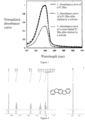
- the polymer P2 film was then rinsed with toluene and the thickness was determined to be 18-19 nm, indicating that the crosslinking reaction was effective and the solification of polymer P2 film was relatively complete.
- the fluorescent conjugated polymer P-PPV P-PPV is a green-emitting material
- MEH-PPV MEH-PPV is an orange-red emitting material
- the fluorescent polymer was spin-coated on the hole-transport layer of the polymer P2 film, and the optimal thickness of the polymer light-emitting layer was 80 nm.
- the film thickness was measured using an Alpha-Tencor-500 surface profiler.
- about 2-5 nm CsF was applied under vacuum deposition conditions as an electron-injection/transporting layer.
- Aluminum (100 nm) was vacuum evaporated on the electron-transport layer as a cathode.
- the light emitting area of the device has a region masked by the ITO interaction cover with an area determined to be 0.04 square centimeters. All preparation procedures were carried out in a glove box in a nitrogen atmosphere.
- the current-voltage characteristics, light intensity, and external quantum efficiency of the device were measured by the Keithley236 current-voltage measurement system and a calibrated silicon photodiode.
Landscapes
- Chemical & Material Sciences (AREA)
- Health & Medical Sciences (AREA)
- Chemical Kinetics & Catalysis (AREA)
- Medicinal Chemistry (AREA)
- Polymers & Plastics (AREA)
- Organic Chemistry (AREA)
- Engineering & Computer Science (AREA)
- Materials Engineering (AREA)
- Electroluminescent Light Sources (AREA)
- Polyoxymethylene Polymers And Polymers With Carbon-To-Carbon Bonds (AREA)
- Compositions Of Macromolecular Compounds (AREA)
Claims (6)
- Ein konjugiertes Polymer mit einer Ethinyl-Vernetzungsgruppe, dadurch gekennzeichnet, dass es die folgende Struktur aufweist:
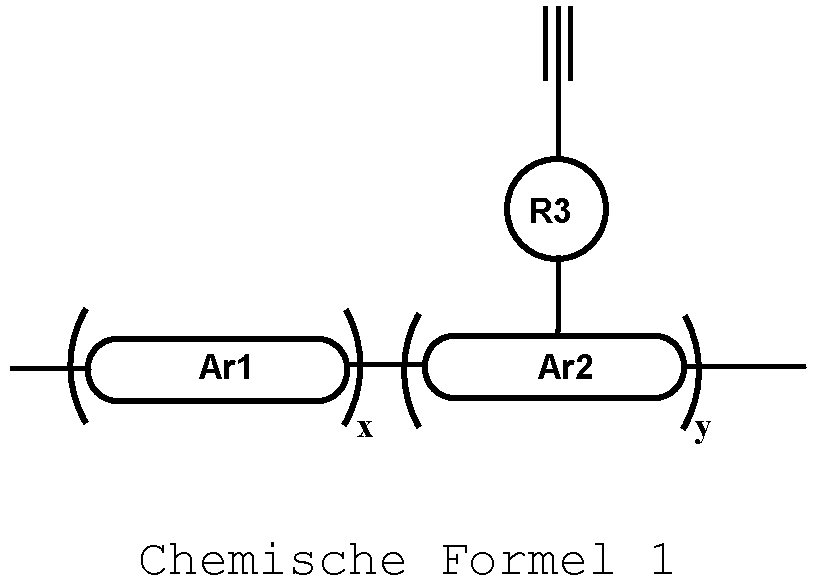 wobei x und y Molverhältnisse sind, die größer als 0 sind, und x + y = 1;
 Ar1 aus der Gruppe bestehend aus Benzol, Thiophen, Carbazol, Indenofluoren und Indolocarbazol ausgewählt ist, und Ar1 optional mit einer beliebigen Gruppe ausgewählt aus Wasserstoff, Deuterium, Alkyl, Alkoxy, Amino, Alkenyl, Alkynyl, Aralkyl, Heteroalkyl, Aryl und Heteroaryl, oder einer Kombination davon substituiert ist.
 - Eine Mischung, dadurch gekennzeichnet, dass sie umfasst:das konjugierte Polymer mit einer Ethinyl-Vernetzungsgruppe nach Anspruch 1 undmindestens ein organisches Funktionsmaterial, ausgewählt aus Lochinjektionsmaterial, Lochtransportmaterial, Elektronentransportmaterial, Elektroneninjektionsmaterial, Elektronensperrmaterial, Lochsperrmaterial, lichtemittierendem Material und Wirtsmaterial, oder einer Kombination davon.
- Eine Formulierung, dadurch gekennzeichnet, dass sie das konjugierte Polymer mit einer Ethinyl-Vernetzungsgruppe nach Anspruch 1 oder die Mischung nach Anspruch 2, und mindestens ein organisches Lösungsmittel umfasst.
- Verwendung des konjugierten Polymers mit einer Ethinyl-Vernetzungsgruppe nach Anspruch 1 oder der Mischung nach Anspruch 2 in einer organischen elektronischen Vorrichtung.
- Eine organische elektronische Vorrichtung, dadurch gekennzeichnet, dass sie das konjugierte Polymer mit einer Ethinyl-Vernetzungsgruppe nach Anspruch 1 oder die Mischung nach Anspruch 2 umfasst.
- Die organische elektronische Vorrichtung nach Anspruch 5, dadurch gekennzeichnet, dass die organische elektronische Vorrichtung ausgewählt ist aus der Gruppe bestehend aus: organischer Leuchtdiode, organischer Photovoltaikzelle, organischer Leuchtzelle, organischem Feldeffekttransistor, organischem leuchtendem Feldeffekttransistor, organischem Laser, organischem Spinelektronen-Bauelement, organischem Sensor, organischer plasmonischer Emitterdiode und Perowskit-Solarzelle.
Applications Claiming Priority (2)
| Application Number | Priority Date | Filing Date | Title |
|---|---|---|---|
| CN201510015154 | 2015-01-13 | ||
| PCT/CN2015/097192 WO2016112761A1 (zh) | 2015-01-13 | 2015-12-11 | 含乙炔基交联基团的共轭聚合物、包含其的混合物、组合物、有机电子器件及其应用 |
Publications (3)
| Publication Number | Publication Date |
|---|---|
| EP3246347A1 EP3246347A1 (de) | 2017-11-22 |
| EP3246347A4 EP3246347A4 (de) | 2018-08-22 |
| EP3246347B1 true EP3246347B1 (de) | 2025-04-23 |
Family
ID=56405225
Family Applications (1)
| Application Number | Title | Priority Date | Filing Date |
|---|---|---|---|
| EP15877672.4A Active EP3246347B1 (de) | 2015-01-13 | 2015-12-11 | Konjugiertes polymer mit ethynylvernetzungsgruppe, mischung, zusammensetzung, organische elektronische vorrichtung damit und anwendung davon |
Country Status (4)
| Country | Link |
|---|---|
| US (1) | US10364316B2 (de) |
| EP (1) | EP3246347B1 (de) |
| CN (1) | CN107108862B (de) |
| WO (1) | WO2016112761A1 (de) |
Families Citing this family (8)
| Publication number | Priority date | Publication date | Assignee | Title |
|---|---|---|---|---|
| WO2016072807A1 (ko) | 2014-11-06 | 2016-05-12 | 포항공과대학교 산학협력단 | 유기 리간드가 치환된 페로브스카이트 나노결정입자 발광체 제조방법, 이에 의해 제조된 나노결정입자 발광체 및 이를 이용한 발광소자 |
| KR102576153B1 (ko) * | 2018-09-21 | 2023-09-06 | 주식회사 엘지화학 | 신규한 공중합체 및 이를 포함하는 유기 발광 소자 |
| CN109728166B (zh) * | 2018-12-10 | 2022-02-22 | 太原理工大学 | 含有机发光小分子界面修饰层的甲胺铅碘钙钛矿太阳电池 |
| CN112661942B (zh) * | 2020-12-16 | 2023-03-21 | 华南理工大学 | 基于3-氰基噻吩的p-型共轭聚合物及其制备方法与光伏应用 |
| CN112608453B (zh) * | 2020-12-17 | 2023-05-12 | 华中科技大学 | 一种基于吡啶的d-a型交叉共轭聚合物、其制备和应用 |
| CN113929879B (zh) * | 2021-10-18 | 2023-06-30 | 湘潭大学 | 一种双炔桥联型一维线状或二维网状有机储能材料及其制备方法和应用 |
| CN114588942B (zh) * | 2022-02-25 | 2023-10-13 | 呼和浩特市联合鼎盛固体废物处理有限公司 | 太阳能制氢的方法 |
| CN117567481B (zh) * | 2023-11-16 | 2024-05-28 | 广州追光科技有限公司 | 含乙炔基可交联基团的有机化合物及其应用 |
Citations (1)
| Publication number | Priority date | Publication date | Assignee | Title |
|---|---|---|---|---|
| JP2014034618A (ja) * | 2012-08-08 | 2014-02-24 | Kuraray Co Ltd | 有機薄膜及びそれを用いた光電変換素子 |
Family Cites Families (98)
| Publication number | Priority date | Publication date | Assignee | Title |
|---|---|---|---|---|
| US3567450A (en) | 1968-02-20 | 1971-03-02 | Eastman Kodak Co | Photoconductive elements containing substituted triarylamine photoconductors |
| US3615404A (en) | 1968-04-25 | 1971-10-26 | Scott Paper Co | 1 3-phenylenediamine containing photoconductive materials |
| US4720432A (en) | 1987-02-11 | 1988-01-19 | Eastman Kodak Company | Electroluminescent device with organic luminescent medium |
| US4769292A (en) | 1987-03-02 | 1988-09-06 | Eastman Kodak Company | Electroluminescent device with modified thin film luminescent zone |
| US5121029A (en) | 1987-12-11 | 1992-06-09 | Idemitsu Kosan Co., Ltd. | Electroluminescence device having an organic electroluminescent element |
| US5130603A (en) | 1989-03-20 | 1992-07-14 | Idemitsu Kosan Co., Ltd. | Organic electroluminescence device |
| US5061569A (en) | 1990-07-26 | 1991-10-29 | Eastman Kodak Company | Electroluminescent device with organic electroluminescent medium |
| DE69625018T2 (de) | 1995-09-25 | 2003-04-10 | Toyo Ink Mfg Co | Leuchtemittierender Stoff für organische Elektrolumineszensvorrichtung, und organische Elektrolumineszensvorrichtung mit diesem leuchtemittierendem dafür geeignetem Stoff |
| US6830828B2 (en) | 1998-09-14 | 2004-12-14 | The Trustees Of Princeton University | Organometallic complexes as phosphorescent emitters in organic LEDs |
| US6020078A (en) | 1998-12-18 | 2000-02-01 | Eastman Kodak Company | Green organic electroluminescent devices |
| KR100913568B1 (ko) | 1999-05-13 | 2009-08-26 | 더 트러스티즈 오브 프린스턴 유니버시티 | 전계인광에 기초한 고 효율의 유기 발광장치 |
| KR100794975B1 (ko) | 1999-12-01 | 2008-01-16 | 더 트러스티즈 오브 프린스턴 유니버시티 | 유기 led용 인광성 도펀트로서 l2mx 형태의 착물 |
| JP4048521B2 (ja) | 2000-05-02 | 2008-02-20 | 富士フイルム株式会社 | 発光素子 |
| US20020121638A1 (en) | 2000-06-30 | 2002-09-05 | Vladimir Grushin | Electroluminescent iridium compounds with fluorinated phenylpyridines, phenylpyrimidines, and phenylquinolines and devices made with such compounds |
| DE10037391A1 (de) | 2000-08-01 | 2002-02-14 | Covion Organic Semiconductors | Strukturierbare Materialien, Verfahren zu deren Herstellung und deren Verwendung |
| CN100505375C (zh) | 2000-08-11 | 2009-06-24 | 普林斯顿大学理事会 | 有机金属化合物和发射转换有机电致磷光 |
| JP4154139B2 (ja) | 2000-09-26 | 2008-09-24 | キヤノン株式会社 | 発光素子 |
| JP4154138B2 (ja) | 2000-09-26 | 2008-09-24 | キヤノン株式会社 | 発光素子、表示装置及び金属配位化合物 |
| JP4154140B2 (ja) | 2000-09-26 | 2008-09-24 | キヤノン株式会社 | 金属配位化合物 |
| KR20030093240A (ko) | 2001-03-16 | 2003-12-06 | 이데미쓰 고산 가부시키가이샤 | 방향족 아미노 화합물의 제조방법 |
| EP1284276B1 (de) * | 2001-08-17 | 2010-03-17 | MERCK PATENT GmbH | Konjugierte Copolymere aus Dithienothiophen und Vinylen oder Acetylen |
| JP4629643B2 (ja) | 2001-08-31 | 2011-02-09 | 日本放送協会 | 有機発光素子及び表示装置 |
| US7250226B2 (en) | 2001-08-31 | 2007-07-31 | Nippon Hoso Kyokai | Phosphorescent compound, a phosphorescent composition and an organic light-emitting device |
| DE10143353A1 (de) | 2001-09-04 | 2003-03-20 | Covion Organic Semiconductors | Konjugierte Polymere enthaltend Spirobifluoren-Einheiten und deren Verwendung |
| US6835469B2 (en) | 2001-10-17 | 2004-12-28 | The University Of Southern California | Phosphorescent compounds and devices comprising the same |
| US6686065B2 (en) | 2001-12-12 | 2004-02-03 | Canon Kabushiki Kaisha | [5]-helicene and dibenzofluorene materials for use in organic light emitting devices |
| JP4256182B2 (ja) | 2002-03-14 | 2009-04-22 | Tdk株式会社 | 有機el素子 |
| SG128438A1 (en) | 2002-03-15 | 2007-01-30 | Sumitomo Chemical Co | Polymer compound and polymer light emitting deviceusing the same |
| TWI314947B (en) | 2002-04-24 | 2009-09-21 | Eastman Kodak Compan | Organic light emitting diode devices with improved operational stability |
| TWI287570B (en) | 2002-05-28 | 2007-10-01 | Sumitomo Chemical Co | Polymer compound and polymer luminescent element using the same |
| GB0226010D0 (en) | 2002-11-08 | 2002-12-18 | Cambridge Display Tech Ltd | Polymers for use in organic electroluminescent devices |
| EP1491568A1 (de) | 2003-06-23 | 2004-12-29 | Covion Organic Semiconductors GmbH | Halbleitende Polymere |
| DE10338550A1 (de) | 2003-08-19 | 2005-03-31 | Basf Ag | Übergangsmetallkomplexe mit Carbenliganden als Emitter für organische Licht-emittierende Dioden (OLEDs) |
| DE10345572A1 (de) | 2003-09-29 | 2005-05-19 | Covion Organic Semiconductors Gmbh | Metallkomplexe |
| JP2005108556A (ja) | 2003-09-29 | 2005-04-21 | Tdk Corp | 有機el素子及び有機elディスプレイ |
| WO2005033174A1 (ja) | 2003-10-01 | 2005-04-14 | Sumitomo Chemical Company, Limited | 高分子発光材料および高分子発光素子 |
| JP4714153B2 (ja) * | 2003-11-17 | 2011-06-29 | 住友化学株式会社 | 架橋性の置換フルオレン化合物 |
| TWI365218B (en) * | 2003-11-17 | 2012-06-01 | Sumitomo Chemical Co | Conjugated oligomers or polymers based on crosslinkable arylamine compounds |
| US6824895B1 (en) | 2003-12-05 | 2004-11-30 | Eastman Kodak Company | Electroluminescent device containing organometallic compound with tridentate ligand |
| US7029766B2 (en) | 2003-12-05 | 2006-04-18 | Eastman Kodak Company | Organic element for electroluminescent devices |
| TW201235442A (en) | 2003-12-12 | 2012-09-01 | Sumitomo Chemical Co | Polymer and light-emitting element using said polymer |
| JP4466160B2 (ja) | 2004-03-30 | 2010-05-26 | Tdk株式会社 | 有機el素子及び有機elディスプレイ |
| DE102004020298A1 (de) | 2004-04-26 | 2005-11-10 | Covion Organic Semiconductors Gmbh | Elektrolumineszierende Polymere und deren Verwendung |
| US7598388B2 (en) | 2004-05-18 | 2009-10-06 | The University Of Southern California | Carbene containing metal complexes as OLEDs |
| CN100368363C (zh) | 2004-06-04 | 2008-02-13 | 友达光电股份有限公司 | 蒽化合物以及包括此蒽化合物的有机电致发光装置 |
| DE102004031000A1 (de) | 2004-06-26 | 2006-01-12 | Covion Organic Semiconductors Gmbh | Organische Elektrolumineszenzvorrichtungen |
| TW200613515A (en) | 2004-06-26 | 2006-05-01 | Merck Patent Gmbh | Compounds for organic electronic devices |
| DE102004034517A1 (de) | 2004-07-16 | 2006-02-16 | Covion Organic Semiconductors Gmbh | Metallkomplexe |
| US20060094859A1 (en) | 2004-11-03 | 2006-05-04 | Marrocco Matthew L Iii | Class of bridged biphenylene polymers |
| TW200639140A (en) | 2004-12-01 | 2006-11-16 | Merck Patent Gmbh | Compounds for organic electronic devices |
| TWI385193B (zh) | 2004-12-07 | 2013-02-11 | Sumitomo Chemical Co | 高分子材料及使用該高分子材料之元件 |
| JP4263700B2 (ja) | 2005-03-15 | 2009-05-13 | 出光興産株式会社 | 芳香族アミン誘導体及びそれを用いた有機エレクトロルミネッセンス素子 |
| US20060222886A1 (en) | 2005-04-04 | 2006-10-05 | Raymond Kwong | Arylpyrene compounds |
| WO2006118345A1 (ja) | 2005-04-28 | 2006-11-09 | Sumitomo Chemical Company, Limited | 高分子化合物およびそれを用いた高分子発光素子 |
| DE102005019880A1 (de) | 2005-04-28 | 2006-11-09 | Basf Ag | Synthese von phenylsubstituierten Polyfluoranthenen und ihre Verwendung |
| US7982212B2 (en) | 2005-10-07 | 2011-07-19 | Sumitomo Chemical Company, Limited | Copolymer and polymer light emitting device using the same |
| US7588839B2 (en) | 2005-10-19 | 2009-09-15 | Eastman Kodak Company | Electroluminescent device |
| US20070092753A1 (en) | 2005-10-26 | 2007-04-26 | Eastman Kodak Company | Organic element for low voltage electroluminescent devices |
| DE102005058543A1 (de) | 2005-12-08 | 2007-06-14 | Merck Patent Gmbh | Organische Elektrolumineszenzvorrichtungen |
| DE102005058557A1 (de) | 2005-12-08 | 2007-06-14 | Merck Patent Gmbh | Organische Elektrolumineszenzvorrichtung |
| JP4879591B2 (ja) | 2006-01-26 | 2012-02-22 | 昭和電工株式会社 | 高分子発光材料、有機エレクトロルミネッセンス素子および表示装置 |
| CN103254240B (zh) | 2006-02-10 | 2016-06-22 | 通用显示公司 | 包含磷光性金属络合物的化合物和包含所述化合物的oled器件 |
| US20070208567A1 (en) | 2006-03-01 | 2007-09-06 | At&T Corp. | Error Correction In Automatic Speech Recognition Transcripts |
| DE102006015183A1 (de) | 2006-04-01 | 2007-10-04 | Merck Patent Gmbh | Materialien für organische Elektrolumineszenzvorrichtungen |
| US20070252517A1 (en) | 2006-04-27 | 2007-11-01 | Eastman Kodak Company | Electroluminescent device including an anthracene derivative |
| JP2008053397A (ja) | 2006-08-24 | 2008-03-06 | Ricoh Co Ltd | 半導体装置及びその製造方法 |
| JP2008124156A (ja) | 2006-11-09 | 2008-05-29 | Idemitsu Kosan Co Ltd | 有機el材料含有溶液、有機el材料の薄膜形成方法、有機el材料の薄膜、有機el素子 |
| JP4902381B2 (ja) | 2007-02-07 | 2012-03-21 | 昭和電工株式会社 | 重合性化合物の重合体 |
| US7645142B2 (en) | 2007-09-05 | 2010-01-12 | Vivant Medical, Inc. | Electrical receptacle assembly |
| US8221905B2 (en) | 2007-12-28 | 2012-07-17 | Universal Display Corporation | Carbazole-containing materials in phosphorescent light emitting diodes |
| DE102008015526B4 (de) | 2008-03-25 | 2021-11-11 | Merck Patent Gmbh | Metallkomplexe |
| DE102008027005A1 (de) | 2008-06-05 | 2009-12-10 | Merck Patent Gmbh | Organische elektronische Vorrichtung enthaltend Metallkomplexe |
| JP2010010246A (ja) * | 2008-06-25 | 2010-01-14 | Sumitomo Chemical Co Ltd | 有機光電変換素子 |
| DE102008036247A1 (de) | 2008-08-04 | 2010-02-11 | Merck Patent Gmbh | Elektronische Vorrichtungen enthaltend Metallkomplexe |
| DE102008048336A1 (de) | 2008-09-22 | 2010-03-25 | Merck Patent Gmbh | Einkernige neutrale Kupfer(I)-Komplexe und deren Verwendung zur Herstellung von optoelektronischen Bauelementen |
| DE102008057050B4 (de) | 2008-11-13 | 2021-06-02 | Merck Patent Gmbh | Materialien für organische Elektrolumineszenzvorrichtungen |
| DE102008057051B4 (de) | 2008-11-13 | 2021-06-17 | Merck Patent Gmbh | Materialien für organische Elektrolumineszenzvorrichtungen |
| DE102009007038A1 (de) | 2009-02-02 | 2010-08-05 | Merck Patent Gmbh | Metallkomplexe |
| DE102009011223A1 (de) | 2009-03-02 | 2010-09-23 | Merck Patent Gmbh | Metallkomplexe |
| DE102009013041A1 (de) | 2009-03-13 | 2010-09-16 | Merck Patent Gmbh | Materialien für organische Elektrolumineszenzvorrichtungen |
| US8586203B2 (en) | 2009-05-20 | 2013-11-19 | Universal Display Corporation | Metal complexes with boron-nitrogen heterocycle containing ligands |
| DE102009023154A1 (de) | 2009-05-29 | 2011-06-16 | Merck Patent Gmbh | Zusammensetzung, enthaltend mindestens eine Emitterverbindung und mindestens ein Polymer mit konjugationsunterbrechenden Einheiten |
| DE102009023156A1 (de) | 2009-05-29 | 2010-12-02 | Merck Patent Gmbh | Polymere, die substituierte Indenofluorenderivate als Struktureinheit enthalten, Verfahren zu deren Herstellung sowie deren Verwendung |
| JP2011146307A (ja) * | 2010-01-15 | 2011-07-28 | Sumitomo Chemical Co Ltd | 高分子発光素子 |
| EP2544765A1 (de) | 2010-03-11 | 2013-01-16 | Merck Patent GmbH | Fasern für therapeutische und kosmetische zwecke |
| KR20130087499A (ko) | 2010-06-15 | 2013-08-06 | 메르크 파텐트 게엠베하 | 금속 착물 |
| EP2404627A1 (de) | 2010-07-09 | 2012-01-11 | Universite De Nantes I | Knochenregenerierungsmembran und Verfahren zur Bildung einer Knochenregenerierungsmembran |
| CN101885834B (zh) * | 2010-07-16 | 2012-06-27 | 华南理工大学 | 含4,5-乙撑基-2,7-咔唑的共轭聚合物及其制备方法与应用 |
| DE102010027316A1 (de) | 2010-07-16 | 2012-01-19 | Merck Patent Gmbh | Metallkomplexe |
| DE102010027319A1 (de) | 2010-07-16 | 2012-01-19 | Merck Patent Gmbh | Metallkomplexe |
| DE102010027317A1 (de) | 2010-07-16 | 2012-01-19 | Merck Patent Gmbh | Metallkomplexe |
| CN102399359B (zh) | 2011-11-25 | 2013-06-12 | 华南理工大学 | 含磷酸酯基的三苯胺共轭聚合物及其应用 |
| EP2838931A1 (de) | 2012-04-17 | 2015-02-25 | Merck Patent GmbH | Vernetzbare sowie vernetzte polymere, verfahren zu deren herstellung sowie deren verwendung |
| KR101375563B1 (ko) * | 2012-04-25 | 2014-03-20 | 한국화학연구원 | 전도성 고분자, 이를 이용한 유기 광전변환재료 및 유기 태양전지 |
| EP2706584A1 (de) * | 2012-09-07 | 2014-03-12 | Novaled AG | Lastentransportierendes halbleitendes Material und Halbleitervorrichtung |
| CN103232592A (zh) * | 2013-04-01 | 2013-08-07 | 新疆大学 | 基于共轭聚合物的信号开启型汞离子光学探针的制备 |
| CN103408732A (zh) * | 2013-07-04 | 2013-11-27 | 中国科学院青岛生物能源与过程研究所 | 含苯并二噻吩的聚芳基乙炔撑半导体材料 |
| DE102014112038B4 (de) * | 2014-08-22 | 2018-06-14 | Fraunhofer-Gesellschaft zur Förderung der angewandten Forschung e.V. | Organisch elektronisches Bauteil mit einer vernetzten organisch-elektronischen Funktionsschicht und zur Herstellung dieses Bauteils verwendbarer Alkinylether |
-
2015
- 2015-12-11 US US15/543,221 patent/US10364316B2/en active Active
- 2015-12-11 WO PCT/CN2015/097192 patent/WO2016112761A1/zh not_active Ceased
- 2015-12-11 CN CN201580069863.7A patent/CN107108862B/zh active Active
- 2015-12-11 EP EP15877672.4A patent/EP3246347B1/de active Active
Patent Citations (1)
| Publication number | Priority date | Publication date | Assignee | Title |
|---|---|---|---|---|
| JP2014034618A (ja) * | 2012-08-08 | 2014-02-24 | Kuraray Co Ltd | 有機薄膜及びそれを用いた光電変換素子 |
Also Published As
| Publication number | Publication date |
|---|---|
| CN107108862B (zh) | 2019-08-02 |
| EP3246347A4 (de) | 2018-08-22 |
| CN107108862A (zh) | 2017-08-29 |
| WO2016112761A1 (zh) | 2016-07-21 |
| US10364316B2 (en) | 2019-07-30 |
| US20180022865A1 (en) | 2018-01-25 |
| EP3246347A1 (de) | 2017-11-22 |
Similar Documents
| Publication | Publication Date | Title |
|---|---|---|
| EP3246347B1 (de) | Konjugiertes polymer mit ethynylvernetzungsgruppe, mischung, zusammensetzung, organische elektronische vorrichtung damit und anwendung davon | |
| EP3229288B1 (de) | Polymer und mischung, formulierung und organische elektronische vorrichtung damit, und monomer davon | |
| US10323180B2 (en) | Deuterated organic compound, mixture and composition containing said compound, and organic electronic device | |
| CN108003365B (zh) | 有机复合薄膜及其在有机电子器件中的应用 | |
| CN107001380B (zh) | 化合物、包含其的混合物、组合物和有机电子器件 | |
| CN109790136B (zh) | 含呋喃交联基团的聚合物及其应用 | |
| CN109792003B (zh) | 基于狄尔斯-阿尔德反应的可交联聚合物及其在有机电子器件中的应用 | |
| CN109791993B (zh) | 有机混合物、组合物以及有机电子器件 | |
| KR20150010737A (ko) | 치환된 올리고트리아릴아민 단위를 함유하는 중합체, 및 이들 중합체를 포함하는 전자발광 소자 | |
| CN109791992B (zh) | 高聚物、包含其的混合物、组合物和有机电子器件以及用于聚合的单体 | |
| WO2016091219A1 (zh) | 有机化合物、包含其的混合物、组合物和有机电子器件 | |
| CN109705107A (zh) | 稠环有机化合物、包含其的混合物及有机电子器件 | |
| JP2021501187A (ja) | 化合物、これを含むコーティング組成物および有機発光素子 | |
| CN111278892B (zh) | 含酰胺键基团的聚合物、混合物、组合物及其应用 | |
| CN111087413A (zh) | 一种过渡金属配合物及其有机电子器件 | |
| TW200300148A (en) | Process for preparing aromatic polymers | |
| JP7088168B2 (ja) | 電荷輸送性材料及びその利用 | |
| CN111278819A (zh) | 双极性化合物、高聚物、混合物、组合物、有机电子器件及应用 |
Legal Events
| Date | Code | Title | Description |
|---|---|---|---|
| STAA | Information on the status of an ep patent application or granted ep patent |
Free format text: STATUS: THE INTERNATIONAL PUBLICATION HAS BEEN MADE |
|
| PUAI | Public reference made under article 153(3) epc to a published international application that has entered the european phase |
Free format text: ORIGINAL CODE: 0009012 |
|
| STAA | Information on the status of an ep patent application or granted ep patent |
Free format text: STATUS: REQUEST FOR EXAMINATION WAS MADE |
|
| 17P | Request for examination filed |
Effective date: 20170810 |
|
| AK | Designated contracting states |
Kind code of ref document: A1 Designated state(s): AL AT BE BG CH CY CZ DE DK EE ES FI FR GB GR HR HU IE IS IT LI LT LU LV MC MK MT NL NO PL PT RO RS SE SI SK SM TR |
|
| AX | Request for extension of the european patent |
Extension state: BA ME |
|
| DAV | Request for validation of the european patent (deleted) | ||
| DAX | Request for extension of the european patent (deleted) | ||
| A4 | Supplementary search report drawn up and despatched |
Effective date: 20180725 |
|
| RIC1 | Information provided on ipc code assigned before grant |
Ipc: C08G 61/12 20060101AFI20180716BHEP Ipc: H01L 51/50 20060101ALI20180716BHEP Ipc: C08L 65/00 20060101ALI20180716BHEP Ipc: H01L 51/46 20060101ALI20180716BHEP Ipc: H01L 51/00 20060101ALI20180716BHEP |
|
| STAA | Information on the status of an ep patent application or granted ep patent |
Free format text: STATUS: EXAMINATION IS IN PROGRESS |
|
| 17Q | First examination report despatched |
Effective date: 20210401 |
|
| GRAP | Despatch of communication of intention to grant a patent |
Free format text: ORIGINAL CODE: EPIDOSNIGR1 |
|
| STAA | Information on the status of an ep patent application or granted ep patent |
Free format text: STATUS: GRANT OF PATENT IS INTENDED |
|
| RIC1 | Information provided on ipc code assigned before grant |
Ipc: H10K 85/00 20230101ALI20241114BHEP Ipc: C08L 65/00 20060101ALI20241114BHEP Ipc: C08G 61/12 20060101AFI20241114BHEP |
|
| INTG | Intention to grant announced |
Effective date: 20241202 |
|
| GRAS | Grant fee paid |
Free format text: ORIGINAL CODE: EPIDOSNIGR3 |
|
| GRAA | (expected) grant |
Free format text: ORIGINAL CODE: 0009210 |
|
| STAA | Information on the status of an ep patent application or granted ep patent |
Free format text: STATUS: THE PATENT HAS BEEN GRANTED |
|
| P01 | Opt-out of the competence of the unified patent court (upc) registered |
Free format text: CASE NUMBER: APP_7552/2025 Effective date: 20250213 |
|
| AK | Designated contracting states |
Kind code of ref document: B1 Designated state(s): AL AT BE BG CH CY CZ DE DK EE ES FI FR GB GR HR HU IE IS IT LI LT LU LV MC MK MT NL NO PL PT RO RS SE SI SK SM TR |
|
| REG | Reference to a national code |
Ref country code: GB Ref legal event code: FG4D |
|
| REG | Reference to a national code |
Ref country code: CH Ref legal event code: EP |
|
| REG | Reference to a national code |
Ref country code: DE Ref legal event code: R096 Ref document number: 602015091505 Country of ref document: DE |
|
| REG | Reference to a national code |
Ref country code: IE Ref legal event code: FG4D |
|
| REG | Reference to a national code |
Ref country code: NL Ref legal event code: MP Effective date: 20250423 |
|
| PG25 | Lapsed in a contracting state [announced via postgrant information from national office to epo] |
Ref country code: NL Free format text: LAPSE BECAUSE OF FAILURE TO SUBMIT A TRANSLATION OF THE DESCRIPTION OR TO PAY THE FEE WITHIN THE PRESCRIBED TIME-LIMIT Effective date: 20250423 |
|
| REG | Reference to a national code |
Ref country code: AT Ref legal event code: MK05 Ref document number: 1787728 Country of ref document: AT Kind code of ref document: T Effective date: 20250423 |
|
| PG25 | Lapsed in a contracting state [announced via postgrant information from national office to epo] |
Ref country code: PT Free format text: LAPSE BECAUSE OF FAILURE TO SUBMIT A TRANSLATION OF THE DESCRIPTION OR TO PAY THE FEE WITHIN THE PRESCRIBED TIME-LIMIT Effective date: 20250825 Ref country code: ES Free format text: LAPSE BECAUSE OF FAILURE TO SUBMIT A TRANSLATION OF THE DESCRIPTION OR TO PAY THE FEE WITHIN THE PRESCRIBED TIME-LIMIT Effective date: 20250423 Ref country code: FI Free format text: LAPSE BECAUSE OF FAILURE TO SUBMIT A TRANSLATION OF THE DESCRIPTION OR TO PAY THE FEE WITHIN THE PRESCRIBED TIME-LIMIT Effective date: 20250423 |
|
| REG | Reference to a national code |
Ref country code: LT Ref legal event code: MG9D |
|
| PG25 | Lapsed in a contracting state [announced via postgrant information from national office to epo] |
Ref country code: GR Free format text: LAPSE BECAUSE OF FAILURE TO SUBMIT A TRANSLATION OF THE DESCRIPTION OR TO PAY THE FEE WITHIN THE PRESCRIBED TIME-LIMIT Effective date: 20250724 Ref country code: NO Free format text: LAPSE BECAUSE OF FAILURE TO SUBMIT A TRANSLATION OF THE DESCRIPTION OR TO PAY THE FEE WITHIN THE PRESCRIBED TIME-LIMIT Effective date: 20250723 |
|
| PG25 | Lapsed in a contracting state [announced via postgrant information from national office to epo] |
Ref country code: PL Free format text: LAPSE BECAUSE OF FAILURE TO SUBMIT A TRANSLATION OF THE DESCRIPTION OR TO PAY THE FEE WITHIN THE PRESCRIBED TIME-LIMIT Effective date: 20250423 |
|
| PG25 | Lapsed in a contracting state [announced via postgrant information from national office to epo] |
Ref country code: BG Free format text: LAPSE BECAUSE OF FAILURE TO SUBMIT A TRANSLATION OF THE DESCRIPTION OR TO PAY THE FEE WITHIN THE PRESCRIBED TIME-LIMIT Effective date: 20250423 |
|
| PG25 | Lapsed in a contracting state [announced via postgrant information from national office to epo] |
Ref country code: HR Free format text: LAPSE BECAUSE OF FAILURE TO SUBMIT A TRANSLATION OF THE DESCRIPTION OR TO PAY THE FEE WITHIN THE PRESCRIBED TIME-LIMIT Effective date: 20250423 |
|
| PG25 | Lapsed in a contracting state [announced via postgrant information from national office to epo] |
Ref country code: AT Free format text: LAPSE BECAUSE OF FAILURE TO SUBMIT A TRANSLATION OF THE DESCRIPTION OR TO PAY THE FEE WITHIN THE PRESCRIBED TIME-LIMIT Effective date: 20250423 |
|
| PG25 | Lapsed in a contracting state [announced via postgrant information from national office to epo] |
Ref country code: RS Free format text: LAPSE BECAUSE OF FAILURE TO SUBMIT A TRANSLATION OF THE DESCRIPTION OR TO PAY THE FEE WITHIN THE PRESCRIBED TIME-LIMIT Effective date: 20250723 |
|
| PG25 | Lapsed in a contracting state [announced via postgrant information from national office to epo] |
Ref country code: IS Free format text: LAPSE BECAUSE OF FAILURE TO SUBMIT A TRANSLATION OF THE DESCRIPTION OR TO PAY THE FEE WITHIN THE PRESCRIBED TIME-LIMIT Effective date: 20250823 |
|
| PG25 | Lapsed in a contracting state [announced via postgrant information from national office to epo] |
Ref country code: LV Free format text: LAPSE BECAUSE OF FAILURE TO SUBMIT A TRANSLATION OF THE DESCRIPTION OR TO PAY THE FEE WITHIN THE PRESCRIBED TIME-LIMIT Effective date: 20250423 |