EP4330239B1 - Materialien für organische elektrolumineszenzvorrichtungen - Google Patents
Materialien für organische elektrolumineszenzvorrichtungen Download PDFInfo
- Publication number
- EP4330239B1 EP4330239B1 EP22725459.6A EP22725459A EP4330239B1 EP 4330239 B1 EP4330239 B1 EP 4330239B1 EP 22725459 A EP22725459 A EP 22725459A EP 4330239 B1 EP4330239 B1 EP 4330239B1
- Authority
- EP
- European Patent Office
- Prior art keywords
- aromatic
- atoms
- radicals
- substituted
- groups
- Prior art date
- Legal status (The legal status is an assumption and is not a legal conclusion. Google has not performed a legal analysis and makes no representation as to the accuracy of the status listed.)
- Active
Links
Classifications
-
- C—CHEMISTRY; METALLURGY
- C07—ORGANIC CHEMISTRY
- C07D—HETEROCYCLIC COMPOUNDS
- C07D403/00—Heterocyclic compounds containing two or more hetero rings, having nitrogen atoms as the only ring hetero atoms, not provided for by group C07D401/00
- C07D403/02—Heterocyclic compounds containing two or more hetero rings, having nitrogen atoms as the only ring hetero atoms, not provided for by group C07D401/00 containing two hetero rings
- C07D403/04—Heterocyclic compounds containing two or more hetero rings, having nitrogen atoms as the only ring hetero atoms, not provided for by group C07D401/00 containing two hetero rings directly linked by a ring-member-to-ring-member bond
-
- C—CHEMISTRY; METALLURGY
- C07—ORGANIC CHEMISTRY
- C07D—HETEROCYCLIC COMPOUNDS
- C07D307/00—Heterocyclic compounds containing five-membered rings having one oxygen atom as the only ring hetero atom
- C07D307/77—Heterocyclic compounds containing five-membered rings having one oxygen atom as the only ring hetero atom ortho- or peri-condensed with carbocyclic rings or ring systems
- C07D307/91—Dibenzofurans; Hydrogenated dibenzofurans
-
- C—CHEMISTRY; METALLURGY
- C07—ORGANIC CHEMISTRY
- C07D—HETEROCYCLIC COMPOUNDS
- C07D403/00—Heterocyclic compounds containing two or more hetero rings, having nitrogen atoms as the only ring hetero atoms, not provided for by group C07D401/00
- C07D403/02—Heterocyclic compounds containing two or more hetero rings, having nitrogen atoms as the only ring hetero atoms, not provided for by group C07D401/00 containing two hetero rings
- C07D403/10—Heterocyclic compounds containing two or more hetero rings, having nitrogen atoms as the only ring hetero atoms, not provided for by group C07D401/00 containing two hetero rings linked by a carbon chain containing aromatic rings
-
- C—CHEMISTRY; METALLURGY
- C07—ORGANIC CHEMISTRY
- C07D—HETEROCYCLIC COMPOUNDS
- C07D403/00—Heterocyclic compounds containing two or more hetero rings, having nitrogen atoms as the only ring hetero atoms, not provided for by group C07D401/00
- C07D403/14—Heterocyclic compounds containing two or more hetero rings, having nitrogen atoms as the only ring hetero atoms, not provided for by group C07D401/00 containing three or more hetero rings
-
- C—CHEMISTRY; METALLURGY
- C07—ORGANIC CHEMISTRY
- C07D—HETEROCYCLIC COMPOUNDS
- C07D487/00—Heterocyclic compounds containing nitrogen atoms as the only ring hetero atoms in the condensed system, not provided for by groups C07D451/00 - C07D477/00
- C07D487/02—Heterocyclic compounds containing nitrogen atoms as the only ring hetero atoms in the condensed system, not provided for by groups C07D451/00 - C07D477/00 in which the condensed system contains two hetero rings
- C07D487/06—Peri-condensed systems
-
- C—CHEMISTRY; METALLURGY
- C07—ORGANIC CHEMISTRY
- C07D—HETEROCYCLIC COMPOUNDS
- C07D491/00—Heterocyclic compounds containing in the condensed ring system both one or more rings having oxygen atoms as the only ring hetero atoms and one or more rings having nitrogen atoms as the only ring hetero atoms, not provided for by groups C07D451/00 - C07D459/00, C07D463/00, C07D477/00 or C07D489/00
- C07D491/02—Heterocyclic compounds containing in the condensed ring system both one or more rings having oxygen atoms as the only ring hetero atoms and one or more rings having nitrogen atoms as the only ring hetero atoms, not provided for by groups C07D451/00 - C07D459/00, C07D463/00, C07D477/00 or C07D489/00 in which the condensed system contains two hetero rings
- C07D491/06—Peri-condensed systems
-
- C—CHEMISTRY; METALLURGY
- C07—ORGANIC CHEMISTRY
- C07D—HETEROCYCLIC COMPOUNDS
- C07D493/00—Heterocyclic compounds containing oxygen atoms as the only ring hetero atoms in the condensed system
- C07D493/02—Heterocyclic compounds containing oxygen atoms as the only ring hetero atoms in the condensed system in which the condensed system contains two hetero rings
- C07D493/06—Peri-condensed systems
-
- C—CHEMISTRY; METALLURGY
- C07—ORGANIC CHEMISTRY
- C07D—HETEROCYCLIC COMPOUNDS
- C07D495/00—Heterocyclic compounds containing in the condensed system at least one hetero ring having sulfur atoms as the only ring hetero atoms
- C07D495/02—Heterocyclic compounds containing in the condensed system at least one hetero ring having sulfur atoms as the only ring hetero atoms in which the condensed system contains two hetero rings
- C07D495/06—Peri-condensed systems
-
- C—CHEMISTRY; METALLURGY
- C09—DYES; PAINTS; POLISHES; NATURAL RESINS; ADHESIVES; COMPOSITIONS NOT OTHERWISE PROVIDED FOR; APPLICATIONS OF MATERIALS NOT OTHERWISE PROVIDED FOR
- C09K—MATERIALS FOR MISCELLANEOUS APPLICATIONS, NOT PROVIDED FOR ELSEWHERE
- C09K11/00—Luminescent materials, e.g. electroluminescent or chemiluminescent
- C09K11/06—Luminescent materials, e.g. electroluminescent or chemiluminescent containing organic luminescent materials
-
- H—ELECTRICITY
- H10—SEMICONDUCTOR DEVICES; ELECTRIC SOLID-STATE DEVICES NOT OTHERWISE PROVIDED FOR
- H10K—ORGANIC ELECTRIC SOLID-STATE DEVICES
- H10K50/00—Organic light-emitting devices
- H10K50/10—OLEDs or polymer light-emitting diodes [PLED]
- H10K50/11—OLEDs or polymer light-emitting diodes [PLED] characterised by the electroluminescent [EL] layers
-
- H—ELECTRICITY
- H10—SEMICONDUCTOR DEVICES; ELECTRIC SOLID-STATE DEVICES NOT OTHERWISE PROVIDED FOR
- H10K—ORGANIC ELECTRIC SOLID-STATE DEVICES
- H10K85/00—Organic materials used in the body or electrodes of devices covered by this subclass
- H10K85/60—Organic compounds having low molecular weight
- H10K85/615—Polycyclic condensed aromatic hydrocarbons, e.g. anthracene
-
- H—ELECTRICITY
- H10—SEMICONDUCTOR DEVICES; ELECTRIC SOLID-STATE DEVICES NOT OTHERWISE PROVIDED FOR
- H10K—ORGANIC ELECTRIC SOLID-STATE DEVICES
- H10K85/00—Organic materials used in the body or electrodes of devices covered by this subclass
- H10K85/60—Organic compounds having low molecular weight
- H10K85/631—Amine compounds having at least two aryl rest on at least one amine-nitrogen atom, e.g. triphenylamine
-
- H—ELECTRICITY
- H10—SEMICONDUCTOR DEVICES; ELECTRIC SOLID-STATE DEVICES NOT OTHERWISE PROVIDED FOR
- H10K—ORGANIC ELECTRIC SOLID-STATE DEVICES
- H10K85/00—Organic materials used in the body or electrodes of devices covered by this subclass
- H10K85/60—Organic compounds having low molecular weight
- H10K85/631—Amine compounds having at least two aryl rest on at least one amine-nitrogen atom, e.g. triphenylamine
- H10K85/636—Amine compounds having at least two aryl rest on at least one amine-nitrogen atom, e.g. triphenylamine comprising heteroaromatic hydrocarbons as substituents on the nitrogen atom
-
- H—ELECTRICITY
- H10—SEMICONDUCTOR DEVICES; ELECTRIC SOLID-STATE DEVICES NOT OTHERWISE PROVIDED FOR
- H10K—ORGANIC ELECTRIC SOLID-STATE DEVICES
- H10K85/00—Organic materials used in the body or electrodes of devices covered by this subclass
- H10K85/60—Organic compounds having low molecular weight
- H10K85/649—Aromatic compounds comprising a hetero atom
- H10K85/654—Aromatic compounds comprising a hetero atom comprising only nitrogen as heteroatom
-
- H—ELECTRICITY
- H10—SEMICONDUCTOR DEVICES; ELECTRIC SOLID-STATE DEVICES NOT OTHERWISE PROVIDED FOR
- H10K—ORGANIC ELECTRIC SOLID-STATE DEVICES
- H10K85/00—Organic materials used in the body or electrodes of devices covered by this subclass
- H10K85/60—Organic compounds having low molecular weight
- H10K85/649—Aromatic compounds comprising a hetero atom
- H10K85/657—Polycyclic condensed heteroaromatic hydrocarbons
-
- H—ELECTRICITY
- H10—SEMICONDUCTOR DEVICES; ELECTRIC SOLID-STATE DEVICES NOT OTHERWISE PROVIDED FOR
- H10K—ORGANIC ELECTRIC SOLID-STATE DEVICES
- H10K85/00—Organic materials used in the body or electrodes of devices covered by this subclass
- H10K85/60—Organic compounds having low molecular weight
- H10K85/649—Aromatic compounds comprising a hetero atom
- H10K85/657—Polycyclic condensed heteroaromatic hydrocarbons
- H10K85/6572—Polycyclic condensed heteroaromatic hydrocarbons comprising only nitrogen in the heteroaromatic polycondensed ring system, e.g. phenanthroline or carbazole
-
- H—ELECTRICITY
- H10—SEMICONDUCTOR DEVICES; ELECTRIC SOLID-STATE DEVICES NOT OTHERWISE PROVIDED FOR
- H10K—ORGANIC ELECTRIC SOLID-STATE DEVICES
- H10K85/00—Organic materials used in the body or electrodes of devices covered by this subclass
- H10K85/60—Organic compounds having low molecular weight
- H10K85/649—Aromatic compounds comprising a hetero atom
- H10K85/657—Polycyclic condensed heteroaromatic hydrocarbons
- H10K85/6574—Polycyclic condensed heteroaromatic hydrocarbons comprising only oxygen in the heteroaromatic polycondensed ring system, e.g. cumarine dyes
-
- H—ELECTRICITY
- H10—SEMICONDUCTOR DEVICES; ELECTRIC SOLID-STATE DEVICES NOT OTHERWISE PROVIDED FOR
- H10K—ORGANIC ELECTRIC SOLID-STATE DEVICES
- H10K2101/00—Properties of the organic materials covered by group H10K85/00
- H10K2101/10—Triplet emission
-
- H—ELECTRICITY
- H10—SEMICONDUCTOR DEVICES; ELECTRIC SOLID-STATE DEVICES NOT OTHERWISE PROVIDED FOR
- H10K—ORGANIC ELECTRIC SOLID-STATE DEVICES
- H10K2101/00—Properties of the organic materials covered by group H10K85/00
- H10K2101/90—Multiple hosts in the emissive layer
-
- H—ELECTRICITY
- H10—SEMICONDUCTOR DEVICES; ELECTRIC SOLID-STATE DEVICES NOT OTHERWISE PROVIDED FOR
- H10K—ORGANIC ELECTRIC SOLID-STATE DEVICES
- H10K85/00—Organic materials used in the body or electrodes of devices covered by this subclass
- H10K85/30—Coordination compounds
- H10K85/341—Transition metal complexes, e.g. Ru(II)polypyridine complexes
- H10K85/342—Transition metal complexes, e.g. Ru(II)polypyridine complexes comprising iridium
Definitions
- the present invention relates to materials for use in electronic devices, in particular in organic electroluminescent devices, as well as electronic devices, in particular organic electroluminescent devices, containing these materials.
- OLEDs organic electroluminescent devices
- phosphorescent organometallic complexes are often used as emitting materials.
- OLEDs organic electroluminescent devices
- triplet emission phosphorescence
- the properties of phosphorescent OLEDs are not only determined by the triplet emitters used.
- the other materials used, such as matrix materials, are also of particular importance here. Improvements to these materials can therefore also lead to improvements in the OLED properties.
- the object of the present invention is to provide compounds which are suitable for use in an OLED, in particular as matrix material for phosphorescent emitters, as electron transport material, as hole blocking material or also as hole transport or electron blocking material and which lead to good properties there.
- An aryl group in the sense of this invention contains 6 to 40 C atoms; a heteroaryl group in the sense of this invention contains 2 to 40 C atoms and at least one heteroatom, with the proviso that the sum of C atoms and heteroatoms is at least 5.
- the heteroatoms are preferably selected from N, O and/or S.
- An aryl group or heteroaryl group is understood to be either a simple aromatic cycle, i.e.
- benzene or a simple heteroaromatic cycle, for example pyridine, pyrimidine, thiophene, etc., or a condensed (fused) aryl or heteroaryl group, for example naphthalene, anthracene, phenanthrene, quinoline, isoquinoline, etc.
- Aromatics linked to one another by a single bond, such as biphenyl, are not referred to as aryl or heteroaryl groups, but as aromatic ring systems.
- An aromatic ring system in the sense of this invention contains 6 to 60 C atoms, preferably 6 to 40 C atoms in the ring system.
- a heteroaromatic ring system in the sense of this invention contains 2 to 60 C atoms, preferably 2 to 40 C atoms and at least one heteroatom in the ring system, with the proviso that the sum of C atoms and heteroatoms is at least 5.
- the heteroatoms are preferably selected of N, O and/or S.
- An aromatic or heteroaromatic ring system in the sense of this invention is to be understood as a system which does not necessarily only contain aryl or heteroaryl groups, but in which several aryl or heteroaryl groups can also be connected by a non-aromatic unit, such as a C, N or O atom.
- This also includes systems in which two or more aryl or heteroaryl groups are directly linked to one another, such as biphenyl, terphenyl, bipyridine or phenylpyridine.
- systems such as fluorene, 9,9'-spirobifluorene, 9,9-diarylfluorene, triarylamine, diaryl ether, stilbene, etc.
- aromatic ring systems in the sense of this invention, as are systems in which two or more aryl groups are connected, for example, by a short alkyl group.
- Preferred aromatic or heteroaromatic ring systems are simple aryl or heteroaryl groups as well as groups in which two or more aryl or heteroaryl groups are directly linked to one another, for example biphenyl or bipyridine, as well as fluorene or spirobifluorene.
- An electron-rich heteroaromatic ring system is characterized by the fact that it is a heteroaromatic ring system that does not contain any electron-poor heteroaryl groups.
- An electron-poor heteroaryl group is a six-membered ring heteroaryl group with at least one nitrogen atom or a five-membered ring heteroaryl group with at least two heteroatoms, one of which is a nitrogen atom and the other is oxygen, sulfur or a substituted nitrogen atom, where further aryl or heteroaryl groups can be fused to each of these groups.
- electron-rich heteroaryl groups are five-membered ring heteroaryl groups with exactly one heteroatom selected from oxygen, sulfur or substituted nitrogen, to which further aryl groups and/or further electron-rich five-membered ring heteroaryl groups can be fused.
- electron-rich heteroaryl groups are pyrrole, furan, thiophene, indole, benzofuran, benzothiophene, carbazole, dibenzofuran, dibenzothiophene or indenocarbazole.
- An electron-rich heteroaryl group is also called an electron-rich heteroaromatic residue.
- An electron-poor heteroaromatic ring system is characterized in that it contains at least one electron-poor heteroaryl group, and particularly preferably no electron-rich heteroaryl groups.
- alkyl group is used as a generic term for both linear or branched alkyl groups and for cyclic alkyl groups.
- alkenyl group and alkynyl group are used as generic terms for both linear or branched alkenyl or alkynyl groups, as well as for cyclic alkenyl or alkynyl groups.
- an aliphatic hydrocarbon radical or an alkyl group or an alkenyl or alkynyl group which can contain 1 to 40 C atoms and in which individual H atoms or CH 2 groups can also be substituted by the abovementioned groups, preferably means the radicals methyl, ethyl, n-propyl, i-propyl, n-butyl, i-butyl, s-butyl, t-butyl, 2-methylbutyl, n-pentyl, s-pentyl, neo-pentyl, cyclopentyl, n-hexyl, neo-hexyl, cyclohexyl, n-heptyl, cycloheptyl, n-octyl, cyclooctyl, 2-ethylhexyl, trifluoromethyl, pentafluoroethyl, 2,
- alkoxy group OR 1 with 1 to 40 carbon atoms, preference is given to methoxy, trifluoromethoxy, ethoxy, n-propoxy, i-propoxy, n-butoxy, i-butoxy, s-butoxy, t-butoxy, n-pentoxy, s-pentoxy, 2-methylbutoxy, n-hexoxy, cyclohexyloxy, n-heptoxy, Cycloheptyloxy, n-octyloxy, cyclooctyloxy, 2-ethylhexyloxy, pentafluorethoxy and 2,2,2-trifluorethoxy understood.
- a thioalkyl group SR 1 with 1 to 40 carbon atoms includes, in particular, methylthio, ethylthio, n-propylthio, i-propylthio, n-butylthio, i-butylthio, s-butylthio, t-butylthio, n-pentylthio, s-pentylthio, n-hexylthio, Cyclohexylthio, n-heptylthio, cycloheptylthio, n-octylthio, cyclooctylthio, 2-ethylhexylthio, trifluoromethylthio, pentafluoroethylthio, 2,2,2-trifluoroethylthio, ethenylthio, propenylthio, butenylthio, pentenylthio, cyclopenteny
- alkyl, alkoxy or thioalkyl groups according to the present invention can be straight-chain, branched or cyclic, where one or more non-adjacent CH 2 groups can be replaced by the abovementioned groups; furthermore, one or more H atoms can also be replaced by D, F, Cl, Br, I, CN or NO 2 , preferably F, Cl or CN, particularly preferably F or CN.
- An aromatic or heteroaromatic ring system with 5 - 60 aromatic ring atoms which can be substituted by the above-mentioned radicals R 2 or a hydrocarbon radical and which can be linked to the aromatic or heteroaromatic via any position, is understood to mean in particular groups which are derived from benzene, naphthalene, anthracene, benzanthracene, phenanthrene, pyrene, chrysene, perylene, fluoranthene, naphthacene, pentacene, benzopyrene, biphenyl, biphenylene, terphenyl, triphenylene, fluorene, spirobifluorene, dihydrophenanthrene, dihydropyrene, tetrahydropyrene, cis- or trans-indenofluorene, cis- or trans-indenocarbazole, cis- or trans-indolocarbazole, truxen
- At least one radical R of the symbols Y, Y 1 , X or Q in one of the formulas (1) or (2-1) to (2-3) represents an aromatic or heteroaromatic ring system having 5 to 60 aromatic ring atoms, preferably having 5 to 40 aromatic ring atoms, which may in each case be substituted by one or more radicals R 1 .
- a maximum of one symbol X per cycle stands for N.
- a maximum of one symbol Q stands for N.
- X and Q are CR.
- the compound has only one fused ring system, which is fused via the bonds marked with *.
- the compound according to formula (1) has only one fused ring system, which is fused via the bonds marked with *, and only up to one further fused ring system, in which two adjacent radicals R form an aromatic or heteroaromatic ring system with 4 to 8 ring atoms fused to the cycle, which can be substituted by one or more radicals R.
- Preferred embodiments of the compounds of formulas (2-1) to (2-3) are the following compounds of formulas (3-1) to (3-3): where the symbols, if present, have the meanings given for formulas (2-1) to (2-3).
- Preferred embodiments of the compounds of formulas (3-1) to (3-3) are the following compounds of formulas (3-1a) to (3-3a): where the symbols, if present, have the meanings given for formulas (2-1) to (2-3).
- a maximum of 5 groups R in the formulas (2-1) to (2-3), in the formulas (3-1) to (3-3), or in the formulas (3-1a) to (3-3a) do not represent H, CN or D, particularly preferably a maximum of 3 groups R, very particularly preferably a maximum of 2 groups R and especially preferably a maximum of one group R.
- Y is NAr 1 , O, S or CR 2 .
- Y 1 is NAr 1 , O, S or CR 2 .
- Y is NAr 1 , O, S or CR 2 and Y 1 is NAr 1 , O, S or CR 2 .
- Y is O, S or CR 2 and Y 1 is O, S or CR 2 , or Y and Y 1 are NAr 1 .
- R, Ar 1 , Ar', R 1 and R 2 are described below.
- the preferences for R, Ar 1 , Ar', R 1 and R 2 mentioned below occur simultaneously and apply to the structures of the formula (1) as well as to all preferred embodiments listed above.
- Ar 1 is an aromatic ring system having 6 to 30 aromatic ring atoms, which may be substituted by one or more radicals R 1 , or a heteroaromatic ring system having 6 to 30 aromatic ring atoms, which may be substituted by one or more radicals R 1 .
- Ar 1 is an aromatic or heteroaromatic ring system having 6 to 24 aromatic ring atoms, which may be substituted by one or more, preferably non-aromatic, radicals R 1 .
- Suitable aromatic or heteroaromatic ring systems Ar 1 are selected, identically or differently at each occurrence, from phenyl, biphenyl, in particular ortho-, meta- or para-biphenyl, terphenyl, in particular ortho-, meta-, para- or branched terphenyl, quaterphenyl, in particular ortho-, meta-, para- or branched quaterphenyl, fluorene, which can be linked via the 1-, 2-, 3- or 4-position, spirobifluorene, which can be linked via the 1-, 2-, 3- or 4-position, naphthalene, which can be linked via the 1- or 2-position, indole, benzofuran, benzothiophene, dibenzofuran, carbazole, which can be linked via the 1-, 2-, 3- or 4-position, dibenzofuran, which can be linked via the 1-, 2-, 3- or 4-position, dibenzothiophene, which can be linked via the 1-, 2-, 3- or 4-position,
- Ar 1 when they represent a heteroaromatic ring system, are selected from the group consisting of pyridine, pyrimidine, pyrazine, pyridazine, triazine, quinoline, quinoxaline, quinazoline or benzimidazole or a combination of these groups with one of the abovementioned groups, which may each be substituted by one or more radicals R 1 . If Ar 1 represents a heteroaryl group, in particular triazine, pyrimidine, quinoxaline or quinazoline, aromatic or heteroaromatic radicals R 1 on this heteroaryl group may also be preferred.
- R is selected on each occurrence, identically or differently, from the group consisting of H, D, F, CN, OR 1 , a straight-chain alkyl group having 1 to 10 C atoms or an alkenyl group having 2 to 10 C atoms or a branched or cyclic alkyl group having 3 to 10 C atoms, where the alkyl or alkenyl group can each be substituted by one or more radicals R 1 , but is preferably unsubstituted, and where one or more non-adjacent CH 2 groups can be replaced by O, or an aromatic or heteroaromatic ring system having 6 to 30 aromatic ring atoms, which can each be substituted by one or more radicals R 1 ; two radicals R can also form an aliphatic, aromatic or heteroaromatic ring system with one another.
- R is selected on each occurrence, identically or differently, from the group consisting of H, D, a straight-chain alkyl group having 1 to 6 C atoms, in particular having 1, 2, 3 or 4 C atoms, or a branched or cyclic alkyl group having 3 to 6 C atoms, where the alkyl group can in each case be substituted by one or more radicals R 1 , but is preferably unsubstituted, or an aromatic or heteroaromatic ring system having 6 to 24 aromatic ring atoms, which can in each case be substituted by one or more radicals R 1 , preferably non-aromatic radicals R 1 .
- R is selected on each occurrence, identically or differently, from the group consisting of H or D or an aromatic or heteroaromatic ring system having 6 to 24 aromatic ring atoms, which may in each case be substituted by one or more radicals R 2 , preferably non-aromatic radicals R 1 .
- Suitable aromatic or heteroaromatic ring systems R are selected from phenyl, biphenyl, in particular ortho-, meta- or para-biphenyl, terphenyl, in particular ortho-, meta-, para- or branched terphenyl, quaterphenyl, in particular ortho-, meta-, para- or branched quaterphenyl, fluorene, which can be linked via the 1-, 2-, 3- or 4-position, spirobifluorene, which can be linked via the 1-, 2-, 3- or 4-position, naphthalene, which can be linked via the 1- or 2-position, indole, benzofuran, benzothiophene, which can be linked via the 1-, 2-, 3- or 4-position, dibenzofuran, carbazole, which can be linked via the 1-, 2-, 3- or 4-position, dibenzothiophene, which can be linked via the 1-, 2-, 3- or 4-position, indenocarbazole, indolocarbazole, pyr
- Ar 3 comprises divalent aromatic or heteroaromatic ring systems based on the groups R-1 to R-83, where m is 0 and the dashed bond and an R 1 represent the bond to the aromatic or heteroaromatic group after R-1 to R-83.
- the substituent R 1 which is bonded to the nitrogen atom preferably represents an aromatic or heteroaromatic ring system having 5 to 24 aromatic ring atoms, which may also be substituted by one or more radicals R 2.
- this substituent R 1 identical or different on each occurrence, represents an aromatic or heteroaromatic ring system having 6 to 24 aromatic ring atoms, preferably having 6 to 12 aromatic ring atoms, which does not have any condensed aryl groups or heteroaryl groups in which two or more aromatic or heteroaromatic 6-ring groups are directly condensed to one another, and which may also be substituted in each case by one or more radicals R 2 .
- a 1 is C(R 1 ) 2
- the substituents R 1 which are bonded to this carbon atom are preferably identical or different on each occurrence and represent a linear alkyl group having 1 to 10 C atoms or for a branched or cyclic alkyl group with 3 to 10 C atoms or for an aromatic or heteroaromatic ring system with 5 to 24 aromatic ring atoms, which can also be substituted by one or more radicals R 2 .
- R 1 is very particularly preferably a methyl group or a phenyl group.
- the radicals R 1 can also form a ring system with one another, resulting in a spiro system.
- the substituents R which are bonded to this carbon atom are preferably identical or different on each occurrence and represent a linear alkyl group having 1 to 10 C atoms or a branched or cyclic alkyl group having 3 to 10 C atoms or an aromatic or electron-poor heteroaromatic ring system having 5 to 24 aromatic ring atoms, which may also be substituted by one or more radicals R 1.
- These substituents R very particularly preferably represent a methyl group or a phenyl group.
- the radicals R can also form a ring system with one another, resulting in a spiro system.
- At least one radical R or Ar 1 represents an electron-rich heteroaromatic ring system.
- the electron-rich heteroaromatic ring system is preferably selected from the groups R-13 to R-42 shown above, where in the groups R-13 to R-16, R-18 to R-20, R-22 to R-24, R-27 to R-29, R-31 to R-33 and R-35 to R-37 at least one group A 1 represents NR 1 , where R 1 preferably represents an aromatic or heteroaromatic ring system, in particular an aromatic ring system.
- At least one radical R or Ar 1 is an electron-poor heteroaromatic ring system.
- the electron-poor heteroaromatic ring system is preferably selected from the groups R-47 to R-50, R-57, R-58, R-76; R-79, R-80, R-81 and R-82 shown above.
- R 1 is the same or different on each occurrence and is selected from the group consisting of H, D, F, CN, OR 2 , a straight-chain alkyl group having 1 to 10 C atoms or an alkenyl group with 2 to 10 C atoms or a branched or cyclic alkyl group with 3 to 10 C atoms, where the alkyl or alkenyl group can each be substituted by one or more radicals R 2 and where one or more non-adjacent CH 2 groups can be replaced by O, or an aromatic or heteroaromatic ring system with 6 to 30 aromatic ring atoms, which can each be substituted by one or more radicals R 2 ; two or more radicals R 1 can form an aliphatic ring system with one another.
- R 1 is the same or different on each occurrence and is selected from the group consisting of H, D, a straight-chain alkyl group having 1 to 6 C atoms, in particular having 1, 2, 3 or 4 C atoms, or a branched or cyclic alkyl group having 3 to 6 C atoms, where the alkyl group may be substituted by one or more radicals R 2 , but is preferably unsubstituted, or an aromatic or heteroaromatic ring system having 6 to 24 aromatic ring atoms, each of which may be substituted by one or more radicals R 2 , but is preferably unsubstituted.
- R 2 is the same or different on each occurrence and is H, D, F, an alkyl group having 1 to 4 C atoms or an aryl group having 6 to 10 C atoms, which may be substituted by an alkyl group having 1 to 4 C atoms, but is preferably unsubstituted.
- all radicals R 1 insofar as they represent an aromatic or heteroaromatic ring system, or R 2 , insofar as they represent aromatic or heteroaromatic groups, are selected from the groups R-1 to R-83, which are then each substituted accordingly with R 2 or the groups mentioned under R 2 .
- radicals R do not form any further aromatic or heteroaromatic groups fused to the basic structure of formula (1).
- the alkyl groups in compounds according to the invention which are processed by vacuum evaporation preferably have no more than five C atoms, particularly preferably no more than 4 C atoms, very particularly preferably no more than 1 C atom.
- compounds which are substituted with alkyl groups, in particular branched alkyl groups, with up to 10 C atoms or which are substituted with oligoarylene groups, for example ortho-, meta-, para- or branched terphenyl or quaterphenyl groups, are also suitable.
- the compounds of formula (1) or the preferred embodiments are used as matrix material for a phosphorescent emitter or in a layer that directly adjoins a phosphorescent layer, it is further preferred if the compound does not contain any condensed aryl or heteroaryl groups in which more than two six-membered rings are directly condensed to one another.
- the radicals Ar, R, R 1 and R 2 do not contain any condensed aryl or heteroaryl groups in which two or more six-membered rings are directly condensed to one another.
- An exception to this are phenanthrene, triphenylene, quinoxaline and quinazoline, which may be preferred due to their high triplet energy despite the presence of condensed aromatic six-membered rings.
- the compounds according to the invention can be prepared by synthesis steps known to the person skilled in the art, such as bromination, Suzuki coupling, Ullmann coupling, Heck reaction, Hartwig-Buchwald coupling, etc.
- the compound can also be prepared by constructing the compound according to formula (1) by coupling and ring closure reaction of two corresponding aromatic or heteroaromatic ring systems, as shown, for example, in Scheme 8:
- formulations of the compounds according to the invention are required. These formulations can be, for example, solutions, dispersions or emulsions. It may be preferable to use mixtures of two or more solvents for this purpose.
- Suitable and preferred solvents are, for example, toluene, anisole, o-, m- or p-xylene, methyl benzoate, mesitylene, tetralin, veratrole, THF, methyl-THF, THP, chlorobenzene, Dioxane, phenoxytoluene, in particular 3-phenoxytoluene, (-)-fenchone, 1,2,3,5-tetramethylbenzene, 1,2,4,5-tetramethylbenzene, 1-methylnaphthalene, 2-methylbenzothiazole, 2-phenoxyethanol, 2-pyrrolidinone, 3-methylanisole, 4-methylanisole, 3,4-Dimethylanisole, 3,5-Dimethylanisole, Acetophenone, ⁇ -Terpineol, Benzothiazole, Butyl Benzoate, Cumene, Cyclohexanol, Cyclohexanone, Cyclohexylbenzene, Decalin, Do
- the present invention therefore further relates to a formulation comprising at least one compound according to the invention and at least one further compound.
- the further compound can be, for example, a solvent, in particular one of the abovementioned solvents or a mixture of these solvents.
- the further compound can also be at least one further organic or inorganic compound which is also used in the electronic device, for example an emitting compound and/or a further matrix material. Suitable emitting compounds and further matrix materials are listed below in connection with the organic electroluminescent device.
- This further compound can also be polymeric.
- the compounds according to the invention are suitable for use in an electronic device, in particular in an organic electroluminescent device.
- a further object of the present invention is therefore the use of a compound according to the invention in an electronic device, in particular in an organic electroluminescent device.
- Yet another object of the present invention is an electronic device comprising at least one compound according to the invention.
- An electronic device in the sense of the present invention is a device which contains at least one layer which contains at least one organic compound.
- the component can also contain inorganic materials or layers which are made entirely of inorganic materials.
- the electronic device is preferably selected from the group consisting of organic electroluminescent devices (OLEDs), organic integrated circuits (O-ICs), organic field-effect transistors (O-FETs), organic thin-film transistors (O-TFTs), organic light-emitting transistors (O-LETs), organic solar cells (O-SCs), dye-sensitized organic solar cells (DSSCs), organic optical detectors, organic photoreceptors, organic field quench devices (O-FQDs), light-emitting electrochemical cells (LECs), organic laser diodes (O-lasers) and organic plasmon emitting devices, but preferably organic electroluminescent devices (OLEDs), particularly preferably phosphorescent OLEDs.
- OLEDs organic electroluminescent devices
- O-ICs organic integrated circuits
- O-FETs organic field-effect transistors
- OF-TFTs organic thin-film transistors
- O-LETs organic light-emitting transistors
- O-SCs organic solar cells
- the organic electroluminescent device contains a cathode, an anode and at least one emitting layer. In addition to these layers, it can contain further layers, for example one or more hole injection layers, hole transport layers, hole blocking layers, electron transport layers, electron injection layers, exciton blocking layers, electron blocking layers and/or charge generation layers. Interlayers can also be introduced between two emitting layers, which, for example, have an exciton blocking function. It should be noted, however, that not every one of these Layers must be present.
- the organic electroluminescent device can contain one emitting layer, or it can contain several emitting layers.
- the organic electroluminescent device according to the invention can also be a tandem OLED, in particular for white-emitting OLEDs.
- the compound according to the invention according to the embodiments listed above can be used in different layers, depending on the precise structure. Preference is given to an organic electroluminescent device containing a compound according to formula (1) or the preferred embodiments listed above in an emitting layer as matrix material for phosphorescent emitters, for fluorescent emitters or for emitters that exhibit TADF (thermally activated delayed fluorescence), in particular for phosphorescent emitters.
- the organic electroluminescent device can contain one emitting layer, or it can contain several emitting layers, with at least one emitting layer containing at least one compound according to the invention as matrix material.
- the compound according to the invention can also be used in an electron transport layer and/or in a hole blocking layer and/or in a hole transport layer and/or in an exciton blocking layer.
- the compound according to the invention is used as a matrix material for a phosphorescent compound in an emitting layer, it is preferably used in combination with one or more phosphorescent materials (triplet emitters).
- Phosphorescence in the sense of this invention is understood to mean luminescence from an excited state with higher spin multiplicity, i.e. a spin state > 1, in particular from an excited triplet state.
- all luminescent complexes with transition metals or lanthanides, in particular all iridium, platinum and copper complexes are to be regarded as phosphorescent compounds.
- the mixture of the compound according to the invention and the emitting compound contains between 99 and 1 vol. %, preferably between 98 and 10 vol. %, particularly preferably between 97 and 60 vol. %, in particular between 95 and 80 vol. % of the compound according to the invention, based on the total mixture of emitter and matrix material. Accordingly, the mixture contains between 1 and 99 vol. %, preferably between 2 and 90 vol. %, particularly preferably between 3 and 40 vol. %, in particular between 5 and 20 vol. % of the emitter, based on the total mixture of emitter and matrix material.
- a further preferred embodiment of the present invention is the use of the compound according to the invention as a matrix material for a phosphorescent emitter in combination with another matrix material.
- Suitable matrix materials which can be used in combination with the compounds according to the invention are aromatic ketones, aromatic phosphine oxides or aromatic sulfoxides or sulfones, e.g. according to WO 2004/013080 , WO 2004/093207 , WO 2006/005627 or WO 2010/006680 , triarylamines, carbazole derivatives, e.g. B.
- CBP N,N-biscarbazolylbiphenyl
- WO 2005/039246 US 2005/0069729 , JP 2004/288381 , EP 1205527 , WO 2008/086851 or WO 2013/041176
- Indolocarbazole derivatives e.g. according to WO 2007/063754 or WO 2008/056746
- Indenocarbazole derivatives e.g. according to WO 2010/136109 , WO 2011/000455 , WO 2013/041176 or WO 2013/056776
- azacarbazole derivatives e.g.
- diazasilol or tetraazasilol derivatives e.g. according to WO 2010/054729
- diazaphosphole derivatives e.g. according to WO 2010/054730
- bridged carbazole derivatives e.g. according to WO 2011/042107 , WO 2011/060867 , WO 2011/088877 and WO 2012/143080
- triphenylene derivatives e.g. according to WO 2012/048781
- dibenzofuran derivatives e.g.
- WO 2015/169412 WO 2016/015810 , WO 2016/023608 , WO 2017/148564 or WO 2017/148565 .
- another phosphorescent emitter which emits at a shorter wavelength than the actual emitter, can be present in the mixture as a co-host or a compound that does not participate or does not participate to a significant extent in the charge transport, such as in WO 2010/108579 described.
- the materials are used in combination with another matrix material.
- Preferred co-matrix materials especially when the compound according to the invention is substituted with an electron-poor heteroaromatic ring system, are selected from the group of biscarbazoles, bridged carbazoles, triarylamines, dibenzofuran-carbazole derivatives or dibenzofuran-amine derivatives and carbazolamines.
- a 1 is CR 2 .
- Preferred bridged carbazoles are the structures of the following formula (6), where A 1 and R have the abovementioned meanings according to the formulas (4) and (5) and A 1 is preferably selected identically or differently on each occurrence from the group consisting of NAr and CR 2 .
- Preferred dibenzofuran derivatives are the compounds of the following formula (7), where the oxygen can also be replaced by sulfur to form a dibenzothiophene, L is a single bond or an aromatic or heteroaromatic ring system with 5 to 30 aromatic ring atoms, which can also be substituted by one or more radicals R, and R and Ar have the meanings given above.
- the two groups Ar, which bind to the same nitrogen atom, or a group Ar and a group L, which bind to the same nitrogen atom, can also be linked to one another, for example to form a carbazole.
- Examples of suitable dibenzofuran derivatives are the compounds shown below.
- Preferred carbazolamines are the structures of the following formulas (8), (9) and (10), where L represents an aromatic or heteroaromatic ring system having 5 to 30 aromatic ring atoms, which may be substituted by one or more radicals R, and R and Ar have the abovementioned meanings according to formula (4) or formula (5).
- Examples of suitable carbazolamine derivatives are the compounds shown below.
- co-matrix materials in particular hole-transporting co-hosts, especially when the compound according to the invention is substituted with an electron-poor heteroaromatic ring system, are shown in the following table:
- Preferred co-matrix materials especially when the compound according to the invention is substituted with an electron-rich heteroaromatic ring system, for example a carbazole group, are further selected from the group consisting of triazine derivatives, pyrimidine derivatives, quinazoline derivatives and quinoxaline derivatives.
- Preferred triazine, quinazoline, quinoxaline or pyrimidine derivatives which can be used as a mixture together with the compounds according to the invention are the compounds of the following formulas (11), (12), (13) and (14), where Ar and R have the abovementioned meanings according to formulas (4) and (5).
- Ar in the formulas (11), (12), (13) and (14) is on each occurrence, identically or differently, an aromatic or heteroaromatic ring system having 6 to 30 aromatic ring atoms, in particular having 6 to 24 aromatic ring atoms, which may be substituted by one or more radicals R.
- Suitable aromatic or heteroaromatic ring systems Ar are the as set out above as embodiments for Ar, in particular the structures Ar-1 to Ar-76.
- Examples of suitable triazine compounds which can be used as matrix materials together with the compounds according to the invention are the compounds shown in the following table.
- Particularly suitable as phosphorescent compounds are compounds which, when suitably excited, emit light, preferably in the visible range, and also contain at least one atom with an atomic number greater than 20, preferably greater than 38 and less than 84, particularly preferably greater than 56 and less than 80, in particular a metal with this atomic number.
- Preferred phosphorescent emitters are compounds which contain copper, molybdenum, tungsten, rhenium, ruthenium, osmium, rhodium, iridium, palladium, platinum, silver, gold or europium, especially compounds containing iridium or platinum.
- Examples of the emitters described above can be found in the applications WO 00/70655 , WO 2001/41512 , WO 2002/02714 , WO 2002/15645 , EP 1191613 , EP 1191612 , EP 1191614 , WO 05/033244 , WO 05/019373 , US 2005/0258742 , WO 2009/146770 , WO 2010/015307 , WO 2010/031485 , WO 2010/054731 , WO 2010/054728 , WO 2010/086089 , WO 2010/099852 , WO 2010/102709 , WO 2011/032626 , WO 2011/066898 , WO 2011/157339 , WO 2012/007086 , WO 2014/008982 , WO 2014/023377 , WO 2014/094961 , WO 2014/094960 , WO 2015/036074 , WO 2015/104045
- Examples of phosphorescent dopants are listed below.
- layers with hole-transporting function refers in particular to hole injection layers, hole transport layers and electron blocking layers, and also emitting layers, in particular hole injection layers, hole transport layers and electron blocking layers.
- the compounds HT-1 to HT-12 are generally suitable for use in hole-transporting layers. Their use is not limited to specific OLEDs, such as the OLEDs described in the present application.
- the compounds HT-1 to HT-12 can be prepared according to the procedures disclosed in the published patent applications mentioned in the table above.
- the further teaching concerning the use and preparation of the compounds disclosed in the published patent applications mentioned in the table above can be found in The disclosure documents listed in the table above are hereby explicitly included and are preferably combined with the above teaching regarding the use of the above-mentioned compounds as hole-transporting materials.
- the compounds HT-1 to HT-12 exhibit excellent properties when used in OLEDs, in particular excellent lifetime and efficiency.
- an organic electroluminescent device characterized in that one or more layers are coated using a sublimation process.
- the materials are vapor-deposited in vacuum sublimation systems at an initial pressure of less than 10 -5 mbar, preferably less than 10 -6 mbar. However, it is also possible for the initial pressure to be even lower, for example less than 10 -7 mbar.
- an organic electroluminescent device characterized in that one or more layers are coated using the OVPD (Organic Vapour Phase Deposition) method or with the aid of carrier gas sublimation.
- the materials are applied at a pressure between 10 -5 mbar and 1 bar.
- OVPD Organic Vapour Phase Deposition
- OVJP Organic Vapour Jet Printing
- an organic electroluminescent device characterized in that one or more layers are produced from solution, such as by spin coating, or using any printing method, such as screen printing, flexographic printing, offset printing, LITI (light induced thermal imaging, thermal transfer printing), ink-jet printing or nozzle printing. Soluble compounds are required for this, which are obtained, for example, by suitable substitution.
- hybrid processes are possible, in which, for example, one or more layers are applied from solution and one or more further layers are vapor-deposited.
- the following compounds can be prepared analogously.
- Column chromatography can be used for purification, and other common solvents such as ethanol, butanol, acetone, ethyl acetate, acetonitrile, toluene, xylene, dichloromethane, methanol, tetrahydrofuran, n-butyl acetate, 1,4-dioxane, dimethyl sulfoxide, N,N-dimethylformamide, N,N-dimethylacetamide, N-methylpyrrolidone, etc. can be used for recrystallization.
- solvents such as ethanol, butanol, acetone, ethyl acetate, acetonitrile, toluene, xylene, dichloromethane, methanol, tetrahydrofuran, n-butyl acetate, 1,4-dioxane, dimethyl sulfoxide, N,N-di
- reactant 1 reactant 2 product yield S2b 98-80-6 S2c 69% S4b 98-80-6 S3c 59% S1b 98-80-6 S8c 75% S1b CAS-1370555-65-9 S5c 78% S1b CAS-1174032-92-8 S6c 64% S1b CAS-869642-36-4 S7c 57% S1b CAS-1686100-11-7 S8c 40% S1b CAS-2271099-83-1 S9c 52% S1b 1644054-43-1 S10c 54% S3b CAS-2138490-95-4 S11c 50% S1b CAS-2138490-95-4 S12c 55% S3b CAS-2265924-57-8 S13c 42% S1b CAS-2265924-57-8 S14c 38% S1b CAS-2268674-01-5 S15c 46% S1b CAS-2486241-40-9 S16c 44% S3b CAS-2264058-05-9 S17c 52% S1b
- tritert-butylphosphine or tricyclohexylphosphine can also be used, or as a Pd source, in addition to Pd(OAc) 2 , Pd 2 (dba) 3 .
- Pd(PCy 3 ) 2 Cl 2 or Pd 2 (dba) 3 with S-Phos (1:3) can be used as a catalyst system.
- hot extraction can also be used for purification; other common solvents such as ethanol, butanol, acetone, ethyl acetate, acetonitrile, toluene, xylene, dichloromethane, methanol, tetrahydrofuran, n-butyl acetate, 1,4-dioxane can be used for recrystallization or hot extraction; high boilers such as dimethyl sulfoxide, N,N-dimethylformamide, N,N-dimethylacetamide, N-methylpyrrolidone, etc. can be used for recrystallization.
- reactant 1 product yield 85% 70%
- the reaction mixture is extracted with dichloromethane and water, the combined organic phases are washed with water and saturated NaCl solution and the solvent is removed on a rotary evaporator.
- the crude product is used in the next step without further purification. Yield: quantitative; purity approx. 90% according to 1H-NMR. Stirred at room temperature and then carefully quenched with NH4Cl solution (100 mL).
- the reaction mixture is extracted with dichloromethane and water, the combined organic phases are washed with water and saturated NaCl solution and the solvent is removed on a rotary evaporator.
- the crude product is used in the next step without further purification.
- S2o can be represented starting from S5s, analogous to the rule for the representation of S1o.
- Methanesulfonic acid (48.05 g, 500 mmol) and polyphosphoric acid (75 g) are placed in 250 mL and cooled to 0 °C.
- S1o 37.65 g, 100 mmol
- dichloromethane 250 mL
- the reaction mixture is stirred for 1 h at RT.
- 400 mL water and 200 mL EtOH are added and the mixture is stirred for 1 h at room temperature.
- the organic phase is separated, washed with water and saturated NaCl solution and filtered through a silica gel bed (pre-slurried with dichloromethane).
- n-Heptane 300 mL is added to the filtrate and the dichloromethane is evaporated on a rotary evaporator. The precipitated solid is filtered off with suction and washed with n-heptane. The crude product is further purified by column chromatography. Yield: 12.19 g (34 mmol, 34%), purity 95% according to 1 H-NMR.
- S2p can be prepared starting from S2o, analogously to the procedure for the preparation of S1p. Yield: 46%, 97% according to 1 H-NMR.
- the following compounds can be prepared analogously.
- hot extraction can also be used for purification.
- Other common solvents such as ethanol, butanol, acetone, ethyl acetate, acetonitrile, toluene, xylene, dichloromethane, methanol, tetrahydrofuran, n-butyl acetate, 1,4-dioxane or high boilers such as dimethyl sulfoxide, N,N-dimethylformamide, N,N-dimethylacetamide, N-methylpyrrolidone, etc. can be used for recrystallization or hot extraction.
- reactant 1 product yield S3q 24% + S4 q 23% S5q 24% + S6q 28%
- P(tBu) 3 or S-Phos with Pd 2 (dba) 3 or Pd(OAc) 2 can also be used as a catalyst system.
- hot extraction can also be used for purification; other common solvents such as ethanol, butanol, acetone, ethyl acetate, acetonitrile, toluene, xylene, dichloromethane, methanol, tetrahydrofuran, n-butyl acetate, 1,4-dioxane or high boilers such as dimethyl sulfoxide, N,N-dimethylformamide, N,N-dimethylacetamide, N-methylpyrrolidone, etc. can be used for recrystallization or hot extraction.
- reactant 1 reactant 2 product yield CAS-1472062-94-4 52% 66% CAS-2376527-27-2 24% 1.05 equiv. 45% CAS-2915-16-4 3
- S-Phos or X-Phos with Pd(OAc) 2 or Pd 2 (dba) 3 can be used as a catalyst system.
- hot extraction can also be used for purification.
- the precipitated solid is filtered off with suction and washed five times with water and three times with ethanol.
- the crude product is stirred with 2-propanol under reflux, hot extracted three times with toluene over Alox, recrystallized twice from o-xylene and finally sublimated under high vacuum. Yield: 23.5 g, (34.0 mmol, 34%); purity >99.9% according to HPLC.
- tritert-butylphosphine or tricyclohexylphosphine can also be used as a ligand, or as a Pd source, in addition to Pd(OAc) 2 , Pd 2 (dba) 3 .
- Pd(OAc) 2 , Pd 2 (dba) 3 can also be used as a ligand, or as a Pd source, in addition to Pd(OAc) 2 , Pd 2 (dba) 3 .
- Column chromatography, hot extraction or recrystallization can be used for purification.
- S-Phos or P(o-tol) 3 or P(tBu 3 ) with Pd 2 (dba) 3 or Pd(OAc) 2 can also be used as a catalyst system, or the catalyst systems Pd(PPh 3 ) 4 or Pd(PPh 3 ) 2 Cl 2 .
- Column chromatography, hot extraction or recrystallization can be used for purification.
- Common solvents such as ethanol, butanol, acetone, ethyl acetate, acetonitrile, toluene, xylene, dichloromethane, methanol, tetrahydrofuran, n-butyl acetate, 1,4-dioxane or Recrystallization high boilers such as dimethyl sulfoxide, N,N-dimethylformamide, N,N-dimethylacetamide, N-methylpyrrolidone, etc. can be used.
- reactant 1 reactant 2 product yield S3q CAS-160892-07-9 P2b 57% S3q CAS-1800220-86-7 P3b 42% S1q CAS-1428551-28-3 P4b 51% S3q CAS-2375066-17-2 P5b 36% S3q CAS-1472062-94-4 P6b 58% S1q CAS-2142681-84-1 P7b 49% S3q CAS-2226279-64-5 P8b 33% S1q CAS-2376527-27-2 P9b 15% S5q CAS-2268673-85-2 P10b 30% S5q CAS-2408705-82-6 P11b 37% S5q CAS-12822310-63-3 P12b 40%
- Pd 2 (dba) 3 or Pd(OAc) 2 with P(tBu 3 ) or S-Phos can also be used as a catalyst system.
- Column chromatography, hot extraction or recrystallization can be used for purification.
- Common solvents such as ethanol, butanol, acetone, ethyl acetate, acetonitrile, toluene, xylene, dichloromethane, methanol, tetrahydrofuran, n-butyl acetate, 1,4-dioxane or high boilers such as dimethyl sulfoxide, N,N-dimethylformamide, N,N-dimethylacetamide, N-methylpyrrolidone, etc. can be used for recrystallization or hot extraction.
- S reactant 1 reactant 2 product yield S3t 2 equiv P2c 44% S3t CAS-1300115-09-6 2 equiv.
- the following compounds can be prepared analogously.
- Sodium hydride can also be used as a base.
- Column chromatography, Hot extraction or recrystallization can be used.
- Common solvents such as ethanol, butanol, acetone, ethyl acetate, acetonitrile, toluene, xylene, dichloromethane, methanol, tetrahydrofuran, n-butyl acetate, 1,4-dioxane or high boilers such as dimethyl sulfoxide, N,N-dimethylformamide, N,N-dimethylacetamide, N-methylpyrrolidone, etc. can be used for recrystallization or hot extraction.
- reactant 1 reactant 2 product yield S7t CAS-1943719-88-7 P2d 41% S2q CAS-2305856-66-8 P3d 19% S5r CAS-2075660-93-2 P4d 27% S6d CAS-1614244-83-5 P5d 38%
- Glass plates coated with structured ITO indium tin oxide
- ITO indium tin oxide
- These plasma-treated glass plates form the substrates onto which the OLEDs are applied.
- the OLEDs basically have the following layer structure: substrate / hole injection layer (HIL) / hole transport layer (HTL) / electron blocking layer (EBL) / emission layer (EML) / optional hole blocking layer (HBL) / electron transport layer (ETL) / optional electron injection layer (EIL) and finally a cathode.
- the cathode is formed by a 100 nm thick aluminum layer.
- Tables 1 and 3 The materials required to manufacture the OLEDs, if they have not already been described previously, are shown in Table 7.
- the device data of the OLEDs are listed in Tables 2 and 4.
- Examples V1 to V7 are comparative examples. Examples E1a and E1b, E2a-i, E3a-h, E4a-c E5a, E6a-k, E7a, E7b show data from OLEDs according to the invention.
- the emission layer always consists of at least two matrix materials and an emitting dopant (dopant, emitter), which is co-evaporated into the matrix material(s) in a certain volume fraction is added.
- a specification such as P2a:H1:TE2 (32%:60%:8%) means that the material P2a is present in the layer in a volume fraction of 32%, H1 in a volume fraction of 60% and TE2 in a volume fraction of 8%.
- the electron transport layer can also consist of a mixture of two materials.
- the electroluminescence spectra are determined at a luminance of 1000 cd/m 2 and the CIE 1931 x and y color coordinates are calculated from this.
- the value U10 in Tables 2 and 6 indicates the voltage required for a current density of 10 mA/cm 2 .
- EQE10 indicates the external quantum efficiency achieved at 10 mA/cm 2 .
- the lifetime LD is defined as the time after which the luminance measured in cd/m 2 in the forward direction, when operated with a constant current density j 0 , drops from the starting luminance to a certain proportion L1.
- the value U1000 in Table 4 indicates the voltage required for a luminance of 1000 cd/m 2 .
- EQE 1000 indicates the external quantum efficiency achieved at 1000 cd/m 2 .
- the lifetime LD is defined as the time after which the luminance drops from the starting luminance to a certain proportion L1 when operated at a constant current density j 0.
- the materials according to the invention are used in examples E1a and E1b, E2a-i, E3a-h, E4a-c, E6a-k, E7a, E7b as matrix materials in the emission layer of green or red phosphorescent OLEDs, and in example E5a as hole blocking material in the hole blocking layer of green phosphorescent OLEDs.
- the materials SdT1, SdT2 and SdT3 are used in combination with the host materials H1, H2 and H3 or with the host materials E1 and E2 in the comparative examples V1 to V7 were used.
- Table 1 Structure of the OLEDs for green example HIL thickness HTL thickness EBL thickness EML thickness HBL thickness ETL thickness EIL thickness V1 SpMA1:PD1 (95%:5%) 20nm SpMA1 200nm SpMA2 20nm E2:SdT1:TE1 (22%:70%:8%) 40nm ST2 5nm ST2:LiQ (50%:50%) 30nm LiQ 1nm E1a SpMA1:PD1 (95%:5%) 20nm SpMA1 200nm SpMA2 20nm E2:P1a:TE1 (22%:70%:8%) 40nm ST2 5nm ST2:LiQ (50%:50%) 30nm LiQ 1nm E1b SpMA1:PD1 (95%:5%) 20nm SpMA1 200nm SpMA2 20nm E2:P
Landscapes
- Chemical & Material Sciences (AREA)
- Organic Chemistry (AREA)
- Engineering & Computer Science (AREA)
- Materials Engineering (AREA)
- Physics & Mathematics (AREA)
- Spectroscopy & Molecular Physics (AREA)
- Optics & Photonics (AREA)
- Electroluminescent Light Sources (AREA)
Description
- Die vorliegende Erfindung betrifft Materialien für die Verwendung in elektronischen Vorrichtungen, insbesondere in organischen Elektrolumineszenzvorrichtungen, sowie elektronische Vorrichtungen, insbesondere organische Elektrolumineszenzvorrichtungen enthaltend diese Materialien.
- In organischen Elektrolumineszenzvorrichtungen (OLEDs) werden als emittierende Materialien häufig phosphoreszierende metallorganische Komplexe eingesetzt. Generell gibt es bei OLEDs, insbesondere auch bei OLEDs, die Triplettemission (Phosphoreszenz) zeigen, immer noch Verbesserungsbedarf, beispielsweise im Hinblick auf Effizienz, Betriebsspannung und Lebensdauer. Die Eigenschaften phosphoreszierender OLEDs werden nicht nur von den eingesetzten Triplettemittern bestimmt. Hier sind insbesondere auch die anderen verwendeten Materialien, wie Matrixmaterialien, von besonderer Bedeutung. Verbesserungen dieser Materialien können somit auch zu Verbesserungen der OLED-Eigenschaften führen.
- Aufgabe der vorliegenden Erfindung ist die Bereitstellung von Verbindungen, welche sich für den Einsatz in einer OLED eignen, insbesondere als Matrixmaterial für phosphoreszierende Emitter, als Elektronentransportmaterial, als Lochblockiermaterial oder auch als Lochtransport- oder Elektronenblockiermaterial und dort zu guten Eigenschaften führen.
- Überraschend wurde gefunden, dass bestimmte, unten näher beschriebene Verbindungen diese Aufgabe lösen und sich gut für die Verwendung in OLEDs eignen. Dabei weisen die OLEDs insbesondere eine lange Lebensdauer, eine hohe Effizienz und eine geringere Betriebsspannung auf. Diese Verbindungen sowie elektronische Vorrichtungen, insbesondere organische Elektrolumineszenzvorrichtungen, welche diese Verbindungen enthalten, sind daher der Gegenstand der vorliegenden Erfindung.
- Gegenstand der vorliegenden Erfindung ist eine Verbindung gemäß Formel (1),

- X
- ist gleich oder verschieden bei jedem Auftreten CR oder N mit der Maßgabe, dass maximal zwei Gruppen X pro Zyklus für N stehen und dass zwei benachbarte Gruppen X, die Teil des Zyklus mit vier Gruppen X sind, für C stehen, welche über die mit * bezeichneten Bindungen ein an den Zyklus ankondensiertes aromatisches oder heteroaromatisches Ringsystem bilden;
- Y
- ist bei jedem Auftreten gleich oder verschieden BR, C(R)2, C=O, Si(R)2, Ge(R)2, NAr1, O, S, Se, SO, SO2, PR oder P(=O)R;
- Y1
- ist bei jedem Auftreten gleich oder verschieden BR, C(R)2, C=O, Si(R)2, Ge(R)2, NAr1, O, S, Se, SO, SO2, PR oder P(=O)R;
- Q
- ist gleich oder verschieden bei jedem Auftreten CR oder N mit der Maßgabe, dass maximal zwei Gruppen Q pro Zyklus für N stehen.
- Ar1
- ist ein aromatisches Ringsystem mit 6 bis 40 aromatischen Ring-atomen, welches mit einem oder mehreren Resten R1 substituiert sein kann, oder ein heteroaromatisches Ringsystem mit 5 bis 40 aromatischen Ringatomen, welches mit einem oder mehreren Resten R1 substituiert sein kann;
- R
- ist bei jedem Auftreten gleich oder verschieden H, D, F, Cl, Br, I, N(Ar')2, N(R1)2, OAr`, SAr`, B(OR1)2, CHO, C(=O)R1, CR1=C(R1)2, CN, C(=O)OR1, C(=O)NR1, Si(R1)3, NO2, P(=O)(R1)2, OSO2R1, OR1, S(=O)R1, S(=O)2R1, SR1, eine geradkettige Alkylgruppe mit 1 bis 20 C-Atomen oder eine Alkenyl- oder Alkinylgruppe mit 2 bis 20 C-Atomen oder eine verzweigte oder zyklische Alkylgruppe mit 3 bis 20 C-Atomen, wobei die Alkyl-, Alkenyl- oder Alkinylgruppe jeweils mit einem oder mehreren Resten R1 substituiert sein kann, wobei eine oder mehrere nicht benachbarte CH2-Gruppen durch -R1C=CR1-, -C=C-, Si(R1)2, NR1, CONR1, C=O, C=S, -C(=O)O-, P(=O)(R1), -O-, -S-, SO oder SO2 ersetzt sein können, oder ein aromatisches oder heteroaromatisches Ringsystem mit 5 bis 60 aromatischen Ring-atomen, bevorzugt mit 5 bis 40 aromatischen Ringatomen, das jeweils durch einen oder mehrere Reste R1 substituiert sein kann, wobei zwei oder mehr an den gleichen Zyklus gebundene Reste R miteinander ein aliphatisches, heteroaliphatisches, aromatisches oder heteroaromatisches Ringsystem bilden können, das mit einem oder mehreren Resten R1 substituiert sein kann, und wobei zwei an dasselbe Kohlenstoff-, Silicium-, Germanium- oder Zinnatom gebundene Reste R ein monozyklisches oder polyzyklisches, aliphatisches, aromatisches oder heteroaromatisches Ringsystem miteinander bilden können, das mit einem oder mehreren Resten R1 substituiert sein kann;
- Ar'
- ist bei jedem Auftreten gleich oder verschieden ein aromatisches oder heteroaromatisches Ringsystem mit 5 bis 40 aromatischen Ringatomen, das durch einen oder mehrere Reste R1 substituiert sein kann;
- R1
- ist bei jedem Auftreten gleich oder verschieden H, D, F, I, B(OR2)2, N(R2)2, CHO, C(=O)R2, CR2=C(R2)2, CN, C(=O)OR2, Si(R2)3, NO2, P(=O)(R2)2, OSO2R2, SR2, OR2, S(=O)R2, S(=O)2R2, eine geradkettige Alkylgruppe mit 1 bis 20 C-Atomen oder eine Alkenyl- oder Alkinylgruppe mit 2 bis 20 C-Atomen oder eine verzweigte oder zyklische Alkylgruppe mit 3 bis 20 C-Atomen, wobei die Alkyl-, Alkenyl- oder Alkinylgruppe jeweils mit einem oder mehreren Resten R2 substituiert sein kann und wobei eine oder mehrere CH2-Gruppen in den oben genannten Gruppen durch -R2C=CR2-, -C=C-, Si(R2)2, C=O, C=S, -C(=O)O-, NR2, CONR2, P(=O)(R2), -O-, -S-, SO oder SO2 ersetzt sein können und wobei ein oder mehrere H-Atome in den oben genannten Gruppen durch D, F, Cl, Br, I, CN oder NO2 ersetzt sein können, oder ein aromatisches oder heteroaromatisches Ringsystem mit 5 bis 30 aromatischen Ringatomen, das jeweils durch einen oder mehrere Reste R2 substituiert sein kann, wobei zwei oder mehr Reste R1 miteinander ein aliphatisches, heteroaliphatisches, aromatisches oder heteroaromatisches Ringsystem bilden können;
- R2
- ist bei jedem Auftreten gleich oder verschieden H, D, F, CN oder ein aliphatischer, aromatischer oder heteroaromatischer organischer Rest mit 1 bis 20 C-Atomen, in dem auch ein oder mehrere H-Atome durch D oder F ersetzt sein können; dabei können zwei oder mehr Substituenten R2 miteinander verknüpft sein und einen Ring bilden.
- Eine Arylgruppe im Sinne dieser Erfindung enthält 6 bis 40 C-Atome; eine Heteroarylgruppe im Sinne dieser Erfindung enthält 2 bis 40 C-Atome und mindestens ein Heteroatom, mit der Maßgabe, dass die Summe aus C-Atomen und Heteroatomen mindestens 5 ergibt. Die Heteroatome sind bevorzugt ausgewählt aus N, O und/oder S. Dabei wird unter einer Arylgruppe bzw. Heteroarylgruppe entweder ein einfacher aromatischer Zyklus, also Benzol, bzw. ein einfacher heteroaromatischer Zyklus, beispielsweise Pyridin, Pyrimidin, Thiophen, etc., oder eine kondensierte (anellierte) Aryl- oder Heteroarylgruppe, beispielsweise Naphthalin, Anthracen, Phenanthren, Chinolin, Isochinolin, etc., verstanden. Miteinander durch Einfachbindung verknüpfte Aromaten, wie zum Beispiel Biphenyl, werden dagegen nicht als Aryl- oder Heteroarylgruppe, sondern als aromatisches Ringsystem bezeichnet.
- Ein aromatisches Ringsystem im Sinne dieser Erfindung enthält 6 bis 60 C-Atome, bevorzugt 6 bis 40 C-Atome im Ringsystem. Ein heteroaromatisches Ringsystem im Sinne dieser Erfindung enthält 2 bis 60 C-Atome, bevorzugt 2 bis 40 C-Atome und mindestens ein Heteroatom im Ringsystem, mit der Maßgabe, dass die Summe aus C-Atomen und Heteroatomen mindestens 5 ergibt. Die Heteroatome sind bevorzugt ausgewählt aus N, O und/oder S. Unter einem aromatischen oder heteroaromatischen Ringsystem im Sinne dieser Erfindung soll ein System verstanden werden, das nicht notwendigerweise nur Aryl- oder Heteroarylgruppen enthält, sondern in dem auch mehrere Aryl- oder Heteroarylgruppen durch eine nicht-aromatische Einheit, wie z. B. ein C-, N- oder O-Atom, verbunden sein können. Ebenso sollen hierunter Systeme verstanden werden, in denen zwei oder mehr Aryl- bzw. Heteroarylgruppen direkt miteinander verknüpft sind, wie z. B. Biphenyl, Terphenyl, Bipyridin oder Phenylpyridin. So sollen beispielsweise auch Systeme wie Fluoren, 9,9`-Spirobifluoren, 9,9-Diarylfluoren, Triarylamin, Diarylether, Stilben, etc. als aromatische Ringsysteme im Sinne dieser Erfindung verstanden werden, und ebenso Systeme, in denen zwei oder mehrere Arylgruppen beispielsweise durch eine kurze Alkylgruppe verbunden sind. Bevorzugte aromatische bzw. heteroaromatische Ringsysteme sind einfache Aryl- bzw. Heteroarylgruppen sowie Gruppen, in denen zwei oder mehr Aryl- bzw. Heteroarylgruppen direkt miteinander verknüpft sind, beispielsweise Biphenyl oder Bipyridin, sowie Fluoren oder Spirobifluoren.
- Ein elektronenreiches heteroaromatisches Ringsystem ist dadurch gekennzeichnet, dass es sich dabei um ein heteroaromatisches Ringsystem handelt, das keine elektronenarmen Heteroarylgruppen enthält. Eine elektronenarme Heteroarylgruppe ist eine Sechsring-Heteroarylgruppe mit mindestens einem Stickstoffatom oder eine Fünfring-Heteroarylgruppe mit mindestens zwei Heteroatomen, von denen eines ein Stickstoffatom und das andere Sauerstoff, Schwefel oder ein substituiertes Stickstoffatom ist, wobei an diese Gruppen jeweils noch weitere Aryl- oder Heteroarylgruppen ankondensiert sein können. Dagegen sind elektronenreiche Heteroarylgruppen Fünfring-Heteroarylgruppen mit genau einem Heteroatom, ausgewählt aus Sauerstoff, Schwefel oder substituiertem Stickstoff, an welche noch weitere Arylgruppen und/oder weitere elektronenreiche Fünfring-Heteroarylgruppen ankondensiert sein können. So sind Beispiele für elektronenreiche Heteroarylgruppen Pyrrol, Furan, Thiophen, Indol, Benzofuran, Benzothiophen, Carbazol, Dibenzofuran, Dibenzothiophen oder Indenocarbazol. Eine elektronenreiche Heteroarylgruppe wird auch als elektronenreicher heteroaromatischer Rest bezeichnet.
- Ein elektronenarmes heteroaromatisches Ringsystem ist dadurch gekennzeichnet, dass es mindestens eine elektronenarme Heteroarylgruppe enthält, und insbesondere bevorzugt keine elektronenreiche Heteroarylgruppen.
- Im Rahmen der vorliegenden Erfindung wird der Begriff Alkylgruppe als Oberbegriff sowohl für lineare oder verzweigte Alkylgruppen wie auch für zyklische Alkylgruppen verwendet. Analog werden die Begriffe Alkenylgruppe bzw. Alkinylgruppe als Oberbegriffe sowohl für lineare oder verzweigte Alkenyl- bzw. Alkinylgruppen, wie auch für zyklische Alkenyl- bzw. Alkinylgruppen verwendet.
- Im Rahmen der vorliegenden Erfindung werden unter einem aliphatischen Kohlenwasserstoffrest bzw. einer Alkylgruppe bzw. einer Alkenyl- oder Alkinylgruppe, die 1 bis 40 C-Atome enthalten kann, und in der auch einzelne H-Atome oder CH2-Gruppen durch die oben genannten Gruppen substituiert sein können, bevorzugt die Reste Methyl, Ethyl, n-Propyl, i-Propyl, n-Butyl, i-Butyl, s-Butyl, t-Butyl, 2-Methylbutyl, n-Pentyl, s-Pentyl, neo-Pentyl, Cyclopentyl, n-Hexyl, neo-Hexyl, Cyclohexyl, n-Heptyl, Cycloheptyl, n-Octyl, Cyclooctyl, 2-Ethylhexyl, Trifluormethyl, Pentafluorethyl, 2,2,2-Trifluorethyl, Ethenyl, Propenyl, Butenyl, Pentenyl, Cyclopentenyl, Hexenyl, Cyclohexenyl, Heptenyl, Cycloheptenyl, Octenyl, Cyclooctenyl, Ethinyl, Propinyl, Butinyl, Pentinyl, Hexinyl, Heptinyl oder Octinyl verstanden. Unter einer Alkoxygruppe OR1 mit 1 bis 40 C-Atomen werden bevorzugt Methoxy, Trifluormethoxy, Ethoxy, n-Propoxy, i-Propoxy, n-Butoxy, i-Butoxy, s-Butoxy, t-Butoxy, n-Pentoxy, s-Pentoxy, 2-Methylbutoxy, n-Hexoxy, Cyclohexyloxy, n-Heptoxy, Cycloheptyloxy, n-Octyloxy, Cyclooctyloxy, 2-Ethylhexyloxy, Pentafluorethoxy und 2,2,2-Trifluorethoxy verstanden. Unter einer Thioalkylgruppe SR1 mit 1 bis 40 C-Atomen werden insbesondere Methylthio, Ethylthio, n-Propylthio, i-Propylthio, n-Butylthio, i-Butylthio, s-Butylthio, t-Butylthio, n-Pentylthio, s-Pentylthio, n-Hexylthio, Cyclohexylthio, n-Heptylthio, Cycloheptylthio, n-Octylthio, Cyclooctylthio, 2-Ethylhexylthio, Trifluormethylthio, Pentafluorethylthio, 2,2,2-Trifluorethylthio, Ethenylthio, Propenylthio, Butenylthio, Pentenylthio, Cyclopentenylthio, Hexenylthio, Cyclohexenylthio, Heptenylthio, Cycloheptenylthio, Octenylthio, Cyclooctenylthio, Ethinylthio, Propinylthio, Butinylthio, Pentinylthio, Hexinylthio, Heptinylthio oder Octinylthio verstanden. Allgemein können Alkyl-, Alkoxy- oder Thioalkylgruppen gemäß der vorliegenden Erfindung geradkettig, verzweigt oder zyklisch sein, wobei eine oder mehrere nicht-benachbarte CH2-Gruppen durch die oben genannten Gruppen ersetzt sein können; weiterhin können auch ein oder mehrere H-Atome durch D, F, Cl, Br, I, CN oder NO2, bevorzugt F, Cl oder CN, besonders bevorzugt F oder CN ersetzt sein.
- Unter einem aromatischen oder heteroaromatischen Ringsystem mit 5 - 60 aromatischen Ringatomen, welches noch jeweils mit den oben genannten Resten R2 oder einem Kohlenwasserstoffrest substituiert sein kann und welches über beliebige Positionen am Aromaten bzw. Heteroaromaten verknüpft sein kann, werden insbesondere Gruppen verstanden, die abgeleitet sind von Benzol, Naphthalin, Anthracen, Benzanthracen, Phenanthren, Pyren, Chrysen, Perylen, Fluoranthen, Naphthacen, Pentacen, Benzpyren, Biphenyl, Biphenylen, Terphenyl, Triphenylen, Fluoren, Spirobifluoren, Dihydrophenanthren, Dihydropyren, Tetrahydropyren, cis- oder trans-Indenofluoren, cis- oder trans-Indenocarbazol, cis- oder trans-Indolocarbazol, Truxen, Isotruxen, Spirotruxen, Spiroisotruxen, Furan, Benzofuran, Isobenzofuran, Dibenzofuran, Thiophen, Benzothiophen, Isobenzothiophen, Dibenzothiophen, Pyrrol, Indol, Isoindol, Carbazol, Pyridin, Chinolin, Isochinolin, Acridin, Phenanthridin, Benzo-5,6-chinolin, Benzo-6,7-chinolin, Benzo-7,8-chinolin, Phenothiazin, Phenoxazin, Pyrazol, Indazol, Imidazol, Benzimidazol, Naphthimidazol, Phenanthrimidazol, Pyridimidazol, Pyrazinimidazol, Chinoxalinimidazol, Oxazol, Benzoxazol, Naphthoxazol, Anthroxazol, Phenanthroxazol, Isoxazol, 1,2-Thiazol, 1,3-Thiazol, Benzothiazol, Pyridazin, Hexaazatriphenylen, Benzopyridazin, Pyrimidin, Benzpyrimidin, Chinoxalin, 1,5-Diazaanthracen, 2,7-Diazapyren, 2,3-Diazapyren, 1,6-Diazapyren, 1,8-Diazapyren, 4,5-Diazapyren, 4,5,9,10-Tetraazaperylen, Pyrazin, Phenazin, Phenoxazin, Phenothiazin, Fluorubin, Naphthyridin, Azacarbazol, Benzocarbolin, Phenanthrolin, 1,2,3-Triazol, 1,2,4-Triazol, Benzotriazol, 1,2,3-Oxadiazol, 1,2,4-Oxadiazol, 1,2,5-Oxadiazol, 1,3,4-Oxadiazol, 1,2,3-Thiadiazol, 1,2,4-Thiadiazol, 1,2,5-Thiadiazol, 1,3,4-Thiadiazol, 1,3,5-Triazin, 1,2,4-Triazin, 1,2,3-Triazin, Tetrazol, 1,2,4,5-Tetrazin, 1,2,3,4-Tetrazin, 1,2,3,5-Tetrazin, Purin, Pteridin, Indolizin und Benzothiadiazol oder Gruppen, die abgeleitet sind von Kombination dieser Systeme.
- Unter der Formulierung, dass zwei oder mehr Reste miteinander ein Ringsystem bilden können, soll im Rahmen der vorliegenden Beschreibung unter anderem verstanden werden, dass die beiden Reste miteinander durch eine chemische Bindung unter formaler Abspaltung von zwei Wasserstoffatomen verknüpft sind. Dies wird durch das folgende Schema verdeutlicht:
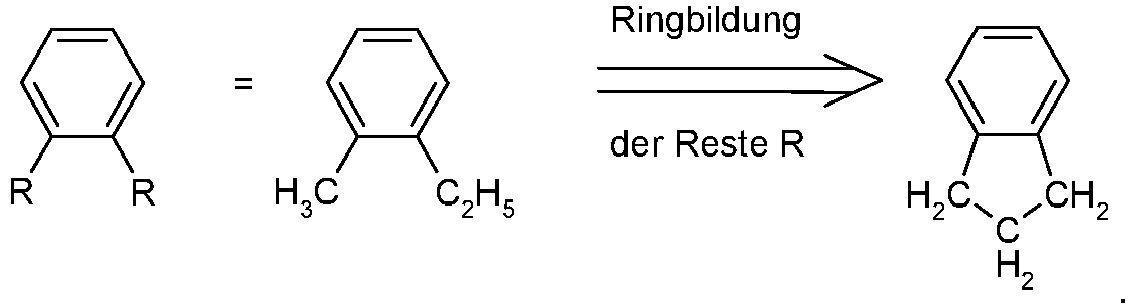
- Weiterhin soll unter der oben genannten Formulierung aber auch verstanden werden, dass für den Fall, dass einer der beiden Reste Wasserstoff darstellt, der zweite Rest unter Bildung eines Rings an die Position, an die das Wasserstoffatom gebunden war, bindet. Dies soll durch das folgende Schema verdeutlicht werden:

- Weitere bevorzugte Ausführungsformen zeigen die folgenden Formeln (2-1) bis (2-3):
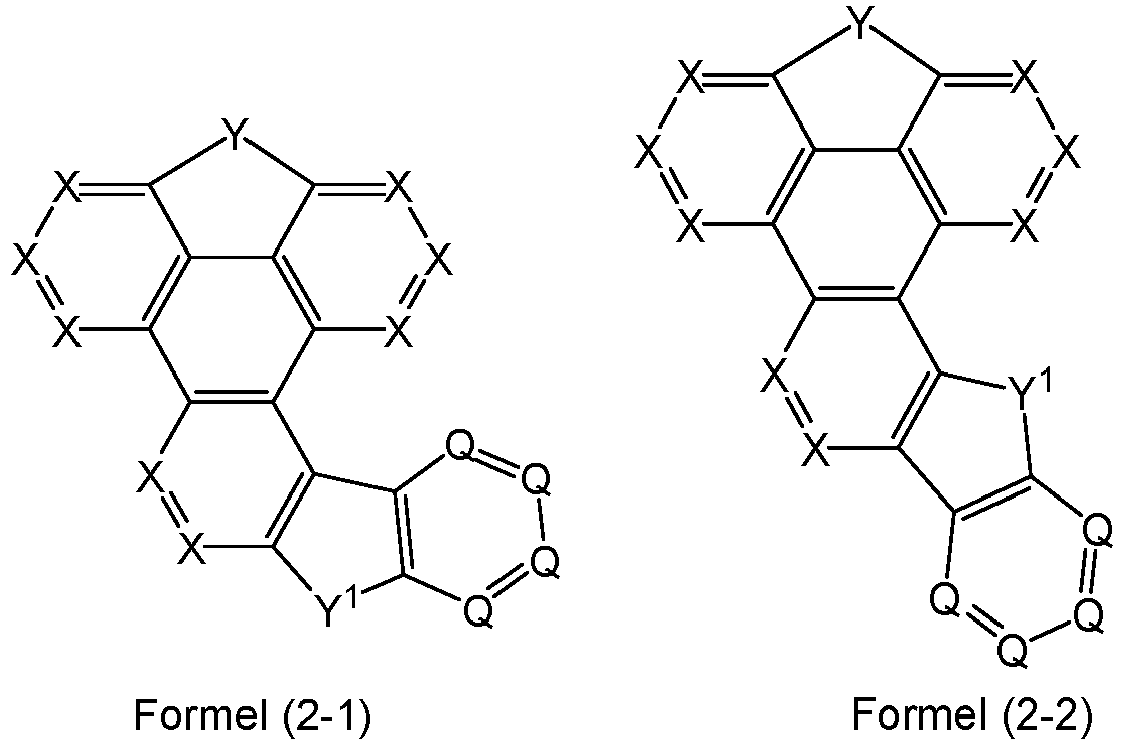

- In einer bevorzugten Ausführungsform steht mindestens ein Rest R der Symbole Y, Y1, X oder Q in einer der Formeln (1) oder (2-1) bis (2-3) für ein aromatisches oder heteroaromatisches Ringsystem mit 5 bis 60 aromatischen Ringatomen, bevorzugt mit 5 bis 40 aromatischen Ringatomen, das jeweils durch einen oder mehrere Reste R1 substituiert sein kann.
- In einer bevorzugten Ausführungsform der Erfindung steht maximal ein Symbol X pro Zyklus für N. In einer weiteren bevorzugten Ausführungsform der Erfindung steht maximal ein Symbol Q für N.
- In einer besonders bevorzugten Ausführungsform der Erfindung stehen X und Q für CR.
- In einer bevorzugten Ausführungsform der Erfindung weist die Verbindung nur ein ankondensiertes Ringsystem auf, welches über die mit * gekennzeichneten Bindungen ankondensiert ist.
- Bevorzugt weist die Verbindung nach Formel (1) nur ein ankondensiertes Ringsystem auf, welches über die mit * gekennzeichneten Bindungen ankondensiert ist, sowie nur bis zu ein weiteres ankondensiertes Ringsystem, bei dem zwei benachbarte Reste R ein an den Zyklus ankondensiertes aromatisches oder heteroaromatisches Ringsystem mit 4 bis 8 Ringatomen bilden, welches mit einem oder mehreren Resten R substituiert sein kann.
- Bevorzugte Ausführungsformen der Verbindungen der Formeln (2-1) bis (2-3) sind die folgenden Verbindungen der Formeln (3-1) bis (3-3):


- Bevorzugte Ausführungsformen der Verbindungen der Formeln (3-1) bis (3-3) sind die folgenden Verbindungen der Formeln (3-1a) bis (3-3a):


- In einer bevorzugten Ausführungsform der Erfindung stehen maximal 5 Gruppen R in den Formeln (2-1) bis (2-3), in den Formeln (3-1) bis (3-3), bzw. in den Formeln (3-1a) bis (3-3a) nicht für H, CN oder D, besonders bevorzugt maximal 3 Gruppen R, ganz besonders bevorzugt maximal 2 Gruppen R und insbesondere bevorzugt maximal eine Gruppe R.
- In einer bevorzugten Ausführungsform steht Y für NAr1, O, S oder CR2.
- In einer bevorzugten Ausführungsform steht Y1 für NAr1, O, S oder CR2.
- In einer bevorzugten Ausführungsform stehen Y für NAr1, O, S oder CR2 und Y1 für NAr1, O, S oder CR2.
- In einer bevorzugten Ausführungsform stehen Y für O, S oder CR2 und Y1 für O, S oder CR2, oder Y und Y1 stehen für NAr1.
- Im Folgenden werden bevorzugte Substituenten R, Ar1, Ar', R1 und R2 beschrieben. In einer besonders bevorzugten Ausführungsform der Erfindung treten die nachfolgend genannten Bevorzugungen für R, Ar1, Ar', R1 und R2 gleichzeitig auf und gelten für die Strukturen der Formel (1) sowie für alle oben aufgeführten bevorzugten Ausführungsformen.
- In einer bevorzugten Ausführungsform der Erfindung ist Ar1 ein aromatisches Ringsystem mit 6 bis 30 aromatischen Ringatomen, das durch einen oder mehrere Reste R1 substituiert sein kann, oder ein heteroaromatisches Ringsystem mit 6 bis 30 aromatischen Ringatomen, das durch einen oder mehrere Reste R1 substituiert sein kann. In einer besonders bevorzugten Ausführungsform der Erfindung ist Ar1 ein aromatisches oder heteroaromatisches Ringsystem mit 6 bis 24 aromatischen Ringatomen, das durch einen oder mehrere, bevorzugt nicht-aromatische, Reste R1 substituiert sein kann.
- Geeignete aromatische bzw. heteroaromatische Ringsysteme Ar1 sind bei jedem Auftreten gleich oder verschieden ausgewählt aus Phenyl, Biphenyl, insbesondere ortho-, meta- oder para-Biphenyl, Terphenyl, insbesondere ortho-, meta-, para- oder verzweigtem Terphenyl, Quaterphenyl, insbesondere ortho-, meta-, para- oder verzweigtem Quaterphenyl, Fluoren, welches über die 1-, 2-, 3- oder 4-Position verknüpft sein kann, Spirobifluoren, welches über die 1-, 2-, 3- oder 4-Position verknüpft sein kann, Naphthalin, welches über die 1- oder 2-Position verknüpft sein kann, Indol, Benzofuran, Benzothiophen, Dibenzofuran, Carbazol, welches über die 1-, 2-, 3- oder 4-Position verknüpft sein kann, Dibenzofuran, welches über die 1-, 2-, 3- oder 4-Position verknüpft sein kann, Dibenzothiophen, welches über die 1-, 2-, 3- oder 4-Position verknüpft sein kann, Indenocarbazol, Indolocarbazol, Phenanthren, Triphenylen oder einer Kombination aus zwei oder drei dieser Gruppen, welche jeweils mit einem oder mehreren Resten R1, bevorzugt nicht-aromatischen Resten R1 substituiert sein können.
- Weitere bevorzugte Ausführungsformen für Ar1, wenn diese ein heteroaromatisches Ringsystem darstellen, sind ausgewählt aus der Gruppe bestehend aus Pyridin, Pyrimidin, Pyrazin, Pyridazin, Triazin, Chinolin, Chinoxalin, Chinazolin oder Benzimidazol oder einer Kombination dieser Gruppen mit einer der oben genannten Gruppen, welche jeweils mit einem oder mehreren Resten R1 substituiert sein können. Wenn Ar1 für eine Heteroarylgruppe, insbesondere für Triazin, Pyrimidin, Chinoxalin oder Chinazolin steht, können auch aromatische oder heteroaromatische Reste R1 an dieser Heteroarylgruppe bevorzugt sein.
- In einer bevorzugten Ausführungsform der Erfindung ist R bei jedem Auftreten gleich oder verschieden ausgewählt aus der Gruppe bestehend aus H, D, F, CN, OR1, einer geradkettigen Alkylgruppe mit 1 bis 10 C-Atomen oder einer Alkenylgruppe mit 2 bis 10 C-Atomen oder einer verzweigten oder zyklischen Alkylgruppe mit 3 bis 10 C-Atomen, wobei die Alkyl- bzw. Alkenylgruppe jeweils mit einem oder mehreren Resten R1 substituiert sein kann, bevorzugt jedoch unsubstituiert ist, und wobei eine oder mehrere nicht benachbarte CH2-Gruppen durch O ersetzt sein können, oder einem aromatischen oder heteroaromatischen Ringsystem mit 6 bis 30 aromatischen Ringatomen, das jeweils durch einen oder mehrere Reste R1 substituiert sein kann; dabei können zwei Reste R auch miteinander ein aliphatisches, aromatisches oder heteroaromatisches Ringsystem bilden. Besonders bevorzugt ist R bei jedem Auftreten gleich oder verschieden ausgewählt aus der Gruppe bestehend aus H, D, einer geradkettigen Alkylgruppe mit 1 bis 6 C-Atomen, insbesondere mit 1, 2, 3 oder 4 C-Atomen, oder einer verzweigten oder zyklischen Alkylgruppe mit 3 bis 6 C-Atomen, wobei die Alkylgruppe jeweils mit einem oder mehreren Resten R1 substituiert sein kann, bevorzugt aber unsubstituiert ist, oder einem aromatischen oder heteroaromatischen Ringsystem mit 6 bis 24 aromatischen Ringatomen, das jeweils durch einen oder mehrere Reste R1, bevorzugt nicht-aromatische Reste R1, substituiert sein kann. Ganz besonders bevorzugt ist R bei jedem Auftreten gleich oder verschieden ausgewählt aus der Gruppe bestehend aus H oder D oder einem aromatischen oder heteroaromatischen Ringsystem mit 6 bis 24 aromatischen Ringatomen, das jeweils durch einen oder mehrere Reste R2, bevorzugt nicht-aromatische Reste R1, substituiert sein kann.
- Geeignete aromatische bzw. heteroaromatische Ringsysteme R sind ausgewählt aus Phenyl, Biphenyl, insbesondere ortho-, meta- oder para-Biphenyl, Terphenyl, insbesondere ortho-, meta-, para- oder verzweigtem Terphenyl, Quaterphenyl, insbesondere ortho-, meta-, para- oder verzweigtem Quaterphenyl, Fluoren, welches über die 1-, 2-, 3- oder 4-Position verknüpft sein kann, Spirobifluoren, welches über die 1-, 2-, 3-oder 4-Position verknüpft sein kann, Naphthalin, welches über die 1- oder 2-Position verknüpft sein kann, Indol, Benzofuran, Benzothiophen, welches über die 1-, 2-, 3- oder 4-Position verknüpft sein kann, Dibenzofuran, Carbazol, welches über die 1-, 2-, 3- oder 4-Position verknüpft sein kann, Dibenzothiophen, welches über die 1-, 2-, 3- oder 4-Position verknüpft sein kann, Indenocarbazol, Indolocarbazol, Pyridin, Pyrimidin, Pyrazin, Pyridazin, Triazin, Chinolin, Chinazolin, Chinoxalin Benzimidazol, Phenanthren, Triphenylen oder einer Kombination aus zwei oder drei dieser Gruppen, welche jeweils mit einem oder mehreren Resten R1 substituiert sein können. Wenn R für eine Heteroarylgruppe, insbesondere für Triazin, Pyrimidin, Chinoxalin oder Chinazolin steht, können auch aromatische oder heteroaromatische Reste R1 an dieser Heteroarylgruppe bevorzugt sein.
- Dabei sind die Gruppen R, bzw. Ar1, wenn sie für ein aromatisches bzw. heteroaromatisches Ringsystem stehen, bevorzugt gewählt aus den Gruppen der folgenden Formeln R-1 bis R-83,

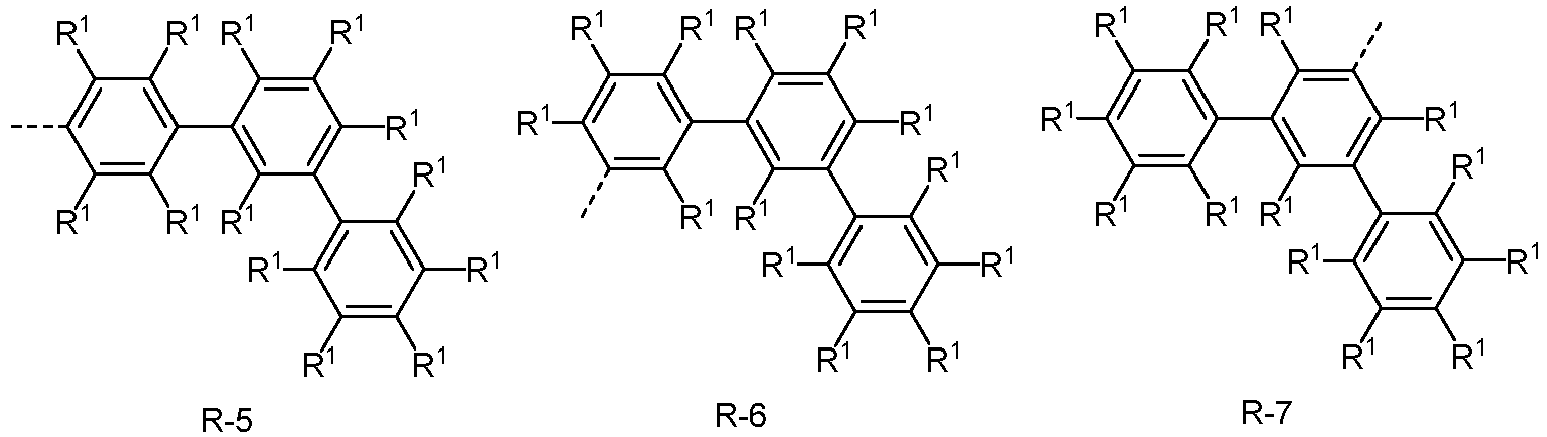


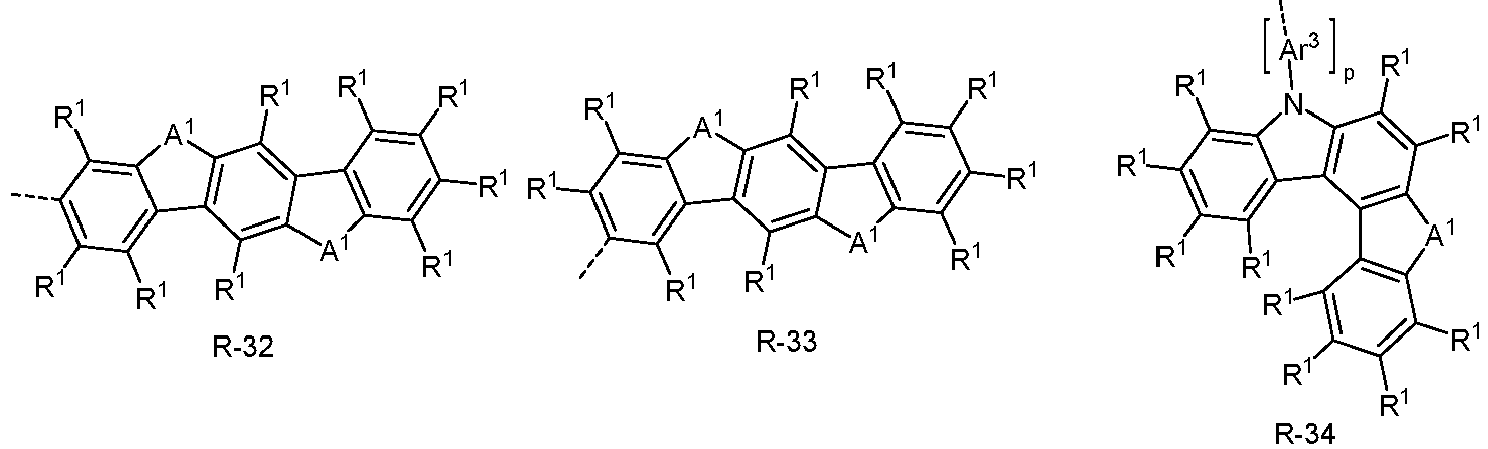


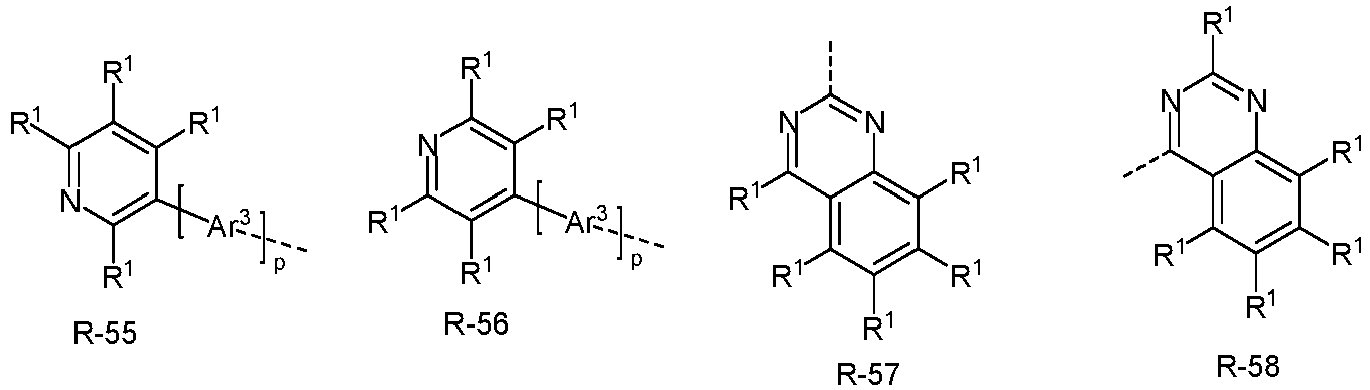


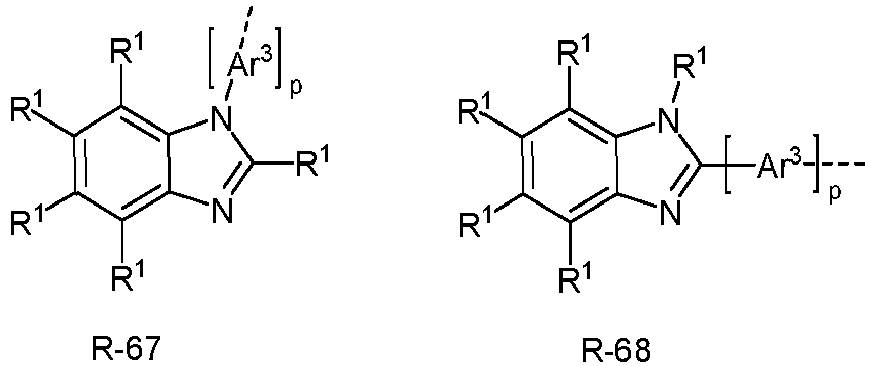


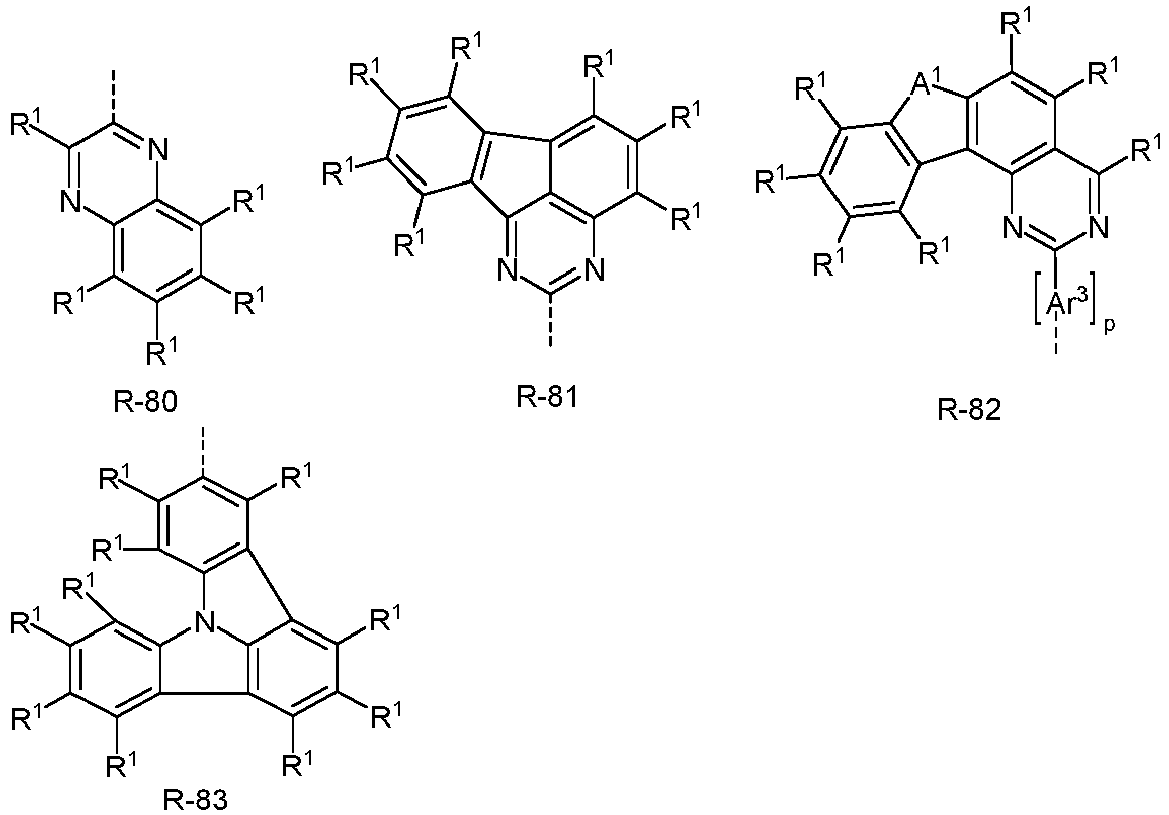
- Ar3
- ist bei jedem Auftreten gleich oder verschieden ein bivalentes aromatisches oder heteroaromatisches Ringsystem mit 6 bis 18 aromatischen Ringatomen, welches jeweils mit einem oder mehreren Resten R1 substituiert sein kann;
- A1
- ist bei jedem Auftreten gleich oder verschieden C(R1)2, NR1, O oder S, bevorzugt O oder S;
- p
- ist 0 oder 1, wobei p = 0 bedeutet, dass die Gruppe Ar3 nicht vorhanden ist und dass die entsprechende aromatische bzw. heteroaromatische Gruppe direkt an ein Kohlenstoffatom des Grundgerüsts in Formel (1) bzw. in den bevorzugten Ausführungsformen bzw. an das Stickstoffatom in der Gruppe N(Ar1)2 gebunden ist; mit der Maßgabe, dass p = 1 ist für die Strukturen R-12, R-17, R-21, R-25, R-26, R-30, R-34, R-38, R-39 und R-67, wenn es sich bei diesen Gruppen um Ausführungsformen von Ar1 handelt;
- r
- ist 0 oder 1, wobei r = 0 bedeutet, dass an dieser Position keine Gruppe A1 gebunden ist und an die entsprechenden Kohlenstoffatome stattdessen Reste R1 gebunden sind;
- In einer bevorzugten Ausführungsform umfasst Ar3 bivalente aromatische oder heteroaromatische Ringsysteme basierend auf den Gruppen der R-1 bis R-83, wobei m gleich 0 gilt und die gestrichelte Bindung und ein R1 für die Bindung zur aromatischen oder heteroaromatischen Gruppe nach R-1 bis R-83 steht.
- Wenn die oben genannten Gruppen R-1 bis R-83 für R, bzw. Ar1 mehrere Gruppen A1 aufweisen, so kommen hierfür alle Kombinationen aus der Definition von A1 in Frage. Bevorzugte Ausführungsformen sind dann solche, in denen eine Gruppe A1 für O oder S und die andere Gruppe A1 für C(R1)2 steht oder in denen beide Gruppen A1 für S oder O stehen oder in denen beide Gruppen A1 für O bzw. S stehen.
- Wenn A1 für NR1 steht, steht der Substituent R1, der an das Stickstoffatom gebunden ist, bevorzugt für ein aromatisches oder heteroaromatisches Ringsystem mit 5 bis 24 aromatischen Ringatomen, welches auch durch einen oder mehrere Reste R2 substituiert sein kann. In einer besonders bevorzugten Ausführungsform steht dieser Substituent R1 gleich oder verschieden bei jedem Auftreten für ein aromatisches oder heteroaromatisches Ringsystem mit 6 bis 24 aromatischen Ringatomen, bevorzugt mit 6 bis 12 aromatischen Ringatomen, welches keine kondensierten Arylgruppen oder Heteroarylgruppen, in denen zwei oder mehr aromatische bzw. heteroaromatische 6-Ring-Gruppen direkt aneinander ankondensiert sind, aufweist, und welches jeweils auch durch einen oder mehrere Reste R2 substituiert sein kann. Besonders bevorzugt sind Phenyl, Biphenyl, Terphenyl und Quaterphenyl mit Verknüpfungsmustern, wie vorne für R-1 bis R-11 aufgeführt, wobei diese Strukturen durch einen oder mehrere Reste R1 substituiert sein können, bevorzugt aber unsubstituiert sind.
- Wenn A1 für C(R1)2 steht, stehen die Substituenten R1, die an dieses Kohlenstoffatom gebunden sind, bevorzugt gleich oder verschieden bei jedem Auftreten für eine lineare Alkylgruppe mit 1 bis 10 C-Atomen oder für eine verzweigte oder zyklische Alkylgruppe mit 3 bis 10 C-Atomen oder für ein aromatisches oder heteroaromatisches Ringsystem mit 5 bis 24 aromatischen Ringatomen, welches auch durch einen oder mehrere Reste R2 substituiert sein kann. Ganz besonders bevorzugt steht R1 für eine Methylgruppe oder für eine Phenylgruppe. Dabei können die Reste R1 auch miteinander ein Ringsystem bilden, was zu einem Spirosystem führt.
- Wenn Y und/oder Y1 für CR2 steht, stehen die Substituenten R, die an dieses Kohlenstoffatom gebunden sind, bevorzugt gleich oder verschieden bei jedem Auftreten für eine lineare Alkylgruppe mit 1 bis 10 C-Atomen oder für eine verzweigte oder zyklische Alkylgruppe mit 3 bis 10 C-Atomen oder für ein aromatisches oder elektronenarmes heteroaromatisches Ringsystem mit 5 bis 24 aromatischen Ringatomen, welches auch durch einen oder mehrere Reste R1 substituiert sein kann. Ganz besonders bevorzugt stehen diese Substituenten R für eine Methylgruppe oder für eine Phenylgruppe. Dabei können die Reste R auch miteinander ein Ringsystem bilden, was zu einem Spirosystem führt.
- In einer Ausführungsform der Erfindung steht mindestens ein Rest R oder Ar1 für ein elektronenreiches heteroaromatisches Ringsystem. Dabei ist das elektronenreiche heteroaromatische Ringsystem bevorzugt gewählt aus den oben abgebildeten Gruppen R-13 bis R-42, wobei in den Gruppen R-13 bis R-16, R-18 bis R-20, R-22 bis R-24, R-27 bis R-29, R-31 bis R-33 und R-35 bis R-37 mindestens eine Gruppe A1 für NR1 steht, wobei R1 bevorzugt für ein aromatisches oder heteroaromatisches Ringsystem steht, insbesondere für ein aromatisches Ringsystem.
- In einer weiteren besonders bevorzugten Ausführungsform der Erfindung steht mindestens ein Rest R, bzw. Ar1 für ein elektronenarmes heteroaromatisches Ringsystem. Dabei ist das elektronenarme heteroaromatische Ringsystem bevorzugt gewählt aus den oben abgebildeten Gruppen R-47 bis R-50, R-57, R-58, R-76; R-79, R-80, R-81 und R-82.
- In einer weiteren bevorzugten Ausführungsform der Erfindung ist R1 gleich oder verschieden bei jedem Auftreten ausgewählt aus der Gruppe bestehend aus H, D, F, CN, OR2, einer geradkettigen Alkylgruppe mit 1 bis 10 C-Atomen oder einer Alkenylgruppe mit 2 bis 10 C-Atomen oder einer verzweigten oder zyklischen Alkylgruppe mit 3 bis 10 C-Atomen, wobei die Alkyl- bzw. Alkenylgruppe jeweils mit einem oder mehreren Resten R2 substituiert sein kann und wobei eine oder mehrere nicht benachbarte CH2-Gruppen durch O ersetzt sein können, oder einem aromatischen oder heteroaromatischen Ringsystem mit 6 bis 30 aromatischen Ringatomen, das jeweils durch einen oder mehrere Reste R2 substituiert sein kann; dabei können zwei oder mehrere Reste R1 miteinander ein aliphatisches Ringsystem bilden. In einer besonders bevorzugten Ausführungsform der Erfindung ist R1 gleich oder verschieden bei jedem Auftreten ausgewählt aus der Gruppe bestehend aus H, D, einer geradkettigen Alkylgruppe mit 1 bis 6 C-Atomen, insbesondere mit 1, 2, 3 oder 4 C-Atomen, oder einer verzweigten oder zyklischen Alkylgruppe mit 3 bis 6 C-Atomen, wobei die Alkylgruppe mit einem oder mehreren Resten R2 substituiert sein kann, bevorzugt aber unsubstituiert ist, oder einem aromatischen oder heteroaromatischen Ringsystem mit 6 bis 24 aromatischen Ringatomen, das jeweils durch einen oder mehrere Reste R2 substituiert sein kann, bevorzugt aber unsubstituiert ist.
- In einer weiteren bevorzugten Ausführungsform der Erfindung ist R2 gleich oder verschieden bei jedem Auftreten H, D, F, eine Alkylgruppe mit 1 bis 4 C-Atomen oder eine Arylgruppe mit 6 bis 10 C-Atomen, welche mit einer Alkylgruppe mit 1 bis 4 C-Atomen substituiert sein kann, bevorzugt aber unsubstituiert ist.
- In einer weiteren bevorzugten Ausführungsform der Erfindung sind alle Reste R1, soweit sie für ein aromatisches oder heteroaromatisches Ringsystem, bzw. R2, soweit sie für aromatische oder heteroaromatische Gruppen stehen, ausgewählt aus den Gruppen R-1 bis R-83, welche allerdings dann jeweils entsprechend mit R2, bzw. den bei R2 genannten Gruppen substituiert sind.
- In einer bevorzugten Ausführungsform bilden die Reste R keine weiteren an das Grundgerüst der Formel (1) ankondensierten aromatischen oder heteroaromatischen Gruppen.
- Dabei haben die Alkylgruppen in erfindungsgemäßen Verbindungen, die durch Vakuumverdampfung verarbeitet werden, bevorzugt nicht mehr als fünf C-Atome, besonders bevorzugt nicht mehr als 4 C-Atome, ganz besonders bevorzugt nicht mehr als 1 C-Atom. Für Verbindungen, die aus Lösung verarbeitet werden, eignen sich auch Verbindungen, die mit Alkylgruppen, insbesondere verzweigten Alkylgruppen, mit bis zu 10 C-Atomen substituiert sind oder die mit Oligoarylengruppen, beispielsweise ortho-, meta-, para- oder verzweigten Terphenyl- oder Quaterphenylgruppen, substituiert sind.
- Wenn die Verbindungen der Formel (1) bzw. die bevorzugten Ausführungsformen als Matrixmaterial für einen phosphoreszierenden Emitter oder in einer Schicht, die direkt an eine phosphoreszierende Schicht angrenzt, verwendet werden, ist es weiterhin bevorzugt, wenn die Verbindung keine kondensierten Aryl- bzw. Heteroarylgruppen enthält, in denen mehr als zwei Sechsringe direkt aneinander ankondensiert sind. Insbesondere ist es bevorzugt, dass die Reste Ar, R, R1 und R2 keine kondensierten Aryl- bzw. Heteroarylgruppen enthalten, in denen zwei oder mehr Sechsringe direkt aneinander ankondensiert sind. Eine Ausnahme hiervon bilden Phenanthren, Triphenylen, Chinoxalin und Chinazolin, die aufgrund ihrer hohen Triplettenergie trotz der Anwesenheit kondensierter aromatischer Sechsringe bevorzugt sein können.
- Die oben genannten bevorzugten Ausführungsformen können beliebig innerhalb der in Anspruch 1 definierten Einschränkungen miteinander kombiniert werden. In einer besonders bevorzugten Ausführungsform der Erfindung treten die oben genannten Bevorzugungen gleichzeitig auf.
- Beispiele für bevorzugte Verbindungen gemäß den oben aufgeführten Ausführungsformen sind die in der folgenden Tabelle aufgeführten Verbindungen.


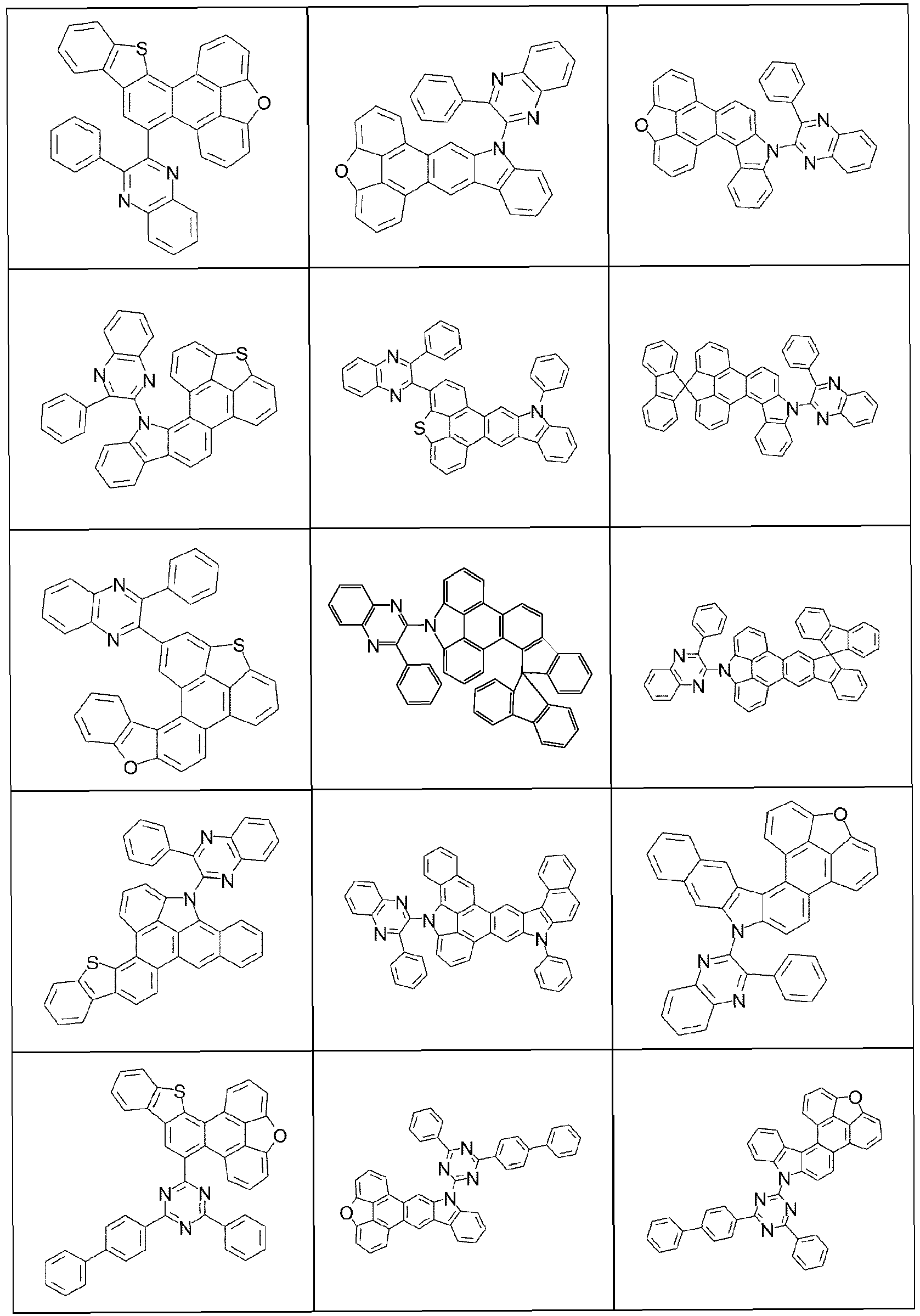


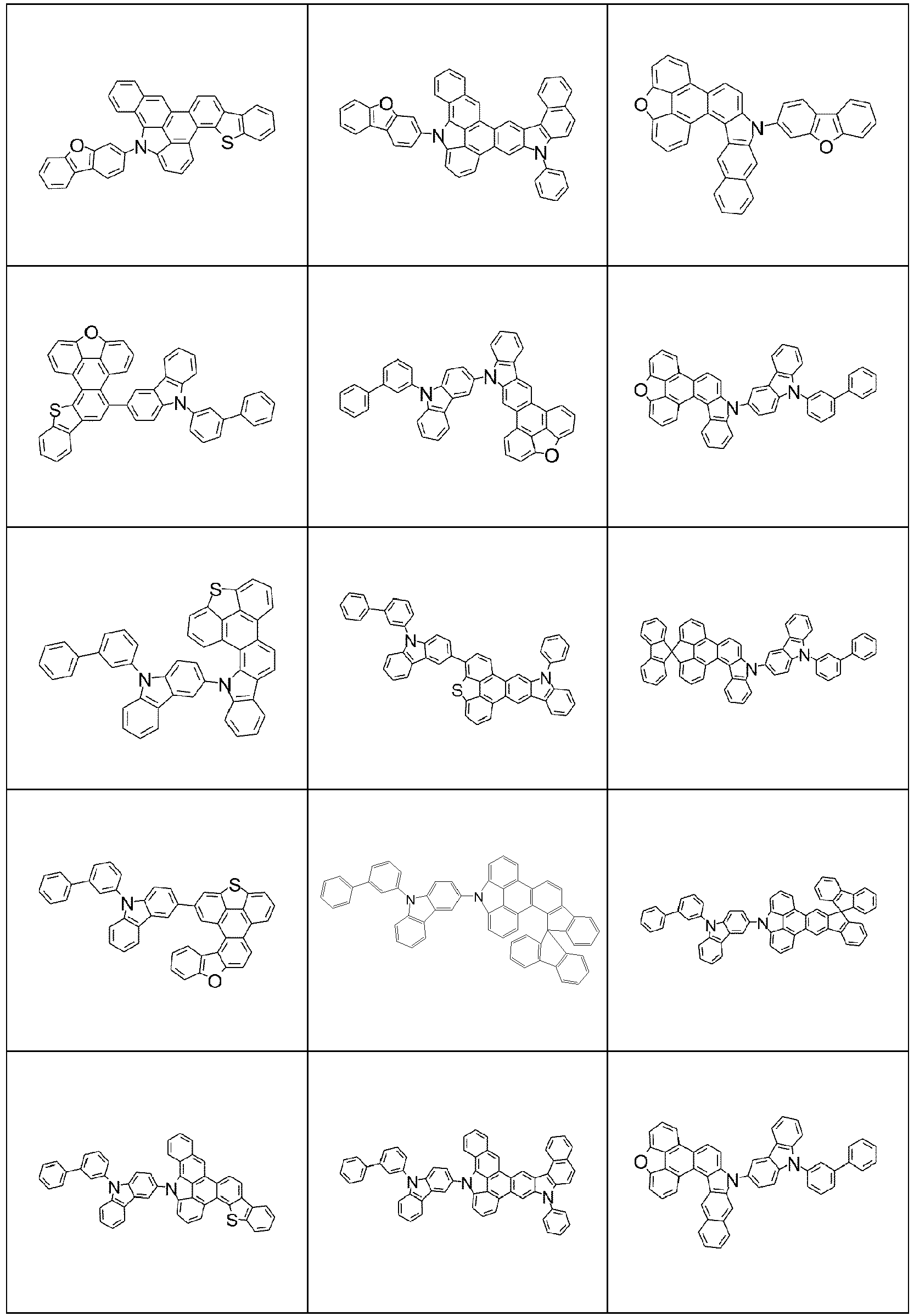
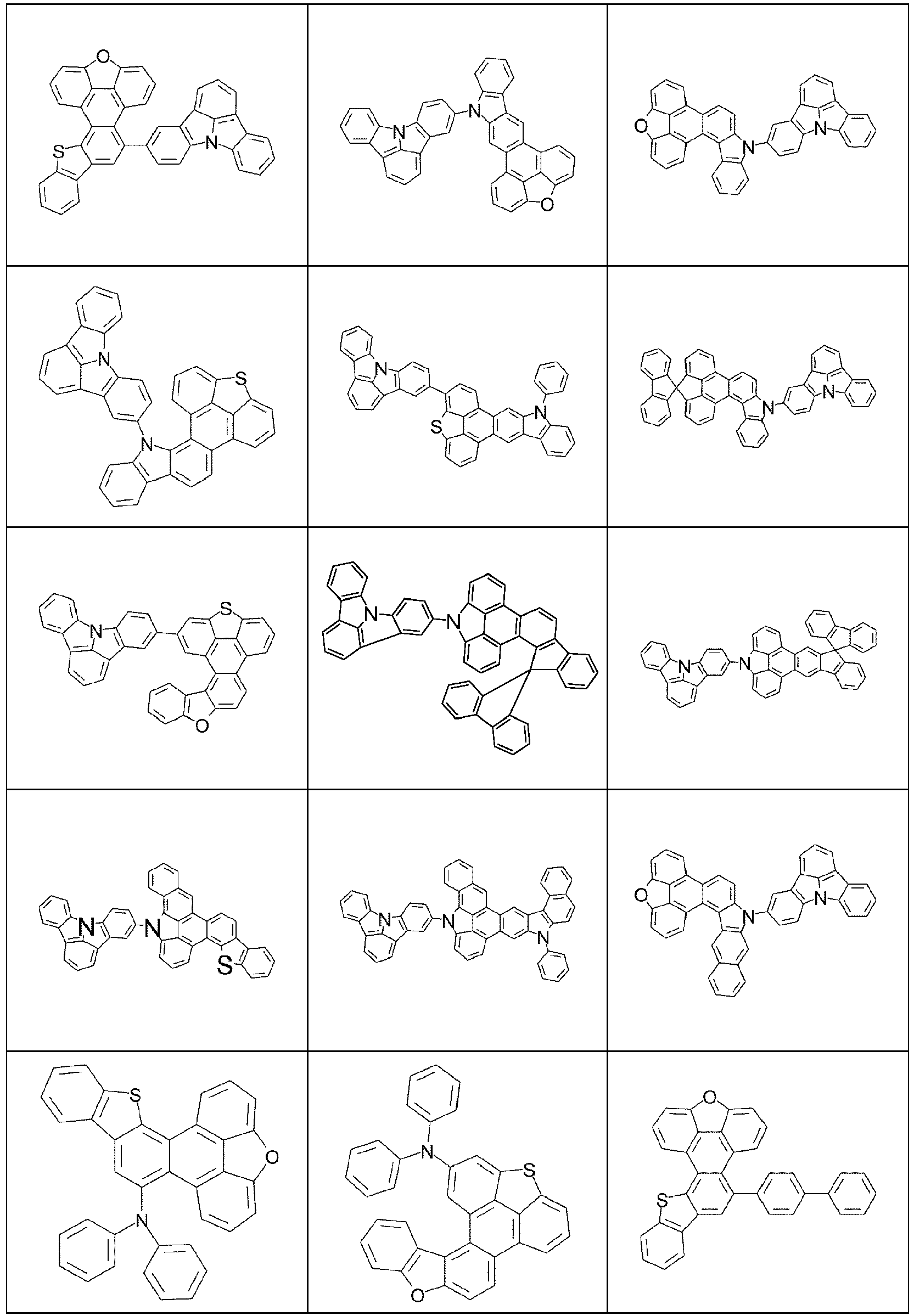


- Die erfindungsgemäßen Verbindungen können nach dem Fachmann bekannten Syntheseschritten, wie z. B. Bromierung, Suzuki-Kupplung, Ullmann-Kupplung, Heck-Reaktion, Hartwig-Buchwald-Kupplung, etc., dargestellt werden.
- Ein weiterer Gegenstand der vorliegenden Erfindung ist daher ein Verfahren zur Herstellung der erfindungsgemäßen Verbindungen, gekennzeichnet durch die folgenden Schritte:
- (A) Synthese des Grundgerüsts nach Formel (1);
- (B) Ankondensieren des aromatischen oder heteroaromatischen Ringsystems unter Bildung der mit * bezeichneten Bindungen nach Formel (1) durch Kupplungs- und Ringschlussreaktion.
- Die Synthese des Grundgerüsts kann dabei beispielsweise über eine Kombination aus Ullmann-Kupplung, Suzuki-Kupplung und einer intramolekularen Heckreaktion erfolgen, wie im folgenden Schema 1 oder Schema 2 gezeigt:


- Im Falle von Y gleich N kann die Synthese auch über die Route nach dem folgenden Schema 3 erfolgen.

- Das Ankondensieren des aromatischen oder heteroaromatischen Ringsystems kann dann durch entsprechende Kupplungs- und Ringschlussreaktionen erfolgen, wie in den folgenden Schemata 4, 5, 6 oder 7 dargestellt:


- Als Alternative kann die Verbindung auch durch Aufbau der Verbindung nach Formel (1) durch Kupplungs- und Ringschlussreaktion zweier entsprechender aromatischer oder heteroaromatischer Ringsysteme erfolgen, wie beispielsweise in Schema 8 gezeigt:
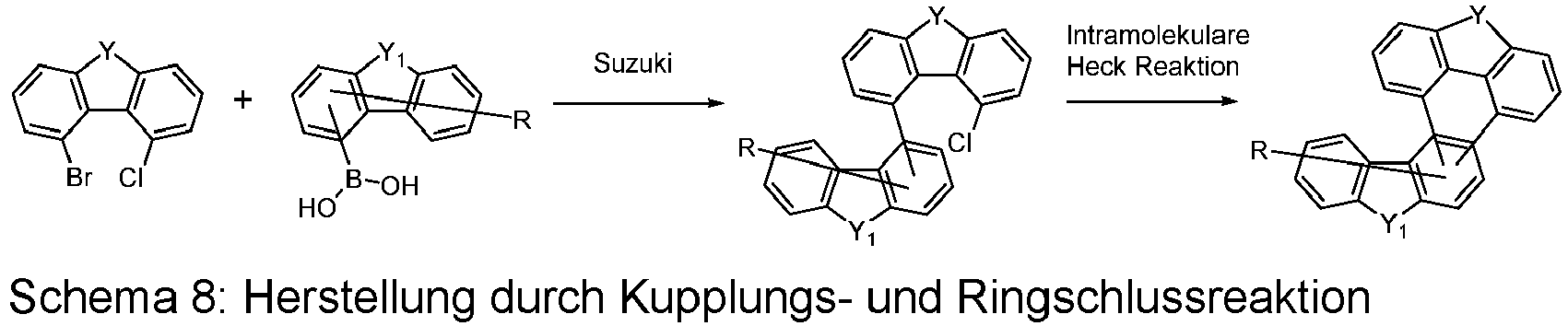
- Für die Verarbeitung der erfindungsgemäßen Verbindungen aus flüssiger Phase, beispielsweise durch Spin-Coating oder durch Druckverfahren, sind Formulierungen der erfindungsgemäßen Verbindungen erforderlich. Diese Formulierungen können beispielsweise Lösungen, Dispersionen oder Emulsionen sein. Es kann bevorzugt sein, hierfür Mischungen aus zwei oder mehr Lösemitteln zu verwenden. Geeignete und bevorzugte Lösemittel sind beispielsweise Toluol, Anisol, o-, m- oder p-Xylol, Methylbenzoat, Mesitylen, Tetralin, Veratrol, THF, Methyl-THF, THP, Chlorbenzol, Dioxan, Phenoxytoluol, insbesondere 3-Phenoxytoluol, (-)-Fenchon, 1,2,3,5-Tetramethylbenzol, 1,2,4,5-Tetramethylbenzol, 1-Methylnaphthalin, 2-Methylbenzothiazol, 2-Phenoxyethanol, 2-Pyrrolidinon, 3-Methylanisol, 4-Methylanisol, 3,4-Dimethylanisol, 3,5-Dimethylanisol, Acetophenon, α-Terpineol, Benzothiazol, Butylbenzoat, Cumol, Cyclohexanol, Cyclohexanon, Cyclohexylbenzol, Decalin, Dodecylbenzol, Ethylbenzoat, Indan, NMP, p-Cymol, Phenetol, 1,4-Diisopropylbenzol, Dibenzylether, Diethylenglycolbutylmethylether, Triethylenglycolbutylmethylether, Diethylenglycoldibutylether, Triethylenglycoldimethylether, Diethylenglycolmonobutylether, Tripropyleneglycoldimethylether, Tetraethylenglycoldimethylether, 2-Isopropylnaphthalin, Pentylbenzol, Hexylbenzol, Heptylbenzol, Octylbenzol, 1,1-Bis(3,4-dimethylphenyl)ethan, 2-Methylbiphenyl, 3-Methylbiphenyl, 1-Methylnaphthalin, 1-Ethylnaphthalin, Ethyloctanoat, Sebacinsäure-diethylester, Octyloctanoat, Heptylbenzol, Menthyl-isovalerat, Cyclohexylhexanoat oder Mischungen dieser Lösemittel.
- Ein weiterer Gegenstand der vorliegenden Erfindung ist daher eine Formulierung, enthaltend mindestens eine erfindungsgemäße Verbindung und mindestens eine weitere Verbindung. Die weitere Verbindung kann beispielsweise ein Lösemittel sein, insbesondere eines der oben genannten Lösemittel oder eine Mischung dieser Lösemittel. Die weitere Verbindung kann aber auch mindestens eine weitere organische oder anorganische Verbindung sein, die ebenfalls in der elektronischen Vorrichtung eingesetzt wird, beispielsweise eine emittierende Verbindung und/oder ein weiteres Matrixmaterial. Geeignete emittierende Verbindungen und weitere Matrixmaterialien sind hinten im Zusammenhang mit der organischen Elektrolumineszenzvorrichtung aufgeführt. Diese weitere Verbindung kann auch polymer sein.
- Die erfindungsgemäßen Verbindungen eignen sich für die Verwendung in einer elektronischen Vorrichtung, insbesondere in einer organischen Elektrolumineszenzvorrichtung.
- Ein weiterer Gegenstand der vorliegenden Erfindung ist daher die Verwendung einer erfindungsgemäßen Verbindung in einer elektronischen Vorrichtung, insbesondere in einer organischen Elektrolumineszenzvorrichtung.
- Ein nochmals weiterer Gegenstand der vorliegenden Erfindung ist eine elektronische Vorrichtung enthaltend mindestens eine erfindungsgemäße Verbindung.
- Eine elektronische Vorrichtung im Sinne der vorliegenden Erfindung ist eine Vorrichtung, welche mindestens eine Schicht enthält, die mindestens eine organische Verbindung enthält. Das Bauteil kann dabei auch anorganische Materialien enthalten oder auch Schichten, welche vollständig aus anorganischen Materialien aufgebaut sind.
- Die elektronische Vorrichtung ist bevorzugt ausgewählt aus der Gruppe bestehend aus organischen Elektrolumineszenzvorrichtungen (OLEDs), organischen integrierten Schaltungen (O-ICs), organischen Feld-Effekt-Transistoren (O-FETs), organischen Dünnfilmtransistoren (O-TFTs), organischen lichtemittierenden Transistoren (O-LETs), organischen Solarzellen (O-SCs), farbstoffsensibilisierten organischen Solarzellen (DSSCs), organischen optischen Detektoren, organischen Photorezeptoren, organischen Feld-Quench-Devices (O-FQDs), lichtemittierenden elektrochemischen Zellen (LECs), organischen Laserdioden (O-Laser) und "organic plasmon emitting devices", bevorzugt aber organischen Elektrolumineszenzvorrichtungen (OLEDs), besonders bevorzugt phosphoreszierenden OLEDs.
- Die organische Elektrolumineszenzvorrichtung enthält Kathode, Anode und mindestens eine emittierende Schicht. Außer diesen Schichten kann sie noch weitere Schichten enthalten, beispielsweise jeweils eine oder mehrere Lochinjektionsschichten, Lochtransportschichten, Lochblockierschichten, Elektronentransportschichten, Elektroneninjektionsschichten, Exzitonenblockierschichten, Elektronenblockierschichten und/oder Ladungserzeugungsschichten (Charge-Generation Layers). Ebenso können zwischen zwei emittierende Schichten Interlayer eingebracht sein, welche beispielsweise eine exzitonenblockierende Funktion aufweisen. Es sei aber darauf hingewiesen, dass nicht notwendigerweise jede dieser Schichten vorhanden sein muss. Dabei kann die organische Elektrolumineszenzvorrichtung eine emittierende Schicht enthalten, oder sie kann mehrere emittierende Schichten enthalten. Wenn mehrere Emissionsschichten vorhanden sind, weisen diese bevorzugt insgesamt mehrere Emissionsmaxima zwischen 380 nm und 750 nm auf, sodass insgesamt weiße Emission resultiert, d. h. in den emittierenden Schichten werden verschiedene emittierende Verbindungen verwendet, die fluoreszieren oder phosphoreszieren können. Insbesondere bevorzugt sind Systeme mit drei emittierenden Schichten, wobei die drei Schichten blaue, grüne und orange oder rote Emission zeigen. Es kann sich bei der erfindungsgemäßen organischen Elektrolumineszenzvorrichtung auch um eine Tandem-OLED handeln, insbesondere für weiß emittierende OLEDs.
- Die erfindungsgemäße Verbindung gemäß den oben aufgeführten Ausführungsformen kann dabei in unterschiedlichen Schichten eingesetzt werden, je nach genauer Struktur. Bevorzugt ist eine organische Elektrolumineszenzvorrichtung, enthaltend eine Verbindung gemäß Formel (1) bzw. die oben ausgeführten bevorzugten Ausführungsformen in einer emittierenden Schicht als Matrixmaterial für phosphoreszierende Emitter, für fluoreszierende Emitter oder für Emitter, die TADF (thermally activated delayed fluorescence) zeigen, insbesondere für phosphoreszierende Emitter. Dabei kann die organische Elektrolumineszenzvorrichtung eine emittierende Schicht enthalten, oder sie kann mehrere emittierende Schichten enthalten, wobei mindestens eine emittierende Schicht mindestens eine erfindungsgemäße Verbindung als Matrixmaterial enthält. Weiterhin kann die erfindungsgemäße Verbindung auch in einer Elektronentransportschicht und/oder in einer Lochblockierschicht und/oder in einer Lochtransportschicht und/oder in einer Exzitonenblockierschicht eingesetzt werden.
- Wenn die erfindungsgemäße Verbindung als Matrixmaterial für eine phosphoreszierende Verbindung in einer emittierenden Schicht eingesetzt wird, wird sie bevorzugt in Kombination mit einem oder mehreren phosphoreszierenden Materialien (Triplettemitter) eingesetzt. Unter Phosphoreszenz im Sinne dieser Erfindung wird die Lumineszenz aus einem angeregten Zustand mit höherer Spinmultiplizität verstanden, also einem Spinzustand > 1, insbesondere aus einem angeregten Triplettzustand. Im Sinne dieser Anmeldung sollen alle lumineszierenden Komplexe mit Übergangsmetallen oder Lanthaniden, insbesondere alle Iridium-, Platin- und Kupferkomplexe als phosphoreszierende Verbindungen angesehen werden.
- Die Mischung aus der erfindungsgemäßen Verbindung und der emittierenden Verbindung enthält zwischen 99 und 1 Vol.-%, vorzugsweise zwischen 98 und 10 Vol.-%, besonders bevorzugt zwischen 97 und 60 Vol.-%, insbesondere zwischen 95 und 80 Vol.-% der erfindungsgemäßen Verbindung bezogen auf die Gesamtmischung aus Emitter und Matrixmaterial. Entsprechend enthält die Mischung zwischen 1 und 99 Vol.-%, vorzugsweise zwischen 2 und 90 Vol.-%, besonders bevorzugt zwischen 3 und 40 Vol.-%, insbesondere zwischen 5 und 20 Vol.-% des Emitters bezogen auf die Gesamtmischung aus Emitter und Matrixmaterial.
- Eine weitere bevorzugte Ausführungsform der vorliegenden Erfindung ist der Einsatz der erfindungsgemäßen Verbindung als Matrixmaterial für einen phosphoreszierenden Emitter in Kombination mit einem weiteren Matrixmaterial. Geeignete Matrixmaterialien, welche in Kombination mit den erfindungsgemäßen Verbindungen eingesetzt werden können, sind aromatische Ketone, aromatische Phosphinoxide oder aromatische Sulfoxide oder Sulfone, z. B. gemäß
WO 2004/013080 ,WO 2004/093207 ,WO 2006/005627 oderWO 2010/006680 , Triarylamine, Carbazolderivate, z. B. CBP (N,N-Biscarbazolylbiphenyl) oderWO 2005/039246 ,US 2005/0069729 ,JP 2004/288381 EP 1205527 ,WO 2008/086851 oderWO 2013/041176 , Indolocarbazolderivate, z. B. gemäßWO 2007/063754 oderWO 2008/056746 , Indenocarbazolderivate, z. B. gemäßWO 2010/136109 ,WO 2011/000455 ,WO 2013/041176 oderWO 2013/056776 , Azacarbazolderivate, z. B. gemäßEP 1617710 ,EP 1617711 ,EP 1731584 ,JP 2005/347160 WO 2007/137725 , Silane, z. B. gemäßWO 2005/111172 , Azaborole oder Boronester, z. B. gemäßWO 2006/117052 , Triazinderivate, z. B. gemäßWO 2007/063754 ,WO 2008/056746 ,WO 2010/015306 ,WO 2011/057706 ,WO 2011/060859 oderWO 2011/060877 , Zinkkomplexe, z. B. gemäßEP 652273 WO 2009/062578 , Diazasilol- bzw. Tetraazasilol-Derivate, z. B. gemäßWO 2010/054729 , Diazaphosphol-Derivate, z. B. gemäßWO 2010/054730 , verbrückte Carbazol-Derivate, z. B. gemäßWO 2011/042107 ,WO 2011/060867 ,WO 2011/088877 undWO 2012/143080 , Triphenylenderivate, z. B. gemäßWO 2012/048781 , oder Dibenzofuranderivate, z. B. gemäßWO 2015/169412 ,WO 2016/015810 ,WO 2016/023608 ,WO 2017/148564 oderWO 2017/148565 . Ebenso kann ein weiterer phosphoreszierender Emitter, welcher kürzerwellig als der eigentliche Emitter emittiert, als Co-Host in der Mischung vorhanden sein oder eine Verbindung, die nicht oder nicht in wesentlichem Umfang am Ladungstransport teilnimmt, wie beispielsweise inWO 2010/108579 beschrieben. - In einer bevorzugten Ausführungsform der Erfindung werden die Materialien in Kombination mit einem weiteren Matrixmaterial eingesetzt. Bevorzugte Co-Matrixmaterialien, insbesondere wenn die erfindungsgemäße Verbindung mit einem elektronenarmen heteroaromatischen Ringsystem substituiert ist, sind gewählt aus der Gruppe der Biscarbazole, der verbrückten Carbazole, der Triarylamine, der Dibenzofuran-Carbazol-Derivate bzw. Dibenzofuran-Amin-Derivate und der Carbazolamine.
- Bevorzugte Biscarbazole sind die Strukturen der folgenden Formeln (4) und (5),


- A1
- ist gleich oder verschieden bei jedem Auftreten NAr, O, S oder C(R)2;
- Ar
- ist bei jedem Auftreten gleich oder verschieden ein aromatisches oder heteroaromatisches Ringsystem mit 5 bis 60 aromatischen Ringatomen, das jeweils durch einen oder mehrere Reste R substituiert sein kann;
- R
- ist bei jedem Auftreten gleich oder verschieden H, D, F, Cl, Br, I, B(OR1)2, CHO, C(=O)R1, CR1=C(R1)2, CN, C(=O)OR1, C(=O)N(R1)2, Si(R1)3, N(R1)2, NO2, P(=O)(R1)2, OSO2R1, OR1, S(=O)R1, S(=O)2R1, SR1, eine geradkettige Alkylalkylgruppe mit 1 bis 20 C-Atomen oder eine Alkenyl- oder Alkinylgruppe mit 2 bis 20 C-Atomen oder eine verzweigte oder zyklische Alkylgruppe mit 3 bis 20 C-Atomen, wobei die Alkyl-, Alkenyl- oder Alkinylgruppe jeweils mit einem oder mehreren Resten R1 substituiert sein kann, wobei eine oder mehrere nicht benachbarte CH2-Gruppen durch -R1C=CR1-, -C=C-, Si(R1)2, C=O, C=S, C=NR1, -C(=O)O-, -C(=O)NR1-, NR1, P(=O)(R1), -O-, -S-, SO oder SO2 ersetzt sein können, oder ein aromatisches oder heteroaromatisches Ringsystem mit 5 bis 60 aromatischen Ringatomen, bevorzugt mit 5 bis 40 aromatischen Ringatomen, das jeweils durch einen oder mehrere Reste R1 substituiert sein kann, wobei zwei oder mehr Reste R miteinander verknüpft sein können und einen Ring bilden können;
- In einer bevorzugten Ausführungsform der Erfindung steht A1 für CR2.
- Bevorzugt steht Ar im Falle der Formel (4) und (5) für ein aromatisches oder heteroaromatisches Ringsystem, bevorzugt bei jedem Auftreten gleich oder verschieden gewählt aus den Gruppen der folgenden Formeln Ar-1 bis Ar-76,


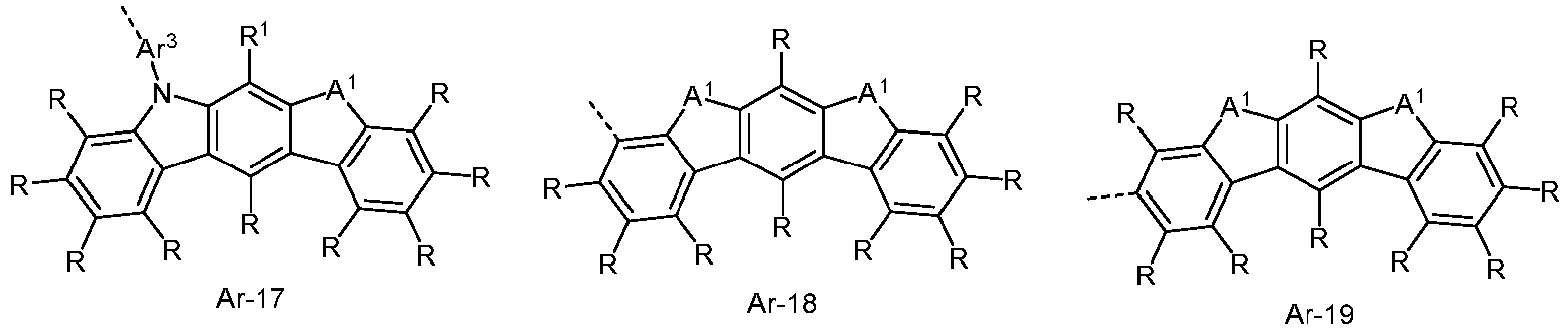

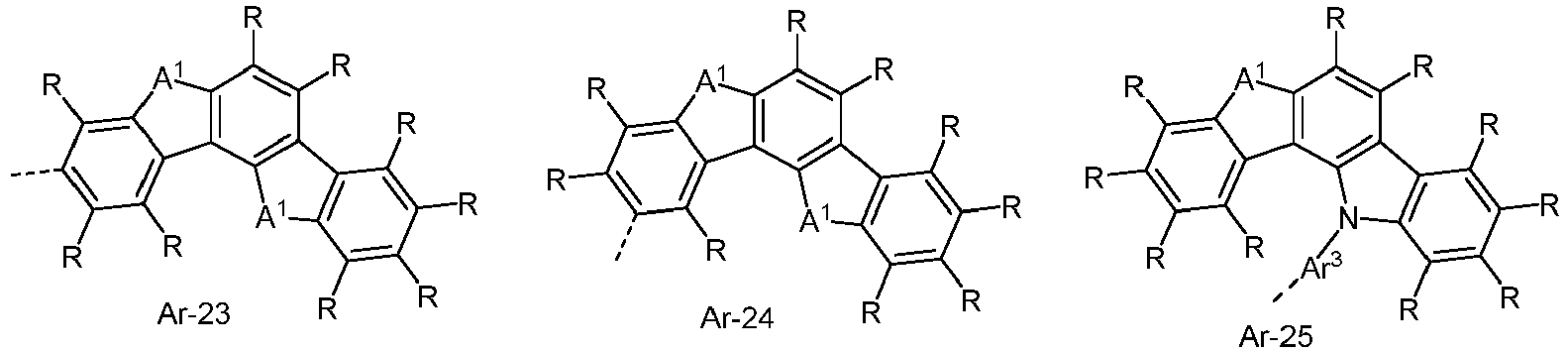


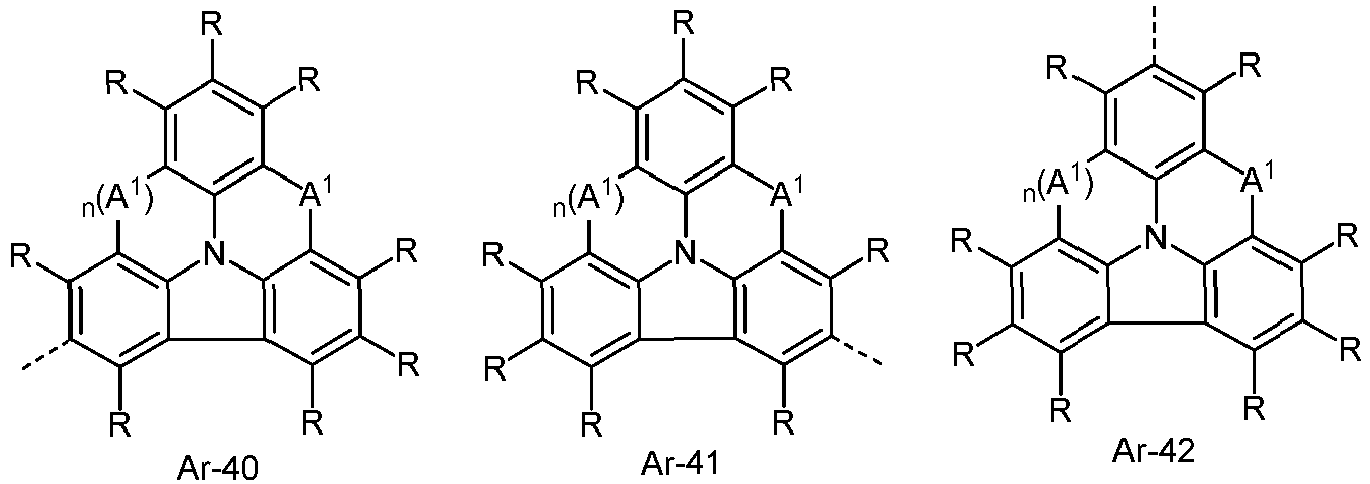


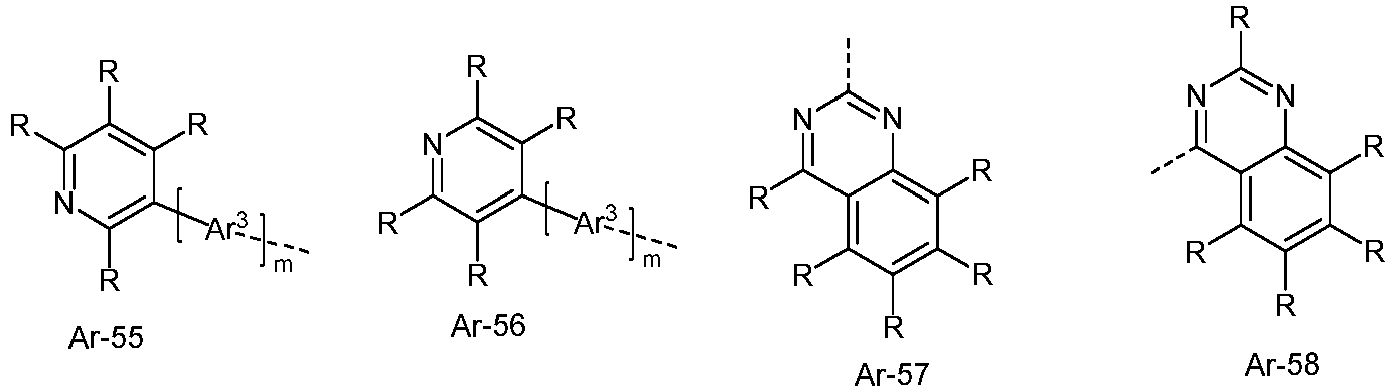


- Ar3
- ist bei jedem Auftreten gleich oder verschieden ein bivalentes aromatisches oder heteroaromatisches Ringsystem mit 6 bis 18 aromatischen Ringatomen, welches jeweils mit einem oder mehreren Resten R substituiert sein kann;
- Ar2
- ist ein aromatisches oder heteroaromatisches Ringsystem mit 5 bis 40 aromatischen Ringatomen, welches mit einem oder mehreren Resten R substituiert sein kann;
- A1
- ist gleich oder verschieden bei jedem Auftreten NAr2, O, S oder C(R)2;
- n
- ist 0 oder 1, wobei n = 0 bedeutet, dass an dieser Position keine Gruppe A1 gebunden ist und an die entsprechenden Kohlenstoffatome stattdessen Reste R gebunden sind;
- m
- ist 0 oder 1, wobei m = 0 bedeutet, dass die Gruppe Ar3 nicht vorhanden ist und dass die entsprechende aromatische bzw. heteroaromatische Gruppe direkt an das Stickstoffatom gebunden ist.
- Beispiele für geeignete Verbindungen gemäß Formel (4) oder (5) sind die nachfolgend abgebildeten Verbindungen.


- Bevorzugte verbrückte Carbazole sind die Strukturen der folgenden Formel (6),

- Bevorzugte Dibenzofuran-Derivate sind die Verbindungen der folgenden Formel (7),

- Beispiele für geeignete Dibenzofuran-Derivate sind die nachfolgend abgebildeten Verbindungen.


- Bevorzugte Carbazolamine sind die Strukturen der folgenden Formeln (8), (9) und (10),

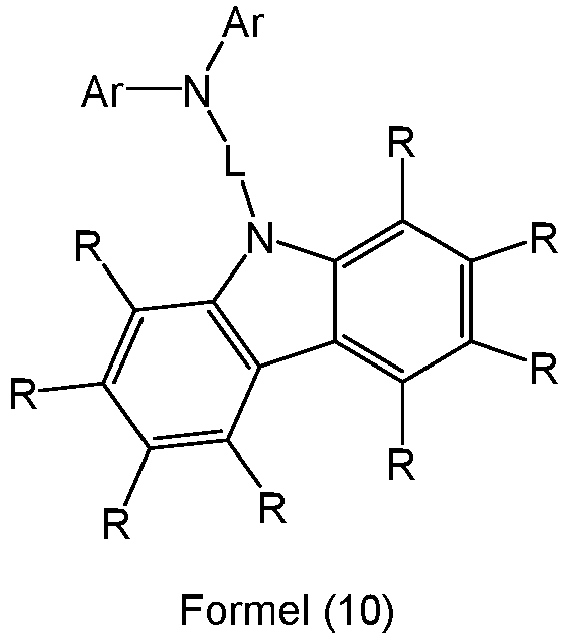
- Beispiele für geeignete Carbazolamin-Derivate sind die nachfolgend abgebildeten Verbindungen.


- Weitere besonders bevorzugte Co-Matrixmaterialien, insbesondere lochtransportierende Co-Hosts, insbesondere wenn die erfindungsgemäße Verbindung mit einem elektronenarmen heteroaromatischen Ringsystem substituiert ist, sind in folgender Tabelle gezeigt:
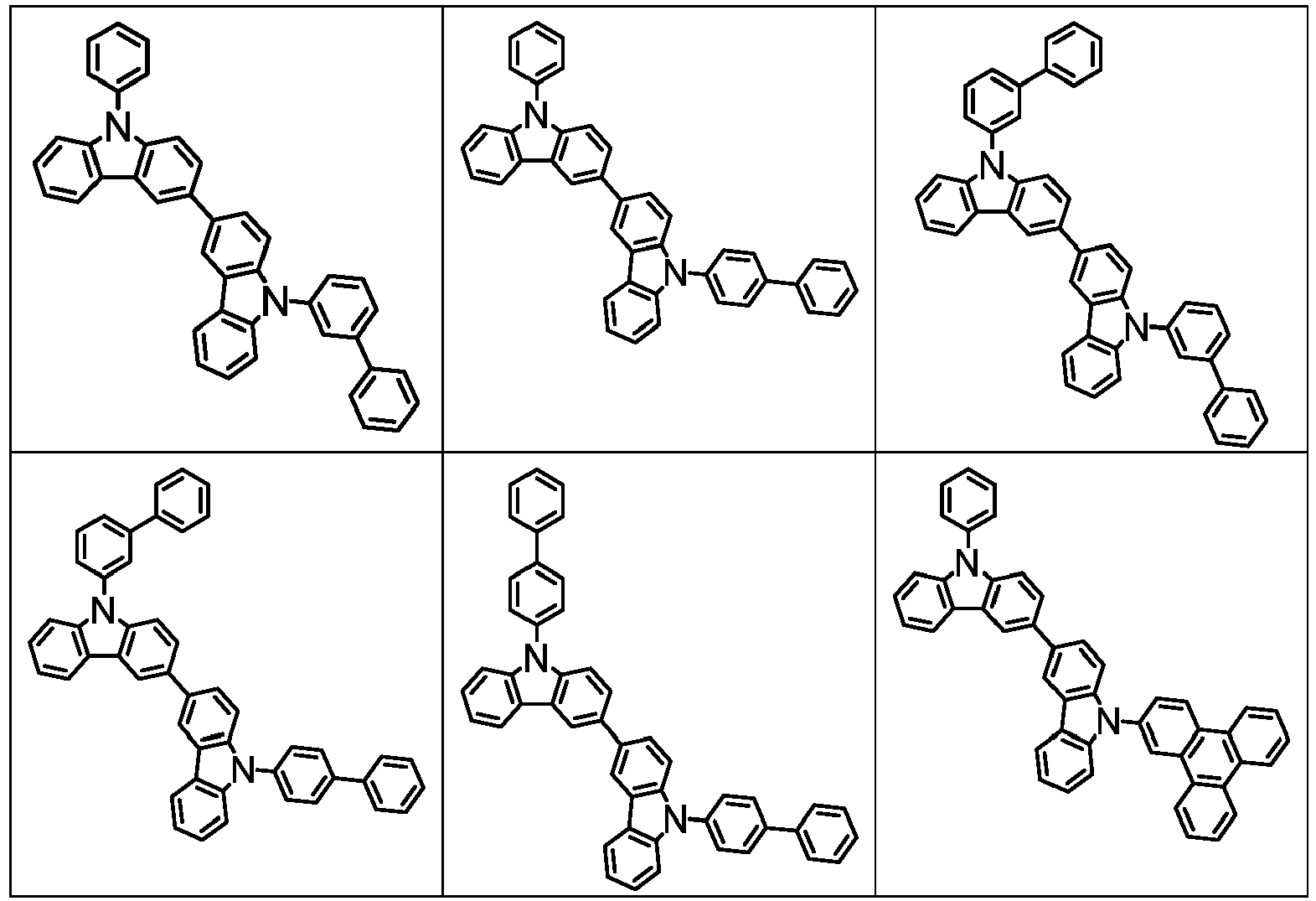


- Bevorzugte Co-Matrix-Materialien, insbesondere wenn die erfindungsgemäße Verbindung mit einem elektronenreichen heteroaromatischen Ringsystem, beispielsweise einer Carbazolgruppe, substituiert ist, sind weiterhin ausgewählt aus der Gruppe bestehend aus Triazin-Derivaten, Pyrimidin-Derivaten, Chinazolin-Derivaten und Chinoxalin-Derivaten.
- Bevorzugte Triazin-, Chinazolin-, Chinoxalin- bzw. Pyrimidinderivate, welche als Mischung zusammen mit den erfindungsgemäßen Verbindungen eingesetzt werden können, sind die Verbindungen der folgenden Formeln (11), (12), (13) und (14),
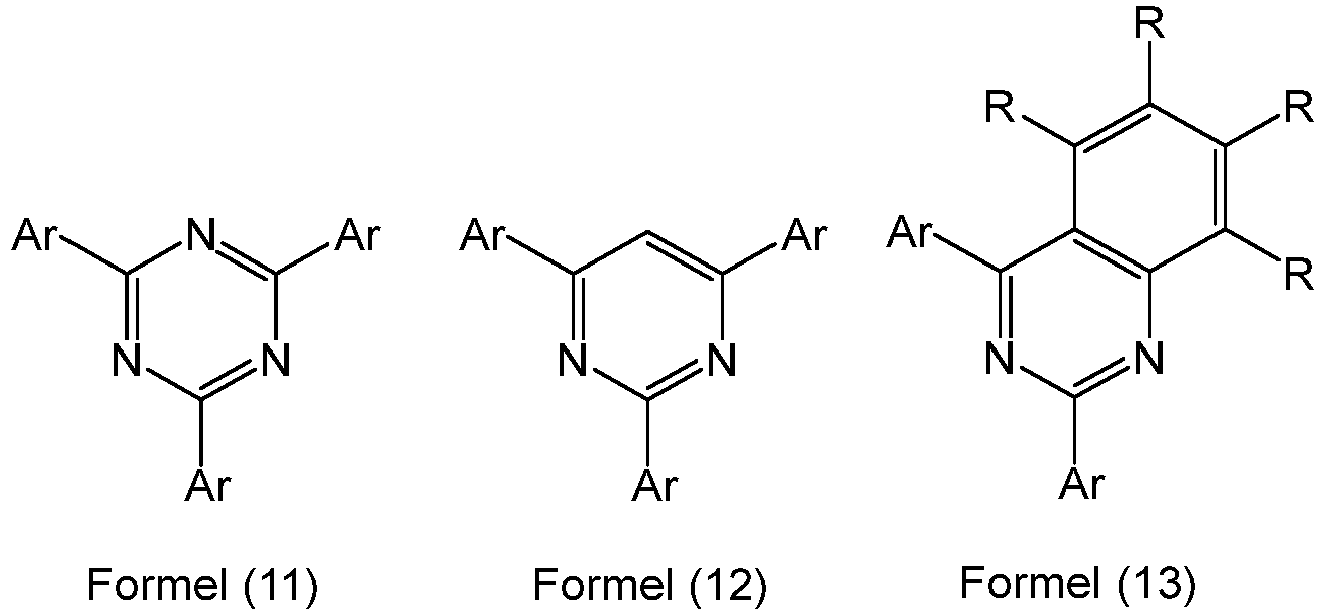

- Besonders bevorzugt sind die Triazinderivate der Formel (11) und die Chinazolinderivate der Formel (13), insbesondere die Triazinderivate der Formel (11).
- In einer bevorzugten Ausführungsform der Erfindung ist Ar in den Formeln (11), (12), (13) und (14) bei jedem Auftreten gleich oder verschieden ein aromatisches oder heteroaromatisches Ringsystem mit 6 bis 30 aromatischen Ringatomen, insbesondere mit 6 bis 24 aromatischen Ringatomen, das durch einen oder mehrere Reste R substituiert sein kann. Dabei sind geeignete aromatische bzw. heteroaromatische Ringsysteme Ar die gleichen, wie sie oben als Ausführungsformen für Ar ausgeführt sind, insbesondere die Strukturen Ar-1 bis Ar-76.
- Beispiele für geeignete Triazinverbindungen, welche als Matrixmaterialien zusammen mit den erfindungsgemäßen Verbindungen eingesetzt werden können, sind die in der folgenden Tabelle abgebildeten Verbindungen.


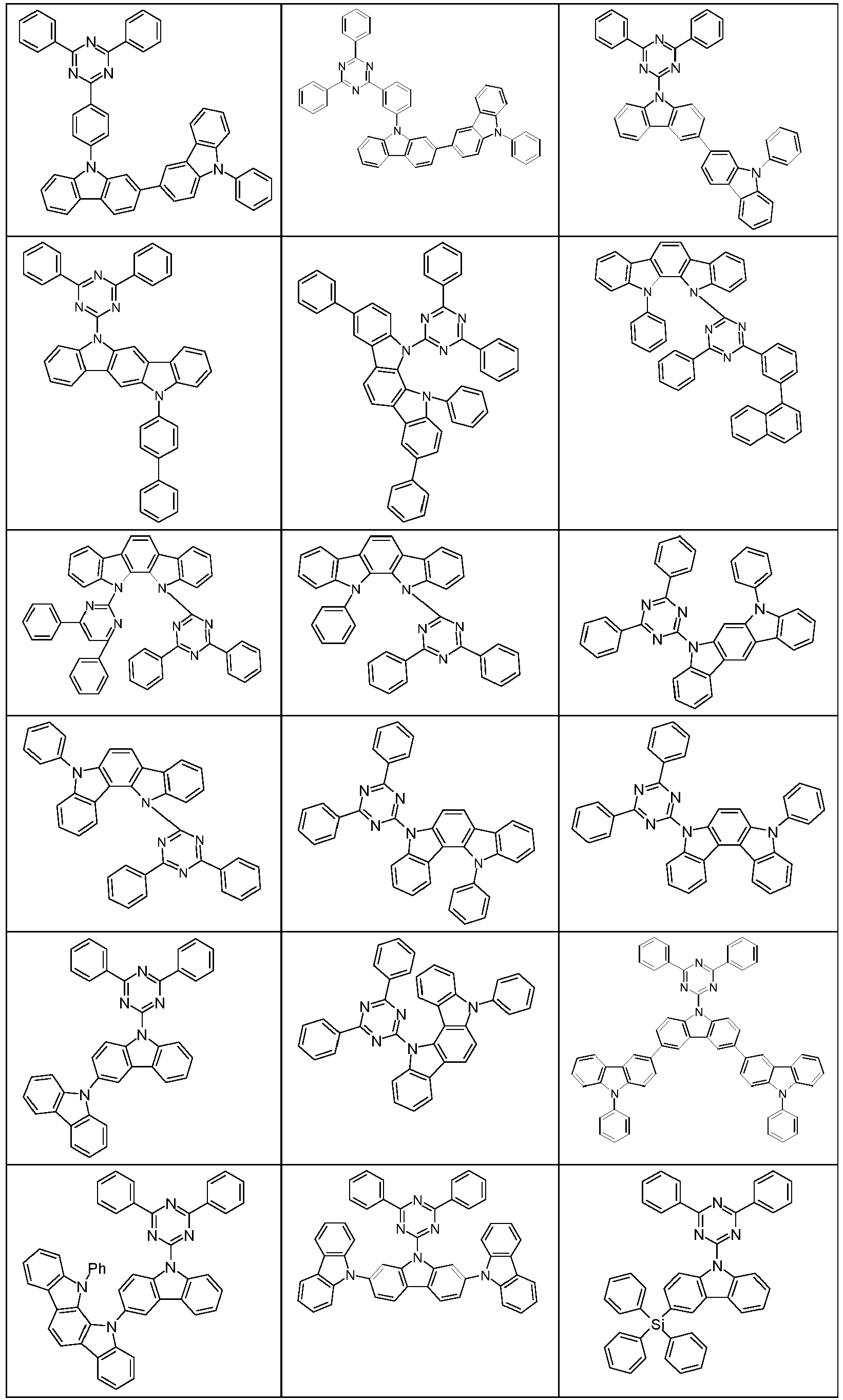
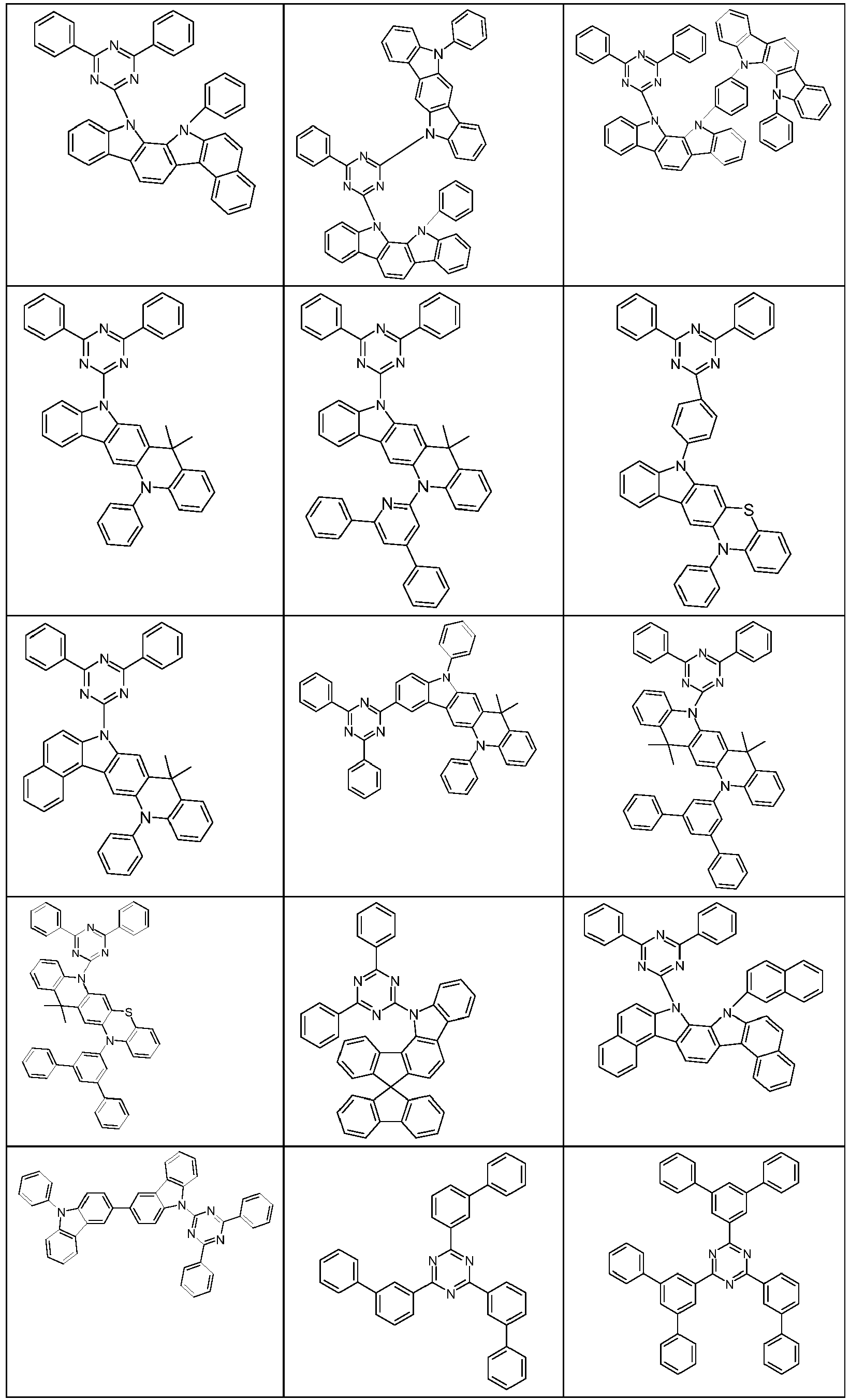


- Beispiele für geeignete Chinazolinverbindungen sind die in der folgenden Tabelle abgebildeten Verbindungen:


- Als phosphoreszierende Verbindungen (= Triplettemitter) eignen sich insbesondere Verbindungen, die bei geeigneter Anregung Licht, vorzugsweise im sichtbaren Bereich, emittieren und außerdem mindestens ein Atom der Ordnungszahl größer 20, bevorzugt größer 38 und kleiner 84, besonders bevorzugt größer 56 und kleiner 80 enthalten, insbesondere ein Metall mit dieser Ordnungszahl. Bevorzugt werden als Phosphoreszenzemitter Verbindungen, die Kupfer, Molybdän, Wolfram, Rhenium, Ruthenium, Osmium, Rhodium, Iridium, Palladium, Platin, Silber, Gold oder Europium enthalten, verwendet, insbesondere Verbindungen, die Iridium oder Platin enthalten.
- Beispiele der oben beschriebenen Emitter können den Anmeldungen
WO 00/70655 WO 2001/41512 WO 2002/02714 WO 2002/15645 EP 1191613 ,EP 1191612 ,EP 1191614 ,WO 05/033244 WO 05/019373 US 2005/0258742 ,WO 2009/146770 ,WO 2010/015307 ,WO 2010/031485 ,WO 2010/054731 ,WO 2010/054728 ,WO 2010/086089 ,WO 2010/099852 ,WO 2010/102709 ,WO 2011/032626 ,WO 2011/066898 ,WO 2011/157339 ,WO 2012/007086 ,WO 2014/008982 ,WO 2014/023377 ,WO 2014/094961 ,WO 2014/094960 ,WO 2015/036074 ,WO 2015/104045 ,WO 2015/117718 ,WO 2016/015815 ,WO 2016/124304 ,WO 2017/032439 ,WO 2018/011186 ,WO 2018/041769 ,WO 2019/020538 ,WO 2018/178001 ,WO 2019/115423 undWO 2019/158453 entnommen werden. Generell eignen sich alle phosphoreszierenden Komplexe, wie sie gemäß dem Stand der Technik für phosphoreszierende OLEDs verwendet werden und wie sie dem Fachmann auf dem Gebiet der organischen Elektrolumineszenz bekannt sind, und der Fachmann kann ohne erfinderisches Zutun weitere phosphoreszierende Komplexe verwenden. - Beispiele für phosphoreszierende Dotanden sind nachfolgend aufgeführt.


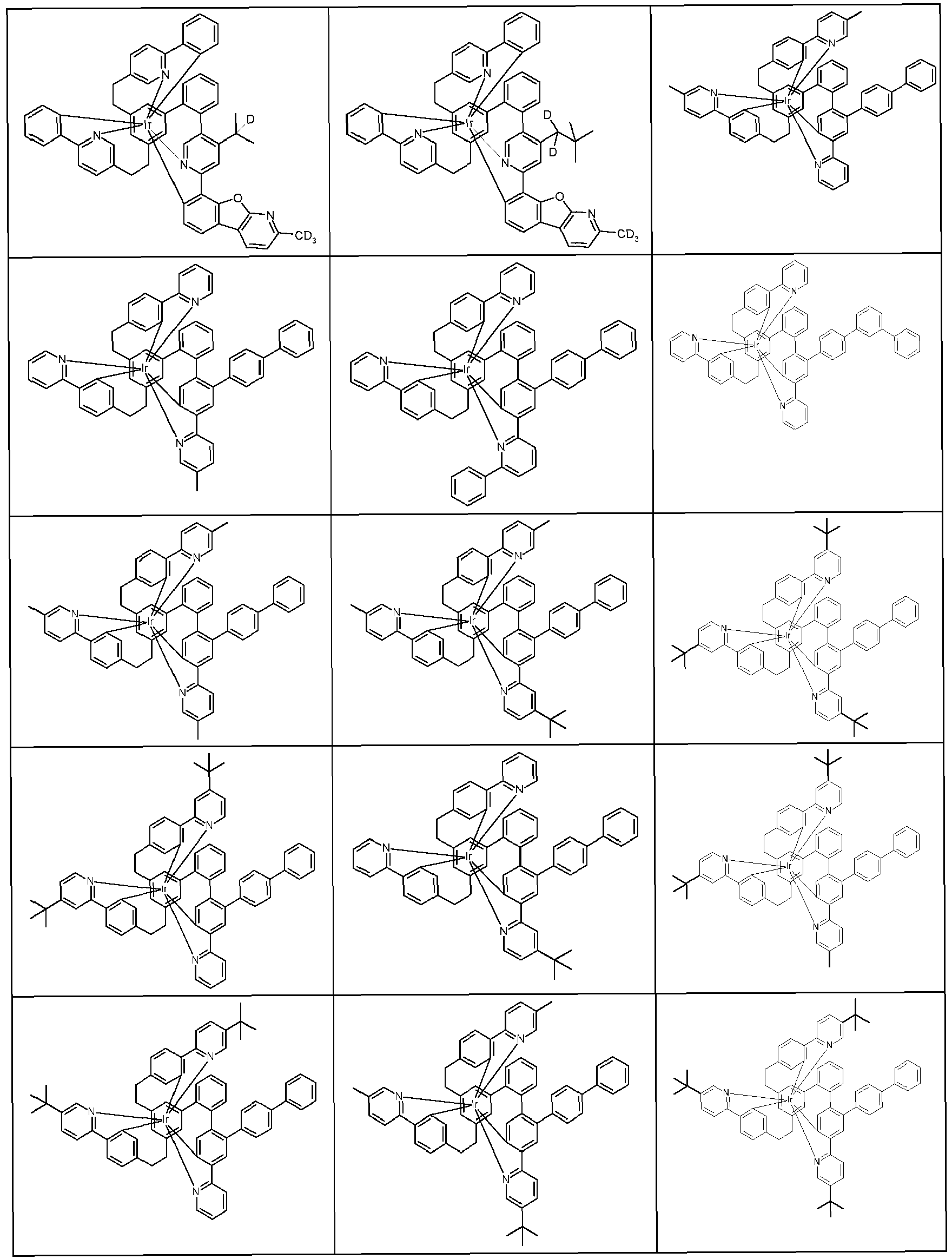
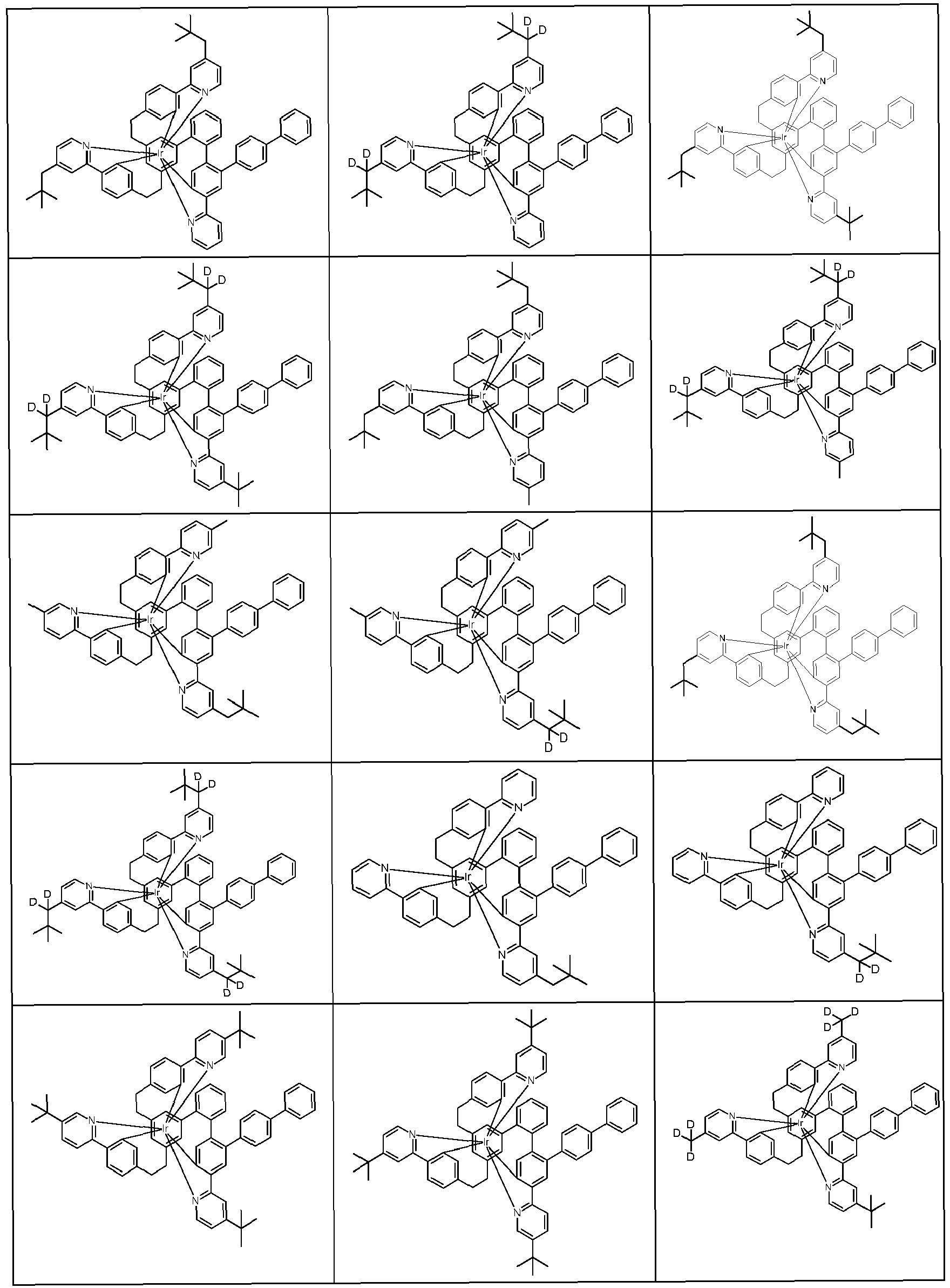

- In den weiteren Schichten der erfindungsgemäßen organischen Elektrolumineszenzvorrichtung können alle Materialien verwendet werden, wie sie üblicherweise gemäß dem Stand der Technik eingesetzt werden. Der Fachmann kann daher ohne erfinderisches Zutun alle für organische Elektrolumineszenzvorrichtungen bekannten Materialien in Kombination mit den erfindungsgemäßen Verbindungen gemäß Formel (1) bzw. den oben ausgeführten bevorzugten Ausführungsformen einsetzen.
- Insbesondere geeignet zur Verwendung in Schichten mit lochtransportierender Funktion jeglicher OLEDs, nicht nur der OLEDs gemäß den Definitionen der vorliegenden Anmeldung, sind die folgenden Verbindungen:

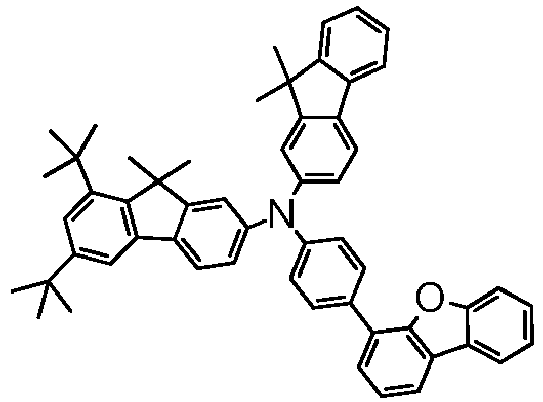

(H-1) (H-2) (H-3) WO 2012/034627 A1 WO 2019/115577 A1 WO 2013/120577 A1 
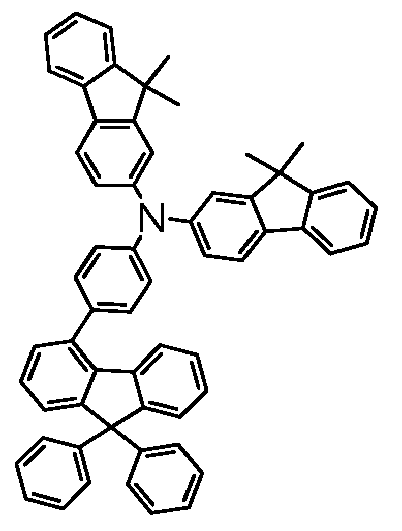

(H-4) (H-5) (H-6) WO 2012/034627 A1 WO 2015/082056 A1 WO 2012/034627 A1 


(H-7) (H-8) (H-9) WO 2013/120577 A1 WO 2013/120577 A1 WO 2012/034627 A1 
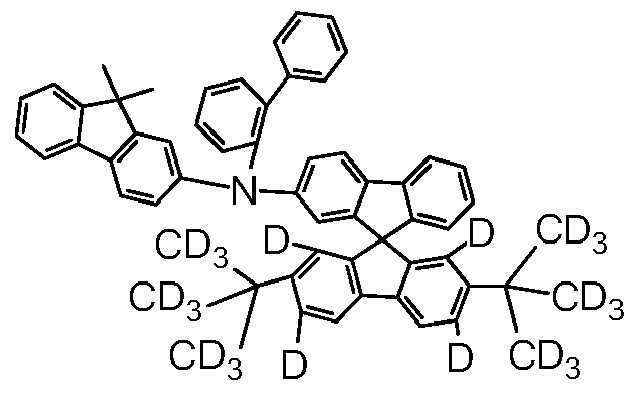

(H-10) (H-11) (H-12) WO 2012/034627 A1 WO 2012/034627 A1 WO 2012/034627 A1 - Unter dem Begriff "Schichten mit lochtransportierender Funktion" werden dabei insbesondere Lochinjektionsschichten, Lochtransportschichten und Elektronenblockierschichten, und auch emittierende Schichten verstanden, insbesondere Lochinjektionsschichten, Lochtransportschichten und Elektronenblockierschichten.
- Die Verbindungen HT-1 bis HT-12 sind allgemein zur Verwendung in lochtransportierenden Schichten geeignet. Ihre Verwendung ist nicht beschränkt auf bestimmte OLEDs, wie die in der vorliegenden Anmeldung beschriebenen OLEDs.
- Die Verbindungen HT-1 bis HT-12 können nach den Vorschriften hergestellt werden, die in den in der obenstehenden Tabelle genannten Offenlegungsschriften offenbart sind. Die weitere Lehre betreffend Verwendung und Herstellung der Verbindungen, die in den in der obenstehenden Tabelle aufgeführten Offenlegungsschriften offenbart ist, ist hiermit explizit einbezogen und ist bevorzugt mit der oben genannten Lehre betreffend die Verwendung der oben genannten Verbindungen als lochtransportierende Materialien zu kombinieren. Die Verbindungen HT-1 bis HT-12 zeigen hervorragende Eigenschaften bei der Verwendung in OLEDs, insbesondere hervorragende Lebensdauer und Effizienz.
- Weiterhin bevorzugt ist eine organische Elektrolumineszenzvorrichtung, dadurch gekennzeichnet, dass eine oder mehrere Schichten mit einem Sublimationsverfahren beschichtet werden. Dabei werden die Materialien in Vakuum-Sublimationsanlagen bei einem Anfangsdruck kleiner 10-5 mbar, bevorzugt kleiner 10-6 mbar aufgedampft. Es ist aber auch möglich, dass der Anfangsdruck noch geringer ist, beispielsweise kleiner 10-7 mbar.
- Bevorzugt ist ebenfalls eine organische Elektrolumineszenzvorrichtung, dadurch gekennzeichnet, dass eine oder mehrere Schichten mit dem OVPD (Organic Vapour Phase Deposition) Verfahren oder mit Hilfe einer Trägergassublimation beschichtet werden. Dabei werden die Materialien bei einem Druck zwischen 10-5 mbar und 1 bar aufgebracht. Ein Spezialfall dieses Verfahrens ist das OVJP (Organic Vapour Jet Printing) Verfahren, bei dem die Materialien direkt durch eine Düse aufgebracht und so strukturiert werden.
- Weiterhin bevorzugt ist eine organische Elektrolumineszenzvorrichtung, dadurch gekennzeichnet, dass eine oder mehrere Schichten aus Lösung, wie z. B. durch Spincoating, oder mit einem beliebigen Druckverfahren, wie z. B. Siebdruck, Flexodruck, Offsetdruck, LITI (Light Induced Thermal Imaging, Thermotransferdruck), Ink-Jet Druck (Tintenstrahldruck) oder Nozzle Printing, hergestellt werden. Hierfür sind lösliche Verbindungen nötig, welche beispielsweise durch geeignete Substitution erhalten werden.
- Weiterhin sind Hybridverfahren möglich, bei denen beispielsweise eine oder mehrere Schichten aus Lösung aufgebracht werden und eine oder mehrere weitere Schichten aufgedampft werden.
- Diese Verfahren sind dem Fachmann generell bekannt und können von ihm ohne erfinderisches Zutun auf organische Elektrolumineszenzvorrichtungen enthaltend die erfindungsgemäßen Verbindungen angewandt werden.
- Die erfindungsgemäßen Verbindungen und die erfindungsgemäßen organischen Elektrolumineszenzvorrichtungen zeichnen sich durch einen oder mehrere der folgenden Eigenschaften aus:
- 1. Die erfindungsgemäßen Verbindungen, eingesetzt als Matrixmaterial für phosphoreszierende Emitter, führen zu langen Lebensdauern.
- 2. Die erfindungsgemäßen Verbindungen führen zu hohen Effizienzen, insbesondere zu einer hohen EQE. Dies gilt insbesondere, wenn die Verbindungen als Matrixmaterial für einen phosphoreszierenden Emitter eingesetzt werden.
- 3. Die erfindungsgemäßen Verbindungen führen zu geringen Betriebsspannungen. Dies gilt insbesondere, wenn die Verbindungen als Matrixmaterial für einen phosphoreszierenden Emitter eingesetzt werden.
- Die Erfindung wird durch die nachfolgenden Beispiele näher erläutert, ohne sie dadurch einschränken zu wollen. Der Fachmann kann aus den Schilderungen die Erfindung im gesamten offenbarten Bereich ausführen und ohne erfinderisches Zutun weitere erfindungsgemäße Verbindungen herstellen und diese in elektronischen Vorrichtungen verwenden bzw. das erfindungsgemäße Verfahren anwenden.
- Die nachfolgenden Synthesen werden, sofern nicht anders angegeben, unter einer Schutzgasatmosphäre in getrockneten Lösungsmitteln durchgeführt. Die Lösungsmittel und Reagenzien können z. B. von Sigma-ALDRICH bzw. ABCR bezogen werden. Zu den literaturbekannten Verbindungen sind jeweils auch die entsprechenden CAS-Nummern angegeben.

- Unter inerter Atmosphäre werden DMSO (50 mL), K3PO4 (53.08 g 250 mmol), Pyridin-2-carbonsäure (1.53 g, 12.44 mmol) und Cul (1.19 g, 6.22 mmol) vorgelegt. Anschließend werden 3-Chlorphenol (19.20 g, 150 mmol) [108-43-0] und 3-Brom-1-chlorbenzol (23.93 g, 125 mmol) [108-37-2] nacheinander langsam zugegeben und das Reaktionsgemisch bei 85 °C für 16 h gerührt. Nach dem Abkühlen wird das Reaktionsgemisch extraktiv mit wässriger Ammoniaklösung und Methyl-tert-Butylether aufgearbeitet. Die organische Phase wird fünfmal mit Wasser und zweimal mit gesättigter NaCl-Lösung gewaschen, die vereinigten Phasen über Na2SO4 getrocknet und das Lösungsmittel am Rotationsverdampfer abgezogen. Das Rohprodukt wird über fraktionierte Destillation weiter aufgereinigt. Ausbeute: 26.88 g (106 mmol), 85%; Reinheit 96%ig nach 1H-NMR.
- Analog können folgende Verbindungen dargestellt werden. Zur Aufreinigung kann neben Destillation auch Säulenchromatographie oder zur Umkristallisation können andere gängige Lösungsmittel wie Ethanol, Butanol, Aceton, Ethylacetat, Acetonitril, Toluol, Xylol, Dichlormethan, Methanol, Tetrahydrofuran, n-Butylacetat, 1,4-Dioxan, Dimethylsulfoxid, N,N-Dimethylformamid, N,N-Dimethylacetamid, N-Methylpyrrolidon, etc. verwendet werden.
Edukt 1 Edukt 2 Produkt Ausbeute 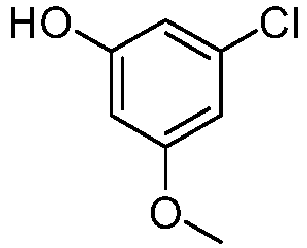


86% 


74% 


75% 
- S1a (23.90 g 100 mmol) wird in THF (150 mL) unter inerter Atmosphäre vorgelegt und auf -75 °C abgekühlt. Anschließend wird langsam n-Butyllithium (2.5 mol/L in Hexan, 80 mL, 200 mol) so zugetropft, dass die Innentemperatur -65 °C nicht übersteigt. Es wird für 4 h bei -75 °C weitergerührt und dann wird Brom (5.6 mL, 109.3 mmol) so zugetropft, dass die Innentemperatur -65 °C nicht übersteigt. Nach beendeter Zugabe wird der Ansatz für 1 h bei -75 °C gerührt, dann innerhalb von 1 h langsam auf 10 °C aufgewärmt und 1 h bei 10 °C gerührt. Anschließend wird auf 0 °C gekühlt und der Ansatz mit gesättigter Na2SO3 Lösung (50 mL) vorsichtig gequencht. Der Ansatz wird extraktiv mit Toluol und Wasser aufgearbeitet, die vereinigten organischen Phasen dreimal mit Wasser und einmal mit gesättigter NaCl-Lösung gewaschen, über Na2SO4 getrocknet und das Lösungsmittel am Rotationsverdampfer entfernt. Das Rohprodukt wird zweimal mit 2-Propanol unter Rückfluss ausgerührt. Ausbeute: 24.21 g (86 mmol, 86%); Reinheit 97%ig nach 1H-NMR.
- Analog können folgende Verbindungen dargestellt werden. Zur Aufreinigung kann neben Ausrühren auch Destillation oder Säulenchromatographie oder zur Umkristallisation können andere gängige Lösungsmittel wie Ethanol, Butanol, Aceton, Ethylacetat, Acetonitril, Toluol, Xylol, Dichlormethan, Methanol, Tetrahydrofuran, n-Butylacetat, 1,4-Dioxan, Dimethylsulfoxid, N,N-Dimethylformamid, N,N-Dimethylacetamid, N-Methylpyrrolidon, etc. verwendet werden.
Edukt 1 Produkt Ausbeute 

79% 

79% 

74% 
- S1b (39.19 g, 140.0 mmol), 4-Methoxyphenyl-boronsäure (22.79 g, 150.0 mmol) [5720-07-0] und K2CO3 (38.70 g, 280.0 mmol) werden in THF (70 mL) und Wasser (170 mL) vorgelegt und 30 min inertisiert. Anschließend wird Tetrakis(triphenylphosphin)palladium [14221-01-3] (1.78 g, 1.54 mmol) zugegeben und das Reaktionsgemisch 20 h unter Rückfluss gerührt. Der Ansatz wird extraktiv mit Toluol und Wasser aufgearbeitet, die vereinigten organischen Phasen mit Wasser und gesättigter NaCl-Lösung gewaschen, über Na2SO4 getrocknet und das Lösungsmittel am Rotationsverdampfer abgezogen. Das Rohprodukt wird aus Ethanol umkristallisiert. Ausbeute: 33.7 g, (109 mmol, 78%), Reinheit 96%ig nach 1H-NMR.
- Analog können folgende Verbindungen dargestellt werden. Zur Aufreinigung kann Säulenchromatographie oder zur Umkristallisation können andere gängige Lösungsmittel wie Ethanol, Butanol, Aceton, Ethylacetat, Acetonitril, Toluol, Xylol, Dichlormethan, Methanol, Tetrahydrofuran, n-Butylacetat, 1,4-Dioxan, Dimethylsulfoxid, N,N-Dimethylformamid, N,N-Dimethylacetamid, N-Methylpyrrolidon, etc. verwendet werden.
Edukt 1 Edukt 2 Produkt Ausbeute 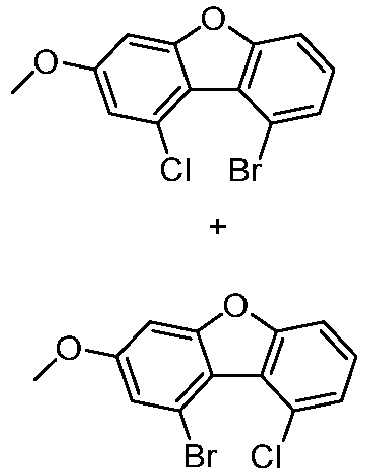


69% 
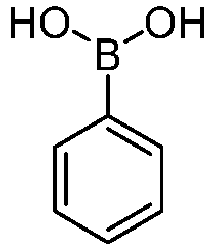

59% 


75% 


78% 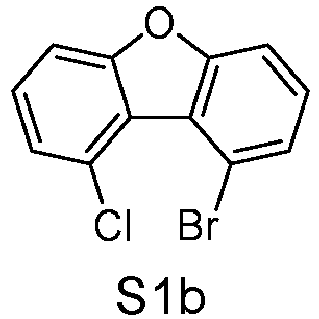


64% 


57% 


40% 


52% 


54% 


50% 


55% 


42% 

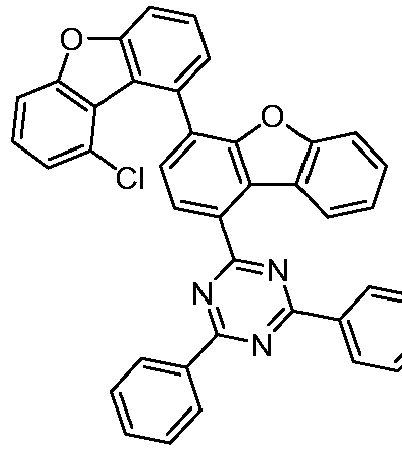
38% 


46% 


44% 
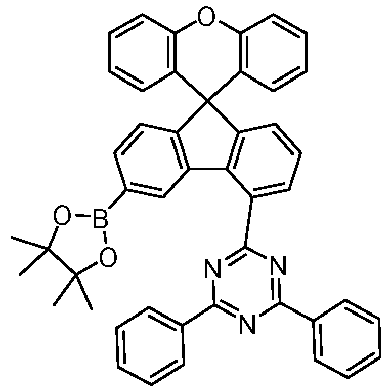

52% 


47% 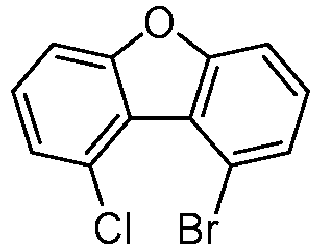


34% -

- S1c (30.88 g, 100 mmol) und K2CO3 (41.46 g, 300 mmol) werden unter inerter Atmosphäre vorgelegt, mit DMAc (450 mL) versetzt und 30 min. inertisiert. Anschließend wird Pd(OAc)2 (447 mg, 1.99 mmol) und 1,3-Bis-(2,6-diisopropyl-phenly)3-H-imidazol-1-ium chlorid (1.69 g, 3.98 mmol) zugegeben und das Reaktionsgemisch 16 h bei 150 °C gerührt. Nach dem Abkühlen wird der Ansatz in Ethanol/Wasser (1:1, 600 mL) gegossen und 30 min. nachgerührt. Der ausgefallene Feststoff wird abgesaugt und fünfmal mit Wasser und dreimal mit Ethanol gewaschen. Das Rohprodukt wird mit 2-Propanol unter Rückfluss ausgerührt und der Feststoff nach dem Abkühlen abgesaugt. Ausbeute: 22.9 g (84 mmol, 84%), Reinheit 98%ig nach 1H-NMR.
- Analog können folgende Verbindungen dargestellt werden. Dabei kann neben 1,3-Bis-(2,6-diisopropyl-phenly)3-H-imidazol-1-iumchlorid auch Tritert-Butylphosphin oder Tricyclohexylphosphin verwendet werden oder als Pd-Quelle neben Pd(OAc)2 auch Pd2(dba)3. Zur Aufreinigung kann Säulenchromatographie oder zur Umkristallisation können andere gängige Lösungsmittel wie Ethanol, Butanol, Aceton, Ethylacetat, Acetonitril, Toluol, Xylol, Dichlormethan, Methanol, Tetrahydrofuran, n-Butylacetat, 1,4-Dioxan, Dimethylsulfoxid, N,N-Dimethylformamid, N,N-Dimethylacetamid, N-Methylpyrrolidon, etc. verwendet werden
Edukt 1 Produkt Ausbeute 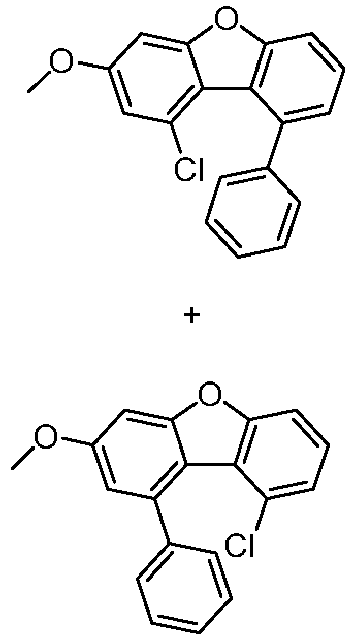

73% 

80% 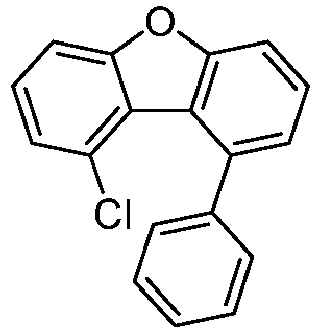

81% 

77% 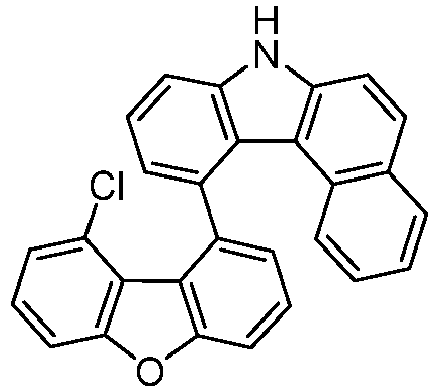

30% 

72% 
- S1d (27.23 g, 100 mmol) wird in Dichlormethan (620 mL) vorgelegt und auf 0 °C im Eisbad abgekühlt. Anschließend wird vorsichtig BBr3 (6.0 mL, 63.2 mmol) zugetropft. Nach beendeter Zugabe wird der Ansatz auf Raumtemperatur erwärmen gelassen. Nach vollständiger Umsetzung wird der Ansatz erneut auf 0 °C abgekühlt und vorsichtig mit MeOH (150 mL) gequencht. Das Lösungsmittel wird am Rotationsverdampfer abgezogen. Anschließend wird der Ansatz dreimal mit je 300 mL MeOH versetzt und dieses dann jeweils am Rotationsverdampfer abgezogen. Es wird erneut 200 mL MeOH zugegeben und der Feststoff abgesaugt. Das Rohprodukt wird getrocknet und ohne weitere Aufreinigung in der nächsten Stufe verwendet. Ausbeute: 17.05 g (66 mmol, 66%).
- Analog können folgende Verbindungen dargestellt werden. Zur Aufreinigung kann Säulenchromatographie oder zur Umkristallisation können andere gängige Lösungsmittel wie Ethanol, Butanol, Aceton, Ethylacetat, Acetonitril, Toluol, Xylol, Dichlormethan, Methanol, Tetrahydrofuran, n-Butylacetat, 1,4-Dioxan, Dimethylsulfoxid, N,N-Dimethylformamid, N,N-Dimethylacetamid, N-Methylpyrrolidon, etc. verwendet werden.
Edukt 1 Produkt Ausbeute 

71% 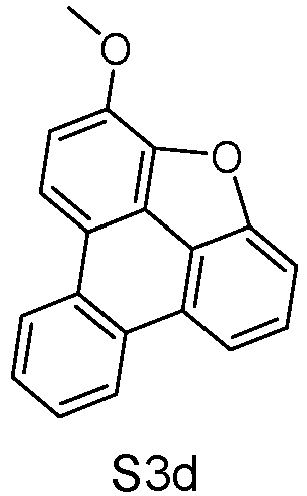

63%% 
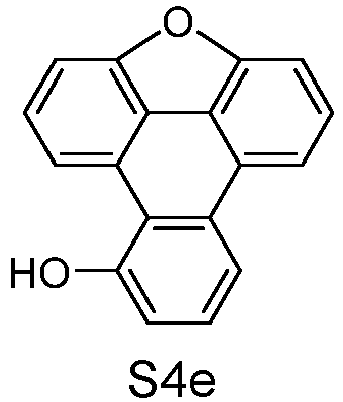
58% 
- S1e (12.91 g, 50.0 mmol) und Triethylamin (20.8 mL, 150 mmol) werden in Dichlormethan (700 mL) vorgelegt und im Eisbad auf 0 °C gekühlt. Anschließend wird Trifluormethansulfonsäureanhydrid (10.9 mL, 65.0 mmol) langsam zugetropft. Nach beendeter Zugabe wird der Ansatz auf Raumtemperatur erwärmen gelassen. Nach vollständiger Umsetzung wird der Ansatz extraktiv mit Dichlormethan und Wasser aufgearbeitet, die vereinigten organischen Phasen über Na2SO4 getrocknet und das Lösungsmittel am Rotationsverdampfer entfernt. Der Rückstand wird in 300 mL Cyclohexan aufgenommen und 30 min bei Raumtemperatur gerührt. Der Feststoff wird abgesaugt und im VTS getrocknet. Ausbeute 13.74 g (35.2 mmol, 70%).
- Analog können folgende Verbindungen dargestellt werden. Zur Aufreinigung kann Säulenchromatographie oder zur Umkristallisation können andere gängige Lösungsmittel wie Ethanol, Butanol, Aceton, Ethylacetat, Acetonitril, Toluol, Xylol, Dichlormethan, Methanol, Tetrahydrofuran, n-Butylacetat, 1,4-Dioxan, Dimethylsulfoxid, N,N-Dimethylformamid, N,N-Dimethylacetamid, N-Methylpyrrolidon, etc. verwendet werden.
Edukt 1 Produkt Ausbeute 

79% 

64% 

41% 

- S4d (24.23 g, 100 mmol) werden in 300 mL THF vorgelegt und auf -75 °C gekühlt. Anschließend wird Hexyllithium (44.0 mL, c=2.5 mol/L, 110 mmol) so zugetropft, dass die Temperatur nicht über -65 °C steigt. Nach beendeter Zugabe wird 1 h bei -75 °C nachgerührt. Anschließend wird das Reaktionsgemisch langsam auf Raumtemperatur aufgewärmt und 1 h bei Raumtemperatur gerührt. Anschließend wird das Reaktionsgemisch wieder auf -75 °C abgekühlt und Trimethylborat (15.59 g, 150.0 mmol) so zugetropft, dass die Temperatur nicht über -65°C steigt. Der Ansatz wird über Nacht auf Raumtemperatur erwärmt und am nächsten Tag vorsichtig mit HCl (c=5 mol/L, 50 mL) gequencht. Der Ansatz wird extraktiv mit Wasser aufgearbeitet und die organische Phase dreimal mit Wasser gewaschen. Das THF wird bis auf 50 mL abrotiert, dann werden 150 mL n-Heptan zugegeben und der ausgefallene Feststoff abgesaugt und mit n-Heptan gewaschen. Ausbeute: 24.03 g (84.2 mmol, 84%), Reinheit 96%ig nach 1H-NMR.

- S1f (11.71 g, 30.0 mmol), Bis(pinacolato)diboron (9.40 g, 36.3 mmol) und KOAc (8.90 g, 90.68 mmol) werden in 1,4-Dioxan (200 mL) vorgelegt und 30 min mit Argon inertisiert. Anschließend wird Pd(dppf)Cl2 (740 mg, 0.91 mmol) zugegeben und der Ansatz 20 h unter Rückfluss gerührt. Nach dem Abkühlen wird das Lösungsmittel am Rotationsverdampfer abgezogen und der Rückstand extraktiv mit Dichlormethan und Wasser aufgearbeitet. Die vereinigten organischen Phasen werden über Na2SO4 getrocknet, mit Ethanol (150 ml) versetzt und das Dichlormethan am Rotationsverdampfer abgezogen. Der ausgefallene Feststoff wird abgesaugt und im Vakuumtrockenschrank getrocknet. Das Rohprodukt wird ohne weitere Aufreinigung in der nächsten Stufe eingesetzt. Ausbeute: 9.06 g (24.6 mmol, 82%), Reinheit 95%ig nach 1H-NMR.
- Analog können folgende Verbindungen dargestellt werden. Als Katalysatorsystem kann alternativ auch Pd(PCy3)2Cl2 oder Pd2(dba)3 mit S-Phos (1:3) eingesetzt werden. Zur Aufreinigung kann neben Säulenchromatographie auch Heißextraktion verwendet werden, zur Umkristallisation oder Heißextraktion können andere gängige Lösungsmittel wie Ethanol, Butanol, Aceton, Ethylacetat, Acetonitril, Toluol, Xylol, Dichlormethan, Methanol, Tetrahydrofuran, n-Butylacetat, 1,4-Dioxan oder zur Umkristallisation Hochsieder wie Dimethylsulfoxid, N,N-Dimethylformamid, N,N-Dimethylacetamid, N-Methylpyrrolidon, etc. verwendet werden.
Edukt 1 Produkt Ausbeute 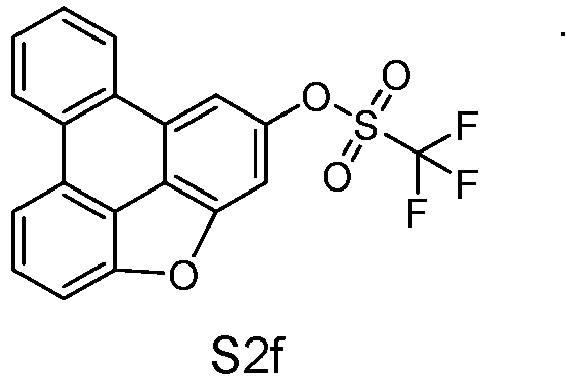

85% 

70% 

- 2-Brom-1-chlor-3-nitrobenzol (23.6 g, 100 mmol) [CAS-19128-48-4], ortho-Biphenylboronsäure (19.8 g, 100 mmol) [CAS-4688-76-0] und Natriumcarbonat (21.2 g, 200 mmoL) werden unter inerter Atmosphäre in Toluol (700 mL) und Wasser (150 mL) vorgelegt. Anschließend wird Tetrakis-(triphenylphosphin)-palladium(0) (2.32 g, 2.00 mmol) zugegeben und das Reaktionsgemisch für 16 h unter Rückfluss gerührt. Nach dem Abkühlen wird das Reaktionsgemisch über eine Fritte gepackt, mit Toluol und Celite abgesaugt und anschließend extraktiv mit Toluol und Wasser aufgearbeitet. Die organische Phase wird mit Wasser (200 mL) und gesättigter NaCl-Lösung (100 mL) gewaschen, über Na2SO4 getrocknet und das Lösungsmittel am Rotationsverdampfer abgezogen. Das Rohprodukt wird über Säulenchromatographie weiter aufgereinigt. Ausbeute: 22.3 g (72 mmol, 72%), Reinheit 98%ig nach 1H-NMR.
- Analog können folgende Verbindungen dargestellt werden. Zur Aufreinigung kann Säulenchromatographie oder zur Umkristallisation können andere gängige Lösungsmittel wie Ethanol, Butanol, Aceton, Ethylacetat, Acetonitril, Toluol, Xylol, Dichlormethan, Methanol, Tetrahydrofuran, n-Butylacetat, 1,4-Dioxan, Dimethylsulfoxid, N,N-Dimethylformamid, N,N-Dimethylacetamid, N-Methylpyrrolidon, etc. verwendet werden.
Edukt 1 Edukt 2 Produkt Ausbeute 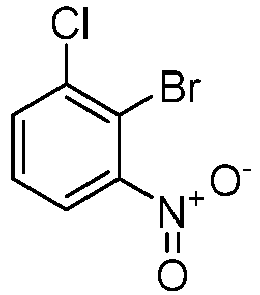

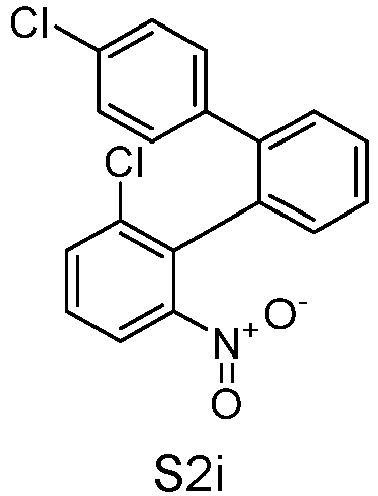
61% 
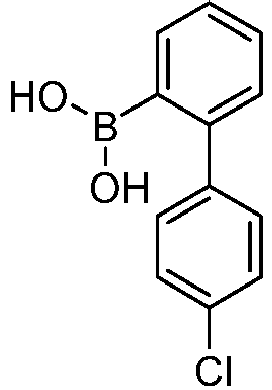

28% 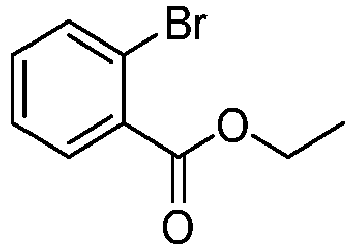

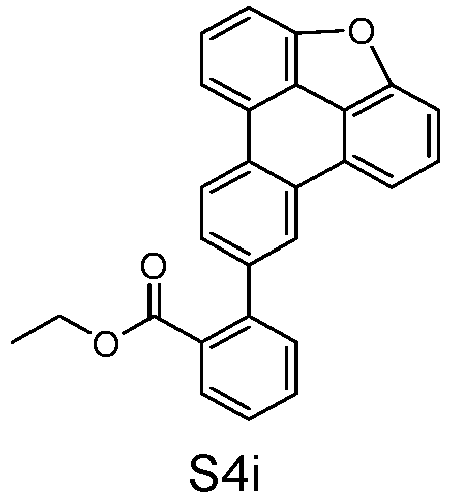
70% 
- S1i (22.3 g, 72 mmol) und Kaliumcarbonat (49.8 g 360 mmol) werden in Dimethylacetamid (500 mL) unter inerter Atmosphäre vorgelegt. Anschließend werden Palladiumacetat (899 mg, 4.00 mmol) und 1,3-Bis-(2,6-diisopropyl-phenyl)-3H-imidazol-1-iumchlorid (3.40 g, 8.00 mmol) [CAS-250285-32-6] zugegeben und die Reaktionsmischung bei 145 °C für 24 h gerührt. Nach dem Abkühlen wird das DMAc weitgehend abrotiert und der Ansatz extraktiv mit Toluol (600 mL) und Wasser aufgearbeitet. Die wässrige Phase wird zweimal mit Toluol (je 300 mL) extrahiert.
- Anschließend werden die vereinigten organischen Phasen zweimal mit Wasser (je 300 mL) und gesättigter NaCl-Lösung (150 mL) gewaschen, über Na2SO4 getrocknet und das Filtrat einrotiert. Das Rohprodukt wird mit 500 mL Ethanol versetzt und 30 min bei Raumtemperatur gerührt. Anschließend wird der Feststoff abgesaugt, mit n-Heptan gewaschen und im Vakuumtrockenschrank getrocknet. Ausbeute: 17.8 g (57.6 mmol, 80%), Reinheit 95%ig nach 1H-NMR.
- Analog können folgende Verbindungen dargestellt werden. Zur Aufreinigung kann Säulenchromatographie oder zur Umkristallisation können andere gängige Lösungsmittel wie Ethanol, Butanol, Aceton, Ethylacetat, Acetonitril, Toluol, Xylol, Dichlormethan, Methanol, Tetrahydrofuran, n-Butylacetat, 1,4-Dioxan, Dimethylsulfoxid, N,N-Dimethylformamid, N,N-Dimethylacetamid, N-Methylpyrrolidon, etc. verwendet werden.
Edukt 1 Produkt Ausbeute 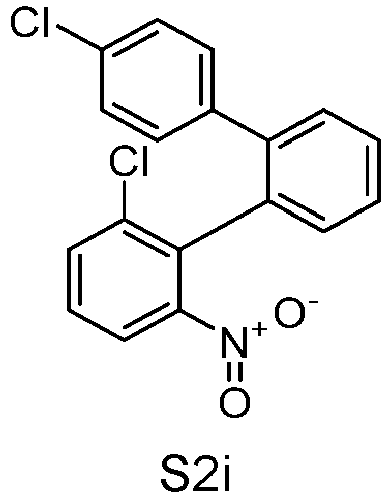
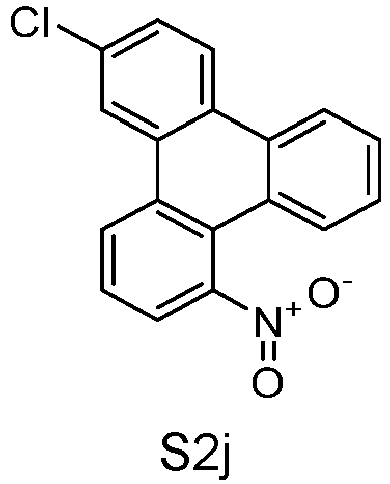
33% 

49% 
- S1j (62.00 g, 215.5 mmol) und n-Butylphosphin (109.2 g, 540 mmol) [CAS-998-40-3] werden unter Argon-Atmosphäre in 1,2-Dichlorbenzol (1000 mL) vorgelegt und 24 h unter Reflux gerührt. Das 1,2-Dichlorbenzol wird anschließend im Vakuum abdestilliert und das Reaktionsgemisch wird extraktiv mit Dichlormethan und Wasser aufgearbeitet. Die organische Phase wird über eine Fritte mit Kieselgel filtriert. Das Filtrat wird mit 350 mL EtOH versetzt und das DCM am Rotationsverdampfer entfernt. Der ausgefallene Feststoff wird abgesaugt und mit EtOH gewaschen. Das Rohprodukt wird weiter über Sublimation aufgereinigt. Ausbeute 23.9 g (99.2 mmol, 46%), Reinheit 95%ig nach 1H-NMR.
- Analog können folgende Verbindungen dargestellt werden. Zur Aufreinigung kann Säulenchromatographie oder zur Umkristallisation können andere gängige Lösungsmittel wie Ethanol, Butanol, Aceton, Ethylacetat, Acetonitril, Toluol, Xylol, Dichlormethan, Methanol, Tetrahydrofuran, n-Butylacetat, 1,4-Dioxan, Dimethylsulfoxid, N,N-Dimethylformamid, N,N-Dimethylacetamid, N-Methylpyrrolidon, etc. verwendet werden.
Edukt 1 Produkt Ausbeute 

28% 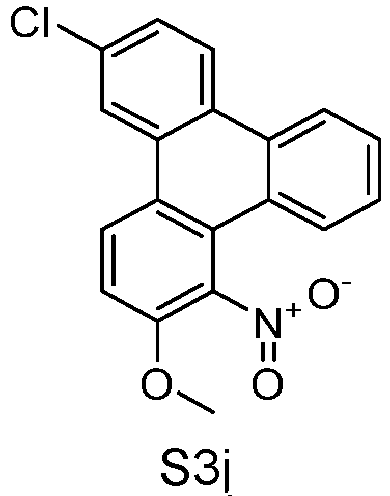

35% 
- S1h (15.46 g, 42.0 mmol), 1-Brom-2-iod-benzol (9.27 g, 42.8 mmol) und K2CO3, (11.61 g, 84.0 mmol) werden in Toluol, Ethanol und Wasser (200 mL:50 mL:100 mL) vorgelegt und 30 min mit Argon inertisiert. Anschließend wird Pd(dppf)Cl2 (118 mg, 168 µmol) zugegeben und der Ansatz 16 h unter Rückfluss gerührt. Der Ansatz wird extraktiv mit Toluol/Wasser aufgearbeitet. Die vereinigten organischen Phasen werden über Na2SO4 getrocknet und das Lösungsmittel am Rotationsverdampfer abgezogen. Das Rohprodukt wird aus einer Mischung aus 2-Propanol und Toluol umkristallisiert. Ausbeute: 15.18 g (38.2 mmol, 91%), Reinheit 98%ig nach 1H-NMR.

- S1l (13.98 g, 35.2 mmol) werden in 250 mL THF vorgelegt und auf -75 °C gekühlt. Anschließend wird n-BuLi (16.0 mL, c=2.5 mol/L, 40.0 mmol) so zugetropft, dass die Temperatur nicht über -65 °C steigt. Nach beendeter Zugabe wird 1 h bei -75 °C nachgerührt. Eine Lösung aus Fluoren-9-on (6.48 g, 36.0 mmol) in THF (50 mL) wird so zugetropft, dass die Temperatur nicht über 65 °C steigt. Der Ansatz wird über Nacht auf Raumtemperatur aufgewärmt, dann wird Wasser (100 mL) zugetropft. Die Phasen werden getrennt, die organische Phase über Na2SO4 getrocknet und das Lösungsmittel am Rotationsverdampfer entfernt. Das Rohprodukt wird ohne weitere Aufreinigung im nächsten Schritt umgesetzt. Ausbeute: quantitativ.

- S1m (49.86 g, 100 mmol) wird in konz. HCl (37%ig, 41.4 mL, 500 mmol) und Eisessig (450 mL) vorgelegt und 20 h unter Rückfluss gerührt. Der ausgefallene Feststoff wird abgesaugt, fünfmal mit Wasser und fünfmal mit Ethanol gewaschen. Das Rohprodukt wird zweimal mit 2-Propanol unter Rückfluss ausgerührt und anschließend über Säulenchromatographie aufgereinigt. Ausbeute: 24.0 g (50.2 mmol, 50%), Reinheit 98%ig nach 1H-NMR.

- Trockenes CeCl3 (50.53 g, 205 mmol) wird in THF (250 mL getrocknet) vorgelegt und 30 min bei Raumtemperatur gerührt. Anschließend wird S4i (39.04 g, 100 mmol) in 500 mL THF gelöst und bei 0 °C zur CeCl3-Suspension zugegeben. Anschließend wird das Gemisch 30 min bei Raumtemperatur gerührt. Die Reaktionsmischung wird auf 0 °C gekühlt und MeMgCl (100 mL, 3 mol/L in THF, 300 mmol) langsam zugetropft. Nach beendeter Zugabe wird die Reaktionsmischung 2 h bei Raumtemperatur gerührt und anschließend vorsichtig mit NH4Cl-Lösung (100 ml) gequencht. Das Reaktionsgemisch wird extraktiv mit Dichlormethan und Wasser aufgearbeitet, die vereinigten organischen Phasen mit Wasser und gesättigter NaCl-Lösung gewaschen und das Lösungsmittel am Rotationsverdampfer abgezogen. Das Rohprodukt wird ohne weitere Aufreinigung in der nächsten Stufe umgesetzt. Ausbeute: quantitativ; Reinheit ca. 90 %ig nach 1H-NMR. bei Raumtemperatur gerührt und anschließend vorsichtig mit NH4Cl-Lösung (100 mL) gequencht. Das Reaktionsgemisch wird extraktiv mit Dichlormethan und Wasser aufgearbeitet, die vereinigten organischen Phasen mit Wasser und sat. NaCl-Lösung gewaschen und das Lösungsmittel am Rotavap abrotiert. Das Rohprodukt wird ohne weitere Aufreinigung in der nächsten Stufe umgesetzt.
-

- S2o kann ausgehend von S5s dargestellt werden, analog zur Vorschrift für die Darstellung von S1o.

- Methansulfonsäure (48.05 g, 500 mmol) und Polyphosphorsäure (75 g) werden in 250 mL vorgelegt und auf 0 °C gekühlt. Anschließend wird S1o (37.65 g, 100 mmol) in Dichlormethan (250 mL) gelöst und bei 0 °C zum Methansulfonsäure/Polyphosphorsäure Gemisch zugetropft. Das Reaktionsgemisch wird 1 h bei RT gerührt. Es werden 400 mL Wasser und 200 mL EtOH zugegeben und das Gemisch für 1 h bei Raumtemperatur gerührt. Die organische Phase wird abgetrennt, mit Wasser und gesättigter NaCl-Lösung gewaschen und über ein Kiesegelbett (vorgeschlämmt mit Dichlormethan) filtriert. Es wird n-Heptan (300 mL) zum Filtrat gegeben und das Dichlormethan am Rotationsverdampfer abrotiert. Der ausgefallene Feststoff wird abgesaugt und mit n-Heptan gewaschen. Das Rohprodukt wird über Säulenchromatographie weiter aufgereinigt. Ausbeute: 12.19 g (34 mmol, 34%), Reinheit 95%ig nach 1H-NMR.


- S2p kann ausgehend von S2o, analog zur Vorschrift zur Darstellung on S1p hergestellt werden. Ausbeute: 46%, 97%ig nach 1H-NMR.

- S1n (32.02 g, 66.7 mmol) wird in THF (500 mL) unter inerter Atmosphäre vorgelegt und auf -20 °C abgekühlt. Dann wird sec-BuLi (95.3 mL, 133.4 mmol, 1.4 mol/L in Cyclohexan) langsam zugetropft und der Ansatz 1 h nachgerührt. Anschließend wird Trimethylborat (9.30 g, 89.5 mmol) über 10 min zugetropft, der Ansatz auf Raumtemperatur erwärmen gelassen und 12 h bei Raumtemperatur gerührt. Es werden langsam 50 mL HCl zugetropft und der Ansatz wird extraktiv mit Wasser aufgearbeitet. Das Lösungsmittel wird am Rotationsverdampfer abgezogen und das Rohprodukt ohne weitere Aufreinigung in der nächsten Stufe eingesetzt. Ausbeute: S1q: 11.9 g (22.7 mmol, 34%), S2q 6.98 g (13.3 mmol, 20%), Reinheit 95%ig nach 1H-NMR.
- Analog können folgende Verbindungen dargestellt werden. Zur Aufreinigung kann neben Säulenchromatographie auch Heißextraktion verwendet werden. Zur Umkristallisation oder Heißextraktion können andere gängige Lösungsmittel wie Ethanol, Butanol, Aceton, Ethylacetat, Acetonitril, Toluol, Xylol, Dichlormethan, Methanol, Tetrahydrofuran, n-Butylacetat, 1,4-Dioxan oder zur Umkristallisation Hochsieder wie Dimethylsulfoxid, N,N-Dimethylformamid, N,N-Dimethylacetamid, N-Methylpyrrolidon, etc. verwendet werden.
Edukt 1 Produkt Ausbeute 

S3q 24% + S4 q 23% 

S5q 24% + S6q 28% 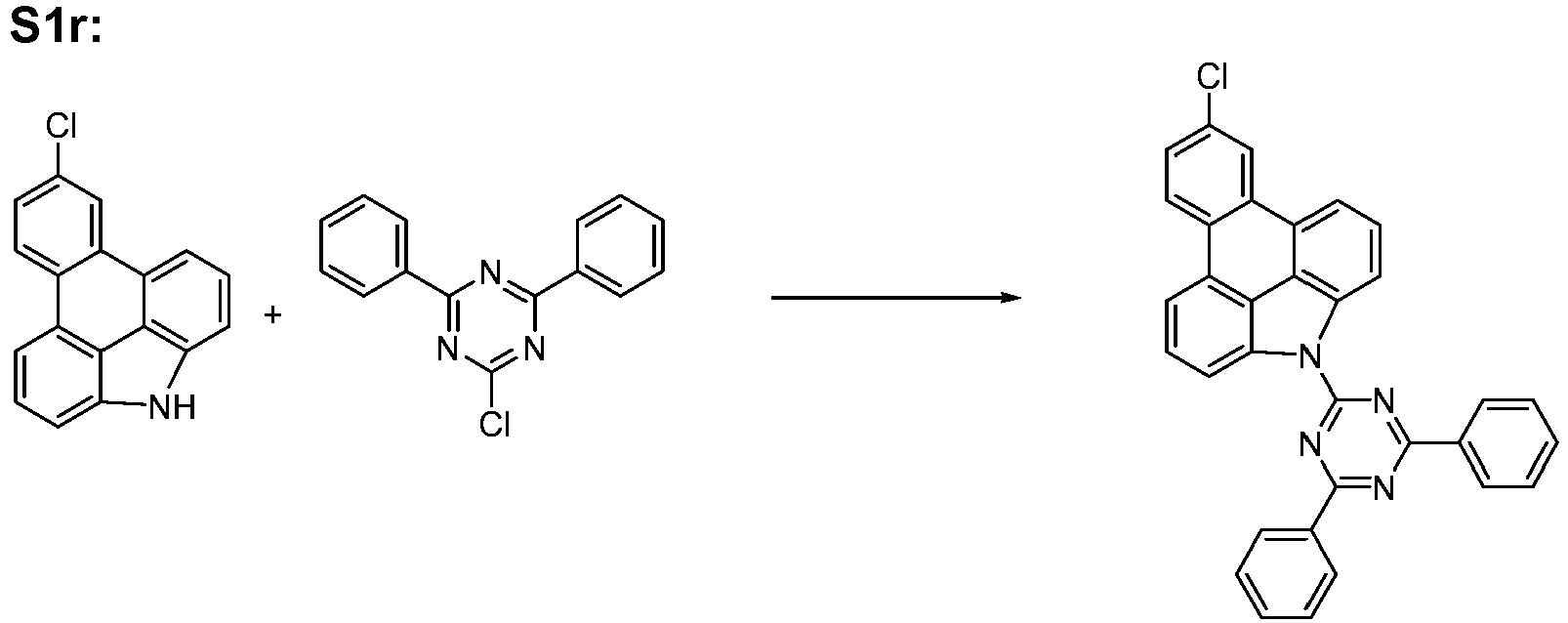
- S2k (9.16 g, 28.5 mmol), 2-Chlor-4,6-diphenyl-1,3,5-triazin (8.40 g, 31.3 mmol) [CAS-3842-55-5] und Natrium-tert-butanolat (3.00 g, 31.3 mmol) werden in Toluol (250 mL) vorgelegt. Anschließend wird Tritert-butylphosphin-tetrafluoroborat (580 mg, 2.0 mmol) und Pd(OAc)2 (224 mg, 1.0 mmol) zugegeben und die Reaktionslösung für 18 h zum Sieden erhitzt. Die Reaktionslösung wird auf Raumtemperatur abgekühlt und das Lösungsmittel am Rotationsverdampfer entfernt. Das Rohprodukt wird über Säulenchromatographie (n-Heptan/Ethylacetat) aufgereinigt. Ausbeute: 9.48 g (18.7 mmol, 66%), Reinheit 98%ig nach 1H-NMR.
- Analog können folgende Verbindungen dargestellt werden. Als Katalysatorsystem kann auch P(tBu)3 oder S-Phos mit Pd2(dba)3 oder Pd(OAc)2 eingesetzt werden. Zur Aufreinigung kann neben Säulenchromatographie auch Heißextraktion verwendet werden, zur Umkristallisation oder Heißextraktion können andere gängige Lösungsmittel wie Ethanol, Butanol, Aceton, Ethylacetat, Acetonitril, Toluol, Xylol, Dichlormethan, Methanol, Tetrahydrofuran, n-Butylacetat, 1,4-Dioxan oder zur Umkristallisation Hochsieder wie Dimethylsulfoxid, N,N-Dimethylformamid, N,N-Dimethylacetamid, N-Methylpyrrolidon, etc. verwendet werden.
Edukt 1 Edukt 2 Produkt Ausbeute 


52% 

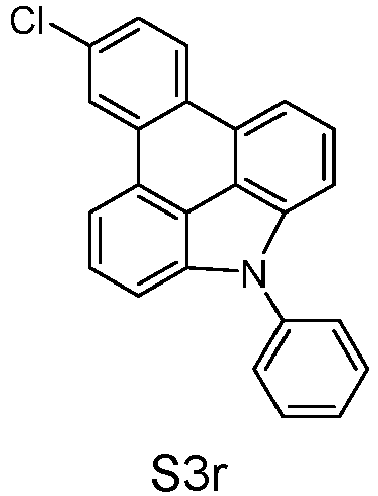
66% 
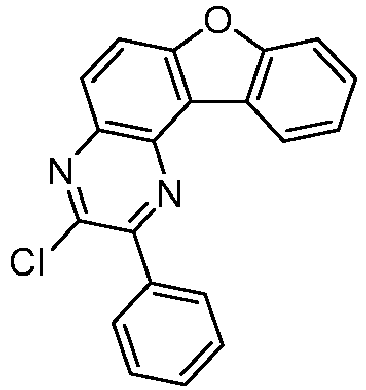

24% 
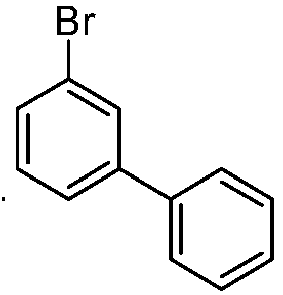

45% 

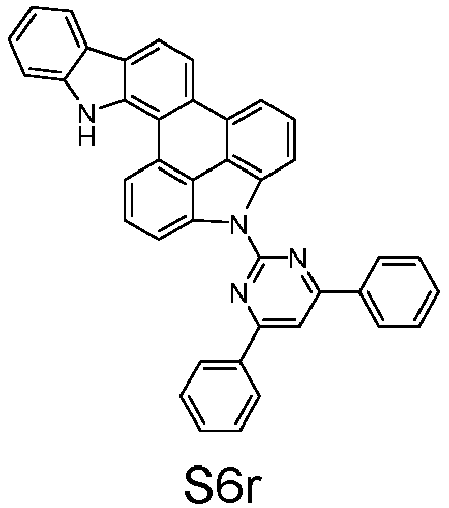
37% 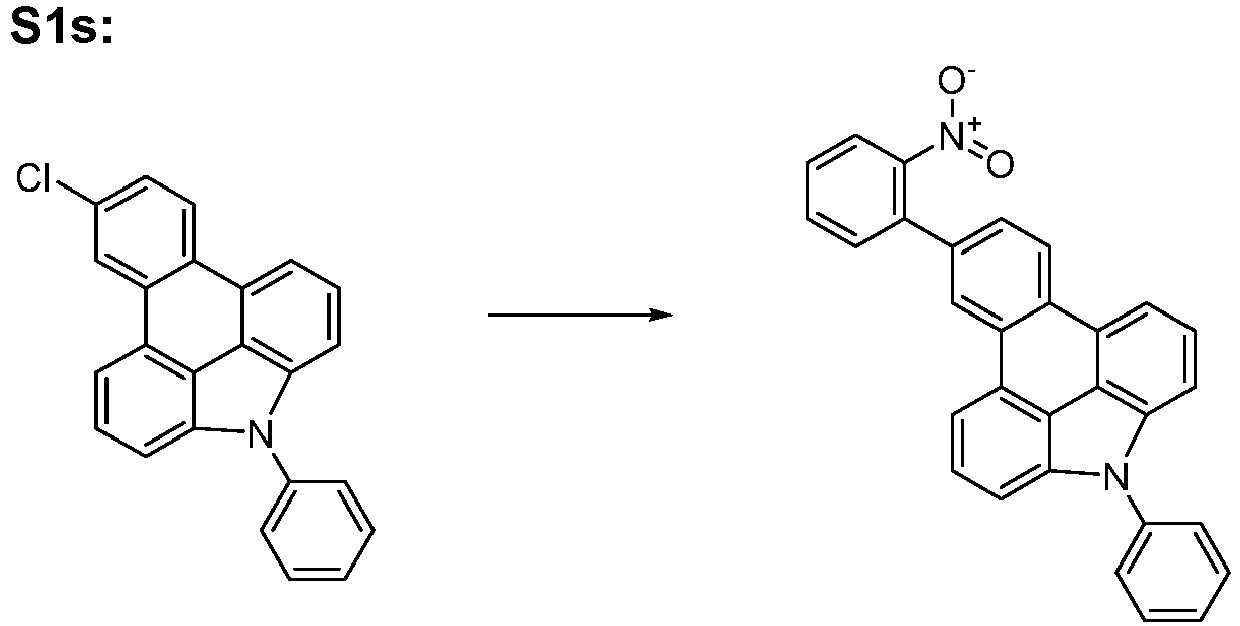
- S3r (11.71 g, 33.3 mmol), o-Nitrophenylboronsäure (6.63 g, 39.7 mmol) [5570-19-4] und K3PO4 werden in THF (300 mL) und Wasser (100 mL) vorgelegt und 30 min mit Argon gesättigt. Anschließend wird X-Phos Pd G3 (423 mg, 0.50 mmol) [1445085-55-1] zugegeben und der Ansatz 16 h unter Rückfluss gerührt. Nach dem Abkühlen wird der ausgefallene Feststoff abgesaugt, mit Wasser und Ethanol gewaschen und getrocknet. Das Rohprodukt wird durch Säulenchromatographie weiter aufgereinigt. Ausbeute: 5.70 g (12.99 mmol, 39%), Reinheit 95%ig nach 1H-NMR.
- Analog können folgende Verbindungen dargestellt werden. Als Katalysatorsystem kann alternativ auch S-Phos oder X-Phos mit Pd(OAc)2 oder Pd2(dba)3 verwendet werden. Zur Aufreinigung kann neben Säulenchromatographie auch Heißextraktion verwendet werden. Zur Umkristallisation oder Heißextraktion können andere gängige Lösungsmittel wie Ethanol, Butanol, Aceton, Ethylacetat, Acetonitril, Toluol, Xylol, Dichlormethan, Methanol, Tetrahydrofuran, n-Butylacetat, 1,4-Dioxan oder zur Umkristallisation Hochsieder wie Dimethylsulfoxid, N,N-Dimethylformamid, N,N-Dimethylacetamid, N-Methylpyrrolidon, etc. verwendet werden.
Edukt 1 Edukt 2 Produkt Ausbeute 
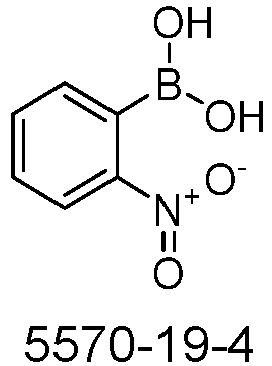

56% 

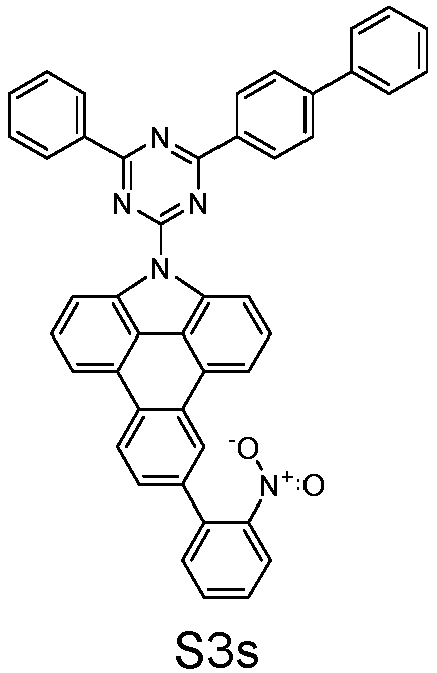
55% 


33% 


62% 
- Durchführung analog zu der für S1k, wobei statt Tri-n-butylphosphin Triphenylphosphin verwendet wird. Das Isomerengemisch kann über Säulenchromatographie aufgereinigt werden. Ausbeute: 67%. Analog können folgende Verbindungen dargestellt werden. Zur Aufreinigung kann Säulenchromatographie oder zur Umkristallisation können andere gängige Lösungsmittel wie Ethanol, Butanol, Aceton, Ethylacetat, Acetonitril, Toluol, Xylol, Dichlormethan, Methanol, Tetrahydrofuran, n-Butylacetat, 1,4-Dioxan, Dimethylsulfoxid, N,N-Dimethylformamid, N,N-Dimethylacetamid, N-Methylpyrrolidon, etc. verwendet werden.
Edukt 1 Produkt Ausbeute 

S3t 35%, S4t 13% 

S5t 40%, S6t 16% 

70% -
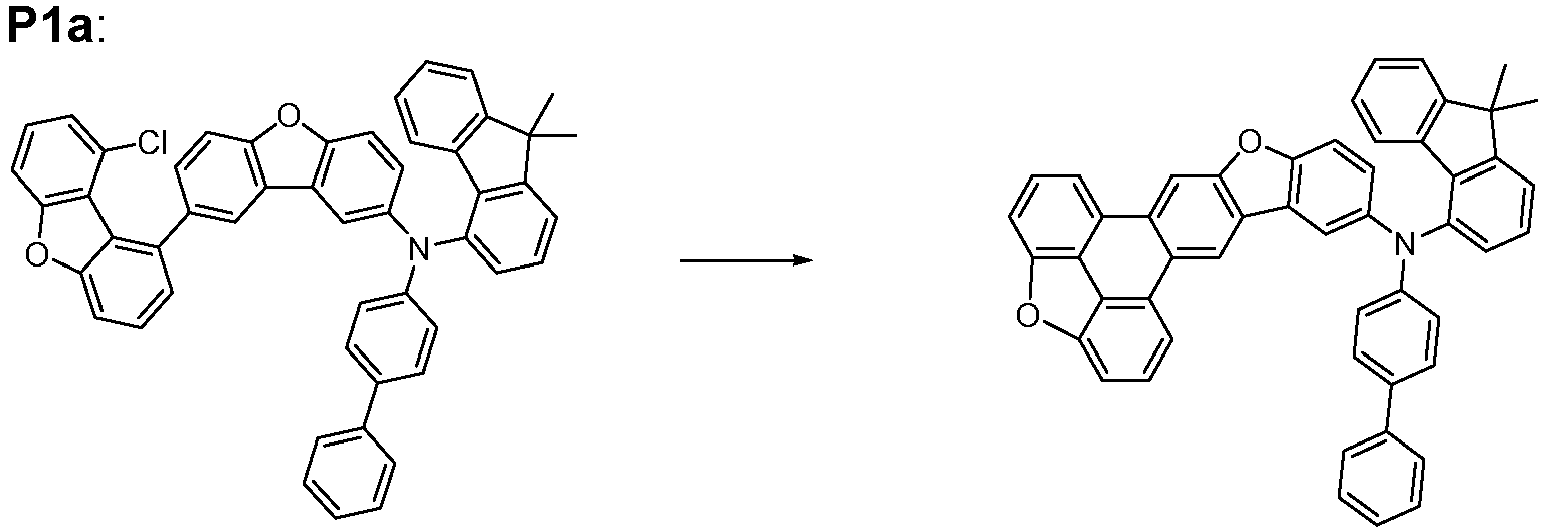
- S10c (72.83 g, 100 mmol) und K2CO3 (41.46 g, 300 mmol) werden unter inerter Atmosphäre vorgelegt, mit DMAc (700 mL) versetzt und 30 min inertisiert. Anschließend wird Pd(OAc)2 (447 mg, 1.99 mmol) und 1,3-Bis-(2,6-diisopropyl-phenly)3-H-imidazol-1-iumchlorid (1.69 g, 3.98 mmol) zugegeben und das Reaktionsgemisch 16 h bei 150 °C gerührt. Nach dem Abkühlen wird der Ansatz in Ethanol/Wasser (1:1, 600 mL) gegossen und 30 min nachgerührt. Der ausgefallene Feststoff wird abgesaugt und fünfmal mit Wasser und dreimal mit Ethanol gewaschen. Das Rohprodukt wird mit 2-Propanol unter Rückfluss ausgerührt, dreimal mit Toluol über Alox basisch heißextrahiert, zweimal aus o-Xylol umkristallisiert und abschließend im Hochvakuum sublimiert. Ausbeute: 23.5 g, (34.0 mmol, 34%); Reinheit >99.9% nach HPLC.
- Analog können folgende Verbindungen dargestellt werden. Dabei kann neben 1,3-Bis-(2,6-diisopropyl-phenly)3-H-imidazol-1-iumchlorid auch Tritert-Butylphosphin oder Tri-Cyclohexylphosphin als Ligand verwendet werden oder als Pd-Quelle neben Pd(OAc)2 auch Pd2(dba)3. Zur Aufreinigung kann Säulenchromatographie, Heißextraktion oder Umkristallisation verwendet werden. Zur Umkristallisation oder Heißextraktion können gängige Lösungsmittel wie Ethanol, Butanol, Aceton, Ethylacetat, Acetonitril, Toluol, Xylol, Dichlormethan, Methanol, Tetrahydrofuran, n-Butylacetat, 1,4-Dioxan oder zur Umkristallisation Hochsieder wie Dimethylsulfoxid, N,N-Dimethylformamid, N,N-Dimethylacetamid, N-Methylpyrrolidon, etc. verwendet werden.
Edukt 1 Produkt Ausbeute 

47% 

55% 

49% 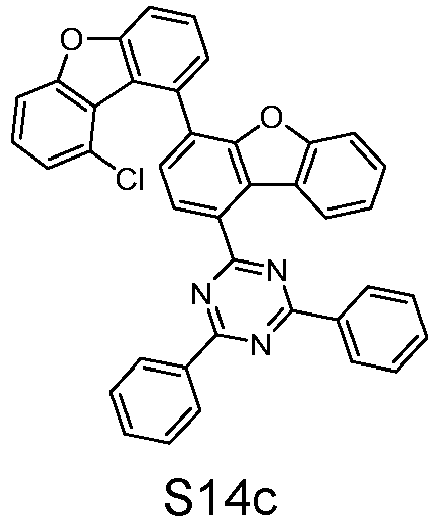
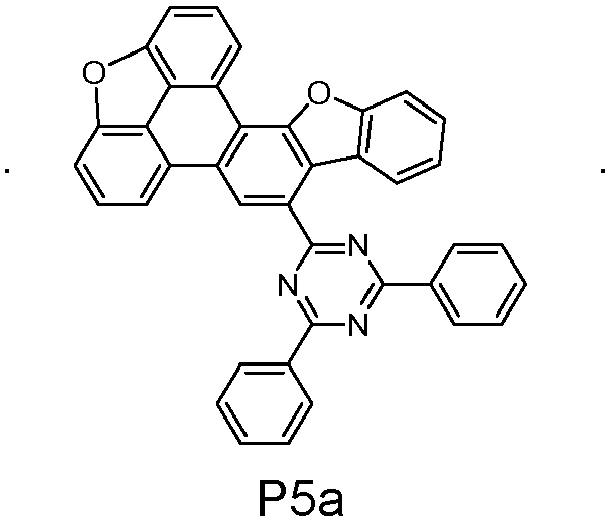
60% 
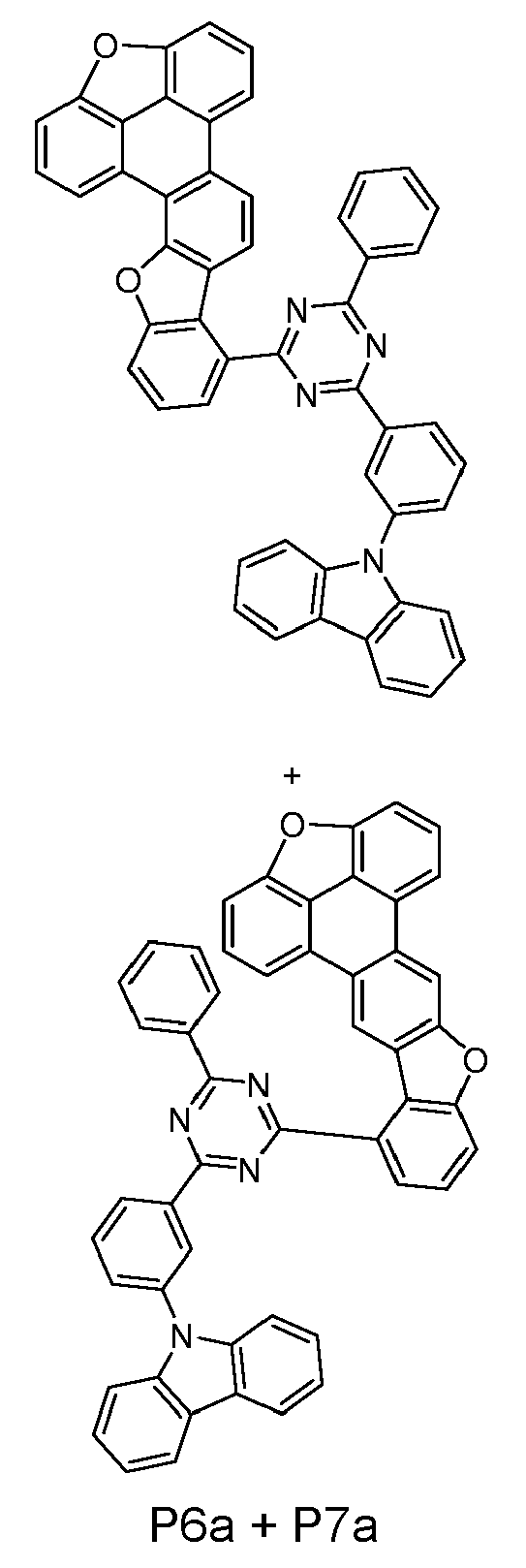
P6a 24% + P7a 28% 
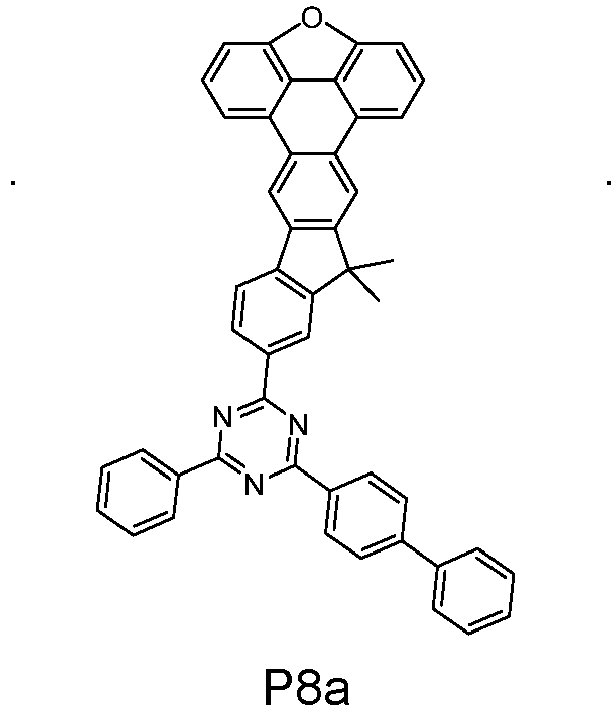
32% 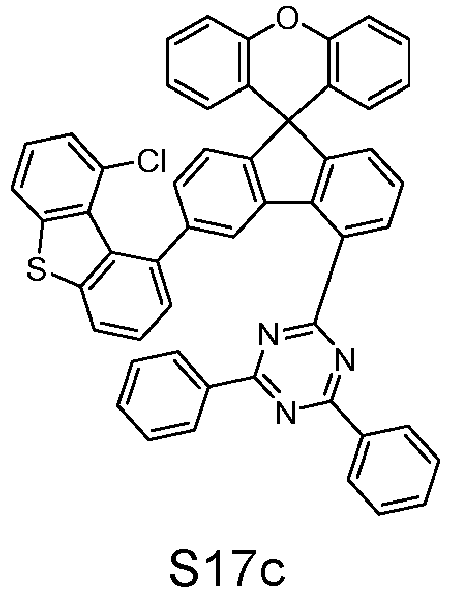

34% 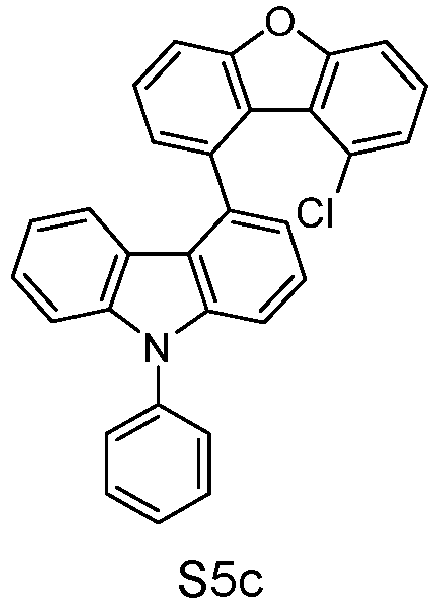

61% 

12% P11a + 25% P12a 

28% -

- S1q (52.44 g, 100 mmol), Bis-biphenyl-4-yl-(4-bromphenyl)amin (47.64 g, 100 mmol) und K3PO4 (63.79 g, 300 mmol) werden in THF (1200 mL) und Wasser (300 mL) vorgelegt und 30 min. mit Argon inertisiert. Anschließend werden nacheinander Pd(OAc)2 (448 mg, 2.00 mmol) und X-Phos (1.99 g, 4.00 mmol) zugegeben und der Ansatz 16 h unter Rückfluss gerührt. Nach dem Abkühlen wird der ausgefallene Feststoff abgesaugt und mit Wasser und Ethanol gewaschen. Das Rohprodukt wird viermal mit o-Xylol über Alox (basisch) heißextrahiert und abschließend im Hochvakuum sublimiert. Ausbeute: 54.58 g (62.3 mmol, 62%); Reinheit >99.9% nach HPLC.
- Analog können folgende Verbindungen dargestellt werden. Als Katalysatorsystem kann auch S-Phos oder P(o-tol)3 oder P(tBu3) mit Pd2(dba)3 oder Pd(OAc)2 verwendet werden oder die Katalysatorsysteme Pd(PPh3)4 oder Pd(PPh3)2Cl2. Zur Aufreinigung kann Säulenchromatographie, Heißextraktion oder Umkristallisation verwendet werden. Zur Umkristallisation oder Heißextraktion können gängige Lösungsmittel wie Ethanol, Butanol, Aceton, Ethylacetat, Acetonitril, Toluol, Xylol, Dichlormethan, Methanol, Tetrahydrofuran, n-Butylacetat, 1,4-Dioxan oder zur Umkristallisation Hochsieder wie Dimethylsulfoxid, N,N-Dimethylformamid, N,N-Dimethylacetamid, N-Methylpyrrolidon, etc. verwendet werden.
Edukt 1 Edukt 2 Produkt Ausbeute 

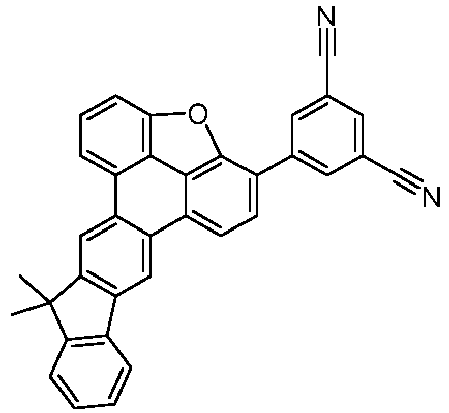
57% 


42% 


51% 


36% 
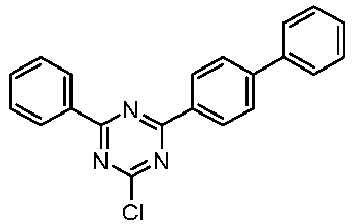

58% 

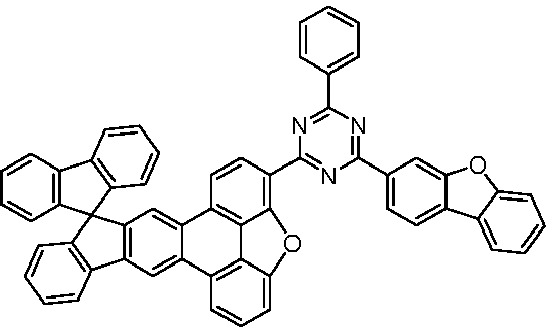
49% 


33% 


15% 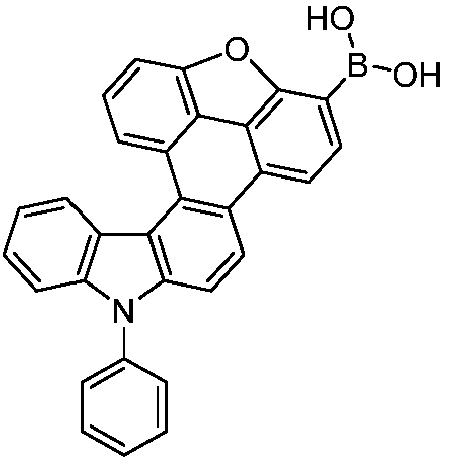

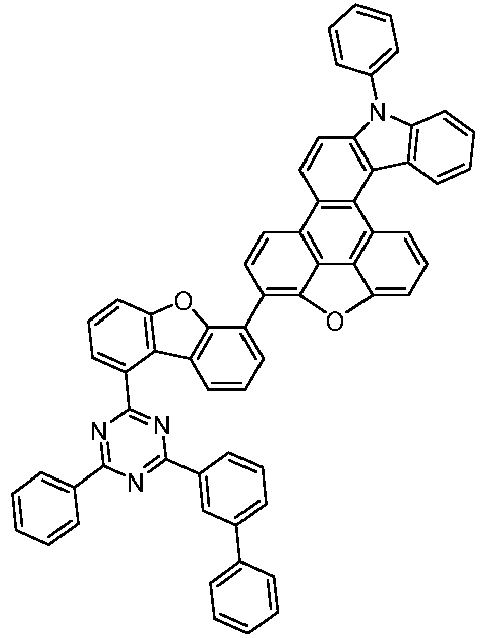
30% 
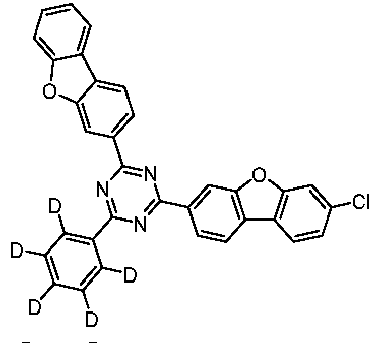

37% 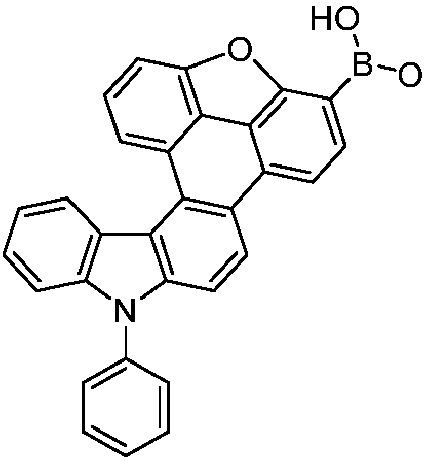


40% -

- S5t (38.27 g, 60.0 mmol), 3-Brombiphenyl (15.15 g, 65.0 mmol) und Natrium-tert-butanolat (13.4 g, 139.1 mmol) werden in o-Xylol (500 mL) vorgelegt und für 30 min mit Argon inertisiert. Anschließend wird XPhos Pd G3 (1.70 g, 2.3 mmol) zugegeben und das Reaktionsgemisch für 18 h unter Rückfluss gerührt. Das Reaktionsgemisch wird auf Raumtemperatur abgekühlt und extraktiv mit Toluol/Wasser aufgearbeitet. Die vereinigten organischen Phasen werden über Na2SO4 getrocknet und das Lösungsmittel am Rotationsverdampfer abgezogen. Das Rohprodukt wird zweimal mit Toluol heißextrahiert, anschließend zweimal aus Dimethlyacetamid umkristallisiert und abschließend im Hochvakuum sublimiert. Ausbeute 23.0 g (29.1 mmol, 48.5%), Reinheit >99.9%ig nach HPLC.
- Analog können folgende Verbindungen dargestellt werden. Als Katalysatorsystem kann auch Pd2(dba)3 oder Pd(OAc)2 mit P(tBu3) oder S-Phos verwendet werden. Zur Aufreinigung kann Säulenchromatographie, Heißextraktion oder Umkristallisation verwendet werden. Zur Umkristallisation oder Heißextraktion können gängige Lösungsmittel wie Ethanol, Butanol, Aceton, Ethylacetat, Acetonitril, Toluol, Xylol, Dichlormethan, Methanol, Tetrahydrofuran, n-Butylacetat, 1,4-Dioxan oder zur Umkristallisation Hochsieder wie Dimethylsulfoxid, N,N-Dimethylf-ormamid, N,N-Dimethylacetamid, N-Methylpyrrolidon, etc. verwendet werden. S
Edukt 1 Edukt 2 Produkt Ausbeute 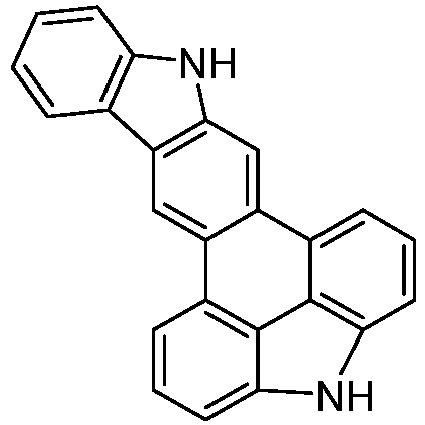


44% 


31% 


35% 
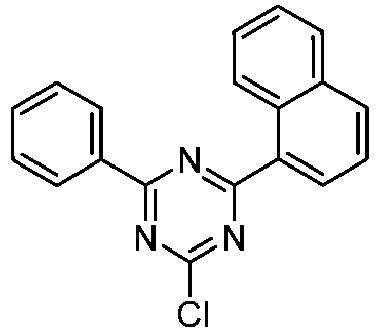

30% 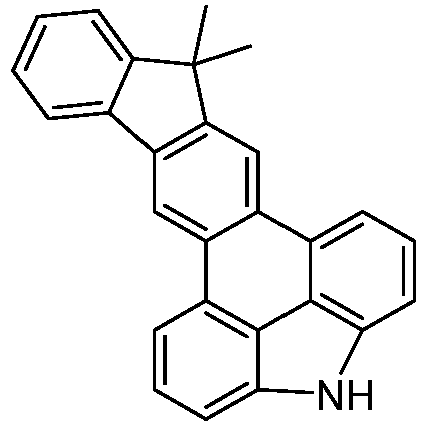


49% 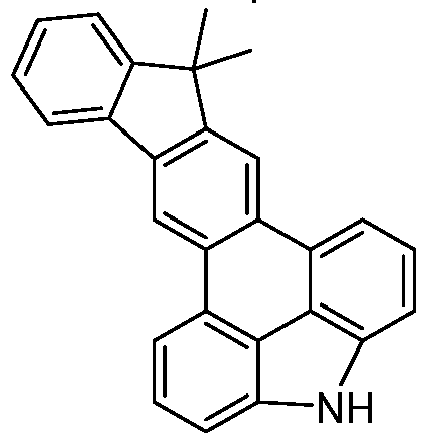

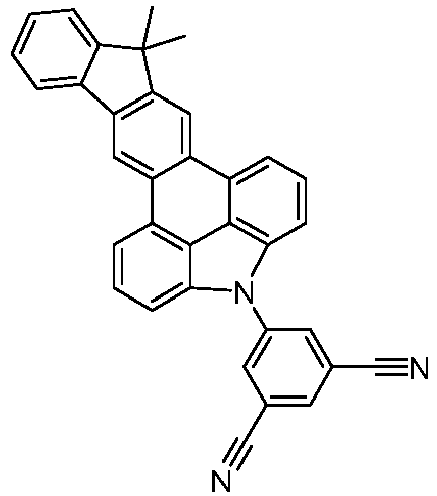
57% 


43% 


50% 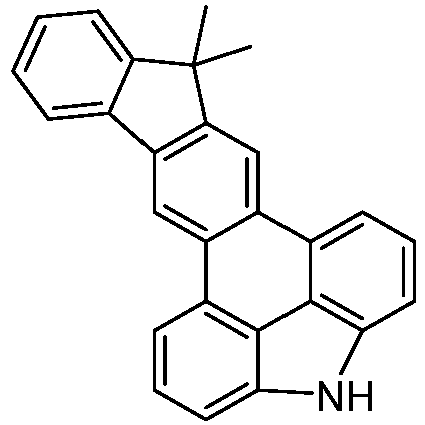


43% 


61% 


18% 


21% 


55% 


27% -

- S5d (20.85 g, 60.0 mmol) und 2-Chlorphenylchinoxalin (20.0 g, 60.0 mmol) [CAS-7065-92-1] wird in DMF (400 mL) vorgelegt, mit K3PO4 (38.18 g, 180.0 mmol) versetzt und 24 h unter Rückfluss gerührt. Nach dem Abkühlen wird das Lösungsmittel am Rotationsdampfer entfernt und der Rückstand in Ethanol und Wasser (jeweils 300 mL) suspendiert. Der Feststoff wird abfiltriert und 4 mal mit Ethanol gewaschen. Das Rohprodukt wird zweimal mit o-Xylol heißextrahiert und abschließend im Hochvakuum sublimiert. Ausbeute 8.3 g (15.0 mmol, 25%).
- Analog können folgende Verbindungen dargestellt werden. Als Base kann auch Natriumhydrid verwendet werden. Zur Aufreinigung kann Säulenchromatographie, Heißextraktion oder Umkristallisation verwendet werden. Zur Umkristallisation oder Heißextraktion können gängige Lösungsmittel wie Ethanol, Butanol, Aceton, Ethylacetat, Acetonitril, Toluol, Xylol, Dichlormethan, Methanol, Tetrahydrofuran, n-Butylacetat, 1,4-Dioxan oder zur Umkristallisation Hochsieder wie Dimethylsulfoxid, N,N-Dimethylformamid, N,N-Dimethylacetamid, N-Methylpyrrolidon, etc. verwendet werden.
Edukt 1 Edukt 2 Produkt Ausbeute 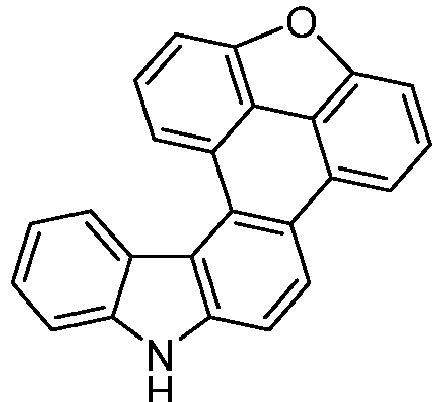

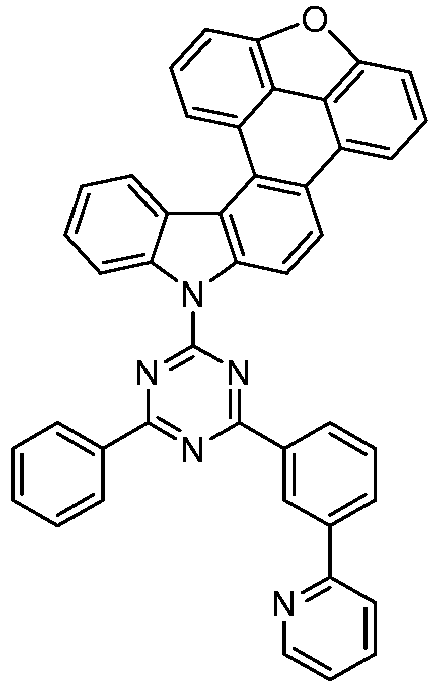
41% 
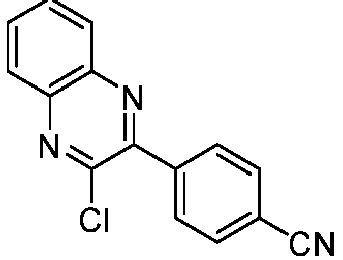

19% 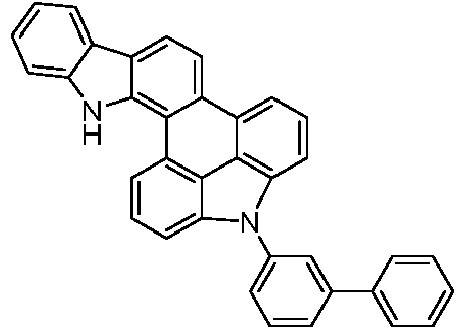


27% 


38% - Glasplättchen, die mit strukturiertem ITO (Indium Zinn Oxid) der Dicke 50 nm beschichtet sind, werden vor der Beschichtung zunächst mit einem Sauerstoffplasma, gefolgt von einem Argonplasma, behandelt. Diese mit Plasma behandelten Glasplättchen bilden die Substrate, auf welche die OLEDs aufgebracht werden.
- Die OLEDs haben prinzipiell folgenden Schichtaufbau: Substrat / Lochinjektionsschicht (HIL) / Lochtransportschicht (HTL) / Elektronenblockierschicht (EBL) / Emissionsschicht (EML) / optionale Lochblockierschicht (HBL) / Elektronentransportschicht (ETL) / optionale Elektroneninjektionsschicht (EIL) und abschließend eine Kathode. Die Kathode wird durch eine 100 nm dicke Aluminiumschicht gebildet. Der genaue Aufbau der OLEDs ist Tabelle 1 und 3 zu entnehmen. Die zur Herstellung der OLEDs benötigten Materialien, sofern sie nicht schon zuvor beschrieben wurden, sind in Tabelle 7 gezeigt. Die Device-Daten der OLEDs sind in Tabelle 2 und 4 aufgelistet. Die Beispiele V1 bis V7 sind Vergleichsbeispiele. Die Beispiele E1a und E1b, E2a-i, E3a-h, E4a-c E5a, E6a-k, E7a, E7b zeigen Daten von erfindungsgemäßen OLEDs.
- Alle Materialien werden in einer Vakuumkammer thermisch aufgedampft. Dabei besteht die Emissionsschicht immer aus mindestens zwei Matrixmaterialien und einem emittierenden Dotierstoff (Dotand, Emitter), der dem Matrixmaterial bzw. den Matrixmaterialien durch Coverdampfung in einem bestimmten Volumenanteil beigemischt wird. Eine Angabe wie P2a:H1:TE2 (32%:60%:8%) bedeutet hierbei, dass das Material P2a in einem Volumenanteil von 32%, H1 in einem Volumenanteil von 60% und TE2 in einem Volumenanteil von 8% in der Schicht vorliegt. Analog kann auch die Elektronentransportschicht aus einer Mischung von zwei Materialien bestehen.
- Die Elektrolumineszenzspektren werden bei einer Leuchtdichte von 1000 cd/m2 bestimmt und daraus die CIE 1931 x und y Farbkoordinaten berechnet. Die Angabe U10 in Tabelle 2 und 6 bezeichnet die Spannung, die für eine Stromdichte von 10 mA/cm2 benötigt wird. EQE10 bezeichnet die externe Quanteneffizienz, die bei 10 mA/cm2 erreicht wird. Als Lebensdauer LD wird die Zeit definiert, nach der die Leuchtdichte gemessen in cd/m2 in Vorwärtsrichtung, bei Betrieb mit konstanter Stromdichte j0 von der Startleuchtdichte auf einen gewissen Anteil L1 absinkt. Eine Angabe L1=80% in Tabelle 2 bedeutet, dass die in Spalte LD angegebene Lebensdauer der Zeit entspricht, nach der die Leuchtdichte in cd/m2 auf 80% ihres Anfangswertes absinkt.
- Die Angabe U1000 in Tabelle 4 bezeichnet die Spannung, die für eine Leuchtdichte von 1000 cd/m2 benötigt wird. EQE 1000 bezeichnet die externe Quanteneffizienz, die bei 1000 cd/m2 erreicht wird. Als Lebensdauer LD wird die Zeit definiert, nach der die Leuchtdichte bei Betrieb mit konstanter Stromdichte j0 von der Startleuchtdichte auf einen gewissen Anteil L1 absinkt. Eine Angabe L1=95% in Tabelle 4 bedeutet, dass die in Spalte LD angegebene Lebensdauer der Zeit entspricht, nach der die Leuchtdichte auf 95% ihres Anfangswertes absinkt.
- Die erfindungsgemäßen Materialien werden in den Beispielen E1a und E1b, E2a-i, E3a-h, E4a-c, E6a-k, E7a, E7b als Matrixmaterialien in der Emissionsschicht grün bzw. rot phosphoreszierender OLEDs, im Beispiel E5a als Lochblockiermaterial in der Lochblockierschicht grün phosphoreszierender OLEDs eingesetzt. Als Vergleich aus dem Stand der Technik kommen die Materialien SdT1, SdT2 und SdT3 in Kombination mit den Hostmaterialien H1, H2 und H3 bzw. mit den Hostmaterialien E1 und E2 in den Vergleichsbeispielen V1 bis V7 zum Einsatz. Beim Vergleich der erfindungsgemäßen Beispiele mit den entsprechenden Vergleichsbeispielen ist deutlich ersichtlich, dass die erfindungsgemäßen Beispiele jeweils einen deutlichen Vorteil in der Lebensdauer der OLED aufzeigen.
Tabelle 1: Aufbau der OLEDs für Grün Bsp HIL Dicke HTL Dicke EBL Dicke EML Dicke HBL Dicke ETL Dicke EIL Dicke V1 SpMA1:PD1 (95%:5%) 20nm SpMA1 200nm SpMA2 20nm E2:SdT1:TE1 (22%:70%:8%) 40nm ST2 5nm ST2:LiQ (50%:50%) 30nm LiQ 1nm E1a SpMA1:PD1 (95%:5%) 20nm SpMA1 200nm SpMA2 20nm E2:P1a:TE1 (22%:70%:8%) 40nm ST2 5nm ST2:LiQ (50%:50%) 30nm LiQ 1nm E1b SpMA1:PD1 (95%:5%) 20nm SpMA1 200nm SpMA2 20nm E2:P2c:TE1 (22%:70%:8%) 40nm ST2 5nm ST2:LiQ (50%:50%) 30nm LiQ 1nm V2 SpMA1:PD1 (95%:5%) 20nm SpMA1 200nm SpMA2 20nm SdT2:H1:TE2 (32%:60%:8%) 40nm ST2 5nm ST2:LiQ (50%:50%) 30nm LiQ 1nm E2a SpMA1:PD1 (95%:5%) 20nm SpMA1 200nm SpMA2 20nm P2a:H1:TE2 (32%:60%:8%) 40nm ST2 5nm ST2:LiQ (50%:50%) 30nm LiQ 1nm E2b SpMA1:PD1 (95%:5%) 20nm SpMA1 200nm SpMA2 20nm P5a:H1:TE2 (32%:60%:8%) 40nm ST2 5nm ST2:LiQ (50%:50%) 30nm LiQ 1nm E2c SpMA1:PD1 (95%:5%) 20nm SpMA1 200nm SpMA2 20nm P6a:H1:TE2 (32%:60%:8%) 40nm ST2 5nm ST2:LiQ (50%:50%) 30nm LiQ 1nm E2d SpMA1:PD1 (95%:5%) 20nm SpMA1 200nm SpMA2 20nm P5b:H1:TE2 (32%:60%:8%) 40nm ST2 5nm ST2:LiQ (50%:50%) 30nm LiQ 1nm E2e SpMA1:PD1 (95%:5%) 20nm SpMA1 200nm SpMA2 20nm P6b:H1:TE2 (32%:60%:8%) 40nm ST2 5nm ST2:LiQ (50%:50%) 30nm LiQ 1nm E2f SpMA1:PD1 (95%:5%) 20nm SpMA1 200nm SpMA2 20nm P10b:H1:TE2 (32%:60%:8%) 40nm ST2 5nm ST2:LiQ (50%:50%) 30nm LiQ 1nm E2g SpMA1:PD1 (95%:5%) 20nm SpMA1 200nm SpMA2 20nm P4c:H1:TE2 (32%:60%:8%) 40nm ST2 5nm ST2:LiQ (50%:50%) 30nm LiQ 1nm E2h SpMA1:PD1 (95%:5%) 20nm SpMA1 200nm SpMA2 20nm P13c:H1:TE2 (32%:60%:8%) 40nm ST2 5nm ST2:LiQ (50%:50%) 30nm LiQ 1nm E2i SpMA1:PD1 (95%:5%) 20nm SpMA1 200nm SpMA2 20nm P15c:H1:TE2 (32%:60%:8%) 40nm ST2 5nm ST2:LiQ (50%:50%) 30nm LiQ 1nm V3 SpMAI:PD1 (95%:5%) 20nm SpMA1 200nm SpMA2 20nm SdT3:H2:TE1 (38%:50%:12%) 40nm ST2 5nm ST2:LiQ (50%:50%) 30nm LiQ 1nm E3a SpMAI:PD1 (95%:5%) 20nm SpMA1 200nm SpMA2 20nm P1c:H2:TE1 (38%:50%:12%) 40nm ST2 5nm ST2:LiQ (50%:50%) 30nm LiQ 1nm E3b SpMAI:PD1 (95%:5%) 20nm SpMA1 200nm SpMA2 20nm P3c:H2:TE1 (38%:50%:12%) 40nm ST2 5nm ST2:LiQ (50%:50%) 30nm LiQ 1nm E3c SpMA1:PD1 (95%:5%) 20nm SpMA1 200nm SpMA2 20nm P6c: H2: TE 1 (38%:50%:12%) 40nm ST2 5nm ST2:LiQ (50%:50%) 30nm LiQ 1nm E3d SpMA1:PD1 (95%:5%) 20nm SpMA1 200nm SpMA2 20nm P9c:H2:TE1 (38%:50%:12%) 40nm ST2 5nm ST2:LiQ (50%:50%) 30nm LiQ 1nm E3e SpMA1:PD1 (95%:5%) 20nm SpMA1 200nm SpMA2 20nm P10c:H2:TE1 (38%:50%:12%) 40nm ST2 5nm ST2:LiQ (50%:50%) 30nm LiQ 1nm E3f SpMA1:PDI (95%:5%) 20nm SpMA1 200nm SpMA2 20nm P12c:H2:TE1 (38%:50%:12%) 40nm ST2 5nm ST2:LiQ (50%:50%) 30nm LiQ 1nm E3g SpMA1:PDI (95%:5%) 20nm SpMA1 200nm SpMA2 20nm P14c:H2:TE1 (38%:50%:12%) 40nm ST2 5nm ST2:LiQ (50%:50%) 30nm LiQ 1nm E3h SpMA1:PDI (95%:5%) 20nm SpMA1 200nm SpMA2 20nm P2d:H2:TE1 (38%:50%:12%) 40nm ST2 5nm ST2:LiQ (50%:50%) 30nm LiQ 1nm V4 SpMA1:PD1 (95%:5%) 20nm SpMA1 200nm SpMA2 20nm E1:SdT1:TE2 (32%:60%:8%) 40nm ST2 5nm ST2:LiQ (50%:50%) 30nm LiQ 1nm E4a SpMA1:PD1 (95%:5%) 20nm SpMA1 200nm SpMA2 20nm E1:P10a:TE2 (32%:60%:8%) 40nm ST2 5nm ST2:LiQ (50%:50%) 30nm LiQ 1nm E4b SpMA1:PD1 (95%:5%) 20nm SpMA1 200nm SpMA2 20nm E1:P12a:TE2 (32%:60%:8%) 40nm ST2 5nm ST2:LiQ (50%:50%) 30nm LiQ 1nm E4c SpMA1:PD1 (95%:5%) 20nm SpMA1 200nm SpMA2 20nm E1:P13a:TE2 (32%:60%:8%) 40nm ST2 5nm ST2:LiQ (50%:50%) 30nm LiQ 1nm V5 SpMA1:PD1 (95%:5%) 20nm SpMA1 200nm SpMA2 20nm E1:H1:TE2 (32%:60%:8%) 40nm ST2 5nm ST2:LiQ (50%:50%) 30nm LiQ 1nm E5a SpMA1:PD1 (95%:5%) 20nm SpMA1 200nm P11c 20nm E1:H1:TE2 (32%:60%:8%) 40nm ST2 5nm ST2:LiQ (50%:50%) 30nm LiQ 1nm Tabelle 2: Daten der OLEDs für grün Bsp. U10 (V) EQE10 (%) CIE x/y bei 1000 cd/m2 j0 (mA/cm2) L1 (%) LD (h) V1 5.2 17.8 0.34/0.62 40 80 190 E1a 5.2 18.1 0.34/0.62 40 80 310 E1b 5.1 18.0 0.34/0.63 40 80 650 V2 4.4 20.5 0.34/0.63 40 80 200 E2a 4.3 20.9 0.34/0.63 40 80 445 E2b 4.2 20.5 0.35/0.63 40 80 565 E2c 4.3 22.3 0.35/0.63 40 80 550 E2d 4.2 21.4 0.35/0.63 40 80 630 E2e 4.1 20.2 0.35/0.63 40 80 750 E2f 4.5 20.5 0.35/0.63 40 80 775 E2g 4.1 22.5 0.35/0.63 40 80 460 E2h 4.0 23.1 0.34/0.63 40 80 695 E2i 4.2 22.7 0.35/0.63 40 80 825 V3 5.2 16.6 0.34/0.62 40 80 415 E3a 5.1 16.6 0.33/0.63 40 80 680 E3b 4.8 17.0 0.33/0.62 40 80 570 E3c 5.0 16.9 0.34/0.62 40 80 850 E3d 4.9 16.8 0.33/0.62 40 80 790 E3e 4.7 16.6 0.33/0.62 40 80 880 E3f 4.8 16.5 0.34/0.62 40 80 990 E3g 5.0 15.8 0.33/0.62 40 80 635 E3h 4.7 15.0 0.33/0.62 40 80 500 V4 4.5 21.2 0.34/0.63 40 80 220 E4a 4.8 21.5 0.35/0.63 40 80 605 E4b 4.9 21.1 0.34/0.63 40 80 710 E4c 4.4 22.4 0.34/0.63 40 80 675 V5 4.4 22.2 0.34/0.63 40 80 760 E5a 4.4 22.0 0.34/0.63 40 80 940 Tabelle 3: Aufbau der OLEDs für rot Bsp HIL Dicke HTL Dicke EBL Dicke EML Dicke HBL Dicke ETL Dicke EIL Dicke V6 SpMA1:PD1 (95%:5%) 20nm SpMA1 110nm SpMA2 10nm SdT4:H3:TER1 (57%:40%:3%) 35nm ST2 10nm ST2:LiQ (50%:50%) 30nm LiQ 1nm E6a SpMA1:PD1 (95%:5%) 20nm SpMA1 110nm SpMA2 10nm P3a:H3:TERl (57%:40%:3%) 35nm ST2 10nm ST2:LiQ (50%:50%) 30nm LiQ 1nm E6b SpMA1:PD1 (95%:5%) 20nm SpMA1 110nm SpMA2 10nm P8a:H3:TERl (57%:40%:3%) 35nm ST2 10nm ST2:LiQ (50%:50%) 30nm LiQ 1nm E6c SpMA1:PD1 (95%:5%) 20nm SpMA1 110nm SpMA2 10nm P9a:H3:TERl (57%:40%:3%) 35nm ST2 10nm ST2:LiQ (50%:50%) 30nm LiQ 1nm E6d SpMA1:PD1 (95%:5%) 20nm SpMA1 110nm SpMA2 10nm P2b:H3:TERl (57%:40%:3%) 35nm ST2 10nm ST2:LiQ (50%:50%) 30nm LiQ 1nm E6e SpMA1:PD1 (95%:5%) 20nm SpMA1 110nm SpMA2 10nm P3b:H3:TERl (57%:40%:3%) 35nm ST2 10nm ST2:LiQ (50%:50%) 30nm LiQ 1nm E6f SpMA1:PD1 (95%:5%) 20nm SpMA1 110nm SpMA2 10nm P11b:H3:TER1 (57%:40%:3%) 35nm ST2 10nm ST2:LiQ (50%:50%) 30nm LiQ 1nm E6g SpMA1:PD1 (95%:5%) 20nm SpMA1 110nm SpMA2 10nm P5c:H3:TERl (57%:40%:3%) 35nm ST2 10nm ST2:LiQ (50%:50%) 30nm LiQ 1nm E6h SpMA1:PD1 (95%:5%) 20nm SpMA1 110nm SpMA2 10nm P8c:H3:TERl (57%:40%:3%) 35nm ST2 10nm ST2:LiQ (50%:50%) 30nm LiQ 1nm E6i SpMA1:PD1 (95%:5%) 20nm SpMA1 110nm SpMA2 10nm Pld:H3:TERl (57%:40%:3%) 35nm ST2 10nm ST2:LiQ (50%:50%) 30nm LiQ 1nm E6j SpMA1:PD1 (95%:5%) 20nm SpMA1 110nm SpMA2 10nm P4d:H3:TERl (57%:40%:3%) 35nm ST2 10nm ST2:LiQ (50%:50%) 30nm LiQ 1nm E6k SpMA1:PD1 (95%:5%) 20nm SpMA1 110nm SpMA2 10nm P5d:H3:TERl (57%:40%:3%) 35nm ST2 10nm ST2:LiQ (50%:50%) 30nm LiQ 1nm V7 SpMA1:PD1 (95%:5%) 20nm SpMA1 110nm SpMA2 10nm SdT3:SdT1:TER1 (57%:40%:3%) 35nm ST2 10nm ST2:LiQ (50%:50%) 30nm LiQ 1nm E7a SpMA1:PD1 (95%:5%) 20nm SpMA1 110nm SpMA2 10nm SdT3:Plb:TERl (57%:40%:3%) 35nm ST2 10nm ST2:LiQ (50%:50%) 30nm LiQ 1nm E7b SpMA1:PD1 (95%:5%) 20nm SpMA1 110nm SpMA2 10nm SdT3:P4b:TER1 (57%:40%:3%) 35nm ST2 10nm ST2:LiQ (50%:50%) 30nm LiQ 1nm Tabelle 4: Daten der OLEDs für rot Bsp. U100 0 (V) EQE 1000 (%) CIE x/y bei 1000 cd/m2 j0 (mA/cm2) L1 (%) LD (h) V6 3.7 24.1 0.66/0.33 60 95 12 E6a 3.3 25.8 0.66/0.33 60 95 80 E6b 3.4 26.0 0.67/0.33 60 95 45 E6c 3.6 26.1 0.67/0.33 60 95 35 E6d 3.4 25.1 0.67/0.33 60 95 30 E6e 3.3 26.0 0.66/0.33 60 95 75 E6f 3.2 25.8 0.66/0.33 60 95 65 E6g 3.3 25.2 0.66/0.33 60 95 90 E6h 3.7 25.3 0.66/0.33 60 95 125 E6i 3.2 26.2 0.66/0.33 60 95 85 E6j 3.5 25.7 0.66/0.33 60 95 100 E6k 3.6 25.5 0.66/0.33 60 95 75 V7 3.4 23.3 0.66/0.33 60 95 11 E7a 3.5 24.7 0.66/0.33 60 95 24 E7b 3.5 25.2 0.66/0.33 60 95 35 Tabelle 5: Strukturformeln der verwendeten Materialien der OLEDs, sofern nicht schon zuvor beschrieben: 

PD1 (CAS Reg. No. 1224447-88-4) SpMA1 

SpMA2 ST2 
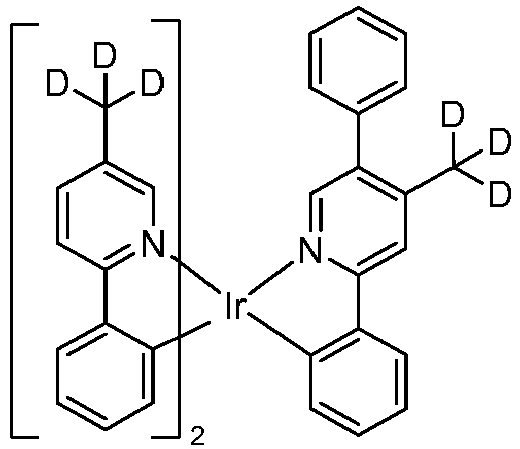
LiQ TE1 

TE2 TER1 

H1 H2 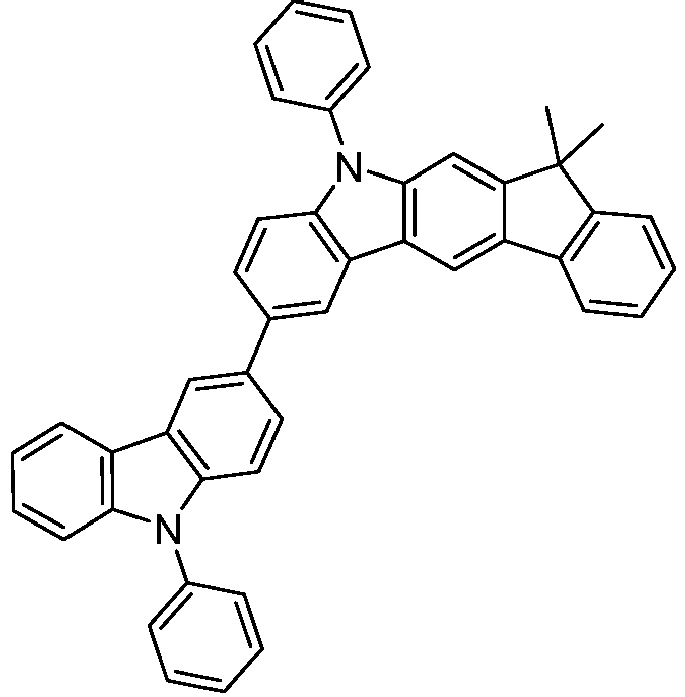
H3 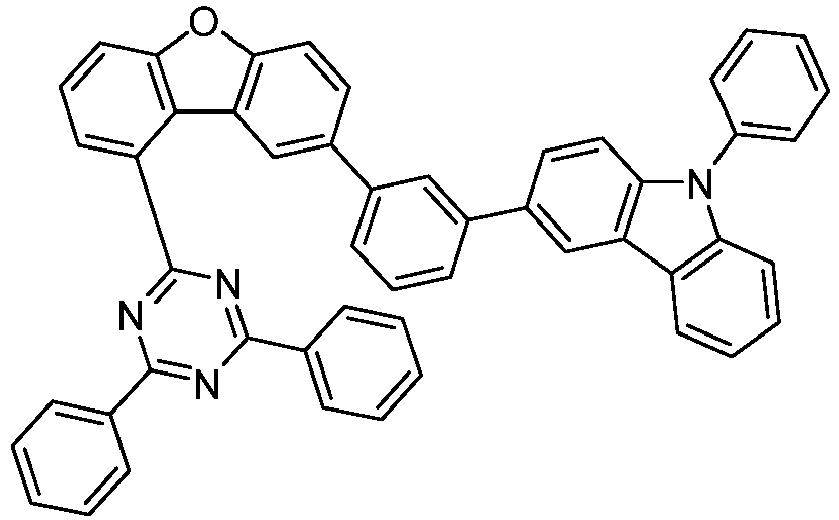

E1 E2 

SdT1 SdT2 ( WO 2012/048781 )
SdT3
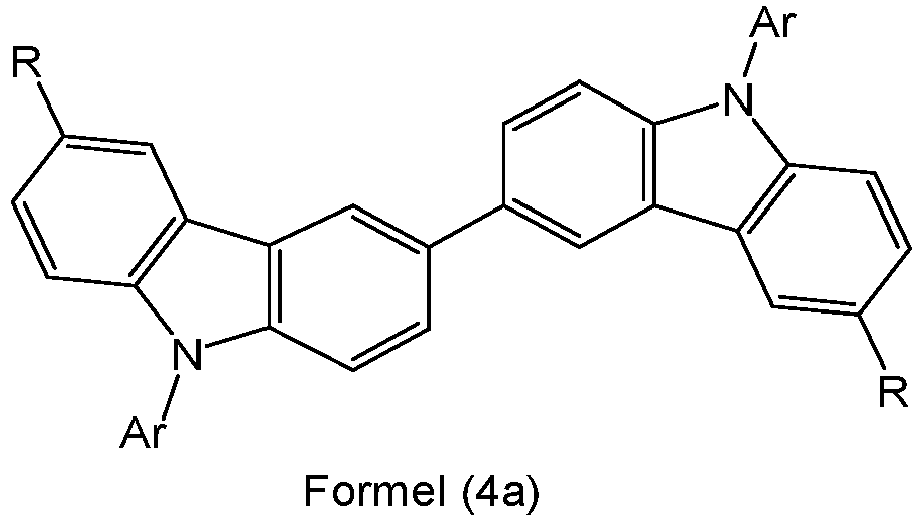

Claims (9)
- Verbindung gemäß Formel (1),
 X ist gleich oder verschieden bei jedem Auftreten CR oder N mit der Maßgabe, dass maximal zwei Gruppen X pro Zyklus für N stehen und dass zwei benachbarte Gruppen X, die Teil des Zyklus mit vier Gruppen X sind, für C stehen, welche über die mit * bezeichneten Bindungen ein an den Zyklus ankondensiertes aromatisches oder heteroaromatisches Ringsystem bilden;Y ist bei jedem Auftreten gleich oder verschieden BR, C(R)2, C=O, Si(R)2, Ge(R)2, NAr1, O, S, Se, SO, SO2, PR oder P(=O)R;Y1 ist bei jedem Auftreten gleich oder verschieden BR, C(R)2, C=O, Si(R)2, Ge(R)2, NAr1, O, S, Se, SO, SO2, PR oder P(=O)R;Q ist gleich oder verschieden bei jedem Auftreten CR oder N mit der Maßgabe, dass maximal zwei Gruppen Q pro Zyklus für N stehen.Ar1 ist ein aromatisches Ringsystem mit 6 bis 40 aromatischen Ringatomen, welches mit einem oder mehreren Resten R1 substituiert sein kann, oder ein heteroaromatisches Ringsystem mit 5 bis 40 aromatischen Ringatomen, welches mit einem oder mehreren Resten R1 substituiert sein kann;R ist bei jedem Auftreten gleich oder verschieden H, D, F, Cl, Br, I, N(Ar')2, N(R1)2, OAr', SAr', B(OR1)2, CHO, C(=O)R1, CR1=C(R1)2, CN, C(=O)OR1, C(=O)NR1, Si(R1)3, NO2, P(=O)(R1)2, OSO2R1, OR1, S(=O)R1, S(=O)2R1, SR1, eine geradkettige Alkylgruppe mit 1 bis 20 C-Atomen oder eine Alkenyl- oder Alkinylgruppe mit 2 bis 20 C-Atomen oder eine verzweigte oder zyklische Alkylgruppe mit 3 bis 20 C-Atomen, wobei die Alkyl-, Alkenyl- oder Alkinylgruppe jeweils mit einem oder mehreren Resten R1 substituiert sein kann, wobei eine oder mehrere nicht benachbarte CH2-Gruppen durch -R1C=CR1-, -C≡C-, Si(R1)2, NR1, CONR1, C=O, C=S, -C(=O)O-, P(=O)(R1), -O-, -S-, SO oder SO2 ersetzt sein können, oder ein aromatisches oder heteroaromatisches Ringsystem mit 5 bis 60 aromatischen Ringatomen, bevorzugt mit 5 bis 40 aromatischen Ringatomen, das jeweils durch einen oder mehrere Reste R1 substituiert sein kann, wobei zwei oder mehr an den gleichen Zyklus gebundene Reste R miteinander ein aliphatisches, heteroaliphatisches, aromatisches oder heteroaromatisches Ringsystem bilden können, das mit einem oder mehreren Resten R1 substituiert sein kann, und wobei zwei an dasselbe Kohlenstoff-, Silicium-, Germanium- oder Zinnatom gebundene Reste R ein monozyklisches oder polyzyklisches, aliphatisches, aromatisches oder heteroaromatisches Ringsystem miteinander bilden können, das mit einem oder mehreren Resten R1 substituiert sein kann;Ar' ist bei jedem Auftreten gleich oder verschieden ein aromatisches oder heteroaromatisches Ringsystem mit 5 bis 40 aromatischen Ringatomen, das durch einen oder mehrere Reste R1 substituiert sein kann;R1 ist bei jedem Auftreten gleich oder verschieden H, D, F, I, B(OR2)2, N(R2)2, CHO, C(=O)R2, CR2=C(R2)2, CN, C(=O)OR2, Si(R2)3, NO2, P(=O)(R2)2, OSO2R2, SR2, OR2, S(=O)R2, S(=O)2R2, eine geradkettige Alkylgruppe mit 1 bis 20 C-Atomen oder eine Alkenyl- oder Alkinylgruppe mit 2 bis 20 C-Atomen oder eine verzweigte oder zyklische Alkylgruppe mit 3 bis 20 CAtomen, wobei die Alkyl-, Alkenyl- oder Alkinylgruppe jeweils mit einem oder mehreren Resten R2 substituiert sein kann und wobei eine oder mehrere CH2-Gruppen in den oben genannten Gruppen durch -R2C=CR2-, -C=C-, Si(R2)2, C=O, C=S, -C(=O)O-, NR2, CONR2, P(=O)(R2), -O-, -S-, SO oder SO2 ersetzt sein können und wobei ein oder mehrere H-Atome in den oben genannten Gruppen durch D, F, Cl, Br, I, CN oder NO2 ersetzt sein können, oder ein aromatisches oder heteroaromatisches Ringsystem mit 5 bis 30 aromatischen Ringatomen, das jeweils durch einen oder mehrere Reste R2 substituiert sein kann, wobei zwei oder mehr Reste R1 miteinander ein aliphatisches, heteroaliphatisches, aromatisches oder heteroaromatisches Ringsystem bilden können;R2 ist bei jedem Auftreten gleich oder verschieden H, D, F, CN oder ein aliphatischer, aromatischer oder heteroaromatischer organischer Rest mit 1 bis 20 C-Atomen, in dem auch ein oder mehrere H-Atome durch D oder F ersetzt sein können; dabei können zwei oder mehr Substituenten R2 miteinander verknüpft sein und einen Ring bilden.
 - Verbindung nach Anspruch 1, ausgewählt aus den Verbindungen der Formeln (2-1) bis (2-3),


- Verbindung nach Anspruch 1 oder 2, ausgewählt aus den Verbindungen der Formeln (3-1) bis (3-3),
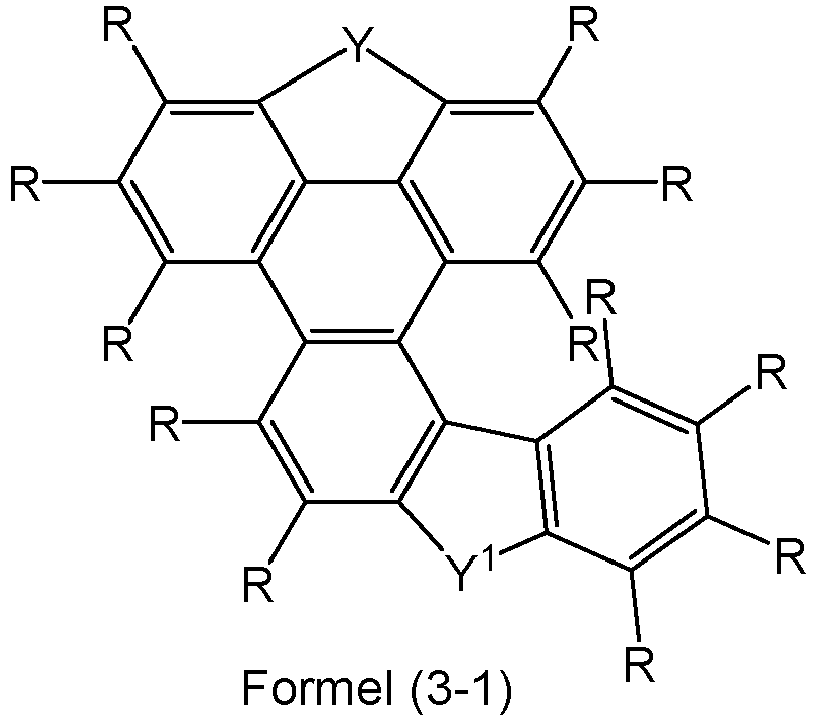

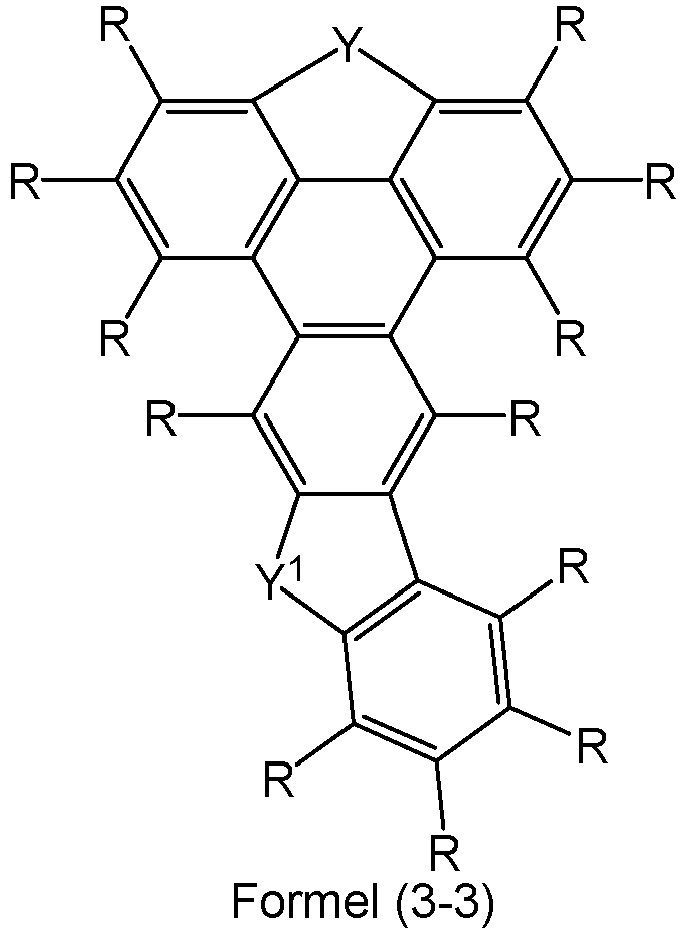
- Verbindung nach einem oder mehreren der Ansprüche 1 bis 3, ausgewählt aus den Verbindungen der Formeln (3-1a) bis (3-3a),

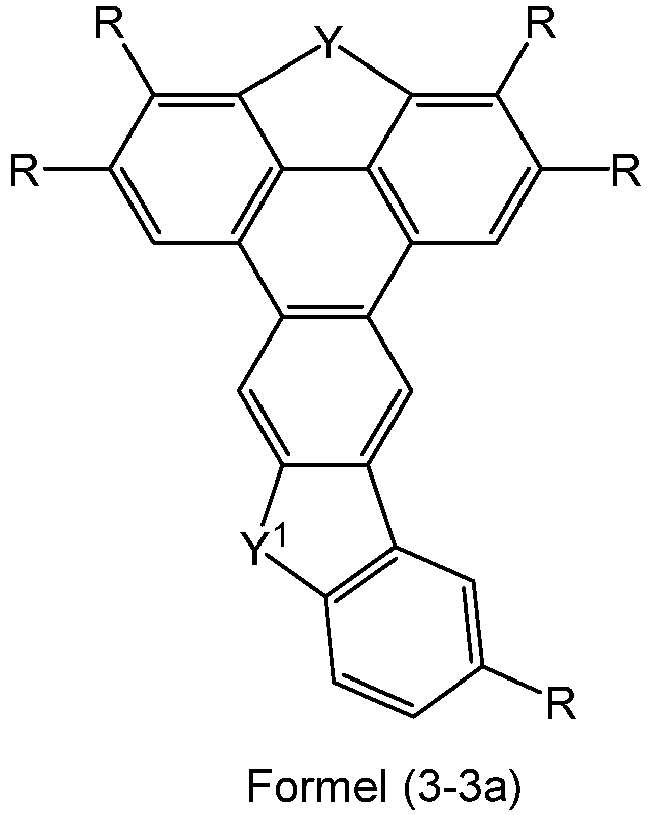
- Verfahren zur Herstellung einer Verbindung nach einem oder mehreren der Ansprüche 1 bis 4, gekennzeichnet durch die folgenden Schritte:(A) Synthese des Grundgerüsts nach Formel (1);(B) Ankondensieren des aromatischen oder heteroaromatischen Ringsystems unter Bildung der mit * bezeichneten Bindungen nach Formel (1) durch Kupplungs- und Ringschlussreaktion; oder(C) Aufbau der Verbindung nach Formel (1) durch Kupplungs- und Ringschlussreaktion zweier entsprechender aromatischer oder heteroaromatischer Ringsysteme.
- Formulierung, enthaltend mindestens eine Verbindung nach einem oder mehreren der Ansprüche 1 bis 4 und mindestens eine weitere Verbindung und/oder mindestens ein Lösemittel.
- Verwendung einer Verbindung nach einem oder mehreren der Ansprüche 1 bis 4 und oder einer Formulierung nach Anspruch 6 in einer elektronischen Vorrichtung.
- Elektronische Vorrichtung enthaltend mindestens eine Verbindung nach einem oder mehreren der Ansprüche 1 bis 5 und/oder eine Formulierung nach Anspruch 5.
- Elektronische Vorrichtung nach Anspruch 8, wobei es sich um eine organische Elektrolumineszenzvorrichtung handelt, dadurch gekennzeichnet, dass die Verbindung nach einem oder mehreren der Ansprüche 1 bis 3 in einer emittierenden Schicht als Matrixmaterial für phosphoreszierende oder fluoreszierende Emitter oder für Emitter, die TADF (thermally activated delayed fluorescence) zeigen, und/oder in einer Elektronentransportschicht und/oder in einer Lochblockierschicht und/oder in einer Lochtransportschicht und/oder in einer Elektronenblockierschicht eingesetzt wird.
Applications Claiming Priority (2)
| Application Number | Priority Date | Filing Date | Title |
|---|---|---|---|
| EP21171070 | 2021-04-29 | ||
| PCT/EP2022/060949 WO2022229126A1 (de) | 2021-04-29 | 2022-04-26 | Materialien für organische elektrolumineszenzvorrichtungen |
Publications (2)
| Publication Number | Publication Date |
|---|---|
| EP4330239A1 EP4330239A1 (de) | 2024-03-06 |
| EP4330239B1 true EP4330239B1 (de) | 2024-12-25 |
Family
ID=75746167
Family Applications (1)
| Application Number | Title | Priority Date | Filing Date |
|---|---|---|---|
| EP22725459.6A Active EP4330239B1 (de) | 2021-04-29 | 2022-04-26 | Materialien für organische elektrolumineszenzvorrichtungen |
Country Status (4)
| Country | Link |
|---|---|
| EP (1) | EP4330239B1 (de) |
| KR (1) | KR20240005782A (de) |
| CN (1) | CN117203191A (de) |
| WO (1) | WO2022229126A1 (de) |
Families Citing this family (3)
| Publication number | Priority date | Publication date | Assignee | Title |
|---|---|---|---|---|
| CN115626914B (zh) * | 2022-11-04 | 2024-04-30 | 冠能光电材料(深圳)有限责任公司 | 一种咔唑类化合物及其应用 |
| EP4619383A1 (de) * | 2022-11-16 | 2025-09-24 | Merck Patent GmbH | Materialien für organische elektrolumineszenzvorrichtungen |
| CN118125989B (zh) * | 2023-12-20 | 2025-06-20 | 棓诺(苏州)新材料有限公司 | 一种含三嗪结构的三亚苯衍生物的合成方法 |
Family Cites Families (77)
| Publication number | Priority date | Publication date | Assignee | Title |
|---|---|---|---|---|
| JPH07133483A (ja) | 1993-11-09 | 1995-05-23 | Shinko Electric Ind Co Ltd | El素子用有機発光材料及びel素子 |
| EP1729327B2 (de) | 1999-05-13 | 2022-08-10 | The Trustees Of Princeton University | Verwendung einer phosphoreszierenden Iridiumverbindung als Emissionsmolekül in einer organischen lichtemittierenden Vorrichtung |
| EP2911211B1 (de) | 1999-12-01 | 2018-05-02 | The Trustees of Princeton University | Komplexe der formel l2mx |
| TW532048B (en) | 2000-03-27 | 2003-05-11 | Idemitsu Kosan Co | Organic electroluminescence element |
| US20020121638A1 (en) | 2000-06-30 | 2002-09-05 | Vladimir Grushin | Electroluminescent iridium compounds with fluorinated phenylpyridines, phenylpyrimidines, and phenylquinolines and devices made with such compounds |
| JP5241053B2 (ja) | 2000-08-11 | 2013-07-17 | ザ、トラスティーズ オブ プリンストン ユニバーシティ | 有機金属化合物及び放射移行有機電気燐光体 |
| JP4154139B2 (ja) | 2000-09-26 | 2008-09-24 | キヤノン株式会社 | 発光素子 |
| JP4154140B2 (ja) | 2000-09-26 | 2008-09-24 | キヤノン株式会社 | 金属配位化合物 |
| JP4154138B2 (ja) | 2000-09-26 | 2008-09-24 | キヤノン株式会社 | 発光素子、表示装置及び金属配位化合物 |
| ITRM20020411A1 (it) | 2002-08-01 | 2004-02-02 | Univ Roma La Sapienza | Derivati dello spirobifluorene, loro preparazione e loro uso. |
| JP4411851B2 (ja) | 2003-03-19 | 2010-02-10 | コニカミノルタホールディングス株式会社 | 有機エレクトロルミネッセンス素子 |
| KR101162933B1 (ko) | 2003-04-15 | 2012-07-05 | 메르크 파텐트 게엠베하 | 매트릭스 재료 및 방출 가능 유기 반도체의 혼합물, 그의 용도 및 상기 혼합물을 함유하는 전자 부품 |
| EP2236579B1 (de) | 2003-04-23 | 2014-04-09 | Konica Minolta Holdings, Inc. | Organische Electrolumineszenz-Einrichtung und -Anzeigevorrichtung |
| DE10338550A1 (de) | 2003-08-19 | 2005-03-31 | Basf Ag | Übergangsmetallkomplexe mit Carbenliganden als Emitter für organische Licht-emittierende Dioden (OLEDs) |
| DE10345572A1 (de) | 2003-09-29 | 2005-05-19 | Covion Organic Semiconductors Gmbh | Metallkomplexe |
| US7795801B2 (en) | 2003-09-30 | 2010-09-14 | Konica Minolta Holdings, Inc. | Organic electroluminescent element, illuminator, display and compound |
| US7790890B2 (en) | 2004-03-31 | 2010-09-07 | Konica Minolta Holdings, Inc. | Organic electroluminescence element material, organic electroluminescence element, display device and illumination device |
| DE102004023277A1 (de) | 2004-05-11 | 2005-12-01 | Covion Organic Semiconductors Gmbh | Neue Materialmischungen für die Elektrolumineszenz |
| US7598388B2 (en) | 2004-05-18 | 2009-10-06 | The University Of Southern California | Carbene containing metal complexes as OLEDs |
| JP4862248B2 (ja) | 2004-06-04 | 2012-01-25 | コニカミノルタホールディングス株式会社 | 有機エレクトロルミネッセンス素子、照明装置及び表示装置 |
| ITRM20040352A1 (it) | 2004-07-15 | 2004-10-15 | Univ Roma La Sapienza | Derivati oligomerici dello spirobifluorene, loro preparazione e loro uso. |
| WO2006117052A1 (de) | 2005-05-03 | 2006-11-09 | Merck Patent Gmbh | Organische elektrolumineszenzvorrichtung und in deren herstellung verwendete boronsäure- und borinsäure-derivate |
| KR101082258B1 (ko) | 2005-12-01 | 2011-11-09 | 신닛테츠가가쿠 가부시키가이샤 | 유기 전계 발광소자용 화합물 및 유기 전계 발광소자 |
| DE102006025777A1 (de) | 2006-05-31 | 2007-12-06 | Merck Patent Gmbh | Neue Materialien für organische Elektrolumineszenzvorrichtungen |
| US8062769B2 (en) | 2006-11-09 | 2011-11-22 | Nippon Steel Chemical Co., Ltd. | Indolocarbazole compound for use in organic electroluminescent device and organic electroluminescent device |
| DE102007002714A1 (de) | 2007-01-18 | 2008-07-31 | Merck Patent Gmbh | Neue Materialien für organische Elektrolumineszenzvorrichtungen |
| DE102007053771A1 (de) | 2007-11-12 | 2009-05-14 | Merck Patent Gmbh | Organische Elektrolumineszenzvorrichtungen |
| DE102008027005A1 (de) | 2008-06-05 | 2009-12-10 | Merck Patent Gmbh | Organische elektronische Vorrichtung enthaltend Metallkomplexe |
| DE102008033943A1 (de) | 2008-07-18 | 2010-01-21 | Merck Patent Gmbh | Neue Materialien für organische Elektrolumineszenzvorrichtungen |
| DE102008036247A1 (de) | 2008-08-04 | 2010-02-11 | Merck Patent Gmbh | Elektronische Vorrichtungen enthaltend Metallkomplexe |
| DE102008036982A1 (de) | 2008-08-08 | 2010-02-11 | Merck Patent Gmbh | Organische Elektrolumineszenzvorrichtung |
| DE102008048336A1 (de) | 2008-09-22 | 2010-03-25 | Merck Patent Gmbh | Einkernige neutrale Kupfer(I)-Komplexe und deren Verwendung zur Herstellung von optoelektronischen Bauelementen |
| DE102008056688A1 (de) | 2008-11-11 | 2010-05-12 | Merck Patent Gmbh | Materialien für organische Elektrolumineszenzvorrichtungen |
| JP5701766B2 (ja) | 2008-11-11 | 2015-04-15 | メルク パテント ゲーエムベーハー | 有機エレクトロルミネセント素子 |
| DE102008057050B4 (de) | 2008-11-13 | 2021-06-02 | Merck Patent Gmbh | Materialien für organische Elektrolumineszenzvorrichtungen |
| DE102008057051B4 (de) | 2008-11-13 | 2021-06-17 | Merck Patent Gmbh | Materialien für organische Elektrolumineszenzvorrichtungen |
| DE102009007038A1 (de) | 2009-02-02 | 2010-08-05 | Merck Patent Gmbh | Metallkomplexe |
| DE102009011223A1 (de) | 2009-03-02 | 2010-09-23 | Merck Patent Gmbh | Metallkomplexe |
| DE102009013041A1 (de) | 2009-03-13 | 2010-09-16 | Merck Patent Gmbh | Materialien für organische Elektrolumineszenzvorrichtungen |
| DE102009014513A1 (de) | 2009-03-23 | 2010-09-30 | Merck Patent Gmbh | Organische Elektrolumineszenzvorrichtung |
| DE102009023155A1 (de) | 2009-05-29 | 2010-12-02 | Merck Patent Gmbh | Materialien für organische Elektrolumineszenzvorrichtungen |
| DE102009031021A1 (de) | 2009-06-30 | 2011-01-05 | Merck Patent Gmbh | Materialien für organische Elektrolumineszenzvorrichtungen |
| DE102009053644B4 (de) | 2009-11-17 | 2019-07-04 | Merck Patent Gmbh | Materialien für organische Elektrolumineszenzvorrichtungen |
| DE102009053645A1 (de) | 2009-11-17 | 2011-05-19 | Merck Patent Gmbh | Materialien für organische Elektrolumineszenzvorrichtung |
| DE102009041414A1 (de) | 2009-09-16 | 2011-03-17 | Merck Patent Gmbh | Metallkomplexe |
| DE102009048791A1 (de) | 2009-10-08 | 2011-04-14 | Merck Patent Gmbh | Materialien für organische Elektrolumineszenzvorrichtungen |
| DE102009053382A1 (de) | 2009-11-14 | 2011-05-19 | Merck Patent Gmbh | Materialien für elektronische Vorrichtungen |
| DE102009053836A1 (de) | 2009-11-18 | 2011-05-26 | Merck Patent Gmbh | Materialien für organische Elektrolumineszenzvorrichtungen |
| DE102009057167A1 (de) | 2009-12-05 | 2011-06-09 | Merck Patent Gmbh | Elektronische Vorrichtung enthaltend Metallkomplexe |
| DE102010005697A1 (de) | 2010-01-25 | 2011-07-28 | Merck Patent GmbH, 64293 | Verbindungen für elektronische Vorrichtungen |
| US9273080B2 (en) | 2010-06-15 | 2016-03-01 | Merek Patent Gmbh | Metal complexes |
| DE102010027317A1 (de) | 2010-07-16 | 2012-01-19 | Merck Patent Gmbh | Metallkomplexe |
| DE102010048608A1 (de) | 2010-10-15 | 2012-04-19 | Merck Patent Gmbh | Materialien für organische Elektrolumineszenzvorrichtungen |
| JP6215192B2 (ja) | 2011-04-18 | 2017-10-18 | メルク パテント ゲーエムベーハー | 有機エレクトロルミネッセンス素子用材料 |
| SG11201400709VA (en) | 2011-09-21 | 2014-06-27 | Merck Patent Gmbh | Carbazole derivatives for organic electroluminescence devices |
| KR102059793B1 (ko) | 2011-10-20 | 2019-12-27 | 메르크 파텐트 게엠베하 | 유기 전계발광 소자용 재료 |
| EP2872590B1 (de) | 2012-07-13 | 2018-11-14 | Merck Patent GmbH | Metallkomplexe |
| CN104520308B (zh) | 2012-08-07 | 2018-09-28 | 默克专利有限公司 | 金属络合物 |
| CN104870458B (zh) | 2012-12-21 | 2019-02-15 | 默克专利有限公司 | 金属络合物 |
| CN104870459B (zh) | 2012-12-21 | 2018-06-26 | 默克专利有限公司 | 金属络合物 |
| JP6469701B2 (ja) | 2013-09-11 | 2019-02-13 | メルク、パテント、ゲゼルシャフト、ミット、ベシュレンクテル、ハフツングMerck Patent GmbH | 金属錯体 |
| US11005050B2 (en) | 2014-01-13 | 2021-05-11 | Merck Patent Gmbh | Metal complexes |
| KR102349550B1 (ko) | 2014-02-05 | 2022-01-11 | 메르크 파텐트 게엠베하 | 금속 착물 |
| JP6890975B2 (ja) | 2014-05-05 | 2021-06-18 | メルク パテント ゲーエムベーハー | 有機エレクトロルミネッセンス素子のための材料 |
| KR102432970B1 (ko) | 2014-07-28 | 2022-08-16 | 메르크 파텐트 게엠베하 | 금속 착물 |
| KR102474330B1 (ko) | 2014-07-29 | 2022-12-05 | 메르크 파텐트 게엠베하 | 유기 전계발광 소자용 재료 |
| JP6608429B2 (ja) | 2014-08-13 | 2019-11-20 | メルク パテント ゲーエムベーハー | 有機エレクトロルミネッセンス素子のための材料 |
| EP3254317B1 (de) | 2015-02-03 | 2019-07-31 | Merck Patent GmbH | Metallkomplexe |
| EP3341385B1 (de) | 2015-08-25 | 2020-03-11 | Merck Patent GmbH | Metallkomplexe |
| JP7566454B2 (ja) | 2016-03-03 | 2024-10-15 | メルク パテント ゲーエムベーハー | 有機エレクトロルミネッセンスデバイスのための材料 |
| CN109415344B (zh) | 2016-07-14 | 2022-06-03 | 默克专利有限公司 | 金属络合物 |
| WO2018041769A1 (de) | 2016-08-30 | 2018-03-08 | Merck Patent Gmbh | Bl- und trinukleare metallkomplexe aufgebaut aus zwei miteinander verknüpften tripodalen hexadentaten liganden zur verwendung in elektrolumineszenzvorrichtungen |
| CN110461859A (zh) | 2017-03-29 | 2019-11-15 | 默克专利有限公司 | 金属络合物 |
| TWI776926B (zh) | 2017-07-25 | 2022-09-11 | 德商麥克專利有限公司 | 金屬錯合物 |
| CN111225919A (zh) * | 2017-10-24 | 2020-06-02 | 默克专利有限公司 | 用于有机电致发光器件的材料 |
| JP7293228B2 (ja) | 2017-12-13 | 2023-06-19 | メルク パテント ゲゼルシャフト ミット ベシュレンクテル ハフツング | 金属錯体 |
| US12180233B2 (en) | 2018-02-13 | 2024-12-31 | Udc Ireland Limited | Metal complexes |
-
2022
- 2022-04-26 EP EP22725459.6A patent/EP4330239B1/de active Active
- 2022-04-26 KR KR1020237040815A patent/KR20240005782A/ko active Pending
- 2022-04-26 CN CN202280028435.XA patent/CN117203191A/zh active Pending
- 2022-04-26 WO PCT/EP2022/060949 patent/WO2022229126A1/de not_active Ceased
Also Published As
| Publication number | Publication date |
|---|---|
| KR20240005782A (ko) | 2024-01-12 |
| CN117203191A (zh) | 2023-12-08 |
| EP4330239A1 (de) | 2024-03-06 |
| WO2022229126A1 (de) | 2022-11-03 |
Similar Documents
| Publication | Publication Date | Title |
|---|---|---|
| EP3744155B1 (de) | Materialien für organische elektrolumineszenzvorrichtungen | |
| EP4021903A1 (de) | Materialien für organische elektrolumineszenzvorrichtungen | |
| EP3160954B1 (de) | Materialien für organische elektrolumineszenzvorrichtungen | |
| EP4200294A1 (de) | Materialien für organische elektrolumineszenzvorrichtungen | |
| EP3180411A1 (de) | Materialien für organische elektrolumineszenzvorrichtungen | |
| WO2018138306A1 (de) | Materialien für organische elektrolumineszenzvorrichtungen | |
| WO2011050888A1 (de) | Materialien für elektronische vorrichtungen | |
| EP3347354B1 (de) | Materialien für organische elektrolumineszenzvorrichtungen | |
| WO2014056567A1 (de) | Materialien für organische elektrolumineszenzvorrichtungen | |
| EP4330239B1 (de) | Materialien für organische elektrolumineszenzvorrichtungen | |
| EP4200289A1 (de) | Materialien für organische elektrolumineszenzvorrichtungen | |
| EP3681890A1 (de) | Materialien für organische elektrolumineszenzvorrichtungen | |
| WO2016128103A1 (de) | Elektronische vorrichtung enthaltend cyclische lactame | |
| EP3880682B1 (de) | Materialien für organische elektrolumineszenzvorrichtungen | |
| WO2022157343A1 (de) | Stickstoffhaltige verbindungen für organische elektrolumineszenzvorrichtungen | |
| EP3583104B1 (de) | Materialien für organische elektrolumineszenzvorrichtungen | |
| EP4330240B1 (de) | Materialien für organische elektrolumineszenzvorrichtungen | |
| EP3820966B1 (de) | Materialien für organische elektrolumineszenzvorrichtungen | |
| EP3898888A1 (de) | Materialien für organische elektrolumineszenzvorrichtungen | |
| EP3565816B1 (de) | Materialien für organische elektrolumineszenzvorrichtungen | |
| EP3941920B1 (de) | Materialien für organische elektrolumineszenzvorrichtungen | |
| EP3877373B1 (de) | 5,6-diphenyl-5,6-dihydro-dibenz[c,e][1,2]azaphosphorin- und 6-phenyl-6h-dibenzo[c,e][1,2]thiazin-5,5-dioxid-derivate und ähnliche verbindungen als organische elektrolumineszenzmaterialien für oleds | |
| EP4192832A1 (de) | Materialien für organische elektrolumineszenzvorrichtungen | |
| EP4274827A1 (de) | Materialien für organische elektrolumineszenzvorrichtungen | |
| WO2022122682A2 (de) | Materialien für organische elektrolumineszenzvorrichtungen |
Legal Events
| Date | Code | Title | Description |
|---|---|---|---|
| STAA | Information on the status of an ep patent application or granted ep patent |
Free format text: STATUS: UNKNOWN |
|
| STAA | Information on the status of an ep patent application or granted ep patent |
Free format text: STATUS: THE INTERNATIONAL PUBLICATION HAS BEEN MADE |
|
| PUAI | Public reference made under article 153(3) epc to a published international application that has entered the european phase |
Free format text: ORIGINAL CODE: 0009012 |
|
| STAA | Information on the status of an ep patent application or granted ep patent |
Free format text: STATUS: REQUEST FOR EXAMINATION WAS MADE |
|
| 17P | Request for examination filed |
Effective date: 20231026 |
|
| AK | Designated contracting states |
Kind code of ref document: A1 Designated state(s): AL AT BE BG CH CY CZ DE DK EE ES FI FR GB GR HR HU IE IS IT LI LT LU LV MC MK MT NL NO PL PT RO RS SE SI SK SM TR |
|
| DAV | Request for validation of the european patent (deleted) | ||
| DAX | Request for extension of the european patent (deleted) | ||
| GRAP | Despatch of communication of intention to grant a patent |
Free format text: ORIGINAL CODE: EPIDOSNIGR1 |
|
| STAA | Information on the status of an ep patent application or granted ep patent |
Free format text: STATUS: GRANT OF PATENT IS INTENDED |
|
| RIC1 | Information provided on ipc code assigned before grant |
Ipc: C09K 11/06 20060101ALI20240726BHEP Ipc: C07D 495/06 20060101ALI20240726BHEP Ipc: C07D 491/06 20060101ALI20240726BHEP Ipc: C07D 487/06 20060101ALI20240726BHEP Ipc: C07D 307/91 20060101AFI20240726BHEP |
|
| INTG | Intention to grant announced |
Effective date: 20240904 |
|
| GRAS | Grant fee paid |
Free format text: ORIGINAL CODE: EPIDOSNIGR3 |
|
| GRAA | (expected) grant |
Free format text: ORIGINAL CODE: 0009210 |
|
| STAA | Information on the status of an ep patent application or granted ep patent |
Free format text: STATUS: THE PATENT HAS BEEN GRANTED |
|
| AK | Designated contracting states |
Kind code of ref document: B1 Designated state(s): AL AT BE BG CH CY CZ DE DK EE ES FI FR GB GR HR HU IE IS IT LI LT LU LV MC MK MT NL NO PL PT RO RS SE SI SK SM TR |
|
| REG | Reference to a national code |
Ref country code: GB Ref legal event code: FG4D Free format text: NOT ENGLISH |
|
| REG | Reference to a national code |
Ref country code: CH Ref legal event code: EP |
|
| REG | Reference to a national code |
Ref country code: DE Ref legal event code: R096 Ref document number: 502022002522 Country of ref document: DE |
|
| P01 | Opt-out of the competence of the unified patent court (upc) registered |
Free format text: CASE NUMBER: APP_65433/2024 Effective date: 20241211 |
|
| REG | Reference to a national code |
Ref country code: IE Ref legal event code: FG4D Free format text: LANGUAGE OF EP DOCUMENT: GERMAN |
|
| REG | Reference to a national code |
Ref country code: LT Ref legal event code: MG9D |
|
| PG25 | Lapsed in a contracting state [announced via postgrant information from national office to epo] |
Ref country code: HR Free format text: LAPSE BECAUSE OF FAILURE TO SUBMIT A TRANSLATION OF THE DESCRIPTION OR TO PAY THE FEE WITHIN THE PRESCRIBED TIME-LIMIT Effective date: 20241225 |
|
| PG25 | Lapsed in a contracting state [announced via postgrant information from national office to epo] |
Ref country code: FI Free format text: LAPSE BECAUSE OF FAILURE TO SUBMIT A TRANSLATION OF THE DESCRIPTION OR TO PAY THE FEE WITHIN THE PRESCRIBED TIME-LIMIT Effective date: 20241225 |
|
| PG25 | Lapsed in a contracting state [announced via postgrant information from national office to epo] |
Ref country code: BG Free format text: LAPSE BECAUSE OF FAILURE TO SUBMIT A TRANSLATION OF THE DESCRIPTION OR TO PAY THE FEE WITHIN THE PRESCRIBED TIME-LIMIT Effective date: 20241225 |
|
| PG25 | Lapsed in a contracting state [announced via postgrant information from national office to epo] |
Ref country code: NO Free format text: LAPSE BECAUSE OF FAILURE TO SUBMIT A TRANSLATION OF THE DESCRIPTION OR TO PAY THE FEE WITHIN THE PRESCRIBED TIME-LIMIT Effective date: 20250325 |
|
| PG25 | Lapsed in a contracting state [announced via postgrant information from national office to epo] |
Ref country code: GR Free format text: LAPSE BECAUSE OF FAILURE TO SUBMIT A TRANSLATION OF THE DESCRIPTION OR TO PAY THE FEE WITHIN THE PRESCRIBED TIME-LIMIT Effective date: 20250326 Ref country code: LV Free format text: LAPSE BECAUSE OF FAILURE TO SUBMIT A TRANSLATION OF THE DESCRIPTION OR TO PAY THE FEE WITHIN THE PRESCRIBED TIME-LIMIT Effective date: 20241225 |
|
| PG25 | Lapsed in a contracting state [announced via postgrant information from national office to epo] |
Ref country code: RS Free format text: LAPSE BECAUSE OF FAILURE TO SUBMIT A TRANSLATION OF THE DESCRIPTION OR TO PAY THE FEE WITHIN THE PRESCRIBED TIME-LIMIT Effective date: 20250325 |
|
| REG | Reference to a national code |
Ref country code: NL Ref legal event code: MP Effective date: 20241225 |
|
| PG25 | Lapsed in a contracting state [announced via postgrant information from national office to epo] |
Ref country code: NL Free format text: LAPSE BECAUSE OF FAILURE TO SUBMIT A TRANSLATION OF THE DESCRIPTION OR TO PAY THE FEE WITHIN THE PRESCRIBED TIME-LIMIT Effective date: 20241225 |
|
| PG25 | Lapsed in a contracting state [announced via postgrant information from national office to epo] |
Ref country code: SM Free format text: LAPSE BECAUSE OF FAILURE TO SUBMIT A TRANSLATION OF THE DESCRIPTION OR TO PAY THE FEE WITHIN THE PRESCRIBED TIME-LIMIT Effective date: 20241225 |
|
| PG25 | Lapsed in a contracting state [announced via postgrant information from national office to epo] |
Ref country code: PL Free format text: LAPSE BECAUSE OF FAILURE TO SUBMIT A TRANSLATION OF THE DESCRIPTION OR TO PAY THE FEE WITHIN THE PRESCRIBED TIME-LIMIT Effective date: 20241225 |
|
| PGFP | Annual fee paid to national office [announced via postgrant information from national office to epo] |
Ref country code: DE Payment date: 20250319 Year of fee payment: 4 |
|
| PG25 | Lapsed in a contracting state [announced via postgrant information from national office to epo] |
Ref country code: ES Free format text: LAPSE BECAUSE OF FAILURE TO SUBMIT A TRANSLATION OF THE DESCRIPTION OR TO PAY THE FEE WITHIN THE PRESCRIBED TIME-LIMIT Effective date: 20241225 |
|
| PG25 | Lapsed in a contracting state [announced via postgrant information from national office to epo] |
Ref country code: IS Free format text: LAPSE BECAUSE OF FAILURE TO SUBMIT A TRANSLATION OF THE DESCRIPTION OR TO PAY THE FEE WITHIN THE PRESCRIBED TIME-LIMIT Effective date: 20250425 |
|
| PG25 | Lapsed in a contracting state [announced via postgrant information from national office to epo] |
Ref country code: PT Free format text: LAPSE BECAUSE OF FAILURE TO SUBMIT A TRANSLATION OF THE DESCRIPTION OR TO PAY THE FEE WITHIN THE PRESCRIBED TIME-LIMIT Effective date: 20250428 |
|
| PG25 | Lapsed in a contracting state [announced via postgrant information from national office to epo] |
Ref country code: EE Free format text: LAPSE BECAUSE OF FAILURE TO SUBMIT A TRANSLATION OF THE DESCRIPTION OR TO PAY THE FEE WITHIN THE PRESCRIBED TIME-LIMIT Effective date: 20241225 |
|
| PG25 | Lapsed in a contracting state [announced via postgrant information from national office to epo] |
Ref country code: RO Free format text: LAPSE BECAUSE OF FAILURE TO SUBMIT A TRANSLATION OF THE DESCRIPTION OR TO PAY THE FEE WITHIN THE PRESCRIBED TIME-LIMIT Effective date: 20241225 |
|
| PGFP | Annual fee paid to national office [announced via postgrant information from national office to epo] |
Ref country code: AT Payment date: 20250721 Year of fee payment: 4 |
|
| PG25 | Lapsed in a contracting state [announced via postgrant information from national office to epo] |
Ref country code: SK Free format text: LAPSE BECAUSE OF FAILURE TO SUBMIT A TRANSLATION OF THE DESCRIPTION OR TO PAY THE FEE WITHIN THE PRESCRIBED TIME-LIMIT Effective date: 20241225 |
|
| PG25 | Lapsed in a contracting state [announced via postgrant information from national office to epo] |
Ref country code: CZ Free format text: LAPSE BECAUSE OF FAILURE TO SUBMIT A TRANSLATION OF THE DESCRIPTION OR TO PAY THE FEE WITHIN THE PRESCRIBED TIME-LIMIT Effective date: 20241225 |
|
| PG25 | Lapsed in a contracting state [announced via postgrant information from national office to epo] |
Ref country code: IT Free format text: LAPSE BECAUSE OF FAILURE TO SUBMIT A TRANSLATION OF THE DESCRIPTION OR TO PAY THE FEE WITHIN THE PRESCRIBED TIME-LIMIT Effective date: 20241225 |
|
| PG25 | Lapsed in a contracting state [announced via postgrant information from national office to epo] |
Ref country code: SE Free format text: LAPSE BECAUSE OF FAILURE TO SUBMIT A TRANSLATION OF THE DESCRIPTION OR TO PAY THE FEE WITHIN THE PRESCRIBED TIME-LIMIT Effective date: 20241225 |
|
| REG | Reference to a national code |
Ref country code: DE Ref legal event code: R097 Ref document number: 502022002522 Country of ref document: DE |
|
| PG25 | Lapsed in a contracting state [announced via postgrant information from national office to epo] |
Ref country code: DK Free format text: LAPSE BECAUSE OF FAILURE TO SUBMIT A TRANSLATION OF THE DESCRIPTION OR TO PAY THE FEE WITHIN THE PRESCRIBED TIME-LIMIT Effective date: 20241225 |
|
| PLBE | No opposition filed within time limit |
Free format text: ORIGINAL CODE: 0009261 |
|
| STAA | Information on the status of an ep patent application or granted ep patent |
Free format text: STATUS: NO OPPOSITION FILED WITHIN TIME LIMIT |
|
| REG | Reference to a national code |
Ref country code: CH Ref legal event code: L10 Free format text: ST27 STATUS EVENT CODE: U-0-0-L10-L00 (AS PROVIDED BY THE NATIONAL OFFICE) Effective date: 20251105 |
|
| REG | Reference to a national code |
Ref country code: CH Ref legal event code: H13 Free format text: ST27 STATUS EVENT CODE: U-0-0-H10-H13 (AS PROVIDED BY THE NATIONAL OFFICE) Effective date: 20251125 |
|
| 26N | No opposition filed |
Effective date: 20250926 |
|
| PG25 | Lapsed in a contracting state [announced via postgrant information from national office to epo] |
Ref country code: LU Free format text: LAPSE BECAUSE OF NON-PAYMENT OF DUE FEES Effective date: 20250426 |
|
| PG25 | Lapsed in a contracting state [announced via postgrant information from national office to epo] |
Ref country code: MC Free format text: LAPSE BECAUSE OF FAILURE TO SUBMIT A TRANSLATION OF THE DESCRIPTION OR TO PAY THE FEE WITHIN THE PRESCRIBED TIME-LIMIT Effective date: 20241225 |
|
| REG | Reference to a national code |
Ref country code: BE Ref legal event code: MM Effective date: 20250430 |
|
| PG25 | Lapsed in a contracting state [announced via postgrant information from national office to epo] |
Ref country code: FR Free format text: LAPSE BECAUSE OF NON-PAYMENT OF DUE FEES Effective date: 20250430 |
|
| PG25 | Lapsed in a contracting state [announced via postgrant information from national office to epo] |
Ref country code: BE Free format text: LAPSE BECAUSE OF NON-PAYMENT OF DUE FEES Effective date: 20250430 |
|
| PG25 | Lapsed in a contracting state [announced via postgrant information from national office to epo] |
Ref country code: CH Free format text: LAPSE BECAUSE OF NON-PAYMENT OF DUE FEES Effective date: 20250430 |