EP2992009B1 - Zusammensetzungen und verfahren zur modulation der apolipoprotein(a)-expression - Google Patents
Zusammensetzungen und verfahren zur modulation der apolipoprotein(a)-expression Download PDFInfo
- Publication number
- EP2992009B1 EP2992009B1 EP14791187.9A EP14791187A EP2992009B1 EP 2992009 B1 EP2992009 B1 EP 2992009B1 EP 14791187 A EP14791187 A EP 14791187A EP 2992009 B1 EP2992009 B1 EP 2992009B1
- Authority
- EP
- European Patent Office
- Prior art keywords
- certain embodiments
- compound
- nucleoside
- modified
- oligonucleotide
- Prior art date
- Legal status (The legal status is an assumption and is not a legal conclusion. Google has not performed a legal analysis and makes no representation as to the accuracy of the status listed.)
- Active
Links
- 0 CCC(C)O[C@](C(*)[C@@](C)O)OCC(C)=C(C)CNC(CCOCC(COCCC(NCC(C)CO[C@@](C1*)OC(CC)[C@](C)C1O)=O)(COCCC(NC*(C)*(C)CO[C@](C1*)OC(CC)[C@](C)C1O)=O)NC(CCCC(NC*(C)C*(C)CO)=O)=O)=O Chemical compound CCC(C)O[C@](C(*)[C@@](C)O)OCC(C)=C(C)CNC(CCOCC(COCCC(NCC(C)CO[C@@](C1*)OC(CC)[C@](C)C1O)=O)(COCCC(NC*(C)*(C)CO[C@](C1*)OC(CC)[C@](C)C1O)=O)NC(CCCC(NC*(C)C*(C)CO)=O)=O)=O 0.000 description 10
Classifications
-
- A—HUMAN NECESSITIES
- A61—MEDICAL OR VETERINARY SCIENCE; HYGIENE
- A61K—PREPARATIONS FOR MEDICAL, DENTAL OR TOILETRY PURPOSES
- A61K31/00—Medicinal preparations containing organic active ingredients
- A61K31/70—Carbohydrates; Sugars; Derivatives thereof
- A61K31/7088—Compounds having three or more nucleosides or nucleotides
-
- C—CHEMISTRY; METALLURGY
- C12—BIOCHEMISTRY; BEER; SPIRITS; WINE; VINEGAR; MICROBIOLOGY; ENZYMOLOGY; MUTATION OR GENETIC ENGINEERING
- C12N—MICROORGANISMS OR ENZYMES; COMPOSITIONS THEREOF; PROPAGATING, PRESERVING, OR MAINTAINING MICROORGANISMS; MUTATION OR GENETIC ENGINEERING; CULTURE MEDIA
- C12N15/00—Mutation or genetic engineering; DNA or RNA concerning genetic engineering, vectors, e.g. plasmids, or their isolation, preparation or purification; Use of hosts therefor
- C12N15/09—Recombinant DNA-technology
- C12N15/11—DNA or RNA fragments; Modified forms thereof; Non-coding nucleic acids having a biological activity
- C12N15/113—Non-coding nucleic acids modulating the expression of genes, e.g. antisense oligonucleotides; Antisense DNA or RNA; Triplex- forming oligonucleotides; Catalytic nucleic acids, e.g. ribozymes; Nucleic acids used in co-suppression or gene silencing
-
- A—HUMAN NECESSITIES
- A61—MEDICAL OR VETERINARY SCIENCE; HYGIENE
- A61K—PREPARATIONS FOR MEDICAL, DENTAL OR TOILETRY PURPOSES
- A61K47/00—Medicinal preparations characterised by the non-active ingredients used, e.g. carriers or inert additives; Targeting or modifying agents chemically bound to the active ingredient
- A61K47/50—Medicinal preparations characterised by the non-active ingredients used, e.g. carriers or inert additives; Targeting or modifying agents chemically bound to the active ingredient the non-active ingredient being chemically bound to the active ingredient, e.g. polymer-drug conjugates
- A61K47/51—Medicinal preparations characterised by the non-active ingredients used, e.g. carriers or inert additives; Targeting or modifying agents chemically bound to the active ingredient the non-active ingredient being chemically bound to the active ingredient, e.g. polymer-drug conjugates the non-active ingredient being a modifying agent
- A61K47/54—Medicinal preparations characterised by the non-active ingredients used, e.g. carriers or inert additives; Targeting or modifying agents chemically bound to the active ingredient the non-active ingredient being chemically bound to the active ingredient, e.g. polymer-drug conjugates the non-active ingredient being a modifying agent the modifying agent being an organic compound
- A61K47/549—Sugars, nucleosides, nucleotides or nucleic acids
-
- A—HUMAN NECESSITIES
- A61—MEDICAL OR VETERINARY SCIENCE; HYGIENE
- A61K—PREPARATIONS FOR MEDICAL, DENTAL OR TOILETRY PURPOSES
- A61K31/00—Medicinal preparations containing organic active ingredients
- A61K31/70—Carbohydrates; Sugars; Derivatives thereof
- A61K31/7088—Compounds having three or more nucleosides or nucleotides
- A61K31/7105—Natural ribonucleic acids, i.e. containing only riboses attached to adenine, guanine, cytosine or uracil and having 3'-5' phosphodiester links
-
- A—HUMAN NECESSITIES
- A61—MEDICAL OR VETERINARY SCIENCE; HYGIENE
- A61K—PREPARATIONS FOR MEDICAL, DENTAL OR TOILETRY PURPOSES
- A61K31/00—Medicinal preparations containing organic active ingredients
- A61K31/70—Carbohydrates; Sugars; Derivatives thereof
- A61K31/7088—Compounds having three or more nucleosides or nucleotides
- A61K31/7125—Nucleic acids or oligonucleotides having modified internucleoside linkage, i.e. other than 3'-5' phosphodiesters
-
- A—HUMAN NECESSITIES
- A61—MEDICAL OR VETERINARY SCIENCE; HYGIENE
- A61K—PREPARATIONS FOR MEDICAL, DENTAL OR TOILETRY PURPOSES
- A61K31/00—Medicinal preparations containing organic active ingredients
- A61K31/70—Carbohydrates; Sugars; Derivatives thereof
- A61K31/7088—Compounds having three or more nucleosides or nucleotides
- A61K31/713—Double-stranded nucleic acids or oligonucleotides
-
- A—HUMAN NECESSITIES
- A61—MEDICAL OR VETERINARY SCIENCE; HYGIENE
- A61K—PREPARATIONS FOR MEDICAL, DENTAL OR TOILETRY PURPOSES
- A61K47/00—Medicinal preparations characterised by the non-active ingredients used, e.g. carriers or inert additives; Targeting or modifying agents chemically bound to the active ingredient
- A61K47/50—Medicinal preparations characterised by the non-active ingredients used, e.g. carriers or inert additives; Targeting or modifying agents chemically bound to the active ingredient the non-active ingredient being chemically bound to the active ingredient, e.g. polymer-drug conjugates
- A61K47/51—Medicinal preparations characterised by the non-active ingredients used, e.g. carriers or inert additives; Targeting or modifying agents chemically bound to the active ingredient the non-active ingredient being chemically bound to the active ingredient, e.g. polymer-drug conjugates the non-active ingredient being a modifying agent
- A61K47/56—Medicinal preparations characterised by the non-active ingredients used, e.g. carriers or inert additives; Targeting or modifying agents chemically bound to the active ingredient the non-active ingredient being chemically bound to the active ingredient, e.g. polymer-drug conjugates the non-active ingredient being a modifying agent the modifying agent being an organic macromolecular compound, e.g. an oligomeric, polymeric or dendrimeric molecule
- A61K47/59—Medicinal preparations characterised by the non-active ingredients used, e.g. carriers or inert additives; Targeting or modifying agents chemically bound to the active ingredient the non-active ingredient being chemically bound to the active ingredient, e.g. polymer-drug conjugates the non-active ingredient being a modifying agent the modifying agent being an organic macromolecular compound, e.g. an oligomeric, polymeric or dendrimeric molecule obtained otherwise than by reactions only involving carbon-to-carbon unsaturated bonds, e.g. polyureas or polyurethanes
-
- A—HUMAN NECESSITIES
- A61—MEDICAL OR VETERINARY SCIENCE; HYGIENE
- A61K—PREPARATIONS FOR MEDICAL, DENTAL OR TOILETRY PURPOSES
- A61K48/00—Medicinal preparations containing genetic material which is inserted into cells of the living body to treat genetic diseases; Gene therapy
-
- A—HUMAN NECESSITIES
- A61—MEDICAL OR VETERINARY SCIENCE; HYGIENE
- A61P—SPECIFIC THERAPEUTIC ACTIVITY OF CHEMICAL COMPOUNDS OR MEDICINAL PREPARATIONS
- A61P25/00—Drugs for disorders of the nervous system
-
- A—HUMAN NECESSITIES
- A61—MEDICAL OR VETERINARY SCIENCE; HYGIENE
- A61P—SPECIFIC THERAPEUTIC ACTIVITY OF CHEMICAL COMPOUNDS OR MEDICINAL PREPARATIONS
- A61P43/00—Drugs for specific purposes, not provided for in groups A61P1/00-A61P41/00
-
- C—CHEMISTRY; METALLURGY
- C07—ORGANIC CHEMISTRY
- C07H—SUGARS; DERIVATIVES THEREOF; NUCLEOSIDES; NUCLEOTIDES; NUCLEIC ACIDS
- C07H21/00—Compounds containing two or more mononucleotide units having separate phosphate or polyphosphate groups linked by saccharide radicals of nucleoside groups, e.g. nucleic acids
-
- C—CHEMISTRY; METALLURGY
- C07—ORGANIC CHEMISTRY
- C07H—SUGARS; DERIVATIVES THEREOF; NUCLEOSIDES; NUCLEOTIDES; NUCLEIC ACIDS
- C07H21/00—Compounds containing two or more mononucleotide units having separate phosphate or polyphosphate groups linked by saccharide radicals of nucleoside groups, e.g. nucleic acids
- C07H21/04—Compounds containing two or more mononucleotide units having separate phosphate or polyphosphate groups linked by saccharide radicals of nucleoside groups, e.g. nucleic acids with deoxyribosyl as saccharide radical
-
- C—CHEMISTRY; METALLURGY
- C12—BIOCHEMISTRY; BEER; SPIRITS; WINE; VINEGAR; MICROBIOLOGY; ENZYMOLOGY; MUTATION OR GENETIC ENGINEERING
- C12N—MICROORGANISMS OR ENZYMES; COMPOSITIONS THEREOF; PROPAGATING, PRESERVING, OR MAINTAINING MICROORGANISMS; MUTATION OR GENETIC ENGINEERING; CULTURE MEDIA
- C12N15/00—Mutation or genetic engineering; DNA or RNA concerning genetic engineering, vectors, e.g. plasmids, or their isolation, preparation or purification; Use of hosts therefor
- C12N15/09—Recombinant DNA-technology
- C12N15/11—DNA or RNA fragments; Modified forms thereof; Non-coding nucleic acids having a biological activity
- C12N15/111—General methods applicable to biologically active non-coding nucleic acids
-
- C—CHEMISTRY; METALLURGY
- C12—BIOCHEMISTRY; BEER; SPIRITS; WINE; VINEGAR; MICROBIOLOGY; ENZYMOLOGY; MUTATION OR GENETIC ENGINEERING
- C12N—MICROORGANISMS OR ENZYMES; COMPOSITIONS THEREOF; PROPAGATING, PRESERVING, OR MAINTAINING MICROORGANISMS; MUTATION OR GENETIC ENGINEERING; CULTURE MEDIA
- C12N15/00—Mutation or genetic engineering; DNA or RNA concerning genetic engineering, vectors, e.g. plasmids, or their isolation, preparation or purification; Use of hosts therefor
- C12N15/09—Recombinant DNA-technology
- C12N15/11—DNA or RNA fragments; Modified forms thereof; Non-coding nucleic acids having a biological activity
- C12N15/113—Non-coding nucleic acids modulating the expression of genes, e.g. antisense oligonucleotides; Antisense DNA or RNA; Triplex- forming oligonucleotides; Catalytic nucleic acids, e.g. ribozymes; Nucleic acids used in co-suppression or gene silencing
- C12N15/1137—Non-coding nucleic acids modulating the expression of genes, e.g. antisense oligonucleotides; Antisense DNA or RNA; Triplex- forming oligonucleotides; Catalytic nucleic acids, e.g. ribozymes; Nucleic acids used in co-suppression or gene silencing against enzymes
-
- C—CHEMISTRY; METALLURGY
- C12—BIOCHEMISTRY; BEER; SPIRITS; WINE; VINEGAR; MICROBIOLOGY; ENZYMOLOGY; MUTATION OR GENETIC ENGINEERING
- C12Y—ENZYMES
- C12Y301/00—Hydrolases acting on ester bonds (3.1)
- C12Y301/03—Phosphoric monoester hydrolases (3.1.3)
- C12Y301/03048—Protein-tyrosine-phosphatase (3.1.3.48)
-
- C—CHEMISTRY; METALLURGY
- C12—BIOCHEMISTRY; BEER; SPIRITS; WINE; VINEGAR; MICROBIOLOGY; ENZYMOLOGY; MUTATION OR GENETIC ENGINEERING
- C12N—MICROORGANISMS OR ENZYMES; COMPOSITIONS THEREOF; PROPAGATING, PRESERVING, OR MAINTAINING MICROORGANISMS; MUTATION OR GENETIC ENGINEERING; CULTURE MEDIA
- C12N2310/00—Structure or type of the nucleic acid
- C12N2310/10—Type of nucleic acid
- C12N2310/11—Antisense
-
- C—CHEMISTRY; METALLURGY
- C12—BIOCHEMISTRY; BEER; SPIRITS; WINE; VINEGAR; MICROBIOLOGY; ENZYMOLOGY; MUTATION OR GENETIC ENGINEERING
- C12N—MICROORGANISMS OR ENZYMES; COMPOSITIONS THEREOF; PROPAGATING, PRESERVING, OR MAINTAINING MICROORGANISMS; MUTATION OR GENETIC ENGINEERING; CULTURE MEDIA
- C12N2310/00—Structure or type of the nucleic acid
- C12N2310/10—Type of nucleic acid
- C12N2310/11—Antisense
- C12N2310/113—Antisense targeting other non-coding nucleic acids, e.g. antagomirs
-
- C—CHEMISTRY; METALLURGY
- C12—BIOCHEMISTRY; BEER; SPIRITS; WINE; VINEGAR; MICROBIOLOGY; ENZYMOLOGY; MUTATION OR GENETIC ENGINEERING
- C12N—MICROORGANISMS OR ENZYMES; COMPOSITIONS THEREOF; PROPAGATING, PRESERVING, OR MAINTAINING MICROORGANISMS; MUTATION OR GENETIC ENGINEERING; CULTURE MEDIA
- C12N2310/00—Structure or type of the nucleic acid
- C12N2310/10—Type of nucleic acid
- C12N2310/14—Type of nucleic acid interfering nucleic acids [NA]
-
- C—CHEMISTRY; METALLURGY
- C12—BIOCHEMISTRY; BEER; SPIRITS; WINE; VINEGAR; MICROBIOLOGY; ENZYMOLOGY; MUTATION OR GENETIC ENGINEERING
- C12N—MICROORGANISMS OR ENZYMES; COMPOSITIONS THEREOF; PROPAGATING, PRESERVING, OR MAINTAINING MICROORGANISMS; MUTATION OR GENETIC ENGINEERING; CULTURE MEDIA
- C12N2310/00—Structure or type of the nucleic acid
- C12N2310/10—Type of nucleic acid
- C12N2310/17—Immunomodulatory nucleic acids
-
- C—CHEMISTRY; METALLURGY
- C12—BIOCHEMISTRY; BEER; SPIRITS; WINE; VINEGAR; MICROBIOLOGY; ENZYMOLOGY; MUTATION OR GENETIC ENGINEERING
- C12N—MICROORGANISMS OR ENZYMES; COMPOSITIONS THEREOF; PROPAGATING, PRESERVING, OR MAINTAINING MICROORGANISMS; MUTATION OR GENETIC ENGINEERING; CULTURE MEDIA
- C12N2310/00—Structure or type of the nucleic acid
- C12N2310/30—Chemical structure
- C12N2310/31—Chemical structure of the backbone
-
- C—CHEMISTRY; METALLURGY
- C12—BIOCHEMISTRY; BEER; SPIRITS; WINE; VINEGAR; MICROBIOLOGY; ENZYMOLOGY; MUTATION OR GENETIC ENGINEERING
- C12N—MICROORGANISMS OR ENZYMES; COMPOSITIONS THEREOF; PROPAGATING, PRESERVING, OR MAINTAINING MICROORGANISMS; MUTATION OR GENETIC ENGINEERING; CULTURE MEDIA
- C12N2310/00—Structure or type of the nucleic acid
- C12N2310/30—Chemical structure
- C12N2310/31—Chemical structure of the backbone
- C12N2310/315—Phosphorothioates
-
- C—CHEMISTRY; METALLURGY
- C12—BIOCHEMISTRY; BEER; SPIRITS; WINE; VINEGAR; MICROBIOLOGY; ENZYMOLOGY; MUTATION OR GENETIC ENGINEERING
- C12N—MICROORGANISMS OR ENZYMES; COMPOSITIONS THEREOF; PROPAGATING, PRESERVING, OR MAINTAINING MICROORGANISMS; MUTATION OR GENETIC ENGINEERING; CULTURE MEDIA
- C12N2310/00—Structure or type of the nucleic acid
- C12N2310/30—Chemical structure
- C12N2310/32—Chemical structure of the sugar
-
- C—CHEMISTRY; METALLURGY
- C12—BIOCHEMISTRY; BEER; SPIRITS; WINE; VINEGAR; MICROBIOLOGY; ENZYMOLOGY; MUTATION OR GENETIC ENGINEERING
- C12N—MICROORGANISMS OR ENZYMES; COMPOSITIONS THEREOF; PROPAGATING, PRESERVING, OR MAINTAINING MICROORGANISMS; MUTATION OR GENETIC ENGINEERING; CULTURE MEDIA
- C12N2310/00—Structure or type of the nucleic acid
- C12N2310/30—Chemical structure
- C12N2310/32—Chemical structure of the sugar
- C12N2310/321—2'-O-R Modification
-
- C—CHEMISTRY; METALLURGY
- C12—BIOCHEMISTRY; BEER; SPIRITS; WINE; VINEGAR; MICROBIOLOGY; ENZYMOLOGY; MUTATION OR GENETIC ENGINEERING
- C12N—MICROORGANISMS OR ENZYMES; COMPOSITIONS THEREOF; PROPAGATING, PRESERVING, OR MAINTAINING MICROORGANISMS; MUTATION OR GENETIC ENGINEERING; CULTURE MEDIA
- C12N2310/00—Structure or type of the nucleic acid
- C12N2310/30—Chemical structure
- C12N2310/32—Chemical structure of the sugar
- C12N2310/322—2'-R Modification
-
- C—CHEMISTRY; METALLURGY
- C12—BIOCHEMISTRY; BEER; SPIRITS; WINE; VINEGAR; MICROBIOLOGY; ENZYMOLOGY; MUTATION OR GENETIC ENGINEERING
- C12N—MICROORGANISMS OR ENZYMES; COMPOSITIONS THEREOF; PROPAGATING, PRESERVING, OR MAINTAINING MICROORGANISMS; MUTATION OR GENETIC ENGINEERING; CULTURE MEDIA
- C12N2310/00—Structure or type of the nucleic acid
- C12N2310/30—Chemical structure
- C12N2310/32—Chemical structure of the sugar
- C12N2310/323—Chemical structure of the sugar modified ring structure
- C12N2310/3231—Chemical structure of the sugar modified ring structure having an additional ring, e.g. LNA, ENA
-
- C—CHEMISTRY; METALLURGY
- C12—BIOCHEMISTRY; BEER; SPIRITS; WINE; VINEGAR; MICROBIOLOGY; ENZYMOLOGY; MUTATION OR GENETIC ENGINEERING
- C12N—MICROORGANISMS OR ENZYMES; COMPOSITIONS THEREOF; PROPAGATING, PRESERVING, OR MAINTAINING MICROORGANISMS; MUTATION OR GENETIC ENGINEERING; CULTURE MEDIA
- C12N2310/00—Structure or type of the nucleic acid
- C12N2310/30—Chemical structure
- C12N2310/33—Chemical structure of the base
- C12N2310/334—Modified C
- C12N2310/3341—5-Methylcytosine
-
- C—CHEMISTRY; METALLURGY
- C12—BIOCHEMISTRY; BEER; SPIRITS; WINE; VINEGAR; MICROBIOLOGY; ENZYMOLOGY; MUTATION OR GENETIC ENGINEERING
- C12N—MICROORGANISMS OR ENZYMES; COMPOSITIONS THEREOF; PROPAGATING, PRESERVING, OR MAINTAINING MICROORGANISMS; MUTATION OR GENETIC ENGINEERING; CULTURE MEDIA
- C12N2310/00—Structure or type of the nucleic acid
- C12N2310/30—Chemical structure
- C12N2310/34—Spatial arrangement of the modifications
-
- C—CHEMISTRY; METALLURGY
- C12—BIOCHEMISTRY; BEER; SPIRITS; WINE; VINEGAR; MICROBIOLOGY; ENZYMOLOGY; MUTATION OR GENETIC ENGINEERING
- C12N—MICROORGANISMS OR ENZYMES; COMPOSITIONS THEREOF; PROPAGATING, PRESERVING, OR MAINTAINING MICROORGANISMS; MUTATION OR GENETIC ENGINEERING; CULTURE MEDIA
- C12N2310/00—Structure or type of the nucleic acid
- C12N2310/30—Chemical structure
- C12N2310/34—Spatial arrangement of the modifications
- C12N2310/341—Gapmers, i.e. of the type ===---===
-
- C—CHEMISTRY; METALLURGY
- C12—BIOCHEMISTRY; BEER; SPIRITS; WINE; VINEGAR; MICROBIOLOGY; ENZYMOLOGY; MUTATION OR GENETIC ENGINEERING
- C12N—MICROORGANISMS OR ENZYMES; COMPOSITIONS THEREOF; PROPAGATING, PRESERVING, OR MAINTAINING MICROORGANISMS; MUTATION OR GENETIC ENGINEERING; CULTURE MEDIA
- C12N2310/00—Structure or type of the nucleic acid
- C12N2310/30—Chemical structure
- C12N2310/34—Spatial arrangement of the modifications
- C12N2310/346—Spatial arrangement of the modifications having a combination of backbone and sugar modifications
-
- C—CHEMISTRY; METALLURGY
- C12—BIOCHEMISTRY; BEER; SPIRITS; WINE; VINEGAR; MICROBIOLOGY; ENZYMOLOGY; MUTATION OR GENETIC ENGINEERING
- C12N—MICROORGANISMS OR ENZYMES; COMPOSITIONS THEREOF; PROPAGATING, PRESERVING, OR MAINTAINING MICROORGANISMS; MUTATION OR GENETIC ENGINEERING; CULTURE MEDIA
- C12N2310/00—Structure or type of the nucleic acid
- C12N2310/30—Chemical structure
- C12N2310/35—Nature of the modification
-
- C—CHEMISTRY; METALLURGY
- C12—BIOCHEMISTRY; BEER; SPIRITS; WINE; VINEGAR; MICROBIOLOGY; ENZYMOLOGY; MUTATION OR GENETIC ENGINEERING
- C12N—MICROORGANISMS OR ENZYMES; COMPOSITIONS THEREOF; PROPAGATING, PRESERVING, OR MAINTAINING MICROORGANISMS; MUTATION OR GENETIC ENGINEERING; CULTURE MEDIA
- C12N2310/00—Structure or type of the nucleic acid
- C12N2310/30—Chemical structure
- C12N2310/35—Nature of the modification
- C12N2310/351—Conjugate
-
- C—CHEMISTRY; METALLURGY
- C12—BIOCHEMISTRY; BEER; SPIRITS; WINE; VINEGAR; MICROBIOLOGY; ENZYMOLOGY; MUTATION OR GENETIC ENGINEERING
- C12N—MICROORGANISMS OR ENZYMES; COMPOSITIONS THEREOF; PROPAGATING, PRESERVING, OR MAINTAINING MICROORGANISMS; MUTATION OR GENETIC ENGINEERING; CULTURE MEDIA
- C12N2310/00—Structure or type of the nucleic acid
- C12N2310/30—Chemical structure
- C12N2310/35—Nature of the modification
- C12N2310/351—Conjugate
- C12N2310/3511—Conjugate intercalating or cleaving agent
-
- C—CHEMISTRY; METALLURGY
- C12—BIOCHEMISTRY; BEER; SPIRITS; WINE; VINEGAR; MICROBIOLOGY; ENZYMOLOGY; MUTATION OR GENETIC ENGINEERING
- C12N—MICROORGANISMS OR ENZYMES; COMPOSITIONS THEREOF; PROPAGATING, PRESERVING, OR MAINTAINING MICROORGANISMS; MUTATION OR GENETIC ENGINEERING; CULTURE MEDIA
- C12N2310/00—Structure or type of the nucleic acid
- C12N2310/30—Chemical structure
- C12N2310/35—Nature of the modification
- C12N2310/351—Conjugate
- C12N2310/3513—Protein; Peptide
-
- C—CHEMISTRY; METALLURGY
- C12—BIOCHEMISTRY; BEER; SPIRITS; WINE; VINEGAR; MICROBIOLOGY; ENZYMOLOGY; MUTATION OR GENETIC ENGINEERING
- C12N—MICROORGANISMS OR ENZYMES; COMPOSITIONS THEREOF; PROPAGATING, PRESERVING, OR MAINTAINING MICROORGANISMS; MUTATION OR GENETIC ENGINEERING; CULTURE MEDIA
- C12N2310/00—Structure or type of the nucleic acid
- C12N2310/30—Chemical structure
- C12N2310/35—Nature of the modification
- C12N2310/351—Conjugate
- C12N2310/3515—Lipophilic moiety, e.g. cholesterol
-
- C—CHEMISTRY; METALLURGY
- C12—BIOCHEMISTRY; BEER; SPIRITS; WINE; VINEGAR; MICROBIOLOGY; ENZYMOLOGY; MUTATION OR GENETIC ENGINEERING
- C12N—MICROORGANISMS OR ENZYMES; COMPOSITIONS THEREOF; PROPAGATING, PRESERVING, OR MAINTAINING MICROORGANISMS; MUTATION OR GENETIC ENGINEERING; CULTURE MEDIA
- C12N2310/00—Structure or type of the nucleic acid
- C12N2310/30—Chemical structure
- C12N2310/35—Nature of the modification
- C12N2310/352—Nature of the modification linked to the nucleic acid via a carbon atom
- C12N2310/3525—MOE, methoxyethoxy
-
- C—CHEMISTRY; METALLURGY
- C12—BIOCHEMISTRY; BEER; SPIRITS; WINE; VINEGAR; MICROBIOLOGY; ENZYMOLOGY; MUTATION OR GENETIC ENGINEERING
- C12N—MICROORGANISMS OR ENZYMES; COMPOSITIONS THEREOF; PROPAGATING, PRESERVING, OR MAINTAINING MICROORGANISMS; MUTATION OR GENETIC ENGINEERING; CULTURE MEDIA
- C12N2310/00—Structure or type of the nucleic acid
- C12N2310/30—Chemical structure
- C12N2310/35—Nature of the modification
- C12N2310/353—Nature of the modification linked to the nucleic acid via an atom other than carbon
-
- C—CHEMISTRY; METALLURGY
- C12—BIOCHEMISTRY; BEER; SPIRITS; WINE; VINEGAR; MICROBIOLOGY; ENZYMOLOGY; MUTATION OR GENETIC ENGINEERING
- C12N—MICROORGANISMS OR ENZYMES; COMPOSITIONS THEREOF; PROPAGATING, PRESERVING, OR MAINTAINING MICROORGANISMS; MUTATION OR GENETIC ENGINEERING; CULTURE MEDIA
- C12N2320/00—Applications; Uses
- C12N2320/30—Special therapeutic applications
- C12N2320/32—Special delivery means, e.g. tissue-specific
Definitions
- RNAi refers to antisense-mediated gene silencing through a mechanism that utilizes the RNA-induced siliencing complex (RISC).
- RISC RNA-induced siliencing complex
- RNA target function is by an occupancy-based mechanism such as is employed naturally by microRNA.
- MicroRNAs are small non-coding RNAs that regulate the expression of protein-coding RNAs. The binding of an antisense compound to a microRNA prevents that microRNA from binding to its messenger RNA targets, and thus interferes with the function of the microRNA. MicroRNA mimics can enhance native microRNA function. Certain antisense compounds alter splicing of pre-mRNA. Regardless of the specific mechanism, sequence-specificity makes antisense compounds attractive as tools for target validation and gene functionalization, as well as therapeutics to selectively modulate the expression of genes involved in the pathogenesis of diseases.
- Antisense technology is an effective means for modulating the expression of one or more specific gene products and can therefore prove to be uniquely useful in a number of therapeutic, diagnostic, and research applications.
- Chemically modified nucleosides may be incorporated into antisense compounds to enhance one or more properties, such as nuclease resistance, pharmacokinetics or affinity for a target nucleic acid.
- Vitravene® flamivirsen; developed by Isis Pharmaceuticals Inc., Carlsbad, CA
- FDA U.S. Food and Drug Administration
- CMV cytomegalovirus
- New chemical modifications have improved the potency and efficacy of antisense compounds, uncovering the potential for oral delivery as well as enhancing subcutaneous administration, decreasing potential for side effects, and leading to improvements in patient convenience.
- Chemical modifications increasing potency of antisense compounds allow administration of lower doses, which reduces the potential for toxicity, as well as decreasing overall cost of therapy. Modifications increasing the resistance to degradation result in slower clearance from the body, allowing for less frequent dosing. Different types of chemical modifications can be combined in one compound to further optimize the compound's efficacy.
- Lipoproteins are globular, micelle-like particles that consist of a non-polar core of acylglycerols and cholesteryl esters surrounded by an amphiphilic coating of protein, phospholipid and cholesterol. Lipoproteins have been classified into five broad categories on the basis of their functional and physical properties: chylomicrons, very low density lipoproteins (VLDL), intermediate density lipoproteins (IDL), low density lipoproteins (LDL), and high density lipoproteins (HDL). Chylomicrons transport dietary lipids from intestine to tissues. VLDLs, IDLs and LDLs all transport triacylglycerols and cholesterol from the liver to tissues. HDLs transport endogenous cholesterol from tissues to the liver
- Lipoprotein particles undergo continuous metabolic processing and have variable properties and compositions. Lipoprotein densities increase without increasing particle diameter because the density of their outer coatings is less than that of the inner core.
- the protein components of lipoproteins are known as apolipoproteins. At least nine apolipoproteins are distributed in significant amounts among the various human lipoproteins.
- the lipoprotein(a) [Lp(a)] particle was identified nearly 50 years ago and is comprised of a highly unique LDL particle in which one apolipoprotein B (apoB) protein is linked via a disulfide bond to a single apolipoprotein(a) [apo(a)] protein.
- the apo(a) protein shares a high degree of homology with plasminogen particularly within the kringle IV type 2 repetitive domain.
- Levels of circulating Lp(a) are inversely proportional to the number of kringle IV type 2 variable repeats present in the molecule and, as both alleles are co-expressed within individuals, can display heterozygous plasma isoform profiles ( Kraft et al., Eur J Hum Genet, 1996; 4(2): 74-87 ). It is thought that this kringle repeat domain in apo(a) may be responsible for its pro-thrombotic and anti-fibrinolytic properties, potentially enhancing atherosclerotic progression.
- Apo(a) is transcriptionally regulated by IL-6 and in studies in rheumatoid arthritis patients treated with an IL-6 inhibitor (tocilizumab), plasma levels were reduced by 30% after 3 month treatment ( Schultz et al., PLoS One 2010; 5:e14328 ).
- Lp(a) particle may also stimulate endothelial permeability, induce plasminogen activator inhibitor type-1 expression and activate macrophage interleukin-8 secretion ( Koschinsky and Marcovina, Curr Opin Lipidol 2004; 15:167-174 ).
- recent genetic association studies revealed that Lp(a) was an independent risk factor for myocardial infarction, stroke, peripheral vascular disease and abdominal aortic aneurysm ( Rifai et al., Clin Chem 2004; 50:1364-71 ; Erqou et al., JAMA 2009;302:412-23 ; Kamstrup et al., Circulation 2008;117:176-84 ).
- Clarke et al. Clarke et al., NEJM (2009)361; 2518-2528 .
- NEJM (2009)361; 2518-2528 described robust and independent associations between coronary heart disease and plasma Lp(a) concentrations.
- Solfrizzi et al. suggested that increased serum Lp(a) may be linked to an increased risk for Alzheimer's Disease (AD) ( Solfrizzi et al., J Neurol Neurosurg Psychiatry 2002, 72:732-736 .
- AD Alzheimer's Disease
- examples of indirect apo(a) inhibitors for treating cardiovascular disease include aspirin, Niaspan, Mipomersen, Anacetrapib, Epirotirome and Lomitapide which reduce plasma Lp(a) levels by 18%, 39%, 32%, 36%, 43% and 17%, respectively. Additionally, Lp(a) apheresis has been used in the clinic to reduce apo(a) containing Lp(a) particles.
- Ribozyme oligonucleotides U.S. Patent 5,877,022
- antisense oligonucleotides WO 2005/000201 ; WO 2003/014397 ; WO2013/177468 ; US20040242516 ; U.S. Patent Nos. 8,138,328 , 8,673,632 and 7,259,150 ; Merki et al., J Am Coll Cardiol 2011; 57:1611-1621 ) have been developed but none have been approved for commercial use.
- the present invention provides a compound comprising a modified oligonucleotide and a conjugate group, wherein the modified oligonucleotide consists of 20 linked nucleosides and has a nucleobase sequence comprising 20 contiguous nucleobases complementary to an equal length portion of nucleobases 3901 to 3920 of SEQ ID NO: 1, wherein the nucleobase sequence of the modified oligonucleotide is 100% complementary to SEQ ID NO: 1; and wherein the conjugate group comprises:
- the present invention also provides a pharmaceutical composition
- a pharmaceutical composition comprising the compound of the invention and a pharmaceutically acceptable diluent or carrier.
- the present invention also provides the compound of the invention for use in treating, preventing, or slowing progression of a disease related to elevated apo(a) and/or elevated Lp(a).
- compositions and methods for modulating expression of apo(a) mRNA and protein In certain embodiments, the apo(a) specific inhibitor decreases expression of apo(a) mRNA and protein. Disclosed herein are compositions and methods for modulating expression of Lp(a) levels.
- the composition is an apo(a) specific inhibitior.
- the apo(a) specific inhibitor is a nucleic acid, protein, or small molecule.
- the apo(a) specific inhibitor is an antisense oligonucleotide targeting apo(a) with a conjugate.
- the apo(a) specific inhibitor is a modified oligonucleotide and a conjugate, wherein the modified oligonucleotide consists of 12 to 30 linked nucleosides and comprises a nucleobase sequence comprising a portion of at least 8 contiguous nucleobases complementary to an equal length portion of nucleobases 3901 to 3920 of SEQ ID NO: 1, wherein the nucleobase sequence of the modified oligonucleotide is at least 80% complementary to SEQ ID NO: 1.
- the apo(a) specific inhibitor is a modified oligonucleotide and a conjugate, wherein the modified oligonucleotide consists of 12 to 30 linked nucleosides and has a nucleobase sequence comprising at least 8, least 9, least 10, least 11, at least 12, least 13, at least 14, at least 15, at least 16, least 17, least 18, least 19, or 20 contiguous nucleobases of the nucleobase sequence of SEQ ID NO: 1-130, 133, 134.
- the apo(a) specific inhibitor is a modified oligonucleotide and a conjugate, wherein the modified oligonucleotide consists of 20 linked nucleosides and has a nucleobase sequence comprising at least 8 contiguous nucleobases of any of SEQ ID NO: 58, wherein the modified oligonucleotide comprises: (a) a gap segment consisting of ten linked deoxynucleosides; (b) a 5' wing segment consisting of five linked nucleosides; (c) a 3' wing segment consisting of five linked nucleosides; and wherein the gap segment is positioned between the 5' wing segment and the 3' wing segment, wherein each nucleoside of each wing segment comprises a 2'-O-methoxyethyl sugar, wherein at least one internucleoside linkage is a phosphorothioate linkage and wherein each cytosine residue is a 5-methyl
- compositions comprising a conjugated antisense compound described herein, or a salt thereof, and a pharmaceutically acceptable carrier or diluent.
- the modulation of apo(a) expression occurs in a cell or tissue. In certain embodiments, the modulations occur in a cell or tissue in an animal. In certain embodiments, the animal is a human. In certain embodiments, the modulation is a reduction in apo(a) mRNA level. In certain embodiments, the modulation is a reduction in apo(a) protein level. In certain embodiments, both apo(a) mRNA and protein levels are reduced. In certain embodiments, the modulation is a reduction in Lp(a) level. Such reduction may occur in a time-dependent or in a dose-dependent manner.
- compositions and methods for use in therapy Certain embodiments of the present disclosure provide compositions and methods for preventing, treating, delaying, slowing the progression and/or ameliorating apo(a) related diseases, disorders, and conditions. Certain embodiments of the present disclosure provide compositions and methods for preventing, treating, delaying, slowing the progression and/or ameliorating Lp(a) related diseases, disorders, and conditions. In certain embodiments, such diseases, disorders, and conditions are inflammatory, cardiovascular and/or metabolic diseases, disorders, and conditions. In certain embodiments, the compositions and methods for therapy include administering an apo(a) specific inhibitor to an individual in need thereof. In certain embodiments, the apo(a) specific inhibitor is a nucleic acid.
- the nucleic acid is an antisense compound.
- the antisense compound is a modified oligonucleotide.
- the antisense compound is a modified oligonucleotide with a conjugate.
- the present disclosure provides conjugated antisense compounds. In certain embodiments, the present disclosure provides conjugated antisense compounds comprising an antisense oligonucleotide complementary to a nucleic acid transcript. In certain embodiments, the present disclosure provides methods comprising contacting a cell with a conjugated antisense compound comprising an antisense oligonucleotide complementary to a nucleic acid transcript. In certain embodiments, the present disclosure provides methods comprising contacting a cell with a conjugated antisense compound comprising an antisense oligonucleotide and reducing the amount or activity of a nucleic acid transcript in a cell.
- the asialoglycoprotein receptor (ASGP-R) has been described previously. See e.g., Park et al., PNAS vol. 102, No. 47, pp 17125-17129 (2005 ). Such receptors are expressed on liver cells, particularly hepatocytes. Further, it has been shown that compounds comprising clusters of three N-acetylgalactosamine (GalNAc) ligands are capable of binding to the ASGP-R, resulting in uptake of the compound into the cell. See e.g., Khorev et al., Bioorganic and Medicinal Chemistry, 16, 9, pp 5216-5231 (May 2008 ).
- GalNAc N-acetylgalactosamine
- conjugates comprising such GalNAc clusters have been used to facilitate uptake of certain compounds into liver cells, specifically hepatocytes.
- certain GalNAc-containing conjugates increase activity of duplex siRNA compounds in liver cells in vivo.
- the GalNAc-containing conjugate is typically attached to the sense strand of the siRNA duplex. Since the sense strand is discarded before the antisense strand ultimately hybridizes with the target nucleic acid, there is little concern that the conjugate will interfere with activity.
- the conjugate is attached to the 3' end of the sense strand of the siRNA. See e.g., U.S. Patent 8,106,022 .
- Certain conjugate groups described herein are more active and/or easier to synthesize than conjugate groups previously described.
- conjugates are attached to single-stranded antisense compounds, including, but not limited to RNase H based antisense compounds and antisense compounds that alter splicing of a pre-mRNA target nucleic acid.
- the conjugate should remain attached to the antisense compound long enough to provide benefit (improved uptake into cells) but then should either be cleaved, or otherwise not interfere with the subsequent steps necessary for activity, such as hybridization to a target nucleic acid and interaction with RNase H or enzymes associated with splicing or splice modulation.
- This balance of properties is more important in the setting of single-stranded antisense compounds than in siRNA compounds, where the conjugate may simply be attached to the sense strand.
- conjugated single-stranded antisense compounds having improved potency in liver cells in vivo compared with the same antisense compound lacking the conjugate. Given the required balance of properties for these compounds such improved potency is surprising.
- conjugate groups herein comprise a cleavable moiety.
- the conjugate should remain on the compound long enough to provide enhancement in uptake, but after that, it is desirable for some portion or, ideally, all of the conjugate to be cleaved, releasing the parent compound (e.g., antisense compound) in its most active form.
- the cleavable moiety is a cleavable nucleoside.
- Such embodiments take advantage of endogenous nucleases in the cell by attaching the rest of the conjugate (the cluster) to the antisense oligonucleotide through a nucleoside via one or more cleavable bonds, such as those of a phosphodiester linkage.
- the cluster is bound to the cleavable nucleoside through a phosphodiester linkage.
- the cleavable nucleoside is attached to the antisense oligonucleotide (antisense compound) by a phosphodiester linkage.
- the conjugate group may comprise two or three cleavable nucleosides.
- such cleavable nucleosides are linked to one another, to the antisense compound and/or to the cluster via cleavable bonds (such as those of a phosphodiester linkage).
- cleavable bonds such as those of a phosphodiester linkage.
- Certain conjugates herein do not comprise a cleavable nucleoside and instead comprise a cleavable bond. It is shown that that sufficient cleavage of the conjugate from the oligonucleotide is provided by at least one bond that is vulnerable to cleavage in the cell (a cleavable bond).
- conjugated antisense compounds are prodrugs. Such prodrugs are administered to an animal and are ultimately metabolized to a more active form. For example, conjugated antisense compounds are cleaved to remove all or part of the conjugate resulting in the active (or more active) form of the antisense compound lacking all or some of the conjugate.
- conjugates are attached at the 5' end of an oligonucleotide. Certain such 5'-conjugates are cleaved more efficiently than counterparts having a similar conjugate group attached at the 3' end. In certain embodiments, improved activity may correlate with improved cleavage. In certain embodiments, oligonucleotides comprising a conjugate at the 5' end have greater efficacy than oligonucleotides comprising a conjugate at the 3' end (see, for example, Examples 56, 81, 83, and 84). Further, 5'-attachment allows simpler oligonucleotide synthesis. Typically, oligonucleotides are synthesized on a solid support in the 3' to 5' direction.
- oligonucleotide typically one attaches a pre-conjugated 3' nucleoside to the solid support and then builds the oligonucleotide as usual. However, attaching that conjugated nucleoside to the solid support adds complication to the synthesis. Further, using that approach, the conjugate is then present throughout the synthesis of the oligonucleotide and can become degraded during subsequent steps or may limit the sorts of reactions and reagents that can be used.
- oligonucleotide Using the structures and techniques described herein for 5'-conjugated oligonucleotides, one can synthesize the oligonucleotide using standard automated techniques and introduce the conjugate with the final (5'-most) nucleoside or after the oligonucleotide has been cleaved from the solid support.
- conjugates and conjugated oligonucleotides are easier and/or requires few steps, and is therefore less expensive than that of conjugates previously disclosed, providing advantages in manufacturing.
- the synthesis of certain conjugate groups consists of fewer synthetic steps, resulting in increased yield, relative to conjugate groups previously described.
- Conjugate groups such as GalNAc3-10 in Example 46 and GalNAc3-7 in Example 48 are much simpler than previously described conjugates such as those described in U.S. 8,106,022 or U.S. 7,262,177 that require assembly of more chemical intermediates .
- conjugate groups having only one or two GalNAc ligands improve activity of antisense compounds. Such compounds are much easier to prepare than conjugates comprising three GalNAc ligands.
- Conjugate groups comprising one or two GalNAc ligands may be attached to any antisense compounds, including single-stranded oligonucleotides and either strand of double-stranded oligonucleotides (e.g., siRNA).
- the conjugates herein do not substantially alter certain measures of tolerability.
- conjugated antisense compounds are not more immunogenic than unconjugated parent compounds. Since potency is improved, embodiments in which tolerability remains the same (or indeed even if tolerability worsens only slightly compared to the gains in potency) have improved properties for therapy.
- conjugation allows one to alter antisense compounds in ways that have less attractive consequences in the absence of conjugation. For example, in certain embodiments, replacing one or more phosphorothioate linkages of a fully phosphorothioate antisense compound with phosphodiester linkages results in improvement in some measures of tolerability. For example, in certain instances, such antisense compounds having one or more phosphodiester are less immunogenic than the same compound in which each linkage is a phosphorothioate. However, in certain instances, as shown in Example 26, that same replacement of one or more phosphorothioate linkages with phosphodiester linkages also results in reduced cellular uptake and/or loss in potency.
- conjugated antisense compounds described herein tolerate such change in linkages with little or no loss in uptake and potency when compared to the conjugated full-phosphorothioate counterpart.
- oligonucleotides comprising a conjugate and at least one phosphodiester internucleoside linkage actually exhibit increased potency in vivo even relative to a full phosphorothioate counterpart also comprising the same conjugate.
- conjugated antisense compounds comprise at least one phosphodiester linkage.
- conjugation of antisense compounds herein results in increased delivery, uptake and activity in hepatocytes.
- more compound is delivered to liver tissue.
- that increased delivery alone does not explain the entire increase in activity.
- more compound enters hepatocytes.
- even that increased hepatocyte uptake does not explain the entire increase in activity.
- productive uptake of the conjugated compound is increased.
- certain embodiments of GalNAc-containing conjugates increase enrichment of antisense oligonucleotides in hepatocytes versus non-parenchymal cells. This enrichment is beneficial for oligonucleotides that target genes that are expressed in hepatocytes.
- conjugated antisense compounds herein result in reduced kidney exposure.
- concentrations of antisense oligonucleotides comprising certain embodiments of GalNAc-containing conjugates are lower in the kidney than that of antisense oligonucleotides lacking a GalNAc-containing conjugate.
- This has several beneficial therapeutic implications. For therapeutic indications where activity in the kidney is not sought, exposure to kidney risks kidney toxicity without corresponding benefit.
- high concentration in kidney typically results in loss of compound to the urine resulting in faster clearance. Accordingly for non-kidney targets, kidney accumulation is undesired.
- conjugated antisense compounds having the structure:
- the conjugated antisense compound can be represented by the following structure.
- the antisense compound can comprise modified oligonucleotide ISIS 494372 with a 5'-X, wherein X is a conjugate group comprising GalNAc as defined in the claims.
- the antisense compound can consist of modified oligonucleotide ISIS 494372 with a 5'-X, wherein X is a conjugate group comprising GalNAc as defined in the claims.
- the conjugated antisense compound can be represented by the following structure.
- the antisense compound comprises the conjugated modified oligonucleotide ISIS 681251.
- the antisense compound consists of the conjugated modified oligonucleotide ISIS 681251.
- the conjugated antisense compound can be represented by the following structure.
- the antisense compound comprises the conjugated modified oligonucleotide ISIS 681257.
- the antisense compound consists of the conjugated modified oligonucleotide ISIS 681257.
- the conjugated antisense compound can be represented by the following structure.
- the antisense compound comprises a modified oligonucleotide with SEQ ID NO: 58 with a 5'-GalNAc, as defined in the claims, with variability in the sugar mods of the wings.
- the antisense compound consists of a modified oligonucleotide with SEQ ID NO: 58 with a 5'-GalNAc, as defined in the claims, with variability in the sugar mods of the wings.
- R 1 is -OCH 2 CH 2 OCH 3 (MOE)and R 2 is H; or R 1 and R 2 together form a bridge, wherein R 1 is -O- and R 2 is -CH 2 -, -CH(CH 3 )-, or -CH 2 CH 2 -, and R 1 and R 2 are directly connected such that the resulting bridge is selected from: -O-CH 2 -, -O-CH(CH 3 )-, and -O-CH 2 CH 2 -; And for each pair of R 3 and R 4 on the same ring: either R 3 is selected from H and -OCH 2 CH 2 OCH 3 and R 4 is H; or R 3 and R 4 together form a bridge, wherein R 3 is -O-, and R 4 is - CH 2 -, -CH(CH 3 )-, or -CH 2 CH 2 -and R 3 and R 4 are directly connected such that the resulting bridge is selected from: -O-CH 2 -
- nucleoside means a compound comprising a nucleobase moiety and a sugar moiety. Nucleosides include, but are not limited to, naturally occurring nucleosides (as found in DNA and RNA) and modified nucleosides. Nucleosides may be linked to a phosphate moiety.
- chemical modification means a chemical difference in a compound when compared to a naturally occurring counterpart.
- Chemical modifications of oligonucleotides include nucleoside modifications (including sugar moiety modifications and nucleobase modifications) and internucleoside linkage modifications. In reference to an oligonucleotide, chemical modification does not include differences only in nucleobase sequence.
- furanosyl means a structure comprising a 5-membered ring comprising four carbon atoms and one oxygen atom.
- naturally occurring sugar moiety means a ribofuranosyl as found in naturally occurring RNA or a deoxyribofuranosyl as found in naturally occurring DNA.
- sugar moiety means a naturally occurring sugar moiety or a modified sugar moiety of a nucleoside.
- modified sugar moiety means a substituted sugar moiety or a sugar surrogate.
- substituted sugar moiety means a furanosyl that is not a naturally occurring sugar moiety.
- Substituted sugar moieties include, but are not limited to furanosyls comprising substituents at the 2'-position, the 3'-position, the 5'-position and/or the 4'-position.
- Certain substituted sugar moieties are bicyclic sugar moieties.
- 2'-substituted sugar moiety means a furanosyl comprising a substituent at the 2'-position other than H or OH. Unless otherwise indicated, a 2'-substituted sugar moiety is not a bicyclic sugar moiety (i.e., the 2'-substituent of a 2'-substituted sugar moiety does not form a bridge to another atom of the furanosyl ring.
- MOE means -OCH 2 CH 2 OCH 3 .
- 2'-F nucleoside refers to a nucleoside comprising a sugar comprising fluorine at the 2' position. Unless otherwise indicated, the fluorine in a 2'-F nucleoside is in the ribo position (replacing the OH of a natural ribose).
- sucrose surrogate means a structure that does not comprise a furanosyl and that is capable of replacing the naturally occurring sugar moiety of a nucleoside, such that the resulting nucleoside sub-units are capable of linking together and/or linking to other nucleosides to form an oligomeric compound which is capable of hybridizing to a complementary oligomeric compound.
- Such structures include rings comprising a different number of atoms than furanosyl (e.g., 4, 6, or 7-membered rings); replacement of the oxygen of a furanosyl with a non-oxygen atom (e.g., carbon, sulfur, or nitrogen); or both a change in the number of atoms and a replacement of the oxygen.
- Such structures may also comprise substitutions corresponding to those described for substituted sugar moieties (e.g., 6-membered carbocyclic bicyclic sugar surrogates optionally comprising additional substituents).
- Sugar surrogates also include more complex sugar replacements (e.g., the non-ring systems of peptide nucleic acid).
- Sugar surrogates include without limitation morpholinos, cyclohexenyls and cyclohexitols.
- bicyclic sugar moiety means a modified sugar moiety comprising a 4 to 7 membered ring (including but not limited to a furanosyl) comprising a bridge connecting two atoms of the 4 to 7 membered ring to form a second ring, resulting in a bicyclic structure.
- the 4 to 7 membered ring is a sugar ring.
- the 4 to 7 membered ring is a furanosyl.
- the bridge connects the 2'-carbon and the 4'-carbon of the furanosyl.
- nucleic acid refers to molecules composed of monomeric nucleotides.
- a nucleic acid includes ribonucleic acids (RNA), deoxyribonucleic acids (DNA), single-stranded nucleic acids (ssDNA), double-stranded nucleic acids (dsDNA), small interfering ribonucleic acids (siRNA), and microRNAs (miRNA).
- RNA ribonucleic acids
- DNA deoxyribonucleic acids
- ssDNA single-stranded nucleic acids
- dsDNA double-stranded nucleic acids
- siRNA small interfering ribonucleic acids
- miRNA microRNAs
- nucleotide means a nucleoside further comprising a phosphate linking group.
- linked nucleosides may or may not be linked by phosphate linkages and thus includes, but is not limited to “linked nucleotides.”
- linked nucleosides are nucleosides that are connected in a continuous sequence (i.e. no additional nucleosides are present between those that are linked).
- nucleobase means a group of atoms that can be linked to a sugar moiety to create a nucleoside that is capable of incorporation into an oligonucleotide, and wherein the group of atoms is capable of bonding with a complementary naturally occurring nucleobase of another oligonucleotide or nucleic acid. Nucleobases may be naturally occurring or may be modified. As used herein, “nucleobase sequence” means the order of contiguous nucleobases independent of any sugar, linkage, or nucleobase modification.
- unmodified nucleobase or “naturally occurring nucleobase” means the naturally occurring heterocyclic nucleobases of RNA or DNA: the purine bases adenine (A) and guanine (G), and the pyrimidine bases thymine (T), cytosine (C) (including 5-methyl C), and uracil (U).
- modified nucleobase means any nucleobase that is not a naturally occurring nucleobase.
- modified nucleoside means a nucleoside comprising at least one chemical modification compared to naturally occurring RNA or DNA nucleosides. Modified nucleosides comprise a modified sugar moiety and/or a modified nucleobase.
- bicyclic nucleoside or "BNA” means a nucleoside comprising a bicyclic sugar moiety.
- constrained ethyl nucleoside or “cEt” means a nucleoside comprising a bicyclic sugar moiety comprising a 4'-CH(CH 3 )-O-2'bridge.
- locked nucleic acid nucleoside or "LNA” means a nucleoside comprising a bicyclic sugar moiety comprising a 4'-CH 2 -O-2'bridge.
- 2'-substituted nucleoside means a nucleoside comprising a substituent at the 2'-position other than H or OH. Unless otherwise indicated, a 2'-substituted nucleoside is not a bicyclic nucleoside.
- deoxynucleoside means a nucleoside comprising 2'-H furanosyl sugar moiety, as found in naturally occurring deoxyribonucleosides (DNA).
- a 2'-deoxynucleoside may comprise a modified nucleobase or may comprise an RNA nucleobase (e.g., uracil).
- oligonucleotide means a compound comprising a plurality of linked nucleosides.
- an oligonucleotide comprises one or more unmodified ribonucleosides (RNA) and/or unmodified deoxyribonucleosides (DNA) and/or one or more modified nucleosides.
- oligonucleoside means an oligonucleotide in which none of the internucleoside linkages contains a phosphorus atom.
- oligonucleotides include oligonucleosides.
- modified oligonucleotide means an oligonucleotide comprising at least one modified nucleoside and/or at least one modified internucleoside linkage.
- linkage means a group of atoms that link together two or more other groups of atoms.
- nucleoside linkage means a covalent linkage between adjacent nucleosides in an oligonucleotide.
- naturally occurring internucleoside linkage means a 3' to 5' phosphodiester linkage.
- modified internucleoside linkage means any internucleoside linkage other than a naturally occurring internucleoside linkage.
- terminal internucleoside linkage means the linkage between the last two nucleosides of an oligonucleotide or defined region thereof.
- phosphorus linking group means a linking group comprising a phosphorus atom.
- Phosphorus linking groups include without limitation groups having the formula: wherein:
- Phosphorus linking groups include without limitation, phosphodiester, phosphorothioate, phosphorodithioate, phosphonate, phosphoramidate, phosphorothioamidate, thionoalkylphosphonate, phosphotriesters, thionoalkylphosphotriester and boranophosphate.
- nucleoside phosphorus linking group means a phosphorus linking group that directly links two nucleosides.
- non-internucleoside phosphorus linking group means a phosphorus linking group that does not directly link two nucleosides.
- a non-internucleoside phosphorus linking group links a nucleoside to a group other than a nucleoside.
- a non-internucleoside phosphorus linking group links two groups, neither of which is a nucleoside.
- neutral linking group means a linking group that is not charged.
- Further neutral linking groups include nonionic linkages comprising siloxane (dialkylsiloxane), carboxylate ester, carboxamide, sulfide, sulfonate ester and amides (See for example: Carbohydrate Modifications in Antisense Research; Y.S. Sanghvi and P.D. Cook Eds. ACS Symposium Series 580; Chapters 3 and 4, (pp. 40-65 )).
- Further neutral linking groups include nonionic linkages comprising mixed N, O, S and CH 2 component parts.
- nucleoside neutral linking group means a neutral linking group that directly links two nucleosides.
- non-internucleoside neutral linking group means a neutral linking group that does not directly link two nucleosides.
- a non-internucleoside neutral linking group links a nucleoside to a group other than a nucleoside.
- a non-internucleoside neutral linking group links two groups, neither of which is a nucleoside.
- oligomeric compound means a polymeric structure comprising two or more substructures.
- an oligomeric compound comprises an oligonucleotide.
- an oligomeric compound comprises one or more conjugate groups and/or terminal groups.
- an oligomeric compound consists of an oligonucleotide. Oligomeric compounds also include naturally occurring nucleic acids.
- an oligomeric compound comprises a backbone of one or more linked monomeric subunits where each linked monomeric subunit is directly or indirectly attached to a heterocyclic base moiety.
- oligomeric compounds may also include monomeric subunits that are not linked to a heterocyclic base moiety, thereby providing abasic sites.
- the linkages joining the monomeric subunits, the sugar moieties or surrogates and the heterocyclic base moieties can be independently modified.
- the linkage-sugar unit, which may or may not include a heterocyclic base may be substituted with a mimetic such as the monomers in peptide nucleic acids.
- terminal group means one or more atom attached to either, or both, the 3' end or the 5' end of an oligonucleotide. In certain embodiments a terminal group is a conjugate group. In certain embodiments, a terminal group comprises one or more terminal group nucleosides.
- conjugate means an atom or group of atoms bound to an oligonucleotide or oligomeric compound.
- conjugate groups modify one or more properties of the compound to which they are attached, including, but not limited to pharmacodynamic, pharmacokinetic, binding, absorption, cellular distribution, cellular uptake, charge and/or clearance properties.
- conjugate linker or “linker” in the context of a conjugate group means a portion of a conjugate group comprising any atom or group of atoms and which covalently link (1) an oligonucleotide to another portion of the conjugate group or (2) two or more portions of the conjugate group.
- Conjugate groups are shown herein as radicals, providing a bond for forming covalent attachment to an oligomeric compound such as an antisense oligonucleotide.
- the point of attachment on the oligomeric compound is the 3'-oxygen atom of the 3'-hydroxyl group of the 3' terminal nucleoside of the oligomeric compound.
- the point of attachment on the oligomeric compound is the 5'-oxygen atom of the 5'-hydroxyl group of the 5' terminal nucleoside of the oligomeric compound.
- the bond for forming attachment to the oligomeric compound is a cleavable bond. In certain such embodiments, such cleavable bond constitutes all or part of a cleavable moiety.
- conjugate groups comprise a cleavable moiety (e.g., a cleavable bond or cleavable nucleoside) and a carbohydrate cluster portion, such as a GalNAc cluster portion.
- carbohydrate cluster portion comprises: a targeting moiety and, optionally, a conjugate linker.
- the carbohydrate cluster portion is identified by the number and identity of the ligand. For example, in certain embodiments, the carbohydrate cluster portion comprises 3 GalNAc groups and is designated "GalNAc 3 ". In certain embodiments, the carbohydrate cluster portion comprises 4 GalNAc groups and is designated "GalNAc 4 ".
- carbohydrate cluster portions having specific tether, branching and conjugate linker groups
- GalNac3-1 a refers to a specific carbohydrate cluster portion of a conjugate group having 3 GalNac groups and specifically identified tether, branching and linking groups.
- Such carbohydrate cluster fragment is attached to an oligomeric compound via a cleavable moiety, such as a cleavable bond or cleavable nucleoside.
- cleavable moiety means a bond or group that is capable of being split under physiological conditions.
- a cleavable moiety is cleaved inside a cell or sub-cellular compartments, such as a lysosome.
- a cleavable moiety is cleaved by endogenous enzymes, such as nucleases.
- a cleavable moiety comprises a group of atoms having one, two, three, four, or more than four cleavable bonds.
- cleavable bond means any chemical bond capable of being split.
- a cleavable bond is selected from among: an amide, a polyamide, an ester, an ether, one or both esters of a phosphodiester, a phosphate ester, a carbamate, a di-sulfide, or a peptide.
- carbohydrate cluster means a compound having one or more carbohydrate residues attached to a scaffold or linker group.
- Maier et al. "Synthesis of Antisense Oligonucleotides Conjugated to a Multivalent Carbohydrate Cluster for Cellular Targeting," Bioconjugate Chemistry, 2003, (14): 18-29 , or Rensen et al., “Design and Synthesis of Novel N-Acetylgalactosamine-Terminated Glycolipids for Targeting of Lipoproteins to the Hepatic Asiaglycoprotein Receptor," J. Med. Chem. 2004, (47): 5798-5808 , for examples of carbohydrate conjugate clusters).
- modified carbohydrate means any carbohydrate having one or more chemical modifications relative to naturally occurring carbohydrates.
- carbohydrate derivative means any compound which may be synthesized using a carbohydrate as a starting material or intermediate.
- carbohydrate means a naturally occurring carbohydrate, a modified carbohydrate, or a carbohydrate derivative.
- protecting group means any compound or protecting group known to those having skill in the art. Non-limiting examples of protecting groups may be found in " Protective Groups in Organic Chemistry", T. W. Greene, P. G. M. Wuts, ISBN 0-471-62301-6, John Wiley & Sons, Inc, New York .
- single-stranded means an oligomeric compound that is not hybridized to its complement and which lacks sufficient self-complementarity to form a stable self-duplex.
- double stranded means a pair of oligomeric compounds that are hybridized to one another or a single self-complementary oligomeric compound that forms a hairpin structure.
- a double-stranded oligomeric compound comprises a first and a second oligomeric compound.
- antisense compound means a compound comprising or consisting of an oligonucleotide at least a portion of which is complementary to a target nucleic acid to which it is capable of hybridizing, resulting in at least one antisense activity.
- antisense activity means any detectable and/or measurable change attributable to the hybridization of an antisense compound to its target nucleic acid.
- antisense activity includes modulation of the amount or activity of a target nucleic acid transcript (e.g. mRNA).
- antisense activity includes modulation of the splicing of pre-mRNA.
- RNase H based antisense compound means an antisense compound wherein at least some of the antisense activity of the antisense compound is attributable to hybridization of the antisense compound to a target nucleic acid and subsequent cleavage of the target nucleic acid by RNase H.
- RISC based antisense compound means an antisense compound wherein at least some of the antisense activity of the antisense compound is attributable to the RNA Induced Silencing Complex (RISC).
- RISC RNA Induced Silencing Complex
- detecting or “measuring” means that a test or assay for detecting or measuring is performed. Such detection and/or measuring may result in a value of zero. Thus, if a test for detection or measuring results in a finding of no activity (activity of zero), the step of detecting or measuring the activity has nevertheless been performed.
- detecttable and/or measureable activity means a statistically significant activity that is not zero.
- essentially unchanged means little or no change in a particular parameter, particularly relative to another parameter which changes much more.
- a parameter is essentially unchanged when it changes less than 5%.
- a parameter is essentially unchanged if it changes less than two-fold while another parameter changes at least ten-fold.
- an antisense activity is a change in the amount of a target nucleic acid.
- the amount of a non-target nucleic acid is essentially unchanged if it changes much less than the target nucleic acid does, but the change need not be zero.
- expression means the process by which a gene ultimately results in a protein.
- Expression includes, but is not limited to, transcription, post-transcriptional modification (e.g., splicing, polyadenlyation, addition of 5'-cap), and translation.
- target nucleic acid means a nucleic acid molecule to which an antisense compound is intended to hybridize to result in a desired antisense activity.
- Antisense oligonucleotides have sufficient complementarity to their target nucleic acids to allow hybridization under physiological conditions.
- nucleobase complementarity or “complementarity” when in reference to nucleobases means a nucleobase that is capable of base pairing with another nucleobase.
- adenine (A) is complementary to thymine (T).
- adenine (A) is complementary to uracil (U).
- complementary nucleobase means a nucleobase of an antisense compound that is capable of base pairing with a nucleobase of its target nucleic acid.
- nucleobases at a certain position of an antisense compound are capable of hydrogen bonding with a nucleobase at a certain position of a target nucleic acid
- the position of hydrogen bonding between the oligonucleotide and the target nucleic acid is considered to be complementary at that nucleobase pair.
- Nucleobases comprising certain modifications may maintain the ability to pair with a counterpart nucleobase and thus, are still capable of nucleobase complementarity.
- non-complementary in reference to nucleobases means a pair of nucleobases that do not form hydrogen bonds with one another.
- complementary in reference to oligomeric compounds (e.g., linked nucleosides, oligonucleotides, or nucleic acids) means the capacity of such oligomeric compounds or regions thereof to hybridize to another oligomeric compound or region thereof through nucleobase complementarity.
- Complementary oligomeric compounds need not have nucleobase complementarity at each nucleoside. Rather, some mismatches are tolerated.
- complementary oligomeric compounds or regions are complementary at 70% of the nucleobases (70% complementary).
- complementary oligomeric compounds or regions are 80% complementary.
- complementary oligomeric compounds or regions are 90% complementary.
- complementary oligomeric compounds or regions are 95% complementary.
- complementary oligomeric compounds or regions are 100% complementary.
- mismatch means a nucleobase of a first oligomeric compound that is not capable of pairing with a nucleobase at a corresponding position of a second oligomeric compound, when the first and second oligomeric compound are aligned.
- first and second oligomeric compounds may be oligonucleotides.
- hybridization means the pairing of complementary oligomeric compounds (e.g., an antisense compound and its target nucleic acid). While not limited to a particular mechanism, the most common mechanism of pairing involves hydrogen bonding, which may be Watson-Crick, Hoogsteen or reversed Hoogsteen hydrogen bonding, between complementary nucleobases.
- oligonucleotide or portion thereof means that each nucleobase of the oligonucleotide or portion thereof is capable of pairing with a nucleobase of a complementary nucleic acid or contiguous portion thereof.
- a fully complementary region comprises no mismatches or unhybridized nucleobases in either strand.
- percent complementarity means the percentage of nucleobases of an oligomeric compound that are complementary to an equal-length portion of a target nucleic acid. Percent complementarity is calculated by dividing the number of nucleobases of the oligomeric compound that are complementary to nucleobases at corresponding positions in the target nucleic acid by the total length of the oligomeric compound.
- percent identity means the number of nucleobases in a first nucleic acid that are the same type (independent of chemical modification) as nucleobases at corresponding positions in a second nucleic acid, divided by the total number of nucleobases in the first nucleic acid.
- modulation means a change of amount or quality of a molecule, function, or activity when compared to the amount or quality of a molecule, function, or activity prior to modulation.
- modulation includes the change, either an increase (stimulation or induction) or a decrease (inhibition or reduction) in gene expression.
- modulation of expression can include a change in splice site selection of pre-mRNA processing, resulting in a change in the absolute or relative amount of a particular splice-variant compared to the amount in the absence of modulation.
- chemical motif means a pattern of chemical modifications in an oligonucleotide or a region thereof. Motifs may be defined by modifications at certain nucleosides and/or at certain linking groups of an oligonucleotide.
- nucleoside motif means a pattern of nucleoside modifications in an oligonucleotide or a region thereof.
- the linkages of such an oligonucleotide may be modified or unmodified.
- motifs herein describing only nucleosides are intended to be nucleoside motifs. Thus, in such instances, the linkages are not limited.
- sugar motif means a pattern of sugar modifications in an oligonucleotide or a region thereof.
- linkage motif means a pattern of linkage modifications in an oligonucleotide or region thereof.
- the nucleosides of such an oligonucleotide may be modified or unmodified.
- motifs herein describing only linkages are intended to be linkage motifs. Thus, in such instances, the nucleosides are not limited.
- nucleobase modification motif means a pattern of modifications to nucleobases along an oligonucleotide. Unless otherwise indicated, a nucleobase modification motif is independent of the nucleobase sequence.
- sequence motif means a pattern of nucleobases arranged along an oligonucleotide or portion thereof. Unless otherwise indicated, a sequence motif is independent of chemical modifications and thus may have any combination of chemical modifications, including no chemical modifications.
- nucleoside having a modification of a first type may be an unmodified nucleoside.
- telomeres As used herein, “differently modified” mean chemical modifications or chemical substituents that are different from one another, including absence of modifications. Thus, for example, a MOE nucleoside and an unmodified DNA nucleoside are “differently modified,” even though the DNA nucleoside is unmodified. Likewise, DNA and RNA are “differently modified,” even though both are naturally-occurring unmodified nucleosides. Nucleosides that are the same but for comprising different nucleobases are not differently modified.
- nucleoside comprising a 2'-OMe modified sugar and an unmodified adenine nucleobase and a nucleoside comprising a 2'-OMe modified sugar and an unmodified thymine nucleobase are not differently modified.
- the same type of modifications refers to modifications that are the same as one another, including absence of modifications.
- two unmodified DNA nucleosides have “the same type of modification,” even though the DNA nucleoside is unmodified.
- Such nucleosides having the same type modification may comprise different nucleobases.
- separate regions means portions of an oligonucleotide wherein the chemical modifications or the motif of chemical modifications of any neighboring portions include at least one difference to allow the separate regions to be distinguished from one another.
- pharmaceutically acceptable carrier or diluent means any substance suitable for use in administering to an animal.
- a pharmaceutically acceptable carrier or diluent is sterile saline.
- such sterile saline is pharmaceutical grade saline.
- metabolic disorder means a disease or condition principally characterized by dysregulation of metabolism - the complex set of chemical reactions associated with breakdown of food to produce energy.
- cardiovascular disorder means a disease or condition principally characterized by impaired function of the heart or blood vessels.
- mono or polycyclic ring system is meant to include all ring systems selected from single or polycyclic radical ring systems wherein the rings are fused or linked and is meant to be inclusive of single and mixed ring systems individually selected from aliphatic, alicyclic, aryl, heteroaryl, aralkyl, arylalkyl, heterocyclic, heteroaryl, heteroaromatic and heteroarylalkyl.
- Such mono and poly cyclic structures can contain rings that each have the same level of saturation or each, independently, have varying degrees of saturation including fully saturated, partially saturated or fully unsaturated.
- Each ring can comprise ring atoms selected from C, N, O and S to give rise to heterocyclic rings as well as rings comprising only C ring atoms which can be present in a mixed motif such as for example benzimidazole wherein one ring has only carbon ring atoms and the fused ring has two nitrogen atoms.
- Mono or polycyclic ring systems can be attached to parent molecules using various strategies such as directly through a ring atom, fused through multiple ring atoms, through a substituent group or through a bifunctional linking moiety.
- prodrug means an inactive or less active form of a compound which, when administered to a subject, is metabolized to form the active, or more active, compound (e.g., drug).
- substituted nucleoside and “substituent group,” means an atom or group that replaces the atom or group of a named parent compound.
- a substituent of a modified nucleoside is any atom or group that differs from the atom or group found in a naturally occurring nucleoside (e.g., a modified 2'-substuent is any atom or group at the 2'-position of a nucleoside other than H or OH).
- Substituent groups can be protected or unprotected.
- compounds of the present disclosure have substituents at one or at more than one position of the parent compound. Substituents may also be further substituted with other substituent groups and may be attached directly or via a linking group such as an alkyl or hydrocarbyl group to a parent compound.
- substituted in reference to a chemical functional group means an atom or group of atoms that differs from the atom or a group of atoms normally present in the named functional group.
- a substituent replaces a hydrogen atom of the functional group (e.g., in certain embodiments, the substituent of a substituted methyl group is an atom or group other than hydrogen which replaces one of the hydrogen atoms of an unsubstituted methyl group).
- each R aa , R bb and R cc is, independently, H, an optionally linked chemical functional group or a further substituent group with a preferred list including without limitation, alkyl, alkenyl, alkynyl, aliphatic, alkoxy, acyl, aryl, aralkyl, heteroaryl, alicyclic, heterocyclic and heteroarylalkyl. Selected substituents within the compounds described herein are present to a recursive degree.
- alkyl means a saturated straight or branched hydrocarbon radical containing up to twenty four carbon atoms.
- alkyl groups include without limitation, methyl, ethyl, propyl, butyl, isopropyl, n-hexyl, octyl, decyl, dodecyl and the like.
- Alkyl groups typically include from 1 to about 24 carbon atoms, more typically from 1 to about 12 carbon atoms (C 1 -C 12 alkyl) with from 1 to about 6 carbon atoms being more preferred.
- alkenyl means a straight or branched hydrocarbon chain radical containing up to twenty four carbon atoms and having at least one carbon-carbon double bond.
- alkenyl groups include without limitation, ethenyl, propenyl, butenyl, 1-methyl-2-buten-1-yl, dienes such as 1,3-butadiene and the like.
- Alkenyl groups typically include from 2 to about 24 carbon atoms, more typically from 2 to about 12 carbon atoms with from 2 to about 6 carbon atoms being more preferred.
- Alkenyl groups as used herein may optionally include one or more further substituent groups.
- alkynyl means a straight or branched hydrocarbon radical containing up to twenty four carbon atoms and having at least one carbon-carbon triple bond.
- alkynyl groups include, without limitation, ethynyl, 1 -propynyl, 1 -butynyl, and the like.
- Alkynyl groups typically include from 2 to about 24 carbon atoms, more typically from 2 to about 12 carbon atoms with from 2 to about 6 carbon atoms being more preferred.
- Alkynyl groups as used herein may optionally include one or more further substituent groups.
- acyl means a radical formed by removal of a hydroxyl group from an organic acid and has the general Formula -C(O)-X where X is typically aliphatic, alicyclic or aromatic. Examples include aliphatic carbonyls, aromatic carbonyls, aliphatic sulfonyls, aromatic sulfinyls, aliphatic sulfinyls, aromatic phosphates, aliphatic phosphates and the like. Acyl groups as used herein may optionally include further substituent groups.
- alicyclic means a cyclic ring system wherein the ring is aliphatic.
- the ring system can comprise one or more rings wherein at least one ring is aliphatic.
- Preferred alicyclics include rings having from about 5 to about 9 carbon atoms in the ring.
- Alicyclic as used herein may optionally include further substituent groups.
- aliphatic means a straight or branched hydrocarbon radical containing up to twenty four carbon atoms wherein the saturation between any two carbon atoms is a single, double or triple bond.
- An aliphatic group preferably contains from 1 to about 24 carbon atoms, more typically from 1 to about 12 carbon atoms with from 1 to about 6 carbon atoms being more preferred.
- the straight or branched chain of an aliphatic group may be interrupted with one or more heteroatoms that include nitrogen, oxygen, sulfur and phosphorus.
- Such aliphatic groups interrupted by heteroatoms include without limitation, polyalkoxys, such as polyalkylene glycols, polyamines, and polyimines. Aliphatic groups as used herein may optionally include further substituent groups.
- alkoxy means a radical formed between an alkyl group and an oxygen atom wherein the oxygen atom is used to attach the alkoxy group to a parent molecule.
- alkoxy groups include without limitation, methoxy, ethoxy, propoxy, isopropoxy, n -butoxy, sec-butoxy, tert -butoxy, n-pentoxy, neopentoxy, n-hexoxy and the like.
- Alkoxy groups as used herein may optionally include further substituent groups.
- aminoalkyl means an amino substituted C 1 -C 12 alkyl radical.
- the alkyl portion of the radical forms a covalent bond with a parent molecule.
- the amino group can be located at any position and the aminoalkyl group can be substituted with a further substituent group at the alkyl and/or amino portions.
- aralkyl and arylalkyl mean an aromatic group that is covalently linked to a C 1 -C 12 alkyl radical.
- the alkyl radical portion of the resulting aralkyl (or arylalkyl) group forms a covalent bond with a parent molecule. Examples include without limitation, benzyl, phenethyl and the like.
- Aralkyl groups as used herein may optionally include further substituent groups attached to the alkyl, the aryl or both groups that form the radical group.
- aryl and aromatic mean a mono- or polycyclic carbocyclic ring system radicals having one or more aromatic rings.
- aryl groups include without limitation, phenyl, naphthyl, tetrahydronaphthyl, indanyl, idenyl and the like.
- Preferred aryl ring systems have from about 5 to about 20 carbon atoms in one or more rings.
- Aryl groups as used herein may optionally include further substituent groups.
- heteroaryl and “heteroaromatic,” mean a radical comprising a mono- or poly-cyclic aromatic ring, ring system or fused ring system wherein at least one of the rings is aromatic and includes one or more heteroatoms. Heteroaryl is also meant to include fused ring systems including systems where one or more of the fused rings contain no heteroatoms. Heteroaryl groups typically include one ring atom selected from sulfur, nitrogen or oxygen.
- heteroaryl groups include without limitation, pyridinyl, pyrazinyl, pyrimidinyl, pyrrolyl, pyrazolyl, imidazolyl, thiazolyl, oxazolyl, isooxazolyl, thiadiazolyl, oxadiazolyl, thiophenyl, furanyl, quinolinyl, isoquinolinyl, benzimidazolyl, benzooxazolyl, quinoxalinyl and the like.
- Heteroaryl radicals can be attached to a parent molecule directly or through a linking moiety such as an aliphatic group or hetero atom.
- Heteroaryl groups as used herein may optionally include further substituent groups.
- conjugate compound means any atoms, group of atoms, or group of linked atoms suitable for use as a conjugate group.
- conjugate compounds may possess or impart one or more properties, including, but not limited to pharmacodynamic, pharmacokinetic, binding, absorption, cellular distribution, cellular uptake, charge and/or clearance properties.
- double-stranded refers to two separate oligomeric compounds that are hybridized to one another.
- Such double stranded compounds may have one or more or non-hybridizing nucleosides at one or both ends of one or both strands (overhangs) and/or one or more internal non-hybridizing nucleosides (mismatches) provided there is sufficient complementarity to maintain hybridization under physiologically relevant conditions.
- 5' target site refers to the nucleotide of a target nucleic acid which is complementary to the 5'-most nucleotide of a particular antisense compound.
- ABSOR means within ⁇ 10% of a value. For example, if it is stated, “a marker may be increased by about 50%”, it is implied that the marker may be increased between 45%-55%.
- administered concomitantly refers to the co-administration of two agents in any manner in which the pharmacological effects of both are manifest in the patient at the same time.
- Concomitant administration does not require that both agents be administered in a single pharmaceutical composition, in the same dosage form, or by the same route of administration.
- the effects of both agents need not manifest themselves at the same time. The effects need only be overlapping for a period of time and need not be coextensive.
- administering means providing a pharmaceutical agent to an individual, and includes, but is not limited to, administering by a medical professional and self-administering.
- Administration of a pharmaceutical agent to an individual can be continuous, chronic, short or intermittent.
- Administration can parenteral or non-parenteral.
- agent means an active substance that can provide a therapeutic benefit when administered to an animal.
- First agent means a therapeutic compound of the invention.
- a first agent can be an antisense oligonucleotide targeting apo(a).
- second agent means a second therapeutic compound of the invention (e.g. a second antisense oligonucleotide targeting apo(a)) and/or a non-apo(a) therapeutic compound.
- amelioration or “ameliorate” or “ameliorating” refers to a lessening of at least one indicator, sign, or symptom of an associated disease, disorder, or condition.
- the severity of indicators can be determined by subjective or objective measures, which are known to those skilled in the art.
- animal refers to a human or non-human animal, including, but not limited to, mice, rats, rabbits, dogs, cats, pigs, and non-human primates, including, but not limited to, monkeys and chimpanzees.
- apo(a) means any nucleic acid or protein sequence encoding apo(a).
- apo(a) includes a DNA sequence encoding apo(a), a RNA sequence transcribed from DNA encoding apo(a) (including genomic DNA comprising introns and exons), a mRNA sequence encoding apo(a), or a peptide sequence encoding apo(a).
- apo(a) nucleic acid means any nucleic acid encoding apo(a).
- an apo(a) nucleic acid includes a DNA sequence encoding apo(a), a RNA sequence transcribed from DNA encoding apo(a) (including genomic DNA comprising introns and exons), and a mRNA sequence encoding apo(a).
- apo(a) mRNA means a mRNA encoding an apo(a) protein.
- apo(a) protein means any protein sequence encoding Apo(a).
- apo(a) specific inhibitor refers to any agent capable of specifically inhibiting the expression of an apo(a) nucleic acid and/or apo(a) protein.
- apo(a) specific inhibitors include nucleic acids (including antisense compounds), peptides, antibodies, small molecules, and other agents capable of inhibiting the expression of apo(a) nucleic acid and/or apo(a) protein.
- nucleic acids including antisense compounds
- peptides include nucleic acids (including antisense compounds), peptides, antibodies, small molecules, and other agents capable of inhibiting the expression of apo(a) nucleic acid and/or apo(a) protein.
- apo(a) specific inhibitors can affect other components of the lipid transport system including downstream components.
- apo(a) specific inhibitors can affect other molecular processes in an animal.
- atherosclerosis means a hardening of the arteries affecting large and medium-sized arteries and is characterized by the presence of fatty deposits.
- the fatty deposits are called “atheromas” or “plaques,” which consist mainly of cholesterol and other fats, calcium and scar tissue, and damage the lining of arteries.
- coronary heart disease means a narrowing of the small blood vessels that supply blood and oxygen to the heart, which is often a result of atherosclerosis.
- diabetes mellitus or "diabetes” is a syndrome characterized by disordered metabolism and abnormally high blood sugar (hyperglycemia) resulting from insufficient levels of insulin or reduced insulin sensitivity.
- the characteristic symptoms are excessive urine production (polyuria) due to high blood glucose levels, excessive thirst and increased fluid intake (polydipsia) attempting to compensate for increased urination, blurred vision due to high blood glucose effects on the eye's optics, unexplained weight loss, and lethargy.
- diabetic dyslipidemia or "type 2 diabetes with dyslipidemia” means a condition characterized by Type 2 diabetes, reduced HDL-C, elevated triglycerides (TG), and elevated small, dense LDL particles.
- TG elevated triglycerides
- diluent means an ingredient in a composition that lacks pharmacological activity, but is pharmaceutically necessary or desirable.
- the diluent in an injected composition can be a liquid, e.g. saline solution.
- dyslipidemia refers to a disorder of lipid and/or lipoprotein metabolism, including lipid and/or lipoprotein overproduction or deficiency. Dyslipidemias can be manifested by elevation of lipids such as chylomicron, cholesterol and triglycerides as well as lipoproteins such as low-density lipoprotein (LDL) cholesterol.
- LDL low-density lipoprotein
- a dosage unit means a form in which a pharmaceutical agent is provided, e.g. pill, tablet, or other dosage unit known in the art.
- a dosage unit is a vial containing lyophilized antisense oligonucleotide.
- a dosage unit is a vial containing reconstituted antisense oligonucleotide.
- dose means a specified quantity of a pharmaceutical agent provided in a single administration, or in a specified time period.
- a dose can be administered in one, two, or more boluses, tablets, or injections.
- the desired dose requires a volume not easily accommodated by a single injection, therefore, two or more injections can be used to achieve the desired dose.
- the pharmaceutical agent is administered by infusion over an extended period of time or continuously. Doses can be stated as the amount of pharmaceutical agent per hour, day, week, or month. Doses can also be stated as mg/kg or g/kg.
- effective amount or “therapeutically effective amount” means the amount of active pharmaceutical agent sufficient to effectuate a desired physiological outcome in an individual in need of the agent.
- the effective amount can vary among individuals depending on the health and physical condition of the individual to be treated, the taxonomic group of the individuals to be treated, the formulation of the composition, assessment of the individual's medical condition, and other relevant factors.
- a first nucleic acid is an antisense compound and a second nucleic acid is a target nucleic acid.
- glucose is a monosaccharide used by cells as a source of energy and inflammatory intermediate.
- Plasma glucose refers to glucose present in the plasma.
- high density lipoprotein-C or “HDL-C” means cholesterol associated with high density lipoprotein particles. Concentration of HDL-C in serum (or plasma) is typically quantified in mg/dL or nmol/L. "Serum HDL-C” and “plasma HDL-C” mean HDL-C in serum and plasma, respectively.
- HMG-CoA reductase inhibitor means an agent that acts through the inhibition of the enzyme HMG-CoA reductase, such as atorvastatin, rosuvastatin, fluvastatin, lovastatin, pravastatin, and simvastatin.
- hypercholesterolemia means a condition characterized by elevated cholesterol or circulating (plasma) cholesterol, LDL-cholesterol and VLDL-cholesterol, as per the guidelines of the Expert Panel Report of the National Cholesterol Educational Program (NCEP) of Detection, Evaluation of Treatment of high cholesterol in adults (see, Arch. Int. Med. (1988) 148, 36-39 ).
- NCEP National Cholesterol Educational Program
- hypolipidemia or “hyperlipemia” is a condition characterized by elevated serum lipids or circulating (plasma) lipids. This condition manifests an abnormally high concentration of fats.
- the lipid fractions in the circulating blood are cholesterol, low density lipoproteins, very low density lipoproteins, chylomicrons and triglycerides.
- the Fredrickson classification of hyperlipidemias is based on the pattern of TG and cholesterol-rich lipoprotein particles, as measured by electrophoresis or ultracentrifugation and is commonly used to characterize primary causes of hyperlipidemias such as hypertriglyceridemia ( Fredrickson and Lee, Circulation, 1965, 31:321-327 ; Fredrickson et al., New Eng J Med, 1967, 276 (1): 34-42 ).
- hypotriglyceridemia means a condition characterized by elevated triglyceride levels. Its etiology includes primary (i.e. genetic causes) and secondary (other underlying causes such as diabetes, metabolic syndrome/insulin resistance, obesity, physical inactivity, cigarette smoking, excess alcohol and a diet very high in carbohydrates) factors or, most often, a combination of both ( Yuan et al. CMAJ, 2007, 176:1113-1120 ).
- identifying or “selecting an animal with metabolic or cardiovascular disease” means identifying or selecting a subject prone to or having been diagnosed with a metabolic disease, a cardiovascular disease, or a metabolic syndrome; or, identifying or selecting a subject having any symptom of a metabolic disease, cardiovascular disease, or metabolic syndrome including, but not limited to, hypercholesterolemia, hyperglycemia, hyperlipidemia, hypertriglyceridemia, hypertension increased insulin resistance, decreased insulin sensitivity, above normal body weight, and/or above normal body fat content or any combination thereof.
- Such identification can be accomplished by any method, including but not limited to, standard clinical tests or assessments, such as measuring serum or circulating (plasma) cholesterol, measuring serum or circulating (plasma) blood-glucose, measuring serum or circulating (plasma) triglycerides, measuring blood-pressure, measuring body fat content, measuring body weight, and the like.
- standard clinical tests or assessments such as measuring serum or circulating (plasma) cholesterol, measuring serum or circulating (plasma) blood-glucose, measuring serum or circulating (plasma) triglycerides, measuring blood-pressure, measuring body fat content, measuring body weight, and the like.
- improved cardiovascular outcome means a reduction in the occurrence of adverse cardiovascular events, or the risk thereof.
- adverse cardiovascular events include, without limitation, death, reinfarction, stroke, cardiogenic shock, pulmonary edema, cardiac arrest, and atrial dysrhythmia.
- immediate adjacent means there are no intervening elements between the immediately adjacent elements, for example, between regions, segments, nucleotides and/or nucleosides.
- increasing HDL or “raising HDL” means increasing the level of HDL in an animal after administration of at least one compound of the invention, compared to the HDL level in an animal not administered any compound.
- ⁇ means a human or non-human animal selected for treatment or therapy.
- individual in need thereof refers to a human or non-human animal selected for treatment or therapy that is in need of such treatment or therapy.
- an amount effective to inhibit the activity or expression of apo(a) means that the level of activity or expression of apo(a) in a treated sample will differ from the level of apo(a) activity or expression in an untreated sample. Such terms are applied to, for example, levels of expression, and levels of activity.
- inflammatory condition refers to a disease, disease state, syndrome, or other condition resulting in inflammation.
- rheumatoid arthritis and liver fibrosis are inflammatory conditions.
- Other examples of inflammatory conditions include sepsis, myocardial ischemia/reperfusion injury, adult respiratory distress syndrome, nephritis, graft rejection, inflammatory bowel disease, multiple sclerosis, arteriosclerosis, atherosclerosis and vasculitis.
- inhibiting the expression or activity refers to a reduction or blockade of the expression or activity of a RNA or protein and does not necessarily indicate a total elimination of expression or activity.
- insulin resistance is defined as the condition in which normal amounts of insulin are inadequate to produce a normal insulin response from fat, muscle and liver cells. Insulin resistance in fat cells results in hydrolysis of stored triglycerides, which elevates free fatty acids in the blood plasma. Insulin resistance in muscle reduces glucose uptake whereas insulin resistance in liver reduces glucose storage, with both effects serving to elevate blood glucose. High plasma levels of insulin and glucose due to insulin resistance often leads to metabolic syndrome and type 2 diabetes.
- insulin sensitivity is a measure of how effectively an individual processes glucose. An individual having high insulin sensitivity effectively processes glucose whereas an individual with low insulin sensitivity does not effectively process glucose.
- lipid-lowering means a reduction in one or more lipids (e.g., LDL, VLDL) in a subject.
- Lipid-raising means an increase in a lipid (e.g., HDL) in a subject. Lipid-lowering or lipid-raising can occur with one or more doses over time.
- lipid-lowering therapy or "lipid lowering agent” means a therapeutic regimen provided to a subject to reduce one or more lipids in a subject.
- a lipid-lowering therapy is provided to reduce one or more of apo(a), CETP, apoB, total cholesterol, LDL-C, VLDL-C, IDL-C, non-HDL-C, triglycerides, small dense LDL particles, and Lp(a) in a subject.
- lipid-lowering therapy include, but are not limited to, apoB inhibitors, statins, fibrates and MTP inhibitors.
- lipoprotein such as VLDL, LDL and HDL
- VLDL VLDL
- LDL LDL
- HDL low density lipoprotein
- Lp(a) comprises apo(a) and a LDL like particle containing apoB.
- the apo(a) is linked to the apoB by a disulfide bond.
- low density lipoprotein-cholesterol means cholesterol carried in low density lipoprotein particles. Concentration of LDL-C in serum (or plasma) is typically quantified in mg/dL or nmol/L.
- serum LDL-C and “plasma LDL-C” mean LDL-C in the serum and plasma, respectively.
- major risk factors refers to factors that contribute to a high risk for a particular disease or condition.
- major risk factors for coronary heart disease include, without limitation, cigarette smoking, hypertension, high LDL, low HDL-C, family history of coronary heart disease, age, and other factors disclosed herein.
- metabolic disorder or “metabolic disease” refers to a condition characterized by an alteration or disturbance in metabolic function.
- Metabolic and “metabolism” are terms well known in the art and generally include the whole range of biochemical processes that occur within a living organism. Metabolic disorders include, but are not limited to, hyperglycemia, prediabetes, diabetes (type 1 and type 2), obesity, insulin resistance, metabolic syndrome and dyslipidemia due to type 2 diabetes.
- metabolic syndrome means a condition characterized by a clustering of lipid and non-lipid cardiovascular risk factors of metabolic origin.
- metabolic syndrome is identified by the presence of any 3 of the following factors: waist circumference of greater than 102 cm in men or greater than 88 cm in women; serum triglyceride of at least 150 mg/dL; HDL-C less than 40 mg/dL in men or less than 50 mg/dL in women; blood pressure of at least 130/85 mmHg; and fasting glucose of at least 110 mg/dL.
- Parenteral administration means administration through injection or infusion.
- Parenteral administration includes subcutaneous administration, intravenous administration, intramuscular administration, intraarterial administration, intraperitoneal administration, or intracranial administration, e.g. intrathecal or intracerebroventricular administration. Administration can be continuous, chronic, short or intermittent.
- peptide means a molecule formed by linking at least two amino acids by amide bonds.
- Peptide refers to polypeptides and proteins.
- pharmaceutical agent means a substance that provides a therapeutic benefit when administered to an individual.
- an antisense oligonucleotide targeted to apo(a) is a pharmaceutical agent.
- composition means a mixture of substances suitable for administering to an individual.
- a pharmaceutical composition can comprise one or more active agents and a pharmaceutical carrier e.g., a sterile aqueous solution.
- pharmaceutically acceptable derivative encompasses derivatives of the compounds described herein such as solvates, hydrates, esters, prodrugs, polymorphs, isomers, isotopically labelled variants, pharmaceutically acceptable salts and other derivatives known in the art.
- pharmaceutically acceptable salts means physiologically and pharmaceutically acceptable salts of antisense compounds, i.e., salts that retain the desired biological activity of the parent compound and do not impart undesired toxicological effects thereto.
- pharmaceutically acceptable salt or “salt” includes a salt prepared from pharmaceutically acceptable non-toxic acids or bases, including inorganic or organic acids and bases.
- “Pharmaceutically acceptable salts” of the compounds described herein may be prepared by methods well-known in the art. For a review of pharmaceutically acceptable salts, see Stahl and Wermuth, Handbook of Pharmaceutical Salts: Properties, Selection and Use (Wiley-VCH, Weinheim, Germany, 2002 ). Sodium salts of antisense oligonucleotides are useful and are well accepted for therapeutic administration to humans. Accordingly, in one embodiment the compounds described herein are in the form of a sodium salt.
- portion means a defined number of contiguous (i.e. linked) nucleobases of a nucleic acid. In certain embodiments, a portion is a defined number of contiguous nucleobases of a target nucleic acid. In certain embodiments, a portion is a defined number of contiguous nucleobases of an antisense compound.
- prevent refers to delaying or forestalling the onset or development of a disease, disorder, or condition for a period of time from minutes to indefinitely. Prevent also means reducing risk of developing a disease, disorder, or condition.
- raise means to increase in amount.
- to raise plasma HDL levels means to increase the amount of HDL in the plasma.
- reduce means to bring down to a smaller extent, size, amount, or number.
- reduce plasma triglyceride levels means to bring down the amount of triglyceride in the plasma.
- region or “target region” is defined as a portion of the target nucleic acid having at least one identifiable structure, function, or characteristic.
- a target region may encompass a 3' UTR, a 5' UTR, an exon, an intron, an exon/intron junction, a coding region, a translation initiation region, translation termination region, or other defined nucleic acid region.
- the structurally defined regions for apo(a) can be obtained by accession number from sequence databases such as NCBI.
- a target region may encompass the sequence from a 5' target site of one target segment within the target region to a 3' target site of another target segment within the target region.
- second agent or “second therapeutic agent” means an agent that can be used in combination with a "first agent”.
- a second therapeutic agent can include, but is not limited to, antisense oligonucleotides targeting apo(a) or apoB.
- a second agent can also include anti- apo(a) antibodies, apo(a) peptide inhibitors, cholesterol lowering agents, lipid lowering agents, glucose lowering agents and anti-inflammatory agents.
- a “target segment” means the sequence of nucleotides of a target nucleic acid to which one or more antisense compounds is targeted.
- “5' target site” refers to the 5'-most nucleotide of a target segment.
- “3' target site” refers to the 3'-most nucleotide of a target segment.
- a “start site” can refer to the 5'-most nucleotide of a target segment and a “stop site” refers to the 3'-most nucleotide of a target segment.
- a target segment can also begin at the "start site” of one sequence and end at the "stop site” of another sequence.
- statin means an agent that inhibits the activity of HMG-CoA reductase.
- subcutaneous administration means administration just below the skin.
- subject means a human or non-human animal selected for treatment or therapy.
- symptom of cardiovascular disease or disorder means a phenomenon that arises from and accompanies the cardiovascular disease or disorder and serves as an indication of it. For example, angina; chest pain; shortness of breath; palpitations; weakness; dizziness; nausea; sweating; tachycardia; bradycardia; arrhythmia; atrial fibrillation; swelling in the lower extremities; cyanosis; fatigue; fainting; numbness of the face; numbness of the limbs; claudication or cramping of muscles; bloating of the abdomen; or fever are symptoms of cardiovascular disease or disorder.
- angina chest pain; shortness of breath; palpitations; weakness; dizziness; nausea; sweating; tachycardia; bradycardia; arrhythmia; atrial fibrillation; swelling in the lower extremities; cyanosis; fatigue; fainting; numbness of the face; numbness of the limbs; claudication or cramping of muscles; bloating of the abdomen;
- targeting means the process of design and selection of an antisense compound that will specifically hybridize to a target nucleic acid and induce a desired effect.
- terapéuticaally effective amount means an amount of a pharmaceutical agent that provides a therapeutic benefit to an individual.
- therapeutic lifestyle change means dietary and lifestyle changes intended to lower fat/adipose tissue mass and/or cholesterol. Such change can reduce the risk of developing heart disease, and may includes recommendations for dietary intake of total daily calories, total fat, saturated fat, polyunsaturated fat, monounsaturated fat, carbohydrate, protein, cholesterol, insoluble fiber, as well as recommendations for physical activity.
- treat or “treating” refers to administering a compound described herein to effect an alteration or improvement of a disease, disorder, or condition.
- triglyceride or "TG” means a lipid or neutral fat consisting of glycerol combined with three fatty acid molecules.
- type 2 diabetes also known as “type 2 diabetes mellitus”, “diabetes mellitus, type 2”, “non-insulin-dependent diabetes", “NIDDM”, “obesity related diabetes”, or “adult-onset diabetes”
- type 2 diabetes mellitus also known as “type 2 diabetes mellitus”, “diabetes mellitus, type 2", “non-insulin-dependent diabetes”, “NIDDM”, “obesity related diabetes”, or “adult-onset diabetes”
- NIDDM non-insulin-dependent diabetes
- adult-onset diabetes is a metabolic disorder that is primarily characterized by insulin resistance, relative insulin deficiency, and hyperglycemia.
- a compound comprises a siRNA or antisense oligonucleotide targeted to apolipoprotein(a) (apo(a)) known in the art and a conjugate group described herein.
- antisense oligonucleotides targeted to apo(a) suitable for conjugation include but are not limited to those disclosed in WO 2013/177468 ; US 8,673,632 ; US 7,259,150 ; and US Patent Application Publication No. US 2004/0242516 .
- a compound comprises an antisense oligonucleotide having a nucleobase sequence of any of SEQ ID NOs 12-130, 133, 134 disclosed in WO 2013/177468 and a conjugate group described herein. In certain embodiments, a compound comprises an antisense oligonucleotide having a nucleobase sequence of any of SEQ ID NOs 11-45 and 85-96 disclosed in US 8,673,632 and a conjugate group described herein. In certain embodiments, a compound comprises an antisense oligonucleotide having a nucleobase sequence of any of SEQ ID NOs 11-45 disclosed in US 7,259,150 and a conjugate group described herein.
- a compound comprises an antisense oligonucleotide having a nucleobase sequence of any of SEQ ID NOs 7-41 disclosed in US Patent Application Publication No. US 2004/0242516 and a conjugate group described herein.
- Certain embodiments of the present disclosure provide a compounds and methods for decreasing apo(a) mRNA and protein expression.
- the compound is an apo(a) specific inhibitor for treating, preventing, or ameliorating an apo(a) associated disease.
- the compound is an antisense oligonucleotide targeting apo(a).
- the compound is an antisense oligonucleotide targeting apo(a) and a conjugate group.
- the compound is an apo(a) specific inhibitor for treating, preventing, or ameliorating an Lp(a) associated disease.
- the compound is an antisense oligonucleotide targeting apo(a).
- the compound is an antisense oligonucleotide targeting apo(a) and a conjugate group.
- Certain embodiments of the present disclosure provide a compound comprising a modified oligonucleotide targeting apo(a) and a conjugate group, wherein the modified oligonucleotide consists of 12 to 30 linked nucleosides.
- the modified oligonucleotide with the conjugate group consists of 15 to 30, 18 to 24, 19 to 22, 13 to 25, 14 to 25, 15 to 25 linked nucleosides.
- the modified oligonucleotide with the conjugate group comprises at least 12, at least 13, at least 14, at least 15, at least 16, at least 17, at least 18, at least 19, at least 20, at least 21, at least 22, at least 23, at least 24, at least 25, at least 26, at least 27, at least 28, at least 29 or 30 linked nucleosides. In certain embodiments, the modified oligonucleotide with the conjugate group consists of 20 linked nucleosides.
- Certain embodiments of the present disclosure provide a compound comprising a modified oligonucleotide targeting apo(a) and a conjugate group, wherein the modified oligonucleotide comprises at least 8, at least 9, at least 10, at least 11, at least 12, at least 13, at least 14, at least 15, at least 16, at least 17, at least 18, at least 19, or 20 contiguous nucleobases complementary to an equal length portion of any of SEQ ID NOs: 1-4.
- Certain embodiments of the present disclosure provide a compound comprising a modified oligonucleotide targeting an apo(a) segment and a conjugate group, wherein the modified oligonucleotide comprises at least 8, at least 9, at least 10, at least 11, at least 12, at least 13, at least 14, at least 15, at least 16, at least 17, at least 18, at least 19, or 20 contiguous nucleobases complementary to an equal length portion of any of the target segments shown in, for example, Examples 114 and 117.
- the "Start Site” refers to the 5'-most nucleotide of a target segment and "Stop Site” refers to the 3'-most nucleotide of a target segment.
- a target segment can range from the start site to the stop site of each sequence listed in the tables.
- the target segment can range from the start site of one sequence and end at the stop site of another sequence.
- a target segment can range from 3901-3920, the start site to the stop site of SEQ ID NO: 58.
- a target segment can range from 3900-3923, the start site of SEQ ID NO: 57 to the stop site of SEQ ID NO: 61.
- Certain embodiments of the present disclosure provide a compound comprising a modified oligonucleotide targeting apo(a) and a conjugate group, wherein the nucleobase sequence of the modified oligonucleotide is at least 80%, at least 85%, at least 90%, at least 95%, or 100% complementary to any of SEQ ID NOs: 1-4. Certain embodiments of the present disclosure provide a compound comprising a modified oligonucleotide targeting apo(a) and a conjugate group, wherein the nucleobase sequence of the modified oligonucleotide is at least 80%, at least 85%, at least 90%, at least 95%, or 100% complementary to any of the target segments shown in, for example, Examples 114 and 117.
- Certain embodiments of the present disclosure provide a compound comprising a modified oligonucleotide targeting apo(a) and a conjugate group, wherein the modified oligonucleotide consists of 12 to 30 linked nucleosides and comprises a nucleobase sequence comprising a portion of at least 8, at least 9, at least 10, at least 11, at least 12, at least 13, at least 14, at least 15, at least 16, at least 17, at least 18, at least 19, or 20 contiguous nucleobases complementary to an equal length portion of nucleobases 3901 to 3920 of SEQ ID NO: 1, wherein the nucleobase sequence of the modified oligonucleotide is at least 80% complementary to SEQ ID NO: 1.
- Certain embodiments of the present disclosure provide a compound comprising a modified oligonucleotide targeting apo(a) and a conjugate group, wherein the modified oligonucleotide consists of 12 to 30 linked nucleosides and comprises a nucleobase sequence comprising at least 8, at least 9, at least 10, at least 11, at least 12, at least 13, at least 14, at least 15, at least 16, at least 17, at least 18, at least 19, at least 20, at least 21, at least 22, at least 23, at least 24, at least 25, at least 26, at least 27, at least 28, at least 29 or 30 contiguous nucleobases complementary to an equal length portion of nucleobases 3900 to 3923 of SEQ ID NO: 1, wherein the nucleobase sequence of the modified oligonucleotide is at least 80% complementary to SEQ ID NO: 1.
- Certain embodiments of the present disclosure provide a compound comprising a modified oligonucleotide targeting apo(a) and a conjugate group, wherein the modified oligonucleotide consists of 12 to 30 linked nucleosides and has a nucleobase sequence comprising at least 8, at least 9, at least 10, at least 11, at least 12, at least 13, at least 14, at least 15, at least 16, at least 17, at least 18, at least 19, or 20 contiguous nucleobases of any of the nucleobase sequences of SEQ ID NOs: 12-130,133, 134.
- the modified oligonucleotide has a nucleobase sequence comprising at least 8 contiguous nucleobases of any one of the nucleobase sequences of SEQ ID NOs: 12-130, 133, 134.
- the compound consists of any one of SEQ ID NOs: 12-130, 133, 134 and a conjugate group.
- Certain embodiments of the present disclosure provide a compound comprising a modified oligonucleotide targeting apo(a) and a conjugate group, wherein the modified oligonucleotide consists of 12 to 30 linked nucleosides and has a nucleobase sequence comprising at least 8, at least 9, at least 10, at least 11, at least 12, at least 13, at least 14, at least 15, at least 16, at least 17, at least 18, at least 19, or 20 contiguous nucleobases of any of the nucleobase sequences of SEQ ID NOs: 12-20, 22-33, 35-44, 47-50, 51, 53, 57-62, 65-66, 68, 70-79, 81, 85-86, 89-90, 92-94, 97, 105-110, 103-104, 133-134.
- the compound consists of any of the nucleobase sequences of SEQ ID NOs: 12-20, 22-33, 35-44, 47-50, 51, 53, 57-62, 65-66, 68, 70-79, 81, 85-86, 89-90, 92-94, 97, 105-110, 103-104, 133-134 and a conjugate group.
- Certain embodiments of the present disclosure provide a compound comprising a modified oligonucleotide targeting apo(a) and a conjugate group, wherein the modified oligonucleotide consists of 12 to 30 linked nucleosides and has a nucleobase sequence comprising at least 8, at least 9, at least 10, at least 11, at least 12, at least 13, at least 14, at least 15, at least 16, at least 17, at least 18, at least 19, or 20 contiguous nucleobases of any of the nucleobase sequences of SEQ ID NOs: 12-19, 26-30, 32, 35, 38-44, 46-47, 50, 57-58, 61, 64-66, 68, 72-74, 76-77, 92-94, 103-110.
- the compound consists of any of the nucleobase sequences of SEQ ID NOs: 12-19, 26-30, 32, 35, 38-44, 46-47, 50, 57-58, 61, 64-66, 68, 72-74, 76-77, 92-94, 103-110 and a conjugate group.
- Certain embodiments of the present disclosure provide a compound comprising a modified oligonucleotide targeting apo(a) and a conjugate group, wherein the modified oligonucleotide consists of 12 to 30 linked nucleosides and has a nucleobase sequence comprising at least 8, at least 9, at least 10, at least 11, at least 12, at least 13, at least 14, at least 15, at least 16, at least 17, at least 18, at least 19, or 20 contiguous nucleobases of any of the nucleobase sequences of SEQ ID NOs: 111, 114-121, 123-129.
- the compound consists of any of the nucleobase sequences of SEQ ID NOs: 111, 114-121, 123-129 and a conjugate group.
- Certain embodiments of the present disclosure provide a compound comprising a modified oligonucleotide targeting apo(a) and a conjugate group, wherein the modified oligonucleotide consists of 12 to 30 linked nucleosides and has a nucleobase sequence comprising at least 8, at least 9, at least 10, at least 11, at least 12, at least 13, at least 14, at least 15, at least 16, at least 17, at least 18, at least 19, or 20 contiguous nucleobases of any of the nucleobase sequences of SEQ ID NOs: 14, 17, 18, 26-28, 39, 71, 106-107.
- the compound consists of any of the nucleobase sequences of SEQ ID NOs: 14, 17, 18, 26-28, 39, 71, 106-107 and a conjugate group.
- Certain embodiments of the present disclosure provide a compound comprising a modified oligonucleotide targeting apo(a) and a conjugate group, wherein the modified oligonucleotide consists of 12 to 30 linked nucleosides and has a nucleobase sequence comprising at least 8, at least 9, at least 10, at least 11, at least 12, at least 13, at least 14, at least 15, at least 16, at least 17, at least 18, at least 19, or 20 contiguous nucleobases of any of the nucleobase sequences of SEQ ID NOs: 14, 26-29, 39-40, 82.
- the compound consists of any of the nucleobase sequences of SEQ ID NOs: 14, 26-29, 39-40, 82 and a conjugate group.
- Certain embodiments of the present disclosure provide a compound comprising a modified oligonucleotide targeting apo(a) and a conjugate group, wherein the modified oligonucleotide consists of 12 to 30 linked nucleosides and has a nucleobase sequence comprising at least 8, at least 9, at least 10, at least 11, at least 12, at least 13, at least 14, at least 15, at least 16, at least 17, at least 18, at least 19, or 20 contiguous nucleobases of any of the nucleobase sequences of SEQ ID NOs: 14, 16-18.
- the compound consists of any of the nucleobase sequences of SEQ ID NOs: 14, 16-18 and a conjugate group.
- Certain embodiments of the present disclosure provide a compound comprising a modified oligonucleotide targeting apo(a) and a conjugate group, wherein the modified oligonucleotide consists of 12 to 30 linked nucleosides and has a nucleobase sequence comprising at least 8, at least 9, at least 10, at least 11, at least 12, at least 13, at least 14, at least 15, at least 16, at least 17, at least 18, at least 19, or 20 contiguous nucleobases of any of the nucleobase sequences of SEQ ID NOs: 26-27, 107.
- the compound consists of any of the nucleobase sequences of SEQ ID NOs: 26-27, 107 and a conjugate group.
- Certain embodiments of the present disclosure provide a compound comprising a modified oligonucleotide targeting apo(a) and a conjugate group, wherein the modified oligonucleotide consists of 12 to 30 linked nucleosides and has a nucleobase sequence comprising at least 8, at least 9, at least 10, at least 11, at least 12, at least 13, at least 14, at least 15, at least 16, at least 17, at least 18, at least 19, or 20 contiguous nucleobases of any of the nucleobase sequences of SEQ ID NOs: 28-29, 39-40, 47.
- the compound consists of any of the nucleobase sequences of SEQ ID NOs: : 28-29, 39-40, 47 and a conjugate group.
- Certain embodiments of the present disclosure provide a compound comprising a modified oligonucleotide targeting apo(a) and a conjugate group, wherein the modified oligonucleotide consists of 12 to 30 linked nucleosides and has a nucleobase sequence comprising at least 8, at least 9, at least 10, at least 11, at least 12, at least 13, at least 14, at least 15, at least 16, at least 17, at least 18, at least 19, or 20 contiguous nucleobases of any of the nucleobase sequences of SEQ ID NOs: 28, 93, 104, 134.
- the compound consists of any of the nucleobase sequences of SEQ ID NOs: 28, 93, 104, 134 and a conjugate group.
- Certain embodiments of the present disclosure provide a compound comprising a modified oligonucleotide targeting apo(a) and a conjugate group, wherein the modified oligonucleotide consists of 12 to 30 linked nucleosides and has a nucleobase sequence comprising at least 8, at least 9, at least 10, at least 11, at least 12, at least 13, at least 14, at least 15, at least 16, at least 17, at least 18, at least 19, or 20 contiguous nucleobases of the nucleobase sequence of SEQ ID NO: 58.
- the modified oligonucleotide with the conjugate group has a nucleobase sequence comprising at least 8 contiguous nucleobases of the nucleobase sequence of SEQ ID NO: 58.
- the compound consists of SEQ ID NO: 58 and a conjugate group.
- the conjugated antisense compounds can be represented by the following structure.
- the antisense compound comprises the modified oligonucleotide ISIS 494372 with a 5'-X, wherein X is a conjugate group comprising GalNAc as defined in the claims.
- the antisense compound consists of the modified oligonucleotide ISIS 494372 with a 5'-X, wherein X is a conjugate group comprising GalNAc as defined in the claims.
- the conjugated antisense compound can be represented by the following structure.
- the antisense compound comprises the conjugated modified oligonucleotide ISIS 681251.
- the antisense compound consists of the conjugated modified oligonucleotide ISIS 681251.
- the conjugated antisense compound can be represented by the following structure.
- the antisense compound comprises the conjugated modified oligonucleotide ISIS 681257.
- the antisense compound consists of the conjugated modified oligonucleotide ISIS 681257.
- the conjugated antisense compound can be represented by the following structure.
- the antisense compound comprises a modified oligonucleotide with the nucleobase sequence of SEQ ID NO: 58 with a 5'-GalNAc, as defined in the claims, with variability in the sugar mods of the wings.
- the antisense compound consists of a modified oligonucleotide with the nucleobase seuquence of SEQ ID NO: 58 with a 5'-GalNAc, as defined in the claims, with variability in the sugar mods of the wings.
- R 1 is -OCH 2 CH 2 OCH 3 (MOE) and R 2 is H; or R 1 and R 2 together form a bridge, wherein R 1 is -O- and R 2 is -CH 2 -, -CH(CH 3 )-, or -CH 2 CH 2 -, and R 1 and R 2 are directly connected such that the resulting bridge is selected from: -O-CH 2 -, -O-CH(CH 3 )-, and -O-CH 2 CH 2 -; And for each pair of R 3 and R 4 on the same ring: either R 3 is selected from H and -OCH 2 CH 2 OCH 3 and R 4 is H; or R 3 and R 4 together form a bridge, wherein R 3 is -O-, and R 4 is - CH 2 -, -CH(CH 3 )-, or -CH 2 CH 2 -and R 3 and R 4 are directly connected such that the resulting bridge is selected from: -O-CH 2 -
- Certain embodiments of the present disclosure provide a compound comprising a modified oligonucleotide targeting apo(a) and a conjugate group, wherein the modified oligonucleotide is single-stranded.
- Certain embodiments of the present disclosure provide a compound comprising a modified oligonucleotide targeting apo(a) and a conjugate group, wherein at least one internucleoside linkage is a modified internucleoside linkage.
- the modified internucleoside linkage is a phosphorothioate internucleoside linkage.
- at least 1, at least 2, at least 3, at least 4, at least 5, at least 6, at least 7, at least 8, at least 9 or at least 10 internucleoside linkages of said modified oligonucleotide are phosphorothioate internucleoside linkages.
- each internucleoside linkage is a phosphorothioate internucleoside linkage.
- the modified oligonucleotide comprises at least 1, at least 2, at least 3, at least 4, at least 5, at least 6, at least 7, at least 8, at least 9 or at least 10 phosphodiester internucleoside linkages.
- each internucleoside linkage of the modified oligonucleotide is selected from a phosphodiester internucleoside linkage and a phosphorothioate internucleoside linkage.
- Certain embodiments of the present disclosure provide a compound comprising a modified oligonucleotide targeting apo(a) and a conjugate group, wherein at least one nucleoside comprises a modified nucleobase.
- the modified nucleobase is a 5-methylcytosine.
- Certain embodiments of the present disclosure provide a compound comprising a modified oligonucleotide targeting apo(a) and a conjugate group, wherein the modified oligonucleotide comprises at least one modified sugar.
- the modified sugar is a bicyclic sugar.
- the modified sugar comprises a 2'-O-methoxyethyl, a constrained ethyl, a 3'-fluoro-HNA or a 4'- (CH 2 ) n -O-2' bridge, wherein n is 1 or 2.
- Certain embodiments of the present disclosure provide a compound comprising a modified oligonucleotide targeting apo(a) and a conjugate group, wherein the modified oligonucleotide consists of 12 to 30 linked nucleosides and comprises: (a) a gap segment consisting of linked deoxynucleosides; (b) a 5' wing segment consisting of linked nucleosides; (c) a 3' wing segment consisting of linked nucleosides; and wherein the gap segment is positioned between the 5' wing segment and the 3' wing segment and wherein each nucleoside of each wing segment comprises a modified sugar.
- Certain embodiments of the present disclosure provide a compound comprising a modified oligonucleotide targeting apo(a) and a conjugate group, wherein the modified oligonucleotide consists of 20 linked nucleosides and comprises: (a) a gap segment consisting of ten linked deoxynucleosides; (b) a 5' wing segment consisting of five linked nucleosides; (c) a 3' wing segment consisting of five linked nucleosides; and wherein the gap segment is positioned between the 5' wing segment and the 3' wing segment, wherein each nucleoside of each wing segment comprises a 2'-O-methoxyethyl sugar, wherein at least one internucleoside linkage is a phosphorothioate linkage and wherein each cytosine residue is a 5-methylcytosine.
- Certain embodiments of the present disclosure provide a compound comprising a modified oligonucleotide targeting apo(a) and a conjugate group, wherein the modified oligonucleotide consists of 20 linked nucleosides and has a nucleobase sequence comprising at least 8 contiguous nucleobases of any of SEQ ID NOs: 12-130, 133, 134, wherein the modified oligonucleotide comprises: (a) a gap segment consisting of ten linked deoxynucleosides; (b) a 5' wing segment consisting of five linked nucleosides; (c) a 3' wing segment consisting of five linked nucleosides; and wherein the gap segment is positioned between the 5' wing segment and the 3' wing segment, wherein each nucleoside of each wing segment comprises a 2'-O-methoxyethyl sugar, wherein at least one internucleoside linkage is a phosphorothioate linkage
- Certain embodiments of the present disclosure provide a compound comprising a modified oligonucleotide targeting apo(a) and a conjugate group, wherein the modified oligonucleotide consists of 20 linked nucleosides and has a nucleobase sequence comprising at least 8 contiguous nucleobases of SEQ ID NO: 58, wherein the modified oligonucleotide comprises: (a) a gap segment consisting of ten linked deoxynucleosides; (b) a 5' wing segment consisting of five linked nucleosides; (c) a 3' wing segment consisting of five linked nucleosides; and wherein the gap segment is positioned between the 5' wing segment and the 3' wing segment, wherein each nucleoside of each wing segment comprises a 2'-0-methoxyethyl sugar, wherein at least one internucleoside linkage is a phosphorothioate linkage and wherein each cytosine residue is
- Certain embodiments of the present disclosure provide a modified oligonucleotide targeting apo(a) and a conjugate group, wherein the modified oligonucleotide consists of 20 linked nucleosides with the nucleobase sequence of SEQ ID NO: 58, wherein the modified oligonucleotide comprises: (a) a gap segment consisting of ten linked deoxynucleosides; (b) a 5' wing segment consisting of five linked nucleosides; (c) a 3' wing segment consisting of five linked nucleosides; and wherein the gap segment is positioned between the 5' wing segment and the 3' wing segment, wherein each nucleoside of each wing segment comprises a 2'-O-methoxyethyl sugar, wherein at least one internucleoside linkage is a phosphorothioate linkage and wherein each cytosine residue is a 5-methylcytosine.
- the conjugate group is linked to the modified oligonucleotide at the 5' end of the modified oligonucleotide. In certain embodiments, the conjugate group is linked to the modified oligonucleotide at the 3' end of the modified oligonucleotide.
- the conjugate group of the present invention comprises three ligands, wherein each ligand is N-acetyl galactosamine.
- the conjugate group of the present invention comprises:
- the conjugate group is covalently attached to the modified oligonucleotide.
- the compound can be represented by the formula: A-B-C-D( ⁇ E-F) q wherein
- the compound has a structure represented by the formula: A-C-D( ⁇ E-F) q wherein
- the conjugate group of the present invention comprises a cell-targeting moiety comprising:
- the conjugate group comprises:
- Bx is selected from among from adenine, guanine, thymine, uracil, or cytosine, or 5-methyl cytosine. In certain embodiments, Bx is adenine. In certain embodiments, Bx is thymine. In certain embodiments, Q13 is O(CH2)2-OCH3. In certain embodiments, Q13 is H.
- the compound is in a salt form.
- the compound further comprises of a pharmaceutically acceptable carrier or diluent.
- the compound comprises a modified oligonucleotide targeting apo(a) and a conjugate group, or a salt thereof, and a pharmaceutically acceptable carrier or diluent.
- compositions comprising a conjugated antisense compound as described herein, wherein the viscosity level of the compound is less than 40 centipoise (cP).
- the conjugated antisense compounds as described herein are efficacious by virtue of having a viscosity of less than 40 cP, less than 35 cP, less than 30 cP, less than 25 cP, less than 20 cP or less than 15 cP when measured by the parameters as described in Example 125.
- compositions and methods comprising administering to an animal a conjugated antisense compound or composition disclosed herein.
- administering the conjugated antisense compound prevents, treats, ameliorates, or slows progression of a cardiovascular, metabolic and/or inflammatory disease
- compositions and methods for use in therapy to treat an apo(a) related disease, disorder or condition Certain embodiments of the present disclosure provide compositions and methods for use in therapy to treat an Lp(a) related disease, disorder or condition.
- apo(a) and/or Lp(a) levels are elevated in an animal.
- the composition is a compound comprising an apo(a) specific inhibitor.
- the apo(a) specific inhibitor is a nucleic acid.
- nucleic acid is an antisense compound.
- the antisense compound is a modified oligonucleotide targeting apo(a).
- the antisense compound is a modified oligonucleotide targeting apo(a) and a conjugate group.
- the modified oligonucleotide targeting apo(a) with the conjugate group is used in treating, preventing, slowing progression, ameliorating a cardiovascular and/or metabolic disease, disorder or condition.
- the compositions and methods for therapy include administering an apo(a) specific inhibitor to an individual in need thereof.
- compositions and methods for reducing apo(a) levels provide compositions and methods for reducing Lp(a) levels.
- Certain embodiments of the present disclosure provide compositions and methods for reducing Lp(a) levels.
- reducing apo(a) levels in a tissue, organ or subject improves the ratio of LDL to HDL or the ratio of TG to HDL.
- Certain embodiments of the present disclosure provide compositions and methods to reduce apo(a) mRNA or protein expression in an animal comprising administering to the animal a conjugated antisense compound or composition disclosed herein to reduce apo(a) mRNA or protein expression in the animal.
- Certain embodiments of the present disclosure provide compositions and methods to reduce Lp(a) levels in an animal comprising administering to the animal a conjugated antisense compound or composition disclosed herein to reduce apo(a) mRNA or protein expression in the animal.
- Certain embodiments of the present disclosure provide compositions and methods for preventing, treating, delaying, slowing the progression and/or ameliorating apo(a) related diseases, disorders, and conditions in a subject in need thereof. Certain embodiments of the present disclosure provide compositions and methods for preventing, treating, delaying, slowing the progression and/or ameliorating Lp(a) related diseases, disorders, and conditions in a subject in need thereof. In certain embodiments, such diseases, disorders, and conditions include inflammatory, cardiovascular and/or metabolic diseases, disorders, and conditions.
- cardiovascular diseases, disorders or conditions include, but are not limited to, aortic stenosis, aneurysm (e.g., abdominal aortic aneurysm), angina, arrhythmia, atherosclerosis, cerebrovascular disease, coronary artery disease, coronary heart disease, dyslipidemia, hypercholesterolemia, hyperlipidemia, hypertension, hypertriglyceridemia, myocardial infarction, peripheral vascular disease (e.g., peripheral artery disease, peripheral artery occlusive disease), retinal vascular occlusion, or stroke.
- aneurysm e.g., abdominal aortic aneurysm
- angina e.g., abdominal aortic aneurysm
- arrhythmia e.g., atherosclerosis
- cerebrovascular disease e.g., coronary artery disease, coronary heart disease
- dyslipidemia e.g., hypercholesterolemia, hyperlipidemia, hypertension, hypertriglyce
- Certain such metabolic diseases, disorders or conditions include, but are not limited to, hyperglycemia, prediabetes, diabetes (type I and type II), obesity, insulin resistance, metabolic syndrome and diabetic dyslipidemia.
- Certain such inflammatory diseases, disorders or conditions include, but are not limited to, aortic stenosis, coronary artey disease (CAD), Alzheimer's Disease and thromboembolic diseases, disorder or conditions.
- Certain thromboembolic diseases, disorders or conditions include, but are not limited to, stroke, thrombosis (e.g., venous thromboembolism), myocardial infarction and peripheral vascular disease.
- Certain embodiments of the present disclosure provide compositions and methods for preventing, treating, delaying, slowing the progression and/or ameliorating aortic stenosis.
- Certain embodiments of the present disclosure provide a method of reducing at least one symptom of a cardiovascular disease, disorder or condition.
- the symptoms include, but are not limited to, angina, chest pain, shortness of breath, palpitations, weakness, dizziness, nausea, sweating, tachycardia, bradycardia, arrhythmia, atrial fibrillation, swelling in the lower extremities, cyanosis, fatigue, fainting, numbness of the face, numbness of the limbs, claudication or cramping of muscles, bloating of the abdomen, and fever.
- Certain embodiments of the present disclosure provide a method of reducing at least one symptom of aortic stenosis.
- the modulation of apo(a) or Lp(a) expression occurs in a cell, tissue or organ. In certain embodiments, the modulations occur in a cell, tissue or organ in an animal. In certain embodiments, the modulation is a reduction in apo(a) mRNA level. In certain embodiments, the modulation is a reduction in apo(a) protein level. In certain embodiments, both apo(a) mRNA and protein levels are reduced. In certain embodiments, the modulation is a reduction in Lp(a) level. Such reduction may occur in a time-dependent or in a dose-dependent manner.
- the subject or animal is human.
- the conjugated antisense compound is parenterally administered. In further embodiments, the parenteral administration is subcutaneous.
- the conjugated antisense compound or composition is co-administered with a second agent or therapy. In certain embodiments, the conjugated antisense compound or composition and the second agent are administered concomitantly.
- the second agent is a glucose-lowering agent. In certain embodiments, the second agent is a LDL, TG or cholesterol lowering agent. In certain embodiments, the second agent is an anti-inflammatory agent. In certain embodiments, the second agent is an Alzheimer Disease drug.
- the second agent can be, but is not limited to, a non-steroidal anti-inflammatory drug (NSAID e.g., aspirin), niacin (e.g., Niaspan), nicotinic acid, an apoB inhibitor (e.g., Mipomersen), a CETP inhibitor (e.g., Anacetrapib), an apo(a) inhibitor, a thyroid hormone analog (e.g., Eprotirome), a HMG-CoA reductase inhibitor (e.g., a statin), a fibrate (e.g., Gemfibrozil) and an microsomal triglyceride transfer protein inhibitor (e.g., Lomitapide).
- the therapy can be, but is not limited to, Lp(a) apheresis.
- Agents or therapies can be co-administered or administered concomitantly. Agents or therapies can be sequentially or subsequently administered.
- Certain embodiments of the present disclosure provide use of a conjugated antisense compound targeted to apo(a) for decreasing apo(a) levels in an animal. Certain embodiments of the present disclosure provide use of a conjugated antisense compound targeted to apo(a) for decreasing Lp(a) levels in an animal. Certain embodiments of the present disclosure provide use of a conjugated antisense compounds targeted to apo(a) for the treatment, prevention, or amelioration of a disease, disorder, or condition associated with apo(a). Certain embodiments of the present disclosure provide use of a conjugated antisense compounds targeted to apo(a) for the treatment, prevention, or amelioration of a disease, disorder, or condition associated with Lp(a).
- Certain embodiments of the present disclosure provide use of a conjugated antisense compound targeted to apo(a) in the preparation of a medicament for decreasing apo(a) levels in an animal. Certain embodiments of the present disclosure provide use of a conjugated antisense compound targeted to apo(a) in the preparation of a medicament for decreasing Lp(a) levels in an animal. Certain embodiments of the present disclosure provide use of a conjugated antisense compound for the preparation of a medicament for the treatment, prevention, or amelioration of a disease, disorder, or condition associated with apo(a). Certain embodiments of the present disclosure provide use of a conjugated antisense compound for the preparation of a medicament for the treatment, prevention, or amelioration of a disease, disorder, or condition associated with Lp(a).
- Certain embodiments of the present disclosure provide the use of a conjugated antisense compound as described herein in the manufacture of a medicament for treating, ameliorating, delaying or preventing one or more of a disease related to apo(a) and/or Lp(a).
- kits for treating, preventing, or ameliorating a disease, disorder or condition as described herein wherein the kit comprises: (i) an apo(a) specific inhibitor as described herein; and optionally (ii) a second agent or therapy as described herein.
- kits can further include instructions for using the kit to treat, prevent, or ameliorate a disease, disorder or condition as described herein by combination therapy as described herein.
- the present disclosure provides conjugated antisense compounds comprising antisense oligonucleoitdes and a conjugate.
- the present disclosure provides antisense oligonucleotides.
- Such antisense oligonucleotides comprise linked nucleosides, each nucleoside comprising a sugar moiety and a nucleobase.
- the structure of such antisense oligonucleotides may be considered in terms of chemical features (e.g., modifications and patterns of modifications) and nucleobase sequence (e.g., sequence of antisense oligonucleotide, idenity and sequence of target nucleic acid).
- antisense oligonucleotide comprises one or more modifications.
- antisense oligonucleotides comprise one or more modified nucleosides and/or modified internucleoside linkages.
- modified nucleosides comprise a modifed sugar moirty and/or modifed nucleobase.
- compounds of the disclosure comprise one or more modifed nucleosides comprising a modifed sugar moiety.
- Such compounds comprising one or more sugar-modified nucleosides may have desirable properties, such as enhanced nuclease stability or increased binding affinity with a target nucleic acid relative to an oligonucleotide comprising only nucleosides comprising naturally occurring sugar moieties.
- modified sugar moieties are substitued sugar moieties.
- modified sugar moieties are sugar surrogates. Such sugar surrogates may comprise one or more substitutions corresponding to those of substituted sugar moieties.
- modified sugar moieties are substituted sugar moieties comprising one or more non-bridging sugar substituent, including but not limited to substituents at the 2' and/or 5' positions.
- sugar substituents suitable for the 2'-position include, but are not limited to: 2'-F, 2'-OCH 3 ("OMe” or "O-methyl"), and 2'-O(CH 2 ) 2 OCH 3 (“MOE").
- sugar substituents at the 5'-position include, but are not limited to:, 5'-methyl (R or S); 5'-vinyl, and 5'-methoxy.
- substituted sugars comprise more than one non-bridging sugar substituent, for example, 2'-F-5'-methyl sugar moieties ( see,e.g., PCT International Application WO 2008/101157 , for additional 5', 2'-bis substituted sugar moieties and nucleosides).
- Nucleosides comprising 2'-substituted sugar moieties are referred to as 2'-substituted nucleosides.
- These 2'-substituent groups can be further substituted with one or more substituent groups independently selected from hydroxyl, amino, alkoxy, carboxy, benzyl, phenyl, nitro (NO 2 ), thiol, thioalkoxy (S-alkyl), halogen, alkyl, aryl, alkenyl and alkynyl.
- a 2'- substituted nucleoside comprises a sugar moiety comprising a 2'-substituent group selected from F, O-CH 3 , and OCH 2 CH 2 OCH 3 .
- Certain modifed sugar moieties comprise a bridging sugar substituent that forms a second ring resulting in a bicyclic sugar moiety.
- the bicyclic sugar moiety comprises a bridge between the 4' and the 2' furanose ring atoms.
- Examples of such 4' to 2' sugar substituents include, but are not limited to: -[C(R a )(R b )] n -, -[C(R a )(R b )] n -O-, -C(R a R b )-N(R)-O- or, -C(R a R b )-O-N(R)-; 4'-CH 2 -2', 4'-(CH 2 ) 2 -2', 4'-(CH 2 ) 3 -2',.
- Patent 7,399,845, issued on July 15, 2008 4'-C(CH 3 )(CH 3 )-O-2'and analogs thereof, ( see, e.g., WO2009/006478, published January 8, 2009 ); 4'-CH 2 -N(OCH 3 )-2' and analogs thereof ( see, e.g., WO2008/150729, published December 11, 2008 ); 4'-CH 2 -ON(CH 3 )-2' ( see, e.g., US2004/0171570, published September 2, 2004 ); 4'-CH 2 -O-N(R)-2', and 4'-CH 2 -N(R)-0-2'-, wherein each R is, independently, H, a protecting group, or C 1 -C 12 alkyl; 4'-CH 2 -N(R)-O-2', wherein R is H, C 1 -C 12 alkyl, or a protecting group ( see, U.S.
- Bicyclic nucleosides include, but are not limited to, (A) ⁇ -L-Methyleneoxy (4'-CH 2 -O-2') BNA , (B) ⁇ -D-Methyleneoxy (4'-CH 2 -O-2') BNA (also referred to as locked nucleic acid or LNA), (C) Ethyleneoxy (4'-(CH 2 ) 2 -O-2') BNA, (D) Aminooxy (4'-CH 2 -O-N(R)-2') BNA, (E) Oxyamino (4'-CH 2 -N(R)-O-2') BNA, (F) Methyl(methyleneoxy) (4'-CH(CH 3 )-O-2') BNA (also referred to as constrained ethyl or cEt), (G) methylenethio (4'-CH 2 -S)
- bicyclic sugar moieties and nucleosides incorporating such bicyclic sugar moieties are further defined by isomeric configuration.
- a nucleoside comprising a 4'-2' methylene-oxy bridge may be in the ⁇ -L configuration or in the ⁇ -D configuration.
- ⁇ -L-methyleneoxy (4'-CH 2 -O-2') bicyclic nucleosides have been incorporated into antisense oligonucleotides that showed antisense activity ( Frieden et al., Nucleic Acids Research, 2003, 21, 6365-6372 ).
- substituted sugar moieties comprise one or more non-bridging sugar substituent and one or more bridging sugar substituent (e.g., 5'-substituted and 4'-2' bridged sugars), ( see, PCT International Publication WO 2007/134181 , published on 11/22/07, wherein LNA is substituted with, for example, a 5'-methyl or a 5'-vinyl group).
- bridging sugar substituent e.g., 5'-substituted and 4'-2' bridged sugars
- modified sugar moieties are sugar surrogates.
- the oxygen atom of the naturally occuring sugar is substituted, e.g., with a sulfer, carbon or nitrogen atom.
- such modified sugar moiety also comprises bridging and/or non-bridging substituents as described above.
- certain sugar surrogates comprise a 4'-sulfer atom and a substitution at the 2'-position ( see,e.g., published U.S. Patent Application US2005/0130923, published on June 16, 2005 ) and/or the 5' position.
- carbocyclic bicyclic nucleosides having a 4'-2' bridge have been described (see, e.g., Freier et al., Nucleic Acids Research, 1997, 25(22), 4429-4443 and Albaek et al., J. Org. Chem., 2006, 71, 7731-7740 ).
- sugar surrogates comprise rings having other than 5-atoms.
- a sugar surrogate comprises a morphlino. Morpholino compounds and their use in oligomeric compounds has been reported in numerous patents and published articles (see for example: Braasch et al., Biochemistry, 2002, 41, 4503-4510 ; and U.S. Patents 5,698,685 ; 5,166,315 ; 5,185,444 ; and 5,034,506 ).
- morpholino means a sugar surrogate having the following structure:
- morpholinos may be modified, for example by adding or altering various substituent groups from the above morpholino structure. Such sugar surrogates are refered to herein as "modifed morpholinos.”
- a sugar surrogate comprises a six-membered tetrahydropyran.
- Such tetrahydropyrans may be further modified or substituted.
- Nucleosides comprising such modified tetrahydropyrans include, but are not limited to, hexitol nucleic acid (HNA), anitol nucleic acid (ANA), manitol nucleic acid (MNA) ( see Leumann, CJ. Bioorg. & Med. Chem. (2002) 10:841-854 ), fluoro HNA (F-HNA), and those compounds having Formula VI: wherein independently for each of said at least one tetrahydropyran nucleoside analog of Formula VI:
- the modified THP nucleosides of Formula VI are provided wherein q 1 , q 2 , q 3 , q 4 , q 5 , q 6 and q 7 are each H. In certain embodiments, at least one of q 1 , q 2 , q 3 , q 4 , q 5 , q 6 and q 7 is other than H. In certain embodiments, at least one of q 1 , q 2 , q 3 , q 4 , q 5 , q 6 and q 7 is methyl. In certain embodiments, THP nucleosides of Formula VI are provided wherein one of R 1 and R 2 is F. In certain embodiments, R 1 is fluoro and R 2 is H, R 1 is methoxy and R 2 is H, and R 1 is methoxyethoxy and R 2 is H.
- Patent Application US2005-0130923, published on June 16, 2005 ) or alternatively 5'-substitution of a bicyclic nucleic acid see PCT International Application WO 2007/134181 , published on 11/22/07 wherein a 4'-CH 2 -O-2' bicyclic nucleoside is further substituted at the 5' position with a 5'-methyl or a 5'-vinyl group).
- PCT International Application WO 2007/134181 published on 11/22/07 wherein a 4'-CH 2 -O-2' bicyclic nucleoside is further substituted at the 5' position with a 5'-methyl or a 5'-vinyl group.
- carbocyclic bicyclic nucleosides along with their oligomerization and biochemical studies have also been described ( see, e.g., Srivastava et al., J. Am. Chem. Soc. 2007, 129(26), 8362-8379 ).
- the present disclosure provides oligonucleotides comprising modified nucleosides.
- modified nucleotides may include modified sugars, modified nucleobases, and/or modified linkages. The specific modifications are selected such that the resulting oligonucleotides possess desireable characteristics.
- oligonucleotides comprise one or more RNA-like nucleosides. In certain embodiments, oligonucleotides comprise one or more DNA-like nucleotides.
- nucleosides of the present disclosure comprise one or more unmodified nucleobases. In certain embodiments, nucleosides of the present disclosure comprise one or more modifed nucleobases.
- modified nucleobases are selected from: universal bases, hydrophobic bases, promiscuous bases, size-expanded bases, and fluorinated bases as defined herein.
- nucleobases include tricyclic pyrimidines such as phenoxazine cytidine([5,4-b][1,4]benzoxazin-2(3H)-one), phenothiazine cytidine (1H-pyrimido[5,4-b][1,4]benzothiazin-2(3H)-one), G-clamps such as a substituted phenoxazine cytidine (e.g.
- nucleobases may also include those in which the purine or pyrimidine base is replaced with other heterocycles, for example 7-deaza-adenine, 7-deazaguanosine, 2-aminopyridine and 2-pyridone. Further nucleobases include those disclosed in United States Patent No.
- the present disclosure provides oligonucleotides comprising linked nucleosides.
- nucleosides may be linked together using any internucleoside linkage.
- the two main classes of internucleoside linking groups are defined by the presence or absence of a phosphorus atom.
- Representative phosphorus containing internucleoside linkages include, but are not limited to, phosphodiesters (PO), phosphotriesters, methylphosphonates, phosphoramidate, and phosphorothioates (PS).
- Non-phosphorus containing internucleoside linking groups include, but are not limited to, methylenemethylimino (-CH 2 -N(CH 3 )-O-CH 2 -), thiodiester (-O-C(O)-S-), thionocarbamate (-O-C(O)(NH)-S-); siloxane (-O-Si(H) 2 -O-); and N,N'-dimethylhydrazine (-CH 2 -N(CH 3 )-N(CH 3 )-).
- Modified linkages compared to natural phosphodiester linkages, can be used to alter, typically increase, nuclease resistance of the oligonucleotide.
- internucleoside linkages having a chiral atom can be prepared as a racemic mixture, or as separate enantiomers.
- Representative chiral linkages include, but are not limited to, alkylphosphonates and phosphorothioates. Methods of preparation of phosphorous-containing and non-phosphorous-containing internucleoside linkages are well known to those skilled in the art.
- oligonucleotides described herein contain one or more asymmetric centers and thus give rise to enantiomers, diastereomers, and other stereoisomeric configurations that may be defined, in terms of absolute stereochemistry, as (R) or (S), a or b such as for sugar anomers, or as (D) or (L) such as for amino acids etc. Included in the antisense compounds provided herein are all such possible isomers, as well as their racemic and optically pure forms.
- Further neutral internucleoside linkages include nonionic linkages comprising siloxane (dialkylsiloxane), carboxylate ester, carboxamide, sulfide, sulfonate ester and amides (See for example: Carbohydrate Modifications in Antisense Research; Y.S. Sanghvi and P.D. Cook, Eds., ACS Symposium Series 580; Chapters 3 and 4, 40-65 ). Further neutral internucleoside linkages include nonionic linkages comprising mixed N, O, S and CH 2 component parts.
- antisense oligonucleotides comprise one or more modified nucleoside (e.g., nucleoside comprising a modified sugar and/or modified nucleobase) and/or one or more modified internucleoside linkage.
- modified nucleoside e.g., nucleoside comprising a modified sugar and/or modified nucleobase
- internucleoside linkage e.g., a modified internucleoside linkage.
- the pattern of such modifications on an oligonucleotide is referred to herein as a motif.
- sugar, nucleobase, and linkage motifs are independent of one another.
- oligonucleotides comprise one or more type of modified sugar moieties and/or naturally occurring sugar moieties arranged along an oligonucleotide or region thereof in a defined pattern or sugar modification motif.
- Such motifs may include any of the sugar modifications discussed herein and/or other known sugar modifications.
- the oligonucleotides comprise or consist of a region having a gapmer sugar motif, which comprises two external regions or "wings" and a central or internal region or "gap."
- the three regions of a gapmer sugar motif (the 5'-wing, the gap, and the 3'-wing) form a contiguous sequence of nucleosides wherein at least some of the sugar moieties of the nucleosides of each of the wings differ from at least some of the sugar moieties of the nucleosides of the gap.
- the sugar moieties of the nucleosides of each wing that are closest to the gap differ from the sugar moiety of the neighboring gap nucleosides, thus defining the boundary between the wings and the gap.
- the sugar moieties within the gap are the same as one another.
- the gap includes one or more nucleoside having a sugar moiety that differs from the sugar moiety of one or more other nucleosides of the gap.
- the sugar motifs of the two wings are the same as one another (symmetric sugar gapmer).
- the sugar motifs of the 5'-wing differs from the sugar motif of the 3'-wing (asymmetric sugar gapmer).
- the 5'- wing of a gapmer consists of 1 to 8 linked nucleosides. In certain embodiments, the 5'- wing of a gapmer consists of 1 to 7 linked nucleosides. In certain embodiments, the 5'-wing of a gapmer consists of 1 to 6 linked nucleosides. In certain embodiments, the 5'- wing of a gapmer consists of 1 to 5 linked nucleosides. In certain embodiments, the 5'- wing of a gapmer consists of 2 to 5 linked nucleosides. In certain embodiments, the 5'- wing of a gapmer consists of 3 to 5 linked nucleosides.
- the 5'- wing of a gapmer consists of 4 or 5 linked nucleosides. In certain embodiments, the 5'- wing of a gapmer consists of 1 to 4 linked nucleosides. In certain embodiments, the 5'-wing of a gapmer consists of 1 to 3 linked nucleosides. In certain embodiments, the 5'- wing of a gapmer consists of 1 or 2 linked nucleosides. In certain embodiments, the 5'- wing of a gapmer consists of 2 to 4 linked nucleosides. In certain embodiments, the 5'- wing of a gapmer consists of 2 or 3 linked nucleosides.
- the 5'- wing of a gapmer consists of 3 or 4 linked nucleosides. In certain embodiments, the 5'- wing of a gapmer consists of 1 nucleoside. In certain embodiments, the 5'- wing of a gapmer consists of 2 linked nucleosides. In certain embodiments, the 5'- wing of a gapmer consists of 3 linked nucleosides. In certain embodiments, the 5'- wing of a gapmer consists of 4 linked nucleosides. In certain embodiments, the 5'- wing of a gapmer consists of 5 linked nucleosides. In certain embodiments, the 5'- wing of a gapmer consists of 6 linked nucleosides.
- the 5'- wing of a gapmer comprises at least one bicyclic nucleoside. In certain embodiments, the 5'- wing of a gapmer comprises at least two bicyclic nucleosides. In certain embodiments, the 5'- wing of a gapmer comprises at least three bicyclic nucleosides. In certain embodiments, the 5'- wing of a gapmer comprises at least four bicyclic nucleosides. In certain embodiments, the 5'- wing of a gapmer comprises at least one constrained ethyl nucleoside. In certain embodiments, the 5'-wing of a gapmer comprises at least one LNA nucleoside.
- each nucleoside of the 5'-wing of a gapmer is a bicyclic nucleoside. In certain embodiments, each nucleoside of the 5'- wing of a gapmer is a constrained ethyl nucleoside. In certain embodiments, each nucleoside of the 5'- wing of a gapmer is a LNA nucleoside.
- the 5'- wing of a gapmer comprises at least one non-bicyclic modified nucleoside. In certain embodiments, the 5'- wing of a gapmer comprises at least one 2'-substituted nucleoside. In certain embodiments, the 5'- wing of a gapmer comprises at least one 2'-MOE nucleoside. In certain embodiments, the 5'- wing of a gapmer comprises at least one 2'-OMe nucleoside. In certain embodiments, each nucleoside of the 5'- wing of a gapmer is a non-bicyclic modified nucleoside.
- each nucleoside of the 5'- wing of a gapmer is a 2'-substituted nucleoside. In certain embodiments, each nucleoside of the 5'- wing of a gapmer is a 2'-MOE nucleoside. In certain embodiments, each nucleoside of the 5'- wing of a gapmer is a 2'-OMe nucleoside.
- the 5'- wing of a gapmer comprises at least one 2'-deoxynucleoside. In certain embodiments, each nucleoside of the 5'- wing of a gapmer is a 2'-deoxynucleoside. In a certain embodiments, the 5'- wing of a gapmer comprises at least one ribonucleoside. In certain embodiments, each nucleoside of the 5'- wing of a gapmer is a ribonucleoside. In certain embodiments, one, more than one, or each of the nucleosides of the 5'- wing is an RNA-like nucleoside.
- the 5'-wing of a gapmer comprises at least one bicyclic nucleoside and at least one non-bicyclic modified nucleoside. In certain embodiments, the 5'-wing of a gapmer comprises at least one bicyclic nucleoside and at least one 2'-substituted nucleoside. In certain embodiments, the 5'-wing of a gapmer comprises at least one bicyclic nucleoside and at least one 2'-MOE nucleoside. In certain embodiments, the 5'-wing of a gapmer comprises at least one bicyclic nucleoside and at least one 2'-OMe nucleoside. In certain embodiments, the 5'-wing of a gapmer comprises at least one bicyclic nucleoside and at least one 2'-deoxynucleoside.
- the 5'-wing of a gapmer comprises at least one constrained ethyl nucleoside and at least one non-bicyclic modified nucleoside. In certain embodiments, the 5'-wing of a gapmer comprises at least one constrained ethyl nucleoside and at least one 2'-substituted nucleoside. In certain embodiments, the 5'-wing of a gapmer comprises at least one constrained ethyl nucleoside and at least one 2'-MOE nucleoside. In certain embodiments, the 5'-wing of a gapmer comprises at least one constrained ethyl nucleoside and at least one 2'-OMe nucleoside. In certain embodiments, the 5'-wing of a gapmer comprises at least one constrained ethyl nucleoside and at least one 2'-deoxynucleoside.
- the 3'- wing of a gapmer consists of 1 to 8 linked nucleosides. In certain embodiments, the 3'- wing of a gapmer consists of 1 to 7 linked nucleosides. In certain embodiments, the 3'-wing of a gapmer consists of 1 to 6 linked nucleosides. In certain embodiments, the 3'- wing of a gapmer consists of 1 to 5 linked nucleosides. In certain embodiments, the 3'- wing of a gapmer consists of 2 to 5 linked nucleosides. In certain embodiments, the 3'- wing of a gapmer consists of 3 to 5 linked nucleosides.
- the 3'- wing of a gapmer consists of 4 or 5 linked nucleosides. In certain embodiments, the 3'- wing of a gapmer consists of 1 to 4 linked nucleosides. In certain embodiments, the 3'-wing of a gapmer consists of 1 to 3 linked nucleosides. In certain embodiments, the 3'- wing of a gapmer consists of 1 or 2 linked nucleosides. In certain embodiments, the 3'- wing of a gapmer consists of 2 to 4 linked nucleosides. In certain embodiments, the 3'- wing of a gapmer consists of 2 or 3 linked nucleosides.
- the 3'- wing of a gapmer consists of 3 or 4 linked nucleosides. In certain embodiments, the 3'- wing of a gapmer consists of 1 nucleoside. In certain embodiments, the 3'- wing of a gapmer consists of 2 linked nucleosides. In certain embodiments, the 3'- wing of a gapmer consists of 3linked nucleosides. In certain embodiments, the 3'- wing of a gapmer consists of 4 linked nucleosides. In certain embodiments, the 3'- wing of a gapmer consists of 5 linked nucleosides. In certain embodiments, the 3'- wing of a gapmer consists of 6 linked nucleosides.
- the 3'- wing of a gapmer comprises at least one bicyclic nucleoside. In certain embodiments, the 3'- wing of a gapmer comprises at least one constrained ethyl nucleoside. In certain embodiments, the 3'- wing of a gapmer comprises at least one LNA nucleoside. In certain embodiments, each nucleoside of the 3'- wing of a gapmer is a bicyclic nucleoside. In certain embodiments, each nucleoside of the 3'- wing of a gapmer is a constrained ethyl nucleoside. In certain embodiments, each nucleoside of the 3'- wing of a gapmer is a LNA nucleoside.
- the 3'- wing of a gapmer comprises at least one non-bicyclic modified nucleoside. In certain embodiments, the 3'- wing of a gapmer comprises at least two non-bicyclic modified nucleosides. In certain embodiments, the 3'- wing of a gapmer comprises at least three non-bicyclic modified nucleosides. In certain embodiments, the 3'- wing of a gapmer comprises at least four non-bicyclic modified nucleosides. In certain embodiments, the 3'- wing of a gapmer comprises at least one 2'-substituted nucleoside.
- the 3'- wing of a gapmer comprises at least one 2'-MOE nucleoside. In certain embodiments, the 3'- wing of a gapmer comprises at least one 2'-OMe nucleoside. In certain embodiments, each nucleoside of the 3'- wing of a gapmer is a non-bicyclic modified nucleoside. In certain embodiments, each nucleoside of the 3'- wing of a gapmer is a 2'-substituted nucleoside. In certain embodiments, each nucleoside of the 3'- wing of a gapmer is a 2'-MOE nucleoside. In certain embodiments, each nucleoside of the 3'- wing of a gapmer is a 2'-OMe nucleoside.
- the 3'- wing of a gapmer comprises at least one 2'-deoxynucleoside. In certain embodiments, each nucleoside of the 3'- wing of a gapmer is a 2'-deoxynucleoside. In a certain embodiments, the 3'- wing of a gapmer comprises at least one ribonucleoside. In certain embodiments, each nucleoside of the 3'- wing of a gapmer is a ribonucleoside. In certain embodiments, one, more than one, or each of the nucleosides of the 5'- wing is an RNA-like nucleoside.
- the 3'-wing of a gapmer comprises at least one bicyclic nucleoside and at least one non-bicyclic modified nucleoside. In certain embodiments, the 3'-wing of a gapmer comprises at least one bicyclic nucleoside and at least one 2'-substituted nucleoside. In certain embodiments, the 3'-wing of a gapmer comprises at least one bicyclic nucleoside and at least one 2'-MOE nucleoside. In certain embodiments, the 3'-wing of a gapmer comprises at least one bicyclic nucleoside and at least one 2'-OMe nucleoside. In certain embodiments, the 3'-wing of a gapmer comprises at least one bicyclic nucleoside and at least one 2'-deoxynucleoside.
- the 3'-wing of a gapmer comprises at least one constrained ethyl nucleoside and at least one non-bicyclic modified nucleoside. In certain embodiments, the 3'-wing of a gapmer comprises at least one constrained ethyl nucleoside and at least one 2'-substituted nucleoside. In certain embodiments, the 3'-wing of a gapmer comprises at least one constrained ethyl nucleoside and at least one 2'-MOE nucleoside. In certain embodiments, the 3'-wing of a gapmer comprises at least one constrained ethyl nucleoside and at least one 2'-OMe nucleoside. In certain embodiments, the 3'-wing of a gapmer comprises at least one constrained ethyl nucleoside and at least one 2'-deoxynucleoside.
- the 3'-wing of a gapmer comprises at least one LNA nucleoside and at least one non-bicyclic modified nucleoside. In certain embodiments, the 3'-wing of a gapmer comprises at least one LNA nucleoside and at least one 2'-substituted nucleoside. In certain embodiments, the 3'-wing of a gapmer comprises at least one LNA nucleoside and at least one 2'-MOE nucleoside. In certain embodiments, the 3'-wing of a gapmer comprises at least one LNA nucleoside and at least one 2'-OMe nucleoside. In certain embodiments, the 3'-wing of a gapmer comprises at least one LNA nucleoside and at least one 2'-deoxynucleoside.
- the 3'-wing of a gapmer comprises at least one bicyclic nucleoside, at least one non-bicyclic modified nucleoside, and at least one 2'-deoxynucleoside. In certain embodiments, the 3'-wing of a gapmer comprises at least one constrained ethyl nucleoside, at least one non-bicyclic modified nucleoside, and at least one 2'-deoxynucleoside. In certain embodiments, the 3'-wing of a gapmer comprises at least one LNA nucleoside, at least one non-bicyclic modified nucleoside, and at least one 2'-deoxynucleoside.
- the 3'-wing of a gapmer comprises at least one bicyclic nucleoside, at least one 2'-substituted nucleoside, and at least one 2'-deoxynucleoside. In certain embodiments, the 3'-wing of a gapmer comprises at least one constrained ethyl nucleoside, at least one 2'-substituted nucleoside, and at least one 2'-deoxynucleoside. In certain embodiments, the 3'-wing of a gapmer comprises at least one LNA nucleoside, at least one 2'-substituted nucleoside, and at least one 2'-deoxynucleoside.
- the 3'-wing of a gapmer comprises at least one bicyclic nucleoside, at least one 2'-MOE nucleoside, and at least one 2'-deoxynucleoside. In certain embodiments, the 3'-wing of a gapmer comprises at least one constrained ethyl nucleoside, at least one 2'-MOE nucleoside, and at least one 2'-deoxynucleoside. In certain embodiments, the 3'-wing of a gapmer comprises at least one LNA nucleoside, at least one 2'-MOE nucleoside, and at least one 2'-deoxynucleoside.
- the 3'-wing of a gapmer comprises at least one bicyclic nucleoside, at least one 2'-OMe nucleoside, and at least one 2'-deoxynucleoside. In certain embodiments, the 3'-wing of a gapmer comprises at least one constrained ethyl nucleoside, at least one 2'-OMe nucleoside, and at least one 2'-deoxynucleoside. In certain embodiments, the 3'-wing of a gapmer comprises at least one LNA nucleoside, at least one 2'-OMe nucleoside, and at least one 2'-deoxynucleoside.
- the gap of a gapmer consists of 6 to 20 linked nucleosides. In certain embodiments, the gap of a gapmer consists of 6 to 15 linked nucleosides. In certain embodiments, the gap of a gapmer consists of 6 to 12 linked nucleosides. In certain embodiments, the gap of a gapmer consists of 6 to 10 linked nucleosides. In certain embodiments, the gap of a gapmer consists of 6 to 9 linked nucleosides. In certain embodiments, the gap of a gapmer consists of 6 to 8 linked nucleosides. In certain embodiments, the gap of a gapmer consists of 6 or 7 linked nucleosides.
- the gap of a gapmer consists of 7 to 10 linked nucleosides. In certain embodiments, the gap of a gapmer consists of 7 to 9 linked nucleosides. In certain embodiments, the gap of a gapmer consists of 7 or 8 linked nucleosides. In certain embodiments, the gap of a gapmer consists of 8 to 10 linked nucleosides. In certain embodiments, the gap of a gapmer consists of 8 or 9 linked nucleosides. In certain embodiments, the gap of a gapmer consists of 6 linked nucleosides. In certain embodiments, the gap of a gapmer consists of 7 linked nucleosides.
- the gap of a gapmer consists of 8 linked nucleosides. In certain embodiments, the gap of a gapmer consists of 9 linked nucleosides. In certain embodiments, the gap of a gapmer consists of 10 linked nucleosides. In certain embodiments, the gap of a gapmer consists of 11 linked nucleosides. In certain embodiments, the gap of a gapmer consists of 12 linked nucleosides.
- each nucleoside of the gap of a gapmer is a 2'-deoxynucleoside.
- the gap comprises one or more modified nucleosides.
- each nucleoside of the gap of a gapmer is a 2'-deoxynucleoside or is a modified nucleoside that is "DNA-like.”
- DNA-like means that the nucleoside has similar characteristics to DNA, such that a duplex comprising the gapmer and an RNA molecule is capable of activating RNase H. For example, under certain conditions, 2'-(ara)-F have been shown to support RNase H activation, and thus is DNA-like.
- one or more nucleosides of the gap of a gapmer is not a 2'-deoxynucleoside and is not DNA-like. In certain such embodiments, the gapmer nonetheless supports RNase H activation (e.g., by virtue of the number or placement of the non-DNA nucleosides).
- gaps comprise a stretch of unmodified 2'-deoxynucleoside interrupted by one or more modified nucleosides, thus resulting in three sub-regions (two stretches of one or more 2'-deoxynucleosides and a stretch of one or more interrupting modified nucleosides).
- no stretch of unmodified 2'-deoxynucleosides is longer than 5, 6, or 7 nucleosides.
- such short stretches is achieved by using short gap regions.
- short stretches are achieved by interrupting a longer gap region.
- the gap comprises one or more modified nucleosides. In certain embodiments, the gap comprises one or more modified nucleosides selected from among cEt, FHNA, LNA, and 2-thio-thymidine. In certain embodiments, the gap comprises one modified nucleoside. In certain embodiments, the gap comprises a 5'-substituted sugar moiety selected from among 5'-Me, and 5'- (R) -Me. In certain embodiments, the gap comprises two modified nucleosides. In certain embodiments, the gap comprises three modified nucleosides. In certain embodiments, the gap comprises four modified nucleosides. In certain embodiments, the gap comprises two or more modified nucleosides and each modified nucleoside is the same. In certain embodiments, the gap comprises two or more modified nucleosides and each modified nucleoside is different.
- the gap comprises one or more modified linkages. In certain embodiments, the gap comprises one or more methyl phosphonate linkages. In certain embodiments the gap comprises two or more modified linkages. In certain embodiments, the gap comprises one or more modified linkages and one or more modified nucleosides. In certain embodiments, the gap comprises one modified linkage and one modified nucleoside. In certain embodiments, the gap comprises two modified linkages and two or more modified nucleosides.
- oligonucleotides comprise modified internucleoside linkages arranged along the oligonucleotide or region thereof in a defined pattern or modified internucleoside linkage motif. In certain embodiments, oligonucleotides comprise a region having an alternating internucleoside linkage motif. In certain embodiments, oligonucleotides of the present disclosure comprise a region of uniformly modified internucleoside linkages. In certain such embodiments, the oligonucleotide comprises a region that is uniformly linked by phosphorothioate internucleoside linkages. In certain embodiments, the oligonucleotide is uniformly linked by phosphorothioate internucleoside linkages.
- each internucleoside linkage of the oligonucleotide is selected from phosphodiester and phosphorothioate. In certain embodiments, each internucleoside linkage of the oligonucleotide is selected from phosphodiester and phosphorothioate and at least one internucleoside linkage is phosphorothioate.
- the oligonucleotide comprises at least 6 phosphorothioate internucleoside linkages. In certain embodiments, the oligonucleotide comprises at least 7 phosphorothioate internucleoside linkages. In certain embodiments, the oligonucleotide comprises at least 8 phosphorothioate internucleoside linkages. In certain embodiments, the oligonucleotide comprises at least 9 phosphorothioate internucleoside linkages. In certain embodiments, the oligonucleotide comprises at least 10 phosphorothioate internucleoside linkages.
- the oligonucleotide comprises at least 11 phosphorothioate internucleoside linkages. In certain embodiments, the oligonucleotide comprises at least 12 phosphorothioate internucleoside linkages. In certain embodiments, the oligonucleotide comprises at least 13 phosphorothioate internucleoside linkages. In certain embodiments, the oligonucleotide comprises at least 14 phosphorothioate internucleoside linkages.
- the oligonucleotide comprises at least one block of at least 6 consecutive phosphorothioate internucleoside linkages. In certain embodiments, the oligonucleotide comprises at least one block of at least 7 consecutive phosphorothioate internucleoside linkages. In certain embodiments, the oligonucleotide comprises at least one block of at least 8 consecutive phosphorothioate internucleoside linkages. In certain embodiments, the oligonucleotide comprises at least one block of at least 9 consecutive phosphorothioate internucleoside linkages.
- the oligonucleotide comprises at least one block of at least 10 consecutive phosphorothioate internucleoside linkages. In certain embodiments, the oligonucleotide comprises at least block of at least one 12 consecutive phosphorothioate internucleoside linkages. In certain such embodiments, at least one such block is located at the 3' end of the oligonucleotide. In certain such embodiments, at least one such block is located within 3 nucleosides of the 3' end of the oligonucleotide. In certain embodiments, the oligonucleotide comprises less than 15 phosphorothioate internucleoside linkages.
- the oligonucleotide comprises less than 14 phosphorothioate internucleoside linkages. In certain embodiments, the oligonucleotide comprises less than 13 phosphorothioate internucleoside linkages. In certain embodiments, the oligonucleotide comprises less than 12 phosphorothioate internucleoside linkages. In certain embodiments, the oligonucleotide comprises less than 11 phosphorothioate internucleoside linkages. In certain embodiments, the oligonucleotide comprises less than 10 phosphorothioate internucleoside linkages.
- the oligonucleotide comprises less than 9 phosphorothioate internucleoside linkages. In certain embodiments, the oligonucleotide comprises less than 8 phosphorothioate internucleoside linkages. In certain embodiments, the oligonucleotide comprises less than 7 phosphorothioate internucleoside linkages. In certain embodiments, the oligonucleotide comprises less than 6 phosphorothioate internucleoside linkages. In certain embodiments, the oligonucleotide comprises less than 5 phosphorothioate internucleoside linkages.
- oligonucleotides comprise chemical modifications to nucleobases arranged along the oligonucleotide or region thereof in a defined pattern or nucleobases modification motif.
- nucleobase modifications are arranged in a gapped motif.
- nucleobase modifications are arranged in an alternating motif.
- each nucleobase is modified.
- none of the nucleobases is chemically modified.
- oligonucleotides comprise a block of modified nucleobases.
- the block is at the 3'-end of the oligonucleotide.
- the block is within 3 nucleotides of the 3'-end of the oligonucleotide.
- the block is at the 5'-end of the oligonucleotide. In certain embodiments the block is within 3 nucleotides of the 5'-end of the oligonucleotide.
- nucleobase modifications are a function of the natural base at a particular position of an oligonucleotide.
- each purine or each pyrimidine in an oligonucleotide is modified.
- each adenine is modified.
- each guanine is modified.
- each thymine is modified.
- each cytosine is modified.
- each uracil is modified.
- cytosine moieties in an oligonucleotide are 5-methyl cytosine moieties.
- 5-methyl cytosine is not a "modified nucleobase.” Accordingly, unless otherwise indicated, unmodified nucleobases include both cytosine residues having a 5-methyl and those lacking a 5 methyl. In certain embodiments, the methylation state of all or some cytosine nucleobases is specified.
- chemical modifications to nucleobases comprise attachment of certain conjugate groups to nucleobases.
- each purine or each pyrimidine in an oligonucleotide may be optionally modified to comprise a conjugate group.
- oligonucleotides of any of a variety of ranges of lengths.
- oligonucleotides consist of X to Y linked nucleosides, where X represents the fewest number of nucleosides in the range and Y represents the largest number of nucleosides in the range.
- X and Y are each independently selected from 8, 9, 10, 11, 12, 13, 14, 15, 16, 17, 18, 19, 20, 21, 22, 23, 24, 25, 26, 27, 28, 29, 30, 31, 32, 33, 34, 35, 36, 37, 38, 39, 40, 41, 42, 43, 44, 45, 46, 47, 48, 49, and 50; provided that X ⁇ Y.
- the oligonucleotide may consist of 8 to 9, 8 to 10, 8 to 11, 8 to 12, 8 to 13, 8 to 14, 8 to 15, 8 to 16, 8 to 17, 8 to 18, 8 to 19, 8 to 20, 8 to 21, 8 to 22, 8 to 23, 8 to 24, 8 to 25, 8 to 26, 8 to 27, 8 to 28, 8 to 29, 8 to 30, 9 to 10, 9 to 11, 9 to 12, 9 to 13, 9 to 14, 9 to 15, 9 to 16, 9 to 17, 9 to 18, 9 to 19, 9 to 20, 9 to 21, 9 to 22, 9 to 23, 9 to 24, 9 to 25, 9 to 26, 9 to 27, 9 to 28, 9 to 29, 9 to 30, 10 to 11, 10 to 12, 10 to 13, 10 to 14, 10 to 15, 10 to 16, 10 to 17, 10 to 18, 10 to 19, 10 to 20, 10 to 21, 10 to 22, 10 to 23, 10 to 24, 10 to 25, 10 to 26, 10 to 27, 10 to 28, 10 to 29, 10 to 30, 11 to 12, 11 to 13, 11 to 14, 11 to 15, 11 to 16, 11 to 17, 11 to 18, 11 to 19, 11 to 20, 11 to 21, 11 to 22, 11 to 23, 11 to 24, 11 to 25, 11 to 26, 11 to 26, 11 to 29, 11 to
- an oligonucleotide comprising 8-30 nucleosides excludes oligonucleotides having 31 nucleosides, but, unless otherwise indicated, such an oligonucleotide may further comprise, for example one or more conjugate groups, terminal groups, or other substituents.
- an oligonucleotide is described by an overall length range and by regions having specified lengths, and where the sum of specified lengths of the regions is less than the upper limit of the overall length range, the oligonucleotide may have additional nucleosides, beyond those of the specified regions, provided that the total number of nucleosides does not exceed the upper limit of the overall length range.
- the chemical structural features of antisense oligonucleotides are characterized by their sugar motif, internucleoside linkage motif, nucleobase modification motif and overall length. In certain embodiments, such parameters are each independent of one another. Thus, each internucleoside linkage of an oligonucleotide having a gapmer sugar motif may be modified or unmodified and may or may not follow the gapmer modification pattern of the sugar modifications. Thus, the internucleoside linkages within the wing regions of a sugar-gapmer may be the same or different from one another and may be the same or different from the internucleoside linkages of the gap region.
- sugar-gapmer oligonucleotides may comprise one or more modified nucleobase independent of the gapmer pattern of the sugar modifications.
- modified nucleobase independent of the gapmer pattern of the sugar modifications.
- One of skill in the art will appreciate that such motifs may be combined to create a variety of oligonucleotides.
- the selection of internucleoside linkage and nucleoside modification are not independent of one another.
- the present disclosure provides antisense oligonucleotides having a sequence complementary to a target nucleic acid.
- antisense compounds are capable of hybridizing to a target nucleic acid, resulting in at least one antisense activity.
- antisense compounds specifically hybridize to one or more target nucleic acid.
- a specifically hybridizing antisense compound has a nucleobase sequence comprising a region having sufficient complementarity to a target nucleic acid to allow hybridization and result in antisense activity and insufficient complementarity to any non-target so as to avoid or reduce non-specific hybridization to non-target nucleic acid sequences under conditions in which specific hybridization is desired (e.g., under physiological conditions for in vivo or therapeutic uses, and under conditions in which assays are performed in the case of in vitro assays).
- oligonucleotides are selective between a target and non-target, even though both target and non-target comprise the target sequence. In such embodiments, selectivity may result from relative accessibility of the target region of one nucleic acid molecule compared to the other.
- the present disclosure provides antisense compounds comprising oligonucleotides that are fully complementary to the target nucleic acid over the entire length of the oligonucleotide. In certain embodiments, oligonucleotides are 99% complementary to the target nucleic acid. In certain embodiments, oligonucleotides are 95% complementary to the target nucleic acid. In certain embodiments, such oligonucleotides are 90% complementary to the target nucleic acid.
- such oligonucleotides are 85% complementary to the target nucleic acid. In certain embodiments, such oligonucleotides are 80% complementary to the target nucleic acid. In certain embodiments, an antisense compound comprises a region that is fully complementary to a target nucleic acid and is at least 80% complementary to the target nucleic acid over the entire length of the oligonucleotide. In certain such embodiments, the region of full complementarity is from 6 to 14 nucleobases in length.
- oligonucleotides comprise a hybridizing region and a terminal region.
- the hybridizing region consists of 12-30 linked nucleosides and is fully complementary to the target nucleic acid.
- the hybridizing region includes one mismatch relative to the target nucleic acid.
- the hybridizing region includes two mismatches relative to the target nucleic acid.
- the hybridizing region includes three mismatches relative to the target nucleic acid.
- the terminal region consists of 1-4 terminal nucleosides.
- the terminal nucleosides are at the 3' end. In certain embodiments, one or more of the terminal nucleosides are not complementary to the target nucleic acid.
- Antisense mechanisms include any mechanism involving the hybridization of an oligonucleotide with target nucleic acid, wherein the hybridization results in a biological effect. In certain embodiments, such hybridization results in either target nucleic acid degradation or occupancy with concomitant inhibition or stimulation of the cellular machinery involving, for example, translation, transcription, or splicing of the target nucleic acid.
- RNase H is a cellular endonuclease which cleaves the RNA strand of an RNA:DNA duplex. It is known in the art that single-stranded antisense compounds which are "DNA-like" elicit RNase H activity in mammalian cells. Activation of RNase H, therefore, results in cleavage of the RNA target, thereby greatly enhancing the efficiency of DNA-like oligonucleotide-mediated inhibition of gene expression.
- a conjugate group comprises a cleavable moiety. In certain embodiments, a conjugate group comprises one or more cleavable bond. In certain embodiments, a conjugate group comprises a linker. In certain embodiments, a linker comprises a protein binding moiety. In certain embodiments, a conjugate group comprises a cell-targeting moiety (also referred to as a cell-targeting group). In certain embodiments a cell-targeting moiety comprises a branching group. In certain embodiments, a cell-targeting moiety comprises one or more tethers. In certain embodiments, a cell-targeting moiety comprises a carbohydrate or carbohydrate cluster.
- a cleavable moiety is a cleavable bond. In certain embodiments, a cleavable moiety comprises a cleavable bond. In certain embodiments, the conjugate group comprises a cleavable moiety. In certain such embodiments, the cleavable moiety attaches to the antisense oligonucleotide. In certain such embodiments, the cleavable moiety attaches directly to the cell-targeting moiety. In certain such embodiments, the cleavable moiety attaches to the conjugate linker. In certain embodiments, the cleavable moiety comprises a phosphate or phosphodiester.
- the cleavable moiety is a cleavable nucleoside or nucleoside analog.
- the nucleoside or nucleoside analog comprises an optionally protected heterocyclic base selected from a purine, substituted purine, pyrimidine or substituted pyrimidine.
- the cleavable moiety is a nucleoside comprising an optionally protected heterocyclic base selected from uracil, thymine, cytosine, 4-N-benzoylcytosine, 5-methylcytosine, 4-N-benzoyl-5-methylcytosine, adenine, 6-N-benzoyladenine, guanine and 2-N-isobutyrylguanine.
- the cleavable moiety is 2'-deoxy nucleoside that is attached to the 3' position of the antisense oligonucleotide by a phosphodiester linkage and is attached to the linker by a phosphodiester or phosphorothioate linkage. In certain embodiments, the cleavable moiety is 2'-deoxy adenosine that is attached to the 3' position of the antisense oligonucleotide by a phosphodiester linkage and is attached to the linker by a phosphodiester or phosphorothioate linkage.
- the cleavable moiety is 2'-deoxy adenosine that is attached to the 3' position of the antisense oligonucleotide by a phosphodiester linkage and is attached to the linker by a phosphodiester linkage.
- the cleavable moiety is attached to the 3' position of the antisense oligonucleotide. In certain embodiments, the cleavable moiety is attached to the 5' position of the antisense oligonucleotide. In certain embodiments, the cleavable moiety is attached to a 2' position of the antisense oligonucleotide. In certain embodiments, the cleavable moiety is attached to the antisense oligonucleotide by a phosphodiester linkage. In certain embodiments, the cleavable moiety is attached to the linker by either a phosphodiester or a phosphorothioate linkage. In certain embodiments, the cleavable moiety is attached to the linker by a phosphodiester linkage. In certain embodiments, the conjugate group does not include a cleavable moiety.
- the cleavable moiety is cleaved after the complex has been administered to an animal only after being internalized by a targeted cell. Inside the cell the cleavable moiety is cleaved thereby releasing the active antisense oligonucleotide. While not wanting to be bound by theory it is believed that the cleavable moiety is cleaved by one or more nucleases within the cell. In certain embodiments, the one or more nucleases cleave the phosphodiester linkage between the cleavable moiety and the linker.
- the conjugate group of the invention comprises a linker.
- the linker is covalently bound to the cleavable moiety.
- the linker is covalently bound to the antisense oligonucleotide.
- the linker is covalently bound to a cell-targeting moiety.
- the linker is a linear group comprising alkyl, amide and ether groups.
- the linear group is covalently attached to the cell-targeting moiety and the cleavable moiety. In certain embodiments, the linear group is covalently attached to the cell-targeting moiety and the antisense oligonucleotide.
- the conjugate linker of the present invention has the structure:
- the conjugate group of the present invention comprises cell-targeting moieties. Certain such cell-targeting moieties increase cellular uptake of antisense compounds.
- the cell-targeting moieties comprise a branching group, three tethers, and three ligands.
- the conjugate group of the present invention comprises a targeting moiety comprising a branching group and three tethered ligands.
- the branching group attaches to the conjugate linker.
- the branching group is covalently attached to the linker and each of the tethered ligands.
- the branching group of the present invention has the structure:
- the conjugate group of the present invention comprises three tethers covalently attached to the branching group.
- the tether is attached to the branching group through an ether group.
- the tether is attached to the ligand through an ether group.
- the tether of the present invention has the structure:
- each ligand of the present invention is covalently attached to a tether.
- each ligand is selected to have an affinity for at least one type of receptor on a target cell.
- ligands are selected that have an affinity for at least one type of receptor on the surface of a mammalian liver cell.
- ligands are selected that have an affinity for the hepatic asialoglycoprotein receptor (ASGP-R).
- ASGP-R hepatic asialoglycoprotein receptor
- each ligand is a carbohydrate.
- Each ligand of the invention is N-acetyl galactoseamine (GalNAc).
- the targeting moiety comprises 3 ligands.
- the targeting moiety of the present invention comprises 3 N-acetyl galactoseamine ligands.
- GalNac or Gal-NAc refers to 2-(Acetylamino)-2-deoxy-D-galactopyranose, commonly referred to in the literature as N-acetyl galactosamine.
- N-acetyl galactosamine refers to 2-(Acetylamino)-2-deoxy-D-galactopyranose.
- GalNac or Gal-NAc of the present invention refers to 2-(Acetylamino)-2-deoxy-D-galactopyranose, which is in the ⁇ -form: 2-(Acetylamino)-2-deoxy- ⁇ -D-galactopyranose.
- ⁇ -form 2-(Acetylamino)-2-deoxy-D-galactopyranose, which is depicted for reference below.
- conjugate groups comprise the structural features above that are consistent with the appended claims.
- conjugate groups have the following structure:
- conjugate groups have the following structure:
- the conjugates are bound to a nucleoside of the antisense oligonucleotide at the 2', 3', of 5' position of the nucleoside.
- the conjugated antisense compound can have the following structure: A-B-C-D( ⁇ E-F) q wherein
- a conjugated antisense compound has the following structure: A-C-D( ⁇ E-F) q wherein
- the conjugate linker comprises at least one cleavable bond.
- the branching group comprises at least one cleavable bond.
- each tether comprises at least one cleavable bond.
- the conjugates are bound to a nucleoside of the antisense oligonucleotide at the 2', 3', of 5' position of the nucleoside.
- a conjugated antisense compound has the following structure: A-B-C( ⁇ E-F) q wherein
- conjugates are bound to a nucleoside of the antisense oligonucleotide at the 2', 3', of 5' position of the nucleoside.
- a conjugated antisense compound has the following structure: A-C( ⁇ E-F) q wherein
- a conjugated antisense compound has the following structure: A-B-D( ⁇ E-F) q wherein
- a conjugated antisense compound has the following structure: A-D( ⁇ E-F) q wherein
- the conjugated antisense compound has the following structure:
- conjugated antisense compounds comprise an RNase H based oligonucleotide (such as a gapmer) or a splice modulating oligonucleotide (such as a fully modified oligonucleotide) and any conjugate group comprising at least one, two, or three GalNAc groups.
- a conjugated antisense compound comprises any conjugate group found in any of the following references: Lee, Carbohydr Res, 1978, 67, 509-514 ; Connolly et al., J Biol Chem, 1982,257, 939-945 ; Pavia et al., Int J Pep Protein Res, 1983, 22, 539-548 ; Lee et al., Biochem, 1984, 23, 4255-4261 ; Lee et al., Glycoconjugate J, 1987, 4, 317-328 ; Toyokuni et al., Tetrahedron Lett, 1990, 31, 2673-2676 ; Biessen et al., J Med Chem, 1995, 38, 1538-1546 ; Valentijn et al., Tetrahedron, 1997, 53, 759-770 ; Kim et al., Tetrahedron Lett, 1997, 38, 3487-3490 ; Lee et al., Bioconjug Chem, 1997
- conjugated antisense compounds exhibit potent Apo(a) RNA reduction in vivo.
- unconjugated antisense compounds accumulate in the kidney.
- conjugated antisense compounds accumulate in the liver.
- conjugated antisense compounds are well tolerated. Such properties render conjugated antisense compounds particularly useful for inhibition of many target RNAs, including, but not limited to those involved in metabolic, cardiovascular and other diseases, disorders or conditions.
- methods of treating such diseases, disorders or conditions by contacting liver tissues with the conjugated antisense compounds targeted to RNAs associated with such diseases, disorders or conditions.
- methods for ameliorating any of a variety of metabolic, cardiovascular and other diseases, disorders or conditions with the conjugated antisense compounds of the present disclosure are also disclosed.
- conjugated antisense compounds are more potent than unconjugated counterpart at a particular tissue concentration.
- the conjugate may allow the conjugated antisense compound to enter the cell more efficiently or to enter the cell more productively.
- conjugated antisense compounds may exhibit greater target reduction as compared to its unconjugated counterpart wherein both the conjugated antisense compound and its unconjugated counterpart are present in the tissue at the same concentrations.
- conjugated antisense compounds may exhibit greater target reduction as compared to its unconjugated counterpart wherein both the conjugated antisense compound and its unconjugated counterpart are present in the liver at the same concentrations.
- the conjugate groups described herein may further improve potency by increasing the affinity of the conjugated antisense compound for a particular type of cell or tissue. In certain embodiments, the conjugate groups described herein may further improve potency by increasing recognition of the conjugated antisense compound by one or more cell-surface receptors.. In certain embodiments, the conjugate groups described herein may further improve potency by facilitating endocytosis of the conjugated antisense compound.
- the cleavable moiety may further improve potency by allowing the conjugate to be cleaved from the antisense oligonucleotide after the conjugated antisense compound has entered the cell. Accordingly, in certain embodiments, conjugated antisense compounds can be administed at doses lower than would be necessary for unconjugated antisense oligonucleotides.
- Phosphorothioate linkages have been incorporated into antisense oligonucleotides previously. Such phosphorothioate linkages are resistant to nucleases and so improve stability of the oligonucleotide. Further, phosphorothioate linkages also bind certain proteins, which results in accumulation of antisense oligonucleotide in the liver. Oligonucleotides with fewer phosphorothioate linkages accumulate less in the liver and more in the kidney (see, for example, Geary, R., "Pharmacokinetic Properties of 2'-O-(2-Methoxyethyl)-Modified Oligonucleotide Analogs in Rats," Journal of Pharmacology and Experimental Therapeutics, Vol.
- oligonucleotides with fewer phosphorothioate internculeoside linkages and more phosphodiester internucleoside linkages accumulate less in the liver and more in the kidney.
- this is undesibable for several reasons (1) less drug is getting to the site of desired action (liver); (2) drug is escaping into the urine; and (3) the kidney is exposed to relatively high concentration of drug which can result in toxicities in the kidney.
- phosphorothioate linkages provide important benefits.
- administration of oligonucleotides uniformly linked by phosphorothioate internucleoside linkages induces one or more proinflammatory reactions.
- administration of oligonucleotides wherein most of the internucleoside linkages comprise phosphorothioate internucleoside linkages induces one or more proinflammatory reactions.
- the degree of proinflammatory effect may depend on several variables (e.g. backbone modification, off-target effects, nucleobase modifications, and/or nucleoside modifications) see for example: Toxicologic Properties in Antisense a Drug Technology, Chapter 12, pages 342-351, Crooke, S.T., ed., 2008 ).
- the degree of proinflammatory effect may be mitigated by adjusting one or more variables. For example the degree of proinflammatory effect of a given oligonucleotide may be mitigated by replacing any number of phosphorothioate internucleoside linkages with phosphodiester internucleoside linkages and thereby reducing the total number of phosphorothioate internucleoside linkages.
- the number of phosphorothioate linkages may be reduced by replacing phosphorothioate linkages with phosphodiester linkages.
- the antisense compound having fewer phosphorothioate linkages and more phosphodiester linkages may induce less proinflammatory reactions or no proinflammatory reaction.
- the antisense compound having fewer phosphorothioate linkages and more phosphodiester linkages may induce fewer proinflammatory reactions
- the antisense compound having fewer phosphorothioate linkages and more phosphodiester linkages may not accumulate in the liver and may be less efficacious at the same or similar dose as compared to an antisense compound having more phosphorothioate linkages.
- conjugated antisense compounds accumulate more in the liver and less in the kidney than unconjugated counterparts, even when some of the phosporothioate linkages are replaced with less proinflammatory phosphodiester internucleoside linkages. In certain embodiments, conjugated antisense compounds accumulate more in the liver and are not excreted as much in the urine compared to its unonjugated counterparts, even when some of the phosporothioate linkages are replaced with less proinflammatory phosphodiester internucleoside linkages. In certain embodiments, the use of a conjugate allows one to design more potent and better tolerated antisense drugs.
- conjugated antisense compounds have larger therapeutic indexes than unconjugated counterparts. This allows the conjugated antisense compound to be administered at a higher absolute dose, because there is less risk of proinflammatory response and less risk of kidney toxicity. This higher dose, allows one to dose less frequently, since the clearance (metabolism) is expected to be similar. Further, because the compound is more potent, as described above, one can allow the concentration to go lower before the next dose without losing therapeutic activity, allowing for even longer periods between dosing.
- the inclusion of some phosphorothioate linkages remains desirable.
- the terminal linkages are vulnerable to exonucleoases and so in certain embodiments, those linkages are phosphorothioate or other modified linkage.
- Internucleoside linkages linking two deoxynucleosides are vulnerable to endonucleases and so in certain embodiments those those linkages are phosphorothioate or other modified linkage.
- Internucleoside linkages between a modified nucleoside and a deoxynucleoside where the deoxynucleoside is on the 5' side of the linkage deoxynucleosides are vulnerable to endonucleases and so in certain embodiments those those linkages are phosphorothioate or other modified linkage.
- Internucleoside linkages between two modified nucleosides of certain types and between a deoxynucleoside and a modified nucleoside of certain typ where the modified nucleoside is at the 5' side of the linkage are sufficiently resistant to nuclease digestion, that the linkage can be phosphodiester.
- the antisense oligonucleotide of a conjugated antisense compound comprises fewer than 16 phosphorthioate linkages. In certain embodiments, the antisense oligonucleotide of a conjugated antisense compound comprises fewer than 15 phosphorthioate linkages. In certain embodiments, the antisense oligonucleotide of a conjugated antisense compound comprises fewer than 14 phosphorthioate linkages. In certain embodiments, the antisense oligonucleotide of a conjugated antisense compound comprises fewer than 13 phosphorthioate linkages.
- the antisense oligonucleotide of a conjugated antisense compound comprises fewer than 12 phosphorthioate linkages. In certain embodiments, the antisense oligonucleotide of a conjugated antisense compound comprises fewer than 11 phosphorthioate linkages. In certain embodiments, the antisense oligonucleotide of a conjugated antisense compound comprises fewer than 10 phosphorthioate linkages. In certain embodiments, the antisense oligonucleotide of a conjugated antisense compound comprises fewer than 9 phosphorthioate linkages. In certain embodiments, the antisense oligonucleotide of a conjugated antisense compound comprises fewer than 8 phosphorthioate linkages.
- antisense compounds comprsing one or more conjugae group described herein has increased activity and/or potency and/or tolerability compared to a parent antisense compound lacking such one or more conjugate group. Accordingly, in certain embodiments, attachment of such conjugate groups to an oligonucleotide is desirable. Such conjugate groups may be attached at the 5'-, and/or 3'- end of an oligonucleotide. In certain instances, attachment at the 5'-end is synthetically desireable. Typically, oligonucleietides are synthesized by attachment of the 3' terminal nucleoside to a solid support and sequential coupling of nucleosides from 3' to 5' using techniques that are well known in the art.
- a conjugate group is desred at the 3'-terminus, one may (1) attach the conjugate group to the 3 '-terminal nucleoside and attach that conjugated nucleoside to the solid support for subsequent preparation of the oligonucleotide or (2) attach the conjugate group to the 3'-terminal nucleoside of a completed oligonucleotide after synthesis.
- Niether of these approaches is very efficient and thus both are costly.
- attachment of the conjugated nucleoside to the solid support while demonstrated in the Examples herein, is an inefficient process.
- attaching a conjugate group to the 5'-terminal nucleoside is synthetically easier than attachment at the 3'-end.
- certain conjugate groups have synthetic advantages. For Example, certain conjugate groups comprising phosphorus linkage groups are synthetically simpler and more efficiently prepared than other conjugate groups, including conjugate groups reported previously (e.g., WO/2012/037254 ).
- conjugated antisense compounds are administered to a subject.
- antisense compounds comprsing one or more conjugae group described herein has increased activity and/or potency and/or tolerability compared to a parent antisense compound lacking such one or more conjugate group.
- the conjugate group helps with distribution, delivery, and/or uptake into a target cell or tissue.
- Example 20 a conjugated oligonucleotide was administered to mice and a number of different chemical species, each comprising a different portion of the conjugate group remaining on the oligonucleotide, were detected (Table 23a).
- Thisconjugated antisense compound demonstrated good potency (Table 23).
- such metabolite profile of multiple partial cleavage of the conjugate group does not interfere with activity/potency.
- conjugate groups at the 5'-end are more likely to result in complete metabolism of the conjugate group. Without being bound by mechanism it may be that endogenous enzymes responsible for metabolism at the 5' end (e.g., 5' nucleases) are more active/efficient than the 3' counterparts.
- the specific conjugate groups are more amenable to metabolism to a single active species. In certain embodiments, certain conjugate groups are more amenable to metabolism to the oligonucleotide.
- oligomeric compounds of the present disclosure are antisense compounds.
- the oligomeric compound is complementary to a target nucleic acid.
- a target nucleic acid is an RNA.
- a target nucleic acid is a non-coding RNA.
- a target nucleic acid encodes a protein.
- a target nucleic acid is selected from a mRNA, a pre-mRNA, a microRNA, a non-coding RNA, including small non-coding RNA, and a promoter-directed RNA.
- oligomeric compounds are at least partially complementary to more than one target nucleic acid.
- oligomeric compounds may be microRNA mimics, which typically bind to multiple targets.
- antisense compounds comprise a portion having a nucleobase sequence at least 70% complementary to the nucleobase sequence of a target nucleic acid. In certain embodiments, antisense compounds comprise a portion having a nucleobase sequence at least 80% complementary to the nucleobase sequence of a target nucleic acid. In certain embodiments, antisense compounds comprise a portion having a nucleobase sequence at least 90% complementary to the nucleobase sequence of a target nucleic acid. In certain embodiments, antisense compounds comprise a portion having a nucleobase sequence at least 95% complementary to the nucleobase sequence of a target nucleic acid.
- antisense compounds comprise a portion having a nucleobase sequence at least 98% complementary to the nucleobase sequence of a target nucleic acid. In certain embodiments, antisense compounds comprise a portion having a nucleobase sequence that is 100% complementary to the nucleobase sequence of a target nucleic acid. In certain embodiments, antisense compounds are at least 70%, 80%, 90%, 95%, 98%, or 100% complementary to the nucleobase sequence of a target nucleic acid over the entire length of the antisense compound.
- Antisense mechanisms include any mechanism involving the hybridization of an oligomeric compound with target nucleic acid, wherein the hybridization results in a biological effect.
- hybridization results in either target nucleic acid degradation or occupancy with concomitant inhibition or stimulation of the cellular machinery involving, for example, translation, transcription, or polyadenylation of the target nucleic acid or of a nucleic acid with which the target nucleic acid may otherwise interact.
- RNase H is a cellular endonuclease which cleaves the RNA strand of an RNA:DNA duplex. It is known in the art that single-stranded antisense compounds which are "DNA-like" elicit RNase H activity in mammalian cells. Activation of RNase H, therefore, results in cleavage of the RNA target, thereby greatly enhancing the efficiency of DNA-like oligonucleotide-mediated inhibition of gene expression.
- Antisense mechanisms also include, without limitation RNAi mechanisms, which utilize the RISC pathway.
- RNAi mechanisms include, without limitation siRNA, ssRNA and microRNA mechanisms.
- Such mechanisms include creation of a microRNA mimic and/or an anti-microRNA.
- Antisense mechanisms also include, without limitation, mechanisms that hybridize or mimic non-coding RNA other than microRNA or mRNA.
- non-coding RNA includes, but is not limited to promoter-directed RNA and short and long RNA that effects transcription or translation of one or more nucleic acids.
- oligonucleotides comprising conjugates described herein are RNAi compounds. In certain embodiments, oligomeric oligonucleotides comprising conjugates described herein are ssRNA compounds. In certain embodiments, oligonucleotides comprising conjugates described herein are paired with a second oligomeric compound to form an siRNA. In certain such embodiments, the second oligomeric compound also comprises a conjugate. In certain embodiments, the second oligomeric compound is any modified or unmodified nucleic acid. In certain embodiments, the oligonucleotides comprising conjugates described herein is the antisense strand in an siRNA compound.
- the oligonucleotides comprising conjugates described herein is the sense strand in an siRNA compound.
- the conjugated oligomeric compound is double-stranded siRnA
- the conjugate may be on the sense strand, the antisense strand or both the sense strand and the antisense strand.
- Apolipoprotein (a) (apo(a))
- conjugated antisense compounds target any apo(a) nucleic acid.
- the target nucleic acid encodes an apo(a) target protein that is clinically relevant. In such embodiments, modulation of the target nucleic acid results in clinical benefit.
- the targeting process usually includes determination of at least one target region, segment, or site within the target nucleic acid for the antisense interaction to occur such that the desired effect will result.
- a target region is a structurally defined region of the nucleic acid.
- a target region may encompass a 3' UTR, a 5' UTR, an exon, an intron, a coding region, a translation initiation region, translation termination region, or other defined nucleic acid region or target segment.
- a target segment is at least about an 8-nucleobase portion of a target region to which a conjugated antisense compound is targeted.
- Target segments can include DNA or RNA sequences that comprise at least 8 consecutive nucleobases from the 5'-terminus of one of the target segments (the remaining nucleobases being a consecutive stretch of the same DNA or RNA beginning immediately upstream of the 5'-terminus of the target segment and continuing until the DNA or RNA comprises about 8 to about 30 nucleobases).
- Target segments are also represented by DNA or RNA sequences that comprise at least 8 consecutive nucleobases from the 3'-terminus of one of the target segments (the remaining nucleobases being a consecutive stretch of the same DNA or RNA beginning immediately downstream of the 3'-terminus of the target segment and continuing until the DNA or RNA comprises about 8 to about 30 nucleobases).
- Target segments can also be represented by DNA or RNA sequences that comprise at least 8 consecutive nucleobases from an internal portion of the sequence of a target segment, and may extend in either or both directions until the conjugated antisense compound comprises about 8 to about 30 nucleobases.
- antisense compounds targeted to an apo(a) nucleic acid can be modified as described herein.
- the antisense compounds can have a modified sugar moiety, an unmodified sugar moiety or a mixture of modified and unmodified sugar moieties as described herein.
- the antisense compounds can have a modified internucleoside linkage, an unmodified internucleoside linkage or a mixture of modified and unmodified internucleoside linkages as described herein.
- the antisense compounds can have a modified nucleobase, an unmodified nucleobase or a mixture of modified and unmodified nucleobases as described herein.
- the antisense compounds can have a motif as described herein.
- antisense compounds targeted to apo(a) nucleic acids can be conjugated as described herein.
- apo(a) protein is linked via a disulfide bond to a single apolipoprotein B (apoB) protein to form a lipoprotein(a) (Lp(a)) particle.
- the apo(a) protein shares a high degree of homology with plasminogen particularly within the kringle IV type 2 repetitive domain. It is thought that the kringle repeat domain in apo(a) may be responsible for its pro-thrombotic and anti-fibrinolytic properties, potentially enhancing atherosclerotic progression.
- Apo(a) is transcriptionally regulated by IL-6 and in studies in rheumatoid arthritis patients treated with an IL-6 inhibitor (tocilizumab), plasma levels were reduced by 30% after 3 month treatment.
- Lp(a) has been shown to preferentially bind oxidized phospholipids and potentiate vascular inflammation. Further, studies suggest that the Lp(a) particle may also stimulate endothelial permeability, induce plasminogen activator inhibitor type-1 expression and activate macrophage interleukin-8 secretion. Importantly, recent genetic association studies revealed that Lp(a) was an independent risk factor for myocardial infarction, stroke, peripheral vascular disease and abdominal aortic aneurysm. Further, in the Precocious Coronary Artery Disease (PROCARDIS) study, Clarke et al. described robust and independent associations between coronary heart disease and plasma Lp(a) concentrations.
- PROCARDIS Precocious Coronary Artery Disease
- conjugated antisense compounds are targeted to an Apo(a) nucleic acid having the sequence of GENBANK® Accession No. NM_005577.2, incorporated herein as SEQ ID NO: 1; GENBANK Accession No. NT_007422.12 truncated from nucleotides 3230000 to 3380000, incorporated herein as SEQ ID NO: 2; GENBANK Accession No. NT_025741.15 truncated from nucleotides 65120000 to 65258000, designated herein as SEQ ID NO: 3; and GENBANK Accession No. NM_005577.1, incorporated herein as SEQ ID NO: 4.
- a conjugated antisense compound is at least 90%, at least 95%, or 100% complementary to any of the nucleobase sequences of SEQ ID NOs: 1-4.
- a conjugated antisense compound targeted to any of the nucleobase sequences of SEQ ID NOs: 1-4 comprises an at least 8 consecutive nucleobase sequence selected from the nucleobase sequence of any of SEQ ID NOs: 12-130, 133, 134. In certain embodiments, a conjugated antisense compound targeted to any of SEQ ID NOs: 1-4 comprises a nucleobase sequence selected from the nucleobase sequence of any of SEQ ID NOs: 12-130, 133, 134.
- the present disclosure provides methods for using a conjugated antisense compound targeted to an apo(a) nucleic acid for modulating the expression of apo(a) in a subject. In certain embodiments, the expression of apo(a) is reduced.
- disclosed herein are methods of treating a subject comprising administering one or more pharmaceutical compositions as described herein.
- methods for using a conjugated antisense compound targeted to an apo(a) nucleic acid in a pharmaceutical composition for treating a subject comprising administering one or more pharmaceutical compositions as described herein.
- methods for using a conjugated antisense compound targeted to an apo(a) nucleic acid in a pharmaceutical composition for treating a subject comprising administering one or more pharmaceutical compositions as described herein.
- methods for using a conjugated antisense compound targeted to an apo(a) nucleic acid in a pharmaceutical composition for treating a subject comprising administering one or more pharmaceutical compositions as described herein.
- methods for using a conjugated antisense compound targeted to an apo(a) nucleic acid in a pharmaceutical composition for treating a subject comprising administering one or more pharmaceutical compositions as described herein.
- the subject has an inflammatory, cardiovascular and/or metabolic disease, disorder or condition.
- the cardiovascular diseases, disorders or conditions include, but are not limited to, aortic stenosis, aneurysm (e.g., abdominal aortic aneurysm), angina, arrhythmia, atherosclerosis, cerebrovascular disease, coronary artery disease, coronary heart disease, dyslipidemia, hypercholesterolemia, hyperlipidemia, hypertension, hypertriglyceridemia, myocardial infarction, peripheral vascular disease (e.g., peripheral artery disease), stroke and the like.
- aneurysm e.g., abdominal aortic aneurysm
- angina e.g., arrhythmia
- atherosclerosis cerebrovascular disease
- coronary artery disease e.g., coronary heart disease
- dyslipidemia e.g., hypercholesterolemia, hyperlipidemia, hypertension, hypertriglyceridemia, myocardial infarction
- peripheral vascular disease e.g., peripheral artery disease
- the compounds targeted to apo(a) described herein modulate physiological markers or phenotypes of the cardiovascular disease, disorder or condition.
- administration of the compounds to animals can decrease LDL and cholesterol levels in those animals compared to untreated animals.
- the modulation of the physiological markers or phenotypes can be associated with inhibition of apo(a) by the compounds.
- the physiological markers of the cardiovascular disease, disorder or condition can be quantifiable.
- LDL or cholesterol levels can be measured and quantified by, for example, standard lipid tests.
- the marker can be decreased by about 5, 10, 15, 20, 25, 30, 35, 40, 45, 50, 55, 60, 65, 70, 75, 80, 85, 90, 95 or 99%, or a range defined by any two of these values.
- a method for reducing the rate of onset of a symptom associated with the cardiovascular disease, disorder or condition In certain embodiments, provided is a method for reducing the severity of a symptom associated with the cardiovascular disease, disorder or condition. In such embodiments, the methods comprise administering a therapeutically effective amount of a compound targeted to an apo(a) nucleic acid to an individual in need thereof.
- the cardiovascular disease, disorder or condition can be characterized by numerous physical symptoms. Any symptom known to one of skill in the art to be associated with the cardiovascular disease, disorder or condition can be prevented, treated, ameliorated or otherwise modulated with the compounds and methods described herein.
- the symptom can be any of, but not limited to, angina, chest pain, shortness of breath, palpitations, weakness, dizziness, nausea, sweating, tachycardia, bradycardia, arrhythmia, atrial fibrillation, swelling in the lower extremities, cyanosis, fatigue, fainting, numbness of the face, numbness of the limbs, claudication or cramping of muscles, bloating of the abdomen or fever.
- the metabolic diseases, disorders or conditions include, but are not limited to, hyperglycemia, prediabetes, diabetes (type I and type II), obesity, insulin resistance, metabolic syndrome and diabetic dyslipidemia.
- compounds targeted to apo(a) as described herein modulate physiological markers or phenotypes of the metabolic disease, disorder or condition.
- administrion of the compounds to animals can decrease glucose and insulin resistance levels in those animals compared to untreated animals.
- the modulation of the physiological markers or phenotypes can be associated with inhibition of apo(a) by the compounds.
- physiological markers of the metabolic disease, disorder or condition can be quantifiable.
- glucose levels or insulin resistance can be measured and quantified by standard tests known in the art.
- the marker can be decreased by about 5, 10, 15, 20, 25, 30, 35, 40, 45, 50, 55, 60, 65, 70, 75, 80, 85, 90, 95 or 99%, or a range defined by any two of these values.
- insulin sensitivity can be measured and quantified by standard tests known in the art.
- the marker can be increase by about 5, 10, 15, 20, 25, 30, 35, 40, 45, 50, 55, 60, 65, 70, 75, 80, 85, 90, 95 or 99%, or a range defined by any two of these values.
- a method for reducing the rate of onset of a symptom associated with the metabolic disease, disorder or condition In certain embodiments, provided is a method for reducing the severity of a symptom associated with the metabolic disease, disorder or condition. In such embodiments, the methods comprise administering a therapeutically effective amount of a compound targeted to an apo(a) nucleic acid to an individual in need thereof.
- the metabolic disease, disorder or condition can be characterized by numerous physical symptoms. Any symptom known to one of skill in the art to be associated with the metabolic disease, disorder or condition can be prevented, treated, ameliorated or otherwise modulated with the compounds and methods described herein.
- the symptom can be any of, but not limited to, excessive urine production (polyuria), excessive thirst and increased fluid intake (polydipsia), blurred vision, unexplained weight loss and lethargy.
- the inflammatory diseases, disorders or conditions include, but are not limited to, aortic stenosis, coronary artey disease (CAD), Alzheimer's Disease and thromboembolic diseases, disorder or conditions.
- CAD coronary artey disease
- Certain thromboembolic diseases, disorders or conditions include, but are not limited to, stroke, thrombosis, myocardial infarction and peripheral vascular disease.
- the compounds targeted to apo(a) described herein modulate physiological markers or phenotypes of the inflammatory disease, disorder or condition.
- administration of the compounds to animals can decrease inflammatory cytokine or other inflammatory markers levels in those animals compared to untreated animals.
- the modulation of the physiological markers or phenotypes can be associated with inhibition of apo(a) by the compounds.
- the physiological markers of the inflammatory disease, disorder or condition can be quantifiable.
- cytokine levels can be measured and quantified by standard tests known in the art.
- the marker can be decreased by at least about 5%, 10%, 15%, 20%, 25%, 30%, 35%, 40%, 45%, 50%, 55%, 60%, 65%, 70%, 75%, 80%, 85%, 90%, 95% or 99%, or a range defined by any two of these values.
- a method for reducing the rate of onset of a symptom associated with the inflammatory disease, disorder or condition In certain embodiments, provided is a method for reducing the severity of a symptom associated with the inflammatory disease, disorder or condition. In such embodiments, the methods comprise administering a therapeutically effective amount of a compound targeted to an apo(a) nucleic acid to an individual in need thereof.
- the individual has elevated apo(a) levels.
- the individual has elevated Lp(a) levels.
- the individual has an inflammatory, cardiovascular and/or metabolic disease, disorder or condition.
- administration of a therapeutically effective amount of an antisense compound targeted to an apo(a) nucleic acid is accompanied by monitoring of apo(a) or Lp(a) levels.
- administration of a therapeutically effective amount of an antisense compound targeted to an apo(a) nucleic acid is accompanied by monitoring of markers of inflammatory, cardiovascular and/or metabolic disease, or other disease process associated with the expression of apo(a), to determine an individual's response to the antisense compound.
- An individual's response to administration of the antisense compound targeting apo(a) can be used by a physician to determine the amount and duration of therapeutic intervention with the compound.
- administration of an antisense compound targeted to an apo(a) nucleic acid results in reduction of apo(a) expression by at least about 15%, 20%, 25%, 30%, 35%, 40%, 45%, 50%, 55%, 60%, 65%, 70%, 75%, 80%, 85%, 90%, 95% or 99%, or a range defined by any two of these values.
- apo(a) expression is reduced to at least ⁇ 100 mg/dL, ⁇ 90 mg/dL, ⁇ 80 mg/dL, ⁇ 70 mg/dL, ⁇ 60 mg/dL, ⁇ 50 mg/dL, ⁇ 40 mg/dL, ⁇ 30 mg/dL, ⁇ 20 mg/dL or ⁇ 10 mg/dL.
- administering results in reduction of Lp(a) expression by at least about 15%, 20%, 25%, 30%, 35%, 40%, 45%, 50%, 55%, 60%, 65%, 70%, 75%, 80%, 85%, 90%, 95% or 99%, or a range defined by any two of these values.
- Lp(a) expression is reduced to at least ⁇ 200 mg/dL, ⁇ 190 mg/dL, ⁇ 180 mg/dL, ⁇ 175 mg/dL, ⁇ 170 mg/dL, ⁇ 160 mg/dL, ⁇ 150 mg/dL, ⁇ 140 mg/dL, ⁇ 130 mg/dL, ⁇ 120 mg/dL, ⁇ 110 mg/dL, ⁇ 100 mg/dL, ⁇ 90 mg/dL, ⁇ 80 mg/dL, ⁇ 70 mg/dL, ⁇ 60 mg/dL, ⁇ 55 mg/dL, ⁇ 50 mg/dL, ⁇ 45 mg/dL, ⁇ 40 mg/dL, ⁇ 35 mg/dL, ⁇ 30 mg/dL, ⁇ 25 mg/dL, ⁇ 20 mg/dL, ⁇ 15 mg/dL, or ⁇ 10 mg/dL.
- herein disclosed are methods for using a conjugated antisense compound targeted to an apo(a) nucleic acid in the preparation of a medicament.
- pharmaceutical compositions comprising a conjugated antisense compound targeted to apo(a) are used for the preparation of a medicament for treating a patient suffering or susceptible to an inflammatory, cardiovascular and/or a metabolic disease, disorder or condition.
- Lp(a) levels Certain subjects with high Lp(a) levels are at a significant risk of various diseases ( Lippi et al., Clinica Chimica Acta, 2011, 412:797-801 ; Solfrizz et al.). In many subjects with high Lp(a) levels, current treatments cannot reduce their Lp(a) levels to safe levels. Apo(a) plays an important role in the formation of Lp(a), hence reducing apo(a) can reduce Lp(a) and prevent, treat or ameliorate a disease associated with Lp(a).
- treatment with the compounds and methods disclosed herein is indicated for a human animal with elevated apo(a) levels and/or Lp(a) levels.
- the human has apo(a) levels ⁇ 10 mg/dL, ⁇ 20 mg/dL, ⁇ 30 mg/dL, ⁇ 40 mg/dL, ⁇ 50 mg/dL, ⁇ 60 mg/dL, ⁇ 70 mg/dL, ⁇ 80 mg/dL, ⁇ 90 mg/dL or ⁇ 100 mg/dL.
- the human has Lp(a) levels ⁇ 10 mg/dL, ⁇ 15 mg/dL, ⁇ 20 mg/dL, ⁇ 25 mg/dL, ⁇ 30 mg/dL, ⁇ 35 mg/dL, ⁇ 40 mg/dL, ⁇ 50 mg/dL, ⁇ 60 mg/dL, ⁇ 70 mg/dL, ⁇ 80 mg/dL, ⁇ 90 mg/dL, ⁇ 100 mg/dL, ⁇ 110 mg/dL, ⁇ 120 mg/dL, ⁇ 130 mg/dL, ⁇ 140 mg/dL, ⁇ 150 mg/dL, ⁇ 160 mg/dL, ⁇ 170 mg/dL, ⁇ 175 mg/dL, ⁇ 180 mg/dL, ⁇ 190 mg/dL, ⁇ 200 mg/dL.
- the present invention provides pharmaceutical compositions comprising one or more antisense compounds according to the invention.
- such pharmaceutical composition comprises a suitable pharmaceutically acceptable diluent or carrier.
- a pharmaceutical composition comprises a sterile saline solution and one or more antisense compound.
- such pharmaceutical composition consists of a sterile saline solution and one or more antisense compound.
- the sterile saline is pharmaceutical grade saline.
- a pharmaceutical composition comprises one or more antisense compound and sterile water.
- a pharmaceutical composition consists of one or more antisense compound and sterile water.
- the sterile saline is pharmaceutical grade water.
- a pharmaceutical composition comprises one or more antisense compound and phosphate-buffered saline (PBS).
- a pharmaceutical composition consists of one or more antisense compound and sterile phosphate-buffered saline (PBS).
- the sterile saline is pharmaceutical grade PBS.
- antisense compounds may be admixed with pharmaceutically acceptable active and/or inert substances for the preparation of pharmaceutical compositions or formulations.
- Compositions and methods for the formulation of pharmaceutical compositions depend on a number of criteria, including, but not limited to, route of administration, extent of disease, or dose to be administered.
- compositions comprising antisense compounds encompass any pharmaceutically acceptable salts, esters, or salts of such esters.
- pharmaceutical compositions comprising antisense compounds comprise one or more oligonucleotide which, upon administration to an animal, including a human, is capable of providing (directly or indirectly) the biologically active metabolite or residue thereof.
- the disclosure is also drawn to pharmaceutically acceptable salts of antisense compounds, prodrugs, pharmaceutically acceptable salts of such prodrugs, and other bioequivalents.
- Suitable pharmaceutically acceptable salts include, but are not limited to, sodium and potassium salts.
- a prodrug can include the incorporation of additional nucleosides at one or both ends of an oligonucleotide which are cleaved by endogenous nucleases within the body, to form the active antisense oligonucleotide.
- Lipid moieties have been used in nucleic acid therapies in a variety of methods.
- the nucleic acid is introduced into preformed liposomes or lipoplexes made of mixtures of cationic lipids and neutral lipids.
- DNA complexes with mono- or poly-cationic lipids are formed without the presence of a neutral lipid.
- a lipid moiety is selected to increase distribution of a pharmaceutical agent to a particular cell or tissue.
- a lipid moiety is selected to increase distribution of a pharmaceutical agent to fat tissue.
- a lipid moiety is selected to increase distribution of a pharmaceutical agent to muscle tissue.
- compositions provided herein comprise one or more modified oligonucleotides and one or more excipients.
- excipients are selected from water, salt solutions, alcohol, polyethylene glycols, gelatin, lactose, amylase, magnesium stearate, talc, silicic acid, viscous paraffin, hydroxymethylcellulose and polyvinylpyrrolidone.
- a pharmaceutical composition provided herein comprises a delivery system.
- delivery systems include, but are not limited to, liposomes and emulsions. Certain delivery systems are useful for preparing certain pharmaceutical compositions including those comprising hydrophobic compounds. In certain embodiments, certain organic solvents such as dimethylsulfoxide are used.
- a pharmaceutical composition provided herein comprises one or more tissue-specific delivery molecules designed to deliver the one or more pharmaceutical agents of the present disclosure to specific tissues or cell types.
- pharmaceutical compositions include liposomes coated with a tissue-specific antibody.
- a pharmaceutical composition provided herein comprises a co-solvent system.
- co-solvent systems comprise, for example, benzyl alcohol, a nonpolar surfactant, a water-miscible organic polymer, and an aqueous phase.
- co-solvent systems are used for hydrophobic compounds.
- a non-limiting example of such a co-solvent system is the VPD co-solvent system, which is a solution of absolute ethanol comprising 3% w/v benzyl alcohol, 8% w/v of the nonpolar surfactant Polysorbate 80TM and 65% w/v polyethylene glycol 300.
- the proportions of such co-solvent systems may be varied considerably without significantly altering their solubility and toxicity characteristics.
- co-solvent components may be varied: for example, other surfactants may be used instead of Polysorbate 80TM; the fraction size of polyethylene glycol may be varied; other biocompatible polymers may replace polyethylene glycol, e.g., polyvinyl pyrrolidone; and other sugars or polysaccharides may substitute for dextrose.
- a pharmaceutical composition provided herein is prepared for oral administration. In certain embodiments, pharmaceutical compositions are prepared for buccal administration.
- a pharmaceutical composition is prepared for administration by injection (e.g., intravenous, subcutaneous, intramuscular, etc.).
- a pharmaceutical composition comprises a carrier and is formulated in aqueous solution, such as water or physiologically compatible buffers such as Hanks's solution, Ringer's solution, or physiological saline buffer.
- other ingredients are included (e.g., ingredients that aid in solubility or serve as preservatives).
- injectable suspensions are prepared using appropriate liquid carriers, suspending agents and the like.
- compositions for injection are suspensions, solutions or emulsions in oily or aqueous vehicles, and may contain formulatory agents such as suspending, stabilizing and/or dispersing agents.
- Certain solvents suitable for use in pharmaceutical compositions for injection include, but are not limited to, lipophilic solvents and fatty oils, such as sesame oil, synthetic fatty acid esters, such as ethyl oleate or triglycerides, and liposomes.
- Aqueous injection suspensions may contain substances that increase the viscosity of the suspension, such as sodium carboxymethyl cellulose, sorbitol, or dextran.
- such suspensions may also contain suitable stabilizers or agents that increase the solubility of the pharmaceutical agents to allow for the preparation of highly concentrated solutions.
- a pharmaceutical composition is prepared for transmucosal administration.
- penetrants appropriate to the barrier to be permeated are used in the formulation. Such penetrants are generally known in the art.
- a pharmaceutical composition provided herein comprises an oligonucleotide in a therapeutically effective amount.
- the therapeutically effective amount is sufficient to prevent, alleviate or ameliorate symptoms of a disease or to prolong the survival of the subject being treated. Determination of a therapeutically effective amount is well within the capability of those skilled in the art.
- one or more modified oligonucleotide provided herein is formulated as a prodrug.
- a prodrug upon in vivo administration, is chemically converted to the biologically, pharmaceutically or therapeutically more active form of an oligonucleotide.
- prodrugs are useful because they are easier to administer than the corresponding active form.
- a prodrug may be more bioavailable (e.g., through oral administration) than is the corresponding active form.
- a prodrug may have improved solubility compared to the corresponding active form.
- prodrugs are less water soluble than the corresponding active form.
- a prodrug is an ester.
- the ester is metabolically hydrolyzed to carboxylic acid upon administration.
- the carboxylic acid containing compound is the corresponding active form.
- a prodrug comprises a short peptide (polyaminoacid) bound to an acid group.
- the peptide is cleaved upon administration to form the corresponding active form.
- the present disclosure provides compositions and methods for reducing the amount or activity of a target nucleic acid in a cell.
- the cell is in an animal.
- the animal is a mammal.
- the animal is a rodent.
- the animal is a primate.
- the animal is a non-human primate.
- the animal is a human.
- the present disclosure provides methods of administering a pharmaceutical composition comprising an oligonucleotide of the present disclosure to an animal.
- Suitable administration routes include, but are not limited to, oral, rectal, transmucosal, intestinal, enteral, topical, suppository, through inhalation, intrathecal, intracerebroventricular, intraperitoneal, intranasal, intraocular, intratumoral, and parenteral (e.g., intravenous, intramuscular, intramedullary, and subcutaneous).
- pharmaceutical intrathecals are administered to achieve local rather than systemic exposures.
- pharmaceutical compositions may be injected directly in the area of desired effect (e.g., into the liver).
- Bx is a heterocyclic base
- Compound 11 was prepared as per the procedures illustrated in Example 3.
- Compound 14 is commercially available.
- Compound 17 was prepared using similar procedures reported by Rensen et al., J. Med. Chem., 2004, 47, 5798-5808 .
- Example 39 General method for the preparation of oligomeric compound 83h comprising a GalNAc 3 - 3 Conjugate at the 5' Terminus (GalNAc 3 -1 modified for 5' end attachment) via Solid Support
- Compound 18 was prepared as per the procedures illustrated in Example 4.
- Compounds 83a and 83b are commercially available.
- Oligomeric Compound 83e comprising a phosphodiester linked hexylamine was prepared using standard oligonucleotide synthesis procedures. Treatment of the protected oligomeric compound with aqueous ammonia provided the 5'-GalNAc 3 -3 conjugated oligomeric compound (83h).
- GalNAc 3 -3 has the structure:
- GalNAc 3 -3 a The GalNAc 3 cluster portion of the conjugate group GalNAc 3 -3 (GalNAc 3 -3 a ) can be combined with any cleavable moiety to provide a variety of conjugate groups.
- GalNAc 3 -3 a has the formula:
- ISIS 655861 and 655862 comprising a GalNAc 3 -1 conjugate at the 3' terminus each targeting SRB-1 were tested in a single administration study for their ability to inhibit SRB-1 in mice.
- the parent unconjugated compound, ISIS 353382 was included in the study for comparison.
- the ASOs are 5-10-5 MOE gapmers, wherein the gap region comprises ten 2'-deoxyribonucleosides and each wing region comprises five 2'-MOE modified nucleosides.
- the ASOs were prepared using similar methods as illustrated previously in Example 19 and are described Table 36, below.
- Table 36 Modified ASOs comprising GalNAc 3 -1 conjugate at the 3' terminus targeting SRB-1 ISIS No. Sequence (5' to 3') Chemistry SEQ ID No. 353382 (parent) Full PS no conjugate 143 655861 Full PS with GalNAc 3 -1 conjugate 144 655862 Mixed PS/PO with GalNAc 3 -1 conjugate 144
- mice Six week old male Balb/c mice (Jackson Laboratory, Bar Harbor, ME) were injected subcutaneously once at the dosage shown below with ISIS 353382, 655861, 655862 or with PBS treated control. Each treatment group consisted of 4 animals. Prior to the treatment as well as after the last dose, blood was drawn from each mouse and plasma samples were analyzed. The mice were sacrificed 72 hours following the final administration to determine the liver SRB-1 mRNA levels using real-time PCR and RIBOGREEN® RNA quantification reagent (Molecular Probes, Inc. Eugene, OR) according to standard protocols. SRB-1 mRNA levels were determined relative to total RNA (using Ribogreen), prior to normalization to PBS-treated control. The results below are presented as the average percent of SRB-1 mRNA levels for each treatment group, normalized to PB S-treated control and is denoted as "% PBS". The ED 50 s were measured using similar methods as described previously and are reported below.
- Compound 109a was treated to the same conditions as for compounds 101a-d (Example 47), to give Compound 110a in 30-60% yield. LCMS and proton NMR was consistent with the structure. Alternatively, Compound 110b can be prepared in a similar manner starting with Compound 109b.
- the dichloromethane solution was concentrated to dryness and purified with silica gel column chromatography and eluted with 5 to 10 % MeOH in dichloromethane to yield compound 118 (0.51 g, 79%).
- the structure was confirmed by LCMS and 1 H and 1 H and 19 F NMR.
- Oligomeric Compound 119 comprising a GalNAc 3 -7 conjugate group, was prepared using the general procedures illustrated in Example 46.
- the GalNAc 3 cluster portion of the conjugate group GalNAc 3 -7 (GalNAc 3 -7 a ) can be combined with any cleavable moiety to provide a variety of conjugate groups.
- GalNAc 3 -7 (GalNAc 3 -7 a -CM-) is shown below:
- Oligomeric Compound 155 comprising a GalNAc 3 -6 conjugate group, was prepared using the general procedures illustrated in Example 46.
- the GalNAc 3 cluster portion of the conjugate group GalNAc 3 -6 (GalNAc 3 -6 a ) can be combined with any cleavable moiety to provide a variety of conjugate groups.
- GalNAc 3 -6 (GalNAc 3 -6 a -CM-) is shown below:
- Example 56 Dose-dependent study of oligonucleotides comprising either a 3' or 5'-conjugate group (comparison of GalNAc 3 -1, 2, 3, 5, 6, 7 and 10) targeting SRB-1 in vivo
- oligonucleotides listed below were tested in a dose-dependent study for antisense inhibition of SRB-1 in mice.
- Unconjugated ISIS 353382 was included as a standard.
- Each of the various GalNAc 3 conjugate groups was attached at the 5' terminus of the respective oligonucleotide by a phosphodiester linked 2'-deoxyadenosine nucleoside (cleavable moiety) except for ISIS 655861 which had the GalNAc 3 conjugate group attached at the 3' terminus.
- Table 42 Modified ASO targeting SRB-1 ASO Sequence (5' to 3') Motif Conjugate SEQ ID No.
- ISIS 353382 (parent) 5/10/5 no conjugate 143 ISIS 655861 5/10/5 GalNAc 3 -1 144 ISIS 664507 5/10/5 GalNAc 3 -2 145 ISIS 661161 5/10/5 GalNAc 3 -3 145 ISIS 666224 5/10/5 GalNAc 3 -5 145 ISIS 666961 5/10/5 GalNAc 3 -6 145 ISIS 666981 5/10/5 GalNAc 3 -7 145 ISIS 666881 5/10/5 GalNAc 3 -10 145
- GalNAc 3 -1 a was shown previously in Example 9.
- the structure of GalNAc 3 -2 a was shown previously in Example 37.
- the structure of GalNAc 3 -3 a was shown previously in Example 39.
- the structure of GalNAc 3 -5 a was shown previously in Example 49.
- the structure of GalNAc 3 -6 a was shown previously in Example 51.
- the structure of GalNAc 3 -7 a was shown previously in Example 48.
- the structure of GalNAc 3 -10 a was shown previously in Example 46.
- mice Six week old male Balb/c mice (Jackson Laboratory, Bar Harbor, ME) were injected subcutaneously once at the dosage shown below with ISIS 353382, 655861, 664507, 661161, 666224, 666961, 666981, 666881 or with saline. Each treatment group consisted of 4 animals. The mice were sacrificed 72 hours following the final administration to determine the liver SRB-1 mRNA levels using real-time PCR and RIBOGREEN® RNA quantification reagent (Molecular Probes, Inc. Eugene, OR) according to standard protocols. The results below are presented as the average percent of SRB-1 mRNA levels for each treatment group, normalized to the saline control.
- ALT alanine aminotransferase
- AST aspartate aminotransferase
- Example 80 Antisense inhibition in vivo by oligonucleotides targeting Alpha-1 Antitrypsin (A1AT) comprising a GalNAc 3 Conjugate
- oligonucleotides listed in Table 72 below were tested in a study for dose-dependent inhibition of A1AT in mice.
- Table 72 Modified ASOs targeting A1AT ISIS No. Sequences (5' to 3') GalNAc 3 Cluster CM SEQ ID No.
- GalNAc 3 -1 a was shown previously in Example 9
- GalNAc 3 -3 a was shown in Example 39
- GalNAc 3 -7 a was shown in Example 48
- GalNAc 3 -10 a was shown in Example 46
- GalNAc 3 -13 a was shown in Example 62.
- mice Six week old, male C57BL/6 mice (Jackson Laboratory, Bar Harbor, ME) were each injected subcutaneously once per week at a dosage shown below, for a total of three doses, with an oligonucleotide listed in Table 72 or with PBS. Each treatment group consisted of 4 animals. The mice were sacrificed 72 hours following the final administration. A1AT liver mRNA levels were determined using real-time PCR and RIBOGREEN® RNA quantification reagent (Molecular Probes, Inc. Eugene, OR) according to standard protocols. A1AT plasma protein levels were determined using the Mouse Alpha 1-Antitrypsin ELISA (catalog # 41-A1AMS-E01, Alpco, Salem, NH). The results below are presented as the average percent of A1AT liver mRNA and plasma protein levels for each treatment group, normalized to the PBS control.
- A1AT liver mRNA % PBS
- A1AT plasma protein % PBS
- GalNAc 3 Cluster CM PBS n/a 100 100 n/a n/a 476366 5 86 78 n/a n/a 15 73 61 45 30 38 656326 0.6 99 90 GalNAc 3 -1a A d 2 61 70 6 15 30 18 6 10 678381 0.6 105 90 GalNAc 3 -3a A d 2 53 60 6 16 20 18 7 13 678382 0.6 90 79 GalNAc 3 -7a A d 2 49 57 6 21 27 18 8 11 678383 0.6 94 84 GalNAc 3 -10a A d 2 44 53 6 13 24 18 6 10 678384 0.6 106 91 GalNAc 3 -13a A d 2 65 59 6 26 31 18 11 15
- Liver transaminase and BUN levels in plasma were measured at time of sacrifice using standard protocols. Body weights and organ weights were also measured. The results are shown in Table 74 below. Body weight is shown as % relative to baseline. Organ weights are shown as % of body weight relative to the PBS control group. Table 74 ISIS No.
- Example 81 Duration of action in vivo of oligonucleotides targeting A1AT comprising a GalNAc 3 cluster
- the oligonucleotides listed in Table 72 were tested in a single dose study for duration of action in mice.
- mice Six week old, male C57BL/6 mice were each injected subcutaneously once with an oligonucleotide listed in Table 72 or with PBS. Each treatment group consisted of 4 animals. Blood was drawn the day before dosing to determine baseline and at 5, 12, 19, and 25 days following the dose. Plasma A1AT protein levels were measured via ELISA (see Example 80). The results below are presented as the average percent of plasma A1AT protein levels for each treatment group, normalized to baseline levels. The results show that the oligonucleotides comprising a GalNAc conjugate were more potent and had longer duration of action than the parent lacking a GalNAc conjugate (ISIS 476366).
- oligonucleotides comprising a 5'-GalNAc conjugate (ISIS 678381, 678382, 678383, and 678384) were generally even more potent with even longer duration of action than the oligonucleotide comprising a 3'-GalNAc conjugate (ISIS 656326).
- Table 75 Plasma A1AT protein levels in mice ISIS No.
- GalNAc 3 Cluster CM PBS n/a 5 93 n/a n/a 12 93 19 90 25 97 476366 100 5 38 n/a n/a 12 46 19 62 25 77 656326 18 5 33 GalNAc 3 -1a A d 12 36 19 51 25 72 678381 18 5 21 GalNAc 3 -3a A d 12 21 19 35 25 48 678382 18 5 21 GalNAc 3 -7a A d 12 21 19 39 25 60 678383 18 5 24 GalNAc 3 -10a A d 12 21 19 45 25 73 678384 18 5 29 GalNAc 3 -13a A d 12 34 19 57 25 76
- Example 82 Antisense inhibition in vitro by oligonucleotides targeting SRB-1 comprising a GalNAc 3 conjugate
- Example 83 Antisense inhibition in vivo by oligonucleotides targeting Factor XI comprising a GalNAc 3 cluster
- oligonucleotides listed in Table 77 below were tested in a study for dose-dependent inhibition of Factor XI in mice.
- Table 77 Modified oligonucleotides targeting Factor XI ISIS No. Sequence (5' to 3') GalNAc cluster CM SEQ ID No.
- GalNAc 3 -1 a was shown previously in Example 9
- GalNAc 3 -3 a was shown in Example 39
- GalNAc 3 -7 a was shown in Example 48
- GalNAc 3 -10 a was shown in Example 46
- GalNAc 3 -13 a was shown in Example 62.
- mice Six to eight week old mice were each injected subcutaneously once per week at a dosage shown below, for a total of three doses, with an oligonucleotide listed below or with PBS. Each treatment group consisted of 4 animals. The mice were sacrificed 72 hours following the final dose. Factor XI liver mRNA levels were measured using real-time PCR and normalized to cyclophilin according to standard protocols. Liver transaminases, BUN, and bilirubin were also measured. The results below are presented as the average percent for each treatment group, normalized to the PBS control.
- Example 84 Duration of action in vivo of oligonucleotides targeting Factor XI comprising a GalNAc 3 Conjugate
- oligonucleotides listed in Table 77 were tested in a single dose study for duration of action in mice.
- mice Six to eight week old mice were each injected subcutaneously once with an oligonucleotide listed in Table 77 or with PBS. Each treatment group consisted of 4 animals. Blood was drawn by tail bleeds the day before dosing to determine baseline and at 3, 10, and 17 days following the dose. Plasma Factor XI protein levels were measured by ELISA using Factor XI capture and biotinylated detection antibodies from R & D Systems, Minneapolis, MN (catalog # AF2460 and # BAF2460, respectively) and the OptEIA Reagent Set B (Catalog # 550534, BD Biosciences, San Jose, CA). The results below are presented as the average percent of plasma Factor XI protein levels for each treatment group, normalized to baseline levels.
- GalNAc 3 Cluster CM SEQ ID No. PBS n/a 3 123 n/a n/a n/a 10 56 17 100 404071 30 3 11 n/a n/a 146 10 47 17 52 656173 6 3 1 GalNAc 3 -1a A d 147 10 3 17 21 663086 6 3 1 GalNAc 3 -3a A d 155 10 2 17 9 678347 6 3 1 GalNAc 3 -7a A d 155 10 1 17 8 678348 6 3 1 GalNAc 3 -10a A d 155 10 1 17 6 678349 6 3 1 GalNAc 3 -13a A d 155 10 1 17 5
- Example 89 Antisense inhibition in vivo by oligonucleotides targeting Apolipoprotein A (Apo(a)) comprising a GalNAc 3 conjugate
- oligonucleotides listed in Table 92 below were tested in a study for dose-dependent inhibition of Apo(a) in transgenic mice.
- Table 92 Modified ASOs targeting Apo(a) ISIS No. Sequences (5' to 3') GalNAc 3 Cluster CM SEQ ID No. 494372 n/a n/a 58 681257 GalNAc 3 -7a PO 58 The structure of GalNAc 3 -7 a was shown in Example 48.
- mice Eight week old, female C57BL/6 mice (Jackson Laboratory, Bar Harbor, ME) were each injected subcutaneously once per week at a dosage shown below, for a total of six doses, with an oligonucleotide listed in Table 92 or with PBS. Each treatment group consisted of 3-4 animals. Tail bleeds were performed the day before the first dose and weekly following each dose to determine plasma Apo(a) protein levels. The mice were sacrificed two days following the final administration. Apo(a) liver mRNA levels were determined using real-time PCR and RIBOGREEN® RNA quantification reagent (Molecular Probes, Inc. Eugene, OR) according to standard protocols.
- Apo(a) plasma protein levels were determined using ELISA, and liver transaminase levels were determined.
- the mRNA and plasma protein results in Table 93 are presented as the treatment group average percent relative to the PBS treated group. Plasma protein levels were further normalized to the baseline (BL) value for the PBS group. Average absolute transaminase levels and body weights (% relative to baseline averages) are reported in Table 94.
- Example 93 Antisense inhibition in vivo by oligonucleotides targeting SRB-1 comprising mixed wings and a 5'-GalNAc 3 conjugate
- Table 100 Modified ASOs targeting SRB-1 ISIS No. Sequences (5' to 3') GalNAc 3 Cluster CM SEQ ID No.
- mice Six to eight week old C57BL/6 mice (Jackson Laboratory, Bar Harbor, ME) were injected subcutaneously once at the dosage shown below with an oligonucleotide listed in Table 100 or with saline. Each treatment group consisted of 4 animals. The mice were sacrificed 72 hours following the final administration. Liver SRB-1 mRNA levels were measured using real-time PCR. SRB-1 mRNA levels were normalized to cyclophilin mRNA levels according to standard protocols. The results are presented as the average percent of SRB-1 mRNA levels for each treatment group relative to the saline control group.
- Body weights, liver transaminases, total bilirubin, and BUN were also measured, and the average values for each treatment group are shown in Table 101. Body weight is shown as the average percent body weight relative to the baseline body weight (% BL) measured just prior to the oligonucleotide dose. Table 101 SRB-1 mRNA, ALT, AST, BUN, and total bilirubin levels and body weights ISIS No.
- Example 95 Antisense inhibition in vivo by oligonucleotides targeting SRB-1 comprising bicyclic nucleosides and a 5'-GalNAc 3 conjugate
- Table 104 Modified ASOs targeting SRB-1 ISIS No. Sequences (5' to 3') GalNAc 3 Cluster CM SEQ ID No 440762 T ks m C ks A ds G ds T ds m C ds A ds T ds G ds A ds m C ds T ks m C k n/a n/a 137 666905 GalNAc 3 -3 a - o ' T ks m C ks A ds G ds T ds m C ds A ds T ds G ds A ds m C ds T ks T ks m C k GalNAc 3 -3 a PO 137 699782 GalNAc 3 -7 a - o
- Subscript "g” indicates a fluoro-HNA nucleoside
- subscript "1” indicates a locked nucleoside comprising a 2'-O-CH 2 -4' bridge. See the Example 74 table legend for other abbreviations.
- the structure of GalNAc 3 -1 a was shown previously in Example 9
- the structure of GalNAc 3 -3 a was shown previously in Example 39
- the structure of GalNAc 3 -7a was shown previously in Example 48.
- Example 96 Plasma protein binding of antisense oligonucleotides comprising a GalNAc 3 conjugate group
- Oligonucleotides listed in Table 70 targeting ApoC-III and oligonucleotides in Table 106 targeting Apo(a) were tested in an ultra-filtration assay in order to assess plasma protein binding.
- Table 106 Modified oligonucleotides targeting Apo(a) ISIS No. Sequences (5' to 3') GalNAc 3 Cluster CM SEQ ID No 494372 n/a n/a 58 693401 n/a n/a 58 681251 GalNAc 3 -7 a PO 58 681257 GalNAc 3 -7 a PO 58 See the Example 74 for table legend. The structure of GalNAc 3 -7a was shown previously in Example 48.
- Ultrafree-MC ultrafiltration units (30,000 NMWL, low-binding regenerated cellulose membrane, Millipore, Bedford, MA) were pre-conditioned with 300 ⁇ L of 0.5% Tween 80 and centrifuged at 2000 g for 10 minutes, then with 300 ⁇ L of a 300 ⁇ g/mL solution of a control oligonucleotide in H 2 O and centrifuged at 2000 g for 16 minutes.
- the test oligonucleotides were added to 1.2 mL aliquots of plasma at two concentrations (5 and 150 ⁇ g/mL).
- An aliquot (300 ⁇ L) of each spiked plasma sample was placed in a pre-conditioned filter unit and incubated at 37°C for 30 minutes, immediately followed by centrifugation at 2000 g for 16 minutes.
- the average concentration of the filtered sample relative to the concentration of the unfiltered sample is used to determine the percent of oligonucleotide in the plasma that is not bound to plasma proteins (% unbound).
- the final unbound oligonucleotide values are corrected for non-specific binding by dividing the % unbound by the % recovery for each oligonucleotide.
- the final % bound oligonucleotide values are determined by subtracting the final % unbound values from 100. The results are shown in Table 107 for the two concentrations of oligonucleotide tested (5 and 150 ⁇ g/mL) in each species of plasma.
- GalNAc conjugate group did not have a significant effect in this assay.
- Example 99 Binding affinities of oligonucleotides comprising a GalNAc conjugate for the asialoglycoprotein receptor
- the binding affinities of the oligonucleotides listed in Table 110 were tested in a competitive receptor binding assay.
- the competitor ligand, ⁇ 1-acid glycoprotein (AGP) was incubated in 50 mM sodium acetate buffer (pH 5) with 1 U neuraminidase-agarose for 16 hours at 37°C, and > 90% desialylation was confirmed by either sialic acid assay or size exclusion chromatography (SEC).
- Iodine monochloride was used to iodinate the AGP according to the procedure by Atsma et al. ( see J Lipid Res.
- de-AGP desialylated ⁇ 1-acid glycoprotein
- Cells were incubated for 30 min @37°C with 1ml competition mix containing appropriate growth media with 2% FBS, 10 -8 M 125 I -labeled de-AGP and GalNAc-cluster containing ASOs at concentrations ranging from 10 -11 to 10 -5 M. Non-specific binding was determined in the presence of 10 -2 M GalNAc sugar. Cells were washed twice with media without FBS to remove unbound 125 I -labeled de-AGP and competitor GalNAc ASO. Cells were lysed using Qiagen's RLT buffer containing 1% ⁇ -mercaptoethanol. Lysates were transferred to round bottom assay tubes after a brief 10 min freeze/thaw cycle and assayed on a ⁇ -counter.
- Non-specific binding was subtracted before dividing 125 I protein counts by the value of the lowest GalNAc-ASO concentration counts.
- the inhibition curves were fitted according to a single site competition binding equation using a nonlinear regression algorithm to calculate the binding affinities (K D 's).
- Table 110 Asialoglycoprotein receptor binding assay results ISIS No.
- GalNAc conjugate Oligonucleotide end to which GalNAc conjugate is attached K D (nM) 661161 a GalNAc 3 -3 5' 3.7 666881 a GalNAc 3 -10 5' 7.6 666981 GalNAc 3 -7 5' 6.0 670061 GalNAc 3 -13 5' 7.4 655861 a GalNAc 3 -1 3' 11.6 677841 a GalNAc 3 -19 3' 60.8
- Example 100 Antisense inhibition in vivo by oligonucleotides comprising a GalNAc conjugate group targeting Apo(a) in vivo
- Table 111a Modified ASOs targeting APO(a) ISIS No. Sequences (5' to 3') GalNAc 3 Cluster CM SEQ ID No. 681251 GalNAc 3 -7a PO 58 681257 GalNAc 3 -7a PO 58 The structure of GalNAc 3 -7 a was shown in Example 48.
- mice that express human Apo(a) were each injected subcutaneously once per week, for a total of 6 doses, with an oligonucleotide and dosage listed in Table 111b or with PBS. Each treatment group consisted of 3 animals. Blood was drawn the day before dosing to determine baseline levels of Apo(a) protein in plasma and at 72 hours, 1 week, and 2 weeks following the first dose. Additional blood draws will occur at 3 weeks, 4 weeks, 5 weeks, and 6 weeks following the first dose. Plasma Apo(a) protein levels were measured using an ELISA.
- Table 111b The results in Table 111b are presented as the average percent of plasma Apo(a) protein levels for each treatment group, normalized to baseline levels (% BL), The results show that the oligonucleotides comprising a GalNAc conjugate group exhibited potent reduction in Apo(a) expression. This potent effect was observed for the oligonucleotide that comprises full PS internucleoside linkages and the oligonucleotide that comprises mixed PO and PS linkages. Table 111b Apo(a) plasma protein levels ISIS No.
- Example 101 Antisense inhibition by oligonucleotides comprising a GalNAc cluster linked via a stable moiety
- the oligonucleotides listed in Table 112 were tested for inhibition of mouse APOC-III expression in vivo.
- C57B1/6 mice were each injected subcutaneously once with an oligonucleotide listed in Table 112 or with PBS.
- Each treatment group consisted of 4 animals.
- Each mouse treated with ISIS 440670 received a dose of 2, 6, 20, or 60 mg/kg.
- Each mouse treated with ISIS 680772 or 696847 received 0.6, 2, 6, or 20 mg/kg.
- the GalNAc conjugate group of ISIS 696847 is linked via a stable moiety, a phosphorothioate linkage instead of a readily cleavable phosphodiester containing linkage. The animals were sacrificed 72 hours after the dose.
- Liver APOC-III mRNA levels were measured using real-time PCR. APOC-III mRNA levels were normalized to cyclophilin mRNA levels according to standard protocols. The results are presented in Table 112 as the average percent of APOC-III mRNA levels for each treatment group relative to the saline control group. The results show that the oligonucleotides comprising a GalNAc conjugate group were significantly more potent than the oligonucleotide lacking a conjugate group.
- oligonucleotide comprising a GalNAc conjugate group linked to the oligonucleotide via a cleavable moiety (ISIS 680772) was even more potent than the oligonucleotide comprising a GalNAc conjugate group linked to the oligonucleotide via a stable moiety (ISIS 696847).
- Table 112 Modified oligonucleotides targeting mouse APOC-III ISIS No. Sequences (5' to 3') CM Dosage (mg/kg) APOC-III mRNA (% PBS) SEQ ID No.
- Example 108 Antisense inhibition in vivo by oligonucleotides comprising a GalNAc conjugate group targeting Apo(a) in vivo
- the oligonucleotides listed in Table 118 below were tested in a single dose study in mice.
- Table 118 Modified ASOs targeting APO(a) ISIS No. Sequences (5' to 3') GalNAc 3 Cluster CM SEQ ID No. 494372 n/a n/a 58 681251 GalNAc 3 -7a PO 58 681255 GalNAc 3 -3a PO 58 681256 GalNAc 3 -10a PO 58 681257 GalNAc 3 -7a PO 58 681258 GalNAc 3 -13a PO 58 681260 GalNAc 3 -19a A d 167 The structure of GalNAc 3 -7 a was shown in Example 48.
- mice that express human Apo(a) were each injected subcutaneously once with an oligonucleotide and dosage listed in Table 119 or with PBS. Each treatment group consisted of 4 animals. Blood was drawn the day before dosing to determine baseline levels of Apo(a) protein in plasma and at 1 week following the first dose. Additional blood draws will occur weekly for approximately 8 weeks. Plasma Apo(a) protein levels were measured using an ELISA. The results in Table 119 are presented as the average percent of plasma Apo(a) protein levels for each treatment group, normalized to baseline levels (% BL), The results show that the antisense oligonucleotides reduced Apo(a) protein expression.
- oligonucleotides comprising a GalNAc conjugate group exhibited even more potent reduction in Apo(a) expression than the oligonucleotide that does not comprise a conjugate group.
- Table 119 Apo(a) plasma protein levels ISIS No. Dosage (mg/kg) Apo(a) at 1 week (% BL) PBS n/a 143 494372 50 58 681251 10 15 681255 10 14 681256 10 17 681257 10 24 681258 10 22 681260 10 26
Landscapes
- Health & Medical Sciences (AREA)
- Life Sciences & Earth Sciences (AREA)
- Chemical & Material Sciences (AREA)
- Engineering & Computer Science (AREA)
- Genetics & Genomics (AREA)
- Molecular Biology (AREA)
- General Health & Medical Sciences (AREA)
- Organic Chemistry (AREA)
- Biomedical Technology (AREA)
- Biochemistry (AREA)
- Bioinformatics & Cheminformatics (AREA)
- Biotechnology (AREA)
- Zoology (AREA)
- Wood Science & Technology (AREA)
- General Engineering & Computer Science (AREA)
- Pharmacology & Pharmacy (AREA)
- Medicinal Chemistry (AREA)
- Animal Behavior & Ethology (AREA)
- Veterinary Medicine (AREA)
- Public Health (AREA)
- Epidemiology (AREA)
- Biophysics (AREA)
- Physics & Mathematics (AREA)
- Plant Pathology (AREA)
- Microbiology (AREA)
- Nuclear Medicine, Radiotherapy & Molecular Imaging (AREA)
- General Chemical & Material Sciences (AREA)
- Chemical Kinetics & Catalysis (AREA)
- Neurology (AREA)
- Neurosurgery (AREA)
- Virology (AREA)
- Pharmaceuticals Containing Other Organic And Inorganic Compounds (AREA)
- Saccharide Compounds (AREA)
- Medicines That Contain Protein Lipid Enzymes And Other Medicines (AREA)
- Medicinal Preparation (AREA)
- Polysaccharides And Polysaccharide Derivatives (AREA)
- Peptides Or Proteins (AREA)
- Medicines Containing Antibodies Or Antigens For Use As Internal Diagnostic Agents (AREA)
- Steroid Compounds (AREA)
- Liquid Crystal Substances (AREA)
Claims (17)
- Verbindung, umfassend ein modifiziertes Oligonukleotid und eine Konjugatgruppe, wobei das modifizierte Oligonukleotid aus 20 verknüpften Nukleosiden besteht und eine Nukleobasen-Sequenz mit 20 zusammenhängenden Nukleobasen, die zu einem gleich langen Anteil der Nukleobasen 3901 bis 3920 der SEQ ID NO: 1 komplementär ist, aufweist, wobei die Nukleobasen-Sequenz des modifizierten Oligonukleotids 100 % komplementär zu SEQ ID NO: 1 ist und wobei die Konjugatgruppe Folgendes umfasst:
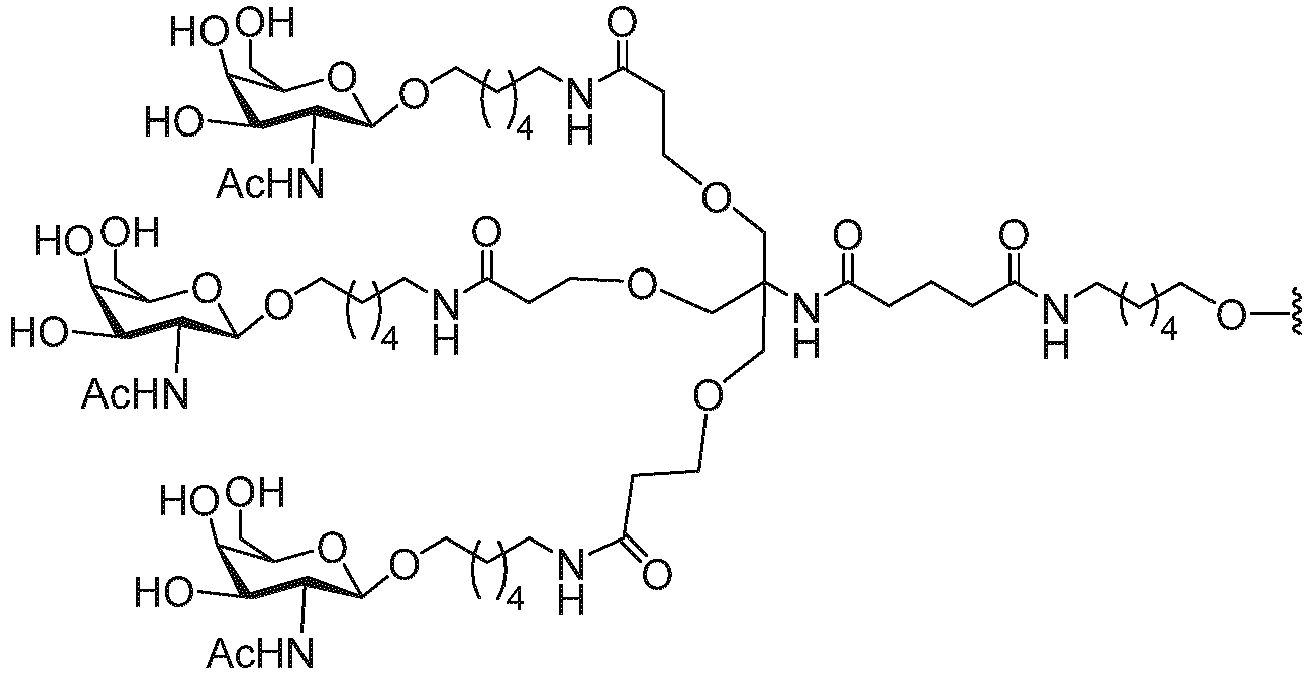
- Verbindung nach Anspruch 1, wobei:(i) das modifizierte Oligonukleotid mindestens einen modifizierten Zucker umfasst, gegebenenfalls wobei: (a) mindestens ein modifizierter Zucker ein bicyclischer Zucker, gegebenenfalls ein Constrained Ethyl oder ein Zucker mit einer 4'-(CH2)n-O-2'-Brücke, wobei n für 1 oder 2 steht, ist, oder (b) mindestens ein modifizierter Zucker ein 2'-O-Methoxyethyl umfasst oder eine 3'-Fluor-HNA ist,(ii) mindestens ein Nukleosid eine modifizierte Nukleobase umfasst, gegebenenfalls wobei es sich bei der modifizierten Nukleobase um ein 5-Methylcytosin handelt, und/oder(iii) jede Internukleosidverknüpfung des modifizierten Oligonukleotids aus einer Phosphodiester-Internukleosidverknüpfung und einer Phosphorothionat-Internukleosidverknüpfung ausgewählt ist, gegebenenfalls wobei das modifizierte Oligonukleotid (a) mindestens 5 Phosphodiester-Internukleosidverknüpfungen oder (b) mindestens 2 Phosphorothionat-Internukleosidverknüpfungen umfasst.
- Verbindung nach Anspruch 1 oder Anspruch 2, wobei das modifizierte Oligonukleotid einsträngig ist.
- Verbindung nach einem der Ansprüche 1-3, wobei die Konjugatgruppe am 5'-Ende des modifizierten Oligonukleotids mit dem modifizierten Oligonukleotid verknüpft ist.
- Verbindung nach einem der Ansprüche 1-3, wobei die Konjugatgruppe am 3'-Ende des modifizierten Oligonukleotids mit dem modifizierten Oligonukleotid verknüpft ist.
- Verbindung nach einem der Ansprüche 1-5, wobei die Konjugatgruppe Folgendes umfasst:

- Verbindung nach einem der Ansprüche 1-6, wobei die Konjugatgruppe Folgendes umfasst:

- Verbindung nach Anspruch 1, wobei das modifizierte Oligonukleotid Folgendes umfasst:ein aus verknüpften Desoxynukleosiden bestehendes Gap-Segment;ein aus verknüpften Nukleosiden bestehendes 5'-Wing-Segment;ein aus verknüpften Nukleosiden bestehendes 3'-Wing-Segment;wobei das Gap-Segment zwischen dem 5'-Wing-Segment und dem 3'-Wing-Segment angeordnet ist und wobei jedes Nukleosid jedes Wing-Segments einen modifizierten Zucker umfasst.
- Verbindung nach Anspruch 1, wobei das modifizierte Oligonukleotid Folgendes umfasst:ein aus zehn verknüpften Desoxynukleosiden bestehendes Gap-Segment;ein aus fünf verknüpften Nukleosiden bestehendes 5'-Wing-Segment;ein aus fünf verknüpften Nukleosiden bestehendes 3'-Wing-Segment;wobei das Gap-Segment zwischen dem 5'-Wing-Segment und dem 3'-Wing-Segment angeordnet ist, wobei jedes Nukleosid jedes Wing-Segments einen 2'-0-Methoxyethyl-Zucker umfasst und wobei es sich bei jedem Cytosinrest um ein 5-Methylcytosin handelt.
- Verbindung nach Anspruch 1, wobei das modifizierte Oligonukleotid aus 20 verknüpften Nukleosiden besteht und die Nukleobasen-Sequenz gemäß SEQ ID NO: 58 aufweist und wobei das modifizierte Oligonukleotid Folgendes umfasst:ein aus zehn verknüpften Desoxynukleosiden bestehendes Gap-Segment;ein aus fünf verknüpften Nukleosiden bestehendes 5'-Wing-Segment;ein aus fünf verknüpften Nukleosiden bestehendes 3'-Wing-Segment;wobei das Gap-Segment zwischen dem 5'-Wing-Segment und dem 3'-Wing-Segment angeordnet ist, wobei jedes Nukleosid jedes Wing-Segments einen 2'-0-Methoxyethyl-Zucker umfasst, wobei es sich bei mindestens einer Internukleosidverknüpfung um eine Phosphorothionat-Verknüpfung handelt und wobei es sich bei jedem Cytosinrest um ein 5-Methylcytosin handelt.
- Verbindung nach Anspruch 1 mit der Formel:
 wobei entweder R1 für -OCH2CH2OCH3 (MOE) steht und R2 für H steht oder R1 und R2 zusammen eine Brücke bilden, wobei R1 für -O- steht und R2 für -CH2-,-CH(CH3)- oder -CH2CH2- steht und R1 und R2 direkt verbunden sind, so dass die resultierende Brücke aus -O-CH2-, -O-CH(CH3)- und -O-CH2CH2- ausgewählt ist;und für jedes Paar von R3 und R4 an demselben Ring unabhängig für jeden Ring entweder R3 aus H und-OCH2CH2OCH3 ausgewählt ist und R4 für H steht oder R3 und R4 zusammen eine Brücke bilden, wobei R3 für -O- steht und R4 für -CH2-, -CH(CH3)- oder -CH2CH2-steht und R3 und R4 direkt verbunden sind, so dass die resultierende Brücke aus -O-CH2-, -O-CH(CH3)- und -O-CH2CH2- ausgewählt ist;und R5 aus H und -CH3 ausgewählt ist und Z aus S- und O- ausgewählt ist.
 - Verbindung nach Anspruch 1 mit der Formel:

- Verbindung nach einem der vorhergehenden Ansprüche, wobei die Verbindung in einer Salzform vorliegt, gegebenenfalls wobei die Verbindung in Form eines Natriumsalzes und/oder Kaliumsalzes vorliegt.
- Pharmazeutische Zusammensetzung, umfassend eine Verbindung nach einem der Ansprüche 1-13 und ein pharmazeutisch unbedenkliches Verdünnungsmittel oder einen pharmazeutisch unbedenklichen Träger.
- Verbindung nach einem der Ansprüche 1-13 oder Zusammensetzung nach Anspruch 14 zur Verwendung bei der Behandlung, Prävention oder Verlangsamung des Fortschreitens einer Erkrankung, die mit erhöhtem apo(a) und/oder erhöhtem Lp(a) zusammenhängt.
- Verbindung oder Zusammensetzung zur Verwendung nach Anspruch 15, wobei es sich bei der Erkrankung um eine Entzündungs-, Herz-Kreislauf- oder Stoffwechselerkrankung oder -störung oder ein Entzündungs-, Herz-Kreislauf- oder Stoffwechselleiden handelt.
- Verbindung oder Zusammensetzung zur Verwendung nach Anspruch 15, wobei es sich bei der Erkrankung um Aortenstenose oder Angina handelt.
Priority Applications (4)
| Application Number | Priority Date | Filing Date | Title |
|---|---|---|---|
| HRP20201378TT HRP20201378T1 (hr) | 2013-05-01 | 2014-05-01 | Pripravci i postupci za modulaciju ekspresije apolipoproteina (a) |
| RS20201052A RS60796B1 (sr) | 2013-05-01 | 2014-05-01 | Kompozicije i postupci za modulaciju ekspresije apolipoproteina (a) |
| PL14791187T PL2992009T3 (pl) | 2013-05-01 | 2014-05-01 | Kompozycje i sposoby modulowania ekspresji apolipoproteiny(a) |
| SI201431660T SI2992009T1 (sl) | 2013-05-01 | 2014-05-01 | Sestavki in postopki za moduliranje izražanja apolipoproteina (A) |
Applications Claiming Priority (8)
| Application Number | Priority Date | Filing Date | Title |
|---|---|---|---|
| US201361818442P | 2013-05-01 | 2013-05-01 | |
| US201361823826P | 2013-05-15 | 2013-05-15 | |
| US201361843887P | 2013-07-08 | 2013-07-08 | |
| US201361871673P | 2013-08-29 | 2013-08-29 | |
| US201361880790P | 2013-09-20 | 2013-09-20 | |
| US201461976991P | 2014-04-08 | 2014-04-08 | |
| US201461986867P | 2014-04-30 | 2014-04-30 | |
| PCT/US2014/036460 WO2014179625A1 (en) | 2013-05-01 | 2014-05-01 | COMPOSITIONS AND METHODS FOR MODULATING APOLIPOPROTEIN (a) EXPRESSION |
Publications (3)
| Publication Number | Publication Date |
|---|---|
| EP2992009A1 EP2992009A1 (de) | 2016-03-09 |
| EP2992009A4 EP2992009A4 (de) | 2016-12-28 |
| EP2992009B1 true EP2992009B1 (de) | 2020-06-24 |
Family
ID=51843959
Family Applications (14)
| Application Number | Title | Priority Date | Filing Date |
|---|---|---|---|
| EP25155370.7A Pending EP4529927A3 (de) | 2013-05-01 | 2014-05-01 | Zusammensetzungen und verfahren zur modulation der hbv- und ttr-expression |
| EP14791187.9A Active EP2992009B1 (de) | 2013-05-01 | 2014-05-01 | Zusammensetzungen und verfahren zur modulation der apolipoprotein(a)-expression |
| EP14791344.6A Active EP2992098B1 (de) | 2013-05-01 | 2014-05-01 | Zusammensetzungen und verfahren zur modulierung der hbv- und ttr-expression |
| EP19217148.6A Pending EP3690049A1 (de) | 2013-05-01 | 2014-05-01 | Zusammensetzungen und verfahren zur modulation der apolipoprotein-c-iii-expression |
| EP19206748.6A Withdrawn EP3633039A1 (de) | 2013-05-01 | 2014-05-01 | Zusammensetzungen und verfahren |
| EP19160031.1A Pending EP3546579A1 (de) | 2013-05-01 | 2014-05-01 | Konjugierte antisense-verbindungen und deren verwendung |
| EP26152957.2A Pending EP4711459A2 (de) | 2013-05-01 | 2014-05-01 | Konjugierte antisense-verbindungen und deren verwendung |
| EP14791557.3A Active EP2991656B1 (de) | 2013-05-01 | 2014-05-01 | Zusammensetzungen und verfahren zur modulation der apolipoprotein-c-iii-expression |
| EP24189241.3A Pending EP4438129A3 (de) | 2013-05-01 | 2014-05-01 | Zusammensetzungen und verfahren zur modulation der apolipoprotein-c-iii-expression |
| EP20205948.1A Pending EP3828275A1 (de) | 2013-05-01 | 2014-05-01 | Zusammensetzungen und verfahren zur modulation der ttr-expression |
| EP14791863.5A Active EP2992097B1 (de) | 2013-05-01 | 2014-05-01 | Zusammensetzungen und verfahren |
| EP14792010.2A Active EP2991661B1 (de) | 2013-05-01 | 2014-05-01 | Konjugierte antisense-verbindungen und deren verwendung |
| EP19164959.9A Active EP3524680B1 (de) | 2013-05-01 | 2014-05-01 | Zusammensetzungen und verfahren zur modulierung der ttr-expression |
| EP22181753.9A Pending EP4155403A1 (de) | 2013-05-01 | 2014-05-01 | Konjugierte antisense-verbindungen und deren verwendung |
Family Applications Before (1)
| Application Number | Title | Priority Date | Filing Date |
|---|---|---|---|
| EP25155370.7A Pending EP4529927A3 (de) | 2013-05-01 | 2014-05-01 | Zusammensetzungen und verfahren zur modulation der hbv- und ttr-expression |
Family Applications After (12)
| Application Number | Title | Priority Date | Filing Date |
|---|---|---|---|
| EP14791344.6A Active EP2992098B1 (de) | 2013-05-01 | 2014-05-01 | Zusammensetzungen und verfahren zur modulierung der hbv- und ttr-expression |
| EP19217148.6A Pending EP3690049A1 (de) | 2013-05-01 | 2014-05-01 | Zusammensetzungen und verfahren zur modulation der apolipoprotein-c-iii-expression |
| EP19206748.6A Withdrawn EP3633039A1 (de) | 2013-05-01 | 2014-05-01 | Zusammensetzungen und verfahren |
| EP19160031.1A Pending EP3546579A1 (de) | 2013-05-01 | 2014-05-01 | Konjugierte antisense-verbindungen und deren verwendung |
| EP26152957.2A Pending EP4711459A2 (de) | 2013-05-01 | 2014-05-01 | Konjugierte antisense-verbindungen und deren verwendung |
| EP14791557.3A Active EP2991656B1 (de) | 2013-05-01 | 2014-05-01 | Zusammensetzungen und verfahren zur modulation der apolipoprotein-c-iii-expression |
| EP24189241.3A Pending EP4438129A3 (de) | 2013-05-01 | 2014-05-01 | Zusammensetzungen und verfahren zur modulation der apolipoprotein-c-iii-expression |
| EP20205948.1A Pending EP3828275A1 (de) | 2013-05-01 | 2014-05-01 | Zusammensetzungen und verfahren zur modulation der ttr-expression |
| EP14791863.5A Active EP2992097B1 (de) | 2013-05-01 | 2014-05-01 | Zusammensetzungen und verfahren |
| EP14792010.2A Active EP2991661B1 (de) | 2013-05-01 | 2014-05-01 | Konjugierte antisense-verbindungen und deren verwendung |
| EP19164959.9A Active EP3524680B1 (de) | 2013-05-01 | 2014-05-01 | Zusammensetzungen und verfahren zur modulierung der ttr-expression |
| EP22181753.9A Pending EP4155403A1 (de) | 2013-05-01 | 2014-05-01 | Konjugierte antisense-verbindungen und deren verwendung |
Country Status (40)
| Country | Link |
|---|---|
| US (28) | US9127276B2 (de) |
| EP (14) | EP4529927A3 (de) |
| JP (23) | JP6769866B2 (de) |
| KR (17) | KR20230006933A (de) |
| CN (13) | CN105378085B (de) |
| AU (21) | AU2014259750B2 (de) |
| BR (6) | BR112015027321A8 (de) |
| CA (5) | CA2921514C (de) |
| CL (2) | CL2015003217A1 (de) |
| CR (2) | CR20190269A (de) |
| CY (2) | CY1121879T1 (de) |
| DK (4) | DK2992098T3 (de) |
| DO (3) | DOP2015000268A (de) |
| EA (2) | EA031393B1 (de) |
| ES (4) | ES2730015T3 (de) |
| FI (2) | FIC20250028I1 (de) |
| FR (2) | FR25C1033I1 (de) |
| HR (2) | HRP20190987T1 (de) |
| HU (2) | HUE043697T2 (de) |
| IL (19) | IL296543B2 (de) |
| LT (2) | LT2992098T (de) |
| MA (1) | MA60161B1 (de) |
| ME (1) | ME03390B (de) |
| MX (12) | MX381034B (de) |
| MY (2) | MY178929A (de) |
| NL (1) | NL301341I2 (de) |
| NO (2) | NO2025037I1 (de) |
| NZ (5) | NZ753018A (de) |
| PE (2) | PE20152002A1 (de) |
| PH (3) | PH12015502493B1 (de) |
| PL (2) | PL2992009T3 (de) |
| PT (3) | PT2992009T (de) |
| RS (2) | RS60796B1 (de) |
| RU (8) | RU2699985C2 (de) |
| SG (5) | SG11201508870VA (de) |
| SI (2) | SI2992009T1 (de) |
| SM (1) | SMT201900316T1 (de) |
| UA (2) | UA120287C2 (de) |
| WO (5) | WO2014179625A1 (de) |
| ZA (2) | ZA201507218B (de) |
Families Citing this family (523)
| Publication number | Priority date | Publication date | Assignee | Title |
|---|---|---|---|---|
| HRP20171969T1 (hr) | 2008-10-15 | 2018-04-06 | Ionis Pharmaceuticals, Inc. | Modulacija ekspresije faktora 11 |
| US9394333B2 (en) | 2008-12-02 | 2016-07-19 | Wave Life Sciences Japan | Method for the synthesis of phosphorus atom modified nucleic acids |
| MX342945B (es) | 2009-07-06 | 2016-10-18 | Ontorii Inc * | Profármacos de ácido nucleico novedosos y métodos de uso de los mismos. |
| DK2620428T3 (da) | 2010-09-24 | 2019-07-01 | Wave Life Sciences Ltd | Asymmetrisk hjælpegruppe |
| WO2012068405A2 (en) | 2010-11-17 | 2012-05-24 | Isis Pharmaceuticals, Inc. | Modulation of alpha synuclein expression |
| US9605019B2 (en) | 2011-07-19 | 2017-03-28 | Wave Life Sciences Ltd. | Methods for the synthesis of functionalized nucleic acids |
| US10023861B2 (en) * | 2011-08-29 | 2018-07-17 | Ionis Pharmaceuticals, Inc. | Oligomer-conjugate complexes and their use |
| US10273474B2 (en) | 2012-03-30 | 2019-04-30 | Washington University | Methods for modulating Tau expression for reducing seizure and modifying a neurodegenerative syndrome |
| WO2013159108A2 (en) * | 2012-04-20 | 2013-10-24 | Isis Pharmaceuticals, Inc. | Oligomeric compounds comprising bicyclic nucleotides and uses thereof |
| WO2013177468A2 (en) * | 2012-05-24 | 2013-11-28 | Isis Pharmaceuticals, Inc. | Methods and compositions for modulating apolipoprotein(a) expression |
| WO2013173789A2 (en) | 2012-05-17 | 2013-11-21 | Isis Pharmaceuticals, Inc. | Antisense oligonucleotide compositions |
| US9574193B2 (en) | 2012-05-17 | 2017-02-21 | Ionis Pharmaceuticals, Inc. | Methods and compositions for modulating apolipoprotein (a) expression |
| KR20240148947A (ko) | 2012-07-13 | 2024-10-11 | 웨이브 라이프 사이언시스 리미티드 | 키랄 제어 |
| SG11201500239VA (en) | 2012-07-13 | 2015-03-30 | Wave Life Sciences Japan | Asymmetric auxiliary group |
| SG11201500243WA (en) | 2012-07-13 | 2015-04-29 | Shin Nippon Biomedical Lab Ltd | Chiral nucleic acid adjuvant |
| JP6452614B2 (ja) * | 2012-11-15 | 2019-01-16 | ロシュ イノベーション センター コペンハーゲン エーエス | オリゴヌクレオチドコンジュゲート |
| DK2951305T3 (en) * | 2013-01-30 | 2018-10-29 | Hoffmann La Roche | LNA oligonucleotide KULHYDRATKONJUGATER |
| KR20200123263A (ko) * | 2013-02-14 | 2020-10-28 | 아이오니스 파마수티컬즈, 인코포레이티드 | 지질단백질 리파제 결핍 (lpld) 모집단에서 아포지질단백질 c-iii (apociii) 발현의 조절 |
| PE20152002A1 (es) | 2013-05-01 | 2016-01-21 | Isis Pharmaceuticals Inc | Composiciones y metodos para modular la expresion de ttr y vhb |
| SG11201508925WA (en) | 2013-05-01 | 2015-11-27 | Regulus Therapeutics Inc | Microrna compounds and methods for modulating mir-122 |
| JP6649248B2 (ja) | 2013-05-01 | 2020-02-19 | レグルス セラピューティクス インコーポレイテッド | 細胞取り込みの向上のための化合物および方法 |
| SG10201908122XA (en) * | 2013-06-27 | 2019-10-30 | Roche Innovation Ct Copenhagen As | Antisense oligomers and conjugates targeting pcsk9 |
| EP3019200B1 (de) * | 2013-07-11 | 2022-03-23 | Alnylam Pharmaceuticals, Inc. | Oligonukleotid-ligandkonjugate und verfahren zu deren herstellung |
| JP6617702B2 (ja) | 2013-07-15 | 2019-12-11 | ザ リージェンツ オブ ザ ユニバーシティ オブ カリフォルニア | Fty720のアザサイクリック拘束アナログ |
| TWI772856B (zh) | 2013-07-19 | 2022-08-01 | 美商百健Ma公司 | 用於調節τ蛋白表現之組合物 |
| WO2015042447A1 (en) | 2013-09-20 | 2015-03-26 | Isis Pharmaceuticals, Inc. | Targeted therapeutic nucleosides and their use |
| TWI669393B (zh) * | 2013-10-02 | 2019-08-21 | 艾爾妮蘭製藥公司 | 抑制lect2基因表現之組合物及方法 |
| US11162096B2 (en) | 2013-10-14 | 2021-11-02 | Ionis Pharmaceuticals, Inc | Methods for modulating expression of C9ORF72 antisense transcript |
| US9994846B2 (en) | 2013-10-25 | 2018-06-12 | Regulus Therapeutics Inc. | MicroRNA compounds and methods for modulating miR-21 activity |
| HK1220724A1 (zh) * | 2013-11-14 | 2017-05-12 | 罗氏创新中心哥本哈根有限公司 | Apob反义缀合物化合物 |
| JP6482475B2 (ja) * | 2014-01-07 | 2019-03-13 | レナセラピューティクス株式会社 | アンチセンスオリゴヌクレオチド及び糖誘導体を含む二本鎖オリゴヌクレオチド |
| WO2015108047A1 (ja) | 2014-01-15 | 2015-07-23 | 株式会社新日本科学 | 免疫誘導活性を有するキラル核酸アジュバンド及び免疫誘導活性剤 |
| EP3095460A4 (de) | 2014-01-15 | 2017-08-23 | Shin Nippon Biomedical Laboratories, Ltd. | Chirales nukleinsäureadjuvans mit antiallergischer wirkung und antiallergikum |
| WO2015108048A1 (ja) | 2014-01-15 | 2015-07-23 | 株式会社新日本科学 | 抗腫瘍作用を有するキラル核酸アジュバンド及び抗腫瘍剤 |
| ES2917473T3 (es) | 2014-01-16 | 2022-07-08 | Wave Life Sciences Ltd | Diseño quiral |
| KR102592370B1 (ko) | 2014-02-11 | 2023-10-25 | 알닐람 파마슈티칼스 인코포레이티드 | 케토헥소키나제(KHK) iRNA 조성물 및 그의 사용 방법 |
| US10006027B2 (en) | 2014-03-19 | 2018-06-26 | Ionis Pharmaceuticals, Inc. | Methods for modulating Ataxin 2 expression |
| EP3119888B1 (de) | 2014-03-19 | 2021-07-28 | Ionis Pharmaceuticals, Inc. | Zusammensetzungen zur modulierung der ataxin-2-expression |
| SI3757214T1 (sl) | 2014-04-01 | 2022-08-31 | Biogen Ma Inc. | Sestave za moduliranje izražanja SOD-1 |
| ES2844593T3 (es) * | 2014-05-01 | 2021-07-22 | Ionis Pharmaceuticals Inc | Composiciones y procedimientos para modular la expresión de la angiopoyetina de tipo 3 |
| HUE052709T2 (hu) | 2014-05-01 | 2021-05-28 | Ionis Pharmaceuticals Inc | Módosított antiszensz oligonukleotidok konjugátumai és azok alkalmazása PKK expressziójának módosítására |
| EP3137115B1 (de) * | 2014-05-01 | 2020-10-14 | Ionis Pharmaceuticals, Inc. | Verfahren zur synthese von reaktiven konjugatclustern |
| ES2812099T3 (es) | 2014-05-01 | 2021-03-16 | Ionis Pharmaceuticals Inc | Composiciones y métodos para modular la expresión del receptor de la hormona del crecimiento |
| RS59182B1 (sr) * | 2014-05-01 | 2019-10-31 | Ionis Pharmaceuticals Inc | Kompozicije i postupci za modulaciju ekspresije faktora b komplementa |
| GB201408623D0 (en) * | 2014-05-15 | 2014-07-02 | Santaris Pharma As | Oligomers and oligomer conjugates |
| MX382901B (es) | 2014-05-22 | 2025-03-13 | Alnylam Pharmaceuticals Inc | Composiciones de angiotensinogeno (agt) arni y métodos de uso de las mismas. |
| GB201410693D0 (en) | 2014-06-16 | 2014-07-30 | Univ Southampton | Splicing modulation |
| BR112017001931A2 (pt) | 2014-08-07 | 2017-11-28 | Regulus Therapeutics Inc | direcionamento de micrornas para distúrbios metabólicos |
| US10436802B2 (en) | 2014-09-12 | 2019-10-08 | Biogen Ma Inc. | Methods for treating spinal muscular atrophy |
| AU2015327836B2 (en) | 2014-10-03 | 2021-07-01 | Cold Spring Harbor Laboratory | Targeted augmentation of nuclear gene output |
| CN106795200B (zh) | 2014-10-10 | 2020-06-19 | 豪夫迈·罗氏有限公司 | Galnac亚磷酰胺、其核酸缀合物及其用途 |
| EP3207138B1 (de) * | 2014-10-17 | 2020-07-15 | Alnylam Pharmaceuticals, Inc. | Gegen aminolävulinsäuresynthase-1 (alas1) gerichtete polynukleotidmittel und verwendungen davon |
| JOP20200092A1 (ar) | 2014-11-10 | 2017-06-16 | Alnylam Pharmaceuticals Inc | تركيبات iRNA لفيروس الكبد B (HBV) وطرق لاستخدامها |
| CN107250362B (zh) * | 2014-11-17 | 2021-10-22 | 阿尔尼拉姆医药品有限公司 | 载脂蛋白C3(APOC3)iRNA组合物及其使用方法 |
| US20170369872A1 (en) | 2014-12-18 | 2017-12-28 | Alnylam Pharmaceuticals, Inc. | Reversir tm compounds |
| US10793855B2 (en) | 2015-01-06 | 2020-10-06 | Ionis Pharmaceuticals, Inc. | Compositions for modulating expression of C9ORF72 antisense transcript |
| WO2016115490A1 (en) | 2015-01-16 | 2016-07-21 | Ionis Pharmaceuticals, Inc. | Compounds and methods for modulation of dux4 |
| JP2018510621A (ja) | 2015-02-13 | 2018-04-19 | アルナイラム ファーマシューティカルズ, インコーポレイテッドAlnylam Pharmaceuticals, Inc. | パタチン様ホスホリパーゼドメイン含有3(PNPLA3)iRNA組成物およびその使用方法 |
| US10731154B2 (en) | 2015-02-15 | 2020-08-04 | Arcturus Therapeutics, Inc. | Acyl-amino-LNA and/or hydrocarbyl-amino-LNA oligonucleotides |
| US11129844B2 (en) | 2015-03-03 | 2021-09-28 | Ionis Pharmaceuticals, Inc. | Compositions and methods for modulating MECP2 expression |
| WO2016161388A1 (en) | 2015-04-03 | 2016-10-06 | University Of Massachusetts | Fully stabilized asymmetric sirna |
| WO2016161429A1 (en) | 2015-04-03 | 2016-10-06 | Ionis Pharmaceuticals, Inc. | Compounds and methods for modulating tmprss6 expression |
| WO2016164746A1 (en) | 2015-04-08 | 2016-10-13 | Alnylam Pharmaceuticals, Inc. | Compositions and methods for inhibiting expression of the lect2 gene |
| WO2016167780A1 (en) | 2015-04-16 | 2016-10-20 | Ionis Pharmaceuticals, Inc. | Compositions for modulating expression of c9orf72 antisense transcript |
| WO2016172734A1 (en) | 2015-04-24 | 2016-10-27 | California Institute Of Technology | Reactivation of x chromosome genes |
| WO2016205323A1 (en) | 2015-06-18 | 2016-12-22 | Alnylam Pharmaceuticals, Inc. | Polynucleotde agents targeting hydroxyacid oxidase (glycolate oxidase, hao1) and methods of use thereof |
| WO2016209862A1 (en) | 2015-06-23 | 2016-12-29 | Alnylam Pharmaceuticals, Inc. | Glucokinase (gck) irna compositions and methods of use thereof |
| US11414657B2 (en) | 2015-06-29 | 2022-08-16 | Ionis Pharmaceuticals, Inc. | Modified CRISPR RNA and modified single CRISPR RNA and uses thereof |
| MY192997A (en) | 2015-07-10 | 2022-09-20 | Ionis Pharmaceuticals Inc | Modulators of diacyglycerol acyltransferase 2 (dgat2) |
| WO2017011286A1 (en) | 2015-07-10 | 2017-01-19 | Alnylam Pharmaceuticals, Inc. | Insulin-like growth factor binding protein, acid labile subunit (igfals) and insulin-like growth factor 1 (igf-1) irna compositions and methods of use thereof |
| US20180193471A1 (en) * | 2015-07-16 | 2018-07-12 | Kyowa Hakko Kirin Co., Ltd. | ß2GPI GENE EXPRESSION-SUPPRESSING NUCLEIC ACID CONJUGATE |
| CN108025089A (zh) | 2015-07-22 | 2018-05-11 | 波涛生命科学有限公司 | 寡核苷酸组合物及其方法 |
| CN107709342B (zh) | 2015-08-06 | 2021-09-03 | 豪夫迈·罗氏有限公司 | 制备乙酰半乳糖胺酸衍生物的方法 |
| CN105111119B (zh) * | 2015-08-14 | 2017-04-12 | 天津小新医药科技有限公司 | 一类卤代苯l‑薄荷醇类p2y12受体拮抗剂及其用途 |
| CN105111118B (zh) * | 2015-08-14 | 2017-04-12 | 天津小新医药科技有限公司 | L‑薄荷醇类p2y12受体拮抗剂、制备方法及其用途 |
| EP3334499A4 (de) | 2015-08-14 | 2019-04-17 | University of Massachusetts | Bioaktive konjugaten zur freisetzung von oligonukleotiden |
| DK3341479T3 (da) | 2015-08-24 | 2020-02-24 | Roche Innovation Ct Copenhagen As | LNA-G-Proces |
| SG10202007937SA (en) | 2015-09-02 | 2020-09-29 | Alnylam Pharmaceuticals Inc | PROGRAMMED CELL DEATH 1 LIGAND 1 (PD-L1) iRNA COMPOSITIONS AND METHODS OF USE THEREOF |
| CN108366990B (zh) | 2015-09-24 | 2021-09-03 | 加利福尼亚大学董事会 | 合成的鞘脂类分子、药物、它们的合成方法及治疗方法 |
| SG10201913209WA (en) | 2015-09-24 | 2020-02-27 | Ionis Pharmaceuticals Inc | Modulators of kras expression |
| US11116843B2 (en) | 2015-09-25 | 2021-09-14 | Ionis Pharmaceuticals, Inc. | Conjugated antisense compounds and their use |
| US10533175B2 (en) | 2015-09-25 | 2020-01-14 | Ionis Pharmaceuticals, Inc. | Compositions and methods for modulating Ataxin 3 expression |
| US20180273948A1 (en) * | 2015-09-25 | 2018-09-27 | Tarveda Therapeutics, Inc. | RNAi CONJUGATES, PARTICLES AND FORMULATIONS THEREOF |
| US20210052631A1 (en) * | 2015-09-25 | 2021-02-25 | Ionis Pharmaceuticals, Inc. | Conjugated antisense compounds and their use |
| JOP20210043A1 (ar) * | 2015-10-01 | 2017-06-16 | Arrowhead Pharmaceuticals Inc | تراكيب وأساليب لتثبيط تعبير جيني للـ lpa |
| EP3355932B1 (de) | 2015-10-02 | 2023-04-12 | Roche Innovation Center Copenhagen A/S | Oligonukleotid-konjugationsverfahren |
| JP2018530325A (ja) | 2015-10-08 | 2018-10-18 | アイオーニス ファーマシューティカルズ, インコーポレーテッドIonis Pharmaceuticals,Inc. | アンジオテンシノーゲンの発現を調節するための化合物及び方法 |
| CN108603230A (zh) | 2015-10-09 | 2018-09-28 | 南安普敦大学 | 基因表达的调节与蛋白质表达失调的筛选 |
| WO2017067970A1 (en) | 2015-10-22 | 2017-04-27 | Roche Innovation Center Copenhagen A/S | In vitro toxicity screening assay |
| WO2017068087A1 (en) | 2015-10-22 | 2017-04-27 | Roche Innovation Center Copenhagen A/S | Oligonucleotide detection method |
| KR20250078597A (ko) | 2015-11-06 | 2025-06-02 | 아이오니스 파마수티컬즈, 인코포레이티드 | 아포리포프로테인 (a) 발현 조정 |
| HRP20241087T1 (hr) | 2015-11-06 | 2024-11-08 | Ionis Pharmaceuticals, Inc. | Konjugirani protusmisleni spojevi za upotrebu u terapiji |
| AR106683A1 (es) * | 2015-11-16 | 2018-02-07 | Hoffmann La Roche | FOSFORAMIDITA DE AGRUPACIÓN DE GalNAc |
| WO2017096395A1 (en) | 2015-12-04 | 2017-06-08 | Ionis Pharmaceuticals, Inc. | Methods of treating breast cancer |
| US11096956B2 (en) | 2015-12-14 | 2021-08-24 | Stoke Therapeutics, Inc. | Antisense oligomers and uses thereof |
| EP3390636B1 (de) | 2015-12-14 | 2021-05-19 | Cold Spring Harbor Laboratory | Antisense-oligomere zur behandlung von dravet-syndrom |
| WO2017117496A1 (en) | 2015-12-31 | 2017-07-06 | Ionis Pharmaceuticals, Inc. | Methods for reducing ataxin-2 expression |
| AU2017205462A1 (en) | 2016-01-05 | 2018-06-07 | Ionis Pharmaceuticals, Inc. | Methods for reducing LRRK2 expression |
| EP3402900A1 (de) | 2016-01-12 | 2018-11-21 | Interleukin Genetics, Inc. | Verfahren zur vorhersage der reaktion auf eine therapie |
| MX2018009090A (es) | 2016-01-26 | 2019-03-28 | Nissan Chemical Corp | Oligonucleótido de cadena simple. |
| WO2017131236A1 (ja) * | 2016-01-29 | 2017-08-03 | 協和発酵キリン株式会社 | 核酸複合体 |
| US10478503B2 (en) * | 2016-01-31 | 2019-11-19 | University Of Massachusetts | Branched oligonucleotides |
| MX2018009854A (es) | 2016-03-07 | 2018-11-09 | Arrowhead Pharmaceuticals Inc | Ligandos dirigidos para compuestos terapeuticos. |
| CA3013797A1 (en) | 2016-03-09 | 2017-09-14 | Ionis Pharmaceuticals, Inc. | Methods and compositions for inhibiting pmp22 expression |
| TWI840950B (zh) | 2016-03-14 | 2024-05-01 | 瑞士商赫孚孟拉羅股份公司 | 用於降低pd-l1表現之寡核苷酸 |
| US10961271B2 (en) | 2016-03-16 | 2021-03-30 | Ionis Pharmaceuticals, Inc. | Methods of modulating KEAP1 |
| WO2017161168A1 (en) | 2016-03-16 | 2017-09-21 | Ionis Pharmaceuticals, Inc. | Modulation of dyrk1b expression |
| EP3228326A1 (de) | 2016-04-05 | 2017-10-11 | Silence Therapeutics GmbH | Nucleinsäure verbunden mit einem dreiwertigen glykokonjugat |
| MA45478A (fr) * | 2016-04-11 | 2019-02-20 | Arbutus Biopharma Corp | Compositions de conjugués d'acides nucléiques ciblés |
| US20190142856A1 (en) | 2016-04-13 | 2019-05-16 | Ionis Pharmaceuticals, Inc. | Methods for reducing c9orf72 expression |
| CN109153697A (zh) | 2016-04-14 | 2019-01-04 | 豪夫迈·罗氏有限公司 | 三苯甲基-单-GalNAc化合物及其用途 |
| MA45295A (fr) | 2016-04-19 | 2019-02-27 | Alnylam Pharmaceuticals Inc | Composition d'arni de protéine de liaison de lipoprotéines haute densité (hdlbp/vigiline) et procédés pour les utiliser |
| US11390867B2 (en) | 2016-04-29 | 2022-07-19 | Nanyang Technological University | G-quadruplex-containing antisense oligonucleotides |
| CN109477108A (zh) | 2016-05-04 | 2019-03-15 | 波涛生命科学有限公司 | 寡核苷酸组合物和其方法 |
| IL299516A (en) | 2016-05-06 | 2023-02-01 | Astrazeneca Ab | Oligonucleotides conjugated to the GLP-1 receptor ligand complex and their uses |
| US11479818B2 (en) | 2016-06-17 | 2022-10-25 | Hoffmann-La Roche Inc. | In vitro nephrotoxicity screening assay |
| EP3472346B1 (de) | 2016-06-17 | 2023-01-18 | F. Hoffmann-La Roche AG | Papd5- und papd7-inhibitoren zur behandlung einer hepatitis-b-infektion |
| WO2017216340A1 (en) | 2016-06-17 | 2017-12-21 | F. Hoffmann-La Roche Ag | In vitro nephrotoxicity screening assay |
| CA3023514A1 (en) | 2016-06-17 | 2017-12-21 | Ionis Pharmaceuticals, Inc. | Modulation of gys1 expression |
| CN109477103A (zh) | 2016-06-22 | 2019-03-15 | ProQR治疗上市公司Ⅱ | 单链rna-编辑寡核苷酸 |
| WO2018004004A1 (ja) * | 2016-06-30 | 2018-01-04 | 協和発酵キリン株式会社 | 核酸複合体 |
| US11253601B2 (en) | 2016-07-11 | 2022-02-22 | Translate Bio Ma, Inc. | Nucleic acid conjugates and uses thereof |
| WO2018013999A1 (en) | 2016-07-15 | 2018-01-18 | Am Chemicals Llc | Non-nucleosidic solid supports and phosphoramidite building blocks for oligonucleotide synthesis |
| IL264216B2 (en) | 2016-07-15 | 2024-04-01 | Ionis Pharmaceuticals Inc | Compounds and methods for modulation of smn2 |
| WO2018031933A2 (en) | 2016-08-12 | 2018-02-15 | University Of Massachusetts | Conjugated oligonucleotides |
| EP3500581A4 (de) | 2016-08-17 | 2021-10-06 | Solstice Biologics, Ltd. | Polynukleotidkonstrukte |
| EP3507366B1 (de) | 2016-09-01 | 2020-10-07 | ProQR Therapeutics II B.V. | Chemisch modifizierte einzelsträngige rna editierende oligonukleotide |
| CN116832169A (zh) | 2016-09-02 | 2023-10-03 | 箭头药业股份有限公司 | 靶向配体 |
| WO2018057837A1 (en) * | 2016-09-23 | 2018-03-29 | Ionis Pharmaceuticals, Inc. | Gene therapy and targeted delivery of conjugated compounds |
| JOP20190065A1 (ar) | 2016-09-29 | 2019-03-28 | Ionis Pharmaceuticals Inc | مركبات وطرق لتقليل التعبير عن tau |
| KR20190065341A (ko) | 2016-10-06 | 2019-06-11 | 아이오니스 파마수티컬즈, 인코포레이티드 | 올리고머 화합물들의 접합 방법 |
| WO2018081661A1 (en) | 2016-10-27 | 2018-05-03 | California Institute Of Technology | Hdac inhibitor compositions for reactivation of the x chromosome |
| JOP20190104A1 (ar) | 2016-11-10 | 2019-05-07 | Ionis Pharmaceuticals Inc | مركبات وطرق لتقليل التعبير عن atxn3 |
| JP2019533472A (ja) * | 2016-11-11 | 2019-11-21 | ヤンセン バイオファーマ インク. | Hbv cccdnaのオリゴヌクレオチド標的化戦略 |
| TW202313978A (zh) | 2016-11-23 | 2023-04-01 | 美商阿尼拉製藥公司 | 絲胺酸蛋白酶抑制因子A1 iRNA組成物及其使用方法 |
| WO2018102397A1 (en) | 2016-11-29 | 2018-06-07 | PureTech Health LLC | Exosomes for delivery of therapeutic agents |
| WO2018102745A1 (en) | 2016-12-02 | 2018-06-07 | Cold Spring Harbor Laboratory | Modulation of lnc05 expression |
| EP3556402A4 (de) * | 2016-12-13 | 2020-08-05 | AM Sciences Inc | Pharmazeutische zusammensetzung zur prävention oder behandlung von hepatitis b |
| SG10201913552UA (en) | 2016-12-16 | 2020-03-30 | Alnylam Pharmaceuticals Inc | Methods for treating or preventing ttr-associated diseases using transthyretin (ttr) irna compositions |
| CN108239644B (zh) * | 2016-12-23 | 2021-05-28 | 苏州瑞博生物技术股份有限公司 | 一种小干扰核酸和药物组合物及其用途 |
| US10329620B2 (en) | 2017-01-12 | 2019-06-25 | Cardioforecast Ltd. | Methods and kits for treating cardiovascular disease |
| WO2018130584A1 (en) | 2017-01-13 | 2018-07-19 | Roche Innovation Center Copenhagen A/S | Antisense oligonucleotides for modulating nfkb2 expression |
| US20190338286A1 (en) | 2017-01-13 | 2019-11-07 | Roche Innovation Center Copenhagen A/S | Antisense oligonucleotides for modulating rel expression |
| WO2018130585A1 (en) | 2017-01-13 | 2018-07-19 | Roche Innovation Center Copenhagen A/S | Antisense oligonucleotides for modulating relb expression |
| WO2018130583A1 (en) | 2017-01-13 | 2018-07-19 | Roche Innovation Center Copenhagen A/S | Antisense oligonucleotides for modulating nfkb1 expression |
| EP3568477A1 (de) | 2017-01-13 | 2019-11-20 | Roche Innovation Center Copenhagen A/S | Antisense-oligonukleotide zur modulierung der rela-expression |
| TWI830693B (zh) | 2017-02-06 | 2024-02-01 | 日商日產化學工業股份有限公司 | 單股寡核苷酸 |
| US11180756B2 (en) * | 2017-03-09 | 2021-11-23 | Ionis Pharmaceuticals | Morpholino modified oligomeric compounds |
| CN110536964A (zh) | 2017-03-10 | 2019-12-03 | 国立研究开发法人国立成育医疗研究中心 | 反义寡核苷酸和糖原贮积病Ia型预防或治疗用组合物 |
| JOP20190215A1 (ar) | 2017-03-24 | 2019-09-19 | Ionis Pharmaceuticals Inc | مُعدّلات التعبير الوراثي عن pcsk9 |
| RS63836B1 (sr) | 2017-04-05 | 2023-01-31 | Silence Therapeutics Gmbh | Proizvodi i sastavi |
| EP3385272A1 (de) | 2017-04-05 | 2018-10-10 | Silence Therapeutics GmbH | Weitere neuartige oligonukleotid-ligand-konjugate |
| MA52546A (fr) | 2017-04-11 | 2020-02-19 | Arbutus Biopharma Corp | Compositions ciblées |
| CN118384268A (zh) | 2017-04-18 | 2024-07-26 | 阿尔尼拉姆医药品有限公司 | 具有乙肝病毒(hbv)感染的受试者的治疗方法 |
| WO2018215049A1 (en) | 2017-05-23 | 2018-11-29 | F. Hoffmann-La Roche Ag | Process for galnac oligonucleotide conjugates |
| JP6952366B2 (ja) * | 2017-05-26 | 2021-10-20 | 国立研究開発法人国立循環器病研究センター | Pcsk9を標的としたアンチセンス核酸 |
| CN120330183A (zh) * | 2017-06-02 | 2025-07-18 | 波涛生命科学有限公司 | 寡核苷酸组合物及其使用方法 |
| WO2018223056A1 (en) * | 2017-06-02 | 2018-12-06 | Wave Life Sciences Ltd. | Oligonucleotide compositions and methods of use thereof |
| WO2018226788A1 (en) * | 2017-06-07 | 2018-12-13 | University Of Massachusetts | Anti-adam33 oligonucleotides and related methods |
| CN110799647A (zh) | 2017-06-23 | 2020-02-14 | 马萨诸塞大学 | 双尾自递送sirna及相关的方法 |
| EP3645546A4 (de) | 2017-06-30 | 2021-12-01 | Solstice Biologics, Ltd. | Chirale phosphoramidithilfsmittel und verfahren zu ihrer verwendung |
| JP7277432B2 (ja) | 2017-07-13 | 2023-05-19 | アルナイラム ファーマシューティカルズ, インコーポレイテッド | 乳酸脱水素酵素A(LDHA)iRNA組成物及びその使用方法 |
| AU2018307294B2 (en) | 2017-07-26 | 2025-04-17 | Nissan Chemical Corporation | Single-stranded oligonucleotide |
| TW201909925A (zh) * | 2017-08-02 | 2019-03-16 | 日商協和醱酵麒麟有限公司 | 核酸複合體 |
| TW201920668A (zh) * | 2017-08-02 | 2019-06-01 | 日商協和醱酵麒麟有限公司 | 核酸複合體 |
| WO2019030313A2 (en) | 2017-08-11 | 2019-02-14 | Roche Innovation Center Copenhagen A/S | OLIGONUCLEOTIDES FOR MODULATION OF UBE3C EXPRESSION |
| JP2020531450A (ja) | 2017-08-17 | 2020-11-05 | アルナイラム ファーマシューティカルズ, インコーポレイテッドAlnylam Pharmaceuticals, Inc. | 調整性reversir(商標)化合物 |
| EP3668984A4 (de) | 2017-08-18 | 2021-09-08 | Ionis Pharmaceuticals, Inc. | Modulation des notch-signalweges zur behandlung von atemwegserkrankungen |
| WO2019038228A1 (en) | 2017-08-22 | 2019-02-28 | Roche Innovation Center Copenhagen A/S | OLIGONUCLEOTIDES FOR MODULATION OF TOM1 EXPRESSION |
| EP3673080B1 (de) | 2017-08-25 | 2023-10-18 | Stoke Therapeutics, Inc. | Antisense-oligomere zur behandlung von leiden und krankheiten |
| WO2019051173A1 (en) | 2017-09-08 | 2019-03-14 | Ionis Pharmaceuticals, Inc. | MODULATORS OF SMAD7 EXPRESSION |
| CN111527207B (zh) | 2017-09-14 | 2024-04-26 | 詹森生物制药有限公司 | GalNAc衍生物 |
| MX2020003608A (es) | 2017-09-29 | 2020-09-25 | Intellia Therapeutics Inc | Composiciones y métodos para la edición del gen ttr y el tratamiento de la amiloidosis attr. |
| ES2962277T3 (es) | 2017-09-29 | 2024-03-18 | Regeneron Pharma | Roedores que comprenden un locus Ttr humanizado y métodos de uso |
| EP3694995A1 (de) | 2017-10-13 | 2020-08-19 | Roche Innovation Center Copenhagen A/S | Verfahren zur identifizierung verbesserter stereodefinierter phosphorothioat-oligonukleotid-varianten von antisense-oligonukleotiden unter verwendung von unterbibliotheken von teilweise stereodefinierten oligonukleotiden |
| TW202424191A (zh) | 2017-10-16 | 2024-06-16 | 瑞士商赫孚孟拉羅股份公司 | 用於降低PAPD5及PAPD7 mRNA以治療B型肝炎感染之核酸分子 |
| SG11202002940QA (en) | 2017-11-01 | 2020-04-29 | Alnylam Pharmaceuticals Inc | Complement component c3 irna compositions and methods of use thereof |
| TWI809004B (zh) | 2017-11-09 | 2023-07-21 | 美商Ionis製藥公司 | 用於降低snca表現之化合物及方法 |
| US20200385719A1 (en) | 2017-11-16 | 2020-12-10 | Alnylam Pharmaceuticals, Inc. | Kisspeptin 1 (kiss1) irna compositions and methods of use thereof |
| WO2019100039A1 (en) | 2017-11-20 | 2019-05-23 | Alnylam Pharmaceuticals, Inc. | Serum amyloid p component (apcs) irna compositions and methods of use thereof |
| US11414661B2 (en) | 2017-12-01 | 2022-08-16 | Suzhou Ribo Life Science Co., Ltd. | Nucleic acid, composition and conjugate containing nucleic acid, preparation method therefor and use thereof |
| WO2019105403A1 (zh) * | 2017-12-01 | 2019-06-06 | 苏州瑞博生物技术有限公司 | 一种核酸、含有该核酸的组合物与缀合物及制备方法和用途 |
| WO2019105404A1 (zh) * | 2017-12-01 | 2019-06-06 | 苏州瑞博生物技术有限公司 | 一种核酸、含有该核酸的组合物与缀合物及制备方法和用途 |
| JP7273417B2 (ja) | 2017-12-01 | 2023-05-15 | スーチョウ リボ ライフ サイエンス カンパニー、リミテッド | 核酸、当該核酸を含む組成物および複合体ならびに調製方法と使用 |
| WO2019105418A1 (zh) * | 2017-12-01 | 2019-06-06 | 苏州瑞博生物技术有限公司 | 双链寡核苷酸、含双链寡核苷酸的组合物与缀合物及制备方法和用途 |
| WO2019105419A1 (zh) * | 2017-12-01 | 2019-06-06 | 苏州瑞博生物技术有限公司 | 一种核酸、含有该核酸的组合物与缀合物及制备方法和用途 |
| KR20250107294A (ko) | 2017-12-01 | 2025-07-11 | 쑤저우 리보 라이프 사이언스 컴퍼니, 리미티드 | 핵산, 이를 포함하는 조성물과 컨쥬게이트, 및 그의 제조 방법과 용도 |
| CN111344408A (zh) | 2017-12-11 | 2020-06-26 | 哥本哈根罗氏创新中心 | 用于调控fndc3b表达的寡核苷酸 |
| WO2019115417A2 (en) | 2017-12-12 | 2019-06-20 | Roche Innovation Center Copenhagen A/S | Oligonucleotides for modulating rb1 expression |
| WO2019118916A1 (en) | 2017-12-14 | 2019-06-20 | Ionis Pharmaceuticals, Inc. | Conjugated antisense compounds and their use |
| BR112020012088A2 (pt) | 2017-12-18 | 2020-11-17 | Alnylam Pharmaceuticals, Inc. | composições de irna do grupo de elevada mobilidade box-1 (hmgb1) e métodos de uso dos mesmos |
| WO2019126641A2 (en) | 2017-12-21 | 2019-06-27 | Ionis Pharmaceuticals, Inc. | Modulation of frataxin expression |
| CN118980816A (zh) | 2017-12-21 | 2024-11-19 | 豪夫迈·罗氏有限公司 | Htra1 rna拮抗剂的伴随诊断 |
| KR20200104302A (ko) | 2017-12-22 | 2020-09-03 | 로슈 이노베이션 센터 코펜하겐 에이/에스 | 신규 티오포스포르아미다이트 |
| KR20200104347A (ko) | 2017-12-22 | 2020-09-03 | 로슈 이노베이션 센터 코펜하겐 에이/에스 | 포스포로디티오에이트 인터뉴클레오시드 연결을 포함하는 갭머 올리고뉴클레오티드 |
| US20200339982A1 (en) | 2017-12-22 | 2020-10-29 | Roche Innovation Center Copenhagen A/S | Oligonucleotides comprising a phosphorodithioate internucleoside linkage |
| CN109957566B (zh) * | 2017-12-26 | 2023-08-25 | 广州市锐博生物科技有限公司 | 修饰的寡核苷酸和可用于合成修饰的寡核苷酸的化合物 |
| JP7011080B2 (ja) * | 2017-12-26 | 2022-02-10 | クワンチョウ リボバイオ カンパニー リミテッド | 修飾オリゴヌクレオチドおよび修飾オリゴヌクレオチドの合成に使用可能な化合物 |
| DK3732185T3 (da) * | 2017-12-29 | 2025-03-31 | Suzhou Ribo Life Science Co Ltd | Konjugater og fremstilling og anvendelse heraf |
| WO2019137883A1 (en) | 2018-01-10 | 2019-07-18 | Roche Innovation Center Copenhagen A/S | Oligonucleotides for modulating pias4 expression |
| US12178855B2 (en) | 2018-01-10 | 2024-12-31 | Translate Bio Ma, Inc. | Compositions and methods for facilitating delivery of synthetic nucleic acids to cells |
| EA202091693A1 (ru) | 2018-01-12 | 2021-04-14 | Бристол-Маерс Сквибб Компани | Антисмысловые олигонуклеотиды, целенаправленно воздействующие на альфа-синуклеин, и их применения |
| MX2020007433A (es) | 2018-01-12 | 2020-09-14 | Bristol Myers Squibb Co | Oligonucleotidos antisentido que actuan sobre alfa-sinucleina, y usos de estos. |
| JP2021510295A (ja) | 2018-01-12 | 2021-04-22 | ロシュ イノベーション センター コペンハーゲン エーエス | Gsk3b発現を調節するためのオリゴヌクレオチド |
| KR20200109338A (ko) | 2018-01-12 | 2020-09-22 | 로슈 이노베이션 센터 코펜하겐 에이/에스 | 알파-시누클레인 안티센스 올리고뉴클레오티드 및 이의 용도 |
| MX2020007369A (es) | 2018-01-15 | 2020-10-28 | Ionis Pharmaceuticals Inc | Moduladores de la expresion de dnm2. |
| US20210095276A1 (en) | 2018-01-17 | 2021-04-01 | Roche Innovation Center Copenhagen A/S | Oligonucleotides for modulating erc1 expression |
| US20210095277A1 (en) | 2018-01-18 | 2021-04-01 | Roche Innovation Center Copenhagen A/S | Antisense oligonucleotides targeting srebp1 |
| WO2019145386A1 (en) | 2018-01-26 | 2019-08-01 | Roche Innovation Center Copenhagen A/S | Oligonucleotides for modulating csnk1d expression |
| AU2019218987B2 (en) | 2018-02-12 | 2025-04-24 | Ionis Pharmaceuticals, Inc. | Modified compounds and uses thereof |
| EP3752614A4 (de) | 2018-02-14 | 2021-11-10 | Deep Genomics Incorporated | Oligonukleotidtherapie für die wilson-krankheit |
| BR112020016347A2 (pt) | 2018-02-21 | 2021-01-12 | Bristol-Myers Squibb Company | Oligonucleotídeos antisense de camk2d e seus usos |
| EP3759127A4 (de) | 2018-03-02 | 2022-03-30 | Ionis Pharmaceuticals, Inc. | Verbindungen und verfahren zur modulation des amyloid-beta-vorläuferproteins |
| TWI840345B (zh) | 2018-03-02 | 2024-05-01 | 美商Ionis製藥公司 | Irf4表現之調節劑 |
| CN111511915A (zh) | 2018-03-09 | 2020-08-07 | 第一三共株式会社 | 糖原病Ia型治疗药 |
| US11661601B2 (en) | 2018-03-22 | 2023-05-30 | Ionis Pharmaceuticals, Inc. | Methods for modulating FMR1 expression |
| SG11202009680XA (en) | 2018-04-05 | 2020-10-29 | Hoffmann La Roche | Use of fubp1 inhibitors for treating hepatitis b virus infection |
| PE20201349A1 (es) | 2018-04-11 | 2020-11-30 | Ionis Pharmaceuticals Inc | Moduladores de la expresion de ezh2 |
| BR112020020670A2 (pt) | 2018-04-12 | 2021-03-02 | Wave Life Sciences Ltd. | composição de oligonucleotídeo, composição farmacêutica, método para alterar o splicing de uma transcrição alvo, método para tratar distrofia muscular, método para preparar um oligonucleotídeo ou uma composição de oligonucleotídeo do mesmo e oligonucleotídeo |
| EP3788065B1 (de) | 2018-04-30 | 2025-08-27 | The Children's Hospital Of Philadelphia | Verbesserung von anämien durch kombination von wirkstoffen |
| JP2021523227A (ja) | 2018-05-04 | 2021-09-02 | ストーク セラピューティクス,インク. | コレステリルエステル蓄積症の処置のための方法及び組成物 |
| US20210269851A1 (en) | 2018-05-07 | 2021-09-02 | Roche Innovation Center Copenhagen A/S | Massively parallel discovery methods for oligonucleotide therapeutics |
| JP7279081B2 (ja) | 2018-05-08 | 2023-05-22 | レグルス セラピューティクス インコーポレイテッド | Mir-122を調節するためのマイクロrna化合物及び方法 |
| WO2019217708A1 (en) | 2018-05-09 | 2019-11-14 | Ionis Pharmaceuticals, Inc. | Compounds and methods for reducing atxn3 expression |
| SG11202010012PA (en) | 2018-05-09 | 2020-11-27 | Ionis Pharmaceuticals Inc | Compounds and methods for reducing fxi expression |
| TWI844541B (zh) | 2018-05-11 | 2024-06-11 | 新加坡商波濤生命科學有限公司 | 寡核苷酸組成物及其使用方法 |
| TWI851574B (zh) | 2018-05-14 | 2024-08-11 | 美商阿尼拉製藥公司 | 血管收縮素原(AGT)iRNA組成物及其使用方法 |
| GB201808146D0 (en) | 2018-05-18 | 2018-07-11 | Proqr Therapeutics Ii Bv | Stereospecific Linkages in RNA Editing Oligonucleotides |
| AU2019287635B2 (en) | 2018-06-14 | 2026-02-12 | Ionis Pharmaceuticals, Inc. | Compounds and methods for increasing STMN2 expression |
| TWI833770B (zh) | 2018-06-27 | 2024-03-01 | 美商Ionis製藥公司 | 用於減少 lrrk2 表現之化合物及方法 |
| PE20220013A1 (es) | 2018-07-03 | 2022-01-11 | Hoffmann La Roche | Oligonucleotidos para modular la expresion de tau |
| WO2020007826A1 (en) | 2018-07-05 | 2020-01-09 | Roche Innovation Center Copenhagen A/S | Antisense oligonucleotides targeting mbtps1 |
| WO2020011745A2 (en) | 2018-07-11 | 2020-01-16 | Roche Innovation Center Copenhagen A/S | Antisense oligonucleotides targeting cers6 |
| WO2020011744A2 (en) | 2018-07-11 | 2020-01-16 | Roche Innovation Center Copenhagen A/S | Antisense oligonucleotides targeting cers5 |
| BR112021000538A2 (pt) | 2018-07-13 | 2021-04-06 | F. Hoffmann-La Roche Ag | Oligonucleotídeos para modular a expressão de rtel1 |
| WO2020018558A1 (en) | 2018-07-17 | 2020-01-23 | Aronora, Inc. | Methods for safely reducing thrombopoietin |
| CA3106986A1 (en) | 2018-07-25 | 2020-01-30 | Ionis Pharmaceuticals, Inc. | Compounds and methods for reducing atxn2 expression |
| AU2019313527A1 (en) | 2018-07-31 | 2021-02-11 | Roche Innovation Center Copenhagen A/S | Oligonucleotides comprising a phosphorotrithioate internucleoside linkage |
| MX2020013270A (es) | 2018-07-31 | 2021-02-18 | Roche Innovation Ct Copenhagen As | Oligonucleotidos que comprenden enlace internucleosidico de fosforotritioato. |
| US20210292768A1 (en) | 2018-08-08 | 2021-09-23 | Arcturus Therapeutics, Inc. | Compositions and agents against nonalcoholic steatohepatitis |
| AU2019316640B2 (en) | 2018-08-10 | 2026-03-12 | University Of Massachusetts | Modified oligonucleotides targeting SNPs |
| MX2021001056A (es) | 2018-08-13 | 2021-04-12 | Alnylam Pharmaceuticals Inc | Composiciones de agente de acido ribonucleico bicatenario (arnbc) de virus de la hepatitis b (vhb) y metodos de uso de las mismas. |
| EP3842534A4 (de) | 2018-08-21 | 2022-07-06 | Suzhou Ribo Life Science Co., Ltd. | Nukleinsäure, pharmazeutische zusammensetzung und konjugat mit der nukleinsäure sowie deren verwendung |
| EP3840759A4 (de) | 2018-08-23 | 2022-06-01 | University Of Massachusetts | O-methyl-reiche vollstabilisierte oligonukleotide |
| CN113728102A (zh) | 2018-08-28 | 2021-11-30 | 罗氏创新中心哥本哈根有限公司 | 使用剪接调节化合物进行新抗原工程化 |
| US20210332367A1 (en) | 2018-09-18 | 2021-10-28 | Alnylam Pharmaceuticals, Inc. | KETOHEXOKINASE (KHK) iRNA COMPOSITIONS AND METHODS OF USE THEREOF |
| TWI869213B (zh) | 2018-09-19 | 2025-01-01 | 美商Ionis製藥公司 | Pnpla3表現之調節劑 |
| WO2020063198A1 (zh) | 2018-09-30 | 2020-04-02 | 苏州瑞博生物技术有限公司 | 一种siRNA缀合物及其制备方法和用途 |
| CN113383076B (zh) * | 2018-10-18 | 2025-11-18 | 普罗吉尼斯私人有限公司 | 用于ptp1b相关病症的反义疗法 |
| US10913951B2 (en) | 2018-10-31 | 2021-02-09 | University of Pittsburgh—of the Commonwealth System of Higher Education | Silencing of HNF4A-P2 isoforms with siRNA to improve hepatocyte function in liver failure |
| CA3111382A1 (en) | 2018-11-09 | 2020-05-14 | Novartis Ag | Method for reducing the risk of a cardiovascular event with conjugated antisense compounds targeting apo(a) |
| TW202028222A (zh) | 2018-11-14 | 2020-08-01 | 美商Ionis製藥公司 | Foxp3表現之調節劑 |
| AU2019380940A1 (en) | 2018-11-15 | 2021-06-03 | Ionis Pharmaceuticals, Inc. | Modulators of IRF5 expression |
| EP3884053A4 (de) | 2018-11-21 | 2023-02-01 | Ionis Pharmaceuticals, Inc. | Verbindungen und verfahren zur verringerung der prionenexpression |
| CN113166760A (zh) | 2018-11-23 | 2021-07-23 | 赛诺菲 | 用于抑制angptl8的新型rna组合物和方法 |
| AU2019390097A1 (en) | 2018-11-30 | 2021-07-15 | Kyowa Kirin Co., Ltd. | Nucleic acid conjugate |
| EP3894559A4 (de) | 2018-12-03 | 2023-04-05 | Triplet Therapeutics, Inc. | Verfahren zur behandlung von störungen der trinukleotid-repeat-expansion im zusammenhang mit mlh3-aktivität |
| EP3898977A1 (de) | 2018-12-20 | 2021-10-27 | Praxis Precision Medicines, Inc. | Zusammensetzungen und verfahren zur behandlung von kcnt1-assoziierten erkrankungen |
| SG11202106378VA (en) | 2018-12-21 | 2021-07-29 | Ionis Pharmaceuticals Inc | Modulators of hsd17b13 expression |
| JP7507495B2 (ja) * | 2018-12-28 | 2024-06-28 | スーチョウ リボ ライフ サイエンス カンパニー、リミテッド | 核酸、当該核酸を含む組成物及び複合体ならびに調製方法と使用 |
| GB201821269D0 (en) | 2018-12-28 | 2019-02-13 | Nippon Shinyaku Co Ltd | Myostatin signal inhibitor |
| CN111377985B (zh) * | 2018-12-29 | 2023-11-10 | 苏州瑞博生物技术股份有限公司 | 化合物和缀合物及其制备方法和用途 |
| AU2020207935A1 (en) | 2019-01-18 | 2021-08-26 | University Of Massachusetts | Dynamic pharmacokinetic-modifying anchors |
| CN113330117B (zh) * | 2019-01-18 | 2024-05-28 | 苏州瑞博生物技术股份有限公司 | 一种核酸、含有该核酸的组合物与缀合物及制备方法和用途 |
| TW202214854A (zh) | 2019-01-31 | 2022-04-16 | 美商Ionis製藥公司 | Yap1表現之調節劑 |
| CN113490742A (zh) | 2019-02-20 | 2021-10-08 | 罗氏创新中心哥本哈根有限公司 | 膦酰基乙酸酯缺口聚物寡核苷酸 |
| BR112021016354A2 (pt) | 2019-02-20 | 2021-10-19 | Roche Innovation Center Copenhagen A/S | Composto, processo para a fabricação de um composto de fórmula, uso de um composto e invenção |
| CN109799330B (zh) * | 2019-02-22 | 2021-03-02 | 华中科技大学同济医学院附属同济医院 | 神经氨酸及神经氨酸酶抑制剂在慢性心力衰竭中的应用 |
| EP3931348B1 (de) | 2019-02-26 | 2023-08-09 | Roche Innovation Center Copenhagen A/S | Verfahren zur herstellung von oligonukleotiden |
| MX2021010152A (es) | 2019-02-27 | 2021-09-14 | Ionis Pharmaceuticals Inc | Moduladores de la expresion de malat1. |
| CN113748209A (zh) | 2019-02-27 | 2021-12-03 | 斯托克制药公司 | 用于治疗病况和疾病的反义寡聚体 |
| CA3128577A1 (en) * | 2019-02-28 | 2020-09-03 | Jovanka BOGOJESKI | Ligand clusters and methods of their use and preparation |
| JP2022527569A (ja) * | 2019-03-21 | 2022-06-02 | ミトセラピューティクス・エルエルシー | 治療剤の標的化送達のための多価リガンドクラスター |
| MD3947684T2 (ro) | 2019-03-29 | 2025-10-31 | Ionis Pharmaceuticals Inc | Compuși și metode pentru modularea UBE3A-ATS |
| US20220177894A1 (en) | 2019-04-02 | 2022-06-09 | Proqr Therapeutics Ii B.V. | Antisense oligonucleotides for immunotherapy |
| KR20210149107A (ko) | 2019-04-03 | 2021-12-08 | 브리스톨-마이어스 스큅 컴퍼니 | Angptl2 안티센스 올리고뉴클레오티드 및 그의 용도 |
| US20220251128A1 (en) * | 2019-05-17 | 2022-08-11 | Ionis Pharmaceuticals, Inc. | Synthesis of oligomeric compounds comprising phosphorothioate diester and phosphodiester linkages |
| CA3139195A1 (en) | 2019-05-22 | 2020-11-26 | Suzhou Ribo Life Science Co., Ltd. | Nucleic acid, pharmaceutical composition, conjugate, preparation method, and use |
| TWI863999B (zh) | 2019-05-22 | 2024-12-01 | 大陸商蘇州瑞博生物技術股份有限公司 | siRNA綴合物、其用途及使用其之方法 |
| EP3974530A4 (de) | 2019-05-22 | 2023-07-12 | Suzhou Ribo Life Science Co., Ltd. | Nukleinsäure, pharmazeutische zusammensetzung, konjugat, herstellungsverfahren und verwendung |
| WO2020233680A1 (zh) | 2019-05-22 | 2020-11-26 | 苏州瑞博生物技术股份有限公司 | 核酸、药物组合物与缀合物及制备方法和用途 |
| WO2020238763A1 (zh) | 2019-05-24 | 2020-12-03 | 苏州瑞博生物技术股份有限公司 | 核酸、药物组合物与缀合物及制备方法和用途 |
| JP7614650B2 (ja) | 2019-05-24 | 2025-01-16 | スーチョウ リボ ライフ サイエンス カンパニー、リミテッド | 核酸、薬物組成物及び複合体並びに調製方法と使用 |
| JP7610849B2 (ja) | 2019-05-24 | 2025-01-09 | スーチョウ リボ ライフ サイエンス カンパニー、リミテッド | 核酸、薬物組成物及び複合体ならびに調製方法と使用 |
| US20220243203A1 (en) | 2019-05-28 | 2022-08-04 | Ionis Pharmaceuticals, Inc. | Compounds and methods for reducing fus expression |
| US11466274B2 (en) | 2019-05-31 | 2022-10-11 | Aligos Therapeutics, Inc. | Modified gapmer oligonucleotides and methods of use |
| EP3801011A1 (de) | 2019-06-04 | 2021-04-14 | Regeneron Pharmaceuticals, Inc. | Nichtmenschliche tiere mit einem humanisierten ttr-locus mit einer beta-slip-mutation und verfahren zur verwendung |
| AU2020301419B2 (en) | 2019-06-25 | 2026-03-19 | Amgen Inc. | Purification methods for carbohydrate-linked oligonucleotides |
| EP4660307A2 (de) | 2019-07-26 | 2025-12-10 | Ionis Pharmaceuticals, Inc. | Verbindungen und verfahren zur gfap-modulation |
| WO2021022109A1 (en) | 2019-08-01 | 2021-02-04 | Alnylam Pharmaceuticals, Inc. | SERPIN FAMILY F MEMBER 2 (SERPINF2) iRNA COMPOSITIONS AND METHODS OF USE THEREOF |
| WO2021022108A2 (en) | 2019-08-01 | 2021-02-04 | Alnylam Pharmaceuticals, Inc. | CARBOXYPEPTIDASE B2 (CPB2) iRNA COMPOSITIONS AND METHODS OF USE THEREOF |
| KR20220047989A (ko) | 2019-08-09 | 2022-04-19 | 유니버시티 오브 매사추세츠 | Snp를 표적화하는 화학적으로 변형된 올리고뉴클레오타이드 |
| WO2021030522A1 (en) | 2019-08-13 | 2021-02-18 | Alnylam Pharmaceuticals, Inc. | SMALL RIBOSOMAL PROTEIN SUBUNIT 25 (RPS25) iRNA AGENT COMPOSITIONS AND METHODS OF USE THEREOF |
| WO2021030778A1 (en) * | 2019-08-15 | 2021-02-18 | Ionis Pharmaceuticals, Inc. | Linkage modified oligomeric compounds and uses thereof |
| US20220290156A1 (en) | 2019-08-27 | 2022-09-15 | Sanofi | Compositions and methods for inhibiting pcsk9 |
| US20230076803A1 (en) | 2019-08-29 | 2023-03-09 | Suzhou Ribo Life Science Co., Ltd. | Compound and drug conjugate, and preparation method and use thereof |
| WO2021041884A1 (en) | 2019-08-30 | 2021-03-04 | Alnylam Pharmaceuticals, Inc. | Neurofilament light chain (nfl) as a biomarker for transthyretin amyloidosis polyneuropathy |
| JP7672394B2 (ja) | 2019-09-03 | 2025-05-07 | アークトゥラス・セラピューティクス・インコーポレイテッド | 治療的に活性な複合体のアシアロ糖タンパク質受容体媒介送達 |
| CA3126070A1 (en) | 2019-09-03 | 2021-03-11 | Sovargen Co., Ltd. | Composition for diagnosing or treating conditions associated with increased elf4e activity comprising elf4e inhibitor |
| KR20220061972A (ko) * | 2019-09-10 | 2022-05-13 | 다이이찌 산쿄 가부시키가이샤 | 간장 송달용 GalNAc-올리고뉴클레오티드 콘주게이트 및 제조 방법 |
| US12365894B2 (en) | 2019-09-16 | 2025-07-22 | University Of Massachusetts | Branched lipid conjugates of siRNA for specific tissue delivery |
| EP4031140A1 (de) | 2019-09-20 | 2022-07-27 | F. Hoffmann-La Roche AG | Verfahren zur behandlung von hbv-infektionen unter verwendung eines allosterischen kernproteinmodulators |
| EP4038189A1 (de) | 2019-10-04 | 2022-08-10 | Alnylam Pharmaceuticals, Inc. | Zusammensetzungen und verfahren zum ausschalten einer ugt1a1-genexpression |
| JP7757277B2 (ja) | 2019-10-14 | 2025-10-21 | アストラゼネカ・アクチエボラーグ | Pnpla3発現のモジュレーター |
| US12486512B2 (en) | 2019-10-18 | 2025-12-02 | Alnylam Pharmaceuticals, Inc. | Solute carrier family member iRNA compositions and methods of use thereof |
| AU2020369515A1 (en) | 2019-10-22 | 2022-04-21 | Alnylam Pharmaceuticals, Inc. | Complement component C3 iRNA compositions and methods of use thereof |
| CN119499394A (zh) | 2019-11-01 | 2025-02-25 | 阿尔尼拉姆医药品有限公司 | 亨廷顿(HTT)iRNA药剂组合物及其使用方法 |
| TWI877247B (zh) | 2019-11-13 | 2025-03-21 | 美商阿尼拉製藥公司 | 用於治療血管收縮素原相關病症之方法及組成物 |
| WO2021102373A1 (en) | 2019-11-22 | 2021-05-27 | Alnylam Pharmaceuticals, Inc. | Ataxin3 (atxn3) rnai agent compositions and methods of use thereof |
| CN112876534B (zh) * | 2019-11-29 | 2024-02-09 | 苏州瑞博生物技术股份有限公司 | 肝靶向化合物及缀合物 |
| PH12022551394A1 (en) | 2019-12-13 | 2023-09-11 | Alnylam Pharmaceuticals Inc | Human chromosome 9 open reading frame 72 (c9orf72) irna agent compositions and methods of use thereof |
| TW202138559A (zh) | 2019-12-16 | 2021-10-16 | 美商阿尼拉製藥公司 | 含類PATATIN磷脂酶結構域3(PNPLA3)iRNA組成物及其使用方法 |
| CN111041025B (zh) | 2019-12-17 | 2021-06-18 | 深圳市瑞吉生物科技有限公司 | 基于结合N-乙酰半乳糖胺多肽的mRNA靶向分子及其制备方法 |
| CN114867856A (zh) | 2019-12-19 | 2022-08-05 | 豪夫迈·罗氏有限公司 | Saraf抑制剂用于治疗乙型肝炎病毒感染的用途 |
| JP7653997B2 (ja) | 2019-12-19 | 2025-03-31 | エフ. ホフマン-ラ ロシュ アーゲー | B型肝炎ウイルス感染を処置するためのcops3阻害剤の使用 |
| JP2023506540A (ja) | 2019-12-19 | 2023-02-16 | エフ. ホフマン-ラ ロシュ エージー. | B型肝炎ウイルス感染を処置するためのscamp3阻害剤の使用 |
| CN114829601A (zh) | 2019-12-19 | 2022-07-29 | 豪夫迈·罗氏有限公司 | Sbds抑制剂用于治疗乙型肝炎病毒感染的用途 |
| JP7634542B2 (ja) | 2019-12-19 | 2025-02-21 | エフ. ホフマン-ラ ロシュ アーゲー | B型肝炎ウイルス感染症を処置するためのsept9阻害剤の使用 |
| EP4081217A1 (de) | 2019-12-24 | 2022-11-02 | F. Hoffmann-La Roche AG | Pharmazeutische kombination von antivirusmitteln, die hbv und/oder einen immunmodulator zur behandlung von hbv steuern |
| AU2020415307A1 (en) | 2019-12-24 | 2022-06-09 | F. Hoffmann-La Roche Ag | Method of treating virus infection using a TLR7 agonist |
| EP4081639A1 (de) | 2019-12-24 | 2022-11-02 | F. Hoffmann-La Roche AG | Pharmazeutische kombination eines therapeutischen oligonucleotids gegen hbv und eines tlr7-agonisten zur behandlung von hbv |
| JP7681525B2 (ja) * | 2020-01-30 | 2025-05-22 | エーザイ・アール・アンド・ディー・マネジメント株式会社 | 核酸複合体及びそれを含む医薬組成物 |
| AU2021220765A1 (en) | 2020-02-10 | 2022-09-01 | Alnylam Pharmaceuticals, Inc. | Compositions and methods for silencing VEGF-A expression |
| JP7735288B2 (ja) | 2020-02-18 | 2025-09-08 | アルナイラム ファーマシューティカルズ, インコーポレイテッド | アポリポタンパク質C3(APOC3)iRNA組成物およびその使用法 |
| CN120505310A (zh) | 2020-02-28 | 2025-08-19 | Ionis制药公司 | 用于调节smn2的化合物和方法 |
| GB2613225B (en) | 2020-03-04 | 2024-01-03 | Verve Therapeutics Inc | Compositions and methods for targeted RNA delivery |
| EP4114947A1 (de) | 2020-03-05 | 2023-01-11 | Alnylam Pharmaceuticals, Inc. | Komplementkomponenten-c3-irna-zusammensetzungen und verfahren zur verwendung davon zur behandlung oder prävention von mit komplementkomponenten-c3-assoziierten erkrankungen |
| WO2021178736A1 (en) | 2020-03-06 | 2021-09-10 | Alnylam Pharmaceuticals, Inc. | KETOHEXOKINASE (KHK) iRNA COMPOSITIONS AND METHODS OF USE THEREOF |
| KR20220152270A (ko) | 2020-03-06 | 2022-11-15 | 알닐람 파마슈티칼스 인코포레이티드 | 트랜스티레틴 (ttr)의 발현을 억제하기 위한 조성물 및 방법 |
| WO2021188611A1 (en) | 2020-03-18 | 2021-09-23 | Alnylam Pharmaceuticals, Inc. | Compositions and methods for treating subjects having a heterozygous alanine-glyoxylate aminotransferase gene (agxt) variant |
| AU2021244329A1 (en) | 2020-03-23 | 2022-09-29 | Amgen Inc. | Monoclonal antibodies to chemically-modified nucleic acids and uses thereof |
| US20230113556A1 (en) * | 2020-03-26 | 2023-04-13 | National Cerebral And Cardiovascular Center | Antisense nucleic acid targeting apoc3 |
| WO2021195307A1 (en) | 2020-03-26 | 2021-09-30 | Alnylam Pharmaceuticals, Inc. | Coronavirus irna compositions and methods of use thereof |
| EP4127134A4 (de) | 2020-04-01 | 2024-07-31 | Alnylam Pharmaceuticals, Inc. | Irna-wirkstoffzusammensetzungen mit alpha-2a-adrenergen rezeptor (adra2a) und verfahren zur verwendung davon |
| AR121769A1 (es) | 2020-04-06 | 2022-07-06 | Alnylam Pharmaceuticals Inc | Composiciones y métodos para el silenciamiento de la expresión de myoc |
| EP4133076A1 (de) | 2020-04-07 | 2023-02-15 | Alnylam Pharmaceuticals, Inc. | Irna-zusammensetzungen aus angiotensin-konvertierendem enzym 2 (ace2) und verfahren zur verwendung davon |
| CA3179678A1 (en) | 2020-04-07 | 2021-10-14 | Alnylam Pharmaceuticals, Inc. | Compositions and methods for silencing scn9a expression |
| WO2021206922A1 (en) | 2020-04-07 | 2021-10-14 | Alnylam Pharmaceuticals, Inc. | Transmembrane serine protease 2 (tmprss2) irna compositions and methods of use thereof |
| JP2023522957A (ja) | 2020-04-21 | 2023-06-01 | フラッグシップ パイオニアリング, インコーポレイテッド | 二機能性分子およびその使用方法 |
| CN111575279A (zh) * | 2020-04-27 | 2020-08-25 | 江苏为真生物医药技术股份有限公司 | 利用asgpr小分子配体特异性捕获肝细胞外囊泡或循环肿瘤细胞的方法 |
| KR20230018377A (ko) | 2020-04-27 | 2023-02-07 | 알닐람 파마슈티칼스 인코포레이티드 | 아포지질단백질 e (apoe) irna 제제 조성물 및 이의 사용 방법 |
| BR112022021136A2 (pt) | 2020-04-30 | 2022-11-29 | Alnylam Pharmaceuticals Inc | Composições de irna de fator b de complemento (cfb) e métodos de uso das mesmas |
| IL297435A (en) | 2020-05-01 | 2022-12-01 | Ionis Pharmaceuticals Inc | Compounds and methods for modulating atxn1 |
| AU2021270720A1 (en) | 2020-05-11 | 2022-12-08 | Stoke Therapeutics, Inc. | OPA1 antisense oligomers for treatment of conditions and diseases |
| WO2021231675A1 (en) | 2020-05-15 | 2021-11-18 | Korro Bio, Inc. | Methods and compositions for the adar-mediated editing of argininosuccinate synthetase (ass1) |
| WO2021231680A1 (en) | 2020-05-15 | 2021-11-18 | Korro Bio, Inc. | Methods and compositions for the adar-mediated editing of methyl-cpg binding protein 2 (mecp2) |
| EP4150090A1 (de) | 2020-05-15 | 2023-03-22 | Korro Bio, Inc. | Verfahren und zusammensetzungen zur adar-vermittelten bearbeitung von otoflin (otof) |
| EP4150077A1 (de) | 2020-05-15 | 2023-03-22 | Korro Bio, Inc. | Verfahren und zusammensetzungen zur adar-vermittelten bearbeitung von transmembrankanalähnlichem protein 1 (tmc1) |
| WO2021231679A1 (en) | 2020-05-15 | 2021-11-18 | Korro Bio, Inc. | Methods and compositions for the adar-mediated editing of gap junction protein beta 2 (gjb2) |
| WO2021231673A1 (en) | 2020-05-15 | 2021-11-18 | Korro Bio, Inc. | Methods and compositions for the adar-mediated editing of leucine rich repeat kinase 2 (lrrk2) |
| WO2021231691A1 (en) | 2020-05-15 | 2021-11-18 | Korro Bio, Inc. | Methods and compositions for the adar-mediated editing of retinoschisin 1 (rsi) |
| EP4150078A1 (de) | 2020-05-15 | 2023-03-22 | Korro Bio, Inc. | Verfahren und zusammensetzungen zur adar-vermittelten editierung von argininosuccinat-lyase (asl) |
| CN113683651A (zh) * | 2020-05-19 | 2021-11-23 | 上海京新生物医药有限公司 | 一种GalNAc中间体的制备方法 |
| US12534724B2 (en) | 2020-05-26 | 2026-01-27 | University Of Massachusetts | Synthetic oligonucleotides having regions of block and cluster modifications |
| AR122534A1 (es) | 2020-06-03 | 2022-09-21 | Triplet Therapeutics Inc | Métodos para el tratamiento de los trastornos de expansión por repetición de nucleótidos asociados con la actividad de msh3 |
| EP4162050A1 (de) | 2020-06-09 | 2023-04-12 | Alnylam Pharmaceuticals, Inc. | Rnai-zusammensetzungen und verfahren zur verwendung davon zur verabreichung durch inhalation |
| JP2023529903A (ja) | 2020-06-09 | 2023-07-12 | アルナイラム ファーマシューティカルズ, インコーポレイテッド | GPAM(グリセロール-3-リン酸アシルトランスフェラーゼ1、ミトコンドリア)発現をサイレンシングするためのsiRNA組成物および方法 |
| WO2021249484A1 (zh) * | 2020-06-10 | 2021-12-16 | 南京明德新药研发有限公司 | 缀合基团及其缀合物 |
| TW202214856A (zh) | 2020-06-18 | 2022-04-16 | 美商阿尼拉製藥公司 | 黃嘌呤脫氫酶(XDH)iRNA組成物及其使用之方法 |
| CN116234582A (zh) * | 2020-06-24 | 2023-06-06 | 萨普雷米科技有限公司 | GalNAc和皂苷的缀合物、包含所述缀合物和GalNAc-寡核苷酸缀合物的治疗性组合物 |
| AR122731A1 (es) | 2020-06-26 | 2022-10-05 | Hoffmann La Roche | Oligonucleótidos mejorados para modular la expresión de fubp1 |
| JP7799640B2 (ja) | 2020-06-29 | 2026-01-15 | アイオーニス ファーマシューティカルズ, インコーポレーテッド | Plp1を調節するための化合物及び方法 |
| CN111744019B (zh) | 2020-07-01 | 2023-08-04 | 深圳瑞吉生物科技有限公司 | 基于甘露糖的mRNA靶向递送系统及其应用 |
| WO2022011262A1 (en) | 2020-07-10 | 2022-01-13 | Inserm (Institut National De La Sante Et De La Recherche Medicale) | Methods and compositions for treating epilepsy |
| US12384814B2 (en) | 2020-07-28 | 2025-08-12 | Ionis Pharmaceuticals, Inc. | Compounds and methods for reducing app expression |
| PE20231567A1 (es) | 2020-08-07 | 2023-10-04 | Ionis Pharmaceuticals Inc | Compuestos y metodos para modular el scn2a |
| CR20230126A (es) * | 2020-08-13 | 2023-05-03 | Amgen Inc | CONSTRUCCIONES DE iARN Y MÉTODOS PARA INHIBIR LA EXPRESIÓN DE MARC1 |
| JP2023538630A (ja) | 2020-08-21 | 2023-09-08 | エフ. ホフマン-ラ ロシュ アーゲー | B型肝炎ウイルス感染症を処置するためのa1cf阻害剤の使用 |
| WO2022066847A1 (en) | 2020-09-24 | 2022-03-31 | Alnylam Pharmaceuticals, Inc. | Dipeptidyl peptidase 4 (dpp4) irna compositions and methods of use thereof |
| WO2022076291A1 (en) | 2020-10-05 | 2022-04-14 | Alnylam Pharmaceuticals, Inc. | G protein-coupled receptor 75 (gpr75) irna compositions and methods of use thereof |
| CN116887842A (zh) | 2020-10-16 | 2023-10-13 | 赛诺菲 | 用于抑制angptl3的新型rna组合物和方法 |
| US20240035029A1 (en) | 2020-10-16 | 2024-02-01 | Sanofi | Rna compositions and methods for inhibiting lipoprotein(a) |
| WO2022087329A1 (en) | 2020-10-23 | 2022-04-28 | Alnylam Pharmaceuticals, Inc. | Mucin 5b (muc5b) irna compositions and methods of use thereof |
| IL302709A (en) | 2020-11-13 | 2023-07-01 | Alnylam Pharmaceuticals Inc | Coagulation factor iRNA compositions (F5) and methods of using them |
| MX2023005736A (es) | 2020-11-18 | 2023-05-25 | Ionis Pharmaceuticals Inc | Compuestos y metodos para modular la expresion de angiotensinogeno. |
| WO2022106695A1 (en) | 2020-11-23 | 2022-05-27 | Alpha Anomeric Sas | Nucleic acid duplexes |
| EP4259795A1 (de) | 2020-12-08 | 2023-10-18 | Alnylam Pharmaceuticals, Inc. | Gerinnungsfaktor x (f10)-irna-zusammensetzungen und verfahren zur verwendung davon |
| GB2603454A (en) | 2020-12-09 | 2022-08-10 | Ucl Business Ltd | Novel therapeutics for the treatment of neurodegenerative disorders |
| CA3205040A1 (en) | 2020-12-18 | 2022-06-23 | Ionis Pharmaceuticals, Inc. | Compounds and methods for modulating factor xii |
| EP4237561A1 (de) | 2020-12-23 | 2023-09-06 | Argonaute Rna Limited | Behandlung von herz-kreislauf-erkrankungen |
| WO2022143531A1 (zh) | 2020-12-29 | 2022-07-07 | 苏州瑞博生物技术股份有限公司 | 一种核酸、含有该核酸的药物组合物与siRNA缀合物及制备方法和用途 |
| EP4274896A1 (de) | 2021-01-05 | 2023-11-15 | Alnylam Pharmaceuticals, Inc. | Komplementkomponente 9 (c9)-irna-zusammensetzungen und verfahren zur verwendung davon |
| WO2022162161A1 (en) * | 2021-01-30 | 2022-08-04 | E-Therapeutics Plc | Conjugated oligonucleotide compounds, methods of making and uses thereof |
| AU2022214281A1 (en) | 2021-01-30 | 2023-07-27 | E-Therapeutics Plc | Conjugated oligonucleotide compounds, methods of making and uses thereof |
| AU2022215065A1 (en) * | 2021-01-30 | 2023-07-27 | E-Therapeutics Plc | Conjugated oligonucleotide compounds, methods of making and uses thereof |
| CN117355534A (zh) * | 2021-01-30 | 2024-01-05 | e-生物有限公司 | 缀合寡核苷酸化合物、其制备方法和用途 |
| CN116848127A (zh) * | 2021-01-30 | 2023-10-03 | e-生物有限公司 | 缀合寡核苷酸化合物、其制备方法和用途 |
| WO2022162157A1 (en) * | 2021-01-30 | 2022-08-04 | E-Therapeutics Plc | Conjugated oligonucleotide compounds, methods of making and uses thereof |
| TW202246500A (zh) | 2021-02-02 | 2022-12-01 | 瑞士商赫孚孟拉羅股份公司 | 用於抑制 rtel1 表現之增強型寡核苷酸 |
| EP4291654A2 (de) | 2021-02-12 | 2023-12-20 | Alnylam Pharmaceuticals, Inc. | Superoxid-dismutase-1 (sod1)-irna-zusammensetzungen und verfahren zur verwendung davon zur behandlung oder vorbeugung von mit superoxid-dismutase 1 (sod1-) assoziierten neurodegenerativen erkrankungen |
| WO2022175749A1 (en) * | 2021-02-18 | 2022-08-25 | Oneglobe Holdings Limited | Compositions for conjugating oligonucleotides and carbohydrates |
| JP2024509783A (ja) | 2021-02-25 | 2024-03-05 | アルナイラム ファーマシューティカルズ, インコーポレイテッド | プリオンタンパク質(prnp)irna組成物およびその使用方法 |
| AU2022226098A1 (en) | 2021-02-26 | 2023-08-24 | Alnylam Pharmaceuticals, Inc. | KETOHEXOKINASE (KHK) iRNA COMPOSITIONS AND METHODS OF USE THEREOF |
| IL305418A (en) | 2021-03-04 | 2023-10-01 | Alnylam Pharmaceuticals Inc | Angiopoietin-like 3 (ANGPTL3) IRNA compositions and methods of using them |
| WO2022189861A1 (en) | 2021-03-08 | 2022-09-15 | Tollys | Carbohydrate conjugates of tlr3 ligands and uses thereof |
| PE20240696A1 (es) | 2021-03-08 | 2024-04-10 | Servier Lab | Oligonucleotidos antisentido para inhibir la expresion de la alfa-sinucleina |
| EP4305169A1 (de) | 2021-03-12 | 2024-01-17 | Alnylam Pharmaceuticals, Inc. | Glykogensynthasekinase-3-alpha (gsk3a)-irna-zusammensetzungen und verfahren zur verwendung davon |
| MX2023011466A (es) | 2021-03-29 | 2024-02-01 | Alnylam Pharmaceuticals Inc | Composiciones de agentes de ácido ribonucleico de interferencia (arni) de huntingtina (htt) y métodos de uso de estas. |
| WO2022212153A1 (en) | 2021-04-01 | 2022-10-06 | Alnylam Pharmaceuticals, Inc. | Proline dehydrogenase 2 (prodh2) irna compositions and methods of use thereof |
| KR20230171431A (ko) | 2021-04-14 | 2023-12-20 | 다이서나 파마수이티컬, 인크. | Pnpla3 발현을 조절하기 위한 조성물 및 방법 |
| TW202309280A (zh) | 2021-04-26 | 2023-03-01 | 美商艾拉倫製藥股份有限公司 | 跨膜絲胺酸蛋白酶6(TMPRSS6)iRNA組成物及其使用方法 |
| EP4330396A1 (de) | 2021-04-29 | 2024-03-06 | Alnylam Pharmaceuticals, Inc. | Signalwandler und aktivator von transkriptionsfaktor 6 (stat6)-irna-zusammensetzungen und verfahren zur verwendung davon |
| WO2022232650A1 (en) * | 2021-04-30 | 2022-11-03 | Ionis Pharmaceuticals, Inc. | Methods for reducing agt expression |
| EP4341401A1 (de) | 2021-05-18 | 2024-03-27 | Alnylam Pharmaceuticals, Inc. | Natriumglucose-cotransporter-2-(sglt2)-irna-zusammensetzungen und verfahren zur verwendung davon |
| US20240263177A1 (en) | 2021-05-20 | 2024-08-08 | Korro Bio, Inc. | Methods and Compositions for Adar-Mediated Editing |
| WO2022256283A2 (en) | 2021-06-01 | 2022-12-08 | Korro Bio, Inc. | Methods for restoring protein function using adar |
| EP4347823A1 (de) | 2021-06-02 | 2024-04-10 | Alnylam Pharmaceuticals, Inc. | Patin-ähnliche phospholipasedomäne mit 3 (pnpla3)-irna-zusammensetzungen und verfahren zur verwendung davon |
| TW202308663A (zh) | 2021-06-04 | 2023-03-01 | 美商艾拉倫製藥股份有限公司 | 人類染色體9開讀框72(C9ORF72)iRNA劑組成物及其使用方法 |
| EP4351541A2 (de) | 2021-06-08 | 2024-04-17 | Alnylam Pharmaceuticals, Inc. | Zusammensetzungen und verfahren zur behandlung oder prävention von erkrankungen im zusammenhang mit morbus stargardt und/oder retinal-bindendem protein 4 (rbp4) |
| KR20240023602A (ko) | 2021-06-18 | 2024-02-22 | 아이오니스 파마수티컬즈, 인코포레이티드 | Ifnar1 발현을 감소시키기 위한 화합물 및 방법 |
| IL309334A (en) | 2021-06-23 | 2024-02-01 | Univ Massachusetts | Anti-FLT1 optimized oligonucleotide compounds for the treatment of preeclampsia and other angiogenic disorders |
| PE20250353A1 (es) * | 2021-06-24 | 2025-02-06 | Lilly Co Eli | Terapeutica con arn novedosos y usos de estos |
| PE20250120A1 (es) * | 2021-06-24 | 2025-01-16 | Lilly Co Eli | Restos de administracion terapeutica novedosos y usos de estos |
| US20230194709A9 (en) | 2021-06-29 | 2023-06-22 | Seagate Technology Llc | Range information detection using coherent pulse sets with selected waveform characteristics |
| US20250034564A1 (en) | 2021-06-29 | 2025-01-30 | Korro Bio, Inc. | Methods and Compositions for ADAR-Mediated Editing |
| AU2022303164A1 (en) | 2021-06-30 | 2024-01-18 | Alnylam Pharmaceuticals, Inc. | Methods and compositions for treating an angiotensinogen- (agt-) associated disorder |
| WO2023274395A1 (zh) * | 2021-07-02 | 2023-01-05 | 上海拓界生物医药科技有限公司 | 一种核酸配体及其缀合物、其制备方法和用途 |
| WO2023282346A1 (ja) | 2021-07-08 | 2023-01-12 | 日本新薬株式会社 | 析出抑制剤 |
| JPWO2023282344A1 (de) | 2021-07-08 | 2023-01-12 | ||
| IL310003A (en) | 2021-07-08 | 2024-03-01 | Nippon Shinyaku Co Ltd | Nephrotoxicity reducing agent |
| JP2024528659A (ja) | 2021-07-19 | 2024-07-30 | アルナイラム ファーマシューティカルズ, インコーポレイテッド | 非原発性高シュウ酸尿症疾患または障害を有するまたは発症するリスクがある対象を治療するための方法および組成物 |
| TW202325312A (zh) | 2021-07-23 | 2023-07-01 | 美商艾拉倫製藥股份有限公司 | β-鏈蛋白(CTNNB1)iRNA組成物及其使用方法 |
| EP4377458A1 (de) | 2021-07-29 | 2024-06-05 | Alnylam Pharmaceuticals, Inc. | 3-hydroxy-3-methylglutaryl-coa-reduktase (hmgcr)-irna-zusammensetzungen und verfahren zur verwendung davon |
| JP2024530647A (ja) * | 2021-08-03 | 2024-08-23 | ヴァーヴ・セラピューティクス,インコーポレーテッド | 標的rna送達のための組成物および方法 |
| CA3227852A1 (en) | 2021-08-03 | 2023-02-09 | Alnylam Pharmaceuticals, Inc. | Transthyretin (ttr) irna compositions and methods of use thereof |
| AU2022324003A1 (en) | 2021-08-04 | 2024-02-08 | Alnylam Pharmaceuticals, Inc. | iRNA COMPOSITIONS AND METHODS FOR SILENCING ANGIOTENSINOGEN (AGT) |
| MX2024001573A (es) | 2021-08-13 | 2024-02-14 | Alnylam Pharmaceuticals Inc | Composiciones de acido ribonucleico de interferencia (arni) contra el factor xii (f12) y sus metodos de uso. |
| JP2024538859A (ja) | 2021-08-31 | 2024-10-24 | アルナイラム ファーマシューティカルズ, インコーポレイテッド | 細胞死誘導DFFA様エフェクターB(CIDEB)iRNA組成物およびその使用方法 |
| JP2024531728A (ja) | 2021-09-14 | 2024-08-29 | アルゴノート アールエヌエー リミテッド | 心血管疾患の処置 |
| JP2024535850A (ja) | 2021-09-17 | 2024-10-02 | アルナイラム ファーマシューティカルズ, インコーポレイテッド | 補体成分(C3)をサイレンシングするためのiRNA組成物および方法 |
| AU2022348141A1 (en) * | 2021-09-18 | 2024-04-04 | Chengdu Xinzhenghe Pharmaceutical Technology Co. Ltd | Lpa inhibitor and use thereof |
| JP2024535888A (ja) | 2021-09-20 | 2024-10-02 | アルナイラム ファーマシューティカルズ, インコーポレイテッド | インヒビンサブユニットベータe(inhbe)モジュレーター組成物およびその使用方法 |
| AU2022349576A1 (en) * | 2021-09-23 | 2024-02-15 | Shanghai Argo Biopharmaceutical Co., Ltd. | Multivalent ligand clusters with diamine scaffold for targeted delivery of therapeutic agents |
| MX2024003519A (es) | 2021-09-24 | 2024-04-01 | Alnylam Pharmaceuticals Inc | Composiciones de agentes de acido ribonucleico de interferencia (arni) de proteina tau asociada a microtubulos (mapt) y sus metodos de uso. |
| IL311518A (en) | 2021-10-01 | 2024-05-01 | Adarx Pharmaceuticals Inc | Preparations that modulate perkalkerine and methods of using them |
| WO2023069603A1 (en) | 2021-10-22 | 2023-04-27 | Korro Bio, Inc. | Methods and compositions for disrupting nrf2-keap1 protein interaction by adar mediated rna editing |
| JP2024541974A (ja) | 2021-10-29 | 2024-11-13 | アルナイラム ファーマシューティカルズ, インコーポレイテッド | ハンチンチン(HTT)iRNA剤組成物およびその使用方法 |
| CA3234636A1 (en) | 2021-10-29 | 2023-05-04 | Alnylam Pharmaceuticals, Inc. | Complement factor b (cfb) irna compositions and methods of use thereof |
| IL312635A (en) | 2021-11-11 | 2024-07-01 | Hoffmann La Roche | Pharmaceutical combinations for treatment of hbv |
| MX2024005862A (es) | 2021-11-16 | 2024-07-10 | Shanghai Argo Biopharmaceutical Co Ltd | Composiciones y metodos para inhibir la expresion de la proteina angiotensinogeno (agt). |
| WO2023102188A1 (en) | 2021-12-03 | 2023-06-08 | Quralis Corporation | Gapmer antisense oligonucleotides with modified backbone chemistries |
| GB202117758D0 (en) | 2021-12-09 | 2022-01-26 | Ucl Business Ltd | Therapeutics for the treatment of neurodegenerative disorders |
| EP4450624A4 (de) * | 2021-12-16 | 2025-03-26 | Tuojie Biotech (Shanghai) Co., Ltd. | Auf lpa abzielende sirna und konjugat |
| WO2023109935A1 (zh) * | 2021-12-16 | 2023-06-22 | 上海拓界生物医药科技有限公司 | 一种dsRNA、其制备方法及应用 |
| WO2023111210A1 (en) | 2021-12-17 | 2023-06-22 | F. Hoffmann-La Roche Ag | Combination of oligonucleotides for modulating rtel1 and fubp1 |
| TW202340468A (zh) | 2022-01-10 | 2023-10-16 | 中國大陸商杭州浩博醫藥有限公司 | B型肝炎病毒(hbv)表現之調節 |
| KR20240145467A (ko) * | 2022-01-20 | 2024-10-07 | 투오지에 바이오텍 (상하이) 컴퍼니 리미티드 | dsRNA, 이의 응용 및 제조 방법 |
| TW202345865A (zh) * | 2022-01-24 | 2023-12-01 | 大陸商上海舶望製藥有限公司 | 抑制LPA(Apo(a))蛋白表達的組合物和方法 |
| EP4469575A2 (de) | 2022-01-24 | 2024-12-04 | Alnylam Pharmaceuticals, Inc. | Enzym-irna-wirkstoffzusammensetzungen für den heparinsulfatbiosyntheseweg und verfahren zur verwendung davon |
| CN117756866A (zh) * | 2022-01-30 | 2024-03-26 | 大睿生物医药科技(上海)有限公司 | 含有n-乙酰半乳糖胺的靶向配体 |
| AR128558A1 (es) | 2022-02-21 | 2024-05-22 | Hoffmann La Roche | Oligonucleótido antisentido |
| CN120129745A (zh) | 2022-03-10 | 2025-06-10 | 日本新药株式会社 | 抗病毒反义低聚物 |
| CN114703184B (zh) * | 2022-03-11 | 2024-06-18 | 厦门甘宝利生物医药有限公司 | Lpa抑制剂及其用途 |
| WO2023176863A1 (ja) | 2022-03-16 | 2023-09-21 | 第一三共株式会社 | RNAi活性を有する化学修飾オリゴヌクレオチド |
| US11879125B2 (en) | 2022-03-16 | 2024-01-23 | Empirico Inc. | GalNAc compositions for improving siRNA bioavailability |
| JPWO2023176862A1 (de) | 2022-03-16 | 2023-09-21 | ||
| AU2023245603A1 (en) | 2022-03-28 | 2024-11-07 | Empirico Inc. | Modified oligonucleotides |
| CN115028670B (zh) * | 2022-06-24 | 2023-07-28 | 四川大学华西医院 | 一种n-乙酰基-d-半乳糖胺三聚体前体的制备方法 |
| CN119654412A (zh) * | 2022-06-27 | 2025-03-18 | 中美瑞康核酸技术(南通)研究院有限公司 | 激活补体因子h表达的寡核苷酸调节剂 |
| EP4555086A1 (de) | 2022-07-15 | 2025-05-21 | ProQR Therapeutics II B.V. | Oligonukleotide zur adar-vermittelten rna-editierung und verwendung davon |
| US20260027237A1 (en) | 2022-07-15 | 2026-01-29 | Proqr Therapeutics Ii B.V. | Chemically modified oligonucleotides for adar-mediated rna editing |
| CN121271867A (zh) * | 2022-08-05 | 2026-01-06 | 厦门甘宝利生物医药有限公司 | 一种抑制apoc3基因表达的rna抑制剂及其应用 |
| WO2024039776A2 (en) | 2022-08-18 | 2024-02-22 | Alnylam Pharmaceuticals, Inc. | Universal non-targeting sirna compositions and methods of use thereof |
| EP4569113A1 (de) | 2022-09-15 | 2025-06-18 | Regeneron Pharmaceuticals, Inc. | 17b-hydroxysteroiddehydrogenase-typ-13 (hsd17b13)-irna-zusammensetzungen und verfahren zu ihrer verwendung |
| US12152052B2 (en) | 2022-09-23 | 2024-11-26 | Ionis Pharmaceuticals, Inc. | Compounds and methods for reducing MECP2 expression |
| WO2024098061A2 (en) | 2022-11-04 | 2024-05-10 | Genkardia Inc. | Oligonucleotide-based therapeutics targeting cyclin d2 for the treatment of heart failure |
| EP4619524A1 (de) | 2022-11-18 | 2025-09-24 | Genkardia Inc. | Verfahren und zusammensetzungen zur prävention, behandlung oder umkehrung von diastolischer herzdysfunktion |
| WO2024106539A1 (ja) * | 2022-11-18 | 2024-05-23 | 株式会社ボナック | リガンドコンジュゲート物質及びそれを含む核酸並びにその用途 |
| EP4622652A2 (de) * | 2022-11-23 | 2025-10-01 | Pretzel Therapeutics, Inc. | Zusammensetzungen und verfahren zur behandlung von krebs und stoffwechselerkrankungen |
| AU2023404700A1 (en) | 2022-12-02 | 2025-07-10 | Shanghai Argo Biopharmaceutical Co., Ltd. | Bicyclic abasic nucleic acid analogs and oligomeric compounds prepared therefrom |
| EP4592432A3 (de) | 2022-12-19 | 2025-10-29 | Arnatar Therapeutics | Arntarverbindungen und verfahren zur verbesserten zellulären aufnahme |
| AU2023408479A1 (en) | 2022-12-19 | 2025-05-01 | Arnatar Therapeutics, Inc | Advanced rna targeting (arnatar) |
| TW202438088A (zh) * | 2022-12-21 | 2024-10-01 | 美商美國禮來大藥廠 | 新穎FAS RNAi治療劑及其用途 |
| KR20250134232A (ko) * | 2023-01-10 | 2025-09-10 | 오스퍼바이오 테라퓨틱스 인크. | 사용하기 위한 변형된 다중-세그먼트화 안티센스 올리고뉴클레오티드 |
| EP4662311A2 (de) | 2023-02-09 | 2025-12-17 | Alnylam Pharmaceuticals, Inc. | Reversirmoleküle und verfahren zu ihrer verwendung |
| WO2024175113A1 (zh) * | 2023-02-24 | 2024-08-29 | 南京明德新药研发有限公司 | 包含R和E的双链siRNA类似物及其缀合物 |
| EP4698652A2 (de) | 2023-04-20 | 2026-02-25 | Adarx Pharmaceuticals, Inc. | Mapt-modulierende zusammensetzungen und verfahren zur verwendung davon |
| WO2024220746A2 (en) | 2023-04-21 | 2024-10-24 | Flagship Pioneering Innovations Vii, Llc | Rnai agents targeting fatty acid synthase and related methods |
| WO2024221135A1 (en) * | 2023-04-23 | 2024-10-31 | Ausper Biopharma Co., Ltd. | Oligonucleotides for use in modulating immune responses against hepatitis b viral infection |
| US20240374741A1 (en) * | 2023-05-11 | 2024-11-14 | Synerk Biotech Limited | Compound, a conjugate and uses thereof |
| KR20260021635A (ko) | 2023-05-12 | 2026-02-13 | 아다르엑스 파마슈티컬스, 인크. | Nmda 리간드 접합 화합물 및 이의 용도 |
| UY40743A (es) * | 2023-05-19 | 2024-12-13 | Shanghai Argo Biopharmaceutical Co Ltd | COMPOSICIONES Y MÉTODOS PARA INHIBIR LA EXPRESIÓN DEL factor de coagulación XI (FXI) |
| CN121335980A (zh) | 2023-05-26 | 2026-01-13 | 阿达尔克斯制药有限公司 | Sod1调节组合物及其使用方法 |
| AU2024280186A1 (en) * | 2023-05-31 | 2025-12-04 | Tuojie Biotech (Shanghai) Co., Ltd. | Dsrna targeting lpa and use thereof |
| WO2024255761A1 (zh) * | 2023-06-12 | 2024-12-19 | 大睿生物 | 包含糖的寡核苷酸递送配体 |
| CN119698475A (zh) | 2023-06-13 | 2025-03-25 | 昂拓生物医药有限公司 | 血管紧张素原的高效rna靶向(arnatar) |
| TW202506137A (zh) | 2023-06-20 | 2025-02-16 | 美商雅迪克斯製藥公司 | Lrrk2調節組合物及其使用方法 |
| CN119219716A (zh) * | 2023-06-30 | 2024-12-31 | 上海维申医药有限公司 | 新型GalNAc的靶向递送片段及其制备和应用 |
| WO2025015338A1 (en) | 2023-07-13 | 2025-01-16 | Korro Bio, Inc. | Rna-editing oligonucleotides and uses thereof |
| AU2024287308A1 (en) | 2023-07-13 | 2025-12-18 | Korro Bio, Inc. | Rna-editing oligonucleotides and uses thereof |
| GB202311324D0 (en) | 2023-07-24 | 2023-09-06 | Astrazeneca Ab | Multivalent cargo-carrying complexes and uses thereof |
| WO2025021831A1 (en) * | 2023-07-24 | 2025-01-30 | Astrazeneca Ab | Multivalent cargo-carrying complexes and uses thereof |
| GB202311334D0 (en) | 2023-07-24 | 2023-09-06 | Astrazeneca Ab | Multivalent cargo-carrying complexes and uses thereof |
| WO2025034422A1 (en) | 2023-08-04 | 2025-02-13 | Alnylam Pharmaceuticals, Inc. | Methods and compositions for treating ctnnb1-associated disorders |
| WO2025031444A1 (zh) | 2023-08-09 | 2025-02-13 | 北京福元医药股份有限公司 | 抑制DGAT2基因表达的siRNA、siRNA缀合物或其前药和药物组合物及用途 |
| AU2024323589A1 (en) | 2023-08-16 | 2026-03-05 | Les Laboratoires Servier | Oligonucleotides for modulating kcnt1 expression |
| WO2025045194A1 (zh) * | 2023-08-31 | 2025-03-06 | 正大天晴药业集团股份有限公司 | 靶向凝血因子xi的双链核糖核酸 |
| US20250243487A1 (en) | 2023-09-14 | 2025-07-31 | Ionis Pharmaceuticals, Inc. | Compounds and Methods for Reducing APOCIII Expression |
| CN116925160B (zh) * | 2023-09-15 | 2023-12-08 | 天津全和诚科技有限责任公司 | 一种GalNAc含糖环中间体及其制备方法 |
| WO2025064819A1 (en) * | 2023-09-21 | 2025-03-27 | Ionis Pharmaceuticals, Inc. | Compounds and methods for inhibiting lpa |
| WO2025064821A2 (en) | 2023-09-21 | 2025-03-27 | Ionis Pharmaceuticals, Inc. | Compounds and methods for inhibiting lpa |
| GB202314724D0 (en) | 2023-09-26 | 2023-11-08 | Astrazeneca Ab | compounds and methods for reducing psd3 expression |
| TW202530408A (zh) * | 2023-09-29 | 2025-08-01 | 美商英西特羅公司 | 用於治療非酒精性脂肪肝病的組合物與方法 |
| CN118680948B (zh) * | 2023-10-20 | 2025-08-22 | 思合基因(北京)生物科技有限公司 | 寡核苷酸及其在抗乙型肝炎病毒中的应用 |
| AU2024369609A1 (en) | 2023-10-31 | 2025-12-11 | Korro Bio, Inc. | Oligonucleotides comprising phosphoramidate internucleotide linkages |
| WO2025113470A1 (en) * | 2023-11-27 | 2025-06-05 | Shanghai Argo Biopharmaceutical Co., Ltd. | Compositions and methods for inhibiting expression of transthyretin (ttr) |
| CN120098993A (zh) * | 2023-12-05 | 2025-06-06 | 广东东阳光药业股份有限公司 | 一种新型的双链siRNA、其缀合物及其用途 |
| WO2025152969A1 (zh) * | 2024-01-15 | 2025-07-24 | 武汉人福创新药物研发中心有限公司 | 靶向化合物及其用途 |
| CN117568313B (zh) * | 2024-01-15 | 2024-04-26 | 上海贝斯昂科生物科技有限公司 | 基因编辑组合物及其用途 |
| TW202546227A (zh) | 2024-01-18 | 2025-12-01 | 荷蘭商Proqr治療上市公司Ii | 用於治療賀勒氏症候群(hurler syndrome)的反義寡核苷酸 |
| EP4671372A3 (de) | 2024-01-29 | 2026-03-11 | Arnatar Therapeutics, Inc | Translationsverstärkende nukleinsäureverbindungen: aso-gekoppelte translation - hochregulierung 1 (act-up1) und verwendungen davon |
| WO2025165891A1 (en) | 2024-01-29 | 2025-08-07 | Arnatar Therapeutics, Inc | Translation enhancing nucleic acid compounds: aso coupled translation - upregulation 1 (act-up1) and uses thereof |
| US12553050B2 (en) | 2024-03-22 | 2026-02-17 | Takeda Pharmaceutical Company Limited | Compositions and methods for inhibiting cytochrome P450 family 7 subfamily a member 1 (CYP7A1) expression |
| WO2025201156A1 (zh) * | 2024-03-28 | 2025-10-02 | 施能康生物医药(苏州)有限公司 | 靶向凝血因子xi的核酸及其用途 |
| GB202404661D0 (en) | 2024-04-02 | 2024-05-15 | Proqr Therapeutics Ii Bv | Antisense oligoncleotides for the treatment of liver disease |
| WO2025224230A1 (en) | 2024-04-25 | 2025-10-30 | Proqr Therapeutics Ii B.V. | Antisense oligonucleotides for the treatment of fatty liver disease |
| CN118146284B (zh) * | 2024-05-08 | 2024-07-26 | 北京悦康科创医药科技股份有限公司 | 一种GalNAc化合物、其与寡核苷酸缀合物及制备方法 |
| WO2025242702A1 (en) * | 2024-05-23 | 2025-11-27 | Glaxosmithkline Intellectual Property Development Limited | Enzymatic process for producing n-acetyl galactosamine clusters |
| WO2026006436A1 (en) | 2024-06-25 | 2026-01-02 | Korro Bio, Inc. | Methods and compositions for the adar-mediated editing of tar dna binding protein 43 kda (tdp43) |
| GB202410081D0 (en) | 2024-07-11 | 2024-08-28 | Proqr Therapeutics Ii Bv | Antisense oligonucleotides for the treatment of cardiovascular disease |
| WO2026013624A2 (en) | 2024-07-12 | 2026-01-15 | Novartis Ag | Double stranded rnai agents, compositions and methods of use |
| WO2026050243A1 (en) | 2024-08-26 | 2026-03-05 | Korro Bio, Inc. | Galnac conjugated oligonucleotides for rna editing |
| KR20260032888A (ko) * | 2024-08-30 | 2026-03-10 | 올릭스 주식회사 | APOC3 유전자를 표적으로 하는 RNAi 제제 및 이의 용도 |
Family Cites Families (384)
| Publication number | Priority date | Publication date | Assignee | Title |
|---|---|---|---|---|
| US3687808A (en) | 1969-08-14 | 1972-08-29 | Univ Leland Stanford Junior | Synthetic polynucleotides |
| US4458066A (en) | 1980-02-29 | 1984-07-03 | University Patents, Inc. | Process for preparing polynucleotides |
| US5132418A (en) | 1980-02-29 | 1992-07-21 | University Patents, Inc. | Process for preparing polynucleotides |
| US4500707A (en) | 1980-02-29 | 1985-02-19 | University Patents, Inc. | Nucleosides useful in the preparation of polynucleotides |
| US4469863A (en) | 1980-11-12 | 1984-09-04 | Ts O Paul O P | Nonionic nucleic acid alkyl and aryl phosphonates and processes for manufacture and use thereof |
| US4415732A (en) | 1981-03-27 | 1983-11-15 | University Patents, Inc. | Phosphoramidite compounds and processes |
| US4973679A (en) | 1981-03-27 | 1990-11-27 | University Patents, Inc. | Process for oligonucleo tide synthesis using phosphormidite intermediates |
| US4668777A (en) | 1981-03-27 | 1987-05-26 | University Patents, Inc. | Phosphoramidite nucleoside compounds |
| US5023243A (en) | 1981-10-23 | 1991-06-11 | Molecular Biosystems, Inc. | Oligonucleotide therapeutic agent and method of making same |
| US4476301A (en) | 1982-04-29 | 1984-10-09 | Centre National De La Recherche Scientifique | Oligonucleotides, a process for preparing the same and their application as mediators of the action of interferon |
| DE3329892A1 (de) | 1983-08-18 | 1985-03-07 | Köster, Hubert, Prof. Dr., 2000 Hamburg | Verfahren zur herstellung von oligonucleotiden |
| US5118800A (en) | 1983-12-20 | 1992-06-02 | California Institute Of Technology | Oligonucleotides possessing a primary amino group in the terminal nucleotide |
| USRE34036E (en) | 1984-06-06 | 1992-08-18 | National Research Development Corporation | Data transmission using a transparent tone-in band system |
| US5550111A (en) | 1984-07-11 | 1996-08-27 | Temple University-Of The Commonwealth System Of Higher Education | Dual action 2',5'-oligoadenylate antiviral derivatives and uses thereof |
| FR2567892B1 (fr) | 1984-07-19 | 1989-02-17 | Centre Nat Rech Scient | Nouveaux oligonucleotides, leur procede de preparation et leurs applications comme mediateurs dans le developpement des effets des interferons |
| US5367066A (en) | 1984-10-16 | 1994-11-22 | Chiron Corporation | Oligonucleotides with selectably cleavable and/or abasic sites |
| FR2575751B1 (fr) | 1985-01-08 | 1987-04-03 | Pasteur Institut | Nouveaux nucleosides de derives de l'adenosine, leur preparation et leurs applications biologiques |
| US4751219A (en) | 1985-02-05 | 1988-06-14 | Nederlandse Centrale Organisatie Voor Toegepast-Natuur-Wetenschappelijk Onderzoek | Synthetic glycolipides, a process for the preparation thereof and several uses for these synthetic glycolipides |
| US5506337A (en) | 1985-03-15 | 1996-04-09 | Antivirals Inc. | Morpholino-subunit combinatorial library and method |
| US5034506A (en) | 1985-03-15 | 1991-07-23 | Anti-Gene Development Group | Uncharged morpholino-based polymers having achiral intersubunit linkages |
| US5235033A (en) | 1985-03-15 | 1993-08-10 | Anti-Gene Development Group | Alpha-morpholino ribonucleoside derivatives and polymers thereof |
| US5166315A (en) | 1989-12-20 | 1992-11-24 | Anti-Gene Development Group | Sequence-specific binding polymers for duplex nucleic acids |
| US5185444A (en) | 1985-03-15 | 1993-02-09 | Anti-Gene Deveopment Group | Uncharged morpolino-based polymers having phosphorous containing chiral intersubunit linkages |
| US5405938A (en) | 1989-12-20 | 1995-04-11 | Anti-Gene Development Group | Sequence-specific binding polymers for duplex nucleic acids |
| EP0260032B1 (de) | 1986-09-08 | 1994-01-26 | Ajinomoto Co., Inc. | Verbindungen zur Spaltung von RNS an eine spezifische Position, Oligomere, verwendet bei der Herstellung dieser Verbindungen und Ausgangsprodukte für die Synthese dieser Oligomere |
| US5264423A (en) | 1987-03-25 | 1993-11-23 | The United States Of America As Represented By The Department Of Health And Human Services | Inhibitors for replication of retroviruses and for the expression of oncogene products |
| US5276019A (en) | 1987-03-25 | 1994-01-04 | The United States Of America As Represented By The Department Of Health And Human Services | Inhibitors for replication of retroviruses and for the expression of oncogene products |
| GB8712540D0 (en) * | 1987-05-28 | 1987-07-01 | Ucb Sa | Expression of human proapolipoprotein a-i |
| EP0366685B1 (de) | 1987-06-24 | 1994-10-19 | Howard Florey Institute Of Experimental Physiology And Medicine | Nukleosid-derivate |
| US4924624A (en) | 1987-10-22 | 1990-05-15 | Temple University-Of The Commonwealth System Of Higher Education | 2,',5'-phosphorothioate oligoadenylates and plant antiviral uses thereof |
| US5188897A (en) | 1987-10-22 | 1993-02-23 | Temple University Of The Commonwealth System Of Higher Education | Encapsulated 2',5'-phosphorothioate oligoadenylates |
| US5403711A (en) | 1987-11-30 | 1995-04-04 | University Of Iowa Research Foundation | Nucleic acid hybridization and amplification method for detection of specific sequences in which a complementary labeled nucleic acid probe is cleaved |
| ATE151467T1 (de) | 1987-11-30 | 1997-04-15 | Univ Iowa Res Found | Durch modifikationen an der 3'-terminalen phosphodiesterbindung stabilisierte dna moleküle, ihre verwendung als nukleinsäuresonden sowie als therapeutische mittel zur hemmung der expression spezifischer zielgene |
| WO1989009221A1 (en) | 1988-03-25 | 1989-10-05 | University Of Virginia Alumni Patents Foundation | Oligonucleotide n-alkylphosphoramidates |
| US5278302A (en) | 1988-05-26 | 1994-01-11 | University Patents, Inc. | Polynucleotide phosphorodithioates |
| US5216141A (en) | 1988-06-06 | 1993-06-01 | Benner Steven A | Oligonucleotide analogs containing sulfur linkages |
| US5175273A (en) | 1988-07-01 | 1992-12-29 | Genentech, Inc. | Nucleic acid intercalating agents |
| US5194599A (en) | 1988-09-23 | 1993-03-16 | Gilead Sciences, Inc. | Hydrogen phosphonodithioate compositions |
| US5256775A (en) | 1989-06-05 | 1993-10-26 | Gilead Sciences, Inc. | Exonuclease-resistant oligonucleotides |
| US5134066A (en) | 1989-08-29 | 1992-07-28 | Monsanto Company | Improved probes using nucleosides containing 3-dezauracil analogs |
| US5591722A (en) | 1989-09-15 | 1997-01-07 | Southern Research Institute | 2'-deoxy-4'-thioribonucleosides and their antiviral activity |
| US5721218A (en) | 1989-10-23 | 1998-02-24 | Gilead Sciences, Inc. | Oligonucleotides with inverted polarity |
| US5399676A (en) | 1989-10-23 | 1995-03-21 | Gilead Sciences | Oligonucleotides with inverted polarity |
| US5264562A (en) | 1989-10-24 | 1993-11-23 | Gilead Sciences, Inc. | Oligonucleotide analogs with novel linkages |
| EP0497875B1 (de) | 1989-10-24 | 2000-03-22 | Isis Pharmaceuticals, Inc. | 2'-modifizierte nukleotide |
| US5264564A (en) | 1989-10-24 | 1993-11-23 | Gilead Sciences | Oligonucleotide analogs with novel linkages |
| US5177198A (en) | 1989-11-30 | 1993-01-05 | University Of N.C. At Chapel Hill | Process for preparing oligoribonucleoside and oligodeoxyribonucleoside boranophosphates |
| US5130302A (en) | 1989-12-20 | 1992-07-14 | Boron Bilogicals, Inc. | Boronated nucleoside, nucleotide and oligonucleotide compounds, compositions and methods for using same |
| US5859221A (en) | 1990-01-11 | 1999-01-12 | Isis Pharmaceuticals, Inc. | 2'-modified oligonucleotides |
| US5646265A (en) | 1990-01-11 | 1997-07-08 | Isis Pharmceuticals, Inc. | Process for the preparation of 2'-O-alkyl purine phosphoramidites |
| US7101993B1 (en) | 1990-01-11 | 2006-09-05 | Isis Pharmaceuticals, Inc. | Oligonucleotides containing 2′-O-modified purines |
| US5623065A (en) | 1990-08-13 | 1997-04-22 | Isis Pharmaceuticals, Inc. | Gapped 2' modified oligonucleotides |
| US5457191A (en) | 1990-01-11 | 1995-10-10 | Isis Pharmaceuticals, Inc. | 3-deazapurines |
| US5587361A (en) | 1991-10-15 | 1996-12-24 | Isis Pharmaceuticals, Inc. | Oligonucleotides having phosphorothioate linkages of high chiral purity |
| US6005087A (en) | 1995-06-06 | 1999-12-21 | Isis Pharmaceuticals, Inc. | 2'-modified oligonucleotides |
| US5681941A (en) | 1990-01-11 | 1997-10-28 | Isis Pharmaceuticals, Inc. | Substituted purines and oligonucleotide cross-linking |
| US5587470A (en) | 1990-01-11 | 1996-12-24 | Isis Pharmaceuticals, Inc. | 3-deazapurines |
| US5459255A (en) | 1990-01-11 | 1995-10-17 | Isis Pharmaceuticals, Inc. | N-2 substituted purines |
| US5670633A (en) | 1990-01-11 | 1997-09-23 | Isis Pharmaceuticals, Inc. | Sugar modified oligonucleotides that detect and modulate gene expression |
| US5149797A (en) | 1990-02-15 | 1992-09-22 | The Worcester Foundation For Experimental Biology | Method of site-specific alteration of rna and production of encoded polypeptides |
| US5220007A (en) | 1990-02-15 | 1993-06-15 | The Worcester Foundation For Experimental Biology | Method of site-specific alteration of RNA and production of encoded polypeptides |
| US5321131A (en) | 1990-03-08 | 1994-06-14 | Hybridon, Inc. | Site-specific functionalization of oligodeoxynucleotides for non-radioactive labelling |
| US5470967A (en) | 1990-04-10 | 1995-11-28 | The Dupont Merck Pharmaceutical Company | Oligonucleotide analogs with sulfamate linkages |
| GB9009980D0 (en) | 1990-05-03 | 1990-06-27 | Amersham Int Plc | Phosphoramidite derivatives,their preparation and the use thereof in the incorporation of reporter groups on synthetic oligonucleotides |
| DE69032425T2 (de) | 1990-05-11 | 1998-11-26 | Microprobe Corp., Bothell, Wash. | Teststreifen zum Eintauchen für Nukleinsäure-Hybridisierungsassays und Verfahren zur kovalenten Immobilisierung von Oligonucleotiden |
| US5618704A (en) | 1990-07-27 | 1997-04-08 | Isis Pharmacueticals, Inc. | Backbone-modified oligonucleotide analogs and preparation thereof through radical coupling |
| US5623070A (en) | 1990-07-27 | 1997-04-22 | Isis Pharmaceuticals, Inc. | Heteroatomic oligonucleoside linkages |
| US5541307A (en) | 1990-07-27 | 1996-07-30 | Isis Pharmaceuticals, Inc. | Backbone modified oligonucleotide analogs and solid phase synthesis thereof |
| US5602240A (en) | 1990-07-27 | 1997-02-11 | Ciba Geigy Ag. | Backbone modified oligonucleotide analogs |
| EP0544824B1 (de) | 1990-07-27 | 1997-06-11 | Isis Pharmaceuticals, Inc. | Nuklease resistente, pyrimidin modifizierte oligonukleotide, die die gen-expression detektieren und modulieren |
| US5223618A (en) | 1990-08-13 | 1993-06-29 | Isis Pharmaceuticals, Inc. | 4'-desmethyl nucleoside analog compounds |
| US5677437A (en) | 1990-07-27 | 1997-10-14 | Isis Pharmaceuticals, Inc. | Heteroatomic oligonucleoside linkages |
| US5386023A (en) | 1990-07-27 | 1995-01-31 | Isis Pharmaceuticals | Backbone modified oligonucleotide analogs and preparation thereof through reductive coupling |
| US5489677A (en) | 1990-07-27 | 1996-02-06 | Isis Pharmaceuticals, Inc. | Oligonucleoside linkages containing adjacent oxygen and nitrogen atoms |
| US5608046A (en) | 1990-07-27 | 1997-03-04 | Isis Pharmaceuticals, Inc. | Conjugated 4'-desmethyl nucleoside analog compounds |
| US5378825A (en) | 1990-07-27 | 1995-01-03 | Isis Pharmaceuticals, Inc. | Backbone modified oligonucleotide analogs |
| US5610289A (en) | 1990-07-27 | 1997-03-11 | Isis Pharmaceuticals, Inc. | Backbone modified oligonucleotide analogues |
| ES2083593T3 (es) | 1990-08-03 | 1996-04-16 | Sterling Winthrop Inc | Compuestos y metodos para inhibir la expresion de genes. |
| US5177196A (en) | 1990-08-16 | 1993-01-05 | Microprobe Corporation | Oligo (α-arabinofuranosyl nucleotides) and α-arabinofuranosyl precursors thereof |
| US5214134A (en) | 1990-09-12 | 1993-05-25 | Sterling Winthrop Inc. | Process of linking nucleosides with a siloxane bridge |
| US5561225A (en) | 1990-09-19 | 1996-10-01 | Southern Research Institute | Polynucleotide analogs containing sulfonate and sulfonamide internucleoside linkages |
| JPH06505704A (ja) | 1990-09-20 | 1994-06-30 | ギリアド サイエンシズ,インコーポレイテッド | 改変ヌクレオシド間結合 |
| US5432272A (en) | 1990-10-09 | 1995-07-11 | Benner; Steven A. | Method for incorporating into a DNA or RNA oligonucleotide using nucleotides bearing heterocyclic bases |
| US6582908B2 (en) | 1990-12-06 | 2003-06-24 | Affymetrix, Inc. | Oligonucleotides |
| US5948903A (en) | 1991-01-11 | 1999-09-07 | Isis Pharmaceuticals, Inc. | Synthesis of 3-deazapurines |
| US5672697A (en) | 1991-02-08 | 1997-09-30 | Gilead Sciences, Inc. | Nucleoside 5'-methylene phosphonates |
| US7015315B1 (en) | 1991-12-24 | 2006-03-21 | Isis Pharmaceuticals, Inc. | Gapped oligonucleotides |
| US5571799A (en) | 1991-08-12 | 1996-11-05 | Basco, Ltd. | (2'-5') oligoadenylate analogues useful as inhibitors of host-v5.-graft response |
| ES2103918T3 (es) | 1991-10-17 | 1997-10-01 | Ciba Geigy Ag | Nucleosidos biciclicos, oligonucleotidos, procedimiento para su obtencion y productos intermedios. |
| US5594121A (en) | 1991-11-07 | 1997-01-14 | Gilead Sciences, Inc. | Enhanced triple-helix and double-helix formation with oligomers containing modified purines |
| AU3222793A (en) | 1991-11-26 | 1993-06-28 | Gilead Sciences, Inc. | Enhanced triple-helix and double-helix formation with oligomers containing modified pyrimidines |
| US5484908A (en) | 1991-11-26 | 1996-01-16 | Gilead Sciences, Inc. | Oligonucleotides containing 5-propynyl pyrimidines |
| TW393513B (en) | 1991-11-26 | 2000-06-11 | Isis Pharmaceuticals Inc | Enhanced triple-helix and double-helix formation with oligomers containing modified pyrimidines |
| US5792608A (en) | 1991-12-12 | 1998-08-11 | Gilead Sciences, Inc. | Nuclease stable and binding competent oligomers and methods for their use |
| US5359044A (en) | 1991-12-13 | 1994-10-25 | Isis Pharmaceuticals | Cyclobutyl oligonucleotide surrogates |
| US5700922A (en) | 1991-12-24 | 1997-12-23 | Isis Pharmaceuticals, Inc. | PNA-DNA-PNA chimeric macromolecules |
| EP1044987B1 (de) * | 1991-12-24 | 2006-02-15 | Isis Pharmaceuticals, Inc. | Unterbrochene 2'-modifizierte Oligonukleotide |
| FR2687679B1 (fr) | 1992-02-05 | 1994-10-28 | Centre Nat Rech Scient | Oligothionucleotides. |
| US5633360A (en) | 1992-04-14 | 1997-05-27 | Gilead Sciences, Inc. | Oligonucleotide analogs capable of passive cell membrane permeation |
| US5434257A (en) | 1992-06-01 | 1995-07-18 | Gilead Sciences, Inc. | Binding compentent oligomers containing unsaturated 3',5' and 2',5' linkages |
| EP0577558A2 (de) | 1992-07-01 | 1994-01-05 | Ciba-Geigy Ag | Carbocyclische Nukleoside mit bicyclischen Ringen, Oligonukleotide daraus, Verfahren zu deren Herstellung, deren Verwendung und Zwischenproduckte |
| US5652355A (en) | 1992-07-23 | 1997-07-29 | Worcester Foundation For Experimental Biology | Hybrid oligonucleotide phosphorothioates |
| WO1994002499A1 (en) | 1992-07-27 | 1994-02-03 | Hybridon, Inc. | Oligonucleotide alkylphosphonothioates |
| EP0673559A1 (de) | 1992-12-14 | 1995-09-27 | Honeywell Inc. | Motorsystem mit individuell gesteuerten redundanten wicklungen |
| AU6165494A (en) * | 1993-01-25 | 1994-08-15 | Hybridon, Inc. | Oligonucleotide alkylphosphonates and alkylphosphonothioates |
| US5476925A (en) | 1993-02-01 | 1995-12-19 | Northwestern University | Oligodeoxyribonucleotides including 3'-aminonucleoside-phosphoramidate linkages and terminal 3'-amino groups |
| GB9304620D0 (en) | 1993-03-06 | 1993-04-21 | Ciba Geigy Ag | Compounds |
| GB9304618D0 (en) | 1993-03-06 | 1993-04-21 | Ciba Geigy Ag | Chemical compounds |
| AU6449394A (en) | 1993-03-30 | 1994-10-24 | Sterling Winthrop Inc. | Acyclic nucleoside analogs and oligonucleotide sequences containing them |
| AU6412794A (en) | 1993-03-31 | 1994-10-24 | Sterling Winthrop Inc. | Oligonucleotides with amide linkages replacing phosphodiester linkages |
| US5502177A (en) | 1993-09-17 | 1996-03-26 | Gilead Sciences, Inc. | Pyrimidine derivatives for labeled binding partners |
| US5801154A (en) | 1993-10-18 | 1998-09-01 | Isis Pharmaceuticals, Inc. | Antisense oligonucleotide modulation of multidrug resistance-associated protein |
| US5457187A (en) | 1993-12-08 | 1995-10-10 | Board Of Regents University Of Nebraska | Oligonucleotides containing 5-fluorouracil |
| US5446137B1 (en) | 1993-12-09 | 1998-10-06 | Behringwerke Ag | Oligonucleotides containing 4'-substituted nucleotides |
| PT733059E (pt) | 1993-12-09 | 2001-03-30 | Univ Jefferson | Compostos e metodos para mutacoes dirigidas ao local em celulas eucarioticas |
| US5519134A (en) | 1994-01-11 | 1996-05-21 | Isis Pharmaceuticals, Inc. | Pyrrolidine-containing monomers and oligomers |
| US5728518A (en) | 1994-01-12 | 1998-03-17 | The Immune Response Corporation | Antiviral poly-and oligonucleotides |
| US5596091A (en) | 1994-03-18 | 1997-01-21 | The Regents Of The University Of California | Antisense oligonucleotides comprising 5-aminoalkyl pyrimidine nucleotides |
| US5627053A (en) | 1994-03-29 | 1997-05-06 | Ribozyme Pharmaceuticals, Inc. | 2'deoxy-2'-alkylnucleotide containing nucleic acid |
| US5625050A (en) | 1994-03-31 | 1997-04-29 | Amgen Inc. | Modified oligonucleotides and intermediates useful in nucleic acid therapeutics |
| US5646269A (en) | 1994-04-28 | 1997-07-08 | Gilead Sciences, Inc. | Method for oligonucleotide analog synthesis |
| US5525711A (en) | 1994-05-18 | 1996-06-11 | The United States Of America As Represented By The Secretary Of The Department Of Health And Human Services | Pteridine nucleotide analogs as fluorescent DNA probes |
| US5597909A (en) | 1994-08-25 | 1997-01-28 | Chiron Corporation | Polynucleotide reagents containing modified deoxyribose moieties, and associated methods of synthesis and use |
| US5599706A (en) | 1994-09-23 | 1997-02-04 | Stinchcomb; Dan T. | Ribozymes targeted to apo(a) mRNA |
| US5681940A (en) | 1994-11-02 | 1997-10-28 | Icn Pharmaceuticals | Sugar modified nucleosides and oligonucleotides |
| US6172045B1 (en) | 1994-12-07 | 2001-01-09 | Neorx Corporation | Cluster clearing agents |
| US6908903B1 (en) | 1994-12-07 | 2005-06-21 | Aletheon Pharmaceuticals, Inc. | Cluster clearing agents |
| US5652356A (en) | 1995-08-17 | 1997-07-29 | Hybridon, Inc. | Inverted chimeric and hybrid oligonucleotides |
| JP2000501414A (ja) | 1995-11-22 | 2000-02-08 | ザ・ジョンズ・ホプキンス・ユニバーシティー | 生体分子の細胞取り込みを高めるリガンド |
| US20030119724A1 (en) | 1995-11-22 | 2003-06-26 | Ts`O Paul O.P. | Ligands to enhance cellular uptake of biomolecules |
| US5998203A (en) | 1996-04-16 | 1999-12-07 | Ribozyme Pharmaceuticals, Inc. | Enzymatic nucleic acids containing 5'-and/or 3'-cap structures |
| US6620916B1 (en) | 1996-09-26 | 2003-09-16 | Ajinomoto Co., Inc. | Modified physiologically active proteins and medicinal compositions containing the same |
| USRE44779E1 (en) | 1997-03-07 | 2014-02-25 | Santaris Pharma A/S | Bicyclonucleoside and oligonucleotide analogues |
| US6770748B2 (en) | 1997-03-07 | 2004-08-03 | Takeshi Imanishi | Bicyclonucleoside and oligonucleotide analogue |
| JP3756313B2 (ja) | 1997-03-07 | 2006-03-15 | 武 今西 | 新規ビシクロヌクレオシド及びオリゴヌクレオチド類縁体 |
| DE69829760T3 (de) | 1997-09-12 | 2016-04-14 | Exiqon A/S | Bi- und tri-zyklische - nukleosid, nukleotid und oligonukleotid-analoga |
| US6794499B2 (en) | 1997-09-12 | 2004-09-21 | Exiqon A/S | Oligonucleotide analogues |
| US7572582B2 (en) | 1997-09-12 | 2009-08-11 | Exiqon A/S | Oligonucleotide analogues |
| US20040171564A1 (en) | 1997-11-20 | 2004-09-02 | Honkanen Richard E. | Antisense oligonucleotide modulation of human serine/threonine protein phosphatase gene expression |
| US20030228597A1 (en) | 1998-04-13 | 2003-12-11 | Cowsert Lex M. | Identification of genetic targets for modulation by oligonucleotides and generation of oligonucleotides for gene modulation |
| US6300319B1 (en) | 1998-06-16 | 2001-10-09 | Isis Pharmaceuticals, Inc. | Targeted oligonucleotide conjugates |
| US6043352A (en) | 1998-08-07 | 2000-03-28 | Isis Pharmaceuticals, Inc. | 2'-O-Dimethylaminoethyloxyethyl-modified oligonucleotides |
| NZ509986A (en) | 1998-08-19 | 2003-10-31 | Baxter Healthcare S | Immunogenic beta-propionamido-linked polysaccharide and oligosaccharide protein conjugates as vaccines |
| RU2249463C2 (ru) * | 1998-08-19 | 2005-04-10 | Бакстер Хелфкэа С.А. | Иммуногенный конъюгат бета-пропионамид-связанного полисахарида с белком, использующийся в качестве вакцины |
| US6166239A (en) | 1998-09-04 | 2000-12-26 | Isis Pharmaceuticals, Inc. | Oligonucleotide protecting groups |
| KR100573231B1 (ko) | 1999-02-12 | 2006-04-24 | 상꾜 가부시키가이샤 | 신규 뉴클레오시드 및 올리고뉴클레오티드 유사체 |
| US20030170249A1 (en) | 1999-02-19 | 2003-09-11 | Hakomori Sen-Itiroh | Vaccines directed to cancer-associated carbohydrate antigens |
| US7084125B2 (en) | 1999-03-18 | 2006-08-01 | Exiqon A/S | Xylo-LNA analogues |
| US6159694A (en) | 1999-04-08 | 2000-12-12 | Isis Pharmaceuticals Inc. | Antisense modulation of stat3 expression |
| US7098192B2 (en) | 1999-04-08 | 2006-08-29 | Isis Pharmaceuticals, Inc. | Antisense oligonucleotide modulation of STAT3 expression |
| BR0009884A (pt) | 1999-04-21 | 2002-01-08 | American Home Prod | Processos e composições para a inibição da função das sequências de polinucleotìdeos |
| AU776362B2 (en) | 1999-05-04 | 2004-09-09 | Roche Innovation Center Copenhagen A/S | L-ribo-LNA analogues |
| US6525191B1 (en) | 1999-05-11 | 2003-02-25 | Kanda S. Ramasamy | Conformationally constrained L-nucleosides |
| US6383812B1 (en) | 1999-05-28 | 2002-05-07 | Academia Sinica | Anti liver disease drug R-YEEE and method of synthesizing branched galactose-terminal glycoproteins |
| US8541548B2 (en) | 1999-06-07 | 2013-09-24 | Arrowhead Madison Inc. | Compounds and methods for reversible modification of biologically active molecules |
| US20080281041A1 (en) | 1999-06-07 | 2008-11-13 | Rozema David B | Reversibly Masked Polymers |
| US6656730B1 (en) | 1999-06-15 | 2003-12-02 | Isis Pharmaceuticals, Inc. | Oligonucleotides conjugated to protein-binding drugs |
| EP1210363A2 (de) | 1999-07-16 | 2002-06-05 | Hyseq, Inc. | Nukleinsäuresequenzen, die für putative angiopoietine codieren |
| JP4151751B2 (ja) | 1999-07-22 | 2008-09-17 | 第一三共株式会社 | 新規ビシクロヌクレオシド類縁体 |
| DE19935303A1 (de) * | 1999-07-28 | 2001-02-08 | Aventis Pharma Gmbh | Oligonukleotide zur Inhibierung der Expression von humanem eg5 |
| US20020082227A1 (en) | 1999-09-30 | 2002-06-27 | Scott Henry | Use of oligonucleotides for inhibition of complement activation |
| US20050112118A1 (en) | 1999-12-02 | 2005-05-26 | Myriad Genetics, Incorporated | Compositions and methods for treating inflammatory disorders |
| CN1433482A (zh) | 1999-12-09 | 2003-07-30 | 三共株式会社 | 高脂血症的治疗或预防剂的检验方法 |
| EP1244667B1 (de) | 1999-12-30 | 2006-04-05 | K.U. Leuven Research & Development | Cyclohexennukleinsäuren |
| US6602857B1 (en) | 2000-01-18 | 2003-08-05 | Isis Pharmaceuticals, Inc. | Antisense modulation of PTP1B expression |
| US7179796B2 (en) | 2000-01-18 | 2007-02-20 | Isis Pharmaceuticals, Inc. | Antisense modulation of PTP1B expression |
| US20020055479A1 (en) | 2000-01-18 | 2002-05-09 | Cowsert Lex M. | Antisense modulation of PTP1B expression |
| US6261840B1 (en) | 2000-01-18 | 2001-07-17 | Isis Pharmaceuticals, Inc. | Antisense modulation of PTP1B expression |
| US7491805B2 (en) | 2001-05-18 | 2009-02-17 | Sirna Therapeutics, Inc. | Conjugates and compositions for cellular delivery |
| US7833992B2 (en) | 2001-05-18 | 2010-11-16 | Merck Sharpe & Dohme | Conjugates and compositions for cellular delivery |
| US8202979B2 (en) | 2002-02-20 | 2012-06-19 | Sirna Therapeutics, Inc. | RNA interference mediated inhibition of gene expression using chemically modified short interfering nucleic acid |
| WO2001060860A2 (en) | 2000-02-17 | 2001-08-23 | Millennium Predictive Medicine, Inc. | Genes differentially expressed in human prostate cancer and their use |
| AU2001282522A1 (en) | 2000-08-29 | 2002-03-13 | Takeshi Imanishi | Novel nucleoside analogs and oligonucleotide derivatives containing these analogs |
| US6426220B1 (en) | 2000-10-30 | 2002-07-30 | Isis Pharmaceuticals, Inc. | Antisense modulation of calreticulin expression |
| WO2002043771A2 (en) | 2000-12-01 | 2002-06-06 | Cell Works Inc. | Conjugates of glycosylated/galactosylated peptide |
| US20030077829A1 (en) | 2001-04-30 | 2003-04-24 | Protiva Biotherapeutics Inc.. | Lipid-based formulations |
| CA2450022A1 (en) | 2001-06-08 | 2002-12-19 | Sankyo Company, Limited | Method of testing drug for treating or preventing diseases such as hyperlipemia |
| US20030175906A1 (en) | 2001-07-03 | 2003-09-18 | Muthiah Manoharan | Nuclease resistant chimeric oligonucleotides |
| CA2452458A1 (en) | 2001-07-03 | 2003-01-16 | Isis Pharmaceuticals, Inc. | Nuclease resistant chimeric oligonucleotides |
| US20030158403A1 (en) | 2001-07-03 | 2003-08-21 | Isis Pharmaceuticals, Inc. | Nuclease resistant chimeric oligonucleotides |
| US6964950B2 (en) | 2001-07-25 | 2005-11-15 | Isis Pharmaceuticals, Inc. | Antisense modulation of C-reactive protein expression |
| US7425545B2 (en) | 2001-07-25 | 2008-09-16 | Isis Pharmaceuticals, Inc. | Modulation of C-reactive protein expression |
| US7227014B2 (en) * | 2001-08-07 | 2007-06-05 | Isis Pharmaceuticals, Inc. | Antisense modulation of apolipoprotein (a) expression |
| US7259150B2 (en) | 2001-08-07 | 2007-08-21 | Isis Pharmaceuticals, Inc. | Modulation of apolipoprotein (a) expression |
| WO2003014397A1 (en) | 2001-08-09 | 2003-02-20 | Biomedlab Corporation | Probe for detection of enteric virus detection kit and method for enteric virus with the same |
| CA2459347C (en) | 2001-09-04 | 2012-10-09 | Exiqon A/S | Locked nucleic acid (lna) compositions and uses thereof |
| US7439043B2 (en) | 2001-10-10 | 2008-10-21 | Neose Technologies, Inc. | Galactosyl nucleotide sugars |
| EP1451578B1 (de) | 2001-11-16 | 2013-08-21 | Genentech, Inc. | Verwendung von angptl3 antagonisten zur behandlung von entzündlichen lebererkrankungen |
| US20100240730A1 (en) | 2002-02-20 | 2010-09-23 | Merck Sharp And Dohme Corp. | RNA Interference Mediated Inhibition of Gene Expression Using Chemically Modified Short Interfering Nucleic Acid (siNA) |
| WO2004011624A2 (en) | 2002-07-31 | 2004-02-05 | Nucleonics, Inc. | Double stranded rna structures and constructs, and methods for generating and using the same |
| WO2004014933A1 (en) | 2002-08-07 | 2004-02-19 | University Of Massachusetts | Compositions for rna interference and methods of use thereof |
| EP1543019A2 (de) | 2002-09-11 | 2005-06-22 | Santaris Pharma A/S | Modifizierte pna-moleküle |
| WO2004035765A2 (en) | 2002-10-18 | 2004-04-29 | Nucleonics, Inc. | Double-stranded rna structures and constructs, and methods for generating and using the same |
| AU2003295387A1 (en) | 2002-11-05 | 2004-06-03 | Isis Parmaceuticals, Inc. | Modified oligonucleotides for use in rna interference |
| EP1562971B1 (de) | 2002-11-05 | 2014-02-12 | Isis Pharmaceuticals, Inc. | Polyzyklischen zuckerersatz beinhaltende oligomere verbindungen und zusammensetzungen zur verwendung bei der genmodulation |
| US7511131B2 (en) | 2002-11-13 | 2009-03-31 | Genzyme Corporation | Antisense modulation of apolipoprotein B expression |
| US20060009410A1 (en) | 2002-11-13 | 2006-01-12 | Crooke Rosanne M | Effects of apolipoprotein B inhibition on gene expression profiles in animals |
| JP4986109B2 (ja) | 2002-11-13 | 2012-07-25 | ジェンザイム・コーポレーション | アポリポタンパク質b発現のアンチセンス調節 |
| US8090542B2 (en) | 2002-11-14 | 2012-01-03 | Dharmacon Inc. | Functional and hyperfunctional siRNA |
| US6673661B1 (en) | 2002-12-20 | 2004-01-06 | Taiwan Semiconductor Manufacturing Co., Ltd. | Self-aligned method for forming dual gate thin film transistor (TFT) device |
| EP2500440B1 (de) | 2002-12-20 | 2015-12-16 | Celera Corporation | Mit Myokardinfarkt assoziierte genetische Polymorphismen, Nachweisverfahren und deren Verwendungen |
| JP4152955B2 (ja) | 2003-01-09 | 2008-09-17 | ポステック・ファウンデーション | 新規フォスフォアミダイト化合物 |
| WO2004072046A2 (en) | 2003-02-12 | 2004-08-26 | Carex S.A. | Quinoline derivatives and their use for modulation of lxr activity |
| US7803781B2 (en) | 2003-02-28 | 2010-09-28 | Isis Pharmaceuticals, Inc. | Modulation of growth hormone receptor expression and insulin-like growth factor expression |
| AU2004220556B2 (en) * | 2003-03-07 | 2009-05-07 | Alnylam Pharmaceuticals, Inc. | Therapeutic compositions |
| EP1608735A4 (de) * | 2003-04-03 | 2008-11-05 | Alnylam Pharmaceuticals | Irna-konjugate |
| US7598227B2 (en) * | 2003-04-16 | 2009-10-06 | Isis Pharmaceuticals Inc. | Modulation of apolipoprotein C-III expression |
| EP2669377A3 (de) | 2003-04-17 | 2015-10-14 | Alnylam Pharmaceuticals Inc. | Modifizierte iRNA-Wirkstoffe |
| US7723509B2 (en) | 2003-04-17 | 2010-05-25 | Alnylam Pharmaceuticals | IRNA agents with biocleavable tethers |
| US7851615B2 (en) | 2003-04-17 | 2010-12-14 | Alnylam Pharmaceuticals, Inc. | Lipophilic conjugated iRNA agents |
| US7399853B2 (en) | 2003-04-28 | 2008-07-15 | Isis Pharmaceuticals | Modulation of glucagon receptor expression |
| US7750142B2 (en) | 2003-04-28 | 2010-07-06 | Isis Pharmaceuticals, Inc. | Modulation of glucagon receptor expression |
| JPWO2004101619A1 (ja) | 2003-05-15 | 2006-10-26 | 塩野義製薬株式会社 | 機能的糖ペプチドの合理的設計および合成 |
| WO2004106356A1 (en) | 2003-05-27 | 2004-12-09 | Syddansk Universitet | Functionalized nucleotide derivatives |
| DK1661905T3 (da) | 2003-08-28 | 2012-07-23 | Takeshi Imanishi | Hidtil ukendte syntetiske nukleinsyrer af N-O-krydsbindingstype |
| AU2004274021B2 (en) | 2003-09-18 | 2009-08-13 | Isis Pharmaceuticals, Inc. | 4'-thionucleosides and oligomeric compounds |
| NZ545134A (en) * | 2003-09-18 | 2009-06-26 | Lilly Co Eli | Modulation of eIF4E expression |
| US8258105B2 (en) * | 2003-10-07 | 2012-09-04 | Isis Pharmaceuticals, Inc. | Antisense oligonucleotides optimized for kidney targeting |
| US7959919B2 (en) | 2003-11-19 | 2011-06-14 | Novelmed Therapeutics, Inc. | Method of inhibiting factor B-mediated complement activation |
| WO2005065686A1 (en) | 2004-01-07 | 2005-07-21 | Adipogen Pharmaceuticals Pty Limited | Differentiation modulating agents and uses therefor |
| US20050164271A1 (en) | 2004-01-20 | 2005-07-28 | Sanjay Bhanot | Modulation of glucocorticoid receptor expression |
| CA2559962C (en) * | 2004-02-05 | 2011-03-15 | Japan Science And Technology Agency | Linker compound, ligand complex and process for producing them |
| US20050244869A1 (en) | 2004-04-05 | 2005-11-03 | Brown-Driver Vickie L | Modulation of transthyretin expression |
| WO2005097155A1 (ja) | 2004-04-08 | 2005-10-20 | Takara Bio Inc. | 神経突起伸長誘導剤 |
| AU2005248147A1 (en) | 2004-05-11 | 2005-12-08 | Alphagen Co., Ltd. | Polynucleotides for causing RNA interference and method for inhibiting gene expression using the same |
| CA2569419A1 (en) | 2004-06-03 | 2005-12-22 | Isis Pharmaceuticals, Inc. | Double strand compositions comprising differentially modified strands for use in gene modulation |
| PT1771474E (pt) | 2004-07-20 | 2010-05-03 | Genentech Inc | Inibidores de proteína 4 do tipo angiopoietina, combinações e sua utilização |
| US7371384B2 (en) | 2004-07-20 | 2008-05-13 | Genentech, Inc. | Compositions and methods of using angiopoietin-like 4 protein antibody |
| PT2409713E (pt) * | 2004-08-10 | 2015-10-09 | Genzyme Corp | Oligonucleótidos para utilização em modulação dos níveis de lipoproteínas e colesterol em humanos |
| EP1791567B1 (de) | 2004-08-10 | 2015-07-29 | Alnylam Pharmaceuticals Inc. | Chemisch modifizierte oligonucleotide |
| WO2006031461A2 (en) | 2004-09-09 | 2006-03-23 | Isis Pharmaceuticals, Inc. | Pyrrolidinyl groups for attaching conjugates to oligomeric compounds |
| CA2582464A1 (en) | 2004-10-13 | 2006-04-27 | Sanjay Bhanot | Antisense modulation of ptp1b expression |
| US20080261905A1 (en) | 2004-11-08 | 2008-10-23 | K.U. Leuven Research And Development | Modified Nucleosides for Rna Interference |
| US20060148740A1 (en) | 2005-01-05 | 2006-07-06 | Prosensa B.V. | Mannose-6-phosphate receptor mediated gene transfer into muscle cells |
| EP1841867A1 (de) | 2005-01-24 | 2007-10-10 | Avaris AB | Komplex mit sirna, shrna oder antisense-molekül und funktionselement für verbesserte spezifität und zuführung |
| AU2006291836B2 (en) * | 2005-09-15 | 2012-02-23 | Santaris Pharma A/S | RNA antagonist compounds for the inhibition of Apo-Bl00 expression |
| EP1941040A1 (de) | 2005-09-19 | 2008-07-09 | Johnson & Johnson Pharmaceutical Research & Development L.L.C. | Modulation der expression des glucocorticoidrezeptors |
| ES2369328T3 (es) | 2005-09-19 | 2011-11-29 | Isis Pharmaceuticals, Inc. | Modulación de la expresión del receptor de glucagón. |
| JP5425474B2 (ja) * | 2006-01-26 | 2014-02-26 | アイシス ファーマシューティカルズ, インコーポレーテッド | ハンチンチン対する、組成物及びその使用 |
| US7569686B1 (en) | 2006-01-27 | 2009-08-04 | Isis Pharmaceuticals, Inc. | Compounds and methods for synthesis of bicyclic nucleic acid analogs |
| CA2640171C (en) | 2006-01-27 | 2014-10-28 | Isis Pharmaceuticals, Inc. | 6-modified bicyclic nucleic acid analogs |
| ES2366973T3 (es) * | 2006-05-05 | 2011-10-27 | Isis Pharmaceuticals, Inc. | Compuestos y procedimiento para modular la expresión génica. |
| CA3044969A1 (en) | 2006-05-05 | 2007-12-21 | Ionis Pharmaceuticals, Inc. | Compounds and methods for modulating gene expression |
| US7666854B2 (en) | 2006-05-11 | 2010-02-23 | Isis Pharmaceuticals, Inc. | Bis-modified bicyclic nucleic acid analogs |
| JP5441688B2 (ja) | 2006-05-11 | 2014-03-12 | アイシス ファーマシューティカルズ, インコーポレーテッド | 5’修飾二環式核酸類似体 |
| US8101585B2 (en) | 2006-08-04 | 2012-01-24 | Isis Pharmaceuticals, Inc. | Compositions and methods for the modulation of JNK proteins |
| US8658211B2 (en) | 2006-08-18 | 2014-02-25 | Arrowhead Madison Inc. | Polyconjugates for in vivo delivery of polynucleotides |
| CN101500548A (zh) | 2006-08-18 | 2009-08-05 | 弗·哈夫曼-拉罗切有限公司 | 用于体内递送多核苷酸的多缀合物 |
| WO2008036841A2 (en) | 2006-09-22 | 2008-03-27 | Dharmacon, Inc. | Tripartite oligonucleotide complexes and methods for gene silencing by rna interference |
| DK2092065T4 (da) | 2006-10-18 | 2019-10-21 | Ionis Pharmaceuticals Inc | Antisense-forbindelser |
| EP2453016A1 (de) | 2006-11-27 | 2012-05-16 | Isis Pharmaceuticals, Inc. | Verfahren zur Behandlung von Hypercholesterinämie |
| US8093222B2 (en) | 2006-11-27 | 2012-01-10 | Isis Pharmaceuticals, Inc. | Methods for treating hypercholesterolemia |
| CN101855241B (zh) | 2006-12-08 | 2013-11-06 | 莱克康制药公司 | 针对angptl3的单克隆抗体 |
| CA2839162A1 (en) * | 2006-12-20 | 2008-06-26 | Xoma Technology Ltd. | Methods for the treatment of il-1-.beta. related diseases |
| WO2008101157A1 (en) | 2007-02-15 | 2008-08-21 | Isis Pharmaceuticals, Inc. | 5'-substituted-2'-f modified nucleosides and oligomeric compounds prepared therefrom |
| US9216228B2 (en) | 2007-02-16 | 2015-12-22 | KTB Tumorforschungsgesellschaft MBM | Receptor and antigen targeted prodrug |
| US20100120665A1 (en) | 2007-03-01 | 2010-05-13 | Advanced Vision Therapies, Inc. | Treatment of diseases characterized by inflammation |
| CA2679244A1 (en) | 2007-03-02 | 2009-03-05 | Mdrna, Inc. | Nucleic acid compounds for inhibiting myc gene expression and uses thereof |
| US8877917B2 (en) | 2007-04-23 | 2014-11-04 | Alnylam Pharmaceuticals, Inc. | Glycoconjugates of RNA interference agents |
| EP2170917B1 (de) | 2007-05-30 | 2012-06-27 | Isis Pharmaceuticals, Inc. | Über n-substituiertes aminomethylen verbrückte, bicyclische nukleinsäureanaloga |
| ES2386492T3 (es) | 2007-06-08 | 2012-08-21 | Isis Pharmaceuticals, Inc. | Análogos de ácidos nucleicos bicíclicos carbocíclicos |
| WO2009003009A1 (en) | 2007-06-26 | 2008-12-31 | Enanta Pharmaceuticals, Inc. | Substituted pyrrolidine as anti-infectives |
| CN101796062B (zh) | 2007-07-05 | 2014-07-30 | Isis制药公司 | 6-双取代双环核酸类似物 |
| JP5572090B2 (ja) | 2007-08-15 | 2014-08-13 | アイシス ファーマシューティカルズ, インコーポレーテッド | テトラヒドロピラン核酸類似体 |
| BRPI0815324A2 (pt) * | 2007-08-20 | 2015-07-14 | Protalix Ltd | "conjugado protêico que contém sacarídeos, processo de separação do conjugado protêico que contém sacarídeos, composição farmacêutica do conjugado protêico que contém sacarídeos, uso do conjugado protêico que contém sacarídeos e composto do conjugado protêico que contém sacarídeos" |
| MX2010003606A (es) * | 2007-10-01 | 2010-07-02 | Isis Pharmaceuticals Inc | Modulacion antisentido de la expresion del receptor del factor de crecimiento fibroblastico 4. |
| US9029337B2 (en) | 2007-11-09 | 2015-05-12 | Isis Pharmaceuticals, Inc. | Modulation of factor 7 expression |
| WO2009067647A1 (en) | 2007-11-21 | 2009-05-28 | Isis Pharmaceuticals, Inc. | Carbocyclic alpha-l-bicyclic nucleic acid analogs |
| CA2910760C (en) * | 2007-12-04 | 2019-07-09 | Muthiah Manoharan | Targeting lipids |
| KR20160007671A (ko) * | 2007-12-27 | 2016-01-20 | 가부시끼가이샤 스텔릭 사이세이 이카가꾸 겐뀨쇼 | 당쇄 관련 유전자, 및 그의 이용 |
| WO2009134487A2 (en) | 2008-01-31 | 2009-11-05 | Alnylam Pharmaceuticals, Inc. | Optimized methods for delivery of dsrna targeting the pcsk9 gene |
| EP2265627A2 (de) | 2008-02-07 | 2010-12-29 | Isis Pharmaceuticals, Inc. | Bicyclische cyclohexitolnukleinsäureanaloga |
| WO2009142822A2 (en) | 2008-03-26 | 2009-11-26 | Alnylam Pharmaceuticals, Inc. | 2-f modified rna interference agents |
| WO2009126933A2 (en) | 2008-04-11 | 2009-10-15 | Alnylam Pharmaceuticals, Inc. | Site-specific delivery of nucleic acids by combining targeting ligands with endosomolytic components |
| WO2009143369A2 (en) | 2008-05-22 | 2009-11-26 | Isis Pharmaceuticals, Inc. | Method of preparing nucleosides and analogs thereof without using chromatography |
| WO2009148605A2 (en) | 2008-06-04 | 2009-12-10 | Isis Pharmaceuticals, Inc. | Methods for treating hypercholesterolemia |
| EP3093351B1 (de) | 2008-07-09 | 2018-04-18 | Celera Corporation | Mit kardiovaskulären krankheiten assoziierte, genetische polymorphismen, verfahren zum nachweis und verwendungen davon |
| US20110237646A1 (en) | 2008-08-07 | 2011-09-29 | Isis Pharmaceuticals, Inc. | Modulation of transthyretin expression for the treatment of cns related disorders |
| EP3587434A1 (de) | 2008-09-23 | 2020-01-01 | Alnylam Pharmaceuticals Inc. | Chemische modifikationen von monomeren und oligonukleotiden mit click komponenten um liganden zu konjugieren |
| DK2361256T3 (da) | 2008-09-24 | 2013-07-01 | Isis Pharmaceuticals Inc | Cyclohexenyl-nukleinsyreanaloger |
| DK2356129T3 (da) | 2008-09-24 | 2013-05-13 | Isis Pharmaceuticals Inc | Substituerede alpha-L-bicykliske nukleosider |
| HRP20171969T1 (hr) | 2008-10-15 | 2018-04-06 | Ionis Pharmaceuticals, Inc. | Modulacija ekspresije faktora 11 |
| SG10201809460SA (en) * | 2008-10-20 | 2018-11-29 | Alnylam Pharmaceuticals Inc | Compositions and methods for inhibiting expression of transthyretin |
| AU2009308217B2 (en) | 2008-10-24 | 2016-01-21 | Ionis Pharmaceuticals, Inc. | 5' and 2' bis-substituted nucleosides and oligomeric compounds prepared therefrom |
| US8987435B2 (en) | 2008-10-24 | 2015-03-24 | Isis Pharmaceuticals, Inc. | Oligomeric compounds and methods |
| DK2355851T3 (en) | 2008-11-10 | 2018-06-25 | Arbutus Biopharma Corp | Newly known lipids and compositions for release of therapeutic agents |
| US9023820B2 (en) | 2009-01-26 | 2015-05-05 | Protiva Biotherapeutics, Inc. | Compositions and methods for silencing apolipoprotein C-III expression |
| US20120101148A1 (en) | 2009-01-29 | 2012-04-26 | Alnylam Pharmaceuticals, Inc. | lipid formulation |
| WO2010101951A1 (en) | 2009-03-02 | 2010-09-10 | Alnylam Pharmaceuticals, Inc. | Nucleic acid chemical modifications |
| FR2943060B1 (fr) | 2009-03-13 | 2013-01-04 | Commissariat Energie Atomique | Agents chelatants d'ions metalliques, leurs procedes de preparation et leurs applications |
| NZ595891A (en) | 2009-04-15 | 2013-06-28 | Isis Pharmaceuticals Inc | Modulation of inflammatory responses by factor xi |
| CA2760776C (en) | 2009-05-05 | 2019-07-09 | Alnylam Pharmaceuticals, Inc. | Lipid compositions for the delivery of therapeutic agents |
| WO2010141511A2 (en) | 2009-06-01 | 2010-12-09 | Halo-Bio Rnai Therapeutics, Inc. | Polynucleotides for multivalent rna interference, compositions and methods of use thereof |
| CA2764609C (en) | 2009-06-10 | 2018-10-02 | Alnylam Pharmaceuticals, Inc. | Improved cationic lipid of formula i |
| KR20120050429A (ko) | 2009-06-15 | 2012-05-18 | 알닐람 파마슈티칼스 인코포레이티드 | Pcsk9 유전자를 표적으로 하는 지질 제형된 dsrna |
| EP2451823A4 (de) | 2009-07-06 | 2013-07-03 | Alnylam Pharmaceuticals Inc | Zusammensetzungen und verfahren zur verstärkten herstellung eines biologischen produkts |
| US9512164B2 (en) | 2009-07-07 | 2016-12-06 | Alnylam Pharmaceuticals, Inc. | Oligonucleotide end caps |
| WO2011005860A2 (en) | 2009-07-07 | 2011-01-13 | Alnylam Pharmaceuticals, Inc. | 5' phosphate mimics |
| US20120214862A1 (en) | 2009-07-16 | 2012-08-23 | Isis Pharmaceuticals, Inc. | Modulation of factor 7 expression |
| WO2011017521A2 (en) | 2009-08-06 | 2011-02-10 | Isis Pharmaceuticals, Inc. | Bicyclic cyclohexose nucleic acid analogs |
| WO2011019839A2 (en) * | 2009-08-12 | 2011-02-17 | The Medicines Company | Glycopeptide and lipoglycopeptide antibiotics with improved solubility |
| WO2011038288A1 (en) | 2009-09-25 | 2011-03-31 | Isis Pharmaceuticals, Inc. | Modulation of ttc39 expression to increase hdl |
| US8552163B2 (en) | 2009-09-25 | 2013-10-08 | Johns Hopkins University | Liver-targeting agents and their synthesis |
| KR20120095397A (ko) | 2009-10-16 | 2012-08-28 | 글락소 그룹 리미티드 | Hbv 안티센스 억제제 |
| TWI388338B (zh) | 2009-10-26 | 2013-03-11 | Iner Aec Executive Yuan | 對聚合醣鏈進行放射標誌以作為肝受體造影劑之方法 |
| TWI391144B (zh) | 2009-10-26 | 2013-04-01 | Iner Aec Executive Yuan | 一種定量肝殘餘功能的檢驗方法與其新穎肝受體造影檢驗藥劑 |
| WO2011056883A1 (en) * | 2009-11-03 | 2011-05-12 | Alnylam Pharmaceuticals, Inc. | Lipid formulated compositions and methods for inhibiting expression of transthyretin (ttr) |
| WO2011072290A2 (en) | 2009-12-11 | 2011-06-16 | The Regents Of The University Of Michigan | Targeted dendrimer-drug conjugates |
| EP2521556B1 (de) | 2010-01-08 | 2018-05-30 | Ionis Pharmaceuticals, Inc. | Modulation einer angiopoietin-3-ähnlichen expression |
| WO2011100131A2 (en) | 2010-01-28 | 2011-08-18 | Alnylam Pharmacuticals, Inc. | Monomers and oligonucleotides comprising cycloaddition adduct(s) |
| SG183374A1 (en) | 2010-02-24 | 2012-09-27 | Arrowhead Res Corp | Compositions for targeted delivery of sirna |
| WO2011115818A1 (en) | 2010-03-17 | 2011-09-22 | Isis Pharmaceuticals, Inc. | 5'-substituted bicyclic nucleosides and oligomeric compounds prepared therefrom |
| US20130109817A1 (en) | 2010-03-26 | 2013-05-02 | Mersana Therapeutics, Inc. | Modified Polymers for Delivery of Polynucleotides, Method of Manufacture, and Methods of Use Thereof |
| WO2011120053A1 (en) | 2010-03-26 | 2011-09-29 | Mersana Therapeutics, Inc. | Modified polymers for delivery of polynucleotides, method of manufacture, and methods of use thereof |
| MA34097B1 (fr) | 2010-03-30 | 2013-03-05 | Novartis Ag | Utilisations d'inhibiteurs de dgat1 |
| US9102938B2 (en) | 2010-04-01 | 2015-08-11 | Alnylam Pharmaceuticals, Inc. | 2′ and 5′ modified monomers and oligonucleotides |
| US10913767B2 (en) | 2010-04-22 | 2021-02-09 | Alnylam Pharmaceuticals, Inc. | Oligonucleotides comprising acyclic and abasic nucleosides and analogs |
| US9725479B2 (en) | 2010-04-22 | 2017-08-08 | Ionis Pharmaceuticals, Inc. | 5′-end derivatives |
| EP2601204B1 (de) | 2010-04-28 | 2016-09-07 | Ionis Pharmaceuticals, Inc. | Modifizierte nukleoside und daraus hergestellte oligomere verbindungen |
| US9127033B2 (en) | 2010-04-28 | 2015-09-08 | Isis Pharmaceuticals, Inc. | 5′ modified nucleosides and oligomeric compounds prepared therefrom |
| ES2625689T3 (es) * | 2010-04-29 | 2017-07-20 | Ionis Pharmaceuticals, Inc. | Modulación de la expresión de transtiretina |
| US20130236968A1 (en) | 2010-06-21 | 2013-09-12 | Alnylam Pharmaceuticals, Inc. | Multifunctional copolymers for nucleic acid delivery |
| AU2011302152B2 (en) | 2010-09-15 | 2015-06-11 | Alnylam Pharmaceuticals, Inc. | Modified iRNA agents |
| US8603994B2 (en) | 2010-11-11 | 2013-12-10 | Valted, Llc | Transcriptional repression leading to Parkinson's disease |
| WO2012068187A1 (en) | 2010-11-19 | 2012-05-24 | Merck Sharp & Dohme Corp. | Poly(amide) polymers for the delivery of oligonucleotides |
| CA2816155C (en) | 2010-12-17 | 2020-10-27 | Arrowhead Research Corporation | Galactose cluster-pharmacokinetic modulator targeting moiety for sirna |
| US8501930B2 (en) | 2010-12-17 | 2013-08-06 | Arrowhead Madison Inc. | Peptide-based in vivo siRNA delivery system |
| CA2822161C (en) | 2010-12-29 | 2018-05-29 | Philipp Hadwiger | Small molecule conjugates for intracellular delivery of nucleic acids |
| EP3467109A1 (de) | 2011-02-08 | 2019-04-10 | Ionis Pharmaceuticals, Inc. | Oligomere verbindungen mit bicyclischen nukleotiden und verwendungen davon |
| WO2012135736A2 (en) | 2011-04-01 | 2012-10-04 | Isis Pharmaceuticals, Inc. | Modulation of signal transducer and activator of transcription 3 (stat3) expression |
| CA2832972C (en) | 2011-04-13 | 2019-04-30 | Isis Pharmaceuticals, Inc. | Antisense modulation of ptp1b expression |
| MX347253B (es) * | 2011-04-21 | 2017-04-20 | Ionis Pharmaceuticals Inc | Modulación de la expresión del virus de hepatitis b (vhb). |
| TW201303013A (zh) | 2011-04-21 | 2013-01-16 | Isis Pharmaceuticals Inc | B型肝炎病毒(hbv)表現之調節 |
| KR101800333B1 (ko) | 2011-04-27 | 2017-11-22 | 아이오니스 파마수티컬즈, 인코포레이티드 | 아포지방단백질 ciii (apociii) 발현의 조정 |
| WO2012174154A1 (en) | 2011-06-13 | 2012-12-20 | Isis Pharmaceuticals, Inc. | Modulation of inflammatory responses by factor vii |
| CA2839437A1 (en) * | 2011-06-16 | 2012-12-20 | Isis Pharmaceuticals, Inc. | Antisense modulation of fibroblast growth factor receptor 4 expression |
| KR20260004562A (ko) | 2011-06-21 | 2026-01-08 | 알닐람 파마슈티칼스 인코포레이티드 | 아포리포단백질 c-iii(apoc3) 유전자의 발현 억제를 위한 조성물 및 방법 |
| CN103890000B (zh) | 2011-06-21 | 2017-09-01 | 阿尔尼拉姆医药品有限公司 | 血管生成素样3(ANGPTL3)iRNA组合物及其使用方法 |
| WO2012177639A2 (en) | 2011-06-22 | 2012-12-27 | Alnylam Pharmaceuticals, Inc. | Bioprocessing and bioproduction using avian cell lines |
| US20130017250A1 (en) * | 2011-07-15 | 2013-01-17 | The Trustees Of Columbia University In The City Of New York | Methods For High Density Lipoprotein Cholesterol Regulation |
| HK1199736A1 (en) | 2011-08-26 | 2015-07-17 | 箭头研究公司 | Poly(vinyl ester) polymers for in vivo nucleic acid delivery |
| US10023861B2 (en) | 2011-08-29 | 2018-07-17 | Ionis Pharmaceuticals, Inc. | Oligomer-conjugate complexes and their use |
| CA2849273C (en) * | 2011-09-20 | 2020-07-21 | Isis Pharmaceuticals, Inc. | Antisense modulation of gcgr expression |
| WO2013063313A1 (en) | 2011-10-25 | 2013-05-02 | Isis Pharmaceuticals, Inc. | Antisense modulation of gccr expression |
| WO2013075035A1 (en) | 2011-11-18 | 2013-05-23 | Alnylam Pharmaceuticals | Rnai agents, compositions and methods of use thereof for treating transthyretin (ttr) associated diseases |
| EP2812433A4 (de) | 2012-02-08 | 2016-01-20 | Isis Pharmaceuticals Inc | Verfahren und zusammensetzungen zur modulation der faktor vii-expression |
| WO2013142514A1 (en) | 2012-03-19 | 2013-09-26 | Isis Pharmaceuticals, Inc. | Methods and compositions for modulating alpha-1-antitrypsin expression |
| WO2013142571A2 (en) | 2012-03-20 | 2013-09-26 | Cornell University | Assays for the identification of compounds that modulate lipid homeostasis |
| US9133461B2 (en) | 2012-04-10 | 2015-09-15 | Alnylam Pharmaceuticals, Inc. | Compositions and methods for inhibiting expression of the ALAS1 gene |
| WO2013159109A1 (en) | 2012-04-20 | 2013-10-24 | Isis Pharmaceuticals, Inc. | Modulation of hepatitis b virus (hbv) expression |
| WO2013159108A2 (en) | 2012-04-20 | 2013-10-24 | Isis Pharmaceuticals, Inc. | Oligomeric compounds comprising bicyclic nucleotides and uses thereof |
| AR090906A1 (es) | 2012-05-02 | 2014-12-17 | Merck Sharp & Dohme | Conjugados que contienen tetragalnac y procedimientos para la administracion de oligonucleotidos |
| EP2844261B1 (de) | 2012-05-02 | 2018-10-17 | Sirna Therapeutics, Inc. | Sina-zusammensetzungen |
| US9574193B2 (en) | 2012-05-17 | 2017-02-21 | Ionis Pharmaceuticals, Inc. | Methods and compositions for modulating apolipoprotein (a) expression |
| WO2013173789A2 (en) | 2012-05-17 | 2013-11-21 | Isis Pharmaceuticals, Inc. | Antisense oligonucleotide compositions |
| WO2013177468A2 (en) | 2012-05-24 | 2013-11-28 | Isis Pharmaceuticals, Inc. | Methods and compositions for modulating apolipoprotein(a) expression |
| US20150322428A1 (en) | 2012-06-18 | 2015-11-12 | Isis Pharmaceuticals, Inc. | Compounds and methods for improved cellular uptake of antisense compounds |
| JP2015525797A (ja) | 2012-08-06 | 2015-09-07 | アルニラム・ファーマシューティカルズ・インコーポレーテッド | 糖質コンジュゲートrna剤およびその調製方法 |
| EP2906699A4 (de) | 2012-10-11 | 2016-06-08 | Ionis Pharmaceuticals Inc | Oligomere verbindungen mit bicyclischen nukleosiden und verwendungen davon |
| JP6452614B2 (ja) | 2012-11-15 | 2019-01-16 | ロシュ イノベーション センター コペンハーゲン エーエス | オリゴヌクレオチドコンジュゲート |
| DK2951305T3 (en) | 2013-01-30 | 2018-10-29 | Hoffmann La Roche | LNA oligonucleotide KULHYDRATKONJUGATER |
| WO2014118272A1 (en) | 2013-01-30 | 2014-08-07 | Santaris Pharma A/S | Antimir-122 oligonucleotide carbohydrate conjugates |
| KR20200123263A (ko) | 2013-02-14 | 2020-10-28 | 아이오니스 파마수티컬즈, 인코포레이티드 | 지질단백질 리파제 결핍 (lpld) 모집단에서 아포지질단백질 c-iii (apociii) 발현의 조절 |
| PE20152002A1 (es) * | 2013-05-01 | 2016-01-21 | Isis Pharmaceuticals Inc | Composiciones y metodos para modular la expresion de ttr y vhb |
| CA3088270C (en) | 2013-05-16 | 2023-06-27 | Sumitomo Dainippon Pharma Co., Ltd. | Transplantation adjuvant in cell therapy using neural progenitor cells |
| WO2014205451A2 (en) | 2013-06-21 | 2014-12-24 | Isis Pharmaceuticals, Inc. | Compositions and methods for modulation of target nucleic acids |
| WO2014205449A2 (en) | 2013-06-21 | 2014-12-24 | Isis Pharmaceuticals, Inc. | Compounds and methods for modulating apolipoprotein c-iii expression for improving a diabetic profile |
| SG10201908122XA (en) | 2013-06-27 | 2019-10-30 | Roche Innovation Ct Copenhagen As | Antisense oligomers and conjugates targeting pcsk9 |
| WO2015002971A2 (en) | 2013-07-02 | 2015-01-08 | Isis Pharmaceuticals, Inc. | Modulators of growth hormone receptor |
| EP3019200B1 (de) | 2013-07-11 | 2022-03-23 | Alnylam Pharmaceuticals, Inc. | Oligonukleotid-ligandkonjugate und verfahren zu deren herstellung |
| CN112359042A (zh) | 2013-09-13 | 2021-02-12 | Ionis制药公司 | 补体因子b的调节剂 |
| WO2015042447A1 (en) | 2013-09-20 | 2015-03-26 | Isis Pharmaceuticals, Inc. | Targeted therapeutic nucleosides and their use |
| HK1220724A1 (zh) | 2013-11-14 | 2017-05-12 | 罗氏创新中心哥本哈根有限公司 | Apob反义缀合物化合物 |
| AU2014360314B2 (en) | 2013-12-06 | 2018-04-26 | Dicerna Pharmaceuticals, Inc. | Methods and compositions for the specific inhibition of transthyretin (TTR) by double-stranded RNA |
| JP6482475B2 (ja) * | 2014-01-07 | 2019-03-13 | レナセラピューティクス株式会社 | アンチセンスオリゴヌクレオチド及び糖誘導体を含む二本鎖オリゴヌクレオチド |
| ES2844593T3 (es) | 2014-05-01 | 2021-07-22 | Ionis Pharmaceuticals Inc | Composiciones y procedimientos para modular la expresión de la angiopoyetina de tipo 3 |
| ES2812099T3 (es) | 2014-05-01 | 2021-03-16 | Ionis Pharmaceuticals Inc | Composiciones y métodos para modular la expresión del receptor de la hormona del crecimiento |
| RS59182B1 (sr) | 2014-05-01 | 2019-10-31 | Ionis Pharmaceuticals Inc | Kompozicije i postupci za modulaciju ekspresije faktora b komplementa |
| HUE052709T2 (hu) | 2014-05-01 | 2021-05-28 | Ionis Pharmaceuticals Inc | Módosított antiszensz oligonukleotidok konjugátumai és azok alkalmazása PKK expressziójának módosítására |
| EP3137115B1 (de) | 2014-05-01 | 2020-10-14 | Ionis Pharmaceuticals, Inc. | Verfahren zur synthese von reaktiven konjugatclustern |
| WO2015179693A1 (en) | 2014-05-22 | 2015-11-26 | Isis Pharmaceuticals, Inc. | Conjugated antisense compounds and their use |
| WO2015188194A1 (en) | 2014-06-06 | 2015-12-10 | Isis Pharmaceuticals, Inc. | Compositions and methods for enhanced intestinal absorption of conjugated oligomeric compounds |
| HRP20241087T1 (hr) * | 2015-11-06 | 2024-11-08 | Ionis Pharmaceuticals, Inc. | Konjugirani protusmisleni spojevi za upotrebu u terapiji |
| KR20250078597A (ko) * | 2015-11-06 | 2025-06-02 | 아이오니스 파마수티컬즈, 인코포레이티드 | 아포리포프로테인 (a) 발현 조정 |
-
2014
- 2014-05-01 PE PE2015002330A patent/PE20152002A1/es unknown
- 2014-05-01 WO PCT/US2014/036460 patent/WO2014179625A1/en not_active Ceased
- 2014-05-01 KR KR1020227045740A patent/KR20230006933A/ko not_active Ceased
- 2014-05-01 BR BR112015027321A patent/BR112015027321A8/pt not_active Application Discontinuation
- 2014-05-01 RU RU2015151200A patent/RU2699985C2/ru active
- 2014-05-01 CN CN201480035618.XA patent/CN105378085B/zh active Active
- 2014-05-01 EP EP25155370.7A patent/EP4529927A3/de active Pending
- 2014-05-01 HR HRP20190987TT patent/HRP20190987T1/hr unknown
- 2014-05-01 AU AU2014259750A patent/AU2014259750B2/en active Active
- 2014-05-01 KR KR1020217009333A patent/KR20210037752A/ko not_active Ceased
- 2014-05-01 CN CN201480035624.5A patent/CN105392488B/zh active Active
- 2014-05-01 HU HUE14791344A patent/HUE043697T2/hu unknown
- 2014-05-01 BR BR122018009831-7A patent/BR122018009831B1/pt active IP Right Grant
- 2014-05-01 EP EP14791187.9A patent/EP2992009B1/de active Active
- 2014-05-01 RU RU2015151204A patent/RU2686080C2/ru active
- 2014-05-01 CN CN202010402246.7A patent/CN111593051A/zh active Pending
- 2014-05-01 KR KR1020157033031A patent/KR20160002977A/ko not_active Ceased
- 2014-05-01 MA MA60161A patent/MA60161B1/fr unknown
- 2014-05-01 AU AU2014259757A patent/AU2014259757B2/en not_active Ceased
- 2014-05-01 EP EP14791344.6A patent/EP2992098B1/de active Active
- 2014-05-01 CA CA2921514A patent/CA2921514C/en active Active
- 2014-05-01 SG SG11201508870VA patent/SG11201508870VA/en unknown
- 2014-05-01 MX MX2016012654A patent/MX381034B/es unknown
- 2014-05-01 US US14/267,842 patent/US9127276B2/en active Active
- 2014-05-01 CN CN201910037434.1A patent/CN110079524B/zh active Active
- 2014-05-01 CA CA2921162A patent/CA2921162A1/en active Pending
- 2014-05-01 PL PL14791187T patent/PL2992009T3/pl unknown
- 2014-05-01 NZ NZ753018A patent/NZ753018A/en unknown
- 2014-05-01 NZ NZ740338A patent/NZ740338A/en unknown
- 2014-05-01 KR KR1020157033029A patent/KR102424855B1/ko active Active
- 2014-05-01 DK DK14791344.6T patent/DK2992098T3/da active
- 2014-05-01 EP EP19217148.6A patent/EP3690049A1/de active Pending
- 2014-05-01 DK DK14791557.3T patent/DK2991656T3/da active
- 2014-05-01 LT LTEP14791344.6T patent/LT2992098T/lt unknown
- 2014-05-01 NZ NZ631552A patent/NZ631552A/en not_active IP Right Cessation
- 2014-05-01 HR HRP20201378TT patent/HRP20201378T1/hr unknown
- 2014-05-01 EA EA201592093A patent/EA031393B1/ru unknown
- 2014-05-01 ES ES14791344T patent/ES2730015T3/es active Active
- 2014-05-01 ES ES19164959T patent/ES2885174T3/es active Active
- 2014-05-01 IL IL296543A patent/IL296543B2/en unknown
- 2014-05-01 JP JP2016512051A patent/JP6769866B2/ja active Active
- 2014-05-01 US US14/888,318 patent/US9714421B2/en not_active Expired - Fee Related
- 2014-05-01 RU RU2019110030A patent/RU2019110030A/ru unknown
- 2014-05-01 EA EA201891479A patent/EA036584B1/ru unknown
- 2014-05-01 PT PT147911879T patent/PT2992009T/pt unknown
- 2014-05-01 PL PL14791344T patent/PL2992098T3/pl unknown
- 2014-05-01 MX MX2015015263A patent/MX373306B/es active IP Right Grant
- 2014-05-01 RU RU2015151199A patent/RU2697152C2/ru active
- 2014-05-01 RS RS20201052A patent/RS60796B1/sr unknown
- 2014-05-01 ES ES14791557T patent/ES2778442T3/es active Active
- 2014-05-01 PT PT191649599T patent/PT3524680T/pt unknown
- 2014-05-01 SG SG10201801813YA patent/SG10201801813YA/en unknown
- 2014-05-01 NZ NZ631512A patent/NZ631512A/en unknown
- 2014-05-01 HU HUE14791187A patent/HUE050394T2/hu unknown
- 2014-05-01 ES ES14791187T patent/ES2819213T3/es active Active
- 2014-05-01 MY MYPI2015703904A patent/MY178929A/en unknown
- 2014-05-01 EP EP19206748.6A patent/EP3633039A1/de not_active Withdrawn
- 2014-05-01 MX MX2015015239A patent/MX373334B/es active IP Right Grant
- 2014-05-01 CN CN201480035633.4A patent/CN105378082B/zh active Active
- 2014-05-01 BR BR112015027377-7A patent/BR112015027377B1/pt active IP Right Grant
- 2014-05-01 WO PCT/US2014/036466 patent/WO2014179629A2/en not_active Ceased
- 2014-05-01 SG SG10201801507RA patent/SG10201801507RA/en unknown
- 2014-05-01 EP EP19160031.1A patent/EP3546579A1/de active Pending
- 2014-05-01 SI SI201431660T patent/SI2992009T1/sl unknown
- 2014-05-01 RU RU2015151203A patent/RU2650510C2/ru active
- 2014-05-01 CN CN201910037432.2A patent/CN110066795A/zh active Pending
- 2014-05-01 PE PE2016001724A patent/PE20161430A1/es unknown
- 2014-05-01 EP EP26152957.2A patent/EP4711459A2/de active Pending
- 2014-05-01 DK DK14791187.9T patent/DK2992009T3/da active
- 2014-05-01 WO PCT/US2014/036452 patent/WO2014179620A1/en not_active Ceased
- 2014-05-01 EP EP14791557.3A patent/EP2991656B1/de active Active
- 2014-05-01 AU AU2014259759A patent/AU2014259759B2/en not_active Expired - Fee Related
- 2014-05-01 AU AU2014259756A patent/AU2014259756B2/en active Active
- 2014-05-01 CN CN202111358415.2A patent/CN114058617A/zh active Pending
- 2014-05-01 KR KR1020197019617A patent/KR102212275B1/ko active Active
- 2014-05-01 KR KR1020157033027A patent/KR101857707B1/ko active Active
- 2014-05-01 SM SM20190316T patent/SMT201900316T1/it unknown
- 2014-05-01 BR BR112015027369-6A patent/BR112015027369B1/pt active IP Right Grant
- 2014-05-01 SI SI201431207T patent/SI2992098T1/sl unknown
- 2014-05-01 JP JP2016512054A patent/JP6995478B2/ja active Active
- 2014-05-01 CN CN201910036892.3A patent/CN110042098B/zh active Active
- 2014-05-01 CN CN202110394825.6A patent/CN113293163A/zh active Pending
- 2014-05-01 EP EP24189241.3A patent/EP4438129A3/de active Pending
- 2014-05-01 KR KR1020227025268A patent/KR102651423B1/ko active Active
- 2014-05-01 EP EP20205948.1A patent/EP3828275A1/de active Pending
- 2014-05-01 CA CA2921518A patent/CA2921518A1/en not_active Abandoned
- 2014-05-01 WO PCT/US2014/036463 patent/WO2014179627A2/en not_active Ceased
- 2014-05-01 CA CA2921167A patent/CA2921167C/en active Active
- 2014-05-01 SG SG10201906382QA patent/SG10201906382QA/en unknown
- 2014-05-01 KR KR1020157033028A patent/KR102315836B1/ko active Active
- 2014-05-01 DK DK19164959.9T patent/DK3524680T3/da active
- 2014-05-01 KR KR1020237024621A patent/KR102712053B1/ko active Active
- 2014-05-01 KR KR1020187013079A patent/KR102138781B1/ko active Active
- 2014-05-01 AU AU2014259755A patent/AU2014259755B2/en active Active
- 2014-05-01 KR KR1020217033430A patent/KR102482890B1/ko active Active
- 2014-05-01 CA CA2921509A patent/CA2921509C/en active Active
- 2014-05-01 CN CN202411684710.0A patent/CN119913147A/zh active Pending
- 2014-05-01 RS RS20190682A patent/RS58981B1/sr unknown
- 2014-05-01 CN CN202011081520.1A patent/CN112921036B/zh active Active
- 2014-05-01 JP JP2016512053A patent/JP6387084B2/ja active Active
- 2014-05-01 RU RU2019124314A patent/RU2019124314A/ru unknown
- 2014-05-01 UA UAA201708429A patent/UA120287C2/uk unknown
- 2014-05-01 RU RU2015151202A patent/RU2670614C9/ru active
- 2014-05-01 KR KR1020217039866A patent/KR102558571B1/ko active Active
- 2014-05-01 UA UAA201511840A patent/UA121017C2/uk unknown
- 2014-05-01 BR BR112015027319A patent/BR112015027319A8/pt active Search and Examination
- 2014-05-01 WO PCT/US2014/036462 patent/WO2014179626A2/en not_active Ceased
- 2014-05-01 KR KR1020247009422A patent/KR20240042220A/ko active Pending
- 2014-05-01 MY MYPI2018000863A patent/MY198359A/en unknown
- 2014-05-01 EP EP14791863.5A patent/EP2992097B1/de active Active
- 2014-05-01 IL IL284593A patent/IL284593B2/en unknown
- 2014-05-01 JP JP2016512055A patent/JP6456362B2/ja not_active Expired - Fee Related
- 2014-05-01 CR CR20190269A patent/CR20190269A/es unknown
- 2014-05-01 EP EP14792010.2A patent/EP2991661B1/de active Active
- 2014-05-01 NZ NZ631537A patent/NZ631537A/en unknown
- 2014-05-01 PT PT14791344T patent/PT2992098T/pt unknown
- 2014-05-01 KR KR1020157033025A patent/KR102235678B1/ko not_active Expired - Fee Related
- 2014-05-01 JP JP2016512052A patent/JP6216444B2/ja active Active
- 2014-05-01 MX MX2015015220A patent/MX384824B/es unknown
- 2014-05-01 MX MX2015015234A patent/MX2015015234A/es active IP Right Grant
- 2014-05-01 IL IL315582A patent/IL315582A/en unknown
- 2014-05-01 ME MEP-2019-157A patent/ME03390B/de unknown
- 2014-05-01 KR KR1020247032116A patent/KR102919162B1/ko active Active
- 2014-05-01 CN CN201480035635.3A patent/CN108064162B/zh active Active
- 2014-05-01 BR BR112015027322A patent/BR112015027322A8/pt not_active Application Discontinuation
- 2014-05-01 EP EP19164959.9A patent/EP3524680B1/de active Active
- 2014-05-01 EP EP22181753.9A patent/EP4155403A1/de active Pending
- 2014-05-01 KR KR1020207021245A patent/KR20200090966A/ko not_active Ceased
- 2014-05-01 LT LTEP14791187.9T patent/LT2992009T/lt unknown
- 2014-05-01 MX MX2015015264A patent/MX2015015264A/es active IP Right Grant
- 2014-05-01 SG SG11201508800WA patent/SG11201508800WA/en unknown
- 2014-05-01 KR KR1020217003080A patent/KR20210014758A/ko not_active Ceased
- 2014-05-01 CN CN201480035625.XA patent/CN105377887B/zh active Active
- 2014-05-01 RU RU2018112167A patent/RU2018112167A/ru not_active Application Discontinuation
- 2014-12-30 US US14/586,826 patent/US9163239B2/en active Active
- 2014-12-30 US US14/586,751 patent/US9181549B2/en active Active
- 2014-12-31 US US14/588,061 patent/US9181550B2/en active Active
-
2015
- 2015-02-27 US US14/633,491 patent/US9145558B2/en active Active
- 2015-06-19 US US14/744,539 patent/US20160017323A1/en not_active Abandoned
- 2015-08-10 US US14/822,493 patent/US9932580B2/en active Active
- 2015-08-28 US US14/839,521 patent/US9932581B2/en active Active
- 2015-08-28 US US14/839,580 patent/US9957504B2/en active Active
- 2015-09-29 ZA ZA2015/07218A patent/ZA201507218B/en unknown
- 2015-09-29 ZA ZA2015/07216A patent/ZA201507216B/en unknown
- 2015-10-15 IL IL242124A patent/IL242124B/en active IP Right Grant
- 2015-10-15 IL IL242132A patent/IL242132B/en active IP Right Grant
- 2015-10-15 IL IL242126A patent/IL242126B/en active IP Right Grant
- 2015-10-15 IL IL242125A patent/IL242125B/en active IP Right Grant
- 2015-10-28 DO DO2015000268A patent/DOP2015000268A/es unknown
- 2015-10-29 PH PH12015502493A patent/PH12015502493B1/en unknown
- 2015-10-30 MX MX2020002184A patent/MX2020002184A/es unknown
- 2015-10-30 MX MX2019010443A patent/MX2019010443A/es unknown
- 2015-10-30 MX MX2020004209A patent/MX2020004209A/es unknown
- 2015-10-30 MX MX2021008899A patent/MX2021008899A/es unknown
- 2015-10-30 CL CL2015003217A patent/CL2015003217A1/es unknown
- 2015-10-30 MX MX2019010441A patent/MX2019010441A/es unknown
- 2015-10-30 MX MX2021008901A patent/MX2021008901A/es unknown
- 2015-11-12 CR CR20150612A patent/CR20150612A/es unknown
-
2016
- 2016-09-07 CL CL2016002262A patent/CL2016002262A1/es unknown
- 2016-10-24 DO DO2016000287A patent/DOP2016000287A/es unknown
-
2017
- 2017-01-19 AU AU2017200365A patent/AU2017200365C1/en active Active
- 2017-02-13 AU AU2017200950A patent/AU2017200950B2/en active Active
- 2017-05-23 AU AU2017203436A patent/AU2017203436B2/en active Active
- 2017-06-09 US US15/618,365 patent/US20180002693A1/en not_active Abandoned
- 2017-08-25 US US15/687,306 patent/US10683499B2/en active Active
- 2017-09-22 JP JP2017182019A patent/JP6592486B2/ja active Active
-
2018
- 2018-02-07 US US15/891,156 patent/US10883104B2/en active Active
- 2018-02-07 US US15/891,118 patent/US10927372B2/en active Active
- 2018-02-14 US US15/896,379 patent/US20190055554A1/en not_active Abandoned
- 2018-08-07 JP JP2018148112A patent/JP6652602B2/ja active Active
- 2018-09-12 PH PH12018501963A patent/PH12018501963A1/en unknown
- 2018-09-20 IL IL261901A patent/IL261901B/en active IP Right Grant
- 2018-11-22 AU AU2018267625A patent/AU2018267625B2/en active Active
- 2018-12-18 JP JP2018236205A patent/JP6639629B2/ja not_active Expired - Fee Related
- 2018-12-19 IL IL263843A patent/IL263843B/en active IP Right Grant
- 2018-12-26 US US16/232,733 patent/US10844379B2/en active Active
-
2019
- 2019-01-14 IL IL264241A patent/IL264241B/en active IP Right Grant
- 2019-01-31 IL IL264580A patent/IL264580B/en active IP Right Grant
- 2019-02-07 AU AU2019200820A patent/AU2019200820B2/en active Active
- 2019-04-15 AU AU2019202598A patent/AU2019202598A1/en not_active Abandoned
- 2019-05-25 AU AU2019203674A patent/AU2019203674B2/en active Active
- 2019-05-29 PH PH12019501191A patent/PH12019501191A1/en unknown
- 2019-06-26 CY CY20191100660T patent/CY1121879T1/el unknown
- 2019-07-03 AU AU2019204784A patent/AU2019204784C1/en active Active
- 2019-09-19 JP JP2019170394A patent/JP7429103B2/ja active Active
- 2019-11-06 IL IL270464A patent/IL270464B/en unknown
- 2019-11-22 JP JP2019211075A patent/JP2020039355A/ja active Pending
- 2019-11-22 JP JP2019211074A patent/JP6866459B2/ja active Active
- 2019-12-20 JP JP2019229981A patent/JP2020058370A/ja not_active Ceased
-
2020
- 2020-01-23 JP JP2020008836A patent/JP2020074787A/ja active Pending
- 2020-02-12 IL IL272617A patent/IL272617A/en unknown
- 2020-02-13 US US16/790,557 patent/US20220275365A9/en not_active Abandoned
- 2020-03-02 US US16/806,941 patent/US20200224198A1/en not_active Abandoned
- 2020-03-09 IL IL273184A patent/IL273184B/en unknown
- 2020-03-10 IL IL273205A patent/IL273205A/en unknown
- 2020-03-15 IL IL273312A patent/IL273312A/en unknown
- 2020-04-20 IL IL274064A patent/IL274064B/en active IP Right Grant
- 2020-06-24 US US16/910,727 patent/US20210130823A1/en not_active Abandoned
- 2020-07-22 AU AU2020207820A patent/AU2020207820A1/en not_active Withdrawn
- 2020-08-11 AU AU2020217347A patent/AU2020217347A1/en not_active Abandoned
- 2020-09-14 AU AU2020233603A patent/AU2020233603A1/en not_active Abandoned
- 2020-09-22 CY CY20201100892T patent/CY1123369T1/el unknown
- 2020-09-23 JP JP2020158332A patent/JP7177127B2/ja active Active
- 2020-10-01 US US17/060,440 patent/US11851655B2/en active Active
- 2020-10-14 US US17/070,287 patent/US11299736B1/en active Active
- 2020-12-07 US US17/114,177 patent/US20210395734A1/en not_active Abandoned
-
2021
- 2021-02-17 JP JP2021023118A patent/JP2021074021A/ja not_active Withdrawn
- 2021-04-07 JP JP2021065088A patent/JP7339294B2/ja active Active
- 2021-05-17 DO DO2021000095A patent/DOP2021000095A/es unknown
- 2021-06-02 IL IL283660A patent/IL283660A/en unknown
- 2021-06-14 IL IL284000A patent/IL284000A/en unknown
- 2021-06-23 AU AU2021204244A patent/AU2021204244B2/en active Active
- 2021-11-05 JP JP2021181533A patent/JP2022017514A/ja active Pending
-
2022
- 2022-04-27 AU AU2022202770A patent/AU2022202770B2/en active Active
- 2022-10-21 US US17/970,887 patent/US12516319B2/en active Active
- 2022-11-10 JP JP2022180094A patent/JP2023012548A/ja active Pending
-
2023
- 2023-06-07 JP JP2023093703A patent/JP7633311B2/ja active Active
- 2023-07-11 US US18/350,195 patent/US20240247260A1/en not_active Abandoned
- 2023-10-23 JP JP2023181938A patent/JP2024010070A/ja active Pending
- 2023-11-03 US US18/501,779 patent/US12291709B2/en active Active
-
2024
- 2024-01-17 AU AU2024200296A patent/AU2024200296A1/en not_active Abandoned
- 2024-01-19 US US18/417,807 patent/US12509684B2/en active Active
- 2024-06-05 JP JP2024091116A patent/JP2024116224A/ja active Pending
- 2024-11-22 AU AU2024266799A patent/AU2024266799A1/en active Pending
- 2024-12-16 US US18/983,163 patent/US20250346899A1/en active Pending
-
2025
- 2025-02-06 JP JP2025018106A patent/JP7799103B2/ja active Active
- 2025-03-24 US US19/088,598 patent/US20260035695A1/en active Pending
- 2025-07-14 JP JP2025118631A patent/JP2025174962A/ja active Pending
- 2025-08-13 NO NO2025037C patent/NO2025037I1/no unknown
- 2025-08-18 FI FIC20250028C patent/FIC20250028I1/fi unknown
- 2025-08-30 FR FR25C1033C patent/FR25C1033I1/fr active Active
- 2025-09-03 NL NL301341C patent/NL301341I2/nl unknown
-
2026
- 2026-01-15 FI FIC20260001C patent/FIC20260001I1/fi unknown
- 2026-01-15 NO NO2026003C patent/NO2026003I1/no unknown
- 2026-01-16 FR FR26C1005C patent/FR26C1005I1/fr active Active
- 2026-02-25 AU AU2026201390A patent/AU2026201390A1/en active Pending
Non-Patent Citations (1)
| Title |
|---|
| None * |
Also Published As
Similar Documents
| Publication | Publication Date | Title |
|---|---|---|
| EP2992009B1 (de) | Zusammensetzungen und verfahren zur modulation der apolipoprotein(a)-expression | |
| HK1221475B (en) | COMPOSITIONS AND METHODS FOR MODULATING APOLIPOPROTEIN (a) EXPRESSION | |
| HK1221403B (en) | Compositions and methods for modulating apolipoprotein c-iii expression | |
| HK1221486B (en) | Compositions and methods | |
| HK40011555B (en) | Compositions and methods for modulating ttr expression | |
| HK40011555A (en) | Compositions and methods for modulating ttr expression | |
| HK1221485B (en) | Compositions and methods for modulating hbv and ttr expression |
Legal Events
| Date | Code | Title | Description |
|---|---|---|---|
| PUAI | Public reference made under article 153(3) epc to a published international application that has entered the european phase |
Free format text: ORIGINAL CODE: 0009012 |
|
| 17P | Request for examination filed |
Effective date: 20151201 |
|
| AK | Designated contracting states |
Kind code of ref document: A1 Designated state(s): AL AT BE BG CH CY CZ DE DK EE ES FI FR GB GR HR HU IE IS IT LI LT LU LV MC MK MT NL NO PL PT RO RS SE SI SK SM TR |
|
| AX | Request for extension of the european patent |
Extension state: BA ME |
|
| A4 | Supplementary search report drawn up and despatched |
Effective date: 20161128 |
|
| RIC1 | Information provided on ipc code assigned before grant |
Ipc: C12N 15/113 20100101ALI20161122BHEP Ipc: C07K 14/775 20060101AFI20161122BHEP Ipc: A61K 48/00 20060101ALI20161122BHEP |
|
| REG | Reference to a national code |
Ref country code: HK Ref legal event code: DE Ref document number: 1221475 Country of ref document: HK |
|
| STAA | Information on the status of an ep patent application or granted ep patent |
Free format text: STATUS: EXAMINATION IS IN PROGRESS |
|
| 17Q | First examination report despatched |
Effective date: 20170731 |
|
| REG | Reference to a national code |
Ref country code: DE Ref legal event code: R079 Ref document number: 602014067023 Country of ref document: DE Free format text: PREVIOUS MAIN CLASS: C07K0014775000 Ipc: C12N0015113000 |
|
| RIC1 | Information provided on ipc code assigned before grant |
Ipc: C12N 15/113 20100101AFI20180712BHEP |
|
| GRAP | Despatch of communication of intention to grant a patent |
Free format text: ORIGINAL CODE: EPIDOSNIGR1 |
|
| STAA | Information on the status of an ep patent application or granted ep patent |
Free format text: STATUS: GRANT OF PATENT IS INTENDED |
|
| INTG | Intention to grant announced |
Effective date: 20180913 |
|
| GRAJ | Information related to disapproval of communication of intention to grant by the applicant or resumption of examination proceedings by the epo deleted |
Free format text: ORIGINAL CODE: EPIDOSDIGR1 |
|
| STAA | Information on the status of an ep patent application or granted ep patent |
Free format text: STATUS: EXAMINATION IS IN PROGRESS |
|
| GRAP | Despatch of communication of intention to grant a patent |
Free format text: ORIGINAL CODE: EPIDOSNIGR1 |
|
| STAA | Information on the status of an ep patent application or granted ep patent |
Free format text: STATUS: GRANT OF PATENT IS INTENDED |
|
| INTC | Intention to grant announced (deleted) | ||
| INTG | Intention to grant announced |
Effective date: 20190213 |
|
| GRAJ | Information related to disapproval of communication of intention to grant by the applicant or resumption of examination proceedings by the epo deleted |
Free format text: ORIGINAL CODE: EPIDOSDIGR1 |
|
| STAA | Information on the status of an ep patent application or granted ep patent |
Free format text: STATUS: EXAMINATION IS IN PROGRESS |
|
| GRAP | Despatch of communication of intention to grant a patent |
Free format text: ORIGINAL CODE: EPIDOSNIGR1 |
|
| STAA | Information on the status of an ep patent application or granted ep patent |
Free format text: STATUS: GRANT OF PATENT IS INTENDED |
|
| INTC | Intention to grant announced (deleted) | ||
| INTG | Intention to grant announced |
Effective date: 20190709 |
|
| GRAS | Grant fee paid |
Free format text: ORIGINAL CODE: EPIDOSNIGR3 |
|
| GRAA | (expected) grant |
Free format text: ORIGINAL CODE: 0009210 |
|
| STAA | Information on the status of an ep patent application or granted ep patent |
Free format text: STATUS: THE PATENT HAS BEEN GRANTED |
|
| AK | Designated contracting states |
Kind code of ref document: B1 Designated state(s): AL AT BE BG CH CY CZ DE DK EE ES FI FR GB GR HR HU IE IS IT LI LT LU LV MC MK MT NL NO PL PT RO RS SE SI SK SM TR |
|
| AX | Request for extension of the european patent |
Extension state: BA ME |
|
| REG | Reference to a national code |
Ref country code: GB Ref legal event code: FG4D |
|
| REG | Reference to a national code |
Ref country code: CH Ref legal event code: EP |
|
| REG | Reference to a national code |
Ref country code: DE Ref legal event code: R096 Ref document number: 602014067023 Country of ref document: DE |
|
| REG | Reference to a national code |
Ref country code: AT Ref legal event code: REF Ref document number: 1283929 Country of ref document: AT Kind code of ref document: T Effective date: 20200715 |
|
| REG | Reference to a national code |
Ref country code: IE Ref legal event code: FG4D |
|
| REG | Reference to a national code |
Ref country code: HR Ref legal event code: TUEP Ref document number: P20201378T Country of ref document: HR |
|
| REG | Reference to a national code |
Ref country code: DK Ref legal event code: T3 Effective date: 20200909 |
|
| REG | Reference to a national code |
Ref country code: CH Ref legal event code: NV Representative=s name: NOVARTIS PHARMA AG, CH |
|
| REG | Reference to a national code |
Ref country code: FI Ref legal event code: FGE |
|
| REG | Reference to a national code |
Ref country code: PT Ref legal event code: SC4A Ref document number: 2992009 Country of ref document: PT Date of ref document: 20200921 Kind code of ref document: T Free format text: AVAILABILITY OF NATIONAL TRANSLATION Effective date: 20200914 |
|
| REG | Reference to a national code |
Ref country code: NL Ref legal event code: FP |
|
| REG | Reference to a national code |
Ref country code: SE Ref legal event code: TRGR |
|
| REG | Reference to a national code |
Ref country code: NO Ref legal event code: T2 Effective date: 20200624 |
|
| REG | Reference to a national code |
Ref country code: EE Ref legal event code: FG4A Ref document number: E019796 Country of ref document: EE Effective date: 20200903 |
|
| REG | Reference to a national code |
Ref country code: HR Ref legal event code: T1PR Ref document number: P20201378 Country of ref document: HR |
|
| REG | Reference to a national code |
Ref country code: HU Ref legal event code: AG4A Ref document number: E050394 Country of ref document: HU |
|
| REG | Reference to a national code |
Ref country code: SK Ref legal event code: T3 Ref document number: E 35218 Country of ref document: SK |
|
| REG | Reference to a national code |
Ref country code: GR Ref legal event code: EP Ref document number: 20200402637 Country of ref document: GR Effective date: 20201116 |
|
| PG25 | Lapsed in a contracting state [announced via postgrant information from national office to epo] |
Ref country code: SM Free format text: LAPSE BECAUSE OF FAILURE TO SUBMIT A TRANSLATION OF THE DESCRIPTION OR TO PAY THE FEE WITHIN THE PRESCRIBED TIME-LIMIT Effective date: 20200624 |
|
| REG | Reference to a national code |
Ref country code: DE Ref legal event code: R097 Ref document number: 602014067023 Country of ref document: DE |
|
| REG | Reference to a national code |
Ref country code: ES Ref legal event code: FG2A Ref document number: 2819213 Country of ref document: ES Kind code of ref document: T3 Effective date: 20210415 |
|
| PLBE | No opposition filed within time limit |
Free format text: ORIGINAL CODE: 0009261 |
|
| STAA | Information on the status of an ep patent application or granted ep patent |
Free format text: STATUS: NO OPPOSITION FILED WITHIN TIME LIMIT |
|
| REG | Reference to a national code |
Ref country code: HR Ref legal event code: ODRP Ref document number: P20201378 Country of ref document: HR Payment date: 20210428 Year of fee payment: 8 |
|
| 26N | No opposition filed |
Effective date: 20210325 |
|
| REG | Reference to a national code |
Ref country code: HR Ref legal event code: ODRP Ref document number: P20201378 Country of ref document: HR Payment date: 20220429 Year of fee payment: 9 |
|
| REG | Reference to a national code |
Ref country code: HR Ref legal event code: ODRP Ref document number: P20201378 Country of ref document: HR Payment date: 20230426 Year of fee payment: 10 |
|
| P01 | Opt-out of the competence of the unified patent court (upc) registered |
Effective date: 20230521 |
|
| REG | Reference to a national code |
Ref country code: AT Ref legal event code: UEP Ref document number: 1283929 Country of ref document: AT Kind code of ref document: T Effective date: 20200624 |
|
| REG | Reference to a national code |
Ref country code: HR Ref legal event code: ODRP Ref document number: P20201378 Country of ref document: HR Payment date: 20240429 Year of fee payment: 11 |
|
| PGFP | Annual fee paid to national office [announced via postgrant information from national office to epo] |
Ref country code: NL Payment date: 20250425 Year of fee payment: 12 |
|
| PGFP | Annual fee paid to national office [announced via postgrant information from national office to epo] |
Ref country code: LU Payment date: 20250429 Year of fee payment: 12 |
|
| REG | Reference to a national code |
Ref country code: HR Ref legal event code: ODRP Ref document number: P20201378 Country of ref document: HR Payment date: 20250424 Year of fee payment: 12 |
|
| PGFP | Annual fee paid to national office [announced via postgrant information from national office to epo] |
Ref country code: MC Payment date: 20250428 Year of fee payment: 12 |
|
| PGFP | Annual fee paid to national office [announced via postgrant information from national office to epo] |
Ref country code: FI Payment date: 20250513 Year of fee payment: 12 |
|
| PGFP | Annual fee paid to national office [announced via postgrant information from national office to epo] |
Ref country code: PL Payment date: 20250425 Year of fee payment: 12 Ref country code: DE Payment date: 20250423 Year of fee payment: 12 |
|
| PGFP | Annual fee paid to national office [announced via postgrant information from national office to epo] |
Ref country code: GB Payment date: 20250417 Year of fee payment: 12 Ref country code: ES Payment date: 20250603 Year of fee payment: 12 Ref country code: DK Payment date: 20250516 Year of fee payment: 12 |
|
| PGFP | Annual fee paid to national office [announced via postgrant information from national office to epo] |
Ref country code: LT Payment date: 20250422 Year of fee payment: 12 |
|
| PGFP | Annual fee paid to national office [announced via postgrant information from national office to epo] |
Ref country code: IS Payment date: 20250509 Year of fee payment: 12 Ref country code: RS Payment date: 20250425 Year of fee payment: 12 Ref country code: HU Payment date: 20250513 Year of fee payment: 12 Ref country code: NO Payment date: 20250509 Year of fee payment: 12 |
|
| PGFP | Annual fee paid to national office [announced via postgrant information from national office to epo] |
Ref country code: AL Payment date: 20250519 Year of fee payment: 12 Ref country code: IT Payment date: 20250428 Year of fee payment: 12 Ref country code: BE Payment date: 20250425 Year of fee payment: 12 |
|
| PGFP | Annual fee paid to national office [announced via postgrant information from national office to epo] |
Ref country code: HR Payment date: 20250424 Year of fee payment: 12 |
|
| PGFP | Annual fee paid to national office [announced via postgrant information from national office to epo] |
Ref country code: LV Payment date: 20250423 Year of fee payment: 12 Ref country code: PT Payment date: 20250502 Year of fee payment: 12 |
|
| PGFP | Annual fee paid to national office [announced via postgrant information from national office to epo] |
Ref country code: FR Payment date: 20250422 Year of fee payment: 12 Ref country code: EE Payment date: 20250430 Year of fee payment: 12 |
|
| PGFP | Annual fee paid to national office [announced via postgrant information from national office to epo] |
Ref country code: MT Payment date: 20250519 Year of fee payment: 12 Ref country code: GR Payment date: 20250428 Year of fee payment: 12 Ref country code: BG Payment date: 20250429 Year of fee payment: 12 |
|
| PGFP | Annual fee paid to national office [announced via postgrant information from national office to epo] |
Ref country code: CH Payment date: 20250601 Year of fee payment: 12 |
|
| PGFP | Annual fee paid to national office [announced via postgrant information from national office to epo] |
Ref country code: RO Payment date: 20250428 Year of fee payment: 12 Ref country code: AT Payment date: 20250425 Year of fee payment: 12 |
|
| PGFP | Annual fee paid to national office [announced via postgrant information from national office to epo] |
Ref country code: TR Payment date: 20250424 Year of fee payment: 12 Ref country code: SK Payment date: 20250423 Year of fee payment: 12 |
|
| PGFP | Annual fee paid to national office [announced via postgrant information from national office to epo] |
Ref country code: CZ Payment date: 20250428 Year of fee payment: 12 |
|
| PGFP | Annual fee paid to national office [announced via postgrant information from national office to epo] |
Ref country code: IE Payment date: 20250423 Year of fee payment: 12 |
|
| PGFP | Annual fee paid to national office [announced via postgrant information from national office to epo] |
Ref country code: SI Payment date: 20250424 Year of fee payment: 12 Ref country code: SE Payment date: 20250429 Year of fee payment: 12 |
|
| PGFP | Annual fee paid to national office [announced via postgrant information from national office to epo] |
Ref country code: MK Payment date: 20250417 Year of fee payment: 12 |
|
| PGFP | Annual fee paid to national office [announced via postgrant information from national office to epo] |
Ref country code: CY Payment date: 20250321 Year of fee payment: 12 |