EP1545613B1 - Auristatin-konjugate und ihre verwendung zur behandlung von krebs, einer autoimmunkranheit oder einer infektionskrankheit - Google Patents
Auristatin-konjugate und ihre verwendung zur behandlung von krebs, einer autoimmunkranheit oder einer infektionskrankheit Download PDFInfo
- Publication number
- EP1545613B1 EP1545613B1 EP03772186A EP03772186A EP1545613B1 EP 1545613 B1 EP1545613 B1 EP 1545613B1 EP 03772186 A EP03772186 A EP 03772186A EP 03772186 A EP03772186 A EP 03772186A EP 1545613 B1 EP1545613 B1 EP 1545613B1
- Authority
- EP
- European Patent Office
- Prior art keywords
- alkyl
- compound
- carbocycle
- aryl
- heterocycle
- Prior art date
- Legal status (The legal status is an assumption and is not a legal conclusion. Google has not performed a legal analysis and makes no representation as to the accuracy of the status listed.)
- Expired - Lifetime
Links
- 0 C*C(*)C(*)N(*)C(C(*)C(*)C(CCC1)*1C(CC(*)C(*)*(*)C(C(*)(*)*C(C(*)N(*)*)=O)=O)=O)=O Chemical compound C*C(*)C(*)N(*)C(C(*)C(*)C(CCC1)*1C(CC(*)C(*)*(*)C(C(*)(*)*C(C(*)N(*)*)=O)=O)=O)=O 0.000 description 22
- MNSXINTXDXVPPI-UHFFFAOYSA-N C=CNc1c(CS)cccc1 Chemical compound C=CNc1c(CS)cccc1 MNSXINTXDXVPPI-UHFFFAOYSA-N 0.000 description 1
- BDVHVHJDMDYWPR-LURJTMIESA-N CC(C)[C@H](C)C(NC)=O Chemical compound CC(C)[C@H](C)C(NC)=O BDVHVHJDMDYWPR-LURJTMIESA-N 0.000 description 1
- VGAJYDREBXNLOC-JTSJOTPCSA-N CC([C@H](C(N[C@@H](CCCNC(N)=O)C(Nc1ccc(COC(Oc(cc2)ccc2[N+]([O-])=O)=O)cc1)=O)=O)NC(CCCCCN(C(C=C1)=O)C1=O)=O)=C Chemical compound CC([C@H](C(N[C@@H](CCCNC(N)=O)C(Nc1ccc(COC(Oc(cc2)ccc2[N+]([O-])=O)=O)cc1)=O)=O)NC(CCCCCN(C(C=C1)=O)C1=O)=O)=C VGAJYDREBXNLOC-JTSJOTPCSA-N 0.000 description 1
- VRZNUCKXHWVWCH-UHFFFAOYSA-N CCC(CNC1)N1C1=CCC(C)CC1 Chemical compound CCC(CNC1)N1C1=CCC(C)CC1 VRZNUCKXHWVWCH-UHFFFAOYSA-N 0.000 description 1
- QLOCGPNQEWADSB-TZMZUYQESA-N CCCC(CC)(C(CC(N1CCCCCC(N[C@@H](C(C)C)C(N[C@@H](CCCNC(N)=O)C(Nc2ccc(C)cc2)=O)=O)=O)=O)C1=O)I Chemical compound CCCC(CC)(C(CC(N1CCCCCC(N[C@@H](C(C)C)C(N[C@@H](CCCNC(N)=O)C(Nc2ccc(C)cc2)=O)=O)=O)=O)C1=O)I QLOCGPNQEWADSB-TZMZUYQESA-N 0.000 description 1
- LRZIBHZHAYBJIT-HSBJVHPBSA-N CC[C@H](C)[C@@H]([C@@H](CC(N1[C@H]([C@@H]([C@@H](C)C(NCCc2ccccc2)=O)OC)[C@H](C)CC1)=O)OC)N(C)C([C@H]([C@@H](C)CC)NC(CNC)=O)=O Chemical compound CC[C@H](C)[C@@H]([C@@H](CC(N1[C@H]([C@@H]([C@@H](C)C(NCCc2ccccc2)=O)OC)[C@H](C)CC1)=O)OC)N(C)C([C@H]([C@@H](C)CC)NC(CNC)=O)=O LRZIBHZHAYBJIT-HSBJVHPBSA-N 0.000 description 1
- PEEHTFAAVSWFBL-UHFFFAOYSA-N O=C(C=C1)NC1=O Chemical compound O=C(C=C1)NC1=O PEEHTFAAVSWFBL-UHFFFAOYSA-N 0.000 description 1
- WCMOHMXWOOBVMZ-UHFFFAOYSA-N O=C(CCN(C(C=C1)=O)C1=O)NCCCCCC(ON(C(CC1)=O)C1=O)=O Chemical compound O=C(CCN(C(C=C1)=O)C1=O)NCCCCCC(ON(C(CC1)=O)C1=O)=O WCMOHMXWOOBVMZ-UHFFFAOYSA-N 0.000 description 1
Images



Classifications
-
- A—HUMAN NECESSITIES
- A61—MEDICAL OR VETERINARY SCIENCE; HYGIENE
- A61K—PREPARATIONS FOR MEDICAL, DENTAL OR TOILETRY PURPOSES
- A61K47/00—Medicinal preparations characterised by the non-active ingredients used, e.g. carriers or inert additives; Targeting or modifying agents chemically bound to the active ingredient
- A61K47/50—Medicinal preparations characterised by the non-active ingredients used, e.g. carriers or inert additives; Targeting or modifying agents chemically bound to the active ingredient the non-active ingredient being chemically bound to the active ingredient, e.g. polymer-drug conjugates
- A61K47/51—Medicinal preparations characterised by the non-active ingredients used, e.g. carriers or inert additives; Targeting or modifying agents chemically bound to the active ingredient the non-active ingredient being chemically bound to the active ingredient, e.g. polymer-drug conjugates the non-active ingredient being a modifying agent
- A61K47/62—Medicinal preparations characterised by the non-active ingredients used, e.g. carriers or inert additives; Targeting or modifying agents chemically bound to the active ingredient the non-active ingredient being chemically bound to the active ingredient, e.g. polymer-drug conjugates the non-active ingredient being a modifying agent the modifying agent being a protein, peptide or polyamino acid
- A61K47/64—Drug-peptide, drug-protein or drug-polyamino acid conjugates, i.e. the modifying agent being a peptide, protein or polyamino acid which is covalently bonded or complexed to a therapeutically active agent
- A61K47/642—Drug-peptide, drug-protein or drug-polyamino acid conjugates, i.e. the modifying agent being a peptide, protein or polyamino acid which is covalently bonded or complexed to a therapeutically active agent the peptide or protein in the drug conjugate being a cytokine, e.g. IL2, chemokine, growth factors or interferons being the inactive part of the conjugate
-
- A—HUMAN NECESSITIES
- A61—MEDICAL OR VETERINARY SCIENCE; HYGIENE
- A61K—PREPARATIONS FOR MEDICAL, DENTAL OR TOILETRY PURPOSES
- A61K47/00—Medicinal preparations characterised by the non-active ingredients used, e.g. carriers or inert additives; Targeting or modifying agents chemically bound to the active ingredient
- A61K47/50—Medicinal preparations characterised by the non-active ingredients used, e.g. carriers or inert additives; Targeting or modifying agents chemically bound to the active ingredient the non-active ingredient being chemically bound to the active ingredient, e.g. polymer-drug conjugates
- A61K47/51—Medicinal preparations characterised by the non-active ingredients used, e.g. carriers or inert additives; Targeting or modifying agents chemically bound to the active ingredient the non-active ingredient being chemically bound to the active ingredient, e.g. polymer-drug conjugates the non-active ingredient being a modifying agent
- A61K47/62—Medicinal preparations characterised by the non-active ingredients used, e.g. carriers or inert additives; Targeting or modifying agents chemically bound to the active ingredient the non-active ingredient being chemically bound to the active ingredient, e.g. polymer-drug conjugates the non-active ingredient being a modifying agent the modifying agent being a protein, peptide or polyamino acid
- A61K47/64—Drug-peptide, drug-protein or drug-polyamino acid conjugates, i.e. the modifying agent being a peptide, protein or polyamino acid which is covalently bonded or complexed to a therapeutically active agent
-
- A—HUMAN NECESSITIES
- A61—MEDICAL OR VETERINARY SCIENCE; HYGIENE
- A61K—PREPARATIONS FOR MEDICAL, DENTAL OR TOILETRY PURPOSES
- A61K47/00—Medicinal preparations characterised by the non-active ingredients used, e.g. carriers or inert additives; Targeting or modifying agents chemically bound to the active ingredient
- A61K47/50—Medicinal preparations characterised by the non-active ingredients used, e.g. carriers or inert additives; Targeting or modifying agents chemically bound to the active ingredient the non-active ingredient being chemically bound to the active ingredient, e.g. polymer-drug conjugates
- A61K47/51—Medicinal preparations characterised by the non-active ingredients used, e.g. carriers or inert additives; Targeting or modifying agents chemically bound to the active ingredient the non-active ingredient being chemically bound to the active ingredient, e.g. polymer-drug conjugates the non-active ingredient being a modifying agent
- A61K47/68—Medicinal preparations characterised by the non-active ingredients used, e.g. carriers or inert additives; Targeting or modifying agents chemically bound to the active ingredient the non-active ingredient being chemically bound to the active ingredient, e.g. polymer-drug conjugates the non-active ingredient being a modifying agent the modifying agent being an antibody, an immunoglobulin or a fragment thereof, e.g. an Fc-fragment
- A61K47/6801—Drug-antibody or immunoglobulin conjugates defined by the pharmacologically or therapeutically active agent
- A61K47/6803—Drugs conjugated to an antibody or immunoglobulin, e.g. cisplatin-antibody conjugates
- A61K47/6811—Drugs conjugated to an antibody or immunoglobulin, e.g. cisplatin-antibody conjugates the drug being a protein or peptide, e.g. transferrin or bleomycin
- A61K47/6817—Toxins
-
- A—HUMAN NECESSITIES
- A61—MEDICAL OR VETERINARY SCIENCE; HYGIENE
- A61K—PREPARATIONS FOR MEDICAL, DENTAL OR TOILETRY PURPOSES
- A61K47/00—Medicinal preparations characterised by the non-active ingredients used, e.g. carriers or inert additives; Targeting or modifying agents chemically bound to the active ingredient
- A61K47/50—Medicinal preparations characterised by the non-active ingredients used, e.g. carriers or inert additives; Targeting or modifying agents chemically bound to the active ingredient the non-active ingredient being chemically bound to the active ingredient, e.g. polymer-drug conjugates
- A61K47/51—Medicinal preparations characterised by the non-active ingredients used, e.g. carriers or inert additives; Targeting or modifying agents chemically bound to the active ingredient the non-active ingredient being chemically bound to the active ingredient, e.g. polymer-drug conjugates the non-active ingredient being a modifying agent
- A61K47/68—Medicinal preparations characterised by the non-active ingredients used, e.g. carriers or inert additives; Targeting or modifying agents chemically bound to the active ingredient the non-active ingredient being chemically bound to the active ingredient, e.g. polymer-drug conjugates the non-active ingredient being a modifying agent the modifying agent being an antibody, an immunoglobulin or a fragment thereof, e.g. an Fc-fragment
- A61K47/6835—Medicinal preparations characterised by the non-active ingredients used, e.g. carriers or inert additives; Targeting or modifying agents chemically bound to the active ingredient the non-active ingredient being chemically bound to the active ingredient, e.g. polymer-drug conjugates the non-active ingredient being a modifying agent the modifying agent being an antibody, an immunoglobulin or a fragment thereof, e.g. an Fc-fragment the modifying agent being an antibody or an immunoglobulin bearing at least one antigen-binding site
- A61K47/6851—Medicinal preparations characterised by the non-active ingredients used, e.g. carriers or inert additives; Targeting or modifying agents chemically bound to the active ingredient the non-active ingredient being chemically bound to the active ingredient, e.g. polymer-drug conjugates the non-active ingredient being a modifying agent the modifying agent being an antibody, an immunoglobulin or a fragment thereof, e.g. an Fc-fragment the modifying agent being an antibody or an immunoglobulin bearing at least one antigen-binding site the antibody targeting a determinant of a tumour cell
-
- A—HUMAN NECESSITIES
- A61—MEDICAL OR VETERINARY SCIENCE; HYGIENE
- A61K—PREPARATIONS FOR MEDICAL, DENTAL OR TOILETRY PURPOSES
- A61K47/00—Medicinal preparations characterised by the non-active ingredients used, e.g. carriers or inert additives; Targeting or modifying agents chemically bound to the active ingredient
- A61K47/50—Medicinal preparations characterised by the non-active ingredients used, e.g. carriers or inert additives; Targeting or modifying agents chemically bound to the active ingredient the non-active ingredient being chemically bound to the active ingredient, e.g. polymer-drug conjugates
- A61K47/51—Medicinal preparations characterised by the non-active ingredients used, e.g. carriers or inert additives; Targeting or modifying agents chemically bound to the active ingredient the non-active ingredient being chemically bound to the active ingredient, e.g. polymer-drug conjugates the non-active ingredient being a modifying agent
- A61K47/68—Medicinal preparations characterised by the non-active ingredients used, e.g. carriers or inert additives; Targeting or modifying agents chemically bound to the active ingredient the non-active ingredient being chemically bound to the active ingredient, e.g. polymer-drug conjugates the non-active ingredient being a modifying agent the modifying agent being an antibody, an immunoglobulin or a fragment thereof, e.g. an Fc-fragment
- A61K47/6835—Medicinal preparations characterised by the non-active ingredients used, e.g. carriers or inert additives; Targeting or modifying agents chemically bound to the active ingredient the non-active ingredient being chemically bound to the active ingredient, e.g. polymer-drug conjugates the non-active ingredient being a modifying agent the modifying agent being an antibody, an immunoglobulin or a fragment thereof, e.g. an Fc-fragment the modifying agent being an antibody or an immunoglobulin bearing at least one antigen-binding site
- A61K47/6851—Medicinal preparations characterised by the non-active ingredients used, e.g. carriers or inert additives; Targeting or modifying agents chemically bound to the active ingredient the non-active ingredient being chemically bound to the active ingredient, e.g. polymer-drug conjugates the non-active ingredient being a modifying agent the modifying agent being an antibody, an immunoglobulin or a fragment thereof, e.g. an Fc-fragment the modifying agent being an antibody or an immunoglobulin bearing at least one antigen-binding site the antibody targeting a determinant of a tumour cell
- A61K47/6867—Medicinal preparations characterised by the non-active ingredients used, e.g. carriers or inert additives; Targeting or modifying agents chemically bound to the active ingredient the non-active ingredient being chemically bound to the active ingredient, e.g. polymer-drug conjugates the non-active ingredient being a modifying agent the modifying agent being an antibody, an immunoglobulin or a fragment thereof, e.g. an Fc-fragment the modifying agent being an antibody or an immunoglobulin bearing at least one antigen-binding site the antibody targeting a determinant of a tumour cell the tumour determinant being from a cell of a blood cancer
-
- A—HUMAN NECESSITIES
- A61—MEDICAL OR VETERINARY SCIENCE; HYGIENE
- A61P—SPECIFIC THERAPEUTIC ACTIVITY OF CHEMICAL COMPOUNDS OR MEDICINAL PREPARATIONS
- A61P31/00—Antiinfectives, i.e. antibiotics, antiseptics, chemotherapeutics
-
- A—HUMAN NECESSITIES
- A61—MEDICAL OR VETERINARY SCIENCE; HYGIENE
- A61P—SPECIFIC THERAPEUTIC ACTIVITY OF CHEMICAL COMPOUNDS OR MEDICINAL PREPARATIONS
- A61P35/00—Antineoplastic agents
-
- A—HUMAN NECESSITIES
- A61—MEDICAL OR VETERINARY SCIENCE; HYGIENE
- A61P—SPECIFIC THERAPEUTIC ACTIVITY OF CHEMICAL COMPOUNDS OR MEDICINAL PREPARATIONS
- A61P37/00—Drugs for immunological or allergic disorders
-
- A—HUMAN NECESSITIES
- A61—MEDICAL OR VETERINARY SCIENCE; HYGIENE
- A61P—SPECIFIC THERAPEUTIC ACTIVITY OF CHEMICAL COMPOUNDS OR MEDICINAL PREPARATIONS
- A61P37/00—Drugs for immunological or allergic disorders
- A61P37/02—Immunomodulators
- A61P37/06—Immunosuppressants, e.g. drugs for graft rejection
-
- C—CHEMISTRY; METALLURGY
- C07—ORGANIC CHEMISTRY
- C07K—PEPTIDES
- C07K5/00—Peptides containing up to four amino acids in a fully defined sequence; Derivatives thereof
- C07K5/02—Peptides containing up to four amino acids in a fully defined sequence; Derivatives thereof containing at least one abnormal peptide link
- C07K5/0205—Peptides containing up to four amino acids in a fully defined sequence; Derivatives thereof containing at least one abnormal peptide link containing the structure -NH-(X)3-C(=0)-, e.g. statine or derivatives thereof
Definitions
- the present invention is directed to Drug-Linker-Ligand Conjugates and to Drug-Linker Compounds, to compositions comprising a Drug-Linker-Ligand Conjugate or a Drug-Linker Compound, and to using the same to treat cancer, an autoimmune disease or an infectious disease.
- Auristatin E U.S. patent 5,635,483 to Pettit et al .
- Dolastatin 10 an agent that inhibits tubulin polymerization by binding to the same site on tubulin as the anticancer drug vincristine ( G. R. Pettit, Prog. Chem. Org. Nat. Prod, 70: 1-79 (1997 )).
- Dolastatin 10, auristatin PE, and auristatin E are linear peptides having four amino acids, three of which are unique to the dolastatin class of compounds. Both dolastatin 10 and auristatin PE are presently being used in human clinical trials to treat cancer. The structural differences between dolastatin 10 and auristatin E reside in the C-terminal residue, in which the thiazolephenethyl amine group of dolastatin 10 is replaced by a norephedrine unit in auristatin E.
- the present invention provides compounds of general Formula Ia: and pharmaceutically acceptable salts and solvates thereof wherein, L- is a Ligand unit selected from a protein, a polypeptide, or a peptide, wherein the Ligand unit binds to a moiety of a target cell population ; -A-is a Stretcher unit; a is 1; each -W- is independently an Amino Acid unit; -Y- is a Spacer unit; w is an integer ranging from 2 to 12; y is 1 or 2; p ranges from 1 to 20; and -D is a Drug unit of the formula wherein, independently at each location: R 2 is selected from -hydrogen and -C 1 -C 8 alkyl,; R 3 is selected from -hydrogen, -C 1 -C 8 alkyl, -C 3 -C 8 carbocycle, -O-(C 1 -C 8 alkyl), aryl, -C 1 -C 8 alkyl-
- the present invention provides a composition
- a composition comprising compounds of the invention or a pharmaceutically acceptable salt or solvate thereof; the average number of -A n -W w -Y y -D units per ligand in the composition represented by the variable p; and a pharmaceutically acceptable carrier or vehicle.
- the present invention provides a compound or a pharmaceutically acceptable salt or solvate thereof of the invention or a composition of the invention for use as a medicament.
- the present invention provides a compound of the formula or a pharmaceutically acceptable salt or solvate thereof wherein, independently at each location: R 2 is-C 1 -C 8 alkyl; R 3 is selected from -H, -C 1 -C 8 alkyl, -C 3 -C 8 carbocycle, -O-(C 1 -C 8 alky), -aryl, -C 1 -C 8 alkyl-aryl, -C 1 -C 8 alkyl-(C 3 -C 8 carbocycle), -C 3 -C 8 heterocycle and -C 1 -C 8 alkyl-(C 3 -C 8 heterocycle); R 4 is selected from -H, -C 1 -C 8 alkyl, -C 3 -C 8 carbocycle, -O-(C 1 -C 8 alkyl), -aryl, -C 1 -C 8 alkyl-aryl, -C 1 -C 8 alkyl-(C 3 -C 8
- L- is a Ligand unit
- -A- is a Stretcher unit
- a is 0 or 1
- each -W- is independently an Amino Acid unit
- -Y- is a Spacer unit
- w is an integer ranging from 0 to 12
- y is 0, 1 or 2
- p ranges from 1 to about 20
- -D is a Drug unit of the formula wherein, independently at each location:
- a compound of formula Ia, formula Ib, formula Ic or a pharmaceutically acceptable salt or solvate thereof is useful for treating or preventing cancer, an autoimmune disease or an infectious disease in an animal.
- R 1 is selected from -H, -C 1 -C 8 alkyl and -C 3 -C 8 carbocycle
- R 2 is selected from -H and -C 1 -C 8 alkyl
- R 1 and R 2 join, have the formula -(CR a R b ) n - wherein R a and R b are independently selected from -H, -C 1 -C 8 alkyl and -C 3 -C 8 carbocycleand n is selected from 2, 3, 4, 5 and 6, and form a ring with the nitrogen atom to which they are attached
- R 3 is selected from -H, -C 1 -C 8 alkyl, -C 3 -C 8 carbocycle, -O-(C 1 -C 8 alkyl), - aryl, -C 1 -C 8 alkyl-aryl, -C 1 -C
- R 2 is selected from -H and -C 1 -C 8 alkyl
- R 3 is selected from -H, -C 1 -C 8 alkyl, -C 3 -C 8 carbocycle, -O-(C 1 -C 8 alkyl), - aryl, -C 1 -C 8 alkyl-aryl, -C 1 -C 8 alkyl-(C 3 -C 8 carbocycle), -C 3 -C 8 heterocycle and -C 1 -C 8 alkyl-(C 3 -C 8 heterocycle);
- R 4 is selected from -H, -C 1 -C 8 alkyl, -C 3 -C 8 carbocycle, -O-(C 1 -C 8 alkyl), - aryl, -C 1 -C 8 alkyl-aryl, -C 1 -C 8 alkyl
- R 2 is selected from -H and -C 1 -C 8 alkyl
- R 3 is selected from -H, -C 1 -C 8 alkyl, -C 3 -C 8 carbocycle, -O-(C 1 -C 8 alkyl), - aryl, -C 1 -C 8 alkyl-aryl, -C 1 -C 8 alkyl-(C 3 -C 8 carbocycle), -C 3 -C 8 heterocycle and -C 1 -C 8 alkyl-(C 3 -C 8 heterocycle);
- R 4 is selected from -H, -C 1 -C 8 alkyl, -C 3 -C 8 carbocycle, -O-(C 1 -C 8 alkyl), - aryl, -C 1 -C 8 alkyl-aryl, -C 1 -C 8 alkyl-(C 1 -C 8 alkyl-(C 1 -C 8 alkyl)
- a compound of formula IIa-i or a pharmaceutically acceptable salt or solvate thereof is useful for treating cancer, an autoimmune disease or an infectious disease in an animal or useful as an intermediate for the synthesis of a Drug-Linker-Ligand Conjugate.
- compositions comprising an effective amount of a Drug-Linker-Ligand Conjugate and a pharmaceutically acceptable carrier or vehicle.
- compositions comprising an effective amount of a Drug-Linker Compound and a pharmaceutically acceptable carrier or vehicle.
- Also disclosed are methods for treating an infectious disease comprising administering to an animal in need thereof an effective amount of a Drug-Linker-Ligand Conjugate.
- Also disclosed are methods for preventing an infectious disease comprising administering to an animal in need thereof an effective amount of a Drug-Linker-Ligand Conjugate.
- Drug-Linker Compound which can be used as an intermediate for the synthesis of a Drug-Linker-Ligand Conjugate.
- an “animal” examples include, but are not limited to, a human, rat, mouse, guinea pig, monkey, pig, goat, cow, horse, dog, cat, bird and fowl.
- Aryl refers to a carbocyclic aromatic group Examples of aryl groups include, but are not limited to, phenyl, naphthyl and anthracenyl.
- a carbocyclic aromatic group or a heterocyclic aromatic group can be unsubstituted or substituted with one or more groups including, but not limited to, -C 1 -C 8 alkyl, -O-(C 1 -C 8 alkyl), -aryl, -C(O)R',-OC(O)R', -C(O)OR', -C(O)NH 2 , -C(O)NHR', -C(O)N(R') 2 -NHC(O)R', -S(O) 2 R', - S(O)R', -OH, -halogen, -N 3 , -NH 2 , -NH(R'), -N(R') 2 and -CN; where each R' is independently selected from -C 1 -C 8 alkyl and aryl.
- C 1 -C 8 alkyl refers to a straight chain or branched, saturated or unsaturated hydrocarbon having from 1 to 8 carbon atoms.
- Representative “C 1 -C 8 alkyl” groups include, but are not limited to, -methyl, -ethyl, -n-propyl, -n-butyl, - n-pentyl, -n-hexyl, -n-heptyl, -n-octyl, -n-nonly and -n-decyl; while branched C 1 -C 8 alkyls include, but are not limited to, -isopropyl, -sec-butyl, -isobutyl, - tert -butyl, -isopentyl, 2-methylbutyl, unsaturated C 1 -C 8 alkyls include, but are not limited to, -vinyl, -allyl, - 1-but
- a C 1 -C 8 alkyl group can be unsubstituted or substituted with one or more groups including, but not limited to, -C 1 -C 8 alkyl, -O-(C 1 -C 8 alkyl), -aryl, -C(O)R', -OC(O)R', -C(O)OR', -C(O)NH 2 , -C(O)NHR', -C(O)N(R') 2 -NHC(O)R',-S(O) 2 R', -S(O)R', -OH, -halogen, -N 3 , -NH 2 , -NH(R'), -N(R') 2 and -CN; where each R' is independently selected from -C 1 -C 8 alkyl and aryl.
- a "C 3 -C 8 carbocycle” is a 3-, 4-, 5-, 6-, 7- or 8-membered saturated or unsaturated non-aromatic carbocyclic ring.
- Representative C 3 -C 8 carbocycles include, but are not limited to, -cyclopropyl, -cyclobutyl, -cyclopentyl, -cyclopentadienyl, -cyclohexyl, - cyclohexenyl, -1,3-cyclohexadienyl, -1,4-cyclohexadienyl, -cycloheptyl, -1,3-cycloheptadienyl, -1,3,5-cycloheptatrienyl, -cyclooctyl, and -cylooctadienyl.
- a C 3 -C 8 carbocycle group can be unsubstituted or substituted with one or more groups including, but not limited to, -C 1 -C 8 alkyl, -O-(C 1 -C 8 alkyl), -aryl, -C(O)R', -OC(O)R', -C(O)OR',-C(O)NH 2 , -C(O)NHR', -C(O)N(R') 2 -NHC(O)R', -S(O) 2 R', -S(O)R', -OH, -halogen, -N 3 , -NH 2 , -NH(R'), -N(R') 2 and -CN; where each R' is independently selected from -C 1 -C 8 alkyl and aryl.
- C 3 -C 8 carbocyclo refers to a C 3 -C 8 carbocycle group defined above wherein one of the carbocycle groups hydrogen atoms is replaced with a bond.
- a "C 1 -C 10 alkylene” is a straight chain, saturated hydrocarbon group of the formula -(CH 2 ) 1-10 -.
- Examples of a C 1 -C 10 alkylene include methylene, ethylene, propylene, butylene, pentylene, hexylene, heptylene, ocytylene, nonylene and decalene.
- arylene is an aryl group which has two covalent bonds and can be in the ortho, meta, or para configurations as shown in the following structures: in which the phenyl group can be unsubstituted or substituted with up to four groups including, but not limited to, -C 1 -C 8 alkyl, -O-(C 1 -C 8 alkyl), -aryl, -C(O)R', -OC(O)R', - C(O)OR', -C(O)NH 2 , -C(O)NHR', -C(O)N(R') 2 -NHC(O)R', -S(O) 2 R', -S(O)R', -OH, - halogen, -N 3 , -NH 2 , -NH(R'), -N(R') 2 and -CN; where each R' is independently selected from -C 1 -C 8 alkyl and aryl.
- C 3 -C 8 heterocycle refers to an aromatic or non-aromatic C 3 -C 8 carbocycle in which one to four of the ring carbon atoms are independently replaced with a heteroatom from the group consisting of O, S and N.
- C 3 -C 8 heterocycle examples include, benzofuranyl, benzothiophene, indolyl, benzopyrazolyl, coumarinyl, isoquinolinyl, pyrrolyl, thiophenyl, furanyl, thiazolyl, imidazolyl, pyrazolyl, triazolyl, quinolinyl, pyrimidinyl, pyridinyl, pyridonyl, pyrazinyl, pyridazinyl, isothiazolyl, isoxazolyl and tetrazolyl.
- a C 3 -C 8 Heterocycle can be unsubstituted or substituted with up to seven groups including, -C 1 -C 8 alkyl, -O-(C 1 -C 8 alkyl), -aryl, -C(O)R', -OC(O)R', -C(O)OR', -C(O)NH 2 , -C(O)NHR', - C(O)N(R') 2 -NHC(O)R', -S(O) 2 R', -S(O)R', -OH, -halogen, -N 3 , -NH 2 , -NH(R'), -N(R') 2 and -CN; where each R' is independently selected from -C 1 -C 8 alkyl and aryl.
- C 3 -C 8 heterocyclo refers to a C 3 -C 8 heterocycle group defined above wherein one of the heterocycle groups hydrogen atoms is replaced with a bond.
- a C 3 -C 8 heterocyclo can be unsubstituted or substituted with up to six groups including, to, -C 1 -C 8 alkyl, -O-(C 1 -C 8 alkyl), -aryl, -C(O)R', -OC(O)R', -C(O)OR', -C(O)NH 2 , -C(O)NHR', -C(O)N(R') 2 -NHC(O)R', -S(O) 2 R', -S(O)R', -OH, -halogen, -N 3 , -NH 2 , - NH(R'), -N(R') 2 and -CN; where each R' is independently selected from -C 1 -C 8
- a "Compound of the Invention” is a Drug-Linker Compound or a Drug-Linker-Ligand Conjugate.
- the Compounds of the Invention are in isolated or purified form.
- isolated means separated from other components of (a) a natural source, such as a plant or animal cell or cell culture, or (b) a synthetic organic chemical reaction mixture.
- purified means that when isolated, the isolate contains at least 95 %, preferably at least 98%, of a Compound of the Invention by weight of the isolate.
- Hydroxyl protecting group examples include, methoxymethyl ether, 2-methoxyethoxymethyl ether, tetrahydropyranyl ether, benzyl ether, p-methoxybenzyl ether, trimethylsilyl ether, triisopropyl silyl ether, t-butyldimethyl silyl ether, triphenylmethyl silyl ether, acetate ester, substituted acetate esters, pivaloate, benzoate, methanesulfonate and p-toluenesulfonate.
- leaving group refers to a functional group that can be substituted by another functional group.
- Such leaving groups are well known in the art, and examples include, a halide (e.g ., chloride, bromide, iodide), methanesulfonyl (mesyl), p-toluenesulfonyl (tosyl), trifluoromethylsulfonyl (triflate), and trifluoromethylsulfonate.
- antibody refers to a full-length immunoglobulin molecule or an immunologically active portion of a full-length immunoglobulin molecule, i.e., a molecule that contains an antigen binding site that immunospecifically binds an antigen of a target of interest or part thereof, such targets including, cancer cell or cells that produce auto-immune antibodies associated with an autoimmune disease.
- the immunoglobulin disclosed herein can be of any type (e.g ., IgG, IgE, IgM, IgD, IgA and IgY), class (e.g ., IgG1, IgG2, IgG3, IgG4, IgA1 and IgA2) or subclass of immunoglobulin molecule.
- the immunoglobulins can be derived from any species. Preferably, however, the immunoglobulin is of human, murine, or rabbit origin.
- Antibodies useful in the invention are preferably monoclonal, and include, polyclonal, monoclonal, bispecific, human, humanized or chimeric antibodies, single chain antibodies, Fv, Fab fragments, F(ab') fragments, F(ab') 2 fragments, fragments produced by a Fab expression library, anti-idiotypic (anti-Id) antibodies, CDR's, and epitope-binding fragments of any of the above which immunospecifically bind to cancer cell antigens, viral antigens or microbial antigens.
- phrases "pharmaceutically acceptable salt,” as used herein, refers to pharmaceutically acceptable organic or inorganic salts of a Compound of the Invention.
- the Compounds of the Invention contain at least one amino group, and accordingly acid addition salts can be formed with this amino group.
- Preferred salts include, sulfate, citrate, acetate, oxalate, chloride, bromide, iodide, nitrate, bisulfate, phosphate, acid phosphate, isonicotinate, lactate, salicylate, acid citrate, tartrate, oleate, tannate, pantothenate, bitartrate, ascorbate, succinate, maleate, gentisinate, fumarate, gluconate, glucaronate, saccharate, formate, benzoate, glutamate, methanesulfonate, ethanesulfonate, benzenesulfonate, p-toluenesulfonate, and pamoate ( i.e ., 1,1'-methylene-bis-(2-hydroxy-3- naphthoate)) salts.
- pamoate i.e ., 1,1'-methylene-bis-(2-hydroxy-3- naphth
- a pharmaceutically acceptable salt may involve the inclusion of another molecule such as an acetate ion, a succinate ion or other counterion.
- the counterion may be any organic or inorganic moiety that stabilizes the charge on the parent compound.
- a pharmaceutically acceptable salt may have more than one charged atom in its structure. Instances where multiple charged atoms are part of the pharmaceutically acceptable salt can have multiple counterions. Hence, a pharmaceutically acceptable salt can have one or more charged atoms and/or one or more counterion.
- “Pharmaceutically acceptable solvate” refers to an association of one or more solvent molecules and a Compound of the Invention.
- solvents that form pharmaceutically acceptable solvates include, water, isopropanol, ethanol, methanol, DMSO, ethyl acetate, acetic acid, and ethanolamine.
- treating includes any or all of: preventing growth of tumor cells or cancer cells, preventing replication of tumor cells or cancer cells, lessening of overall tumor burden and ameliorating one or more symptoms associated with the disease.
- treating includes any or all of: preventing replication of cells associated with an autoimmune disease state including, but not limited to, cells capable of producing an autoimmune antibody, lessening the autoimmune-antibody burden and ameliorating one or more symptoms of an autoimmune disease.
- treating includes any or all of: preventing the growth, multiplication or replication of the pathogen that causes the infectious disease and ameliorating one or more symptoms of an infectious disease.
- AE is auristatin E
- Boc is N -( t -butoxycarbonyl)
- cit is citrulline
- dap is dolaproine
- DCC is 1,3-dicyclohexylcarbodiimide
- DCM is dichloromethane
- DEA diethylamine
- DEAD is diethylazodicarboxylate
- DEPC diethylphosphorylcyanidate
- DIAD diisopropylazodicarboxylate
- DIEA is N , N -diisopropylethylamine
- dil is dolaisoleuine
- DMAP is 4-dimethylaminopyridine
- DME is ethyleneglycol dimethyl ether (or 1,2-dimethoxyethane)
- DMF is N , N -dimethylformamide
- DMSO dimethylsulfoxide
- doe is dolaphenine
- dov is N , N -dimethylvaline
- L- is a Ligand unit selected from a protein, a polypeptide, or a peptide, wherein the Ligand unit binds to a moiety of a target cell population
- -A- is a Stretcher unit
- a is 1
- each -W- is independently an Amino Acid unit
- -Y- is a Spacer unit
- w is an integer ranging from 2 to 12
- y is 1 or 2
- p ranges from 1 to 20
- -D is a Drug unit of the formula wherein, independently at each location: R 2 is selected from -H and -C 1 -C 8 alkyl; R 3 is selected from -H, -C 1 -C 8 alkyl, -C 3 -C 8 carbocycle, -O-(C 1 -C 8 alkyl), - aryl, -C 1 -C 8 alkyl-aryl,
- R 10 is selected from
- w is an integer ranging from 2 to 12.
- p ranges from 1 to 8.
- p ranges from 1 to 3.
- p ranges from 3 to 5.
- p ranges from 7 to 9.
- p is 8.
- p is 4.
- p is 2.
- Illustrative classes of compounds of formula Ia have the structures: and and pharmaceutically acceptable salts and solvates thereof, where L- is a Ligand unit, E is -CH 2 - or -CH 2 CH 2 O-; e is an integer ranging either from 0-10 when E is -CH 2 -, or from 1-10 when E is -CH 2 CH 2 -O-; F is -CH 2 -; f is 0 or 1; and p ranges from 1 to 20.
- L- is a Ligand unit
- E is -CH 2 - or -CH 2 CH 2 O-
- e is an integer ranging either from 0-10 when E is -CH 2 -, or from 1-10 when E is -CH 2 CH 2 -O-
- F is -CH 2 -
- f is 0 or 1
- p ranges from 1 to 20.
- p ranges from 1 to 8.
- p ranges from 1 to 3.
- p ranges from 3 to 5.
- p ranges from 7 to 9.
- p is 8.
- p is 4.
- L is cBR96, cAC10 or 1F6.
- Illustrative compounds of formula Ia have the structure: and pharmaceutically acceptable salts and solvates thereof, where p ranges from 7 to 9.
- p ranges from 1 to 3.
- p ranges from 3 to 5. In another embodment, p is 8.
- p is 4.
- p is 2.
- L- is a Ligand unit
- -A- is a Stretcher unit
- a is 0 or 1
- each -W- is independently an Amino Acid unit
- -Y- is a Spacer unit
- w is an integer ranging from 0 to 12
- y is 0, 1 or 2
- p ranges from 1 to about 20
- -D is a Drug unit of the formula wherein, independently at each location:
- R 10 is selected from:
- w is an integer ranging from 2 to 12.
- p ranges from 1 to 8.
- p ranges from 1 to 3.
- p ranges from 3 to 5.
- p ranges from 7 to 9.
- p is 8.
- p is 4.
- p is 2.
- Illustrative classes of compounds of formula Ib have the structure: pharmaceutically acceptable salts and solvates thereof, where L- is Ligand unit, E is -CH 2 - or -CH 2 CH 2 O-; e is an integer ranging either from 0-10 when E is -CH 2 -, or 1-10 when E is -CH 2 CH 2 -O-; F is -CH 2 -; f is 0 or 1; and p ranges from 1 to about 20.
- L- is Ligand unit
- E is -CH 2 - or -CH 2 CH 2 O-
- e is an integer ranging either from 0-10 when E is -CH 2 -, or 1-10 when E is -CH 2 CH 2 -O-
- F is -CH 2 -
- f is 0 or 1
- p ranges from 1 to about 20.
- p ranges from 1 to 8.
- p ranges from 1 to 3.
- p ranges from 3 to 5.
- p ranges from 7 to 9.
- p is 8.
- p is 4.
- p is 2.
- L is cBR96, cAC10 or 1F6.
- Illustrative compounds of formula Ib have the structure: and pharmaceutically acceptable salts and solvates thereof, where p ranges from 7 to 9.
- p ranges from 1 to 3.
- p ranges from 3 to 5.
- p is 4.
- p is 2.
- L- is a Ligand unit
- -A- is a Stretcher unit
- a is 0 or 1
- each -W- is independently an Amino Acid unit
- w is an integer ranging from 0 to 12
- each n is independently 0 or 1
- p ranges from 1 to about 20
- each -D is independently:
- R 10 is selected from
- R 10 is selected from
- w is an integer ranging from 2 to 12.
- p ranges from 1 to 8.
- p ranges from 1 to 3.
- p ranges from 3 to 5.
- p ranges from 7 to 9.
- p is about 8.
- p is 4.
- p is 2.
- An illustrative compound of formula Ic has the structure: wherein where L- is Ligand unit, E is -CH 2 - or -CH 2 CH 2 O-; e is an integer ranging either from 0-10 when E is -CH 2 -, or 1-10 when E is -CH 2 CH 2 -O-; F is -CH 2 -; f is 0 or 1; and p ranges from 1 to about 20.
- p ranges from 1 to 8.
- p ranges from 1 to 3.
- p ranges from 3 to 5.
- p ranges from 7 to 9.
- p is 8.
- p is 4.
- p is 2.
- L is cBR96, cAC10 or 1F6.
- the Drug-Linker-Ligand Conjugates are useful for treating or preventing cancer, an autoimmune disease or an infectious disease in an animal.
- p is the average number of -A a -W w -Y y -D units per ligand in a Drug-Linker-Ligand Conjugate of formulas Ia, Ib and Ic.
- p ranges from 1 to 15.
- p ranges from 1 to 10.
- p ranges from 1 to 8.
- p ranges from 1 to 5.
- p ranges from 1 to 3.
- p ranges from 3 to 5.
- p ranges from 7 to 9.
- p is 8.
- p is 4.
- the Drug-Linlcer-Ligand Conjugates of formulas Ia, Ib and Ic may exist as mixtures, wherein each component of a mixture has a different p value.
- a Drug-Linker-Ligand Conjugate may exist as a mixture of two separate Conjugates, one Conjugate component wherein p is 7 and the other Conjugate component wherein p is 8.
- a Drug-Linker-Ligand Conjugate exists as a mixture of three separate conjugates wherein p for the three separate conjugates is 1, 2, and 3, respectively.
- a Drug-Linker-Ligand Conjugate exists as a mixture of three separate conjugates wherein p for the three separate conjugates is 3, 4, and 5, respectively.
- a Drug-Linker-Ligand Conjugate exists as a mixture of three separate conjugates wherein p for the three separate conjugates is 5, 6, and 7, respectively.
- a Drug-Linker-Ligand Conjugate exists as a mixture of three separate conjugates wherein p for the three separate conjugates is 7, 8, and 9, respectively.
- a Drug-Linker-Ligand Conjugate exists as a mixture of three separate conjugates wherein p for the three separate conjugates is 9, 10, and 11, respectively.
- a Drug-Linker-Ligand Conjugate exists as a mixture of three separate conjugates wherein p for the three separate conjugates is 11, 12, and 13, respectively.
- a Drug-Linker-Ligand Conjugate exists as a mixture of three separate conjugates wherein p for the three separate conjugates is 13,14, and 15, respectively.
- R 1 is selected from -H, -C 1 -C 8 alkyl and -C 3 -C 8 carbocycle
- R 2 is selected from -H and -C 1 -C 8 alkyl
- R 1 and R 2 join, have the formula -(CR a R b ) n - wherein R a and R b are independently selected from -H, -C 1 -C 8 alkyl and -C 3 -C 8 carbocycle and n is selected from 2, 3, 4, 5 and 6, and form a ring with the nitrogen atom to which they are attached
- R 3 is selected from -H, -C 1 -C 8 alkyl, -C 3 -C 8 carbocycle, -O-(C 1 -C 8 alkyl), - aryl, -C 1 -C 8 alkyl-aryl, -C 1 -C
- An illustrative compound of formula IIa has the structure: and pharmaceutically acceptable salts and solvates thereof.
- R 1 is selected from -H, -C 1 -C 8 alkyl and -C 3 -C 8 carbocycle
- R 2 is selected from -H and -C 1 C 8 alkyl
- R 1 and R 2 join have the formula-(CR a B b ) n - wherein R a and R b are independently selected from -H, -C 1 -C 8 alkyl and -C 3 -C 8 carbocycle and n is selected from 2, 3, 4, 5 and 6, and form a ring with the nitrogen atom to which they are attached
- R 3 is selected from -H, -C 1 -C 8 alkyl, -C 3 -C 8 carbocycle, -O-(C 1 -C 8 alkyl), - aryl, -C 1 -C 8 alkyl-aryl, -C 1 -C 8 alkyl-aryl, -C 1 -C 8 alkyl
- R 1 is selected from -H, -C 1 -C 8 alkyl and -C 3 -C 8 carbocycle
- R 2 is selected from -H and -C 1 -C 8 alkyl
- R 1 and R 2 join, have the formula -(CR a R b ) n - wherein R a and R b are independently selected from -H, -C 1 -C 8 alkyl and -C 3 -C 8 carbocycle and n is selected from 2, 3, 4, 5 and 6, and form a ring with the nitrogen atom to which they are attached
- R 3 is selected from -H, -C 1 -C 8 alkyl, -C 3 -C 8 carbocycle, -O-(C 1 -C 8 alkyl), - aryl, -C 1 -C 8 alkyl-aryl, -C 1 -C
- R 1 is selected from -H, -C 1 -C 8 alkyl and -C 3 -C 8 carbocycle
- R 2 is selected from -H and -C 1 -C 8 alkyl
- R 1 and R 2 join, have the formula -(CR a R b ) n - wherein R a and R b are independently selected from -H, -C 1 -C 8 alkyl and -C 3 -C 8 carbocycle and n is selected from 2, 3, 4, 5 and 6, and form a ring with the nitrogen atom to which they are attached
- R 3 is selected from -H, -C 1 -C 8 alkyl, -C 3 -C 8 carbocycle, -O-(C 1 -C 8 alkyl), - aryl, -C 1 -C 8 alkyl-aryl, -C 1 -C
- R 1 is selected from -H, -C 1 -C 8 alkyl and -C 3 -C 8 carbocycle
- R 2 is selected from -H and -C 1 -C 8 alkyl
- R 1 and R 2 join, have the formula -(CR a R b ) n - wherein R a and R b are independently selected from -H, -C 1 -C 8 alkyl and -C 3 -C 8 carbocycle and n is selected from 2, 3, 4, 5 and 6, and form a ring with the nitrogen atom to which they are attached
- R 3 is selected from -H, -C 1 -C 8 alkyl, -C 3 -C 8 carbocycle, -O-(C 1 -C 8 alkyl), - aryl, -C 1 -C 8 alkyl-aryl, -C 1 -C 8 alkyl-aryl, -C 1 -C 8 alkyl
- R 1 is selected from -H, -C 1 -C 8 alkyl and -C 3 -C 8 carbocycle
- R 2 is selected from -H and -C 1 -C 8 alkyl
- R 1 and R 2 join have the formula -(CR a R b ) n - wherein R a and R b are independently selected from -H, -C 1 -C 8 alkyl and -C 3 -C 8 carbocycle and n is selected from 2, 3, 4, 5 and 6, and form a ring with the nitrogen atom to which they are attached
- R 3 is selected from -H, -C 1 -C 8 alkyl, -C 3 -C 8 carbocycle, -O-(C 1 -C 8 alkyl), - aryl, -C 1 -C 8 alkyl-aryl, -C 1 -C
- R 1 is selected from -C 1 -C 8 alkyl and -C 3 -C 8 carbocycle; and R 2 is selected from -H and -C 1 -C 8 alkyl; or R 1 and R 2 join, have the formula -(CR a R b ) n -wherein R a and R b are independently selected from -H, C 1 -C 8 alkyl and -C 3 -C 8 carbocycle and n is selected from 2, 3, 4, 5 and 6, and form a ring with the nitrogen atom to which they are attached
- Illustrative compounds of formula IIf have the structure: and and pharmaceutically acceptable salts and solvates thereof.
- R 2 is selected from -H and -C 1 -C 8 alkyl
- R 3 is selected from -H, -C 1 -C 8 alkyl, -C 3 -C 8 carbocycle, -O-(C 1 -C 8 alkyl), - aryl, -C 1 -C 8 alkyl-aryl, -C 1 -C 8 alkyl-(C 3 -C 8 carbocycle), -C 3 -C 8 heterocycle and -C 1 -C 8 alkyl-(C 3 -C 8 heterocycle);
- R 4 is selected from -H, -C 1 -C 8 alkyl, -C 3 -C 8 carbocycle, -O-C 1 -C 8 alkyl), - aryl, -C 1 -C 8 alkyl-aryl, -C 1 -C 8 alkyl-
- R 2 is selected from -H and -C 1 -C 8 alkyl
- R 3 is selected from -H, -C 1 -C 8 alkyl, -C 3 -C 8 carbocycle, -O-(C 1 -C 8 alkyl), - aryl, -C 1 -C 8 alkyl-aryl, -C 1 -C 8 alkyl-(C 3 -C 8 carbocycle), -C 3 -C 8 heterocycle and -C 1 -C 8 alkyl-(C 3 -C 8 heterocycle);
- R 4 is selected from -H, -C 1 -C 8 alkyl, -C 3 -C 8 carbocycle, -O-(C 1 -C 8 alkyl), - aryl, -C 1 -C 8 alkyl-aryl, -C 1 -C 8 alkyl
- Illustrative compounds of formula IIi have the structures: and and pharmaceutically acceptable salts and solvates thereof.
- the compounds of formulas IIa-i are useful for treating or preventing cancer, an autoimmune disease or an infectious disease in an animal.
- the Linker unit of the Drug-Linker-Ligand Conjugate links the Drug unit and the Ligand unit and has the formula: wherein:
- the Stretcher unit (-A-) links a Ligand unit to an amino acid unit (-W-).
- a Ligand (L) has a functional group that can form a bond with a functional group of a Stretcher.
- Useful functional groups that can be present on a ligand, either naturally or via chemical manipulation include, sulfhydryl (-SH), amino, hydroxyl, carboxy, the anomeric hydroxyl group of a carbohydrate, and carboxyl.
- Preferred Ligand functional groups are sulfhydryl and amino. Sulfhydryl groups can be generated by reduction of an intramolecular disulfide bond of a Ligand.
- sulfhydryl groups can be generated by reaction of an amino group of a lysine moiety of a Ligand using 2-iminothiolane (Traut's reagent) or another sulfhydryl generating reagent.
- the Stretcher unit forms a bond with a sulfur atom of the Ligand unit.
- the sulfur atom can be derived from a sulfhydryl group of a Ligand.
- Representative Stretcher units of this embodiment are depicted within the square brackets of Formulas (IIIa) and (IIIb), wherein L-, -W-, -Y-, -D, w and y are as defined above and R 17 is selected from -C 1 -C 10 alkylene-, -C 3 -C 8 carbocyclo-, -O-(C 1 -C 8 alkyl)-, -arylene-, -C 1 -C 10 alkylene-arylene-, -arylene-C 1 -C 10 alkylene-, -C 1 -C 10 alkylene-(C 3 -C 8 carbocyclo)-, -(C 3 -C 8 carbocyclo)-C 1 -C 10 alkylene-, -C 3 -C 8 hetero
- An illustrative Stretcher unit is that of formula (IIIa) where R 17 is -(CH 2 ) 5 -:
- Stretcher unit is that of formula (IIIa) where R 17 is -(CH 2 CH 2 O) r -CH 2 -; and r is 2:
- Still another illustrative Stretcher unit is that of formula (IIIb) where R 17 is -(CH 2 ) 5 -:
- the Stretcher unit is linked to the Ligand unit via a disulfide bond between a sulfur atom of the Ligand unit and a sulfur atom of the Stretcher unit.
- a representative Stretcher unit of this embodiment is depicted within the square brackets of Formula (IV), wherein R 17 , L-, -W-, -Y-, -D, w and y are as defined above.
- the reactive group of the Stretcher contains a reactive site that can form a bond with a primary or secondary amino group of a Ligand.
- these reactive sites include, but are not limited to, activated esters such as succinimide esters, 4-nitrophenyl esters, pentafluorophenyl esters, tetrafluorophenyl esters, anhydrides, acid chlorides, sulfonyl chlorides, isocyanates and isothiocyanates.
- Representative Stretcher units of this embodiment are depicted within the square brackets of Formulas (Va) and (Vb), wherein -R 17 -, L-, -W-, -Y-, -D, w and y are as defined above;
- the reactive group of the Stretcher contains a reactive site that is reactive to a carbohydrate's (-CHO) group that can be present on a Ligand.
- a carbohydrate can be mildly oxidized using a reagent such as sodium periodate and the resulting (-CHO) unit of the oxidized carbohydrate can be condensed with a Stretcher that contains a functionality such as a hydrazide, an oxime, a primary or secondary amine, a hydrazine, a thiosemicarbazone, a hydrazine carboxylate, and an arylhydrazide such as those described by Kaneko, T. et al.
- the Amino Acid unit (-W-) links the Stretcher unit to the Spacer unit.
- W w - is a dipeptide, tripeptide, tetrapeptide, pentapeptide, hexapeptide, heptapeptide, octapeptide, nonapeptide, decapeptide, undecapeptide or dodecapeptide unit.
- the Amino Acid unit of the Compounds of the Invention can be enzymatically cleaved by one or more enzymes, including a tumor-associated protease, to liberate the Drug unit (-D), which in one embodiment is protonated in vivo upon release to provide a Drug (D).
- one or more enzymes including a tumor-associated protease
- Preferred Amino Acid units include, but are not limited to, units of formula (VII) where: R 20 is benzyl and R 21 is -(CH 2 ) 4 NH 2 ; R 20 isopropyl and R 21 is -(CH 2 ) 4 NH 2 ; R 20 isopropyl and R 21 is -(CH 2 ) 3 NHCONH 2 .
- Another preferred Amino Acid unit is a unit of formula (VIII) where R 20 is benzyl, R 21 is benzyl, and R 22 is -(CH 2 ) 4 NH 2 .
- -W w - units useful in the present invention can be designed and optimized in their selectivity for enzymatic cleavage by a particular enzymes, for example, a tumor-associated protease.
- a -W w - unit is that whose cleavage is catalyzed by cathepsin B, C and D, or a plasmin protease.
- -W w - is a dipeptide, tripeptide or pentapeptide.
- R 19 , R 20 , R 21 , R 22 or R 23 is other than hydrogen
- the carbon atom to which R 19 , R 20 , R 21 , R 22 or R 23 is attached is chiral.
- Each carbon atom to which R 19 , R 20 , R 21 , R 22 or R 23 is attached is independently in the (S) or (R) configuration.
- the Spacer unit (-Y-), links an Amino Acid unit to the Drug unit.
- Spacer units are of two general types: self-immolative and non self-immolative.
- a non self-immolative Spacer unit is one in which part or all of the Spacer unit remains bound to the Drug unit after cleavage, particularly enzymatic, of an Amino Acid unit from the Drug-Linker-Ligand Conjugate or the Drug-Linker Compound.
- Examples of a non self-immolative Spacer unit include, but are not limited to a (glycine-glycine) Spacer unit and a glycine Spacer unit (both depicted in Scheme 1).
- a Compound of the Invention containing a glycine-glycine Spacer unit or a glycine Spacer unit undergoes enzymatic cleavage via a tumor-cell associated-protease, a cancer-cell-associated protease or a lymphocyte-associated protease, a glycine-glycine-Drug moiety or a glycine-Drug moiety is cleaved from L-A a -Ww-.
- an independent hydrolysis reaction takes place within the target cell, cleaving the glycine-Drug unit bond and liberating the Drug.
- -Yy- is a p-aminobenzyl alcohol (PAB) unit (see Schemes 2 and 3) whose phenylene portion is substituted with Q m where Q is is -C 1 -C 8 alkyl, -O-(C 1 -C 8 alkyl), -halogen,- nitro or -cyano; and m is an integer ranging from 0-4.
- PAB p-aminobenzyl alcohol
- a non self-immolative Spacer unit (-Y-) is -Gly-Gly-.
- a non self-immolative the Spacer unit (-Y-) is -Gly-.
- a Compound of the Invention containing a self-immolative Spacer unit can release -D without the need for a separate hydrolysis step.
- -Y- is a PAB group that is linked to -W w - via the amino nitrogen atom of the PAB group, and connected directly to -D via a carbonate, carbamate or ether group.
- Scheme 2 depicts a possible mechanism of Drug release of a PAB group which is attached directly to -D via a carbamate or carbonate group.
- Q is -C 1 -C 8 alkyl, -O-(C 1 -C 8 alkyl), -halogen, -nitro or -cyano;
- m is an integer ranging from 0-4; and
- p ranges from 1 to about 20.
- Scheme 3 depicts a possible mechanism of Drug release of a PAB group which is attached directly to -D via an ether or amine linkage.
- Q is -C 1 -C 8 alkyl, -O-(C 1 -C 8 alkyl), -halogen,- nitro or -cyano;
- m is an integer ranging from 0-4; and
- p ranges from 1 to about 20.
- self-immolative spacers include, aromatic compounds that are electronically similar to the PAB group such as 2-aminoimidazol-5-methanol derivatives (see Hay et al., Bioorg. Med. Chem. Lett., 1999, 9, 2237 ) and ortho or para-aminobenzylacetals.
- Spacers can be used that undergo cyclization upon amide bond hydrolysis, such as substituted and unsubstituted 4-aminobutyric acid amides ( Rodrigues et al., Chemistry Biology, 1995, 2, 223 ), appropriately substituted bicyclo[2.2.1] and bicyclo[2.2.2] ring systems ( Storm, et al., J. Amer. Chem.
- the Spacer unit is a branched bis(hydroxymethyl)styrene (BHMS) unit as depicted in Scheme 4, which can be used to incorporate and release multiple drugs.
- Q is -C 1 -C 8 alkyl, -O-(C 1 -C 8 alkyl), -halogen, -nitro or -cyano;
- m is an integer ranging from 0-4;
- n is 0 or 1; and
- p ranges raging from 1 to about 20.
- the -D moieties are the same.
- the -D moieties are different.
- Preferred Spacer units are represented by Formulas (X)-(XII): where Q is -C 1 -C 8 alkyl, -O-(C 1 -C 8 alkyl), -halogen, -nitro or -cyano; and m is an integer ranging from 0-4;
- -D is represented by the formula: wherein, independently at each location: R 2 is selected from -H and -C 1 -C 8 alkyl; R 3 is selected from -H, -C 1 -C 8 alkyl, -C 3 -C 8 carbocycle, -O-(C 1 -C 8 alkyl), - aryl, -C 1 -C 8 alkyl-aryl, -C 1 -C 8 alkyl-(C 3 -C 8 carbocycle), -C 3 -C 8 heterocycle and -C 1 -C 8 alkyl-(C 3 -C8 heterocycle); R 4 is selected from -H, -C 1 -C 8 alkyl, -C 3 -C 8 carbocycle, -O-(C 1 -C 8 alkyl), - aryl, -C 1 -C 8 alkyl-aryl, -C 1 -C 8 alkyl-(C 3 -C 8 heterocycle);
- R 10 is selected from
- -D is represented by the formula: wherein, independently at each location:
- R 10 is selected from:
- -D has the formula or a pharmaceutically acceptable salt or solvate thereof, wherein, independently at each location:
- R 10 when R 1 is -methyl, R 10 is selected from or where X is -O-, -NH- or -N(R 14 )- and forms a bond with Y when y is 1 or 2; Z is -O-, NH- or -N(R 14 )-; R 13 is -H or -methyl; R 14 is C 1 -C 8 alkyl; and R 15 is -arylene-, -C 3 -C 8 carbocyclo or -C 3 -C 8 heterocyclo-.
- R 10 when R 1 is -H, R 10 is selected from: where X is -O-, -NH- or -N(R 14 )- and forms a bond with Y when y is 1 or 2; Z is -O-, -NH- or -N(R 14 )-; R 13 is -H or -methyl; R 14 is C 1 -C 8 alkyl; and R 15 is -arylene-, -C 3 -C 6 carbocyclo or -C 3 -C 8 heterocyclo-.
- a Drug unit can form a bond with a Linker unit via a nitrogen atom of a Drug's primary or secondary amino group, via an oxygen atom of a Drug's hydroxyl group, or via a sulfur atom of a Drug's sulfhydryl group to form a Drug-Linker Compound.
- Drug units have the formula
- the Ligand unit (L-) includes within its scope any unit of a Ligand (L) that binds or reactively associates or complexes with a receptor, antigen or other receptive moiety associated with a given target-cell population.
- a Ligand is selected form a protein, polypeptide or a peptide that binds to a moiety of a cell population sought to be therapeutically or otherwise biologically modified.
- the Ligand unit acts to deliver the Drug unit to the particular target cell population with which the Ligand unit reacts.
- Such Ligands include, large molecular weight proteins such as, for example, full-length antibodies, antibody fragments, smaller molecular weight proteins, polypeptide or peptides, and lectins.
- a Ligand unit can form a bond to a Stretcher unit of a Linker.
- a Ligand unit can form a bond to a Linker unit via a heteroatom of the Ligand.
- Heteroatoms that may be present on a Ligand unit include sulfur (in one embodiment, from a sulfhydryl group of a Ligand), oxygen (in one embodiment, from a carbonyl, carboxyl or hydroxyl group of a Ligand) and nitrogen (in one embodiment, from a primary or secondary amino group of a Ligand). These heteroatoms can be present on the Ligand in the Ligand's natural state, for example a naturally occurring antibody, or can be introduced into the Ligand via chemical modification.
- a Ligand has a sulfhydryl group and the Ligand bonds to the Linker unit via the sulfhydryl group's sulfur atom.
- the Ligand can have one or more carbohydrate groups that can be chemically modified to have one or more sulfhydryl groups.
- the Ligand unit bonds to the Stretcher unit via the sulfhydryl group's sulfur atom.
- the Ligand can have one or more carbohydrate groups that can be oxidized to provide an aldehyde (-CHO) group (see Laguzza, et al., J. Med. Chem. 1989, 32(3), 548-55).
- the corresponding aldehyde can form a bond with a Reactive Site on a Stretcher.
- Reactive sites on a Stretcher that can react with a carbonyl group on a Ligand include, but are not limited to, hydrazine and hydroxylamine.
- Useful non-iminunoreactive protein, polypeptide, or peptide Ligands include, but are not limited to, transferrin, epidermal growth factors ("EGF”), bombesin, gastrin, gastrin-releasing peptide, platelet-derived growth factor, IL-2, IL-6, transforming growth factors ("TGF”), such as TGF- ⁇ and THF- ⁇ , vaccinia growth factor (“VGF”), insulin and insulin-like growth factors I and II, lectins and apoprotein from low density lipoprotein.
- EGF epidermal growth factors
- TGF transforming growth factors
- VHF vaccinia growth factor
- Useful Polyclonal antibody Ligands are heterogeneous populations of antibody molecules derived from the sera of immunized animals.
- Various procedures well known in the art may be used for the production of polyclonal antibodies to an antigen-of-interest.
- various host animals can be immunized by injection with an antigen of interest or derivative thereof, including but not limited to rabbits, mice, rats, and guinea pigs.
- adjuvants may be used to increase the immunological response, depending on the host species, and including but not limited to Freund's (complete and incomplete), mineral gels such as aluminum hydroxide, surface active substances such as lysolecithin, pluronic polyols, polyanions, peptides, oil emulsions, keyhole limpet hemocyanins, dinitrophenol, and potentially useful human adjuvants such as BCG (bacille Calmette-Guerin) and corynebacterium parvum.
- BCG Bacille Calmette-Guerin
- corynebacterium parvum Such adjutants are also well known in the art.
- Useful monoclonal antibody Ligands are homogeneous populations of antibodies to a particular antigen (e.g. , a cancer cell antigen, a viral antigen, a microbial antigen covalently linked to a second molecule).
- a monoclonal antibody (mAb) to an antigen-of-interest can be prepared by using any technique known in the art which provides for the production of antibody molecules by continuous cell lines in culture.
- Such antibodies may be of any immunoglobulin class including IgG, IgM, IgE, IgA, and IgD and any subclass thereof.
- the hybridoma producing the mAbs of use in this invention may be cultivated in vitro or in vivo .
- Useful monoclonal antibody Ligands include, but are not limited to, human monoclonal antibodies or chimeric human-mouse (or other species) monoclonal antibodies.
- Human monoclonal antibodies may be made by any of numerous techniques known in the art (e.g. , Teng et al., 1983, Proc. Natl. Acad Sci. U.S.A. 80, 7308-7312; Kozbor et al., 1983, Immunology Today 4, 72-79; and Olsson et al., 1982, Meth. Enzymol. 92, 3-16).
- the Ligand can also be a bispecific antibody.
- Methods for making bispecific antibodies are known in the art. Traditional production of full-length bispecific antibodies is based on the coexpression of two immunoglobulin heavy chain-light chain pairs, where the two chains have different specificities (Milstein et al., 1983, Nature 305:53.7-539). Because of the random assortment of immunoglobulin heavy and light chains, these hybridomas (quadromas) produce a potential mixture of 10 different antibody molecules, of which only one has the correct bispecific structure. Purification of the correct molecule, which is usually performed using affinity chromatography steps, is rather cumbersome, and the product yields are low. Similar procedures are disclosed in International Publication No. WO 93/08829, and in Traunecker et al., EMBO J. 10 :3655-3659 (1991).
- antibody variable domains with the desired binding specificities are fused to immunoglobulin constant domain sequences.
- the fusion preferably is with an immunoglobulin heavy chain constant domain, comprising at least part of the hinge, CH2, and CH3 regions. It is preferred to have the first heavy-chain constant region (CH1) containing the site necessary for light chain binding, present in at least one of the fusions.
- DNAs encoding the immunoglobulin heavy chain fusions and, if desired, the immunoglobulin light chain are inserted into separate expression vectors, and are co-transfected into a suitable host organism.
- the bispecific antibodies have a hybrid immunoglobulin heavy chain with a first binding specificity in one arm, and a hybrid immunoglobulin heavy chain-light chain pair (providing a second binding specificity) in the other arm.
- This asymmetric structure facilitates the separation of the desired bispecific compound from unwanted immunoglobulin chain combinations, as the presence of an immunoglobulin light chain in only one half of the bispecific molecule provides for a facile way of separation (International Publication No. WO 94/04690).
- bispecific antibody Ligands can be prepared for use in the treatment or prevention of disease as defined herein.
- bifunctional antibodies are also described, in European Patent Publication No. EPA 0 105 360.
- hybrid or bifunctional antibodies can be derived either biologically, i.e. , by cell fusion techniques, or chemically, especially with cross-linking agents or disulfide-bridge forming reagents, and may comprise whole antibodies or fragments thereof. Methods for obtaining such hybrid antibodies are disclosed for example, in International Publication WO 83/03679, and European Patent Publication No. EPA 0 217 577.
- the Ligand can be a functionally active fragment, derivative or analog of an antibody that immunospecifically binds to cancer cell antigens, viral antigens, or microbial antigens.
- “Functionally active” means that the fragment, derivative or analog is able to elicit anti-anti-idiotype antibodies that recognize the same antigen that the antibody from which the fragment, derivative or analog is derived recognized.
- the antigenicity of the idiotype of the immunoglobulin molecule can be enhanced by deletion of framework and CDR sequences that are C-terminal to the CDR sequence that specifically recognizes the antigen.
- synthetic peptides containing the CDR sequences can be used in binding assays with the antigen by any binding assay method known in the art (e.g. , the BIA core assay)
- Other useful Ligands include fragments of antibodies such as, but not limited to, F(ab')2 fragments, which contain the variable region, the light chain constant region and the CH1 domain of the heavy chain can be produced by pepsin digestion of the antibody molecule, and Fab fragments, which can be generated by reducing the disulfide bridges of the F(ab')2 fragments.
- Other useful Ligands are heavy chain and light chain dimers of antibodies, or any minimal fragment thereof such as Fvs or single chain antibodies (SCAs) ( e.g. , as described in U.S. Patent 4,946,778; Bird, 1988, Science 242:423-42; Huston et al., 1988, Proc Natl. Acad. Sci. USA 85:5879-5883; and Ward et al., 1989, Nature 334:544-54), or any other molecule with the same specificity as the antibody.
- SCAs single chain antibodies
- chimeric and humanized monoclonal antibodies comprising both human and non-human portions, which can be made using standard recombinant DNA techniques
- Ligands are useful Ligands.
- a chimeric antibody is a molecule in which different portions are derived from different animal species, such as those having a variable region derived from a murine monoclonal and a human immunoglobulin constant region. ( See , e.g. , Cabilly et al., U.S. Patent No. 4,816,567; and Boss et al., U.S. Patent No. 4,816397).
- Humanized antibodies are antibody molecules from non-human species having one or more complementarity determining regions (CDRs) from the non-human species and a framework region from a human immunoglobulin molecule.
- CDRs complementarity determining regions
- Such chimeric and humanized monoclonal antibodies can be produced by recombinant DNA techniques known in the art, for example using methods described in International Publication No. WO 87/02671; European Patent Publication No. 184,187; European Patent Publication No. 171,496; European Patent Publication No. 173,494; International Publication No. WO 86/01533; U.S. Patent No.
- Completely human antibodies are particularly desirable for Ligands.
- Such antibodies can be produced using transgenic mice that are incapable of expressing endogenous immunoglobulin heavy and light chains genes, but which can express human heavy and light chain genes.
- the transgenic mice are immunized in the normal fashion with a selected antigen, e.g. , all or a portion of a polypeptide of the invention.
- Monoclonal antibodies directed against the antigen can be obtained using conventional hybridoma technology.
- the human immunoglobulin transgenes harbored by the transgenic mice rearrange during B cell differentiation, and subsequently undergo class switching and somatic mutation. Thus, using such a technique, it is possible to produce therapeutically useful IgG, IgA, IgM and IgE antibodies.
- Completely human antibodies that recognize a selected epitope can be generated using a technique referred to as "guided selection.”
- a selected non-human monoclonal antibody e.g. , a mouse antibody, is used to guide the selection of a completely human antibody recognizing the same epitope.
- the Ligand is a fusion protein of an antibody, or a functionally active fragment thereof, for example in which the antibody is fused via a covalent bond (e.g. , a peptide bond), at either the N-terminus or the C-terminus to an amino acid sequence of another protein (or portion thereof, preferably at least 10, 20 or 50 amino acid portion of the protein) that is not the antibody.
- a covalent bond e.g. , a peptide bond
- the antibody or fragment thereof is covalently linked to the other protein at the N-tenninus of the constant domain.
- the Ligand antibodies include analogs and derivatives that are either modified, i.e , by the covalent attachment of any type of molecule as long as such covalent attachment permits the antibody to retain its antigen binding immunospecificity.
- the derivatives and analogs of the antibodies include those that have been further modified, e.g. , by glycosylation, acetylation, pegylation, phosphylation, amidation, derivatization by known protecting/blocking groups, proteolytic cleavage, linkage to a cellular Ligand unit or other protein, etc.
- analog or derivative can contain one or more unnaturalamino acids.
- the Ligand antibodies include antibodies having modifications (e.g. , substitutions, deletions or additions) in amino acid residues that interact with Fc receptors.
- the Ligand antibodies include antibodies having modifications in amino acid residues identified as involved in the interaction between the Fc domain and the FcRn receptor (see, e.g. , International Publication No. WO 97/34631) .
- Antibodies immunospecific for a cancer cell antigen can be obtained commercially, for examples, from Genentech (San Francisco, CA) or produced by any method known to one of skill in the art such as, e.g. , chemical synthesis or recombinant expression techniques.
- the nucleotide sequence encoding antibodies immunospecific for a cancer cell antigen can be obtained, e.g. , from the GenBank database or a database like it, the literature publications, or by routine cloning and sequencing.
- antibodies for the treatment or prevention of cancer are used in accordance with the compositions and methods of the invention.
- Antibodies immunospecific for a cancer cell antigen can be obtained commercially or produced by any method known to one of skill in the art such as, e.g. , chemical synthesis or recombinant expression techniques.
- the nucleotide sequence encoding antibodies immunospecific for a cancer cell antigen can be obtained, e.g. , from the GenBank database or a database like it, the literature publications, or by routine cloning and sequencing.
- HERCEPTIN Trastuzumab; Genentech, CA
- Herceptin trastuzumab
- RITUXAN rituximab; Genentech
- OvaRex AltaRex Corporation, MA
- Panorex Gaxo Wellcome, NC
- BEC2 ImClone Systems Inc., NY
- IMC-C225 Imclone Systems Inc., NY
- Vitaxin MedImmune, Inc., MD
- Campath I/H Leukosite, MA
- antibodies useful in the treatment of cancer include, but are not limited to, antibodies against the following antigens: CA125 (ovarian), CA15-3 (carcinomas), CA19-9 (carcinomas), L6 (carcinomas), Lewis Y (carcinomas), Lewis X (carcinomas), alpha fetoprotein (carcinomas), CA 242 (colorectal), placental alkaline phosphatase (carcinomas), prostate specific antigen (prostate), prostatic acid phosphatase (prostate), epidermal growth factor (carcinomas), MAGE-1 (carcinomas), MAGE-2 (carcinomas), MAGE-3 (carcinomas), MAGE -4 (carcinomas), anti-transferrin receptor (carcinomas), p97 (melanoma), MUC1-KLH (breast cancer), CEA (colorectal), gp100 (melanoma), MART1 (melanoma), PSA (prostate), IL-2 receptor (T-cell leukemia and lymphomas), CD20 (n
- BR96 mAb Trail, P. A., Willner, D., Lasch, S. J., Henderson, A. J., Hofstead, S. J., Casazza, A. M., Firestone, R. A., Hellström, I., Hellström, K. E., "Cure of Xenografted Human Carcinomas by BR96-Doxorubicin Immunoconjugates" Science 1993, 261, 212-215
- BR64 Trail, PA, Willner, D, Knipe, J., Henderson, A. J., Lasch, S. J., Zoeckler, M. E., Trailsmith, M. D., Doyle, T. W., King, H.
- antibodies for the treatment or prevention of an autoimmune disease are used in accordance with the compositions and uses of the invention.
- Antibodies immunospecific for an antigen of a cell that is responsible for producing autoimmune antibodies can be obtained from any organization (e.g. , a university scientist or a company such as Genentech) or produced by any method known to one of skill in the art such as, e.g. , chemical synthesis or recombinant expression techniques.
- useful Ligand antibodies that are immunospecific for the treatment of autoimmune diseases include, but are not limited to, Anti-Nuclear Antibody; Anti ds DNA; Anti ss DNA, Anti Cardiolipin Antibody IgM, IgG; Anti Phospholipid Antibody IgM, IgG; Anti SM Antibody; Anti Mitochondrial Antibody; Thyroid Antibody; Microsomal Antibody; Thyroglobulin Antibody; Anti sol-70; Anti-Jo; Anti-U 1 RNP; Anti-La/SSB; Anti SSA; Anti SSB; Anti Perital Cells Antibody; Anti Histones; Anti RNP; C-ANCA; P-ANCA; Anti centromere; Anti-Fibrillarin, and Anti GBM Antibody.
- antibodies useful in the present uses can bind to both a receptor or a receptor complex expressed on an activated lymphocyte.
- the receptor or receptor complex can comprise an immunoglobulin gene superfamily member, a TNF receptor superfamily member, an integrin, a cytokine receptor, a chemokine receptor, a major histocompatibility protein, a lectin, or a complement control protein.
- suitable immunoglobulin superfamily members are CD2, CD3, CD4, CD8, CD19, CD22, CD28, CD79, CD90, CD152/CTLA-4, PD-1, and ICOS.
- TNF receptor superfamily members are CD27, CD40, CD95/Fas, CD134/OX40, CD137/4-1BB, TNF-R1, TNFR-2; RANK, TACI, BCMA, osteoprotegerin, Apo2/TRAIL-R1, TRAIL-R2, TRAIL-R3, TRAIL-R4, and APO-3.
- suitable integrins are CAD11a, CD11b, CD11c, CD18, CD29, CD41, CD49a, CD49b, CD49c, GD49d, CD49e, CD49f, CD103, and CD104.
- suitable lectins are C-type, S-type, and I-type lectin.
- the Ligand is an antibody that binds to an activated lymphocyte that is associated with an autoimmune disease.
- useful Ligand antibodies that are immunospecific for a viral or a microbial antigen are monoclonal antibodies.
- Ligand antibodies that are immunospecific for a viral antigen or microbial antigen are humanized or human monoclonal antibodies.
- the term "viral antigen” includes, but is not limited to, any viral peptide, polypeptide protein (e.g. , HIV gp120, HIV nef, RSV F glycoprotein, influenza virus neuraminidase, influenza virus hemagglutinin, HTLV tax, herpes simplex virus glycoprotein (e.g.
- microbial antigen includes, but is not limited to, any microbial peptide, polypeptide, protein, saccharide, polysaccharide, or lipid molecule ( e.g. , a bacterial, fungi, pathogenic protozoa, or yeast polypeptide including, e.g. , LPS and capsular polysaccharide 5/8) that is capable of eliciting an immune response.
- Antibodies immunospecific for a viral or microbial antigen can be obtained commercially, for example, from Genentech (San Francisco, CA) or produced by any method known to one of skill in the art such as, e.g. , chemical synthesis or recombinant expression techniques.
- the nucleotide sequence encoding antibodies that are immunospecific for a viral or microbial antigen can be obtained, e.g. , from the GenBank database or a database like it, the literature publications, or by routine cloning and sequencing.
- useful Ligand antibodies are those that are useful for the treatment or prevention of viral or microbial infection in accordance with the invention.
- antibodies available useful for the treatment of viral infection or microbial infection include, but are not limited to, SYNAGIS (MedImmune, Inc., MD) which is a humanized anti-respiratory syncytial virus (RSV) monoclonal antibody useful for the treatment of patients with RSV infection; PRO542 (Progenics) which is a CD4 fusion antibody useful for the treatment of HIV infection; OSTAVIR (Protein Design Labs, Inc., CA) which is a human antibody useful for the treatment of hepatitis B virus; PROTOVIR (Protein Design Labs, Inc., CA) which is a humanized IgG 1 antibody useful for the treatment of cytomegalovirus (CMV); and anti-LPS antibodies.
- SYNAGIS MedImmune, Inc., MD
- RSV humanized anti-respiratory syncytial virus
- antibodies useful in the treatment of infectious diseases include, but are not limited to, antibodies against the antigens from pathogenic strains of bacteria (Streptococcus pyogenes, Streptococcus pneumoniae, Neisseria gonorrheae, Neisseria meningitidis, Corynebacterium diphtheriae, Clostridium botulinum, Clostridium perfringens, Clostridium tetani, Hemophilus influenzae, Klebsiella pneumoniae, Klebsiella ozaenas, Klebsiella rhinoscleromotis, Staphylococcus aureus, Vibrio colerae, Escherichia coli, Pseudomonas aeruginosa, Campylobacter (Vibrio) fetus, Aeromonas hydrophila, Bacillus cereus, Edwardsiella tarda, Yersinia enterocolitica, Yersinia pestis,
- antibodies useful in this invention for treatment of viral disease include, but are not limited to, antibodies against antigens of pathogenic viruses, including as examples and not by limitation: Poxviridae, Herpesviridae, Herpes Simplex virus 1, Herpes Simplex virus 2, Adenoviridae, Papovaviridae, Enteroviridae, Picornaviridae, Parvoviridae, Reoviridae, Retroviridae, influenza viruses, parainfluenza viruses, mumps, measles, respiratory syncytial virus, rubella, Arboviridae, Rhabdoviridae, Arenaviridae, Hepatitis A virus, Hepatitis B virus, Hepatitis C virus, Hepatitis E virus, Non-A/Non-B Hepatitis virus, Rhinoviridae, Coronaviridae, Rotoviridae, and Human Immunodeficiency Virus.
- Herpesviridae Herpes Simplex virus 1
- the antibodies suitable for use in the invention can be produced by any method known in the art for the synthesis of antibodies, in particular, by chemical synthesis or by recombinant, expression, and are preferably produced by recombinant expression techniques.
- Ligand antibodies of the invention can be produced using any method known in the art to be useful for the synthesis of antibodies, in particular, by chemical synthesis or by recombinant expression, and are preferably produced by recombinant expression techniques.
- a nucleic acid encoding the antibody may be assembled from chemically synthesized oligonucleotides (e.g. , as described in Kutmeier et al., 1994, BioTechniques 17:242), which involves the synthesis of overlapping oligonucleotides containing portions of the sequence encoding the antibody, annealing and ligation of those oligonucleotides, and then amplification of the ligated oligonucleotides by PCR.
- a nucleic acid molecule encoding an antibody can be generated from a suitable source. If a clone containing the nucleic acid encoding the particular antibody is not available, but the sequence of the antibody is known, a nucleic acid encoding the antibody can be obtained from a suitable source (e.g. , an antibody cDNA library, or cDNA library generated from any tissue or cells expressing the immunoglobulin) by PCR amplification using synthetic primers hybridizable to the 3' and 5' ends of the sequence or by cloning using an oligonucleotide probe specific for the particular gene sequence.
- a suitable source e.g. , an antibody cDNA library, or cDNA library generated from any tissue or cells expressing the immunoglobulin
- antibodies specific for a particular antigen can be generated by any method known in the art, for example, by immunizing an animal, such as a rabbit, to generate polyclonal antibodies or, more preferably, by generating monoclonal antibodies, e.g. , as described by Kohler and Milstein (1975, Nature 256:495-497) or, as described by Kozbor et al. (1983, Immunology Today 4:72) or Cole et al. (1985 in Monoclonal Antibodies and Cancer Therapy , Alan R. Liss, Inc., pp.
- a clone encoding at least the Fab portion of the antibody can be obtained by screening Fab expression libraries ( e.g. , as described in Huse et al., 1989, Science 246:1275-1281) for clones of Fab fragments that bind the specific antigen or by screening antibody libraries (See, e.g. , Clackson et al., 1991, Nature 352:624; Hane et al., 1997 Proc. Natl. Acad Sci. USA 94:4937).
- nucleic acid sequence encoding at least the variable domain of the antibody can be introduced into a vector containing the nucleotide sequence encoding the constant regions of the antibody (see, e.g. ; International Publication No. WO 86/05807; International Publication No. WO 89/01036; and U.S. Patent No. 5,122,464).
- Vectors containing the complete light or heavy chain that allow for the expression of a complete antibody molecule are available.
- the nucleic acid encoding the antibody can be used to introduce the nucleotide substitutions or deletion necessary to substitute (or delete) the one or more variable region cysteine residues participating in an intrachain disulfide bond with an amino acid residue that does not contain a sulfhydyl group.
- Such modifications can be carried out by any method known in the art for the introduction of specific mutations or deletions in a nucleotide sequence, for example, but not limited to, chemical mutagenesis and in vitro site directed mutagenesis (Hutchinson et al., 1978, J. Biol. Chem. 253:6551).
- chimeric antibodies In addition, techniques developed for the production of "chimeric antibodies" (Morrison et al., 1984, Proc. Natl. Acad Sci. 81:851-85.5; Neuberger et al., 1984, Nature 312:604-608; Takeda et al., 1985, Nature 314:452-454) by splicing genes from a mouse antibody molecule of appropriate antigen specificity together with genes from a human antibody molecule of appropriate biological activity can be used.
- a chimeric antibody is a molecule in which different portions are derived from different animal species, such as those having a variable region derived from a murine monoclonal antibody and a human immunoglobulin constant region, e.g. , humanized antibodies.
- Single chain antibodies are formed by linking the heavy and light chain fragments of the Fv region via an amino acid bridge, resulting in a single chain polypeptide.
- Techniques for the assembly of functional Fv fragments in E. coli may also be used (Skerra et al., 1988, Science 242:1038-1041).
- Antibody fragments that recognize specific epitopes can be generated by known techniques.
- such fragments include, but are not limited to, the F(ab') 2 fragments that can be produced by pepsin digestion of the antibody molecule and the Fab fragments that can be generated by reducing the disulfide bridges of the F(ab')2 fragments.
- the vector for the production of the antibody can be produced by recombinant DNA technology using techniques well known in the art. Methods that are well known to those skilled in the art can be used to construct expression vectors containing the antibody coding sequences and appropriate transcriptional and translational control signals. These methods include, for example, in vitro recombinant DNA techniques, synthetic techniques, and in vivo genetic recombination. See, for example, the techniques described in Sambrook et al. (1990, Molecular Cloning , A Laboratory Manual, 2 nd Ed., Cold Spring Harbor Laboratory, Cold Spring Harbor, NY) and Ausubel et al. (eds., 1998, Current Protocols in Molecular Biology, John Wiley & Sons, NY).
- An expression vector comprising the nucleotide sequence of an antibody or the nucleotide sequence of an antibody can be transferred to a host cell by conventional techniques (e.g. , electroporation, liposomal transfection, and calcium phosphate precipitation), and the transfected cells are then cultured by conventional techniques to produce the antibody.
- the expression of the antibody is regulated by a constitutive, an inducible or a tissue, specific promoter.
- the host cells used to express the recombinant Ligand antibody can be either bacterial cells such as Escherichia coli , or, preferably, eukaryotic cells, especially for the expression of whole recombinant immunoglobulin molecule.
- mammalian cells such as Chinese hamster ovary cells (CHO), in conjunction with a vector such as the major intermediate early gene promoter element from human cytomegalovirus is an effective expression system for immunoglobulins (Foecking et al., 198, Gene 45:101; Cockett et al., 1990, BioTechnology 8:2).
- host-expression vector systems can be utilized to express the immunoglobulin Ligands.
- Such host-expression systems represent vehicles by which the coding sequences of the antibody can be produced and subsequently purified, but also represent cells that can, when transformed or transfected with the appropriate nucleotide coding sequences, express a Ligand immunoglobulin molecule in situ .
- These include, but are not limited to, microorganisms such as bacteria ( e.g. , E. coli and B. subtilis) transformed with recombinant bacteriophage DNA, plasmid DNA or cosmid DNA expression vectors containing immunoglobulin coding sequences; yeast ( e.g.
- yeast expression vectors containing immunoglobulin cording sequences
- insect cell systems infected with recombinant virus expression vectors (e.g. , baculovirus) containing the immunoglobulin coding sequences
- plant cell systems infected with recombinant virus expression vectors e.g., cauliflower mosaic virus (CaMV) and tobacco mosaic virus (TMV)
- recombinant plasmid expression vectors e.g. , Ti plasmid
- mammalian cell systems e.g.
- promoters derived from the genome of mammalian cells (e.g. , metallothionein promoter) or from mammalian viruses (e.g. , the adenovirus late promoter; the vaccinia virus 7.5K promoter).
- mammalian cells e.g. , metallothionein promoter
- mammalian viruses e.g. , the adenovirus late promoter; the vaccinia virus 7.5K promoter.
- a number of expression vectors can be advantageously selected depending upon the use intended for the antibody being expressed. For example, when a large quantity of such a protein is to be produced, vectors that direct the expression of high levels of fusion protein products that are readily purified might be desirable.
- Such vectors include, but are not limited, to the E. coli expression vector pUR278 (Ruther et al., 1983, EMBO J. 2:1791), in which the antibody coding sequence may be ligated individually into the vector in frame with the lac Z coding region so that a fusion protein is produced; pIN vectors (Inouye & Inouye, 1985, Nucleic Acids Res.
- pGEX vectors can also be used to express foreign polypeptides as fusion proteins with glutathione S-transferase (GST).
- GST glutathione S-transferase
- fusion proteins are soluble and can easily be purified from lysed cells by adsorption and binding to a matrix glutathione-agarose beads followed by elution in the presence of free glutathione.
- the pGEX vectors are designed to include thrombin or factor Xa protease cleavage sites so that the cloned target gene product can be released from the GST moiety.
- Autographa californica nuclear polyhedrosis virus (AcNPV) or the analogous virus from Drosophila Melanogaster is used as a vector to express foreign genes.
- the virus grows in Spodoptera frugiperda cells.
- the antibody coding sequence can be cloned individually into non-essential regions (for example the polyhedrin gene) of the virus and placed under control of an AcNPV promoter (for example the polyhedrin promoter).
- a number of viral-based expression systems can be utilized.
- the antibody coding sequence of interest can be ligated to an adenovirus transcription/translation control complex, e.g. , the late promoter and tripartite leader sequence.
- This chimeric gene can then be inserted in the adenovirus genome by in vitro or in vivo recombination. Insertion in a non-essential region of the viral genome (e.g. , region E1 or E3) results in a recombinant virus that is viable and capable of expressing the immunoglobulin molecule in infected hosts. (e.g.
- Specific initiation signals can also be required for efficient translation of inserted antibody coding sequences; These signals include the ATG initiation codon and adjacent sequences. Furthermore, the initiation codon must be in phase with the reading frame of the desired coding sequence to ensure translation of the entire insert.
- exogenous translational control signals and initiation codons can be of a variety of origins, both natural and synthetic. The efficiency of expression can be enhanced by the inclusion of appropriate transcription enhancer elements, transcription terminators, etc. ( see Bittner et al., 1987, Methods in Enzymol. 153:51-544).
- a host cell strain can be chosen to modulate the expression of the inserted sequences, or modifies and processes the gene product in the specific fashion desired. Such modifications (e.g. , glycosylation) and processing (e.g. , cleavage) of protein products can be important for the function of the protein.
- Different host cells have characteristic and specific mechanisms for the post-translational processing and modification of proteins and gene products. Appropriate cell lines or host systems can be chosen to ensure the correct modification and processing of the foreign protein expressed.
- eukaryotic host cells that possess the cellular machinery for proper processing of the primary transcript, glycosylation, and phosphorylation of the gene product can be used.
- Such mammalian host cells include, but are not limited to, CHO, VERY, BH, Hela, COS, MDCK, 293, 293T, 3T3, WI38, BT483, Hs578T, HTB2, BT20 and T47D, CRL7030 and Hs578Bst.
- cell lines that stably express an antibody can be engineered.
- host cells can be transformed with DNA controlled by appropriate expression control elements (e.g. , promoter, enhancer, sequences, transcription terminators, polyadenylation sites, etc.), and a selectable marker.
- appropriate expression control elements e.g. , promoter, enhancer, sequences, transcription terminators, polyadenylation sites, etc.
- engineered cells can be allowed to grow for 1-2 days in an enriched media, and then are switched to a selective media.
- the selectable marker in the recombinant plasmid confers resistance to the selection and allows cells to stably integrate the plasmid into their chromosomes and grow to form foci that in turn can be cloned and expanded into cell lines.
- This method can advantageously be used to engineer cell lines which express the antibody
- Such engineered cell lines can be particularly useful in screening and evaluation of tumor antigens that interact directly or indirectly with the antibody Ligand.
- a number of selection systems can be used, including but not limited to the herpes simplex virus thymidine kinase (Wigler et al., 1977, Cell 11:223), hypoxanthine-guanine phosphoribosyltransferase (Szybalska & Szybalski, 192, Proc. Natl. Acad Sci. USA 48:202), and adenine phosphoribosyltransferase (Lowy et al., 1980, Cell 22:817) genes can be employed in tk-, hgprt- or aprt- cells, respectively.
- antimetabolite resistance can be used as the basis of selection for the following genes: dhfr, which confers resistance to methotrexate (Wigler et al., 1980, Proc. Natl. Acad. Sci. USA 77:357; O'Hare et al., 1981, Proc. Natl. Acad. Sci. USA 78:1527); gpt, which confers resistance to mycophenolic acid (Mulligan & Berg, 1981, Proc. Natl. Acad. Sci.
- the expression levels of an antibody can be increased by vector amplification (for a review, see Bebbington and Hentschel, The use of vectors based on gene amplification for the expression of cloned genes in mammalian cells in DNA cloning, Vol.3. (Academic Press, New York, 1987)).
- vector amplification for a review, see Bebbington and Hentschel, The use of vectors based on gene amplification for the expression of cloned genes in mammalian cells in DNA cloning, Vol.3. (Academic Press, New York, 1987)).
- a marker in the vector system expressing an antibody is amplifiable
- an increase in the level of inhibitor present in culture of host cell will increase the number of copies of the marker gene. Since the amplified region is associated with the nucleotide sequence of the antibody, production of the antibody will also increase (Crouse et al., 1983, Mol. Cell. Biol . 3:257).
- the host cell can be co-transfected with two expression vectors of the invention, the first vector encoding a heavy chain derived polypeptide and the second vector encoding a light chain derived polypeptide.
- the two vectors can contain identical selectable markers that enable equal expression of heavy and light chain polypeptides.
- a single vector can be used to encode both heavy and light chain polypeptides.
- the light chain should be placed before the heavy chain to avoid an excess of toxic free heavy chain (Proudfoot, 1986, Nature 322:52; Kohler, 1980, Proc. Natl. Acad. Sci. USA 77:2197).
- the coding sequences for the heavy and light chains can comprise cDNA or genomic DNA.
- the antibody can be purified using any method known in the art for purification of an antibody, for example, by chromatography (e.g ., ion exchange, affinity, particularly by affinity for the specific antigen after Protein A, and sizing column chromatography), centrifugation, differential solubility, or by any other standard technique for the purification of proteins.
- chromatography e.g ., ion exchange, affinity, particularly by affinity for the specific antigen after Protein A, and sizing column chromatography
- centrifugation e.g ion exchange, affinity, particularly by affinity for the specific antigen after Protein A, and sizing column chromatography
- differential solubility e.g., differential solubility
- the Ligand is an antibody.
- the Ligand is a monoclonal antibody.
- the hybrid antibodies have a dual specificity, preferably with one or more binding sites specific for the hapten of choice or one or more binding sites specific for a target antigen, for example, an antigen associated with a tumor, an autoimmune disease, an infectious organism, or other disease state.
- a Linker has a Reactive site which has an electrophilic group that is reactive to a nucleophilic group present on a Ligand.
- Useful nucleophilic groups on a Ligand include but are not limited to, sulfhydryl, hydroxyl and amino groups.
- the heteroatom of the nucleophilic group of a Ligand is reactive to an electrophilic group on a Linker and forms a covalent bond to a Linker unit.
- Useful electrophilic groups include, but are not limited to, maleimide and haloacetamide groups. The electrophilic group provides a convenient site for Ligand attachment.
- a Linker has a Reactive site which has a nucleophilic group that is reactive to an electrophilic group present on a Ligand.
- Useful electrophilic groups on a Ligand include, but are not limited to, aldehyde and ketone carbonyl groups.
- the heteroatom of a nucleophilic group of a Linker can react with an electrophilic group on a Ligand and form a covalent bond to a Ligand unit.
- Useful nucleophilic groups on a Linker include, but are not limited to, hydrazide, oxime, amino, hydrazine, thiosemicarbazone, hydrazine carboxylate, and arylhydrazide.
- the electrophilic group on a Ligand provides a convenient site for attachment to a Linker.
- Carboxylic acid functional groups and chloroformate functional groups are also useful reactive sites for a Linker because they can react with primary or secondary amino groups of a Drug to form an amide linkage. Also useful as a reactive site is a carbonate functional group on a Linker which can react with an amino group or hydroxyl group of a Drug to form a carbamate linkage or carbonate linkage, respectively. Similarly, a Drug's phenol moiety can react with the Linker, existing as an alcohol, under Mitsunobu conditions.
- peptide-based Drugs can be prepared by forming a peptide bond between two or more amino acids and/or peptide fragments.
- Such peptide bonds can be prepared, for example, according to the liquid phase synthesis method (see E. Schröder and K. Lübke, "The Peptides", volume 1, pp 76-136, 1965, Academic Press) that is well known in the field of peptide chemistry.
- a Drug is prepared by combining about a stoichiometric equivalent of a dipeptide and a tripeptide, preferably in a one-pot reaction under suitable condensation conditions. This approach is illustrated in the following Schemes 5-7.
- the tripeptide 6 can be prepared as shown in Scheme 5
- the dipeptide 9 can be prepared as shown in Scheme 6.
- the two fragments 6 and 9 can be condensed to provide a Drug 10 as shown in Scheme 7.
- Schemes 8-9 The synthesis of an illustrative Stretcher having an electrophilic maleimide group is illustrated in Schemes 8-9.
- General synthetic methods useful for the synthesis of a Linker are described in Scheme 10.
- Scheme 11 shows the construction of a Linker unit having a val-cit group, an electrophilic maleimide group and a PAB self-immolative Spacer group.
- Scheme 12 depicts the synthesis of a Linker having a phe-lys group, an electrophilic maleimide group, with and without the PAB self-immolative Spacer group.
- Scheme 13 presents a general outline for the synthesis of a Drug-Linker Compound, while Scheme 14 presents an alternate route for preparing a Drug-Linker Compound.
- Scheme 15 depicts the synthesis of a branched linker containing a BHMS group.
- Scheme 16 outlines the attachment of a Ligand to a Drug-Linker Compound to form a Drug-Linker-Ligand Conjugate, and
- Scheme 17 illustrates the synthesis of Drug-Linker-Ligand Conjugates having 2 or 4 drugs per Ligand.
- a protected amino acid 1 (where PG represents an amine protecting group, R 4 is selected from hydrogen, C 1 -C 8 alkyl, C 3 -C 8 carbocycle, -O-(C 1 -C 8 alkyl), -aryl, alkyl-aryl, alkyl-(C 3 -C 8 carbocycle), C 3 -C 8 heterocycle, alkyl-(C 3 -C 8 heterocycle) wherein R 5 is selected from H and methyl; or R 4 and R 5 join, have the formula -(CR a R b ) n - wherein R a and R b are independently selected from hydrogen, C 1 -C 8 alkyl and C 3 -C 8 carbocycle and n is selected from 2, 3, 4, 5 and 6, and form a ring with the carbon atom to which they are attached) is coupled to t-butyl ester 2 (where R 6 is selected from -H and -C 1 -C 8 alkyl; and R 7 is selected
- Suitable protecting groups PG and suitable synthetic methods to protect an amino group with a protecting group are well known in the art. See, e.g., Greene, T.W. and Wuts, P.G.M., Protective Groups in Organic Synthesis, 2nd Edition, 1991, John Wiley & Sons.
- Preferred protected amino acids 1 are PG-Ile and, particularly, PG-Val, while other suitable protected amino acids include, without limitation: PG-cyclohexylglycine, PG-cyclohexylalanine, PG-aminocyclopropane-1-carboxylic acid, PG-aminoisobutyric acid, PG-phenylalanine, PG-phenylglycine, and PG-tert-butylglycine.
- Z is a preferred protecting group.
- Fmoc is another preferred protecting group.
- a preferred t-butyl ester 2 is dolaisoleuine t-butyl ester.
- the dipeptide 3 can be purified, e.g., using chromatography, and subsequently deprotected, e.g ., using H 2 and 10% Pd-C in ethanol when PG is benzyloxycarbonyl, or using diethylamine for removal of an Fmoc protecting group.
- the resulting amine 4 readily forms a peptide bond with an amino acid 5 (where R 1 is selected from -H, -C 1 -C 8 alkyl and -C 3 -C 8 carbocycle; and R 2 is selected from -H and -C 1 -C 8 alkyl; or R 1 and R 2 join, have the formula -(CR a R b ) n - wherein R a and R b are independently selected from -H, -C 1 -C 8 alkyl and -C 3 -C 8 carbocycle and n is selected from 2, 3, 4, 5 and 6, and form a ring with the nitrogen atom to which they are attached; and R 3 is selected from hydrogen, C 1 -C 8 alkyl, C 3 -C 8 carbocycle, -O-(C 1 -C 8 alkyl), -aryl, alkyl-aryl, alkyl-(C 3 -C 8 carbocycle), C 3 -C 8 heterocycle and alkyl-
- N,N -Dialkyl amino acids are preferred amino acids 5, such as commercially available N,N -dimethyl valine.
- Other N,N -diakyl amino acids can be prepared by reductive bis-alkylation using known procedures (see, e.g., Bowman, R.E, Stroud, H.H J. Chem. Soc., 1950, 1342-1340).
- Fmoc-Me-L-Val and Fmoc-Me-L-glycine are two preferred amino acids 5 useful for the synthesis of N -monoalkyl derivatives.
- the amine 4 and the amino acid 5 react to provide the tripeptide 6 using coupling reagent DEPC with triethylamine as the base.
- General procedure B Peptide synthesis using PyBrop.
- the amino acid 2 (1.0 eq.), optionally having a carboxyl protecting group, is diluted with an aprotic organic solvent such as dichloromethane or DME to provide a solution of a concentration between 0.5 and 1.0 mM, then diisopropylethylamine (1.5 eq.) is added.
- Fmoc-, or Z-protected amino acid 1 (1.1 eq.) is added as a solid in one portion, then PyBrop (1.2 eq.) is added to the resulting mixture.
- the reaction is monitored by TLC or HPLC, followed by a workup procedure similar to that described in General Procedure A.
- Table 1 lists representative examples of tripeptide intermediates (compounds 39-43) that were prepared according to Scheme 5.
- the dipeptide 9 can be readily prepared by condensation of the modified amino acid Boc-Dolaproine 7 (see, for example, Pettit, G.R., et al. Synthesis, 1996, 719-725), with (1 S , 2 R )-norephedrine, L- or D-phenylalaninol, or with synthetic p- acetylphenethylamine 8 (U.S. Patent 3,445,518 to Shavel et al.) using condensing agents well known for peptide chemistry, such as, for example, DEPC in the presence of triethylamine, as shown in Scheme 6 .
- Compound 7 may also be condensed with commercially available compounds in this manner to form dipeptides of formula 9 .
- Examples of commercially available compounds useful for this purpose include, but are not limited to, norephedrine, ephedrine, and stereoisomers thereof (Sigma-Sigma-Aldrich), L-or D-phenylalaninol (Sigma-Aldrich), 2-phenylethylamine (Sigma-Aldrich), 2-(4-aminophenyl)ethylamine (Sigma-Aldrich), 1,2-ethanediamine-1,2-diphenyl (Sigma-Aldrich), or 4-(2-aminoethyl)phenol (Sigma-Aldrich), or with synthetically prepared p-acetylphenethylamine, aryl- and heterocyclo-amides of L-phenylalanine, 1-azidomethyl-2-phenylethylamine (prepared from phenylalaninol according to a general procedure described in J.
- R 8 is independently selected from -H, -OH, -C 1 -C 8 alkyl, -C 3 -C 8 carbocycle and -O-(C 1 -C 8 alkyl);
- R 9 is selected from -H and -C 1 -C 8 alkyl;
- R 10 is selected from: where Z is -O-, -S-, -NH- or -N(R 14 )-;
- R 11 is selected from -H, -OH, -NH 2 , -NHR 14 ,-N(R 14 ) 2 , -C 1 -C 8 alkyl, -C 3 -C 8 carbocycle, -O-(C 1 -C 8 alkyl), -aryl, -C 1 -C 8 alkyl-aryl;
- -aryl is independently selected from -H, -OH, -C 1 -C 8 alkyl, -C 3 -C 8 carbocycle and -O
- Table 2 lists representative examples of dipeptides (Compounds 44-48) that were prepared according to Scheme 6.
- Table 2 Compound Y Compound Y 44 47 45 48 46
- Scheme 7 illustrates a procedure useful for coupling tripeptide 6 and dipeptide 9 to form Drug 10.
- the coupling of 6 and 9 can be accomplished using a strong acid, e.g . TFA, to facilitate Boc and t -butyl ester cleavage, from dipeptide 9 and tripeptide 6 , respectively, followed by condensation conditions, e.g ., utilizing DEPC, or similar coupling reagent, in the presence of excess base (triethylamine or equivalent) to provide Drug 10.
- a strong acid e.g . TFA
- condensation conditions e.g utilizing DEPC, or similar coupling reagent
- the R 10 group of a Drug of general formula 10 can be further modified, if desired, to include a functional group that allows the drug to be attached to a Linker.
- Examples of useful modifications to the R 10 group of a Drug 10 include, but are not limited to the chemical transformations described below.
- R 10 is the hydroxyl group of R 10 can be reacted with commercially available or synthetically derived carboxylic acids or carboxylic acid derivatives, including but not limted to, carboxylic esters, acid chlorides, anhydrides and carbonates to provide the corresponding esters according to well known methods in the art.
- Coupling reagents including, but not limited to DCC/DMAP and EDCI/HOBt, can be useful in such coupling reactions between alcohols and carboxylic acids or carboxylic acid derivatives.
- carboxylic acids are substituted or unsubstituted aryl-carboxylic acids, for example, 4-aminobenzoic acid.
- condensation of a hydroxyl group of the R 10 group shown above with carboxylic acids provides drugs of the general structure 10 where R 10 is and where R 11 , R 12 , R 14 and R 15 are as previously described herein and X is selected from -OH, -NH 2 and -NHR 14 .
- R 10 is the azido group of the drug can be reduced (for an example see J. Chem. Research (S), 1992, 391) to provide the corresponding amino derivative wherein R 10 is the amino group of which can be reacted with the carboxyl group of a carboxylic acid under general peptide coupling conditions to provide drugs of general structure 10, where R 10 is or and where R 11 , R 12 , R 14 and R 15 are as previously described herein and X is selected from -OH, -NH 2 and -NHR 14 .
- Carboxylic acids useful in the above regard include, but are not limited to, 4-aminobenzoic acid, p-acetylbenzoic acid and 2-amino-4-thiazolecarboxylic acid (Tyger Scientific, Inc., Ewing, NJ).
- An Fmoc-protected amino group may be present on an amine-containing R 10 group of Drug 10 (e.g., as depicted in Table 2).
- the Fmoc group is removable from the protected amine using diethylamine (see General Procedure E as an illustrative example described below).
- An organic base such as triethylamine or diisopropylethylamine (1.5 eq.) is then added, followed by either PyBrop (1.2 eq.) or DEPC (1.2 eq.) depending on the chemical functionality on the residue.
- the reaction mixture is monitored by either TLC or HPLC and upon completion, the reaction is subjected to a workup procedure similar or identical to that described in General Procedure A.
- the Drug is reacted with a reactive site on the Linker.
- the Linker can have the structure: when both a Spacer unit (-Y-) and a Stretcher unit (-A-) are present. Also disclosed is a Linker of the structure: when the Spacer unit (-Y-) is absent.
- Linker of the structure: when both the Stretcher unit (-A-) and the Spacer unit (-Y-) are absent.
- a suitable Linker has an Amino Acid unit linked to a Stretcher Unit and a Spacer Unit.
- Reactive Site 1 is present at the terminus of the Spacer and Reactive site 2 is present at the terminus of the Stretcher.
- Reactive Site No. 1 is reactive to a nitrogen atom of the Drug
- Reactive Site No. 2 is reactive to a sulfhydryl group on the Ligand.
- Reactive Sites 1 and 2 can be reactive to different functional groups.
- Reactive Site No. 1 is
- Reactive Site No. 1 is wherein R is -Br, -Cl, -O-Su or -O-(4-nitrophenyl).
- Reactive Site No. 1 is wherein R is -Br, -Cl, -O-Su or -O-(4-nitrophenyl), when a Spacer unit (-Y-) is absent.
- Linkers having at Reactive Site No. 1 where R is -Br or -Cl can be prepared from Linkers having at Reactive Site No. 1 by reacting the -COOH group with PX 3 or PX 5 , where X is -Br or -Cl.
- linkers having at Reactive Site No. 1 can be prepared from Linkers having at Reactive Site No. 1 by reacting the -COOH group with thionyl chloride.
- Reactive Site No. 1 is
- Reactive Site No. 1 is wherein R is -Cl, -O-CH(Cl)CCl 3 or -O-(4-nitrophenyl).
- Linkers having at Reactive Site No. 1 can be prepared from Linkers having at Reactive Site No. 1 by reacting the -OH group with phosgene or triphosgene to form the corresponding chloroformate.
- Linkers having at Reactive Site No. 1 where R is -O-CH(Cl)CCl 3 or -O-(4-nitrophenyl) can be prepared from Linkers having at Reactive Site No. 1 by reacting the -OC(O)Cl group with HO-CH(Cl)CCl 3 or HO-(4-nitrophenyl), respectively.
- R is -O-CH(Cl)CCl 3 or -O-(4-nitrophenyl
- Reactive Site No. 1 is wherein X is -F, -Cl, -Br, -I, or a leaving group such as -O-mesyl, -O-tosyl or -O-triflate.
- Linkers having at Reactive Site No. 1 where X is -O-mesyl, -O-tosyl and O-triflate can be prepared from Linkers having at Reactive Site No. 1 by reacting the -OH group with various reagents, including HCl, SOCl 2 , PCl 5 , PCl 3 and POCl 3 (where X is Cl); HBr, PBr 3 , PBr 5 and SOBr 2 (where X is Br); HI (where X is I); and CH 3 CH 2 NSF 3 (DAST), SF 4 , SeF 4 and p-toluenesulfonyl fluoride (where X is F).
- various reagents including HCl, SOCl 2 , PCl 5 , PCl 3 and POCl 3 (where X is Cl); HBr, PBr 3 , PBr 5 and SOBr 2 (where X is Br); HI (where X is I); and CH 3 CH 2
- Linkers having at Reactive Site No. 1 where X is -O-mesyl, -O-tosyl and -O-triflate can be prepared from Linkers having at Reactive Site No. 1 by reacting the -OH group with various mesylating, tosylating and triflating reagents, respectively.
- Such reagents and methods for their use will be well known to one of ordinary skill in the art of organic synthesis.
- mesyl, tosyl and triflates as leaving groups, see March, Advanced Organic Chemistry - Reactions, Mechanisms and Structure, 4 th Ed., 1992, John Wiley and Sons, New York, p. 353-354.
- R is -Cl, -O-CH(Cl)CCl 3 or -O-(4-nitrophenyl) and X is -F, -Cl, -Br, -I, or a leaving group such as -O-mesyl, -O-tosyl or -O-triflate.
- Reactive Site No. 1 is
- Reactive Site No. 1 is a p-nitrophenyl carbonate having the formula
- Reactive Site No. 2 is a thiol-accepting group.
- Suitable thiol-accepting groups include haloacetamide groups having the formula where X represents a leaving group, preferably O-mesyl, O-tosyl, -Cl, -Br, or -I; or a maleimide group having the formula
- Useful Linkers can be obtained via commercial sources, such as Molecular Biosciences Inc. (Boulder, CO), or synthesized in accordance with procedures described in U.S. Patent No. 6,214,345 to Firestone et al., summarized in Schemes 8-10 below.
- X is -CH 2 - or -CH 2 OCH 2 -
- n is an integer ranging either from 0-10 when X is -CH 2 - ; or 1-10 when X is -CH 2 OCH 2 -.
- PEG-maleimide and PEG-haloacetamide stretchers can be prepared as described by Frisch, et al ., Bioconjugate Chem. 1996, 7, 180-186.
- Scheme 10 illustrates a general synthesis of an illustrative Linker unit containing a maleimide Stretcher group and optionally a p-aminobenzyl ether self-immolative Spacer.
- Q is -C 1 -C 8 alkyl, -O-(C 1 -C 8 alkyl), -halogen,-nitro or -cyano;
- m is an integer ranging from 0-4; and
- n is an integer ranging from 0-10.
- Useful Stretchers may be incorporated into a Linker using the commercially available intermediates from Molecular Biosciences (Boulder, CO) described below by utilizing known techniques of organic synthesis.
- Stretchers of formula (IIIa) can be introduced into a Linker by reacting the following intermediates with the N-terminus of an Amino Acid unit as depicted in Schemes 11 and 12: where n is an integer ranging from 1-10 and T is -H or -SO 3 Na; where n is an integer ranging from 0-3; and
- Stretcher units of formula (IIIb) can be introduced into a Linker by reacting the following intermediates with the N-terminus of an Amino Acid unit: where X is -Br or -I; and
- Stretcher units of formula (IV) can be introduced into a Linker by reacting the following intermediates with the N-terminus of an Amino Acid unit:
- Stretcher units of formula (Va) can be introduced into a Linker by reacting the following intermediates with the N-terminus of an Amino Acid unit:
- Stretchers useful in the invention may be synthesized according to known procedures.
- Aminooxy Stretchers of the formula shown below can be prepared by treating alkyl halides with N-Boc-hydroxylamine according to procedures described in Jones, D.S. et al., Tetrahedron Letters, 2000, 41(10), 1531-1533; and Gilon, C. et al., Tetrahedron, 1967, 23(11), 4441-4447.
- -R 17 - is selected from -C 1 -C 10 alkylene-, -C 3 -C 8 carbocyclo-, -O-(C 1 -C 8 alkyl)-, -arylene-, -C 1 -C 10 alkylene-arylene-, -arylene-C 1 -C 10 alkylene-, -C 1 -C 10 alkylene-(C 3 -C 8 carbocyclo)-, -(C 3 -C 8 carbocyclo)-C 1 -C 10 alkylene-, -C 3 -C 8 heterocyclo-, -C 1 -C 10 alkylene-(C 3 -C 8 heterocyclo)-, -(C 3 -C 8 hetcrocyclo)-C 1 -C 10 alkylene-, -(CH 2 CH 2 O) r -, -(CH 2 CH 2 O) r -CH 2 -; and r is an integer ranging from 1-10;
- Isothiocyanate Stretchers of the formula shown below may be prepared from isothiocyanatocarboxylic acid chlorides as described in Angew. Chem., 1975, 87(14), 517. where -R 17 - is as described herein.
- Scheme 11 shows a method for obtaining of a val-cit dipeptide Linker having a maleimide Stretcher and optionally a p-aminobenzyl self-immolative Spacer.
- Q is -C 1 -C 8 alkyl, -O-(C 1 -C 8 alkyl), -halogen, -nitro or -cyano; and m is an integer ranging from 0-4.
- Scheme 12 illustrates the synthesis of a phe-lys(Mtr) dipeptide Linker unit having a maleimide Stretcher unit and a p-aminobenzyl self-immolative Spacer unit.
- Starting material 23 (lys(Mtr)) is commercially available (Bachem, Torrance, CA) or can be prepared according to Dubowchik, et al. Tetrahedrom Letters 1997, 38 , 5257-60.
- Q is -C 1 -C 8 alkyl, -O-(C 1 -C 8 alkyl), -halogen, -nitro or -cyano
- m is an integer ranging from 0-4.
- a Linker can be reacted with an amino group of a Drug 10 to form a Drug-Linker Compound that contains an amide or carbamate group, linking the Drug unit to the Linker unit.
- Reactive Site No. 1 is a carboxylic acid group, as in Linker 29, the coupling reaction can be performed using HATU or PyBrop and an appropriate amine base, resulting in a Drug-Linker Compound 30, containing a amide bond between the Drug unit and the Linker unit.
- Linker 1 is a carbonate, as in Linker 31, the Linker can be coupled to the Drug using HOBt in a mixture of DMF/pyridine to provide a Drug-Linker Compound 32, containing a carbamate bond between the Drug unit and the Linker unit.
- Reactive Site No. 1 is an hydroxyl group, such as Linker 33
- the Linker can be coupled with a phenol group of a Drug using Mitsunobu chemistry to provide a Drug-Linker Compound 34 having an ether linkage between the Drug unit and the Linker unit.
- the Linker when Reactive Site No. 1 is a good leaving group, such as in Linker 70, the Linker can be coupled with a hydroxyl group or an amine group of a Drug via a nucleophilic substitution process to provide a Drug-Linker Compound having an ether linkage (34) or an amine linkage (71) between the Drug unit and the Linker unit.
- General Procedure G Amide formation using HATU.
- a Drug 10 (1.0 eq.) and an N-protected Linker containing a carboxylic acid Reactive site (1.0 eq.) are diluted with a suitable organic solvent, such as dichloromethane, and the resulting solution is treated with HATU (1.5 eq.) and an organic base, preferably pyridine (1.5 eq.).
- the reaction mixture is allowed to stir under an inert atmosphere, preferably argon, for 6h, during which time the reaction mixture is monitored using HPLC.
- the reaction mixture is concentrated and the resulting residue is purified using HPLC to yield the amide 30.
- General Procedure H Carbamate formation using HOBt.
- a mixture of a Linker 31 having a p-nitrophenyl carbonate Reactive site (1.1 eq.) and Drug 10 (1.0 eq.) are diluted with an aprotic organic solvent, such as DMF, to provide a solution having a concentration of 50-100mM, and the resulting solution is treated with HOBt (2.0 eq.) and placed under an inert atmosphere, preferably argon.
- the reaction mixture is allowed to stir for 15 min, then an organic base, such as pyridine (1/4 v/v), is added and the reaction progress is monitored using HPLC.
- the Linker is typically consumed within 16 h.
- the reaction mixture is then concentrated in vacuo and the resulting residue is purified using, for example, HPLC to yield the carbamate 32.
- a polar aprotic solvent such as THF, DMF or DMSO
- a non-nucleophilic base about 1.5 eq
- the reaction mixture is allowed to stir for about 1 hour, and to the resulting solution is added an approximately 1.0M solution of Linker 70 in a polar aprotic solvent, such as THF, DMF or DMSO.
- the resulting reaction is stirred under an inert atmosphere while being monitored using TLC or HPLC.
- the reaction is typically complete in 0.5-12 h, depending on the substrates.
- the reaction mixture is diluted with water (in volume equal to that of the reaction volume) and extracted into EtOAc.
- the EtOAc layer is washed sequentially with water, 1N HCl, water, and brine, then dried over MgSO 4 and concentrated.
- the resulting residue is purified via flash column chromatography using a suitable eluent to provide an ether of formula 34 or an amine of formula 71, depending on whether the drug 10 contained a free hydroxyl group or a free amine group.
- An alternate method of preparing Drug-Linker Compounds of the invention is outlined in Scheme 14.
- the Drug is attached to a partial Linker unit (19a, for example), which does not have a Stretcher unit attached.
- This provides intermediate 35, which has an Amino Acid unit having an Fmoc-protected N-terminus.
- the Fmoc group is then removed and the resulting amine intermediate 36 is then attached to a Stretcher unit via a coupling reaction catalyzed using PyBrop or DEPC.
- the construction of Drug-Linker Compounds containing either a bromoacetamide Stretcher 39 or a PEG maleimide Stretcher 38 is illustrated in Scheme 14. where Q is -C 1 -C 8 alkyl, -O-(C 1 -C 8 alkyl), -halogen, -nitro or -cyano; and m is an integer ranging from 0-4.
- Scheme 15 illustrates the synthesis of a val-cit dipeptide linker having a maleimide Stretcher unit and a bis(4-hydroxymethyl)styrene (BHMS) unit.
- the synthesis of the BHMS intermediate (75) has been improved from previous literature procedures (see International Publication No, WO 9813059 to Firestone et al., and Crozet, M.P.; Archaimbault, G.; Vanelle, P.; Nouguier, R. Tetrahedron Lett. 1985, 26, 5133-5134) and utilizes as starting materials, commercially available diethyl (4-nitrobenzyl)phosphonate (72) and commercially available 2,2-dimethyl-1,3-dioxan-5-one (73).
- Linkers 77 and 79 can be prepared from intermediate 75 using the methodology described in Scheme 11.
- Scheme 16 illustrates methodology useful for making Drug-Linker-Ligand conjugates of the invention having about 2 to about 4 drugs per antibody.
- General Procedure K Preparation of Conjugates having about 2 to about 4 drugs per antibody.
- the relevant antibody is reduced using a reducing agent such as dithiothreitol (DTT) or tricarbonyl ethylphosphine (TCEP) (about 1.8 equivalents) in PBS with 1mM DTPA, adjusted to pH 8 with 50mM borate.
- DTT dithiothreitol
- TCEP tricarbonyl ethylphosphine
- the solution is incubated at 37°C fort 1 hour, purified using a 50ml G25 desalting column equilibrated in PBS/1mM DTPA at 4°C.
- the thiol concentration can be determined according to General Procedure M
- the protein concentration can be determined by dividing the A280 value by 1.58 extinction coefficient (mg/ml)
- the ratio of thiol to antibody can be determined according to General Procedure N.
- Conjugates having 4 drugs per antibody can be made using the same methodology, using about 4.2 equivalents of a suitable reducing agent to partially reduce the antibody.
- the partially reduced antibody samples can be conjugated to a corresponding Drug-Linker compound using about 2.4 and about 4.6 molar equivalents of Drug-Linker compound per antibody to prepare the 2 and 4 drug per antibody conjugates, respectively.
- the conjugation reactions are incubated on ice for 1 hour, quenched with about 20-fold excess of cysteine to drug, and purified by elution over a G25 desalting column at about 4°C.
- the resulting Drug-Linker-Ligand conjugates are concentrated to about 3 mg/ml, sterile filtered, aliquoted and stored frozen.
- Scheme 17 depicts the construction of a Drug-Linker-Ligand Conjugate by reacting the sulfhydryl group of a Ligand with a thiol-acceptor group on the Linker group of a Drug-Linker Compound.
- Ligand is a monoclonal antibody having one or more disulfide bonds
- solutions of the monoclonal antibody (5-20 mg/mL) in phosphate buffered saline, pH 7.2, are reduced with dithiothreitol (10 mM final) at 37°C for 30 minutes (See General Procedure M) and separation of low molecular weight agents is achieved by size exclusion chromatography on Sephadex G25 columns in PBS containing 1 mM diethylenetriaminepentaacetic acid.
- the sulfhydryl content in the Ligand can be determined using 5,5'-dithiobis(2-nitrobenzoic acid) (DTNB) as described in General Procedure M (see Riddles, P. W., Blakeley, R. L., and Zemer, B. (1979) Anal. Biochem. 94, 75-81).
- DTNB 5,5'-dithiobis(2-nitrobenzoic acid)
- a Drug-Linker Compound in MeCN is added so that the solution is 20% MeCN/PBS (vol/vol).
- the amount of Drug-Linker Compound is approximately 10% more than the total number of sulfhydryl groups on a Ligand.
- a reference sample of a Ligand or a sample of an antibody reduced according to General Procedure L is diluted to about 1:40 (w/w) in PBS, and the uv absorbance of the solution is measured at 280 nm using standard uv spectroscopic methods.
- the ratio of Ligand:PBS in the solution is such that the uv absorbance ranges from about 0.13 - 0.2 AU (absorbance units).
- a test sample of a Ligand or a test sample of an antibody reduced according to General Procedure L is diluted to about 1:20 with a PBS solution containing about 15 ⁇ L DTNB stock solution/mL PBS.
- a blank sample containing DTNB at the same concentration as the test solution i.e., 15 ⁇ L DTNB stock/mL PBS
- the spectrophotometer is referenced at zero nm with the blank sample, then the absorbance of the test sample is measured at 412 nm.
- a reduced monoclonal antibody Ligand can have from 1 to about 20 sulfhydryl groups, but typically has between about 6 to about 9 sulfhydryl groups. In a preferred embodiment, the [SH]/[Ligand] ratio range is from about 7 to about 9.
- [SH]/[Ligand] ratio is the average number of -A a -W w -Y y -D units per Ligand unit.
- the Drug:Antibody ratio for a Drug-Linker-Antibody Conjugate is determined by measuring the number of Dithiothreitol (DTT) reducible thiols that remain after conjugation, using the following method: A 200 mL sample of a Drug-Linker-Antibody conjugate is treated with DTT (100 mM solution in water) to bring the concentration to 10 mM DTT. The resulting solution is incubated at 37 °C for 30 min, then eluted through a PD10 column using PBS/DTPA as the eluent. The OD 280 of the reduced conjugate is then measured and the molar concentration is measured according to General Procedure Q.
- DTT Dithiothreitol
- the molar concentration of thiol is determined using DTNB as described in General Procedure M.
- the ratio of thiol concentration to antibody concentration is then calculated and the Drug:Ligand ratio is the difference between the Thiol:Antibody ratio (determined using General Procedure N) and the Drug:Antibody ratio as determined in the previous paragraph.
- the unbound Drug-Linker-Cys is detected quantitatively by HPLC, and the resulting chromatogram is compared to a standard curve to determine the concentration of unbound Drug-Linker-Cys in the sample. This concentration is divided by the total concentration of Drug in the conjugate as determined using General Procedure O and General Procedure Q.
- 100 mL of a 100 ⁇ M Drug-Linker-Cys adduct "working solution” is prepared by adding 1 ⁇ L of 100 mM Cysteine in PBS/DTPA and an appropriate volume of stock solution of a Drug-Linker compound to 98 ⁇ L of 50 % methanol/PBS.
- Six tubes are then labelled as follows: “0”, “0.5”, “1”, “2”, “3”, and "5", and appropriate amounts of working solution are placed in each tube and diluted with 50 % methanol/PBS to give a total volume of 100 mL in each tube.
- the labels indicate the ⁇ M concentration of the standards.
- a 50 ⁇ L solution of a Drug-Linker-Antibody Conjugate and a 50 ⁇ L solution of the Cysteine quenched reaction mixture (“qrm”) are collected in separate test tubes and are each diluted with 50 ⁇ L of methanol that has been cooled to -20°C. The samples are then cooled to -20°C over 10 min.
- the samples are then centrifuged at 13000 rpm in a desktop centrifuge for 10 min.
- the supernatants are transferred to HPLC vials, and 90 ⁇ L aliquots of each sample are separately analyzed using HPLC (C12 RP column (Phenomenex); monitored at the absorbance maximum of the Drug-Linker Compound using a flow rate of 1.0 mL/min.
- HPLC C12 RP column (Phenomenex)
- the eluent used is a linear gradient of MeCN ranging from 10 to 90 % in aqueous 5 mM ammonium phosphate, pH 7.4, over 10 min; then 90 % MeCN over 5 min.; then returning to initial conditions).
- the Drug-Linker-Cys adduct typically elutes between about 7 and about 10 minutes.
- the present invention provides a composition comprising an effective amount of a Compound of the Invention and a pharmaceutically acceptable carrier or vehicle.
- a pharmaceutically acceptable carrier or vehicle for convenience, the Drug units, Drug-Linker Compounds and Drug-Linker-Ligand Conjugates of the invention can simply be referred to as compounds of the invention.
- the compositions are suitable for veterinary or human administration.
- the compositions of the present invention can be in any form that allows for the composition to be administered to an animal.
- the composition can be in the form of a solid, liquid or gas (aerosol).
- Typical routes of administration include, without limitation, oral, topical, parenteral, sublingual, rectal, vaginal, ocular, and intranasal.
- compositions of the invention can be formulated so as to allow a Compound of the Invention to be bioavailable upon administration of the composition to an animal.
- Compositions can take the form of one or more dosage units, where for example, a tablet can be a single dosage unit, and a container of a Compound of the Invention in aerosol form can hold a plurality of dosage units.
- Materials used in preparing the pharmaceutical compositions can be nontoxic in the amounts used. It will be evident to those of ordinary skill in the art that the optimal dosage of the active ingredient(s) in the pharmaceutical composition will depend on a variety of factors.
- the pharmaceutically acceptable carrier or vehicle can be particulate, so that the compositions are, for example, in tablet or powder form.
- the carrier(s) can be liquid, with the compositions being, for example, an oral syrup or injectable liquid.
- the carrier(s) can be gaseous, so as to provide an aerosol composition useful in, e.g ., inhalatory administration.
- the composition is preferably in solid or liquid form, where semi-solid, semi-liquid, suspension and gel forms are included within the forms considered herein as either solid or liquid.
- the composition can be formulated into a powder, granule, compressed tablet, pill, capsule, chewing gum, wafer or the like form.
- a solid composition typically contains one or more inert diluents.
- binders such as carboxymethylcellulose, ethyl cellulose, microcrystalline cellulose, or gelatin; excipients such as starch, lactose or dextrins, disintegrating agents such as alginic acid, sodium alginate, Primogel, corn starch and the like; lubricants such as magnesium stearate or Sterotex; glidants such as colloidal silicon dioxide; sweetening agents such as sucrose or saccharin, a flavoring agent such as peppermint, methyl salicylate or orange flavoring, and a coloring agent.
- composition when in the form of a capsule, e.g ., a gelatin capsule, it can contain, in addition to materials of the above type, a liquid carrier such as polyethylene glycol, cyclodextrin or a fatty oil.
- a liquid carrier such as polyethylene glycol, cyclodextrin or a fatty oil.
- the composition can be in the form of a liquid, e.g ., an elixir, syrup, solution, emulsion or suspension.
- the liquid can be useful for oral administration or for delivery by injection.
- a composition can comprise one or more of a sweetening agent, preservatives, dye/colorant and flavor enhancer.
- a surfactant, preservative, wetting agent, dispersing agent, suspending agent, buffer, stabilizer and isotonic agent can also be included.
- the liquid compositions of the invention can also include one or more of the following: sterile diluents such as water for injection, saline solution, preferably physiological saline, Ringer's solution, isotonic sodium chloride, fixed oils such as synthetic mono or digylcerides which can serve as the solvent or suspending medium, polyethylene glycols, glycerin, cyclodextrin, propylene glycol or other solvents; antibacterial agents such as benzyl alcohol or methyl paraben; antioxidants such as ascorbic acid or sodium bisulfite; chelating agents such as ethylenediaminetetraacetic acid; buffers such as acetates, citrates or phosphates and agents for the adjustment of tonicity such as sodium chloride or dextrose.
- sterile diluents such as water for injection, saline solution, preferably physiological saline, Ringer's solution, isotonic sodium chloride
- fixed oils such as synthetic mono or dig
- a parenteral composition can be enclosed in ampoule, a disposable syringe or a multiple-dose vial made of glass, plastic or other material.
- Physiological saline is a preferred adjuvant.
- An injectable composition is preferably sterile.
- the amount of the Compound of the Invention that is effective in the treatment of a particular disorder or condition will depend on the nature of the disorder or condition, and can be determined by standard clinical techniques. In addition, in vitro or in vivo assays can optionally be employed to help identify optimal dosage ranges. The precise dose to be employed in the compositions will also depend on the route of administration, and the seriousness of the disease or disorder, and should be decided according to the judgment of the practitioner and each patient's circumstances.
- compositions comprise an effective amount of a Compound of the Invention such that a suitable dosage will be obtained. Typically, this amount is at least about 0.01% of a Compound of the Invention by weight of the composition. When intended for oral administration, this amount can be varied to range from about 0.1% to about 80% by weight of the composition.
- Preferred oral compositions can comprise from about 4% to about 50% of the Compound of the Invention by weight of the composition.
- Preferred compositions of the present invention are prepared so that a parenteral dosage unit contains from about 0.01% to about 2% by weight of the Compound of the Invention.
- the composition can comprise from about 1 to about 250 mg of a Compound of the Invention per kg of the animal's body weight.
- the amount administered will be in the range from about 4 to about 25 mg/kg of body weight of the Compound of the Invention.
- the dosage of Compound of the Invention administered to an animal is typically about 0.1 mg/kg to about 250 mg/kg of the animal's body weight.
- the dosage administered to an animal is between about 0.1 mg/kg and about 20 mg/kg of the animal's body weight, more preferably about 1 mg/kg to about 10 mg/kg of the animal's body weight.
- the Compounds of the Invention or compositions can be administered by any convenient route, for example by infusion or bolus injection, by absorption through epithelial or mucocutaneous linings ( e.g ., oral mucosa, rectal and intestinal mucosa, etc.). Administration can be systemic or local.
- Various delivery systems are known, e.g ., encapsulation in liposomes, microparticles, microcapsules, capsules, etc., and can be used to administer a Compound of the Invention or composition.
- more than one Compound of the Invention or composition is administered to an animal.
- Methods of administration include, but are not limited to, oral administration and parenteral administration; parenteral administration including, but not limited to, intradermal, intramuscular, intraperitoneal, intravenous, subcutaneous; intranasal, epidural, sublingual, intranasal, intracerebral, intraventricular, intrathecal, intravaginal, transdermal, rectally, by inhalation, or topically to the ears, nose, eyes, or skin.
- parenteral administration including, but not limited to, intradermal, intramuscular, intraperitoneal, intravenous, subcutaneous; intranasal, epidural, sublingual, intranasal, intracerebral, intraventricular, intrathecal, intravaginal, transdermal, rectally, by inhalation, or topically to the ears, nose, eyes, or skin.
- parenteral administration including, but not limited to, intradermal, intramuscular, intraperitoneal, intravenous, subcutaneous; intranasal, epidural
- the present Compounds of the Invention or compositions are administered parenterally.
- the present Compounds of the Invention or compositions are administered intravenously.
- administration can be by direct injection at the site (or former site) of a cancer, tumor or neoplastic or pre-neoplastic tissue. In another embodiment, administration can be by direct injection at the site (or former site) of a manifestation of an autoimmune disease.
- Intraventricular injection can be facilitated by an intraventricular catheter, for example, attached to a reservoir, such as an Ommaya reservoir.
- Pulmonary administration can also be employed, e.g. , by use of an inhaler or nebulizer, and formulation with an aerosolizing agent, or via perfusion in a fluorocarbon or synthetic pulmonary surfactant.
- the Compounds of the Invention or compositions can be formulated as a suppository, with traditional binders and carriers such as triglycerides.
- the Compounds of the Invention or compositions can be delivered in a controlled release system.
- a pump can be used (see Langer, supra ; Sefton, CRC Crit. Ref. Biomed. Eng. 14:201 (1987); Buchwald et al., Surgery 88:507 (1980); Saudek et al., N. Engl. J. Med. 321:574 (1989)).
- polymeric materials can be used (see Medical Applications of Controlled Release, Langer and Wise (eds.), CRC Pres., Boca Raton, Florida (1974); Controlled Drug Bioavailability, Drug Product Design and Performance, Smolen and Ball (eds.), Wiley, New York (1984); Ranger and Peppas, J. Macromol. Sci. Rev. Macromol. Chem. 23:61 (1983); see also Levy et al., Science 228:190 (1985); During et al., Ann. Neurol. 25:351 (1989); Howard et al., J. Neurosurg. 71:105 (1989)).
- a controlled-release system can be placed in proximity of the target of the Compounds of the Invention or compositions, e.g. , the brain, thus requiring only a fraction of the systemic dose (see, e.g. , Goodson, in Medical Applications of Controlled Release, supra , vol. 2, pp. 115-138 (1984)).
- Other controlled-release systems discussed in the review by Langer discussed in the review by Langer (Science 249:1527-1533 (1990)) can be used.
- carrier refers to a diluent, adjuvant or excipient, with which a Compound of the Invention is administered.
- Such pharmaceutical carriers can be liquids, such as water and oils, including those of petroleum, animal, vegetable or synthetic origin, such as peanut oil, soybean oil, mineral oil, sesame oil and the like.
- the carriers can be saline, gum acacia, gelatin, starch paste, talc, keratin, colloidal silica, urea, and the like.
- auxiliary, stabilizing, thickening, lubricating and coloring agents can be used.
- the Compounds of the Invention or compositions and pharmaceutically acceptable carriers are sterile.
- Water is a preferred carrier when the Compounds of the Invention are administered intravenously.
- Saline solutions and aqueous dextrose and glycerol solutions can also be employed as liquid carriers, particularly for injectable solutions.
- Suitable pharmaceutical carriers also include excipients such as starch, glucose, lactose, sucrose, gelatin, malt, rice, flour, chalk, silica gel, sodium stearate, glycerol monostearate, talc, sodium chloride, dried skim milk, glycerol, propylene, glycol, water, ethanol and the like.
- the present compositions if desired, can also contain minor amounts of wetting or emulsifying agent, or pH buffering agents.
- compositions can take the form of solutions, suspensions, emulsion, tablets, pills, pellets, capsules, capsules containing liquids, powders, sustained-release formulations, suppositories, emulsions, aerosols, sprays, suspensions, or any other form suitable for use.
- the pharmaceutically acceptable carrier is a capsule (see e.g ., U.S. Patent No. 5,698,155).
- suitable pharmaceutical carriers are described in "Remington's Pharmaceutical Sciences" by E.W. Martin.
- the Compounds of the Invention are formulated in accordance with routine procedures as a pharmaceutical composition adapted for intravenous administration to animals, particularly human beings.
- the carriers or vehicles for intravenous administration are sterile isotonic aqueous buffer solutions.
- the compositions can also include a solubilizing agent.
- Compositions for intravenous administration can optionally comprise a local anesthetic such as lignocaine to ease pain at the site of the injection.
- the ingredients are supplied either separately or mixed together in unit dosage form, for example, as a dry lyophilized powder or water free concentrate in a hermetically sealed container such as an ampoule or sachette indicating the quantity of active agent.
- a Compound of the Invention is to be administered by infusion, it can be dispensed, for example, with an infusion bottle containing sterile pharmaceutical grade water or saline.
- an ampoule of sterile water for injection or saline can be provided so that the ingredients can be mixed prior to administration.
- compositions for oral delivery can be in the form of tablets, lozenges, aqueous or oily suspensions, granules, powders, emulsions, capsules, syrups, or elixirs, for example.
- Orally administered compositions can contain one or more optionally agents, for example, sweetening agents such as fructose, aspartame or saccharin; flavoring agents such as peppermint, oil of wintergreen, or cherry; coloring agents; and preserving agents, to provide a pharmaceutically palatable preparation.
- sweetening agents such as fructose, aspartame or saccharin
- flavoring agents such as peppermint, oil of wintergreen, or cherry
- coloring agents such as peppermint, oil of wintergreen, or cherry
- preserving agents to provide a pharmaceutically palatable preparation.
- the compositions can be coated to delay disintegration and absorption in the gastrointestinal tract thereby providing a sustained action over an extended period of time.
- Selectively permeable membranes surrounding an osmotically active driving compound are also suitable for orally administered compounds.
- fluid from the environment surrounding the capsule is imbibed by the driving compound, which swells to displace the agent or agent composition through an aperture.
- delivery platforms can provide an essentially zero order delivery profile as opposed to the spiked profiles of immediate release formulations.
- a time-delay material such as glycerol monostearate or glycerol stearate can also be used.
- Oral compositions can include standard carriers such as mannitol, lactose, starch, magnesium stearate, sodium saccharine, cellulose, magnesium carbonate, etc. Such carriers are preferably of pharmaceutical grade.
- compositions can be intended for topical administration, in which case the carrier may be in the form of a solution, emulsion, ointment or gel base.
- the base for example, can comprise one or more of the following: petrolatum, lanolin, polyethylene glycols, beeswax, mineral oil, diluents such as water and alcohol, and emulsifiers and stabilizers.
- Thickening agents can be present in a compositions for topical administration. If intended for transdermal administration, the composition can be in the form of a transdermal patch or an iontophoresis device.
- Topical formulations can comprise a concentration of a Compound of the Invention of from about 0.1% to about 10% w/v (weight per unit volume of composition).
- the composition can be intended for rectal administration, in the form, e.g. , of a suppository which will melt in the rectum and release the Compound of the Invention.
- the composition for rectal administration can contain an oleaginous base as a suitable nonirritating excipient.
- bases include, without limitation, lanolin, cocoa butter and polyethylene glycol.
- the composition can include various materials that modify the physical form of a solid or liquid dosage unit.
- the composition can include materials that form a coating shell around the active ingredients.
- the materials that form the coating shell are typically inert, and can be selected from, for example, sugar, shellac, and other enteric coating agents.
- the active ingredients can be encased in a gelatin capsule.
- compositions can consist of gaseous dosage units, e.g. , it can be in the form of an aerosol.
- aerosol is used to denote a variety of systems ranging from those of colloidal nature to systems consisting of pressurized packages. Delivery can be by a liquefied or compressed gas or by a suitable pump system that dispenses the active ingredients. Aerosols of Compounds of the Invention can be delivered in single phase, biphasic, or tri-phasic systems in order to deliver the Compound(s) of the Invention. Delivery of the aerosol includes the necessary container, activators, valves, sub containers, Spacers and the like, which together can form a kit. Preferred aerosols can be determined by one skilled in the art, without undue experimentation.
- compositions of the present invention can comprise a pharmacological agent used in the treatment of cancer, an autoimmune disease or an infectious disease.
- compositions can be prepared using methodology well known in the pharmaceutical art.
- a composition intended to be administered by injection can be prepared by combining a Compound of the Invention with water so as to form a solution.
- a surfactant can be added to facilitate the formation of a homogeneous solution or suspension.
- Surfactants are compounds that non-covalently interact with a Compound of the Invention so as to facilitate dissolution or homogeneous suspension of the active compound in the aqueous delivery system.
- the Compounds of the Invention are useful for treating cancer, an autoimmune disease or an infectious disease in an animal.
- the Compounds of the Invention are useful for inhibiting the multiplication of a tumor cell or cancer cell, or for treating cancer in an animal.
- the Compounds of the Invention can be used accordingly in a variety of settings for the treatment of animal cancers.
- the Drug-Linker-Ligand Conjugates can be used to deliver a Drug or Drug unit to a tumor cell or cancer cell.
- the Ligand unit of a Compound of the Invention binds to or associates with a cancer-cell or a tumor-cell-associated antigen, and the Compound of the Invention can be taken up inside a tumor cell or cancer cell through receptor-mediated endocytosis.
- the antigen can be attached to a tumor cell or cancer cell or can be an extracellular matrix protein associated with the tumor cell or cancer cell.
- one or more specific peptide sequences within the Linker unit are hydrolytically cleaved by one or more tumor-cell or cancer-cell-associated proteases, resulting in release of a Drug or a Drug-Linker Compound.
- the released Drug or Drug-Linker Compound is then free to migrate in the cytosol and induce cytotoxic activities.
- the Drug or Drug unit is cleaved from the Compound of the Invention outside the tumor cell or cancer cell, and the Drug or Drug-Linker Compound subsequently penetrates the cell.
- the Ligand unit binds to the tumor cell or cancer cell.
- the Ligand unit binds to a tumor cell or cancer cell antigen which is on the surface of the tumor cell or cancer cell.
- the Ligand unit binds to a tumor cell or cancer cell antigen which is an extracellular matrix protein associated with the tumor cell or cancer cell.
- the tumor cell or cancer cell is of the type of tumor or cancer that the animal needs treatment or prevention of.
- the specificity of the Ligand unit for a particular tumor cell or cancer cell can be important for determining those tumors or cancers that are most effectively treated.
- Compounds of the Invention having a BR96 Ligand unit can be useful for treating antigen positive carcinomas including those of the lung, breast, colon, ovaries, and pancreas.
- Compounds of the Invention having an Anti-CD30 or an anti-CD40 Ligand unit can be useful for treating hematologic malignancies.
- Solid tumors including but not limited to: fibrosarcoma myxosarcoma liposarcoma chondrosarcoma osteogenic sarcoma chordoma angiosarcoma endotheliosarcoma lymphangiosarcoma lymphangioendotheliosarcoma synovioma mesothelioma Ewing's tumor leiomyosarcoma rhabdomyosarcoma colon cancer colorectal cancer kidney cancer pancreatic cancer bone cancer breast cancer ovarian cancer prostate cancer esophogeal cancer stomach cancer oral cancer nasal cancer throat cancer squamous cell carcinoma basal cell carcinoma adenocarcinoma sweat gland carcinoma sebaceous gland carcinoma papillary carcinoma papillary adenocarcinomas cystadenocarcinoma medullary carcinoma bronchogenic carcinoma renal cell, carcinoma he
- the Compounds of the Invention can also be used as chemotherapeutics in the untargeted form.
- the Drugs themselves, or the Drug-Linker Compounds are useful for treating ovarian, CNS, renal, lung, colon, melanoma, or hematologic cancers or tumors.
- the Compounds of the Invention provide Conjugation specific tumor or cancer targeting, thus reducing general toxicity of these compounds.
- the Linker units stabilize the Compounds of the Invention in blood, yet are cleavable by tumor-specific proteases within the cell, liberating a Drug.
- Cancer including, but not limited to, a tumor, metastasis, or any disease or disorder characterized by uncontrolled cell growth, can be treated or prevented by administration of a Compound of the Invention.
- the invention provides uses of compounds of the invention for treating or preventing cancer, comprising administering to an animal in need thereof an effective amount of a Compound of the Invention and a chemotherapeutic agent.
- a Compound of the Invention is that with which treatment of the cancer has not been found to be refractory.
- the chemotherapeutic agent is that with which the treatment of cancer has been found to be refractory.
- the Compounds of the Invention can be administered to an animal that has also undergone surgery as treatment for the cancer.
- the additional method of treatment is radiation therapy.
- the Compound of the Invention is administered concurrently with the chemotherapeutic agent or with radiation therapy.
- the chemotherapeutic agent or radiation therapy is administered prior or subsequent to administration of a Compound of the Invention, preferably at least an hour, five hours, 12 hours, a day, a week, a month, more preferably several months ( e.g. , up to three months), prior or subsequent to administration of a Compound of the Invention.
- a chemotherapeutic agent can be administered over a series of sessions, any one or a combination of the chemotherapeutic agents listed in Table 4 can be administered.
- any radiation therapy protocol can be used depending upon the type of cancer to be treated.
- x-ray radiation can be administered; in particular, high-energy megavoltage (radiation of greater that 1 MeV energy) can be used for deep tumors, and electron beam and orthovoltage x-ray radiation can be used for skin cancers.
- Gamma-ray emitting radioisotopes such as radioactive isotopes of radium, cobalt and other elements, can also be administered.
- the invention provides uses for treatment of cancer with a Compound of the Invention as an alternative to chemotherapy or radiation therapy where the chemotherapy or the radiation therapy has proven or can prove too toxic, e.g. , results in unacceptable or unbearable side effects, for the subject being treated.
- the animal being treated can, optionally, be treated with another cancer treatment such as surgery, radiation therapy or chemotherapy, depending on which treatment is found to be acceptable or bearable.
- the Compounds of the Invention can also be used in an in vitro or ex vivo fashion, such as for the treatment of certain cancers, including, but not limited to leukemias and lymphomas, such treatment involving autologous stem cell transplants.
- This can involve a multi-step process in which the animal's autologous hematopoietic stem cells are harvested and purged of all cancer cells, the patient's remaining bone-marrow cell population is then eradicated via the administration of a high dose of a Compound of the Invention with or without accompanying high dose radiation therapy, and the stem cell graft is infused back into the animal. Supportive care is then provided while bone marrow function is restored and the animal recovers.
- the present invention includes uses for treating cancers, by administering to an animal in need thereof an effective amount of a Compound of the Invention and another therapeutic agent that is an anti-cancer agent.
- Suitable anticancer agents include, but are not limited to, methotrexate, taxol, L-asparaginase, mercaptopurine, thioguanine, hydroxyurea, cytarabine, cyclophosphamide, ifosfamide, nitrosoureas, cisplatin, carboplatin, mitomycin, dacarbazine, procarbizine, topotecan, nitrogen mustards, cytoxan, etoposide, 5-fluorouracil, BCNU, irinotecan, camptothecins, bleomycin, doxorubicin, idarubicin, daunorubicin, dactinomycin, plicamycin, mitoxantrone, asparaginase, vinblastine
- the anti-cancer agent includes, but is not limited to, a drug listed in Table 4.
- TABLE 4 Alkylating agents Nitrogen mustards: cyclophosphamide Ifosfamide trofosfamide Chlorambucil Nitrosoureas: carmustine (BCNU) Lomustine (CCNU) Alkylsulphonates busulfan Treosulfan Triazenes: dacarbazine Platinum containing compounds: Cisplatin carboplatin Plant Alkaloids Vinca alkaloids: vincristine Vinblastine Vindesine Vinorelbine Taxoids: paclitaxel Docetaxol DNA Topoisomerase Inhibitors Epipodophyllins: etoposide Teniposide Topotecan 9-aminocamptothecin camptothecin crisnatol mitomycins: Mitomycin C Anti-metabolites Anti-folates: DHFR inhibitors: methotrexate Trimetrexate WIMP dehydr
- the Compounds of the Invention are useful for killing or inhibiting the replication of a cell that produces an autoimmune disease or for treating an autoimmune disease.
- the Compounds of the Invention can be used accordingly in a variety of settings for the treatment of an autoimmune disease in an animal.
- the Drug-Linker-Ligand Conjugates can be used to deliver a Drug to a target cell. Without being bound by theory, in one embodiment, the Drug-Linker-Ligand Conjugate associates with an antigen on the surface of a target cell, and the Compound of the Invention is then taken up inside a target-cell through receptor-mediated endocytosis.
- one or more specific peptide sequences within the Linker unit are enzymatically or hydrolytically cleaved, resulting in release of a Drug.
- the released Drug is then free to migrate in the cytosol and induce cytotoxic activities.
- the Drug is cleaved from the Compound of the Invention outside the target cell, and the Drug subsequently penetrates the cell.
- the Ligand unit binds to an autoimmune antigen.
- the Ligand unit binds to an autoimmune antigen which is on the surface of a cell.
- the target cell is of the type of cell that produces the autoimmune antigen which causes the disease the animal needs treatment or prevention of.
- the Ligand binds to activated lympocytes that are associated with the autoimmune diesease state.
- the Compounds of the Invention kill or inhibit the multiplication of cells that produce an auto-immune antibody associated with a particular autoimmune disease.
- Th2-lymphocyte related disorders e.g. , atopic dermatitis, atopic asthma, rhinoconjunctivitis, allergic rhinitis, Omenn's syndrome, systemic sclerosis, and graft versus host disease
- Thl lymphocyte-related disorders e.g.
- rheumatoid arthritics multiple sclerosis, psoriasis, Sjorgren's syndrome, Hashimoto's thyroiditis, Grave's disease, primary biliary cirrhosis, Wegener's granulomatosis, and tuberculosis); activated B lymphocyte-related disorders (e.g. , systemic lupus erythematosus, Goodpasture's syndrome, rheumatoid arthritis, and type I diabetes); and those disclosed in Table 5.
- activated B lymphocyte-related disorders e.g. , systemic lupus erythematosus, Goodpasture's syndrome, rheumatoid arthritis, and type I diabetes
- the present invention also includes uses for treating an autoimmune disease, by administering to an animal in need thereof an effective amount of a Compound of the Invention and another therapeutic agent that known for the treatment of an autoimmune disease.
- the anti-autoimmune disease agent includes, but is not limited to, agents listed in Table 6. Table 6 cyclosporine cyclosporine A mycophenylate mofetil sirolimus tacrolimus enanercept prednisone azathioprine methotrexate cyclophosphamide prednisone aminocaproic acid chloroquine hydroxychloroquine hydrocortisone dexamethasone chlorambucil DHEA danazol bromocriptine meloxicam infliximab
- the Compounds of the Invention are useful for killing or inhibiting the multiplication of a cell that produces an infectious disease or for treating an infectious disease.
- the Compounds of the Invention can be used accordingly in a variety of settings for the treatment of an infectious disease in an animal.
- the Drug-Linker-Ligand Conjugates can be used to deliver a Drug to a target cell. Without being bound by theory, in one embodiment, the Drug-Linker-Ligand Conjugate associates with an antigen on the surface of a target cell, and the Compound of the Invention is then taken up inside a target-cell through receptor-mediated endocytosis.
- one or more specific peptide sequences within the Linker unit are enzymatically or hydrolytically cleaved, resulting in release of a Drug.
- the released Drug is then free to migrate in the cytosol and induce cytotoxic activities.
- the Drug is cleaved from the Compound of the Invention outside the target cell, and the Drug subsequently penetrates the cell.
- the Ligand unit binds to the infectious disease cell.
- the Compounds of the Invention kill or inhibit the multiplications of cells that produce a particular infectious disease.
- Bacterial Diseases Diptheria Pertussis Occult Bacteremia Urinary Tract Infection Gastroenteritis Cellulitis Epiglottitis Tracheitis Adenoid Hypertrophy Retropharyngeal Abcess Impetigo Ecthyma Pneumonia Endocarditis Septic Arthritis Pneumococcal Peritonitis Bactermia Meningitis Acute Purulent Meningitis Urethritis Cervicitis Proctitis Pharyngitis Salpingitis Epididymitis Gonorrhea Syphilis Listeriosis Anthrax Nocardiosis Salmonella Typhoid Fever Dysentery Conjuntivitis Sinusitis Brucellosis Tullaremia Cholera Bubonic Plague Tetanus Necrotizing Enteritis Actinomycosis Mixed Anaerobic Infection
- the present invention also includes uses for treating an infectious disease, by administering to an animal in need thereof a Compound of the Invention and another therapeutic agent that is an anti-infectious disease agent.
- the anti-infectious disease agent is, but not limited to, agents listed in Table 8.
- the present uses can further comprise a Compound, of the Invention and an additional therapeutic agent or pharmaceutically acceptable salts or solvates thereof.
- the Compound of the Invention and the other therapeutic agent can act additively or, more preferably, synergistically.
- a composition comprising a Compound of the Invention is administered concurrently with the administration of one or more additional therapeutic agent(s), which can be part of the same composition or in a different composition from that comprising the Compound of the Invention.
- a Compound of the Invention is administered prior to or subsequent to administration of another therapeutic agent(s).
- the other therapeutic agent can be an antiemetic agent.
- Suitable antiemetic agents include, but are not limited to, metoclopromide, domperidone, prochlorperazine, promethazine, chlorpromazine, trimethobenzamide, ondansetron, granisetron, hydroxyzine, acethylleucine monoethanolamine, alizapride, azasetron, benzquinamide, bietanautine, bromopride, buclizine, clebopride, cyclizine, dimenhydrinate, diphenidol, dolasetron, meclizine, methallatal, metopimazine, nabilone, oxyperndyl, pipamazine, scopolamine, sulpiride, tetrahydrocannabinols, thiethylperazine, thioproperazine and tropisetron.
- the other therapeutic agent can be an hematopoietic colony stimulating factor.
- Suitable hematopoietic colony stimulating factors include, but are not limited to, filgrastim, sargramostim, molgamostim and erythropoietin alfa.
- the other therapeutic agent can be an opioid or non-opioid analgesic agent.
- opioid analgesic agents include, but are not limited to, morphine, heroin, hydromorphone, hydrocodone, oxymorphone, oxycodone, metopon, apomorphine, normorphine, etorphine, buprenorphine, meperidine, lopermide, anileridine.
- Fmoc-(L)-val-(L)-cit-PAB-OH (19)(14.61 g, 24.3 mmol, 1.0 eq., U.S. Pat. No. 6,214,345 to Firestone et al.) was diluted with DMF (120 mL, 0.2 M) and to this solution was added a diethylamine (60 mL). The reaction was monitored by HPLC and found to be complete in 2 h. The reaction mixture was concentrated and the resulting residue was precipitated using ethyl acetate (about 100 mL) under sonication over for 10 min. Ether (200 mL) was added and the precipitate was further sonicated for 5 min. The solution was allowed to stand for 30 min.
- Val-cit-PAB-OH (8.0 g, 21 mmol) was diluted with DMF (110 mL) and the resulting solution was treated with MC-OSu (Willner et al., Bioconjugate Chem. 4, 521, 1993, 6.5 g, 21 mmol, 1.0 eq.). Reaction was complete according to HPLC after 2 h. The reaction mixture was concentrated and the resulting oil was precipitated using ethyl acetate (50 mL).
- Fmoc-phe-lys(Mtr)-OH ( 24 ) (0.5 g, 0.63 mmol, U.S. Pat. No. 6,214,345 to Firestone et al.) was diluted with dichloromethane to a concentration of 0.5 M and to this solution was added diethylamine in an amount that was approximately one-third of the volume of the Compound 24 /dichloromethane solution.
- the reaction was allowed to stir and was monitored using HPLC. It was shown to be complete by HPLC in 3 h.
- the reaction mixture was concentrated in vacuo, and the resulting residue was diluted with ethyl acetate and then reconcentrated. The resulting residue was triturated using ether and filtered.
- the reaction mixture was immediately treated with diisopropylethylamine (0.43 mL, 2.5 mmol, 1.5 eq.) and the reaction was allowed to stir under an argon atmosphere. The reaction was complete in 2.5 h according to HPLC. The reaction mixture was concentrated to provide a light brown oil that was precipitated using ethyl acetate (5 mL), then precipitated again using ether (about 100 mL). The resulting precipitate was allowed to stand for 30 min, and was then filtered and dried under high vacuum to provide Compound 19a as an off white powder. Yield: 1.05 g (83%); ES-MS m / z 767.2 [M+H] + ; UV ⁇ max 215, 256 nm.
- Compound 49 was made according to General Procedure D using Fmoc-Me-val-val-dil- O - t -Bu 39 (0.40 g, 0.57 mmol) as the tripeptide and Boc-dap-nor 44 (0.26 g, 0.62 mmol, 1.1 eq.) as the dipeptide.
- the reaction mixture was purified using flash column chromatography (silica gel column, eluant -100% EtOAc). Two Fmoc-containing products eluted: the Fmoc derivative of Compound 49 (R f 0.17 in 100% EtOAc) and what was believed to be the Fmoc derivative of the TFA acetate of Compound 49 (R f 0.37).
- Compound 50 was prepared by reacting tripeptide 42 and dipeptide 48 according to General Procedure D using triethylamine (5.0 eq.) as the base. After concentration of the reaction mixture, the resulting residue was directly injected onto a reverse phase preparative-HPLC column (Varian Dynamax column 21.4 mm x 25 cm, 5 ⁇ , 100 ⁇ , using a gradient run of MeCN and 0.1M TEA/CO 2 at 20 mL/min from 10% to 100% over 40 min followed by 100% MeCN for 20 min). The relevant fractions were pooled and concentrated, and the resulting residue was diluted with 10 mL of dichloromethane-ether (1:1).
- Compound 51 was prepared by reacting Fmoc-tripeptide 41 and dipeptide 46 according to General Procedure D using triethylamine as the base. After concentration of the reaction mixture, the residue was directly injected onto a reverse phase preparative-HPLC column (Varian Dynamax column 21.4 mm x 25 cm, 5 ⁇ , 100 ⁇ , using a gradient run of MeCN and 0.1M TEA/CO 2 at 20 mL/min from 10% to 100% over 40 min followed by 100% MeCN for 20 min). The relevant fractions were pooled and concentrated to provide a white solid intermediate that was used in the next step without further purification. ES-MS m / z 882.9 [M+NH 4 ] + , 899.9 [M+Na] + ; UV ⁇ max 215, 256 nm.
- Boc-dolaproine (0.33 g, 1.14 mmol) and ( 1S,2S ) - ( - ) - 1,2-diphenylethylenediamine (0.5 g, 2.28 mmol, 2.0 eq.) were diluted with dichloromethane, (10 mL) and to the resulting solution was added triethylamine (0.32 mL, 2.28 mmol, 2.0 eq.), then DEPC (0.39 mL, 2.28 mmol, 2.0 eq.). After 4 h, additional DEPC (0.39 mL) was added and the reaction was allowed to stir overnight.
- the reaction mixture was concentrated and the resulting residue was purified using preparative-HPLC (Varian Dynamax C 18 column 21.4 mm x 25 cm, 5 ⁇ , 100 ⁇ , using a gradient run of MeCN and water at 20 mL/min from 10% to 100% over 40 min followed by 100% MeCN for 20 min).
- the relevant fractions were pooled and concentrated to provide a yellow gummy solid peptide intermediate that was used without further purification.
- the yellow gummy peptide intermediate (0.24 g, 0.50 mmol) was diluted with dichloromethane, and to the resulting solution was added diisopropylethylamine (0.18 mL, 1.0 mmol, 2.0 eq.) and Fmoc-Cl (0.15 g, 0.55 mmol, 1.1 eq.). The reaction was allowed to stir for 3 h, after which time HPLC showed a complete reaction. The reaction mixture was concentrated to an oil, and the oil was diluted with EtOAc and extracted successively with 10% aqueous citric acid, water, saturated aqueous sodium bicarbonate, and brine.
- Compound 52 was prepared by reacting tripeptide 42 (94 mg, 0.13 mmol) and dipeptide compound 45 (65 mg, 0.13 mmol) according to General Procedure D (using 3.6 eq. of diisopropylethylamine as the base). After concentration of the reaction mixture, the resulting residue was diluted with EtOAc and washed successively with 10% aqueous citric acid, water, saturated aqueous sodium bicarbonate, and brine. The organic phase was dried, filtered and concentrated to provide a white solid residue which was diluted with dichloromethane and deprotected according to General Procedure E. According to HPLC, reaction was complete after. 2 h. The reaction mixture was concentrated to an oil.
- Boc-phenylalanine (1.0 g, 3.8 mmol) was added to a suspension of 1,4-diaminobenzene-HCl (3.5 g, 19.0 mmol, 5.0 eq.) in triethylamine (10.7 mL, 76.0 mmol, 20 eq.) and dichloromethane (50 mL). To the resulting solution was added DEPC (3.2 mL, 19.0 mmol, 5.0 eq.) via syringe. HPLC showed no remaining Boc-phe after 24 h. The reaction mixture was filtered, and the filtrate was concentrated to provide a dark solid.
- the reddish-white intermediate (0.49 g, 0.85 mmol), was diluted with 10 mL of dichloromethane, and then treated with 5 mL of trifluoroacetic acid. Reaction was complete in 30 min according to reverse-phase HPLC. The reaction mixture was concentrated and the resulting residue was precipitated with ether to provide an off-white solid. The off-white solid was filtered and dried to provide an amorphous powder, which was added to a solution ofBoc-dap (0.24 g, 0.85 mmol) in dichloromethane (10 mL).
- Tripeptide compound 42 55 mg, 0.11 mmol
- dipeptide compound 47 85 mg, 0.11 mmol
- General Procedure D using 3.0 eq. of diisopropylethylamine
- the-resulting residue was diluted with EtOAc, and washed sequentially with 10% aqueous citric acid, water, saturated aqueous sodium bicarbonate, and brine.
- the EtOAc layer was dried, filtered and concentrated to provide a yellow oil.
- the yellow oil was diluted with dichloromethane (10 mL) and deprotected according to General Procedure E. According to HPLC, reaction was complete after 2 h. The reaction mixture was concentrated to provide an oil.
- Compound 54 was prepared according to K. Miyazaki, et al. Chem. Pharm. Bull. 1995 , 43(10), 1706-18.
- Compound 55 was synthesized in the same manner as Compound 54, but by substituting FmocMeVal-IIe-Dil-tBu ( 40 ) for FmocMeVal-Val-Dil-tBu ( 39 ) as the starting material.
- the white solid intermediate was diluted with dichloromethane (5 mL) and to the resulting solution was added sequentially N -Boc-Dolaproine (0.58 g, leq.), triethylamine (780 ⁇ L, 3 eq.) and DEPC (406 ⁇ L, 1.2 eq.), and the reaction mixture was allowed to stir for 2 h at room temperature. Reaction progress was monitored using reverse-phase HPLC. Upon completion of reaction as determined by HPLC, the reaction mixture was diluted with dichloromethane (30 mL), the dichloromethane layer was washed successively with 10 % aqueous citric acid (20 mL), saturated aqueous NaHCO 3 (20 mL), and water (20 mL).
- the solid intermediate (450 mg, 1 mmol) and Tripeptide 42 (534 mg, 1.1 eq.) were diluted with a 50 % solution of TFA in dichloromethane. (10 mL), and the resulting reaction was allowed to stir for 2 h at room temperature. Toluene (10 mL) was added to the reaction and the reaction mixture was concentrated. The resulting amine intermediate was azeotropically dried using toluene (3 x 20 mL) and dried under vacuum overnight.
- the resulting amine intermediate was diluted with dichloromethane (2 mL) and to the resulting solution was added triethylamine (557 ⁇ L, 4 eq.), followed by DEPC (203 ⁇ L, 1.4 eq.).
- the reaction mixture was allowed to stir for 4 h at room temperature and reaction progress was monitored using HPLC.
- the reaction mixture was diluted with dichloromethane (30 mL) and the dichloromethane layer was washed sequentially using saturated aqueous NaHCO 3 (20 mL) and saturated aqueous NaCl (20 mL).
- the dichloromethane layer was concentrated and the resulting residue was purified using flash column chromatography in a step gradient of 0-5% methanol in dichloromethane. The relevant fractions were combined and concentrated and the resulting residue was dried using a dichloromethane:hexane (1:1) to provide a white solid intermediate, 0.64 g (84 %).
- the gray solid intermediate (100 mg, 0.136. mmol), N- Boc-4-aminobenzoic acid (39 mg, 1.2 eq.) and triethylamine (90 ⁇ L, 4 eq.) were diluted with dichloromethane (2 mL) and to the resulting solution was added DEPC (28 ⁇ L, 1.2 eq.).
- the reaction mixture was allowed to stir at room temperature for 2h, then the reaction mixture was diluted with dichloromethane (30 mL).
- the dichloromethane layer was sequentially washed with saturated aqueous NaHCO 3 (20 mL) and saturated aqueous NaCl (20 mL).
- the dichloromethane layer was then concentrated and the resulting residue was purified via flash column chromatography using a step gradient of 0-5% in dichlormethane. The relevant fractions were combined and concentrated and the resulting residue was dried using dichloromethane:hexane (1:1) to provide a white solid intermediate: ES-MS m / z 950.7 [M+H] + .
- the white solid intermediate was diluted with a 50 % solution of TFA in dichloromethane and allowed to stir for 2 h at room temperature. Toluene (10 mL) was added to the reaction and the reaction mixture was concentrated. The resulting residue was azeotropically dried using toluene (3 x 15 mL), to provide a yellow oil which was purified using preparative HPLC (C 18 -RP Varian Dynamax column, 5 ⁇ , 100 ⁇ , linear gradient of MeCN from 10 to 95 % in 0.05 M Triethylammonium carbonate buffer, pH 7.0, in 30 min at a flow rate of 10 mL/min).
- preparative HPLC C 18 -RP Varian Dynamax column, 5 ⁇ , 100 ⁇ , linear gradient of MeCN from 10 to 95 % in 0.05 M Triethylammonium carbonate buffer, pH 7.0, in 30 min at a flow rate of 10 mL/min).
- the off-white solid intermediate was diluted with MeCN/water/TFA in an 85:5:10 ratio, respectively.
- the reaction mixture was monitored using HPLC and was complete in 3 h.
- the reaction mixture was directly concentrated and the resulting residue was purified using reverse phase preparative-HPLC (Varian Dynamax column 21.4 mm x 25 cm, 5 ⁇ , 100 ⁇ , using a gradient run of MeCN and 0.1 % TFA at 20 mL/min from 10% to 100% over 40 min followed by 100% MeCN for 20 min).
- the relevant fractions were combined and concentrated to provide Compound 57 as an off-white powder. Yield: 46 mg (32% overall); ES-MS m / z 1334.8 [M+H] + ; UV ⁇ max 215, 256 nm.
- reaction mixture was concentrated in vacuo and the resulting residue was purified using preparative-HPLC (Varian Dynamax C18 column 41.4 mm x 25 cm, 5 ⁇ , 100 ⁇ , using a gradient run of MeCN and 0.1 % aqueous TFA at 45 mL/min from 10% to 100% over 40 min followed by 100% MeCN for 20 min) to provide a faint pink solid intermediate.
- preparative-HPLC Variant Dynamax C18 column 41.4 mm x 25 cm, 5 ⁇ , 100 ⁇ , using a gradient run of MeCN and 0.1 % aqueous TFA at 45 mL/min from 10% to 100% over 40 min followed by 100% MeCN for 20 min
- the pink solid intermediate was diluted with DMF (30 mL) and to the resulting solution was added diethylamine (15 mL). Reaction was complete by HPLC in 2 h. The reaction mixture was concentrated and the resulting residue was washed twice with ether. The solid intermediate was dried under high vacuum and then used directly in the next step.
- Fmoc-val-cit-PAB-OCO-Pnp (19a) (0.65 g, 0.85 mmol, 1.1 eq.), Compound 49 (0.55 g, 0.77 mmol, 1.0 eq.), and HOBt (21 mg, 0.15 mmol, 2.0 eq.) were diluted with DMF (2.0 mL) and dissolved using sonication. To the resulting solution was added pyridine (0.5 mL) and the reaction was monitored using HPLC. After 24 h, diisopropylethylamine (1.0 eq.) was added and the reaction was allowed to stand without stirring for 24 h. The reaction mixture was concentrated to provide an oil residue.
- the oil residue was purified using reverse phase preparative-HPLC (Varian Dynamax column 41.4 mm x 25 cm, 5 ⁇ , 100 ⁇ , using a gradient run of MeCN and 0.1% TFA at 45 mL/min from 10% to 100% over 40 min followed by 100% MeCN for 20 min.)
- the desired fractions were pooled and concentrated to yield an oil that was precipitated with ether to provide an off-white solid intermediate. Yield: 0.77 g (74%); ES-MS m / z 1345.7 [M+H] + ; UV ⁇ max 215, 254 nm.
- the off-white solid intermediate (about 85 mg) was deprotected using diethylamine (1 mL) in DMF (3 mL). After 1 h, the reaction was complete. The reaction mixture was concentrated, and the resulting residue was precipitated in 1 mL of EtOAc followed by addition of excess ether (about 20 mL). The amine intermediate was filtered and dried under high vacuum and used in the next step without further purification.
- the amine intermediate (70 mg, 61 ⁇ mol, 1.0 eq.) was taken up in DMF (10 mL), and to the resulting solution was added sequentially, bromoacetamidocaproic acid (17 mg, 67 ⁇ mol, 1.1. eq.), PyBrop (32 mg, 67 ⁇ mol, 1.1 eq.), and diisopropylethylamine (16 ⁇ L, 92 ⁇ mol, 1.5 eq.). After 24 h, an additional 1.0 eq. of bromoacetamidocaproic acid was added. Reaction was stopped after 30 h.
- the reaction mixture was concentrated to an oil and the oil purified using reverse phase preparative-HPLC (Synergi MaxRP C 12 column 21.4 mm x 25 cm, 5 ⁇ , 80 ⁇ , using a gradient run of MeCN and 0:1% TFA at 20 mL/min from 10% to 100% over 40 min followed by 100% MeCN for 20 min.).
- the relevant fractions were combined and concentrated to provide Compound 62 as a white solid. Yield: 23mg (27%); ES-MS m / z 1356.7 [M+H] + ; UV ⁇ max 215, 247 nm.
- Fmoc-val-cit-PAB-OC(O)-Me-val-val-dil-dap-nor (about 48 mg, obtained according to Example 18) was subjected to Fmoc-removal by treating with diethylamine (1 mL) in DMF (3 mL). After 1 h, the reaction was complete. The reaction mixture was concentrated and the resulting residue was precipitated using 1 mL of EtOAc followed by addition of excess ether (about 20 mL). The amine intermediate was filtered and dried under high vacuum and used in the next step without further purification.
- the amine intermediate (35 ⁇ mol, 1.1 eq.) was diluted with DMF (2 mL), and to the resulting solution was added sequentially maleimido-PEG acid (Frisch, B.; Boeckler, C.; Schuber, F. Bioconjugate Chem. 1996 , 7, 180-6; 7.8 mg, 32 ⁇ mol, 1.0 eq.), DEPC (10.7 ⁇ L, 64 ⁇ mol, 2.0 eq.), and diisopropylethylamine (11.3 ⁇ L, 64 ⁇ mol, 2.0 eq.). The reaction was complete in 15 min according to HPLC. The reaction mixture was concentrated to provide an oil.
- the oil was diluted with 1 mL of DMSO and purified using reverse phase preparative-HPLC (Synergi MaxRP C 12 column 21.4 mm x 25 cm, 5 ⁇ 80 ⁇ , using a gradient run of MeCN and 0.1 % TFA at 20 mL/min from 10% to 100% over 40 min followed by 100% MeCN for 20 min). The relevant fractions were combined and concentrated to provide Compound 63 as a white solid.
- Examples 20-25 describe the conjugation of the monoclonal antibodies cBR96 and cAC10 to a Drug-Linker Compound. These antibodies were obtained as described in Bowen, et al., J. Immunol. 1993, 151, 5896; and Trail, et al., Science 1993, 261, 212, respectively.
- the number of Drug-Linker moities per Ligand in a Drug-Linker-Ligand Conjugate varies from conjugation reaction to conjugation reaction, but typically ranges from about 7 to about 9, particularly when the Ligand is cBR96 or cAC10.
- cBR96 Antibody 24 mg was reduced using DTT as described in General Procedure L, then the number of thiols per antibody and the antibody concentration were determined as described in General Procedure M and General Procedure N, respectively.
- the MeCN solution of Compound 57 was rapidly added to the antibody solution and the reaction mixture was stirred using a vortex instrument for 5-10 sec., returned to the ice bath and allowed to stir at 0 °C for 1 hr, after which time 218 ⁇ L of a cysteine solution (100 mM in PBS/DTPA) was then added to quench the reaction. 60 ⁇ L of the quenched reaction mixture was saved as a "qrm" sample.
- the quenched reaction mixture which contained Compound 64, was concentrated to ⁇ 3 mL by ultracentrifugation using two Ultrafree 4 centrifuge filtering devices (30K molecular weight cutoff membrane; Millipore Corp.; Bedford, MA; used according to manufacturer's instructions) which were pre-cooled to 4 °C in a refrigerator and the concentrated reaction mixture was eluted through the three pre-chilled PD10 columns using PBS as the eluent (1 mL for each column). The eluted conjugate was collected in a volume of 1.4 mL per column, for a total eluted volume of 4.2 mL.
- the eluted Conjugate solution was then filtered using a sterile 0.2 micron syringe-end filter, 250 ⁇ L of Conjugate solution was set aside for analysis, and the remainder of the Conjugate solution was frozen in sterile vials.
- the concentration of Compound 64, the number of Drug molecules per Antibody, the amount of quenched Drug-Linker and the percent of aggregates were determined using General Procedures P, N, O and Q, respectively.
- the MeCN solution of Compound 57 was rapidly added to the antibody solution and the reaction mixture was stirred using a vortex instrument for 5-10 sec., then returned to the ice bath and allowed to stir at 0 °C for 1 hr, after which time 218 ⁇ L of a cysteine solution (100 mM in PBS/DTPA) was then added to quench the reaction. 60 ⁇ L of the quenched reaction mixture was saved as a "qrm" sample.
- the quenched reaction mixture which contained Compound 65, was concentrated to ⁇ 3 mL by ultracentrifugation using two Ultrafree 4 centrifuge filtering devices (30K molecular weight cutoff membrane; Millipore Corp.; Bedford, MA; used according to manufacturer's instructions) which were pre-cooled to 4 °C in a refrigerator and the concentrated reaction mixture was eluted through the four pre-chilled PD10 columns using PBS as the eluent (1 mL for each column). The eluted conjugate was collected in a volume of 1.4 mL per column, for a total eluted volume of 5.6 mL.
- the eluted Conjugate solution was then filtered using a sterile 0.2 micron syringe-end filter, 250 ⁇ L of Conjugate solution was set aside for analysis, and the remainder of the Conjugate solution was frozen in sterile vials.
- the concentration of Compound 65, the number of Drug molecules per Antibody, the amount of quenched Drug-Linker and the percent of aggregates were then determined using General Procedures P, N, O and Q, respectively.
- the MeCN solution of Compound 58 was rapidly added to the antibody solution and the reaction mixture was stirred using a vortex instrument for 5-10 sec., then returned to the ice bath and allowed to stir at 0 °C for 1 hr, after which time 249 ⁇ L of a cysteine solution (100 mM in PBS/DTPA) was then added to quench the reaction. 60 ⁇ L of the quenched reaction mixture was saved as a "qrm" sample.
- the quenched reaction mixture which contained Compound 66, was concentrated to ⁇ 3 mL by ultracentrifugation using two Ultrafree 4 centrifuge filtering devices (30K molecular weight cutoff membrane; Millipore Corp.; Bedford, MA; used according to manufacturer's instructions) which were pre-cooled to 4 °C in a refrigerator and the concentrated reaction mixture was eluted through the three pre-chilled PD10 columns using PBS as the eluent (1 mL for each column). The eluted conjugate was collected in a volume of 1.4 mL per column, for a total eluted volume of 4.2 mL.
- the eluted Conjugate solution was then filtered using a sterile 0.2 micron syringe-end filter, 250 ⁇ l of Conjugate solution was set aside for analysis, and the remainder of the Conjugate solution was frozen in sterile vials.
- the concentration of Compound 66, the number of Drug molecules per Antibody, the amount of quenched Drug-Linker and the percent of aggregates were determined using General Procedures P, N, O and Q, respectively.
- the MeCN solution of Compound 58 was rapidly added to the antibody solution and the reaction mixture was stirred using a vortex instrument for 5-10 sec., then returned to the ice bath and allowed to stir at 0 °C for 1 hr, after which time 249 ⁇ L of a cysteine solution (100 mM in PBS/DTPA) was then added to quench the reaction. 60 ⁇ L of the quenched reaction mixture was saved as a "qrm" sample.
- the quenched reaction mixture which contained Compound 67, was concentrated to ⁇ 3 mL by ultracentrifugation using two Ultrafree 4 centrifuge filtering devices (30K molecular weight cutoff membrane; Millipore Corp; Bedford, MA; used according to manufacturer's instructions) which were pre-cooled to 4 °C in a refrigerator and the concentrated reaction mixture was eluted through the four pre-chilled PD10 columns using PBS as the eluent (1 mL for each column). The eluted conjugate was collected in a volume of 1.4 mL per column, for a total eluted volume of 5.6 mL.
- the eluted Conjugate solution was then filtered using a sterile 0.2 micron syringe-end filter, 250 ⁇ L of Conjugate solution was set aside for analysis, and the remainder of the Conjugate solution was frozen in sterile vials.
- the concentration of Compound 67, the number of Drug molecules per Antibody, the amount of quenched Drug-Linker and the percent of aggregates were determined using General Procedures P, N, O and Q, respectively.
- cBR96 Antibody 24 mg was reduced using DTT as described in General Procedure L, then the number of thiols per antibody and the antibody concentration were determined as described in General Procedure M and General Procedure N, repectively.
- the reduced antibody was diluted with DMSO (1.47 mL, pre-chilled to 0 °C in an ice bath) so that the resulting solution was 20% DMSO.
- the solution was allowed to stir for 10 min. at 0 °C, then 127.8 ⁇ L of a stock solution of Compound 60 (7.6 mM solution in DMSO; 9 mol Compound 60 per mol antibody) was rapidly added.
- the reaction mixture was immediately stirred using a vortex instrument and return to the ice bath and allowed to stir at 0 °C for 1 hr, after which time 213 ⁇ L of a cysteine solution (100 mM in PBS/DTPA) was then added to quench the reaction. 60 ⁇ L of the quenched reaction mixture was saved as a "qrm" sample.
- the quenched reaction mixture which contained Compound 68 , was concentrated to ⁇ 3 mL by ultracentrifugation using two Ultrafree 4 centrifuge filtering devices (30K molecular weight cutoff membrane; Millipore Corp.; Bedford, MA; used according to manufacturer's instructions) which were pre-cooled to 4 °C in a refrigerator and the concentrated reaction mixture was eluted through the four pre-chilled PD10 columns using PBS as the eluent (1 mL for each column). The eluted conjugate was collected in a volume of 1.4 mL per column, for a total eluted volume of 5.6 mL.
- the eluted Conjugate solution was then filtered using a sterile 0.2 micron syringe-end filter, 250 ⁇ L of Conjugate solution was set aside for analysis, and the remainder of the Conjugate solution was frozen in sterile vials.
- the concentration of Compound 68 was determined using General Procedures P, N, O and Q, respectively.
- the reduced antibody was diluted with DMSO (1.47 mL, pre-chilled to 0 °C in an ice bath) so that the resulting solution was 20% DMSO.
- the solution was allowed to stir for 10 min. at 0 °C, then 140 ⁇ L of a stock solution of Compound 60 (7.6 mM solution in DMSO; 8.5 mol Compound 60 per mol antibody) was rapidly added.
- the reaction mixture was immediately stirred using a vortex instrument and return to the ice bath and allowed to stir for 1 hr at 0 °C, after which time 213 ⁇ L of a cysteine solution (100 mM in PBS/DTPA) was then added to quench the reaction. 60 ⁇ L of the quenched reaction mixture was saved as a "qrm" sample.
- the quenched reaction mixture which contained Compound 69 , was concentrated to ⁇ 3 mL by ultracentrifugation using two Ultrafree 4 centrifuge filtering devices (30K molecular weight cutoff membrane; Millipore Corp.; Bedford, MA; used according to manufacturer's instructions) which were pre-cooled to 4 °C in a refrigerator and the concentrated reaction mixture was eluted through the four pre-chilled PD10 columns using PBS as the eluent (1 mL for each column). The eluted conjugate was collected in a volume of 1.4 mL per column, for a total eluted volume of 5.6 mL.
- the eluted Conjugate solution was then filtered using a sterile 0.2 micron syringe-end filter, 250 ⁇ L of Conjugate solution was set aside for analysis, and the remainder of the Conjugate solution was frozen in sterile vials.
- the concentration of Compound 69, the number of Drug molecules per Antibody, the amount of quenched Drug-Linker and the percent of aggregates were determined using General Procedures P, N, O and Q, respectively.
- the pale yellow solid intermediate (0.25 g, 1.0 mmol) was diluted using THF (20 mL), the resulting mixture was treated with 1 N HCl (10 mL) and allowed to stir for 5 min. To the reaction mixture was added diethyl ether (150 mL) and water and the resulting mixture was transferred to a separatory funnel. The organic layer was dried (MgSO 4 filtered and concentrated to give an oil.
- the tan solid intermediate was diluted with DMF (10 mL) and the resulting mixture was treated with diethylamine (5 mL), allowed to stir for 1 hour and concentrated to provide a tan solid which was dried under high vacuum for 3 days.
- the tan solid was triturated using EtOAc (10 mL) and further precipitated using ether (80 mL) to provide a crude residue which was filtered through a sintered glass funnel and dried in vacuo to afford a light tan intermediate.
- the light tan intermediate was diluted with DMF (10 mL) and treated with 6-maleimidocaproic acid hydroxysuccinimde ester (0.16 g, 0.53 mmol, 1 eq.). The reaction was allowed to stir for 18 h, additional diisopropylethylamine (1.0 eq) was added followed by additional 6-maleimidocaproic acid hydroxysuccinimde ester (0.5 eq.). The resulting reaction was allowed to stir for 4 hours, after which time, HPLC indicated that the starting material had been consumed. The reaction mixture was concentrated to provide a crude residue that was triturated using EtOAc (10 mL) and then further precipitated using ether (75 mL).
- the tan/orange powdered intermediate (0.40 g, 0.64 mmol) was partially dissolved in DMF (20 mL) and to the resulting mixture was added bis(4-nitrophenyl) carbonate (0.98 g, 3.2 mmol, 5.0 eq.) and diisopropylethylamine (0.45 mL, 2.5 mmol, 4.0 eq.).
- the resulting reaction was allowed to stir for about 4 hours, after which time, HPLC monitoring indicated that no starting material remained and that the reaction mixture contained 2 products in a 3:2 ratio (the desired bis-carbonate and the 1,3-dioxan-2-one, respectively).
- Compound 84 was made using the method described in Example 14 and substituting Compound 81 for Compound 21.
- the white solid intermediate (259 mg, 0.0538 mmol, 1.0 eq.), MMAE (464 mg, 0.646 mmol, 1.2 eq.), and HOBt (14.5 mg, 0.108 mmol, 0.2 eq.) were diluted in pyridine/DMF (1:5, 6 mL), and the resulting reaction was stirred for about 10 h, after which time RP-HPLC indicated incomplete reaction.
- the reaction mixture was concentrated, the resulting crude residue was diluted using DMF (3 mL), and to the resulting mixture was added diisopropylethylamine (0.469 mL, 0.538 mmol, 1.0 eq.) and the resulting reaction was allowed to stir for about 16 hr.
- the reaction mixture was directly purified using Chromatotron® (radial thin-layer chromatography) with a step gradient (0-5 % methanol in dichloromethane), to provide Compound 87 as a white solid. Yield: 217 mg (38 %); ES-MS m / z 1082.64 [M+Na] + ; UV ⁇ max 215, 248 nm.
- Fmoc-val-cit (U.S. Pat. No. 6,214,345 to Firestone et al.) was suspended in dichloromethane (50 mL) and the resulting mixture was treated with 33% HBr in HOAc (20 mL), which was added via pipette over about 5 minutes. After stirring for about 10 minutes, the reaction mixture was shown to be complete using HPLC. The reaction mixture was diluted with ice (about 500 mL) and saturated aqueous sodium bicarbonate was slowly added while stirring until gas evolution ceased. The resulting gelatinous mass was filtered and washed with distilled water to provide a solid which was dried under high vacuum in the presence of P 2 O 5 for 24 h. The resulting tan powdered intermediate (Fmoc-val-cit-PAB-Br) was about 70% pure by HPLC and was used without further purification.
- the slight tan powdered intermediate (4 mg, 9.5 ⁇ mol) was diluted using DMF (1 mL) and the resulting mixture was treated with diethylamine (0.5 mL). The resulting reaction was complete in 1 h according to HPLC. The reaction mixture was concentrated to provide an oily solid residue which was triturated with ether (3x) to provide a crude residue. The crude residue was diluted with DMF (1 mL) and to the resulting mixture was added 6-maleimidocaproic acid hydroxysuccinimide ester (3 mg, 9.5 ⁇ mol). The resulting reaction was allowed to stir at room temperature for about 16h.
- reaction mixture was directly purified using preparative-HPLC (C 12 -RP column, 5 ⁇ , 100 ⁇ , linear gradient of MeCN in water (containing 0.1% formic acid) 10 to 100 % in 40 min followed by 20 min at 100 %, at a flow rate of 25 mL/min) to provide Compound 88 as a slight tan solid. Yield: 3.9 mg (quant); ES-MS m / z 1391 [M+H] + ; UV ⁇ max 205, 250 nm.
- 1,4-Phenylenediamine dihydrochloride (3.06 g, 17 mmoles) and di-t-butyl dicarbonate (3.69 g, 17 mmoles) were diluted with 30 mL of dichloromethane.
- diisopropylethylamine (8.83 ml, 50.7 mmoles, 3.0 eq.) and the resulting reaction was allowed to stirred for 1 hr.
- the reaction mixture was transferred to a seperatory funnel and the organic phase was washed water (3 x 10 ml).
- the organic layer was stored at 4 °C for about 15 h and and crystalization of the product occurred.
- a solution of cAC10 (10 mg/mL in 25 mM sodium citrate, 250 mM sodium chloride, 0.02% Tween 80, pH 6.5) was adjusted to pH 7.5 by addition of 0.3 M sodium phosphate, dibasic. To this pH-adjusted cAC10 solution, EDTA was added to a final concentration of 5 mM. The cAC10 solution was then pre-heated to 37°C by incubation in a temperature-controlled oven.
- DTT from a stock solution of 10 mM
- a final DTT-to-cAC10 molar ratio of about 3.0 in the reduction reaction (a molecular weight of 148,500 Da was used for cAC10).
- the reduction reaction was then allowed to proceed for 2 hours at 37°C.
- the reduction reaction was cooled to an internal temperature of 2 to 8°C in an ice-water bath. The temperature of the solution was kept at 2 to 8°C throughout the remaining conjugation steps.
- the chilled reduction reaction was subjected to constant-volume diafiltration to remove excess DTT using a 30 kDa membrane and the buffer was exchanged into phosphate buffered saline, pH 7.4 (PBS). Following diafiltration, the concentration of free thiol in the reduced and diafiltered cAC10 was determined using General Procedure M.
- Conjugation is then carried out by addition of a 15% molar excess of Compound 58 (from a stock solution of 13 mg/mL in DMSO) relative to the total thiols determined using General Procedure M. Additional DMSO was added to the conjugation reaction to achieve a final DMSO concentration of 15% (v/v). The conjugation reaction was allowed to proceed for a total of 30 min.
- any unreacted excess Drug-Linker compound was quenched by addition of excess Cysteine (2X molar excess relative to the total thiols determined using General Procedure M, performed on the reduced and diafiltered cAC10 to produce the quenched reaction mixture.
- the quenched reaction mixture is then purified free of small-molecule contaminants via constant-volume diafiltration using a 30 kDa membrane and the buffer was exchanged into PBS, pH 7.4. After diafiltration, the conjugate was sterile-filtered using a 0.22 micron filter to provide Compound 91 in a clear, colorless solution.
- Compound 92 was prepared using the method described in Example 39 using an amount of DTT (from a stock solution of 10 mM) which provides a final DTT-to-cAC10 molar ratio of about 1.5 in the reduction reaction.
- the cell lines used were H3396 human breast carcinoma (cBR96 antigen positive, cAC10 antigen negative), HCT-116 human colorectal carcinoma (cBR96 and cAC10 antigen negative), and Karpas human anaplastic large cell lymphoma (ALCL) (cBR96 antigen negative, cAC10 antigen positive). These cell lines are available from ATCC.
- CD30-positive Hodgkin's Disease (HD) cell line L540 and the ALCL cell line Karpas 299 were obtained from the Deutsche Sammlung von Mikroorganism und Zellkulturen GmbH (Braunschweig, Germany).
- L540cy a derivative of the HD line L540 adapted to xenograft growth, was provided by Dr.
- mice were used for in vivo experiments.
- FIG. 1 The cytotoxic effects of Compound 49 and Compound 53 on H3396 human breast carcinoma cells are shown in FIG. 1 .
- the data show that after exposure for 1 hour, Compound 53 is more cytotoxic than Compound 49 at concentrations of up to 0.01 mM.
- the compounds show substantially equal cytotoxicity at concentrations between 0.01 mM and 1.0 mM.
- FIG. 2 shows the cytotoxic effects of Compounds 64, 65, 68 and 69 on H3396 human breast carcinoma cells (cBR96 antigen positive, cAC10 antigen negative).
- the data show that the Compounds 64 and 68 demonstrate similar and significant cytotoxicity, while Compounds 65 and 69 are less efficacious, but nevertheless cytotoxic against H3396 cells in this particular assay.
- FIG. 3 shows the cytotoxic effects of Compounds 64, 65, 68 and 69 on HCT-116 human colorectal carcinoma cells (cBR96 antigen negative, cAC10 antigen negative). The data illustrate that none of Compounds 64, 65, 68 and 69 is cytotoxic toward the antigen negative HCT-116 cells in this assay.
- FIG. 4 illustrates the cytotoxicity of Compounds 66 and 68 on H3396 human breast carcinoma cells (cBR96 antigen positive). The data show that both Compounds are highly cytotoxic at concentrations above 0.1 mM and that Compound 68 demonstrates greater cytotoxicity than Compound 66 at concentrations between 0.01 mg/mL and 0.4 mg/mL.
- FIG. 5 illustrates the cytotoxicity of Compounds 66, 68 and 69 on Karpas human anaplastic large cell lymphoma (cBR96 antigen negative, cAC10 antigen positive).
- the data show that Compound 69 was more cytotoxic toward Karpas cells than compared to Compounds 68 and 66 in this assay.
- Compound 69 demonstrated significant cytotoxicity at concentrations above 0.001 mM, while Compound 66 and Compound 68 were not cytotoxic at concentrations below 1.0 mg/mL.
- FIG. 6 illustrates the cytotoxicity of Compound 66 and 67 at 2h and 96 h on H3396 human breast carcinoma cells (cBR96 antigen positive, cAC10 antigen negative).
- the data show that Compound 66 is highly cytotoxic at concentrations above 100 mg/mL at short-term exposure (2 h) mg/mL, and at concentrations above 100 mg/mL over long-term exposure (96 h).
- Compound 67 did not demonstrate cytotoxicity against H3396 cells in this assay at concentrations up to 1000 mg/mL.
- FIG. 7 shows the therapeutic effects of Compounds 66-69 on L2987 human lung adenocarcinoma xenograft tumors (cBR96 antigen positive, cAC10 antigen negative) implanted in athymic nude mice.
- General Procedure S was followed using subcutaneous L2987 human lung tumors (from in vivo passaging). Mice were administered by injection with one of Compounds 66, 67, 68 or 69 at four day intervals for a total of 6 injections. The first injection was given at 15 days post tumor-implant.
- the data illustrate that administration of Compound 66 and Compound 68 markedly reduced tumor volume and no additional growth was noted in treated mice for at approximately 25 days after the last injection.
- Compound 67 and Compound 69 were less efficacious but nevertheless inhibited tumor cell multiplication in the treated mice. Testing was stopped in animals receiving Compounds 67 and 69 when tumor volume exceeded 1000 mm 3 .
- Fig. 8 shows the therapeutic effects of compounds 66-69 on Karpas human anaplastic large cell lymphoma xenograft tumors (cAC10 antigen positive, cBR96 antigen negative) implanted in nude mice.
- General Procedure S was followed using Karpas human anaplastic large cell lymphoma model, CB-17 SCID mice were implanted subcutaneously with 5 x 10 6 cells. Mice were dosed intravenously with one of Compounds 66, 67, 68 or 69 at four day intervals for a total of 2 injections starting on day 8.
- the data illustrate that Compounds 67 and 69 induced complete regressions, and that the tumors progressed in animals that received substantially equivalent amounts of Compounds 66 and 68.
- Compound 67 demonstrated activity against Karpas 299 cells with an IC 50 of 4 ng/mL.
- the IC 50 was inversely proportional to drug loading as it increased from 4 ng/mL for Compound 67 to 7 ng/mL for Compound 91, to 40 ng/mL for Compound 92.
- Selectivity of the tested compounds was evaluated using the antigen-negative Raji cell line which were insensitive to all cAC10-containing Compounds with IC 50 values > 1000 ng/ml for Compounds 67, 91 and 92.
- Cytotoxicity of Compounds 67, 91 and 92 was evaluated in subcutaneous Karpas 299 human anaplastic large cell lymphoma and L540cy Hodgkin's Disease xenograft models in C.B.-17 SCID mice. Evaluations were initiated when tumor volumes averaged 50-100 mm 3 . Cohorts of Karpas-299 bearing mice were injected q4dx4 with Compound 92, Compound 91, or Compound 67 at either 0.25 mg/kg or 0.5 mg/kg. None of the animals treated at 0.25 mg/kg had a regression, although there was a delay in tumor growth compared to untreated controls for the animals treated with Compound 91 and Compound 67.
- Efficacy was also tested in a subcutaneous Karpas model with selected compounds administered as a single dose.
- Compound 91 and Compound 67 were injected at single doses of 0.25, 0.5 and 2.0 mg/kg. At the dose of 0.25 mg/kg there was no antitumor activity in either group and mean tumor volume did not deviate from the untreated controls. A delay in the tumor growth was demonstrated by both molecules at 0.5 mg/kg, but no complete regressions were obtained. Treating the mice with Compound 91 and Compound 67 at 2 mg/kg achieved 100% complete regressions in both groups.
Landscapes
- Health & Medical Sciences (AREA)
- Life Sciences & Earth Sciences (AREA)
- Engineering & Computer Science (AREA)
- Bioinformatics & Cheminformatics (AREA)
- Chemical & Material Sciences (AREA)
- Medicinal Chemistry (AREA)
- General Health & Medical Sciences (AREA)
- Pharmacology & Pharmacy (AREA)
- Animal Behavior & Ethology (AREA)
- Public Health (AREA)
- Veterinary Medicine (AREA)
- Proteomics, Peptides & Aminoacids (AREA)
- Epidemiology (AREA)
- Immunology (AREA)
- Organic Chemistry (AREA)
- Molecular Biology (AREA)
- Cell Biology (AREA)
- Nuclear Medicine, Radiotherapy & Molecular Imaging (AREA)
- General Chemical & Material Sciences (AREA)
- Chemical Kinetics & Catalysis (AREA)
- Oncology (AREA)
- Genetics & Genomics (AREA)
- Crystallography & Structural Chemistry (AREA)
- Biochemistry (AREA)
- Biophysics (AREA)
- Hematology (AREA)
- Toxicology (AREA)
- Transplantation (AREA)
- Communicable Diseases (AREA)
- Medicines That Contain Protein Lipid Enzymes And Other Medicines (AREA)
- Peptides Or Proteins (AREA)
- Medicinal Preparation (AREA)
- Pharmaceuticals Containing Other Organic And Inorganic Compounds (AREA)
- Medicines Containing Antibodies Or Antigens For Use As Internal Diagnostic Agents (AREA)
- Medicines Containing Plant Substances (AREA)
- Acyclic And Carbocyclic Compounds In Medicinal Compositions (AREA)
Claims (46)
- Verbindung der Formel Ia:

wobeiL- eine Ligandeneinheit ist, ausgewählt aus einem Protein, einem Polypeptid, oder einem Peptid, wobei die Ligandeneinheit an einen Teil einer Zielzellpopulation bindet;-A- eine Streckeinheit ist;a 1 ist;jedes -W- unabhängig eine Aminosäureeinheit ist;-Y- eine Abstandseinheit ist;w eine ganze Zahl von 2 bis 12 ist;y 1 oder 2 ist;p von 1 bis 20 reicht; und-D eine Arzneimitteleinheit der Formel:ist, wobei, unabhängig an jeder Position: R2 ausgewählt ist aus -H und -C1-C8 Alkyl;R3 ausgewählt ist aus -H, -C1-C8 Alkyl, -C3-C8 Carbocyclus, -O-(C1-C8 Alkyl), -Aryl, - C1-C8 Alkylaryl, -C1-C8 Alkyl-(C3-C8 Carbocyclus), -C3-C8 Heterocyclus und -C1-C8 Alkyl-(C3-C8 Heterocyclus);R4 ausgewählt ist aus -H, -C1-C8 Alkyl, -C3-C8 Carbocyclus, -O-(C1-C8 Alkyl), -Aryl, - C1-C8 Alkylaryl, -C1-C8 Alkyl-(C3-C8 Carbocyclus), -C3-C8 Heterocyclus und -C1-C8 Alkyl-(C3-C8 Heterocyclus), wobei R5 ausgewählt ist aus -H und -Methyl; oder R4 und R5 verbunden sind, die Formel -(CRaRb)n- haben, wobei Ra und Rb unabhängig ausgewählt sind aus -H, -C1-C8 Alkyl und -C3-C8 Carbocyclus, und n ausgewählt ist aus 2, 3, 4, 5 und 6, und mit dem Kohlenstoffatom, an welches sie angebracht sind, einen Ring bilden;R6 ausgewählt ist aus -H und -C1-C8 Alkyl;R7 ausgewählt ist aus -H, -C1-C8 Alkyl, -C3-C8 Carbocyclus, -O-(C1-C8 Alkyl), -Aryl, - C1-C8 Alkylaryl, -C1-C8 Alkyl-(C3-C8 Carbocyclus), -C3-C8 Heterocyclus und -C1-C8 Alkyl-(C3-C8 Heterocyclus);jedes R8 unabhängig ausgewählt ist aus -H, -OH, -C1-C8 Alkyl, -C3-C8 Carbocyclus und -O-(C1-C8 Alkyl);R9 ausgewählt ist aus -H und -C1-C8 Alkyl;R10 ausgewählt ist aus
 Z -O-, -S-, -NH- oder -N(R14)- ist;R11 ausgewählt ist aus -H, -OH, -NH2, -NHR14, -N(R14)2, -C1-C8 Alkyl, -C3-C8 Carbocyclus, -O-(C1-C8 Alkyl), -Aryl, -C1-C8 Alkylaryl, -C1-C8 Alkyl-(C3-C8 Carbocyclus), -C3-C8 Heterocyclus und -C1-C8 Alkyl-(C3-C8 Heterocyclus); oder R11 ein Sauerstoffatom ist, welches eine Carbonyleinheit (C=O) mit dem Kohlenstoffatom, an welches es angebracht ist, bildet und ein Wasserstoffatom an diesem Kohlenstoffatom ersetzt ist durch eine der Bindungen in der (C=O) Doppelbindung;jedes R12 unabhängig ausgewählt ist aus -Aryl und -C3-C8 Heterocyclus;R13 ausgewählt ist aus -H, -OH, -NH2, -NHR14, -N(R14)2, -C1-C8 Alkyl, -C3-C8 Carbocyclus, -O-(C1-C8 Alkyl), -Aryl, -C1-C8 Alkylaryl, -C1-C8 Alkyl-(C3-C8 Carbocyclus), C3-C8 Heterocyclus und -C1-8 Alkyl-(C3-C8 Heterocyclus); undjedes R14 unabhängig -H oder -C1-C8 Alkyl ist.
 - Verbindung der Formel Ia:

wobei
L- eine Ligandeneinheit ist, ausgewählt aus einem Protein, einem Polypeptid, oder einem Peptid, wobei die Ligandeneinheit an einen Teil einer Zielzellpopulation bindet;
-A- eine Streckeinheit ist;
a 1 ist;
jedes -W- unabhängig eine Aminosäureeinheit ist;
-Y- eine Abstandseinheit ist;
w eine ganze Zahl von 2 bis 12 ist;
y 1 oder 2 ist;
p von 1 bis 20 reicht; und
-D eine Arzneimitteleinheit mit der Struktur: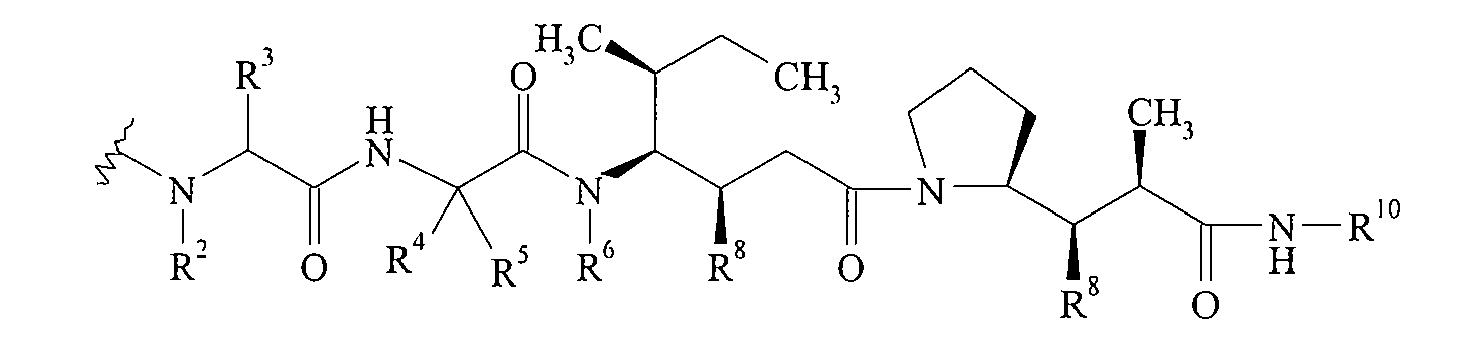 R2 ausgewählt ist aus -H und -Methyl;R3 ausgewählt ist aus -H, -Methyl, und -Isopropyl;R4 ausgewählt ist aus -H und -Methyl; R5 ausgewählt ist aus -Isopropyl, -Isobutyl, -sec-Butyl, -Methyl und -t-Butyl oder R4 und R5 verbunden sind, die Formel - (CRaRb)n- haben, wobei Ra und Rb unabhängig ausgewählt sind aus -H, -C1-C8 Alkyl, und -C3-C8 Carbocyclus, und n ausgewählt ist aus 2, 3, 4, 5 und 6, und mit dem Kohlenstoffatom, an welches sie angebracht sind, einen Ring bilden;R6 ausgewählt ist aus -H und -Methyl;jedes R8 unabhängig ausgewählt ist aus -OH, -Methoxy und -Ethoxy;R9 ausgewählt ist aus -H und -C1-C8 Alkyl;R10 ausgewählt ist aus
 R24 ausgewählt ist aus H und -C(O)R25-; wobei R25 ausgewählt ist aus -C1-C8 Alkyl, -C3-C8 Carbocyclus, -Aryl, -C1-C8 Alkylaryl, -C1-C8 Alkyl-(C3-C8 Carbocyclus), -C3-C8 Heterocyclus und -C1-C8 Alkyl-(C3-C8 Heterocyclus);Z -O-, -NH-, -OC(O)-, -NHC(O)- oder -NR28C(O)- ist; wobei R28 ausgewählt ist aus -H und -C1-C8 Alkyl;n 0 oder 1 ist; undR27 ausgewählt ist aus -H, -N3, -C1-C8 Alkyl, -C3-C8 Carbocyclus, -Aryl, -C1-C8 Alkylaryl, -C1-C8 Alkyl-(C3-C8 Carbocyclus), -C3-C8 Heterocyclus und -C1-C8 Alkyl-(C3-C8 Heterocyclus), wenn n 0 ist; und R27 ausgewählt ist aus -H, -C1-C8 Alkyl, -C3-C8 Carbocyclus, - Aryl, -C1-C8 Alkylaryl, -C1-C8 Alkyl-(C3-C8 Carbocyclus), -C3-C8 Heterocyclus und -C1-C8 Alkyl-(C3-C8 Heterocyclus), wenn n 1 ist.
 - Verbindung oder pharmazeutisch akzeptables Salz oder Solvat der Verbindung von Anspruch 1, wobei -D eine Arzneimitteleinheit mit der Struktur

- Verbindung oder pharmazeutisch akzeptables Salz oder Solvat der Verbindung von Anspruch 1, wobei -Y- ein Selbstopfer-Abstandshalter (self immolative spacer) ist.
- Verbindung oder pharmazeutisch akzeptables Salz oder Solvat der Verbindung von Anspruch 1, wobei die Ligandeneinheit ein Antikörper ist.
- Verbindung oder pharmazeutisch akzeptables Salz oder Solvat der Verbindung von Anspruch 5, wobei der Antikörper ein monoklonaler Antikörper ist.
- Verbindung oder pharmazeutisch akzeptables Salz oder Solvat der Verbindung von Anspruch 2, wobei die Ligandeneinheit ein Antikörper ist.
- Verbindung oder pharmazeutisch akzeptables Salz oder Solvat der Verbindung von Anspruch 1, wobei die Ligandeneinheit an die Streckeinheit über ein Schwefelatom der Ligandeneinheit gebunden ist.
- Verbindung oder pharmazeutisch akzeptables Salz oder Solvat der Verbindung von Anspruch 1, wobei die Ligandeneinheit ein Antikörper ist und der Antikörper immunspezifisch für ein Antigen einer Krebszelle ist.
- Verbindung oder pharmazeutisch akzeptables Salz oder Solvat der Verbindung von Anspruch 1, wobei die Ligandeneinheit ein Antikörper ist und der Antikörper an einen aktivierten Lymphozyt, der mit einer Autoimmunkrankheit assoziiert ist, bindet.
- Die Verbindung oder das pharmazeutisch akzeptable Salz oder Solvat der Verbindung von Anspruch 1, wobei die Ligandeneinheit ein Antikörper ist und immunspezifisch an das CD33 Antigen bindet.
- Die Verbindung oder das pharmazeutisch akzeptable Salz oder Solvat der Verbindung von Anspruch 1, wobei die Ligandeneinheit ein Antikörper ist und immunspezifisch an das CD20 Antigen bindet.
- Die Verbindung oder das pharmazeutisch akzeptable Salz oder Solvat der Verbindung von Anspruch 1, wobei die Ligandeneinheit ein Antikörper ist und immunspezifisch an das CD 19 Antigen bindet.
- Verbindung oder pharmazeutisch akzeptables Salz oder Solvat der Verbindung von Anspruch 6, wobei der Antikörper immunspezifisch an das CD30 Antigen bindet.
- Verbindung oder pharmazeutisch akzeptables Salz oder Solvat der Verbindung von Anspruch 14, wobei der Antikörper ein chimärer AC10 Antikörper ist.
- Die Verbindung oder das pharmazeutisch akzeptable Salz oder Solvat der Verbindung von Anspruch 1, wobei -Yy-

Q ausgewählt ist aus -C1-C8 Alkyl, -O-(C1-C8 Alkyl), -Halogen, -Nitro und -Cyano; und m eine ganze Zahl von 0-4 ist, der Amino-Terminus von -Yy- eine Bindung mit der Aminosäureeinheit bildet und der Carboxyl-Terminus von -Yy- eine Bindung mit einer Arzneimitteleinheit bildet. - Verbindung oder pharmazeutisch akzeptables Salz oder Solvat der Verbindung von Anspruch 1, wobei -Aa-


- Die Verbindung oder das pharmazeutisch akzeptable Salz oder Solvat der Verbindung von Anspruch 17, wobei -Aa-


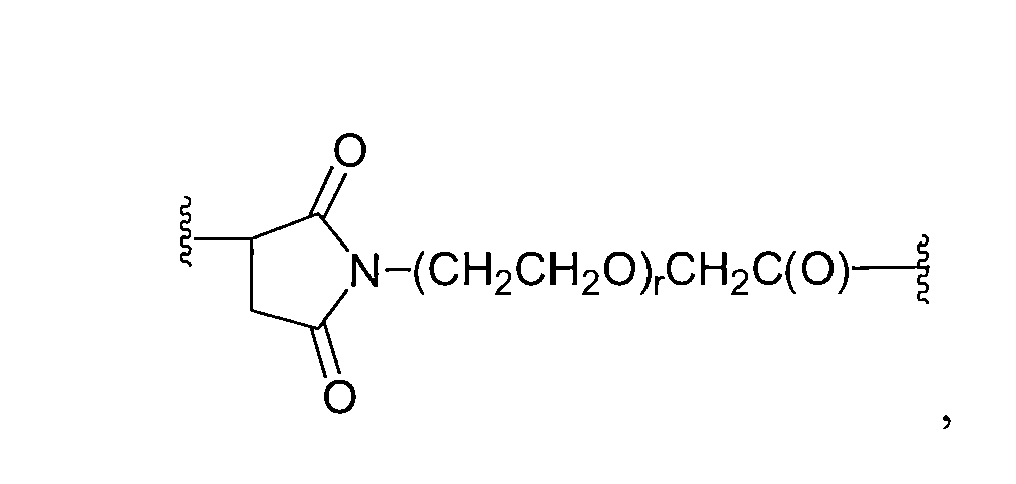


und r eine ganze Zahl von 1-10 ist, der Carbonyl-Terminus von -A- eine Bindung mit einer Aminosäureeinheit bildet und der andere Terminus von -A- eine Bindung mit einer Ligandeneinheit bildet. - Die Verbindung oder das pharmazeutisch akzeptable Salz oder Solvat der Verbindung von Anspruch 18, wobei -Aa-

- Die Verbindung oder das pharmazeutisch akzeptable Salz oder Solvat der Verbindung von Anspruch 1, wobei -Ww- dargestellt ist durch die Formel VII:


- Die Verbindung oder das pharmazeutisch akzeptable Salz oder Solvat der Verbindung von Anspruch 1, wobei -Ww- -Phenylalanin-Lysin- oder -Valin-Citrullin- ist, der Amino-Terminus von -Ww- eine Bindung mit der Streckeinheit bildet, und der C-Terminus von -Ww-eine Bindung mit einer Abstandseinheit bildet.
- Die Verbindung oder das pharmazeutisch akzeptable Salz oder Solvat der Verbindung von Anspruch 1, wobei p von 1 bis 5 reicht.
- Die Verbindung oder das pharmazeutisch akzeptable Salz oder Solvat der Verbindung von Anspruch 22, wobei p von 3 bis 5 reicht.
- Die Verbindung oder das pharmazeutisch akzeptable Salz oder Solvat der Verbindung nach Anspruch 22, wobei p von 2 bis 4 reicht.
- Die Verbindung von Anspruch 1 mit der Struktur:

- Die Verbindung von Anspruch 1 mit der Struktur

- Verbindung oder pharmazeutisch akzeptables Salz oder Solvat der Verbindung von Anspruch 25 oder 26, wobei die Ligandeneinheit ein Antikörper ist.
- Verbindung oder pharmazeutisch akzeptables Salz oder Solvat der Verbindung von Anspruch 27, wobei der Antikörper ein monoklonaler Antikörper ist.
- Die Verbindung oder das pharmazeutisch akzeptable Salz oder Solvat der Verbindung von Anspruch 26, wobei L ein chimärer AC10 Antiköper ist.
- Die Verbindung oder das pharmazeutisch akzeptable Salz oder Solvat der Verbindung von irgendeinem der Ansprüch 25 bis 29, wobei p von 1 bis 3 oder von 3 bis 5 reicht.
- Die Verbindung oder das pharmazeutisch akzeptable Salz oder Solvat der Verbindung von Anspruch 30, wobei p von 3 bis 5 reicht.
- Die Verbindung oder das pharmazeutisch akzeptable Salz oder Solvat der Verbindung von Anspruch 30, wobei p von 1 bis 3 reicht.
- Die Verbindung oder das pharmazeutisch akzeptable Salz oder Solvat der Verbindung von Anspruch 25 oder 29, wobei p 4 ist.
- Die Verbindung von Anspruch 1 mit der Struktur:

- Die Verbindung von Anspruch 1 mit der Struktur:

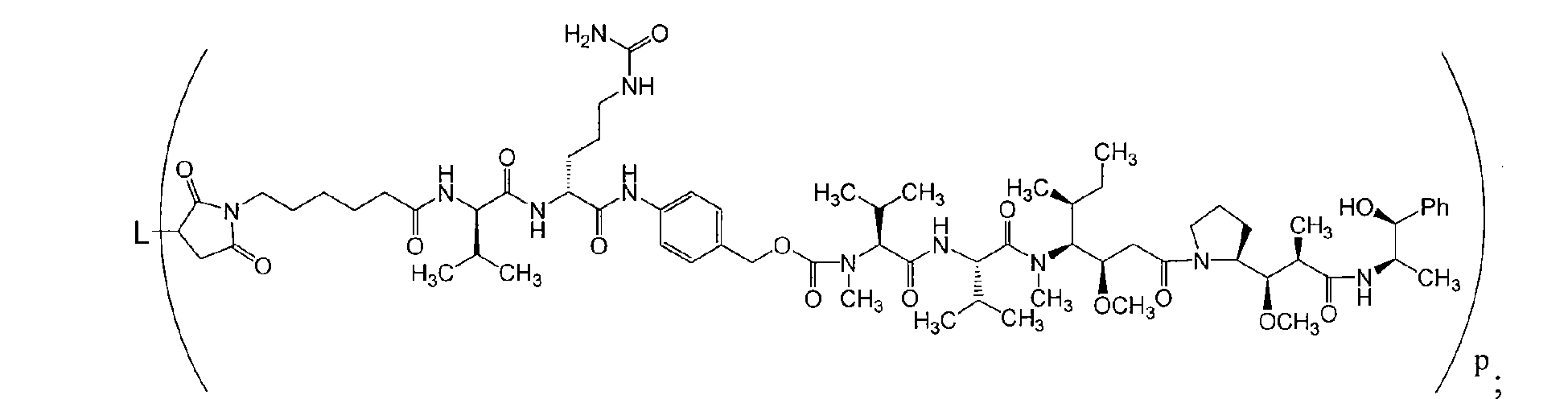

- Zusammensetzung, umfassend Verbindungen von irgendeinem der Ansprüche 1 bis 35 oder ein pharmazeutisch akzeptables Salz oder Solvat derselben; die Variable p gibt die durchschnittliche Zahl von -Aa-Ww-Yy-D Einheiten pro Ligand in der Zusammensetzung an; und ein pharmazeutisch akzeptabler Träger oder Vehikel.
- Die Zusammensetzung von Anspruch 36, wobei die Verbindungen Verbindungen von irgendeinem der Anspürche 1, 5 oder 6 mit der Struktur:

- Die Zusammensetzung von Anspruch 37, wobei p 1 bis 3 oder 3 bis 5 ist.
- Die Zusammensetzung von Anspruch 37, wobei L ein chimärer AC10 Antikörper ist und p 3 bis 5 ist.
- Verbindung oder pharmazeutisch akzeptables Salz oder Solvat der Verbindung von irgendeinem der Ansprüche 1 bis 35 oder Zusammensetzung von irgendeinem der Ansprüche 36 bis 39 zur Verwendung als Medikament.
- Verbindung oder pharmazeutisch akzeptables Salz oder Solvat der Verbindung von irgendeinem der Ansprüche 1 bis 35 oder Zusammensetzung von irgendeinem der Ansprüche 36 bis 39 zur Verwendung bei der Behandlung von Krebs, einer Autoimmunkrankheit oder einer Infektionskrankheit.
- Die Verbindung oder das pharmazeutisch akzeptable Salz oder Solvat derselben oder die Zusammensetzung von Anspruch 41 zur Verwendung bei der Behandlung von Krebs oder einer Autoimmunkrankheit.
- Die Verbindung oder das pharmazeutisch akzeptable Salz oder Solvat derselben oder die Zusammensetzung von Anspruch 42 zur Verwendung bei der Behandlung von Blutkrebs (hematological cancer), wobei L ein monoklonaler Antikörper ist, der immunspezifisch an das CD30 Antigen bindet.
- Die Verbindung oder das pharmazeutisch akzeptable Salz oder Solvat derselben oder die Zusammensetzung von Anspruch 43, wobei der Blutkrebs Hodkgin Lymphom ist.
- Verbindung der Formel

wobei, unabhängig an jeder Position:R2 -C1-C8 Alkyl ist;R3 ausgewählt ist aus -H, -C1-C8 Alkyl, -C3-C8 Carbocyclus, -O-(C1-C8 Alkyl), -Aryl, - C1-C8 Alkylaryl, -C1-C8 Alkyl-(C3-C8 Carbocyclus), -C3-C8 Heterocyclus und -C1-C8 Alkyl-(C3-C8 Heterocyclus);R4 ausgewählt ist aus -C1-C8 Akyl, -C3-C8 Carbocyclus, -O-(C1-C8 Alkyl), -Aryl, -C1-C8 Alkylaryl, -C1-C8 Alkyl-(C3-C8 Carbocyclus), -C3-C8 Heterocyclus und -C1-C8 Alkyl-(C3-C8 Heterocyclus), wobei R5 ausgewählt ist aus -H und -Methyl; oder R4 und R5 verbunden sind, die Formel -(CRaRb)n- haben, wobei Ra und Rb unabhängig ausgewählts sind aus -H, -C1-C8 Alkyl und -C3-C8 Carbocyclus, und n ausgewählt ist aus 2, 3, 4, 5 und 6, und mit dem Kohlenstoffatom, an welches sie angebracht sind, einen Ring bilden;R6 ausgewählt ist aus -H und -C1-C8 Alkyl;R7 ausgewählt ist aus -H, -C1-C8 Alkyl, -C3-C8 Carbocyclus, -O-(C1-C8 Alkyl), -Aryl, - C1-C8 Alkylaryl, -C1-C8 Alkyl-(C3-C8 Carbocyclus), -C3-C8 Heterocyclus und -C1-C8 Alkyl-(C3-C8 Heterocyclus);jedes R8 unabhängig ausgewählt ist aus -H, -OH, -C1-C8 Alkyl, -C3-C8 Carbocyclus und -O-(C1-C8 Alkyl);R9 ausgewählt ist aus -H und -C1-C8 Alkyl;R11 ausgewählt ist aus -H, -OH, -NH2, -NHR14, -N(R14)2, -C1-C8 Alkyl, -C3-C8 Carbocyclus, -O-(C1-C8 Alkyl), -Aryl, -C1-C8 Alkylaryl, -C1-C8 Alkyl-(C3-C8 Carbocyclus), -C3-C8 Heterocyclus und -C1-C8 Alkyl-(C3-C8 Heterocyclus); oder R11 ein Sauerstoffatom ist, welches eine Carbonyleinheit (C=O) mit dem Kohlenstoffatom, an welches es angebracht ist, bildet und ein Wasserstoffatom an diesem Kohlenstoffatom ersetzt ist durch eine der Bindungen in der (C=O) Doppelbindung;jedes R12 unabhängig ausgewählt ist aus -Aryl und -C3-C8 Heterocyclus;R13 ausgewählt ist aus -H, -OH, -NH2, -NHR14, -N(R14)2, -C1-C8 Alkyl, -C3-C8 Carbocyclus, -O-(C1-C8 Alkyl), -Aryl, -C1-C8 Alkylaryl, -C1-C8 Alkyl-(C3-C8 Carbocyclus), C3-C8 Heterocyclus und -C1-8 Alkyl-(C3-C8 Heterocyclus);jedes R14 unabhängig -H oder -C1-C8 Alkyl ist;R16 A'a-Ww-Yy- ist,
wobeijedes -W- unabhängig eine Aminosäureeinheit ist;-Y- ein Selbstopfer-Abstandshalter ist;w eine ganze Zahl von 2 bis 12 ist;y 1 oder 2 ist;-A' ausgewählt ist aus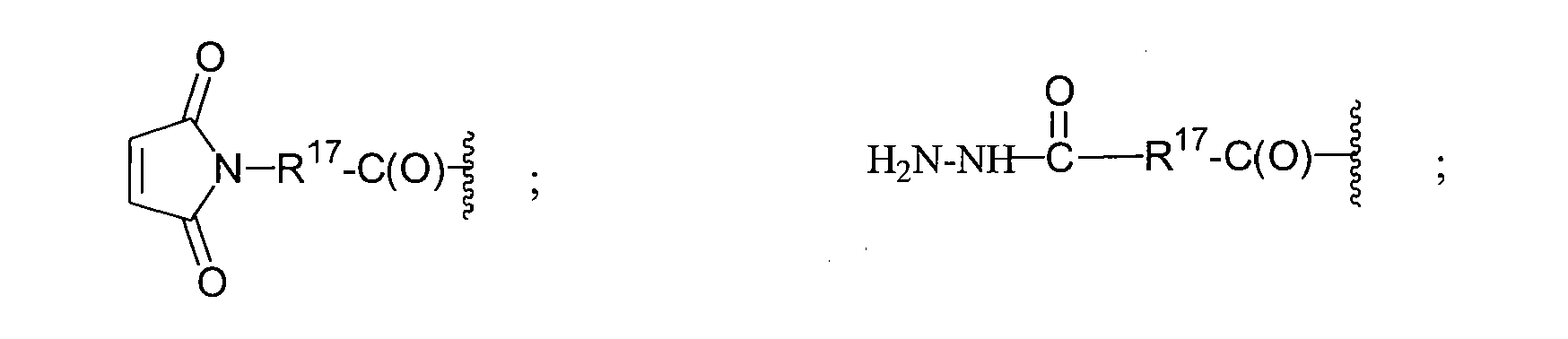




G ausgewählt ist aus -Cl, -Br, -I, -O-Mesyl und -O-Tosyl;
J ausgewählt ist aus -Cl, -Br, -I, -F, -OH, -O-N-Succinimid, -O-(4-Nitrophenyl), -O-Pentafluorphenyl, -O-Tetrafluorphenyl und -O-C(O)-OR18;
a 1 ist;
R17 ausgewählt ist aus -C1-C10 Alkylen-, -C3-C8 Carbocyclo-, -O-(C1-C8 Alkyl)-, -Arylen-, -C1-C10 Alkylenarylen-, -Arylen-C1-C10 Alkylen-, -C1-C10 Alkylen-(C3-C8 Carbocyclo)-, -(C3-C8 Carbocyclo)-C1-C10 Alkylen-, -C3-C8 Heterocyclo-, -C1-C10 Alkylen-(C3-C8 Heterocyclo)-, -(C3-C8 Heterocyclo)-C1-C10 Alkylen-, -(CH2CH2O)r-, und -CH2CH2O)1-CH2-;
r eine ganze Zahl von 1-10 ist; und
R18 -C1-C8 Alkyl oder -Aryl ist. - Die Verbindung von Anspruch 45 mit der Struktur:


Priority Applications (5)
| Application Number | Priority Date | Filing Date | Title |
|---|---|---|---|
| DK11165210.3T DK2357006T3 (en) | 2002-07-31 | 2003-07-31 | Drug conjugates and their use for treating cancer, an autoimmune disease or an infectious disease |
| EP11165210.3A EP2357006B1 (de) | 2002-07-31 | 2003-07-31 | Arzneimittelkonjugate und deren Verwendung zur Behandlung von Krebs, einer Autoimmunerkrankung oder einer Infektionskrankheit |
| SI200332051T SI1545613T1 (sl) | 2002-07-31 | 2003-07-31 | Avristatinski konjugati in njihova uporaba za zdravljenje raka avtoimunske bolezni ali infekcijskebolezni |
| EP20110165204 EP2353611B1 (de) | 2002-07-31 | 2003-07-31 | Arzneimittelkonjugate und deren Verwendung zur Behandlung von Krebs, einer Autoimmunerkrankung oder einer Infektionskrankheit |
| CY20111100855T CY1111894T1 (el) | 2002-07-31 | 2011-09-07 | Προϊοντα συζευξης auristatin και χρηση αυτων για θεραπεια καρκινου, αυτοανοσης ασθενειας ή μολυσματωδους ασθενειας |
Applications Claiming Priority (3)
| Application Number | Priority Date | Filing Date | Title |
|---|---|---|---|
| US40040302P | 2002-07-31 | 2002-07-31 | |
| US400403P | 2002-07-31 | ||
| PCT/US2003/024209 WO2004010957A2 (en) | 2002-07-31 | 2003-07-31 | Drug conjugates and their use for treating cancer, an autoimmune disease or an infectious disease |
Related Child Applications (4)
| Application Number | Title | Priority Date | Filing Date |
|---|---|---|---|
| EP20110165204 Division EP2353611B1 (de) | 2002-07-31 | 2003-07-31 | Arzneimittelkonjugate und deren Verwendung zur Behandlung von Krebs, einer Autoimmunerkrankung oder einer Infektionskrankheit |
| EP11165210.3A Division EP2357006B1 (de) | 2002-07-31 | 2003-07-31 | Arzneimittelkonjugate und deren Verwendung zur Behandlung von Krebs, einer Autoimmunerkrankung oder einer Infektionskrankheit |
| EP11165210.3 Division-Into | 2011-05-06 | ||
| EP11165204.6 Division-Into | 2011-05-06 |
Publications (4)
| Publication Number | Publication Date |
|---|---|
| EP1545613A2 EP1545613A2 (de) | 2005-06-29 |
| EP1545613A4 EP1545613A4 (de) | 2008-10-15 |
| EP1545613B1 true EP1545613B1 (de) | 2011-07-20 |
| EP1545613B9 EP1545613B9 (de) | 2012-01-25 |
Family
ID=31188683
Family Applications (3)
| Application Number | Title | Priority Date | Filing Date |
|---|---|---|---|
| EP03772186A Expired - Lifetime EP1545613B9 (de) | 2002-07-31 | 2003-07-31 | Auristatin-konjugate und ihre verwendung zur behandlung von krebs, einer autoimmunkranheit oder einer infektionskrankheit |
| EP11165210.3A Expired - Lifetime EP2357006B1 (de) | 2002-07-31 | 2003-07-31 | Arzneimittelkonjugate und deren Verwendung zur Behandlung von Krebs, einer Autoimmunerkrankung oder einer Infektionskrankheit |
| EP20110165204 Expired - Lifetime EP2353611B1 (de) | 2002-07-31 | 2003-07-31 | Arzneimittelkonjugate und deren Verwendung zur Behandlung von Krebs, einer Autoimmunerkrankung oder einer Infektionskrankheit |
Family Applications After (2)
| Application Number | Title | Priority Date | Filing Date |
|---|---|---|---|
| EP11165210.3A Expired - Lifetime EP2357006B1 (de) | 2002-07-31 | 2003-07-31 | Arzneimittelkonjugate und deren Verwendung zur Behandlung von Krebs, einer Autoimmunerkrankung oder einer Infektionskrankheit |
| EP20110165204 Expired - Lifetime EP2353611B1 (de) | 2002-07-31 | 2003-07-31 | Arzneimittelkonjugate und deren Verwendung zur Behandlung von Krebs, einer Autoimmunerkrankung oder einer Infektionskrankheit |
Country Status (16)
| Country | Link |
|---|---|
| US (5) | US7659241B2 (de) |
| EP (3) | EP1545613B9 (de) |
| JP (1) | JP4741838B2 (de) |
| AT (1) | ATE516818T1 (de) |
| AU (2) | AU2003263964C1 (de) |
| BE (1) | BE2012C047I2 (de) |
| CA (2) | CA2494105C (de) |
| CY (2) | CY1111894T1 (de) |
| DK (2) | DK2357006T3 (de) |
| ES (3) | ES2544527T3 (de) |
| FR (1) | FR12C0066I2 (de) |
| HU (2) | HUE027549T2 (de) |
| LU (1) | LU92133I2 (de) |
| PT (2) | PT1545613E (de) |
| SI (2) | SI2357006T1 (de) |
| WO (1) | WO2004010957A2 (de) |
Families Citing this family (789)
| Publication number | Priority date | Publication date | Assignee | Title |
|---|---|---|---|---|
| US20040141983A1 (en) | 1999-03-15 | 2004-07-22 | Protein Design Labs, Inc. | Compositions against cancer antigen LIV-1 and uses thereof |
| US7244827B2 (en) | 2000-04-12 | 2007-07-17 | Agensys, Inc. | Nucleic acid and corresponding protein entitled 24P4C12 useful in treatment and detection of cancer |
| US6946129B1 (en) | 1999-06-08 | 2005-09-20 | Seattle Genetics, Inc. | Recombinant anti-CD40 antibody and uses thereof |
| US20040018194A1 (en) * | 2000-11-28 | 2004-01-29 | Francisco Joseph A. | Recombinant anti-CD30 antibodies and uses thereof |
| US7256257B2 (en) | 2001-04-30 | 2007-08-14 | Seattle Genetics, Inc. | Pentapeptide compounds and uses related thereto |
| US6884869B2 (en) | 2001-04-30 | 2005-04-26 | Seattle Genetics, Inc. | Pentapeptide compounds and uses related thereto |
| US20100056762A1 (en) | 2001-05-11 | 2010-03-04 | Old Lloyd J | Specific binding proteins and uses thereof |
| US7589180B2 (en) | 2001-05-11 | 2009-09-15 | Abbott Laboratories Inc. | Specific binding proteins and uses thereof |
| US20110313230A1 (en) | 2001-05-11 | 2011-12-22 | Terrance Grant Johns | Specific binding proteins and uses thereof |
| US20050215472A1 (en) * | 2001-10-23 | 2005-09-29 | Psma Development Company, Llc | PSMA formulations and uses thereof |
| EP2360169B1 (de) | 2001-10-23 | 2015-10-14 | Psma Development Company, L.L.C. | PSMA Antikörper |
| ES2544527T3 (es) | 2002-07-31 | 2015-09-01 | Seattle Genetics, Inc. | Conjugados de fármacos y su uso para tratar el cáncer, una enfermedad autoinmune o una enfermedad infecciosa |
| AU2003243151A1 (en) * | 2002-08-16 | 2004-03-03 | Agensys, Inc. | Nucleic acid and corresponding protein entitled 251p5g2 useful in treatment and detection of cancer |
| WO2004067564A2 (en) | 2003-01-29 | 2004-08-12 | Protein Design Labs, Inc. | Compositions against cancer antigen liv-1 and uses thereof |
| DK1594542T3 (da) * | 2003-02-20 | 2010-10-11 | Seattle Genetics Inc | Anti-CD70 antistof-lægemiddelkonjugater og deres anvendelse ved behandling af cancer |
| US20080025989A1 (en) | 2003-02-20 | 2008-01-31 | Seattle Genetics, Inc. | Anti-cd70 antibody-drug conjugates and their use for the treatment of cancer and immune disorders |
| US8012681B2 (en) | 2003-05-13 | 2011-09-06 | Novartis Vaccines And Diagnostics, Inc. | Methods of modulating metastasis and skeletal related events resulting from metastases |
| EP3434275A1 (de) * | 2003-11-06 | 2019-01-30 | Seattle Genetics, Inc. | Auf die verwendung von auristatin-konjugaten mit antikörpern basierter nachweis für krebszellen |
| US20050175619A1 (en) * | 2004-02-05 | 2005-08-11 | Robert Duffy | Methods of producing antibody conjugates |
| EP1718667B1 (de) * | 2004-02-23 | 2013-01-09 | Genentech, Inc. | Heterocyclische, selbst-immolative linker und konjugate |
| CA2558399C (en) * | 2004-03-02 | 2015-05-19 | Seattle Genetics, Inc. | Partially loaded antibodies and methods of their conjugation |
| JP5149620B2 (ja) | 2004-07-23 | 2013-02-20 | エンドサイト,インコーポレイテッド | 2価リンカーおよびその結合体 |
| US7641903B2 (en) * | 2004-10-15 | 2010-01-05 | Seattle Genetics, Inc. | Anti-CD70 antibody and its use for the treatment and prevention of cancer and immune disorders |
| EP1799262A4 (de) * | 2004-10-15 | 2009-10-21 | Seattle Genetics Inc | Anti-cd70-antikörper und seine verwendung zur behandlung und vorbeugung von krebserkrankungen und immunstörungen |
| US8337838B2 (en) * | 2004-10-15 | 2012-12-25 | Seattle Genetics, Inc. | Anti-CD70 antibody and its use for the treatment and prevention of cancer and immune disorders |
| JP2008519863A (ja) | 2004-11-12 | 2008-06-12 | シアトル ジェネティクス インコーポレイティッド | N末端にアミノ安息香酸単位を有するオーリスタチン |
| WO2006071441A2 (en) | 2004-11-30 | 2006-07-06 | Curagen Corporation | Antibodies directed to gpnmb and uses thereof |
| WO2006078776A2 (en) | 2005-01-19 | 2006-07-27 | The Trustees Of The University Of Pennsylvania | Inhibitors and methods of treatment of cardiovascular diseases, and methods for identifying inhibitors |
| EP1871418B1 (de) | 2005-04-19 | 2014-03-19 | Seattle Genetics, Inc. | Humanisierte, anti-cd70-bindende wirkstoffe und ihre verwendung |
| CN103127523A (zh) * | 2005-06-20 | 2013-06-05 | Psma开发有限公司 | Psma抗体-药物缀合物 |
| USRE47223E1 (en) | 2005-06-20 | 2019-02-05 | Genentech, Inc. | Compositions and methods for the diagnosis and treatment of tumor |
| JP5171621B2 (ja) * | 2005-07-07 | 2013-03-27 | シアトル ジェネティックス, インコーポレイテッド | フェニルアラニン側鎖修飾をc末端に有するモノメチルバリン化合物 |
| WO2007008848A2 (en) | 2005-07-07 | 2007-01-18 | Seattle Genetics, Inc. | Monomethylvaline compounds having phenylalanine carboxy modifications at the c-terminus |
| CA2614200A1 (en) * | 2005-07-08 | 2007-01-18 | Elan Pharmaceuticals, Inc. | Preparation of polymer conjugates of therapeutic, agricultural, and food additive compounds |
| SI1912671T1 (en) | 2005-07-18 | 2018-01-31 | Seattle Genetics, Inc. | Conjugates beta-glucuronide linker-drug |
| NZ566395A (en) | 2005-09-26 | 2012-03-30 | Medarex Inc | Human monoclonal antibodies to CD70 |
| AR059900A1 (es) | 2006-03-17 | 2008-05-07 | Genentech Inc | Anticuerpos anti-tat226 e inmunoconjugados |
| MX2008014520A (es) * | 2006-05-22 | 2008-11-27 | Elan Pharm Inc | Preparacion de conjugados polimericos de compuestos terapeuticos, agricolas, y de aditivos para alimentos. |
| WO2007140371A2 (en) | 2006-05-30 | 2007-12-06 | Genentech, Inc. | Antibodies and immunoconjugates and uses therefor |
| WO2008025020A2 (en) * | 2006-08-25 | 2008-02-28 | Seattle Genetics, Inc. | Cd30 binding agents and uses thereof |
| AU2007308792B2 (en) | 2006-10-27 | 2013-01-24 | Genentech, Inc. | Antibodies and immunoconjugates and uses therefor |
| DK2099823T4 (da) | 2006-12-01 | 2022-05-09 | Seagen Inc | Målbindingsmiddelvarianter og anvendelser deraf |
| AU2007333098A1 (en) * | 2006-12-14 | 2008-06-19 | Medarex, Inc. | Human antibodies that bind CD70 and uses thereof |
| EP2126127B1 (de) * | 2007-01-25 | 2016-09-28 | Dana-Farber Cancer Institute, Inc. | Verwendung von anti-egfr-antikörpern bei der behandlung von durch egfr-mutanten vermittelten krankheiten |
| BRPI0806403A2 (pt) | 2007-02-09 | 2011-09-06 | Genentech Inc | anticorpo anti-robo4, usode um anticorpo e método de obtenção de imagem |
| CA2680854C (en) * | 2007-03-15 | 2017-02-14 | Ludwig Institute For Cancer Research | Treatment method using egfr antibodies and src inhibitors and related formulations |
| BRPI0809435A2 (pt) | 2007-03-27 | 2014-09-09 | Sea Lane Biotechnologies, Llc | Constructos e bibliotecas que compreendem sequências de cadeia leve substituida de anticorpos |
| GB0707034D0 (en) | 2007-04-12 | 2007-05-23 | St Andrews The | Compounds |
| TW200902554A (en) | 2007-05-08 | 2009-01-16 | Genentech Inc | Cysteine engineered anti-MUC16 antibodies and antibody drug conjugates |
| CN104383553A (zh) | 2007-06-25 | 2015-03-04 | 恩多塞特公司 | 含有亲水性间隔区接头的共轭物 |
| US9877965B2 (en) | 2007-06-25 | 2018-01-30 | Endocyte, Inc. | Vitamin receptor drug delivery conjugates for treating inflammation |
| ES2528922T3 (es) | 2007-07-16 | 2015-02-13 | Genentech, Inc. | Anticuerpos anti-CD79b humanizados e inmunoconjugados y métodos de uso |
| ATE543835T1 (de) | 2007-07-16 | 2012-02-15 | Genentech Inc | Anti-cd79b-antikörper und immunkonjugate und anwendungsverfahren |
| US20090035848A1 (en) * | 2007-08-03 | 2009-02-05 | Robert Hickey | Moving bed biofilm reactor (mbbr) system for conversion of syngas components to liquid products |
| US9283276B2 (en) | 2007-08-14 | 2016-03-15 | Ludwig Institute For Cancer Research Ltd. | Monoclonal antibody 175 targeting the EGF receptor and derivatives and uses thereof |
| US9193763B2 (en) | 2007-08-17 | 2015-11-24 | Purdue Research Foundation | PSMA binding ligand-linker conjugates and methods for using |
| WO2009046407A2 (en) | 2007-10-04 | 2009-04-09 | Zymogenetics, Inc. | B7 FAMILY MEMBER zB7H6 AND RELATED COMPOSITIONS AND METHODS |
| MX2010003977A (es) | 2007-10-12 | 2010-04-30 | Seattle Genetics Inc | Terapia de combinacion con conjugados de anticuerpo-farmaco. |
| WO2009052431A2 (en) | 2007-10-19 | 2009-04-23 | Seattle Genetics, Inc. | Cd19 binding agents and uses thereof |
| WO2009067546A2 (en) | 2007-11-19 | 2009-05-28 | Celera Corpration | Lung cancer markers and uses thereof |
| EP2078492A1 (de) * | 2008-01-11 | 2009-07-15 | Roche Diagnostics GmbH | Bandkassette für ein medizinisches Handgerät und Blutzuckermesssystem |
| ES2613963T3 (es) | 2008-01-18 | 2017-05-29 | Medimmune, Llc | Anticuerpos manipulados con cisteína para conjugación específica de sitio |
| PT2247620T (pt) | 2008-01-31 | 2016-08-23 | Genentech Inc | Anticorpos e imunoconjugados anti-cd79b e métodos de utilização |
| EP2265283B1 (de) * | 2008-03-18 | 2014-09-03 | Seattle Genetics, Inc. | Auristatin-arznei-linker-konjugate |
| KR101674097B1 (ko) | 2008-04-11 | 2016-11-08 | 시애틀 지네틱스, 인크. | 췌장, 난소 및 다른 암의 검출 및 치료 |
| EP2281006B1 (de) | 2008-04-30 | 2017-08-02 | Immunogen, Inc. | Vernetzer und ihre verwendung |
| CN102076865B (zh) | 2008-05-02 | 2016-03-16 | 西雅图基因公司 | 用于制造核心岩藻糖基化降低的抗体和抗体衍生物的方法和组合物 |
| US8835506B2 (en) | 2008-06-05 | 2014-09-16 | Stc.Unm | Methods and related compositions for the treatment of cancer |
| EP2727606A3 (de) | 2008-09-08 | 2015-09-23 | Psma Development Company, L.L.C. | Verbindungen zur tötung von psma-expriemierenden und taxane-resistenten krebszellen |
| GB0819287D0 (en) | 2008-10-22 | 2008-11-26 | Univ Bradford | Compounds |
| UA109633C2 (uk) | 2008-12-09 | 2015-09-25 | Антитіло людини проти тканинного фактора | |
| EP2376110B1 (de) | 2009-01-09 | 2019-03-13 | Seattle Genetics, Inc. | Wöchentliche dosierungskonzepte für anti-cd30-vc-pab-mmae-antikörper-wirkstoff-konjugate |
| US9238878B2 (en) | 2009-02-17 | 2016-01-19 | Redwood Bioscience, Inc. | Aldehyde-tagged protein-based drug carriers and methods of use |
| CA2754531A1 (en) * | 2009-03-06 | 2010-09-30 | Seattle Genetics, Inc. | Antibody drug conjugates (adc) that bind to 24p4c12 proteins |
| JP2012526839A (ja) | 2009-05-13 | 2012-11-01 | シー レーン バイオテクノロジーズ, エルエルシー | インフルエンザウイルスに対する中和分子 |
| EP2437790B1 (de) | 2009-06-03 | 2019-02-20 | Immunogen, Inc. | Konjugationsverfahren |
| CA2766405A1 (en) | 2009-06-22 | 2011-01-13 | Medimmune, Llc | Engineered fc regions for site-specific conjugation |
| WO2011028952A1 (en) | 2009-09-02 | 2011-03-10 | Xencor, Inc. | Compositions and methods for simultaneous bivalent and monovalent co-engagement of antigens |
| WO2011038159A2 (en) * | 2009-09-24 | 2011-03-31 | Seattle Genetics, Inc. | Dr5 ligand drug conjugates |
| US20110076232A1 (en) * | 2009-09-29 | 2011-03-31 | Ludwig Institute For Cancer Research | Specific binding proteins and uses thereof |
| JP2013506709A (ja) | 2009-10-06 | 2013-02-28 | イミュノジェン・インコーポレーテッド | 有効なコンジュゲートおよび親水性リンカー |
| MX366890B (es) | 2009-10-23 | 2019-07-30 | Millennium Pharm Inc | Moléculas de anticuerpo anti - gcc y composiciones y métodos relacionados. |
| PE20121584A1 (es) | 2009-11-30 | 2012-11-29 | Genentech Inc | Composiciones y metodos para el diagnostico y el tratamiento de tumores |
| IN2012DN04908A (de) | 2009-12-09 | 2015-09-25 | Inst Nat Sante Rech Med | |
| WO2011075185A1 (en) | 2009-12-18 | 2011-06-23 | Oligasis | Targeted drug phosphorylcholine polymer conjugates |
| TWI504410B (zh) | 2010-02-08 | 2015-10-21 | Agensys Inc | 結合至161p2f10b蛋白之抗體藥物結合物(adc) |
| NZ601293A (en) | 2010-02-23 | 2014-10-31 | Genentech Inc | Compositions and methods for the diagnosis and treatment of tumor |
| US9951324B2 (en) | 2010-02-25 | 2018-04-24 | Purdue Research Foundation | PSMA binding ligand-linker conjugates and methods for using |
| EP2542576B1 (de) * | 2010-03-02 | 2016-04-20 | Seattle Genetics, Inc. | Verfahren zum screening von antikörpern |
| EP4450523A3 (de) | 2010-04-02 | 2025-03-12 | Amunix Pharmaceuticals, Inc. | Bindungsfusionsproteine, bindungsfusionsprotein-arzneimittelkonjugate, xten-arzneimittelkonjugate sowie verfahren zur herstellung und verwendung davon |
| JP5870400B2 (ja) | 2010-04-15 | 2016-03-01 | シアトル ジェネティクス,インコーポレーテッド | 標的化ピロロベンゾジアゼピンコンジュゲート |
| ES2742216T3 (es) | 2010-04-15 | 2020-02-13 | Kodiak Sciences Inc | Polímeros que contienen zwitteriones de alto peso molecular |
| ES2623057T3 (es) | 2010-04-15 | 2017-07-10 | Medimmune Limited | Pirrolobenzodiazepinas usadas para tratar enfermedades proliferativas |
| BR112012029866A2 (pt) | 2010-06-03 | 2017-03-07 | Genentech Inc | método para a determinação da presença de uma proteína steap-1 |
| SG185428A1 (en) | 2010-06-08 | 2012-12-28 | Genentech Inc | Cysteine engineered antibodies and conjugates |
| EP2580243B1 (de) | 2010-06-09 | 2019-10-16 | Genmab A/S | Antikörper gegen menschliches cd38 |
| CA2801971C (en) | 2010-06-10 | 2018-07-24 | Hans-Georg Lerchen | Novel auristatin derivatives and their use |
| SMT201700547T1 (it) | 2010-06-15 | 2018-01-11 | Genmab As | Coniugati di farmaco anticorpo umano contro il fattore tissutale |
| CA2806252C (en) | 2010-07-29 | 2019-05-14 | Xencor, Inc. | Antibodies with modified isoelectric points |
| ES2553874T3 (es) | 2010-09-29 | 2015-12-14 | Seattle Genetics, Inc. | N-Carboxialquil-auristatinas y su uso |
| EP2621526B1 (de) | 2010-09-29 | 2018-06-06 | Agensys, Inc. | An 191p4d12-proteine bindende antikörper-wirkstoffkonjugate |
| EP3219731A1 (de) | 2010-10-01 | 2017-09-20 | Oxford BioTherapeutics Ltd | Anti-ror1-antikörper |
| ES3004351T3 (en) | 2010-10-22 | 2025-03-12 | Seagen Inc | Synergistic effects between auristatin-based antibody drug conjugates and inhibitors of the pi3k-akt mtor pathway |
| EP3786185A1 (de) | 2010-12-06 | 2021-03-03 | Seagen Inc. | Humanisierte antikörper gegen liv-1 und deren verwendung zur behandlung von krebs |
| PE20170917A1 (es) | 2010-12-20 | 2017-07-12 | Genentech Inc | Anticuerpos anti-mesotelina e inmunoconjugados |
| JOP20210044A1 (ar) | 2010-12-30 | 2017-06-16 | Takeda Pharmaceuticals Co | الأجسام المضادة لـ cd38 |
| JP6162606B2 (ja) | 2011-01-14 | 2017-07-12 | レッドウッド バイオサイエンス, インコーポレイテッド | アルデヒド−タグ付き免疫グロブリンポリペプチド及びその使用方法 |
| CA2829736C (en) | 2011-03-16 | 2020-07-21 | Seattle Genetics, Inc. | N-carboxyalkylauristatins and use thereof |
| US9402916B2 (en) | 2011-03-17 | 2016-08-02 | The University Of Birmingham | Re-directed immunotherapy |
| EP2690955A4 (de) | 2011-03-30 | 2014-10-15 | Univ Arizona | Auristatin-tyramin-phosphat-salze und auristatin-aminochinolin-derivate und prodrugs davon |
| WO2012143523A1 (en) | 2011-04-20 | 2012-10-26 | Genmab A/S | Bispecifc antibodies against her2 |
| EP4520771A3 (de) | 2011-04-20 | 2025-07-16 | Genmab A/S | Bispezifische antikörper gegen her2 |
| EP3501546A3 (de) | 2011-04-21 | 2019-09-18 | Seattle Genetics, Inc. | Cystein-wirkstoff konjugate und ihre verwendung |
| US8679767B2 (en) | 2011-05-12 | 2014-03-25 | Genentech, Inc. | Multiple reaction monitoring LC-MS/MS method to detect therapeutic antibodies in animal samples using framework signature peptides |
| JP2014516960A (ja) | 2011-05-19 | 2014-07-17 | インサーム(インスティテュ ナシオナル ドゥ ラ サンテ エ ドゥ ラ ルシェルシェ メディカル) | 抗ヒトher3抗体及びその使用 |
| JP2014515354A (ja) | 2011-05-19 | 2014-06-30 | プレジデント アンド フェローズ オブ ハーバード カレッジ | Osw−1類似体および抱合体、ならびにそれらの使用 |
| SI3415531T1 (sl) | 2011-05-27 | 2023-12-29 | Glaxo Group Limited | Bcma (cd269/tnfrsf17) - vezni proteini |
| EP2714685B1 (de) * | 2011-05-27 | 2016-10-19 | Ambrx, Inc. | Zusammensetzungen, enthaltend mit nichtnatürlichen aminosäuren verknüpfte dolastatin-derivate, sowie verfahren dafür und anwendungen davon |
| UA112434C2 (uk) | 2011-05-27 | 2016-09-12 | Ґлаксо Ґруп Лімітед | Антигензв'язувальний білок, який специфічно зв'язується з всма |
| CN103717595A (zh) * | 2011-05-27 | 2014-04-09 | Ambrx公司 | 含有非天然氨基酸连接的海兔毒素衍生物的组合物、涉及该海兔毒素衍生物的方法及其用途 |
| CA2837840C (en) | 2011-06-10 | 2020-08-04 | Mersana Therapeutics, Inc. | Protein-polymer-drug conjugates |
| US8815226B2 (en) | 2011-06-10 | 2014-08-26 | Mersana Therapeutics, Inc. | Protein-polymer-drug conjugates |
| MX350954B (es) | 2011-06-21 | 2017-09-26 | Immunogen Inc | Derivados de maitansinoides novedosos con enlazador de peptido y conjugados de estos. |
| US9409988B2 (en) | 2011-06-22 | 2016-08-09 | Inserm (Institut National De La Sante Et De La Recherche Medicale) | Anti-Axl antibodies and uses thereof |
| JP6033293B2 (ja) | 2011-06-22 | 2016-11-30 | インサーム(インスティテュ ナシオナル ドゥ ラ サンテ エ ドゥ ラ ルシェルシェ メディカル)Inserm(Institut National Dela Sante Et De La Recherche Medicale) | 抗Axl抗体及びその使用 |
| UA117901C2 (uk) | 2011-07-06 | 2018-10-25 | Ґенмаб Б.В. | Спосіб посилення ефекторної функції вихідного поліпептиду, його варіанти та їх застосування |
| WO2013015821A1 (en) | 2011-07-22 | 2013-01-31 | The Research Foundation Of State University Of New York | Antibodies to the b12-transcobalamin receptor |
| US9120858B2 (en) | 2011-07-22 | 2015-09-01 | The Research Foundation Of State University Of New York | Antibodies to the B12-transcobalamin receptor |
| EP2736928B1 (de) | 2011-07-28 | 2019-01-09 | i2 Pharmaceuticals, Inc. | Gegen erbb3-gerichtete sur-bindende proteine |
| WO2013022855A1 (en) | 2011-08-05 | 2013-02-14 | Xencor, Inc. | Antibodies with modified isoelectric points and immunofiltering |
| SG11201400770SA (en) | 2011-09-20 | 2014-04-28 | Spirogen Sarl | Pyrrolobenzodiazepines as unsymmetrical dimeric pbd compounds for inclusion in targeted conjugates |
| EP3483611B1 (de) | 2011-09-29 | 2023-01-04 | Seagen Inc. | Bestimmung der intakten masse proteinkonjugierter wirkstoffverbindungen |
| US12466897B2 (en) | 2011-10-10 | 2025-11-11 | Xencor, Inc. | Heterodimeric human IgG1 polypeptides with isoelectric point modifications |
| CA3182462A1 (en) | 2011-10-10 | 2013-04-18 | Xencor, Inc. | A method for purifying antibodies |
| US10851178B2 (en) | 2011-10-10 | 2020-12-01 | Xencor, Inc. | Heterodimeric human IgG1 polypeptides with isoelectric point modifications |
| MX358757B (es) | 2011-10-14 | 2018-09-03 | Seattle Genetics Inc | Pirrolobenzodiazepinas y conjugados dirigidos. |
| CN103998449A (zh) | 2011-10-14 | 2014-08-20 | 斯皮罗根有限公司 | 吡咯并苯并二氮杂卓 |
| US9526798B2 (en) | 2011-10-14 | 2016-12-27 | Seattle Genetics, Inc. | Pyrrolobenzodiazepines and targeted conjugates |
| SG11201401021TA (en) | 2011-10-14 | 2014-08-28 | Spirogen Sarl | Pyrrolobenzodiazepines |
| TWI589592B (zh) | 2011-11-17 | 2017-07-01 | 輝瑞股份有限公司 | 胞毒性肽類以及其抗體藥物共軛體 |
| AU2012348017A1 (en) * | 2011-12-05 | 2014-07-03 | Igenica Biotherapeutics, Inc. | Antibody-drug conjugates and related compounds, compositions, and methods |
| EP2793940B1 (de) | 2011-12-22 | 2018-11-14 | i2 Pharmaceuticals, Inc. | Surrogatbindungsproteine |
| EP3539982B1 (de) | 2011-12-23 | 2025-02-19 | Pfizer Inc. | Konstante regionen gentechnisch hergestellter antikörper für stellenspezifische konjugation sowie verfahren und verwendungen dafür |
| AU2012356894B2 (en) | 2011-12-23 | 2018-01-18 | Araris Biotech Ltd. | Enzymatic conjugation of polypeptides |
| CN104169850B (zh) | 2012-01-12 | 2017-06-06 | 辛纳普蒂克斯公司 | 单层电容性成像传感器 |
| HK1204445A1 (en) | 2012-01-20 | 2015-11-20 | Sea Lane Biotechnologies, Llc | Surrobody cojugates |
| CN108324943B (zh) | 2012-02-10 | 2024-03-08 | 思进股份有限公司 | Cd30+癌症的检测和治疗 |
| US10080805B2 (en) | 2012-02-24 | 2018-09-25 | Purdue Research Foundation | Cholecystokinin B receptor targeting for imaging and therapy |
| GB201203442D0 (en) | 2012-02-28 | 2012-04-11 | Univ Birmingham | Immunotherapeutic molecules and uses |
| WO2013130093A1 (en) | 2012-03-02 | 2013-09-06 | Genentech, Inc. | Biomarkers for treatment with anti-tubulin chemotherapeutic compounds |
| AR090549A1 (es) | 2012-03-30 | 2014-11-19 | Genentech Inc | Anticuerpos anti-lgr5 e inmunoconjugados |
| US9156915B2 (en) | 2012-04-26 | 2015-10-13 | Thomas Jefferson University | Anti-GCC antibody molecules |
| BR112014027166A2 (pt) | 2012-05-01 | 2017-06-27 | Genentech Inc | anticorpo, ácido nucleico, célula hospedeira, método para produzir um anticorpo, imunoconjugado, formulação farmacêutica, método de tratamento, método de inibir proliferação e métodos de detecção. |
| AU2013263002C1 (en) | 2012-05-15 | 2018-05-31 | Seagen Inc. | Self-stabilizing linker conjugates |
| EP3925627A1 (de) | 2012-05-15 | 2021-12-22 | Concortis Biosystems, Corp | Arzneimittel-konjugate und verwendungen davon |
| US9504756B2 (en) | 2012-05-15 | 2016-11-29 | Seattle Genetics, Inc. | Self-stabilizing linker conjugates |
| US8822423B2 (en) * | 2012-05-17 | 2014-09-02 | Janssen Biotech, Inc. | Affinity peptides toward infliximab |
| US20130309223A1 (en) | 2012-05-18 | 2013-11-21 | Seattle Genetics, Inc. | CD33 Antibodies And Use Of Same To Treat Cancer |
| EP2852404B1 (de) | 2012-05-21 | 2017-07-26 | Genentech, Inc. | ANTI-Ly6E-ANTIKÖRPER UND -IMMUNKONJUGATE UND VERFAHREN ZUR VERWENDUNG |
| US9522940B2 (en) | 2012-05-23 | 2016-12-20 | Pieris Pharmaceuticals Gmbh | Lipocalin muteins with binding-affinity for glypican-3 (GPC-3) and use of lipocalin muteins for target-specific delivery to cells expressing GPC-3 |
| EP2863940A4 (de) | 2012-06-08 | 2016-08-10 | Biogen Ma Inc | Chimäre gerinnungsfaktoren |
| JP6498600B2 (ja) | 2012-06-08 | 2019-04-10 | ストロ バイオファーマ インコーポレーテッド | 部位特異的な非天然アミノ酸残基を含む抗体、その調製方法、及びその使用方法 |
| AU2013270682A1 (en) | 2012-06-08 | 2014-12-11 | Biogen Ma Inc. | Procoagulant compounds |
| EP2863955B1 (de) | 2012-06-26 | 2016-11-23 | Sutro Biopharma, Inc. | Modifizierte fc-proteine mit nichtnatürlichen ortsspezifische aminosäureresten, konjugate daraus, verfahren zu deren herstellung und verfahren zu deren verwendung |
| EP3632462A1 (de) | 2012-07-06 | 2020-04-08 | Genmab B.V. | Dimerprotein mit dreifacher mutation |
| US11180572B2 (en) | 2012-07-06 | 2021-11-23 | Genmab B.V. | Dimeric protein with triple mutations |
| WO2014009426A2 (en) | 2012-07-13 | 2014-01-16 | Innate Pharma | Screening of conjugated antibodies |
| CN103566377A (zh) | 2012-07-18 | 2014-02-12 | 上海博笛生物科技有限公司 | 癌症的靶向免疫治疗 |
| PT2692865E (pt) | 2012-07-30 | 2015-02-06 | Nbe Therapeutics Llc | Identificação mediada por transposição de proteínas funcionais ou de ligação específicas |
| RU2015106673A (ru) | 2012-08-02 | 2016-09-20 | Дженентек, Инк. | Антитела к рецептору эндотелина типа в (etbr) и иммуноконъюгаты |
| US9463251B2 (en) | 2012-08-02 | 2016-10-11 | Genentech, Inc. | Anti-ETBR antibodies and immunoconjugates |
| SG10201912773TA (en) | 2012-08-23 | 2020-02-27 | Agensys Inc | Antibody drug conjugates (adc) that bind to 158p1d7 proteins |
| DK2890402T3 (da) | 2012-08-31 | 2019-07-15 | Sutro Biopharma Inc | Modificerede aminosyrer omfattende en azidogruppe |
| US9931414B2 (en) | 2012-10-12 | 2018-04-03 | Medimmune Limited | Pyrrolobenzodiazepine-antibody conjugates |
| ES2649990T3 (es) | 2012-10-12 | 2018-01-16 | Medimmune Limited | Conjugados de anticuerpos anti-CD22-pirrolobenzodiazepinas |
| NZ707486A (en) | 2012-10-12 | 2018-09-28 | Adc Therapeutics Sa | Pyrrolobenzodiazepine - anti-psma antibody conjugates |
| WO2014057114A1 (en) | 2012-10-12 | 2014-04-17 | Adc Therapeutics Sàrl | Pyrrolobenzodiazepine-anti-psma antibody conjugates |
| EP2906296B1 (de) | 2012-10-12 | 2018-03-21 | ADC Therapeutics SA | Pyrrolobenzodiazepin-antikörper-konjugate |
| WO2014057120A1 (en) | 2012-10-12 | 2014-04-17 | Adc Therapeutics Sàrl | Pyrrolobenzodiazepine-antibody conjugates |
| ES2738310T3 (es) | 2012-10-12 | 2020-01-21 | Medimmune Ltd | Pirrolobenzodiazepinas y conjugados de las mismas |
| BR112015008251B1 (pt) | 2012-10-12 | 2023-09-26 | Medimmune Limited | Pirrolobenzodiazepinas, conjugados destas, composição e composição farmacêutica compreendendo os conjugados, uso dos conjugados para o tratamento de uma doença proliferativa e método para preparar os conjugados |
| US9745303B2 (en) | 2012-10-12 | 2017-08-29 | Medimmune Limited | Synthesis and intermediates of pyrrolobenzodiazepine derivatives for conjugation |
| JP2015536323A (ja) * | 2012-10-16 | 2015-12-21 | エンドサイト・インコーポレイテッドEndocyte, Inc. | 非天然アミノ酸を含む薬物送達結合体および使用方法 |
| US9556192B2 (en) | 2012-10-30 | 2017-01-31 | Nerviano Medical Sciences S.R.L. | Functionalized 9-bromo-camptothecin derivatives |
| ES2937015T3 (es) | 2012-11-01 | 2023-03-23 | Max Delbrueck Centrum Fuer Molekulare Medizin Helmholtz Gemeinschaft | Anticuerpo contra CD269 (BCMA) |
| ES2656298T3 (es) | 2012-11-05 | 2018-02-26 | Pfizer Inc. | Análogos de ayustoestatina |
| EP2916872B1 (de) | 2012-11-09 | 2019-02-27 | Innate Pharma | Kennungen für tgase-vermittelte konjugation |
| AU2013344778C1 (en) | 2012-11-15 | 2024-06-27 | Endocyte, Inc. | Conjugates for treating diseases caused by PSMA expressing cells |
| AU2012395148B2 (en) | 2012-11-24 | 2016-10-27 | Hangzhou Dac Biotech Co., Ltd. | Hydrophilic linkers and their uses for conjugation of drugs to cell binding molecules |
| WO2014089177A2 (en) | 2012-12-04 | 2014-06-12 | Massachusetts Institute Of Technology | Compounds, conjugates and compositions of epipolythiodiketopiperazines and polythiodiketopiperazines |
| CA2892863C (en) | 2012-12-10 | 2022-03-15 | Mersana Therapeutics, Inc. | Polymeric scaffold based on phf for targeted drug delivery |
| WO2014093379A1 (en) | 2012-12-10 | 2014-06-19 | Mersana Therapeutics, Inc. | Auristatin compounds and conjugates thereof |
| JP6484178B2 (ja) * | 2012-12-12 | 2019-03-13 | プロメガ コーポレイションPromega Corporation | 生物活性剤の細胞標的の捕捉のための組成物および方法 |
| EP2931316B1 (de) | 2012-12-12 | 2019-02-20 | Mersana Therapeutics, Inc. | Hydroxylpolymer-heilmittelproteinkonjugate |
| US20150314007A1 (en) | 2012-12-21 | 2015-11-05 | Glykos Finland Oy | Linker-payload molecule conjugates |
| CA2893977C (en) | 2012-12-21 | 2024-02-13 | Seattle Genetics, Inc. | Anti-ntb-a antibodies and related compositions and methods |
| KR20150119848A (ko) | 2012-12-21 | 2015-10-26 | 바이오얼라이언스 씨.브이. | 친수성 자기-희생 링커 및 그것의 포합체 |
| AU2013372331A1 (en) | 2013-01-10 | 2015-07-23 | Genmab B.V. | Human IgG1 Fc region variants and uses thereof |
| US9701759B2 (en) | 2013-01-14 | 2017-07-11 | Xencor, Inc. | Heterodimeric proteins |
| US10968276B2 (en) | 2013-03-12 | 2021-04-06 | Xencor, Inc. | Optimized anti-CD3 variable regions |
| US11053316B2 (en) | 2013-01-14 | 2021-07-06 | Xencor, Inc. | Optimized antibody variable regions |
| US9605084B2 (en) | 2013-03-15 | 2017-03-28 | Xencor, Inc. | Heterodimeric proteins |
| CA2898100C (en) | 2013-01-14 | 2023-10-10 | Xencor, Inc. | Novel heterodimeric proteins |
| US10487155B2 (en) | 2013-01-14 | 2019-11-26 | Xencor, Inc. | Heterodimeric proteins |
| US10131710B2 (en) | 2013-01-14 | 2018-11-20 | Xencor, Inc. | Optimized antibody variable regions |
| CA2897987A1 (en) | 2013-01-15 | 2014-07-24 | Xencor, Inc. | Rapid clearance of antigen complexes using novel antibodies |
| HK1219422A1 (zh) | 2013-02-28 | 2017-04-07 | Immunogen, Inc. | 包含细胞结合剂及细胞毒素剂的轭合物 |
| EP2961435B1 (de) | 2013-02-28 | 2019-05-01 | ImmunoGen, Inc. | Konjugate mit zellbindenden mitteln und zytostatika |
| US9562099B2 (en) | 2013-03-14 | 2017-02-07 | Genentech, Inc. | Anti-B7-H4 antibodies and immunoconjugates |
| EP3299391B1 (de) | 2013-03-14 | 2019-12-04 | Genentech, Inc. | Anti-b7-h4-antikörper und immunkonjugate |
| MX2015012562A (es) | 2013-03-15 | 2016-06-21 | Abbvie Inc | Purificacion de conjugados anticuerpo-farmaco (cafs). |
| US10106624B2 (en) | 2013-03-15 | 2018-10-23 | Xencor, Inc. | Heterodimeric proteins |
| KR20220041957A (ko) | 2013-03-15 | 2022-04-01 | 아비에 도이치란트 게엠베하 운트 콤파니 카게 | 항-egfr 항체 약물 접합체 제형 |
| US10519242B2 (en) | 2013-03-15 | 2019-12-31 | Xencor, Inc. | Targeting regulatory T cells with heterodimeric proteins |
| US11072812B2 (en) | 2013-03-15 | 2021-07-27 | Promega Corporation | Substrates for covalent tethering of proteins to functional groups or solid surfaces |
| US10168323B2 (en) | 2013-03-15 | 2019-01-01 | Promega Corporation | Compositions and methods for capture of cellular targets of bioactive agents |
| EP3936521B1 (de) | 2013-03-15 | 2026-02-11 | Xencor, Inc. | Heterodimere proteine |
| US9522876B2 (en) | 2013-03-15 | 2016-12-20 | Zymeworks Inc. | Cytotoxic and anti-mitotic compounds, and methods of using the same |
| WO2014140300A1 (en) | 2013-03-15 | 2014-09-18 | Innate Pharma | Solid phase tgase-mediated conjugation of antibodies |
| US10858417B2 (en) | 2013-03-15 | 2020-12-08 | Xencor, Inc. | Heterodimeric proteins |
| EP2970486B1 (de) | 2013-03-15 | 2018-05-16 | Xencor, Inc. | Modulation von t-zellen mit bispezifischen antikörpern und fc-fusionen |
| ES2759503T3 (es) | 2013-05-02 | 2020-05-11 | Glykos Finland Oy | Conjugados de una glicoproteína o un glicano con una carga útil tóxica |
| MA38686A1 (fr) | 2013-05-31 | 2017-10-31 | Genentech Inc | Anticorps anti-acide téichoïque de la paroi cellulaire et conjugués associés |
| BR112015029754A2 (pt) | 2013-05-31 | 2017-09-26 | Genentech Inc | anticorpos anti-teicoico da parede e conjugados |
| WO2014194030A2 (en) | 2013-05-31 | 2014-12-04 | Immunogen, Inc. | Conjugates comprising cell-binding agents and cytotoxic agents |
| GB201309807D0 (en) | 2013-05-31 | 2013-07-17 | Pharma Mar Sau | Antibody drug conjugates |
| BR112015030514A2 (pt) | 2013-06-04 | 2017-08-29 | Cytomx Therapeutics Inc | Composições e métodos para conjugação de anticorpos ativáveis |
| WO2014202773A1 (en) | 2013-06-20 | 2014-12-24 | Innate Pharma | Enzymatic conjugation of polypeptides |
| JP6744212B2 (ja) | 2013-06-21 | 2020-08-19 | イナート・ファルマ・ソシエテ・アノニムInnate Pharma Pharma S.A. | ポリペプチドの酵素的結合 |
| WO2015006555A2 (en) | 2013-07-10 | 2015-01-15 | Sutro Biopharma, Inc. | Antibodies comprising multiple site-specific non-natural amino acid residues, methods of their preparation and methods of their use |
| US10208125B2 (en) | 2013-07-15 | 2019-02-19 | University of Pittsburgh—of the Commonwealth System of Higher Education | Anti-mucin 1 binding agents and uses thereof |
| HK1225621A1 (zh) * | 2013-08-01 | 2017-09-15 | Agensys, Inc. | 结合cd37蛋白的抗体药物偶联物(adc) |
| GB2516882A (en) | 2013-08-02 | 2015-02-11 | Univ Bradford | Tumour-targeted theranostic |
| US9542023B2 (en) | 2013-08-07 | 2017-01-10 | Synaptics Incorporated | Capacitive sensing using matrix electrodes driven by routing traces disposed in a source line layer |
| JP6993084B2 (ja) | 2013-08-12 | 2022-02-03 | ジェネンテック, インコーポレイテッド | 1-(クロロメチル)-2,3-ジヒドロ-1h-ベンゾ[e]インドール二量体抗体 - 薬物コンジュゲート化合物、並びに使用及び処置の方法 |
| PE20160674A1 (es) | 2013-08-28 | 2016-07-21 | Stemcentrx Inc | Metodos de conjugacion de anticuerpos especificos de sitio y composiciones |
| WO2015038984A2 (en) | 2013-09-12 | 2015-03-19 | Halozyme, Inc. | Modified anti-epidermal growth factor receptor antibodies and methods of use thereof |
| MX2016003248A (es) | 2013-09-17 | 2016-06-07 | Genentech Inc | Metodos de uso de anticuerpos anti-lgr5. |
| US20150091842A1 (en) | 2013-09-30 | 2015-04-02 | Synaptics Incorporated | Matrix sensor for image touch sensing |
| US10042489B2 (en) | 2013-09-30 | 2018-08-07 | Synaptics Incorporated | Matrix sensor for image touch sensing |
| US9298325B2 (en) | 2013-09-30 | 2016-03-29 | Synaptics Incorporated | Processing system for a capacitive sensing device |
| US9459367B2 (en) | 2013-10-02 | 2016-10-04 | Synaptics Incorporated | Capacitive sensor driving technique that enables hybrid sensing or equalization |
| KR102087850B1 (ko) | 2013-10-11 | 2020-03-12 | 메르사나 테라퓨틱스, 인코포레이티드 | 단백질-고분자-약물 접합체 |
| KR102572149B1 (ko) | 2013-10-11 | 2023-08-30 | 아사나 바이오사이언시스 엘엘씨 | 단백질-폴리머-약물 접합체 |
| ES2764833T3 (es) | 2013-10-11 | 2020-06-04 | The United States Of America Represented By The Sec Dep Of Health And Human Services | Anticuerpos contra TEM8 y su uso |
| GB201317981D0 (en) | 2013-10-11 | 2013-11-27 | Spirogen Sarl | Pyrrolobenzodiazepines and conjugates thereof |
| US9840493B2 (en) | 2013-10-11 | 2017-12-12 | Sutro Biopharma, Inc. | Modified amino acids comprising tetrazine functional groups, methods of preparation, and methods of their use |
| EP3054983B1 (de) | 2013-10-11 | 2019-03-20 | Medimmune Limited | Pyrrolobenzodiazepin-antikörper-konjugate |
| EP3054985B1 (de) | 2013-10-11 | 2018-12-26 | Medimmune Limited | Pyrrolobenzodiazepin-antikörper-konjugate |
| SG11201602460QA (en) | 2013-10-11 | 2016-04-28 | Oxford Biotherapeutics Ltd | Conjugated antibodies against ly75 for the treatment of cancer |
| EP3054986B1 (de) | 2013-10-11 | 2019-03-20 | Medimmune Limited | Pyrrolobenzodiazepin-antikörper-konjugate |
| EP3057610B1 (de) | 2013-10-15 | 2021-09-22 | Sorrento Therapeutics, Inc. | Wirkstoffkonjugate mit einem zielmolekül und zwei verschiedenen wirkstoffen |
| AU2014337555C1 (en) * | 2013-10-15 | 2021-01-28 | Seagen Inc. | PEGylated drug-linkers for improved Ligand-Drug Conjugate pharmacokinetics |
| US9274662B2 (en) | 2013-10-18 | 2016-03-01 | Synaptics Incorporated | Sensor matrix pad for performing multiple capacitive sensing techniques |
| EP3456700A1 (de) | 2013-10-18 | 2019-03-20 | Deutsches Krebsforschungszentrum | Markierte inhibitoren des prostataspezifischen membranantigens (psma), deren verwendung als kontrastmittel und pharmazeutika zur behandlung von prostatakrebs |
| US9290578B2 (en) | 2013-10-21 | 2016-03-22 | Genentech, Inc. | Anti-Ly6E antibodies and methods of use |
| US9495046B2 (en) | 2013-10-23 | 2016-11-15 | Synaptics Incorporated | Parasitic capacitance filter for single-layer capacitive imaging sensors |
| US9081457B2 (en) | 2013-10-30 | 2015-07-14 | Synaptics Incorporated | Single-layer muti-touch capacitive imaging sensor |
| EP3066118B1 (de) | 2013-11-06 | 2020-01-08 | The U.S.A. as represented by the Secretary, Department of Health and Human Services | Alk-antikörper, konjugate und chimäre antigenrezeptoren und deren verwendung |
| CA2929386C (en) | 2013-11-07 | 2023-01-03 | Inserm (Institut National De La Sante Et De La Recherche Medicale) | Neuregulin allosteric anti-her3 antibody |
| CN105849568B (zh) | 2013-11-14 | 2018-05-04 | 恩多塞特公司 | 用于正电子发射断层术的化合物 |
| EP3074036B1 (de) | 2013-11-25 | 2019-09-18 | Seattle Genetics, Inc. | Herstellung von antikörpern aus cho-zellkulturen zur konjugation |
| US10335494B2 (en) | 2013-12-06 | 2019-07-02 | Millennium Pharmaceuticals, Inc. | Combination of aurora kinase inhibitors and anti-CD30 antibodies |
| CA2931340A1 (en) | 2013-12-13 | 2015-06-18 | Genentech, Inc. | Anti-cd33 antibodies and immunoconjugates |
| EP3082876B1 (de) | 2013-12-16 | 2018-01-17 | Genentech, Inc. | 1-(chlormethyl)-2,3-dihydro-1h-benzo[e]indoldimer-antikörper-wirkstoff-konjugatverbindungen und verfahren zur verwendung und behandlung |
| PT3082878T (pt) | 2013-12-19 | 2022-11-30 | Seagen Inc | Ligantes de carbamato de metileno para uso com conjugados de fármacos de marcação |
| WO2015095755A1 (en) | 2013-12-19 | 2015-06-25 | Seattle Genetics, Inc. | Methylene carbamate linkers for use with targeted-drug conjugates |
| ES2916722T3 (es) | 2013-12-27 | 2022-07-05 | Zymeworks Inc | Sistemas de enlace que contienen sulfonamida para conjugados de fármacos |
| SG11201605260VA (en) | 2013-12-27 | 2016-07-28 | Zymeworks Inc | Var2csa-drug conjugates |
| WO2015103549A1 (en) | 2014-01-03 | 2015-07-09 | The United States Of America, As Represented By The Secretary Department Of Health And Human Services | Neutralizing antibodies to hiv-1 env and their use |
| EP3092255A4 (de) | 2014-01-10 | 2017-09-20 | Birdie Biopharmaceuticals Inc. | Verbindungen und zusammensetzungen zur behandlung egfr-exprimierender tumoren |
| EP3094350B1 (de) | 2014-01-15 | 2020-03-04 | The U.S.A. as represented by the Secretary, Department of Health and Human Services | Auf knorpel gerichtete wirkstoffe und deren verwendung |
| CN106413756A (zh) | 2014-01-24 | 2017-02-15 | 豪夫迈·罗氏有限公司 | 使用抗steap1抗体和免疫缀合物的方法 |
| RU2685728C2 (ru) | 2014-01-29 | 2019-04-23 | Шанхай Хэнжуй Фармасьютикал Ко., Лтд. | Конъюгат лиганд - цитотоксическое лекарственное средство, способ его получения и его применения |
| FR3017298B1 (fr) | 2014-02-07 | 2016-03-04 | Centre Nat Rech Scient | Conjugues et pro-drogues pour le traitement du cancer et de maladies inflammatoires |
| US10464997B2 (en) | 2014-02-11 | 2019-11-05 | Seattle Genetics, Inc. | Selective reduction of proteins |
| WO2015123679A1 (en) * | 2014-02-17 | 2015-08-20 | Seattle Genetics, Inc. | Hydrophilic antibody-drug conjugates |
| WO2015127407A1 (en) | 2014-02-21 | 2015-08-27 | Stemcentrx, Inc. | Anti-dll3 antibodies and drug conjugates for use in melanoma |
| FI3122757T3 (fi) | 2014-02-28 | 2023-10-10 | Hangzhou Dac Biotech Co Ltd | Varautuneita linkkereitä ja niiden konjugointikäyttötapoja |
| US9798429B2 (en) | 2014-02-28 | 2017-10-24 | Synaptics Incorporated | Guard electrodes in a sensing stack |
| TW202214691A (zh) | 2014-03-21 | 2022-04-16 | 美商艾伯維有限公司 | 抗-egfr抗體及抗體藥物結合物 |
| JP6775422B2 (ja) | 2014-03-28 | 2020-10-28 | ゼンコー・インコーポレイテッドXencor、 Inc. | Cd38及びcd3に結合する二重特異性抗体 |
| US10133421B2 (en) | 2014-04-02 | 2018-11-20 | Synaptics Incorporated | Display stackups for matrix sensor |
| US9260478B2 (en) | 2014-04-04 | 2016-02-16 | Shanghui Hu | Potent and efficient cytotoxic peptides and antibody-drug conjugates thereof and their synthesis |
| FR3020063A1 (fr) | 2014-04-16 | 2015-10-23 | Gamamabs Pharma | Anticorps humain anti-her4 |
| US9927832B2 (en) | 2014-04-25 | 2018-03-27 | Synaptics Incorporated | Input device having a reduced border region |
| US9690397B2 (en) | 2014-05-20 | 2017-06-27 | Synaptics Incorporated | System and method for detecting an active pen with a matrix sensor |
| FI3166638T3 (fi) | 2014-06-13 | 2025-09-17 | Glykos Finland Oy | Hyötykuorma-polymeeri-proteiini konjugaatteja |
| US10328149B2 (en) | 2014-06-13 | 2019-06-25 | Tenboron Oy | Conjugates comprising an anti-EGFR1 antibody |
| CN106661124A (zh) | 2014-06-20 | 2017-05-10 | 荷商台医(有限合伙)公司 | 抗叶酸受体α(FRA)抗体‑药物缀合物及其使用方法 |
| WO2015197919A1 (en) | 2014-06-25 | 2015-12-30 | Glykos Finland Oy | Antibody drug conjugates binding to high-mannose n-glycan |
| EP3160513B1 (de) | 2014-06-30 | 2020-02-12 | Glykos Finland Oy | Saccharidderivat einer toxischen nutzlast und antikörperkonjugate davon |
| EP3169706B1 (de) | 2014-07-11 | 2019-12-04 | Genmab A/S | Axl-bindende antikörper |
| WO2016008112A1 (en) | 2014-07-16 | 2016-01-21 | Medshine Discovery Inc. | Linkers and application towards adc thereof |
| AU2015292326A1 (en) | 2014-07-24 | 2017-02-23 | Xencor, Inc. | Rapid clearance of antigen complexes using novel antibodies |
| KR102463267B1 (ko) | 2014-07-24 | 2022-11-03 | 제넨테크, 인크. | 적어도 하나의 트리설파이드 결합을 함유하는 단백질에서 티올 모이어티에 제제의 접합 방법 |
| ES3034398T3 (en) | 2014-08-28 | 2025-08-18 | Bioatla Inc | Conditionally active chimeric antigen receptors for modified t-cells |
| CN112546238A (zh) | 2014-09-01 | 2021-03-26 | 博笛生物科技有限公司 | 用于治疗肿瘤的抗-pd-l1结合物 |
| HRP20241124T1 (hr) | 2014-09-11 | 2024-11-22 | Seagen Inc. | Ciljana isporuka lijekovitih tvari koje sadrže tercijarni amin |
| MA40579A (fr) | 2014-09-12 | 2016-03-17 | Genentech Inc | Anticorps anti-cll-1 et immunoconjugués |
| MY186334A (en) | 2014-09-12 | 2021-07-12 | Genentech Inc | Anti-her2 antibodies and immunoconjugates |
| GB201416112D0 (en) | 2014-09-12 | 2014-10-29 | Medimmune Ltd | Pyrrolobenzodiazepines and conjugates thereof |
| CN113698488A (zh) | 2014-09-12 | 2021-11-26 | 基因泰克公司 | 抗-b7-h4抗体及免疫缀合物 |
| TW201625688A (zh) | 2014-09-12 | 2016-07-16 | 建南德克公司 | 經半胱胺酸改造之抗體及接合物 |
| EP3194421B1 (de) | 2014-09-17 | 2021-11-03 | Zymeworks Inc. | Cytotoxische und antimitotische verbindungen und verfahren zur verwendung davon |
| DK3262071T3 (da) | 2014-09-23 | 2020-06-15 | Hoffmann La Roche | Fremgangsmåde til anvendelse af anti-CD79b-immunkonjugater |
| GB201416960D0 (en) | 2014-09-25 | 2014-11-12 | Antikor Biopharma Ltd | Biological materials and uses thereof |
| GB201419108D0 (en) | 2014-10-27 | 2014-12-10 | Glythera Ltd | Materials and methods relating to linkers for use in antibody drug conjugates |
| WO2016070089A2 (en) | 2014-10-31 | 2016-05-06 | Abbvie Biotherapeutics Inc. | Anti-cs1 antibodies and antibody drug conjugates |
| WO2016071418A1 (en) | 2014-11-05 | 2016-05-12 | Nerviano Medical Sciences S.R.L. | Functionalized morpholinyl anthracycline derivatives |
| HRP20210124T1 (hr) | 2014-11-19 | 2021-03-19 | Axon Neuroscience Se | Humanizirana tau antitijela u alzheimerovoj bolesti |
| CN104609464B (zh) * | 2014-11-21 | 2017-01-04 | 中国科学院电工研究所 | 一种PbS纳米片的制备方法 |
| EP3223854A1 (de) | 2014-11-25 | 2017-10-04 | ADC Therapeutics SA | Pyrrolobenzodiazepin-antikörper-konjugate |
| US10259887B2 (en) | 2014-11-26 | 2019-04-16 | Xencor, Inc. | Heterodimeric antibodies that bind CD3 and tumor antigens |
| JP2017536830A (ja) | 2014-11-26 | 2017-12-14 | ゼンコー・インコーポレイテッドXencor、 Inc. | Cd3及びcd38に結合するヘテロ二量体抗体 |
| SG11201704283PA (en) | 2014-11-26 | 2017-06-29 | Xencor Inc | Heterodimeric antibodies that bind cd3 and tumor antigens |
| KR20170086536A (ko) | 2014-12-03 | 2017-07-26 | 제넨테크, 인크. | 항-스타필로코커스 아우레우스 항체 리파마이신 접합체 및 이의 용도 |
| JP6751393B2 (ja) | 2014-12-03 | 2020-09-02 | ジェネンテック, インコーポレイテッド | 抗staphylococcus aureus抗体リファマイシン抱合体及びその使用 |
| CA2969908A1 (en) | 2014-12-09 | 2016-06-16 | Abbvie Inc. | Antibody drug conjugates with cell permeable bcl-xl inhibitors |
| EP3229836B1 (de) | 2014-12-09 | 2019-11-13 | Institut National de la Sante et de la Recherche Medicale (INSERM) | Menschliche monoklonale antikörper gegen axl |
| CN111620861A (zh) | 2014-12-09 | 2020-09-04 | 艾伯维公司 | 具有低细胞渗透性的bcl-xl抑制性化合物以及包括它的抗体药物缀合物 |
| WO2016105450A2 (en) | 2014-12-22 | 2016-06-30 | Xencor, Inc. | Trispecific antibodies |
| US10175827B2 (en) | 2014-12-23 | 2019-01-08 | Synaptics Incorporated | Detecting an active pen using a capacitive sensing device |
| US9778713B2 (en) | 2015-01-05 | 2017-10-03 | Synaptics Incorporated | Modulating a reference voltage to preform capacitive sensing |
| US10188759B2 (en) | 2015-01-07 | 2019-01-29 | Endocyte, Inc. | Conjugates for imaging |
| KR20170102981A (ko) | 2015-01-14 | 2017-09-12 | 브리스톨-마이어스 스큅 컴퍼니 | 헤테로아릴렌-가교된 벤조디아제핀 이량체, 그의 접합체, 및 제조 및 사용 방법 |
| MX2017009145A (es) | 2015-01-14 | 2017-11-22 | Bristol Myers Squibb Co | Dimeros de benzodiazepina, conjugados de estos, y sus metodos de preparacion y uso. |
| GB201501004D0 (en) | 2015-01-21 | 2015-03-04 | Cancer Rec Tech Ltd | Inhibitors |
| JP6871858B2 (ja) * | 2015-01-28 | 2021-05-19 | ソレント・セラピューティクス・インコーポレイテッドSorrento Therapeutics, Inc. | 抗体薬物コンジュゲート |
| AU2016215604B2 (en) | 2015-02-02 | 2020-08-13 | The University Of Birmingham | Targeting moiety peptide epitope complexes having a plurality of T-cell epitopes |
| US10227411B2 (en) | 2015-03-05 | 2019-03-12 | Xencor, Inc. | Modulation of T cells with bispecific antibodies and FC fusions |
| EP3265474A1 (de) | 2015-03-05 | 2018-01-10 | Sirenas LLC | Cyclische peptidanaloga und konjugate davon |
| WO2016145099A1 (en) | 2015-03-09 | 2016-09-15 | Agensys, Inc. | Antibody drug conjugates (adc) that bind to flt3 proteins |
| EA035374B1 (ru) | 2015-03-18 | 2020-06-03 | Сиэтл Дженетикс, Инк. | Антитела против cd48 и их конъюгаты |
| US9939972B2 (en) | 2015-04-06 | 2018-04-10 | Synaptics Incorporated | Matrix sensor with via routing |
| GB201506402D0 (en) | 2015-04-15 | 2015-05-27 | Berkel Patricius H C Van And Howard Philip W | Site-specific antibody-drug conjugates |
| GB201506411D0 (en) | 2015-04-15 | 2015-05-27 | Bergenbio As | Humanized anti-axl antibodies |
| CN106188293A (zh) * | 2015-04-17 | 2016-12-07 | 江苏恒瑞医药股份有限公司 | 抗c-Met抗体和抗c-Met抗体-细胞毒性药物偶联物及其医药用途 |
| EP3091033A1 (de) | 2015-05-06 | 2016-11-09 | Gamamabs Pharma | Anti-human-her3-antikörper und verwendungen davon |
| WO2016180948A1 (en) | 2015-05-12 | 2016-11-17 | INSERM (Institut National de la Santé et de la Recherche Médicale) | Methods and kits for labeling, detection and isolation of foxp3+ regulatory t cells, isolated population of foxp3+ regulatory t cells thus obtained and uses thereof |
| WO2016188911A1 (en) | 2015-05-22 | 2016-12-01 | INSERM (Institut National de la Santé et de la Recherche Médicale) | Human monoclonal antibodies fragments inhibiting both the cath-d catalytic activity and its binding to the lrp1 receptor |
| EP3303391A1 (de) | 2015-05-26 | 2018-04-11 | INSERM (Institut National de la Santé et de la Recherche Médicale) | Verfahren und pharmazeutische zusammensetzungen (ntsr1-inhibitoren) zur behandlung von hepatozellulären karzinomen |
| WO2016189118A1 (en) | 2015-05-28 | 2016-12-01 | INSERM (Institut National de la Santé et de la Recherche Médicale) | Methods of prognosis and treatment of patients suffering from acute myeloid leukemia |
| JP7269733B2 (ja) | 2015-06-12 | 2023-05-09 | レンティジェン・テクノロジー・インコーポレイテッド | 操作されたt細胞を用いて癌を処置するための方法 |
| CA2989269C (en) | 2015-06-15 | 2020-09-22 | Robert Yongxin Zhao | Hydrophilic linkers for conjugation of a cytotoxic agent or chromophore molecule to a cell-binding molecule |
| CN108391434A (zh) | 2015-06-23 | 2018-08-10 | 百时美施贵宝公司 | 大环苯并二氮杂*二聚体、其缀合物、制备和用途 |
| CN116063502A (zh) | 2015-06-30 | 2023-05-05 | 西雅图基因公司 | 抗ntb-a抗体和相关组合物以及方法 |
| US10095948B2 (en) | 2015-06-30 | 2018-10-09 | Synaptics Incorporated | Modulation scheme for fingerprint sensing |
| US9720541B2 (en) | 2015-06-30 | 2017-08-01 | Synaptics Incorporated | Arrangement of sensor pads and display driver pads for input device |
| US9715304B2 (en) | 2015-06-30 | 2017-07-25 | Synaptics Incorporated | Regular via pattern for sensor-based input device |
| CA2991805A1 (en) | 2015-07-10 | 2017-01-19 | Genmab A/S | Axl-specific antibody-drug conjugates for cancer treatment |
| EP3319936B1 (de) | 2015-07-12 | 2025-12-17 | Hangzhou Dac Biotech Co., Ltd. | Brückenlinker zur konjugation von zellbindenden molekülen |
| US9839687B2 (en) | 2015-07-15 | 2017-12-12 | Suzhou M-Conj Biotech Co., Ltd. | Acetylenedicarboxyl linkers and their uses in specific conjugation of a cell-binding molecule |
| EP3325509B1 (de) | 2015-07-22 | 2020-12-16 | Inatherys | Anti-tfr-antikörper und deren verwendung in der behandlung proliferativer und entzündlicher erkrankungen |
| CN205028263U (zh) | 2015-09-07 | 2016-02-10 | 辛纳普蒂克斯公司 | 一种电容传感器 |
| US10037112B2 (en) | 2015-09-30 | 2018-07-31 | Synaptics Incorporated | Sensing an active device'S transmission using timing interleaved with display updates |
| US10722593B2 (en) | 2015-10-02 | 2020-07-28 | Sirenas Llc | Anti-cancer compounds and conjugates thereof |
| CA2997809A1 (en) | 2015-10-07 | 2017-04-13 | The United States Of America, As Represented By The Secretary, Department Of Health And Human Services | Il-7r-alpha specific antibodies for treating acute lymphoblastic leukemia |
| AU2016335848B2 (en) | 2015-10-09 | 2020-12-17 | Miltenyi Biotec Technology, Inc. | Chimeric antigen receptors and methods of use |
| WO2017060397A1 (en) | 2015-10-09 | 2017-04-13 | INSERM (Institut National de la Santé et de la Recherche Médicale) | Methods for predicting the survival time of subjects suffering from melanoma metastases |
| EP3362088B1 (de) | 2015-10-12 | 2020-11-25 | Institut National de la Sante et de la Recherche Medicale (INSERM) | Zur verringerung von cd8-t-zellen fähiger wirkstoff zur behandlung von myokardinfarkt oder akutem myokardinfarkt |
| WO2017064675A1 (en) | 2015-10-16 | 2017-04-20 | Genentech, Inc. | Hindered disulfide drug conjugates |
| WO2017067944A1 (en) | 2015-10-19 | 2017-04-27 | INSERM (Institut National de la Santé et de la Recherche Médicale) | Methods for predicting the survival time of subjects suffering from triple negative breast cancer |
| CN107029242A (zh) * | 2015-11-03 | 2017-08-11 | 财团法人工业技术研究院 | 抗体药物复合物及其制造方法 |
| EP3903818A1 (de) | 2015-11-19 | 2021-11-03 | Revitope Limited | Komplementierung eines funktionellen antikörperfragments für ein zwei-komponenten-system zur umgelenkten tötung unerwünschter zellen |
| EP3383910A1 (de) | 2015-11-30 | 2018-10-10 | AbbVie Inc. | Anti-hulrrc15-antikörper-wirkstoff-konjugate und verfahren zu deren verwendung |
| ES2810755T3 (es) | 2015-11-30 | 2021-03-09 | Abbvie Inc | Conjugados fármaco-anticuerpo anti-lrrc15 humano y métodos para su uso |
| US11793880B2 (en) | 2015-12-04 | 2023-10-24 | Seagen Inc. | Conjugates of quaternized tubulysin compounds |
| TWI852735B (zh) | 2015-12-04 | 2024-08-11 | 美商思進公司 | 四級胺化妥布賴森(tubulysin)化合物之結合物 |
| JP7058219B2 (ja) | 2015-12-07 | 2022-04-21 | ゼンコア インコーポレイテッド | Cd3及びpsmaに結合するヘテロ二量体抗体 |
| US10067587B2 (en) | 2015-12-29 | 2018-09-04 | Synaptics Incorporated | Routing conductors in an integrated display device and sensing device |
| CN106933400B (zh) | 2015-12-31 | 2021-10-29 | 辛纳普蒂克斯公司 | 单层传感器图案和感测方法 |
| JP7078536B2 (ja) | 2016-01-08 | 2022-05-31 | アルトゥルバイオ, インコーポレイテッド | 四価抗psgl-1抗体とその使用 |
| MX2018008300A (es) | 2016-01-13 | 2018-09-21 | Genmab As | Formulacion para anticuerpo y conjugado de farmaco del mismo. |
| EP3405496B1 (de) | 2016-01-20 | 2023-10-25 | University of Florida Research Foundation, Incorporated | Ror1-antikörper-zusammensetzungen und zugehörige verfahren |
| MY198605A (en) * | 2016-01-25 | 2023-09-08 | Regeneron Pharma | Maytansinoid derivatives conjugates thereof, and methods of use |
| GB201601431D0 (en) | 2016-01-26 | 2016-03-09 | Medimmune Ltd | Pyrrolobenzodiazepines |
| MX2018009085A (es) | 2016-01-27 | 2019-05-09 | Sutro Biopharma Inc | Conjugados de anticuerpos anti-cd74, composiciones que comprenden conjugados de anticuerpos anti-cd74 y metodos de uso de congujados de anticuerpos anti-cd74. |
| JP7125059B2 (ja) | 2016-02-05 | 2022-08-24 | リグショシュピタレット | uPARAPを標的にする抗体薬物複合体 |
| GB201602356D0 (en) | 2016-02-10 | 2016-03-23 | Medimmune Ltd | Pyrrolobenzodiazepine Conjugates |
| GB201602359D0 (en) | 2016-02-10 | 2016-03-23 | Medimmune Ltd | Pyrrolobenzodiazepine Conjugates |
| IL311107A (en) | 2016-02-17 | 2024-04-01 | Seagen Inc | BCMA antibodies and their use for the treatment of cancer and immune disorders |
| US11191821B2 (en) | 2016-02-27 | 2021-12-07 | The United States Of America As Represented By The Secretary, Department Of Health And Human Services | Peptide vaccine formulations and use thereof for inducing an immune response |
| EP3423112A4 (de) | 2016-02-29 | 2020-02-26 | Madrigal Pharmaceuticals, Inc. | Hsp9-inhibitor-wirkstoff-konjugate |
| MA45280B1 (fr) * | 2016-03-02 | 2021-08-31 | Eisai R&D Man Co Ltd | Conjugués anticorps-médicament à base d'éribuline et leurs procédés d'utilisation |
| CN108713020A (zh) | 2016-03-04 | 2018-10-26 | 豪夫迈·罗氏有限公司 | 制备抗体-利福霉素缀合物的方法 |
| AU2017235545A1 (en) | 2016-03-15 | 2018-10-25 | Seagen Inc. | Combination therapy using a LIV1-ADC and a chemotherapeutic |
| WO2017161206A1 (en) | 2016-03-16 | 2017-09-21 | Halozyme, Inc. | Conjugates containing conditionally active antibodies or antigen-binding fragments thereof, and methods of use |
| WO2017162678A1 (en) | 2016-03-22 | 2017-09-28 | INSERM (Institut National de la Santé et de la Recherche Médicale) | Humanized anti-claudin-1 antibodies and uses thereof |
| JP7123399B2 (ja) | 2016-03-24 | 2022-08-23 | ザ アドミニストレイターズ オブ ザ テューレイン エデュケイショナル ファンド | タクロリムスのコンジュゲート、その組成物およびその使用 |
| KR102626498B1 (ko) | 2016-03-25 | 2024-01-19 | 씨젠 인크. | 페길화된 약물-링커 및 그의 중간체의 제조를 위한 공정 |
| WO2017170637A1 (ja) | 2016-03-29 | 2017-10-05 | 東レ株式会社 | ペプチド誘導体及びその用途 |
| KR102775461B1 (ko) | 2016-04-01 | 2025-02-28 | 어비디티 바이오사이언시스 인크. | 핵산-폴리펩타이드 조성물 및 이의 용도 |
| AU2017248644B2 (en) | 2016-04-15 | 2019-10-31 | Bioatla, Llc | Anti-Axl antibodies, antibody fragments and their immunoconjugates and uses thereof |
| CN109071634A (zh) | 2016-04-26 | 2018-12-21 | R.P.谢勒技术有限责任公司 | 抗体偶联物及其制备和使用方法 |
| GB201607478D0 (en) | 2016-04-29 | 2016-06-15 | Medimmune Ltd | Pyrrolobenzodiazepine Conjugates |
| US10918627B2 (en) | 2016-05-11 | 2021-02-16 | Massachusetts Institute Of Technology | Convergent and enantioselective total synthesis of Communesin analogs |
| TWI851939B (zh) | 2016-05-13 | 2024-08-11 | 美商拜奧亞特拉公司 | 抗-ror2抗體、抗體片段、其免疫結合物及其用途 |
| HUE053332T2 (hu) | 2016-05-17 | 2021-06-28 | Abbvie Biotherapeutics Inc | Anti-cMet-antitest-gyógyszer konjugátumok és eljárások alkalmazásukra |
| JP7022080B2 (ja) | 2016-05-27 | 2022-02-17 | ジェネンテック, インコーポレイテッド | 部位特異的抗体-薬物複合体の特徴付けのための生化学分析的方法 |
| WO2017207540A1 (en) | 2016-05-30 | 2017-12-07 | Toxinvent Oü | Antibody-drug-conjugates comprising novel anthracycline-derivatives for cancer treatment |
| US10639378B2 (en) | 2016-06-06 | 2020-05-05 | Genentech, Inc. | Silvestrol antibody-drug conjugates and methods of use |
| TW202320860A (zh) | 2016-06-08 | 2023-06-01 | 美商艾伯維有限公司 | 抗egfr抗體藥物結合物 |
| EP3468598A1 (de) | 2016-06-08 | 2019-04-17 | AbbVie Inc. | Anti-cd98-antikörper und antikörper-wirkstoff-konjugate |
| CA3027044A1 (en) | 2016-06-08 | 2017-12-14 | Abbvie Inc. | Anti-b7-h3 antibodies and antibody drug conjugates |
| WO2017214458A2 (en) | 2016-06-08 | 2017-12-14 | Abbvie Inc. | Anti-cd98 antibodies and antibody drug conjugates |
| BR112018075649A2 (pt) | 2016-06-08 | 2019-04-09 | Abbvie Inc. | anticorpos anti-b7-h3 e conjugados de fármaco de anticorpo |
| EP3468596A2 (de) | 2016-06-08 | 2019-04-17 | AbbVie Inc. | Anti-cd98-antikörper und antikörperwirkstoffkonjugate |
| TWI762487B (zh) | 2016-06-08 | 2022-05-01 | 美商艾伯維有限公司 | 抗-b7-h3抗體及抗體藥物結合物 |
| AU2017277534A1 (en) | 2016-06-08 | 2019-01-03 | Abbvie Inc. | Anti-EGFR antibody drug conjugates |
| JP2019521114A (ja) | 2016-06-08 | 2019-07-25 | アッヴィ・インコーポレイテッド | 抗egfr抗体薬物コンジュゲート |
| MA45255A (fr) | 2016-06-14 | 2019-04-17 | Xencor Inc | Anticorps inhibiteurs de points de contrôle bispécifiques |
| WO2018004338A1 (en) | 2016-06-27 | 2018-01-04 | Tagworks Pharmaceuticals B.V. | Cleavable tetrazine used in bio-orthogonal drug activation |
| KR20190020341A (ko) | 2016-06-28 | 2019-02-28 | 젠코어 인코포레이티드 | 소마토스타틴 수용체 2에 결합하는 이종이량체 항체 |
| MX2019001302A (es) | 2016-08-09 | 2019-06-12 | Seattle Genetics Inc | Conjugados de farmaco con enlazadores autoestabilizantes que tienen propiedades fisioquimicas mejoradas. |
| CN106674347B (zh) * | 2016-08-16 | 2019-12-13 | 滨州医学院 | 一种新型耳抑素抗体 |
| US10793632B2 (en) | 2016-08-30 | 2020-10-06 | Xencor, Inc. | Bispecific immunomodulatory antibodies that bind costimulatory and checkpoint receptors |
| CA3035615A1 (en) | 2016-09-02 | 2018-03-08 | Lentigen Technology, Inc. | Compositions and methods for treating cancer with duocars |
| WO2018045245A1 (en) | 2016-09-02 | 2018-03-08 | Sirenas Llc | Cyclic peptide analogs and conjugates thereof |
| US10517958B2 (en) | 2016-10-04 | 2019-12-31 | Zymeworks Inc. | Compositions and methods for the treatment of platinum-drug resistant cancer |
| BR112019007281A2 (pt) | 2016-10-14 | 2019-07-09 | Xencor Inc | proteína heterodimérica, composições de ácido nucleico e de vetor de expressão, vetor de expressão, célula hospedeira, e, métodos para produzir proteína heterodimérica e para tratar câncer em um paciente |
| GB201617466D0 (en) | 2016-10-14 | 2016-11-30 | Medimmune Ltd | Pyrrolobenzodiazepine conjugates |
| CN109843334A (zh) | 2016-10-18 | 2019-06-04 | 西雅图基因公司 | 烟酰胺腺嘌呤二核苷酸补救途径抑制剂的靶向递送 |
| IL326918A (en) | 2016-10-19 | 2026-05-01 | Invenra Inc | Antibody structures |
| CN110121508A (zh) | 2016-10-25 | 2019-08-13 | 法国国家健康和医学研究院 | 与cd160跨膜同种型结合的单克隆抗体 |
| JP7206590B2 (ja) | 2016-10-28 | 2023-01-18 | 東レ株式会社 | 癌の治療及び/又は予防用医薬組成物 |
| JP7277363B2 (ja) | 2016-11-01 | 2023-05-18 | ジェンマブ ビー.ブイ. | ポリペプチド変異体およびその使用 |
| KR20250114431A (ko) | 2016-11-08 | 2025-07-29 | 리제너론 파마슈티칼스 인코포레이티드 | 스테로이드 및 이의 단백질-접합체 |
| JP7523907B2 (ja) | 2016-11-14 | 2024-07-29 | 武田薬品工業株式会社 | 非成人のヒトに対する抗cd30抗体-薬物コンジュゲートの投与 |
| AU2016429272A1 (en) | 2016-11-14 | 2019-05-02 | Hangzhou Dac Biotech Co., Ltd. | Conjugation linkers, cell binding molecule-drug conjugates containing the likers, methods of making and uses such conjugates with the linkers |
| US11135307B2 (en) | 2016-11-23 | 2021-10-05 | Mersana Therapeutics, Inc. | Peptide-containing linkers for antibody-drug conjugates |
| JP7244987B2 (ja) | 2016-12-14 | 2023-03-23 | シージェン インコーポレイテッド | 多剤抗体薬物コンジュゲート |
| US10864279B2 (en) | 2016-12-16 | 2020-12-15 | Industrial Technology Research Institute | Linker-drug and antibody-drug conjugate (ADC) employing the same |
| JP7350313B2 (ja) | 2016-12-16 | 2023-09-26 | ブルーフィン バイオメディシン, インコーポレイテッド | 抗cubドメイン含有タンパク質1(cdcp1)抗体、抗体薬物コンジュゲート、およびその使用方法 |
| JP7681879B2 (ja) | 2016-12-22 | 2025-05-23 | ウニヴェルシタ・デリ・ストゥディ・マニャ・グレチア・カタンツァーロ | Cd43の固有のシアログリコシル化がん関連エピトープを標的化するモノクローナル抗体 |
| KR102015524B1 (ko) * | 2016-12-26 | 2019-08-29 | 인터올리고 주식회사 | 압타머-약물 콘쥬게이트 및 그 용도 |
| CN106854245A (zh) * | 2016-12-28 | 2017-06-16 | 无锡傲锐东源生物科技有限公司 | 抗cd30蛋白单克隆抗体及其用途 |
| CA3096798C (en) | 2017-01-09 | 2026-02-24 | The U.S.A., As Represented By The Secretary, Department Of Health And Human Services | Compositions and methods for treating cancer with anti-mesothelin immunotherapy |
| GB201702031D0 (en) | 2017-02-08 | 2017-03-22 | Medlmmune Ltd | Pyrrolobenzodiazepine-antibody conjugates |
| US11160872B2 (en) | 2017-02-08 | 2021-11-02 | Adc Therapeutics Sa | Pyrrolobenzodiazepine-antibody conjugates |
| US11471538B2 (en) | 2017-02-10 | 2022-10-18 | INSERM (Institut National de la Santéet de la Recherche Medicale) | Methods and pharmaceutical compositions for the treatment of cancers associated with activation of the MAPK pathway |
| PL3583125T3 (pl) | 2017-02-16 | 2025-07-28 | Sonnet BioTherapeutics, Inc. | Białka fuzyjne domeny wiążącej albuminę |
| WO2018158716A1 (en) | 2017-03-02 | 2018-09-07 | Cadila Healthcare Limited | Novel protein drug conjugate formulation |
| GB201703876D0 (en) | 2017-03-10 | 2017-04-26 | Berlin-Chemie Ag | Pharmaceutical combinations |
| CN112695050B (zh) | 2017-03-24 | 2025-08-08 | 莱蒂恩技术公司 | 用于用抗cd33免疫疗法治疗癌症的组合物和方法 |
| US11730822B2 (en) | 2017-03-24 | 2023-08-22 | Seagen Inc. | Process for the preparation of glucuronide drug-linkers and intermediates thereof |
| SG11201909218RA (en) | 2017-04-03 | 2019-11-28 | Hoffmann La Roche | Antibodies binding to steap-1 |
| CA3056261A1 (en) | 2017-04-07 | 2018-10-11 | Juno Therapeutics, Inc. | Engineered cells expressing prostate-specific membrane antigen (psma) or a modified form thereof and related methods |
| EP3612537B1 (de) | 2017-04-18 | 2022-07-13 | Medimmune Limited | Pyrrolobenzodiazepinkonjugate |
| WO2018195302A1 (en) | 2017-04-19 | 2018-10-25 | Bluefin Biomedicine, Inc. | Anti-vtcn1 antibodies and antibody drug conjugates |
| CN110536703B (zh) | 2017-04-20 | 2024-07-12 | Adc治疗有限公司 | 使用抗axl抗体-药物缀合物的组合疗法 |
| US11332480B2 (en) | 2017-04-27 | 2022-05-17 | Pharma Mar, S.A. | Antitumoral compounds |
| WO2018201087A1 (en) | 2017-04-27 | 2018-11-01 | Seattle Genetics, Inc. | Quaternized nicotinamide adenine dinucleotide salvage pathway inhibitor conjugates |
| ES3066090T3 (en) | 2017-04-28 | 2026-05-11 | Ajinomoto Co Inc | Compound having substance that has affinity for soluble protein, cleavable moiety, and reactive group, or salt thereof |
| US11932650B2 (en) | 2017-05-11 | 2024-03-19 | Massachusetts Institute Of Technology | Potent agelastatin derivatives as modulators for cancer invasion and metastasis |
| EP3624854B1 (de) | 2017-05-16 | 2026-04-15 | Université de Strasbourg | Proteinwirkstoffkonjugate und deren verwendung in der behandlung von krebs |
| KR20200007905A (ko) | 2017-05-18 | 2020-01-22 | 리제너론 파마슈티칼스 인코포레이티드 | 사이클로덱스트린 단백질 약물 접합체 |
| KR102344616B1 (ko) | 2017-05-30 | 2021-12-31 | 더 보드 오브 리젠츠 오브 더 유니버시티 오브 오클라호마 | 항-더블코르틴-유사 키나제 1 항체 및 사용 방법 |
| CA3066918A1 (en) | 2017-06-12 | 2018-12-20 | Bluefin Biomedicine, Inc. | Anti-il1rap antibodies and antibody drug conjugates |
| UA127900C2 (uk) | 2017-06-14 | 2024-02-07 | Ейдісі Терапьютікс Са | Схема дозування для введення adc до cd19 |
| CN113952469A (zh) | 2017-06-19 | 2022-01-21 | 四川百利药业有限责任公司 | 一种带酸性自稳定接头的抗体-药物偶联物 |
| US10772971B2 (en) | 2017-06-22 | 2020-09-15 | Mersana Therpeutics, Inc. | Methods of producing drug-carrying polymer scaffolds and protein-polymer-drug conjugates |
| EP3641802B1 (de) | 2017-06-22 | 2026-05-13 | INSERM (Institut National de la Santé et de la Recherche Médicale) | Verfahren und pharmazeutische zusammensetzungen zur behandlung von fibrose mit mitteln zur hemmung der aktivierung von mukosa-assoziierten invarianten t-zellen (mait) |
| CA3067829A1 (en) | 2017-06-23 | 2018-12-27 | VelosBio Inc. | Ror1 antibody immunoconjugates |
| CA3068672A1 (en) | 2017-06-28 | 2019-01-03 | The Rockefeller University | Anti-mertk agonistic antibody-drug conjugates and uses thereof |
| AU2018291497A1 (en) | 2017-06-30 | 2020-01-16 | Xencor, Inc. | Targeted heterodimeric Fc fusion proteins containing IL-15/IL-15Ra and antigen binding domains |
| EP3658172A4 (de) | 2017-07-25 | 2021-05-05 | TrueBinding, Inc. | Behandlung von krebs durch blockierung der interaktion von tim-3 und seinem liganden |
| EP3658588A1 (de) | 2017-07-26 | 2020-06-03 | Sutro Biopharma, Inc. | Verfahren zur verwendung von anti-cd74-antikörpern und antikörperkonjugaten bei der behandlung von t-zell-lymphomen |
| WO2019028051A1 (en) | 2017-07-31 | 2019-02-07 | Lentigen Technology, Inc. | COMPOSITIONS AND METHODS FOR TREATING CANCER BY ANTI-CD19 / CD20 IMMUNOTHERAPY |
| AU2018313950A1 (en) | 2017-08-09 | 2020-02-13 | Juno Therapeutics, Inc. | Methods for producing genetically engineered cell compositions and related compositions |
| RS62928B1 (sr) | 2017-08-18 | 2022-03-31 | Medimmune Ltd | Konjugati pirolobenzodiazepina |
| CA3075915A1 (en) | 2017-09-15 | 2019-03-21 | Lentigen Technology, Inc. | Compositions and methods for treating cancer with anti-cd19 immunotherapy |
| CN111655726B (zh) | 2017-09-18 | 2024-06-21 | 苏特罗生物制药公司 | 抗叶酸受体α抗体偶联物和其用途 |
| CN111526893A (zh) | 2017-10-11 | 2020-08-11 | 西雅图知耐特公司 | 减少抗cd30抗体药物偶联物疗法的副作用的方法 |
| EP3694883A1 (de) | 2017-10-12 | 2020-08-19 | Keio University | Monoklonaler anti-aqp3-antikörper, der spezifisch an die extrazelluläre domäne von aquaporin 3 (aqp3) bindet, und verwendung davon |
| US10640508B2 (en) | 2017-10-13 | 2020-05-05 | Massachusetts Institute Of Technology | Diazene directed modular synthesis of compounds with quaternary carbon centers |
| WO2019079249A1 (en) | 2017-10-16 | 2019-04-25 | Lentigen Technology, Inc. | COMPOSITIONS AND METHODS FOR THE TREATMENT OF CANCER WITH ANTI-CD22 IMMUNOTHERAPY |
| CN107759699A (zh) * | 2017-10-18 | 2018-03-06 | 银丰生物工程集团有限公司 | 靶向cd30抗原的转基因t细胞及其制备方法与应用 |
| CN111936170A (zh) | 2017-11-01 | 2020-11-13 | 西雅图知耐特公司 | 降低抗cd30抗体药物缀合物疗法的副作用的方法 |
| JP7448903B2 (ja) | 2017-11-03 | 2024-03-13 | レンティジェン・テクノロジー・インコーポレイテッド | 抗ror1免疫療法によってがんを処置するための組成物および方法 |
| IL313068A (en) | 2017-11-07 | 2024-07-01 | Regeneron Pharma | Hydrophilic linkers for antibody drug conjugates |
| AU2018366199A1 (en) | 2017-11-08 | 2020-05-28 | Xencor, Inc. | Bispecific and monospecific antibodies using novel anti-PD-1 sequences |
| US10981992B2 (en) | 2017-11-08 | 2021-04-20 | Xencor, Inc. | Bispecific immunomodulatory antibodies that bind costimulatory and checkpoint receptors |
| US20200363425A1 (en) * | 2017-11-22 | 2020-11-19 | Seattle Genetics, Inc. | Acid-mediated assay for analyzing ligand-drug conjugates |
| CN111727075B (zh) | 2017-11-27 | 2024-04-05 | 普渡制药公司 | 靶向人组织因子的人源化抗体 |
| BR112020010816A2 (pt) * | 2017-11-29 | 2020-11-10 | Magenta Therapeutics, Inc. | composições e métodos para a depleção de células de cd2+ |
| MX2020005640A (es) | 2017-12-01 | 2020-08-20 | Seattle Genetics Inc | Anticuerpos anti-liv1 humanizados para el tratamiento de cancer de mama. |
| TWI831759B (zh) | 2017-12-01 | 2024-02-11 | 美商思進公司 | Cd47抗體及其用於治療癌症之用途 |
| CN111344402A (zh) | 2017-12-14 | 2020-06-26 | Ezy生物科技有限公司 | 受试者特异性肿瘤抑制细胞及其用途 |
| EP3498293A1 (de) | 2017-12-15 | 2019-06-19 | Institut National De La Sante Et De La Recherche Medicale (Inserm) | Behandlung monogener erkrankungen mit einem anti-cd45rc-antikörper |
| AU2018390418B2 (en) | 2017-12-19 | 2023-12-21 | Xencor, Inc. | Engineered IL-2 Fc fusion proteins |
| WO2019126464A2 (en) | 2017-12-20 | 2019-06-27 | Lentigen Technology, Inc. | Compositions and methods for treating hiv/aids with immunotherapy |
| IL275757B2 (en) | 2018-01-08 | 2025-08-01 | Regeneron Pharma | Steroids and antibody-conjugates thereof |
| US11857565B2 (en) * | 2018-02-20 | 2024-01-02 | Seagen Inc. | Hydrophobic Auristatin F compounds and conjugates thereof |
| GB201803342D0 (en) | 2018-03-01 | 2018-04-18 | Medimmune Ltd | Methods |
| EP3762423A2 (de) | 2018-03-07 | 2021-01-13 | Forschungsverbund Berlin E.V. | Chemoselektive thiolkonjugation mit alken- oder alkyn-phosphonothiolaten und -phosphonaten |
| FI3765525T3 (fi) | 2018-03-13 | 2023-10-16 | Zymeworks Bc Inc | Biparatooppisen her2-vasta-aineen ja lääkkeen konjugaatteja ja käyttömenetelmiä |
| US12281171B2 (en) | 2018-03-19 | 2025-04-22 | Bio Ventures, Llc | Periostin antibodies and methods of using the same |
| MX2020009842A (es) | 2018-03-23 | 2020-10-15 | Seattle Genetics Inc | Uso de conjugados de anticuerpo-farmaco que comprenden agentes interruptores de tubulina para tratar tumor solido. |
| AU2019247415A1 (en) | 2018-04-04 | 2020-10-22 | Xencor, Inc. | Heterodimeric antibodies that bind fibroblast activation protein |
| EP3552631A1 (de) | 2018-04-10 | 2019-10-16 | Inatherys | Antikörper-arzneimittel-konjugate und deren verwendungen zur behandlung von krebs |
| GB201806022D0 (en) | 2018-04-12 | 2018-05-30 | Medimmune Ltd | Pyrrolobenzodiazepines and conjugates thereof |
| KR20210003135A (ko) | 2018-04-17 | 2021-01-11 | 엔도사이트, 인코포레이티드 | 암의 치료 방법 |
| CA3097593A1 (en) | 2018-04-18 | 2019-10-24 | Xencor, Inc. | Pd-1 targeted heterodimeric fusion proteins containing il-15/il-15ra fc-fusion proteins and pd-1 antigen binding domains and uses thereof |
| JP2021520829A (ja) | 2018-04-18 | 2021-08-26 | ゼンコア インコーポレイテッド | IL−15/IL−15RA Fc融合タンパク質およびTIM−3抗原結合ドメインを含む、TIM−3標的化ヘテロ二量体融合タンパク質 |
| WO2019212356A1 (en) | 2018-05-04 | 2019-11-07 | Tagworks Pharmaceuticals B .V. | Tetrazines for high click conjugation yield in vivo and high click release yield |
| CA3099421C (en) | 2018-05-04 | 2025-05-06 | Tagworks Pharmaceuticals B.V. | COMPOUNDS INCLUDING A BINDER TO INCREASE TRANSCYCLOOCTENE STABILITY |
| WO2019213386A1 (en) * | 2018-05-04 | 2019-11-07 | New Mexico Tech University Research Park Corporation | Proteasome inhibitors |
| WO2019217457A1 (en) | 2018-05-07 | 2019-11-14 | Genmab A/S | Methods of treating cancer with a combination of an anti-pd-1 antibody and an anti-tissue factor antibody-drug conjugate |
| CA3099547A1 (en) | 2018-05-07 | 2019-11-14 | Reshma Abdulla RANGWALA | Methods of treating cancer with a combination of an anti-pd-1 antibody and an anti-tissue factor antibody-drug conjugate |
| MX2020011546A (es) | 2018-05-09 | 2021-01-29 | Regeneron Pharma | Anticuerpos anti-msr1 y metodos de uso de los mismos. |
| AU2019277029C1 (en) | 2018-06-01 | 2024-01-04 | Novartis Ag | Binding molecules against BCMA and uses thereof |
| CA3102349A1 (en) | 2018-06-05 | 2019-12-12 | King's College London | Btnl3/8 targeting constructs for delivery of payloads to the gastrointestinal system |
| TWI851577B (zh) | 2018-06-07 | 2024-08-11 | 美商思進公司 | 喜樹鹼結合物 |
| JPWO2019240288A1 (ja) | 2018-06-14 | 2021-07-26 | 味の素株式会社 | 抗体に対する親和性物質、および生体直交性官能基を有する化合物またはその塩 |
| GB201809746D0 (en) | 2018-06-14 | 2018-08-01 | Berlin Chemie Ag | Pharmaceutical combinations |
| CA3103143A1 (en) | 2018-06-14 | 2019-12-19 | Ajinomoto Co., Inc. | Compound having affinity substance to antibody, cleavable portion, and reactive group, or salt thereof |
| MY208638A (en) | 2018-07-02 | 2025-05-21 | Amgen Inc | Anti-steap1 antigen-binding protein |
| US11857638B2 (en) | 2018-07-27 | 2024-01-02 | Promega Corporation | Quinone-containing conjugates |
| MX2021002575A (es) | 2018-09-11 | 2021-06-08 | Ambrx Inc | Conjugados de polipeptidos de interleucina-2 y sus usos. |
| US20220047716A1 (en) | 2018-09-17 | 2022-02-17 | Sutro Biopharma, Inc. | Combination therapies with anti-folate receptor antibody conjugates |
| WO2020058372A1 (en) | 2018-09-19 | 2020-03-26 | INSERM (Institut National de la Santé et de la Recherche Médicale) | Methods and pharmaceutical composition for the treatment of cancers resistant to immune checkpoint therapy |
| WO2020061498A1 (en) | 2018-09-20 | 2020-03-26 | Lentigen Technology, Inc. | Compositions and methods for treating cancer with anti-cd123 immunotherapy |
| EP3626265A1 (de) | 2018-09-21 | 2020-03-25 | INSERM (Institut National de la Santé et de la Recherche Médicale) | Anti-human-cd45rc-antikörper und verwendungen davon |
| BR112021004656A2 (pt) | 2018-09-26 | 2021-06-01 | Jiangsu Hengrui Medicine Co., Ltd. | conjugado fármaco-ligante de análogo exatecano, método para preparar o mesmo e aplicação do mesmo |
| CN118581122A (zh) | 2018-09-26 | 2024-09-03 | 莱蒂恩技术公司 | 用于用抗cd19/cd22免疫治疗来治疗癌症的组合物和方法 |
| WO2020072519A1 (en) | 2018-10-01 | 2020-04-09 | Seattle Genetics, Inc. | Method of treating peripheral t cell lymphoma using anti-cd30 antibody drug conjugate therapy |
| SG11202103192RA (en) | 2018-10-03 | 2021-04-29 | Xencor Inc | Il-12 heterodimeric fc-fusion proteins |
| AU2019361206A1 (en) | 2018-10-19 | 2021-06-03 | Ambrx, Inc. | Interleukin-10 polypeptide conjugates, dimers thereof, and their uses |
| TWI824043B (zh) | 2018-10-25 | 2023-12-01 | 西班牙商瑪製藥股份有限公司 | 藥物抗體共軛物 |
| MX2021004906A (es) | 2018-10-29 | 2021-09-10 | Mersana Therapeutics Inc | Conjugados de anticuerpo modificado con cisteína-fármaco con enlazadores que contienen péptidos. |
| TWI844571B (zh) | 2018-10-30 | 2024-06-11 | 丹麥商珍美寶股份有限公司 | 使用抗血管內皮生長因子(vegf)抗體與抗組織因子(tf)抗體-藥物共軛體之組合以治療癌症之方法 |
| WO2020090979A1 (ja) | 2018-10-31 | 2020-05-07 | 味の素株式会社 | 抗体に対する親和性物質、切断性部分および反応性基を有する化合物またはその塩 |
| EP3647419A1 (de) | 2018-11-02 | 2020-05-06 | NBE Therapeutics AG | Sortase f und deren verwendung in verfahren zur konjugation |
| US20220025058A1 (en) | 2018-11-06 | 2022-01-27 | INSERM (Institut National de la Santé et de la Recherche Médicale) | Methods and pharmaceutical compositions for the treatment of acute myeloid leukemia by eradicating leukemic stem cells |
| WO2020102777A1 (en) | 2018-11-16 | 2020-05-22 | Virtuoso Binco, Inc. | Cd38 and icam1 antibodies and uses thereof |
| WO2020106886A1 (en) | 2018-11-20 | 2020-05-28 | Cornell University | Macrocyclic complexes of radionuclides and their use in radiotherapy of cancer |
| EP3886895A1 (de) | 2018-11-30 | 2021-10-06 | Lentigen Technology, Inc. | Zusammensetzungen und verfahren zur behandlung von krebs mit anti-cd38-immuntherapie |
| US12257340B2 (en) | 2018-12-03 | 2025-03-25 | Agensys, Inc. | Pharmaceutical compositions comprising anti-191P4D12 antibody drug conjugates and methods of use thereof |
| KR20210100668A (ko) | 2018-12-06 | 2021-08-17 | 제넨테크, 인크. | 항-CD79b 면역접합체, 알킬화제 및 항-CD20 항체를 포함하는 미만성 큰 B-세포 림프종의 조합 요법 |
| EP3894427A1 (de) | 2018-12-10 | 2021-10-20 | Genentech, Inc. | Photovernetzende peptide zur stellenspezifischen konjugation an fc-haltige proteine |
| JP7609775B2 (ja) | 2018-12-14 | 2025-01-07 | インセルム(インスティチュート ナショナル デ ラ サンテ エ デ ラ リシェルシェ メディカル) | 単離されたMHC由来ヒトペプチドおよびCD8+CD45RClowTregの抑制機能を刺激し、かつ活性化するためのその使用 |
| WO2020127411A1 (en) | 2018-12-19 | 2020-06-25 | INSERM (Institut National de la Santé et de la Recherche Médicale) | Methods and compositions for treating cancers by immuno-modulation using antibodies against cathespin-d |
| WO2020127968A1 (en) | 2018-12-20 | 2020-06-25 | Marino Stephen F | Protein-drug conjugate comprising a monomeric form of proteinase 3 |
| GB201820864D0 (en) * | 2018-12-20 | 2019-02-06 | J A Kemp | Antibody-drug conjugates |
| IL319265A (en) | 2018-12-21 | 2025-04-01 | Avidity Biosciences Inc | Anti-transferrin receptor antibodies and their uses |
| CN113711036B (zh) | 2019-01-30 | 2025-03-18 | 真和制药有限公司 | 抗gal3抗体及其用途 |
| WO2020163225A1 (en) | 2019-02-05 | 2020-08-13 | Seattle Genetics, Inc. | Anti-cd228 antibodies and antibody-drug conjugates |
| CN117679532A (zh) | 2019-02-15 | 2024-03-12 | 上海药明合联生物技术有限公司 | 用于制备具有改善的同质性的抗体-药物缀合物的方法 |
| US12109273B2 (en) | 2019-02-15 | 2024-10-08 | Wuxi Xdc Singapore Private Limited | Process for preparing antibody-drug conjugates with improved homogeneity |
| CN109652384B (zh) * | 2019-02-21 | 2021-10-26 | 昆明理工大学 | 一种体外培养戊型肝炎病毒的方法 |
| ES2978570T3 (es) | 2019-02-26 | 2024-09-16 | Inspirna Inc | Anticuerpos anti-MERTK de alta afinidad y sus usos |
| WO2020180726A1 (en) | 2019-03-01 | 2020-09-10 | Xencor, Inc. | Heterodimeric antibodies that bind enpp3 and cd3 |
| US11969443B2 (en) | 2019-03-06 | 2024-04-30 | Lentigen Technology, Inc. | Compositions and methods for treating cancer with self-driving chimeric antigen receptors |
| ES2967878T3 (es) | 2019-03-15 | 2024-05-06 | Medimmune Ltd | Dímeros de azetidobenzodiazepina y conjugados que los comprenden para uso en el tratamiento del cáncer |
| WO2020187998A1 (en) | 2019-03-19 | 2020-09-24 | Fundació Privada Institut D'investigació Oncològica De Vall Hebron | Combination therapy with omomyc and an antibody binding pd-1 or ctla-4 for the treatment of cancer |
| WO2020191344A1 (en) | 2019-03-20 | 2020-09-24 | The Regents Of The University Of California | Claudin-6 bispecific antibodies |
| SG11202109986TA (en) | 2019-03-20 | 2021-10-28 | Univ California | Claudin-6 antibodies and drug conjugates |
| WO2020213084A1 (en) | 2019-04-17 | 2020-10-22 | Keio University | Anti aqp3 monoclonal antibody specifically binding to extracellular domain of aquaporin 3 (aqp3) and use thereof |
| WO2020227105A1 (en) | 2019-05-03 | 2020-11-12 | Sutro Biopharma, Inc. | Anti-bcma antibody conjugates |
| JP7620569B2 (ja) | 2019-05-06 | 2025-01-23 | セーキョー | がん治療のための新規治療用ベクター及びプロドラッグ |
| CN114206340A (zh) | 2019-05-14 | 2022-03-18 | 豪夫迈·罗氏有限公司 | 使用抗cd79b免疫缀合物治疗滤泡性淋巴瘤的方法 |
| JP7604397B2 (ja) | 2019-05-20 | 2024-12-23 | エンドサイト・インコーポレイテッド | Psmaコンジュゲートの調製方法 |
| WO2020236797A1 (en) | 2019-05-21 | 2020-11-26 | Novartis Ag | Variant cd58 domains and uses thereof |
| UY38701A (es) | 2019-05-21 | 2020-12-31 | Novartis Ag | Moléculas de unión a cd19, conjugados, composiciones que las comprenden y usos de las mismas |
| CN114364801B (zh) | 2019-05-30 | 2024-04-19 | 莱蒂恩技术公司 | 用于用抗bcma免疫治疗来治疗癌症的组合物和方法 |
| US11535634B2 (en) | 2019-06-05 | 2022-12-27 | Massachusetts Institute Of Technology | Compounds, conjugates, and compositions of epipolythiodiketopiperazines and polythiodiketopiperazines and uses thereof |
| WO2020247574A1 (en) | 2019-06-05 | 2020-12-10 | Seattle Genetics, Inc. | Methods of purifying masked antibodies |
| WO2020247572A1 (en) | 2019-06-05 | 2020-12-10 | Seattle Genetics, Inc. | Masked antibody formulations |
| CN115135628A (zh) | 2019-06-17 | 2022-09-30 | 泰克沃尔科斯制药有限公司 | 快速高效点击释放的化合物 |
| IL289094A (en) | 2019-06-17 | 2022-02-01 | Tagworks Pharmaceuticals B V | Tetrazines for increasing the speed and yield of the "click release" reaction |
| AU2020299382A1 (en) | 2019-07-02 | 2022-01-20 | The United States Of America, As Represented By The Secretary, Department Of Health And Human Services | Monoclonal antibodies that bind EGFRvIII and their use |
| CA3147750A1 (en) | 2019-07-22 | 2021-01-28 | Seagen Inc. | Humanized anti-liv1 antibodies for the treatment of cancer |
| MX2022001626A (es) | 2019-08-06 | 2022-03-02 | Glaxosmithkline Ip Dev Ltd | Composiciones biofarmaceuticas y procedimientos conexos. |
| JP7682853B2 (ja) | 2019-08-08 | 2025-05-26 | リジェネロン・ファーマシューティカルズ・インコーポレイテッド | 新規抗原結合分子フォーマット |
| JP7765379B2 (ja) | 2019-08-12 | 2025-11-06 | ピュリノミア バイオテック, インコーポレイテッド | Cd39発現細胞のadcc標的化を介してt細胞媒介性免疫応答を促進及び増強するための方法及び組成物 |
| EP4025253B1 (de) | 2019-09-05 | 2024-03-20 | Pharma Mar, S.A. | Arzneimittel-antikörper-konjugate |
| AU2020347715A1 (en) | 2019-09-18 | 2022-04-07 | Systimmune, Inc. | Camptothecin derivative and conjugate thereof |
| WO2021055865A1 (en) | 2019-09-19 | 2021-03-25 | Seagen Inc. | Selective drug release from internalized conjugates of biologically active compounds |
| MX2022003357A (es) | 2019-09-25 | 2022-05-03 | Seagen Inc | Combinación de anticuerpo anti-cd30 conjugado con un farmaco, anti-pd-1 y quimioterapia para el tratamiento de cánceres hematopoyéticos. |
| WO2021060439A1 (ja) | 2019-09-26 | 2021-04-01 | 日油株式会社 | ペプチドリンカーを有するヘテロ二官能性単分散ポリエチレングリコール |
| KR20220079590A (ko) | 2019-10-04 | 2022-06-13 | 티에이이 라이프 사이언시스 | Fc 돌연변이 및 부위-특이적인 접합 성질을 포함하는 항체 조성물 |
| KR20220075351A (ko) | 2019-10-04 | 2022-06-08 | 씨젠 인크. | 항-pd-l1 항체 및 항체-약물 접합체 |
| EP4037710A1 (de) | 2019-10-04 | 2022-08-10 | Institut National de la Santé et de la Recherche Médicale (INSERM) | Verfahren und pharmazeutische zusammensetzung zur behandlung von eierstockkrebs, brustkrebs oder bauchspeicheldrüsenkrebs |
| AU2020364071A1 (en) | 2019-10-10 | 2022-05-26 | Kodiak Sciences Inc. | Methods of treating an eye disorder |
| TW202122114A (zh) | 2019-10-18 | 2021-06-16 | 美商建南德克公司 | 使用抗CD79b 免疫偶聯物治療彌漫性大B 細胞淋巴瘤的方法 |
| EP3812008A1 (de) | 2019-10-23 | 2021-04-28 | Gamamabs Pharma | Amh-kompetitiver antagonistischer antikörper |
| US20240123081A1 (en) | 2019-10-25 | 2024-04-18 | Medimmune, Llc | Branched moiety for use in conjugates |
| CA3157075A1 (en) | 2019-11-05 | 2021-05-14 | Regeneron Pharmaceuticals, Inc. | N-terminal scfv multispecific binding molecules |
| JP2023500888A (ja) | 2019-11-07 | 2023-01-11 | ジェンマブ エー/エス | 抗pd-1抗体と抗組織因子抗体-薬物コンジュゲートとの組み合わせを用いるがんの治療方法 |
| TW202131954A (zh) | 2019-11-07 | 2021-09-01 | 丹麥商珍美寶股份有限公司 | 利用鉑類劑與抗組織因子抗體-藥物共軛體之組合來治療癌症之方法 |
| CN116670268A (zh) | 2019-11-22 | 2023-08-29 | 免疫医疗有限公司 | 包含e2泛素或泛素样缀合结构域和用于特异性蛋白质降解的靶向结构域的融合蛋白 |
| JP7835441B2 (ja) | 2019-12-06 | 2026-03-25 | トゥルーバインディング,インコーポレイテッド | Gal3とインスリン受容体又はインテグリンとの相互作用を妨害する抗体及びそれらの使用方法 |
| TWI877278B (zh) | 2019-12-30 | 2025-03-21 | 美商思進公司 | 以非海藻糖苷化抗-cd70抗體治療癌症之方法 |
| EP4087657A1 (de) | 2020-01-08 | 2022-11-16 | Synthis Therapeutics, Inc. | Alk5-inhibitoren, konjugate und verwendungen davon |
| WO2021148003A1 (zh) | 2020-01-22 | 2021-07-29 | 上海森辉医药有限公司 | 艾日布林衍生物的药物偶联物、其制备方法及其在医药上的应用 |
| US20230095053A1 (en) | 2020-03-03 | 2023-03-30 | Sutro Biopharma, Inc. | Antibodies comprising site-specific glutamine tags, methods of their preparation and methods of their use |
| US20230126689A1 (en) | 2020-03-06 | 2023-04-27 | Go Therapeutics, Inc. | Anti-glyco-cd44 antibodies and their uses |
| WO2021183832A1 (en) | 2020-03-11 | 2021-09-16 | Ambrx, Inc. | Interleukin-2 polypeptide conjugates and methods of use thereof |
| WO2021188390A1 (en) | 2020-03-19 | 2021-09-23 | Avidity Biosciences, Inc. | Compositions and methods of treating facioscapulohumeral muscular dystrophy |
| WO2021190581A1 (zh) | 2020-03-25 | 2021-09-30 | 江苏恒瑞医药股份有限公司 | 一种含抗体药物偶联物的药物组合物及其用途 |
| JP7730836B2 (ja) | 2020-03-25 | 2025-08-28 | 江蘇恒瑞医薬股▲ふん▼有限公司 | 抗体薬物複合体の調製方法 |
| EP4126241A1 (de) | 2020-03-27 | 2023-02-08 | Novartis AG | Bispezifische kombinationstherapie zur behandlung proliferativer erkrankungen und autoimmunerkrankungen |
| WO2021195469A1 (en) | 2020-03-27 | 2021-09-30 | Avidity Biosciences, Inc. | Compositions and methods of treating muscle dystrophy |
| BR112022020332A2 (pt) | 2020-04-10 | 2022-12-13 | Seagen Inc | Composto conjugado anticorpo-droga, composição, método de tratamento de câncer e de um distúrbio autoimune |
| CA3175426A1 (en) | 2020-04-21 | 2021-10-28 | Alfonso Latorre Lozano | Drug antibody conjugates |
| JP7785016B2 (ja) | 2020-04-24 | 2025-12-12 | ジェネンテック, インコーポレイテッド | 抗CD79b免疫抱合体の使用方法 |
| WO2021221927A1 (en) | 2020-04-27 | 2021-11-04 | Parsons Corporation | Narrowband iq signal obfuscation |
| WO2021231976A1 (en) | 2020-05-14 | 2021-11-18 | Xencor, Inc. | Heterodimeric antibodies that bind prostate specific membrane antigen (psma) and cd3 |
| US12594302B2 (en) | 2020-05-20 | 2026-04-07 | Institut Curie | Single domain antibodies and their use in cancer therapies |
| CN116157151A (zh) | 2020-05-26 | 2023-05-23 | 真和制药有限公司 | 通过阻断半乳凝素-3治疗炎性疾病的方法 |
| TW202210084A (zh) | 2020-06-05 | 2022-03-16 | 新加坡商泰莎治療有限公司 | Cd30陽性癌症之治療 |
| EP4163294A4 (de) | 2020-06-09 | 2024-07-24 | Ajinomoto Co., Inc. | Modifiziertes ferritin und verfahren zur herstellung davon |
| CA3171101A1 (en) | 2020-06-22 | 2021-12-30 | Dina SCHNEIDER | Compositions and methods for treating cancer with tslpr-cd19 or tslpr-cd22 immunotherapy |
| EP4171652A1 (de) | 2020-06-29 | 2023-05-03 | Genmab A/S | Antikörper-wirkstoff-konjugate gegen den gewebefaktor und deren verwendung bei der behandlung von krebs |
| EP4189071A1 (de) | 2020-08-03 | 2023-06-07 | Institut National de la Santé et de la Recherche Médicale (INSERM) | Population von treg-zellen, die funktionell mit einer regulatorischen aktivität behaftet sind, und ihre verwendung zur adoptiven therapie |
| US20230295330A1 (en) | 2020-08-04 | 2023-09-21 | Seagen Inc. | Anti-cd228 antibodies and antibody-drug conjugates |
| CA3192204A1 (en) | 2020-08-19 | 2022-02-24 | Xencor, Inc. | Anti-cd28 and/or anti-b7h3 compositions |
| CN112062855B (zh) | 2020-08-26 | 2024-08-30 | 北京天诺健成医药科技有限公司 | 一种含有衔接器的药物治疗剂的开发和应用 |
| WO2022060905A1 (en) | 2020-09-15 | 2022-03-24 | The University Of Montana | Compositions and methods targeting filamentous bacteriophage |
| EP3970752A1 (de) | 2020-09-17 | 2022-03-23 | Merck Patent GmbH | Moleküle mit löslichkeitsmarkierung und zugehörige verfahren |
| MX2023003404A (es) | 2020-09-28 | 2023-03-31 | Seagen Inc | Anticuerpos anti-l1vi humanizados para el tratamiento del cancer. |
| EP4229090A1 (de) | 2020-10-16 | 2023-08-23 | Université d'Aix-Marseille | Anti-gpc4-einzeldomänenantikörper |
| EP4240397A1 (de) | 2020-11-05 | 2023-09-13 | Lentigen Technology, Inc. | Zusammensetzungen und verfahren zur behandlung von krebs mit anti-cd19/cd22-immuntherapie |
| JP2023548538A (ja) | 2020-11-08 | 2023-11-17 | シージェン インコーポレイテッド | 併用療法 |
| CN118878694A (zh) | 2020-11-23 | 2024-11-01 | 康诺亚生物医药科技(成都)有限公司 | 一种双特异性抗体及其用途 |
| CN114573702A (zh) | 2020-12-02 | 2022-06-03 | 康诺亚生物医药科技(成都)有限公司 | 一种新型肿瘤衔接器治疗药物的开发和应用 |
| CN114573703A (zh) | 2020-12-02 | 2022-06-03 | 康诺亚生物医药科技(成都)有限公司 | 一种t细胞衔接器治疗剂的开发和应用 |
| JP2023553157A (ja) | 2020-12-10 | 2023-12-20 | ユーティレックス カンパニー リミテッド | 抗-pd-1抗体およびその用途 |
| AR124475A1 (es) | 2020-12-23 | 2023-03-29 | Univ Muenchen Ludwig Maximilians | Conjugados anticuerpo-droga mejorados dirigidos contra cd30 y usos de los mismos |
| CN114685657B (zh) | 2020-12-31 | 2024-08-16 | 康诺亚生物医药科技(成都)有限公司 | 一种功能增强型抗体阻断剂的开发及其应用 |
| CN114716548B (zh) | 2021-01-05 | 2024-11-05 | (株)爱恩德生物 | 抗-fgfr3抗体及其用途 |
| WO2022152862A1 (en) | 2021-01-14 | 2022-07-21 | Institut Curie | Her2 single domain antibodies variants and cars thereof |
| KR20230133289A (ko) | 2021-01-18 | 2023-09-19 | 아지노모토 가부시키가이샤 | 화합물 또는 이의 염, 및 이들에 의해 얻어지는 항체 |
| AU2022208654B2 (en) | 2021-01-18 | 2026-01-22 | Ajinomoto Co., Inc. | Compound or salt thereof, and antibody produced using same |
| AR124681A1 (es) | 2021-01-20 | 2023-04-26 | Abbvie Inc | Conjugados anticuerpo-fármaco anti-egfr |
| WO2022165260A1 (en) | 2021-01-29 | 2022-08-04 | Iovance Biotherapeutics, Inc. | Methods of making modified tumor infiltrating lymphocytes and their use in adoptive cell therapy |
| US12030888B2 (en) | 2021-02-24 | 2024-07-09 | Massachusetts Institute Of Technology | Himastatin derivatives, and processes of preparation thereof, and uses thereof |
| EP4297794A2 (de) | 2021-02-26 | 2024-01-03 | Forschungsverbund Berlin E.V. | Zelluläre aufnahme von grossen biomolekülen, die durch zelloberflächenreaktive zellpenetrierende peptidadditive aktiviert werden |
| US20250326855A1 (en) | 2021-03-05 | 2025-10-23 | Go Therapeutics, Inc. | Anti-glyco-cd44 antibodies and their uses |
| KR20230156079A (ko) | 2021-03-09 | 2023-11-13 | 젠코어 인코포레이티드 | Cd3과 cldn6에 결합하는 이종이량체 항체 |
| US11859012B2 (en) | 2021-03-10 | 2024-01-02 | Xencor, Inc. | Heterodimeric antibodies that bind CD3 and GPC3 |
| CN116964076A (zh) | 2021-03-11 | 2023-10-27 | 味之素株式会社 | 化合物或其盐、以及由它们得到的抗体 |
| WO2022196675A1 (ja) | 2021-03-16 | 2022-09-22 | 味の素株式会社 | 複合体またはその塩、およびその製造方法 |
| CA3213636A1 (en) | 2021-03-18 | 2022-09-22 | Seagen Inc. | Selective drug release from internalized conjugates of biologically active compounds |
| IL305886A (en) | 2021-03-18 | 2023-11-01 | Seagen Inc | Selective release of drugs from internalized conjugates of biologically active compounds |
| JP2024512567A (ja) | 2021-03-23 | 2024-03-19 | インサーム(インスティテュ ナシオナル ドゥ ラ サンテ エ ドゥ ラ ルシェルシェ メディカル) | T細胞リンパ腫の診断および治療方法 |
| JP7624255B2 (ja) | 2021-03-31 | 2025-01-30 | 日本マイクロバイオファーマ株式会社 | 抗体薬物複合体の製造方法及びそれに用いる酵素 |
| WO2022214681A1 (en) | 2021-04-09 | 2022-10-13 | INSERM (Institut National de la Santé et de la Recherche Médicale) | Methods for the treatment of anaplastic large cell lymphoma |
| EP4319820A1 (de) | 2021-04-10 | 2024-02-14 | Profoundbio Us Co. | Folr1-bindende wirkstoffe, konjugate davon und verfahren zur verwendung davon |
| CA3216410A1 (en) | 2021-04-21 | 2022-10-27 | Guy Dipierro | Methods of treatment and dosing of natural killer cell compositions |
| US20240350655A1 (en) | 2021-04-23 | 2024-10-24 | Forschungsverbund Berlin E.V. | Thiol-conjugation with unsaturated phosphorus(v) compounds |
| JP7742892B2 (ja) | 2021-04-23 | 2025-09-22 | ジェンマブ エー/エス | 抗cd70抗体、そのコンジュゲートおよびこれを使用する方法 |
| CN117529551A (zh) | 2021-04-27 | 2024-02-06 | 贝勒医学院 | 表达嵌合抗原受体的病毒特异性免疫细胞 |
| US11931420B2 (en) | 2021-04-30 | 2024-03-19 | Celgene Corporation | Combination therapies using an anti-BCMA antibody drug conjugate (ADC) in combination with a gamma secretase inhibitor (GSI) |
| MX2023013264A (es) | 2021-05-12 | 2023-11-30 | Genentech Inc | Metodos para usar inmunoconjugados anti-cd79b para tratar linfoma difuso de linfocitos b grandes. |
| MX2023013574A (es) | 2021-05-26 | 2024-02-12 | Oxford Biotherapeutics Ltd | Combinacion farmaceutica que comprende un anticuerpo anti-cd205 y un inhibidor del punto de control. |
| TW202320857A (zh) | 2021-07-06 | 2023-06-01 | 美商普方生物製藥美國公司 | 連接子、藥物連接子及其結合物及其使用方法 |
| JP2024526764A (ja) | 2021-07-13 | 2024-07-19 | トゥルーバインディング,インコーポレイテッド | タンパク質凝集を防止する方法 |
| WO2023288236A1 (en) | 2021-07-14 | 2023-01-19 | Seagen Inc. | Antibody masking domains |
| WO2023012669A2 (en) | 2021-08-03 | 2023-02-09 | Glaxosmithkline Intellectual Property Development Limited | Biopharmaceutical compositions and stable isotope labeling peptide mapping method |
| US20250101126A1 (en) | 2021-08-05 | 2025-03-27 | Go Therapeutics, Inc. | Anti-glyco-muc4 antibodies and their uses |
| US20240336697A1 (en) | 2021-08-07 | 2024-10-10 | Genentech, Inc. | Methods of using anti-cd79b immunoconjugates to treat diffuse large b-cell lymphoma |
| WO2023034569A1 (en) | 2021-09-03 | 2023-03-09 | Go Therapeutics, Inc. | Anti-glyco-cmet antibodies and their uses |
| EP4400121A1 (de) | 2021-09-03 | 2024-07-17 | Toray Industries, Inc. | Pharmazeutische zusammensetzung zur behandlung und/oder prävention von krebs |
| AU2022339819A1 (en) | 2021-09-03 | 2024-04-11 | Go Therapeutics, Inc. | Anti-glyco-lamp1 antibodies and their uses |
| EP4399283A2 (de) | 2021-09-06 | 2024-07-17 | Veraxa Biotech GmbH | Neue aminoacyl-trna-synthetase-varianten zur genetischen codeerweiterung in eukaryoten |
| FR3126982B1 (fr) | 2021-09-14 | 2023-09-15 | Centre Nat Rech Scient | Vecteurs ciblant la beta-d-n-acetylglucosaminidase |
| CN118369344A (zh) | 2021-09-16 | 2024-07-19 | 阿博莱斯制药公司 | 抗人cd45rc结合结构域及其用途 |
| MX2024003266A (es) | 2021-09-16 | 2024-04-03 | Avidity Biosciences Inc | Composiciones y metodos de tratamiento de la distrofia muscular facioescapulohumeral. |
| WO2023049825A1 (en) | 2021-09-24 | 2023-03-30 | Seagen Inc. | Improved antibody masking domains |
| EP4410831A1 (de) | 2021-09-30 | 2024-08-07 | Ajinomoto Co., Inc. | Regioselektives konjugat mit antikörper oder salz davon |
| CN115975030B (zh) | 2021-09-30 | 2023-09-26 | 杭州邦顺制药有限公司 | 抗cd39抗体-药物偶联物及其用途 |
| KR20240073035A (ko) | 2021-09-30 | 2024-05-24 | 아지노모토 가부시키가이샤 | 항체 및 기능성 물질의 컨쥬게이트 또는 그 염, 및 그 제조에 사용되는 항체 유도체 및 화합물 또는 그 염 |
| WO2023072953A1 (en) | 2021-10-26 | 2023-05-04 | Tessa Therapeutics Ltd. | Cell lines for producing a retroviral vector encoding a car |
| CN117980327A (zh) | 2021-11-03 | 2024-05-03 | 杭州多禧生物科技有限公司 | 抗体的特异性偶联 |
| AU2022388722A1 (en) | 2021-11-09 | 2024-05-23 | Truebinding, Inc. | Methods of treating or inhibiting cardiovascular diseases |
| WO2023083900A1 (en) | 2021-11-09 | 2023-05-19 | Tubulis Gmbh | Conjugates comprising a phosphorus (v) and a drug moiety |
| EP4429709A1 (de) | 2021-11-09 | 2024-09-18 | Tubulis GmbH | Konjugate mit einem phosphor (v) und einem camptothecinteil |
| WO2023089314A1 (en) | 2021-11-18 | 2023-05-25 | Oxford Biotherapeutics Limited | Pharmaceutical combinations |
| CA3238167A1 (en) | 2021-11-19 | 2023-05-25 | Maria Leia Smith | Gpc3 binding agents, conjugates thereof and methods of using the same |
| EP4437005A1 (de) | 2021-11-25 | 2024-10-02 | Veraxa Biotech GmbH | Verbesserte antikörper-nutzlast-konjugate (aps), hergestellt durch ortsspezifische konjugation mittels genetischer codeerweiterung |
| EP4186529B1 (de) | 2021-11-25 | 2025-07-09 | Veraxa Biotech GmbH | Verbesserte antikörper-nutzlast-konjugate (aps), hergestellt durch ortsspezifische konjugation mittels genetischer codeerweiterung |
| WO2023104910A1 (en) | 2021-12-08 | 2023-06-15 | Tessa Therapeutics Ltd. | Treatment of lymphoma |
| WO2023104941A1 (en) | 2021-12-08 | 2023-06-15 | European Molecular Biology Laboratory | Hydrophilic tetrazine-functionalized payloads for preparation of targeting conjugates |
| EP4448095A1 (de) | 2021-12-14 | 2024-10-23 | Institut National de la Santé et de la Recherche Médicale (INSERM) | Abreicherung von nk-zellen zur behandlung von postischämischer kardialer remodellierung |
| WO2023147488A1 (en) | 2022-01-28 | 2023-08-03 | Iovance Biotherapeutics, Inc. | Cytokine associated tumor infiltrating lymphocytes compositions and methods |
| EP4472740A1 (de) | 2022-01-31 | 2024-12-11 | INSERM (Institut National de la Santé et de la Recherche Médicale) | Cd38 als biomarker und biotarget bei t-zell-lymphomen |
| US20250114489A1 (en) | 2022-02-15 | 2025-04-10 | Tagworks Pharmaceuticals B.V. | Masked il12 protein |
| US20230338424A1 (en) | 2022-03-02 | 2023-10-26 | Lentigen Technology, Inc. | Compositions and Methods for Treating Cancer with Anti-CD123 Immunotherapy |
| US11590169B1 (en) | 2022-03-02 | 2023-02-28 | Lentigen Technology, Inc. | Compositions and methods for treating cancer with anti-CD123 immunotherapy |
| JP2025514669A (ja) | 2022-04-11 | 2025-05-09 | アンスティチュ ナショナル ドゥ ラ サンテ エ ドゥ ラ ルシェルシュ メディカル | T細胞悪性腫瘍の診断及び処置のための方法 |
| JP2025513890A (ja) | 2022-04-13 | 2025-04-30 | ティクヴァ アロセル プライベート リミテッド | 治療用t細胞製品 |
| WO2023198874A1 (en) | 2022-04-15 | 2023-10-19 | Institut National de la Santé et de la Recherche Médicale | Methods for the diagnosis and treatment of t cell-lymphomas |
| WO2023212483A1 (en) | 2022-04-29 | 2023-11-02 | Purinomia Biotech, Inc. | Methods and compositions for treating eosinophil driven diseases and disorders |
| WO2023213960A1 (en) | 2022-05-06 | 2023-11-09 | Genmab A/S | Methods of treating cancer with anti-tissue factor antibody-drug conjugates |
| JP2025524306A (ja) | 2022-06-27 | 2025-07-29 | フォーシーン テクノロジー(ベイジン)カンパニー リミテッド | Itga2を標的とする抗体及びそれを含む抗体薬物複合体 |
| TW202408589A (zh) | 2022-06-30 | 2024-03-01 | 美商舒卓生物製藥公司 | 抗ror1抗體及抗體結合物、包含抗ror1抗體或抗體結合物之組合物,及製造及使用抗ror1抗體及抗體結合物之方法 |
| AU2023298568A1 (en) | 2022-06-30 | 2025-01-09 | Toray Industries, Inc. | Pharmaceutical composition for cancer treatment and/or prevention |
| WO2024003310A1 (en) | 2022-06-30 | 2024-01-04 | Institut National de la Santé et de la Recherche Médicale | Methods for the diagnosis and treatment of acute lymphoblastic leukemia |
| CN119836306A (zh) | 2022-07-15 | 2025-04-15 | 费恩治疗有限公司 | 与cdcp1结合的抗体药物缀合物和其用途 |
| EP4558823A1 (de) | 2022-07-22 | 2025-05-28 | Institut National de la Santé et de la Recherche Médicale | Garp als biomarker und biotarget bei t-zell-malignitäten |
| AU2023313641A1 (en) | 2022-07-26 | 2025-03-13 | Aimed Bio Inc. | Anti-ror1 antibody and use thereof |
| WO2024026107A2 (en) | 2022-07-28 | 2024-02-01 | Lentigen Technology, Inc. | Chimeric antigen receptor therapies for treating solid tumors |
| WO2024023283A1 (en) | 2022-07-29 | 2024-02-01 | Institut National de la Santé et de la Recherche Médicale | Lrrc33 as a biomarker and biotarget in cutaneous t-cell lymphomas |
| WO2024041543A1 (en) * | 2022-08-22 | 2024-02-29 | Suzhou Bioreinno Biotechnology Limited Company | A method of preparing an antibody with thiol group site-specific modifications and use of tcep |
| CN119325483A (zh) * | 2022-08-22 | 2025-01-17 | 苏州佰睿壹生物技术有限公司 | 具有位点特异性修饰的抗体的制备方法 |
| CN119907810A (zh) | 2022-08-26 | 2025-04-29 | 莱蒂恩技术公司 | 用于用全人抗cd20/cd19免疫治疗来治疗癌症的组合物和方法 |
| KR20250053961A (ko) | 2022-09-02 | 2025-04-22 | 머크 샤프 앤드 돔 엘엘씨 | 엑사테칸-유래 토포이소머라제-1 억제제 제약 조성물 및 그의 용도 |
| PE20251282A1 (es) | 2022-09-21 | 2025-05-14 | Seagen Inc | Anticuerpos que unen cd228 |
| WO2024079192A1 (en) | 2022-10-12 | 2024-04-18 | Institut National de la Santé et de la Recherche Médicale | Cd81 as a biomarker and biotarget in t-cell malignancies |
| AU2023358214A1 (en) | 2022-10-12 | 2025-05-08 | Tagworks Pharmaceuticals B.V. | Strained bicyclononenes |
| CN120112313A (zh) | 2022-10-18 | 2025-06-06 | Tubulis 股份有限公司 | 具有新型napi2b抗体的新型抗体药物偶联物、其治疗方法和用途 |
| CN120112312A (zh) | 2022-10-18 | 2025-06-06 | Tubulis 股份有限公司 | 新型抗-tpbg抗体和基于其的抗体-药物偶联物、其治疗方法及用途 |
| TW202432099A (zh) | 2022-10-25 | 2024-08-16 | 美商默沙東有限責任公司 | 源自依克沙替康(exatecan)之adc連接子-載藥(payload)、醫藥組合物及其用途 |
| AU2023370106A1 (en) | 2022-10-25 | 2025-05-08 | Fundació Privada Institut D'investigació Oncològica De Vall Hebron | Combination therapy for the treatment of cancer |
| AU2023372538A1 (en) | 2022-11-03 | 2025-05-01 | Seagen Inc. | Anti-avb6 antibodies and antibody-drug conjugates and their use in the treatment of cancer |
| WO2024129756A1 (en) | 2022-12-13 | 2024-06-20 | Seagen Inc. | Site-specific engineered cysteine antibody drug conjugates |
| WO2024129614A1 (en) | 2022-12-13 | 2024-06-20 | Crinetics Pharmaceuticals, Inc. | Somatostatin subtype-2 receptor (sst2r) targeted therapeutics and uses thereof |
| IL321395A (en) | 2022-12-14 | 2025-08-01 | Merck Sharp & Dohme Llc | Auristatin cargo-linkers, pharmaceutical compounds, and their uses |
| GB202219154D0 (en) | 2022-12-19 | 2023-02-01 | Metacurum Biotech Ab | Antibodies and uses thereof |
| EP4637832A1 (de) | 2022-12-22 | 2025-10-29 | Tubulis GmbH | Konjugate mit einer phosphor(v)-einheit und einem arzneimittel |
| WO2024152014A1 (en) | 2023-01-13 | 2024-07-18 | Regeneron Pharmaceuticals, Inc. | Fgfr3 binding molecules and methods of use thereof |
| CN120569216A (zh) | 2023-01-20 | 2025-08-29 | 巴斯夫欧洲公司 | 稳定型生物聚合物组合物、其制造和用途 |
| JP2026506554A (ja) | 2023-02-06 | 2026-02-25 | アンスティチュ ナショナル ドゥ ラ サンテ エ ドゥ ラ ルシェルシュ メディカル | 多重塩基編集による遺伝子改変造血幹細胞の濃縮 |
| IL322569A (en) | 2023-02-09 | 2025-10-01 | Beone Medicines I Gmbh | Self-stabilizing bonding material bracelets |
| WO2024170543A1 (en) | 2023-02-14 | 2024-08-22 | Institut National de la Santé et de la Recherche Médicale | Anti-cd44 antibodies and uses thereof |
| AU2024237490A1 (en) | 2023-03-10 | 2025-09-25 | Tagworks Pharmaceuticals B.V. | Trans-cyclooctene with improved t-linker |
| TW202500193A (zh) | 2023-03-22 | 2025-01-01 | 美商信立泰生物醫藥公司 | 抗5t4抗原結合結構域、抗體-藥物共軛體及彼等之使用方法 |
| TW202438114A (zh) | 2023-03-23 | 2024-10-01 | 瑞士商百濟神州瑞士有限責任公司 | 生物活性結合物、其製備方法及其用途 |
| WO2024206738A1 (en) | 2023-03-31 | 2024-10-03 | Immunai Inc. | Humanized anti-trem2 antibodies |
| JPWO2024210154A1 (de) | 2023-04-04 | 2024-10-10 | ||
| KR20250167673A (ko) | 2023-04-05 | 2025-12-01 | 아지노모토 가부시키가이샤 | 항체 및 기능성 물질의 컨쥬게이트 또는 그 염, 및 티올기를 갖는 항체 중간체 또는 그 염 |
| CN116239513B (zh) * | 2023-05-05 | 2023-08-18 | 天津凯莱英制药有限公司 | Mmae关键中间体的制备方法、mmae的制备方法和抗体偶联药物 |
| CN121285392A (zh) | 2023-05-09 | 2026-01-06 | 上海复宏汉霖生物技术股份有限公司 | 一种抗pdl1抗体-药物偶联物及应用 |
| KR20260007618A (ko) | 2023-05-09 | 2026-01-14 | 상하이 헨리우스 바이오테크, 인크. | 항-표피 성장 인자 수용체(egfr) 항체-약물 접합체 및 이의 응용 |
| WO2024236156A1 (en) | 2023-05-17 | 2024-11-21 | Institut National de la Santé et de la Recherche Médicale | Anti-cathepsin-d antibodies |
| EP4722245A1 (de) | 2023-06-02 | 2026-04-08 | Foreseen Technology (Beijing) Co., Ltd. | Antikörper gegen itga2, antikörper-wirkstoff-konjugat davon und verwendung |
| WO2024251846A1 (en) | 2023-06-07 | 2024-12-12 | Fundació Privada Institut D'investigació Oncològica De Vall Hebron | Combination therapy with mek inhibitors for the treatment of cancer |
| EP4473974A1 (de) | 2023-06-07 | 2024-12-11 | Peptomyc, S.L. | Omomyc und kras-hemmern kombinationstherapie zur behandlung von krebs |
| KR20260020418A (ko) | 2023-06-07 | 2026-02-11 | 펀다시오 프리바다 인스티튜트 드인베스티가시오 온콜로지카 데 발 헤브론 | Braf 저해제를 이용한 암 치료용 조합 요법 |
| TW202504641A (zh) | 2023-06-08 | 2025-02-01 | 美商建南德克公司 | 用於淋巴瘤之診斷及治療方法的巨噬細胞特徵 |
| EP4727586A1 (de) | 2023-06-13 | 2026-04-22 | Synthis Therapeutics, Inc. | Anti-cd5-antikörper und ihre verwendungen |
| KR20260026054A (ko) | 2023-06-13 | 2026-02-25 | 애드센트릭스 테라퓨틱스 잉크. | 넥틴-4 단백질에 결합하는 항체 및 항체 약물 접합체 (adc)와 관련된 방법 및 조성물 |
| EP4477236A1 (de) | 2023-06-14 | 2024-12-18 | Inatherys | Kombinationstherapie zur behandlung eines tumors mit adc mit anti-cd71-antikörpern und bh3-mimetika |
| EP4737482A1 (de) | 2023-06-27 | 2026-05-06 | Atheon Bio, Inc. | Humanisierter anti-myct1-antikörper und verwendung davon |
| CN121986113A (zh) | 2023-07-07 | 2026-05-05 | 美国政府(由卫生和人类服务部的部长所代表) | 人源化40h3抗体 |
| EP4743565A2 (de) | 2023-07-13 | 2026-05-20 | Iovance Biotherapeutics Inc | Cytokin, das für lentivirale vektoren codiert, und verwendungen davon zur herstellung von tumorinfiltrierenden lymphozyten |
| AU2024300060A1 (en) | 2023-07-25 | 2026-03-12 | Merck Patent Gmbh | Iduronidase-cleavable compounds |
| AU2024300552A1 (en) | 2023-07-27 | 2026-01-29 | Veraxa Biotech Gmbh | Hydrophilic trans-cyclooctene (hytco) compounds, constructs and conjugates containing the same |
| WO2025027529A1 (en) | 2023-07-31 | 2025-02-06 | Advesya | Anti-il-1rap antibody drug conjugates and methods of use thereof |
| EP4509142A1 (de) | 2023-08-16 | 2025-02-19 | Ona Therapeutics S.L. | Fgfr4 als target in der krebsbehandlung |
| WO2025058000A1 (ja) | 2023-09-13 | 2025-03-20 | 東レ株式会社 | 癌の治療、予防及び/又は診断用医薬組成物 |
| AU2024339843A1 (en) | 2023-09-13 | 2026-04-23 | Astellas Pharma Inc. | Antibody-drug conjugate containing heterocyclic compound having G12D mutant KRAS protein degradation-inducing effect |
| WO2025056807A1 (en) | 2023-09-15 | 2025-03-20 | Basf Se | Stabilized biopolymer composition, their manufacture and use |
| AU2024201132A1 (en) | 2023-09-20 | 2025-04-10 | Uci Therapeutics Inc. | Anti-mesothelin antibodies and uses thereof |
| WO2025072406A1 (en) | 2023-09-26 | 2025-04-03 | Profoundbio Us Co. | Ptk7 binding agents, conjugates thereof and methods of using the same |
| WO2025081117A2 (en) | 2023-10-13 | 2025-04-17 | Sutro Biopharma, Inc. | Anti-tissue factor antibodies and antibody conjugates, compositions comprising anti-tissue factor antibodies or antibody conjugates, and methods of making and using anti-tissue factor antibodies and antibody conjugates |
| WO2025120015A1 (en) | 2023-12-06 | 2025-06-12 | Institut National de la Santé et de la Recherche Médicale | Cd5 targeting antibodies with depleting and t or b-cell activation effects |
| WO2025126157A1 (en) | 2023-12-15 | 2025-06-19 | Advesya | Anti-il-1rap binding domains and antibody-drug conjugates thereof |
| US12134635B1 (en) | 2023-12-29 | 2024-11-05 | Sonnet BioTherapeutics, Inc. | Interleukin 18 (IL-18) variants and fusion proteins comprising same |
| WO2025151608A1 (en) * | 2024-01-10 | 2025-07-17 | Systimmune, Inc. | Connecting units for ligand-drug conjugates and methods of making and using thereof |
| TW202547866A (zh) | 2024-01-10 | 2025-12-16 | 丹麥商珍美寶股份有限公司 | Slitrk6結合劑、其共軛物及使用彼之方法 |
| WO2025149667A1 (en) | 2024-01-12 | 2025-07-17 | Pheon Therapeutics Ltd | Antibody drug conjugates and uses thereof |
| WO2025149947A1 (en) | 2024-01-12 | 2025-07-17 | Seagen Inc. | Antibody-drug conjugates |
| TW202545567A (zh) | 2024-01-30 | 2025-12-01 | 美商思進公司 | 抗pd-l1抗體和抗體-藥物共軛體及彼等在治療癌症的用途 |
| WO2025174248A1 (en) | 2024-02-16 | 2025-08-21 | Tagworks Pharmaceuticals B.V. | Trans-cyclooctenes with "or gate" release |
| US20250381289A1 (en) | 2024-02-29 | 2025-12-18 | Genmab A/S | Egfr and c-met bispecific binding agents, conjugates thereof and methods of using the same |
| TW202602929A (zh) | 2024-03-21 | 2026-01-16 | 美商思進公司 | Cd25抗體、抗體-藥物共軛體及彼等之用途 |
| EP4624494A1 (de) | 2024-03-29 | 2025-10-01 | Institut Curie | Her2-einzeldomänenantikörper und verwendungen davon |
| TW202604965A (zh) | 2024-04-24 | 2026-02-01 | 大陸商百奧賽圖(北京)醫藥科技股份有限公司 | 抗ptk7/b7h3抗體及其用途 |
| WO2025240335A1 (en) | 2024-05-13 | 2025-11-20 | Regeneron Pharmaceuticals, Inc. | Fgfr3 binding molecules and methods of use thereof |
| WO2025238052A1 (en) | 2024-05-15 | 2025-11-20 | Institut National de la Santé et de la Recherche Médicale | Depletion of plasmacytoid dendritic cells for the treatment of respiratory viral infections |
| WO2025250825A1 (en) | 2024-05-30 | 2025-12-04 | Sutro Biopharma, Inc. | Anti-trop2 antibodies, compositions comprising anti-trop2 antibodies and methods of making and using anti-trop2 antibodies |
| WO2025248500A1 (en) | 2024-05-31 | 2025-12-04 | Janssen Biotech, Inc. | Antibody drug conjugates that target enpp3 |
| WO2025248097A2 (en) | 2024-05-31 | 2025-12-04 | Gamamabs Pharma | Humanized anti-human her3 antibodies and uses thereof |
| TW202607030A (zh) | 2024-06-14 | 2026-02-16 | 德商拜恩技術股份公司 | 癌症治療的組合療法 |
| WO2025264533A1 (en) | 2024-06-17 | 2025-12-26 | Adcentrx Therapeutics Inc. | Methods and compositions related to antibody drug conjugates (adcs) that bind steap-1 proteins |
| US20260000765A1 (en) | 2024-06-27 | 2026-01-01 | Lentigen Technology, Inc. | CHIMERIC ANTIGEN RECEPTOR THERAPIES FOR TREATING CANCER WITH IL7Fc ARMORED CAR-T CELLS |
| WO2026006784A1 (en) | 2024-06-28 | 2026-01-02 | Iovance Biotherapeutics, Inc. | Methods of making tumor reactive peripheral blood lymphocytes (trpbl) |
| US20260048137A1 (en) | 2024-08-16 | 2026-02-19 | Ardeagen Corporation | Anti-mesothelin antibody conjugates and methods of use thereof |
| WO2026043823A2 (en) | 2024-08-19 | 2026-02-26 | Sutro Biopharma, Inc. | Antibodies comprising site-specific non-natural amino acid residues, methods of preparation and uses thereof |
| WO2026042013A1 (en) | 2024-08-19 | 2026-02-26 | Institute Of Molecular And Clinical Ophthalmology Basel (Iob) | Mitochondrial therapy |
| WO2026043376A1 (en) | 2024-08-22 | 2026-02-26 | Tagworks Pharmaceuticals B.V. | Trans-cyclooctene formulations |
| WO2026077659A1 (en) | 2024-09-17 | 2026-04-16 | Institut National de la Santé et de la Recherche Médicale | Enrichment of genetically modified hematopoietic stem cells through epigenome editing |
| WO2026061986A1 (en) | 2024-09-17 | 2026-03-26 | Institut National de la Santé et de la Recherche Médicale | Antisense oligonucleotide (aso)-mediated down-regulation of cd33 to safely enrich for genetically modified cells |
| WO2026078060A1 (en) | 2024-10-08 | 2026-04-16 | Basf Se | Tocopherol alkoxylates for biopolymer stabilization |
| WO2026080697A1 (en) | 2024-10-09 | 2026-04-16 | Sutro Biopharma, Inc. | Antibody conjugates with high payload to antibody ratios, compositions comprising the same, and methods of their use |
| WO2026087510A2 (en) | 2024-10-21 | 2026-04-30 | Merck Patent Gmbh | Pharmaceutical compositions containing stabilized antibody-drug conjugates |
Family Cites Families (122)
| Publication number | Priority date | Publication date | Assignee | Title |
|---|---|---|---|---|
| US3445518A (en) | 1966-05-06 | 1969-05-20 | Warner Lambert Pharmaceutical | P-acylphenylethylamines |
| US4414205A (en) | 1981-08-28 | 1983-11-08 | University Patents, Inc. | Cell growth inhibitory substances |
| ES521370A0 (es) | 1982-04-12 | 1985-04-16 | Hybritech Inc | Un procedimiento para obtener un polidoma. |
| GB8308235D0 (en) | 1983-03-25 | 1983-05-05 | Celltech Ltd | Polypeptides |
| US4816567A (en) | 1983-04-08 | 1989-03-28 | Genentech, Inc. | Recombinant immunoglobin preparations |
| US6054561A (en) | 1984-02-08 | 2000-04-25 | Chiron Corporation | Antigen-binding sites of antibody molecules specific for cancer antigens |
| US5169774A (en) | 1984-02-08 | 1992-12-08 | Cetus Oncology Corporation | Monoclonal anti-human breast cancer antibodies |
| US4753894A (en) | 1984-02-08 | 1988-06-28 | Cetus Corporation | Monoclonal anti-human breast cancer antibodies |
| US4694778A (en) | 1984-05-04 | 1987-09-22 | Anicon, Inc. | Chemical vapor deposition wafer boat |
| JPS6147500A (ja) | 1984-08-15 | 1986-03-07 | Res Dev Corp Of Japan | キメラモノクロ−ナル抗体及びその製造法 |
| EP0173494A3 (de) | 1984-08-27 | 1987-11-25 | The Board Of Trustees Of The Leland Stanford Junior University | Chimäre Rezeptoren durch Verbindung und Expression von DNS |
| US4764368A (en) * | 1984-08-29 | 1988-08-16 | Dana-Farber Cancer Institute, Inc. | Acid-cleavable compound |
| GB8422238D0 (en) | 1984-09-03 | 1984-10-10 | Neuberger M S | Chimeric proteins |
| JPS61134325A (ja) | 1984-12-04 | 1986-06-21 | Teijin Ltd | ハイブリツド抗体遺伝子の発現方法 |
| DE3668186D1 (de) | 1985-04-01 | 1990-02-15 | Celltech Ltd | Transformierte myeloma-zell-linie und dieselbe verwendendes verfahren zur expression eines gens, das ein eukaryontisches polypeptid kodiert. |
| CA1282069C (en) | 1985-09-12 | 1991-03-26 | Damon L. Meyer | Antibody complexes of hapten-modified diagnostic or therapeutic agents |
| EP0247091B1 (de) | 1985-11-01 | 1993-09-29 | Xoma Corporation | Modulare einheit von antikörpergenen, daraus hergestellte antikörper und verwendung |
| GB8601597D0 (en) | 1986-01-23 | 1986-02-26 | Wilson R H | Nucleotide sequences |
| US5225539A (en) | 1986-03-27 | 1993-07-06 | Medical Research Council | Recombinant altered antibodies and methods of making altered antibodies |
| US4946778A (en) | 1987-09-21 | 1990-08-07 | Genex Corporation | Single polypeptide chain binding molecules |
| US4816444A (en) | 1987-07-10 | 1989-03-28 | Arizona Board Of Regents, Arizona State University | Cell growth inhibitory substance |
| GB8717430D0 (en) | 1987-07-23 | 1987-08-26 | Celltech Ltd | Recombinant dna product |
| JPH01202700A (ja) | 1988-02-09 | 1989-08-15 | Mitsubishi Electric Corp | X線ミラー及びその製造方法 |
| FI102355B1 (fi) | 1988-02-11 | 1998-11-30 | Bristol Myers Squibb Co | Menetelmä yhdistävän välikappaleen omaavien antrasykliini-immunokonjugaattien valmistamiseksi |
| US4943628A (en) | 1988-06-13 | 1990-07-24 | Ortho Pharmaceutical Corporation | HIV peptide-inducted T cell stimulation |
| SG52662A1 (en) | 1988-08-12 | 1998-09-28 | Astra Ab | Arylkalkyl-amines and -amides having anticonvulsant and neuroprotective properties |
| US5530101A (en) | 1988-12-28 | 1996-06-25 | Protein Design Labs, Inc. | Humanized immunoglobulins |
| US4978744A (en) | 1989-01-27 | 1990-12-18 | Arizona Board Of Regents | Synthesis of dolastatin 10 |
| US4879278A (en) | 1989-05-16 | 1989-11-07 | Arizona Board Of Regents | Isolation and structural elucidation of the cytostatic linear depsipeptide dolastatin 15 |
| US5286637A (en) | 1989-08-07 | 1994-02-15 | Debiopharm, S.A. | Biologically active drug polymer derivatives and method for preparing same |
| US5165923A (en) | 1989-11-20 | 1992-11-24 | Imperial Cancer Research Technology | Methods and compositions for the treatment of hodgkin's disease |
| US5767236A (en) | 1990-05-09 | 1998-06-16 | Biomeasure, Inc. | Linear therapeutic peptides |
| AU8507191A (en) | 1990-08-29 | 1992-03-30 | Genpharm International, Inc. | Transgenic non-human animals capable of producing heterologous antibodies |
| US5633425A (en) | 1990-08-29 | 1997-05-27 | Genpharm International, Inc. | Transgenic non-human animals capable of producing heterologous antibodies |
| US5545806A (en) | 1990-08-29 | 1996-08-13 | Genpharm International, Inc. | Ransgenic non-human animals for producing heterologous antibodies |
| US5661016A (en) | 1990-08-29 | 1997-08-26 | Genpharm International Inc. | Transgenic non-human animals capable of producing heterologous antibodies of various isotypes |
| US5625126A (en) | 1990-08-29 | 1997-04-29 | Genpharm International, Inc. | Transgenic non-human animals for producing heterologous antibodies |
| US5698155A (en) | 1991-05-31 | 1997-12-16 | Gs Technologies, Inc. | Method for the manufacture of pharmaceutical cellulose capsules |
| ATE255131T1 (de) | 1991-06-14 | 2003-12-15 | Genentech Inc | Humanisierter heregulin antikörper |
| WO1994004679A1 (en) | 1991-06-14 | 1994-03-03 | Genentech, Inc. | Method for making humanized antibodies |
| SG87056A1 (en) | 1991-08-09 | 2002-03-19 | Teikoku Hormone Mfg Co Ltd | Novel tetrapeptide derivative |
| WO1993008829A1 (en) | 1991-11-04 | 1993-05-13 | The Regents Of The University Of California | Compositions that mediate killing of hiv-infected cells |
| US5622929A (en) | 1992-01-23 | 1997-04-22 | Bristol-Myers Squibb Company | Thioether conjugates |
| EP0656064B1 (de) | 1992-08-17 | 1997-03-05 | Genentech, Inc. | Bispezifische immunoadhesine |
| US6034065A (en) | 1992-12-03 | 2000-03-07 | Arizona Board Of Regents | Elucidation and synthesis of antineoplastic tetrapeptide phenethylamides of dolastatin 10 |
| US6569834B1 (en) | 1992-12-03 | 2003-05-27 | George R. Pettit | Elucidation and synthesis of antineoplastic tetrapeptide w-aminoalkyl-amides |
| US5635483A (en) | 1992-12-03 | 1997-06-03 | Arizona Board Of Regents Acting On Behalf Of Arizona State University | Tumor inhibiting tetrapeptide bearing modified phenethyl amides |
| US5410024A (en) | 1993-01-21 | 1995-04-25 | Arizona Board Of Regents Acting On Behalf Of Arizona State University | Human cancer inhibitory pentapeptide amides |
| US5780588A (en) | 1993-01-26 | 1998-07-14 | Arizona Board Of Regents | Elucidation and synthesis of selected pentapeptides |
| JPH06234790A (ja) | 1993-02-09 | 1994-08-23 | Teikoku Hormone Mfg Co Ltd | 新規テトラペプチドアミド誘導体 |
| US6214345B1 (en) | 1993-05-14 | 2001-04-10 | Bristol-Myers Squibb Co. | Lysosomal enzyme-cleavable antitumor drug conjugates |
| FR2710536B1 (fr) | 1993-09-29 | 1995-12-22 | Transgene Sa | Usage anti-cancéreux d'un vecteur viral comportant un gène modulateur de la réponse immunitaire et/ou inflammatoire. |
| JP3469580B2 (ja) | 1993-10-01 | 2003-11-25 | 帝国臓器製薬株式会社 | 新規なペプチド誘導体 |
| US5521284A (en) | 1994-08-01 | 1996-05-28 | Arizona Board Of Regents Acting On Behalf Of Arizona State University | Human cancer inhibitory pentapeptide amides and esters |
| US5504191A (en) | 1994-08-01 | 1996-04-02 | Arizona Board Of Regents Acting On Behalf Of Arizona State University | Human cancer inhibitory pentapeptide methyl esters |
| US5530097A (en) | 1994-08-01 | 1996-06-25 | Arizona Board Of Regents Acting On Behalf Of Arizona State University | Human cancer inhibitory peptide amides |
| US5554725A (en) | 1994-09-14 | 1996-09-10 | Arizona Board Of Regents Acting On Behalf Of Arizona State University | Synthesis of dolastatin 15 |
| US5599902A (en) | 1994-11-10 | 1997-02-04 | Arizona Board Of Regents Acting On Behalf Of Arizona State University | Cancer inhibitory peptides |
| US5663149A (en) | 1994-12-13 | 1997-09-02 | Arizona Board Of Regents Acting On Behalf Of Arizona State University | Human cancer inhibitory pentapeptide heterocyclic and halophenyl amides |
| JP3066983B2 (ja) | 1995-01-18 | 2000-07-17 | ロシュ ダイアグノスティクス ゲゼルシャフト ミット ベシュレンクテル ハフツング | 膜結合cd30抗原の蛋白質分解性開裂及び遊離を防ぐ抗cd30抗体 |
| CN1113066C (zh) | 1995-04-21 | 2003-07-02 | 帝国脏器制药株式会社 | 新型肽衍生物 |
| US5714586A (en) | 1995-06-07 | 1998-02-03 | American Cyanamid Company | Methods for the preparation of monomeric calicheamicin derivative/carrier conjugates |
| JPH0977791A (ja) | 1995-09-08 | 1997-03-25 | Nippon Kayaku Co Ltd | ペプチド誘導体及びその用途 |
| SE9503380D0 (sv) | 1995-09-29 | 1995-09-29 | Pharmacia Ab | Protein derivatives |
| ATE279947T1 (de) | 1996-03-18 | 2004-11-15 | Univ Texas | Immunglobulinähnliche domäne mit erhöhten halbwertszeiten |
| US5741892A (en) | 1996-07-30 | 1998-04-21 | Basf Aktiengesellschaft | Pentapeptides as antitumor agents |
| AU739028B2 (en) | 1996-09-27 | 2001-10-04 | Bristol-Myers Squibb Company | Hydrolyzable prodrugs for delivery of anticancer drugs to metastatic cells |
| EP0973540B1 (de) * | 1997-02-25 | 2005-11-02 | Arizona Board Of Regents | Isolierung und strukturelle aufklärung der kryostatischen linearen und cyclo-depsipeptide dolastatin 16, dolastatin 17, und dolastatin 18 |
| US5965537A (en) | 1997-03-10 | 1999-10-12 | Basf Aktiengesellschaft | Dolastatin 15 derivatives with carbonyl and heterocyclic functionalities at the C-terminus |
| US6143721A (en) | 1997-07-18 | 2000-11-07 | Basf Aktiengesellschaft | Dolastatin 15 derivatives |
| CA2315230C (en) | 1998-01-09 | 2004-06-29 | Arizona Board Of Regents, A Body Corporate, Acting On Behalf Of Arizona State University | Anti-cryptococcal peptides |
| US6162930A (en) | 1998-03-06 | 2000-12-19 | Baylor University | Anti-mitotic agents which inhibit tubulin polymerization |
| US5985837A (en) * | 1998-07-08 | 1999-11-16 | Basf Aktiengesellschaft | Dolastatin 15 derivatives |
| US7425541B2 (en) * | 1998-12-11 | 2008-09-16 | Medarex, Inc. | Enzyme-cleavable prodrug compounds |
| EP1156823B1 (de) * | 1999-02-12 | 2008-10-29 | The Scripps Research Institute | Methoden zur behandlung von tumoren und metastasen unter verwendung einer anti-angiogenen und immun-therapien |
| US20040141983A1 (en) | 1999-03-15 | 2004-07-22 | Protein Design Labs, Inc. | Compositions against cancer antigen LIV-1 and uses thereof |
| IL145941A (en) | 1999-04-28 | 2007-08-19 | Univ Texas | Compositions and methods for cancer treatment by selectively inhibiting vegf |
| AU778863B2 (en) * | 1999-07-12 | 2004-12-23 | Genentech Inc. | Blocking immune response to a foreign antigen using an antagonist which binds to CD20 |
| US6323315B1 (en) | 1999-09-10 | 2001-11-27 | Basf Aktiengesellschaft | Dolastatin peptides |
| US7097840B2 (en) | 2000-03-16 | 2006-08-29 | Genentech, Inc. | Methods of treatment using anti-ErbB antibody-maytansinoid conjugates |
| AU2001247616B2 (en) * | 2000-04-11 | 2007-06-14 | Genentech, Inc. | Multivalent antibodies and uses therefor |
| US7090843B1 (en) * | 2000-11-28 | 2006-08-15 | Seattle Genetics, Inc. | Recombinant anti-CD30 antibodies and uses thereof |
| US20040018194A1 (en) | 2000-11-28 | 2004-01-29 | Francisco Joseph A. | Recombinant anti-CD30 antibodies and uses thereof |
| US20070258987A1 (en) | 2000-11-28 | 2007-11-08 | Seattle Genetics, Inc. | Recombinant Anti-Cd30 Antibodies and Uses Thereof |
| US6884869B2 (en) | 2001-04-30 | 2005-04-26 | Seattle Genetics, Inc. | Pentapeptide compounds and uses related thereto |
| US20030083263A1 (en) | 2001-04-30 | 2003-05-01 | Svetlana Doronina | Pentapeptide compounds and uses related thereto |
| US7803915B2 (en) | 2001-06-20 | 2010-09-28 | Genentech, Inc. | Antibody compositions for the diagnosis and treatment of tumor |
| US20050107595A1 (en) | 2001-06-20 | 2005-05-19 | Genentech, Inc. | Compositions and methods for the diagnosis and treatment of tumor |
| US6737409B2 (en) | 2001-07-19 | 2004-05-18 | Hoffmann-La Roche Inc. | Dolastatin 10 derivatives |
| US20040235068A1 (en) | 2001-09-05 | 2004-11-25 | Levinson Arthur D. | Methods for the identification of polypeptide antigens associated with disorders involving aberrant cell proliferation and compositions useful for the treatment of such disorders |
| US7098305B2 (en) | 2001-09-06 | 2006-08-29 | Ardana Bioscience Limited | Sustained release of microcrystalline peptide suspensions |
| US7091186B2 (en) | 2001-09-24 | 2006-08-15 | Seattle Genetics, Inc. | p-Amidobenzylethers in drug delivery agents |
| US20050238650A1 (en) | 2002-04-17 | 2005-10-27 | Genentech, Inc. | Compositions and methods for the treatment of tumor of hematopoietic origin |
| EP2360169B1 (de) | 2001-10-23 | 2015-10-14 | Psma Development Company, L.L.C. | PSMA Antikörper |
| JP2005511627A (ja) | 2001-11-20 | 2005-04-28 | シアトル ジェネティクス,インコーポレーテッド | 抗cd30抗体を使用する免疫学的疾患の治療 |
| BR0308090A (pt) | 2002-03-01 | 2006-04-11 | Univ Tulane | conjugados de agentes citotóxicos ou terapêuticos e peptìdios biologicamente ativos |
| DE60321041D1 (de) * | 2002-03-08 | 2008-06-26 | Pdl Biopharma Inc | Antikörper gegen krebsantigen tmeff2 und seine anwendungen |
| AU2003228336B2 (en) | 2002-03-19 | 2009-07-30 | Curagen Corporation | Therapeutic polypeptides, nucleic acids encoding same, and methods of use |
| ES2544527T3 (es) | 2002-07-31 | 2015-09-01 | Seattle Genetics, Inc. | Conjugados de fármacos y su uso para tratar el cáncer, una enfermedad autoinmune o una enfermedad infecciosa |
| EP1575514A2 (de) | 2002-07-31 | 2005-09-21 | Seattle Genetics, Inc. | Anti-cd20-antikörper-arzneimittel-konjugate zur behandlung von krebs und immunstörungen |
| ES2361739T3 (es) | 2002-08-16 | 2011-06-21 | Immunogen, Inc. | Reticulantes con elevada reactividad y solubilidad y su uso en la preparación de conjugados para el suministro dirigido de fármacos de molécula pequeña. |
| ES2388280T3 (es) | 2002-12-20 | 2012-10-11 | Abbott Biotherapeutics Corp. | Anticuerpos que reaccionan frente a GPR64 y utilización de los mismos |
| DK1594542T3 (da) | 2003-02-20 | 2010-10-11 | Seattle Genetics Inc | Anti-CD70 antistof-lægemiddelkonjugater og deres anvendelse ved behandling af cancer |
| US8067544B2 (en) | 2003-03-19 | 2011-11-29 | Curagen Corporation | Antibodies against T cell immunoglobulin domain and mucin domain 1 (TIM-1) antigen and uses thereof |
| EP3434275A1 (de) * | 2003-11-06 | 2019-01-30 | Seattle Genetics, Inc. | Auf die verwendung von auristatin-konjugaten mit antikörpern basierter nachweis für krebszellen |
| EP1718667B1 (de) * | 2004-02-23 | 2013-01-09 | Genentech, Inc. | Heterocyclische, selbst-immolative linker und konjugate |
| CA2558399C (en) | 2004-03-02 | 2015-05-19 | Seattle Genetics, Inc. | Partially loaded antibodies and methods of their conjugation |
| US7399469B2 (en) | 2004-03-26 | 2008-07-15 | Pdl Biopharma, Inc. | Anti-LFL2 antibodies for the diagnosis, prognosis and treatment of cancer |
| US7442332B2 (en) * | 2004-05-04 | 2008-10-28 | Clopay Plastic Products Company, Inc. | Method and apparatus for uniformly stretching thermoplastic film and products produced thereby |
| US7312343B2 (en) | 2004-06-02 | 2007-12-25 | Hoffmann-La Roche Inc. | Synthesis of α-amino-β-alkoxy-carboxylic acid esters |
| ES2579805T3 (es) | 2004-09-23 | 2016-08-16 | Genentech, Inc. | Anticuerpos y conjugados modificados por ingeniería genética con cisteína |
| JP2008515889A (ja) | 2004-10-05 | 2008-05-15 | ジェネンテック・インコーポレーテッド | 毒性の低下した治療剤 |
| WO2006071441A2 (en) | 2004-11-30 | 2006-07-06 | Curagen Corporation | Antibodies directed to gpnmb and uses thereof |
| EP1828117A1 (de) | 2004-12-13 | 2007-09-05 | F. Hoffmann-Roche AG | Neues verfahren zur herstellung von 3-pyrrolidin-2-yl-propionsäurederivaten |
| AU2006210837B2 (en) | 2005-01-31 | 2012-07-12 | Genentech, Inc. | Anti-EphB2 antibodies and methods using same |
| WO2006104978A2 (en) | 2005-03-25 | 2006-10-05 | Curagen Corporation | Antibodies against the tenascin major antigens |
| CN103127523A (zh) | 2005-06-20 | 2013-06-05 | Psma开发有限公司 | Psma抗体-药物缀合物 |
| AU2006287416A1 (en) * | 2005-09-07 | 2007-03-15 | Medimmune, Llc | Toxin conjugated Eph receptor antibodies |
| AU2006315580A1 (en) | 2005-11-10 | 2007-05-24 | Curagen Corporation | Method of treating ovarian and renal cancer using antibodies against T cell immunoglobulin domain and mucin domain 1 (TIM-1) antigen |
| WO2007062138A2 (en) | 2005-11-23 | 2007-05-31 | Applera Corporation | Methods and compositions for treating diseases targeting human prominin-1(cd133) |
| DOP2006000277A (es) | 2005-12-12 | 2007-08-31 | Bayer Pharmaceuticals Corp | Anticuerpos anti mn y métodos para su utilización |
| AR059900A1 (es) | 2006-03-17 | 2008-05-07 | Genentech Inc | Anticuerpos anti-tat226 e inmunoconjugados |
-
2003
- 2003-07-31 ES ES11165204.6T patent/ES2544527T3/es not_active Expired - Lifetime
- 2003-07-31 EP EP03772186A patent/EP1545613B9/de not_active Expired - Lifetime
- 2003-07-31 ES ES11165210.3T patent/ES2556641T3/es not_active Expired - Lifetime
- 2003-07-31 PT PT03772186T patent/PT1545613E/pt unknown
- 2003-07-31 ES ES03772186T patent/ES2369542T3/es not_active Expired - Lifetime
- 2003-07-31 SI SI200332457T patent/SI2357006T1/sl unknown
- 2003-07-31 AU AU2003263964A patent/AU2003263964C1/en active Active
- 2003-07-31 AT AT03772186T patent/ATE516818T1/de active
- 2003-07-31 CA CA2494105A patent/CA2494105C/en not_active Expired - Lifetime
- 2003-07-31 EP EP11165210.3A patent/EP2357006B1/de not_active Expired - Lifetime
- 2003-07-31 US US10/522,911 patent/US7659241B2/en active Active
- 2003-07-31 SI SI200332051T patent/SI1545613T1/sl unknown
- 2003-07-31 WO PCT/US2003/024209 patent/WO2004010957A2/en not_active Ceased
- 2003-07-31 DK DK11165210.3T patent/DK2357006T3/en active
- 2003-07-31 JP JP2004524294A patent/JP4741838B2/ja not_active Expired - Lifetime
- 2003-07-31 DK DK03772186.7T patent/DK1545613T3/da active
- 2003-07-31 EP EP20110165204 patent/EP2353611B1/de not_active Expired - Lifetime
- 2003-07-31 CA CA2802205A patent/CA2802205C/en not_active Expired - Lifetime
- 2003-07-31 HU HUE11165210A patent/HUE027549T2/hu unknown
- 2003-07-31 PT PT111652103T patent/PT2357006E/pt unknown
-
2008
- 2008-01-18 US US12/016,978 patent/US20080213289A1/en not_active Abandoned
-
2009
- 2009-03-20 US US12/408,646 patent/US7829531B2/en not_active Expired - Lifetime
- 2009-11-18 US US12/621,406 patent/US7851437B2/en not_active Expired - Lifetime
-
2010
- 2010-04-13 AU AU2010201459A patent/AU2010201459B2/en not_active Expired
- 2010-09-10 US US12/880,028 patent/US8906376B2/en not_active Expired - Lifetime
-
2011
- 2011-09-07 CY CY20111100855T patent/CY1111894T1/el unknown
-
2012
- 2012-10-31 BE BE2012C047C patent/BE2012C047I2/fr unknown
- 2012-10-31 FR FR12C0066C patent/FR12C0066I2/fr active Active
-
2013
- 2013-01-10 CY CY2013004C patent/CY2013004I2/el unknown
- 2013-01-16 LU LU92133C patent/LU92133I2/fr unknown
- 2013-01-18 HU HUS1300002C patent/HUS1300002I1/hu unknown
Also Published As
Similar Documents
| Publication | Publication Date | Title |
|---|---|---|
| EP1545613B9 (de) | Auristatin-konjugate und ihre verwendung zur behandlung von krebs, einer autoimmunkranheit oder einer infektionskrankheit | |
| EP1817336B1 (de) | Auristatine mit einer aminobenzoesäureeinheit am n-ende | |
| US8609105B2 (en) | Auristatin drug linker conjugates | |
| US7553816B2 (en) | p-amidobenzylethers in drug delivery agents | |
| US7256257B2 (en) | Pentapeptide compounds and uses related thereto | |
| WO2003026577A2 (en) | P-amidobenzylethers in drug delivery agents | |
| HK1157180B (en) | Drug conjugates and their use for treating cancer, an autoimmune disease or an infectious disease |
Legal Events
| Date | Code | Title | Description |
|---|---|---|---|
| PUAI | Public reference made under article 153(3) epc to a published international application that has entered the european phase |
Free format text: ORIGINAL CODE: 0009012 |
|
| 17P | Request for examination filed |
Effective date: 20050225 |
|
| AK | Designated contracting states |
Kind code of ref document: A2 Designated state(s): AT BE BG CH CY CZ DE DK EE ES FI FR GB GR HU IE IT LI LU MC NL PT RO SE SI SK TR |
|
| AX | Request for extension of the european patent |
Extension state: AL LT LV MK |
|
| DAX | Request for extension of the european patent (deleted) | ||
| A4 | Supplementary search report drawn up and despatched |
Effective date: 20080917 |
|
| RIC1 | Information provided on ipc code assigned before grant |
Ipc: C07K 16/30 20060101ALI20080911BHEP Ipc: C07K 16/12 20060101ALI20080911BHEP Ipc: A61K 39/395 20060101AFI20040908BHEP Ipc: C07K 16/46 20060101ALI20080911BHEP Ipc: C07K 5/06 20060101ALI20080911BHEP Ipc: C07K 5/02 20060101ALI20080911BHEP |
|
| 17Q | First examination report despatched |
Effective date: 20090506 |
|
| GRAP | Despatch of communication of intention to grant a patent |
Free format text: ORIGINAL CODE: EPIDOSNIGR1 |
|
| RTI1 | Title (correction) |
Free format text: AURISTATIN CONJUGATES AND THEIR USE FOR TREATING CANCER, AN AUTOIMMUNE DISEASE OR AN INFECTIOUS DISEASE |
|
| GRAS | Grant fee paid |
Free format text: ORIGINAL CODE: EPIDOSNIGR3 |
|
| GRAA | (expected) grant |
Free format text: ORIGINAL CODE: 0009210 |
|
| AK | Designated contracting states |
Kind code of ref document: B1 Designated state(s): AT BE BG CH CY CZ DE DK EE ES FI FR GB GR HU IE IT LI LU MC NL PT RO SE SI SK TR |
|
| REG | Reference to a national code |
Ref country code: GB Ref legal event code: FG4D |
|
| REG | Reference to a national code |
Ref country code: CH Ref legal event code: EP |
|
| REG | Reference to a national code |
Ref country code: CH Ref legal event code: NV Representative=s name: BOHEST AG |
|
| REG | Reference to a national code |
Ref country code: SE Ref legal event code: TRGR |
|
| REG | Reference to a national code |
Ref country code: DE Ref legal event code: R096 Ref document number: 60337755 Country of ref document: DE Effective date: 20110908 |
|
| REG | Reference to a national code |
Ref country code: RO Ref legal event code: EPE |
|
| REG | Reference to a national code |
Ref country code: NL Ref legal event code: T3 |
|
| REG | Reference to a national code |
Ref country code: PT Ref legal event code: SC4A Free format text: AVAILABILITY OF NATIONAL TRANSLATION Effective date: 20110919 |
|
| REG | Reference to a national code |
Ref country code: DK Ref legal event code: T3 |
|
| REG | Reference to a national code |
Ref country code: GR Ref legal event code: EP Ref document number: 20110402085 Country of ref document: GR Effective date: 20111013 |
|
| REG | Reference to a national code |
Ref country code: ES Ref legal event code: FG2A Ref document number: 2369542 Country of ref document: ES Kind code of ref document: T3 Effective date: 20111201 |
|
| REG | Reference to a national code |
Ref country code: EE Ref legal event code: FG4A Ref document number: E005845 Country of ref document: EE Effective date: 20111006 |
|
| REG | Reference to a national code |
Ref country code: SK Ref legal event code: T3 Ref document number: E 10277 Country of ref document: SK |
|
| REG | Reference to a national code |
Ref country code: SK Ref legal event code: T4 Ref document number: E 10277 Country of ref document: SK |
|
| REG | Reference to a national code |
Ref country code: HU Ref legal event code: AG4A Ref document number: E012323 Country of ref document: HU |
|
| REG | Reference to a national code |
Ref country code: NL Ref legal event code: T3 |
|
| PLBE | No opposition filed within time limit |
Free format text: ORIGINAL CODE: 0009261 |
|
| STAA | Information on the status of an ep patent application or granted ep patent |
Free format text: STATUS: NO OPPOSITION FILED WITHIN TIME LIMIT |
|
| 26N | No opposition filed |
Effective date: 20120423 |
|
| REG | Reference to a national code |
Ref country code: DE Ref legal event code: R097 Ref document number: 60337755 Country of ref document: DE Effective date: 20120423 |
|
| REG | Reference to a national code |
Ref country code: FR Ref legal event code: CP Free format text: PRODUCT NAME: BRENTUXIMAB VEDOTIN OU UN DE SES SELS PHARMACEUTIQUEMENT ACCEPTABLES; REGISTRATION NO/DATE: EU/1/12/794/001 20121025 Spc suppl protection certif: 12C0066 Filing date: 20121031 Ref country code: FR Ref legal event code: CP Free format text: PRODUCT NAME: BRENTUXIMAB VEDOTIN OU UN DE SES SELS PHARMACEUTIQUEMENT ACCEPTABLES; REGISTRATION NO/DATE: EU/1/12/794/001 20121030 Spc suppl protection certif: 12C0066 Filing date: 20121031 |
|
| REG | Reference to a national code |
Ref country code: NL Ref legal event code: KC1 Free format text: PRODUCT NAME: BRENTUXIMAB VEDOTIN; REGISTRATION NO/DATE: EU/1/12/794/001 20121025 Spc suppl protection certif: C300551 Filing date: 20121031 Extension date: 20271024 |
|
| REG | Reference to a national code |
Ref country code: GB Ref legal event code: CTFF Free format text: PRODUCT NAME: BRENTUXIMAB VEDOTIN OR PHARMACEUTICALLY ACCEPTABLE SALTS THEREOF.; REGISTERED: UK EU/1/12/794/001 20121025 Spc suppl protection certif: SPC/GB12/046 Filing date: 20121031 |
|
| REG | Reference to a national code |
Ref country code: SE Ref legal event code: SPCF Free format text: PRODUCT NAME: BRENTUXIMAB VEDOTIN; REG. NO/DATE: EU/1/12/794/001 20121025 Spc suppl protection certif: 1290038-7 |
|
| REG | Reference to a national code |
Ref country code: IE Ref legal event code: SPCF Free format text: PRODUCT NAME: BRENTUXIMAB VEDOTIN; REGISTRATION NO/DATE: EU/1/12/794/001 20121025 Spc suppl protection certif: 2012/039 Filing date: 20121101 |
|
| REG | Reference to a national code |
Ref country code: FR Ref legal event code: CP Free format text: PRODUCT NAME: BRENTUXIMAB VEDOTIN OU UN DE SES SELS PHARMACEUTIQUEMENT ACCEPTABLES; REGISTRATION NO/DATE: EU/1/12/794/001 20121025 Spc suppl protection certif: 12C0066 Filing date: 20121031 |
|
| REG | Reference to a national code |
Ref country code: FI Ref legal event code: SPCF Spc suppl protection certif: C20130002 |
|
| REG | Reference to a national code |
Ref country code: DE Ref legal event code: R065 Free format text: PRODUCT NAME: BRENTUXIMABVEDOTIN ODER PHARMAZEUTISCH AKZEPTABLE SALZE DAVON; REGISTRATION NO/DATE: EU/1/12/794/001 20121025 Spc suppl protection certif: 122012000083 Filing date: 20121031 Expiry date: 20230801 Effective date: 20121206 |
|
| REG | Reference to a national code |
Ref country code: HU Ref legal event code: AA1S Free format text: PRODUCT NAME: BRENTUXIMAB VEDOTIN OR ITS PHARMACEUTICALLY ACCEPTABLE SALTS; REG. NO/DATE: EU/1/12/794/001 20121025 Spc suppl protection certif: S1300002 Filing date: 20130118 Ref country code: SI Ref legal event code: SPCF Ref document number: 1545613 Country of ref document: SI Kind code of ref document: T1 Free format text: PRODUCT NAME: BRENTUXIMAB VEDOTIN AND ITS PHARMACEUTICALLY ACCEPTABLE SALTS; NATIONAL AUTHORISATION NUMBER: EU/1/12/794/001; DATE OF NATIONAL AUTHORISATION: 20121025; AUTHORITY FOR NATIONAL AUTHORISATION: EU Spc suppl protection certif: 201240025 Filing date: 20121224 Ref country code: SI Ref legal event code: SPCG Ref document number: 1545613 Country of ref document: SI Kind code of ref document: T1 Free format text: PRODUCT NAME: BRENTUXIMAB VEDOTIN AND ITS PHARMACEUTICALLY ACCEPTABLE SALTS; NATIONAL AUTHORISATION NUMBER: EU/1/12/794/001; DATE OF NATIONAL AUTHORISATION: 20121025; AUTHORITY FOR NATIONAL AUTHORISATION: EU Spc suppl protection certif: 201240025 Filing date: 20121224 Expiry date: 20230731 Extension date: 20271025 |
|
| REG | Reference to a national code |
Ref country code: CH Ref legal event code: SPCF Free format text: PRODUCT NAME: BRENTUXIMAB VEDOTIN; REGISTRATION NO/DATE: SWISSMEDIC 62132 04.03.2013 Filing date: 20130312 |
|
| REG | Reference to a national code |
Ref country code: LU Ref legal event code: CCP Free format text: PRODUCT NAME: BRENTUXIMAB VEDOTINE OU SES SELS PHARMACEUTIQUEMENT ACCEPTABLES Spc suppl protection certif: 92133 Filing date: 20130116 Expiry date: 20271025 |
|
| REG | Reference to a national code |
Ref country code: DK Ref legal event code: CTFF Spc suppl protection certif: CA 2013 00004 Filing date: 20130117 Expiry date: 20271025 |
|
| REG | Reference to a national code |
Ref country code: SK Ref legal event code: SPCF Free format text: PRODUCT NAME: BRENTUXIMAB VEDOTIN; REGISTRATION NO/DATE: EU/1/12/794/001 20121025 Spc suppl protection certif: 5002-2013 Filing date: 20130117 |
|
| REG | Reference to a national code |
Ref country code: EE Ref legal event code: AA1Y Ref document number: E005845 Country of ref document: EE Free format text: PRODUCT NAME: ADCETRIS - BRENTUXIMAB VEDOTIN;REG NO/DATE: K(2012)7764 LOPLIK 25.10.2012 Spc suppl protection certif: C20120024 Filing date: 20130204 |
|
| REG | Reference to a national code |
Ref country code: EE Ref legal event code: FG1Y Ref document number: E005845 Country of ref document: EE Free format text: PRODUCT NAME: ADCETRIS - BRENTUXIMAB VEDOTIN;REG NO/DATE: K(2012)7764 LOPLIK 25.10.2012 Spc suppl protection certif: C20120024 00069 Filing date: 20121227 Extension date: 20271025 |
|
| REG | Reference to a national code |
Ref country code: NL Ref legal event code: KC1 Free format text: PRODUCT NAME: BRENTUXIMAB VEDOTIN; REGISTRATION NO/DATE: EU/1/12/794/001 20121025 Spc suppl protection certif: C300551 Filing date: 20121031 Extension date: 20271024 |
|
| REG | Reference to a national code |
Ref country code: FR Ref legal event code: CT Free format text: PRODUCT NAME: BRENTUXIMAB VEDOTIN OU UN DE SES SELS PHARMACEUTIQUEMENT ACCEPTABLES; REGISTRATION NO/DATE: EU/1/12/794/001 20121025 Spc suppl protection certif: 12C0066 Filing date: 20121031 Extension date: 20271025 |
|
| PG25 | Lapsed in a contracting state [announced via postgrant information from national office to epo] |
Ref country code: BG Free format text: LAPSE BECAUSE OF NON-PAYMENT OF DUE FEES Effective date: 20120630 |
|
| REG | Reference to a national code |
Ref country code: FR Ref legal event code: AV Effective date: 20130725 |
|
| REG | Reference to a national code |
Ref country code: SK Ref legal event code: SPCG Free format text: PRODUCT NAME: BRENTUXIMAB VEDOTIN; REGISTRATION NO/DATE: EU/1/12/794/001 20121025 Spc suppl protection certif: 129 5002-2013 Filing date: 20130117 Extension date: 20271025 |
|
| REG | Reference to a national code |
Ref country code: SE Ref legal event code: SPCG Free format text: PRODUCT NAME: BRENTUXIMAB VEDOTIN; REG. NO/DATE: EU/1/12/794/001 20121025 Spc suppl protection certif: 1290038-7 Expiry date: 20230801 Extension date: 20271024 |
|
| REG | Reference to a national code |
Ref country code: IE Ref legal event code: SPCG Free format text: PRODUCT NAME: BRENTUXIMAB VEDOTIN; REGISTRATION NO/DATE: EU/1/12/794/001 20121025 Spc suppl protection certif: 2012/039 Extension date: 20271024 Effective date: 20140106 |
|
| REG | Reference to a national code |
Ref country code: CH Ref legal event code: PCAR Free format text: NEW ADDRESS: HOLBEINSTRASSE 36-38, 4051 BASEL (CH) Ref country code: CH Ref legal event code: SPCP Free format text: FORMER REPRESENTATIVE: BOHEST AG, CH Spc suppl protection certif: C01545613/01 Representative=s name: BOHEST AG, CH |
|
| REG | Reference to a national code |
Ref country code: CH Ref legal event code: SPCG Free format text: PRODUCT NAME: BRENTUXIMAB VEDOTIN; REGISTRATION NO/DATE: SWISSMEDIC 62132 04.03.2013 Spc suppl protection certif: C01545613/01 Filing date: 20130312 Extension date: 20280303 |
|
| REG | Reference to a national code |
Ref country code: DK Ref legal event code: CTFG Free format text: PRODUCT NAME: BRENTUXIMAB VEDOTIN ELLER FARMACEUTISK ACCEPTABLE SALTE DERAF; REG. NO/DATE: EU/1/12/794/001 20121030 Spc suppl protection certif: CR 2013 00004 Filing date: 20130117 Expiry date: 20230731 Extension date: 20271030 |
|
| REG | Reference to a national code |
Ref country code: AT Ref legal event code: SPCC Ref document number: 516818 Country of ref document: AT Kind code of ref document: T Free format text: PRODUCT NAME: BRENTUXIMAB VEDOTIN ODER PHARMAZEUTISCH ANNEHMBARE SALZE DAVON; NAT. REGISTRATION NO/DATE: EU/1/12/794/001 20121025; FIRST REGISTRATION: EU71/12/794/001 20121025 Spc suppl protection certif: 39/2012 Filing date: 20121102 Expiry date: 20230731 Extension date: 20271030 Effective date: 20160215 |
|
| REG | Reference to a national code |
Ref country code: FR Ref legal event code: PLFP Year of fee payment: 14 |
|
| REG | Reference to a national code |
Ref country code: GB Ref legal event code: CTFG Free format text: PRODUCT NAME: BRENTUXIMAB VEDOTIN OR PHARMACEUTICALLY ACCEPTABLE SALTS THEREOF.; REGISTERED: UK EU/1/12/794/001 20121030 Spc suppl protection certif: SPC/GB12/046 Filing date: 20121031 Extension date: 20271029 Effective date: 20160722 |
|
| REG | Reference to a national code |
Ref country code: HU Ref legal event code: FG4S Ref document number: E012323 Country of ref document: HU Free format text: PRODUCT NAME: BRENTUXIMAB VEDOTIN OR ITS PHARMACEUTICALLY ACCEPTABLE SALTS; REGISTRATION NO/DATE: EU/1/12/794/001 20121030 Spc suppl protection certif: S1300002 Filing date: 20130118 |
|
| REG | Reference to a national code |
Ref country code: SK Ref legal event code: SPCM Free format text: FIRST REGISTRATION NO/DATE: EU/1/12/794/001, 20121025 Spc suppl protection certif: 129 5002-2013 Filing date: 20130117 Extension date: 20271030 |
|
| REG | Reference to a national code |
Ref country code: FR Ref legal event code: PLFP Year of fee payment: 15 |
|
| REG | Reference to a national code |
Ref country code: BE Ref legal event code: SPCF Free format text: PRODUCT NAME: ADCETRIS-BRENTUXIMAB VEDOTIN; AUTHORISATION NUMBER AND DATE: EU/1/12/794/001 20121030 Spc suppl protection certif: 2012C/047 Filing date: 20121031 Expiry date: 20230731 Extension date: 20271030 |
|
| REG | Reference to a national code |
Ref country code: FR Ref legal event code: PLFP Year of fee payment: 16 |
|
| REG | Reference to a national code |
Ref country code: FI Ref legal event code: SPCG Spc suppl protection certif: 533 Extension date: 20271030 |
|
| REG | Reference to a national code |
Ref country code: FR Ref legal event code: AV Effective date: 20180706 |
|
| REG | Reference to a national code |
Ref country code: SI Ref legal event code: SPCD Ref document number: 1545613 Country of ref document: SI Kind code of ref document: T1 Free format text: PRODUCT NAME: BRENTUXIMAB VEDOTIN AND ITS PHARMACEUTICALLY ACCEPTABLE SALTS; NATIONAL AUTHORISATION NUMBER: EU/1/12/794/001; DATE OF NATIONAL AUTHORISATION: 20121025; AUTHORITY FOR NATIONAL AUTHORISATION: EU Spc suppl protection certif: 201240025 Filing date: 20121224 Expiry date: 20230731 Extension date: 20271030 |
|
| REG | Reference to a national code |
Ref country code: RO Ref legal event code: SPCG Free format text: PRODUCT NAME: BRENTUXIMAB VEDOTIN SAU SARURI ACCEPTABILE FARMACEUTICALE ACESTUIA; NATIONAL AUTHORISATION NUMBER: EU/1/12/794/001; DATE OF NATIONAL AUTHORISATION: 20121025; NUMBER OF FIRST AUTHORISATION IN EUROPEAN ECONOMIC AREA (EEA): EU/1/12/794/001; DATE OF FIRST AUTHORISATION IN EEA: 20121025 Spc suppl protection certif: C 2013 003 Extension date: 20271030 Effective date: 20170428 |
|
| REG | Reference to a national code |
Ref country code: CH Ref legal event code: PFA Owner name: SEAGEN INC., US Free format text: FORMER OWNER: SEATTLE GENETICS, INC., US Ref country code: CH Ref legal event code: SPCM Owner name: SEAGEN INC., US Free format text: FORMER OWNER: SEATTLE GENETICS, INC., US Spc suppl protection certif: C01545613/01 |
|
| REG | Reference to a national code |
Ref country code: LU Ref legal event code: HC Owner name: SEAGEN INC.; US Free format text: FORMER OWNER: SEATTLE GENETICS INC. Effective date: 20210128 Ref country code: LU Ref legal event code: SPCT Owner name: SEAGEN INC.; US Spc suppl protection certif: 92133 Effective date: 20210128 |
|
| REG | Reference to a national code |
Ref country code: DE Ref legal event code: R082 Ref document number: 60337755 Country of ref document: DE Representative=s name: BOETERS & LIECK, DE Ref country code: DE Ref legal event code: R081 Ref document number: 60337755 Country of ref document: DE Owner name: SEAGEN INC., BOTHELL, US Free format text: FORMER OWNER: SEATTLE GENETICS, INC., BOTHELL, WASH., US |
|
| REG | Reference to a national code |
Ref country code: EE Ref legal event code: SPCT Ref document number: E005845 Country of ref document: EE Free format text: PARTY DATA CHANGE RELATED TO A GRANTED SPC Spc suppl protection certif: C20120024; 00069 Ref country code: EE Ref legal event code: HC1A Ref document number: E005845 Country of ref document: EE |
|
| REG | Reference to a national code |
Ref country code: NL Ref legal event code: HC Owner name: SEAGEN INC.; US Free format text: DETAILS ASSIGNMENT: CHANGE OF OWNER(S), CHANGE OF OWNER(S) NAME; FORMER OWNER NAME: SEATTLE GENETICS, INC. Effective date: 20210129 Ref country code: NL Ref legal event code: SPCT Owner name: SEAGEN INC.; US Free format text: DETAILS ASSIGNMENT: CHANGE OF OWNER(S), CHANGE OF OWNER(S) NAME Spc suppl protection certif: 300551 Effective date: 20210129 |
|
| REG | Reference to a national code |
Ref country code: HU Ref legal event code: HC9C Owner name: SEAGEN INC., US Free format text: FORMER OWNER(S): SEATTLE GENETICS, INC., US |
|
| REG | Reference to a national code |
Ref country code: DE Ref legal event code: R067 Ref document number: 60337755 Country of ref document: DE Free format text: PRODUCT NAME: BRENTUXIMABVEDOTIN ODER PHARMAZEUTISCH AKZEPTABLE SALZE DAVON; REGISTRATION NO/DATE: EU/1/12/794/001 20121025 Spc suppl protection certif: 122012000083 Filing date: 20121031 Expiry date: 20230801 Extension date: 20271030 |
|
| REG | Reference to a national code |
Ref country code: SK Ref legal event code: TC4A Ref document number: E 10277 Country of ref document: SK Owner name: SEAGEN INC., BOTHELL, WA, US Effective date: 20210317 Ref country code: SK Ref legal event code: SPCC Owner name: SEAGEN INC., BOTHELL, WA, US Free format text: PRODUCT NAME: BRENTUXIMAB VEDOTIN Spc suppl protection certif: 129 5002-2013 Effective date: 20210317 |
|
| REG | Reference to a national code |
Ref country code: FR Ref legal event code: SPCC Owner name: SEAGEN INC., US Free format text: PRODUCT NAME: BRENTUXIMAB VEDOTIN OU UN DE SES SELS PHARMACEUTIQUEMENT ACCEPTABLES; REGISTRATION NO/DATE: EU/1/12/794/001 20121030 Spc suppl protection certif: 12C0066 Filing date: 20121031 Extension date: 20271030 |
|
| REG | Reference to a national code |
Ref country code: FI Ref legal event code: PCE Owner name: SEAGEN INC. |
|
| REG | Reference to a national code |
Ref country code: DE Ref legal event code: R069 Ref document number: 60337755 Country of ref document: DE Free format text: PRODUCT NAME: BRENTUXIMABVEDOTIN ODER PHARMAZEUTISCH AKZEPTABLE SALZE DAVON; REGISTRATION NO/DATE: EU/1/12/794/001 20121025 Spc suppl protection certif: 122012000083 Filing date: 20121031 Expiry date: 20230801 Extension date: 20271030 |
|
| REG | Reference to a national code |
Ref country code: ES Ref legal event code: PC2A Owner name: SEAGEN INC. Effective date: 20210420 |
|
| REG | Reference to a national code |
Ref country code: BE Ref legal event code: HC Owner name: SEAGEN INC.; US Free format text: DETAILS ASSIGNMENT: CHANGE OF OWNER(S), CHANGE OF OWNER(S) NAME; FORMER OWNER NAME: SEATTLE GENETICS, INC. Effective date: 20210413 Ref country code: BE Ref legal event code: SPCT Owner name: SEAGEN INC.; US Free format text: DETAILS ASSIGNMENT: CHANGE OF OWNER(S), CHANGE OF OWNER(S) NAME Spc suppl protection certif: 2012C/047 Effective date: 20210413 |
|
| REG | Reference to a national code |
Ref country code: SI Ref legal event code: SP73 Owner name: SEAGEN INC; US Effective date: 20210512 Ref country code: SI Ref legal event code: SPC1 Ref document number: 1545613 Country of ref document: SI Kind code of ref document: T1 Free format text: PRODUCT NAME: BRENTUXIMAB VEDOTIN AND ITS PHARMACEUTICALLY ACCEPTABLE SALTS; NATIONAL AUTHORISATION NUMBER: EU/1/12/794/001; DATE OF NATIONAL AUTHORISATION: 20121025; AUTHORITY FOR NATIONAL AUTHORISATION: EU Spc suppl protection certif: 201240025 Filing date: 20121224 |
|
| REG | Reference to a national code |
Ref country code: AT Ref legal event code: HC Ref document number: 516818 Country of ref document: AT Kind code of ref document: T Owner name: SEAGEN INC., US Effective date: 20210712 Ref country code: AT Ref legal event code: SPCU Ref document number: 516818 Country of ref document: AT Kind code of ref document: T Owner name: SEAGEN INC., US Free format text: PRODUCT NAME: BRENTUXIMAB VEDOTIN ODER PHARMAZEUTISCH ANNEHMBARE SALZE DAVON; NAT. REGISTRATION NO/DATE: EU/1/12/794/001 20121025; FIRST REGISTRATION: EU71/12/794/001 20121025 Spc suppl protection certif: 39/2012 Filing date: 20121102 Expiry date: 20230731 Extension date: 20271030 Effective date: 20210712 |
|
| REG | Reference to a national code |
Ref country code: BE Ref legal event code: SPCG Free format text: PRODUCT NAME: BRENTUXIMAB VEDOTIN; AUTHORISATION NUMBER AND DATE: EU/1/12/794/001 20121030 Spc suppl protection certif: 2012C/047 Filing date: 20121031 Expiry date: 20230731 Extension date: 20271030 Effective date: 20220809 |
|
| PGFP | Annual fee paid to national office [announced via postgrant information from national office to epo] |
Ref country code: NL Payment date: 20220726 Year of fee payment: 20 |
|
| PGFP | Annual fee paid to national office [announced via postgrant information from national office to epo] |
Ref country code: TR Payment date: 20220714 Year of fee payment: 20 Ref country code: SK Payment date: 20220701 Year of fee payment: 20 Ref country code: SE Payment date: 20220727 Year of fee payment: 20 Ref country code: RO Payment date: 20220707 Year of fee payment: 20 Ref country code: PT Payment date: 20220708 Year of fee payment: 20 Ref country code: LU Payment date: 20220727 Year of fee payment: 20 Ref country code: IT Payment date: 20220721 Year of fee payment: 20 Ref country code: IE Payment date: 20220727 Year of fee payment: 20 Ref country code: GB Payment date: 20220727 Year of fee payment: 20 Ref country code: FI Payment date: 20220727 Year of fee payment: 20 Ref country code: ES Payment date: 20220801 Year of fee payment: 20 Ref country code: EE Payment date: 20220704 Year of fee payment: 20 Ref country code: DK Payment date: 20220727 Year of fee payment: 20 Ref country code: DE Payment date: 20220727 Year of fee payment: 20 Ref country code: CZ Payment date: 20220712 Year of fee payment: 20 Ref country code: CY Payment date: 20220706 Year of fee payment: 20 Ref country code: BG Payment date: 20220711 Year of fee payment: 20 Ref country code: AT Payment date: 20220705 Year of fee payment: 20 |
|
| PGFP | Annual fee paid to national office [announced via postgrant information from national office to epo] |
Ref country code: SI Payment date: 20220705 Year of fee payment: 20 Ref country code: MC Payment date: 20220706 Year of fee payment: 20 Ref country code: HU Payment date: 20220706 Year of fee payment: 20 Ref country code: GR Payment date: 20220726 Year of fee payment: 20 Ref country code: FR Payment date: 20220725 Year of fee payment: 20 Ref country code: BE Payment date: 20220727 Year of fee payment: 20 |
|
| PGFP | Annual fee paid to national office [announced via postgrant information from national office to epo] |
Ref country code: CH Payment date: 20220808 Year of fee payment: 20 |
|
| P01 | Opt-out of the competence of the unified patent court (upc) registered |
Effective date: 20230503 |
|
| REG | Reference to a national code |
Ref country code: CH Ref legal event code: SPCZ Spc suppl protection certif: C01545613/01 |
|
| REG | Reference to a national code |
Ref country code: FR Ref legal event code: SPAY Free format text: PRODUCT NAME: BRENTUXIMAB VEDOTIN OU UN DE SES SELS PHARMACEUTIQUEMENT ACCEPTABLES; REGISTRATION NO/DATE: EU/1/12/794/001 20121030 Spc suppl protection certif: 12C0066 Filing date: 20121031 Year of fee payment: 1 Extension date: 20271030 |
|
| REG | Reference to a national code |
Ref country code: DE Ref legal event code: R071 Ref document number: 60337755 Country of ref document: DE |
|
| REG | Reference to a national code |
Ref country code: NL Ref legal event code: MK Effective date: 20230730 |
|
| REG | Reference to a national code |
Ref country code: DK Ref legal event code: EUP Expiry date: 20230731 |
|
| REG | Reference to a national code |
Ref country code: CH Ref legal event code: PL |
|
| REG | Reference to a national code |
Ref country code: BE Ref legal event code: MK Effective date: 20230731 |
|
| REG | Reference to a national code |
Ref country code: GB Ref legal event code: PE20 Expiry date: 20230730 Ref country code: SK Ref legal event code: MK4A Ref document number: E 10277 Country of ref document: SK Expiry date: 20230731 Ref country code: GB Ref legal event code: CTFE Free format text: PRODUCT NAME: BRENTUXIMAB VEDOTIN OR PHARMACEUTICALLY ACCEPTABLE SALTS THEREOF.; REGISTERED: UK EU/1/12/794/001 20121030 Spc suppl protection certif: SPC/GB12/046 Filing date: 20121031 Expiry date: 20230731 Extension date: 20271029 |
|
| REG | Reference to a national code |
Ref country code: ES Ref legal event code: FD2A Effective date: 20230825 |
|
| REG | Reference to a national code |
Ref country code: SE Ref legal event code: EUG |
|
| REG | Reference to a national code |
Ref country code: IE Ref legal event code: MK9A |
|
| REG | Reference to a national code |
Ref country code: AT Ref legal event code: MK07 Ref document number: 516818 Country of ref document: AT Kind code of ref document: T Effective date: 20230731 |
|
| REG | Reference to a national code |
Ref country code: EE Ref legal event code: SPCT Free format text: PARTY DATA CHANGE RELATED TO A GRANTED SPC Spc suppl protection certif: 00069 |
|
| PG25 | Lapsed in a contracting state [announced via postgrant information from national office to epo] |
Ref country code: PT Free format text: LAPSE BECAUSE OF EXPIRATION OF PROTECTION Effective date: 20230809 Ref country code: IE Free format text: LAPSE BECAUSE OF EXPIRATION OF PROTECTION Effective date: 20230731 Ref country code: GB Free format text: LAPSE BECAUSE OF EXPIRATION OF PROTECTION Effective date: 20230730 Ref country code: ES Free format text: LAPSE BECAUSE OF EXPIRATION OF PROTECTION Effective date: 20230801 Ref country code: CZ Free format text: LAPSE BECAUSE OF EXPIRATION OF PROTECTION Effective date: 20230731 |
|
| REG | Reference to a national code |
Ref country code: CH Ref legal event code: SPCZ Spc suppl protection certif: C01545613/01 |
|
| PG25 | Lapsed in a contracting state [announced via postgrant information from national office to epo] |
Ref country code: SK Free format text: LAPSE BECAUSE OF EXPIRATION OF PROTECTION Effective date: 20230731 Ref country code: SI Free format text: LAPSE BECAUSE OF EXPIRATION OF PROTECTION Effective date: 20230801 |
|
| REG | Reference to a national code |
Ref country code: FR Ref legal event code: SPAY Free format text: PRODUCT NAME: BRENTUXIMAB VEDOTIN OU UN DE SES SELS PHARMACEUTIQUEMENT ACCEPTABLES; REGISTRATION NO/DATE: EU/1/12/794/001 20121030 Spc suppl protection certif: 12C0066 Filing date: 20121031 Year of fee payment: 2 Extension date: 20271030 |
|
| REG | Reference to a national code |
Ref country code: SE Ref legal event code: SPCI Free format text: AETTAD SKYDDSTID FOER TILLAEGGSSKYDD'; DEN 2025-03-07 MEDDELADE PRV BESLUT OM RAETTAD SKYDDSTID FOER FOELJANDE TILLAEGGSSKYDD. SKYDDSTIDEN FOER SAMTLIGA DESSA TILLAEGGSSKYDD AER FOERLAENGD MED EN DAG, I ENLIGHET MED PATENT- OCH MARKNADSDOMSTOLENS BESLUT I PMAE 7804-24. DEN BESLUTADE SKYDDSTIDEN FRAMGAR AV SVENSK PATENTDATABAS. Spc suppl protection certif: 1290038-7 Extension date: 20271029 |
|
| REG | Reference to a national code |
Ref country code: FR Ref legal event code: SPAY Free format text: PRODUCT NAME: BRENTUXIMAB VEDOTIN OU UN DE SES SELS PHARMACEUTIQUEMENT ACCEPTABLES; REGISTRATION NO/DATE: EU/1/12/794/001 20121030 Spc suppl protection certif: 12C0066 Filing date: 20121031 Year of fee payment: 3 Extension date: 20271030 |