EP1947696B1 - Nonvolatile memory device comprising a switching device and a resistant material and method of manufacturing the same - Google Patents
Nonvolatile memory device comprising a switching device and a resistant material and method of manufacturing the same Download PDFInfo
- Publication number
- EP1947696B1 EP1947696B1 EP08155548A EP08155548A EP1947696B1 EP 1947696 B1 EP1947696 B1 EP 1947696B1 EP 08155548 A EP08155548 A EP 08155548A EP 08155548 A EP08155548 A EP 08155548A EP 1947696 B1 EP1947696 B1 EP 1947696B1
- Authority
- EP
- European Patent Office
- Prior art keywords
- data storage
- material layer
- storage material
- voltage
- resistance
- Prior art date
- Legal status (The legal status is an assumption and is not a legal conclusion. Google has not performed a legal analysis and makes no representation as to the accuracy of the status listed.)
- Expired - Lifetime
Links
Images


Classifications
-
- G—PHYSICS
- G11—INFORMATION STORAGE
- G11C—STATIC STORES
- G11C11/00—Digital stores characterised by the use of particular electric or magnetic storage elements; Storage elements therefor
- G11C11/02—Digital stores characterised by the use of particular electric or magnetic storage elements; Storage elements therefor using magnetic elements
- G11C11/14—Digital stores characterised by the use of particular electric or magnetic storage elements; Storage elements therefor using magnetic elements using thin-film elements
- G11C11/15—Digital stores characterised by the use of particular electric or magnetic storage elements; Storage elements therefor using magnetic elements using thin-film elements using multiple magnetic layers
-
- G—PHYSICS
- G11—INFORMATION STORAGE
- G11C—STATIC STORES
- G11C13/00—Digital stores characterised by the use of storage elements not covered by groups G11C11/00, G11C23/00, or G11C25/00
- G11C13/0002—Digital stores characterised by the use of storage elements not covered by groups G11C11/00, G11C23/00, or G11C25/00 using resistive RAM [RRAM] elements
- G11C13/0007—Digital stores characterised by the use of storage elements not covered by groups G11C11/00, G11C23/00, or G11C25/00 using resistive RAM [RRAM] elements comprising metal oxide memory material, e.g. perovskites
-
- H—ELECTRICITY
- H10—SEMICONDUCTOR DEVICES; ELECTRIC SOLID-STATE DEVICES NOT OTHERWISE PROVIDED FOR
- H10B—ELECTRONIC MEMORY DEVICES
- H10B63/00—Resistance change memory devices, e.g. resistive RAM [ReRAM] devices
- H10B63/20—Resistance change memory devices, e.g. resistive RAM [ReRAM] devices comprising selection components having two electrodes, e.g. diodes
-
- H—ELECTRICITY
- H10—SEMICONDUCTOR DEVICES; ELECTRIC SOLID-STATE DEVICES NOT OTHERWISE PROVIDED FOR
- H10B—ELECTRONIC MEMORY DEVICES
- H10B63/00—Resistance change memory devices, e.g. resistive RAM [ReRAM] devices
- H10B63/30—Resistance change memory devices, e.g. resistive RAM [ReRAM] devices comprising selection components having three or more electrodes, e.g. transistors
-
- H—ELECTRICITY
- H10—SEMICONDUCTOR DEVICES; ELECTRIC SOLID-STATE DEVICES NOT OTHERWISE PROVIDED FOR
- H10N—ELECTRIC SOLID-STATE DEVICES NOT OTHERWISE PROVIDED FOR
- H10N70/00—Solid-state devices having no potential barriers, and specially adapted for rectifying, amplifying, oscillating or switching
- H10N70/20—Multistable switching devices, e.g. memristors
-
- H—ELECTRICITY
- H10—SEMICONDUCTOR DEVICES; ELECTRIC SOLID-STATE DEVICES NOT OTHERWISE PROVIDED FOR
- H10N—ELECTRIC SOLID-STATE DEVICES NOT OTHERWISE PROVIDED FOR
- H10N70/00—Solid-state devices having no potential barriers, and specially adapted for rectifying, amplifying, oscillating or switching
- H10N70/801—Constructional details of multistable switching devices
- H10N70/821—Device geometry
- H10N70/826—Device geometry adapted for essentially vertical current flow, e.g. sandwich or pillar type devices
-
- H—ELECTRICITY
- H10—SEMICONDUCTOR DEVICES; ELECTRIC SOLID-STATE DEVICES NOT OTHERWISE PROVIDED FOR
- H10N—ELECTRIC SOLID-STATE DEVICES NOT OTHERWISE PROVIDED FOR
- H10N70/00—Solid-state devices having no potential barriers, and specially adapted for rectifying, amplifying, oscillating or switching
- H10N70/801—Constructional details of multistable switching devices
- H10N70/881—Switching materials
- H10N70/883—Oxides or nitrides
- H10N70/8833—Binary metal oxides, e.g. TaOx
-
- G—PHYSICS
- G11—INFORMATION STORAGE
- G11C—STATIC STORES
- G11C2213/00—Indexing scheme relating to G11C13/00 for features not covered by this group
- G11C2213/30—Resistive cell, memory material aspects
- G11C2213/32—Material having simple binary metal oxide structure
-
- G—PHYSICS
- G11—INFORMATION STORAGE
- G11C—STATIC STORES
- G11C2213/00—Indexing scheme relating to G11C13/00 for features not covered by this group
- G11C2213/70—Resistive array aspects
- G11C2213/79—Array wherein the access device being a transistor
Definitions
- the present invention relates to a nonvolatile memory, and more particularly, to a nonvolatile memory device comprising one transistor and one resistant material in which data is written and a method of manufacturing the nonvolatile memory device.
- An example of a conventional memory device that consists of one transistor and one resistant material is a parameter random access memory (PRAM).
- the resistant material used in the PRAM is a calcogenide material.
- the calcogenide material may be in an amorphous or crystalline state depending on a manufacturing temperature.
- the resistance of the calcogenide material is high when it is amorphous and is low when it is crystalline.
- the PRAM is a nonvolatile memory device that reads and writes data by changing the state of the calcogenide resistant material.
- Embodiments use semiconductor alloy materials such as a TeGbSe system, with or without Ni and/or Se, together with a filament combining layer made of a material "which includes carbon, flurine, oxygen, silicon and hydrogen".
- a filament combining layer made of a material "which includes carbon, flurine, oxygen, silicon and hydrogen".
- a nonvolatile memory device comprising: a substrate; a diode with a switching function formed on the substrate; and a data storage unit connected to the diode, wherein the data storage unit includes a data storage material layer having different resistance characteristics in different voltage ranges, wherein the data storage material layer has a first resistance when a write voltage V 3 , where V 2 ⁇ V 3 , is applied to the data storage material layer, the first resistance representing a first data state, wherein the data storage material layer has a second resistance different from the first resistance when a write voltage V w1 , where 0 ⁇ V 1 ⁇ V w1 ⁇ V 2 , is applied to the data storage material layer, the second resistance representing a second data state, wherein the first and second data states are readable from the data storage material layer by application of a read voltage V R , V R ⁇ V 1 , to the data storage material layer without altering the data state of the data storage material layer, and wherein the device is characterized in
- the data storage material layer may be a transition metal oxide layer whose resistance increases in a predetermined voltage range.
- the transition metal oxide layer may be one of NiO, V 2 O 5 , ZnO, Nb 2 O 5 , TiO 2 , WO 3 , and CoO layer.
- a method of manufacturing a nonvolatile memory device comprising: forming a diode on a substrate; and forming a data storage unit connected to the diode of the substrate, wherein the data storage unit is formed by sequentially depositing a lower electrode connected to the diode, a data storage material layer, and an upper electrode, wherein the data storage material layer is formed of a material layer having different resistance characteristics in different voltage ranges, wherein the data storage material layer has a first resistance when a write voltage V 3 , where V 2 ⁇ V 3 , is applied to the data storage material layer, the first resistance representing a first data state, wherein the data storage material layer has a second resistance different from the first resistance when a write voltage V w1 , 0 ⁇ V 1 ⁇ V w1 ⁇ V 2 , is applied to the data storage material layer, the second resistance representing a second data state, wherein the first and second data states are readable from the data storage material layer by application of a
- the material layer may be formed of a transition metal oxide layer whose resistance increases when the voltage is in a predetermined voltage range.
- the transition metal oxide layer may be one of NiO, V 2 O 5 , ZnO, Nb 2 O 5 , TiO 2 , WO 3 , and CoO layer.
- An upper electrode and a lower electrode may be formed on the upper and lower surfaces of the data storage material layer, respectively.
- An interlayer insulating layer may be formed between the lower electrode and the substrate, a contact hole that exposes the drain is formed in the interlayer insulating layer, and the contact hole may be filled with a conductive plug.
- the data storage material layer may be formed of a material layer having different resistance characteristics in different voltage ranges.
- the data storage material layer may be the same as described above.
- the conventional DRAM manufacturing process can be used since the transition metal oxide layer is used as the resistant material.
- productivity increases and production costs are lowered.
- the memory characteristic of the resistant material does not change, even though its size is reduced due to higher integration density, since the data is read and written using changes in resistance of the resistant material.
- data written to the resistant material layer can be non-destructively read, the resistant material remains in the same state as before data reading, and an operation voltage is lowered. Thus, after data is read, a restoring process is not required.
- the present invention thus provides a nonvolatile memory device having one diode, and one resistant material, and a method of manufacturing the nonvolatile memory device which can be mass produced at lower production costs.
- a memory characteristic of the resistant material does not directly influence the degree of integration of the memory device.
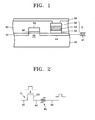
- FIG. 1 is a cross-section of a nonvolatile memory device.
- a nonvolatile memory device having one transistor and one resistant material includes a substrate 40, a transistor which is formed on the substrate 40, and a data storage unit S which is connected to a portion of the transistor.
- the transistor is formed on an upper surface of the substrate 40 and includes a source 42 and a drain 44 doped with conductive impurities, and gate stacking materials 48 and 50 on a channel 46 between the source 42 and the drain 44.
- the gate stacking materials 48 and 50 consist of a gate insulating layer 48 and a gate electrode 50.
- the data storage unit S is formed on the drain 44.
- the data storage unit S includes a lower electrode 52 directly contacting the drain 44, a data storage material layer 54 stacked on the lower electrode 52, and an upper electrode 56 stacked on the data storage material layer 54.
- the data storage material layer 54 is a variable resistant material layer in which resistance is changed according to a size and direction of voltage or current pulse.
- the variable resistant material layer that can be used as the data storage material 54 is preferable to be a transition metal oxide layer such as NiO, V 2 O 5 , ZnO, Nb 2 O 5 , TiO 2 , WO 3 , CoO layers etc.
- the transition metal oxide layer has a noticeable characteristic. That is, if a specific voltage or current value is applied to the transition metal oxide layer and thus the transition metal oxide layer has the specific value, the transition metal oxide layer maintains the specific value until a new specific value is applied. This characteristic of the transition metal oxide layer will be explained in detail later.
- An interlayer insulating layer 60 covering the transistor surrounding the data storage unit S is formed on the substrate 40.
- a section of the interlayer insulating layer 60 formed on the upper electrode 56 is removed to expose an upper surface of the upper electrode 56.
- a plate electrode 58, which is stacked on the interlayer insulating layer 60, is connected to the front of the exposed surface of the upper electrode 56.
- the plate electrode 58 and the upper electrode 56 may be formed of the same material.
- a current amplifier 61 is connected to the drain 44 and senses and amplifies a drain current Id.
- FIG. 2 is a circuit diagram of the nonvolatile memory device of FIG. 1 .
- Tr denotes the transistor
- Rv denotes a changeable resistant material corresponding to the data storage material layer 54.
- FIG. 3 is a cross-sectional view of a variation of the nonvolatile memory device shown in FIG. 1 .
- a first interlayer insulating layer 62 covering a source 42, gate stacking materials 48 and 50, and a drain 44 is formed on a substrate 40 and has a flat upper surface.
- a contact hole h1 is formed in the first interlayer insulating layer 62.
- the drain 44 is exposed through the contact hole h1.
- the contact hole h1 is filled with a conductive plug 64.
- the data storage unit S is formed on the first interlayer insulating layer 62 covering the conductive plug 64.
- a second interlayer insulating layer 66 covering the data storage unit S is formed on the first interlayer insulating layer 62.
- a via hole h2 is formed in the second interlayer insulating 66 such that the upper electrode 56 of the data storage unit S is exposed. where an upper electrode 56 of the data storage unit S is exposed.
- a plate electrode 58 filling the via hole h2 is formed on the second interlayer insulating layer 66.
- While the elements of the data storage unit S may be not a stacked type.
- the lower electrode 52 of the data storage unit S may have a cylindrical shape and the data storage material layer 54 may be formed on the surface of the lower electrode 52.
- the lower electrode 52 may be a columnar shape and the data storage material layer 54 may be formed on the upper surface of the lower electrode 52.
- FIG. 4 is a graph illustrating current-voltage characteristic of the data storage unit S when the data storage material layer 54 is an NiO layer
- FIG. 5 is a comparative example graph illustrating current-voltage characteristic of the data storage unit S when the data storage material layer 54 is a TiO 2 layer.
- a horizontal axis indicates a voltage applied to the data storage unit S and a vertical axis indicates a drain current Id flowing between the source 42 and the drain 44.
- a first graph G1 illustrates a case where the resistance of the data storage unit S, i.e., the resistance of the data storage material layer 54, is lowered
- a second graph G2 illustrates a case where the resistance of the data storage material layer 54 has an increased value.
- the drain current Id is changed in proportional to the voltage applied to the data storage material layer 54.
- V 1 first voltage
- V 2 second voltage
- V 2 second voltage
- the resistance of the data storage material 54 is dramatically increased while a voltage in the range of ⁇ V (V 1 ⁇ V 2 ) is applied to the data storage material layer 54.
- the change of the drain current Id is the same as the change occurring when the first voltage V 1 is applied to the data storage material 54.
- the change of the drain current Id of the data storage material layer 54 is proportional to the applied voltage and is the same as when a lower voltage than the first voltage V 1 is applied thereto.
- the current of the data storage material layer 54 varies depending on a voltage applied thereto, i.e., whether the voltage applied thereto is greater or smaller than the first voltage V 1 .
- the data storage material layer 54 has a current (resistance) value as illustrated in the first graph G1 (hereinafter, this is called the first case).
- the data storage material layer 54 has a second resistance, which is greater than the first resistance, as illustrated in FIG. 4 , and a voltage smaller than the first voltage V 1 is applied to the data storage material layer 54, the data storage material layer 54 has a current value as illustrate in the second graph G2 (hereinafter, this is called the second case).
- the current measured at the predetermined voltage in the second case is much less than that measured in the first case.
- the resistance is much larger in the second case. This means that these two different currents can be measured from the data storage material layer 54 at a predetermined voltage smaller than the first voltage V 1
- the two current values respectively correspond to data " 0 " and " 1 " written in the data storage material layer 54.
- the first case corresponds to data " 1 " being stored in the data storage material layer 54 and the second case corresponds to data " 0 " being stored in the data storage material layer 54.
- the data values " 0 " and “ 1 " for the first and second cases are optionally designated. That is, the first case may corresponding to data " 0 " being stored in the data storage material layer 54 and the second case may correspond to data " 1 " being stored in the data storage material layer 54.
- the voltage-current characteristics of the data storage material layer 54 differ from the voltage-current characteristics illustrated in FIG. 4 .
- third and fifth graphs G3 and G5 illustrate voltage-current characteristics when a negative voltage, that is, a voltage smaller than a fifth voltage V 5 (
- Fourth and sixth graphs G4 and G6 illustrate voltage-current characteristics when a positive voltage, that is, one larger than a fourth voltage V4 (V ⁇ V4 >0), is applied to the data storage unit S and the resistance of the data storage material layer 54 dramatically increases.
- the voltage-current characteristics of the data storage material layer 54 become those illustrated in the fourth graph G4 when the voltage is positive and become those illustrated in the sixth graph G6 when the voltage is negative.
- the data storage material layer 54 maintains a high resistance until the fifth voltage V 5 is applied to the data storage unit S (hereinafter, this is called the third case).
- the fourth case after a voltage smaller than the fifth voltage V 5 is applied to the data storage unit S, the voltage-current characteristics of the data storage material layer 54 become those illustrated in the fifth graph G5 when the voltage is negative and those illustrated in the third graph G3 when the voltage is positive.
- the data storage material layer 54 maintains a low resistance until the fourth voltage V 4 is applied to the data storage unit S (hereinafter, this is called the fourth case).
- the data storage material layer 54 has two different currents (or resistances) in the range between the fifth voltage V 5 and the fourth voltage V 4 .
- the two states of the data storage material layer 54 are determined as a voltage larger than the fourth voltage V 4 or smaller than the fifth voltage V 5 is applied to the data storage unit S. However, since the voltage applied to the data storage material layer 54 to detect these states is smaller than the fourth voltage V 4 or larger than the fifth voltage V 5 , the data storage material layer 54 maintains its initial state even after the state is detected. That is, data stored in the data storage material layer 54 is maintained even after the pertinent data is read.
- FIGS. 6 and 7 illustrate examples of voltage pulses applied to the data storage unit S to write data in the data storage material layer 54 and read or erase the data written in the data storage material layer 54.
- FIG. 6 illustrates a voltage pulse applied to the data storage material layer 54 when it is a NiO layer
- FIG. 7 illustrates a voltage pulse applied to the data storage material layer 54 when it is a TiO 2 layer.
- a second write voltage pulse V w2 is applied to the data storage material layer 54 in order to write data, for example " 1 ", in the data storage material layer 54.
- the second write voltage pulse V W2 has a value corresponding to the third voltage V 3 of FIG. 4 .
- a third read voltage pulse V R3 is applied to the data storage material layer 54 to read the data "1 " stored in the data storage material layer 54.
- the third read voltage pulse V R3 has a voltage that is lower than the first voltage V 1 of FIG. 4 .
- a third write voltage pulse V E2 is applied to the data storage material layer 54 in order to write data, for example " 0 ", in the data storage material layer 54.
- the third write voltage pulse V E2 has a voltage between the first and second voltages V 1 and V 2 . Therefore, when the third write voltage pulse V E2 , that is smaller than the second write voltage pulse V w2 , is applied to the data storage material layer 54, the resistance of the data storage material layer 54 dramatically increases (see FIG. 4 ).
- the data storage material layer 54 remains in this state when a voltage pulse applied to the data storage material layer 54 is lower than the first voltage V 1 (see the second graph G2 of FIG. 4 ).
- a fourth read voltage pulse V R4 When a fourth read voltage pulse V R4 is applied to the data storage material layer 54 to read the data " 0 " from the data storage material layer 54.
- the fourth read voltage pulse V R4 has a voltage that is lower than the first voltage V 1 of FIG. 4 .
- the current measured from the data storage material layer 54 is a lot smaller than the current measured when the data " 1 " is read.
- the data stored in the data storage material layer 54 is erased by simply applying a voltage pulse that has an opposite polarity to one applied when writing the data to the data storage unit S.
- a first write voltage pulse V W1 is applied to the data storage material layer 54 in order to write a predetermined data, for example "1", in the data storage material layer 54.
- a first read voltage pulse V R1 is applied to the data storage unit S to read the data " 1 " stored in the data storage material layer 54 by applying the first write voltage pulse V W1 .
- the first read voltage pulse V R1 which is lower than the first write voltage pulse V W1 , has a voltage higher than zero and lower than fourth voltage V 4 .
- the resistance characteristics of the data storage material layer 54 do not change since the first read voltage pulse V R1 has a voltage that not only lower than the first write voltage pulse V W1 , but also has the same polarity as the first write voltage pulse V W1 .
- the first read voltage pulse V R1 is applied to the data storage material layer 54 , the data written in the data storage material layer 54 is not damaged and destroyed.
- the resistance of the data storage material layer 54 at the fifth voltage V 5 dramatically decreases. Accordingly, the fifth voltage V 5 can be used to erase the data written in the data storage material layer 54 by applying the first write voltage pulse V W1 .
- V E1 denotes a first erase voltage pulse corresponding to the fifth voltage V 5 . If the first erase voltage pulse V E1 (
- a second read voltage pulse V R2 is applied to the data storage material layer 54 to read data " 0 " from the data storage material layer 54.
- the second read voltage pulse V R2 is lower than an absolute value of the voltage of the first erase voltage pulse V E1 (V R2 ⁇
- the data storage material layer 54 has a different current value depending on the voltage applied thereto to write data. Accordingly, the data written in the data storage material layer 54 can be precisely read. In addition, since a voltage applied to read data from the data storage material layer 54 is lower than the voltage applied to write data thereto, the data state of the data storage material layer 54 can be maintained constantly even after the data is read. Thus, a refresh process that is conducted in the conventional memory device after data reading is not required.
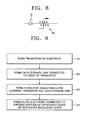
- FIG. 8 is a circuit diagram of a nonvolatile memory device comprising one diode D and one variable resistant material Rv, that is, 1 D-1 R.
- a transistor is formed on the substrate 40 in step S1.
- the data storage unit S connected to the drain 44 of the transistor is formed on the substrate 40 by sequentially forming the lower electrode 52, the data storage material layer 54, and the upper electrode 56 on the drain 44 of the substrate 40.
- the data storage material layer 54 may be formed of a transition metal oxide layer having a resistance that varies according to the applied voltage. For instance, a NiO, V 2 O 5 , ZnO, Nb 2 O 5 , TiO 2 , WO 3 , or CoO layer may be used.
- the interlayer insulating layer 60 covering the transistor and the data storage unit S is formed on the substrate 40.
- step S4 the upper electrode of the data storage unit S is exposed and the plate electrode 58 is formed on an exposed portion of the upper electrode 56 of the data storage unit S and the interlayer insulating layer 60.
- the plate electrode 58 may be substituted with a plate pad that contacts all upper electrodes included in data storage units of all cells (not shown).
- the contact hole h1 may be filled with the conductive plug 64. Additionally, the data storage unit S contacting the conductive plug 64 may be formed on the first interlayer insulating layer 62.
- the lower electrode 52 and the data storage material layer 54 may be formed in a non-stack type rather than a stack type.
- the data storage unit S connected to the diode may be formed on the substrate 40.
- the data storage unit S may be formed in the same way as described above.
- the nonvolatile memory device comprises a transition metal oxide layer, which has the voltage-current characteristic as illustrated in FIG. 4 and is easy to process, as the resistant material in which the data is stored. Therefore, the conventional DRAM manufacturing process can be used and an increased productivity along with lowered production costs can be achieved. Furthermore, memory characteristics of the resistant material do not change even though the size of the resistant material is reduced due to a high integration density. This is because that the data is written or read using changes in resistance of the resistant material. Also, because data written in the resistant material is read non-destructively, the state of the resistant material remains constant even after the data is read and a lower operation voltage is applied. Thus, a refresh process that is conducted in the conventional memory device after data reading is not required.
Landscapes
- Engineering & Computer Science (AREA)
- Chemical & Material Sciences (AREA)
- Materials Engineering (AREA)
- Computer Hardware Design (AREA)
- Semiconductor Memories (AREA)
- Thin Film Transistor (AREA)
Applications Claiming Priority (2)
| Application Number | Priority Date | Filing Date | Title |
|---|---|---|---|
| KR1020030035562A KR100773537B1 (ko) | 2003-06-03 | 2003-06-03 | 한 개의 스위칭 소자와 한 개의 저항체를 포함하는비휘발성 메모리 장치 및 그 제조 방법 |
| EP04253135A EP1484799B1 (en) | 2003-06-03 | 2004-05-27 | Nonvolatile memory device comprising a switching device and a resistant material and method of manufacturing the same |
Related Parent Applications (2)
| Application Number | Title | Priority Date | Filing Date |
|---|---|---|---|
| EP04253135A Division EP1484799B1 (en) | 2003-06-03 | 2004-05-27 | Nonvolatile memory device comprising a switching device and a resistant material and method of manufacturing the same |
| EP04253135.0 Division | 2004-05-27 |
Publications (2)
| Publication Number | Publication Date |
|---|---|
| EP1947696A1 EP1947696A1 (en) | 2008-07-23 |
| EP1947696B1 true EP1947696B1 (en) | 2011-07-06 |
Family
ID=33157373
Family Applications (3)
| Application Number | Title | Priority Date | Filing Date |
|---|---|---|---|
| EP08155548A Expired - Lifetime EP1947696B1 (en) | 2003-06-03 | 2004-05-27 | Nonvolatile memory device comprising a switching device and a resistant material and method of manufacturing the same |
| EP04253135A Expired - Lifetime EP1484799B1 (en) | 2003-06-03 | 2004-05-27 | Nonvolatile memory device comprising a switching device and a resistant material and method of manufacturing the same |
| EP09179704A Withdrawn EP2164104A3 (en) | 2003-06-03 | 2004-05-27 | Nonvolatile memory device comprising a switching device and a resistant material and method of manufacturing the same |
Family Applications After (2)
| Application Number | Title | Priority Date | Filing Date |
|---|---|---|---|
| EP04253135A Expired - Lifetime EP1484799B1 (en) | 2003-06-03 | 2004-05-27 | Nonvolatile memory device comprising a switching device and a resistant material and method of manufacturing the same |
| EP09179704A Withdrawn EP2164104A3 (en) | 2003-06-03 | 2004-05-27 | Nonvolatile memory device comprising a switching device and a resistant material and method of manufacturing the same |
Country Status (6)
| Country | Link |
|---|---|
| US (2) | US8164130B2 (OSRAM) |
| EP (3) | EP1947696B1 (OSRAM) |
| JP (1) | JP4511249B2 (OSRAM) |
| KR (1) | KR100773537B1 (OSRAM) |
| CN (2) | CN101794807A (OSRAM) |
| DE (1) | DE602004025877D1 (OSRAM) |
Families Citing this family (178)
| Publication number | Priority date | Publication date | Assignee | Title |
|---|---|---|---|---|
| EP2988331B1 (en) * | 2000-08-14 | 2019-01-09 | SanDisk Technologies LLC | Semiconductor memory device |
| DE10255117A1 (de) * | 2002-11-26 | 2004-06-17 | Infineon Technologies Ag | Halbleiterspeichereinrichtung sowie Verfahren zu deren Herstellung |
| KR100773537B1 (ko) | 2003-06-03 | 2007-11-07 | 삼성전자주식회사 | 한 개의 스위칭 소자와 한 개의 저항체를 포함하는비휘발성 메모리 장치 및 그 제조 방법 |
| KR101051704B1 (ko) * | 2004-04-28 | 2011-07-25 | 삼성전자주식회사 | 저항 구배를 지닌 다층막을 이용한 메모리 소자 |
| FR2887149B1 (fr) * | 2005-06-17 | 2007-08-03 | Galderma Sa | Procede de solubilisation du metronidazole |
| KR100593448B1 (ko) * | 2004-09-10 | 2006-06-28 | 삼성전자주식회사 | 전이금속 산화막을 데이터 저장 물질막으로 채택하는비휘발성 기억 셀들 및 그 제조방법들 |
| US7405465B2 (en) * | 2004-09-29 | 2008-07-29 | Sandisk 3D Llc | Deposited semiconductor structure to minimize n-type dopant diffusion and method of making |
| KR100738070B1 (ko) * | 2004-11-06 | 2007-07-12 | 삼성전자주식회사 | 한 개의 저항체와 한 개의 트랜지스터를 지닌 비휘발성메모리 소자 |
| KR100657911B1 (ko) | 2004-11-10 | 2006-12-14 | 삼성전자주식회사 | 한 개의 저항체와 한 개의 다이오드를 지닌 비휘발성메모리 소자 |
| KR100593750B1 (ko) | 2004-11-10 | 2006-06-28 | 삼성전자주식회사 | 이성분계 금속 산화막을 데이터 저장 물질막으로 채택하는교차점 비휘발성 기억소자 및 그 제조방법 |
| KR100576369B1 (ko) * | 2004-11-23 | 2006-05-03 | 삼성전자주식회사 | 전이 금속 산화막을 데이타 저장 물질막으로 채택하는비휘발성 기억소자의 프로그램 방법 |
| KR100682908B1 (ko) * | 2004-12-21 | 2007-02-15 | 삼성전자주식회사 | 두개의 저항체를 지닌 비휘발성 메모리 소자 |
| KR100693409B1 (ko) * | 2005-01-14 | 2007-03-12 | 광주과학기술원 | 산화막의 저항변화를 이용한 비휘발성 기억소자 및 그제조방법 |
| KR100682926B1 (ko) * | 2005-01-31 | 2007-02-15 | 삼성전자주식회사 | 저항체를 이용한 비휘발성 메모리 소자 및 그 제조방법 |
| KR100657956B1 (ko) | 2005-04-06 | 2006-12-14 | 삼성전자주식회사 | 다치 저항체 메모리 소자와 그 제조 및 동작 방법 |
| US7812404B2 (en) * | 2005-05-09 | 2010-10-12 | Sandisk 3D Llc | Nonvolatile memory cell comprising a diode and a resistance-switching material |
| KR100695150B1 (ko) * | 2005-05-12 | 2007-03-14 | 삼성전자주식회사 | 금속-절연체 변환 물질을 이용한 트랜지스터 및 그 제조방법 |
| JP5190182B2 (ja) * | 2005-05-31 | 2013-04-24 | 株式会社半導体エネルギー研究所 | 半導体装置 |
| US20060273298A1 (en) * | 2005-06-02 | 2006-12-07 | Matrix Semiconductor, Inc. | Rewriteable memory cell comprising a transistor and resistance-switching material in series |
| JP4843259B2 (ja) * | 2005-06-10 | 2011-12-21 | シャープ株式会社 | 可変抵抗素子の製造方法 |
| JP4783070B2 (ja) * | 2005-06-24 | 2011-09-28 | シャープ株式会社 | 半導体記憶装置及びその製造方法 |
| KR100723872B1 (ko) * | 2005-06-30 | 2007-05-31 | 한국전자통신연구원 | 급격한 금속-절연체 전이를 이용한 메모리소자 및 그동작방법 |
| KR100622268B1 (ko) * | 2005-07-04 | 2006-09-11 | 한양대학교 산학협력단 | ReRAM 소자용 다층 이원산화박막의 형성방법 |
| US7955515B2 (en) * | 2005-07-11 | 2011-06-07 | Sandisk 3D Llc | Method of plasma etching transition metal oxides |
| JP3889023B2 (ja) * | 2005-08-05 | 2007-03-07 | シャープ株式会社 | 可変抵抗素子とその製造方法並びにそれを備えた記憶装置 |
| KR101369864B1 (ko) * | 2005-08-12 | 2014-03-05 | 가부시키가이샤 한도오따이 에네루기 켄큐쇼 | 반도체장치 및 그 제조방법 |
| JP5019821B2 (ja) * | 2005-08-12 | 2012-09-05 | 株式会社半導体エネルギー研究所 | 半導体装置 |
| JP4854233B2 (ja) | 2005-08-15 | 2012-01-18 | 独立行政法人産業技術総合研究所 | スイッチング素子 |
| US7521705B2 (en) | 2005-08-15 | 2009-04-21 | Micron Technology, Inc. | Reproducible resistance variable insulating memory devices having a shaped bottom electrode |
| KR101100427B1 (ko) * | 2005-08-24 | 2011-12-30 | 삼성전자주식회사 | 이온 전도층을 포함하는 불휘발성 반도체 메모리 장치와 그제조 및 동작 방법 |
| US7601995B2 (en) * | 2005-10-27 | 2009-10-13 | Infineon Technologies Ag | Integrated circuit having resistive memory cells |
| US8222917B2 (en) * | 2005-11-03 | 2012-07-17 | Agate Logic, Inc. | Impedance matching and trimming apparatuses and methods using programmable resistance devices |
| KR100668348B1 (ko) * | 2005-11-11 | 2007-01-12 | 삼성전자주식회사 | 비휘발성 메모리 소자 및 그 제조방법 |
| US7834338B2 (en) * | 2005-11-23 | 2010-11-16 | Sandisk 3D Llc | Memory cell comprising nickel-cobalt oxide switching element |
| US7816659B2 (en) * | 2005-11-23 | 2010-10-19 | Sandisk 3D Llc | Devices having reversible resistivity-switching metal oxide or nitride layer with added metal |
| JP4939324B2 (ja) * | 2005-12-02 | 2012-05-23 | シャープ株式会社 | 可変抵抗素子及びその製造方法 |
| JP4061328B2 (ja) * | 2005-12-02 | 2008-03-19 | シャープ株式会社 | 可変抵抗素子及びその製造方法 |
| JP4017650B2 (ja) | 2005-12-02 | 2007-12-05 | シャープ株式会社 | 可変抵抗素子及びその製造方法 |
| JP3989506B2 (ja) * | 2005-12-27 | 2007-10-10 | シャープ株式会社 | 可変抵抗素子とその製造方法ならびにそれを備えた半導体記憶装置 |
| KR100684908B1 (ko) | 2006-01-09 | 2007-02-22 | 삼성전자주식회사 | 다수 저항 상태를 갖는 저항 메모리 요소, 저항 메모리 셀및 그 동작 방법 그리고 상기 저항 메모리 요소를 적용한데이터 처리 시스템 |
| US7714315B2 (en) | 2006-02-07 | 2010-05-11 | Qimonda North America Corp. | Thermal isolation of phase change memory cells |
| KR100718155B1 (ko) * | 2006-02-27 | 2007-05-14 | 삼성전자주식회사 | 두 개의 산화층을 이용한 비휘발성 메모리 소자 |
| JP4228033B2 (ja) | 2006-03-08 | 2009-02-25 | パナソニック株式会社 | 不揮発性記憶素子、不揮発記憶装置、及びそれらの製造方法 |
| KR101176543B1 (ko) * | 2006-03-10 | 2012-08-28 | 삼성전자주식회사 | 저항성 메모리소자 |
| US7875871B2 (en) | 2006-03-31 | 2011-01-25 | Sandisk 3D Llc | Heterojunction device comprising a semiconductor and a resistivity-switching oxide or nitride |
| TWI345783B (en) * | 2006-03-31 | 2011-07-21 | Sandisk 3D Llc | Nonvolatile memory cells, monolithic three dimensional memory arrays and methods for programming such memory arrays |
| US7829875B2 (en) | 2006-03-31 | 2010-11-09 | Sandisk 3D Llc | Nonvolatile rewritable memory cell comprising a resistivity-switching oxide or nitride and an antifuse |
| US7808810B2 (en) | 2006-03-31 | 2010-10-05 | Sandisk 3D Llc | Multilevel nonvolatile memory cell comprising a resistivity-switching oxide or nitride and an antifuse |
| JP4699932B2 (ja) * | 2006-04-13 | 2011-06-15 | パナソニック株式会社 | 抵抗変化素子とそれを用いた抵抗変化型メモリならびにその製造方法 |
| JP4857014B2 (ja) * | 2006-04-19 | 2012-01-18 | パナソニック株式会社 | 抵抗変化素子とそれを用いた抵抗変化型メモリ |
| KR101213702B1 (ko) * | 2006-04-21 | 2012-12-18 | 삼성전자주식회사 | 비휘발성 메모리 소자, 그 동작 방법, 및 그 제조 방법 |
| KR101239962B1 (ko) | 2006-05-04 | 2013-03-06 | 삼성전자주식회사 | 하부 전극 상에 형성된 버퍼층을 포함하는 가변 저항메모리 소자 |
| US20070267621A1 (en) * | 2006-05-19 | 2007-11-22 | Infineon Technologies Ag | Resistive memory device |
| KR101206034B1 (ko) | 2006-05-19 | 2012-11-28 | 삼성전자주식회사 | 산소결핍 금속산화물을 이용한 비휘발성 메모리 소자 및 그제조방법 |
| KR100818271B1 (ko) * | 2006-06-27 | 2008-03-31 | 삼성전자주식회사 | 펄스전압을 인가하는 비휘발성 메모리 소자의 문턱 스위칭동작 방법 |
| KR100738116B1 (ko) * | 2006-07-06 | 2007-07-12 | 삼성전자주식회사 | 가변 저항 물질을 포함하는 비휘발성 메모리 소자 |
| JP5263856B2 (ja) * | 2006-07-26 | 2013-08-14 | 独立行政法人産業技術総合研究所 | スイッチング素子及びその製造方法 |
| JP4105760B2 (ja) | 2006-08-25 | 2008-06-25 | 松下電器産業株式会社 | 記憶素子およびメモリ装置並びに半導体集積回路 |
| US8232175B2 (en) | 2006-09-14 | 2012-07-31 | Spansion Llc | Damascene metal-insulator-metal (MIM) device with improved scaleability |
| JP4655019B2 (ja) * | 2006-10-04 | 2011-03-23 | セイコーエプソン株式会社 | 可変抵抗素子 |
| CN101174672A (zh) | 2006-10-04 | 2008-05-07 | 旺宏电子股份有限公司 | 存储单元及其制程 |
| US7524722B2 (en) | 2006-10-12 | 2009-04-28 | Macronix International Co., Ltd. | Resistance type memory device and fabricating method and operating method thereof |
| CN100573953C (zh) * | 2006-10-13 | 2009-12-23 | 旺宏电子股份有限公司 | 电阻式存储器元件的操作方法 |
| WO2008050716A1 (en) | 2006-10-24 | 2008-05-02 | Panasonic Corporation | Nonvolatile semiconductor memory and process for producing the same |
| WO2008058264A2 (en) * | 2006-11-08 | 2008-05-15 | Symetrix Corporation | Correlated electron memory |
| KR100816759B1 (ko) * | 2006-11-09 | 2008-03-25 | 삼성전자주식회사 | 가변저항 스토리지를 갖는 비휘발성 기억 장치 및 동작방법 |
| KR101206036B1 (ko) | 2006-11-16 | 2012-11-28 | 삼성전자주식회사 | 전이 금속 고용체를 포함하는 저항성 메모리 소자 및 그제조 방법 |
| WO2008059701A1 (ja) | 2006-11-17 | 2008-05-22 | Panasonic Corporation | 不揮発性記憶素子、不揮発性記憶装置、不揮発性半導体装置、および不揮発性記憶素子の製造方法 |
| US8258493B2 (en) | 2006-11-20 | 2012-09-04 | Panasonic Corporation | Nonvolatile semiconductor memory apparatus and manufacturing method thereof |
| KR100846502B1 (ko) * | 2006-11-21 | 2008-07-17 | 삼성전자주식회사 | 비휘발성 메모리소자 및 그 제조방법 |
| KR100982424B1 (ko) * | 2006-11-28 | 2010-09-15 | 삼성전자주식회사 | 저항 메모리 소자의 제조 방법 |
| KR101136870B1 (ko) | 2006-11-30 | 2012-04-20 | 후지쯔 가부시끼가이샤 | 저항 기억 소자의 제조 방법 |
| KR101090171B1 (ko) * | 2006-12-19 | 2011-12-06 | 후지쯔 가부시끼가이샤 | 저항변화소자의 제조방법 |
| WO2008075412A1 (ja) * | 2006-12-19 | 2008-06-26 | Fujitsu Limited | 抵抗変化素子及びその製造方法 |
| JP5062180B2 (ja) * | 2006-12-19 | 2012-10-31 | 富士通株式会社 | 抵抗変化素子及びその製造方法 |
| CN101569011A (zh) | 2006-12-28 | 2009-10-28 | 松下电器产业株式会社 | 电阻变化型元件、电阻变化型存储装置和电阻变化型装置 |
| US8018760B2 (en) | 2006-12-28 | 2011-09-13 | Panasonic Corporation | Resistance variable element and resistance variable memory apparatus |
| KR20080064353A (ko) * | 2007-01-04 | 2008-07-09 | 삼성전자주식회사 | 저항 메모리 소자 및 그 제조 방법 |
| JP2008182154A (ja) * | 2007-01-26 | 2008-08-07 | Nippon Telegr & Teleph Corp <Ntt> | メモリ装置 |
| JP2008182156A (ja) * | 2007-01-26 | 2008-08-07 | Nippon Telegr & Teleph Corp <Ntt> | 金属酸化物素子及びその製造方法 |
| US7972897B2 (en) | 2007-02-05 | 2011-07-05 | Intermolecular, Inc. | Methods for forming resistive switching memory elements |
| US7678607B2 (en) | 2007-02-05 | 2010-03-16 | Intermolecular, Inc. | Methods for forming resistive switching memory elements |
| US7704789B2 (en) | 2007-02-05 | 2010-04-27 | Intermolecular, Inc. | Methods for forming resistive switching memory elements |
| WO2008097742A1 (en) * | 2007-02-05 | 2008-08-14 | Interolecular, Inc. | Methods for forming resistive switching memory elements |
| KR101054321B1 (ko) * | 2007-03-01 | 2011-08-05 | 후지쯔 가부시끼가이샤 | 반도체 장치 및 그 제조 방법 |
| US8097878B2 (en) | 2007-03-05 | 2012-01-17 | Intermolecular, Inc. | Nonvolatile memory elements with metal-deficient resistive-switching metal oxides |
| US7629198B2 (en) | 2007-03-05 | 2009-12-08 | Intermolecular, Inc. | Methods for forming nonvolatile memory elements with resistive-switching metal oxides |
| JP5345052B2 (ja) * | 2007-03-23 | 2013-11-20 | 富士通株式会社 | 抵抗記憶素子及び不揮発性半導体記憶装置 |
| JP4252110B2 (ja) | 2007-03-29 | 2009-04-08 | パナソニック株式会社 | 不揮発性記憶装置、不揮発性記憶素子および不揮発性記憶素子アレイ |
| US7960224B2 (en) | 2007-04-03 | 2011-06-14 | Macronix International Co., Ltd. | Operation method for multi-level switching of metal-oxide based RRAM |
| US7948789B2 (en) | 2007-04-09 | 2011-05-24 | Panasonic Corporation | Resistance variable element, nonvolatile switching element, and resistance variable memory apparatus |
| JP5526776B2 (ja) * | 2007-04-17 | 2014-06-18 | 日本電気株式会社 | 抵抗変化素子及び該抵抗変化素子を含む半導体装置 |
| WO2008140979A1 (en) | 2007-05-09 | 2008-11-20 | Intermolecular, Inc. | Resistive-switching nonvolatile memory elements |
| JP4967176B2 (ja) * | 2007-05-10 | 2012-07-04 | シャープ株式会社 | 可変抵抗素子とその製造方法及び不揮発性半導体記憶装置 |
| KR101350979B1 (ko) | 2007-05-11 | 2014-01-14 | 삼성전자주식회사 | 저항성 메모리 소자 및 그 제조 방법 |
| US8148711B2 (en) | 2007-05-18 | 2012-04-03 | Panasonic Corporation | Nonvolatile memory element, manufacturing method thereof, and nonvolatile semiconductor apparatus using nonvolatile memory element |
| US8173989B2 (en) * | 2007-05-30 | 2012-05-08 | Samsung Electronics Co., Ltd. | Resistive random access memory device and methods of manufacturing and operating the same |
| JP4253038B2 (ja) | 2007-06-05 | 2009-04-08 | パナソニック株式会社 | 不揮発性記憶素子およびその製造方法、並びにその不揮発性記憶素子を用いた不揮発性半導体装置 |
| US7846785B2 (en) | 2007-06-29 | 2010-12-07 | Sandisk 3D Llc | Memory cell that employs a selectively deposited reversible resistance-switching element and methods of forming the same |
| US8233308B2 (en) | 2007-06-29 | 2012-07-31 | Sandisk 3D Llc | Memory cell that employs a selectively deposited reversible resistance-switching element and methods of forming the same |
| EP2162916B1 (en) | 2007-06-29 | 2013-03-20 | Sandisk 3D LLC | Method of forming a memory cell that employs a selectively deposited reversible resistance-switching element |
| US7902537B2 (en) | 2007-06-29 | 2011-03-08 | Sandisk 3D Llc | Memory cell that employs a selectively grown reversible resistance-switching element and methods of forming the same |
| US7824956B2 (en) | 2007-06-29 | 2010-11-02 | Sandisk 3D Llc | Memory cell that employs a selectively grown reversible resistance-switching element and methods of forming the same |
| US7777215B2 (en) | 2007-07-20 | 2010-08-17 | Macronix International Co., Ltd. | Resistive memory structure with buffer layer |
| JP5501966B2 (ja) | 2007-07-25 | 2014-05-28 | インターモレキュラー, インコーポレイテッド | 多状態の不揮発性メモリ素子 |
| WO2009015298A2 (en) | 2007-07-25 | 2009-01-29 | Intermolecular, Inc. | Nonvolatile memory elements |
| JP5012312B2 (ja) | 2007-08-15 | 2012-08-29 | ソニー株式会社 | 記憶装置の駆動方法 |
| US8338816B2 (en) * | 2007-10-15 | 2012-12-25 | Panasonic Corporation | Nonvolatile memory element, and nonvolatile semiconductor device using the nonvolatile memory element |
| WO2009057262A1 (ja) | 2007-10-30 | 2009-05-07 | Panasonic Corporation | 不揮発性半導体記憶装置およびその製造方法 |
| US8345462B2 (en) | 2007-12-05 | 2013-01-01 | Macronix International Co., Ltd. | Resistive memory and method for manufacturing the same |
| JP2009141225A (ja) * | 2007-12-07 | 2009-06-25 | Sharp Corp | 可変抵抗素子、可変抵抗素子の製造方法、不揮発性半導体記憶装置 |
| US7759201B2 (en) * | 2007-12-17 | 2010-07-20 | Sandisk 3D Llc | Method for fabricating pitch-doubling pillar structures |
| US7706169B2 (en) * | 2007-12-27 | 2010-04-27 | Sandisk 3D Llc | Large capacity one-time programmable memory cell using metal oxides |
| US7764534B2 (en) * | 2007-12-28 | 2010-07-27 | Sandisk 3D Llc | Two terminal nonvolatile memory using gate controlled diode elements |
| US8125818B2 (en) * | 2008-02-25 | 2012-02-28 | Panasonic Corporation | Method of programming variable resistance element and variable resistance memory device using the same |
| JP4549401B2 (ja) * | 2008-03-11 | 2010-09-22 | 富士通株式会社 | 抵抗記憶素子の製造方法 |
| WO2009125777A1 (ja) * | 2008-04-07 | 2009-10-15 | 日本電気株式会社 | 抵抗変化素子及びその製造方法 |
| US7981592B2 (en) | 2008-04-11 | 2011-07-19 | Sandisk 3D Llc | Double patterning method |
| US7786015B2 (en) * | 2008-04-28 | 2010-08-31 | Sandisk 3D Llc | Method for fabricating self-aligned complementary pillar structures and wiring |
| WO2009142165A1 (ja) * | 2008-05-20 | 2009-11-26 | 日本電気株式会社 | 半導体装置およびその製造方法 |
| US7732235B2 (en) * | 2008-06-30 | 2010-06-08 | Sandisk 3D Llc | Method for fabricating high density pillar structures by double patterning using positive photoresist |
| US7781269B2 (en) * | 2008-06-30 | 2010-08-24 | Sandisk 3D Llc | Triangle two dimensional complementary patterning of pillars |
| US7981742B2 (en) * | 2008-07-02 | 2011-07-19 | Macronic International Co., Ltd. | Semiconductor device, data element thereof and method of fabricating the same |
| WO2010004705A1 (ja) | 2008-07-11 | 2010-01-14 | パナソニック株式会社 | 不揮発性記憶素子およびその製造方法、並びにその不揮発性記憶素子を用いた不揮発性半導体装置 |
| US8345465B2 (en) * | 2008-09-30 | 2013-01-01 | Panasonic Corporation | Driving method of variable resistance element, initialization method of variable resistance element, and nonvolatile storage device |
| CN101878530B (zh) * | 2008-10-01 | 2012-03-07 | 松下电器产业株式会社 | 非易失性存储元件和使用该元件的非易失性存储装置 |
| US8076056B2 (en) * | 2008-10-06 | 2011-12-13 | Sandisk 3D Llc | Method of making sub-resolution pillar structures using undercutting technique |
| KR20100041155A (ko) | 2008-10-13 | 2010-04-22 | 삼성전자주식회사 | 저항성 메모리 소자 |
| US8080443B2 (en) * | 2008-10-27 | 2011-12-20 | Sandisk 3D Llc | Method of making pillars using photoresist spacer mask |
| JP4607257B2 (ja) | 2008-12-04 | 2011-01-05 | パナソニック株式会社 | 不揮発性記憶素子及び不揮発性記憶装置 |
| US8084347B2 (en) * | 2008-12-31 | 2011-12-27 | Sandisk 3D Llc | Resist feature and removable spacer pitch doubling patterning method for pillar structures |
| US7846756B2 (en) * | 2008-12-31 | 2010-12-07 | Sandisk 3D Llc | Nanoimprint enhanced resist spacer patterning method |
| US8114765B2 (en) * | 2008-12-31 | 2012-02-14 | Sandisk 3D Llc | Methods for increased array feature density |
| JPWO2010086916A1 (ja) * | 2009-01-29 | 2012-07-26 | パナソニック株式会社 | 抵抗変化素子およびその製造方法 |
| JP4757360B2 (ja) | 2009-02-02 | 2011-08-24 | パナソニック株式会社 | 不揮発性記憶素子、不揮発性記憶装置、不揮発性半導体装置、および不揮発性記憶素子の製造方法 |
| JP2010177624A (ja) * | 2009-02-02 | 2010-08-12 | Toshiba Corp | 半導体記憶装置 |
| JP4592828B2 (ja) * | 2009-02-04 | 2010-12-08 | パナソニック株式会社 | 不揮発性記憶素子 |
| WO2010103649A1 (ja) | 2009-03-12 | 2010-09-16 | 富士通株式会社 | 複合抵抗変化素子及びその製造方法 |
| JP4628501B2 (ja) * | 2009-03-25 | 2011-02-09 | パナソニック株式会社 | 抵抗変化素子の駆動方法及び不揮発性記憶装置 |
| JP2010251529A (ja) * | 2009-04-16 | 2010-11-04 | Sony Corp | 半導体記憶装置およびその製造方法 |
| US8488362B2 (en) * | 2009-04-29 | 2013-07-16 | Macronix International Co., Ltd. | Graded metal oxide resistance based semiconductor memory device |
| JP5287544B2 (ja) | 2009-06-25 | 2013-09-11 | ソニー株式会社 | 不揮発性メモリの記録方法及び不揮発性メモリ |
| JP5016699B2 (ja) | 2009-12-16 | 2012-09-05 | シャープ株式会社 | 不揮発性半導体記憶装置及びその製造方法 |
| KR20110072921A (ko) | 2009-12-23 | 2011-06-29 | 삼성전자주식회사 | 메모리소자 및 그 동작방법 |
| KR20110074354A (ko) | 2009-12-24 | 2011-06-30 | 삼성전자주식회사 | 메모리소자 및 그 동작방법 |
| JP5120967B2 (ja) * | 2009-12-25 | 2013-01-16 | シャープ株式会社 | 可変抵抗素子 |
| US8563962B2 (en) | 2009-12-28 | 2013-10-22 | Panasonic Corporation | Memory device and method of manufacturing the same |
| US7923305B1 (en) | 2010-01-12 | 2011-04-12 | Sandisk 3D Llc | Patterning method for high density pillar structures |
| US8026178B2 (en) | 2010-01-12 | 2011-09-27 | Sandisk 3D Llc | Patterning method for high density pillar structures |
| US8432721B2 (en) | 2010-02-02 | 2013-04-30 | Panasonic Corporation | Method of programming variable resistance element, method of initializing variable resistance element, and nonvolatile storage device |
| KR20110101983A (ko) | 2010-03-10 | 2011-09-16 | 삼성전자주식회사 | 바이폴라 메모리셀 및 이를 포함하는 메모리소자 |
| JP4969707B2 (ja) | 2010-07-08 | 2012-07-04 | パナソニック株式会社 | 不揮発性半導体記憶装置およびその製造方法 |
| US8264868B2 (en) | 2010-10-25 | 2012-09-11 | Hewlett-Packard Development Company, L.P. | Memory array with metal-insulator transition switching devices |
| CN102064276B (zh) * | 2010-11-01 | 2014-06-04 | 华中科技大学 | 一种非对称相变存储器单元及器件 |
| US8699258B2 (en) | 2011-01-21 | 2014-04-15 | Macronix International Co., Ltd. | Verification algorithm for metal-oxide resistive memory |
| JP5490961B2 (ja) | 2011-03-14 | 2014-05-14 | パナソニック株式会社 | 不揮発性記憶素子の駆動方法及び不揮発性記憶装置 |
| US8951829B2 (en) | 2011-04-01 | 2015-02-10 | Micron Technology, Inc. | Resistive switching in memory cells |
| JP5313413B2 (ja) | 2011-06-13 | 2013-10-09 | パナソニック株式会社 | 抵抗変化素子の駆動方法、及び不揮発性記憶装置 |
| JP5548319B2 (ja) | 2012-04-20 | 2014-07-16 | パナソニック株式会社 | 不揮発性記憶素子の駆動方法 |
| JP2014032724A (ja) * | 2012-08-03 | 2014-02-20 | Sharp Corp | 半導体記憶装置 |
| US9231204B2 (en) | 2012-09-28 | 2016-01-05 | Intel Corporation | Low voltage embedded memory having conductive oxide and electrode stacks |
| TWI513074B (zh) * | 2013-01-08 | 2015-12-11 | Nat Univ Tsing Hua | 電阻式記憶體 |
| JP5830655B2 (ja) | 2013-04-30 | 2015-12-09 | パナソニックIpマネジメント株式会社 | 不揮発性記憶素子の駆動方法 |
| CN103367639B (zh) * | 2013-07-25 | 2015-09-09 | 福州大学 | 一种氧化锌纳米线低功耗阻变存储器及其制备方法 |
| CN103682100B (zh) * | 2013-12-06 | 2016-04-06 | 南昌大学 | 氧化锌/聚甲基丙烯酸甲酯/硫氰酸亚铜结构的数据存储器及制备方法 |
| CN103985816B (zh) * | 2014-05-28 | 2016-09-14 | 淮阴师范学院 | 一种铝/铁掺杂非晶碳膜/铝纳米薄膜记忆电阻存储器件及其制备方法 |
| TWI548127B (zh) * | 2014-09-19 | 2016-09-01 | 華邦電子股份有限公司 | 電阻式隨機存取記憶體 |
| CN105448948B (zh) * | 2014-09-30 | 2019-01-11 | 华邦电子股份有限公司 | 电阻式随机存取存储器 |
| US10355205B2 (en) | 2014-12-18 | 2019-07-16 | Intel Corporation | Resistive memory cells including localized filamentary channels, devices including the same, and methods of making the same |
| US20170117464A1 (en) * | 2015-10-22 | 2017-04-27 | Winbond Electronics Corp. | Resistive random access memory device |
| CN109791791B (zh) | 2017-09-12 | 2023-03-28 | 新唐科技日本株式会社 | 非易失性存储装置、以及驱动方法 |
| CN109698213A (zh) * | 2017-10-20 | 2019-04-30 | 联华电子股份有限公司 | 半导体结构及其制作方法 |
| JP7308026B2 (ja) | 2018-12-26 | 2023-07-13 | ヌヴォトンテクノロジージャパン株式会社 | 抵抗変化型不揮発性記憶素子及びそれを用いた抵抗変化型不揮発性記憶装置 |
| US11424407B2 (en) * | 2020-09-02 | 2022-08-23 | Winbond Electronics Corp. | Resistive random access memory and method of manufacturing the same |
| US11631808B2 (en) | 2020-12-07 | 2023-04-18 | Rockwell Collins, Inc. | System and device including memristor material |
| US11456418B2 (en) | 2020-09-10 | 2022-09-27 | Rockwell Collins, Inc. | System and device including memristor materials in parallel |
| US11469373B2 (en) * | 2020-09-10 | 2022-10-11 | Rockwell Collins, Inc. | System and device including memristor material |
| US11462267B2 (en) | 2020-12-07 | 2022-10-04 | Rockwell Collins, Inc. | System and device including memristor material |
Citations (1)
| Publication number | Priority date | Publication date | Assignee | Title |
|---|---|---|---|---|
| WO1994024707A1 (en) * | 1993-04-12 | 1994-10-27 | Energy Conversion Devices, Inc. | Electrically erasable, directly overwritable, multibit single cell memory elements and arrays fabricated therefrom |
Family Cites Families (53)
| Publication number | Priority date | Publication date | Assignee | Title |
|---|---|---|---|---|
| US3761896A (en) * | 1972-04-18 | 1973-09-25 | Ibm | Memory array of cells containing bistable switchable resistors |
| US4472296A (en) * | 1982-06-21 | 1984-09-18 | Iowa State University Research Foundation, Inc. | Bulk, polycrystalline switching materials for threshold and/or memory switching |
| JPS6242582A (ja) | 1985-08-20 | 1987-02-24 | Matsushita Electric Ind Co Ltd | 非線形抵抗素子及びその製造方法 |
| JPS63226981A (ja) | 1987-03-16 | 1988-09-21 | Fujitsu Ltd | 超伝導集積回路装置およびその製造方法 |
| JPH0258264A (ja) | 1988-08-23 | 1990-02-27 | Matsushita Electric Ind Co Ltd | メモリー素子 |
| FR2636481B1 (fr) * | 1988-09-14 | 1990-11-30 | Sgs Thomson Microelectronics | Diode active integrable |
| JP3454821B2 (ja) | 1991-08-19 | 2003-10-06 | エナージー・コンバーション・デバイセス・インコーポレーテッド | 電気的に消去可能な、直接重ね書き可能なマルチビット単セルメモリ素子およびそれらから作製したアレイ |
| KR970009616B1 (en) * | 1993-12-31 | 1997-06-14 | Hyundai Electronics Ind | Fabricating method of semiconductor device |
| US5751012A (en) * | 1995-06-07 | 1998-05-12 | Micron Technology, Inc. | Polysilicon pillar diode for use in a non-volatile memory cell |
| US5640343A (en) * | 1996-03-18 | 1997-06-17 | International Business Machines Corporation | Magnetic memory array using magnetic tunnel junction devices in the memory cells |
| US6461982B2 (en) * | 1997-02-27 | 2002-10-08 | Micron Technology, Inc. | Methods for forming a dielectric film |
| JP3236262B2 (ja) * | 1998-06-16 | 2001-12-10 | 松下電器産業株式会社 | 強誘電体メモリ装置 |
| US6586790B2 (en) * | 1998-07-24 | 2003-07-01 | Kabushiki Kaisha Toshiba | Semiconductor device and method for manufacturing the same |
| GB9902993D0 (en) | 1999-02-11 | 1999-03-31 | Univ Strathclyde | Low pressure chemical vapour deposition of titanium dioxide |
| CN1191635C (zh) | 1999-02-17 | 2005-03-02 | 国际商业机器公司 | 用于存储信息的微电子器件及其方法 |
| US6151241A (en) * | 1999-05-19 | 2000-11-21 | Symetrix Corporation | Ferroelectric memory with disturb protection |
| US6297539B1 (en) | 1999-07-19 | 2001-10-02 | Sharp Laboratories Of America, Inc. | Doped zirconia, or zirconia-like, dielectric film transistor structure and deposition method for same |
| JP2001148465A (ja) * | 1999-11-18 | 2001-05-29 | Nec Corp | 半導体装置の製造方法 |
| WO2001088972A1 (en) * | 2000-05-15 | 2001-11-22 | Asm Microchemistry Oy | Process for producing integrated circuits |
| US20020036313A1 (en) * | 2000-06-06 | 2002-03-28 | Sam Yang | Memory cell capacitor structure and method of formation |
| US6605311B2 (en) * | 2000-06-22 | 2003-08-12 | The Procter & Gamble Company | Insoluble protein particles |
| JP4050446B2 (ja) * | 2000-06-30 | 2008-02-20 | 株式会社東芝 | 固体磁気メモリ |
| JP2002176150A (ja) * | 2000-09-27 | 2002-06-21 | Canon Inc | 磁気抵抗効果を用いた不揮発固体メモリ素子およびメモリとその記録再生方法 |
| JP4223189B2 (ja) * | 2000-12-26 | 2009-02-12 | 富士通マイクロエレクトロニクス株式会社 | 半導体装置及びその製造方法 |
| US6358756B1 (en) * | 2001-02-07 | 2002-03-19 | Micron Technology, Inc. | Self-aligned, magnetoresistive random-access memory (MRAM) structure utilizing a spacer containment scheme |
| JP3892736B2 (ja) * | 2001-03-29 | 2007-03-14 | 株式会社東芝 | 半導体記憶装置 |
| DE10128482A1 (de) * | 2001-06-12 | 2003-01-02 | Infineon Technologies Ag | Halbleiterspeichereinrichtung sowie Verfahren zu deren Herstellung |
| US7135734B2 (en) * | 2001-08-30 | 2006-11-14 | Micron Technology, Inc. | Graded composition metal oxide tunnel barrier interpoly insulators |
| US6773929B2 (en) * | 2001-09-14 | 2004-08-10 | Hynix Semiconductor Inc. | Ferroelectric memory device and method for manufacturing the same |
| CN100448049C (zh) | 2001-09-25 | 2008-12-31 | 独立行政法人科学技术振兴机构 | 使用固体电解质的电气元件和存储装置及其制造方法 |
| KR20030034500A (ko) * | 2001-10-23 | 2003-05-09 | 주식회사 하이닉스반도체 | 마그네틱 램 |
| DE60137788D1 (de) * | 2001-12-27 | 2009-04-09 | St Microelectronics Srl | Architektur einer nichtflüchtigen Phasenwechsel -Speichermatrix |
| US6667900B2 (en) * | 2001-12-28 | 2003-12-23 | Ovonyx, Inc. | Method and apparatus to operate a memory cell |
| US6847535B2 (en) * | 2002-02-20 | 2005-01-25 | Micron Technology, Inc. | Removable programmable conductor memory card and associated read/write device and method of operation |
| US6891749B2 (en) * | 2002-02-20 | 2005-05-10 | Micron Technology, Inc. | Resistance variable ‘on ’ memory |
| TWI224403B (en) * | 2002-03-15 | 2004-11-21 | Axon Technologies Corp | Programmable structure, an array including the structure, and methods of forming the same |
| US20030189851A1 (en) | 2002-04-09 | 2003-10-09 | Brandenberger Sarah M. | Non-volatile, multi-level memory device |
| JP4103497B2 (ja) * | 2002-04-18 | 2008-06-18 | ソニー株式会社 | 記憶装置とその製造方法および使用方法、半導体装置とその製造方法 |
| US6850432B2 (en) * | 2002-08-20 | 2005-02-01 | Macronix International Co., Ltd. | Laser programmable electrically readable phase-change memory method and device |
| US6583003B1 (en) * | 2002-09-26 | 2003-06-24 | Sharp Laboratories Of America, Inc. | Method of fabricating 1T1R resistive memory array |
| US6795338B2 (en) * | 2002-12-13 | 2004-09-21 | Intel Corporation | Memory having access devices using phase change material such as chalcogenide |
| US7205562B2 (en) * | 2002-12-13 | 2007-04-17 | Intel Corporation | Phase change memory and method therefor |
| US7589343B2 (en) * | 2002-12-13 | 2009-09-15 | Intel Corporation | Memory and access device and method therefor |
| US6887523B2 (en) | 2002-12-20 | 2005-05-03 | Sharp Laboratories Of America, Inc. | Method for metal oxide thin film deposition via MOCVD |
| US7042052B2 (en) * | 2003-02-10 | 2006-05-09 | Micron Technology, Inc. | Transistor constructions and electronic devices |
| KR100773537B1 (ko) | 2003-06-03 | 2007-11-07 | 삼성전자주식회사 | 한 개의 스위칭 소자와 한 개의 저항체를 포함하는비휘발성 메모리 장치 및 그 제조 방법 |
| KR101051704B1 (ko) * | 2004-04-28 | 2011-07-25 | 삼성전자주식회사 | 저항 구배를 지닌 다층막을 이용한 메모리 소자 |
| KR100651656B1 (ko) * | 2004-11-29 | 2006-12-01 | 한국과학기술연구원 | 투명전도성 산화물 전극 접촉 재료를 갖는 상변화 메모리 셀 |
| KR100585175B1 (ko) * | 2005-01-31 | 2006-05-30 | 삼성전자주식회사 | 화학 기상 증착법에 의한 GeSbTe 박막의 제조방법 |
| US20070132049A1 (en) * | 2005-12-12 | 2007-06-14 | Stipe Barry C | Unipolar resistance random access memory (RRAM) device and vertically stacked architecture |
| KR100718155B1 (ko) * | 2006-02-27 | 2007-05-14 | 삼성전자주식회사 | 두 개의 산화층을 이용한 비휘발성 메모리 소자 |
| KR101054321B1 (ko) * | 2007-03-01 | 2011-08-05 | 후지쯔 가부시끼가이샤 | 반도체 장치 및 그 제조 방법 |
| KR100809724B1 (ko) * | 2007-03-02 | 2008-03-06 | 삼성전자주식회사 | 터널링층을 구비한 바이폴라 스위칭 타입의 비휘발성메모리소자 |
-
2003
- 2003-06-03 KR KR1020030035562A patent/KR100773537B1/ko not_active Expired - Fee Related
-
2004
- 2004-05-25 US US10/852,287 patent/US8164130B2/en not_active Expired - Fee Related
- 2004-05-27 EP EP08155548A patent/EP1947696B1/en not_active Expired - Lifetime
- 2004-05-27 DE DE602004025877T patent/DE602004025877D1/de not_active Expired - Lifetime
- 2004-05-27 EP EP04253135A patent/EP1484799B1/en not_active Expired - Lifetime
- 2004-05-27 EP EP09179704A patent/EP2164104A3/en not_active Withdrawn
- 2004-06-02 CN CN201010114820A patent/CN101794807A/zh active Pending
- 2004-06-02 CN CN2004100465448A patent/CN1574363B/zh not_active Expired - Lifetime
- 2004-06-02 JP JP2004164659A patent/JP4511249B2/ja not_active Expired - Fee Related
-
2007
- 2007-01-18 US US11/654,626 patent/US8101983B2/en not_active Expired - Fee Related
Patent Citations (1)
| Publication number | Priority date | Publication date | Assignee | Title |
|---|---|---|---|---|
| WO1994024707A1 (en) * | 1993-04-12 | 1994-10-27 | Energy Conversion Devices, Inc. | Electrically erasable, directly overwritable, multibit single cell memory elements and arrays fabricated therefrom |
Also Published As
| Publication number | Publication date |
|---|---|
| EP2164104A2 (en) | 2010-03-17 |
| EP1484799A3 (en) | 2006-06-14 |
| EP1947696A1 (en) | 2008-07-23 |
| US8101983B2 (en) | 2012-01-24 |
| US20040245557A1 (en) | 2004-12-09 |
| US8164130B2 (en) | 2012-04-24 |
| US20070114587A1 (en) | 2007-05-24 |
| CN101794807A (zh) | 2010-08-04 |
| JP4511249B2 (ja) | 2010-07-28 |
| CN1574363B (zh) | 2011-08-10 |
| EP1484799B1 (en) | 2010-03-10 |
| KR20040104967A (ko) | 2004-12-14 |
| KR100773537B1 (ko) | 2007-11-07 |
| CN1574363A (zh) | 2005-02-02 |
| JP2004363604A (ja) | 2004-12-24 |
| EP2164104A3 (en) | 2010-04-21 |
| EP1484799A2 (en) | 2004-12-08 |
| DE602004025877D1 (de) | 2010-04-22 |
Similar Documents
| Publication | Publication Date | Title |
|---|---|---|
| EP1947696B1 (en) | Nonvolatile memory device comprising a switching device and a resistant material and method of manufacturing the same | |
| EP1657753B1 (en) | Nonvolatile memory device including one resistor and one diode | |
| KR100682908B1 (ko) | 두개의 저항체를 지닌 비휘발성 메모리 소자 | |
| US7521704B2 (en) | Memory device using multi-layer with a graded resistance change | |
| KR100738070B1 (ko) | 한 개의 저항체와 한 개의 트랜지스터를 지닌 비휘발성메모리 소자 | |
| US20120235111A1 (en) | Nonvolatile memory element having a tantalum oxide variable resistance layer | |
| KR20060087882A (ko) | 저항체를 이용한 비휘발성 메모리 소자 및 그 제조방법 | |
| JPWO2006137111A1 (ja) | 不揮発性半導体記憶装置及びその書き込み方法 | |
| US9246090B2 (en) | Storage device and storage unit | |
| KR100902510B1 (ko) | 한 개의 스위칭 소자와 한 개의 저항체를 포함하는비휘발성 메모리 장치 | |
| JP5291270B1 (ja) | 不揮発性記憶素子、不揮発性記憶装置、及び不揮発性記憶素子の書き込み方法 |
Legal Events
| Date | Code | Title | Description |
|---|---|---|---|
| PUAI | Public reference made under article 153(3) epc to a published international application that has entered the european phase |
Free format text: ORIGINAL CODE: 0009012 |
|
| AC | Divisional application: reference to earlier application |
Ref document number: 1484799 Country of ref document: EP Kind code of ref document: P |
|
| AK | Designated contracting states |
Kind code of ref document: A1 Designated state(s): DE FR GB |
|
| 17P | Request for examination filed |
Effective date: 20090114 |
|
| 17Q | First examination report despatched |
Effective date: 20090219 |
|
| AKX | Designation fees paid |
Designated state(s): DE FR GB |
|
| GRAP | Despatch of communication of intention to grant a patent |
Free format text: ORIGINAL CODE: EPIDOSNIGR1 |
|
| GRAS | Grant fee paid |
Free format text: ORIGINAL CODE: EPIDOSNIGR3 |
|
| GRAA | (expected) grant |
Free format text: ORIGINAL CODE: 0009210 |
|
| AC | Divisional application: reference to earlier application |
Ref document number: 1484799 Country of ref document: EP Kind code of ref document: P |
|
| AK | Designated contracting states |
Kind code of ref document: B1 Designated state(s): DE FR GB |
|
| REG | Reference to a national code |
Ref country code: GB Ref legal event code: FG4D |
|
| REG | Reference to a national code |
Ref country code: DE Ref legal event code: R096 Ref document number: 602004033407 Country of ref document: DE Effective date: 20110901 |
|
| PLBE | No opposition filed within time limit |
Free format text: ORIGINAL CODE: 0009261 |
|
| STAA | Information on the status of an ep patent application or granted ep patent |
Free format text: STATUS: NO OPPOSITION FILED WITHIN TIME LIMIT |
|
| 26N | No opposition filed |
Effective date: 20120411 |
|
| REG | Reference to a national code |
Ref country code: DE Ref legal event code: R097 Ref document number: 602004033407 Country of ref document: DE Effective date: 20120411 |
|
| PGFP | Annual fee paid to national office [announced via postgrant information from national office to epo] |
Ref country code: GB Payment date: 20130424 Year of fee payment: 10 |
|
| PGFP | Annual fee paid to national office [announced via postgrant information from national office to epo] |
Ref country code: FR Payment date: 20130626 Year of fee payment: 10 |
|
| GBPC | Gb: european patent ceased through non-payment of renewal fee |
Effective date: 20140527 |
|
| REG | Reference to a national code |
Ref country code: FR Ref legal event code: ST Effective date: 20150130 |
|
| PG25 | Lapsed in a contracting state [announced via postgrant information from national office to epo] |
Ref country code: GB Free format text: LAPSE BECAUSE OF NON-PAYMENT OF DUE FEES Effective date: 20140527 Ref country code: FR Free format text: LAPSE BECAUSE OF NON-PAYMENT OF DUE FEES Effective date: 20140602 |
|
| REG | Reference to a national code |
Ref country code: DE Ref legal event code: R079 Ref document number: 602004033407 Country of ref document: DE Free format text: PREVIOUS MAIN CLASS: H01L0027240000 Ipc: H10B0063000000 |
|
| P01 | Opt-out of the competence of the unified patent court (upc) registered |
Effective date: 20230524 |
|
| PGFP | Annual fee paid to national office [announced via postgrant information from national office to epo] |
Ref country code: DE Payment date: 20230404 Year of fee payment: 20 |
|
| REG | Reference to a national code |
Ref country code: DE Ref legal event code: R071 Ref document number: 602004033407 Country of ref document: DE |