EP2424567B1 - Method for making heteromultimeric molecules - Google Patents
Method for making heteromultimeric molecules Download PDFInfo
- Publication number
- EP2424567B1 EP2424567B1 EP10772544.2A EP10772544A EP2424567B1 EP 2424567 B1 EP2424567 B1 EP 2424567B1 EP 10772544 A EP10772544 A EP 10772544A EP 2424567 B1 EP2424567 B1 EP 2424567B1
- Authority
- EP
- European Patent Office
- Prior art keywords
- positions
- seq
- antibody
- immunoglobulin
- polypeptide
- Prior art date
- Legal status (The legal status is an assumption and is not a legal conclusion. Google has not performed a legal analysis and makes no representation as to the accuracy of the status listed.)
- Active
Links
Images








Classifications
-
- C—CHEMISTRY; METALLURGY
- C07—ORGANIC CHEMISTRY
- C07K—PEPTIDES
- C07K16/00—Immunoglobulins [IG], e.g. monoclonal or polyclonal antibodies
- C07K16/18—Immunoglobulins [IG], e.g. monoclonal or polyclonal antibodies against material from animals or humans
- C07K16/22—Immunoglobulins [IG], e.g. monoclonal or polyclonal antibodies against material from animals or humans against growth factors ; against growth regulators
-
- A—HUMAN NECESSITIES
- A61—MEDICAL OR VETERINARY SCIENCE; HYGIENE
- A61K—PREPARATIONS FOR MEDICAL, DENTAL OR TOILETRY PURPOSES
- A61K39/00—Medicinal preparations containing antigens or antibodies
- A61K39/395—Antibodies; Immunoglobulins; Immune serum, e.g. antilymphocytic serum
- A61K39/39533—Antibodies; Immunoglobulins; Immune serum, e.g. antilymphocytic serum against materials from animals
- A61K39/3955—Antibodies; Immunoglobulins; Immune serum, e.g. antilymphocytic serum against materials from animals against proteinaceous materials, e.g. enzymes, hormones, lymphokines
-
- A—HUMAN NECESSITIES
- A61—MEDICAL OR VETERINARY SCIENCE; HYGIENE
- A61K—PREPARATIONS FOR MEDICAL, DENTAL OR TOILETRY PURPOSES
- A61K45/00—Medicinal preparations containing active ingredients not provided for in groups A61K31/00 - A61K41/00
- A61K45/06—Mixtures of active ingredients without chemical characterisation, e.g. antiphlogistics and cardiaca
-
- A—HUMAN NECESSITIES
- A61—MEDICAL OR VETERINARY SCIENCE; HYGIENE
- A61K—PREPARATIONS FOR MEDICAL, DENTAL OR TOILETRY PURPOSES
- A61K51/00—Preparations containing radioactive substances for use in therapy or testing in vivo
- A61K51/02—Preparations containing radioactive substances for use in therapy or testing in vivo characterised by the carrier, i.e. characterised by the agent or material covalently linked or complexing the radioactive nucleus
- A61K51/04—Organic compounds
- A61K51/08—Peptides, e.g. proteins, carriers being peptides, polyamino acids, proteins
- A61K51/10—Antibodies or immunoglobulins; Fragments thereof, the carrier being an antibody, an immunoglobulin or a fragment thereof, e.g. a camelised human single domain antibody or the Fc fragment of an antibody
- A61K51/1021—Antibodies or immunoglobulins; Fragments thereof, the carrier being an antibody, an immunoglobulin or a fragment thereof, e.g. a camelised human single domain antibody or the Fc fragment of an antibody against cytokines, e.g. growth factors, VEGF, TNF, lymphokines or interferons
-
- A—HUMAN NECESSITIES
- A61—MEDICAL OR VETERINARY SCIENCE; HYGIENE
- A61P—SPECIFIC THERAPEUTIC ACTIVITY OF CHEMICAL COMPOUNDS OR MEDICINAL PREPARATIONS
- A61P35/00—Antineoplastic agents
-
- A—HUMAN NECESSITIES
- A61—MEDICAL OR VETERINARY SCIENCE; HYGIENE
- A61P—SPECIFIC THERAPEUTIC ACTIVITY OF CHEMICAL COMPOUNDS OR MEDICINAL PREPARATIONS
- A61P43/00—Drugs for specific purposes, not provided for in groups A61P1/00-A61P41/00
-
- C—CHEMISTRY; METALLURGY
- C07—ORGANIC CHEMISTRY
- C07K—PEPTIDES
- C07K16/00—Immunoglobulins [IG], e.g. monoclonal or polyclonal antibodies
- C07K16/18—Immunoglobulins [IG], e.g. monoclonal or polyclonal antibodies against material from animals or humans
-
- C—CHEMISTRY; METALLURGY
- C07—ORGANIC CHEMISTRY
- C07K—PEPTIDES
- C07K16/00—Immunoglobulins [IG], e.g. monoclonal or polyclonal antibodies
- C07K16/46—Hybrid immunoglobulins
- C07K16/468—Immunoglobulins having two or more different antigen binding sites, e.g. multifunctional antibodies
-
- A—HUMAN NECESSITIES
- A61—MEDICAL OR VETERINARY SCIENCE; HYGIENE
- A61K—PREPARATIONS FOR MEDICAL, DENTAL OR TOILETRY PURPOSES
- A61K39/00—Medicinal preparations containing antigens or antibodies
- A61K2039/505—Medicinal preparations containing antigens or antibodies comprising antibodies
-
- A—HUMAN NECESSITIES
- A61—MEDICAL OR VETERINARY SCIENCE; HYGIENE
- A61K—PREPARATIONS FOR MEDICAL, DENTAL OR TOILETRY PURPOSES
- A61K47/00—Medicinal preparations characterised by the non-active ingredients used, e.g. carriers or inert additives; Targeting or modifying agents chemically bound to the active ingredient
- A61K47/50—Medicinal preparations characterised by the non-active ingredients used, e.g. carriers or inert additives; Targeting or modifying agents chemically bound to the active ingredient the non-active ingredient being chemically bound to the active ingredient, e.g. polymer-drug conjugates
- A61K47/51—Medicinal preparations characterised by the non-active ingredients used, e.g. carriers or inert additives; Targeting or modifying agents chemically bound to the active ingredient the non-active ingredient being chemically bound to the active ingredient, e.g. polymer-drug conjugates the non-active ingredient being a modifying agent
- A61K47/68—Medicinal preparations characterised by the non-active ingredients used, e.g. carriers or inert additives; Targeting or modifying agents chemically bound to the active ingredient the non-active ingredient being chemically bound to the active ingredient, e.g. polymer-drug conjugates the non-active ingredient being a modifying agent the modifying agent being an antibody, an immunoglobulin or a fragment thereof, e.g. an Fc-fragment
- A61K47/6835—Medicinal preparations characterised by the non-active ingredients used, e.g. carriers or inert additives; Targeting or modifying agents chemically bound to the active ingredient the non-active ingredient being chemically bound to the active ingredient, e.g. polymer-drug conjugates the non-active ingredient being a modifying agent the modifying agent being an antibody, an immunoglobulin or a fragment thereof, e.g. an Fc-fragment the modifying agent being an antibody or an immunoglobulin bearing at least one antigen-binding site
- A61K47/6845—Medicinal preparations characterised by the non-active ingredients used, e.g. carriers or inert additives; Targeting or modifying agents chemically bound to the active ingredient the non-active ingredient being chemically bound to the active ingredient, e.g. polymer-drug conjugates the non-active ingredient being a modifying agent the modifying agent being an antibody, an immunoglobulin or a fragment thereof, e.g. an Fc-fragment the modifying agent being an antibody or an immunoglobulin bearing at least one antigen-binding site the antibody targeting a cytokine, e.g. growth factors, VEGF, TNF, a lymphokine or an interferon
-
- C—CHEMISTRY; METALLURGY
- C07—ORGANIC CHEMISTRY
- C07K—PEPTIDES
- C07K2317/00—Immunoglobulins specific features
- C07K2317/20—Immunoglobulins specific features characterized by taxonomic origin
-
- C—CHEMISTRY; METALLURGY
- C07—ORGANIC CHEMISTRY
- C07K—PEPTIDES
- C07K2317/00—Immunoglobulins specific features
- C07K2317/30—Immunoglobulins specific features characterized by aspects of specificity or valency
- C07K2317/31—Immunoglobulins specific features characterized by aspects of specificity or valency multispecific
-
- C—CHEMISTRY; METALLURGY
- C07—ORGANIC CHEMISTRY
- C07K—PEPTIDES
- C07K2317/00—Immunoglobulins specific features
- C07K2317/50—Immunoglobulins specific features characterized by immunoglobulin fragments
- C07K2317/52—Constant or Fc region; Isotype
-
- C—CHEMISTRY; METALLURGY
- C07—ORGANIC CHEMISTRY
- C07K—PEPTIDES
- C07K2317/00—Immunoglobulins specific features
- C07K2317/50—Immunoglobulins specific features characterized by immunoglobulin fragments
- C07K2317/52—Constant or Fc region; Isotype
- C07K2317/526—CH3 domain
-
- C—CHEMISTRY; METALLURGY
- C07—ORGANIC CHEMISTRY
- C07K—PEPTIDES
- C07K2317/00—Immunoglobulins specific features
- C07K2317/50—Immunoglobulins specific features characterized by immunoglobulin fragments
- C07K2317/55—Fab or Fab'
-
- C—CHEMISTRY; METALLURGY
- C07—ORGANIC CHEMISTRY
- C07K—PEPTIDES
- C07K2317/00—Immunoglobulins specific features
- C07K2317/50—Immunoglobulins specific features characterized by immunoglobulin fragments
- C07K2317/56—Immunoglobulins specific features characterized by immunoglobulin fragments variable (Fv) region, i.e. VH and/or VL
- C07K2317/565—Complementarity determining region [CDR]
-
- C—CHEMISTRY; METALLURGY
- C07—ORGANIC CHEMISTRY
- C07K—PEPTIDES
- C07K2317/00—Immunoglobulins specific features
- C07K2317/60—Immunoglobulins specific features characterized by non-natural combinations of immunoglobulin fragments
- C07K2317/64—Immunoglobulins specific features characterized by non-natural combinations of immunoglobulin fragments comprising a combination of variable region and constant region components
-
- C—CHEMISTRY; METALLURGY
- C07—ORGANIC CHEMISTRY
- C07K—PEPTIDES
- C07K2317/00—Immunoglobulins specific features
- C07K2317/70—Immunoglobulins specific features characterized by effect upon binding to a cell or to an antigen
- C07K2317/73—Inducing cell death, e.g. apoptosis, necrosis or inhibition of cell proliferation
-
- C—CHEMISTRY; METALLURGY
- C07—ORGANIC CHEMISTRY
- C07K—PEPTIDES
- C07K2317/00—Immunoglobulins specific features
- C07K2317/70—Immunoglobulins specific features characterized by effect upon binding to a cell or to an antigen
- C07K2317/76—Antagonist effect on antigen, e.g. neutralization or inhibition of binding
-
- C—CHEMISTRY; METALLURGY
- C12—BIOCHEMISTRY; BEER; SPIRITS; WINE; VINEGAR; MICROBIOLOGY; ENZYMOLOGY; MUTATION OR GENETIC ENGINEERING
- C12N—MICROORGANISMS OR ENZYMES; COMPOSITIONS THEREOF; PROPAGATING, PRESERVING, OR MAINTAINING MICROORGANISMS; MUTATION OR GENETIC ENGINEERING; CULTURE MEDIA
- C12N15/00—Mutation or genetic engineering; DNA or RNA concerning genetic engineering, vectors, e.g. plasmids, or their isolation, preparation or purification; Use of hosts therefor
Definitions
- the present invention provides methods for making heteromultimeric molecules, such as bispecific antibodies, and compositions comprising said molecules.
- the methods include introducing substitutions in amino acids that are in contact at the interface between two polypeptides.
- substitutions include changes in amino acids that result in altered electrostatic and/or hydrophobic/hydrophilic interactions between the polypeptides that make up the heteromultimeric molecules.
- the substitutions result in multimeric molecules in which homomultimeric molecules are disfavored, and heteromultimeric molecules are preferentially formed.
- monoclonal antibodies can deliver a toxic payload, act as agonists or antagonists of receptors, or as neutralizers of ligands.
- Monoclonal antibodies can also be modified to be more immunologically tolerated in various species. One such modification, that entails the replacement of amino acids in structural regions with amino acids found in humans, is humanization. Humanized antibodies can then be further modified. One such modification is arming the humanized antibody with additional cytotoxic mechanisms, be it radioisotopes, bacterial toxins, inflammatory cytokines, chemotherapeutics or prodrugs.
- Antibodies with a dual specificity in their binding arms usually do not occur in nature and, therefore, were developed through recombinant DNA or cell-fusion technology. Most bispecific antibodies are designed to recruit cytotoxic effector cells of the immune system effectively against pathogenic target cells. After more than 15 years of extensive research, many different types of bispecific antibodies have been developed but only a few have advanced to clinical trials.
- CTLs cytotoxic T lymphocytes
- TCR T-cell receptor
- bispecific antibody Another type of bispecific antibody is those that simultaneously bind tumor cells and an activating Fc ⁇ -receptor, for example, CD64/Fc ⁇ RI on monocytes. Binding of this type of bispecific antibody to Fcy-receptors can elicit effector cell activation, without being competed by simultaneously binding normal IgG.
- the mispairing of Ig heavy chains is reduced in this technology by mutating selected amino acids forming the interface of the CH3 domains in human IgG.
- an amino acid with a small side chain (hole) is introduced into the sequence of one heavy chain and an amino acid with a large side chain (knob) into that of the other one.
- WO 2007/147901 discloses a method of producing bispecific antibodies where CH3 domain mutation combinations favor electrostatic heterodimer formation.
- the present invention provides methods for preferentially forming heteromultimeric molecules by mutating selected amino acids that interact at the interface between two polypeptides by replacing an amino acid residue involved in hydrophilic interactions with a more hydrophobic amino acid residue and/or replacing an amino acid involved in a charge interaction with another amino acid.
- the heteromultimeric molecules are bispecific antibodies specifically binding VEGF and DLL4.
- WO 2008/042236 and WO 2008/060705 disclose anti-DLL4 antibodies and the combination therapy of these antibodies with anti-VEGF antibodies.
- the present invention provides a method of preparing a bispecific antibody that specifically binds VEGF and DLL4, wherein the bispecific antibody comprises a first and a second immunoglobulin CH3 domain-containing polypeptide, the method comprising substituting at least one amino acid within the CH3 domain of the first immunoglobulin polypeptide and substituting at least one amino acid within the CH3 domain of the second immunoglobulin polypeptide to promote formation of a bispecific antibody, wherein the bispecific antibody is selected from the group consisting of:
- compositions, and kits for generating heteromultimeric polypeptides, such as bispecific antibodies.
- the invention enables the generation of heteromultimeric molecules having high yields. Details of methods, compositions, and kits are provided herein. By “embodiment” there is intended a feature which is not necessarily to be taken on its own to interpret the invention.
- heteromultimer refers to a molecule comprising at least a first polypeptide and a second polypeptide, wherein the second polypeptide differs in amino acid sequence from the first polypeptide by at least one amino acid residue.
- the heteromultimer can comprise a "heterodimer” formed by the first and second polypeptide or can form higher order tertiary structures where polypeptides in addition to the first and second polypeptide are present.
- first polypeptide and second polypeptide are merely generic identifiers, and are not to be taken as identifying a specific or a particular polypeptide or component of heteromultimers of the invention.
- polypeptide peptide
- protein protein fragment
- amino acid polymers in which one or more amino acid residue is an artificial chemical mimetic of a corresponding naturally occurring amino acid, as well as to naturally occurring amino acid polymers and non-naturally occurring amino acid polymers.
- amino acid refers to naturally occurring and synthetic amino acids, as well as amino acid analogs and amino acid mimetics that function similarly to the naturally occurring amino acids.
- Naturally occurring amino acids are those encoded by the genetic code, as well as those amino acids that are later modified, e.g., hydroxyproline, gamma-carboxyglutamate, and O-phosphoserine.
- Amino acid analogs refers to compounds that have the same basic chemical structure as a naturally occurring amino acid, e.g., an alpha carbon that is bound to a hydrogen, a carboxyl group, an amino group, and an R group, e.g., homoserine, norleucine, methionine sulfoxide, methionine methyl sulfonium. Such analogs can have modified R groups (e.g., norleucine) or modified peptide backbones, but retain the same basic chemical structure as a naturally occurring amino acid.
- Amino acid mimetics refers to chemical compounds that have a structure that is different from the general chemical structure of an amino acid, but that functions similarly to a naturally occurring amino acid. Negatively charged amino acids include aspartic acid (or aspartate) and glutamic acid (or glutamate). Positively charged amino acids include arginine, histidine, and lysine.
- antibody and “immunoglobulin” are used interchangeably in the broadest sense and include monoclonal antibodies (e.g., full length or intact monoclonal antibodies), polyclonal antibodies, multivalent antibodies, multispecific antibodies (e.g., bispecific antibodies so long as they exhibit the desired biological activity) and antibody fragments as described herein.
- bispecific antibody is intended to include any antibody that has two different binding specificities, i.e. the antibody binds two different epitopes, which can be located on the same target antigen or, more commonly, on different target antigens.
- Native antibodies and immunoglobulins are usually heterotetrameric glycoproteins of about 150,000 daltons, composed of two identical light (L) chains and two identical heavy (H) chains. Each light chain is linked to a heavy chain by one covalent disulfide bond, while the number of disulfide linkages varies between the heavy chains of different immunoglobulin isotypes. Each heavy and light chain also has regularly spaced intrachain disulfide bridges. Each heavy chain has at one end a variable domain (V H ) followed by a number of constant domains. Each light chain has a variable domain at one end (V L ) and a constant domain at its other end.
- V H variable domain
- V L variable domain at one end
- the constant domain of the light chain is aligned with the first constant domain of the heavy chain, and the light chain variable domain is aligned with the variable domain of the heavy chain. Particular amino acid residues are believed to form an interface between the light and heavy chain variable domains ( Clothia et al., J. Mol. Biol. 186, 651-66, 1985 ); Novotny and Haber, Proc. Natl. Acad. Sci. USA 82, 4592-4596 (1985 )).
- Five human immunoglobulin classes are defined on the basis of their heavy chain composition, and are named IgG, IgM, IgA, IgE, and IgD.
- the IgG-class and IgA-class antibodies are further divided into subclasses, namely, IgG1, IgG2, IgG3, and IgG4, and IgA1 and IgA2.
- the heavy chains in IgG, IgA, and IgD antibodies have three constant region domains, that are designated CH1, CH2, and CH3, and the heavy chains in IgM and IgE antibodies have four constant region domains, CH1, CH2, CH3, and CH4.
- heavy chains have one variable region and three or four constant regions. Immunoglobulin structure and function are reviewed, for example, in Harlow et al., Eds., Antibodies: A Laboratory Manual, Chapter 14, Cold Spring Harbor Laboratory, Cold Spring Harbor (1988 ).
- Antibody fragments comprise only a portion of an intact antibody, wherein the portion preferably retains at least one, preferably most or all, of the functions normally associated with that portion when present in an intact antibody.
- monoclonal antibody refers to an antibody obtained from a population of substantially homogeneous antibodies, i.e., the individual antibodies comprising the population are identical except for possible naturally occurring mutations that may be present in minor amounts. Monoclonal antibodies are highly specific and bind a single antigen. Furthermore, in contrast to polyclonal antibody preparations that typically include different antibodies directed against different determinants (epitopes), each monoclonal antibody is directed against a single determinant on the antigen.
- an antibody “selectively binds” or “specifically binds” means that the antibody reacts or associates more frequently, more rapidly, with greater duration, with greater affinity, or with some combination of the above to an epitope than with alternative substances, including unrelated proteins.
- “Selectively binds” or “specifically binds” means, for instance, that an antibody binds to a protein with a K D of at least about 0.1 mM, but more usually at least about 1 ⁇ M.
- “Selectively binds” or “specifically binds” means at times that an antibody binds to a protein at times with a K D of at least about 0.1 ⁇ M or better, and at other times at least about 0.01 ⁇ M or better. Because of the sequence identity between homologous proteins in different species, specific binding can include an antibody that recognizes a tumor cell marker protein in more than one species.
- epitopes or "antigenic determinant” are used interchangeably herein and refer to that portion of an antigen capable of being recognized and specifically bound by a particular antibody.
- the antigen is a polypeptide
- epitopes can be formed both from contiguous amino acids and noncontiguous amino acids juxtaposed by tertiary folding of a protein. Epitopes formed from contiguous amino acids are typically retained upon protein denaturing, whereas epitopes formed by tertiary folding are typically lost upon protein denaturing.
- An epitope typically includes at least 3, and more usually, at least 5 or 8-10 amino acids in a unique spatial conformation.
- the antibodies herein specifically include "chimeric" antibodies in which a portion of the heavy and/or light chain is identical with or homologous to corresponding sequences in antibodies derived from a particular species or belonging to a particular antibody class or subclass, while the remainder of the chain(s) is identical with or homologous to corresponding sequences in antibodies derived from another species or belonging to another antibody class or subclass, as well as fragments of such antibodies, so long as they exhibit the desired biological activity ( U.S. Patent No. 4,816,567 ; and Morrison et al, Proc. Natl. Acad. Sci. USA 81:6851-6855 (1984 )).
- Humanized forms of non-human (e.g., murine) antibodies are chimeric antibodies that contain minimal sequence derived from non-human immunoglobulin.
- humanized antibodies are human immunoglobulins (recipient antibody) in which residues from a hypervariable region of the recipient are replaced by residues from a hypervariable region of a non-human species (donor antibody) such as mouse, rat, rabbit or nonhuman primate having the desired specificity, affinity, and capacity.
- donor antibody such as mouse, rat, rabbit or nonhuman primate having the desired specificity, affinity, and capacity.
- framework region (FR) residues of the human immunoglobulin are replaced by corresponding non-human residues.
- humanized antibodies can comprise residues that are not found in the recipient antibody or in the donor antibody. These modifications are made to further refine antibody performance.
- the humanized antibody will comprise substantially all of at least one, and typically two, variable domains, in which all or substantially all of the hypervariable loops correspond to those of a non- human immunoglobulin and all or substantially all of the FRs are those of a human immunoglobulin sequence.
- the humanized antibody optionally will also comprise at least a portion of an immunoglobulin constant region (Fc), typically that of a human immunoglobulin.
- Fc immunoglobulin constant region
- a "human antibody” is one that possesses an amino acid sequence that corresponds to that of an antibody produced by a human and/or has been made using any of the techniques for making human antibodies as disclosed herein. This definition of a human antibody specifically excludes a humanized antibody comprising non-human antigen-binding residues.
- affinity matured antibody is one with one or more alterations in one or more CDRs thereof that result in an improvement in the affinity of the antibody for antigen, compared to a parent antibody that does not possess those alteration(s).
- Preferred affinity matured antibodies will have nanomolar or even picomolar affinities for the target antigen.
- Affinity matured antibodies are produced by procedures known in the art. Marks et al., Bio/Technology 10:779-783 (1992 ), describes affinity maturation by VH and VL domain shuffling. Random mutagenesis of CDR and/or framework residues is described by: Barbas et al. Proc Nat. Acad. Sci, USA 91 :3809- 3813 (1994 ); Schier et al.
- Fc region generally refers to a dimer complex comprising the C-terminal polypeptide sequences of an immunoglobulin heavy chain, wherein a C-terminal polypeptide sequence is that which is obtainable by papain digestion of an intact antibody.
- the Fc region can comprise native or variant Fc sequences.
- the human IgG heavy chain Fc sequence is usually defined to stretch from an amino acid residue at about position Cys226, or from about position Pro230, to the carboxyl terminus of the Fc sequence.
- the Fc sequence of an immunoglobulin generally comprises two constant domains, a CH2 domain and a CH3 domain, and optionally comprises a CH4 domain.
- Fc polypeptide herein is meant one of the polypeptides that make up an Fc region.
- An Fc polypeptide can be obtained from any suitable immunoglobulin, such as IgG1, IgG2, IgG3, or IgG4 subtypes, IgA, IgE, IgD, or IgM.
- an Fc polypeptide comprises part or all of a wild type hinge sequence (generally at its N terminus). In some embodiments, an Fc polypeptide does not comprise a functional or wild type hinge sequence.
- the "hinge region,” “hinge sequence”, and variations thereof, as used herein, includes the meaning known in the art, which is illustrated in, for example, Janeway et al., Immuno Biology: the immune system in health and disease, (Elsevier Science Ltd., NY) (4th ed., 1999 ); Bloom et al., Protein Science (1997), 6:407-415 ; Humphreys et al., J. Immunol. Methods (1997), 209:193-202 .
- hybridizes under stringent conditions is intended to describe conditions for hybridization and washing under which nucleotide sequences at least 60% homologous to each other typically remain hybridized to each other.
- the conditions are such that sequences at least about 70%, at least about 80%, at least about 85% or 90% homologous to each other typically remain hybridized to each other.
- stringent conditions are known to those skilled in the art and can be found in Current Protocols in Molecular Biology, John Wiley & Sons, N.Y. (1989), 6.3.1-6.3.6 .
- a non-limiting example of stringent hybridization conditions are hybridization in 6xsodium chloride/sodium citrate (SSC) at about 45°C, followed by one or more washes in 0.2xSSC, 0.1% SDS at 50-65°C.
- SSC 6xsodium chloride/sodium citrate
- cytotoxin or "cytotoxic agent” as used herein refers to a substance that inhibits or prevents the function of cells and/or causes destruction of cells.
- the term is intended to include radioactive isotopes (e.g., At 211 , I 131 , I 125 , Y 90 , Re 186 , Re 188 , Sm 153 , Bi 212 , P 32 and radioactive isotopes of Lu), chemotherapeutic agents e.g.
- methotrexate adriamicin, vinca alkaloids (vincristine, vinblastine, etoposide), doxorubicin, melphalan, mitomycin C, chlorambucil, daunorubicin or other intercalating agents, enzymes and fragments thereof such as nucleolytic enzymes, antibiotics, and toxins such as small molecule toxins or enzymatically active toxins of bacterial, fungal, plant or animal origin, including fragments and/or variants thereof, and the various antitumor or anticancer agents disclosed below. Other cytotoxic agents are described below.
- a tumoricidal agent causes destruction of tumor cells.
- “Pharmaceutically acceptable” refers to approved or approvable by a regulatory agency of the Federal or a state government or listed in the U.S. Pharmacopeia or other generally recognized pharmacopeia for use in animals, including humans.
- “Pharmaceutically acceptable vehicle” refers to a diluent, adjuvant, excipient, or carrier with which at least one antibody of the present disclosure is administered.
- the term “subject” refers to any animal (e.g., a mammal), including, but not limited to humans, non-human primates, rodents, and the like, which is to be the recipient of a particular treatment.
- the terms “subject” and “patient” are used interchangeably herein in reference to a human subject.
- therapeutically effective amount refers to an amount of an antibody, polypeptide, polynucleotide, small organic molecule, or other drug effective to "treat” a disease or disorder in a subject or mammal.
- the therapeutically effective amount of the drug can reduce the number of cancer cells; reduce the tumor size; inhibit or stop cancer cell infiltration into peripheral organs including, for example, the spread of cancer into soft tissue and bone; inhibit and stop tumor metastasis; inhibit and stop tumor growth; relieve to some extent one or more of the symptoms associated with the cancer, reduce morbidity and mortality; improve quality of life; or a combination of such effects.
- the drug prevents growth and/or kills existing cancer cells, it can be referred to as cytostatic and/or cytotoxic.
- polynucleotide or “nucleic acid” refer to a polymer composed of a multiplicity of nucleotide units (ribonucleotide or deoxyribonucleotide or related structural variants) linked via phosphodiester bonds, including but not limited to, DNA or RNA.
- the term encompasses sequences that include any of the known base analogs of DNA and RNA.
- vector is intended to refer to a nucleic acid molecule capable of transporting another nucleic acid to which it has been linked.
- plasmid that refers to a circular double stranded DNA loop into which additional DNA segments can be ligated.
- phage vector Another type of vector is a viral vector, wherein additional DNA segments can be ligated into the viral genome.
- viral vector is capable of autonomous replication in a host cell into which they are introduced (e.g., bacterial vectors having a bacterial origin of replication and episomal mammalian vectors).
- vectors e.g., non-episomal mammalian vectors
- vectors can be integrated into the genome of a host cell upon introduction into the host cell, and thereby are replicated along with the host genome.
- certain vectors are capable of directing the expression of genes to which they are operatively linked.
- Such vectors are referred to herein as "recombinant expression vectors” (or simply, “recombinant vectors”).
- expression vectors of utility in recombinant DNA techniques are often in the form of plasmids.
- plasmid and “vector” can be used interchangeably as the plasmid is the most commonly used form of vector.
- the heteromultimeric polypeptides can be used to treat a variety of disorders.
- a “disorder” is any condition that would benefit from treatment with an antibody. This includes chronic and acute disorders or diseases including those pathological conditions that predispose the mammal to the disorder in question.
- disorders to be treated herein include cell proliferative disorders; non-leukemias and lymphoid malignancies; neuronal, glial, astrocytal, hypothalamic and other glandular, macrophagal, epithelial, stromal and blastocoelic disorders; and inflammatory, immunologic and other angiogenesis-related disorders.
- the terms "cell proliferative disorder” and “proliferative disorder” refer to disorders that are associated with some degree of abnormal cell proliferation. In one embodiment, the cell proliferative disorder is cancer.
- Tuor refers to all neoplastic cell growth and proliferation, whether malignant or benign, and all pre-cancerous and cancerous cells and tissues.
- the antigen is a tumor antigen.
- a tumor antigen includes any molecule that is differentially expressed on a tumor cell compared to a normal cell. In some embodiments, the molecule is expressed at a detectably or significantly higher or lower level in a tumor cell compared to a normal cell. In some embodiments, the molecule exhibits a detectably or significantly higher or lower level of biological activity in a tumor cell compared to a normal cell. In some embodiments, the molecule is known or thought to contribute to a tumorigenic characteristic of the tumor cell. Numerous tumor antigens are known in the art.
- Whether a molecule is a tumor antigen can also be determined according to techniques and assays well known to those skilled in the art, such as for example clonogenic assays, transformation assays, in vitro or in vivo tumor formation assays, gel migration assays, gene knockout analysis, etc.
- cancer refers to or describe the physiological condition in mammals that is typically characterized by unregulated cell growth/proliferation.
- Examples of cancer include but are not limited to, carcinoma, lymphoma (e.g., non-Hodgkin's lymphoma), blastoma, sarcoma, and leukemia.
- cancers include squamous cell cancer, small-cell lung cancer, non-small cell lung cancer, adenocarcinoma of the lung, squamous carcinoma of the lung, cancer of the peritoneum, hepatocellular cancer, gastrointestinal cancer, pancreatic cancer, glioblastoma, cervical cancer, ovarian cancer, liver cancer, bladder cancer, hepatoma, breast cancer, colon cancer, colorectal cancer, endometrial or uterine carcinoma, salivary gland carcinoma, kidney cancer, liver cancer, prostate cancer, vulval cancer, thyroid cancer, hepatic carcinoma and various types of head and neck cancer.
- treatment refers to clinical intervention in an attempt to alter the natural course of the individual or cell being treated, and can be performed either for prophylaxis or during the course of clinical pathology. Desirable effects of treatment include preventing occurrence or recurrence of disease, alleviation of symptoms, diminishment of any direct or indirect pathological consequences of the disease, preventing metastasis, decreasing the rate of disease progression, amelioration or palliation of the disease state, and remission or improved prognosis.
- antibodies are used to delay development of a disease or disorder.
- an “effective amount” refers to an amount effective, at dosages and for periods of time necessary, to achieve the desired therapeutic or prophylactic result.
- a “therapeutically effective amount” of an antibody can vary according to factors such as the disease state, age, sex, and weight of the individual, and the ability of the antibody to elicit a desired response in the individual.
- a therapeutically effective amount is also one in which any toxic or detrimental effects of the antibody are outweighed by the therapeutically beneficial effects.
- heteromultimeric polypeptides that contain substitutions within their immunoglobulin Fc CH3 domain, wherein the substitutions promote heterodimerization. These substitutions comprise replacement of at least one amino acid in one of the CH3 domain containing polypeptides.
- the amino acid that is substituted is a charged amino acid, or a hydrophobic/hydrophilic amino acid.
- substitutions within the first or second polypeptides occur within at least one amino acid in which the side chain projects from or is otherwise positioned at the interface of a first polypeptide with the second polypeptide and is therefore positioned to interact with an amino acid of the second polypeptide that is also positioned at the interface of the two polypeptides.
- interface is meant the place at which independent polypeptides come into contact with one another.
- amino acids located at the interface of two CH3 domain containing polypeptides are shown in Table 1.
- changing the amino acid side chain so that the electrostatic interaction between the first and second polypeptides is altered serves to stabilize the heteromultimer, and thereby favor heteromultimer formation over homomultimer formation. Homomultimer molecules will contain like charged molecules and will naturally repel one another. Heteromultimer molecules contain amino acid pairings having side chains that will attract, thus favoring heteromultimer formation.
- amino acids located at positions 236, 245, 249, 278, 286, and 288, in one of the CH3 domain-containing polypeptides leads to preferential heteromultimer formation, relative to the amount of homodimer formed.
- the amino acid positions listed above are positions located within the CH3 domain of IgG2 when the amino acids are numbered beginning with the start of the human IgG2 heavy chain constant domain (i.e., the N-terminus of the CH1 sequence). Amino acid position is variable within the four IgG isotypes, as well as between IgG, IgA, and IgD.
- the specific amino acid positions are not meant to be limiting to the amino acid located at that specific position in any one immunoglobulin, but rather are meant to encompass the amino acid residues in all immunoglobulin isotypes at positions corresponding to those mentioned for the human IgG2 CH3 domain.
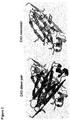
- Such variability of amino acid positioning within the four IgG isotypes is shown in Table 1, and graphically shown in Figures 2-4 .
- heteromultimeric polypeptides Preferential formation of heteromultimeric polypeptides is accomplished by selecting substitutions that differ significantly in their effect on maintaining the charge and/or hydrophobicity of the polypeptide at the target site.
- Amino acids can be grouped according to similarities in the properties of their side chains (in A.L. Lehninger, in Biochemistry, second ed., pp. 73-75, Worth Publishers, New York (1975 )):
- Naturally occurring residues can be divided into groups based on common side-chain properties:
- amino acids having basic side chains are replaced with amino acids having acidic side chains, or vice versa.
- the basic amino acids lysine, arginine, or histidine are replaced with aspartic acid or glutamic acid.
- a hydrophilic amino acid (or at least a relatively hydrophilic amino acid) is substituted with a hydrophobic amino acid.
- An example of this type of substitution is replacement of a tyrosine residue with a phenylalanine.
- the replacement results in the removal of aa hydroxyl side chain at a specific amino acid position at or near the interface between CH3 domain-containing polypeptides and increasing the hydrophobicity at that site.
- Var3 and “13A” are used interchangeably to describe a variant containing a substitution of lysine for glutamate at position 236 and a lysine for aspartate at position 278.
- Var1 and “13B” are used interchangeably to describe a variant containing a substitution of glutamate for lysine at position 249 and a glutamate for lysine at position 288.
- the nucleic acid encoding an amino acid located at the interface is altered for the first polypeptide to change the charge of the amino acid ion pairing.
- the nucleic acid encoding at least one "original" amino acid residue in the interface of the first polypeptide is replaced with a nucleic acid encoding at least one amino acid residue that has an oppositely charged side chain relative to the original amino acid residue. It will be appreciated that there can be more than one original and corresponding substituted residue.
- the upper limit for the number of original residues that are replaced is the total number of residues in the interface of the first and second polypeptide.
- original nucleic acid is meant the nucleic acid encoding a first or second polypeptide that can be "altered” (i.e. genetically engineered).
- the original or starting nucleic acid can be a naturally occurring nucleic acid or can comprise a nucleic acid that has been subjected to prior alteration (e.g. a humanized antibody fragment).
- altering the nucleic acid is meant that the original nucleic acid is modified by replacing at least one codon encoding an amino acid residue of interest. Techniques for genetically modifying a DNA in this manner have been reviewed in Mutagenesis: a Practical Approach, MJ. McPherson, Ed., (IRL Press, Oxford, UK.
- the heteromultimeric polypeptide of the invention is a bispecific antibody.
- the bispecific antibody contains the first polypeptide that is a heavy chain polypeptide paired with a light chain polypeptide, and the second polypeptide that is a second heavy chain polypeptide paired with a second light chain polypeptide.
- Heteromultimeric polypeptides with more than two valencies are contemplated.
- trispecific antibodies can also be prepared using the methods described herein. ( Tutt et al., J. Immunol., 147:60 (1991 )).
- the method comprises producing a heteromultimeric molecule, such as a bispecific antibody, that utilizes a single light chain that can pair with both heavy chain variable domains present in the bispecific molecule.
- a heteromultimeric molecule such as a bispecific antibody
- various strategies can be employed.
- a series of monoclonal antibodies are identified to each antigen that can be targeted with the bispecific antibody, followed by a determination of which of the light chains utilized in these antibodies is able to function when paired with the heavy chain any of the antibodies identified to the second target.
- display techniques such as phage display, can enable the identification of a light chain that can function with two or more heavy chains.
- a phage library is constructed which consists of a diverse repertoire of heavy chain variable domains and a single light chain variable domain. This library can further be utilized to identify antibodies that bind to various antigens of interest. Thus, in certain embodiments, the antibodies identified will share a common light chain.
- the heteromultimeric polypeptides comprise at least one single chain Fv (scFv).
- the heteromultimeric polypeptide comprise two scFvs.
- a scFv may be fused to one or both of a CH3 domain-containing polypeptide contained within a heteromultimeric polypeptide.
- heteromultimeric molecules can comprise two antigen binding arms of different specificity.
- heteromultimeric molecules can be generated comprising a first polypeptide which is an antigen binding arm (such as a classical immunoglobulin molecule) and a second polypeptide that is an immunoglobulin fusion protein.
- an antigen binding arm such as a classical immunoglobulin molecule
- an immunoglobulin fusion protein an immunoglobulin fusion protein.
- useful immunoglobulin fusion proteins are immunoadhesins.
- immunoadhesin designates antibody-like molecules that combine the "binding domain" of a heterologous protein (an “adhesin”, e.g. a receptor, ligand or enzyme) with the effector component of immunoglobulin constant domains.
- immunoadhesins comprise a fusion of the adhesin amino acid sequence with the desired binding specificity, that is other than the antigen recognition and binding site (antigen combining site) of an antibody (i.e. is "heterologous") and an immunoglobulin constant domain sequence.
- the immunoglobulin constant domain sequence in the immunoadhesin can be obtained from any immunoglobulin, such as IgG1, IgG2, IgG3, or IgG4 subtypes, IgA, IgE, IgD or IgM.
- Heteromultimeric polypeptides can be generated to bind any antigen(s).
- the heteromultimeric polypeptides bind one or more antigens selected from the group consisting of: DLL4, VEGF, VEGFR2, Notch1, Notch2, Notch3, Notch4, Notch(pan), JAG1, JAG2, DLL(pan), JAG(pan), EGFR, ERBB2, ERBB3, ERBB(pan), c-Met, IGF-1R, PDGFR, Patched, Hedgehog family polypeptides, Hedgehog(pan), WNT family polypeptides, WNT(pan), FZD1, FZD2, FZD3, FZD4, FZD5, FZD6, FZD7, FZD8, FZD9, FZD10, FZD(pan), LRP5, LRP6, CD20, IL-6, TNFalpha, IL-23, IL-17, CD80, CD86, CD3, CEA, Muc16, PSMA, PSCA, CD3, CE
- pan is meant to describe heteromultimeric polypeptides that bind multiple antigens from within the same family.
- Notch(pan) is meant to describe a heteromultimeric polypeptide that binds more than one of the group of Notch1, Notch2, Notch3, or Notch4.
- the heteromultimeric polypeptide specifically binds DLL4 and VEGF.
- antibodies that bind VEGF there are provided antibodies that bind VEGF.
- an antibody (219R0302) that specifically binds VEGF wherein the antibody comprises: (a) a heavy chain CDR1 comprising GYTFTNYWMH (SEQ ID NO:20), a heavy chain CDR2 comprising SINPSNGGTSYNEKFKR (SEQ ID NO:21), and a heavy chain CDR3 comprising HYYDNSYAMDY (SEQ ID NO:22); and/or (b) a light chain CDR1 comprising QASQDISNYVN (SEQ ID NO:23), a light chain CDR2 comprising DASNLQT (SEQ ID NO:24), and a light chain CDR3 comprising QQYDDLPP (SEQ ID NO:25).
- an antibody (219R0202) that specifically binds VEGF wherein the antibody comprises: (a) a heavy chain CDR1 comprising GYTFTNYWMH (SEQ ID NO:20), a heavy chain CDR2 comprising SINPSNGGTSYNEKFKR (SEQ ID NO:21), and a heavy chain CDR3 comprising HYYDNSYAMDY (SEQ ID NO:22); and/or (b) a light chain CDR1 comprising RASQGINNHLAW (SEQ ID NO:26), a light chain CDR2 comprising AASNLHS (SEQ ID NO:27), and a light chain CDR3 comprising QQYDNLPL (SEQ ID NO:28).
- the VEGF and DLL4 heteromultimeric polypeptides comprise an antibody with the same specificity as 21M18 and either 219R0302 or 219R0202. These heteromultimeric polypeptides can be produced having the light chain linked to the heavy chain, or using an identical light chain.
- the antibodies comprise the 13A/13B substitutions, as described herein, in their Fc region.
- the VEGF binding sequence comprises SEQ ID NO:17 or SEQ ID NO:18.
- the DLL4 binding sequence comprises SEQ ID NO:19.
- the bispecific antibody comprises the VEGF binding sequence comprising heavy chain sequence of SEQ ID NO:11 and the light chain sequence of SEQ ID NO:13 or SEQ ID NO:15; and the DLL4 binding sequence comprising SEQ ID NO:19.
- the heteromultimeric polypeptide comprises the VEGF binding sequence comprising heavy chain sequence of SEQ ID NO:11 and the light chain sequence of SEQ ID NO:13; and the DLL4 binding sequence comprising SEQ ID NO:19.
- the heteromultimeric polypeptide comprises the VEGF binding sequence comprising heavy chain sequence of SEQ ID NO:11 and the light chain sequence of SEQ ID NO:15; and the DLL4 binding sequence comprising SEQ ID NO:19.
- the VEGF binding sequence comprises a polypeptide selected from the group consisting of SEQ ID NOs:10, 29, and 30.
- the VEGF polypeptide is an antibody.
- the heteromultimeric polypeptides or antibodies are intact antibodies such as monoclonal or humanized antibodies. In another embodiment, they antibodies are antibody fragments, such as Fab or scFv. In one embodiment, the anti-VEGF antibodies/polypeptides inhibit tumor growth.
- Heteromultimeric polypeptides of the invention have dual specificity (bivalent) and are capable of binding to two different antigens simultaneously.
- the heteromultimeric polypeptides contain two antibody combining sites.
- the heteromultimeric polypeptides are bivalent immunoadhesins.
- the different antigens can be located on different cells or on the same cell. Cross linking of antigen can be shown in vitro, for example by providing a solid surface to which a first antigen has been bound, adding a bispecific antibodies specific for the first antigen and a second antigen for which the binding protein is also specific and detecting the presence of bound second antigen.
- Heteromultimeric polypeptides can, in certain embodiments, block the interaction between two receptors and their respective ligands.
- a bispecific antibody specific for DLL4 and VEGF inhibits VEGF induced cell migration as well as Notch receptor signaling.
- combination of two receptor binding specificities is more efficacious in inhibiting cell migration that the individual parent antibodies.
- Heteromultimeric molecules can also be monovalent, meaning they have one antigen binding site.
- the monovalent heteromultimeric polypeptides possess one variable domain, and the second CH3 domain containing polypeptide is truncated such that it does not contain a variable domain. These second CH3 domain containing polypeptides can possess a detectable label.
- the monovalent heteromultimeric polypeptide contains a FLAG epitope.
- the FLAG epitope is a synthetic epitope that consists of eight amino acid residues (DYKDDDDK).
- the monovalent heteromultimeric polypeptide is an immunoadhesin.
- the heteromultimeric molecules are produced in a first format called single gene bispecific (SGBSP).
- SGBSP single gene bispecific
- a 30 amino acid linker is used to genetically tether, or link, the light chain to its heavy chain ( see, Lee et al. Mol. Immunol. 36:61-71 (1999 ). Therefore, each SGBSP binding unit can use its own light chain to form a Fab binding unit that binds its respective target.
- the single genes also comprise the Var3/13A and Var1/13B mutations.
- anti-DLL4 and anti-VEGF antibodies are used to produce SGBSPs.
- the 21M18 and 219R0302/219R0202 heavy chains are produced as SGBSP.
- the 21M18 and 219R0302/219R0202 heavy chains are cloned with the 13B and 13A mutants, respectively.
- the heteromultimeric molecules of the invention are produced in a second format called monovalent bispecific (MBSP).
- MBSPs use a common light chain with two different heavy chains that comprise the Var3/13A and Var1/13B mutations.
- the heavy chains must bind its target in combination with a common light chain.
- the common light chain is the parental light chain for one of the heavy chains.
- anti-DLL4 and anti-VEGF antibodies are used to produce SGBSPs.
- the 21M18 and 219R0302/219R0202 heavy chains are produced as SGBSP.
- the 21M18 and 219R0302/219R0202 heavy chains are cloned with the 13B and 13A mutants, respectively.
- V genes encoding those domains are assembled into a bacterial expression vector.
- a vector can be used that has sequences encoding a bacterial secretion signal sequence and a peptide linker and that has convenient restriction sites for insertion of V L and V H genes.
- PCR primers specific to the sequences encoding those domains are used.
- mixtures of primers are used to amplify multiple sequences.
- Vectors for construction and expression of heteromultimeric polypeptides of the invention in bacteria are available that contain secretion signal sequences and convenient restriction cloning sites.
- V L and V H gene combinations encoding binding sites specific for a particular antigen are isolated from cDNA of B cell hybridomas.
- random combinations of V L and V H genes are obtained from genomic DNA and the products then screened for binding to an antigen of interest.
- the polymerase chain reaction (PCR) is employed for cloning, using primers that are compatible with restriction sites in the cloning vector. See, e.g., Dreher, M. L. et al. (1991) J. Immunol. Methods 139:197-205 ; Ward, E. S. (1993) Adv. Pharmacol. 24:1-20 ; Chowdhury, P. S. and Pastan, I. (1999) Nat. Biotechnol. 17:568-572 .
- polynucleotides that express the polypeptides or antibodies described herein. In one embodiment, there are provided polynucleotides that hybridize under stringent conditions to the polynucleotides that encode the polypeptides or antibodies. In one embodiment, the polynucleotide comprise the sequences of SEQ ID NOs: 12, 14, or 16.
- bispecific antibodies are made by expressing 1) a first polypeptide comprising a heavy chain variable domain corresponding to a first specificity connected to a light chain variable domain of a second specificity; and 2) a second polypeptide comprising a light chain variable domain corresponding to the first specificity connected to the heavy chain variable domain of the second specificity.
- heteromultimeric polypeptides expression in other host cells may be desired.
- heteromultimeric polypeptides comprising constant domains are often more efficiently expressed in eukaryotic cells, including yeast, insect, vertebrate and mammalian cells. It will be necessary to use such cells where it is desired that the expressed product be glycosylated.
- the DNA fragments coding for the first and second polypeptides can be cloned, e.g., into HCMV vectors designed to express human light chains of human heavy chains in mammalian cells. (See, eg., Bendig, et al., U.S. Pat. No. 5,840,299 ; Maeda, et al. (1991) Hum. Antibod.
- Hybridomas 2, 124-134 Such vectors contain the human cytomegalovirus (HCMV) promoter and enhancer for high level transcription of the light chain and heavy chain constructs.
- HCMV human cytomegalovirus
- the light chain expression vector is pKN100 (gift of Dr. S. Tarran Jones, MRC Collaborative Center, London, England), that encodes a human kappa light chain
- the heavy chain expression vector is pG1D105 (gift of Dr. S. Tarran Jones), that encodes a human gamma-1 heavy chain.
- Both vectors contain HCMV promoters and enhancers, replication origins and selectable markers functional in mammalian cells and E. coli.
- a selectable marker is a gene that encodes a protein necessary for the survival or growth of transformed host cells grown in a selective culture medium.
- Typical selectable markers encode proteins that (a) confer resistance to antibiotics or other toxins, e.g. ampicillin, neomycin, methotrexate, or tetracycline, (b) complement auxotrophic deficiencies, or (c) supply critical nutrients not available from complex media, e.g. the gene encoding D-alanine racemase for Bacilli.
- a particularly useful selectable marker confers resistance to methotrexate.
- cells transformed with the DHFR selection gene are first identified by culturing all of the transformants in a culture medium that contains methotrexate (Mtx), a competitive antagonist of DHFR.
- Mtx methotrexate
- An appropriate host cell when wild-type DHFR is employed is the Chinese hamster ovary (CHO) cell line deficient in DHFR activity, prepared and propagated as described by Urlaub and Chasin (1980) Proc. Natl. Acad. Sci. USA 77, 4216 .
- the transformed cells are then exposed to increased levels of methotrexate. This leads to the synthesis of multiple copies of the DHFR gene, and, concomitantly, multiple copies of other DNA comprising the expression vectors, such as the DNA encoding the antibody or antibody fragment.
- mutant myeloma cells that are deficient for thymidine kinase are unable to use exogenously supplied thymidine when aminopterin is used to block DNA synthesis.
- Useful vectors for transfection carry an intact TK gene that allows growth in media supplemented with thymidine.
- a suitable selection gene for use in yeast is the trp1 gene present in the yeast plasmid YRp7. Stinchcomb et al., 1979 Nature, 282, 39 ; Kingsman et al., 1979, Gene 7, 141 .
- the trp1 gene provides a selection marker for a mutant strain of yeast lacking the ability to grow in tryptophan, for example, ATCC No.44076 or PEP4-1. Jones (1977) Genetics 85,12 .
- the presence of the tip I lesion in the yeast host cell genome then provides an effective environment for detecting transformation by growth in the absence of tryptophan.
- Leu2-deficient yeast strains (ATCC 20,622 or 38,626) are complemented by known plasmids bearing the Leu2 gene.
- Preferred host cells for transformation of vectors and expression of antibodies of the present invention are bacterial cells, yeast cells and mammalian cells, e.g., COS-7 cells, chinese hamster ovary (CHO) cells, and cell lines of lymphoid origin such as lymphoma, myeloma, or hybridoma cells.
- the transformed host cells are cultured by methods known in the art in a liquid medium containing assimilable sources of carbon, e.g. carbohydrates such as glucose or lactose, nitrogen, e.g. amino acids, peptides, proteins or their degradation products such as peptones, ammonium salts or the like, and inorganic salts, e.g. sulfates, phosphates and/or carbonates of sodium, potassium, magnesium and calcium.
- the medium furthermore contains, for example, growth-promoting substances, such as trace elements, for example iron, zinc, manganese and the like.
- heteromultimeric molecules find use in the diagnostic and therapeutic methods described herein.
- the above disclosed molecules are used to detect the expression of a tumor cell marker protein in biological samples such as, for example, a patient tissue biopsy, pleural effusion, or blood sample.
- Tissue biopsies can be sectioned and protein detected using, for example, immunofluorescence or immunohistochemistry.
- individual cells from a sample can be isolated, and protein expression detected on fixed or live cells by FACS analysis.
- heteromultimeric molecules can be used on protein arrays to detect expression of a tumor cell marker, for example, on tumor cells, in cell lysates, or in other protein samples.
- the heteromultimeric molecules of the present invention are used to inhibit the growth of tumor cells by contacting the heteromultimeric molecules with tumor cells in in vitro cell based assays, in vivo animal models, etc.
- the heteromultimeric molecules are used to treat cancer in a patient by administering a therapeutically effective amount of an heteromultimeric molecule against one or more tumor cell markers.
- the heteromultimeric molecule is a humanized bispecific antibody.
- Humanized antibodies are antibodies that contain minimal sequences from non-human (e.g rodent) antibodies within the antigen determination or hypervariable region that comprise the three complementary determination regions (CDRs) within each antibody chain. Such antibodies are used therapeutically to reduce antigenicity and HAMA (human anti-mouse antibody) responses when administered to a human subject.
- humanized antibodies are typically human antibodies with minimum to virtually no non-human sequences.
- a human antibody is an antibody produced by a human or an antibody having an amino acid sequence corresponding to an antibody produced by a human.
- Humanized antibodies can be produced using various techniques known in the art.
- An antibody can be humanized by substituting the CDRs of a human antibody with those of a non-human antibody (e.g. mouse, rat, rabbit, hamster, etc.) having the desired specificity, affinity, and capability following the methods of Jones et al., 1986, Nature, 321:522-525 ; Riechmann et al., 1988, Nature, 332:323-327 ; Verhoeyen et al., 1988, Science, 239:1534-1536 .
- the humanized antibody can be further modified by the substitution of additional residue either in the variable human framework region and/or within the replaced non-human residues to refine and optimize antibody specificity, affinity, and/or capability.
- human heavy and/or light chain variable domains to be used in making humanized antibodies can be important for reducing antigenicity.
- sequence of the variable domain of a rodent antibody is screened against the entire library of known human variable-domain amino acid sequences.
- the human amino acid sequence that is most homologous to that of the rodent antibody from which the CDRs are taken is used as the human framework region (FR) for the humanized antibody ( Sims et al., 1993, J. Immunol., 151: 2296 ; Chothia et al., 1987, J. Mol. Biol., 196: 901 ).
- Another method uses a particular FR derived from the consensus sequence of all human antibodies of a particular subgroup of light or heavy chains and can be used for several difference humanized antibodies ( Carter et al., 1992, PNAS, 89; 4285 ; Presta et al., 1993, J. Immunol., 151: 2623 ).
- a combination of methods is used to pick the human variable FR to use in generation of humanized antibodies.
- antibodies e.g. rodent
- humanized antibodies can be prepared by a process of analysis of the parental sequence from the rodent antibody to be humanized and the various candidate humanizing sequences.
- Three-dimensional immunoglobulin models are available and familiar to those skilled in the art. Computer programs can be used to illustrate and display probable three-dimensional conformational structures of selected candidate antibody sequences. Use of such models permits analysis of the likely role of the residues in the function of the antibody to be humanized, i.e., the analysis of residues that influence the ability of the candidate antibody to bind its antigen.
- FR residues can be selected and combined from the parental antibody to the recipient humanized antibody so that the desired antibody characteristics are achieved.
- the residues in the CDRs of the antigen determination region (or hypervariable region) are retained from the parental antibody (e.g. the rodent antibody with the desired antigen binding properties) in the humanized antibody for antigen binding.
- at least one additional residue within the variable FR is retained from the parental antibody in the humanized antibody.
- up to six additional residues within the variable FR are retained from the parental antibody in the humanized antibody.
- Hx and Lx Amino acids from the variable regions of the mature heavy and light chains of immunoglobulins are designated Hx and Lx respectively, where x is a number designating the position of an amino acid according to the scheme of Kabat, Sequences of Proteins of Immunological Interest, U.S. Department of Health and Human Services, 1987, 1991.
- Kabat lists many amino acid sequences for antibodies for each subgroup, and lists the most commonly occurring amino acid for each residue position in that subgroup to generate a consensus sequence. Kabat uses a method for assigning a residue number to each amino acid in a listed sequence, and this method for assigning residue numbers has become standard in the field.
- Rabat's scheme is extendible to other antibodies not included in his compendium by aligning the antibody in question with one of the consensus sequences in Kabat by reference to conserved amino acids.
- the use of the Kabat numbering system readily identifies amino acids at equivalent positions in different antibodies. For example, an amino acid at the L50 position of a human antibody occupies the equivalent position to an amino acid position L50 of a mouse antibody.
- any two antibody sequences can be uniquely aligned, for example to determine percent identity, by using the Kabat numbering system so that each amino acid in one antibody sequence is aligned with the amino acid in the other sequence that has the same Kabat number.
- the percentage sequence identity between the subject and reference antibody regions is the number of positions occupied by the same amino acid in both the subject and reference antibody region divided by the total number of aligned positions of the two regions, with gaps not counted, multiplied by 100 to convert to percentage.
- Fully human antibodies can be directly prepared using various techniques known in the art. Immortalized human B lymphocytes immunized in vitro or isolated from an immunized individual that produce an antibody directed against a target antigen can be generated ( See, e.g., Cole et al., Monoclonal Antibodies and Cancer Therapy, Alan R. Liss, p. 77 (1985 ); Boemer et al., 1991, J. Immunol., 147 (1):86-95 ; and U.S. Patent 5,750,373 ). Also, the human antibody can be selected from a phage library, where that phage library expresses human antibodies ( Vaughan et al., 1996, Nat.
- Human antibodies can also be made in transgenic mice containing human immunoglobulin loci that are capable upon immunization of producing the full repertoire of human antibodies in the absence of endogenous immunoglobulin production. This approach is described in U.S. Patents 5,545,807 ; 5,545,806 ; 5,569,825 ; 5,625,126 ; 5,633,425 ; and 5,661,016 .
- Bispecific antibodies are antibodies that are capable of specifically recognizing and binding at least two different epitopes ( See , e.g., Wu et al., Simultaneous Targeting of Multiple Disease Mediators by a Dual-Variable-Domain Immunoglobulin, Nature Biotech., 25(11):1290-97 ).
- the different epitopes can either be within the same molecule (e.g. the same tumor marker polypeptide) or on different molecules such that both, for example, can specifically recognize and bind a tumor cell marker as well.
- Bispecific antibodies can be intact antibodies or antibody fragments.
- bispecific antibodies can bind to two different epitopes.
- Bispecific antibodies can also be used to direct cytotoxic agents to cells that express a particular antigen. These antibodies possess an antigen-binding arm and an arm that binds a cytotoxic agent or a radionuclide chelator, such as EOTUBE, DPTA, DOTA, or TETA.
- a radionuclide chelator such as EOTUBE, DPTA, DOTA, or TETA.
- Antibodies with more than two valencies are also contemplated.
- trispecific antibodies can be prepared ( Tutt et al., J. Immunol. 147:60 (1991 ))
- a fragment of the heteromultimeric polypeptide to, for example, increase tumor penetration.
- Various techniques are known for the production of antibody fragments: Traditionally, these fragments are derived via proteolytic digestion of intact antibodies (for example Morimoto et al., 1993, Journal of Biochemical and Biophysical Methods 24:107-117 ; Brennan et al., 1985, Science, 229:81 ).
- antibody fragments are produced recombinantly. Fab, Fv, and scFv antibody fragments can all be expressed in and secreted from E. coli or other host cells, thus allowing the production of large amounts of these fragments.
- Such antibody fragments can also be isolated from the antibody phage libraries discussed above.
- the antibody fragment can also be linear antibodies as described in U.S. Patent 5,641,870 , for example, and can be monospecific or bispecific. Other techniques for the production of antibody fragments will be apparent to the skilled practitioner.
- a heteromultimeric molecule can further be desirable, especially in the case of antibody fragments, to modify a heteromultimeric molecule in order to increase its serum half-life. This can be achieved, for example, by incorporation of a salvage receptor binding epitope into the heteromultimeric molecule by mutation of the appropriate region or by incorporating the epitope into a peptide tag that is then fused to the heteromultimeric molecule at either end or in the middle (e.g., by DNA or peptide synthesis).
- modified antibodies can comprise any type of variable region that provides for the association of the heteromultimer with the polypeptides of interest.
- the variable region can comprise or be derived from any type of mammal that can be induced to mount a humoral response and generate immunoglobulins against the desired tumor associated antigen.
- the variable region of the modified antibodies can be, for example, of human, murine, non-human primate (e.g. cynomolgus monkeys, macaques, etc.) or lupine origin. In some embodiments both the variable and constant regions of the modified immunoglobulins are human.
- variable regions of compatible antibodies can be engineered or specifically tailored to improve the binding properties or reduce the immunogenicity of the molecule.
- variable regions can be humanized or otherwise altered through the inclusion of imported amino acid sequences.
- variable domains in both the heavy and light chains are altered by at least partial replacement of one or more CDRs and, if necessary, by partial framework region replacement and sequence changing.
- the CDRs can be derived from an antibody of the same class or even subclass as the antibody from which the framework regions are derived, it is envisaged that the CDRs will be derived from an antibody of different class and preferably from an antibody from a different species. It may not be necessary to replace all of the CDRs with the complete CDRs from the donor variable region to transfer the antigen binding capacity of one variable domain to another. Rather, it may only be necessary to transfer those residues that are necessary to maintain the activity of the antigen binding site. Given the explanations set forth in U.S. Pat. Nos. 5,585,089 , 5,693,761 and 5,693,762 , it will be well within the competence of those skilled in the art, either by carrying out routine experimentation or by trial and error testing to obtain a functional antibody with reduced immunogenicity.
- the modified heteromultimers can comprise antibodies, or immunoreactive fragments thereof, in which at least a fraction of one or more of the constant region domains has been deleted or otherwise altered so as to provide desired biochemical characteristics such as increased tumor localization or reduced serum half-life when compared with an antibody of approximately the same immunogenicity comprising a native or unaltered constant region.
- the constant region of the modified antibodies will comprise a human constant region. Modifications to the constant region comprise additions, deletions or substitutions of one or more amino acids in one or more domains.
- the modified heteromultimers disclosed herein can comprise alterations or modifications to one or more of the three heavy chain constant domains (CH1, CH2 or CH3) and/or to the light chain constant domain (CL).
- modified constant regions wherein one or more domains are partially or entirely deleted are contemplated.
- the modified antibodies will comprise domain deleted constructs or variants wherein the entire CH2 domain has been removed ( ⁇ CH2 constructs).
- the omitted constant region domain will be replaced by a short amino acid spacer (e.g. 10 residues) that provides some of the molecular flexibility typically imparted by the absent constant region.
- heteromultimeric polypeptides comprising constant regions modified as described herein provide for altered effector functions that, in turn, affect the biological profile of the administered polypeptide.
- the deletion or inactivation (through point mutations or other means) of a constant region domain may reduce Fc receptor binding of the circulating modified antibody thereby increasing tumor localization.
- constant region modifications moderate complement binding and thus reduce the serum half life and nonspecific association of a conjugated cytotoxin.
- modifications of the constant region can be used to eliminate disulfide linkages or oligosaccharide moieties that allow for enhanced localization due to increased antigen specificity or antibody flexibility.
- modifications to the constant region in accordance with this invention can easily be made using well known biochemical or molecular engineering techniques well within the purview of the skilled artisan.
- the invention also pertains to heteromultimeric molecules comprising a heteromultimeric polypeptide conjugated to a cytotoxic agent.
- Cytotoxic agents include chemotherapeutic agents, growth inhibitory agents, toxins (e.g., an enzymatically active toxin of bacterial, fungal, plant, or animal origin, or fragments thereof), radioactive isotopes (i.e., a radioconjugate), etc.
- Chemotherapeutic agents useful in the generation of such immunoconjugates include, for example, methotrexate, adriamicin, doxorubicin, melphalan, mitomycin C, chlorambucil, daunorubicin or other intercalating agents.
- Enzymatically active toxins and fragments thereof that can be used include diphtheria A chain, nonbinding active fragments of diphtheria toxin, exotoxin A chain, ricin A chain, abrin A chain, modeccin A chain, alpha-sarcin, Aleurites fordii proteins, dianthin proteins, Phytolaca americana proteins (PAPI, PAPII, and PAP-S), momordica charantia inhibitor, curcin, crotin, sapaonaria officinalis inhibitor, gelonin, mitogellin, restrictocin, phenomycin, enomycin, and the tricothecenes.
- the heteromultimeric molecules can be conjugated to radioisotopes, such as 90 Y, 125 I, 131 I, 123 I, 111 In, 105 Rh, 153 Sm, 67 Cu, 67 Ga, 166 Ho, 177 Lu, 186 Re and 188 Re using anyone of a number of well known chelators or direct labeling.
- the disclosed compositions can comprise heteromultimeric molecules coupled to drugs, prodrugs or lymphokines such as interferon.
- Conjugates of the heteromultimeric molecule and cytotoxic agent are made using a variety of bifunctional protein-coupling agents such as N-succinimidyl-3-(2-pyridyidithiol) propionate (SPDP), iminothiolane (IT), bifunctional derivatives of imidoesters (such as dimethyl adipimidate HCL), active esters (such as disuccinimidyl suberate), aldehydes (such as glutareldehyde), bis-azido compounds (such as bis(p-azidobenzoyl) hexanediamine), bis-diazonium derivatives (such as bis-(p-diazoniumbenzoyl)-ethylenediamine), diisocyanates (such as tolyene 2,6-diisocyanate), and bis-active fluorine compounds (such as 1,5-difluoro-2,4-dinitrobenzene).
- SPDP N-succinimidy
- Conjugates of an antibody and one or more small molecule toxins such as a calicheamicin, maytansinoids, a trichothene, and CC1065, and the derivatives of these toxins that have toxin activity, can also be used.
- the heteromultimeric polypeptides can be complexed with other immunologically active ligands (e.g. antibodies or fragments thereof) wherein the resulting molecule binds to both the neoplastic cell and an effector cell such as a T cell.
- the heteromultimeric polypeptides of the present invention can be used in any one of a number of conjugated (i.e. an immunoconjugate) or unconjugated forms.
- the heteromultimeric polypeptides of this invention can be used in a nonconjugated or "naked” form to harness the subject's natural defense mechanisms including complement-dependent cytotoxicity (CDC) and antibody dependent cellular toxicity (ADCC) to eliminate the malignant cells.
- CDC complement-dependent cytotoxicity
- ADCC antibody dependent cellular toxicity
- the selection of which conjugated or unconjugated heteromultimeric polypeptide to use will depend of the type and stage of cancer, use of adjunct treatment (e.g., chemotherapy or external radiation) and patient condition. It will be appreciated that one skilled in the art could readily make such a selection in view of the teachings herein.
- the heteromultimeric polypeptides of the present invention can be assayed for immunospecific binding by any method known in the art.
- the immunoassays which can be used include, but are not limited to, competitive and non-competitive assay systems using techniques such as BIAcore analysis, FACS analysis, immunofluorescence, immunocytochemistry, Western blots, radioimmunoassays, ELISA, "sandwich” immunoassays, immunoprecipitation assays, precipitin reactions, gel diffusion precipitin reactions, immunodiffusion assays, agglutination assays, complement-fixation assays, immunoradiometric assays, fluorescent immunoassays, and protein A immunoassays.
- Such assays are routine and well known in the art (see, e.g., Ausubel et al, eds, 1994, Current Protocols in Molecular Biology, Vol. 1, John Wiley & Sons, Inc., New York ).
- the immunospecificity of a heteromultimeric polypeptide against a tumor cell marker is determined using ELISA.
- An ELISA assay comprises preparing antigen, coating wells of a 96 well microtiter plate with antigen, adding the antibody against a tumor cell marker conjugated to a detectable compound such as an enzymatic substrate (e.g. horseradish peroxidase or alkaline phosphatase) to the well, incubating for a period of time and detecting the presence of the antigen.
- an enzymatic substrate e.g. horseradish peroxidase or alkaline phosphatase
- the heteromultimeric molecule that binds a tumor cell marker is not conjugated to a detectable compound, but instead a second conjugated antibody that recognizes the heteromultimeric polypeptide against a tumor cell marker is added to the well.
- the antibody against a tumor cell marker can be coated to the well and a second antibody conjugated to a detectable compound can be added following the addition of the antigen to the coated well.
- the binding affinity of a heteromultimeric polypeptide to a tumor cell antigen and the off-rate of an heteromultimer-antigen interaction can be determined by competitive binding assays.
- a competitive binding assay is a radioimmunoassay comprising the incubation of labeled antigen (e.g. 3 H or 125 I), or fragment or variant thereof, with the heteromultimeric polypeptide of interest in the presence of increasing amounts of unlabeled antigen followed by the detection of the heteromultimeric polypeptide bound to the labeled antigen.
- labeled antigen e.g. 3 H or 125 I
- the affinity of the heteromultimeric polypeptide against a tumor cell marker and the binding off-rates can be determined from the data by scatchard plot analysis.
- BIAcore kinetic analysis is used to determine the binding on and off rates of heteromultimeric polypeptide against a tumor cell marker.
- BIAcore kinetic analysis comprises analyzing the binding and dissociation of antibodies from chips with immobilized tumor cell marker antigens on their surface.
- the antibodies can be chemically or biosynthetically linked to anti-tumor agents or detectable signal-producing agents.
- Anti-tumor agents linked to an antibody include any agents that destroy or damage a tumor to which the antibody has bound or in the environment of the cell to which the antibody has bound.
- an anti-tumor agent is a toxic agent such as a chemotherapeutic agent or a radioisotope.
- Suitable chemotherapeutic agents are known to those skilled in the art and include anthracyclines (e.g.
- chemotherapeutic agents are conjugated to the antibody using conventional methods (See, e.g., Hermentin and Seiler (1988) Behring Inst. Mitt. 82, 197-215 ).
- Detectable signal-producing agents are useful in vivo and in vitro for diagnostic purposes.
- the signal producing agent produces a measurable signal which is detectible by external means, usually the measurement of electromagnetic radiation.
- the signal producing agent is an enzyme or chromophore, or emits light by fluorescence, phosphorescence or chemiluminescence.
- Chromophores include dyes that absorb light in the ultraviolet or visible, region, and can be substrates or degradation products of enzyme catalyzed reactions.
- the invention further contemplates heteromultimeric polypeptides to which target or reporter moieties are linked.
- Target moieties are first members of binding pairs.
- Anti-tumor agents for example, are conjugated to second members of such pairs and are thereby directed to the site where the antibody is bound.
- a common example of such a binding pair is avidin and biotin.
- biotin is conjugated to a heteromultimeric polypeptide of the invention, and thereby provides a target for an anti-tumor agent or other moiety that is conjugated to avidin or streptavidin.
- biotin or another such moiety is linked to a heteromultimeric polypeptide of the invention and used as a reporter, for example in a diagnostic system where a detectable signal-producing agent is conjugated to avidin or streptavidin.
- the heteromultimeric polypeptides can be administered for therapeutic treatments to a patient suffering from a tumor in an amount sufficient to prevent or reduce the progression of the tumor, e.g, the growth, invasiveness, metastases and/or recurrence of the tumor.
- An amount adequate to accomplish this is defined as a therapeutically effective dose. Amounts effective for this use will depend upon the severity of the disease and the general state of the patient's own immune system. Dosing schedules will also vary with the disease state and status of the patient, and will typically range from a single bolus dosage or continuous infusion to multiple administrations per day (e.g., every 4-6 hours), or as indicated by the treating physician and the patient's condition.
- Antibodies of the invention can be administered in a single dosages as high as 40 mg/kg body-weight or higher. More preferably, the antibodies are administered in dosages that range from 0.2 mg/kg to 20 mg/kg body-weight. It should be noted, however, that the present invention is not limited to any particular dose.
- the present invention can be used to treat any suitable tumor, including, for example, tumors of the breast, heart, lung, small intestine, colon, spleen, kidney, bladder, head and neck, ovary, prostate, brain, pancreas, skin, bone, bone marrow, blood, thymus, uterus, testicles, cervix or liver.
- suitable tumor including, for example, tumors of the breast, heart, lung, small intestine, colon, spleen, kidney, bladder, head and neck, ovary, prostate, brain, pancreas, skin, bone, bone marrow, blood, thymus, uterus, testicles, cervix or liver.
- Formulations are prepared for storage and use by combining a purified heteromultimeric polypeptide of the present invention with a pharmaceutically acceptable vehicle (e.g. carrier, excipient) ( Remington, The Science and Practice of Pharmacy 20th Edition Mack Publishing, 2000 ).
- a pharmaceutically acceptable vehicle e.g. carrier, excipient
- Suitable pharmaceutically acceptable vehicles include, but are not limited to, nontoxic buffers such as phosphate, citrate, and other organic acids; salts such as sodium chloride; antioxidants including ascorbic acid and methionine; preservatives (e.g.
- octadecyldimethylbenzyl ammonium chloride hexamethonium chloride; benzalkonium chloride; benzethonium chloride; phenol, butyl or benzyl alcohol; alkyl parabens, such as methyl or propyl paraben; catechol; resorcinol; cyclohexanol; 3-pentanol; and m-cresol); low molecular weight polypeptides (e.g.
- proteins such as serum albumin, gelatin, or immunoglobulins
- hydrophilic polymers such as polyvinylpyrrolidone
- amino acids such as glycine, glutamine, asparagine, histidine, arginine, or lysine
- carbohydrates such as monosacchandes, disaccharides, glucose, mannose, or dextrins
- chelating agents such as EDTA
- sugars such as sucrose, mannitol, trehalose or sorbitol
- salt-forming counter-ions such as sodium
- metal complexes e.g. Zn-protein complexes
- non-ionic surfactants such as TWEEN or polyethylene glycol (PEG).
- the pharmaceutical composition of the present invention can be administered in any number of ways for either local or systemic treatment.
- Administration can be topical (such as to mucous membranes including vaginal and rectal delivery) such as transdermal patches, ointments, lotions, creams, gels, drops, suppositories, sprays, liquids and powders; pulmonary (e.g., by inhalation or insufflation of powders or aerosols, including by nebulizer; intratracheal, intranasal, epidermal and transdermal); oral; or parenteral including intravenous, intraarterial, subcutaneous, intraperitoneal or intramuscular injection or infusion; or intracranial (e.g., intrathecal or intraventricular) administration.
- topical such as to mucous membranes including vaginal and rectal delivery
- transdermal patches such as transdermal patches, ointments, lotions, creams, gels, drops, suppositories, sprays, liquids and
- the therapeutic formulation can be in unit dosage form.
- Such formulations include tablets, pills, capsules, powders, granules, solutions or suspensions in water or non-aqueous media, or suppositories for oral, parenteral, or rectal administration or for administration by inhalation.
- solid compositions such as tablets the principal active ingredient is mixed with a pharmaceutical carrier.
- Conventional tableting ingredients include corn starch, lactose, sucrose, sorbitol, talc, stearic acid, magnesium stearate, dicalcium phosphate or gums, and other diluents (e.g.
- a solid preformulation composition containing a homogeneous mixture of a compound of the present invention, or a non-toxic pharmaceutically acceptable salt thereof.
- the solid preformulation composition is then subdivided into unit dosage forms of the type described above.
- the tablets, pills, etc of the novel composition can be coated or otherwise compounded to provide a dosage form affording the advantage of prolonged action.
- the tablet or pill can comprise an inner composition covered by an outer component.
- the two components can be separated by an enteric layer that serves to resist disintegration and permits the inner component to pass intact through the stomach or to be delayed in release.
- enteric layers or coatings such materials including a number of polymeric acids and mixtures of polymeric acids with such materials as shellac, cetyl alcohol and cellulose acetate.
- compositions include heteromultimeric polypeptides of the present invention complexed with liposomes ( Epstein, et al., 1985, Proc. Natl. Acad. Sci. USA 82:3688 ; Hwang, et al., 1980, Proc. Natl. Acad. Sci. USA 77:4030 ; and U.S. Patent 4,485;045 and 4,544,545 ).
- Liposomes with enhanced circulation time are disclosed in U.S. Patent 5,013,556 .
- Some liposomes can be generated by the reverse phase evaporation with a lipid composition comprising phosphatidylcholine, cholesterol, and PEG-derivatized phosphatidylethanolamine (PEG-PE). Liposomes are extruded through filters of defined pore size to yield liposomes with the desired diameter.
- the heteromultimeric polypeptides can also be entrapped in microcapsules.
- microcapsules are prepared, for example, by coacervation techniques or by interfacial polymerization, for example, hydroxymethylcellulose or gelatin-microcapsules and poly-(methylmethacylate) microcapsules, respectively, in colloidal drug delivery systems (for example, liposomes, albumin microspheres, microemulsions, nano-particles and nanocapsules) or in macroemulsions as described in Remington, The Science and Practice of Pharmacy 20th Ed. Mack Publishing (2000 ).
- sustained-release preparations can be prepared. Suitable examples of sustained-release preparations include semipermeable matrices of solid hydrophobic polymers containing the antibody, which matrices are in the form of shaped articles (e.g. films, or microcapsules). Examples of sustained-release matrices include polyesters, hydrogels such as poly(2-hydroxyethyl-methacrylate) or poly(v nylalcohol), polylactides ( U.S.
- Patent 3,773,919 copolymers of L-glutamic acid and 7 ethyl-L-glutamate, nondegradable ethylene-vinyl acetate, degradable lactic acid-glycolic acid copolymers such as the LUPRON DEPOT TM (injectable microspheres composed of lactic acid-glycolic acid copolymer and leuprolide acetate), sucrose acetate isobutyrate, and poly-D-(-)-3-hydroxybutyric acid.
- LUPRON DEPOT TM injectable microspheres composed of lactic acid-glycolic acid copolymer and leuprolide acetate
- sucrose acetate isobutyrate sucrose acetate isobutyrate
- poly-D-(-)-3-hydroxybutyric acid poly-D-(-)-3-hydroxybutyric acid.
- the treatment involves the combined administration of a heteromultimeric polypeptides of the present invention and a chemotherapeutic agent or cocktail of multiple different chemotherapeutic agents.
- Treatment with a heteromultimeric polypeptides can occur prior to, concurrently with, or subsequent to administration of chemotherapies.
- Chemotherapies contemplated by the invention include chemical substances or drugs that are known in the art and are commercially available, such as Doxorubicin, 5-Fluorouracil, Cytosine arabinoside ("Ara-C"), Cyclophosphamide, Thiotepa, Busulfan, Cytoxin, Taxol, Methotrexate, Cisplatin, Melphalan, Vinblastine, Gemcitabine, Irinotecan, and Carboplatin.
- Combined administration can include co-administration, either in a single pharmaceutical formulation or using separate formulations, or consecutive administration in either order but generally within a time period such that all active agents can exert their biological activities simultaneously.
- Preparation and dosing schedules for such chemotherapeutic agents can be used according to manufacturers' instructions or as determined empirically by the skilled practitioner. Preparation and dosing schedules for such chemotherapy are also described in Chemotherapy Service Ed., M. C. Perry, Williams & Wilkins, Baltimore, Md. (1992 ).
- the treatment involves the combined administration of a heteromultimeric polypeptide of the present invention and radiation therapy.
- Treatment with heteromultimeric polypeptide can occur prior to, concurrently with, or subsequent to administration of radiation therapy. Any dosing schedules for such radiation therapy can be used as determined by the skilled practitioner.
- the treatment can involve the combined administration of heteromultimeric polypeptides of the present invention with antibodies against tumor associated antigens including, but not limited to, antibodies that bind to the EGF receptor (EGFR) (cetuximab/Erbitux®), the erbB2 receptor (HER2) (trastuzumab/Herceptin®), and vascular endothelial growth factor (VEGF) (bevacizumab/Avastin®).
- EGFR EGF receptor
- HER2 erbB2 receptor
- VEGF vascular endothelial growth factor
- treatment can include administration of one or more cytokines, can be accompanied by surgical removal of cancer cells or any other therapy deemed necessary by a treating physician.
- the treatment can involve the combined administration of heteromultimeric polypeptides of the present invention and a second therapeutic.
- the second therapeutic is administered to treat a side effect caused by administration of the heteromultimeric polypeptide.
- the appropriate dosage of a heteromultimeric polypeptide of the present invention depends on the type of disease to be treated, the severity and course of the disease, the responsiveness of the disease, whether the heteromultimeric polypeptide is administered for therapeutic or preventative purposes, previous therapy, patient's clinical history, and so on all at the discretion of the treating physician.
- the heteromultimeric polypeptide can be administered one time or over a series of treatments lasting from several days to several months, or until a cure is effected or a diminution of the disease state is achieved (e.g. reduction in tumor size).
- Optimal dosing schedules can be calculated from measurements of drug accumulation in the body of the patient and will vary depending on the relative potency of an individual antibody.
- the administering physician can easily determine optimum dosages, dosing methodologies and repetition rates.
- dosage is from 0.01 ⁇ g to 100 mg per kg of body weight, and can be given once or more daily, weekly, monthly or yearly.
- the treating physician can estimate repetition rates for dosing based on measured residence times and concentrations of the drug in bodily fluids or tissues.
- kits comprising the heteromultimeric polypeptides described herein and that can be used to perform the methods described herein.
- a kit comprises at least one purified heteromultimeric polypeptide against a tumor marker in one or more containers.
- a kit comprises at least two heteromultimeric polypeptides.
- Embodiments of the present disclosure can be further defined by reference to the following examples that describe in detail preparation of heteromultimeric polypeptides of the present disclosure and methods for using heteromultimeric polypeptides of the present disclosure. It will be apparent to those skilled in the art that many modifications, both to materials and methods, can be practiced without departing from the scope of the present disclosure. Wherever possible, the same reference numbers will be used throughout the drawings to refer to the same or like parts. As used herein and in the appended claims, the singular forms "a,” “or,” and “the” include plural referents unless the context clearly dictates otherwise. Thus, for example, reference to “an antibody” includes a plurality of such antibodies or one or more antibodies and equivalents thereof known to those skilled in the art.
- Example 1 Identification of candidate interactions within the antibody dimerization interface.
- Figure 3 highlights select amino acids within the CH3 domain involved in potential inter-chain interactions in three separate views of the structure.
- the amino acid position numbers in Figure 3 are relative to the constant region of human IgG2.
- Figure 4 shows an alignment of the constant domains of the human IgG isotypes. The particular residues that can participate in inter-chain interactions and that are noted in Figure 2 are highlighted. Table 1 lists the amino acid position corresponding to these residues that are potentially involved in inter-chain interactions for each of the human IgG isotypes with numbering nomenclature relative to the human IgG germline constant domains.
- Expression vectors encoding these variant antibody sequences were then transfected alone or in combination with other partner chains into mammalian cells (human HEK 293 cells). After 48 hours, conditioned media from the transfected cells was collected and subjected to western blot analysis and probed with an antibody directed towards the human Fc domain.
- Enyzme-linked immunosorbent assay was conducted to examine the ability of bispecific antibody variant (Var2-Var3) to bind to antigens.
- ELISA plates were coated with either no antigen (-), anti-FLAG antibody (0.05 mg/ml, clone M2 from SIGMA), or recombinant human delta-like ligand 4 (DLL4) (0.1 mg/ml) (amino acids 27-519 with a carboxy-terminal 8xHis tag). Coated plates were then incubated with control cell culture medium (negative control) or conditioned medium from cells transfected with expression vectors encoding Var2, Var3 and light chain L2 as indicated.
- control cell culture medium negative control
- conditioned medium from cells transfected with expression vectors encoding Var2, Var3 and light chain L2 as indicated.
- the bispecific antibody variant produced by co-expression of variants Var2 and Var3 possesses functional activity ( Figure 7 ).
- the Var3 (13A) heavy chain and paired light chain are able to bind to DLL4, the antigen recognized by the parent homodimeric antibody utilized to develop Var3, and the Var2 heavy chain arm displays a FLAG epitope tag and is able to interact with anti-FLAG antibody cy ELISA.
- the bispecific antibody is able to interact with two different targets, with each heavy chain being involved in a distinct interaction.
- mice were immunized with human VEGF and the spleens isolated.
- the heavy chains were PCR amplified and inserted into a phagemid library of human light chain kappa genes.
- the phagemid library was rescued and selected against human VEGF for three successive rounds.
- a panel of VEGF (+) Fabs were isolated and tested in a series of assays to find VEGF antagonists (HUVEC proliferation assay, Biacore blocking assay).
- VEGF (+) Fab (219R0302) partially inhibited VEGF-induced HUVEC proliferation ( Figure 8 ).
- frozen HUVEC cells (Lonza CC-2517) were passaged in ECGM (Lonza CC-3124) and mini-banked. Cells were directly thawed from mini-banked HUVEC in growth media, M199+10% Heat inactivated FBS (Gibco Cat#10082139)+50 ⁇ g/ml of EGS (BD:354006)+1X Heparin +1mM L-Gln.
- a 96 well plate (Greiner Bio-One Cat#655098) was precoated with 50 ⁇ l of 10 ⁇ g/ml of Rat Tail Collegen Type I solution (BD: 354236, collegen I was made in 0.02N Acetic Acid) at 4°C overnight. The next day, the plate was thoroughly aspirated to remove collegen I solution and washed once with 200 ⁇ l DPBS.
- the HUVEC cells were trypsinized off the flask using endothelial cell sub-clone reagent (Lonza: CC-5034). All cells were collected from the flask and isolated via centrifugation at 1200 rpm for 5 minutes at 4°C.
- the cells were resuspended in starvation/assay media (M199+2% H. I.FBS+1XHeparine+1mM L+5 units/ml Heparin-Gln) at a density 10 5 cells/ml.
- the cells were seeded into the assay plate at 5000/well, 50 ⁇ l/well. The cells were then allowed to rest for 3 hours in a 37°C incubator. The cells were washed carefully once with DPBS by drop-wise adding DPBS 200 ⁇ l, and then 100 ⁇ l of starvation media was added. Cells were allowed to incubate at 37°C overnight.
- the testing antibodies or control: Avastin and LZ1 were prepared in combination with rhVEGF (R&D 293-VE-010).
- rhVEGF R&D 293-VE-010
- 5-fold dilutions starting from 20 ⁇ g/ml of final concentration
- rhVEGF 5 ng/ ⁇ l of final concentration
- Fabs were also tested to see if they blocked VEGF-VEGFR2 interaction using the Biacore 2000. Briefly, VEGF was immobilized on a CM5 chip using standard amine based chemistry (NHS/EDC). Anti-VEGF Fabs or control Fab were flowed over the surface at 25 ⁇ g/ml and then immediately thereafter, recombinant VEGFR2 was flowed over the surface at 10 ⁇ g/ml. Upon further screening and sequencing, an additional light chain variant of this Fab (219R0202) was also discovered and shown to have similar properties (data not shown). The sequences for the 219R0302 and 219R0202 are shown as SEQ ID NOs: 10-16. The 219R0302 Fab completely blocked the binding of VEGFR2 to a VEGF in a Biacore blocking experiment ( Figure 9 ).
- Both IgGs were reformatted to IgG2, expressed, and purified for confirmatory in vitro testing.
- Both 219R0202 and 219R0302 completely inhibited VEGF induced activation of HUVECS to nearly the same extent as bevacizumab (Avastin) ( Figure 10 ), an approved anti-VEGF agent.
- IgG affinities were determined using a Biacore 2000 instrument. Briefly, recombinant proteins were immobilized on a CM5 chip using standard amine based chemistry (NHS/EDC). For each Fab and IgG, different concentrations (100 - 1 nM) were injected over the surface and kinetic data were collected over time. The data was fit using the simultaneous global fit equation to yield affinity constants (KD) for each Fab and IgG. 219R0202/219R0302 human and mouse VEGF affinities were determined and compared to Avastin. Unlike Avastin, 219R0202 and 219R0302 bind both human and mouse VEGF (Table 2).
- UM-PE13 breast tumor xenograft model
- Figure 11 Both antibodies were also tested in a breast tumor xenograft model (UM-PE13) and exhibited significant inhibition of tumor growth ( Figure 11 ).
- UM-PE13 a breast tumor xenograft lines
- Immunocompromised male NOD/SCID mice were used for the establishment of UM-PE13 tumor xenografts. Mice were subcutaneously injected on the right flank with 300,000 viable cells. Once the tumor reached a size between 65 and 200 mm 3 , mice were randomized. As shown in Figure 11 , 219R0302 induced stronger tumor-growth delay than 219R0202.
- Avastin showed the most potent growth-delay, which was indistinguishable from 219R0302, indicating that 219R0302 and Avastin have nearly equivalent potency in this model. Unlike 219R0302, 219R0202 was statistically different from both Avastin and 219R0302.
- MBSP Monovalent Bispecific
- a common light chain was used in concert with two different heavy chains, one harboring the 13A mutation and the other harboring the 13B mutation ( Figure 12C ).
- the heavy chains must be able to bind its target in combination with a common light chain.
- the common light chain is the parental light chain for one of the heavy chains.
- Both antibody formats were constructed using 21M18 (anti-human DLL4) and 219R0302/219R0202 (anti-VEGF) as building blocks.
- the 21M18 and 219R0202/0302 heavy chains were cloned with the 13B and 13A Fc mutants, respectively. Once expressed and purified, each bispecific antibody was tested for anti-DLL4 and anti-VEGF activity compared to control antibody.
- a high density VEGF surface was generated as described previously and the bispecific was flowed over at a high concentration to saturate the surface (25 ⁇ g/ml). Immediately after bispecific binding to the surface, DLL4-Fc fusion protein was flowed over the same surface at 10 ⁇ g/ml. If both arms of the bispecific are functional, then DLL4 should bind to the unbound anti-DLL4 arm of the bound bispecific.
- a SGBSP was created using 21M18 and either 219R0302 or 219R0202. Both SGBSPs expressed well and were purified by protein A chromatography. To assess the level of homo- vs. heterodimeric species, each SGBSP was assayed using isoelectric focusing. Since the homodimeric species (13A/13B homodimers) have different pI's from the heterodimeric species, the gel clearly shows that both SGBSPs were greater than 90% heterodimer based on gel densitometry ( Figure 13A ).
- both 219R0302_21M18 and 219R0202_21M18 SGBSPs partially inhibited VEGF-induced HUVEC proliferation with the latter showing significantly better activity over the former. Since the VEGF binding unit is monomeric in the context of the bispecific, reduced activity is expected due to loss in avidity when compared to Avastin or the parental antibodies (219R0302/219R0202).
- Both 219R0302_21M18 and 219R0202_21M18 SGBSPs were also assayed for their VEGF affinity.
- the 219R020221M18 SGBSP binding affinity was approximately 5-fold weaker (6.9 nM) than 219R0202 (1.5 nM), which consistent with a loss in avidity (Table 3).
- the 219R030221M18 SGBSP binding affinity was approximately 4-fold weaker (7.6 nM) than 219R0302 (2.1 nM), which consistent with a loss in avidity (Table 3).
- Table 3 SGBSP and MBSP VEGF Biacore Analysis.
- the 219R0202_21M18 SGBSP was also tested for binding to human DLL4 transfected cells in a FACS binding assay ( Figure 15 ). When compared to 21M18, there was an approximately 5-fold loss in DLL4 binding activity due to the avidity loss. Briefly, Human 293 HEK cells were transfected using Fugene 6 transfection reagent as recommended by the manufacturer (Roche Inc.). Cells were transfected with cDNA expression vector encoding full length human DLL4, as well as a second vector encoding green fluorescent protein, pcDNA-GFP, to mark the transiently transfected cells. Twenty-four to forty-eight hours post-transfection, cells were incubated with different SGBSP concentrations for 1 hour at 37°C.
- Cells were then rinsed twice with Staining Medium (HBSS with 2% FCS) and incubated with fluorescent secondary antibody, goat-anti-human IgG H/L-phycoerythrin (PE), at 1:200 dilution in PBS for 1 hour. Cells were then analyzed by flow cytometry using a FACS Caliber instrument (BD Bioscience). Specific SBGSP binding was assessed by determining the presence of cells positive for GFP signal and PE signal.
- Staining Medium HBSS with 2% FCS
- PE goat-anti-human IgG H/L-phycoerythrin
- both 219R0302_21M18 and 219R0202_21M18 SGBSPs displayed binding to both VEGF and DLL4 as expected ( Figure 16A ).
- the SGBSP also displayed partial inhibition of VEGF-induced proliferation ( Figure 17 ).
- the assays confirm that the bispecific mutations were indeed bringing together each binding unit in a heterodimeric manner and that each binding arm is functional.
- a MBSP was created using 21M18 heavy chain, the common 219R0302/219R0202 heavy chain, and 21M18 light chain.
- the MBSP expressed well and was purified by protein A chromatography.
- the MBSP was assayed using isoelectric focusing. Since the homodimeric species (13A/13B homodimer) have different pI's from the heterodimeric one, IEF gel analysis showed the MBSP was greater than 90% heterodimer based on gel densitometry ( Figure 13A ). As shown in Figure 13B , the remaining 21M18 13B homodimer could be eliminated by increasing the ratio of 21R0202 heavy chain (13A) to 21M18 heavy chain (13B).
- VEGF binding unit Since the VEGF binding unit is monomeric and has lost its parental LC in the context of the bispecific, reduced binding activity is expected due to loss in avidity and light chain contribution to binding.
- MBSP binding affinity was approximately 14-fold weaker (21 nM) than 219R0202 (1.5 nM), which is consistent with the loss in avidity and light chain binding compared to the parental antibody (Table 3).
- the MBSP was also tested for binding to human DLL4 transfected cells in a FACS binding assay ( Figure 15 ). When compared to 21 M18, there was an approximately 3-fold loss in DLL4 binding activity due to the avidity loss.
- the MBSP displayed binding to both VEGF and DLL4 as expected ( Figure 16B ). This assay confirmed that the bispecific mutations were indeed bringing together each binding unit in a heterodimeric manner and that each binding arm is functional.
Landscapes
- Health & Medical Sciences (AREA)
- Chemical & Material Sciences (AREA)
- Life Sciences & Earth Sciences (AREA)
- Organic Chemistry (AREA)
- Immunology (AREA)
- Medicinal Chemistry (AREA)
- General Health & Medical Sciences (AREA)
- Proteomics, Peptides & Aminoacids (AREA)
- Molecular Biology (AREA)
- Genetics & Genomics (AREA)
- Biophysics (AREA)
- Biochemistry (AREA)
- Public Health (AREA)
- Veterinary Medicine (AREA)
- Pharmacology & Pharmacy (AREA)
- Animal Behavior & Ethology (AREA)
- Epidemiology (AREA)
- Engineering & Computer Science (AREA)
- Bioinformatics & Cheminformatics (AREA)
- General Chemical & Material Sciences (AREA)
- Chemical Kinetics & Catalysis (AREA)
- Nuclear Medicine, Radiotherapy & Molecular Imaging (AREA)
- Mycology (AREA)
- Microbiology (AREA)
- Endocrinology (AREA)
- Physics & Mathematics (AREA)
- Optics & Photonics (AREA)
- Peptides Or Proteins (AREA)
- Preparation Of Compounds By Using Micro-Organisms (AREA)
- Micro-Organisms Or Cultivation Processes Thereof (AREA)
- Medicines Containing Antibodies Or Antigens For Use As Internal Diagnostic Agents (AREA)
- Medicines That Contain Protein Lipid Enzymes And Other Medicines (AREA)
Priority Applications (1)
| Application Number | Priority Date | Filing Date | Title |
|---|---|---|---|
| EP18206929.4A EP3505636A1 (en) | 2009-04-27 | 2010-04-27 | Method for making heteromultimeric molecules |
Applications Claiming Priority (3)
| Application Number | Priority Date | Filing Date | Title |
|---|---|---|---|
| US17312909P | 2009-04-27 | 2009-04-27 | |
| US17741209P | 2009-05-12 | 2009-05-12 | |
| PCT/US2010/032625 WO2010129304A2 (en) | 2009-04-27 | 2010-04-27 | Method for making heteromultimeric molecules |
Related Child Applications (1)
| Application Number | Title | Priority Date | Filing Date |
|---|---|---|---|
| EP18206929.4A Division EP3505636A1 (en) | 2009-04-27 | 2010-04-27 | Method for making heteromultimeric molecules |
Publications (3)
| Publication Number | Publication Date |
|---|---|
| EP2424567A2 EP2424567A2 (en) | 2012-03-07 |
| EP2424567A4 EP2424567A4 (en) | 2013-07-17 |
| EP2424567B1 true EP2424567B1 (en) | 2018-11-21 |
Family
ID=43050743
Family Applications (2)
| Application Number | Title | Priority Date | Filing Date |
|---|---|---|---|
| EP10772544.2A Active EP2424567B1 (en) | 2009-04-27 | 2010-04-27 | Method for making heteromultimeric molecules |
| EP18206929.4A Withdrawn EP3505636A1 (en) | 2009-04-27 | 2010-04-27 | Method for making heteromultimeric molecules |
Family Applications After (1)
| Application Number | Title | Priority Date | Filing Date |
|---|---|---|---|
| EP18206929.4A Withdrawn EP3505636A1 (en) | 2009-04-27 | 2010-04-27 | Method for making heteromultimeric molecules |
Country Status (8)
| Country | Link |
|---|---|
| US (4) | US9067986B2 (enExample) |
| EP (2) | EP2424567B1 (enExample) |
| JP (4) | JP2012525149A (enExample) |
| CN (1) | CN102459346B (enExample) |
| AU (1) | AU2010245011B2 (enExample) |
| CA (1) | CA2759233C (enExample) |
| ES (1) | ES2708124T3 (enExample) |
| WO (1) | WO2010129304A2 (enExample) |
Families Citing this family (629)
| Publication number | Priority date | Publication date | Assignee | Title |
|---|---|---|---|---|
| US6136311A (en) | 1996-05-06 | 2000-10-24 | Cornell Research Foundation, Inc. | Treatment and diagnosis of cancer |
| EP2314629B2 (en) | 2002-07-18 | 2022-11-16 | Merus N.V. | Recombinant production of mixtures of antibodies |
| USRE47770E1 (en) | 2002-07-18 | 2019-12-17 | Merus N.V. | Recombinant production of mixtures of antibodies |
| CN101198698B (zh) | 2005-03-31 | 2014-03-19 | 中外制药株式会社 | 通过调节多肽缔合制备多肽的方法 |
| EP1996716B1 (en) | 2006-03-20 | 2011-05-11 | The Regents of the University of California | Engineered anti-prostate stem cell antigen (psca) antibodies for cancer targeting |
| CN104761637B (zh) | 2006-03-31 | 2021-10-15 | 中外制药株式会社 | 调控抗体血液动力学的方法 |
| EP2009101B1 (en) | 2006-03-31 | 2017-10-25 | Chugai Seiyaku Kabushiki Kaisha | Antibody modification method for purifying bispecific antibody |
| HUE028379T2 (en) | 2006-09-29 | 2016-12-28 | Oncomed Pharm Inc | Preparations and procedures for the diagnosis and treatment of cancer |
| CN104497143B (zh) | 2007-03-29 | 2020-08-25 | 健玛保 | 双特异性抗体及其制造方法 |
| HRP20151261T1 (hr) | 2007-07-02 | 2016-01-01 | Oncomed Pharmaceuticals, Inc. | Sastavi i postupci za lijeäśenje i dijagnosticiranje raka |
| US8940298B2 (en) | 2007-09-04 | 2015-01-27 | The Regents Of The University Of California | High affinity anti-prostate stem cell antigen (PSCA) antibodies for cancer targeting and detection |
| CN101874042B9 (zh) | 2007-09-26 | 2019-01-01 | 中外制药株式会社 | 利用cdr的氨基酸取代来改变抗体等电点的方法 |
| WO2009046294A2 (en) * | 2007-10-03 | 2009-04-09 | Cornell University | Treatment of proliferative disorders using antibodies to psma |
| US20090162359A1 (en) | 2007-12-21 | 2009-06-25 | Christian Klein | Bivalent, bispecific antibodies |
| EP3495000A1 (en) | 2009-02-17 | 2019-06-12 | Cornell Research Foundation, Inc. | Methods and kits for diagnosis of cancer and prediction of therapeutic value |
| PT2417156E (pt) | 2009-04-07 | 2015-04-29 | Roche Glycart Ag | Anticorpos trivalentes, biespecíficos |
| AU2010245011B2 (en) | 2009-04-27 | 2015-09-03 | Oncomed Pharmaceuticals, Inc. | Method for making heteromultimeric molecules |
| US9676845B2 (en) | 2009-06-16 | 2017-06-13 | Hoffmann-La Roche, Inc. | Bispecific antigen binding proteins |
| MX2012003396A (es) | 2009-09-16 | 2012-04-10 | Genentech Inc | Complejos de proteina conteniendo helice super-enrollada y/o enlazador tether y usos de los mismos. |
| UY32920A (es) * | 2009-10-02 | 2011-04-29 | Boehringer Ingelheim Int | Moleculas de unión biespecíficas para la terapia anti-angiogénesis |
| US8883145B2 (en) | 2009-10-16 | 2014-11-11 | Oncomed Pharmaceuticals, Inc. | Methods of treatment with DLL4 antagonists and an anti-hypertensive agent |
| MX337600B (es) | 2009-12-02 | 2016-03-11 | Imaginab Inc | Minicuerpos j591 y diacuerpos-cys para apuntar con especificidad de objetivo a un antigeno de membrana especifico para prostata de humano (psma) y metodos para su uso. |
| TW201138821A (en) | 2010-03-26 | 2011-11-16 | Roche Glycart Ag | Bispecific antibodies |
| JP6040148B2 (ja) | 2010-04-20 | 2016-12-07 | ゲンマブ エー/エス | ヘテロ二量体抗体Fc含有タンパク質およびその産生方法 |
| CA2796633C (en) | 2010-04-23 | 2020-10-27 | Genentech, Inc. | Production of heteromultimeric proteins |
| CA2798432A1 (en) | 2010-05-06 | 2011-11-10 | Novartis Ag | Compositions and methods of use for therapeutic low density lipoprotein -related protein 6 (lrp6) antibodies |
| EA201291181A1 (ru) | 2010-05-06 | 2013-05-30 | Новартис Аг | Композиции и способы применения терапевтических поливалентных антител против белка, родственного рецептору липопротеинов низкой плотности 6 (lrp6) |
| US8551479B2 (en) | 2010-09-10 | 2013-10-08 | Oncomed Pharmaceuticals, Inc. | Methods for treating melanoma |
| KR101962483B1 (ko) | 2010-11-17 | 2019-03-29 | 추가이 세이야쿠 가부시키가이샤 | 혈액응고 제viii 인자의 기능을 대체하는 기능을 갖는 다중특이성 항원 결합 분자 |
| TWI638833B (zh) | 2010-11-30 | 2018-10-21 | 中外製藥股份有限公司 | 細胞傷害誘導治療劑 |
| EP3763740A1 (en) | 2011-01-26 | 2021-01-13 | Celldex Therapeutics, Inc. | Anti-kit antibodies and uses thereof |
| US10689447B2 (en) | 2011-02-04 | 2020-06-23 | Genentech, Inc. | Fc variants and methods for their production |
| AR085403A1 (es) | 2011-02-28 | 2013-09-25 | Hoffmann La Roche | Proteinas monovalentes que se unen a antigenos |
| EP2681239B8 (en) | 2011-02-28 | 2015-09-09 | F. Hoffmann-La Roche AG | Antigen binding proteins |
| US9527925B2 (en) | 2011-04-01 | 2016-12-27 | Boehringer Ingelheim International Gmbh | Bispecific binding molecules binding to VEGF and ANG2 |
| ES2608835T3 (es) | 2011-04-13 | 2017-04-17 | Bristol-Myers Squibb Company | Proteínas de fusión Fc que comprenden nuevos enlazadores o disposiciones |
| SG194510A1 (en) | 2011-04-22 | 2013-12-30 | Emergent Product Dev Seattle | Prostate-specific membrane antigen binding proteins and related compositionsand methods |
| US20140255405A1 (en) * | 2011-05-27 | 2014-09-11 | Dutalys | Removal of Monomeric Targets |
| AU2012271413B2 (en) | 2011-06-17 | 2017-07-13 | President And Fellows Of Harvard College | Frizzled 2 as a target for therapeutic antibodies in the treatment of cancer |
| UA117901C2 (uk) | 2011-07-06 | 2018-10-25 | Ґенмаб Б.В. | Спосіб посилення ефекторної функції вихідного поліпептиду, його варіанти та їх застосування |
| EP2543680A1 (en) * | 2011-07-07 | 2013-01-09 | Centre National de la Recherche Scientifique | Multispecific mutated antibody Fab fragments |
| JP6185463B2 (ja) | 2011-07-15 | 2017-08-23 | オンコメッド ファーマシューティカルズ インコーポレイテッド | Rspo結合剤およびその使用法 |
| EP2747781B1 (en) | 2011-08-23 | 2017-11-15 | Roche Glycart AG | Bispecific antibodies specific for t-cell activating antigens and a tumor antigen and methods of use |
| GB201116092D0 (en) | 2011-09-16 | 2011-11-02 | Bioceros B V | Antibodies and uses thereof |
| AU2015268749B2 (en) * | 2011-09-23 | 2017-05-25 | Oncomed Pharmaceuticals, Inc. | VEGF/DLL4 binding agents and uses thereof |
| SI3485903T1 (sl) * | 2011-09-23 | 2023-02-28 | Mereo Biopharma 5, Inc. | Sredstva, ki vežejo VEGF/DLL4, in njihove uporabe |
| DK2771364T3 (da) | 2011-10-27 | 2019-08-19 | Genmab As | Fremstilling af heterodimere proteiner |
| ES2732712T3 (es) | 2011-10-31 | 2019-11-25 | Chugai Pharmaceutical Co Ltd | Molécula de unión a antígeno que tiene una conjugación regulada entre la cadena pesada y la cadena ligera |
| KR20140091031A (ko) | 2011-11-04 | 2014-07-18 | 노파르티스 아게 | 저밀도 지단백질-관련 단백질 6 (lrp6) - 반감기 연장제 구축물 |
| TWI679212B (zh) | 2011-11-15 | 2019-12-11 | 美商安進股份有限公司 | 針對bcma之e3以及cd3的結合分子 |
| MX2014005885A (es) | 2011-11-21 | 2014-09-04 | Genentech Inc | Purificacion de anticuerpos anti-c-met. |
| MX350957B (es) | 2011-11-23 | 2017-09-27 | Medimmune Llc | Moleculas de union especificas para her3 y usos de las mismas. |
| MX366965B (es) | 2012-02-03 | 2019-07-31 | Hoffmann La Roche | Moleculas de anticuerpos biespecificos con celulas t transfectadas por antigeno y su uso en medicina. |
| CA2868404A1 (en) | 2012-04-05 | 2013-10-10 | F. Hoffmann-La Roche Ag | Bispecific antibodies against human tweak and human il17 and uses thereof |
| DK2838918T3 (da) | 2012-04-20 | 2019-08-12 | Merus Nv | Fremgangsmåder og midler til fremstilling af heterodimere ig-lignende molekyler |
| US9090694B2 (en) | 2012-04-30 | 2015-07-28 | Janssen Biotech, Inc. | ST2L antibody antagonists |
| CA2875980A1 (en) | 2012-06-06 | 2013-12-12 | Oncomed Pharmaceuticals, Inc. | Binding agents that modulate the hippo pathway and uses thereof |
| US11180572B2 (en) | 2012-07-06 | 2021-11-23 | Genmab B.V. | Dimeric protein with triple mutations |
| EP3632462A1 (en) | 2012-07-06 | 2020-04-08 | Genmab B.V. | Dimeric protein with triple mutations |
| EA032038B1 (ru) * | 2012-07-13 | 2019-03-29 | Онкомед Фармасьютикалс, Инк. | Rspo3-связывающие агенты и их применение |
| CN104812775B (zh) | 2012-07-25 | 2019-05-03 | 塞尔德克斯医疗公司 | 抗kit抗体及其用途 |
| CA2881966C (en) | 2012-08-24 | 2020-10-06 | The Regents Of The University Of California | Antibodies and vaccines for use in treating ror1 cancers and inhibiting metastasis |
| PL2900694T3 (pl) | 2012-09-27 | 2018-12-31 | Merus N.V. | Dwuswoiste przeciwciała igg jako aktywatory komórek t |
| WO2014056783A1 (en) | 2012-10-08 | 2014-04-17 | Roche Glycart Ag | Fc-free antibodies comprising two fab-fragments and methods of use |
| EP2906295A4 (en) * | 2012-10-15 | 2016-06-01 | Oncomed Pharm Inc | METHOD FOR THE TREATMENT OF EYE DISEASES |
| US9599620B2 (en) | 2012-10-31 | 2017-03-21 | Oncomed Pharmaceuticals, Inc. | Methods and monitoring of treatment with a DLL4 antagonist |
| EP2914629A1 (en) | 2012-11-05 | 2015-09-09 | MAB Discovery GmbH | Method for the production of multispecific antibodies |
| EP2727943A1 (en) | 2012-11-05 | 2014-05-07 | MAB Discovery GmbH | Trispecific antibodies against human EGFR, HER2 and HER3 |
| EP2727942A1 (en) | 2012-11-05 | 2014-05-07 | MAB Discovery GmbH | Bispecific antibodies against human EGFR, HER2, and HER3 |
| EP2727941A1 (en) | 2012-11-05 | 2014-05-07 | MAB Discovery GmbH | Method for the production of multispecific antibodies |
| CA2890571A1 (en) | 2012-11-07 | 2014-05-15 | Kenneth G. Geles | Anti-notch3 antibodies and antibody-drug conjugates |
| US20170275367A1 (en) | 2012-11-21 | 2017-09-28 | Janssen Biotech, Inc. | Bispecific EGFR/C-Met Antibodies |
| ES2831374T3 (es) | 2012-11-21 | 2021-06-08 | Janssen Biotech Inc | Anticuerpos de EGFR/c-Met biespecíficos |
| US9963512B2 (en) | 2012-11-21 | 2018-05-08 | Pharmabcine Inc. | Dual-target antibody targeting VEGFR-2 and DLL4, and pharmaceutical composition including same |
| MX385344B (es) | 2012-11-28 | 2025-03-18 | Zymeworks Bc Inc | Pares de cadena pesada-cadena ligera de inmunoglobulina modificados genéticamente y usos de estos. |
| US9914785B2 (en) | 2012-11-28 | 2018-03-13 | Zymeworks Inc. | Engineered immunoglobulin heavy chain-light chain pairs and uses thereof |
| AU2013355379B2 (en) | 2012-12-04 | 2018-08-09 | Oncomed Pharmaceuticals, Inc. | Immunotherapy with binding agents |
| AU2013372331A1 (en) | 2013-01-10 | 2015-07-23 | Genmab B.V. | Human IgG1 Fc region variants and uses thereof |
| JP2016509014A (ja) * | 2013-02-08 | 2016-03-24 | ステムセントリックス, インコーポレイテッド | 新規の多特異的構成物 |
| ES2751735T3 (es) | 2013-02-12 | 2020-04-01 | Bristol Myers Squibb Co | Métodos de replegado de proteínas a elevado pH |
| EP2956468B1 (en) | 2013-02-12 | 2020-06-10 | Bristol-Myers Squibb Company | Tangential flow filtration based protein refolding methods |
| WO2014131712A1 (en) | 2013-02-26 | 2014-09-04 | Roche Glycart Ag | Bispecific t cell activating antigen binding molecules |
| JP6499087B2 (ja) | 2013-02-26 | 2019-04-10 | ロシュ グリクアート アーゲー | 二重特異性t細胞活性化抗原結合分子 |
| US9944700B2 (en) | 2013-03-13 | 2018-04-17 | Novartis Ag | Notch2 binding molecules for treating respiratory diseases |
| US9168300B2 (en) | 2013-03-14 | 2015-10-27 | Oncomed Pharmaceuticals, Inc. | MET-binding agents and uses thereof |
| BR112015023074A2 (pt) * | 2013-03-14 | 2017-11-21 | Oncomed Pharm Inc | agentes de ligação-met e uso dos mesmos |
| US9902770B2 (en) | 2013-03-15 | 2018-02-27 | Janssen Biotech, Inc. | Interferon alpha and omega antibody antagonists |
| AR095374A1 (es) | 2013-03-15 | 2015-10-14 | Amgen Res Munich Gmbh | Moléculas de unión para bcma y cd3 |
| MD20180107A2 (ro) | 2013-03-18 | 2019-06-30 | Biocerox Products B.V. | Anticorpi anti-CD134 (OX40) umanizaţi şi utilizarea acestora |
| SG10201810481UA (en) | 2013-04-29 | 2018-12-28 | Hoffmann La Roche | Fcrn-binding abolished anti-igf-1r antibodies and their use in the treatment of vascular eye diseases |
| SG10201800492PA (en) | 2013-04-29 | 2018-03-28 | Hoffmann La Roche | Human fcrn-binding modified antibodies and methods of use |
| EP2992010B1 (en) | 2013-04-29 | 2021-03-24 | F.Hoffmann-La Roche Ag | Fc-receptor binding modified asymmetric antibodies and methods of use |
| KR102363220B1 (ko) | 2013-07-05 | 2022-02-15 | 젠맵 에이/에스 | 인간화 또는 키메라 cd3 항체 |
| CN105518028B (zh) * | 2013-07-09 | 2019-08-13 | Abl生物公司 | 与dll4和vegf特异性结合的新型双靶向蛋白及其用途 |
| WO2015048008A2 (en) | 2013-09-24 | 2015-04-02 | Medimmune, Llc | Binding molecules specific for her3 and uses thereof |
| CN105764922B (zh) | 2013-09-27 | 2020-07-17 | 中外制药株式会社 | 多肽异源多聚体的制备方法 |
| RU2016115866A (ru) | 2013-10-11 | 2017-11-16 | Ф. Хоффманн-Ля Рош Аг | Мультиспецифические антитела с обменянными доменами и одинаковыми вариабельными доменами легкой цепи |
| PL3065774T3 (pl) | 2013-11-06 | 2021-12-13 | Janssen Biotech, Inc | Przeciwciała anty-ccl17 |
| MX379030B (es) | 2013-12-17 | 2025-03-10 | Genentech Inc | Anticuerpos anti-cd3 y metodos de uso |
| SI3083680T1 (sl) | 2013-12-20 | 2020-06-30 | F. Hoffmann-La Roche Ag | Humanizirana protitelesa proti beljakovini Tau(pS422) in postopki uporabe |
| ES2895752T3 (es) | 2014-01-03 | 2022-02-22 | Hoffmann La Roche | Anticuerpos biespecíficos anti-hapteno/anti-receptor de la barrera hematoencefálica, complejos de los mismos y su uso como lanzaderas a través de la barrera hematoencefálica |
| JP6557664B2 (ja) | 2014-01-06 | 2019-08-07 | エフ.ホフマン−ラ ロシュ アーゲーF. Hoffmann−La Roche Aktiengesellschaft | 一価の血液脳関門シャトルモジュール |
| EP3835318B1 (en) | 2014-01-15 | 2025-10-29 | F. Hoffmann-La Roche AG | Fc-region variants with modified fcrn- and maintained protein a-binding properties |
| CA2935423C (en) | 2014-01-24 | 2023-11-07 | Dana-Farber Cancer Institute, Inc. | Antibody molecules to pd-1 and uses thereof |
| AU2015210750B2 (en) | 2014-01-31 | 2020-08-20 | Children's Medical Center Corporation | Antibody molecules to TIM-3 and uses thereof |
| EP3786186A1 (en) | 2014-02-28 | 2021-03-03 | Merus N.V. | Antibodies that bind egfr and erbb3 |
| SMT202500020T1 (it) | 2014-02-28 | 2025-03-12 | Merus Nv | Anticorpo che lega erbb-2 ed erbb-3 |
| US9732154B2 (en) | 2014-02-28 | 2017-08-15 | Janssen Biotech, Inc. | Anti-CD38 antibodies for treatment of acute lymphoblastic leukemia |
| WO2015138920A1 (en) | 2014-03-14 | 2015-09-17 | Novartis Ag | Antibody molecules to lag-3 and uses thereof |
| EP3593812A3 (en) | 2014-03-15 | 2020-05-27 | Novartis AG | Treatment of cancer using chimeric antigen receptor |
| CN106164288A (zh) | 2014-04-02 | 2016-11-23 | 豪夫迈·罗氏有限公司 | 检测多特异性抗体轻链错配的方法 |
| UA117289C2 (uk) | 2014-04-02 | 2018-07-10 | Ф. Хоффманн-Ля Рош Аг | Мультиспецифічне антитіло |
| CN106536753B (zh) | 2014-04-04 | 2020-07-21 | 中美冠科生物技术(太仓)有限公司 | 用于确定对mek/erk抑制剂的应答性的方法 |
| KR102568808B1 (ko) | 2014-04-07 | 2023-08-18 | 추가이 세이야쿠 가부시키가이샤 | 면역활성화 항원 결합 분자 |
| US10745490B2 (en) | 2014-04-11 | 2020-08-18 | Celldex Therapeutics, Inc. | Anti-ErbB antibodies and methods of use thereof |
| HRP20231139T1 (hr) | 2014-05-06 | 2024-01-05 | F. Hoffmann - La Roche Ag | Proizvodnja heteromultimernih proteina upotrebom stanica sisavaca |
| SG11201609370QA (en) | 2014-05-13 | 2016-12-29 | Chugai Pharmaceutical Co Ltd | T cell-redirected antigen-binding molecule for cells having immunosuppression function |
| EP3145543A4 (en) | 2014-05-23 | 2017-12-13 | Celldex Therapeutics, Inc. | Treatment of eosinophil or mast cell related disorders |
| BR112016027888A2 (pt) | 2014-05-28 | 2017-10-24 | Zymeworks Inc | construto de polipeptídeo de ligação ao antígeno isolado, polinucleotídeo isolado ou um conjunto de polinucleotídeos isolados, vetor ou conjunto de vetores, célula isolada, composição farmacêutica, uso do construto, método para tratar um sujeito com uma doença ou distúrbio, método para obter um construto, método para preparar um construto, meio de armazenamento legível por computador, método para produzir um construto de polipeptídeo de ligação com antígeno bi-específico e método para preparar um construto de polipeptídeo de ligação com antígeno isolado |
| TWI713453B (zh) | 2014-06-23 | 2020-12-21 | 美商健生生物科技公司 | 干擾素α及ω抗體拮抗劑 |
| AR100978A1 (es) | 2014-06-26 | 2016-11-16 | Hoffmann La Roche | LANZADERAS CEREBRALES DE ANTICUERPO HUMANIZADO ANTI-Tau(pS422) Y USOS DE LAS MISMAS |
| CN106687476B (zh) | 2014-06-26 | 2020-11-13 | 豪夫迈·罗氏有限公司 | 抗brdu抗体及使用方法 |
| EP3169706B1 (en) | 2014-07-11 | 2019-12-04 | Genmab A/S | Antibodies binding axl |
| WO2016014530A1 (en) | 2014-07-21 | 2016-01-28 | Novartis Ag | Combinations of low, immune enhancing. doses of mtor inhibitors and cars |
| MY181834A (en) | 2014-07-21 | 2021-01-08 | Novartis Ag | Treatment of cancer using humanized anti-bcma chimeric antigen receptor |
| US9777061B2 (en) | 2014-07-21 | 2017-10-03 | Novartis Ag | Treatment of cancer using a CD33 chimeric antigen receptor |
| US11542488B2 (en) | 2014-07-21 | 2023-01-03 | Novartis Ag | Sortase synthesized chimeric antigen receptors |
| US20170209492A1 (en) | 2014-07-31 | 2017-07-27 | Novartis Ag | Subset-optimized chimeric antigen receptor-containing t-cells |
| RS65573B1 (sr) | 2014-08-04 | 2024-06-28 | Hoffmann La Roche | Bispecifični antigen vezujući molekuli koji aktiviraju t ćelije |
| EP2982692A1 (en) | 2014-08-04 | 2016-02-10 | EngMab AG | Bispecific antibodies against CD3epsilon and BCMA |
| WO2016025880A1 (en) | 2014-08-14 | 2016-02-18 | Novartis Ag | Treatment of cancer using gfr alpha-4 chimeric antigen receptor |
| SG11201700770PA (en) | 2014-08-19 | 2017-03-30 | Novartis Ag | Anti-cd123 chimeric antigen receptor (car) for use in cancer treatment |
| DK3189081T3 (da) | 2014-09-05 | 2020-05-04 | Janssen Pharmaceutica Nv | Cd123-bindende midler og anvendelser deraf |
| PE20170676A1 (es) | 2014-09-09 | 2017-05-22 | Janssen Biotech Inc | Terapias de combinacion con anticuerpos anti-cd38 |
| EP3191526B1 (en) | 2014-09-12 | 2023-02-22 | The Board of Trustees of the Leland Stanford Junior University | Wnt signaling agonist molecules |
| JP2017528523A (ja) | 2014-09-16 | 2017-09-28 | オンコメッド ファーマシューティカルズ インコーポレイテッド | 線維性疾患の治療 |
| ES2891332T3 (es) | 2014-09-17 | 2022-01-27 | Novartis Ag | Direccionamiento a células citotóxicas con receptores quiméricos para la inmunoterapia adoptiva |
| MA40764A (fr) | 2014-09-26 | 2017-08-01 | Chugai Pharmaceutical Co Ltd | Agent thérapeutique induisant une cytotoxicité |
| CA2963692A1 (en) | 2014-10-09 | 2016-04-14 | Engmab Ag | Bispecific antibodies against cd3epsilon and ror1 |
| WO2016061142A1 (en) | 2014-10-14 | 2016-04-21 | Novartis Ag | Antibody molecules to pd-l1 and uses thereof |
| US20160176962A1 (en) | 2014-10-31 | 2016-06-23 | Oncomed Pharmaceuticals, Inc. | Combination Therapy For Treatment Of Disease |
| EP3215528B1 (en) | 2014-11-06 | 2019-08-07 | F.Hoffmann-La Roche Ag | Fc-region variants with modified fcrn-binding and methods of use |
| WO2016071377A1 (en) | 2014-11-06 | 2016-05-12 | F. Hoffmann-La Roche Ag | Fc-region variants with modified fcrn- and protein a-binding properties |
| FI4141032T3 (fi) | 2014-11-20 | 2024-07-31 | Hoffmann La Roche | T-solua aktivoivien bispesifisten antigeeniä sitovien molekyylien ja pd-1-akselia sitovien antagonistien yhdistelmähoito |
| EP3221356B1 (en) | 2014-11-20 | 2020-09-02 | F.Hoffmann-La Roche Ag | T cell activating bispecific antigen binding molecules against folr1 and cd3 |
| BR112017010513A2 (pt) | 2014-11-20 | 2018-04-03 | F. Hoffmann-La Roche Ag | ?cadeias leves comuns e métodos de uso? |
| EP3023437A1 (en) | 2014-11-20 | 2016-05-25 | EngMab AG | Bispecific antibodies against CD3epsilon and BCMA |
| CN107001482B (zh) | 2014-12-03 | 2021-06-15 | 豪夫迈·罗氏有限公司 | 多特异性抗体 |
| US20180334490A1 (en) | 2014-12-03 | 2018-11-22 | Qilong H. Wu | Methods for b cell preconditioning in car therapy |
| EA202092609A1 (ru) | 2014-12-04 | 2021-10-29 | Янссен Байотек, Инк. | Антитела к cd38 для лечения острого миелолейкоза |
| EP3233907B1 (en) | 2014-12-19 | 2021-03-03 | Genmab A/S | Rodent bispecific heterodimeric proteins |
| WO2016110576A1 (en) | 2015-01-08 | 2016-07-14 | Genmab A/S | Bispecific antibodies against cd3 and cd20 |
| US11142587B2 (en) | 2015-04-01 | 2021-10-12 | Chugai Seiyaku Kabushiki Kaisha | Method for producing polypeptide hetero-oligomer |
| MX2017012939A (es) | 2015-04-08 | 2018-05-22 | Novartis Ag | Terapias cd20, terapias cd22 y terapias de combinacion con una celula que expresa un receptor quimerico de antigeno (car) de cd19. |
| EP3286211A1 (en) | 2015-04-23 | 2018-02-28 | Novartis AG | Treatment of cancer using chimeric antigen receptor and protein kinase a blocker |
| JP7103751B6 (ja) * | 2015-04-28 | 2022-08-15 | ザイムワークス,インコーポレイテッド | 修飾された抗原結合ポリペプチド構築物及びその使用 |
| WO2016179518A2 (en) | 2015-05-06 | 2016-11-10 | Janssen Biotech, Inc. | Prostate specific membrane antigen (psma) bispecific binding agents and uses thereof |
| CA2986594C (en) | 2015-05-20 | 2025-06-10 | Tufts Medical Center, Inc. | Anti-CD38 antibodies for the treatment of light chain amyloidosis and other CD38-positive hematological malignancies |
| HRP20231134T1 (hr) | 2015-06-16 | 2024-01-05 | F. Hoffmann - La Roche Ag | Humanizirana i afinitetno zrela protutijela na fcrh5 i postupci za uporabu |
| CN107708734B (zh) | 2015-06-22 | 2022-01-11 | 詹森生物科技公司 | 用抗cd38抗体和生存素抑制剂联合治疗血红素恶性肿瘤 |
| HRP20240338T1 (hr) | 2015-06-24 | 2024-05-24 | Janssen Biotech, Inc. | Imunomodulacija i liječenje solidnih tumora s protutijelima koja se specifično vežu na cd38 |
| CN107810196B (zh) | 2015-06-24 | 2021-11-05 | 豪夫迈·罗氏有限公司 | 人源化的抗-Tau(pS422)抗体和使用方法 |
| AU2016293942B2 (en) | 2015-07-10 | 2022-06-16 | Merus B.V. | Human CD3 binding antibody |
| CA2991805A1 (en) | 2015-07-10 | 2017-01-19 | Genmab A/S | Axl-specific antibody-drug conjugates for cancer treatment |
| PL3322727T3 (pl) | 2015-07-15 | 2026-05-11 | Genmab A/S | Humanizowane lub chimeryczne przeciwciała cd3 |
| ES2878188T3 (es) | 2015-07-29 | 2021-11-18 | Novartis Ag | Terapias de combinación que comprenden moléculas de anticuerpos contra LAG-3 |
| WO2017019897A1 (en) | 2015-07-29 | 2017-02-02 | Novartis Ag | Combination therapies comprising antibody molecules to tim-3 |
| EP4378957A3 (en) | 2015-07-29 | 2024-08-07 | Novartis AG | Combination therapies comprising antibody molecules to pd-1 |
| EA201890434A1 (ru) | 2015-08-05 | 2018-10-31 | Янссен Байотек, Инк. | Антитела к cd154 и способы их применения |
| KR20250008141A (ko) | 2015-08-07 | 2025-01-14 | 이미지냅 인코포레이티드 | 분자를 표적화하기 위한 항원 결합 구조체 |
| WO2017031104A1 (en) | 2015-08-17 | 2017-02-23 | Janssen Pharmaceutica Nv | Anti-bcma antibodies, bispecific antigen binding molecules that bind bcma and cd3, and uses thereof |
| KR102095096B1 (ko) | 2015-08-26 | 2020-03-30 | 바이슨 테라퓨틱스 인크. | 다중특이적 항체 플랫폼 및 관련 방법 |
| JP6951825B2 (ja) | 2015-09-04 | 2021-10-20 | ザ スクリプス リサーチ インスティテュート | インスリン免疫グロブリン融合タンパク質 |
| KR102784293B1 (ko) | 2015-09-21 | 2025-03-20 | 압테보 리서치 앤드 디벨롭먼트 엘엘씨 | Cd3 결합 폴리펩타이드 |
| ES2968074T3 (es) | 2015-09-23 | 2024-05-07 | Mereo Biopharma 5 Inc | Anticuerpo bi-específico anti-VEGF/DLL4 para su uso en el tratamiento del cáncer de ovario resistente al platino |
| BR112018006360A2 (pt) | 2015-09-30 | 2018-10-09 | Janssen Biotech Inc | anticorpos agonísticos que se ligam especificamente ao cd40 humano e métodos de uso |
| AR106188A1 (es) | 2015-10-01 | 2017-12-20 | Hoffmann La Roche | Anticuerpos anti-cd19 humano humanizados y métodos de utilización |
| EP3356821B1 (en) | 2015-10-02 | 2019-10-23 | H. Hoffnabb-La Roche Ag | Cellular based fret assay for the determination of simultaneous binding |
| JP2018533930A (ja) | 2015-10-02 | 2018-11-22 | エフ・ホフマン−ラ・ロシュ・アクチェンゲゼルシャフト | 二重特異性t細胞活性化抗原結合分子 |
| WO2017055393A1 (en) | 2015-10-02 | 2017-04-06 | F. Hoffmann-La Roche Ag | Anti-cd3xtim-3 bispecific t cell activating antigen binding molecules |
| WO2017055385A1 (en) | 2015-10-02 | 2017-04-06 | F. Hoffmann-La Roche Ag | Anti-cd3xgd2 bispecific t cell activating antigen binding molecules |
| DK3356411T3 (da) | 2015-10-02 | 2021-09-06 | Hoffmann La Roche | Bispecifikke antistoffer, der er specifikke for PD1 og TIM3 |
| HK1254967A1 (zh) | 2015-10-02 | 2019-08-02 | 豪夫迈‧罗氏有限公司 | 结合间皮素和cd3的双特异性t细胞活化性抗原结合分子 |
| CN108026177B (zh) | 2015-10-02 | 2021-11-26 | 豪夫迈·罗氏有限公司 | 双特异性抗cd19xcd3 t细胞活化性抗原结合分子 |
| EP3150637A1 (en) | 2015-10-02 | 2017-04-05 | F. Hoffmann-La Roche AG | Multispecific antibodies |
| US20180282410A1 (en) | 2015-10-02 | 2018-10-04 | Hoffmann-La Roche Inc. | Anti-cd3xrob04 bispecific t cell activating antigen binding molecules |
| KR20180073561A (ko) | 2015-10-02 | 2018-07-02 | 에프. 호프만-라 로슈 아게 | 이중특이적 항-ceaxcd3 t 세포 활성화 항원 결합 분자 |
| WO2017055392A1 (en) | 2015-10-02 | 2017-04-06 | F. Hoffmann-La Roche Ag | Anti-cd3xcd44v6 bispecific t cell activating antigen binding molecules |
| WO2017069628A2 (en) | 2015-10-23 | 2017-04-27 | Merus N.V. | Binding molecules that inhibit cancer growth |
| CN114891102A (zh) | 2015-10-29 | 2022-08-12 | 豪夫迈·罗氏有限公司 | 抗变体Fc区抗体及使用方法 |
| US20170121420A1 (en) | 2015-11-02 | 2017-05-04 | Janssen Pharmaceutica Nv | Anti-il1rap antibodies, bispecific antigen binding molecules that bind il1rap and cd3, and uses thereof |
| HUE053366T2 (hu) | 2015-11-03 | 2021-06-28 | Janssen Biotech Inc | Szubkután anti-CD38-ellenanyag-készítmények és alkalmazásuk |
| KR20250099459A (ko) | 2015-11-03 | 2025-07-01 | 얀센 바이오테크 인코포레이티드 | Pd-1과 특이적으로 결합하는 항체 및 그의 용도 |
| EP3378488A4 (en) | 2015-11-18 | 2019-10-30 | Chugai Seiyaku Kabushiki Kaisha | Method for enhancing humoral immune response |
| WO2017086367A1 (ja) | 2015-11-18 | 2017-05-26 | 中外製薬株式会社 | 免疫抑制機能を有する細胞に対するt細胞リダイレクト抗原結合分子を用いた併用療法 |
| BR112018011100A2 (en) | 2015-12-01 | 2018-12-04 | Genmab B.V. | antibody, composition, nucleic acid construct, expression vector, host cell, method for treating an individual having a cancer, kit of parts, and use of an antibody or composition. |
| EP3178848A1 (en) | 2015-12-09 | 2017-06-14 | F. Hoffmann-La Roche AG | Type ii anti-cd20 antibody for reducing formation of anti-drug antibodies |
| AU2016368469B2 (en) | 2015-12-09 | 2023-11-02 | F. Hoffmann-La Roche Ag | Type II anti-CD20 antibody for reducing formation of anti-drug antibodies |
| WO2017106684A2 (en) | 2015-12-17 | 2017-06-22 | Janssen Biotech, Inc. | Antibodies specifically binding hla-dr and their uses |
| EP3389712B1 (en) | 2015-12-17 | 2024-04-10 | Novartis AG | Antibody molecules to pd-1 and uses thereof |
| RU2018125603A (ru) | 2015-12-17 | 2020-01-21 | Новартис Аг | Комбинация ингибитора с-мет с молекулой антитела к pd-1 и ее применения |
| PT3393504T (pt) | 2015-12-22 | 2025-12-30 | Novartis Ag | Recetor de antigénio quimérico (car) de mesotelina e anticorpo contra o inibidor de pd-l1 para utilização combinada em terapia anticancerígena |
| WO2017110980A1 (ja) | 2015-12-25 | 2017-06-29 | 中外製薬株式会社 | 増強された活性を有する抗体及びその改変方法 |
| SG11201803989WA (en) | 2015-12-28 | 2018-06-28 | Chugai Pharmaceutical Co Ltd | Method for promoting efficiency of purification of fc region-containing polypeptide |
| AR107303A1 (es) | 2016-01-08 | 2018-04-18 | Hoffmann La Roche | Métodos de tratamiento de cánceres positivos para ace utilizando antagonistas de unión a eje pd-1 y anticuerpos biespecíficos anti-ace / anti-cd3, uso, composición, kit |
| EP3405492B1 (en) | 2016-01-21 | 2020-10-21 | Novartis AG | Multispecific molecules targeting cll-1 |
| EP3408671B1 (en) * | 2016-01-25 | 2023-11-01 | F. Hoffmann-La Roche AG | Methods for assaying t-cell dependent bispecific antibodies |
| CA3016287A1 (en) | 2016-03-04 | 2017-09-08 | Novartis Ag | Cells expressing multiple chimeric antigen receptor (car) molecules and uses therefore |
| CA3016424A1 (en) | 2016-03-14 | 2017-09-21 | Chugai Seiyaku Kabushiki Kaisha | Cell injury inducing therapeutic drug for use in cancer therapy |
| JP7082604B2 (ja) | 2016-03-21 | 2022-06-08 | マレンゴ・セラピューティクス,インコーポレーテッド | 多重特異性および多機能性分子ならびにその使用 |
| LT3433280T (lt) | 2016-03-22 | 2023-07-10 | F. Hoffmann-La Roche Ag | Proteazės aktyvuojamos t ląstelei bispecifinės molekulės |
| US11549099B2 (en) | 2016-03-23 | 2023-01-10 | Novartis Ag | Cell secreted minibodies and uses thereof |
| EP3443096B1 (en) | 2016-04-15 | 2023-03-01 | Novartis AG | Compositions and methods for selective expression of chimeric antigen receptors |
| ES3055961T3 (en) | 2016-04-28 | 2026-02-17 | Chugai Pharmaceutical Co Ltd | Antibody-containing preparation |
| SG11201809620UA (en) | 2016-05-02 | 2018-11-29 | Hoffmann La Roche | The contorsbody - a single chain target binder |
| CN109478421B (zh) | 2016-05-25 | 2024-07-09 | 豪夫迈·罗氏有限公司 | 剂量方案设计相关的材料与方法 |
| US20210177896A1 (en) | 2016-06-02 | 2021-06-17 | Novartis Ag | Therapeutic regimens for chimeric antigen receptor (car)- expressing cells |
| EP3252078A1 (en) | 2016-06-02 | 2017-12-06 | F. Hoffmann-La Roche AG | Type ii anti-cd20 antibody and anti-cd20/cd3 bispecific antibody for treatment of cancer |
| CN110603266A (zh) | 2016-06-02 | 2019-12-20 | 豪夫迈·罗氏有限公司 | 用于治疗癌症的ii型抗cd20抗体和抗cd20/cd3双特异性抗体 |
| EP3474854A4 (en) | 2016-06-27 | 2020-02-19 | The Regents of The University of California | CANCER TREATMENT COMBINATIONS |
| US20190233533A1 (en) | 2016-06-28 | 2019-08-01 | Umc Utrecht Holding B.V. | Treatment Of IgE-Mediated Diseases With Antibodies That Specifically Bind CD38 |
| CN109415435B (zh) | 2016-07-04 | 2024-01-16 | 豪夫迈·罗氏有限公司 | 新型抗体形式 |
| UA128304C2 (uk) | 2016-07-14 | 2024-06-05 | Ґенмаб А/С | Мультиспецифічне антитіло до cd40 і cd137 |
| SG11201900344YA (en) | 2016-07-15 | 2019-02-27 | Novartis Ag | Treatment and prevention of cytokine release syndrome using a chimeric antigen receptor in combination with a kinase inhibitor |
| TWI781108B (zh) | 2016-07-20 | 2022-10-21 | 比利時商健生藥品公司 | 抗gprc5d抗體、結合gprc5d與cd3之雙特異性抗原結合分子及其用途 |
| CN110214150A (zh) | 2016-07-28 | 2019-09-06 | 诺华股份有限公司 | 嵌合抗原受体和pd-1抑制剂的组合疗法 |
| CN109415444B (zh) | 2016-07-29 | 2024-03-01 | 中外制药株式会社 | 显示增加的备选fviii辅因子功能活性的双特异性抗体 |
| EP3490590A2 (en) | 2016-08-01 | 2019-06-05 | Novartis AG | Treatment of cancer using a chimeric antigen receptor in combination with an inhibitor of a pro-m2 macrophage molecule |
| MA45919A (fr) | 2016-08-12 | 2019-06-19 | Janssen Biotech Inc | Conception d'anticorps modifiés et d'autres molécules contenant un domaine fc présentant des fonctions d'agonisme et d'effecteur améliorées |
| JP7009448B2 (ja) | 2016-08-12 | 2022-02-10 | ヤンセン バイオテツク,インコーポレーテツド | 強化されたアゴニスト活性を有する、Fcが遺伝子操作を受けた抗TNFRスーパーファミリーメンバー抗体及びその使用方法 |
| US10882918B2 (en) | 2016-09-30 | 2021-01-05 | Hoffmann-La Roche Inc. | Bispecific T cell activating antigen binding molecules |
| CN109791149A (zh) | 2016-09-30 | 2019-05-21 | 豪夫迈·罗氏有限公司 | 用于功能分析多特异性分子的基于spr的双重结合测定法 |
| WO2018067992A1 (en) | 2016-10-07 | 2018-04-12 | Novartis Ag | Chimeric antigen receptors for the treatment of cancer |
| JOP20190095A1 (ar) | 2016-10-27 | 2019-04-28 | Janssen Pharmaceutica Nv | مركبات ببتيد تيروسين-تيروسين الحلقية كمعدلات لمستقبلات الببتيد العصبي y |
| JP7277363B2 (ja) | 2016-11-01 | 2023-05-18 | ジェンマブ ビー.ブイ. | ポリペプチド変異体およびその使用 |
| KR20190074300A (ko) | 2016-11-15 | 2019-06-27 | 제넨테크, 인크. | 항-cd20/항-cd3 이중특이적 항체에 의한 치료를 위한 투약 |
| TW201829463A (zh) | 2016-11-18 | 2018-08-16 | 瑞士商赫孚孟拉羅股份公司 | 抗hla-g抗體及其用途 |
| WO2018094282A1 (en) * | 2016-11-18 | 2018-05-24 | The Regents Of The University Of California | Engineered antibodies and uses thereof |
| CN110662770A (zh) | 2016-11-23 | 2020-01-07 | 比奥维拉迪维治疗股份有限公司 | 结合凝血因子ix和凝血因子x的双特异性抗体 |
| EP3574005B1 (en) | 2017-01-26 | 2021-12-15 | Novartis AG | Cd28 compositions and methods for chimeric antigen receptor therapy |
| WO2018147960A1 (en) | 2017-02-08 | 2018-08-16 | Imaginab, Inc. | Extension sequences for diabodies |
| AU2018218345B2 (en) | 2017-02-10 | 2025-04-03 | Genmab B.V. | Polypeptide variants and uses thereof |
| WO2018151820A1 (en) | 2017-02-16 | 2018-08-23 | Elstar Therapeutics, Inc. | Multifunctional molecules comprising a trimeric ligand and uses thereof |
| JP7556687B2 (ja) * | 2017-02-24 | 2024-09-26 | 中外製薬株式会社 | 薬学的組成物、抗原結合分子、治療方法、およびスクリーニング方法 |
| CN110382529B (zh) | 2017-03-02 | 2024-03-08 | 诺华股份有限公司 | 工程化的异源二聚体蛋白质 |
| PT3592769T (pt) | 2017-03-09 | 2024-07-31 | Genmab As | Anticorpos contra pd-l1 |
| RU2750721C2 (ru) | 2017-03-10 | 2021-07-01 | Ф. Хоффманн-Ля Рош Аг | Способ получения мультиспецифических антител |
| US11780925B2 (en) | 2017-03-31 | 2023-10-10 | Merus N.V. | ErbB-2 and ErbB3 binding bispecific antibodies for use in the treatment of cells that have an NRG1 fusion gene |
| SG11201908772TA (en) | 2017-03-31 | 2019-10-30 | Genmab Holding B V | Bispecific anti-cd37 antibodies, monoclonal anti-cd37 antibodies and methods of use thereof |
| EP3603670A4 (en) | 2017-03-31 | 2021-03-10 | Public University Corporation Nara Medical University | MEDICAL COMPOSITION FOR THE PREVENTION AND / OR TREATMENT OF BLOOD CLOG FACTOR IX ANOMALY WITH A MULTI-SPECIFIC ANTIGIBINDING MOLECULAR FUNCTION OF BLOOD CLOTHING FACTOR VIII |
| KR20200020662A (ko) | 2017-04-03 | 2020-02-26 | 온콜로지, 인크. | 면역-종양학 제제와 함께 ps-표적화 항체를 사용하여 암을 치료하는 방법 |
| JP7148539B2 (ja) | 2017-04-03 | 2022-10-05 | エフ・ホフマン-ラ・ロシュ・アクチェンゲゼルシャフト | 免疫抱合体 |
| SG11201909218RA (en) | 2017-04-03 | 2019-11-28 | Hoffmann La Roche | Antibodies binding to steap-1 |
| EP4201953A1 (en) | 2017-04-03 | 2023-06-28 | F. Hoffmann-La Roche AG | Immunoconjugates of an anti-pd-1 antibody with a mutant il-2 or with il-15 |
| SG11201909154SA (en) | 2017-04-05 | 2019-10-30 | Hoffmann La Roche | Bispecific antibodies specifically binding to pd1 and lag3 |
| WO2018191188A1 (en) * | 2017-04-09 | 2018-10-18 | Xiao Shouhua | Biparatopic and multiparatopic antibodies with common light chain and method of use |
| CA3058279A1 (en) | 2017-04-13 | 2018-10-18 | F.Hoffmann-La Roche Ag | An interleukin-2 immunoconjugate, a cd40 agonist, and optionally a pd-1 axis binding antagonist for use in methods of treating cancer |
| US20200179511A1 (en) | 2017-04-28 | 2020-06-11 | Novartis Ag | Bcma-targeting agent, and combination therapy with a gamma secretase inhibitor |
| US20200055948A1 (en) | 2017-04-28 | 2020-02-20 | Novartis Ag | Cells expressing a bcma-targeting chimeric antigen receptor, and combination therapy with a gamma secretase inhibitor |
| CN108866635B (zh) * | 2017-05-09 | 2021-11-26 | 安升(上海)医药科技有限公司 | 多特异性蛋白药物及其文库、以及制备方法和应用 |
| US12195551B2 (en) | 2017-05-17 | 2025-01-14 | Merus N.V. | Combination of an ErbB-2/ErbB-3 bispecific antibody with endocrine therapy for breast cancer |
| WO2018222901A1 (en) | 2017-05-31 | 2018-12-06 | Elstar Therapeutics, Inc. | Multispecific molecules that bind to myeloproliferative leukemia (mpl) protein and uses thereof |
| AU2018281045A1 (en) | 2017-06-05 | 2019-12-12 | Janssen Biotech, Inc. | Engineered multispecific antibodies and other multimeric proteins with asymmetrical CH2-CH3 region mutations |
| CR20190550A (es) | 2017-06-05 | 2020-04-05 | Janssen Biotech Inc | Anticuerpos que se unen específicamente a pd-1 y métodos de uso |
| MX2019014407A (es) | 2017-06-07 | 2020-02-05 | Genmab Bv | Anticuerpos terapeuticos basados en hexameros de inmunoglobulina g (igg) mutados. |
| US11312783B2 (en) | 2017-06-22 | 2022-04-26 | Novartis Ag | Antibody molecules to CD73 and uses thereof |
| US20200223924A1 (en) | 2017-06-27 | 2020-07-16 | Novartis Ag | Dosage regimens for anti-tim-3 antibodies and uses thereof |
| AR112603A1 (es) | 2017-07-10 | 2019-11-20 | Lilly Co Eli | Anticuerpos biespecíficos inhibidores de punto de control |
| EP3652209A2 (en) | 2017-07-11 | 2020-05-20 | Compass Therapeutics LLC | Agonist antibodies that bind human cd137 and uses thereof |
| KR20200031659A (ko) | 2017-07-20 | 2020-03-24 | 노파르티스 아게 | 항-lag-3 항체의 투여 요법 및 그의 용도 |
| IL272159B2 (en) | 2017-08-04 | 2026-03-01 | Genmab As | PD-L1 and CD137 binding agents and their use |
| SI3665198T1 (sl) | 2017-08-09 | 2025-06-30 | Merus N.V. | Protitelesa, ki vežejo egfr in cmet |
| WO2019035938A1 (en) | 2017-08-16 | 2019-02-21 | Elstar Therapeutics, Inc. | MULTISPECIFIC MOLECULES BINDING TO BCMA AND USES THEREOF |
| JP6496095B1 (ja) | 2017-09-29 | 2019-04-03 | 中外製薬株式会社 | 血液凝固第viii因子(fviii)補因子機能代替活性を有する多重特異性抗原結合分子および当該分子を有効成分として含有する薬学的製剤 |
| MX2020003497A (es) | 2017-10-20 | 2020-07-22 | Hoffmann La Roche | Metodo para generar anticuerpos multiespecificos a partir de anticuerpos monoespecificos. |
| AU2018358883B2 (en) | 2017-10-30 | 2025-09-25 | F. Hoffmann-La Roche Ag | Method for in vivo generation of multispecific antibodies from monospecific antibodies |
| US11718679B2 (en) | 2017-10-31 | 2023-08-08 | Compass Therapeutics Llc | CD137 antibodies and PD-1 antagonists and uses thereof |
| EP3704150A1 (en) | 2017-11-01 | 2020-09-09 | F. Hoffmann-La Roche AG | The compbody - a multivalent target binder |
| IL272747B2 (en) | 2017-11-01 | 2025-04-01 | Hoffmann La Roche | Bispecific antibodies 1 + 2 |
| EP3703746A1 (en) | 2017-11-01 | 2020-09-09 | F. Hoffmann-La Roche AG | Novel tnf family ligand trimer-containing antigen binding molecules |
| PL3704146T3 (pl) | 2017-11-01 | 2022-03-07 | F. Hoffmann-La Roche Ag | Przeciwciało Contorsbody trifab |
| TW202600611A (zh) | 2017-11-01 | 2026-01-01 | 日商中外製藥股份有限公司 | 生物活性降低之抗體變異體與同功型 |
| CN111655288A (zh) | 2017-11-16 | 2020-09-11 | 诺华股份有限公司 | 组合疗法 |
| EP3713961A2 (en) | 2017-11-20 | 2020-09-30 | Compass Therapeutics LLC | Cd137 antibodies and tumor antigen-targeting antibodies and uses thereof |
| JP6522727B2 (ja) * | 2017-12-15 | 2019-05-29 | 矢崎総業株式会社 | メッキ繊維及びワイヤハーネス |
| JP7418332B2 (ja) | 2017-12-19 | 2024-01-19 | スロゼン オペレーティング, インコーポレイテッド | 抗フリズルド抗体及び使用方法 |
| US11773171B2 (en) | 2017-12-19 | 2023-10-03 | Surrozen Operating, Inc. | WNT surrogate molecules and uses thereof |
| JP7317016B2 (ja) | 2017-12-19 | 2023-07-28 | スロゼン オペレーティング, インコーポレイテッド | 抗lrp5/6抗体及び使用方法 |
| BR112020011469A2 (pt) | 2017-12-21 | 2020-11-24 | F. Hoffmann-La Roche Ag | anticorpos, molécula de ligação ao antígeno biespecífica, um ou mais polinucleotídeos isolados, um ou mais vetores, célula hospedeira, método para produzir um anticorpo, composição farmacêutica, uso do anticorpo, método de tratamento de uma doença e invenção |
| CN111491951B (zh) | 2017-12-22 | 2024-05-24 | 豪夫迈·罗氏有限公司 | 通过疏水相互作用色谱法耗尽轻链错配的抗体变体 |
| WO2019139987A1 (en) | 2018-01-09 | 2019-07-18 | Elstar Therapeutics, Inc. | Calreticulin binding constructs and engineered t cells for the treatment of diseases |
| US12398209B2 (en) | 2018-01-22 | 2025-08-26 | Janssen Biotech, Inc. | Methods of treating cancers with antagonistic anti-PD-1 antibodies |
| MA51666A (fr) | 2018-01-24 | 2020-12-02 | Genmab Bv | Variants polypeptidiques et leurs utilisations |
| AU2019215031C1 (en) | 2018-01-31 | 2026-02-26 | Novartis Ag | Combination therapy using a chimeric antigen receptor |
| WO2019154776A1 (en) | 2018-02-06 | 2019-08-15 | F. Hoffmann-La Roche Ag | Treatment of ophthalmologic diseases |
| AR115360A1 (es) | 2018-02-08 | 2021-01-13 | Genentech Inc | Moléculas de unión al antígeno y métodos de uso |
| TWI829667B (zh) | 2018-02-09 | 2024-01-21 | 瑞士商赫孚孟拉羅股份公司 | 結合gprc5d之抗體 |
| EP3753956A4 (en) | 2018-02-14 | 2021-12-22 | Chugai Seiyaku Kabushiki Kaisha | ANTIGIBONDING MOLECULE AND COMBINATION |
| CR20250347A (es) | 2018-03-12 | 2025-09-23 | Genmab As | ANTICUERPOS QUE SE UNEN A 5T4 (Divisional 2020-0463) |
| US12152073B2 (en) | 2018-03-14 | 2024-11-26 | Marengo Therapeutics, Inc. | Multifunctional molecules that bind to calreticulin and uses thereof |
| EP3765516A2 (en) | 2018-03-14 | 2021-01-20 | Elstar Therapeutics, Inc. | Multifunctional molecules and uses thereof |
| US20210147547A1 (en) | 2018-04-13 | 2021-05-20 | Novartis Ag | Dosage Regimens For Anti-Pd-L1 Antibodies And Uses Thereof |
| AR114789A1 (es) | 2018-04-18 | 2020-10-14 | Hoffmann La Roche | Anticuerpos anti-hla-g y uso de los mismos |
| AR115052A1 (es) | 2018-04-18 | 2020-11-25 | Hoffmann La Roche | Anticuerpos multiespecíficos y utilización de los mismos |
| EP3784351A1 (en) | 2018-04-27 | 2021-03-03 | Novartis AG | Car t cell therapies with enhanced efficacy |
| CN108752478B (zh) * | 2018-05-03 | 2021-05-25 | 沣潮医药科技(上海)有限公司 | 全人源抗人EGFR和Notch2/3多特异性抗体、其制备方法及用途 |
| AU2019264217B2 (en) | 2018-05-03 | 2026-03-05 | Genmab B.V. | Antibody variant combinations and uses thereof |
| SG11202011306TA (en) | 2018-05-16 | 2020-12-30 | Janssen Biotech Inc | Bcma/cd3 and gprdc5d/cd3 bispecific antibodies for use in cancer therapy |
| WO2019226658A1 (en) | 2018-05-21 | 2019-11-28 | Compass Therapeutics Llc | Multispecific antigen-binding compositions and methods of use |
| WO2019226617A1 (en) | 2018-05-21 | 2019-11-28 | Compass Therapeutics Llc | Compositions and methods for enhancing the killing of target cells by nk cells |
| MA52777A (fr) | 2018-05-24 | 2021-04-14 | Janssen Biotech Inc | Agents de liaison psma et utilisations correspondantes |
| CR20200564A (es) | 2018-05-24 | 2021-06-21 | Janssen Biotech Inc | Anticuerpos anti-tmeff2 monoespecificos y multiespecificos y sus usos |
| JOP20190116A1 (ar) | 2018-05-24 | 2019-11-24 | Janssen Biotech Inc | الأجسام المضادة لتكتل التمايز 33 (cd33)، والأجسام المضادة ثنائية النوعية لتكتل التمايز 33 (cd33)/تكتل التمايز 3 (cd3) واستخداماتها |
| CN112912397B (zh) | 2018-05-24 | 2025-03-14 | 詹森生物科技公司 | 抗cd3抗体及其用途 |
| WO2019227003A1 (en) | 2018-05-25 | 2019-11-28 | Novartis Ag | Combination therapy with chimeric antigen receptor (car) therapies |
| US20210214459A1 (en) | 2018-05-31 | 2021-07-15 | Novartis Ag | Antibody molecules to cd73 and uses thereof |
| CA3101019A1 (en) | 2018-06-01 | 2019-12-05 | Compugen Ltd | Anti-pvrig/anti-tigit bispecific antibodies and methods of use |
| AU2019284911B2 (en) | 2018-06-13 | 2026-04-09 | Novartis Ag | BCMA chimeric antigen receptors and uses thereof |
| KR20210035173A (ko) | 2018-06-19 | 2021-03-31 | 아타르가, 엘엘씨 | 보체 성분 5에 대한 항체분자 및 이의 용도 |
| US12275797B2 (en) | 2018-06-22 | 2025-04-15 | Genmab Holding B.V. | Anti-CD37 antibodies and anti-CD20 antibodies, compositions and methods of use thereof |
| WO2020010250A2 (en) | 2018-07-03 | 2020-01-09 | Elstar Therapeutics, Inc. | Anti-tcr antibody molecules and uses thereof |
| AR116109A1 (es) | 2018-07-10 | 2021-03-31 | Novartis Ag | Derivados de 3-(5-amino-1-oxoisoindolin-2-il)piperidina-2,6-diona y usos de los mismos |
| BR112020026432A2 (pt) | 2018-07-13 | 2021-03-23 | Genmab A/S | variante de anticorpo, ácido nucleico isolado, vetor de expressão, ácido nucleico, combinação de ácidos nucleicos, veículo de dispensação, célula hospedeira recombinante, métodos para produção de uma variante de um anticorpo, para aumentar pelo menos uma função efetora de um anticorpo parental e para tratar uma doença, anticorpo, composição, composição farmacêutica, e, variante de anticorpo para uso |
| MA53123A (fr) | 2018-07-13 | 2021-05-19 | Genmab As | Thérapie à médiation par trogocytose utilisant des anticorps cd38 |
| JP2021531306A (ja) | 2018-07-25 | 2021-11-18 | アドバンスド アクセラレーター アプリケーションズ エスエー | 神経内分泌腫瘍の処置の方法 |
| EP3845558A4 (en) | 2018-08-29 | 2022-05-18 | Chugai Seiyaku Kabushiki Kaisha | ANTIBODY HALF-MOLECULE AND METHODS FOR INHIBITION OF HOMODIMER FORMATION OF ANTIBODY HALF-MOLECULE |
| US20240252635A1 (en) | 2018-10-04 | 2024-08-01 | Genmab Holding B.V. | Pharmaceutical compositions comprising bispecific anti-cd37 antibodies |
| SG11202103064YA (en) | 2018-10-29 | 2021-05-28 | Hoffmann La Roche | Antibody formulation |
| AU2019375014A1 (en) | 2018-11-06 | 2021-05-27 | Genmab A/S | Antibody formulation |
| WO2020102387A1 (en) | 2018-11-13 | 2020-05-22 | Compass Therapeutics Llc | Multispecific binding constructs against checkpoint molecules and uses thereof |
| CA3121699A1 (en) | 2018-12-05 | 2020-06-11 | Morphosys Ag | Multispecific antigen-binding molecules |
| TWI874341B (zh) | 2018-12-18 | 2025-03-01 | 美商健生生物科技公司 | 產生異二聚體抗體之方法 |
| JP2022514280A (ja) | 2018-12-20 | 2022-02-10 | ノバルティス アーゲー | Mdm2阻害剤のための延長低用量レジメン |
| WO2020128972A1 (en) | 2018-12-20 | 2020-06-25 | Novartis Ag | Dosing regimen and pharmaceutical combination comprising 3-(1-oxoisoindolin-2-yl)piperidine-2,6-dione derivatives |
| CN118271445A (zh) | 2018-12-21 | 2024-07-02 | 豪夫迈·罗氏有限公司 | 与cd3结合的抗体 |
| MA54601A (fr) | 2018-12-24 | 2022-03-30 | Sanofi Sa | Nouvelles protéines de liaison multi-spécifiques à base de pseudofab |
| US20220073630A1 (en) | 2018-12-28 | 2022-03-10 | Hoffmann-La Roche, Inc. | A peptide-mhc-i-antibody fusion protein for therapeutic use in a patient with amplified immune response |
| TWI852977B (zh) | 2019-01-10 | 2024-08-21 | 美商健生生物科技公司 | 前列腺新抗原及其用途 |
| JP7689074B2 (ja) | 2019-01-15 | 2025-06-05 | ヤンセン バイオテツク,インコーポレーテツド | 若年性特発性関節炎の治療のための抗tnf抗体、組成物、及び方法 |
| PH12021551676A1 (en) | 2019-01-18 | 2022-03-07 | Janssen Biotech Inc | Gprc5d chimeric antigen receptors and cells expressing the same |
| CN113330031A (zh) | 2019-01-23 | 2021-08-31 | 詹森生物科技公司 | 用于在治疗银屑病关节炎的方法中使用的抗tnf抗体组合物 |
| ES3032659T3 (en) | 2019-02-15 | 2025-07-23 | Novartis Ag | 3-(1-oxo-5-(piperidin-4-yl)isoindolin-2-yl)piperidine-2,6-dione derivatives and uses thereof |
| US10871640B2 (en) | 2019-02-15 | 2020-12-22 | Perkinelmer Cellular Technologies Germany Gmbh | Methods and systems for automated imaging of three-dimensional objects |
| BR112021015672A2 (pt) | 2019-02-15 | 2021-10-05 | Novartis Ag | Derivados de 3-(1-oxoisoindolin-2-il)piperidina-2,6-diona substituída e usos dos mesmos |
| GB2597851B (en) | 2019-02-21 | 2024-05-29 | Marengo Therapeutics Inc | Antibody molecules that bind to NKP30 and uses thereof |
| EP3927745A1 (en) | 2019-02-21 | 2021-12-29 | Marengo Therapeutics, Inc. | Multifunctional molecules that bind to t cells and uses thereof to treat autoimmune disorders |
| AU2020226904B2 (en) | 2019-02-21 | 2025-05-01 | Marengo Therapeutics, Inc. | Anti-TCR antibody molecules and uses thereof |
| JP7706373B2 (ja) | 2019-02-21 | 2025-07-11 | マレンゴ・セラピューティクス,インコーポレーテッド | カルレティキュリンに結合する多機能性分子およびその使用 |
| AU2020226893B2 (en) | 2019-02-21 | 2025-02-27 | Marengo Therapeutics, Inc. | Multifunctional molecules that bind to T cell related cancer cells and uses thereof |
| US20220088075A1 (en) | 2019-02-22 | 2022-03-24 | The Trustees Of The University Of Pennsylvania | Combination therapies of egfrviii chimeric antigen receptors and pd-1 inhibitors |
| SG11202108311RA (en) | 2019-02-26 | 2021-09-29 | Janssen Biotech Inc | Combination therapies and patient stratification with bispecific anti-egfr/c-met antibodies |
| CN113874400B (zh) | 2019-03-11 | 2025-02-07 | 詹森生物科技公司 | 抗Vβ17/抗CD123双特异性抗体 |
| JP7635137B2 (ja) | 2019-03-14 | 2025-02-25 | ヤンセン バイオテツク,インコーポレーテツド | 抗tnf抗体組成物を産生するための方法 |
| WO2020183418A1 (en) | 2019-03-14 | 2020-09-17 | Janssen Biotech, Inc. | Manufacturing methods for producing anti-il12/il23 antibody compositions |
| CN113840837A (zh) | 2019-03-14 | 2021-12-24 | 詹森生物科技公司 | 用于产生抗tnf抗体组合物的方法 |
| WO2020183269A1 (en) | 2019-03-14 | 2020-09-17 | Janssen Biotech, Inc. | Manufacturing methods for producing anti-tnf antibody compositions |
| WO2020200941A1 (en) | 2019-03-29 | 2020-10-08 | F. Hoffmann-La Roche Ag | Spr-based binding assay for the functional analysis of multivalent molecules |
| JP2022527790A (ja) | 2019-03-29 | 2022-06-06 | アターガ,エルエルシー | 抗fgf23抗体分子 |
| JP7412440B2 (ja) | 2019-03-29 | 2024-01-12 | エフ. ホフマン-ラ ロシュ アーゲー | アビド結合多重特異性抗体を作製する方法 |
| AR118720A1 (es) | 2019-04-19 | 2021-10-27 | Janssen Biotech Inc | Métodos para tratar el cáncer de próstata con un anticuerpo anti-psma / cd3 |
| WO2020216883A1 (en) | 2019-04-25 | 2020-10-29 | F. Hoffmann-La Roche Ag | Activatable therapeutic multispecific polypeptides with extended half-life |
| JP7688584B2 (ja) | 2019-04-25 | 2025-06-04 | エフ. ホフマン-ラ ロシュ アーゲー | ポリペプチド鎖の交換により活性化される治療用多重特異性ポリペプチド |
| CN113728002B (zh) | 2019-04-25 | 2024-11-12 | 豪夫迈·罗氏有限公司 | 通过多肽链交换产生抗体衍生的多肽 |
| AU2020267504A1 (en) | 2019-05-08 | 2021-12-02 | Janssen Biotech, Inc. | Materials and methods for modulating T cell mediated immunity |
| US20220315661A1 (en) | 2019-05-09 | 2022-10-06 | Genmab B.V. | Dosage regimens for a combination of anti-dr5 antibodies for use in treating cancer |
| EP3969907B1 (en) | 2019-05-13 | 2025-09-24 | F. Hoffmann-La Roche AG | Interference-suppressed pharmacokinetic immunoassay |
| PH12021552798A1 (en) | 2019-05-14 | 2022-09-19 | Janssen Biotech Inc | Combination therapies with bispecific anti-egfr/c-met antibodies and 3rd generation egfr tyrosine kinase inhibitors |
| US11850248B2 (en) | 2019-05-14 | 2023-12-26 | Yuhan Corporation | Therapies with 3rd generation EGFR tyrosine kinase inhibitors |
| CA3142665A1 (en) | 2019-06-03 | 2020-12-10 | Janssen Biotech, Inc. | Anti-tnf antibody compositions, and methods for the treatment of psoriatic arthritis |
| CA3140580A1 (en) * | 2019-06-11 | 2020-12-17 | Antlera Therapeutics Inc. | Multivalent fzd and wnt binding molecules and uses thereof |
| BR112021025425A2 (pt) | 2019-06-19 | 2022-02-01 | Hoffmann La Roche | Método para produzir uma célula de mamífero recombinante e uso de mrna de recombinase cre |
| HUE071032T2 (hu) | 2019-06-26 | 2025-07-28 | Hoffmann La Roche | Emlõs sejtvonalak SIRT-1 gén kiiktatásával |
| TW202115115A (zh) | 2019-07-02 | 2021-04-16 | 瑞士商赫孚孟拉羅股份公司 | 免疫結合物 |
| PH12021552960A1 (en) | 2019-07-10 | 2022-07-25 | Chugai Pharmaceutical Co Ltd | Claudin-6 binding molecules and uses thereof |
| CN114401741A (zh) | 2019-07-11 | 2022-04-26 | 拓维创新生物科技(香港)有限公司 | 干扰胸腺基质淋巴细胞生成素(tslp)受体信号传导的药剂 |
| EP3997122A1 (en) | 2019-07-12 | 2022-05-18 | Janssen Pharmaceutica NV | Binding agents and uses thereof |
| AR119393A1 (es) | 2019-07-15 | 2021-12-15 | Hoffmann La Roche | Anticuerpos que se unen a nkg2d |
| TWI894157B (zh) | 2019-07-26 | 2025-08-21 | 美商健生生物科技公司 | 包含血管舒緩素相關肽酶2抗原結合域之蛋白質及其用途 |
| CN119192386A (zh) | 2019-07-31 | 2024-12-27 | 豪夫迈·罗氏有限公司 | 与gprc5d结合的抗体 |
| JP2022543551A (ja) | 2019-07-31 | 2022-10-13 | エフ・ホフマン-ラ・ロシュ・アクチェンゲゼルシャフト | Gprc5dに結合する抗体 |
| BR112022002540A2 (pt) | 2019-08-15 | 2022-06-14 | Janssen Biotech Inc | Materiais e métodos para fragmentos variáveis de cadeia única aprimorados |
| CA3158298A1 (en) | 2019-10-21 | 2021-04-29 | Novartis Ag | Combination therapies with venetoclax and tim-3 inhibitors |
| TW202128191A (zh) | 2019-10-21 | 2021-08-01 | 瑞士商諾華公司 | Tim-3抑制劑及其用途 |
| EP4055046A1 (en) | 2019-11-06 | 2022-09-14 | Genmab B.V. | Antibody variant combinations and uses thereof |
| EP4061837A1 (en) | 2019-11-18 | 2022-09-28 | Janssen Biotech, Inc. | Anti-cd79 chimeric antigen receptors, car-t cells, and uses thereof |
| EP4065158A2 (en) | 2019-11-26 | 2022-10-05 | Novartis AG | Chimeric antigen receptors binding bcma and cd19 and uses thereof |
| CN110964119A (zh) * | 2019-12-05 | 2020-04-07 | 沣潮医药科技(上海)有限公司 | 抗疟二聚体免疫粘附素、药物组合物和用途 |
| AU2020401755A1 (en) | 2019-12-11 | 2022-08-04 | Cilag Gmbh International | Multispecific binding molecules comprising LTBR and EDB binding domains and uses thereof |
| WO2021122733A1 (en) | 2019-12-18 | 2021-06-24 | F. Hoffmann-La Roche Ag | Bispecific anti-ccl2 antibodies |
| JP7296467B2 (ja) | 2019-12-18 | 2023-06-22 | エフ・ホフマン-ラ・ロシュ・アクチェンゲゼルシャフト | Hla-a2/mage-a4に結合する抗体 |
| KR20220116257A (ko) | 2019-12-20 | 2022-08-22 | 노파르티스 아게 | 골수섬유증 및 골수이형성 증후군을 치료하기 위한, 데시타빈 또는 항 pd-1 항체 스파르탈리주맙을 포함하거나 또는 포함하지 않는, 항 tim-3 항체 mbg453 및 항 tgf-베타 항체 nis793의 조합물 |
| EP4085251B1 (en) | 2020-01-02 | 2024-07-31 | F. Hoffmann-La Roche AG | Method for determining the amount of a therapeutic antibody in the brain |
| WO2021138407A2 (en) | 2020-01-03 | 2021-07-08 | Marengo Therapeutics, Inc. | Multifunctional molecules that bind to cd33 and uses thereof |
| AU2020416273A1 (en) | 2020-01-03 | 2022-07-28 | Marengo Therapeutics, Inc. | Anti-TCR antibody molecules and uses thereof |
| MX2022008050A (es) | 2020-01-16 | 2022-07-27 | Genmab As | Formulaciones de anticuerpos anti cumulo de diferenciacion 38 (cd38) y usos de las mismas. |
| EP4090762A1 (en) | 2020-01-17 | 2022-11-23 | Becton, Dickinson and Company | Methods and compositions for single cell secretomics |
| US20230058489A1 (en) | 2020-01-17 | 2023-02-23 | Novartis Ag | Combination comprising a tim-3 inhibitor and a hypomethylating agent for use in treating myelodysplastic syndrome or chronic myelomonocytic leukemia |
| CN115697388A (zh) | 2020-01-30 | 2023-02-03 | 优莫佳生物制药股份有限公司 | 双特异性转导增强子 |
| WO2021155916A1 (en) | 2020-02-04 | 2021-08-12 | BioNTech SE | Treatment involving antigen vaccination and binding agents binding to pd-l1 and cd137 |
| JP7783182B2 (ja) | 2020-02-12 | 2025-12-09 | ヤンセン バイオテツク,インコーポレーテツド | c-METエクソン14スキッピング変異を有する患者の治療 |
| TW202144388A (zh) | 2020-02-14 | 2021-12-01 | 美商健生生物科技公司 | 在卵巢癌中表現之新抗原及其用途 |
| TW202144389A (zh) | 2020-02-14 | 2021-12-01 | 美商健生生物科技公司 | 在多發性骨髓瘤中表現之新抗原及其用途 |
| MX2022010685A (es) | 2020-02-27 | 2022-09-23 | Novartis Ag | Metodos de produccion de celulas que expresan receptores de antigeno quimericos. |
| KR20230051617A (ko) | 2020-03-13 | 2023-04-18 | 얀센 바이오테크 인코포레이티드 | Siglec-3/cd33을 결합시키기 위한 물질 및 방법 |
| EP4121456A1 (en) | 2020-03-18 | 2023-01-25 | Genmab A/S | Antibodies binding to b7h4 |
| MX2022012541A (es) | 2020-04-15 | 2022-11-07 | Hoffmann La Roche | Inmunoconjugados. |
| BR112022020753A2 (pt) | 2020-04-15 | 2022-12-20 | Voyager Therapeutics Inc | Compostos de ligação a tau |
| ES3039439T3 (en) | 2020-04-16 | 2025-10-21 | Janssen Biotech Inc | Systems, materials, and methods for reversed-phase high performance liquid chromatography (rp-hplc) for monitoring formation of multi-specific molecules |
| KR20230028242A (ko) | 2020-04-24 | 2023-02-28 | 마렝고 테라퓨틱스, 인크. | T 세포 관련 암 세포에 결합하는 다중기능성 분자 및 그것의 용도 |
| EP4142722A1 (en) | 2020-04-30 | 2023-03-08 | Bristol-Myers Squibb Company | Methods of treating cytokine-related adverse events |
| BR112022022730A2 (pt) | 2020-05-08 | 2023-02-14 | Genmab As | Método para tratar um linfoma não hodgkin de células b em um indivíduo humano |
| CA3177288A1 (en) | 2020-05-11 | 2021-11-18 | F.Hoffmann-La Roche Ag | Combination therapy with modified pbmcs and an immunoconjugate |
| PH12022553023A1 (en) | 2020-05-11 | 2024-03-04 | Janssen Biotech Inc | Methods for treating multiple myeloma |
| CA3184189A1 (en) | 2020-05-27 | 2021-12-02 | Janssen Biotech, Inc. | Proteins comprising cd3 antigen binding domains and uses thereof |
| GB202008860D0 (en) | 2020-06-11 | 2020-07-29 | Univ Oxford Innovation Ltd | BTLA antibodies |
| TWI852680B (zh) | 2020-06-19 | 2024-08-11 | 瑞士商赫孚孟拉羅股份公司 | 與 cd3 及 cd19 結合之抗體 |
| MX2022015887A (es) | 2020-06-19 | 2023-01-24 | Hoffmann La Roche | Anticuerpos que se unen a cd3 y folr1. |
| AR122658A1 (es) | 2020-06-19 | 2022-09-28 | Hoffmann La Roche | Anticuerpos que se unen a cd3 |
| WO2021255146A1 (en) | 2020-06-19 | 2021-12-23 | F. Hoffmann-La Roche Ag | Antibodies binding to cd3 and cea |
| MX2022015203A (es) | 2020-06-19 | 2023-01-05 | Hoffmann La Roche | Moleculas de union al dominio fc de activacion inmunitaria. |
| CN115916199A (zh) | 2020-06-23 | 2023-04-04 | 诺华股份有限公司 | 包含3-(1-氧代异吲哚啉-2-基)哌啶-2,6-二酮衍生物的给药方案 |
| WO2022009052A2 (en) | 2020-07-06 | 2022-01-13 | Janssen Biotech, Inc. | Prostate neoantigens and their uses |
| US11524998B2 (en) | 2020-07-16 | 2022-12-13 | Novartis Ag | Anti-betacellulin antibodies, fragments thereof, and multi-specific binding molecules |
| EP4185388A1 (en) | 2020-07-23 | 2023-05-31 | Genmab B.V. | A combination of anti-dr5 antibodies and an immunomodulatory imide drug for use in treating multiple myeloma |
| WO2022026592A2 (en) | 2020-07-28 | 2022-02-03 | Celltas Bio, Inc. | Antibody molecules to coronavirus and uses thereof |
| US11827708B2 (en) | 2020-07-29 | 2023-11-28 | Janssen Biotech, Inc. | Proteins comprising HLA-G antigen binding domains and their uses |
| WO2022031576A1 (en) | 2020-08-03 | 2022-02-10 | Janssen Biotech, Inc. | Materials and methods for multidirectional biotransportation in virotherapeutics |
| US20230271940A1 (en) | 2020-08-03 | 2023-08-31 | Novartis Ag | Heteroaryl substituted 3-(1-oxoisoindolin-2-yl)piperidine-2,6-dione derivatives and uses thereof |
| EP4192859A1 (en) | 2020-08-06 | 2023-06-14 | BioNTech SE | Binding agents for coronavirus s protein |
| CA3190987A1 (en) | 2020-08-10 | 2022-02-17 | Janssen Biotech, Inc. | Materials and methods for producing bioengineered virus specific lymphocytes |
| US12528869B2 (en) | 2020-08-25 | 2026-01-20 | Janssen Biotech, Inc. | Treatment of non-small cell lung cancer with EGFR mutations |
| GB2616354A (en) | 2020-08-26 | 2023-09-06 | Marengo Therapeutics Inc | Methods of detecting TRBC1 or TRBC2 |
| CN116249718A (zh) | 2020-08-26 | 2023-06-09 | 马伦戈治疗公司 | 结合至钙网蛋白的多功能性分子及其用途 |
| KR20230074144A (ko) | 2020-08-26 | 2023-05-26 | 마렝고 테라퓨틱스, 인크. | NKp30에 결합하는 항체 분자 및 이의 용도 |
| WO2022043557A1 (en) | 2020-08-31 | 2022-03-03 | Advanced Accelerator Applications International Sa | Method of treating psma-expressing cancers |
| EP4204020A1 (en) | 2020-08-31 | 2023-07-05 | Advanced Accelerator Applications International S.A. | Method of treating psma-expressing cancers |
| JP2023539525A (ja) | 2020-09-02 | 2023-09-14 | ジェンマブ エー/エス | 抗体療法 |
| US20240034812A1 (en) | 2020-09-10 | 2024-02-01 | Genmab A/S | Bispecific antibody against cd3 and cd20 in combination therapy for treating diffuse large b-cell lymphoma |
| BR112023004216A2 (pt) | 2020-09-10 | 2023-04-11 | Genmab As | Método para tratar linfoma folicular em um sujeito humano |
| EP4210744A1 (en) | 2020-09-10 | 2023-07-19 | Genmab A/S | Bispecific antibody against cd3 and cd20 in combination therapy for treating diffuse large b-cell lymphoma |
| EP4210746A1 (en) | 2020-09-10 | 2023-07-19 | Genmab A/S | Bispecific antibodies against cd3 and cd20 for treating chronic lymphocytic leukemia |
| CA3192256A1 (en) | 2020-09-10 | 2022-03-17 | Brian Elliott | Bispecific antibody against cd3 and cd20 in combination therapy for treating diffuse large b-cell lymphoma |
| US20230312758A1 (en) | 2020-09-10 | 2023-10-05 | Genmab A/S | Bispecific antibody against cd3 and cd20 in combination therapy for treating follicular lymphoma |
| US12448449B2 (en) | 2020-09-11 | 2025-10-21 | Janssen Biotech, Inc. | Immune targeting molecules and uses thereof |
| AU2021339754A1 (en) | 2020-09-11 | 2023-05-25 | Janssen Biotech, Inc. | Methods and compositions for modulating beta chain mediated immunity |
| AU2021347580A1 (en) | 2020-09-24 | 2023-04-06 | F. Hoffmann-La Roche Ag | Mammalian cell lines with gene knockout |
| KR20230080437A (ko) | 2020-10-02 | 2023-06-07 | 젠맵 에이/에스 | Ror2에 결합할 수 있는 항체 및 ror2 및 cd3에 결합하는 이중특이적 항체 |
| EP4228693A4 (en) | 2020-10-13 | 2024-12-18 | Janssen Biotech, Inc. | BIOTECHNOLOGICALLY ENGINEERED T-CELL-MEDIATED IMMUNITY, MATERIALS AND OTHER METHODS FOR MODULATING A CLUSTER OF DIFFERENTIATION IV AND/OR VIII |
| KR20230110523A (ko) | 2020-10-22 | 2023-07-24 | 얀센 바이오테크 인코포레이티드 | 델타-유사 리간드 3(dll3) 항원 결합 영역을 포함하는 단백질 및 그의 용도 |
| TW202233674A (zh) | 2020-10-28 | 2022-09-01 | 美商健生生物科技公司 | 用於調節δγ鏈介導之免疫的組成物及方法 |
| AU2021374590A1 (en) | 2020-11-04 | 2023-06-01 | Genentech, Inc. | Subcutaneous dosing of anti-cd20/anti-cd3 bispecific antibodies |
| TWI874719B (zh) | 2020-11-04 | 2025-03-01 | 美商建南德克公司 | 用抗cd20/抗cd3雙特異性抗體進行治療之給藥 |
| KR20230095113A (ko) | 2020-11-04 | 2023-06-28 | 제넨테크, 인크. | 항-cd20/항-cd3 이중특이적 항체들과 항-cd79b 항체 약물 접합체들을 이용한 치료를 위한 투약 |
| JP7853992B2 (ja) | 2020-11-10 | 2026-04-30 | 上海齊魯制藥研究中心有限公司 | クローディン18a2及びcd3に対する二重特異性抗体及びその使用 |
| MX2023005609A (es) | 2020-11-13 | 2023-05-29 | Novartis Ag | Terapias de combinacion con celulas que expresan receptores quimericos para el antigeno (car). |
| CR20230263A (es) | 2020-12-17 | 2023-08-21 | Hoffmann La Roche | Anticuerpos anti-hla-g y uso de estos |
| CN116601175A (zh) | 2020-12-18 | 2023-08-15 | 豪夫迈·罗氏有限公司 | 用于靶向疗法的前体蛋白和试剂盒 |
| CN116670282A (zh) | 2020-12-22 | 2023-08-29 | 豪夫迈·罗氏有限公司 | 靶向xbp1的寡核苷酸 |
| MX2023007846A (es) | 2021-01-06 | 2023-07-07 | Hoffmann La Roche | Tratamiento conjunto que usa un anticuerpo biespecifico contra pd1-lag3 y un anticuerpo biespecifico de linfocitos t cd20. |
| WO2022148853A1 (en) | 2021-01-11 | 2022-07-14 | F. Hoffmann-La Roche Ag | Immunoconjugates |
| KR20230137393A (ko) | 2021-01-28 | 2023-10-04 | 얀센 바이오테크 인코포레이티드 | Psma 결합 단백질 및 이의 용도 |
| EP4284510A1 (en) | 2021-01-29 | 2023-12-06 | Novartis AG | Dosage regimes for anti-cd73 and anti-entpd2 antibodies and uses thereof |
| US11639396B2 (en) | 2021-02-16 | 2023-05-02 | Janssen Biotech, Inc. | Antibody binding to a linker peptide |
| IL305144A (en) | 2021-02-16 | 2023-10-01 | Janssen Pharmaceutica Nv | Trispecific antibodies targeting BCMA, GPRC5D and CD3 |
| WO2022175217A1 (en) | 2021-02-18 | 2022-08-25 | F. Hoffmann-La Roche Ag | Method for resolving complex, multistep antibody interactions |
| JP2024509920A (ja) | 2021-03-09 | 2024-03-05 | ヤンセン バイオテツク,インコーポレーテツド | Egfr活性化変異を欠くがんの治療 |
| WO2022189667A1 (en) | 2021-03-12 | 2022-09-15 | Genmab A/S | Non-activating antibody variants |
| CA3214259A1 (en) | 2021-03-24 | 2022-09-29 | Janssen Biotech, Inc. | Antibody targeting cd22 and cd79b |
| WO2022201053A1 (en) | 2021-03-24 | 2022-09-29 | Janssen Biotech, Inc. | Proteins comprising cd3 antigen binding domains and uses thereof |
| CA3214594A1 (en) | 2021-03-24 | 2022-09-29 | Janssen Biotech, Inc. | Trispecific antibody targeting cd79b, cd20, and cd3 |
| CN116897159A (zh) | 2021-03-31 | 2023-10-17 | 江苏恒瑞医药股份有限公司 | 截短的taci多肽及其融合蛋白和用途 |
| TW202304979A (zh) | 2021-04-07 | 2023-02-01 | 瑞士商諾華公司 | 抗TGFβ抗體及其他治療劑用於治療增殖性疾病之用途 |
| JP2024515591A (ja) | 2021-04-08 | 2024-04-10 | マレンゴ・セラピューティクス,インコーポレーテッド | Tcrに結合する多機能性分子およびその使用 |
| WO2022228705A1 (en) | 2021-04-30 | 2022-11-03 | F. Hoffmann-La Roche Ag | Dosing for combination treatment with anti-cd20/anti-cd3 bispecific antibody and anti-cd79b antibody drug conjugate |
| AU2021443863A1 (en) | 2021-04-30 | 2023-10-26 | F. Hoffmann-La Roche Ag | Dosing for treatment with anti-cd20/anti-cd3 bispecific antibody |
| AR125815A1 (es) | 2021-05-07 | 2023-08-16 | Genmab As | Composiciones farmacéuticas que comprenden anticuerpos biespecíficos que se unen a b7h4 y cd3 |
| CA3218542A1 (en) | 2021-05-12 | 2022-11-17 | Hua Ying | Antigen binding molecule specifically binding to rankl and ngf, and medical use thereof |
| CA3219388A1 (en) | 2021-05-14 | 2022-11-17 | Jiangsu Hengrui Pharmaceuticals Co., Ltd. | Antigen-binding molecule |
| KR20240007171A (ko) | 2021-05-14 | 2024-01-16 | 제넨테크, 인크. | 모수네투주맙 및 폴라투주맙 베도틴을 이용한 cd20 양성 증식성 장애의 치료 방법 |
| TW202309094A (zh) | 2021-05-18 | 2023-03-01 | 美商健生生物科技公司 | 用於識別癌症患者以進行組合治療之方法 |
| AR125874A1 (es) | 2021-05-18 | 2023-08-23 | Novartis Ag | Terapias de combinación |
| WO2022263501A1 (en) | 2021-06-18 | 2022-12-22 | F. Hoffmann-La Roche Ag | Bispecific anti-ccl2 antibodies |
| WO2022268740A1 (en) | 2021-06-21 | 2022-12-29 | Genmab A/S | Combination dosage regime of cd137 and pd-l1 binding agents |
| CA3223534A1 (en) | 2021-07-02 | 2023-01-05 | Genentech, Inc. | Methods and compositions for treating cancer |
| WO2023281466A1 (en) | 2021-07-09 | 2023-01-12 | Janssen Biotech, Inc. | Manufacturing methods for producing anti-il12/il23 antibody compositions |
| CN118139883A (zh) | 2021-07-09 | 2024-06-04 | 詹森生物科技公司 | 用于生产抗tnf抗体组合物的制造方法 |
| CN117957251A (zh) | 2021-07-09 | 2024-04-30 | 詹森生物科技公司 | 用于制备抗tnf抗体组合物的制造方法 |
| MX2024000501A (es) | 2021-07-14 | 2024-01-31 | Jiangsu Hengrui Pharmaceuticals Co Ltd | Molecula de union a antigeno que se une especificamente a hgfr y egfr, y su uso farmaceutico. |
| EP4373859A1 (en) | 2021-07-22 | 2024-05-29 | F. Hoffmann-La Roche AG | Heterodimeric fc domain antibodies |
| US20250101103A1 (en) | 2021-07-27 | 2025-03-27 | Morphosys Ag | Combinations of antigen binding molecules |
| KR20240038008A (ko) | 2021-07-28 | 2024-03-22 | 에프. 호프만-라 로슈 아게 | 암 치료 방법 및 조성물 |
| US20250277051A1 (en) | 2021-08-02 | 2025-09-04 | Hangzhou Unogen Biotech, Ltd | Anti-cd38 antibodies, anti-cd3 antibodies, and bispecific antibodies, and uses thereof |
| US20250270314A1 (en) | 2021-08-02 | 2025-08-28 | Tavotek Biotech (Suzhou) Ltd | Anti-cdh17 monoclonal and bispecific antibodies and uses thereof |
| US20230109496A1 (en) | 2021-09-06 | 2023-04-06 | Genmab B.V. | Antibodies capable of binding to cd27, variants thereof and uses thereof |
| AU2022344595A1 (en) | 2021-09-13 | 2024-05-02 | Janssen Biotech, Inc | CD33 X Vδ2 MULTISPECIFIC ANTIBODIES FOR THE TREATMENT OF CANCER |
| EP4405396A2 (en) | 2021-09-20 | 2024-07-31 | Voyager Therapeutics, Inc. | Compositions and methods for the treatment of her2 positive cancer |
| JP2024534531A (ja) | 2021-09-23 | 2024-09-20 | 江▲蘇▼恒瑞医▲薬▼股▲フン▼有限公司 | 抗klb抗体及び使用 |
| US20250019455A1 (en) | 2021-09-24 | 2025-01-16 | Pharmaceutica Nv | Proteins comprising cd20 binding domains, and uses thereof |
| TW202323304A (zh) | 2021-09-30 | 2023-06-16 | 大陸商江蘇恆瑞醫藥股份有限公司 | 抗il23抗體融合蛋白及用途 |
| AR127298A1 (es) | 2021-10-08 | 2024-01-10 | Genmab As | Anticuerpos que se unen a cd30 y cd3 |
| CN118139648A (zh) | 2021-10-14 | 2024-06-04 | 豪夫迈·罗氏有限公司 | 用于治疗癌症的替代的PD1-IL7v免疫缀合物 |
| AU2022362681A1 (en) | 2021-10-14 | 2024-04-04 | F. Hoffmann-La Roche Ag | New interleukin-7 immunoconjugates |
| KR20240099227A (ko) | 2021-10-18 | 2024-06-28 | 타보텍 바이오테라퓨틱스 (홍콩) 리미티드 | 항-EGFR 항체, 항-cMET 항체, 항-VEGF 항체, 다중 특이적 항체, 및 이들의 용도 |
| US20250092134A1 (en) | 2021-11-01 | 2025-03-20 | Janssen Biotech, Inc. | Compositions and methods for the modulation of beta chain-mediated immunity |
| WO2023081705A1 (en) | 2021-11-03 | 2023-05-11 | Janssen Biotech, Inc. | Methods of treating cancers and enhancing efficacy of bcmaxcd3 bispecific antibodies |
| EP4433506A1 (en) | 2021-11-16 | 2024-09-25 | Genentech, Inc. | Methods and compositions for treating systemic lupus erythematosus (sle) with mosunetuzumab |
| US20250034559A1 (en) | 2021-11-17 | 2025-01-30 | Voyager Therapeutics, Inc. | Compositions and methods for the treatment of tau-related disorders |
| MX2024006205A (es) | 2021-11-22 | 2024-08-19 | Janssen Biotech Inc | Composiciones que comprenden agentes de unión multiespecíficos potenciados para una respuesta inmunitaria. |
| JP2024544607A (ja) | 2021-11-25 | 2024-12-03 | エフ. ホフマン-ラ ロシュ アーゲー | 少量の抗体副産物の定量 |
| US20230183360A1 (en) | 2021-12-09 | 2023-06-15 | Janssen Biotech, Inc. | Use of Amivantamab to Treat Colorectal Cancer |
| AR127887A1 (es) | 2021-12-10 | 2024-03-06 | Hoffmann La Roche | Anticuerpos que se unen a cd3 y plap |
| WO2023122723A1 (en) | 2021-12-23 | 2023-06-29 | The Broad Institute, Inc. | Panels and methods for diagnosing and treating lung cancer |
| IL314068A (en) | 2022-01-24 | 2024-09-01 | Novimmune Sa | Preparations and methods for selective activation of cytokine signaling pathways |
| JP2025503176A (ja) | 2022-01-28 | 2025-01-30 | ジェンマブ エー/エス | びまん性大細胞型b細胞リンパ腫を治療するための併用療法におけるcd3及びcd20に対する二重特異性抗体 |
| EP4469083A1 (en) | 2022-01-28 | 2024-12-04 | Genmab A/S | Bispecific antibody against cd3 and cd20 in combination therapy for treating diffuse large b-cell lymphoma |
| CN118574855B (zh) | 2022-02-07 | 2026-05-12 | 江苏恒瑞医药股份有限公司 | 特异性结合psma和cd3的抗原结合分子及其医药用途 |
| TW202342548A (zh) | 2022-02-07 | 2023-11-01 | 美商威特拉公司 | 抗獨特型(anti-idiotype)抗體分子及其用途 |
| TW202342057A (zh) | 2022-02-07 | 2023-11-01 | 美商健生生物科技公司 | 用於減少用egfr/met雙特異性抗體治療之患者的輸注相關反應之方法 |
| MX2024009715A (es) | 2022-02-11 | 2024-08-19 | Jiangsu Hengrui Pharmaceuticals Co Ltd | Inmunoconjugado y su uso del mismo. |
| EP4490192A1 (en) | 2022-03-07 | 2025-01-15 | Novimmune S.A. | Cd28 bispecific antibodies for targeted t cell activation |
| EP4493592A1 (en) | 2022-03-14 | 2025-01-22 | LamKap Bio gamma AG | Bispecific gpc3xcd28 and gpc3xcd3 antibodies and their combination for targeted killing of gpc3 positive malignant cells |
| CN118660910A (zh) | 2022-03-14 | 2024-09-17 | 江苏恒瑞医药股份有限公司 | 特异性结合gprc5d和cd3的抗原结合分子及其医药用途 |
| WO2023174521A1 (en) | 2022-03-15 | 2023-09-21 | Genmab A/S | Binding agents binding to epcam and cd137 |
| WO2023180353A1 (en) | 2022-03-23 | 2023-09-28 | F. Hoffmann-La Roche Ag | Combination treatment of an anti-cd20/anti-cd3 bispecific antibody and chemotherapy |
| JP2025510232A (ja) | 2022-03-29 | 2025-04-14 | エヌジーエム バイオファーマシューティカルス,インコーポレーテッド | Ilt3及びcd3結合剤及びその使用方法 |
| CA3255366A1 (en) | 2022-04-13 | 2023-10-19 | F. Hoffmann-La Roche Ag | Pharmaceutical compositions based on bispecific anti-CD20/anti-CD3 antibodies and methods of use |
| US20250304689A1 (en) | 2022-04-13 | 2025-10-02 | Genmab A/S | Bispecific antibodies against cd3 and cd20 |
| WO2023202967A1 (en) | 2022-04-19 | 2023-10-26 | F. Hoffmann-La Roche Ag | Improved production cells |
| WO2023209568A1 (en) | 2022-04-26 | 2023-11-02 | Novartis Ag | Multispecific antibodies targeting il-13 and il-18 |
| CA3253038A1 (en) | 2022-05-12 | 2023-11-16 | Genmab A/S | LIAISON AGENTS CAPABLE OF BINDING TO CD27 IN POLYTHERAPY |
| CN119365215A (zh) | 2022-05-12 | 2025-01-24 | 健玛保 | 在组合疗法中能够结合cd27的结合剂 |
| EP4522757A2 (en) | 2022-05-13 | 2025-03-19 | Voyager Therapeutics, Inc. | Compositions and methods for the treatment of her2 positive cancer |
| CN119630690A (zh) | 2022-06-03 | 2025-03-14 | 豪夫迈·罗氏有限公司 | 改进的生产细胞 |
| EP4545564A4 (en) | 2022-06-23 | 2026-01-14 | Jiangsu Hengrui Pharmaceuticals Co Ltd | Antigen-binding molecule specifically binding to DLL3 and CD3, and its pharmaceutical use |
| MA71324A (fr) | 2022-06-30 | 2025-04-30 | Janssen Biotech, Inc. | Utilisation d'un anticorps anti-egfr/anti-met pour traiter le cancer gastrique ou oesophagien |
| JP2025528068A (ja) | 2022-08-03 | 2025-08-26 | ボイジャー セラピューティクス インコーポレイテッド | 血液脳関門を通過させるための組成物及び方法 |
| CN119546645A (zh) | 2022-08-05 | 2025-02-28 | 江苏恒瑞医药股份有限公司 | 特异性结合gucy2c和cd3的抗原结合分子及其医药用途 |
| CN120019071A (zh) | 2022-09-15 | 2025-05-16 | 沃雅戈治疗公司 | Tau结合化合物 |
| TW202430211A (zh) | 2022-10-10 | 2024-08-01 | 瑞士商赫孚孟拉羅股份公司 | Gprc5d tcb及imid之組合療法 |
| TW202423969A (zh) | 2022-10-10 | 2024-06-16 | 瑞士商赫孚孟拉羅股份公司 | Gprc5d tcb及蛋白酶體抑制劑之組合療法 |
| TW202423970A (zh) | 2022-10-10 | 2024-06-16 | 瑞士商赫孚孟拉羅股份公司 | Gprc5d tcb及cd38抗體之組合療法 |
| EP4602371A1 (en) | 2022-10-12 | 2025-08-20 | F. Hoffmann-La Roche AG | Method for classifying cells |
| US20240254234A1 (en) | 2022-10-21 | 2024-08-01 | Novimmune Sa | PD-L1xCD28 BISPECIFIC ANTIBODIES FOR IMMUNE CHECKPOINT-DEPENDENT T CELL ACTIVATION |
| WO2024089551A1 (en) | 2022-10-25 | 2024-05-02 | Janssen Biotech, Inc. | Msln and cd3 binding agents and methods of use thereof |
| US20250382378A1 (en) | 2022-10-31 | 2025-12-18 | Genmab A/S | Cd38 antibodies and uses thereof |
| WO2024094017A1 (zh) | 2022-11-01 | 2024-05-10 | 上海齐鲁制药研究中心有限公司 | 一种针对磷脂酰肌醇蛋白聚糖3的双特异性抗体及其应用 |
| IL320562A (en) | 2022-11-02 | 2025-07-01 | Janssen Biotech Inc | Cancer treatment methods |
| EP4612179A1 (en) | 2022-11-02 | 2025-09-10 | Genmab A/S | Bispecific antibodies against cd3 and cd20 for treating richter's syndrome |
| WO2024100170A1 (en) | 2022-11-11 | 2024-05-16 | F. Hoffmann-La Roche Ag | Antibodies binding to hla-a*02/foxp3 |
| WO2024104988A1 (en) | 2022-11-15 | 2024-05-23 | F. Hoffmann-La Roche Ag | Recombinant binding proteins with activatable effector domain |
| EP4619428A1 (en) | 2022-11-15 | 2025-09-24 | F. Hoffmann-La Roche AG | Antigen binding molecules |
| CN120077072A (zh) | 2022-11-29 | 2025-05-30 | 江苏恒瑞医药股份有限公司 | Cldn18.2/4-1bb结合蛋白及其医药用途 |
| EP4651886A1 (en) | 2023-01-20 | 2025-11-26 | F. Hoffmann-La Roche AG | Immunoconjugates |
| CN120569410A (zh) | 2023-01-25 | 2025-08-29 | 豪夫迈·罗氏有限公司 | 与csf1r和cd3结合的抗体 |
| WO2024163009A1 (en) | 2023-01-31 | 2024-08-08 | Genentech, Inc. | Methods and compositions for treating urothelial bladder cancer |
| TW202436339A (zh) | 2023-01-31 | 2024-09-16 | 瑞士商赫孚孟拉羅股份公司 | 治療選自非小細胞肺癌或三陰性乳癌的癌症之用途 |
| WO2024168061A2 (en) | 2023-02-07 | 2024-08-15 | Ayan Therapeutics Inc. | Antibody molecules binding to sars-cov-2 |
| CN121127496A (zh) | 2023-02-09 | 2025-12-12 | 杨森生物技术公司 | 抗Vβ17/抗CD123双特异性抗体 |
| TW202434647A (zh) | 2023-02-21 | 2024-09-01 | 大陸商江蘇恆瑞醫藥股份有限公司 | Il-36r結合蛋白及其醫藥用途 |
| JP2026510318A (ja) | 2023-03-06 | 2026-04-02 | エフ・ホフマン-ラ・ロシュ・アクチェンゲゼルシャフト | 抗EGFRvIII/抗CD3抗体と腫瘍標的化4-1BBアゴニストの併用療法 |
| JP2026508945A (ja) | 2023-03-13 | 2026-03-13 | ヤンセン バイオテツク,インコーポレーテツド | 二重特異性抗EGFR/c-Met抗体と抗PD-1抗体との併用療法 |
| JP2026510584A (ja) | 2023-03-13 | 2026-04-08 | エフ・ホフマン-ラ・ロシュ・アクチェンゲゼルシャフト | Pd1-lag3二重特異性抗体およびhla-g t細胞二重特異性抗体を用いる併用療法 |
| CN120917044A (zh) | 2023-04-03 | 2025-11-07 | 豪夫迈·罗氏有限公司 | 激动性拆分型抗体 |
| WO2024208777A1 (en) | 2023-04-03 | 2024-10-10 | F. Hoffmann-La Roche Ag | All-in-one agonistic antibodies |
| CN121240884A (zh) | 2023-04-05 | 2025-12-30 | 根马布股份公司 | 包含与cd30和cd3结合的抗体的药用组合物 |
| WO2024213040A1 (zh) | 2023-04-11 | 2024-10-17 | 浙江博锐生物制药有限公司 | 抗ror1抗体及其药物偶联物 |
| CN121311504A (zh) | 2023-04-13 | 2026-01-09 | 金麦安博股份有限公司 | 用针对cd3和cd20的双特异性抗体治疗淋巴瘤的方法 |
| WO2024231320A1 (en) | 2023-05-08 | 2024-11-14 | F. Hoffmann-La Roche Ag | Targeted interferon alpha fusion proteins and methods of use |
| US12410258B2 (en) | 2023-05-12 | 2025-09-09 | Ganmab A/S | Antibodies capable of binding to OX40, variants thereof and uses thereof |
| EP4713356A1 (en) | 2023-05-16 | 2026-03-25 | F. Hoffmann-La Roche AG | Pd-1-regulated il-2 immunocytokine and uses thereof |
| CA3228195A1 (en) | 2023-05-23 | 2025-06-30 | Janssen Biotech, Inc. | Methods for treatment of non-small cell lung cancer (nsclc) |
| CN119143869A (zh) | 2023-06-16 | 2024-12-17 | 复旦大学 | 乙肝病毒表面抗体及其应用 |
| WO2024263195A1 (en) | 2023-06-23 | 2024-12-26 | Genentech, Inc. | Methods for treatment of liver cancer |
| WO2024263904A1 (en) | 2023-06-23 | 2024-12-26 | Genentech, Inc. | Methods for treatment of liver cancer |
| WO2025003280A1 (en) | 2023-06-30 | 2025-01-02 | Genmab A/S | Antibodies binding to fibroblast activation protein alpha and death receptor 4 |
| CN121712799A (zh) | 2023-07-26 | 2026-03-20 | 豪夫迈·罗氏有限公司 | 与cd3结合的抗体 |
| CN121925428A (zh) | 2023-07-30 | 2026-04-24 | 詹森生物科技公司 | 结合突变钙网蛋白的分子及其用途 |
| TW202523349A (zh) | 2023-08-07 | 2025-06-16 | 美商健生生物科技公司 | Gucy2c抗體及其用途 |
| AU2024321510A1 (en) | 2023-08-07 | 2026-03-26 | Janssen Biotech, Inc. | Stabilized cd3 antigen binding agents and methods of use thereof |
| KR20260051068A (ko) | 2023-08-07 | 2026-04-15 | 얀센 바이오테크 인코포레이티드 | Enpp3 및 cd3 결합제 및 이의 사용 방법 |
| CN121666400A (zh) | 2023-08-09 | 2026-03-13 | 豪夫迈·罗氏有限公司 | 单特异性和多特异性抗trem2抗体、其方法和用途 |
| CN121693516A (zh) | 2023-08-09 | 2026-03-17 | 豪夫迈·罗氏有限公司 | 单特异性和多特异性抗trem2抗体、其方法及用途 |
| WO2025036892A1 (en) | 2023-08-14 | 2025-02-20 | Morphosys Ag | Cycat halfbody molecules comprising sterically occluding moieties |
| KR20260054696A (ko) | 2023-08-16 | 2026-04-22 | 상하이 맙젠 바이오텍 리미티드 | 면역접합체를 포함하는 약학적 조성물 및 이의 용도 |
| WO2025042742A1 (en) | 2023-08-18 | 2025-02-27 | Bristol-Myers Squibb Company | Compositions comprising antibodies that bind bcma and cd3 and methods of treatment |
| AU2024337472A1 (en) | 2023-09-05 | 2026-04-16 | Janssen Biotech, Inc. | Methods of treating non-small cell lung cancer |
| US20250075000A1 (en) | 2023-09-06 | 2025-03-06 | Novimmune Sa | Combination therapy with a cea x cd28 bispecific antibody and blocking anti-pd-1 antibodies for enhanced in vivo anti-tumor activity |
| WO2025059162A1 (en) | 2023-09-11 | 2025-03-20 | Dana-Farber Cancer Institute, Inc. | Car-engager containing il-2 variants to enhance the functionality of car t cells |
| WO2025056180A1 (en) | 2023-09-15 | 2025-03-20 | BioNTech SE | Methods of treatment using agents binding to epcam and cd137 in combination with pd-1 axis binding antagonists |
| WO2025079020A1 (en) | 2023-10-12 | 2025-04-17 | Janssen Biotech, Inc. | First line treatment in egfr exon 20 insertion-mutated advanced non-small cell lung cancer |
| WO2025082777A1 (en) | 2023-10-17 | 2025-04-24 | Morphosys Ag | Dual-targeting of muc16 and mesothelin co-expressing tumor cells by functional complementation of cycat® halfbody molecules |
| CN122055165A (zh) | 2023-10-18 | 2026-05-15 | 詹森生物科技公司 | 用两种双特异性抗体联合治疗前列腺癌 |
| TW202535406A (zh) | 2023-10-30 | 2025-09-16 | 美商壯生和壯生企業創新公司 | 用於治療肺癌之a2a受體拮抗劑 |
| WO2025114541A1 (en) | 2023-11-30 | 2025-06-05 | Genmab A/S | Antibodies capable of binding to ox40 in combination therapy |
| WO2025122634A1 (en) | 2023-12-05 | 2025-06-12 | Voyager Therapeutics, Inc. | Compositions and methods for the treatment of tau-related disorders |
| AR134580A1 (es) | 2023-12-08 | 2026-01-28 | Janssen Biotech Inc | ANTICUERPOS DE CD33, ANTICUERPOS MULTIESPECÍFICOS DE CD33 / Vd2 Y USOS DE ESTOS |
| WO2025125386A1 (en) | 2023-12-14 | 2025-06-19 | F. Hoffmann-La Roche Ag | Antibodies that bind to folr1 and methods of use |
| WO2025151018A1 (ko) * | 2024-01-12 | 2025-07-17 | 주식회사 노벨티노빌리티 | C-kit 및 vegf에 특이적으로 결합하는 이중특이적 항체 및 이의 용도 |
| TW202547867A (zh) | 2024-01-16 | 2025-12-16 | 美商健生生物科技公司 | 使用阿米維單抗治療結腸直腸癌 |
| EP4716552A1 (en) | 2024-01-22 | 2026-04-01 | Janssen Biotech, Inc. | Use of amivantamab to treat head and neck cancer |
| WO2025181189A1 (en) | 2024-03-01 | 2025-09-04 | F. Hoffmann-La Roche Ag | Antibodies binding to cd3 |
| WO2025191459A1 (en) | 2024-03-11 | 2025-09-18 | Janssen Biotech, Inc. | Use of bispecific anti-egfr/c-met antibodies to treat solid tumors |
| WO2025202147A1 (en) | 2024-03-27 | 2025-10-02 | F. Hoffmann-La Roche Ag | Interleukin-7 immunoconjugates |
| WO2025221736A2 (en) | 2024-04-15 | 2025-10-23 | Janssen Biotech, Inc. | Ltbr binding molecules and uses thereof |
| WO2025219504A1 (en) | 2024-04-19 | 2025-10-23 | F. Hoffmann-La Roche Ag | Treatment of ophthalmologic diseases |
| WO2025226541A2 (en) | 2024-04-26 | 2025-10-30 | Janssen Biotech, Inc. | Klk2xcd3 antibody and an anti-cancer agent for treating prostate cancer |
| US20260041768A1 (en) | 2024-05-03 | 2026-02-12 | Janssen Biotech, Inc. | Methods for treating multiple myeloma with car-t cells and bispecific antibodies |
| WO2025233825A1 (en) | 2024-05-06 | 2025-11-13 | Janssen Pharmaceutica Nv | Enrichment of cells expressing a bird linker |
| WO2025237931A1 (en) | 2024-05-15 | 2025-11-20 | F. Hoffmann-La Roche Ag | Recombinant binding proteins with conditionally activatable t cell and nk cell recruiting effector domains |
| WO2025243243A1 (en) | 2024-05-24 | 2025-11-27 | Janssen Biotech, Inc. | Bispecific antibody targeting emr2 (cd312) and the t-cell receptor trbv19 |
| WO2026003224A2 (en) | 2024-06-26 | 2026-01-02 | Iomx Therapeutics Ag | Bispecific antigen binding proteins (abp) targeting immune checkpoint molecules and both leukocyte immunoglobulin-like receptor subfamily b1 (lilrb1) and lilrb2; combinations and uses thereof |
| WO2026011013A1 (en) | 2024-07-02 | 2026-01-08 | Epibiologics, Inc. | Binding agents and uses thereof |
| WO2026035888A1 (en) | 2024-08-06 | 2026-02-12 | Janssen Biotech, Inc. | Methods and compositions for modulating beta chain mediated immunity |
| WO2026036047A1 (en) | 2024-08-08 | 2026-02-12 | Altus Enterprises, Inc. | Antibody molecules to fixa and fx and uses thereof |
| CA3278557A1 (en) | 2024-08-13 | 2026-03-01 | Janssen Biotech, Inc. | Methods for reducing dermatologic adverse events in patients treated with egfr/met bispecific antibodies |
| WO2026038160A1 (en) | 2024-08-13 | 2026-02-19 | Janssen Biotech, Inc. | Methods for reducing infusion-related reactions in patients treated with egfr/met bispecific antibodies |
| WO2026042017A1 (en) | 2024-08-19 | 2026-02-26 | Janssen Biotech, Inc. | Amivantamab in combination with lazertinib for the treatment of non-small cell lung cancer (nsclc) |
| WO2026041568A1 (en) | 2024-08-20 | 2026-02-26 | F. Hoffmann-La Roche Ag | Antibodies binding to cd3 and dotam |
| WO2026044177A1 (en) | 2024-08-23 | 2026-02-26 | Janssen Biotech, Inc. | Methods of treatment with gprc5d antibodies with enhanced effector function |
| WO2026050572A2 (en) | 2024-08-29 | 2026-03-05 | Marengo Therapeutics, Inc. | Multifunctional molecules binding to tcr and uses thereof |
| WO2026052654A1 (en) | 2024-09-03 | 2026-03-12 | F. Hoffmann-La Roche Ag | Cytokine receptor agonist |
| WO2026052652A1 (en) | 2024-09-03 | 2026-03-12 | F. Hoffmann-La Roche Ag | Cytokine receptor agonist |
| WO2026058155A1 (en) | 2024-09-11 | 2026-03-19 | Novartis Ag | Antibodies targeting il-31 |
| WO2026073816A1 (en) | 2024-09-25 | 2026-04-09 | Centre Hospitalier Universitaire Vaudois | Potency-tuned cd70 ligands, targeted chimeric antigen receptors (cars) and methods for cancer |
| WO2026068864A1 (en) | 2024-09-30 | 2026-04-02 | BioNTech SE | Engineered ch1 and cl domains for the prevention of chain mispairing |
| WO2026073840A1 (en) | 2024-10-01 | 2026-04-09 | F. Hoffmann-La Roche Ag | Antibodies that bind to cd3 and uses therefor |
| WO2026078067A1 (en) | 2024-10-08 | 2026-04-16 | Novimmune Sa | Fcrh5 monospecific antibodies and derived fcrh5xcd28 bispecific antibodies and use thereof |
| WO2026078231A1 (en) | 2024-10-11 | 2026-04-16 | T-Therapeutics Limited | Soluble non-aggregating immune ligand |
| US20260113004A1 (en) | 2024-10-21 | 2026-04-23 | Rgb Systems, Inc. | Class d amplifier with current mode control |
Citations (5)
| Publication number | Priority date | Publication date | Assignee | Title |
|---|---|---|---|---|
| WO1998050431A2 (en) * | 1997-05-02 | 1998-11-12 | Genentech, Inc. | A method for making multispecific antibodies having heteromultimeric and common components |
| US20020062010A1 (en) * | 1997-05-02 | 2002-05-23 | Genentech, Inc. | Method for making multispecific antibodies having heteromultimeric and common components |
| WO2004009618A2 (en) * | 2002-07-18 | 2004-01-29 | Crucell Holland B.V. | Recombinant production of mixtures of antibodies |
| WO2008042236A2 (en) * | 2006-09-29 | 2008-04-10 | Oncomed Pharmaceuticals, Inc. | Compositions and methods for diagnosing and treating cancer |
| WO2008060705A2 (en) * | 2006-06-06 | 2008-05-22 | Genentech, Inc. | Anti-dll4 antibodies and methods using same |
Family Cites Families (52)
| Publication number | Priority date | Publication date | Assignee | Title |
|---|---|---|---|---|
| US573168A (en) * | 1896-12-15 | silberman | ||
| US3773919A (en) | 1969-10-23 | 1973-11-20 | Du Pont | Polylactide-drug mixtures |
| US4485045A (en) | 1981-07-06 | 1984-11-27 | Research Corporation | Synthetic phosphatidyl cholines useful in forming liposomes |
| US4816567A (en) | 1983-04-08 | 1989-03-28 | Genentech, Inc. | Recombinant immunoglobin preparations |
| US4544545A (en) * | 1983-06-20 | 1985-10-01 | Trustees University Of Massachusetts | Liposomes containing modified cholesterol for organ targeting |
| GB8823869D0 (en) * | 1988-10-12 | 1988-11-16 | Medical Res Council | Production of antibodies |
| US5530101A (en) | 1988-12-28 | 1996-06-25 | Protein Design Labs, Inc. | Humanized immunoglobulins |
| US5013556A (en) | 1989-10-20 | 1991-05-07 | Liposome Technology, Inc. | Liposomes with enhanced circulation time |
| US5633425A (en) | 1990-08-29 | 1997-05-27 | Genpharm International, Inc. | Transgenic non-human animals capable of producing heterologous antibodies |
| AU8507191A (en) | 1990-08-29 | 1992-03-30 | Genpharm International, Inc. | Transgenic non-human animals capable of producing heterologous antibodies |
| US5661016A (en) * | 1990-08-29 | 1997-08-26 | Genpharm International Inc. | Transgenic non-human animals capable of producing heterologous antibodies of various isotypes |
| US5625126A (en) * | 1990-08-29 | 1997-04-29 | Genpharm International, Inc. | Transgenic non-human animals for producing heterologous antibodies |
| US5545806A (en) | 1990-08-29 | 1996-08-13 | Genpharm International, Inc. | Ransgenic non-human animals for producing heterologous antibodies |
| ES2113940T3 (es) | 1990-12-03 | 1998-05-16 | Genentech Inc | Metodo de enriquecimiento para variantes de proteinas con propiedades de union alteradas. |
| US5840299A (en) * | 1994-01-25 | 1998-11-24 | Athena Neurosciences, Inc. | Humanized antibodies against leukocyte adhesion molecule VLA-4 |
| US5731168A (en) | 1995-03-01 | 1998-03-24 | Genentech, Inc. | Method for making heteromultimeric polypeptides |
| US5641870A (en) | 1995-04-20 | 1997-06-24 | Genentech, Inc. | Low pH hydrophobic interaction chromatography for antibody purification |
| IL132240A0 (en) | 1997-04-07 | 2001-03-19 | Genentech Inc | Anti-vegf antibodies |
| US7951917B1 (en) | 1997-05-02 | 2011-05-31 | Genentech, Inc. | Method for making multispecific antibodies having heteromultimeric and common components |
| US6833441B2 (en) * | 2001-08-01 | 2004-12-21 | Abmaxis, Inc. | Compositions and methods for generating chimeric heteromultimers |
| CN1511850A (zh) * | 2002-12-31 | 2004-07-14 | 王小宁 | Mhc-肽抗体多聚体的制备方法 |
| CA2519875C (en) | 2003-06-06 | 2014-01-14 | Regeneron Pharmaceuticals, Inc. | Method of tumor regression with vegf inhibitors |
| US7758859B2 (en) | 2003-08-01 | 2010-07-20 | Genentech, Inc. | Anti-VEGF antibodies |
| US20050079184A1 (en) | 2003-08-08 | 2005-04-14 | Immunomedics, Inc. | Bispecific antibodies for inducing apoptosis of tumor and diseased cells |
| CA2577082A1 (en) | 2004-09-02 | 2006-03-16 | Genentech, Inc. | Heteromultimeric molecules |
| CA2580981C (en) | 2004-09-22 | 2013-10-22 | Kirin Beer Kabushiki Kaisha | Stabilized human igg4 antibodies |
| US8048418B2 (en) | 2004-10-29 | 2011-11-01 | Regeneron Pharmaceuticals, Inc. | Therapeutic methods for inhibiting tumor growth with combination of Dll4 antagonists and VEGF antagonists |
| US20060134121A1 (en) | 2004-10-29 | 2006-06-22 | Gavin Thurston | DII4 antagonists, assays, and therapeutic methods thereof |
| CN101198698B (zh) * | 2005-03-31 | 2014-03-19 | 中外制药株式会社 | 通过调节多肽缔合制备多肽的方法 |
| ES2707152T3 (es) * | 2005-04-15 | 2019-04-02 | Macrogenics Inc | Diacuerpos covalentes y usos de los mismos |
| US7774903B2 (en) | 2005-08-16 | 2010-08-17 | Lummus Corporation | Roller gin apparatus, method and system |
| WO2007028110A2 (en) * | 2005-09-01 | 2007-03-08 | Vasgene Therapeutics, Inc. | Methods for using and identifying modulators of delta-like 4 |
| TW200732350A (en) | 2005-10-21 | 2007-09-01 | Amgen Inc | Methods for generating monovalent IgG |
| DK1962895T3 (da) | 2005-12-16 | 2013-03-04 | Regeneron Pharma | TERAPEUTISK ANVENDELSE AF EN Dll4-ANTAGONIST OG EN VEGF-HÆMMER TIL HÆMNING AF TUMORVÆKST |
| WO2007110205A2 (en) * | 2006-03-24 | 2007-10-04 | Merck Patent Gmbh | Engineered heterodimeric protein domains |
| WO2007143689A2 (en) | 2006-06-06 | 2007-12-13 | Genentech, Inc. | Compositions and methods for modulating vascular development |
| WO2007147901A1 (en) * | 2006-06-22 | 2007-12-27 | Novo Nordisk A/S | Production of bispecific antibodies |
| DK2059533T3 (da) | 2006-08-30 | 2013-02-25 | Genentech Inc | Multispecifikke antistoffer |
| CA2666974A1 (en) * | 2006-10-20 | 2008-11-06 | Schering Corporation | Fully human anti-vegf antibodies and methods of using |
| RU2448979C2 (ru) | 2006-12-14 | 2012-04-27 | Ридженерон Фармасьютикалз, Инк. | Антитела человека к дельта-подобному лиганду-4 человека |
| WO2009053987A1 (en) | 2007-10-25 | 2009-04-30 | University Of Bristol | Antibodies specific to pro-angiogenic isoforms of vascular endothelial growth factor (vegf) |
| US9266967B2 (en) | 2007-12-21 | 2016-02-23 | Hoffmann-La Roche, Inc. | Bivalent, bispecific antibodies |
| EP3663318A1 (en) | 2008-01-07 | 2020-06-10 | Amgen Inc. | Method for making antibody fc-heterodimeric molecules using electrostatic steering effects |
| JP5646457B2 (ja) * | 2008-04-29 | 2014-12-24 | アッヴィ・インコーポレイテッド | 二重可変ドメイン免疫グロブリン及びその使用 |
| WO2010124009A2 (en) | 2009-04-21 | 2010-10-28 | Schering Corporation | Fully human anti-vegf antibodies and methods of using |
| AU2010245011B2 (en) | 2009-04-27 | 2015-09-03 | Oncomed Pharmaceuticals, Inc. | Method for making heteromultimeric molecules |
| MX2011013455A (es) | 2009-07-08 | 2012-02-13 | Amgen Inc | Diseño de moleculas de fc de anticuerpo estables y libres de agregacion a traves del diseño de la interfase del dominio de ch3. |
| UY32920A (es) | 2009-10-02 | 2011-04-29 | Boehringer Ingelheim Int | Moleculas de unión biespecíficas para la terapia anti-angiogénesis |
| CN102686609A (zh) | 2009-10-23 | 2012-09-19 | 加文医学研究所 | 修饰的可变域分子及其生产和使用方法 |
| EP2542582A4 (en) | 2010-03-02 | 2013-12-04 | Abbvie Inc | THERAPEUTIC PROTEINS LINKING TO DLL4 |
| SI3485903T1 (sl) | 2011-09-23 | 2023-02-28 | Mereo Biopharma 5, Inc. | Sredstva, ki vežejo VEGF/DLL4, in njihove uporabe |
| US9168300B2 (en) | 2013-03-14 | 2015-10-27 | Oncomed Pharmaceuticals, Inc. | MET-binding agents and uses thereof |
-
2010
- 2010-04-27 AU AU2010245011A patent/AU2010245011B2/en active Active
- 2010-04-27 ES ES10772544T patent/ES2708124T3/es active Active
- 2010-04-27 CA CA2759233A patent/CA2759233C/en active Active
- 2010-04-27 EP EP10772544.2A patent/EP2424567B1/en active Active
- 2010-04-27 US US12/768,650 patent/US9067986B2/en active Active
- 2010-04-27 JP JP2012508610A patent/JP2012525149A/ja not_active Withdrawn
- 2010-04-27 CN CN201080026552.XA patent/CN102459346B/zh active Active
- 2010-04-27 EP EP18206929.4A patent/EP3505636A1/en not_active Withdrawn
- 2010-04-27 WO PCT/US2010/032625 patent/WO2010129304A2/en not_active Ceased
-
2013
- 2013-03-13 US US13/801,189 patent/US9309311B2/en active Active
-
2016
- 2016-01-04 JP JP2016000037A patent/JP2016116522A/ja not_active Withdrawn
- 2016-03-03 US US15/059,668 patent/US9914771B2/en active Active
-
2017
- 2017-04-26 JP JP2017087355A patent/JP2017158569A/ja active Pending
-
2018
- 2018-01-24 US US15/879,113 patent/US20180312581A1/en not_active Abandoned
- 2018-06-21 JP JP2018117771A patent/JP2018161141A/ja active Pending
Patent Citations (5)
| Publication number | Priority date | Publication date | Assignee | Title |
|---|---|---|---|---|
| WO1998050431A2 (en) * | 1997-05-02 | 1998-11-12 | Genentech, Inc. | A method for making multispecific antibodies having heteromultimeric and common components |
| US20020062010A1 (en) * | 1997-05-02 | 2002-05-23 | Genentech, Inc. | Method for making multispecific antibodies having heteromultimeric and common components |
| WO2004009618A2 (en) * | 2002-07-18 | 2004-01-29 | Crucell Holland B.V. | Recombinant production of mixtures of antibodies |
| WO2008060705A2 (en) * | 2006-06-06 | 2008-05-22 | Genentech, Inc. | Anti-dll4 antibodies and methods using same |
| WO2008042236A2 (en) * | 2006-09-29 | 2008-04-10 | Oncomed Pharmaceuticals, Inc. | Compositions and methods for diagnosing and treating cancer |
Also Published As
| Publication number | Publication date |
|---|---|
| US20180312581A1 (en) | 2018-11-01 |
| AU2010245011A1 (en) | 2011-11-24 |
| JP2012525149A (ja) | 2012-10-22 |
| US20130253172A1 (en) | 2013-09-26 |
| CN102459346B (zh) | 2016-10-26 |
| US9309311B2 (en) | 2016-04-12 |
| US20160280774A1 (en) | 2016-09-29 |
| US9067986B2 (en) | 2015-06-30 |
| CA2759233A1 (en) | 2010-11-10 |
| AU2010245011B2 (en) | 2015-09-03 |
| CA2759233C (en) | 2019-07-16 |
| JP2017158569A (ja) | 2017-09-14 |
| EP3505636A1 (en) | 2019-07-03 |
| JP2018161141A (ja) | 2018-10-18 |
| JP2016116522A (ja) | 2016-06-30 |
| EP2424567A2 (en) | 2012-03-07 |
| US20110123532A1 (en) | 2011-05-26 |
| WO2010129304A2 (en) | 2010-11-11 |
| US9914771B2 (en) | 2018-03-13 |
| WO2010129304A3 (en) | 2011-02-24 |
| ES2708124T3 (es) | 2019-04-08 |
| CN102459346A (zh) | 2012-05-16 |
| EP2424567A4 (en) | 2013-07-17 |
Similar Documents
| Publication | Publication Date | Title |
|---|---|---|
| US9914771B2 (en) | Method for making heteromultimeric molecules | |
| JP7361727B2 (ja) | Psma結合剤及びその使用 | |
| CN107722122B (zh) | Vegf/dll4结合剂及其应用 | |
| CN102143977B (zh) | 多特异性抗体 | |
| JP5769969B2 (ja) | Axl抗体 | |
| AU2015308894A1 (en) | Internalizing moieties for treatment of cancer | |
| US20150299307A1 (en) | Anti-vegf antibodies and their uses | |
| CN109071644B (zh) | 治疗癌症的方法和组合物 | |
| ES2528929T3 (es) | Anticuerpos anti-HER4 específicos de isoforma | |
| KR102646046B1 (ko) | Erbb2 항체 및 이의 용도 | |
| AU2013203859B2 (en) | Method for making heteromultimeric molecules | |
| WO2022057061A1 (en) | Pd-l1 antibodies, fusion proteins, and uses thereof | |
| HK1170746A (en) | Method for making heteromultimeric molecules | |
| HK1170746B (en) | Method for making heteromultimeric molecules | |
| HK1249121B (en) | Vegf/dll4 binding agents and uses thereof | |
| HK1249121A1 (en) | Vegf/dll4 binding agents and uses thereof | |
| HK1199209B (en) | Vegf/dll4 binding agents and uses thereof | |
| TW200813088A (en) | Antibodies to EGFL7 and methods for their use |
Legal Events
| Date | Code | Title | Description |
|---|---|---|---|
| PUAI | Public reference made under article 153(3) epc to a published international application that has entered the european phase |
Free format text: ORIGINAL CODE: 0009012 |
|
| 17P | Request for examination filed |
Effective date: 20111125 |
|
| AK | Designated contracting states |
Kind code of ref document: A2 Designated state(s): AT BE BG CH CY CZ DE DK EE ES FI FR GB GR HR HU IE IS IT LI LT LU LV MC MK MT NL NO PL PT RO SE SI SK SM TR |
|
| DAX | Request for extension of the european patent (deleted) | ||
| RIC1 | Information provided on ipc code assigned before grant |
Ipc: C12P 21/08 20060101AFI20120725BHEP |
|
| RIN1 | Information on inventor provided before grant (corrected) |
Inventor name: GURNEY, AUSTIN, L. Inventor name: SATO, AARON, KEN |
|
| A4 | Supplementary search report drawn up and despatched |
Effective date: 20130613 |
|
| RIC1 | Information provided on ipc code assigned before grant |
Ipc: C12P 21/08 20060101AFI20130607BHEP |
|
| 17Q | First examination report despatched |
Effective date: 20160212 |
|
| GRAP | Despatch of communication of intention to grant a patent |
Free format text: ORIGINAL CODE: EPIDOSNIGR1 |
|
| STAA | Information on the status of an ep patent application or granted ep patent |
Free format text: STATUS: GRANT OF PATENT IS INTENDED |
|
| INTG | Intention to grant announced |
Effective date: 20180205 |
|
| GRAJ | Information related to disapproval of communication of intention to grant by the applicant or resumption of examination proceedings by the epo deleted |
Free format text: ORIGINAL CODE: EPIDOSDIGR1 |
|
| STAA | Information on the status of an ep patent application or granted ep patent |
Free format text: STATUS: EXAMINATION IS IN PROGRESS |
|
| GRAP | Despatch of communication of intention to grant a patent |
Free format text: ORIGINAL CODE: EPIDOSNIGR1 |
|
| STAA | Information on the status of an ep patent application or granted ep patent |
Free format text: STATUS: GRANT OF PATENT IS INTENDED |
|
| GRAJ | Information related to disapproval of communication of intention to grant by the applicant or resumption of examination proceedings by the epo deleted |
Free format text: ORIGINAL CODE: EPIDOSDIGR1 |
|
| GRAJ | Information related to disapproval of communication of intention to grant by the applicant or resumption of examination proceedings by the epo deleted |
Free format text: ORIGINAL CODE: EPIDOSDIGR1 |
|
| GRAP | Despatch of communication of intention to grant a patent |
Free format text: ORIGINAL CODE: EPIDOSNIGR1 |
|
| STAA | Information on the status of an ep patent application or granted ep patent |
Free format text: STATUS: EXAMINATION IS IN PROGRESS |
|
| INTC | Intention to grant announced (deleted) | ||
| GRAP | Despatch of communication of intention to grant a patent |
Free format text: ORIGINAL CODE: EPIDOSNIGR1 |
|
| STAA | Information on the status of an ep patent application or granted ep patent |
Free format text: STATUS: GRANT OF PATENT IS INTENDED |
|
| INTG | Intention to grant announced |
Effective date: 20180515 |
|
| INTG | Intention to grant announced |
Effective date: 20180530 |
|
| INTG | Intention to grant announced |
Effective date: 20180606 |
|
| GRAS | Grant fee paid |
Free format text: ORIGINAL CODE: EPIDOSNIGR3 |
|
| GRAA | (expected) grant |
Free format text: ORIGINAL CODE: 0009210 |
|
| STAA | Information on the status of an ep patent application or granted ep patent |
Free format text: STATUS: THE PATENT HAS BEEN GRANTED |
|
| AK | Designated contracting states |
Kind code of ref document: B1 Designated state(s): AT BE BG CH CY CZ DE DK EE ES FI FR GB GR HR HU IE IS IT LI LT LU LV MC MK MT NL NO PL PT RO SE SI SK SM TR |
|
| REG | Reference to a national code |
Ref country code: CH Ref legal event code: EP |
|
| REG | Reference to a national code |
Ref country code: IE Ref legal event code: FG4D |
|
| REG | Reference to a national code |
Ref country code: DE Ref legal event code: R096 Ref document number: 602010055297 Country of ref document: DE |
|
| REG | Reference to a national code |
Ref country code: AT Ref legal event code: REF Ref document number: 1067575 Country of ref document: AT Kind code of ref document: T Effective date: 20181215 |
|
| REG | Reference to a national code |
Ref country code: CH Ref legal event code: PK Free format text: BERICHTIGUNGEN |
|
| RIN2 | Information on inventor provided after grant (corrected) |
Inventor name: SATO, AARON, KEN Inventor name: GURNEY, AUSTIN, L. |
|
| REG | Reference to a national code |
Ref country code: DE Ref legal event code: R083 Ref document number: 602010055297 Country of ref document: DE |
|
| REG | Reference to a national code |
Ref country code: NL Ref legal event code: FP |
|
| REG | Reference to a national code |
Ref country code: CH Ref legal event code: NV Representative=s name: VALIPAT S.A. GEVERS SA, CH |
|
| REG | Reference to a national code |
Ref country code: SE Ref legal event code: TRGR |
|
| REG | Reference to a national code |
Ref country code: CH Ref legal event code: PCAR Free format text: NEW ADDRESS: RUE DES NOYERS 11, 2000 NEUCHATEL (CH) |
|
| REG | Reference to a national code |
Ref country code: ES Ref legal event code: FG2A Ref document number: 2708124 Country of ref document: ES Kind code of ref document: T3 Effective date: 20190408 |
|
| REG | Reference to a national code |
Ref country code: AT Ref legal event code: MK05 Ref document number: 1067575 Country of ref document: AT Kind code of ref document: T Effective date: 20181121 |
|
| PG25 | Lapsed in a contracting state [announced via postgrant information from national office to epo] |
Ref country code: LV Free format text: LAPSE BECAUSE OF FAILURE TO SUBMIT A TRANSLATION OF THE DESCRIPTION OR TO PAY THE FEE WITHIN THE PRESCRIBED TIME-LIMIT Effective date: 20181121 Ref country code: FI Free format text: LAPSE BECAUSE OF FAILURE TO SUBMIT A TRANSLATION OF THE DESCRIPTION OR TO PAY THE FEE WITHIN THE PRESCRIBED TIME-LIMIT Effective date: 20181121 Ref country code: NO Free format text: LAPSE BECAUSE OF FAILURE TO SUBMIT A TRANSLATION OF THE DESCRIPTION OR TO PAY THE FEE WITHIN THE PRESCRIBED TIME-LIMIT Effective date: 20190221 Ref country code: BG Free format text: LAPSE BECAUSE OF FAILURE TO SUBMIT A TRANSLATION OF THE DESCRIPTION OR TO PAY THE FEE WITHIN THE PRESCRIBED TIME-LIMIT Effective date: 20190221 Ref country code: LT Free format text: LAPSE BECAUSE OF FAILURE TO SUBMIT A TRANSLATION OF THE DESCRIPTION OR TO PAY THE FEE WITHIN THE PRESCRIBED TIME-LIMIT Effective date: 20181121 Ref country code: AT Free format text: LAPSE BECAUSE OF FAILURE TO SUBMIT A TRANSLATION OF THE DESCRIPTION OR TO PAY THE FEE WITHIN THE PRESCRIBED TIME-LIMIT Effective date: 20181121 Ref country code: HR Free format text: LAPSE BECAUSE OF FAILURE TO SUBMIT A TRANSLATION OF THE DESCRIPTION OR TO PAY THE FEE WITHIN THE PRESCRIBED TIME-LIMIT Effective date: 20181121 Ref country code: IS Free format text: LAPSE BECAUSE OF FAILURE TO SUBMIT A TRANSLATION OF THE DESCRIPTION OR TO PAY THE FEE WITHIN THE PRESCRIBED TIME-LIMIT Effective date: 20190321 |
|
| PG25 | Lapsed in a contracting state [announced via postgrant information from national office to epo] |
Ref country code: PT Free format text: LAPSE BECAUSE OF FAILURE TO SUBMIT A TRANSLATION OF THE DESCRIPTION OR TO PAY THE FEE WITHIN THE PRESCRIBED TIME-LIMIT Effective date: 20190321 Ref country code: GR Free format text: LAPSE BECAUSE OF FAILURE TO SUBMIT A TRANSLATION OF THE DESCRIPTION OR TO PAY THE FEE WITHIN THE PRESCRIBED TIME-LIMIT Effective date: 20190222 |
|
| PG25 | Lapsed in a contracting state [announced via postgrant information from national office to epo] |
Ref country code: CZ Free format text: LAPSE BECAUSE OF FAILURE TO SUBMIT A TRANSLATION OF THE DESCRIPTION OR TO PAY THE FEE WITHIN THE PRESCRIBED TIME-LIMIT Effective date: 20181121 Ref country code: PL Free format text: LAPSE BECAUSE OF FAILURE TO SUBMIT A TRANSLATION OF THE DESCRIPTION OR TO PAY THE FEE WITHIN THE PRESCRIBED TIME-LIMIT Effective date: 20181121 Ref country code: DK Free format text: LAPSE BECAUSE OF FAILURE TO SUBMIT A TRANSLATION OF THE DESCRIPTION OR TO PAY THE FEE WITHIN THE PRESCRIBED TIME-LIMIT Effective date: 20181121 |
|
| REG | Reference to a national code |
Ref country code: DE Ref legal event code: R097 Ref document number: 602010055297 Country of ref document: DE |
|
| REG | Reference to a national code |
Ref country code: GB Ref legal event code: 732E Free format text: REGISTERED BETWEEN 20190801 AND 20190807 |
|
| PG25 | Lapsed in a contracting state [announced via postgrant information from national office to epo] |
Ref country code: SK Free format text: LAPSE BECAUSE OF FAILURE TO SUBMIT A TRANSLATION OF THE DESCRIPTION OR TO PAY THE FEE WITHIN THE PRESCRIBED TIME-LIMIT Effective date: 20181121 Ref country code: SM Free format text: LAPSE BECAUSE OF FAILURE TO SUBMIT A TRANSLATION OF THE DESCRIPTION OR TO PAY THE FEE WITHIN THE PRESCRIBED TIME-LIMIT Effective date: 20181121 Ref country code: EE Free format text: LAPSE BECAUSE OF FAILURE TO SUBMIT A TRANSLATION OF THE DESCRIPTION OR TO PAY THE FEE WITHIN THE PRESCRIBED TIME-LIMIT Effective date: 20181121 Ref country code: RO Free format text: LAPSE BECAUSE OF FAILURE TO SUBMIT A TRANSLATION OF THE DESCRIPTION OR TO PAY THE FEE WITHIN THE PRESCRIBED TIME-LIMIT Effective date: 20181121 |
|
| PLBE | No opposition filed within time limit |
Free format text: ORIGINAL CODE: 0009261 |
|
| STAA | Information on the status of an ep patent application or granted ep patent |
Free format text: STATUS: NO OPPOSITION FILED WITHIN TIME LIMIT |
|
| 26N | No opposition filed |
Effective date: 20190822 |
|
| PG25 | Lapsed in a contracting state [announced via postgrant information from national office to epo] |
Ref country code: SI Free format text: LAPSE BECAUSE OF FAILURE TO SUBMIT A TRANSLATION OF THE DESCRIPTION OR TO PAY THE FEE WITHIN THE PRESCRIBED TIME-LIMIT Effective date: 20181121 |
|
| PG25 | Lapsed in a contracting state [announced via postgrant information from national office to epo] |
Ref country code: LU Free format text: LAPSE BECAUSE OF NON-PAYMENT OF DUE FEES Effective date: 20190427 Ref country code: MC Free format text: LAPSE BECAUSE OF FAILURE TO SUBMIT A TRANSLATION OF THE DESCRIPTION OR TO PAY THE FEE WITHIN THE PRESCRIBED TIME-LIMIT Effective date: 20181121 |
|
| PG25 | Lapsed in a contracting state [announced via postgrant information from national office to epo] |
Ref country code: TR Free format text: LAPSE BECAUSE OF FAILURE TO SUBMIT A TRANSLATION OF THE DESCRIPTION OR TO PAY THE FEE WITHIN THE PRESCRIBED TIME-LIMIT Effective date: 20181121 |
|
| PG25 | Lapsed in a contracting state [announced via postgrant information from national office to epo] |
Ref country code: IE Free format text: LAPSE BECAUSE OF NON-PAYMENT OF DUE FEES Effective date: 20190427 |
|
| PG25 | Lapsed in a contracting state [announced via postgrant information from national office to epo] |
Ref country code: CY Free format text: LAPSE BECAUSE OF FAILURE TO SUBMIT A TRANSLATION OF THE DESCRIPTION OR TO PAY THE FEE WITHIN THE PRESCRIBED TIME-LIMIT Effective date: 20181121 |
|
| PG25 | Lapsed in a contracting state [announced via postgrant information from national office to epo] |
Ref country code: MT Free format text: LAPSE BECAUSE OF FAILURE TO SUBMIT A TRANSLATION OF THE DESCRIPTION OR TO PAY THE FEE WITHIN THE PRESCRIBED TIME-LIMIT Effective date: 20181121 Ref country code: HU Free format text: LAPSE BECAUSE OF FAILURE TO SUBMIT A TRANSLATION OF THE DESCRIPTION OR TO PAY THE FEE WITHIN THE PRESCRIBED TIME-LIMIT; INVALID AB INITIO Effective date: 20100427 |
|
| PG25 | Lapsed in a contracting state [announced via postgrant information from national office to epo] |
Ref country code: MK Free format text: LAPSE BECAUSE OF FAILURE TO SUBMIT A TRANSLATION OF THE DESCRIPTION OR TO PAY THE FEE WITHIN THE PRESCRIBED TIME-LIMIT Effective date: 20181121 |
|
| P01 | Opt-out of the competence of the unified patent court (upc) registered |
Effective date: 20230420 |
|
| PGFP | Annual fee paid to national office [announced via postgrant information from national office to epo] |
Ref country code: SE Payment date: 20250311 Year of fee payment: 16 |
|
| PGFP | Annual fee paid to national office [announced via postgrant information from national office to epo] |
Ref country code: DE Payment date: 20250317 Year of fee payment: 16 |
|
| PGFP | Annual fee paid to national office [announced via postgrant information from national office to epo] |
Ref country code: ES Payment date: 20250514 Year of fee payment: 16 |
|
| PGFP | Annual fee paid to national office [announced via postgrant information from national office to epo] |
Ref country code: IT Payment date: 20250414 Year of fee payment: 16 |
|
| PGFP | Annual fee paid to national office [announced via postgrant information from national office to epo] |
Ref country code: CH Payment date: 20250501 Year of fee payment: 16 |
|
| PGFP | Annual fee paid to national office [announced via postgrant information from national office to epo] |
Ref country code: GB Payment date: 20260320 Year of fee payment: 17 |
|
| PGFP | Annual fee paid to national office [announced via postgrant information from national office to epo] |
Ref country code: BE Payment date: 20260324 Year of fee payment: 17 |
|
| PGFP | Annual fee paid to national office [announced via postgrant information from national office to epo] |
Ref country code: NL Payment date: 20260323 Year of fee payment: 17 |
|
| PGFP | Annual fee paid to national office [announced via postgrant information from national office to epo] |
Ref country code: FR Payment date: 20260317 Year of fee payment: 17 |
|
| REG | Reference to a national code |
Ref country code: CH Ref legal event code: U11 Free format text: ST27 STATUS EVENT CODE: U-0-0-U10-U11 (AS PROVIDED BY THE NATIONAL OFFICE) Effective date: 20260501 |