EP3349589B1 - Method for forming a protective coating by applying fatty acid glyceride compounds to a surface - Google Patents
Method for forming a protective coating by applying fatty acid glyceride compounds to a surface Download PDFInfo
- Publication number
- EP3349589B1 EP3349589B1 EP16781890.5A EP16781890A EP3349589B1 EP 3349589 B1 EP3349589 B1 EP 3349589B1 EP 16781890 A EP16781890 A EP 16781890A EP 3349589 B1 EP3349589 B1 EP 3349589B1
- Authority
- EP
- European Patent Office
- Prior art keywords
- formula
- compound
- additive
- coatings
- compounds
- Prior art date
- Legal status (The legal status is an assumption and is not a legal conclusion. Google has not performed a legal analysis and makes no representation as to the accuracy of the status listed.)
- Active
Links
Images






Classifications
-
- C—CHEMISTRY; METALLURGY
- C09—DYES; PAINTS; POLISHES; NATURAL RESINS; ADHESIVES; COMPOSITIONS NOT OTHERWISE PROVIDED FOR; APPLICATIONS OF MATERIALS NOT OTHERWISE PROVIDED FOR
- C09D—COATING COMPOSITIONS, e.g. PAINTS, VARNISHES OR LACQUERS; FILLING PASTES; CHEMICAL PAINT OR INK REMOVERS; INKS; CORRECTING FLUIDS; WOODSTAINS; PASTES OR SOLIDS FOR COLOURING OR PRINTING; USE OF MATERIALS THEREFOR
- C09D7/00—Features of coating compositions, not provided for in group C09D5/00; Processes for incorporating ingredients in coating compositions
- C09D7/40—Additives
- C09D7/60—Additives non-macromolecular
- C09D7/63—Additives non-macromolecular organic
-
- A—HUMAN NECESSITIES
- A01—AGRICULTURE; FORESTRY; ANIMAL HUSBANDRY; HUNTING; TRAPPING; FISHING
- A01N—PRESERVATION OF BODIES OF HUMANS OR ANIMALS OR PLANTS OR PARTS THEREOF; BIOCIDES, e.g. AS DISINFECTANTS, AS PESTICIDES OR AS HERBICIDES; PEST REPELLANTS OR ATTRACTANTS; PLANT GROWTH REGULATORS
- A01N3/00—Preservation of plants or parts thereof, e.g. inhibiting evaporation, improvement of the appearance of leaves or protection against physical influences such as UV radiation using chemical compositions; Grafting wax
-
- A—HUMAN NECESSITIES
- A23—FOODS OR FOODSTUFFS; TREATMENT THEREOF, NOT COVERED BY OTHER CLASSES
- A23B—PRESERVATION OF FOODS, FOODSTUFFS OR NON-ALCOHOLIC BEVERAGES; CHEMICAL RIPENING OF FRUIT OR VEGETABLES
- A23B5/00—Preservation of eggs or egg products
- A23B5/06—Coating eggs with a protective layer; Compositions or apparatus therefor
-
- A—HUMAN NECESSITIES
- A23—FOODS OR FOODSTUFFS; TREATMENT THEREOF, NOT COVERED BY OTHER CLASSES
- A23B—PRESERVATION OF FOODS, FOODSTUFFS OR NON-ALCOHOLIC BEVERAGES; CHEMICAL RIPENING OF FRUIT OR VEGETABLES
- A23B7/00—Preservation of fruit or vegetables; Chemical ripening of fruit or vegetables
- A23B7/16—Coating with a protective layer; Compositions or apparatus therefor
-
- A—HUMAN NECESSITIES
- A23—FOODS OR FOODSTUFFS; TREATMENT THEREOF, NOT COVERED BY OTHER CLASSES
- A23B—PRESERVATION OF FOODS, FOODSTUFFS OR NON-ALCOHOLIC BEVERAGES; CHEMICAL RIPENING OF FRUIT OR VEGETABLES
- A23B9/00—Preservation of edible seeds, e.g. cereals
- A23B9/14—Coating with a protective layer; Compositions or apparatus therefor
Definitions
- the present disclosure relates to a method of forming a protective coating on a substrate.
- Common agricultural products are susceptible to degradation and decomposition (i.e., spoilage) when exposed to the environment.
- Such agricultural products can include, for example, eggs, fruits, vegetables, produce, seeds, nuts, flowers, and/or whole plants (including their processed and semi-processed forms).
- Non-agricultural products e.g., vitamins, candy, etc.
- the degradation of the agricultural products can occur via abiotic means as a result of evaporative moisture loss from an external surface of the agricultural products to the atmosphere and/or oxidation by oxygen that diffuses into the agricultural products from the environment and/or mechanical damage to the surface and/or light-induced degradation (i.e., photodegradation).
- biotic stressors such as, for example, bacteria, fungi, viruses, and/or pests can also infest and decompose the agricultural products.
- Refrigeration can require capital-intensive equipment, demands constant energy expenditure, can cause damage or quality loss to the product if not carefully controlled, must be actively managed, and its benefits can be lost upon interruption of a temperature-controlled supply chain.
- Special packaging can also require expensive equipment, consume packaging material, increase transportation costs, and require active management.
- the handling and transportation of the agricultural products can cause surface abrasion or bruising that is aesthetically displeasing to the consumer and serves as points of ingress for bacteria and fungi.
- the expenses associated with such approaches can add to the cost of the agricultural product.
- the cells that form the aerial surface of most plants include an outer envelope or cuticle, which provides varying degrees of protection against water loss, oxidation, mechanical damage, photodegradation, and/or biotic stressors, depending upon the plant species and the plant organ (e.g., fruit, seeds, bark, flowers, leaves, stems, etc.).
- Cutin which is a biopolyester derived from cellular lipids, forms the major structural component of the cuticle and serves to provide protection to the plant against environmental stressors (both abiotic and biotic).
- the thickness, density, as well as the composition of the cutin can vary by plant species, by plant organ within the same or different plant species, and by stage of plant maturity.
- the cutin-containing portion of the plant can also contain additional compounds (e.g., epicuticular waxes, phenolics, antioxidants, colored compounds, proteins, polysaccharides, etc.).
- This variation in the cutin composition as well as the thickness and density of the cutin layer between plant species and/or plant organs and/or a given plant at different stages of maturation can lead to varying degrees of resistance between plant species or plant organs to attack by environmental stressors (i.e., water loss, oxidation, mechanical injury, and light) and/or biotic stressors (e.g., fungi, bacteria, viruses, insects, etc.).
- environmental stressors i.e., water loss, oxidation, mechanical injury, and light
- biotic stressors e.g., fungi, bacteria, viruses, insects, etc.
- the invention uses compositions to form protective coatings on substrates.
- the coatings can be used to protect the substrates, e.g., food and/or agricultural products, from spoilage and/or decomposition due to factors such as moisture loss, oxidation, mechanical degradation, photodegradation, and fungal growth.
- the compositions used in the method according to the invention can be made from monoacylglycerides similar to those that also make up the cutin layer of the plant cuticle.
- the invention provides a method of forming a protecting coating comprising:
- R 1 , R 2 , R 3 , R 4 , R 5 , R 6 , R 7 , R 8 , R 9 , R 10 , R 11 , R 12 , and R 13 can each be -H.
- the mass ratio of the additive to the compound of Formula I can be in a range of about 0.1 to about 0.5, about 0.2 to about 0.4, about 0.25 to about 0.35, about 0.3 to about 0.7, about 0.4 to about 0.6, about 0.45 to about 0.55, about 0.1 to about 1, about 0.1 to about 0.5, about 0.2 to about 0.4, about 0.25 to about 0.35, about 0.3 to about 0.7, about 0.4 to about 0.6, or about 0.45 to about 0.55.
- the composition used in the method according to the invention can include a first additive and a second additive.
- the first additive is different from the second additive.
- a compound of Formula II as described above is either the additive, the first additive, or the second additive.
- the first additive can be a fatty acid and the second additive can be a compound of Formula II, where Formula II is as previously described.
- a carbon chain length of the compound of Formula I can be the same as a carbon chain length of the compound of Formula II.
- a carbon chain length of the compound of Formula I can be different from a carbon chain length of the compound of Formula II.
- the term "carbon chain length" is understood as the portion of a compound of Formula I or Formula II that is bound to the carbonyl carbon. That is, the carbon chain length can be defined by the variables m, n, q and r.
- the composition can be soluble in ethanol at a range of at least 20 mg/mL, at least 50 mg/mL, at least 100 mg/mL, at least about 20 mg/mL, at least about 50 mg/mL, or at least about 100 mg/mL.
- the composition can be soluble in water at a range of at least 20 mg/mL, at least 50 mg/mL, at least 100 mg/mL, at least about 20 mg/mL, at least about 50 mg/mL, or at least about 100 mg/mL.
- the composition can be soluble in a solvent including ethanol and water at a range of at least 20 mg/mL, at least 50 mg/mL, at least 100 mg/mL, at least about 20 mg/mL, at least about 50 mg/mL, or at least about 100 mg/mL.
- the solvent can be at least 25% water by volume, at least 50% water by volume, at least 75% water by volume, at least 90% water by volume, less than 35% water by volume, at least about 25% water by volume, at least about 50% water by volume, at least about 75% water by volume, at least about 90% water by volume, or less than about 35% water by volume.
- the composition can be a solid at about 25 °C and about 1 atmosphere of pressure, and optionally the solid can include crystals having an average diameter less than about 2 millimeters.
- the concentration of the solute in the solution can be at least 0.5 mg/mL, at least 1 mg/mL, at least 5 mg/mL, at least 10 mg/mL, at least 20 mg/mL, at least about 0.5 mg/mL, at least about 1 mg/mL, at least about 5 mg/mL, at least about 10 mg/mL, or at least about 20 mg/mL.
- the concentration of the solute in the solution can be below the saturation limit.
- the solvent can comprise, water and/or ethanol.
- the composition or solution can further comprise an additional agent selected from a pigment or an odorant.
- the coating can be optically transparent throughout, or can have an average transmittance of at least 60% for light in the visible range. In some embodiments, an entirety of the coating has a transmittance of at least 60% for light in the visible range. Accordingly, the coating can be free of visible residues larger than 0.25 ⁇ m 2 in area.
- the substrate can be an agricultural product, and the coating can help reduce spoilage of the agricultural product.
- the composition can be dissolved in the solution at a concentration of at least 0.5 mg/mL or at least 1 mg/mL.
- the dissolving can be performed at a temperature in the range of about 0 °C to about 40 °C.
- the concentration of the solute in the solution can be below the saturation limit.
- the solvent can comprise water and/or ethanol.
- the solvent can be at least 25% water by volume, at least 50% water by volume, at least 75% water by volume, at least 90% water by volume, less than 35% water by volume, at least about 25% water by volume, at least about 50% water by volume, at least about 75% water by volume, at least about 90% water by volume, or less than about 35% water by volume.
- Causing the composition to re-solidify can include removing (e.g., evaporating) the solvent to precipitate the composition.
- the invention provides a method as defined in claim 1.
- Compounds and compositions that are used in the claimed method will be also referred to as “compound or compositions of the disclosure” or “compound or composition described herein”. Various embodiments of such compounds or compositions that can be used in the claimed method will be described.
- the methods described herein offer a number of distinct features and advantages over current methods of maintaining freshness of agricultural products and food.
- the current disclosure provides coatings that can prevent water loss and shield agricultural products from threats such as bacteria, fungi, viruses and the like.
- the coatings can also protect, for instance, plants and food products from physical damage (e.g., bruising) and photodamage.
- the current methods for forming protective coatings can be used to help store agricultural products for extended periods of time without spoiling.
- the protective coatings allow for food to be kept fresh in the absence of refrigeration.
- the coatings provided by the methods described herein can also be edible (i.e., the coatings can be non-toxic for human consumption).
- the coatings are made from the same chemical feedstocks that are naturally found in the plant cuticle, (e.g., hydroxy and/or dihydroxy palmitic acids, and/or hydroxy or epoxy oleic and stearic acids) and can thus be organic and allnatural.
- the coatings In addition to protecting substrates such as agricultural products and preventing mass loss and water loss as described above, in many cases it can be desirable for the coatings to be undetectable to the human eye, and/or to not cause any detectable changes in the physical appearance of the coated agricultural product. For example, coatings that precipitate or crystallize upon formation, or otherwise leave a residue upon the surface of the coated product, can cause the coated product to appear soiled or damaged, or to reduce the aesthetic appeal of the product. Consequently, the coated product may appear less desirable to a consumer as compared to a similar uncoated product. As such, in addition to being effective at preventing water/mass loss and/or protecting agricultural products as described above, in many cases it is further desirable that the coating also not leave a visible residue and/or alter the physical appearance of the coated product.
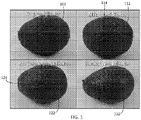
- FIG. 1 illustrates the appearance and classification of visible residues on the surfaces of avocados after being coated with compositions described herein.
- avocado 102 exhibited no visible residues.
- avocado 112 had only a small patch 114 (i.e., about 1-2 cm 2 or smaller, or occupying about 5% or less of the surface area of the avocado) of visible residues.
- avocados with one small patch of visible residues were classified as having mild residues.
- avocado 122 had a large patch 124 (i.e., about 3-10 cm 2 , or occupying about 5-25% of the surface area of the avocado) of visible residues.
- avocados with one large patch of visible residues were classified as having moderate residues.
- avocado 132 had wide-spread visible residues covering most or all of the surface. Such avocados were classified as having heavy residues.
- the term "substrate” refers to any object or material over which a coating is formed or material is deposited.
- the substrate is edible to humans, and the coating is an edible coating.
- edible substrates include agricultural products and foods such as fruits, vegetables, produce, seeds, nuts, beef, poultry, and seafood.
- the coatings are formed over the entire outer surface of the substrate, in some embodiments the coatings can cover a portion of the outer surface of the substrate.
- the coatings can include apertures or porous regions which expose a portion of the outer surface of the substrate.
- alkyl refers to a straight or branched chain saturated hydrocarbon.
- C 1 -C 6 alkyl groups contain 1 to 6 carbon atoms. Examples of a C 1 -C 6 alkyl group include, but are not limited to, methyl, ethyl, propyl, butyl, pentyl, isopropyl, isobutyl, sec-butyl and tert-butyl, isopentyl and neopentyl.
- alkenyl means an aliphatic hydrocarbon group containing a carboncarbon double bond and which may be straight or branched having about 2 to about 6 carbon atoms in the chain. Preferred alkenyl groups have 2 to about 4 carbon atoms in the chain. Branched means that one or more lower alkyl groups such as methyl, ethyl, or propyl are attached to a linear alkenyl chain. Exemplary alkenyl groups include ethenyl, propenyl, n-butenyl, and i-butenyl.
- a C 2 -C 6 alkenyl group is an alkenyl group containing between 2 and 6 carbon atoms. As defined herein, the term “alkenyl” can include both “E” and “Z” or both "cis” and "trans” double bonds.
- halo or halogen means fluoro, chloro, bromo, or iodo.
- Hexadecanoic acid i.e., palmitic acid
- Octadecanoic acid i.e., stearic acid
- Tetradecanoic acid i.e., myristic acid
- MA i.e., MA
- (9Z)-Octadecenoic acid i.e., oleic acid
- PA-2G 1,3-dihydroxypropan-2-yl palmitate (i.e., 2-glycero palmitate) is abbreviated to PA-2G.
- 1,3-dihydroxypropan-2-yl octadecanoate i.e., 2-glycero stearate
- SA-2G 1,3-dihydroxypropan-2-yl tetradecanoic acid
- MA-2G 1,3-dihydroxypropan-2-yl (9Z)-Octadecenoate
- OA-2G 1,3-dihydroxypropan-2-yl (9Z)-Octadecenoate
- PA-1G 2,3-dihydroxypropan-2-yl palmitate (i.e., 1-glycero palmitate) is abbreviated to PA-1G.
- 2,3-dihydroxypropan-2-yl octadecanoate i.e., 1-glycero stearate
- SA-1G 2,3-dihydroxypropan-2-yl tetradecanoate
- MA-1G 2,3-dihydroxypropan-2-yl (9Z)-Octadecenoate
- OA-1G 2,3-dihydroxypropan-2-yl (9Z)-Octadecenoate
- Ethyl hexadecanoate i.e., ethyl palmitate
- EtPA is abbreviated to EtPA.
- compositions described herein can include compounds of the Formula I: wherein the definitions of R a , R b , R 1 , R 2 , R 3 , R 4 , R 5 , R 6 , R 7 , R 8 , R 9 , R 10 , R 11 , R 12 , R 13 , m, n, q, and r are as described above, and optionally an additive.
- the additive is a compound of Formula II: wherein the definitions of R a , R b , R 1 , R 2 , R 3 , R 4 , R 5 , R 6 , R 7 , R 8 , R 9 , R 10 , R 11 , R 12 , R 13 , m, n, q, and r are as described above.
- the symbol represents a single bond. In one or more embodiments, the symbol represents a double bond. In some embodiments, R 11 is - OH. In some embodiments, n is 7. In some embodiments, R 3 and R 4 can be -OH. In some embodiments, n is 7 and R 3 is -OH. In one or more embodiments, n is 7 and R 4 is -OH. In some embodiments, n is 7 and R 3 and R 4 are -OH. In some embodiments, n is 7 and R 3 and R 4 combine with the carbon atoms to which they are attached to form an epoxide The symbol can represent a double bond between R 3 and R 4 when n is 7.
- the difference between a compound of Formula I and a compound of Formula II is the point of connection of the glycerol ester.
- the glycerol ester is unsubstituted.
- the present disclosure provides compounds of the Formula I-A: and Formula II-A: wherein the variables m, n, q, r, R 1 , R 2 , R 3 , R 4 , R 5 , R 6 , R 7 , R 8 , R 9 , R 10 , R 11 , R 12 and R 13 are defined as above for Formula I and Formula II.
- the mixtures were then dissolved in a solvent (e.g., either ethanol or a water and ethanol mixture, for instance in a 1:2 water:ethanol ratio or lower) to form a solution, from which coatings were formed over a variety of edible substrates (blueberries, bananas, strawberries, lemons, avocados, and limes). Details about the specific formulations used and procedures for the forming of the coatings are described below for illustrative purposes with reference to FIGS. 2-18 .
- the substrates were then examined for the presence of visible residues on the surface and tested for percent mass loss over time, and were compared to control samples without the coatings.
- compositions of mixtures were used to form coatings on a variety of edible substrates, where the specific compositions and coating procedures are described below with reference to FIGS. 2-18 .
- Some of the compositions were substantially pure (e.g., at least 90% or at least 95% pure) 2-monoacylglyceride compounds (e.g., compounds of Formula I).
- coatings were formed from compositions that were substantially pure PA-2G, as well as from compositions that were substantially pure SA-2G.
- Some of the compositions were substantially pure (e.g., at least 90% or at least 95% pure) 1-monoacylglyceride compounds (e.g., compounds of Formula II).
- coatings were formed from compositions that were substantially pure PA-1G, compositions that were substantially pure OA-1G, and compositions that were substantially pure SA-1G.
- compositions included a compound of Formula I and an additive, where for each of these compositions various ratios of the compound of Formula I to the additive were tested.
- coatings were formed from compositions which included the combinations of a compound of Formula I and an additive as listed in Table1 below.
- Additives included, for example, a saturated or unsaturated compound of Formula II, a saturated or unsaturated fatty acid, an ethyl ester, and/or a second compound of Formula I which is different from the (first) compound of Formula I (e.g., has a different length carbon chain).
- the compound of Formula I is PA-2G. In some embodiments, the compound of Formula I is PA-2G and the additive is PA-1G. In some embodiments, the compound of Formula I is PA-2G and the additive is SA-1G. In some embodiments, the compound of Formula I is PA-2G and the additive is MA-1G. In some embodiments, the compound of Formula I is PA-2G and the additive is OA-1G.
- the compound of Formula I is SA-2G. In some embodiments, the compound of Formula I is SA-2G and the additive is PA-1G. In some embodiments, the compound of Formula I is SA-2G and the additive is SA-1G. In some embodiments, the compound of Formula I is SA-2G and the additive is MA-1G. In some embodiments, the compound of Formula I is SA-2G and the additive is OA-1G.
- the compound of Formula I is MA-2G. In some embodiments, the compound of Formula I is MA-2G and the additive is PA-1G. In some embodiments, the compound of Formula I is MA-2G and the additive is SA-1G. In some embodiments, the compound of Formula I is MA-2G and the additive is MA-1G. In some embodiments, the compound of Formula I is MA-2G and the additive is OA-1G.
- the compound of Formula I is OA-2G. In some embodiments, the compound of Formula I is OA-2G and the additive is PA-1G. In some embodiments, the compound of Formula I is OA-2G and the additive is SA-1G. In some embodiments, the compound of Formula I is OA-2G and the additive is MA-1G. In some embodiments, the compound of Formula I is OA-2G and the additive is OA-1G.
- n is 0. In some embodiments, n is 1. In some embodiments, n is 2. In some embodiments, n is 3. In some embodiments, n is 4. In some embodiments, n is 5. In some embodiments, n is 6. In some embodiments, n is 7. In some embodiments, n is 8.
- m is 0. In some embodiments, m is 1. In some embodiments, m is 2. In some embodiments, m is 3.
- q is 0. In some embodiments, q is 1. In some embodiments, q is 2. In some embodiments, q is 3. In some embodiments, q is 4. In some embodiments, q is 5.
- r is 0. In some embodiments, r is 1. In some embodiments, r is 2. In some embodiments, r is 3. In some embodiments, r is 4. In some embodiments, r is 5. In some embodiments, r is 6. In some embodiments, r is 7. In some embodiments, r is 8.
- R a is hydrogen. In some embodiments, R b is hydrogen. In some embodiments, R a and R b are both hydrogen.
- n is 8. In some embodiments, q is 1. In some embodiments, m is 1. In some embodiments, r is 1.
- compounds of Formula I or Formula II have between 11 and 21 carbon atoms bonded to the carbonyl carbon (i.e., the compounds are C 12 -C 22 chains). In some embodiments, the compounds of Formula I or Formula II are C 12 , C 13 , C 14 , C 15 , C 16 , C 17 , C 18 , C 19 , C 20 , C 21 , or C 22 chains.
- n is 8 and q is 1. In some embodiments, n is 8, q is 1 and m is 1. In some embodiments, n is 8, q is 1, m is 1, and r is 1. In some embodiments, n is 8, q is 1, m is 1, r is 1, and represents a single bond.
- m is 3.
- n is 8, q is 1 and m is 3.
- n is 8, q is 1, m is 3, and r is 1.
- n is 8, q is 1, m is 3, r is 1, and represents a single bond.
- n is 6. In some embodiments, n is 6 and q is 1. In some embodiments, n is 6, q is 1 and m is 1. In some embodiments, n is 6, q is 1, m is 1, and r is 1. In some embodiments, n is 6, q is 1, m is 1, r is 1, and represents a single bond.
- n is 7. In some embodiments, n is 7 and q is 1. In some embodiments, n is 7, q is 1 and m is 3. In some embodiments, n is 7, q is 1, m is 3, and r is 1. In some embodiments, n is 7, q is 1, m is 3, r is 1, and represents a cis double bond.
- n is 8. In some embodiments, q is 1. In some embodiments, m is 1. In some embodiments, r is 1.
- n is 8 and q is 1. In some embodiments, n is 8, q is 1 and m is 1. In some embodiments, n is 8, q is 1, m is 1, and r is 1. In some embodiments, n is 8, q is 1, m is 1, r is 1, and represents a single bond.
- m is 3.
- n is 8, q is 1 and m is 3.
- n is 8, q is 1, m is 3, and r is 1.
- n is 8, q is 1, m is 3, r is 1, and represents a single bond.
- n is 6. In some embodiments, n is 6 and q is 1. In some embodiments, n is 6, q is 1 and m is 1. In some embodiments, n is 6, q is 1, m is 1, and r is 1. In some embodiments, n is 6, q is 1, m is 1, r is 1, and represents a single bond.
- n is 7. In some embodiments, n is 7 and q is 1. In some embodiments, n is 7, q is 1 and m is 3. In some embodiments, n is 7, q is 1, m is 3, and r is 1. In some embodiments, n is 7, q is 1, m is 3, r is 1, and represents a cis double bond.
- the solid mixtures which were a substantially pure compound of Formula I (e.g., at least 90% pure, at least 95% pure, or at least 99% pure), or contained the compound of Formula I but at most only small amounts of the additive (e.g., the mass or molar ratio of the additive to the compound of Formula I was less than 0.1 or 0.2 or 0.25, or the solid mixture was a substantially pure mixture of the compound of Formula I), the protective coatings that were subsequently formed all tended to at least partially precipitate or leave a visible residue on the surface of the substrate. As seen in FIG.
- the residues were easily visible to the naked eye, creating the general appearance of a white, film-like substance over portions of the edible substrate, the portions each tending to be at least 0.25 ⁇ m 2 in area, and in some cases at least 1 ⁇ m 2 in area, at least 5 ⁇ m 2 in area, at least 10 ⁇ m 2 in area, at least 100 ⁇ m 2 in area, or at least 1000 ⁇ m 2 in area.
- compositions which were combinations of Formula I compounds and an additive e.g., Formula II, fatty acid, and/or ester compounds
- the mass ratio of the additive to the compound of Formula I was greater than about 0.1 (e.g., greater than about 0.2 or between 0.2 and 1).
- the residues were not present, or were not visible to the naked eye, in protective coatings formed of compositions including combinations of Formula I and Formula II compounds, where the compositions were at least about 10% Formula I compounds (e.g., at least 20% Formula I compounds) and at least 10% Formula II compounds (e.g., at least 20% Formula II compounds) by mass.
- the presence of the visible residues described above can cause the substrate to appear damaged or to have a less appealing physical appearance to consumers, which may be undesirable.
- the compounds of Formula I i.e., the 2-monoacylglyceride compounds
- the compounds of Formula I provided for the substantially improved beneficial qualities of the coatings (e.g., reduction in the mass loss rate of at least 20-30% for strawberries, finger limes, and avocados, and at least 10-20% for blueberries) in a variety of edible substrates.
- too high a concentration of compounds of Formula I caused portions of the coatings to precipitate or otherwise leave visible residues. The presence of the residues in the coatings often resulted in porous regions in the coatings, thereby at least partially negating the beneficial properties of the coatings.
- Combining the compounds of Formula I with a smaller concentration of additives (e.g., 1-monoacylglyceride, fatty acid, and/or ester compounds) in the solid mixtures prevented the visible residues from forming during subsequent formation of the coatings, while at the same time allowing for protective coatings with the beneficial properties described above to be formed.
- concentration of compounds of Formula I in the solid mixture was too low (e.g., the mass ratio of the additives to the compounds of Formula I was greater than 1, or the solid mixture was formed of the additive compounds without the compounds of Formula I)
- the efficacy of the protective coatings was substantially compromised.
- the mass ratio or molar ratio of the additive to the compound of Formula I can be in a range of about 0.1 to about 1.
- the range can be from about 0.2 to about 1; about 0.3 to about 1; about 0.1 to about 0.5; from about 0.2 to about 0.4; from about 0.25 to about 0.35; from about 0.3 to about 0.7; from about 0.4 to about 0.6; from about 0.2 to about 0.7; from about 0.5 to about 1; or from about 0.45 to about 0.55.
- the molar ratio of the additive (e.g., a compound of Formula II) to the compound of Formula I can be about 0.5, 0.1, 0.15, 0.2, 0.25, 0.3, 0.35, 0.4, 0.45, 0.5, 0.6, 0.65, 0.7, 0.75, 0.8, 0.85, 0.9, 0.95, 1, 1.5, 2, 2.5, 3, or greater. In some embodiments, the molar ratio can be about 0.25, about 0.3, 0.33, or about 0.35.
- coatings were formed from compositions which included the combinations of compounds of Formula II and one or more additives as listed in Table 2 below.
- Additives included, for example, a saturated or unsaturated fatty acid, an ethyl ester, and/or one or more additional compounds of Formula II which were different from the (first) compound of Formula II (e.g., have a different length carbon chain).
- compositions described herein are substantially free of impurities such as proteins, polysaccharides, phenols, lignans, aromatic acids, terpenoids, flavonoids, carotenoids, alkaloids, alcohols, alkanes, and aldehydes.
- impurities such as proteins, polysaccharides, phenols, lignans, aromatic acids, terpenoids, flavonoids, carotenoids, alkaloids, alcohols, alkanes, and aldehydes.
- compositions described herein contain less than about 10% (e.g., less than about 9%, less than about 8%, less than about 7%, less than about 6%, less than about 5%, less than about 4%, less than about 3%, less than about 2%, or less than about 1%) of impurities such as proteins, polysaccharides, phenols, lignans, aromatic acids, terpenoids, flavonoids, carotenoids, alkaloids, alcohols, alkanes, and aldehydes.
- impurities such as proteins, polysaccharides, phenols, lignans, aromatic acids, terpenoids, flavonoids, carotenoids, alkaloids, alcohols, alkanes, and aldehydes.
- the compositions are substantially pure.
- the compound of Formula I and/or Formula II used in the compositions can be greater than 90% pure. It can be, for instance, greater than 91% pure, greater than 92% pure, greater than 93 % pure, greater than 94% pure, greater than 95% pure, greater than 96% pure, greater than 97% pure, greater than 98% pure, or greater than 99% pure.
- the additive e.g., Formula II, fatty acid, or ester
- the composition of the disclosure can be provided in combination with and/or dissolved in a solvent.
- the composition can be substantially soluble in a solvent, such as water, ethanol, or a combination of both.
- a composition comprising Formula I e.g., a composition comprising a compound of Formula I and Formula II
- a composition comprising Formula I can be soluble in water at a range of at least about 0.5 mg/mL, at least about 1 mg/mL, at least about 5 mg/mL, at least about 10 mg/mL, at least about 20 mg/mL, at least about 50 mg/mL, or at least about 100 mg/mL.
- a composition comprising Formula I can be soluble in ethanol at a range of at least about 1 mg/mL, at least about 5 mg/mL, at least about 10 mg/mL, at least about 20 mg/mL, at least about 50 mg/mL, or at least about 100 mg/mL.
- a composition comprising Formula I can be soluble in a mixture of water and ethanol at a range of at least about 1 mg/mL, at least about 5 mg/mL, at least about 10 mg/mL, at least about 20 mg/mL, at least about 50 mg/mL, or at least about 100 mg/mL.
- the solvent can be in any ratio from 1:99 to 99:1.
- the solvent can be at least 25% water by volume; at least 50% water by volume; at least 75% water by volume; or at least 90% water by volume.
- the compositions disclosed herein may be substantially soluble (e.g., 100% soluble at a concentration of at least about 0.5 mg/mL, at least about 1 mg/mL, at least about 5 mg/mL, at least about 10 mg/mL, at least about 20 mg/mL, at least about 50 mg/mL, or at least about 100 mg/mL) in any of the solvents described herein.
- the compositions can be substantially soluble in water or a combination of water and an alcohol (e.g., ethanol).
- the solvent can also comprise other organic alcohols such as methanol or isopropanol, or a combination of both.
- the solvent can also comprise organic solvents such as acetone, ethyl acetate or tetrahydrofuran.
- a composition of the present disclosure e.g., a composition comprising a compound of Formula I and a compound of Formula II
- a compound of the present disclosure can be a liquid or oil at about 25 °C and about one atmosphere of pressure.
- the solvent is non-toxic for human consumption.
- the solvent is not appreciably absorbed into the substrate when the substrate is coated with a mixture of solvent and compounds of the disclosure.
- the solvent is used to dissolve the compounds and coat the substrate. The solvent can then evaporate, leaving the composition on the surface of the substrate. In some embodiments, the evaporation of solvent takes place before the consumption of the substrate (e.g., food product) by a consumer.
- the solid compounds of the present disclosure are dissolved in a solvent (e.g., ethanol or a combination of ethanol and H 2 O).
- a solvent e.g., ethanol or a combination of ethanol and H 2 O.
- the solid mixtures can be highly soluble (e.g., at least 90% soluble at a concentration of at least about 0.5 mg/mL, at least about 1 mg/mL, at least about 5 mg/mL, at least about 10 mg/mL, at least about 20 mg/mL, at least about 50 mg/mL, or at least about 100 mg/mL) in ethanol, many solid mixtures containing an additive (e.g., 1-monoacylglycerides) and a compound of Formula I (e.g., 2-monoacylglycerides) at a respective mass ratio in the range of 0.1 to 1 were found to be highly soluble in solvents that were at least 25% water by volume, for example combinations of EtOH and H 2 O which were as high as 40% H
- the solubility limit of the solid mixture in a solvent that is at least 25% water by volume can be sufficiently high to allow for a solute (e.g., compounds of Formula I and/or an additive) to solvent ratio of at least 0.5 mg or 1 mg of solid mixture per milliliter of solvent, for example a solute to solvent ratio in the range of 1 to 20 mg or 0.5 to 100 mg of solid mixture per milliliter of solvent.
- a solute e.g., compounds of Formula I and/or an additive
- a solid mixture that is highly soluble e.g., at least 90% soluble at a concentration of at least about 0.5 mg/mL, at least about 1 mg/mL, at least about 5 mg/mL, at least about 10 mg/mL, at least about 20 mg/mL, at least about 50 mg/mL, or at least about 100 mg/mL
- a solvent with a high percentage of water can be beneficial by reducing the overall costs associated with forming the protective coatings, and can also allow for the use of a non-toxic solvent which can optionally be recycled.
- the composition can be a solid at standard temperature and pressure (i.e., about 25 °C and about 1 atmosphere of pressure).
- a composition of the disclosure e.g., a composition comprising a compound of Formula I and a compound of Formula II
- the compound of Formula I can be selected from: or
- the compound of Formula I can be selected from: or
- the compound of Formula II can be selected from: or
- the compound of Formula II can be selected from: or
- the compounds and compositions of the present disclosure can be dissolved in a solvent before application to a substrate.
- the mass ratio or molar ratio of the additive (e.g., a compound of Formula II) to the compound of Formula I is in a range of 0.1 to 1, and wherein the additive and the compound of Formula I are dissolved in a solvent at a concentration of at least about 0.5 mg/mL.
- the concentration of the composition in the solvent is at least about 1 mg/mL.
- the concentration of the composition in the solvent is at least about 5 mg/mL, at least about 10 mg/mL, at least about 20 mg/mL, at least about 50 mg/mL, or at least about 100 mg/mL.
- the solution of the composition in the solvent is saturated or supersaturated. In some embodiments, the concentration of the composition is below the saturation limit in the solution.
- the dissolution can be performed at a temperature in the range of about 0 °C to about 40 °C (e.g., in the range of about 15 °C to about 30 °C).
- composition can further comprise an additional agent selected from a pigment or an odorant.
- the additive is a compound of Formula II.
- the compounds and compositions described herein can be used as agents to reduce (e.g., prevent or diminish) food spoilage.
- the compounds can be applied to the surface of a food product to supplement the natural cutin barrier found in food products.
- the coatings formed from compositions of the present disclosure can prevent or suppress water loss (e.g., as compared to uncoated produce, reduce the mass loss rate by at least 20-30% for strawberries, finger limes, and avocados, and at least 10-20% for blueberries) from the substrate via evaporation through the substrate surface, thereby reducing mass loss over time.
- the coatings formed from the compositions can also prevent oxidation via reaction with oxygen gas that comes into contact with the substrate.
- the coating can comprise a compound of Formula I along with an additive (e.g. a compound of Formula II).
- coatings of the present disclosure can prevent oxidation (e.g., via ambient oxygen) of compounds that occur naturally in the agricultural products by providing a barrier between atmospheric oxygen and the compounds.
- the coatings can prevent moisture loss from the agricultural products by providing a barrier between the moisture in the product and the atmosphere.
- the coatings formed from the compounds of the disclosure can protect a substrate such as a food or agricultural product from pathogens such as bacteria, fungi or viruses by presenting a physical barrier between the pathogen and the substrate.
- Factors that can affect how well the compositions are able to achieve these functions include the specific composition of the precursor compounds used to form the compositions, as well as the thickness, density, and uniformity of the coatings formed from the compositions. In particular, if the coating is non-uniform or includes regions where the composition has locally precipitated, the functionality of the resulting coatings may be compromised.
- the composition i.e., a mixture of a compound of Formula I and an additive such as a compound of Formula II
- a solvent e.g., water, ethanol, or a combination of both
- the application of the composition can be accomplished by a number of different methods such as spraying, dipping, and the like.
- a harvest of fresh food product e.g., fruit
- a solution comprising a solvent e.g., water, ethanol or a mixture of the two
- the harvest can be submerged in a solution comprising a composition of the disclosure and filtered to separate the food products from the solution.
- the coating of a food product is accomplished by contacting the food product with a solution comprising a composition of the present disclosure and allowing the solvent to evaporate.
- the compositions e.g., the compound of Formula I and the additive
- the solvent can be removed by mechanical means (e.g., dabbing or swabbing with a towel or other absorbent fabric or surface).
- the solvent can be dried by blowing air over the coated food products.
- the solvent can be dried by application of a vacuum to the coated food products.
- the solvent can be left to evaporate under ambient conditions (i.e., standard temperature and pressure). In the case where the substrate is dipped in a solution of compound and filtered, the residual amounts of the composition of the disclosure that are left after filtration can be sufficient to coat the food product.
- the compounds and solutions of the present disclosure can be applied to a substrate (e.g., a food product) before or after harvest of the food product.
- a substrate e.g., a food product
- solutions of the present disclosure can be applied to a food product while the food product is still growing, or has not yet been harvested (e.g., before the food product has been picked).
- the compounds of the present disclosure can be applied after harvest. For instance, freshly picked fruit can be consolidated in containers such as baskets and the solutions of the disclosure can be applied to the fruit shortly after picking.
- the coatings can be undetectable to the human eye.
- the coating can be formed so as to have a visual quality that is aesthetically pleasing (e.g., to a consumer).
- the coating can be an edible substrate such as a fruit or a vegetable, it can be preferable that the coating not modify the general appearance of the substrate surface to make the substrate more appealing.
- the coating can make the substrate appear shinier or brighter and thus more aesthetically pleasing to the eye (e.g., to a consumer).
- the coatings can form visible precipitates or other visible residues on the surface of a substrate upon application to the substrate.
- visible precipitates or other visible residues larger than 0.25 square microns
- the specific composition as well as the method of application of the coating can be selected such that the resulting coating is substantially transparent and is substantially free of visible residues larger than 0.25 ⁇ m 2 in area.
- the coatings are substantially free of any visible residues formed from the compounds of Formula I and/or additive.
- the visible residues are less than 0.25 ⁇ m 2 in area (e.g., less than 0.2 ⁇ m 2 , less than 0.15 ⁇ m 2 , or less than 0.1 ⁇ m 2 ). Additionally, visible residues larger than 0.25 ⁇ m 2 in area can disturb the coating such that portions of the substrate in some embodiments are not fully covered and thus not fully protected. This can lead to moisture loss, for instance, and accelerate spoilage.
- the coating can be formed so as to intentionally alter the physical appearance of the substrate, for example to make the substrate appear shinier or brighter and thus more aesthetically pleasing to the eye (e.g., to a consumer), or to have the appearance of a natural wax such as bloom on freshly picked blueberries.
- the coatings include visible residues larger than 0.25 ⁇ m 2 in area.
- the areal density of visible residues larger than 0.25 ⁇ m 2 in area over the surface be relatively small, so as to improve the physical appearance of the substrate without substantially degrading the quality of the coating.
- the coating can include at least 10 separate visible residues larger 0.25 ⁇ m 2 in area per square centimeter of the surface of the substrate.
- the protective coatings can be applied at a thickness which causes them to decrease the percent mass loss of the substrates over time, as compared to control samples without the coatings.
- the protective coatings have an average thickness of about 0.1 microns.
- the average thickness of the coating can be at least 0.15 microns, at least 0.2 microns, or at least 0.25 microns.
- the coatings have a minimum thickness of at least about 0.1 microns.
- the coatings can be substantially free of defects while also having an average thickness of about 0.4 microns or greater.
- coatings formed over produce by methods described herein can be less than 3 microns thick, less than 2 microns thick, less than 1.5 microns thick, between 0.1 and 3 microns thick, or between 0.05 and 2 microns thick, and can simultaneously reduce the rate of mass loss of the produce (as compared to similar uncoated produce at the same state of ripening) by at least 5%, at least 10%, at least 15%, at least 20%, at least 25%, at least 30%, at least 35%, or at least 40%.
- the protective coatings may also be sufficiently optically transparent so as to prevent the coatings from being detectable by the human eye.
- the coatings can have an average transmittance of at least 60% (e.g., about 60%, at least 65%, at least 70%, at least 80%, at least 85%, at least 90%, at least 95%, about 99% or about 100%) for light in the visible range such as sunlight (i.e., the portion of the solar spectrum having a wavelength between 400 nanometers and 700 nanometers).
- “transmittance” is defined as the ratio of transmitted light power to incident light power.
- average transmittance refers to the average value of the transmittance over the entire area of the coating.
- the entire coating can in all regions have a transmittance of at least 60% (e.g., about 60%, at least 65%, at least 70%, at least 80%, at least 85%, at least 90%, at least 95%, about 99% or about 100%) for light in the visible range. Because transmittance typically decreases with coating thickness, the coatings can be made thin enough to allow for sufficient transmittance of visible light while still being thick enough to serve as a barrier to mass/moisture loss, as previously described. For example, the protective coatings have an average thickness of less than 2 microns, less than 1.5 microns, less than 1 micron, or less than 0.5 microns.
- the compounds of Formula I and/or Formula II may be prepared by methods known in the art of organic synthesis as set forth in part by the following synthetic schemes and examples. In the schemes described below, it is well understood that protecting groups for sensitive or reactive groups are employed where necessary in accordance with general principles or chemistry. Protecting groups are manipulated according to standard methods of organic synthesis ( T. W. Greene and P. G. M. Wuts, "Protective Groups in Organic Synthesis", Third edition, Wiley, New York 1999 ). These groups are removed at a convenient stage of the compound synthesis using methods that are readily apparent to those skilled in the art. The selection processes, as well as the reaction conditions and order of their execution, shall be consistent with the preparation of compounds of Formula I.
- the present disclosure includes both possible stereoisomers (unless specified in the synthesis) and includes not only racemic compounds but the individual enantiomers and/or diastereomers as well.
- a compound When a compound is desired as a single enantiomer or diastereomer, it may be obtained by stereospecific synthesis or by resolution of the final product or any convenient intermediate. Resolution of the final product, an intermediate, or a starting material may be affected by any suitable method known in the art. See, for example, " Stereochemistry of Organic Compounds" by E. L. Eliel, S. H. Wilen, and L. N. Mander (Wileylnterscience, 1994 ).
- the compounds described herein may be made from commercially available starting materials or synthesized using known organic, inorganic, and/or enzymatic processes.
- a compound of Formula I can be prepared according to Scheme 1.
- glycerol ester compounds of Formula I can be prepared from the corresponding acid by protecting any hydroxy groups that may be present in the acid.
- hydroxy groups can be protected with any suitable hydroxy protecting group known in the art, for example a -TBS ( tert -butyldimethylsilyl) protecting group.
- Esterification of the protected acid with an appropriately protected glycerol derivative e.g., 2-phenyl-1, 3-dioxan-5-ol
- silyl protecting groups can be accomplished with an appropriate agent such as hydrofluoric acid or tetrabutylammonium fluoride (TBAF).
- TBAF tetrabutylammonium fluoride
- the glycerol group can be deprotected using standard conditions, for instance, hydrogenation or treatment with an acid.
- the forming of the compositions and the subsequent formation of the coatings is carried out by multiple parties.
- a supplier or manufacturer of compounds suitable for the compositions described herein could form a solution comprising the compounds dissolved in a solvent and provide (e.g., supply or sell) the solution to a grower or distributor of produce.
- the grower or distributor could then apply the solution to produce, for example by dipping the produce in the solution, spraying the solution onto the produce, or brushing the solution onto the produce.
- the grower or distributor could then cause the composition to re-solidify on the surface of the produce to form the coating, for example by placing the produce on a drying rack and allowing the solvent to evaporate (or alternatively by blow drying the produce), thereby allowing the composition to solidify and form a coating over the produce. That is, after applying the solution to the produce, the solvent can be removed in order to precipitate the composition over the produce.
- a supplier or manufacturer of compounds suitable for the compositions described herein could form a solid mixture (e.g., in powder form) of the compounds and provide (e.g., supply or sell) the solid mixture to a grower or distributor of produce.
- the grower or distributor could then dissolve the solid mixture in a solvent to form a solution and apply the solution to produce, for example by dipping the produce in the solution, spraying the solution onto the produce, or brushing the solution onto the produce.
- the grower or distributor could then cause the composition to re-solidify on the surface of the produce to form the coating, for example by placing the produce on a drying rack and allowing the solvent to evaporate (or alternatively by blow drying the produce), thereby allowing the composition to solidify and form a coating over the produce.
- the first party e.g., the party that forms the solid compositions and/or solutions
- the instructions can, for example, be provided in either written or oral form, and may indicate one or more of the following: (i) that solid compositions are to be dissolved in a solvent and then applied to a substrate; (ii) suitable solvents in which to dissolve the solid compositions, as well as suitable concentrations for the solid compositions dissolved in the solvent; (iii) suitable procedures for applying the solutions to the substrates; and/or (iv) suitable procedures for removing (e.g., evaporating) the solvent and/or forming a coating over the surface of the substrate.
- the instructions or recommendations can be supplied by the first party directly with the solid compositions and/or solutions (e.g., on packaging in which the solid compositions and/or solutions are stored), the instructions or recommendations may alternatively be supplied separately, for example on a website owned or controlled by the first party, or in advertising or marketing material provided by or on behalf of the first party.
- a party forms and/or provides solid compositions and/or solutions according to one or more embodiments described herein may not directly apply the compositions/solutions to the substrates to form coatings, but can instead direct (e.g., can instruct or request) a second party (or third party) to apply the compositions/solutions to the substrates and/or to form coatings. That is, even if the first party does not apply the solution to a surface of the substrate, the first party may still cause the solution to be applied to a surface of the substrate, for example by providing instructions or recommendations as described above.
- the first party can also cause the solvent to be removed and/or the composition to re-solidify on the surface to form the coating, for example by providing instructions or recommendations to the second party on procedures for removing (e.g., evaporating) the solvent and/or for allowing the composition to re-solidify on the surface to form the coating.
- the act of applying a composition or solution to a surface of a substrate can also include directing or instructing another party to apply the composition or solution to the surface of the substrate, or causing the composition or solution to be applied to the surface of the substrate.
- the act of causing a composition to re-solidify on the surface of a substrate to form the coating can also include directing or instructing another party to on how to cause the composition to re-solidify on the surface of a substrate to form the coating.
- Palmitic acid (98%) was purchased from Sigma-Aldrich.
- p -TsOH and MTBE were purchased from Alfa-Aesar.
- Toluene, Et 2 O, and EtOAc were purchased from VDR.
- Lipozyme ® TL IM lipase was purchased from Novozymes.
- 10 wt% Pd/C was purchased from Strem Chemicals and used as received. All reactions were carried out under an atmosphere of air with non-dried solvents unless otherwise stated. Yields refer to chromatographically and spectroscopically ( 1 H NMR) homogeneous materials, unless otherwise stated.
- Reactions were monitored by thin layer chromatography (TLC) carried out on 0.25 mm E. Merck silica gel plates (60F-254) using UV light as the visualizing agent and an acidic mixture of anisaldehyde, ceric ammonium molybdate, or basic aqueous potassium permangante (KMnO 4 ), and heat as developing agents.
- NMR spectra were recorded on a Bruker Avance 500 MHz and/or Varian VNMRs 600 MHz instruments and calibrated using residual un-deuterated solvent as an internal reference (CHCl 3 at 7.26 ppm 1 H NMR, 77.16 ppm 13 C NMR).
- MS mass spectra
- ESI electrospray ionization
- FD field desorption
- the flask was heated to reflux in a heating mantle while the reaction mixture was stirred vigorously until the amount of water collected ( ⁇ 5 mL) in the Dean-Stark Head indicated full ester conversion ( ⁇ 8 hr).
- the flask was allowed to cool down to room temperature and the reaction mixture was poured into a separatory funnel containing 75 mL of a saturated aqueous solution of Na 2 CO 3 and 75 mL of brine.
- the toluene fraction was collected and the aqueous layer was extracted with 125 mL of Et 2 O.
- the organic layers were combined and washed with 100 mL of brine, dried over MgSO 4 , filtered and concentrated in vacuo.
- the flask was allowed to cool down to room temperature and the solution was diluted with 100 mL of hexanes.
- the reaction mixture was poured into a separatory funnel containing 50 mL of a saturated aqueous solution of Na 2 CO 3 .
- the organic fraction was collected and the aqueous layer was extracted twice more with 50 mL portions of hexanes.
- the organic layers were combined and washed with 100 mL of brine, dried over MgSO 4 , filtered and concentrated in vacuo.
- FIGS. 2-18 illustrate the effects of coating a variety of edible substrates with the compositions described herein.
- solid mixtures of the compositions were first fully dissolved in ethanol at a concentration of 10 mg/mL (except where a different concentration is specified) to form a solution.
- the solution was then applied to the substrate either by spraying or dip coating, as detailed for each of the substrates below.
- the substrates were then dried on drying racks under ambient conditions (temperature in the range of 23 °C-27 °C, humidity in the range of 40%-55%) until all of the solvent had evaporated, allowing the coatings to form over the substrates.
- the resultant coatings each had a thickness in the range of about 0.5 ⁇ m to 1 ⁇ m.
- PA was purchased from Sigma Aldrich
- PA-1G was purchased from Tokyo Chemical Industry Co
- PA-2G was prepared following the method of Example 1 above
- SA was purchased from Sigma Aldrich
- SA-1G was purchased from Alfa Aesar
- SA-2G was prepared following the method of Example 3 above
- MA was purchased from Sigma Aldrich
- MA-1G was purchased from Tokyo Chemical Industry Co
- OA was purchased from Sigma Aldrich
- EtPA was purchased from Sigma Aldrich.
- FIG. 2 shows the effects of mass loss over time observed in lemons over the course of 3 weeks, both for uncoated lemons and for lemons which were coated with a composition described herein.
- the composition included PA-2G (compound of Formula I) and PA-1G (additive).
- the mass ratio and molar ratio of the PA-1G to PA-2G was about 0.33 (i.e., a molar ratio of about 25:75).
- the PA-2G was prepared following the method of Example 1 above.
- the composition was dissolved in ethanol at a concentration of 10 mg/mL to form a solution, and the solution was applied to the surface of the lemons to form the coatings.
- the lemons were placed in a bag, and the solution containing the composition was poured into the bag. The bag was then sealed and lightly agitated until the entire surface of each lemon was wet. The lemons were then removed from the bag and allowed to dry on drying racks under ambient room conditions at a temperature in the range of about 23°C -27 °C and humidity in the range of about 40%-55%. No visible residues or other visible precipitates were observed on the coated lemons.
- the lemons were held at these same temperature and humidity conditions for the entire duration of the time they were tested for mass loss.
- 202 is a high resolution photograph of an uncoated lemon immediately after being picked (Day 1)
- 204 is a high resolution photograph of a lemon immediately after being picked and coated on the same day.
- 212 and 214 are photographs of the uncoated and coated lemons, respectively, taken on Day 22, 21 days after photographs 202 and 204.
- an overlay 222 of the outline of the untreated lemon on Day 1 is shown around 212
- an overlay 224 of the outline of the untreated lemon on Day 1 is shown around 214.
- the coated lemons had a cross sectional area greater than 90% of their original area (i.e., greater than 92% of their original area), whereas the uncoated lemons had a cross sectional area less than 80% of their original area (i.e., about 78% of their original area).
- FIG. 3 shows plots for both coated (302) and uncoated (304) lemons indicating the reduction in cross sectional area as a function of time over a period of 20 days. Specifically, on each day, high resolution images of each of the lemons were taken and analyzed with image processing software (as in FIG. 2 ) to determine the ratio of the cross sectional area on the particular day to the initial cross sectional area of the lemon. As seen in FIG. 3 , after 20 days, the coated lemons had a cross sectional area greater than 90% of their original area (in fact greater than 92% of their original area), whereas the uncoated lemons had a cross sectional area less than 80% of their original area.
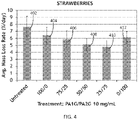
- FIG. 4 is a graph showing average daily mass loss rates for strawberries coated with various mixtures of PA-2G (compound of Formula I) and PA-1G (additive) measured over the course of 4 days. Each bar in the graph represents average daily mass loss rates for a group of 15 strawberries.
- the strawberries corresponding to bar 402 were uncoated (control group).
- the strawberries corresponding to bar 404 were coated with a mixture that was substantially pure PA-1G.
- the strawberries corresponding to bar 406 were coated with a mixture that was about 75% PA-1G and 25% PA-2G by mass (mass ratio and molar ratio of PA-1G to PA-2G was about 3).
- the strawberries corresponding to bar 408 were coated with a mixture that was about 50% PA-1G and 50% PA-2G by mass (mass ratio and molar ratio of PA-1G to PA-2G was about 1).
- the strawberries corresponding to bar 410 were coated with a mixture that was about 25% PA-1G and 75% PA-2G by mass (mass ratio and molar ratio of PA-1G to PA-2G was about .33).
- the strawberries corresponding to bar 412 were coated with a mixture that was substantially pure PA-2G.
- the compositions were each dissolved in ethanol at a concentration of 10 mg/mL to form a solution, and the solution was applied to the surface of the strawberries to form the coatings.
- the strawberries were spray coated according to the following procedures. First, the strawberries were placed on drying racks. Solutions containing each of the coating compositions were placed in spray bottles which generated a fine mist spray. For each bottle, the spray head was held approximately six inches from the strawberries, and the strawberries were sprayed and then allowed to dry on the drying racks. The strawberries were kept under ambient room conditions at a temperature in the range of about 23 °C-27 °C and humidity in the range of about 40%-55% while they dried and for the entire duration of the time they were tested.
- the uncoated strawberries (402) exhibited an average mass loss rate of greater than 7.5% per day.
- the mass loss rates of the strawberries coated with the substantially pure PA-1G formulation (404) and the substantially pure PA-2G formulation (412) exhibited average daily mass loss rates between 6% and 6.5%, which was nominally better than the uncoated strawberries (402).
- the strawberries coated with substantially pure PA-1G or substantially pure PA-2G formulations (404 and 412, respectively) all exhibited heavy residues on their surfaces.
- the strawberries corresponding to bar 406 (PA-1G to PA-2G mass ratio of about 3) exhibited slightly improved mass loss rates, slightly less than 6% per day, but still exhibited moderate residues on their surfaces.
- the strawberries corresponding to bars 408 and 410 (PA-1G to PA-2G mass ratios of about 1 and 0.33, respectively) exhibited substantially improved mass loss rates; the strawberries corresponding to bar 408 exhibited average daily mass loss rates of just over 5%, while the strawberries corresponding to bar 410 exhibited average daily mass loss rates of under 5%, with none of the strawberries in either of these groups exhibiting visible residues on their surfaces.
- FIG. 5 shows high resolution photographs of 4 coated and 4 uncoated strawberries over the course of 5 days at the temperature and humidity conditions described above, where the coated strawberries were coated with mixtures having a PA-1G to PA-2G mass ratio and molar ratio of about 0.33 (i.e., about 25:75) as in bar 410 in FIG. 4 .
- the uncoated strawberries began to exhibit fungal growth and discoloration by day 3, and were mostly covered in fungus by day 5.
- the coated strawberries did not exhibit any fungal growth by day 5 and were largely similar in overall color and appearance on day 1 and day 5.
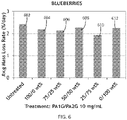
- FIG. 6 is a graph showing average daily mass loss rates for blueberries coated with various mixtures of PA-2G (compound of Formula I) and PA-1G (additive) measured over the course of several days.
- Each bar in the graph represents average daily mass loss rates for a group of 60 blueberries.
- the blueberries corresponding to bar 602 were uncoated (control group).
- the blueberries corresponding to bar 604 were coated with a mixture that was substantially pure PA-1G.
- the blueberries corresponding to bar 606 were coated with a mixture that was about 75% PA-1G and 25% PA-2G by mass (i.e., the mass ratio and molar ratio of PA-1G to PA-2G was about 3).
- the blueberries corresponding to bar 608 were coated with a mixture that was about 50% PA-1G and 50% PA-2G by mass (i.e., the mass ratio and molar ratio of PA-1G to PA-2G was about 1).
- the blueberries corresponding to bar 610 were coated with a mixture that was about 25% PA-1G and 75% PA-2G by mass (mass ratio and molar ratio of PA-1G to PA-2G was about .33).
- the blueberries corresponding to bar 612 were coated with a mixture that was substantially pure PA-2G.
- the compositions were each dissolved in ethanol at a concentration of 10 mg/mL to form a solution, and the solution was applied to the surface of the blueberries to form the coatings.
- the blueberries were placed in bags, and the solution containing the composition was poured into the bag. The bag was then sealed and lightly agitated until the entire surface of each blueberry was wet. The blueberries were then removed from the bag and allowed to dry on drying racks. The blueberries were kept under ambient room conditions at a temperature in the range of about 23 °C-27 °C and humidity in the range of about 40%-55% while they dried and for the entire duration of the time they were tested.
- the uncoated blueberries (602) exhibited an average mass loss rate of nearly 2.5% per day.
- the mass loss rates of the blueberries coated with the substantially pure PA-1G formulation (604) and the substantially pure PA-2G formulation (612), as well as the blueberries corresponding to bars 606 (PA-1G to PA-2G ratio of about 3) and 608 (PA-1G to PA-2G ratio of about 1) exhibited average daily mass loss rates between 2.1% and 2.3%, which was nominally better than the uncoated blueberries (602).
- FIG. 7 is a graph showing average daily mass loss rates for blueberries coated with various mixtures of SA-2G (compound of Formula I) and SA-1G (additive) measured over the course of several days.
- Each bar in the graph represents average daily mass loss rates for a group of 60 blueberries.
- the blueberries corresponding to bar 702 were uncoated (control group).
- the blueberries corresponding to bar 704 were coated with a mixture that was substantially pure SA-1G.
- the blueberries corresponding to bar 706 were coated with a mixture that was about 75% SA-1G and 25% SA-2G by mass (mass ratio and molar ratio of SA-1G to SA-2G was about 3).
- the blueberries corresponding to bar 708 were coated with a mixture that was about 50% SA-1G and 50% SA-2G by mass (mass ratio and molar ratio of SA-1G to SA-2G was about 1).
- the blueberries corresponding to bar 710 were coated with a mixture that was about 25% SA-1G and 75% SA-2G by mass (mass ratio and molar ratio of SA-1G to SA-2G was about .33).
- the blueberries corresponding to bar 712 were coated with a mixture that was substantially pure SA-2G.
- the compositions were each dissolved in ethanol at a concentration of 10 mg/mL to form a solution, and the solution was applied to the surface of the blueberries to form the coatings.
- the blueberries were placed in bags, and the solution containing the composition was poured into the bag. The bag was then sealed and lightly agitated until the entire surface of each blueberry was wet. The blueberries were then removed from the bag and allowed to dry on drying racks. The blueberries were kept under ambient room conditions at a temperature in the range of about 23 °C-27 °C and humidity in the range of about 40%-55% while they dried and for the entire duration of the time they were tested.
- the results for SA-1G / SA-2G mixtures were similar to those for PA-1G / PA-2G mixtures.
- the uncoated blueberries (702) exhibited an average mass loss rate of about 2.4% per day.
- the mass loss rates of the blueberries coated with the substantially pure SA-1G formulation (704) and the substantially pure SA-2G formulation (712), as well as the blueberries corresponding to bars 706 (SA-1G to SA-2G ratio of about 3) and 708 (SA-1G to SA-2G ratio of about 1) exhibited average daily mass loss rates between 2.1% and 2.2%, which was nominally better than the uncoated blueberries (702).
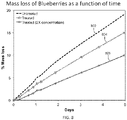
- FIG. 8 which illustrates the results of another blueberry study, shows plots of the percent mass loss over the course of 5 days in uncoated blueberries (802), blueberries coated using a first solution of 10 mg/mL of compounds dissolved in ethanol (804), and blueberries coated using a second solution of 20 mg/mL of compounds dissolved in ethanol (806).
- the compounds in both the first and second solutions included a mixture of PA-1G and PA-2G, where the mass ratio and molar ratio of PA-1G to PA-2G was about 0.33 (i.e., a ratio of 25:75 as with bar 610 in FIG. 6 ).
- the following dip coating procedures were used.
- Each blueberry was picked up with a set of tweezers and individually dipped in the solution for approximately 1 second or less, after which the blueberry was placed on a drying rack and allowed to dry.
- the blueberries were kept under ambient room conditions at a temperature in the range of about 23 °C-27 °C and humidity in the range of about 40%-55% while they dried and for the entire duration of the time they were tested. Mass loss was measured by carefully weighing the blueberries each day, where the reported percent mass loss was equal to the ratio of mass reduction to initial mass.
- the percent mass loss for uncoated blueberries was almost 20% after 5 days, whereas the percent mass loss for blueberries coated with the 10 mg/mL solution was less than 15% after 5 days, and the percent mass loss for blueberries coated with the 20 mg/mL solution was less than 10% after 5 days.
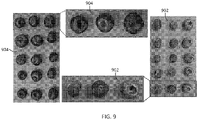
- FIG. 9 shows high resolution photographs of the uncoated blueberries (802) from the study in FIG. 8 , and of the blueberries coated with the 10 mg/mL solution of a 25:75 mass ratio and molar ratio (i.e., 0.33) of PA-1G to PA-2G (804) from the study of FIG. 8 , taken at day 5.
- the skins of the uncoated blueberries 802 were highly wrinkled as a result of mass loss of the blueberries, whereas the skins of the coated blueberries remained very smooth.
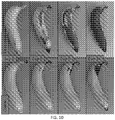
- FIG. 10 shows high resolution photographs of coated and uncoated bananas over the course of 14 days, where the coatings were formed from a composition dissolved in a solvent.
- the composition included PA-2G (compound of Formula I) and PA-1G (additive).
- the mass ratio and molar ratio of the PA-1G to PA-2G was about 0.33 (i.e., about 25:75).
- the composition was dissolved in ethanol at a concentration of 10 mg/mL to form a solution, and the solution was applied to the surface of the lemons to form the coatings.
- the bananas were placed in a bag, and the solution containing the composition was poured into the bag. The bag was then sealed and lightly agitated until the entire surface of each banana was wet. The bananas were then removed from the bag and allowed to dry on drying racks under ambient room conditions at a temperature in the range of about 23 °C-27 °C and humidity in the range of about 40%-55%. The bananas were held at these same temperature and humidity conditions for the entire duration of the time they were tested. As shown, the coatings clearly served as an effective barrier to oxidation, thereby preventing discoloration of the bananas and slowing down the ripening process.
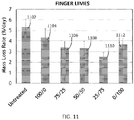
- FIG. 11 is a graph showing average daily mass loss rates for finger limes coated with various mixtures of PA-2G (compound of Formula I) and PA-1G (additive) measured over the course of several days. Each bar in the graph represents average daily mass loss rates for a group of 24 finger limes.
- the finger limes corresponding to bar 1102 were uncoated (control group).
- the finger limes corresponding to bar 1104 were coated with a mixture that was substantially pure PA-1G.
- the finger limes corresponding to bar 1106 were coated with a mixture that was about 75% PA-1G and 25% PA-2G by mass (mass ratio and molar ratio of PA-1G to PA-2G was about 3).
- the finger limes corresponding to bar 1108 were coated with a mixture that was about 50% PA-1G and 50% PA-2G by mass (mass ratio and molar ratio of PA-1G to PA-2G was about 1).
- the finger limes corresponding to bar 1110 were coated with a mixture that was about 25% PA-1G and 75% PA-2G by mass (mass ratio and molar ratio of PA-1G to PA-2G was about .33).
- the finger limes corresponding to bar 1112 were coated with a mixture that was substantially pure PA-2G.
- the compositions were each dissolved in ethanol at a concentration of 10 mg/mL to form a solution, and the solution was applied to the surface of the finger limes to form the coatings.
- the finger limes were placed in bags, and the solution containing the composition was poured into the bag. The bag was then sealed and lightly agitated until the entire surface of each finger lime was wet. The finger limes were then removed from the bag and allowed to dry on drying racks. The finger limes were kept under ambient room conditions at a temperature in the range of about 23 °C-27 °C and humidity in the range of about 40%-55% while they dried and for the entire duration of the time they were tested.
- the uncoated finger limes (1102) exhibited an average mass loss rate of over 5% per day.
- the mass loss rates of the finger limes coated with the substantially pure PA-1G formulation (1104) and the substantially pure PA-2G formulation (1112) exhibited average daily mass loss rates of just over 4% and just under 4%, respectively, which was nominally better than the uncoated finger limes (1102).
- the finger limes coated with substantially pure PA-1G or substantially pure PA-2G formulations (1104 and 1112, respectively) all exhibited heavy residues on their surfaces.
- the finger limes corresponding to bar 1106 (75:25 mass ratio of PA-1G to PA-2G, or a mass ratio of about 3) showed improved results, yielding an average daily mass loss rate of less than 3.5% but still exhibiting moderate residues on their surfaces.
- the finger limes corresponding to bars 1108 and 1110 (PA-1G to PA-2G mass ratios of about 1 (50:50) and 0.33 (25:75), respectively) exhibited mass loss rates under 3.5% and under 2.6%, respectively, which was a substantial improvement over the uncoated finger limes (1102), and also did not exhibit any visible residues on their surfaces.
- FIG. 12 is a graph showing the shelf life factor for avocados coated with various mixtures of PA-2G (compound of Formula I) and a 1-monoacylglyceride additive (bars 1202, 1204, and 1206 are for MA-1G; bars 1212, 1214, and 1216 are for PA-1G; bars 1222, 1224, and 1226 are for SA-1G).
- shelf life factor is defined as the ratio of the average mass loss rate of uncoated produce (measured for a control group) to the average mass loss rate of the corresponding coated produce. Hence a larger shelf life factor corresponds to a greater reduction in average mass loss rate.
- Bars 1202, 1212, and 1222 correspond to a 25:75 mixture of 1-monoacylglycerides to PA-2G (molar ratio of 1-monoacylglycerides to PA-2G of about 0.33).
- Bars 1204, 1214, and 1224 correspond to a 50:50 mixture of 1-monoacylglycerides to PA-2G (molar ratio of 1-monoacylglycerides to PA-2G of about 1).
- Bars 1206, 1216, and 1226 correspond to a 75:25 mixture of 1-monoacylglycerides to PA-2G (molar ratio of 1-monoacylglycerides to PA-2G of about 3).
- Each bar in the graph represents a group of 30 avocados. All coatings were formed by dipping the avocados in a solution comprising the associated mixture dissolved in substantially pure ethanol at a concentration of 5 mg/mL, placing the avocados on drying racks, and allowing the avocados to dry under ambient room conditions at a temperature in the range of about 23 °C-27 °C and humidity in the range of about 40%-55%. The avocados were held at these same temperature and humidity conditions for the entire duration of the time they were tested.
- the greatest shelf life factor was achieved for a 1-monoacylglyceride to PA-2G molar ratio of about 0.33.
- the avocados coated with the 25:75 (i.e., molar ratio of about 0.33) and 50:50 (i.e., a molar ratio of about 1) molar ratio mixtures did not exhibit any visible residues on their surfaces, whereas the avocados with 75:25 mixtures exhibited moderate to heavy residues.
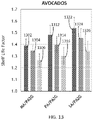
- FIG. 13 is a graph showing the shelf life factor for avocados coated with various mixtures of PA-2G (compound of Formula I) and a fatty acid additive (bars 1302, 1304, and 1306 are for MA; bars 1312, 1314, and 1316 are for PA; bars 1322, 1324, and 1326 are for SA).
- Bars 1302, 1312, and 1322 correspond to a 25:75 mixture of fatty acid to PA-2G (molar ratio of fatty acid to PA-2G of about 0.33). The mass ratios are about 0.23, 0.25, and 0.28, respectively.
- Bars 1304, 1314, and 1324 correspond to a 50:50 mixture of fatty acid to PA-2G (molar ratio of fatty acid to PA-2G of about 1).
- the mass ratios are about 0.35, 0.39, and 0.43, respectively.
- Bars 1306, 1316, and 1326 correspond to a 75:25 mixture of fatty acid to PA-2G (molar ratio of fatty acid to PA-2G of about 3).
- the mass ratios are about 2.1, 2.3, and 2.6, respectively.
- Each bar in the graph represents a group of 30 avocados. All coatings were formed by dipping the avocados in a solution comprising the associated mixture dissolved in substantially pure ethanol at a concentration of 5 mg/mL, placing the avocados on drying racks, and allowing the avocados to dry under ambient room conditions at a temperature in the range of about 23 °C-27 °C and humidity in the range of about 40%-55%. The avocados were held at these same temperature and humidity conditions for the entire duration of the time they were tested.
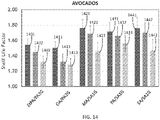
- FIG. 14 is a graph showing the shelf life factor for avocados coated with various other compounds. Each bar in the graph represents a group of 30 avocados. All coatings were formed by dipping the avocados in a solution comprising the associated mixture dissolved in substantially pure ethanol at a concentration of 5 mg/mL, placing the avocados on drying racks, and allowing the avocados to dry under ambient room conditions at a temperature in the range of about 23 °C-27 °C and humidity in the range of about 40%-55%. The avocados were held at these same temperature and humidity conditions for the entire duration of the time they were tested.
- Bars 1401-1403 correspond to mixtures of PA-2G (compound of Formula I) with ethyl palmitate as an additive.
- Bars 1411-1413 correspond to mixtures of PA-2G (compound of Formula I) with oleic acid (unsaturated fatty acid) as an additive.
- Bars 1401 and 1411 correspond to a 25:75 mixture of additive to PA-2G (molar ratio of additive to PA-2G of about 0.33). The mass ratios are both about 0.86.
- Bars 1402 and 1412 correspond to a 50:50 mixture of additive to PA-2G (molar ratio of additive to PA-2G of about 1). The mass ratios both are about 0.43.
- Bars 1403 and 1413 correspond to a 75:25 mixture of additive to PA-2G (molar ratio of additive to PA-2G of about 3). The mass ratios are both about 2.58. As seen for the combinations of PA-2G and EtPA as well as for the combinations of PA-2G and OA, the greatest shelf life factor was achieved with additive to PA-2G molar ratio of about 0.33.
- Bars 1421-1423, 1431-1433, and 1441-1443 correspond to coatings formed of a compound of Formula II (e.g., a 1-monoacylglyceride) and an additive (e.g., a fatty acid).
- Bars 1421-1423 correspond to mixtures of SA-1G (compound of Formula II) with myristic acid as an additive.
- Bars 1431-1433 correspond to mixtures of SA-1G (compound of Formula II) with palmitic acid as an additive.
- Bars 1441-1443 correspond to mixtures of SA-1G (compound of Formula II) with stearic acid as an additive.
- Bars 1421, 1431, and 1441 correspond to a 25:75 mixture of fatty acid to SA-1G (molar ratio of fatty acid to SA-1G of about 0.33). The mass ratios are about 0.21, 0.23, and 0.26, respectively. Bars 1422, 1432, and 1442 correspond to a 50:50 mixture of fatty acid to SA-1G (molar ratio of fatty acid to SA-1G of about 1). The mass ratios are about 0.32, 0.35, and 0.40, respectively. Bars 1423, 1443, and 1443 correspond to a 75:25 mixture of fatty acid to SA-1G (molar ratio of fatty acid to SA-1G of about 3). The mass ratios are about 1.89, 2.13, and 2.37, respectively. As seen for all three of these combinations, the greatest shelf life factor was achieved for a fatty acid to SA-1G molar ratio of about 0.33.
- FIG. 15 is a graph showing the shelf life factor for avocados each coated with a mixture including a compound of Formula II and a fatty acid additive. All mixtures were a 1:1 mix by mole ratio of the compound of Formula II and the fatty acid. Bars 1501-1503 correspond to coatings with MA-1G as the compound of Formula II and MA (1501), PA (1502), and SA (1503) as the fatty acid additive. The mass ratios are about 1.32, 1.18, and 1.06, respectively. Bars 1511-1513 correspond to coatings with PA-1G as the compound of Formula II and MA (1511), PA (1512), and SA (1513) as the fatty acid additive. The mass ratios are about 1.44, 1.29, and 1.16, respectively.
- Bars 1521-1523 correspond to coatings with SA-1G as the compound of Formula II and MA (1521), PA (1522), and SA (1523) as the fatty acid additive.
- the mass ratios are about 1.57, 1.39, and 1.25, respectively.
- Each bar in the graph represents a group of 30 avocados. All coatings were formed by dipping the avocados in a solution comprising the associated mixture dissolved in substantially pure ethanol at a concentration of 5 mg/mL, placing the avocados on drying racks, and allowing the avocados to dry under ambient room conditions at a temperature in the range of about 23 °C-27 °C and humidity in the range of about 40%-55%. The avocados were held at these same temperature and humidity conditions for the entire duration of the time they were tested.
- the shelf life factor tended to increase as the carbon chain length of the 1-monoacylglyceride was increased.
- all mixtures having a 1-monoacylglyceride with a carbon chain length greater than 13 exhibited a shelf life factor great than 1.2
- all mixtures having a 1 -monoacylglyceride with a carbon chain length greater than 15 exhibited a shelf life factor great than 1.35
- all mixtures having a 1-monoacylglyceride with a carbon chain length greater than 17 exhibited a shelf life factor great than 1.6.
- FIG. 16 is a graph showing the shelf life factor for avocados each coated with a mixture including two different compounds of Formula II, mixed at a 1:1 mole ratio, where for each mixture the 2 compounds of Formula II have a different length carbon chain.
- Bar 1602 corresponds to a mixture of SA-1G (C18) and PA-1G (C16)
- bar 1604 corresponds to a mixture of SA-1G(C18) and MA-1G (C14)
- bar 1606 corresponds to a mixture of PA-1G(C16) and MA-1G (C14).
- Each bar in the graph represents a group of 30 avocados.
- All coatings were formed by dipping the avocados in a solution comprising the associated mixture dissolved in substantially pure ethanol at a concentration of 5 mg/mL, placing the avocados on drying racks, and allowing the avocados to dry under ambient room conditions at a temperature in the range of about 23 °C-27°C and humidity in the range of about 40%-55%. The avocados were held at these same temperature and humidity conditions for the entire duration of the time they were tested.
- the PA-1G / MA-1G mixture (1606) resulted in a shelf life factor greater than 1.4
- the SA-1G / PA-1G mixture (1602) resulted in a shelf life factor greater than 1.5
- the SA-1G / MA-1G mixture (1604) resulted in a shelf life factor of about 1.6.
- FIGS. 17 and 18 are graphs showing the shelf life factor for avocados coated with binary or ternary compound mixtures. Each bar in both graphs represents a group of 30 avocados. All coatings were formed by dipping the avocados in a solution comprising the associated mixture dissolved in substantially pure ethanol at a concentration of 5 mg/mL, placing the avocados on drying racks, and allowing the avocados to dry under ambient room conditions at a temperature in the range of about 23 °C-27°C and humidity in the range of about 40%-55%. The avocados were held at these same temperature and humidity conditions for the entire duration of the time they were tested.
- the study illustrated in FIG. 17 was directed to examining the effects of adding a second additive to a mixture including a compound of Formula I and a first additive (the first additive being different from the second additive) in order to reduce the relative amount of the compound of Formula I in the mixture while still maintaining an effective coating with no visible precipitates or other visible residues.
- compounds of Formula I can be more expensive to produce and can be less stable (e.g., can convert to other types of compounds over time due to equilibrium driving forces) than other types of compounds (e.g., fatty acids and compounds of Formula II)
- reducing the relative composition of the compound of Formula I in the mixture can in some embodiments reduce the cost as well as increase the stability of the mixture.
- Bar 1702 corresponds to avocados coated with a mixture including SA-1G (first additive, compound of Formula II) and PA-2G (compound of Formula I) mixed at a mass ratio of 30:70 (28:72 molar ratio). This coating resulted in a shelf life factor of about 1.6, and the coating was also free of any visible precipitates or other visible residues.
- Bar 1704 corresponds to avocados coated with a mixture including SA-1G, PA-2G, and PA mixed at a respective mass ratio of 30:50:20 (27:48:25 molar ratio).
- the coating formulation of bar 1704 could be formed by removing a portion of the PA-2G in the formulation corresponding to bar 1702 and replacing it with PA, such that the formulation of bar 1704 was 50% compounds of Formula I (by mass) and 50% additives (by mass) (48:52 molar ratio). As shown, the shelf life factor is only reduced slightly (as compared to bar 1702) to about 1.55, and the coating was found to be free of visible precipitates and other visible residues.
- Bar 1706 corresponds to avocados coated with a mixture including SA-1G, PA-2G, and PA mixed at a respective mass ratio of 30:30:40 (i.e., removing additional PA-2G and replacing it with PA) (25:27:47 molar ratio).
- the formulation was only 30% compounds of Formula I (by mass) and 70% additives (by mass) (27:73 molar ratio).
- this coating formulation was still highly effective at reducing the rate of mass loss in avocados, and the coating was also found to be free of visible precipitates and other visible residues.
- FIG. 18 illustrates the results of a study directed to forming coatings with 3-component mixtures that lacked a compound of Formula I, and for which a wide range of composition variations could still result in coatings which provided an effective barrier to moisture loss while at the same time being free of visible precipitates and other visible residues.
- Bar 1802 corresponds to avocados coated with a mixture including SA-1G (compound of Formula II) and PA (first fatty acid) mixed at a mass ratio of 50:50 (42:58 molar ratio).
- SA-1G compound of Formula II
- PA first fatty acid
- Bar 1804 corresponds to avocados coated with a mixture including SA-1G, OA, and PA mixed at a respective mass ratio of 45:10:45 (37:11:52 molar ratio). That is, as compared to the compounds corresponding to bar 1802, the coating formulation of bar 1804 could be formed by removing equal portions (by mass) of the SA-1G and PA in the formulation of bar 1802 and replacing them with OA. The shelf life factor for these avocados was still greater than 1.4, and no visible precipitates or other residues could be detected. Furthermore, this combination was substantially less sensitive to variations in formulation composition and process conditions as compared to the binary compound mixture of bar 1802; modest variations in composition or process conditions did not result in formation of visible precipitates or other visible residues, and the water barrier properties of the coatings were maintained.
- Bar 1806 corresponds to avocados coated with a mixture including SA-1G, OA, and PA mixed at a respective mass ratio of 40:20:40 (33:21:46 molar ratio). That is, as compared to the compounds corresponding to bar 1804, the coating formulation of bar 1804 could be formed by further removing equal portions (by mass) of the SA-1G and PA in the formulation of bar 1804 and replacing them with OA. The shelf life factor for these avocados was greater than 1.3, and no visible precipitates or other residues could be detected.
- this combination was substantially less sensitive to variations in formulation composition and process conditions as compared to the binary compound mixture of bar 1802; modest variations in composition or process conditions did not result in formation of visible precipitates or other visible residues, and the water barrier properties of the coatings were maintained
Landscapes
- Life Sciences & Earth Sciences (AREA)
- Engineering & Computer Science (AREA)
- Chemical & Material Sciences (AREA)
- Wood Science & Technology (AREA)
- Zoology (AREA)
- Food Science & Technology (AREA)
- Polymers & Plastics (AREA)
- Health & Medical Sciences (AREA)
- General Health & Medical Sciences (AREA)
- Agronomy & Crop Science (AREA)
- Dentistry (AREA)
- Chemical Kinetics & Catalysis (AREA)
- Organic Chemistry (AREA)
- Materials Engineering (AREA)
- Plant Pathology (AREA)
- Toxicology (AREA)
- General Chemical & Material Sciences (AREA)
- Environmental Sciences (AREA)
- Organic Low-Molecular-Weight Compounds And Preparation Thereof (AREA)
- Storage Of Fruits Or Vegetables (AREA)
- Agricultural Chemicals And Associated Chemicals (AREA)
- General Preparation And Processing Of Foods (AREA)
- Food Preservation Except Freezing, Refrigeration, And Drying (AREA)
- Application Of Or Painting With Fluid Materials (AREA)
Priority Applications (1)
| Application Number | Priority Date | Filing Date | Title |
|---|---|---|---|
| EP22196984.3A EP4129062A1 (en) | 2015-09-16 | 2016-09-15 | Method for forming a protective coating by applying fatty acid glyceride compounds to a surface |
Applications Claiming Priority (2)
| Application Number | Priority Date | Filing Date | Title |
|---|---|---|---|
| US201562219372P | 2015-09-16 | 2015-09-16 | |
| PCT/US2016/051936 WO2017048951A1 (en) | 2015-09-16 | 2016-09-15 | Precursor compounds for molecular coatings |
Related Child Applications (2)
| Application Number | Title | Priority Date | Filing Date |
|---|---|---|---|
| EP22196984.3A Division EP4129062A1 (en) | 2015-09-16 | 2016-09-15 | Method for forming a protective coating by applying fatty acid glyceride compounds to a surface |
| EP22196984.3A Division-Into EP4129062A1 (en) | 2015-09-16 | 2016-09-15 | Method for forming a protective coating by applying fatty acid glyceride compounds to a surface |
Publications (2)
| Publication Number | Publication Date |
|---|---|
| EP3349589A1 EP3349589A1 (en) | 2018-07-25 |
| EP3349589B1 true EP3349589B1 (en) | 2022-12-14 |
Family
ID=57137233
Family Applications (2)
| Application Number | Title | Priority Date | Filing Date |
|---|---|---|---|
| EP16781890.5A Active EP3349589B1 (en) | 2015-09-16 | 2016-09-15 | Method for forming a protective coating by applying fatty acid glyceride compounds to a surface |
| EP22196984.3A Pending EP4129062A1 (en) | 2015-09-16 | 2016-09-15 | Method for forming a protective coating by applying fatty acid glyceride compounds to a surface |
Family Applications After (1)
| Application Number | Title | Priority Date | Filing Date |
|---|---|---|---|
| EP22196984.3A Pending EP4129062A1 (en) | 2015-09-16 | 2016-09-15 | Method for forming a protective coating by applying fatty acid glyceride compounds to a surface |
Country Status (8)
| Country | Link |
|---|---|
| US (5) | US10266708B2 (enExample) |
| EP (2) | EP3349589B1 (enExample) |
| JP (2) | JP7049245B2 (enExample) |
| CN (1) | CN108135188B (enExample) |
| ES (1) | ES2935595T3 (enExample) |
| IL (1) | IL257957B (enExample) |
| TW (1) | TWI731876B (enExample) |
| WO (1) | WO2017048951A1 (enExample) |
Families Citing this family (24)
| Publication number | Priority date | Publication date | Assignee | Title |
|---|---|---|---|---|
| US9744542B2 (en) | 2013-07-29 | 2017-08-29 | Apeel Technology, Inc. | Agricultural skin grafting |
| WO2016187581A1 (en) | 2015-05-20 | 2016-11-24 | Apeel Technology, Inc. | Plant extract compositions and methods of preparation thereof |
| CN108135188B (zh) | 2015-09-16 | 2022-08-05 | 阿比尔技术公司 | 用于分子涂层的前体化合物 |
| EP3386303B1 (en) | 2015-12-10 | 2020-03-11 | Apeel Technology, Inc. | Process for depolymerising cutin |
| TWI731928B (zh) | 2016-01-26 | 2021-07-01 | 美商aPEEL科技公司 | 製備及保存經消毒產品之方法 |
| US10016689B2 (en) | 2016-03-21 | 2018-07-10 | Electronic Arts Inc. | Synchronized video with in game telemetry |
| CN109561674B (zh) | 2016-04-01 | 2022-05-31 | 阿比尔技术公司 | 在贮藏和运输期间降低收获产品中的腐败的方法 |
| EP3541192B1 (en) | 2016-11-17 | 2025-06-25 | Apeel Technology, Inc. | Methods of preparing fatty acid esters from crosslinked polyesters |
| CN111183103B (zh) | 2017-07-31 | 2022-02-08 | 阿比尔技术公司 | 用于产品处理和检查的设备及方法 |
| CN112601463A (zh) | 2018-07-27 | 2021-04-02 | 阿比尔技术公司 | 用于产品处理的工业装置 |
| JP2021534041A (ja) * | 2018-08-10 | 2021-12-09 | アピール テクノロジー,インコーポレイテッド | 腐りやすい品物の貯蔵のためのパッケージ |
| US12245605B2 (en) * | 2018-09-05 | 2025-03-11 | Apeel Technology, Inc. | Compounds and formulations for protective coatings |
| US20210337817A1 (en) * | 2018-09-05 | 2021-11-04 | Apeel Technology, Inc. | Compounds and formulations for protective coatings |
| IL281209B2 (en) * | 2018-09-05 | 2025-05-01 | Apeel Tech Inc | Compounds and formulations for protective coatings |
| CN109699738A (zh) * | 2019-01-21 | 2019-05-03 | 沈阳农业大学 | 一种延长软枣猕猴桃果实保鲜期的方法 |
| CN114007430A (zh) * | 2019-06-04 | 2022-02-01 | 阿比尔技术公司 | 防止物品降解和分解的方法 |
| US20210298298A1 (en) * | 2020-03-03 | 2021-09-30 | Apeel Technology, Inc. | Methods and compositions for improving the properties and productivity of plants |
| US11641865B2 (en) | 2020-03-04 | 2023-05-09 | Apeel Technology, Inc. | Compounds and formulations for protective coatings |
| EP4161280A1 (en) | 2020-06-07 | 2023-04-12 | Comestaag LLC | Selectively treating plant items |
| WO2021252403A1 (en) | 2020-06-07 | 2021-12-16 | Comestaag Llc | Barrier coating compositions for perishables and methods, kits and coated items relating thereto |
| US20220126315A1 (en) * | 2020-10-23 | 2022-04-28 | Apeel Technology, Inc. | Devices, systems, and methods for coating products |
| EP4237400A1 (en) | 2020-10-30 | 2023-09-06 | Apeel Technology, Inc. | Compositions and methods of preparation thereof |
| CN118159138A (zh) | 2021-09-08 | 2024-06-07 | 阿比尔技术公司 | 用于保护性涂层的化合物和制剂 |
| WO2025081158A1 (en) * | 2023-10-13 | 2025-04-17 | Apeel Technology, Inc. | Emulsions including essential oil components |
Family Cites Families (277)
| Publication number | Priority date | Publication date | Assignee | Title |
|---|---|---|---|---|
| US1016761A (en) | 1909-04-16 | 1912-02-06 | Charles C Moore | Process of producing starch and glucose. |
| GB421649A (en) | 1932-06-28 | 1934-12-28 | Du Pont | Improvements in or relating to the manufacture of waterproof and oilproof material |
| US1943468A (en) | 1932-11-22 | 1934-01-16 | Wilbur White Chemical Company | Wax emulsion coating, and coating process |
| US2363232A (en) | 1934-09-13 | 1944-11-21 | Brogdex Co | Processes of and compositions for protectively coating fresh fruits or vegetables |
| US2222000A (en) | 1937-06-02 | 1940-11-19 | Schmidt Erich Kurt Julius | Process for the preservation of eggs and fresh fruit |
| US2213557A (en) | 1937-08-26 | 1940-09-03 | Du Pont | Produce coating compositions |
| US2223168A (en) | 1938-04-05 | 1940-11-26 | Nat Oil Prod Co | Process of removing spray residues |
| US2275659A (en) | 1939-02-25 | 1942-03-10 | Johnson & Son Inc S C | Water removable wax coating |
| US2324448A (en) | 1939-03-08 | 1943-07-13 | Wehrli Gottlieb | Method and product for producing a cleansing and preserving coating on fruits and vegetables |
| US2342063A (en) | 1940-07-31 | 1944-02-15 | Fmc Corp | Method for treating fruit |
| US2333887A (en) | 1941-07-26 | 1943-11-09 | Lorenz M Redlinger | Protective coating and process of manufacture therefor |
| US2472794A (en) | 1944-09-15 | 1949-06-14 | M W Engleman | Removal of surface moisture from wet articles |
| BE500510A (enExample) | 1950-01-11 | |||
| US2697793A (en) | 1951-12-12 | 1954-12-21 | Research Corp | Induction-conduction charging of electrostatic generators |
| US2857282A (en) | 1957-09-27 | 1958-10-21 | Eugene F Jansen | Inhibition of enzymes in plant tissue |
| US3189467A (en) | 1959-12-14 | 1965-06-15 | Fmc Corp | Preservation of perishable products |
| US3208951A (en) | 1961-10-30 | 1965-09-28 | Ht Res Inst | Electrostatic encapsulation |
| GB1034712A (en) | 1962-02-20 | 1966-06-29 | Yeda Res & Dev | Coatings |
| US3232765A (en) | 1962-12-17 | 1966-02-01 | Grace W R & Co | Water-in-oil chocolate emulsion |
| NL6501508A (enExample) | 1964-04-07 | 1965-10-08 | ||
| US3437621A (en) | 1964-10-30 | 1969-04-08 | Technical Processing Inc | Rubber release agents comprising fatty acid salts,polyethylene glycol ether and hydrocarbon |
| US3445275A (en) | 1965-05-25 | 1969-05-20 | Anchor Hocking Glass Corp | Glass container coated with a lubricating film comprising carnauba wax and polyvinyl alcohol |
| US3471303A (en) | 1966-03-07 | 1969-10-07 | Archer Daniels Midland Co | Edible coating compositions and method for coating food |
| US3715024A (en) | 1971-04-23 | 1973-02-06 | Fmc Corp | Fruit orienting apparatus |
| US4002775A (en) | 1973-07-09 | 1977-01-11 | Kabara Jon J | Fatty acids and derivatives of antimicrobial agents |
| US4115313A (en) | 1974-10-08 | 1978-09-19 | Irving Lyon | Bile acid emulsions |
| DE2449847B2 (de) | 1974-10-19 | 1978-12-21 | Deutsche Gold- Und Silber-Scheideanstalt Vormals Roessler, 6000 Frankfurt | Verfahren zur Herstellung von sehr reinen Carbonsäure-1-monoglyceriden |
| SU514588A1 (ru) * | 1974-11-15 | 1976-05-25 | Ордена Трудового Красного Знамени Институт Химических Наук Ан Казахской Сср | Состав дл покрыти фруктов и овощей |
| DE2505428C3 (de) * | 1975-02-08 | 1981-04-09 | Müller's Mühle Müller GmbH & Co KG, 4650 Gelsenkirchen | Verwendung einer Emulsion zur Erzeugung eines Glasurüberzuges auf geschälten Erbsen |
| US3997674A (en) | 1975-02-25 | 1976-12-14 | Tsukihoshi Kasei Kabushiki Kaisha | Preservation of agricultural products |
| ZA791659B (en) | 1978-04-17 | 1980-04-30 | Ici Ltd | Process and apparatus for spraying liquid |
| IL59407A (en) | 1979-03-06 | 1983-12-30 | Sanofi Sa | Di-n-propylacetic acid diesters of glycerol,their preparation and pharmaceutical compositions containing them |
| US4654370A (en) | 1979-03-12 | 1987-03-31 | Abbott Laboratories | Glyceryl valproates |
| SE442705B (sv) | 1979-05-08 | 1986-01-27 | Viktor Kare Larsson | Medel for bildande av ett skyddsskikt pa ett underlag i form av hud eller slemhinna samt forfarande for att bilda ett skyddsskikt pa huden i icke-terapeutiskt syfte med hjelp av detta medel |
| US4353962A (en) | 1980-05-15 | 1982-10-12 | Environmental Chemicals, Inc. | In-flight encapsulation of particles |
| JPS58500285A (ja) * | 1981-03-17 | 1983-02-24 | ビオグラム・アクチエボラーグ | 殺菌性組成物 |
| JPS5889140A (ja) | 1981-11-24 | 1983-05-27 | Koutou Kk | 青果物の被膜剤組成物 |
| US4421775A (en) | 1982-06-04 | 1983-12-20 | The United States Of America As Represented By The Secretary Of Agriculture | Method for removing the outer waxy cutin-containing layer from papaya |
| EP0104043A3 (en) | 1982-09-20 | 1984-06-06 | Ajinomoto Co., Inc. | Foodstuffs and pharmaceuticals |
| US4726898A (en) | 1982-09-30 | 1988-02-23 | Pennwalt Corporation | Apparatus for spinning fruit for sorting thereof |
| FR2563974B1 (fr) | 1984-05-09 | 1988-11-18 | Xeda International | Compositions destinees au traitement des fruits et des legumes par thermonebulisation et procede de traitement utilisant cette composition |
| US5051448A (en) | 1984-07-24 | 1991-09-24 | The Mclean Hospital Corporation | GABA esters and GABA analog esters |
| FI77441C (fi) | 1985-03-04 | 1989-03-10 | Kemira Oy | Foerfarande foer omvandling av vaextmaterial till kemikalier. |
| US4661359A (en) | 1985-06-03 | 1987-04-28 | General Mills, Inc. | Compositions and methods for preparing an edible film of lower water vapor permeability |
| US4820533A (en) | 1985-10-16 | 1989-04-11 | General Mills, Inc. | Edible barrier for composite food articles |
| US4710228A (en) | 1985-10-16 | 1987-12-01 | General Mills, Inc. | Edible coating composition and method of preparation |
| JPH0724544B2 (ja) | 1985-11-26 | 1995-03-22 | 三栄源エフ・エフ・アイ株式会社 | 生野菜の大腸菌殺菌と鮮度保持 |
| US4874618A (en) | 1985-12-27 | 1989-10-17 | General Mills, Inc. | Package containing a moisture resistant edible internal barrier |
| US4649057A (en) | 1985-12-30 | 1987-03-10 | Thomson Tom R | Preservative coating and method for preserving fresh foods |
| DE3622191A1 (de) * | 1986-07-02 | 1988-01-07 | Ni I Sadovodstva Necernozemnoj | Gemisch zur obst- und gemuesefrischhaltung |
| CN86104531A (zh) | 1986-07-07 | 1988-02-17 | 非黑土地带园花分区科学研究所 | 水果、浆果和蔬菜的保鲜组合物 |
| GB8617527D0 (en) | 1986-07-17 | 1986-08-28 | Ici Plc | Spraying process |
| JP2519455B2 (ja) | 1987-06-05 | 1996-07-31 | 株式会社コーセー | 乳化組成物 |
| US4959232A (en) | 1989-04-26 | 1990-09-25 | Red Arrow Products Company, Inc. | Process for making liquid smoke compositions and resin treated liquid smoke compositions |
| US5126153A (en) | 1988-05-13 | 1992-06-30 | Basic American Foods, Inc. | Compositions and methods for inhibiting browning of processed produce |
| DE3825248A1 (de) | 1988-07-25 | 1990-02-01 | Peter Siegfried | Verfahren zur herstellung von reinen monoglyceriden und reinen diglyceriden aus einem gemisch, das mono-, di- und triglyceride enthaelt |
| US6740731B2 (en) | 1988-08-08 | 2004-05-25 | Cargill Dow Polymers Llc | Degradation control of environmentally degradable disposable materials |
| US4960600A (en) | 1988-12-21 | 1990-10-02 | The Procter & Gamble Co. | Polyol polyesters as a protective moisture barrier for foods |
| US5019403A (en) | 1989-12-13 | 1991-05-28 | The United States Of America As Represented By The Secretary Of Agriculture | Coatings for substrates including high moisture edible substrates |
| JPH0416173A (ja) * | 1990-05-09 | 1992-01-21 | Nippon Oil & Fats Co Ltd | 野菜類、果実類の鮮度保持剤 |
| JP2519455Y2 (ja) | 1990-06-04 | 1996-12-04 | 富士重工業株式会社 | 車輌運搬車 |
| US5137743A (en) | 1990-09-07 | 1992-08-11 | Opta Food Ingredients, Inc. | Foods having an oil phase thickened with an oil soluble polyester |
| US5124094A (en) | 1991-03-21 | 1992-06-23 | Minnesota Mining And Manufacturing Company | Apparatus and method for constraining a rotating tube of material |
| US5198254A (en) | 1991-04-03 | 1993-03-30 | The United States Of America As Represented By The Secretary Of Agriculture | Composition and method of increasing stability of fruits, vegetables or fungi |
| US5366995A (en) | 1991-05-01 | 1994-11-22 | Mycogen Corporation | Fatty acid based compositions for the control of established plant infections |
| JP2969234B2 (ja) | 1991-07-19 | 1999-11-02 | 株式会社アドバンス | Acat阻害剤 |
| WO1993006735A1 (en) | 1991-10-10 | 1993-04-15 | Vioryl S.A. | Post-harvest fruit protection using components of natural essential oils in combination with coating waxes |
| USH1591H (en) | 1992-10-09 | 1996-09-03 | Fulcher; John | Preparation of flavor-enhanced reduced calorie fried foods |
| AU682864B2 (en) | 1993-05-13 | 1997-10-23 | Loders Croklaan B.V. | Process for production of human milk fat replacers |
| JPH0778098A (ja) | 1993-09-08 | 1995-03-20 | Fujitsu Ltd | ファイル管理システム |
| JPH0775519A (ja) | 1993-09-10 | 1995-03-20 | Hiroyoshi Hamanaka | 生鮮植物製品 |
| US5500143A (en) | 1993-11-01 | 1996-03-19 | The Procter & Gamble Company | Cleaning compositions for produce |
| IL107768A0 (en) | 1993-11-26 | 1994-02-27 | Shira Aeroponics 1984 Ltd | Treatment of agricultural produce |
| CN1103548A (zh) | 1993-12-11 | 1995-06-14 | 吴谋成 | 一种保鲜剂 |
| US5483871A (en) | 1994-02-24 | 1996-01-16 | Sunkist Growers, Inc. | Apparatus for spray washing fruit in a brush bed |
| US5543164A (en) | 1994-06-17 | 1996-08-06 | The Regents Of The University Of California | Water-insoluble protein-based edible barrier coatings and films |
| JPH0856564A (ja) | 1994-08-25 | 1996-03-05 | Mitsubishi Chem Corp | 青果物の果皮障害防止方法及びそのための剤 |
| SE518619C2 (sv) | 1994-12-09 | 2002-10-29 | Gs Dev Ab | Komposition för reglerad frisättning innehållande monokaproin |
| EP0787116A1 (en) | 1994-10-17 | 1997-08-06 | Akzo Nobel N.V. | Process for separating enantiomers from a racemic mixture |
| US5741505A (en) | 1995-01-20 | 1998-04-21 | Mars, Incorporated | Edible products having inorganic coatings |
| US6010726A (en) | 1995-06-02 | 2000-01-04 | Kalamazoo Holdings, Inc. | Electrostatic deposition of edible liquid condiment compositions upon edible food substrates and thus-treated products |
| US20050233039A1 (en) | 1995-07-11 | 2005-10-20 | Wolfe Steven K | Method for cleaning, packing, and transporting vegetables |
| US5827553A (en) | 1995-11-06 | 1998-10-27 | Mantrose-Haeuser Co., Inc. | Edible adhesive |
| KR100443470B1 (ko) | 1996-03-26 | 2005-01-15 | 미네소타 마이닝 앤드 매뉴팩춰링 캄파니 | 정전보조에의해도포될수있는양이온중합성조성물 |
| US20080119772A1 (en) | 2001-01-11 | 2008-05-22 | Ronald Alan Coffee | Dispensing device and method for forming material |
| GB9623634D0 (en) | 1996-11-13 | 1997-01-08 | Bpsi Holdings Inc | Method and apparatus for the coating of substrates for pharmaceutical use |
| DE19706023A1 (de) | 1997-02-17 | 1998-08-20 | Bayer Ag | Abbau von biologisch abbaubaren Polymeren mit Enzymen |
| JPH10298003A (ja) | 1997-04-22 | 1998-11-10 | Nakano Vinegar Co Ltd | カット野菜の鮮度保持組成物 |
| KR20010013377A (ko) | 1997-06-04 | 2001-02-26 | 데이비드 엠 모이어 | 마일드한 잔류성 항균 조성물 |
| US5939117A (en) | 1997-08-11 | 1999-08-17 | Mantrose-Haeuser Co., Inc. | Methods for preserving fresh fruit and product thereof |
| US6241971B1 (en) | 1997-09-25 | 2001-06-05 | The Procter & Gamble Company | Hair styling compositions comprising mineral salt, lipophilic material, and low levels of surfactant |
| US5925395A (en) | 1998-01-09 | 1999-07-20 | Mantrose-Haeuser Co., Inc. | Methods for preserving fresh vegetables |
| US6033705A (en) | 1998-07-08 | 2000-03-07 | Isaacs; Charles E. | Method for treating foodstuffs to reduce or prevent microbial activity |
| US8424243B1 (en) | 1998-10-27 | 2013-04-23 | The United States Of America As Represented By Secretary Of Agriculture | Use of coated protective agent to protect horticultural crops from disease |
| NL1010673C2 (nl) | 1998-11-27 | 2000-05-30 | Stork Pmt | Toevoegen van additief aan een vleesprodukt. |
| WO2000032063A1 (fr) | 1998-12-03 | 2000-06-08 | Xeda International | Procede de thermonebulisation d'une composition liquide de traitement de fruits et legumes et dispositif pour la mise en oeuvre de ce procede |
| IN192832B (enExample) | 1998-12-09 | 2004-05-22 | Council Scient Ind Res | |
| IL133827A (en) | 1999-01-13 | 2004-02-08 | Agway Inc | Process for preserving fresh produce and coating composition therefor |
| US6165529A (en) | 1999-01-13 | 2000-12-26 | Planet Polymer Technologies, Inc. | Process for preventing fresh produce and coating composition therefor |
| ES1041955Y (es) | 1999-02-01 | 2000-01-16 | Fernandez Ruben Benigno Lopez | Limpiadora automatica de frutos carnosos. |
| US6162475A (en) | 1999-03-30 | 2000-12-19 | The United States Of America As Represented By The Secretary Of Agriculture | Edible food coatings containing polyvinyl acetate |
| EP1183317B1 (en) | 1999-06-16 | 2003-09-17 | Syngenta Participations AG | Process for the preparation of herbicidal derivatives |
| AU6605500A (en) | 1999-07-06 | 2001-01-22 | Regents Of The University Of California, The | Methods for the amelioration of neuropsychiatric disorders by inhibiting the inactivating transport of endogenous cannabinoid substances |
| US6392070B1 (en) | 1999-08-10 | 2002-05-21 | Regents Of The University Of Minnesota | Birch bark processing and the isolation of natural products from birch bark |
| US6254645B1 (en) | 1999-08-20 | 2001-07-03 | Genencor International, Inc. | Enzymatic modification of the surface of a polyester fiber or article |
| EP1246526A1 (en) | 2000-01-14 | 2002-10-09 | The Procter & Gamble Company | Vase-added compositions for controlling plant and flower moisture transpiration rates |
| KR20010085485A (ko) | 2000-02-29 | 2001-09-07 | 추후제출 | C-반응성 단백질 측정방법 및 측정시약 |
| US6348217B1 (en) | 2000-08-04 | 2002-02-19 | Mantrose-Haeuser Co. Inc. | Method for preparing stable bleached shellac |
| US7785897B2 (en) | 2000-10-23 | 2010-08-31 | Simon Fraser University | Method and apparatus for producing a discrete droplet for subsequent analysis or manipulation |
| GB0104268D0 (en) | 2001-02-21 | 2001-04-11 | Unilever Plc | Antiperspirant or deodorant compositions |
| JP3583380B2 (ja) | 2001-04-26 | 2004-11-04 | 高砂香料工業株式会社 | コーティング剤およびコーティング粉末 |
| IL144058A (en) | 2001-06-28 | 2006-10-05 | Yaakov Lahav | Composition for coating fruits, vegetables and fowl eggs, especially useful for organic produce |
| US7294355B2 (en) | 2001-07-12 | 2007-11-13 | Advance Food Technologies, Inc. | Snack/convenience foods and the like having external and/or internal coating compositions |
| ATE406867T1 (de) | 2001-07-18 | 2008-09-15 | Unilever Nv | Zusammensetzungen für die behandlung von haaren und/oder kopfhaut |
| FR2828487B1 (fr) | 2001-08-09 | 2005-05-27 | Genfit S A | Nouveaux composes derives d'acides gras, preparation et utilisations |
| US20030194445A1 (en) | 2001-11-12 | 2003-10-16 | Kuhner Carla H. | Compositions and methods of use of peptides in combination with biocides and/or germicides |
| MXPA03006862A (es) | 2002-01-30 | 2004-10-15 | Kraft Foods Holdings Inc | Produccion de capsulas y particulas para mejora de productos alimenticios. |
| US20040071845A1 (en) | 2002-06-07 | 2004-04-15 | Hekal Ihab M. | Methods for preserving fresh produce |
| US20040220283A1 (en) | 2002-07-29 | 2004-11-04 | Transform Pharmaceuticals, Inc. | Aqueous 2,6-diisopropylphenol pharmaceutical compositions |
| US7935375B2 (en) | 2002-08-02 | 2011-05-03 | Basf Corporation | Process and coating composition for extending the shelf life of post harvest produce |
| US20060198924A1 (en) | 2002-08-14 | 2006-09-07 | Joo Song | Methods for manufacturing coated confectionery products |
| US20100210745A1 (en) | 2002-09-09 | 2010-08-19 | Reactive Surfaces, Ltd. | Molecular Healing of Polymeric Materials, Coatings, Plastics, Elastomers, Composites, Laminates, Adhesives, and Sealants by Active Enzymes |
| US20110240064A1 (en) | 2002-09-09 | 2011-10-06 | Reactive Surfaces, Ltd. | Polymeric Coatings Incorporating Bioactive Enzymes for Cleaning a Surface |
| DE10244397A1 (de) | 2002-09-24 | 2004-04-01 | Basf Ag | Cholinascorbat-Formulierungen |
| BR0315027A (pt) | 2002-10-03 | 2005-09-06 | Agroshield Llc | Polìmeros para proteger materiais de danos |
| US7776926B1 (en) | 2002-12-11 | 2010-08-17 | Advanced Cardiovascular Systems, Inc. | Biocompatible coating for implantable medical devices |
| US8367047B2 (en) | 2002-12-20 | 2013-02-05 | L'oreal | Hair compositions |
| CA2424200C (en) | 2003-03-31 | 2009-08-04 | The Sunblush Technologies Corporation | Compound and method for preserving cut apples |
| JP4179034B2 (ja) | 2003-04-18 | 2008-11-12 | ソニー株式会社 | 通信システム、通信装置、通信方法及びプログラム |
| US6822105B1 (en) | 2003-08-12 | 2004-11-23 | Stepan Company | Method of making alkyl esters using glycerin |
| US8101221B2 (en) | 2003-08-28 | 2012-01-24 | Mantrose-Haeuser Co., Inc. | Methods for preserving fresh produce |
| CN100589723C (zh) | 2003-08-28 | 2010-02-17 | 曼特罗斯-休瑟股份有限公司 | 保存新鲜农产品的方法 |
| CN102845422A (zh) | 2003-09-09 | 2013-01-02 | 3M创新有限公司 | 抗菌组合物和方法 |
| WO2005023023A1 (en) | 2003-09-09 | 2005-03-17 | 3M Innovative Properties Company | Concentrated antimicrobial compositions and methods |
| JP2005097437A (ja) | 2003-09-25 | 2005-04-14 | Fuji Photo Film Co Ltd | 静電インクジェット用インク組成物およびインクジェット記録方法 |
| ES2229948B1 (es) | 2003-10-14 | 2006-07-01 | Universidad Politecnica De Valencia | Preparacion de monoesteres de acidos grasos. |
| US7357957B2 (en) | 2004-05-07 | 2008-04-15 | Fractec Research & Development Inc. | Spreadable food product |
| FR2872068B1 (fr) | 2004-06-28 | 2006-10-27 | Centre Nat Rech Scient Cnrse | Procede et dispositif pour le depot de couches minces par pulverisation electrohydrodynamique, notamment en post-decharge |
| US20080026120A1 (en) | 2004-07-02 | 2008-01-31 | Basf Corporation | Process for Preserving Fresh Produce and Coating Composition Therefor |
| FR2874424B1 (fr) | 2004-08-17 | 2007-05-11 | Materiel Arboriculture | Dispositif d'analyse optique de produits tels que des fruits a eclairage indirect |
| DE102004043824A1 (de) | 2004-09-10 | 2006-03-16 | Cognis Ip Management Gmbh | Emulsionen mit ungesättigten Fettsäuren und deren Estern |
| DE102004049107A1 (de) | 2004-10-07 | 2006-04-13 | Behr Gmbh & Co. Kg | Beschichtungsverfahren |
| JP5414180B2 (ja) | 2005-02-04 | 2014-02-12 | リピッド・ニュートリション・ベスローテン・フェンノートシャップ | 脂肪酸の製造方法 |
| GB0508865D0 (en) | 2005-04-29 | 2005-06-08 | Danisco | Product |
| DE102005043459A1 (de) | 2005-09-13 | 2007-03-15 | Bayer Cropscience Gmbh | Herbizid-Safener-Kombination |
| FI120684B (fi) | 2005-10-21 | 2010-01-29 | Valtion Teknillinen | Menetelmä oligo-/polyestereiden valmistamiseksi suberiinin ja/tai kutiinin karboksyylihapposeoksesta |
| US8247609B2 (en) | 2005-10-25 | 2012-08-21 | Pharamleads | Aminoacid derivatives containing a disulfanyl group in the form of mixed disulfanyl and aminopeptidase N inhibitors |
| GB0524979D0 (en) | 2005-12-07 | 2006-01-18 | Queen Mary & Westfield College | An electrospray device and a method of electrospraying |
| CN1817147A (zh) | 2006-01-26 | 2006-08-16 | 南京雨润食品有限公司 | 一种低温肉制品用保鲜剂 |
| US9248217B2 (en) | 2006-01-31 | 2016-02-02 | Nanocopocia, LLC | Nanoparticle coating of surfaces |
| CN105078773A (zh) | 2006-02-10 | 2015-11-25 | 杜邦塔特和莱尔生物产品有限责任公司 | 包括可再生基生物降解型1,3-丙二醇的生物降解型组合物 |
| AU2007221204B2 (en) | 2006-02-23 | 2012-06-07 | The Chemours Company Fc, Llc | Removable antimicrobial coating compositions and methods of use |
| CA2649704A1 (en) | 2006-04-18 | 2007-10-25 | Regents Of The University Of Minnesota | Depolymerization extraction of compounds from birch bark |
| WO2007149583A2 (en) | 2006-06-22 | 2007-12-27 | The Board Of Trustees Operating Michigan State University | Acyltransferases for altering lipid production on plants |
| US8110604B2 (en) | 2006-07-14 | 2012-02-07 | Urthtech, Llc | Methods and composition for treating a material |
| US7550617B2 (en) | 2006-10-02 | 2009-06-23 | Medical College Of Georgia Research Institute | Compositions and methods for the treatment of renal and cardiovascular disease |
| US7732470B2 (en) | 2006-10-02 | 2010-06-08 | Medical College Of Georgia Research Institute | Compositions and methods for the treatment of renal and cardiovascular disease |
| US7968497B2 (en) | 2007-01-31 | 2011-06-28 | Valent Biosciences Corporation | Use of adjuvants to improve abscisic acid performance |
| US20100278784A1 (en) | 2007-05-15 | 2010-11-04 | Puretech Ventures | Methods and compositions for treating skin conditions |
| GB0709517D0 (en) | 2007-05-17 | 2007-06-27 | Queen Mary & Westfield College | An electrostatic spraying device and a method of electrostatic spraying |
| US7997026B2 (en) | 2007-06-15 | 2011-08-16 | State of Oregon, by and through the State Board of Higher Education on behalf of Oregon State University | Perishable-fruit-bearing cut-limb preservation and distribution method, coating and shipping container therefor |
| FI120835B (fi) | 2007-07-10 | 2010-03-31 | Valtion Teknillinen | Uusia esteraaseja ja niiden käyttö |
| WO2009010878A2 (en) | 2007-07-16 | 2009-01-22 | Philip Morris Products S.A. | Method of flavor encapsulation of oral pouch products through the use of a drum coater |
| US7879384B2 (en) | 2007-11-08 | 2011-02-01 | Kraft Foods Global Brands Llc | Structured glycerol esters useful as edible moisture barriers |
| US20090142453A1 (en) | 2007-11-30 | 2009-06-04 | Lobisser George F | Nutraceutical Coatings fo Fruits and Vegetables |
| EP2244590B1 (en) | 2007-12-20 | 2012-05-16 | Novozymes A/S | Cutinase for detoxification of feed products |
| EP2229146A2 (en) | 2008-01-08 | 2010-09-22 | M.D. Lederman Consulting Ltd. | Emulsified wax compositions and uses thereof |
| EP2260105B1 (en) | 2008-02-29 | 2016-08-17 | The Trustees Of The University Of Pennsylvania | Production and use of plant degrading materials |
| TW200939956A (en) | 2008-03-26 | 2009-10-01 | Riken | Agent for controlling post-harvest disease and method for controlling post-harvest disease |
| PT2330914T (pt) | 2008-09-22 | 2017-03-23 | Xeda International | Processo de revestimento de produtos alimentares |
| US20110244095A1 (en) | 2008-09-22 | 2011-10-06 | Xeda International | Method for Coating Food Products |
| WO2010039829A2 (en) | 2008-09-30 | 2010-04-08 | Henry Kulikowski Living Trust | Low toxicity composition for promoting plant growth |
| US8501445B2 (en) | 2008-10-27 | 2013-08-06 | Toyo Seikan Kaisha, Ltd. | Method for producing oligomer and/or monomer by degrading biodegradable resin |
| CN101755899B (zh) | 2008-12-25 | 2012-05-09 | 甘肃省农业科学院农产品贮藏加工研究所 | 一种芒果用吗啉脂肪酸盐保鲜果蜡 |
| US20100186674A1 (en) | 2009-01-26 | 2010-07-29 | E. I. Du Pont De Nemours And Company | Methods and compositions for treating fertilized avian eggs |
| WO2010124131A1 (en) | 2009-04-23 | 2010-10-28 | State Of Oregon Acting By And Through The State Board Of Higher Education On Behalf Of Oregaon State University | Flexible films and methods of making and using flexible films |
| DE102009031053A1 (de) | 2009-06-30 | 2011-01-13 | Clariant International Ltd. | Kontinuierliches Verfahren zur Herstellung von Estern aliphatischer Carbonsäuren |
| US8973851B2 (en) | 2009-07-01 | 2015-03-10 | The Procter & Gamble Company | Apparatus and methods for producing charged fluid droplets |
| CA2767935A1 (en) | 2009-07-31 | 2011-02-03 | Ecology Coatings, Inc. | Coated substrates and methods of preparing the same |
| WO2011025858A1 (en) | 2009-08-26 | 2011-03-03 | Mantrose-Haeuser Company, Inc. | Printed flexible film for food packaging |
| CN101708013B (zh) | 2009-10-28 | 2011-11-16 | 广东海洋大学 | 一种延长冷鲜鸡肉保鲜期的方法 |
| US20120251675A1 (en) | 2009-12-16 | 2012-10-04 | Basf Se | Coating composition for fresh produce comprising chitosan, surfactant and polyethylene glycol |
| WO2011103594A1 (en) | 2010-02-22 | 2011-08-25 | Le Labogroup Sas | Enclosing materials in natural transport systems |
| US20130095141A1 (en) | 2010-03-08 | 2013-04-18 | Beverly A. Schad | Food grade dry film coating composition and methods of making and using the same |
| US9492395B2 (en) | 2010-05-11 | 2016-11-15 | Sensient Colors Llc | Film coating composition and methods of making and using the same |
| JP2011246463A (ja) | 2010-05-25 | 2011-12-08 | Rohm & Haas Co | 植物部分上のワックス状コーティング |
| US8586807B2 (en) | 2010-06-24 | 2013-11-19 | Old Dominion University Research Foundation | Process for the selective production of hydrocarbon based fuels from plants containing aliphatic biopolymers utilizing water at subcritical conditions |
| US20120003356A1 (en) | 2010-06-30 | 2012-01-05 | Athula Ekanayake | Process for Producing Cassava Flour |
| JP2013535499A (ja) | 2010-08-09 | 2013-09-12 | インスティテュート テクノロヒコ イ デ エステューディオス スペリオレス デ モンテレイ | 生物活性化合物が濃縮されたアボカド抽出物由来の抗菌、抗細菌、または芽胞発芽阻止活性 |
| JP5700770B2 (ja) | 2010-10-15 | 2015-04-15 | 花王株式会社 | 皮膚洗浄剤組成物 |
| US8263751B2 (en) | 2010-11-19 | 2012-09-11 | Daedalus Innovations Llc | Method for removing a protein from a metal chelate resin |
| CN102028627B (zh) | 2010-11-22 | 2015-04-29 | 苏州元素集化学工业有限公司 | 一种稠厚的清洁组合物 |
| CN102119719B (zh) | 2010-12-10 | 2013-06-19 | 山东营养源食品科技有限公司 | 一种环丙烯类保鲜剂及其制备和包装方法 |
| US20130323378A1 (en) | 2011-01-12 | 2013-12-05 | Dsm Ip Assets B.V. | Reduction of weight loss of fruits |
| FI123867B (fi) | 2011-04-06 | 2013-11-29 | Teknologian Tutkimuskeskus Vtt | Uusia kutinaaseja, niiden tuottaminen ja käytöt |
| MX2011003856A (es) | 2011-04-11 | 2012-10-24 | Univ Mexico Nacional Autonoma | Composicion de nanoparticulas lipidicas solidas para la conservacion prolongada por recubrimiento de frutas, verduras, semillas, cereales y/o alimentos frescos. |
| WO2012164561A1 (en) | 2011-05-30 | 2012-12-06 | Pimi Agro Cleantech Ltd. | Methods for improving the appearance of edible plant matter |
| WO2012173262A1 (ja) | 2011-06-16 | 2012-12-20 | 独立行政法人産業技術総合研究所 | エレクトロスプレーによるマイクロ反応場形成装置及び化学反応制御方法 |
| US20140221308A1 (en) | 2011-07-01 | 2014-08-07 | Synedgen, Inc. | Methods and compositions of reducing and preventing bacterial growth and the formation of biofilm on a surface utilizing chitosan-derivative compounds |
| US20130209617A1 (en) | 2011-08-10 | 2013-08-15 | Pace International, Llc | Compositions and methods for use in promoting produce health |
| EP2581340B1 (de) | 2011-10-14 | 2017-02-22 | Evonik Degussa GmbH | Verbessertes Verfahren zur Behandlung von Wasser mit Chlordioxid |
| CN102349555B (zh) | 2011-10-19 | 2013-03-13 | 河南工业大学 | 一种用微乳液制备冷冻泡芙的方法 |
| CN102335142B (zh) | 2011-10-25 | 2014-03-26 | 上海理工大学 | 一种能够原位自组装成难溶药物的纳米脂质体的复合微球及其制备方法 |
| US8708575B2 (en) | 2011-11-11 | 2014-04-29 | Sae Magnetics (H.K.) Ltd. | Active optical connector using audio port |
| JP5944303B2 (ja) | 2011-12-08 | 2016-07-05 | 花王株式会社 | 脂肪酸モノグリセライド含有混合物の製造方法。 |
| US8985051B2 (en) | 2011-12-15 | 2015-03-24 | Honeywell Asca Inc. | Apparatus for producing a spray of changed droplets of aqueous liquid |
| JP5792647B2 (ja) | 2012-01-27 | 2015-10-14 | ダイセルポリマー株式会社 | 成形加工機洗浄用の熱可塑性樹脂組成物 |
| AU2013239074B2 (en) | 2012-03-29 | 2016-02-04 | Yissum Research Development Company Of The Hebrew University Of Jerusalem Ltd. | Edible coating for plant matter |
| US8460738B1 (en) | 2012-05-04 | 2013-06-11 | Brandeis University | Liquid crystalline phytosterol-glycerine complex for enhanced bioavailability and water dispersal |
| EP2684879A1 (en) | 2012-07-09 | 2014-01-15 | Basf Se | Substituted mesoionic compounds for combating animal pests |
| US20140033926A1 (en) | 2012-08-03 | 2014-02-06 | Robert Scott Fassel | Filtration System |
| US9095152B2 (en) | 2012-09-12 | 2015-08-04 | Munger Bros., LLC | Method for disinfecting, sanitizing, and packaging ready-to-eat produce |
| US9388098B2 (en) | 2012-10-09 | 2016-07-12 | Elevance Renewable Sciences, Inc. | Methods of making high-weight esters, acids, and derivatives thereof |
| US20140199449A1 (en) | 2013-01-14 | 2014-07-17 | Andy Hernandez | Methods for extending the shelf life of processed cucurbita pepo vegetables |
| US10400128B2 (en) | 2013-03-14 | 2019-09-03 | Oregon State University | Nano-cellulose edible coatings and uses thereof |
| JP6101785B2 (ja) | 2013-03-14 | 2017-03-22 | 三井化学東セロ株式会社 | 鮮度保持フィルム |
| US10196496B2 (en) | 2013-03-31 | 2019-02-05 | Pranay Jain | Process for recycling a metalized polyester film |
| KR101419385B1 (ko) | 2013-04-05 | 2014-07-15 | 서울여자대학교 산학협력단 | 과일 코팅제 조성물 및 그 제조방법 |
| ES2643847T3 (es) | 2013-04-11 | 2017-11-24 | Purac Biochem Bv | Preparación de lactilatos directamente a partir de aceite |
| US9565863B2 (en) | 2013-05-22 | 2017-02-14 | Amvac Chemical Corporation | Treatment of potatoes and root vegetables during storage |
| CN105283535A (zh) | 2013-05-23 | 2016-01-27 | 自然封印公司 | 抗微生物清洗剂 |
| CN103283830B (zh) | 2013-05-24 | 2014-11-05 | 南京林业大学 | 银杏果复合保鲜剂及保鲜方法 |
| JP6203539B2 (ja) | 2013-05-28 | 2017-09-27 | ライオン株式会社 | 皮膚洗浄剤組成物 |
| JP2016527208A (ja) | 2013-06-24 | 2016-09-08 | メリアル インコーポレイテッド | 無脊椎有害生物を駆除するためのイソチアゾリン化合物 |
| US9744542B2 (en) | 2013-07-29 | 2017-08-29 | Apeel Technology, Inc. | Agricultural skin grafting |
| ITPR20130066A1 (it) | 2013-08-26 | 2015-02-27 | Chiesa Virginio | Metodo di estrazione di un polimero poliestere o cutina dagli scarti di pomodoro e polimero poliestere cosi' estratto. |
| EP3038602A4 (en) | 2013-08-28 | 2017-07-26 | Sensient Colors LLC | Edible coating compositions, edible coatings, and methods for making and using the same |
| CN103478233B (zh) | 2013-09-05 | 2016-05-04 | 山东星火科学技术研究院 | 一种马铃薯防褐变剂及其制备方法和应用 |
| FR3011467B1 (fr) | 2013-10-08 | 2016-02-12 | Centre Nat Rech Scient | Composes et compositions comprenant de tels composes pour la prevention ou le traitement des dyslipidemies |
| CN104606076B (zh) | 2013-11-05 | 2018-10-12 | 中国石油化工股份有限公司 | 一种用于人体脱毛的含蜡组合物 |
| CN104642528A (zh) | 2013-11-21 | 2015-05-27 | 中国科学院大连化学物理研究所 | 一种壳寡糖复配制剂及其在延长水果货架期中的应用 |
| CA2930635A1 (en) | 2013-11-22 | 2015-05-28 | Agri-Neo Inc. | A novel composition and method of use to control pathogens and prevent diseases in seeds |
| CN103719261B (zh) | 2013-12-18 | 2015-10-28 | 广西科技大学 | 一种芒果保水杀菌涂膜液及其制备方法 |
| CN103734280B (zh) | 2013-12-18 | 2015-09-16 | 广西科技大学 | 一种罗汉果保鲜剂及其使用方法 |
| DE102013227156A1 (de) * | 2013-12-24 | 2015-06-25 | Organic Protection GmbH | Verfahren zum Schutz von Materialien |
| WO2015176020A1 (en) | 2014-05-16 | 2015-11-19 | Provivi, Inc. | Synthesis of olefinic alcohols via enzymatic terminal hydroxylation |
| WO2015195274A1 (en) | 2014-06-19 | 2015-12-23 | Agrofresh Inc. | Compositions and methods for packaging produce |
| WO2016156363A1 (en) | 2015-03-30 | 2016-10-06 | Dentsply Detrey Gmbh | Dental composition |
| WO2016168319A1 (en) | 2015-04-13 | 2016-10-20 | University Of South Florida | Cutin-like materials with advanced functionalities and methods of manufacture |
| BR112017022229A2 (pt) | 2015-04-16 | 2018-07-10 | The Mosaic Company | revestimentos e aditivos contendo ácidos graxos, sais de ácidos graxos, ou compostos similares, para o uso como agentes para a remoção de pó e/ou antiaglomerantes para produtos granulares |
| US20160324172A1 (en) | 2015-05-04 | 2016-11-10 | Jones-Hamilton Co. | Post-Harvest Coating for Fresh Produce |
| WO2016187581A1 (en) | 2015-05-20 | 2016-11-24 | Apeel Technology, Inc. | Plant extract compositions and methods of preparation thereof |
| US9475643B1 (en) | 2015-06-12 | 2016-10-25 | Djt Investments, Llc. | Roller system for sorting produce |
| KR102479926B1 (ko) | 2015-09-03 | 2022-12-20 | 삼성전자주식회사 | 박막 형성 장치, 이를 이용한 유기 발광 소자 및 이의 제조 방법 |
| EP3346851B1 (en) | 2015-09-09 | 2022-08-17 | Arec Crop Protection B.V. | A new fungicidal composition comprising natamycin and fatty acid selected from palmitic acid, oleic acid and linoleic acid, or salts thereof |
| CN108135188B (zh) | 2015-09-16 | 2022-08-05 | 阿比尔技术公司 | 用于分子涂层的前体化合物 |
| CN105341619B (zh) | 2015-11-24 | 2019-01-01 | 上海海洋大学 | 一种食品涂膜保鲜剂及其制备方法 |
| CN105494615A (zh) | 2015-12-08 | 2016-04-20 | 李尚锋 | 对农产品的保鲜方法 |
| EP3386303B1 (en) | 2015-12-10 | 2020-03-11 | Apeel Technology, Inc. | Process for depolymerising cutin |
| EP3195731A1 (en) | 2016-01-19 | 2017-07-26 | Liquidseal Holding B.V. | Coating for fruit |
| TWI731928B (zh) | 2016-01-26 | 2021-07-01 | 美商aPEEL科技公司 | 製備及保存經消毒產品之方法 |
| WO2017155879A1 (en) | 2016-03-07 | 2017-09-14 | Agrofresh Inc. | Synergistic methods of using benzoxaborole compounds and preservative gases as an antimicrobial for crops |
| CN109561674B (zh) | 2016-04-01 | 2022-05-31 | 阿比尔技术公司 | 在贮藏和运输期间降低收获产品中的腐败的方法 |
| CN109561702B (zh) | 2016-07-08 | 2024-01-30 | 阿比尔技术公司 | 控制收获产品成熟速率的方法 |
| CN106280909A (zh) | 2016-07-29 | 2017-01-04 | 成都纳硕科技有限公司 | 一种紫外光固化耐磨涂料 |
| WO2018042435A1 (en) | 2016-08-31 | 2018-03-08 | Nontoxico Ltd | A pest control composition and method thereof |
| EP3541192B1 (en) | 2016-11-17 | 2025-06-25 | Apeel Technology, Inc. | Methods of preparing fatty acid esters from crosslinked polyesters |
| GB2559173A (en) | 2017-01-30 | 2018-08-01 | Kingston Univ Higher Education Corporation | Prophylaxis and treatment of neisseria Gonorrhoeae eye infection |
| CN110996688A (zh) | 2017-08-17 | 2020-04-10 | 阿比尔技术公司 | 使用供硫化合物防止收获后生理变质 |
| DK201770862A1 (en) | 2017-11-15 | 2019-06-11 | Maersk Container Industry A/S | Method and reefer container, truck or trailer for ripening of vegetabile produce in a controlled atmosphere |
| CN107828560B (zh) | 2017-12-04 | 2019-11-22 | 奇德喜 | 一种皂米的制作方法 |
| US20210337817A1 (en) | 2018-09-05 | 2021-11-04 | Apeel Technology, Inc. | Compounds and formulations for protective coatings |
| IL281209B2 (en) | 2018-09-05 | 2025-05-01 | Apeel Tech Inc | Compounds and formulations for protective coatings |
| US12245605B2 (en) | 2018-09-05 | 2025-03-11 | Apeel Technology, Inc. | Compounds and formulations for protective coatings |
| CN110255947B (zh) | 2019-05-22 | 2022-03-04 | 湖南昌迪环境科技有限公司 | 一种助磨剂及其应用 |
| CN114007430A (zh) | 2019-06-04 | 2022-02-01 | 阿比尔技术公司 | 防止物品降解和分解的方法 |
| US11641865B2 (en) | 2020-03-04 | 2023-05-09 | Apeel Technology, Inc. | Compounds and formulations for protective coatings |
| MX2023000749A (es) | 2020-08-04 | 2023-02-13 | Apeel Tech Inc | Metodos de control de la maduracion de productos agricolas. |
| WO2022047343A1 (en) | 2020-08-28 | 2022-03-03 | Apeel Technology, Inc. | Modified fiber-based materials and methods of making the same |
| EP4237400A1 (en) | 2020-10-30 | 2023-09-06 | Apeel Technology, Inc. | Compositions and methods of preparation thereof |
| CN112898630B (zh) | 2021-01-26 | 2022-06-17 | 佛山科学技术学院 | 一种聚酯类塑料的机械化学绿色降解方法 |
| EP4312533A1 (en) | 2021-03-30 | 2024-02-07 | Apeel Technology, Inc. | Barrier film composition |
| CN118159138A (zh) | 2021-09-08 | 2024-06-07 | 阿比尔技术公司 | 用于保护性涂层的化合物和制剂 |
| JP2024533240A (ja) | 2021-09-09 | 2024-09-12 | アピール テクノロジー,インコーポレイテッド | 農産物などの製品における保護コーティング用の化合物及び配合物 |
| US20240008501A1 (en) | 2022-07-06 | 2024-01-11 | Apeel Technology, Inc. | Edible coating compositions |
| EP4580424A1 (en) | 2022-08-29 | 2025-07-09 | Apeel Technology, Inc. | Coating compositions including co-surfactants |
| JP2025531595A (ja) | 2022-09-22 | 2025-09-22 | アピール テクノロジー,インコーポレイテッド | C4~c28脂肪酸のモノグリセリドとc8~c20脂肪酸のアルキルエステルとを含むコーティング組成物 |
-
2016
- 2016-09-15 CN CN201680061128.6A patent/CN108135188B/zh active Active
- 2016-09-15 US US15/330,403 patent/US10266708B2/en active Active
- 2016-09-15 WO PCT/US2016/051936 patent/WO2017048951A1/en not_active Ceased
- 2016-09-15 ES ES16781890T patent/ES2935595T3/es active Active
- 2016-09-15 EP EP16781890.5A patent/EP3349589B1/en active Active
- 2016-09-15 EP EP22196984.3A patent/EP4129062A1/en active Pending
- 2016-09-15 JP JP2018513851A patent/JP7049245B2/ja active Active
- 2016-09-19 TW TW105130215A patent/TWI731876B/zh not_active IP Right Cessation
-
2018
- 2018-02-26 US US15/905,661 patent/US11472970B2/en active Active
- 2018-02-26 US US15/905,670 patent/US11447646B2/en active Active
- 2018-03-07 IL IL257957A patent/IL257957B/en unknown
-
2022
- 2022-01-21 JP JP2022007985A patent/JP7404409B2/ja active Active
- 2022-08-29 US US17/822,934 patent/US12173192B2/en active Active
-
2024
- 2024-12-23 US US18/991,887 patent/US20250297116A1/en active Pending
Also Published As
| Publication number | Publication date |
|---|---|
| EP4129062A1 (en) | 2023-02-08 |
| US10266708B2 (en) | 2019-04-23 |
| EP3349589A1 (en) | 2018-07-25 |
| WO2017048951A1 (en) | 2017-03-23 |
| TWI731876B (zh) | 2021-07-01 |
| ES2935595T3 (es) | 2023-03-08 |
| JP2022062098A (ja) | 2022-04-19 |
| IL257957A (en) | 2018-05-31 |
| JP7049245B2 (ja) | 2022-04-06 |
| US20170073532A1 (en) | 2017-03-16 |
| TW201725993A (zh) | 2017-08-01 |
| IL257957B (en) | 2022-04-01 |
| US12173192B2 (en) | 2024-12-24 |
| US11447646B2 (en) | 2022-09-20 |
| US20250297116A1 (en) | 2025-09-25 |
| US20180179401A1 (en) | 2018-06-28 |
| CN108135188B (zh) | 2022-08-05 |
| JP7404409B2 (ja) | 2023-12-25 |
| US20180258296A1 (en) | 2018-09-13 |
| US20230098477A1 (en) | 2023-03-30 |
| CN108135188A (zh) | 2018-06-08 |
| US11472970B2 (en) | 2022-10-18 |
| JP2018534912A (ja) | 2018-11-29 |
Similar Documents
| Publication | Publication Date | Title |
|---|---|---|
| EP3349589B1 (en) | Method for forming a protective coating by applying fatty acid glyceride compounds to a surface | |
| US10959442B2 (en) | Plant extract compositions and methods of preparation thereof | |
| US20230380435A1 (en) | Method for preparing and preserving sanitized products |
Legal Events
| Date | Code | Title | Description |
|---|---|---|---|
| STAA | Information on the status of an ep patent application or granted ep patent |
Free format text: STATUS: THE INTERNATIONAL PUBLICATION HAS BEEN MADE |
|
| PUAI | Public reference made under article 153(3) epc to a published international application that has entered the european phase |
Free format text: ORIGINAL CODE: 0009012 |
|
| STAA | Information on the status of an ep patent application or granted ep patent |
Free format text: STATUS: REQUEST FOR EXAMINATION WAS MADE |
|
| 17P | Request for examination filed |
Effective date: 20180327 |
|
| AK | Designated contracting states |
Kind code of ref document: A1 Designated state(s): AL AT BE BG CH CY CZ DE DK EE ES FI FR GB GR HR HU IE IS IT LI LT LU LV MC MK MT NL NO PL PT RO RS SE SI SK SM TR |
|
| AX | Request for extension of the european patent |
Extension state: BA ME |
|
| DAV | Request for validation of the european patent (deleted) | ||
| DAX | Request for extension of the european patent (deleted) | ||
| STAA | Information on the status of an ep patent application or granted ep patent |
Free format text: STATUS: EXAMINATION IS IN PROGRESS |
|
| STAA | Information on the status of an ep patent application or granted ep patent |
Free format text: STATUS: REQUEST FOR EXAMINATION WAS MADE |
|
| 17Q | First examination report despatched |
Effective date: 20190405 |
|
| STAA | Information on the status of an ep patent application or granted ep patent |
Free format text: STATUS: EXAMINATION IS IN PROGRESS |
|
| 17Q | First examination report despatched |
Effective date: 20190909 |
|
| GRAP | Despatch of communication of intention to grant a patent |
Free format text: ORIGINAL CODE: EPIDOSNIGR1 |
|
| STAA | Information on the status of an ep patent application or granted ep patent |
Free format text: STATUS: GRANT OF PATENT IS INTENDED |
|
| RIC1 | Information provided on ipc code assigned before grant |
Ipc: C09D 7/63 20180101ALI20220630BHEP Ipc: A23B 9/14 20060101ALI20220630BHEP Ipc: A23B 5/06 20060101ALI20220630BHEP Ipc: A01N 3/00 20060101ALI20220630BHEP Ipc: A23B 7/16 20060101AFI20220630BHEP |
|
| INTG | Intention to grant announced |
Effective date: 20220721 |
|
| GRAS | Grant fee paid |
Free format text: ORIGINAL CODE: EPIDOSNIGR3 |
|
| GRAA | (expected) grant |
Free format text: ORIGINAL CODE: 0009210 |
|
| STAA | Information on the status of an ep patent application or granted ep patent |
Free format text: STATUS: THE PATENT HAS BEEN GRANTED |
|
| AK | Designated contracting states |
Kind code of ref document: B1 Designated state(s): AL AT BE BG CH CY CZ DE DK EE ES FI FR GB GR HR HU IE IS IT LI LT LU LV MC MK MT NL NO PL PT RO RS SE SI SK SM TR |
|
| REG | Reference to a national code |
Ref country code: GB Ref legal event code: FG4D |
|
| REG | Reference to a national code |
Ref country code: CH Ref legal event code: EP |
|
| REG | Reference to a national code |
Ref country code: DE Ref legal event code: R096 Ref document number: 602016076898 Country of ref document: DE |
|
| REG | Reference to a national code |
Ref country code: IE Ref legal event code: FG4D |
|
| REG | Reference to a national code |
Ref country code: NL Ref legal event code: FP |
|
| REG | Reference to a national code |
Ref country code: AT Ref legal event code: REF Ref document number: 1537130 Country of ref document: AT Kind code of ref document: T Effective date: 20230115 |
|
| REG | Reference to a national code |
Ref country code: ES Ref legal event code: FG2A Ref document number: 2935595 Country of ref document: ES Kind code of ref document: T3 Effective date: 20230308 |
|
| REG | Reference to a national code |
Ref country code: LT Ref legal event code: MG9D |
|
| PG25 | Lapsed in a contracting state [announced via postgrant information from national office to epo] |
Ref country code: SE Free format text: LAPSE BECAUSE OF FAILURE TO SUBMIT A TRANSLATION OF THE DESCRIPTION OR TO PAY THE FEE WITHIN THE PRESCRIBED TIME-LIMIT Effective date: 20221214 Ref country code: NO Free format text: LAPSE BECAUSE OF FAILURE TO SUBMIT A TRANSLATION OF THE DESCRIPTION OR TO PAY THE FEE WITHIN THE PRESCRIBED TIME-LIMIT Effective date: 20230314 Ref country code: LT Free format text: LAPSE BECAUSE OF FAILURE TO SUBMIT A TRANSLATION OF THE DESCRIPTION OR TO PAY THE FEE WITHIN THE PRESCRIBED TIME-LIMIT Effective date: 20221214 Ref country code: FI Free format text: LAPSE BECAUSE OF FAILURE TO SUBMIT A TRANSLATION OF THE DESCRIPTION OR TO PAY THE FEE WITHIN THE PRESCRIBED TIME-LIMIT Effective date: 20221214 |
|
| REG | Reference to a national code |
Ref country code: AT Ref legal event code: MK05 Ref document number: 1537130 Country of ref document: AT Kind code of ref document: T Effective date: 20221214 |
|
| PG25 | Lapsed in a contracting state [announced via postgrant information from national office to epo] |
Ref country code: RS Free format text: LAPSE BECAUSE OF FAILURE TO SUBMIT A TRANSLATION OF THE DESCRIPTION OR TO PAY THE FEE WITHIN THE PRESCRIBED TIME-LIMIT Effective date: 20221214 Ref country code: LV Free format text: LAPSE BECAUSE OF FAILURE TO SUBMIT A TRANSLATION OF THE DESCRIPTION OR TO PAY THE FEE WITHIN THE PRESCRIBED TIME-LIMIT Effective date: 20221214 Ref country code: HR Free format text: LAPSE BECAUSE OF FAILURE TO SUBMIT A TRANSLATION OF THE DESCRIPTION OR TO PAY THE FEE WITHIN THE PRESCRIBED TIME-LIMIT Effective date: 20221214 Ref country code: GR Free format text: LAPSE BECAUSE OF FAILURE TO SUBMIT A TRANSLATION OF THE DESCRIPTION OR TO PAY THE FEE WITHIN THE PRESCRIBED TIME-LIMIT Effective date: 20230315 |
|
| P01 | Opt-out of the competence of the unified patent court (upc) registered |
Effective date: 20230412 |
|
| PG25 | Lapsed in a contracting state [announced via postgrant information from national office to epo] |
Ref country code: SM Free format text: LAPSE BECAUSE OF FAILURE TO SUBMIT A TRANSLATION OF THE DESCRIPTION OR TO PAY THE FEE WITHIN THE PRESCRIBED TIME-LIMIT Effective date: 20221214 Ref country code: RO Free format text: LAPSE BECAUSE OF FAILURE TO SUBMIT A TRANSLATION OF THE DESCRIPTION OR TO PAY THE FEE WITHIN THE PRESCRIBED TIME-LIMIT Effective date: 20221214 Ref country code: PT Free format text: LAPSE BECAUSE OF FAILURE TO SUBMIT A TRANSLATION OF THE DESCRIPTION OR TO PAY THE FEE WITHIN THE PRESCRIBED TIME-LIMIT Effective date: 20230414 Ref country code: EE Free format text: LAPSE BECAUSE OF FAILURE TO SUBMIT A TRANSLATION OF THE DESCRIPTION OR TO PAY THE FEE WITHIN THE PRESCRIBED TIME-LIMIT Effective date: 20221214 Ref country code: CZ Free format text: LAPSE BECAUSE OF FAILURE TO SUBMIT A TRANSLATION OF THE DESCRIPTION OR TO PAY THE FEE WITHIN THE PRESCRIBED TIME-LIMIT Effective date: 20221214 Ref country code: AT Free format text: LAPSE BECAUSE OF FAILURE TO SUBMIT A TRANSLATION OF THE DESCRIPTION OR TO PAY THE FEE WITHIN THE PRESCRIBED TIME-LIMIT Effective date: 20221214 |
|
| PG25 | Lapsed in a contracting state [announced via postgrant information from national office to epo] |
Ref country code: SK Free format text: LAPSE BECAUSE OF FAILURE TO SUBMIT A TRANSLATION OF THE DESCRIPTION OR TO PAY THE FEE WITHIN THE PRESCRIBED TIME-LIMIT Effective date: 20221214 Ref country code: PL Free format text: LAPSE BECAUSE OF FAILURE TO SUBMIT A TRANSLATION OF THE DESCRIPTION OR TO PAY THE FEE WITHIN THE PRESCRIBED TIME-LIMIT Effective date: 20221214 Ref country code: IS Free format text: LAPSE BECAUSE OF FAILURE TO SUBMIT A TRANSLATION OF THE DESCRIPTION OR TO PAY THE FEE WITHIN THE PRESCRIBED TIME-LIMIT Effective date: 20230414 Ref country code: AL Free format text: LAPSE BECAUSE OF FAILURE TO SUBMIT A TRANSLATION OF THE DESCRIPTION OR TO PAY THE FEE WITHIN THE PRESCRIBED TIME-LIMIT Effective date: 20221214 |
|
| REG | Reference to a national code |
Ref country code: DE Ref legal event code: R097 Ref document number: 602016076898 Country of ref document: DE |
|
| PLBE | No opposition filed within time limit |
Free format text: ORIGINAL CODE: 0009261 |
|
| STAA | Information on the status of an ep patent application or granted ep patent |
Free format text: STATUS: NO OPPOSITION FILED WITHIN TIME LIMIT |
|
| PG25 | Lapsed in a contracting state [announced via postgrant information from national office to epo] |
Ref country code: DK Free format text: LAPSE BECAUSE OF FAILURE TO SUBMIT A TRANSLATION OF THE DESCRIPTION OR TO PAY THE FEE WITHIN THE PRESCRIBED TIME-LIMIT Effective date: 20221214 |
|
| 26N | No opposition filed |
Effective date: 20230915 |
|
| PG25 | Lapsed in a contracting state [announced via postgrant information from national office to epo] |
Ref country code: SI Free format text: LAPSE BECAUSE OF FAILURE TO SUBMIT A TRANSLATION OF THE DESCRIPTION OR TO PAY THE FEE WITHIN THE PRESCRIBED TIME-LIMIT Effective date: 20221214 |
|
| REG | Reference to a national code |
Ref country code: CH Ref legal event code: PL |
|
| PG25 | Lapsed in a contracting state [announced via postgrant information from national office to epo] |
Ref country code: LU Free format text: LAPSE BECAUSE OF NON-PAYMENT OF DUE FEES Effective date: 20230915 |
|
| REG | Reference to a national code |
Ref country code: BE Ref legal event code: MM Effective date: 20230930 |
|
| PG25 | Lapsed in a contracting state [announced via postgrant information from national office to epo] |
Ref country code: LU Free format text: LAPSE BECAUSE OF NON-PAYMENT OF DUE FEES Effective date: 20230915 Ref country code: MC Free format text: LAPSE BECAUSE OF FAILURE TO SUBMIT A TRANSLATION OF THE DESCRIPTION OR TO PAY THE FEE WITHIN THE PRESCRIBED TIME-LIMIT Effective date: 20221214 |
|
| REG | Reference to a national code |
Ref country code: IE Ref legal event code: MM4A |
|
| PG25 | Lapsed in a contracting state [announced via postgrant information from national office to epo] |
Ref country code: IE Free format text: LAPSE BECAUSE OF NON-PAYMENT OF DUE FEES Effective date: 20230915 |
|
| PG25 | Lapsed in a contracting state [announced via postgrant information from national office to epo] |
Ref country code: CH Free format text: LAPSE BECAUSE OF NON-PAYMENT OF DUE FEES Effective date: 20230930 |
|
| PG25 | Lapsed in a contracting state [announced via postgrant information from national office to epo] |
Ref country code: IE Free format text: LAPSE BECAUSE OF NON-PAYMENT OF DUE FEES Effective date: 20230915 Ref country code: CH Free format text: LAPSE BECAUSE OF NON-PAYMENT OF DUE FEES Effective date: 20230930 |
|
| PG25 | Lapsed in a contracting state [announced via postgrant information from national office to epo] |
Ref country code: BE Free format text: LAPSE BECAUSE OF NON-PAYMENT OF DUE FEES Effective date: 20230930 |
|
| PG25 | Lapsed in a contracting state [announced via postgrant information from national office to epo] |
Ref country code: BG Free format text: LAPSE BECAUSE OF FAILURE TO SUBMIT A TRANSLATION OF THE DESCRIPTION OR TO PAY THE FEE WITHIN THE PRESCRIBED TIME-LIMIT Effective date: 20221214 |
|
| PG25 | Lapsed in a contracting state [announced via postgrant information from national office to epo] |
Ref country code: BG Free format text: LAPSE BECAUSE OF FAILURE TO SUBMIT A TRANSLATION OF THE DESCRIPTION OR TO PAY THE FEE WITHIN THE PRESCRIBED TIME-LIMIT Effective date: 20221214 |
|
| PGFP | Annual fee paid to national office [announced via postgrant information from national office to epo] |
Ref country code: DE Payment date: 20250225 Year of fee payment: 9 |
|
| PGFP | Annual fee paid to national office [announced via postgrant information from national office to epo] |
Ref country code: NL Payment date: 20250317 Year of fee payment: 9 |
|
| PGFP | Annual fee paid to national office [announced via postgrant information from national office to epo] |
Ref country code: FR Payment date: 20250224 Year of fee payment: 9 |
|
| PGFP | Annual fee paid to national office [announced via postgrant information from national office to epo] |
Ref country code: IT Payment date: 20250226 Year of fee payment: 9 Ref country code: GB Payment date: 20250227 Year of fee payment: 9 |
|
| PGFP | Annual fee paid to national office [announced via postgrant information from national office to epo] |
Ref country code: TR Payment date: 20250224 Year of fee payment: 9 |
|
| PGFP | Annual fee paid to national office [announced via postgrant information from national office to epo] |
Ref country code: ES Payment date: 20250610 Year of fee payment: 9 |
|
| PG25 | Lapsed in a contracting state [announced via postgrant information from national office to epo] |
Ref country code: CY Free format text: LAPSE BECAUSE OF FAILURE TO SUBMIT A TRANSLATION OF THE DESCRIPTION OR TO PAY THE FEE WITHIN THE PRESCRIBED TIME-LIMIT; INVALID AB INITIO Effective date: 20160915 |
|
| PG25 | Lapsed in a contracting state [announced via postgrant information from national office to epo] |
Ref country code: HU Free format text: LAPSE BECAUSE OF FAILURE TO SUBMIT A TRANSLATION OF THE DESCRIPTION OR TO PAY THE FEE WITHIN THE PRESCRIBED TIME-LIMIT; INVALID AB INITIO Effective date: 20160915 |