EP2975051B1 - Readily isolated bispecific antibodies with native immunoglobulin format - Google Patents
Readily isolated bispecific antibodies with native immunoglobulin format Download PDFInfo
- Publication number
- EP2975051B1 EP2975051B1 EP15181155.1A EP15181155A EP2975051B1 EP 2975051 B1 EP2975051 B1 EP 2975051B1 EP 15181155 A EP15181155 A EP 15181155A EP 2975051 B1 EP2975051 B1 EP 2975051B1
- Authority
- EP
- European Patent Office
- Prior art keywords
- human
- binding
- protein
- cell
- heavy chain
- Prior art date
- Legal status (The legal status is an assumption and is not a legal conclusion. Google has not performed a legal analysis and makes no representation as to the accuracy of the status listed.)
- Active
Links
Images



Classifications
-
- C—CHEMISTRY; METALLURGY
- C07—ORGANIC CHEMISTRY
- C07K—PEPTIDES
- C07K1/00—General methods for the preparation of peptides, i.e. processes for the organic chemical preparation of peptides or proteins of any length
- C07K1/14—Extraction; Separation; Purification
- C07K1/16—Extraction; Separation; Purification by chromatography
- C07K1/22—Affinity chromatography or related techniques based upon selective absorption processes
-
- C—CHEMISTRY; METALLURGY
- C07—ORGANIC CHEMISTRY
- C07K—PEPTIDES
- C07K16/00—Immunoglobulins [IG], e.g. monoclonal or polyclonal antibodies
- C07K16/06—Immunoglobulins [IG], e.g. monoclonal or polyclonal antibodies from serum
-
- C—CHEMISTRY; METALLURGY
- C07—ORGANIC CHEMISTRY
- C07K—PEPTIDES
- C07K1/00—General methods for the preparation of peptides, i.e. processes for the organic chemical preparation of peptides or proteins of any length
-
- A—HUMAN NECESSITIES
- A61—MEDICAL OR VETERINARY SCIENCE; HYGIENE
- A61K—PREPARATIONS FOR MEDICAL, DENTAL OR TOILETRY PURPOSES
- A61K39/00—Medicinal preparations containing antigens or antibodies
- A61K39/395—Antibodies; Immunoglobulins; Immune serum, e.g. antilymphocytic serum
-
- C—CHEMISTRY; METALLURGY
- C07—ORGANIC CHEMISTRY
- C07K—PEPTIDES
- C07K1/00—General methods for the preparation of peptides, i.e. processes for the organic chemical preparation of peptides or proteins of any length
- C07K1/06—General methods for the preparation of peptides, i.e. processes for the organic chemical preparation of peptides or proteins of any length using protecting groups or activating agents
- C07K1/08—General methods for the preparation of peptides, i.e. processes for the organic chemical preparation of peptides or proteins of any length using protecting groups or activating agents using activating agents
- C07K1/088—General methods for the preparation of peptides, i.e. processes for the organic chemical preparation of peptides or proteins of any length using protecting groups or activating agents using activating agents containing other elements, e.g. B, Si, As
-
- C—CHEMISTRY; METALLURGY
- C07—ORGANIC CHEMISTRY
- C07K—PEPTIDES
- C07K16/00—Immunoglobulins [IG], e.g. monoclonal or polyclonal antibodies
- C07K16/18—Immunoglobulins [IG], e.g. monoclonal or polyclonal antibodies against material from animals or humans
-
- C—CHEMISTRY; METALLURGY
- C07—ORGANIC CHEMISTRY
- C07K—PEPTIDES
- C07K16/00—Immunoglobulins [IG], e.g. monoclonal or polyclonal antibodies
- C07K16/18—Immunoglobulins [IG], e.g. monoclonal or polyclonal antibodies against material from animals or humans
- C07K16/24—Immunoglobulins [IG], e.g. monoclonal or polyclonal antibodies against material from animals or humans against cytokines, lymphokines or interferons
- C07K16/244—Interleukins [IL]
- C07K16/247—IL-4
-
- C—CHEMISTRY; METALLURGY
- C07—ORGANIC CHEMISTRY
- C07K—PEPTIDES
- C07K16/00—Immunoglobulins [IG], e.g. monoclonal or polyclonal antibodies
- C07K16/18—Immunoglobulins [IG], e.g. monoclonal or polyclonal antibodies against material from animals or humans
- C07K16/24—Immunoglobulins [IG], e.g. monoclonal or polyclonal antibodies against material from animals or humans against cytokines, lymphokines or interferons
- C07K16/244—Interleukins [IL]
- C07K16/248—IL-6
-
- C—CHEMISTRY; METALLURGY
- C07—ORGANIC CHEMISTRY
- C07K—PEPTIDES
- C07K16/00—Immunoglobulins [IG], e.g. monoclonal or polyclonal antibodies
- C07K16/18—Immunoglobulins [IG], e.g. monoclonal or polyclonal antibodies against material from animals or humans
- C07K16/28—Immunoglobulins [IG], e.g. monoclonal or polyclonal antibodies against material from animals or humans against receptors, cell surface antigens or cell surface determinants
- C07K16/2803—Immunoglobulins [IG], e.g. monoclonal or polyclonal antibodies against material from animals or humans against receptors, cell surface antigens or cell surface determinants against the immunoglobulin superfamily
- C07K16/2809—Immunoglobulins [IG], e.g. monoclonal or polyclonal antibodies against material from animals or humans against receptors, cell surface antigens or cell surface determinants against the immunoglobulin superfamily against the T-cell receptor (TcR)-CD3 complex
-
- C—CHEMISTRY; METALLURGY
- C07—ORGANIC CHEMISTRY
- C07K—PEPTIDES
- C07K16/00—Immunoglobulins [IG], e.g. monoclonal or polyclonal antibodies
- C07K16/18—Immunoglobulins [IG], e.g. monoclonal or polyclonal antibodies against material from animals or humans
- C07K16/28—Immunoglobulins [IG], e.g. monoclonal or polyclonal antibodies against material from animals or humans against receptors, cell surface antigens or cell surface determinants
- C07K16/2866—Immunoglobulins [IG], e.g. monoclonal or polyclonal antibodies against material from animals or humans against receptors, cell surface antigens or cell surface determinants against receptors for cytokines, lymphokines, interferons
-
- C—CHEMISTRY; METALLURGY
- C07—ORGANIC CHEMISTRY
- C07K—PEPTIDES
- C07K16/00—Immunoglobulins [IG], e.g. monoclonal or polyclonal antibodies
- C07K16/18—Immunoglobulins [IG], e.g. monoclonal or polyclonal antibodies against material from animals or humans
- C07K16/28—Immunoglobulins [IG], e.g. monoclonal or polyclonal antibodies against material from animals or humans against receptors, cell surface antigens or cell surface determinants
- C07K16/2887—Immunoglobulins [IG], e.g. monoclonal or polyclonal antibodies against material from animals or humans against receptors, cell surface antigens or cell surface determinants against CD20
-
- C—CHEMISTRY; METALLURGY
- C07—ORGANIC CHEMISTRY
- C07K—PEPTIDES
- C07K16/00—Immunoglobulins [IG], e.g. monoclonal or polyclonal antibodies
- C07K16/46—Hybrid immunoglobulins
-
- C—CHEMISTRY; METALLURGY
- C07—ORGANIC CHEMISTRY
- C07K—PEPTIDES
- C07K16/00—Immunoglobulins [IG], e.g. monoclonal or polyclonal antibodies
- C07K16/46—Hybrid immunoglobulins
- C07K16/461—Igs containing Ig-regions, -domains or -residues form different species
-
- C—CHEMISTRY; METALLURGY
- C07—ORGANIC CHEMISTRY
- C07K—PEPTIDES
- C07K16/00—Immunoglobulins [IG], e.g. monoclonal or polyclonal antibodies
- C07K16/46—Hybrid immunoglobulins
- C07K16/468—Immunoglobulins having two or more different antigen binding sites, e.g. multifunctional antibodies
-
- A—HUMAN NECESSITIES
- A61—MEDICAL OR VETERINARY SCIENCE; HYGIENE
- A61K—PREPARATIONS FOR MEDICAL, DENTAL OR TOILETRY PURPOSES
- A61K39/00—Medicinal preparations containing antigens or antibodies
- A61K2039/505—Medicinal preparations containing antigens or antibodies comprising antibodies
-
- C—CHEMISTRY; METALLURGY
- C07—ORGANIC CHEMISTRY
- C07K—PEPTIDES
- C07K2317/00—Immunoglobulins specific features
- C07K2317/20—Immunoglobulins specific features characterized by taxonomic origin
- C07K2317/21—Immunoglobulins specific features characterized by taxonomic origin from primates, e.g. man
-
- C—CHEMISTRY; METALLURGY
- C07—ORGANIC CHEMISTRY
- C07K—PEPTIDES
- C07K2317/00—Immunoglobulins specific features
- C07K2317/30—Immunoglobulins specific features characterized by aspects of specificity or valency
- C07K2317/31—Immunoglobulins specific features characterized by aspects of specificity or valency multispecific
-
- C—CHEMISTRY; METALLURGY
- C07—ORGANIC CHEMISTRY
- C07K—PEPTIDES
- C07K2317/00—Immunoglobulins specific features
- C07K2317/50—Immunoglobulins specific features characterized by immunoglobulin fragments
- C07K2317/52—Constant or Fc region; Isotype
-
- C—CHEMISTRY; METALLURGY
- C07—ORGANIC CHEMISTRY
- C07K—PEPTIDES
- C07K2317/00—Immunoglobulins specific features
- C07K2317/50—Immunoglobulins specific features characterized by immunoglobulin fragments
- C07K2317/52—Constant or Fc region; Isotype
- C07K2317/526—CH3 domain
-
- C—CHEMISTRY; METALLURGY
- C07—ORGANIC CHEMISTRY
- C07K—PEPTIDES
- C07K2317/00—Immunoglobulins specific features
- C07K2317/50—Immunoglobulins specific features characterized by immunoglobulin fragments
- C07K2317/56—Immunoglobulins specific features characterized by immunoglobulin fragments variable (Fv) region, i.e. VH and/or VL
-
- C—CHEMISTRY; METALLURGY
- C07—ORGANIC CHEMISTRY
- C07K—PEPTIDES
- C07K2317/00—Immunoglobulins specific features
- C07K2317/70—Immunoglobulins specific features characterized by effect upon binding to a cell or to an antigen
- C07K2317/76—Antagonist effect on antigen, e.g. neutralization or inhibition of binding
Definitions
- the specification concerns antigen-binding proteins or antibodies having heterodimers of heavy chains, i.e., two immunoglobulin heavy chains that differ by at least one amino acid, that allows isolation of the antigen-binding protein based on a differential affinity of an immunoglobulin heavy chain and a modified or mutated immunoglobulin heavy chain toward an affinity reagent.
- the specification also concerns antigen-binding proteins (including bispecific antibodies) that have IgG CH2 and CH3 regions with different affinities with respect to Protein A that allows rapid isolation by differential binding of the IgG regions to Protein A.
- Antibodies are multifunctional molecules, carrying a unique binding specificity for a target antigen, as well as the capacity to interact with the immune system via mechanisms that are antigen-independent.
- Many currently used biological therapeutics for cancer are monoclonal antibodies directed against antigens that are typically overexpressed on the targeted cancer cell. When such antibodies bind tumor cells, they may trigger antibody-dependent cellular cytotoxicity (ADCC) or complement-dependent cytotoxicity (CDC).
- ADCC antibody-dependent cellular cytotoxicity
- CDC complement-dependent cytotoxicity
- bispecific antibodies In recent years, efforts have been underway to develop antibody-like therapeutics that have more than one antigen binding specificity, e.g., bispecific antibodies.
- multi-specific formats could allow the possibility of using, e.g., one specificity to target the molecule to a tumor cell antigen, the other specificity to trigger a response that is not normally available to the immune system.
- Bispecific antibodies may also find use as surrogate ligands for two-component heterodimeric receptor systems that are normally activated by their natural ligand when it binds to and brings together both components.
- scFv single chain variable fragment
- An scFv consists of an antibody's light and heavy chain variable regions fused via a flexible linker, which generally can fold appropriately and so that the regions can bind the cognate antigen.
- a BiTE concatenates two scFv's of different specificities in tandem on a single chain (see FIG. 1A ). This configuration precludes the production of molecules with two copies of the same heavy chain variable region.
- the linker configuration is designed to ensure correct pairing of the respective light and heavy chains.
- the BiTE format has several disadvantages. First, scFv molecules are notorious for their tendency to aggregate. And although the immunogenicity of scFv linkers is reputedly low, the possibility of generating antibodies against a BiTE cannot be ruled out. The absence of an Fc portion in the BiTE format also makes its serum half-life very short, and this necessitates the complication of frequent repeated administrations or continuous infusion via a pump. Finally, the absence of an Fc also implies the absence of Fc-mediated effector functions, which may be beneficial in some circumstances.
- a second format ( FIG. 1B ) is a hybrid of a mouse and a rat monoclonal antibody, and relies on a modification of conventional Protein A affinity chromatography (see, e.g., Lindhofer, H. et al. (1995) J. Immunol. 155:219-225 )).
- a mouse IgG2a and a rat IgG2b antibody are produced together in the same cell (e.g., either as a quadroma fusion of two hybridomas, or in engineered CHO cells).
- the two parental antibodies and a heterodimer of the two antibodies comprising one heavy/light chain pair of each, associating via their Fc portions.
- the desired heterodimer can be easily purified from this mixture because its binding properties to Protein A are different from those of the parental antibodies: rat IgG2b does not bind to protein A, whereas the mouse IgG2a does. Consequently, the mouse-rat heterodimer binds to Protein A but elutes at a higher pH than the mouse IgG2a homodimer, and this makes selective purification of the bispecific heterodimer possible.
- this hybrid format has two monovalent antigen binding sites.
- mice/rat hybrid because it is non-human, it is likely to provoke an immune response in the patient, which could have deleterious side effects (e.g. "HAMA” or "HARA” reactions), and/or neutralize the therapeutic.
- FIG. 1C A third format, referred to as "knobs-into-holes” ( FIG. 1C ), has been discussed in the prior art as potentially useful for the production of bispecific antibodies ( US Patent No. 7,183,076 ).
- the Fc portions of two antibodies are engineered to give one a protruding "knob”, and the other a complementary "hole.”
- the heavy chains are said to preferentially form heterodimers rather than homodimers, by association of the engineered "knobs” with the engineered “holes.” Issues of correct light-heavy chain pairing are addressed by choosing antibodies that have different specificities but employ identical light chains.
- US 5 945 311 A concerns a method for producing heterologous bi-specific antibodies.
- US 2002/051780 A1 concerns bi-and trispecific antibodies for the induction of anti-tumor immunity.
- the specification is based at least in part on employing two immunoglobulin CH3 heavy chain constant domain sequences that differ by at least one amino acid in a bispecific antigen-binding protein.
- the at least one amino acid difference results in an improved ability to isolate the protein, because the difference results in a differential ability of the CH3 domain sequences to bind an affinity agent.
- an antigen-binding protein comprising a first and a second polypeptide, the first polypeptide comprising, from N-terminal to C-terminal, a first antigen-binding region that selectively binds a first antigen, followed by a constant region that comprises a first CH3 region of a human IgG selected from IgG1 (SEQ ID NO:1), IgG2 (SEQ ID NO:3), IgG4 (SEQ ID NO:5), and a combination thereof; and, a second polypeptide comprising, from N-terminal to C-terminal, a second antigen-binding region that selectively binds a second antigen, followed by a constant region that comprises a second CH3 region of a human IgG selected from IgG1, IgG2, IgG4, and a combination thereof, wherein the second CH3 region comprises a modification that reduces or eliminates binding of the second CH3 domain to protein A.
- the second CH3 region comprises an 95R modification (by IMGT exon numbering; 435R by EU numbering). In another embodiment, the second CH3 region further comprises a 96F modification (IMGT; 436F by EU). In specific embodiments, the second CH3 region is selected from SEQ ID NO:2, SEQ ID NO:4, and SEQ ID NO:6.
- the second CH3 region is from a modified human IgG1 (SEQ ID NO:2), and further comprises a modification selected from the group consisting of D16E, L18M, N44S, K52N, V57M, and V82I (IMGT; D356E, L358M, N384S, K392N, V397M, and V422I by EU).
- SEQ ID NO:2 modified human IgG1
- the second CH3 region is from a modified human IgG2 (SEQ ID NO:4), and further comprises a modification selected from the group consisting of N44S, K52N, and V82I (IMGT; N384S, K392N, and V422I by EU).
- the second CH3 region is from a modified human IgG4 (SEQ ID NO:6), and further comprises a modification selected from the group consisting of Q15R, N44S, K52N, V57M, R69K, E79Q, and V82I (IMGT; Q355R, N384S, K392N, V397M, R409K, E419Q, and V422I by EU).
- IMGT Q355R, N384S, K392N, V397M, R409K, E419Q, and V422I by EU.
- the CH3 domain is a chimeric domain that comprises sequences of two or more of human IgG1, human IgG2, human IgG3, and human IgG4.
- the CH3 domain is from human IgG1, human IgG2, or human IgG4, and the antigen-binding protein further comprises a CH1 domain and a CH2 domain, wherein the CH1 domain and the CH2 domain are independently selected from the group consisting of a human IgG1 CH1 or CH2 domain, a human IgG2 CH1 or CH2 domain, or a chimeric human/human IgGI/IgG2 or a chimeric human/human IgG1/IgG3 or a chimeric human/human IgG2/IgG3 domain or a chimeric human/human IgG1/IgG4 or a chimeric IgG3/IgG4 or a chimeric IgG2/IgG4 domain.
- the chimeric IgG1/IgG2, IgG1/IgG3, IgG2/IgG3, IgG1/IgG4, IgG3/IgG4, and IgG2/IgG4 domains are non-immunogenic or substantially non-immunogenic in a human.
- the antigen-binding protein further comprises an immunoglobulin light chain.
- the immunoglobulin light chain is selected from a human lambda and a human kappa light chain.
- the first and the second antigen-binding regions each comprise at least one CDR, in another embodiment, at least two CDRs, in another embodiment, each comprises three CDRs.
- the CDRs are from an immunoglobulin heavy chain.
- the heavy chain is a human heavy chain.
- the first antigen-binding region comprises a first immunoglobulin heavy chain variable domain
- the second antigen-binding region comprises a second immunoglobulin heavy chain variable domain
- the first and the second immunoglobulin heavy chain variable domains are independently selected from a mouse, rat, hamster, rabbit, monkey, ape, and human domain.
- the first and the second immunoglobulin heavy chain variable domains independently comprise a human CDR, a mouse CDR, a rat CDR, a rabbit CDR, a monkey CDR, an ape CDR, and a humanized CDR.
- the CDR is human and is somatically mutated.
- the first and the second immunoglobulin heavy chain variable domain comprises a human framework region (FR).
- the human FR is a somatically mutated human FR.
- the first and/or the second antigen-binding regions are obtained by screening a phage library comprising antibody variable regions for reactivity toward an antigen of interest.
- the first and/or the second antigen-binding regions are obtained by immunizing a non-human animal such as a mouse, a rat, a rabbit, a monkey, or an ape with an antigen of interest and identifying an antibody variable region nucleic acid sequence encoding a variable region specific for the antigen of interest.
- the non-human animal comprises one or more human immunoglobulin variable region genes.
- the one or more human immunoglobulin variable region genes are present in the non-human animal extrachromosomally, as a replacement at an endogenous immunoglobulin locus, or as a transgene randomly integrated into the genome of the non-human animal.
- the first and/or the second antigen-binding regions are obtained from a hybridoma or a quadroma, in another embodiment from screening immune cells of an immunized non-human animal using cell sorting.
- the antigen-binding protein is a bispecific antibody.
- the bispecific antibody is a fully human bispecific antibody and has an affinity for each epitope, independently, in the micromolar, nanomolar, or picomolar range.
- the antigen-binding protein is non-immunogenic or substantially non-immunogenic in a human. In a specific embodiment, the antigen-binding protein lacks a non-native human T-cell epitope. In one embodiment, the modification of the CH3 region is non-immunogenic or substantially non-immunogenic in a human. In a specific embodiment, the modification of the CH3 region does not result in a non-native human T-cell epitope.
- the antigen-binding protein comprises a heavy chain, wherein the heavy chain is non-immunogenic or substantially non-immunogenic in a human.
- the heavy chain has an amino acid sequence that does not contain a non-native T cell epitope.
- the heavy chain comprises an amino acid sequence whose proteolysis cannot form an amino acid sequence of about 9 amino acids that is immunogenic in a human.
- the human is a human being treated with the antigen-binding protein.
- the heavy chain comprises an amino acid sequence whose proteolysis cannot form an amino acid sequence of about 13 to about 17 amino acids that is immunogenic in a human.
- the human is a human being treated with the antigen-binding protein.
- a bispecific binding protein comprising a CH2 and/or CH3 modification as described herein, wherein the bispecific binding protein comprises a first binding moiety that specifically recognizes an antigen on a B cell, and a second binding moiety that specifically recognizes an antigen on a T cell.
- the binding protein is a bispecific antibody.
- the bispecific antibody comprises a human IgG1 heavy chain and a human IgG1 ⁇ Adp heavy chain.
- the first binding moiety is a human heavy chain variable domain that specifically recognizes CD20.
- the second binding moiety is a human heavy chain variable domain that specifically recognizes CD3.
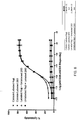
- the bispecific antibody exhibits an EC50 in a Raji killing assay of about 2.8-3.2 x 10 -12 M, or about 2.8-3.0 x 10 -12 M, and exhibits no more than about 1-10%, or 1-5%, bystander killing in a bystander cell killing assay, wherein the bystander cell does not comprise a CD20 epitope.
- the bystander cell is a 293 cell.
- bystander cell killing in the assay is measured across a concentration of bispecific antibody of about 10 -8 M to about 10 -14 M.
- a method for making a bispecific antibody comprising: obtaining a nucleic acid sequence encoding a first immunoglobulin heavy chain comprising a first variable domain that recognizes a first epitope, wherein the first immunoglobulin heavy chain comprises an IgG1, IgG2, or IgG4 isotype constant domain, or a chimeric isotype constant domain thereof; obtaining a second nucleic acid sequence encoding a second immunoglobulin heavy chain comprising a second variable domain that recognizes a second epitope, wherein the second immunoglobulin heavy chain comprises an IgG1, IgG2, or IgG4 isotype constant domain, or a chimeric isotype constant domain thereof, that comprises a modification in its CH3 domain that eradicates or reduces binding to Protein A; obtaining a third nucleic acid sequence encoding an immunoglobulin a light chain that pairs with the first and the second immunoglobulin heavy chain; introducing the first, second, and third nucleic acid sequence encoding an
- the cell is selected from a CHO, COS, 293, HeLa, and a retinal cell expressing a viral nucleic acid sequence (e.g., a PERC.6TM cell).
- a bispecific antigen-binding protein comprises a first specificity that binds an antigen and a second specificity that activates a receptor, wherein the bispecific antigen-binding protein comprises a first polypeptide comprising a first IgG1, IgG2, or IgG4 CH3 domain that comprises a Protein A-binding determinant, and a second polypeptide comprising a second IgG1, IgG3, or IgG4 CH3 domain that lacks the Protein A-binding determinant.
- the second specificity that activates the receptor binds the receptor with a K D that is in the molar, millimolar, micromolar, nanomolar, or picomolar range.
- the second specificity binds a receptor selected from a G-protein coupled receptor, a receptor tyrosine kinase, an integrin, and a toll-like receptor.
- the second specificity contacts the receptor and causes the receptor or a subunit or a protein physically associated therewith to undertake phosphorylation of a serine, threonine, or tyrosine; cause cyclicization of a nucleotide (e.g., cAMP, cADP, or cGMP); cause production of a phosphatidylinositol or derivative thereof (e.g., IP3 or PIP3); cause production of a lipid second messenger (e.g., diacylclycerol, ceramide, lysophosphatidic acid, an eicosanoid); cause dephosphorylation (e.g., phosphatase activity); cause phosphorylation of a lipid to form a second messenger; cause hydrolysis of a second messenger; cause proteolysis; cause redox signaling; cause translocation of a protein to a cellular organelle (e.g., to the nucleus); cause the receptor to aggregate (with itself)
- a method for making a bispecific antibody comprising: isolating a bispecific antibody of interest from a quadroma, wherein the bispecific antibody of interest comprises a first heavy chain that is an IgG1, IgG2, or IgG4 isotype, a second heavy chain that is an IgG1, IgG2, or IgG4 isotype having a constant domain that comprises a modification in its CH3 domain that eradicates or reduces binding to Protein A, wherein the bispecific antibody of interest is isolated using Protein A.
- a method for making a bispecific antibody comprising a step of isolating from a disrupted cell or a mixture of antibodies a bispecific antibody having differentially modified IgG1, IgG2, or IgG4 CH3 domains, wherein the differentially modified CH3 domains are non-immunogenic or substantially non-immunogenic in a human, and wherein the modification results in a bispecific antibody with a heterodimeric heavy chain whose monomers have a differential affinity for Protein A, and the bispecific antibody is isolated from the disrupted cell or the mixture using Protein A.
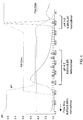
- the bispecific antibody is isolated using a Protein A affinity support, wherein the bispecific antibody elutes at a pH between about 3.9 to about 4.4, about 4.0 to about 4.3, about 4.1 to about 4.2, or at about pH 4.2. In one embodiment, the bispecific antibody elutes at a pH of about 4, 4.1, 4.2, 4.3, 4.4, or 4.5.
- the bispecific antibody is isolated using a Protein A affinity support and a pH gradient or step, wherein the pH gradient or step includes an ionic modifier.
- the ionic modifier is present at a concentration of about 0.5 to about 1.0 molar.
- the ionic modifier is a salt.
- the ionic modifier is selected from the group consisting of beryllium, lithium, sodium, and potassium salts of acetate; sodium and potassium bicarbonates; lithium, sodium, potassium, and cesium carbonates; lithium, sodium, potassium, cesium, and magnesium chlorides; sodium and potassium fluorides; sodium, potassium, and calcium nitrates; sodium and potassium phosphates; and calcium and magnesium sulfates.
- the ionic modifier is a halide salt of an alkali metal or alkaline earth metal.
- the ionic modifier is sodium chloride.
- a binding protein comprising an Fc, wherein the Fc comprises a first CH3 domain that is modified as described herein and a second CH3 that is not modified, so as to form a heterodimeric Fc, wherein the differential modification results in the binding protein eluting from a protein A affinity material at 0.5, 0.6, 0.7, 0.8, 0.9, 1.0, 1.2, 1.3, or 1.4 pH unit(s) higher than a corresponding binding protein that lacks the differential modification.
- the differentially modified binding protein elutes at a pH of about 4.2, whereas the unmodified binding protein elutes at a pH of about 3. In one embodiment the differentially modified binding protein elutes at a pH of about 4.5, whereas the unmodified binding protein elutes at a pH of about 3.5. In one embodiment, the differentially modified binding protein elutes at a pH of about 4, whereas the unmodified binding protein elutes at a pH of about 2.8-3.5, 2.8-3.2, or 2.8-3. In one embodiment, the differentially modified binding protein elutes at a pH of about 4.2, whereas the unmodified binding protein elutes at a pH of about 2.8.
- the differentially modified binding protein elutes at a pH of about 4.4, whereas the unmodified binding protein elutes at a pH of about 3.6.
- unmodified refers to lack of a modification at 435 (EU numbering), or lack of a modification at 435 and 436 (EU numbering), on both of the CH3 domains.
- antibody includes immunoglobulin molecules comprised of four polypeptide chains, two heavy (H) chains and two light (L) chains inter-connected by disulfide bonds.
- Each heavy chain comprises a heavy chain variable region (abbreviated herein as HCVR or VH) and a heavy chain constant region.
- the heavy chain constant region comprises three domains, CH1, CH2 and CH3.
- Each light chain comprises a light chain variable region (abbreviated herein as LCVR or VL) and a light chain constant region.
- the light chain constant region comprises one domain, CL.
- VH and VL regions can be further subdivided into regions of hypervariability, termed complementarity determining regions (CDR), interspersed with regions that are more conserved, termed framework regions (FR).
- CDR complementarity determining regions
- FR framework regions
- Each VH and VL is composed of three CDRs and four FRs, arranged from amino-terminus to carboxy-terminus in the following order: FR1, CDR1, FR2, CDR2, FR3, CDR3, FR4 (heavy chain CDRs may be abbreviated as HCDR1, HCDR2 and HCDR3; light chain CDRs may be abbreviated as LCDR1, LCDR2 and LCDR3.
- high affinity antibody refers to those antibodies having a binding affinity to their target of at least 10 -9 M, at least10 -10 M; at least 10 -11 M; or at least 10 -12 M, as measured by surface plasmon resonance, e.g., BIACORETM or solution-affinity ELISA.
- antigen-binding protein includes a protein having at least one CDR and that is capable of selectively recognizing an antigen, i.e., is capable of binding an antigen with a K D that is at least in the micromolar range.
- Therapeutic antigen-binding proteins e.g., therapeutic antibodies
- Antigen-binding protein also includes a protein comprising a first and a second CH3 domain as described herein and a first protein or ligand recognition domain and a second protein or ligand recognition domain, wherein the first protein or ligand recognition domain and the second protein or ligand recognition domain each independently recognize the same protein or ligand, or together recognize the same protein or ligand, or each independently recognize a different protein or ligand.
- a protein comprising a fusion protein (hetero- or homo-) dimer wherein the polypeptides of the dimer are fusion polypeptides that comprise a receptor component or a ligand component, wherein the ligand component comprises an amino acid sequence that binds a receptor.
- bispecific antibody includes an antibody capable of selectively binding two or more epitopes.
- Bispecific antibodies generally comprise two different heavy chains, with each heavy chain specifically binding a different epitope-either on two different molecules (e.g., antigens) or on the same molecule (e.g., on the same antigen). If a bispecific antibody is capable of selectively binding two different epitopes (a first epitope and a second epitope), the affinity of the first heavy chain for the first epitope will generally be at least one to two or three or four orders of magnitude lower than the affinity of the first heavy chain for the second epitope, and vice versa.
- bispecific antibodies can be made, for example, by combining heavy chains that recognize different epitopes of the same antigen.
- nucleic acid sequences encoding heavy chain variable sequences that recognize different epitopes of the same antigen can be fused to nucleic acid sequences encoding different heavy chain constant regions, and such sequences can be expressed in a cell that expresses an immunoglobulin light chain.
- a typical bispecific antibody has two heavy chains each having three heavy chain CDRs, followed by (N-terminal to C-terminal) a CH1 domain, a hinge, a CH2 domain, and a CH3 domain, and an immunoglobulin light chain that either does not confer antigen-binding specificity but that can associate with each heavy chain, or that can associate with each heavy chain and that can bind one or more of the epitopes bound by the heavy chain antigen-binding regions, or that can associate with each heavy chain and enable binding or one or both of the heavy chains to one or both epitopes.
- cell includes any cell that is suitable for expressing a recombinant nucleic acid sequence.
- Cells include those of prokaryotes and eukaryotes (single-cell or multiple-cell), bacterial cells (e.g., strains of E. coli, Bacillus spp., Streptomyces spp., etc .), mycobacteria cells, fungal cells, yeast cells (e.g., S. cerevisiae, S. pombe, P. pastoris, P.
- the cell is a human, monkey, ape, hamster, rat, or mouse cell.
- the cell is eukaryotic and is selected from the following cells: CHO (e.g., CHO K1, DXB-11 CHO, Veggie-CHO), COS (e.g., COS-7), retinal cell, Vero, CV1, kidney (e.g., HEK293, 293 EBNA, MSR 293, MDCK, HaK, BHK), HeLa, HepG2, WI38, MRC 5, Colo205, HB 8065, HL-60, (e.g., BHK21), Jurkat, Daudi, A431 (epidermal), CV-1, U937, 3T3, L cell, C127 cell, SP2/0, NS-0, MMT 060562, Sertoli cell, BRL 3A cell, HT1080 cell, myeloma cell, tumor cell, and a cell line derived from an aforementioned cell.
- the cell comprises one or more viral genes, e.g. a retinal cell that expresses a viral gene
- CDR complementarity determining region
- a CDR includes an amino acid sequence encoded by a nucleic acid sequence of an organism's immunoglobulin genes that normally (i.e., in a wild-type animal) appears between two framework regions in a variable region of a light or a heavy chain of an immunoglobulin molecule (e.g., an antibody or a T cell receptor).
- a CDR can be encoded by, for example, a germline sequence or a rearranged or unrearranged sequence, and, for example, by a naive or a mature B cell or a T cell.
- CDRs can be encoded by two or more sequences (e.g., germline sequences) that are not contiguous (e.g., in an unrearranged nucleic acid sequence) but are contiguous in a B cell nucleic acid sequence, e.g., as the result of splicing or connecting the sequences (e.g., V-D-J recombination to form a heavy chain CDR3).
- sequences e.g., germline sequences
- a B cell nucleic acid sequence e.g., as the result of splicing or connecting the sequences (e.g., V-D-J recombination to form a heavy chain CDR3).
- heavy chain or “immunoglobulin heavy chain” includes an immunoglobulin heavy chain constant region sequence from any organism, and unless otherwise specified includes a heavy chain variable domain.
- Heavy chain variable domains include three heavy chain CDRs and four FR regions, unless otherwise specified. Fragments of heavy chains include CDRs, CDRs and FRs, and combinations thereof.
- a typical heavy chain has, following the variable domain (from N-terminal to C-terminal), a CH1 domain, a hinge, a CH2 domain, and a CH3 domain.
- a functional fragment of a heavy chain includes a fragment that is capable of specifically recognizing an antigen (e.g., recognizing the antigen with a K D in the micromolar, nanomolar, or picomolar range), that is capable of expressing and secreting from a cell, and that comprises at least one CDR.
- an antigen e.g., recognizing the antigen with a K D in the micromolar, nanomolar, or picomolar range
- Fc-containing protein includes antibodies, bispecific antibodies, immunoadhesins, and other binding proteins that comprise at least a functional portion of an immunoglobulin CH2 and CH3 region.
- a "functional portion” refers to a CH2 and CH3 region that can bind a Fc receptor (e.g., an FcyR; or an FcRn, i.e., a neonatal Fc receptor), and/or that can participate in the activation of complement. If the CH2 and CH3 region contains deletions, substitutions, and/or insertions or other modifications that render it unable to bind any Fc receptor and also unable to activate complement, the CH2 and CH3 region is not functional.
- Fc-containing proteins can comprise modifications in immunoglobulin domains, including where the modifications affect one or more effector function of the binding protein (e.g., modifications that affect FcyR binding, FcRn binding and thus half-life, and/or CDC activity).
- modifications affect one or more effector function of the binding protein (e.g., modifications that affect FcyR binding, FcRn binding and thus half-life, and/or CDC activity).
- Such modifications include, but are not limited to, the following modifications and combinations thereof, with reference to EU numbering of an immunoglobulin constant region: 238, 239, 248, 249, 250, 252, 254, 255, 256, 258, 265, 267, 268, 269, 270, 272, 276, 278, 280, 283, 285, 286, 289, 290, 292, 293, 294, 295, 296, 297, 298, 301, 303, 305, 307, 308, 309, 311, 312, 315, 318, 320, 322, 324, 326, 327, 328, 329, 330, 331, 332, 333, 334, 335, 337, 338, 339, 340, 342, 344, 356, 358, 359, 360, 361, 362, 373, 375, 376, 378, 380, 382, 383, 384, 386, 388, 389, 398, 414, 416, 419, 428, 430, 433, 434,
- the binding protein is an Fc-containing protein and exhibits enhanced serum half-life (as compared with the same Fc-containing protein without the recited modification(s)) and have a modification at position 250 (e.g., E or Q); 250 and 428 (e.g., L or F); 252 (e.g., L/Y/F/W or T), 254 (e.g., S or T), and 256 (e.g., S/R/Q/E/D or T); or a modification at 428 and/or 433 (e.g., L/R/SI/P/Q or K) and/or 434 (e.g., H/F or Y); or a modification at 250 and/or 428; or a modification at 307 or 308 (e.g., 308F, V308F), and 434.
- a modification at position 250 e.g., E or Q
- 250 and 428 e.g., L or F
- 252 e.g
- the modification can comprise a 428L (e.g., M428L) and 434S (e.g., N434S) modification; a 428L, 259I (e.g., V259I), and a 308F (e.g., V308F) modification; a 433K (e.g., H433K) and a 434 (e.g., 434Y) modification; a 252, 254, and 256 (e.g., 252Y, 254T, and 256E) modification; a 250Q and 428L modification (e.g., T250Q and M428L); a 307 and/or 308 modification (e.g., 308F or 308P).
- a 428L e.g., M428L
- 434S e.g., N434S
- 428L, 259I e.g., V259I
- a 308F e.g., V308
- ionic modifier includes moieties that reduce the effect of, or disrupt, non-specific (i . e ., non-affinity) ionic interactions between proteins.
- Ionic modifiers include, for example, salts, ionic combinations of Group I and Group II metals with acetate, bicarbonate, carbonate, a halogen (e.g., chloride or fluoride), nitrate, phosphate, or sulfate.
- a non-limiting illustrative list of "ionic modifiers” includes beryllium, lithium, sodium, and potassium salts of acetate; sodium and potassium bicarbonates; lithium, sodium, potassium, and cesium carbonates; lithium, sodium, potassium, cesium, and magnesium chlorides; sodium and potassium fluorides; sodium, potassium, and calcium nitrates; sodium and potassium phosphates; and calcium and magnesium sulfates.
- Ionic modifiers include those moieties that affect ionic interactions that, upon addition to a pH gradient or step, or upon equilibration of a Protein A support in an "ionic modifier" and application of a pH step or gradient, results in a broadening of pH unit distance between elution of a homodimeric IgG and a heterodimeric IgG (e.g., a wild-type human IgG and the same IgG but bearing one or more modifications of its CH3 domain as described herein).
- a suitable concentration of an "ionic modifier” can be determined by its concentration employing the same column, pH step or gradient, with increasing concentration of "ionic modifier” until a maximal pH distance is reached at a given pH step or pH gradient.
- light chain includes an immunoglobulin light chain constant region sequence from any organism, and unless otherwise specified includes human kappa and lambda light chains.
- Light chain variable (VL) domains typically include three light chain CDRs and four framework (FR) regions, unless otherwise specified.
- FR framework
- a full-length light chain includes, from amino terminus to carboxyl terminus, a VL domain that includes FR1-CDR1-FR2-CDR2-FR3-CDR3-FR4, and a light chain constant domain.
- Light chains that can be used with this invention include those, e.g., that do not selectively bind either the first or second antigen selectively bound by the antigen-binding protein.
- Suitable light chains include those that can be identified by screening for the most commonly employed light chains in existing antibody libraries (wet libraries or in silico), where the light chains do not substantially interfere with the affinity and/or selectivity of the antigen-binding domains of the antigen-binding proteins. Suitable light chains include those that can bind one or both epitopes that are bound by the antigen-binding regions of the antigen-binding protein.
- micromolar range is intended to mean 1-999 micromolar; the phrase “nanomolar range” is intended to mean 1-999 nanomolar; the phrase “picomolar range” is intended to mean 1-999 picomolar.
- the phrase "somatically mutated” includes reference to a nucleic acid sequence from a B cell that has undergone class-switching, wherein the nucleic acid sequence of an immunoglobulin variable region (e.g., a heavy chain variable domain or including a heavy chain CDR or FR sequence) in the class-switched B cell is not identical to the nucleic acid sequence in the B cell prior to class-switching, such as, for example, a difference in a CDR or framework nucleic acid sequence between a B cell that has not undergone class-switching and a B cell that has undergone class-switching.
- an immunoglobulin variable region e.g., a heavy chain variable domain or including a heavy chain CDR or FR sequence
- Somatically mutated includes reference to nucleic acid sequences from affinity-matured B cells that are not identical to corresponding sequences in B cells that are not affinity-matured ( i . e ., sequences in the genome of germline cells).
- the phrase “somatically mutated” also includes reference to a nucleic acid sequence from a B cell after exposure of the B cell to an antigen of interest, wherein the nucleic acid sequence differs from the corresponding nucleic acid sequence prior to exposure of the B cell to the antigen of interest.
- mutated refers to sequences from antibodies that have been generated in an animal, e.g ., a mouse having human immunoglobulin variable region nucleic acid sequences, in response to an antigen challenge, and that result from the selection processes inherently operative in such an animal.
- variable domain includes an amino acid sequence of an immunoglobulin light or heavy chain (modified as desired) that comprises the following amino acid regions, in sequence from N-terminal to C-terminal (unless otherwise indicated): FR1, CDR1, FR2, CDR2, FR3, CDR3, FR4.
- a "variable domain” includes an amino acid sequence capable of folding into a canonical domain (VH or VL) having a dual beta sheet structure wherein the beta sheets are connected by a disulfide bond between a residue of a first beta sheet and a second beta sheet.
- the inventors have developed a novel format that combines a common light chain strategy with an implementation of a selective Protein A purification scheme that can be used with human antibody components.
- the inventors have therefore devised a "minimal" format that exploits a fortuitously simple determinant of Protein A binding. It has been reported ( Jendeberg, L. et al. (1997) J. Immunological Meth. 201:25-34 )) that the inability of IgG3 to bind Protein A is determined by a single amino acid residue, Arg435 (EU numbering; Arg95 by IMGT), which corresponding position in the other IgG subclasses is occupied by a histidine residue. It is therefore possible, instead of IgG3, to use an IgG1 sequence in which His435 is mutated to Arg.
- IgG1 ⁇ A a single point mutation in IgG1 should be sufficient to create the different binding affinities amenable to a new purification scheme.
- This modification will be referred to as IgG1 ⁇ A, to denote its inability to bind Protein A (and, similarly, IgG2 ⁇ A and IgG4 ⁇ A-or more generally, Fc ⁇ A).
- the specified point mutation introduces a novel peptide sequence across the mutation, which could potentially be immunogenic.
- the point mutation could, in theory, be loaded onto an MHC class II molecule and presented to T cells, and consequently elicit an immune response.
- a dipeptide mutation H435R/Y436F (EU numbering; H95R/Y96F by IMGT) can be used.
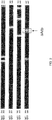
- the resulting sequence in the vicinity of the alteration is identical to that of IgG3 (see FIG. 2A ), and would therefore be expected to be immunologically "invisible,” because there would be no non-native short peptides available for presentation to T cells. It has been reported that this double mutant still does not bind Protein A ( Jendeberg, L.
- the dipeptide mutation does not include any of the residues that form the Fc dimer interface, so it is unlikely to interfere with the formation of heterodimers.
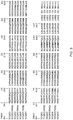
- This dipeptide mutation is designated as "IgG1 ⁇ Adp" (and, similarly, IgG2 ⁇ Adp, IgG4 ⁇ Adp, and Fc ⁇ Adp). Placement of the dipeptide modification in IgG1, IgG2, and IgG4 are indicated in FIG.
- IgG1 ⁇ Adp in the sequences denoted IgG1 ⁇ Adp, IgG2 ⁇ Adp, and IgG4 ⁇ Adp, shown with wild-type human IgG CH3 domain sequences, as well as hlgG3, showing IMGT exon numbering and EU numbering.
- the Fc ⁇ Adp modification does not include any of the residues believed to form the Fc dimer interface, so the Fc ⁇ Adp modification is unlikely to interfere with the formation of heterodimers. Because the Fc ⁇ Adp is so minimal, it can likely be incorporated into other engineered Fc forms as well. IgG2 ⁇ Adp and IgG4 ⁇ Adp may be advantageous in situations in which the effector functions (or lack thereof) associated with each of the latter are desired.
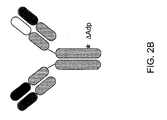
- the bispecific antibody format described above includes two antibodies of different specificity that use the same light chain, wherein the Fc region of one of them is modified to the Fc ⁇ Adp format (see FIG. 2B ).
- Its configuration is that of a natural human antibody, and should therefore share its favorable properties, including a low propensity to aggregate, in vivo stability, minimal immunogenicity, biodistribution properties similar to those of antibodies, good pharmacokinetics, and, optionally, effector functions.
- Methods for isolating such bispecific antibodies are provided that are relatively rapid and simple in execution.
- the inventors have devised a method for readily isolating a binding protein comprising an immunoglobulin heavy chain (or functional CH2 and CH3-containing fragment thereof) that is heterodimeric with respect to one or more amino acids in the CH3 domain.
- a careful selection of modifications of a mouse IgG CH domain and application of a particular separation technology confer the ability to readily isolate a binding protein comprising two differentially modified mouse CH regions from homodimers and from heterodimers that do not contain the modifications.
- Mouse IgG1 which contains a proline at 247, a threonine at 252, 254, and 256, and a lysine at 258, binds only weakly to protein A.
- Mouse IgG2a and IgG2b contain different residues at those positions (with the exception of IgG2b positions 256 and 258), and mouse IgG2a and 2b bind well to protein A.
- Differentially modifying the CH regions of two mouse IgGs in a method for making an antibody that is heterodimeric for heavy chains would confer a differential protein A binding characteristic to such an antibody.
- a differential protein A isolation scheme is devised that allows for ready separation of a modified heterodimer from any mouse IgG homodimer, whether it is a homodimer of IgG1 (which would bind only quite weakly, if at all, to protein A), or a homodimer of mouse IgG2a, a homodimer of mouse IgG2b, or a heterodimer of IgG2a/IgG2b.
- a bispecific antibody having two different heavy chain variable domains but the same isotype e.g., IgG2a
- IgG2a can be expressed in a suitable expression system that employs the heavy chain sequences, wherein only one of the IgG2a CH regions is modified to reduce or eliminate a protein A binding determinant.
- only one of the IgG2a CH regions will exhibit a substantial affinity for protein A, and any antibody formed from a dimer of an unmodified IgG2a and a modified IgG2a will be readily isolated from the modified heterodimer.
- an antibody wherein a single CH region of an Fc dimer comprises the modified CH region, whereas the other CH of the Fc dimer lacks them.
- the mouse IgG CH region is modified to comprise particular amino acids at particular positions (EU numbering), selected from the group consisting of: 252T, 254T, and 256T; 252T, 254T, 256T, and 258K; 247P, 252T, 254T, 256T, and 258K; 435R and 436F; 252T, 254T, 256T, 435R, and 436F; 252T, 254T, 256T, 258K, 435R, and 436F; 24tP, 252T, 254T, 256T, 258K, 435R, and 436F; and, 435R.
- a particular group of modifications is made, selected from the groups consisting of: M252T, S254T, S256T; M252T, S254T, S256T, I258K; I247P, M252T, S254T, S256T, I258K; H435R, H436F; M252T, S254T, S256T, H435R, H436F; M252T, S254T, S256T, I258K, H435R, H436F; I247P, M252T, S254T, S256T, I258K, H435R, H436F; and, H435R.
- Heterodimeric mouse IgG-based binding proteins can be used for a variety of applications. For example, they allow for a method of isolating bispecific antibodies with mouse constant domains, wherein the modifications do not interfere or do not substantially interfere with binding of the antibody to one or more mouse Fc receptors, such that the antibody can participate, e.g., in ADCC or CDC and also bind two or more epitopes on the same or different target.
- a method for isolating a binding protein comprising a first mouse IgG CH region and a second mouse IgG CH region, wherein the first IgG CH region is modified (but not the second IgG CH region) so as to reduce or eliminate protein A binding affinity of the first mouse IgG CH region but not the second mouse IgG CH region, and wherein the binding protein comprises a first binding moiety that binds a first epitope and a second binding moiety that binds a second epitope.
- the modification does not alter or does not substantially alter binding affinity of the binding protein to an Fc receptor.
- the binding protein comprises a modification that increases or decreases affinity for the binding protein to an Fc receptor.
- the modification does not alter or does not substantially alter the serum half-life of the binding protein in a mouse comprising native mouse FcyR receptors and/or a native mouse FcRn, as compared with a corresponding binding protein that lacks the modification.
- the modification does not alter or does not substantially alter the serum half-life of the binding protein in a mouse that comprises a replacement of native mouse high and low affinity FcyR receptors and/or an FcRn receptor, as compared with a corresponding binding protein that lacks the modification.
- first and the second epitope are different and are on different cells or on different proteins. In one embodiment, the first epitope and the second epitope are different and are on the same cell or the same protein.
- the Fc receptor is selected from a high affinity Fc receptor, a low affinity Fc receptor, and a FcRn.
- the Fc receptor is selected from one or more of a mouse FcRn, a mouse FcyR, a mouse Fc ⁇ RIIB, a mouse Fc ⁇ RIII, a mouse Fc ⁇ RIV, and a combination thereof.
- the Fc receptor is selected form one or more of a human FcRn, a human FcyR, a human Fc ⁇ RIIB, a human Fc ⁇ RIIC, a human Fc ⁇ RIIIB, a human Fc ⁇ RIIIA, a human Fc ⁇ RIIA, and a combination thereof.
- One advantage of many embodiments of the invention is the ability to employ the modification(s) to make a bispecific antibody that is both readily isolable based on differential binding to Protein A and is also non-immunogenic or substantially non-immunogenic in a human.
- This feature makes such embodiments particularly useful in making bispecific antibodies for human therapeutic use, and in making immunoadhesins, e.g., that are non-immunogenic or substantially non-immunogenic (employing human binding moieties, i.e., human receptor components and/or human ligands).
- This feature is associated with bispecific antibodies having CH3 domains with the H95R/Y96F (IMGT numbering) modifications of IgG1, IgG2, and IgG3, and those CH3 domains that contain further modifications that result in the position being modified reflecting a wild-type sequence of a different IgG isotype.
- the modification is not found in nature associated with the particular IgG isotype, the modified sequence is locally identical with a wild-type sequence of a different IgG isotype, and the modification is not expected to be immunogenic or substantially immunogenic. It is also possible that a modification is non-immunogenic even if its sequence is not locally identical to any native sequence; such modifications would be equally useful.
- the minimal point mutation H95R (IMGT numbering) if non-immunogenic, would therefore be a suitable embodiment of the invention.
- bispecific antibodies are provided that are non-immunogenic or substantially non-immunogenic in a human, with respect to their heavy chain constant domains, but nonetheless bear one or more differential modifications of the heavy chain constant domain, including a modification that results in a differential affinity of the heavy chain constant domains with respect to an affinity reagent (e.g., Protein A).
- affinity reagent e.g., Protein A
- the bispecific antibody that is non-immunogenic or substantially non-immunogenic in a human with respect to its CH3 domain, yet having differentially modified heavy chains is a human IgG1, IgG2, or IgG4 comprising a CH3 domain that comprises one of the following modifications (or, in another embodiment, consists essentially of one of the following modifications): H95R, or H95R and Y96F (IMGT numbering).
- the bispecific antibodies are expected to be non-immunogenic, or substantially non-immunogenic, with respect to humans in whom tolerance to human IgG1, IgG2, and IgG4 isoforms has not been broken to any significant degree.
- the Fc ⁇ Adp modification is expected to be immunologically "invisible” because the binding groove of MHC class II molecules accommodates a 9-mer that comprises the major determinant recognized by variable loops of the T cell receptor, so that peptides lacking any native 9-mer subsequence would appear unlikely to elicit an immune response.
- peptides longer than 9-mers are bound by MHC class II, and it is possible that protruding segments may potentially influence binding, Therefore, additional modifications (over the Fc ⁇ Adp modification) that eliminate longer non-native sequences may further reduce potential for immunogenicity.
- V422I EU; V82I by IMGT numbering
- L445P EU; L105P by IMGT numbering
- the binding site for Protein A overlaps with the binding site for the neonatal Fc receptor, FcRN, which is thought to be responsible for conferring a prolonged serum half-life to immunoglobulins. Modifications in the vicinity of the Protein A binding site, therefore, raise the possibility that the format proposed here could have a shorter serum half-life than those of IgG1, 2, and 4, given that human IgG3 has a shorter serum half-life (about 7 days) than the other IgG subclasses (about 21 days). Some Fc mutants affecting His435 have been shown not to bind FcRN, and have a shorter half-life in mice.
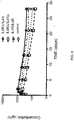
- the serum half-life of the IgG1 ⁇ A/IgG1 heterodimer is not appreciably different from that of the IgG1 homodimer (see Example 2).
- the IgG1 ⁇ Adp mutation has the advantage of ablating Protein A binding while still preserving the longer half-life of IgG1.
- a bispecific antigen-binding protein that comprises a modification of a CH3 domain as described herein, wherein the antigen-binding protein displays a pharmacokinetic profile equivalent to the same bispecific antigen-binding protein that lacks the modification at the CH3 domain.
- a bispecific antibody is provided that comprises an IgG1 ⁇ A/IgG1 heterodimeric Fc, wherein the bispecific antibody has a serum half-life that is about 1.5-fold, about 2-fold, about 2.5-fold, or about 3 fold higher than a bispecific antibody that is otherwise identical but comprises an IgG3 CH3 domain, or that is otherwise identical but comprises at least one IgG3 heavy chain.
- a bispecific antibody comprising an IgG1 ⁇ A/IgG1 heterodimeric Fc, wherein the bispecific antibody exhibits a serum half-life that is about the same as that of the bispecific antibody without the IgG1 ⁇ A modification (i.e., an IgG1 homodimeric bispecific antibody).
- Immunoglobulin heavy chain variable regions that can be used to generate bispecific antibodies with desired characteristics (e.g., desired specificities, desired affinities, desired functionalities, e.g., blocking, non-blocking, inhibiting, activating, etc.) can be generated using any method known in the art.
- the desired heavy chains can then be constructed by cloning nucleic acid sequences containing the variable regions in constructs having the desired heavy chain constant regions described herein.
- the first heavy chain comprises a variable region that is encoded by a nucleic acid that is derived from the genome of a mature B cell of a first animal that has been immunized with a first antigen, and the first heavy chain specifically recognizes the first antigen.
- the second heavy chain comprises a variable region that is encoded by a nucleic acid that is derived from the genome of a mature B cell of a second animal that has been immunized with a second antigen, and the second heavy chain specifically recognizes the second antigen.
- the first animal and/or the second animal is a genetically modified animal comprising an unrearranged human immunoglobulin heavy chain variable region. In one embodiment, the first animal and/or the second animal is a genetically modified animal comprising an unrearranged human immunoglobulin heavy chain variable region and a human immunoglobulin constant region. In one embodiment, the first animal and/or the second animal is a genetically modified mouse that comprises an unrearranged human immunoglobulin heavy chain variable region.
- Immunoglobulin heavy chain variable region sequences can be obtained by any other method known in the art, e.g., by phage display, and sequences obtained thereby can be employed to make nucleic acid constructs to be joined to nucleic acids encoding any suitable heavy chain, e.g., heavy chains with modified CH3 domains as described herein, and placed in an expression construct and transferred to a cell that is capable of making the heavy chain, e.g., in the presence of a suitable light chain.
- suitable heavy chain e.g., heavy chains with modified CH3 domains as described herein
- Bispecific antibodies comprising two heavy chains that recognize two different epitopes (or two different antigens) are more easily isolated where they can pair with the same light chain (i.e., light chains having identical variable and constant domains).
- a variety of methods are known in the art for generating light chains that can pair with two heavy chains of differing specificity, while not interfering or not substantially interfering with the selectivity and/or affinity of the heavy chain variable domain with its target antigen.
- a light chain can be selected by surveying usage statistics for all light chain variable domains, identifying the most frequently employed light chain in human antibodies, and pairing that light chain with the two heavy chains of differing specificity.
- a light chain can be selected by observing light chain sequences in a phage display library (e.g., a phage display library comprising human light chain variable region sequences, e.g., a human ScFv library) and selecting the most commonly used light chain variable region from the library.
- a phage display library e.g., a phage display library comprising human light chain variable region sequences, e.g., a human ScFv library
- a light chain in another approach, can be selected by assaying a phage display library of light chain variable sequences using the heavy chain variable sequences of both heavy chains as probes.
- a light chain that associates with both heavy chain variable sequences is selected as a light chain for the heavy chains and allows binding and/or activation with respect to both epitopes.
- a light chain can be selected by combining known light chains with desired heavy chains and assaying the resulting bispecific antibody for binding specificity, affinity, and/or activation ability.
- the light chain can be aligned with the heavy chains' cognate light chains, and modifications are made in the light chain to more closely match sequence characteristics common to the cognate light chains of both heavy chains.
- the modifications preferably result in sequences that are present in known human light chain sequences, such that proteolytic processing is unlikely to generate a T cell epitope based on parameters and methods known in the art for assessing the likelihood of immunogenicity (i.e., in silico as well as wet assays).
- human antibodies include those having heavy chain variable and heavy chain constant domains derived from human germline immunoglobulin sequences, in some embodiments derived from somatically mutated human immunoglobulin sequences (generated, e.g., in an animal that comprises human immunoglobulin gene sequences).
- human variable and/or constant regions may include amino acid residues not encoded by human germline immunoglobulin sequences or encoded as the result of recombination and/or splicing for example in the CDRs and in particular CDR3.
- Human antibodies are not intended to include antibodies in which CDR sequences derived from the germline of another mammalian species, such as a mouse, have been grafted onto human framework sequences. Those antibodies are referred to as humanized or chimeric antibodies. Human antibodies do include those comprising mutations, e.g., introduced in vitro by random or site-specific mutagenesis, but the mutations are preferably non-immunogenic in a human.
- Chimeric antibodies are antibodies in which one of a heavy chain variable region or framework or CDR or heavy chain constant region or domain are from different species (e.g., human and mouse, or human and primate).
- chimeric antibodies include antibodies having a heavy chain variable region of non-human origin (e.g., mouse) and a heavy chain constant region of human origin.
- chimeric antibodies include antibodies having a heavy chain variable region of human origin and a heavy chain constant region of non-human (e.g., mouse) origin.
- regions of mouse origin are identical or substantially identical to a mouse immunoglobulin germline sequence with or without somatic hypermutations.
- Chimeric antibodies also include antibodies having a light chain constant region that is identical or substantially identical to a human immunoglobulin germline sequence and a non-human (e.g., mouse) heavy chain or chimeric human/nonhuman heavy chain.
- Chimeric antibodies include antibodies having a light chain constant domain that is identical or substantially identical to a non-human (e.g., mouse) immunoglobulin germline sequence and a human or chimeric nonhuman/human heavy chain.
- compositions and methods are for making an affinity-matured antibody.
- an affinity-matured antibody comprises one or more alterations in one or more CDRs that result in higher affinity (e.g., K D in the nanomolar or picomolar range) of the antibody for its target antigen as compared to a substantially identical antibody that lacks the alteration(s).
- Affinity-matured antibodies can be made by any suitable method known in the art, e.g., by random or site-directed mutagenesis of CDRs and/or framework regions followed by affinity screening, VH domain shuffling, etc.
- the antibodies are neutralizing antibodies.
- Neutralizing antibodies include antibodies capable of neutralizing, inhibiting, or preventing an antigen's biological activity.
- Neutralizing antibodies include those that, upon binding an antigen, prevent or reduce the antigen's ability to act on a natural target of the antigen in vivo and in vitro.
- Examples of neutralizing antibodies include an antibody to a protein ligand of a biological receptor that prevents the ligand from binding the receptor, or an antibody to a biological receptor that prevents the receptor from binding its ligand, where ligand binding in the absence of the antibody causes the receptor to effect a change inside of a cell. Determining whether an antibody is a neutralizing antibody generally entails conducting a functional assay wherein the antibody's effect on the biological activity of the antigen is measured.
- compositions of the specification are also useful in a variety of applications for antibodies and other binding proteins. A short description of some useful applications are provided here.
- Bispecific binding proteins that comprise binding specificity toward a tumor antigen and a T-cell antigen can be made that target an antigen on a cell, e.g., CD20, and also target an antigen on a T-cell, e.g., CD3.
- the bispecific antibody targets both a cell of interest in a patient (e.g., B cell in a lymphoma patient, via CD20 binding) as well as a T-cell of the patient.
- the bispecific antibody in various embodiments, is designed so as to activate the T-cell upon binding CD3, thus coupling T-cell activation to a specific, selected tumor cell.
- Bispecific binding proteins that comprise two binding moieties that are each directed to a binding partner (i.e., each directed to a different target) on the surface of the same cell can also be made.
- This design is particularly suited to targeting specific cells or cell types that express both targets on the surface of the same cell.
- targets might appear individually on other cells, the binding moieties of these binding proteins are selected such that each binding moiety binds its target with a relatively low affinity (e.g., low micromolar, or high nanomolar- e.g ., over a hundred nanomolar KD, e.g., 500, 600, 700, 800 nanomolar). In this way, prolonged target binding is favored only in situations where the two targets are in proximity on the same cell.
- Bispecific binding proteins that comprise two binding moieties that bind the same target, each at a different epitope of the same target, can be made. This design is particularly suited for maximizing the probability of successfully blocking a target with binding protein. Multiple extracellular loops, e.g., of a transmembrane channel or a cell surface receptor, can be targeted by the same bispecific binding molecule.
- Bispecific binding proteins that comprise two binding moieties that cluster and activate negative regulators of immune signaling to result in immune suppression can be made.
- Repression in cis can be achieved where the targets are on the same cell; repression in trans can be achieved where the targets are on different cells.
- Repression in cis e.g., can be achieved with a bispecific binding protein having an anti-IgGRIIb binding moiety and an anti-FelD1 binding moiety, such that the IgGRIIb is clustered only in the presence of FeID1, in order to down-regulate an immune response to FeID1.
- Repression in trans can be achieved with a bispecific binding protein having an anti-BTLA binding moiety and a binding moiety that specifically binds a tissue-specific antigen of interest, such that clustering of the inhibitory BTLA molecule occurs only in the selected target tissue, which potentially addresses auto-immune diseases.
- Bispecific binding proteins that activate multi-component receptors can be made.
- two binding moieties directed to two components of a receptor bind, cross-link the receptor, and activate signaling from the receptor.
- This can be done, e.g., using a bispecific binding protein with a binding moiety that binds IFNAR1 and a binding moiety that binds IFNAR2, where binding cross-links the receptor.
- a bispecific binding protein can provide an alternative to interferon treatment.
- Bispecific binding proteins that transport binding moieties across a semipermeable barrier, e.g., the blood-brain barrier, can be made.
- one binding moiety binds a target that can transit a particular selective barrier; the other binding moiety targets a molecule with a therapeutic activity, wherein the target molecule with therapeutic activity cannot normally traverse the barrier.
- This kind of bispecific binding protein is useful for bringing therapeutics to tissues that the therapeutic would not otherwise reach.
- Some examples include targeting the pIGR receptor to transport a therapeutic into the gut or lung, or targeting the transferrin receptor to transport a therapeutic across the blood-brain barrier.
- Bispecific binding proteins that transport binding moieties into specific cells or cell types can be made.
- one binding moiety targets a cell surface protein (e.g., a receptor) that is readily internalized into the cell.
- the other binding moiety targets an intracellular protein, where binding of the intracellular protein results in a therapeutic effect.
- Bispecific binding proteins that bind a surface receptor of a phagocytic immune cell and a surface molecule of an infectious pathogen (e.g., a yeast or bacterium), to bring the infectious pathogen in the vicinity of a phagocytic immune cell to facilitate phagocytosis of the pathogen.
- an infectious pathogen e.g., a yeast or bacterium
- An example of such a design would be a bispecific antibodly that targets a CD64 or CD89 molecule and also a pathogen.
- Bispecific binding proteins that have an antibody variable region as one binding moiety and a non-Ig moiety as a second binding moiety.
- the antibody variable region achieves targeting, whereas the non-Ig moiety is an effector or a toxin linked to an Fc.
- the ligand e.g., an effector or toxin
- Bispecific binding proteins that have two moieties each bound to an Ig region (e.g ., an Ig sequence containing a CH2 and CH3 region) such that any two protein moieties can be brought in each other's vicinity in the context of the Fc.
- Ig region e.g ., an Ig sequence containing a CH2 and CH3 region
- traps e.g., homo- or heterodimeric trap molecules.
- Nucleic acid sequences encoding monoclonal antibodies can be obtained by any suitable method known in the art. Examples of suitable methods for obtaining monoclonal antibodies (and their nucleic acid sequences) include, for example, by a hybridoma method (see, e.g., Kohler et al. (1975) Nature 256:495-497 ) or a phage antibody library (see, e.g., see Clackson et al. (1991) Nature 352:624-628 ).
- the immunoglobulin heavy chain variable domains are derived from nucleic acid sequences of a genetically modified animal or a transgenic animal.
- the regions are derived from an animal that comprises a human immunoglobulin minilocus.
- the regions are derived from mice comprising one or more extrachromosomal nucleic acids that comprise one or more nucleic acids encoding immunoglobulin sequences.
- the animal can have one or more unrearranged human immunoglobulin nucleic acid sequences.
- the animal comprises human light chain variable regions nucleic acid sequences, in some embodiments human heavy chain variable sequences, in some embodiments both heavy and light chain variable sequences, and in some embodiments further comprises human constant region sequences.
- the nucleic acid sequences are derived from a mouse in which endogenous mouse heavy chain variable gene segments and light chain variable gene segments have been replaced with human heavy chain variable gene segments and light chain variable gene segments.
- the nucleic acid sequences are derived from naive B or T cells of such an animal. In other embodiments, the nucleic acid sequences are derived from B or T cells of an animal that has been immunized with an antigen of interest.
- the nucleic acid sequences are derived from cells by amplifying them with primers, including for example sets of degenerate primers, that comprise one or more FR, joining, or constant sequences.
- the immunoglobulin heavy chain variable domains are derived from nucleic acids of an animal that has been immunized with an antigen of interest.
- a non-human transgenic or genetically modified animal is immunized with the antigen of interest (by, e.g., exposing the animal to the antigen or a cell bearing the antigen or a nucleic acid encoding an expressible form of the antigen), allowing the animal to undergo an immune response, isolating immune cells (e.g., B cells) from the animal, optionally immortalizing the cells, and screening the cells to identify reactivity with the antigen and/or identifying and/or isolating a nucleic acid sequences that encode an immunoglobulin variable region that is capable of recognizing the antigen when placed in the context of an antibody.
- immune cells e.g., B cells
- the cell is a B cell.
- a B cell of the immunized animal is used to make a hybridoma, and a B cell expressing an antibody that specifically recognizes an epitope of the antigen is identified and nucleic acid sequences that encode a variable region amino acid sequence that recognizes the epitope is identified and/or isolated.
- the nucleic acids are derived from humans, non-human primates (e.g., apes such as chimpanzees), monkeys (e.g., cynomologous or rhesus), rodents (e.g., mice, rats, hamsters), donkeys, goats, sheep, etc.
- non-human primates e.g., apes such as chimpanzees
- monkeys e.g., cynomologous or rhesus
- rodents e.g., mice, rats, hamsters
- donkeys goats, sheep, etc.
- the heavy chains comprise sequences that are derived from human cells.
- human fetal cells exposed in vitro to an antigen and placed in a suitable host animal (e.g., a SCID mouse),
- the nucleic acids are introduced into a cell using a vector.
- Vectors include, for example, plasmids, cosmids, retroviruses, adenoviruses, adeno-associated viruses, plant viruses, YACs, BACs, EBV-derived episomes.
- the nucleic acids are present in an expression vector or expression construct.
- the expression vector or construct is a vector that contains a promoter operably linked to the nucleic acid sequence of interest such that the nucleic acid sequence of interest is capable of being expressed under suitable conditions in a suitable cell.
- Expression vectors or constructs can include leader sequences, enhancers, promoter elements that enhance transcription or translation, transcription stop sequences, splicing sequences, transcription-enhancing introns, IRES elements, marker genes, selection sequences, recombinase recognition sites, homology arms, viral sequences, operators (e.g., prokaryotic operators) etc.
- the expression vectors comprise elements that allow inducible expression, for example, a prokaryotic operator operably linked to a eukaryotic promoter.
- expression is induced upon addition of an expression inducer.
- expression is induced upon removal of an expression inhibitor.
- expression is induced by a temperature change.
- one or more heavy chain nucleotide sequences are on the same vector.
- a heavy chain nucleic acid sequence and a light chain nucleic acid sequence herein are on the same vector.
- two heavy chain nucleic acid sequences and a light chain nucleic acid sequence are on the same vector.
- the nucleic acids are expressed in a cell that comprises one or more nucleic acids from a virus.
- the virus is selected from adenovirus, adeno-associated virus, SV-40, Epstein-Barr virus, a retrovirus, a lentivirus, baculovirus, coronavirus, herpes simplex virus, poliovirus, Semliki Forest virus, Sindbis virus, and Vaccinia virus.
- Host cells are cells that can be transformed to express a nucleic acid of interest.
- transformation includes changing the nucleic acid content of a cell such that it contains exogenous nucleic acids (e.g., a nucleic acid not found in the cell in nature, or one or more additional copies of a nucleic acid corresponding to a nucleic acid sequence found in the cell in nature).
- the nucleic acid content of a cell can be changed by any suitable method known in the art, e.g., by integrating the nucleic acid into the cell's genome or by placing it in the cell in an extra-chromosomal or extra-genomic form.
- the nucleic acid content of the cell can be changed such that the cell transiently expresses the nucleic acid of interest, or the nucleic acid content can be changed such that the cell stably expresses the nucleic acid of interest.
- the change in genetic content of the cell is inherited when the cell divides.
- the Lindhofer approach failed when applied to separating an IgG1 homodimer from an IgG1 heterodimer having two IgG1 heavy chains that were identical but for the fact that one of the IgG1 CH3 domains contained an H435R/Y436F dipeptide modification.
- the inventors found that in a linear pH gradient, the dipeptide-modified IgG1 eluted at about pH 3.9, whereas the IgG1 homodimer eluted at about pH 3.7. This pH difference was deemed insufficient to achieve a satisfactory separation of the heterodimer from the homodimer using the Lindhofer method. The difference was not reproducible in a predictable manner.
- isolation of the bispecific antigen-binding protein is made in the presence of about 0.5 to about 1.0 molar ionic modifier.
- a method for separating a bispecific antigen-binding protein comprising a heterodimeric IgG with one chain comprising a modification as described herein comprises a step of employing a pH gradient in the presence of an ionic modifier.
- the ionic modifier is present at a concentration sufficient to maximize the pH difference between elution from a Protein A support of an IgG homodimer and an IgG heterodimer as described herein (i.e., with CH3 modification(s)).
- the ionic modifier is present at a concentration of about 0,5 to about 1.0 molar.
- the ionic modifier is present at a concentration of about 0.15 to about 0.5 molar.
- the ionic modifier is a salt.
- the ionic modifier is a salt of an alkali metal or an alkaline earth metal and a halogen.
- the salt is a chloride salt of an alkali metal or an alkaline earth metal, e.g., NaCl, KCI, LiCI, CaCl 2 , MgCl 2 .
- the salt is present at a molarity of about 0.5, 0.6, 0.7, 0.8, 0.9, or 1.0.
- the pH gradient is from about pH 3.9 to about pH 4.5, in another embodiment from about pH 4.0 to about pH 4.4., and in another embodiment about pH 4.1 to about pH 4.3. In a specific embodiment, the gradient is a linear gradient.
- the pH gradient is a step gradient.
- the method comprises applying to an equilibrated Protein A column (equilibrated, e.g., in PBS or another suitable buffer or liquid) a step of about pH 3.9, about pH 4.0, about pH 4.1, about pH 4.2, about pH 4.3, or about pH 4.4. In a specific embodiment, the step is about pH 4.2.
- the bispecific antibody comprising the heterodimeric IgG CH3 domain elutes from the Protein A support in one or more fractions substantially free of non-heterodimeric IgG.
- the eluted bispecific antibody fraction(s) comprise less than about 1%, 0.5%, or 0.1% of total protein by weight that is non-heterodimeric antibody.
- the anti-IL-6Ra light chain was then co-expressed with the anti-IL4Ra/Fc and anti-IL6Ra/Fc ⁇ Adp heavy chains in CHO cells, and conditioned medium from these cells was subjected to Protein A chromatography.
- the elution was performed with a pH step gradient produced by varying combinations of two buffers (A: 100 mM Na citrate, 150mM NaCl, pH 6.0, and B: 100 mM Na citrate, 150 mM NaCl, pH 3.0; see FIG. 4 ) so as to produce three phases at pH 6.0, pH 4.2, and pH 3.0, respectively.
- A 100 mM Na citrate, 150mM NaCl, pH 6.0
- B 100 mM Na citrate, 150 mM NaCl, pH 3.0; see FIG. 4
- IL-4R denotes anti-IL-4Ra
- IL-6R ⁇ denotes anti-IL-6Ra(IgG1 ⁇ Adp).
- Indicated column fractions were assayed for binding to IL-6Ra and IL-4Ra proteins (see FIG. 5 ).
- a step elution was done, giving rise to one peak eluting at pH 4.2, and a second peak at pH 3.0 ( FIG. 4 ).
- BIACORETM analysis showed that the flow-through material could bind soluble IL-6Ra, but not IL-4Ra, as expected ( FIG. 5 ).
- Fractions corresponding to the pH 4.2 peak could bind approximately equal amounts of IL-6Ra and IL-4Ra, consistent with the heterodimer.
- the peak eluting at pH 3.0 could bind only IL-4Ra, and not IL-6Ra, corresponding to the expected anti-IL-4Ra homodimer. This establishes that a heterodimeric bispecific antibody could be effectively isolated using Protein A chromatography, with a simple pH step gradient.
- mice were injected with the purified heterodimeric species of anti-IL-4Ra/anti-IL-6Ra described above, and concentrations of human immunoglobulin in serum were measured over a period of 28 days ( FIG. 6 ; Table 1).
- the serum half-life of the heterodimer was about 10 days, similar to that of the wild type. This establishes that the Fc ⁇ Adp modifications had no detectable effect on serum half-life.
- Pharmacokinetics (n 5) Drug Tested Half-life (Days) (avg. ⁇ s.d.) IL-6RA/IL-4R 11.2 ⁇ 1.8 IL-6R ⁇ /IL-6R ⁇ 10.8 ⁇ 1.9 IL-4R/IL-4R 10.8 ⁇ 1.9 Control 11.2 ⁇ 1.9
- IL-2 (R & D Systems) was then added and the cells were incubated for an additional 24 hours. The cells were then split to a concentration of 0.5 x 10 6 /mL and an additional 30U IL-2 added. The cells were then incubated an additional 48 hours and used in the bioassay. On the day of the bioassay 2 x 10 6 /mL CD20 expressing target cells (Raji) were labeled for 30 minutes with 8uM calcein-AM (Invitrogen). Washed target cells were added to the activated hPBMC cells at a 1:10 ratio of target:effector cells (220,000 total cells per well) in 200 microliters total volume with the indicated amount of antibody containing supernatant.
- CHO cell supernatants from transfections as described in Example 3 were subjected to Protein A affinity chromatography, utilizing a step gradient for elution.
- the step gradient was produced by varying combinations of two buffers (A: 20 mM Na citrate, 1M NaCl, pH 5.2; B: 20 mM Na Citrate, 1M NaCl, pH 2.7) so as to produce three phases at pH 5.2, pH 4.2, and pH 2.8, respectively.
- Protein from the peak eluting at pH 4.2 was then used in a cell killing assay as described in Example 3.
- Target cell killing was observed at an EC 50 of 3 pM ( FIG. 8 ).
- An additional cytotoxicity assay was performed which examined the target specificity of the observed killing.
- target cells expressing CD20 (Raji) or without CD20 (293) were incubated with activated human PBMCs. Each target cell type was added to the assay either alone or in combination with unlabeled target cells of the other type. In all cases the CD20 expressing target cells were killed specifically with an EC 50 of 3 pM while the CD20 negative cell line was not killed.
- Example 5 Protein A Separation of a Differentially Modified hlgG2 Fc
- Differentially modified heterodimeric human IgG2 Fc/ ⁇ AdpFc and an unmodified human homodimeric IgG2 Fc/Fc were first enriched by a bind-and-wash process through a protein A column (rProtein A FF, GE).
- rProtein A FF protein A column
- a step-gradient elution was performed using a SMARTTM system (GE) as follows.
- the solvent system consisted of solvent A (PBS, 1X), solvent B (20 mM sodium citrate and 1 M NaCl, pH 5.5) and solvent C (20 mM sodium citrate and 1M NaCl, pH 2.5).
- the elution started with an isocratic elution with 100% A in the first 20 min followed by a quick switch to 100% B at 20 min. A linear gradient to 33.5% C and 66.5% B was then initiated over the next 10 min; the concentration of 33.5% of C was maintained for 20 min until the complete elution of the first peak (Fc/ ⁇ AdpFc). A linear gradient from 33.5 % C to 100 % C was followed for 30 min. The flow rate was kept 250 microliters/min and the chromatograms were detected at 280 nm by a UV detector. The hlgG2 Fc/ ⁇ AdpFc eluted at pH 4.5, whereas the hlgG2 eluted at pH 3.5.
- the elution started with an isocratic elution with 100% A in the first 20 min followed by a quick switch to 100% B at 20 min. A linear gradient to 50% C and 50% B was then initiated over the next 10 min; the concentration of 50% of C was maintained for 20 min until the complete elution of the first peak (Fc/ ⁇ AdpFc). A linear gradient from 50 % C to 100 % C was followed for 30 min. The flow rate was kept 250 microliters/min and the chromatograms were detected at 280 nm by a UV detector. The hlgG4 Fc/ ⁇ dpFc eluted at about pH 4 whereas the homodimer eluted during a gradient from about pH 4 to pH 2.8.
- Example 7 Protein A Separation of a Differentially Modified hlgG1 CD3xCD20
- Differentially modified heterodimeric anti-hCD3xCD20 IgG1 (Fc/ ⁇ AdpFc) and an unmodified homodimeric anti-hCD20 were separated on a 1 mL rProtein AFF (GE Biosciences) column as follows.
- the solvent system was buffer A1 (PBS 1X), buffer A2 (20 mM sodium citrate and 1 M NaCl pH 5.1), buffer B (20 mM sodium citrate and 1 M NaCl pH 2.8).
- the mixed sample was bound and washed in PBS and buffer A2.
- a step was used to attain a pH of 4.2, which eluted bispecific CD3*xCD20 IgG1 (Fc/ ⁇ AdpFc), then a linear gradient from pH 4.2 to pH 2.8 eluted the homodimeric anti-hCD20 IgG1.
- CM5 chip having an amine-coupled antipenta-his mAb Qiagen was used to capture various constructs of human Fc receptors.
- the following his-tagged Fc receptor ectodomains were bound to the surfaces of different antipenta-his-coated CM5 chips: Fc ⁇ RI, Fc ⁇ RIIA(R131 polymorph), FcyRIIB, and Fc ⁇ RIIIB (each obtained from R&D Systems); and Rc ⁇ RIIA(H131 polymorph), Fc ⁇ RIIIA(V176 polymorph), and Rc ⁇ RIIIA(F176 polymorph) (each made at Regeneron).
- Antibodies were passed over the surface at three concentrations for the high affinity receptor FcyR1 ectodomain (25 nM, 50 nM, and 100 nM), and at between 5 micromolar to 39 nanomolar for the low affinity FcyR receptor ectodomains, and association and dissociation rate constants (k a and k d ) values were determined and used to calculate equilibrium dissociation constants (K D s) for the antibodies. Binding studies were performed at room temperature using HBS-T buffer at pH 7.2 K D s were determined for a control antibody (hmAb), an anti-CD20, and anti-CD3 ⁇ dp modification, and a CD20xCD3 ⁇ dp bispecific antibody.
- K D values for the anti-CD3 ⁇ dp antibody revealed no significant differences in binding to any of the Fc receptors tested as compared with unmodified hlgG1 isotype antibodies (Table 2).
- Table 2 K D (nM) for Binding of hlgG Abs to hFcyR Ectodomains hFcR Human IgG1 Homodimer Human IgG1 ⁇ Adp hmAb CD20-hFc CD3-hFc ⁇ Adp Homodimer Bispecific CD20xCD3 ⁇ Adp Heterodimer Fc ⁇ R1 5.00 4.27 3.17 3.61 Fc ⁇ RIIA(R131) 1,460 739 588 328 Fc ⁇ RIIA(H131) 915 458 451 222 Fc ⁇ RIIB 3,400 1,850 1,360 794 Fc ⁇ RIIIA(V176) 810 430 218 248 Fc ⁇ RIIIA(F176) 2,500 533 407 267 Fc ⁇ RIIIB 3,
- the pharmacokinetic clearance rate of bispecific anti-hCD3/hCD20 IgG1 ⁇ Adp antibody and its antibody related controls were determined in wild-type (WT) mice and mice homozygous for a replacement of mouse FcRn with a hFcRn gene (hFcRn mice).
- Wild-type and hFcRn mice were from cross-bred strains with a background containing C57BL6 (75%) and 129Sv (25%).
- Cohorts contained 4 each of either WT or hFcRn mice, except in the case of one cohort of WT mice receiving an IgG1 isotyped matched control antibody in which the cohort contained 3 mice.
- Mice received 1 mg/kg of an isotype-matched (hlgG1) control, anti-hCD3xCD20 IgG1 ⁇ Adp bispecific, anti-hCD3 IgG1, or anti-hCD3 IgG1 ⁇ Adp homodimer. All test articles were administered subcutaneously. Bleeds were collected at 0h, 6h, 1d, 2d, 3d, 4d, 7d, 10d, 14d, 21d, and 30d.
- Serum levels of human antibodies were determined by a sandwich ELISA. Briefly, a goat polyclonal anti-human IgG (Fc-specific) antibody (Jackson ImmunoResearch) was coated in 96-well plates at a concentration of one microgram/mL and incubated overnight at 4° C, After the plates were blocked with BSA, serum samples in six-dose serial dilutions and reference standards of the respective antibodies in 12-dose serial dilutions were added to the plate and incubated for one hour at room temperature.
- Fc-specific antibody Jackson ImmunoResearch
- a bispecific CD3xCD20 ⁇ Adp antibody was isolated according to the invention from a large-scale culture. Briefly, a CHO-K1 cell line expressing a bispecific anti-hCD3xCD20 ⁇ Adp (modification on the CD3 heavy chain) antibody were cultured in an 11-liter bioreactor. Cells bearing the bispecific antibody grew to a denisty of about 8.25 x 10⁶ cells/mL, yielding about 250-350 mg antibody/L. In contrast, a control anti-hCD3 antibody yielded about 100-150 mg/L.
- Antibody was isolated on an MabSelect SuReTM resin (GE) (20 cm bed height, 1 cm ID) equilibrated with 10 mM sodium phosphate, 0.5 M NaCl, pH 7.2, clarified cell culture loaded to 19 g/L, and the column was washed with 3 column volumes of 10 mM sodium phosphate, 0.5 M NaCl, pH 7.2, followed by a wash of 2 column volumes of 20 mM sodium phosphate, pH 7.2 (no NaCl). Antibody was eluted with 40 mM acetate, pH 3.0.
- GE MabSelect SuReTM resin
- CHO-K1 cells were transiently transfected with expression constructs for human IFNAR1 (hIFNAR1) and human IFNAR2 (hIFNAR2) extracellular domain fused with a wild type or a mutant (TTTK or PTTK) mlgG2a Fc, The ratio between hIFNAR1-mFc and hIFNAR2-mFc was held at 1:1 by transfecting cells with equal amounts of the two expression plasmids.
- Culture medium was collected 4 days after transfection and subjected to Protein A purification using 0.2 mL NAb Protein A PlusTM spin columns (Thermo Scientific/Pierce). Briefly, the columns were equilibrated with 1x PBS, pH 7.2.
- CHO-K1 cells were transiently transfected with the expression constructs.
- the ratio between IFNAR1-mFc and IFNAR2-mFc was held at 4:1 by transfecting cells with 4-fold more hIFNAR1-mFc expression plasmid (hIFNAR1-mIgG2a) than hIFNAR2-mFc (mlgG1 or mutant mlgG2a).
- Culture medium was collected 4 days after transfection and mFc proteins were detected by Western blot analysis.
Landscapes
- Chemical & Material Sciences (AREA)
- Health & Medical Sciences (AREA)
- Organic Chemistry (AREA)
- Immunology (AREA)
- Medicinal Chemistry (AREA)
- Life Sciences & Earth Sciences (AREA)
- General Health & Medical Sciences (AREA)
- Genetics & Genomics (AREA)
- Molecular Biology (AREA)
- Proteomics, Peptides & Aminoacids (AREA)
- Biophysics (AREA)
- Biochemistry (AREA)
- Analytical Chemistry (AREA)
- Engineering & Computer Science (AREA)
- Microbiology (AREA)
- Mycology (AREA)
- Pharmacology & Pharmacy (AREA)
- Epidemiology (AREA)
- Animal Behavior & Ethology (AREA)
- Public Health (AREA)
- Veterinary Medicine (AREA)
- Bioinformatics & Cheminformatics (AREA)
- Peptides Or Proteins (AREA)
- Preparation Of Compounds By Using Micro-Organisms (AREA)
- Micro-Organisms Or Cultivation Processes Thereof (AREA)
- Medicines Containing Antibodies Or Antigens For Use As Internal Diagnostic Agents (AREA)
Priority Applications (5)
| Application Number | Priority Date | Filing Date | Title |
|---|---|---|---|
| EP21160445.9A EP3916011A1 (en) | 2009-06-26 | 2010-06-25 | Readily isolated bispecific antibodies with native immunoglobulin format |
| SI201032069T SI2975051T1 (sl) | 2009-06-26 | 2010-06-25 | Zlahka izolirana bispecifična protitelesa z nativnim imunoglobulinskim formatom |
| SM20210250T SMT202100250T1 (it) | 2009-06-26 | 2010-06-25 | Anticorpi bispecifici facilmente isolati con formato di immunoglobulina nativo |
| PL15181155T PL2975051T3 (pl) | 2009-06-26 | 2010-06-25 | Wyizolowane z łatwością dwuswoiste przeciwciała o formacie natywnej immunoglobuliny |
| HRP20210637TT HRP20210637T1 (hr) | 2009-06-26 | 2021-04-22 | Lako izolirana bispecifična antitijela s prirodnim imunoglobulinskim formatom |
Applications Claiming Priority (3)
| Application Number | Priority Date | Filing Date | Title |
|---|---|---|---|
| US22068709P | 2009-06-26 | 2009-06-26 | |
| PCT/US2010/040028 WO2010151792A1 (en) | 2009-06-26 | 2010-06-25 | Readily isolated bispecific antibodies with native immunoglobulin format |
| EP10726775A EP2445936A1 (en) | 2009-06-26 | 2010-06-25 | Readily isolated bispecific antibodies with native immunoglobulin format |
Related Parent Applications (1)
| Application Number | Title | Priority Date | Filing Date |
|---|---|---|---|
| EP10726775A Division EP2445936A1 (en) | 2009-06-26 | 2010-06-25 | Readily isolated bispecific antibodies with native immunoglobulin format |
Related Child Applications (2)
| Application Number | Title | Priority Date | Filing Date |
|---|---|---|---|
| EP21160445.9A Division-Into EP3916011A1 (en) | 2009-06-26 | 2010-06-25 | Readily isolated bispecific antibodies with native immunoglobulin format |
| EP21160445.9A Division EP3916011A1 (en) | 2009-06-26 | 2010-06-25 | Readily isolated bispecific antibodies with native immunoglobulin format |
Publications (2)
| Publication Number | Publication Date |
|---|---|
| EP2975051A1 EP2975051A1 (en) | 2016-01-20 |
| EP2975051B1 true EP2975051B1 (en) | 2021-04-14 |
Family
ID=42738900
Family Applications (3)
| Application Number | Title | Priority Date | Filing Date |
|---|---|---|---|
| EP15181155.1A Active EP2975051B1 (en) | 2009-06-26 | 2010-06-25 | Readily isolated bispecific antibodies with native immunoglobulin format |
| EP21160445.9A Pending EP3916011A1 (en) | 2009-06-26 | 2010-06-25 | Readily isolated bispecific antibodies with native immunoglobulin format |
| EP10726775A Ceased EP2445936A1 (en) | 2009-06-26 | 2010-06-25 | Readily isolated bispecific antibodies with native immunoglobulin format |
Family Applications After (2)
| Application Number | Title | Priority Date | Filing Date |
|---|---|---|---|
| EP21160445.9A Pending EP3916011A1 (en) | 2009-06-26 | 2010-06-25 | Readily isolated bispecific antibodies with native immunoglobulin format |
| EP10726775A Ceased EP2445936A1 (en) | 2009-06-26 | 2010-06-25 | Readily isolated bispecific antibodies with native immunoglobulin format |
Country Status (24)
| Country | Link |
|---|---|
| US (7) | US8586713B2 (enExample) |
| EP (3) | EP2975051B1 (enExample) |
| JP (6) | JP5816170B2 (enExample) |
| KR (5) | KR101904065B1 (enExample) |
| CN (2) | CN102471378B (enExample) |
| AU (2) | AU2010265933B2 (enExample) |
| CA (1) | CA2766220C (enExample) |
| CY (1) | CY1124358T1 (enExample) |
| DK (1) | DK2975051T3 (enExample) |
| ES (1) | ES2865648T3 (enExample) |
| HR (1) | HRP20210637T1 (enExample) |
| HU (1) | HUE054257T2 (enExample) |
| IL (2) | IL217000A0 (enExample) |
| LT (1) | LT2975051T (enExample) |
| MX (5) | MX384993B (enExample) |
| MY (4) | MY192182A (enExample) |
| PL (1) | PL2975051T3 (enExample) |
| PT (1) | PT2975051T (enExample) |
| RU (3) | RU2522002C2 (enExample) |
| SG (1) | SG176868A1 (enExample) |
| SI (1) | SI2975051T1 (enExample) |
| SM (1) | SMT202100250T1 (enExample) |
| TW (1) | TWI507525B (enExample) |
| WO (1) | WO2010151792A1 (enExample) |
Families Citing this family (660)
| Publication number | Priority date | Publication date | Assignee | Title |
|---|---|---|---|---|
| US20090137416A1 (en) | 2001-01-16 | 2009-05-28 | Regeneron Pharmaceuticals, Inc. | Isolating Cells Expressing Secreted Proteins |
| USRE47770E1 (en) | 2002-07-18 | 2019-12-17 | Merus N.V. | Recombinant production of mixtures of antibodies |
| CN101537180B (zh) | 2002-07-18 | 2016-02-10 | 莫鲁斯有限公司 | 抗体混合物的重组生产 |
| US20100069614A1 (en) | 2008-06-27 | 2010-03-18 | Merus B.V. | Antibody producing non-human mammals |
| EP2395017A3 (en) | 2003-05-30 | 2012-12-19 | Merus B.V. | Design and use of paired variable regions of specific binding molecules |
| AU2006232287B2 (en) | 2005-03-31 | 2011-10-06 | Chugai Seiyaku Kabushiki Kaisha | Methods for producing polypeptides by regulating polypeptide association |
| ES2971647T3 (es) | 2005-04-15 | 2024-06-06 | Macrogenics Inc | Diacuerpos covalentes y usos de los mismos |
| US9284375B2 (en) | 2005-04-15 | 2016-03-15 | Macrogenics, Inc. | Covalent diabodies and uses thereof |
| US11254748B2 (en) | 2005-04-15 | 2022-02-22 | Macrogenics, Inc. | Covalent diabodies and uses thereof |
| US9963510B2 (en) | 2005-04-15 | 2018-05-08 | Macrogenics, Inc. | Covalent diabodies and uses thereof |
| EP4342995A3 (en) | 2006-03-31 | 2024-05-15 | Chugai Seiyaku Kabushiki Kaisha | Methods for controlling blood pharmacokinetics of antibodies |
| EP3345616A1 (en) | 2006-03-31 | 2018-07-11 | Chugai Seiyaku Kabushiki Kaisha | Antibody modification method for purifying bispecific antibody |
| SG10201605394SA (en) | 2007-09-26 | 2016-08-30 | Chugai Pharmaceutical Co Ltd | Modified Antibody Constant Region |
| BRPI0817294A2 (pt) | 2007-09-26 | 2015-03-17 | Chugai Pharmaceutical Co Ltd | Método de modificação do ponto isoelétrico de anticorpo via substituição de aminoácido em cdr. |
| PL2275443T3 (pl) | 2008-04-11 | 2016-05-31 | Chugai Pharmaceutical Co Ltd | Cząsteczka wiążąca antygen zdolna do wiązania dwóch lub więcej cząsteczek antygenu w sposób powtarzalny |
| TWI646193B (zh) | 2009-03-19 | 2019-01-01 | 中外製藥股份有限公司 | 抗體恆定區域改變體 |
| JP5717624B2 (ja) | 2009-03-19 | 2015-05-13 | 中外製薬株式会社 | 抗体定常領域改変体 |
| TWI507525B (zh) | 2009-06-26 | 2015-11-11 | Regeneron Pharma | 具天然免疫球蛋白形式之易分離的雙專一性抗體 |
| WO2011028753A1 (en) * | 2009-09-01 | 2011-03-10 | Genentech, Inc. | Enhanced protein purification through a modified protein a elution |
| US9493578B2 (en) | 2009-09-02 | 2016-11-15 | Xencor, Inc. | Compositions and methods for simultaneous bivalent and monovalent co-engagement of antigens |
| EP2481752B1 (en) | 2009-09-24 | 2016-11-09 | Chugai Seiyaku Kabushiki Kaisha | Modified antibody constant regions |
| JP6087054B2 (ja) * | 2009-12-25 | 2017-03-01 | 中外製薬株式会社 | ポリペプチド多量体を精製するためのポリペプチドの改変方法 |
| US9796788B2 (en) | 2010-02-08 | 2017-10-24 | Regeneron Pharmaceuticals, Inc. | Mice expressing a limited immunoglobulin light chain repertoire |
| US20120021409A1 (en) | 2010-02-08 | 2012-01-26 | Regeneron Pharmaceuticals, Inc. | Common Light Chain Mouse |
| RU2724663C2 (ru) | 2010-02-08 | 2020-06-25 | Ридженерон Фармасьютикалз, Инк. | Мышь с общей легкой цепью |
| US20130045492A1 (en) * | 2010-02-08 | 2013-02-21 | Regeneron Pharmaceuticals, Inc. | Methods For Making Fully Human Bispecific Antibodies Using A Common Light Chain |
| WO2011108714A1 (ja) | 2010-03-04 | 2011-09-09 | 中外製薬株式会社 | 抗体定常領域改変体 |
| EA201201435A1 (ru) * | 2010-04-20 | 2013-04-30 | Генмаб А/С | ГЕТЕРОДИМЕРНЫЕ АНТИТЕЛО-Fc-СОДЕРЖАЩИЕ БЕЛКИ И СПОСОБЫ ИХ ПОЛУЧЕНИЯ |
| JO3340B1 (ar) | 2010-05-26 | 2019-03-13 | Regeneron Pharma | مضادات حيوية لـعامل تمايز النمو 8 البشري |
| EP3029066B1 (en) | 2010-07-29 | 2019-02-20 | Xencor, Inc. | Antibodies with modified isoelectric points |
| US9516868B2 (en) | 2010-08-02 | 2016-12-13 | Regeneron Pharmaceuticals, Inc. | Mice that make VL binding proteins |
| CA2807127C (en) | 2010-08-02 | 2019-02-12 | Leslie S. Johnson | Covalent diabodies and uses thereof |
| KR20130135866A (ko) | 2010-11-05 | 2013-12-11 | 자임워크스 인코포레이티드 | Fc 도메인 내의 돌연변이를 갖는 안정한 이종이량체 항체 디자인 |
| PT2644698T (pt) | 2010-11-17 | 2018-01-31 | Chugai Pharmaceutical Co Ltd | Molécula multiespecífica de ligação ao antigénio com uma função alternativa à função do fator viii de coagulação do sangue |
| JO3756B1 (ar) | 2010-11-23 | 2021-01-31 | Regeneron Pharma | اجسام مضادة بشرية لمستقبلات الجلوكاجون |
| SG190726A1 (en) | 2010-11-30 | 2013-07-31 | Chugai Pharmaceutical Co Ltd | Cytotoxicity-inducing therapeutic agent |
| KR102385507B1 (ko) | 2010-11-30 | 2022-04-12 | 추가이 세이야쿠 가부시키가이샤 | 복수 분자의 항원에 반복해서 결합하는 항원 결합 분자 |
| MX352889B (es) | 2011-02-25 | 2017-12-13 | Chugai Pharmaceutical Co Ltd | Anticuerpo de fc especifico para fcyriib. |
| TWI588156B (zh) | 2011-03-28 | 2017-06-21 | 賽諾菲公司 | 具有交叉結合區定向之雙重可變區類抗體結合蛋白 |
| CN113980952A (zh) * | 2011-03-30 | 2022-01-28 | 中外制药株式会社 | 改变抗原结合分子的血浆中滞留性和免疫原性的方法 |
| KR102030531B1 (ko) | 2011-05-21 | 2019-10-10 | 마크로제닉스, 인크. | 탈면역화된 혈청-결합 도메인 및 혈청 반감기를 연장하기 위한 그것의 용도 |
| JP5997151B2 (ja) * | 2011-06-30 | 2016-09-28 | 中外製薬株式会社 | ヘテロ二量化ポリペプチド |
| UA117901C2 (uk) | 2011-07-06 | 2018-10-25 | Ґенмаб Б.В. | Спосіб посилення ефекторної функції вихідного поліпептиду, його варіанти та їх застосування |
| SMT201900748T1 (it) | 2011-08-05 | 2020-03-13 | Regeneron Pharma | Topi di catena leggera universale umanizzata |
| CA2791109C (en) | 2011-09-26 | 2021-02-16 | Merus B.V. | Generation of binding molecules |
| WO2013047748A1 (ja) | 2011-09-30 | 2013-04-04 | 中外製薬株式会社 | 複数の生理活性を有する抗原の消失を促進する抗原結合分子 |
| US10851178B2 (en) | 2011-10-10 | 2020-12-01 | Xencor, Inc. | Heterodimeric human IgG1 polypeptides with isoelectric point modifications |
| US12466897B2 (en) | 2011-10-10 | 2025-11-11 | Xencor, Inc. | Heterodimeric human IgG1 polypeptides with isoelectric point modifications |
| PT3216871T (pt) * | 2011-10-17 | 2022-03-15 | Regeneron Pharma | Ratos com cadeia pesada de imunoglobulina restrita |
| IN2014CN03887A (enExample) | 2011-10-27 | 2015-10-16 | Genmab As | |
| US11851476B2 (en) | 2011-10-31 | 2023-12-26 | Chugai Seiyaku Kabushiki Kaisha | Antigen-binding molecule having regulated conjugation between heavy-chain and light-chain |
| ES2899956T3 (es) | 2011-11-04 | 2022-03-15 | Zymeworks Inc | Diseño de anticuerpo heterodimérico estable con mutaciones en el dominio Fc |
| JP6177249B2 (ja) | 2011-11-14 | 2017-08-09 | リジェネロン・ファーマシューティカルズ・インコーポレイテッドRegeneron Pharmaceuticals, Inc. | Gdf8及び/又はアクチビンaに特異的に拮抗することによって筋肉量及び筋力を増加させる組成物及び方法 |
| KR20210021112A (ko) | 2011-11-18 | 2021-02-24 | 리제너론 파마슈티칼스 인코포레이티드 | 폴리머 단백질 미립자 |
| EP2787081A4 (en) | 2011-11-30 | 2015-10-07 | Chugai Pharmaceutical Co Ltd | PHARMACEUTICAL CARRIER IN CELLS FOR THE FORMATION OF AN IMMUNOMOPLEX |
| SI2794905T1 (sl) * | 2011-12-20 | 2020-08-31 | Medimmune, Llc | Modificirani polipeptidi za ogrodja bispecifičnega protitelesa |
| EP4624490A3 (en) | 2012-02-09 | 2025-11-05 | Chugai Seiyaku Kabushiki Kaisha | Modified fc region of antibody |
| MX370668B (es) | 2012-02-24 | 2019-12-19 | Chugai Pharmaceutical Co Ltd | Molécula de unión al antígeno para promover la pérdida de antígeno a través de fc gamma riib. |
| SG10201610123UA (en) | 2012-03-02 | 2017-01-27 | Regeneron Pharma | Human antibodies to clostridium difficile toxins |
| KR20140136462A (ko) | 2012-03-06 | 2014-11-28 | 리제너론 파마슈티칼스 인코포레이티드 | 공통 경쇄 마우스 |
| DK2825559T3 (da) | 2012-03-13 | 2019-06-03 | Novimmune Sa | Letisolerbare bispecifikke antistoffer med nativt immunoglobulinformat |
| US20140013456A1 (en) | 2012-03-16 | 2014-01-09 | Regeneron Pharmaceuticals, Inc. | Histidine Engineered Light Chain Antibodies and Genetically Modified Non-Human Animals for Generating the Same |
| CN107361011B (zh) | 2012-03-16 | 2021-08-27 | 瑞泽恩制药公司 | 制备表达ph敏感性免疫球蛋白序列的非人动物的方法 |
| EP3808175A1 (en) | 2012-03-16 | 2021-04-21 | Regeneron Pharmaceuticals, Inc. | Histidine engineered light chain antibodies and genetically modified rodents for generating the same |
| RU2014141536A (ru) | 2012-03-16 | 2016-05-10 | Регенерон Фармасьютикалз, Инк. | Мыши, которые продуцируют антигенсвязывающие белки с зависимыми от величины ph характеристиками связывания |
| GB2502127A (en) | 2012-05-17 | 2013-11-20 | Kymab Ltd | Multivalent antibodies and in vivo methods for their production |
| MX360109B (es) | 2012-04-20 | 2018-10-23 | Merus Nv | Metodos y medios para la produccion de moleculas de tipo ig. |
| KR20150008082A (ko) | 2012-04-27 | 2015-01-21 | 바이오아트라, 엘엘씨 | 수정된 항체 영역 및 그의 용도 |
| ES2759617T3 (es) | 2012-06-12 | 2020-05-11 | Regeneron Pharma | Animales no humanos humanizados con loci restringidos de cadena pesada de inmunoglobulina |
| WO2013187495A1 (ja) | 2012-06-14 | 2013-12-19 | 中外製薬株式会社 | 改変されたFc領域を含む抗原結合分子 |
| WO2014004586A1 (en) | 2012-06-25 | 2014-01-03 | Zymeworks Inc. | Process and methods for efficient manufacturing of highly pure asymmetric antibodies in mammalian cells |
| SG11201408646VA (en) | 2012-07-06 | 2015-01-29 | Genmab Bv | Dimeric protein with triple mutations |
| EP3632462A1 (en) | 2012-07-06 | 2020-04-08 | Genmab B.V. | Dimeric protein with triple mutations |
| WO2014022540A1 (en) | 2012-08-02 | 2014-02-06 | Regeneron Pharmaceuticals, Inc. | Multivalent antigen-binding proteins |
| JO3462B1 (ar) | 2012-08-22 | 2020-07-05 | Regeneron Pharma | أجسام مضادة بشرية تجاه gfr?3 وطرق لاستخدامها |
| EP3721900A1 (en) | 2012-08-24 | 2020-10-14 | Chugai Seiyaku Kabushiki Kaisha | Fcgammariib-specific fc region variant |
| JOP20200236A1 (ar) | 2012-09-21 | 2017-06-16 | Regeneron Pharma | الأجسام المضادة لمضاد cd3 وجزيئات ربط الأنتيجين ثنائية التحديد التي تربط cd3 وcd20 واستخداماتها |
| WO2014049003A1 (en) | 2012-09-25 | 2014-04-03 | Glenmark Pharmaceuticals S.A. | Purification of hetero-dimeric immunoglobulins |
| KR102390177B1 (ko) * | 2012-09-27 | 2022-04-26 | 메뤼스 엔.페. | T 세포 인게이저로서 이중특이적 IgG 항체 |
| JP6273205B2 (ja) | 2012-10-05 | 2018-01-31 | 協和発酵キリン株式会社 | ヘテロダイマータンパク質組成物 |
| EP2914634B1 (en) | 2012-11-02 | 2017-12-06 | Zymeworks Inc. | Crystal structures of heterodimeric fc domains |
| CN110669136A (zh) | 2012-11-05 | 2020-01-10 | 全药工业株式会社 | 抗体或抗体组合物的制备方法 |
| TW202423993A (zh) * | 2012-11-14 | 2024-06-16 | 美商再生元醫藥公司 | 重組細胞表面捕捉蛋白質 |
| CN105026430B (zh) | 2012-11-28 | 2025-03-25 | 酵活英属哥伦比亚有限公司 | 工程化免疫球蛋白重链-轻链对及其用途 |
| US9914785B2 (en) | 2012-11-28 | 2018-03-13 | Zymeworks Inc. | Engineered immunoglobulin heavy chain-light chain pairs and uses thereof |
| ES2876009T3 (es) | 2012-12-27 | 2021-11-11 | Chugai Pharmaceutical Co Ltd | Polipéptido heterodimerizado |
| BR112015016561B1 (pt) | 2013-01-10 | 2023-01-10 | Genmab B.V. | Método para aumentar a citotoxicidade dependente de complemento |
| US10968276B2 (en) | 2013-03-12 | 2021-04-06 | Xencor, Inc. | Optimized anti-CD3 variable regions |
| US10131710B2 (en) | 2013-01-14 | 2018-11-20 | Xencor, Inc. | Optimized antibody variable regions |
| US11053316B2 (en) | 2013-01-14 | 2021-07-06 | Xencor, Inc. | Optimized antibody variable regions |
| US9605084B2 (en) | 2013-03-15 | 2017-03-28 | Xencor, Inc. | Heterodimeric proteins |
| US9701759B2 (en) | 2013-01-14 | 2017-07-11 | Xencor, Inc. | Heterodimeric proteins |
| JP6618362B2 (ja) | 2013-01-14 | 2019-12-11 | ゼンコア インコーポレイテッド | 新規異種二量体タンパク質 |
| US10487155B2 (en) | 2013-01-14 | 2019-11-26 | Xencor, Inc. | Heterodimeric proteins |
| US9738722B2 (en) | 2013-01-15 | 2017-08-22 | Xencor, Inc. | Rapid clearance of antigen complexes using novel antibodies |
| TWI682941B (zh) | 2013-02-01 | 2020-01-21 | 美商再生元醫藥公司 | 含嵌合恆定區之抗體 |
| MY178882A (en) | 2013-02-20 | 2020-10-21 | Regeneron Pharma | Non-human animals with modified immunoglobulin heavy chain sequences |
| US9487587B2 (en) | 2013-03-05 | 2016-11-08 | Macrogenics, Inc. | Bispecific molecules that are immunoreactive with immune effector cells of a companion animal that express an activating receptor and cells that express B7-H3 and uses thereof |
| KR102424756B1 (ko) | 2013-03-13 | 2022-07-25 | 리제너론 파마슈티칼스 인코포레이티드 | 제한된 면역글로불린 경쇄 레퍼토리를 발현하는 마우스 |
| HK1218550A1 (zh) | 2013-03-13 | 2017-02-24 | Regeneron Pharmaceuticals, Inc. | 常見輕鏈小鼠 |
| ES2898620T3 (es) | 2013-03-14 | 2022-03-08 | Regeneron Pharma | Anticuerpos humanos contra GREM 1 |
| US10472389B2 (en) * | 2013-03-14 | 2019-11-12 | Emd Millipore Corporation | Methods of increasing protein purity using protein A based chromatography |
| EP2968520B1 (en) | 2013-03-14 | 2021-05-12 | MacroGenics, Inc. | Bispecific molecules that are immunoreactive with immune effector cells that express an activating receptor |
| US10858417B2 (en) | 2013-03-15 | 2020-12-08 | Xencor, Inc. | Heterodimeric proteins |
| AR095196A1 (es) | 2013-03-15 | 2015-09-30 | Regeneron Pharma | Medio de cultivo celular libre de suero |
| US10106624B2 (en) | 2013-03-15 | 2018-10-23 | Xencor, Inc. | Heterodimeric proteins |
| US10519242B2 (en) | 2013-03-15 | 2019-12-31 | Xencor, Inc. | Targeting regulatory T cells with heterodimeric proteins |
| CA2906927C (en) | 2013-03-15 | 2021-07-13 | Xencor, Inc. | Modulation of t cells with bispecific antibodies and fc fusions |
| KR102049990B1 (ko) | 2013-03-28 | 2019-12-03 | 삼성전자주식회사 | c-Met 항체 및 VEGF 결합 단편이 연결된 융합 단백질 |
| MX376661B (es) | 2013-04-02 | 2025-03-07 | Chugai Pharmaceutical Co Ltd | Variante de la región fc. |
| US11357866B2 (en) * | 2013-04-03 | 2022-06-14 | The Administrators Of The Tulane Educational Fund | Expression of HIV inhibitors by mesenchymal stem cells |
| CA2904805A1 (en) * | 2013-04-29 | 2014-11-06 | F. Hoffmann-La Roche Ag | Fc-receptor binding modified asymmetric antibodies and methods of use |
| KR102282134B1 (ko) | 2013-04-29 | 2021-07-27 | 에프. 호프만-라 로슈 아게 | 인간 fcrn-결합 변형된 항체 및 사용 방법 |
| TWI655207B (zh) | 2013-07-30 | 2019-04-01 | 再生元醫藥公司 | 抗活化素a之抗體及其用途 |
| US11384149B2 (en) | 2013-08-09 | 2022-07-12 | Macrogenics, Inc. | Bi-specific monovalent Fc diabodies that are capable of binding CD32B and CD79b and uses thereof |
| UA116479C2 (uk) | 2013-08-09 | 2018-03-26 | Макродженікс, Інк. | БІСПЕЦИФІЧНЕ МОНОВАЛЕНТНЕ Fc-ДІАТІЛО, ЯКЕ ОДНОЧАСНО ЗВ'ЯЗУЄ CD32B I CD79b, ТА ЙОГО ЗАСТОСУВАННЯ |
| EP2840091A1 (en) | 2013-08-23 | 2015-02-25 | MacroGenics, Inc. | Bi-specific diabodies that are capable of binding gpA33 and CD3 and uses thereof |
| EP2839842A1 (en) | 2013-08-23 | 2015-02-25 | MacroGenics, Inc. | Bi-specific monovalent diabodies that are capable of binding CD123 and CD3 and uses thereof |
| WO2015033223A2 (en) * | 2013-09-03 | 2015-03-12 | Novimmune S.A. | Readily isolated bispecific binding molecules with native format having mutated constant regions |
| CN104418947A (zh) * | 2013-09-11 | 2015-03-18 | 香港大学 | 抗her2和抗-igf-ir的双特异性抗体及其用途 |
| SG10201810825YA (en) | 2013-09-18 | 2019-01-30 | Regeneron Pharma | Histidine engineered light chain antibodies and genetically modified non-human animals for generating the same |
| BR112016006197B1 (pt) | 2013-09-27 | 2023-04-11 | Chugai Seiyaku Kabushiki Kaisha | Método para produzir um anticorpo biespecífico de polipeptídeos |
| MY176522A (en) * | 2013-11-04 | 2020-08-13 | Ichnos Sciences SA | Production of t cell retargeting hetero-dimeric immunoglobulins |
| EP3071600B1 (en) | 2013-11-20 | 2020-06-17 | Regeneron Pharmaceuticals, Inc. | Aplnr modulators and uses thereof |
| JP6817064B2 (ja) | 2013-11-27 | 2021-01-20 | ザイムワークス,インコーポレイテッド | Her2を標的とする二重特異性抗原結合性コンストラクト |
| CN110156893B (zh) | 2013-12-17 | 2023-03-03 | 基因泰克公司 | 抗cd3抗体及使用方法 |
| JP2017029001A (ja) * | 2013-12-19 | 2017-02-09 | 国立研究開発法人産業技術総合研究所 | プロテインgの細胞膜外ドメインの新規な改変型タンパク質 |
| CA2932364A1 (en) | 2014-01-15 | 2015-07-23 | F. Hoffmann-La Roche Ag | Fc-region variants with improved protein a-binding |
| RU2727639C2 (ru) | 2014-01-15 | 2020-07-22 | Ф.Хоффманн-Ля Рош Аг | Варианты fc-области с модифицированной способностью связываться с fcrn и с сохраненной способностью связываться с белком а |
| TWI680138B (zh) | 2014-01-23 | 2019-12-21 | 美商再生元醫藥公司 | 抗pd-l1之人類抗體 |
| TWI681969B (zh) | 2014-01-23 | 2020-01-11 | 美商再生元醫藥公司 | 針對pd-1的人類抗體 |
| HK1231374A1 (zh) * | 2014-02-21 | 2017-12-22 | Regeneron Pharmaceuticals, Inc. | 用於靶抗原的细胞特异性调变的方法、组合物和试剂盒 |
| KR20240042540A (ko) | 2014-02-28 | 2024-04-02 | 메뤼스 엔.페. | ErbB-2와 ErbB-3에 결합하는 항체 |
| AU2015223566B2 (en) | 2014-02-28 | 2020-10-08 | Merus B.V. | Antibodies that bind EGFR and ErbB3 |
| TWI754319B (zh) * | 2014-03-19 | 2022-02-01 | 美商再生元醫藥公司 | 用於腫瘤治療之方法及抗體組成物 |
| SG11201607015VA (en) | 2014-03-21 | 2016-09-29 | Regeneron Pharma | V<sb>L</sb> ANTIGEN BINDING PROTEINS EXHIBITING DISTINCT BINDING CHARACTERISTICS |
| KR102846903B1 (ko) | 2014-03-21 | 2025-08-20 | 리제너론 파마슈티칼스 인코포레이티드 | 단일 도메인 결합 단백질을 생산하는 비-인간 동물 |
| DK3122781T3 (da) | 2014-03-28 | 2020-03-16 | Xencor Inc | Bispecifikke antistoffer, der binder til cd38 og cd3 |
| RU2722788C2 (ru) | 2014-04-07 | 2020-06-03 | Чугаи Сейяку Кабусики Кайся | Иммуноактивирующая антигенсвязывающая молекула |
| CA2947157A1 (en) * | 2014-05-13 | 2015-11-19 | Chugai Seiyaku Kabushiki Kaisha | T cell-redirected antigen-binding molecule for cells having immunosuppression function |
| JO3701B1 (ar) | 2014-05-23 | 2021-01-31 | Regeneron Pharma | مضادات حيوية بشرية لمتلازمة الشرق الأوسط التنفسية - بروتين كورونا فيروس الشوكي |
| HRP20210364T1 (hr) | 2014-05-28 | 2021-04-30 | Agenus Inc. | Anti-gitr antitijela i postupci za njihovu primjenu |
| KR102493430B1 (ko) | 2014-05-28 | 2023-01-31 | 자임워크스 비씨 인코포레이티드 | 변형된 항원 결합 폴리펩티드 작제물 및 이의 용도 |
| EA035419B9 (ru) | 2014-05-29 | 2020-08-07 | Мэкроудженикс, Инк. | Триспецифичные связывающие молекулы и способы их применения |
| AR101262A1 (es) * | 2014-07-26 | 2016-12-07 | Regeneron Pharma | Plataforma de purificación para anticuerpos biespecíficos |
| WO2016019969A1 (en) | 2014-08-08 | 2016-02-11 | Ludwig-Maximilians-Universität München | Subcutaneously administered bispecific antibodies for use in the treatment of cancer |
| EP3191520B1 (en) | 2014-09-12 | 2020-01-01 | Genentech, Inc. | Anti-cll-1 antibodies and immunoconjugates |
| MA40764A (fr) | 2014-09-26 | 2017-08-01 | Chugai Pharmaceutical Co Ltd | Agent thérapeutique induisant une cytotoxicité |
| SG11201702544WA (en) | 2014-09-29 | 2017-04-27 | Univ Duke | Bispecific molecules comprising an hiv-1 envelope targeting arm |
| US11773166B2 (en) | 2014-11-04 | 2023-10-03 | Ichnos Sciences SA | CD3/CD38 T cell retargeting hetero-dimeric immunoglobulins and methods of their production |
| MA40894A (fr) * | 2014-11-04 | 2017-09-12 | Glenmark Pharmaceuticals Sa | Immunoglobulines hétéro-dimères reciblant des lymphocytes t cd3/cd38 et leurs procédés de production |
| WO2016071377A1 (en) * | 2014-11-06 | 2016-05-12 | F. Hoffmann-La Roche Ag | Fc-region variants with modified fcrn- and protein a-binding properties |
| RS59340B1 (sr) | 2014-11-06 | 2019-10-31 | Hoffmann La Roche | Varijante fc regiona sa modifikovanim vezivanjem za fcrn i metode upotrebe |
| US11566082B2 (en) | 2014-11-17 | 2023-01-31 | Cytiva Bioprocess R&D Ab | Mutated immunoglobulin-binding polypeptides |
| HRP20201001T1 (hr) | 2014-11-17 | 2020-10-16 | Regeneron Pharmaceuticals, Inc. | Metode za liječenje tumora pomoću cd3xcd20 bispecifičnog antitijela |
| US10259887B2 (en) | 2014-11-26 | 2019-04-16 | Xencor, Inc. | Heterodimeric antibodies that bind CD3 and tumor antigens |
| DK3223845T3 (da) | 2014-11-26 | 2021-08-16 | Xencor Inc | Heterodimere antistoffer, der binder cd3 og cd20 |
| US10526417B2 (en) | 2014-11-26 | 2020-01-07 | Xencor, Inc. | Heterodimeric antibodies that bind CD3 and CD38 |
| ES2717308T3 (es) | 2014-12-06 | 2019-06-20 | Gemoab Monoclonals Gmbh | Células madre pluri- o multi-potentes genéticamente modificadas y sus usos |
| TWI702229B (zh) | 2014-12-19 | 2020-08-21 | 美商再生元醫藥公司 | 流行性感冒病毒血球凝集素之人類抗體 |
| EP3789039A1 (en) | 2014-12-22 | 2021-03-10 | The Rockefeller University | Anti-mertk agonistic antibodies and uses thereof |
| EP3237449A2 (en) | 2014-12-22 | 2017-11-01 | Xencor, Inc. | Trispecific antibodies |
| TWI710573B (zh) | 2015-01-26 | 2020-11-21 | 美商再生元醫藥公司 | 抗伊波拉病毒醣蛋白之人類抗體 |
| US10227411B2 (en) | 2015-03-05 | 2019-03-12 | Xencor, Inc. | Modulation of T cells with bispecific antibodies and FC fusions |
| EP3271398B1 (en) | 2015-03-17 | 2022-08-31 | Memorial Sloan Kettering Cancer Center | Anti-muc16 antibodies and uses thereof |
| CA2979702A1 (en) | 2015-03-19 | 2016-09-22 | Regeneron Pharmaceuticals, Inc. | Non-human animals that select for light chain variable regions that bind antigen |
| TWI929614B (zh) | 2015-03-27 | 2026-06-21 | 美商再生元醫藥公司 | 產生感興趣治療蛋白之方法 |
| AU2016242866B2 (en) | 2015-03-30 | 2021-06-03 | Regeneron Pharmaceuticals, Inc. | Heavy chain constant regions with reduced binding to FC gamma receptors |
| WO2016159213A1 (ja) | 2015-04-01 | 2016-10-06 | 中外製薬株式会社 | ポリペプチド異種多量体の製造方法 |
| JP6877357B2 (ja) | 2015-04-15 | 2021-05-26 | リジェネロン・ファーマシューティカルズ・インコーポレイテッドRegeneron Pharmaceuticals, Inc. | Gdf8阻害剤を用いて、強度及び機能を増加させる方法 |
| EP3294775B1 (en) | 2015-05-12 | 2021-07-14 | Regeneron Pharmaceuticals, Inc. | Multimeric protein purity determination |
| CA2986765A1 (en) | 2015-05-29 | 2016-12-08 | Agenus Inc. | Anti-ctla-4 antibodies and methods of use thereof |
| HK1245805A1 (zh) | 2015-06-15 | 2018-08-31 | Numab Therapeutics AG | 杂二聚体多特异性抗体形式 |
| CN107847568B (zh) | 2015-06-16 | 2022-12-20 | 豪夫迈·罗氏有限公司 | 抗cll-1抗体和使用方法 |
| WO2016207278A1 (en) | 2015-06-23 | 2016-12-29 | Innate Pharma | Multispecific nk engager proteins |
| CA2987641A1 (en) | 2015-07-06 | 2017-01-12 | Regeneron Pharmaceuticals, Inc. | Multispecific antigen-binding molecules and uses thereof |
| US12595316B2 (en) | 2015-07-09 | 2026-04-07 | Genmab A/S | Bispecific and multispecific antibodies and method for isolation of such |
| JP6892431B2 (ja) | 2015-07-10 | 2021-06-23 | ゲンマブ エー/エス | 癌治療用のaxl特異的抗体−薬物コンジュゲート |
| US9914777B2 (en) | 2015-07-10 | 2018-03-13 | Merus N.V. | Human CD3 binding antibody |
| JOP20160154B1 (ar) | 2015-07-31 | 2021-08-17 | Regeneron Pharma | أجسام ضادة مضاد لل psma، وجزيئات رابطة لمستضد ثنائي النوعية الذي يربط psma و cd3، واستخداماتها |
| TW202440903A (zh) | 2015-08-04 | 2024-10-16 | 美商再生元醫藥公司 | 補充牛磺酸之細胞培養基及用法(一) |
| CA2985119C (en) | 2015-08-26 | 2021-01-26 | Bison Therapeutics Inc. | Multispecific antibody platform and related methods |
| US11091559B2 (en) | 2015-08-27 | 2021-08-17 | Celldex Therapeutics, Inc. | Anti-ALK antibodies and methods for use thereof |
| CN114605548A (zh) | 2015-09-01 | 2022-06-10 | 艾吉纳斯公司 | 抗-pd-1抗体及其使用方法 |
| SMT202200050T1 (it) | 2015-09-23 | 2022-03-21 | Regeneron Pharma | Anticorpi bispecifici anti-cd3 ottimizzati e loro usi |
| HRP20250094T1 (hr) | 2015-10-08 | 2025-03-28 | Zymeworks Bc Inc. | Polipeptidni konstrukti koji se vežu na antigen koji sadrže kappa i lambda lake lance i njihova uporaba |
| TWI756187B (zh) | 2015-10-09 | 2022-03-01 | 美商再生元醫藥公司 | 抗lag3抗體及其用途 |
| RS61800B1 (sr) | 2015-10-23 | 2021-06-30 | Merus Nv | Vezujući molekuli koji inhibiraju rast kancera |
| JP6998869B2 (ja) | 2015-11-08 | 2022-02-04 | ジェネンテック, インコーポレイテッド | 多重特異性抗体のスクリーニング方法 |
| JP6931329B2 (ja) | 2015-11-18 | 2021-09-01 | 中外製薬株式会社 | 免疫抑制機能を有する細胞に対するt細胞リダイレクト抗原結合分子を用いた併用療法 |
| JP6925278B2 (ja) | 2015-11-18 | 2021-08-25 | 中外製薬株式会社 | 液性免疫応答の増強方法 |
| AU2016363770A1 (en) | 2015-12-01 | 2018-06-28 | Genmab B.V. | Anti-DR5 antibodies and methods of use thereof |
| AU2016365742A1 (en) | 2015-12-07 | 2018-06-21 | Xencor, Inc. | Heterodimeric antibodies that bind CD3 and PSMA |
| FI3394103T3 (fi) | 2015-12-22 | 2023-08-30 | Regeneron Pharma | Anti-PD-1-vasta-aineiden ja bispesifisten anti-CD20-/anti-CD3-vasta-aineiden yhdistelmä syövän hoitoon |
| SG11201803989WA (en) * | 2015-12-28 | 2018-06-28 | Chugai Pharmaceutical Co Ltd | Method for promoting efficiency of purification of fc region-containing polypeptide |
| GB201602156D0 (en) * | 2016-02-05 | 2016-03-23 | Jones Philip C And Boku University Of Natural Resources And Life Sciences | Heterodimers and purification thereof |
| CN117205314A (zh) | 2016-03-14 | 2023-12-12 | 中外制药株式会社 | 用于癌症治疗的诱导细胞损伤的治疗药物 |
| AU2017238172B2 (en) | 2016-03-21 | 2024-06-27 | Marengo Therapeutics, Inc. | Multispecific and multifunctional molecules and uses thereof |
| TW201803981A (zh) * | 2016-04-20 | 2018-02-01 | 再生元醫藥公司 | 用於以使用增強表現基因座爲基礎製造抗體之組成物及方法 |
| TWI927226B (zh) | 2016-04-20 | 2026-06-01 | 美商再生元醫藥公司 | 基於使用增強表現基因座之製備抗體的組成物及方法 |
| EP3448891A1 (en) | 2016-04-28 | 2019-03-06 | Regeneron Pharmaceuticals, Inc. | Methods of making multispecific antigen-binding molecules |
| AU2017255077B2 (en) | 2016-04-28 | 2024-05-16 | Chugai Seiyaku Kabushiki Kaisha | Antibody-containing preparation |
| US10730908B2 (en) | 2016-05-11 | 2020-08-04 | Ge Healthcare Bioprocess R&D Ab | Separation method |
| US10654887B2 (en) | 2016-05-11 | 2020-05-19 | Ge Healthcare Bio-Process R&D Ab | Separation matrix |
| CN109071612B (zh) | 2016-05-11 | 2022-10-25 | 思拓凡生物工艺研发有限公司 | 突变的免疫球蛋白结合多肽 |
| EP3455240B1 (en) | 2016-05-11 | 2025-01-01 | Cytiva BioProcess R&D AB | Method of storing a separation matrix |
| US10703774B2 (en) | 2016-09-30 | 2020-07-07 | Ge Healthcare Bioprocess R&D Ab | Separation method |
| CN109311948B (zh) | 2016-05-11 | 2022-09-16 | 思拓凡生物工艺研发有限公司 | 清洁和/或消毒分离基质的方法 |
| EP3455243B1 (en) | 2016-05-11 | 2021-03-24 | Cytiva BioProcess R&D AB | Separation matrix |
| TWI822521B (zh) | 2016-05-13 | 2023-11-11 | 美商再生元醫藥公司 | 藉由投予pd-1抑制劑治療皮膚癌之方法 |
| KR102628909B1 (ko) | 2016-05-20 | 2024-01-25 | 리제너론 파마슈티칼스 인코포레이티드 | 다중 가이드 RNAs를 이용한 면역학적 내성 파괴 방법 |
| KR20260004581A (ko) | 2016-05-27 | 2026-01-08 | 아게누스 인코포레이티드 | 항-tim-3 항체 및 이의 사용 방법 |
| SG11201810933QA (en) | 2016-06-14 | 2019-01-30 | Regeneron Pharma | Anti-c5 antibodies and uses thereof |
| FI3468586T3 (fi) | 2016-06-14 | 2024-10-29 | Xencor Inc | Bispesifisiä immuuniaktivaatiota vapauttavia vasta-aineita |
| CN109715663B (zh) | 2016-06-28 | 2022-11-25 | Xencor股份有限公司 | 结合生长抑素受体2的异源二聚抗体 |
| CN109790526A (zh) | 2016-07-01 | 2019-05-21 | 分解治疗有限责任公司 | 优化的二核酸酶融合体和方法 |
| EP3481864A1 (en) | 2016-07-08 | 2019-05-15 | Staten Biotechnology B.V. | Anti-apoc3 antibodies and methods of use thereof |
| TW201815821A (zh) | 2016-07-18 | 2018-05-01 | 美商再生元醫藥公司 | 抗茲卡病毒抗體及使用方法 |
| WO2018039131A1 (en) | 2016-08-22 | 2018-03-01 | Protiva Biotherapeutics, Inc. | Anti-pd-1 antibodies, or fragments thereof, for treating hepatitis b |
| US10793632B2 (en) | 2016-08-30 | 2020-10-06 | Xencor, Inc. | Bispecific immunomodulatory antibodies that bind costimulatory and checkpoint receptors |
| FI3515487T3 (fi) | 2016-09-23 | 2023-08-15 | Regeneron Pharma | Bispesifisiä anti-MUC16-CD3-vasta-aineita ja anti-MUC16-lääkekonjugaatteja |
| CN110088138B (zh) | 2016-09-23 | 2023-08-25 | 瑞泽恩制药公司 | 抗steap2抗体、抗体药物偶联物和结合steap2和cd3的双特异性抗原结合分子以及其用途 |
| US12448411B2 (en) | 2016-09-30 | 2025-10-21 | Cytiva Bioprocess R&D Ab | Separation method |
| CA3037380A1 (en) | 2016-10-11 | 2018-04-19 | Agenus Inc. | Anti-lag-3 antibodies and methods of use thereof |
| CA3039930A1 (en) | 2016-10-14 | 2018-04-19 | Xencor, Inc. | Bispecific heterodimeric fusion proteins containing il-15/il-15ralpha fc-fusion proteins and pd-1 antibody fragments |
| KR20190070977A (ko) | 2016-11-01 | 2019-06-21 | 젠맵 비. 브이 | 폴리펩티드 변이체 및 그의 용도 |
| KR102431830B1 (ko) | 2016-11-07 | 2022-08-16 | 주식회사 뉴라클사이언스 | 서열 유사성을 가진 항-패밀리 19, 멤버 a5 항체 및 그것의 사용 방법 |
| EP3541843A1 (en) | 2016-11-15 | 2019-09-25 | Genentech, Inc. | Dosing for treatment with anti-cd20/anti-cd3 bispecific antibodies |
| IL307242B1 (en) | 2016-12-07 | 2026-07-01 | Agenus Inc | Anti-CTLA-4 antibodies and methods of using them |
| EP4215548A1 (en) | 2016-12-21 | 2023-07-26 | Teneobio, Inc. | Anti-bcma heavy chain-only antibodies |
| US20190322767A1 (en) | 2016-12-23 | 2019-10-24 | Innate Pharma | Heterodimeric antigen binding proteins |
| TW202311284A (zh) | 2017-01-03 | 2023-03-16 | 美商再生元醫藥公司 | 抗金黃色葡萄球菌溶血素a毒素之人類抗體 |
| AU2018218753A1 (en) | 2017-02-07 | 2019-09-26 | Daiichi Sankyo Company, Limited | Anti-GPRC5D antibody and molecule containing same |
| CA3053348A1 (en) | 2017-02-10 | 2018-08-16 | Regeneron Pharmaceuticals, Inc. | Radiolabeled anti-lag3 antibodies for immuno-pet imaging |
| MX2019009346A (es) | 2017-02-10 | 2019-10-02 | Genmab Bv | Variantes de polipeptidos y usos de los mismos. |
| US20200291089A1 (en) | 2017-02-16 | 2020-09-17 | Elstar Therapeutics, Inc. | Multifunctional molecules comprising a trimeric ligand and uses thereof |
| EP4659808A3 (en) | 2017-02-17 | 2026-03-11 | Sanofi | Multispecific binding molecules having specificity to dystroglycan and laminin-2 |
| US10626169B2 (en) | 2017-02-17 | 2020-04-21 | Sanofi | Multispecific binding molecules having specificity to dystroglycan and laminin-2 |
| JP7304288B2 (ja) | 2017-02-17 | 2023-07-06 | サノフイ | ジストログリカンおよびラミニン2に対する特異性を有する多特異性結合性分子 |
| WO2018158719A1 (en) | 2017-03-02 | 2018-09-07 | Novartis Ag | Engineered heterodimeric proteins |
| CN110612309A (zh) | 2017-03-27 | 2019-12-24 | 细胞基因公司 | 用于降低免疫原性的方法和组合物 |
| MX2019011660A (es) | 2017-03-31 | 2019-11-18 | Merus Nv | Anticuerpos biespecificos que se unen al receptor 2 del factor de crecimiento humano (erbb-2) y receptor 3 del factor de crecimiento humano (erbb3) para usarse en el tratamiento de celulas que tienen un gen de fusion de neuregulina-1 (nrg1). |
| KR102687774B1 (ko) | 2017-03-31 | 2024-07-24 | 고리츠다이가쿠호징 나라켕리츠 이카다이가쿠 | 혈액 응고 제viii 인자의 기능을 대체하는 다중 특이성 항원 결합 분자를 함유하는, 혈액 응고 제ix 인자 이상증의 예방 및/또는 치료에 이용되는 의약 조성물 |
| IL269645B2 (en) | 2017-03-31 | 2025-05-01 | Genmab Holding B V | Bispecific anti-cd37 antibodies, monoclonal anti-cd37 antibodies and methods of use thereof |
| US11603407B2 (en) | 2017-04-06 | 2023-03-14 | Regeneron Pharmaceuticals, Inc. | Stable antibody formulation |
| MY200973A (en) | 2017-04-11 | 2024-01-26 | Inhibrx Inc | Multispecific Polypeptide Constructs Having Constrained Cd3 Binding And Methods Of Using The Same |
| US11242385B2 (en) | 2017-04-13 | 2022-02-08 | Agenus Inc. | Anti-CD137 antibodies and methods of use thereof |
| CN110506056A (zh) | 2017-04-21 | 2019-11-26 | 斯塔滕生物技术有限公司 | 抗apoc3抗体和其使用方法 |
| HUE062927T2 (hu) | 2017-05-01 | 2023-12-28 | Agenus Inc | Anti-TIGIT ellenanyagok és alkalmazási eljárásaik |
| WO2018212656A1 (en) | 2017-05-17 | 2018-11-22 | Merus N.V. | Combination of an erbb-2/erbb-3 bispecific antibody with endocrine therapy for breast cancer |
| JP2020522254A (ja) | 2017-05-31 | 2020-07-30 | エルスター セラピューティクス, インコーポレイテッド | 骨髄増殖性白血病(mpl)タンパク質に結合する多特異性分子およびその使用 |
| WO2018224443A1 (en) | 2017-06-05 | 2018-12-13 | Numab Innovation Ag | Hetero-dimeric multi-specific antibody format targeting at least cd3 and hsa |
| MX2019014576A (es) * | 2017-06-05 | 2020-07-29 | Janssen Biotech Inc | Anticuerpos multiespecíficos manipulados genéticamente y otras proteínas multiméricas con mutaciones asimétricas en la región ch2-ch3. |
| KR102760654B1 (ko) | 2017-06-07 | 2025-02-04 | 리제너론 파마슈티칼스 인코포레이티드 | 효소 내재화를 위한 조성물 및 방법 |
| TW201919692A (zh) | 2017-06-07 | 2019-06-01 | 荷蘭商珍美寶公司 | 包含抗體之醫藥組成物和其使用方法 |
| EP3641768B1 (en) | 2017-06-21 | 2025-12-31 | iCell Gene Therapeutics LLC | Chimeric Antigen Receptors (CARs), Compositions and Associated Methods |
| GB201709970D0 (en) | 2017-06-22 | 2017-08-09 | Kymab Ltd | Bispecific antigen-binding molecules |
| CN110799524A (zh) | 2017-06-27 | 2020-02-14 | 瑞泽恩制药公司 | 向性修饰的重组病毒载体及其用于将遗传材料靶向引入人细胞内的用途 |
| ES2996886T3 (en) | 2017-06-27 | 2025-02-13 | Regeneron Pharma | Rodents comprising a humanized asgr1 locus |
| JP7076059B2 (ja) | 2017-06-27 | 2022-05-27 | ニューラクル サイエンス カンパニー リミテッド | 抗fam19a5抗体及びその用途 |
| US11613588B2 (en) | 2017-06-28 | 2023-03-28 | The Rockefeller University | Anti-mertk agonistic antibodies and uses thereof |
| CA3066779A1 (en) | 2017-06-28 | 2019-01-03 | Regeneron Pharmaceuticals, Inc. | Anti-human papillomavirus (hpv) antigen-binding proteins and methods of use thereof |
| MA49517A (fr) | 2017-06-30 | 2020-05-06 | Xencor Inc | Protéines de fusion fc hétérodimères ciblées contenant il-15/il-15ra et domaines de liaison à l'antigène |
| US11372001B2 (en) | 2017-07-06 | 2022-06-28 | Nitto Boseki Co., Ltd. | Anti-human IgG4 monoclonal antibody and methods of making and using same |
| EP3649144A4 (en) | 2017-07-06 | 2021-07-21 | Regeneron Pharmaceuticals, Inc. | CELL CULTURE METHOD FOR PRODUCING A GLYCOPROTEIN |
| TWI865430B (zh) | 2017-07-24 | 2024-12-11 | 美商再生元醫藥公司 | 穩定化之抗體組合物及其製法 |
| TWI799432B (zh) | 2017-07-27 | 2023-04-21 | 美商再生元醫藥公司 | 抗ctla-4抗體及其用途 |
| CN119019564A (zh) | 2017-08-01 | 2024-11-26 | Ab工作室有限公司 | 双特异性抗体及其用途 |
| BR122021015266B1 (pt) | 2017-08-03 | 2023-01-24 | Amgen Inc. | Conjugado compreendendo muteína de il-21 e anticorpo anti-pd, kit e composição farmacêutica |
| WO2019025545A1 (en) | 2017-08-04 | 2019-02-07 | Genmab A/S | BINDING AGENTS BINDING TO PD-L1 AND CD137 AND THEIR USE |
| PL3665198T3 (pl) | 2017-08-09 | 2025-06-09 | Merus N.V. | Przeciwciała wiążące egfr i cmet |
| WO2019035938A1 (en) | 2017-08-16 | 2019-02-21 | Elstar Therapeutics, Inc. | MULTISPECIFIC MOLECULES BINDING TO BCMA AND USES THEREOF |
| CN111315767B (zh) | 2017-08-22 | 2025-03-18 | 萨纳生物有限责任公司 | 可溶性干扰素受体及其用途 |
| US10640504B2 (en) | 2017-09-08 | 2020-05-05 | Amgen Inc. | Inhibitors of KRAS G12C and methods of using the same |
| CN111448212A (zh) * | 2017-09-14 | 2020-07-24 | 戴纳立制药公司 | 抗trem2抗体及其使用方法 |
| JP7139419B2 (ja) | 2017-09-29 | 2022-09-20 | リジェネロン・ファーマシューティカルズ・インコーポレイテッド | ヒト化ttr遺伝子座を含む非ヒト動物および使用方法 |
| MA50659A (fr) | 2017-09-29 | 2020-08-05 | Regeneron Pharma | Molécules bispécifiques de liaison à l'antigène se liant à un antigène cible de staphylococcus et à un composant de complément, et leurs utilisations |
| EP3692061A1 (en) | 2017-10-04 | 2020-08-12 | Amgen Inc. | Transthyretin immunoglobulin fusions |
| KR20200067197A (ko) | 2017-10-20 | 2020-06-11 | 에프. 호프만-라 로슈 아게 | 단일특이적 항체로부터 다중특이적 항체의 생성 방법 |
| EP3704145A1 (en) | 2017-10-30 | 2020-09-09 | F. Hoffmann-La Roche AG | Method for in vivo generation of multispecific antibodies from monospecific antibodies |
| CA3080103A1 (en) | 2017-10-31 | 2019-05-09 | Staten Biotechnology B.V. | Anti-apoc3 antibodies and methods of use thereof |
| CN119161488A (zh) | 2017-11-01 | 2024-12-20 | 中外制药株式会社 | 具有降低的生物活性的抗体变体和同种型 |
| JP7433224B2 (ja) * | 2017-11-02 | 2024-02-19 | バイエル・アクチエンゲゼルシヤフト | Alk-1およびbmpr-2に結合する二重特異性抗体 |
| US10428141B2 (en) * | 2017-11-03 | 2019-10-01 | Lentigen Technology, Inc. | Compositions and methods for treating cancer with anti-ROR1 immunotherapy |
| US10981992B2 (en) | 2017-11-08 | 2021-04-20 | Xencor, Inc. | Bispecific immunomodulatory antibodies that bind costimulatory and checkpoint receptors |
| CN112272563A (zh) | 2017-11-08 | 2021-01-26 | Xencor股份有限公司 | 使用新颖抗pd-1序列的双特异性和单特异性抗体 |
| CA3079363A1 (en) | 2017-11-21 | 2019-05-31 | Innate Pharma | Multispecific antigen binding proteins |
| JP7361031B2 (ja) | 2017-11-30 | 2023-10-13 | リジェネロン・ファーマシューティカルズ・インコーポレイテッド | ヒト化trkb遺伝子座を含む非ヒト動物 |
| IL275264B2 (en) | 2017-12-13 | 2026-02-01 | Regeneron Pharma | Anti-C5 antibody combinations and their uses |
| EP3728302A1 (en) | 2017-12-19 | 2020-10-28 | Xencor, Inc. | Engineered il-2 fc fusion proteins |
| EP4495142A3 (en) | 2017-12-22 | 2025-05-07 | Argenx BVBA | Bispecific antigen binding construct |
| CN115925882A (zh) | 2017-12-22 | 2023-04-07 | 瑞泽恩制药公司 | 用于表征药物产品杂质的系统和方法 |
| US12247060B2 (en) | 2018-01-09 | 2025-03-11 | Marengo Therapeutics, Inc. | Calreticulin binding constructs and engineered T cells for the treatment of diseases |
| CR20210319A (es) | 2018-01-12 | 2021-07-27 | Amgen Inc | ANTICUERPOS ANTI-PD-1 Y MÉTODOS DE TRATAMIENTO (Div. 2020-330) |
| WO2019145455A1 (en) | 2018-01-24 | 2019-08-01 | Genmab B.V. | Polypeptide variants and uses thereof |
| MA51681A (fr) | 2018-01-26 | 2021-05-05 | Regeneron Pharma | Anticorps humains contre l'hémagglutinine de la grippe |
| EP3746471A1 (en) | 2018-01-31 | 2020-12-09 | Regeneron Pharmaceuticals, Inc. | System and method for characterizing size and charge variant drug product impurities |
| CA3089988A1 (en) | 2018-02-01 | 2019-08-08 | Memorial Sloan Kettering Cancer Center | Antibodies to galectin-3 and methods of use thereof |
| TW202411650A (zh) | 2018-02-01 | 2024-03-16 | 美商再生元醫藥公司 | 治療性單株抗體之品質屬性的定量及模型化 |
| TW202311746A (zh) | 2018-02-02 | 2023-03-16 | 美商再生元醫藥公司 | 用於表徵蛋白質二聚合之系統及方法 |
| CA3090519A1 (en) | 2018-02-07 | 2019-08-15 | Regeneron Pharmaceuticals, Inc. | Methods and compositions for therapeutic protein delivery |
| AU2019218959B2 (en) | 2018-02-08 | 2025-11-13 | Genentech, Inc. | Bispecific antigen-binding molecules and methods of use |
| GB201802487D0 (en) | 2018-02-15 | 2018-04-04 | Argenx Bvba | Cytokine combination therapy |
| IL326760A (en) | 2018-02-28 | 2026-04-01 | Regeneron Pharma | Systems and methods for identifying viral contaminants |
| KR20200128125A (ko) | 2018-03-01 | 2020-11-11 | 리제너론 파아마슈티컬스, 인크. | 신체 조성을 변경하기 위한 방법 |
| US20210009711A1 (en) | 2018-03-14 | 2021-01-14 | Elstar Therapeutics, Inc. | Multifunctional molecules and uses thereof |
| US12152073B2 (en) | 2018-03-14 | 2024-11-26 | Marengo Therapeutics, Inc. | Multifunctional molecules that bind to calreticulin and uses thereof |
| US12259355B2 (en) | 2018-03-19 | 2025-03-25 | Regeneron Pharmaceuticals, Inc. | Microchip capillary electrophoresis assays and reagents |
| WO2019182901A1 (en) | 2018-03-19 | 2019-09-26 | Regeneron Pharmaceuticals, Inc. | Microchip capillary electrophoresis assays and reagents |
| US12253490B2 (en) | 2018-03-19 | 2025-03-18 | Regeneron Pharmaceuticals, Inc. | Microchip capillary electrophoresis assays and reagents |
| US20190292263A1 (en) | 2018-03-24 | 2019-09-26 | Regeneron Pharmaceuticals, Inc. | Genetically modified non-human animals for generating therapeutic antibodies against peptide-mhc complexes, methods of making and uses thereof |
| AU2019247415A1 (en) | 2018-04-04 | 2020-10-22 | Xencor, Inc. | Heterodimeric antibodies that bind fibroblast activation protein |
| EP3773913A1 (en) | 2018-04-11 | 2021-02-17 | Inhibrx, Inc. | Multispecific polypeptide constructs having constrained cd3 binding and related methods and uses |
| AU2019256539A1 (en) | 2018-04-18 | 2020-11-26 | Xencor, Inc. | PD-1 targeted heterodimeric fusion proteins containing IL-15/IL-15Ra Fc-fusion proteins and PD-1 antigen binding domains and uses thereof |
| EP3781598A1 (en) | 2018-04-18 | 2021-02-24 | Xencor, Inc. | Tim-3 targeted heterodimeric fusion proteins containing il-15/il-15ra fc-fusion proteins and tim-3 antigen binding domains |
| JP7328990B2 (ja) | 2018-04-30 | 2023-08-17 | リジェネロン・ファーマシューティカルズ・インコーポレイテッド | Her2及び/またはaplp2に結合する抗体及び二重特異性抗原結合分子、ならびにそれらのコンジュゲート及び使用 |
| KR20210008380A (ko) | 2018-05-03 | 2021-01-21 | 젠맵 비. 브이 | 항체 변이체 조합물 및 그의 용도 |
| TW202016125A (zh) | 2018-05-10 | 2020-05-01 | 美商再生元醫藥公司 | 用於定量及調節蛋白質黏度之系統與方法 |
| KR20240056644A (ko) | 2018-05-10 | 2024-04-30 | 주식회사 뉴라클사이언스 | 서열 유사성 19, 멤버 a5 항체를 갖는 항-패밀리 및 그의 사용 방법 |
| MX2020012350A (es) | 2018-05-17 | 2021-01-29 | Regeneron Pharma | Anticuerpos anti-cd63, conjugados y usos de estos. |
| KR20210016448A (ko) | 2018-06-01 | 2021-02-15 | 컴퓨젠 엘티디. | 항-pvrig/항-tigit 이중특이적 항체 및 사용 방법 |
| TWI848953B (zh) | 2018-06-09 | 2024-07-21 | 德商百靈佳殷格翰國際股份有限公司 | 針對癌症治療之多特異性結合蛋白 |
| KR20210022650A (ko) | 2018-06-19 | 2021-03-03 | 리제너론 파아마슈티컬스, 인크. | 항-인자 XII/XIIa 항체 및 이의 용도 |
| TWI890661B (zh) | 2018-06-21 | 2025-07-21 | 美商再生元醫藥公司 | 用雙特異性抗CD3xMUC16抗體及抗PD-1抗體治療癌症的方法 |
| MA52951A (fr) | 2018-06-22 | 2021-04-28 | Genmab Holding B V | Anticorps anti-cd37 et anticorps anti-cd20, compositions et méthodes d'utilisation de ceux-ci |
| JP2021528435A (ja) | 2018-06-22 | 2021-10-21 | ゲンマブ エー/エス | 2つ以上の異なる抗体の制御された混合物を産生するための方法 |
| TWI857959B (zh) | 2018-06-26 | 2024-10-11 | 日商協和麒麟股份有限公司 | 與細胞黏著分子3 結合之抗體 |
| TWI845520B (zh) | 2018-06-26 | 2024-06-21 | 日商協和麒麟股份有限公司 | 與硫酸軟骨蛋白多醣-5結合之抗體 |
| CN118754985A (zh) | 2018-06-29 | 2024-10-11 | 爱必泰生物有限公司 | 抗l1cam抗体及其用途 |
| US11845797B2 (en) | 2018-07-03 | 2023-12-19 | Marengo Therapeutics, Inc. | Anti-TCR antibody molecules and uses thereof |
| EA202190228A1 (ru) | 2018-07-10 | 2021-04-14 | Ридженерон Фармасьютикалз, Инк. | Модификация связывающих молекул для минимизации уже существующих взаимодействий |
| TWI902667B (zh) | 2018-07-13 | 2025-11-01 | 美商再生元醫藥公司 | 醣基化肽之偵測及定量 |
| MA53123A (fr) | 2018-07-13 | 2021-05-19 | Genmab As | Thérapie à médiation par trogocytose utilisant des anticorps cd38 |
| KR20210031932A (ko) | 2018-07-13 | 2021-03-23 | 젠맵 에이/에스 | Cd38 항체의 변이체 및 그의 용도 |
| TWI838389B (zh) | 2018-07-19 | 2024-04-11 | 美商再生元醫藥公司 | 雙特異性抗-BCMAx抗-CD3抗體及其用途 |
| JP7651450B2 (ja) | 2018-07-24 | 2025-03-26 | インヒブルクス バイオサイエンシズ インコーポレイテッド | 制約されたcd3結合ドメインおよび受容体結合領域を含有する多重特異性ポリペプチド構築物ならびにそれを使用する方法 |
| BR112021002432A2 (pt) | 2018-08-13 | 2021-05-04 | Regeneron Pharmaceuticals, Inc. | seleção de proteína terapêutica em condições in vivo simuladas |
| AU2019320814A1 (en) | 2018-08-17 | 2021-02-18 | Regeneron Pharmaceuticals, Inc. | Methods for de novo protein sequencing |
| US20210382065A1 (en) | 2018-08-17 | 2021-12-09 | Regeneron Pharmaceuticals, Inc. | Method and chromatography system for determining amount and purity of a multimeric protein |
| CA3109513A1 (en) | 2018-08-23 | 2020-02-27 | Regeneron Pharmaceuticals, Inc. | Anti-fc epsilon-r1 alpha (fcer1a) antibodies, bispecific antigen-binding molecules that bind fcer1a and cd3, and uses thereof |
| US11358984B2 (en) | 2018-08-27 | 2022-06-14 | Regeneran Pharmaceuticals, Inc. | Use of Raman spectroscopy in downstream purification |
| AU2019333047A1 (en) | 2018-08-30 | 2020-12-03 | Regeneron Pharmaceuticals, Inc. | Methods for characterizing protein complexes |
| DK3844189T3 (da) | 2018-08-31 | 2025-02-24 | Regeneron Pharma | Doseringsstrategi, der mindsker cytokinfrigivelsessyndrom for CD3/CD20-bispecifikke antistoffer |
| GB2576914A (en) | 2018-09-06 | 2020-03-11 | Kymab Ltd | Antigen-binding molecules comprising unpaired variable domains produced in mammals |
| MA53822A (fr) | 2018-10-03 | 2021-08-11 | Xencor Inc | Protéines de fusion fc hétérodimères d'il -12 |
| CA3113575A1 (en) | 2018-10-03 | 2020-04-09 | Staten Biotechnology B.V. | Antibodies specific for human and cynomolgus apoc3 and methods of use thereof |
| CN113365698A (zh) | 2018-10-04 | 2021-09-07 | 健玛保控股有限公司 | 包含双特异性抗cd37抗体的药物组合物 |
| AU2019356573B2 (en) | 2018-10-11 | 2025-12-18 | Inhibrx Biosciences, Inc. | PD-1 single domain antibodies and therapeutic compositions thereof |
| WO2020076977A2 (en) | 2018-10-11 | 2020-04-16 | Inhibrx, Inc. | Dll3 single domain antibodies and therapeutic compositions thereof |
| TW202028246A (zh) | 2018-10-11 | 2020-08-01 | 美商英伊布里克斯公司 | B7h3單域抗體及其治療性組合物 |
| TWI863932B (zh) | 2018-10-11 | 2024-12-01 | 美商因荷布瑞克斯生物科學公司 | 5t4單域抗體及其治療性組合物 |
| US11306148B2 (en) | 2018-10-23 | 2022-04-19 | Regeneron Pharmaceuticals, Inc. | Anti-NPR1 antibodies and uses thereof |
| CN113272649B (zh) | 2018-10-25 | 2024-03-12 | 瑞泽恩制药公司 | 用于分析病毒衣壳蛋白组成的方法 |
| MX2021004732A (es) * | 2018-10-26 | 2021-06-04 | Teneobio Inc | Anticuerpos de cadena pesada que se unen a cd38. |
| ES2962578T3 (es) | 2018-10-31 | 2024-03-19 | Regeneron Pharma | Método y sistema de identificación y cuantificación de una proteína |
| SG11202104300PA (en) | 2018-11-06 | 2021-05-28 | Genmab As | Antibody formulation |
| US20220332800A1 (en) | 2018-11-20 | 2022-10-20 | Takeda Vaccines, Inc. | Novel anti-zika virus antibodies and uses thereof |
| WO2020106814A1 (en) | 2018-11-21 | 2020-05-28 | Regeneron Pharmaceuticals, Inc. | Anti-staphylococcus antibodies and uses thereof |
| US11249089B2 (en) | 2018-12-12 | 2022-02-15 | Regeneron Pharmaceuticals, Inc. | System and method of analysis of a protein using liquid chromatography-mass spectrometry |
| TWI874341B (zh) | 2018-12-18 | 2025-03-01 | 美商健生生物科技公司 | 產生異二聚體抗體之方法 |
| US11782023B2 (en) | 2018-12-19 | 2023-10-10 | Regeneron Pharmaceuticals, Inc. | Ce-western applications for antibody development |
| AU2019405736B2 (en) * | 2018-12-19 | 2026-04-09 | Regeneron Pharmaceuticals, Inc. | Bispecific anti-MUC16 x anti-CD28 antibodies and uses thereof |
| GB201820687D0 (en) | 2018-12-19 | 2019-01-30 | Kymab Ltd | Antagonists |
| EP4015538A1 (en) | 2018-12-21 | 2022-06-22 | Kymab Limited | Fixaxfx bispecific antibody with common light chain |
| EP3902825A1 (en) | 2018-12-24 | 2021-11-03 | Sanofi | Pseudofab-based multispecific binding proteins |
| KR102742154B1 (ko) | 2018-12-24 | 2024-12-12 | 서울대학교 산학협력단 | 타입 1 인터페론 중화 Fc-융합 단백질 및 이의 용도 |
| AU2019418141A1 (en) | 2019-01-02 | 2021-05-27 | Neuracle Science Co., Ltd. | Anti-family with sequence similarity 19, member A5 antibodies and method of use thereof |
| BR112021009544A2 (pt) | 2019-01-16 | 2021-10-26 | Regeneron Pharmaceuticals, Inc. | Métodos para identificar ligações dissulfeto embaralhadas em um medicamento de proteína e de produção de um medicamento de proteína, e, composição farmacêutica |
| CN113660956B (zh) | 2019-01-28 | 2024-10-29 | Ab诊疗公司 | 双特异性抗体及其用途 |
| KR20210122803A (ko) | 2019-01-31 | 2021-10-12 | 리제너론 파아마슈티컬스, 인크. | 항체 전하 이질성의 고유 마이크로유체 ce-ms 분석 |
| CA3127696A1 (en) | 2019-02-12 | 2020-08-20 | Regeneron Pharmaceuticals, Inc. | Compositions and methods for using bispecific antibodies to bind complement and a target antigen |
| GB2598218B (en) | 2019-02-21 | 2024-05-08 | Marengo Therapeutics Inc | Anti-TCR antibody molecules and uses thereof |
| CN119661722A (zh) | 2019-02-21 | 2025-03-21 | 马伦戈治疗公司 | 结合t细胞相关癌细胞的多功能分子及其用途 |
| EP3927746A1 (en) | 2019-02-21 | 2021-12-29 | Marengo Therapeutics, Inc. | Multifunctional molecules that bind to calreticulin and uses thereof |
| CA3130628A1 (en) | 2019-02-21 | 2020-08-27 | Marengo Therapeutics, Inc. | Multifunctional molecules that bind to t cells and uses thereof to treat autoimmune disorders |
| CN119039441A (zh) | 2019-02-21 | 2024-11-29 | 马伦戈治疗公司 | 与nkp30结合的抗体分子及其用途 |
| CN113874081A (zh) | 2019-02-26 | 2021-12-31 | 茵思博纳公司 | 高-亲和力抗-mertk抗体及其用途 |
| UA128825C2 (uk) | 2019-03-01 | 2024-10-30 | Ксенкор, Інк. | Гетеродимерні антитіла, що зв'язують enpp3 та cd3 |
| EA202192422A1 (ru) | 2019-03-05 | 2021-12-09 | Ридженерон Фармасьютикалз, Инк. | Человеческий сывороточный альбумин в составах |
| MX2021011956A (es) | 2019-04-03 | 2021-12-15 | Regeneron Pharma | Metodos y composiciones para la insercion de secuencias codificantes de anticuerpos en un locus de puerto seguro. |
| US11737435B2 (en) | 2019-04-04 | 2023-08-29 | Regeneron Pharmaceuticals, Inc. | Non-human animals comprising a humanized coagulation factor 12 locus |
| KR102967743B1 (ko) | 2019-04-10 | 2026-05-26 | 리제너론 파마슈티칼스 인코포레이티드 | Ret에 결합하는 인간 항체 및 그것의 사용 방법 |
| JP2022531894A (ja) | 2019-05-09 | 2022-07-12 | ゲンマブ ビー.ブイ. | がんの処置において使用するための抗dr5抗体の組み合わせの投与レジメン |
| WO2020237095A1 (en) | 2019-05-21 | 2020-11-26 | Regeneron Pharmaceuticals, Inc. | Methods for identifying and quantitating host cell protein |
| CA3137761A1 (en) | 2019-06-04 | 2020-12-10 | Regeneron Pharmaceuticals, Inc. | Non-human animals comprising a humanized ttr locus with a beta-slip mutation and methods of use |
| SG11202111258TA (en) | 2019-06-05 | 2021-11-29 | Regeneron Pharma | Non-human animals having a limited lambda light chain repertoire expressed from the kappa locus and uses thereof |
| MA56205A (fr) | 2019-06-11 | 2022-04-20 | Regeneron Pharma | Anticorps anti-pcrv qui se lient à pcrv, compositions comprenant des anticorps anti-pcrv, et leurs méthodes d'utilisation |
| CN113993879A (zh) * | 2019-06-13 | 2022-01-28 | 瑞泽恩制药公司 | 在多级色谱过程期间去除非期望的组分的方法 |
| CN114025802B (zh) | 2019-06-21 | 2024-04-23 | 瑞泽恩制药公司 | 结合psma和cd3的双特异性抗原结合分子与4-1bb共刺激组合的用途 |
| US12091460B2 (en) | 2019-06-21 | 2024-09-17 | Regeneron Pharmaceuticals, Inc. | Use of bispecific antigen-binding molecules that bind MUC16 and CD3 in combination with 4-1BB co-stimulation |
| MX2021015976A (es) | 2019-07-08 | 2022-02-10 | Amgen Inc | Fusiones de inmunoglobulina y transtiretina multiespecificas. |
| US12528863B2 (en) | 2019-07-10 | 2026-01-20 | Chugai Seiyaku Kabushiki Kaisha | Claudin-6 binding molecules and uses thereof |
| GB201910900D0 (en) * | 2019-07-31 | 2019-09-11 | Scancell Ltd | Modified fc-regions to enhance functional affinity of antibodies and antigen binding fragments thereof |
| MX2022001682A (es) | 2019-08-08 | 2022-05-13 | Regeneron Pharma | Nuevos formatos de moleculas de union a antigenos. |
| MX2022001942A (es) | 2019-08-15 | 2022-07-27 | Regeneron Pharma | Moléculas de union a antígeno multiespecíficas para el direcciónamiento célular y usos de las mismas. |
| MX2022001799A (es) | 2019-08-15 | 2022-03-11 | Janssen Biotech Inc | Materiales y metodos para fragmentos variables de cadena unica mejorados. |
| MX2022002315A (es) | 2019-08-30 | 2022-03-25 | Agenus Inc | Anticuerpos anti-cd96 y sus metodos de uso. |
| US12297451B1 (en) | 2019-10-25 | 2025-05-13 | Regeneron Pharmaceuticals, Inc. | Cell culture medium |
| CN114761428B (zh) | 2019-10-28 | 2026-05-22 | 瑞泽恩制药公司 | 抗血凝素抗体及其使用方法 |
| AU2020379735A1 (en) | 2019-11-05 | 2022-05-26 | Regeneron Pharmaceuticals, Inc. | N-terminal SCFV multispecific binding molecules |
| JP7880817B2 (ja) | 2019-11-06 | 2026-06-26 | ジェンマブ ビー.ブイ. | 抗体変種の組み合わせおよびその使用 |
| WO2021108363A1 (en) | 2019-11-25 | 2021-06-03 | Regeneron Pharmaceuticals, Inc. | Crispr/cas-mediated upregulation of humanized ttr allele |
| IL293112B2 (en) | 2019-11-25 | 2026-06-01 | Regeneron Pharma | Sustained-release formulations using non-aqueous emulsions |
| IL293330A (en) | 2019-12-02 | 2022-07-01 | Regeneron Pharma | mhc ii peptide protein structures and uses thereof |
| KR20230152810A (ko) | 2019-12-06 | 2023-11-03 | 리제너론 파아마슈티컬스, 인크. | 항-vegf 단백질 조성물 및 이를 생산하는 방법 |
| WO2021113701A1 (en) | 2019-12-06 | 2021-06-10 | Regeneron Pharmaceuticals, Inc. | Methods of treating multiple myeloma with bispecific anti-bcma x anti-cd3 antibodies |
| IL293742A (en) | 2019-12-11 | 2022-08-01 | Cilag Gmbh Int | Multispecific binding molecules containing ltbr and edb binding sites and uses thereof |
| CN115023444A (zh) | 2019-12-20 | 2022-09-06 | 再生元制药公司 | 新型il2激动剂及其使用方法 |
| CN115003695B (zh) * | 2019-12-26 | 2026-09-04 | 爱必乐生物公司 | 一种使用蛋白a亲和层析法纯化生物活性肽的方法 |
| WO2021138407A2 (en) | 2020-01-03 | 2021-07-08 | Marengo Therapeutics, Inc. | Multifunctional molecules that bind to cd33 and uses thereof |
| WO2021138474A2 (en) | 2020-01-03 | 2021-07-08 | Marengo Therapeutics, Inc. | Anti-tcr antibody molecules and uses thereof |
| CN115280151A (zh) | 2020-01-08 | 2022-11-01 | 瑞泽恩制药公司 | 使用氨基酸增强质谱分析中的信号 |
| AU2021208532A1 (en) | 2020-01-16 | 2022-07-07 | Genmab A/S | Formulations of CD38 antibodies and uses thereof |
| MX2022008973A (es) | 2020-01-21 | 2022-08-11 | Regeneron Pharma | Metodos de desglicosilacion para electroforesis de proteinas glicosiladas. |
| AU2021213720A1 (en) | 2020-01-27 | 2022-08-18 | Regeneron Pharmaceuticals, Inc. | Tandem Mass Tag multiplexed quantitation of post-translational modifications of proteins |
| CN115175559A (zh) | 2020-01-28 | 2022-10-11 | 瑞泽恩制药公司 | 包含人源化pnpla3基因座的非人动物及其使用方法 |
| US12522661B2 (en) | 2020-01-29 | 2026-01-13 | Inhibrx Biosciences, Inc. | CD28 single domain antibodies and multivalent and multispecific constructs thereof |
| US11598756B2 (en) | 2020-01-30 | 2023-03-07 | Regeneron Pharmaceuticals, Inc. | Platform for native liquid chromatography-mass spectrometry |
| US11371971B2 (en) | 2020-01-31 | 2022-06-28 | Regeneron Pharmaceuticals, Inc. | High confidence compound identification by liquid chromatography-mass spectrometry |
| WO2021158883A1 (en) | 2020-02-07 | 2021-08-12 | Regeneron Pharmaceuticals, Inc. | Non-human animals comprising a humanized klkb1 locus and methods of use |
| MX2022009769A (es) | 2020-02-11 | 2022-11-09 | Regeneron Pharma | Anticuerpos anti-acvr1 y usos de los mismos. |
| WO2021190980A1 (en) | 2020-03-22 | 2021-09-30 | Quadrucept Bio Limited | Multimers for viral strain evolution |
| EP4125348A1 (en) | 2020-03-23 | 2023-02-08 | Regeneron Pharmaceuticals, Inc. | Non-human animals comprising a humanized ttr locus comprising a v30m mutation and methods of use |
| US20230242671A1 (en) | 2020-03-25 | 2023-08-03 | Eli Lilly And Company | Multispecific binding proteins and methods of developing the same |
| MX2022010751A (es) | 2020-03-30 | 2022-09-23 | Univ Mie | Anticuerpo biespecifico. |
| WO2021211550A1 (en) | 2020-04-14 | 2021-10-21 | Regeneron Pharmaceuticals, Inc. | Ultraviolet monitoring of chromatography performance by orthogonal partial least squares |
| CN115843312A (zh) | 2020-04-24 | 2023-03-24 | 马伦戈治疗公司 | 结合至t细胞相关癌细胞的多功能性分子及其用途 |
| AU2021268026A1 (en) | 2020-05-08 | 2023-01-19 | Regeneron Pharmaceuticals, Inc. | VEGF traps and mini-traps and methods for treating ocular disorders and cancer |
| WO2021228904A1 (en) | 2020-05-11 | 2021-11-18 | Academisch Medisch Centrum | Neutralizing antibodies binding to the spike protein of sars-cov-2 suitable for use in the treatment of covid-19, compositions comprising the same and uses thereof |
| BR112022022941A2 (pt) | 2020-05-12 | 2023-01-10 | Regeneron Pharma | Anticorpos antagonistas anti-glp1r e métodos de uso dos mesmos |
| BR112022022899A2 (pt) | 2020-05-12 | 2022-12-20 | Regeneron Pharma | Agonistas de il10 e métodos de uso dos mesmos |
| WO2021231969A1 (en) | 2020-05-14 | 2021-11-18 | Xencor, Inc. | Heterodimeric antibodies that bind msln and cd3 |
| WO2021231976A1 (en) | 2020-05-14 | 2021-11-18 | Xencor, Inc. | Heterodimeric antibodies that bind prostate specific membrane antigen (psma) and cd3 |
| WO2021263146A2 (en) | 2020-06-26 | 2021-12-30 | Regeneron Pharmaceuticals, Inc. | Non-human animals comprising a humanized ace2 locus |
| US20230293680A1 (en) | 2020-07-23 | 2023-09-21 | Genmab B.V. | A composition of anti-dr5 antibodies and an immunomodulatory imide drug for use in treating multiple myeloma |
| PL4200018T3 (pl) | 2020-08-18 | 2025-06-02 | Cephalon Llc | Przeciwciała anty-par-2 i sposoby ich zastosowania |
| CA3192204A1 (en) | 2020-08-19 | 2022-02-24 | Xencor, Inc. | Anti-cd28 and/or anti-b7h3 compositions |
| US20220056119A1 (en) | 2020-08-20 | 2022-02-24 | Regeneron Pharmaceuticals, Inc. | Methods for Preventing and Treating Cardiac Dysfunction and COVID-19 with Activin A Antagonists |
| JP2023542080A (ja) | 2020-08-26 | 2023-10-05 | マレンゴ・セラピューティクス,インコーポレーテッド | カルレティキュリンに結合する多機能性分子およびその使用 |
| KR20230058081A (ko) * | 2020-08-26 | 2023-05-02 | 스캔셀 리미티드 | 인간 IgG1의 변형된 FC 영역과 적어도 하나의 이종 항원을 포함하는 폴리펩티드를 암호화하는 핵산 |
| CA3190573A1 (en) | 2020-08-26 | 2022-03-03 | Andreas Loew | Methods of detecting trbc1 or trbc2 |
| KR20230074144A (ko) | 2020-08-26 | 2023-05-26 | 마렝고 테라퓨틱스, 인크. | NKp30에 결합하는 항체 분자 및 이의 용도 |
| EP4204578A1 (en) | 2020-08-31 | 2023-07-05 | Regeneron Pharmaceuticals, Inc. | Asparagine feed strategies to improve cell culture performance and mitigate asparagine sequence variants |
| AU2021342159A1 (en) | 2020-09-11 | 2023-03-02 | Regeneron Pharmaceuticals, Inc. | Identification and production of antigen-specific antibodies |
| MX2023003214A (es) | 2020-09-18 | 2023-05-24 | Regeneron Pharma | Moleculas de union al antigeno que se unen a cd38 y/o cd28 y usos de las mismas. |
| PH12023550779A1 (en) | 2020-09-28 | 2023-11-20 | Angitia Biomedicines Ltd | Anti-sclerostin constructs and uses thereof |
| IL301513A (en) | 2020-10-02 | 2023-05-01 | Genmab As | Antibodies able to bind to ROR2 and bispecific antibodies that bind to ROR2 and CD3 |
| IL301859A (en) | 2020-10-15 | 2023-06-01 | UCB Biopharma SRL | Binding molecules for CD45 multimerization |
| EP4229089A4 (en) | 2020-10-15 | 2024-12-11 | Gritstone bio, Inc. | ANTIGEN-BINDING PROTEINS AND RELATED METHODS OF USE |
| NZ797493A (en) | 2020-10-22 | 2024-05-31 | Regeneron Pharma | Anti-fgfr2 antibodies and methods of use thereof |
| AU2021374594B2 (en) | 2020-11-04 | 2026-03-05 | Genentech, Inc. | Dosing for treatment with anti-cd20/anti-cd3 bispecific antibodies and anti-cd79b antibody drug conjugates |
| CA3196076A1 (en) | 2020-11-04 | 2022-05-12 | Chi-Chung Li | Subcutaneous dosing of anti-cd20/anti-cd3 bispecific antibodies |
| EP4240492A2 (en) | 2020-11-04 | 2023-09-13 | Genentech, Inc. | Dosing for treatment with anti-cd20/anti-cd3 bispecific antibodies |
| US20240010748A1 (en) | 2020-11-10 | 2024-01-11 | Shanghai Qilu Pharmaceutical Research And Development Centre Ltd. | Bispecific antibody for claudin 18a2 and cd3 and application of bispecific antibody |
| US12239687B2 (en) | 2020-11-25 | 2025-03-04 | Regeneron Pharmaceuticals, Inc. | Sustained release formulations using non-aqueous membrane emulsification |
| CN114539416B (zh) * | 2020-11-26 | 2024-11-08 | 盛禾(中国)生物制药有限公司 | 一种双特异性抗体的层析纯化工艺 |
| EP4262757A1 (en) | 2020-12-17 | 2023-10-25 | Regeneron Pharmaceuticals, Inc. | Fabrication of protein-encapsulating microgels |
| EP4263616A1 (en) | 2020-12-18 | 2023-10-25 | Regeneron Pharmaceuticals, Inc. | Immunoglobulin proteins that bind to npr1 agonists |
| EP4264276A1 (en) | 2020-12-20 | 2023-10-25 | Regeneron Pharmaceuticals, Inc. | Methods for identification of scrambled disulfides in biomolecules |
| CN117440969A (zh) * | 2021-01-11 | 2024-01-23 | 阿迪马布有限责任公司 | 被工程化为优先进行ch3异源二聚化的变体ch3结构域、包括所述变体ch3结构域的多特异性抗体和其制备方法 |
| WO2022155503A1 (en) | 2021-01-14 | 2022-07-21 | Gritstone Bio, Inc. | Multi-specific antibodies and methods of use |
| CN116761880A (zh) | 2021-01-20 | 2023-09-15 | 瑞泽恩制药公司 | 改进细胞培养物中的蛋白质滴度的方法 |
| CN117440966A (zh) | 2021-01-28 | 2024-01-23 | 塔勒姆治疗有限责任公司 | 抗SARS-CoV-2刺突糖蛋白抗体及其治疗用途 |
| AU2022214319A1 (en) | 2021-01-28 | 2023-08-03 | Regeneron Pharmaceuticals, Inc. | Compositions and methods for treating cytokine release syndrome |
| KR102661163B1 (ko) | 2021-02-04 | 2024-04-26 | 주식회사 지뉴브 | 항 pd-1 항체 및 그의 용도 |
| MX2023009882A (es) | 2021-02-26 | 2023-08-30 | Teneobio Inc | Anticuerpos anti-muc1-c y estructuras car-t. |
| WO2022184659A1 (en) | 2021-03-01 | 2022-09-09 | Quadrucept Bio Limited | Antibody domains & multimers |
| AR125585A1 (es) | 2021-03-03 | 2023-08-02 | Regeneron Pharma | Sistemas y métodos para cuantificar y modificar la viscosidad de proteínas |
| WO2022192403A1 (en) | 2021-03-09 | 2022-09-15 | Xencor, Inc. | Heterodimeric antibodies that bind cd3 and cldn6 |
| JP2024509274A (ja) | 2021-03-10 | 2024-02-29 | ゼンコア インコーポレイテッド | Cd3及びgpc3に結合するヘテロ二量体抗体 |
| WO2022200525A1 (en) | 2021-03-26 | 2022-09-29 | Innate Pharma | Multispecific proteins comprising an nkp46-binding site, a cancer antgienge binding site fused to a cytokine for nk cell engaging |
| US20240182569A1 (en) | 2021-03-29 | 2024-06-06 | Daiichi Sankyo Company, Limited | Stable multispecific molecule and use thereof |
| EP4314068A1 (en) | 2021-04-02 | 2024-02-07 | The Regents Of The University Of California | Antibodies against cleaved cdcp1 and uses thereof |
| AR125255A1 (es) | 2021-04-02 | 2023-06-28 | Regeneron Pharma | Métodos de predicción y modulación de la glicación de una proteína |
| GB2623199B (en) | 2021-04-08 | 2026-05-27 | Marengo Therapeutics Inc | Multifunctional molecules binding to TCR and uses thereof |
| EP4323403A1 (en) | 2021-04-16 | 2024-02-21 | Teneobio, Inc. | Anti-cd20 antibodies and car-t structures |
| EP4330280A1 (en) | 2021-04-27 | 2024-03-06 | Amgen Inc. | Modulating product quality of asymmetric multispecific antibodies through the use of temperature |
| CN117597365A (zh) * | 2021-05-04 | 2024-02-23 | 再生元制药公司 | 多特异性fgf21受体激动剂及其应用 |
| US20220372168A1 (en) | 2021-05-04 | 2022-11-24 | Regeneron Pharmaceuticals, Inc. | Multispecific fgf21 receptor agonists and their uses |
| TW202310871A (zh) | 2021-05-14 | 2023-03-16 | 美商建南德克公司 | 用莫蘇妥珠單抗及帕羅托珠單抗維多汀治療cd20陽性增生性失調之方法 |
| WO2022251853A1 (en) | 2021-05-25 | 2022-12-01 | Edelweiss Immune Inc | C-x-c motif chemokine receptor 6 (cxcr6) binding molecules, and methods of using the same |
| IL308864A (en) | 2021-06-01 | 2024-01-01 | Regeneron Pharma | In-house capillary electrophoresis tests and reagents |
| WO2022258691A1 (en) | 2021-06-09 | 2022-12-15 | Innate Pharma | Multispecific proteins binding to nkg2d, a cytokine receptor, a tumour antigen and cd16a |
| CA3218793A1 (en) | 2021-06-09 | 2022-12-15 | Laurent Gauthier | Multispecific proteins binding to nkp46, a cytokine receptor, a tumour antigen and cd16a |
| CA3227227A1 (en) | 2021-06-09 | 2022-12-15 | Laurent Gauthier | Multispecific antibodies binding to cd20, nkp46, cd16 and conjugated to il-2 |
| WO2022258678A1 (en) | 2021-06-09 | 2022-12-15 | Innate Pharma | Multispecific proteins binding to nkp30, a cytokine receptor, a tumour antigen and cd16a |
| WO2022263357A1 (en) | 2021-06-14 | 2022-12-22 | Argenx Iip Bv | Anti-il-9 antibodies and methods of use thereof |
| US12448451B2 (en) | 2021-06-25 | 2025-10-21 | Chugai Seiyaku Kabushiki Kaisha | Anti-CTLA-4 antibody and use thereof |
| US12522638B2 (en) | 2021-07-19 | 2026-01-13 | Regeneron Pharmaceuticals, Inc. | IL12 receptor agonists and methods of use thereof |
| TW202322850A (zh) * | 2021-08-05 | 2023-06-16 | 美商美國禮來大藥廠 | 抗體最佳化 |
| EP4387988A2 (en) | 2021-08-16 | 2024-06-26 | Regeneron Pharmaceuticals, Inc. | Novel il27 receptor agonists and methods of use thereof |
| US20240360233A1 (en) | 2021-08-27 | 2024-10-31 | Board Of Regents, The University Of Texas System | Anti-tslpr (crlf2) antibodies |
| CA3231003A1 (en) | 2021-09-06 | 2023-03-09 | Genmab A/S | Antibodies capable of binding to cd27, variants thereof and uses thereof |
| TW202326138A (zh) | 2021-09-08 | 2023-07-01 | 美商再生元醫藥公司 | 用於定量抗體及其他含Fc蛋白之高通量及基於質譜之方法 |
| CA3231899A1 (en) | 2021-11-04 | 2023-05-11 | Trevor Stitt | Non-human animals comprising a modified cacng1 locus |
| WO2023086812A1 (en) | 2021-11-11 | 2023-05-19 | Regeneron Pharmaceuticals, Inc. | Cd20-pd1 binding molecules and methods of use thereof |
| MX2024006187A (es) | 2021-11-24 | 2024-08-14 | Regeneron Pharma | Métodos para tratar el cáncer con anticuerpos biespecíficos anti-cd3 x muc16 y anticuerpos anti-ctla-4. |
| JPWO2023100829A1 (enExample) | 2021-11-30 | 2023-06-08 | ||
| CA3239802A1 (en) | 2021-12-06 | 2023-06-15 | Regeneron Pharmaceuticals, Inc. | Antagonist anti-npr1 antibodies and methods of use thereof |
| KR20240117571A (ko) | 2021-12-08 | 2024-08-01 | 리제너론 파마슈티칼스 인코포레이티드 | 돌연변이 마이오실린 질환 모델 및 이의 용도 |
| WO2023122506A1 (en) | 2021-12-20 | 2023-06-29 | Regeneron Pharmaceuticals, Inc. | Non-human animals comprising humanized ace2 and tmprss loci |
| WO2023133280A1 (en) | 2022-01-07 | 2023-07-13 | Regeneron Pharmaceuticals, Inc. | Methods of treating recurrent ovarian cancer with bispecific anti-muc16 x anti-cd3 antibodies alone or in combination with anti-pd-1 antibodies |
| US20250084169A1 (en) | 2022-01-12 | 2025-03-13 | Biomolecular Holdings Llc | Nk/monocyte engagers |
| TW202337900A (zh) | 2022-01-12 | 2023-10-01 | 美商再生元醫藥公司 | 改良使用親和層析的異二聚蛋白質自雜質之解析的方法 |
| WO2023150798A1 (en) | 2022-02-07 | 2023-08-10 | Regeneron Pharmaceuticals, Inc. | Compositions and methods for defining optimal treatment timeframes in lysosomal disease |
| TW202342106A (zh) | 2022-02-09 | 2023-11-01 | 日商第一三共股份有限公司 | 環境應答性遮蔽抗體及其利用 |
| JP2025506095A (ja) | 2022-02-11 | 2025-03-07 | リジェネロン・ファーマシューティカルズ・インコーポレイテッド | 4rタウ標的化剤をスクリーニングするための組成物及び方法 |
| CA3252619A1 (en) | 2022-02-23 | 2023-08-31 | Xencor, Inc. | Anti-CD28 and anti-PSMA antibodies |
| US12383631B2 (en) | 2022-02-23 | 2025-08-12 | Bright Peak Therapeutics Ag | Immune antigen specific IL-18 immunocytokines and uses thereof |
| US20230340128A1 (en) | 2022-02-24 | 2023-10-26 | Xencor, Inc. | Anti-cd28 x anti-msln antibodies |
| US20240059786A1 (en) | 2022-02-24 | 2024-02-22 | Xencor, Inc. | Anti-cd28 x anti-trop2 antibodies |
| TW202400228A (zh) | 2022-02-25 | 2024-01-01 | 美商再生元醫藥公司 | 減輕細胞激素釋放症候群的給藥方案 |
| JPWO2023176881A1 (enExample) | 2022-03-16 | 2023-09-21 | ||
| CN119677534A (zh) | 2022-03-17 | 2025-03-21 | 瑞泽恩制药公司 | 使用双特异性抗muc16×抗cd3抗体单独或与抗pd-1抗体组合来治疗复发性上皮样肉瘤的方法 |
| WO2023196903A1 (en) | 2022-04-06 | 2023-10-12 | Regeneron Pharmaceuticals, Inc. | Bispecific antigen-binding molecules that bind and cd3 and tumor associated antigens (taas) and uses thereof |
| EP4507790A1 (en) | 2022-04-11 | 2025-02-19 | Regeneron Pharmaceuticals, Inc. | Compositions and methods for universal tumor cell killing |
| CN119487200A (zh) | 2022-04-29 | 2025-02-18 | 瑞泽恩制药公司 | 用于基因治疗方法的组织特异性基因外安全港的鉴定 |
| EP4522726A1 (en) | 2022-05-09 | 2025-03-19 | Regeneron Pharmaceuticals, Inc. | Vectors and methods for in vivo antibody production |
| KR20250024872A (ko) | 2022-05-11 | 2025-02-19 | 리제너론 파마슈티칼스 인코포레이티드 | 다중특이적 결합 분자 전구단백질 및 이의 용도 |
| CA3252821A1 (en) | 2022-05-12 | 2023-11-16 | Genmab A/S | LIAISON AGENTS CAPABLE OF BINDING TO CD27 IN POLYTHERAPY |
| EP4522657A1 (en) | 2022-05-12 | 2025-03-19 | Genmab A/S | Binding agents capable of binding to cd27 in combination therapy |
| JP2025517336A (ja) | 2022-05-16 | 2025-06-05 | リジェネロン・ファーマシューティカルズ・インコーポレイテッド | 転移性去勢抵抗性前立腺癌を二重特異性抗psma×抗CD3抗体を単独で、又は抗PD-1抗体と組み合わせて治療する方法 |
| CA3252182A1 (en) | 2022-05-18 | 2023-11-23 | Regeneron Pharmaceuticals, Inc. | MULTISPECIFIC ANTIGEN-BINDING MOLECULES THAT BIND TO CD38 AND 4-1BB AND ASSOCIATED USES |
| CA3257348A1 (en) | 2022-05-27 | 2023-11-30 | Regeneron Pharmaceuticals, Inc. | INTERLEUKIN-2 PROPROTEINS AND THEIR USES |
| CN119654338A (zh) | 2022-06-04 | 2025-03-18 | 再生元制药公司 | 白细胞介素-2蛋白质原及其用途 |
| CA3258639A1 (en) | 2022-06-07 | 2023-12-14 | Regeneron Pharmaceuticals, Inc. | Multispecific molecules to modulate T lymphocyte activity, and their uses |
| WO2024020199A1 (en) | 2022-07-21 | 2024-01-25 | Regeneron Pharmaceuticals, Inc. | Native microfluidic ce-ms analysis of antibody charge heterogeneity |
| WO2024026470A2 (en) | 2022-07-29 | 2024-02-01 | Regeneron Pharmaceuticals, Inc. | Anti-tfr:payload fusions and methods of use thereof |
| EP4561636A1 (en) | 2022-07-29 | 2025-06-04 | Regeneron Pharmaceuticals, Inc. | Compositions and methods for transferrin receptor (tfr)-mediated delivery to the brain and muscle |
| JP2025527122A (ja) | 2022-07-29 | 2025-08-20 | リジェネロン・ファーマシューティカルズ・インコーポレイテッド | 改変型トランスフェリン受容体座位を含む非ヒト動物 |
| KR20250043547A (ko) | 2022-08-02 | 2025-03-28 | 리제너론 파아마슈티컬스, 인크. | 이중특이적 항-PSMA x 항-CD28 항체를 항-PD-1 항체와 병용으로 사용하여 전이성 거세 저항성 전립선암을 치료하는 방법 |
| US20240067691A1 (en) | 2022-08-18 | 2024-02-29 | Regeneron Pharmaceuticals, Inc. | Interferon receptor agonists and uses thereof |
| EP4573110A1 (en) | 2022-08-18 | 2025-06-25 | Regeneron Pharmaceuticals, Inc. | Interferon proproteins and uses thereof |
| IL319568A (en) | 2022-09-15 | 2025-05-01 | Avidicure Ip B V | Multispecific antigen-binding proteins for NK cell stimulation and their uses |
| WO2024073679A1 (en) | 2022-09-29 | 2024-04-04 | Regeneron Pharmaceuticals, Inc. | Correction of hepatosteatosis in humanized liver animals through restoration of il6/il6r/gp130 signaling in human hepatocytes |
| EP4601748A1 (en) | 2022-10-10 | 2025-08-20 | Regeneron Pharmaceuticals, Inc. | Methods for reducing alloantibody levels in subjects in need of solid organ transplantation |
| CN120076823A (zh) | 2022-10-21 | 2025-05-30 | 达科纳治疗有限公司 | 针对il-18受体的异聚体激动性抗体 |
| JP2026503178A (ja) | 2022-10-25 | 2026-01-28 | サイズミック セラピューティク インコーポレイテッド | バリアントIgG FCポリペプチド及びその使用 |
| EP4608865A1 (en) | 2022-10-27 | 2025-09-03 | Regeneron Pharmaceuticals, Inc. | Anti-acvr1 antibodies and their use in the treatment of trauma-induced heterotopic ossification |
| US20250382378A1 (en) | 2022-10-31 | 2025-12-18 | Genmab A/S | Cd38 antibodies and uses thereof |
| KR20250115463A (ko) | 2022-11-04 | 2025-07-30 | 리제너론 파아마슈티컬스, 인크. | 칼슘 전압 개폐 채널 보조 서브유닛 감마 1(cacng1) 결합 단백질 및 골격근으로의 cacng1-매개 전달 |
| WO2024102948A1 (en) | 2022-11-11 | 2024-05-16 | Celgene Corporation | Fc receptor-homolog 5 (fcrh5) specific binding molecules and bispecific t-cell engaging antibodies including same and related methods |
| US20240158515A1 (en) | 2022-11-14 | 2024-05-16 | Regeneron Pharmaceuticals, Inc. | Anti-fgfr3 antibodies and antigen-binding fragments and methods of use thereof |
| CN120500498A (zh) | 2022-11-14 | 2025-08-15 | 瑞泽恩制药公司 | 用于成纤维细胞生长因子受体3介导的至星形胶质细胞的递送的组合物及方法 |
| WO2024123698A1 (en) | 2022-12-08 | 2024-06-13 | Regeneron Pharmaceuticals, Inc. | Methods to characterizing a fragment crystallizable domain of a bispecific antibody |
| AU2023395983A1 (en) | 2022-12-16 | 2025-06-05 | Regeneron Pharmaceuticals, Inc. | Antigen-binding molecules that bind to aav particles and uses |
| US12195546B2 (en) | 2022-12-19 | 2025-01-14 | Sanofi | CD28/OX40 bispecific antibodies |
| WO2024138191A1 (en) | 2022-12-23 | 2024-06-27 | Regeneron Pharmaceuticals, Inc. | Ace2 fusion proteins and uses thereof |
| KR20250148746A (ko) | 2023-01-13 | 2025-10-14 | 리제너론 파아마슈티컬스, 인크. | Fgfr3 결합 분자 및 그의 사용 방법 |
| IL322055A (en) | 2023-01-13 | 2025-09-01 | Regeneron Pharma | IL12 receptor agonists and methods of using them |
| US20260234262A1 (en) | 2023-01-20 | 2026-08-13 | Invetx, Inc. | Bispecific binding agents for use in companion animals |
| KR20250150011A (ko) | 2023-02-13 | 2025-10-17 | 리제너론 파마슈티칼스 인코포레이티드 | 항-인간 cacng1 항체를 이용한 근육 관련 장애 치료 |
| EP4665385A2 (en) | 2023-02-17 | 2025-12-24 | Regeneron Pharmaceuticals, Inc. | Induced nk cells responsive to cd3/taa bispecific antibodies |
| WO2024182455A2 (en) | 2023-02-28 | 2024-09-06 | Regeneron Pharmaceuticals, Inc. | Multivalent anti-spike protein binding molecules and uses thereof |
| KR20250166361A (ko) | 2023-02-28 | 2025-11-27 | 리제너론 파아마슈티컬스, 인크. | Mhc 도메인 및 항원 펩티드를 포함하는 펩티드-mhc 착물 및 면역 세포 항원 표적화 모이어티를 포함하는 다중특이적 분자 |
| EP4680640A2 (en) | 2023-03-14 | 2026-01-21 | Xencor, Inc. | Anti-cd28 compositions |
| WO2024194685A2 (en) | 2023-03-17 | 2024-09-26 | Oxitope Pharma B.V. | Anti-phosphocholine antibodies and methods of use thereof |
| CN121399155A (zh) | 2023-03-17 | 2026-01-23 | 奥西托普制药有限公司 | 抗磷酸胆碱抗体及其使用方法 |
| CN121311250A (zh) | 2023-03-22 | 2026-01-09 | 信立泰生物医药公司 | 抗5t4抗原结合结构域、抗体-药物缀合物及其使用方法 |
| KR20250168499A (ko) | 2023-04-07 | 2025-12-02 | 다이애고널 테라퓨틱스 인코포레이티드 | 액티빈 a 수용체 유사 유형 1(alk1)에 대한 이중 특이적 효현성 항체 |
| US20240383990A1 (en) | 2023-04-07 | 2024-11-21 | Diagonal Therapeutics Inc. | Hinge-modified bispecific antibodies |
| IL323870A (en) | 2023-04-14 | 2025-12-01 | Xencor Inc | Antibodies against x cd28 and anti enpp3 |
| EP4695295A1 (en) | 2023-04-14 | 2026-02-18 | Xencor, Inc. | Anti-cd28 x anti-trop2 antibodies |
| TW202508625A (zh) | 2023-05-01 | 2025-03-01 | 美商再生元醫藥公司 | 使用苯酚或苯甲醇之多劑量抗體藥物產品 |
| KR20260007578A (ko) | 2023-05-02 | 2026-01-14 | 리제너론 파마슈티칼스 인코포레이티드 | 항-인간 m-카드헤린(cdh15) 항체, 접합체, 및 유전자 페이로드를 근육 세포에 전달하기 위한 이들의 용도 |
| WO2024233926A1 (en) | 2023-05-10 | 2024-11-14 | Regeneron Pharmaceuticals, Inc. | Cd20-pd1 binding molecules and methods of use thereof |
| CN121285385A (zh) | 2023-05-12 | 2026-01-06 | 金麦安博股份有限公司 | 能够与ox40结合的抗体、其变体及其用途 |
| KR20260026098A (ko) | 2023-05-12 | 2026-02-25 | 리제너론 파아마슈티컬스, 인크. | 인터페론 수용체 길항제 및 이의 용도 |
| WO2024243048A1 (en) | 2023-05-19 | 2024-11-28 | Diagonal Therapeutics Inc. | Bispecific agonistic antibodies to il12 receptor |
| JP2026519491A (ja) | 2023-06-08 | 2026-06-16 | リジェネロン・ファーマシューティカルズ・インコーポレイテッド | アルツハイマー病のアミロイドベータプラーク病変の急速な発症を伴う動物モデル |
| WO2024251884A1 (en) | 2023-06-09 | 2024-12-12 | Innate Pharma | Nk cell engager proteins comprising anti-cd20 and ant-nkp46 antibody, linked to il-2 in treatment of r/r b-nhl |
| KR20260040523A (ko) | 2023-06-11 | 2026-03-24 | 리제너론 파아마슈티컬스, 인크. | 환형화 항체 분자 |
| TW202506733A (zh) | 2023-06-12 | 2025-02-16 | 美商安進公司 | 淋巴毒素β受體促效劑結合蛋白 |
| AU2024304472A1 (en) | 2023-06-16 | 2026-01-08 | Regeneron Pharmaceuticals, Inc. | Cd40 x cd40 bispecific antigen-binding molecules and uses thereof |
| WO2024263882A2 (en) | 2023-06-23 | 2024-12-26 | Pyxis Oncology, Inc. | Anti-klrg1 antibodies and uses thereof |
| JP2026527108A (ja) | 2023-07-10 | 2026-08-12 | リジェネロン ファーマシューティカルズ,インク. | 抗ヒトcacng1抗体-薬物コンジュゲートおよびその使用 |
| EP4743493A1 (en) | 2023-07-10 | 2026-05-20 | Regeneron Pharmaceuticals, Inc. | PD-L1X4-1BB Bispecific Antibodies and Their Methods of Use |
| US20250043002A1 (en) | 2023-07-10 | 2025-02-06 | Regeneron Pharmaceuticals, Inc. | BISPECIFIC PD-L1xCD28 ANTIBODIES AND METHODS OF USE THEREOF |
| KR20260042526A (ko) | 2023-07-19 | 2026-03-31 | 리제너론 파아마슈티컬스, 인크. | 항-인자 XII/XIIa 항체 및 이의 용도 |
| CN121909288A (zh) | 2023-07-28 | 2026-04-21 | 瑞泽恩制药公司 | 用于治疗庞贝病的抗TfR:GAA和抗CD63:GAA插入 |
| JP2026526925A (ja) | 2023-07-28 | 2026-08-10 | リジェネロン・ファーマシューティカルズ・インコーポレイテッド | 酸性スフィンゴミエリナーゼ欠損症の治療のための抗tfr:酸性スフィンゴミエリナーゼ |
| AU2024316110A1 (en) | 2023-08-02 | 2026-02-12 | Regeneron Pharmaceuticals, Inc. | Methods of treating metastatic castration-resistant prostate cancer with bispecific anti-psma x anti-cd28 antibodies |
| KR20260049559A (ko) | 2023-08-02 | 2026-04-14 | 리제너론 파아마슈티컬스, 인크. | 이중특이적 항-PSMA x 항-CD28 항체를 이용한 투명 세포 신세포 암종의 치료 방법 |
| US20250188166A1 (en) | 2023-08-23 | 2025-06-12 | Bright Peak Therapeutics Ag | Il-18 polypeptides fused to immune cell antigen specific binding polypeptides and uses thereof |
| EP4771050A1 (en) | 2023-08-28 | 2026-07-08 | Regeneron Pharmaceuticals, Inc. | Anti-cxcr4 antibodies and uses thereof |
| WO2025049613A1 (en) | 2023-08-28 | 2025-03-06 | Xencor, Inc. | Anti-cd20 x anti-cd28 combination therapies |
| EP4798624A1 (en) | 2023-10-23 | 2026-09-02 | Diagonal Therapeutics Inc. | Heteromeric agonistic antibodies to il-18 receptor |
| WO2025090973A2 (en) | 2023-10-27 | 2025-05-01 | Xencor, Inc. | Anti-trop2 x anti-pdl1 x anti-cd28 antibodies |
| AU2024379090A1 (en) | 2023-11-14 | 2026-05-28 | Regeneron Pharmaceuticals, Inc. | Engineered heavy chain variable domains and uses thereof |
| TW202540433A (zh) | 2023-11-21 | 2025-10-16 | 美商再生元醫藥公司 | 藉由活體外接合產生共價表面修飾之腺相關病毒及共價表面修飾的腺相關病毒之純化 |
| TW202539732A (zh) | 2023-11-29 | 2025-10-16 | 美商再生元醫藥公司 | 以雙特異性抗muc16×抗cd28抗體與抗pd-1抗體之組合或與雙特異性抗muc16×抗cd3抗體之組合治療復發性卵巢癌及子宮內膜癌之方法 |
| CN122249464A (zh) | 2023-11-30 | 2026-06-19 | 金麦安博股份有限公司 | 在组合疗法中的能够结合ox40的抗体 |
| KR20260133825A (ko) | 2023-12-05 | 2026-09-04 | 리제너론 파아마슈티컬스, 인크. | Il18 수용체 작용제 및 이의 사용 방법 |
| GB202318820D0 (en) | 2023-12-08 | 2024-01-24 | UCB Biopharma SRL | Antibodies |
| TW202542187A (zh) | 2023-12-12 | 2025-11-01 | 美商再生元醫藥公司 | 以雙特異性抗muc16x抗cd3抗體單獨或與抗pd-1抗體組合治療子宮內膜癌之方法 |
| KR20260126736A (ko) | 2023-12-15 | 2026-08-20 | 쿄와 기린 가부시키가이샤 | 2가 bet 분해약 및 타기팅 분자-약물 복합체 |
| AU2024403128A1 (en) | 2023-12-19 | 2026-06-25 | Vectory Therapeutics B.V. | Anti-tdp-43 antibodies and uses thereof |
| AU2025207314A1 (en) | 2024-01-11 | 2026-08-27 | Regeneron Pharmaceuticals, Inc. | P75 neurotrophin receptor (p75ntr)-binding proteins and p75ntr-mediated delivery to the nervous system |
| KR20260134724A (ko) | 2024-01-12 | 2026-09-09 | 라이고 바이오 비.브이. | 이중특이적 항원 결합 단백질 |
| US20250242018A1 (en) | 2024-01-26 | 2025-07-31 | Regeneron Pharmaceuticals, Inc. | Combination immunosuppression for inhibiting an immune response and enabling immunogen administration and re-administration |
| US20250242056A1 (en) | 2024-01-26 | 2025-07-31 | Regeneron Pharmaceuticals, Inc. | Methods and compositions for using plasma cell depleting agents and/or b cell depleting agents to suppress host anti-aav antibody response and enable aav transduction and re-dosing |
| AU2025220127A1 (en) | 2024-02-07 | 2026-08-20 | Regeneron Pharmaceuticals, Inc. | Methods of treating prostate cancer with bispecific anti-psma x anti-cd3 antibodies and bispecific anti-psma x anti-cd28 antibodies |
| US20250276092A1 (en) | 2024-03-01 | 2025-09-04 | Regeneron Pharmaceuticals, Inc. | Methods and compositions for re-dosing aav using anti-cd40 antagonistic antibody to suppress host anti-aav antibody response |
| US20250277048A1 (en) | 2024-03-01 | 2025-09-04 | Regeneron Pharmaceuticals, Inc. | The use of cd40 inhibitors for inhibiting an immune response and enabling immunogen administration and re-administration |
| WO2025191133A1 (en) | 2024-03-15 | 2025-09-18 | Avidicure Ip B.V. | Il-21 muteins, fusion proteins comprising the same and uses thereof |
| WO2025191139A1 (en) | 2024-03-15 | 2025-09-18 | Avidicure Ip B.V. | Conjugates of her2-specific antigen binding proteins and cytokines |
| WO2025191136A1 (en) | 2024-03-15 | 2025-09-18 | Avidicure Ip B.V. | Muteins of 4-1bb ligand extracellular domain, fusion proteins comprising the same and uses thereof |
| WO2025199243A1 (en) | 2024-03-20 | 2025-09-25 | Regeneron Pharmaceuticals, Inc. | Trivalent multispecific binding molecules and methods of use thereof |
| WO2025199278A2 (en) | 2024-03-20 | 2025-09-25 | Regeneron Pharmaceuticals, Inc. | Masked multispecific antigen-binding molecules with cleavable linkers |
| US20250388688A1 (en) | 2024-04-04 | 2025-12-25 | Ethyreal Bio, Inc. | Anti-tshr antibodies and uses thereof |
| TW202608923A (zh) | 2024-04-15 | 2026-03-01 | 美商健生生物科技公司 | Ltbr結合分子及其用途 |
| WO2025240335A1 (en) | 2024-05-13 | 2025-11-20 | Regeneron Pharmaceuticals, Inc. | Fgfr3 binding molecules and methods of use thereof |
| TW202611075A (zh) | 2024-05-13 | 2026-03-16 | 美商再生元醫藥公司 | 以雙特異性BCMAxCD3抗體治療輕鏈類澱粉變性症之方法 |
| WO2025244973A1 (en) | 2024-05-20 | 2025-11-27 | Regeneron Pharmaceuticals, Inc. | Methods of treating multiple myeloma with bispecific bcma x cd3 antibodies |
| US20250361309A1 (en) | 2024-05-24 | 2025-11-27 | Regeneron Pharmaceuticals, Inc. | Tumor-targeted split il12 receptor agonists |
| WO2025250495A1 (en) | 2024-05-28 | 2025-12-04 | Regeneron Pharmaceuticals, Inc. | Acceleration of human hepatocyte engraftment in humanized liver animals by supplementing paracrine ligands or agonists that activate human liver regeneration signals |
| WO2025255452A2 (en) | 2024-06-07 | 2025-12-11 | Regeneron Pharmaceuticals, Inc. | Antigen-binding molecules that bind to aav particles and uses thereof |
| US20250376524A1 (en) | 2024-06-07 | 2025-12-11 | Regeneron Pharmaceuticals, Inc. | Tetravalent multispecific binding molecules and methods of use thereof |
| WO2025259718A2 (en) | 2024-06-11 | 2025-12-18 | Regeneron Pharmaceuticals, Inc. | Vegf antagonists and methods of use thereof |
| US20260000758A1 (en) | 2024-06-28 | 2026-01-01 | Regeneron Pharmaceuticals, Inc. | Bispecific antigen binding molecules that bind gdf8 and activin a and uses thereof |
| WO2026011013A1 (en) | 2024-07-02 | 2026-01-08 | Epibiologics, Inc. | Binding agents and uses thereof |
| TW202617776A (zh) | 2024-07-10 | 2026-05-01 | 美商再生元醫藥公司 | 治療smarcb1缺陷型癌症之方法 |
| TW202622111A (zh) | 2024-07-11 | 2026-06-01 | 美商再生元醫藥公司 | GPRC5D x CD28雙特異性抗體及其使用方法 |
| WO2026025058A1 (en) | 2024-07-25 | 2026-01-29 | Regeneron Pharmaceuticals, Inc. | Aav viral particles retargeted to egfr-expressing cancer cells |
| WO2026039325A2 (en) | 2024-08-12 | 2026-02-19 | Regeneron Pharmaceuticals, Inc. | Modified mtm1 genes and uses thereof |
| WO2026039791A1 (en) | 2024-08-16 | 2026-02-19 | Regeneron Pharmaceuticals, Inc. | Tumor-targeted split il2 receptor agonists |
| WO2026044000A1 (en) | 2024-08-20 | 2026-02-26 | Ethyreal Bio, Inc. | Multispecific antibodies and methods of use thereof |
| US20260139069A1 (en) | 2024-08-27 | 2026-05-21 | Regeneron Pharmaceuticals, Inc. | Anti-slc3a2-apis antigen-binding proteins and methods of use thereof |
| WO2026050572A2 (en) | 2024-08-29 | 2026-03-05 | Marengo Therapeutics, Inc. | Multifunctional molecules binding to tcr and uses thereof |
| US20260209369A1 (en) | 2024-09-09 | 2026-07-23 | Xencor, Inc. | ANTI-TL1A x ANTI-IL23 ANTIBODIES |
| WO2026059920A1 (en) | 2024-09-10 | 2026-03-19 | Regeneron Pharmaceuticals, Inc. | Methods of treating multiple myeloma with bcma inhibitors in combination with pd1/pd-l1 inhibitors |
| US20260070998A1 (en) | 2024-09-10 | 2026-03-12 | Regeneron Pharmaceuticals, Inc. | Methods of treating multiple myeloma with bcma inhibitors in combination with cd38 inhibitors |
| WO2026059921A1 (en) | 2024-09-10 | 2026-03-19 | Regeneron Pharmaceuticals, Inc. | Methods of treating multiple myeloma with bcma inhibitors in combination with lag3 inhibitors |
| WO2026059923A1 (en) | 2024-09-10 | 2026-03-19 | Regeneron Pharmaceuticals, Inc. | Methods of treating multiple myeloma with bcma inhibitors in combination with an immunomodulator |
| US20260184801A1 (en) | 2024-09-10 | 2026-07-02 | Regeneron Pharmaceuticals, Inc. | Methods of treating multiple myeloma with bcma inhibitors in combination with proteasome inhibitors |
| WO2026075989A1 (en) | 2024-10-01 | 2026-04-09 | Regeneron Pharmaceuticals, Inc. | Engineered igg molecules and methods of use thereof |
| US20260092928A1 (en) | 2024-10-01 | 2026-04-02 | Regeneron Pharmaceuticals, Inc. | Methods of analyzing heterodimeric ¿proteins |
| WO2026076013A1 (en) | 2024-10-01 | 2026-04-09 | Regeneron Pharmaceuticals, Inc. | Tumor-targeted il2 receptor agonists and multispecific t-cell engagers |
| WO2026080752A2 (en) | 2024-10-09 | 2026-04-16 | Diagonal Therapeutics Inc. | De novo antibodies to activin a receptor like type 1 (alk1) |
| US20260234273A1 (en) | 2024-10-09 | 2026-08-13 | Diagonal Therapeutics Inc. | Bone morphogenetic protein receptor type 2 (bmprii) antibodies |
| US20260234274A1 (en) | 2024-10-09 | 2026-08-13 | Diagonal Therapeutics Inc. | ACTIVIN RECEPTOR TYPE II A/B (ActRIIA/B) ANTIBODIES |
| WO2026078231A1 (en) | 2024-10-11 | 2026-04-16 | T-Therapeutics Limited | Soluble non-aggregating immune ligand |
| WO2026083296A1 (en) | 2024-10-16 | 2026-04-23 | Bright Peak Therapeutics Ag | Trispecific compositions comprising il-18, vegf binding domains, and pd-1 binding domains |
| WO2026083295A1 (en) | 2024-10-16 | 2026-04-23 | Bright Peak Therapeutics Ag | Trispecific compositions comprising il-2, vegf binding domains, and pd-1 binding domains |
| US20260113004A1 (en) | 2024-10-21 | 2026-04-23 | Rgb Systems, Inc. | Class d amplifier with current mode control |
| WO2026090160A2 (en) | 2024-10-22 | 2026-04-30 | Gilead Sciences, Inc. | Cd4-targeted il-15 molecules and methods of use |
| WO2026087747A1 (en) | 2024-10-24 | 2026-04-30 | Avidicure Ip B.V. | Multispecific antigen binding proteins for tumor-targeting of γδ1 t cells and use thereof |
| WO2026087748A1 (en) | 2024-10-24 | 2026-04-30 | Avidicure Ip B.V. | Multispecific antigen binding proteins for the expansion of γδ t cells and use thereof |
| US20260116993A1 (en) | 2024-10-30 | 2026-04-30 | Regeneron Pharmaceuticals, Inc. | Multispecific antigen-binding molecules that bind psma and 4-1bb and methods of use thereof |
| US20260146100A1 (en) | 2024-10-30 | 2026-05-28 | Regeneron Pharmaceuticals, Inc. | Multispecific antigen-binding molecules that bind cd22 and 4-1bb and methods of use thereof |
| WO2026093563A2 (en) | 2024-10-31 | 2026-05-07 | Molecular Partners Ag | Multispecific binding proteins and their use |
| WO2026102148A1 (en) | 2024-11-07 | 2026-05-15 | Diagonal Therapeutics Inc. | Alk1 / bmprii bispecific antibodies for treatment of ocular diseases |
| WO2026102284A1 (en) | 2024-11-08 | 2026-05-15 | Regeneron Pharmaceuticals, Inc. | Humanized stathmin2 allele to track human tdp-43-dependent splicing changes caused by tdp-43 pathology |
| WO2026112457A2 (en) | 2024-11-21 | 2026-05-28 | Regeneron Pharmaceuticals, Inc. | Heterodimeric antigen-binding molecules that bind to viral particles and uses thereof |
| WO2026136279A1 (en) | 2024-12-16 | 2026-06-25 | Regeneron Pharmaceuticals, Inc. | Engineered single domain antibody constructs and methods of use thereof |
| WO2026139739A1 (en) | 2024-12-27 | 2026-07-02 | Bright Peak Therapeutics Ag | Dual binding compositions targeting vegfa and pd-1 |
| WO2026161391A2 (en) | 2025-01-21 | 2026-07-30 | Bristol-Myers Squibb Company | Cd19 binding molecules including cd3- and cd19- bispecific t cell engagers and related methods and uses |
| WO2026161387A1 (en) | 2025-01-21 | 2026-07-30 | Bristol-Myers Squibb Company | Cd3 binding molecules and related methods and uses |
| WO2026171694A1 (en) | 2025-02-11 | 2026-08-20 | CellCentric Limited | Combination therapy for cancer |
| WO2026178252A1 (en) | 2025-02-20 | 2026-08-27 | Regeneron Pharmaceuticals, Inc. | Methods of analyzing protein therapeutics under native conditions |
Citations (1)
| Publication number | Priority date | Publication date | Assignee | Title |
|---|---|---|---|---|
| DE4419399C1 (de) * | 1994-06-03 | 1995-03-09 | Gsf Forschungszentrum Umwelt | Verfahren zur Herstellung von heterologen bispezifischen Antikörpern |
Family Cites Families (32)
| Publication number | Priority date | Publication date | Assignee | Title |
|---|---|---|---|---|
| US4444878A (en) * | 1981-12-21 | 1984-04-24 | Boston Biomedical Research Institute, Inc. | Bispecific antibody determinants |
| WO1986002068A1 (fr) | 1984-09-26 | 1986-04-10 | Takeda Chemical Industries, Ltd. | Separation mutuelle de proteines |
| JPH09100296A (ja) * | 1984-09-26 | 1997-04-15 | Takeda Chem Ind Ltd | 蛋白質の相互分離方法 |
| GB8626412D0 (en) | 1986-11-05 | 1986-12-03 | Clark M R | Antibodies |
| GB8626413D0 (en) | 1986-11-05 | 1986-12-03 | Gilliland L K | Antibodies |
| AU4116793A (en) * | 1992-04-24 | 1993-11-29 | Board Of Regents, The University Of Texas System | Recombinant production of immunoglobulin-like domains in prokaryotic cells |
| US5456909A (en) * | 1992-08-07 | 1995-10-10 | T Cell Sciences, Inc. | Glycoform fractions of recombinant soluble complement receptor 1 (sCR1) having extended half-lives in vivo |
| US5945311A (en) * | 1994-06-03 | 1999-08-31 | GSF--Forschungszentrumfur Umweltund Gesundheit | Method for producing heterologous bi-specific antibodies |
| US5731168A (en) | 1995-03-01 | 1998-03-24 | Genentech, Inc. | Method for making heteromultimeric polypeptides |
| JPH0987300A (ja) * | 1995-07-14 | 1997-03-31 | Takeda Chem Ind Ltd | 雑種蛋白質およびその用途 |
| ATE210682T1 (de) * | 1996-09-03 | 2001-12-15 | Gsf Forschungszentrum Umwelt | Zerstörung von kontaminierenden tumorzellen in stammzelltransplantaten mit bispezifischen antikörpern |
| EP0826696B1 (de) * | 1996-09-03 | 2002-05-29 | GSF-Forschungszentrum für Umwelt und Gesundheit GmbH | Verwendung bi-und trispezifischer Antikörper zur Induktion einer Tumorimmunität |
| US20020062010A1 (en) * | 1997-05-02 | 2002-05-23 | Genentech, Inc. | Method for making multispecific antibodies having heteromultimeric and common components |
| DE19725586C2 (de) * | 1997-06-17 | 1999-06-24 | Gsf Forschungszentrum Umwelt | Verfahren zur Herstellung von Zellpräparaten zur Immunisierung mittels heterologer intakter bispezifischer und/oder trispezifischer Antikörper |
| ES2212638T3 (es) * | 1998-09-25 | 2004-07-16 | Lindhofer, Horst, Dr. | Utilizacion de celulas tumorales en tiempo escalonado en combinacion con anticuerpos intactos para la inmunizacion. |
| EP1294904A1 (en) * | 2000-06-30 | 2003-03-26 | Vlaams Interuniversitair Instituut voor Biotechnologie vzw. | Heterodimeric fusion proteins |
| US7169903B2 (en) * | 2001-12-21 | 2007-01-30 | Biosynexus Incorporated | Multifunctional monoclonal antibodies directed to peptidoglycan of gram-positive bacteria |
| US20030224000A1 (en) * | 2001-12-21 | 2003-12-04 | Kokai-Kun John Fitzgerald | Methods for blocking or alleviating staphylococcal nasal colonization by intranasal application of monoclonal antibodies |
| CN101537180B (zh) | 2002-07-18 | 2016-02-10 | 莫鲁斯有限公司 | 抗体混合物的重组生产 |
| WO2004024284A2 (en) * | 2002-09-13 | 2004-03-25 | Biogen Idec Inc. | Method of purifying polypeptides by simulated moving bed chromatography |
| US20090010920A1 (en) * | 2003-03-03 | 2009-01-08 | Xencor, Inc. | Fc Variants Having Decreased Affinity for FcyRIIb |
| WO2005021594A2 (en) * | 2003-08-29 | 2005-03-10 | The Government Of The United States Of America, As Represented By The Secretary Of The Department Of Health And Human Services | Minimally immunogenic variants of sdr-grafted humanized antibody cc49 and their use |
| US7923538B2 (en) * | 2005-07-22 | 2011-04-12 | Kyowa Hakko Kirin Co., Ltd | Recombinant antibody composition |
| CN103232540A (zh) * | 2006-02-01 | 2013-08-07 | 赛法隆澳大利亚控股有限公司 | 结构域抗体构建体 |
| EP3345616A1 (en) * | 2006-03-31 | 2018-07-11 | Chugai Seiyaku Kabushiki Kaisha | Antibody modification method for purifying bispecific antibody |
| WO2008091954A2 (en) | 2007-01-23 | 2008-07-31 | Xencor, Inc. | Optimized cd40 antibodies and methods of using the same |
| WO2008152537A2 (en) * | 2007-06-14 | 2008-12-18 | Zenotech Laboratories Limited | Humanized monoclonal antibodies against human epidermal growth factor receptor, use and method thereof |
| US9266967B2 (en) * | 2007-12-21 | 2016-02-23 | Hoffmann-La Roche, Inc. | Bivalent, bispecific antibodies |
| HUE028536T2 (en) | 2008-01-07 | 2016-12-28 | Amgen Inc | Method for producing antibody to FC heterodimer molecules using electrostatic control effects |
| JO3672B1 (ar) * | 2008-12-15 | 2020-08-27 | Regeneron Pharma | أجسام مضادة بشرية عالية التفاعل الكيماوي بالنسبة لإنزيم سبتيليسين كنفرتيز بروبروتين / كيكسين نوع 9 (pcsk9). |
| TWI507525B (zh) * | 2009-06-26 | 2015-11-11 | Regeneron Pharma | 具天然免疫球蛋白形式之易分離的雙專一性抗體 |
| CA2791109C (en) | 2011-09-26 | 2021-02-16 | Merus B.V. | Generation of binding molecules |
-
2010
- 2010-06-25 TW TW099120735A patent/TWI507525B/zh active
- 2010-06-25 CN CN201080032565.8A patent/CN102471378B/zh not_active Ceased
- 2010-06-25 MY MYPI2017703816A patent/MY192182A/en unknown
- 2010-06-25 KR KR1020187005989A patent/KR101904065B1/ko active Active
- 2010-06-25 SG SG2011092970A patent/SG176868A1/en unknown
- 2010-06-25 HU HUE15181155A patent/HUE054257T2/hu unknown
- 2010-06-25 SI SI201032069T patent/SI2975051T1/sl unknown
- 2010-06-25 DK DK15181155.1T patent/DK2975051T3/da active
- 2010-06-25 EP EP15181155.1A patent/EP2975051B1/en active Active
- 2010-06-25 MX MX2019012601A patent/MX384993B/es unknown
- 2010-06-25 JP JP2012517780A patent/JP5816170B2/ja active Active
- 2010-06-25 EP EP21160445.9A patent/EP3916011A1/en active Pending
- 2010-06-25 SM SM20210250T patent/SMT202100250T1/it unknown
- 2010-06-25 AU AU2010265933A patent/AU2010265933B2/en active Active
- 2010-06-25 PL PL15181155T patent/PL2975051T3/pl unknown
- 2010-06-25 LT LTEP15181155.1T patent/LT2975051T/lt unknown
- 2010-06-25 MX MX2014000219A patent/MX342623B/es unknown
- 2010-06-25 RU RU2012102602/10A patent/RU2522002C2/ru active
- 2010-06-25 KR KR1020167033847A patent/KR101835648B1/ko active Active
- 2010-06-25 MY MYPI2014001118A patent/MY164121A/en unknown
- 2010-06-25 CA CA2766220A patent/CA2766220C/en active Active
- 2010-06-25 KR KR1020187027792A patent/KR102010827B1/ko active Active
- 2010-06-25 WO PCT/US2010/040028 patent/WO2010151792A1/en not_active Ceased
- 2010-06-25 KR KR1020127001344A patent/KR20120027055A/ko not_active Ceased
- 2010-06-25 MY MYPI2022004149A patent/MY199658A/en unknown
- 2010-06-25 EP EP10726775A patent/EP2445936A1/en not_active Ceased
- 2010-06-25 MX MX2011014008A patent/MX2011014008A/es active IP Right Grant
- 2010-06-25 US US12/823,838 patent/US8586713B2/en active Active
- 2010-06-25 KR KR1020147023291A patent/KR101747103B1/ko active Active
- 2010-06-25 MY MYPI2011006152 patent/MY152963A/en unknown
- 2010-06-25 PT PT151811551T patent/PT2975051T/pt unknown
- 2010-06-25 MX MX2016010714A patent/MX368932B/es unknown
- 2010-06-25 CN CN201410072042.6A patent/CN103833855A/zh active Pending
- 2010-06-25 ES ES15181155T patent/ES2865648T3/es active Active
-
2011
- 2011-12-15 IL IL217000A patent/IL217000A0/en active IP Right Grant
- 2011-12-16 MX MX2021009234A patent/MX2021009234A/es unknown
-
2013
- 2013-09-24 US US14/034,906 patent/US9309326B2/en active Active
-
2014
- 2014-04-10 RU RU2014114172/10A patent/RU2569157C2/ru active
-
2015
- 2015-07-31 AU AU2015207952A patent/AU2015207952B2/en active Active
- 2015-09-25 RU RU2015140911A patent/RU2647758C2/ru active
- 2015-09-25 JP JP2015187704A patent/JP6247673B2/ja active Active
-
2016
- 2016-03-01 US US15/058,026 patent/US9982013B2/en active Active
-
2017
- 2017-11-17 JP JP2017221813A patent/JP2018035193A/ja not_active Withdrawn
-
2018
- 2018-04-24 US US15/961,669 patent/US11168111B2/en active Active
-
2019
- 2019-03-31 IL IL265732A patent/IL265732B/en active IP Right Grant
-
2020
- 2020-10-15 JP JP2020173738A patent/JP7153048B2/ja active Active
-
2021
- 2021-04-22 HR HRP20210637TT patent/HRP20210637T1/hr unknown
- 2021-05-05 CY CY20211100378T patent/CY1124358T1/el unknown
- 2021-10-07 US US17/496,263 patent/US12157758B2/en active Active
-
2022
- 2022-07-19 US US17/868,305 patent/US20220389055A1/en active Pending
- 2022-09-30 JP JP2022157863A patent/JP2022173489A/ja not_active Withdrawn
-
2024
- 2024-12-11 JP JP2024216456A patent/JP2025026680A/ja active Pending
-
2026
- 2026-04-03 US US19/639,002 patent/US20260209266A1/en active Pending
Patent Citations (1)
| Publication number | Priority date | Publication date | Assignee | Title |
|---|---|---|---|---|
| DE4419399C1 (de) * | 1994-06-03 | 1995-03-09 | Gsf Forschungszentrum Umwelt | Verfahren zur Herstellung von heterologen bispezifischen Antikörpern |
Non-Patent Citations (2)
| Title |
|---|
| MARTIN ET AL: "Chromatographic fractionation of rhesus monkey (Macaca mulatta) IgG subclasses using DEAE cellulose and protein A-Sepharose", JOURNAL OF IMMUNOLOGICAL METHODS, ELSEVIER SCIENCE PUBLISHERS B.V.,AMSTERDAM, NL, vol. 50, no. 3, 14 May 1982 (1982-05-14), pages 319 - 329, XP023676309, ISSN: 0022-1759, [retrieved on 19820514], DOI: 10.1016/0022-1759(82)90170-3 * |
| MARTIN ET AL: "Separation of guinea pig IgG subclasses by affinity chromatography on protein A-Sepharose", JOURNAL OF IMMUNOLOGICAL METHODS, ELSEVIER SCIENCE PUBLISHERS B.V.,AMSTERDAM, NL, vol. 52, no. 2, 30 July 1982 (1982-07-30), pages 205 - 212, XP023675663, ISSN: 0022-1759, [retrieved on 19820730], DOI: 10.1016/0022-1759(82)90046-1 * |
Also Published As
Similar Documents
| Publication | Publication Date | Title |
|---|---|---|
| US12157758B2 (en) | Readily isolated bispecific antibodies with native immunoglobulin format | |
| HK40064507A (en) | Readily isolated bispecific antibodies with native immunoglobulin format | |
| HK1219283B (en) | Readily isolated bispecific antibodies with native immunoglobulin format | |
| BRPI1015561B1 (pt) | Anticorpo biespecífico que é heterodimérico com relação à ligação à proteína a e métodos para produção e isolamento do mesmo |
Legal Events
| Date | Code | Title | Description |
|---|---|---|---|
| PUAI | Public reference made under article 153(3) epc to a published international application that has entered the european phase |
Free format text: ORIGINAL CODE: 0009012 |
|
| AC | Divisional application: reference to earlier application |
Ref document number: 2445936 Country of ref document: EP Kind code of ref document: P |
|
| AK | Designated contracting states |
Kind code of ref document: A1 Designated state(s): AL AT BE BG CH CY CZ DE DK EE ES FI FR GB GR HR HU IE IS IT LI LT LU LV MC MK MT NL NO PL PT RO SE SI SK SM TR |
|
| RIN1 | Information on inventor provided before grant (corrected) |
Inventor name: DAVIS, SAMUEL Inventor name: OLSON, KARA LOUISE Inventor name: MACDONALD, DOUGLAS Inventor name: SMITH, ERIC |
|
| 17P | Request for examination filed |
Effective date: 20160720 |
|
| RBV | Designated contracting states (corrected) |
Designated state(s): AL AT BE BG CH CY CZ DE DK EE ES FI FR GB GR HR HU IE IS IT LI LT LU LV MC MK MT NL NO PL PT RO SE SI SK SM TR |
|
| REG | Reference to a national code |
Ref country code: HK Ref legal event code: DE Ref document number: 1219283 Country of ref document: HK |
|
| STAA | Information on the status of an ep patent application or granted ep patent |
Free format text: STATUS: EXAMINATION IS IN PROGRESS |
|
| 17Q | First examination report despatched |
Effective date: 20180808 |
|
| GRAP | Despatch of communication of intention to grant a patent |
Free format text: ORIGINAL CODE: EPIDOSNIGR1 |
|
| STAA | Information on the status of an ep patent application or granted ep patent |
Free format text: STATUS: GRANT OF PATENT IS INTENDED |
|
| INTG | Intention to grant announced |
Effective date: 20201103 |
|
| GRAS | Grant fee paid |
Free format text: ORIGINAL CODE: EPIDOSNIGR3 |
|
| GRAA | (expected) grant |
Free format text: ORIGINAL CODE: 0009210 |
|
| STAA | Information on the status of an ep patent application or granted ep patent |
Free format text: STATUS: THE PATENT HAS BEEN GRANTED |
|
| AC | Divisional application: reference to earlier application |
Ref document number: 2445936 Country of ref document: EP Kind code of ref document: P |
|
| AK | Designated contracting states |
Kind code of ref document: B1 Designated state(s): AL AT BE BG CH CY CZ DE DK EE ES FI FR GB GR HR HU IE IS IT LI LT LU LV MC MK MT NL NO PL PT RO SE SI SK SM TR |
|
| REG | Reference to a national code |
Ref country code: GB Ref legal event code: FG4D |
|
| REG | Reference to a national code |
Ref country code: CH Ref legal event code: EP |
|
| REG | Reference to a national code |
Ref country code: HR Ref legal event code: TUEP Ref document number: P20210637T Country of ref document: HR |
|
| REG | Reference to a national code |
Ref country code: DK Ref legal event code: T3 Effective date: 20210421 Ref country code: RO Ref legal event code: EPE |
|
| REG | Reference to a national code |
Ref country code: FI Ref legal event code: FGE |
|
| REG | Reference to a national code |
Ref country code: PT Ref legal event code: SC4A Ref document number: 2975051 Country of ref document: PT Date of ref document: 20210504 Kind code of ref document: T Free format text: AVAILABILITY OF NATIONAL TRANSLATION Effective date: 20210426 |
|
| REG | Reference to a national code |
Ref country code: DE Ref legal event code: R096 Ref document number: 602010066821 Country of ref document: DE |
|
| REG | Reference to a national code |
Ref country code: SE Ref legal event code: TRGR |
|
| REG | Reference to a national code |
Ref country code: NL Ref legal event code: FP Ref country code: IE Ref legal event code: FG4D |
|
| REG | Reference to a national code |
Ref country code: CH Ref legal event code: NV Representative=s name: VALIPAT S.A. C/O BOVARD SA NEUCHATEL, CH |
|
| REG | Reference to a national code |
Ref country code: AT Ref legal event code: REF Ref document number: 1382312 Country of ref document: AT Kind code of ref document: T Effective date: 20210515 |
|
| REG | Reference to a national code |
Ref country code: EE Ref legal event code: FG4A Ref document number: E020730 Country of ref document: EE Effective date: 20210427 |
|
| REG | Reference to a national code |
Ref country code: NO Ref legal event code: T2 Effective date: 20210414 Ref country code: GR Ref legal event code: EP Ref document number: 20210401179 Country of ref document: GR Effective date: 20210614 |
|
| REG | Reference to a national code |
Ref country code: HR Ref legal event code: ODRP Ref document number: P20210637T Country of ref document: HR Payment date: 20210624 Year of fee payment: 12 |
|
| REG | Reference to a national code |
Ref country code: SK Ref legal event code: T3 Ref document number: E 37466 Country of ref document: SK |
|
| REG | Reference to a national code |
Ref country code: HR Ref legal event code: T1PR Ref document number: P20210637 Country of ref document: HR |
|
| REG | Reference to a national code |
Ref country code: HU Ref legal event code: AG4A Ref document number: E054257 Country of ref document: HU |
|
| REG | Reference to a national code |
Ref country code: ES Ref legal event code: FG2A Ref document number: 2865648 Country of ref document: ES Kind code of ref document: T3 Effective date: 20211015 |
|
| REG | Reference to a national code |
Ref country code: DE Ref legal event code: R097 Ref document number: 602010066821 Country of ref document: DE |
|
| PLBE | No opposition filed within time limit |
Free format text: ORIGINAL CODE: 0009261 |
|
| STAA | Information on the status of an ep patent application or granted ep patent |
Free format text: STATUS: NO OPPOSITION FILED WITHIN TIME LIMIT |
|
| 26N | No opposition filed |
Effective date: 20220117 |
|
| REG | Reference to a national code |
Ref country code: HR Ref legal event code: ODRP Ref document number: P20210637 Country of ref document: HR Payment date: 20220624 Year of fee payment: 13 |
|
| REG | Reference to a national code |
Ref country code: AT Ref legal event code: UEP Ref document number: 1382312 Country of ref document: AT Kind code of ref document: T Effective date: 20210414 |
|
| P01 | Opt-out of the competence of the unified patent court (upc) registered |
Effective date: 20230424 |
|
| REG | Reference to a national code |
Ref country code: HR Ref legal event code: ODRP Ref document number: P20210637 Country of ref document: HR Payment date: 20230620 Year of fee payment: 14 |
|
| REG | Reference to a national code |
Ref country code: HR Ref legal event code: ODRP Ref document number: P20210637 Country of ref document: HR Payment date: 20240603 Year of fee payment: 15 |
|
| PGFP | Annual fee paid to national office [announced via postgrant information from national office to epo] |
Ref country code: AL Payment date: 20250625 Year of fee payment: 16 |
|
| REG | Reference to a national code |
Ref country code: HR Ref legal event code: ODRP Ref document number: P20210637 Country of ref document: HR Payment date: 20250612 Year of fee payment: 16 |
|
| PGFP | Annual fee paid to national office [announced via postgrant information from national office to epo] |
Ref country code: ES Payment date: 20250701 Year of fee payment: 16 |
|
| PGFP | Annual fee paid to national office [announced via postgrant information from national office to epo] |
Ref country code: CH Payment date: 20250701 Year of fee payment: 16 |
|
| PGFP | Annual fee paid to national office [announced via postgrant information from national office to epo] |
Ref country code: CY Payment date: 20250521 Year of fee payment: 16 |
|
| PGFP | Annual fee paid to national office [announced via postgrant information from national office to epo] |
Ref country code: NL Payment date: 20260520 Year of fee payment: 17 Ref country code: LU Payment date: 20260520 Year of fee payment: 17 |
|
| REG | Reference to a national code |
Ref country code: CH Ref legal event code: U11 Free format text: ST27 STATUS EVENT CODE: U-0-0-U10-U11 (AS PROVIDED BY THE NATIONAL OFFICE) Effective date: 20260701 |
|
| PGFP | Annual fee paid to national office [announced via postgrant information from national office to epo] |
Ref country code: SM Payment date: 20260526 Year of fee payment: 17 |
|
| REG | Reference to a national code |
Ref country code: HR Ref legal event code: ODRP Ref document number: P20210637 Country of ref document: HR Payment date: 20260529 Year of fee payment: 17 |
|
| PGFP | Annual fee paid to national office [announced via postgrant information from national office to epo] |
Ref country code: GB Payment date: 20260520 Year of fee payment: 17 Ref country code: DK Payment date: 20260520 Year of fee payment: 17 Ref country code: PL Payment date: 20260522 Year of fee payment: 17 |
|
| PGFP | Annual fee paid to national office [announced via postgrant information from national office to epo] |
Ref country code: IT Payment date: 20260520 Year of fee payment: 17 Ref country code: GR Payment date: 20260522 Year of fee payment: 17 Ref country code: MC Payment date: 20260528 Year of fee payment: 17 |
|
| PGFP | Annual fee paid to national office [announced via postgrant information from national office to epo] |
Ref country code: DE Payment date: 20260520 Year of fee payment: 17 Ref country code: LT Payment date: 20260520 Year of fee payment: 17 |
|
| PGFP | Annual fee paid to national office [announced via postgrant information from national office to epo] |
Ref country code: NO Payment date: 20260521 Year of fee payment: 17 |
|
| PGFP | Annual fee paid to national office [announced via postgrant information from national office to epo] |
Ref country code: FI Payment date: 20260520 Year of fee payment: 17 Ref country code: AT Payment date: 20260522 Year of fee payment: 17 Ref country code: SE Payment date: 20260520 Year of fee payment: 17 |
|
| PGFP | Annual fee paid to national office [announced via postgrant information from national office to epo] |
Ref country code: RO Payment date: 20260602 Year of fee payment: 17 Ref country code: HU Payment date: 20260611 Year of fee payment: 17 Ref country code: BE Payment date: 20260520 Year of fee payment: 17 Ref country code: IE Payment date: 20260522 Year of fee payment: 17 |
|
| PGFP | Annual fee paid to national office [announced via postgrant information from national office to epo] |
Ref country code: EE Payment date: 20260529 Year of fee payment: 17 Ref country code: HR Payment date: 20260529 Year of fee payment: 17 |
|
| PGFP | Annual fee paid to national office [announced via postgrant information from national office to epo] |
Ref country code: IS Payment date: 20260602 Year of fee payment: 17 Ref country code: PT Payment date: 20260521 Year of fee payment: 17 |
|
| PGFP | Annual fee paid to national office [announced via postgrant information from national office to epo] |
Ref country code: CZ Payment date: 20260608 Year of fee payment: 17 Ref country code: TR Payment date: 20260525 Year of fee payment: 17 |
|
| PGFP | Annual fee paid to national office [announced via postgrant information from national office to epo] |
Ref country code: FR Payment date: 20260521 Year of fee payment: 17 |
|
| PGFP | Annual fee paid to national office [announced via postgrant information from national office to epo] |
Ref country code: LV Payment date: 20260520 Year of fee payment: 17 |
|
| PGFP | Annual fee paid to national office [announced via postgrant information from national office to epo] |
Ref country code: SK Payment date: 20260527 Year of fee payment: 17 |
|
| PGFP | Annual fee paid to national office [announced via postgrant information from national office to epo] |
Ref country code: BG Payment date: 20260527 Year of fee payment: 17 |
|
| PGFP | Annual fee paid to national office [announced via postgrant information from national office to epo] |
Ref country code: MT Payment date: 20260528 Year of fee payment: 17 |
|
| PGFP | Annual fee paid to national office [announced via postgrant information from national office to epo] |
Ref country code: SI Payment date: 20260527 Year of fee payment: 17 |
|
| PGFP | Annual fee paid to national office [announced via postgrant information from national office to epo] |
Ref country code: MK Payment date: 20260526 Year of fee payment: 17 |