EP1751809B1 - Lithiummetalloxid-materialien und synthese- und benutzungsverfahren - Google Patents
Lithiummetalloxid-materialien und synthese- und benutzungsverfahren Download PDFInfo
- Publication number
- EP1751809B1 EP1751809B1 EP05754501A EP05754501A EP1751809B1 EP 1751809 B1 EP1751809 B1 EP 1751809B1 EP 05754501 A EP05754501 A EP 05754501A EP 05754501 A EP05754501 A EP 05754501A EP 1751809 B1 EP1751809 B1 EP 1751809B1
- Authority
- EP
- European Patent Office
- Prior art keywords
- lithium
- heating
- coated
- nio
- mixture
- Prior art date
- Legal status (The legal status is an assumption and is not a legal conclusion. Google has not performed a legal analysis and makes no representation as to the accuracy of the status listed.)
- Expired - Lifetime
Links
Images






Classifications
-
- H—ELECTRICITY
- H01—ELECTRIC ELEMENTS
- H01M—PROCESSES OR MEANS, e.g. BATTERIES, FOR THE DIRECT CONVERSION OF CHEMICAL ENERGY INTO ELECTRICAL ENERGY
- H01M4/00—Electrodes
- H01M4/02—Electrodes composed of, or comprising, active material
- H01M4/36—Selection of substances as active materials, active masses, active liquids
- H01M4/362—Composites
- H01M4/366—Composites as layered products
-
- H—ELECTRICITY
- H01—ELECTRIC ELEMENTS
- H01M—PROCESSES OR MEANS, e.g. BATTERIES, FOR THE DIRECT CONVERSION OF CHEMICAL ENERGY INTO ELECTRICAL ENERGY
- H01M4/00—Electrodes
- H01M4/02—Electrodes composed of, or comprising, active material
- H01M4/36—Selection of substances as active materials, active masses, active liquids
- H01M4/48—Selection of substances as active materials, active masses, active liquids of inorganic oxides or hydroxides
-
- C—CHEMISTRY; METALLURGY
- C01—INORGANIC CHEMISTRY
- C01G—COMPOUNDS CONTAINING METALS NOT COVERED BY SUBCLASSES C01D OR C01F
- C01G53/00—Compounds of nickel
- C01G53/01—Preparation or separation involving a liquid-liquid extraction, an adsorption or an ion-exchange
-
- H—ELECTRICITY
- H01—ELECTRIC ELEMENTS
- H01M—PROCESSES OR MEANS, e.g. BATTERIES, FOR THE DIRECT CONVERSION OF CHEMICAL ENERGY INTO ELECTRICAL ENERGY
- H01M10/00—Secondary cells; Manufacture thereof
- H01M10/05—Accumulators with non-aqueous electrolyte
- H01M10/052—Li-accumulators
- H01M10/0525—Rocking-chair batteries, i.e. batteries with lithium insertion or intercalation in both electrodes; Lithium-ion batteries
-
- H—ELECTRICITY
- H01—ELECTRIC ELEMENTS
- H01M—PROCESSES OR MEANS, e.g. BATTERIES, FOR THE DIRECT CONVERSION OF CHEMICAL ENERGY INTO ELECTRICAL ENERGY
- H01M4/00—Electrodes
- H01M4/02—Electrodes composed of, or comprising, active material
- H01M4/13—Electrodes for accumulators with non-aqueous electrolyte, e.g. for lithium-accumulators; Processes of manufacture thereof
- H01M4/131—Electrodes based on mixed oxides or hydroxides, or on mixtures of oxides or hydroxides, e.g. LiCoOx
-
- H—ELECTRICITY
- H01—ELECTRIC ELEMENTS
- H01M—PROCESSES OR MEANS, e.g. BATTERIES, FOR THE DIRECT CONVERSION OF CHEMICAL ENERGY INTO ELECTRICAL ENERGY
- H01M4/00—Electrodes
- H01M4/02—Electrodes composed of, or comprising, active material
- H01M4/36—Selection of substances as active materials, active masses, active liquids
- H01M4/48—Selection of substances as active materials, active masses, active liquids of inorganic oxides or hydroxides
- H01M4/52—Selection of substances as active materials, active masses, active liquids of inorganic oxides or hydroxides of nickel, cobalt or iron
-
- H—ELECTRICITY
- H01—ELECTRIC ELEMENTS
- H01M—PROCESSES OR MEANS, e.g. BATTERIES, FOR THE DIRECT CONVERSION OF CHEMICAL ENERGY INTO ELECTRICAL ENERGY
- H01M4/00—Electrodes
- H01M4/02—Electrodes composed of, or comprising, active material
- H01M4/36—Selection of substances as active materials, active masses, active liquids
- H01M4/48—Selection of substances as active materials, active masses, active liquids of inorganic oxides or hydroxides
- H01M4/52—Selection of substances as active materials, active masses, active liquids of inorganic oxides or hydroxides of nickel, cobalt or iron
- H01M4/525—Selection of substances as active materials, active masses, active liquids of inorganic oxides or hydroxides of nickel, cobalt or iron of mixed oxides or hydroxides containing iron, cobalt or nickel for inserting or intercalating light metals, e.g. LiNiO2, LiCoO2 or LiCoOxFy
-
- H—ELECTRICITY
- H01—ELECTRIC ELEMENTS
- H01M—PROCESSES OR MEANS, e.g. BATTERIES, FOR THE DIRECT CONVERSION OF CHEMICAL ENERGY INTO ELECTRICAL ENERGY
- H01M4/00—Electrodes
- H01M4/02—Electrodes composed of, or comprising, active material
- H01M4/36—Selection of substances as active materials, active masses, active liquids
- H01M4/58—Selection of substances as active materials, active masses, active liquids of inorganic compounds other than oxides or hydroxides, e.g. sulfides, selenides, tellurides, halogenides or LiCoFy; of polyanionic structures, e.g. phosphates, silicates or borates
-
- C—CHEMISTRY; METALLURGY
- C01—INORGANIC CHEMISTRY
- C01P—INDEXING SCHEME RELATING TO STRUCTURAL AND PHYSICAL ASPECTS OF SOLID INORGANIC COMPOUNDS
- C01P2002/00—Crystal-structural characteristics
- C01P2002/70—Crystal-structural characteristics defined by measured X-ray, neutron or electron diffraction data
- C01P2002/72—Crystal-structural characteristics defined by measured X-ray, neutron or electron diffraction data by d-values or two theta-values, e.g. as X-ray diagram
-
- C—CHEMISTRY; METALLURGY
- C01—INORGANIC CHEMISTRY
- C01P—INDEXING SCHEME RELATING TO STRUCTURAL AND PHYSICAL ASPECTS OF SOLID INORGANIC COMPOUNDS
- C01P2006/00—Physical properties of inorganic compounds
- C01P2006/40—Electric properties
-
- H—ELECTRICITY
- H01—ELECTRIC ELEMENTS
- H01M—PROCESSES OR MEANS, e.g. BATTERIES, FOR THE DIRECT CONVERSION OF CHEMICAL ENERGY INTO ELECTRICAL ENERGY
- H01M4/00—Electrodes
- H01M4/02—Electrodes composed of, or comprising, active material
- H01M2004/026—Electrodes composed of, or comprising, active material characterised by the polarity
- H01M2004/028—Positive electrodes
-
- H—ELECTRICITY
- H01—ELECTRIC ELEMENTS
- H01M—PROCESSES OR MEANS, e.g. BATTERIES, FOR THE DIRECT CONVERSION OF CHEMICAL ENERGY INTO ELECTRICAL ENERGY
- H01M4/00—Electrodes
- H01M4/02—Electrodes composed of, or comprising, active material
-
- H—ELECTRICITY
- H01—ELECTRIC ELEMENTS
- H01M—PROCESSES OR MEANS, e.g. BATTERIES, FOR THE DIRECT CONVERSION OF CHEMICAL ENERGY INTO ELECTRICAL ENERGY
- H01M4/00—Electrodes
- H01M4/02—Electrodes composed of, or comprising, active material
- H01M4/13—Electrodes for accumulators with non-aqueous electrolyte, e.g. for lithium-accumulators; Processes of manufacture thereof
- H01M4/133—Electrodes based on carbonaceous material, e.g. graphite-intercalation compounds or CFx
-
- H—ELECTRICITY
- H01—ELECTRIC ELEMENTS
- H01M—PROCESSES OR MEANS, e.g. BATTERIES, FOR THE DIRECT CONVERSION OF CHEMICAL ENERGY INTO ELECTRICAL ENERGY
- H01M4/00—Electrodes
- H01M4/02—Electrodes composed of, or comprising, active material
- H01M4/13—Electrodes for accumulators with non-aqueous electrolyte, e.g. for lithium-accumulators; Processes of manufacture thereof
- H01M4/139—Processes of manufacture
- H01M4/1391—Processes of manufacture of electrodes based on mixed oxides or hydroxides, or on mixtures of oxides or hydroxides, e.g. LiCoOx
-
- H—ELECTRICITY
- H01—ELECTRIC ELEMENTS
- H01M—PROCESSES OR MEANS, e.g. BATTERIES, FOR THE DIRECT CONVERSION OF CHEMICAL ENERGY INTO ELECTRICAL ENERGY
- H01M4/00—Electrodes
- H01M4/02—Electrodes composed of, or comprising, active material
- H01M4/36—Selection of substances as active materials, active masses, active liquids
- H01M4/48—Selection of substances as active materials, active masses, active liquids of inorganic oxides or hydroxides
- H01M4/485—Selection of substances as active materials, active masses, active liquids of inorganic oxides or hydroxides of mixed oxides or hydroxides for inserting or intercalating light metals, e.g. LiTi2O4 or LiTi2OxFy
-
- Y—GENERAL TAGGING OF NEW TECHNOLOGICAL DEVELOPMENTS; GENERAL TAGGING OF CROSS-SECTIONAL TECHNOLOGIES SPANNING OVER SEVERAL SECTIONS OF THE IPC; TECHNICAL SUBJECTS COVERED BY FORMER USPC CROSS-REFERENCE ART COLLECTIONS [XRACs] AND DIGESTS
- Y02—TECHNOLOGIES OR APPLICATIONS FOR MITIGATION OR ADAPTATION AGAINST CLIMATE CHANGE
- Y02E—REDUCTION OF GREENHOUSE GAS [GHG] EMISSIONS, RELATED TO ENERGY GENERATION, TRANSMISSION OR DISTRIBUTION
- Y02E60/00—Enabling technologies; Technologies with a potential or indirect contribution to GHG emissions mitigation
- Y02E60/10—Energy storage using batteries
Definitions
- the present invention relates to lithium metal oxide compositions as well as electrochemical devices utilizing such compositions and, in particular, to lithium-magnesium nickel oxide compositions suitable as components of lithium-ion electrochemical devices.
- Rechargeable lithium and lithium-ion batteries can be used in a variety of applications, such as cellular phones, laptop computers, digital cameras and video cameras, and hybrid electric vehicles etc., due to their high energy density.
- LiCoO 2 -based cathode materials typically consist of graphite-based anode and LiCoO 2 -based cathode materials.
- LiCoO 2 -based cathode materials can be expensive and typically have relatively low capacity, approximately 150 mAh/g.
- LiCoO 2 -based cathode materials include LiNiO 2 -base cathode materials, which can be less expensive.
- Typical LiNiO 2 -based cathode materials can include compositions having a formula LiNi 0.8 Co 0.2 O 2 or LiNi 0.8 Co 0.15 Al 0.05 O 2 . These materials are relatively more expensive than cobalt-free LiNiO 2 -based cathode material because of the relatively higher cost of cobalt relative to nickel.
- LiNiCoO 2 -based cathode materials usually have lower safety, cyclability, and first cycle efficiency over LiCoO 2 -based cathode materials because of the lower structural stability and higher surface reactivity of LiNiO 2 type cathodes.
- Li(Ni, Co)O 2 -based cathode materials have also been disclosed.
- Lecerf et al. in U.S. Patent No. 4,980,080 , disclosed a process of making a cathode material for a secondary battery having a formula Li y Ni 2-y O 2 or Li 1-x Co x O 2 .
- Xie et al. in U.S. Patent No. 5,750,288 , disclosed modified lithium nickel oxide compounds for electrochemical cathodes and cells based on Li x M y O z materials, where M is a non-transition metal selected from the group consisting of aluminum, gallium, tin and zinc. Mayer, in U.S. Patent No.
- Li x Ni y Co z M n O 2 material discloses a Li x Ni y Co z M n O 2 material. Mayer also disclosed, in U.S. Patent Nos. 6,007,947 and 6,379,842 , cathode materials having a formula Li x Ni y Co z M n O 2 or Li x Mn 2-r M1 r O4 where M is a metal selected from the group consisting of aluminum, titanium, tungsten, chromium, molybdenum, magnesium, tantalum, silicon, and combinations thereof and M1 is one of chromium, titanium, tungsten, nickel, cobalt, iron, tin, zinc, zirconium, silicon, or a combination thereof.
- M is a metal selected from the group consisting of aluminum, titanium, tungsten, chromium, molybdenum, magnesium, tantalum, silicon, and combinations thereof and M1 is one of chromium, titanium, tungsten, nickel, cobalt
- cathode materials having a formula Li 1+x Ni 1-y M y N x O 2 ( 1+x ) and LiNi 1-y M y N x O p where M is a transition metal selected from the group consisting of titanium, vanadium, chromium, manganese, iron, cobalt, and aluminum and N is a Group II element selected from the group consisting of magnesium, calcium, strontium, barium, and zinc.
- Sunagawa et al. in U.S. Patent No. 6,040,090 , disclosed a positive electrode material based on Li-Ni-Co-Mn-O 2 .
- Peres et al. in U.S. Patent No. 6,274,272 , disclosed an active cathode material having a formula Li L Ni( 1-C-A-M )Co C Al A Mg M O 2 .
- Gao et al. in U.S. Patent No. 6,277,521 , disclosed a lithium metal oxide material containing multiple dopants with a formula LiNi 1-x Co y M a M' b O 2 where M is a metal selected from the group consisting of titanium, zirconium, and combinations thereof and M' is a metal selected from the group consisting of magnesium, calcium, strontium, barium, and combinations thereof.
- Mao et al. in U.S. Patent No. 6,071,649 , disclosed LiCoO 2 -coate LiNiO 2 or Li(Ni,Co)O 2 materials. None of these disclosed Li-Mg-Ni-O 2 -based cathode materials.
- the present invention relates to Li x Mg y NiO 2 materials, which, when utilized in electrochemical applications or systems, can be characterized as being or providing systems that utilize safer, low-cost cathode materials with high capacity, long cycle life, high rate, especially high powerability, as well as high voltage.
- the cathode materials of the present invention can be characterized as being lower cost, having improved chemically stability, and higher operating voltage while providing greater capacity especially, for example, relative to LiCoO 2 - and/or LiNiO 2 - based cathode materials.
- the present invention provides a composition
- a composition comprising a core having a formula Li x Mg y NiO 2 , wherein 0.9 ⁇ x ⁇ 1.3, 0.01 ⁇ y ⁇ 0.1, and 0.9 ⁇ x + y ⁇ 1.3, and a coating on the core having a formula Li a Co b O 2 , wherein 0.7 ⁇ a ⁇ 1.3, and 0.9 ⁇ b ⁇ 1.2.
- the present invention provides an electrochemical cell comprising a cathode comprising particles consisting of a core having a formula Li x Mg y NiO 2 , wherein 0.9 ⁇ x ⁇ 1.3, 0.01 ⁇ y ⁇ 0.1, and 0.91 ⁇ x + y ⁇ 1.3, and a coating on the core.
- the coating can have a formula Li a Co b O 2 , wherein 0.7 ⁇ a ⁇ 1.3, and 0.9 ⁇ b ⁇ 1.2.
- a method of preparing a composition comprising providing a mixture of compounds comprising a lithium source, a magnesium source, and a nickel source and reacting the mixture in an oxidizing atmosphere at a temperature and for a period sufficient to crystallize the mixture into a Li x Mg y NiO 2 composition wherein 0.9 ⁇ x ⁇ 1.3,0.01 ⁇ y ⁇ 0.1, and 0.91 ⁇ x+y ⁇ 1.3.
- the present invention provides a method of preparing coated particles.
- the method can comprise steps of providing a first mixture of compounds comprising lithium, magnesium, and nickel and sintering the first mixture in an oxidizing atmosphere at a first temperature and for a first period sufficient to crystallize the first mixture into core particles having a formula Li x Mg y NiO 2 , wherein 0.9 ⁇ x ⁇ 1.3,0.01 ⁇ y ⁇ 0.1, and 0.91 ⁇ x + y ⁇ 1.3; and coating the core particles with a second mixture comprising compounds comprising lithium and cobalt and sintering the coated core particles at a second temperature and for a second period sufficient to crystallize the coating having a formula Li a Co b O 2 wherein 0.7 ⁇ a ⁇ 1.3, and 0.9 ⁇ b ⁇ 1.2.
- the present invention provides one or more compositions and one or more methods for forming the various compositions.
- the compositions can be used as a cathode active material in, for example, rechargeable lithium and lithium-ion Electrochemical devices, such as but not limited to, batteries.
- the present invention can also provide rechargeable lithium batteries or lithium-ion batteries, as well as methods of preparation arid use, utilizing, for example, the compositions of the invention.
- the electrochemical cells utilizing the compositions of the present invention can be characterized as, inter alia, being low cost and chemically stable while providing high capacity during a long operating life.
- the composition of the present invention typically exhibits improved capacity, cyclability, and safety over LiCoO 2 and LiNiO 2 materials when such materials are utilized in electrochemical devices, including, but not limited to primary and secondary batteries.
- the materials of the present invention can provide economic advantages because they are typically less expensive to produce and/or utilize compared to LiCoO 2 LiNiO 2 or LiNi 0.8 Co 0.2 O 2 -based materials.
- the present invention provides a lithium metal oxide composition having a first metal substantially associated with an a-site and a second metal substantially associated with a b-site in a crystalline lattice.
- the a-site can be crystallographically referred to as the 3 a site and the b-site can be referred to as the 3b site in a R-3m crystal lattice.
- the first metal can be associated at the 3 a site along with, for example, lithium
- the second metal can be associated at the 3b site.
- the first metal or, in some cases the second metal can provide crystalline stability during lithium intercalation and de-intercalation processes when, for example, the materials or compositions of the present invention are utilized as components of electrochemical devices.
- the composition of the present invention can be advantageously utilized as a cathode in electrochemical devices because, it is believed, the first metal can stabilize, at least partially, the crystal lattice during lithium intercalation and de-intercalation processes.
- the composition can comprise a lithium-magnesium-nickel oxide wherein lithium and magnesium are crystallographically associated with the 3a site and nickel is crystallographically associated with the 3b site.
- the present invention provides a composition having a general formula Li x Mg y NiO 2 , where 0.9 ⁇ x ⁇ 1.3, and 0.01 ⁇ y ⁇ 0.1, 0.91 ⁇ x+y ⁇ 1.3, preferably, 0.9 ⁇ x ⁇ 1.1 and 0.02 ⁇ y ⁇ 0.05.
- the crystalline characteristics of the composition can be characterized as having lithium and magnesium associated with the 3a site and the nickel as being associated with the 3b site.
- the present invention provides a particle comprising a core or interior layer having one or more layers of a metal oxide coating applied thereon.
- the coating layer can comprise a second lithium intercalating material including, for example, a compound having a formula Li 3 Co b O 2 , where 0.7 ⁇ a ⁇ 1.3, and 0.9 ⁇ b ⁇ 1.2.
- the coating layer can be characterized as having a Co/Ni molar ratio that ranges from about 0.01 to about 1.4, relative to the amount of nickel in the core layer.
- 0.9 ⁇ a ⁇ 1.3,1.8 ⁇ b ⁇ 2.2 and the Co/Ni molar ratio can range from about 0.02 to about 0.8.
- the one or more layers can be characterized as having a concentration gradient with respect to the amount of cobalt relative to distance, e.g. radial distance, from the surface of the particle.
- concentration gradient of the amount cobalt, relative to distance from the surface can range from about 100 %, substantially all cobalt and none or only negligible trace amounts of nickel, at the outer surface of the particle to about 0 %, substantially none or only negligible trace amounts of cobalt at the coating/core interface.
- the nature or shape of the gradient profile can vary. For example, the gradient profile can linearly decrease relative to radial distance from the surface.
- the invention can be characterized as providing a particle comprising a lithium magnesium nickel oxide core having a lithium cobalt oxide coating layer.
- the amount of the coating layer can range from about 0.01 wt % to about 30 wt% of the particle.
- the present invention further provides one or more synthesis techniques that provides a first metal having a preferential association with the 3a site and, in some cases, provides a second metal having a preferential association with the 3b site.
- the present invention provides synthesis techniques that can decrease any tendency by the second metal to associate with the 3 a site.
- the first metal can provide crystalline stability to the lithium mixed metal oxide material during lithium intercalation/de-intercalation cycling processes.
- the techniques of the present invention can provide a chemically stable material that may be suitable as components, e.g. cathodes, in electrochemical devices and be characterized as having high capacity, low cost as well as high voltage and high rate with improved cycle life.
- the techniques of the present invention can utilize precursor compounds that can form a lithium metal oxide, preferably a lithium metal oxide doped with a crystal lattice stabilizing metal.
- the techniques of the present invention can provide or promote processing conditions that favor the formation of ionic species from precursor compounds that can preferentially become associated with specific crystallographic sites.
- the processing conditions of the present invention can promote formation of metal oxide species as well as association of such species with a particular, predetermined crystallographic site.
- the techniques of the present invention can utilize one or more lithium donor compounds, one or more metal donor compounds that preferentially can become associated with a 3a crystallographic site, and in some cases, one or more metal donor compounds that preferentially become associated with a 3b crystallographic site.
- the present invention can utilize a lithium donor compound, a magnesium metal donor compound, and a nickel metal donor compound; the processing conditions can promote ionic species formation, intermingling, and crystallization to form a lithium mixed metal oxide wherein a first metal can be preferentially associated with a 3a crystallographic site and a second metal can be preferentially associated with a 3b site.
- the techniques of the present invention can provide a lithium magnesium nickel oxide composition.
- one or more techniques can utilize precursor compounds including, for example, those selected from the group consisting of a lithium donor, a magnesium donor, and a nickel donor.
- one or more oxidizing agents or compounds can also be utilized.
- the precursor compound mixture can comprise, for example, a lithium source, an oxidizing agent, a first metal donor, and a second metal donor.
- the lithium source, the oxidizing agent, the first metal donor, and the second metal donor preferably, can undertake one or more phase changes or phase transitions at about the same processing conditions, e.g. at about the same processing temperature range.
- the elements of the selected precursor compounds can maintain their respective predetermined valences until, or in some cases through, the phase change.
- the processing conditions utilized inhibit or at least do not promote any valance changes.
- the precursor compounds, or oxides of the respective donor components can be subject to processing conditions that promote or maintain chemical stability until reaction to a desired phase.
- the lithium donor or source can comprise lithium hydroxide, lithium carbonate, or mixtures thereof.
- the oxidizing agent can comprise lithium nitrate or nickel nitrate or mixture thereof.
- the lithium source can comprise or consist of lithium nitrate as well as lithium hydroxide.
- the first metal donor can comprise magnesium hydroxide, magnesium carbonate, magnesium oxide, or mixtures thereof.
- the second metal donor can comprise nickel hydroxide, nickel sulfate, nickel nitrate, nickel oxide, or mixtures thereof.
- the precursor compounds can have any form that facilitates mixing into the precursor mixture.
- the precursor mixture can comprise a powder mixture of each of the precursor compounds or a slurry of each of the precursor compounds.
- the precursor compound can be a masterbatch comprising hydroxides of lithium, the first metal donor, and/or the second metal donor.
- the oxidizing agent can be incorporated into the masterbatch as desired to facilitate processing and storage before utilization.
- the precursor compounds can have desired a structure that, preferably, promotes efficient utilization of the lithium metal oxide materials of the present invention.
- the synthesis techniques of the invention can provide morphologically desirable lithium metal oxide materials.
- the precursor compounds can have a variety of shapes that can be transformed to a material that can coat or be coated to form a component of an electrochemical device.
- one or more of the precursor powder compounds can be spherically-shaped. Other shapes can be utilized as desired to accommodate or suit an end-user preference.
- the synthesis process of the present invention can maintain, at least partially, the spherical shape throughout the processing or synthesis steps to provide, for example, a lithium magnesium nickel oxide material suitable as a cathode electrode in, for example, rechargeable electrochemical devices.
- the precursor mixture comprises a nickel donor, such as but not limited to nickel hydroxide, having a spherical shape.
- any shape and form of the starting materials of the composition of the present invention can be utilized.
- the nickel donor can comprise a high density, e.g. high tap density, nickel hydroxide.
- the Li x Mg y NiO 2 compositions of the present invention can be prepared by utilizing precursor compounds with pre-defined or pre-selected particle sizes and morphologies. Any particle size can be utilized to create the composition of the present invention.
- the particle size of a nickel donor precursor such as Ni(OH) 2 can be in the range of about 2 ⁇ m to about 20 ⁇ m.
- the material molar ratios of the precursor compounds can be selected to provide a composition having the general material formula Li x Mg y NiO 2 , where 0.1 ⁇ x ⁇ 1.3, and 0.01 ⁇ y ⁇ 0.1, 0.9 ⁇ x + y ⁇ 1.3.
- the ratios can be selected to so that 0.9 ⁇ x ⁇ 1.1, and 0.02 ⁇ y ⁇ 0.05.
- x can be about 1-y.
- the Li x Mg y NiO 2 or Li 1-y Mg y NiO 2 materials can have any one of the following formula: Li 1.05 Mg 0.005 NiO 2 , Li 1.05 Mg 0.01 NiO 2 , Li 1.05 Mg 0.02 NiO 2 ,Li 1.05 Mg 0.025 NiO 2 , Li 1.05 Mg 0.030 NiO 2 , Li 1.05 Mg 0.04 NiO 2 , and Li 1.05 Mg 0.05 NiO 2 .
- the precursor compounds can be selected in such ratios that provide such compositions.
- the precursor compounds are typically pre-mixed to allow homogeneous mixing.
- the materials of the present invention can be crystallized by, for example, heating to sinter and facilitate crystallization into the compositions of the present invention.
- the synthesis process can comprise mixing the precursor compounds into a substantially homogeneous mixture.
- the synthesis process can further comprise heating the precursor mixture in one or more heating stages or steps, e.g. two or more heat soaks, according to a predetermined heating profile.
- the synthesis process typically promotes oxidation, or oxyhydroxide formation, of the corresponding donor components; mixing, typically ionic mixing, of such components; and crystallization into a lithium metal oxide composition, wherein the first metal of the composition, e.g. magnesium, is associated with a 3a site and the second metal, e.g. nickel, is associated with the 3b site.
- the mixture can be heated to a first heating temperature that promotes preferential formation of Ni 3+ over Ni 2+ .
- the first heating step or stage can involve heating the green, precursor mixture to allow oxide formation and/or ion mixing without, or at least minimal, valance changes of the donor compounds.
- the precursor mixture can be heated to a heat soak temperature of about 450° C in a first heating step.
- This first heat soaking temperature can range from about 350 °C to about 700° C.
- the second heating step can comprise heating to promote crystallization of the transformed oxide mixture by, for example, heat soaking at a second heat soak temperature of about 700° C.
- the second heat soaking temperature can range from about 600° C to about 800° C.
- the first soaking temperature is maintained until the precursor compounds have been substantially transformed into their oxide counterparts.
- the first soaking temperature can be maintained for about one hour but can be maintained for as long as about six hours.
- the first heat soak condition can be maintained for any duration such that the synthesis procedure can proceed to the next heating stage to commence or promote crystallization, i.e., without maintaining a first soaking temperature.
- the second soaking temperature can be maintained, for example, until the lithium metal oxide has crystallized to a desired extent.
- the second heat soak can be maintained for about one hour but can be maintained for as long as about six hours.
- Heating, as well heat soaking, can be performed with exposure to an oxidizing atmosphere such as air or pure oxygen.
- the first heating step can comprise raising the temperature at a rate sufficient to promote oxide formation while reducing any tendency to destabilize the precursor morphology.
- the precursor mixture can heated at a rate of about 20° C per minute, about 10° C per minute, or even about 5° C per minute. Control of the heating rate may depend on several factors including, but not limited to, the amount being processed, the desired relative composition, as well as the effective area exposed to the oxidizing atmosphere.
- the second heating stage can comprise raising the temperature sufficient to facilitate crystallization such that the first metal tends to be associated with the 3a site and the second metal tends to be associated with the 3b site.
- the oxide mixture can be heated at a rate of about 10° C per minute, about 5° C per minute, or even about 2° C per minute.
- the materials can be allowed to cool naturally to room temperature by, for example, natural convection.
- Heat and soaking can be performed in any suitable equipment.
- a furnace or oven accommodating the mixture can be utilized.
- the furnace can be supplied with air and/or oxygen.
- the sintered, crystallized material can be ground in any suitable grinding apparatus.
- a mortar grinder e.g., Model RM100 grinder available from Retsch/Brinkmann or Brinkmann Instruments, Inc., Westbury, New York
- agate mortar and pestle can be utilized to grind the crystallized composition to render it with a desired particle size.
- suitable grinding methods or systems can include, for example, ball milling, jet milling, attritor mill, hammer mill and pin mill.
- the desired particle size can vary and can depend on the specific application or use.
- the Li x Mg y NiO 2 composition can be formed as particles by grinding for about five minutes until a mean particle size of about 2 ⁇ m to about 20 ⁇ m, preferably about 5 ⁇ m to about 10 ⁇ m, is achieved.
- the Li x Mg y NiO 2 composition can further comprise a coating layer that further improves a first cycle efficiency, life, and/or safety or even reduces gassing when the composition is utilized as a cathodic material in electrochemical devices.
- the Li x Mg y NiO 2 particles further comprise one or more coating layers that reduces any gelling tendencies when the particles are prepared as an electrode paste.
- the particles can be coated to reduce the likelihood of gelling in a mixture comprising NMP, PVDF, Li x Mg y NiO 2 , and conductive carbon, which is yet another advantage over non-coated nickelates.
- the coating layer can comprise a composition having a formula LiCoO 2 .
- the coated Li x Mg y NiO 2 particles can be prepared by mixing therewith a lithium salt solution or mixture such as, but not limited to LiNO 3 , LiOH, LiAc, Li 2 SO 4 , Li 2 CO 3 , with a cobalt containing salt solution.
- the lithium salt can comprise LiNO 3 and the cobalt salt can comprise Co(NO 3 ) 2 6H 2 O.
- the molar ratio of Li/Co can vary but typically ranges from about 0.6 to about 1.4.
- the Li/Co molar ratio ranges from about 0.95 to about 1.05 so that the molar ratio of the Co content, in the coating layer, to the Ni content, in the core layer, ranges from about 0.01 to about 0.4, more preferably from about 0.05 to about 0.15.
- any water which is typically carried with the salts, is present, it is preferably allowed to evaporate utilizing any suitable techniques.
- mixture can be heated on a hot plate with stirring until dry, or in a rotating drying oven.
- the precursor-coated material can then heated or sintered in air using any suitable apparatus, such as a muffle furnace to facilitate oxidation and/or crystallization of the coating layer on the core.
- the coating layer can be synthesized by raising the temperature of the precursor coated Li x Mg y NiO 2 particles at any suitable rate, such as about 5° C per minute, and maintained or soaked at a temperature of about 450° C for about one hour.
- a second soaking temperature can be utilized by raising the temperature at a rate of about 2° C per minute and maintained at a temperature of about 700° C for about two hours to promote crystallization of the coating layer.
- Such an exemplary sintering treatment can provide a coated material having a concentration gradient structure wherein more cobalt can be present at or near the outer surface compared to the region at or near the core layer.
- Other techniques may be utilized that provides a coated core material having the composition of the present invention.
- the drying stage can be performed until the mixture is sufficiently dry.
- drying can be performed by heating at a rate of about 2° C per minute to a temperature of about 110° C.
- the drying temperature can be maintained as long as necessary and may last from 0 minutes to one or more hours.
- the first heating rate to produce the one or more coating layers can vary and may range from about 2° C per minute to about 10° C per minute.
- the first heat soaking temperature can range from about 300° C to about 500° C. This first heat soaking temperature can be maintained until the sufficient or desired oxide conversion has been achieved. It can be maintained from 0 minutes to one or more hours.
- the second heating rate can vary from about 2° C per minute to about 10° C per minute.
- the second heat soaking temperature can range from about 650° C to about 750° C. It is believed that higher soaking temperatures may promote degradation of the core layer to other than the preferred crystallographic arrangement.
- the coated particles can be allowed to cool to room temperature.
- Any suitable equipment may be utilized in the drying/heating/soaking process including, for example, any oven or furnace that provides an appropriate oxidizing atmosphere.
- the sintered, coated material can be further processed to obtain a particle sized between about 8 ⁇ m to about 12 ⁇ m.
- the sintered, coated material can be ground for about five minutes in a mortar grinder fitted with an agate mortar and pestle.
- a coin cell was used for material life test utilizing lithium metal as the counter electrode.
- the positive electrode of the coin cell was made from a composite cathode prepared in accordance with Example 2.
- the electrolyte was EC/DEC (1:1)-LiPF 6 , 1 M (available from EM Industries, Inc., Hawthorne, New York) and the separator was a glass fiber material (available from Fisher Scientific).
- the cell was fully charged and discharged at a rate of C/20 for first cycle efficiency measurements, which is the ratio of the discharge capacity vs the charge capacity. Thereafter the cell was cycled at rates of about C/5, C/2, 1C, 2C, 3C, and 5C from about 2.7 volts to about 4.2 volts. 1C rate was defined as about 150mAh/g discharge in 1 hour.
- a coin cell was used for material life test.
- the positive electrode of the coin cell was made from a composite cathode, and the negative was made from a composite anode, consisting of graphite as mesophase carbon microbeads (MCMB 2528, 90 wt%), PVDF binder (7 wt%) and carbon black (3 wt%).
- the electrolyte was EC/DEC (1:1)-LiPF 6 , 1M (available from EM Industries, Inc., Hawthorne, New York) and the separator was a glass fiber material (available from Fisher Scientific).
- the cell was initially fully charged and discharged for 3 cycles at about C/5 rate, deep cycle.
- the deep cycles consisted of charging to about 4.2 V (fully charged) and discharging to about 2.7 V (fully discharged).
- the cell was fully charged, to about 4.2 V (100 % state-of-charge (SOC)), cell was then discharged to about 20 % of full capacity at about 1C rate current to reach about an 80 % SOC.
- the cell was cycled discharging about 10% (to about 70 % SOC) and charged 10% (to about 80 % SOC) at about 1C rate current, typically referred to as a shallow cycle.
- a deep cycle was performed after every 200 shallow cycles. This test provided an indication of the effective life of the cell under evaluation.
- Protocol 3 Area Specific Impedance (ASI) Measurement.
- ASI A ⁇ ⁇ V / I , where A is the electrode area in cm 2 , where I is the discharge current pulse at a rate of about 6C.
- the voltage variation ( ⁇ V) is the voltage change during the discharge pulse.
- the initial voltage is measured.
- the cell is discharged at a rate of 6C and the final voltage is measured after 18 sec.
- ASI can correlate to the potential available power and allows for a comparison of power capability between materials and formulations for Li-ion cells. This can be particularly important for high pulse power applications.
- Example 1 Synthesis of Li 1.05 Mg 0.025 NiO 2 Composition.
- a Li 1.05 Mg 0.025 NiO 2 composition was prepared and evaluated.
- the composition was prepared by dry mixing:
- the mixed materials were added to about 940.31 g Ni(OH) 2 (#543 high density spherical powder available from OM Group, Inc., Cleveland, Ohio) in a 1 liter jar. The compounds were mixed by shaking in the jar.
- the homogeneous precursor powders (precursor compounds) were placed in alumina crucibles and sintered.
- Sintering was performed by heating at a rate of about 5° C/minute to about 450° C and held at about 450° C for about four hours. The temperature was then raised at about 2° C/minute to about 700° C and held for about four hours.
- the sample was then allowed to cool naturally to room temperature.
- the cooled sample was ground for about five minutes to break up any agglomerates.
- the powder material was sieved through a No. 270 mesh to remove larger particles and to ensure a desired 10 ⁇ m particle size.
- FIG. 1 is a copy of scanning electron micrograph showing the morphology of the about 10 ⁇ m spherical core material.
- An X-ray diffaction pattern (XRD) analysis was performed and showed that the produced composition was phase-pure with no visible impurities.
- FIG. 2 is a copy of the XRD plot of the resultant composition. The XRD data shows that the resulting powder is essentially free of impurities.
- a Li 1.05 Mg 0.025 NiO 2 cathode was fabricated by mixing about 90 wt% active cathode material powder produced as described in Example 1, about 6 wt% carbon black (AB100% available from Chevron Phillips Chemical Company LP, The Woodlands, Texas), and about 4 wt% K1120 binder containing 12% PVDF in NMP (available from Kureha Chemical of Japan). Additional NMP (n-methyl pyrrolidone) was added to produce a desired viscosity and promote mixing.
- NMP n-methyl pyrrolidone
- the solution was mixed in a 250 ml jar with about 50 steel balls on a paint shaker for about 30 minutes.
- the mixed slurry was coated onto an aluminum foil, about 20 ⁇ m thick, with a doctor blade having about a 100 ⁇ m micron coating gap.
- the coated foil was dried at about 130° C for about thirty minutes.
- the dried, coated foil was then densified by passing the dried, coated foil through pressurized calender rolls, about 3 inch diameter, set at about 100 psi.
- the densified, dried, coated foil was cut into about 2 cm 2 disks for use as electrodes.
- the active material weight on the disk electrodes was typically about 20 mg.
- the disk electrode was dried at about 80° C under vacuum for about sixteen hours before cell assembly.
- a coin cell (Hosen type #2025) was assembled by utilizing the disk electrode as the cathode.
- the coin cell was comprised of a glass fiber separator containing EC/DEC (1:1)-LiPF 6 , 1M electrolyte (available from EM Industries, Inc., Hawthorne, New York) and a lithium metal anode. All assembly operations were performed in an argon-filled glove box wherein water and oxygen levels were less than about 2 ppm.
- the assembled coin cell was evaluated using a cycler/tester (available from Maccor, Inc., Tulsa, Oklahoma) for capacity, efficiency, rate capability, power and cyclability, according to protocols 1, 2, and 3, described above.
- the electrochemical performance of the Li 1.05 Mg 0.025 NiO 2 composition (i.e., 0 % coating) data are listed in Table 1 below.
- the discharge voltage profiles at different discharge rates are shown in FIG. 3 , which shows that the capacity of the Li 1.05 Mg 0.025 NiO 2 composition was typically about 190 mAh/g. Table 1.
- Coated cathodes prepared and evaluated.
- the densified electrode prepared as described in Example 2 was cut into flag-shaped electrodes of about 60 x 50 mm 2 .
- the active material weight on the electrode was typically about 300 mg.
- an anode was prepared with formulation of MCMB:PVDF (93:7) was coated on a copper foil and cut to form 60 x 50 mm 2 flag electrodes. These were similarly densified by calendering at 175 psi.
- the flag electrodes were dried at about 80° C, under vacuum for about sixteen hours.
- a two-electrode bag cell was assembled.
- the cell was comprised of the dried anode and cathodes, separated by a glass fiber separator with a rectangular size of about 65 x 55 mm 2 .
- About 1.6 ml of EC/DEC (1:1)-LiPF 6 , 1 M electrolyte was allowed to soak into the electrodes and separator and the assembly was compressed between two 70 x 60 mm 2 glass plates. The whole assembly was put into an aluminum- laminated bag, approximately 80 x 70 mm 2 , and sealed under vacuum.
- the bag cells were charged and discharged at about C/10 current rate, between about 4.1 V to about 2.7 V, then charged at about C/5 current rate to a capacity of about 180 mAh/g to about 200 mAh/g.
- the cells with charged composite cathode were disassembled in an argon-filled glove box.
- the composite cathode powder was removed from the aluminum current collector.
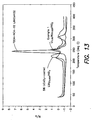
- the safety data shown in FIG. 13 shows DSC curves of Li 1.05 Mg 0.025 NiO 2 and 5% LiCoO 2 coated material compared to LiNi 0.8 Co 0.15 Al 0.05 O 2 (CA1505N cell available from TODA Co., Japan).
- the DSC curves provide a signature of chemical reactivity during exothermic reactions.
- a Li 1.05 NiO 2 composition was prepared by dry mixing:
- the mixed materials were added to about 946.15 g Ni(OH) 2 (OM Group, Inc. #543 High density spherical powder) in a 1 liter jar.
- the precursor powder mixture was mixed by shaking.
- the precursor powders were placed in alumina crucibles and sintered. Sintering was performed by heating at a rate of about 5° C/minute to about 450° C and held at about 450° C for about four hours. The temperature was raised at about 2° C/minute to about 700° C and held for about four hours.
- the sample was then allowed to cool naturally to room temperature.
- the data show that the performance, as quantified by specific capacity, of the LiMg y NiO 2 -based electrochemical cells of the present invention (see Table 1) are amongst the highest when comparing to the performance of typical lithium-nickel oxide materials.
- Example 5 Comparison to LiCoO 2 -based Electrochemical Cells.
- a comparable composite cathode in an electrochemical cell was prepared using LiCoO 2 (C-5 grade available from Nippon Chemical Industrial Co., LTD., Tokyo, Japan) as the active material. Similar coin cells were prepared as in the previous example for evaluation.
- the data in Table 4 show that the electrochemical performance, e.g. at specific capacity at 1C rate, of the LiMgyNiO 2 -based cells of the present invention was better when compared to the performance of LiNiO 2 -base cells, and superior to the performance of a LiCoO 2 -based cells.
- Example 7 Synthesis of Li 1.05 Mg 0.025 NiO 2 Core Particles Coated with a LiCoO 2 Layer.
- a lithium-magnesium-nickel oxide composition substantially prepared as described in Example 1, was coated with a lithium-cobalt oxide layer.
- LiNO 3 crystalline powder, available from Alfa Aesar, Ward Hill, Massachusetts
- Co(NO 3 ) 2 ⁇ 6H 2 O crystalline aggregates, also available from Alfa Aesar
- the excess water was removed by evaporation on a hot plate with stirring until the mixture became a thick slurry.
- the slurry was poured into an alumina crucible and sintered under the following heating profile: heat at a rate of about 2° C/min to about 110° C, hold for about one hour at about 110° C, heat at a rate of 5° C/min to about 450° C, heat soak for about one hour at about 450° C, heat at a rate of about 2° C/min to about 700° C, and heat soak for about two hours at about 700° C.
- the prepared sample was allowed to cool naturally to room temperature. Once cooled, it was ground for about five minutes to break up any agglomerates and sieved through a No. 270 mesh screen.
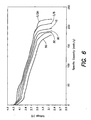
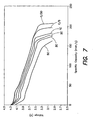
- FIGS. 6-8 are graphs showing the discharge profile of the LiCoO 2 -coated Li 1.05 Mg 0.025 NiO 2 -based core composition having, respectively, about 5 mol% coating, about 10 mol% coating, and about 15 mol% coating.
- the profiles show that the lithium-magnesium-nickel composition can be coated with up to about 15 mol% lithium-cobalt oxide layer and retain about the same electrochemical performance.
- FIG. 11 is an XRD comparison of these samples showing increasing gradients with amount LiCoO 2 coating.
- Example 8 Evaluation of LiCoO 2 -coated Li 1.05 Mg 0.025 NiO 2 Core Material.
- Two gradient coated Li 1.05 Mg 0.025 NiO 2 materials were synthesized and coated with about 10 % and about 15% LiCoO 2 using the method in Examples 1 and 7.
- the gradient coating was detected by studying the increasing degree of asymmetry in the Bragg reflections.
- the peak 104 at about 44.4 degrees in 2-theta was used ( FIG. 11 ) to show how the asymmetry of peak 104 continuously increased with the amount of LiCoO 2 .
- the respective XRD patterns in FIG. 11 have been adjusted for 2-theta zero point position and normalized in intensity for comparison (shown in the insert in the right side of FIG. 11 ).
- the gradient coated samples were also evaluated electrochemically for rate capability and first cycle efficiency as listed in Table 1, according to protocol 1.
- Example 9 Comparison of LiCoO 2 -coated Li 1.05 NiO 2 Core Material.
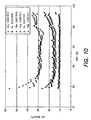
- FIG. 9 shows the ASI of a cell utilizing the LiCoO 2 -coat Li 1.05 NiO 2 material, measured according to protocol 3 above and FIG. 10 shows several ASI measurements of a cell utilizing uncoated LiMgNiO 2 material.
- the performance, in terms of potential available power, of the lithium-cobalt-oxide coated lithium-nickel-oxide cells is comparable, if not better than cells utilizing the uncoated lithium-nickel-oxide materials.
- FIG. 12 shows the capacity retention at a discharge rate of about 1C of cells utilizing various active materials including lithium-nickel oxide, lithium magnesium nickel oxide, lithium-cobalt-oxide coated lithium magnesium nickel oxide, LiNi 0.8 Co 0.15 Al 0.05 O 2 (CA1505 cell available from TODA Co., Japan), and LiCoO 2 (C-5 grade available from Nippon Chemical Industrial Co., LTD., Tokyo, Japan).
- the results presented in FIG. 12 indicate that the cells utilizing the coated and uncoated lithium-magnesium-nickel oxides of the invention can have better performance compared to cells utilizing lithium cobalt oxide.
- FIG. 12 shows the capacity retention at a discharge rate of about 1C of cells utilizing various active materials including lithium-nickel oxide, lithium magnesium nickel oxide, lithium-cobalt-oxide coated lithium magnesium nickel oxide, LiNi 0.8 Co 0.15 Al 0.05 O 2 (CA1505 cell available from TODA Co., Japan), and LiCoO 2 (C-5 grade available from Nippon Chemical Industrial Co., LTD., Tokyo,
- FIG. 13 is a graph showing the differential scanning calorimetry of the uncoated and lithium-cobalt oxide-coated lithium-magnesium-nickel oxide material of the present invention compared to a commercially available lithium-nickel-cobalt oxide material at about a 100 % state of charge and shows that the coated and uncoated materials are more thermally stable.
- the shape of the particles of the present invention in either the coated or uncoated embodiments, can include particles shaped to facilitate packing and/or increase packing and/or tap density such as, but not limited to, plates or having one dimension substantially greater than a second and/or third dimension. Further, a range or combination of particle sizes can also be utilized.
- a mixture of lithium cobalt oxide coated lithium magnesium nickel oxide particles with uncoated lithium magnesium nickel oxide particles can be utilized in the systems, device, and techniques of the present invention wherein the mixture can have a first type or kind of particle, e. g. uncoated, having a first particle size and a second type or kind of particle, e.g. coated and/or a different Mg loading, having a second particle size.
- the use of the clarifiers such as "first" and "second” or even “third” and “fourth” is intended to modify an element and does not create an implication of priority, precedent, sequence, or temporal order, over another but is intended as labels.
Landscapes
- Chemical & Material Sciences (AREA)
- Chemical Kinetics & Catalysis (AREA)
- Electrochemistry (AREA)
- General Chemical & Material Sciences (AREA)
- Inorganic Chemistry (AREA)
- Engineering & Computer Science (AREA)
- Organic Chemistry (AREA)
- Composite Materials (AREA)
- Materials Engineering (AREA)
- Manufacturing & Machinery (AREA)
- Inorganic Compounds Of Heavy Metals (AREA)
- Battery Electrode And Active Subsutance (AREA)
- Oxygen, Ozone, And Oxides In General (AREA)
- Secondary Cells (AREA)
Claims (21)
- Verbund umfassend:einen Kern mit einer Zusammensetzung von LixMgyNiO2, wobei gilt 0.9<x<1.3, 0.01<y<0.1 und 0.91<x+y<1.3; undeine Beschichtung auf dem Kern mit einer Zusammensetzung von LiaCobO2, wobei gilt 0.7<a<1.3 und 0.9<b<1.2.
- Verbund nach Anspruch 1, wobei gilt 0.9<a<1.3 und 0.9<b<1.2.
- Verbund nach Anspruch 1, wobei sich das Molverhältnis von Co: Ni zwischen 0.01 bis 0.8 bewegt.
- Verbund nach einem der vorangegangenen Ansprüche, wobei gilt 0.9<x<1.1 und 0.02<y<0.05.
- Verbund nach einem der vorangegangenen Ansprüche, wobei Li und Mg vorwiegend einem kristallographischen 3a Platz und Ni vorwiegend einem kristallographischen 3b Platz zugeordnet ist.
- Verbund nach einem der vorangegangenen Ansprüche, wobei das zweite Material einen Konzentrationsgradienten mit Bezug auf den darin vorhandenen Kobaltanteil hat.
- Elektrochemische Zelle mit einer Elektrode mit Partikeln mit einem Kern, der eine Zusammensetzung von LixMgyNiO2 hat, wobei gilt 0.9<x<1.3, 0.01<y<0.1 und 0.91<x+y<1.3 und einer auf dem Kern angebrachten Beschichtung, wobei die Beschichtung eine Zusammensetzung von LiaCobO2 hat, wobei gilt 0.7<a<1.3 und 0.9<b<1.2.
- Elektrochemische Zelle nach Anspruch 7, wobei gilt 0.9<x<1.1, 0.02<y<0.05, 0.9<a<1.3 und 0.9<b<1.2.
- Elektrochemische Zelle nach Anspruch 7 oder 8, wobei Li und Mg vorwiegend einem kristallographischen 3a Platz und Ni vorwiegend einem kristallographischen 3b Platz zugeordnet ist.
- Elektrochemische Zelle nach Anspruch 7 oder 8, wobei die Beschichtung einen Konzentrationsgradienten mit Bezug auf den darin vorhandenen Kobaltanteil aufweist.
- Verfahren zur Herstellung beschichteter Teilchen mit den Schritten:Bereitstellen einer ersten Mischung von Verbindungen umfassend eine Lithiumquelle, eine Magnesiumquelle und einer Nickelquelle und Erhitzen der ersten Mischung in einer oxidierenden Atmosphäre bei einer ersten Temperatur von 350° - 800°C für eine erste Zeitspanne, die geeignet ist, die erste Mischung in Kernteilchen zu kristallisieren, und zwar mit einer Zusammensetzung von LixMgyNiO2, wobei gilt 0.9<x<1.3, 0.01<y<0.1 und 0.91<x+y<1.3;Beschichten der Kernteilchen mit einer zweiten Mischung mit Verbindungen mit Lithium und Kobalt; undErhitzen der beschichteten Kernteilchen bei einer zweiten Temperatur in einem Bereich von 350°C - 750°C und für eine zweite Zeitspanne, die geeignet ist, Material mit einer Zusammensetzung von LiaCobO2 zu kristallisieren, wobei gilt 0.7<a<1.3 und 0.9<b<1.2.
- Verfahren nach Anspruch 11, wobei gilt 0.9<x<1.1, 0.02<y<0.05, 0.9<a<1.3 und 0.9<b<1.2.
- Verfahren nach Anspruch 11 oder 12, wobei das Erhitzen der ersten Mischung das Erhitzen der ersten Mischung mit einer Heizgeschwindigkeit von 5°C pro Minute auf eine erste Haltetemperatur zwischen 400°C und 500°C und das Erhitzen der ersten Mischung mit einer Heizgeschwindigkeit von 2°C pro Minute auf eine zweite Haltetemperatur zwischen 600°C und 800°C umfasst.
- Verfahren nach Anspruch 13, wobei das Erhitzen der ersten Mischung ferner das Aufrechterhalten der ersten Haltetemperatur für ein bis sechs Stunden und das Aufrechterhalten der zweiten Haltetemperatur für ein bis sechs Stunden umfasst.
- Verfahren nach einem der Ansprüche 11 bis 14, ferner umfassend das Trocknen der mit einer zweiten Mischung beschichteten Kernteilchen mit einer Heizgeschwindigkeit von 2°C pro Minute auf eine dritte Haltetemperatur von 110°C.
- Verfahren nach Anspruch 15, wobei das Trocknen der beschichteten Kernteilchen das Aufrechterhalten der dritten Haltetemperatur für eine Stunde umfasst.
- Verfahren nach Anspruch 16, wobei das Erhitzen der beschichteten Kernteilchen das Erhitzen der beschichteten Kernteilchen mit einer Heizgeschwindigkeit von 5°C pro Minute auf eine vierte Haltetemperatur zwischen 300°C und 500°C umfasst.
- Verfahren nach Anspruch 17, wobei das Erhitzen der beschichteten Kernteilchen ferner das Aufrechterhalten der vierten Haltetemperatur für einer Stunde umfasst.
- Verfahren nach einem der Ansprüche 11 bis 18, wobei das Erhitzen der beschichteten Kernteilchen ferner das Erhitzen der beschichteten Kernteilchen mit einer Heizgeschwindigkeit von 2°C pro Minute bei einer fünften Haltetemperatur zwischen 650°C und 750°C umfasst.
- Verfahren nach Anspruch 19, wobei das Erhitzen der beschichteten Kernteilchen ferner das Aufrechterhalten der fünften Haltetemperatur für zwei Stunden umfasst.
- Verfahren nach einem der Ansprüche 11 bis 20, wobei die Magnesiumquelle Mg(OH)2, die Lithiumquelle LiNO3 und LiOH und die Nickelquelle Ni(OH)2 umfasst.
Priority Applications (1)
| Application Number | Priority Date | Filing Date | Title |
|---|---|---|---|
| PL05754501T PL1751809T3 (pl) | 2004-05-21 | 2005-05-19 | Materiału typu tlenku litu i metalu oraz sposoby syntezy i zastosowanie |
Applications Claiming Priority (2)
| Application Number | Priority Date | Filing Date | Title |
|---|---|---|---|
| US10/850,877 US7381496B2 (en) | 2004-05-21 | 2004-05-21 | Lithium metal oxide materials and methods of synthesis and use |
| PCT/US2005/017548 WO2005114768A1 (en) | 2004-05-21 | 2005-05-19 | Lithium metal oxide materials and methods of synthesis and use |
Publications (2)
| Publication Number | Publication Date |
|---|---|
| EP1751809A1 EP1751809A1 (de) | 2007-02-14 |
| EP1751809B1 true EP1751809B1 (de) | 2011-04-06 |
Family
ID=34971168
Family Applications (1)
| Application Number | Title | Priority Date | Filing Date |
|---|---|---|---|
| EP05754501A Expired - Lifetime EP1751809B1 (de) | 2004-05-21 | 2005-05-19 | Lithiummetalloxid-materialien und synthese- und benutzungsverfahren |
Country Status (11)
| Country | Link |
|---|---|
| US (2) | US7381496B2 (de) |
| EP (1) | EP1751809B1 (de) |
| JP (1) | JP5265187B2 (de) |
| KR (1) | KR101056463B1 (de) |
| CN (1) | CN1985388B (de) |
| AT (1) | ATE504955T1 (de) |
| CA (1) | CA2565810C (de) |
| DE (1) | DE602005027342D1 (de) |
| EA (1) | EA010779B1 (de) |
| PL (1) | PL1751809T3 (de) |
| WO (1) | WO2005114768A1 (de) |
Families Citing this family (82)
| Publication number | Priority date | Publication date | Assignee | Title |
|---|---|---|---|---|
| EP1831943B1 (de) * | 2004-12-31 | 2014-12-10 | IUCF-HYU (Industry-University Cooperation Foundation Hanyang University) | Verfahren zur herstellung von doppelschicht-kathoden- aktivmaterialien für lithium-sekundärbatterien |
| CN101401233B (zh) * | 2006-03-15 | 2011-05-11 | 住友化学株式会社 | 正极活性物质粉末 |
| US7947092B1 (en) * | 2006-03-23 | 2011-05-24 | Quallion Llc | Battery with cathode having inactive materials |
| EP2108203B1 (de) | 2007-01-18 | 2014-03-12 | LG Chemical Limited | Katoden-aktivmaterial und sekundärbatterie damit |
| WO2008091226A1 (en) * | 2007-01-22 | 2008-07-31 | Agency For Science, Technology And Research | Co-doped nickel oxide |
| KR101117623B1 (ko) * | 2009-06-05 | 2012-02-29 | 에스비리모티브 주식회사 | 리튬 이차 전지용 양극 및 상기 양극을 포함하는 리튬 이차 전지 |
| DE102010032207B4 (de) | 2010-07-26 | 2014-02-13 | Süd-Chemie Ip Gmbh & Co. Kg | Verfahren zur Verminderung von magnetischen und/oder oxidischen Verunreinigungen in Lithium-Metall-Sauerstoff-Verbindungen |
| CN102339984B (zh) * | 2010-07-28 | 2015-03-25 | 北京当升材料科技股份有限公司 | 一种多层包覆结构的球形材料的制备方法 |
| US8992794B2 (en) * | 2011-06-24 | 2015-03-31 | Basf Corporation | Process for synthesis of a layered oxide cathode composition |
| EP3604230A1 (de) * | 2011-08-16 | 2020-02-05 | Tiax Llc | Polykristallines metalloxid, verfahren zur herstellung davon und artikel damit |
| JP5567742B2 (ja) * | 2011-08-23 | 2014-08-06 | Jx日鉱日石金属株式会社 | リチウムイオン電池用正極活物質の製造方法 |
| CA2844796C (en) | 2011-09-02 | 2020-12-29 | E. I. Du Pont De Nemours And Company | Lithium ion battery with nonaqueous electrolyte comprising fluorinated acyclic carboxylic acid ester and/or fluorinated acyclic carbonate |
| JP6178316B2 (ja) | 2011-09-02 | 2017-08-09 | イー・アイ・デュポン・ドウ・ヌムール・アンド・カンパニーE.I.Du Pont De Nemours And Company | フッ素化電解質組成物 |
| US10044066B2 (en) | 2012-06-01 | 2018-08-07 | Solvary SA | Fluorinated electrolyte compositions |
| CN104704657A (zh) | 2012-06-01 | 2015-06-10 | 纳幕尔杜邦公司 | 锂离子电池 |
| WO2014088452A1 (en) * | 2012-12-07 | 2014-06-12 | Obschestvo S Ogranichennoi Otvetstvennostyu "Fm Lab" | Air cathode including delta-manganese dioxide catalyst |
| CN103078109A (zh) * | 2013-01-16 | 2013-05-01 | 中南大学 | 一种梯度包覆镍酸锂材料及其制备方法 |
| KR101785266B1 (ko) * | 2013-01-18 | 2017-11-06 | 삼성에스디아이 주식회사 | 복합양극활물질, 이를 채용한 양극 및 리튬전지, 및 그 제조방법 |
| US8999584B2 (en) * | 2013-03-15 | 2015-04-07 | GM Global Technology Operations LLC | Method for pre-lithiation of the negative electrode in lithium ion batteries |
| PL2982002T3 (pl) | 2013-04-04 | 2020-01-31 | Solvay Sa | Niewodne kompozycje elektrolitów |
| US8968669B2 (en) | 2013-05-06 | 2015-03-03 | Llang-Yuh Chen | Multi-stage system for producing a material of a battery cell |
| US8616475B1 (en) | 2013-06-18 | 2013-12-31 | Retriev Technologies Incorporated | Recovery of lithium ion batteries |
| KR101785265B1 (ko) * | 2013-12-17 | 2017-10-16 | 삼성에스디아이 주식회사 | 복합 양극 활물질, 이를 포함하는 양극, 리튬 전지, 및 이의 제조방법 |
| WO2015149211A1 (en) * | 2014-03-31 | 2015-10-08 | Showa Denko K.K. | A positive electrode active material and a li secondary battery |
| EP3146588B1 (de) | 2014-05-23 | 2018-07-25 | Solvay Sa | Wasserfreie elektrolytzusammensetzungen mit cyclischen sulfaten und lithiumboraten |
| US10559850B2 (en) | 2014-05-23 | 2020-02-11 | Solvay Sa | Nonaqueous electrolyte compositions comprising cyclic sulfates |
| KR20170042324A (ko) | 2014-08-14 | 2017-04-18 | 솔베이(소시에떼아노님) | 술톤 및 플루오린화된 용매를 포함하는 비수성 전해질 조성물 |
| KR101787199B1 (ko) * | 2014-10-02 | 2017-10-18 | 주식회사 엘지화학 | 리튬 이차전지용 양극활물질, 이의 제조방법 및 이를 포함하는 리튬 이차전지 |
| CN104282880B (zh) * | 2014-10-24 | 2017-05-17 | 湖南杉杉能源科技股份有限公司 | 一种锂钴复合氧化物锂离子正极材料及其制备方法 |
| US10199684B2 (en) | 2014-12-17 | 2019-02-05 | Solvay Sa | Nonaqueous electrolyte compositions comprising lithium glycolatoborate and fluorinated solvent |
| US10535898B2 (en) | 2014-12-17 | 2020-01-14 | Solvay Sa | Nonaqueous electrolyte compositions comprising lithium malonatoborate and fluorinated solvent |
| US10833321B2 (en) * | 2015-03-06 | 2020-11-10 | Uchicago Argonne, Llc | Cathode materials for lithium ion batteries |
| JP6788661B2 (ja) | 2015-08-04 | 2020-11-25 | ソルヴェイ(ソシエテ アノニム) | リチウムオキサラトホスフェートを含んでなる非水系電解質組成物 |
| PL3369125T3 (pl) | 2015-10-26 | 2020-11-02 | Solvay Sa | Niewodne kompozycje elektrolitowe zawierające fluorowany rozpuszczalnik i 2-furanon |
| CN105428612B (zh) * | 2015-11-08 | 2017-12-12 | 桂林理工大学 | 一种纳米MoO2‑MoSe2@SFC锂离子电池负极材料及其制备方法 |
| WO2017112424A1 (en) | 2015-12-22 | 2017-06-29 | E. I. Du Pont De Nemours And Company | Electrolyte compositions comprising metal fluoride particles |
| CN109075329A (zh) | 2016-04-27 | 2018-12-21 | 坎麦克斯动力有限责任公司 | 包含纳米晶的多晶层状金属氧化物 |
| US10693136B2 (en) | 2016-07-11 | 2020-06-23 | Ecopro Bm Co., Ltd. | Lithium complex oxide for lithium secondary battery positive active material and method of preparing the same |
| CN109792083A (zh) | 2016-07-15 | 2019-05-21 | 索尔维公司 | 非水性电解质组合物 |
| EP3279977B1 (de) | 2016-08-02 | 2020-03-11 | Ecopro Bm Co., Ltd. | Lithiumkomplexoxid für positives aktivmaterial einer lithiumsekundärbatterie und verfahren zur herstellung davon |
| PL3279978T3 (pl) | 2016-08-02 | 2021-04-19 | Ecopro Bm Co., Ltd. | Złożony tlenek litu dla dodatniego materiału aktywnego baterii akumulatorowej i sposób jego wytwarzania |
| EP3279979B1 (de) | 2016-08-02 | 2021-06-02 | Ecopro Bm Co., Ltd. | Lithiumkomplexoxid für positives aktivmaterial einer lithiumsekundärbatterie und verfahren zur herstellung davon |
| WO2018033357A1 (en) | 2016-08-19 | 2018-02-22 | Solvay Sa | Nonaqueous electrolyte compositions comprising silyl oxalates |
| WO2018050652A1 (en) | 2016-09-14 | 2018-03-22 | Solvay Sa | Electrolytes containing six membered ring cyclic sulfates |
| WO2018099754A1 (en) | 2016-11-29 | 2018-06-07 | Basf Se | Process for making a coated oxide material, and vessel combination suitable for such process |
| US10892488B2 (en) | 2017-01-17 | 2021-01-12 | Samsung Electronics Co., Ltd. | Electrode active material, lithium secondary battery containing the electrode active material, and method of preparing the electrode active material |
| ES2961786T3 (es) * | 2017-07-14 | 2024-03-13 | Toda Kogyo Corp | Partículas de sustancia activa para electrodo positivo que comprenden un óxido compuesto de niquelato de litio y batería secundaria de electrolito no acuoso |
| EP3738167B1 (de) | 2018-01-12 | 2024-04-10 | Syensqo Sa | Nichtwässrige elektrolytzusammensetzungen umfassend lithiumbis(fluorsulfonyl)imid |
| EP3605700A1 (de) | 2018-07-31 | 2020-02-05 | Solvay Sa | Neue komponenten für elektrolytzusammensetzungen |
| WO2020025502A1 (en) | 2018-07-31 | 2020-02-06 | Solvay Sa | New components for electrolyte compositions |
| WO2020025499A1 (en) | 2018-07-31 | 2020-02-06 | Solvay Sa | New components for electrolyte compositions |
| WO2020025501A1 (en) | 2018-07-31 | 2020-02-06 | Solvay Sa | New components for electrolyte compositions |
| EP3604276A1 (de) | 2018-07-31 | 2020-02-05 | Solvay Sa | Neue komponenten für elektrolytzusammensetzungen |
| EP3605698A1 (de) | 2018-07-31 | 2020-02-05 | Solvay Sa | Neue komponenten für elektrolytzusammensetzungen |
| EP3605699A1 (de) | 2018-07-31 | 2020-02-05 | Solvay Sa | Neue komponenten für elektrolytzusammensetzungen |
| CN109148853A (zh) * | 2018-08-21 | 2019-01-04 | 成都巴莫科技有限责任公司 | 一种双重包覆富锂氧化物固溶体材料及其制备方法 |
| KR102629462B1 (ko) * | 2018-10-04 | 2024-01-26 | 삼성전자주식회사 | 복합양극활물질, 이를 채용한 양극과 리튬전지 및 그 제조방법 |
| KR102754047B1 (ko) | 2018-10-25 | 2025-01-15 | 삼성에스디아이 주식회사 | 복합양극활물질, 이를 포함한 양극, 리튬전지 및 그 제조 방법 |
| US10950857B2 (en) | 2019-01-17 | 2021-03-16 | Camx Power Llc | Polycrystalline metal oxides with enriched grain boundaries |
| US11424449B2 (en) | 2019-01-25 | 2022-08-23 | Camx Power Llc | Stable cathode materials |
| US10501335B1 (en) | 2019-01-17 | 2019-12-10 | Camx Power Llc | Polycrystalline metal oxides with enriched grain boundaries |
| CN119455884A (zh) | 2019-06-28 | 2025-02-18 | 壹久公司 | 具有辅助气体流的处理系统与方法 |
| US11673112B2 (en) | 2020-06-28 | 2023-06-13 | eJoule, Inc. | System and process with assisted gas flow inside a reaction chamber |
| US11376559B2 (en) | 2019-06-28 | 2022-07-05 | eJoule, Inc. | Processing system and method for producing a particulate material |
| US11121354B2 (en) | 2019-06-28 | 2021-09-14 | eJoule, Inc. | System with power jet modules and method thereof |
| CN113471403B (zh) | 2020-03-30 | 2024-03-19 | Tdk株式会社 | 电极和锂离子二次电池 |
| EP4173060A1 (de) | 2020-06-25 | 2023-05-03 | 6K Inc. | Mikroverbundlegierungsstruktur |
| EP4165957A4 (de) | 2020-09-24 | 2024-07-24 | 6K Inc. | Systeme, vorrichtungen und verfahren zum starten von plasma |
| WO2022094528A1 (en) | 2020-10-30 | 2022-05-05 | 6K Inc. | Systems and methods for synthesis of spheroidized metal powders |
| KR20230129011A9 (ko) | 2021-01-11 | 2024-03-21 | 6케이 인크. | 마이크로파 플라즈마 공정을 사용하여 Li-이온 캐소드 재료를 재활용하는 방법 및 시스템 |
| US12042861B2 (en) | 2021-03-31 | 2024-07-23 | 6K Inc. | Systems and methods for additive manufacturing of metal nitride ceramics |
| CN113307311A (zh) * | 2021-04-08 | 2021-08-27 | 桂林理工大学 | 一种Mg2+双重掺杂提高镍酸锂正极材料电化学性能的制备方法 |
| JP7473828B2 (ja) | 2021-07-26 | 2024-04-24 | 日亜化学工業株式会社 | 非水電解質二次電池用正極及びその製造方法 |
| CN113479944A (zh) * | 2021-09-07 | 2021-10-08 | 中南大学 | 一种改性高镍三元正极材料的制备方法 |
| US12261023B2 (en) | 2022-05-23 | 2025-03-25 | 6K Inc. | Microwave plasma apparatus and methods for processing materials using an interior liner |
| US12040162B2 (en) | 2022-06-09 | 2024-07-16 | 6K Inc. | Plasma apparatus and methods for processing feed material utilizing an upstream swirl module and composite gas flows |
| WO2024044498A1 (en) | 2022-08-25 | 2024-02-29 | 6K Inc. | Plasma apparatus and methods for processing feed material utilizing a powder ingress preventor (pip) |
| US12195338B2 (en) | 2022-12-15 | 2025-01-14 | 6K Inc. | Systems, methods, and device for pyrolysis of methane in a microwave plasma for hydrogen and structured carbon powder production |
| CN116666637B (zh) * | 2023-07-07 | 2025-10-31 | 湖南长远锂科新能源有限公司 | 一种改性三元正极材料及其制备方法、锂离子电池 |
| CN121753174A (zh) | 2023-08-28 | 2026-03-27 | 科慕埃弗西有限公司 | 用于电化学稳定含有原纤化聚合物的电极的电解质衍生膜 |
| US12278363B1 (en) | 2024-04-29 | 2025-04-15 | Camx Power, Llc | Multiple morphology composite cathode materials providing high energy and long cycle life and cells employing the same |
| WO2025235585A1 (en) | 2024-05-08 | 2025-11-13 | The Chemours Company Fc, Llc | Cyclic organosulfur additive containing electrolyte formulations used to derive sei layers, electrodes, systems and formation protocols |
Family Cites Families (154)
| Publication number | Priority date | Publication date | Assignee | Title |
|---|---|---|---|---|
| US4526881A (en) * | 1983-10-24 | 1985-07-02 | The United States Of America As Represented By The Secretary Of The Army | Method of pretreating carbon black powder to improve cathode performance and lithium sulfuryl chloride cell including the pretreated carbon black powder |
| US4520084A (en) * | 1984-06-07 | 1985-05-28 | Standard Oil Company (Indiana) | Etched metal electrodes and their use in nonaqueous electrochemical cells |
| US4980080A (en) * | 1988-06-09 | 1990-12-25 | Societe Anonyme Dite: Saft | Process of making a cathode material for a secondary battery including a lithium anode and application of said material |
| US5264201A (en) | 1990-07-23 | 1993-11-23 | Her Majesty The Queen In Right Of The Province Of British Columbia | Lithiated nickel dioxide and secondary cells prepared therefrom |
| JP3162437B2 (ja) * | 1990-11-02 | 2001-04-25 | セイコーインスツルメンツ株式会社 | 非水電解質二次電池 |
| JP3097347B2 (ja) | 1992-09-18 | 2000-10-10 | 松下電器産業株式会社 | ニッケル・水素蓄電池 |
| JP2729176B2 (ja) * | 1993-04-01 | 1998-03-18 | 富士化学工業株式会社 | LiM3+O2 またはLiMn2 O4 の製造方法及び2次電池正極材用LiNi3+O2 |
| US5591543A (en) * | 1993-09-16 | 1997-01-07 | Ramot University Authority For Applied Research And Industrial Development Ltd. | Secondary electrochemical cell |
| CA2102738C (en) * | 1993-11-09 | 1999-01-12 | George T. Fey | Inverse spinel compounds as cathodes for lithium batteries |
| JP3274016B2 (ja) * | 1994-03-17 | 2002-04-15 | 日本化学工業株式会社 | リチウム二次電池用コバルト酸リチウム系正極活物質の製造方法 |
| JP3067531B2 (ja) * | 1994-07-13 | 2000-07-17 | 松下電器産業株式会社 | 非水電解液二次電池の正極活物質およびそれを用いた電池 |
| JPH0864244A (ja) | 1994-08-17 | 1996-03-08 | Murata Mfg Co Ltd | 非水電解液2次電池 |
| JPH0864209A (ja) | 1994-08-23 | 1996-03-08 | Murata Mfg Co Ltd | リチウム2次電池 |
| JPH0896794A (ja) | 1994-09-20 | 1996-04-12 | Murata Mfg Co Ltd | リチウム2次電池 |
| US5531920A (en) * | 1994-10-03 | 1996-07-02 | Motorola, Inc. | Method of synthesizing alkaline metal intercalation materials for electrochemical cells |
| JPH08138726A (ja) | 1994-11-08 | 1996-05-31 | Murata Mfg Co Ltd | 積層型リチウム二次電池 |
| CA2162456C (en) * | 1994-11-09 | 2008-07-08 | Keijiro Takanishi | Cathode material, method of preparing it and nonaqueous solvent type secondary battery having a cathode comprising it |
| JPH08138734A (ja) | 1994-11-11 | 1996-05-31 | Murata Mfg Co Ltd | 有機電解液2次電池 |
| JP3443991B2 (ja) | 1994-11-25 | 2003-09-08 | 株式会社村田製作所 | 二次電池用正極活物質の製造方法 |
| JPH08148141A (ja) | 1994-11-25 | 1996-06-07 | Murata Mfg Co Ltd | リチウム二次電池用電極の製造方法 |
| JP3491355B2 (ja) | 1994-12-05 | 2004-01-26 | 株式会社村田製作所 | 二次電池用正極活物質の製造方法 |
| JP3578503B2 (ja) * | 1994-12-27 | 2004-10-20 | 同和鉱業株式会社 | リチウム二次電池用正極活物質およびそれを用いた二次電池 |
| JP3503239B2 (ja) | 1995-01-25 | 2004-03-02 | 株式会社村田製作所 | リチウム2次電池 |
| JPH08213050A (ja) | 1995-02-09 | 1996-08-20 | Murata Mfg Co Ltd | 非水電解液2次電池 |
| DE19511355A1 (de) * | 1995-03-28 | 1996-10-02 | Merck Patent Gmbh | Verfahren zur Herstellung von Lithium-Interkalationsverbindungen |
| JPH08306358A (ja) | 1995-05-10 | 1996-11-22 | Murata Mfg Co Ltd | 二次電池用正極活物質の製造方法 |
| JP3260282B2 (ja) * | 1995-05-26 | 2002-02-25 | 松下電器産業株式会社 | 非水電解質リチウム二次電池 |
| US5631105A (en) * | 1995-05-26 | 1997-05-20 | Matsushita Electric Industrial Co., Ltd. | Non-aqueous electrolyte lithium secondary battery |
| US5591548A (en) | 1995-06-05 | 1997-01-07 | Motorola, Inc. | Electrode materials for rechargeable electrochemical cells and method of making same |
| KR100385480B1 (ko) * | 1995-07-31 | 2003-08-19 | 산요 덴키 가부시키가이샤 | 알칼리축전지용비소결식니켈전극의제조방법및알칼리축전지 |
| JPH0950810A (ja) | 1995-08-08 | 1997-02-18 | Mitsui Toatsu Chem Inc | 非水電解液電池の電極活物質及びその製造方法 |
| US5693435A (en) * | 1995-08-16 | 1997-12-02 | Bell Communications Research, Inc. | Lix CoO2 electrode for high-capacity cycle-stable secondary lithium battery |
| US5750288A (en) * | 1995-10-03 | 1998-05-12 | Rayovac Corporation | Modified lithium nickel oxide compounds for electrochemical cathodes and cells |
| US6045771A (en) * | 1995-11-24 | 2000-04-04 | Fuji Chemical Industry Co., Ltd. | Lithium-nickel complex oxide, a process for preparing the same and a positive electrode active material for a secondary battery |
| US5914094A (en) * | 1995-12-19 | 1999-06-22 | Samsung Display Devices Co., Ltd. | Process for preparing cathode active material by a sol-gel method |
| JPH09180720A (ja) | 1995-12-27 | 1997-07-11 | Murata Mfg Co Ltd | 非水電解液二次電池 |
| JPH09245789A (ja) | 1996-03-04 | 1997-09-19 | Murata Mfg Co Ltd | 非水電解液二次電池 |
| JPH09245835A (ja) | 1996-03-04 | 1997-09-19 | Murata Mfg Co Ltd | 非水電解液二次電池の製造方法 |
| JPH09259881A (ja) | 1996-03-25 | 1997-10-03 | Murata Mfg Co Ltd | リチウム二次電池用LiNiO▲2▼の製造方法 |
| DE69706592T2 (de) * | 1996-03-26 | 2002-05-29 | Sharp K.K., Osaka | Verfahren zur Herstellung von positivelektrode-aktivem Material, sowie diese verwendende nichtwässerige Sekundärbatterie |
| US6881520B1 (en) * | 1996-06-14 | 2005-04-19 | N.V. Umicore S.A. | Electrode material for rechargeable batteries and process for the preparation thereof |
| US5728367A (en) * | 1996-06-17 | 1998-03-17 | Motorola, Inc. | Process for fabricating a lithiated transition metal oxide |
| FR2751135A1 (fr) * | 1996-07-12 | 1998-01-16 | Accumulateurs Fixes | Electrode de generateur electrochimique rechargeable au lithium |
| JPH1032005A (ja) * | 1996-07-16 | 1998-02-03 | Japan Storage Battery Co Ltd | ニッケル酸リチウム正極活物質およびその製造方法ならびに前記活物質を備えたリチウム電池 |
| JP3047827B2 (ja) | 1996-07-16 | 2000-06-05 | 株式会社村田製作所 | リチウム二次電池 |
| JPH10255804A (ja) | 1997-01-07 | 1998-09-25 | Murata Mfg Co Ltd | リチウム二次電池 |
| FR2752091B1 (fr) * | 1996-08-02 | 1998-09-04 | Accumulateurs Fixes | Composition pour electrode positive, procede de preparation |
| JPH10114527A (ja) | 1996-08-13 | 1998-05-06 | Murata Mfg Co Ltd | リチウムコバルト複合酸化物の製造方法 |
| JP3407594B2 (ja) | 1996-08-13 | 2003-05-19 | 株式会社村田製作所 | リチウムニッケル複合酸化物の製造方法 |
| JP3296204B2 (ja) | 1996-08-29 | 2002-06-24 | 株式会社村田製作所 | リチウム二次電池 |
| JP3296203B2 (ja) | 1996-08-29 | 2002-06-24 | 株式会社村田製作所 | リチウム二次電池 |
| EP0951742A1 (de) | 1996-10-11 | 1999-10-27 | Massachusetts Institute Of Technology | Polymerelektrolyt, interkalationsverbindungen und elektroden für batterien |
| JPH10188954A (ja) | 1996-10-23 | 1998-07-21 | Mitsubishi Electric Corp | リチウム電池 |
| WO1998020571A1 (en) | 1996-11-07 | 1998-05-14 | Matsushita Electric Industrial Co., Ltd. | Method of manufacturing positive active material for nonaqueous electrolyte secondary cells |
| JPH10139430A (ja) | 1996-11-13 | 1998-05-26 | Murata Mfg Co Ltd | リチウムチタン複合酸化物の製造方法 |
| JPH10139429A (ja) | 1996-11-13 | 1998-05-26 | Murata Mfg Co Ltd | リチウムチタン複合酸化物の製造方法 |
| US5783333A (en) | 1996-11-27 | 1998-07-21 | Polystor Corporation | Lithium nickel cobalt oxides for positive electrodes |
| JP3598186B2 (ja) | 1996-12-16 | 2004-12-08 | リチャージャブル バッテリー インダストリーズ コーポレーション | セパレータ、これを採用する2次電池及びその製造方法 |
| US5993998A (en) * | 1996-12-20 | 1999-11-30 | Japan Storage Battery Co., Ltd. | Positive active material for lithium battery, lithium battery having the same and method for producing the same |
| JPH10182160A (ja) | 1996-12-24 | 1998-07-07 | Murata Mfg Co Ltd | リチウムマンガン複合酸化物の製造方法 |
| JPH10182161A (ja) | 1996-12-24 | 1998-07-07 | Murata Mfg Co Ltd | リチウムマンガン複合酸化物の製造方法 |
| JPH10182157A (ja) | 1996-12-24 | 1998-07-07 | Murata Mfg Co Ltd | リチウムマンガン複合酸化物の製造方法 |
| WO1998037023A1 (de) * | 1997-02-19 | 1998-08-27 | H.C. Starck Gmbh & Co. Kg | Verfahren zur herstellung von lithium-übergangsmetallaten |
| JP4161382B2 (ja) | 1997-02-25 | 2008-10-08 | 堺化学工業株式会社 | 2層構造粒子状組成物の製造方法 |
| KR100269204B1 (ko) | 1997-04-10 | 2000-10-16 | 윤종용 | 고분자 고체 전해질, 그 제조방법 및 이 고분자 고체 전해질을 채용한 리튬 2차전지 |
| DE69819395T2 (de) * | 1997-04-15 | 2004-09-09 | Sanyo Electric Co., Ltd., Moriguchi | Positivelektrodenmaterialf für Verwendung nichtwässriger Elektrolyt enthaltender Batterie und Verfahren zur seiner Herstellung und nichtwässriger Elektrolyt enthaltende Batterie |
| JP3384280B2 (ja) | 1997-05-08 | 2003-03-10 | 株式会社村田製作所 | リチウム二次電池用正極活物質の製造方法 |
| JPH10308216A (ja) | 1997-05-09 | 1998-11-17 | Murata Mfg Co Ltd | リチウム二次電池用正極活物質 |
| JP4326041B2 (ja) * | 1997-05-15 | 2009-09-02 | エフエムシー・コーポレイション | ドープされた層間化合物およびその作製方法 |
| US6277521B1 (en) * | 1997-05-15 | 2001-08-21 | Fmc Corporation | Lithium metal oxide containing multiple dopants and method of preparing same |
| US6300008B1 (en) | 1997-05-27 | 2001-10-09 | Tdk Corporation | Method for producing electrode for non-aqueous electrolyte battery |
| JPH1145716A (ja) * | 1997-05-27 | 1999-02-16 | Tdk Corp | 非水電解質電池用電極の製造方法 |
| AU7451798A (en) | 1997-05-27 | 1998-12-30 | Tdk Corporation | Method of producing an electrode for non-aqueous electrolytic cells |
| KR100498859B1 (ko) * | 1997-05-27 | 2005-07-04 | 티디케이가부시기가이샤 | 비수성 전해질 전지용 전극의 제조방법 |
| DE69802282T2 (de) * | 1997-06-12 | 2002-07-18 | Sanyo Electric Co., Ltd. | Nichtwässrige elektrolytische sekundärzelle |
| US6749648B1 (en) * | 2000-06-19 | 2004-06-15 | Nanagram Corporation | Lithium metal oxides |
| US6017654A (en) * | 1997-08-04 | 2000-01-25 | Carnegie Mellon University | Cathode materials for lithium-ion secondary cells |
| KR100220449B1 (ko) | 1997-08-16 | 1999-09-15 | 손욱 | 리튬 이온 고분자 이차전지 제조방법 |
| KR100261120B1 (ko) | 1997-08-26 | 2000-07-01 | 김순택 | 리튬망간산화물미세분말,그제조방법및그것을화학물질로하는양극을채용한리튬이온이차전지 |
| JPH1167209A (ja) | 1997-08-27 | 1999-03-09 | Sanyo Electric Co Ltd | リチウム二次電池 |
| KR19990025888A (ko) | 1997-09-19 | 1999-04-06 | 손욱 | 리튬 계열 이차 전지용 극판의 제조 방법 |
| US6383235B1 (en) * | 1997-09-26 | 2002-05-07 | Mitsubishi Denki Kabushiki Kaisha | Cathode materials, process for the preparation thereof and secondary lithium ion battery using the cathode materials |
| KR19990030823A (ko) | 1997-10-06 | 1999-05-06 | 손욱 | 리튬 이온 이차 전지용 음극 활물질, 이를 사용하여 제조한 음극판 및 리튬 이온 이차 전지 |
| DE19849343A1 (de) * | 1997-10-30 | 1999-06-02 | Samsung Display Devices Co Ltd | Lithiumcompositoxid, dessen Herstellung und sekundäre Lithiumionzelle mit Lithiumcompositoxid als aktives Material der positiven Elektrode |
| US6071649A (en) * | 1997-10-31 | 2000-06-06 | Motorola, Inc. | Method for making a coated electrode material for an electrochemical cell |
| JPH11176439A (ja) | 1997-12-08 | 1999-07-02 | Murata Mfg Co Ltd | リチウム二次電池用リチウムニッケル複合酸化物の製造方法 |
| KR100263153B1 (ko) | 1998-01-22 | 2000-08-01 | 김순택 | 리튬이온2차전지의전극결합제와활물질슬러리제조방법 |
| JP4122710B2 (ja) * | 1998-02-09 | 2008-07-23 | トダ・コウギョウ・ヨーロッパ・ゲゼルシャフト・ミット・ベシュレンクテル・ハフツング | リチウム−遷移金属混合物の調製法 |
| JP3691279B2 (ja) * | 1998-02-10 | 2005-09-07 | 三星エスディアイ株式会社 | リチウム二次電池用正極活物質、その製造方法、及びリチウム二次電池 |
| JPH11278848A (ja) | 1998-03-26 | 1999-10-12 | Murata Mfg Co Ltd | スピネル型リチウムマンガン複合酸化物の製造方法 |
| JP3079098B2 (ja) * | 1998-04-24 | 2000-08-21 | 財団法人韓国科学技術研究院 | 溶融炭酸塩燃料電池用正極の製造方法 |
| JPH11310416A (ja) | 1998-04-27 | 1999-11-09 | Carnegie Mellon Univ | リチウムイオン二次電池の負極物質 |
| US6824924B1 (en) * | 1998-07-06 | 2004-11-30 | Tdk Corporation | Electrode for nonaqueous electrolyte battery |
| US6017655A (en) | 1998-08-18 | 2000-01-25 | Ovonic Battery Company | Nickel hydroxide positive electrode material exhibiting improved conductivity and engineered activation energy |
| FR2784233B1 (fr) * | 1998-10-01 | 2000-12-15 | Cit Alcatel | Matiere active cathodique pour generateur electrochimique rechargeable au lithium |
| KR100280996B1 (ko) | 1998-11-18 | 2001-03-02 | 김순택 | 리튬 이온 이차 전지용 탄소재 활물질 |
| JP2000169150A (ja) | 1998-12-02 | 2000-06-20 | Murata Mfg Co Ltd | スピネル型リチウムマンガン複合酸化物及びリチウム二次電池 |
| JP4429411B2 (ja) | 1999-01-07 | 2010-03-10 | 三星エスディアイ株式会社 | リチウムイオン二次電池用の炭素材料の製造方法 |
| KR100318375B1 (ko) | 1999-02-10 | 2001-12-22 | 김순택 | 리튬 이온 이차 전지 |
| KR100326455B1 (ko) * | 1999-03-30 | 2002-02-28 | 김순택 | 리튬 이차 전지용 양극 활물질 및 그 제조 방법 |
| KR100289542B1 (ko) | 1999-04-09 | 2001-05-02 | 김순택 | 각형 리튬 2차 전지의 제조 방법 |
| KR100289537B1 (ko) | 1999-04-21 | 2001-05-02 | 김순택 | 리튬 이차전지 |
| KR100428971B1 (ko) | 1999-04-21 | 2004-04-28 | 삼성에스디아이 주식회사 | 리튬 폴리머 2차전지 및 그 제조 방법 |
| KR100322450B1 (ko) | 1999-05-03 | 2002-03-18 | 김순택 | 전도성 고분자의 단량체를 함유하는 전해액 및 이를 포함하는 리튬 이차 전지 |
| KR20000075095A (ko) | 1999-05-28 | 2000-12-15 | 김순택 | 리튬 이차 전지용 양극판, 이의 제조 방법 및 이를 사용하여 제조한 리튬 이차 전지 |
| KR100330151B1 (ko) | 1999-08-03 | 2002-03-28 | 김순택 | 리튬 이차 전지용 전해액 |
| JP4159212B2 (ja) * | 1999-11-12 | 2008-10-01 | 三洋電機株式会社 | 非水電解質二次電池 |
| JP2001223008A (ja) * | 1999-12-02 | 2001-08-17 | Honjo Chemical Corp | リチウムイオン二次電池、そのための正極活物質及びその製造方法 |
| FR2803104B1 (fr) | 1999-12-23 | 2002-03-15 | Cit Alcatel | Electrode au nickel non frittee pour generateur electrochimique secondaire a electrolyte alcalin |
| US6623886B2 (en) * | 1999-12-29 | 2003-09-23 | Kimberly-Clark Worldwide, Inc. | Nickel-rich quaternary metal oxide materials as cathodes for lithium-ion and lithium-ion polymer batteries |
| JP3949334B2 (ja) | 2000-01-27 | 2007-07-25 | 三星エスディアイ株式会社 | リチウムイオン二次電池およびその充放電回路 |
| KR100369445B1 (ko) * | 2000-04-17 | 2003-01-24 | 한국과학기술원 | 리튬이차전지의 양극전극용 리튬망간계 산화물의 코팅재및 그의 코팅방법 |
| KR100362283B1 (ko) | 2000-05-12 | 2002-11-23 | 삼성에스디아이 주식회사 | 리튬 2차 전지의 제조방법 |
| KR100366346B1 (ko) | 2000-06-16 | 2002-12-31 | 삼성에스디아이 주식회사 | 리튬 이차 전지용 음극 활물질 및 그의 제조 방법 |
| JP4160271B2 (ja) | 2000-08-21 | 2008-10-01 | 三星エスディアイ株式会社 | リチウム二次電池用の電極及びリチウム二次電池 |
| US6984469B2 (en) * | 2000-09-25 | 2006-01-10 | Samsung Sdi Co., Ltd. | Positive active material for rechargeable lithium batteries and method of preparing same |
| KR100453595B1 (ko) * | 2000-12-27 | 2004-10-20 | 마쯔시다덴기산교 가부시키가이샤 | 비수전해질 이차전지용 양극활물질 및 그것을 사용한 전지 |
| JP2002270176A (ja) * | 2001-03-14 | 2002-09-20 | Sony Corp | 正極材料およびそれを用いた電池 |
| KR100709205B1 (ko) * | 2001-04-02 | 2007-04-18 | 삼성에스디아이 주식회사 | 리튬 이차 전지용 양극 활물질 조성물 |
| JP4279475B2 (ja) | 2001-04-05 | 2009-06-17 | 三星エスディアイ株式会社 | ポリマー電解質及びポリマー電解質の製造方法並びにリチウム二次電池 |
| JP4331415B2 (ja) | 2001-04-05 | 2009-09-16 | 三星エスディアイ株式会社 | リチウム二次電池の製造方法 |
| KR100406816B1 (ko) * | 2001-06-05 | 2003-11-21 | 삼성에스디아이 주식회사 | 리튬 이차 전지용 양극 활물질의 제조 방법 |
| US6921609B2 (en) * | 2001-06-15 | 2005-07-26 | Kureha Chemical Industry Co., Ltd. | Gradient cathode material for lithium rechargeable batteries |
| US6855461B2 (en) | 2001-06-15 | 2005-02-15 | Kureha Chemical Industry Co., Ltd. | Cathode material for lithium rechargeable batteries |
| US6713037B2 (en) * | 2001-09-28 | 2004-03-30 | Nanox, Inc. | Process for synthesizing noncrystalline lithium based mixed oxides by high energy milling |
| KR100399642B1 (ko) * | 2001-10-24 | 2003-09-29 | 삼성에스디아이 주식회사 | 리튬 이차 전지용 양극 활물질 및 그 제조방법 |
| KR100477744B1 (ko) | 2001-10-31 | 2005-03-18 | 삼성에스디아이 주식회사 | 유기 전해액 및 이를 채용한 리튬 2차전지 |
| JP3873717B2 (ja) | 2001-11-09 | 2007-01-24 | ソニー株式会社 | 正極材料およびそれを用いた電池 |
| US7026068B2 (en) * | 2001-12-19 | 2006-04-11 | Nichia Corporation | Positive electrode active material for lithium ion secondary battery |
| US7358009B2 (en) * | 2002-02-15 | 2008-04-15 | Uchicago Argonne, Llc | Layered electrodes for lithium cells and batteries |
| EP1490916B1 (de) * | 2002-03-22 | 2015-04-08 | LG Chem, Ltd. | Lithium-sekundärbatterie mit einem mittel zur verhinderung einer überentladung |
| WO2003080517A1 (en) * | 2002-03-26 | 2003-10-02 | Council Of Scientific And Industrial Research | Solid state thermal synthesis of lithium cobaltate |
| JP2003346797A (ja) | 2002-05-24 | 2003-12-05 | Japan Storage Battery Co Ltd | ニッケルリチウム複合酸化物を用いた非水電解質二次電池 |
| US6916579B2 (en) * | 2002-05-30 | 2005-07-12 | Enerl Battery Company | Cathode material for lithium battery |
| KR100453555B1 (ko) * | 2002-06-03 | 2004-10-20 | 한국지질자원연구원 | 화염분무열분해를 이용한 리튬코발트 산화물 나노입자의제조방법 |
| JP2004139743A (ja) * | 2002-08-21 | 2004-05-13 | Sanyo Electric Co Ltd | 非水電解質二次電池 |
| JP4036717B2 (ja) * | 2002-09-30 | 2008-01-23 | 三洋電機株式会社 | 非水電解質二次電池 |
| JP4731106B2 (ja) * | 2002-09-30 | 2011-07-20 | 三洋電機株式会社 | 非水電解質二次電池 |
| KR100485091B1 (ko) * | 2002-10-25 | 2005-04-22 | 삼성에스디아이 주식회사 | 리튬 이차 전지용 음극 및 이를 포함하는 리튬 이차 전지 |
| KR100477969B1 (ko) * | 2002-10-25 | 2005-03-23 | 삼성에스디아이 주식회사 | 리튬 전지용 음극 및 이를 포함하는 리튬 전지 |
| JP4707299B2 (ja) * | 2002-11-20 | 2011-06-22 | 住友金属鉱山株式会社 | リチウム二次電池正極活物質およびリチウム二次電池 |
| US8029930B2 (en) * | 2002-12-06 | 2011-10-04 | Kawatetsu Mining Co., Ltd. | Positive electrode material for lithium secondary battery, method for producing the same, and lithium secondary battery |
| EP1434288B1 (de) * | 2002-12-20 | 2007-02-28 | Toyota Jidosha Kabushiki Kaisha | Aktives Material für eine positive Elektrode einer nichtwässrigen Sekundärbatterie und Verfahren zu deren Herstellung |
| JP4274801B2 (ja) * | 2003-01-09 | 2009-06-10 | パナソニック株式会社 | 非水電解質二次電池用正極活物質の製造法 |
| JP4248258B2 (ja) * | 2003-01-16 | 2009-04-02 | 三洋電機株式会社 | リチウム二次電池 |
| JP4404564B2 (ja) * | 2003-03-25 | 2010-01-27 | 三洋電機株式会社 | 非水電解質二次電池、正極活物質 |
| US7018607B2 (en) * | 2003-06-25 | 2006-03-28 | General Motors Corporation | Cathode material for lithium battery |
| US7771875B2 (en) * | 2003-08-15 | 2010-08-10 | Byd Company Limited | Positive electrodes for rechargeable batteries |
| KR100570677B1 (ko) * | 2003-09-26 | 2006-04-12 | 삼성에스디아이 주식회사 | 리튬 이차 전지 |
| JP4518865B2 (ja) * | 2003-09-30 | 2010-08-04 | 三洋電機株式会社 | 非水電解質二次電池およびその製造方法 |
| JP5135664B2 (ja) | 2003-12-05 | 2013-02-06 | 日産自動車株式会社 | 非水電解質リチウムイオン電池用正極材料およびこれを用いた電池 |
| KR100570616B1 (ko) * | 2004-02-06 | 2006-04-12 | 삼성에스디아이 주식회사 | 리튬 이차 전지용 양극 활물질, 그의 제조 방법 및 그를포함하는 리튬 이차 전지 |
| US20060019115A1 (en) | 2004-05-20 | 2006-01-26 | Liya Wang | Composite material having improved microstructure and method for its fabrication |
| JP4798964B2 (ja) * | 2004-05-28 | 2011-10-19 | 三洋電機株式会社 | 非水電解質二次電池 |
-
2004
- 2004-05-21 US US10/850,877 patent/US7381496B2/en active Active
-
2005
- 2005-05-19 KR KR1020067024548A patent/KR101056463B1/ko not_active Expired - Lifetime
- 2005-05-19 WO PCT/US2005/017548 patent/WO2005114768A1/en not_active Ceased
- 2005-05-19 DE DE602005027342T patent/DE602005027342D1/de not_active Expired - Lifetime
- 2005-05-19 EP EP05754501A patent/EP1751809B1/de not_active Expired - Lifetime
- 2005-05-19 CN CN2005800163421A patent/CN1985388B/zh not_active Expired - Lifetime
- 2005-05-19 EA EA200602165A patent/EA010779B1/ru unknown
- 2005-05-19 JP JP2007527436A patent/JP5265187B2/ja not_active Expired - Fee Related
- 2005-05-19 CA CA2565810A patent/CA2565810C/en not_active Expired - Lifetime
- 2005-05-19 PL PL05754501T patent/PL1751809T3/pl unknown
- 2005-05-19 AT AT05754501T patent/ATE504955T1/de not_active IP Right Cessation
-
2008
- 2008-05-16 US US12/152,778 patent/US20080286460A1/en not_active Abandoned
Also Published As
| Publication number | Publication date |
|---|---|
| CA2565810C (en) | 2011-04-26 |
| EA010779B1 (ru) | 2008-10-30 |
| KR101056463B1 (ko) | 2011-08-11 |
| HK1104588A1 (en) | 2008-01-18 |
| EP1751809A1 (de) | 2007-02-14 |
| CN1985388B (zh) | 2013-02-06 |
| US20050260495A1 (en) | 2005-11-24 |
| JP2008500259A (ja) | 2008-01-10 |
| PL1751809T3 (pl) | 2012-04-30 |
| JP5265187B2 (ja) | 2013-08-14 |
| EA200602165A1 (ru) | 2007-06-29 |
| KR20070054600A (ko) | 2007-05-29 |
| CA2565810A1 (en) | 2005-12-01 |
| US20080286460A1 (en) | 2008-11-20 |
| DE602005027342D1 (de) | 2011-05-19 |
| ATE504955T1 (de) | 2011-04-15 |
| US7381496B2 (en) | 2008-06-03 |
| WO2005114768A1 (en) | 2005-12-01 |
| CN1985388A (zh) | 2007-06-20 |
Similar Documents
| Publication | Publication Date | Title |
|---|---|---|
| EP1751809B1 (de) | Lithiummetalloxid-materialien und synthese- und benutzungsverfahren | |
| EP3930051B1 (de) | Positives elektrodenmaterial und verwendung | |
| US10818921B2 (en) | Nickel complex hydroxide particles and nonaqueous electrolyte secondary battery | |
| US8932768B2 (en) | Cathode material for lithium batteries | |
| KR101644252B1 (ko) | 니켈 복합 수산화물과 그의 제조 방법, 비수계 전해질 이차 전지용 정극 활물질과 그의 제조 방법, 및 비수계 전해질 이차 전지 | |
| US8535829B2 (en) | Lithium transition metal-based compound powder for positive electrode material in lithium rechargeable battery, method for manufacturing the powder, spray dried product of the powder, firing precursor of the powder, and positive electrode for lithium rechargeable battery and lithium rechargeable battery using the powder | |
| KR100428616B1 (ko) | 리튬 이차 전지용 양극 활물질 및 그의 제조 방법 | |
| KR100946610B1 (ko) | 리튬 이차 전지의 양극 재료용 층상 리튬 니켈 망간코발트계 복합 산화물의 분말 및 그 제조방법과, 그것을사용한 리튬 이차 전지용 양극, 및 리튬 이차 전지 | |
| KR100420034B1 (ko) | 리튬 이차 전지용 양극 활물질의 제조방법 | |
| EP2477258B1 (de) | Kathodenaktives material, kathode und lithiumbatterie mit dem kathodenaktiven material und verfahren zur herstellung des kathodenaktiven materials | |
| EP2202828A1 (de) | Verbundpulver des lithiumübergangsmetalltyps, prozess zur herstellung des verbundpulvers des lithiumübergangsmetalltyps, sprühtrocknungsprodukt als brennpräkursor für das verbundpulver des lithiumübergangsmetalltyps, und positivelektrode für eine wiederaufladbare lithiumbatterie und wiederaufladbare lithiumbatterie mit dem verbundpulver des lithiumübergangsmetalltyps | |
| KR20100060362A (ko) | 리튬 이차 전지용 양극 활물질, 이의 제조방법 및 이를 포함하는 리튬 이차 전지 | |
| KR20130009739A (ko) | 니켈 망간 복합 수산화물 입자와 그 제조 방법, 비수계 전해질 이차 전지용 양극 활물질 및 제조 방법과 비수계 전해질 이차 전지 | |
| KR20160045029A (ko) | 리튬 이차 전지용 양극 활물질, 및 이를 포함하는 리튬 이차 전지 | |
| KR20050079782A (ko) | 리튬 이차 전지용 양극 활물질, 그의 제조 방법 및 그를포함하는 리튬 이차 전지 | |
| CN111770896A (zh) | 金属复合氢氧化物及其制造方法、非水电解质二次电池用正极活性物质及其制造方法、以及非水电解质二次电池 | |
| JP2022161973A (ja) | 遷移金属複合水酸化物の粒子、リチウムイオン二次電池用正極活物質、およびリチウムイオン二次電池 | |
| CN111741928A (zh) | 金属复合氢氧化物及其制造方法、非水电解质二次电池用正极活性物质及其制造方法、以及非水电解质二次电池 | |
| CN1720197A (zh) | 硼取代的锂嵌入化合物、电极的活性材料、电池以及电致变色装置 | |
| CN111919317A (zh) | 非水电解质二次电池用正极活性物质 | |
| KR100739620B1 (ko) | 리튬 이차 전지용 양극 활물질 및 그의 제조 방법 | |
| CN111741927A (zh) | 金属复合氢氧化物及其制造方法、非水电解质二次电池用正极活性物质及其制造方法、以及非水电解质二次电池 | |
| EP4614607A1 (de) | Verfahren zur herstellung eines positivelektrodenaktivmaterials für eine lithium-ionen-sekundärbatterie | |
| HK1104588B (en) | Lithium metal oxide materials and methods of synthesis and use | |
| KR20030000085A (ko) | 리튬 이차 전지용 양극 활물질 및 그의 제조 방법 |
Legal Events
| Date | Code | Title | Description |
|---|---|---|---|
| PUAI | Public reference made under article 153(3) epc to a published international application that has entered the european phase |
Free format text: ORIGINAL CODE: 0009012 |
|
| 17P | Request for examination filed |
Effective date: 20061219 |
|
| AK | Designated contracting states |
Kind code of ref document: A1 Designated state(s): AT BE BG CH CY CZ DE DK EE ES FI FR GB GR HU IE IS IT LI LT LU MC NL PL PT RO SE SI SK TR |
|
| DAX | Request for extension of the european patent (deleted) | ||
| REG | Reference to a national code |
Ref country code: HK Ref legal event code: DE Ref document number: 1104588 Country of ref document: HK |
|
| 17Q | First examination report despatched |
Effective date: 20080111 |
|
| RIC1 | Information provided on ipc code assigned before grant |
Ipc: H01M 4/131 20100101ALI20100521BHEP Ipc: H01M 10/052 20100101AFI20100521BHEP Ipc: H01M 4/525 20100101ALI20100521BHEP Ipc: H01M 4/1391 20100101ALI20100521BHEP |
|
| GRAP | Despatch of communication of intention to grant a patent |
Free format text: ORIGINAL CODE: EPIDOSNIGR1 |
|
| GRAS | Grant fee paid |
Free format text: ORIGINAL CODE: EPIDOSNIGR3 |
|
| GRAA | (expected) grant |
Free format text: ORIGINAL CODE: 0009210 |
|
| AK | Designated contracting states |
Kind code of ref document: B1 Designated state(s): AT BE BG CH CY CZ DE DK EE ES FI FR GB GR HU IE IS IT LI LT LU MC NL PL PT RO SE SI SK TR |
|
| REG | Reference to a national code |
Ref country code: GB Ref legal event code: FG4D |
|
| REG | Reference to a national code |
Ref country code: CH Ref legal event code: EP |
|
| REG | Reference to a national code |
Ref country code: IE Ref legal event code: FG4D |
|
| BECA | Be: change of holder's address |
Owner name: 35 HARTWELL AVENUE,LEXINGTON MA 02421-3102 Effective date: 20110406 Owner name: TIAX LLC Effective date: 20110406 |
|
| REF | Corresponds to: |
Ref document number: 602005027342 Country of ref document: DE Date of ref document: 20110519 Kind code of ref document: P |
|
| REG | Reference to a national code |
Ref country code: DE Ref legal event code: R096 Ref document number: 602005027342 Country of ref document: DE Effective date: 20110519 |
|
| REG | Reference to a national code |
Ref country code: SE Ref legal event code: TRGR |
|
| REG | Reference to a national code |
Ref country code: NL Ref legal event code: VDEP Effective date: 20110406 |
|
| REG | Reference to a national code |
Ref country code: HK Ref legal event code: GR Ref document number: 1104588 Country of ref document: HK |
|
| PG25 | Lapsed in a contracting state [announced via postgrant information from national office to epo] |
Ref country code: SI Free format text: LAPSE BECAUSE OF FAILURE TO SUBMIT A TRANSLATION OF THE DESCRIPTION OR TO PAY THE FEE WITHIN THE PRESCRIBED TIME-LIMIT Effective date: 20110406 |
|
| LTIE | Lt: invalidation of european patent or patent extension |
Effective date: 20110406 |
|
| PG25 | Lapsed in a contracting state [announced via postgrant information from national office to epo] |
Ref country code: PT Free format text: LAPSE BECAUSE OF FAILURE TO SUBMIT A TRANSLATION OF THE DESCRIPTION OR TO PAY THE FEE WITHIN THE PRESCRIBED TIME-LIMIT Effective date: 20110808 Ref country code: LT Free format text: LAPSE BECAUSE OF FAILURE TO SUBMIT A TRANSLATION OF THE DESCRIPTION OR TO PAY THE FEE WITHIN THE PRESCRIBED TIME-LIMIT Effective date: 20110406 |
|
| PG25 | Lapsed in a contracting state [announced via postgrant information from national office to epo] |
Ref country code: CY Free format text: LAPSE BECAUSE OF FAILURE TO SUBMIT A TRANSLATION OF THE DESCRIPTION OR TO PAY THE FEE WITHIN THE PRESCRIBED TIME-LIMIT Effective date: 20110406 Ref country code: IS Free format text: LAPSE BECAUSE OF FAILURE TO SUBMIT A TRANSLATION OF THE DESCRIPTION OR TO PAY THE FEE WITHIN THE PRESCRIBED TIME-LIMIT Effective date: 20110806 Ref country code: GR Free format text: LAPSE BECAUSE OF FAILURE TO SUBMIT A TRANSLATION OF THE DESCRIPTION OR TO PAY THE FEE WITHIN THE PRESCRIBED TIME-LIMIT Effective date: 20110707 Ref country code: FI Free format text: LAPSE BECAUSE OF FAILURE TO SUBMIT A TRANSLATION OF THE DESCRIPTION OR TO PAY THE FEE WITHIN THE PRESCRIBED TIME-LIMIT Effective date: 20110406 Ref country code: AT Free format text: LAPSE BECAUSE OF FAILURE TO SUBMIT A TRANSLATION OF THE DESCRIPTION OR TO PAY THE FEE WITHIN THE PRESCRIBED TIME-LIMIT Effective date: 20110406 Ref country code: ES Free format text: LAPSE BECAUSE OF FAILURE TO SUBMIT A TRANSLATION OF THE DESCRIPTION OR TO PAY THE FEE WITHIN THE PRESCRIBED TIME-LIMIT Effective date: 20110717 |
|
| PG25 | Lapsed in a contracting state [announced via postgrant information from national office to epo] |
Ref country code: MC Free format text: LAPSE BECAUSE OF NON-PAYMENT OF DUE FEES Effective date: 20110531 Ref country code: NL Free format text: LAPSE BECAUSE OF FAILURE TO SUBMIT A TRANSLATION OF THE DESCRIPTION OR TO PAY THE FEE WITHIN THE PRESCRIBED TIME-LIMIT Effective date: 20110406 |
|
| REG | Reference to a national code |
Ref country code: CH Ref legal event code: PL |
|
| PG25 | Lapsed in a contracting state [announced via postgrant information from national office to epo] |
Ref country code: EE Free format text: LAPSE BECAUSE OF FAILURE TO SUBMIT A TRANSLATION OF THE DESCRIPTION OR TO PAY THE FEE WITHIN THE PRESCRIBED TIME-LIMIT Effective date: 20110406 Ref country code: LI Free format text: LAPSE BECAUSE OF NON-PAYMENT OF DUE FEES Effective date: 20110531 Ref country code: CH Free format text: LAPSE BECAUSE OF NON-PAYMENT OF DUE FEES Effective date: 20110531 |
|
| PLBE | No opposition filed within time limit |
Free format text: ORIGINAL CODE: 0009261 |
|
| STAA | Information on the status of an ep patent application or granted ep patent |
Free format text: STATUS: NO OPPOSITION FILED WITHIN TIME LIMIT |
|
| PG25 | Lapsed in a contracting state [announced via postgrant information from national office to epo] |
Ref country code: SK Free format text: LAPSE BECAUSE OF FAILURE TO SUBMIT A TRANSLATION OF THE DESCRIPTION OR TO PAY THE FEE WITHIN THE PRESCRIBED TIME-LIMIT Effective date: 20110406 Ref country code: DK Free format text: LAPSE BECAUSE OF FAILURE TO SUBMIT A TRANSLATION OF THE DESCRIPTION OR TO PAY THE FEE WITHIN THE PRESCRIBED TIME-LIMIT Effective date: 20110406 Ref country code: RO Free format text: LAPSE BECAUSE OF FAILURE TO SUBMIT A TRANSLATION OF THE DESCRIPTION OR TO PAY THE FEE WITHIN THE PRESCRIBED TIME-LIMIT Effective date: 20110406 |
|
| REG | Reference to a national code |
Ref country code: IE Ref legal event code: MM4A |
|
| 26N | No opposition filed |
Effective date: 20120110 |
|
| PG25 | Lapsed in a contracting state [announced via postgrant information from national office to epo] |
Ref country code: IE Free format text: LAPSE BECAUSE OF NON-PAYMENT OF DUE FEES Effective date: 20110519 |
|
| REG | Reference to a national code |
Ref country code: PL Ref legal event code: T3 |
|
| REG | Reference to a national code |
Ref country code: DE Ref legal event code: R097 Ref document number: 602005027342 Country of ref document: DE Effective date: 20120110 |
|
| PG25 | Lapsed in a contracting state [announced via postgrant information from national office to epo] |
Ref country code: LU Free format text: LAPSE BECAUSE OF NON-PAYMENT OF DUE FEES Effective date: 20110519 |
|
| PG25 | Lapsed in a contracting state [announced via postgrant information from national office to epo] |
Ref country code: BG Free format text: LAPSE BECAUSE OF FAILURE TO SUBMIT A TRANSLATION OF THE DESCRIPTION OR TO PAY THE FEE WITHIN THE PRESCRIBED TIME-LIMIT Effective date: 20110706 |
|
| PG25 | Lapsed in a contracting state [announced via postgrant information from national office to epo] |
Ref country code: HU Free format text: LAPSE BECAUSE OF FAILURE TO SUBMIT A TRANSLATION OF THE DESCRIPTION OR TO PAY THE FEE WITHIN THE PRESCRIBED TIME-LIMIT Effective date: 20110406 |
|
| REG | Reference to a national code |
Ref country code: FR Ref legal event code: PLFP Year of fee payment: 12 |
|
| REG | Reference to a national code |
Ref country code: FR Ref legal event code: PLFP Year of fee payment: 13 |
|
| REG | Reference to a national code |
Ref country code: FR Ref legal event code: PLFP Year of fee payment: 14 |
|
| REG | Reference to a national code |
Ref country code: DE Ref legal event code: R082 Ref document number: 602005027342 Country of ref document: DE Representative=s name: KILBURN & STRODE LLP, NL |
|
| PG25 | Lapsed in a contracting state [announced via postgrant information from national office to epo] |
Ref country code: IT Free format text: LAPSE BECAUSE OF NON-PAYMENT OF DUE FEES Effective date: 20200519 |
|
| P01 | Opt-out of the competence of the unified patent court (upc) registered |
Effective date: 20230519 |
|
| PGFP | Annual fee paid to national office [announced via postgrant information from national office to epo] |
Ref country code: CZ Payment date: 20240307 Year of fee payment: 20 |
|
| PGFP | Annual fee paid to national office [announced via postgrant information from national office to epo] |
Ref country code: TR Payment date: 20240306 Year of fee payment: 20 Ref country code: PL Payment date: 20240308 Year of fee payment: 20 Ref country code: FR Payment date: 20240327 Year of fee payment: 20 |
|
| PGFP | Annual fee paid to national office [announced via postgrant information from national office to epo] |
Ref country code: GB Payment date: 20240524 Year of fee payment: 20 |
|
| PGFP | Annual fee paid to national office [announced via postgrant information from national office to epo] |
Ref country code: DE Payment date: 20240319 Year of fee payment: 20 |
|
| PGFP | Annual fee paid to national office [announced via postgrant information from national office to epo] |
Ref country code: SE Payment date: 20240415 Year of fee payment: 20 Ref country code: BE Payment date: 20240415 Year of fee payment: 20 |
|
| REG | Reference to a national code |
Ref country code: DE Ref legal event code: R071 Ref document number: 602005027342 Country of ref document: DE |
|
| REG | Reference to a national code |
Ref country code: GB Ref legal event code: PE20 Expiry date: 20250518 |
|
| REG | Reference to a national code |
Ref country code: SE Ref legal event code: EUG |
|
| PG25 | Lapsed in a contracting state [announced via postgrant information from national office to epo] |
Ref country code: GB Free format text: LAPSE BECAUSE OF EXPIRATION OF PROTECTION Effective date: 20250518 |
|
| REG | Reference to a national code |
Ref country code: BE Ref legal event code: MK Effective date: 20250519 |
|
| PG25 | Lapsed in a contracting state [announced via postgrant information from national office to epo] |
Ref country code: CZ Free format text: LAPSE BECAUSE OF EXPIRATION OF PROTECTION Effective date: 20250519 |
|
| PGFP | Annual fee paid to national office [announced via postgrant information from national office to epo] |
Ref country code: IT Payment date: 20240520 Year of fee payment: 20 |
|
| PG25 | Lapsed in a contracting state [announced via postgrant information from national office to epo] |
Ref country code: IT Free format text: LAPSE BECAUSE OF NON-PAYMENT OF DUE FEES Effective date: 20200519 |
|
| PGRI | Patent reinstated in contracting state [announced from national office to epo] |
Ref country code: IT Effective date: 20251002 |