EP2914296B2 - Behandlung von krebs mit pi3-kinase-isoformmodulatoren - Google Patents
Behandlung von krebs mit pi3-kinase-isoformmodulatoren Download PDFInfo
- Publication number
- EP2914296B2 EP2914296B2 EP13792144.1A EP13792144A EP2914296B2 EP 2914296 B2 EP2914296 B2 EP 2914296B2 EP 13792144 A EP13792144 A EP 13792144A EP 2914296 B2 EP2914296 B2 EP 2914296B2
- Authority
- EP
- European Patent Office
- Prior art keywords
- compound
- cell
- pi3k
- combination
- administration
- Prior art date
- Legal status (The legal status is an assumption and is not a legal conclusion. Google has not performed a legal analysis and makes no representation as to the accuracy of the status listed.)
- Active
Links
- SJVQHLPISAIATJ-ZDUSSCGKSA-N C[C@@H](C(N1c2ccccc2)=Cc2cccc(Cl)c2C1=O)Nc1c2nc[nH]c2ncn1 Chemical compound C[C@@H](C(N1c2ccccc2)=Cc2cccc(Cl)c2C1=O)Nc1c2nc[nH]c2ncn1 SJVQHLPISAIATJ-ZDUSSCGKSA-N 0.000 description 2
Images


Classifications
-
- A—HUMAN NECESSITIES
- A61—MEDICAL OR VETERINARY SCIENCE; HYGIENE
- A61K—PREPARATIONS FOR MEDICAL, DENTAL OR TOILETRY PURPOSES
- A61K45/00—Medicinal preparations containing active ingredients not provided for in groups A61K31/00 - A61K41/00
- A61K45/06—Mixtures of active ingredients without chemical characterisation, e.g. antiphlogistics and cardiaca
-
- A—HUMAN NECESSITIES
- A61—MEDICAL OR VETERINARY SCIENCE; HYGIENE
- A61K—PREPARATIONS FOR MEDICAL, DENTAL OR TOILETRY PURPOSES
- A61K31/00—Medicinal preparations containing organic active ingredients
- A61K31/33—Heterocyclic compounds
- A61K31/395—Heterocyclic compounds having nitrogen as a ring hetero atom, e.g. guanethidine or rifamycins
- A61K31/495—Heterocyclic compounds having nitrogen as a ring hetero atom, e.g. guanethidine or rifamycins having six-membered rings with two or more nitrogen atoms as the only ring heteroatoms, e.g. piperazine or tetrazines
- A61K31/505—Pyrimidines; Hydrogenated pyrimidines, e.g. trimethoprim
- A61K31/519—Pyrimidines; Hydrogenated pyrimidines, e.g. trimethoprim ortho- or peri-condensed with heterocyclic rings
- A61K31/52—Purines, e.g. adenine
-
- A—HUMAN NECESSITIES
- A61—MEDICAL OR VETERINARY SCIENCE; HYGIENE
- A61K—PREPARATIONS FOR MEDICAL, DENTAL OR TOILETRY PURPOSES
- A61K31/00—Medicinal preparations containing organic active ingredients
-
- A—HUMAN NECESSITIES
- A61—MEDICAL OR VETERINARY SCIENCE; HYGIENE
- A61K—PREPARATIONS FOR MEDICAL, DENTAL OR TOILETRY PURPOSES
- A61K31/00—Medicinal preparations containing organic active ingredients
- A61K31/33—Heterocyclic compounds
- A61K31/395—Heterocyclic compounds having nitrogen as a ring hetero atom, e.g. guanethidine or rifamycins
- A61K31/495—Heterocyclic compounds having nitrogen as a ring hetero atom, e.g. guanethidine or rifamycins having six-membered rings with two or more nitrogen atoms as the only ring heteroatoms, e.g. piperazine or tetrazines
- A61K31/505—Pyrimidines; Hydrogenated pyrimidines, e.g. trimethoprim
-
- A—HUMAN NECESSITIES
- A61—MEDICAL OR VETERINARY SCIENCE; HYGIENE
- A61K—PREPARATIONS FOR MEDICAL, DENTAL OR TOILETRY PURPOSES
- A61K31/00—Medicinal preparations containing organic active ingredients
- A61K31/33—Heterocyclic compounds
- A61K31/395—Heterocyclic compounds having nitrogen as a ring hetero atom, e.g. guanethidine or rifamycins
- A61K31/495—Heterocyclic compounds having nitrogen as a ring hetero atom, e.g. guanethidine or rifamycins having six-membered rings with two or more nitrogen atoms as the only ring heteroatoms, e.g. piperazine or tetrazines
- A61K31/505—Pyrimidines; Hydrogenated pyrimidines, e.g. trimethoprim
- A61K31/519—Pyrimidines; Hydrogenated pyrimidines, e.g. trimethoprim ortho- or peri-condensed with heterocyclic rings
-
- A—HUMAN NECESSITIES
- A61—MEDICAL OR VETERINARY SCIENCE; HYGIENE
- A61K—PREPARATIONS FOR MEDICAL, DENTAL OR TOILETRY PURPOSES
- A61K31/00—Medicinal preparations containing organic active ingredients
- A61K31/70—Carbohydrates; Sugars; Derivatives thereof
- A61K31/7028—Compounds having saccharide radicals attached to non-saccharide compounds by glycosidic linkages
- A61K31/7034—Compounds having saccharide radicals attached to non-saccharide compounds by glycosidic linkages attached to a carbocyclic compound, e.g. phloridzin
- A61K31/704—Compounds having saccharide radicals attached to non-saccharide compounds by glycosidic linkages attached to a carbocyclic compound, e.g. phloridzin attached to a condensed carbocyclic ring system, e.g. sennosides, thiocolchicosides, escin, daunorubicin
-
- A—HUMAN NECESSITIES
- A61—MEDICAL OR VETERINARY SCIENCE; HYGIENE
- A61P—SPECIFIC THERAPEUTIC ACTIVITY OF CHEMICAL COMPOUNDS OR MEDICINAL PREPARATIONS
- A61P35/00—Antineoplastic agents
-
- A—HUMAN NECESSITIES
- A61—MEDICAL OR VETERINARY SCIENCE; HYGIENE
- A61P—SPECIFIC THERAPEUTIC ACTIVITY OF CHEMICAL COMPOUNDS OR MEDICINAL PREPARATIONS
- A61P35/00—Antineoplastic agents
- A61P35/02—Antineoplastic agents specific for leukemia
-
- A—HUMAN NECESSITIES
- A61—MEDICAL OR VETERINARY SCIENCE; HYGIENE
- A61P—SPECIFIC THERAPEUTIC ACTIVITY OF CHEMICAL COMPOUNDS OR MEDICINAL PREPARATIONS
- A61P43/00—Drugs for specific purposes, not provided for in groups A61P1/00-A61P41/00
-
- C—CHEMISTRY; METALLURGY
- C07—ORGANIC CHEMISTRY
- C07D—HETEROCYCLIC COMPOUNDS
- C07D401/00—Heterocyclic compounds containing two or more hetero rings, having nitrogen atoms as the only ring hetero atoms, at least one ring being a six-membered ring with only one nitrogen atom
- C07D401/02—Heterocyclic compounds containing two or more hetero rings, having nitrogen atoms as the only ring hetero atoms, at least one ring being a six-membered ring with only one nitrogen atom containing two hetero rings
- C07D401/12—Heterocyclic compounds containing two or more hetero rings, having nitrogen atoms as the only ring hetero atoms, at least one ring being a six-membered ring with only one nitrogen atom containing two hetero rings linked by a chain containing hetero atoms as chain links
-
- C—CHEMISTRY; METALLURGY
- C07—ORGANIC CHEMISTRY
- C07D—HETEROCYCLIC COMPOUNDS
- C07D471/00—Heterocyclic compounds containing nitrogen atoms as the only ring hetero atoms in the condensed system, at least one ring being a six-membered ring with one nitrogen atom, not provided for by groups C07D451/00 - C07D463/00
- C07D471/02—Heterocyclic compounds containing nitrogen atoms as the only ring hetero atoms in the condensed system, at least one ring being a six-membered ring with one nitrogen atom, not provided for by groups C07D451/00 - C07D463/00 in which the condensed system contains two hetero rings
- C07D471/04—Ortho-condensed systems
-
- C—CHEMISTRY; METALLURGY
- C07—ORGANIC CHEMISTRY
- C07D—HETEROCYCLIC COMPOUNDS
- C07D473/00—Heterocyclic compounds containing purine ring systems
-
- C—CHEMISTRY; METALLURGY
- C07—ORGANIC CHEMISTRY
- C07D—HETEROCYCLIC COMPOUNDS
- C07D473/00—Heterocyclic compounds containing purine ring systems
- C07D473/26—Heterocyclic compounds containing purine ring systems with an oxygen, sulphur, or nitrogen atom directly attached in position 2 or 6, but not in both
- C07D473/32—Nitrogen atom
- C07D473/34—Nitrogen atom attached in position 6, e.g. adenine
-
- G—PHYSICS
- G01—MEASURING; TESTING
- G01N—INVESTIGATING OR ANALYSING MATERIALS BY DETERMINING THEIR CHEMICAL OR PHYSICAL PROPERTIES
- G01N33/00—Investigating or analysing materials by specific methods not covered by groups G01N1/00 - G01N31/00
- G01N33/48—Biological material, e.g. blood, urine; Haemocytometers
- G01N33/50—Chemical analysis of biological material, e.g. blood, urine; Testing involving biospecific ligand binding methods; Immunological testing
- G01N33/5005—Chemical analysis of biological material, e.g. blood, urine; Testing involving biospecific ligand binding methods; Immunological testing involving human or animal cells
- G01N33/5008—Chemical analysis of biological material, e.g. blood, urine; Testing involving biospecific ligand binding methods; Immunological testing involving human or animal cells for testing or evaluating the effect of chemical or biological compounds, e.g. drugs, cosmetics
- G01N33/5011—Chemical analysis of biological material, e.g. blood, urine; Testing involving biospecific ligand binding methods; Immunological testing involving human or animal cells for testing or evaluating the effect of chemical or biological compounds, e.g. drugs, cosmetics for testing antineoplastic activity
-
- G—PHYSICS
- G01—MEASURING; TESTING
- G01N—INVESTIGATING OR ANALYSING MATERIALS BY DETERMINING THEIR CHEMICAL OR PHYSICAL PROPERTIES
- G01N33/00—Investigating or analysing materials by specific methods not covered by groups G01N1/00 - G01N31/00
- G01N33/48—Biological material, e.g. blood, urine; Haemocytometers
- G01N33/50—Chemical analysis of biological material, e.g. blood, urine; Testing involving biospecific ligand binding methods; Immunological testing
- G01N33/53—Immunoassay; Biospecific binding assay; Materials therefor
- G01N33/575—Immunoassay; Biospecific binding assay; Materials therefor for cancer
-
- G—PHYSICS
- G01—MEASURING; TESTING
- G01N—INVESTIGATING OR ANALYSING MATERIALS BY DETERMINING THEIR CHEMICAL OR PHYSICAL PROPERTIES
- G01N33/00—Investigating or analysing materials by specific methods not covered by groups G01N1/00 - G01N31/00
- G01N33/48—Biological material, e.g. blood, urine; Haemocytometers
- G01N33/50—Chemical analysis of biological material, e.g. blood, urine; Testing involving biospecific ligand binding methods; Immunological testing
- G01N33/53—Immunoassay; Biospecific binding assay; Materials therefor
- G01N33/575—Immunoassay; Biospecific binding assay; Materials therefor for cancer
- G01N33/57505—Immunoassay; Biospecific binding assay; Materials therefor for cancer of the blood, e.g. leukaemia
-
- G—PHYSICS
- G01—MEASURING; TESTING
- G01N—INVESTIGATING OR ANALYSING MATERIALS BY DETERMINING THEIR CHEMICAL OR PHYSICAL PROPERTIES
- G01N33/00—Investigating or analysing materials by specific methods not covered by groups G01N1/00 - G01N31/00
- G01N33/48—Biological material, e.g. blood, urine; Haemocytometers
- G01N33/50—Chemical analysis of biological material, e.g. blood, urine; Testing involving biospecific ligand binding methods; Immunological testing
- G01N33/53—Immunoassay; Biospecific binding assay; Materials therefor
- G01N33/575—Immunoassay; Biospecific binding assay; Materials therefor for cancer
- G01N33/5758—Immunoassay; Biospecific binding assay; Materials therefor for cancer involving compounds serving as markers for tumours, cancers or neoplasias, e.g. cellular determinants, receptors, heat shock/stress proteins, A-protein, oligosaccharides or metabolites
-
- A—HUMAN NECESSITIES
- A61—MEDICAL OR VETERINARY SCIENCE; HYGIENE
- A61K—PREPARATIONS FOR MEDICAL, DENTAL OR TOILETRY PURPOSES
- A61K2300/00—Mixtures or combinations of active ingredients, wherein at least one active ingredient is fully defined in groups A61K31/00 - A61K41/00
-
- G—PHYSICS
- G01—MEASURING; TESTING
- G01N—INVESTIGATING OR ANALYSING MATERIALS BY DETERMINING THEIR CHEMICAL OR PHYSICAL PROPERTIES
- G01N2333/00—Assays involving biological materials from specific organisms or of a specific nature
- G01N2333/435—Assays involving biological materials from specific organisms or of a specific nature from animals; from humans
- G01N2333/52—Assays involving cytokines
- G01N2333/521—Chemokines
-
- G—PHYSICS
- G01—MEASURING; TESTING
- G01N—INVESTIGATING OR ANALYSING MATERIALS BY DETERMINING THEIR CHEMICAL OR PHYSICAL PROPERTIES
- G01N2333/00—Assays involving biological materials from specific organisms or of a specific nature
- G01N2333/435—Assays involving biological materials from specific organisms or of a specific nature from animals; from humans
- G01N2333/52—Assays involving cytokines
- G01N2333/525—Tumor necrosis factor [TNF]
-
- G—PHYSICS
- G01—MEASURING; TESTING
- G01N—INVESTIGATING OR ANALYSING MATERIALS BY DETERMINING THEIR CHEMICAL OR PHYSICAL PROPERTIES
- G01N2333/00—Assays involving biological materials from specific organisms or of a specific nature
- G01N2333/435—Assays involving biological materials from specific organisms or of a specific nature from animals; from humans
- G01N2333/52—Assays involving cytokines
- G01N2333/53—Colony-stimulating factor [CSF]
-
- G—PHYSICS
- G01—MEASURING; TESTING
- G01N—INVESTIGATING OR ANALYSING MATERIALS BY DETERMINING THEIR CHEMICAL OR PHYSICAL PROPERTIES
- G01N2333/00—Assays involving biological materials from specific organisms or of a specific nature
- G01N2333/435—Assays involving biological materials from specific organisms or of a specific nature from animals; from humans
- G01N2333/52—Assays involving cytokines
- G01N2333/54—Interleukins [IL]
- G01N2333/5434—IL-12
-
- G—PHYSICS
- G01—MEASURING; TESTING
- G01N—INVESTIGATING OR ANALYSING MATERIALS BY DETERMINING THEIR CHEMICAL OR PHYSICAL PROPERTIES
- G01N2333/00—Assays involving biological materials from specific organisms or of a specific nature
- G01N2333/90—Enzymes; Proenzymes
- G01N2333/91—Transferases (2.)
- G01N2333/912—Transferases (2.) transferring phosphorus containing groups, e.g. kinases (2.7)
- G01N2333/91205—Phosphotransferases in general
- G01N2333/9121—Phosphotransferases in general with an alcohol group as acceptor (2.7.1), e.g. general tyrosine, serine or threonine kinases
-
- G—PHYSICS
- G01—MEASURING; TESTING
- G01N—INVESTIGATING OR ANALYSING MATERIALS BY DETERMINING THEIR CHEMICAL OR PHYSICAL PROPERTIES
- G01N2333/00—Assays involving biological materials from specific organisms or of a specific nature
- G01N2333/90—Enzymes; Proenzymes
- G01N2333/914—Hydrolases (3)
- G01N2333/948—Hydrolases (3) acting on peptide bonds (3.4)
- G01N2333/95—Proteinases, i.e. endopeptidases (3.4.21-3.4.99)
- G01N2333/964—Proteinases, i.e. endopeptidases (3.4.21-3.4.99) derived from animal tissue
- G01N2333/96425—Proteinases, i.e. endopeptidases (3.4.21-3.4.99) derived from animal tissue from mammals
- G01N2333/96427—Proteinases, i.e. endopeptidases (3.4.21-3.4.99) derived from animal tissue from mammals in general
- G01N2333/9643—Proteinases, i.e. endopeptidases (3.4.21-3.4.99) derived from animal tissue from mammals in general with EC number
- G01N2333/96486—Metalloendopeptidases (3.4.24)
- G01N2333/96491—Metalloendopeptidases (3.4.24) with definite EC number
- G01N2333/96494—Matrix metalloproteases, e. g. 3.4.24.7
-
- G—PHYSICS
- G01—MEASURING; TESTING
- G01N—INVESTIGATING OR ANALYSING MATERIALS BY DETERMINING THEIR CHEMICAL OR PHYSICAL PROPERTIES
- G01N2800/00—Detection or diagnosis of diseases
- G01N2800/52—Predicting or monitoring the response to treatment, e.g. for selection of therapy based on assay results in personalised medicine; Prognosis
Definitions
- the activity of cells can be regulated by external signals that stimulate or inhibit intracellular events.
- the process by which stimulatory or inhibitory signals are transmitted into and within a cell to elicit an intracellular response is referred to as signal transduction.
- cascades of signal transduction events have been elucidated and found to play a central role in a variety of biological responses. Defects in various components of signal transduction pathways have been found to account for a vast number of diseases, including numerous forms of cancer, inflammatory disorders, metabolic disorders, vascular and neuronal diseases ( Gaestel et al. Current Medicinal Chemistry (2007) 14:2214-2234 ).
- Kinases represent a class of important signaling molecules. Kinases can generally be classified into protein kinases and lipid kinases, and certain kinases exhibit dual specificities. Protein kinases are enzymes that phosphorylate other proteins and/or themselves ( i.e ., autophosphorylation).
- Protein kinases can be generally classified into three major groups based upon their substrate utilization: tyrosine kinases which predominantly phosphorylate substrates on tyrosine residues (e.g., erb2, PDGF receptor, EGF receptor, VEGF receptor, src, abl), serine/threonine kinases which predominantly phosphorylate substrates on serine and/or threonine residues (e.g., mTorC1, mTorC2, ATM, ATR, DNA-PK, Akt), and dual-specificity kinases which phosphorylate substrates on tyrosine, serine and/or threonine residues.
- tyrosine kinases which predominantly phosphorylate substrates on tyrosine residues (e.g., erb2, PDGF receptor, EGF receptor, VEGF receptor, src, abl), serine/threonine kinases which predominantly phosphorylate substrates on
- Lipid kinases are enzymes that catalyze the phosphorylation of lipids. These enzymes, and the resulting phosphorylated lipids and lipid-derived biologically active organic molecules play a role in many different physiological processes, including cell proliferation, migration, adhesion, and differentiation. Certain lipid kinases are membrane associated and they catalyze the phosphorylation of lipids contained in or associated with cell membranes. Examples of such enzymes include phosphoinositide(s) kinases (e.g., PI3-kinases, PI4-kinases), diacylglycerol kinases, and sphingosine kinases.
- phosphoinositide(s) kinases e.g., PI3-kinases, PI4-kinases
- diacylglycerol kinases e.g., diacylglycerol kinases, and sphingosine kinases.
- PI3Ks The phosphoinositide 3-kinases (PI3Ks) signaling pathway is one of the most highly mutated systems in human cancers. PI3K signaling is also a key factor in many other diseases in humans. PI3K signaling is involved in many disease states including allergic contact dermatitis, rheumatoid arthritis, osteoarthritis, inflammatory bowel diseases, chronic obstructive pulmonary disorder, psoriasis, multiple sclerosis, asthma, disorders related to diabetic complications, and inflammatory complications of the cardiovascular system such as acute coronary syndrome.
- PI3Ks are members of a unique and conserved family of intracellular lipid kinases that phosphorylate the 3'-OH group on phosphatidylinositols or phosphoinositides.
- the PI3K family comprises 15 kinases with distinct substrate specificities, expression patterns, and modes of regulation.
- the class I PI3Ks (p110 ⁇ , p110 ⁇ , p110 ⁇ , and p100 ⁇ ) are typically activated by tyrosine kinases or G-protein coupled receptors to generate PIP3, which engages downstream effectors such as those in the Akt/PDK1 pathway, mTOR, the Tec family kinases, and the Rho family GTPases.
- the class II and III PI3Ks play a key role in intracellular trafficking through the synthesis of PI(3)P and PI(3,4)P2.
- the PI3Ks are protein kinases that control cell growth (mTORC1) or monitor genomic integrity (ATM, ATR, DNA-PK, and hSmg-1).
- PI3K- ⁇ phosphatidylinositol (3,4,5)-trisphosphate (PIP3)
- PIP3 phosphatidylinositol
- PI3K- ⁇ and PI3K- ⁇ are widely expressed and are important mediators of signaling from cell surface receptors.
- PI3K- ⁇ is the isoform most often found mutated in cancers and has a role in insulin signaling and glucose homeostasis ( Knight et al.
- PI3K- ⁇ is activated in cancers where phosphatase and tensin homolog (PTEN) is deleted. Both isoforms are targets of small molecule therapeutics in development for cancer.
- PI3K- ⁇ and - ⁇ are preferentially expressed in leukocytes and are important in leukocyte function. These isoforms also contribute to the development and maintenance of inflammatory and autoimmune diseases, and hematologic malignancies ( Vanhaesebroeck et al. Current Topic Microbiol. Immunol. (2010) 347:1-19 ; Clayton et al. J Exp Med. (2002) 196(6):753-63 ; Fung-Leung Cell Signal. (2011) 23(4):603-8 ; Okkenhaug et al. Science (2002) 297(5583):1031-34 ).
- PI3K- ⁇ is activated by cellular receptors (e.g., receptor tyrosine kinases) through interaction with the Sarc homology 2 (SH2) domains of the PI3K regulatory subunit (p85), or through direct interaction with RAS.
- cellular receptors e.g., receptor tyrosine kinases
- SH2 Sarc homology 2 domains of the PI3K regulatory subunit
- PI3K- ⁇ is associated with G-protein coupled receptors (GPCRs), is responsible for the very rapid induction of PIP3 in response to GPCRs, and can also be activated by RAS downstream of other receptors.
- GPCRs G-protein coupled receptors
- PIP3 produced by PI3K activates effector pathways downstream through interaction with pleckstrin homology (PH) domain containing enzymes (e.g., PDK-1 and AKT [PKB]).
- PH pleckstrin homology
- Both PI3K- ⁇ and - ⁇ are believed to be important for the development and persistence of autoimmune disease and hematologic malignancies.
- WO2012/121953 discloses methods for treating, preventing, or ameliorating the effects of a lymphoid malignancy, such as those associated with a mutated phosphatase and tensin homolog (PTEN) gene, or T-cell acute lymphoblastic leukemia (T-ALL), including administering to a subject an effective amount of a phosphoinositide 3-kinase-delta (PI3K ⁇ ) inhibitor and a phosphoinositide 3-kinase-gamma (PI3K ⁇ ) inhibitor.
- a lymphoid malignancy such as those associated with a mutated phosphatase and tensin homolog (PTEN) gene, or T-cell acute lymphoblastic leukemia (T-ALL)
- PTEN mutated phosphatase and tensin homolog
- T-ALL T-cell acute lymphoblastic leukemia
- US2012/184568 discloses polymorphs of chemical compounds that modulate kinase activity, including PI3 kinase activity, and compounds, pharmaceutical compositions, and methods of treatment of diseases and conditions associated with kinase activity, including PI3 kinase activity.
- WO2011/008302 discloses chemical entities that modulate PI3 kinase activity, pharmaceutical compositions containing the chemical entities, and methods of using these chemical entities for treating diseases and conditions associated with phosphatidyl inositol-3 kinase (PI3K) activity.
- PI3K phosphatidyl inositol-3 kinase
- WO2009/088986 discloses chemical entities that modulate PI3K kinase activity, pharmaceutical compositions containing the chemical entities, and methods of using these chemical entities for treating diseases and conditions associated with PI3 kinase activity.
- a compound for use as claimed in claim 1 below for use in treating a haematologic malignancy in a subject, wherein the compound is formulated for administration at 25, 30, 35, 40, 45 or 50 mg BID.
- the hematologic malignancy has a high expression of PI3K isoform(s), e.g. PI3K- ⁇ and/or PI3K- ⁇ .
- the compound may be formulated for administration in an amount sufficient to provide a plasma concentration of the compound at steady-state at a level higher than IC 90 for PI3K- ⁇ and at a level higher than the IC 50 for PI3K- ⁇ .
- the compound may be administered at a dose sufficient to provide a plasma concentration of the compound at steady-state of about 300 ng/ml to about 500 ng/ml, about 350 ng/ml to about 450 ng/ml or from about 380 ng/ml to about 420 ng/ml.
- the hematologic malignancy may be chronic lymphocytic leukemia (CLL) or indolent non-Hodgkin lymphoma.
- CLL chronic lymphocytic leukemia
- indolent non-Hodgkin lymphoma indolent non-Hodgkin lymphoma.
- the hematologic malignancy may be small lymphocytic lymphoma (SLL), follicular lymphoma, or marginal zone lymphoma (MZL).
- SLL small lymphocytic lymphoma
- MZL marginal zone lymphoma
- the hematologic malignancy may be a myeloid disorder, a lymphoid disorder, leukemia, lymphoma, myelodysplastic syndrome, a myeloproliferative disease, a mast cell disorder, myeloma, acute lymphoblastic leukemia, T-cell acute lymphoblastic leukemia, B-cell acute lymphoblastic leukemia, acute T-cell leukemia, acute leukemia, acute B-cell leukemia, acute myeloid leukemia, chronic myelogenous leukemia, blast phase chronic myelogenous leukemia, CLL/SLL, blast phase CLL, Hodgkin lymphoma, non-Hodgkin lymphoma, B-cell non-Hodgkin lymphoma, T-cell non-Hodgkin lymphoma, diffuse large B-cell lymphoma, mantle cell lymphoma, aggressive B-cell non-Hodgkin lymphoma, B-cell lymphoma
- the hematologic malignancy may be relapsed or refractory, wherein optionally the hematologic malignancy is a refractory T- or a B- cell malignancy or a relapsed T- or a B- cell malignancy, and optionally wherein the hematologic malignancy is refractory to rituximab therapy, chemotherapy, and/or radioimmunotherapy.
- the subject may be identified as having a change in the serum concentration over time or relative to a reference or control level of a biomarker chosen from MMP-9, CXCL13, CCL4, CCL17, CCL22, or TNF- ⁇ , or a combination thereof.
- a biomarker chosen from MMP-9, CXCL13, CCL4, CCL17, CCL22, or TNF- ⁇ , or a combination thereof.
- the subject may be a mammal, wherein optionally the mammal is a human.
- the compound may be formulated for administration in combination with a second active agent chosen from a BCL-2 inhibitor, a BTK inhibitor, an HDAC inhibitor, a MEK inhibitor, an EZH2 inhibitor, a PLK-1 inhibitor, an anti-CD37 antibody, an anti-CD20 antibody, or an anti-CD52 antibody, and the anti-CD20 antibody may also optionally be selected from rituximab, tositumomab, ibritumomab, obinutuzumab and ofatumumab.
- a second active agent chosen from a BCL-2 inhibitor, a BTK inhibitor, an HDAC inhibitor, a MEK inhibitor, an EZH2 inhibitor, a PLK-1 inhibitor, an anti-CD37 antibody, an anti-CD20 antibody, or an anti-CD52 antibody
- the anti-CD20 antibody may also optionally be selected from rituximab, tositumomab, ibritumomab, obinutuzumab and ofat
- the compound may be formulated for administration in combination with a second active agent selected from:
- the compound may also be formulated for administration in combination with a second active agent, and:
- the compound may be present in a pharmaceutical composition.
- a compound for use as claimed in claim 25 below for use in treating a relapsed or refractory hematologic malignancy in a subject.
- a compound for use as claimed in claim 26 below for use in treating a haematologic malignancy in a subject, in combination with a BTK inhibitor.
- the BTK inhibitor may be selected from ibrutinib, GDC-0834, CGI-560, CGI-1746, HM-71224, AVL-292, ONO-4059, CNX-774, or LFM-A13.
- a compound for use as claimed in claim 28 below for use in treating a haematologic malignancy in a subject, in combination with a BCL-2 inhibitor.
- the BCL-2 inhibitor may be selected from ABT-199, ABT-737, ABT-263, GX15-070 (obatoclax mesylate), or G3139 (Oblimersen).
- the hematologic malignancy may be relapsed or refractory.
- the compound per se may be used.
- the pharmaceutically acceptable form may be a hydrate.
- Compound 292 The compound for use in accordance with the different aspects of the invention described above is referred to herein as "Compound 292".
- the compound may be a polymorph Form C of Compound 292.
- the compound may inhibit or reduce the activity of a class I PI3K.
- the class I PI3K is p110 ⁇ , p110 ⁇ , p110 ⁇ , or p110 ⁇ .
- the compound may inhibit one or more class IPI3K isoforms selected from PI3 kinase-a, PI3 kinase- ⁇ , PI3 kinase-y, and PI3 kinase- ⁇ .
- the compound may selectively inhibit a class I PI3 kinase- ⁇ isoform, as compared with other class I PI3 kinase isoforms. In some embodiments, the compound may selectively inhibit a class I PI3 kinase- ⁇ isoform, as compared with other class I PI3 kinase isoforms. In some embodiments, the compound may selectively inhibit a class I PI3 kinase- ⁇ and a PI3 kinase- ⁇ isoform, as compared with other class I PI3 kinase isoforms.
- a pharmaceutical composition is used, wherein the composition comprises a pharmaceutically acceptable excipient and the compound for use of the invention.
- the composition is a liquid, solid, semi-solid, gel, or an aerosol form.
- the subject treated is a mammal, e.g. , a primate, typically a human (e.g., a patient having, or at risk of having, cancer or hematologic disorder, such as hematologic malignancy, as described herein).
- the subject treated is in need of PI3 kinase inhibition (e.g., has been evaluated to show elevated PI3K levels or alterations in another component of the PI3K pathway).
- the subject previously received other treatment (e.g., a treatment for cancer or a treatment for hematologic disorder).
- the compound is administered as a pharmaceutical composition comprising the compound, or a pharmaceutically acceptable salt thereof, and a pharmaceutically acceptable excipient.
- the compound is administered or is present in the composition, e.g. , the pharmaceutical composition.
- the compound for use of the invention can be administered to the subject systemically (e.g. , orally, parenterally, subcutaneously, intravenously, rectally, intramuscularly, intraperitoneally, intranasally, transdermally, or by inhalation or intracavitary installation). Typically, the compound is administered orally.
- the compound, or a pharmaceutically acceptable salt thereof can be administered orally.
- Other routes of administration are also provided herein.
- the compound for use of the invention provided herein can, optionally, be used in combination with other therapies (e.g. , one or more agents, surgical procedures, or radiation procedures). Any combination of the compound and one or more other agents or therapies can be used.
- the compound and other therapies can be administered before treatment, concurrently with treatment, post-treatment, or during remission of the disease.
- a second agent is administered simultaneously or sequentially with the compound.
- composition e.g. , a pharmaceutical composition, that includes the compound for use in accordance with the invention and one or more agents (e.g. , a second active agent as disclosed herein).
- agents e.g. , a second active agent as disclosed herein.
- the composition can further include a pharmaceutically-acceptable carrier or excipient.
- the term “about” or “approximately” means an acceptable error for a particular value as determined by one of ordinary skill in the art, which depends in part on how the value is measured or determined. In certain embodiments, the term “about” or “approximately” means within 1, 2, 3, or 4 standard deviations. In certain embodiments, the term “about” or “approximately” means within 50%, 20%, 15%, 10%, 9%, 8%, 7%, 6%, 5%, 4%, 3%, 2%, 1%, 0.5%, or 0.05% of a given value or range.
- the term "patient” or “subject” refers to an animal, typically a human (e.g. , a male or female of any age group, e.g. , a pediatric patient (e.g. , infant, child, adolescent) or adult patient ( e.g. , young adult, middle-aged adult or senior adult) or other mammal, such as a primate ( e.g. , cynomolgus monkey, rhesus monkey); other mammals such as rodents (mice, rats), cattle, pigs, horses, sheep, goats, cats, dogs; and/or birds, that will be or has been the object of treatment, observation, and/or experiment.
- a human e.g. , a male or female of any age group, e.g. , a pediatric patient (e.g. , infant, child, adolescent) or adult patient ( e.g. , young adult, middle-aged adult or senior adult) or other ma
- a prophylactic effect includes delaying or eliminating the appearance of a disease or condition, delaying or eliminating the onset of symptoms of a disease or condition, slowing, halting, or reversing the progression of a disease or condition, or any combination thereof.
- an effective amount refers to that amount of a compound or pharmaceutical composition described herein that is sufficient to effect the intended application including, but not limited to, disease treatment, as illustrated below.
- An effective amount can vary depending upon the intended application ( in vitro or in vivo) , or the subject and disease condition being treated, e.g., the weight and age of the subject, the severity of the disease condition, the manner of administration and the like, which can readily be determined by one of ordinary skill in the art.
- the term also applies to a dose that will induce a particular response in target cells. The specific dose will vary depending on, for example, the particular compounds chosen, the dosing regimen to be followed, whether it is administered in combination with other agents, timing of administration, the tissue to which it is administered, and the physical delivery system in which it is carried.
- treatment As used herein, the terms “treatment”, “treating”, “palliating” and “ameliorating” are used interchangeably herein. These terms refer to an approach for obtaining beneficial or desired results including, but not limited to, therapeutic benefit and/or a prophylactic benefit.
- therapeutic benefit is meant eradication or amelioration of the underlying disorder being treated.
- a therapeutic benefit is achieved with the eradication or amelioration of one or more of the physiological symptoms associated with the underlying disorder such that an improvement is observed in the patient, notwithstanding that the patient can still be afflicted with the underlying disorder.
- the pharmaceutical compositions can be administered to a patient at risk of developing a particular disease, or to a patient reporting one or more of the physiological symptoms of a disease, even though a diagnosis of this disease may not have been made.
- these terms also refer to partially or completely inhibiting or reducing the condition from which the subject is suffering.
- these terms refer to an action that occurs while a patient is suffering from, or is diagnosed with, the condition, which reduces the severity of the condition, or retards or slows the progression of the condition. Treatment need not result in a complete cure of the condition; partial inhibition or reduction of the condition is encompassed by this term. Treatment is intended to encompass prevention or prophylaxis.
- “Therapeutically effective amount,” as used herein, refers to a minimal amount or concentration of a compound, such as a PI3K modulator, that, when administered alone or in combination, is sufficient to provide a therapeutic benefit in the treatment of the condition, or to delay or minimize one or more symptoms associated with the condition.
- the term "therapeutically effective amount” can encompass an amount that improves overall therapy, reduces or avoids symptoms or causes of the condition, or enhances the therapeutic efficacy of another therapeutic agent. The therapeutic amount need not result in a complete cure of the condition; partial inhibition or reduction of the condition is encompassed by this term.
- the therapeutically effective amount can also encompass a prophylactically effective amount.
- the terms “prevent,” “preventing” and “prevention” refers to an action that occurs before the subject begins to suffer from the condition, or relapse of the condition. The prevention need not result in a complete prevention of the condition; partial prevention or reduction of the condition or a symptom of the condition, or reduction of the risk of developing the condition, is encompassed by this term.
- a “prophylactically effective amount” of a compound such as a PI3K modulator, that, when administered alone or in combination, prevents or reduces the risk of developing the condition, or one or more symptoms associated with the condition, or prevents its recurrence.
- the term “prophylactically effective amount” can encompass an amount that improves overall prophylaxis or enhances the prophylactic efficacy of another prophylactic agent. The prophylactic amount need not result in a complete prevention of the condition; partial prevention or reduction of the condition is encompassed by this term.
- a condition or symptoms associated with the condition includes reducing the severity and/or frequency of symptoms of the condition, as well as preventing the condition and/or symptoms of the condition (e.g., by reducing the severity and/or frequency of flares of symptoms).
- the symptom is reduced by at least 10%, at least 20%, at least 30%, at least 40%, at least 50%, at least 60%, at least 70%, at least 80%, at least 90%, or at least 95% relative to a control level.
- the control level includes any appropriate control as known in the art.
- control level can be the pre-treatment level in the sample or subject treated, or it can be the level in a control population ( e.g., the level in subjects who do not have the condition or the level in samples derived from subjects who do not have the condition).
- the decrease is statistically significant, for example, as assessed using an appropriate parametric or non-parametric statistical comparison.
- agent or “biologically active agent” or “second active agent” refers to a biological, pharmaceutical, or chemical compound or other moiety.
- Non-limiting examples include simple or complex organic or inorganic molecules, a peptide, a protein, an oligonucleotide, an antibody, an antibody derivative, an antibody fragment, a vitamin, a vitamin derivative, a carbohydrate, a toxin, or a chemotherapeutic compound, and metabolites thereof.
- Various compounds can be synthesized, for example, small molecules and oligomers (e.g., oligopeptides and oligonucleotides), and synthetic organic compounds based on various core structures.
- various natural sources can provide compounds for screening, such as plant or animal extracts, and the like. A skilled artisan can readily recognize that there is no limit as to the structural nature of the agents of this disclosure.
- agonist refers to a compound or agent having the ability to initiate or enhance a biological function of a target protein or polypeptide, such as increasing the activity or expression of the target protein or polypeptide. Accordingly, the term “agonist” is defined in the context of the biological role of the target protein or polypeptide. While some agonists herein specifically interact with ( e.g., bind to) the target, compounds and/or agents that initiate or enhance a biological activity of the target protein or polypeptide by interacting with other members of the signal transduction pathway of which the target polypeptide is a member are also specifically included within this definition.
- antagonists are used interchangeably, and they refer to a compound or agent having the ability to inhibit a biological function of a target protein or polypeptide, such as by inhibiting the activity or expression of the target protein or polypeptide. Accordingly, the terms “antagonist” and “inhibitor” are defined in the context of the biological role of the target protein or polypeptide. While some antagonists herein specifically interact with ( e.g., bind to) the target, compounds that inhibit a biological activity of the target protein or polypeptide by interacting with other members of the signal transduction pathway of which the target protein or polypeptide are also specifically included within this definition.
- Non-limiting examples of biological activity inhibited by an antagonist include those associated with the development, growth, or spread of a tumor, or an undesired immune response as manifested in autoimmune disease.
- an “anti-cancer agent”, “anti-tumor agent” or “chemotherapeutic agent” refers to any agent useful in the treatment of a neoplastic condition.
- One class of anti-cancer agents comprises chemotherapeutic agents.
- “Chemotherapy” means the administration of one or more chemotherapeutic drugs and/or other agents to a cancer patient by various methods, including intravenous, oral, intramuscular, intraperitoneal, intravesical, subcutaneous, transdermal, or buccal administration, or inhalation, or in the form of a suppository.
- cell proliferation refers to a phenomenon by which the cell number has changed as a result of division. This term also encompasses cell growth by which the cell morphology has changed ( e.g., increased in size) consistent with a proliferative signal.
- co-administration encompass administration of two or more agents to subject so that both agents and/or their metabolites are present in the subject at the same time.
- Co-administration includes simultaneous administration in separate compositions, administration at different times in separate compositions, or administration in a composition in which both agents are present.
- a "phosphoinositide 3-kinase (PI3K) modulator” or “PI3K modulator” refers to a modulator of a PI3K, including an inhibitor of PI3K.
- PI3Ks are members of a unique and conserved family of intracellular lipid kinases that phosphorylate the 3'-OH group on phosphatidylinositols or phosphoinositides.
- the PI3K family includes kinases with distinct substrate specificities, expression patterns, and modes of regulation ( see, e.g. , Katso et al., 2001, Annu. Rev. Cell Dev. Biol. 17, 615 -675 ; Foster, F.M.
- the class I PI3Ks (e.g. , p110 ⁇ , p110 ⁇ , p110 ⁇ , and p110 ⁇ ) are typically activated by tyrosine kinases or G-protein coupled receptors to generate PIP3, which engages downstream mediators such as those in the Akt/PDK1 pathway, mTOR, the Tec family kinases, and the Rho family GTPases.
- the class II PI3Ks e.g. , PI3K-C2 ⁇ , PI3K-C2 ⁇ , PI3K-C2y
- III PI3Ks (e.g. , Vps34) play a key role in intracellular trafficking through the synthesis of PI(3)P and PI(3,4)P2. Specific exemplary PI3K modulators and inhibitors are disclosed herein.
- the class I PI3Ks comprise a p110 catalytic subunit and a regulatory adapter subunit. See, e.g. , Cantrell, D.A. (2001) Journal of Cell Science 114: 1439-1445 .
- Four isoforms of the p110 subunit (including PI3K- ⁇ (alpha), PI3K- ⁇ (beta), PI3K- ⁇ (gamma), and PI3K- ⁇ (delta) isoforms) have been implicated in various biological functions.
- Class I PI3K ⁇ is involved, for example, in insulin signaling, and has been found to be mutated in solid tumors.
- Class I PI3K- ⁇ is involved, for example, in platelet activation and insulin signaling.
- Class I PI3K- ⁇ plays a role in mast cell activation, innate immune function, and immune cell trafficking (chemokines). Class I PI3K- ⁇ is involved, for example, in B-cell and T-cell activation and function and in Fc receptor signaling in mast cells.
- the compound is a class I PI3K modulator (e.g., an inhibitor). In some such embodiments, the compound inhibits or reduces the activity of a PI3K- ⁇ (alpha), a PI3K- ⁇ (beta), a PI3K- ⁇ (gamma), or a PI3K-8 (delta) isoform, or a combination thereof.
- Downstream mediators of PI3K signal transduction include Akt and mammalian target of rapamycin (mTOR).
- Akt possesses a pleckstrin homology (PH) domain that binds PIP3, leading to Akt kinase activation.
- PH pleckstrin homology
- Akt phosphorylates many substrates and is a central downstream effector of PI3K for diverse cellular responses.
- One function of Akt is to augment the activity of mTOR, through phosphorylation of TSC2 and other mechanisms.
- mTOR is a serine-threonine kinase related to the lipid kinases of the PI3K family.
- Signal transduction is a process during which stimulatory or inhibitory signals are transmitted into and within a cell to elicit an intracellular response.
- a “modulator” of a signal transduction pathway refers to a compound which modulates the activity of one or more cellular proteins mapped to the same specific signal transduction pathway. A modulator can augment (agonist) or suppress (antagonist) the activity of a signaling molecule.
- the term “selective inhibition” or “selectively inhibit” or “selective toward” as applied to a biologically active agent refers to the agent's ability to selectively reduce the target signaling activity as compared to off-target signaling activity, via direct or interact interaction with the target.
- a compound that selectively inhibits one isoform of PI3K over another isoform of PI3K has an activity of at least 2X against a first isoform relative to the compound's activity against the second isoform ( e.g., at least about 3X, 5X, 10X, 20X, 50X, 100X, 200X, 500X, or 1000X).
- in vivo refers to an event that takes place in a subject's body.
- in vitro refers to an event that takes places outside of a subject's body.
- an in vitro assay encompasses any assay conducted outside of a subject.
- in vitro assays encompass cell-based assays in which cells, alive or dead, are employed.
- In vitro assays also encompass a cell-free assay in which no intact cells are employed
- Radionuclides e.g. , actinium and thorium radionuclides
- LET low linear energy transfer
- beta emitters beta emitters
- conversion electron emitters e.g. , strontium-89 and samarium-153-EDTMP
- high-energy radiation including without limitation x-rays, gamma rays, and neutrons.
- “Pharmaceutically acceptable carrier” or “pharmaceutically acceptable excipient” includes any and all solvents, dispersion media, coatings, antibacterial and antifungal agents, isotonic and absorption delaying agents and the like. The use of such media and agents for pharmaceutically active substances is well known in the art. Except insofar as any conventional media or agent is incompatible with the active ingredient, its use in the therapeutic compositions as disclosed herein is contemplated. Supplementary active ingredients can also be incorporated into the pharmaceutical compositions.
- a "pharmaceutically acceptable form” of a disclosed compound includes, but is not limited to, pharmaceutically acceptable salts, hydrates, solvates, isomers, prodrugs, and isotopically labeled derivatives of disclosed compounds.
- a “pharmaceutically acceptable form” includes, but is not limited to, pharmaceutically acceptable salts, isomers, prodrugs and isotopically labeled derivatives of disclosed compounds.
- the pharmaceutically acceptable form is a pharmaceutically acceptable salt.
- pharmaceutically acceptable salt refers to those salts which are, within the scope of sound medical judgment, suitable for use in contact with the tissues of subjects without undue toxicity, irritation, allergic response and the like, and are commensurate with a reasonable benefit/risk ratio.
- Pharmaceutically acceptable salts are well known in the art. For example, Berge et al. describes pharmaceutically acceptable salts in detail in J. Pharmaceutical Sciences (1977) 66:1-19 .
- Pharmaceutically acceptable salts of the compounds provided herein include those derived from suitable inorganic and organic acids and bases.
- Examples of pharmaceutically acceptable, nontoxic acid addition salts are salts of an amino group formed with inorganic acids such as hydrochloric acid, hydrobromic acid, phosphoric acid, sulfuric acid and perchloric acid or with organic acids such as acetic acid, oxalic acid, maleic acid, tartaric acid, citric acid, succinic acid or malonic acid or by using other methods used in the art such as ion exchange.
- inorganic acids such as hydrochloric acid, hydrobromic acid, phosphoric acid, sulfuric acid and perchloric acid
- organic acids such as acetic acid, oxalic acid, maleic acid, tartaric acid, citric acid, succinic acid or malonic acid or by using other methods used in the art such as ion exchange.
- salts include adipate, alginate, ascorbate, aspartate, benzenesulfonate, besylate, benzoate, bisulfate, borate, butyrate, camphorate, camphorsulfonate, citrate, cyclopentanepropionate, digluconate, dodecylsulfate, ethanesulfonate, formate, fumarate, glucoheptonate, glycerophosphate, gluconate, hemisulfate, heptanoate, hexanoate, hydroiodide, 2-hydroxy-ethanesulfonate, lactobionate, lactate, laurate, lauryl sulfate, malate, maleate, malonate, methanesulfonate, 2-naphthalenesulfonate, nicotinate, nitrate, oleate, oxalate, palmitate, pamoate,
- organic acids from which salts can be derived include, for example, acetic acid, propionic acid, glycolic acid, pyruvic acid, oxalic acid, maleic acid, malonic acid, succinic acid, fumaric acid, tartaric acid, citric acid, benzoic acid, cinnamic acid, mandelic acid, methanesulfonic acid, ethanesulfonic acid, p-toluenesulfonic acid, salicylic acid, and the like.
- Pharmaceutically acceptable salts derived from appropriate bases include alkali metal, alkaline earth metal, ammonium and N + (C 1-4 alkyl) 4 salts.
- Representative alkali or alkaline earth metal salts include sodium, lithium, potassium, calcium, magnesium, iron, zinc, copper, manganese, aluminum, and the like.
- Further pharmaceutically acceptable salts include, when appropriate, nontoxic ammonium, quaternary ammonium, and amine cations formed using counterions such as halide, hydroxide, carboxylate, sulfate, phosphate, nitrate, lower alkyl sulfonate, and aryl sulfonate.
- Organic bases from which salts can be derived include, for example, primary, secondary, and tertiary amines, substituted amines including naturally occurring substituted amines, cyclic amines, basic ion exchange resins, and the like, such as isopropylamine, trimethylamine, diethylamine, triethylamine, tripropylamine, and ethanolamine.
- the pharmaceutically acceptable base addition salt is chosen from ammonium, potassium, sodium, calcium, and magnesium salts.
- the pharmaceutically acceptable form is a solvate (e.g., a hydrate).
- solvate refers to compounds that further include a stoichiometric or non-stoichiometric amount of solvent bound by non-covalent intermolecular forces.
- the solvate can be of a disclosed compound or a pharmaceutically acceptable salt thereof. Where the solvent is water, the solvate is a "hydrate”.
- Pharmaceutically acceptable solvates and hydrates are complexes that, for example, can include 1 to about 100, or 1 to about 10, or one to about 2, about 3 or about 4, solvent or water molecules. It will be understood that the term "compound” as used herein encompasses the compound and solvates of the compound, as well as mixtures thereof.
- structures depicted herein are also meant to include compounds which differ only in the presence of one or more isotopically enriched atoms.
- compounds having the present structures except for the replacement or enrichment of a hydrogen by deuterium or tritium, or the replacement or enrichment of a carbon by 13 C or 14 C, are within the scope of this disclosure.
- the disclosure also embraces isotopically labeled compounds which are identical to those recited herein, except that one or more atoms are replaced by an atom having an atomic mass or mass number different from the atomic mass or mass number usually found in nature.
- isotopes that can be incorporated into disclosed compounds include isotopes of hydrogen, carbon, nitrogen, oxygen, phosphorus, sulfur, fluorine, and chlorine, such as, e.g., 2 H, 3 H, 13 C, 14 C, 15 N, 18 O, 17 O, 31 P, 32 P, 35 S, 18 F, and 36 Cl, respectively.
- isotopically-labeled disclosed compounds are useful in compound and/or substrate tissue distribution assays. Tritiated (i.e., 3 H) and carbon-14 (i.e. , 14 C) isotopes can allow for ease of preparation and detectability. Further, substitution with heavier isotopes such as deuterium ( i.e. , 2 H) can afford certain therapeutic advantages resulting from greater metabolic stability ( e.g. , increased in vivo half-life or reduced dosage requirements). Isotopically labeled disclosed compounds can generally be prepared by substituting an isotopically labeled reagent for a non-isotopically labeled reagent.
- provided herein are compounds that can also contain unnatural proportions of atomic isotopes at one or more of atoms that constitute such compounds. All isotopic variations of the compounds as disclosed herein, whether radioactive or not, are encompassed within the scope of the present disclosure.
- PI3K Phosphoinositide 3-kinase
- PI phosphatidylinositol
- PDK Phosphoinositide Dependent Kinase
- DNA-PK Deoxyribose Nucleic Acid Dependent Protein Kinase
- PTEN Phosphatase and Tensin homolog deleted on chromosome Ten
- PIKK Phosphoinositide Kinase Like Kinase
- AIDS Acquired Immuno Deficiency Syndrome
- HIV Human Immunodeficiency Virus
- MeI Methyl Iodide
- POCl 3 Phosphorous Oxychloride
- KCNS Potassium IsoThiocyanate
- TLC Thin Layer Chromatography
- MeOH Methanol
- CHCl 3 Chloroform.
- a “leaving group or atom” is any group or atom that will, under the reaction conditions, leave from the starting material, thus promoting reaction at a specified site. Suitable examples of such groups unless otherwise specified are halogen atoms, mesyloxy, p-nitrobenzensulphonyloxy and tosyloxy groups.
- Protecting group has the meaning conventionally associated with it in organic synthesis, i.e. a group that selectively blocks one or more reactive sites in a multifunctional compound such that a chemical reaction can be carried out selectively on another unprotected reactive site and such that the group can readily be removed after the selective reaction is complete.
- a variety of protecting groups are disclosed, for example, in T.H. Greene and P. G. M. Wuts, Protective Groups in Organic Synthesis, Third Edition, John Wiley & Sons, New York (1999 ).
- a hydroxy protected form is where at least one of the hydroxy groups present in a compound is protected with a hydroxy protecting group.
- amines and other reactive groups can similarly be protected.
- Solvate refers to a compound (e.g., the compound for use of the invention or a pharmaceutically acceptable salt thereof) in physical association with one or more molecules of a pharmaceutically acceptable solvent. It will be understood that the compound for use of the invention encompasses the compound and solvates of the compound, as well as mixtures thereof.
- the compound for use of the invention also includes crystalline and amorphous forms of the compound, including, for example, polymorphs, pseudopolymorphs, solvates, hydrates, unsolvated polymorphs (including anhydrates), conformational polymorphs, and amorphous forms of the compound, as well as mixtures thereof
- polymorph can be used herein to describe a crystalline material, e.g. , a crystalline form.
- polymorph as used herein are also meant to include all crystalline and amorphous forms of a compound or a salt thereof, including, for example, crystalline forms, polymorphs, pseudopolymorphs, solvates, hydrates, co-crystals, unsolvated polymorphs (including anhydrates), conformational polymorphs, tautomeric forms, disordered crystalline forms, and amorphous forms, as well as mixtures thereof, unless a particular crystalline or amorphous form is referred to.
- the compound of the present disclosure includes crystalline and amorphous forms of the compound, including, for example, crystalline forms, polymorphs, pseudopolymorphs, solvates, hydrates, co-crystals, unsolvated polymorphs (including anhydrates), conformational polymorphs, tautomeric forms, disordered crystalline forms, and amorphous forms of the compound or a salt thereof, as well as mixtures thereof.
- the compound of the invention therefore has the following structure: which is also referred to herein as "Compound 292".
- a polymorph of the compound disclosed herein is used.
- Exemplary polymorphs are disclosed in US2012/0184568A ("the '568 publication").
- the compound is Form A of Compound 292, as described in the '568 publication.
- the compound is Form B of Compound 292, as described in the '568 publication.
- the compound is Form C of Compound 292, as described in the '568 publication.
- the compound is Form D of Compound 292, as described in the '568 publication.
- the compound is Form E of Compound 292, as described in the '568 publication.
- the compound is Form F of Compound 292, as described in the '568 publication.
- the compound is Form G of Compound 292, as described in the '568 publication.
- the compound is Form H of Compound 292, as described in the '568 publication. In yet another embodiment, the compound is Form I of Compound 292, as described in the '568 publication. In yet another embodiment, the compound is Form J of Compound 292, as described in the '568 publication.
- provided herein is a crystalline monohydrate of the free base of Compound 292, as described, for example, in the '568 application.
- a pharmaceutically acceptable form of Compound 292 which is a crystalline monohydrate of the free base of Compound 292, as described, for example, in the '568 application.
- the compound disclosed herein can be in the form of pharmaceutically acceptable salts, hydrates, solvates, co-crystals, clathrates, polymorphs, isotopically labeled derivatives, or mixtures thereof.
- Chemical entities described herein can be synthesized according to exemplary methods disclosed in US 2009/0312319 , WO 2011/008302A1 , and US2012/0184568 , according to methods known in the art.
- compositions comprising the compound as disclosed herein or a pharmaceutically acceptable form thereof (e.g., pharmaceutically acceptable salts, hydrates, solvates, and isotopically labeled derivatives), and a pharmaceutically acceptable excipient, diluent, or carrier, including inert solid diluents and fillers, sterile aqueous solution and various organic solvents, permeation enhancers, solubilizers and adjuvants.
- a pharmaceutical composition described herein includes a second active agent such as an additional therapeutic agent, (e.g., a chemotherapeutic agent).
- compositions can be specially formulated for administration in solid or liquid form, including those adapted for the following: oral administration, for example, drenches (aqueous or non-aqueous solutions or suspensions), tablets ( e.g., those targeted for buccal, sublingual, and systemic absorption), capsules, boluses, powders, granules, pastes for application to the tongue, and intraduodenal routes; parenteral administration, including intravenous, intraarterial, subcutaneous, intramuscular, intravascular, intraperitoneal or infusion as, for example, a sterile solution or suspension, or sustained-release formulation; topical application, for example, as a cream, ointment, or a controlled-release patch or spray applied to the skin; intravaginally or intrarectally, for example, as a pessary, cream, stent or foam; sublingually; ocularly; pulmonarily; local delivery by catheter or stent; intrathecally, or nasally.
- oral administration for
- aqueous and nonaqueous carriers examples include water, ethanol, polyols (such as glycerol, propylene glycol, polyethylene glycol, and the like), and suitable mixtures thereof, vegetable oils, such as olive oil, and injectable organic esters, such as ethyl oleate.
- polyols such as glycerol, propylene glycol, polyethylene glycol, and the like
- vegetable oils such as olive oil
- injectable organic esters such as ethyl oleate.
- Proper fluidity can be maintained, for example, by the use of coating materials, such as lecithin, by the maintenance of the required particle size in the case of dispersions, and by the use of surfactants.
- compositions can also contain adjuvants such as preservatives, wetting agents, emulsifying agents, dispersing agents, lubricants, and/or antioxidants.
- adjuvants such as preservatives, wetting agents, emulsifying agents, dispersing agents, lubricants, and/or antioxidants.
- Prevention of the action of microorganisms upon the compound described herein can be ensured by the inclusion of various antibacterial and antifungal agents, for example, paraben, chlorobutanol, phenol sorbic acid, and the like.
- isotonic agents such as sugars, sodium chloride, and the like into the compositions.
- prolonged absorption of the injectable pharmaceutical form can be brought about by the inclusion of agents which delay absorption such as aluminum monostearate and gelatin.
- Methods of preparing these formulations or compositions include the step of bringing into association the compound described herein and/or the chemotherapeutic with the carrier and, optionally, one or more accessory ingredients.
- the formulations are prepared by uniformly and intimately bringing into association a compound as disclosed herein with liquid carriers, or finely divided solid carriers, or both, and then, if necessary, shaping the product.
- the concentration of the compound provided in the disclosed pharmaceutical compositions is equal to or less than about 100%, about 90%, about 80%, about 70%, about 60%, about 50%, about 40%, about 30%, about 20%, about 19%, about 18%, about 17%, about 16%, about 15%, about 14%, about 13%, about 12%, about 11%, about 10%, about 9%, about 8%, about 7%, about 6%, about 5%, about 4%, about 3%, about 2%, about 1%, about 0.5%, about 0.4%, about 0.3%, about 0.2%, about 0.1%, about 0.09%, about 0.08%, about 0.07%, about 0.06%, about 0.05%, about 0.04%, about 0.03%, about 0.02%, about 0.01%, about 0.009%, about 0.008%, about 0.007%, about 0.006%, about 0.005%, about 0.004%, about 0.003%, about 0.002%, about 0.001%, about 0.0009%, about 0.0008%, about 0.0007%, about 0.0006%,
- the concentration of the compound as disclosed herein is greater than about 90%, about 80%, about 70%, about 60%, about 50%, about 40%, about 30%, about 20%, about 19.75%, about 19.50%, about 19.25%, about 19%, about 18.75%, about 18.50%, about 18.25%, about 18%, about 17.75%, about 17.50%, about 17.25%, about 17%, about 16.75%, about 16.50%, about 16.25%, about 16%, about 15.75%, about 15.50%, about 15.25%, about 15%, about 14.75%, about 14.50%, about 14.25%, about 14%, about 13.75%, about 13.50%, about 13.25%, about 13%, about 12.75%, about 12.50%, about 12.25%, about 12%, about 11.75%, about 11.50%, about 11.25%, about 11%, about 10.75%, about 10.50%, about 10.25%, about 10%, about 9.75%, about 9.50%, about 9.25%, about 9%, about 8.75%, about
- the concentration of the compound as disclosed herein is in the range from approximately 0.0001% to approximately 50%, approximately 0.001% to approximately 40%, approximately 0.01% to approximately 30%, approximately 0.02% to approximately 29%, approximately 0.03% to approximately 28%, approximately 0.04% to approximately 27%, approximately 0.05% to approximately 26%, approximately 0.06% to approximately 25%, approximately 0.07% to approximately 24%, approximately 0.08% to approximately 23%, approximately 0.09% to approximately 22%, approximately 0.1% to approximately 21%, approximately 0.2% to approximately 20%, approximately 0.3% to approximately 19%, approximately 0.4% to approximately 18%, approximately 0.5% to approximately 17%, approximately 0.6% to approximately 16%, approximately 0.7% to approximately 15%, approximately 0.8% to approximately 14%, approximately 0.9% to approximately 12%, or approximately 1% to approximately 10%, w/w, w/v or v/v.
- the concentration of the compound as disclosed herein is in the range from approximately 0.001% to approximately 10%, approximately 0.01% to approximately 5%, approximately 0.02% to approximately 4.5%, approximately 0.03% to approximately 4%, approximately 0.04% to approximately 3.5%, approximately 0.05% to approximately 3%, approximately 0.06% to approximately 2.5%, approximately 0.07% to approximately 2%, approximately 0.08% to approximately 1.5%, approximately 0.09% to approximately 1%, or approximately 0.1% to approximately 0.9%, w/w, w/v or v/v.
- the amount of the compound as disclosed herein is equal to or less than about 10 g, about 9.5 g, about 9.0 g, about 8.5 g, about 8.0 g, about 7.5 g, about 7.0 g, about 6.5 g, about 6.0 g, about 5.5 g, about 5.0 g, about 4.5 g, about 4.0 g, about 3.5 g, about 3.0 g, about 2.5 g, about 2.0 g, about 1.5 g, about 1.0 g, about 0.95 g, about 0.9 g, about 0.85 g, about 0.8 g, about 0.75 g, about 0.7 g, about 0.65 g, about 0.6 g, about 0.55 g, about 0.5 g, about 0.45 g, about 0.4 g, about 0.35 g, about 0.3 g, about 0.25 g, about 0.2 g, about 0.15 g, about 0.1 g, about 0.09 g, about 0.08 g, about 0.07 g
- the amount of the compound as disclosed herein is more than about 0.0001 g, about 0.0002 g, about 0.0003 g, about 0.0004 g, about 0.0005 g, about 0.0006 g, about 0.0007 g, about 0.0008 g, about 0.0009 g, about 0.001 g, about 0.0015 g, about 0.002 g, about 0.0025 g, about 0.003 g, about 0.0035 g, about 0.004 g, about 0.0045 g, about 0.005 g, about 0.0055 g, about 0.006 g, about 0.0065 g, about 0.007 g, about 0.0075 g, about 0.008 g, about 0.0085 g, about 0.009 g, about 0.0095 g, about 0.01 g, about 0.015 g, about 0.02 g, about 0.025 g, about 0.03 g, about 0.035 g, about 0.04 g, about 0.045
- the amount of the compound as disclosed herein is in the range of about 0.0001 to about 10 g, about 0.0005 to about 5 g, about 0.001 to about 1 g, about 0.002 to about 0.5 g, 0.005 to about 0.5 g, about 0.01 to about 0.1 g, about 0.01 to about 0.05 g, or about 0.05 to about 0.1 g.
- compositions for oral administration containing the compound as disclosed herein, and a pharmaceutical excipient suitable for oral administration.
- pharmaceutical compositions for oral administration containing: (i) an effective amount of the disclosed compound; optionally (ii) an effective amount of one or more second agents; and (iii) one or more pharmaceutical excipients suitable for oral administration.
- the pharmaceutical composition further contains: (iv) an effective amount of a third agent.
- the pharmaceutical composition can be a liquid pharmaceutical composition suitable for oral consumption.
- Pharmaceutical compositions suitable for oral administration can be presented as discrete dosage forms, such as capsules, cachets, or tablets, or liquids or aerosol sprays each containing a predetermined amount of an active ingredient as a powder or in granules, a solution, or a suspension in an aqueous or non-aqueous liquid, an oil-in-water emulsion, or a water-in-oil liquid emulsion.
- Such dosage forms can be prepared by any of the methods of pharmacy, but all methods include the step of bringing the active ingredient into association with the carrier, which constitutes one or more ingredients.
- the pharmaceutical compositions are prepared by uniformly and intimately admixing the active ingredient with liquid carriers or finely divided solid carriers or both, and then, if necessary, shaping the product into the desired presentation.
- a tablet can be prepared by compression or molding, optionally with one or more accessory ingredients.
- Compressed tablets can be prepared by compressing in a suitable machine the active ingredient in a free-flowing form such as powder or granules, optionally mixed with an excipient such as, but not limited to, a binder, a lubricant, an inert diluent, and/or a surface active or dispersing agent.
- Molded tablets can be made by molding in a suitable machine a mixture of the powdered compound moistened with an inert liquid diluent.
- the present disclosure further encompasses anhydrous pharmaceutical compositions and dosage forms comprising an active ingredient, since water can facilitate the degradation of some compounds.
- water can be added ( e.g., about 5%) in the pharmaceutical arts as a means of simulating long-term storage in order to determine characteristics such as shelf-life or the stability of formulations over time.
- Anhydrous pharmaceutical compositions and dosage forms can be prepared using anhydrous or low moisture containing ingredients and low moisture or low humidity conditions.
- pharmaceutical compositions and dosage forms which contain lactose can be made anhydrous if substantial contact with moisture and/or humidity during manufacturing, packaging, and/or storage is expected.
- An anhydrous pharmaceutical composition can be prepared and stored such that its anhydrous nature is maintained.
- anhydrous pharmaceutical compositions can be packaged using materials known to prevent exposure to water such that they can be included in suitable formulary kits.
- suitable packaging include, but are not limited to, hermetically sealed foils, plastic or the like, unit dose containers, blister packs, and strip packs.
- An active ingredient can be combined in an intimate admixture with a pharmaceutical carrier according to conventional pharmaceutical compounding techniques.
- the carrier can take a wide variety of forms depending on the form of preparation desired for administration.
- any of the usual pharmaceutical media can be employed as carriers, such as, for example, water, glycols, oils, alcohols, flavoring agents, preservatives, coloring agents, and the like in the case of oral liquid preparations (such as suspensions, solutions, and elixirs) or aerosols; or carriers such as starches, sugars, micro-crystalline cellulose, diluents, granulating agents, lubricants, binders, and disintegrating agents can be used in the case of oral solid preparations, in some embodiments without employing the use of lactose.
- suitable carriers include powders, capsules, and tablets, with the solid oral preparations. In some embodiments, tablets can be coated by standard aqueous or nonaqueous techniques.
- Binders suitable for use in pharmaceutical compositions and dosage forms include, but are not limited to, corn starch, potato starch, or other starches, gelatin, natural and synthetic gums such as acacia, sodium alginate, alginic acid, other alginates, powdered tragacanth, guar gum, cellulose and its derivatives (e.g., ethyl cellulose, cellulose acetate, carboxymethyl cellulose calcium, sodium carboxymethyl cellulose), polyvinyl pyrrolidone, methyl cellulose, pre-gelatinized starch, hydroxypropyl methyl cellulose, microcrystalline cellulose, and mixtures thereof.
- natural and synthetic gums such as acacia, sodium alginate, alginic acid, other alginates, powdered tragacanth, guar gum, cellulose and its derivatives (e.g., ethyl cellulose, cellulose acetate, carboxymethyl cellulose calcium, sodium carboxymethyl cellulose), polyvinyl pyrrol
- suitable fillers for use in the pharmaceutical compositions and dosage forms disclosed herein include, but are not limited to, talc, calcium carbonate (e.g., granules or powder), microcrystalline cellulose, powdered cellulose, dextrates, kaolin, mannitol, silicic acid, sorbitol, starch, pre-gelatinized starch, and mixtures thereof.
- talc calcium carbonate
- microcrystalline cellulose e.g., powdere., powdered cellulose, dextrates, kaolin, mannitol, silicic acid, sorbitol, starch, pre-gelatinized starch, and mixtures thereof.
- Disintegrants can be used in the pharmaceutical compositions as provided herein to provide tablets that disintegrate when exposed to an aqueous environment. Too much of a disintegrant can produce tablets which can disintegrate in the bottle. Too little can be insufficient for disintegration to occur and can thus alter the rate and extent of release of the active ingredient(s) from the dosage form. Thus, a sufficient amount of disintegrant that is neither too little nor too much to detrimentally alter the release of the active ingredient(s) can be used to form the dosage forms of the compound disclosed herein. The amount of disintegrant used can vary based upon the type of formulation and mode of administration, and can be readily discernible to those of ordinary skill in the art.
- Disintegrants that can be used to form pharmaceutical compositions and dosage forms include, but are not limited to, agar-agar, alginic acid, calcium carbonate, microcrystalline cellulose, croscarmellose sodium, crospovidone, polacrilin potassium, sodium starch glycolate, potato or tapioca starch, other starches, pre-gelatinized starch, other starches, clays, other algins, other celluloses, gums or mixtures thereof.
- Lubricants which can be used to form pharmaceutical compositions and dosage forms include, but are not limited to, calcium stearate, magnesium stearate, mineral oil, light mineral oil, glycerin, sorbitol, mannitol, polyethylene glycol, other glycols, stearic acid, sodium lauryl sulfate, talc, hydrogenated vegetable oil (e.g., peanut oil, cottonseed oil, sunflower oil, sesame oil, olive oil, corn oil, and soybean oil), zinc stearate, ethyl oleate, ethylaureate, agar, or mixtures thereof.
- Additional lubricants include, for example, a syloid silica gel, a coagulated aerosol of synthetic silica, or mixtures thereof.
- a lubricant can optionally be added, in an amount of less than about 1 weight percent of the pharmaceutical composition.
- the active ingredient therein can be combined with various sweetening or flavoring agents, coloring matter or dyes and, for example, emulsifying and/or suspending agents, together with such diluents as water, ethanol, propylene glycol, glycerin and various combinations thereof.
- the tablets can be uncoated or coated by known techniques to delay disintegration and absorption in the gastrointestinal tract and thereby provide a sustained action over a longer period.
- a time delay material such as glyceryl monostearate or glyceryl distearate can be employed.
- Formulations for oral use can also be presented as hard gelatin capsules wherein the active ingredient is mixed with an inert solid diluent, for example, calcium carbonate, calcium phosphate or kaolin, or as soft gelatin capsules wherein the active ingredient is mixed with water or an oil medium, for example, peanut oil, liquid paraffin or olive oil.
- Surfactant which can be used to form pharmaceutical compositions and dosage forms include, but are not limited to, hydrophilic surfactants, lipophilic surfactants, and mixtures thereof. That is, a mixture of hydrophilic surfactants can be employed, a mixture of lipophilic surfactants can be employed, or a mixture of at least one hydrophilic surfactant and at least one lipophilic surfactant can be employed.
- a suitable hydrophilic surfactant can generally have an HLB value of at least about 10, while suitable lipophilic surfactants can generally have an HLB value of or less than about 10.
- An empirical parameter used to characterize the relative hydrophilicity and hydrophobicity of non-ionic amphiphilic compounds is the hydrophilic-lipophilic balance ("HLB" value).
- HLB hydrophilic-lipophilic balance
- Surfactants with lower HLB values are more lipophilic or hydrophobic, and have greater solubility in oils, while surfactants with higher HLB values are more hydrophilic, and have greater solubility in aqueous solutions.
- Hydrophilic surfactants are generally considered to be those compounds having an HLB value greater than about 10, as well as anionic, cationic, or zwitterionic compounds for which the HLB scale is not generally applicable.
- lipophilic (i.e., hydrophobic) surfactants are compounds having an HLB value equal to or less than about 10.
- HLB value of a surfactant is merely a rough guide generally used to enable formulation of industrial, pharmaceutical and cosmetic emulsions.
- Hydrophilic surfactants can be either ionic or non-ionic. Suitable ionic surfactants include, but are not limited to, alkylammonium salts; fusidic acid salts; fatty acid derivatives of amino acids, oligopeptides, and polypeptides; glyceride derivatives of amino acids, oligopeptides, and polypeptides; lecithins and hydrogenated lecithins; lysolecithins and hydrogenated lysolecithins; phospholipids and derivatives thereof; lysophospholipids and derivatives thereof; carnitine fatty acid ester salts; salts of alkylsulfates; fatty acid salts; sodium docusate; acylactylates; mono- and di-acetylated tartaric acid esters of mono- and di-glycerides; succinylated mono- and di-glycerides; citric acid esters of mono- and di-glycerides; and mixtures
- ionic surfactants include, by way of example: lecithins, lysolecithin, phospholipids, lysophospholipids and derivatives thereof; carnitine fatty acid ester salts; salts of alkylsulfates; fatty acid salts; sodium docusate; acylactylates; mono- and di-acetylated tartaric acid esters of mono- and di-glycerides; succinylated mono- and di-glycerides; citric acid esters of mono- and di-glycerides; and mixtures thereof.
- Ionic surfactants can be the ionized forms of lecithin, lysolecithin, phosphatidylcholine, phosphatidylethanolamine, phosphatidylglycerol, phosphatidic acid, phosphatidylserine, lysophosphatidylcholine, lysophosphatidylethanolamine, lysophosphatidylglycerol, lysophosphatidic acid, lysophosphatidylserine, PEG-phosphatidylethanolamine, PVP-phosphatidylethanolamine, lactylic esters of fatty acids, stearoyl-2-lactylate, stearoyl lactylate, succinylated monoglycerides, mono/diacetylated tartaric acid esters of mono/diglycerides, citric acid esters of mono/diglycerides, cholylsarcosine, caproate, caprylate, caprate,
- Hydrophilic non-ionic surfactants can include, but are not limited to, alkylglucosides; alkylmaltosides; alkylthioglucosides; lauryl macrogolglycerides; polyoxyalkylene alkyl ethers such as polyethylene glycol alkyl ethers; polyoxyalkylene alkylphenols such as polyethylene glycol alkyl phenols; polyoxyalkylene alkyl phenol fatty acid esters such as polyethylene glycol fatty acids monoesters and polyethylene glycol fatty acids diesters; polyethylene glycol glycerol fatty acid esters; polyglycerol fatty acid esters; polyoxyalkylene sorbitan fatty acid esters such as polyethylene glycol sorbitan fatty acid esters; hydrophilic transesterification products of a polyol with at least one member of glycerides, vegetable oils, hydrogenated vegetable oils, fatty acids, and sterols; polyoxyethylene sterols, derivatives, and an
- hydrophilic-non-ionic surfactants include, without limitation, PEG-10 laurate, PEG-12 laurate, PEG-20 laurate, PEG-32 laurate, PEG-32 dilaurate, PEG-12 oleate, PEG-15 oleate, PEG-20 oleate, PEG-20 dioleate, PEG-32 oleate, PEG-200 oleate, PEG-400 oleate, PEG-15 stearate, PEG-32 distearate, PEG-40 stearate, PEG-100 stearate, PEG-20 dilaurate, PEG-25 glyceryl trioleate, PEG-32 dioleate, PEG-20 glyceryl laurate, PEG-30 glyceryl laurate, PEG-20 glyceryl stearate, PEG-20 glyceryl oleate, PEG-30 glyceryl oleate, PEG-30 glyceryl oleate
- Suitable lipophilic surfactants include, by way of example only: fatty alcohols; glycerol fatty acid esters; acetylated glycerol fatty acid esters; lower alcohol fatty acids esters; propylene glycol fatty acid esters; sorbitan fatty acid esters; polyethylene glycol sorbitan fatty acid esters; sterols and sterol derivatives; polyoxyethylated sterols and sterol derivatives; polyethylene glycol alkyl ethers; sugar esters; sugar ethers; lactic acid derivatives of mono- and di-glycerides; hydrophobic transesterification products of a polyol with at least one member of glycerides, vegetable oils, hydrogenated vegetable oils, fatty acids and sterols; oil-soluble vitamins/vitamin derivatives; and mixtures thereof.
- non-limiting examples of lipophilic surfactants include glycerol fatty acid esters, propylene glycol fatty acid esters, and mixtures thereof, or are hydrophobic transesterification products of a polyol with at least one member of vegetable oils, hydrogenated vegetable oils, and triglycerides.
- the pharmaceutical composition can include a solubilizer to ensure good solubilization and/or dissolution of the compound as provided herein and to minimize precipitation of the compound. This can be especially important for pharmaceutical compositions for non-oral use, e.g., pharmaceutical compositions for injection.
- a solubilizer can also be added to increase the solubility of the hydrophilic drug and/or other components, such as surfactants, or to maintain the pharmaceutical composition as a stable or homogeneous solution or dispersion.
- solubilizers include, but are not limited to, the following: alcohols and polyols, such as ethanol, isopropanol, butanol, benzyl alcohol, ethylene glycol, propylene glycol, butanediols and isomers thereof, glycerol, pentaerythritol, sorbitol, mannitol, transcutol, dimethyl isosorbide, polyethylene glycol, polypropylene glycol, polyvinylalcohol, hydroxypropyl methylcellulose and other cellulose derivatives, cyclodextrins and cyclodextrin derivatives; ethers of polyethylene glycols having an average molecular weight of about 200 to about 6000, such as tetrahydrofurfuryl alcohol PEG ether (glycofurol) or methoxy PEG; amides and other nitrogen-containing compounds such as 2-pyrrolidone, 2-piperidone, ⁇ -caprolactam
- solubilizers can also be used. Examples include, but not limited to, triacetin, triethylcitrate, ethyl oleate, ethyl caprylate, dimethylacetamide, N-methylpyrrolidone, N-hydroxyethylpyrrolidone, polyvinylpyrrolidone, hydroxypropyl methylcellulose, hydroxypropyl cyclodextrins, ethanol, polyethylene glycol 200-100, glycofurol, transcutol, propylene glycol, and dimethyl isosorbide.
- solubilizers include sorbitol, glycerol, triacetin, ethyl alcohol, PEG-400, glycofurol and propylene glycol.
- the amount of solubilizer that can be included is not particularly limited.
- the amount of a given solubilizer can be limited to a bioacceptable amount, which can be readily determined by one of skill in the art.
- the solubilizer can be in a weight ratio of about 10%, 25%, 50%, 100%, or up to about 200% by weight, based on the combined weight of the drug, and other excipients.
- solubilizer can also be used, such as about 5%, 2%, 1% or even less.
- the solubilizer can be present in an amount of about 1% to about 100%, more typically about 5% to about 25% by weight.
- the pharmaceutical composition can further include one or more pharmaceutically acceptable additives and excipients.
- additives and excipients include, without limitation, detackifiers, anti-foaming agents, buffering agents, polymers, antioxidants, preservatives, chelating agents, viscomodulators, tonicifiers, flavorants, colorants, oils, odorants, opacifiers, suspending agents, binders, fillers, plasticizers, lubricants, and mixtures thereof.
- Exemplary preservatives can include antioxidants, chelating agents, antimicrobial preservatives, antifungal preservatives, alcohol preservatives, acidic preservatives, and other preservatives.
- Exemplary antioxidants include, but are not limited to, alpha tocopherol, ascorbic acid, acorbyl palmitate, butylated hydroxyanisole, butylated hydroxytoluene, monothioglycerol, potassium metabisulfite, propionic acid, propyl gallate, sodium ascorbate, sodium bisulfite, sodium metabisulfite, and sodium sulfite.
- Exemplary chelating agents include ethylenediaminetetraacetic acid (EDTA), citric acid monohydrate, disodium edetate, dipotassium edetate, edetic acid, fumaric acid, malic acid, phosphoric acid, sodium edetate, tartaric acid, and trisodium edetate.
- EDTA ethylenediaminetetraacetic acid
- citric acid monohydrate disodium edetate
- dipotassium edetate dipotassium edetate
- edetic acid fumaric acid, malic acid
- phosphoric acid sodium edetate
- tartaric acid tartaric acid
- trisodium edetate trisodium edetate.
- antimicrobial preservatives include, but are not limited to, benzalkonium chloride, benzethonium chloride, benzyl alcohol, bronopol, cetrimide, cetylpyridinium chloride, chlorhexidine, chlorobutanol, chlorocresol, chloroxylenol, cresol, ethyl alcohol, glycerin, hexetidine, imidurea, phenol, phenoxyethanol, phenylethyl alcohol, phenylmercuric nitrate, propylene glycol, and thimerosal.
- Exemplary antifungal preservatives include, but are not limited to, butyl paraben, methyl paraben, ethyl paraben, propyl paraben, benzoic acid, hydroxybenzoic acid, potassium benzoate, potassium sorbate, sodium benzoate, sodium propionate, and sorbic acid.
- Exemplary alcohol preservatives include, but are not limited to, ethanol, polyethylene glycol, phenol, phenolic compounds, bisphenol, chlorobutanol, hydroxybenzoate, and phenylethyl alcohol.
- Exemplary acidic preservatives include, but are not limited to, vitamin A, vitamin C, vitamin E, beta-carotene, citric acid, acetic acid, dehydroacetic acid, ascorbic acid, sorbic acid, and phytic acid.
- preservatives include, but are not limited to, tocopherol, tocopherol acetate, deteroxime mesylate, cetrimide, butylated hydroxyanisol (BHA), butylated hydroxytoluened (BHT), ethylenediamine, sodium lauryl sulfate (SLS), sodium lauryl ether sulfate (SLES), sodium bisulfite, sodium metabisulfite, potassium sulfite, potassium metabisulfite, Glydant Plus, Phenonip, methylparaben, Germall 115, Germaben II, Neolone, Kathon, and Euxyl.
- the preservative is an anti-oxidant.
- the preservative is a chelating agent.
- oils include, but are not limited to, almond, apricot kernel, avocado, babassu, bergamot, black current seed, borage, cade, camomile, canola, caraway, carnauba, castor, cinnamon, cocoa butter, coconut, cod liver, coffee, corn, cotton seed, emu, eucalyptus, evening primrose, fish, flaxseed, geraniol, gourd, grape seed, hazel nut, hyssop, isopropyl myristate, jojoba, kukui nut, lavandin, lavender, lemon, litsea cubeba, macademia nut, mallow, mango seed, meadowfoam seed, mink, nutmeg, olive, orange, orange roughy, palm, palm kernel, peach kernel, peanut, poppy seed, pumpkin seed, rapeseed, rice bran, rosemary, safflower, sandalwood, sasquana, savoury
- Exemplary oils also include, but are not limited to, butyl stearate, caprylic triglyceride, capric triglyceride, cyclomethicone, diethyl sebacate, dimethicone 360, isopropyl myristate, mineral oil, octyldodecanol, oleyl alcohol, silicone oil, and combinations thereof.
- an acid or a base can be incorporated into the pharmaceutical composition to facilitate processing, to enhance stability, or for other reasons.
- pharmaceutically acceptable bases include amino acids, amino acid esters, ammonium hydroxide, potassium hydroxide, sodium hydroxide, sodium hydrogen carbonate, aluminum hydroxide, calcium carbonate, magnesium hydroxide, magnesium aluminum silicate, synthetic aluminum silicate, synthetic hydrocalcite, magnesium aluminum hydroxide, diisopropylethylamine, ethanolamine, ethylenediamine, triethanolamine, triethylamine, triisopropanolamine, trimethylamine, tris(hydroxymethyl)-aminomethane (TRIS) and the like.
- bases that are salts of a pharmaceutically acceptable acid, such as acetic acid, acrylic acid, adipic acid, alginic acid, alkanesulfonic acid, amino acids, ascorbic acid, benzoic acid, boric acid, butyric acid, carbonic acid, citric acid, fatty acids, formic acid, fumaric acid, gluconic acid, hydroquinosulfonic acid, isoascorbic acid, lactic acid, maleic acid, oxalic acid, para-bromophenylsulfonic acid, propionic acid, p-toluenesulfonic acid, salicylic acid, stearic acid, succinic acid, tannic acid, tartaric acid, thioglycolic acid, toluenesulfonic acid, uric acid, and the like.
- a pharmaceutically acceptable acid such as acetic acid, acrylic acid, adipic acid, alginic acid, alkanesulfonic acid, amino acids
- Salts of polyprotic acids such as sodium phosphate, disodium hydrogen phosphate, and sodium dihydrogen phosphate can also be used.
- the cation can be any convenient and pharmaceutically acceptable cation, such as ammonium, alkali metals, alkaline earth metals, and the like. Examples can include, but not limited to, sodium, potassium, lithium, magnesium, calcium and ammonium.
- Suitable acids are pharmaceutically acceptable organic or inorganic acids.
- suitable inorganic acids include hydrochloric acid, hydrobromic acid, hydriodic acid, sulfuric acid, nitric acid, boric acid, phosphoric acid, and the like.
- suitable organic acids include acetic acid, acrylic acid, adipic acid, alginic acid, alkanesulfonic acids, amino acids, ascorbic acid, benzoic acid, boric acid, butyric acid, carbonic acid, citric acid, fatty acids, formic acid, fumaric acid, gluconic acid, hydroquinosulfonic acid, isoascorbic acid, lactic acid, maleic acid, methanesulfonic acid, oxalic acid, para-bromophenylsulfonic acid, propionic acid, p-toluenesulfonic acid, salicylic acid, stearic acid, succinic acid, tannic acid, tartaric acid, thioglycolic
- compositions for parenteral administration containing the compound as disclosed herein, and a pharmaceutical excipient suitable for parenteral administration.
- pharmaceutical compositions for parenteral administration containing: (i) an effective amount of the compound; optionally (ii) an effective amount of one or more second agents; and (iii) one or more pharmaceutical excipients suitable for parenteral administration.
- the pharmaceutical composition further contains: (iv) an effective amount of a third agent.
- Aqueous solutions in saline are also conventionally used for injection.
- Ethanol, glycerol, propylene glycol, liquid polyethylene glycol, and the like (and suitable mixtures thereof), cyclodextrin derivatives, and vegetable oils can also be employed.
- Aqueous solutions in saline are also conventionally used for injection.
- Ethanol, glycerol, propylene glycol, liquid polyethylene glycol, and the like (and suitable mixtures thereof), cyclodextrin derivatives, and vegetable oils can also be employed.
- the proper fluidity can be maintained, for example, by the use of a coating, such as lecithin, for the maintenance of the required particle size in the case of dispersion and by the use of surfactants.
- the prevention of the action of microorganisms can be brought about by various antibacterial and antifungal agents, for example, parabens, chlorobutanol, phenol, sorbic acid, thimerosal, and the like.
- Sterile injectable solutions are prepared by incorporating the compound as disclosed herein in the required amount in the appropriate solvent with various other ingredients as enumerated above, as appropriate, followed by filtered sterilization.
- dispersions are prepared by incorporating the various sterilized active ingredients into a sterile vehicle which contains the basic dispersion medium and the appropriate other ingredients from those enumerated above.
- certain methods of preparation are vacuum-drying and freeze-drying techniques which yield a powder of the active ingredient plus any additional ingredient from a previously sterile-filtered solution thereof.
- the injectable formulations can be sterilized, for example, by filtration through a bacterial-retaining filter, or by incorporating sterilizing agents in the form of sterile solid compositions which can be dissolved or dispersed in sterile water or other sterile injectable medium prior to use.
- Injectable compositions can contain from about 0.1 to about 5% w/w of a compound as disclosed herein.
- compositions for topical (e.g., transdermal) administration containing the compound as disclosed herein, and a pharmaceutical excipient suitable for topical administration.
- pharmaceutical compositions for topical administration containing: (i) an effective amount of the disclosed compound; optionally (ii) an effective amount of one or more second agents; and (iii) one or more pharmaceutical excipients suitable for topical administration.
- the pharmaceutical composition further contains: (iv) an effective amount of a third agent.
- compositions provided herein can be formulated into preparations in solid, semi-solid, or liquid forms suitable for local or topical administration, such as gels, water soluble jellies, creams, lotions, suspensions, foams, powders, slurries, ointments, solutions, oils, pastes, suppositories, sprays, emulsions, saline solutions, dimethylsulfoxide (DMSO)-based solutions.
- DMSO dimethylsulfoxide
- carriers with higher densities are capable of providing an area with a prolonged exposure to the active ingredients.
- a solution formulation can provide more immediate exposure of the active ingredient to the chosen area.
- compositions also can comprise suitable solid or gel phase carriers or excipients, which are compounds that allow increased penetration of, or assist in the delivery of, therapeutic molecules across the stratum corneum permeability barrier of the skin.
- suitable solid or gel phase carriers or excipients which are compounds that allow increased penetration of, or assist in the delivery of, therapeutic molecules across the stratum corneum permeability barrier of the skin.
- penetration-enhancing molecules known to those trained in the art of topical formulation.
- humectants e.g., urea
- glycols e.g., propylene glycol
- alcohols e.g., ethanol
- fatty acids e.g., oleic acid
- surfactants e.g., isopropyl myristate and sodium lauryl sulfate
- pyrrolidones e.g., isopropyl myristate and sodium lauryl sulfate
- pyrrolidones e.glycerol monolaurate, sulfoxides, terpenes ( e.g., menthol)
- amines amides, alkanes, alkanols, water, calcium carbonate, calcium phosphate, various sugars, starches, cellulose derivatives, gelatin, and polymers such as polyethylene glycols.
- transdermal delivery devices patches
- Such transdermal patches can be used to provide continuous or discontinuous infusion of a compound as provided herein in controlled amounts, either with or without another agent.
- transdermal patches for the delivery of pharmaceutical agents is well known in the art. See, e.g., U.S. Pat. Nos. 5,023,252 , 4,992,445 and 5,001,139 . Such patches can be constructed for continuous, pulsatile, or on demand delivery of pharmaceutical agents.
- Suitable devices for use in delivering intradermal pharmaceutically acceptable compositions described herein include short needle devices such as those described in U.S. Patents 4,886,499 ; 5,190,521 ; 5,328,483 ; 5,527,288 ; 4,270,537 ; 5,015,235 ; 5,141,496 ; and 5,417,662 .
- Intradermal compositions can be administered by devices which limit the effective penetration length of a needle into the skin, such as those described in PCT publication WO 99/34850 and functional equivalents thereof.
- Jet injection devices which deliver liquid vaccines to the dermis via a liquid jet injector and/or via a needle which pierces the stratum corneum and produces a jet which reaches the dermis are suitable.
- Jet injection devices are described, for example, in U.S. Patents 5,480,381 ; 5,599,302 ; 5,334,144 ; 5,993,412 ; 5,649,912 ; 5,569,189 ; 5,704,911 ; 5,383,851 ; 5,893,397 ; 5,466,220 ; 5,339,163 ; 5,312,335 ; 5,503,627 ; 5,064,413 ; 5,520,639 ; 4,596,556 ; 4,790,824 ; 4,941,880 ; 4,940,460 ; and PCT publications WO 97/37705 and WO 97/13537 .
- Ballistic powder/particle delivery devices which use compressed gas to accelerate vaccine in powder form through the outer layers of the skin to the dermis are suitable.
- conventional syringes can be used in the classical mantoux method of intradermal administration.
- Topically-administrable formulations can, for example, comprise from about 1% to about 10% (w/w) of the compound provided herein relative to the total weight of the formulation, although the concentration of the compound provided herein in the formulation can be as high as the solubility limit of the compound in the solvent.
- topically-administrable formulations can, for example, comprise from about 1% to about 9% (w/w) of a compound provided herein, such as from about 1% to about 8% (w/w), further such as from about 1% to about 7% (w/w), further such as from about 1% to about 6% (w/w), further such as from about 1% to about 5% (w/w), further such as from about 1% to about 4% (w/w), further such as from about 1% to about 3% (w/w), and further such as from about 1% to about 2% (w/w) of a compound provided herein.
- Formulations for topical administration can further comprise one or more of the additional pharmaceutically acceptable excipients described herein.
- compositions for inhalation administration containing the compound as disclosed herein, and a pharmaceutical excipient suitable for topical administration.
- pharmaceutical compositions for inhalation administration containing: (i) an effective amount of a disclosed compound; optionally (ii) an effective amount of one or more second agents; and (iii) one or more pharmaceutical excipients suitable for inhalation administration.
- the pharmaceutical composition further contains: (iv) an effective amount of a third agent.
- compositions for inhalation or insufflation include solutions and suspensions in pharmaceutically acceptable, aqueous or organic solvents, or mixtures thereof, and powders.
- the liquid or solid pharmaceutical compositions can contain suitable pharmaceutically acceptable excipients as described herein.
- the pharmaceutical compositions are administered by the oral or nasal respiratory route for local or systemic effect.
- Pharmaceutical compositions in pharmaceutically acceptable solvents can be nebulized by use of inert gases. Nebulized solutions can be inhaled directly from the nebulizing device or the nebulizing device can be attached to a face mask tent, or intermittent positive pressure breathing machine.
- Solution, suspension, or powder pharmaceutical compositions can be administered, e.g ., orally or nasally, from devices that deliver the formulation in an appropriate manner.
- the disclosure provides a pharmaceutical composition for treating ophthalmic disorders.
- the pharmaceutical composition can contain an effective amount of a compound as disclosed herein and a pharmaceutical excipient suitable for ocular administration.
- Pharmaceutical compositions suitable for ocular administration can be presented as discrete dosage forms, such as drops or sprays each containing a predetermined amount of an active ingredient a solution, or a suspension in an aqueous or non-aqueous liquid, an oil-in-water emulsion, or a water-in-oil liquid emulsion.
- Other administration foms include intraocular injection, intravitreal injection, topically, or through the use of a drug eluting device, microcapsule, implant, or microfluidic device.
- the compound as disclosed herein are administered with a carrier or excipient that increases the intraocular penetrance of the compound such as an oil and water emulsion with colloid particles having an oily core surrounded by an interfacial film.
- a carrier or excipient that increases the intraocular penetrance of the compound such as an oil and water emulsion with colloid particles having an oily core surrounded by an interfacial film.
- all local routes to the eye can be used including topical, subconjunctival, periocular, retrobulbar, subtenon, intracameral, intravitreal, intraocular, subretinal, juxtascleral and suprachoroidal administration.
- Systemic or parenteral administration can be feasible including, but not limited to intravenous, subcutaneous, and oral delivery.
- An exemplary method of administration will be intravitreal or subtenon injection of solutions or suspensions, or intravitreal or subtenon placement of bioerodible or non-bioerodible devices, or by topical ocular administration of solutions or suspensions, or posterior juxtascleral administration of a gel or cream formulation.
- Eye drops can be prepared by dissolving the active ingredient in a sterile aqueous solution such as physiological saline, buffering solution, etc., or by combining powder compositions to be dissolved before use.
- Other vehicles can be chosen, as is known in the art, including, but not limited to: balance salt solution, saline solution, water soluble polyethers such as polyethyene glycol, polyvinyls, such as polyvinyl alcohol and povidone, cellulose derivatives such as methylcellulose and hydroxypropyl methylcellulose, petroleum derivatives such as mineral oil and white petrolatum, animal fats such as lanolin, polymers of acrylic acid such as carboxypolymethylene gel, vegetable fats such as peanut oil and polysaccharides such as dextrans, and glycosaminoglycans such as sodium hyaluronate.
- additives ordinarily used in the eye drops can be added.
- Such additives include isotonizing agents (e.g. , sodium chloride, etc.), buffer agent (e.g. , boric acid, sodium monohydrogen phosphate, sodium dihydrogen phosphate, etc.), preservatives (e.g. , benzalkonium chloride, benzethonium chloride, chlorobutanol, etc.), thickeners (e.g. , saccharide such as lactose, mannitol, maltose, etc.; e.g.
- hyaluronic acid or its salt such as sodium hyaluronate, potassium hyaluronate, etc.; e.g., mucopolysaccharide such as chondroitin sulfate, etc.; e.g. , sodium polyacrylate, carboxyvinyl polymer, crosslinked polyacrylate, polyvinyl alcohol, polyvinyl pyrrolidone, methyl cellulose, hydroxy propyl methylcellulose, hydroxyethyl cellulose, carboxymethyl cellulose, hydroxy propyl cellulose or other agents known to those skilled in the art).
- the colloid particles include at least one cationic agent and at least one non-ionic sufactant such as a poloxamer, tyloxapol, a polysorbate, a polyoxyethylene castor oil derivative, a sorbitan ester, or a polyoxyl stearate.
- the cationic agent is an alkylamine, a tertiary alkyl amine, a quarternary ammonium compound, a cationic lipid, an amino alcohol, a biguanidine salt, a cationic compound or a mixture thereof.
- the cationic agent is a biguanidine salt such as chlorhexidine, polyaminopropyl biguanidine, phenformin, alkylbiguanidine, or a mixture thereof.
- the quaternary ammonium compound is a benzalkonium halide, lauralkonium halide, cetrimide, hexadecyltrimethylammonium halide, tetradecyltrimethylammonium halide, dodecyltrimethylammonium halide, cetrimonium halide, benzethonium halide, behenalkonium halide, cetalkonium halide, cetethyldimonium halide, cetylpyridinium halide, benzododecinium halide, chlorallyl methenamine halide, rnyristylalkonium halide, stearalkonium halide or a mixture of two or more thereof.
- cationic agent is a benzalkonium chloride, lauralkonium chloride, benzododecinium bromide, benzethenium chloride, hexadecyltrimethylammonium bromide, tetradecyltrimethylammonium bromide, dodecyltrimethylammonium bromide or a mixture of two or more thereof.
- the oil phase is mineral oil and light mineral oil, medium chain triglycerides (MCT), coconut oil; hydrogenated oils comprising hydrogenated cottonseed oil, hydrogenated palm oil, hydrogenate castor oil or hydrogenated soybean oil; polyoxyethylene hydrogenated castor oil derivatives comprising poluoxyl-40 hydrogenated castor oil, polyoxyl-60 hydrogenated castor oil or polyoxyl-100 hydrogenated castor oil.
- MCT medium chain triglycerides
- coconut oil hydrogenated oils comprising hydrogenated cottonseed oil, hydrogenated palm oil, hydrogenate castor oil or hydrogenated soybean oil
- polyoxyethylene hydrogenated castor oil derivatives comprising poluoxyl-40 hydrogenated castor oil, polyoxyl-60 hydrogenated castor oil or polyoxyl-100 hydrogenated castor oil.
- compositions for controlled release administration containing a compound as disclosed herein, and a pharmaceutical excipient suitable for controlled release administration.
- pharmaceutical compositions for controlled release administration containing: (i) an effective amount of a disclosed compound; optionally (ii) an effective amount of one or more second agents; and (iii) one or more pharmaceutical excipients suitable for controlled release administration.
- the pharmaceutical composition further contains: (iv) an effective amount of a third agent.
- Active agents such as the compound provided herein can be administered by controlled release means or by delivery devices that are well known to those of ordinary skill in the art. Examples include, but are not limited to, those described in U.S. Patent Nos.: 3,845,770 ; 3,916,899 ; 3,536,809 ; 3,598,123 ; and 4,008,719 ; 5,674,533 ; 5,059,595 ; 5,591,767 ; 5,120,548 ; 5,073,543 ; 5,639,476 ; 5,354,556 ; 5,639,480 ; 5,733,566 ; 5,739,108 ; 5,891,474 ; 5,922,356 ; 5,972,891 ; 5,980,945 ; 5,993,855 ; 6,045,830 ; 6,087,324 ; 6,113,943 ; 6,197,350 ; 6,248,363 ; 6,264,970 ; 6,267,981 ; 6,376,461 ; 6,4
- Such dosage forms can be used to provide slow or controlled release of one or more active agents using, for example, hydropropylmethyl cellulose, other polymer matrices, gels, permeable membranes, osmotic systems, multilayer coatings, microparticles, liposomes, microspheres, or a combination thereof to provide the desired release profile in varying proportions.
- Suitable controlled release formulations known to those of ordinary skill in the art, including those described herein, can be readily selected for use with the active agents provided herein.
- the pharmaceutical compositions provided encompass single unit dosage forms suitable for oral administration such as, but not limited to, tablets, capsules, gelcaps, and caplets that are adapted for controlled release.
- controlled release pharmaceutical products have a common goal of improving drug therapy over that achieved by their non controlled counterparts.
- the use of a controlled release preparation in medical treatment is characterized by a minimum of drug substance being employed to cure or control the disease, disorder, or condition in a minimum amount of time.
- Advantages of controlled release formulations include extended activity of the drug, reduced dosage frequency, and increased subject compliance.
- controlled release formulations can be used to affect the time of onset of action or other characteristics, such as blood levels of the drug, and can thus affect the occurrence of side ( e.g., adverse) effects.
- controlled release formulations are designed to initially release an amount of a compound as disclosed herein that promptly produces the desired therapeutic effect, and gradually and continually release other amounts of the compound to maintain this level of therapeutic or prophylactic effect over an extended period of time.
- the compound In order to maintain this constant level of the compound in the body, the compound should be released from the dosage form at a rate that will replace the amount of drug being metabolized and excreted from the body.
- Controlled release of an active agent can be stimulated by various conditions including, but not limited to, pH, temperature, enzymes, water, or other physiological conditions or compounds.
- the pharmaceutical composition can be administered using intravenous infusion, an implantable osmotic pump, a transdermal patch, liposomes, or other modes of administration.
- a pump can be used (see, Sefton, CRC Crit. Ref. Biomed. Eng. 14:201 (1987 ); Buchwald et al., Surgery 88:507 (1980 ); Saudek et al., N. Engl. J. Med. 321:574 (1989 )).
- polymeric materials can be used.
- a controlled release system can be placed in a subject at an appropriate site determined by a practitioner of skill, e.g ., thus requiring only a fraction of the systemic dose (see, e.g., Goodson, Medical Applications of Controlled Release, 115-138 (vol. 2, 1984 ). Other controlled release systems are discussed in the review by Langer, Science 249:1527-1533 (1990 ).
- the one or more active agents can be dispersed in a solid inner matrix, e.g.
- the one or more active agents then diffuse through the outer polymeric membrane in a release rate controlling step.
- the percentage of active agent in such parenteral compositions is highly dependent on the specific nature thereof, as well as the needs of the subject.
- the compound for use in accordance with the invention can be delivered in the form of pharmaceutically acceptable compositions which comprise a therapeutically effective amount of the compound described herein and/or one or more additional therapeutic agents such as a chemotherapeutic, formulated together with one or more pharmaceutically acceptable excipients.
- the compound and the additional therapeutic agent are administered in separate pharmaceutical compositions and can ( e.g., because of different physical and/or chemical characteristics) be administered by different routes ( e.g., one therapeutic is administered orally, while the other is administered intravenously).
- the compound and the additional therapeutic agent can be administered separately, but via the same route ( e.g., both orally or both intravenously).
- the compound and the additional therapeutic agent can be administered in the same pharmaceutical composition.
- the selected dosage level will depend upon a variety of factors including, for example, the activity of the compound, the route of administration, the time of administration, the rate of excretion or metabolism of the compound, the rate and extent of absorption, the duration of the treatment, other drugs, compounds and/or materials used in combination with the compound, the age, sex, weight, condition, general health and prior medical history of the patient being treated, and like factors well known in the medical arts.
- a suitable daily dose of the compound for use in accordance with the different aspects of the invention described herein and/or a chemotherapeutic will be that amount of the compound which, in some embodiments, can be the lowest dose effective to produce a therapeutic effect. Such an effective dose will generally depend upon the factors described herein.
- doses of the compound according to the second, third or fourth as described herein for a patient when used for the indicated effects, can range from about 1 mg to about 1000 mg, about 0.01 mg to about 500 mg per day, about 0.1 mg to about 500 mg per day, about 1 mg to about 500 mg per day, about 5 mg to about 500 mg per day, about 0.01 mg to about 200 mg per day, about 0.1 mg to about 200 mg per day, about 1 mg to about 200 mg per day, about 5 mg to about 200 mg per day, about 0.01 mg to about 100 mg per day, about 0.1 mg to about 100 mg per day, about 1 mg to about 100 mg per day, about 5 mg to about 100 mg per day, about 0.01 mg to about 50 mg per day, about 0.1 mg to about 50 mg per day, about 1 mg to about 50 mg per day, about 5 mg to about 50 mg per day, about 5 mg to about 40 mg, about 5 mg to about 30 mg, about 5 mg to about 25 mg, or about 5 mg to about 20 mg per day.
- An exemplary dosage is about 0.1 to 100 mg per day.
- Actual dosage levels of the active ingredients in the pharmaceutical compositions described herein can be varied so as to obtain an amount of the active ingredient which is effective to achieve the desired therapeutic response for a particular patient, composition, and mode of administration, without being toxic to the patient.
- dosage levels below the lower limit of the aforesaid range can be more than adequate, while in other cases still larger doses can be employed without causing any harmful side effect, e.g., by dividing such larger doses into several small doses for administration throughout the day.
- the compound can be administered daily.
- the dosing schedule can include a "drug holiday," e.g., the drug can be administered for two weeks on, one week off, or three weeks on, one week off, or four weeks on, one week off, etc., or continuously, without a drug holiday.
- the compound can be administered orally, intravenously, intraperitoneally, topically, transdermally, intramuscularly, subcutaneously, intranasally, sublingually, or by any other route.
- the compound as provided herein is administered in multiple doses. Dosing can be about once, twice, three times, four times, five times, six times, or more than six times per day. Dosing can be about once a month, about once every two weeks, about once a week, or about once every other day. In another embodiment, a compound as disclosed herein and another agent are administered together from about once per day to about 6 times per day. In another embodiment, the administration of the compound as provided herein and an agent continues for less than about 7 days. In yet another embodiment, the administration continues for more than about 6 days, about 10 days, about 14 days, about 28 days, about two months, about six months, or about one year. In some cases, continuous dosing is achieved and maintained as long as necessary.
- an agent as disclosed herein is administered for more than about 1, about 2, about 3, about 4, about 5, about 6, about 7, about 14, about 21, or about 28 days. In some embodiments, an agent as disclosed herein is administered for less than about 28, about 21, about 14, about 7, about 6, about 5, about 4, about 3, about 2, or about 1 day. In some embodiments, an agent as disclosed herein is administered for about 1, about 2, about 3, about 4, about 5, about 6, about 7, about 14, about 21, or about 28 days. In some embodiments, an agent as disclosed herein is administered chronically on an ongoing basis, e.g., for the treatment of chronic effects.
- the doses of each agent or therapy can be lower than the corresponding dose for single-agent therapy.
- the dose for single-agent therapy can range from, for example, about 0.0001 to about 200 mg, or about 0.001 to about 100 mg, or about 0.01 to about 100 mg, or about 0.1 to about 100 mg, or about 1 to about 50 mg per day.
- the agent When the compound, is administered in a pharmaceutical composition that comprises one or more agents, and the agent has a shorter half-life than the compound provided herein unit dose forms of the agent and the compound provided herein can be adjusted accordingly.
- a pharmaceutical composition e.g., a tablet or a capsule
- Compound 292 or a pharmaceutically acceptable form thereof, wherein the compound is in the amount of about 0.5 mg, about 1 mg, about 2 mg, about 3 mg, about 4 mg, about 5 mg, about 6 mg, about 7 mg, about 8 mg, about 9 mg, about 10 mg, about 15 mg, about 20 mg, about 25 mg, about 30 mg, about 35 mg, about 40 mg, about 45 mg, about 50 mg, about 60 mg, about 75 mg,about 80 mg, or about 100 mg.
- a pharmaceutical composition e.g., a tablet or a capsule
- a pharmaceutical composition e.g., a tablet or a capsule
- a pharmaceutical composition comprising Compound 292, or a pharmaceutically acceptable form thereof is administered twice daily.
- a pharmaceutical composition e.g., a tablet or a capsule
- Compound 292 or a pharmaceutically acceptable form thereof is administered in a 28-day cycle.
- the dosage of the composition for use in accordance with the first aspect of the invention is 25, 30, 35, 40, 45 or 50 mg BID.
- a pharmaceutical composition e.g., a tablet or a capsule
- Compound 292 or a pharmaceutically acceptable form thereof, which is prepared for oral delivery.
- a pharmaceutical composition e.g., a tablet or a capsule
- a pharmaceutically acceptable excipient or carrier e.g., one or more of microcrystalline cellulose (e.g., silicified microcrystalline cellulose), crospovidone, and/or magnesium stearate.
- PI3Ks are regulators of signal transduction that mediate cell proliferation, differentiation, survival, and migration.
- PI3K- ⁇ and PI3K- ⁇ are expressed in hematopoietic cells and play roles in hematologic malignancies.
- PI3K- ⁇ and PI3K- ⁇ have roles in the establishment and maintenance of the tumor microenvironment.
- PI3K- ⁇ and PI3K- ⁇ are highly expressed in the heme compartment, and can be useful in treating hematologic cancers.
- Class I PI3Ks including PI3K- ⁇ and PI3K- ⁇ isoforms, are also associated with cancers (reviewed, e.g., in Vogt, PK et al.
- PI3K- ⁇ and PI3K- ⁇ are expressed in some solid tumors, including prostate, breast, and glioblastomas ( Chen J.S. et al. (2008) Mol Cancer Ther. 7(4):841-50 ; Ikeda H. et al. (2010) Blood 116(9):1460-8 ). Without being limited to a particular theory, inhibition of PI3K can have an effect on tumor inflammation and progression.
- high expression of a particular PI3K isoform can be an increased DNA copy number of the PI3K isoform or a receptor or target relating to the PI3K isoform, a high expression of RNA of the PI3K isoform or a receptor or target relating to the PI3K isoform, a high expression of the protein of the PI3K isoform or a receptor or target relating to the PI3K isoform, amplification of the PI3K isoform or a receptor or target relating to the PI3K isoform, deletion of a receptor or target relating to the PI3K isoform, downregulation of a receptor or target relating to the PI3K isoform, mutation of the PI3K isoform or a receptor or target relating to the PI3K isoform, and/or pathway activation of the PI3K isoform or a receptor
- the expression level of one or more than one particular PI3K isoform in a cancer or a disease, or a patient or a group of patients can be determined by detecting the expression level of a particular PI3K isoform protein, or RNA of a particular PI3K isoform, or the increased DNA copy number of a particular PI3K isoform, for example, using a method disclosed herein or a method known in the art.
- the expression level of one or more than one particular PI3K isoform in a cancer or a disease, or a patient or a group of patients can be determined by measuring a biomarker provided herein (e.g., a signaling pathway biomarker, a protein mutation biomarker, a protein expression biomarker, a gene mutation biomarker, a gene expression biomarker, a cytokine biomarker, a chemokine biomarker, a matrix metalloproteinase biomarker, or a biomarker for particular cancer cells, among others).
- a biomarker provided herein (e.g., a signaling pathway biomarker, a protein mutation biomarker, a protein expression biomarker, a gene mutation biomarker, a gene expression biomarker, a cytokine biomarker, a chemokine biomarker, a matrix metalloproteinase biomarker, or a biomarker for particular cancer cells, among others).
- the expression level of one or more than one particular PI3K isoform in a cancer or a disease, or a patient or a group of patients can be determined based on information known in the art or based on prior studies on the cancer or disease, or prior testing of the patient or group of patients.
- the selectivity of a PI3K modulator (e.g., the compound for use according to the present invention) toward one or more PI3K isoform(s) over other PI3K isoform(s) can be determined by measuring the activity of the PI3K modulator toward PI3K isoforms (e.g., PI3K- ⁇ , PI3K- ⁇ , PI3K- ⁇ , and/or PI3K- ⁇ ), for example, using a method disclosed herein or a method known in the art.
- PI3K- ⁇ is a Class 1B PI3K that associates with the p101 and p84 (p87PIKAP) adaptor proteins, and canonically signals through GPCRs. Non-cononical activation through tyrosine kinase receptors and RAS can occur. Activated PI3K- ⁇ leads to production of PIP3, which serves as a docking site for downstream effector proteins including AKT and BTK, bringing these enzymes to the cell membrane where they may be activated. A scaffolding role for PI3k- ⁇ has been proposed and may contribute to the activation of the RAS/MEK/ERK pathway. The interaction with the RAS pathway explains activities attributed to kinase dead PI3K- ⁇ in cells or in animals.
- PI3K- ⁇ is essential for function of a variety of immune cells and pathways. Production of chemokines that attract neutrophil or monocyte cell migration is mediated by PI3K- ⁇ upon inflammatory stimulants (including IL8, fMLP, and C5a) ( HIRSCH et al., "Central Role for G Protein-Coupled Phosphoinositide 3-Kinase ⁇ in Inflammation," Science 287:1049-1053 (2000 ); SASAKI et al., “Function of PI3K ⁇ in Thymocyte Development, T Cell Activation, and Neutrophil Migration," Science 287:1040-1046 (2000 ); LI et al., “Roles of PLC- ⁇ 2 and - ⁇ 3 and PI3K ⁇ in Chemoattractant-Mediated Signal Transduction,” Science 287:1046-1049 (2000 )).
- HIRSCH et al. "Central Role for G Protein-Coupled Phosphoinositide 3-Kin
- mice fail to develop cellular inflammation and airway hyper-responsiveness in the ovalbumin induced asthma model ( Takeda et al., J. Allergy Clin. Immunol., 2009; 123, 805-12 ).
- PI3K- ⁇ deficient mice also have defects in T-helper cell function.
- T-cell cytokine production and proliferation in response to activation is reduced, and T helper dependent viral clearance is defective ( Sasaki et al., Science, 2000, 287, 1040-46 ).
- T-cell dependent inflammatory disease models including EAE also do not develop in PI3K- ⁇ deficient mice, and both the T-cell activation defect and cellular migration defects may contribute to efficacy in this model ( Comerfold, PLOS One, 2012, 7, e45095 ).
- the imiquimod psoriasis model has also been used to demonstrate the importance of PI3K- ⁇ in the inflammatory response.
- PI3K- ⁇ deficient mice Using PI3K- ⁇ deficient mice in this model, the accumulation of ⁇ T cells in the skin is blocked, as well as dendritic cell maturation and migration ( ROLLER et al., "Blockade of Phosphatidylinositol 3-Kinase (PI3K) ⁇ or PI3K ⁇ Reduces IL-17 and Ameliorates Imiquimod-Induced Psoriasis-like Dermatitis," J. Immunol. 189:4612-4620 (2012 )).
- PI3K- ⁇ The role of PI3K- ⁇ in cellular trafficking can also be demonstrated in oncology models where tumor inflammation is important for growth and metastasis of cancers.
- PI3K- ⁇ and PI3K- ⁇ are both essential for the appropriate development of disease, as shown with genetic deletion of both genes ( Subramaniam et al. Cancer Cell 21, 459-472, 2012 ).
- treatment with a small molecule inhibitor of both kinases leads to extended survival of these mice.
- chemokine networks support a pseudo-follicular microenvironment that includes nurse-like cells, stromal cells and T-helper cells.
- PI3K- ⁇ inhibitors are therapeutically interesting for diseases of the immune system where cell trafficking and T-cell or myeloid cell function is important.
- solid tumors that are dependent on tumor inflammation, or tumors with high levels of PI3K- ⁇ expression, may be targeted.
- PI3K- ⁇ and PI3K- ⁇ isoforms in T-ALL and potentially in CLL suggests there could be benefit from targeting these PI3Ks in these diseases.
- PI3K- ⁇ and PI3K- ⁇ isoforms are preferentially expressed in leukocytes where they have distinct and non-overlapping roles in immune cell development and function. See, e.g., PURI and GOLD, "Selective inhibitors of phosphoinositide 3-kinase delta: modulators of B-cell function with potential for treating autoimmune inflammatory disease and B-cell malignancies," Front. Immunol.
- PI3K- ⁇ and PI3K- ⁇ facilitate normal B-cell, T-cell and myeloid cell functions including differentiation, activation, and migration.
- PI3K- ⁇ or PI3K- ⁇ activity is critical for preclinical models of autoimmune and inflammatory diseases.
- HIRSCH et al. "Central Role for G Protein-Coupled Phosphoinositide 3-Kinase ⁇ in Inflammation," Science 287:1049-1053 (2000 ); LI et al., “Roles of PLC- ⁇ 2 and - ⁇ 3 and PI3K ⁇ in Chemoattractant-Mediated Signal Transduction,” Science 287:1046-1049 (2000 ); SASAKI et al., “Function of PI3K ⁇ in Thymocyte Development, T Cell Activation, and Neutrophil Migration," Science 287:1040-1046 (2000 ); CUSHING et al., "PI3K ⁇ and PI3K ⁇ as Targets for Autoimmune and Inflammatory Diseases," J.
- PI3K- ⁇ and PI3K- ⁇ are central to the growth and survival of B- and T-cell malignancies and inhibition of these isoforms may effectively limit these diseases. See, e.g., SUBRAMANIAM et al., “Targeting Nonclassical Oncogenes for Therapy in T-ALL," Cancer Cell 21:459-472 (2012 ); LANNUTTI et al., "CAL-101 a p110 ⁇ selective phosphatidylinositol-3-kinase inhibitor for the treatment of B-cell malignancies, inhibits PI3K signaling and cellular viability," Blood 117(2):591-594 (2011 ).
- PI3K- ⁇ and PI3K- ⁇ support the growth and survival of certain B-cell malignancies by mediating intracellular BCR signaling and interactions between the tumor cells and their microenvironment. See, e.g., PURI and GOLD, "Selective inhibitors of phosphoinositide 3-kinase delta: modulators of B-cell function with potential for treating autoimmune inflammatory disease and B-cell malignancies," Front. Immunol.
- BURGER "Inhibiting B-Cell Receptor Signaling Pathways in Chronic Lymphocytic Leukemia," Curr. Mematol. Malig. Rep. 7:26-33 (2012 );
- HERISHANU et al. "The lymph node microenvironment promotes B-cell receptor signaling, NF- ⁇ B activation, and tumor proliferation in chronic lymphocytic leukemia," Blood 117(2):563-574 (2011 );
- DAVIS et al. “Chronic active B-cell-receptor signaling in diffuse large B-cell lymphoma," Nature 463:88-92 (2010 );
- PIGHI et al. "Phospho-proteomic analysis of mantle cell lymphoma cells suggests a pro-survival role of B-cell receptor signaling," Cell Oncol.
- BURGER "Inhibiting B-Cell Receptor Signaling Pathways in Chronic Lymphocytic Leukemia," Curr. Mematol. Malig. Rep. 7:26-33 (2012 );
- HERISHANU et al. "The lymph node microenvironment promotes B-cell receptor signaling, NF- ⁇ B activation, and tumor proliferation in chronic lymphocytic leukemia," Blood 117(2):563-574 (2011 );
- KURTOVA et al. "Diverse marrow stromal cells protect CLL cells from spontaneous and drig-induced apoptosis: development of a reliable and reproducible system to assess stromal cell adhesion-mediated drug resistance," Blood 114(20): 4441-4450 (2009 );
- BURGER et al. "High-level expression of the T-cell chemokines CCL3 and CCL4 by chronic lymphocytic leukemia B cells in nurselike cell cocultures and after BCR stimulation,"
- PI3K- ⁇ and PI3K- ⁇ also play a direct role in the survival and proliferation of certain T-cell malignancies. See, e.g., SUBRAMANIAM et al., "Targeting Nonclassical Oncogenes for Therapy in T-ALL," Cancer Cell 21:459-472 (2012 ). Aberrant PI3K- ⁇ and PI3K- ⁇ activity provides the signals necessary for the development and growth of certain T-cell malignancies. While BTK is expressed in B-cells, it is not expressed in T-cells, and therefore BTK is not a viable target for the treatment of T-cell malignancies.
- PI3K- ⁇ and/or ⁇ inhibitors can have unique therapeutic potential in T-cell malignancies.
- selectively inhibiting ⁇ / ⁇ isoform(s) using the compound for use of the invention can provide a treatment regimen where adverse effects associated with administration of a non-selective PI3K inhibitor are minimized or reduced. Without being limited by a particular theory, it is believed that the adverse effects can be reduced by avoiding the inhibition of other isoforms ( e.g., ⁇ or ⁇ ) of PI3K.
- the adverse effect is hyperglycemia. In another embodiment, the adverse effect is rash. In another embodiment, the adverse effect is impaired male fertility that may result from inhibition of ⁇ isoform of PI3K (see, e.g., Ciraolo et al., Molecular Biology of the Cell, 21: 704-711 (2010 )). In another embodiment, the adverse effect is testicular toxicity that may result from inhibition of PI3K- ⁇ (see, e.g., Wisler et al., Amgen SOT, Abstract ID # 2334 (2012 )).
- the adverse effect is embryonic lethality (see, e.g., Bi et al., J Biol Chem, 274: 10963-10968 (1999 )).
- the adverse effect is defective platelet aggregation (see, e.g., Kulkarni et al., Science, 287: 1049-1053 (2000 )).
- the adverse effect is functionally defective neutrophil ( id .).
- the compound for use of the present invention may be used for treating or preventing a hematologic malignancy, which has a high expression level of one or more isoform(s) of PI3K.
- the expression level of one or more PI3K isoform(s) in the hematoligic malignancy can be measured by determining the expression level of PI3K isoform protein, RNA; and/or DNA copy number, or by measuring one or more biomarkers provided herein (e.g., a signaling pathway biomarker, a protein mutation biomarker, a protein expression biomarker, a gene mutation biomarker, a gene expression biomarker, a cytokine biomarker, a chemokine biomarker, a matrix metalloproteinase biomarker, or a biomarker for particular cancer cells, among others).
- the expression level of one or more PI3K isoform(s) in the cancer or disease can be determined based on information known in the art or information obtained in
- Certain cancer or disorder can exhibit heterogeneity in PI3K isoform expression among patient populations.
- the expression level of one or more PI3K isoform(s) in a patient or group of patients can be measured by determining the expression level of PI3K isoform protein, RNA, and/or DNA copy number in the patient or group of patients; or by measuring one or more biomarkers provided herein in the patient or group of patients (e.g., a signaling pathway biomarker, a protein mutation biomarker, a protein expression biomarker, a gene mutation biomarker, a gene expression biomarker, a cytokine biomarker, a chemokine biomarker, a matrix metalloproteinase biomarker, or a biomarker for particular cancer cells, among others).
- the expression level of one or more PI3K isoform(s) in the patient or group of patients can be determined based on information known in the art or information obtained in
- the compound for use according to the invention may be administered alone or in combination with one or more other agents or therapeutic modalities, to a subject, e.g., a mammalian subject, e.g., a human; wherein the compound is selective for one or more PI3K isoform(s) over the other isoforms of PI3K (e.g., selective for PI3K- ⁇ , selective for PI3K- ⁇ , or selective for both PI3K- ⁇ and PI3K- ⁇ ); and the subject being treated has a high expression level of the particular PI3K isoform(s) ( e.g., high expression of PI3K- ⁇ , high expression of PI3K- ⁇ , or high expression of both PI3K- ⁇ and PI3K- ⁇ ).
- a subject e.g., a mammalian subject, e.g., a human
- the compound is selective for one or more PI3K isoform(s) over the other isoform
- a method of determining whether a subject having a cancer or hematologic malignancy is more or less likely to respond to a treatment with a PI3K modulator that selectively reduces the activity of one or more isoform(s) of PI3K over other isoforms of PI3K comprises (1) administering the compound to the subject; and (2) determining the response of the subject to treatment after about 7, 14, 21, 28, 35, 42, 49, 56, 63, or 70 days, or about 1, 2, 3, 4, or 5 months after first treatment with the compound.
- treating a hematologic malignancy, or a specific sub-type of hematologic malignancy, or a specific patient having a hematologic malignancy, that has a high expression of a particular PI3K isoform, with a PI3K inhibitor that selectively inhibits that particular PI3K isoform allows the use of a lower dose of the therapeutic agent and/or reduced off-target effect (e.g., effects on other PI3K isoforms), thereby minimizing the potential for adverse effects.
- the methods disclosed herein can provide reduced side effects and/or improved efficacySuch adverse effects can include, but not be limited to, nausea, diarrhea, constipation, fatigue, pyrexia, chills, vomiting, decreased appetite, rash, elevated ASL, elevated ALT, increased blood urea, increased alanine aminotransferase, increased aspartate aminotransferase, increased blood alkaline phosphatase, neutropenia, thrombocytopenia, anaemia, hyperglycemia, hypercholesterolemia, hypertrigliceridemia, hyperphosphataemia, hypomagnesaemia, pain, back pain, muscle pain, cough, and dyspnoea.
- reduction of one or more adverse effects means a decrease of the occurrence and/or the severity of one or more of the adverse effects provided herein or known in the art that are typically associated with administration of a PI3K inhibitor, e.g. , by about 10%, by about 20%, by about 30%, by about 40%, by about 50%, by about 60%, by about 70%, by about 80%, by about 90%, by about 95%, by about 100% as compared to treatment with another PI3K inhibitor (e.g., a non-selective or less selective inhibitor).
- a PI3K inhibitor e.g., by about 10%, by about 20%, by about 30%, by about 40%, by about 50%, by about 60%, by about 70%, by about 80%, by about 90%, by about 95%, by about 100% as compared to treatment with another PI3K inhibitor (e.g., a non-selective or less selective inhibitor).
- Examples of hematologic malignancy that can be treated or prevented with the compound include, e.g., leukemia, chronic lymphocytic leukemia, acute myeloid leukemia, chronic myeloid leukemia (e.g., Salmena, L et al. (2008) Cell 133:403-414 ; Chapuis, N et al. (2010) Clin Cancer Res. 16(22):5424-35 ; Khwaja, A (2010) Curr Top Microbiol Immunol. 347:169-88 ); lymphoma, e.g., non-Hodgkin lymphoma (e.g., Salmena, L et al. (2008) Cell 133:403-414 ).
- the compound may be used for the treatment of acute myeloid leukemia.
- composition for use of the invention may be used for treating or preventing a hematologic malignancy (or a specific type or a specific subtype of the hematologic malignancy provided herein), including, but not limited to, myeloid disorder, lymphoid disorder, leukemia, lymphoma, myelodysplastic syndrome (MDS), myeloproliferative disease (MPD), mast cell disorder, and myeloma (e.g., multiple myeloma), among others.
- the hematologic malignancy includes, but is not limited to, acute lymphoblastic leukemia (ALL), T-cell ALL (T-ALL), B-cell ALL (B-ALL), acute T-cell leukemia, acute B-cell leukemia, acute myeloid leukemia (AML), chronic lymphocytic leukemia (CLL), chronic myelogenous leukemia (CML), blast phase CML, small lymphocytic lymphoma (SLL), CLL/SLL, blast phase CLL, Hodgkin lymphoma (HL), non-Hodgkin lymphoma (NHL), B-cell NHL, T-cell NHL, indolent NHL (iNHL), diffuse large B-cell lymphoma (DLBCL), mantle cell lymphoma (MCL), aggressive B-cell NHL, B-cell lymphoma (BCL), Richter's syndrome (RS), T-cell lymphoma (TCL), peripheral T-cell lymphoma (PTCL), cutaneous T-cell ALL, acute
- the hematologic malignancy is CLL. In exemplary embodiments, the hematologic malignancy is CLL/SLL. In exemplary embodiments, the hematologic malignancy is blast phase CLL. In exemplary embodiments, the hematologic malignancy is SLL.
- the hematologic malignancy is CLL
- the compound provided herein promotes apoptosis of CLL cells.
- the treatment by the compound provided herein e.g., Compound 292
- sensitizes CLL cells e.g., the protective effects induced by anti-IgM crosslinking or stromal cells.
- a method of promoting apoptosis of CLL cells may compriseadministering to a patient a therapeutically effective amount of a compound provided herein, or a pharmaceutically acceptable derivative (e.g., salt or solvate) thereof.
- the compound may be Compound 292.
- a method of mitigating protective effects on CLL cells induced by anti-IgM crosslinking may compriseadministering to a patient a therapeutically effective amount of a compound provided herein, or a pharmaceutically acceptable derivative (e.g., salt or solvate) thereof.
- the compound may be Compound 292.
- a method of mitigating protective effects on CLL induced by stromal cells may comprise administering to a patient a therapeutically effective amount of a compound provided herein, or a pharmaceutically acceptable derivative (e.g., salt or solvate) thereof.
- the compound may be Compound 292.
- a method of inhibiting proliferation of CLL cells in the lymph nodes may comprise administering to a patient a therapeutically effective amount of a compound provided herein, or a pharmaceutically acceptable derivative (e.g., salt or solvate) thereof.
- the compound may be Compound 292.
- a method of producing a rapid onset of response in CLL patients may comprise administering to a patient a therapeutically effective amount of a compound provided herein, or a pharmaceutically acceptable derivative (e.g., salt or solvate) thereof.
- the compound may be Compound 292.
- the hematologic malignancy may be iNHL.
- the hematologic malignancy may be DLBCL.
- the hematologic malignancy may be B-cell NHL ( e.g., aggressive B-cell NHL).
- the hematologic malignancy may be MCL.
- the hematologic malignancy may be RS.
- the hematologic malignancy may be AML.
- the hematologic malignancy may be MM.
- the hematologic malignancy may be ALL.
- the hematologic malignancy may be T-ALL.
- the hematologic malignancy may be B-ALL.
- the hematologic malignancy may be TCL.
- the hematologic malignancy may be ALCL.
- the hematologic malignancy may be leukemia.
- the hematologic malignancy may be lymphoma.
- the hematologic malignancy may be T-cell lymphoma.
- the hematologic malignancy may be MDS ( e.g., low grade MDS).
- the hematologic malignancy may be MPD.
- the hematologic malignancy may be a mast cell disorder.
- the hematologic malignancy may be Hodgkin lymphoma (HL).
- the hematologic malignancy may be non-Hodgkin lymphoma.
- the hematologic malignancy may be PTCL.
- the hematologic malignancy may be CTCL (e.g., mycosis fungoides or Sézary syndrome).
- the hematologic malignancy may be WM.
- the hematologic malignancy may be CML.
- the hematologic malignancy may be FL.
- the hematologic malignancy is transformed mycosis fungoides.
- the hematologic malignancy is Sézary syndrome.
- the hematologic malignancy is acute T-cell leukemia.
- the hematologic malignancy is acute B-cell leukemia.
- the hematologic malignancy is Burkitt lymphoma.
- the hematologic malignancy is myeloproliferative neoplasms.
- the hematologic malignancy is splenic marginal zone.
- the hematologic malignancy is nodal marginal zone.
- the hematologic malignancy is extranodal marginal zone.
- the hematologic malignancy is a B cell lymphoma.
- a method of treating or managing a B cell lymphoma may comprise administering to a patient a therapeutically effective amount of a compound provided herein, or a pharmaceutically acceptable derivative (e.g., salt or solvate) thereof.
- the compound may be Compound 292.
- a method of treating or lessening one or more of the symptoms associated with a B cell lymphoma may comprise administering to a patient a therapeutically effective amount of a compound provided herein, or a pharmaceutically acceptable derivative (e.g., salt or solvate) thereof.
- the B cell lymphoma is iNHL.
- the B cell lymphoma is follicular lymphoma.
- the B cell lymphoma is Waldenstrom macroglobulinemia (lymphoplasmacytic lymphoma). In another embodiment, the B cell lymphoma is marginal zone lymphoma (MZL). In another embodiment, the B cell lymphoma is MCL. In another embodiment, the B cell lymphoma is HL. In another embodiment, the B cell lymphoma is aNHL. In another embodiment, the B cell lymphoma is DLBCL. In another embodiment, the B cell lymphoma is Richters lymphoma.
- the hematologic malignancy is a T cell lymphoma.
- a method of treating or managing a T cell lymphoma may comprise administering to a patient a therapeutically effective amount of a compound provided herein, or a pharmaceutically acceptable derivative (e.g., salt or solvate) thereof.
- the compound may be Compound 292.
- a method of treating or lessening one or more of the symptoms associated with a T cell lymphoma may comprise administering to a patient a therapeutically effective amount of a compound provided herein, or a pharmaceutically acceptable derivative (e.g., salt or solvate) thereof.
- the T cell lymphoma is peripheral T cell lymphoma (PTCL).
- the T cell lymphoma is cutaneous T cell lymphoma (CTCL).
- the hematologic malignancy is Sézary syndrome.
- a method of treating or managing Sézary syndrome may comprise administering to a patient a therapeutically effective amount of the compound for use according to the invention, or a pharmaceutically acceptable derivative (e.g., salt or solvate) thereof.
- the compound is Compound 292.
- a method of treating or lessening one or more of the symptoms associated with Sézary syndrome may comprise administering to a patient a therapeutically effective amount of the compound, or a pharmaceutically acceptable derivative (e.g., salt or solvate) thereof.
- the symptoms associated with Sézary syndrome include, but are not limited to, epidermotropism by neoplastic CD4+ lymphocytes, Pautrier's microabscesses, erythroderma, lymphadenopathy, atypical T cells in the peripheral blood, and hepatosplenomegaly.
- the compound is Compound 292.
- the therapeutically effective amount for treating or managing Sézary syndrome is from about 25 mg to 75 mg, administered twice daily. In other embodiments, the therapeutically effective amount is from about 50 mg to about 75 mg, from about 30 mg to about 65 mg, from about 45 mg to about 60 mg, from about 30 mg to about 50 mg, or from about 55 mg to about 65 mg, each of which is administered twice daily. In one embodiment, the effective amount is about 60 mg, administered twice daily.
- the hematologic malignancy is relapsed. In one embodiment, the hematologic malignancy is refractory. In certain embodiments, the hematologic malignancy being treated or prevented is a specific sub-type of hematologic malignancy described herein. Certain classifications of type or sub-type of a hematologic malignancy provided herein is known in the art. Without being limited by a particular theory, it is believed that many of the cancers that become relapsed or refractory develop resistance to the particular prior therapy administered to treat the cancers. Thus, without being limited by a particular theory, a compound provided herein can provide a second line therapy by providing an alternative mechanism to treat cancers different from those mechanisms utilized by certain prior therapies.
- Disclosed herein is a method of treating or managing hematologic malignancy comprising administering to a patient a therapeutically effective amount of a compound provided herein, or a pharmaceutically acceptable derivative (e.g., salt or solvate) thereof, wherein the hematologic malignancy is relapsed after, or refractory to, a prior therapy.
- a pharmaceutically acceptable derivative e.g., salt or solvate
- the hematologic malignancy is refractory iNHL. In exemplary embodiments, the hematologic malignancy is refractory CLL. In exemplary embodiments, the hematologic malignancy is refractory SLL. In exemplary embodiments, the hematologic malignancy is refractory to rituximab therapy. In exemplary embodiments, the hematologic malignancy is refractory to chemotherapy. In exemplary embodiments, the hematologic malignancy is refractory to radioimmunotherapy (RIT).
- RIT radioimmunotherapy
- the hematologic malignancy is iNHL, FL, splenic marginal zone, nodal marginal zone, extranodal marginal zone, or SLL, the hematologic malignancy is refractory to rituximab therapy, chemotherapy, and/or RIT.
- the hematologic malignancy is lymphoma, and the cancer is relapsed after, or refractory to, the treatment by a BTK inhibitor such as, but not limited to, ibrutinib.
- the hematologic malignancy is CLL, and the cancer is relapsed after, or refractory to, the treatment by a BTK inhibitor such as, but not limited to, ibrutinib and AVL-292.
- Disclosed herein is a method for treating or managing hematologic malignancy comprising administering to a patient having cysteine to serine or cysteine to phenylalanine mutation on residue 481 of BTK a therapeutically effective amount of a compound provided herein, or a pharmaceutically acceptable derivative (e.g., salt or solvate) thereof, wherein the hematologic malignancy is relapsed after, or refractory to, a prior therapy.
- a pharmaceutically acceptable derivative e.g., salt or solvate
- a method of treating or managing hematologic malignancy comprising: (1) identifying a patient who has cysteine to serine or cysteine to phenylalanine mutation on residue 481 of BTK; and (2) administering to the patient a therapeutically effective amount of a compound provided herein, or a pharmaceutically acceptable derivative (e.g., salt or solvate) thereof.
- the patient is a CLL patient.
- the patient is an ibrutinib-resistant CLL patient.
- a method for treating or managing hematologic malignancy comprising administering to a patient having tyrosine to tryptophan mutation on residue 665 of PLCgamma2 gene a therapeutically effective amount of a compound provided herein, or a pharmaceutically acceptable derivative (e.g., salt or solvate) thereof, wherein the hematologic malignancy is relapsed after, or refractory to, a prior therapy.
- a pharmaceutically acceptable derivative e.g., salt or solvate
- a method of treating or managing hematologic malignancy comprising: (1) identifying a patient who has tyrosine to tryptophan mutation on residue 665 of PLCgamma2 gene; and (2) administering to the patient a therapeutically effective amount of a compound provided herein, or a pharmaceutically acceptable derivative (e.g., salt or solvate) thereof.
- the patient is a CLL patient.
- the patient is an ibrutinib-resistant CLL patient.
- Disclosed herein is a method of treating or managing hematologic malignancy comprising: administering a therapeutically effective amount of a compound provided herein, or a pharmaceutically acceptable derivative (e.g., salt or solvate) and a therapeutically effective amount of a BTK inhibitor is disclosed.
- a pharmaceutically acceptable derivative e.g., salt or solvate
- Exemplary BTK inhibitors include, but are not limited to, ibrutinib (1-[(3 R )-3-[4-Amino-3-(4-phenoxyphenyl)pyrazolo[3,4-d]pyrimidin-1-yl]piperidin-1-yl]prop-2-en-1-one), GDC-0834 ([R-N-(3-(6-(4-(1,4-dimethyl-3-oxopiperazin-2-yl)phenylamino)-4-methyl-5-oxo-4,5-dihydropyrazin-2-yl)-2-methylphenyl)-4,5,6,7-tetrahydrobenzo[b]thiophene-2-carboxamide]), CGI-560 (4-(tert-butyl)-N-(3-(8-(phenylamino)imidazo[1,2-a]pyrazin-6-yl)phenyl)benzamide), CGI-1746 (4-tert-butyl-N-[
- the compound is compound 292 and the BTK inhibitor is selected from ibrutinib and AVL-292.
- the cancer is a lymphoma or leukemia.
- the lymphoma is non-Hodgkin lymphoma.
- the leukemia is B-cell chronic lymphocytic leukemia.
- certain subtypes of a particular cancer are more susceptible to the treatment by a compound provided herein than the others.
- the sensitivity exists in both ABC and GCB subtypes of DLBCL
- cells with BCR-dependent signaling have higher sensitivity to a compound provided herein than those without.
- additional factors such as dependencies on other signaling pathways, anti-apoptotic characteristics (e.g., Bcl-2, HRK), and/or mutations status (e.g., IgH-BCL2, CD79b, MYD-88), can contribute to the differential sensitivities exhibited by various subtypes.
- the subtype comprises of cells having BCR-dependent signaling.
- the subtype is Ri-1, WSU-DLCL2, Toledo, OCI-LY8, SU-DHL-4, or SU-DHL-6.
- the subtype is Ri-1, SU-DHL-4 or SU-DHL-6.
- a method of reducing a symptom associated with cancer or disorder such as a hematologic malignancy, in a biological sample may comprise contacting the biological sample with the compound or a pharmaceutically acceptable salt, solvate, hydrate, co-crystal, clathrate, or polymorph thereof), in an amount sufficient to reduce the symptom.
- the method may be carried out in vivo, for example, in a mammalian subject, e.g., an animal model or as part of therapeutic protocol.
- the compound may be used as a single agent or in combination with another agent or therapeutic modality.
- contacting can be direct ( e.g., by direct application of the compound provided herein to a biological sample, e.g., in vitro ) or indirect ( e.g., by administering the compound provided herein to a subject ( e.g., by any known administration route, e.g., orally), such that the compound provided herein reaches an affected biological sample within the body.
- a “biological sample” includes, for example, a cell or group of cells (e.g. , PBMCs, or plasmacytoid dendritic cell(s)), a tissue, or a fluid (e.g. , whole blood or serum) that comes into contact with a compound provided herein, e.g., a PI3K modulator, thereby resulting in a decrease or inhibition of hematologic malignancy, or associated symptoms.
- the biological sample is present within or derived from a subject who has hematologic malignancy, or from a subject at risk for developing cancer or hematologic malignancy.
- the biological sample can be contacted with the compound provided herein outside the body and then introduced into the body of a subject (e.g. , into the body of the subject from whom the biological sample was derived or into the body of a different subject).
- the biological sample includes cells that express one or more isoforms of PI3K.
- a method of treating, preventing, and/or managing hematologic malignancy in a subject may comprise administering an effective amount of the compound, or a pharmaceutically acceptable salt, solvate, hydrate, co-crystal, clathrate, or polymorph thereof to a subject in need thereof.
- the compound may be administered as a single agent.
- the compound may be administered in combination with another agent or therapeutic modality.
- hematologic malignancy or a symptom associated with hematologic malignancy encompasses all types of manifestation of hematologic malignancy as disclosed herein or as known in the art.
- cancer or a symptom associated with cancer encompasses all types of manifestation of cancer as disclosed herein or as known in the art. Symptoms can be assessed using assays and scales disclosed and/or exemplified herein and/or as known in the art.
- the symptom may be reduced by at least about 2%, at least about 5%, at least about 10%, at least about 15%, at least about 20%, at least about 25%, at least about 30%, at least about 40%, at least about 50%, at least about 60%, at least about 70%, at least about 80%, at least about 90%, or at least about 95% relative to a control level.
- the control level includes any appropriate control as known in the art.
- the control level can be the pre-treatment level in the sample or subject treated, or it can be the level in a control population ( e.g., the level in subjects who do not have cancer or hematologic malignancy or the level in samples derived from subjects who do not have cancer or hematologic malignancy).
- the decrease may be statistically significant, for example, as assessed using an appropriate parametric or non-parametric statistical comparison.
- the subject may be a mammal.
- the subject may be a human.
- the subject may be an animal model of cancer or hematologic malignancy, a human with cancer or hematologic malignancy, or a subject ( e.g., a human) at risk for developing cancer or hematologic malignancy.
- the subject may be a human who has a family history of cancer or hematologic malignancy, who carries a gene associated with cancer or hematologic malignancy, who is positive for a biomarker associated with cancer or hematologic malignancy ( e.g., a biomarker provided herein), or a combination thereof.
- the subject may have been diagnosed with cancer or hematologic malignancy.
- the subject may have one or more signs or symptoms associated with cancer or hematologic malignancy.
- the subject may be at risk for developing cancer or hematologic malignancy (e.g., the subject carries a gene that, individually, or in combination with other genes or environmental factors, is associated with development of cancer or hematologic malignancy).
- the subject may exhibit elevated level of one or more PI3K isoform(s) (e.g. , PI3K- ⁇ and/or PI3K- ⁇ , which can be indicative of increased likelihood of responding to, or better efficacy of, a particular treatment or therapeutic agent, as compared to another subject with lower level of the PI3K isoform(s).
- PI3K isoforms can be assessed using methods known in the art.
- the subject exhibits one or more biomarkers provided herein, which can be indicative of increased likelihood of responding to, or better efficacy of, a particular treatment or therapeutic agent.
- the subject has a mutation (e.g., an SNP) in a gene associated with cancer or hematologic malignancy.
- the gene is selected from CXCR4, IGH7, KRAS, NRAS, A20, CARD11, CD79B, TP53, CARD11, MYD88, GNA13, MEF2B, TNFRSF14, MLL2, BTG1, EZH2, NOTCH1, JAK1, JAK2, PTEN, FBW7, PHF6, IDH1, IDH2, TET2, FLT3, KIT, NPM1, CEBPA, DNMT3A, BAALC, RUNX1, ASXL1, IRF8, POU2F2, WIF1, ARID1A, MEF2B, TNFAIP3, PIK3R1, MTOR, PIK3CA, PI3K ⁇ , and/or PI3K ⁇ , or a combination thereof.
- the disorder to be treated, prevented and/or managed is WM and the subject
- the subject exhibits excessive PI3K activity or abnormal activity (e.g., excessive or reduced activity) of one or more components of the PI3K signaling pathway (e.g., Akt (PKB), mTOR, a Tec kinase ( e.g., Btk, Itk, Tec), phospholipase C, PDK1, PKCs, NF ⁇ B, Rac GEF ( e.g., Vav-1), or Rac).
- Akt Akt
- mTOR e.g., Akt (PKB)
- a Tec kinase e.g., Btk, Itk, Tec
- phospholipase C e.g., PDK1
- NF ⁇ B NF ⁇ B
- Rac GEF e.g., Vav-1
- Rac e.g., Vav-1
- a method of treating or managing a hematologic malignancy may comprise administering to a patient who has one or more mutations selected from MYD88 (L265P), CXCR4, ARID1A, MUC16, TRAF2, TRRAP, and MYBBP1A mutations a therapeutically effective amount of a compound provided herein (e.g., Compound 292), or a pharmaceutically acceptable derivative (e.g., salt or solvate) thereof.
- the patient may have MYD88 (L265P) and/or N-terminal domain of CXCR4 mutation.
- the hematologic malignancy may be Waldenström's macroglobulinemia (WM).
- the hematologic malignancy may be DLBCL.
- the hematologic malignancy may be CLL.
- a compound provided herein e.g., Compound 292
- a pharmaceutically acceptable derivative e.g., salt or solvate
- a method of treating or managing WM may comprise administering to a patient who has CXCR4 mutation a therapeutically effective amount of a compound provided herein (e.g., Compound 292), or a pharmaceutically acceptable derivative (e.g., salt or solvate) thereof.
- the CXCR4 mutation may occur at the N-terminal domain of CXCR4.
- a compound provided herein (e.g., Compound 292), or a pharmaceutically acceptable derivative (e.g., salt or solvate) thereof can be used in combination with one or more other therapeutic agents described herein below.
- a method of treating or managing DLBCL may comprise administering to a patient who has CXCR4 mutation a therapeutically effective amount of a compound provided herein (e.g., Compound 292), or a pharmaceutically acceptable derivative (e.g., salt or solvate) thereof.
- the CXCR4 mutation may occur at the N-terminal domain of CXCR4.
- a compound provided herein (e.g., Compound 292), or a pharmaceutically acceptable derivative (e.g., salt or solvate) thereof can be used in combination with one or more other therapeutic agents described herein below.
- a method of treating or managing CLL may comprise administering to a patient who has CXCR4 mutation a therapeutically effective amount of a compound provided herein (e.g., Compound 292), or a pharmaceutically acceptable derivative (e.g., salt or solvate) thereof.
- the CXCR4 mutation may occur at the N-terminal domain of CXCR4.
- a compound provided herein (e.g., Compound 292), or a pharmaceutically acceptable derivative (e.g., salt or solvate) thereof can be used in combination with one or more other therapeutic agents described herein below.
- a method of treating or managing CLL may comprise administering to a patient who has CD38 positive cancer cells a therapeutically effective amount of a compound provided herein (e.g., Compound 292), or a pharmaceutically acceptable derivative (e.g., salt or solvate) thereof.
- a compound provided herein e.g., Compound 292
- a pharmaceutically acceptable derivative e.g., salt or solvate thereof
- a method of treating or managing CLL may comprise administering to a patient who has CD69 positive cancer cells a therapeutically effective amount of a compound provided herein (e.g., Compound 292), or a pharmaceutically acceptable derivative (e.g., salt or solvate) thereof.
- a compound provided herein e.g., Compound 292
- a pharmaceutically acceptable derivative e.g., salt or solvate thereof
- a method of treating or managing CLL may comprise administering to a patient who has CD38/CD69 double positive cancer cells a therapeutically effective amount of a compound provided herein (e.g., Compound 292), or a pharmaceutically acceptable derivative (e.g., salt or solvate) thereof.
- a compound provided herein e.g., Compound 292
- a pharmaceutically acceptable derivative e.g., salt or solvate thereof
- a method of treating or managing CLL may comprise administering to a patient who has Ki67 positive cancer cells a therapeutically effective amount of a compound provided herein (e.g., Compound 292), or a pharmaceutically acceptable derivative (e.g., salt or solvate) thereof.
- a compound provided herein e.g., Compound 292
- a pharmaceutically acceptable derivative e.g., salt or solvate thereof
- a method of treating or managing CLL may comprise administering to a patient who has pAKT positive cancer cells a therapeutically effective amount of a compound provided herein (e.g., Compound 292), or a pharmaceutically acceptable derivative (e.g., salt or solvate) thereof.
- a compound provided herein e.g., Compound 292
- a pharmaceutically acceptable derivative e.g., salt or solvate thereof
- a method of treating or managing CLL may comprise administering to a patient who has Ki67/pAKT double positive cancer cells a therapeutically effective amount of a compound provided herein (e.g., Compound 292), or a pharmaceutically acceptable derivative (e.g., salt or solvate) thereof.
- a compound provided herein e.g., Compound 292
- a pharmaceutically acceptable derivative e.g., salt or solvate thereof
- the subject may have been previously treated for cancer or hematologic malignancy. In some embodiments, the subject may have been previously treated for cancer or hematologic malignancy but are non-responsive to standard therapies.
- a method of treating, preventing, and/or managing cancer or hematologic malignancy in a subject may comprise administering an effective amount of the compound provided herein, or a pharmaceutically acceptable salt, solvate, hydrate, co-crystal, clathrate, or polymorph thereof to a subject in need thereof, wherein the subject has been previously administered a therapy for cancer or hematologic malignancy.
- the subject may have been previously administered a therapy for cancer or hematologic malignancy at least 5 minutes, 15 minutes, 30 minutes, 45 minutes, 1 hour, 2 hours, 4 hours, 6 hours, 12 hours, 24 hours, 48 hours, 72 hours, 96 hours, 1 week, 2 weeks, 3 weeks, 4 weeks, 5 weeks, 6 weeks, 8 weeks, 12 weeks, or 16 weeks before the compound is administered.
- the subject may have been previously administered a therapy for cancer or hematologic malignancy at least 1 week, 2 weeks, 1 month, 2 months, 3 months, or 4 months before the compound is administered.
- the subject may have been administered a stable dose of a therapy for cancer or hematologic malignancy before the compound is administered.
- the subject may have been administered a stable dose of a therapy for cancer or hematologic malignancy for at least 24 hours, 48 hours, 72 hours, 96 hours, 1 week, 2 weeks, 3 weeks, 4 weeks, 5 weeks, 6 weeks, 8 weeks, 12 weeks, or 16 weeks before the compound is administered.
- the subject may have been administered a stable dose of a therapy for cancer or hematologic malignancy for at least 1 week, 2 weeks, 3 weeks, 4 weeks, 5 weeks, 6 weeks, 8 weeks, 12 weeks, or 16 weeks before the compound is administered.
- the subject may have been previously administered a therapy for cancer or hematologic malignancy at least 5 minutes, 15 minutes, 30 minutes, 45 minutes, 1 hour, 2 hours, 4 hours, 6 hours, 12 hours, 24 hours, 48 hours, 72 hours, 96 hours, 1 week, 2 weeks, 3 weeks, 4 weeks, 5 weeks, 6 weeks, 8 weeks, 12 weeks, or 16 weeks before, and the subject may have been administered a stable dose of the same therapy for cancer or hematologic malignancy for at least 24 hours, 48 hours, 72 hours, 96 hours, 1 week, 2 weeks, 3 weeks, 4 weeks, 5 weeks, 6 weeks, 8 weeks, 12 weeks, or 16 weeks before, the compound is administered.
- the stable dose of the previously administered therapy may be from about 0.005 to about 1,000 mg per week, from about 0.01 to about 500 mg per week, from about 0.1 to about 250 mg per week, from about 1 to about 100 mg per week, from about 2 to about 75 mg per week, from about 3 to about 50 mg per week, from about 5 to about 50 mg per week, from about 7.5 to about 25 mg per week, from about 10 to about 25 mg per week, from about 12.5 to about 25 mg per week, from about 15 to about 25 mg per week, or from about 15 to about 20 mg per week.
- the total dose per week can be administered once or administered among split doses.
- the subject may not have been previously treated for cancer or hematologic malignancy.
- a therapeutically or prophylactically effective amount of the compound may be from about 0.005 to about 1,000 mg per day, from about 0.01 to about 500 mg per day, from about 0.01 to about 250 mg per day, from about 0.01 to about 100 mg per day, from about 0.1 to about 100 mg per day, from about 0.5 to about 100 mg per day, from about 1 to about 100 mg per day, from about 0.01 to about 50 mg per day, from about 0.1 to about 50 mg per day, from about 0.5 to about 50 mg per day, from about 1 to about 50 mg per day, from about 2 to about 25 mg per day, or from about 5 to about 10 mg per day.
- the therapeutically or prophylactically effective amount may be about 0.1, about 0.2, about 0.5, about 1, about 2, about 5, about 10, about 15, about 20, about 25, about 30, about 35, about 40, about 45, about 50, about 60, about 70, about 80, about 90, about 100, or about 150 mg per day.
- the recommended daily dose range of the compound, for the conditions described herein may lie within the range of from about 0.5 mg to about 100 mg per day, or from about 0.5 mg to about 50 mg per day, preferably given as a single once-a-day dose, or in divided doses throughout a day.
- the dosage may range from about 1 mg to about 50 mg per day.
- the dosage may range from about 0.5 to about 25 mg per day.
- Specific doses per day may include 0.1, 0.2, 0.5, 1, 2, 3, 4, 5, 6, 7, 8, 9, 10, 11, 12, 13, 14, 15, 16, 17, 18, 19, 20, 21, 22, 23, 24, 25, 26, 27, 28, 29, 30, 31, 32, 33, 34, 35, 36, 37, 38, 39, 40, 41, 42, 43, 44, 45, 46, 47, 48, 49, 50, or 100 mg per day.
- the recommended starting dosage can be 0.5, 1, 2, 3, 4, 5, 10, 15, 20, 25, 50, or 100 mg per day.
- the recommended starting dosage can be 0.5, 1, 2, 3, 4, or 5 mg per day.
- the dose can be escalated to 15, 20, 25, 30, 35, 40, 45, 50, 75, or 100 mg/day.
- the therapeutically or prophylactically effective amount may be from about 0.001 to about 100 mg/kg/day, from about 0.01 to about 50 mg/kg/day, from about 0.01 to about 25 mg/kg/day, from about 0.01 to about 10 mg/kg/day, from about 0.01 to about 9 mg/kg/day, 0.01 to about 8 mg/kg/day, from about 0.01 to about 7 mg/kg/day, from about 0.01 to about 6 mg/kg/day, from about 0.01 to about 5 mg/kg/day, from about 0.01 to about 4 mg/kg/day, from about 0.01 to about 3 mg/kg/day, from about 0.01 to about 2 mg/kg/day, or from about 0.01 to about 1 mg/kg/day.
- the administered dose can also be expressed in units other than mg/kg/day.
- doses for parenteral administration can be expressed as mg/m 2 /day.
- doses for parenteral administration can be expressed as mg/m 2 /day.
- One of ordinary skill in the art would readily know how to convert doses from mg/kg/day to mg/m 2 /day to given either the height or weight of a subject or both (see, www.fda.gov/cder/cancer/animalframe.htm).
- a dose of 1 mg/kg/day for a 65 kg human is approximately equal to 38 mg/m 2 /day.
- the amount of the compound administered is sufficient to provide a plasma concentration of the compound at steady state, ranging from about 0.005 to about 100 ⁇ M, from about 0.005 to about 10 ⁇ M, from about 0.01 to about 10 ⁇ M, from about 0.01 to about 5 ⁇ M, from about 0.005 to about 1 ⁇ M, from about 0.005 to about 0.5 ⁇ M, from about 0.005 to about 0.5 ⁇ M, from about 0.01 to about 0.2 ⁇ M, or from about 0.01 to about 0.1 ⁇ M. In one embodiment, the amount of the compound administered is sufficient to provide a plasma concentration at steady state, of about 0.005 to about 100 ⁇ M.
- the amount of the compound administered is sufficient to provide a plasma concentration at steady state, of about 0.005 to about 10 ⁇ M. In yet another embodiment, the amount of the compound administered is sufficient to provide a plasma concentration at steady state, of about 0.01 to about 10 ⁇ M. In yet another embodiment, the amount of the compound administered is sufficient to provide a plasma concentration at steady state, of about 0.01 to about 5 ⁇ M. In yet another embodiment, the amount of the compound administered is sufficient to provide a plasma concentration at steady state, of about 0.005 to about 1 ⁇ M. In yet another embodiment, the amount of the compound administered is sufficient to provide a plasma concentration at steady state, of about 0.005 to about 0.5 ⁇ M.
- the amount of the compound administered is sufficient to provide a plasma concentration of the compound at steady state, of about 0.01 to about 0.2 ⁇ M. In still another embodiment, the amount of the compound administered is sufficient to provide a plasma concentration of the compound at steady state, of about 0.01 to about 0.1 ⁇ M.
- the amount of the compound administered is sufficient to provide a plasma concentration of the compound at steady state at a level higher than IC 50 for a particular isoform of PI3K. In another embodiment, the amount of the compound administered is sufficient to provide a plasma concentration of the compound at steady state at a level higher than IC 90 for a particular isoform of PI3K. In one embodiment, the PI3K isoform is PI3K- ⁇ for which IC 90 is about 361 mg/ml. In another embodiment, the PI3K isoform is PI3K- ⁇ for which IC 50 is about 429 ng/ml.
- the compound is Compound 292, and the PI3K isoform is PI3K- ⁇ . In another embodiment, the compound is Compound 292, and the PI3K isoform is PI3K- ⁇ . In another embodiment wherein the compound is Compound 292, the amount of Compound 292 administered is sufficient to provide a plasma concentration of the compound at steady state of about 300 ng/ml to about 500 ng/ml, about 350 ng/ml to about 450 ng/ml, or from about 380 ng/ml to about 420 ng/ml. In another embodiment, wherein the compound is Compound 292, the amount of Compound 292 administered is sufficient to provide a plasma concentration of the compound at steady state of about 390 ng/ml. As used herein, the term "plasma concentration at steady state" is the concentration reached after a period of administration of a compound. Once steady state is reached, there are minor peaks and troughs on the time dependent curve of the plasma concentration of the compound.
- the amount administered is sufficient to provide a maximum plasma concentration (peak concentration) of the compound, ranging from about 0.005 to about 100 ⁇ M, from about 0.005 to about 10 ⁇ M, from about 0.01 to about 10 ⁇ M, from about 0.01 to about 5 ⁇ M, from about 0.005 to about 1 ⁇ M, from about 0.005 to about 0.5 ⁇ M, from about 0.01 to about 0.2 ⁇ M, or from about 0.01 to about 0.1 ⁇ M.
- the amount of the compound administered is sufficient to provide a maximum plasma concentration of the compound of about 0.005 to about 100 ⁇ M.
- the amount of the compound administered is sufficient to provide a maximum plasma concentration of the compound of about 0.005 to about 10 ⁇ M.
- the amount of the compound administered is sufficient to provide a maximum plasma concentration of the compound of about 0.01 to about 10 ⁇ M. In yet another embodiment, the amount of the compound administered is sufficient to provide a maximum plasma concentration of the compound of about 0.01 to about 5 ⁇ M. In yet another embodiment, the amount of the compound administered is sufficient to provide a maximum plasma concentration of the compound of about 0.005 to about 1 ⁇ M. In yet another embodiment, the amount of the compound administered is sufficient to provide a maximum plasma concentration of the compound of about 0.005 to about 0.5 ⁇ M. In yet another embodiment, the amount of the compound administered is sufficient to provide a maximum plasma concentration of the compound of about 0.01 to about 0.2 ⁇ M. In still another embodiment, the amount of the compound administered is sufficient to provide a maximum plasma concentration of the compound of about 0.01 to about 0.1 ⁇ M.
- the amount administered is sufficient to provide a minimum plasma concentration (trough concentration) of the compound, ranging from about 0.005 to about 100 ⁇ M, from about 0.005 to about 10 ⁇ M, from about 0.01 to about 10 ⁇ M, from about 0.01 to about 5 ⁇ M, from about 0.005 to about 1 ⁇ M, about 0.005 to about 0.5 ⁇ M, from about 0.01 to about 0.2 ⁇ M, or from about 0.01 to about 0.1 ⁇ M, when more than one doses are administered.
- the amount of the compound administered is sufficient to provide a minimum plasma concentration of the compound of about 0.005 to about 100 ⁇ M.
- the amount of the compound administered is sufficient to provide a minimum plasma concentration of the compound of about 0.005 to about 10 ⁇ M. In yet another embodiment, the amount of the compound administered is sufficient to provide a minimum plasma concentration of the compound of about 0.01 to about 10 ⁇ M. In yet another embodiment, the amount of the compound administered is sufficient to provide a minimum plasma concentration of the compound of about 0.01 to about 5 ⁇ M. In yet another embodiment, the amount of the compound administered is sufficient to provide a minimum plasma concentration of the compound of about 0.005 to about 1 ⁇ M. In yet another embodiment, the amount of the compound administered is sufficient to provide a minimum plasma concentration of the compound of about 0.005 to about 0.5 ⁇ M.
- the amount of the compound administered is sufficient to provide a minimum plasma concentration of the compound of about 0.01 to about 0.2 ⁇ M. In still another embodiment, the amount of the compound administered is sufficient to provide a minimum plasma concentration of the compound of about 0.01 to about 0.1 ⁇ M.
- the amount administered is sufficient to provide an area under the curve (AUC) of the compound, ranging from about 50 to about 10,000 ng*hr/mL, about 100 to about 50,000 ng*hr/mL, from about 100 to 25,000 ng*hr/mL, or from about 10,000 to 25,000 ng*hr/mL.
- AUC area under the curve
- a method of achieving rapid onset of response in patients having cancer or hematologic malignancy comprising administering to the patient a compound provided herein, or a pharmaceutically acceptable derivative (e.g., salt or solvate) thereof.
- the onset of response is achieved within about 4 months, 3 months, 2 months, or 1 month from the date of first administration of a compound provided herein.
- the compound is Compound 292, or a pharmaceutically acceptable derivative thereof.
- the hematologic malignancy is a T cell lymphoma and the onset of response is achieved within about 2 months of first administration of the compound. In another embodiment where the compound is Compound 292, or a pharmaceutically acceptable derivative thereof, the hematologic malignancy is a T cell lymphoma and the onset of response is achieved within about 1.9 months of first administration of the compound. In one embodiment where the compound is Compound 292, or a pharmaceutically acceptable derivative thereof, the hematologic malignancy is a B cell lymphoma and the onset of response is achieved within about 2 months of first administration of the compound. In another embodiment where the compound is Compound 292, or a pharmaceutically acceptable derivative thereof, the hematologic malignancy is a B cell lymphoma and the onset of response is achieved within about 1.8 months of first administration of the compound.
- the compound provided herein, or a pharmaceutically acceptable salt, solvate, hydrate, co-crystal, clathrate, or polymorph thereof) can be administered by oral, parenteral (e.g., intramuscular, intraperitoneal, intravenous, CIV, intracistemal injection or infusion, subcutaneous injection, or implant), inhalation, nasal, vaginal, rectal, sublingual, or topical (e.g., transdermal or local) routes of administration.
- the compound is administered orally.
- the compound is administered parenterally.
- the compound is administered intravenously.
- a compound provided herein e.g., a compound of Formula I (e.g., Compound 292), or a pharmaceutically acceptable salt, solvate, hydrate, co-crystal, clathrate, or polymorph thereof
- QD once daily
- BID twice daily
- TID three times daily
- QID four times daily
- the administration can be continuous ( i.e., daily for consecutive days or every day), intermittent, e.g., in cycles ( i.e., including days, weeks, or months of rest without drug).
- the term “daily” is intended to mean that a therapeutic compound, such as a compound of Formula I, is administered once or more than once each day, for example, for a period of time.
- continuous is intended to mean that a therapeutic compound, such as a compound of Formula I, is administered daily for an uninterrupted period of at least 10 days to 52 weeks.
- intermittent administration of a compound of Formula I is administration for one to six days per week, administration in cycles ( e.g., daily administration for two to eight consecutive weeks, then a rest period with no administration for up to one week), or administration on alternate days.
- cycling as used herein is intended to mean that a therapeutic compound, such as a compound of Formula I, is administered daily or continuously but with a rest period ( e.g., after dosing for 7, 14, 21, or 28 days).
- the frequency of administration is in the range of about a daily dose to about a monthly dose.
- administration is once a day, twice a day, three times a day, four times a day, once every other day, twice a week, once every week, once every two weeks, once every three weeks, or once every four weeks.
- the compound provided herein is administered once a day.
- the compound provided herein is administered twice a day.
- the compound provided herein is administered three times a day.
- the compound provided herein is administered four times a day.
- the compound (Compound 292), or a pharmaceutically acceptable salt, solvate, hydrate, co-crystal, clathrate, or polymorph thereof) is administered about 0.1, 0.2, 0.25, 0.5, 1, 2, 2.5, 5, 10, 15, 20, 25, 30, 35, 40, 45, 50 mg, or 75 mg BID.
- the compound, or a pharmaceutically acceptable salt, solvate, hydrate, co-crystal, clathrate, or polymorph thereof may be administered about 0.5 mg BID.
- the compound, or a pharmaceutically acceptable salt, solvate, hydrate, co-crystal, clathrate, or polymorph thereof may be administered about 1 mg BID.
- the compound, or a pharmaceutically acceptable salt, solvate, hydrate, co-crystal, clathrate, or polymorph thereof may be administered about 5 mg BID.
- the compound, or a pharmaceutically acceptable salt, solvate, hydrate, co-crystal, clathrate, or polymorph thereof may be administered about 8 mg BID.
- the compound, or a pharmaceutically acceptable salt, solvate, hydrate, co-crystal, clathrate, or polymorph thereof may be administered about 15 mg BID.
- the compound, or a pharmaceutically acceptable salt, solvate, hydrate, co-crystal, clathrate, or polymorph thereof may be administered about 25 mg BID.
- the compound, or a pharmaceutically acceptable salt, solvate, hydrate, co-crystal, clathrate, or polymorph thereof may be administered about 35 mg BID. In another embodiment, the compound, or a pharmaceutically acceptable salt, solvate, hydrate, co-crystal, clathrate, or polymorph thereof is administered about 50 mg BID. In another embodiment, the compound, or a pharmaceutically acceptable salt, solvate, hydrate, co-crystal, clathrate, or polymorph thereof is administered about 75 mg BID.
- the compound, or a pharmaceutically acceptable salt, solvate, hydrate, co-crystal, clathrate, or polymorph thereof is administered once per day from one day to six months, from one week to three months, from one week to four weeks, from one week to three weeks, or from one week to two weeks.
- the compound provided herein is administered once per day for one week, two weeks, three weeks, or four weeks.
- the compound provided herein is administered once per day for one week.
- the compound provided herein is administered once per day for two weeks.
- the compound provided herein is administered once per day for three weeks.
- the compound provided herein is administered once per day for four weeks.
- the compound provided herein is administered once per day for more than four weeks.
- the compound provided herein e.g., a compound of Formula I (e.g., Compound 292), or a pharmaceutically acceptable salt, solvate, hydrate, co-crystal, clathrate, or polymorph thereof
- the compound provided herein is administered twice per day from one day to six months, from one week to three months, from one week to four weeks, from one week to three weeks, or from one week to two weeks.
- the compound provided herein is administered twice per day for one week, two weeks, three weeks, or four weeks.
- the compound provided herein is administered twice per day for one week.
- the compound provided herein is administered twice per day for two weeks.
- the compound provided herein is administered twice per day for three weeks.
- the compound provided herein is administered twice per day for four weeks.
- the compound provided herein is administered twice per day for more than four weeks.
- the compound provided herein e.g., a compound of Formula I (e.g., Compound 292), or a pharmaceutically acceptable salt, solvate, hydrate, co-crystal, clathrate, or polymorph thereof
- a single dose such as, e.g., a single bolus injection, or oral tablets or pills; or over time, such as, e.g., continuous infusion over time or divided bolus doses over time.
- the compound can be administered repeatedly if necessary, for example, until the patient experiences stable disease or regression, or until the patient experiences disease progression or unacceptable toxicity.
- the compound provided herein is administered in combination with one or more other therapies.
- Disclosed herein are methods for combination therapies in which an agent known to modulate other pathways, or other components of the same pathway, or even overlapping sets of target enzymes are used in combination with a compound provided herein, or a pharmaceutically acceptable form (e.g., pharmaceutically acceptable salts, hydrates, solvates, isomers, prodrugs, and isotopically labeled derivatives) thereof.
- a pharmaceutically acceptable form e.g., pharmaceutically acceptable salts, hydrates, solvates, isomers, prodrugs, and isotopically labeled derivatives
- such therapy includes, but is not limited to, the combination of the subject compound with chemotherapeutic agents, therapeutic antibodies, and/or radiation treatment, to provide a synergistic or additive therapeutic effect.
- each therapeutic agent will be administered at a dose
- the compound provided herein is a first line treatment for cancer or hematologic malignancy, i.e., it is used in a subject who has not been previously administered another drug or therapy intended to treat cancer or hematologic malignancy or one or more symptoms thereof.
- the compound provided herein is a second line treatment for cancer or hematologic malignancy, i.e., it is used in a subject who has been previously administered another drug or therapy intended to treat cancer or hematologic malignancy or one or more symptoms thereof.
- the compound provided herein is a third or fourth line treatment for cancer or hematologic malignancy, i.e. , it is used in a subject who has been previously administered two or three other drugs or therapies intended to treat cancer or hematologic malignancy or one or more symptoms thereof.
- the agents can be administered in any order.
- the two agents can be administered concurrently ( i.e., essentially at the same time, or within the same treatment) or sequentially ( i.e., one immediately following the other, or alternatively, with a gap in between administration of the two).
- the compound provided herein is administered sequentially ( i.e., after the first therapeutic).
- a combination therapy for inhibiting abnormal cell growth in a subject which comprises administering a compound provided herein, or a pharmaceutically acceptable form (e.g., pharmaceutically acceptable salts, hydrates, solvates, isomers, prodrugs, and isotopically labeled derivatives) thereof, in combination with an amount of an anti-cancer agent (e.g., a chemotherapeutic agent).
- an anti-cancer agent e.g., a chemotherapeutic agent.
- Many chemotherapeutics are presently known in the art and can be used in combination with a compound provided herein.
- the chemotherapeutic is selected from mitotic inhibitors, alkylating agents, anti-metabolites, intercalating antibiotics, growth factor inhibitors, cell cycle inhibitors, enzymes, topoisomerase inhibitors, biological response modifiers, anti-hormones, angiogenesis inhibitors, and anti-androgens.
- Non-limiting examples are chemotherapeutic agents, cytotoxic agents, and non-peptide small molecules such as Gleevec® (imatinib mesylate), Velcade® (bortezomib), CasodexTM (bicalutamide), Iressa® (gefitinib), Tarceva® (erlotinib), and Adriamycin® (doxorubicin) as well as a host of chemotherapeutic agents.
- Gleevec® imatinib mesylate
- Velcade® bortezomib
- CasodexTM bicalutamide
- Iressa® gefitinib
- Tarceva® erlotinib
- Adriamycin® doxorubicin
- Non-limiting examples of chemotherapeutic agents include alkylating agents such as thiotepa and cyclosphosphamide (CYTOXANTM); alkyl sulfonates such as busulfan, improsulfan and piposulfan; aziridines such as benzodopa, carboquone, meturedopa, and uredopa; ethylenimines and methylamelamines including altretamine, triethylenemelamine, trietylenephosphoramide, triethylenethiophosphoramide and trimethylolomelamine; BTK inhibitors such as ibrutinib (PCI-32765), AVL-292, Dasatinib, LFM-AI3, ONO-WG-307, and GDC-0834; HDAC inhibitors such as vorinostat, romidepsin, panobinostat, valproic acid, belinostat, mocetinostat, abrexinostat, entino
- anti-hormonal agents that act to regulate or inhibit hormone action on tumors
- anti-estrogens including for example tamoxifen (NolvadexTM), raloxifene, aromatase inhibiting 4(5)-imidazoles, 4-hydroxytamoxifen, trioxifene, keoxifene, LY 117018, onapristone, and toremifene (Fareston); and anti-androgens such as flutamide, nilutamide, bicalutamide, leuprolide, and goserelin; chlorambucil; gemcitabine; 6-thioguanine; mercaptopurine; methotrexate; platinum analogs such as cisplatin and carboplatin; vinblastine; platinum; etoposide (VP-16); ifosfamide; mitomycin C; mitoxantrone; vincristine; vinorelbine; navelbine; no
- the compound or pharmaceutical composition as provided herein can be used in combination with commonly prescribed anti-cancer drugs such as Herceptin®, Avastin®, Erbitux®, Rituxan®, Taxol®, Arimidex®, Taxotere®, ABVD, AVICINE, abagovomab, acridine carboxamide, adecatumumab, 17-N-allylamino-17-demethoxygeldanamycin, alpharadin, alvocidib, 3-aminopyridine-2-carboxaldehyde thiosemicarbazone, amonafide, anthracenedione, anti-CD22 immunotoxins, antineoplastic, antitumorigenic herbs, apaziquone, atiprimod, azathioprine, belotecan, bendamustine, BIBW 2992, biricodar, brostallicin, bryostatin, buthionine sulfoximine, CBV (chemotherapy), ca
- the chemotherapeutic is selected from hedgehog inhibitors including, but not limited to IPI-926 ( See U.S. Patent 7,812,164 ).
- suitable hedgehog inhibitors include, for example, those described and disclosed in U.S. Patent 7,230,004 , U.S. Patent Application Publication No. 2008/0293754 , U.S. Patent Application Publication No. 2008/0287420 , and U.S. Patent Application Publication No. 2008/0293755 .
- Examples of other suitable hedgehog inhibitors include those described in U.S. Patent Application Publication Nos. US 2002/0006931 , US 2007/0021493 and US 2007/0060546 , and International Application Publication Nos.
- WO 2001/19800 WO 2001/26644 , WO 2001/27135 , WO 2001/49279 , WO 2001/74344 , WO 2003/011219 , WO 2003/088970 , WO 2004/020599 , WO 2005/013800 , WO 2005/033288 , WO 2005/032343 , WO 2005/042700 , WO 2006/028958 , WO 2006/050351 , WO 2006/078283 , WO 2007/054623 , WO 2007/059157 , WO 2007/120827 , WO 2007/131201 , WO 2008/070357 , WO 2008/110611 , WO 2008/112913 , and WO 2008/131354 .
- hedgehog inhibitors include, but are not limited to, GDC-0449 (also known as RG3616 or vismodegib) described in, e.g., Von Hoff D. et al., N. Engl. J. Med. 2009; 361(12):1164-72 ; Robarge K.D. et al., Bioorg Med Chem Lett. 2009; 19(19):5576-81 ; Yauch, R. L. et al. (2009) Science 326: 572-574 ; Sciencexpress: 1-3(10.1126/science.1179386 ); Rudin, C. et al.
- NCT01106508; PF-04449913 described, e.g., in National Institute of Health Clinical Trial Identifier No. NCT00953758; Hedgehog pathway antagonists disclosed in U.S.Patent Application Publication No. 2010/0286114 ; SMOi2-17 described, e.g ., U.S. Patent Application Publication No. 2010/0093625 ; SANT-1 and SANT-2 described, e.g., in Rominger C.M. et al., J. Pharmacol. Exp. Ther. 2009; 329(3):995-1005 ; 1-piperazinyl-4-arylphthalazines or analogues thereof, described in Lucas B.S. et al., Bioorg. Med. Chem. Lett. 2010; 20(12):3618-22 .
- hormonal therapy and chemotherapeutic agents include, but are not limited to, anti-estrogens (e.g. tamoxifen, raloxifene, and megestrol acetate), LHRH agonists (e.g. goserelin and leuprolide), anti-androgens (e.g. flutamide and bicalutamide), photodynamic therapies (e.g. vertoporfin (BPD-MA), phthalocyanine, photosensitizer Pc4, and demethoxy-hypocrellin A (2BA-2-DMHA)), nitrogen mustards (e.g .
- anti-estrogens e.g. tamoxifen, raloxifene, and megestrol acetate
- LHRH agonists e.g. goserelin and leuprolide
- anti-androgens e.g. flutamide and bicalutamide
- photodynamic therapies e.g. vertoporfin (
- cyclophosphamide ifosfamide, trofosfamide, chlorambucil, estramustine, and melphalan
- nitrosoureas e.g. carmustine (BCNU) and lomustine (CCNU)
- alkylsulphonates e.g. busulfan and treosulfan
- triazenes e.g . dacarbazine, temozolomide
- platinum containing compounds e.g. cisplatin, carboplatin, oxaliplatin
- vinca alkaloids e.g. vincristine, vinblastine, vindesine, and vinorelbine
- taxoids or taxanes e.g.
- paclitaxel or a paclitaxel equivalent such as nanoparticle albumin-bound paclitaxel (Abraxane), docosahexaenoic acid bound-paclitaxel (DHA-paclitaxel, Taxoprexin), polyglutamate bound-paclitaxel (PG-paclitaxel, paclitaxel poliglumex, CT-2103, XYOTAX), the tumor-activated prodrug (TAP) ANG1005 (Angiopep-2 bound to three molecules of paclitaxel), paclitaxel-EC-1 (paclitaxel bound to the erbB2-recognizing peptide EC-1), and glucose-conjugated paclitaxel, e.g., 2'-paclitaxel methyl 2-glucopyranosyl succinate; docetaxel, taxol), epipodophyllins (e.g.
- etoposide etoposide phosphate, teniposide, topotecan, 9-aminocamptothecin, camptoirinotecan, irinotecan, crisnatol, mytomycin C
- anti-metabolites DHFR inhibitors (e.g. methotrexate, dichloromethotrexate, trimetrexate, edatrexate), IMP dehydrogenase inhibitors (e.g . mycophenolic acid, tiazofurin, ribavirin, and EICAR), ribonuclotide reductase inhibitors (e.g .
- uracil analogs e.g. 5-fluorouracil (5-FU), floxuridine, doxifluridine, raltitrexed, tegafur-uracil, capecitabine
- cytosine analogs e.g . cytarabine (ara C, cytosine arabinoside), and fludarabine
- purine analogs e.g. mercaptopurine and thioguanine
- Vitamin D3 analogs e.g. EB 1089, CB 1093, and KH 1060
- isoprenylation inhibitors e.g. lovastatin
- dopaminergic neurotoxins e.g .
- cell cycle inhibitors e.g. staurosporine
- actinomycin e.g. actinomycin D, dactinomycin
- bleomycin e.g. bleomycin A2, bleomycin B2, peplomycin
- anthracyclines e.g. daunorubicin, doxorubicin, pegylated liposomal doxorubicin, idarubicin, epirubicin, pirarubicin, zorubicin, mitoxantrone
- MDR inhibitors e.g . verapamil
- Ca2+ ATPase inhibitors e.g.
- thapsigargin thalidomide, lenalidomide (REVLIMID®), tyrosine kinase inhibitors (e.g., axitinib (AG013736), bosutinib (SKI-606), cediranib (RECENTINTM, AZD2171), dasatinib (SPRYCEL®, BMS-354825), erlotinib (TARCEVA®), gefitinib (IRESSA®), imatinib (Gleevec®, CGP57148B, STI-571), lapatinib (TYKERB®, TYVERB®), lestaurtinib (CEP-701), neratinib (HKI-272), nilotinib (TASIGNA®), semaxanib (semaxinib, SU5416), sunitinib (SUTENT®, SU11248), toceranib (PALLADIA®), vandetanib
- biotherapeutic agents include, but are not limited to, interferons, cytokines (e.g., tumor necrosis factor, interferon ⁇ , interferon ⁇ ), vaccines, hematopoietic growth factors, monoclonal serotherapy, immuno-stimulants and/or immuno-modulatory agents (e.g., IL-1, 2, 4, 6, or 12), immune cell growth factors (e.g., GM-CSF) and antibodies (e.g.
- Herceptin (trastuzumab), T-DM1, AVASTIN (bevacizumab), ERBITUX (cetuximab), Vectibix (panitumumab), Rituxan (rituximab), Bexxar (tositumomab), or Perjeta (pertuzumab)).
- the biotherapeutic agent is an anti-CD37 antobody such as, but not limited to, IMGN529, K7153A and TRU-016.
- the biotherapeutic agent is an anti-CD20 antibody such as, but not limited to, 131 I tositumomab, 90 Y ibritumomab, 111 I ibritumomab, obinutuzumab and ofatumumab.
- the biotherapeutic agent is an anti-CD52 antibody such as, but not limited to, alemtuzumab.
- the chemotherapeutic is selected from HSP90 inhibitors.
- the HSP90 inhibitor can be a geldanamycin derivative, e.g., a benzoquinone or hygroquinone ansamycin HSP90 inhibitor (e.g., IPI-493 and/or IPI-504).
- HSP90 inhibitors include IPI-493, IPI-504, 17-AAG (also known as tanespimycin or CNF-1010), BIIB-021 (CNF-2024), BIIB-028, AUY-922 (also known as VER-49009), SNX-5422, STA-9090, AT-13387, XL-888, MPC-3100, CU-0305, 17-DMAG, CNF-1010, Macbecin (e.g., Macbecin I, Macbecin II), CCT-018159, CCT-129397, PU-H71, or PF-04928473 (SNX-2112).
- Macbecin e.g., Macbecin I, Macbecin II
- CCT-018159 CCT-129397
- PU-H71 PU-H71
- PF-04928473 SNX-2112
- the chemotherapeutic is selected from PI3K inhibitors (e.g., including those PI3K inhibitors provided herein and those PI3K inhibitors not provided herein).
- the PI3K inhibitor is an inhibitor of delta and gamma isoforms of PI3K.
- the PI3K inhibitor is an inhibitor of delta isoform of PI3K.
- the PI3K inhibitor is an inhibitor of gamma isoform of PI3K.
- the PI3K inhibitor is an inhibitor of alpha isoform of PI3K.
- the PI3K inhibitor is an inhibitor of one or more alpha, beta, delta and gamma isoforms of PI3K.
- Exemplary PI3K inhibitors that can be used in combination are described in, e.g., WO 09/088990 , WO 09/088086 , WO 2011/008302 , WO 2010/036380 , WO 2010/006086 , WO 09/114870 , WO 05/113556 ; US 2009/0312310 , and US 2011/0046165 .
- PI3K inhibitors that can be used in combination with the pharmaceutical compositions, include but are not limited to, AMG-319, GSK 2126458, GDC-0980, GDC-0941, Sanofi XL147, XL499, XL756, XL147, PF-4691502, BKM 120, GA-101 (obinutuzumab), CAL-101 (GS-1101), CAL 263, SF1126, PX-886, and a dual PI3K inhibitor (e.g., Novartis BEZ235).
- the PI3K inhibitor is an isoquinolinone.
- the chemotherapeutic is selected from polo-like kinase 1 (PLK1) inhibitors such as, but not limited to, volasertib (BI6727; N -((1S,4S)-4-(4-(cyclopropylmethyl)piperazin-1-yl)cyclohexyl)-4-((( R )-7-ethyl-8-isopropyl-5-methyl-6-oxo-5,6,7,8-tetrahydropteridin-2-yl)amino)-3-methoxybenzamide), BI2536 ((R)-4-[(8-Cyclopentyl-7-ethyl-5,6,7,8-tetrahydro-5-methyl-6-oxo-2-pteridinyl)amino]-3-methoxy-N-(1-methyl-4-piperidinyl)benzamide), ZK-Thiazolidone ((2-imidazol-1-yl-1-oxid
- the chemotherapeutic is selected from IRAK inhibitors.
- Inhibitors of the IRAK protein kinase family refer to compounds which inhibit the function of IRAK protein kinases and more preferably compounds which inhibit the function of IRAK-4 and/or IRAK-1.
- Exemplary IRAK inhibitors include, but are not limited to, IRAK4 inhibitors such as ND-2110 and ND-2158; the IRAK inhibitors disclosed in WO2003/030902 , WO2004/041285 , WO2008/030579 , and Buckley et al. (IRAK-4 inhibitors. Part 1: a series of amides.
- Disclosed herein is a method for using the compound provided herein, or a pharmaceutically acceptable form (e.g., pharmaceutically acceptable salts, hydrates, solvates, isomers, prodrugs, and isotopically labeled derivatives) thereof, or a pharmaceutical composition as provided herein, in combination with radiation therapy in inhibiting abnormal cell growth or treating the hyperproliferative disorder in the subject.
- a pharmaceutically acceptable form e.g., pharmaceutically acceptable salts, hydrates, solvates, isomers, prodrugs, and isotopically labeled derivatives
- a pharmaceutical composition as provided herein in combination with radiation therapy in inhibiting abnormal cell growth or treating the hyperproliferative disorder in the subject.
- Techniques for administering radiation therapy are known in the art, and these techniques can be used in the combination therapy described herein.
- the administration of a compound provided herein in this combination therapy can be determined as described herein.
- Radiation therapy can be administered through one of several methods, or a combination of methods, including without limitation, external-beam therapy, internal radiation therapy, implant radiation, stereotactic radiosurgery, systemic radiation therapy, radiotherapy and permanent or temporary interstitial brachytherapy.
- brachytherapy refers to radiation therapy delivered by a spatially confined radioactive material inserted into the body at or near a tumor or other proliferative tissue disease site.
- the term is intended without limitation to include exposure to radioactive isotopes (e.g., At-211, 1-131, 1-125, Y-90, Re-186, Re-188, Sm-153, Bi-212, P-32, and radioactive isotopes of Lu).
- Suitable radiation sources for use as a cell conditioner as provided herein include both solids and liquids.
- the radiation source can be a radionuclide, such as 1-125, 1-131, Yb-169, Ir-192 as a solid source, 1-125 as a solid source, or other radionuclides that emit photons, beta particles, gamma radiation, or other therapeutic rays.
- the radioactive material can also be a fluid made from any solution of radionuclide(s), e.g., a solution of 1-125 or 1-131, or a radioactive fluid can be produced using a slurry of a suitable fluid containing small particles of solid radionuclides, such as Au-198, Y-90.
- the radionuclide(s) can be embodied in a gel or radioactive micro spheres.
- a compound provided herein, or a pharmaceutically acceptable form e.g., pharmaceutically acceptable salts, hydrates, solvates, isomers, prodrugs, and isotopically labeled derivatives
- a pharmaceutical composition as provided herein can render abnormal cells more sensitive to treatment with radiation for purposes of killing and/or inhibiting the growth of such cells.
- a method for sensitizing abnormal cells in a subject to treatment with radiation may comprise administering to a subject an amount of the compound for use according to the present invention, or a pharmaceutically acceptable form (e.g., pharmaceutically acceptable salts, hydrates, solvates, isomers, prodrugs, and isotopically labeled derivatives) thereof, which amount is effective in sensitizing abnormal cells to treatment with radiation.
- a pharmaceutically acceptable form e.g., pharmaceutically acceptable salts, hydrates, solvates, isomers, prodrugs, and isotopically labeled derivatives
- Disclosed herein is a method for using the compound provided herein, or a pharmaceutically acceptable form (e.g., pharmaceutically acceptable salts, hydrates, solvates, isomers, prodrugs, and isotopically labeled derivatives) thereof, or a pharmaceutical composition as provided herein, in combination with hormonal therapy in inhibiting abnormal cell growth or treating hyperproliferative disorder in the subject.
- a pharmaceutically acceptable form e.g., pharmaceutically acceptable salts, hydrates, solvates, isomers, prodrugs, and isotopically labeled derivatives
- Disclosed herein is a method for using the compound provided herein, or a pharmaceutically acceptable form (e.g., pharmaceutically acceptable salts, hydrates, solvates, isomers, prodrugs, and isotopically labeled derivatives) thereof, or a pharmaceutical composition as provided herein, in combination with surgery in inhibiting abnormal cell growth or treating hyperproliferative disorder in the subject.
- a pharmaceutically acceptable form e.g., pharmaceutically acceptable salts, hydrates, solvates, isomers, prodrugs, and isotopically labeled derivatives
- a compound as provided herein, or a pharmaceutically acceptable form e.g., pharmaceutically acceptable salts, hydrates, solvates, isomers, prodrugs, and isotopically labeled derivatives
- a pharmaceutical composition as provided herein can be used in combination with an amount of one or more substances selected from anti-angiogenesis agents, signal transduction inhibitors, and antiproliferative agents, glycolysis inhibitors, or autophagy inhibitors.
- MMP-2 matrix-metalloproteinase 2
- MMP-9 matrix-metalloproteinase 9
- COX-11 cyclooxygenase 11
- Such therapeutic agents include, for example, rapamycin, temsirolimus (CCI-779), everolimus (RAD001), sorafenib, sunitinib, and bevacizumab.
- useful COX-II inhibitors include CELEBREXTM (alecoxib), valdecoxib, and rofecoxib.
- MMP-2 and MMP-9 inhibitors are those that have little or no activity inhibiting MMP-1.
- MMP-2 and/or AMP-9 include those that selectively inhibit MMP-2 and/or AMP-9 relative to the other matrix-metalloproteinases (e.g., MAP-1, MMP-3, MMP-4, MMP-5, MMP-6, MMP- 7, MMP-8, MMP-10, MMP-11, MMP-12, and MMP-13).
- MMP inhibitors are AG-3340, RO 32-3555, and RS 13-0830.
- Autophagy inhibitors include, but are not limited to, chloroquine, 3-methyladenine, hydroxychloroquine (PlaquenilTM), bafilomycin A1, 5-amino-4-imidazole carboxamide riboside (AICAR), okadaic acid, autophagy-suppressive algal toxins which inhibit protein phosphatases of type 2A or type 1, analogues of cAMP, and drugs which elevate cAMP levels such as adenosine, LY204002, N6-mercaptopurine riboside, and vinblastine.
- antisense or siRNAs that inhibit expression of proteins including, but not limited to ATG5 (which are implicated in autophagy), can also be used.
- exemplary therapeutic agents useful for a combination therapy include, but are not limited to, agents as described above, radiation therapy, hormone antagonists, hormones and their releasing factors, thyroid and antithyroid drugs, estrogens and progestins, androgens, adrenocorticotropic hormone; adrenocortical steroids and their synthetic analogs; inhibitors of the synthesis and actions of adrenocortical hormones, insulin, oral hypoglycemic agents, and the pharmacology of the endocrine pancreas, agents affecting calcification and bone turnover: calcium, phosphate, parathyroid hormone, vitamin D, calcitonin, vitamins such as water-soluble vitamins, vitamin B complex, ascorbic acid, fat-soluble vitamins, vitamins A, K, and E, growth factors, cytokines, chemokines, muscarinic receptor agonists and antagonists; anticholinesterase agents; agents acting at the neuromuscular junction and/or autonomic ganglia; catecholamines, sympathomimetic
- Therapeutic agents can also include agents for pain and inflammation such as histamine and histamine antagonists, bradykinin and bradykinin antagonists, 5-hydroxytryptamine (serotonin), lipid substances that are generated by biotransformation of the products of the selective hydrolysis of membrane phospholipids, eicosanoids, prostaglandins, thromboxanes, leukotrienes, aspirin, nonsteroidal antiinflammatory agents, analgesic-antipyretic agents, agents that inhibit the synthesis of prostaglandins and thromboxanes, selective inhibitors of the inducible cyclooxygenase, selective inhibitors of the inducible cyclooxygenase-2, autacoids, paracrine hormones, somatostatin, gastrin, cytokines that mediate interactions involved in humoral and cellular immune responses, lipid-derived autacoids, eicosanoids, ⁇ -adrenergic agonists, ipratropium,
- therapeutic antibodies that can be combined with a compound provided herein include but are not limited to anti-receptor tyrosine kinase antibodies (cetuximab, panitumumab, trastuzumab), anti CD20 antibodies (rituximab, tositumomab), and other antibodies such as alemtuzumab, bevacizumab, and gemtuzumab.
- anti-receptor tyrosine kinase antibodies cetuximab, panitumumab, trastuzumab
- anti CD20 antibodies rituximab, tositumomab
- other antibodies such as alemtuzumab, bevacizumab, and gemtuzumab.
- therapeutic agents used for immuno-modulation such as immuno-modulators, immunosuppressive agents, tolerogens, and immunostimulants are contemplated by the methods herein.
- therapeutic agents acting on the blood and the blood-forming organs hematopoietic agents, growth factors, minerals, and vitamins, anticoagulant, thrombolytic, and anti-platelet drugs are also contemplated by the methods herein.
- a compound provided herein for treating renal carcinoma, one can combine a compound provided herein, or a pharmaceutically acceptable form (e.g., pharmaceutically acceptable salts, hydrates, solvates, isomers, prodrugs, and isotopically labeled derivatives) thereof, or a pharmaceutical composition as provided herein, with sorafenib and/or avastin.
- a pharmaceutically acceptable form e.g., pharmaceutically acceptable salts, hydrates, solvates, isomers, prodrugs, and isotopically labeled derivatives
- sorafenib and/or avastin for treating an endometrial disorder, one can combine a compound provided herein with doxorubincin, taxotere (taxol), and/or cisplatin (carboplatin).
- a compound provided herein with cisplatin, carboplatin, docetaxel, doxorubincin, topotecan, and/or tamoxifen For treating breast cancer, one can combine a compound provided herein with paclitaxel or docetaxel, gemcitabine, capecitabine, tamoxifen, letrozole, erlotinib, lapatinib, PD0325901, bevacizumab, trastuzumab, OSI-906, and/or OSI-930.
- paclitaxel for treating lung cancer, one can combine a compound as provided herein with paclitaxel, docetaxel, gemcitabine, cisplatin, pemetrexed, erlotinib, PD0325901, and/or bevacizumab.
- the disorder to be treated, prevented and/or managed is a hematological cancer, e.g ., lymphoma (e.g., T-cell lymphoma; NHL), myeloma (e.g., multiple myeloma), and leukemia (e.g., CLL), and a compound provided herein (e.g., Compound 292) is used in combination with: HDAC inhibitors such as vorinostat, romidepsin and ACY-1215; mTOR inhibitors such as everolimus; anti-folates such as pralatrexate; nitrogen mustard such as bendamustine; gemcitabine, optionally in further combination with oxaliplatin; rituximab-cyclophosphamide combination; PI3K inhibitors such as GS-1101, XL 499, GDC-0941, and AMG-319; angiogenesis inhibitors such as pomalidomide or BTK inhibitors such as
- the disorder to be treated, prevented and/or managed is DLBCL, and a compound provided herein (e.g., Compound 292), or a pharmaceutically acceptable derivative (e.g., salt or solvate) thereof, is used in combination with HDAC inhibitors provided herein.
- the HDAC inhibitor is ACY-1215.
- the disorder to be treated, prevented and/or managed is DLBCL, and a compound provided herein (e.g., Compound 292), or a pharmaceutically acceptable derivative (e.g., salt or solvate) thereof, is used in combination with BTK inhibitors provided herein.
- the BTK inhibitor is ibrutinib.
- the BTK inhibitor is AVL-292.
- the disorder to be treated, prevented and/or managed is DLBCL, and a compound provided herein (e.g., Compound 292), or a pharmaceutically acceptable derivative (e.g., salt or solvate) thereof, is used in combination with IRAK inhibitors provided herein.
- the IRAK4 inhibitor is ND-2110 or ND-2158.
- the disorder to be treated, prevented and/or managed is WM, and a compound provided herein (e.g., Compound 292), or a pharmaceutically acceptable derivative (e.g., salt or solvate) thereof, is used in combination with BTK inhibitors provided herein.
- a compound provided herein e.g., Compound 292
- a pharmaceutically acceptable derivative e.g., salt or solvate
- the BTK inhibitor is ibrutinib.
- the BTK inhibitor is AVL-292.
- the disorder to be treated, prevented and/or managed is WM, and a compound provided herein (e.g., Compound 292), or a pharmaceutically acceptable derivative (e.g., salt or solvate) thereof, is used in combination with IRAK4 inhibitors provided herein.
- the IRAK4 inhibitor is ND-2110 or ND-2158.
- the disorder to be treated, prevented and/or managed is T-ALL
- the subject/patient has a PTEN deficiency
- a compound provided herein e.g., Compound 292
- a pharmaceutically acceptable derivative e.g., salt or solvate
- the compound described herein can be used in combination with the agents provided herein or other suitable agents, depending on the condition being treated.
- a compound provided herein, or a pharmaceutically acceptable form thereof will be co-administered with other agents as described above.
- a compound described herein, or a pharmaceutically acceptable form thereof can be administered with a second agent simultaneously or separately.
- This administration in combination can include simultaneous administration of the two agents in the same dosage form, simultaneous administration in separate dosage forms, and separate administration. That is, a compound described herein and any of the agents described above can be formulated together in the same dosage form and administered simultaneously.
- a compound provided herein and any of the agents described above can be simultaneously administered, wherein both agents are present in separate formulations.
- a compound provided herein can be administered just followed by any of the agents described above, or vice versa.
- a compound provided herein and any of the agents described above can be administered a few minutes apart, or a few hours apart, or a few days apart.
- Administration of a compound provided herein, or a pharmaceutically acceptable form thereof can be effected by any method that enables delivery of the compound to the site of action.
- An effective amount of a compound provided herein, or a pharmaceutically acceptable form thereof can be administered in either single or multiple doses by any of the accepted modes of administration of agents having similar utilities, including rectal, buccal, intranasal, and transdermal routes, by intra-arterial injection, intravenously, intraperitoneally, parenterally, intramuscularly, subcutaneously, orally, topically, as an inhalant, or via an impregnated or coated device such as a stent, for example, or an artery-inserted cylindrical polymer.
- a compound provided herein, or a pharmaceutically acceptable form thereof is administered in a pharmaceutical composition that comprises one or more agents, and the agent has a shorter half-life than the compound provided herein, unit dose forms of the agent and the compound as provided herein can be adjusted accordingly.
- the compound provided herein and the second agent are administered as separate compositions, e.g., pharmaceutical compositions.
- the compound and the second active agent are administered separately, but via the same route ( e.g., both orally or both intravenously).
- the compound and the second active agent are administered in the same composition, e.g ., pharmaceutical composition.
- the compound provided herein e.g., Compound 292
- a pharmaceutically acceptable derivative e.g., salt or solvate
- HDAC inhibitor such as, e.g ., belinostat, vorinostat, panobinostat, ACY-1215, or romidepsin.
- a compound provided herein e.g., Compound 292
- a pharmaceutically acceptable derivative e.g., salt or solvate
- an mTOR inhibitor such as, e.g., everolimus (RAD 001).
- a compound provided herein e.g., Compound 292
- a pharmaceutically acceptable derivative e.g., salt or solvate
- a proteasome inhibitor such as, e.g., bortezomib or carfilzomib.
- a compound provided herein e.g., Compound 292
- a pharmaceutically acceptable derivative e.g., salt or solvate
- LY317615 e.g., Enzastaurin
- a compound provided herein e.g., Compound 292
- a pharmaceutically acceptable derivative e.g., salt or solvate
- a JAK/STAT inhibitor such as, e.g., INCB16562 or AZD1480.
- a compound provided herein e.g., Compound 292
- a pharmaceutically acceptable derivative e.g., salt or solvate
- an anti-folate such as, e.g., pralatrexate.
- a compound provided herein e.g., Compound 292
- a pharmaceutically acceptable derivative e.g., salt or solvate
- a farnesyl transferase inhibitor such as, e.g., tipifarnib.
- a compound provided herein e.g., Compound 292
- a pharmaceutically acceptable derivative e.g., salt or solvate
- bendamustine e.g., a compound provided herein (e.g., Compound 292), or a pharmaceutically acceptable derivative (e.g., salt or solvate) thereof, is used in combination bendamustine and one additional active agent.
- the hematological malignancy is iNHL.
- a compound provided herein e.g., Compound 292
- a pharmaceutically acceptable derivative e.g., salt or solvate
- the hematological malignancy is iNHL.
- a compound provided herein e.g., Compound 292
- a pharmaceutically acceptable derivative e.g., salt or solvate
- bendamustine and rituximab e.g., a compound provided herein, or a pharmaceutically acceptable derivative (e.g., salt or solvate) thereof, is used in combination bendamustine and rituximab.
- the hematological malignancy is iNHL.
- a compound provided herein e.g., Compound 292
- a pharmaceutically acceptable derivative e.g., salt or solvate
- fludarabine cyclophosphamide
- rituximab a pharmaceutically acceptable derivative
- the hematological malignancy is CLL.
- a compound provided herein e.g., Compound 292
- a pharmaceutically acceptable derivative e.g., salt or solvate
- an antibody or a biologic agent such as, e.g., alemtuzumab, rituximab, ofatumumab, or brentuximab vedotin (SGN-035).
- the second agent is rituximab.
- the second agent is rituximab and the combination therapy is for treating, preventing, and/or managing iNHL, FL, splenic marginal zone, nodal marginal zone, extranodal marginal zone, and/or SLL.
- a compound provided herein e.g., Compound 292
- a pharmaceutically acceptable derivative e.g., salt or solvate
- an antibody-drug conjugate such as, e.g ., inotuzumab ozogamicin, or brentuximab vedotin.
- a compound provided herein e.g., Compound 292
- a pharmaceutically acceptable derivative e.g., salt or solvate
- a cytotoxic agent such as, e.g., bendamustine, gemcitabine, oxaliplatin, cyclophosphamide, vincristine, vinblastine, anthracycline (e.g., daunorubicin or daunomycin, doxorubicin), actinomycin, dactinomycin, bleomycin, clofarabine, nelarabine, cladribine, asparaginase, methotrexate, or pralatrexate.
- a cytotoxic agent such as, e.g., bendamustine, gemcitabine, oxaliplatin, cyclophosphamide, vincristine, vinblastine, anthracycline (e.g., daunorubicin or daunomycin, doxorubicin
- a compound provided herein e.g., Compound 292
- a pharmaceutically acceptable derivative e.g., salt or solvate
- one or more other anti-cancer agents or chemotherapeutic agents such as, e.g., fludarabine, ibrutinib, fostamatinib, lenalidomide, thalidomide, rituximab, cyclophosphamide, doxorubicin, vincristine, prednisone, or R-CHOP (Rituximab, Cyclophosphamide, Doxorubicin or Hydroxydaunomycin, Vincristine or Oncovin, Prednisone).
- a compound provided herein e.g., Compound 292
- a pharmaceutically acceptable derivative e.g., salt or solvate
- an antibody for a cytokine e.g., an IL-15 antibody, an IL-21 antibody, an IL-4 antibody, an IL-7 antibody, an IL-2 antibody, an IL-9 antibody.
- the second agent is a JAK1 inhibitor, a JAK3 inhibitor, a pan-JAK inhibitor, a BTK inhibitor, an SYK inhibitor, or a PI3K delta inhibitor.
- the second agent is an antibody for a chemokine.
- a targeted combination therapy described herein has reduced side effect and/or enhanced efficacy.
- a combination therapy for treating CLL with a compound described herein (e.g., Compound 292), or a pharmaceutically acceptable derivative (e.g., salt or solvate) thereof, and a second active agent (e.g., IL-15 antibodies, IL-21 antibodies, IL-4 antibodies, IL-7 antibodies, IL-2 antibodies, IL-9 antibodies, JAK1 inhibitors, JAK3 inhibitors, pan-JAK inhibitors, BTK inhibitors, SYK inhibitors, and/or PI3K delta inhibitors).
- a compound described herein e.g., Compound 292
- a pharmaceutically acceptable derivative e.g., salt or solvate
- a second active agent e.g., IL-15 antibodies, IL-21 antibodies, IL-4 antibodies, IL-7 antibodies, IL-2 antibodies, IL-9 antibodies, JAK1 inhibitors, JAK3 inhibitors, pan-JAK inhibitors, BTK inhibitor
- a compound provided herein does not affect BTK or MEK pathway.
- a therapeutically effective amount of a compound provided herein (e.g., Compound 292), or a pharmaceutically acceptable derivative (e.g., salt or solvate) thereof may be administered in combination with a BTK inhibitor.
- the BTK inhibitor is ibrutinib.
- the BTK inhibitor is AVL-292.
- the hematological malignancy is DLBCL.
- the hematological malignancy is iNHL.
- the hematological malignancy is CLL.
- the compound provided herein e.g., Compound 292
- a pharmaceutically acceptable derivative e.g., salt or solvate
- the MEK inhibitor is tametinib/GSK1120212 ( N -(3- ⁇ 3-Cyclopropyl-5-[(2-fluoro-4-iodophenyl)amino]-6,8-dimethyl-2,4,7-trioxo-3,4,6,7-tetrahydropyrido[4,3-d]pyrimidin-1(2 H )-yl ⁇ phenyl)acetamide), selumetinob (6-(4-bromo-2-chloroanilino)-7-fluoro-N-(2-hydroxyethoxy)-3-methylbenzimidazole-5 -carboxamide), pimasertib/AS703026/MSC1935369 ((S)-N-(
- a method of treating or managing cancer or hematological malignancy comprising administering to a patient a therapeutically effective amount of a compound provided herein (e.g., Compound 292), or a pharmaceutically acceptable derivative (e.g., salt or solvate) thereof, in combination with an EZH2 inhibitor.
- the EZH2 inhibitor is EPZ-6438, GSK-126, GSK-343, E11, or 3-deazaneplanocin A (DNNep).
- the hematological malignancy is DLBCL.
- the hematological malignancy is iNHL.
- the hematological malignancy is ALL.
- the hematological malignancy is CTCL.
- a method of treating or managing cancer or hematological malignancy may comprise administering to a patient a therapeutically effective amount of the compound provided herein (e.g., Compound 292), or a pharmaceutically acceptable derivative (e.g., salt or solvate) thereof, in combination with a bcl-2 inhibitor.
- a therapeutically effective amount of the compound provided herein e.g., Compound 292
- a pharmaceutically acceptable derivative e.g., salt or solvate
- the BCL2 inhibitor is ABT-199 (4-[4-[[2-(4-Chlorophenyl)-4,4-dimethylcyclohex-1-en-1- yl]methyl]piperazin-1-yl]-N-[[3-nitro-4-[[(tetrahydro-2H- pyran-4-yl)methyl]amino]phenyl]sulfonyl]-2-[(1H-pyrrolo[2,3-b]pyridin-5-yl)oxy]benzamide), ABT-737 (4-[4-[[2-(4-chlorophenyl)phenyl]methyl]piperazin-1-yl]-N-[4-[[(2R)-4-(dimethylamino)-1-phenylsulfanylbutan-2-yl]amino]-3-nitrophenyl]sulfonylbenzamide), ABT-263 ((R)-4-(4-((4'-chloro-4,
- the hematological malignancy is DLBCL. In another embodiment, the hematological malignancy is iNHL. In another embodiment, the hematological malignancy is CLL. In another embodiment, the hematological malignancy is ALL. In another embodiment, the hematological malignancy is CTCL.
- a method of treating or managing iNHL may comprise administering to a patient a therapeutically effective amount of the compound provided herein (e.g., Compound 292), or a pharmaceutically acceptable derivative (e.g., salt or solvate) thereof, in combination with rituximab.
- the patient may be an elderly patient.
- iNHL is relapsed or refractory.
- a method of treating or managing iNHL may comprise administering to a patient a therapeutically effective amount of the compound provided herein (e.g., Compound 292), or a pharmaceutically acceptable derivative (e.g., salt or solvate) thereof, in combination with bendamustine.
- iNHL is relapsed or refractory.
- a method of treating or managing iNHL may comprise administering to a patient a therapeutically effective amount of the compound provided herein (e.g., Compound 292), or a pharmaceutically acceptable derivative (e.g., salt or solvate) thereof, in combination with rituximab, and in further combination with bendamustine.
- iNHL is relapsed or refractory.
- a method of treating or managing iNHL may comprise administering to a patient a therapeutically effective amount of the compound provided herein (e.g., Compound 292), or a pharmaceutically acceptable derivative (e.g., salt or solvate) thereof, in combination with lenalidomide.
- iNHL is relapsed or refractory.
- a method of treating or managing CLL may comprise administering to a patient a therapeutically effective amount of the compound provided herein (e.g., Compound 292), or a pharmaceutically acceptable derivative (e.g., salt or solvate) thereof, in combination with rituximab.
- the patient is an elderly patient.
- CLL is relapsed or refractory.
- a method of treating or managing CLL may comprise administering to a patient a therapeutically effective amount of the compound provided herein (e.g., Compound 292), or a pharmaceutically acceptable derivative (e.g., salt or solvate) thereof, in combination with bendamustine.
- CLL is relapsed or refractory.
- a method of treating or managing CLL may comprise administering to a patient a therapeutically effective amount of the compound provided herein (e.g., Compound 292), or a pharmaceutically acceptable derivative (e.g., salt or solvate) thereof, in combination with rituximab, and in further combination with bendamustine.
- CLL is relapsed or refractory.
- a method of treating or managing CLL may comprise administering to a patient a therapeutically effective amount of the compound provided herein (e.g., Compound 292), or a pharmaceutically acceptable derivative (e.g., salt or solvate) thereof, in combination with lenalidomide.
- CLL is relapsed or refractory.
- a method of treating or managing DLBCL may comprise administering to a patient a therapeutically effective amount of the compound provided herein (e.g., Compound 292), or a pharmaceutically acceptable derivative (e.g., salt or solvate) thereof, in combination with rituximab.
- the patient is an elderly patient.
- DLBCL is relapsed or refractory.
- a method of treating or managing DLBCL may comprise administering to a patient a therapeutically effective amount of the compound provided herein (e.g., Compound 292), or a pharmaceutically acceptable derivative (e.g., salt or solvate) thereof, in combination with bendamustine.
- DLBCL is relapsed or refractory.
- a method of treating or managing DLBCL may comprise administering to a patient a therapeutically effective amount of the compound provided herein (e.g., Compound 292), or a pharmaceutically acceptable derivative (e.g., salt or solvate) thereof, in combination with rituximab, and in further combination with bendamustine.
- DLBCL is relapsed or refractory.
- a method of treating or managing DLBCL may comprise administering to a patient a therapeutically effective amount of the compound provided herein (e.g., Compound 292), or a pharmaceutically acceptable derivative (e.g., salt or solvate) thereof, in combination with R-GDP (rituximab, cyclophosphamide, vincristine and prednisone).
- R-GDP rituximab, cyclophosphamide, vincristine and prednisone
- DLBCL is relapsed or refractory.
- the treatment may be done subsequent to treatment by R-CHOP.
- a method of treating or managing DLBCL may comprise administering to a patient a therapeutically effective amount of the compound provided herein (e.g., Compound 292), or a pharmaceutically acceptable derivative (e.g., salt or solvate) thereof, in combination with ibrutinib.
- DLBCL is relapsed or refractory.
- a method of treating or managing T-cell lymphoma may comprise administering to a patient a therapeutically effective amount of the compound provided herein (e.g., Compound 292), or a pharmaceutically acceptable derivative (e.g., salt or solvate) thereof, in combination with rituximab.
- T-cell lymphoma is relapsed or refractory.
- a method of treating or managing T-cell lymphoma may comprise administering to a patient a therapeutically effective amount of the compound provided herein (e.g., Compound 292), or a pharmaceutically acceptable derivative (e.g., salt or solvate) thereof, in combination with bendamustine.
- T-cell lymphoma is relapsed or refractory.
- a method of treating or managing T-cell lymphoma may comprise administering to a patient a therapeutically effective amount of the compound provided herein (e.g., Compound 292), or a pharmaceutically acceptable derivative (e.g., salt or solvate) thereof, in combination with rituximab, and in further combination with bendamustine.
- T-cell lymphoma is relapsed or refractory.
- a method of treating or managing T-cell lymphoma may comprise administering to a patient a therapeutically effective amount of the compound provided herein (e.g., Compound 292), or a pharmaceutically acceptable derivative (e.g., salt or solvate) thereof, in combination with romidepsin.
- T-cell lymphoma is relapsed or refractory.
- a method of treating or managing mantle cell lymphoma may comprise administering to a patient a therapeutically effective amount of the compound provided herein (e.g., Compound 292), or a pharmaceutically acceptable derivative (e.g., salt or solvate) thereof, in combination with rituximab.
- a therapeutically effective amount of the compound provided herein e.g., Compound 292
- a pharmaceutically acceptable derivative e.g., salt or solvate
- a method of treating or managing mantle cell lymphoma may comprise administering to a patient a therapeutically effective amount of the compound provided herein (e.g., Compound 292), or a pharmaceutically acceptable derivative (e.g., salt or solvate) thereof, in combination with bendamustine.
- a therapeutically effective amount of the compound provided herein e.g., Compound 292
- a pharmaceutically acceptable derivative e.g., salt or solvate
- a method of treating or managing mantle cell lymphoma may comprise administering to a patient a therapeutically effective amount of the compound provided herein (e.g., Compound 292), or a pharmaceutically acceptable derivative (e.g., salt or solvate) thereof, in combination with rituximab, an din further combination with bendamustine.
- a therapeutically effective amount of the compound provided herein e.g., Compound 292
- a pharmaceutically acceptable derivative e.g., salt or solvate
- a method of treating or managing mantle cell lymphoma may comprise administering to a patient a therapeutically effective amount of the compound provided herein (e.g., Compound 292), or a pharmaceutically acceptable derivative (e.g., salt or solvate) thereof, in combination with ibrutinib.
- a therapeutically effective amount of the compound provided herein e.g., Compound 292
- a pharmaceutically acceptable derivative e.g., salt or solvate
- a method of treating or managing cancer or hematological malignancy may comprise administering to a patient a therapeutically effective amount of a compound provided herein (e.g., Compound 292), or a pharmaceutically acceptable derivative (e.g., salt or solvate) thereof, in combination with a doxorubicin.
- a compound provided herein e.g., Compound 292
- a pharmaceutically acceptable derivative e.g., salt or solvate
- a method of treating or managing cancer or hematological malignancy may comprise administering to a patient a therapeutically effective amount of the compound provided herein (e.g., Compound 292), or a pharmaceutically acceptable derivative (e.g., salt or solvate) thereof, in combination with a AraC.
- the hematological malignancy is AML.
- Compound 292 or a pharmaceutically acceptable form thereof is used in combination with one or more second agent or second therapy provided herein.
- a biomarker e.g., a diagnostic biomarker, a predictive biomarker, or a prognostic biomarker
- the biomarker disclosed herein include, but are not limited to: a target biomarker, a signaling pathway biomarker, a protein mutation biomarker, a protein expression biomarker, a gene mutation biomarker, a DNA copy number biomarker, a gene expression biomarker, a cytokine biomarker, a chemokine biomarker, a matrix metalloproteinase biomarker, or a biomarker for particular cancer cells.
- the biomarker can be used to evaluate the prognosis, and/or sensitivity to a treatment agent, of a particular type of cancer or disease, or of a particular patient or group of patients.
- the biomarker disclosed herein is a target biomarker, such as, e.g., a biomarker to determine the protein and/or RNA expression of one or more particular PI3K isoform; e.g., a biomarker for PI3K- ⁇ expression, for PI3K- ⁇ expression, for PI3K- ⁇ expression, or for PI3K- ⁇ expression, or combinations thereof.
- the target biomarker may be DNA alteration of one or more particular PI3K isoforms ( e.g., mutation, copy number variation, or epigenetic modification).
- the biomarker may involve IHC of a particular protein target.
- the biomarker may involve the RNA (e.g., mRNA) (e.g., ISH of mRNA) of a particular protein target.
- RNA e.g., mRNA
- the biomarker may involve the DNA of a particular protein target including genetic alteration such as somatic mutation, copy number alterations such as amplification or deletion, and chromosomal translocation as well as epigenetic alteration such as methylation and histone modification.
- the biomarker may involve miRNA which regulates expression of a particular protein target.
- the biomarker provided herein may be a signaling pathway biomarker, such as, e.g., a PTEN pathway biomarker and/or a biomarker of signaling pathway activation such as pAKT, pS6, and/or pPRAS40 (e.g., an IHC biomarker, a DNA alteration biomarker, a DNA deletion biomarker, a DNA copy number biomarker, or a DNA mutation biomarker).
- a signaling pathway biomarker such as, e.g., a PTEN pathway biomarker and/or a biomarker of signaling pathway activation such as pAKT, pS6, and/or pPRAS40 (e.g., an IHC biomarker, a DNA alteration biomarker, a DNA deletion biomarker, a DNA copy number biomarker, or a DNA mutation biomarker).
- the biomarker provided herein may be a mutation biomarker, such as, a protein mutation biomarker or a gene mutation biomarker, to assess the mutation of one or more targets, such as, e.g., CXCR4, IGH7, KRAS, NRAS, A20, CARD11, CD79B, TP53, CARD11, MYD88, GNA13, MEF2B, TNFRSF14, MLL2, BTG1, EZH2, NOTCH1, JAK1, JAK2, PTEN, FBW7, PHF6, IDH1, IDH2, TET2, FLT3, KIT, NPM1, CEBPA, DNMT3A, BAALC, RUNX1, ASXL1, IRF8, POU2F2, WIF1, ARIDIA, MEF2B, TNFAIP3, PIK3R1, MTOR, PIK3CA, PI3K ⁇ , and/or PI3K ⁇ .
- targets such as, e.g., CXCR4, IGH7,
- the biomarker provided herein may be an expression biomarker, such as, a protein expression biomarker, a gene expression biomarker, to assess the expression of one or more targets, or the upregulation or downregulation of a pathway, such as, e.g., pERK IHC biomarker or pERK expression biomarker, for example, to assess RAS or PI3K pathway activation.
- a protein expression biomarker such as, a protein expression biomarker, a gene expression biomarker, to assess the expression of one or more targets, or the upregulation or downregulation of a pathway, such as, e.g., pERK IHC biomarker or pERK expression biomarker, for example, to assess RAS or PI3K pathway activation.
- a pathway such as, e.g., pERK IHC biomarker or pERK expression biomarker, for example, to assess RAS or PI3K pathway activation.
- the biomarker provided herein may be a cytokine biomarker, including, but not limited to, IL-2, IL-4, IL-7, IL-9, IL-10, IL-12 (p40), IL-15, IL-16, IL-21, TNF ⁇ and TGF ⁇ .
- the biomarker provided herein may be a chemokine biomarker, including, but not limited to, CCL1, CXCL10, CXCL12, CXCL13, CCL2, and CCL3.
- the biomarker provided herein may be a serum cytokine biomarker.
- the biomarker provided herein may be a serum chemokine biomarker.
- the biomarker provided herein may relate to gene expression patterns of one or more cytokines, cytokine receptors, chemokines, and/or chemokine receptors.
- the biomarker provided herein may be CXCL13, CCL4, CCL17, CCL22, GM-CSF or TNF- ⁇ , or a combination thereof.
- the biomarker provided herein may be a matrix metalloproteinases. Tthe matrix metalloproteinase may be MMP-9. The matrix metalloproteinase may be MMP-12.
- the biomarkers provided herein can be used to identify, diagnose, predict efficacy, predict long term clinical outcome, predict prognosis, and/or select patients for a treatment described herein.
- the biomarkers provided herein can be used for subsets of patients with different prognostic factors, such as, e.g., Rai stages, ⁇ 2-microglobulin, diverse cytogenetics including trisomy 12, del13q, 17p, PTEN, and 11q mutations or deletions, ZAP-70 status, CD38 status, CD49d status, and/or IgHV gene mutations.
- the biomarker may be 11q deletion.
- the biomarker may be PTEN deletion and/or decreased PTEN expressionThe biomarker may be 17p deletion.
- a method of determining a subject's susceptibility to treatment may comprise detecting the presence of a biomarker in a sample from the subject is disclosed.
- the presence of one or more of Rai stages, ⁇ 2-microglobulin, diverse cytogenetics including trisomy 12, del13q, 17p, PTEN, and 11q mutations or deletions, ZAP-70 status, CD38 status, CD49d status, and/or IgHV gene mutations may indicate that the subject has an increased susceptibility to treatment with a PI3K inhibitor.
- the presence of 11q deletion may indicate that the subject has an increased susceptibility to treatment with a PI3K inhibitor.
- the presence of 17p deletion may indicate that the subject has an increased susceptibility to treatment with a PI3K inhibitor.
- the presence of PTEN deletion and/or decreased PTEN expression may indicate that the subject has an increased susceptibility to treatment with a PI3K inhibitor.
- the presence of pS6 may indicate that the subject has a decreased susceptibility to treatment with a PI3K inhibitor.
- the method may further comprise administering a PI3K inhibitor to a subject identified as having an increased susceptibility to treatment.
- the PI3K inhibitor is compound 292.
- the method may further comprise using the information to stratify subjects have increased likelihood of response to a treatment from those with a decreased likelihood of response to a treatment.
- a method for predicting the likelihood that a subject will respond therapeutically to a method of treating cancer comprising administering a PI3K inhibitor (e.g., compound 292), said method comprises: (a) measuring the expression level of a biomarker in a biological cancer sample of said subject; (b) determining the presence of or level of said biomarker in said cancer sample relative to a predetermined level of said biomarker, (c) classifying said subject as having an increased or decreased likelihood of responding therapeutically to said method of treating cancer if said patient has a biomarker, and (d) administering a PI3K inhibitor to said patient classified as having an increased likelihood of responding.
- a PI3K inhibitor e.g., compound 292
- detection of one of more of Rai stages, ⁇ 2-microglobulin, diverse cytogenetics including trisomy 12, del13q, 17p, PTEN, and 11q mutations or deletions, ZAP-70 status, CD38 status, CD49d status, and/or IgHV gene mutations can be classified as having an increased likelihood of response.
- detection of one of more of pS6 can be classified as having a decreased likelihood of response.
- Detection of 11q deletion can be classified as having an increased likelihood of response.
- Detection of 17p deletion can be classified as having an increased likelihood of response.
- detection of PTEN deletion and/or decreased PTEN expression can be classified as having an increased likelihood of response.
- the actual efficacy of the treatment can also be monitored by assessing the modulation of a second set of biomarkers such as pAKT, c-MYC, NOTCH1, CXCL13, CCL3, CCL4, IL-10, TNF ⁇ , IL-12p40, IL-16, MMP-9, CCL17, CCL22, CCL1, CXCL10, MMP-12, and combinations thereof.
- a second set of biomarkers such as pAKT, c-MYC, NOTCH1, CXCL13, CCL3, CCL4, IL-10, TNF ⁇ , IL-12p40, IL-16, MMP-9, CCL17, CCL22, CCL1, CXCL10, MMP-12, and combinations thereof.
- a method of monitoring the efficacy of the compound provided herein (e.g., Compound 292) in a cancer patient having 11q deletion comprising: (a) obtaining a first biological sample from the patient; (b) determining the level of a biomarker in the first biological sample, wherein the biomarker is pAKT, c-MYC, NOTCH1, CXCL13, CCL3, CCL4, IL-10, TNF ⁇ , IL-12p40, IL-16, MMP-9, CCL17, CCL22, CCL1, CXCL10, MMP-12, or a combination thereof; (c) administering the treatment compound to the patient; (d) thereafter obtaining a second biological sample from the patient; (e) determining the level of the biomarker in the second biological sample; and (f) comparing the levels of the biomarker in the first and second biological samples; wherein the patient is responsive to the treatment if the level of the biomarker in the second biological sample of the patient is decreased as compared
- a method of monitoring the efficacy of the compound provided herein (e.g., Compound 292) in a cancer patient having 17p deletion comprising: (a) obtaining a first biological sample from the patient; (b) determining the level of a biomarker in the first biological sample, wherein the biomarker is pAKT, c-MYC, NOTCH1, CXCL13, CCL3, CCL4, IL-10, TNF ⁇ , IL-12p40, IL-16, MMP-9, CCL17, CCL22, CCL1, CXCL10, MMP-12, or a combination thereof; (c) administering the treatment compound to the patient; (d) thereafter obtaining a second biological sample from the patient; (e) determining the level of the biomarker in the second biological sample; and (f) comparing the levels of the biomarker in the first and second biological samples; wherein the patient is responsive to the treatment if the level of the biomarker in the second biological sample of the patient is decreased as compared
- a method of monitoring the efficacy of the compound provided herein (e.g., Compound 292) in a cancer patient having PTEN deletion and/or decreased PTEN expression comprising: (a) obtaining a first biological sample from the patient; (b) determining the level of a biomarker in the first biological sample, wherein the biomarker is pAKT, c-MYC, NOTCH1, CXCL13, CCL3, CCL4, IL-10, TNF ⁇ , IL-12p40, IL-16, MMP-9, CCL17, CCL22, CCL1, CXCL10, MMP-12, or a combination thereof; (c) administering the treatment compound to the patient; (d) thereafter obtaining a second biological sample from the patient; (e) determining the level of the biomarker in the second biological sample; and (f) comparing the levels of the biomarker in the first and second biological samples; wherein the patient is responsive to the treatment if the level of the biomarker in the second biological sample of
- a method of monitoring the efficacy of the compound provided herein (e.g., Compound 292) in a cancer patient having 13q deletion comprising: (a) obtaining a first biological sample from the patient; (b) determining the level of a biomarker in the first biological sample, wherein the biomarker is pAKT, c-MYC, NOTCH1, CXCL13, CCL3, CCL4, IL-10, TNF ⁇ , IL-12p40, IL-16, MMP-9, CCL17, CCL22, CCL1, CXCL10, MMP-12, or a combination thereof; (c) administering the treatment compound to the patient; (d) thereafter obtaining a second biological sample from the patient; (e) determining the level of the biomarker in the second biological sample; and (f) comparing the levels of the biomarker in the first and second biological samples; wherein the patient is responsive to the treatment if the level of the biomarker in the second biological sample of the patient is decreased as compared
- a method of monitoring the efficacy of the compound provided herein (e.g., Compound 292) in a cancer patient having trisomy 12 deletion comprising: (a) obtaining a first biological sample from the patient; (b) determining the level of a biomarker in the first biological sample, wherein the biomarker is pAKT, c-MYC, NOTCH1, CXCL13, CCL3, CCL4, IL-10, TNF ⁇ , IL-12p40, IL-16, MMP-9, CCL17, CCL22, CCL1, CXCL10, MMP-12, or a combination thereof; (c) administering the treatment compound to the patient; (d) thereafter obtaining a second biological sample from the patient; (e) determining the level of the biomarker in the second biological sample; and (f) comparing the levels of the biomarker in the first and second biological samples; wherein the patient is responsive to the treatment if the level of the biomarker in the second biological sample of the patient is decreased as
- a method of monitoring the efficacy of the compound provided herein (e.g., Compound 292) in a cancer patient having IgHV gene mutation comprising: (a) obtaining a first biological sample from the patient; (b) determining the level of a biomarker in the first biological sample, wherein the biomarker is pAKT, c-MYC, NOTCH1, CXCL13, CCL3, CCL4, IL-10, TNF ⁇ , IL-12p40, IL-16, MMP-9, CCL17, CCL22, CCL1, CXCL10, MMP-12, or a combination thereof; (c) administering the treatment compound to the patient; (d) thereafter obtaining a second biological sample from the patient; (e) determining the level of the biomarker in the second biological sample; and (f) comparing the levels of the biomarker in the first and second biological samples; wherein the patient is responsive to the treatment if the level of the biomarker in the second biological sample of the patient is decreased
- the biomarker provided herein may be a biomarker for cancer cells (e.g., a particular cancer cell line, a particular cancer cell type, a particular cell cycle profile).
- the biomarker provided herein may relate to gene expression profiling of a patient or group of patients, e.g., as a predictive biomarker for PI3K ⁇ and/or PI3K ⁇ pathway activation, or as a predictive biomarker for response to a treatment described herein.
- the biomarker provided herein relates to a gene expression classifier, e.g., as a predictive biomarker for PI3K ⁇ and/or PI3K ⁇ expression or activation (e.g., differential expression or activation in the ABC, GCB, oxidative phosphorylation (Ox Phos), B-cell receptor/proliferation (BCR), or host response (HR) subtypes of DLBCL).
- a gene expression classifier e.g., as a predictive biomarker for PI3K ⁇ and/or PI3K ⁇ expression or activation (e.g., differential expression or activation in the ABC, GCB, oxidative phosphorylation (Ox Phos), B-cell
- mRNA or protein levels can be used to determine whether a particular agent is likely to be successful in the treatment of a particular cancer or hematologic malignancy.
- a biological marker or biomarker is a substance whose detection indicates a particular biological state, such as, for example, the presence of cancer or hematologic malignancy.
- biomarkers can either be determined individually, or several biomarkers can be measured simultaneously.
- a biomarker may indicate a change in the level of mRNA expression that can correlate with the risk or progression of a disease, or with the susceptibility of the disease to a given treatment.
- the biomarker may be a nucleic acid, such as a mRNA, miRNA or cDNA.
- a biomarker may indicate a change in the level of polypeptide or protein expression that can correlate with the risk, susceptibility to treatment, or progression of a disease.
- the biomarker can be a polypeptide or protein, or a fragment thereof.
- the relative level of specific proteins can be determined by methods known in the art. For example, antibody based methods, such as an immunoblot, enzyme-linked immunosorbent assay (ELISA), or other methods can be used.
- the methods disclosed herein may encompass methods for screening or identifying patients having a cancer or hematologic malignancy, for treatment with the compound, or a pharmaceutically acceptable salt, solvate, hydrate, co-crystal, clathrate, or polymorph thereof.
- the method may comprise obtaining a biological sample from a subject, and measuring the level of a biomarker in the biological sample, where an abnormal baseline level (e.g., higher or lower than the level in a control group) of the biomarker indicates a higher likelihood that the subject has a cancer or hematologic malignancy that can be treated with the compound, or a pharmaceutically acceptable salt, solvate, hydrate, co-crystal, clathrate, or polymorph thereof).
- an abnormal baseline level e.g., higher or lower than the level in a control group
- the method optionally comprises isolating or purifying mRNA from the biological sample, amplifying the mRNA transcripts ( e.g., by RT-PCR).
- the level of a biomarker is the level of an mRNA or a protein.
- the method comprises obtaining a biological sample from the patient, and measuring the level of a biomarker in the biological sample, where an abnormal baseline level (e.g., higher or lower than the level in a control group) of the biomarker indicates a higher likelihood that the patient will be sensitive to treatment with the compound provided herein, or a pharmaceutically acceptable salt, solvate, hydrate, co-crystal, clathrate, or polymorph thereof.
- an abnormal baseline level e.g., higher or lower than the level in a control group
- the method optionally comprises isolating or purifying mRNA from the biological sample, amplifying the mRNA transcripts ( e.g., by RT-PCR).
- the level of a biomarker may be the level of an mRNA or a protein.
- step (i) optionally comprises isolating or purifying mRNA from the biological sample, amplifying the mRNA transcripts ( e.g., by RT-PCR).
- the level of a biomarker may be the level of an mRNA or a protein.
- Disclosed herein is a method of monitoring response to treatment with the compound provided herein, or a pharmaceutically acceptable salt, solvate, hydrate, co-crystal, clathrate, or polymorph thereof in a patient having a cancer or hematologic malignancy.
- the method may comprise obtaining a biological sample from the patient, measuring the level of a biomarker in the biological sample, administering the compound provided herein, or a pharmaceutically acceptable salt, solvate, hydrate, co-crystal, clathrate, or polymorph thereof to the patient, thereafter obtaining a second biological sample from the patient, measuring the level of the biomarker in the second biological sample, and comparing the two levels of the biomarker, where an altered ( e.g., increased or decreased) level of the biomarker after treatment indicates the likelihood of an effective tumor response.
- a decreased level of biomarker after treatment indicates the likelihood of effective tumor response.
- an increased level of biomarker after treatment indicates the likelihood of effective tumor response.
- the level of biomarker can be, for example, the level of an mRNA or a protein.
- the expression in the treated sample can increase, for example, by about 1.5X, 2.0X, 3X, 5X, or more.
- a method for monitoring patient compliance with a drug treatment protocol may comprise obtaining a biological sample from the patient, measuring the level of at least one biomarker in the sample, and determining if the level is increased or decreased in the patient sample compared to the level in a control untreated sample, wherein an increased or decreased level indicates patient compliance with the drug treatment protocol.
- the level of at least one biomarker is increased.
- the biomarker level monitored can be, for example, mRNA level or protein level.
- the expression in the treated sample can increase, for example, by about 1.5X, 2.0X, 3X, 5X, or more.
- a gene expression signature characteristic of a particular type of cancer or hematologic malignancy can also be evaluated.
- the gene expression signature can include analysis of the level (e.g., expression) of one or more genes involved in the cancer or hematologic malignancy.
- a gene methylation signature characteristic of a particular type of cancer or hematologic malignancy can also be evaluated.
- the gene methylation signature can include analysis of the level ( e.g., expression) of one or more genes involved in the cancer or hematologic malignancy.
- biomarkers provided herein can be used to evaluate a subject.
- the biomarker used in the methods provided herein is the expression level of PI3K- ⁇ . In one embodiment, the biomarker used in the methods provided herein is the expression level of PI3K- ⁇ . In one embodiment, the biomarker used in the methods provided herein is the expression level of PI3K- ⁇ . In one embodiment, the biomarker used in the methods provided herein is the expression level of PI3K- ⁇ .
- the biomarker used in the methods provided herein is the expression level of mRNA of PI3K- ⁇ . In one embodiment, the biomarker used in the methods provided herein is the expression level of mRNA of PI3K- ⁇ . In one embodiment, the biomarker used in the methods provided herein is the expression level of mRNA of PI3K- ⁇ . In one embodiment, the biomarker used in the methods provided herein is the expression level of mRNA of PI3K- ⁇ . In some embodiments, the expression level of mRNA for a PI3K isoform is determined from a whole blood sample from the subject. In one embodiment, the expression level of mRNA for a PI3K isoform is determined by techniques known in the art ( e.g., RNA expression).
- the biomarker used in the methods provided herein is the expression level of PI3K- ⁇ protein. In one embodiment, the biomarker used in the methods provided herein is the expression level of PI3K- ⁇ protein. In one embodiment, the biomarker used in the methods provided herein is the expression level of PI3K- ⁇ protein. In one embodiment, the biomarker used in the methods provided herein is the expression level of PI3K- ⁇ protein.
- the biomarker used in the methods provided herein is high level of expression, increased DNA amplification, and/or detection of gene mutation of PI3K- ⁇ . In one embodiment, the biomarker used in the methods provided herein is high level of expression, increased DNA amplification, and/or detection of gene mutation of PI3K- ⁇ . In one embodiment, the biomarker used in the methods provided herein is high level of expression, increased DNA amplification, and/or detection of gene mutation of PI3K- ⁇ . In one embodiment, the biomarker used in the methods provided herein is high level of expression, increased DNA amplification, and/or detection of gene mutation of PI3K- ⁇ .
- the biomarker used in the methods provided herein is the detection of the normal level of expression of a PI3K isoform in certain cell types. In one embodiment, the biomarker used in the methods provided herein is the detection of the normal level of expression of PI3K- ⁇ and/or PI3K- ⁇ in normal immune cells.
- the biomarker used in the methods provided herein is a germline SNP that has been previously linked to susceptibility to cancer or hematologic malignancy.
- the biomarker used in the methods provided herein is a germline SNP that has been previously linked to pathways of drug metabolism or transport (e.g., CYP3A family and/or other drug metabolizing enzymes that have been associated with metabolism of a compound provided herein).
- pathways of drug metabolism or transport e.g., CYP3A family and/or other drug metabolizing enzymes that have been associated with metabolism of a compound provided herein.
- a method of identifying a subject who is likely to be responsive to a treatment of a cancer or disease, e.g., a hematologic malignancy, with a treatment compound comprising: (a) determining the level of a biomarker in a biological sample from the subject, wherein the biomarker is described herein (e.g., a biomarker for an isoform of PI3K ( e.g., PI3K- ⁇ , PI3K- ⁇ , PI3K- ⁇ , or PI3K- ⁇ , or a combination thereof)); and (b) comparing the level of the biomarker in the biological sample to a reference level of the biomarker; wherein the subject is likely to be responsive to the treatment if the level of the biomarker in the biological sample from the subject is altered ( e.g., high or low) as compared to the reference level of the biomarker.
- a method for predicting the likelihood that a subject will respond therapeutically to a method of treating cancer comprising administering a PI3K inhibitor (e.g., compound 292), said method comprises: (a) administering the PI3K inhibitor, (b) measuring the expression level of a biomarker in a biological cancer sample of said subject 8 days following administering of said PI3K inhibitor; (c) determining the level of said biomarker in said cancer sample relative to a predetermined level of said biomarker, (d) classifying said subject as having an increased likelihood of responding therapeutically to said method of treating cancer if said patient has a decreased level of said biomarker following administration of said PI3K inhibitor, and (e) administering a PI3K inhibitor to said patient classified as having an increased likelihood of responding.
- a PI3K inhibitor e.g., compound 292
- detection of decrease in one of more of CXCL13, CCL3, CCL4, IL-10, TNF ⁇ , IL-12p40, MMP-9, CCL17, CCL22, and CCL1 following treatment can be classified as having an increased likelihood of response to treatment in a subject with CLL.
- detection of decrease in one of more of CXCL13, MMP-9, TNF ⁇ , CCL22, CCL1, CCL17, and MMP-12 following treatment can be classified as having an increased likelihood of response to treatment in a subject with iNHL.
- a method of identifying a subject who is likely to be responsive to a treatment of a cancer or disease, e.g., a hematologic malignancy, with a treatment compound comprising: (a) determining the level of a biomarker in a biological sample from the subject, wherein the biomarker is described herein (e.g., a biomarker for an isoform of PI3K ( e.g., PI3K- ⁇ , PI3K- ⁇ , PI3K- ⁇ , or PI3K- ⁇ , or a combination thereof)); (b) determining the level of the biomarker in a control sample; and (c) comparing the level of the biomarker in the biological sample from the subject to the level of the biomarker in the control sample; wherein the subject is likely to be responsive to the treatment if the level of the biomarker in the biological sample from the subject is altered (e.g.,
- a method of identifying a subject who is likely to be responsive to a treatment of a cancer or disease, e.g., a hematologic malignancy, with a treatment compound comprising: (a) obtaining a biological sample from the subject; (b) determining the level of a biomarker in the biological sample, wherein the biomarker is described herein (e.g., a biomarker for an isoform of PI3K ( e.g., PI3K- ⁇ , PI3K- ⁇ , PI3K- ⁇ , or PI3K- ⁇ , or a combination thereof)); and (c) comparing the level of the biomarker in the biological sample to a reference level of the biomarker; wherein the subject is likely to be responsive to the treatment if the level of the biomarker in the biological sample from the subject is altered ( e.g., high or low) as compared to the reference level of the bio
- a treatment compound e.g., a compound provided herein
- a method of identifying a subject who is likely to be responsive to a treatment of a cancer or disease, e.g., a hematologic malignancy, with a treatment compound comprising: (a) obtaining a biological sample from the subject; (b) determining the level of a biomarker in the biological sample, wherein the biomarker is described herein (e.g., a biomarker for an isoform of PI3K ( e.g., PI3K- ⁇ , PI3K- ⁇ , PI3K- ⁇ , or PI3K- ⁇ , or a combination thereof)); (c) determining the level of the biomarker in a control sample; and (d) comparing the level of the biomarker in the biological sample from the subject to the level of the biomarker in the control sample; wherein the subject is likely to be responsive to the treatment if the level of the biomarker in the biological sample from the subject
- a method of predicting the responsiveness of a subject to a treatment of a cancer or disease, e.g., a hematologic malignancy, with a treatment compound comprising: (a) determining the level of a biomarker in a biological sample from the subject, wherein the biomarker is described herein (e.g., a biomarker for an isoform of PI3K ( e.g., PI3K- ⁇ , PI3K- ⁇ , PI3K- ⁇ , or PI3K- ⁇ , or a combination thereof)); and (b) comparing the level of the biomarker in the biological sample to a reference level of the biomarker; wherein the difference between the level of the biomarker in the biological sample from the subject and the reference level of the biomarker (e.g., higher or lower) correlates with the responsiveness of the subject to the treatment.
- a biomarker in a biological sample from the subject wherein the biomarker is described herein (e.g.,
- a method of predicting the responsiveness of a subject to a treatment of a cancer or disease, e.g., a hematologic malignancy, with a treatment compound comprising: (a) determining the level of a biomarker in a biological sample from the subject, wherein the biomarker is described herein (e.g., a biomarker for an isoform of PI3K ( e.g., PI3K- ⁇ , PI3K- ⁇ , PI3K- ⁇ , or PI3K- ⁇ , or a combination thereof)); (b) determining the level of the biomarker in a control sample; and (c) comparing the level of the biomarker in the biological sample from the subject to the level of the biomarker in the control sample; wherein the difference between the level of the biomarker in the biological sample from the subject and the level of the biomarker in the control sample ( e.g., higher
- a method of predicting the responsiveness of a subject to a treatment of a cancer or disease, e.g., a hematologic malignancy, with a treatment compound comprising: (a) obtaining a biological sample from the subject; (b) determining the level of a biomarker in the biological sample, wherein the biomarker is described herein (e.g., a biomarker for an isoform of PI3K ( e.g., PI3K- ⁇ , PI3K- ⁇ , PI3K- ⁇ , or PI3K- ⁇ , or a combination thereof)); and (c) comparing the level of the biomarker in the biological sample to a reference level of the biomarker; wherein the difference between the level of the biomarker in the biological sample from the subject and the reference level of the biomarker (e.g., higher or lower) correlates with the responsiveness of the subject to the treatment.
- a biomarker in the biological sample wherein the biomarker is described herein (
- a method of predicting the responsiveness of a subject to a treatment of a cancer or disease, e.g., a hematologic malignancy, with a treatment compound comprising: (a) obtaining a biological sample from the subject; (b) determining the level of a biomarker in the biological sample, wherein the biomarker is described herein (e.g., a biomarker for an isoform of PI3K ( e.g., PI3K- ⁇ , PI3K- ⁇ , PI3K- ⁇ , or PI3K- ⁇ , or a combination thereof)); (c) determining the level of the biomarker in a control sample; and (d) comparing the level of the biomarker in the biological sample from the subject to the level of the biomarker in the control sample; wherein the difference between the level of the biomarker in the biological sample from the subject and the level of the biomarker in the control
- a method of monitoring the efficacy of a treatment of a cancer or disease, e.g., a hematologic malignancy, in a subject treated with a treatment compound comprising: (a) obtaining a first biological sample from the subject; (b) determining the level of a biomarker in the first biological sample, wherein the biomarker is described herein (e.g., a biomarker for an isoform of PI3K ( e.g., PI3K- ⁇ , PI3K- ⁇ , PI3K- ⁇ , or PI3K- ⁇ , or a combination thereof)); (c) administering the treatment compound to the subject; (d) thereafter obtaining a second biological sample from the subject; (e) determining the level of the biomarker in the second biological sample; and (f) comparing the levels of the biomarker in the first and second biological samples; wherein the subject is responsive to the treatment if the
- a method of monitoring the compliance of a subject with a treatment of a cancer or disease, e.g., a hematologic malignancy, with a treatment compound comprising: (a) obtaining a biological sample from the subject; (b) determining the level of a biomarker in the biological sample, wherein the biomarker is described herein (e.g., a biomarker for an isoform of PI3K ( e.g., PI3K- ⁇ , PI3K- ⁇ , PI3K- ⁇ , or PI3K- ⁇ , or a combination thereof)); and (c) comparing the level of the biomarker with the level of the biomarker in a control sample from the subject; wherein the change in the level of the biomarker in the biological sample in comparison with the level of the biomarker in the control sample ( e.g., high or low) indicates the compliance of the subject with the treatment.
- a biomarker in the biological sample wherein the biomarker is described herein (
- a change in the level of a biomarker provided herein over a period of time is indicative of a targeted effect, such as, but not limited to, the likelihood of a subject to be responsive to a treatment, the responsiveness of a subject to a treatment, the efficacy of a treatment, and the compliance of a subject with a treatment, of a cancer or disease, e.g., a hematologic malignancy.
- the change in the level of a biomarker is a decrease in the level of the biomarker.
- the change in the level of a biomarker is a decrease in the serum concentration of the biomarker.
- the change in the level of a biomarker is a decrease in the serum concentration of a cytokine/chemokine biomarker.
- the cytokine/chemokine biomarker is CXCL13, CCL4, CCL17, CCL22, or TNF- ⁇ , or a combination thereof.
- the change in the level of a biomarker is a decrease in the serum concentration of a matrix metaloproteinases.
- the matrix metaloproteinase is MMP-9.
- the period of time is 180 days, 90 days, 50 days, 40 days, 35 days, 30 days, 28 days, 24 days, 20 days, 16 days, 14 days, 12 days, 8 days, 4 days, 3 days, 2 days, 1 day, 18 hours, 12 hours, 6 hours, 3 hours, or 1 hour, after a starting time point (e.g., administration of a compound provided herein to a subject).
- the period of time is 28 days after administration of a compound provided herein (e.g., Compound 292) to a subject.
- the period of time is 14 days after administration of a compound provided herein ( e.g., Compound 292) to a subject.
- the period of time is 8 days after administration of a compound provided herein (e.g., Compound 292) to a subject.
- a decrease in the serum concentration of CXCL13, CCL4, CCL17, CCL22, TNF- ⁇ , or MMP-9, or a combination thereof, over 28 days after the administration of a compound provided herein (e.g., Compound 292) to a subject is indicative of a targeted effect, such as, but not limited to, the likelihood of a subject to be responsive to a treatment, the responsiveness of a subject to a treatment, the efficacy of a treatment, and the compliance of a subject with a treatment, of a cancer or disease, e.g., a hematologic malignancy.
- a decrease in the serum concentration of CXCL13, CCL4, CCL17, CCL22, TNF- ⁇ , or MMP-9, or a combination thereof, over 8 days after the administration of a compound provided herein (e.g., Compound 292) to a subject is indicative of a targeted effect, such as, but not limited to, the likelihood of a subject to be responsive to a treatment, the responsiveness of a subject to a treatment, the efficacy of a treatment, and the compliance of a subject with a treatment, of a cancer or disease, e.g., a hematologic malignancy.
- the hematologic malignancy is a leukemia or lymphoma. In another embodiment, the hematologic malignancy is a B-cell lymphoma or T-cell lymphoma. In another embodiment, the hematologic malignancy is a B-cell malignancy including, but not limited to, precursor B cell neoplasm (e.g., precursor B-lymphoblastic leukemia/lymphoma, and precursor B-cell acute lymphoblastic leukemia), and mature (peripheral) B-cell neoplasms (e.g ., B-cell chronic lymphocytic leukemia/small lymphocytic lymphoma (SLL/CLL), B-cell prolymphocytic leukemia, Lymphoplasmacytic lymphoma (LPL), splenic marginal zone B-cell lymphoma (with/without villous lymphocytes), hairy cell leukemia, plasma cell myeloma/plasmacyto
- the hematologic malignancy is a T-cell/NK-cell neoplasms including, but not limited to, precursor T-cell neoplasm (e.g., precursor T-lymphoblastic lymphoma/leukemia, and precursor T-cell acute lymphoblastic leukemia), and mature (peripheral) T-cell neoplasms (e.g ., T-cell prolymphocytic leukemia, T-cell large granular lymphocytic leukemia, NK-cell lymphoma/leukemia (NKL), adult T-cell lymphoma/leukemia (HTLV-1 positive), extranodal NK/T-cell lymphoma nasal type, enteropathy-type T-cell lymphoma, hepatosplenic gamma-delta T-cell lymphoma, subcutaneous panniculitis-like T-cell lymphoma, mycosis fungoides/Sezary syndrome, anaplastic large
- the hematologic malignancy is non-Hodgkin lymphoma (NHL) including, but not limited to, B-cell NHL (e.g., Burkitt lymphoma, chronic lymphocytic leukemia/small lymphocytic lymphoma (CLL/SLL), diffuse large B-cell lymphoma, follicular lymphoma, immunoblastic large cell lymphoma, precursor B-lymphoblastic lymphoma, or mantle cell lymphoma) and T-cell NHL (e.g., mycosis fungoides, anaplastic large cell lymphoma, or precursor T-lymphoblastic lymphoma).
- NHL can also be divided into aggressive (fast-growing) and indolent (slow-growing) (iNHL) types.
- the hematologic malignancy is iNHL, MCL, or FL. In another embodiment, the hematologic malignancy is a T-cell lymphoma. In yet another embodiment, the hematologic malignancy is CLL or SLL.
- the hematologic malignancy is CLL or SLL
- the biomarker is CCL1, IL-10, CXCL13, CCL3, CCL4, CCL17, CCL22, TNF ⁇ , IL-12 (p40), CXCL10, MMP-9, or a combination thereof.
- the hematologic malignancy is CLL or SLL
- the biomarker is CCL1, IL-10, CXCL13, CCL3, CCL4, CCL17, CCL22, TNF ⁇ , IL-12 (p40), CXCL10, MMP-9, or a combination thereof, further in combination with other known biomarkers for CLL such as pAKT and Ki-67.
- a method of identifying a subject who is likely to be responsive to a treatment of CLL or SLL, with a treatment compound comprising: (a) determining the level of a biomarker in a biological sample from the subject, wherein the biomarker is CCL1, IL-10, CXCL13, CCL3, CCL4, CCL17, CCL22, TNF ⁇ , IL-12 (p40), CXCL10, MMP-9, or a combination thereof; and (b) comparing the level of the biomarker in the biological sample to a reference or control level of the biomarker; wherein the subject is likely to be responsive to the treatment if the level of the biomarker in the biological sample from the subject is decreased as compared to the reference or control level of the biomarker.
- a treatment compound e.g., a compound provided herein
- a method of predicting the responsiveness of a subject to a treatment of CLL or SLL with a treatment compound comprising: (a) determining the level of a biomarker in a biological sample from the subject, wherein the biomarker is CCL1, IL-10, CXCL13, CCL3, CCL4, CCL17, CCL22, TNF ⁇ , IL-12 (p40), CXCL10, MMP-9, or a combination thereof; and (b) comparing the level of the biomarker in the biological sample to a reference or control level of the biomarker; wherein the difference between the level of the biomarker in the biological sample from the subject and the reference or control level of the biomarker correlates with the responsiveness of the subject to the treatment.
- a method of monitoring the efficacy of a treatment of CLL or SLL in a subject treated with a treatment compound comprising: (a) obtaining a first biological sample from the subject; (b) determining the level of a biomarker in the first biological sample, wherein the biomarker is CCL1, IL-10, CXCL13, CCL3, CCL4, CCL17, CCL22, TNF ⁇ , IL-12 (p40), CXCL10, MMP-9, or a combination thereof; (c) administering the treatment compound to the subject; (d) thereafter obtaining a second biological sample from the subject; (e) determining the level of the biomarker in the second biological sample; and (f) comparing the levels of the biomarker in the first and second biological samples; wherein the subject is responsive to the treatment if the level of the biomarker in the second biological sample of the subject is decreased as compared to the level of the biomarker in the first biological sample of
- a method of monitoring the compliance of a subject with a treatment of CLL or SLL with a treatment compound comprising: (a) obtaining a biological sample from the subject; (b) determining the level of a biomarker in the biological sample, wherein the biomarker is CCL1, IL-10, CXCL13, CCL3, CCL4, CCL17, CCL22, TNF ⁇ , IL-12 (p40), CXCL10, MMP-9, or a combination thereof; and (c) comparing the level of the biomarker with the level of the biomarker in a control sample from the subject; wherein the decrease in the level of the biomarker in the biological sample in comparison with the level of the biomarker in the control sample indicates the compliance of the subject with the treatment.
- a treatment compound e.g., a compound provided herein
- the hematologic malignancy is lymphoma
- the biomarker is CXCL13, CCL17, MMP-9, or a combination thereof.
- a method of identifying a subject who is likely to be responsive to a treatment of lymphoma, with a treatment compound comprising: (a) determining the level of a biomarker in a biological sample from the subject, wherein the biomarker is CXCL13, CCL17, MMP-9, or a combination thereof; and (b) comparing the level of the biomarker in the biological sample to a reference or control level of the biomarker; wherein the subject is likely to be responsive to the treatment if the level of the biomarker in the biological sample from the subject is decreased as compared to the reference or control level of the biomarker.
- a treatment compound e.g., a compound provided herein
- a method of predicting the responsiveness of a subject to a treatment of lymphoma with a treatment compound comprising: (a) determining the level of a biomarker in a biological sample from the subject, wherein the biomarker is CXCL13, CCL17, MMP-9, or a combination thereof; and (b) comparing the level of the biomarker in the biological sample to a reference or control level of the biomarker; wherein the difference between the level of the biomarker in the biological sample from the subject and the reference or control level of the biomarker correlates with the responsiveness of the subject to the treatment.
- a method of monitoring the efficacy of a treatment of lymphoma in a subject treated with a treatment compound comprising: (a) obtaining a first biological sample from the subject; (b) determining the level of a biomarker in the first biological sample, wherein the biomarker is CXCL13, CCL17, MMP-9, or a combination thereof; (c) administering the treatment compound to the subject; (d) thereafter obtaining a second biological sample from the subject; (e) determining the level of the biomarker in the second biological sample; and (f) comparing the levels of the biomarker in the first and second biological samples; wherein the subject is responsive to the treatment if the level of the biomarker in the second biological sample of the subject is decreased as compared to the level of the biomarker in the first biological sample of the subject.
- a treatment compound e.g., a compound provided herein
- a method of monitoring the compliance of a subject with a treatment of lymphoma with a treatment compound comprising: (a) obtaining a biological sample from the subject; (b) determining the level of a biomarker in the biological sample, wherein the biomarker is CXCL13, CCL17, MMP-9, or a combination thereof; and (c) comparing the level of the biomarker with the level of the biomarker in a control sample from the subject; wherein the decrease in the level of the biomarker in the biological sample in comparison with the level of the biomarker in the control sample indicates the compliance of the subject with the treatment.
- a treatment compound e.g., a compound provided herein
- the hematologic malignancy is iNHL
- the biomarker is CCL1, CCL17, CCL22, CXCL13, IL-12 (p40), MMP-12, MMP-9, TNF ⁇ , IL-16, or a combination thereof.
- a method of identifying a subject who is likely to be responsive to a treatment of iNHL, with a treatment compound comprising: (a) determining the level of a biomarker in a biological sample from the subject, wherein the biomarker is CCL1, CCL17, CCL22, CXCL13, IL-12 (p40), MMP-12, MMP-9, TNF ⁇ , IL-16, or a combination thereof; and (b) comparing the level of the biomarker in the biological sample to a reference or control level of the biomarker; wherein the subject is likely to be responsive to the treatment if the level of the biomarker in the biological sample from the subject is decreased as compared to the reference or control level of the biomarker.
- a treatment compound e.g., a compound provided herein
- a method of predicting the responsiveness of a subject to a treatment of iNHL with a treatment compound comprising: (a) determining the level of a biomarker in a biological sample from the subject, wherein the biomarker is CCL1, CCL17, CCL22, CXCL13, IL-12 (p40), MMP-12, MMP-9, TNF ⁇ , IL-16, or a combination thereof; and (b) comparing the level of the biomarker in the biological sample to a reference or control level of the biomarker; wherein the difference between the level of the biomarker in the biological sample from the subject and the reference or control level of the biomarker correlates with the responsiveness of the subject to the treatment.
- a method of monitoring the efficacy of a treatment of iNHL in a subject treated with a treatment compound comprising: (a) obtaining a first biological sample from the subject; (b) determining the level of a biomarker in the first biological sample, wherein the biomarker is CCL1, CCL17, CCL22, CXCL13, IL-12 (p40), MMP-12, MMP-9, TNF ⁇ , IL-16, or a combination thereof; (c) administering the treatment compound to the subject; (d) thereafter obtaining a second biological sample from the subject; (e) determining the level of the biomarker in the second biological sample; and (f) comparing the levels of the biomarker in the first and second biological samples; wherein the subject is responsive to the treatment if the level of the biomarker in the second biological sample of the subject is decreased as compared to the level of the biomarker in the first biological sample of the subject.
- a treatment compound e.g., a compound provided herein
- a method of monitoring the compliance of a subject with a treatment of iNHL with a treatment compound comprising: (a) obtaining a biological sample from the subject; (b) determining the level of a biomarker in the biological sample, wherein the biomarker is CCL1, CCL17, CCL22, CXCL13, IL-12 (p40), MMP-12, MMP-9, TNF ⁇ , IL-16, or a combination thereof; and (c) comparing the level of the biomarker with the level of the biomarker in a control sample from the subject; wherein the decrease in the level of the biomarker in the biological sample in comparison with the level of the biomarker in the control sample indicates the compliance of the subject with the treatment.
- a treatment compound e.g., a compound provided herein
- the hematologic malignancy is MCL
- the biomarker is CCL17, CCL22, CXCL10, CXCL13, MMP-9, or a combination thereof.
- a method of identifying a subject who is likely to be responsive to a treatment of MCL, with a treatment compound comprising: (a) determining the level of a biomarker in a biological sample from the subject, wherein the biomarker is CCL17, CCL22, CXCL10, CXCL13, MMP-9, or a combination thereof; and (b) comparing the level of the biomarker in the biological sample to a reference or control level of the biomarker; wherein the subject is likely to be responsive to the treatment if the level of the biomarker in the biological sample from the subject is decreased as compared to the reference or control level of the biomarker.
- a treatment compound e.g., a compound provided herein
- a method of predicting the responsiveness of a subject to a treatment of MCL with a treatment compound comprising: (a) determining the level of a biomarker in a biological sample from the subject, wherein the biomarker is CCL17, CCL22, CXCL10, CXCL13, MMP-9, or a combination thereof; and (b) comparing the level of the biomarker in the biological sample to a reference or control level of the biomarker; wherein the difference between the level of the biomarker in the biological sample from the subject and the reference or control level of the biomarker correlates with the responsiveness of the subject to the treatment.
- a method of monitoring the efficacy of a treatment of MCL in a subject treated with a treatment compound comprising: (a) obtaining a first biological sample from the subject; (b) determining the level of a biomarker in the first biological sample, wherein the biomarker is CCL17, CCL22, CXCL10, CXCL13, MMP-9, or a combination thereof; (c) administering the treatment compound to the subject; (d) thereafter obtaining a second biological sample from the subject; (e) determining the level of the biomarker in the second biological sample; and (f) comparing the levels of the biomarker in the first and second biological samples; wherein the subject is responsive to the treatment if the level of the biomarker in the second biological sample of the subject is decreased as compared to the level of the biomarker in the first biological sample of the subject.
- a treatment compound e.g., a compound provided herein
- a method of monitoring the compliance of a subject with a treatment of MCL with a treatment compound comprising: (a) obtaining a biological sample from the subject; (b) determining the level of a biomarker in the biological sample, wherein the biomarker is CCL17, CCL22, CXCL10, CXCL13, MMP-9, or a combination thereof; and (c) comparing the level of the biomarker with the level of the biomarker in a control sample from the subject; wherein the decrease in the level of the biomarker in the biological sample in comparison with the level of the biomarker in the control sample indicates the compliance of the subject with the treatment.
- a treatment compound e.g., a compound provided herein
- the hematologic malignancy is T-cell lymphoma (e.g., CTCL), and the biomarker is CCL17, CCL22, CXCL10, CXCL13, MMP-9, GM-CSF, IL-12 (p40), TNF ⁇ , TGF ⁇ , an ERK (extracellular signal regulated kinase), PRAS40, pS6, or a combination thereof.
- T-cell lymphoma e.g., CTCL
- the biomarker is CCL17, CCL22, CXCL10, CXCL13, MMP-9, GM-CSF, IL-12 (p40), TNF ⁇ , TGF ⁇ , an ERK (extracellular signal regulated kinase), PRAS40, pS6, or a combination thereof.
- a method of identifying a subject who is likely to be responsive to a treatment of T-cell lymphoma, with a treatment compound comprising: (a) determining the level of a biomarker in a biological sample from the subject, wherein the biomarker is CCL17, CCL22, CXCL10, CXCL13, MMP-9, GM-CSF, IL-12 (p40), TNF ⁇ , TGF ⁇ , an ERK, PRAS40, pS6, or a combination thereof; and (b) comparing the level of the biomarker in the biological sample to a reference or control level of the biomarker; wherein the subject is likely to be responsive to the treatment if the level of the biomarker in the biological sample from the subject is decreased as compared to the reference or control level of the biomarker.
- a treatment compound e.g., a compound provided herein
- a method of predicting the responsiveness of a subject to a treatment of T-cell lymphoma with a treatment compound comprising: (a) determining the level of a biomarker in a biological sample from the subject, wherein the biomarker is CCL17, CCL22, CXCL10, CXCL13, MMP-9, GM-CSF, IL-12 (p40), TNF ⁇ , TGF ⁇ , an ERK, PRAS40, pS6, or a combination thereof; and (b) comparing the level of the biomarker in the biological sample to a reference or control level of the biomarker; wherein the difference between the level of the biomarker in the biological sample from the subject and the reference or control level of the biomarker correlates with the responsiveness of the subject to the treatment.
- a method of monitoring the efficacy of a treatment of T-cell lymphoma in a subject treated with a treatment compound comprising: (a) obtaining a first biological sample from the subject; (b) determining the level of a biomarker in the first biological sample, wherein the biomarker is CCL17, CCL22, CXCL10, CXCL13, MMP-9, GM-CSF, IL-12 (p40), TNF ⁇ , TGF ⁇ , an ERK, PRAS40, pS6, or a combination thereof; (c) administering the treatment compound to the subject; (d) thereafter obtaining a second biological sample from the subject; (e) determining the level of the biomarker in the second biological sample; and (f) comparing the levels of the biomarker in the first and second biological samples; wherein the subject is responsive to the treatment if the level of the biomarker in the second biological sample of the subject is decreased as compared to the
- a method of monitoring the compliance of a subject with a treatment of T-cell lymphoma with a treatment compound comprising: (a) obtaining a biological sample from the subject; (b) determining the level of a biomarker in the biological sample, wherein the biomarker is CCL17, CCL22, CXCL10, CXCL13, MMP-9, GM-CSF, IL-12 (p40), TNF ⁇ , TGF ⁇ , an ERK, PRAS40, pS6, or a combination thereof; and (c) comparing the level of the biomarker with the level of the biomarker in a control sample from the subject; wherein the decrease in the level of the biomarker in the biological sample in comparison with the level of the biomarker in the control sample indicates the compliance of the subject with the treatment.
- a treatment compound e.g., a compound provided herein
- the change in the level of a biomarker over a period of time is determined by comparing the levels of the biomarker at the beginning of the period of time and the end of the period of time. In one embodiment, the change in the level of a biomarker over a period of time is determined by comparing the levels of the biomarker at multiple time points within the period of time (inclusive). In another embodiment, the change in the level of a biomarker over a period of time includes one or more change of level of biomarker within the period of time. In yet another embodiment, the change in the level of a biomarker over a period of time is determined by comparing the level of the biomarker to reference standard level(s).
- the methods disclosed herein may further comprise a step of adjusting the dose of the treatment (e.g., Compound 292 treatment) based on the change in the level of a biomarker over a period of time.
- the treatment e.g., Compound 292 treatment
- a probe for determining the level of a biomarker in a sample by hybridizing with a polynucleotide of the biomarker wherein the biomarker is described herein (e.g., a biomarker for an isoform of PI3K (e.g., PI3K- ⁇ , PI3K- ⁇ , PI3K- ⁇ , or PI3K- ⁇ , or a combination thereof)).
- the level of the biomarker is used to select a subject for a treatment with a treatment compound (e.g., a compound provided herein); to predict or monitor the responsiveness of a subject to the treatment; or monitoring the compliance of a subject with the treatment.
- the probe is one that hybridizes with a splice junction of a polynucleotide of the biomarker.
- the probe is specific for detecting or quantitating an isoform of PI3K (e.g., PI3K- ⁇ , PI3K- ⁇ , PI3K- ⁇ , or PI3K- ⁇ , or a combination thereof).
- a probe for determining the level of a biomarker in a sample by hybridizing with an mRNA of the biomarker wherein the biomarker is described herein (e.g., a biomarker for an isoform of PI3K (e.g., PI3K- ⁇ , PI3K- ⁇ , PI3K- ⁇ , or PI3K- ⁇ , or a combination thereof)).
- the level of the biomarker is used to select a subject for a treatment with a treatment compound (e.g., a compound provided herein); to predict or monitor the responsiveness of a subject to the treatment; or monitoring the compliance of a subject with the treatment.
- the probe is one that hybridizes with a splice junction of an mRNA of the biomarker.
- the probe is specific for detecting or quantitating an isoform of PI3K (e.g., PI3K- ⁇ , PI3K- ⁇ , PI3K- ⁇ , or PI3K- ⁇ , or a combination thereof).
- an antibody for determining the level of a biomarker in a sample wherein the biomarker is described herein (e.g., a biomarker for an isoform of PI3K (e.g., PI3K- ⁇ , PI3K- ⁇ , PI3K- ⁇ , or PI3K- ⁇ , or a combination thereof)).
- the level of the biomarker is used to select a subject for a treatment with a treatment compound (e.g., a compound provided herein); to predict or monitor the responsiveness of a subject to the treatment; or monitoring the compliance of a subject with the treatment.
- the antibody is one that binds to a splice junction of the biomarker (e.g., a biomarker for an isoform of PI3K (e.g., PI3K- ⁇ , PI3K- ⁇ , PI3K- ⁇ , or PI3K- ⁇ , or a combination thereof)).
- the antibody is specific for detecting or quantitating an isoform of PI3K (e.g., PI3K- ⁇ , PI3K- ⁇ , PI3K- ⁇ , or PI3K- ⁇ , or a combination thereof).
- the levels of mRNAs of the biomarkers can be detected or quantitated by a method known in the art.
- Exemplary detecting or quantitating methods include, but are not limited to, northern blots, ribonuclease protection assays, and PCR-based methods.
- the biomarker is an mRNA molecule
- the mRNA sequence or a fragment thereof can be used to prepare a probe that is at least partially complementary.
- the probe can then be used to detect the mRNA sequence in a sample, using a method known in the art, including, not limited to PCR-based methods, Northern blotting, or a dipstick assay.
- the detecting or quantitating method is a northern blot, ribonuclease protection assay, or a PCR-based method. In certain embodiments, the detecting or quantitating method is a northern blot. In certain embodiments, the detecting or quantitating method is a ribonuclease protection assay. In certain embodiments, the detecting or quantitating method is a PCR-based method. In certain embodiments, the detecting or quantitating method is qRT-PCR.
- any suitable assay platform can be used to determine the presence of the mRNA in a sample.
- an assay can be in the form of a dipstick, a membrane, a chip, a disk, a test strip, a filter, a microsphere, a slide, a multiwell plate, or an optical fiber.
- An assay system can have a solid support on which a nucleic acid corresponding to the mRNA is attached.
- the solid support can comprise, for example, a plastic, silicon, a metal, a resin, glass, a membrane, a particle, a precipitate, a gel, a polymer, a sheet, a sphere, a polysaccharide, a capillary, a film a plate, or a slide.
- the assay components can be prepared and packaged together as a kit for detecting an mRNA.
- the mRNAs can be labeled, if desired, to make a population of labeled mRNAs.
- a sample can be labeled using methods that are known in the art (e.g., using an RNA ligase or terminal transferase, or by labeling the RNA backbone). See e.g., Ausubel et al., Short Protocols in Molecular Biology, 3rd ed., Wiley & Sons 1995 and Sambrook et al., Molecular Cloning: A Laboratory Manual, Third Edition, 2001 Cold Spring Harbor, N.Y .
- the sample is labeled with a fluorescent label.
- Exemplary fluorescent dyes include, but are not limited to, xanthene dyes, fluorescein dyes, rhodamine dyes, fluorescein isothiocyanate (FITC), 6-carboxyfluorescein (FAM), 6-carboxy-2',4',7',4,7-hexachlorofluorescein (HEX), 6- carboxy-4',5'-dichloro-2',7'-dimethoxyfluorescein (JOE or J), N,N,N',N'- tetramethyl-6-carboxyrhodamine (TAMRA or T), 6-carboxy-X-rhodamine (ROX or R), 5-carboxyrhodamine 6G (R6G5 or G5), 6-carboxyrhodamine 6G (R6G6 or G6), rhodamine 110, cyanine dyes (e.g., Cy3, Cy5, and Cy7 dyes), Alexa dyes (e.g.,
- nucleic acid probes can be present in specific, addressable locations on a solid support; each corresponding to at least a portion of mRNA sequences of a biomarker.
- an mRNA assay comprises the steps of 1) obtaining surface-bound probes for one or more biomarkers; 2) hybridizing a population of mRNAs to the surface-bound probes under conditions sufficient to provide for specific binding; 3) removing unbound nucleic acids in the hybridization step; and 4) detecting the hybridized mRNAs.
- Hybridization can be carried out under suitable hybridization conditions, which may vary in stringency as desired. Typical conditions are sufficient to produce probe/target complexes on a solid surface between complementary binding members, i.e., between surface-bound probes and complementary mRNAs in a sample.
- stringent hybridization conditions are used.
- Standard hybridization techniques e.g., under conditions sufficient to provide for specific binding of target mRNAs in the sample to the probes
- Several guides to general techniques are available, e.g., Tijssen, Hybridization with Nucleic Acid Probes, Parts I and II (Elsevier, Amsterdam 1993 ).
- Tijssen Hybridization with Nucleic Acid Probes, Parts I and II (Elsevier, Amsterdam 1993 ).
- For descriptions of techniques suitable for in situ hybridizations see Gall et al. Meth. Enzymol., 21:470-480 (1981 ); and Angerer et al.
- the surface bound polynucleotides are washed to remove unbound nucleic acids. Washing may be performed using any convenient washing protocol. In certain embodiments, the washing conditions are stringent. The hybridization of the target mRNAs to the probes is then detected using standard techniques.
- the mRNA level of a biomarker is determined using a PCR-based method.
- PCR assays can be found in U.S. Pat. No. 6,927,024 .
- RT-PCR methods can be found in U.S. Pat. No. 7,122,799 .
- fluorescent in situ PCR methods can be found in U.S. Pat. No. 7,186,507 .
- qRT-PCR real-time reverse transcription-PCR
- mRNAs Bustin et al., Clin. Sci., 2005, 109, 365-379 .
- Quantitative results obtained by qRT-PCR are generally more informative than qualitative data. Examples of qRT-PCR-based methods can be found in U.S. Pat. No. 7,101,663 .
- real-time PCR In contrast to regular reverse transcriptase-PCR and analysis by agarose gels, real-time PCR gives quantitative results.
- An additional advantage of real-time PCR is the relative ease and convenience of use. Instruments for real-time PCR, such as Applied Biosystems 7500, are available commercially. The reagents for real-time PCR, such as TaqMan Sequence Detection chemistry, are also commercially available.
- the data can be analyzed, for example, using a 7500 Real-Time PCR System Sequence Detection software v1.3, using the comparative CT relative quantification calculation method. Using this method, the output is expressed as a fold-change in expression levels.
- the threshold level can be selected to be automatically determined by the software. In some embodiments, the threshold level is set to be above the baseline, but sufficiently low to be within the exponential growth region of an amplification curve.
- the levels of the protein biomarkers provided herein can be detected or quantitated by any methods known in the art.
- antibody-based methods are used.
- the detecting or quantitating method is immunoblotting (western blot), an enzyme-linked immunosorbent assay (ELISA), immunohistochemistry, flow cytometry, a cytometric bead array, or mass spectroscopy.
- the detecting or quantitating method is immunoblotting (western blot). In certain embodiments, the detecting or quantitating method is an enzyme-linked immunosorbent assay (ELISA). In certain embodiments, the detecting or quantitating method is a direct ELISA. In certain embodiments, the detecting or quantitating method is an indirect ELISA. In certain embodiments, the detecting or quantitating method is an sandwich ELISA. In certain embodiments, the detecting or quantitating method is immunohistochemistry. In certain embodiments, the detecting or quantitating method is flow cytometry. In certain embodiments, the detecting or quantitating method is a cytometric bead array. In certain embodiments, the detecting or quantitating method is mass spectroscopy.
- ELISA enzyme-linked immunosorbent assay
- ALC Absolute Lymphocyte Count
- a method of predicting the responsiveness of a subject to a treatment of cancer with a treatment compound comprising: (1) obtaining a blood sample from the patient; and (2) determining Absolute Lymphocyte Count (ALC) in the sample prior to the administration of the treatment compound, wherein the patient is likely to be responsive if the ALC is greater than about 10x10 3 / ⁇ l.
- the compound is Compound 292.
- a method of treating cancer comprising administering a compound provided herein to a patient who has been identified as a likely responder, determined based on the method described above.
- cytokine cocktail consisting of CD40L, IL-2 and IL-10 can mimic microenvironmental proliferative signals and induce PI3K signaling and proliferation in CLL cells. Accordingly, such a cocktail can provide a valuable in vitro tool in studying cancer behavior and screening for anti-cancer compounds.
- provided herein is a method of inducing PI3K sinaling in a cancer cell in vitro comprising contacting the cancer cell with a cytokine cocktail consisting of CD40L, IL-2 and IL-10.
- a method of inducing proliferation of a cancer cell in vitro comprising contacting the cancer cell with a cytokine cocktail consisting of CD40L, IL-2 and IL-10.
- a method for determining anti-cancer activity of a test compound comprising: (a) contacting a cancer cell with a cytokine cocktail consisting of CD40L, IL-2, and IL-10; (b) determining the extent of PI3K signaling and/or cell proliferation; (c) contacting the cytokine cocktail treated cancer cell with the test compound; and (d) determining the PI3K signaling and/or cell proliferation, wherein the reduction in PI3K signaling and/or cell proliferation determined in step (d) as compared to the same determined in step (b) is indicative of the anti-cancer activity of the test compound.
- the kit comprises a solid support, and a means for detecting the protein expression of at least one biomarker in a biological sample.
- a kit can employ, for example, a dipstick, a membrane, a chip, a disk, a test strip, a filter, a microsphere, a slide, a multiwell plate, or an optical fiber.
- the solid support of the kit can be, for example, a plastic, silicon, a metal, a resin, glass, a membrane, a particle, a precipitate, a gel, a polymer, a sheet, a sphere, a polysaccharide, a capillary, a film, a plate, or a slide.
- the biological sample can be, for example, a cell culture, a cell line, a tissue, an oral tissue, gastrointestinal tissue, an organ, an organelle, a biological fluid, a blood sample, a urine sample, or a skin sample.
- the biological sample can be, for example, a lymph node biopsy, a bone marrow biopsy, or a sample of peripheral blood tumor cells.
- the kit comprises a solid support, at least one nucleic acid contacting the support, where the nucleic acids are complementary to at least 20, 50, 100, 200, 350, or more bases of mRNA of the biomarker, and a means for detecting the expression of the mRNA in a biological sample.
- kits provided herein employ means for detecting the expression of a biomarker by quantitative real-time PCR (QRT-PCR), microarray, flow cytometry or immunofluorescence.
- the expression of the biomarker is measured by ELISA-based methodologies or other similar methods known in the art.
- kits for detecting the mRNA levels of one or more biomarkers comprises one or more probes that bind specifically to the mRNAs of the one or more biomarkers.
- the kit further comprises a washing solution.
- the kit further comprises reagents for performing a hybridization assay, mRNA isolation or purification means, detection means, as well as positive and negative controls.
- the kit further comprises an instruction for using the kit.
- the kit can be tailored for in-home use, clinical use, or research use.
- kits for detecting the protein level of one or more biomarkers comprises a dipstick coated with an antibody that recognizes the protein biomarker, washing solutions, reagents for performing the assay, protein isolation or purification means, detection means, as well as positive and negative controls.
- the kit further comprises an instruction for using the kit.
- the kit can be tailored for in-home use, clinical use, or research use.
- kit can employ, for example, a dipstick, a membrane, a chip, a disk, a test strip, a filter, a microsphere, a slide, a multiwell plate, or an optical fiber.
- the solid support of the kit can be, for example, a plastic, silicon, a metal, a resin, glass, a membrane, a particle, a precipitate, a gel, a polymer, a sheet, a sphere, a polysaccharide, a capillary, a film, a plate, or a slide.
- the biological sample can be, for example, a cell culture, a cell line, a tissue, an oral tissue, gastrointestinal tissue, an organ, an organelle, a biological fluid, a blood sample, a urine sample, or a skin sample.
- kits include the compound provided herein, or a pharmaceutically acceptable salt, solvate, hydrate, co-crystal, clathrate, or polymorph thereof, or a composition thereof, in suitable packaging, and written material.
- the written material can include any of the following information: instructions for use, discussion of clinical studies, listing of side effects, scientific literature references, package insert materials, clinical trial results, and/or summaries of these and the like.
- the written material can indicate or establish the activities and/or advantages of the composition, and/or describe dosing, administration, side effects, drug interactions, or other information useful to the health care provider.
- the kit can further contain another therapy (e.g ., another agent) and/or written material such as that described above that serves to provide information regarding the other therapy (e.g ., the other agent).
- another therapy e.g ., another agent
- the compound provided herein, or a pharmaceutically acceptable salt, solvate, hydrate, co-crystal, clathrate, or polymorph thereof and the agent are provided as separate compositions in separate containers within the kit.
- the compound provided herein and the agent are provided as a single composition within a container in the kit.
- Kits described herein can be provided, marketed and/or promoted to health providers, including physicians, nurses, pharmacists, formulary officials, and the like. Kits can also, in some embodiments, be marketed directly to the consumer.
- IC 50 values for selected compound were determined and are provided below. These data demonstrate that the compound can serve as a PI3K- ⁇ and/or PI3K- ⁇ inhibitor.
- Example 2 Expression and Inhibition Assays of p110 ⁇ /p85 ⁇ , p110 ⁇ /p85 ⁇ , p110 ⁇ /p85 ⁇ , and p110 ⁇
- Class I PI3Ks can be either purchased (p10 ⁇ /p85 ⁇ , p110 ⁇ /p85 ⁇ , p110 ⁇ /p85 ⁇ from Upstate, and p110 ⁇ from Sigma) or expressed as previously described (Knight et al., 2004).
- IC50 values are measured using either a standard TLC assay for lipid kinase activity (described below) or a high-throughput membrane capture assay.
- Kinase reactions are performed by preparing a reaction mixture containing kinase, a compound provided herein (2% DMSO final concentration), buffer (25 mM HEPES, pH 7.4, 10 mM MgCl 2 ), and freshly sonicated phosphatidylinositol (100 ⁇ g/ml).
- Reactions are initiated by the addition of ATP containing 10 ⁇ Ci of ⁇ -32P-ATP to a final concentration 10 or 100 ⁇ M and allowed to proceed for 5 minutes at room temperature.
- ATP containing 10 ⁇ Ci of ⁇ -32P-ATP
- reactions are then terminated by the addition of 105 ⁇ L IN HCl followed by 160 ⁇ l CHCl 3 :MeOH (1:1).
- the biphasic mixture is vortexed, briefly centrifuged, and the organic phase is transferred to a new tube using a gel loading pipette tip precoated with CHCl 3 .
- This extract is spotted on TLC plates and developed for 3 - 4 hours in a 65:35 solution of n-propanol:1M acetic acid.
- TLC plates are then dried, exposed to a phosphorimager screen (Storm, Amersham), and quantitated.
- kinase activity is measured at 10 - 12 compound concentrations representing two-fold dilutions from the highest concentration tested (typically, 200 ⁇ M).
- IC50 determinations are repeated two to four times, and the reported value is the average of these independent measurements.
- kits or systems for assaying P13K activities are available.
- the commercially available kits or systems can be used to screen for modulators, e.g ., inhibitors and/or agonists, of PI3Ks including but not limited to PI 3-Kinase ⁇ , ⁇ , ⁇ , and ⁇ .
- An exemplary system is PI 3-Kinase (human) HTRFTM Assay from Upstate.
- the assay can be carried out according to the procedures suggested by the manufacturer. Briefly, the assay is a time resolved FRET assay that indirectly measures PIP3 product formed by the activity of a PI3K.
- the kinase reaction is performed in a microtitre plate ( e.g ., a 384 well microtitre plate).
- the total reaction volume is approximately 20uL per well.
- each well receives 2uL of test compound in 20% dimethylsulphoxide resulting in a 2% DMSO final concentration.
- approximately 14.5uL of a kinase/PIP2 mixture (diluted in IX reaction buffer) is added per well for a final concentration of 0.25-0.3ug/mL kinase and 10uM PIP2.
- the plate is sealed and incubated for 15 minutes at room temperature.
- 3.5uL of ATP (diluted in IX reaction buffer) is added per well for a final concentration of 10uM ATP.
- the plate is sealed and incubated for 1 hour at room temperature.
- the reaction is stopped by adding 5uL of Stop Solution per well and then 5uL of Detection Mix is added per well.
- the plate is sealed, incubated for 1 hour at room temperature, and then read on an appropriate plate reader. Data is analyzed and IC50s are generated using GraphPad Prism® 5.
- Example 3 Compound 292 Inhibits PI3K- ⁇ , PI3K- ⁇ , PI3K- ⁇ , and PI3K- ⁇ .
- Compound 292 The PI3K inhibitory activity of Compound 292 was tested in several assays described herein. The results are shown in Table 5 below, indicating that Compound 292 is a potent inhibitor of PI3K- ⁇ and PI3K- ⁇ . In these assays, Compound 292 inhibits PI3K- ⁇ activity at lower doses as compared to other PI3Ks ( e.g ., at least 10-fold lower dose compared to PI3K- ⁇ , PI3K- ⁇ or PI3K- ⁇ ).
- Compound 292 suppressed murine B-cell proliferation and human B-cell proliferation at subnanomolar concentrations, with an EC 50 of 0.5 nM.
- Compound 292 suppressed human T-cell proliferation at nanomolar concentrations, with an EC 50 of 9.5 nM.
- Compound 292 was assessed in PI3K- ⁇ and PI3K- ⁇ selective cell-based assays.
- AKT phosphorylation T308 was measured by enzyme-linked immunosorbent assay (ELISA) in anti-IgM antibody-stimulated RAJI cells, a human Burkitt lymphoma cell line, in the presence or absence of Compound 292.
- ELISA enzyme-linked immunosorbent assay
- the murine macrophage-like cell line, RAW 264.7 was stimulated with C5a, and the level of AKT phosphorylation (T308) was measured by ELISA.
- Compound 292 inhibited PI3K- ⁇ in C5a activated RAW 264.7 cells with an IC 50 value of 44.0 nM.
- Compound 292 is a potent inhibitor of both PI3K- ⁇ and PI3K- ⁇ in isoform-selective cell-based assays.
- Compound 292 potently inhibited PI3K- ⁇ specific basophil activation in human whole blood with an IC 50 of 78 nM.
- Compound 292 was highly bound in vitro to components of plasma of all species tested, including the rat, monkey, and human. In rat, monkey, and human plasma, Compound 292 was 85.8, 76.8, and 85.9% protein bound, respectively, at 100 ⁇ M (41700 ng/mL). The hERG assay was performed in a protein-free solution. Therefore, based on the free fractions, the IC 50 value of 49.8 ⁇ M (20800 ng/mL) for unbound Compound 292 would equate to total plasma concentrations of 351 ⁇ M (146200 ng/mL), 215 ⁇ M (89500 ng/mL), and 353 ⁇ M (147200 ng/mL) in rat, monkey, and human, respectively. These high concentrations suggest a very low potential for QT prolongation in humans.
- Compound 292 administered to male rats as a single oral dose up to 350 mg/kg, caused no changes in qualitative or quantitative FOB parameters up to 24 h post-dose. Significant decreases in locomotor activity were observed in animals tested 2 h after a 350 mg/kg dose. However, given that no concurrent effects on locomotor activity or arousal were noted in the FOB arena at the same time period, a definitive effect of Compound 292 could not be confirmed at these assessment intervals. No effects on the central nervous system were observed at dose levels ⁇ 50 mg/kg.
- a single oral administration of Compound 292 at dose levels up to 350 mg/kg resulted in no Compound 292-related effects on respiratory parameters, including respiratory rate, tidal volume, and minute volume.
- Percent Compound 292 free in rat and monkey plasma was consistently higher than in human plasma at all concentrations tested. Distribution of Compound 292 into rat tissues was rapid and extensive based on the blood to tissue ratio being greater than 1 for a majority of tissues. Elimination of radiolabelled Compound 292 from tissues was also rapid with a majority of tissues without quantifiable levels of radioactivity at 24 hr.
- Membrane permeability and interaction of Compound 292 with human P-glycoprotein was assessed in vitro using Caco-2 cell monolayers. It was determined that Compound 292 has moderate cell membrane permeability, is a P-gp substrate and has the potential to inhibit the active transport of other P-gp substrates.
- MTD maximum tolerated dose
- Compound 292 was well tolerated in healthy subjects at single doses up to 30 mg (highest dose tested) and up to 10 mg total daily dose (highest dose tested; 5 mg BID or 10 mg QD) for 14 days.
- the PK profile of Compound 292 is characterized by rapid absorption (peak plasma concentrations reached within 0.5-1 hour), moderately rapid elimination (half-life 3.5 to 9.5 hours following a single dose and 6.5 to 11.7 hours following repeat dosing) and dose proportional increases in systemic exposure (C max and AUC). Minimal accumulation was observed after multiple dose administration (accumulation ratio 1.65-1.83 for BID dosing and 1.54 for QD dosing).
- Compound 292 was rapidly absorbed after single and multiple doses.
- Mean systemic exposure (C max and AUC) increased dose proportionally, indicating linear PK.
- Mean apparent terminal elimination half-life (t 1/2 ) following 14 days of Compound 292 dosing ranged from 6.5 to 11.7 hours.
- Accumulation ratio (mean ratio of Day 14/Day 1 AUC) was 1.54 for QD dosing, 1.65 to 1.83 over BID dose range.
- AUC 0-inf increased by 9%
- C max decreased by 10%
- median T max shifted from 1 hr to 3 hr. Based on the magnitude of these changes, Compound 292 can be administered without regard to meals.
- a Phase 1 dose-escalation study was designed to evaluate the safety, pharmacokinetics (PK), and activity of orally administered Compound 292 in patients with advanced hematologic malignancies, including T-cell lymphomas/leukemias. Sequential cohorts of patients were enrolled at progressively higher dose levels with expansion cohorts of patients with select hematologic malignancies. Compound 292 was administered orally 2 times per day (BID) continuously in 28-day cycles. Tumor response was evaluated based on disease-specific standard criteria.
- the median [range] number of treatment cycles was 2 [1-8], with 12 (60%) patients continuing on treatment.
- Adverse events (AEs) had occurred in 13 (65%) patients, including 7 (35%) patients with AEs Grade >3.
- Grade 4 neutropenia was the one dose limiting toxicity observed to date (15 mg dose cohort).
- Grade 3 ALT/AST elevations occurred in 1 (5%) MM patient with onset 6 weeks after initiation of dosing of Compound 292.
- PK indicated dose-proportional increases in plasma C max and AUC over the dose range studied. Further, the PK and initial pharmacodynamic (PD) data from the first three cohorts (8 25 mg BID) predicted continuous suppression of the PI3K- ⁇ pathway with increasing inhibition of the PI3K- ⁇ pathway with a 25 mg BID dose or greater.
- PK and PD markers were evaluated after the first dose (e.g ., 8 mg BID) and at steady state.
- PD activity PI3K inhibition
- whole blood was evaluated using a basophil activation assay which measured reduction in CD63 expression on the surface of basophils following ex vivo stimulation.
- Additional expansion cohorts can be opened in T-cell lymphoma, DLBCL, myeloproliferative neoplasms, acute leukemias, T-cell/aggressive NHL, and the CLL/iNHL/MCL to further define disease specific activity.
- Compound 292 an oral, potent PI3K- ⁇ , ⁇ inhibitor or modulator, is well tolerated at doses ranging from 8 mg BID to 50 mg BID, and has shown clinical activity in patients with iNHL, MCL, and CLL.
- a dose of 25 mg BID effectively inhibits PI3K- ⁇ , providing a rationale for expansion in CLL/iNHL/MCL.
- PI3K- ⁇ and PI3K- ⁇ are involved in leukocyte signaling and B-cell, T-cell, and myeloid cell function, including differentiation, activation, proliferation and migration.
- PI3K- ⁇ and PI3K- ⁇ support the growth and survival of certain B- and T-cell malignancies.
- Compound 292 is a potent oral inhibitor of PI3K- ⁇ and PI3K- ⁇ isoforms ( e.g ., Table 11).
- Study Design One clinical study of Compound 292 is a Phase I, open-label study enrolling 1-6 adult patients per dose level with hematologic malignancies at progressively higher dose levels. Dosing was orally, twice daily (BID) on a 28-day cycle. The primary objectives were to determine safety and MTD for Compound 292. Endpoints included safety, efficacy, pharmacokinetics (PK), and pharmacodynamics (PD). Expansion cohorts of selected hematologic malignancies are allowed at ⁇ MTD based on PK/PD/clinical activity for PI3K- ⁇ and PI3K- ⁇ inhibition.
- Cohort expansions at ⁇ MTD are carried out in hematologic malignancies such as diffuse large B-cell lymphoma, T-cell lymphomas, acute lymphocytic leukemia, myeloproliferative neoplasms, CLL/SLL, iNHL, and MCL (for example, 25 mg BID expansion was carried out in CLL/SLL, iNHL, and MCL).
- Dose-limiting toxicities (DLTs) during Cycle 1, used to determine MTD include (1) death; (2) Grade ⁇ 4 hematologic toxicity lasting > 7 days, or Grade 3 febrile neutropenia, Grade 3 thrombocytopenia with Grade ⁇ 2 hemorrhage, or Grade 4 thrombocytopenia of any duration requiring transfusion; (3) Grade 3 diarrhea or nausea lasting ⁇ 24 hours, despite medical treatment, or any other Grade 3 non-hematologic toxicity of any duration.
- Table 12 Patient Demographics Evaluable Patients (Safety), n 55 (28 Escalation, 27 Expansion at 25 mg BID) Evaluable Patients (Efficacy), n 41 (24 Escalation, 17 Expansion at 25 mg BID) Median Age, years (range) 67 (30-86) Females, n (%) 19 (35%) Diagnosis* 17 iNHL 4 MCL 16 CLL/SLL 3 MM 7 T-cell Lymphoma 3 HL 5 Aggressive B-cell NHL (aNHL) ECOG Score 0-1 (%) 51 (93%) Poor/High Risk Lymphoma (IPI/FLIPI/MIPI), n (%) 13 of 24 (54%) Prior Systemic Therapies, median (range) 4 (1-13) Patients with ⁇ 3 Prior Systemic Therapies 39 (72%) Months Since Last Therapy to First Dose of Compound 292, n (%) ⁇ 6 months ⁇ 6 months 30 (58%) 22 (42%) *iNHL (indolent non-Hodgkin lymph
- CR Complete Response
- PR Partial Response
- SD Stable Disease
- PD Progressive Disease
- Compound 292 is a potent oral inhibitor of PI3K- ⁇ and PI3K- ⁇ and is well-tolerated and clinically active in patients with advanced hematological malignancies. Doses up through 75 mg BID were examined; dose escalation of single agent Compound 292 was investigated. The PK profile indicated complete inhibition of PI3K- ⁇ can be achieved at ⁇ 15 mg BID for Compound 292 and doses ⁇ 25 mg BID increasingly suppress PI3K- ⁇ . Expansion cohorts in selected malignancies are carried out at or below the MTD. SAEs were consistent with co-morbidities seen in advanced hematologic oncology patients.
- Grade 3 or Grade 4 AEs were cytopenias and ALT/AST elevations. Overall, these AEs were not dose-related and were managed by dose interruption and dose reductions. The results indicated that clinical activity was observed at all doses. Responses were observed in iNHL, CLL/SLL, and MCL at ⁇ 50 mg BID. Responses were observed in T-cell lymphoma and Hodgkin lymphoma at ⁇ 50 mg BID, which illustrates that B-cell and T-cell malignancies are sensitive to PI3K- ⁇ and PI3K- ⁇ inhibition.
- cytokine e.g ., TNF- ⁇ and IL-10
- serum samples were collected from human subjects that participated in the clinical studies of Compound 292 for hematologic malignancies. Serum concentrations of a panel of human cytokines/chemokines were determined by Milliplex 96-well immuno-assay as described below.
- Sample collection and storage the blood was allowed to clot for at least 30 minutes before centrifugation for 10 minutes at 1000xg. Serum was removed and either assayed immediately or aliquoted and stored at ⁇ -20 °C. When using frozen samples, it is recommended to thaw the samples completely, mix well by vortexing and centrifuge prior to use in the assay to remove particulates.
- Preparation of serum matrix 1.0 mL deionized water was added to the bottle containing lyophilized Serum Matrix (catalog number MX HSM from MILLIPLEX® Map), and was allowed to be mixed will for at least 10 minutes for complete reconstitution.
- Assay procedure 200 ⁇ L of wash buffer was added into each well of the plate. The plate was sealed and mixed on a plate shaker for 10 minutes at room temperature (20-25°C). The wash buffer was decanted and the residual amount was removed from all wells by inverting the plate and tapping it smartly onto absorbent towels several times. 25 ⁇ L of each standard or control was added into the appropriate wells. Assay buffer was used for 0 pg/mL standard (Background). 25 ⁇ L of assay buffer was added to the sample wells. 25 ⁇ L of appropriate matrix solution was added to the background, standards, and control wells. 25 ⁇ L of serum sample was added into the appropriate wells.
- 25 ⁇ L of the mixed or premixed Beads for the tested cytokines/chemokines was added to each well.
- the the plate was sealed with a plate sealer, wrapped with foil and incubated with agitation on a plate shaker overnight at 4°C or 2 hours at room temperature (20-25°C). An overnight incubation (16-18 hr) may improve assay sensitivity for some analytes.
- Well contents were gently removed and the plate was washed twice.
- 25 ⁇ L of detection antibodies was added into each well. The plate was then sealed, covered with foil and incubated with agitation on a plate shaker for 1 hour at room temperature (20-25°C).
- the plate was run on Luminex 200TM, HTS, FLEXMAP 3DTM or MAGPIX® with xPONENT software.
- the Median Fluorescent Intensity (MFI) data was saved and analyzed using a 5-parameter logistic or spline curve-fitting method for calculating cytokine/chemokines concentrations in samples.
- PI3K- ⁇ , ⁇ , ⁇ , and/or ⁇ PI3K- ⁇ , ⁇ , ⁇ , and/or ⁇
- hematologic malignancies e.g ., cell lines, cell types, or tissue samples of hematologic malignancies
- RNA Isolation and Quantitative Real-Time PCR RNA was isolated from cell pellets using the RNAqueous®-4PCR kit (Ambion) or FFPE material using the Rneasy FFPE kit (Qiagen). Fifty ng of RNA was added to each 25 ⁇ L reaction in One-step master mix (Life technologies#4392938) and run on the 7300RT cycler (Applied Biosystems) for 40 cycles.
- RNAscopeTM FFPE Assay kits for PIK3CG and PIK3CD were developed and purchased from Advanced Cell Diagnostics, Inc (ACD). Each kit targets ⁇ a 1Kb region, and the RNA molecule is targeted by 20 probe pairs, each ⁇ 50 nucleotides (nt) in length.
- ACD Advanced Cell Diagnostics, Inc
- the PIK3CG and PIK3CD probe coverage of transcripts and regions are listed in Table 19. All tissues tested were fixed for 24 hours in 10% nuetral buffered formalin (NBF), processed, paraffin-embeded and cut as 5 uM sections onto charged slides.
- Table 19 PIK3CG and PIK3CD Probe Coverage of Transcripts and Regions Probe Covered transcript Covered region Region location PIK3CG NM_002649 2748-3708 mRNA coding region PIK3CD NM_005026 3714-5303 3'UTR PI3K Isoform mRNA Expression in Hematologic Disorders
- mRNA expression in cell lines of B-ALL, MCL, CLL, B-cell lymphoma, CTCL, AML, DLBCL, Burkitt lymphoma, T-ALL, CML (blast phase), Hodgkin lymphoma, CML, myeloma (e.g ., multiple myeloma), and ALCL was analyzed. It was determined that CLL had relatively high delta expression and relatively low gamma expression. DLBCL and B-ALL had high gamma expression. Myeloma had low delta expression and a broad range of gamma expression. AML and CML had relatively high beta expression.
- mRNA expression in human leukemia in pediatric B-ALL, adult B-ALL, CML, Burkitt lymphoma, infantile B-ALL, CLL, MDS, AML, and T-ALL, and non-leukemia/healthy bone marrow was analyzed. It was determined that there was not a lot of variability in delta expression among leukemia types (in contrast to cell lines). CLL and T-ALL had relatively low gamma expression. B-ALL had relatively high gamma expression. AML and CML had relatively high beta expression. MDS had relatively high beta expression.
- mRNA expression in DLBCL, FL, and CTCL was analyzed, which included analysis of mRNA expression in memory B-cells, naive B-cells, GC centrocytes, GC centroblasts, lymphoblastoid cell lines, follicular lymphoma (FL), and DLBCL. It was determined that DLBCL and FL had broad gamma expression that extended to the higher end of the spectrum. CTCL had relatively low gamma expression, potentially due to factors such as tumor content.
- C1D8 Median serum levels of these analytes decreased by C1D8, ranging from 16% to 59% of baseline.
- CCL3, CCL4, CCL17 and CCL22 are expressed by malignant B-cells and can play a role in recruiting T-cells to interact with the malignant B-cells.
- CXCL13 is secreted by stromal cells and recruits malignant B-cells to the lymph nodes.
- IL-10 is produced by many normal immune cell types as well as by neoplastic B-cells. IL-10 is known to be an autocrine growth factor for B-cell lymphoma cell lines.
- Example 15 Lymphocytosis Response as Function of Baseline Absolute Lymphocyte Count
- Predose baseline Absolute Lymphocyte Count was determined in a pool of patients with CLL. Depending on the initial baseline ALC, the patients were grouped into two categories: (1) those with baseline ALC equal to, or higher than, 10x10 3 / ⁇ l; and (2) those with baseline ALC lower than 10x10 3 / ⁇ l.
- blood samples were drawn from the patients at cycles as indicated in Figure 25 , and median ALC from each of the two groups was determined separately from the other group. As shown in Figure 25 , patients with higher baseline ALC demonstrated a different trend in post-baseline ALC over time than those with lower baseline ALC.
- CXCX13, CCL17, CCL22 and TNF ⁇ showed significant reduction in levels following 28 days cycle, 25 mg BID administration of Compound 292 in iNHL patients. It was also found that CCL1, CCL17, CXCL13, IL-12 (p40), MMP-12, MMP-9 and TNF ⁇ exhibited similar reduction following 28 days cycle, 25 mg or 75 mg BID administration of Compound 292 in iNHL patients.
- CCL17, CCL22, CXCL10, CXCL13 and MMP-9 exhibited similar reduction following 28 days cycle, 25 mg or 75 mg BID administration of Compound 292 in MCL patients
- CCL17, CCL22, CXCL10, CXCL13, MMP-9, CM-CSF and IL-12 (p40) exhibited similar reduction following 28 days cycle, 25 mg or 75 mg BID administration of Compound 292 in T-cell lymphoma patients.
- CXCL13, IL-12 (p40), MMP-9, CCL17, CCL22, TNF ⁇ and TGF ⁇ exhibit similar trend following 28 days cycle. ( Figure 28 ).
- mSWAT scores were determined using conventional procedures well-known in the art (see, e.g., Olsen et al., Journal of Clinical Oncology, available from http://jco.ascopubs.org/cgi/doi/10.1200.JCO.2010.32.0630 (2011 )). As shown in Figure 30C , spontaneous reduction in mSWAT scores was observed over the progress of administration cycles. These results clearly suggest that the compound provided herein can be efficacious in treating Sézary syndrome.
- PI3K ⁇ is over-expressed in several B-cell malignancies including chronic lymphocytic leukemia (CLL), while PI3K ⁇ is expressed high in solid tumors and play roles for immune cell trafficking.
- CLL B-cells are regulated by PI3K pathways and in interaction with other immune cells, a compound such as Compound 292 can have impact on regulating the survival of CLL B cells.
- Manipulating potential targets associated with PI3K pathway plus chemokine secretion using a compound such as Compound 292 can enhance apoptosis in CLL-B cells.
- Therapeutic response (dose and time response) of Compound 292 in CLL with recurrent genetic lesions and adverse prognosis Freshly obtained CLL leukemia cells from patients with CLL are treated with a wide range of concentrations of Compound 292 and the sensitization of CLL cells to Compound 292 is measured by annexin/PI assay and MTS assay. Incubating the leukemia cells at various time periods can derive the optimal dose and optimal time at which Compound 292 induces cyto-toxicity in CLL primary cells.
- Apoptosis, mitochondrial outer membrane permeabilization, MTS assay and PARP protein cleavage are analyzed and quantitated using established methods, e.g., Balakrishnan et al., 2010, "Influence of bone marrow stromal microenvironment on forodesine-induced responses in CLL primary cells," Blood 116, 1083-91 ; Balakrishnan et al., 2009, "AT-101 induces apoptosis in CLL B cells and overcomes stromal cell-mediated Mcl-1 induction and drug resistance," Blood 113, 149-53 .
- Stromal mediated CLL cell survival PI3K and its downstream targets are activated in response to the tumor microenvironment.
- a compound such as Compound 292 can disrupt the leukemia-stromal interactions in CLL.
- CLL primary cells are co-cultured with or without stromal cells (bone marrow stromal cells; NKTert cells and lymph node microenvironment; nurse like cells) [ Balakrishnan et al., 2010, "Influence of bone marrow stromal microenvironment on forodesine-induced responses in CLL primary cells," Blood 116, 1083-91 ; Burger et al., 2000, "Blood-derived nurse-like cells protect chronic lymphocytic leukemia B cells from spontaneous apoptosis through stromal cell-derived factor-1," Blood 96, 2655-63 .] in presence or absence of PI3K inhibitor, and apoptosis, mitochondrial outer membrane permeabilization, MTS assay and PARP protein cleavage are measured [
- PI3K is downstream BCR signaling which is a major therapeutic target in CLL. Activation of PI3K can impact downstream targets such as Akt or Erk kinases and the target substrates.
- targets such as Akt or Erk kinases and the target substrates.
- the post-translational modifications of target proteins such as Akt and Erk are evaluated by probing with antibodies that can detect the phosphorylation of Akt at Ser473 and Erk at Thr202/Tyr204 along with downstream mediators such as phospho-PRAS and S6.
- PI3K isoforms e.g., gamma and delta
- Compound 292 can manipulate the cells in association with immune system and thereby chemokine production.
- the levels of C-X and C-C chemokines such as CXCL12, CXCL13, CCL2 and CCL3 that are shown to play a role in CLL pathogenesis ( Sivina et al., 2011, "CCL3 (MIP-1alpha) plasma levels and the risk for disease progression in chronic lymphocytic leukemia," Blood 117, 1662-69 ) are measured. Both lysate and conditioned media from these studies are also analyzed of other potential factors.
- PI3K pathway Activation of the PI3K pathway is an important component of normal B-cell receptor (BCR) signaling and has been implicated in the pathogenesis of DLBCL.
- BCR B-cell receptor
- 3 cell lines including 2 GCB (SU-DHL-4, SU-DHL-6) and 1 ABC (Ri-1) subtype were sensitive to compound 292 treatment in the nanomolar (nM) range, and another 2 GCB cell lines (OCI-LY-8 and WSU-DLCL-2) were moderately sensitive with IC 50 s in the low micromolar ( ⁇ M) range.
- 2 GCB cell lines OCI-LY3, Pfeiffer, Toledo and U2932
- IC50 >50 ⁇ M There was no evidence of a correlation between compound 292 sensitivity and COO (cell of origin) or CC (concensus clustering) molecular profile in this panel.
- Compound 292 sensitivity did correlate with evidence of PI3K pathway inhibition as measured by reduction in phospho-AKT.
- phosphorylation of AKT, PRAS40, and S6 was examined following a time-course of Compound 292 treatment in selected cell lines. There was rapid modulation of phospho-AKT and phospho-PRAS40 by 30 minutes, whereas modulation of phospho-S6 was not detected until after 8 hours.
- BCR stimulation via antibody-induced crosslinking some cell lines exhibited enhanced AKT phosphorylation, which could be inhibited with Compound 292.
- the GCB cell line OCI-LY-8 was moderately sensitive to Compound 292 without BCR crosslinking (low ⁇ M range) and exhibited enhanced sensitivity to compound 292 with BCR crosslinking (nM range). These results suggest that intact BCR pathway signaling contributes to compound 292 sensitivity in DLBCL cell lines, regardless of COO or CC subtype.
- Table 20 Synergistic effects of Combination of Compound 292 and Ibrutinib Cell line Fixed ratio (Compound 292/Ibrutinib) Combination Index* OCI-Ly8 1 0.06 OCI-Ly7 1.3 0.15 SU-DHL-4 1 0.34 SU-DHL-10 0.2 0.46 SU-DHL-6 0.5 0.76 * additive: 0.5 ⁇ CI ⁇ 1.0; synergistic CI ⁇ 0.5.
- PTEN deletion cell lines One hundred forty five (145) subsets of PTEN deletion cell lines were treated with Compound 292, and sensitivity to Compound 292 was determined for these subsets. It was found that the cell lines tested are differentially susceptible to the treatment by Compound 292. Importantly, it was found that PTEN wild type cells are not sensitive to Compound 292, implying that PTEN mutation may play a role in rendering the cells susceptible to the treatment by Compound 292.
- Example 22 Sensitivity of T-ALL Cells to Different PI3K Inhibitors and Doxorubicin
- Loucy ALL cells were treated with doxorubicin and various PI3K inhibitors as shown in Figure 32 at various concentrations as denoted in the figure.
- inhibitors of PI3K ⁇ or ⁇ isoform showed a gradual increase in percent inhibition of Loucy cells in as the doses increased.
- inhibitor of PI3K ⁇ was shown to be less effective in inhibiting Loucy cells than the inhibitors of other isoforms.
- Figure 32 also shows that sensitivity of Loucy cells to doxorubicin shows a different pattern than that to PI3K inhibitors.
- Such differential sensitivity profiles can support the rationale for combining doxorubicin with a compound provided herein.
- Sensitivity of CTCL cell lines to the treatment by Compound 292 was assessed using the following cell lines: Sézary Syndrome-derived cells HH; Sézary Syndrome-derived cells HuT78; and mycosis fungoides-derived cells MJ.
- MJ and HuT78 cells were grown in IMDM 20% FBS, and HH cells were grown in RPMI 10% FBS.
- HH cells were grown in RPMI 10% FBS.
- FBS RPMI 10% FBS.
- the cells were incubated with Compound 292 for 72 hours. After incubation with or without Compound 292 for 1 or 2 hours, the cells were subjected to protein analysis by western blotting based on the following general procedure.
- HH cells are the more sensitive to the treatment by Compound 292 than MJ or HuT78 cells. Indeed, MJ cells were resistant to the treatment by Compound 292 or GS-1101, and HuT78 cells showed medium sensitivity. It was observed that the level of pERK1/2 was shown to be the lowest in HH cells as compared to MJ or HuT78 cells, suggesting that high level of ERK can be marker of insensitivity to the treatment by Compound 292.
- pS6 is not modulated in resistant MJ cells, indicating that modulation of pS6 by the compound provided herein can be important in the efficacy to kill cancer cells. This results also suggests that modulation of pS6 can also be biomarker for predicting efficacy of the treatment by the compound provided herein.
- Example 24 Compound 292 Inhibits Proliferation of CLL Cells in the Lymph Nodes
- CLL cells were stimulated to proliferate with CD40L/IL-2/IL-10 and the effect of compound 292 was measured.
- CLL cells were seeded and incubated with proliferation cocktail (containing sCD40L, rH-IL 10 and rH-IL 2) in media. Then, four color FACS analysis was performed using antibodies to pAKT, Ki-67, CD19 and CD5.
- the cytokine cocktail of CD40L/IL-2/IL-10 significantly increases the percent number of pAKT/Ki 67 positive cell population. This indicates that the cytokine cocktail can mimic microenvironmental proliferative signals and induce PI3K sinaling and proliferation in CLL cells.
- CLL cells associated with high-risk disease were assessed using phosphospecific flow cytometry. Briefly, eight (8) CLL patients were treated with Compound 292 25 mg BID, and samples were collected at 1, 2, 4 and 24 hours post treatment on Day 1 of Cycle 1, and at Day 1 of Cycle 2 (28 days after Cycle 1), Day 1 of Cycle 3 (56 days after Cycle 1), and Day 1 of Cycle 4 (84 days after Cycle 1).
- antibodies against, among others, CD38 and CD69 were included in the panel, and the samples were subjected to phosphor-specific flow cytometry.
- SU-DHL-4 GCB DLBCL cell line was treated with varying amount of Compound 292 or ibrutinib alone, or with Compound 292 (varying amount) in combination with 11 nM or 33 nM ibrutinib. After 72 hours, cell viability was measured using CellTiter Glo®, and the results are shown in Figure 38 . As shown in the figure, both the monotherapy and combination therapy dose dependently inhibited viability of DLBCL cells. Furthermore, combination, in particular with 33 nM ibrutinib, showed increased efficacy as compared to monotherapies.
Landscapes
- Health & Medical Sciences (AREA)
- Chemical & Material Sciences (AREA)
- Life Sciences & Earth Sciences (AREA)
- Organic Chemistry (AREA)
- General Health & Medical Sciences (AREA)
- Medicinal Chemistry (AREA)
- Engineering & Computer Science (AREA)
- Immunology (AREA)
- Animal Behavior & Ethology (AREA)
- Public Health (AREA)
- Veterinary Medicine (AREA)
- Pharmacology & Pharmacy (AREA)
- Molecular Biology (AREA)
- Biomedical Technology (AREA)
- Hematology (AREA)
- Urology & Nephrology (AREA)
- Epidemiology (AREA)
- Cell Biology (AREA)
- Analytical Chemistry (AREA)
- Pathology (AREA)
- General Physics & Mathematics (AREA)
- Biochemistry (AREA)
- Physics & Mathematics (AREA)
- Biotechnology (AREA)
- Microbiology (AREA)
- Food Science & Technology (AREA)
- Chemical Kinetics & Catalysis (AREA)
- General Chemical & Material Sciences (AREA)
- Nuclear Medicine, Radiotherapy & Molecular Imaging (AREA)
- Bioinformatics & Cheminformatics (AREA)
- Oncology (AREA)
- Toxicology (AREA)
- Tropical Medicine & Parasitology (AREA)
- Pharmaceuticals Containing Other Organic And Inorganic Compounds (AREA)
- Medicines That Contain Protein Lipid Enzymes And Other Medicines (AREA)
- Medicines Containing Antibodies Or Antigens For Use As Internal Diagnostic Agents (AREA)
- Investigating Or Analysing Biological Materials (AREA)
- Hospice & Palliative Care (AREA)
- Acyclic And Carbocyclic Compounds In Medicinal Compositions (AREA)
- Steroid Compounds (AREA)
Claims (32)
- Verbindung mit der folgenden Struktur:

- Verbindung zur Verwendung nach Anspruch 1, wobei die Verbindung zur Verabreichung in einer Menge formuliert ist, die ausreichend ist, um im Steady State eine Plasmakonzentration der Verbindung mit einem Spiegel, der höher als die IC90 für PI3K-δ ist, und mit einem Spiegel, der höher als die IC50 für PI3K-γ ist, verfügbar zu machen.
- Verbindung zur Verwendung nach einem der Ansprüche 1 oder 2, wobei die Verbindung in einer Dosis verabreicht wird, die ausreichend ist, um im Steady State eine Plasmakonzentration der Verbindung von etwa 300 ng/ml bis etwa 500 ng/ml bereitzustellen.
- Verbindung zur Verwendung nach einem der Ansprüche 1 bis 3, wobei die Verbindung in einer Dosis verabreicht wird, die ausreichend ist, um im Steady State eine Plasmakonzentration der Verbindung von etwa 350 ng/ml bis etwa 450 ng/ml bereitzustellen.
- Verbindung zur Verwendung nach einem der Ansprüche 1 bis 4, wobei die Verbindung in einer Dosis verabreicht wird, die ausreichend ist, um im Steady State eine Plasmakonzentration der Verbindung von etwa 380 ng/ml bis etwa 420 ng/ml bereitzustellen.
- Verbindung zur Verwendung nach einem der Ansprüche 1 bis 5, wobei es sich bei der hämatologischen bösartigen Erkrankung um eine chronische lymphozytische Leukämie (CLL) oder ein indolentes Non-Hodgkin-Lymphom handelt.
- Verbindung zur Verwendung nach Anspruch 6, wobei es sich bei der hämatologischen bösartigen Erkrankung um ein kleinzelliges lymphozytisches Lymphom (SLL), follikuläres Lymphom oder Marginalzonenlymphom (MZL) handelt.
- Verbindung zur Verwendung nach einem der Ansprüche 1 bis 5, wobei es sich bei der hämatologischen bösartigen Erkrankung um eine myeloische Erkrankung, eine lymphoide Erkrankung, Leukämie, ein Lymphom, das myelodysplastische Syndrom, eine myeloproliferative Krankheit, eine Mastzellerkrankung, ein Myelom, akute lymphoblastische Leukämie, akute lymphoblastische T-Zell-Leukämie, akute lymphoblastische B-Zell-Leukämie, akute T-Zell-Leukämie, akute Leukämie, akute B-Zell-Leukämie, akute myeloische Leukämie, eine chronische myelogene Leukämie, eine chronische myelogene Leukämie in der Blastenphase, CLL/SLL, CLL in der Blastenphase, ein Hodgkin-Lymphom, ein Non-Hodgkin-Lymphom, ein B-Zell-Non-Hodgkin-Lymphom, ein T-Zell-Non-Hodgkin-Lymphom, ein diffuses großzelliges B-Zell-Lymphom, ein Mantelzell-Lymphom, ein aggressives B-Zell-Non-Hodgkin-Lymphom, ein B-Zell-Lymphom, das Richter-Syndrom, ein T-Zell-Lymphom, eine periphere T-Zell-Malignität, ein peripheres T-Zell-Lymphom, eine kutane T-Zell-Malignität, ein kutanes T-Zell-Lymphom, eine transformierte Mycosis fungoides, das Sézary-Syndrom, ein anaplastisches großzelliges Lymphom, die Waldenstrom-Makroglobulinämie, ein lymphoplasmazytisches Lymphom, ein Burkitt-Lymphom, das multiple Myelom, eine eine Amyloidose, eine essentielle Thrombozytose, eine Myelofibrose, Polycythaemia vera, eine chronische myelomonozytische Leukämie, das Hochrisikomyelodysplastische Syndrom oder das Niedrigrisiko-myelodysplastische Syndrom handelt.
- Verbindung zur Verwendung nach einem der vorhergehenden Ansprüche, wobei die hämatologische bösartige Erkrankung rezidiviert oder refraktär ist, wobei die hämatologische bösartige Erkrankung gegebenenfalls eine refraktäre T- oder B-Zell-Malignität oder eine rezidivierte T- oder B-Zell-Malignität ist und wobei die hämatologische bösartige Erkrankung gegebenenfalls refraktär gegenüber einer Rituximab-Therapie, Chemotherapie und/oder Radioimmunotherapie ist.
- Verbindung zur Verwendung nach einem der vorhergehenden Ansprüche, wobei der Patient dahingehend identifiziert wird, dass er eine Änderung der Serumkonzentration im Zeitverlauf oder relativ zu einem Referenz- oder Kontrollspiegel eines Biomarkers aufweist, der aus MMP-9, CXCL13, CCL4, CCL17, CCL22 oder TNF-α oder einer Kombination davon ausgewählt ist.
- Verbindung zur Verwendung nach einem der vorhergehenden Ansprüche, wobei der Patient ein Säuger ist und wobei der Säuger gegebenenfalls ein Mensch ist.
- Verbindung zur Verwendung nach einem der vorhergehenden Ansprüche, wobei die Verbindung zur Verabreichung in Kombination mit einem zweiten Wirkstoff formuliert ist, der aus einem BCL-2-Inhibitor, einem BTK-Inhibitor, einem HDAC-Inhibitor, einem MEK-Inhibitor, einem EZH2-Inhibitor, einem PLK-1-Inhibitor, einem Anti-CD37 Antikörper, einem Anti-CD20-Antikörper oder einem Anti-CD52 Antikörper ausgewählt ist und wobei der Anti-CD20-Antikörper gegebenenfalls aus Rituximab, Tositumomab, Ibritumomab, Obinutuzumab und Ofaturnumab ausgewählt ist.
- Verbindung zur Verwendung nach einem der Ansprüche 1 bis 12, wobei die Verbindung zur Verabreichung in Kombination mit einem zweiten Wirkstoff formuliert ist, wobei der zweite Wirkstoff ein HDAC-Inhibitor ist, der aus Belinostat, Vorinostat, Panobinostat, ACY-1215 und Romidepsin ausgewählt ist.
- Verbindung zur Verwendung nach einem der Ansprüche 1 bis 12, wobei die Verbindung zur Verabreichung in Kombination mit einem zweiten Wirkstoff formuliert ist, wobei der zweite Wirkstoff ein MEK-Inhibitor ist, der aus Trametinib/GSK1120212, Selumetinob, Pimasertib/AS703026/MSC 1935369, XL-518/GDC-0973, Refametinib/BAY869766/RDEA119, PD-0325901, TAK733, MEK162/ARRY438162, R05126766, WX-554, R04987655/CH4987655 und AZD8330 ausgewählt ist.
- Verbindung zur Verwendung nach einem der Ansprüche 1 bis 12, wobei die Verbindung zur Verabreichung in Kombination mit einem zweiten Wirkstoff formuliert ist, wobei der zweite Wirkstoff ein EZH2-Inhibitor ist, der aus EPZ-6438, GSK-126, GSK-343, El1 und 3-Deazaneplanocin A (DNNep) ausgewählt ist.
- Verbindung zur Verwendung nach einem der Ansprüche 1 bis 12, wobei die Verbindung zur Verabreichung in Kombination mit einem zweiten Wirkstoff formuliert ist, wobei der zweite Wirkstoff ein PLK-1-Inhibitor ist, der aus Volasertib (BI6727), BI2536, ZK-Thiazolidon, TAK-960, MLN0905, GSK461364, Rigosertib (ON-01910) und HMN-214 ausgewählt ist.
- Verbindung zur Verwendung nach einem der Ansprüche 1 bis 12, wobei die Verbindung zur Verabreichung in Kombination mit einem zweiten Wirkstoff formuliert ist und, wenn es sich bei der hämatologischen bösartigen Erkrankung um iNHL handelt, der zweite Wirkstoff Rituximab, Bendamustin oder Lenalidomid oder eine Kombination davon ist.
- Verbindung zur Verwendung nach einem der Ansprüche 1 bis 12, wobei die Verbindung zur Verabreichung in Kombination mit einem zweiten Wirkstoff formuliert ist und, wenn es sich bei der hämatologischen bösartigen Erkrankung um CLL handelt, der zweite Wirkstoff Rituximab, Bendamustin oder Lenalidomid oder eine Kombination davon ist.
- Verbindung zur Verwendung nach einem der Ansprüche 1 bis 12, wobei die Verbindung zur Verabreichung in Kombination mit einem zweiten Wirkstoff formuliert ist und, wenn es sich bei der hämatologischen bösartigen Erkrankung um DLBCL handelt, der zweite Wirkstoff Rituximab, Bendamustin, R-GDP oder Ibrutinib oder eine Kombination davon ist.
- Verbindung zur Verwendung nach einem der Ansprüche 1 bis 12, wobei die Verbindung zur Verabreichung in Kombination mit einem zweiten Wirkstoff formuliert ist und, wenn es sich bei der hämatologischen bösartigen Erkrankung um DLBCL handelt, der zweite Wirkstoff ACY-1215 ist.
- Verbindung zur Verwendung nach einem der Ansprüche 1 bis 12, wobei die Verbindung zur Verabreichung in Kombination mit einem zweiten Wirkstoff formuliert ist und, wenn es sich bei der hämatologischen bösartigen Erkrankung um das T-Zell-Lymphom handelt, der zweite Wirkstoff Rituximab, Bendamustin oder Romidepsin oder eine Kombination davon ist.
- Verbindung zur Verwendung nach einem der Ansprüche 1 bis 12, wobei die Verbindung zur Verabreichung in Kombination mit einem zweiten Wirkstoff formuliert ist und, wenn es sich bei der hämatologischen bösartigen Erkrankung um das Mantelzell-Lymphom handelt, der zweite Wirkstoff Rituximab, Bendamustin oder Ibrutinib oder eine Kombination davon ist.
- Verbindung zur Verwendung nach einem der Ansprüche 1 bis 12, wobei die Verbindung zur Verabreichung in Kombination mit einem zweiten Wirkstoff formuliert ist und, wenn es sich bei der hämatologischen bösartigen Erkrankung um T-ALL handelt und der Patient eine PTEN-Defizienz aufweist, der zweite Wirkstoff Doxorubicin und/oder Vincristin ist.
- Verbindung zur Verwendung nach einem der vorhergehenden Ansprüche, wobei die Verbindung in einer pharmazeutischen Zusammensetzung vorliegt.
- Verbindung mit der folgenden Struktur:

- Verbindung mit der folgenden Struktur:
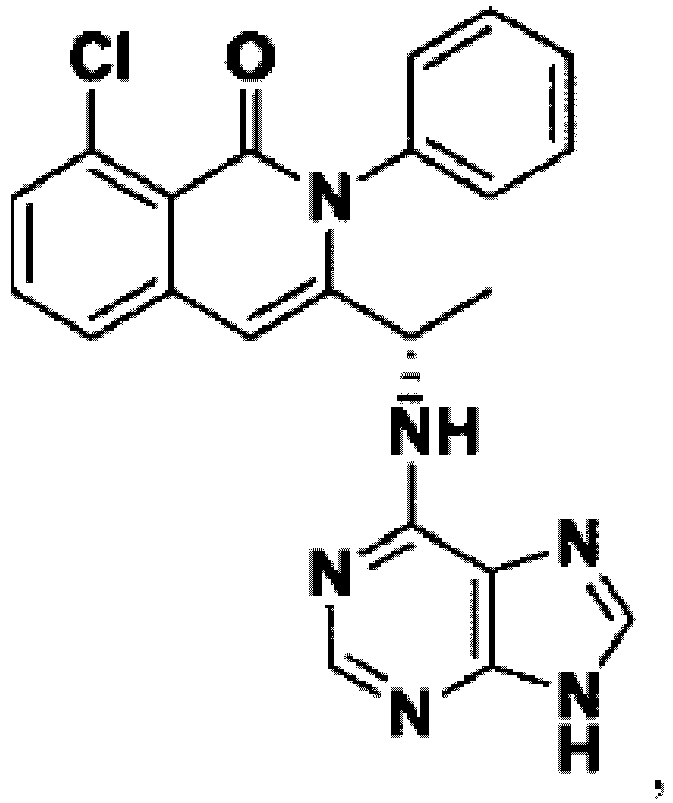
- Verbindung zur Verwendung nach Anspruch 26, wobei der BTK-Inhibitor aus Ibrutinib, GDC-0834, CGI-560, CGI-1746, HM-71224, AVL-292, ONO-4059, CNX-774 oder LFM-A13 ausgewählt ist.
- Verbindung mit der folgenden Struktur:

- Verbindung zur Verwendung nach Anspruch 28, wobei der BCL-2-Inhibitor aus ABT-199, ABT-737, ABT-263, GX15-070 (Obatoclaxmesylat) oder G3139 (Oblimersen) ausgewählt ist.
- Verbindung zur Verwendung nach einem der Ansprüche 26 bis 29, wobei die hämatologische bösartige Erkrankung rezidiviert oder refraktär ist.
- Verbindung zur Verwendung nach einem der vorhergehenden Ansprüche, wobei die Verbindung als solche verwendet wird.
- Verbindung zur Verwendung nach einem der Ansprüche 1 bis 30, wobei die pharmazeutisch annehmbare Form ein Hydrat ist.
Priority Applications (6)
| Application Number | Priority Date | Filing Date | Title |
|---|---|---|---|
| RS20181027A RS58023B2 (sr) | 2012-11-01 | 2013-11-01 | Lečenje kancera korišćenjem modulatora izoformi pi3 kinaza |
| SI201331150T SI2914296T2 (sl) | 2012-11-01 | 2013-11-01 | Zdravljenje raznih vrst raka z uporabo modulatorjev izooblik PI3-kinaze |
| HRP20181367TT HRP20181367T4 (hr) | 2012-11-01 | 2013-11-01 | Liječenje raka korištenjem modulatora izoforme pi3 kinaze |
| PL13792144T PL2914296T5 (pl) | 2012-11-01 | 2013-11-01 | Leczenie nowotworu z zastosowaniem modulatorów izoform kinazy PI3 |
| SM20180561T SMT201800561T1 (it) | 2012-11-01 | 2013-11-01 | Trattamento di cancri usando modulatori di isoforme di pi3 chinasi |
| HUS2100049C HUS2100049I1 (hu) | 2012-11-01 | 2021-11-12 | Rákok kezelése PI3 kináz izoform modulátorok alkalmazásával |
Applications Claiming Priority (9)
| Application Number | Priority Date | Filing Date | Title |
|---|---|---|---|
| US201261721432P | 2012-11-01 | 2012-11-01 | |
| US201261733852P | 2012-12-05 | 2012-12-05 | |
| US201361767606P | 2013-02-21 | 2013-02-21 | |
| US13/840,822 US20140120083A1 (en) | 2012-11-01 | 2013-03-15 | Treatment of cancers using pi3 kinase isoform modulators |
| US201361829168P | 2013-05-30 | 2013-05-30 | |
| US201361836088P | 2013-06-17 | 2013-06-17 | |
| US201361863365P | 2013-08-07 | 2013-08-07 | |
| US201361888454P | 2013-10-08 | 2013-10-08 | |
| PCT/US2013/067929 WO2014071109A1 (en) | 2012-11-01 | 2013-11-01 | Treatment of cancers using pi3 kinase isoform modulators |
Publications (3)
| Publication Number | Publication Date |
|---|---|
| EP2914296A1 EP2914296A1 (de) | 2015-09-09 |
| EP2914296B1 EP2914296B1 (de) | 2018-05-30 |
| EP2914296B2 true EP2914296B2 (de) | 2021-09-29 |
Family
ID=50628070
Family Applications (1)
| Application Number | Title | Priority Date | Filing Date |
|---|---|---|---|
| EP13792144.1A Active EP2914296B2 (de) | 2012-11-01 | 2013-11-01 | Behandlung von krebs mit pi3-kinase-isoformmodulatoren |
Country Status (29)
| Country | Link |
|---|---|
| US (3) | US20180015093A1 (de) |
| EP (1) | EP2914296B2 (de) |
| JP (3) | JP6584952B2 (de) |
| KR (1) | KR102229478B1 (de) |
| CN (1) | CN105102000B (de) |
| AU (3) | AU2013337717B2 (de) |
| BR (1) | BR112015010035A2 (de) |
| CA (1) | CA2890105C (de) |
| CY (2) | CY1122247T1 (de) |
| DK (1) | DK2914296T4 (de) |
| ES (1) | ES2691742T5 (de) |
| HR (1) | HRP20181367T4 (de) |
| HU (2) | HUE040126T2 (de) |
| IL (2) | IL291945B2 (de) |
| LT (2) | LT2914296T (de) |
| LU (1) | LUC00238I2 (de) |
| MX (2) | MX375194B (de) |
| NL (1) | NL301141I2 (de) |
| NO (1) | NO2021049I1 (de) |
| NZ (2) | NZ708563A (de) |
| PL (1) | PL2914296T5 (de) |
| PT (1) | PT2914296T (de) |
| RS (1) | RS58023B2 (de) |
| RU (2) | RU2702908C2 (de) |
| SI (1) | SI2914296T2 (de) |
| SM (1) | SMT201800561T1 (de) |
| TR (1) | TR201812261T4 (de) |
| WO (1) | WO2014071109A1 (de) |
| ZA (1) | ZA201503134B (de) |
Families Citing this family (113)
| Publication number | Priority date | Publication date | Assignee | Title |
|---|---|---|---|---|
| KR100509802B1 (ko) * | 2001-11-08 | 2005-08-23 | 미쓰비시덴키 가부시키가이샤 | 권양기 및 엘리베어터 장치 |
| US8193182B2 (en) | 2008-01-04 | 2012-06-05 | Intellikine, Inc. | Substituted isoquinolin-1(2H)-ones, and methods of use thereof |
| BRPI0906473A8 (pt) | 2008-01-04 | 2016-02-10 | Intellikine Inc | Certas entidades químicas, composições e métodos |
| WO2010043047A1 (en) | 2008-10-15 | 2010-04-22 | Angiochem Inc. | Conjugates of glp-1 agonists and uses thereof |
| CA2841142C (en) | 2010-06-23 | 2020-12-15 | Ryan D. Morin | Biomarkers for non-hodgkin lymphomas and uses thereof |
| EP3238722B1 (de) | 2011-01-10 | 2019-03-13 | Infinity Pharmaceuticals, Inc. | Festen formen von isochinolinonen |
| US20140213630A1 (en) | 2011-03-08 | 2014-07-31 | Thomas Diacovo | Methods and pharmaceutical compositions for treating lymphoid malignancy |
| PT2705029T (pt) | 2011-05-04 | 2019-02-01 | Rhizen Pharmaceuticals S A | Novos compostos como moduladores de proteína quinases |
| CN104080786A (zh) * | 2011-11-08 | 2014-10-01 | 因特利凯有限责任公司 | 使用多种药剂的治疗方案 |
| WO2013075084A1 (en) | 2011-11-18 | 2013-05-23 | Constellation Pharmaceuticals | Modulators of methyl modifying enzymes, compositions and uses thereof |
| US9085583B2 (en) | 2012-02-10 | 2015-07-21 | Constellation—Pharmaceuticals, Inc. | Modulators of methyl modifying enzymes, compositions and uses thereof |
| CA2782774A1 (en) * | 2012-07-06 | 2014-01-06 | Pharmascience Inc. | Protein kinase inhibitors |
| RU2702908C2 (ru) | 2012-11-01 | 2019-10-14 | Инфинити Фармасьютикалз, Инк. | Лечение злокачественных опухолей с использованием модуляторов изоформ pi3-киназы |
| US9446064B2 (en) | 2013-03-14 | 2016-09-20 | Epizyme, Inc. | Combination therapy for treating cancer |
| US9745305B2 (en) | 2013-03-15 | 2017-08-29 | Constellation Pharmaceuticals, Inc. | Modulators of methyl modifying enzymes, compositions and uses thereof |
| US9227978B2 (en) | 2013-03-15 | 2016-01-05 | Araxes Pharma Llc | Covalent inhibitors of Kras G12C |
| KR20160013204A (ko) * | 2013-05-30 | 2016-02-03 | 인피니티 파마슈티칼스, 인코포레이티드 | Pi3 키나아제 동형단백질 조절제를 사용하는 암의 치료 |
| ES2672018T3 (es) | 2013-07-02 | 2018-06-12 | Rhizen Pharmaceuticals S.A. | Inhibidores de proteína cinasa PI3K, particularmente inhibidores delta y/o gamma |
| JP2016525532A (ja) * | 2013-07-26 | 2016-08-25 | ベーリンガー インゲルハイム インターナショナル ゲゼルシャフト ミット ベシュレンクテル ハフツング | 骨髄異形成症候群の処置 |
| US9969716B2 (en) | 2013-08-15 | 2018-05-15 | Constellation Pharmaceuticals, Inc. | Indole derivatives as modulators of methyl modifying enzymes, compositions and uses thereof |
| WO2015054099A1 (en) * | 2013-10-08 | 2015-04-16 | Acetylon Pharmaceuticals, Inc. | Combinations of histone deacetylase inhibitors and either her2 inhibitors or pi3k inhibitors |
| TWI659021B (zh) | 2013-10-10 | 2019-05-11 | 亞瑞克西斯製藥公司 | Kras g12c之抑制劑 |
| EP3076974A1 (de) | 2013-12-05 | 2016-10-12 | Acerta Pharma B.V. | Therapeutische kombination aus einem pi3k-hemmer und einem btk-hemmer |
| MX373187B (es) | 2013-12-06 | 2020-04-13 | Epizyme Inc | Terapia de combinación para tratar cáncer. |
| US20150320754A1 (en) * | 2014-04-16 | 2015-11-12 | Infinity Pharmaceuticals, Inc. | Combination therapies |
| WO2015160975A2 (en) | 2014-04-16 | 2015-10-22 | Infinity Pharmaceuticals, Inc. | Combination therapies |
| EP2950097A1 (de) * | 2014-05-28 | 2015-12-02 | Universitätsspital Basel | Podoplanin als Biomarker der Aktivierung von PI3K/mTOR-Signalisierung in humanen Tumoren |
| EA038337B1 (ru) * | 2014-06-17 | 2021-08-11 | Эпизим, Инк. | Ингибиторы ezh2 для лечения лимфомы |
| WO2016004221A1 (en) * | 2014-07-01 | 2016-01-07 | Mayo Foundation For Medical Education And Research | Methods and materials for identifying and treating mammals resistant to proteasome inhibitor treatments |
| EA201692557A1 (ru) | 2014-07-04 | 2017-05-31 | Люпин Лимитед | Хинолизиноновые производные в качестве ингибиторов pi3k |
| WO2016022358A1 (en) * | 2014-08-08 | 2016-02-11 | The Regents Of The University Of California | Compositions and methods for reactivating latent viral infections |
| WO2016025649A1 (en) * | 2014-08-13 | 2016-02-18 | Celgene Avilomics Research, Inc. | Combinations of an erk inhibitor and a dot1l inhibitor and related methods |
| WO2016025652A1 (en) * | 2014-08-13 | 2016-02-18 | Celgene Avilomics Research, Inc. | Combinations of an erk inhibitor and a bcl-2 pathway modulator and related methods |
| WO2016025656A1 (en) * | 2014-08-13 | 2016-02-18 | Celgene Avilomics Research, Inc. | Combinations of an erk inhibitor and a pi3k inhibitor or dual pi3k/tor inhibitor and related methods |
| ES2914099T3 (es) * | 2014-08-25 | 2022-06-07 | Salk Inst For Biological Studi | Inhibidores novedosos de ULK1 y métodos de uso de los mismos |
| EP3191098A4 (de) | 2014-09-12 | 2018-04-25 | G1 Therapeutics, Inc. | Kombinationen und dosierschemen zur behandlung von rb-positiven tumoren |
| WO2016040848A1 (en) | 2014-09-12 | 2016-03-17 | G1 Therapeutics, Inc. | Treatment of rb-negative tumors using topoisomerase inhibitors in combination with cyclin dependent kinase 4/6 inhibitors |
| US9862701B2 (en) * | 2014-09-25 | 2018-01-09 | Araxes Pharma Llc | Inhibitors of KRAS G12C mutant proteins |
| WO2016090255A1 (en) * | 2014-12-05 | 2016-06-09 | Sriram Balasubramanian | Biological markers for predicting responsiveness to ibrutinib and r-chop combination therapy and methods of using the same |
| CN106146508A (zh) * | 2015-03-19 | 2016-11-23 | 浙江导明医药科技有限公司 | 优化的联合用药及其治疗癌症和自身免疫疾病的用途 |
| MX2017011990A (es) * | 2015-03-20 | 2018-06-06 | Crystal Pharmatech Co Ltd | Metodo de preparacion de la forma a cristalina de pci-32765. |
| AU2016245864C1 (en) | 2015-04-10 | 2021-09-09 | Araxes Pharma Llc | Substituted quinazoline compounds and methods of use thereof |
| KR20170134462A (ko) | 2015-04-13 | 2017-12-06 | 다이이찌 산쿄 가부시키가이샤 | Mdm2 저해제와 btk 저해제의 병용 치료법 |
| EA201890009A1 (ru) | 2015-06-10 | 2018-07-31 | Эпизайм, Инк. | Ингибиторы ezh2 для лечения лимфомы |
| EP3307326B9 (de) | 2015-06-15 | 2021-02-24 | Angiochem Inc. | Verfahren zur behandlung von leptomeningealer karzinomatose |
| TWI746449B (zh) * | 2015-07-20 | 2021-11-21 | 美商Ai治療公司 | 使用阿吡莫德治療癌症之方法 |
| CN106366085A (zh) * | 2015-07-25 | 2017-02-01 | 复旦大学 | 异喹啉酮类化合物或其盐及其制备方法和用途 |
| CN108137547B (zh) | 2015-08-03 | 2021-11-12 | 百时美施贵宝公司 | 可用作TNFα调节剂的杂环化合物 |
| US20190008859A1 (en) * | 2015-08-21 | 2019-01-10 | Acerta Pharma B.V. | Therapeutic Combinations of a MEK Inhibitor and a BTK Inhibitor |
| AU2016311136B2 (en) | 2015-08-21 | 2022-02-17 | Incyte Corporation | Combinations and uses thereof |
| WO2017040190A1 (en) | 2015-08-28 | 2017-03-09 | Constellation Pharmaceuticals, Inc. | Crystalline forms of (r)-n-((4-methoxy-6-methyl-2-oxo-1,2-dihydropyridin-3-yl)methyl)-2-methyl-1-(1-(1-(2,2,2-trifluoroethyl)piperidin-4-yl)ethyl)-1h-indole-3-carboxamide |
| WO2017058728A1 (en) | 2015-09-28 | 2017-04-06 | Araxes Pharma Llc | Inhibitors of kras g12c mutant proteins |
| WO2017058902A1 (en) | 2015-09-28 | 2017-04-06 | Araxes Pharma Llc | Inhibitors of kras g12c mutant proteins |
| EP3356359B1 (de) | 2015-09-28 | 2021-10-20 | Araxes Pharma LLC | Inhibitoren von kras-g12c-mutanten proteinen |
| WO2017058768A1 (en) | 2015-09-28 | 2017-04-06 | Araxes Pharma Llc | Inhibitors of kras g12c mutant proteins |
| WO2017068412A1 (en) | 2015-10-21 | 2017-04-27 | Otsuka Pharmaceutical Co., Ltd. | Benzolactam compounds as protein kinase inhibitors |
| CN108137592B (zh) * | 2015-11-03 | 2021-03-05 | 纽弗姆制药有限公司 | 用于治疗血癌的氘代化合物以及其组合物和方法 |
| WO2017096458A1 (en) * | 2015-12-07 | 2017-06-15 | Ontario Institute For Cancer Research (Oicr) | Immune gene signature predictive of anthracycline benefit |
| WO2017197046A1 (en) | 2016-05-10 | 2017-11-16 | C4 Therapeutics, Inc. | C3-carbon linked glutarimide degronimers for target protein degradation |
| CN121974842A (zh) | 2016-05-10 | 2026-05-05 | C4医药公司 | 用于靶蛋白降解的胺连接的c3-戊二酰亚胺降解决定子体 |
| CN109562113A (zh) | 2016-05-10 | 2019-04-02 | C4医药公司 | 用于靶蛋白降解的螺环降解决定子体 |
| CN109562107A (zh) | 2016-05-10 | 2019-04-02 | C4医药公司 | 用于靶蛋白降解的杂环降解决定子体 |
| EP3474856B1 (de) | 2016-06-24 | 2022-09-14 | Infinity Pharmaceuticals, Inc. | Kombinationstherapie |
| CN109789143A (zh) | 2016-07-01 | 2019-05-21 | G1治疗公司 | 基于嘧啶的抗增殖剂 |
| US20200069630A1 (en) * | 2016-07-11 | 2020-03-05 | Hennipen Life Sciences, Llc | Compositions for sexually transmitted diseases |
| US10646488B2 (en) | 2016-07-13 | 2020-05-12 | Araxes Pharma Llc | Conjugates of cereblon binding compounds and G12C mutant KRAS, HRAS or NRAS protein modulating compounds and methods of use thereof |
| EP3496720A4 (de) * | 2016-08-12 | 2020-06-10 | Nanjing Gator Meditech Company, Ltd. | Proteinkinaseregulatoren |
| CN109982687A (zh) * | 2016-09-19 | 2019-07-05 | 梅制药公司 | 联合疗法 |
| WO2018054782A1 (en) * | 2016-09-23 | 2018-03-29 | Bayer Pharma Aktiengesellschaft | Combination of pi3k-inhibitors |
| JP2019529484A (ja) | 2016-09-29 | 2019-10-17 | アラクセス ファーマ エルエルシー | Kras g12c変異体タンパク質の阻害剤 |
| WO2018064797A1 (zh) * | 2016-10-05 | 2018-04-12 | 杭州领业医药科技有限公司 | Acp-196的晶型及其制备方法和药物组合物 |
| WO2018075598A1 (en) | 2016-10-19 | 2018-04-26 | Constellation Pharmaceuticals, Inc. | Synthesis of inhibitors of ezh2 |
| CN110177553A (zh) | 2016-11-17 | 2019-08-27 | 北卡罗来纳大学教堂山分校 | 烷基吡咯并嘧啶类似物及其制备和使用方法 |
| MX394882B (es) | 2016-12-07 | 2025-03-24 | Beigene Ltd | Derivados de imidazo[1,5-a]pirazina como inhibidores de fosfatidilinositol-4,5-bisfosfato 3-quinasadelta (pi3kdelta) |
| GB201706327D0 (en) | 2017-04-20 | 2017-06-07 | Otsuka Pharma Co Ltd | A pharmaceutical compound |
| TW201906832A (zh) | 2017-05-25 | 2019-02-16 | 美商亞瑞克西斯製藥公司 | 用於癌症治療之化合物及其使用方法 |
| US20230201212A1 (en) * | 2017-06-13 | 2023-06-29 | Epizyme, Inc. | Inhibitors of ezh2 and methods of use thereof |
| EP4717317A3 (de) | 2017-06-20 | 2026-06-03 | C4 Therapeutics, Inc. | N/o-verknüpfte degrone und degronimere zum proteinabbau |
| EP3645001B1 (de) | 2017-06-29 | 2024-07-03 | G1 Therapeutics, Inc. | Morphe formen von git38 und herstellungsverfahren dafür |
| GB201710851D0 (en) * | 2017-07-06 | 2017-08-23 | Galápagos Nv | Novel compounds and pharmaceutical compositions thereof for the treatment of fibrosis |
| BR112020001949A2 (pt) * | 2017-07-31 | 2020-07-28 | The Trustees Of Columbia University In The City Of New York | composto, composição farmacêutica, e, métodos para tratar um linfoma não hodgkin e para tratar um linfoma ou uma leucemia |
| NZ761680A (en) * | 2017-09-08 | 2023-03-31 | Beigene Ltd | Imidazo[1,5-a]pyrazine derivatives as pi3kdelta inhibitors |
| US11597933B2 (en) | 2017-11-29 | 2023-03-07 | The Trustees Of Columbia University In The City Of New York | Combination therapy of lymphoma |
| CN109942556A (zh) * | 2017-12-21 | 2019-06-28 | 上海青煜医药科技有限公司 | 嘧啶酮化合物及其应用 |
| WO2019139399A1 (ko) * | 2018-01-12 | 2019-07-18 | 보령제약 주식회사 | Pi3 키나아제 억제제 및 세포독성 항암제를 포함하는 암의 예방 또는 치료용 약학적 조성물 |
| WO2019183003A1 (en) * | 2018-03-18 | 2019-09-26 | The University Of North Carolina At Chapel Hill | Methods and assays for endometrial diseases |
| CN111902141A (zh) | 2018-03-26 | 2020-11-06 | C4医药公司 | 用于ikaros降解的羟脑苷脂结合剂 |
| US20210148894A1 (en) * | 2018-04-13 | 2021-05-20 | Bionomics Limited | Method of monitoring response to a treatment |
| CN108743947B (zh) * | 2018-07-04 | 2020-12-15 | 复旦大学附属肿瘤医院 | 一种治疗b细胞淋巴瘤的药物组合物 |
| US10579964B1 (en) * | 2018-08-21 | 2020-03-03 | Intelligrated Headquarters, Llc | Method, apparatus and system for goods replenishment |
| WO2020051235A1 (en) | 2018-09-04 | 2020-03-12 | C4 Therapeutics, Inc. | Compounds for the degradation of brd9 or mth1 |
| EP3897631A4 (de) | 2018-12-20 | 2022-11-23 | C4 Therapeutics, Inc. | Gezielter proteinabbau |
| MX2021011507A (es) | 2019-03-22 | 2021-12-15 | Achillion Pharmaceuticals Inc | Compuestos farmaceuticos para el tratamiento de trastornos mediados por complemento. |
| KR102947433B1 (ko) | 2019-04-12 | 2026-04-06 | 씨4 테라퓨틱스, 인코포레이티드 | 이카로스 및 아이올로스의 트리시클릭 분해제 |
| KR20200129704A (ko) * | 2019-05-09 | 2020-11-18 | 보령제약 주식회사 | Pi3k 저해제의 결정다형 및 이의 제조방법 |
| EP4054585A1 (de) | 2019-11-05 | 2022-09-14 | Abbvie Inc. | Dosierungsschemata zur verwendung beim behandeln von myelofibrose und mpn-bezogenen störungen mit navitoclax |
| CN110975919B (zh) * | 2019-12-25 | 2021-06-01 | 福州大学 | 一种氮掺杂碳量子点原位生长脱硝抗硫催化剂及其制备方法 |
| CN115279339A (zh) * | 2020-01-10 | 2022-11-01 | 美国安进公司 | 稳定的无环糊精的卡非佐米配制品 |
| CN115151533B (zh) | 2020-01-10 | 2025-08-08 | 医疗免疫工程公司 | Mek抑制剂及其治疗用途 |
| US12594277B2 (en) | 2020-02-14 | 2026-04-07 | Salk Institute For Biological Studies | Macrocyclic ULK1/2 inhibitors |
| CN111402523A (zh) * | 2020-03-24 | 2020-07-10 | 宋钰堃 | 一种基于面部影像识别的医疗报警系统及方法 |
| JP7853532B2 (ja) | 2020-05-19 | 2026-04-30 | ファーマコスモス ホールディング エー/エス | 医学的障害を治療するためのサイクリン依存性キナーゼ阻害化合物 |
| EP4157281A4 (de) * | 2020-05-27 | 2024-11-27 | Duke University | Zusammensetzungen und verfahren zur sensibilisierung von akuter myeloischer leukämie auf chemotherapie |
| EP4185279A4 (de) * | 2020-07-24 | 2024-05-01 | Secura Bio, Inc. | Behandlung von krebs mit pi3-kinase-isoformmodulatoren |
| CA3193488A1 (en) | 2020-09-23 | 2022-03-31 | Jason Allan Wiles | Pharmaceutical compounds for the treatment of complement mediated disorders |
| CN114432490B (zh) * | 2021-11-10 | 2023-01-06 | 北京大学口腔医学院 | 3d打印材料及其制备方法和应用 |
| CN119698276A (zh) * | 2022-06-07 | 2025-03-25 | 蓝腾制药公司 | 用酰基富烯与依鲁替尼或硼替佐米的组合治疗癌症 |
| CN114788830B (zh) * | 2022-06-08 | 2024-01-23 | 东阳市人民医院 | 一种能够抑制弓形虫增殖的小分子抑制剂的应用 |
| CN115177622B (zh) * | 2022-07-19 | 2024-09-17 | 中南大学湘雅二医院 | 多个化合物在制备治疗骨髓增殖性肿瘤的药物中的应用 |
| WO2024206895A1 (en) * | 2023-03-31 | 2024-10-03 | Rectify Pharmaceuticals, Inc. | Pyrazolo-pyrimidine compounds and their use in treating medical conditions |
| IL328714A (en) * | 2023-12-05 | 2026-07-01 | Valo Health Inc | S1P1 receptor agonists and their uses |
| CN120774920A (zh) * | 2024-04-08 | 2025-10-14 | 浙江大学 | PI3Kδ-mTOR双靶点抑制剂及其制备方法和应用 |
| CN118903430A (zh) * | 2024-08-16 | 2024-11-08 | 清华德人西安幸福制药有限公司 | PI3K/Akt在制备预防缓解或治疗血虚症药物中的应用 |
Family Cites Families (683)
| Publication number | Priority date | Publication date | Assignee | Title |
|---|---|---|---|---|
| GB812366A (en) | 1955-08-18 | 1959-04-22 | Wellcome Found | Improvements in and relating to derivatives of pyrimidine and the preparation thereof |
| GB937725A (en) | 1960-05-11 | 1963-09-25 | Ciba Ltd | Pyrazolo[3:4-d]pyrimidines |
| US3536809A (en) | 1969-02-17 | 1970-10-27 | Alza Corp | Medication method |
| US3598123A (en) | 1969-04-01 | 1971-08-10 | Alza Corp | Bandage for administering drugs |
| DE2139107A1 (de) | 1971-08-04 | 1973-02-15 | Merck Patent Gmbh | Heterocyclisch substituierte adenosinverbindungen |
| US3845770A (en) | 1972-06-05 | 1974-11-05 | Alza Corp | Osmatic dispensing device for releasing beneficial agent |
| US3916899A (en) | 1973-04-25 | 1975-11-04 | Alza Corp | Osmotic dispensing device with maximum and minimum sizes for the passageway |
| US4008719A (en) | 1976-02-02 | 1977-02-22 | Alza Corporation | Osmotic system having laminar arrangement for programming delivery of active agent |
| US4270537A (en) | 1979-11-19 | 1981-06-02 | Romaine Richard A | Automatic hypodermic syringe |
| IT1153216B (it) | 1981-10-16 | 1987-01-14 | Schering Ag | Procedimento per la preparazione di composti cianoeterociclici |
| DE3244594A1 (de) | 1982-12-02 | 1984-06-07 | Hoechst Ag, 6230 Frankfurt | 1-phenylisochinolinderivate und verfahren zu ihrer herstellung, diese verbindung enthaltende pharmazeutische praeparate und deren anwendung |
| DE3406533A1 (de) | 1984-02-23 | 1985-08-29 | Boehringer Mannheim Gmbh, 6800 Mannheim | Verwendung von adenosin-derivaten als antiallergica und arzneimittel, die diese enthalten |
| US5310731A (en) | 1984-06-28 | 1994-05-10 | Whitby Research, Inc. | N-6 substituted-5'-(N-substitutedcarboxamido)adenosines as cardiac vasodilators and antihypertensive agents |
| KR890002631B1 (ko) | 1984-10-04 | 1989-07-21 | 몬산토 캄파니 | 생물학적으로 활성인 소마토트로핀을 지속적으로 유리하는 조성물 |
| US4795627A (en) | 1984-10-18 | 1989-01-03 | University Of Pittsburgh | Tritium labelled N-mustard type compounds and a process for their production |
| IE58110B1 (en) | 1984-10-30 | 1993-07-14 | Elan Corp Plc | Controlled release powder and process for its preparation |
| US4656159A (en) | 1984-10-31 | 1987-04-07 | Georgetown University | Galactose-C-6 nitrogen mustard compounds and their uses |
| JPS61109797A (ja) | 1984-11-01 | 1986-05-28 | Yuki Gosei Yakuhin Kogyo Kk | 標識化ヌクレオチドおよび標識化ポリヌクレオチド |
| US4596556A (en) | 1985-03-25 | 1986-06-24 | Bioject, Inc. | Hypodermic injection apparatus |
| US5023252A (en) | 1985-12-04 | 1991-06-11 | Conrex Pharmaceutical Corporation | Transdermal and trans-membrane delivery of drugs |
| CA1283827C (en) | 1986-12-18 | 1991-05-07 | Giorgio Cirelli | Appliance for injection of liquid formulations |
| GB8704027D0 (en) | 1987-02-20 | 1987-03-25 | Owen Mumford Ltd | Syringe needle combination |
| US4992445A (en) | 1987-06-12 | 1991-02-12 | American Cyanamid Co. | Transdermal delivery of pharmaceuticals |
| US5001139A (en) | 1987-06-12 | 1991-03-19 | American Cyanamid Company | Enchancers for the transdermal flux of nivadipine |
| US4940460A (en) | 1987-06-19 | 1990-07-10 | Bioject, Inc. | Patient-fillable and non-invasive hypodermic injection device assembly |
| US4790824A (en) | 1987-06-19 | 1988-12-13 | Bioject, Inc. | Non-invasive hypodermic injection device |
| US4941880A (en) | 1987-06-19 | 1990-07-17 | Bioject, Inc. | Pre-filled ampule and non-invasive hypodermic injection device assembly |
| US5339163A (en) | 1988-03-16 | 1994-08-16 | Canon Kabushiki Kaisha | Automatic exposure control device using plural image plane detection areas |
| US5073543A (en) | 1988-07-21 | 1991-12-17 | G. D. Searle & Co. | Controlled release formulations of trophic factors in ganglioside-lipsome vehicle |
| WO1990003370A1 (en) | 1988-09-28 | 1990-04-05 | Microprobe Corporation | DERIVATIVES OF PYRAZOLO[3,4-d]PYRIMIDINE |
| FR2638359A1 (fr) | 1988-11-03 | 1990-05-04 | Tino Dalto | Guide de seringue avec reglage de la profondeur de penetration de l'aiguille dans la peau |
| GB8827305D0 (en) | 1988-11-23 | 1988-12-29 | British Bio Technology | Compounds |
| IT1229203B (it) | 1989-03-22 | 1991-07-25 | Bioresearch Spa | Impiego di acido 5 metiltetraidrofolico, di acido 5 formiltetraidrofolico e dei loro sali farmaceuticamente accettabili per la preparazione di composizioni farmaceutiche in forma a rilascio controllato attive nella terapia dei disturbi mentali organici e composizioni farmaceutiche relative. |
| PH30995A (en) | 1989-07-07 | 1997-12-23 | Novartis Inc | Sustained release formulations of water soluble peptides. |
| US5428125A (en) | 1989-07-17 | 1995-06-27 | The Dow Chemical Company | Mesogenic polycyanates and thermosets thereof |
| US5442039A (en) | 1989-07-17 | 1995-08-15 | The Dow Chemical Company | Mesogenic polycyanates and thermosets thereof |
| US5646128A (en) | 1989-09-15 | 1997-07-08 | Gensia, Inc. | Methods for treating adenosine kinase related conditions |
| US5795977A (en) | 1989-09-15 | 1998-08-18 | Metabasis Therapeutics, Inc. | Water soluble adenosine kinase inhibitors |
| US5763597A (en) | 1989-09-15 | 1998-06-09 | Metabasis Therapeutics, Inc. | Orally active adenosine kinase inhibitors |
| US5721356A (en) | 1989-09-15 | 1998-02-24 | Gensia, Inc. | Orally active adenosine kinase inhibitors |
| US5763596A (en) | 1989-09-15 | 1998-06-09 | Metabasis Therapeutics, Inc. | C-4' modified adenosine kinase inhibitors |
| US5674998A (en) | 1989-09-15 | 1997-10-07 | Gensia Inc. | C-4' modified adenosine kinase inhibitors |
| US5120548A (en) | 1989-11-07 | 1992-06-09 | Merck & Co., Inc. | Swelling modulated polymeric drug delivery device |
| US5064413A (en) | 1989-11-09 | 1991-11-12 | Bioject, Inc. | Needleless hypodermic injection device |
| US5312335A (en) | 1989-11-09 | 1994-05-17 | Bioject Inc. | Needleless hypodermic injection device |
| CA2071897A1 (en) | 1989-12-28 | 1991-06-29 | Richard A. Glennon | Sigma receptor ligands and the use thereof |
| JPH04211063A (ja) | 1990-03-05 | 1992-08-03 | Takeda Chem Ind Ltd | 縮合三環性複素環化合物、その製造法、用途及び中間体 |
| GB9009542D0 (en) | 1990-04-27 | 1990-06-20 | Beecham Group Plc | Novel compounds |
| US5733566A (en) | 1990-05-15 | 1998-03-31 | Alkermes Controlled Therapeutics Inc. Ii | Controlled release of antiparasitic agents in animals |
| GB9113137D0 (en) | 1990-07-13 | 1991-08-07 | Ici Plc | Thioxo heterocycles |
| US5563257A (en) | 1990-08-20 | 1996-10-08 | Boehringer Mannheim Gmbh | Phospholipid derivatives of nucleosides |
| DE4026265A1 (de) | 1990-08-20 | 1992-02-27 | Boehringer Mannheim Gmbh | Neue phospholipid-derivate von nucleosiden, deren herstellung sowie deren verwendung als antivirale arzneimittel |
| US5190521A (en) | 1990-08-22 | 1993-03-02 | Tecnol Medical Products, Inc. | Apparatus and method for raising a skin wheal and anesthetizing skin |
| US5561134A (en) | 1990-09-25 | 1996-10-01 | Rhone-Poulenc Rorer Pharmaceuticals Inc. | Compounds having antihypertensive, cardioprotective, anti-ischemic and antilipolytic properties |
| ES2095960T3 (es) | 1990-09-25 | 1997-03-01 | Rhone Poulenc Rorer Int | Compuestos que tienen propiedades antihipertensivas y antiisquemicas. |
| US5652366A (en) | 1990-09-25 | 1997-07-29 | Rhone-Poulenc Rorer Pharmaceuticals Inc. | DI (1R)-(-)camphosulfonic acid) salt, preparation thereof and use thereof |
| US5527288A (en) | 1990-12-13 | 1996-06-18 | Elan Medical Technologies Limited | Intradermal drug delivery device and method for intradermal delivery of drugs |
| GB9103839D0 (en) | 1991-02-23 | 1991-04-10 | Smithkline Beecham Plc | Pharmaceuticals |
| US5480883A (en) | 1991-05-10 | 1996-01-02 | Rhone-Poulenc Rorer Pharmaceuticals Inc. | Bis mono- and bicyclic aryl and heteroaryl compounds which inhibit EGF and/or PDGF receptor tyrosine kinase |
| US5721237A (en) | 1991-05-10 | 1998-02-24 | Rhone-Poulenc Rorer Pharmaceuticals Inc. | Protein tyrosine kinase aryl and heteroaryl quinazoline compounds having selective inhibition of HER-2 autophosphorylation properties |
| US6645969B1 (en) | 1991-05-10 | 2003-11-11 | Aventis Pharmaceuticals Inc. | Aryl and heteroaryl quinazoline compounds which inhibit CSF-1R receptor tyrosine kinase |
| USRE37650E1 (en) | 1991-05-10 | 2002-04-09 | Aventis Pharmacetical Products, Inc. | Aryl and heteroaryl quinazoline compounds which inhibit CSF-1R receptor tyrosine kinase |
| US5710158A (en) | 1991-05-10 | 1998-01-20 | Rhone-Poulenc Rorer Pharmaceuticals Inc. | Aryl and heteroaryl quinazoline compounds which inhibit EGF and/or PDGF receptor tyrosine kinase |
| DE69222637T2 (de) | 1991-05-10 | 1998-02-26 | Rhone Poulenc Rorer Int | Bis mono- und bicyclische aryl- und heteroarylderivate mit inhibierender wirkung auf die egf und/oder pdgf-rezeptor tyrosinkinase |
| US5714493A (en) | 1991-05-10 | 1998-02-03 | Rhone-Poulenc Rorer Pharmaceuticals, Inc. | Aryl and heteroaryl quinazoline compounds which inhibit CSF-1R receptor tyrosine kinase |
| GB9118204D0 (en) | 1991-08-23 | 1991-10-09 | Weston Terence E | Needle-less injector |
| SE9102652D0 (sv) | 1991-09-13 | 1991-09-13 | Kabi Pharmacia Ab | Injection needle arrangement |
| US5580578A (en) | 1992-01-27 | 1996-12-03 | Euro-Celtique, S.A. | Controlled release formulations coated with aqueous dispersions of acrylic polymers |
| US5916891A (en) | 1992-01-13 | 1999-06-29 | Smithkline Beecham Corporation | Pyrimidinyl imidazoles |
| IL104369A0 (en) | 1992-01-13 | 1993-05-13 | Smithkline Beecham Corp | Novel compounds and compositions |
| DE4204031A1 (de) | 1992-02-12 | 1993-08-19 | Boehringer Mannheim Gmbh | Neue lipidphosphonsaeure-nucleosid-konjugate sowie deren verwendung als antivirale arzneimittel |
| DE4204032A1 (de) | 1992-02-12 | 1993-08-19 | Boehringer Mannheim Gmbh | Neue liponucleotide, deren herstellunmg sowie deren verwendung als antivirale arzneimittel |
| US5328483A (en) | 1992-02-27 | 1994-07-12 | Jacoby Richard M | Intradermal injection device with medication and needle guard |
| WO1993018186A1 (en) | 1992-03-04 | 1993-09-16 | The Regents Of The University Of California | Comparative genomic hybridization (cgh) |
| WO1993018035A1 (en) | 1992-03-04 | 1993-09-16 | Abbott Laboratories | Angiotensin ii receptor antagonists |
| JP2737518B2 (ja) | 1992-03-16 | 1998-04-08 | 富士通株式会社 | 赤外線検知器の冷却構造 |
| US5294612A (en) | 1992-03-30 | 1994-03-15 | Sterling Winthrop Inc. | 6-heterocyclyl pyrazolo [3,4-d]pyrimidin-4-ones and compositions and method of use thereof |
| CA2133075A1 (en) | 1992-04-07 | 1993-10-14 | Craig B. Thompson | CD28 Pathway Immunoregulation |
| GB9208135D0 (en) | 1992-04-13 | 1992-05-27 | Ludwig Inst Cancer Res | Polypeptides having kinase activity,their preparation and use |
| AU4115693A (en) | 1992-04-24 | 1993-11-29 | Sri International | In vivo homologous sequence targeting in eukaryotic cells |
| RU2121766C1 (ru) | 1992-06-19 | 1998-11-10 | Ханивелл Инк. | Инфракрасная камера и способ считывания изменений удельного сопротивления пассивных принимающих излучение элементов |
| US5383851A (en) | 1992-07-24 | 1995-01-24 | Bioject Inc. | Needleless hypodermic injection device |
| US6057305A (en) | 1992-08-05 | 2000-05-02 | Institute Of Organic Chemistry And Biochemistry Of The Academy Of Sciences Of The Czech Republic | Antiretroviral enantiomeric nucleotide analogs |
| US5569189A (en) | 1992-09-28 | 1996-10-29 | Equidyne Systems, Inc. | hypodermic jet injector |
| US5334144A (en) | 1992-10-30 | 1994-08-02 | Becton, Dickinson And Company | Single use disposable needleless injector |
| TW333456B (en) | 1992-12-07 | 1998-06-11 | Takeda Pharm Ind Co Ltd | A pharmaceutical composition of sustained-release preparation the invention relates to a pharmaceutical composition of sustained-release preparation which comprises a physiologically active peptide. |
| TW370529B (en) | 1992-12-17 | 1999-09-21 | Pfizer | Pyrazolopyrimidines |
| US5455258A (en) | 1993-01-06 | 1995-10-03 | Ciba-Geigy Corporation | Arylsulfonamido-substituted hydroxamic acids |
| US5591767A (en) | 1993-01-25 | 1997-01-07 | Pharmetrix Corporation | Liquid reservoir transdermal patch for the administration of ketorolac |
| IL108523A0 (en) | 1993-02-03 | 1994-05-30 | Gensia Inc | Pharmaceutical compositions containing adenosine kinase inhibitors for preventing or treating conditions involving inflammatory responses and pain |
| WO1994018215A1 (en) | 1993-02-03 | 1994-08-18 | Gensia, Inc. | Adenosine kinase inhibitors comprising lyxofuranosyl derivatives |
| GB9308957D0 (en) | 1993-04-30 | 1993-06-16 | Cancer Res Campaign Tech | Novel produgs |
| CA2164226C (en) | 1993-06-04 | 2011-02-08 | Carl H. June | Methods for selectively stimulating proliferation of t cells |
| US6087324A (en) | 1993-06-24 | 2000-07-11 | Takeda Chemical Industries, Ltd. | Sustained-release preparation |
| US5504103A (en) | 1993-08-25 | 1996-04-02 | Eli Lilly And Company | Inhibition of phosphatidylinositol 3-kinase with 17 β-hydroxywortmannin and analogs thereof |
| US5525503A (en) | 1993-09-28 | 1996-06-11 | Dana-Farber Cancer Institute, Inc. | Signal transduction via CD28 |
| AU6672794A (en) | 1993-11-05 | 1995-05-23 | Biochem Pharma Inc. | Antineoplastic heteronaphthoquinones |
| US5656643A (en) | 1993-11-08 | 1997-08-12 | Rhone-Poulenc Rorer Pharmaceuticals Inc. | Bis mono-and bicyclic aryl and heteroaryl compounds which inhibit EGF and/or PDGF receptor tyrosine kinase |
| US5624679A (en) | 1993-12-01 | 1997-04-29 | Marine Polymer Technologies, Inc. | Methods and compositions for poly-β-1-4-N-acetylglucosamine biological barriers |
| SE9400135D0 (sv) | 1994-01-19 | 1994-01-19 | Stephan Tomac | Ryggbänk |
| IL112249A (en) | 1994-01-25 | 2001-11-25 | Warner Lambert Co | Pharmaceutical compositions containing di and tricyclic pyrimidine derivatives for inhibiting tyrosine kinases of the epidermal growth factor receptor family and some new such compounds |
| US5654307A (en) | 1994-01-25 | 1997-08-05 | Warner-Lambert Company | Bicyclic compounds capable of inhibiting tyrosine kinases of the epidermal growth factor receptor family |
| WO1995024176A1 (en) | 1994-03-07 | 1995-09-14 | Bioject, Inc. | Ampule filling device |
| US5466220A (en) | 1994-03-08 | 1995-11-14 | Bioject, Inc. | Drug vial mixing and transfer device |
| US6632789B1 (en) | 1994-04-29 | 2003-10-14 | The United States Of America As Represented By The Secretary Of The Navy | Methods for modulating T cell responses by manipulating intracellular signal transduction |
| DE4418690A1 (de) | 1994-05-28 | 1996-01-11 | Boehringer Mannheim Gmbh | Neue Lipidester von Nucleosid-Monophosphaten und deren Verwendung als immunsuppressive Arzneimittel |
| IT1270594B (it) | 1994-07-07 | 1997-05-07 | Recordati Chem Pharm | Composizione farmaceutica a rilascio controllato di moguisteina in sospensione liquida |
| US6323201B1 (en) | 1994-12-29 | 2001-11-27 | The Regents Of The University Of California | Compounds for inhibition of ceramide-mediated signal transduction |
| US5599302A (en) | 1995-01-09 | 1997-02-04 | Medi-Ject Corporation | Medical injection system and method, gas spring thereof and launching device using gas spring |
| US5863949A (en) | 1995-03-08 | 1999-01-26 | Pfizer Inc | Arylsulfonylamino hydroxamic acid derivatives |
| US6312894B1 (en) | 1995-04-03 | 2001-11-06 | Epoch Pharmaceuticals, Inc. | Hybridization and mismatch discrimination using oligonucleotides conjugated to minor groove binders |
| JP4249804B2 (ja) | 1995-04-03 | 2009-04-08 | ノバルティス・アクチエンゲゼルシャフト | ピラゾール誘導体およびその製造法 |
| CA2218503C (en) | 1995-04-20 | 2001-07-24 | Pfizer Inc. | Arylsulfonyl hydroxamic acid derivatives |
| US5977061A (en) | 1995-04-21 | 1999-11-02 | Institute Of Organic Chemistry And Biochemistry Of The Academy Of Sciences Of The Czech Republic | N6 - substituted nucleotide analagues and their use |
| JPH08295667A (ja) | 1995-04-27 | 1996-11-12 | Takeda Chem Ind Ltd | 複素環化合物、その製造法および剤 |
| WO1996037777A1 (en) | 1995-05-23 | 1996-11-28 | Nelson Randall W | Mass spectrometric immunoassay |
| US5593997A (en) | 1995-05-23 | 1997-01-14 | Pfizer Inc. | 4-aminopyrazolo(3-,4-D)pyrimidine and 4-aminopyrazolo-(3,4-D)pyridine tyrosine kinase inhibitors |
| US5730723A (en) | 1995-10-10 | 1998-03-24 | Visionary Medical Products Corporation, Inc. | Gas pressured needle-less injection device and method |
| US6403599B1 (en) | 1995-11-08 | 2002-06-11 | Pfizer Inc | Corticotropin releasing factor antagonists |
| AU6158096A (en) | 1995-06-07 | 1996-12-30 | G.D. Searle & Co. | Spironolactone and angiotensin ii antagonist combination the rapy for treatment of congestive heart failure |
| US5665721A (en) | 1995-06-07 | 1997-09-09 | Abbott Laboratories | Heterocyclic substituted cyclopentane compounds |
| AU5982296A (en) | 1995-06-07 | 1996-12-30 | G.D. Searle & Co. | Method to treat cardiofibrosis with a combination of an angi otensin ii antagonist and spironolactone |
| CN1142793C (zh) | 1995-06-07 | 2004-03-24 | G·D·瑟尔公司 | 环氧-甾族化合物醛甾酮拮抗剂和血管紧张肽ⅱ拮抗剂联合治疗用于治疗充血性心衰 |
| DE69632684T2 (de) | 1995-06-27 | 2005-06-09 | Takeda Pharmaceutical Co. Ltd. | Verfahren zur herstellung von zubereitungen mit verzögerter freisetzung |
| TW448055B (en) | 1995-09-04 | 2001-08-01 | Takeda Chemical Industries Ltd | Method of production of sustained-release preparation |
| JP2909418B2 (ja) | 1995-09-18 | 1999-06-23 | 株式会社資生堂 | 薬物の遅延放出型マイクロスフイア |
| US5763885A (en) | 1995-12-19 | 1998-06-09 | Loral Infrared & Imaging Systems, Inc. | Method and apparatus for thermal gradient stabilization of microbolometer focal plane arrays |
| JPH09143163A (ja) | 1995-11-29 | 1997-06-03 | Fuji Photo Film Co Ltd | 含窒素ヘテロ芳香族アミド類の製造方法 |
| DK0780386T3 (da) | 1995-12-20 | 2003-02-03 | Hoffmann La Roche | Matrixmetalloproteaseinhibitorer |
| US5893397A (en) | 1996-01-12 | 1999-04-13 | Bioject Inc. | Medication vial/syringe liquid-transfer apparatus |
| US5980945A (en) | 1996-01-16 | 1999-11-09 | Societe De Conseils De Recherches Et D'applications Scientifique S.A. | Sustained release drug formulations |
| US5747235A (en) | 1996-01-26 | 1998-05-05 | Eastman Kodak Company | Silver halide light sensitive emulsion layer having enhanced photographic sensitivity |
| CH690773A5 (de) | 1996-02-01 | 2001-01-15 | Novartis Ag | Pyrrolo(2,3-d)pyrimide und ihre Verwendung. |
| DE19603576A1 (de) | 1996-02-01 | 1997-08-07 | Bayer Ag | Acylierte 4-Amino und 4-Hydrazinopyrimidine |
| GB2310952B (en) | 1996-03-05 | 1998-08-19 | Mitsubishi Electric Corp | Infrared detector |
| GB9607549D0 (en) | 1996-04-11 | 1996-06-12 | Weston Medical Ltd | Spring-powered dispensing device |
| ES2184960T3 (es) | 1996-05-15 | 2003-04-16 | Pfizer | Nuevas pirimidin-4-onas-(5,6)-heteroaril condensadas 2,3 disustituidas. |
| GB9611460D0 (en) | 1996-06-01 | 1996-08-07 | Ludwig Inst Cancer Res | Novel lipid kinase |
| IL127559A0 (en) | 1996-06-20 | 1999-10-28 | Univ Texas | Compounds and methods for providing pharmacologically active preparations and uses thereof |
| US6264970B1 (en) | 1996-06-26 | 2001-07-24 | Takeda Chemical Industries, Ltd. | Sustained-release preparation |
| EP0923585B1 (de) | 1996-07-18 | 2002-05-08 | Pfizer Inc. | Matrix metalloprotease-inhibitoren auf basis von phosphinsäuren |
| EP0922030A1 (de) | 1996-08-23 | 1999-06-16 | Pfizer Inc. | Arylsulphonylamino-hydroxamsäure-derivate |
| US6419961B1 (en) | 1996-08-29 | 2002-07-16 | Takeda Chemical Industries, Ltd. | Sustained release microcapsules of a bioactive substance and a biodegradable polymer |
| CA2217134A1 (en) | 1996-10-09 | 1998-04-09 | Sumitomo Pharmaceuticals Co., Ltd. | Sustained release formulation |
| US5994358A (en) | 1996-10-23 | 1999-11-30 | Zymogenetics, Inc. | Compositions and methods for treating bone deficit conditions |
| US5922753A (en) | 1996-10-23 | 1999-07-13 | Zymogenetics, Inc. | Methods for treating bone deficit conditions with benzothiazole |
| US6153631A (en) | 1996-10-23 | 2000-11-28 | Zymogenetics, Inc. | Compositions and methods for treating bone deficit conditions |
| US5965573A (en) | 1996-10-23 | 1999-10-12 | Zymogenetics, Inc. | Compositions and methods for treating bone deficit conditions |
| US5919808A (en) | 1996-10-23 | 1999-07-06 | Zymogenetics, Inc. | Compositions and methods for treating bone deficit conditions |
| US6342514B1 (en) | 1996-10-23 | 2002-01-29 | Zymogenetics, Inc. | Compositions and methods for treating bone deficit conditions |
| US5990169A (en) | 1996-10-23 | 1999-11-23 | Zymogenetics, Inc. | Compositions and methods for treating bone deficit conditions |
| US6251901B1 (en) | 1996-10-23 | 2001-06-26 | Zymogenetics, Inc. | Compositions and methods for treating bone deficit conditions |
| US5948776A (en) | 1996-10-23 | 1999-09-07 | Zymogenetic, Inc. | Compositions and methods for treating bone deficit conditions |
| ES2221019T3 (es) | 1996-10-31 | 2004-12-16 | Takeda Chemical Industries, Ltd. | Preparacion de liberacion mantenida. |
| US5858753A (en) | 1996-11-25 | 1999-01-12 | Icos Corporation | Lipid kinase |
| JP4094066B2 (ja) | 1996-12-06 | 2008-06-04 | バーテックス ファーマシューティカルズ インコーポレイテッド | インターロイキン−1β変換酵素のインヒビター |
| EP0946169B1 (de) | 1996-12-20 | 2003-02-26 | Takeda Chemical Industries, Ltd. | Verfahren zur herstellung einer zusammensetzung mit verzoegerter abgabe |
| US6093737A (en) | 1996-12-30 | 2000-07-25 | Merck & Co., Inc. | Inhibitors of farnesyl-protein transferase |
| US6077864A (en) | 1997-01-06 | 2000-06-20 | Pfizer Inc. | Cyclic sulfone derivatives |
| JPH10206995A (ja) | 1997-01-21 | 1998-08-07 | Konica Corp | ハロゲン化銀写真感光材料 |
| US5891474A (en) | 1997-01-29 | 1999-04-06 | Poli Industria Chimica, S.P.A. | Time-specific controlled release dosage formulations and method of preparing same |
| HUP0000852A2 (hu) | 1997-02-03 | 2001-05-28 | Pfizer Products Inc. | Aril-szulfonil-amino-hidroxámsav-származékok, valamint e vegyületeket tartalmazó gyógyászati készítmények |
| EP1017823B1 (de) | 1997-02-07 | 2004-07-14 | Princeton University | Veränderte proteinkinasen, die modifizierte nukleotidtriphosphat substrate verwenden können |
| JP2000507975A (ja) | 1997-02-07 | 2000-06-27 | ファイザー・インク | N−ヒドロキシ−β−スルホニルプロピオンアミド誘導体類及びそれらのマトリックスメタロプロテイナーゼ阻害薬としての使用 |
| NZ336836A (en) | 1997-02-11 | 2001-02-23 | Pfizer | Arylsulfonyl hydroxamic acid derivatives suitable for a broad range of medicinal treatments |
| US7863444B2 (en) | 1997-03-19 | 2011-01-04 | Abbott Laboratories | 4-aminopyrrolopyrimidines as kinase inhibitors |
| BR9808281A (pt) | 1997-03-19 | 2000-05-16 | Basf Ag | Compostos, composições farmacêuticas, processo para tratar doenças proliferativas e/ou distúrbios do sistema imune e para preparar um composto, e, uso de um composto |
| US5993412A (en) | 1997-05-19 | 1999-11-30 | Bioject, Inc. | Injection apparatus |
| WO1998052611A1 (en) | 1997-05-23 | 1998-11-26 | Nippon Shinyaku Co., Ltd. | Medicinal composition for prevention or treatment of hepatopathy |
| US6207679B1 (en) | 1997-06-19 | 2001-03-27 | Sepracor, Inc. | Antimicrobial agents uses and compositions related thereto |
| WO1999018077A1 (en) | 1997-10-02 | 1999-04-15 | Eisai Co., Ltd. | Fused pyridine derivatives |
| US6649631B1 (en) | 1997-10-23 | 2003-11-18 | The Board Of Regents Of The University Of Texas System | Compositions and methods for treating bone deficit conditions |
| DE69824632T2 (de) | 1997-11-12 | 2005-06-09 | Mitsubishi Chemical Corp. | Purinderivate und medikamente, welche dieselben als aktiven bestandteil enthalten |
| GB9725782D0 (en) | 1997-12-05 | 1998-02-04 | Pfizer Ltd | Therapeutic agents |
| IT1298087B1 (it) | 1998-01-08 | 1999-12-20 | Fiderm S R L | Dispositivo per il controllo della profondita' di penetrazione di un ago, in particolare applicabile ad una siringa per iniezioni |
| US6191170B1 (en) | 1998-01-13 | 2001-02-20 | Tularik Inc. | Benzenesulfonamides and benzamides as therapeutic agents |
| GB9801690D0 (en) | 1998-01-27 | 1998-03-25 | Pfizer Ltd | Therapeutic agents |
| DE69940808D1 (de) | 1998-03-04 | 2009-06-10 | Bristol Myers Squibb Co | Heterocyclen substituierte imidazopyrazine als protein- tyrosin-kinase-inhibitoren |
| US6613358B2 (en) | 1998-03-18 | 2003-09-02 | Theodore W. Randolph | Sustained-release composition including amorphous polymer |
| US6127121A (en) | 1998-04-03 | 2000-10-03 | Epoch Pharmaceuticals, Inc. | Oligonucleotides containing pyrazolo[3,4-D]pyrimidines for hybridization and mismatch discrimination |
| US7715989B2 (en) | 1998-04-03 | 2010-05-11 | Elitech Holding B.V. | Systems and methods for predicting oligonucleotide melting temperature (TmS) |
| US6432970B2 (en) | 1998-04-09 | 2002-08-13 | Johns Hopkins University School Of Medicine | Inhibitors of hedgehog signaling pathways, compositions and uses related thereto |
| PA8469501A1 (es) | 1998-04-10 | 2000-09-29 | Pfizer Prod Inc | Hidroxamidas del acido (4-arilsulfonilamino)-tetrahidropiran-4-carboxilico |
| PA8469401A1 (es) | 1998-04-10 | 2000-05-24 | Pfizer Prod Inc | Derivados biciclicos del acido hidroxamico |
| KR19990085365A (ko) | 1998-05-16 | 1999-12-06 | 허영섭 | 지속적으로 약물 조절방출이 가능한 생분해성 고분자 미립구 및그 제조방법 |
| JP2000072773A (ja) | 1998-08-28 | 2000-03-07 | Zeria Pharmaceut Co Ltd | プリン誘導体 |
| CZ2001959A3 (cs) | 1998-09-18 | 2001-12-12 | Basf Aktiengesellschaft | 4-Aminopyrrolopyrimidiny jako inhibitory kinasy |
| US6362216B1 (en) | 1998-10-27 | 2002-03-26 | Array Biopharma Inc. | Compounds which inhibit tryptase activity |
| US6927024B2 (en) | 1998-11-30 | 2005-08-09 | Genentech, Inc. | PCR assay |
| DK1140938T3 (da) | 1999-01-11 | 2003-12-22 | Univ Princeton | Højaffinitetsinhibitorer for målvalidering og anvendelser heraf |
| CZ27399A3 (cs) | 1999-01-26 | 2000-08-16 | Ústav Experimentální Botaniky Av Čr | Substituované dusíkaté heterocyklické deriváty, způsob jejich přípravy, tyto deriváty pro použití jako léčiva, farmaceutická kompozice a kombinovaný farmaceutický přípravek tyto deriváty obsahující a použití těchto derivátů pro výrobu léčiv |
| MXPA01008440A (es) | 1999-02-22 | 2002-04-24 | Boehringer Ingelheim Pharma | Derivados heterociclicos policiclos como agentes anti-inflamatorios.. |
| US6248363B1 (en) | 1999-11-23 | 2001-06-19 | Lipocine, Inc. | Solid carriers for improved delivery of active ingredients in pharmaceutical compositions |
| TR200102817T2 (tr) | 1999-03-12 | 2002-05-21 | Boehringer Ingelheim Pharmaceuticals, Inc. | Antiinflamatuar ajanlar olarak faydalı bileşikler |
| EP1040831A3 (de) | 1999-04-02 | 2003-05-02 | Pfizer Products Inc. | Verwendung von Corticotropin Releasing Factor (CRF) Antagonisten zur Prophylaxe des plötzlichen Todes |
| SE515856C2 (sv) | 1999-05-19 | 2001-10-22 | Ericsson Telefon Ab L M | Bärare för elektronikkomponenter |
| PL352680A1 (en) | 1999-06-03 | 2003-09-08 | Knoll Gmbh | Benzothiazinone and benzoxazinone compounds |
| US6387894B1 (en) | 1999-06-11 | 2002-05-14 | Pfizer Inc. | Use of CRF antagonists and renin-angiotensin system inhibitors |
| TWI262914B (en) | 1999-07-02 | 2006-10-01 | Agouron Pharma | Compounds and pharmaceutical compositions for inhibiting protein kinases |
| PE20010306A1 (es) | 1999-07-02 | 2001-03-29 | Agouron Pharma | Compuestos de indazol y composiciones farmaceuticas que los contienen utiles para la inhibicion de proteina kinasa |
| GB9919588D0 (en) | 1999-08-18 | 1999-10-20 | Hoechst Schering Agrevo Gmbh | Fungicidal compounds |
| US6559160B1 (en) | 1999-08-27 | 2003-05-06 | Chemocentryx, Inc. | Compounds and methods for modulating cxcr3 function |
| DE60017157T2 (de) | 1999-09-16 | 2005-12-22 | Curis, Inc., Cambridge | Vermittler von igel signalwegen, deren zusammenstellungen und verwendungen |
| US20070021493A1 (en) | 1999-09-16 | 2007-01-25 | Curis, Inc. | Mediators of hedgehog signaling pathways, compositions and uses related thereto |
| US6921763B2 (en) | 1999-09-17 | 2005-07-26 | Abbott Laboratories | Pyrazolopyrimidines as therapeutic agents |
| KR20020088406A (ko) | 1999-09-17 | 2002-11-27 | 애보트 게엠베하 운트 콤파니 카게 | 치료제로서의 피라졸로피리미딘 |
| WO2001021160A2 (en) | 1999-09-23 | 2001-03-29 | Axxima Pharmaceuticals Aktiengesellschaft | Carboxymide and aniline derivatives as selective inhibitors of pathogens |
| DE60014130T2 (de) | 1999-10-06 | 2006-03-09 | Boehringer Ingelheim Pharmaceuticals, Inc., Ridgefield | Heterocyclische verbindungen verwendbar als tyrosinkinase inhibitoren |
| US6506769B2 (en) | 1999-10-06 | 2003-01-14 | Boehringer Ingelheim Pharmaceuticals, Inc. | Heterocyclic compounds useful as inhibitors of tyrosine kinases |
| ATE314362T1 (de) | 1999-10-12 | 2006-01-15 | Takeda Pharmaceutical | Pyrimidin-5-carboximidverbindungen, verfahren zur herstellung derselben und deren verwendung |
| DE60028411T2 (de) | 1999-10-13 | 2007-01-04 | Johns Hopkins University School Of Medicine | Verbindungen zur regulierung des hedgehog-signalwegs, zusammensetzungen und verwendungen davon |
| IL148972A0 (en) | 1999-10-14 | 2002-11-10 | Curis Inc | Mediators of hedgehog signaling pathways, compositions and uses related thereto |
| US6472153B1 (en) | 1999-10-26 | 2002-10-29 | Epoch Biosciences, Inc. | Hybridization-triggered fluorescent detection of nucleic acids |
| EP1095933A1 (de) | 1999-10-30 | 2001-05-02 | Aventis Pharma Deutschland GmbH | N-Guanidinoalkylamide, Verfahren zu ihrer Herstellung, ihre Verwendung und pharmazeutische Zusammensetzungen, die sie enthalten |
| US6660845B1 (en) | 1999-11-23 | 2003-12-09 | Epoch Biosciences, Inc. | Non-aggregating, non-quenching oligomers comprising nucleotide analogues; methods of synthesis and use thereof |
| AU3074001A (en) | 1999-12-09 | 2001-06-18 | Advanced Research And Technology Institute, Inc. | Fluorescent in situ rt-pcr |
| IL133809A0 (en) | 1999-12-30 | 2001-04-30 | Yeda Res & Dev | Steroidal alkaloids and pharmaceutical compositions comprising them |
| GB0002032D0 (en) | 2000-01-28 | 2000-03-22 | Zeneca Ltd | Chemical compounds |
| US7217722B2 (en) | 2000-02-01 | 2007-05-15 | Kirin Beer Kabushiki Kaisha | Nitrogen-containing compounds having kinase inhibitory activity and drugs containing the same |
| FR2804958B1 (fr) | 2000-02-15 | 2005-07-08 | Hoechst Marion Roussel Inc | Derives de xanthine, leur procede de preparation et les intermediaires de ce procede, leur application comme medicament et les compositions pharmaceutiques les renfermant |
| US6613798B1 (en) | 2000-03-30 | 2003-09-02 | Curis, Inc. | Small organic molecule regulators of cell proliferation |
| WO2001074344A2 (en) | 2000-03-30 | 2001-10-11 | Curis, Inc. | Small organic molecule regulators of cell proliferation |
| US7115653B2 (en) | 2000-03-30 | 2006-10-03 | Curis, Inc. | Small organic molecule regulators of cell proliferation |
| US20020127625A1 (en) | 2000-03-31 | 2002-09-12 | Forskarpatent Is Syd Ab | Methods of diagnosing immune related diseases |
| DE60144277D1 (de) | 2000-04-25 | 2011-05-05 | Icos Corp | Hemmer der menschlichen phosphatidyl-inositol-3-kinase delta |
| US6667300B2 (en) | 2000-04-25 | 2003-12-23 | Icos Corporation | Inhibitors of human phosphatidylinositol 3-kinase delta |
| AU2001265137B2 (en) | 2000-05-30 | 2007-06-14 | Indiana University Research And Technology Corporation | Compositions and methods for identifying agents which modulate PTEN function and PI-3 kinase pathways |
| US6667398B2 (en) | 2000-06-22 | 2003-12-23 | Pfizer Inc | Process for the preparation of pyrazolopyrimidinones |
| EP1294713A2 (de) | 2000-06-27 | 2003-03-26 | Genelabs Technologies, Inc. | Verbindungen mit antibakterieller, fungizider und antitumor aktivität |
| US6534691B2 (en) | 2000-07-18 | 2003-03-18 | E. I. Du Pont De Nemours And Company | Manufacturing process for α-olefins |
| AU2001292320A1 (en) | 2000-10-02 | 2002-04-15 | Tanabe Seiyaku Co., Ltd. | Benzylamine compound, process for producing the same, and intermediate therefor |
| AU1312502A (en) | 2000-10-11 | 2002-04-22 | Pe Corp Ny | Fluorescent nucleobase conjugates having anionic linkers |
| AU2002213467A1 (en) | 2000-10-11 | 2002-04-22 | Chemocentryx, Inc. | Modulation of ccr4 function |
| FR2815346B1 (fr) | 2000-10-13 | 2004-02-20 | Servier Lab | Nouveaux composes aminotriazolones, leur procede de preparation et les compositions pharmaceutiques qui les contiennent |
| JP2002131859A (ja) | 2000-10-19 | 2002-05-09 | Konica Corp | 撮影用赤外感光性ハロゲン化銀写真感光材料及び赤外感光性ハロゲン化銀乳剤 |
| US6890747B2 (en) | 2000-10-23 | 2005-05-10 | Warner-Lambert Company | Phosphoinositide 3-kinases |
| NZ526622A (en) | 2000-12-11 | 2006-07-28 | Amgen Sf Llc | CXCR3 antagonists |
| CA2430978C (en) | 2000-12-28 | 2012-05-15 | Daiichi Pharmaceutical Co., Ltd. | Vla-4 inhibitors |
| WO2002053160A1 (en) | 2000-12-29 | 2002-07-11 | Alteon, Inc. | Method for treating glaucoma ivb |
| WO2002053101A2 (en) | 2000-12-29 | 2002-07-11 | Alteon, Inc. | Method for treating fibrotic diseases or other indications |
| MXPA03006514A (es) | 2001-01-22 | 2004-12-02 | Merck & Co Inc | Derivados de nucleosidos como inhibidores de polimerasa de acido ribonucleico viral dependiente de acido ribonucleico. |
| US7105499B2 (en) | 2001-01-22 | 2006-09-12 | Merck & Co., Inc. | Nucleoside derivatives as inhibitors of RNA-dependent RNA viral polymerase |
| GB0102239D0 (en) | 2001-01-29 | 2001-03-14 | Cancer Res Ventures Ltd | Methods of chemical synthisis |
| PA8539401A1 (es) | 2001-02-14 | 2002-10-28 | Warner Lambert Co | Quinazolinas como inhibidores de mmp-13 |
| PA8539501A1 (es) | 2001-02-14 | 2002-09-30 | Warner Lambert Co | Compuestos triazolo como inhibidores de mmp |
| CA2439402A1 (en) | 2001-03-02 | 2002-09-12 | University Of Pittsburgh Of The Commonwealth System Of Higher Education | Pcr method |
| MXPA03008560A (es) | 2001-03-22 | 2004-06-30 | Abbot Gmbh & Co Kg | Pirazolopirimidinas como agentes terapeuticos. |
| WO2002088025A1 (en) | 2001-04-26 | 2002-11-07 | New York University | Method for dissolving carbon nanotubes |
| WO2002090334A1 (en) | 2001-05-08 | 2002-11-14 | Kudos Pharmaceuticals Limited | Isoquinolinone derivatives as parp inhibitors |
| IL149462A0 (en) | 2001-05-09 | 2002-11-10 | Warner Lambert Co | Method of treating or inhibiting neutrophil chemotaxis by administering a mek inhibitor |
| WO2002094264A1 (en) | 2001-05-23 | 2002-11-28 | Tularik Inc. | Ccr4 antagonists |
| CA2450625A1 (en) | 2001-06-13 | 2002-12-19 | Genesoft Pharmaceuticals, Inc. | Isoquinoline compounds having antiinfective activity |
| AU2002312370A1 (en) | 2001-06-13 | 2002-12-23 | Roland W. Burli | Antipathogenic benzamide compounds |
| US6825228B2 (en) | 2001-06-13 | 2004-11-30 | Genesoft Pharmaceuticals, Inc. | Benzothiophene compounds having antiinfective activity |
| WO2003000187A2 (en) | 2001-06-21 | 2003-01-03 | Ariad Pharmaceuticals, Inc. | Novel pyrazolo-and pyrrolo-pyrimidines and uses thereof |
| DE10134721A1 (de) | 2001-07-17 | 2003-02-06 | Bayer Ag | Tetrahydrochinoxaline |
| EA007339B1 (ru) | 2001-07-27 | 2006-08-25 | Кьюэрис, Инк. | Медиаторы путей передачи сигналов генами hedgehog, содержащие их композиции и способы применения указанных веществ |
| CA2455181C (en) | 2001-08-01 | 2010-04-06 | Merck & Co., Inc. | Benzimidazo[4,5-f]isoquinolinone derivatives |
| WO2003020880A2 (en) | 2001-08-03 | 2003-03-13 | Abbott Laboratories | Method of identifying inhibitors of lck |
| ATE530520T1 (de) | 2001-08-10 | 2011-11-15 | Shionogi & Co | Antivirales mittel |
| JP2003073357A (ja) | 2001-09-03 | 2003-03-12 | Mitsubishi Pharma Corp | アミド化合物を含有するRhoキナーゼ阻害剤 |
| WO2003024969A1 (en) | 2001-09-14 | 2003-03-27 | Merck & Co., Inc. | Tyrosine kinase inhibitors |
| AU2002368274A1 (en) | 2001-09-13 | 2004-06-03 | Genesoft, Inc. | Methods of treating infection by drug resistant bacteria |
| US8124625B2 (en) | 2001-09-14 | 2012-02-28 | Shionogi & Co., Ltd. | Method of enhancing the expression of apolipoprotein AI using olefin derivatives |
| AUPR769501A0 (en) | 2001-09-14 | 2001-10-11 | Biomolecular Research Institute Limited | Cytokine receptor 1 |
| US7269663B2 (en) | 2001-09-28 | 2007-09-11 | Intel Corporation | Tagging packets with a lookup key to facilitate usage of a unified packet forwarding cache |
| EP1434579B1 (de) | 2001-10-09 | 2011-06-08 | Amgen Inc. | Imidazolderivate als entzündungshemmende mittel |
| TWI330183B (de) | 2001-10-22 | 2010-09-11 | Eisai R&D Man Co Ltd | |
| IL161662A0 (en) | 2001-11-01 | 2004-09-27 | Janssen Pharmaceutica Nv | Heteroaryl amines as glycogen synthase kinase 3 beta inhibitors (gsk3 inhibitors) |
| EA200400595A1 (ru) | 2001-11-09 | 2004-10-28 | Бёрингер Ингельхайм Фармасьютиклз, Инк. | Бензимидазолы, применяемые в качестве ингибиторов протеинкиназы |
| US20030113828A1 (en) | 2001-11-09 | 2003-06-19 | Ginsberg Mark H. | Compositions and methods for modulating Syk function |
| DE10159269A1 (de) | 2001-12-03 | 2003-06-18 | Bayer Ag | Arylierung von Olefinen |
| DE10159270A1 (de) | 2001-12-03 | 2003-06-12 | Bayer Ag | Verfahren zur Arylierung von Olefinen |
| WO2003048081A2 (en) | 2001-12-04 | 2003-06-12 | Bristol-Myers Squibb Company | Glycinamides as factor xa inhibitors |
| JP4085237B2 (ja) | 2001-12-21 | 2008-05-14 | 日本電気株式会社 | 携帯電話の利用契約システムと通信方法 |
| US7998986B2 (en) | 2001-12-21 | 2011-08-16 | Exelixis Patent Company Llc | Modulators of LXR |
| US20030158195A1 (en) | 2001-12-21 | 2003-08-21 | Cywin Charles L. | 1,6 naphthyridines useful as inhibitors of SYK kinase |
| BR0207583A (pt) | 2001-12-26 | 2004-04-27 | Genelabs Tech Inc | Derivados de poliamida possuindo atividade antibacteriana, antifungo ou antitumor |
| US7414036B2 (en) | 2002-01-25 | 2008-08-19 | Muscagen Limited | Compounds useful as A3 adenosine receptor agonists |
| US20040043959A1 (en) | 2002-03-04 | 2004-03-04 | Bloom Laura A. | Combination therapies for treating methylthioadenosine phosphorylase deficient cells |
| AU2003225933A1 (en) | 2002-03-22 | 2003-10-13 | Cellular Genomics, Inc. | AN IMPROVED FORMULATION OF CERTAIN PYRAZOLO(3,4-d) PYRIMIDINES AS KINASE MODULATORS |
| EP1503988B1 (de) | 2002-03-26 | 2009-07-22 | Biofrontera Discovery Gmbh | Fredericamycin-derivate |
| US7166293B2 (en) | 2002-03-29 | 2007-01-23 | Carlsbad Technology, Inc. | Angiogenesis inhibitors |
| DE10217046A1 (de) | 2002-04-17 | 2003-11-06 | Bioleads Gmbh | Fredericamycin-Derivate |
| AU2003231032B2 (en) | 2002-04-22 | 2008-07-10 | Johns Hopkins University School Of Medicine | Modulators of hedgehog signaling pathways, compositions and uses related thereto |
| MXPA04010550A (es) | 2002-04-26 | 2005-01-25 | Pfizer Prod Inc | Inhibidores de metaloproteinasa de pirimidina-2,4,6-triona. |
| US6794562B2 (en) | 2002-05-01 | 2004-09-21 | Stine Seed Farm, Inc. | Soybean cultivar 0332143 |
| EP1517904A4 (de) | 2002-05-23 | 2007-02-21 | Merck & Co Inc | Inhibitoren von mitotischem kinesin |
| CA2489367A1 (en) | 2002-06-14 | 2003-12-24 | Cytokinetics, Inc. | Compounds, compositions, and methods |
| KR101124245B1 (ko) | 2002-06-27 | 2012-07-02 | 노보 노르디스크 에이/에스 | 치료제로서 아릴 카르보닐 유도체 |
| US7265111B2 (en) | 2002-06-27 | 2007-09-04 | Sanofi-Aventis Deutschland Gmbh | Adenosine analogues and their use as pharmaceutical agents |
| CA2744893A1 (en) | 2002-06-27 | 2004-01-08 | Novo Nordisk A/S | Aryl carbonyl derivatives as glucokinase activators |
| DE10230917A1 (de) | 2002-07-09 | 2004-02-05 | Bioleads Gmbh | Fredericamycin-Derivate |
| WO2004006906A2 (en) | 2002-07-15 | 2004-01-22 | Combinatorx, Incorporated | Methods for the treatment of neoplasms |
| WO2004014377A1 (en) | 2002-08-13 | 2004-02-19 | Warner-Lambert Company Llc | 4-hydroxyquinoline derivatives as matrix metalloproteinase inhibitors |
| EP1394159A1 (de) | 2002-08-13 | 2004-03-03 | Warner-Lambert Company LLC | Neue Thiophen-Derivate, Verfahren zu ihrer Herstellung und diese enthaltende pharmazeutische Zusammensetzungen |
| EP1537102A4 (de) | 2002-08-16 | 2010-12-08 | Astrazeneca Ab | Inhibitoren von phosphoinositid-3-kinase beta |
| EP1539180A4 (de) | 2002-08-21 | 2006-08-30 | Cytokinetics Inc | Verbindungen, zusammensetzungen und verfahren |
| US20030139427A1 (en) | 2002-08-23 | 2003-07-24 | Osi Pharmaceuticals Inc. | Bicyclic pyrimidinyl derivatives and methods of use thereof |
| AU2003265853A1 (en) | 2002-08-29 | 2004-03-19 | Curis, Inc. | Hedgehog antagonists, methods and uses related thereto |
| GB0220319D0 (en) | 2002-09-02 | 2002-10-09 | Cancer Res Campaign Tech | Enzyme activated self-immolative nitrogen mustard drugs |
| AU2003266668A1 (en) | 2002-09-30 | 2004-04-23 | Banyu Pharmaceutical Co., Ltd. | 2-aminobenzimidazole derivative |
| US20050282814A1 (en) | 2002-10-03 | 2005-12-22 | Targegen, Inc. | Vasculostatic agents and methods of use thereof |
| MXPA05003477A (es) | 2002-10-03 | 2005-07-22 | Targegen Inc | Agentes vasculo-estaticos y metodos de uso de los mismos. |
| EP1556053A4 (de) | 2002-10-31 | 2006-04-19 | Amgen Inc | Entzündungshemmende mittel |
| US20040146941A1 (en) | 2002-11-04 | 2004-07-29 | Biliang Zhang | Chemical encoding technology for combinatorial synthesis |
| JP2004161716A (ja) | 2002-11-15 | 2004-06-10 | Takeda Chem Ind Ltd | Jnk阻害剤 |
| WO2004046128A1 (en) | 2002-11-21 | 2004-06-03 | Vicore Pharma Ab | New bicyclic angiotensin ii agonists |
| WO2004058717A1 (en) | 2002-12-20 | 2004-07-15 | X-Ceptor Therapeutics, Inc. | Isoquinolinone derivatives and their use as therapeutic agents |
| US7365094B2 (en) | 2002-12-23 | 2008-04-29 | 4Sc Ag | Compounds as anti-inflammatory, immunomodulatory and anti-proliferatory agents |
| US7247736B2 (en) | 2002-12-23 | 2007-07-24 | 4Sc Ag | Method of identifying inhibitors of DHODH |
| WO2004056746A1 (en) | 2002-12-23 | 2004-07-08 | 4Sc Ag | Cycloalkene dicarboxylic acid compounds as anti-inflammatory, immunomodulatory and anti-proliferatory agents |
| FR2850022B1 (fr) | 2003-01-22 | 2006-09-08 | Centre Nat Rech Scient | Nouvelle utilisation de la mifepristone et de ses derives comme modulateurs de la voie de signalisation des proteines hedgehog et ses applications |
| WO2004075917A1 (ja) | 2003-02-28 | 2004-09-10 | Toudai Tlo, Ltd. | 器官または組織の線維化抑制剤 |
| WO2004078702A1 (en) | 2003-03-06 | 2004-09-16 | Dsm Ip Assets B.V. | PROCESS FOR THE PREPARATION OF AN α-AMINO CARBONYL COMPOUND |
| TW200505902A (en) | 2003-03-20 | 2005-02-16 | Schering Corp | Cannabinoid receptor ligands |
| US20040242568A1 (en) | 2003-03-25 | 2004-12-02 | Syrrx, Inc. | Dipeptidyl peptidase inhibitors |
| GB0306907D0 (en) | 2003-03-26 | 2003-04-30 | Angiogene Pharm Ltd | Boireductively-activated prodrugs |
| WO2004087679A1 (en) | 2003-04-01 | 2004-10-14 | Aponetics Ag | 2, 4, 6-trisubstituted pyrimidine derivatives useful for the treatment of neoplastic and autoimmune diseases |
| US7217794B2 (en) | 2003-04-02 | 2007-05-15 | Daiamed, Inc. | Compounds and methods for treatment of thrombosis |
| WO2004089877A1 (en) | 2003-04-14 | 2004-10-21 | Astrazeneca Ab | New hydroxynaphthyl amides |
| US7223780B2 (en) | 2003-05-19 | 2007-05-29 | Sanofi-Aventis Deutschland Gmbh | Triazole-derivatives as blood clotting enzyme factor Xa inhibitors |
| EP1479675A1 (de) | 2003-05-19 | 2004-11-24 | Aventis Pharma Deutschland GmbH | Indazolderivate als Faktor Xa-Inhibitoren |
| US7317027B2 (en) | 2003-05-19 | 2008-01-08 | Sanofi-Aventis Deutschland Gmbh | Azaindole-derivatives as factor Xa inhibitors |
| ATE440825T1 (de) | 2003-06-06 | 2009-09-15 | Vertex Pharma | Pyrimidin-derivate zur verwendung als modulatoren von atp-bindende kassette transportern |
| US7429596B2 (en) | 2003-06-20 | 2008-09-30 | The Regents Of The University Of California | 1H-pyrrolo [2,3-D] pyrimidine derivatives and methods of use thereof |
| WO2005002585A1 (en) | 2003-07-02 | 2005-01-13 | Warner-Lambert Company Llc | Combination of an allosteric inhibitor of matrix metalloproteinase-13 and a ligand to an alpha-2-delta receptor |
| WO2005007623A2 (en) | 2003-07-03 | 2005-01-27 | The Trustees Of The University Of Pennsylvania | Inhibition of syk kinase expression |
| US20050043272A1 (en) | 2003-07-11 | 2005-02-24 | Pro-Pharmaceuticals, Inc. | Compositions and methods for hydrophobic drug delivery |
| US20080118493A1 (en) | 2003-07-15 | 2008-05-22 | Beachy Philip A | Elevated Hedgehog Pathway Activity In Digestive System Tumors, And Methods Of Treating Digestive Sytem Tumors Having Elevated Hedgehog Pathway Activity |
| GB0317951D0 (en) | 2003-07-31 | 2003-09-03 | Trigen Ltd | Compounds |
| WO2005014532A1 (en) | 2003-08-08 | 2005-02-17 | Transtech Pharma, Inc. | Aryl and heteroaryl compounds, compositions and methods of use |
| US7208601B2 (en) | 2003-08-08 | 2007-04-24 | Mjalli Adnan M M | Aryl and heteroaryl compounds, compositions, and methods of use |
| US20050043239A1 (en) | 2003-08-14 | 2005-02-24 | Jason Douangpanya | Methods of inhibiting immune responses stimulated by an endogenous factor |
| US20050054614A1 (en) | 2003-08-14 | 2005-03-10 | Diacovo Thomas G. | Methods of inhibiting leukocyte accumulation |
| JP2007502776A (ja) | 2003-08-15 | 2007-02-15 | アイアールエム・リミテッド・ライアビリティ・カンパニー | Rtk阻害剤としての6−置換アニリノプリン類 |
| US7390820B2 (en) | 2003-08-25 | 2008-06-24 | Amgen Inc. | Substituted quinolinone derivatives and methods of use |
| WO2005044181A2 (en) | 2003-09-09 | 2005-05-19 | Temple University-Of The Commonwealth System Of Higher Education | Protection of tissues and cells from cytotoxic effects of ionizing radiation by abl inhibitors |
| GB0321710D0 (en) | 2003-09-16 | 2003-10-15 | Novartis Ag | Organic compounds |
| GB0322409D0 (en) | 2003-09-25 | 2003-10-29 | Astrazeneca Ab | Quinazoline derivatives |
| WO2005033288A2 (en) | 2003-09-29 | 2005-04-14 | The Johns Hopkins University | Hedgehog pathway antagonists |
| US20080095761A1 (en) | 2003-10-01 | 2008-04-24 | The Johns Hopkins University | Hedgehog Signaling in Prostate Regeneration Neoplasia and Metastasis |
| US20080057071A1 (en) | 2003-10-20 | 2008-03-06 | Watkins David N | Use Of Hedgehog Pathway Inhibitors In Small-Cell Lung Cancer |
| CA2545340A1 (en) | 2003-11-10 | 2005-05-26 | Synta Pharmaceuticals, Corp. | Fused heterocyclic compounds |
| WO2005049838A2 (en) | 2003-11-14 | 2005-06-02 | Yale University | Syk-targeted nucleic acid interference |
| MXPA06005578A (es) | 2003-11-17 | 2006-08-11 | Pfizer Prod Inc | Compuestos de pirrolopirimidina utiles en el tratamiento del cancer. |
| EP1689719A1 (de) | 2003-11-25 | 2006-08-16 | Eli Lilly And Company | 7-phenylisochinolin-5-sulfonylaminoderivate als inhibitoren von akt (proteinkinase b) |
| EP1692112A4 (de) | 2003-12-08 | 2008-09-24 | Cytokinetics Inc | Verbindungen, zusammensetzungen und verfahren |
| US7122799B2 (en) | 2003-12-18 | 2006-10-17 | Palo Alto Research Center Incorporated | LED or laser enabled real-time PCR system and spectrophotometer |
| MXPA06007095A (es) | 2003-12-22 | 2006-09-04 | Gilead Sciences Inc | Conjugados de fosfonato inhibidores de cinasa. |
| JP2007517052A (ja) | 2003-12-23 | 2007-06-28 | ノバルティス アクチエンゲゼルシャフト | 二環式ヘテロ環式p−38キナーゼ阻害剤 |
| CA2552664A1 (en) | 2004-01-08 | 2005-07-28 | Michigan State University | Methods for treating and preventing hypertension and hypertension-related disorders |
| WO2005070457A1 (en) | 2004-01-23 | 2005-08-04 | Seattle Genetics, Inc. | Melphalan prodrugs |
| WO2005074603A2 (en) | 2004-02-03 | 2005-08-18 | Abbott Laboratories | Aminobenzoxazoles as therapeutic agents |
| BRPI0507629A (pt) | 2004-02-13 | 2007-07-03 | Banyu Pharma Co Ltd | composto, antagonista do receptor e agonista inverso do receptor da histamina h3, agente profilático ou terapêutico para uma doença metabólica, uma doença circulatória ou uma doença do sistema nervoso, ou um seu sal farmaceuticamente aceitável |
| US20050187418A1 (en) | 2004-02-19 | 2005-08-25 | Small Brooke L. | Olefin oligomerization |
| WO2005080394A1 (en) | 2004-02-24 | 2005-09-01 | Bioaxone Therapeutique Inc. | 4-substituted piperidine derivatives |
| CN1926139A (zh) | 2004-02-27 | 2007-03-07 | 霍夫曼-拉罗奇有限公司 | 稠合吡唑衍生物 |
| EP1568698A1 (de) | 2004-02-27 | 2005-08-31 | Aventis Pharma Deutschland GmbH | Pyrrolderivate als faktor-xa-inhibitoren |
| EP1571154A1 (de) | 2004-03-03 | 2005-09-07 | Aventis Pharma Deutschland GmbH | Derivate des Beta-Alanins als Hemmer des Faktors Xa |
| MXPA06011423A (es) | 2004-04-02 | 2007-01-23 | Osi Pharm Inc | Inhibidores de proteina cinasa heterobiciclica sustituida en el anillo 6,6-biciclico. |
| US8057815B2 (en) | 2004-04-19 | 2011-11-15 | Portola Pharmaceuticals, Inc. | Methods of treatment with Syk inhibitors |
| JP4903133B2 (ja) | 2004-04-30 | 2012-03-28 | ジェネンテック,インコーポレイティド | ヘッジホッグシグナル伝達のキノキサリン阻害剤 |
| MXPA06012333A (es) | 2004-04-30 | 2007-01-17 | Takeda Pharmaceutical | Compuesto de amida heterociclico y uso del mismo como un inhibidor mmp-13. |
| DE102004022897A1 (de) | 2004-05-10 | 2005-12-08 | Bayer Cropscience Ag | Azinyl-imidazoazine |
| EP1750714A1 (de) | 2004-05-13 | 2007-02-14 | Vanderbilt University | Phosphoinositid 3-kinase delta selektive hemmer zur hemmung der angiogenese |
| LT2612862T (lt) | 2004-05-13 | 2017-01-25 | Icos Corporation | Chinazolinonai kaip žmogaus fosfatidilinozitol-3-kinazės delta inhibitoriai |
| WO2005117889A1 (en) | 2004-05-25 | 2005-12-15 | Icos Corporation | Methods for treating and/or preventing aberrant proliferation of hematopoietic |
| JP2008501707A (ja) | 2004-06-04 | 2008-01-24 | アイコス、コーポレーション | マスト細胞障害を処置するための方法 |
| GB0413605D0 (en) | 2004-06-17 | 2004-07-21 | Addex Pharmaceuticals Sa | Novel compounds |
| US20060019967A1 (en) | 2004-07-21 | 2006-01-26 | Su-Ying Wu | SARS CoV main protease inhibitors |
| WO2006015279A1 (en) | 2004-07-28 | 2006-02-09 | Neurogen Corporation | Heterocyclic diamine compounds as ligands of the melanin concentrating hormone receptor useful for the treatment of obesity, diabetes, eating and sexual disorders |
| ES2578728T3 (es) | 2004-08-27 | 2016-07-29 | Infinity Pharmaceuticals, Inc. | Proceso para la preparación de compuestos análogos de ciclopamina |
| WO2006028958A2 (en) | 2004-09-02 | 2006-03-16 | Genentech, Inc. | Pyridyl inhibitors of hedgehog signalling |
| GB0420722D0 (en) | 2004-09-17 | 2004-10-20 | Addex Pharmaceuticals Sa | Novel allosteric modulators |
| WO2006038865A1 (en) | 2004-10-01 | 2006-04-13 | Betagenon Ab | Nucleotide derivatives for the treatment of type 2 diabetes and other disorders |
| RU2007119637A (ru) | 2004-10-28 | 2008-12-10 | Айрм Ллк (Bm) | Соединения и композиции в качестве модуляторов hedgehog-пути |
| US7622451B2 (en) | 2004-11-03 | 2009-11-24 | University Of Kansas | Novobiocin analogues as neuroprotective agents and in the treatment of autoimmune disorders |
| AU2005301957B2 (en) | 2004-11-03 | 2012-02-23 | Department Of Health And Human Services | Novobiocin analogues as anticancer agents |
| US8212011B2 (en) | 2004-11-03 | 2012-07-03 | University Of Kansas | Novobiocin analogues |
| US8212012B2 (en) | 2004-11-03 | 2012-07-03 | University Of Kansas | Novobiocin analogues having modified sugar moieties |
| GB0425035D0 (en) | 2004-11-12 | 2004-12-15 | Novartis Ag | Organic compounds |
| US9512125B2 (en) | 2004-11-19 | 2016-12-06 | The Regents Of The University Of California | Substituted pyrazolo[3.4-D] pyrimidines as anti-inflammatory agents |
| EP1817025A2 (de) | 2004-11-23 | 2007-08-15 | PTC Therapeutics, Inc. | Tetrahydrocarbazole als aktivwirkstoffe zur hemmung der vegf-produktion durch translationskontrolle |
| BRPI0516915A (pt) | 2004-12-01 | 2008-03-11 | Devgen Nv | derivados de tiazol substituìdos por 5-carboxamido que interagem com canais de ìons, particularmante com canais de ìons da famìlia kv |
| US20060156485A1 (en) | 2005-01-14 | 2006-07-20 | The Procter & Gamble Company | Keratin dyeing compounds, keratin dyeing compositions containing them, and use thereof |
| GB0501999D0 (en) | 2005-02-01 | 2005-03-09 | Sentinel Oncology Ltd | Pharmaceutical compounds |
| US20080287469A1 (en) | 2005-02-17 | 2008-11-20 | Diacovo Thomas G | Phosphoinositide 3-Kinase Inhibitors for Inhibiting Leukocyte Accumulation |
| WO2006091897A2 (en) | 2005-02-25 | 2006-08-31 | Adenosine Therapeutics, Llc | Derivatives of 8-substituted xanthines |
| BRPI0607062A2 (pt) | 2005-02-28 | 2009-08-04 | Japan Tobacco Inc | composto de aminopiridina com atividade inibidora de syk, composição farmacêutica e agente terapêutico compreendendo os mesmos |
| US20090124654A1 (en) | 2005-03-01 | 2009-05-14 | Mjalli Adnan M M | Aryl and Heteroaryl Compounds, Compositions, Methods of Use |
| US7872050B2 (en) | 2005-03-14 | 2011-01-18 | Yaupon Therapeutics Inc. | Stabilized compositions of volatile alkylating agents and methods of using thereof |
| EP1865775A1 (de) | 2005-04-06 | 2007-12-19 | Irm, Llc | Diarylaminhaltige verbindungen und zusammensetzungen sowie ihre verwendung als modulatoren nukleärer steroidhormonrezeptoren |
| KR100781704B1 (ko) | 2005-04-20 | 2007-12-03 | 에스케이케미칼주식회사 | 피리딘 유도체와 이의 제조방법, 및 이를 포함하는약제조성물 |
| EP1879657A2 (de) | 2005-04-25 | 2008-01-23 | Institute Of Organic Chemistry And Biochemistry Of The Academy Of Sciences Of The Czech Republic | Verwendung von verbindungen zur verbesserung der prozessivität von telomerase |
| AR053272A1 (es) * | 2005-05-11 | 2007-04-25 | Hoffmann La Roche | Determinacion de responsivos a la quimioterapia |
| CN100526315C (zh) | 2005-06-16 | 2009-08-12 | 浙江医药股份有限公司新昌制药厂 | N2-喹啉或异喹啉取代的嘌呤衍生物及其制备方法和其用途 |
| US20070010523A1 (en) | 2005-06-22 | 2007-01-11 | Chemocentryx, Inc. | Azaindazole compounds and methods of use |
| DE602006015658D1 (de) | 2005-06-27 | 2010-09-02 | Amgen Inc | Entzündungshemmende arylnitrilverbindungen |
| JP2009505948A (ja) | 2005-07-11 | 2009-02-12 | デブジェン エヌブイ | キナーゼ阻害剤としてのアミド誘導体 |
| US20100190788A1 (en) | 2005-07-11 | 2010-07-29 | Olivier Defert | Amide derivatives as kinase inhitors |
| WO2007029121A2 (en) | 2005-07-21 | 2007-03-15 | Galderma Research & Development | Novel cyclopent-2-en-1-one derivatives which are ppar receptor modulators, and use thereof in pharmaceutical or cosmetic compositions |
| US20070017915A1 (en) | 2005-07-22 | 2007-01-25 | Weder Donald E | Collapsible and/or erectable substantially egg-shaped container |
| EP1910347A2 (de) | 2005-07-29 | 2008-04-16 | Medivir Ab | Makrozyklische hepatitis-c-virus-inhibitoren |
| GB0516723D0 (en) | 2005-08-15 | 2005-09-21 | Novartis Ag | Organic compounds |
| EP1919913A2 (de) | 2005-08-25 | 2008-05-14 | F.Hoffmann-La Roche Ag | Inhibitoren der p38-map-kinase und verfahren zu deren anwendung |
| US20070049591A1 (en) | 2005-08-25 | 2007-03-01 | Kalypsys, Inc. | Inhibitors of MAPK/Erk Kinase |
| EP1919873A1 (de) | 2005-09-01 | 2008-05-14 | BioAgency AG | Fredericamycin-derivate |
| WO2007028022A2 (en) | 2005-09-01 | 2007-03-08 | Renovis, Inc. | Novel compounds as p2x7 modulators and uses thereof |
| CN101309904A (zh) | 2005-09-29 | 2008-11-19 | 惠氏公司 | 作为单胺再摄取调节剂用于治疗血管舒缩症状(vasomotorsymptoms,vms)的1-(1h-吲哚-1-基)-3-(甲基氨基)-1-苯基丙-2-醇衍生物和相关化合物 |
| FR2892859B1 (fr) | 2005-10-27 | 2008-06-06 | Commissariat Energie Atomique | Procede de greffage de molecules d'interet sur des surfaces inorganiques, surfaces obtenues et applications |
| US20090156611A1 (en) | 2005-11-11 | 2009-06-18 | Licentia Ltd. | Mammalian hedgehog signaling modulators |
| EP1957461B1 (de) | 2005-11-14 | 2016-11-02 | Genentech, Inc. | Bisamid-hemmer der hedgehog-signalisierung |
| CA2630271C (en) | 2005-11-17 | 2014-04-08 | Osi Pharmaceuticals, Inc. | Fused bicyclic mtor inhibitors |
| WO2007061763A2 (en) | 2005-11-22 | 2007-05-31 | Merck & Co., Inc. | Indole orexin receptor antagonists |
| EP1962892A4 (de) | 2005-11-22 | 2011-10-12 | Univ South Florida | Hemmung der zellproliferation |
| US20080299113A1 (en) | 2005-12-19 | 2008-12-04 | Arnold Lee D | Combined treatment with and composition of 6,6-bicyclic ring substituted heterobicyclic protein kinase inhibitor and anti-cancer agents |
| KR101529318B1 (ko) | 2005-12-19 | 2015-06-16 | 파마인 코포레이션 | 치료제를 전달하기 위한 소수성 코어 담체 조성물, 이조성물의 제조 방법 및 그 조성물의 이용 방법 |
| US7572809B2 (en) | 2005-12-19 | 2009-08-11 | Hoffmann-La Roche Inc. | Isoquinoline aminopyrazole derivatives |
| US7772231B2 (en) | 2005-12-29 | 2010-08-10 | Abbott Laboratories | Substituted pyrazolo[3,4-d]pyrimidines as protein kinase inhibitors |
| US8053603B2 (en) | 2006-01-06 | 2011-11-08 | Sunovion Pharmaceuticals Inc. | Tetralone-based monoamine reuptake inhibitors |
| US9540327B2 (en) | 2006-01-13 | 2017-01-10 | University Of Kentucky Research Foundation | Bis-quaternary ammonium salts and methods for modulating neuronal nicotinic acetylcholine receptors |
| US20080058521A1 (en) | 2006-01-26 | 2008-03-06 | Wyeth | Processes for the preparation of compounds |
| PE20071025A1 (es) | 2006-01-31 | 2007-10-17 | Mitsubishi Tanabe Pharma Corp | Compuesto amina trisustituido |
| US7723330B2 (en) | 2006-03-07 | 2010-05-25 | Array Biopharma Inc. | Heterobicyclic pyrazole compounds and methods of use |
| WO2007107469A1 (en) | 2006-03-20 | 2007-09-27 | F. Hoffmann-La Roche Ag | Methods of inhibiting btk and syk protein kinases |
| TWI428448B (zh) | 2006-03-24 | 2014-03-01 | Syntonix Pharmaceuticals Inc | 作為第九因子(factor ix)原肽處理酶之pc5 |
| US20100273776A1 (en) | 2006-03-29 | 2010-10-28 | FOLDRx PHARMACEUTICALS, INC | Inhibition of alpha-synuclein toxicity |
| KR20150038395A (ko) | 2006-04-04 | 2015-04-08 | 더 리젠트스 오브 더 유니이버시티 오브 캘리포니아 | 키나제 길항물질 |
| EP2007757B1 (de) | 2006-04-13 | 2012-10-03 | Vertex Pharmceuticals Incorporated | Als protein-kinase-inhibitoren nutzbare thiophen-carboxamide |
| BRPI0710723A2 (pt) | 2006-04-14 | 2012-01-31 | Novartis Ag | uso de biarilcarboxamidas no tratamento de distúrbio relacionados à série de reação hedgehog |
| WO2007121453A2 (en) | 2006-04-17 | 2007-10-25 | The Regents Of The University Of California | 2-hydroxy-1-oxo 1,2 dihydro isoquinoline chelating agents |
| GB0607950D0 (en) | 2006-04-21 | 2006-05-31 | Novartis Ag | Organic compounds |
| HRP20120494T1 (hr) | 2006-04-21 | 2012-08-31 | Novartis Ag | Derivati purina za uporabu kao agonista adenozin a2a receptora |
| GB0607948D0 (en) | 2006-04-21 | 2006-05-31 | Novartis Ag | Organic compounds |
| US20090253718A1 (en) | 2006-04-25 | 2009-10-08 | Astex Therapeutics Limited | Pharmaceutical Compounds |
| EP2037931A2 (de) | 2006-04-25 | 2009-03-25 | Astex Therapeutics Limited | Pharmazeutische kombinationen von pk-hemmern und anderen wirkstoffen |
| DE102006020327A1 (de) | 2006-04-27 | 2007-12-27 | Bayer Healthcare Ag | Heterocyclisch substituierte, anellierte Pyrazol-Derivate und ihre Verwendung |
| UA93548C2 (uk) | 2006-05-05 | 2011-02-25 | Айерем Елелсі | Сполуки та композиції як модулятори хеджхогівського сигнального шляху |
| PL2026775T3 (pl) | 2006-05-09 | 2015-12-31 | Novaremed Ltd | Zastosowanie inhibitorów kinazy tyrozynowej Syk w leczeniu komórkowych zaburzeń proliferacyjnych |
| WO2007135398A1 (en) | 2006-05-22 | 2007-11-29 | Astrazeneca Ab | Indole derivatives |
| GB0610242D0 (en) | 2006-05-23 | 2006-07-05 | Novartis Ag | Organic compounds |
| DE602006018877D1 (de) | 2006-05-24 | 2011-01-27 | Guardant S R L | Alkalisiertes Lokalanästhetikum im Beutel |
| GB0610317D0 (en) | 2006-05-24 | 2006-07-05 | Medical Res Council | Antiparasitic compounds and compositions |
| EP2079724B1 (de) | 2006-07-20 | 2010-05-26 | Amgen Inc. | Substituierte pyridonverbindungen und anwendungsverfahren |
| EP2049172B1 (de) | 2006-07-25 | 2014-12-31 | Coloplast A/S | Lichthärtung thermoplastischer beschichtungen |
| PT2049502E (pt) | 2006-07-28 | 2012-04-02 | Novartis Ag | Quinazolinas 2,4-substituídas como inibidores da lípido cinase |
| AU2007282535B9 (en) * | 2006-08-08 | 2013-06-20 | Chugai Seiyaku Kabushiki Kaisha | Pyrimidine derivative as PI3K inhibitor and use thereof |
| WO2008020203A1 (en) | 2006-08-17 | 2008-02-21 | Astrazeneca Ab | Pyridinylquinaz0linamine derivatives and their use as b-raf inhibitors |
| EP2589597B1 (de) | 2006-08-22 | 2019-03-06 | Technion Research & Development Foundation | An den peripheren Benzodiazepin-Rezeptor (PBR) bindende heterocyclische Derivate |
| JP2010501593A (ja) | 2006-08-24 | 2010-01-21 | セレネックス, インコーポレイテッド | イソキノリン、キナゾリンおよびフタラジン誘導体 |
| DK2061765T3 (en) | 2006-09-01 | 2015-01-26 | Senhwa Biosciences Inc | Serine-threonine protein kinase AND PARP-MODULATOR |
| WO2008025755A1 (de) | 2006-09-01 | 2008-03-06 | Basf Se | Verwendung von n-haltigen heterozyklen in dermokosmetika |
| CN101594909A (zh) | 2006-09-07 | 2009-12-02 | 比奥根艾迪克Ma公司 | 用于治疗炎性病症、细胞增殖性失调、免疫失调的irak调节剂 |
| EP1903044A1 (de) | 2006-09-14 | 2008-03-26 | Novartis AG | Adenosinderivate als Agonisten des A2A-Rezeptors |
| EP2492278A1 (de) | 2006-09-18 | 2012-08-29 | Compugen Ltd. | Antikörper gegen einen Agonisten von G-Protein-gekoppelten Rezeptoren und deren Verwendung in Diagnose und Therapie |
| EP2298772A1 (de) | 2006-10-18 | 2011-03-23 | Takeda Pharmaceutical Company Limited | Kondensierte heterozyklische Verbindungen |
| SG175691A1 (en) | 2006-10-31 | 2011-11-28 | Us Gov Health & Human Serv | Smoothened polypeptides and methods of use |
| US7772180B2 (en) | 2006-11-09 | 2010-08-10 | Bristol-Myers Squibb Company | Hepatitis C virus inhibitors |
| EP2441768A1 (de) | 2006-11-13 | 2012-04-18 | Eli Lilly & Co. | Thienopyrimidinone zur Behandlung von Entzündungserkrankungen und Karzinomen |
| WO2008063625A2 (en) | 2006-11-20 | 2008-05-29 | Adolor Corporation | Pyridine compounds and methods of their use |
| CA2669199C (en) | 2006-11-20 | 2015-12-29 | Novartis Ag | Salts and crystal forms of 2-methyl-2-[4-(3-methyl-2-oxo-8-quinolin-3-yl-2,3-dihydro-imidazo[4,5-c]quinolin-1-yl)-phenyl]-propionitrile |
| MX2009005264A (es) | 2006-12-06 | 2009-05-28 | Boehringer Ingelheim Int | Mimeticos de glucocorticoides, metodos para su fabricacion, composiciones farmaceuticas y usos de los mismos. |
| CN101605798A (zh) | 2006-12-14 | 2009-12-16 | 第一三共株式会社 | 咪唑并噻唑衍生物 |
| CN101611007A (zh) | 2006-12-20 | 2009-12-23 | 先灵公司 | 新颖的jnk抑制剂 |
| DK2114925T3 (da) | 2006-12-22 | 2012-05-29 | Ind Res Ltd | Azetidin-analoger af nucleosidase- og phosphorylase-inhibitorer |
| TWI433674B (zh) | 2006-12-28 | 2014-04-11 | Infinity Discovery Inc | 環杷明(cyclopamine)類似物類 |
| CA2676138A1 (en) | 2007-01-26 | 2008-08-07 | Irm Llc | Compounds and compositions as kinase inhibitors |
| WO2008103354A2 (en) | 2007-02-20 | 2008-08-28 | Cropsolution, Inc. | Modulators of acetyl-coenzyme a carboxylase and methods of use thereof |
| CN101687877B (zh) | 2007-03-07 | 2014-07-23 | 无限发现股份有限公司 | 杂环环杷明类似物及其使用方法 |
| EP2134719B1 (de) | 2007-03-07 | 2013-07-17 | Infinity Discovery, Inc. | Cyclopamin-lactam-analoga und verfahren zu ihrer verwendung |
| EP2073799A4 (de) | 2007-03-12 | 2009-08-19 | Vm Discovery Inc | Neuartige wirkstoffe aus kalziumionenkanalmodulatoren |
| BRPI0808772A2 (pt) | 2007-03-14 | 2014-08-12 | Exelixis Inc | Inibidores da via de hedgehog |
| US8536168B2 (en) | 2007-03-15 | 2013-09-17 | Novartis Ag | Benzyl and pyridinyl derivatives as modulators of the hedgehog signaling pathway |
| CA2680783C (en) | 2007-03-23 | 2012-04-24 | Amgen Inc. | Heterocyclic compounds and their uses |
| MX2009010050A (es) | 2007-03-23 | 2009-10-12 | Amgen Inc | Derivados de quinolina o quinoxalina 3-sustituidos y su uso como inhibidores de fosfotidilinositol 3-cinasa (p13k). |
| HRP20160350T1 (hr) | 2007-03-23 | 2016-05-06 | Amgen Inc. | Heterociklički spojevi i njihove uporabe |
| WO2008117050A1 (en) | 2007-03-27 | 2008-10-02 | Astrazeneca Ab | Pyrazolyl-amino-substituted pyrazines and their use for the treatment of cancer |
| WO2008156513A2 (en) | 2007-03-29 | 2008-12-24 | University Of Connecticut | Methods to protect skeletal muscle against injury |
| AU2008238379A1 (en) | 2007-04-13 | 2008-10-23 | Sanofi-Aventis | A transition metal catalyzed synthesis of N-aminoindoles |
| CN101636397B (zh) | 2007-04-13 | 2012-06-13 | 中国人民解放军军事医学科学院毒物药物研究所 | 脲类化合物、其制备方法及其医药用途 |
| US20090054517A1 (en) | 2007-04-20 | 2009-02-26 | Lubahn Dennis B | Phytoestrogens As Regulators Of Hedgehog Signaling And Methods Of Their Use In Cancer Treatment |
| JP2010163361A (ja) | 2007-04-27 | 2010-07-29 | Dainippon Sumitomo Pharma Co Ltd | キノリン誘導体 |
| US7960353B2 (en) | 2007-05-10 | 2011-06-14 | University Of Kansas | Novobiocin analogues as neuroprotective agents and in the treatment of autoimmune disorders |
| WO2008147852A1 (en) | 2007-05-22 | 2008-12-04 | Taigen Biotechnology Co., Ltd. | Kinesin inhibitors |
| US7928111B2 (en) | 2007-06-08 | 2011-04-19 | Senomyx, Inc. | Compounds including substituted thienopyrimidinone derivatives as ligands for modulating chemosensory receptors |
| US9603848B2 (en) | 2007-06-08 | 2017-03-28 | Senomyx, Inc. | Modulation of chemosensory receptors and ligands associated therewith |
| US8557823B2 (en) | 2007-06-18 | 2013-10-15 | Advanced Cancer Therapeutics, Llc | Family of PFKFB3 inhibitors with anti-neoplastic activities |
| JP2010531304A (ja) | 2007-06-18 | 2010-09-24 | ユニバーシティ オブ ルイビル リサーチ ファウンデーション、インコーポレイテッド | 抗悪性腫瘍活性を有するpfkfb3阻害物質ファミリー |
| WO2009002445A1 (en) | 2007-06-21 | 2008-12-31 | Amgen Inc. | Process for making substituted 2-amino-thiazolones |
| ATE538120T1 (de) | 2007-06-26 | 2012-01-15 | Sanofi Sa | Regioselektive, metallkatalysierte synthese annelierter benzimidazole und azabenzimidazole |
| EP2170274A1 (de) | 2007-07-02 | 2010-04-07 | Technion Research and Development Foundation, Ltd. | Zusammensetzungen, artikel und verfahren mit tspo-liganden zur verhinderung oder verringerung von tabakbedingten schäden |
| WO2009006577A2 (en) | 2007-07-03 | 2009-01-08 | The Regents Of The University Of Michigan | Compositions and methods for inhibiting ezh2 |
| RU2345996C1 (ru) | 2007-07-17 | 2009-02-10 | Андрей Александрович Иващенко | Аннелированные азагетероциклические амиды, включающие пиримидиновый фрагмент, способ их получения и применения |
| JP4834699B2 (ja) | 2007-07-30 | 2011-12-14 | 田辺三菱製薬株式会社 | 医薬組成物 |
| JP4846769B2 (ja) | 2007-07-30 | 2011-12-28 | 田辺三菱製薬株式会社 | 医薬組成物 |
| WO2009042294A2 (en) | 2007-08-10 | 2009-04-02 | Burnham Institute For Medical Research | Tissue-nonspecific alkaline phosphatase (tnap) activators and uses thereof |
| CA2695583A1 (en) | 2007-08-13 | 2009-02-19 | Metabasis Therapeutics, Inc. | Novel activators of glucokinase |
| WO2009029617A1 (en) | 2007-08-27 | 2009-03-05 | Kalypsys, Inc. | Diarylamine-substituted quinolones useful as inducible nitric oxide synthase inhibitors |
| JP5227965B2 (ja) | 2007-10-03 | 2013-07-03 | 独立行政法人理化学研究所 | ニトロトリアゾール誘導体、およびそれを用いる化合物の製造方法 |
| BRPI0818426A2 (pt) | 2007-10-15 | 2017-06-13 | Astrazeneca Ab | produto de combinação, uso de um produto de combinação, e, método para tratar câncer |
| SG185996A1 (en) | 2007-11-13 | 2012-12-28 | Icos Corp | Inhibitors of human phosphatidyl-inositol 3-kinase delta |
| AU2008338963A1 (en) | 2007-12-13 | 2009-06-25 | Sri International | PPAR-delta ligands and methods of their use |
| CA2709203A1 (en) | 2007-12-13 | 2009-06-18 | Siena Biotech S.P.A. | Hedgehog pathway antagonists and therapeutic applications thereof |
| WO2009081105A2 (en) | 2007-12-21 | 2009-07-02 | Ucb Pharma S.A. | Quinoxaline and quinoline derivatives as kinase inhibitors |
| US7960397B2 (en) | 2007-12-28 | 2011-06-14 | Institute Of Experimental Botany, Academy Of Sciences Of The Czech Republic | 6,9-disubstituted purine derivatives and their use as cosmetics and cosmetic compositions |
| BRPI0906473A8 (pt) | 2008-01-04 | 2016-02-10 | Intellikine Inc | Certas entidades químicas, composições e métodos |
| US8193182B2 (en) | 2008-01-04 | 2012-06-05 | Intellikine, Inc. | Substituted isoquinolin-1(2H)-ones, and methods of use thereof |
| CN101938904A (zh) | 2008-01-09 | 2011-01-05 | PGx健康有限责任公司 | 用a2ar激动剂鞘内治疗神经性疼痛 |
| EP2228350A4 (de) | 2008-01-10 | 2010-12-29 | Asahi Glass Co Ltd | Glas, beschichtungsmaterial für eine lichtemittierende vorrichtung und lichtemittierende vorrichtung |
| WO2009089598A2 (en) | 2008-01-18 | 2009-07-23 | Katholieke Universiteit Leuven | Msmb-gene methylation based diagnosis, staging and prognosis of prostate cancer |
| CA2714516A1 (en) | 2008-02-07 | 2009-08-13 | Gilead Palo Alto, Inc. | Abca-1 elevating compounds and the use thereof |
| US20110098267A1 (en) | 2008-02-07 | 2011-04-28 | Synta Pharmaceuticals Corporation | Topical formulations for the treatment of psoriasis |
| WO2009103022A1 (en) | 2008-02-13 | 2009-08-20 | Itherx Pharmaceuticals, Inc. | Derivatives of substituted fused ring cycloindoles and methods of their use |
| TWI444384B (zh) | 2008-02-20 | 2014-07-11 | Gilead Sciences Inc | 核苷酸類似物及其在治療惡性腫瘤上的用途 |
| WO2009105782A1 (en) | 2008-02-21 | 2009-08-27 | Sequoia Pharmaceuticals, Inc. | Hiv protease inhibitor and cytochrome p450 inhibitor combinations |
| WO2009114870A2 (en) | 2008-03-14 | 2009-09-17 | Intellikine, Inc. | Kinase inhibitors and methods of use |
| US8993580B2 (en) | 2008-03-14 | 2015-03-31 | Intellikine Llc | Benzothiazole kinase inhibitors and methods of use |
| AU2009226024B2 (en) | 2008-03-20 | 2012-07-12 | Amgen Inc. | Aurora kinase modulators and method of use |
| WO2009118765A2 (en) | 2008-03-28 | 2009-10-01 | Panacea Biotec Limited | Novel monoamine re-uptake inhibitor |
| FR2929851B1 (fr) | 2008-04-09 | 2012-11-30 | Centre Nat Rech Scient | Molecules inhibant une voie metabolique impliquant la proteine tyrosine kinase syk et procede d'identification de ces molecules |
| US8063058B2 (en) | 2008-04-16 | 2011-11-22 | Portola Pharmaceuticals, Inc. | Inhibitors of syk and JAK protein kinases |
| ES2533788T3 (es) | 2008-05-30 | 2015-04-14 | Genentech, Inc. | Compuestos inhibidores de PI3K de tipo purina y métodos de uso |
| US20090312406A1 (en) | 2008-06-12 | 2009-12-17 | Hsing-Pang Hsieh | Coumarin compounds and their use for treating viral infection |
| MX2010013758A (es) | 2008-06-20 | 2011-03-02 | Amgen Inc Star | Procedimiento para elaborar 2-amino-tiazolonas sustituidas. |
| US20110224223A1 (en) | 2008-07-08 | 2011-09-15 | The Regents Of The University Of California, A California Corporation | MTOR Modulators and Uses Thereof |
| MX2011000216A (es) | 2008-07-08 | 2011-03-29 | Intellikine Inc | Inhibidores de cinasa y metodos para su uso. |
| JP2011528368A (ja) | 2008-07-16 | 2011-11-17 | シェーリング コーポレイション | 二環式ヘテロ環誘導体およびgpcrモジュレーターとしてのその使用 |
| US8450344B2 (en) | 2008-07-25 | 2013-05-28 | Aerie Pharmaceuticals, Inc. | Beta- and gamma-amino-isoquinoline amide compounds and substituted benzamide compounds |
| CA2737219C (en) | 2008-08-11 | 2017-02-28 | Tracy Keller | Halofuginone analogs for inhibition of trna synthetases and uses thereof |
| WO2010019921A2 (en) | 2008-08-15 | 2010-02-18 | The Regents Of The University Of California | Biomarkers for diagnosis and treatment of chronic lymphocytic leukemia |
| AR073739A1 (es) | 2008-09-10 | 2010-12-01 | Kalypsys Inc | Aminopirimidinas como inhibidores de los receptores de histamina |
| AU2009298877A1 (en) | 2008-09-23 | 2010-04-08 | Georgetown University | Viral and fungal inhibitors |
| WO2010036380A1 (en) | 2008-09-26 | 2010-04-01 | Intellikine, Inc. | Heterocyclic kinase inhibitors |
| EP2177510A1 (de) | 2008-10-17 | 2010-04-21 | Universität des Saarlandes | Allosterische Proteinkinasemodulatoren |
| US9107942B2 (en) | 2008-10-31 | 2015-08-18 | University Of Rochester | Methods of diagnosing and treating fibrosis |
| US8476431B2 (en) | 2008-11-03 | 2013-07-02 | Itellikine LLC | Benzoxazole kinase inhibitors and methods of use |
| WO2010053998A1 (en) | 2008-11-05 | 2010-05-14 | Xenon Pharmaceuticals, Inc. | Spiro-condensed indole derivatives as sodium channel inhibitors |
| KR20170060179A (ko) * | 2008-11-13 | 2017-05-31 | 길리아드 칼리스토가 엘엘씨 | 혈액 종양에 대한 요법 |
| US20110269779A1 (en) | 2008-11-18 | 2011-11-03 | Intellikine, Inc. | Methods and compositions for treatment of ophthalmic conditions |
| EP2365810A2 (de) | 2008-12-04 | 2011-09-21 | The U.S.A. As Represented By The Secretary, Department Of Health And Human Services | Phosphatidylinositol-3-kinase p110 delta-target-arzneimittel bei der behandlung von erkrankungen des zns |
| PE20120121A1 (es) | 2008-12-08 | 2012-02-20 | Gilead Connecticut Inc | Derivados de imidazopirazina como inhibidores de syk |
| US8450321B2 (en) | 2008-12-08 | 2013-05-28 | Gilead Connecticut, Inc. | 6-(1H-indazol-6-yl)-N-[4-(morpholin-4-yl)phenyl]imidazo-[1,2-A]pyrazin-8-amine, or a pharmaceutically acceptable salt thereof, as a SYK inhibitor |
| ES2551557T3 (es) | 2008-12-19 | 2015-11-19 | Boehringer Ingelheim International Gmbh | Pirimidin-4-carboxamidas cíclicas como antagonistas del receptor CCR2 para el tratamiento de inflamaciones, asma y EPOC |
| US8173670B2 (en) | 2009-01-13 | 2012-05-08 | Van Andel Research Institute | Methods of using substituted isoxazolo pyridinones as dissociated glucocorticoids |
| US20110135655A1 (en) | 2009-01-13 | 2011-06-09 | PHILADELPHIA HEALTH AND EDUCATION CORPORATION d/b/a Drexel University College of Medicine; | Role of PI3K p110 delta Signaling in Retroviral Infection and Replication |
| CA2749403A1 (en) | 2009-01-13 | 2010-09-02 | Glaxo Group Limited | Pyrimidinecarboxamide derivatives as inhibitors of syk kinase |
| KR20120046099A (ko) | 2009-02-04 | 2012-05-09 | 유니버시티 오브 조지아 리서치 파운데이션 인코퍼레이티드 | 섬유화를 억제하고 섬유화 질병을 치료하는 방법 |
| US8513284B2 (en) | 2009-02-13 | 2013-08-20 | Ucb Pharma, S.A. | Fused pyridine and pyrazine derivatives as kinase inhibitors |
| TW201038569A (en) | 2009-02-16 | 2010-11-01 | Abbott Gmbh & Co Kg | Heterocyclic compounds, pharmaceutical compositions containing them, and their use in therapy |
| US20100280067A1 (en) | 2009-04-30 | 2010-11-04 | Pakala Kumara Savithru Sarma | Inhibitors of acetyl-coa carboxylase |
| JP5789252B2 (ja) | 2009-05-07 | 2015-10-07 | インテリカイン, エルエルシー | 複素環式化合物およびその使用 |
| GB0908957D0 (en) | 2009-05-22 | 2009-07-01 | Ucb Pharma Sa | Therapeutic agents |
| WO2010135524A1 (en) | 2009-05-22 | 2010-11-25 | Exelixis, Inc. | Benzoxazepines based p13k/mt0r inhibitors against proliferative diseases |
| ES2546294T7 (es) * | 2009-05-26 | 2024-06-06 | Abbvie Ireland Unlimited Co | Agentes inductores de la apoptosis para el tratamiento de cáncer y enfermedades inmunitarias y autoinmunitarias |
| MX2011012584A (es) | 2009-05-26 | 2012-02-21 | Exelixis Inc | Benzoxazepinas como inhibidores de pi3k/m tor, metodos para su uso y fabricación. |
| MX2011012520A (es) | 2009-05-27 | 2011-12-12 | Hoffmann La Roche | Compuestos inhibidores de pi3k de pirimidina biciclicos selectivos para p110 delta y metodos de uso de los mismos. |
| SG182247A1 (en) | 2009-05-27 | 2012-08-30 | Hoffmann La Roche | Bicyclic indole-pyrimidine pi3k inhibitor compounds selective for p110 delta, and methods of use |
| CA2765534C (en) | 2009-06-15 | 2018-09-18 | Rigel Pharmaceuticals, Inc. | Small molecule inhibitors of spleen tyrosine kinase (syk) |
| CN101602768B (zh) | 2009-07-17 | 2012-05-30 | 河南省农科院农副产品加工研究所 | 一种芝麻素和芝麻林素的提纯方法 |
| TW201105669A (en) | 2009-07-30 | 2011-02-16 | Irm Llc | Compounds and compositions as Syk kinase inhibitors |
| CN102574847A (zh) | 2009-07-30 | 2012-07-11 | Irm责任有限公司 | 作为syk激酶抑制剂的化合物和组合物 |
| US9212177B2 (en) | 2009-08-05 | 2015-12-15 | Versitech Limited | Antiviral compounds and methods of making and using thereof |
| US8569296B2 (en) | 2009-09-29 | 2013-10-29 | Xcovery Holding Company, Llc | PI3K (delta) selective inhibitors |
| US8106146B2 (en) | 2009-10-06 | 2012-01-31 | Medtronic, Inc. | Therapeutic polymers and methods of generation |
| WO2011058110A1 (en) | 2009-11-12 | 2011-05-19 | Ucb Pharma S.A. | Quinoline and quinoxaline derivatives as kinase inhibitors |
| EP2499129B1 (de) | 2009-11-12 | 2014-07-30 | UCB Pharma, S.A. | Chinolin- und chinoxalinderivate als kinasehemmer |
| WO2011058109A1 (en) | 2009-11-12 | 2011-05-19 | Ucb Pharma S.A. | Fused bicyclic pyrrole and imidazole derivatives as kinase inhibitors |
| EP2499195B1 (de) | 2009-11-13 | 2020-12-09 | Plastipak Packaging, Inc. | Sauerstofffänger, zusammensetzung mit den fängern sowie aus der zusammensetzung hergestellte artikel |
| WO2011067364A1 (en) | 2009-12-03 | 2011-06-09 | Glaxo Group Limited | Novel compounds |
| JP5848712B2 (ja) | 2009-12-11 | 2016-01-27 | ノノ インコーポレイテッド | 虚血性疾患および他の疾患を治療するための薬剤および方法 |
| EP2512246B1 (de) | 2009-12-17 | 2015-09-30 | Merck Sharp & Dohme Corp. | Aminopyrimidine als syk-hemmer |
| AU2010331927B2 (en) | 2009-12-17 | 2013-10-10 | Merck Canada Inc. | Aminopyrimidines as Syk inhibitors |
| US8633313B2 (en) | 2009-12-18 | 2014-01-21 | Amgen Inc. | Heterocyclic compounds and their uses |
| RU2573569C2 (ru) | 2009-12-22 | 2016-01-20 | Вертекс Фармасьютикалз Инкорпорейтед | Ингибиторы фосфатидилинозитол-3-киназы на основе изоиндолинона |
| EP2516434B1 (de) | 2009-12-23 | 2015-05-27 | Takeda Pharmaceutical Company Limited | Geschmolzene heteroaromatische pyrrolidinone als syk-hemmer |
| WO2011094890A1 (en) | 2010-02-02 | 2011-08-11 | Argusina Inc. | Phenylalanine derivatives and their use as non-peptide glp-1 receptor modulators |
| US9260382B2 (en) | 2010-02-16 | 2016-02-16 | Uwm Research Foundation | Methods of reducing virulence in bacteria |
| US20110251216A1 (en) | 2010-02-19 | 2011-10-13 | The Regents Of The University Of Michigan | Compositions and methods for inhibiting ezh2 |
| WO2011111880A1 (ko) | 2010-03-08 | 2011-09-15 | 주식회사 메디젠텍 | 세포핵에서 세포질로의 gsk3의 이동을 억제하는 화합물을 함유하는 세포핵에서 세포질로의 gsk3 이동에 의해 발생되는 질환의 치료 또는 예방용 약학적 조성물 |
| CN102206172B (zh) | 2010-03-30 | 2015-02-25 | 中国医学科学院医药生物技术研究所 | 一组取代双芳基化合物及其制备方法和抗病毒应用 |
| EP2560656A4 (de) | 2010-04-23 | 2013-11-27 | Kineta Inc | Antivirale verbindungen |
| EP2560636A4 (de) | 2010-04-23 | 2013-11-27 | Kineta Inc | Antivirale verbindungen |
| GB201007203D0 (en) | 2010-04-29 | 2010-06-16 | Glaxo Group Ltd | Novel compounds |
| JP5857040B2 (ja) | 2010-05-04 | 2016-02-10 | アルカーメス ファーマ アイルランド リミテッド | 酸化ラクタム化合物の合成方法 |
| JP5951600B2 (ja) * | 2010-05-21 | 2016-07-13 | インフィニティー ファーマシューティカルズ, インコーポレイテッド | キナーゼ調節のための、化合物、組成物および方法 |
| WO2011150156A2 (en) | 2010-05-26 | 2011-12-01 | Sunovion Pharmaceuticals Inc. | Heteroaryl compounds and methods of use thereof |
| TWI520960B (zh) | 2010-05-26 | 2016-02-11 | 艾伯維有限公司 | 用於治療癌症及免疫及自體免疫疾病之細胞凋亡誘導劑 |
| US20120142701A1 (en) | 2010-05-28 | 2012-06-07 | The University Of Hong Kong | Compounds and methods for the treatment of proliferative diseases |
| MX380504B (es) | 2010-06-03 | 2025-03-12 | Pharmacyclics Llc | El uso de inhibidores de la tirosina quinasa de bruton (btk). |
| WO2011156759A1 (en) * | 2010-06-11 | 2011-12-15 | Calistoga Pharmaceuticals, Inc. | Methods of treating hematological disorders with quinazolinone compounds in selected patients |
| US20130195843A1 (en) | 2010-06-23 | 2013-08-01 | British Columbia Cancer Agency Branch | Biomarkers for Non-Hodgkin Lymphomas and Uses Thereof |
| WO2011163610A2 (en) | 2010-06-25 | 2011-12-29 | Rutgers, The State University Of New Jersey | Antimicrobial agents |
| SG186871A1 (en) | 2010-07-05 | 2013-02-28 | Merck Patent Gmbh | Bipyridyl derivatives useful for the treatment of kinase - induced diseases |
| WO2012019093A1 (en) | 2010-08-05 | 2012-02-09 | Human Biomolecular Research Institute | Synthetic compounds and methods to decrease nicotine self-administration |
| AR082799A1 (es) | 2010-09-08 | 2013-01-09 | Ucb Pharma Sa | Derivados de quinolina y quinoxalina como inhibidores de quinasa |
| BR112013005806B1 (pt) | 2010-09-10 | 2022-05-10 | Epizyme, Inc | Métodos para detectar se um indivíduo é um candidato para o tratamento com ou responsivo a um inibidor de ezh2 e usos terapêuticos do dito inibidor de ezh2 |
| US9175331B2 (en) | 2010-09-10 | 2015-11-03 | Epizyme, Inc. | Inhibitors of human EZH2, and methods of use thereof |
| TWI642670B (zh) | 2010-09-14 | 2018-12-01 | 伊塞利克斯公司 | Pi3k-德爾塔抑制劑以及其應用和生產方法 |
| WO2012054332A1 (en) | 2010-10-18 | 2012-04-26 | Millennium Pharmaceuticals, Inc. | Substituted hydroxamic acids and uses thereof |
| JP2013540145A (ja) | 2010-10-21 | 2013-10-31 | ウニベルシテート デス ザールランデス | コルチゾール依存性疾患の治療用の選択的cyp11b1阻害剤 |
| AU2011323484B2 (en) | 2010-11-01 | 2016-10-06 | Portola Pharmaceuticals, Inc. | Benzamides and nicotinamides as Syk modulators |
| US20140031355A1 (en) | 2010-11-04 | 2014-01-30 | Amgen Inc. | Heterocyclic compounds and their uses |
| WO2012064973A2 (en) * | 2010-11-10 | 2012-05-18 | Infinity Pharmaceuticals, Inc. | Heterocyclic compounds and uses thereof |
| EP2640366A2 (de) | 2010-11-15 | 2013-09-25 | Exelixis, Inc. | Benzoxazepine als pi3k/mtor-hemmer sowie verfahren zur ihrer verwendung und herstellung |
| WO2012068106A2 (en) | 2010-11-15 | 2012-05-24 | Exelixis, Inc. | Benzoxazepines as inhibitors of pi3k/mtor and methods of their use and manufacture |
| JP2013544829A (ja) | 2010-11-24 | 2013-12-19 | エクセリクシス, インク. | PI3K/mTORの阻害剤としてのベンゾオキサゼピンおよびその使用と製造方法 |
| EP2643316A2 (de) | 2010-11-24 | 2013-10-02 | Exelixis, Inc. | Benzoxazepine als p13k/mtor-hemmer sowie verfahren zur ihrer verwendung und herstellung |
| EP2651405A2 (de) | 2010-12-14 | 2013-10-23 | Electrophoretics Limited | Casein-kinase-1 (ck1)-inhibitoren |
| US8765978B2 (en) | 2010-12-16 | 2014-07-01 | Transitions Optical, Inc. | Method of making indeno-fused naphthol materials |
| EP2655334B1 (de) | 2010-12-22 | 2018-10-03 | Eutropics Pharmaceuticals, Inc. | Zusammensetzungen und verfahren zur behandlung von erkrankungen |
| EP3238722B1 (de) * | 2011-01-10 | 2019-03-13 | Infinity Pharmaceuticals, Inc. | Festen formen von isochinolinonen |
| JP5931933B2 (ja) | 2011-02-25 | 2016-06-08 | 武田薬品工業株式会社 | N−置換オキサジノプテリジンおよびオキサジノプテリジノン |
| US20140213630A1 (en) * | 2011-03-08 | 2014-07-31 | Thomas Diacovo | Methods and pharmaceutical compositions for treating lymphoid malignancy |
| BR112013033777A2 (pt) | 2011-03-15 | 2016-09-13 | Abbvie Inc | moduladores de receptor de hormônio nuclear |
| WO2012129562A2 (en) | 2011-03-24 | 2012-09-27 | The Scripps Research Institute | Compounds and methods for inducing chondrogenesis |
| CN102731492B (zh) | 2011-03-30 | 2016-06-29 | 江苏恒瑞医药股份有限公司 | 环己烷类衍生物、其制备方法及其在医药上的应用 |
| WO2012151137A1 (en) | 2011-05-04 | 2012-11-08 | Merck Sharp & Dohme Corp. | Amino-pyridine-containing spleen tyrosine kinase (syk) inhibitors |
| KR101644051B1 (ko) | 2011-05-20 | 2016-08-01 | 삼성전자 주식회사 | 광전자 소자 및 적층 구조 |
| US9271988B2 (en) | 2011-07-01 | 2016-03-01 | Novartis Ag | Combination therapy comprising a CDK4/6 inhibitor and a P13K inhibitor for use in the treatment of cancer |
| US9056877B2 (en) | 2011-07-19 | 2015-06-16 | Infinity Pharmaceuticals, Inc. | Heterocyclic compounds and uses thereof |
| CN103889987B (zh) | 2011-07-19 | 2016-09-14 | 默沙东有限责任公司 | 作为btk抑制剂的选择的咪唑并吡嗪类 |
| EP2734520B1 (de) | 2011-07-19 | 2016-09-14 | Infinity Pharmaceuticals, Inc. | Heterocyclische verbindungen und ihre verwendung |
| EP2738156B1 (de) | 2011-07-26 | 2018-01-03 | Kbp Biosciences Usa Inc. | 9-aminomethyl-substituierte tetracyclin-verbindungen |
| CN103635456B (zh) | 2011-07-26 | 2016-03-09 | 山东亨利医药科技有限责任公司 | 替加环素衍生物 |
| WO2013025498A1 (en) | 2011-08-12 | 2013-02-21 | Schubert David R | Neuroprotective polyphenol analogs |
| PE20141371A1 (es) | 2011-08-29 | 2014-10-13 | Infinity Pharmaceuticals Inc | Compuestos heterociclicos y usos de los mismos |
| CN103764144B (zh) | 2011-08-31 | 2016-07-20 | 诺华股份有限公司 | Pi3k抑制剂与mek抑制剂的协同组合 |
| WO2013044169A1 (en) | 2011-09-21 | 2013-03-28 | Nestec S.A. | Methods for determining combination therapy with il-2 for the treatment of cancer |
| US20140046052A1 (en) | 2011-09-21 | 2014-02-13 | Bruce A. Daniels | Therapeutic Sulfated Polysaccharides, Compositions Thereof, and Methods for Treating Patients |
| US20140303191A1 (en) | 2011-10-19 | 2014-10-09 | Pharmacyclics, Inc. | Use of inhibitors of bruton's tyrosine kinase (btk) |
| WO2013074583A1 (en) | 2011-11-14 | 2013-05-23 | The Broad Institute, Inc. | Treatment and prognosis of lymphangioleiomyomatosis |
| WO2013086131A1 (en) | 2011-12-06 | 2013-06-13 | The Trustees Of The University Of Pennsylvania | Inhibitors targeting drug-resistant influenza a |
| US20150011569A1 (en) | 2011-12-15 | 2015-01-08 | Philadelphia Health & Education Corporation D/B/A Drexel University College Of Medicine | NOVEL P13K p110 INHIBITORS AND METHODS OF USE THEREOF |
| US8772541B2 (en) | 2011-12-15 | 2014-07-08 | University of Pittsburgh—of the Commonwealth System of Higher Education | Cannabinoid receptor 2 (CB2) inverse agonists and therapeutic potential for multiple myeloma and osteoporosis bone diseases |
| TWI573792B (zh) | 2012-02-01 | 2017-03-11 | 歐陸斯迪公司 | 新穎治療劑 |
| JP6427097B2 (ja) | 2012-06-15 | 2018-11-21 | ザ ブリガム アンド ウィメンズ ホスピタル インコーポレイテッドThe Brigham and Women’s Hospital, Inc. | 癌を処置するための組成物および該組成物を製造するための方法 |
| US8828998B2 (en) | 2012-06-25 | 2014-09-09 | Infinity Pharmaceuticals, Inc. | Treatment of lupus, fibrotic conditions, and inflammatory myopathies and other disorders using PI3 kinase inhibitors |
| HK1206073A1 (en) | 2012-07-24 | 2015-12-31 | 药品循环有限责任公司 | Mutations associated with resistance to inhibitors of bruton's tyrosine kinase (btk) |
| HK1213044A1 (zh) | 2012-08-03 | 2016-06-24 | Foundation Medicine, Inc. | 人乳头瘤病毒作为肿瘤预後的预测因子 |
| WO2014046617A1 (en) | 2012-09-19 | 2014-03-27 | Agency For Science, Technology And Research | Compositions and methods for treating cancer |
| US10022393B2 (en) | 2012-09-20 | 2018-07-17 | Synedgen, Inc. | Methods for treatment or prevention of damage resulting from radiation, trauma or shock |
| US20140120083A1 (en) | 2012-11-01 | 2014-05-01 | Infinity Pharmaceuticals, Inc. | Treatment of cancers using pi3 kinase isoform modulators |
| US20140120060A1 (en) | 2012-11-01 | 2014-05-01 | Infinity Pharmaceuticals, Inc. | Treatment of rheumatoid arthritis and asthma using pi3 kinase inhibitors |
| US20150283142A1 (en) | 2013-03-15 | 2015-10-08 | Infinity Pharmaceuticals, Inc. | Treatment of cancers using pi3 kinase isoform modulators |
| RU2702908C2 (ru) * | 2012-11-01 | 2019-10-14 | Инфинити Фармасьютикалз, Инк. | Лечение злокачественных опухолей с использованием модуляторов изоформ pi3-киназы |
| KR102185175B1 (ko) | 2012-11-02 | 2020-12-02 | 티지 쎄라퓨틱스, 인코포레이티드 | 항cd20 항체와 pi3 키나아제 선택적 억제제의 조합물 |
| HK1214159A1 (zh) | 2012-11-08 | 2016-07-22 | Rhizen Pharmaceuticals S.A. | 含有PDE4抑制剂和PI3δ或双重PI3δ-γ激酶抑制剂的药物组合物 |
| RU2661896C2 (ru) | 2012-11-16 | 2018-07-23 | Мерк Шарп И Доум Корп. | Пуриновые ингибиторы фосфатидилинозитол-3-киназы дельта человека |
| EP2759299A1 (de) | 2013-01-14 | 2014-07-30 | Institut Pasteur | Galactosaminogalactan mit alpha-1-4-vernetzter Galactose und alpha-1-4-vernetztem N-Acetylgalactosamin zur Verwendung bei der Behandlung von mindestens einer Entzündungskrankheit |
| AU2014214561C1 (en) | 2013-02-11 | 2019-01-17 | Mitokinin, Inc. | Compositions and methods for treating neurodegenerative diseases |
| CA2904198A1 (en) | 2013-03-15 | 2014-09-18 | Universite De Geneve | Use of insulin signaling antagonists, optionally in combination of transfection of non-beta cells, for inducing insulin production |
| US20160287592A1 (en) | 2013-04-08 | 2016-10-06 | Pharmacyclics Llc | Ibrutinib combination therapy |
| JP6227889B2 (ja) | 2013-04-23 | 2017-11-08 | 関東化學株式会社 | 新規な有機金属錯体およびアミン化合物の製造方法 |
| KR20160013204A (ko) | 2013-05-30 | 2016-02-03 | 인피니티 파마슈티칼스, 인코포레이티드 | Pi3 키나아제 동형단백질 조절제를 사용하는 암의 치료 |
| US20160135446A1 (en) | 2013-06-13 | 2016-05-19 | Biomatrica, Inc. | Cell stabilization |
| ES2667173T3 (es) | 2013-06-14 | 2018-05-09 | Gilead Calistoga Llc | Inhibidores de fosfatidilinositol 3-quinasa |
| JP6289459B2 (ja) | 2013-06-20 | 2018-03-07 | 大鵬薬品工業株式会社 | PHLDA1又はPIK3C2Bの発現に基づくPI3K/AKT/mTOR阻害剤の治療効果の予測方法 |
| UY35675A (es) | 2013-07-24 | 2015-02-27 | Novartis Ag | Derivados sustituidos de quinazolin-4-ona |
| US20150065431A1 (en) | 2013-08-27 | 2015-03-05 | Northwestern University | Reducing cutaneous scar formation and treating skin conditions |
| EP3043819A4 (de) | 2013-09-11 | 2017-04-05 | Compugen Ltd. | Anti-vstm5-antikörper und verwendung davon in der therapie und diagnose |
| WO2015051252A1 (en) | 2013-10-03 | 2015-04-09 | Duke University | Compositions and methods for treating cancer with jak2 activity |
| WO2015054099A1 (en) | 2013-10-08 | 2015-04-16 | Acetylon Pharmaceuticals, Inc. | Combinations of histone deacetylase inhibitors and either her2 inhibitors or pi3k inhibitors |
| ES2818933T3 (es) | 2013-10-10 | 2021-04-14 | Acetylon Pharmaceuticals Inc | Inhibidores de la HDAC en combinación con los inhibidores de la pi3k, para el tratamiento del linfoma no Hodgkin |
| WO2015081127A2 (en) | 2013-11-26 | 2015-06-04 | Gilead Sciences, Inc. | Therapies for treating myeloproliferative disorders |
| EP3076974A1 (de) | 2013-12-05 | 2016-10-12 | Acerta Pharma B.V. | Therapeutische kombination aus einem pi3k-hemmer und einem btk-hemmer |
| WO2015095834A2 (en) | 2013-12-20 | 2015-06-25 | Biomed Valley Discoveries, Inc. | Cancer treatments using erk1/2 and bcl-2 family inhibitors |
| WO2015095831A1 (en) | 2013-12-20 | 2015-06-25 | Biomed Valley Discoveries, Inc. | Cancer treatments using combinations of mtor and erk inhibitors |
| BR112016014481B1 (pt) | 2013-12-20 | 2022-11-08 | Biomed Valley Discoveries, Inc | Uso de uma composição farmacêutica, método in vitro para efetuar a morte de células cancerosas, e kit |
| WO2015095842A2 (en) | 2013-12-20 | 2015-06-25 | Biomed Valley Discoveries, Inc. | Methods and compositions for treating non-erk mapk pathway inhibitor-resistant cancers |
| EP3082957B1 (de) | 2013-12-20 | 2022-04-06 | Biomed Valley Discoveries, Inc. | Krebsbehandlungen unter verwendung von kombinationen aus pi3k/akt-signalweg- und erk-hemmern |
| US11013743B2 (en) | 2013-12-20 | 2021-05-25 | Biomed Valley Discoveries, Inc. | Cancer treatments using combinations of CDK and ERK inhibitors |
| AU2014368912B2 (en) | 2013-12-20 | 2020-04-30 | Biomed Valley Discoveries, Inc. | Cancer treatments using combinations of type 2 MEK and ERK inhibitors |
| AU2014368925A1 (en) | 2013-12-20 | 2016-07-21 | Biomed Valley Discoveries, Inc. | Cancer treatments using combinations of MEK type I and ERK inhibitors |
| WO2015095807A1 (en) | 2013-12-20 | 2015-06-25 | Biomed Valley Discoveries, Inc. | Cancer treatments using combinations of egfr and erk inhibitors |
| AU2015206194A1 (en) | 2014-01-20 | 2016-07-28 | Gilead Sciences, Inc. | Therapies for treating cancers |
| TWI731535B (zh) | 2014-03-21 | 2021-06-21 | 美商艾伯維有限公司 | 抗-egfr抗體及抗體藥物結合物 |
| US20150320754A1 (en) | 2014-04-16 | 2015-11-12 | Infinity Pharmaceuticals, Inc. | Combination therapies |
| WO2015160975A2 (en) | 2014-04-16 | 2015-10-22 | Infinity Pharmaceuticals, Inc. | Combination therapies |
| WO2015175966A1 (en) | 2014-05-16 | 2015-11-19 | Memorial Sloan Kettering Cancer Center | Platelet-derived growth factor receptor mutations and compositions and methods relating thereto |
| WO2015179772A1 (en) | 2014-05-23 | 2015-11-26 | Concert Pharmaceuticals, Inc. | Deuterated phenylquinazolinone and phenylisoquinolinone compounds |
| SG11201606763VA (en) | 2014-05-27 | 2016-09-29 | Almirall Sa | Medical use |
| RS61406B1 (sr) | 2014-06-06 | 2021-03-31 | Bluebird Bio Inc | Poboljšane kompozicije t ćelija |
-
2013
- 2013-11-01 RU RU2015120616A patent/RU2702908C2/ru active
- 2013-11-01 IL IL291945A patent/IL291945B2/en unknown
- 2013-11-01 EP EP13792144.1A patent/EP2914296B2/de active Active
- 2013-11-01 PT PT13792144T patent/PT2914296T/pt unknown
- 2013-11-01 CN CN201380069471.1A patent/CN105102000B/zh active Active
- 2013-11-01 NZ NZ708563A patent/NZ708563A/en unknown
- 2013-11-01 AU AU2013337717A patent/AU2013337717B2/en active Active
- 2013-11-01 WO PCT/US2013/067929 patent/WO2014071109A1/en not_active Ceased
- 2013-11-01 RU RU2019131148A patent/RU2019131148A/ru unknown
- 2013-11-01 PL PL13792144T patent/PL2914296T5/pl unknown
- 2013-11-01 MX MX2015005536A patent/MX375194B/es active IP Right Grant
- 2013-11-01 ES ES13792144T patent/ES2691742T5/es active Active
- 2013-11-01 MX MX2020009849A patent/MX386085B/es unknown
- 2013-11-01 CA CA2890105A patent/CA2890105C/en active Active
- 2013-11-01 JP JP2015540794A patent/JP6584952B2/ja active Active
- 2013-11-01 SM SM20180561T patent/SMT201800561T1/it unknown
- 2013-11-01 RS RS20181027A patent/RS58023B2/sr unknown
- 2013-11-01 BR BR112015010035-0A patent/BR112015010035A2/pt not_active Application Discontinuation
- 2013-11-01 NZ NZ744567A patent/NZ744567A/en unknown
- 2013-11-01 DK DK13792144.1T patent/DK2914296T4/da active
- 2013-11-01 KR KR1020157014360A patent/KR102229478B1/ko active Active
- 2013-11-01 HR HRP20181367TT patent/HRP20181367T4/hr unknown
- 2013-11-01 HU HUE13792144A patent/HUE040126T2/hu unknown
- 2013-11-01 SI SI201331150T patent/SI2914296T2/sl unknown
- 2013-11-01 TR TR2018/12261T patent/TR201812261T4/tr unknown
- 2013-11-01 LT LTEP13792144.1T patent/LT2914296T/lt unknown
-
2015
- 2015-04-30 IL IL238565A patent/IL238565B/en unknown
- 2015-05-07 ZA ZA2015/03134A patent/ZA201503134B/en unknown
-
2017
- 2017-04-28 US US15/581,414 patent/US20180015093A1/en not_active Abandoned
-
2018
- 2018-08-30 CY CY20181100908T patent/CY1122247T1/el unknown
-
2019
- 2019-01-14 AU AU2019200222A patent/AU2019200222B2/en active Active
- 2019-09-04 JP JP2019160815A patent/JP7088889B2/ja active Active
-
2020
- 2020-04-14 US US16/848,485 patent/US12213983B2/en active Active
- 2020-09-24 AU AU2020239720A patent/AU2020239720A1/en not_active Abandoned
-
2021
- 2021-10-29 NL NL301141C patent/NL301141I2/nl unknown
- 2021-11-04 LU LU00238C patent/LUC00238I2/fr unknown
- 2021-11-11 NO NO2021049C patent/NO2021049I1/no unknown
- 2021-11-12 HU HUS2100049C patent/HUS2100049I1/hu unknown
- 2021-11-12 CY CY2021035C patent/CY2021035I1/el unknown
- 2021-11-12 LT LTPA2021527C patent/LTC2914296I2/lt unknown
-
2022
- 2022-02-18 JP JP2022023736A patent/JP2022078117A/ja active Pending
-
2024
- 2024-12-18 US US18/985,776 patent/US20250319091A1/en active Pending
Also Published As
Similar Documents
| Publication | Publication Date | Title |
|---|---|---|
| EP2914296B1 (de) | Behandlung von krebs mit pi3-kinase-isoformmodulatoren | |
| US20230364097A1 (en) | Treatment of cancers using pi3 kinase isoform modulators | |
| US20180002335A1 (en) | Treatment of cancers using pi3 kinase isoform modulators | |
| US20150283142A1 (en) | Treatment of cancers using pi3 kinase isoform modulators | |
| HK40045808A (en) | Treatment of cancers using pi3 kinase isoform modulators | |
| HK1213784B (en) | Treatment of cancers using pi3 kinase isoform modulators | |
| HK1219870B (en) | Treatment of cancers using pi3 kinase isoform modulators | |
| NZ754026B2 (en) | Treatment of cancers using P13 kinase isoform modulators |
Legal Events
| Date | Code | Title | Description |
|---|---|---|---|
| PUAI | Public reference made under article 153(3) epc to a published international application that has entered the european phase |
Free format text: ORIGINAL CODE: 0009012 |
|
| 17P | Request for examination filed |
Effective date: 20150601 |
|
| AK | Designated contracting states |
Kind code of ref document: A1 Designated state(s): AL AT BE BG CH CY CZ DE DK EE ES FI FR GB GR HR HU IE IS IT LI LT LU LV MC MK MT NL NO PL PT RO RS SE SI SK SM TR |
|
| AX | Request for extension of the european patent |
Extension state: BA ME |
|
| 17Q | First examination report despatched |
Effective date: 20160718 |
|
| REG | Reference to a national code |
Ref country code: HK Ref legal event code: DE Ref document number: 1213784 Country of ref document: HK |
|
| STAA | Information on the status of an ep patent application or granted ep patent |
Free format text: STATUS: EXAMINATION IS IN PROGRESS |
|
| GRAP | Despatch of communication of intention to grant a patent |
Free format text: ORIGINAL CODE: EPIDOSNIGR1 |
|
| STAA | Information on the status of an ep patent application or granted ep patent |
Free format text: STATUS: GRANT OF PATENT IS INTENDED |
|
| INTG | Intention to grant announced |
Effective date: 20171107 |
|
| GRAJ | Information related to disapproval of communication of intention to grant by the applicant or resumption of examination proceedings by the epo deleted |
Free format text: ORIGINAL CODE: EPIDOSDIGR1 |
|
| GRAL | Information related to payment of fee for publishing/printing deleted |
Free format text: ORIGINAL CODE: EPIDOSDIGR3 |
|
| GRAS | Grant fee paid |
Free format text: ORIGINAL CODE: EPIDOSNIGR3 |
|
| STAA | Information on the status of an ep patent application or granted ep patent |
Free format text: STATUS: EXAMINATION IS IN PROGRESS |
|
| GRAR | Information related to intention to grant a patent recorded |
Free format text: ORIGINAL CODE: EPIDOSNIGR71 |
|
| STAA | Information on the status of an ep patent application or granted ep patent |
Free format text: STATUS: GRANT OF PATENT IS INTENDED |
|
| INTC | Intention to grant announced (deleted) | ||
| GRAA | (expected) grant |
Free format text: ORIGINAL CODE: 0009210 |
|
| STAA | Information on the status of an ep patent application or granted ep patent |
Free format text: STATUS: THE PATENT HAS BEEN GRANTED |
|
| INTG | Intention to grant announced |
Effective date: 20180417 |
|
| AK | Designated contracting states |
Kind code of ref document: B1 Designated state(s): AL AT BE BG CH CY CZ DE DK EE ES FI FR GB GR HR HU IE IS IT LI LT LU LV MC MK MT NL NO PL PT RO RS SE SI SK SM TR |
|
| AX | Request for extension of the european patent |
Extension state: BA ME |
|
| REG | Reference to a national code |
Ref country code: GB Ref legal event code: FG4D |
|
| REG | Reference to a national code |
Ref country code: CH Ref legal event code: EP |
|
| REG | Reference to a national code |
Ref country code: AT Ref legal event code: REF Ref document number: 1002923 Country of ref document: AT Kind code of ref document: T Effective date: 20180615 |
|
| REG | Reference to a national code |
Ref country code: IE Ref legal event code: FG4D |
|
| REG | Reference to a national code |
Ref country code: DE Ref legal event code: R096 Ref document number: 602013038273 Country of ref document: DE |
|
| REG | Reference to a national code |
Ref country code: HR Ref legal event code: TUEP Ref document number: P20181367 Country of ref document: HR |
|
| REG | Reference to a national code |
Ref country code: DK Ref legal event code: T3 Effective date: 20180830 |
|
| REG | Reference to a national code |
Ref country code: NL Ref legal event code: FP |
|
| REG | Reference to a national code |
Ref country code: SE Ref legal event code: TRGR |
|
| REG | Reference to a national code |
Ref country code: CH Ref legal event code: NV Representative=s name: BOHEST AG, CH |
|
| REG | Reference to a national code |
Ref country code: HR Ref legal event code: T1PR Ref document number: P20181367 Country of ref document: HR |
|
| REG | Reference to a national code |
Ref country code: NO Ref legal event code: T2 Effective date: 20180530 |
|
| REG | Reference to a national code |
Ref country code: PT Ref legal event code: SC4A Ref document number: 2914296 Country of ref document: PT Date of ref document: 20181030 Kind code of ref document: T Free format text: AVAILABILITY OF NATIONAL TRANSLATION Effective date: 20180928 |
|
| REG | Reference to a national code |
Ref country code: RO Ref legal event code: EPE |
|
| REG | Reference to a national code |
Ref country code: ES Ref legal event code: FG2A Ref document number: 2691742 Country of ref document: ES Kind code of ref document: T3 Effective date: 20181128 |
|
| REG | Reference to a national code |
Ref country code: HR Ref legal event code: ODRP Ref document number: P20181367 Country of ref document: HR Payment date: 20181120 Year of fee payment: 6 |
|
| REG | Reference to a national code |
Ref country code: EE Ref legal event code: FG4A Ref document number: E016214 Country of ref document: EE Effective date: 20181026 |
|
| REG | Reference to a national code |
Ref country code: HK Ref legal event code: GR Ref document number: 1213784 Country of ref document: HK |
|
| REG | Reference to a national code |
Ref country code: DE Ref legal event code: R026 Ref document number: 602013038273 Country of ref document: DE Ref country code: HU Ref legal event code: AG4A Ref document number: E040126 Country of ref document: HU |
|
| PLBI | Opposition filed |
Free format text: ORIGINAL CODE: 0009260 |
|
| PLAX | Notice of opposition and request to file observation + time limit sent |
Free format text: ORIGINAL CODE: EPIDOSNOBS2 |
|
| REG | Reference to a national code |
Ref country code: GR Ref legal event code: EP Ref document number: 20180402439 Country of ref document: GR Effective date: 20190225 |
|
| REG | Reference to a national code |
Ref country code: SK Ref legal event code: T3 Ref document number: E 29146 Country of ref document: SK |
|
| 26 | Opposition filed |
Opponent name: HEXAL AG Effective date: 20190228 |
|
| PLBB | Reply of patent proprietor to notice(s) of opposition received |
Free format text: ORIGINAL CODE: EPIDOSNOBS3 |
|
| REG | Reference to a national code |
Ref country code: HR Ref legal event code: ODRP Ref document number: P20181367 Country of ref document: HR Payment date: 20191031 Year of fee payment: 7 |
|
| PLBP | Opposition withdrawn |
Free format text: ORIGINAL CODE: 0009264 |
|
| PLAY | Examination report in opposition despatched + time limit |
Free format text: ORIGINAL CODE: EPIDOSNORE2 |
|
| PLBC | Reply to examination report in opposition received |
Free format text: ORIGINAL CODE: EPIDOSNORE3 |
|
| REG | Reference to a national code |
Ref country code: HR Ref legal event code: ODRP Ref document number: P20181367 Country of ref document: HR Payment date: 20201022 Year of fee payment: 8 |
|
| PGFP | Annual fee paid to national office [announced via postgrant information from national office to epo] |
Ref country code: AL Payment date: 20201118 Year of fee payment: 8 |
|
| PUAH | Patent maintained in amended form |
Free format text: ORIGINAL CODE: 0009272 |
|
| STAA | Information on the status of an ep patent application or granted ep patent |
Free format text: STATUS: PATENT MAINTAINED AS AMENDED |
|
| 27A | Patent maintained in amended form |
Effective date: 20210929 |
|
| AK | Designated contracting states |
Kind code of ref document: B2 Designated state(s): AL AT BE BG CH CY CZ DE DK EE ES FI FR GB GR HR HU IE IS IT LI LT LU LV MC MK MT NL NO PL PT RO RS SE SI SK SM TR |
|
| REG | Reference to a national code |
Ref country code: DE Ref legal event code: R102 Ref document number: 602013038273 Country of ref document: DE |
|
| REG | Reference to a national code |
Ref country code: NL Ref legal event code: SPCF Free format text: PRODUCT NAME: DUVELISIB; REGISTRATION NO/DATE: EU/1/21/1542 20210521 Spc suppl protection certif: 301141 Filing date: 20211029 Expiry date: 20331031 Extension date: 20360520 |
|
| REG | Reference to a national code |
Ref country code: FI Ref legal event code: SPCF Spc suppl protection certif: C20210041 |
|
| REG | Reference to a national code |
Ref country code: FR Ref legal event code: CP Free format text: PRODUCT NAME: DUVELISIB; REGISTRATION NO/DATE: EU/1/21/1542 20210521 Spc suppl protection certif: 21C1053 Filing date: 20211110 |
|
| REG | Reference to a national code |
Ref country code: IT Ref legal event code: SPCF Ref document number: 502018000032796 Country of ref document: IT Free format text: PRODUCT NAME: DUVELISIB(COPIKTRA); AUTHORISATION NUMBER(S) AND DATE(S): EU/1/21/1542, 20210521 Spc suppl protection certif: 132021000000176 Ref country code: HR Ref legal event code: ODRP Ref document number: P20181367 Country of ref document: HR Payment date: 20211019 Year of fee payment: 9 |
|
| REG | Reference to a national code |
Ref country code: NL Ref legal event code: SPCG Free format text: PRODUCT NAME: DUVELISIB; REGISTRATION NO/DATE: EU/1/21/1542 20210521 Spc suppl protection certif: 301141 Filing date: 20211029 Expiry date: 20331031 Extension date: 20360520 Effective date: 20211115 |
|
| REG | Reference to a national code |
Ref country code: NO Ref legal event code: SPCF Free format text: PRODUCT NAME: DUVELISIB; REG. NO/DATE: 20210519 Spc suppl protection certif: 2021049 Filing date: 20211111 |
|
| REG | Reference to a national code |
Ref country code: HR Ref legal event code: T4IZ Ref document number: P20181367 Country of ref document: HR |
|
| REG | Reference to a national code |
Ref country code: IT Ref legal event code: SPCG Ref document number: 502018000032796 Country of ref document: IT Free format text: PRODUCT NAME: DUVELISIB(COPIKTRA); AUTHORISATION NUMBER(S) AND DATE(S): EU/1/21/1542, 20210521 Spc suppl protection certif: 132021000000176 Extension date: 20360521 Ref country code: DK Ref legal event code: CTFF Free format text: PRODUCT NAME: DUVELISIB; REG. NO/DATE: EU/1/21/1542 20210521 Spc suppl protection certif: CA 2021 00046 Filing date: 20211112 Expiry date: 20331101 Extension date: 20360521 |
|
| REG | Reference to a national code |
Ref country code: DE Ref legal event code: R065 Ref document number: 602013038273 Country of ref document: DE Free format text: PRODUCT NAME: DUVELISIB ODER EIN PHARMAZEUTISCH ANNEHMBARES SALZ, SOLVAT, HYDRAT, EIN PHARMAZEUTISCH ANNEHMBARER COKRISTALL, EIN PHARMAZEUTISCH ANNEHMBARES CLATHRAT ODER POLYMORPH DAVON; REGISTRATION NO/DATE: EU/1/21/1542 20210519 Spc suppl protection certif: 122021000070 Filing date: 20211112 Expiry date: 20331102 Extension date: 20360521 Ref country code: DE Ref legal event code: R065 Ref document number: 602013038273 Country of ref document: DE Free format text: PRODUCT NAME: DUVELISIB ODER EIN PHARMAZEUTISCH ANNEHMBARES SALZ, SOLVAT, HYDRAT, EIN PHARMAZEUTISCH ANNEHMBARER COKRISTALL, EIN PHARMAZEUTISCH ANNEHMBARES CLATHRAT ODER POLYMORPH DAVON; AUTHORISATION NO/DATE: EU/1/21/1542 20210519 Spc suppl protection certif: 122021000070 |
|
| REG | Reference to a national code |
Ref country code: LU Ref legal event code: SPCF Free format text: PRODUCT NAME: DUVELISIB; AUTHORISATION NUMBER AND DATE: EU 1/21/1542 20210521 Spc suppl protection certif: LUC00238 Filing date: 20211104 Expiry date: 20331101 Extension date: 20360521 |
|
| REG | Reference to a national code |
Ref country code: SE Ref legal event code: SPCF Free format text: PRODUCT NAME: DUVELISIB; REG. NO/DATE: EU/1/21/1542 20210521 Spc suppl protection certif: 2190047-7 Ref country code: SE Ref legal event code: RPEO |
|
| REG | Reference to a national code |
Ref country code: IE Ref legal event code: SPCF Free format text: PRODUCT NAME: DUVELISIB; REGISTRATION NO/DATE: EU/1/21/1542/001 EU/1/21/1542/002 20210521 Spc suppl protection certif: 2021/047 Filing date: 20211109 Ref country code: NL Ref legal event code: FP Ref country code: GB Ref legal event code: CTFF Free format text: PRODUCT NAME: DUVELISIB; REGISTERED: UK EU/1/21/1542/001(NI) 20210521; UK EU/1/21/1542/002(NI) 20210521; UK FURTHER MA ON IPSUM 20210521 Spc suppl protection certif: SPC/GB21/068 Filing date: 20211111 |
|
| REG | Reference to a national code |
Ref country code: LT Ref legal event code: SPCF Free format text: PRODUCT NAME: DUVELISIBAS; REGISTRATION NO/DATE: EU/1/21/1542 20210519 Spc suppl protection certif: PA2021527 Filing date: 20211112 Expiry date: 20331101 |
|
| REG | Reference to a national code |
Ref country code: GR Ref legal event code: EP Ref document number: 20210402972 Country of ref document: GR Effective date: 20211209 |
|
| REG | Reference to a national code |
Ref country code: AT Ref legal event code: UEP Ref document number: 1002923 Country of ref document: AT Kind code of ref document: T Effective date: 20210929 Ref country code: AT Ref legal event code: UEP Ref document number: 1002923 Country of ref document: AT Kind code of ref document: T Effective date: 20180530 Ref country code: AT Ref legal event code: SPCF Ref document number: 1002923 Country of ref document: AT Kind code of ref document: T Free format text: PRODUCT NAME: DUVELISIB; REGISTRATION NO/DATE: EU/1/21/1542 (MITTEILUNG) 20210521 Spc suppl protection certif: 47/2021 Filing date: 20211112 Effective date: 20211215 Ref country code: EE Ref legal event code: LD4A Ref document number: E016214 Country of ref document: EE Ref country code: EE Ref legal event code: AA1Y Ref document number: E016214 Country of ref document: EE Free format text: PRODUCT NAME: DUVELISIIB;REG NO/DATE: EU/1/21/1542 21.05.2021 Spc suppl protection certif: C20210034 Filing date: 20211108 |
|
| REG | Reference to a national code |
Ref country code: SK Ref legal event code: T5 Ref document number: E 29146 Country of ref document: SK |
|
| REG | Reference to a national code |
Ref country code: HU Ref legal event code: AA1S Ref document number: E040126 Country of ref document: HU Spc suppl protection certif: S2100049 Filing date: 20211112 |
|
| REG | Reference to a national code |
Ref country code: SI Ref legal event code: SPCF Ref document number: 2914296 Country of ref document: SI Kind code of ref document: T1 Free format text: PRODUCT NAME: DUVELISIB; NATIONAL AUTHORISATION NUMBER: EU/1/21/1542/001-002; DATE OF NATIONAL AUTHORISATION: 20210519; AUTHORITY FOR NATIONAL AUTHORISATION: EU Spc suppl protection certif: 202140036 Filing date: 20211104 |
|
| REG | Reference to a national code |
Ref country code: DK Ref legal event code: T4 Effective date: 20211221 |
|
| REG | Reference to a national code |
Ref country code: BE Ref legal event code: SPCF Free format text: PRODUCT NAME: DUVELISIB; AUTHORISATION NUMBER AND DATE: EU/1/21/1542/001-002 20210521 Spc suppl protection certif: 2021C/547 Filing date: 20211109 Expiry date: 20331101 Extension date: 20360521 |
|
| REG | Reference to a national code |
Ref country code: AT Ref legal event code: SPCG Ref document number: 1002923 Country of ref document: AT Kind code of ref document: T Free format text: PRODUCT NAME: DUVELISIB; REGISTRATION NO/DATE: EU/1/21/1542 (MITTEILUNG) 20210521 Spc suppl protection certif: 47/2021 Filing date: 20211112 Expiry date: 20341101 Extension date: 20360521 Effective date: 20220115 |
|
| REG | Reference to a national code |
Ref country code: NO Ref legal event code: TB2 |
|
| REG | Reference to a national code |
Ref country code: SI Ref legal event code: SPCG Ref document number: 2914296 Country of ref document: SI Kind code of ref document: T1 Free format text: PRODUCT NAME: DUVELISIB; NATIONAL AUTHORISATION NUMBER: EU/1/21/1542/001-002; DATE OF NATIONAL AUTHORISATION: 20210519; AUTHORITY FOR NATIONAL AUTHORISATION: EU Spc suppl protection certif: 202140036 Filing date: 20211104 Expiry date: 20331101 Extension date: 20360521 |
|
| REG | Reference to a national code |
Ref country code: ES Ref legal event code: SPCF Free format text: PRODUCT NAME: DUVELISIB; NATIONAL AUTHORISATION NUMBER: EU/1/21/1542; DATE OF AUTHORISATION: 20210519; NUMBER OF FIRST AUTHORISATION IN EUROPEAN ECONOMIC AREA (EEA): EU/1/21/1542; DATE OF FIRST AUTHORISATION IN EEA: 20210519 Spc suppl protection certif: C202130065 Effective date: 20211112 |
|
| REG | Reference to a national code |
Ref country code: EE Ref legal event code: FG1Y Ref document number: E016214 Country of ref document: EE Free format text: PRODUCT NAME: DUVELISIIB;REG NO/DATE: EU/1/21/1542 21.05.2021 Spc suppl protection certif: C20210034 00345 Filing date: 20211108 Extension date: 20360521 |
|
| REG | Reference to a national code |
Ref country code: SK Ref legal event code: SPCF Free format text: PRODUCT NAME: DUVELIZIB; REGISTRATION NO/DATE: EU/1/21/1542 20210521 Spc suppl protection certif: 10-2021 Filing date: 20211109 |
|
| REG | Reference to a national code |
Ref country code: ES Ref legal event code: DC2A Ref document number: 2691742 Country of ref document: ES Kind code of ref document: T5 Effective date: 20220318 |
|
| REG | Reference to a national code |
Ref country code: HU Ref legal event code: FG4S Ref document number: E040126 Country of ref document: HU Spc suppl protection certif: S2100049 Filing date: 20211112 |
|
| PGFP | Annual fee paid to national office [announced via postgrant information from national office to epo] |
Ref country code: SM Payment date: 20220427 Year of fee payment: 9 Ref country code: RS Payment date: 20220428 Year of fee payment: 9 Ref country code: MC Payment date: 20220421 Year of fee payment: 9 |
|
| REG | Reference to a national code |
Ref country code: FR Ref legal event code: CT Free format text: PRODUCT NAME: DUVELISIB; REGISTRATION NO/DATE: EU/1/21/1542 20210521 Spc suppl protection certif: 21C1053 Filing date: 20211110 Extension date: 20360521 |
|
| REG | Reference to a national code |
Ref country code: ES Ref legal event code: SPCG Free format text: PRODUCT NAME: DUVELISIB; NATIONAL AUTHORISATION NUMBER: EU/1/21/1542; DATE OF AUTHORISATION: 20210519; NUMBER OF FIRST AUTHORISATION IN EUROPEAN ECONOMIC AREA (EEA): EU/1/21/1542; DATE OF FIRST AUTHORISATION IN EEA: 20210519 Spc suppl protection certif: C202130065 Extension date: 20360521 Effective date: 20220928 |
|
| REG | Reference to a national code |
Ref country code: HR Ref legal event code: ODRP Ref document number: P20181367 Country of ref document: HR Payment date: 20221018 Year of fee payment: 10 |
|
| REG | Reference to a national code |
Ref country code: DE Ref legal event code: R067 Ref document number: 602013038273 Country of ref document: DE Free format text: PRODUCT NAME: DUVELISIB ODER EIN PHARMAZEUTISCH ANNEHMBARES SALZ, SOLVAT, HYDRAT, EIN PHARMAZEUTISCH ANNEHMBARER COKRISTALL, EIN PHARMAZEUTISCH ANNEHMBARES CLATHRAT ODER POLYMORPH DAVON; REGISTRATION NO/DATE: EU/1/21/1542 20210519 Spc suppl protection certif: 122021000070 Filing date: 20211112 Expiry date: 20331102 Extension date: 20360521 Ref country code: DE Ref legal event code: R067 Ref document number: 602013038273 Country of ref document: DE Free format text: PRODUCT NAME: DUVELISIB ODER EIN PHARMAZEUTISCH ANNEHMBARES SALZ, SOLVAT, HYDRAT, EIN PHARMAZEUTISCH ANNEHMBARER COKRISTALL, EIN PHARMAZEUTISCH ANNEHMBARES CLATHRAT ODER POLYMORPH DAVON; AUTHORISATION NO/DATE: EU/1/21/1542 20210519 Spc suppl protection certif: 122021000070 |
|
| PGFP | Annual fee paid to national office [announced via postgrant information from national office to epo] |
Ref country code: MK Payment date: 20220428 Year of fee payment: 9 |
|
| REG | Reference to a national code |
Ref country code: DE Ref legal event code: R069 Ref document number: 602013038273 Country of ref document: DE Free format text: PRODUCT NAME: DUVELISIB ODER EIN PHARMAZEUTISCH ANNEHMBARES SALZ, SOLVAT, HYDRAT, EIN PHARMAZEUTISCH ANNEHMBARER COKRISTALL, EIN PHARMAZEUTISCH ANNEHMBARES CLATHRAT ODER POLYMORPH DAVON; REGISTRATION NO/DATE: EU/1/21/1542 20210519 Spc suppl protection certif: 122021000070 Filing date: 20211112 Expiry date: 20331102 Extension date: 20360521 Ref country code: DE Ref legal event code: R069 Ref document number: 602013038273 Country of ref document: DE Free format text: PRODUCT NAME: DUVELISIB ODER EIN PHARMAZEUTISCH ANNEHMBARES SALZ, SOLVAT, HYDRAT, EIN PHARMAZEUTISCH ANNEHMBARER COKRISTALL, EIN PHARMAZEUTISCH ANNEHMBARES CLATHRAT ODER POLYMORPH DAVON; AUTHORISATION NO/DATE: EU/1/21/1542 20210519 Spc suppl protection certif: 122021000070 |
|
| PG25 | Lapsed in a contracting state [announced via postgrant information from national office to epo] |
Ref country code: MC Free format text: LAPSE BECAUSE OF NON-PAYMENT OF DUE FEES Effective date: 20221130 |
|
| P01 | Opt-out of the competence of the unified patent court (upc) registered |
Effective date: 20230524 |
|
| PG25 | Lapsed in a contracting state [announced via postgrant information from national office to epo] |
Ref country code: SM Free format text: LAPSE BECAUSE OF NON-PAYMENT OF DUE FEES Effective date: 20230620 Ref country code: RS Free format text: LAPSE BECAUSE OF NON-PAYMENT OF DUE FEES Effective date: 20221101 |
|
| REG | Reference to a national code |
Ref country code: HR Ref legal event code: ODRP Ref document number: P20181367 Country of ref document: HR Payment date: 20231018 Year of fee payment: 11 |
|
| REG | Reference to a national code |
Ref country code: NO Ref legal event code: SPCS Owner name: INFINITY PHARMACEUTICALS, US Spc suppl protection certif: 2021049 Ref country code: NO Ref legal event code: CHAD Owner name: INFINITY PHARMACEUTICALS, US |
|
| REG | Reference to a national code |
Ref country code: SE Ref legal event code: SPCG Free format text: PRODUCT NAME: DUVELISIB; REG. NO/DATE: EU/1/21/1542 20210521 Spc suppl protection certif: 2190047-7 Expiry date: 20331102 Extension date: 20360520 |
|
| REG | Reference to a national code |
Ref country code: GB Ref legal event code: CTFG Free format text: PRODUCT NAME: DUVELISIB; REGISTERED: UK EU/1/21/1542/001(NI) 20210521; UK EU/1/21/1542/002(NI) 20210521; UK FURTHER MAS ON IPSUM 20210521 Spc suppl protection certif: SPC/GB21/068 Filing date: 20211111 Extension date: 20360520 Effective date: 20240830 |
|
| PG25 | Lapsed in a contracting state [announced via postgrant information from national office to epo] |
Ref country code: AL Free format text: LAPSE BECAUSE OF NON-PAYMENT OF DUE FEES Effective date: 20211101 |
|
| REG | Reference to a national code |
Ref country code: FI Ref legal event code: SPCG Ref document number: C20210041 Country of ref document: FI Spc suppl protection certif: 810 Filing date: 20211104 Expiry date: 20331101 |
|
| REG | Reference to a national code |
Ref country code: HR Ref legal event code: ODRP Ref document number: P20181367 Country of ref document: HR Payment date: 20241021 Year of fee payment: 12 |
|
| REG | Reference to a national code |
Ref country code: DK Ref legal event code: CTFG Free format text: PRODUCT NAME: DUVELISIB; REG. NO/DATE: EU/1/21/1542 20210521 Spc suppl protection certif: CR 2021 00046 Filing date: 20211112 Expiry date: 20331101 Extension date: 20360521 |
|
| REG | Reference to a national code |
Ref country code: LT Ref legal event code: SPCG Free format text: PRODUCT NAME: DUVELISIBAS; REGISTRATION NO/DATE: EU/1/21/1542 20210519 Spc suppl protection certif: PA2021527,C2914296 Filing date: 20211112 Expiry date: 20331101 Extension date: 20360521 |
|
| REG | Reference to a national code |
Ref country code: LU Ref legal event code: SPCG Free format text: PRODUCT NAME: DUVELISIB; AUTHORISATION NUMBER AND DATE: EU/1/21/1542 20210521 Spc suppl protection certif: LUC00238 Filing date: 20211104 Expiry date: 20331101 Extension date: 20360521 Effective date: 20250203 |
|
| REG | Reference to a national code |
Ref country code: SE Ref legal event code: SPCI Free format text: PRODUCT NAME: DUVELISIB; FIRST MARKETING AUTHORIZATION NUMBER SE: EG EU/1/21/1542, 2021-05-21; DEN 2025-04-28 MEDDELADE PRV BESLUT OM RAETTAD SKYDDSTID FOER FOELJANDE TILLAEGGSSKYDD: 1190018-0, 2190047-7, 2390505 Spc suppl protection certif: 2190047-7 |
|
| REG | Reference to a national code |
Ref country code: HR Ref legal event code: ODRP Ref document number: P20181367 Country of ref document: HR Payment date: 20251021 Year of fee payment: 13 |
|
| REG | Reference to a national code |
Ref country code: CH Ref legal event code: U11 Free format text: ST27 STATUS EVENT CODE: U-0-0-U10-U11 (AS PROVIDED BY THE NATIONAL OFFICE) Effective date: 20251201 |
|
| PGFP | Annual fee paid to national office [announced via postgrant information from national office to epo] |
Ref country code: PT Payment date: 20251021 Year of fee payment: 13 |
|
| PGFP | Annual fee paid to national office [announced via postgrant information from national office to epo] |
Ref country code: HU Payment date: 20251029 Year of fee payment: 13 |
|
| PGFP | Annual fee paid to national office [announced via postgrant information from national office to epo] |
Ref country code: NL Payment date: 20251126 Year of fee payment: 13 Ref country code: LU Payment date: 20251126 Year of fee payment: 13 |
|
| PGFP | Annual fee paid to national office [announced via postgrant information from national office to epo] |
Ref country code: IS Payment date: 20251104 Year of fee payment: 13 Ref country code: DE Payment date: 20251128 Year of fee payment: 13 |
|
| PGFP | Annual fee paid to national office [announced via postgrant information from national office to epo] |
Ref country code: LT Payment date: 20251020 Year of fee payment: 13 Ref country code: GB Payment date: 20251127 Year of fee payment: 13 |
|
| PGFP | Annual fee paid to national office [announced via postgrant information from national office to epo] |
Ref country code: NO Payment date: 20251128 Year of fee payment: 13 |
|
| PGFP | Annual fee paid to national office [announced via postgrant information from national office to epo] |
Ref country code: AT Payment date: 20251128 Year of fee payment: 13 |
|
| PGFP | Annual fee paid to national office [announced via postgrant information from national office to epo] |
Ref country code: IT Payment date: 20251119 Year of fee payment: 13 Ref country code: FI Payment date: 20251125 Year of fee payment: 13 Ref country code: DK Payment date: 20251125 Year of fee payment: 13 |
|
| PGFP | Annual fee paid to national office [announced via postgrant information from national office to epo] |
Ref country code: HR Payment date: 20251021 Year of fee payment: 13 Ref country code: FR Payment date: 20251125 Year of fee payment: 13 |
|
| PGFP | Annual fee paid to national office [announced via postgrant information from national office to epo] |
Ref country code: TR Payment date: 20251023 Year of fee payment: 13 Ref country code: GR Payment date: 20251126 Year of fee payment: 13 Ref country code: BE Payment date: 20251127 Year of fee payment: 13 |
|
| PGFP | Annual fee paid to national office [announced via postgrant information from national office to epo] |
Ref country code: CH Payment date: 20251201 Year of fee payment: 13 Ref country code: SE Payment date: 20251127 Year of fee payment: 13 |
|
| PGFP | Annual fee paid to national office [announced via postgrant information from national office to epo] |
Ref country code: IE Payment date: 20251127 Year of fee payment: 13 Ref country code: CY Payment date: 20251029 Year of fee payment: 13 Ref country code: CZ Payment date: 20251020 Year of fee payment: 13 |
|
| PGFP | Annual fee paid to national office [announced via postgrant information from national office to epo] |
Ref country code: LV Payment date: 20251021 Year of fee payment: 13 Ref country code: MT Payment date: 20251020 Year of fee payment: 13 |
|
| PGFP | Annual fee paid to national office [announced via postgrant information from national office to epo] |
Ref country code: PL Payment date: 20251022 Year of fee payment: 13 Ref country code: BG Payment date: 20251113 Year of fee payment: 13 |
|
| PGFP | Annual fee paid to national office [announced via postgrant information from national office to epo] |
Ref country code: EE Payment date: 20251024 Year of fee payment: 13 |
|
| PGFP | Annual fee paid to national office [announced via postgrant information from national office to epo] |
Ref country code: SK Payment date: 20251020 Year of fee payment: 13 Ref country code: RO Payment date: 20251028 Year of fee payment: 13 |
|
| PGFP | Annual fee paid to national office [announced via postgrant information from national office to epo] |
Ref country code: SI Payment date: 20251017 Year of fee payment: 13 Ref country code: ES Payment date: 20251201 Year of fee payment: 13 |