EP2838848B1 - Processes for treating fly ashes - Google Patents
Processes for treating fly ashes Download PDFInfo
- Publication number
- EP2838848B1 EP2838848B1 EP13769350.3A EP13769350A EP2838848B1 EP 2838848 B1 EP2838848 B1 EP 2838848B1 EP 13769350 A EP13769350 A EP 13769350A EP 2838848 B1 EP2838848 B1 EP 2838848B1
- Authority
- EP
- European Patent Office
- Prior art keywords
- hcl
- concentration
- leaching
- aluminum
- processes
- Prior art date
- Legal status (The legal status is an assumption and is not a legal conclusion. Google has not performed a legal analysis and makes no representation as to the accuracy of the status listed.)
- Active
Links
Images

Classifications
-
- C—CHEMISTRY; METALLURGY
- C22—METALLURGY; FERROUS OR NON-FERROUS ALLOYS; TREATMENT OF ALLOYS OR NON-FERROUS METALS
- C22B—PRODUCTION AND REFINING OF METALS; PRETREATMENT OF RAW MATERIALS
- C22B21/00—Obtaining aluminium
- C22B21/0015—Obtaining aluminium by wet processes
- C22B21/0023—Obtaining aluminium by wet processes from waste materials
-
- A—HUMAN NECESSITIES
- A62—LIFE-SAVING; FIRE-FIGHTING
- A62D—CHEMICAL MEANS FOR EXTINGUISHING FIRES OR FOR COMBATING OR PROTECTING AGAINST HARMFUL CHEMICAL AGENTS; CHEMICAL MATERIALS FOR USE IN BREATHING APPARATUS
- A62D3/00—Processes for making harmful chemical substances harmless or less harmful, by effecting a chemical change in the substances
- A62D3/30—Processes for making harmful chemical substances harmless or less harmful, by effecting a chemical change in the substances by reacting with chemical agents
- A62D3/36—Detoxification by using acid or alkaline reagents
-
- A—HUMAN NECESSITIES
- A62—LIFE-SAVING; FIRE-FIGHTING
- A62D—CHEMICAL MEANS FOR EXTINGUISHING FIRES OR FOR COMBATING OR PROTECTING AGAINST HARMFUL CHEMICAL AGENTS; CHEMICAL MATERIALS FOR USE IN BREATHING APPARATUS
- A62D3/00—Processes for making harmful chemical substances harmless or less harmful, by effecting a chemical change in the substances
- A62D3/40—Processes for making harmful chemical substances harmless or less harmful, by effecting a chemical change in the substances by heating to effect chemical change, e.g. pyrolysis
-
- C—CHEMISTRY; METALLURGY
- C01—INORGANIC CHEMISTRY
- C01B—NON-METALLIC ELEMENTS; COMPOUNDS THEREOF; METALLOIDS OR COMPOUNDS THEREOF NOT COVERED BY SUBCLASS C01C
- C01B33/00—Silicon; Compounds thereof
- C01B33/113—Silicon oxides; Hydrates thereof
- C01B33/12—Silica; Hydrates thereof, e.g. lepidoic silicic acid
- C01B33/126—Preparation of silica of undetermined type
-
- C—CHEMISTRY; METALLURGY
- C01—INORGANIC CHEMISTRY
- C01D—COMPOUNDS OF ALKALI METALS, i.e. LITHIUM, SODIUM, POTASSIUM, RUBIDIUM, CAESIUM, OR FRANCIUM
- C01D1/00—Oxides or hydroxides of sodium, potassium or alkali metals in general
- C01D1/04—Hydroxides
-
- C—CHEMISTRY; METALLURGY
- C01—INORGANIC CHEMISTRY
- C01F—COMPOUNDS OF THE METALS BERYLLIUM, MAGNESIUM, ALUMINIUM, CALCIUM, STRONTIUM, BARIUM, RADIUM, THORIUM, OR OF THE RARE-EARTH METALS
- C01F17/00—Compounds of rare earth metals
- C01F17/20—Compounds containing only rare earth metals as the metal element
- C01F17/206—Compounds containing only rare earth metals as the metal element oxide or hydroxide being the only anion
- C01F17/218—Yttrium oxides or hydroxides
-
- C—CHEMISTRY; METALLURGY
- C01—INORGANIC CHEMISTRY
- C01F—COMPOUNDS OF THE METALS BERYLLIUM, MAGNESIUM, ALUMINIUM, CALCIUM, STRONTIUM, BARIUM, RADIUM, THORIUM, OR OF THE RARE-EARTH METALS
- C01F17/00—Compounds of rare earth metals
- C01F17/20—Compounds containing only rare earth metals as the metal element
- C01F17/206—Compounds containing only rare earth metals as the metal element oxide or hydroxide being the only anion
- C01F17/224—Oxides or hydroxides of lanthanides
-
- C—CHEMISTRY; METALLURGY
- C01—INORGANIC CHEMISTRY
- C01F—COMPOUNDS OF THE METALS BERYLLIUM, MAGNESIUM, ALUMINIUM, CALCIUM, STRONTIUM, BARIUM, RADIUM, THORIUM, OR OF THE RARE-EARTH METALS
- C01F17/00—Compounds of rare earth metals
- C01F17/20—Compounds containing only rare earth metals as the metal element
- C01F17/206—Compounds containing only rare earth metals as the metal element oxide or hydroxide being the only anion
- C01F17/224—Oxides or hydroxides of lanthanides
- C01F17/235—Cerium oxides or hydroxides
-
- C—CHEMISTRY; METALLURGY
- C01—INORGANIC CHEMISTRY
- C01F—COMPOUNDS OF THE METALS BERYLLIUM, MAGNESIUM, ALUMINIUM, CALCIUM, STRONTIUM, BARIUM, RADIUM, THORIUM, OR OF THE RARE-EARTH METALS
- C01F5/00—Compounds of magnesium
- C01F5/02—Magnesia
- C01F5/06—Magnesia by thermal decomposition of magnesium compounds
- C01F5/10—Magnesia by thermal decomposition of magnesium compounds by thermal decomposition of magnesium chloride with water vapour
-
- C—CHEMISTRY; METALLURGY
- C01—INORGANIC CHEMISTRY
- C01F—COMPOUNDS OF THE METALS BERYLLIUM, MAGNESIUM, ALUMINIUM, CALCIUM, STRONTIUM, BARIUM, RADIUM, THORIUM, OR OF THE RARE-EARTH METALS
- C01F5/00—Compounds of magnesium
- C01F5/26—Magnesium halides
- C01F5/30—Chlorides
-
- C—CHEMISTRY; METALLURGY
- C01—INORGANIC CHEMISTRY
- C01F—COMPOUNDS OF THE METALS BERYLLIUM, MAGNESIUM, ALUMINIUM, CALCIUM, STRONTIUM, BARIUM, RADIUM, THORIUM, OR OF THE RARE-EARTH METALS
- C01F7/00—Compounds of aluminium
- C01F7/02—Aluminium oxide; Aluminium hydroxide; Aluminates
- C01F7/20—Preparation of aluminium oxide or hydroxide from aluminous ores using acids or salts
- C01F7/22—Preparation of aluminium oxide or hydroxide from aluminous ores using acids or salts with halides or halogen acids
-
- C—CHEMISTRY; METALLURGY
- C01—INORGANIC CHEMISTRY
- C01F—COMPOUNDS OF THE METALS BERYLLIUM, MAGNESIUM, ALUMINIUM, CALCIUM, STRONTIUM, BARIUM, RADIUM, THORIUM, OR OF THE RARE-EARTH METALS
- C01F7/00—Compounds of aluminium
- C01F7/02—Aluminium oxide; Aluminium hydroxide; Aluminates
- C01F7/30—Preparation of aluminium oxide or hydroxide by thermal decomposition or by hydrolysis or oxidation of aluminium compounds
- C01F7/306—Thermal decomposition of hydrated chlorides, e.g. of aluminium trichloride hexahydrate
-
- C—CHEMISTRY; METALLURGY
- C01—INORGANIC CHEMISTRY
- C01F—COMPOUNDS OF THE METALS BERYLLIUM, MAGNESIUM, ALUMINIUM, CALCIUM, STRONTIUM, BARIUM, RADIUM, THORIUM, OR OF THE RARE-EARTH METALS
- C01F7/00—Compounds of aluminium
- C01F7/48—Halides, with or without other cations besides aluminium
- C01F7/56—Chlorides
-
- C—CHEMISTRY; METALLURGY
- C01—INORGANIC CHEMISTRY
- C01G—COMPOUNDS CONTAINING METALS NOT COVERED BY SUBCLASSES C01D OR C01F
- C01G49/00—Compounds of iron
- C01G49/02—Oxides; Hydroxides
- C01G49/06—Ferric oxide [Fe2O3]
-
- C—CHEMISTRY; METALLURGY
- C01—INORGANIC CHEMISTRY
- C01G—COMPOUNDS CONTAINING METALS NOT COVERED BY SUBCLASSES C01D OR C01F
- C01G49/00—Compounds of iron
- C01G49/10—Halides
-
- C—CHEMISTRY; METALLURGY
- C22—METALLURGY; FERROUS OR NON-FERROUS ALLOYS; TREATMENT OF ALLOYS OR NON-FERROUS METALS
- C22B—PRODUCTION AND REFINING OF METALS; PRETREATMENT OF RAW MATERIALS
- C22B21/00—Obtaining aluminium
- C22B21/0007—Preliminary treatment of ores or scrap or any other metal source
-
- C—CHEMISTRY; METALLURGY
- C22—METALLURGY; FERROUS OR NON-FERROUS ALLOYS; TREATMENT OF ALLOYS OR NON-FERROUS METALS
- C22B—PRODUCTION AND REFINING OF METALS; PRETREATMENT OF RAW MATERIALS
- C22B26/00—Obtaining alkali, alkaline earth metals or magnesium
- C22B26/10—Obtaining alkali metals
-
- C—CHEMISTRY; METALLURGY
- C22—METALLURGY; FERROUS OR NON-FERROUS ALLOYS; TREATMENT OF ALLOYS OR NON-FERROUS METALS
- C22B—PRODUCTION AND REFINING OF METALS; PRETREATMENT OF RAW MATERIALS
- C22B26/00—Obtaining alkali, alkaline earth metals or magnesium
- C22B26/20—Obtaining alkaline earth metals or magnesium
- C22B26/22—Obtaining magnesium
-
- C—CHEMISTRY; METALLURGY
- C22—METALLURGY; FERROUS OR NON-FERROUS ALLOYS; TREATMENT OF ALLOYS OR NON-FERROUS METALS
- C22B—PRODUCTION AND REFINING OF METALS; PRETREATMENT OF RAW MATERIALS
- C22B3/00—Extraction of metal compounds from ores or concentrates by wet processes
- C22B3/04—Extraction of metal compounds from ores or concentrates by wet processes by leaching
- C22B3/06—Extraction of metal compounds from ores or concentrates by wet processes by leaching in inorganic acid solutions, e.g. with acids generated in situ; in inorganic salt solutions other than ammonium salt solutions
- C22B3/10—Hydrochloric acid, other halogenated acids or salts thereof
-
- C—CHEMISTRY; METALLURGY
- C22—METALLURGY; FERROUS OR NON-FERROUS ALLOYS; TREATMENT OF ALLOYS OR NON-FERROUS METALS
- C22B—PRODUCTION AND REFINING OF METALS; PRETREATMENT OF RAW MATERIALS
- C22B59/00—Obtaining rare earth metals
-
- C—CHEMISTRY; METALLURGY
- C22—METALLURGY; FERROUS OR NON-FERROUS ALLOYS; TREATMENT OF ALLOYS OR NON-FERROUS METALS
- C22B—PRODUCTION AND REFINING OF METALS; PRETREATMENT OF RAW MATERIALS
- C22B7/00—Working up raw materials other than ores, e.g. scrap, to produce non-ferrous metals and compounds thereof; Methods of a general interest or applied to the winning of more than two metals
- C22B7/02—Working-up flue dust
-
- A—HUMAN NECESSITIES
- A62—LIFE-SAVING; FIRE-FIGHTING
- A62D—CHEMICAL MEANS FOR EXTINGUISHING FIRES OR FOR COMBATING OR PROTECTING AGAINST HARMFUL CHEMICAL AGENTS; CHEMICAL MATERIALS FOR USE IN BREATHING APPARATUS
- A62D2101/00—Harmful chemical substances made harmless, or less harmful, by effecting chemical change
- A62D2101/08—Toxic combustion residues, e.g. toxic substances contained in fly ash from waste incineration
-
- A—HUMAN NECESSITIES
- A62—LIFE-SAVING; FIRE-FIGHTING
- A62D—CHEMICAL MEANS FOR EXTINGUISHING FIRES OR FOR COMBATING OR PROTECTING AGAINST HARMFUL CHEMICAL AGENTS; CHEMICAL MATERIALS FOR USE IN BREATHING APPARATUS
- A62D2203/00—Aspects of processes for making harmful chemical substances harmless, or less harmful, by effecting chemical change in the substances
- A62D2203/02—Combined processes involving two or more distinct steps covered by groups A62D3/10 - A62D3/40
-
- Y—GENERAL TAGGING OF NEW TECHNOLOGICAL DEVELOPMENTS; GENERAL TAGGING OF CROSS-SECTIONAL TECHNOLOGIES SPANNING OVER SEVERAL SECTIONS OF THE IPC; TECHNICAL SUBJECTS COVERED BY FORMER USPC CROSS-REFERENCE ART COLLECTIONS [XRACs] AND DIGESTS
- Y02—TECHNOLOGIES OR APPLICATIONS FOR MITIGATION OR ADAPTATION AGAINST CLIMATE CHANGE
- Y02C—CAPTURE, STORAGE, SEQUESTRATION OR DISPOSAL OF GREENHOUSE GASES [GHG]
- Y02C20/00—Capture or disposal of greenhouse gases
- Y02C20/20—Capture or disposal of greenhouse gases of methane
-
- Y—GENERAL TAGGING OF NEW TECHNOLOGICAL DEVELOPMENTS; GENERAL TAGGING OF CROSS-SECTIONAL TECHNOLOGIES SPANNING OVER SEVERAL SECTIONS OF THE IPC; TECHNICAL SUBJECTS COVERED BY FORMER USPC CROSS-REFERENCE ART COLLECTIONS [XRACs] AND DIGESTS
- Y02—TECHNOLOGIES OR APPLICATIONS FOR MITIGATION OR ADAPTATION AGAINST CLIMATE CHANGE
- Y02P—CLIMATE CHANGE MITIGATION TECHNOLOGIES IN THE PRODUCTION OR PROCESSING OF GOODS
- Y02P10/00—Technologies related to metal processing
- Y02P10/10—Reduction of greenhouse gas [GHG] emissions
- Y02P10/146—Perfluorocarbons [PFC]; Hydrofluorocarbons [HFC]; Sulfur hexafluoride [SF6]
-
- Y—GENERAL TAGGING OF NEW TECHNOLOGICAL DEVELOPMENTS; GENERAL TAGGING OF CROSS-SECTIONAL TECHNOLOGIES SPANNING OVER SEVERAL SECTIONS OF THE IPC; TECHNICAL SUBJECTS COVERED BY FORMER USPC CROSS-REFERENCE ART COLLECTIONS [XRACs] AND DIGESTS
- Y02—TECHNOLOGIES OR APPLICATIONS FOR MITIGATION OR ADAPTATION AGAINST CLIMATE CHANGE
- Y02P—CLIMATE CHANGE MITIGATION TECHNOLOGIES IN THE PRODUCTION OR PROCESSING OF GOODS
- Y02P10/00—Technologies related to metal processing
- Y02P10/20—Recycling
-
- Y—GENERAL TAGGING OF NEW TECHNOLOGICAL DEVELOPMENTS; GENERAL TAGGING OF CROSS-SECTIONAL TECHNOLOGIES SPANNING OVER SEVERAL SECTIONS OF THE IPC; TECHNICAL SUBJECTS COVERED BY FORMER USPC CROSS-REFERENCE ART COLLECTIONS [XRACs] AND DIGESTS
- Y02—TECHNOLOGIES OR APPLICATIONS FOR MITIGATION OR ADAPTATION AGAINST CLIMATE CHANGE
- Y02P—CLIMATE CHANGE MITIGATION TECHNOLOGIES IN THE PRODUCTION OR PROCESSING OF GOODS
- Y02P20/00—Technologies relating to chemical industry
- Y02P20/10—Process efficiency
- Y02P20/129—Energy recovery, e.g. by cogeneration, H2recovery or pressure recovery turbines
-
- Y—GENERAL TAGGING OF NEW TECHNOLOGICAL DEVELOPMENTS; GENERAL TAGGING OF CROSS-SECTIONAL TECHNOLOGIES SPANNING OVER SEVERAL SECTIONS OF THE IPC; TECHNICAL SUBJECTS COVERED BY FORMER USPC CROSS-REFERENCE ART COLLECTIONS [XRACs] AND DIGESTS
- Y02—TECHNOLOGIES OR APPLICATIONS FOR MITIGATION OR ADAPTATION AGAINST CLIMATE CHANGE
- Y02W—CLIMATE CHANGE MITIGATION TECHNOLOGIES RELATED TO WASTEWATER TREATMENT OR WASTE MANAGEMENT
- Y02W30/00—Technologies for solid waste management
- Y02W30/50—Reuse, recycling or recovery technologies
-
- Y—GENERAL TAGGING OF NEW TECHNOLOGICAL DEVELOPMENTS; GENERAL TAGGING OF CROSS-SECTIONAL TECHNOLOGIES SPANNING OVER SEVERAL SECTIONS OF THE IPC; TECHNICAL SUBJECTS COVERED BY FORMER USPC CROSS-REFERENCE ART COLLECTIONS [XRACs] AND DIGESTS
- Y02—TECHNOLOGIES OR APPLICATIONS FOR MITIGATION OR ADAPTATION AGAINST CLIMATE CHANGE
- Y02W—CLIMATE CHANGE MITIGATION TECHNOLOGIES RELATED TO WASTEWATER TREATMENT OR WASTE MANAGEMENT
- Y02W30/00—Technologies for solid waste management
- Y02W30/50—Reuse, recycling or recovery technologies
- Y02W30/91—Use of waste materials as fillers for mortars or concrete
Definitions
- the present disclosure relates to improvements in the field of processes for treating fly ash. These processes can be effective for extracting various materials from fly ash such as alumina and various metal oxides, silica, and rare earths, etc.
- Fly ash is one of the residues generated in combustion. It comprises fine particles that rise with the flue gases. Ash which does not rise is termed bottom ash. Fly ash material can solidify while suspended in the exhaust gases and is collected by electrostatic precipitators or filter bags. Since the particles solidify while suspended in the exhaust gases, fly ash particles can be generally spherical in shape and range in size from 0.5 ⁇ m to 100 ⁇ m. Fly ash can comprise silicon dioxide (SiO 2 ) (which can be present in two forms: amorphous, which is rounded and smooth, and crystalline, which is sharp, pointed and hazardous); aluminium oxide (Al 2 O 3 ) and iron oxide (Fe 2 O 3 ). Fly ashes can also comprise calcium oxide (CaO). Fly ashes can also be highly heterogeneous. They can comprise a mixture of glassy particles with various identifiable components.
- fly ash can refer to ash produced during combustion of coal. Depending upon the source and makeup of the coal being burned, the components of fly ash vary considerably.
- fly ash was generally released into the atmosphere, but pollution control equipment mandated in recent decades now require that it be captured prior to release.
- Fly ash is generally captured by electrostatic precipitators or other particle filtration equipment before the flue gases reach the chimneys of coal-fired power plants, and together with bottom ash removed from the bottom of the furnace is in this case jointly known as coal ash.
- fly ash can be generally stored at coal power plants or placed in landfills. About 43 percent is recycled, [3] often used to supplement Portland cement in concrete production. However, some scientists have expressed health concerns about this.
- fly ash produced from coal combustion was simply entrained in flue gases and dispersed into the atmosphere. This created environmental and health concerns that prompted laws which have reduced fly ash emissions to less than 1 percent of ash produced.
- U.S. coal-fired power plants reported producing 71.1 million tons of fly ash, of which 29.1 million tons were reused in various applications. If the nearly 42 million tons of unused fly ash had been recycled, it would have reduced the need for approximately 27,500 acre ⁇ ft (33,900,000 m 3 ) of landfill space.
- the present invention relates to a process for treating fly ash according to claim 1. Furthermore, according to one aspect, there is provided a process for preparing alumina and optionally other products, the process comprising :
- a process for preparing alumina and optionally other products comprising:
- a process for preparing alumina and optionally other products comprising:
- a process for preparing alumina and optionally other products comprising:
- a process for preparing alumina and optionally other products comprising:
- a process for preparing alumina and optionally other products comprising:
- a process for preparing aluminum and optionally other products comprising:
- the aluminum-containing material can be for example chosen from aluminum-containing ores (such as aluminosillicate minerals, clays, argillite, nepheline, mudstone, beryl, cryolite, garnet, spinel, bauxite, kaolin or mixtures thereof can be used).
- the aluminum-containing material can also be a recycled industrial aluminum-containing material such as slag, red mud or fly ash.
- red mud refers, for example, to an industrial waste product generated during the production of alumina.
- a waste product can comprise silica, aluminum, iron, calcium, and optionally titanium. It can also comprise an array of minor constituents such as Na, K, Cr, V, Ni, Ba, Cu, Mn, Pb, and/or Zn etc.
- red mud can comprises about 15 to about 80 % by weight of Fe 2 O 3 , about 1 to about 35 % by weight Al 2 O 3 , about 1 to about 65 % by weight of SiO 2 , about 1 to about 20 % by weight of Na 2 O, about 1 to about 20 % by weight of CaO, and from 0 to about 35 % by weight of TiO 2 .
- red mud can comprise about 30 to about 65 % by weight of Fe 2 O 3 , about 10 to about 20 % by weight Al 2 O 3 , about 3 to about 50 % by weight of SiO 2 , about 2 to about 10 % by weight of Na 2 O, about 2 to about 8 % by weight of CaO, and from 0 to about 25 % by weight of TiO 2 .
- fly ashes or “fly ash” as used herein refers, for example, to an industrial waste product generated in combustion.
- a waste product can contain various elements such as silica, oxygen, aluminum, iron, calcium.
- fly ash can comprise silicon dioxide (SiO 2 ) and aluminium oxide (Al 2 O 3 ).
- fly ash can further comprises calcium oxide (CaO) and/or iron oxide (Fe 2 O 3 ).
- fly ash can comprise fine particles that rise with flue gases.
- fly ash can be produced during combustion of coal.
- fly ash can also comprise at least one element chosen from arsenic, beryllium, boron, cadmium, chromium, chromium VI, cobalt, lead, manganese, mercury, molybdenum, selenium, strontium, thallium, and/or vanadium.
- fly ash can also comprise rare earth elements and rare metals.
- fly ash can be considered as an aluminum-containing material.
- fly ash can comprise about 40 to about 50% by weight SiO 2 , about 20 to about 30% by weight Al 2 O 3 , about 15 about 25% by weight Fe 2 O 3 , about 1 to about 6% by weight Ca 2 O, about 0 to about 2% by weight MgO, about 0 to about 2% Na 2 O and about 1 to about 4% K 2 O
- rare earth element refers, for example, to a rare element chosen from scandium, yttrium, lanthanum, cerium, praseodymium, neodymium, promethium, samarium, europium, gadolinium, terbium, dysprosium, holmium, erbium, thulium, ytterbium, and lutetium.
- rare metals refers, for example, to rare metals chosen from indium, zirconium, lithium, and gallium.
- rare earth elements and rare metals can be in various form such as the elemental form (or metallic form), under the form of chlorides, oxides, hydroxides etc.
- At least one iron chloride refers to FeCl 2 , FeCl 3 or a mixture thereof.
- hematite refers, for example, to a compound comprising ⁇ -Fe 2 O 3 .
- iron ions refers, for example to ions comprising to at least one type of iron ion chosen from all possible forms of Fe ions.
- the at least one type of iron ion can be Fe 2+ , Fe 3+ , or a mixture thereof.
- aluminum ions refers, for example to ions comprising to at least one type of aluminum ion chosen from all possible forms of Al ions.
- the at least one type of aluminum ion can be Al 3+ .
- At least one aluminum ion refers, for example, to at least one type of aluminum ion chosen from all possible forms of Al ions.
- the at least one aluminum ion can be Al 3+ .
- At least one iron ion refers, for example, to at least one type of iron ion chosen from all possible forms of Fe ions.
- the at least one iron ion can be Fe 2+ , Fe 3+ , or a mixture thereof.
- At least one precipitated iron ion refers, for example, to at least one type of iron ion chosen from all possible forms of Fe ions that was precipitated in a solid form.
- the at least one iron ion present in such a precipitate can be Fe 2+ , Fe 3+ , or a mixture thereof.
- the material can be leached with HCI having a concentration of about 10 to about 50 weight %, about 15 to about 45 weight %, of about 18 to about 45 weight % of about 18 to about 32 weight %, of about 20 to about 45 weight %, of about 25 to about 45 weight %, of about 26 to about 42 weight %, of about 28 to about 40 weight %, of about 30 to about 38 weight %, or between 25 and 36 weight %.
- HCI at about 18 wt % or about 32 wt % can be used.
- Leaching can also be carried out by adding dry highly concentrated acid (for example, 85 %, 90 % or 95 %) in gas phase into the aqueous solution.
- leaching can also be carried out by using a weak acid solution (for example ⁇ 3 wt %).
- leaching can be carried out by using HCI having a concentration of about 18 to about 32 wt % in a first reactor and then, by using HCI having concentration of about 90 to about 95 % (gaseous) in a second reactor.
- leaching can be carried out by using HCI having a concentration of about 18 to about 32 wt % in a first reactor then, by using HCI having concentration of about 90 to about 95 % (gaseous) in a second reactor; and by using HCI having concentration of about 90 to about 95 % (gaseous) in a third reactor.
- leaching can be carried out under an inert gas atmosphere (for example argon or nitrogen).
- inert gas atmosphere for example argon or nitrogen.
- leaching can be carried out under an atmosphere of NH 3 .
- the material can be leached at a temperature of about 125 to about 225 °C, about 150 to about 200 °C, about 160 to about 190 °C, about 185 to about 190 °C, about 160 to about 180 °C, about 160 to about 175 °C, or about 165 to about 170 °C.
- the material can be leached at a pressure of about 4 to about 10 barg, about 4 to about 8 barg, or about 5 to about 6 barg.
- the leaching can be carried out under pressure (for example greater than atmospheric pressure) into an autoclave. For example, it can be carried out at a pressure of about 5 KPa to about 850 KPa, about 50 KPa to about 800 KPa, about 100 KPa to about 750 KPa, about 150 KPa to about 700 KPa, about 200 KPa to about 600 KPa, or about 250 KPa to about 500 KPa.
- the leaching can be carried out at a temperature of at least 80 °C, at least 90 °C, or about 100 °C to about 110 °C. In certain cases, it can be done at higher temperatures.
- the leaching can also be carried out under pressure.
- the pressure can be about 100 to about 300 or about 150 to about 200 psig.
- the leaching can be carried out for about 30 minutes to about 5 hours. It can be carried out at a temperature of about 60 °C to about 200 °C.
- the processes can further comprise recycling the gaseous HCI so-produced by contacting it with water so as to obtain a composition having a concentration of about 18 to about 45 weight % or 25 to about 45 weight %.
- the processes can further comprise recycling the gaseous HCl so-produced by contacting it with water so as to obtain a composition having a concentration of about 18 to about 45 weight %, about 26 to about 42 weight %, about 28 to about 40 weight %, about 30 to about 38 weight %, between 18 and 36 weight %, between 19 and 36 weight %, between 25 and 36 weight % or about 25 to about 45 weight % and optionally using the composition for leaching the material.
- the liquid can comprise iron chloride.
- Iron chloride can comprise at least one of FeCl 2 , FeCl 3 , and a mixture thereof.
- the liquid can have an iron chloride concentration of at least 30% by weight; and can then be hydrolyzed at a temperature of about 155 to about 350 °C.
- the liquid can be concentrated to a concentrated liquid having an iron chloride concentration of at least 30% by weight; and then the iron chloride can be hydrolyzed at a temperature of about 155 to about 350 °C while maintaining a ferric chloride concentration at a level of at least 65% by weight, to generate a composition comprising a liquid and precipitated hematite, and recovering the hematite.
- non-hydrolysable elements with hematite can be concentrated back to a concentration of about 0.125 to about 52 % wt. in circulation loop in view of selective extraction.
- the liquid can be concentrated to a concentrated liquid having a concentration of the at least one iron chloride of at least 30% by weight; and then hydrolyzed at a temperature of about 155 to about 350 °C.
- the liquid can be concentrated to a concentrated liquid having a concentration of the at least one iron chloride of at least 30% by weight; and then the at least one iron chloride is hydrolyzed at a temperature of about 155 to about 350 °C while maintaining a ferric chloride concentration at a level of at least 65% by weight, to generate a composition comprising a liquid and precipitated hematite, and recovering the hematite.
- the liquid can be concentrated to a concentrated liquid having a concentration of the at least one iron chloride of at least 30% by weight; and then the at least one iron chloride is hydrolyzed at a temperature of about 155 to about 350 °C while maintaining a ferric chloride concentration at a level of at least 65% by weight, to generate a composition comprising a liquid and precipitated hematite; recovering the hematite; and recovering rare earth elements and/or rare metals from the liquid.
- the at least one iron chloride can be hydrolyzed at a temperature of about, 150 to about 175, 155 to about 170 or 165 to about 170 °C.
- the liquid can be concentrated to a concentrated liquid having an iron chloride concentration of at least 30% by weight; and then the iron chloride can be hydrolyzed at a temperature of about 155 to about 350 °C while maintaining a ferric chloride concentration at a level of at least 65% by weight, to generate a composition comprising a liquid and precipitated hematite; recovering the hematite; and recovering rare earth elements and/or rare metals from the liquid.
- the processes can further comprise, after recovery of the rare earth elements and/or rare metals, reacting the liquid with HCl so as to cause precipitation of MgCl 2 , and recovering same.
- the processes can further comprise calcining MgCl 2 into MgO and optionally recycling HCl so-produced.
- the processes can further comprises, after recovery of the rare earth elements and/or rare metals, reacting the liquid with HCl, and substantially selectively precipitating Na 2 SO 4 .
- Na 2 SO 4 can be precipitated by reacting the liquid with H 2 SO 4 .
- the processes can further comprises, after recovery of the rare earth elements and/or rare metals, reacting the liquid with HCI, and substantially selectively precipitating K 2 SO 4 .
- K 2 SO 4 can be precipitated by adding H 2 SO 4 .
- the liquid can be concentrated to a concentrated liquid having an iron chloride concentration of at least 30% by weight; and then the iron chloride can be hydrolyzed at a temperature of about 155 to about 350 °C while maintaining a ferric chloride concentration at a level of at least 65% by weight, to generate a composition comprising a liquid and precipitated hematite; recovering the hematite; and reacting the liquid with HCl.
- processes can further comprises reacting the liquid with H 2 SO 4 so as to substantially selectively precipitate Na 2 SO 4 .
- the processes can also comprise further reacting the liquid with H 2 SO 4 so as to substantially selectively precipitating K 2 SO 4 .
- the processes can comprise reacting dry individual salts (for example Na or K salts) obtained during the processes with H 2 SO 4 and recovering HCl while producing marketable K 2 SO 4 and Na 2 SO 4 and recovering hydrochloric acid of about 15 to about 90 % wt.
- dry individual salts for example Na or K salts
- sodium chloride produced in the processes can undergo a chemical reaction with sulfuric acid so as to obtain sodium sulfate and regenerate hydrochloric acid.
- Potassium chloride can undergo a chemical reaction with sulfuric acid so as to obtain potassium sulfate and regenerate hydrochloric acid.
- Sodium and potassium chloride brine solution can alternatively be the feed material to adapted small chlor-alkali electrolysis cells. In this latter case, common bases (NaOH and KOH) and bleach (NaOCI and KOCI) are produced.
- the processes can further comprise, after recovery of the rare earth elements and/or rare metals, recovering NaCl from the liquid, reacting the NaCl with H 2 SO 4 , and substantially selectively precipitating Na 2 SO 4 .
- the processes can further comprise, downstream of recovery of the rare earth elements and/or rare metals, recovering KCI from the liquid, reacting the KCI with H 2 SO 4 , and substantially selectively precipitating K 2 SO 4 .
- the processes can further comprise, downstream of recovery of the rare earth elements and/or rare metals, recovering NaCl from the liquid, carrying out an electrolysis to generate NaOH and NaOCI.
- the processes can further comprise, downstream of recovery of the rare earth elements and/or rare metals, recovering KCI from the liquid, reacting the KCI, carrying out an electrolysis to generate KOH and KOCI.
- the liquid can be concentrated to a concentrated liquid having a concentration of the at least one iron chloride of at least 30% by weight; and then the at least one iron chloride is hydrolyzed at a temperature of about 155 to about 350 °C while maintaining a ferric chloride concentration at a level of at least 65% by weight, to generate a composition comprising a liquid and precipitated hematite; recovering the hematite; and extracting NaCl and/or KCI from the liquid.
- the processes can further comprise reacting the NaCl with H 2 SO 4 so as to substantially selectively precipitate Na 2 SO 4 .
- the processes can further comprise reacting the KCI with H 2 SO 4 so as to substantially selectively precipitate K 2 SO 4 .
- the processes can further comprise carrying out an electrolysis of the NaCl to generate NaOH and NaOCl.
- the processes can further comprise carrying out an electrolysis of the KCI to generate KOH and KOCI.
- the processes can comprise separating the solid from the leachate and washing the solid so as to obtain silica having a purity of at least 95 %, at least 96%, at least 97%, at least 98%, at least 99%, at least 99.5 % or at least 99.9%.
- AlCl 3 can be in the form of AlCl 3 •6H 2 O.
- the processes can comprise reacting the leachate with gaseous HCI so as to obtain the liquid and the precipitate comprising the aluminum ions in the form of AlCl 3 •6H 2 O.
- the processes can comprise reacting the leachate with dry gaseous HCl so as to obtain the liquid and the precipitate comprising the aluminum ions in the form of AlCl 3 •6H 2 O.
- the processes can comprise reacting the leachate with acid of at least 30% wt. that was recovered, regenerated and/or purified as indicated in the present disclosure so as to obtain the liquid and the precipitate comprising the aluminum ions in the form of AlCl 3 •6H 2 O.
- the processes can comprise reacting the leachate with gaseous HCl so as to obtain the liquid and the precipitate comprising the aluminum ions, the precipitate being formed by crystallization of AlCl 3 •6H 2 O.
- the processes can comprise reacting the leachate with dry gaseous HCl so as to obtain the liquid and the precipitate comprising the aluminum ions, the precipitate being formed by crystallization of AlCl 3 •6H 2 O.
- aluminum ions can be precipitated under the form of AlCl 3 (for example AlCl 3 •6H 2 O) in a crystallizer, for example, by adding HCl having a concentration of about 26 to about 32 wt % or about 24 to about 26% wt.
- AlCl 3 for example AlCl 3 •6H 2 O
- HCl having a concentration of about 26 to about 32 wt % or about 24 to about 26% wt.
- the gaseous HCl can have a HCl concentration of at least 85 % wt. or at least 90 % wt.
- the gaseous HCl can have a HCl concentration of about 90 % wt. or about 90 % to about 95 % wt..
- the liquid can be maintained at a concentration of HCl of about 25 to about 35 % by weight, about 30 to about 32 % by weight or about 23 to about 26 % by weight.
- the crystallization can be carried out at a temperature of about 45 to about 65 °C or about 50 to about 60 °C.
- the HCl can be obtained from the gaseous HCl so-produced.
- a given batch or quantity of the aluminum-containing material will be leached, will then be converted into AlCl 3 •6H 2 O and when the HCl generated during calcination of AlCl 3 •6H 2 O into Al 2 O 3 will be used for example to leach another given batch or quantity of the aluminum-containing material.
- the processes can comprise heating the precipitate at a temperature of at least 850, 900, 925, 930, 1000, 1100, 1200 or 1250 °C for converting AlCl 3 •6H 2 O into Al 2 O 3 .
- converting AlCl 3 •6H 2 O into Al 2 O 3 can comprise calcination of AlCl 3 .
- calcination is effective for converting AlCl 3 •6H 2 O into beta-Al 2 O 3 .
- calcination is effective for converting AlCl 3 •6H 2 O into alpha-Al 2 O 3 .
- converting AlCl 3 •6H 2 O into Al 2 O 3 can comprise carrying out a calcination via a two-stage circulating fluid bed reactor or via a single stage circulating fluid bed, or via any arrangement fluid bed, kiln, or a plasma system.
- converting AlCl 3 into Al 2 O 3 can comprise carrying out a calcination via a two-stage circulating fluid bed reactor that comprises a preheating system.
- converting AlCl 3 •6H 2 O into Al 2 O 3 can comprise carrying out a calcination at low temperature, for example, of at least about 350 °C, at least 375 °C about 300 to about 600 °C, about 325 to about 550 °C, about 350 to about 500 °C, about 375 to about 450 °C, about 375 to about 425 °C, or about 385 to about 400 °C and/or injecting steam.
- a calcination at low temperature for example, of at least about 350 °C, at least 375 °C about 300 to about 600 °C, about 325 to about 550 °C, about 350 to about 500 °C, about 375 to about 450 °C, about 375 to about 425 °C, or about 385 to about 400 °C and/or injecting steam.
- converting AlCl 3 •6H 2 O into Al 2 O 3 can comprise carrying out a calcination at low temperature, for example, at least 350 °C and/or injecting steam.
- converting AlCl 3 •6H 2 O into Al 2 O 3 can comprise carrying out a calcination at low temperature, for example, less than 600 °C and/or injecting steam.
- converting AlCl 3 •6H 2 O into Al 2 O 3 can comprise carrying out a calcination by using coal as combustion source and by using a degasification unit.
- steam (or water vapor) can be injected at a pressure of about 1,37 to 4,82 MPa (200 to about 700 psig), about 2,06 to about 4,84 MPa (300-700 psig), about 2,75 to 4,82 MPa (400 to about 700 psig), about 3,79 to 4,48 MPa (550 to about 650 psig), about 3,96 to 4,30 MPa (575 to about 625 psig), or about 4,06 to 4,20 MPa (590 to about 610 psig).
- a pressure of about 1,37 to 4,82 MPa (200 to about 700 psig), about 2,06 to about 4,84 MPa (300-700 psig), about 2,75 to 4,82 MPa (400 to about 700 psig), about 3,79 to 4,48 MPa (550 to about 650 psig), about 3,96 to 4,30 MPa (575 to about 625 psig), or about 4,06 to 4,20 MPa (590 to about 610 psig).
- steam or water vapor
- a plasma torch can be used for carrying fluidization.
- the steam (or water vapor) can be overheated.
- the steam (or water vapor) can be at a temperature of about 300 to about 400 °C.
- acid from the offgases generated during calcination can be then treated via a gas phase purification process.
- converting AlCl 3 •6H 2 O into Al 2 O 3 can comprise carrying out a calcination by means of carbon monoxide (CO).
- CO carbon monoxide
- converting AlCl 3 •6H 2 O into Al 2 O 3 can comprise carrying out a calcination by means of a Refinery Fuel Gas (RFG).
- RFG Refinery Fuel Gas
- calcination can be carried out by injecting water vapor or steam and/or by using a combustion source chosen from fossil fuels, carbon monoxide, a Refinery Fuel Gas, coal, or chlorinated gases and/or solvents.
- a combustion source chosen from fossil fuels, carbon monoxide, a Refinery Fuel Gas, coal, or chlorinated gases and/or solvents.
- the processes can comprise converting AlCl 3 •6H 2 O into Al 2 O 3 by carrying out a calcination of AlCl 3 •6H 2 O that is provided by the combustion of gas mixture that is a an incoming smelter gas or a reducer offgas.
- the processes can comprise converting AlCl 3 •6H 2 O into Al 2 O 3 by carrying out a calcination of AlCl 3 •6H 2 O that is provided by the combustion of gas mixture that is a an incoming smelter gas or a reducer offgas.
- the processes can comprise converting AlCl 3 •6H 2 O into Al 2 O 3 by carrying out a calcination of AlCl 3 •6H 2 O that is provided by the combustion of gas mixture that comprises :
- O 2 can be substantially absent from the mixture.
- calcination can be carried out by injecting water vapor or steam and/or by using a combustion source chosen from natural gas or propane.
- calcination can be carried out by providing heat by means of electric heating, gas heating, microwave heating and plasma heating.
- the obtained alumina can be washed by demineralized water so as to at least partially remove NaCl and/or KCI.
- the fluid bed reactor can comprise a metal catalyst chosen from metal chlorides.
- thee fluid bed reactor can comprise a metal catalyst that is FeCl 3 , FeCl 2 or a mixture thereof.
- the fluid bed reactor can comprise a metal catalyst that is FeCl 3 .
- the preheating system can comprise a plasma torch.
- steam can be used as the fluidization medium heating.
- Heating can also be electrical.
- a plasma torch can be used for preheating the calcination reactor.
- a plasma torch can be used for preheating air entering in the calcination reactor.
- a plasma torch can be used for preheating a fluid bed.
- the plasma torch can be effective for generating steam that is injected into a calcination reactor.
- the plasma torch can be effective for generating steam that is as fluidization medium in a fluid bed reactor.
- the calcination medium can be substantially neutral in terms of O 2 (or oxidation).
- the calcination medium can favorize reduction (for example a concentration of CO of about 100 ppm).
- the calcination medium is effective for preventing formation of Cl 2 .
- the processes can comprise converting AlCl 3 •6H 2 O into Al 2 O 3 by carrying out a calcination of AlCl 3 •6H 2 O that is provided by the combustion of gas mixture that comprises :
- the air to natural gas ratio of (Nm 3 /h over Nm 3 /h) in the fluid bed can be about 9.5 to about 10
- the air to CO gas ratio of (Nm 3 /h over Nm 3 /h) in the fluid bed can be about 2 to about 3.
- the processes can comprise, before leaching the aluminum-containing material, a pre-leaching removal of fluorine optionally contained in the aluminum-containing material.
- the processes can comprise leaching of the aluminum-containing material with HCl so as to obtain the leachate comprising aluminum ions and the solid, separating the solid from the leachate; and further treating the solid so as to separate SiO 2 from TiO 2 that are contained therein.
- the processes can comprise leaching the aluminum-containing material with HCI so as to obtain the leachate comprising aluminum ions and the solid, separating the solid from the leachate; and further treating the solid with HCI so as to separate Si from Ti that are contained therein.
- the processes can comprise leaching the aluminum-containing material with HCl so as to obtain the leachate comprising aluminum ions and the solid, separating the solid from the leachate; and further treating the solid with HCI at a concentration of less than 20 % wt., at a temperature of less than 85 °C, in the presence of MgCl 2 , so as to separate Si from Ti that are contained therein.
- the processes can comprise leaching said fly ash with HCl so as to obtain the leachate comprising aluminum ions and the solid, separating the solid from the leachate; and further treating the solid so as to separate SiO 2 from TiO 2 that are contained therein.
- the processes can comprise comprising leaching the fly ash with HCI so as to obtain the leachate comprising aluminum ions and the solid, separating the solid from the leachate; and further treating the solid with HCI so as to separate SiO 2 from TiO 2 that are contained therein.
- the processes can comprise leaching the fly ash with HCl so as to obtain the leachate comprising aluminum ions and the solid, separating the solid from the leachate; and further treating the solid with HCl at a concentration of less than 20 % by weight, at a temperature of less than 85 °C, in the presence of MgCl, so as to separate SiO 2 from TiO 2 that are contained therein.
- converting AlCl 3 •6H 2 O into Al 2 O 3 can comprise carrying out a one-step calcination.
- the processes can comprise converting AlCl 3 •6H 2 O into Al 2 O 3 by carrying out a calcination of AlCl 3 •6H 2 O, the calcination comprising steam injection.
- calcination can be carried out at different temperatures with steam.
- Temperature applied of superheated steam can be of about 350°C to about 550°C or about 350°C to about 940°C or about 350°C to about 1200°C.
- multi stage evaporation step of the hydrolyser can be carried out to reduce drastically energy consumption.
- the processes can be effective for providing an Al 2 O 3 recovery yield of at least 93 %, at least 94 %, at least 95 %, about 90 to about 95 %, about 92 to about 95 %, or about 93 to about 95 %.
- the processes can be effective for providing a Fe 2 O 3 recovery yield of at least 98 %, at least 99 %, about 98 to about 99.5 %, or about 98.5 to about 99.5 %.
- the processes can be effective for providing a MgO recovery yield of at least 96 %, at least 97 %, at least 98 %, or about 96 to about 98 %.
- the processes can be effective for providing a HCl recovery yield of at least 98 %, at least 99 %, about 98 to about 99.9 % or about 98 to about 99.99 %.
- the processes can be effective for providing chlorides of rare earth elements (REE-Cl) and chlorides of rare metals (RM-Cl) in recovery yields of about 75 % to about 96.5 % by using internal processes via an internal concentration loop.
- REE-Cl rare earth elements
- RM-Cl chlorides of rare metals
- the processes can be effective for providing hydrochloric acid recovery yield of about 99.75 % with non-hydrolysable elements.
- the aluminum-containing material can be argillite.
- the aluminum-containing material can be bauxite.
- the aluminum-containing material can be red mud.
- the aluminum-containing material can be fly ash.
- the aluminum-containing material can be chosen from industrial refractory materials.
- the aluminum-containing material chosen from aluminosilicate minerals.
- the processes can be effective for avoiding producing red mud.
- the alumina and the other products are substantially free of red mud.
- HCl can be recycled.
- such a recycled HCl can be concentrated and/or purified.
- gaseous HCl can be concentrated and/or purified by means of H 2 SO 4 .
- gaseous HCl can be treated with H 2 SO 4 so as to reduce the amount of water present in the gaseous HCl.
- gaseous HCl can be passed through a packed column where it is contacted with a H 2 SO 4 countercurrent flow.
- concentration of HCl can be increased by at least 50 % wt., at least 60 % wt., at least 70 % wt., at least 75 % wt., at least 80 % wt., about 50 % wt. to about 80 % wt., about 55 % wt. to about 75 % wt., or about 60 % wt.
- the column can be packed with a polymer such as polypropylene(PP) or polytrimethylene terephthalate (PTT).
- gaseous HCI can be concentrated and/or purified by means of CaCl 2 or LiCl.
- gaseous HCl can be passed through a column packed with CaCl 2 or LiCl.
- the concentration of gaseous HCl can be increased from a value below the azeotropic point before treatment to a value above the azeotropic point after treatment.
- the various products obtained by the processes of the present disclosure such as alumina, hematite, titanium oxides, magnesium oxides, rare earth elements and rare metals can be further purified by means of a plasma torch.
- the rare earth elements and rare metals, once isolated, can be individually injected into a plasma torch so as to further purify them.
- the acid can be chosen from HCl, HNO 3 , H 2 SO 4 and mixtures thereof.
- the first metal can be aluminum or iron.
- the second metal can be aluminum or iron.
- the aluminum ions can be removed from said leachate by reacting the leachate with an acid (such as HCl) so as to obtain a liquid and a precipitate comprising said aluminum ions (for example in the form of AlCl 3 ), and separating said precipitate from said liquid. Then, iron ions can be recovered from the liquid by precipitation, hydrolysis, purification etc.
- an acid such as HCl
- the iron ions can be removed from said leachate by leachate with a base (such as NaOH or KOH) so as to obtain a liquid and a precipitate comprising said iron ions, and separating said precipitate from said liquid. Then, aluminum ions can be recovered from the liquid by precipitation, hydrolysis, purification etc.
- a base such as NaOH or KOH
- the processes can comprise precipitating said Al 3+ ions under the form of Al(OH) 3 .
- precipitating said Al 3+ under the form of Al(OH) 3 is carried out at a pH of about 7 to about 10, about 9 to about 10, about 9.2 to about 9.8, about 9.3 to about 9.7, about 9.5, about 7.5 to about 8.5, about 7.8 to about 8.2 or about 8.
- the iron ions can be precipitated at a pH greater than 11, a pH greater than 12, a pH comprised between 10 and 11, a pH of about 11.5 to about 12.5 or of about 11.8 to about 12.0.
- the iron ions can be precipitated at a pH of about 3.0 to about 5.5, about 3 to about 5, about 3 to about 4, about 3.0 to about 3.5, about 3.5 to about 4.0, about 4 to about 5, about 4.5 to about 5.0, about 5 to about 6 by adding said base.
- the processes can be carried out in a manner similar as described in WO2008/141423 or in WO2012/065253 and by using, for example, using an aluminum-containing material as described in the present disclosure as starting material.
- the Al 3+ ions can be purified.
- the processes can further comprise converting alumina (Al 2 O 3 ) into aluminum.
- Conversion of alumina into aluminum can be carried out, for example, by using the Hall-Héroult process. References is made to such a well known process in various patents and patent applications such as US 20100065435 ; US 20020056650 ; US 5,876,584 ; US 6,565,733 . Conversion can also be carried out by means of other methods such as those described in US 7,867,373 ; US 4,265,716 ; US 6,565,733 (converting alumina into aluminum sulfide followed by the conversion of aluminum sulfide into aluminum.).
- aluminium can be produced by using a reduction environment and carbon at temperature below 200°C.
- Aluminum can also be produced by reduction using potassium and anhydrous aluminum chloride ( Wohler Process).
- converting AlCl 3 into Al 2 O 3 can be done under an inert gas atmosphere.
- converting AlCl 3 into Al 2 O 3 can be done under a nitrogen atmosphere.
- the processes of the present disclosure can be continuous processes or semi-continuous processes.
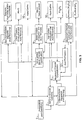
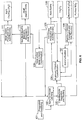
- the processes can involve the following steps (the reference numbers in Fig. 1 correspond to the following steps) :
- NaCl can undergo chemical reaction with H 2 SO 4 to produce Na 2 SO 4 and HCl at a concentration at or above azeotropic concentration.
- KCI can undergo chemical reaction with H 2 SO 4 to produce K 2 SO 4 and HCl having a concentration that is above the azeotropic concentration.
- Sodium and potassium chloride brine solution can be the feed material to adapted small chlor-alkali electrolysis cells. In this latter case, common bases (NaOH and KOH) and bleach (NaOCI and KOCI) are produced as well as HCI.
- the liquid can be concentrated to a concentrated liquid having an iron chloride concentration of at least 30% by weight; and then the iron chloride can be hydrolyzed at a temperature of about 155 to about 350 °C while maintaining a ferric chloride concentration at a level of at least 65% by weight, to generate a composition comprising a liquid and precipitated hematite, and recovering the hematite.
- the liquid can be concentrated to a concentrated liquid having an iron chloride concentration of at least 30% by weight; and then the iron chloride can be hydrolyzed at a temperature of about 155 to about 350 °C while maintaining a ferric chloride concentration at a level of at least 65% by weight, to generate a composition comprising a liquid and precipitated hematite; recovering the hematite; and recovering rare earth elements and/or rare metals from the liquid.
- the processes can further comprise, after recovery of the rare earth elements and/or rare metals, reacting the liquid with HCI so as to cause precipitation of MgCl 2 , and recovering same.
- the continuous processes can handle high percentages of silica (>55%) and impurities as well as relatively low percentages of aluminum (for example as low as about 15%) and still being economically and technically viable. Satisfactory yields can be obtained (>93-95%) on Al 2 O 3 and greater than 75%, 85 or 90 % on rare earth elements and/or rare metals. No pre-thermal treatment in most cases are required.
- the processes disclosed in the present disclosure involve special techniques on leaching and acid recovery at very high strength, thereby offering several advantages over alkaline processes.
- step 1 the mineral, whether or not thermally treated is crushed, milled, dried and classified to have an average particle size of about 50 to about 80 ⁇ m.
- step 2 the milled raw material is introduced into the reactor and will undergo the leaching phase.
- the leaching hydrochloric acid used in step 2 can be a recycled or regenerated acid from steps 5, 6, 8, 9, 10 and 11 (see Fig. 3 ) its concentration can vary from 15% to 45% weight percent. Higher concentration can be obtained using membrane separation, cryogenic and/or high pressure approach.
- the acid leaching can be carried out under pressure and at temperature close to its boiling point thus, allowing a minimal digestion time and extended reaction extent (90%-100%).
- Leaching (step 2) can be accomplished in a semi-continuous mode where spent acid with residual free hydrochloric acid is replaced, following pressurization, by highly concentrated acid at a certain stage of the reaction or allowing a reduced acid/mineral ratio, thereby reducing reaction time and improving reaction kinetics.
- kinetic constant k can be : 0.5 - 0.75 g/mole.L, or 0.65-0.82 g/mole.L.
- alkali metals, iron, magnesium, sodium, calcium, potassium, rare earth elements and other elements will also be in a chloride form at different stages.
- Silica and optionally titanium can remain undissolved and will undergo (step 3) a liquid/solid separation and cleaning stage.
- the processes of the present disclosure tend to recover maximum amount of free hydrochloric acid left and chlorides in solution in order to maximize hydrochloric acid recovery yield, using techniques such as rake classifying, filtration with band filters, centrifugation, and others. Pure SiO 2 (one additional leaching stage) cleaning with nano water purity 99% min.
- Mother liquor free of silica is then named as spent acid (various metal chlorides and water) and goes to the crystallization step (step 4).
- step 4 the spent acid (or leachate) with a substantial amount of aluminum chloride is then saturated with dry and highly concentrated gaseous hydrogen chloride obtained or recycled from step 5 or with aqueous HCI > 30% wt., which results in the precipitate of aluminum chloride hexahydrate (AlCl 3 •6H 2 O).
- the precipitate retained is then washed and filtered or centrifuged before being fed to the calcination stage (step 5).
- step 5 The remaining of the spent acid from step 4 is then processed to acid recovery system (steps 6 to 8) where pure secondary products will be obtained.
- step 5 aluminum oxide (alumina) is directly obtained from high temperature conditions.
- the highly concentrated hydrogen chloride in gaseous form obtained can be fed to steps 4 and 7 for crystallization where it can be treated through hydrophobic membranes.
- the excess hydrogen chloride is absorbed and used as regenerated acid to the leaching step 2 as highly concentrated acid, higher than the concentration at the azeotropic point (>20.2%).
- concentration at the azeotropic point >20.2%
- concentration at the azeotropic point >20.2%
- such a concentration can be about 18 to about 45 weight %, about 25 to about 45 weight % or between 25 and 36 weight %.
- Acid can also be redirected in gas phase directly (> 30 wt %) to acid purification.
- step 4 various chlorides derivatives (mainly iron with magnesium and rare earth elements and rare metals) are next subjected to an iron extraction step.
- a step can be carried out for example by using the technology disclosed in WO 2009/153321 .
- hematite can be seeded for crystal growth.
- hematite seeding can comprise recirculating the seeding.
- step 6 a hydrolysis at low temperature (155-350°C) is carried out and pure Fe 2 O 3 (hematite) is being produced and hydrochloric acid of at least 15% concentration is being regenerated.
- the method as described in WO 2009/153321 is processing the solution of ferrous chloride and ferric chloride, possible mixtures thereof, and free hydrochloric acid through a series of steps pre-concentration step, oxidation step where ferrous chloride is oxidized into ferric form, and finally through an hydrolysis step into an operational unit called hydrolyser where the ferric chloride concentration is maintained at 65 weight % to generate a rich gas stream where concentration ensures a hydrogen chloride concentration of 15-20.2% and a pure hematite that will undergo a physical separation step. Latent heat of condensation is recovered to the pre-concentration and used as the heating input with excess heat from the calcination stage (step 5).
- the mother liquor from the hydrolyser (step 6) can be recirculated partially to first step crystallization process where an increase in concentration of non-hydrolysable elements is observed.
- the liquor is rich in other non-hydrolysable elements and mainly comprises magnesium chloride or possible mixture of other elements (various chlorides) and rare earth elements and rare metals.
- Rare earth elements and rare metals in form of chlorides are highly concentrated in percentage into the hydrolyser operational unit (step 6) and are extracted from the mother liquor (step 10) where various known techniques can be employed to extract a series of individual RE-O (rare earth oxides).
- the processes of the present disclosure allows to concentrate to high concentration the following elements, within the hydrolyser: scandium (Sc), galium (Ga), yttrium (Y), dysperosium (Dy), cerium (Ce), praseodynium (Pr), neodynium (Nd), europium (Eu), lanthanum (La), samarium (Sm), gadolinium, (Gd), erbium (Er), zirconium (Zr) and mixtures of thereof.
- step 7 The spent acid liquor from steps 6 and 10 rich in value added metals, mainly magnesium, is processed to step 7.
- the solution is saturated with dry and highly concentrated gaseous hydrogen chloride from step 5, which results in the precipitation of magnesium chloride hexahydrate.
- same can be accomplished with HCl in aqueous form over 30% wt.
- the precipitate retained is fed to a calcination stage step 8 where pure MgO (>98% wt.) is obtained and highly concentrated hydrochloric acid (for example of at least 38 %) is regenerated and diverted to the leaching step (step 2).
- An alternative route for step 7 is using dry gaseous hydrochloric acid from step 8.
- step 9 metal chlorides unconverted are processed to a pyrohydrolysis step (700-900°C) to generate mixed oxides and where hydrochloric acid from 15-20.2% wt. concentration can be recovered.
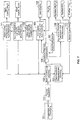
- the processes can be similar to the example shown in Fig, 1 but can comprise some variants as below discussed.
- the processes can comprise (after step 6 or just before step 10) an internal recirculation back to the crystallization step 4.
- the mother liquor from the hydrolyser (step 6) can be recirculated fully or partially to the crystallization of step 4 where a concentration increase will occur with respect to the non-hydrolysable elements including rare earth elements and/or rare metals.
- Such a step can be useful for significantly increasing the concentration of rare earth elements and/or rare metals, thereby facilitating their extraction in step 10.
- step 7 the solution rich in magnesium chloride and other non-hydrolysable products at low temperature is, as previously discussed, then brought up in concentration with dry and highly concentrated gaseous hydrogen chloride by sparging it into a crystallizer. This can result into the precipitation of magnesium chloride as an hexahydrate (for example after sodium and potassium chloride removal). This can also be accomplished with HCl in aqueous form.
- an extra step 11 can be added.
- Sodium chloride can undergo a chemical reaction with sulfuric acid so as to obtain sodium sulfate and regenerate hydrochloric acid at a concentration at or above the azeotropic point.
- Potassium chloride can undergo a chemical reaction with sulfuric acid so as to obtain potassium sulfate and regenerate hydrochloric acid at a concentration above the azeotropic concentration.
- Sodium and potassium chloride brine solution can be the feed material to adapted small chlor-alkali electrolysis cells. In this latter case, common bases (NaOH and KOH) and bleach (NaOCI and KOCI) are produced and can be reused to some extent in other areas of the processes of the present disclosure (scrubber, etc.).
- This material is thereafter leached in a two-stage procedure at 140-170 °C with 18-32 weight % HCl.
- the HCl solution was used in a stoichiometric excess of 10-20% based on the stoichiometric quantity required for the removal of the acid leachable constituents of the clay.
- the clay was contacted for 2.5 hours with required amount or certain proportion of the total amount of hydrochloric acid. After removal of the spent acid, the clay was contacted again with a minimum 18 weight % hydrochloric acid solution for about 1.5 hour at same temperature and pressure.
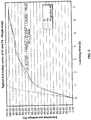
- FIG. 2 A typical extraction curve obtained for both iron and aluminum for a single stage leaching is shown in Fig. 2 .
- the leachate was filtered and the solid was washed with water and analyzed using conventional analysis techniques (see step 3 of Fig. 1 ). Purity of obtained silica was of 95.4% and it was free of any chlorides and of HCl.
- the purity of the silica was 99.67 % through an extra leaching step.
- Spent acid was then crystallized using about 90 to about 98% pure dry hydrochloric acid in gas phase in two stages with less than 25 ppm iron in the aluminum chloride hexahydrate formed.
- concentration of HCl in solution (aqueous phase) was about 22 to about 32% or 25 to about 32 %, allowing 95.3 % of Al 2 O 3 recovery.
- the recovered crystallized material (hydrate form of AlCl 3 having a minimum purity of 99.8 %) was then calcined at 930°C or 1250°C, thus obtaining the ⁇ form of the alumina. Heating at 930°C allows for obtaining the beta-form of alumina while heating at 1250°C allows for obtaining the alpha-form.
- Another example was carried out at low temperature (decomposition and calcination at about 350 °C) and the ⁇ form of the alumina was less than 2 %.
- HCI concentration in gas phase exiting the calcination stage was having a concentration greater than 30% and was used (recycled) for crystallization of the AlCl 3 and MgCl 2 . Excess of hydrochloric acid is absorbed at the required and targeted concentration for the leaching steps.
- Iron chloride (about 90 to about 99.5 %% in ferric form) is then sent to a hydrothermal process in view of its extraction as pure hematite (Fe 2 O 3 ). This can be done by using the technology described in WO 2009/153321 of low temperature hydrolysis with full heat recovery from calcining, pyrohydrolysis and leaching stage.
- Rare earth elements and rare metals are extracted from the mother liquor of the hydrolyzer where silica, aluminum, iron and a great portion of water have been removed and following preconcentration from hydrolyser to crystallization. It was measured that rare earth elements can be concentrated by a factor of about 4.0 to 10.0 on average within the hydrolyzer itself on a single pass through it i.e. without concentration loop. The following concentration factors have been noted within the hydrolyzer (single pass):
- Remaining magnesium chloride is sparged with dry and highly concentrated hydrochloric acid and then calcinated to MgO while recovering high concentration acid (for example up to 38.4%).
- a similar feed material (bauxite instead of clay) was processed as per in example 1 up to the leaching stage and revealed to be easily leachable under the conditions established in example 1. It provided an extraction percentage of 100% for the iron and over 90-95% for aluminum. The technology was found to be economically viable and no harmful by-products (red mud) were generated. Samples tested had various concentrations of Al 2 O 3 (up to 51%), Fe 2 O 3 (up to 27%) and MgO (up to 1.5%). Gallium extraction of 97.0 % was measured. Scandium extraction was 95 %.
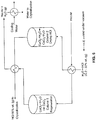
- H 2 SO 4 can be used for carrying out purification of HCl. It can be carried out by using a packing column with H 2 SO 4 flowing counter currently (see Fig. 4 ). This allows for converting the recovered HCl into HCl having a concentration above the azeotropic point (20.1% wt) and increase its concentration by about 60 to about 70% at minimum.
- H 2 SO 4 Water is absorbed by H 2 SO 4 and then H 2 SO 4 regeneration is applied where H 2 SO 4 is brought back to a concentration of about 95 to about 98% wt. Water release at this stage free of sulphur is recycled back and used for crystallization dissolution, etc.
- Packing of the column can comprise polypropylene or polytrimethylene terephthalate (PTT).
- Combustion energy can be performed with off gas preheating air and oxygen enrichment.
- Oxygen enrichment: +2% represents flame temperature increase by: 400°C maximum.
- CaCl 2 can be used for drying HCl.
- CaCl 2 can be used for absorbing water contained into HCl.
- CaCl 2 is converted into its hexachloride form (CaCl 2 •6H 2 O) and one saturated system is eventually switched into regeneration mode where hot air recovered from calcination off gas of alumina and magnesium oxide spray roasting is introduced to regenerate the fixed bed.
- other absorbing agent such as LiCl can be used instead of CaCl 2 .
- Such an ion / exchange type process can be seen in Fig. 4 and the cycle can be inversed to switch from one column to another one.
- Raw material clay for example, was processed in a secondary crusher in the clay preparation plant 101. Dry milling and classifying occurs on a dry basis in vertical roller mills (for example Fuller-Loesche LM 30.41).
- the clay preparation 101 included three roller mills; two running at a capacity of approximately 160-180 tph and one on standby.
- Raw material if required, can be reduced to 85% less than 63 microns.
- Processed material was then stored in homogenization silos before being fed to the acid leaching plant 102. Below in Table 1 are shown results obtained during stage 101. If the ore contains the fluorine element, a special treatment can be applied before carrying out the 102 stage. In presence of hydrochloric acid, fluorine can produce hydrofluoric acid.
- Stage 112 can comprise treating the processed material coming from stage 101 with an acid in a pre-leaching treatment so as to remove hydrofluoric acid. Therefore, depending on the composition of the raw material, a fluorine separation stage 112 (or pre-leaching stage 112) can be carried out. Table 1.
- acid leaching 102 was performed semi-continuously in an 80 m 3 glass-lined reactor.
- Semi-continuous mode comprises replacing reacted acid 1/3 in the reaction period with higher concentration regenerated acid, which greatly improves reaction kinetics.
- the reactor arrangement comprises for example, a series of three reactors.
- Leaching was performed at high temperature and pressure (about 160 to about 195°C and pressures of about 5 to about 8 barg) for a fixed period of time. Reaction time was a function of the reaction extent targeted (98% for Al 2 O 3 ), leaching mode, acid strength, and temperature/pressure applied.
- Spent acid recovered out of the acid leaching 102 was then filtered 103 from unreacted silica and titanium dioxide and washed through an automated filter press where all free HCI and chloride are recovered. This allows, for example, a maximum quantity of about 30 ppm SiO 2 going into spent liquor. Cleaned silica at a concentration of ⁇ 96 % + SiO 2 is then produced. Various options are possible at that point. For example, the 96% silica can undergo final neutralization through caustic bath, cleaning, and then bricketing before storage. According to another example, the silica purified by adding another leaching step followed by a solid separation step that ensures TiO 2 removal (see stage 113 in Fig. 7 ).
- stage 113 titanium and silicium can be separated from one another in various manners.
- the solid obtained from stage 103 can be leached in the presence of MgCl 2 at a temperature below 90 or 80 °C and at low acid concentration.
- acid concentration can be below 25 or 20 %.
- the acid can be HCl or H 2 SO 4 .
- titanium remains soluble after such a leaching while titanium is still in a solid form.
- Water input and flow for silica cleaning is in a ratio of 1:1 (silica/water) (150 t/h SiO 2 / 150 t/h H 2 O), but comprises of wash water circulation in closed loop in the process and limited amount of process water for final cleaning of the silica and recovery of all chlorides and free HCI generated at the leaching stage.
- Table 2 below in Table 2 are shown results obtained during stage 102. Table 2.
- Acid Leaching Equivalent solid feed rate 259.6 tph Operation mode Semi-continuous Acid to clay ratio 3.10 @ 23% wt (Equivalent to 3.35 with semi-continuous at 18.0 % wt) Regenerated acid concentration 18.0-32.0% Operating temperature 150-155°C (Pilot) 165-200°C ( Plant) MAWP 0.82 MPa (120 psig) Typical chemical reactions Fe 2 O 3 + 6 HCl ⁇ 2 FeCl 3 + 3H 2 O Al 2 O 3 + 6 HCl ⁇ 2 AlCl 3 + 3 H 2 O MgO + 2 HCl ⁇ MgCl 2 + H 2 O K 2 O + 2 HCl ⁇ 2 KCl + H 2 O Re 2 O 3 + 6 HCl ⁇ 2 ReCl 3 + 3H 2 O Spent acid flow to crystallization 600-1100 m 3 /h Practical chemical composition after step 102 without solid (SiO 2 ) FeCl 3 4.33% FeCl 2 0.19% AlCl 3 16.
- Spent acid with an aluminum chloride content of about 20 to about 30 %, was then processed in the crystallization stage 104.
- Dry and highly concentrated HCI > 90% wt.
- HCI > 90% wt.
- the flow rate of acid through these reactors is about 600 to about 675 m 3 /h and the reactor was maintained at about 50 to about 60°C during this highly exothermic reaction. Heat was recovered and exchanged to the acid purification 107 part of the plant thus ensuring proper heat transfer and minimizing heat consumption of the plant.
- Aluminum chloride solubility decreases rapidly, compared to other elements, with the increase in concentration of free HCl in the crystallization reactor. The concentration of AlCl 3 for precipitation/crystallization was about 30%
- the HCl concentration during crystallization was thus about 30 to about 32 % wt.
- the aqueous solution from the crystallization stage 104 was then submitted to the hydrothermal acid recovery plant 105, while the crystals are processed through the decomposition/calcination stage in the calcination plant 106.
- a one-step crystallization stage or a multi-step crystallization stage can be done.
- a two-steps crystallization stage can be carried out.
- Table 3A Aluminum chloride crystallization Number of crystallization steps 2 Operating temperature 50-60°C Sparging HCl concentration 90% (gaseous) Typical chemicals formed AlCl 3 ⁇ 6H 2 O (s) Metal chlorides (aq) AlCl 3 ⁇ 6H 2 O residual ⁇ 5% (practical); 8% Table 3B.
- the calcination 106 comprises the use of a two-stage circulating fluid bed (CFB) with preheating systems.
- the preheating system can comprise a plasma torch to heat up steam to process. It processes crystals in the decomposition/calcination stage. The majority of the hydrochloric acid was released in the first stage which was operated at a temperature of about 350°C, while the second stage performs the calcination itself. Acid from both stages (about 66 to about 68% of the recovered acid from the processes) was then recovered and sent to either to the acid leaching 102 or to the acid purification 107. In the second reactor, which was operated at a temperature of about 930°C, acid was recovered through the condensation and absorption into two columns using mainly wash water from the acid leaching sector 102. Latent heat from this sector was recovered at the same time as large amounts of water, which limits net water input.
- iron oxides productions and acid recovery 105 system which comprises, aqueous solution from the crystallization 104 first undergoes a pre-concentration stage followed by processing in the hydrolyzer reactor.
- hematite was produced during low temperature processing (about 165°C).
- a recirculation loop was then taken from the hydrolyzer and is recirculated to the pre-concentrator, allowing the concentration of REE, Mg, K, and other elements.
- This recirculation loop allows rare earth element chlorides and/or rare metal chlorides and various metal chlorides concentration to increase without having these products precipitating with hematite up to a certain extent.
- Table 5 shows results obtained in stage 106.
- Table 5 shows results obtained in stage 106. Table 5.
- the reactants were oxalic acid, NaOH, DEHPA (Di-(2-ethylhexyl)phosphoric acid) and TBP (tri-n-butyl phosphate) organic solution, kerosene, and HCl were used to convert rare earth element chlorides and rare metals chlorides to hydroxides.
- An ion exchange technique is also capable of achieving same results as polytrimethylen terephtalate (PET) membrane.
- Iron powder from 105, or scrap metal as FeO can be used at a rate dependent on Fe 3+ concentration in the mother liquor.
- HCl (100% wt) at the rate of 1 tph can be required as the stripped solution in REE Solvent Extraction (SX) separation and re-leaching of rare earth elements and/or rare metals oxalates.
- Oxalic acid as di-hydrate at a rate of 0.2 tph was added and contributes to the rare earth elements and rare metals oxalates precipitation.
- NaOH or MgOH at a rate of 0.5 tph can be used as a neutralization agent.
- DEHPA SX organic solution at the rate of 500 g/h was used as active reagent in rare earth elements separation while TBP SX organic solution at the rate of 5 kg/h is used as the active reagent for gallium recovery and yttrium separation. Finally, a kerosene diluent was used at the rate of approximately 2 kg/h in all SX section. Calcination occurs in an electric rotary furnace via indirect heating to convert contents to REE 2 O 3 (oxides form) and maintain product purity.
- stage 108 can be carried out as described in PCT/CA2012/000253 and/or PCT/CA2012000419 .
- the solution after stages 108 and 109 contained mainly MgCl 2 , NaCl, KCl, CaCl 2 , FeCl 2 /FeCl 3 , and AlCl 3 (traces), and then follows stage 111 Na, K, Ca that follows the MgO can be extracted in stage 110 by crystallization in a specific order; Na first, followed by K, and then Ca.
- This technique can be employed for example in the Israeli Dead Sea salt processing plant to produce MgO and remove alkali from the raw material.
- HCI hydrochloric acid
- NaCl and KCI with intent of recovering HCl.
- One example can be to contact them with highly concentrated sulfuric acid (H 2 SO 4 ), which generates sodium sulphate (Na 2 SO 4 ) and potassium sulfate (K 2 SO 4 ), respectively, and regenerates HCl at a concentration above 90% wt.
- H 2 SO 4 highly concentrated sulfuric acid
- K 2 SO 4 potassium sulfate
- Another example is the use of a sodium and potassium chloride brine solution as the feed material to adapted small chlor-alkali electrolysis cells. In this latter case, common bases (NaOH and KOH) and bleach (NaOCI and KOCI) are produced.
- NaOH and KOH common bases
- bleach NaOCI and KOCI
- the reduced flow which was substantially free of most elements (for example AlCl 3 , FeCl 3 , REE-Cl, NaCl, KCl) and rich in MgCl 2 , was then submitted to the magnesium oxides plant 111.
- MgO pyrohydrolysis of MgCl 2 and any other leftover impurities were converted into oxide while regenerating acid.
- the first step was a pre-evaporator/crystallizer stage in which calcium is removed and converted into gypsum (CaSO 4 ⁇ 2H 2 O) by a simple chemical reaction with sulfuric acid, for which separation of MgO is required. This increases the capacity of MgO roasting and also energy consumption slightly, while substantially recovering HCl.
- the next step was the specific pyrohydrolysis of MgO concentrated solution by spray roasting.
- Two (2) main products were generated; MgO that was further treated and HCl (about 18% wt.), which was either recycled back to the upstream leaching stage 102 or to the hydrochloric acid purification plant (107
- the MgO-product derived from the spray roaster can require further washing, purification, and finally calcining depending on the quality targeted.
- the purification and calcining can comprise a washing-hydration step and standard calcining step.
- the MgO from the spray roaster is highly chemically active and wasdirectly charged into a water tank where it reacts with water to form magnesium hydroxide, which has poor solubility in water.
- the Mg(OH) 2 suspension after settling in a thickener, was forwarded to vacuum drum filters, which remove the remaining water.
- the cleaned Mg(OH) 2 is then forwarded into a calcination reactor where it is exposed to high temperatures in a vertical multi-stage furnace. Water from hydration is released and allows the transformation of the Mg(OH) 2 to MgO and water. At this point, the magnesium oxide was of high purity (> 99%).
- the hydrochloric acid purification stage 107 is effective for purifying HCI regenerated from different sectors (for example 105, 106, 111) and to increase its purity for crystallization, whereas dry highly concentrated acid (> 90% wt.) can be used as the sparging agent. Stage 107 also allowed for controlling the concentration of the acid going back to stage 102 (about 22 to about 32% wt.) and allows total acid and water balance. Total plant water balance is performed mainly by reusing wash water as absorption medium, as quench agent or as dissolution medium at the crystallization stages
- purification can be carried out by means of a membrane distillation process.
- the membrane distillation process applied here occurs when two aqueous liquids with different temperatures are separated through a hydrophobic membrane.
- the driving force of the process was supplied by the partial pressure vapour difference caused by the temperature gradient between these solutions. Vapour travels from the warm to the cold side.
- the separation mechanism was based on the vapour/liquid equilibrium of the HCl/water liquid mixture. Practical application of such a technology has been applied to HCl/water, H 2 SO 4 /water systems and also on large commercial scales on aqueous solution of sodium chloride with the purpose of obtaining potable water from seawater and nano water production.
- membrane distillation was a separation process based on evaporation through a porous hydrophobic membrane. The process was performed at about 60°C and was effective to recover heat from the 104 and 102 stage with an internal water circulation loop, in order to maintain a constant incoming temperature to the membranes. For example, eight membranes of 300,000 m 2 equivalent surface area can be used per membrane to obtain a concentration of HCl well above the azeotropic point (i.e. > 36%) of the ⁇ 750 m 3 /h and final 90% concentration is then obtained through pressure distillation (rectification column).
- stage 107 was operated at about 60°C and heat input provided by heat recovery from stages 102 to 110.
- Rectification column was operated at about 140°C in the reboiler part. Net energy requirement was neutral (negative in fact at -3.5 Gj/t Al 2 O 3 ) since both systems were in equilibrium and in balance.
- the acid purification can be carried out by using adsorption technology over an activated alumina bed.
- adsorption technology In continuous mode, at least two adsorption columns are required to achieve either adsorption in one of them and regeneration in the other one.
- Regeneration can be performed by feeding in counter-current a hot or depressurized gas. This technology will result in a purified gas at 100% wt.
- the acid purification can be made by using calcium chloride as entrainer of water.
- a lean hydrochloric acid solution is contacted with a strong calcium chloride solution through a column.
- the water is then removed from the hydrochloric acid solution and 99.9% gaseous HCl comes out of the process.
- Cooling water and cryogenic coolant is used to condense water traces in the HCl.
- the weak CaCl 2 solution is concentrated by an evaporator that ensures the recuperation of calcium chloride.
- some metals can contaminate the calcium chloride concentrated solution.
- a precipitation with Ca(OH) 2 and a filtration allows the removal of those impurities.
- the column can operate for example at 0.5 barg. This technology can allow for the recuperation of 98% of the HCl.
- Tables 8 to 26 show results obtained concerning the products made in accordance with the process shown in Fig. 6 in comparison with standard of the industry.
- Table 8. Chemical composition of obtained alumina Element % Weight Standard used in industry Al 2 O 3 99.938 98.35 min Fe 2 O 3 0.0033 0.0100 SiO 2 0.0032 0.0150 TiO 2 0.0003 0.0030 V 2 O 5 0.0008 0.0020 ZnO 0.0005 0.0030 Cr 2 O 3 0.0003 N/A MgO 0.0090 N/A MnO 0.0002 N/A P 2 O 5 0.0039 0.0010 Cu 0.0030 N/A Ca 0.0020 0.0030 Na 0.0190 0.4000 K 0.0053 0.0150 Li 0.0009 N/A Ba ⁇ 0.00001 0.0000 Th ⁇ 0.000001 0.0000 U ⁇ 0.000001 0.0000 Free Cl - Not detectable 0.0000 LOI ⁇ 1.0000 ⁇ 1.0000 Table 9.
- REE-O/RM-O PSD mean 2-30 ⁇ m Density 5500-13000 kg/m 3 LOI ⁇ 1% Table 15.
- Another starting material has been used for preparing acidic compositions comprising various components.
- a material that is a concentrate of rare earth elements and rare metals (particularly rich in zirconium) has been tested.
- Table 27 shows the results of the leaching carried out on such a starting material using a similar process as shown in Figs. 1 , 3 , 6 and 7 and as detailed in Examples 1, 2 and 5. It can thus be inferred from the results shown in Table 27 that the various components present in the leaching (various metals such as aluminum, iron, magnesium as well as rare earth elements and rare metals) can be extracted from the obtained leaching composition and that they can eventually be isolated by the processes of the present disclosure such as, for example, those presented in Examples 1, 2 and 5.
- fly ash has been successfully leached with HCI, thereby allowing for good yields with respect to the recovery of the various components present in Fly ash.
- These various products or components present in the obtained leachate can thus be all isolated and eventually transformed as previously indicated in the processes of the present disclosure.
- the obtained leachate can then be treated as described in the processes of the present disclosure.
- the leaching of example 8 can be considered, for example, as the leaching 2 of Fig. 1 or Fig. 3 ; the leaching 102 of Fig. 6 or Fig. 7 , etc..
- the leachate obtained in Example 8 can then be treated as shown in Figs. 1 , 3 , 6 and 7 .
- the processes allow for the production of substantially pure alumina and other value added products purified such as purified silica, pure hematite, pure other minerals (ex: magnesium oxide) and rare earth elements products.
- the processes do not require thermal pre-treatment before the acid leach operation. Acid leach can be carried out using semi-continuous techniques with high pressure and temperature conditions and very high regenerated hydrochloric acid concentration. The processes can also be carried out at atmospheric pressure. In addition, the processes do not substantially generate any residues not sellable, thus eliminating harmful residues to environment like in the case of alkaline processes.
- the advantage of the high temperature calcination stage in addition for allowing to control the ⁇ -form of alumina required, can be effective for providing a concentration of hydrochloric acid in the aqueous form (>38%) that is higher than the concentration of HCl at the azeotropic point and thus providing a higher incoming HCl concentration to the leaching stage.
- the calcination stage hydrochloric acid network can be interconnected to two (2) crystallization systems and by pressure regulation excess HCl can be being absorbed at the highest possible aqueous concentration.
- the advantage of having a hexahydrate chloride with low moisture content ( ⁇ 2%) incoming feed allows for a continuous basis to recover acid at a concentration that is higher than the azeotropic concentration. This HCl balance and double usage into three (3) common parts of the processes and above azeotropic point is a substantial advance in the art.
- Another advantage is when the use is made of the incoming chemistry (ferric chloride) to the iron oxide and hydrochloric acid recovery unit where all excess heat load from any calcination part, pyrohydrolysis and leaching part is being recovered to preconcentrate the mother liquor in metal chloride, thus allowing, at very low temperature, the hydrolysis of the ferric chloride in the form of very pure hematite and the acid regeneration at the same concentration than at its azeotropic point.
- ferric chloride iron oxide and hydrochloric acid recovery unit
- a further major advantage of the processes of the present disclosure at the ferric chloride hydrolysis step can be the possibility to concentrate rare earth elements in form of chlorides at very high concentration within the hydrolyser reactor through an internal loop between hydrolyzer and crystallization.
- the advantage is that the processes of the present disclosure benefit from the various steps where gradual concentration ratios are applied.
- concentration at very high level of rare earth elements using integrated process stages prevents from having the main stream (very diluted) of spent acid after the leaching step with the risk of contaminating the main aluminum chloride stream and thus affecting yields in Al 2 O 3 .
- Another important improvement of the art can be that on top of being fully integrated, selective removal of components allows for the concentration of rare earth elements to relatively high concentration (percentages).
- Another advantage of the processes can be again a selective crystallization of MgCl 2 through the sparging of HCl from either the alumina calcination step or the magnesium oxide direct calcination where in both cases highly concentrated acid both in gaseous phase or in aqueous form are being generated.
- the direct interconnection with the calcination reactor the HCl gas very high concentration (about 85 to about 95 %, about 90 to 95 % or about 90 % by weight) allows for exact adjustment in continuous of the crystallizer based on quality of magnesium oxide targeted. Should this process step (MgO production or other value added metal oxide) be required based on incoming process feed chemistry, the rare earth elements extraction point then be done after this additional step; the advantage being the extra concentration effect applied.
- the pyrohydrolysis can allow for the final conversion of any remaining chloride and the production of refined oxides that can be used (in case of clay as starting material) as a fertilizer and allowing the processing of large amount of wash water from the processes with the recovery of hydrochloric acid in close loop at the azeotropic point for the leaching step.
- the advantage of this last step can be related to the fact that it does totally close the process loop in terms of acid recovery and the insurance that no residues harmful to the environment are being generated while processing any type of raw material, as previously described.
- the processes of the present disclosure can provide fully continuous and economical solutions that can successfully extract alumina from various type of materials while providing ultra pure secondary products of high added value including highly concentrated rare earth elements and rare metals.
- the technology described in the present disclosure can allow for an innovative amount of total acid recovery and also for a ultra high concentration of recovered acid. When combing it to the fact that combined with a semi-continuous leaching approach that favors very high extraction yields and allows a specific method of crystallization of the aluminum chloride and concentration of other value added elements. These processes can also allow for preparing aluminum with such a produced alumina.
- raw material grinding, drying and classifying can be applicable to various kinds of material hardness (furnace slag for example), various types of humidity (up to 30%) and incoming particle sizes.
- the particle size established can provide the advantage, at the leaching stage, of allowing efficient contact between the minerals and the acid and then allowing faster kinetics of reaction.
- Particles size employed can be effective to reduce drastically the abrasion issue and allows for the use of a simplified metallurgy/lining when in contact with hydrochloric acid.
- a further advantage of the processes of the present disclosure can be the combined high temperature and high incoming hydrochloric acid concentration. Combined with a semi continuous operation where the free HCl driving force can be used systematically, iron and aluminum extraction yields do respectively reach 100% and 98% in less than about 40 % of the reference time of a basic batch process.
- Another advantage of higher HCl concentration than the concentration at azeotropic point can be the potential of capacity increase. Again a higher HCl concentration than the concentration of HCl at the azeotropic point and the semi-continuous approach can represent a substantial advance in the art.
- Another advantage in that technique used for the mother liquor separation from the silica after the leaching stage countercurrent wash, can be that band filters provide ultra pure silica with expected purity exceeding 96%.
- the present disclosure provides fully integrated processes for the preparation of pure aluminum oxide using a hydrochloric acid treatment while producing high purity and high quality products (minerals) and extracting rare earth elements and rare metals.
Landscapes
- Chemical & Material Sciences (AREA)
- Organic Chemistry (AREA)
- Life Sciences & Earth Sciences (AREA)
- Engineering & Computer Science (AREA)
- Geology (AREA)
- Inorganic Chemistry (AREA)
- Materials Engineering (AREA)
- Manufacturing & Machinery (AREA)
- Mechanical Engineering (AREA)
- Metallurgy (AREA)
- General Life Sciences & Earth Sciences (AREA)
- Environmental & Geological Engineering (AREA)
- Physics & Mathematics (AREA)
- Thermal Sciences (AREA)
- Geochemistry & Mineralogy (AREA)
- Health & Medical Sciences (AREA)
- General Chemical & Material Sciences (AREA)
- Business, Economics & Management (AREA)
- Emergency Management (AREA)
- Chemical Kinetics & Catalysis (AREA)
- Toxicology (AREA)
- General Health & Medical Sciences (AREA)
- Compounds Of Alkaline-Earth Elements, Aluminum Or Rare-Earth Metals (AREA)
- Processing Of Solid Wastes (AREA)
- Manufacture And Refinement Of Metals (AREA)
- Separation Using Semi-Permeable Membranes (AREA)
- Drying Of Gases (AREA)
Applications Claiming Priority (3)
| Application Number | Priority Date | Filing Date | Title |
|---|---|---|---|
| US201261617422P | 2012-03-29 | 2012-03-29 | |
| US201261706028P | 2012-09-26 | 2012-09-26 | |
| PCT/CA2013/000218 WO2013142957A1 (en) | 2012-03-29 | 2013-03-11 | Processes for treating fly ashes |
Publications (3)
| Publication Number | Publication Date |
|---|---|
| EP2838848A1 EP2838848A1 (en) | 2015-02-25 |
| EP2838848A4 EP2838848A4 (en) | 2016-01-20 |
| EP2838848B1 true EP2838848B1 (en) | 2019-05-08 |
Family
ID=49257993
Family Applications (1)
| Application Number | Title | Priority Date | Filing Date |
|---|---|---|---|
| EP13769350.3A Active EP2838848B1 (en) | 2012-03-29 | 2013-03-11 | Processes for treating fly ashes |
Country Status (8)
| Country | Link |
|---|---|
| US (2) | US9181603B2 (enExample) |
| EP (1) | EP2838848B1 (enExample) |
| JP (1) | JP2015518414A (enExample) |
| CN (1) | CN104520237B (enExample) |
| AU (1) | AU2013203808B2 (enExample) |
| CA (2) | CA2862307C (enExample) |
| RU (1) | RU2633579C9 (enExample) |
| WO (1) | WO2013142957A1 (enExample) |
Families Citing this family (69)
| Publication number | Priority date | Publication date | Assignee | Title |
|---|---|---|---|---|
| EP2686458A4 (en) | 2011-03-18 | 2015-04-15 | Orbite Aluminae Inc | METHOD FOR RECOVERING RARE ELEMENTS FROM ALUMINUM-CONTAINING MATERIALS |
| JP5894262B2 (ja) | 2011-05-04 | 2016-03-23 | オーバイト アルミナ インコーポレイテッドOrbite Aluminae Inc. | 種々の鉱石から希土類元素を回収する方法 |
| CA2834356C (en) | 2011-06-03 | 2014-11-25 | Orbite Aluminae Inc. | Methods for preparing hematite |
| CA2848751C (en) | 2011-09-16 | 2020-04-21 | Orbite Aluminae Inc. | Processes for preparing alumina and various other products |
| BR112014016732A8 (pt) | 2012-01-10 | 2017-07-04 | Orbite Aluminae Inc | processos para tratar lama vermelha |
| EP2838848B1 (en) * | 2012-03-29 | 2019-05-08 | Orbite Technologies Inc. | Processes for treating fly ashes |
| MY175471A (en) | 2012-07-12 | 2020-06-29 | Orbite Tech Inc | Processes for preparing titanium oxide and various other products |
| JP2015535886A (ja) | 2012-09-26 | 2015-12-17 | オーバイト アルミナ インコーポレイテッドOrbite Aluminae Inc. | 種々の材料のHCl浸出によるアルミナおよび塩化マグネシウムを調製するためのプロセス |
| WO2014075173A1 (en) * | 2012-11-14 | 2014-05-22 | Orbite Aluminae Inc. | Methods for purifying aluminium ions |
| RU2561417C2 (ru) * | 2013-11-07 | 2015-08-27 | Федеральное государственное бюджетное учреждение науки Институт химии твердого тела Уральского отделения Российской академии наук | Способ извлечения оксида алюминия из красного шлама |
| JP6268583B2 (ja) * | 2013-12-25 | 2018-01-31 | 太平洋セメント株式会社 | 焼成物の製造方法 |
| CN103755060B (zh) * | 2013-12-27 | 2015-07-22 | 中国神华能源股份有限公司 | 一种粉煤灰酸法生产氧化铝过程中溶出料浆分离洗涤方法 |
| JP6493719B2 (ja) * | 2014-01-10 | 2019-04-03 | 太平洋セメント株式会社 | レアアースを含有する泥の処理方法 |
| CN103952557A (zh) * | 2014-03-20 | 2014-07-30 | 浙江大学 | 一种二次酸浸浸出煤灰渣中氧化铝的方法 |
| CN104176753A (zh) * | 2014-06-03 | 2014-12-03 | 崔佩霞 | 从粉煤灰中提取复合氧化铝的方法 |
| CN104128080A (zh) * | 2014-07-02 | 2014-11-05 | 上海大学 | 高Cl高CO2焚烧烟气处理垃圾焚烧飞灰水洗液回收钙盐的方法 |
| AT516089B1 (de) * | 2014-08-14 | 2017-06-15 | Mme Eng E U | Hydrometallurgisches Verfahren |
| GB201417855D0 (en) * | 2014-10-09 | 2014-11-26 | Organic Innovative Solutions Ltd | Process for Ash Remediation |
| US12492445B2 (en) | 2014-12-29 | 2025-12-09 | Freeport Minerals Corporation | Systems and methods for subsurface metal recovery |
| PE20171127A1 (es) * | 2014-12-29 | 2017-08-08 | Freeport Minerals Corp | Sistemas y metodos para monitoreo de sistemas de recuperacion de metales |
| US12378634B2 (en) | 2014-12-29 | 2025-08-05 | Freeport Minerals Corporation | Systems and methods for improved raffinate injection |
| ES2950487T3 (es) * | 2015-09-18 | 2023-10-10 | Univ Columbia | Métodos y sistemas para recuperar productos de escoria de hierro y acero |
| CN105523575B (zh) * | 2016-02-02 | 2017-06-30 | 扬州大学 | 一种含铝废盐的处理方法 |
| CN105776140A (zh) * | 2016-03-17 | 2016-07-20 | 芦秀琴 | 一种从金属氯化物溶液中回收盐酸和金属氧化物的方法 |
| US10626482B2 (en) * | 2016-06-08 | 2020-04-21 | Battelle Memorial Institute | Acid digestion processes for recovery of rare earth elements from coal and coal byproducts |
| TW201813923A (zh) * | 2016-10-14 | 2018-04-16 | 張瑞永 | 廢橡膠裂解後碳黑之萃取回收化學品方法 |
| WO2018218294A1 (en) * | 2017-06-01 | 2018-12-06 | Monash University | Process for producing magnesium oxide from alkaline fly ash or slag |
| US11186894B2 (en) * | 2017-11-20 | 2021-11-30 | Purdue Research Foundation | Preparation of rare earth metals and other chemicals from industrial waste coal ash |
| RU2702590C2 (ru) * | 2017-12-28 | 2019-10-08 | Федеральное государственное автономное образовательное учреждение высшего образования "Сибирский федеральный университет" | Способ переработки нефелиновых руд и концентратов |
| US11180860B2 (en) | 2018-05-18 | 2021-11-23 | California Institute Of Technology | Process to convert reduced sulfur species and water into hydrogen and sulfuric acid |
| CN108793087A (zh) * | 2018-07-03 | 2018-11-13 | 贵州大学 | 一种利用磷石膏和粉煤灰制酸联产抗钒助剂的工艺 |
| CN108862344A (zh) * | 2018-07-27 | 2018-11-23 | 东北大学 | 一种可控晶型的结晶氯化铝水解制备氧化铝的方法 |
| CN110902704A (zh) * | 2018-09-17 | 2020-03-24 | 中国科学院过程工程研究所 | 一种利用流化床粉煤灰制备聚合氯化铝的方法 |
| CN110902709B (zh) * | 2018-09-17 | 2021-05-14 | 中国科学院过程工程研究所 | 一种利用流化床粉煤灰制备氯化钙的方法 |
| CN109211651B (zh) * | 2018-11-08 | 2021-05-14 | 华北电力大学(保定) | 一种飞灰中不同形态砷硒的快速提取方法 |
| US20220064063A1 (en) | 2019-01-16 | 2022-03-03 | Massachusetts Institute Of Technology | Reaction schemes involving acids and bases; reactors comprising spatially varying chemical composition gradients; and associated systems and methods |
| US11148956B2 (en) * | 2019-01-24 | 2021-10-19 | Elixsys, Inc. | Systems and methods to treat flue gas desulfurization waste to produce ammonium sulfate and calcium carbonate products |
| US11479472B2 (en) | 2019-01-24 | 2022-10-25 | Elixsys, Inc. | Systems and methods to recover value-added materials from gypsum |
| AU2020210980B2 (en) | 2019-01-24 | 2025-05-22 | Davy Powersports Inc. | Systems and methods to treat flue gas desulfurization and metal-bearing waste streams to recover value-added materials |
| CN110975564B (zh) * | 2019-04-08 | 2025-09-05 | 张丽荣 | 一种高铝煤烟气净化中污染物综合回收工艺 |
| WO2021030529A1 (en) | 2019-08-13 | 2021-02-18 | California Institute Of Technology | Process to make calcium oxide or ordinary portland cement from calcium bearing rocks and minerals |
| CN110697750A (zh) * | 2019-11-19 | 2020-01-17 | 中国石油化工股份有限公司 | 一种由Shell炉煤气化粉煤灰浸出氧化铝的方法 |
| CN112941328A (zh) * | 2019-12-11 | 2021-06-11 | 内蒙古蒙泰集团有限公司 | 一种粉煤灰资源化利用的处理方法 |
| CN111233014B (zh) * | 2020-03-04 | 2022-04-26 | 神华准能资源综合开发有限公司 | 用于粉煤灰强化溶出的方法 |
| CN111041193A (zh) * | 2020-03-05 | 2020-04-21 | 吴君石 | 一种利用离子液体从粉煤灰中制取铝的方法 |
| CN111778413B (zh) * | 2020-07-03 | 2022-05-20 | 神华准能资源综合开发有限公司 | 一种基于树脂法从粉煤灰中提取镓的方法 |
| CN113955790A (zh) * | 2020-07-05 | 2022-01-21 | 四川伟晟环境保护有限公司 | 一种生活垃圾焚烧产生的飞灰的综合利用方法 |
| CN111744476B (zh) * | 2020-07-08 | 2022-10-14 | 昆明理工大学 | 一种赤泥碳基催化剂的制备方法及应用 |
| US20230330724A1 (en) * | 2020-07-21 | 2023-10-19 | Massachusetts Institute Of Technology | Systems and methods for processing ash |
| EP3954470B8 (en) * | 2020-08-14 | 2023-08-02 | Vecor IP Holdings Limited | Process for preparing whitened fly ash |
| CN112246843B (zh) * | 2020-10-21 | 2022-05-24 | 盐城工学院 | 一种垃圾焚烧飞灰处理的一体化装置及处理方法 |
| CN112207121B (zh) * | 2020-10-30 | 2023-11-21 | 南京师范大学 | 一种基于碳热还原的焚烧飞灰分级热净化方法及装置 |
| WO2022157593A1 (en) * | 2021-01-20 | 2022-07-28 | Tata Steel Limited | A soil conditioner and applications related thereto |
| CN112934919B (zh) * | 2021-02-05 | 2022-07-01 | 云南大地丰源环保有限公司 | 一种废弃无水氯化铝的处理方法 |
| BR112023019361A2 (pt) | 2021-03-22 | 2023-12-26 | Sublime Systems Inc | Aglutinante cimentício, método para formação de um aglutinante cimentício |
| CN113088258B (zh) * | 2021-04-14 | 2023-05-26 | 神华准能资源综合开发有限公司 | 一种利用除钙解析液制备融雪剂的方法 |
| CN113234933B (zh) * | 2021-04-30 | 2022-08-23 | 华南理工大学 | 一种利用甲烷处理电炉粉尘的回收系统 |
| CN114249353B (zh) * | 2021-12-18 | 2023-07-25 | 大连市环境保护有限公司产业废弃物处理厂 | 一种由废盐酸再生为液体氯化亚铁的方法 |
| AU2023283677B2 (en) * | 2022-06-08 | 2025-12-11 | Lava Blue Ltd | A method for producing an aluminous material |
| AU2023350702B2 (en) * | 2022-09-29 | 2025-11-13 | Lava Blue Ltd | A method for producing an aluminous material |
| CN116119727B (zh) * | 2022-11-14 | 2024-09-24 | 中国科学院过程工程研究所 | 一种分级纯化回收粉煤灰氯化产物关键技术 |
| CN115852176B (zh) * | 2022-12-19 | 2025-06-10 | 神华准能资源综合开发有限公司 | 从粉煤灰工业废水中分离铈的方法、高纯氧化铈的制备方法 |
| CN116603207B (zh) * | 2023-05-23 | 2026-03-17 | 苏州工学院 | 利用垃圾焚烧飞灰解毒及提升铁粉活性的方法 |
| CN116618413B (zh) * | 2023-05-24 | 2025-12-23 | 中铝环保节能集团有限公司 | 一种铝电解炭渣资源化利用的方法 |
| CN117282760B (zh) * | 2023-10-25 | 2024-04-16 | 北京科技大学 | 一种垃圾焚烧飞灰的处理方法 |
| CN118005061B (zh) * | 2024-01-29 | 2026-06-09 | 苏州工学院 | 一种利用二次铝灰制备高活性聚合硫酸铝絮凝剂的方法及其产品 |
| WO2026055668A1 (en) * | 2024-09-09 | 2026-03-12 | Board Of Regents, The University Of Texas System | Acid baking of coal fly ash for recovery of rare earth elements |
| CN119733475B (zh) * | 2024-12-26 | 2025-12-05 | 大连理工大学 | 高铝粉煤灰碱法提铝及废渣制二氧化碳吸附剂的系统及方法 |
| CN121006124B (zh) * | 2025-07-17 | 2026-02-24 | 西安科技大学 | 一种粉煤灰废弃物制备得到防火涂料的方法及应用 |
Family Cites Families (412)
| Publication number | Priority date | Publication date | Assignee | Title |
|---|---|---|---|---|
| US558726A (en) | 1896-04-21 | Process of producing hydrous chlorid of aluminium | ||
| US650763A (en) | 1898-10-24 | 1900-05-29 | Emile Raynaud | Method of obtaining alumina from its ores. |
| GB120035A (en) | 1917-09-25 | 1919-03-06 | Norsk Hydro Elektrisk | Improvements in the Production of Alumina Nitrates from Clay, Argillite and similar Minerials. |
| GB153500A (en) | 1920-01-19 | 1920-11-11 | Sven Emil Sieurin | An improved process of producing oxide of aluminium from chloride of aluminium |
| GB159086A (en) | 1920-01-19 | 1921-02-24 | Sven Emil Sieurin | An improved process of producing oxide of aluminium from chloride of aluminium |
| US1501873A (en) | 1922-03-27 | 1924-07-15 | Tyrer Daniel | Manufacture of red oxide of iron |
| GB195295A (en) | 1922-05-05 | 1923-03-29 | Alexandre Louis Pedemonte | Improvements in the manufacture of pure alumina |
| US1494029A (en) | 1922-05-17 | 1924-05-13 | Said Scofield | Process of separating the constituents of mineral silicates |
| US1519880A (en) | 1922-10-06 | 1924-12-16 | American Lurgi Corp | Production of pure alumina |
| US1760962A (en) | 1923-03-13 | 1930-06-03 | Sinclair Refining Co | Process for the regeneration of aluminum-chloride sludge |
| US1701510A (en) | 1923-06-15 | 1929-02-12 | Sieurin Sven Emil | Production of oxide of aluminum |
| GB230916A (en) | 1923-12-19 | 1925-03-19 | Herbert Wrigley | An improved method for the extraction of aluminium materials |
| GB240834A (en) | 1924-10-02 | 1926-05-13 | Griesheim Elektron Chem Fab | Process for the production of alumina |
| US1778083A (en) | 1924-10-02 | 1930-10-14 | Ig Farbenindustrie Ag | Producing alumina |
| GB241184A (en) | 1924-10-13 | 1926-05-13 | Griesheim Elektron Chem Fab | Process for the production of practically iron-free alumina |
| US1931515A (en) | 1926-08-21 | 1933-10-24 | Firm I G Farbenindustrie Ag | Process for the manufacture of alumina |
| GB273999A (en) | 1926-09-17 | 1927-07-14 | Allg Ges Fuer Chemische Ind M | An improved process for converting high-boiling hydrocarbons, which have been freed from the substances soluble in liquid sulphurous acid, into low-boiling hydrocarbons by means of aluminium chloride |
| US1962498A (en) | 1930-01-15 | 1934-06-12 | Nat Smelting Co | Process of recovering aluminum as aluminum sulphate |
| US1956139A (en) | 1930-07-26 | 1934-04-24 | Alterra A G | Process for treating argillaceous material |
| US1906467A (en) | 1931-07-09 | 1933-05-02 | Dow Chemical Co | Distilling hydrochloric acid |
| GB409710A (en) | 1932-08-03 | 1934-05-03 | Chem Fab Buckau | Process for the decomposition of siliceous aluminiferous minerals |
| US1999773A (en) | 1933-01-03 | 1935-04-30 | Allied Process Corp | Treatment of argillaceous material |
| US2024026A (en) | 1933-11-17 | 1935-12-10 | Warner Chemical Company | Recovering lithium compounds |
| US2189376A (en) | 1935-07-29 | 1940-02-06 | Burman Axel Sigurd | Method of producing aluminium oxide from aluminiferous raw materials |
| GB470305A (en) | 1935-09-21 | 1937-08-12 | Paul Ippersiel | Improvements in and relating to the extraction of alumina from clays, kaolin, bauxites and the like |
| GB480921A (en) | 1937-03-17 | 1938-03-02 | John G Stein & Company Ltd | Production of alumina from clay or other aluminous ore |
| GB490099A (en) | 1937-08-23 | 1938-08-09 | Axel Sigurd Burman | Improved method of producing pure alumina |
| US2376696A (en) | 1942-06-10 | 1945-05-22 | Chemical Foundation Inc | Production of alumina |
| GB574818A (en) | 1942-08-01 | 1946-01-22 | British Titan Products | Cyclical process for the manufacture of titanium dioxide pigments |
| US2406577A (en) | 1942-08-08 | 1946-08-27 | Nat Lead Co | Extraction of iron from titaniferous ores |
| US2413709A (en) | 1943-03-31 | 1947-01-07 | John D Hoffman | Method of recovering alumina and hydrochloric acid |
| US2354133A (en) | 1943-05-22 | 1944-07-18 | Georgia Kaolin Co | Process for producing alumina from clay |
| US2471844A (en) | 1946-04-12 | 1949-05-31 | Chemical Construction Corp | Method for conversion of iron chloride into iron oxide and hydrochloric acid |
| US2489309A (en) | 1946-04-30 | 1949-11-29 | Houdry Process Corp | Preparation of an iron-freed acid treated kaolin catalyst |
| US2642337A (en) | 1948-06-09 | 1953-06-16 | Aluminum Co Of America | Method of converting crystalline alumina hydrate to alpha alumina |
| US2663620A (en) | 1949-10-29 | 1953-12-22 | Universal Oil Prod Co | Preparation of alumina from aluminum chloride hexahydrate |
| US2648595A (en) | 1951-02-10 | 1953-08-11 | Absalom M Kennedy | Cyclic process for treating aluminous ores |
| US2707149A (en) | 1952-04-10 | 1955-04-26 | Du Pont | Recovery of titanium metal |
| US2722471A (en) | 1952-10-30 | 1955-11-01 | Molybdenum Corp | Method for the separation of rare earths |
| US2806766A (en) | 1952-11-28 | 1957-09-17 | Kaiser Aluminium Chem Corp | Process of purifying caustic aluminate liquors |
| US2769686A (en) | 1952-12-08 | 1956-11-06 | Robert F Mccullough | Recovery of mineral values from leached zone material overlying florida pebble phosphate deposits |
| US2824783A (en) | 1953-02-27 | 1958-02-25 | Donald F Peppard | Separation of scandium from aqueous solutions |
| US2914464A (en) | 1953-05-01 | 1959-11-24 | Kellogg M W Co | Hydrocarbon conversion process with platinum or palladium containing composite catalyst |
| US2780525A (en) | 1953-10-08 | 1957-02-05 | Cabot Godfrey L Inc | Process and apparatus for the production of aluminum oxide from aluminum chloride |
| US2815264A (en) | 1953-10-09 | 1957-12-03 | George D Calkins | Processing of monazite sand |
| GB745601A (en) | 1953-11-19 | 1956-02-29 | Kaiser Aluminium Chem Corp | Improvements in or relating to process for treating caustic aluminate liquor |
| US2771344A (en) | 1954-08-05 | 1956-11-20 | Cabot Godfrey L Inc | Manufacture of iron oxide pigment |
| GB798750A (en) | 1955-04-01 | 1958-07-23 | Dominion Magnesium Ltd | Improvements in the purification or production of titanium |
| US2848398A (en) | 1955-05-11 | 1958-08-19 | Zh Sekitan Sogo Kenkyujo | Recovery of gallium compounds from the combustion gases of coal |
| US2914381A (en) | 1956-06-08 | 1959-11-24 | Horizous Inc | Preparation of rutile from ilmenite |
| GB857245A (en) | 1956-10-22 | 1960-12-29 | Anaconda Co | Improvements in production of alumina |
| FR1231638A (fr) | 1957-01-15 | 1960-09-30 | Pechiney | Procédé de traitement des minerais d'aluminium |
| GB858026A (en) | 1957-12-17 | 1961-01-04 | Fullers Earth Union Ltd | Improvements in or relating to the manufacture of alumina |
| US3013859A (en) | 1958-07-15 | 1961-12-19 | Jr Carl William Kuhlman | Separation of scandium values from iron values by solvent extraction |
| US3159452A (en) | 1960-02-19 | 1964-12-01 | Gulf Research Development Co | Process for recovering thorium and rare earth values |
| US3104950A (en) | 1961-12-11 | 1963-09-24 | Dow Chemical Co | Process for the separation of iron and titanium values by extraction and the subsequent preparation of anhydrous titanium dopxode |
| BE620099A (enExample) | 1961-07-11 | |||
| US3211521A (en) | 1962-07-30 | 1965-10-12 | Little Inc A | Process for removing iron from acidic aluminum-containing solutions |
| US3479136A (en) | 1962-10-31 | 1969-11-18 | Allied Chem | Iron free aluminum sulfate |
| US3413082A (en) | 1962-11-13 | 1968-11-26 | Pittsburgh Plate Glass Co | Process for recovering zr-values from ores |
| GB1040131A (enExample) | 1963-02-21 | 1900-01-01 | ||
| US3473919A (en) | 1967-06-05 | 1969-10-21 | Armour Ind Chem Co | Process for separating iron from aluminum |
| US3649185A (en) | 1967-08-23 | 1972-03-14 | Showa Denko Kk | Method for removing impurities in the bayer process |
| US3540860A (en) | 1967-09-13 | 1970-11-17 | Multi Minerals Ltd | Acid regeneration |
| US3642441A (en) | 1967-09-14 | 1972-02-15 | Falconbridge Nickel Mines Ltd | Treatment of metal chlorides in fluidized beds |
| FR1558347A (enExample) | 1967-10-25 | 1969-02-28 | ||
| US3545920A (en) | 1968-02-26 | 1970-12-08 | Us Interior | Process for extracting aluminum from solutions |
| US3586477A (en) | 1968-10-16 | 1971-06-22 | Little Inc A | Removal of ferric iron from aqueous solutions of aluminum salts |
| GB1307319A (en) | 1969-04-23 | 1973-02-21 | Us Plywood Champion Papers Inc | Reactive substrate for a manifold copy system and its preparation |
| US3658483A (en) | 1970-05-18 | 1972-04-25 | Sued Chemie Ag | Apparatus for the production of concentrated hydrohalogen acids and metal oxides |
| US3852430A (en) | 1970-05-18 | 1974-12-03 | Sued Chemie Ag | Method for the production of concentrated hydrohalogen acids and metal oxides |
| US3682592A (en) | 1970-07-20 | 1972-08-08 | Pori Inc | Treatment of waste hci pickle liquor |
| NO127964B (enExample) | 1971-07-20 | 1973-09-10 | Sjeldne Jordarter Forskning | |
| BE791752A (fr) | 1971-11-25 | 1973-05-22 | Pechiney Aluminium | Procede de traitement acide continu des argiles et schistes crus |
| DE2249274A1 (de) | 1972-10-07 | 1974-04-18 | Bayer Ag | Herstellung von gefaelltem rotem eisen(iii)-oxid |
| DE2402464A1 (de) | 1973-01-25 | 1974-11-14 | Commw Scient Ind Res Org | Verfahren zum veredeln von ilmenit |
| US3903239A (en) | 1973-02-07 | 1975-09-02 | Ontario Research Foundation | Recovery of titanium dioxide from ores |
| HU166061B (enExample) | 1973-07-07 | 1975-01-28 | ||
| ZA735996B (en) | 1973-08-31 | 1975-01-29 | A Lowenstein | Improvements in alumina production |
| US4198823A (en) | 1974-02-11 | 1980-04-22 | General Motors Corporation | Method of generating brake actuating pressure |
| US3966909A (en) | 1974-02-20 | 1976-06-29 | The Anaconda Company | Solvent extraction of aluminum |
| US4048285A (en) | 1974-04-04 | 1977-09-13 | Chemokomplex Vegyipari Gep-Es Berendezes Export-Import Vallalat | Process for the extraction of alumina from minerals, rocks and industrial by-products |
| US4172879A (en) | 1974-08-12 | 1979-10-30 | Freeport Minerals Company | Ferric iron removal from aluminum fluoride solutions |
| US3957504A (en) | 1974-11-11 | 1976-05-18 | Allied Chemical Corporation | Membrane hydro-metallurgical extraction process |
| US4151267A (en) | 1975-02-03 | 1979-04-24 | Ferenc Puskas | Process for producing alumina |
| CA1079488A (en) | 1975-05-06 | 1980-06-17 | Morio Watanabe | Treatment method of raw materials containing titanium |
| DE2524541C2 (de) | 1975-06-03 | 1986-08-21 | Aluminium Pechiney, Lyon | Verfahren zur thermischen Spaltung von Aluminiumchloridhydrat |
| US4045537A (en) | 1975-07-03 | 1977-08-30 | Reynolds Metals Company | Process for recovering soda and alumina values from red mud |
| JPS5215409A (en) * | 1975-07-26 | 1977-02-05 | Katsutoshi Ono | Process for production of aluminum |
| SE396364B (sv) | 1975-07-28 | 1977-09-19 | Boliden Ab | Sett att selektivt utfella aluminium och jern ur losningar med ett ph-verde under 4 |
| CA1066872A (en) | 1976-03-22 | 1979-11-27 | Georg Messner | Method and apparatus for the fabrication of pure alumina from al2o3 and silica containing raw materials by leaching with hydrochloric acid |
| SE7703590L (sv) | 1976-04-02 | 1977-10-03 | Inst Atomenergi | Sett att utvinna aluminiumoxid |
| US4133677A (en) | 1976-04-05 | 1979-01-09 | Toda Kogyo Corp. | Process for producing acicular magnetic metallic particle powder |
| DE2636854C2 (de) | 1976-08-16 | 1986-08-21 | Aluminium Pechiney, Lyon | Verfahren zur thermischen Spaltung von Aluminiumchloridhydrat |
| DE2636855C2 (de) | 1976-08-16 | 1986-08-21 | Aluminium Pechiney, Lyon | Verfahren zur thermischen Spaltung von Aluminiumchloridhydrat |
| US4069296A (en) | 1976-10-08 | 1978-01-17 | Huang Wen H | Process for the extraction of aluminum from aluminum ores |
| FR2381718A1 (fr) | 1977-02-28 | 1978-09-22 | Pechiney Aluminium | Procede d'obtention d'alumine pure par attaque acide de minerais alumineux contenant d'autres elements |
| FR2381717A1 (fr) | 1977-02-28 | 1978-09-22 | Pechiney Aluminium | Procede d'obtention d'alumine pure par attaque acide de minerais alumineux contenant d'autres elements |
| CA1088961A (en) | 1977-04-14 | 1980-11-04 | John E. Deutschman | Disposal of fluoride-containing wastes |
| US4098868A (en) | 1977-04-27 | 1978-07-04 | Uop Inc. | Production of titanium trichloride from ilmenite |
| US4130627A (en) | 1977-06-20 | 1978-12-19 | Russ James J | Process for recovering mineral values from fly ash |
| US4107266A (en) | 1977-07-22 | 1978-08-15 | The United States Of America As Represented By The Secretary Of The Interior | Production of pure alumina from iron contaminated sulfate liquors |
| US4158042A (en) * | 1977-10-07 | 1979-06-12 | Alcan Research And Development Limited | Recovery of alumina from siliceous minerals |
| DE2803483C2 (de) | 1978-01-27 | 1982-08-05 | Standard-Messo Duisburg, Gesellschaft für Chemietechnik mbH & Co, 4100 Duisburg | Verfahren zur Herstellung von reinem Al↓2↓ O↓3↓ aus Aluminiumerzen |
| DE2805906C2 (de) | 1978-02-13 | 1986-08-14 | Aluminium Pechiney, Lyon | Verfahren zur thermischen Spaltung von Aluminiumchloridhydrat |
| DE2818997C2 (de) | 1978-02-17 | 1980-02-07 | Schweizerische Aluminium Ag, Chippis (Schweiz) | Verfahren zur Rückgewinnung und Trennung von Gadolinium und Gallium aus Schrott |
| GB2018230B (en) | 1978-03-06 | 1982-05-19 | Uop Inc | Manufacture of spheroidal alumina particles |
| GB2047564B (en) | 1978-03-27 | 1983-01-26 | Bend Res Inc | Separator membrane and process using such membrane for removing ions from an aqueous solution |
| DD147185A3 (de) | 1978-04-24 | 1981-03-25 | Siegfried Ziegenbalg | Verfahren zur herstellung von reinem aluminiumoxid |
| FR2426019A1 (fr) | 1978-05-18 | 1979-12-14 | Pechiney Aluminium | Procede continu d'obtention d'alumine pure a partir d'une liqueur acide provenant de l'attaque chlorosulfurique d'un minerai alumineux et de purification de la liqueur debarrassee de l'alumine |
| FR2426018A1 (fr) | 1978-05-18 | 1979-12-14 | Pechiney Aluminium | Procede d'obtention d'alumine pure par attaque chlorhydrique de minerais alumineux et extraction des impuretes par un traitement sulfurique |
| US4193968A (en) | 1978-10-03 | 1980-03-18 | The Anaconda Company | Process for recovering gallium |
| NO147516C (no) | 1979-02-13 | 1983-04-27 | Elkem Spigerverket As | Fremgangsmaate for utfelling av et rent aluminiumklorid fra loesninger som inneholder aluminium- og magnesiumioner. |
| NO790460L (no) | 1979-02-13 | 1980-08-14 | Elkem Spigerverket As | Fremstilling av et rent aluminiumoksyd fra loesninger inneholdende opploeste aluminiumioner og jernioner |
| IN151045B (enExample) | 1980-04-30 | 1983-02-12 | Dalmia Inst Scient Ind Res | |
| US4259311A (en) | 1979-07-24 | 1981-03-31 | The United States Of America As Represented By The Secretary Of The Interior | Decomposition of AlCl3.6H2 O in H2 atmosphere |
| LU81601A1 (fr) | 1979-08-13 | 1981-03-24 | Metallurgie Hoboken | Procede pour separer le fer trivalent d'une solution aqueuse de chlorures |
| US4239735A (en) | 1979-09-06 | 1980-12-16 | The United States Of America, As Represented By The Secretary Of The Interior | Removal of impurites from clay |
| US4318896A (en) | 1980-04-14 | 1982-03-09 | Uop Inc. | Manufacture of alumina particles |
| HU184318B (en) | 1980-08-26 | 1984-08-28 | Tatabanyai Szenbanyak | Process for reducing iron content of raw materialsprocess for decreasing the iron content of raw mat containing iron, silicon and aluminium, as well aerials conta ining iron, silicon and aluminium ands for producing in the given case aluminium oxide for preparing iron oxide further in a given case aluminium oxide concentrate concentrate |
| US4411771A (en) | 1980-12-24 | 1983-10-25 | American Cyanamid Company | Process for hydrotreating heavy hydrocarbons and catalyst used in said process |
| JPS6042174B2 (ja) | 1980-11-27 | 1985-09-20 | 堺化学工業株式会社 | 針状酸化第二鉄の製造方法 |
| CA1176470A (en) | 1981-08-06 | 1984-10-23 | Eric Livesey-Goldblatt | Production of aluminium and uranium products |
| US4378275A (en) | 1981-12-03 | 1983-03-29 | Saudi-Sudanese Red Sea Joint Commission | Metal sulphide extraction |
| US4392987A (en) | 1981-12-30 | 1983-07-12 | W. R. Grace & Co. | Alumina spheroids with controlled small particle size and a process for producing them |
| HU187654B (en) | 1982-02-26 | 1986-02-28 | Ajkai Timfoeldgyar Aluminium | Process for reduction of damages in production of aluminium oxid of bayer system |
| US4362703A (en) | 1982-03-01 | 1982-12-07 | Iowa State University Research Foundation, Inc. | Process for preparing cryolite from fly ash |
| JPS59500811A (ja) * | 1982-05-07 | 1984-05-10 | アメリカ合衆国 | 塩化アルミニウム六水和物の熱分解法 |
| US4402932A (en) * | 1982-05-07 | 1983-09-06 | The United States Of America As Represented By The Secretary Of The Interior | Thermal decomposition of aluminum chloride hexahydrate |
| US4435365A (en) | 1982-05-12 | 1984-03-06 | Kerr-Mcgee Chemical Corporation | Process for producing titanium tetrachloride |
| US4465566A (en) | 1982-07-20 | 1984-08-14 | Atlantic Richfield Company | Method of producing anhydrous aluminum chloride from acid leach-derived ACH and the production of aluminum therefrom |
| US4465659A (en) | 1982-07-21 | 1984-08-14 | Atlantic Richfield Company | Aluminum production via the chlorination of partially calcined aluminum chloride hexahydrate |
| JPS60501901A (ja) | 1983-08-03 | 1985-11-07 | コンデア・ヘミー・ゲーエムベーハー | 高純度アルミナの製造 |
| US4634581A (en) | 1983-08-03 | 1987-01-06 | Atlantic Richfield Company | Production of high purity alumina |
| US4560541A (en) | 1984-03-15 | 1985-12-24 | Atlantic Richfield Company | Production of low silica content, high purity alumina |
| US4567026A (en) | 1984-10-24 | 1986-01-28 | Internorth, Inc. | Method for extraction of iron aluminum and titanium from coal ash |
| DE3440911C2 (de) | 1984-11-09 | 1997-08-21 | Bayer Ag | Verfahren zur Herstellung plättchenförmiger Eisenoxidpigmente |
| FR2586260B2 (fr) | 1984-12-03 | 1991-04-19 | Air Liquide | Procede de mise en oeuvre de gaz oxydant pour realiser la regeneration des solutions chlorhydriques usees de decapage |
| US4585645A (en) | 1985-04-03 | 1986-04-29 | Aluminum Company Of America | Alpha alumina production in a steam-fluidized reactor |
| SU1258815A1 (ru) * | 1985-05-22 | 1986-09-23 | Казахский Ордена Трудового Красного Знамени Политехнический Институт Им.В.И.Ленина | Способ получени глинозема |
| US4770807A (en) | 1985-07-31 | 1988-09-13 | Commissariat A L'energie Atomique | Novel extraction agents and novel propane diamides |
| US4652433A (en) * | 1986-01-29 | 1987-03-24 | Florida Progress Corporation | Method for the recovery of minerals and production of by-products from coal ash |
| CA1286480C (en) | 1986-02-28 | 1991-07-23 | Peter F. Bagatto | Method of and apparatus for thickening red muds derived from bauxite and similar slurries |
| EP0237944B1 (de) | 1986-03-14 | 1993-01-07 | BASF Aktiengesellschaft | Verfahren zur Herstellung von nadelförmigem alpha-Eisen-III-Oxid |
| US4680055A (en) | 1986-03-18 | 1987-07-14 | General Motors Corporation | Metallothermic reduction of rare earth chlorides |
| US4710369A (en) | 1986-06-10 | 1987-12-01 | Toth Aluminum Corporation | Oxidation method for production of special aluminas from pure aluminum chloride |
| FR2600635B1 (fr) | 1986-06-26 | 1989-09-08 | Comalco Alu | Procede pour la production de matieres utiles y compris de la nepheline synthetique a partir des boues rouges du procede bayer |
| US5071472A (en) | 1986-09-15 | 1991-12-10 | The United States Of America, As Represented By The Secretary Of The Interior | Induction slag reduction process for purifying metals |
| US4820498A (en) | 1986-09-16 | 1989-04-11 | Lanxide Technology Company, Lp | Method for producing substantially pure alumina material |
| CA1277144C (en) | 1986-11-21 | 1990-12-04 | G. Bryn Harris | Production of magnesium metal from magnesium containing materials |
| US4741831A (en) | 1986-12-04 | 1988-05-03 | The Dow Chemical Company | Process and composition for removal of metal ions from aqueous solutions |
| JPS63288909A (ja) | 1987-02-19 | 1988-11-25 | ケラモント、リサーチ、コーポレーション | サブミクロン粒径を有するα−アルミナ粉末を得る方法 |
| US4797271A (en) | 1987-02-19 | 1989-01-10 | Aluminum Company Of America | Producing alumina granules in a fluidized bed |
| US5192443A (en) | 1987-03-23 | 1993-03-09 | Rhone-Poulenc Chimie | Separation of rare earth values by liquid/liquid extraction |
| US4898719A (en) | 1987-04-23 | 1990-02-06 | Gte Laboratories Incorporated | Liquid extraction procedure for the recovery of scandium |
| JPH0627004B2 (ja) | 1987-05-26 | 1994-04-13 | 三菱マテリアル株式会社 | 12面体の結晶形を有する酸化スカンジウムの製造方法 |
| HU209326B (en) | 1987-07-31 | 1994-04-28 | Aquatech Trade Kft | Method for multistage wasteless processing of red sludge and extracting chemical base materials from it |
| US4816233A (en) | 1987-09-11 | 1989-03-28 | Gte Laboratories Incorporated | Ion exchange method for the recovery of scandium |
| US4876232A (en) | 1987-09-28 | 1989-10-24 | Pedro B. Macedo | Supported heteropolycyclic compounds in the separation and removal of late transition metals |
| NL8702727A (nl) | 1987-11-16 | 1989-06-16 | Philips Nv | Scandaatkathode. |
| US5149412A (en) | 1987-11-26 | 1992-09-22 | Alcan International Limited | Electrolysis cell and refractory material therefor |
| CA1270863A (en) | 1987-11-26 | 1990-06-26 | Claude Allaire | Refractory material produced from red mud |
| IN172477B (enExample) | 1988-02-01 | 1993-08-21 | Imc Fertilizer Inc | |
| AU627469B2 (en) | 1988-07-18 | 1992-08-27 | Allied Colloids Limited | Recovery of alumina from bauxite |
| GB8824176D0 (en) | 1988-10-14 | 1988-11-23 | Allied Colloids Ltd | Recovery of alumina from bauxite |
| ATE136870T1 (de) | 1988-11-01 | 1996-05-15 | Arch Dev Corp | Verfahren zur abtrennung von metallischen ionen mit phosphonsäuren als complexbildner |
| US4913884A (en) | 1988-11-09 | 1990-04-03 | Westinghouse Electric Corp. | Uranium-preextraction in zirconium/hafnium separations process |
| DE3838675A1 (de) | 1988-11-15 | 1990-05-17 | Degussa | Amorphes aluminiumoxid, verfahren zu seiner herstellung und verwendung |
| US5093091A (en) | 1988-12-19 | 1992-03-03 | American Cyanamid Company | Method of removing iron from concentrated alum solutions |
| US5037608A (en) | 1988-12-29 | 1991-08-06 | Aluminum Company Of America | Method for making a light metal-rare earth metal alloy |
| US5039336A (en) | 1988-12-30 | 1991-08-13 | Westinghouse Electric Corp. | Recovery of scandium, yttrium and lanthanides from zircon sand |
| CA1330865C (en) | 1989-01-31 | 1994-07-26 | George Dennison Fulford | Process for producing alumina from bauxite |
| US4965053A (en) | 1989-02-10 | 1990-10-23 | Iowa State University Research Foundation, Inc. | Ion exchange purification of scandium |
| US5160482A (en) | 1989-03-02 | 1992-11-03 | Teledyne Industries, Inc. | Zirconium-hafnium separation and purification process |
| US5188809A (en) | 1989-03-02 | 1993-02-23 | Teledyne Industries, Inc. | Method for separating coke from a feed mixture containing zirconium and radioactive materials by flotation process |
| FR2643911B1 (fr) | 1989-03-03 | 1992-06-12 | Rhone Poulenc Chimie | Procede de traitement de minerais de terres rares |
| US5030424A (en) | 1989-04-03 | 1991-07-09 | Alcan International Limited | Recovery of rare earth elements from Bayer process red mud |
| EP0399786A3 (en) | 1989-05-25 | 1992-05-27 | Alcan International Limited | Refractory linings capable of resisting sodium and sodium salts |
| US5030426A (en) | 1989-06-27 | 1991-07-09 | Technical Research, Inc. | Biomining of gallium and germanium containing ores |
| US5015447A (en) | 1989-07-18 | 1991-05-14 | Alcan International Limited | Recovery of rare earth elements from sulphurous acid solution by solvent extraction |
| US5049363A (en) | 1989-08-03 | 1991-09-17 | Westinghouse Electric Corp. | Recovery of scandium, yttrium and lanthanides from titanium ore |
| DE3930601A1 (de) | 1989-09-13 | 1991-03-14 | Basf Ag | Verfahren zur herstellung von plaettchenfoermigen hematitpigmenten |
| JP2670154B2 (ja) | 1989-10-06 | 1997-10-29 | 日東電工株式会社 | 逆浸透膜分離プロセスを有する希土類の分離精製システム |
| US5080803A (en) | 1989-10-13 | 1992-01-14 | Alcan International Limited | Process for decantation of suspensions |
| ES2042219T3 (es) | 1989-10-13 | 1993-12-01 | Alcan International Limited | Procedimiento y aparato para la decantacion de suspensiones. |
| US5019362A (en) | 1989-10-18 | 1991-05-28 | Gte Laboratories Incorporated | Ion exchange method for the purification of scandium |
| US4968504A (en) | 1989-10-19 | 1990-11-06 | Gte Laboratories Incorporated | Recovery of scandium and uranium |
| US4988487A (en) | 1989-10-24 | 1991-01-29 | Gte Laboratories Incorporated | Process for recovering metal values such as scandium, iron and manganese from an industrial waste sludge |
| DE3935362A1 (de) | 1989-10-24 | 1991-04-25 | Ruhr Zink Gmbh | Verfahren zur aufarbeitung von jarosit-haltigen rueckstaenden |
| US5180563A (en) | 1989-10-24 | 1993-01-19 | Gte Products Corporation | Treatment of industrial wastes |
| NL8902783A (nl) | 1989-11-10 | 1991-06-03 | Hoogovens Groep Bv | Werkwijze voor het selectief afscheiden van een non-ferro metaal. |
| US5051243A (en) | 1989-12-07 | 1991-09-24 | Alcan International Limited | Process for increasing the specific gravity of red mud solids |
| US5043077A (en) | 1989-12-11 | 1991-08-27 | Alcan International Limited | Treatment of bayer process red mud slurries |
| US5035365A (en) | 1990-02-15 | 1991-07-30 | Boulder Scientific Company | Thortveitite ore beneficiation process |
| FI88516C (fi) | 1990-02-16 | 1993-05-25 | Outokumpu Oy | Hydrometallurgiskt foerfarande foer behandling av zinksulfidhaltiga raoaemnen |
| US5112534A (en) | 1990-03-05 | 1992-05-12 | The United States Of America As Represented By The United States Department Of Energy | Yttrium and rare earth stabilized fast reactor metal fuel |
| US5124008A (en) | 1990-06-22 | 1992-06-23 | Solv-Ex Corporation | Method of extraction of valuable minerals and precious metals from oil sands ore bodies and other related ore bodies |
| EP0466338B1 (en) | 1990-06-26 | 1995-12-20 | Toda Kogyo Corp. | Spindle-shaped magnetic iron based alloy particles and process for producing the same |
| US5207995A (en) | 1990-09-19 | 1993-05-04 | Union Oil Company Of California | Recovery of cerium from fluoride-containing ores |
| WO1994023075A1 (en) | 1990-09-19 | 1994-10-13 | Union Oil Company Of California | Recovery of cerium from fluoride-containing ores |
| US5045209A (en) | 1990-09-24 | 1991-09-03 | Westinghouse Electric Corp. | Method for chromatographically recovering scandium and yttrium |
| US5409678A (en) | 1990-10-22 | 1995-04-25 | The United States Of America As Represented By The Department Of Energy | Separations of actinides, lanthanides and other metals |
| CA2097809A1 (en) | 1991-01-11 | 1992-07-12 | Comalco Aluminium Limited | Recovery of aluminium and fluoride values from spent pot lining |
| NL9100210A (nl) | 1991-02-06 | 1992-09-01 | Veg Gasinstituut Nv | Katalysator- of membraan-precursorsystemen, katalysator- of membraan-systemen alsmede werkwijze voor de vervaardiging daarvan. |
| US5122279A (en) | 1991-04-08 | 1992-06-16 | Romar Technologies Inc. | Ferrous dithionite process and compositions for removing dissolved heavy metals from water |
| JPH0772312B2 (ja) | 1991-05-17 | 1995-08-02 | 住友金属鉱山株式会社 | 希土類元素の回収方法 |
| US5091159A (en) | 1991-06-10 | 1992-02-25 | Nalco Chemical Company | Use of dextran as a filtration aid for thickener overflow filtration in Kelly filters in the Bayer process |
| US5274129A (en) | 1991-06-12 | 1993-12-28 | Idaho Research Foundation, Inc. | Hydroxamic acid crown ethers |
| US5443618A (en) | 1991-12-09 | 1995-08-22 | Battelle Memorial Institute | Earth melter |
| JP2658771B2 (ja) | 1991-12-27 | 1997-09-30 | 日本軽金属株式会社 | 赤泥の沈降分離における赤泥沈降助剤の添加方法 |
| DE4204994A1 (de) | 1992-02-19 | 1993-08-26 | Henkel Kgaa | Verfahren zur abtrennung von stoerelementen aus wertmetall-loesungen |
| US5512256A (en) | 1992-05-08 | 1996-04-30 | Battelle Memorial Institute | Method of separation of yttrium-90 from strontium-90 |
| US5531970A (en) | 1992-05-29 | 1996-07-02 | Advanced Recovery Systems, Inc. | Metal and fluorine values recovery from mineral ore treatment |
| RU2107662C1 (ru) | 1992-06-02 | 1998-03-27 | Сумитомо Кемикал Компани, Лимитед | α ОКСИД АЛЮМИНИЯ |
| WO1994003653A1 (fr) | 1992-08-04 | 1994-02-17 | Marakushev Alexei Alexandrovic | Procede d'obtention d'aluminium a partir d'une matiere premiere contenant de l'oxyde d'aluminium |
| JP3579432B2 (ja) | 1992-12-17 | 2004-10-20 | チタン工業株式会社 | 光沢顔料およびその製造法 |
| AU5876694A (en) | 1993-02-01 | 1994-08-29 | Alcan International Limited | Process and apparatus for the extraction of gibbsitic alumina from bauxite |
| US5336297A (en) | 1993-02-16 | 1994-08-09 | Terra Gaia Environmental Group Inc. | Process for the treatment of electric arc furnace dust |
| GB9309144D0 (en) | 1993-05-04 | 1993-06-16 | Sherritt Gordon Ltd | Recovery of metals from sulphidic material |
| US5368736A (en) | 1993-07-26 | 1994-11-29 | The United States Of America As Represented By The United States Department Of Energy | Process for the separation and purification of yttrium-90 for medical applications |
| JP2968913B2 (ja) | 1993-07-30 | 1999-11-02 | 日鉄鉱業株式会社 | 金属硫酸塩含有の廃硫酸を再生する方法 |
| US5409677A (en) | 1993-08-26 | 1995-04-25 | The Curators Of The University Of Missouri | Process for separating a radionuclide from solution |
| FI97288C (fi) | 1993-08-26 | 1996-11-25 | Kemira Oy | Jätevesilietteen käsittelymenetelmä |
| EP0656319B1 (en) | 1993-11-25 | 2003-04-09 | Sumitomo Chemical Company, Limited | Method for producing alpha-alumina powder |
| US5505857A (en) | 1994-01-13 | 1996-04-09 | Buckman Laboratories International, Inc. | Process for the treatment of metal-containing water and recovery of metals therefrom |
| NO300004B1 (no) | 1994-03-30 | 1997-03-17 | Elkem Materials | Fremgangsmåte for gjenvinning av metallklorid fra silisium eller ferrosilisiumlegering som er blitt reagert med kloreringsmidler |
| US5597529A (en) | 1994-05-25 | 1997-01-28 | Ashurst Technology Corporation (Ireland Limited) | Aluminum-scandium alloys |
| DE4421932A1 (de) | 1994-06-23 | 1996-01-04 | Basf Ag | Verfahren von kohlenwasserstofflöslichen Aminomethylenphosphonsäure-Derivaten zur solventextraktiven Abtrennung von Eisenionen aus wäßrigen Lösungen |
| WO1996000698A1 (en) | 1994-06-28 | 1996-01-11 | Pure Etch Co. | Rare earth recovery process |
| US5492680A (en) | 1994-08-04 | 1996-02-20 | The United States Of America As Represented By The Secretary Of The Interior | Separation of scandium from tantalum residue using fractional liquid-liquid extraction |
| US5443619A (en) | 1994-10-04 | 1995-08-22 | North American Palladium Ltd. | Process for extracting metals from solution |
| AT401654B (de) | 1994-10-14 | 1996-11-25 | Andritz Patentverwaltung | Verfahren zur entwässerung und waschung von rotschlamm |
| US5645652A (en) | 1994-12-13 | 1997-07-08 | Toda Kogyo Corporation | Spindle-shaped magnetic iron-based alloy particles containing cobalt and iron as the main ingredients and process for producing the same |
| AUPN053395A0 (en) | 1995-01-12 | 1995-02-09 | Alcoa Of Australia Limited | Production of alpha alumina |
| SE508128C2 (sv) | 1995-01-24 | 1998-08-31 | Kemira Kemi Ab | Förfarande för framställning av lösningar av aluminiumsalt |
| WO1996024555A1 (en) | 1995-02-10 | 1996-08-15 | Bhp Minerals International Inc. | PROCESSING ILMENITE ORE TO TiO2 PIGMENT |
| US5868935A (en) | 1995-03-15 | 1999-02-09 | New Jersey Institute Of Technology | Method and apparatus for extraction and recovery of ions from solutions |
| US6254782B1 (en) | 1995-05-19 | 2001-07-03 | Lawrence Kreisler | Method for recovering and separating metals from waste streams |
| US5560809A (en) * | 1995-05-26 | 1996-10-01 | Saint-Gobain/Norton Industrial Ceramics Corporation | Improved lining for aluminum production furnace |
| US5766478A (en) | 1995-05-30 | 1998-06-16 | The Regents Of The University Of California, Office Of Technology Transfer | Water-soluble polymers for recovery of metal ions from aqueous streams |
| US5792330A (en) | 1995-05-31 | 1998-08-11 | Board Of Regents, The University Of Texas System | Lanthanide metal cations for concurrent detection and separation in capillary electrophoresis |
| FR2736343B1 (fr) | 1995-07-03 | 1997-09-19 | Rhone Poulenc Chimie | Composition a base d'oxyde de zirconium et d'oxyde de cerium, procede de preparation et utilisation |
| CN1201440A (zh) | 1995-11-07 | 1998-12-09 | Cytec技术有限公司 | 减少拜耳法三水合氧化铝中的杂质 |
| JP3085173B2 (ja) | 1995-11-22 | 2000-09-04 | 大平洋金属株式会社 | 酸化鉱石からのレアーアースメタルの濃縮分離回収法 |
| US5955042A (en) | 1995-12-08 | 1999-09-21 | Goldendale Aluminum Company | Method of treating spent potliner material from aluminum reduction cells |
| US5723097A (en) | 1995-12-08 | 1998-03-03 | Goldendale Aluminum Company | Method of treating spent potliner material from aluminum reduction cells |
| BR9605956A (pt) | 1995-12-13 | 1998-08-18 | Cytec Tech Corp | Processo para recuperar um elemento de terra rara a partir de uma soluçao ácida |
| US5622679A (en) | 1995-12-13 | 1997-04-22 | Cytec Technology Corp. | Extraction of rare earth elements using alkyl phosphinic acid or salt/tetraalkylammonium salt as extractant |
| IL116409A (en) * | 1995-12-15 | 1999-11-30 | Mashal Alumina Ind Ltd | Process for the recovery of alumina and silica |
| JP3666688B2 (ja) | 1996-02-23 | 2005-06-29 | 富士写真フイルム株式会社 | 磁気記録媒体 |
| US5922403A (en) | 1996-03-12 | 1999-07-13 | Tecle; Berhan | Method for isolating ultrafine and fine particles |
| US7282187B1 (en) | 1996-03-26 | 2007-10-16 | Caboi Corporation | Recovery of metal values |
| US6843970B1 (en) | 1996-03-26 | 2005-01-18 | Cabot Corporation | Process for recovering metal values by dissolving them in a sulfuric acid solution containing a carbon source and a reducing agent |
| FI103401B1 (fi) | 1996-04-12 | 1999-06-30 | Kemira Chemicals Oy | Menetelmä epäpuhtaan alumiinioksidin käsittelemiseksi |
| US5840112A (en) | 1996-07-25 | 1998-11-24 | Kerr Mcgee Chemical Corporation | Method and apparatus for producing titanium dioxide |
| US6093376A (en) | 1996-07-25 | 2000-07-25 | Moore; Bruce W. | Selective separation of rare earth elements by ion exchange in an iminodiacetic resin |
| JPH1088107A (ja) | 1996-09-13 | 1998-04-07 | Shin Etsu Chem Co Ltd | 赤外線吸収材料とその製造方法およびインク |
| US5787332A (en) | 1996-09-26 | 1998-07-28 | Fansteel Inc. | Process for recovering tantalum and/or niobium compounds from composites containing a variety of metal compounds |
| EP0834581A1 (en) | 1996-09-30 | 1998-04-08 | Basf Aktiengesellschaft | Use of hydrocarbon-soluble aminomethylenephosphonic acid derivatives for the solvent extraction of metal ions from aqueous solutions |
| AUPO264096A0 (en) | 1996-09-30 | 1996-10-24 | Mclaughlin Geosurveys Pty Ltd. | Value improvement of clays |
| US6309441B1 (en) | 1996-10-08 | 2001-10-30 | General Electric Company | Reduction-melting process to form rare earth-transition metal alloys and the alloys |
| US6348154B1 (en) | 1997-01-03 | 2002-02-19 | David R. Stewart | Methods to remove metals from water |
| JP3307554B2 (ja) | 1997-02-25 | 2002-07-24 | 信越化学工業株式会社 | 希土類元素の連続溶媒抽出法 |
| FR2767490B1 (fr) | 1997-08-25 | 1999-10-01 | Commissariat Energie Atomique | Procede de separation des actinides et des lanthanides par extraction liquide-liquide au moyen de calixarenes |
| US6045631A (en) | 1997-10-02 | 2000-04-04 | Aluminum Company Of America | Method for making a light metal-rare earth metal alloy |
| US5993514A (en) | 1997-10-24 | 1999-11-30 | Dynatec Corporation | Process for upgrading copper sulphide residues containing nickel and iron |
| US5980854A (en) | 1998-09-23 | 1999-11-09 | Noranda, Inc. | Method for the production of a magnesium chloride solution |
| US5997828A (en) | 1998-09-30 | 1999-12-07 | Rendall; John S. | Process for production of alumina from ore bodies containing aluminum |
| US6309479B1 (en) | 1998-11-05 | 2001-10-30 | Toda Kogyo Corporation | Spindle-shaped goethite particles, spindle-shaped hematite particles and magnetic spindle-shaped metal particles containing iron as main component |
| US6500396B1 (en) | 1998-11-17 | 2002-12-31 | Vaikuntam Iyer Lakshmanan | Separation of titanium halides from aqueous solutions |
| US6565733B1 (en) * | 1998-12-18 | 2003-05-20 | Corus Aluminium Walzprodukte Gmbh | Method and apparatus for the production of aluminium |
| RU2233897C2 (ru) * | 1998-12-18 | 2004-08-10 | Корус Текнолоджи Бв | Способ получения алюминия и устройство для его осуществления |
| CN1099424C (zh) | 1998-12-22 | 2003-01-22 | 金明官 | 丝素肽的催化循环制备法 |
| DE19903011A1 (de) | 1999-01-26 | 2000-08-03 | Akw Apparate Verfahren | Verfahren zum Trennen und Entsorgen des sandigen Anteils des bei der Verarbeitung von Bauxit mittels heißer Natronlauge entstehenden Rotschlamms sowie Anordnung zur Durchführung des Verfahrens |
| US6471743B1 (en) | 1999-02-19 | 2002-10-29 | Mbx Systems, Inc. | Methods for leaching of ores |
| GB9904269D0 (en) | 1999-02-24 | 1999-04-21 | European Community | Stabilization of transition alumina |
| US6221233B1 (en) | 1999-03-08 | 2001-04-24 | John S. Rendall | Aluminum production utilizing positively charged alumina |
| CA2265183C (en) | 1999-03-11 | 2008-01-08 | Cellmag Inc. | Magnesium metal production |
| US6077486A (en) | 1999-03-25 | 2000-06-20 | Cytec Technology Corp. | Process for purifying alumina by mixing a Bayer process stream containing sodium aluminate with amidoxime polymer to reduce the level of iron |
| SE514338C2 (sv) | 1999-06-01 | 2001-02-12 | Boliden Mineral Ab | Förfarande för rening av sur laklösning |
| SE514403C2 (sv) | 1999-06-22 | 2001-02-19 | Boliden Mineral Ab | Förfarande samt användning av förfarande för utvinning av värdemetall ur laklösning |
| DE19930924A1 (de) | 1999-07-06 | 2001-01-18 | Rwe Dea Ag | Verfahren zur Herstellung von Tonerdehydraten durch Fällung von Aluminiumsalzen in Gegenwart von Kristallisationskeimen |
| JP3306471B2 (ja) * | 1999-07-07 | 2002-07-24 | 住友大阪セメント株式会社 | セメントキルン排ガスダストの処理方法 |
| CA2277417A1 (en) | 1999-07-09 | 2001-01-09 | Cytec Technology Corp. | Stripping lanthanide-loaded solutions |
| DE19943291A1 (de) | 1999-09-10 | 2001-03-15 | Degussa | Pyrogen hergestelltes Aluminiumoxid |
| US6316377B1 (en) | 1999-09-10 | 2001-11-13 | Battelle Memorial Institute | Rare earth oxide fluoride nanoparticles and hydrothermal method for forming nanoparticles |
| US6395242B1 (en) | 1999-10-01 | 2002-05-28 | Noranda Inc. | Production of zinc oxide from complex sulfide concentrates using chloride processing |
| DE19955881A1 (de) | 1999-11-20 | 2001-05-23 | Cognis Deutschland Gmbh | Verfahren zur Gewinnung von Wertmetallen |
| US6468483B2 (en) | 2000-02-04 | 2002-10-22 | Goldendale Aluminum Company | Process for treating alumina-bearing ores to recover metal values therefrom |
| US6248302B1 (en) | 2000-02-04 | 2001-06-19 | Goldendale Aluminum Company | Process for treating red mud to recover metal values therefrom |
| ATE392393T1 (de) | 2000-02-04 | 2008-05-15 | Haldor Topsoe As | Verfahren zur herstellung von aluminiumoxid |
| US6395062B2 (en) | 2000-02-18 | 2002-05-28 | Cognis Corporation | Process for recovery of metals from metal-containing ores |
| US6447738B1 (en) | 2000-08-24 | 2002-09-10 | Solv-Ex Corporation | Coproducing alumina, iron oxide, and titanium-dioxide from aluminum ore bodies and feedstocks |
| EP1317514A1 (de) | 2000-09-07 | 2003-06-11 | Bayer Aktiengesellschaft | Verfahren zur herstellung eines aluminiumhaltigen eisenoxidkeims |
| FI109030B (fi) | 2000-12-08 | 2002-05-15 | Outotec Oyj | Menetelmä raudan hydrolyyttiseksi saostamiseksi |
| FI108864B (fi) | 2000-12-20 | 2002-04-15 | Outokumpu Oy | Menetelmä kuparirikasteen liuottamiseksi |
| EP1345853A2 (en) | 2000-12-31 | 2003-09-24 | Ati-Aluminum Technologies Israel Ltd. | Production of aluminum compounds and silica from ores |
| SE523966C2 (sv) | 2001-06-07 | 2004-06-08 | Feralco Ab | Förfarande för rening av ett metallsalt från oorganiska föroreningar i en vattenlösning |
| US6451088B1 (en) | 2001-07-25 | 2002-09-17 | Phelps Dodge Corporation | Method for improving metals recovery using high temperature leaching |
| FI115223B (fi) | 2001-12-13 | 2005-03-31 | Outokumpu Oy | Menetelmä raudan saostamiseksi sinkkisulfaattiliuoksesta hematiittina |
| US20030152502A1 (en) | 2001-12-18 | 2003-08-14 | Lewis Robert E. | Method and apparatus for separating ions of metallic elements in aqueous solution |
| AU2002366903A1 (en) | 2001-12-21 | 2003-07-09 | Anglo Operations Ltd | A method for the recovery of cobalt |
| AU2003211439B2 (en) | 2002-03-04 | 2008-11-20 | Japan Science And Technology Agency | Novel phosphonamides, process for producing the same, and use thereof |
| CA2378721A1 (en) | 2002-03-22 | 2003-09-22 | Nichromet Extraction Inc. | Metals recovery from serpentine ores |
| US7128840B2 (en) | 2002-03-26 | 2006-10-31 | Idaho Research Foundation, Inc. | Ultrasound enhanced process for extracting metal species in supercritical fluids |
| AU2002247948B2 (en) | 2002-03-28 | 2006-02-02 | Council Of Scientific And Industrial Research | Process for recovery of gallium |
| US7157022B2 (en) | 2002-09-30 | 2007-01-02 | .Pg Research Foundation, Inc. | Multivalent metal ion extraction using diglycolamide-coated particles |
| AUPS201902A0 (en) | 2002-04-29 | 2002-06-06 | Qni Technology Pty Ltd | Modified atmospheric leach process for laterite ores |
| US7220394B2 (en) | 2002-10-30 | 2007-05-22 | Council Of Scientific And Industrial Research | Process for simultaneous recovery of chromium and iron from chromite ore processing residue |
| US6716353B1 (en) | 2002-10-30 | 2004-04-06 | Ut-Battelle, Llc | Method for preparing high specific activity 177Lu |
| DE10260742A1 (de) | 2002-12-23 | 2004-07-08 | Outokumpu Oyj | Verfahren und Anlage zum thermischen Behandeln von körnigen Feststoffen in einem Wirbelbett |
| DE10260743B4 (de) | 2002-12-23 | 2008-05-15 | Outokumpu Oyj | Verfahren und Anlage zum thermischen Behandeln von körnigen Feststoffen in einem Wirbelbett |
| US7229600B2 (en) | 2003-01-31 | 2007-06-12 | Nanoproducts Corporation | Nanoparticles of rare earth oxides |
| US7182931B2 (en) | 2003-02-25 | 2007-02-27 | Tronox Llc | Process for making titanium dioxide |
| US7329396B2 (en) | 2003-05-16 | 2008-02-12 | Jaguar Nickel Inc. | Process for the recovery of value metals from material containing base metal oxides |
| DE10332775A1 (de) | 2003-07-17 | 2005-02-17 | Sasol Germany Gmbh | Verfahren zur Herstellung böhmitischer Tonerden mit hoher a-Umwandlungstemperatur |
| US7410562B2 (en) | 2003-08-20 | 2008-08-12 | Materials & Electrochemical Research Corp. | Thermal and electrochemical process for metal production |
| US7381690B1 (en) | 2003-09-25 | 2008-06-03 | Ppt Research Inc | Stable aqueous slurry suspensions |
| CA2556613A1 (en) | 2004-02-16 | 2005-08-25 | Technological Resources Pty. Limited | Aluminium production process |
| KR100893512B1 (ko) | 2004-04-26 | 2009-04-16 | 미쓰비시 마테리알 가부시키가이샤 | 폐수 처리방법 및 폐수 처리장치 |
| FR2870535B1 (fr) | 2004-05-18 | 2007-02-16 | Aluminium Pechiney Soc Par Act | Perfectionnement au procede bayer de production de trihydrate d'alumine par attaque alcaline de bauxite, ledit procede comportant une etape de predessilicatation |
| EP1814825A2 (en) | 2004-06-27 | 2007-08-08 | Joma Chemical AS | A method for producing iron oxide nano particles |
| WO2006025975A1 (en) | 2004-07-26 | 2006-03-09 | Isoray Medical, Inc. | Method of separating and purifying yttrium-90 from strontium-90 |
| WO2006023779A2 (en) | 2004-08-20 | 2006-03-02 | Idaho Research Foundation, Inc. | Metal extraction in liquid or supercritical-fluid solvents |
| JP2006092691A (ja) | 2004-09-27 | 2006-04-06 | Fuji Photo Film Co Ltd | クリーニング媒体 |
| DE102005006570B4 (de) | 2005-02-11 | 2014-07-10 | Outotec Oyj | Verfahren und Vorrichtung zur Fluidisierung einer Wirbelschicht |
| CN103352120A (zh) | 2005-02-14 | 2013-10-16 | Bhp比利通Ssm开发有限公司 | 增强的酸浸提红土矿石的方法 |
| US7584778B2 (en) | 2005-09-21 | 2009-09-08 | United Technologies Corporation | Method of producing a castable high temperature aluminum alloy by controlled solidification |
| CA2521817A1 (en) | 2005-09-30 | 2007-03-30 | Bhp Billiton Innovation Pty Ltd | Process for leaching lateric ore at atmospheric pressure |
| EP1931807B1 (en) | 2005-10-03 | 2012-07-25 | Outotec Oyj | Method for processing nickel bearing raw material in chloride-based leaching |
| BRPI0505544B1 (pt) | 2005-11-10 | 2014-02-04 | Processo de lixiviação combinada | |
| WO2007074360A2 (en) * | 2005-11-28 | 2007-07-05 | Anglo Operations Limited | Leaching process in the presence of hydrochloric acid for the recovery of a value metal from an ore |
| CA2639796A1 (en) | 2005-12-23 | 2007-06-28 | Neoferric Technologies Inc. | Process for recovering iron as hematite from a base metal containing ore material |
| FI118226B (fi) | 2005-12-29 | 2007-08-31 | Outokumpu Technology Oyj | Menetelmä harvinaisten metallien talteenottamiseksi sinkin liuotusprosessissa |
| WO2007079532A1 (en) | 2006-01-10 | 2007-07-19 | Murrin Murrin Operations Pty Ltd | Hematite precipitation |
| BRPI0707021A2 (pt) | 2006-02-24 | 2011-04-12 | Murrin Murrin Operations Pty Ltd | método hidrometalúrgico para a precipitação de hemetita sob elevada temperatura e pressão |
| CA2538962C (en) | 2006-03-17 | 2013-10-29 | Nichromet Extraction Inc. | Process for recovering value metal species from laterite-type feedstock |
| JP5344805B2 (ja) | 2006-06-20 | 2013-11-20 | 第一稀元素化学工業株式会社 | ジルコニア系複合酸化物及びその製造方法 |
| EP2054534A4 (en) | 2006-08-23 | 2011-07-20 | Murrin Murrin Operations Pty Ltd | IMPROVED HYDROMETALLURGIC PROCESS FOR EXTRACTION OF NICKEL FROM LATERITE TINS |
| CN101134918B (zh) | 2006-08-28 | 2012-03-21 | 北京三聚环保新材料股份有限公司 | 具有高硫容的脱硫剂活性组分及其制备方法 |
| CN100410174C (zh) * | 2006-08-29 | 2008-08-13 | 神华准格尔能源有限责任公司 | 一种制备氧化铝的方法 |
| PE20080648A1 (es) | 2006-09-20 | 2008-07-19 | Hw Advanced Technologies Inc | Separacion de ion de fierro multivalente en circuitos de recuperacion de metal |
| WO2008108888A2 (en) | 2006-10-05 | 2008-09-12 | Holden Charles S | Separation of radium and rare earth elements from monazite |
| CN100412012C (zh) | 2006-10-13 | 2008-08-20 | 中国铝业股份有限公司 | 一种萃取拜耳法母液处理赤泥的方法 |
| AU2007329174A1 (en) | 2006-12-07 | 2008-06-12 | Bhp Billiton Aluminium Australia Pty Ltd | Removal of impurities from bauxite |
| US7651676B2 (en) | 2006-12-28 | 2010-01-26 | Groupe Conseil Procd Inc. | Processes for treating aluminium dross residues |
| DE102007009758B4 (de) | 2007-02-27 | 2024-11-28 | Metso Outotec Finland Oy | Verfahren und Vorrichtung zur Regelung eines Feststoffstromes |
| US8814980B2 (en) | 2007-05-03 | 2014-08-26 | Drinkard Metalox, Inc | Method of recovering metal values from nickel-containing ores |
| AU2008248196C1 (en) | 2007-05-03 | 2011-02-10 | Drinkard Metalox, Inc. | Method of recovering metal values from ores |
| JP5145536B2 (ja) | 2007-05-07 | 2013-02-20 | 国立大学法人秋田大学 | レアメタル、白金族系金属抽出剤及びレアメタル、白金族系金属抽出方法 |
| JP5596539B2 (ja) | 2007-05-21 | 2014-09-24 | オーバイト アルミナ インコーポレイテッド | アルミニウム鉱石からアルミニウム及び鉄を抽出する方法 |
| CA2711013C (en) | 2007-05-21 | 2011-12-13 | Exploration Orbite Vspa Inc. | Processes for extracting aluminum from aluminous ores |
| DE102007028438B4 (de) | 2007-06-18 | 2019-01-24 | Outotec Oyj | Gasdüse und Reaktor hiermit |
| US7906097B2 (en) | 2007-07-16 | 2011-03-15 | Groupe Conseil Procd Inc. | Processes for treating aluminium dross residues |
| US8961649B2 (en) | 2007-08-29 | 2015-02-24 | Vale Canada Limited | System and method for extracting base metal values from oxide ores |
| EP2204461B1 (en) | 2007-10-23 | 2017-09-06 | JX Nippon Mining & Metals Corporation | High-purity ytterbium, sputtering target made of high-purity ytterbium, thin film containing high-purity ytterbium, and method for producing high-purity ytterbium |
| WO2009085514A2 (en) | 2007-12-28 | 2009-07-09 | Cytec Technology Corp. | Reducing autoprecipitation in bayer liquor |
| EP2241381A4 (en) | 2008-01-10 | 2011-11-09 | Shibaura Inst Technology | METHOD FOR RECYCLING USEFUL METAL |
| JP5379010B2 (ja) | 2008-02-08 | 2013-12-25 | Jx日鉱日石金属株式会社 | イッテルビウム製スパッタリングターゲット及び同ターゲットの製造方法。 |
| CN100584764C (zh) * | 2008-04-02 | 2010-01-27 | 潘爱芳 | 从粉煤灰和煤矸石中回收氧化铁的方法 |
| AU2008201945B2 (en) | 2008-05-02 | 2014-03-06 | Arafura Resources Limited | Recovery of rare earth elements |
| DE102008001577A1 (de) | 2008-05-06 | 2009-11-12 | Wacker Chemie Ag | Verfahren zur Hydrolyse von festen Metallsalzen mit wässrigen Salzlösungen |
| AU2009259366B2 (en) * | 2008-06-19 | 2014-03-27 | Sms Siemag Aktiengesellschaft | Processing method for recovering iron oxide and hydrochloric acid |
| EP2294232A4 (en) | 2008-06-25 | 2013-12-25 | Bhp Billiton Ssm Dev Pty Ltd | PRECIPITATION OF IRON |
| AU2009273767B2 (en) | 2008-07-24 | 2015-12-10 | McDougall Extractive Enterprises LLP | Removal of metals from complex ores |
| AU2009212947B2 (en) | 2008-09-19 | 2014-06-05 | Sumitomo Metal Mining Co., Ltd. | Hydrometallurgical process of nickel laterite ore |
| EP2364758B1 (en) | 2008-09-30 | 2016-06-29 | Japan Atomic Energy Agency | Continuous collection method of particle component in aqueous solution and apparatus therefor |
| MX2011004929A (es) | 2008-11-11 | 2011-06-21 | Molycorp Minerals Llc | Remocion de material objetivo usando metales de tierra rara. |
| US8105509B2 (en) | 2008-12-18 | 2012-01-31 | The United States Of America As Represented By The Secretary Of The Navy | Hot-pressed transparent ceramics and ceramic lasers |
| GR20090100008A (el) | 2009-01-12 | 2010-09-09 | Νικολαος Παπαδοπουλος | Μεθοδος αποκτησης εκμεταλλευσιμων προϊοντων απο το στερεο αποβλητο της ερυθρας ιλυος |
| DE102009006095B4 (de) | 2009-01-26 | 2019-01-03 | Outotec Oyj | Verfahren und Anlage zur Herstellung von Aluminiumoxid aus Aluminiumhydroxid |
| DE102009006094B4 (de) | 2009-01-26 | 2018-10-31 | Outotec Oyj | Verfahren und Anlage zur Herstellung von Aluminiumoxid aus Aluminiumhydroxid |
| US20100329970A1 (en) | 2009-03-04 | 2010-12-30 | Solar Applied Materials Technology Corp. | Method for recovery of copper, indium, gallium, and selenium |
| US8318126B2 (en) | 2009-05-04 | 2012-11-27 | Wong Stanislaus S | Methods of making metal oxide nanostructures and methods of controlling morphology of same |
| DE102009021661A1 (de) | 2009-05-16 | 2010-11-25 | Outotec Oyj | Wirbelschicht-Wärmetauscher |
| CA2667029A1 (en) | 2009-05-27 | 2010-11-27 | Sherritt International Corporation | Recovering metal values from leach residue |
| CA2667033A1 (en) | 2009-05-27 | 2010-11-27 | Sherritt International Corporation | Recovering metal values from a metalliferrous material |
| AU2010202408B2 (en) | 2009-06-17 | 2014-12-18 | Shin-Etsu Chemical Co., Ltd. | Method for extracting and separating rare earth elements |
| SE534505C2 (sv) * | 2009-08-31 | 2011-09-13 | Easymining Sweden Ab | Återvinning av aluminium från fosforinnehållande material |
| CA2678276C (en) | 2009-09-09 | 2016-11-15 | Sherritt International Corporation | Recovering metal values from a metalliferrous material |
| WO2011035187A2 (en) | 2009-09-18 | 2011-03-24 | Eestor, Inc. | Selective-cation-removal purification of aluminum source |
| KR101133775B1 (ko) | 2009-09-21 | 2012-08-24 | 한국생산기술연구원 | 마그네슘 모합금, 이의 제조 방법, 이를 이용한 금속 합금, 및 이의 제조 방법 |
| US8936770B2 (en) | 2010-01-22 | 2015-01-20 | Molycorp Minerals, Llc | Hydrometallurgical process and method for recovering metals |
| CN101792185B (zh) | 2010-01-28 | 2012-05-23 | 中南大学 | 含铁溶液氨水沉淀法制备片状氧化铁的方法 |
| CN101773925B (zh) | 2010-02-03 | 2012-05-30 | 河南易道科技有限公司 | 赤泥废渣循环利用的处理方法 |
| AU2011213512A1 (en) | 2010-02-04 | 2012-08-16 | Brav Metal Technologies Inc. | Process for the recovery of titanium dioxide and value metals by reducing the concentration of hydrochloric acid in leach solution and system for same |
| BR112012020460A2 (pt) | 2010-02-18 | 2019-09-17 | Neomet Tech Inc | método para recuperar ácido clorídrico e metal a partir de um licor de cloreto, uso de uma solução de matriz, reator para recuperar ácido clorídrico e para oxidação/hidólise de metal a partir da solução de cloreto de metal e processo para recuperar ácido clorídrico e oxidação/hidrólise de ferro ferroso a partir de uma solução de cloreto ferroso |
| EP2536860A1 (en) | 2010-02-18 | 2012-12-26 | Neomet Technologies Inc. | Process for the recovery of gold from an ore in chloride medium with a nitrogen species |
| CN101811712A (zh) * | 2010-04-27 | 2010-08-25 | 中国神华能源股份有限公司 | 一种利用流化床粉煤灰制备冶金级氧化铝的方法 |
| BE1019347A3 (fr) | 2010-05-25 | 2012-06-05 | Forrest George Arthur | Reacteur hydrometallurgique. |
| WO2012065253A1 (en) | 2010-11-19 | 2012-05-24 | Orbite Aluminae Inc. | Process for extracting aluminum from aluminous ores |
| EP2686458A4 (en) * | 2011-03-18 | 2015-04-15 | Orbite Aluminae Inc | METHOD FOR RECOVERING RARE ELEMENTS FROM ALUMINUM-CONTAINING MATERIALS |
| AU2012248126B2 (en) | 2011-04-29 | 2015-09-24 | Commonwealth Scientific And Industrial Research Organisation | Recovery of soda from bauxite residue |
| JP5894262B2 (ja) | 2011-05-04 | 2016-03-23 | オーバイト アルミナ インコーポレイテッドOrbite Aluminae Inc. | 種々の鉱石から希土類元素を回収する方法 |
| CA2834356C (en) | 2011-06-03 | 2014-11-25 | Orbite Aluminae Inc. | Methods for preparing hematite |
| US8216532B1 (en) | 2011-06-17 | 2012-07-10 | Vierheilig Albert A | Methods of recovering rare earth elements |
| BR112014001239A2 (pt) | 2011-07-18 | 2017-07-18 | Orbite Aluminae Inc | método para separar íons de ferro de íons de alumínio contidos em uma composição ácida e método para tratar uma composição ácida que compreenda íons de ferro e íons de alumínio |
| CA2848751C (en) | 2011-09-16 | 2020-04-21 | Orbite Aluminae Inc. | Processes for preparing alumina and various other products |
| RU2626695C2 (ru) | 2012-01-04 | 2017-07-31 | Кеки Хормусджи ГХАРДА | Способ получения алюминия из боксита или его шлама |
| BR112014016732A8 (pt) | 2012-01-10 | 2017-07-04 | Orbite Aluminae Inc | processos para tratar lama vermelha |
| EP2838848B1 (en) | 2012-03-29 | 2019-05-08 | Orbite Technologies Inc. | Processes for treating fly ashes |
| CN102849767B (zh) | 2012-04-10 | 2014-07-16 | 沈阳金博新技术产业有限公司 | 一种利用电厂粉煤灰制取氧化铝的方法 |
| CN102849765B (zh) | 2012-04-10 | 2014-05-21 | 沈阳金博新技术产业有限公司 | 一种利用低品位铝土矿酸浸制取氧化铝的方法 |
| US20150218720A1 (en) | 2012-08-24 | 2015-08-06 | Orbite Aluminae Inc. | Process for treating magnesium-bearing ores |
| JP2015535886A (ja) | 2012-09-26 | 2015-12-17 | オーバイト アルミナ インコーポレイテッドOrbite Aluminae Inc. | 種々の材料のHCl浸出によるアルミナおよび塩化マグネシウムを調製するためのプロセス |
| WO2014075173A1 (en) | 2012-11-14 | 2014-05-22 | Orbite Aluminae Inc. | Methods for purifying aluminium ions |
| WO2014094157A1 (en) | 2012-12-17 | 2014-06-26 | Polar Sapphire Ltd. | A method and apparatus for melting aluminum oxide |
| US9751775B2 (en) | 2012-12-17 | 2017-09-05 | Polar Sapphire Ltd. | Process for making high purity aluminum oxide |
| DK2946024T3 (da) | 2013-01-18 | 2021-02-01 | Rare Element Resources Ltd | Ekstraktion af metaller fra metalforbindelser |
| KR102260211B1 (ko) | 2013-02-14 | 2021-06-02 | 알리앙스 마그네슘 | Hcl을 생산하는 수소 기체 확산 애노드 장치 |
| US20140356262A1 (en) | 2013-06-03 | 2014-12-04 | Veolia Water North America Operating Services, Llc | Method for treating tailings pond liquor |
| CN103420405B (zh) | 2013-08-05 | 2015-07-01 | 山西大学 | 一种从含铝废渣中提取氧化铝的方法 |
-
2013
- 2013-03-11 EP EP13769350.3A patent/EP2838848B1/en active Active
- 2013-03-11 WO PCT/CA2013/000218 patent/WO2013142957A1/en not_active Ceased
- 2013-03-11 US US14/388,285 patent/US9181603B2/en active Active
- 2013-03-11 RU RU2014143431A patent/RU2633579C9/ru active
- 2013-03-11 CN CN201380027611.9A patent/CN104520237B/zh active Active
- 2013-03-11 JP JP2015502023A patent/JP2015518414A/ja active Pending
- 2013-03-11 CA CA2862307A patent/CA2862307C/en active Active
- 2013-03-11 AU AU2013203808A patent/AU2013203808B2/en active Active
- 2013-03-11 CA CA2903512A patent/CA2903512C/en active Active
-
2015
- 2015-10-15 US US14/883,777 patent/US20160032421A1/en not_active Abandoned
Non-Patent Citations (1)
| Title |
|---|
| None * |
Also Published As
| Publication number | Publication date |
|---|---|
| US20150075328A1 (en) | 2015-03-19 |
| RU2633579C9 (ru) | 2017-12-25 |
| CA2862307A1 (en) | 2013-10-03 |
| AU2013203808B2 (en) | 2016-07-28 |
| EP2838848A4 (en) | 2016-01-20 |
| CA2862307C (en) | 2015-12-01 |
| CN104520237B (zh) | 2018-05-01 |
| US20160032421A1 (en) | 2016-02-04 |
| RU2014143431A (ru) | 2016-05-20 |
| WO2013142957A1 (en) | 2013-10-03 |
| CN104520237A (zh) | 2015-04-15 |
| EP2838848A1 (en) | 2015-02-25 |
| RU2633579C2 (ru) | 2017-10-13 |
| US9181603B2 (en) | 2015-11-10 |
| AU2013203808A1 (en) | 2013-10-17 |
| JP2015518414A (ja) | 2015-07-02 |
| CA2903512A1 (en) | 2013-10-03 |
| CA2903512C (en) | 2017-12-05 |
Similar Documents
| Publication | Publication Date | Title |
|---|---|---|
| US9181603B2 (en) | Processes for treating fly ashes | |
| US10174402B2 (en) | Processes for preparing alumina and various other products | |
| EP2802675B1 (en) | Processes for treating red mud | |
| US9290828B2 (en) | Processes for preparing titanium oxide and various other products | |
| CA2885255C (en) | Processes for preparing alumina and magnesium chloride by hc1 leaching of various materials | |
| US20160273070A1 (en) | Processes for preparing alumina and various other products | |
| CA2913682C (en) | Processes for preparing magnesium chloride by hci leaching of various materials | |
| CA2925170C (en) | Processes for preparing alumina and various other products | |
| AU2015202248A1 (en) | Processes for preparing alumina and various other products |
Legal Events
| Date | Code | Title | Description |
|---|---|---|---|
| PUAI | Public reference made under article 153(3) epc to a published international application that has entered the european phase |
Free format text: ORIGINAL CODE: 0009012 |
|
| 17P | Request for examination filed |
Effective date: 20141028 |
|
| AK | Designated contracting states |
Kind code of ref document: A1 Designated state(s): AL AT BE BG CH CY CZ DE DK EE ES FI FR GB GR HR HU IE IS IT LI LT LU LV MC MK MT NL NO PL PT RO RS SE SI SK SM TR |
|
| AX | Request for extension of the european patent |
Extension state: BA ME |
|
| DAX | Request for extension of the european patent (deleted) | ||
| RA4 | Supplementary search report drawn up and despatched (corrected) |
Effective date: 20151218 |
|
| RIC1 | Information provided on ipc code assigned before grant |
Ipc: A62D 3/36 20070101ALI20151214BHEP Ipc: C22B 3/44 20060101ALI20151214BHEP Ipc: C01F 7/56 20060101ALI20151214BHEP Ipc: A62D 3/40 20070101ALI20151214BHEP Ipc: C01F 7/30 20060101ALI20151214BHEP Ipc: C01F 5/10 20060101ALI20151214BHEP Ipc: C01D 1/04 20060101ALI20151214BHEP Ipc: C01F 17/00 20060101ALI20151214BHEP Ipc: C01G 49/10 20060101ALI20151214BHEP Ipc: C01B 7/00 20060101ALI20151214BHEP Ipc: C01F 5/30 20060101ALI20151214BHEP Ipc: C22B 21/00 20060101ALI20151214BHEP Ipc: C01B 33/12 20060101ALI20151214BHEP Ipc: C22B 21/02 20060101ALI20151214BHEP Ipc: C01G 49/06 20060101ALI20151214BHEP Ipc: A62D 101/08 20070101ALI20151214BHEP Ipc: C01F 7/22 20060101AFI20151214BHEP Ipc: C22B 7/02 20060101ALI20151214BHEP |
|
| STAA | Information on the status of an ep patent application or granted ep patent |
Free format text: STATUS: EXAMINATION IS IN PROGRESS |
|
| 17Q | First examination report despatched |
Effective date: 20180409 |
|
| REG | Reference to a national code |
Ref country code: DE Ref legal event code: R079 Ref document number: 602013055080 Country of ref document: DE Free format text: PREVIOUS MAIN CLASS: C01F0007380000 Ipc: C01F0007220000 |
|
| GRAP | Despatch of communication of intention to grant a patent |
Free format text: ORIGINAL CODE: EPIDOSNIGR1 |
|
| STAA | Information on the status of an ep patent application or granted ep patent |
Free format text: STATUS: GRANT OF PATENT IS INTENDED |
|
| RIC1 | Information provided on ipc code assigned before grant |
Ipc: C01G 49/06 20060101ALI20181022BHEP Ipc: C01B 33/12 20060101ALI20181022BHEP Ipc: C22B 3/44 20060101ALI20181022BHEP Ipc: A62D 3/40 20070101ALI20181022BHEP Ipc: C01F 7/22 20060101AFI20181022BHEP Ipc: C01B 7/00 20060101ALI20181022BHEP Ipc: C22B 21/02 20060101ALI20181022BHEP Ipc: C01F 7/30 20060101ALI20181022BHEP Ipc: C01F 5/10 20060101ALI20181022BHEP Ipc: A62D 3/36 20070101ALI20181022BHEP Ipc: C01G 49/10 20060101ALI20181022BHEP Ipc: C22B 7/02 20060101ALI20181022BHEP Ipc: C01D 1/04 20060101ALI20181022BHEP Ipc: C01F 17/00 20060101ALI20181022BHEP Ipc: C01F 7/56 20060101ALI20181022BHEP Ipc: C01F 5/30 20060101ALI20181022BHEP Ipc: C22B 21/00 20060101ALI20181022BHEP |
|
| INTG | Intention to grant announced |
Effective date: 20181121 |
|
| GRAJ | Information related to disapproval of communication of intention to grant by the applicant or resumption of examination proceedings by the epo deleted |
Free format text: ORIGINAL CODE: EPIDOSDIGR1 |
|
| RAP1 | Party data changed (applicant data changed or rights of an application transferred) |
Owner name: ORBITE TECHNOLOGIES INC. |
|
| STAA | Information on the status of an ep patent application or granted ep patent |
Free format text: STATUS: EXAMINATION IS IN PROGRESS |
|
| GRAR | Information related to intention to grant a patent recorded |
Free format text: ORIGINAL CODE: EPIDOSNIGR71 |
|
| GRAS | Grant fee paid |
Free format text: ORIGINAL CODE: EPIDOSNIGR3 |
|
| STAA | Information on the status of an ep patent application or granted ep patent |
Free format text: STATUS: GRANT OF PATENT IS INTENDED |
|
| GRAA | (expected) grant |
Free format text: ORIGINAL CODE: 0009210 |
|
| STAA | Information on the status of an ep patent application or granted ep patent |
Free format text: STATUS: THE PATENT HAS BEEN GRANTED |
|
| INTC | Intention to grant announced (deleted) | ||
| INTG | Intention to grant announced |
Effective date: 20190328 |
|
| AK | Designated contracting states |
Kind code of ref document: B1 Designated state(s): AL AT BE BG CH CY CZ DE DK EE ES FI FR GB GR HR HU IE IS IT LI LT LU LV MC MK MT NL NO PL PT RO RS SE SI SK SM TR |
|
| REG | Reference to a national code |
Ref country code: GB Ref legal event code: FG4D |
|
| REG | Reference to a national code |
Ref country code: CH Ref legal event code: EP Ref country code: AT Ref legal event code: REF Ref document number: 1129861 Country of ref document: AT Kind code of ref document: T Effective date: 20190515 |
|
| REG | Reference to a national code |
Ref country code: DE Ref legal event code: R096 Ref document number: 602013055080 Country of ref document: DE Ref country code: IE Ref legal event code: FG4D |
|
| REG | Reference to a national code |
Ref country code: NL Ref legal event code: MP Effective date: 20190508 |
|
| REG | Reference to a national code |
Ref country code: LT Ref legal event code: MG4D |
|
| PG25 | Lapsed in a contracting state [announced via postgrant information from national office to epo] |
Ref country code: ES Free format text: LAPSE BECAUSE OF FAILURE TO SUBMIT A TRANSLATION OF THE DESCRIPTION OR TO PAY THE FEE WITHIN THE PRESCRIBED TIME-LIMIT Effective date: 20190508 Ref country code: AL Free format text: LAPSE BECAUSE OF FAILURE TO SUBMIT A TRANSLATION OF THE DESCRIPTION OR TO PAY THE FEE WITHIN THE PRESCRIBED TIME-LIMIT Effective date: 20190508 Ref country code: PT Free format text: LAPSE BECAUSE OF FAILURE TO SUBMIT A TRANSLATION OF THE DESCRIPTION OR TO PAY THE FEE WITHIN THE PRESCRIBED TIME-LIMIT Effective date: 20190908 Ref country code: NL Free format text: LAPSE BECAUSE OF FAILURE TO SUBMIT A TRANSLATION OF THE DESCRIPTION OR TO PAY THE FEE WITHIN THE PRESCRIBED TIME-LIMIT Effective date: 20190508 Ref country code: LT Free format text: LAPSE BECAUSE OF FAILURE TO SUBMIT A TRANSLATION OF THE DESCRIPTION OR TO PAY THE FEE WITHIN THE PRESCRIBED TIME-LIMIT Effective date: 20190508 Ref country code: NO Free format text: LAPSE BECAUSE OF FAILURE TO SUBMIT A TRANSLATION OF THE DESCRIPTION OR TO PAY THE FEE WITHIN THE PRESCRIBED TIME-LIMIT Effective date: 20190808 Ref country code: HR Free format text: LAPSE BECAUSE OF FAILURE TO SUBMIT A TRANSLATION OF THE DESCRIPTION OR TO PAY THE FEE WITHIN THE PRESCRIBED TIME-LIMIT Effective date: 20190508 Ref country code: SE Free format text: LAPSE BECAUSE OF FAILURE TO SUBMIT A TRANSLATION OF THE DESCRIPTION OR TO PAY THE FEE WITHIN THE PRESCRIBED TIME-LIMIT Effective date: 20190508 Ref country code: FI Free format text: LAPSE BECAUSE OF FAILURE TO SUBMIT A TRANSLATION OF THE DESCRIPTION OR TO PAY THE FEE WITHIN THE PRESCRIBED TIME-LIMIT Effective date: 20190508 |
|
| PG25 | Lapsed in a contracting state [announced via postgrant information from national office to epo] |
Ref country code: RS Free format text: LAPSE BECAUSE OF FAILURE TO SUBMIT A TRANSLATION OF THE DESCRIPTION OR TO PAY THE FEE WITHIN THE PRESCRIBED TIME-LIMIT Effective date: 20190508 Ref country code: LV Free format text: LAPSE BECAUSE OF FAILURE TO SUBMIT A TRANSLATION OF THE DESCRIPTION OR TO PAY THE FEE WITHIN THE PRESCRIBED TIME-LIMIT Effective date: 20190508 Ref country code: GR Free format text: LAPSE BECAUSE OF FAILURE TO SUBMIT A TRANSLATION OF THE DESCRIPTION OR TO PAY THE FEE WITHIN THE PRESCRIBED TIME-LIMIT Effective date: 20190809 Ref country code: BG Free format text: LAPSE BECAUSE OF FAILURE TO SUBMIT A TRANSLATION OF THE DESCRIPTION OR TO PAY THE FEE WITHIN THE PRESCRIBED TIME-LIMIT Effective date: 20190808 |
|
| REG | Reference to a national code |
Ref country code: AT Ref legal event code: MK05 Ref document number: 1129861 Country of ref document: AT Kind code of ref document: T Effective date: 20190508 |
|
| PG25 | Lapsed in a contracting state [announced via postgrant information from national office to epo] |
Ref country code: SK Free format text: LAPSE BECAUSE OF FAILURE TO SUBMIT A TRANSLATION OF THE DESCRIPTION OR TO PAY THE FEE WITHIN THE PRESCRIBED TIME-LIMIT Effective date: 20190508 Ref country code: RO Free format text: LAPSE BECAUSE OF FAILURE TO SUBMIT A TRANSLATION OF THE DESCRIPTION OR TO PAY THE FEE WITHIN THE PRESCRIBED TIME-LIMIT Effective date: 20190508 Ref country code: CZ Free format text: LAPSE BECAUSE OF FAILURE TO SUBMIT A TRANSLATION OF THE DESCRIPTION OR TO PAY THE FEE WITHIN THE PRESCRIBED TIME-LIMIT Effective date: 20190508 Ref country code: EE Free format text: LAPSE BECAUSE OF FAILURE TO SUBMIT A TRANSLATION OF THE DESCRIPTION OR TO PAY THE FEE WITHIN THE PRESCRIBED TIME-LIMIT Effective date: 20190508 Ref country code: AT Free format text: LAPSE BECAUSE OF FAILURE TO SUBMIT A TRANSLATION OF THE DESCRIPTION OR TO PAY THE FEE WITHIN THE PRESCRIBED TIME-LIMIT Effective date: 20190508 Ref country code: DK Free format text: LAPSE BECAUSE OF FAILURE TO SUBMIT A TRANSLATION OF THE DESCRIPTION OR TO PAY THE FEE WITHIN THE PRESCRIBED TIME-LIMIT Effective date: 20190508 |
|
| REG | Reference to a national code |
Ref country code: DE Ref legal event code: R097 Ref document number: 602013055080 Country of ref document: DE |
|
| PG25 | Lapsed in a contracting state [announced via postgrant information from national office to epo] |
Ref country code: IT Free format text: LAPSE BECAUSE OF FAILURE TO SUBMIT A TRANSLATION OF THE DESCRIPTION OR TO PAY THE FEE WITHIN THE PRESCRIBED TIME-LIMIT Effective date: 20190508 Ref country code: SM Free format text: LAPSE BECAUSE OF FAILURE TO SUBMIT A TRANSLATION OF THE DESCRIPTION OR TO PAY THE FEE WITHIN THE PRESCRIBED TIME-LIMIT Effective date: 20190508 |
|
| PLBE | No opposition filed within time limit |
Free format text: ORIGINAL CODE: 0009261 |
|
| STAA | Information on the status of an ep patent application or granted ep patent |
Free format text: STATUS: NO OPPOSITION FILED WITHIN TIME LIMIT |
|
| PG25 | Lapsed in a contracting state [announced via postgrant information from national office to epo] |
Ref country code: TR Free format text: LAPSE BECAUSE OF FAILURE TO SUBMIT A TRANSLATION OF THE DESCRIPTION OR TO PAY THE FEE WITHIN THE PRESCRIBED TIME-LIMIT Effective date: 20190508 |
|
| 26N | No opposition filed |
Effective date: 20200211 |
|
| PG25 | Lapsed in a contracting state [announced via postgrant information from national office to epo] |
Ref country code: PL Free format text: LAPSE BECAUSE OF FAILURE TO SUBMIT A TRANSLATION OF THE DESCRIPTION OR TO PAY THE FEE WITHIN THE PRESCRIBED TIME-LIMIT Effective date: 20190508 |
|
| PG25 | Lapsed in a contracting state [announced via postgrant information from national office to epo] |
Ref country code: SI Free format text: LAPSE BECAUSE OF FAILURE TO SUBMIT A TRANSLATION OF THE DESCRIPTION OR TO PAY THE FEE WITHIN THE PRESCRIBED TIME-LIMIT Effective date: 20190508 |
|
| PG25 | Lapsed in a contracting state [announced via postgrant information from national office to epo] |
Ref country code: MC Free format text: LAPSE BECAUSE OF FAILURE TO SUBMIT A TRANSLATION OF THE DESCRIPTION OR TO PAY THE FEE WITHIN THE PRESCRIBED TIME-LIMIT Effective date: 20190508 |
|
| REG | Reference to a national code |
Ref country code: CH Ref legal event code: PL |
|
| REG | Reference to a national code |
Ref country code: BE Ref legal event code: MM Effective date: 20200331 |
|
| PG25 | Lapsed in a contracting state [announced via postgrant information from national office to epo] |
Ref country code: LU Free format text: LAPSE BECAUSE OF NON-PAYMENT OF DUE FEES Effective date: 20200311 |
|
| PG25 | Lapsed in a contracting state [announced via postgrant information from national office to epo] |
Ref country code: IE Free format text: LAPSE BECAUSE OF NON-PAYMENT OF DUE FEES Effective date: 20200311 Ref country code: LI Free format text: LAPSE BECAUSE OF NON-PAYMENT OF DUE FEES Effective date: 20200331 Ref country code: CH Free format text: LAPSE BECAUSE OF NON-PAYMENT OF DUE FEES Effective date: 20200331 |
|
| PG25 | Lapsed in a contracting state [announced via postgrant information from national office to epo] |
Ref country code: BE Free format text: LAPSE BECAUSE OF NON-PAYMENT OF DUE FEES Effective date: 20200331 |
|
| PG25 | Lapsed in a contracting state [announced via postgrant information from national office to epo] |
Ref country code: MT Free format text: LAPSE BECAUSE OF FAILURE TO SUBMIT A TRANSLATION OF THE DESCRIPTION OR TO PAY THE FEE WITHIN THE PRESCRIBED TIME-LIMIT Effective date: 20190508 Ref country code: CY Free format text: LAPSE BECAUSE OF FAILURE TO SUBMIT A TRANSLATION OF THE DESCRIPTION OR TO PAY THE FEE WITHIN THE PRESCRIBED TIME-LIMIT Effective date: 20190508 |
|
| PG25 | Lapsed in a contracting state [announced via postgrant information from national office to epo] |
Ref country code: MK Free format text: LAPSE BECAUSE OF FAILURE TO SUBMIT A TRANSLATION OF THE DESCRIPTION OR TO PAY THE FEE WITHIN THE PRESCRIBED TIME-LIMIT Effective date: 20190508 Ref country code: IS Free format text: LAPSE BECAUSE OF FAILURE TO SUBMIT A TRANSLATION OF THE DESCRIPTION OR TO PAY THE FEE WITHIN THE PRESCRIBED TIME-LIMIT Effective date: 20190908 |
|
| REG | Reference to a national code |
Ref country code: GB Ref legal event code: 732E Free format text: REGISTERED BETWEEN 20250206 AND 20250212 |
|
| REG | Reference to a national code |
Ref country code: GB Ref legal event code: 732E Free format text: REGISTERED BETWEEN 20250327 AND 20250402 |
|
| REG | Reference to a national code |
Ref country code: DE Ref legal event code: R082 Ref document number: 602013055080 Country of ref document: DE Representative=s name: COSMOVICI, PAUL, DE Ref country code: DE Ref legal event code: R081 Ref document number: 602013055080 Country of ref document: DE Owner name: AEM TECHNOLOGIES INC., MONTREAL, CA Free format text: FORMER OWNER: ORBITE TECHNOLOGIES INC., LAVAL, CA |
|
| PGFP | Annual fee paid to national office [announced via postgrant information from national office to epo] |
Ref country code: GB Payment date: 20260323 Year of fee payment: 14 |
|
| PGFP | Annual fee paid to national office [announced via postgrant information from national office to epo] |
Ref country code: DE Payment date: 20260326 Year of fee payment: 14 |
|
| PGFP | Annual fee paid to national office [announced via postgrant information from national office to epo] |
Ref country code: FR Payment date: 20260323 Year of fee payment: 14 |