EP2152414B1 - Preparation of surface functionalized porous organic-inorganic hybrid materials with coordinatively unsaturated metal sites and catalytic applications thereof - Google Patents
Preparation of surface functionalized porous organic-inorganic hybrid materials with coordinatively unsaturated metal sites and catalytic applications thereof Download PDFInfo
- Publication number
- EP2152414B1 EP2152414B1 EP07851402.3A EP07851402A EP2152414B1 EP 2152414 B1 EP2152414 B1 EP 2152414B1 EP 07851402 A EP07851402 A EP 07851402A EP 2152414 B1 EP2152414 B1 EP 2152414B1
- Authority
- EP
- European Patent Office
- Prior art keywords
- organic
- group
- inorganic hybrid
- hybrid material
- acid
- Prior art date
- Legal status (The legal status is an assumption and is not a legal conclusion. Google has not performed a legal analysis and makes no representation as to the accuracy of the status listed.)
- Active
Links
Images

Classifications
-
- B—PERFORMING OPERATIONS; TRANSPORTING
- B01—PHYSICAL OR CHEMICAL PROCESSES OR APPARATUS IN GENERAL
- B01J—CHEMICAL OR PHYSICAL PROCESSES, e.g. CATALYSIS OR COLLOID CHEMISTRY; THEIR RELEVANT APPARATUS
- B01J31/00—Catalysts comprising hydrides, coordination complexes or organic compounds
- B01J31/02—Catalysts comprising hydrides, coordination complexes or organic compounds containing organic compounds or metal hydrides
- B01J31/12—Catalysts comprising hydrides, coordination complexes or organic compounds containing organic compounds or metal hydrides containing organo-metallic compounds or metal hydrides
-
- B—PERFORMING OPERATIONS; TRANSPORTING
- B01—PHYSICAL OR CHEMICAL PROCESSES OR APPARATUS IN GENERAL
- B01J—CHEMICAL OR PHYSICAL PROCESSES, e.g. CATALYSIS OR COLLOID CHEMISTRY; THEIR RELEVANT APPARATUS
- B01J31/00—Catalysts comprising hydrides, coordination complexes or organic compounds
- B01J31/16—Catalysts comprising hydrides, coordination complexes or organic compounds containing coordination complexes
- B01J31/1691—Coordination polymers, e.g. metal-organic frameworks [MOF]
-
- B—PERFORMING OPERATIONS; TRANSPORTING
- B01—PHYSICAL OR CHEMICAL PROCESSES OR APPARATUS IN GENERAL
- B01J—CHEMICAL OR PHYSICAL PROCESSES, e.g. CATALYSIS OR COLLOID CHEMISTRY; THEIR RELEVANT APPARATUS
- B01J31/00—Catalysts comprising hydrides, coordination complexes or organic compounds
- B01J31/02—Catalysts comprising hydrides, coordination complexes or organic compounds containing organic compounds or metal hydrides
- B01J31/04—Catalysts comprising hydrides, coordination complexes or organic compounds containing organic compounds or metal hydrides containing carboxylic acids or their salts
-
- B—PERFORMING OPERATIONS; TRANSPORTING
- B01—PHYSICAL OR CHEMICAL PROCESSES OR APPARATUS IN GENERAL
- B01J—CHEMICAL OR PHYSICAL PROCESSES, e.g. CATALYSIS OR COLLOID CHEMISTRY; THEIR RELEVANT APPARATUS
- B01J31/00—Catalysts comprising hydrides, coordination complexes or organic compounds
- B01J31/02—Catalysts comprising hydrides, coordination complexes or organic compounds containing organic compounds or metal hydrides
- B01J31/06—Catalysts comprising hydrides, coordination complexes or organic compounds containing organic compounds or metal hydrides containing polymers
- B01J31/069—Hybrid organic-inorganic polymers, e.g. silica derivatized with organic groups
-
- B—PERFORMING OPERATIONS; TRANSPORTING
- B01—PHYSICAL OR CHEMICAL PROCESSES OR APPARATUS IN GENERAL
- B01J—CHEMICAL OR PHYSICAL PROCESSES, e.g. CATALYSIS OR COLLOID CHEMISTRY; THEIR RELEVANT APPARATUS
- B01J31/00—Catalysts comprising hydrides, coordination complexes or organic compounds
- B01J31/26—Catalysts comprising hydrides, coordination complexes or organic compounds containing in addition, inorganic metal compounds not provided for in groups B01J31/02 - B01J31/24
-
- B—PERFORMING OPERATIONS; TRANSPORTING
- B01—PHYSICAL OR CHEMICAL PROCESSES OR APPARATUS IN GENERAL
- B01J—CHEMICAL OR PHYSICAL PROCESSES, e.g. CATALYSIS OR COLLOID CHEMISTRY; THEIR RELEVANT APPARATUS
- B01J2531/00—Additional information regarding catalytic systems classified in B01J31/00
- B01J2531/10—Complexes comprising metals of Group I (IA or IB) as the central metal
- B01J2531/18—Gold
-
- B—PERFORMING OPERATIONS; TRANSPORTING
- B01—PHYSICAL OR CHEMICAL PROCESSES OR APPARATUS IN GENERAL
- B01J—CHEMICAL OR PHYSICAL PROCESSES, e.g. CATALYSIS OR COLLOID CHEMISTRY; THEIR RELEVANT APPARATUS
- B01J2531/00—Additional information regarding catalytic systems classified in B01J31/00
- B01J2531/80—Complexes comprising metals of Group VIII as the central metal
- B01J2531/82—Metals of the platinum group
- B01J2531/824—Palladium
-
- B—PERFORMING OPERATIONS; TRANSPORTING
- B82—NANOTECHNOLOGY
- B82Y—SPECIFIC USES OR APPLICATIONS OF NANOSTRUCTURES; MEASUREMENT OR ANALYSIS OF NANOSTRUCTURES; MANUFACTURE OR TREATMENT OF NANOSTRUCTURES
- B82Y30/00—Nanotechnology for materials or surface science, e.g. nanocomposites
Definitions
- a nanoporous material having a large surface area is described and, a method of selectively functionalizing organic substances, inorganic substances, ionic liquid and organic-inorganic hybrid substances on the coordinatively unsaturated metal sites of the nanoporous material in a stepwise way is described, and catalytic applications of a surface-functionalized nanoporous material prepared therefrom is described.
- a method of surface modification of a porous organic-inorganic hybrid material in which organic substances, inorganic substances, ionic liquid and organic-inorganic hybrid substances are selectively functionalized in the coordinatively unsaturated metal sites (referred to as "open metal sites") of a porous organic-inorganic hybrid material or mesoporous material in a stepwise way (also referred to as "a metal organic framework") is described.
- the porous organic-inorganic hybrid material can be used for adsorbents, gas storage materials, sensors, membranes, functional thin films, catalysts, catalytic supports and the like, and to the application of the surface-functionalized porous organic-inorganic hybrid material, prepared therefrom.
- coordinatively unsaturated metal sites are the locations where water or organic solvents are removed and thus organic metal compounds can form covalent or coordinate bonds.
- a porous organic-inorganic hybrid material is defined as a porous organic-inorganic polymer compound, formed by bonding an organic ligand with a central metal ion, and it is a crystalline compound which includes both organic building blocks and inorganic substances in its backbone structure and has a molecular -sized or a nano -sized pore structure.
- a porous organic-inorganic hybrid material is a broadly defined term, and generally refers to as a porous coordination polymer ( Angew. Chem. Intl. Ed., 43, 2334. 2004 ), and also refers to as a metal-organic framework ( Chem. Soc. Rev., 32, 276, 2003 ).
- An organic-inorganic mesoporous hybrid material is defined as an ordered molecular structure having a mesopore distribution in the range of 2 to 50 nm which is substituted with dissimilar metals, and thus has a coordinatively unsaturated metal sites. It was reported ( Chem. Rev. 97, 2373, 1997 ) that the organic-inorganic hybrid mesoporous material can be widely applied to catalysts, catalytic supports, adsorbents and functional materials.
- US 2006/252641 A1 describes a gas storage material containing a metal-organic framework that includes a plurality of metal clusters and a plurality of charged multidentate linking ligands that connect adjacent metal clusters.
- EP 1362637 A1 A describes a porous coordinatively unsaturated metal complex comprises metal complex units, including a first metal and an organic ligand, and a second metal connecting the metal complex units.
- P.Suh, Inorg. Chem. 2006, 45, 8672-8676 describes an open metal-organic frameworks comprising manganese, 2,6-naphthalenedicarboxylate, and diethylformamide.
- the invention is directed at a method of preparing a surface functionalized porous organic-inorganic hybrid material comprising:
- the invention is directed at a surface-functionalized porous organic-inorganic hybrid material composition prepared using the inventive method.
- the invention is directed at a catalyst composition comprising the surface-functionalized porous organic-inorganic hybrid material prepared using the inventive method.
- the invention is directed at the use of the inventive catalyst composition for an acid- or base reaction, a hydrogenation, a dehydrogenation, a carbon-carbon bonding reaction, or an oxidation reaction by oxygen, air or hydrogen peroxide.
- the subject-matter described has been aimed to overcome the above problems occur in the prior art, thus the object of the subject-matter described is to provide a method of preparing a porous organic-inorganic hybrid material or organic-inorganic mesoporous material formed by selectively functionalizing organic substances, inorganic substances, ionic liquid and organic-inorganic hybrid substances in a stepwise way on the unsaturated metal sites rather than the hydroxyl groups of the surface of the porous organic-inorganic hybrid material or organic-inorganic mesoporous material, and to apply said porous organic-inorganic hybrid material or organic-inorganic mesoporous hybrid material to heterogeneous catalytic reactions.
- Another objective of the subject-matter described is to provide the surface-functionalized porous organic-inorganic hybrid material prepared using the method, which can be used for adsorbents, gas storage materials, sensors, membranes, functional thin films, catalysts, catalytic supports, and the like.
- a further object of the subject-matter described is to provide a catalyst composition for acid-or base reaction, hydrogenation, dehydrogenation, carbon-carbon bonding reaction or oxidation reaction using the surface-functionalized porous organic-inorganic hybrid material or porous mesoporous organic-inorganic hybrid material.
- a method of preparing a surface-functionalized porous organic-inorganic hybrid material characterized in reacting a porous organic-inorganic hybrid material or a mesoporous organic-inorganic material, having unsaturated metal sites, with one or more selected from organic substances, inorganic substances, ionic liquids and organic-inorganic hybrid substances, and provides a catalyst and composition thereof using the surface-functionalized porous organic-inorganic hybrid material prepared by the method.
- the method is further characterized in that a porous organic-inorganic hybrid material or a mesoporous organic-inorganic material is functionalized on its surface by selectively coordinately bonding or covalently bonding one or more selected from among silane, organic metal compounds and polyoxometalate to unsaturated metal sites, rather than the hydroxyl group, of the surface of the porous organic-inorganic hybrid material or the mesoporous organic-inorganic material.
- a porous organic-inorganic hybrid material is a porous crystalline polymer compound formed by bonding an organic ligand with a central metal ion, and a organic-inorganic mesoporous material is a molecular sieve having coordinatively unsaturated metal sites formed by substitution of dissimilar metals.
- a organic-inorganic mesoporous material is an ordered molecular sieve having a pore distribution of about 2 ⁇ 50 nm, and the porous organic-inorganic hybrid material generally has pores having a size of molecular scale or several nanometers.
- the method herein described may further include the step of supporting one or more metals selected from among precious metals, transition metals, and oxides thereof on the surface-functionalized porous organic-inorganic hybrid material, after the step of functionalizing the surface of the porous organic-inorganic hybrid material or mesoporous organic-inorganic material with one or more selected from among organic substances, inorganic substances, ionic liquids and organic-inorganic hybrid substances.
- the method herein described may further include the step of conducting a heterogeneous catalytic reaction using the surface-functionalized porous organic-inorganic hybrid material or mesoporous organic-inorganic material herein described.
- the porous organic-inorganic hybrid material can be prepared through a method of heating a reactant mixture solution including a metal source, an organic substance serving as a ligand, and a solvent, but is not limited thereto.
- the method of heating may be selected from, but is not limited to, an electric heating method, a microwave irradiation method, an electrolytic method and a sonic wave irradiation method.
- the electric heating method or the microwave irradiation method is preferred as the method of heating a reactant mixture solution in order to prepare the crystals of a nanoporous organic-inorganic hybrid material.
- Any metal may be used as metals constituting the porous organic-inorganic hybrid material.
- Ti, Zr, Hf, V, Nb, Ta, Cr, Mo, W, Mn, Re, Fe, Ru, Os, Co, Rh, Ir, Ni, Pd, Pt, Cu, Ag, Au, Zn, Cd, Hg, Mg, Ca, Sr, Ba, Sc, Y, Al, Ga, In, Tl, Si, Ge, Sn, Pb, As, Sb, Bi and the like may be used.
- transition metals that can easily form coordinate compounds can be used as the metals constituting the porous organic-inorganic hybrid material.
- transition metals chromium, vanadium, iron, nickel, cobalt, copper, titanium, aluminum, manganese, and the like may be used.
- chromium, iron, aluminum and vanadium may be used.
- typical elements that can form coordinate compounds such as aluminum, silicon, cerium, and lanthanum, and the like may be used.
- Metals and any metal compounds may be used as the metal source.
- the organic substance which is another constituent of the porous organic-inorganic hybrid material, also refers to as a linker. Any organic substance having coordinatively bondable functional groups may be used as the linker.
- the coordinatively bondable functional groups may include a carboxylic acid group, carboxylic acid anion group, amino group (-NH 2 ), imino group amide group (-CONH 2 ), sulfonic acid group (-SO 3 H), sulfonic acid anion group (-SO 3 - ), methanedithionic acid group (-CS 2 H), methanedithionic acid anion group (-CS 2 - ), pyridine group, pyrazine group, and the like.
- organic substances having two or more chealating sites such as bidentate and tridentate.
- organic substances may include neutral organic substances, such as bipyridine, pyrazine and the like, anionic organic substances of carboxylic acid anion, such as terephthalate, naphthalene dicarboxylate, benzene tricarboxylate, glutarate, succinate and the like, and also cationic organic substances may be used.
- carboxylic acid anions compound having an aromatic ring, such as terephthalate, linear carboxylic acid anions, such as formate, and anions having a non-aromatic ring, such as cyclohexyldicarbonate, may be used.
- Organic substances having deprotonation position and those compounds which can coordinate under certain reaction conditions may be used. That is, even if an organic acid, such as terephthalic acid, is used, it can be bonded with metal components as a terephthalate after the reaction.
- organic substances may include organic acids, such as benzene dicarboxylic acid, naphthalene dicarboxylic acid, benzene tricarboxylic acid, naphthalene tricarboxylic acid, pyridine dicarboxylic acid, bipyridyl dicarboxylic acid, formic acid, oxalic acid, malonic acid, succinic acid, glutaric acid, hexanedioic acid, heptanedioic acid, cyclohexyl dicarboxylic acid, and anions thereof; bipyridine; and pyrazine. Further, mixtures of two or more organic substances may be used.
- organic acids such as benzene dicarboxylic acid, naphthalene dicarboxylic acid, benzene tricarboxylic acid, naphthalene tricarboxylic acid, pyridine dicarboxylic acid, bipyridyl dicarboxylic acid, formic
- solvents In the preparation of the organic-inorganic hybrid material other than metal sources and organic substances, suitable solvents are required.
- the solvents may include water; alcohols, such as methanol, ethanol, propanol and the like; ketones, such as acetone, methylethyl ketone and the like; hydrocarbons, such as hexane, heptane, octane and the like; and ionic liquids. Mixtures of two or more solvents may be used. Water may be used.
- porous organic-inorganic hybrid material may include chromium terephthalate, vanadium terephthalate, iron terephthalate, and aluminum terephthalate.
- porous organic-inorganic hybrid materials having macropores such as MIL-100 ( Angew. Chem. Int. Ed. 43, 6296, 2004 ), MIL-101 ( Science, 309, 2040, 2005 ) and MOF-500 ( Angew. Chem. Int. Ed. 45, 2528, 2006 ), are most suitable.
- the porous organic-inorganic hybrid material may be in a form of have a thin film structure or a membrane.
- the porous organic-inorganic hybrid material in a form of a thin film a membrane structure, pellet, ink, extrudate, or sphere can be prepared by immersing a substrate surface-treated with alumina, silicon, glass, indium-tin oxide (ITO), indium-zinc oxide (IZO), or a heat-resistant polymer into a reactant mixture solution.
- examples of the organic-inorganic hybrid material having coordinatively unsaturated metal sites may include MCM-41, SBA-15, and MSU-H which are substituted with dissimilar metals such as B, Al, In, Ga etc. and have a hexagonal pore system, or SBA-16, SBA-1, and FDU-1, MCM-48 with a three-dimensional cubic pore system.
- compounds which can be bonded to coordinatively unsaturated metal sites may be the one or more selected from among organic substances, inorganic substances, ionic liquids, and organic-inorganic hybrid substances.
- the organic substance may be one or more selected from among the compounds represented by Formulas 1 to 3 below: [Formula 1] [28] H 2 N-M-R 1 [Formula 2] [30] HS-M-R2 [Formula 3] [32] (OH) 2 OP-M-R3
- M is an alkylene or aralkylene group of C 1 ⁇ C 20 including or not including unsaturated hydrocarbons
- polyoxometallate of [AlO 4 Al 12 (OH) 24 (H 2 O) 12 ] 7+ or [PW 12 O 40 ] 4- may be used.
- the polyoxometallate may include a structure of Keggin anion [(XM 12 O 40 ) n- , where n is an integer of 1 -10; X is P, Si, H, Ga, Ge, V, Cr, Me or Fe; and M is one or more selected from among W, Mo, and Co], a structure of Lindqvist anion [(M 6 O 19 ) n- , where n is an integer of 1 ⁇ 10; and M is W, Mo, Ta, V or W], a structure of Anderson-Evans anion [(M x (OH) 6 M 6 O 18 ) n- , where n is an integer of 1 ⁇ 10; M x is Cr, Ni, Fe, or Mn; and M is Mo, or W] or [(M 4 (H 2 O) 4 (
- the ionic liquids may be one or more salts selected from among ammonium, phosphonium, sulphonium, pyrrolidinium, imidazolium, thiazolium, pyridium and triazolium.
- the organic-inorganic hybrid substances may be organic metal compounds.
- the organic metal compounds compounds containing organic silicon may be chiefly used as organic silane compounds.
- Specific examples of the organic silane compounds may include silylating agents, silane coupling agents, silane polymers, and mixtures thereof.
- organic silane compounds can be easily bonded to the coordinatively unsaturated metal sites of the porous organic-inorganic hybrid material or mesoporous organic-inorganic material and are stable after bonding.
- organic silane compounds an organic silane compound, having an alkoxy group at one side thereof and having an alkyl group, an alkenyl group and an alkynyl group having a functional group selected from an amino group and a mercapto group at the other side, can have form stable bonds with the porous organic-inorganic hybrid material or mesoporous organic-inorganic material and has high catalytic activity.
- the organic-inorganic hybrid substance is one or more selected from among compounds represented by Formulas 4 to 11 below:
- Formula 5 [41] Si(OR 3 ) 4-(y-z) R 2 y Z z (1 ⁇ y+z ⁇ 3)
- Formula 6 [43] Si(OR 4 ) 4-a R 5 a Si (1 ⁇ a ⁇ 3)
- Formula 7 [45]
- Formula 9 [49]
- Formula 10 [51] M 3 (OR 12 ) h (1 ⁇ h ⁇ 2)
- Formula 11 [53] M 4 (OR 13 ) i Z 4 j (1
- A is an alkylene or aralkylene group of C1 ⁇ C20 including or not including unsaturated hydrocarbons
- each of Z1, Z2, Z3 and Z4 is independently selected from among halogen elements
- each of M1 and M2 is independently one or more elements selected from among transition metals, Lanthanides and Actinides
- each of M3 and M4 is independently one or more elements selected from among alkali metals and alkaline earth metals
- the mixtures of two or more substances may be used, or the method sequentially using other substances after the use of one of the substances may be used.
- the porous organic-inorganic hybrid material or mesoporous organic-inorganic material is first reacted with organic substances or organic metal compounds, and in the second step subsequently reacted with ionic liquids or inorganic polyoxometallates, thereby preparing a surface-functionalized porous organic-inorganic hybrid material or mesoporous organic-inorganic material.
- This method is advantageous in that the dissolution of metals, which are active materials, can be prevented when functional groups are secondarily supported with the metals.
- a pretreatment process of removing water or a solvent bonded to the coordinatively unsaturated metal sites thereof may be performed.
- any method may be used as long as water or a solvent can be removed without causing the deformation of the surface functionalization of the porous organic-inorganic hybrid material or mesoporous organic-inorganic material.
- the porous organic-inorganic hybrid material or mesoporous organic-inorganic material may be heated at a temperature of 100 or more for more than 2 hours.
- the porous organic-inorganic hybrid material may be heated at a temperature of 150 or more for more than 4 hours, under reduced pressure.
- a method of preparing a surface- functionalized porous organic-inorganic hybrid material may include the steps of (a) removing an organic solvent, such as water (H 2 O), alcohol or the like, coordinatively bonded to the coordinatively unsaturated metal sites of the surface of the porous organic-inorganic hybrid material or mesoporous organic-inorganic material substituted with dissimilar metals; (b) functionalizing the pretreated porous organic-inorganic hybrid material or organic-inorganic mesoporous material by putting it into a solution formed by dissolving organic substances, inorganic substances, ionic liquids and organic-inorganic hybrid substances in a solvent and then refluxing the mixed solution; and (c) refining the porous organic-inorganic hybrid material or organic-inorganic mesoporous material functionalized with the organic metal compounds.
- an organic solvent such as water (H 2 O), alcohol or the like
- porous organic-inorganic hybrid material or organic-inorganic mesoporous material is surface-functionalized using high volatile organic substances, silane or an organic metal compound, by contacting gaseous silane or an organic metal compound with the porous organic-inorganic hybrid material or mesoporous organic-inorganic material, it can be selectively bonded it to the coordinatively unsaturated metal sites of the porous organic-inorganic hybrid material or mesoporous organic-inorganic material.
- the porous organic-inorganic hybrid material or the mesoporous organic-inorganic material surface-functionalized with organic groups, silane, organic metal compounds, ionic liquids or polyoxometallates may be supported and fixed with one or more selected from among precious metals, transition metals, typical metals, Lanthanide, or oxides thereof.
- the precious metals may include single metals, such as Pd, Au, Pt, Ru, and the like, and composite metals.
- the transition metals may include Ti, Zr, V, Fe, Ni, Nb, W, Mo, Ta, Mn, and the like.
- the method of fixing by supporting with one or more selected from among precious metals, transition metals, typical metals, Lanthanide, or oxides thereof may be conducted using general methods.
- the compounds including precious metals, transition metals, typical metals or lanthanide may be reduced in a solution using a reductant and then supported, or the compound may be directly supported. Further, the compounds may be supported in the form of metal oxides.
- a surface-functionalized porous organic-inorganic hybrid material or organic-inorganic mesoporous material prepared using the method is described. Further, a catalyst composition including the surface functionalized porous organic-inorganic hybrid material or organic-inorganic mesoporous material prepared using the method is described. In this case, the catalyst composition may be used for an acid-or base reaction, hydrogenation, dehydrogenation, carbon-carbon bonding reaction, or oxidation reaction by oxygen, air or hydrogen peroxide.
- the porous organic-inorganic hybrid material or organic-inorganic mesoporous material is first surface-functionalized with organic groups, silane, organic metal compounds, ionic liquids or polyoxometallates and secondarily supported with one or more selected from among precious metals, transition metals or metal oxides thereof may be used as the catalyst composition for hydrogenation, dehydrogenation or carbon-carbon bonding or the catalyst composition for oxidation.
- the catalyst composition described is a composition containing the surface-functionalized porous organic-inorganic hybrid material or organic-inorganic mesoporous material prepared using the methods.
- the surface-functionalized porous organic-inorganic hybrid material or organic-inorganic mesoporous material may be independently used, and may be used in a mixture of other catalyst components.
- the catalyst composition may be prepared by mixing the surface-functionalized porous organic-inorganic hybrid material or organic-inorganic mesoporous material with a substrate material, and may be prepared by coating a substrate with the surface-functionalized porous organic-inorganic hybrid material or organic-inorganic mesoporous material.
- the coordinatively unsaturated metal sites of a porous organic-inorganic hybrid material or organic-inorganic mesoporous material are surface-functionalized, the surface of the hybrid material having few or no hydroxyl groups, can be functionalized with organic functional groups, inorganic functional groups, or organic-inorganic hybrid functional groups.
- the method of functionalizing the porous organic-inorganic hybrid material or organic-inorganic mesoporous material described is advantageous in that it is very rapid in the view of kinetics and has high selectivity, compared to conventional methods of functionalizing on the hydroxyl groups of the surface of porous materials with organic-inorganic compounds.
- This surface-functionalized porous organic-inorganic hybrid material or organic-inorganic mesoporous material can be used to manufacture various catalysts, catalytic supports, adsorbents, gas storage devices, ion-exchange reactors, nanoreactors, and nanomaterials.
- this surface-functionalized porous organic-inorganic hybrid material can be used for electronic materials, chiral catalysts, sensors, photoelectric materials, and medical materials in the future.
- a porous organic-inorganic hybrid material (MIL-101) having a pore size of 1 nm or more was prepared ( Science, 309, 2040, 2005 ).
- the reactant mixtures were loaded in Teflon reactor. Subsequently, the reactant mixture was heated in an oven at a temperature of 220 for 8 hours to react, was cooled to room temperature, was separated using a centrifugal separator, was cleaned using distilled water, and was then dried at a temperature of 110, thereby obtaining the porous organic-inorganic hybrid material (MIL-101).
- the X-ray diffraction patterns (XRD patterns) of solids corresponded to those of the reported research ( Science 2005, 309, 2040 ).
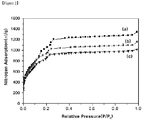
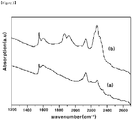
- the XRD pattern and oxygen adsorption isotherm of the obtained porous organic-inorganic hybrid material crystal are shown in (a) of FIG.1 and (a) of FIG. 2 , respectively.
- SBA-15 which is a hexagonal silica mesoporous material
- SBA-15 a porous material functionalized with an amino group
- APS-SBA-15 was prepared as in Example 1, except that SBA-15, which is a mesoporous material, rather than an organic-inorganic hybrid material, was functionalized.
- APS-SBA-15 was found to exhibit lower catalytic reactivity than NH 2 -MIL-101 in the same reaction time. The reason for this is that -NH2 group of NH 2 -MIL-101 was more activated than APS-SBA-15 (refer to Table 1).
- MIL-101 prepared in Preparation Example 1, was pretreated in a vacuum oven at a temperature of 200 for 12 hours to remove water coordinatively bonded to the coordinatively unsaturated metal sites thereof. Subsequently, 1g of the dehydrated MIL-101 was put in a mixed solution of 2 ml of ethylenediamine (ED) and 48 ml of toluene. Subsequently, the mixed solution was refluxed at a temperature of 110 for 12 hours, separated by a paper filter, and then dried in an oven at a temperature of 110 thereby preparing a porous organic-inorganic hybrid material in which an amino group is coordinatively bonded to the coordinatively unsaturated metal sites thereof.
- ED ethylenediamine
- Example 2 MIL-101 prepared in Preparation Example 1 was used, and diethylenetriamine was used as a precursor of amino group instead of ethylenediamine used in Example 1.
- 1g of MIL-101 was pretreated in a vacuum oven at a temperature of 200 for 12 hours, and was then put in a mixed solution of 3.8 ml of diethylenetriamine (DETA) and 50 ml of toluene.
- DETA diethylenetriamine
- the mixed solution was refluxed at a temperature of 110 for 12 hours, separated using a paper filter, and then dried in an oven at a temperature of 110 , thereby preparing a porous organic-inorganic hybrid material (DETA-MIL-101) in which an amino group is coordinatively bonded to the coordinatively unsaturated metal sites thereof. It was found that the amino group (-NH 2 ) and ethylene group of the diethylenetriamine were present in DETA-MIL-101 using infrared spectroscopy, as shown in (c) of FIG. 1 and (c) of FIG. 2 .
- An organic-inorganic nanoporous material was functionalized on the coordinatively unsaturated metal sites, using the same method as in Example 1, except that the 1,2-dimercaptoethane was used as a functional group for surface functionalization.
- the presence the ethylene group and thiol group (-SH) were confirmed by using infrared spectroscopy.
- AMS aminomethanesulfonic acid
- DETA-MIL-101 1g of DETA-MIL-101, prepared in Example 2, was vacuum-pretreated at a temperature of 150, and was then dispersed in a mixed solution of 0.016 g of PdCl 2 and 30 ml of ethanol to support the organic-inorganic hybrid material (DETA-MIL-101) with 1 wt% of palladium (Pd). Subsequently, 0.9 g of NaBH4, which is a reductant, was added to the mixed solution, thereby preparing a Pd-DETA-MIL-101 supported with palladium.
- DETA-MIL-101 organic-inorganic hybrid material
- NaBH4 1 wt% of palladium
- PWA-NH 2 -MIL-101 organic-inorganic hybrid material supported with a heteropoly anion via the ionic bond of the heteropoly anion and an NH 3 +-MIL-101 cation.
- ABT 4-aminobenzenethiol
- a Knoevenagel condensation reaction which is a base catalytic reaction in which ethyl trans-a-cyanocinnamate is formed using benzaldehyde (BZA, 10 mmol) and ethyl cyanoacetate (ECA) as reactants, was conducted using the porous organic-inorganic hybrid material (NH 2 -MIL-101) obtained in Example 2, Example 3 and Preparation Example 2, which includes an aminosilane functional group and is coordinated with an alkoxy group.
- the results of the reaction are given in Table 1. As given in Table 1, it was found that the reaction product has excellent activity as a base catalyst, compared to the APS-SBA-15, which is pretreated at a temperature of 150 and thus surface-functionalized in Preparation Example 2.
- a C-C bond formation reaction (Heck reaction), in which trans-stilbene is formed using iodobenzene and styrene, was conducted using the Pd-NH 2 -MIL-101 supported with palladium, obtained in Example 5.
- the reaction product has at least two times higher catalytic activity of the Pd-APS-SBA-15 in the C-C bond formation reaction because the coordinatively unsaturated metal sites thereof are functionalized with palladium.
- the reactant mixture was left at a temperature of 180 for 30 minutes to react, was cooled to room temperature, was cleaned using distilled water, and was then dried, thereby obtaining the organic-inorganic hybrid material (MIL-101) thin film.
- the X-ray diffraction patterns (XRD patterns) of the obtained MIL-101 thin film corresponded to those of the conventional powder synthesis research ( Science 2005, 309, 2040 ), in which the MIL-101 is synthesized in an electric oven at a temperature of 220 for 10 hours.
- the MIL-101 thin film was perpendicularly fixed to the bottom of a reflux reactor in which a mixed solution of 1 ml of 3-aminopropyltriethoxysilane (APS) and 50 ml of toluene was placed. Subsequently, the mixed solution was refluxed at a temperature of 110 for 12 hours, thereby preparing a porous organic-inorganic hybrid material thin film coordinated with ethoxy functional groups to the unsaturated sites thereof.
- APS 3-aminopropyltriethoxysilane
Landscapes
- Chemical & Material Sciences (AREA)
- Organic Chemistry (AREA)
- Engineering & Computer Science (AREA)
- Materials Engineering (AREA)
- Chemical Kinetics & Catalysis (AREA)
- Inorganic Chemistry (AREA)
- Catalysts (AREA)
- Inorganic Compounds Of Heavy Metals (AREA)
- Organic Low-Molecular-Weight Compounds And Preparation Thereof (AREA)
- Low-Molecular Organic Synthesis Reactions Using Catalysts (AREA)
Applications Claiming Priority (2)
| Application Number | Priority Date | Filing Date | Title |
|---|---|---|---|
| KR1020070049415A KR100864313B1 (ko) | 2007-05-21 | 2007-05-21 | 불포화 금속자리를 갖는 다공성 유-무기 혼성체 또는메조세공체의 표면 기능화 및 그의 응용 |
| PCT/KR2007/006431 WO2008143385A1 (en) | 2007-05-21 | 2007-12-11 | Preparation of surface functionalized porous organic-inorganic hybrid materials or mesoporous materials with coordinatively unsaturated metal sites and catalytic applications thereof |
Publications (3)
| Publication Number | Publication Date |
|---|---|
| EP2152414A1 EP2152414A1 (en) | 2010-02-17 |
| EP2152414A4 EP2152414A4 (en) | 2012-04-18 |
| EP2152414B1 true EP2152414B1 (en) | 2018-02-14 |
Family
ID=40032060
Family Applications (1)
| Application Number | Title | Priority Date | Filing Date |
|---|---|---|---|
| EP07851402.3A Active EP2152414B1 (en) | 2007-05-21 | 2007-12-11 | Preparation of surface functionalized porous organic-inorganic hybrid materials with coordinatively unsaturated metal sites and catalytic applications thereof |
Country Status (5)
| Country | Link |
|---|---|
| US (1) | US8569193B2 (https=) |
| EP (1) | EP2152414B1 (https=) |
| JP (1) | JP5452478B2 (https=) |
| KR (1) | KR100864313B1 (https=) |
| WO (1) | WO2008143385A1 (https=) |
Cited By (1)
| Publication number | Priority date | Publication date | Assignee | Title |
|---|---|---|---|---|
| CN110649273A (zh) * | 2019-09-12 | 2020-01-03 | 华南理工大学 | 一种合成小尺寸高分散金属间化合物催化剂材料的方法及应用 |
Families Citing this family (105)
| Publication number | Priority date | Publication date | Assignee | Title |
|---|---|---|---|---|
| US8779175B2 (en) | 2004-10-25 | 2014-07-15 | Synthonics, Inc. | Coordination complexes, pharmaceutical solutions comprising coordination complexes, and methods of treating patients |
| KR100943839B1 (ko) | 2007-10-31 | 2010-02-24 | 한국과학기술연구원 | 불규칙 표면구조의 우선 도입에 의해 고수율의바이오-이미지용 나노입자를 제조하는 방법 |
| US8236787B2 (en) * | 2008-12-09 | 2012-08-07 | Synthonics, Inc. | Frequency modulated drug delivery (FMDD) |
| JP5434114B2 (ja) * | 2009-02-10 | 2014-03-05 | 三菱化学株式会社 | 多孔性材料 |
| FR2942229B1 (fr) * | 2009-02-18 | 2011-02-25 | Univ Paris Curie | Materiau solide hybride inorganique-organique polycarboxylate a base de titane, son procede de preparation et utilisations |
| BRPI1008306A2 (pt) * | 2009-02-27 | 2017-03-28 | Univ Michigan Regents | copolímero de coordenação, processo usando um copolímero de coordenação, e, método para fabricar um copolímero de coordenação |
| KR101337509B1 (ko) | 2009-05-22 | 2013-12-05 | 고려대학교 산학협력단 | 3d 형태의 다공성 구리계 아마이드 배위 고분자 화합물의 제조방법 및 이를 포함하는 기체 흡착제 |
| US9038409B2 (en) | 2009-09-21 | 2015-05-26 | Korea Research Institute Of Chemical Technology | Apparatus for treating air by using porous organic-inorganic hybrid materials as an absorbent |
| KR101158456B1 (ko) | 2009-11-19 | 2012-06-19 | 한국화학연구원 | 결정성의 다공성 유무기 혼성체 및 그의 제조 방법 |
| KR101000365B1 (ko) | 2010-04-30 | 2010-12-13 | 애경유화 주식회사 | 복합촉매를 이용한 지방산 알킬 에스테르를 제조하는 방법 |
| KR101155678B1 (ko) | 2010-07-30 | 2012-06-13 | 부산대학교 산학협력단 | 금속 이온의 선택적 흡착을 위한 유기-무기 하이브리드 중간세공 분자체 및 그 제조 방법 |
| US8888993B2 (en) | 2010-07-30 | 2014-11-18 | Chevron U.S.A. Inc. | Treatment of a hydrocarbon feed |
| US10150792B2 (en) | 2010-11-08 | 2018-12-11 | Synthonics, Inc. | Bismuth-containing compounds, coordination polymers, methods for modulating pharmacokinetic properties of biologically active agents, and methods for treating patients |
| CN102268044B (zh) * | 2011-06-02 | 2014-01-08 | 南京工业大学 | 一步法合成纯净金属有机骨架mil-101的方法 |
| BRPI1102638B1 (pt) * | 2011-06-16 | 2020-10-20 | Universidade Federal Do Rio Grande Do Sul | zeólita e materiais mesoporosos organizados como carga para a formulação de compostos de borracha, borracha termoplástica, plástico e fabricação de produtos |
| CN102408447B (zh) * | 2011-07-28 | 2014-02-26 | 华南理工大学 | 憎水性mil-101铬金属有机骨架材料的制备方法 |
| US10182593B2 (en) | 2011-08-01 | 2019-01-22 | Massachusetts Institute Of Technology | Porous catalytic matrices for elimination of toxicants found in tobacco combustion products |
| US9307790B2 (en) * | 2011-08-01 | 2016-04-12 | Massachusetts Institute Of Technology | Porous catalytic matrices for elimination of toxicants found in tobacco combustion products |
| CN103717647B (zh) * | 2011-08-05 | 2016-12-07 | 国立大学法人京都大学 | 金属纳米粒子的pcp复合体及其制造方法 |
| DE202011106028U1 (de) | 2011-08-14 | 2012-08-17 | BLüCHER GMBH | Neue Konzepte für die Gasbehandlung und Gasreinigung |
| KR101273877B1 (ko) * | 2011-08-16 | 2013-06-25 | 한국화학연구원 | 결정성 하이브리드 나노세공체 분말을 포함하는 복합체 및 그 제조방법 |
| JP2013111563A (ja) * | 2011-11-30 | 2013-06-10 | Sumitomo Chemical Co Ltd | 組成物及び該組成物を用いたアンモニア製造方法 |
| KR101306664B1 (ko) * | 2011-12-16 | 2013-09-10 | 한국생산기술연구원 | 백금 촉매를 대체하기 위한 연료전지용 촉매 조성물 |
| CN102495120B (zh) * | 2011-12-21 | 2014-07-30 | 昆明理工大学 | 一种对铅离子敏感的多孔硅基伏安传感材料的制备方法 |
| JP5880193B2 (ja) * | 2012-03-23 | 2016-03-08 | 昭栄化学工業株式会社 | 多孔性金属錯体と無機触媒材料との複合触媒の製造方法 |
| JP5945805B2 (ja) * | 2012-07-31 | 2016-07-05 | 昭栄化学工業株式会社 | 複合触媒材料及びその製造方法 |
| JP6204737B2 (ja) * | 2012-07-31 | 2017-09-27 | 昭栄化学工業株式会社 | 炭化水素の製造方法及びクラッキング触媒 |
| CN102921432B (zh) * | 2012-10-09 | 2014-07-30 | 常州大学 | 一种促进炼油废水中氨氮转化的催化剂制备方法 |
| CN103008012A (zh) * | 2012-12-12 | 2013-04-03 | 华东师范大学 | 金属有机骨架结构材料负载铂催化剂、制备方法及其应用 |
| KR101253985B1 (ko) | 2013-01-14 | 2013-04-15 | 한국화학연구원 | 다공성 유무기 혼성체, 그의 제조 방법, 그를 포함하는 흡착제 및 그의 응용 |
| CN103191717B (zh) * | 2013-04-18 | 2015-03-04 | 福州大学 | 一种钽酸锶纳米球光催化剂及其制备方法和应用 |
| CN103242374B (zh) * | 2013-05-24 | 2015-10-28 | 浙江师范大学 | 一种金属有机骨架材料MIL-100(Fe)的制备方法 |
| CN103418333B (zh) * | 2013-07-30 | 2015-09-23 | 安徽师范大学 | 一种Bi3.64Mo0.36O6.55纳米粒子的制备方法及其Bi3.64Mo0.36O6.55纳米材料 |
| WO2015077444A1 (en) * | 2013-11-20 | 2015-05-28 | King Abdullah University Of Science And Technology | Amine functionalized porous network |
| KR101469734B1 (ko) * | 2013-12-04 | 2014-12-05 | 군산대학교산학협력단 | 과산화수소 제조용 촉매, 이의 제조 방법, 및 이를 이용한 과산화수소의 제조 방법 |
| FR3015476B1 (fr) * | 2013-12-20 | 2016-02-12 | Commissariat Energie Atomique | Materiaux monolithiques inorganiques alveolaires echangeurs cationiques, leur procede de preparation, et procede de separation les mettant en œuvre. |
| CN103920534B (zh) * | 2014-03-04 | 2016-01-27 | 大连理工大学 | 一种金属有机骨架材料固载碱性离子液体催化剂及其制备方法 |
| KR101606556B1 (ko) * | 2014-03-17 | 2016-03-28 | 한국화학연구원 | 폴리실세스퀴옥산-표면개질된 유무기 나노세공체 및 이의 제조방법 |
| JPWO2015170688A1 (ja) * | 2014-05-07 | 2017-04-20 | 国立大学法人北陸先端科学技術大学院大学 | 金属担持多孔性配位高分子触媒 |
| EP3142786A1 (en) * | 2014-05-16 | 2017-03-22 | Dow Global Technologies LLC | Process for synthesizing iron carbide fischer-tropsch catalysts |
| JP6059187B2 (ja) * | 2014-09-02 | 2017-01-11 | トヨタ自動車株式会社 | 水蒸気吸放出材料、及び、lcst挙動測定方法 |
| CN104324761B (zh) * | 2014-10-09 | 2016-04-20 | 济南大学 | 一种多孔稀土有机配合物基催化剂的制备和应用 |
| CN104437469B (zh) * | 2014-11-18 | 2016-08-17 | 郭燏 | 一种用于烟气脱臭/脱硝催化剂的纳米二氧化钛粉体及其制备方法和应用 |
| CN104492383B (zh) * | 2014-12-09 | 2016-06-29 | 浙江大学 | 一种金属有机框架吸附剂及其制备方法和应用 |
| EP3230410B1 (en) | 2014-12-12 | 2019-04-10 | Exxonmobil Research And Engineering Company | Aromatics hydrogenation catalyst, its preparation and use thereof |
| SG11201704638QA (en) * | 2014-12-12 | 2017-07-28 | Exxonmobil Res & Eng Co | Organosilica materials |
| MX357162B (es) | 2014-12-17 | 2018-06-08 | Mexicano Inst Petrol | Proceso de obtencion de materiales metal-organicos con estructura tipo mil-101 (cr) y mil-101-cr-mx. |
| CN104785294B (zh) * | 2015-03-16 | 2017-10-13 | 浙江工商大学 | 一种离子液体基催化剂及其制备方法和应用 |
| JP6609964B2 (ja) * | 2015-03-31 | 2019-11-27 | 東ソー株式会社 | 多孔性配位高分子 |
| CN104818015B (zh) * | 2015-04-19 | 2016-07-06 | 北京化工大学 | 一种吡啶羧酸类异金属有机框架发光材料及其合成方法 |
| CN105170182B (zh) * | 2015-08-12 | 2017-10-10 | 吉林大学 | 一种铬金属有机骨架催化材料及其制备方法 |
| KR101714574B1 (ko) * | 2015-10-14 | 2017-03-09 | 국방과학연구소 | 금속-유기 골격체 기반 탄소복합체 및 이의 제조방법 |
| CN105750537B (zh) * | 2016-02-19 | 2017-10-13 | 中国科学院合肥物质科学研究院 | 一种金@金属有机框架材料纳米颗粒阵列及其制备方法和应用 |
| WO2017184991A1 (en) * | 2016-04-22 | 2017-10-26 | The Regents Of The University Of California | Post-synthetically modified metal-organic frameworks for selective binding of heavy metal ions in water |
| CN106179314B (zh) * | 2016-07-06 | 2018-08-07 | 南京工业大学 | 一种多组分复合光催化剂及其制备方法和应用 |
| EP3489307A4 (en) * | 2016-07-19 | 2019-12-11 | National Institute for Materials Science | COMPOSITION WITH ORGANIC / METAL HYBRID POLYMER AND IONIC LIQUID, ELECTROCHROME DEVICE AND METHOD FOR THE PRODUCTION THEREOF AND DEVICE |
| KR101832095B1 (ko) * | 2017-02-23 | 2018-02-26 | 한국화학연구원 | 배위적으로 불포화된 자리에 아민이 도입된 철 함유 다공성 유무기 혼성체를 포함하는 산화반응용 촉매 및 이의 용도 |
| JP6880532B2 (ja) * | 2017-04-04 | 2021-06-02 | 株式会社豊田中央研究所 | 固体触媒 |
| US10470290B2 (en) * | 2017-05-08 | 2019-11-05 | International Business Machines Corporation | Coating for limiting substrate damage due to discrete failure |
| JP6883257B2 (ja) * | 2017-05-16 | 2021-06-09 | 株式会社豊田中央研究所 | 還元反応用固体触媒 |
| CN107376999A (zh) * | 2017-07-19 | 2017-11-24 | 北京化工大学 | 多酸@氧化铝后修饰有机官能团复合催化材料及其制备方法和用途 |
| US12031014B2 (en) | 2017-08-22 | 2024-07-09 | Sekisui Chemical Co., Ltd. | Composition, production method for molded object, and molded object |
| CN108484646A (zh) * | 2018-03-29 | 2018-09-04 | 山西师范大学 | 一种变色有机无机杂化材料及其制备方法和应用 |
| KR102051942B1 (ko) * | 2018-03-30 | 2019-12-04 | 한국화학연구원 | 금속-유기 트라이머가 지지체에 공유결합을 통해 형성된 금속-유기 트라이머-지지체 복합체 |
| CN109467714A (zh) * | 2018-11-14 | 2019-03-15 | 江苏师范大学 | 一种磁性复合金属-有机骨架材料及其应用 |
| CN109553081A (zh) * | 2018-11-20 | 2019-04-02 | 桑顿新能源科技有限公司 | 一种新型钠电负极材料的制备方法 |
| CN109499544A (zh) * | 2018-11-30 | 2019-03-22 | 北京工业大学 | 后修饰法合成巯基功能化金属-有机骨架mil-101-sh的方法 |
| CN109529934A (zh) * | 2018-12-06 | 2019-03-29 | 怀化学院 | Mil-101负载型催化剂及其制备方法与应用 |
| KR102369423B1 (ko) * | 2018-12-21 | 2022-03-02 | 한양대학교 에리카산학협력단 | 금속 유기 구조체, 그의 제조 방법, 및 그를 포함하는 금속-공기 전지 |
| CN109794299B (zh) * | 2018-12-25 | 2022-02-01 | 中国石油天然气股份有限公司 | 一种加氢催化剂及其制备方法、馏分油加氢精制方法 |
| CN112191111B (zh) * | 2019-07-08 | 2022-06-28 | 中国科学院青岛生物能源与过程研究所 | 一种离子液体/金属有机框架zif-8复合膜及其制备方法和应用 |
| CN112191110B (zh) * | 2019-07-08 | 2022-07-05 | 中国科学院青岛生物能源与过程研究所 | 一种纳米金属有机框架zif-8支撑的离子液体复合膜及其制备方法和应用 |
| CN110227556B (zh) * | 2019-07-08 | 2021-12-07 | 哈尔滨理工大学 | 一种多酸基铁金属有机杂化材料制备及光催化应用 |
| CN112387288B (zh) * | 2019-08-15 | 2024-01-30 | 中国石油化工股份有限公司 | 一种中温型环己醇脱氢催化剂及其制备方法和应用 |
| CN110790941B (zh) * | 2019-11-14 | 2021-08-27 | 重庆师范大学 | 含内消螺旋链的锌-有机配位聚合物及其制法与应用 |
| CN110835767A (zh) * | 2019-11-20 | 2020-02-25 | 北京工业大学 | 一种碱刻蚀的金属有机骨架材料及在电催化分解水中的应用 |
| CN110760074B (zh) * | 2019-11-25 | 2022-03-25 | 辽宁大学 | 一种离子液体体系中多级孔金属有机骨架材料的制备方法 |
| CN111013398B (zh) * | 2019-12-23 | 2021-09-28 | 同济大学 | 选择性去除荷电药物的Janus纳米通道主导纳滤膜及其制备方法 |
| CN110964285B (zh) * | 2019-12-27 | 2022-09-27 | 广东圆融新材料有限公司 | 改性介孔母粒、高抗冲聚苯乙烯组合物及其制备方法 |
| CN111318687A (zh) * | 2020-02-29 | 2020-06-23 | 上海燊铭检测技术有限公司 | 一种氨基功能化金纳米核壳结构mof-5及其制备方法 |
| CN111495328B (zh) * | 2020-04-24 | 2022-05-17 | 太原理工大学 | 方酸钙的氨改性方法及其在乙烯乙烷高效分离中的应用 |
| CN111644205B (zh) * | 2020-06-19 | 2022-10-04 | 河南大学 | 多酸基有机无机配合物及其制备方法和作为光催化剂在甲苯选择性氧化成苯甲醛中的应用 |
| CN111690149B (zh) * | 2020-06-23 | 2021-02-12 | 齐齐哈尔大学 | 一种24核有机磷铜团簇有机纳米框架封装多金属氧酸盐材料及其制备方法和应用 |
| CN113926493B (zh) * | 2020-07-13 | 2022-08-19 | 中国科学院大连化学物理研究所 | 一种MOFs晶体材料及其制备方法、应用 |
| CN112570030A (zh) * | 2020-12-29 | 2021-03-30 | 天津理工大学 | 一种Bi4O5Br2/Fe-MIL复合材料光催化剂的制备方法及其用途 |
| CN112608493B (zh) * | 2020-12-31 | 2022-01-28 | 济宁学院 | 一种具有锌配合物的多酸晶态分子及其制备方法和应用 |
| CN112871167B (zh) * | 2021-01-14 | 2022-07-08 | 浙江理工大学 | MOFs封装超细合金纳米颗粒及其制备方法与应用 |
| CN113058653B (zh) * | 2021-03-26 | 2022-09-16 | 兰州大学 | 一种用于醛与丙二腈Knoevenagel缩合反应的催化剂及制备方法 |
| CN113174055B (zh) * | 2021-04-27 | 2023-08-18 | 吉林大学 | 一种多孔离子超分子框架材料、制备方法以及应用 |
| CN113244956B (zh) * | 2021-05-20 | 2022-07-12 | 河北师范大学 | 一种磁性纳米双酸催化剂及其制备方法和应用 |
| CN113402567B (zh) * | 2021-06-15 | 2023-06-09 | 宁德师范学院 | 一种二维层状锗钒氧簇合物及其合成方法与应用 |
| CN113694914A (zh) * | 2021-07-15 | 2021-11-26 | 杭州师范大学 | 一种mof/石墨烯量子点纳米复合光催化剂的制备方法 |
| CN113583248B (zh) * | 2021-08-04 | 2022-04-12 | 北京师范大学 | 一种高度交联的磷掺杂一维无定形金属有机框架纳米线网络材料及其制备方法和应用 |
| CN114031119B (zh) * | 2021-11-12 | 2023-01-17 | 河南大学 | 一种基于同多钨酸盐构筑的{Mn8W26}簇及其合成方法 |
| CN114015070B (zh) * | 2021-11-30 | 2022-07-29 | 常州大学 | 一种催化丙交酯开环聚合的同多钼酸配位聚合物和制备方法 |
| CN114289068B (zh) * | 2021-12-31 | 2023-03-31 | 华南理工大学 | 一种In-MOFs复合光催化剂及其制备方法与应用 |
| CN115028249B (zh) * | 2022-01-04 | 2023-06-20 | 北华大学 | 一种降解全氟辛酸纳米反应器的合成方法 |
| CN114957693B (zh) * | 2022-05-26 | 2023-06-20 | 东莞理工学院 | 增强活性点暴露的缺陷型铁基金属有机骨架的制备及应用 |
| CN114921907B (zh) * | 2022-05-27 | 2023-08-08 | 上海交通大学 | 一种高效散热用金属有机框架复合材料的制备方法 |
| KR102880718B1 (ko) | 2022-08-16 | 2025-11-07 | 국방과학연구소 | 다공성 유무기 혼성체의 제조방법 |
| CN116422379A (zh) * | 2023-04-06 | 2023-07-14 | 安徽中核桐源科技有限公司 | 一种铂铁基催化剂及其制备方法和应用 |
| CN116333334B (zh) * | 2023-04-12 | 2024-05-28 | 重庆师范大学 | 多孔mof非稀土转光材料及其制法与在制备红光-近红外光器件中的应用 |
| CN117143656B (zh) * | 2023-08-09 | 2024-03-26 | 河南减碳科技有限公司 | 一种基于废变压器油的生物稳定型润滑油及其制备方法 |
| CN118079944A (zh) * | 2024-02-29 | 2024-05-28 | 山东大学 | 一种多孔铬基复合脱硝催化剂及其制备方法和应用 |
| CN119570478B (zh) * | 2025-02-08 | 2025-06-03 | 三峡环境科技有限公司 | 用于检测全氟辛烷磺酸的指示剂置换传感器及其制备方法和应用 |
Family Cites Families (10)
| Publication number | Priority date | Publication date | Assignee | Title |
|---|---|---|---|---|
| KR20010034199A (ko) * | 1998-11-20 | 2001-04-25 | 간디 지오프레이 에이치. | 다리화 메탈로센, 제조, 촉매계 내에서의 용도 |
| KR100676215B1 (ko) | 2002-05-15 | 2007-01-30 | 니폰 쇼쿠바이 컴파니 리미티드 | 다공성 배위불포화 금속착체 |
| JP2004285315A (ja) * | 2002-05-15 | 2004-10-14 | Nippon Shokubai Co Ltd | 多孔性配位不飽和金属錯体 |
| US7541012B2 (en) * | 2004-07-07 | 2009-06-02 | The Hong Kong University Of Science And Technology | Catalytic material and method of production thereof |
| JP4496986B2 (ja) * | 2005-02-21 | 2010-07-07 | 住友化学株式会社 | 多孔性金属錯体細孔内での重合方法 |
| MX2007012388A (es) | 2005-04-07 | 2008-03-11 | Univ Michigan | Adsorcion elevada de gas en una estructura metal-organica microporosa con sitios de metal abiertos. |
| KR100627634B1 (ko) * | 2005-07-18 | 2006-09-25 | 한국화학연구원 | 연속교반식 반응기를 이용한 다공성 물질 및 혼합금속산화물의 연속적 제조방법 및 연속적 제조 장치 |
| DE102005060364A1 (de) | 2005-12-16 | 2007-06-21 | Basf Ag | Sauer funktionalisierte metallorganische Gerüstmaterialien |
| DE102005060361A1 (de) | 2005-12-16 | 2007-06-21 | BSH Bosch und Siemens Hausgeräte GmbH | Kochgerät |
| KR100680767B1 (ko) | 2006-02-07 | 2007-02-09 | 한국화학연구원 | 다공성 유무기혼성체의 제조방법 |
-
2007
- 2007-05-21 KR KR1020070049415A patent/KR100864313B1/ko active Active
- 2007-12-11 EP EP07851402.3A patent/EP2152414B1/en active Active
- 2007-12-11 US US12/600,997 patent/US8569193B2/en active Active
- 2007-12-11 WO PCT/KR2007/006431 patent/WO2008143385A1/en not_active Ceased
- 2007-12-11 JP JP2010509261A patent/JP5452478B2/ja active Active
Non-Patent Citations (1)
| Title |
|---|
| None * |
Cited By (2)
| Publication number | Priority date | Publication date | Assignee | Title |
|---|---|---|---|---|
| CN110649273A (zh) * | 2019-09-12 | 2020-01-03 | 华南理工大学 | 一种合成小尺寸高分散金属间化合物催化剂材料的方法及应用 |
| CN110649273B (zh) * | 2019-09-12 | 2021-09-14 | 华南理工大学 | 一种合成小尺寸高分散金属间化合物催化剂材料的方法及应用 |
Also Published As
| Publication number | Publication date |
|---|---|
| JP5452478B2 (ja) | 2014-03-26 |
| WO2008143385A1 (en) | 2008-11-27 |
| EP2152414A1 (en) | 2010-02-17 |
| KR100864313B1 (ko) | 2008-10-20 |
| US8569193B2 (en) | 2013-10-29 |
| US20100273642A1 (en) | 2010-10-28 |
| JP2010527890A (ja) | 2010-08-19 |
| EP2152414A4 (en) | 2012-04-18 |
Similar Documents
| Publication | Publication Date | Title |
|---|---|---|
| EP2152414B1 (en) | Preparation of surface functionalized porous organic-inorganic hybrid materials with coordinatively unsaturated metal sites and catalytic applications thereof | |
| Dhakshinamoorthy et al. | Tuneable nature of metal organic frameworks as heterogeneous solid catalysts for alcohol oxidation | |
| KR101034988B1 (ko) | 유무기 혼성체 및 거대 메조세공 물질의 공유결합에 의하여 형성된 초다공성 유무기 나노세공 복합체 | |
| EP2716360B1 (en) | Method for preparing porous organic-inorganic hybrid materials | |
| Kratzl et al. | Generation and stabilization of small platinum clusters Pt12±x inside a metal–organic framework | |
| KR100680767B1 (ko) | 다공성 유무기혼성체의 제조방법 | |
| JP5689903B2 (ja) | 多孔性有機−無機ハイブリッド体の製造方法 | |
| Karmakar et al. | Solvent-dependent structural variation of Zinc (II) coordination polymers and their catalytic activity in the knoevenagel condensation reaction | |
| Morel et al. | Synthesis and Characterization of Phosphine-Functionalized Metal–Organic Frameworks Based on MOF-5 and MIL-101 Topologies | |
| Huang et al. | Synthesis of metal Salen@ MOFs and their catalytic performance for styrene oxidation | |
| Sullivan et al. | Phase-pure zirconium metal–organic polyhedra enabled by a ligand substitution strategy | |
| KR100895413B1 (ko) | 다공성 유무기혼성체의 제조방법, 상기 방법에 의하여수득되는 유무기혼성체 및 이의 촉매적 용도 | |
| KR100816538B1 (ko) | 불포화 금속자리를 갖는 다공성 유-무기 혼성체 또는메조세공체의 표면 기능화 방법 | |
| Isaeva et al. | Hydroamination of Phenylacetylene with Aniline over Gold Nanoparticles Embedded in the Boron Imidazolate Framework BIF-66 and Zeolitic Imidazolate Framework ZIF-67 | |
| KR102880718B1 (ko) | 다공성 유무기 혼성체의 제조방법 | |
| KR101094075B1 (ko) | 신규한 유무기 하이브리드 나노세공체 및 그의 제조방법 | |
| KR102051942B1 (ko) | 금속-유기 트라이머가 지지체에 공유결합을 통해 형성된 금속-유기 트라이머-지지체 복합체 | |
| KR100912790B1 (ko) | 다공성 유무기혼성체의 제조방법, 상기 방법에 의하여 수득되는 유무기혼성체 및 이의 촉매적 용도 | |
| KR20240024494A (ko) | 배위착화합물-zif 복합체 및 이의 제조방법 | |
| Gangu et al. | Surface modification of metal-organic frameworks for biomedical applications | |
| KR101776169B1 (ko) | 삼원 금속을 포함하는 유무기 하이브리드 나노세공체 및 이의 용도 | |
| Rivera Torrente | Metal-Organic Frameworks: Defects, Spectroscopy and Catalysis | |
| Torrente | Metal-Organic Frameworks: Defects, Spectroscopy and Catalysis | |
| Basset | Surface organometallic chemistry on Metal Organic Frameworks (MOF): synthesis, characterization and their application in catalysis. |
Legal Events
| Date | Code | Title | Description |
|---|---|---|---|
| PUAI | Public reference made under article 153(3) epc to a published international application that has entered the european phase |
Free format text: ORIGINAL CODE: 0009012 |
|
| 17P | Request for examination filed |
Effective date: 20091125 |
|
| AK | Designated contracting states |
Kind code of ref document: A1 Designated state(s): AT BE BG CH CY CZ DE DK EE ES FI FR GB GR HU IE IS IT LI LT LU LV MC MT NL PL PT RO SE SI SK TR |
|
| AX | Request for extension of the european patent |
Extension state: AL BA HR MK RS |
|
| DAX | Request for extension of the european patent (deleted) | ||
| A4 | Supplementary search report drawn up and despatched |
Effective date: 20120321 |
|
| RIC1 | Information provided on ipc code assigned before grant |
Ipc: B01J 31/16 20060101ALI20120315BHEP Ipc: B01J 31/06 20060101ALI20120315BHEP Ipc: B01J 31/12 20060101AFI20120315BHEP |
|
| 17Q | First examination report despatched |
Effective date: 20160204 |
|
| GRAP | Despatch of communication of intention to grant a patent |
Free format text: ORIGINAL CODE: EPIDOSNIGR1 |
|
| STAA | Information on the status of an ep patent application or granted ep patent |
Free format text: STATUS: GRANT OF PATENT IS INTENDED |
|
| INTG | Intention to grant announced |
Effective date: 20170420 |
|
| GRAJ | Information related to disapproval of communication of intention to grant by the applicant or resumption of examination proceedings by the epo deleted |
Free format text: ORIGINAL CODE: EPIDOSDIGR1 |
|
| STAA | Information on the status of an ep patent application or granted ep patent |
Free format text: STATUS: EXAMINATION IS IN PROGRESS |
|
| INTC | Intention to grant announced (deleted) | ||
| GRAP | Despatch of communication of intention to grant a patent |
Free format text: ORIGINAL CODE: EPIDOSNIGR1 |
|
| STAA | Information on the status of an ep patent application or granted ep patent |
Free format text: STATUS: GRANT OF PATENT IS INTENDED |
|
| INTG | Intention to grant announced |
Effective date: 20170915 |
|
| GRAS | Grant fee paid |
Free format text: ORIGINAL CODE: EPIDOSNIGR3 |
|
| GRAA | (expected) grant |
Free format text: ORIGINAL CODE: 0009210 |
|
| STAA | Information on the status of an ep patent application or granted ep patent |
Free format text: STATUS: THE PATENT HAS BEEN GRANTED |
|
| AK | Designated contracting states |
Kind code of ref document: B1 Designated state(s): AT BE BG CH CY CZ DE DK EE ES FI FR GB GR HU IE IS IT LI LT LU LV MC MT NL PL PT RO SE SI SK TR |
|
| REG | Reference to a national code |
Ref country code: GB Ref legal event code: FG4D |
|
| REG | Reference to a national code |
Ref country code: CH Ref legal event code: EP |
|
| REG | Reference to a national code |
Ref country code: NL Ref legal event code: FP |
|
| REG | Reference to a national code |
Ref country code: IE Ref legal event code: FG4D |
|
| REG | Reference to a national code |
Ref country code: DE Ref legal event code: R096 Ref document number: 602007053930 Country of ref document: DE Ref country code: AT Ref legal event code: REF Ref document number: 969529 Country of ref document: AT Kind code of ref document: T Effective date: 20180315 |
|
| REG | Reference to a national code |
Ref country code: AT Ref legal event code: MK05 Ref document number: 969529 Country of ref document: AT Kind code of ref document: T Effective date: 20180214 |
|
| PG25 | Lapsed in a contracting state [announced via postgrant information from national office to epo] |
Ref country code: ES Free format text: LAPSE BECAUSE OF FAILURE TO SUBMIT A TRANSLATION OF THE DESCRIPTION OR TO PAY THE FEE WITHIN THE PRESCRIBED TIME-LIMIT Effective date: 20180214 Ref country code: LT Free format text: LAPSE BECAUSE OF FAILURE TO SUBMIT A TRANSLATION OF THE DESCRIPTION OR TO PAY THE FEE WITHIN THE PRESCRIBED TIME-LIMIT Effective date: 20180214 Ref country code: CY Free format text: LAPSE BECAUSE OF FAILURE TO SUBMIT A TRANSLATION OF THE DESCRIPTION OR TO PAY THE FEE WITHIN THE PRESCRIBED TIME-LIMIT Effective date: 20180214 Ref country code: FI Free format text: LAPSE BECAUSE OF FAILURE TO SUBMIT A TRANSLATION OF THE DESCRIPTION OR TO PAY THE FEE WITHIN THE PRESCRIBED TIME-LIMIT Effective date: 20180214 |
|
| PG25 | Lapsed in a contracting state [announced via postgrant information from national office to epo] |
Ref country code: AT Free format text: LAPSE BECAUSE OF FAILURE TO SUBMIT A TRANSLATION OF THE DESCRIPTION OR TO PAY THE FEE WITHIN THE PRESCRIBED TIME-LIMIT Effective date: 20180214 Ref country code: GR Free format text: LAPSE BECAUSE OF FAILURE TO SUBMIT A TRANSLATION OF THE DESCRIPTION OR TO PAY THE FEE WITHIN THE PRESCRIBED TIME-LIMIT Effective date: 20180515 Ref country code: BG Free format text: LAPSE BECAUSE OF FAILURE TO SUBMIT A TRANSLATION OF THE DESCRIPTION OR TO PAY THE FEE WITHIN THE PRESCRIBED TIME-LIMIT Effective date: 20180514 Ref country code: SE Free format text: LAPSE BECAUSE OF FAILURE TO SUBMIT A TRANSLATION OF THE DESCRIPTION OR TO PAY THE FEE WITHIN THE PRESCRIBED TIME-LIMIT Effective date: 20180214 Ref country code: LV Free format text: LAPSE BECAUSE OF FAILURE TO SUBMIT A TRANSLATION OF THE DESCRIPTION OR TO PAY THE FEE WITHIN THE PRESCRIBED TIME-LIMIT Effective date: 20180214 |
|
| REG | Reference to a national code |
Ref country code: FR Ref legal event code: PLFP Year of fee payment: 12 |
|
| PG25 | Lapsed in a contracting state [announced via postgrant information from national office to epo] |
Ref country code: RO Free format text: LAPSE BECAUSE OF FAILURE TO SUBMIT A TRANSLATION OF THE DESCRIPTION OR TO PAY THE FEE WITHIN THE PRESCRIBED TIME-LIMIT Effective date: 20180214 Ref country code: IT Free format text: LAPSE BECAUSE OF FAILURE TO SUBMIT A TRANSLATION OF THE DESCRIPTION OR TO PAY THE FEE WITHIN THE PRESCRIBED TIME-LIMIT Effective date: 20180214 Ref country code: PL Free format text: LAPSE BECAUSE OF FAILURE TO SUBMIT A TRANSLATION OF THE DESCRIPTION OR TO PAY THE FEE WITHIN THE PRESCRIBED TIME-LIMIT Effective date: 20180214 Ref country code: EE Free format text: LAPSE BECAUSE OF FAILURE TO SUBMIT A TRANSLATION OF THE DESCRIPTION OR TO PAY THE FEE WITHIN THE PRESCRIBED TIME-LIMIT Effective date: 20180214 |
|
| REG | Reference to a national code |
Ref country code: DE Ref legal event code: R097 Ref document number: 602007053930 Country of ref document: DE |
|
| PG25 | Lapsed in a contracting state [announced via postgrant information from national office to epo] |
Ref country code: DK Free format text: LAPSE BECAUSE OF FAILURE TO SUBMIT A TRANSLATION OF THE DESCRIPTION OR TO PAY THE FEE WITHIN THE PRESCRIBED TIME-LIMIT Effective date: 20180214 Ref country code: CZ Free format text: LAPSE BECAUSE OF FAILURE TO SUBMIT A TRANSLATION OF THE DESCRIPTION OR TO PAY THE FEE WITHIN THE PRESCRIBED TIME-LIMIT Effective date: 20180214 Ref country code: SK Free format text: LAPSE BECAUSE OF FAILURE TO SUBMIT A TRANSLATION OF THE DESCRIPTION OR TO PAY THE FEE WITHIN THE PRESCRIBED TIME-LIMIT Effective date: 20180214 |
|
| PLBE | No opposition filed within time limit |
Free format text: ORIGINAL CODE: 0009261 |
|
| STAA | Information on the status of an ep patent application or granted ep patent |
Free format text: STATUS: NO OPPOSITION FILED WITHIN TIME LIMIT |
|
| 26N | No opposition filed |
Effective date: 20181115 |
|
| PG25 | Lapsed in a contracting state [announced via postgrant information from national office to epo] |
Ref country code: SI Free format text: LAPSE BECAUSE OF FAILURE TO SUBMIT A TRANSLATION OF THE DESCRIPTION OR TO PAY THE FEE WITHIN THE PRESCRIBED TIME-LIMIT Effective date: 20180214 |
|
| REG | Reference to a national code |
Ref country code: CH Ref legal event code: PL |
|
| GBPC | Gb: european patent ceased through non-payment of renewal fee |
Effective date: 20181211 |
|
| PG25 | Lapsed in a contracting state [announced via postgrant information from national office to epo] |
Ref country code: LU Free format text: LAPSE BECAUSE OF NON-PAYMENT OF DUE FEES Effective date: 20181211 Ref country code: MC Free format text: LAPSE BECAUSE OF FAILURE TO SUBMIT A TRANSLATION OF THE DESCRIPTION OR TO PAY THE FEE WITHIN THE PRESCRIBED TIME-LIMIT Effective date: 20180214 |
|
| REG | Reference to a national code |
Ref country code: IE Ref legal event code: MM4A |
|
| PG25 | Lapsed in a contracting state [announced via postgrant information from national office to epo] |
Ref country code: IE Free format text: LAPSE BECAUSE OF NON-PAYMENT OF DUE FEES Effective date: 20181211 |
|
| PG25 | Lapsed in a contracting state [announced via postgrant information from national office to epo] |
Ref country code: CH Free format text: LAPSE BECAUSE OF NON-PAYMENT OF DUE FEES Effective date: 20181231 Ref country code: LI Free format text: LAPSE BECAUSE OF NON-PAYMENT OF DUE FEES Effective date: 20181231 Ref country code: GB Free format text: LAPSE BECAUSE OF NON-PAYMENT OF DUE FEES Effective date: 20181211 |
|
| PG25 | Lapsed in a contracting state [announced via postgrant information from national office to epo] |
Ref country code: MT Free format text: LAPSE BECAUSE OF NON-PAYMENT OF DUE FEES Effective date: 20181211 |
|
| PG25 | Lapsed in a contracting state [announced via postgrant information from national office to epo] |
Ref country code: TR Free format text: LAPSE BECAUSE OF FAILURE TO SUBMIT A TRANSLATION OF THE DESCRIPTION OR TO PAY THE FEE WITHIN THE PRESCRIBED TIME-LIMIT Effective date: 20180214 |
|
| PG25 | Lapsed in a contracting state [announced via postgrant information from national office to epo] |
Ref country code: PT Free format text: LAPSE BECAUSE OF FAILURE TO SUBMIT A TRANSLATION OF THE DESCRIPTION OR TO PAY THE FEE WITHIN THE PRESCRIBED TIME-LIMIT Effective date: 20180214 |
|
| PG25 | Lapsed in a contracting state [announced via postgrant information from national office to epo] |
Ref country code: HU Free format text: LAPSE BECAUSE OF FAILURE TO SUBMIT A TRANSLATION OF THE DESCRIPTION OR TO PAY THE FEE WITHIN THE PRESCRIBED TIME-LIMIT; INVALID AB INITIO Effective date: 20071211 |
|
| PG25 | Lapsed in a contracting state [announced via postgrant information from national office to epo] |
Ref country code: IS Free format text: LAPSE BECAUSE OF FAILURE TO SUBMIT A TRANSLATION OF THE DESCRIPTION OR TO PAY THE FEE WITHIN THE PRESCRIBED TIME-LIMIT Effective date: 20180614 |
|
| PGFP | Annual fee paid to national office [announced via postgrant information from national office to epo] |
Ref country code: NL Payment date: 20250922 Year of fee payment: 19 |
|
| PGFP | Annual fee paid to national office [announced via postgrant information from national office to epo] |
Ref country code: BE Payment date: 20250922 Year of fee payment: 19 |
|
| PGFP | Annual fee paid to national office [announced via postgrant information from national office to epo] |
Ref country code: FR Payment date: 20250925 Year of fee payment: 19 |
|
| PGFP | Annual fee paid to national office [announced via postgrant information from national office to epo] |
Ref country code: DE Payment date: 20250922 Year of fee payment: 19 |