EP1596445B2 - Verfahren zur Dotierung von organischen Halbleitern mit Chinonderivaten - Google Patents
Verfahren zur Dotierung von organischen Halbleitern mit Chinonderivaten Download PDFInfo
- Publication number
- EP1596445B2 EP1596445B2 EP05008447.4A EP05008447A EP1596445B2 EP 1596445 B2 EP1596445 B2 EP 1596445B2 EP 05008447 A EP05008447 A EP 05008447A EP 1596445 B2 EP1596445 B2 EP 1596445B2
- Authority
- EP
- European Patent Office
- Prior art keywords
- organic
- compound
- dopant
- group
- perfluoroalkyl
- Prior art date
- Legal status (The legal status is an assumption and is not a legal conclusion. Google has not performed a legal analysis and makes no representation as to the accuracy of the status listed.)
- Expired - Lifetime
Links
- 0 CC(C)=C(C(*)=C1*)c(c(*)c(C(C(C)=C(*)C2=*)=*)c2c2*)c2C1=N Chemical compound CC(C)=C(C(*)=C1*)c(c(*)c(C(C(C)=C(*)C2=*)=*)c2c2*)c2C1=N 0.000 description 6
Classifications
-
- H—ELECTRICITY
- H10—SEMICONDUCTOR DEVICES; ELECTRIC SOLID-STATE DEVICES NOT OTHERWISE PROVIDED FOR
- H10P—GENERIC PROCESSES OR APPARATUS FOR THE MANUFACTURE OR TREATMENT OF DEVICES COVERED BY CLASS H10
- H10P95/00—Generic processes or apparatus for manufacture or treatments not covered by the other groups of this subclass
- H10P95/50—Alloying conductive materials with semiconductor bodies
-
- C—CHEMISTRY; METALLURGY
- C09—DYES; PAINTS; POLISHES; NATURAL RESINS; ADHESIVES; COMPOSITIONS NOT OTHERWISE PROVIDED FOR; APPLICATIONS OF MATERIALS NOT OTHERWISE PROVIDED FOR
- C09K—MATERIALS FOR MISCELLANEOUS APPLICATIONS, NOT PROVIDED FOR ELSEWHERE
- C09K11/00—Luminescent materials, e.g. electroluminescent or chemiluminescent
- C09K11/06—Luminescent materials, e.g. electroluminescent or chemiluminescent containing organic luminescent materials
-
- C—CHEMISTRY; METALLURGY
- C09—DYES; PAINTS; POLISHES; NATURAL RESINS; ADHESIVES; COMPOSITIONS NOT OTHERWISE PROVIDED FOR; APPLICATIONS OF MATERIALS NOT OTHERWISE PROVIDED FOR
- C09B—ORGANIC DYES OR CLOSELY-RELATED COMPOUNDS FOR PRODUCING DYES, e.g. PIGMENTS; MORDANTS; LAKES
- C09B69/00—Dyes not provided for by a single group of this subclass
- C09B69/10—Polymeric dyes; Reaction products of dyes with monomers or with macromolecular compounds
- C09B69/101—Polymeric dyes; Reaction products of dyes with monomers or with macromolecular compounds containing an anthracene dye
- C09B69/102—Polymeric dyes; Reaction products of dyes with monomers or with macromolecular compounds containing an anthracene dye containing a perylene dye
-
- C—CHEMISTRY; METALLURGY
- C09—DYES; PAINTS; POLISHES; NATURAL RESINS; ADHESIVES; COMPOSITIONS NOT OTHERWISE PROVIDED FOR; APPLICATIONS OF MATERIALS NOT OTHERWISE PROVIDED FOR
- C09B—ORGANIC DYES OR CLOSELY-RELATED COMPOUNDS FOR PRODUCING DYES, e.g. PIGMENTS; MORDANTS; LAKES
- C09B69/00—Dyes not provided for by a single group of this subclass
- C09B69/10—Polymeric dyes; Reaction products of dyes with monomers or with macromolecular compounds
- C09B69/105—Polymeric dyes; Reaction products of dyes with monomers or with macromolecular compounds containing a methine or polymethine dye
-
- C—CHEMISTRY; METALLURGY
- C09—DYES; PAINTS; POLISHES; NATURAL RESINS; ADHESIVES; COMPOSITIONS NOT OTHERWISE PROVIDED FOR; APPLICATIONS OF MATERIALS NOT OTHERWISE PROVIDED FOR
- C09B—ORGANIC DYES OR CLOSELY-RELATED COMPOUNDS FOR PRODUCING DYES, e.g. PIGMENTS; MORDANTS; LAKES
- C09B69/00—Dyes not provided for by a single group of this subclass
- C09B69/10—Polymeric dyes; Reaction products of dyes with monomers or with macromolecular compounds
- C09B69/109—Polymeric dyes; Reaction products of dyes with monomers or with macromolecular compounds containing other specific dyes
-
- H—ELECTRICITY
- H10—SEMICONDUCTOR DEVICES; ELECTRIC SOLID-STATE DEVICES NOT OTHERWISE PROVIDED FOR
- H10K—ORGANIC ELECTRIC SOLID-STATE DEVICES
- H10K71/00—Manufacture or treatment specially adapted for the organic devices covered by this subclass
- H10K71/30—Doping active layers, e.g. electron transporting layers
-
- H—ELECTRICITY
- H10—SEMICONDUCTOR DEVICES; ELECTRIC SOLID-STATE DEVICES NOT OTHERWISE PROVIDED FOR
- H10K—ORGANIC ELECTRIC SOLID-STATE DEVICES
- H10K85/00—Organic materials used in the body or electrodes of devices covered by this subclass
- H10K85/30—Coordination compounds
- H10K85/321—Metal complexes comprising a group IIIA element, e.g. Tris (8-hydroxyquinoline) gallium [Gaq3]
-
- H—ELECTRICITY
- H10—SEMICONDUCTOR DEVICES; ELECTRIC SOLID-STATE DEVICES NOT OTHERWISE PROVIDED FOR
- H10K—ORGANIC ELECTRIC SOLID-STATE DEVICES
- H10K85/00—Organic materials used in the body or electrodes of devices covered by this subclass
- H10K85/30—Coordination compounds
- H10K85/321—Metal complexes comprising a group IIIA element, e.g. Tris (8-hydroxyquinoline) gallium [Gaq3]
- H10K85/322—Metal complexes comprising a group IIIA element, e.g. Tris (8-hydroxyquinoline) gallium [Gaq3] comprising boron
-
- H—ELECTRICITY
- H10—SEMICONDUCTOR DEVICES; ELECTRIC SOLID-STATE DEVICES NOT OTHERWISE PROVIDED FOR
- H10K—ORGANIC ELECTRIC SOLID-STATE DEVICES
- H10K85/00—Organic materials used in the body or electrodes of devices covered by this subclass
- H10K85/60—Organic compounds having low molecular weight
- H10K85/611—Charge transfer complexes
-
- H—ELECTRICITY
- H10—SEMICONDUCTOR DEVICES; ELECTRIC SOLID-STATE DEVICES NOT OTHERWISE PROVIDED FOR
- H10K—ORGANIC ELECTRIC SOLID-STATE DEVICES
- H10K85/00—Organic materials used in the body or electrodes of devices covered by this subclass
- H10K85/60—Organic compounds having low molecular weight
- H10K85/615—Polycyclic condensed aromatic hydrocarbons, e.g. anthracene
-
- H—ELECTRICITY
- H10—SEMICONDUCTOR DEVICES; ELECTRIC SOLID-STATE DEVICES NOT OTHERWISE PROVIDED FOR
- H10K—ORGANIC ELECTRIC SOLID-STATE DEVICES
- H10K85/00—Organic materials used in the body or electrodes of devices covered by this subclass
- H10K85/60—Organic compounds having low molecular weight
- H10K85/615—Polycyclic condensed aromatic hydrocarbons, e.g. anthracene
- H10K85/622—Polycyclic condensed aromatic hydrocarbons, e.g. anthracene containing four rings, e.g. pyrene
-
- H—ELECTRICITY
- H10—SEMICONDUCTOR DEVICES; ELECTRIC SOLID-STATE DEVICES NOT OTHERWISE PROVIDED FOR
- H10K—ORGANIC ELECTRIC SOLID-STATE DEVICES
- H10K85/00—Organic materials used in the body or electrodes of devices covered by this subclass
- H10K85/60—Organic compounds having low molecular weight
- H10K85/649—Aromatic compounds comprising a hetero atom
- H10K85/657—Polycyclic condensed heteroaromatic hydrocarbons
- H10K85/6576—Polycyclic condensed heteroaromatic hydrocarbons comprising only sulfur in the heteroaromatic polycondensed ring system, e.g. benzothiophene
-
- C—CHEMISTRY; METALLURGY
- C09—DYES; PAINTS; POLISHES; NATURAL RESINS; ADHESIVES; COMPOSITIONS NOT OTHERWISE PROVIDED FOR; APPLICATIONS OF MATERIALS NOT OTHERWISE PROVIDED FOR
- C09K—MATERIALS FOR MISCELLANEOUS APPLICATIONS, NOT PROVIDED FOR ELSEWHERE
- C09K2211/00—Chemical nature of organic luminescent or tenebrescent compounds
- C09K2211/10—Non-macromolecular compounds
- C09K2211/1003—Carbocyclic compounds
- C09K2211/1007—Non-condensed systems
-
- C—CHEMISTRY; METALLURGY
- C09—DYES; PAINTS; POLISHES; NATURAL RESINS; ADHESIVES; COMPOSITIONS NOT OTHERWISE PROVIDED FOR; APPLICATIONS OF MATERIALS NOT OTHERWISE PROVIDED FOR
- C09K—MATERIALS FOR MISCELLANEOUS APPLICATIONS, NOT PROVIDED FOR ELSEWHERE
- C09K2211/00—Chemical nature of organic luminescent or tenebrescent compounds
- C09K2211/10—Non-macromolecular compounds
- C09K2211/1003—Carbocyclic compounds
- C09K2211/1011—Condensed systems
-
- C—CHEMISTRY; METALLURGY
- C09—DYES; PAINTS; POLISHES; NATURAL RESINS; ADHESIVES; COMPOSITIONS NOT OTHERWISE PROVIDED FOR; APPLICATIONS OF MATERIALS NOT OTHERWISE PROVIDED FOR
- C09K—MATERIALS FOR MISCELLANEOUS APPLICATIONS, NOT PROVIDED FOR ELSEWHERE
- C09K2211/00—Chemical nature of organic luminescent or tenebrescent compounds
- C09K2211/10—Non-macromolecular compounds
- C09K2211/1018—Heterocyclic compounds
- C09K2211/1025—Heterocyclic compounds characterised by ligands
- C09K2211/1092—Heterocyclic compounds characterised by ligands containing sulfur as the only heteroatom
-
- H—ELECTRICITY
- H10—SEMICONDUCTOR DEVICES; ELECTRIC SOLID-STATE DEVICES NOT OTHERWISE PROVIDED FOR
- H10K—ORGANIC ELECTRIC SOLID-STATE DEVICES
- H10K50/00—Organic light-emitting devices
- H10K50/10—OLEDs or polymer light-emitting diodes [PLED]
- H10K50/14—Carrier transporting layers
- H10K50/15—Hole transporting layers
- H10K50/155—Hole transporting layers comprising dopants
-
- H—ELECTRICITY
- H10—SEMICONDUCTOR DEVICES; ELECTRIC SOLID-STATE DEVICES NOT OTHERWISE PROVIDED FOR
- H10K—ORGANIC ELECTRIC SOLID-STATE DEVICES
- H10K71/00—Manufacture or treatment specially adapted for the organic devices covered by this subclass
- H10K71/10—Deposition of organic active material
- H10K71/16—Deposition of organic active material using physical vapour deposition [PVD], e.g. vacuum deposition or sputtering
- H10K71/164—Deposition of organic active material using physical vapour deposition [PVD], e.g. vacuum deposition or sputtering using vacuum deposition
-
- H—ELECTRICITY
- H10—SEMICONDUCTOR DEVICES; ELECTRIC SOLID-STATE DEVICES NOT OTHERWISE PROVIDED FOR
- H10K—ORGANIC ELECTRIC SOLID-STATE DEVICES
- H10K85/00—Organic materials used in the body or electrodes of devices covered by this subclass
- H10K85/30—Coordination compounds
- H10K85/311—Phthalocyanine
-
- H—ELECTRICITY
- H10—SEMICONDUCTOR DEVICES; ELECTRIC SOLID-STATE DEVICES NOT OTHERWISE PROVIDED FOR
- H10K—ORGANIC ELECTRIC SOLID-STATE DEVICES
- H10K85/00—Organic materials used in the body or electrodes of devices covered by this subclass
- H10K85/30—Coordination compounds
- H10K85/381—Metal complexes comprising a group IIB metal element, e.g. comprising cadmium, mercury or zinc
-
- H—ELECTRICITY
- H10—SEMICONDUCTOR DEVICES; ELECTRIC SOLID-STATE DEVICES NOT OTHERWISE PROVIDED FOR
- H10K—ORGANIC ELECTRIC SOLID-STATE DEVICES
- H10K85/00—Organic materials used in the body or electrodes of devices covered by this subclass
- H10K85/60—Organic compounds having low molecular weight
- H10K85/631—Amine compounds having at least two aryl rest on at least one amine-nitrogen atom, e.g. triphenylamine
-
- H—ELECTRICITY
- H10—SEMICONDUCTOR DEVICES; ELECTRIC SOLID-STATE DEVICES NOT OTHERWISE PROVIDED FOR
- H10K—ORGANIC ELECTRIC SOLID-STATE DEVICES
- H10K85/00—Organic materials used in the body or electrodes of devices covered by this subclass
- H10K85/60—Organic compounds having low molecular weight
- H10K85/649—Aromatic compounds comprising a hetero atom
- H10K85/654—Aromatic compounds comprising a hetero atom comprising only nitrogen as heteroatom
-
- H—ELECTRICITY
- H10—SEMICONDUCTOR DEVICES; ELECTRIC SOLID-STATE DEVICES NOT OTHERWISE PROVIDED FOR
- H10K—ORGANIC ELECTRIC SOLID-STATE DEVICES
- H10K85/00—Organic materials used in the body or electrodes of devices covered by this subclass
- H10K85/60—Organic compounds having low molecular weight
- H10K85/649—Aromatic compounds comprising a hetero atom
- H10K85/656—Aromatic compounds comprising a hetero atom comprising two or more different heteroatoms per ring
- H10K85/6565—Oxadiazole compounds
-
- H—ELECTRICITY
- H10—SEMICONDUCTOR DEVICES; ELECTRIC SOLID-STATE DEVICES NOT OTHERWISE PROVIDED FOR
- H10K—ORGANIC ELECTRIC SOLID-STATE DEVICES
- H10K85/00—Organic materials used in the body or electrodes of devices covered by this subclass
- H10K85/60—Organic compounds having low molecular weight
- H10K85/649—Aromatic compounds comprising a hetero atom
- H10K85/657—Polycyclic condensed heteroaromatic hydrocarbons
-
- H—ELECTRICITY
- H10—SEMICONDUCTOR DEVICES; ELECTRIC SOLID-STATE DEVICES NOT OTHERWISE PROVIDED FOR
- H10K—ORGANIC ELECTRIC SOLID-STATE DEVICES
- H10K85/00—Organic materials used in the body or electrodes of devices covered by this subclass
- H10K85/60—Organic compounds having low molecular weight
- H10K85/649—Aromatic compounds comprising a hetero atom
- H10K85/657—Polycyclic condensed heteroaromatic hydrocarbons
- H10K85/6572—Polycyclic condensed heteroaromatic hydrocarbons comprising only nitrogen in the heteroaromatic polycondensed ring system, e.g. phenanthroline or carbazole
-
- Y—GENERAL TAGGING OF NEW TECHNOLOGICAL DEVELOPMENTS; GENERAL TAGGING OF CROSS-SECTIONAL TECHNOLOGIES SPANNING OVER SEVERAL SECTIONS OF THE IPC; TECHNICAL SUBJECTS COVERED BY FORMER USPC CROSS-REFERENCE ART COLLECTIONS [XRACs] AND DIGESTS
- Y02—TECHNOLOGIES OR APPLICATIONS FOR MITIGATION OR ADAPTATION AGAINST CLIMATE CHANGE
- Y02B—CLIMATE CHANGE MITIGATION TECHNOLOGIES RELATED TO BUILDINGS, e.g. HOUSING, HOUSE APPLIANCES OR RELATED END-USER APPLICATIONS
- Y02B10/00—Integration of renewable energy sources in buildings
- Y02B10/10—Photovoltaic [PV]
-
- Y—GENERAL TAGGING OF NEW TECHNOLOGICAL DEVELOPMENTS; GENERAL TAGGING OF CROSS-SECTIONAL TECHNOLOGIES SPANNING OVER SEVERAL SECTIONS OF THE IPC; TECHNICAL SUBJECTS COVERED BY FORMER USPC CROSS-REFERENCE ART COLLECTIONS [XRACs] AND DIGESTS
- Y02—TECHNOLOGIES OR APPLICATIONS FOR MITIGATION OR ADAPTATION AGAINST CLIMATE CHANGE
- Y02E—REDUCTION OF GREENHOUSE GAS [GHG] EMISSIONS, RELATED TO ENERGY GENERATION, TRANSMISSION OR DISTRIBUTION
- Y02E10/00—Energy generation through renewable energy sources
- Y02E10/50—Photovoltaic [PV] energy
- Y02E10/549—Organic PV cells
-
- Y—GENERAL TAGGING OF NEW TECHNOLOGICAL DEVELOPMENTS; GENERAL TAGGING OF CROSS-SECTIONAL TECHNOLOGIES SPANNING OVER SEVERAL SECTIONS OF THE IPC; TECHNICAL SUBJECTS COVERED BY FORMER USPC CROSS-REFERENCE ART COLLECTIONS [XRACs] AND DIGESTS
- Y02—TECHNOLOGIES OR APPLICATIONS FOR MITIGATION OR ADAPTATION AGAINST CLIMATE CHANGE
- Y02P—CLIMATE CHANGE MITIGATION TECHNOLOGIES IN THE PRODUCTION OR PROCESSING OF GOODS
- Y02P70/00—Climate change mitigation technologies in the production process for final industrial or consumer products
- Y02P70/50—Manufacturing or production processes characterised by the final manufactured product
Definitions
- the invention relates to the use of an organic mesomeric compound as an organic dopant for doping an organic semiconductive matrix material for changing the electrical properties thereof, an organic semiconductive material, a process for producing an organic semiconductive material and an electronic component with an organic semiconductive material.
- organic semiconductors can also be strongly influenced by doping with regard to their electrical conductivity.
- Such organic semiconductive matrix materials can be constructed from either compounds with good electron donating properties or from compounds having good electron acceptor properties.
- strong electron acceptors such as tetracyanoquinonedimethane (TCNQ) or 2,3,5,6-tetrafluorotetracyano-1,4-benzoquinone dimethyne (F4TCNQ) have become known.
- TCNQ tetracyanoquinonedimethane
- F4TCNQ 2,3,5,6-tetrafluorotetracyano-1,4-benzoquinone dimethyne
- Suitable matrix materials with hole transport properties are, for example, N, N'-perarylated benzidines TPD or N, N ', N "-perarylated starburst compounds, such as the substance TDATA, or else certain metal phthalocyanines, in particular zinc phthalocyanine ZnPc .
- Dicyanochinondiimine are known, which can be used as charge-transfer complexes (1: 1 complexes) or radical anion salts for potential organic metals.
- EP-A-0 061 264 describes tetracyanoanthraquinone dimethane compounds and processes for their preparation, polymers and charge-transfer complexes obtained therefrom.
- the compounds investigated so far have disadvantages in the production of doped semiconducting organic layers or of corresponding ones for a technical application electronic components with such doped layers, since the manufacturing processes in large-scale production plants or those on a pilot plant scale can not always be controlled with sufficient precision, which leads to high control and regulation effort within the processes to achieve a desired product quality, or to undesirable tolerances of the products .
- organic donors with respect to the electronic component structures such as light-emitting diodes (OLEDs), field effect transistor (FET) or solar cells themselves, since the mentioned production difficulties in handling the dopants to unwanted irregularities in the electronic components or unwanted aging effects of the electronic components being able to lead.
- the dopants to be used have suitable electron affinities and other properties suitable for the application, since, for example, the dopants also determine the conductivity or other electrical properties of the organic semiconductive layer under given conditions.
- the invention is therefore based on the object of providing organic dopants for doping organic semiconductors which are easier to handle in the production process and which lead to electronic components whose organic semiconducting materials can be produced in a reproducible manner.
- the object is achieved by the use according to claim 1, the organic semiconductive material according to claim 14, the method according to claim 15 and the electronic component according to claim 16.
- an organic mesomeric compound as organic dopant which is a quinone or quinone derivative, in particular an unsubstituted, substituted or fused quinone or quinone derivative, and the pure mesomeric compound under the same evaporation conditions has a lower volatility than tetrafluorotetracyanoquinone dimethyne (F4TCNQ), wherein the molar doping ratio of dopant to matrix molecule or monomeric unit of a polymeric matrix molecule is between 1: 5 and 1: 1000.
- F4TCNQ tetrafluorotetracyanoquinone dimethyne
- quinoid systems in particular quinoid systems are to be understood in which one, two or more quinoid oxygen atoms is / are replaced by a mesomerically and / or inductively electron-withdrawing, double bond-bound substituent, in particular by such a substituent specified below.
- Inductive electron-withdrawing are understood as meaning those radicals which, compared to carbon, have an -I effect, in particular unsaturated, hydrocarbon.
- the production processes can be better controlled and carried out with less effort and reproducible, with the provision of quinones or their derivatives as dopants these in the respective components with low diffusion coefficients, the same time Ensuring device structures, allow sufficient electrical conductivity of the organic semiconducting matrix with favorable electron affinity of the dopants.
- the dopants can be used to improve the charge carrier injection of contacts into the doped layer.
- the doped organic semiconductor material or the resulting electronic component can have improved long-term stability due to the compounds used according to the invention. This concerns, for example, a reduction of the dopant concentration with time.
- this relates to the stability of the doped layer disposed adjacent to undoped layers of an electro-optical device, so that electro-optical devices having increased long-term stability of electro-optical characteristics such as light output at a given wavelength, efficiency of a solar cell or the like result.
- the volatility may be measured here as the evaporation rate measured under the same conditions (for example a pressure of 2 ⁇ 10 -4 Pa and a predetermined evaporation temperature, for example 150 ° C.) or as vapor deposition rate of a substrate as layer thickness growth per unit time (nm / s) Conditions are determined.
- the volatility of the compounds according to the invention is preferably ⁇ 0.95 or 0.9 times, more preferably ⁇ 0.8 times, more preferably ⁇ 0.5 times, particularly preferably ⁇ 0.1 times or ⁇ 0.05 times or ⁇ 0.01 times F4TCNQ or less.
- the evaporation rate of the substrate with the compounds according to the invention can be determined, for example, using a quartz thickness monitor, as is commonly used, for example, in the production of OLEDs.
- the ratio of the vapor deposition rates of matrix materials and dopants can be measured by independent measurements thereof using two separate quartz thickness monitors to adjust the doping ratio.
- the volatility relative to that of F4TCNQ may refer respectively to that of the pure compound or to the volatility from a given matrix material, for example ZnPc.
- the compounds used in the invention are preferably such that they evaporate more or less or virtually undecomposed.
- targeting precursors as dopant sources which release the compounds used according to the invention, for example acid addition salts, for example a volatile or non-volatile inorganic or organic acid, or charge-transfer complexes thereof, wherein the acids or electron donors are preferably not or only slightly volatile or the charge-transfer complex itself acts as a dopant.
- the dopant is selected such that under otherwise identical conditions such as in particular doping concentration (molar ratio of dopant: matrix, layer thickness, current strength) for a given matrix material (for example, zinc phthalocyanine or another matrix material mentioned below) generates a precisely as high or preferably a higher conductivity as F4TCNQ, for example, a conductivity (S / cm) of greater than or equal to 1.1 times, 1.2 times or greater / equal to 1.5 times or twice that of F4TCNQ as a dopant.
- the dopant used in the invention is selected such that the doped with this semiconducting organic matrix material after a change in temperature of 100 ° C to room temperature (20 ° C) still ⁇ 20%, preferably ⁇ 30%, more preferably ⁇ 50% or 60% of Conductivity (S / cm) of the value at 100 ° C.
- one, two, three or four or all quinoids O groups of the quinoid compound, which may represent an ortho or para-quinoid system, which may also occur in polynuclear quinoid systems mixed ortho-para quinoid systems be selected from the group as below the substituents S0 to S11, S13 to S21 are defined, if appropriate also without S1, the substituents being defined below.
- one, two, three or four or more or all of the quinoid substituents of the quinoid system contain a mesomerically-linked -NO 2 and / or -C (O) R group.
- the compounds given may in each case comprise all stereoisomers, in particular syn and anti isomers, if these are each sterically possible.
- the substituents T, U, V, W, X, Y and Z are preferably mesomeric and / or based on carbon or a hydrocarbon, in particular a saturated hydrocarbon, inductive pulling double bond-bound substituents.
- the substituents 'T', U, V, W, X, Y and / or Z may each be different or the same and be selected from the group consisting of: wherein R is preferably an organic radical or hydrogen.
- R 17 can also be -CF 3 or perfluoroalkyl, in particular with C 1 -C 6.
- substituent is S17
- X and Y of the substituent S17 are preferably not again S17 and / or S18 to S21.
- the substituents T, U, V, W, X and / or Z may in particular be identical or different in the compounds 1-33 and be selected from the group consisting of wherein R is preferably an organic radical or hydrogen, wherein R17 of the group S8 in particular also -CF 3 or generally perfluoroalkyl, in particular with C1 to C6 be. In particular, one, two, three, four or all of the substituents may be selected from this group.
- X and Y may be the same or different and X or Y or X and Y may be selected from this group.
- V and W may be the same or different and V or W or V and W may be selected from this group.
- the substituents T, U, V, W, X, Y and / or Z in the compounds 1 to 33 may each be identical or different and be selected from the group consisting of wherein R is preferably an organic radical or hydrogen, wherein R17 of the group S8 also -CF3 or generally perfluoroalkyl, in particular C1 to C6 may be particularly. In particular, one, two, three, four or all of the substituents may be selected from this group.
- X and Y may be the same or different and X or Y or X and Y may be selected from this group.
- V and W may be the same or different and V or W or V and W may be selected from this group.
- the substituents T, U, V, W, X, Y and / or Z in the compounds 1 to 33 may each be identical or different and be selected from the group consisting of wherein R is preferably an organic radical or hydrogen, wherein R17 of the group S8 also -CF3 or generally perfluoroalkyl, in particular C1 to C6 may be particularly. In particular, one, two, three, four or all of the substituents may be selected from this group.
- X and Y may be the same or different and X or Y or X and Y may be selected from this group.
- V and W may be the same or different and V or W or V and W may be selected from this group.
- substituents T, U, V, W, X, Y and / or Z in the compounds 1 to 33 may be identical or different and be selected from the group consisting of S1, S5, S7-S9, S11, S14, S16-21, optionally also without S1, or from the group S1, S5, S8, S9, S11, S14, S16, S18, if appropriate also without S1.
- one, two, three, four or all of the substituents may be selected from this group.
- X and Y may be the same or different and X or Y or X and Y may be selected from this group.
- V and W may be the same or different and V or W or V and W may be selected from this group.
- the following substituent relationships may in particular apply to the group of the substituents S1 to S21.
- the following substituent relationships may apply to the group of substituents S1 to S11, S14 to S16.
- the following substituent relationships may apply to the group of substituents S1, S5-S14, S16.
- the following substituent relationships may apply to the group S3, S4, S6-S10, S15, S16.
- each of the substituents AA and BB are the same, they may also be different from each other.
- substituents in a quinoid compound, generally all quinoid substituents may be the same.
- X or Y or X and Y are not equal to O, in particular for the compounds or 1 or 20 or for compounds with only one quinoid ring.
- X or Y or X and Y are not equal to S, in particular for the compounds 1 or 20.
- the quinoid ring in particular if only one quinoidal ring is present, is preferably fused or substituted with at least one or at least two aryl radicals, of which one, several or all can also have heteroatoms.
- the substituents AA and / or BB are double-bond, mesomerically and / or inductively electron-withdrawing substituents, preferably selected from the group indicated below where appropriate, other suitable divalent, in particular double-bonded, substituents can be Solutionsstzt.
- R 28 can also be -CF 3 or another perfluoroalkyl group, preferably with C 1-6.
- the compound of the invention may be a quinoid system having a quinonoid ring and 1, 2 or 3 or more fused and / or each forming a radical R forming aromatic rings.
- the aromatic rings may each have one or more heteroatoms and be substituted or unsubstituted.
- the quinoid system may be an ortho or para-quinoid system.
- the quinoidal system may be selected, in particular, from the group of compounds 1-33, without being limited thereto to be.
- the invention further includes compounds having a quinoidal system of two rings each of 5 or 6 ring atoms, which can be fused with 1,2,3,4,5 or 6 or more aromatic rings and / or substituted to form a radical R.
- the aromatic rings may be substituted or unsubstituted.
- the rings preferably each have 6 atoms, which may be 6 carbon atoms.
- 1, 2, 3 or 4 or more C atoms can be replaced by heteroatoms such as O, S, N.
- Various quinoidal systems can be annealed, mesomerically linked, or otherwise linked through one or more double or triple bonds, which can be C-C bond or heteroatom C bonds.
- the compound may be selected from the group of compounds 1-33, without being limited thereto.
- the invention relates to compounds having 3 or 4 quinoid rings each independently 5 or 6 atoms, the 1, 2, 3, 4, 5, 6, 7, 8, 9 or 10 fused or a radical R forming aromatic rings with 6 Atoms may have.
- the aromatic rings may be substituted or unsubstituted.
- 1,2,3 or 4 atoms may be heteroatoms such as O, N or P.
- the compound may be selected from the group of compounds 1-33, without reference thereto to be limited.
- the compounds used according to the invention can have 1,2,3,4,5,6,7,8,9 or 10 aryl radicals, of which at least one, more or more preferably all with one or more quinoid systems and / or with one another are fused and / or the radicals R form.
- the aromatic rings may be substituted or unsubstituted.
- Aryl radicals should also be understood here as heteroaryl radical.
- the aryl radicals can each link two quinoidal rings, preferably with mesomeric linking of the quinoid rings.
- the quinone system may be selected from the group of compounds 1-33, without being limited thereto.
- R C
- M2 being the same and / or unequal and selected from the group -O-, -S-, -NR-.
- 2 or 3 or more (hetero) aryl rings can be arranged between the quinoid rings, bridging them.
- the compounds used according to the invention can have 2,3,4,5 or 6 or more quinoidal ring systems.
- one, several or all of the quinoid rings are 5- or 6-membered. Ring carbon atoms may be replaced by heteroatoms.
- At least two, several or all of the quinoid rings may be annealed to each other under mesomeric linkage to form a larger quinoid system, or mesomerically linked through one or more bridges, or not linked to form a larger mesomeric system.
- the compound may be selected from the group of compounds 1-33, without being limited thereto.
- the quinone system may be selected from the group of compounds 1-33, without being limited thereto.
- the radicals R 1 to R 32 may be identical or different and be selected from the group consisting of hydrogen, halogen, (in particular -F, -Cl), cyano, nitro, nitroso, sulfamide (unsubstituted or substituted, in particular C 1 -C 6 mono or di-alkyl substituted), carboxy, C1-C7 carbalkoxy, C1-C7 sulfo, sulfohalogen (especially -F or -Cl), halocarbonyl (especially F or -Cl), carbamoyl (unsubstituted or substituted, especially C1-C6 N monosubstituted or equal or independently N-C1-C6 disubstituted), formyl, amidinoformyl, C1-C6 alkylsulfanyl, C1-C6 alkylsulfonyl, C1-C25 hydrocarbon, preferably C1-C14 hydrocarbon or C1 to C10 or
- the hydrocarbon groups can each be especially perhalogenated, perchlorinated or perfluorinated (especially trifluoromethyl).
- the hydrocarbon groups may be linear or branched or cyclic, for example cyclohexyl or cyclopentyl.
- One or more carbon atoms may each be replaced by heteroatoms, in particular N, O, S, - (O) S (O) - or P (R).
- the (hetero) hydrocarbon radicals may be cyclically linked to one another or to a quinoid or other ring, for example a (hetero) aryl ring.
- the radicals R 1 to R 32 can be one of the groups acetyl, trifluoroacetyl, benzoyl, pentafluorobenzoyl, naphthoyl or alkoxycarbonyl, where the alkyl radical is an alkyl having one to six or ten, in particular up to four, unbranched or branched with one another may be connected carbon atoms, as well as trialkylphosphoryl with alkyl radicals, which may also consist of a chain with up to five or six or eight unbranched or branched or cyclically linked carbon atoms, or triarylphosphoryl with aryl radicals having preferably 6 to 14 carbon atoms, in particular to 10 C atoms.
- radicals R 1 - R 32 which may be the same or different, are either aryl or heteroaryl, such as phenyl, naphthyl, anthranyl, pyridyl, quinoxalyl, pyrazolyl, oxazolyl, 1,3,2-dioxaborinyl or 1,3 4 are oxdiazolyl which may be either hydrogen or a lower alkyl having from one to eight saturated carbon atoms which may be unbranched or branched or cyclic, but preferably halogen, with all fluorine or chlorine, trichloromethyl and perfluoroalkyl having one up to six carbon atoms, in particular trifluoromethyl, but also by cyano, nitro, nitroso, sulfo, carboxy, carbalkoxy, halocarbonyl, carbamoyl, formyl, amidinoformyl, alkylsulfanyl and alkylsulfony
- radicals R 2 , R 3 , R 4 , R 5 , R 6 in the compounds 3, 3b, 3c or formulas IV, V or VI may be the same or different for different n or m.
- the radicals R 1 to R 32 which are connected to a quinoid or aromatic system of a compound used in the invention and adjacent to each other and separated by two, three or four atoms of the quinoid or aromatic skeleton structure, can together to form a carbocyclic, especially aromatic ring , or heterocyclic, especially heterocarbocyclic ring. This applies in particular to the compounds 1 to 33, but also to other quinones or quinone derivatives used according to the invention.
- L can then be -O- or -S- or -NR-.
- two adjacent radicals of R 1 -R 32 can also be linked to one another via a carboxy- (CO) or a carbimide group (CNR) -, for which R the analogous substitution pattern applies as for R 1 -R 30 ,
- two adjacent radicals R are linked together via carbon atoms or heteroatoms such that a new carbocyclic or heterocyclic structural element is fused to the respective cyclic skeleton.
- halogen including preferably fluorine or Chloro, trifluoromethyl or cyano, nitro, nitroso, sulfo, carboxy, carbalk
- the bridged trans-diketoform of compound 8 may lead to structures 28 or 29 .
- the aromatic radicals with which the quinoid systems may be substituted and / or fused may be perhalogenated, in particular perfluorinated, perchlorinated or perfluorochlorinated.
- some, for example, up to one half or more of the halogen atoms may be replaced by hydrogen.
- CN groups may also be provided on the aromatic radicals and / or the quinoid systems.
- quinoid radicals Ch1 and Ch2 can be linked together via a radical ZB to form a compound Ch1-ZB-Ch2, where the quinoid radicals Ch1 and Ch2 can be mesomerically linked together or mesomerically independent of one another.
- the quinoid radicals Ch1 and Ch2 may be identical or different and may be selected from the group of compounds 1 to 4 and 5 to 33, it also being possible for further quinoidal systems to be linked to one another, for example with structures of structures such as Ch1-ZB1-Ch2 -ZB2-Ch3, wherein Ch1, Ch2, Ch3 may be the same or different and may respectively represent the compounds 1 to 4 and 5 to 33, without being limited thereto.
- ZB1 and ZB2 may be the same or different.
- the bridge -Z- can have 1, 2 to 4, to 6 or to 10 or even more bridging atoms, which can be carbon atoms or at least partially heteroatoms.
- this bridge -Z- may be unbranched from alkenylene, haloalkenylene, acetylene, alkylene, haloalkylene, in particular perfluoroalkylene having one to eight saturated carbon atoms or branched together, or arylene, hetarylene, which may either be hydrogen or lower alkyl radicals having from one to six or eight saturated carbon atoms, which may be unbranched or branched or cyclic, but preferably halogen, above all Fluorine or chlorine, trichloromethyl, perfluoroalkyl having one to six carbon atoms, in particular trifluoromethyl, but also cyano, nitro, nitroso, sulfo, carboxy, carbalkoxy, halocarbonyl, carbamoyl, formyl, amidinoformyl, alkylsulfanyl and alkylsul
- the alkenylene group and the alkylene group may have one or more CC multiple bonds.
- the bridging atoms of group Z may consist only of unsaturated carbon or heteroatoms, which groups may be unsubstituted or substituted.
- the bridging atoms of the group Z can consist only of saturated or aromatic carbon or heteroatoms, it being possible for the abovementioned groups to be unsubstituted or substituted, so that the two quinoid systems can be mesomerically linked to one another.
- the bridge -Z- may comprise one or more groups, in particular of the groups below, in the form of - (Z) n-, for example with n equal to 1, 2, 3 or 4 or more, each of which may be the same or different from each other.
- the radicals R 1 or R 2 may be different from the radicals R 1 or R 2 of the connecting base structures 1 to 33.
- 1,4-Quinones are best prepared by oxidation of the corresponding hydroquinones ( WT Summerford, DN Dalton, J. Am. Chem. Soc. 1944, 66, 1330 ; J. Miller, C. Vasquez, 1991 Patent US506836 ; K. Koch, J. Vitz, J. Prakt. Chem. 2000, 342/8 825-7 ) or fluorinated and / or chlorinated aromatics.
- N, N'-dicyan-1,4-quinonediimines are obtained by the action of N, N'-bistrimethylsilylcarbodiimide on 1,4-quinone compounds ( A. Aumüller, S. Hunig, Liebigs Ann. Chem., 1986, 142-64 ,) or by oxidation of corresponding N, N'-dicyan-1,4-diamine compounds ( GD Adreetti, S. Bradamante, PC Pizzarri, GA Pagani, Mol. Cryst. Liq. Cryst.
- N, N'-dicyano-1,4-diamine compounds can be obtained by cyanation of phenylene-1,4-diamine with cyanogen halides or by desulfurization of corresponding thiourea derivatives.
- Simple tetracyanoquinonedimethanes can be prepared via the 1,4-cyclohexanedione by condensation in benzene with ammonium acetate buffer on a water separator and subsequent oxidation by bromine ( DS Acker, WR Hertler, J. Am. Chem. Soc. 1962, 84, 3370 ). Furthermore, Hertier and co-workers have also shown that these compounds can be synthesized via 1,4-xylene and its analogues by side chain bromination, substitution by means of cyanide, condensation with diethyl carbonate, conversion of the carboxylic acid methyl ester groups into cyanide groups and subsequent oxidation ( J. Org. Chem. 1963, 28, 2719 ).
- Acceptor-substituted tetracyanoquinonedimethanes can be prepared from the sodium salt of t-butyl malononitrile and acceptor substituted 1,4-dihaloaromatic ( RC Wheland, EL Martin, J. Org. Chem., 1975, 40, 3101 ).
- Bridged quinoid compounds are represented by M. Matsuoka, H. Oka, T. Kitao, Chemistry Letters, 1990, 2061-4 ; J. Dieckmann, WR Hertler, RE Benson, JACS 1963, 28, 2719-24 ; K. Takahashi, S. Tarutani, JCS Chem. Comm. 1994, 519-20 ; NN Voroshzov, WA Barchash, Dokady Akad. SSSR 1966, 166/3, 598 ,
- Pyrazino-TCNQ compounds can be palladium-catalyzed via 5,8-diiodoquinoxalines with the sodium salt of malononitrile. ( T. Miyashi et al, J. Org. Chem. 1992, 57, 6749-55 )
- Pyrazino-TCNQ compounds as well as other heteroannulated derivatives can be prepared in various ways ( Y. Yamashita at al Chemistry Letters, 1986, 715-8 . Wudl et al., J. Org. Chem. 1977, 421656-7 ).
- Annuned DCNQI compounds can be synthesized via the corresponding quinones according to Hünig ( J. Tsunetsugu et al, Chemistry Letters, 2002, 1004-5 ).
- Heteroannulated DCNQI compounds can be synthesized via the corresponding quinones according to Hünig ( T. Suzuki et al, J. Org. Chem. 2001, 66, 216-24 ; N. Martin at al, J. Org. Chem. 1996, 61, 3041-54 ; K. Kobayashy et al, Chemistry Letters, 1991, 1033-6 ; K. Kobayashy, K. Takahashi, J. Org. Chem. 2000, 65, 2577-9 ).
- Heterocyclic quinoid derivatives can be prepared according to NF Haley, JCS Chem. Comm. 1979, 1031 . F. Weydand, K. Henkel Chem. B. 1943, 76, 818 ; HJ Knackmuss Angew. Chem. 1973, 85, 16 ; K. Fickentscher, Chem. B 1969, 102, 2378-83 . DE Burton at al. J. Chem. Soc. (C) 1968, 1268-73 ,
- Tetraacetylquinone methane compounds or their reduced forms are available via 1,4-benzoquinone and acetylacetone ( J. Jenik, Chemicky Prumysl 1985 35/60 1547 . RJ Wikholm J. Org. Chem. 1985, 50, 382-4 ; E. Bernatek, S. Ramstad Acta Chem. Scand. 1953, 7, 1351-6 ).
- Ditrifluoroacetamides can be prepared by means of trifluoroacetic acid via aromatic 1,4-diamines ( R. Adams, JM Stewart JACS 1952,20, 3650-4 ). By oxidation with Pb (IV) acetate, the diimine can be obtained.
- suitable dopants are described for organic semiconductive materials, such as hole transport materials HT , which are commonly used in OLEDs or organic solar cells.
- the semiconductive materials are preferably intrinsically hole-conducting.
- quinone-type dopants of the invention the following may apply.
- the matrix material may be partially (> 10 or> 25 wt%) or substantially (> 50 wt% or> 75 wt%)) or completely consist of a metal phthalocyanine complex, a porphyrin complex, in particular a metal porphyrin complex, an oligothiophene, oligophenyl, oligophenylenevinylene or oligofluorene compound, the oligomer preferably having 2-500 or more, preferably 2-100 or 2-50 or 2-10 comprises monomeric units.
- the oligomer may also comprise>4,> 6 or> 10 or more monomeric units, in particular also for the ranges indicated above, ie for example 4 or 6-10 monomeric units, 6 or 10-100 monomeric units or 10-500 monomeric units ,
- the monomers or oligomers may be substituted or unsubstituted, wherein block or copolymers may be present from said oligomers, a compound having a triarylamine unit or a spiro-bifluorene compound.
- the matrix materials mentioned can also be present in combination with one another, if appropriate also in combination with other matrix materials.
- the matrix materials may have electron donating substituents such as alkyl or alkoxy moieties which have reduced ionization energy or reduce the ionization energy of the matrix material.
- the metal phthalocyanine complexes or porphyrin complexes used as the matrix material may have a main group metal atom or a subgroup metal atom.
- the phthalocyanine complex or porphyrin complex may each be partially hydrogenated, but preferably the mesomeric ring system is not disturbed.
- the same or different metal atoms or oximetal atoms may be present in the case of porphyrin complexes.
- such dosable hole transport materials may include HT- arylated benzidines, for example N, N'-perarylated benzidines or other diamines such as TPD (where one, several or all of the aryl groups may have aromatic heteroatoms), suitable acrylated starburst compounds such as N, N ', N "-perarylated starburst compounds, such as the compound TDATA (wherein one, several or all of the aryl groups may have aromatic heteroatoms.)
- the aryl radicals may in particular for each of the above-mentioned compounds phenyl, naphthyl, pyridine, quinoline, isoquinoline, peridazine, pyrimidine , Pyrazine, pyrazole, imidazole, oxazole, furan, pyrrole, indole or the like
- the phenyl groups of the respective compounds may be partially or completely replaced by thiophene groups.
- the matrix material used consists entirely of a metal phthalocyanine complex, a porphyrin complex, a compound having a triarylamine unit or a spiro-bifluorene compound.
- the doping can be carried out in particular such that the molar ratio of matrix molecule to dopant or, in the case of oligomeric matrix materials, the ratio of matrix monomer number to dopant 1: 5 to 1: 1000, for example 1:10 to 1: 100, for example about 1:50 to 1: 100 or 1:25 to 1:50.
- the doping can be carried out in such a way that the dopant is evaporated out of a precursor compound which releases the dopant on heating and / or irradiation.
- the irradiation can be effected by means of electromagnetic radiation, in particular visible light, UV light or IR light, for example, in each case laser light, or else by other types of radiation.
- the irradiation can essentially provide the heat necessary for the evaporation, it can also be targeted to certain bands of the compounds or precursors to be vaporized or compound complexes such as charge-transfer complexes are irradiated, for example, to facilitate the evaporation of the compounds by dissociation of the complexes by conversion into excited states. It is understood that the evaporation conditions described below are directed to those without irradiation and for comparison purposes uniform evaporation conditions are used.
- the dopants according to the invention can be used for the production of organic light-emitting diodes (OLEDs), organic solar cells, organic diodes, in particular those with a high rectification ratio such as 10 3 -107, preferably 10 4 -10 7 or 10 5 -10 7 or organic field-effect transistors.
- OLEDs organic light-emitting diodes
- the dopants according to the invention can be used to improve the conductivity of the doped layers and / or to improve the charge carrier injection of contacts into the doped layer.
- the component may have a pin structure or an inverse structure, without being limited thereto.
- the use of the dopants according to the invention is not limited to the above-mentioned advantageous embodiments.
- the compounds to be used according to the invention in particular the compounds exemplified above by way of example of the above-described class of quinones, are now described in US Pat used as dopants for various hole conductors in the following manner, which in turn are used for the construction of certain microelectronic or optoelectronic devices, such as an OLED.
- the dopants can be simultaneously evaporated side by side with the hole transport materials of the matrix under high vacuum (about 2 ⁇ 10 -4 Pa) at elevated temperatures.
- a typical substrate evaporation rate for the matrix material is 0.2 nm / s (density about 1.5 g / cm 3 ).
- the evaporation rates for the dopants can vary between 0.001 and 0.5 nm / s with the same assumed density, in each case corresponding to the desired doping ratio.
- the evaporation temperatures of the compounds are given in a Substratbedampfungs worn, wherein F4TCNQ under otherwise identical conditions has an evaporation temperature of 80 ° C in order to deposit the same predetermined time unit (eg five seconds) an equal layer thickness (eg 1 nm) on the substrate, such as the dopants used in the invention.
- the evaporation temperature T (evap.) Is 85 ° C.
- the two components matrix and dopant were evaporated in a ratio of 50: 1 in vacuo.
- the conductivity is 2.4 ⁇ 10 -2 S / cm.
- the evaporation temperature T (evap.) Is 114 ° C.
- the ratio of the two compounds in the vapor-deposited layer is 1:50 in favor of the matrix.
- a conductivity of 1.0 ⁇ 10 -2 S / cm was measured.
- the evaporation temperature T (evap.) Is 118 ° C.
- the layer was evaporated in a ratio of 1:25 (dopant: matrix) in vacuo. In this case, a conductivity of 4.9 ⁇ 10 -4 S / cm was measured.
- Layer thickness (nm) Amperage (nA) Layer thickness (nm) Amperage (nA) 5 1.1648 55 66012 10 4.7852 60 74335 15 9.7211 65 82449 20 15582 70 90251 25 21985 75 97968 30 28866 84 106.14 35 35.45 85 114.58 40 42249 90 122.84 45 49747 95 131.1 50 57.86 100 139.59
- the evaporation temperature T (evap.) Is 122 ° C.
- Dotand and matrix were vapor-deposited in a ratio of 1:25 onto the support in vacuo. In this case, a conductivity of 2 ⁇ 10 -3 S / cm was achieved.
- Layer thickness (nm) Amperage (nA) Layer thickness (nm) Amperage (nA) 5 6.4125 55 300.85 10 26764 60 333.18 15 52096 65 365.28 20 79286 70 397.44 25 107.22 75 431.58 30 135.36 80 464.29 35 165.63 85 498.18 40 199.68 90 529.63 45 234.01 95 560.48 50 267.59 100 590.82
- the evaporation temperature T (evap.) Is 170 ° C.
- the layer was evaporated in a ratio of 1:25 (dopant: matrix) in vacuo. In this case, a conductivity of 4.5 ⁇ 10 -4 S / cm was measured.
Landscapes
- Chemical & Material Sciences (AREA)
- Engineering & Computer Science (AREA)
- Materials Engineering (AREA)
- Organic Chemistry (AREA)
- Physics & Mathematics (AREA)
- Spectroscopy & Molecular Physics (AREA)
- Inorganic Chemistry (AREA)
- Manufacturing & Machinery (AREA)
- Nitrogen Condensed Heterocyclic Rings (AREA)
- Electroluminescent Light Sources (AREA)
- Organic Low-Molecular-Weight Compounds And Preparation Thereof (AREA)
- Thin Film Transistor (AREA)
- Heterocyclic Carbon Compounds Containing A Hetero Ring Having Oxygen Or Sulfur (AREA)
- Photovoltaic Devices (AREA)
Description
- Die Erfindung betrifft die Verwendung einer organischen mesomeren Verbindung als organischer Dotand zur Dotierung eines organischen halbleitenden Matrixmaterials zur Veränderung der elektrischen Eigenschaften desselben, ein organisches halbleitendes Material, ein Verfahren zur Herstellung eines organischen halbleitenden Materials sowie ein elektronisches Bauelement mit einem organischen halbleitenden Material.
- Schon seit einigen Jahrzehnten ist das Dotieren von Siliziumhalbleitern Stand der Technik. Danach wird durch Erzeugung von Ladungsträgern im Material eine Erhöhung der zunächst recht niedrigen Leitfähigkeit sowie je nach Art des verwendeten Dotanden eine Veränderung im Fermi-Niveau des Halbleiters erreicht.
- Seit einigen Jahren ist nun aber auch bekannt geworden, dass man organische Halbleiter ebenfalls durch Dotierung hinsichtlich ihrer elektrischen Leitfähigkeit stark beeinflussen kann. Solche organischen halbleitenden Matrixmaterialien können entweder aus Verbindungen mit guten Elektronendonator-Eigenschaften oder aus Verbindungen mit guten Elektronenakzeptor-Eigenschaften aufgebaut werden. Zum Dotieren von Elektronendonator-Materialien sind starke Elektronen-Akzeptoren wie Tetracyanochinondimethan (TCNQ) oder 2,3,5,6-Tetrafluorotetracyano-1,4-benzochinondimethan (F4TCNQ) bekannt geworden. M. Pfeiffer, A. Beyer, T. Fritz, K. Leo, Appl. Phys. Lett., 73 (22), 3202-3204 (1998). und J. Blochwitz, M. Pfeiffer, T. Fritz, K. Leo, Appl. Phys. Lett., 73 (6), 729-731 (1998). Diese erzeugen durch Elektronentransferprozesse in elektronendonatorartigen Basismaterialien (Löchertransportmaterialien) sog. Löcher, durch deren Anzahl und Beweglichkeit sich die Leitfähigkeit des Basismaterials mehr oder weniger signifikant verändert. Als Matrixmaterialien mit Löchertransporteigenschaften sind beispielsweise N,N'-perarylierte Benzidine TPD oder N,N',N"-perarylierte Starburstverbindungen, wie die Substanz TDATA, oder aber auch bestimmte Metallphthalocyanine, wie insbesondere Zinkphthalocyanin ZnPc bekannt.
- Aus Pfeiffer M. et al., "Controlled p-doping of pigment layers by cosublimation: Basic mechanisms and implications for their use in organic photovoltaic cells", Solar Energy Materials and Solar Cells, Elsevier Science Publishers, Band 63, Nr. 1, Juni 2000, Seiten 83-99, ist die Verwendung von Tetrafluorotetracyanochinondimethan (F4TCNQ) bekannt, ohne dass weitere Chinonverbindungen beschrieben werden, die eine geringere Flüchtigkeit aufweisen.
- Aus Lunardi G. et al., "N,N'-Dicyanoquinonediimes as a molecular constituent of organic conductors: vibrational behaviour and electron-molecular vibration coupling", Journal of Chemical Physics, New York, NY, US, Band 95, Nr. 9, Seiten 6911-6923, sind Dicyanochinondiimine bekannt, die als Charge-Transfer-Komplexe (1:1-Komplexe) bzw. Radikalanionensalze für potentielle organische Metalle eingesetzt werden können.
- Die
EP-A-0 061 264 beschreibt Tetracyanoanthrachinondimethanverbindungen und Verfahren zu deren Herstellung, Polymere und Charge-Transfer-Komplexe, die daraus erhalten werden. - Aus L. Bucsis und H. Kiesele, Acta Chimica Academiae Scientiarum Hungarica, Tomus 93(2), Seiten 141-148 (1977), sind elektrochemische und ESR-spektroskopische Untersuchungen am Radikalanion des Octacyanchinodimethans bekannt.
- Die bisher untersuchten Verbindungen haben jedoch für eine technische Anwendung Nachteile in der Produktion dotierter halbleitender organischer Schichten oder von entsprechenden elektronischen Bauteilen mit derartigen dotierten Schichten, da die Fertigungsprozesse in großtechnischen Produktionsanlagen oder solchen im Technikumsmaßstab nicht immer ausreichend präzise gesteuert werden können, was zu hohem Steuerungs- und Regelaufwand innerhalb der Prozesse führt, um eine gewünschte Produktqualität zu erzielen, oder zu unerwünschten Toleranzen der Produkte. Ferner bestehen Nachteile bei der Verwendung bisher bekannter organischer Donatoren bezüglich der elektronischen Bauelementstrukturen wie Leuchtdioden (OLEDs), Feldeffekttransistor (FET) oder Solarzellen selber, da die genannten Produktionsschwierigkeiten bei der Handhabung der Dotanden zu unerwünschten Ungleichmäßigkeiten in den elektronischen Bauteilen oder unerwünschten Alterungseffekten der elektronischen Bauteile führen können. Gleichzeitig ist jedoch zu beachten, dass die zu verwendenden Dotanden geeignete Elektronenaffinitäten und andere für den Anwendungsfall geeignete Eigenschaften aufweisen, da beispielsweise die Dotanden unter gegebenen Bedingungen auch die Leitfähigkeit oder andere elektrische Eigenschaften der organisch halbleitenden Schicht mit bestimmen.
- Der Erfindung liegt daher die Aufgabe zugrunde, organische Dotanden zur Dotierung organischer Halbleiter bereitzustellen, die im Produktionsprozess leichter handhabbar sind und die zu elektronischen Bauteilen führen, deren organische halbleitende Materialien reproduzierbarer herstellbar sind.
- Die Aufgabe wird gelöst durch die Verwendung nach Anspruch 1 das organische halbleitende Material nach Anspruch 14, das Verfahren nach Anspruch 15 sowie das elektronische Bauelement nach Anspruch 16.
- Erfindungsgemäß wird diese Aufgabe durch eine Verwendung einer organischen mesomeren Verbindung als organischer Dotand gelöst, die ein Chinon oder Chinonderivat, insbesondere ein unsubstituiertes, substituiertes oder anelliertes Chinon oder Chinonderivat, ist und die reine mesomere Verbindung unter gleichen Verdampfungsbedingungen eine geringere Flüchtigkeit als Tetrafluorotetracyanochinondimethan (F4TCNQ) aufweist, wobei das molare Dotierungsverhältnis von Dotand zu Matrixmolekül bzw. monomeren Einheit eines polymeren Matrixmoleküls zwischen 1:5 und 1:1000 beträgt. Als Chinonderivat im Sinne der Erfindung sind insbesondere chinoide Systeme zu verstehen, bei denen ein, zwei oder mehr chinoide Sauerstoffatome durch einen mesomer und/oder induktiv elektronenziehenden, doppelbindungsgebundenen Substituenten ersetzt ist/sind, insbesondere durch einen solchen weiter unten angegebenen Substituenten. Unter induktiv elektronenziehend sind solche Reste zu verstehen, die gegenüber Kohlenstoff einen, insbesondere ungesättigten, Kohlenwasserstoff einen -I-Effekt aufweisen. Durch die höhere Verdampfungstemperatur bzw. geringere Flüchigkeit unter gleichen Bedingungen können die Produktionsprozesse besser kontrolliert und damit mit geringerem Aufwand und reproduzierbarer durchgeführt werden, wobei durch die Bereitstellung von Chinonen bzw. deren Derivaten als Dotanden diese in den jeweiligen Bauteilen bei geringen Diffusionskoeffizienten, die zeitlich gleichbleibende Bauelementstrukturen gewährleisten, eine ausreichende elektrische Leitfähigkeit der organischen halbleitenden Matrix bei günstiger Elektronenaffinität der Dotanden ermöglichen. Ferner kann durch die Dotanden die Ladungsträgerinjektion von Kontakten in die dotierte Schicht verbessert werden. Ferner kann das dotierte organische Halbleitermaterial bzw. das resultierende elektronische Bauteil aufgrund der erfindungsgemäß verwendeten Verbindungen eine verbesserte Langzeitstabilität aufweisen. Dies betrifft beispielsweise eine Verringerung der Dotandenkonzentration mit der Zeit. Ferner betrifft dies die Stabilität der dotierten Schicht, die benachbart zu undotierten Schichten eines elektrooptischen Bauteils angeordnet ist, so dass elektrooptische Bauteile mit erhöhter Langzeitstabilität der elektrooptischen Eigenschaften wie Lichtausbeute bei einer vorgegebenen Wellenlänge, Wirksamkeit einer Solarzelle oder dergleichen resultieren.
- Bevorzugte Fortbildungen ergeben sich aus den Unteransprüchen.
- Die Flüchtigkeit kann hierbei als der unter gleichen Bedingungen (beispielsweise einem Druck von 2 x 10⁻⁴ Pa und einer vorgegebenen Verdampfungstemperatur, beispielsweise 150°C) gemessene Verdampfungsrate oder als Bedampfungsrate eines Substrats gemessen als Schichtdickenwachstum je Zeiteinheit (nm/s) unter sonst gleichen Bedingungen bestimmt werden. Vorzugsweise beträgt die Flüchtigkeit der erfindungsgemäßen Verbindungen das ≤ 0,95- oder 0,9-fache, besonders bevorzugt das ≤ 0,8-fache, weiter bevorzugt das ≤ 0,5-fache, besonders bevorzugt das ≤ 0,1-fache oder das ≤ 0,05-fache oder ≤ 0,01-fache von F4TCNQ oder weniger.
- Die Bedampfungsrate des Substrats mit den erfindungsgenäßen Verbindungen kann beispielsweise unter Verwendung eines Quartzdickenmonitors bestimmt wird, wie er beispielsweise bei der Herstellung von OLEDs üblicherweise eingesetzt wird. Insbesondere kann das Verhältnis der Bedampfungsraten von Matrixmaterialien und Dotanden durch unabhängige Messungen derselben unter Verwendung von zwei getrennten Quartzdickenmonitoren gemessen werden, um das Dotierungsverhältnis einzustellen.
- Die Flüchtigkeit relativ zu der von F4TCNQ kann sich jeweils auf die der reinen Verbindung oder auf die Flüchtigkeit aus einem gegebenen Matrixmaterial, beispielsweise ZnPc, beziehen.
- Es versteht sich, dass die erfindungsgemäß verwendeten Verbindungen vorzugsweise derart beschaffen sind, dass sie mehr oder weniger oder praktisch unzersetzt verdampfen. Es können unter Umständen jedoch auch zielgerichtet Precursor als Dotandenquelle eingesetzt werden, die die erfindungsgemäß verwendeten Verbindungen freisetzen, beispielsweise Säureadditionssalze, beispielsweise einer flüchtigen oder nichtflüchtigen anorganischen oder organischen Säure, oder Charge-Transfer-Komplexe derselben, wobei die Säuren bzw. Elektronen-Donatoren vorzugsweise nicht oder nur gering flüchtig sind oder der Charge-Transfer-Komplex selber als Dotand wirkt.
- Vorzugsweise ist der Dotand derart ausgewählt, dass er unter sonst gleichen Bedingungen wie insbesondere Dotierungskonzentration (Molverhältnis Dotand:Matrix, Schichtdicke, Stromstärke) bei gegebenem Matrixmaterial (beispielsweise Zinkphtalocyanin oder einem anderen weiter unten genannten Matrixmaterial) eine genau so hohe oder vorzugsweise eine höhere Leitfähigkeit erzeugt als F4TCNQ, beispielsweise eine Leitfähigkeit (S/cm) von größer/gleich dem 1,1-fachen, 1,2-fachen oder größer/gleich dem 1,5-fachen oder zweifachen derjenigen von F4TCNQ als Dotand.
- Vorzugsweise ist der erfindungsgemäß verwendete Dotand derart ausgewählt, dass das mit diesem dotierte halbleitende organische Matrixmaterial nach einer Temperaturänderung von 100°C auf Raumtemperatur (20°C) noch ≥ 20%, vorzugsweise ≥ 30%, besonders bevorzugt ≥ 50% oder 60% der Leitfähigkeit (S/cm) des Wertes bei 100°C aufweist.
- Als Dotanden für die genannten bevorzugten Lochtransportmaterialen HT können erfindungsgemäß verschiedene Chinonderivate zum Einsatz kommen.
- In erfindungsgemäß verwendeten chinoiden Verbindungen können ein, zwei, drei oder vier oder sämtliche chinoide =O-Gruppen der chinoiden Verbindung, die ein ortho- oder para-chinoides System darstellen kann, wobei bei mehrkernigen chinoiden Systemen auch gemischte ortho-para chinoide Systeme auftreten können, aus der Gruppe ausgewählt sein, wie sie nachfolgend für die Substituenten S0 bis S11, S13 bis S21 definiert sind, gegebenenfalls auch ohne S1, wobei die Substituenten untenstehend definiert sind.
- Für eine erfindungsgemäß verwendete chinoide Verbindung können ein, zwei, drei, vier oder mehr oder sämtliche Substituenten für eine chinoide =O-Gruppe ausgewählt sein aus der Gruppe bestehend aus S1-S11, S14-S16, gegebenenfalls auch ohne S1, oder ausgewählt sein aus der Gruppe bestehend aus S1, S5-S14 und S16, gegebenenfalls auch ohne S1, oder ausgewählt sein aus der Gruppe bestehend aus S3, S4, S6-S10, S15, S16, gegebenenfalls auch ohne S1.
- Es können auch für eine erfindungsgemäß verwendete chinoide Verbindung ein, zwei, drei, vier oder mehr oder sämtliche Substituenten für eine chinoiden =O-Gruppe ausgewählt sein aus der Gruppe bestehend aus S1, S5, S7-S9, S11, S14, S16-21, gegebenenfalls auch ohne S1, oder aus der Gruppe S1, S5, S8, S9, S11, S14, S16, S18, gegebenenfalls auch ohne S1.
- Insbesondere können ein, zwei, drei, vier oder mehr oder sämtliche Substituenten für eine chinoide Gruppe =O sein =C(CN). oder =N(CN) oder =N(NO2) oder =C(CN) (C(O)R) oder =N(C(O)R). Vorzugsweise enthalten ein, zwei, drei oder vier oder mehr oder sämtliche chinoide Substituenten des chinoiden Systems eine mesomer verbundene -NO2 undd/oder -C(O)R Gruppe.
- Verbindungen mit folgenden chinoiden Grundgerüsten können erfindungsgemäß eingesetzt werden.


und wobei ferner in den Verbindungen 25-27 der Substituent Z einer Gruppe M gleich oder verschieden sein kann von einem anderen Substituenten X, Y, V, W,
wobei in Verbindung 25 die beiden Gruppen M oder für M gleich =C=Z die beiden Gruppen Z gleich oder verschieden sein können, und wobei in Verbindung 32 vorzugsweise eine oder beide Gruppen M nicht =C=Z sind. - Es versteht sich, dass die angegebenen Verbindungen jeweils sämtliche Stereoisomere umfassen können, insbesondere syn- und anti-Isomere, sofern diese jeweils sterisch möglich sind.
- Die Substituenten T, U, V, W, X, Y und Z stellen hierbei vorzugsweise mesomer und/oder bezogen auf Kohlenstoff oder einen Kohlenwasserstoff, insbesondere einen gesättigten Kohlenwasserstoff, induktiv ziehende doppelbindungsgebundene Substituenten dar.
- Insbesondere können für die Verbindungen 1-33 die Substituenten 'T', U, V, W, X, Y und/oder Z jeweils unterschiedlich oder gleich sein und ausgewählt sein aus der Gruppe bestehend aus:

- Die Substituenten T, U, V, W, X und/oder Z können in den Verbindungen 1-33 insbesondere jeweils gleich oder verschieden sein und ausgewählt sein aus der Gruppe bestehend aus
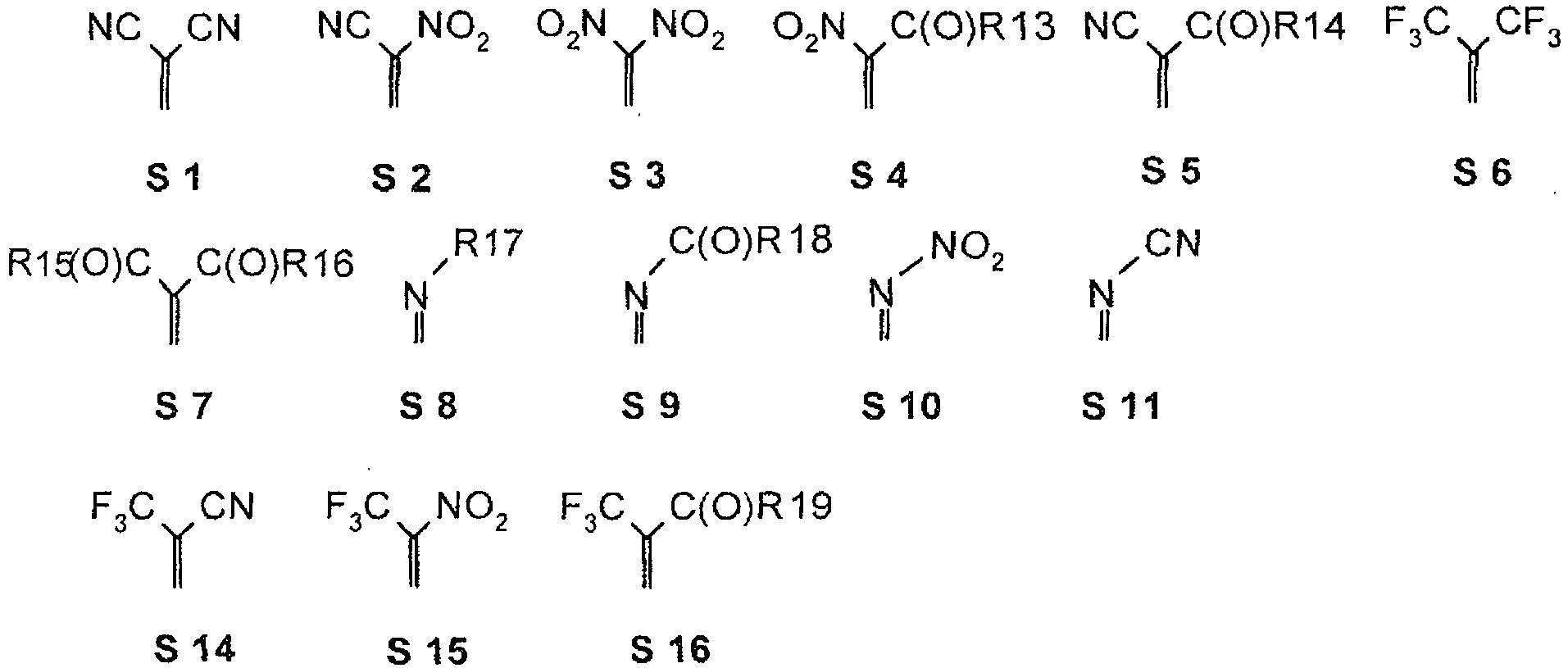
- Die Substituenten T, U, V, W, X, Y und/oder Z können in den Verbindungen 1 bis 33 jeweils gleich oder verschieden sein und ausgewählt sein aus der Gruppe bestehend aus

- Die Substituenten T, U, V, W, X, Y und/oder Z können in den Verbindungen 1 bis 33 jeweils gleich oder verschieden sein und ausgewählt sein aus der Gruppe bestehend aus

- Es können die Substituenten T, U, V, W, X, Y und/oder Z in den Verbindungen 1 bis 33 auch jeweils gleich oder verschieden sein und ausgewählt sein aus der Gruppe bestehend aus S1, S5, S7-S9, S11, S14, S16-21, gegebenenfalls auch ohne S1, oder aus der Gruppe S1, S5, S8, S9, S11, S14, S16, S18, gegebenenfalls auch ohne S1. Insbesondere können ein, zwei, drei, vier oder sämtliche der Substituenten aus dieser Gruppe ausgewählt sein. Insbesondere können X und Y gleich oder verschieden sein und X oder Y oder X und Y können aus dieser Gruppe ausgewählt sein. Insbesondere können alternativ oder zusätzlich V und W gleich oder verschieden sein und V oder W oder V und W können aus dieser Gruppe ausgewählt sein.
- Für die Verbindungen 1 bis 33 können die folgenden Beziehungen zwischen den Subsituenten gelten. Die folgenden Substituentenbeziehungen können insbesondere gelten für die Gruppe der Substituenten S1 bis S21. Die folgenden Substituentenbeziehungen können gelten für die Gruppe der Substituenten S1 bis S11, S14 bis S16. Die folgenden Substituentenbeziehungen können gelten für die Gruppe der Substituenten S1, S5-S14, S16. Die folgenden Substituentenbeziehungen können gelten für die Gruppe S3, S4, S6-S10, S15, S16.
- Es können X und/oder Y nicht oder nicht gleichzeitig =O oder =C(CN)2 sein. Dies gilt insbesondere für einen einkernigen chinoiden Dotanden, dessen Substituenten vorzugsweise ein oder kein aromatisches Ringsystem bilden oder darstellen. Insbesondere kann dies für die Verbindungen 1 und 20 gelten. Alternativ oder zusätzlich können V und/oder W nicht oder nicht gleichzeitig =O oder =C(CN)2 sein.
- Vorzugsweise sind in der erfindungsgemäß verwendeten Verbindung jeweils = X und = X gleich und/oder es sind = U und = T gleich und/oder es sind = V und = W gleich.
- Vorzugweise sind jeweils die Substituenten AA und BB gleich, sie können auch verschieden voneinander sein.
- Es können zumindest einer oder zwei der Substituenten aus der Gruppe = X, = Y, = U, = V, = T, = W, = Z oder sämtliche Substituenten aus der genannten Gruppe verschieden von = O sein.
- Es können = X und = Y verschieden von = O sein.
- Vorzugsweise ist zumindest einer oder zwei der Substituenten aus der Gruppe = X, = Y, = U, = V, = T, = W, = Z oder sämtliche Substituenten aus der Gruppe verschieden von = S.
- Vorzugsweise ist zumindest einer oder beide Substituenten aus der Gruppe =X und =Y verschieden von =S.
- Es kann zumindest einer oder zwei der Substituenten aus der Gruppe = X, = Y, = U, = V, = T, = W, = Z oder sämtliche Substituenten aus der Gruppe verschieden sein von = C(CN)2.
- Es kann zumindest ein oder beide Substituenten aus der Gruppe = X und = Y verschieden sein von = C(CN)2.
- Vorzugsweise ist zumindest einer oder beide Substituenten aus der Gruppe = X und = Y gleich = N(CN). Vorzugsweise ist alternativ oder zusätzlich einer oder beide Substituenten = V und = W gleicht N(CN) und/oder einer oder beide Substituenten = U und = T gleich = N(CN).
- Vorzugsweise ist zumindest ein oder beide Substituenten aus der Gruppe = X und = Y und/oder ein oder beide Substituenten aus der Gruppe = V und = W gleich = N(NO2).
- Vorzugsweise ist zumindest ein oder beide Substituenten aus der Gruppe = X und = Y und/oder ein oder beide Substituenten aus der Gruppe = V und = W gleich = NR, wobei R auch -CF3 oder allgemein Perfluoralkyl, insbesondere mit C1-C6, sein kann. Vorzugsweise ist zumindest ein oder beide Substituenten aus der Gruppe = X und = Y und/oder ein oder beide Substituenten aus der Gruppe = V und = W gleich = N(C(O)R18.
- Vorzugsweise ist zumindest ein oder beide Substituenten aus der Gruppe = X und = Y und/oder ein oder beide Substituenten aus der Gruppe = V und = W gleich = C(NO2)2.
- Vorzugsweise ist zumindest ein oder beide Substituenten aus der Gruppe = X und = Y und/oder ein oder beide Substituenten aus der Gruppe = V und = W gleich = C(C(O)R13) (C(O)R14).
- Vorzugsweise ist zumindest ein oder beide Substituenten aus der Gruppe = X und = Y und/oder ein oder beide Substituenten aus der Gruppe = V und = W gleich = C(CF3)2 oder allgemein = C(Perfluoraklyl)2, insbesondere mit C1-6 sein.
- Vorzugsweise sind zumindest ein oder zwei oder mehr oder sämtliche Substituenten aus der Gruppe = X, = Y, = U, = V, = T, = W, = Z gleich = N(CN).
- Vorzugsweise sind zumindest ein oder zwei oder mehr oder sämtliche Substituenten aus der Gruppe = X, = Y, = U, = V, = T, = W, = Z gleich = C(NO2)2 oder enthalten eine mit dem chinoiden System konjugierte NO2-Gruppe.
- Vorzugsweise sind zumindest ein oder zwei oder mehr oder sämtliche Substituenten aus der Gruppe = X, = Y, = U, = V, = T, = W, = Z gleich = N(NO2).
- Vorzugsweise sind zumindest ein oder zwei oder mehr oder sämtliche Substituenten aus der Gruppe = X, = Y, = U, = V, = T, = W, = Z gleich = NR, wobei R insbesondere auch -CF3 oder Perfluoralkyl mit insbesondere C1-6, sein kann.
- Vorzugsweise sind zumindest ein oder zwei oder mehr oder sämtliche Substituenten aus der Gruppe = X, = Y, = U, = V, = T, = W, = Z gleich =N(C(O)R18).
- Vorzugsweise sind zumindest ein oder zwei oder mehr oder sämtliche Substituenten aus der Gruppe = X, = Y, = U, = V, = T, = W, = Z gleich = C(C(O)R13) (C(O)R14) oder enthalten eine mit dem chinoiden System konjugierte C(O)R-Gruppe.
- Vorzugsweise ist zumindest ein oder zwei oder mehr oder sämtliche Substituenten aus der Gruppe = X, = Y, = U, = V, = T, = W, = Z gleich = C(CF3)2 oder allgemein = C(Perfluoralkyl)2, insbesondere mit C1-6.
- Insbesondere können für die Verbindungen 1-31 jeweils X = Y sein oder es können alle Substituenten X, Y, U, V, T, W, Z gleich sein, ohne hierauf beschränkt zu sein. Entsprechend können bei einer chinoiden Verbindung allgemein alle chinoide Substituenten gleich sein.
- Gegebenenfalls sind X oder Y oder X und Y nicht gleich O, insbesondere für die Verbindungen oder 1 oder 20 oder für Verbindungen mit nur einem chinoiden Ring. Gegebenenfalls sind X oder Y oder X und Y nicht gleich S, insbesondere für die Verbindungen 1 oder 20. Gegebenenfalls sind X oder Y oder X und Y nicht gleich = C(CN)2, insbesondere für die Verbindungen 1 oder 20. Dies gilt insbesondere für eine Verbindung mit nur einem 6-gliedrigen chinoiden Ring, insbesondere für einen Ring mit 6 C-Atomen.
- Weist die Verbindung zumindest eine oder zwei oder mehr chinoide =O-Gruppen und/oder =S-Gruppen auf, insbesondere wenn dies in einer der Verbindungen 1 bis 33 für T, U, V, W, X, Y oder Z gilt, besonders im Falle wenn X oder Y oder X und Y gleich O oder S ist, so ist der chinoide Ring, insbesondere wenn nur ein chinoider Ring vorliegt, vorzugsweise mit mindestens einem oder mindestens zwei Arylresten, von denen einer, mehrere oder sämtliche auch Heteroatome aufweisen können, anelliert oder substituiert.
- Die Substituenten AA und/oder BB sind doppelbindige, mesomer und/oder induktiv elektronenziehende Substituenten, vorzugsweise ausgewählt aus der nachfolgend angegebenen Gruppe

- Die erfindungsgemäße Verbindung kann ein chinoides System mit einem chinoiden Ring und 1, 2 oder 3 oder mehr anellierten und/oder jeweils einen Rest R bildenden aromatischen Ringen darstellen. Die aromatischen Ringe können jeweils ein oder mehrere Heteroatome aufweisen und substituiert oder unsubstituiert sein. Das chinoide System kann ein ortho- oder para-chinoides System sein. Das chinoide System kann insbesondere aus der Gruppe der Verbindungen 1-33 ausgewählt sein, ohne hierauf beschränkt zu sein. Ein, zwei, drei oder mehr oder sämtliche der aromatischen Ringe können auch durch eine Gruppe -M1-C(R)=C(R) - M2- oder -M1-C(=Z)-M2- mit M1, M2 gleich und/oder ungleich und ausgewählt aus der Gruppe -O-, -S-, -NR- sein.
- Die Erfindung umfasst ferner Verbindungen mit einem chinoiden System aus zwei Ringen aus jeweils 5 oder 6 Ringatomen, die mit 1,2,3,4,5 oder 6 oder mehr aromatischen Ringen anelliert und/oder unter Bildung eines Restes R substituiert sein können. Die aromatischen Ringe können substituiert oder unsubstituiert sein.
- Die Ringe weisen vorzugsweise jeweils 6 Atome, die 6 Kohlenstoffatome sein können, auf. In einem oder mehreren Ringen oder je Verbindung insgesamt können 1, 2, 3 oder 4 oder mehr C-Atome durch Heteroatome wie O, S, N ersetzt sein. Verschiedene chinoide Systeme können anelliert, durch eine oder mehrere Doppel- oder Dreifachbindungen, die C-C-Bindung oder Heteroatom-C-Bindungen sein können, mesomer verbunden oder anderweitig verknüpft sein. Die Verbindung kann insbesondere ausgewählt sein aus der Gruppe der Verbindungen 1-33, ohne hierauf beschränkt zu sein. Ein, zwei, drei oder mehr oder sämtliche der aromatischen Ringe können auch durch eine Gruppe -M1-C(R)=C(R)-M2- oder -M1-C(=Z)-M2- mit M1, M2 gleich und/oder ungleich und ausgewählt aus der Gruppe -O-, -S-, -NR- sein.
- Ferner betrifft die Erfindung Verbindungen mit 3 oder 4 chinoiden Ringen aus jeweils unabhängig voneinander 5 oder 6 Atomen, die 1, 2, 3, 4, 5, 6, 7, 8, 9 oder 10 anellierte oder einen Rest R bildenden aromatische Ringe mit 6 Atomen aufweisen können. Die aromatischen Ringe können substituiert oder unsubstituiert sein. Von den Kohlenstoffatomen eines Ringes, mehrerer Ringe oder der Verbindung insgesamt können 1,2,3 oder 4 Atome Heteroatome wie O, N oder P sind. Die Verbindung kann insbesondere ausgewählt sein aus der Gruppe der Verbindungen 1-33, ohne hierauf beschränkt zu sein. Ein, zwei, drei oder mehr oder sämtliche der aromatischen Ringe können auch durch eine Gruppe -M1-C(R)=C(R)-M2- oder -M1-C(=Z)-M2- mit M1, M2 gleich und/oder ungleich und ausgewählt aus der Gruppe -O-, -S-, -NR- sein.
- Unabhangig hiervon können die erfindungsgemäß verwendeten Verbindungen 1,2,3,4,5,6,7,8,9 oder 10 Arylreste aufweisen, von denen vorzugsweise zumindest einer, mehrere oder besonders bevorzugt sämtliche mit einem oder mehreren chinoiden Systemen und/oder untereinander anelliert sind und/oder die Reste R bilden. Die aromatischen Ringe können substituiert oder unsubstituiert sein. Unter Arylresten seien hier auch Heteroarylrest verstanden. Die Arylreste können jeweils zwei chinoide Ringe miteinander verknüpfen, vorzugsweise unter mesomerer Verknüpfung der chinoiden Ringe. Das chinoide System kann insbesondere aus der Gruppe der Verbindungen 1-33 ausgewählt sein, ohne hierauf beschränkt zu sein. Ein, zwei, drei oder mehr oder sämtliche der aromatischen Ringe können auch durch eine Gruppe -M1-C(R)=C(R)-M2- oder -M1-C(=Z)-M2- mit M1, M2 gleich und/oder ungleich und ausgewählt aus der Gruppe -O-, -S-, -NR- sein. So können beispielsweise in den Verbindungen 4, 22 oder 23 jeweils 2 oder 3 oder mehr (Hetero)arylringe zwischen den chinoiden Ringen, diese verbrückend, angeordnet sein.
- Die aromatischen Ringe der genannten chinoiden Systeme und/oder die Gruppen -M1-C(R)=C(R)-M2- oder -M1-C(= Z)-M2- sind vorzugsweise perhalogeniert, insbesondere perfluoriert oder percyanosubstituiert. Vorzugsweise sind keine weiteren nichtaromatischen und/oder nicht-chinoiden Ringe enthalten.
- Unabhängig hiervon können die erfindungsgemäß verwendeten Verbindungen 2,3,4,5 oder 6 oder mehr chinoide Ringsysteme aufweisen. Vorzugsweise sind einer, mehrere oder sämtliche der chinoiden Ringe 5- oder 6-gliedrig. Ringkohlenstoffatome können durch Heteroatome ersetzt sein. Zumindest zwei, mehrere oder sämtliche der chinoiden Ringe können miteinander unter mesomerer Verknüpfung zu einem größeren chinoiden System anelliert oder durch eine oder mehrere Brücken miteinander mesomer verknüpft oder nicht unter Bildung eines größeren mesomeren Systems verknüpft sein. Die Verbindung kann insbesondere ausgewählt sein aus der Gruppe der Verbindungen 1-33, ohne hierauf beschränkt zu sein. Das chinoide System kann insbesondere aus der Gruppe der Verbindungen 1-33 ausgewählt sein, ohne hierauf beschränkt zu sein. Ein, zwei, drei oder mehr oder sämtliche der aromatischen Ringe können auch durch eine Gruppe -M1-C(R)=C(R)-M2- oder -M1-C(=Z)-M2- mit M1, M2 gleich und/oder ungleich und ausgewählt aus der Gruppe -O-, -S-, -NR- sein.
- Die Substituenten A, B, K, D, E, F, G; H der Verbindungen 14 und 15 können unterschiedlich oder auch gleich sein und folgende Strukturen annehmen, Imin-Stickstoff =N- , Phosphin =P- oder substituierten Methylenkohlenstoff =C-R1-8.
- Es versteht sich, dass in allen erfindungsmäßen Verbindungen ein, mehrere oder sämtliche N-Atome jeweils durch P-Atome ersetzt sein können.
- Insbesondere können folgende Verbindungen mit folgenden Substitutionsmustern erfindungsgemäß verwendet werden:
- Die Verbindungen 1, 2, 3(m=0), 3(m=1), 3(m=3), 3(m=4), 3b(m=1), 3b(m=2), 3b(m=3), 3b(m=4), 3c(m=1), 3c(m=2), 3c(m=3), 3c(m=4), 6, 7, 10, 11, 11a, 14, 15, 16, 17, 18, 19, 20, 21 (für M ungleich =C=Z), 26 (für M ungleich =C=Z), 27 (für M gleich -O-,-S-, -NR- oder =C=Z mit Z = S1, S2, S3, S4, S5, S6, S7, S8, S9, S10, S11, S12, S13, S14, S15, S16, S17, S18, S19, S20 oder S21), 28 (für U = S1, S2, S3, S4, S5, S6, S7, S8, S9, S10, S11, S12, S13, S14, S15, S16, S17, S18, S19, S20 oder S21), 30 (mit M gleich -O-, -S-, -NR- oder =C=T mit T = S1, S2, S3, S4, S5, S6, S7, S8, S9, S10, S11, S12, S13, S14, S15, S16, S17, S18, S19, S20 oder S21), 32, 33
- X: S1, S1, S1, S1, S1, S1, S1, S1, S1, S1, S1, S1, S1 S1,
- Y: S1, S2, S3, S4, S5, S6, S7, S8, S9, S10, S11, S12, S13, S14,
- X: S1, S1, S1, S1, S1, S1, S1
- Y: S15, S16, S17, S18, S19, S20, S21
- X: S2, S2, S2, S2, S2, S2, S2, S2, S2, S2, S2, S2, S2, S2,
- Y: S1, S2, S3, S4, S5, S6, S7, S8, S9, S10, S11, S12, S13, S14,
- X: S2, S2, S2, S2, S2, S2, S2
- Y: S15, S16, S17, S13, S19, S20, S21
- X: S3, S3, S3, S3, S3, S3, S3, S3, S3, S3, S3, S3, S3, S3,
- Y: S1, S2, S3, S4, S5, S6, S7, S8, S9, S10, S11, S12, S13, S14,
- X: S3, S3, S3, S3, S3, S3, S3
- Y: S15, S16, S17, S18, S19, S20, S21
- X: S4, S4, S4, S4, S4, S4, S4, S4, S4, S4, S4, S4, S4, S4,
- Y: S1, S2, S3, S4, S5, S6, S7, S8, S9, S10, S11, S12, S13, S14,
- X: S4, S4, S4, S4, S4, S4, S4
- Y: S15, S16, S17, S18, S19, S20, S21
- X: S5, S5, S5, S5, S5, S5, S5, S5, S5, S5, S5, S5, S5, S5,
- Y: S1, S2, S3, S4, S5, S6, S7, S8, S9, S10, S11, S12, S13, S14,
- X: S5, S5, S5, S5, S5, S5, S5
- Y: S15, S16, S17, S18, S19, S20, S21
- X: S6, S6, S6, S6, S6, S6, S6, S6, S6, S6, S6, S6, S6, S6,
- Y: S1, S2, S3, S4, S5, S6, S7, S8, S9, S10, S11, S12, S13, S14,
- X: S6, S6, S6, S6, S6, S6, S6
- Y: S15, S16, S17, S18, S19, S20, S21
- X: S7, S7, S7, S7, S7, S7, S7, S7, S7, S7, S7, S7, S7, S7,
- Y: S1, S2, S3, S4, S5, S6, S7, S8, S9, S10, S11, S12, S13, S14,
- X: S7, S7, S7, S7, S7, S7, S7
- Y: S15, S16, S17, S18, S19, S20, S21
- X: S8, S8, S8, S8, S8, S8, S8, S8, S8, S8, S8, S8, S8, S8,
- Y: S1, S2, S3, S4, S5, S6, S7, S8, S9, S10, S11, S12, S13, S14,
- X: S8, S8, S8, S8, S8, S8, S8
- Y: S15, S16, S17, S18, S19, S20, S21
- X: S9, S9, S9, S9, S9, S9, S9, S9, S9, S9, S9, S9, S9, S9,
- Y: S1, S2, S3, S4, S5, S6, S7, S8, S9, S10, S11, S12, S13, S14,
- X: S9, S9, S9, S9, S9, S9, S9
- Y: S15, S16, S17, S18, S19, S20, S21
- X: S10, S10, S10, S10, S10, S10, S10, S10, S10, S10, S10, S10,
- Y: S1, S2, S3, S4, S5, S6, S7, S8, S9, S10, S11, S12,
- X: S10, S10, S10, S10, S10, S10, S10, S10, S10
- Y: S13, S14, S15, S16, S17, S18, S19, 520, S21
- X: S11, S11, S11, S11, S11, S11, S11, S11, S11, S11, S11, S11,
- Y: S1, S2, S3, S4, S5, S6, S7, S8, S9, S10, S11, S12,
- X: S11, S11, S11, S11, S11, S11, S11, S11
- Y: S13, S14, S15, S16, S17, S18, S19, S20, S21
- X: S12, S12, S12, S12, S12, S12, S12, S12, S12, S12, S12, S12,
- Y: S1, S2, S3, S4, S5, S6, S7, S8, S9, S10, S11, S12,
- X: S12, S12, S12, S12, S12, S12, S12, S12
- Y: S13, S14, S15, S16, S17, S18, S19, S20, S21
- X: S13, S13, S13, S13, S13, S13, S13, S13, S13, S13, S13, S13,
- Y: S1, S2, S3, S4, S5, S6, S7, S8, S9, S10, S11, S12,
- X: S13, S13, S13, S13, S13, S13, S13, S13
- Y: S13, S14, S15, S16, S17, S18, S19, S20, S21
- X: S14, S14, S14, S14, S14, S14, S14, S14, S14, S14, S14, S14,
- Y: S1, S2, S3, S4, S5, S6, S7, S8, S9, S10, S11, S12,
- X: S14, S14, S14, S14, S14, S14, S14, S14
- Y: S13, S14, S15, S16, S17, S18, S19, S20, S21
- X: S15, S15, S15, S15, S15, S15, S15, S15, S15, S15, S15, S15,
- Y: S1, S2, S3, S4, S5, S6, S7, S8, S9, S10, S11, S12,
- X: S15, S15, S15, S15, S15, S15, S15, S15
- Y: S13, S14, S15, S16, S17, S18, S19, S20, S21
- X: S16, S16, S16, S16, S16, S16, S16, S16, S16, S16, S16, S16,
- Y: S1, S2, S3, S4, S5, S6, S7, S8, S9, S10, S11, S12,
- X: S16, S16, S16, S16, S16, S16, S16, S16
- Y: S13, S14, S15, S16, S17, S18, S19, S20, S21
- X: S11, S17, S17, S17, S17, S17, S17, S17, S17, S17, S17, S17,
- Y: S1, S2, S3, S4, S5, S6, S7, S8, S9, S10, S11, S12,
- X: S17, S17, S17, S17, S17, S17, S17, S17
- Y: S13, S14, S15, S16, S17, S18, S19, S20, S21
- X: S18, S18, S18, S18, S18, S18, S18, S18, S18, S18, S18, S18,
- Y: S1, S2, S3, S4, S5, S6, S7, S8, S9, S10, S11, S12,
- X: S18, S18, S18, S18, S18, S18, S18, S18
- Y: S13, S14, S15, S16, S17, S18, S19, S20, S21
- X: S19, S19, S19, S19, S19, S19, S19, S19, S19, S19, S19, S19,
- Y: S1, S2, S3, S4, S5, S6, S7, S8, S9, S10, S11, S12,
- X: S19, S19, S19, S19, S19, S19, S19, S19, S19
- Y: S13, S14, S15, S16, S17, S18, S19, S20, S21
- X: S20, S20, S20, S20, S20, S20, S20, S20, S20, S20, S20, S20,
- Y: S1, S2, S3, S4, S5, S6, S7, S8, S9, S10, S11, S12,
- X: S20, S20, S20, S20, S20, S20, S20, S20, S21
- Y: S13, S14, S15, S16, S17, S18, S19, S20, S21
- X: S21, S21, S21, S21, S21, S21, S21, S21, S21, S21, S21, S21,
- Y: S1, S2, S3, S4, S5, S6, S7, S8, S9, S10, S11, S12,
- X: S21, S21, S21, S21, S21, S21, S21, S21, S21
- Y: S13, S14, S15, S16, S17, S18, S19, S20, S21.
- Die Verbindungen 4, 5, 5b, 5c, 8, 9, 12, 21 (wobei 2 Reste M gleich V und W sind), 22, 23, 24, 24a, 24b, 25 und 26 (für M ungleich =C=Z), 27 (für M ungleich =C=Z), 29, 31
weisen insbesondere jeweils folgende konkrete Substitutionsmuster auf, wobei jeder einzelnen der Verbindungen nachfolgend der Substituent X einer ersten Zeile und der darunterstehende Substituent V, wie jeweils am Zeilenbeginn angegeben, der nachfolgenden Zeile zugeordnet ist - mit X=Y und V=W
- und mit X und V wie folgt:
- X: S1, S1, S1, S1, S1, S1, S1, S1, S1, S1, S1, S1, S1, S1,
- V: S1, S2, S3, S4, S5, S6, S7, S8, S9, S10, S11, S12, S13, S14,
- X: S1, S1, S1, S1, S1, S1, S1
- V: S15, S16, S17, S18, S19, S20, S21
- X: S2, S2, S2, S2, S2, S2, S2, S2, S2, S2, S2, S2, S2, S2,
- V: S1, S2, S3, S4, S5, S6, S7, S8, S9, S10, S11, S12, S13, S14,
- X: S2, S2, S2, S2, S2, S2, S2
- V: 515, S16, S17, S18, S19, S20, S21
- X: S3, S3, S3, S3, S3, S3, S3, S3, S3, S3, S3, S3, S3, S3,
- V: S1, S2, S3, S4, S5, S6, S7, S8, S9, S10, S11, S12, S13, S14,
- X: S3, S3, S3, S3, S3, S3, S3
- V: S15, S16, S17, S18, S19, S20, S21
- X: S4, S4, S4, S4, S4, S4, S4, S4, S4, S4, S4, S4, S4, S4,
- V: S1, S2, S3, S4, S5, S6, S7, S8, S9, S10, S11, S12, S13, S14,
- X: S4, S4, S4, 54, S4, S4, S4
- V: S15, S16, S17, S18, S19, S20, S21
- X: S5, S5, S5, S5, S5, S5, S5, S5, S5, S5, S5, S5, S5, S5,
- V: S1, S2, S3, S4, S5, S6, S7, S8, S9, S10, S11, S12, S13, S14,
- X: S5, S5, S5, S5, S5, S5, S5
- V: S15, S16, S17, S18, S19, S20, S21
- X: S6, S6, S6, S6, S6, S6, S6, S6, S6, S6, S6, S6, S6, S6,
- V: S1, S2, S3, S4, S5, S6, S7, S8, S9, S10, S11, S12, S13, S14,
- X: S6, S6, S6, S6, S6, S6, S6
- V: S15, S16, S17, S18, S19, S20, S21
- X: S7, S7, S7, S7, S7, S7, S7, S7, S7, S7, S7, S7, S7, S7,
- V: S1, S2, S3, S4, S5, S6, S7, S8, S9, S10, S11, S12, S13, S14,
- X: S7, S7, S7, S7, S7, S7, S7
- V: S15, S16, S17, S18, S19, S20, S21
- X: S8, S8, S8, S8, S8, S8, S8, S8, S8, S8, S8, S8, S8, S8,
- V: S1, S2, S3, S4, S5, S6, S7, S8, S9, S10, S11, S12, S13, S14,
- X: S8, S8, S8, S8, S8, S8, S8
- V: S15, S16, S17, S18, S19, S20, S21
- X: S9, S9, S9, S9, S9, S9, S9, S9, S9, S9, S9, S9, S9, S9,
- V: S1, S2, S3, S4, S5, S6, S7, S8, S9, S10, S11, S12, S13, S14,
- X: S9, S9, S9, S9, S9, S9, S9
- V: S15, S16, S17, S18, S19, S20, S21
- X: S10, S10, S10, S10, S10, S10, S10, S10, S10, S10, S10, S10,
- V: S1, S2, S3, S4, S5, S6, S7, S8, S9, S10, S11, S12,
- X: S10, S10, S10, S10, S10, S10, S10, S10, S10
- V: S13, S14, S15, S16, S17, S18, S19, S20, S21
- X: S11, S11, S11, S11, S11, S11, S11, S11, S11, S11, S11, S11,
- V: S1, S2, S3, S4, S5, S6, S7, S8, S9, S10, S11, S12,
- X: S11, S11, S11, S11, S11, S11, S11, S11
- V: S13, S14, S15, S16, S17, S18, S19, S20, S21
- X: S12, S12, S12, S12, S12, S12, S12, S12, S12, S12, S12, S12,
- V: S1, S2, S3, S4, S5, S6, S7, S8, S9, S10, S11, S12,
- X: S12, S12, S12, S12, S12, S12, S12, S12
- V: S13, S14, S15, S16, S17, S18, S19, S20, S21
- X: S13, S13, S13, S13, S13, S13, S13, S13, S13, S13, S13, S13,
- V: S1, S2, S3, S4, S5, S6, S7, S8, S9, S10, S11, S12,
- X: S13, S13, S13, S13, S13, S13, S13, S13
- V: S13, S14, S15, S16, S17, S18, S19, S20, S21
- X: S14, S14, S14, S14, S14, S14, S14, S14, S14, S14, S14, S14,
- V: S1, S2, S3, S4, S5, S6, S7, S8, S9, S10, S11, S12,
- X: S14, S14, S14, S14, S14, S14, S14, S14
- V: S13, S14, S15, S16, S17, S18, S19, S20, S21
- X: S15, S15, S15, S15, S15, S15, S15, S15, S15, S15, S15, S15,
- V: S1, S2, S3, S4, S5, S6, S7, S8, S9, S10, S11, S12,
- X: S15, S15, S15, S15, S15, S15, S15, S15
- V: S13, S14, S15, S16, S17, S18, S19, S20, S21
- X: S16, S16, S16, S16, S16, S16, S16, S16, S16, S16, S16, S16,
- V: S1, S2, S3, S4, S5, S6, S7, S8, S9, S10, S11, S12,
- X: S16, S16, S16, S16, S16, S16, S16, S16
- V: S13, S14, S15, S16, S17, S18, S19, S20, S21
- X: S17, S17, S17, S17, S17, S17, S17, S17, S17, S17, S17, S17,
- V: S1, S2, S3, S4, S5, S6, S7, S8, S9, S10, S11, S12,
- X: S17, S17, S17, S17, S17, S17, S17, S17
- V: S13, S14, S15, S16, S17, S18, S19, S20, S21
- X: S18, S18, S18, S18, S18, S18, S18, S18, S18, S18, S18, S18,
- V: S1, S2, S3, S4, S5, S6, S7, S8, S9, S10, S11, S12,
- X: S18, S18, S18, S18, S18, S18, S18, S18
- V: S13, S14, S15, S16, S17, S18, S19, S20, S21
- X: S19, S19, S19, S19, S19, S19, S19, S19, S19, S19, S19, S19,
- V: S1, S2, S3, S4, S5, S6, S7, S8, S9, S10, S11, S12,
- X: S19, S19, S19, S19, S19, S19, S19, S19, S19
- V: S13, S14, S15, S16, S17, S18, S19, S20, S21
- X: S20, S20, S20, S20, S20, S20, S20, S20, S20, S20, S20, S20,
- V: S1, S2, S3, S4, S5, S6, S7, S8, S9, S10, S11, S12,
- X: S20, S20, S20, S20, S20, S20, S20, S20, S21
- V: S13, S14, S15, S16, S17, S18, S19, S20, S21
- X: S21, S21, S21, S21, S21, S21, S21, S21, S21, S21, S21, S21,
- V: S1, S2, S3, S4, S5, S6, S7, S8, S9, S10, S11, S12,
- X: S21, S21, S21, S21, S21, S21, S21, S21, S21
- V: S13, S14, S15, S16, S17, S18, S19, S20, S21.
- Die Erfindung umfasst ferner die genannten Verbindungen 4, 5, 5b, 5c, 8, 9, 12, 21 (wobei 2 Reste M gleich V und W sind), 22, 23, 24, 24a, 24b, 25 und 26 (für M ungleich =C=Z), 27 (für M ungleich =C=Z), 29, 31 wenn für die Substituenten gilt X = V und Y = W mit den konkreten Substitutionsmustern, wenn in den oben genannten Tabellen für diese Verbindungen V durch Y ersetzt wird und wenn jeder einzelnen der Verbindungen nachfolgend der Substituent X einer ersten Zeile und der darunterstehende Substituent Y der nachfolgenden Zeile zugeordnet ist.
- Die Erfindung umfasst ferner die genannten Verbindungen 4, 5, 5b, 5c, 8, 9, 12, 21 (wobei 2 Reste M gleich V und W sind), 22, 23, 24, 24a, 24b, 25 und 26 (für M ungleich =C=Z), 27 (für M ungleich =C=Z), 29, 31 wenn für die Substituenten gilt X = W und Y = V mit den konkreten Substitutionsmustern, wenn jeder einzelnen der Verbindungen nachfolgend der Substituent X einer ersten Zeile und der darunterstehende Substituent Y der nachfolgenden Zeile zugeordnet ist.
- In den Verbindungen 21, 25 und 26 können hierbei beide Reste gleich oder unabhängig voneinander sein: -S-, -O-, -NR- oder =C =Z mit Z=S1, S2, S3, S4, S5, S6, S7, S8, S9, S10, S11, S12, S13, S14, S15, S16, S17, S18, S19, S20 oder S21.
- Die Reste R1 bis R32 können gleich oder verschieden und ausgewählt sein aus der Gruppe bestehend aus Wasserstoff, Halogen, (insbesondere -F, -Cl), Cyano, Nitro, Nitroso, Sulfamid (unsubstituiert oder substituiert, insbesondere C1-C6 mono oder di-Alkyl substituiert), Carboxy, C1-C7 Carbalkoxy, C1-C7 Sulfo, Sulfohalogen (insbesondere -F oder -Cl), Halogencarbonyl (insbesondere F oder -Cl), Carbamoyl (unsubstituiert oder substituiert, insbesondere C1-C6 N monosubstituiert oder gleich oder unabhängig voneinander N-C1-C6 disubstituiert), Formyl, Amidinformyl, C1-C6 Alkylsulfanyl, C1-C6 Alkylsulfonyl, C1-C25 Kohlenwasserstoff, vorzugsweise C1-C14 Kohlenwasserstoff oder C1 bis C10 oder C1 bis 6 Kohlenwasserstoff, wobei eines oder mehrere oder sämtliche der Kohlenstoffatome der Gruppe mit einem oder mehreren oben genannten Resten substituiert sein kann, wobei der Kohlenwasserstoff gesättigt, ungestättigt oder ein aromatischer Kohlenwasserstoff sein kann. Die Kohlenwasserstoffgruppen können jeweils insbesondere perhalogeniert, perchloriert oder perfluoriert (insbesondere Trifluormethyl) sein. Die Kohlenwasserstoffgruppen können linear oder verzweigt oder cyclisch sein, beispielsweise Cyclohexyl oder Cyclopentyl. Ein oder mehrere Kohlenstoffatome können jeweils durch Heteroatome, insbesondere N, O, S, -(O)S(O)- oder P(R) ersetzt sein. Die (Hetero)kohlenwasserstoffreste können untereinander oder mit einem chinoiden oder anderem Ring, beispeilsweise einem (Hetero)arylring cyclisch verknüpft sein.
- Insbesondere können die Reste R1 bis R32 eine der Gruppen Acetyl-, Trifluoracetyl-, Benzoyl-, Pentafluorbenzoyl-, Naphthoyl- oder Alkoxycarbonyl, wobei der Alkylrest ein Alkyl mit einem bis sechs oder bis zehn, insbesondere bis vier, unverzweigt oder verzweigt miteinander verbundenen C-Atomen sein kann, sowie Trialkylphosphoryl mit Alkylresten, die ebenfalls aus einer Kette mit bis zu fünf oder sechs oder acht unverzweigt oder verzweigt oder cyclisch miteinander verknüpften Kohlenstoffatomen bestehen können, oder Triarylphosphoryl mit Arylresten mit vorzugsweise 6 bis 14 C-Atomen, insbesondere bis 10 C-Atomen.
- Weiterhin können die Reste R1 - R32, die gleich oder untereinander verschieden sein können, entweder Aryl oder Heteroaryl, wie z.B. Phenyl, Naphthyl, Anthranyl, Pyridyl, Chinoxalyl, Pyrazolyl, Oxazolyl, 1,3,2-Dioxaborinyl oder 1,3,4 Oxdiazolyl sein, die entweder durch Wasserstoff oder ein niederes Alkyl mit einem bis acht gesättigten Kohlenstoffatomen, die unverzweigt oder verzweigt oder cyclisch miteinander verbunden sein können, vorzugsweise jedoch durch Halogen, dabei vor allen Flu- or oder Chlor, Trichlormethyl, Perfluoralkyl mit einem bis zu sechs Kohlenstoffatomen, dabei insbesonders Trifluormethyl, aber auch durch Cyano, Nitro, Nitroso, Sulfo, Carboxy, Carbalkoxy, Halogencarbonyl, Carbamoyl, Formyl, Amidinformyl, Alkylsulfanyl und Alkylsulfonyl, wobei die Alkylreste hier wiederum aus einer Kette mit bis zu fünf oder sechs oder bis zu acht unverzweigt oder verzweigt oder cyclisch miteinander verknüpften Kohlenstoffatomen bestehen können, sowie durch Trialkylphosphoryl mit Alkylresten, die ebenfalls aus einer Kette mit bis zu fünf oder sechs oder bis zu acht unverzweigt oder verzweigt miteinander verknüpften Kohlenstoffatomen bestehen können, substituiert sein. Insbesondere können die Aryl- oder Heteroarylreste perhalogeniert, insbesondere perfluoriert sein.
- Die Reste R2, R3, R4, R5, R6 in den Verbindungen 3, 3b, 3c oder Formeln IV, V oder VI können für verschiedene n oder m gleich oder unterschiedlich sein.
- Die Reste R1 bis R32, die mit einem chinoiden oder aromatischen System einer erfindungsgemäß verwendeten Verbindung verbunden und zueinander benachbart angeordnet und durch zwei, drei oder vier Atome der chinoiden oder aromatischen Gerüststruktur getrennt sind, können miteinander unter Ausbildung eines carbocyclischen, insbesondere aromatischen Ringes, oder heterocyclischen, insbesondere heterocarbocyclischen Ringes verbunden sein. Dies gilt insbesondere für die Verbindungen 1 bis 33, aber auch für andere erfindungsgemäß verwendete Chinone oder Chinonderivate. Dies gilt beispielsweise jeweils paarweise alternativ oder gleichzeitig für die Reste R1, R2 und/oder R3, R4 der Verbindungen 1, 3, 3b, 7, 8, 9, 10, 11, 12, 23, 24, 25, 27, 28, die Reste R1, R2; R2, R3; R4, R5 und/oder R5, R6 der Verbindung 2, die Reste R1, R2; R3, R4; R5, R6; R7, R8 der Verbindung 3, die Reste R5, R6; R7, R8 der Verbindungen 28, 29 oder andere. Die überbrückende Atomgruppe kann insbesondere eine Gruppe bilden, die ausgewählt ist aus
-L1-C(R1) = C(R2)-L2- mit L=O, S, NR oder CR14R15,
oder -C(X)C(Y)-C(R1) = C(R2)-
oder -C(= X)C(R3)= C(R4)-C(= Y)-
oder -C(=X)-L-C(=Y)- mit L=O, S, NR, CR14R15
mit X und Y wie oben definiert und vorzugsweise ausgewählt aus der Gruppe
- Je zwei benachbarte Reste von R1 - R32 können aber auch über eine Carboxy- -(CO)- oder eine Carbimidgruppe -(CNR)- , wobei für dieses R das analoge Substitutionsmuster wie für R1 - R30 gilt, miteinander verbunden sein. Es ist aber auch möglich, das zwei benachbarte Reste R so über Kohlenstoffatome oder Heteroatome miteinander verknüpft sind, dass ein neues carbocyclisches oder heterocyclisches Strukturelement an das jeweilige cyclische Grundgerüst ankondensiert ist. Beispielsweise können im Verbindungstyp 1 die Reste R1 und R2 sowie auch R3 und R4 für einen ankondensierten Benzo- oder Naphthorest, aber auch für einen ankondensierten Thiophen-, Furan-, 1,3,4-Oxdiazol-, Pyridin-, Pyrazin-, Triazin-, Tetrazin-, Pyran-, Thiopyran-, Dithiin-, Phosphorin-, Phthalsäureanhydrid, Phthalsäureimid bzw. Dithiazol-Rest stehen, wobei diese Reste wieder ausschließlich oder teilweise durch weitere elektronenziehende Gruppierungen, wie Halogen, darunter vorzugsweise Fluor oder Chlor, Trifluormethyl oder Cyan, Nitro, Nitroso, Sulfo, Carboxy, Carbalkoxy, Halogencarbonyl, Carbamoyl, Formyl, Amidinformyl substituiert sein können. Analoges gilt für die Reste R1 und R2 bzw. R2 und R3 oder für die Reste R4 und R5 bzw. R5 und R6 im Verbindungstyp 2 sowie für die Reste R1 und R2, R3 und R4, R5 und R6 sowie R7 und R8 im Verbindungstyp 3, sowie für die Reste R2 und R3 bzw. R5 und R6 im Verbindungstyp 4 bzw. 5, sowie für die entsprechenden Paare der Reste R der anderen Verbindungen, die einander ausreichend nahe kommen, um einen 5- oder 6-gliedrigen Ring zu bilden.
- Die verbrückte Trans-Diketoform von Verbindung 8 kann z.B. zu den Strukturen 28 oder 29 führen. In der Formel 26 kann der Carbonsäureanhydrid-Sauerstoff auch durch eine substituierte Stickstoffgruppe =N-R1 ersetzt werden und damit eine Carbonsäureimidstruktur ausbilden.
- Die aromatischen Reste, mit denen die chinoiden Systeme substituiert und/oder anelliert sein können, können perhalogeniert sein, insbesondere perfluoriert, perchloriert oder perfluorochloriert. Gegebenenfalls können einige, beispielsweise bis zur Hälfte oder mehr der Halogenatome durch Wasserstoff ersetzt sein. Entsprechendes kann auch alternativ oder gleichzeitig für die Reste R der chinoiden Systeme gelten. Anstelle der Halogenatome können an den aromatischen Resten und/oder den chinoiden Systemen auch CN-Gruppen vorgesehen sein.
- Jeweils zwei chinoide Systeme Ch1 und Ch2 können unter Bildung einer Verbindung Ch1-ZB-Ch2 über einen Rest ZB miteinander verknüpft sein, wobei die chinoiden Reste Ch1 und Ch2 mesomer miteinander verknüpft sein können oder mesomer voneinander unabhängig sein können. Die chinoide Reste Ch1 und Ch2 können gleich oder verschieden sein und können ausgewählt sein aus der Gruppe der Verbindungen 1 bis 4 und 5 bis 33, wobei gegebenenfalls auch weitere chinoide Systeme miteinander verknüpft sein können, beispielsweise unter Ausbildungen von Strukturen wie Ch1-ZB1-Ch2-ZB2-Ch3, wobei Ch1, Ch2, Ch3 gleich oder verschieden sein können und jeweils die Verbindungen 1 bis 4 und 5 bis 33 darstellen können, ohne hierauf beschränkt zu sein. ZB1 und ZB2 können gleich oder verschieden sein.
- Die Brücke -Z- kann 1, 2 bis 4, bis 6 oder bis 10 oder auch mehr Brückenatome aufweisen, die Kohlenstoffatome oder zumindest teilweise Heteroatome sein können.
- Wenn zwei chinoide Verbindungen, wie in Formel 5, 5b oder 5c, über einen Rest Z miteinander verknüpft sind, kann diese Brücke -Z- aus Alkenylen, Halogenalkenylen, Acetylen, Alkylen, Halogenalkylen, insbesondere Perfluoralkylen mit einem bis acht gesättigen Kohlenstoffatomen, die unverzweigt oder verzweigt miteinander verbunden sein können, oder aus Arylen, Hetarylen, die entweder mit Wasserstoff oder mit niederen Alkylresten mit einem bis sechs oder bis acht gesättigten Kohlenstoffatomen, die unverzweigt oder verzweigt oder cyclisch miteinander verbunden sein können, vorzugsweise jedoch mit Halogen, dabei vor allen Fluor oder Chlor, Trichlormethyl, Perfluoralkyl mit einem bis zu sechs Kohlenstoffatomen, dabei insbesonders Trifluormethyl, aber auch Cyano, Nitro, Nitroso, Sulfo, Carboxy, Carbalkoxy, Halogencarbonyl, Carbamoyl, Formyl, Amidinformyl, Alkylsulfanyl und Alkylsulfonyl, wobei die Alkylreste hier wiederum aus einer Kette mit bis zu acht unverzweigt oder verzweigt oder cyclisch miteinander verbundenen Kohlenstoffatomen bestehen können, sowie Trialkylphosphoryl mit Alkylresten, die ebenfalls aus einer Kette mit bis zu acht unverzweigt oder verzweigt miteinander verknüpften Kohlenstoffatomen bestehen, substituiert sein können, bestehen. Die Alkenylen-Gruppe und die Alkylen-Gruppe können eine oder mehrere C-C-Mehrfachbindungen aufweisen. Die Brückenatome der Gruppe Z können nur aus ungesättigen Kohlenstoff- oder Heteroatomen besteht, wobei die genannten Gruppen unsubstituiert oder substituiert sein können. Die Brückenatome der Gruppe Z können nur aus gesättigen oder aromatischen Kohlenstoff- oder Heteroatomen besteht, wobei die genannten Gruppen unsubstituiert oder substituiert sein können, so dass die beiden chinoiden Systeme mesomerisch miteinander verbunden sein können.
- Die Brücke -Z- kann eine oder mehrere Gruppen, insbesondere der untenstehenden Gruppen in der Form -(Z)n- umfassen, beispielsweise mit n gleich 1, 2, 3 oder 4 oder mehr, die jeweils gleich oder verschieden voneinander sein können.
- Z kann ausgewählt sein aus der Gruppe bestehend aus



und/oder ausgewählt aus der Gruppe bestehend aus Carboxy- - (CO)-, Carbimid- -(CNR)-, Thiophenylen-, Furanylen-, 1,3,4-Oxdiazolylen-, Triazin-, Tetrazinylen-, Pyranylen-, Thiopyranylen-, Dithiinylen-, Phosphorinylen-, Phthalsäureanhydrid, Phthalsäureimid bzw. Dithiazol-Rest. - Die aromatischen Ringe oder angegebenen Carbo- oder Heterobrücken können jeweils substituiert oder unsubstituiert sein. X kann ein einfach oder doppelt substituiertes Kohlenstoffatom, ein einfach substituiertes Stickstoffatom oder =O oder =S sein, vorzugsweise ausgewählt aus einer der obenstehenden Gruppen oder Untergruppen.
- Die Reste R1 bzw R2 können verschieden von den Resten R1 bzw R2 der Verbindungsgrundstrukturen 1 bis 33 sein.
- Außerdem besteht die Möglichkeit, dass die beiden chinoiden Strukturen auf irgendeine Art und Weise direkt miteinander verknüpft sind.
- Sämtliche nachfolgend beschriebenen Synthesen von Chinonverbindungen sind hiermit vollumfänglich durch Inbezugnahme in die vorliegende Erfindung mit eingeschlossen und von dieser erfasst.
- Häufig werden die entsprechenden Substitutionsmuster im zu oxidierendem Edukt erzeugt. 1,4-Chinone lassen sich am Besten durch Oxidation der entsprechenden Hydrochinone (W. T. Summerford, D. N. Dalton, J. Am. Chem. Soc. 1944, 66, 1330;
J. Miller, C. Vasquez, 1991 Patent US506836 ;K. Koch, J. Vitz, J. Prakt. Chem. 2000, 342/8 825-7) oder der fluorierten und/oder chlorierten Aromaten darstellen. (A. Roedig at al. Chem. B. 1974, 107, 558-65; O.I.Osina, V.D. Steingarz, Zh. Org. Chim. 1974, 10, 329; V.D. Steingarz at al Zh. Org. Chim. 1970, 6/4, 833). - 1,3-Indandionverbindungen wurden von V. Khodorkovsky at al synthetisiert. ( V. Khodorkovsky at al Tetrahedron Lett. 1999, 40, 4851-4)
- N,N'-Dicyan-1,4-chinondiimine sind entweder durch Einwirkung von N,N'-Bistrimethylsilylcarbodiimid auf 1,4-Chinonverbindungen (A. Aumüller, S. Hünig, Liebigs Ann. Chem., 1986, 142-64,) oder durch Oxydation entsprechender N,N'-Dicyan-1,4-diaminverbindungen (G. D. Adreetti, S. Bradamante, P. C. Pizzarri, G. A. Pagani, Mol. Cryst. Liq. Cryst. 1985, 120, 309-14) zugänglich, wobei die N,N'-Dicyan-1,4-diaminverbindungen durch Cyanierung von Phenylen-1,4-diamin mit Cyanhalogeniden oder durch Entschwefelung entsprechender Thioharnstoffderivate erhalten werden können.
- Einfache Tetracyanochinondimethane können über das 1,4-Cyclohexandion durch Kondensation in Benzen mit Ammoniumacetatpuffer am Wasserabscheider und nachfolgender Oxidation durch Brom dargestellt werden (D. S. Acker, W. R. Hertler, J. Am. Chem. Soc. 1962, 84, 3370). Weiterhin konnten ebenfalls Hertier und Mitarbeiter zeigen, dass diese Verbindungen über 1,4-Xylen und deren Analoge durch Seitenkettenbromierung, Substitution mittels Cyanid, Kondensation mit Kohlensäurediethylester, Überführung der Carbonsäuremethylestergruppierungen in Cyanidgruppen und anschließender Oxidation synthetisierbar sind (J. Org. Chem. 1963, 28, 2719).
- Akzeptor-substituierte Tetracyanochinondimethane können aus dem Natriumsalz des t-Butyl-malonsäuredinitril's und Akzeptorsubstituierten 1,4-Dihalogenaromaten dargestellt werden (R. C. Wheland, E. L. Martin, J. Org. Chem., 1975, 40, 3101).
- Es gelang außerdem aus 1,4-Dihalogenaromaten Pd-katalysiert mit Malodinitril-Anion und nachfolgender Oxidation Tetracyanochinondimethane darzustellen (S. Takahashi at. al. , Tetrahedron Letters, 1985, 26, 1553).
- Chinoide 1,4-Polyphenylene E. A. Shalom, J. Y. Becker, I, Agranat, Nouveau Journal de Chimie 1979, 3, 643-5.
- Heteroannelierte Chinone wurden über mehrstufige Syntheseweg dargestellt. (B. Skibo at al, J. Med. 1991, 34, 2954-61; H. Bock, P. Dickmann, H. F. Herrmann, Z. Naturforsch. 1991, 46b, 326-8, J. Druey, P. Schmidt, Helv. Chim. Acta 1950, 140, 1080-7)
- Verbrückte chinoide Verbindungen werden dargestellt von M. Matsuoka, H. Oka, T. Kitao, Chemistry Letters, 1990, 2061-4; J. Dieckmann, W. R. Hertler, R. E. Benson, J. A. C. S. 1963, 28, 2719-24 ; K. Takahashi, S. Tarutani, J. C. S. Chem. Comm. 1994, 519-20; N.N. Woroschzov, W. A. Barchasch, Doklady Akad. SSSR 1966, 166/3, 598.
- Annelierte TCNQ-Verbindungen werden dargestellt von M. Matsuoka, H. Oka, T. Kitao, Chemistry Letters, 1990, 2061-4; B. S. Ong, B. Koeshkerian, , J. Org. Chem. 1984, 495002-3.
- Pyrazino-TCNQ-Verbindungen lassen sich über 5,8-Diiodochinoxaline Palladium-katalysiert mit dem Natriumsalz des Malodinitrils darstellen. (T. Miyashi at al, J. Org. Chem. 1992, 57, 6749-55)
- Pyrazino-TCNQ-Verbindungen sowie weitere heteroannelierte Derivate lassen sich auf verschiedene Weise herstellen (Y. Yamashita at al Chemistry Letters, 1986, 715-8, F. Wudl at al, J. Org. Chem. 1977, 421656-7).
- Annelierte DCNQI-Verbindungen lassen sich über die entsprechenden Chinone nach Hünig synthetisieren (J. Tsunetsugu at al, Chemistry Letters, 2002, 1004-5).
- Heteroannelierte DCNQI-Verbindungen lassen sich über die entsprechenden Chinone nach Hünig synthetisieren (T. Suzuki at al, J. Org. Chem. 2001, 66, 216-24; N. Martin at al, J. Org. Chem. 1996, 61, 3041-54; K. Kobayashy at al, Chemistry Letters, 1991, 1033-6; K. Kobayashy, K. Takahashi, J. Org. Chem. 2000, 65, 2577-9).
- Heterocyclische Chinoide Derivate lassen sich herstellen nach N. F. Haley, J. C. S. Chem. Comm. 1979, 1031, F. Weydand, K. Henkel Chem. B. 1943, 76, 818; H. J. Knackmuss Angew. Chem. 1973, 85, 16; K. Fickentscher, Chem. B. 1969, 102, 2378-83, D. E. Burton at al. J. Chem. Soc. (C) 1968, 1268-73.
- Chinoide Strukturen mit unterschiedlichen Resten X, Y wurden in verschiedenen Arbeitskreisen synthetisiert (T. Itoh, N. Tanaka, S. Iwatsuki, Macromolecules 1995, 28, 421-4; J. A. Hyatt, J. Org. Chem. 1983, 48 129-31; M. R. Bryce et al, J. Org. Chem. 1992, 57, 1690-6; A. Schönberg, E. Singer, Chem. Ber. 1970, 103, 3871-4; S. Iwatsuki, T. Itoh, H. Itoh Chemistry Letters, 1988, 1187-90; T. Itoh, K. Fujikawa, M. Kubo, J. Org. Chem. 1996, 61, 8329-31; S. Iwatsuki, T. Itoh, T. Sato, T. Higuchi, Macromolecules, 1987, 20, 2651-4; T. Itoh et al Macromolecule 2000, 33, 269-77; B. S. Ong, B. Koeshkerian, , J. Org. Chem. 1984, 495002-3; H. Junek, H. Hamböck, B. Hornischer, Mh.Chem.1967, 98, 315-23; P.W.Pastors et al Doklady Akad. SSSR 1972, 204, 874-5; A. R. Katritzky et al Heterocyclic Chem. 1989, 26, 1541-5; N. N. Vorozhtsov, V. A. Barkash, S. A. Anichkina, Doklady Akad. SSSR 1966, 166, 598).
- Tetraacetylchinonmethan-Verbindungen bzw. deren reduzierte Formen sind über 1,4-Benzochinon und Acetylaceton erhältlich (J. Jenik, Chemicky prumysl 1985 35/60 1547, R. J. Wikholm J. Org. Chem. 1985, 50, 382-4; E. Bernatek, S. Ramstad Acta Chem. Scand. 1953, 7, 1351-6).
- Ditrifluoracetamide lassen sich mittels Trifluoressigsäure über aromatische 1,4-Diamine herstellen (R. Adams, J. M. Stewart J. A. C. S. 1952,20, 3650-4). Durch Oxidation mit Pb(IV)-acetat kann das Diimin erhalten werden.
- Weitere Diimid- bzw. amidstrukturen wurden hergestellt von B.C.McKusick at al J. A. C. S. 1958, 80, 2806-15.
- 3 Einheiten N,N'-Dicyan-2,5-dichlorbenzen-1,4-diamin in 200 Einheiten Eisessig unter Rühren bei 20°C suspendieren, 13 Einheiten Blei-(IV)-tetraacetat zusetzen. So lange rühren bis der gesamte Ausgangsstoff oxidiert ist. Das ausgefallene gelb/braune Produkt absaugen und aus Benzen umkristallisieren.
Ausbeute: 64 % Fp.: 225°C - 1,5 Einheiten 2,3,5,6-Tetrafluor-1,4-benzochinon werden mit 7,6 Einheiten Titantetrachlorid in 70 Einheiten Methylenchlorid versetzt. Der gebildete gelbe Komplex wird mit 7,5 Einheiten Bis-(trimethylsilyl)-carbodiimid in 15 Einheiten Methylenchlorid bei Raumtemperatur unter Rühren zur Reaktion gebracht und nach 4h auf Eis gegeben. Die wässerige Phase wird zweimal mit Methylenchlorid extrahiert. Die vereinigten organischen Phasen werden mit Magnesiumchlorid getrocknet, filtriert, im Vakuum eingeengt und mit Petrolether ausgefällt und erneut abgesaugt. Der erhaltene Feststoff wird aus einem Gemisch von Toluen/Methylcyclohexan umkristallisiert.
Ausbeute: 48%, Fp.: 205°C - In der vorliegenden Erfindung werden geeignete Dotanden für organische halbleitende Materialien wie Lochtransportmaterialen HT beschrieben, die üblicherweise in OLEDs oder organischen Solarzellen verwendet werden. Die halbleitenden Materialien sind vorzugsweise intrinsisch lochleitend. Für erfindungsgemäße Dotanden des Chinon-Typs kann das Folgende gelten.
- Das Matrixmaterial kann teilweise (> 10 oder > 25 Gew.-%) oder im Wesentlichen (> 50 Gew.-% oder > 75 Gew.-%)) oder vollständig bestehen aus einem Metallphtalocyanin-Komplex, einem Porphyrin-Komplex, insbesondere Metallporphyrinkomplex, einer Oligothiophen-, Oligophenyl-, Oligophenylenvinylen oder Oligofluoren-Verbindung, wobei das Oligomere vorzugsweise 2-500 oder mehr, vorzugsweise 2-100 oder 2-50 oder 2-10 monomere Einheiten umfasst. Gegebenenfalls kann das Oligomer auch > 4, > 6 oder > 10 oder mehr monomere Einheiten umfassen, insbesondere auch für die oben angegebenen Bereiche, also beispielsweise 4 oder 6-10 monomere Einheiten, 6 oder 10-100 monomere Einheiten oder 10-500 monomere Einheiten. Die Monomere bzw. Oligomere können substituiert oder unsubstituiert sein, wobei auch Block- oder Mischpolymerisate aus den genannten Oligomeren vorliegen können, einer Verbindung mit einer Triarylamin-Einheit oder eine Spiro-Bifluoren-Verbindung. Die genannten Matrixmaterialien können auch in Kombination miteinander vorliegen, gegebenenfalls auch in Kombination mit anderen Matrixmaterialien. Die Matrixmaterialien können elektronenschiebende Substituenten wie Alkyl- oder Alkoxy-Reste aufweisen, die eine verminderte Ionisierungsenergie aufweisen oder die Ionisierungsenergie des Matrixmaterials vermindern.
- Die als Matrixmaterial eingesetzten Metallphtalocyaninkomplexe oder Porphyrinkomplexe können ein Hauptgruppenmetallatom oder Nebengruppenmetallatom aufweisen. Das Metallatom Me kann jeweils 4-, 5- oder 6-fach koordiniert sein, beispielsweise in Form von Oxo- (Me=O), Dioxo- (O=Me=O), Imin-, Diimin-, Hydroxo-, Dihydroxo-, Amino- oder Diaminokomplexen, ohne hierauf beschränkt zu sein. Der Phtalocyaninkomplex oder Porphyrinkomplex kann jeweils teilweise hydriert sein, wobei jedoch vorzugsweise das mesomere Ringsystem nicht gestört wird. Die Phtalocyaninkomplexe können als Zentralatom beispielsweise Magnesium, Zink, Eisen, Nickel, Kobalt, Magnesium, Kupfer oder Vanadyl (= VO) enthalten. Die gleichen oder andere Metallatome bzw. Oximetallatome können im Falle von Porphyrinkomplexen vorliegen. Insbesondere können solche dosierbaren Lochtransportmaterialen HT arylierte Benzidine, beispielsweise N,N'-perarylierte Benzidine oder andere Diamine wie des Typs TPD (wobei eine, mehrere oder sämtliche der Arylgruppen aromatische Heteroatome aufweisen können), geeignete acrylierte Starburst-Verbindungen wie N,N',N"-perarylierte Starburstverbindungen, wie die Verbindung TDATA (wobei eine, mehrere oder sämtliche der Arylgruppen aromatische Heteroatome aufweisen können), sein. Die Arylreste können insbesondere für jede der oben genannten Verbindungen Phenyl, Naphtyl, Pyridin, Chinolin, Isochinolin, Peridazin, Pyrimidin, Pyrazin, Pyrazol, Imidazol, Oxazol, Furan, Pyrrol, Indol oder dergleichen umfassen. Die Phenylgruppen der jeweiligen Verbindungen können durch Thiophengruppen teilweise oder vollständig ersetzt sein.

- Vorzugsweise besteht das verwendete Matrixmaterial vollständig aus einem Metallphtalocyanin-Komplex, einem Porphyrin-Komplex, einer Verbindung mit einer Triarylamin-Einheit oder einer Spiro-Bifluoren-Verbindung.
- Es versteht sich, dass auch geeignete andere organische Matrixmaterialien, insbesondere lochleitende Materialien verwendet werden können, die halbleitende Eigenschaften aufweisen.
- Die Dotierung kann insbesondere derart erfolgen, dass das molare Verhältnis von Matrixmolekül zu Dotand oder im Falle von oligomeren Matrixmaterialien das Verhältnis von Matrixmonomerenanzahl zu Dotand 1:5 bis 1:1000 beispielsweise 1:10 bis 1:100, beispielsweise ca. 1:50 bis 1:100 oder auch 1:25 bis 1:50 beträgt.
- Die Dotierung des jeweiligen Matrixmaterials (hier vorzugsweise angegeben als löcherleitendes Matrixmaterial HT) mit den erfindungsgemäß zu verwendenden Dotanden kann durch eines oder eine Kombination der folgenden Verfahren hergestellt wird:
- a) Mischverdampfung im Vakuum mit einer Quelle für HT und einer für den Dotand.
- b) Sequentielles Deponieren von HT und Dotand mit anschliessender Eindiffusion des Dotanden durch thermische Behandlung
- c) Dotierung einer HT-Schicht durch eine Lösung von Dotanden mit anschliessendem Verdampfen des Lösungsmittels durch thermische Behandlung
- d) Oberflächendotierung einer HT-Schicht durch eine oberflächlich aufgebrachte Schicht von Dotanden
- Die Dotierung kann derart erfolgen, dass der Dotand aus einer Precursor-Verbindung heraus verdampft wird, die beim Erhitzen und/oder Bestrahlung den Dotanden freisetzt. Die Bestrahlung kann mittels elektromagnetischer Strahlung, insbesondere sichtbarem Licht, UV-Licht oder IR-Licht erfolgen, beispielsweise jeweils Laserlicht, oder auch durch andere Strahlungsarten. Durch die Bestrahlung kann im wesentlichen die zur Verdampfung notwendige Wärme bereitgestellt werden, es kann auch gezielt in bestimmte Banden der zu verdampfenden Verbindungen bzw. Precursor oder Verbindungskomplexe wie Charge-Transfer-Komplexe eingestrahlt werden, um beispielsweise durch Überführung in angeregte Zustände die Verdampfung der Verbindungen durch Dissoziation der Komplexe zu erleichtern. Es versteht sich, dass die nachfolgend beschriebenen Verdampfungsbedingungen sich auf solche ohne Bestrahlung richten und für Vergleichszwecke einheitliche Verdampfungsbedingungen heranzuziehen sind.
- Als Precursorverbindungen könne beispielsweise zum Einsatz kommen:
- a) Gemische oder stöchiometrische oder mischkristalline Verbindungen aus dem Dotand und einer inerten, nicht-flüchtigen Substanz, z.B. einem Polymer, Molsieb, Aluminiumoxid, Kieselgel, Oligomeren oder einer anderen organischen oder anorganischen Substanz mit hoher Verdampfungstemperatur, wobei der Dotand vorwiegend durch van-der-Waals Kräfte und/oder Wasserstoffbrückenbindung an dieser Substanz gebunden ist.
- b) Gemisch oder stöchiometrische oder mischkristalline Verbindung aus dem Dotand und einer mehr oder weniger Elektronendonor-artigen, nicht flüchtigen Verbindung V, wobei ein mehr oder weniger vollständiger Ladungstransfer zwischen dem Dotanden und der Verbindung V auftritt, wie in Charge-Transfer-Komplexen mit mehr oder weniger elektronenreichen Polyaromaten oder Heteroaromaten oder einer anderen organischen oder anorganischen Substanz mit hoher Verdampfungstemperatur.
- c) Gemisch oder stöchiometrische oder mischkristalline Verbindung aus dem Dotand und einer Substanz, welche zusammen mit dem Dotand verdampft und eine gleiche oder höhere Ionisierungsenergie aufweist wie die zu dotierende Substanz HT, so dass die Substanz in dem organischen Matrixmaterial keine Haftstelle für Löcher bildet. Hierbei kann die Substanz erfindungsgemäß auch mit dem Matrixmaterial identisch sein, beispielsweise ein Metallphtalocyanin oder Benzidin-Derivat darstellen. Weitere geeignete flüchtige Co-Substanzen, wie Hydrochinone, 1,4-Phenylendiamine oder 1-Amino-4-hydroxybenze oder sonstige Verbindungen bilden Chinhydrone oder andere Charge-Transfer-Komplexe.
- Unter Verwendung der erfindungsgemäßen organischen Verbindungen zur Herstellung dotierter organischer halbleitender Materialien, die insbesondere in Form von Schichten oder elektrischen Leitungspfaden angeordnet sein können, können eine Vielzahl elektronischer Bauelemente oder diese enthaltende Einrichtungen hergestellt werden. Insbesondere können die erfindungsgemäßen Dotanden zur Herstellung von organischen lichtemitierenden Dioden (OLEDs), organischen Solarzellen, organischen Dioden, insbesondere solchen mit hohem Gleichrichtungsverhältnis wie 103-107, vorzugsweise 104-107 oder 105-107 oder organischen Feldeffekttransistoren verwendet werden. Durch die erfindungsgemäßen Dotanden kann die Leitfähigkeit der dotierten Schichten und/oder die Verbesserung der Ladungsträgerinjektion von Kontakten in die dotierte Schicht verbessert werden. Insbesondere bei OLEDs kann das Bauelement eine pin-Struktur oder eine inverse Struktur aufweisen, ohne hierauf beschränkt zu sein. Die Verwendung der erfindungsgemäßen Dotanden ist jedoch auf die oben genannten vorteilhaften Ausführungsbeispiele nicht beschränkt.
- Die Erfindung soll an einigen Ausführungsbeispielen näher erläutert werden.
- Die erfindungsgemäß zu verwendenden Verbindungen, insbesondere die vorstehend beispielhaft angebenen Verbindungen aus der vorstehend beschriebenen Stoffklasse der Chinone werden nun in folgender Weise als Dotanden für verschiedene Lochleiter verwendet, die ihrerseits zum Aufbau bestimmter mikroelektronischer oder optoelektronischer Bauelemente, wie z.B. einer OLED, benutzt werden. Hierbei können die Dotanden gleichzeitig nebeneinander mit dem Lochtransportmaterialien der Matrix im Hochvakuum (ca. 2x 10⁻⁴Pa) bei erhöhten Temperaturen verdampft werden. Eine typische Substratbedampfungsrate für das Matrixmaterial ist 0,2 nm/s (Dichte ca. 1,5 g/cm3). Die Bedampfungsraten für die Dotanden können variieren zwischen 0.001 und 0.5 nm/s bei gleicher angenommener Dichte, jeweils entsprechend dem gewünschten Dotierungsverhältnis. Im nachfolgenden werden die Verdampfungstemperaturen der Verbindungen in einer Substratbedampfungseinrichtung angegeben, wobei F4TCNQ unter sonst identischen Bedingungen eine Verdampfungstemperatur von 80°C aufweist, um bei gleicher vorgegebener Zeiteinheit (z.B. fünf Sekunden) eine gleiche Schichtdicke (z.B. 1 nm) auf dem Substrat abzuscheiden, wie die erfindungsgemäß verwendeten Dotanden.
- In den folgenden Beispielen wurden die Strommessungen über einen 1 mm langen und ca. 0,5 mm breiten Strompfad aus dem dotierten HT-Material bei 1V durchgeführt. Unter diesen Bedingungen leitet ZnPc praktisch keinen elektrischen Strom.
- Die Verdampfungstemperatur T(evap.) beträgt 85°C. Die beiden Komponenten Matrix und Dotand wurden in einem Verhältnis von 50:1 im Vakuum aufgedampft. Die Leitfähigkeit beträgt hierbei 2.4×10⁻² S/cm.

Schichtdicke (nm) Stromstärke (nA) 5 69.05 10 400.9 15 762.5 20 1147 25 1503.2 30 1874.4 35 2233.4 40 2618 45 3001.5 50 3427 - Die Verdampfungstemperatur T(evap.) beträgt 114°C. Das Verhältnis der beiden Verbindungen in der aufgedampften Schicht beträgt 1:50 zu Gunsten der Matrix. In der Schicht wurde eine Leitfähigkeit von 1.0x10⁻² S/cm gemessen.
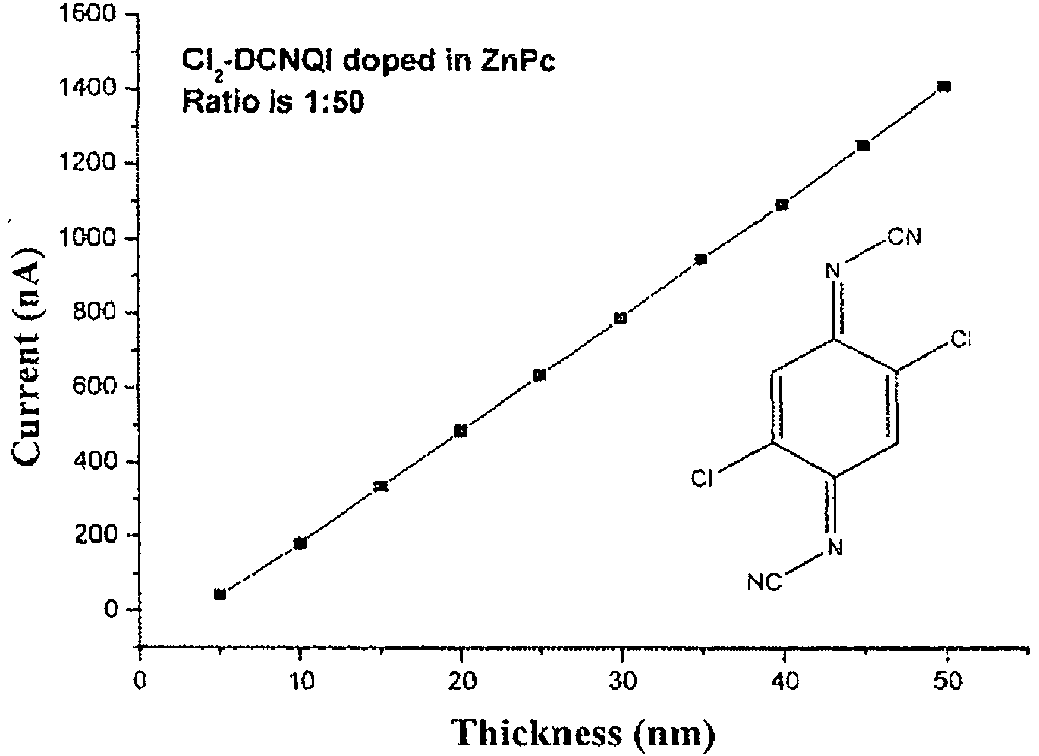
Schichtdicke (nm) Stromstärke (nA) 5 42.66 10 179.4 15 334.2 20 484 25 635.5 30 786 35 946 40 1091.5 45 1253 50 1409.8 - Die Verdampfungstemperatur T(evap.) beträgt 118°C. Die Schicht wurde im Verhältnis 1:25 (Dotand:Matrix) im Vakuum aufgedampft. Dabei wurde eine Leitfähigkeit von 4.9×10⁻⁴ S/cm gemessen.

Schicht dicke (nm) Stromstärke (nA) Schicht dicke (nm) Stromstärke (nA) 5 1.1648 55 66.012 10 4.7852 60 74.335 15 9.7211 65 82.449 20 15.582 70 90.251 25 21.985 75 97.968 30 28.866 84 106.14 35 35.45 85 114.58 40 42.249 90 122.84 45 49.747 95 131.1 50 57.86 100 139.59 - Die Verdampfungstemperatur T(evap.) beträgt 122°C. Dotand und Matrix wurden im Verhältnis 1:25 auf den Träger im Vakuum aufgedampft. Dabei wurde eine Leitfähigkeit von 2×10⁻³ S/cm erreicht.

Schicht dicke (nm) Stromstärke (nA) Schicht dicke (nm) Stromstärke (nA) 5 6.4125 55 300.85 10 26.764 60 333.18 15 52.096 65 365.28 20 79.286 70 397.44 25 107.22 75 431.58 30 135.36 80 464.29 35 165.63 85 498.18 40 199.68 90 529.63 45 234.01 95 560.48 50 267.59 100 590.82 - Die Verdampfungstemperatur T(evap.) beträgt 170°C. Die Schicht wurde im Verhältnis 1:25 (Dotand:Matrix) im Vakuum aufgedampft. Dabei wurde eine Leitfähigkeit von 4.5×10⁻⁴ S/cm gemessen.

Thickness (nm) Current (nA) 10 0.94 15 2.43 20 4.46 30 9.84 40 16. 33 50 23.66 60 31.54 70 39.6 80 47.5 90 56 100 63.5
mit jeweils X und Y wie folgt:
Claims (17)
- Verwendung einer organischen mesomeren Verbindung als organischer Dotand zur Dotierung eines organischen halbleitenden Matrixmaterials zur Veränderung der elektrischen Eigenschaften desselben, dadurch gekennzeichnet, dass die mesomere Verbindung ein Chinon oder Chinonderivat ist und dass die reine mesomere Verbindung unter gleichen Verdampfungsbedingungen eine geringere Flüchtigkeit als Tetrafluorotetracyanochinondimethan (F4TCNQ) aufweist, wobei das molare Dotierungsverhältnis von Dotand zu Matrixmolekül bzw. monomeren Einheit eines polymeren Matrixmoleküls zwischen 1:5 und 1:1000 beträgt.
- Verwendung einer Verbindung nach Anspruch 1, dadurch gekennzeichnet, dass die mesomere chinoide Verbindung die allgemeine


mit m = 0,1,2,3,4 für Formel V oder VI
oder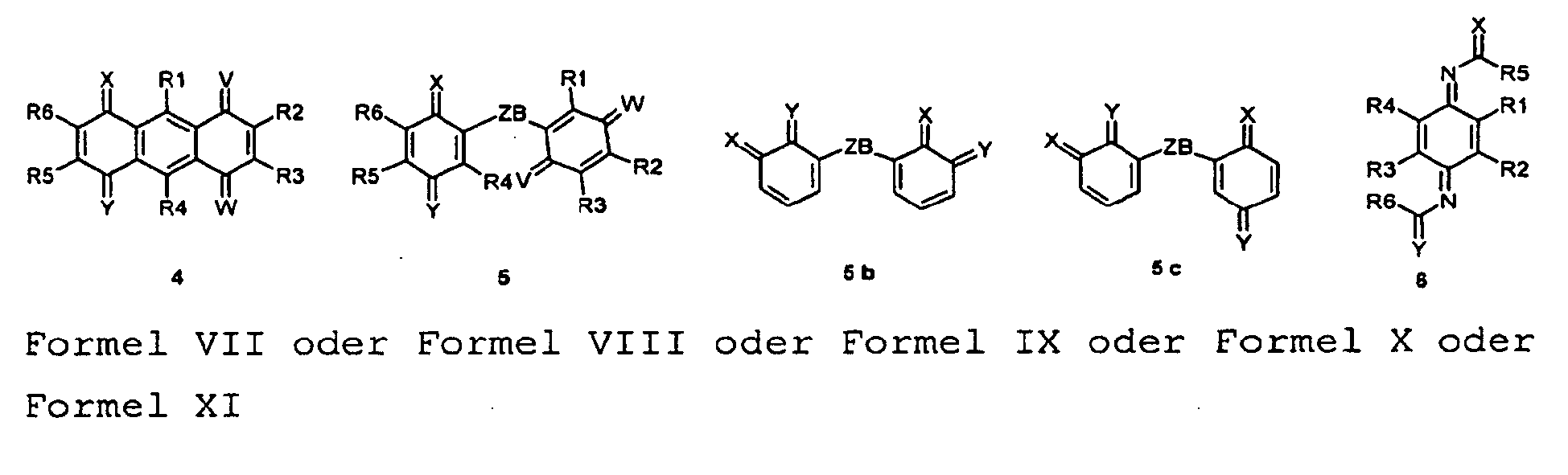





wobei R1-R8 gleich oder verschieden sind und ausgewählt sind aus der Gruppe bestehend aus Wasserstoff, Halogen, Cyano, Nitro, Nitroso, Sulfamid, Carboxy, C1-C7-Carbalkoxy, C1-C7-Sulfo, Sulfohalogen, Halogencarbonyl, Carbamoyl, Formyl, Amidinformyl, C1-C6-Alkylsulfanyl, C1-C6-Alkylsulfonyl, C1-C25-Kohlenwasserstoff, wobei eines oder mehrere oder sämtliche der Kohlenstoffatome der Gruppe mit einem oder mehreren obengenannter Reste substituiert sein kann, und ein oder mehrere Kohlenstoffatome durch Heteroatome ersetzt sein kann (können), Trialkylphosphoryl, die aus einer Kette mit bis zu 5 oder 6 oder 8 unverzweigten oder verzweigten oder zyklisch miteinander verknüpften Kohlenstoffatomen bestehen können, Triarylphosphoryl, Aryl, Heteroaryl, wobei die Reste R1-R8 miteinander unter Ausbildung eines carbocyclischen oder heterocyclischen Ringes verbunden sein können. - Verwendung einer Verbindung nach Anspruch 2, dadurch gekennzeichnet dass die Symbole folgende Bedeutung haben:-M- ist -O-, -S- , -NR- oder -C(=Z)-, vorzugsweise -O-, -S- oder -NR- oder vorzugsweise -C(=Z)-,
und
= T, = U, = V, = W, = X, = Y oder = Z sind gleich oder verschieden und ausgewählt aus der Gruppe bestehend aus

wobei Z in den Formeln VIII; IX oder X eine direkte Bindung, oder eine einatomige oder mehratomige Gruppe darstellt, die gesättigt oder ungesättigt sein kann, und wobei A, B, D, E, F, G, H, K in den Formeln XX und XXI gleich oder verschieden ist und ausgewählt ist aus der Gruppe =N-, =P-, oder =CR-, wobei R ein Wasserstoffatom oder einen Rest darstellen kann. - Verwendung einer Verbindung nach Anspruch 3, dadurch gekennzeichnet, dass die Substituenten T, U, V, W, X, Y und Z gleich oder verschieden sind und ausgewählt sind aus der Gruppe bestehend aus

- Verwendung einer Verbindung nach Anspruch 3, dadurch gekennzeichnet, dass die Substituenten T, U, V, W, X, Y und Z gleich oder verschieden sind und ausgewählt sind aus der Gruppe bestehend aus

- Verwendung einer Verbindung nach Anspruch 3, dadurch gekennzeichnet, dass die Reste T, U, V, W, X, Y und Z gleich oder verschieden sind und ausgewählt sind aus der Gruppe bestehend aus

- Verwendung einer Verbindung nach einem der Ansprüche 1 bis 6, dadurch gekennzeichnet, dass die Verbindung ein Chinon oder Chinonderivat mit mindestens zwei nicht-anellierten chinoiden Systeme darstellt, die unmittelbar oder durch eine Brücke - ZB - mit 1 bis 10 Brückenatomen miteinander verbunden sind, die Kohlenstoffatome oder Heteroatome oder Kohlenstoffatome und Hetreoatome sind.
- Verwendung einer Verbindung nach einem der Ansprüche 1 bis 7, dadurch gekennzeichnet, dass die Verbindung 2, 3, 4, 5 oder 6 chinoide Ringsysteme mit jeweils 5 oder 6 Kohlenstoffatomen aufweist, die zumindest teilweise durch Heteroatome ersetzt sein können.
- Verwendung einer Verbindung nach Anspruch 8, dadurch gekennzeichnet, dass zumindest 2, mehrere oder sämtliche der chinoiden Ringsysteme unter mesomerer Verknüpfung zu einem größeren chinoiden System anelliert oder durch eine ungesättigte Brücke miteinander mesomer verknüpft sind.
- Verwendung einer Verbindung nach einem der Ansprüche 1 bis 9, dadurch gekennzeichnet, dass die Verbindung 1,2,3,4,5 oder 6 Arylreste aufweist, die jeweils untereinander oder mit einem oder mehreren chinoiden Systemen anelliert sind.
- Verwendung einer Verbindung nach einem der Ansprüche 1 bis 10, dadurch gekennzeichnet, dass die Verbindung eine der folgenden Verbindungen ist: N,N'-Dicyan-2,3,5,6-tetrafluoro-1,4-chinondiimin, N,N'-Dicyan-2,5-dichloro-1,4-chinondiimin, N,N'-Dicyan-2,5-dichloro-3,6-difluoro-1, 4-chinondiimin, N,N'-Dicyan-2,3,5,6,7,8-hexafluoro-1,4-naphthochinondiimin und/oder 1,4,5,8-Tetrahydro-1,4,5,8-tetrathia-2,3,6,7-tetracyanoanthrachinon.
- Verwendung einer Verbindung nach einem der Ansprüche 1 bis 11, dadurch gekennzeichnet, dass das Matrixmaterial lochleitend ist.
- Verwendung einer Verbindung nach einem der Ansprüche 1 bis 12, dadurch gekennzeichnet, dass das Matrixmaterial teilweise oder vollständig besteht aus einem Metallphtalocyanin-Komplex, einem Porphyrin-Komplex, einer Oligothiophenverbindung, Oligophenylverbindung, Oligophenylenvinylenverbindung, Oligofluoren-Verbindung, einer Pentazenverbindung, einer Verbindung mit einer Triarylamin-Einheit und/oder einer Spiro-Bifluoren-Verbindung.
- Organisches halbleitendes Material enthaltend ein organisches Matrixmolekül und einen organischen Dotanden, dadurch gekennzeichnet, dass der Dotand eine oder mehrere Verbindungen nach einem der Ansprüche 1 bis 13 sind und das molare Dotierungsverhältnis von Dotand zu Matrixmolekül bzw. monomeren Einheit eines polymeren Matrixmoleküls zwischen 1:5 und 1:1000 beträgt.
- Verfahren zur Herstellung eines organischen halbleitenden Materials enthaltend ein organisches Matrixmolekül und einen organischen Dotanden nach Anspruch 14, dadurch gekennzeichnet, dass der Dotand aus einer Precursor-Verbindung heruas verdampft wird, die beim Erhitzen und/oder Bestrahlung den Dotanden freigibt.
- Elektronisches Bauelement mit einem organischen halbleitenden Material, welches mit einem organischen Dotanden zur Veränderung der elektronischen Eigenschaften des halbleitenden Matrixmaterials dotiert ist, wobei die Dotierung unter Verwendung zumindest einer oder mehrerer der Verbindungen nach einem der Ansprüche 1 bis 13 erfolgte und das molare Dotierungsverhältnis von Dotand zu Matrixmolekül bzw. monomeren Einheit eines polymeren Matrixmoleküls zwischen 1:5 und 1:1000 beträgt.
- Elektronisches Bauelement nach Anspruch 16 in Form einer organischen lichtemitierenden Diode (OLED), einer photovoltaischen Zelle, einer organischen Solarzelle, einer organischen Diode oder eines organischen Feldeffekttransistors.
Priority Applications (2)
| Application Number | Priority Date | Filing Date | Title |
|---|---|---|---|
| EP10176990A EP2270894A1 (de) | 2003-12-04 | 2004-02-03 | Verwendung von organischen mesomeren Verbindungen als Dotanden |
| EP09002596A EP2083458A1 (de) | 2003-12-04 | 2004-02-03 | Organische mesomere Verbindungen als Dotanden |
Applications Claiming Priority (3)
| Application Number | Priority Date | Filing Date | Title |
|---|---|---|---|
| DE10357044 | 2003-12-04 | ||
| DE10357044A DE10357044A1 (de) | 2003-12-04 | 2003-12-04 | Verfahren zur Dotierung von organischen Halbleitern mit Chinondiiminderivaten |
| EP04002303A EP1538684B1 (de) | 2003-12-04 | 2004-02-03 | Verfahren zur Dotierung von organischen Halbleitern mit Dioxaborinderivaten |
Related Parent Applications (1)
| Application Number | Title | Priority Date | Filing Date |
|---|---|---|---|
| EP04002303A Division EP1538684B1 (de) | 2003-12-04 | 2004-02-03 | Verfahren zur Dotierung von organischen Halbleitern mit Dioxaborinderivaten |
Related Child Applications (3)
| Application Number | Title | Priority Date | Filing Date |
|---|---|---|---|
| EP10176990A Division-Into EP2270894A1 (de) | 2003-12-04 | 2004-02-03 | Verwendung von organischen mesomeren Verbindungen als Dotanden |
| EP09002596A Division EP2083458A1 (de) | 2003-12-04 | 2004-02-03 | Organische mesomere Verbindungen als Dotanden |
| EP09002596A Division-Into EP2083458A1 (de) | 2003-12-04 | 2004-02-03 | Organische mesomere Verbindungen als Dotanden |
Publications (3)
| Publication Number | Publication Date |
|---|---|
| EP1596445A1 EP1596445A1 (de) | 2005-11-16 |
| EP1596445B1 EP1596445B1 (de) | 2009-09-09 |
| EP1596445B2 true EP1596445B2 (de) | 2015-09-30 |
Family
ID=34442480
Family Applications (4)
| Application Number | Title | Priority Date | Filing Date |
|---|---|---|---|
| EP09002596A Withdrawn EP2083458A1 (de) | 2003-12-04 | 2004-02-03 | Organische mesomere Verbindungen als Dotanden |
| EP04002303A Expired - Lifetime EP1538684B1 (de) | 2003-12-04 | 2004-02-03 | Verfahren zur Dotierung von organischen Halbleitern mit Dioxaborinderivaten |
| EP05008447.4A Expired - Lifetime EP1596445B2 (de) | 2003-12-04 | 2004-02-03 | Verfahren zur Dotierung von organischen Halbleitern mit Chinonderivaten |
| EP10176990A Withdrawn EP2270894A1 (de) | 2003-12-04 | 2004-02-03 | Verwendung von organischen mesomeren Verbindungen als Dotanden |
Family Applications Before (2)
| Application Number | Title | Priority Date | Filing Date |
|---|---|---|---|
| EP09002596A Withdrawn EP2083458A1 (de) | 2003-12-04 | 2004-02-03 | Organische mesomere Verbindungen als Dotanden |
| EP04002303A Expired - Lifetime EP1538684B1 (de) | 2003-12-04 | 2004-02-03 | Verfahren zur Dotierung von organischen Halbleitern mit Dioxaborinderivaten |
Family Applications After (1)
| Application Number | Title | Priority Date | Filing Date |
|---|---|---|---|
| EP10176990A Withdrawn EP2270894A1 (de) | 2003-12-04 | 2004-02-03 | Verwendung von organischen mesomeren Verbindungen als Dotanden |
Country Status (10)
| Country | Link |
|---|---|
| US (2) | US6908783B1 (de) |
| EP (4) | EP2083458A1 (de) |
| JP (2) | JP2005167175A (de) |
| KR (1) | KR100622179B1 (de) |
| CN (1) | CN100530742C (de) |
| AT (2) | ATE442674T1 (de) |
| CA (1) | CA2462745C (de) |
| DE (3) | DE10357044A1 (de) |
| IN (2) | IN2004MU00382A (de) |
| TW (1) | TWI276142B (de) |
Families Citing this family (325)
| Publication number | Priority date | Publication date | Assignee | Title |
|---|---|---|---|---|
| US7560175B2 (en) | 1999-12-31 | 2009-07-14 | Lg Chem, Ltd. | Electroluminescent devices with low work function anode |
| KR100721656B1 (ko) | 2005-11-01 | 2007-05-23 | 주식회사 엘지화학 | 유기 전기 소자 |
| KR100377321B1 (ko) | 1999-12-31 | 2003-03-26 | 주식회사 엘지화학 | 피-형 반도체 성질을 갖는 유기 화합물을 포함하는 전기소자 |
| US20100026176A1 (en) | 2002-03-28 | 2010-02-04 | Jan Blochwitz-Nomith | Transparent, Thermally Stable Light-Emitting Component Having Organic Layers |
| JP5064034B2 (ja) * | 2004-05-11 | 2012-10-31 | エルジー・ケム・リミテッド | 有機電気素子 |
| US7540978B2 (en) | 2004-08-05 | 2009-06-02 | Novaled Ag | Use of an organic matrix material for producing an organic semiconductor material, organic semiconductor material and electronic component |
| KR101027896B1 (ko) | 2004-08-13 | 2011-04-07 | 테크니셰 유니베르시테트 드레스덴 | 발광 컴포넌트를 위한 층 어셈블리 |
| WO2006019270A1 (en) | 2004-08-19 | 2006-02-23 | Lg Chem. Ltd. | Organic light-emitting device comprising buffer layer and method for fabricating the same |
| EP1648042B1 (de) | 2004-10-07 | 2007-05-02 | Novaled AG | Verfahren zur Dotierung von einem Halbleitermaterial mit Cäsium |
| WO2006081780A1 (de) * | 2005-02-04 | 2006-08-10 | Novaled Ag | Dotanden für organische halbleiter |
| DE502005002342D1 (de) * | 2005-03-15 | 2008-02-07 | Novaled Ag | Lichtemittierendes Bauelement |
| EP2264806B1 (de) | 2005-04-13 | 2019-03-27 | Novaled GmbH | Anordnung für eine organische Leuchtdiode vom pin-Typ und Verfahren zum Herstellen |
| EP1729346A1 (de) * | 2005-06-01 | 2006-12-06 | Novaled AG | Lichtemittierendes Bauteil mit einer Elektrodenanordnung |
| KR101174871B1 (ko) * | 2005-06-18 | 2012-08-17 | 삼성디스플레이 주식회사 | 유기 반도체의 패터닝 방법 |
| EP1739765A1 (de) * | 2005-07-01 | 2007-01-03 | Novaled AG | Organische Leuchtdiode und Anordnung mit mehreren organischen Leuchtdioden |
| TWI321968B (en) * | 2005-07-15 | 2010-03-11 | Lg Chemical Ltd | Organic light meitting device and method for manufacturing the same |
| US20090015150A1 (en) * | 2005-07-15 | 2009-01-15 | Lg Chem, Ltd. | Organic light emitting device and method for manufacturing the same |
| CN101297415A (zh) * | 2005-08-01 | 2008-10-29 | 普莱克斯托尼克斯公司 | 导电聚合物的潜在掺杂 |
| DE102005040411A1 (de) | 2005-08-26 | 2007-03-01 | Merck Patent Gmbh | Neue Materialien für organische Elektrolumineszenzvorrichtungen |
| EP1938398B1 (de) * | 2005-09-05 | 2010-05-26 | OSRAM Opto Semiconductors GmbH | Neue materialien zur verbesserung der lochinjektion in organischen elektronischen bauelementen und verwendung des materials |
| DE102005043163A1 (de) | 2005-09-12 | 2007-03-15 | Merck Patent Gmbh | Verbindungen für organische elektronische Vorrichtungen |
| EP1786050B1 (de) * | 2005-11-10 | 2010-06-23 | Novaled AG | Dotiertes organisches Halbleitermaterial |
| DE102005059608B4 (de) * | 2005-12-12 | 2009-04-02 | Polyic Gmbh & Co. Kg | Organisches elektronisches Bauelement mit verbesserter Spannungsstabilität und Verfahren zur Herstellung dazu |
| EP1806795B1 (de) * | 2005-12-21 | 2008-07-09 | Novaled AG | Organisches Bauelement |
| US7919010B2 (en) * | 2005-12-22 | 2011-04-05 | Novaled Ag | Doped organic semiconductor material |
| EP1804308B1 (de) * | 2005-12-23 | 2012-04-04 | Novaled AG | Organische lichtemittierende Vorrichtung mit mehreren aufeinander gestapelten organischen elektrolumineszenten Einheiten |
| DE602006001930D1 (de) * | 2005-12-23 | 2008-09-04 | Novaled Ag | tur von organischen Schichten |
| WO2007071450A1 (en) * | 2005-12-23 | 2007-06-28 | Novaled Ag | Electronic device with a layer structure of organic layers |
| EP1803789A1 (de) * | 2005-12-28 | 2007-07-04 | Novaled AG | Verwendung von Metallkomplexen als Emitter in einem elektronischen Bauelement und elektronisches Bauelement |
| EP1808909A1 (de) | 2006-01-11 | 2007-07-18 | Novaled AG | Elekrolumineszente Lichtemissionseinrichtung |
| WO2007083918A1 (en) | 2006-01-18 | 2007-07-26 | Lg Chem. Ltd. | Oled having stacked organic light-emitting units |
| JP2009526370A (ja) * | 2006-02-09 | 2009-07-16 | キユーデイー・ビジヨン・インコーポレーテツド | 半導体ナノ結晶およびドープされた有機材料を含む層を含むデバイスおよび方法 |
| DE502006000749D1 (de) | 2006-03-21 | 2008-06-19 | Novaled Ag | Heterocyclisches Radikal oder Diradikal, deren Dimere, Oligomere, Polymere, Dispiroverbindungen und Polycyclen, deren Verwendung, organisches halbleitendes Material sowie elektronisches Bauelement |
| EP1837927A1 (de) | 2006-03-22 | 2007-09-26 | Novaled AG | Verwendung von heterocyclischen Radikalen zur Dotierung von organischen Halbleitern |
| DE102007014048B4 (de) * | 2006-03-21 | 2013-02-21 | Novaled Ag | Mischung aus Matrixmaterial und Dotierungsmaterial, sowie Verfahren zum Herstellen einer Schicht aus dotiertem organischen Material |
| DE102006013802A1 (de) | 2006-03-24 | 2007-09-27 | Merck Patent Gmbh | Neue Materialien für organische Elektrolumineszenzvorrichtungen |
| JPWO2007116750A1 (ja) * | 2006-03-30 | 2009-08-20 | 出光興産株式会社 | 有機エレクトロルミネッセンス素子用材料、及びこれを用いた有機エレクトロルミネッセンス素子 |
| DE112007000789B4 (de) * | 2006-03-30 | 2012-03-15 | Novaled Ag | Verwendung von Bora-tetraazepentalenen |
| US7572482B2 (en) * | 2006-04-14 | 2009-08-11 | Bae Systems Information And Electronic Systems Integration Inc. | Photo-patterned carbon electronics |
| EP1848049B1 (de) * | 2006-04-19 | 2009-12-09 | Novaled AG | Lichtemittierendes Bauelement |
| EP1860709B1 (de) * | 2006-05-24 | 2012-08-08 | Novaled AG | Verwendung von quadratisch planaren Übergangsmetallkomplexen als Dotand |
| DE102006031990A1 (de) | 2006-07-11 | 2008-01-17 | Merck Patent Gmbh | Neue Materialien für organische Elektrolumineszenzvorrichtungen |
| DE102006035018B4 (de) * | 2006-07-28 | 2009-07-23 | Novaled Ag | Oxazol-Triplett-Emitter für OLED-Anwendungen |
| DE102006053320B4 (de) * | 2006-11-13 | 2012-01-19 | Novaled Ag | Verwendung einer Koordinationsverbindung zur Dotierung organischer Halbleiter |
| DE102006059509B4 (de) * | 2006-12-14 | 2012-05-03 | Novaled Ag | Organisches Leuchtbauelement |
| DE102007002714A1 (de) | 2007-01-18 | 2008-07-31 | Merck Patent Gmbh | Neue Materialien für organische Elektrolumineszenzvorrichtungen |
| DE102007012794B3 (de) | 2007-03-16 | 2008-06-19 | Novaled Ag | Pyrido[3,2-h]chinazoline und/oder deren 5,6-Dihydroderivate, deren Herstellungsverfahren und diese enthaltendes dotiertes organisches Halbleitermaterial |
| DE102007019260B4 (de) * | 2007-04-17 | 2020-01-16 | Novaled Gmbh | Nichtflüchtiges organisches Speicherelement |
| DE102007018456B4 (de) * | 2007-04-19 | 2022-02-24 | Novaled Gmbh | Verwendung von Hauptgruppenelementhalogeniden und/oder -pseudohalogeniden, organisches halbleitendes Matrixmaterial, elektronische und optoelektronische Bauelemente |
| EP3076451B1 (de) | 2007-04-30 | 2019-03-06 | Novaled GmbH | Oxokohlenstoff, pseudooxokohlenstoff- und radialenverbindungen sowie deren verwendung |
| EP1990847B1 (de) * | 2007-05-10 | 2018-06-20 | Novaled GmbH | Verwendung von chinoiden Bisimidazolen und deren Derivaten als Dotand zur Dotierung eines organischen halbleitenden Matrixmaterials |
| US8044390B2 (en) * | 2007-05-25 | 2011-10-25 | Idemitsu Kosan Co., Ltd. | Material for organic electroluminescent device, organic electroluminescent device, and organic electroluminescent display |
| DE102007024850A1 (de) | 2007-05-29 | 2008-12-04 | Merck Patent Gmbh | Neue Materialien für organische Elektrolumineszenzvorrichtungen |
| EP2009014B1 (de) * | 2007-06-22 | 2018-10-24 | Novaled GmbH | Verwendung eines Precursors eines n-Dotanden zur Dotierung eines organischen halbleitenden Materials, Precursor und elektronisches oder optoelektronisches Bauelement |
| DE102007031220B4 (de) | 2007-07-04 | 2022-04-28 | Novaled Gmbh | Chinoide Verbindungen und deren Verwendung in halbleitenden Matrixmaterialien, elektronischen und optoelektronischen Bauelementen |
| DE102007063993B4 (de) | 2007-07-04 | 2024-09-12 | Novaled Gmbh | Chinoide Verbindungen und deren Verwendung in halbleitenden Matrixmaterialien, elektronischen und optoelektronischen Bauelementen |
| DE102007037905B4 (de) | 2007-08-10 | 2011-02-24 | Fraunhofer-Gesellschaft zur Förderung der angewandten Forschung e.V. | Dotiertes Halbleitermaterial und dessen Verwendung |
| US8759819B2 (en) * | 2007-11-22 | 2014-06-24 | Idemitsu Kosan Co., Ltd. | Organic electroluminescence device |
| DE102008011185A1 (de) | 2008-02-27 | 2009-09-03 | Osram Opto Semiconductors Gmbh | Verfahren zur Herstellung einer dotierten organischen halbleitenden Schicht |
| JP5315729B2 (ja) * | 2008-03-11 | 2013-10-16 | 大日本印刷株式会社 | 有機デバイス |
| KR101646770B1 (ko) * | 2008-03-31 | 2016-08-08 | 카운슬 오브 사이언티픽 앤드 인더스트리얼 리서치 | 신규의 공여체-수용체 플루오렌 스캐폴드, 이의 제조방법 및 용도 |
| DE102008017591A1 (de) | 2008-04-07 | 2009-10-08 | Merck Patent Gmbh | Neue Materialien für organische Elektrolumineszenzvorrichtungen |
| DE102008018670A1 (de) | 2008-04-14 | 2009-10-15 | Merck Patent Gmbh | Neue Materialien für organische Elektrolumineszenzvorrichtungen |
| US8057712B2 (en) * | 2008-04-29 | 2011-11-15 | Novaled Ag | Radialene compounds and their use |
| DE102008024182A1 (de) | 2008-05-19 | 2009-11-26 | Merck Patent Gmbh | Verbindungen für organische elektronische Vorrichtung |
| EP2291872A1 (de) * | 2008-06-27 | 2011-03-09 | Universal Display Corporation | Vernetzbare ionische dotierungsstoffe |
| DE102008033943A1 (de) | 2008-07-18 | 2010-01-21 | Merck Patent Gmbh | Neue Materialien für organische Elektrolumineszenzvorrichtungen |
| GB2467316B (en) | 2009-01-28 | 2014-04-09 | Pragmatic Printing Ltd | Electronic devices, circuits and their manufacture |
| DE102008036063B4 (de) * | 2008-08-04 | 2017-08-31 | Novaled Gmbh | Organischer Feldeffekt-Transistor |
| DE102008036062B4 (de) | 2008-08-04 | 2015-11-12 | Novaled Ag | Organischer Feldeffekt-Transistor |
| GB2462591B (en) * | 2008-08-05 | 2013-04-03 | Cambridge Display Tech Ltd | Organic thin film transistors and methods of making the same |
| DE102008050841B4 (de) | 2008-10-08 | 2019-08-01 | Merck Patent Gmbh | Neue Materialien für organische Elektrolumineszenzvorrichtungen |
| US8119037B2 (en) * | 2008-10-16 | 2012-02-21 | Novaled Ag | Square planar transition metal complexes and organic semiconductive materials using them as well as electronic or optoelectric components |
| WO2010062558A1 (en) | 2008-10-27 | 2010-06-03 | Plextronics Inc. | Charge injection and transport layers |
| DE102008061843B4 (de) | 2008-12-15 | 2018-01-18 | Novaled Gmbh | Heterocyclische Verbindungen und deren Verwendung in elektronischen und optoelektronischen Bauelementen |
| DE102009005288A1 (de) | 2009-01-20 | 2010-07-22 | Merck Patent Gmbh | Materialien für organische Elektrolumineszenzvorrichtungen |
| DE102009005289B4 (de) | 2009-01-20 | 2023-06-22 | Merck Patent Gmbh | Materialien für organische Elektrolumineszenzvorrichtungen, Verfahren zu deren Herstellung und elektronische Vorrichtungen, enthaltend diese |
| DE102009005290A1 (de) | 2009-01-20 | 2010-07-22 | Merck Patent Gmbh | Verbindungen für elektronische Vorrichtungen |
| DE102009005746A1 (de) | 2009-01-23 | 2010-07-29 | Merck Patent Gmbh | Materialien für organische Elektrolumineszenzvorrichtungen |
| EP2401254B1 (de) | 2009-02-26 | 2013-06-19 | Novaled AG | Chinonverbindungen als dotierstoff in der organischen elektronik |
| DE102009013685B4 (de) | 2009-03-20 | 2013-01-31 | Novaled Ag | Verwendung einer organischen Diode als organische Zenerdiode und Verfahren zum Betreiben |
| DE102009023155A1 (de) | 2009-05-29 | 2010-12-02 | Merck Patent Gmbh | Materialien für organische Elektrolumineszenzvorrichtungen |
| DE102009051142B4 (de) | 2009-06-05 | 2019-06-27 | Heliatek Gmbh | Photoaktives Bauelement mit invertierter Schichtfolge und Verfahren zu seiner Herstellung |
| US9028979B2 (en) | 2009-06-18 | 2015-05-12 | Basf Se | Phenanthroazole compounds as hole transporting materials for electro luminescent devices |
| CN102421858A (zh) | 2009-06-22 | 2012-04-18 | 默克专利有限公司 | 导电制剂 |
| DE102009032922B4 (de) | 2009-07-14 | 2024-04-25 | Merck Patent Gmbh | Materialien für organische Elektrolumineszenzvorrichtungen, Verfahren zu deren Herstellung, deren Verwendung sowie elektronische Vorrichtung |
| DE102010031829B4 (de) | 2009-07-21 | 2021-11-11 | Novaled Gmbh | Thermoelektrische Bauelemente mit dünnen Schichten |
| DE102009034194A1 (de) | 2009-07-22 | 2011-01-27 | Merck Patent Gmbh | Materialien für elektronische Vorrichtungen |
| DE102009034625A1 (de) | 2009-07-27 | 2011-02-03 | Merck Patent Gmbh | Neue Materialien für organische Elektrolumineszenzvorrichtungen |
| DE102010023619B4 (de) | 2009-08-05 | 2016-09-15 | Novaled Ag | Organisches bottom-emittierendes Bauelement |
| GB2473200B (en) | 2009-09-02 | 2014-03-05 | Pragmatic Printing Ltd | Structures comprising planar electronic devices |
| DE102009053644B4 (de) | 2009-11-17 | 2019-07-04 | Merck Patent Gmbh | Materialien für organische Elektrolumineszenzvorrichtungen |
| KR101097316B1 (ko) | 2009-10-12 | 2011-12-23 | 삼성모바일디스플레이주식회사 | 유기 발광 소자 |
| KR101097315B1 (ko) * | 2009-10-12 | 2011-12-23 | 삼성모바일디스플레이주식회사 | 유기 발광 소자 |
| WO2011044867A2 (de) | 2009-10-14 | 2011-04-21 | Novaled Ag | Elektrooptisches, organisches halbleiterbauelement und verfahren zum herstellen |
| DE102009053191A1 (de) | 2009-11-06 | 2011-05-12 | Merck Patent Gmbh | Materialien für elektronische Vorrichtungen |
| EP2513995B1 (de) | 2009-12-16 | 2016-05-11 | Heliatek GmbH | Photoaktives bauelement mit organischen schichten |
| KR20120123361A (ko) | 2009-12-23 | 2012-11-08 | 메르크 파텐트 게엠베하 | 유기 반도성 화합물을 포함하는 조성물 |
| CN107573484A (zh) | 2009-12-23 | 2018-01-12 | 默克专利有限公司 | 包括聚合粘结剂的组合物 |
| DE102010004453A1 (de) | 2010-01-12 | 2011-07-14 | Novaled AG, 01307 | Organisches lichtemittierendes Bauelement |
| DE102010005697A1 (de) | 2010-01-25 | 2011-07-28 | Merck Patent GmbH, 64293 | Verbindungen für elektronische Vorrichtungen |
| DE102010009903A1 (de) | 2010-03-02 | 2011-09-08 | Merck Patent Gmbh | Verbindungen für elektronische Vorrichtungen |
| EP2367215A1 (de) * | 2010-03-15 | 2011-09-21 | Novaled AG | Organische photoaktive Vorrichtung |
| DE102010013068A1 (de) | 2010-03-26 | 2011-09-29 | Merck Patent Gmbh | Verbindungen für elektronische Vorrichtungen |
| KR101182446B1 (ko) * | 2010-04-02 | 2012-09-12 | 삼성디스플레이 주식회사 | 유기 발광 소자 |
| JP6073216B2 (ja) | 2010-04-12 | 2017-02-01 | メルク パテント ゲーエムベーハー | 有機電子デバイスを作製するための組成物および方法 |
| JP2013527980A (ja) | 2010-04-12 | 2013-07-04 | メルク パテント ゲーエムベーハー | 改良された性能を有する組成物 |
| DE102010014933A1 (de) | 2010-04-14 | 2011-10-20 | Merck Patent Gmbh | Materialien für elektronische Vorrichtungen |
| CN102892859B (zh) * | 2010-04-27 | 2016-03-09 | 诺瓦莱德公开股份有限公司 | 有机半导体材料和电子构件 |
| ES2857904T3 (es) | 2010-05-04 | 2021-09-29 | Heliatek Gmbh | Componente fotoactivo con capas orgánicas |
| CN102822181B (zh) * | 2010-05-24 | 2016-03-02 | 海洋王照明科技股份有限公司 | 一种醌型硅芴类有机半导体材料及其制备方法和应用 |
| RU2012156386A (ru) | 2010-05-27 | 2014-07-10 | Мерк Патент Гмбх | Состав и способ получения органических электронных устройств |
| JP5986992B2 (ja) | 2010-06-14 | 2016-09-06 | ノヴァレッド ゲーエムベーハー | 有機発光素子 |
| DE102010023620B4 (de) | 2010-06-14 | 2016-09-15 | Novaled Ag | Organisches, bottom-emittierendes Bauelement |
| DE102010024335A1 (de) | 2010-06-18 | 2011-12-22 | Merck Patent Gmbh | Verbindungen für elektronische Vorrichtungen |
| DK2398056T3 (en) | 2010-06-21 | 2016-05-30 | Heliatek Gmbh | Organic solar cell with multiple transportlagsystemer |
| DE102010024542A1 (de) | 2010-06-22 | 2011-12-22 | Merck Patent Gmbh | Materialien für elektronische Vorrichtungen |
| US20110315967A1 (en) * | 2010-06-24 | 2011-12-29 | Basf Se | Organic field effect transistor with improved current on/off ratio and controllable threshold shift |
| EP2586074B1 (de) | 2010-06-24 | 2016-12-28 | Basf Se | Organischer feldeffekttransistor mit verbessertem on-/off-stromverhältnis und steuerbarer schwellenverschiebung |
| DE102010031979B4 (de) | 2010-07-22 | 2014-10-30 | Novaled Ag | Halbleiterbauelement, Verfahren zu dessen Herstellung, Verwendung des Halbleiterbauelementes und Inverter mit zwei Halbleiterbauelementen |
| DE102010033548A1 (de) | 2010-08-05 | 2012-02-09 | Merck Patent Gmbh | Materialien für elektronische Vorrichtungen |
| DE102010048607A1 (de) | 2010-10-15 | 2012-04-19 | Merck Patent Gmbh | Verbindungen für elektronische Vorrichtungen |
| WO2012092972A1 (de) | 2011-01-06 | 2012-07-12 | Heliatek Gmbh | Elektronisches oder optoelektronisches bauelement mit organischen schichten |
| EP2669262B1 (de) | 2011-01-27 | 2018-03-07 | JNC Corporation | Neue anthracenverbindung und organisches elektrolumineszenzelement damit |
| TWI526418B (zh) | 2011-03-01 | 2016-03-21 | 諾瓦發光二極體股份公司 | 有機半導體材料及有機組成物 |
| EP2705552B1 (de) | 2011-05-05 | 2015-03-04 | Merck Patent GmbH | Verbindungen für elektronische vorrichtungen |
| JP5780132B2 (ja) | 2011-05-19 | 2015-09-16 | Jnc株式会社 | ベンゾフルオレン化合物、該化合物を用いた発光層用材料および有機電界発光素子 |
| KR101908384B1 (ko) | 2011-06-17 | 2018-10-17 | 삼성디스플레이 주식회사 | 유기 발광 소자 및 이를 포함하는 평판 표시 장치 |
| EP2732479B1 (de) | 2011-07-11 | 2019-09-11 | Merck Patent GmbH | Verbindungen für organische elektrolumineszenzvorrichtungen |
| KR101739629B1 (ko) | 2011-08-03 | 2017-05-24 | 메르크 파텐트 게엠베하 | 전자 소자용 물질 |
| US9403795B2 (en) | 2011-08-05 | 2016-08-02 | Samsung Display Co., Ltd. | Carbazole-based compound and organic light-emitting diode comprising the same |
| EP2782975B1 (de) | 2011-10-27 | 2018-01-10 | Merck Patent GmbH | Materialien für elektronische vorrichtungen |
| DE102011055233A1 (de) | 2011-11-10 | 2013-05-16 | Novaled Ag | Lichtemittierende Vorrichtung und flächige Anordnung mit mehreren lichtemittierenden Vorrichtungen |
| KR20140101788A (ko) | 2011-11-15 | 2014-08-20 | 바스프 에스이 | 유기 반도체 소자 및 이의 제조 방법 |
| KR102310368B1 (ko) | 2011-11-17 | 2021-10-07 | 메르크 파텐트 게엠베하 | 스피로디히드로아크리딘 유도체 및 이의 유기 전계발광 소자용 재료로서의 용도 |
| KR101927943B1 (ko) | 2011-12-02 | 2018-12-12 | 삼성디스플레이 주식회사 | 다층 구조의 정공수송층을 포함하는 유기 발광 소자 및 이를 포함하는 평판 표시 장치 |
| JP6139552B2 (ja) | 2011-12-06 | 2017-05-31 | ノヴァレッド ゲーエムベーハー | 有機発光素子およびその製造方法 |
| CN103159920B (zh) * | 2011-12-09 | 2015-11-25 | 海洋王照明科技股份有限公司 | 蒽醌基共聚物太阳能电池材料及其制备方法和应用 |
| KR101927941B1 (ko) | 2011-12-19 | 2018-12-12 | 삼성디스플레이 주식회사 | 다층 구조의 정공수송층을 포함하는 유기 발광 소자 및 이를 포함하는 평판 표시 장치 |
| DE102012100642B4 (de) | 2012-01-26 | 2015-09-10 | Novaled Ag | Anordnung mit mehreren organischen Halbleiterbauelementen und Verfahren zum Herstellen sowie Verwendung der Anordnung |
| US9487618B2 (en) | 2012-02-22 | 2016-11-08 | Merck Patent Gmbh | Polymers containing dibenzocycloheptane structural units |
| DE102013203149A1 (de) | 2012-03-08 | 2013-09-12 | Olaf Zeika | Oligomere Verbindungen sowie deren Verwendung |
| TW201341347A (zh) | 2012-03-15 | 2013-10-16 | 諾瓦發光二極體股份公司 | 芳香胺三聯苯化合物及其在有機半導體元件中的應用 |
| DE102013205093A1 (de) | 2012-03-28 | 2013-10-02 | Olaf Zeika | Herstellung und Verwendung chinoider N-Heterozyklen, chinoider N-Heteropolyzyklen und chinoider Phenanthrenderivate |
| DE102012103448B4 (de) | 2012-04-19 | 2018-01-04 | Heliatek Gmbh | Verfahren zur Optimierung von in Reihe geschalteten, photoaktiven Bauelementen auf gekrümmten Oberflächen |
| DE102012104118B4 (de) | 2012-05-10 | 2021-12-02 | Heliatek Gmbh | Lochtransportmaterialien für optoelektronische Bauelemente |
| DE102012104247B4 (de) | 2012-05-16 | 2017-07-20 | Heliatek Gmbh | Halbleitendes organisches Material für optoelektronische Bauelemente |
| WO2013179223A2 (de) | 2012-05-30 | 2013-12-05 | Heliatek Gmbh | Solarmodul zur anordnung auf formteil aus beton |
| DE102012011335B4 (de) | 2012-06-06 | 2026-08-20 | Merck Patent Gmbh | Verbindungen für Organische Elekronische Vorrichtungen |
| US20150155397A1 (en) | 2012-06-11 | 2015-06-04 | Heliatek Gmbh | Filter system for photoactive components |
| DE102012105022A1 (de) | 2012-06-11 | 2013-12-12 | Heliatek Gmbh | Fahrzeug mit flexiblen organischen Photovoltaik-Modulen |
| JP6422861B2 (ja) | 2012-06-29 | 2018-11-14 | メルク パテント ゲーエムベーハー | 2,7−ピレン構造単位を含むポリマー |
| DE102012105810B4 (de) | 2012-07-02 | 2020-12-24 | Heliatek Gmbh | Transparente Elektrode für optoelektronische Bauelemente |
| DE102012105812A1 (de) | 2012-07-02 | 2014-01-02 | Heliatek Gmbh | Elektrodenanordnung für optoelektronische Bauelemente |
| ES2762410T3 (es) | 2012-07-02 | 2020-05-25 | Heliatek Gmbh | Electrodo transparente para componentes optoelectrónicos |
| DE102012105809B4 (de) | 2012-07-02 | 2017-12-07 | Heliatek Gmbh | Organisches optoelektronisches Bauelement mit transparenter Gegenelektrode und transparenter Elektrodenvorrichtung |
| EP2684932B8 (de) | 2012-07-09 | 2016-12-21 | Hodogaya Chemical Co., Ltd. | Diarylamino matrix material dotiert mit einer mesomeren radialenverbindung |
| JP6262226B2 (ja) | 2012-07-10 | 2018-01-17 | メルク パテント ゲーエムベーハー | 有機エレクトロルミネッセンスデバイス用の材料 |
| KR102006621B1 (ko) | 2012-07-23 | 2019-08-02 | 메르크 파텐트 게엠베하 | 화합물 및 유기 전계 발광 디바이스 |
| WO2014015938A1 (de) | 2012-07-23 | 2014-01-30 | Merck Patent Gmbh | Derivate von 2-diarylaminofluoren und diese enthaltnde organische elektronische verbindungen |
| KR102696532B1 (ko) | 2012-07-23 | 2024-08-19 | 메르크 파텐트 게엠베하 | 플루오렌 및 이를 함유하는 전자 소자 |
| KR102157994B1 (ko) | 2012-09-11 | 2020-09-21 | 고쿠리츠 다이가쿠 호진 교토 다이가쿠 | 유기 전계 발광 소자용 재료, 유기 전계 발광 소자, 표시 장치 및 조명 장치 |
| WO2014047616A1 (en) | 2012-09-24 | 2014-03-27 | Arizona Board Of Regents For And On Behalf Of Arizona State University | Metal compounds, methods, and uses thereof |
| US20150274762A1 (en) | 2012-10-26 | 2015-10-01 | Arizona Board Of Regents Acting For And On Behalf Of Arizona State University | Metal complexes, methods, and uses thereof |
| CN104183736A (zh) * | 2013-05-23 | 2014-12-03 | 海洋王照明科技股份有限公司 | 有机电致发光器件及其制备方法 |
| JP5972230B2 (ja) * | 2013-07-19 | 2016-08-17 | 富士フイルム株式会社 | 有機薄膜トランジスタ、有機半導体薄膜および有機半導体材料 |
| CN105378962B (zh) * | 2013-07-19 | 2017-06-27 | 富士胶片株式会社 | 有机膜晶体管、有机半导体膜及有机半导体材料以及它们的应用 |
| JP5972229B2 (ja) * | 2013-07-19 | 2016-08-17 | 富士フイルム株式会社 | 有機薄膜トランジスタ、有機半導体薄膜および有機半導体材料 |
| DE102013110693B4 (de) | 2013-09-27 | 2024-04-25 | Heliatek Gmbh | Photoaktives, organisches Material für optoelektronische Bauelemente |
| JP6804823B2 (ja) | 2013-10-14 | 2020-12-23 | アリゾナ・ボード・オブ・リージェンツ・オン・ビハーフ・オブ・アリゾナ・ステイト・ユニバーシティーArizona Board of Regents on behalf of Arizona State University | 白金錯体およびデバイス |
| WO2015082037A1 (en) | 2013-12-06 | 2015-06-11 | Merck Patent Gmbh | Compositions containing a polymeric binder which comprises acrylic and/or methacrylic acid ester units |
| KR102380808B1 (ko) | 2013-12-06 | 2022-03-30 | 메르크 파텐트 게엠베하 | 치환 옥세핀 |
| CN105980518B (zh) | 2013-12-06 | 2019-07-12 | 默克专利有限公司 | 化合物和有机电子器件 |
| US10158083B2 (en) | 2013-12-12 | 2018-12-18 | Merck Patent Gmbh | Materials for electronic devices |
| US10020455B2 (en) | 2014-01-07 | 2018-07-10 | Arizona Board Of Regents On Behalf Of Arizona State University | Tetradentate platinum and palladium complex emitters containing phenyl-pyrazole and its analogues |
| TWI636056B (zh) | 2014-02-18 | 2018-09-21 | Kwansei Gakuin Educational Foundation | 多環芳香族化合物及其製造方法、有機元件用材料及其應用 |
| US9941479B2 (en) | 2014-06-02 | 2018-04-10 | Arizona Board Of Regents On Behalf Of Arizona State University | Tetradentate cyclometalated platinum complexes containing 9,10-dihydroacridine and its analogues |
| US9923155B2 (en) | 2014-07-24 | 2018-03-20 | Arizona Board Of Regents On Behalf Of Arizona State University | Tetradentate platinum (II) complexes cyclometalated with functionalized phenyl carbene ligands and their analogues |
| US10793546B2 (en) | 2014-08-15 | 2020-10-06 | Arizona Board Of Regents On Behalf Of Arizona State University | Non-platinum metal complexes for excimer based single dopant white organic light emitting diodes |
| US11329244B2 (en) | 2014-08-22 | 2022-05-10 | Arizona Board Of Regents On Behalf Of Arizona State University | Organic light-emitting diodes with fluorescent and phosphorescent emitters |
| US10033003B2 (en) | 2014-11-10 | 2018-07-24 | Arizona Board Of Regents On Behalf Of Arizona State University | Tetradentate metal complexes with carbon group bridging ligands |
| CN107532013A (zh) | 2015-01-30 | 2018-01-02 | 默克专利有限公司 | 具有低粒子含量的制剂 |
| US9929361B2 (en) | 2015-02-16 | 2018-03-27 | Universal Display Corporation | Organic electroluminescent materials and devices |
| US11056657B2 (en) | 2015-02-27 | 2021-07-06 | University Display Corporation | Organic electroluminescent materials and devices |
| US9859510B2 (en) | 2015-05-15 | 2018-01-02 | Universal Display Corporation | Organic electroluminescent materials and devices |
| KR102610370B1 (ko) | 2015-05-18 | 2023-12-05 | 메르크 파텐트 게엠베하 | 유기 전계발광 소자용 물질 |
| US10418568B2 (en) | 2015-06-01 | 2019-09-17 | Universal Display Corporation | Organic electroluminescent materials and devices |
| US9879039B2 (en) | 2015-06-03 | 2018-01-30 | Arizona Board Of Regents On Behalf Of Arizona State University | Tetradentate and octahedral metal complexes containing naphthyridinocarbazole and its analogues |
| KR102643183B1 (ko) | 2015-07-15 | 2024-03-04 | 메르크 파텐트 게엠베하 | 유기 반도전성 화합물들을 포함하는 조성물 |
| US11127905B2 (en) | 2015-07-29 | 2021-09-21 | Universal Display Corporation | Organic electroluminescent materials and devices |
| US10211411B2 (en) | 2015-08-25 | 2019-02-19 | Arizona Board Of Regents On Behalf Of Arizona State University | Thermally activated delayed fluorescent material based on 9,10-dihydro-9,9-dimethylacridine analogues for prolonging device longevity |
| US10361381B2 (en) | 2015-09-03 | 2019-07-23 | Universal Display Corporation | Organic electroluminescent materials and devices |
| EP3182478B1 (de) | 2015-12-18 | 2018-11-28 | Novaled GmbH | Elektroneninjektionsschicht für eine organische leuchtdiode (oled) |
| US20170229663A1 (en) | 2016-02-09 | 2017-08-10 | Universal Display Corporation | Organic electroluminescent materials and devices |
| EP3208861A1 (de) | 2016-02-19 | 2017-08-23 | Novaled GmbH | Elektronentransportschicht mit einer matrixverbindungsmischung für eine organische leuchtdiode (oled) |
| US10236456B2 (en) | 2016-04-11 | 2019-03-19 | Universal Display Corporation | Organic electroluminescent materials and devices |
| US11335865B2 (en) | 2016-04-15 | 2022-05-17 | Arizona Board Of Regents On Behalf Of Arizona State University | OLED with multi-emissive material layer |
| US10862054B2 (en) | 2016-06-20 | 2020-12-08 | Universal Display Corporation | Organic electroluminescent materials and devices |
| US11482683B2 (en) | 2016-06-20 | 2022-10-25 | Universal Display Corporation | Organic electroluminescent materials and devices |
| US10672997B2 (en) | 2016-06-20 | 2020-06-02 | Universal Display Corporation | Organic electroluminescent materials and devices |
| KR101872962B1 (ko) | 2016-08-31 | 2018-06-29 | 엘지디스플레이 주식회사 | 유기 화합물과 이를 포함하는 유기발광다이오드 및 유기발광표시장치 |
| US10608186B2 (en) | 2016-09-14 | 2020-03-31 | Universal Display Corporation | Organic electroluminescent materials and devices |
| US10680187B2 (en) | 2016-09-23 | 2020-06-09 | Universal Display Corporation | Organic electroluminescent materials and devices |
| US11196010B2 (en) | 2016-10-03 | 2021-12-07 | Universal Display Corporation | Organic electroluminescent materials and devices |
| US11011709B2 (en) | 2016-10-07 | 2021-05-18 | Universal Display Corporation | Organic electroluminescent materials and devices |
| US10822363B2 (en) | 2016-10-12 | 2020-11-03 | Arizona Board Of Regents On Behalf Of Arizona State University | Narrow band red phosphorescent tetradentate platinum (II) complexes |
| US12317745B2 (en) | 2016-11-09 | 2025-05-27 | Universal Display Corporation | Organic electroluminescent materials and devices |
| US10680188B2 (en) | 2016-11-11 | 2020-06-09 | Universal Display Corporation | Organic electroluminescent materials and devices |
| US11183670B2 (en) | 2016-12-16 | 2021-11-23 | Arizona Board Of Regents On Behalf Of Arizona State University | Organic light emitting diode with split emissive layer |
| US11780865B2 (en) | 2017-01-09 | 2023-10-10 | Universal Display Corporation | Organic electroluminescent materials and devices |
| KR102678967B1 (ko) | 2017-01-27 | 2024-06-26 | 아리조나 보드 오브 리젠츠 온 비하프 오브 아리조나 스테이트 유니버시티 | 피리도-피롤로-아크리딘 및 유사체를 사용하는 금속 보조 지연 형광 이미터 |
| US10844085B2 (en) | 2017-03-29 | 2020-11-24 | Universal Display Corporation | Organic electroluminescent materials and devices |
| EP3609977B1 (de) | 2017-04-13 | 2024-05-29 | Merck Patent GmbH | Zusammensetzung für organische elektronische vorrichtungen |
| US10944060B2 (en) | 2017-05-11 | 2021-03-09 | Universal Display Corporation | Organic electroluminescent materials and devices |
| KR102661359B1 (ko) | 2017-05-16 | 2024-04-25 | 가꼬우 호징 관세이 가쿠잉 | 다환 방향족 화합물 |
| US10615349B2 (en) | 2017-05-19 | 2020-04-07 | Arizona Board Of Regents On Behalf Of Arizona State University | Donor-acceptor type thermally activated delayed fluorescent materials based on imidazo[1,2-F]phenanthridine and analogues |
| US11101435B2 (en) | 2017-05-19 | 2021-08-24 | Arizona Board Of Regents On Behalf Of Arizona State University | Tetradentate platinum and palladium complexes based on biscarbazole and analogues |
| US10516117B2 (en) | 2017-05-19 | 2019-12-24 | Arizona Board Of Regents On Behalf Of Arizona State University | Metal-assisted delayed fluorescent emttters employing benzo-imidazo-phenanthridine and analogues |
| US10392387B2 (en) | 2017-05-19 | 2019-08-27 | Arizona Board Of Regents On Behalf Of Arizona State University | Substituted benzo[4,5]imidazo[1,2-a]phenanthro[9,10-c][1,8]naphthyridines, benzo[4,5]imidazo[1,2-a]phenanthro[9,10-c][1,5]naphthyridines and dibenzo[f,h]benzo[4,5]imidazo[2,1-a]pyrazino[2,3-c]isoquinolines as thermally assisted delayed fluorescent materials |
| DE102017111137B4 (de) | 2017-05-22 | 2025-07-10 | Novaled Gmbh | Organische elektrolumineszente Vorrichtung |
| US12098157B2 (en) | 2017-06-23 | 2024-09-24 | Universal Display Corporation | Organic electroluminescent materials and devices |
| EP3645766A1 (de) | 2017-06-26 | 2020-05-06 | Merck Patent GmbH | Homogene mischungen |
| KR102633060B1 (ko) | 2017-06-30 | 2024-02-02 | 가꼬우 호징 관세이 가쿠잉 | 유기 전계 발광 소자 |
| TWI813576B (zh) | 2017-07-03 | 2023-09-01 | 德商麥克專利有限公司 | 具有低含量苯酚類雜質的調配物 |
| US11993572B2 (en) | 2017-07-05 | 2024-05-28 | Merck Patent Gmbh | Composition for organic electronic devices |
| JP7135012B2 (ja) | 2017-07-05 | 2022-09-12 | メルク パテント ゲーエムベーハー | 有機電子デバイスのための組成物 |
| US11228010B2 (en) | 2017-07-26 | 2022-01-18 | Universal Display Corporation | Organic electroluminescent materials and devices |
| US11744142B2 (en) | 2017-08-10 | 2023-08-29 | Universal Display Corporation | Organic electroluminescent materials and devices |
| WO2019079505A1 (en) | 2017-10-17 | 2019-04-25 | Jian Li | HOLES LOCKING MATERIAL FOR ORGANIC ELECTROLUMINESCENT DIODES |
| US11594688B2 (en) | 2017-10-17 | 2023-02-28 | Arizona Board Of Regents On Behalf Of Arizona State University | Display and lighting devices comprising phosphorescent excimers with preferred molecular orientation as monochromatic emitters |
| TWI785142B (zh) | 2017-11-14 | 2022-12-01 | 德商麥克專利有限公司 | 用於有機電子裝置之組成物 |
| US12180230B2 (en) | 2017-11-28 | 2024-12-31 | University Of Southern California | Carbene compounds and organic electroluminescent devices |
| US11937503B2 (en) | 2017-11-30 | 2024-03-19 | Universal Display Corporation | Organic electroluminescent materials and devices |
| CN119504783A (zh) | 2017-12-13 | 2025-02-25 | 北京夏禾科技有限公司 | 有机电致发光材料和器件 |
| US11466026B2 (en) | 2017-12-13 | 2022-10-11 | Beijing Summer Sprout Technology Co., Ltd. | Organic electroluminescent materials and devices |
| US11466009B2 (en) | 2017-12-13 | 2022-10-11 | Beijing Summer Sprout Technology Co., Ltd. | Organic electroluminescent materials and devices |
| US11897896B2 (en) | 2017-12-13 | 2024-02-13 | Beijing Summer Sprout Technology Co., Ltd. | Organic electroluminescent materials and devices |
| US11542289B2 (en) | 2018-01-26 | 2023-01-03 | Universal Display Corporation | Organic electroluminescent materials and devices |
| US12037348B2 (en) | 2018-03-09 | 2024-07-16 | Arizona Board Of Regents On Behalf Of Arizona State University | Blue and narrow band green and red emitting metal complexes |
| US11165028B2 (en) | 2018-03-12 | 2021-11-02 | Universal Display Corporation | Organic electroluminescent materials and devices |
| WO2019229011A1 (de) | 2018-05-30 | 2019-12-05 | Merck Patent Gmbh | Zusammensetzung für organische elektronische vorrichtungen |
| US12453279B2 (en) | 2018-08-22 | 2025-10-21 | Universal Display Corporation | Organic electroluminescent materials and devices |
| CN110759919B (zh) * | 2018-12-06 | 2021-12-07 | 广州华睿光电材料有限公司 | 芘醌类有机化合物及其应用 |
| US11737349B2 (en) | 2018-12-12 | 2023-08-22 | Universal Display Corporation | Organic electroluminescent materials and devices |
| US11878988B2 (en) | 2019-01-24 | 2024-01-23 | Arizona Board Of Regents On Behalf Of Arizona State University | Blue phosphorescent emitters employing functionalized imidazophenthridine and analogues |
| US11594691B2 (en) | 2019-01-25 | 2023-02-28 | Arizona Board Of Regents On Behalf Of Arizona State University | Light outcoupling efficiency of phosphorescent OLEDs by mixing horizontally aligned fluorescent emitters |
| US11780829B2 (en) | 2019-01-30 | 2023-10-10 | The University Of Southern California | Organic electroluminescent materials and devices |
| US12477890B2 (en) | 2019-02-01 | 2025-11-18 | Universal Display Corporation | Organic electroluminescent materials and devices |
| EP3935129B1 (de) | 2019-03-04 | 2023-11-29 | Merck Patent GmbH | Liganden für nanoskalige materialien |
| JP2020158491A (ja) | 2019-03-26 | 2020-10-01 | ユニバーサル ディスプレイ コーポレイション | 有機エレクトロルミネセンス材料及びデバイス |
| US12281128B2 (en) | 2019-07-30 | 2025-04-22 | Universal Display Corporation | Organic electroluminescent materials and devices |
| KR20210020830A (ko) * | 2019-08-14 | 2021-02-24 | 주식회사 엘지화학 | 유기 발광 소자 |
| US12139501B2 (en) | 2019-08-16 | 2024-11-12 | Universal Display Corporation | Organic electroluminescent materials and devices |
| US11785838B2 (en) | 2019-10-02 | 2023-10-10 | Arizona Board Of Regents On Behalf Of Arizona State University | Green and red organic light-emitting diodes employing excimer emitters |
| CN112687811B (zh) | 2019-10-17 | 2023-09-12 | 北京夏禾科技有限公司 | 一种有机电致发光器件 |
| US20210135130A1 (en) | 2019-11-04 | 2021-05-06 | Universal Display Corporation | Organic electroluminescent materials and devices |
| US12538698B2 (en) | 2020-01-06 | 2026-01-27 | Universal Display Corporation | Organic electroluminescent materials and devices |
| US12426495B2 (en) | 2020-01-28 | 2025-09-23 | Universal Display Corporation | Organic electroluminescent materials and devices |
| US12168661B2 (en) | 2020-02-21 | 2024-12-17 | Arizona Board Of Regents On Behalf Of Arizona State University | Functional materials based on stable chemical structure |
| US11945985B2 (en) | 2020-05-19 | 2024-04-02 | Arizona Board Of Regents On Behalf Of Arizona State University | Metal assisted delayed fluorescent emitters for organic light-emitting diodes |
| CN113683625B (zh) | 2020-05-19 | 2025-06-10 | 亚利桑那州立大学董事会 | 用于有机发光二极管的金属辅助延迟荧光发射体 |
| CN113809246B (zh) * | 2020-06-15 | 2024-06-11 | Tcl科技集团股份有限公司 | 复合材料及其制备方法和量子点发光二极管 |
| EP3937268B1 (de) | 2020-07-10 | 2025-05-07 | Universal Display Corporation | Plasmonische oleds und vertikale dipolstrahler |
| US12545678B2 (en) | 2020-09-09 | 2026-02-10 | Arizona Board Of Regents On Behalf Of Arizon State University | Blue thermally activated delayed fluorescent emitters and hosts based on functionalized imidazolyl groups |
| US12497420B2 (en) | 2020-10-02 | 2025-12-16 | Universal Display Corporation | Organic electroluminescent materials and devices |
| US12187748B2 (en) | 2020-11-02 | 2025-01-07 | Universal Display Corporation | Organic electroluminescent materials and devices |
| US12707889B2 (en) | 2020-11-02 | 2026-08-11 | Universal Display Corporation | Organic electroluminescent materials and devices |
| US20220158096A1 (en) | 2020-11-16 | 2022-05-19 | Universal Display Corporation | Organic electroluminescent materials and devices |
| US20220165967A1 (en) | 2020-11-24 | 2022-05-26 | Universal Display Corporation | Organic electroluminescent materials and devices |
| US12325717B2 (en) | 2020-11-24 | 2025-06-10 | Universal Display Corporation | Organic electroluminescent materials and devices |
| US12575316B2 (en) | 2021-02-03 | 2026-03-10 | Universal Display Corporation | Organic electroluminescent materials and devices |
| EP4060758A3 (de) | 2021-02-26 | 2023-03-29 | Universal Display Corporation | Organische elektrolumineszente materialien und vorrichtungen |
| EP4723858A2 (de) | 2021-02-26 | 2026-04-08 | Universal Display Corporation | Organische elektrolumineszente materialien und vorrichtungen |
| US12624055B2 (en) | 2021-03-01 | 2026-05-12 | Universal Display Corporation | Organic electroluminescent materials and devices |
| US12673962B2 (en) | 2021-03-01 | 2026-07-07 | Universal Display Corporation | Organic electroluminescent materials and devices |
| US12606582B2 (en) | 2021-03-05 | 2026-04-21 | Universal Display Corporation | Organic electroluminescent materials and devices |
| US12428599B2 (en) | 2021-03-09 | 2025-09-30 | Universal Display Corporation | Organic electroluminescent materials and devices |
| US20220298190A1 (en) | 2021-03-12 | 2022-09-22 | Universal Display Corporation | Organic electroluminescent materials and devices |
| US12421262B2 (en) | 2021-03-15 | 2025-09-23 | Universal Display Corporation | Organic electroluminescent materials and devices |
| US20220340607A1 (en) | 2021-04-05 | 2022-10-27 | Universal Display Corporation | Organic electroluminescent materials and devices |
| US12480042B2 (en) | 2021-04-09 | 2025-11-25 | Universal Display Corporation | Organic electroluminescent materials and devices |
| EP4075531A1 (de) | 2021-04-13 | 2022-10-19 | Universal Display Corporation | Plasmonische oleds und vertikale dipolstrahler |
| US20220352478A1 (en) | 2021-04-14 | 2022-11-03 | Universal Display Corporation | Organic eletroluminescent materials and devices |
| US20220407020A1 (en) | 2021-04-23 | 2022-12-22 | Universal Display Corporation | Organic electroluminescent materials and devices |
| US12652948B2 (en) | 2021-04-23 | 2026-06-09 | Universal Display Corporation | Organic electroluminescent materials and devices |
| CN113206201B (zh) * | 2021-05-13 | 2022-09-06 | 南京邮电大学 | 一种优化无铅钙钛矿太阳能电池薄膜的方法 |
| US12686815B2 (en) | 2021-06-04 | 2026-07-21 | Universal Display Corporation | Organic electroluminescent materials and devices |
| US20230133787A1 (en) | 2021-06-08 | 2023-05-04 | University Of Southern California | Molecular Alignment of Homoleptic Iridium Phosphors |
| EP4106027B1 (de) * | 2021-06-18 | 2025-12-31 | Novaled GmbH | Oled-anzeige mit aktiver matrix |
| US12550611B2 (en) | 2021-08-03 | 2026-02-10 | Universal Display Corporation | Organic electroluminescent materials and devices |
| EP4151699A1 (de) | 2021-09-17 | 2023-03-22 | Universal Display Corporation | Organische elektrolumineszente materialien und vorrichtungen |
| US12473318B2 (en) | 2021-10-08 | 2025-11-18 | Universal Display Corporation | Organic electroluminescent materials and devices |
| US12509628B2 (en) | 2021-12-16 | 2025-12-30 | Universal Display Corporation | Organic electroluminescent materials and devices |
| EP4223739A1 (de) | 2022-02-02 | 2023-08-09 | Novaled GmbH | 3,6-bis(cyanomethyliden)cyclohexa-1,4-dien-verbindungen und ihre verwendung in organischen elektronischen vorrichtungen |
| EP4231804A3 (de) | 2022-02-16 | 2023-09-20 | Universal Display Corporation | Organische elektrolumineszente materialien und vorrichtungen |
| US20230292592A1 (en) | 2022-03-09 | 2023-09-14 | Universal Display Corporation | Organic electroluminescent materials and devices |
| US20230337516A1 (en) | 2022-04-18 | 2023-10-19 | Universal Display Corporation | Organic electroluminescent materials and devices |
| US20230389421A1 (en) | 2022-05-24 | 2023-11-30 | Universal Display Corporation | Organic electroluminescent materials and devices |
| KR20260088634A (ko) | 2022-06-03 | 2026-06-12 | 노발레드 게엠베하 | 화학식 (i)의 화합물 및 화학식 (ii)의 화합물을 포함하는 유기 전계발광 장치, 유기 전계발광 장치를 포함하는 디스플레이 장치 |
| EP4287811B1 (de) | 2022-06-03 | 2025-10-08 | Novaled GmbH | Organische elektrolumineszenzvorrichtung mit einer verbindung der formel (i) und einer verbindung der formel (ii) sowie anzeigevorrichtung mit der organischen elektrolumineszenzvorrichtung |
| US20250234700A1 (en) | 2022-06-03 | 2025-07-17 | Novaled Gmbh | Organic electroluminescent device comprising a compound of formula (i) and a compound of formula (ii), and display device comprising the organic electroluminescent device |
| EP4293001A1 (de) | 2022-06-08 | 2023-12-20 | Universal Display Corporation | Organische elektrolumineszente materialien und vorrichtungen |
| US20240016051A1 (en) | 2022-06-28 | 2024-01-11 | Universal Display Corporation | Organic electroluminescent materials and devices |
| US20240107880A1 (en) | 2022-08-17 | 2024-03-28 | Universal Display Corporation | Organic electroluminescent materials and devices |
| EP4333591A1 (de) | 2022-08-30 | 2024-03-06 | Novaled GmbH | Organische elektrolumineszenzvorrichtung mit einer verbindung der formel (i) und einer verbindung der formel (ii) sowie anzeigevorrichtung mit der organischen elektrolumineszenzvorrichtung |
| US20240188419A1 (en) | 2022-10-27 | 2024-06-06 | Universal Display Corporation | Organic electroluminescent materials and devices |
| US20240188319A1 (en) | 2022-10-27 | 2024-06-06 | Universal Display Corporation | Organic electroluminescent materials and devices |
| US20240188316A1 (en) | 2022-10-27 | 2024-06-06 | Universal Display Corporation | Organic electroluminescent materials and devices |
| US20240180025A1 (en) | 2022-10-27 | 2024-05-30 | Universal Display Corporation | Organic electroluminescent materials and devices |
| US20240196730A1 (en) | 2022-10-27 | 2024-06-13 | Universal Display Corporation | Organic electroluminescent materials and devices |
| EP4387414A1 (de) | 2022-12-12 | 2024-06-19 | Novaled GmbH | Organische elektrolumineszenzvorrichtung mit einer verbindung der formel (i) und einer verbindung der formel (ii) und anzeigevorrichtung mit der organischen elektrolumineszenzvorrichtung |
| US20240247017A1 (en) | 2022-12-14 | 2024-07-25 | Universal Display Corporation | Organic electroluminescent materials and devices |
| CN120344541A (zh) | 2022-12-16 | 2025-07-18 | 国立大学法人京都大学 | 多环芳香族化合物 |
| CN120457803A (zh) | 2022-12-23 | 2025-08-08 | 默克专利有限公司 | 电子器件 |
| CN120641429A (zh) | 2023-02-07 | 2025-09-12 | 国立大学法人京都大学 | 多环芳香族化合物 |
| EP4557928A1 (de) | 2023-11-17 | 2025-05-21 | Novaled GmbH | Organische elektronische vorrichtung mit einer verbindung der formel (i) und einer verbindung der formel (iii) und anzeigevorrichtung mit der organischen elektronischen vorrichtung |
| EP4501921A1 (de) | 2023-07-31 | 2025-02-05 | Novaled GmbH | Verbindung der formel (i) und deren verwendung in einer organischen elektronischen vorrichtung |
| EP4501907A1 (de) | 2023-07-31 | 2025-02-05 | Novaled GmbH | Verbindung der formel (i) und deren verwendung in einer organischen elektronischen vorrichtung |
| US20250204238A1 (en) | 2023-12-15 | 2025-06-19 | Universal Display Corporation | Organic electroluminscent materials and devices |
| US20250204239A1 (en) | 2023-12-15 | 2025-06-19 | Universal Display Corporation | Organic electroluminescent materials and devices |
| KR20250124680A (ko) * | 2024-02-13 | 2025-08-20 | 한양대학교 산학협력단 | 유기 p도펀트용 신규 화합물 및 이의 제조방법 |
| EP4752132A1 (de) | 2024-11-29 | 2026-06-03 | Novaled GmbH | Verbindung der formel (i) und deren verwendung in einer organischen elektronischen vorrichtung |
| WO2026120623A1 (en) * | 2024-12-02 | 2026-06-11 | Tata Institute Of Fundamental Research | Sublimable compounds, process for their preparation and applications thereof |
| EP4759797A1 (de) | 2024-12-15 | 2026-06-17 | Novaled GmbH | Verbindung der formel (i) und deren verwendung in einer organischen elektronischen vorrichtung |
| EP4782432A1 (de) | 2025-01-24 | 2026-07-29 | Novaled GmbH | 3-[cyano(dicyanophenyl)methylen]-6-(cyanomethylen)-1,4-cyclohexadien-dicarbonitril-derivate zur verwendung in organischen elektronischen vorrichtung |
Citations (4)
| Publication number | Priority date | Publication date | Assignee | Title |
|---|---|---|---|---|
| JPS57149259A (en) † | 1981-03-13 | 1982-09-14 | Matsushita Electric Ind Co Ltd | Tetracyanoquinodimethane derivative |
| JPH02213088A (ja) † | 1989-02-13 | 1990-08-24 | Nec Corp | 有機薄膜el素子及びその製造方法 |
| JPH04230997A (ja) † | 1990-06-14 | 1992-08-19 | Idemitsu Kosan Co Ltd | 素子用薄膜電極及びそれを有するエレクトロルミネッセンス素子並びにそれらの製造方法 |
| US5849403A (en) † | 1995-09-13 | 1998-12-15 | Kabushiki Kaisha Toshiba | Organic thin film device |
Family Cites Families (23)
| Publication number | Priority date | Publication date | Assignee | Title |
|---|---|---|---|---|
| US3408367A (en) * | 1965-07-12 | 1968-10-29 | Du Pont | Tetraaryl-1, 4-bis(dicyano-methylene)cyclohexadienes and their dihydro derivatives |
| JPS5810553A (ja) * | 1981-07-10 | 1983-01-21 | Matsushita Electric Ind Co Ltd | テトラシアノアントラキノジメタン誘導体の製造方法 |
| EP0061264B1 (de) | 1981-03-13 | 1985-07-24 | Matsushita Electric Industrial Co., Ltd. | Tetracyanoanthrachinodimethanverbindungen, Verfahren zu deren Herstellung und davon abgeleitete Polymere und Ladungsübertragungskomplexe |
| US4394428A (en) * | 1981-09-24 | 1983-07-19 | Eastman Kodak Company | Photoconductive composition and elements comprising two different compounds having a dioxaborin nucleas on a derivative thereof |
| JPS5855450A (ja) * | 1981-09-29 | 1983-04-01 | Matsushita Electric Ind Co Ltd | テトラシアノアントラキノジメタン誘導体の製造方法 |
| US4578220A (en) * | 1983-10-19 | 1986-03-25 | Basf Aktiengesellschaft | Charge transfer complexes of tetrathio/seleno-fulvalene derivatives and biscyanimine derivatives; biscyanimine derivatives and method for producing same |
| DE3522232A1 (de) * | 1985-06-21 | 1987-01-02 | Basf Ag | Radikalionensalze |
| DE3718365A1 (de) * | 1987-06-02 | 1988-12-22 | Basf Ag | N,n'-biscyano-p-benzochinonbisimine, diese enthaltende charge-transfer-komplexe und radikalionensalze der biscyano-benzochinonbisimine |
| JP2699429B2 (ja) * | 1988-08-02 | 1998-01-19 | ミノルタ株式会社 | 感光体 |
| US5068367A (en) | 1990-01-31 | 1991-11-26 | E. I. Du Pont De Nemours And Company | Tetracyano-1,4-hydroquinone and tetracyano-1, 4-benzoquinone |
| US5068366A (en) | 1990-08-06 | 1991-11-26 | Texaco Chemical Company | Simultaneous epoxide and carboxylic acid manufacture by co-oxidation in the presence of a cobalt catalyst |
| JP2923339B2 (ja) * | 1990-08-17 | 1999-07-26 | 汪芳 白井 | ジアセチレン基を含む複核フェロセンおよびそのポリマーならびにそれらの電荷移動錯体 |
| JPH07116496B2 (ja) | 1990-10-09 | 1995-12-13 | 三井金属鉱業株式会社 | 磁気記録用磁性金属粉末の製造方法 |
| US5216661A (en) * | 1991-07-22 | 1993-06-01 | The Johns Hopkins University | Electron density storage device using a stm |
| JPH08250016A (ja) * | 1995-03-07 | 1996-09-27 | Tdk Corp | 過電流保護素子およびその製造方法 |
| JP2000159777A (ja) * | 1998-09-25 | 2000-06-13 | Fuji Photo Film Co Ltd | 新規ジオキソボラン化合物、発光素子材料およびそれを使用した発光素子 |
| DE10058578C2 (de) * | 2000-11-20 | 2002-11-28 | Univ Dresden Tech | Lichtemittierendes Bauelement mit organischen Schichten |
| DE10105916A1 (de) * | 2001-02-09 | 2002-08-22 | Siemens Ag | Amorphe organische 1,3,2-Dioxaborinluminophore, Verfahren zu deren Herstellung und Verwendung davon |
| CN100334263C (zh) * | 2001-08-09 | 2007-08-29 | 旭化成株式会社 | 有机半导体元件 |
| DE10152938C1 (de) * | 2001-10-26 | 2002-11-21 | Infineon Technologies Ag | Dioxaborine, diese enthaltende Halbleiterbauelemente sowie Verfahren zu deren Herstellung |
| DE20121631U1 (de) * | 2001-11-09 | 2003-06-18 | Friz Biochem GmbH, 82152 Planegg | Molekulares elektronisches Bauelement zum Aufbau nanoelektronischer Schaltungen, molekulare elektronische Baugruppe und elektronische Schaltung |
| JP2003264085A (ja) * | 2001-12-05 | 2003-09-19 | Semiconductor Energy Lab Co Ltd | 有機半導体素子、有機エレクトロルミネッセンス素子及び有機太陽電池 |
| TW538551B (en) * | 2002-06-13 | 2003-06-21 | Lightronik Technology Inc | Organic electroluminescence (OEL) device |
-
2003
- 2003-12-04 DE DE10357044A patent/DE10357044A1/de not_active Ceased
-
2004
- 2004-02-03 AT AT05008447T patent/ATE442674T1/de not_active IP Right Cessation
- 2004-02-03 DE DE502004008632T patent/DE502004008632D1/de not_active Expired - Lifetime
- 2004-02-03 EP EP09002596A patent/EP2083458A1/de not_active Withdrawn
- 2004-02-03 EP EP04002303A patent/EP1538684B1/de not_active Expired - Lifetime
- 2004-02-03 DE DE502004010037T patent/DE502004010037D1/de not_active Expired - Lifetime
- 2004-02-03 EP EP05008447.4A patent/EP1596445B2/de not_active Expired - Lifetime
- 2004-02-03 AT AT04002303T patent/ATE417366T1/de not_active IP Right Cessation
- 2004-02-03 EP EP10176990A patent/EP2270894A1/de not_active Withdrawn
- 2004-02-04 TW TW093102560A patent/TWI276142B/zh not_active IP Right Cessation
- 2004-02-28 KR KR20040013756A patent/KR100622179B1/ko not_active Expired - Lifetime
- 2004-03-03 US US10/792,133 patent/US6908783B1/en not_active Expired - Lifetime
- 2004-03-03 JP JP2004059625A patent/JP2005167175A/ja active Pending
- 2004-03-05 CN CNB2004100077014A patent/CN100530742C/zh not_active Expired - Lifetime
- 2004-03-29 IN IN382MU2004 patent/IN2004MU00382A/en unknown
- 2004-03-31 CA CA2462745A patent/CA2462745C/en not_active Expired - Lifetime
-
2005
- 2005-01-31 US US11/047,972 patent/US20050139810A1/en not_active Abandoned
- 2005-06-16 IN IN1652MU2005 patent/IN2005MU01652A/en unknown
-
2009
- 2009-07-13 JP JP2009165062A patent/JP5465940B2/ja not_active Expired - Lifetime
Patent Citations (4)
| Publication number | Priority date | Publication date | Assignee | Title |
|---|---|---|---|---|
| JPS57149259A (en) † | 1981-03-13 | 1982-09-14 | Matsushita Electric Ind Co Ltd | Tetracyanoquinodimethane derivative |
| JPH02213088A (ja) † | 1989-02-13 | 1990-08-24 | Nec Corp | 有機薄膜el素子及びその製造方法 |
| JPH04230997A (ja) † | 1990-06-14 | 1992-08-19 | Idemitsu Kosan Co Ltd | 素子用薄膜電極及びそれを有するエレクトロルミネッセンス素子並びにそれらの製造方法 |
| US5849403A (en) † | 1995-09-13 | 1998-12-15 | Kabushiki Kaisha Toshiba | Organic thin film device |
Non-Patent Citations (1)
| Title |
|---|
| M. PFEIFFER ET AL.: "Controlled p-doping of pigment layers by cosublimation: Basic mechanisms and implications for their use in organic photovoltaic cells", SOLAR ENERGY MATERIALS, vol. 63, 2000, pages 83 - 99 † |
Also Published As
| Publication number | Publication date |
|---|---|
| CN100530742C (zh) | 2009-08-19 |
| EP1596445B1 (de) | 2009-09-09 |
| KR100622179B1 (ko) | 2006-09-08 |
| EP2270894A1 (de) | 2011-01-05 |
| CA2462745A1 (en) | 2005-06-04 |
| DE10357044A1 (de) | 2005-07-14 |
| JP5465940B2 (ja) | 2014-04-09 |
| DE502004010037D1 (de) | 2009-10-22 |
| TWI276142B (en) | 2007-03-11 |
| IN2004MU00382A (de) | 2006-09-29 |
| EP1538684A1 (de) | 2005-06-08 |
| EP2083458A1 (de) | 2009-07-29 |
| HK1082839A1 (zh) | 2006-06-16 |
| HK1078988A1 (zh) | 2006-03-24 |
| JP2010021554A (ja) | 2010-01-28 |
| EP1596445A1 (de) | 2005-11-16 |
| DE502004008632D1 (de) | 2009-01-22 |
| US6908783B1 (en) | 2005-06-21 |
| ATE417366T1 (de) | 2008-12-15 |
| IN2005MU01652A (de) | 2007-12-21 |
| EP1538684B1 (de) | 2008-12-10 |
| US20050121667A1 (en) | 2005-06-09 |
| TW200520020A (en) | 2005-06-16 |
| JP2005167175A (ja) | 2005-06-23 |
| CN1624948A (zh) | 2005-06-08 |
| US20050139810A1 (en) | 2005-06-30 |
| ATE442674T1 (de) | 2009-09-15 |
| CA2462745C (en) | 2010-06-01 |
| KR20050054427A (ko) | 2005-06-10 |
Similar Documents
| Publication | Publication Date | Title |
|---|---|---|
| EP1596445B1 (de) | Verfahren zur Dotierung von organischen Halbleitern mit Chinonderivaten | |
| EP3457451B1 (de) | Die verwendung von oxokohlenstoff-, pseudooxokohlenstoff- und radialenverbindungen | |
| WO2006081780A1 (de) | Dotanden für organische halbleiter | |
| DE102006053320B4 (de) | Verwendung einer Koordinationsverbindung zur Dotierung organischer Halbleiter | |
| EP1861886B1 (de) | Organisches photoaktives bauelement | |
| EP2009014B1 (de) | Verwendung eines Precursors eines n-Dotanden zur Dotierung eines organischen halbleitenden Materials, Precursor und elektronisches oder optoelektronisches Bauelement | |
| EP2180029B1 (de) | Radialenverbindungen und deren Verwendung | |
| DE102012101652B4 (de) | Organisches halbleitendes Material und elektronisches Bauelement | |
| EP1837926B1 (de) | Heterocyclisches Radikal oder Diradikal, deren Dimere, Oligomere, Polymere, Dispiroverbindungen und Polycyclen, deren Verwendung, organisches halbleitendes Material sowie elektronisches Bauelement | |
| EP2837046A1 (de) | Organisch elektronische bauelemente mit organischen superdonoren mit mindestens zwei gekoppelten carben-gruppen und deren verwendung als n-dotierstoffe | |
| DE102010018511B4 (de) | Organisches halbleitendes Material und elektronisches Bauelement | |
| US20100102709A1 (en) | Radialene compounds and their use | |
| EP2281861A2 (de) | Mischungen von organischen zur Emission befähigten Halbleitern und Matrixmaterialien, deren Verwendung und Elektronikbauteile enthaltend diese Mischungen | |
| Wang et al. | Band alignment boosts over 17% efficiency quasi-2D perovskite solar cells via bottom-side phase manipulation | |
| WO2011134458A1 (de) | Organisches halbleitendes material und elektronisches bauelement | |
| WO2011131185A1 (de) | Mischung zur herstellung einer dotierten halbleiterschicht | |
| DE102013205093A1 (de) | Herstellung und Verwendung chinoider N-Heterozyklen, chinoider N-Heteropolyzyklen und chinoider Phenanthrenderivate | |
| Brütting | Organic semiconductor | |
| WO2021004585A1 (de) | Organische verbindung, und optoelektronisches bauelement mit einer solchen organischen verbindung |
Legal Events
| Date | Code | Title | Description |
|---|---|---|---|
| PUAI | Public reference made under article 153(3) epc to a published international application that has entered the european phase |
Free format text: ORIGINAL CODE: 0009012 |
|
| 17P | Request for examination filed |
Effective date: 20050419 |
|
| AC | Divisional application: reference to earlier application |
Ref document number: 1538684 Country of ref document: EP Kind code of ref document: P |
|
| AK | Designated contracting states |
Kind code of ref document: A1 Designated state(s): AT BE BG CH CY CZ DE DK EE ES FI FR GB GR HU IE IT LI LU MC NL PT RO SE SI SK TR |
|
| AX | Request for extension of the european patent |
Extension state: AL LT LV MK |
|
| REG | Reference to a national code |
Ref country code: HK Ref legal event code: DE Ref document number: 1082839 Country of ref document: HK |
|
| AKX | Designation fees paid |
Designated state(s): AT BE BG CH CY CZ DE DK EE ES FI FR GB GR HU IE IT LI LU MC NL PT RO SE SI SK TR |
|
| RAP1 | Party data changed (applicant data changed or rights of an application transferred) |
Owner name: NOVALED AG |
|
| GRAP | Despatch of communication of intention to grant a patent |
Free format text: ORIGINAL CODE: EPIDOSNIGR1 |
|
| RIC1 | Information provided on ipc code assigned before grant |
Ipc: H01L 31/00 20060101ALI20090403BHEP Ipc: H01L 51/30 20060101AFI20090403BHEP Ipc: H05B 33/14 20060101ALI20090403BHEP Ipc: C09K 11/06 20060101ALI20090403BHEP |
|
| GRAS | Grant fee paid |
Free format text: ORIGINAL CODE: EPIDOSNIGR3 |
|
| GRAA | (expected) grant |
Free format text: ORIGINAL CODE: 0009210 |
|
| AC | Divisional application: reference to earlier application |
Ref document number: 1538684 Country of ref document: EP Kind code of ref document: P |
|
| AK | Designated contracting states |
Kind code of ref document: B1 Designated state(s): AT BE BG CH CY CZ DE DK EE ES FI FR GB GR HU IE IT LI LU MC NL PT RO SE SI SK TR |
|
| REG | Reference to a national code |
Ref country code: GB Ref legal event code: FG4D Free format text: NOT ENGLISH |
|
| REG | Reference to a national code |
Ref country code: CH Ref legal event code: EP |
|
| REG | Reference to a national code |
Ref country code: IE Ref legal event code: FG4D |
|
| REF | Corresponds to: |
Ref document number: 502004010037 Country of ref document: DE Date of ref document: 20091022 Kind code of ref document: P |
|
| PG25 | Lapsed in a contracting state [announced via postgrant information from national office to epo] |
Ref country code: SE Free format text: LAPSE BECAUSE OF FAILURE TO SUBMIT A TRANSLATION OF THE DESCRIPTION OR TO PAY THE FEE WITHIN THE PRESCRIBED TIME-LIMIT Effective date: 20090909 Ref country code: FI Free format text: LAPSE BECAUSE OF FAILURE TO SUBMIT A TRANSLATION OF THE DESCRIPTION OR TO PAY THE FEE WITHIN THE PRESCRIBED TIME-LIMIT Effective date: 20090909 |
|
| PG25 | Lapsed in a contracting state [announced via postgrant information from national office to epo] |
Ref country code: SI Free format text: LAPSE BECAUSE OF FAILURE TO SUBMIT A TRANSLATION OF THE DESCRIPTION OR TO PAY THE FEE WITHIN THE PRESCRIBED TIME-LIMIT Effective date: 20090909 |
|
| PG25 | Lapsed in a contracting state [announced via postgrant information from national office to epo] |
Ref country code: CY Free format text: LAPSE BECAUSE OF FAILURE TO SUBMIT A TRANSLATION OF THE DESCRIPTION OR TO PAY THE FEE WITHIN THE PRESCRIBED TIME-LIMIT Effective date: 20090909 |
|
| REG | Reference to a national code |
Ref country code: IE Ref legal event code: FD4D |
|
| REG | Reference to a national code |
Ref country code: HK Ref legal event code: GR Ref document number: 1082839 Country of ref document: HK |
|
| PG25 | Lapsed in a contracting state [announced via postgrant information from national office to epo] |
Ref country code: IE Free format text: LAPSE BECAUSE OF FAILURE TO SUBMIT A TRANSLATION OF THE DESCRIPTION OR TO PAY THE FEE WITHIN THE PRESCRIBED TIME-LIMIT Effective date: 20090909 Ref country code: RO Free format text: LAPSE BECAUSE OF FAILURE TO SUBMIT A TRANSLATION OF THE DESCRIPTION OR TO PAY THE FEE WITHIN THE PRESCRIBED TIME-LIMIT Effective date: 20090909 Ref country code: PT Free format text: LAPSE BECAUSE OF FAILURE TO SUBMIT A TRANSLATION OF THE DESCRIPTION OR TO PAY THE FEE WITHIN THE PRESCRIBED TIME-LIMIT Effective date: 20100111 Ref country code: CZ Free format text: LAPSE BECAUSE OF FAILURE TO SUBMIT A TRANSLATION OF THE DESCRIPTION OR TO PAY THE FEE WITHIN THE PRESCRIBED TIME-LIMIT Effective date: 20090909 Ref country code: ES Free format text: LAPSE BECAUSE OF FAILURE TO SUBMIT A TRANSLATION OF THE DESCRIPTION OR TO PAY THE FEE WITHIN THE PRESCRIBED TIME-LIMIT Effective date: 20091220 Ref country code: EE Free format text: LAPSE BECAUSE OF FAILURE TO SUBMIT A TRANSLATION OF THE DESCRIPTION OR TO PAY THE FEE WITHIN THE PRESCRIBED TIME-LIMIT Effective date: 20090909 |
|
| PG25 | Lapsed in a contracting state [announced via postgrant information from national office to epo] |
Ref country code: SK Free format text: LAPSE BECAUSE OF FAILURE TO SUBMIT A TRANSLATION OF THE DESCRIPTION OR TO PAY THE FEE WITHIN THE PRESCRIBED TIME-LIMIT Effective date: 20090909 |
|
| PLBI | Opposition filed |
Free format text: ORIGINAL CODE: 0009260 |
|
| PLAX | Notice of opposition and request to file observation + time limit sent |
Free format text: ORIGINAL CODE: EPIDOSNOBS2 |
|
| 26 | Opposition filed |
Opponent name: DR KLUSMANN PETER Effective date: 20100609 |
|
| PG25 | Lapsed in a contracting state [announced via postgrant information from national office to epo] |
Ref country code: DK Free format text: LAPSE BECAUSE OF FAILURE TO SUBMIT A TRANSLATION OF THE DESCRIPTION OR TO PAY THE FEE WITHIN THE PRESCRIBED TIME-LIMIT Effective date: 20090909 |
|
| BERE | Be: lapsed |
Owner name: NOVALED A.G. Effective date: 20100228 |
|
| REG | Reference to a national code |
Ref country code: CH Ref legal event code: PL |
|
| PG25 | Lapsed in a contracting state [announced via postgrant information from national office to epo] |
Ref country code: CH Free format text: LAPSE BECAUSE OF NON-PAYMENT OF DUE FEES Effective date: 20100228 Ref country code: GR Free format text: LAPSE BECAUSE OF FAILURE TO SUBMIT A TRANSLATION OF THE DESCRIPTION OR TO PAY THE FEE WITHIN THE PRESCRIBED TIME-LIMIT Effective date: 20091210 Ref country code: LI Free format text: LAPSE BECAUSE OF NON-PAYMENT OF DUE FEES Effective date: 20100228 Ref country code: MC Free format text: LAPSE BECAUSE OF NON-PAYMENT OF DUE FEES Effective date: 20100301 |
|
| PLAF | Information modified related to communication of a notice of opposition and request to file observations + time limit |
Free format text: ORIGINAL CODE: EPIDOSCOBS2 |
|
| PLBB | Reply of patent proprietor to notice(s) of opposition received |
Free format text: ORIGINAL CODE: EPIDOSNOBS3 |
|
| PG25 | Lapsed in a contracting state [announced via postgrant information from national office to epo] |
Ref country code: BE Free format text: LAPSE BECAUSE OF NON-PAYMENT OF DUE FEES Effective date: 20100228 |
|
| PG25 | Lapsed in a contracting state [announced via postgrant information from national office to epo] |
Ref country code: IT Free format text: LAPSE BECAUSE OF FAILURE TO SUBMIT A TRANSLATION OF THE DESCRIPTION OR TO PAY THE FEE WITHIN THE PRESCRIBED TIME-LIMIT Effective date: 20090909 |
|
| PG25 | Lapsed in a contracting state [announced via postgrant information from national office to epo] |
Ref country code: AT Free format text: LAPSE BECAUSE OF NON-PAYMENT OF DUE FEES Effective date: 20100203 |
|
| PG25 | Lapsed in a contracting state [announced via postgrant information from national office to epo] |
Ref country code: LU Free format text: LAPSE BECAUSE OF NON-PAYMENT OF DUE FEES Effective date: 20100203 Ref country code: BG Free format text: LAPSE BECAUSE OF FAILURE TO SUBMIT A TRANSLATION OF THE DESCRIPTION OR TO PAY THE FEE WITHIN THE PRESCRIBED TIME-LIMIT Effective date: 20090909 Ref country code: HU Free format text: LAPSE BECAUSE OF FAILURE TO SUBMIT A TRANSLATION OF THE DESCRIPTION OR TO PAY THE FEE WITHIN THE PRESCRIBED TIME-LIMIT Effective date: 20100310 |
|
| PG25 | Lapsed in a contracting state [announced via postgrant information from national office to epo] |
Ref country code: TR Free format text: LAPSE BECAUSE OF FAILURE TO SUBMIT A TRANSLATION OF THE DESCRIPTION OR TO PAY THE FEE WITHIN THE PRESCRIBED TIME-LIMIT Effective date: 20090909 |
|
| PLBP | Opposition withdrawn |
Free format text: ORIGINAL CODE: 0009264 |
|
| PLAY | Examination report in opposition despatched + time limit |
Free format text: ORIGINAL CODE: EPIDOSNORE2 |
|
| PLBC | Reply to examination report in opposition received |
Free format text: ORIGINAL CODE: EPIDOSNORE3 |
|
| REG | Reference to a national code |
Ref country code: FR Ref legal event code: PLFP Year of fee payment: 12 |
|
| PUAH | Patent maintained in amended form |
Free format text: ORIGINAL CODE: 0009272 |
|
| STAA | Information on the status of an ep patent application or granted ep patent |
Free format text: STATUS: PATENT MAINTAINED AS AMENDED |
|
| 27A | Patent maintained in amended form |
Effective date: 20150930 |
|
| AK | Designated contracting states |
Kind code of ref document: B2 Designated state(s): AT BE BG CH CY CZ DE DK EE ES FI FR GB GR HU IE IT LI LU MC NL PT RO SE SI SK TR |
|
| REG | Reference to a national code |
Ref country code: DE Ref legal event code: R102 Ref document number: 502004010037 Country of ref document: DE |
|
| REG | Reference to a national code |
Ref country code: FR Ref legal event code: PLFP Year of fee payment: 13 |
|
| REG | Reference to a national code |
Ref country code: NL Ref legal event code: FP |
|
| REG | Reference to a national code |
Ref country code: HK Ref legal event code: AM43 Ref document number: 1082839 Country of ref document: HK |
|
| REG | Reference to a national code |
Ref country code: FR Ref legal event code: PLFP Year of fee payment: 14 |
|
| REG | Reference to a national code |
Ref country code: FR Ref legal event code: PLFP Year of fee payment: 15 |
|
| REG | Reference to a national code |
Ref country code: DE Ref legal event code: R082 Ref document number: 502004010037 Country of ref document: DE Representative=s name: BOEHMERT & BOEHMERT ANWALTSPARTNERSCHAFT MBB -, DE Ref country code: DE Ref legal event code: R081 Ref document number: 502004010037 Country of ref document: DE Owner name: NOVALED GMBH, DE Free format text: FORMER OWNER: NOVALED AG, 01307 DRESDEN, DE |
|
| REG | Reference to a national code |
Ref country code: DE Ref legal event code: R079 Ref document number: 502004010037 Country of ref document: DE Free format text: PREVIOUS MAIN CLASS: H01L0051300000 Ipc: H10K0085000000 |
|
| PGFP | Annual fee paid to national office [announced via postgrant information from national office to epo] |
Ref country code: NL Payment date: 20221220 Year of fee payment: 20 Ref country code: GB Payment date: 20221215 Year of fee payment: 20 Ref country code: FR Payment date: 20221208 Year of fee payment: 20 |
|
| PGFP | Annual fee paid to national office [announced via postgrant information from national office to epo] |
Ref country code: DE Payment date: 20221207 Year of fee payment: 20 |
|
| P01 | Opt-out of the competence of the unified patent court (upc) registered |
Effective date: 20230515 |
|
| REG | Reference to a national code |
Ref country code: DE Ref legal event code: R071 Ref document number: 502004010037 Country of ref document: DE |
|
| REG | Reference to a national code |
Ref country code: NL Ref legal event code: MK Effective date: 20240202 |
|
| REG | Reference to a national code |
Ref country code: GB Ref legal event code: PE20 Expiry date: 20240202 |
|
| PG25 | Lapsed in a contracting state [announced via postgrant information from national office to epo] |
Ref country code: GB Free format text: LAPSE BECAUSE OF EXPIRATION OF PROTECTION Effective date: 20240202 |