EP1677360B1 - Semiconductor device and fabrication method thereof - Google Patents
Semiconductor device and fabrication method thereof Download PDFInfo
- Publication number
- EP1677360B1 EP1677360B1 EP05007947A EP05007947A EP1677360B1 EP 1677360 B1 EP1677360 B1 EP 1677360B1 EP 05007947 A EP05007947 A EP 05007947A EP 05007947 A EP05007947 A EP 05007947A EP 1677360 B1 EP1677360 B1 EP 1677360B1
- Authority
- EP
- European Patent Office
- Prior art keywords
- mixed crystal
- sige mixed
- silicon substrate
- regions
- semiconductor device
- Prior art date
- Legal status (The legal status is an assumption and is not a legal conclusion. Google has not performed a legal analysis and makes no representation as to the accuracy of the status listed.)
- Expired - Lifetime
Links
Images






Classifications
-
- H—ELECTRICITY
- H10—SEMICONDUCTOR DEVICES; ELECTRIC SOLID-STATE DEVICES NOT OTHERWISE PROVIDED FOR
- H10D—INORGANIC ELECTRIC SEMICONDUCTOR DEVICES
- H10D30/00—Field-effect transistors [FET]
- H10D30/60—Insulated-gate field-effect transistors [IGFET]
- H10D30/791—Arrangements for exerting mechanical stress on the crystal lattice of the channel regions
-
- H—ELECTRICITY
- H10—SEMICONDUCTOR DEVICES; ELECTRIC SOLID-STATE DEVICES NOT OTHERWISE PROVIDED FOR
- H10D—INORGANIC ELECTRIC SEMICONDUCTOR DEVICES
- H10D30/00—Field-effect transistors [FET]
- H10D30/01—Manufacture or treatment
- H10D30/021—Manufacture or treatment of FETs having insulated gates [IGFET]
- H10D30/0212—Manufacture or treatment of FETs having insulated gates [IGFET] using self-aligned silicidation
-
- H—ELECTRICITY
- H10—SEMICONDUCTOR DEVICES; ELECTRIC SOLID-STATE DEVICES NOT OTHERWISE PROVIDED FOR
- H10D—INORGANIC ELECTRIC SEMICONDUCTOR DEVICES
- H10D30/00—Field-effect transistors [FET]
- H10D30/01—Manufacture or treatment
- H10D30/021—Manufacture or treatment of FETs having insulated gates [IGFET]
- H10D30/027—Manufacture or treatment of FETs having insulated gates [IGFET] of lateral single-gate IGFETs
- H10D30/0275—Manufacture or treatment of FETs having insulated gates [IGFET] of lateral single-gate IGFETs forming single crystalline semiconductor source or drain regions resulting in recessed gates, e.g. forming raised source or drain regions
-
- H—ELECTRICITY
- H10—SEMICONDUCTOR DEVICES; ELECTRIC SOLID-STATE DEVICES NOT OTHERWISE PROVIDED FOR
- H10D—INORGANIC ELECTRIC SEMICONDUCTOR DEVICES
- H10D30/00—Field-effect transistors [FET]
- H10D30/60—Insulated-gate field-effect transistors [IGFET]
-
- H—ELECTRICITY
- H10—SEMICONDUCTOR DEVICES; ELECTRIC SOLID-STATE DEVICES NOT OTHERWISE PROVIDED FOR
- H10D—INORGANIC ELECTRIC SEMICONDUCTOR DEVICES
- H10D30/00—Field-effect transistors [FET]
- H10D30/60—Insulated-gate field-effect transistors [IGFET]
- H10D30/601—Insulated-gate field-effect transistors [IGFET] having lightly-doped drain or source extensions, e.g. LDD IGFETs or DDD IGFETs
-
- H—ELECTRICITY
- H10—SEMICONDUCTOR DEVICES; ELECTRIC SOLID-STATE DEVICES NOT OTHERWISE PROVIDED FOR
- H10D—INORGANIC ELECTRIC SEMICONDUCTOR DEVICES
- H10D30/00—Field-effect transistors [FET]
- H10D30/60—Insulated-gate field-effect transistors [IGFET]
- H10D30/791—Arrangements for exerting mechanical stress on the crystal lattice of the channel regions
- H10D30/797—Arrangements for exerting mechanical stress on the crystal lattice of the channel regions being in source or drain regions, e.g. SiGe source or drain
-
- H—ELECTRICITY
- H10—SEMICONDUCTOR DEVICES; ELECTRIC SOLID-STATE DEVICES NOT OTHERWISE PROVIDED FOR
- H10D—INORGANIC ELECTRIC SEMICONDUCTOR DEVICES
- H10D62/00—Semiconductor bodies, or regions thereof, of devices having potential barriers
- H10D62/01—Manufacture or treatment
- H10D62/021—Forming source or drain recesses by etching e.g. recessing by etching and then refilling
-
- H—ELECTRICITY
- H10—SEMICONDUCTOR DEVICES; ELECTRIC SOLID-STATE DEVICES NOT OTHERWISE PROVIDED FOR
- H10D—INORGANIC ELECTRIC SEMICONDUCTOR DEVICES
- H10D62/00—Semiconductor bodies, or regions thereof, of devices having potential barriers
- H10D62/10—Shapes, relative sizes or dispositions of the regions of the semiconductor bodies; Shapes of the semiconductor bodies
- H10D62/113—Isolations within a component, i.e. internal isolations
- H10D62/115—Dielectric isolations, e.g. air gaps
- H10D62/116—Dielectric isolations, e.g. air gaps adjoining the input or output regions of field-effect devices, e.g. adjoining source or drain regions
-
- H—ELECTRICITY
- H10—SEMICONDUCTOR DEVICES; ELECTRIC SOLID-STATE DEVICES NOT OTHERWISE PROVIDED FOR
- H10D—INORGANIC ELECTRIC SEMICONDUCTOR DEVICES
- H10D62/00—Semiconductor bodies, or regions thereof, of devices having potential barriers
- H10D62/10—Shapes, relative sizes or dispositions of the regions of the semiconductor bodies; Shapes of the semiconductor bodies
- H10D62/13—Semiconductor regions connected to electrodes carrying current to be rectified, amplified or switched, e.g. source or drain regions
- H10D62/149—Source or drain regions of field-effect devices
- H10D62/151—Source or drain regions of field-effect devices of IGFETs
-
- H—ELECTRICITY
- H10—SEMICONDUCTOR DEVICES; ELECTRIC SOLID-STATE DEVICES NOT OTHERWISE PROVIDED FOR
- H10D—INORGANIC ELECTRIC SEMICONDUCTOR DEVICES
- H10D62/00—Semiconductor bodies, or regions thereof, of devices having potential barriers
- H10D62/40—Crystalline structures
- H10D62/405—Orientations of crystalline planes
-
- H—ELECTRICITY
- H10—SEMICONDUCTOR DEVICES; ELECTRIC SOLID-STATE DEVICES NOT OTHERWISE PROVIDED FOR
- H10D—INORGANIC ELECTRIC SEMICONDUCTOR DEVICES
- H10D62/00—Semiconductor bodies, or regions thereof, of devices having potential barriers
- H10D62/80—Semiconductor bodies, or regions thereof, of devices having potential barriers characterised by the materials
- H10D62/82—Heterojunctions
- H10D62/822—Heterojunctions comprising only Group IV materials heterojunctions, e.g. Si/Ge heterojunctions
-
- H—ELECTRICITY
- H10—SEMICONDUCTOR DEVICES; ELECTRIC SOLID-STATE DEVICES NOT OTHERWISE PROVIDED FOR
- H10D—INORGANIC ELECTRIC SEMICONDUCTOR DEVICES
- H10D64/00—Electrodes of devices having potential barriers
- H10D64/01—Manufacture or treatment
- H10D64/011—Manufacture or treatment of electrodes ohmically coupled to a semiconductor
- H10D64/0111—Manufacture or treatment of electrodes ohmically coupled to a semiconductor to Group IV semiconductors
- H10D64/0112—Manufacture or treatment of electrodes ohmically coupled to a semiconductor to Group IV semiconductors using conductive layers comprising silicides
-
- H—ELECTRICITY
- H10—SEMICONDUCTOR DEVICES; ELECTRIC SOLID-STATE DEVICES NOT OTHERWISE PROVIDED FOR
- H10D—INORGANIC ELECTRIC SEMICONDUCTOR DEVICES
- H10D64/00—Electrodes of devices having potential barriers
- H10D64/60—Electrodes characterised by their materials
- H10D64/62—Electrodes ohmically coupled to a semiconductor
-
- H—ELECTRICITY
- H10—SEMICONDUCTOR DEVICES; ELECTRIC SOLID-STATE DEVICES NOT OTHERWISE PROVIDED FOR
- H10D—INORGANIC ELECTRIC SEMICONDUCTOR DEVICES
- H10D64/00—Electrodes of devices having potential barriers
- H10D64/60—Electrodes characterised by their materials
- H10D64/66—Electrodes having a conductor capacitively coupled to a semiconductor by an insulator, e.g. MIS electrodes
- H10D64/667—Electrodes having a conductor capacitively coupled to a semiconductor by an insulator, e.g. MIS electrodes the conductor comprising a layer of alloy material, compound material or organic material contacting the insulator, e.g. TiN workfunction layers
- H10D64/668—Electrodes having a conductor capacitively coupled to a semiconductor by an insulator, e.g. MIS electrodes the conductor comprising a layer of alloy material, compound material or organic material contacting the insulator, e.g. TiN workfunction layers the layer being a silicide, e.g. TiSi2
-
- H—ELECTRICITY
- H10—SEMICONDUCTOR DEVICES; ELECTRIC SOLID-STATE DEVICES NOT OTHERWISE PROVIDED FOR
- H10D—INORGANIC ELECTRIC SEMICONDUCTOR DEVICES
- H10D64/00—Electrodes of devices having potential barriers
- H10D64/60—Electrodes characterised by their materials
- H10D64/66—Electrodes having a conductor capacitively coupled to a semiconductor by an insulator, e.g. MIS electrodes
- H10D64/68—Electrodes having a conductor capacitively coupled to a semiconductor by an insulator, e.g. MIS electrodes characterised by the insulator, e.g. by the gate insulator
- H10D64/693—Electrodes having a conductor capacitively coupled to a semiconductor by an insulator, e.g. MIS electrodes characterised by the insulator, e.g. by the gate insulator the insulator comprising nitrogen, e.g. nitrides, oxynitrides or nitrogen-doped materials
-
- H—ELECTRICITY
- H10—SEMICONDUCTOR DEVICES; ELECTRIC SOLID-STATE DEVICES NOT OTHERWISE PROVIDED FOR
- H10P—GENERIC PROCESSES OR APPARATUS FOR THE MANUFACTURE OR TREATMENT OF DEVICES COVERED BY CLASS H10
- H10P14/00—Formation of materials, e.g. in the shape of layers or pillars
- H10P14/20—Formation of materials, e.g. in the shape of layers or pillars of semiconductor materials
- H10P14/24—Formation of materials, e.g. in the shape of layers or pillars of semiconductor materials using chemical vapour deposition [CVD]
-
- H—ELECTRICITY
- H10—SEMICONDUCTOR DEVICES; ELECTRIC SOLID-STATE DEVICES NOT OTHERWISE PROVIDED FOR
- H10P—GENERIC PROCESSES OR APPARATUS FOR THE MANUFACTURE OR TREATMENT OF DEVICES COVERED BY CLASS H10
- H10P14/00—Formation of materials, e.g. in the shape of layers or pillars
- H10P14/20—Formation of materials, e.g. in the shape of layers or pillars of semiconductor materials
- H10P14/27—Formation of materials, e.g. in the shape of layers or pillars of semiconductor materials using selective deposition, e.g. simultaneous growth of monocrystalline and non-monocrystalline semiconductor materials
- H10P14/271—Formation of materials, e.g. in the shape of layers or pillars of semiconductor materials using selective deposition, e.g. simultaneous growth of monocrystalline and non-monocrystalline semiconductor materials characterised by the preparation of substrate for selective deposition
-
- H—ELECTRICITY
- H10—SEMICONDUCTOR DEVICES; ELECTRIC SOLID-STATE DEVICES NOT OTHERWISE PROVIDED FOR
- H10P—GENERIC PROCESSES OR APPARATUS FOR THE MANUFACTURE OR TREATMENT OF DEVICES COVERED BY CLASS H10
- H10P14/00—Formation of materials, e.g. in the shape of layers or pillars
- H10P14/20—Formation of materials, e.g. in the shape of layers or pillars of semiconductor materials
- H10P14/29—Formation of materials, e.g. in the shape of layers or pillars of semiconductor materials characterised by the substrates
- H10P14/2901—Materials
- H10P14/2902—Materials being Group IVA materials
- H10P14/2905—Silicon, silicon germanium or germanium
-
- H—ELECTRICITY
- H10—SEMICONDUCTOR DEVICES; ELECTRIC SOLID-STATE DEVICES NOT OTHERWISE PROVIDED FOR
- H10P—GENERIC PROCESSES OR APPARATUS FOR THE MANUFACTURE OR TREATMENT OF DEVICES COVERED BY CLASS H10
- H10P14/00—Formation of materials, e.g. in the shape of layers or pillars
- H10P14/20—Formation of materials, e.g. in the shape of layers or pillars of semiconductor materials
- H10P14/34—Deposited materials, e.g. layers
- H10P14/3402—Deposited materials, e.g. layers characterised by the chemical composition
- H10P14/3404—Deposited materials, e.g. layers characterised by the chemical composition being Group IVA materials
- H10P14/3411—Silicon, silicon germanium or germanium
-
- H—ELECTRICITY
- H10—SEMICONDUCTOR DEVICES; ELECTRIC SOLID-STATE DEVICES NOT OTHERWISE PROVIDED FOR
- H10P—GENERIC PROCESSES OR APPARATUS FOR THE MANUFACTURE OR TREATMENT OF DEVICES COVERED BY CLASS H10
- H10P14/00—Formation of materials, e.g. in the shape of layers or pillars
- H10P14/20—Formation of materials, e.g. in the shape of layers or pillars of semiconductor materials
- H10P14/34—Deposited materials, e.g. layers
- H10P14/3438—Doping during depositing
- H10P14/3441—Conductivity type
- H10P14/3444—P-type
-
- H—ELECTRICITY
- H10—SEMICONDUCTOR DEVICES; ELECTRIC SOLID-STATE DEVICES NOT OTHERWISE PROVIDED FOR
- H10P—GENERIC PROCESSES OR APPARATUS FOR THE MANUFACTURE OR TREATMENT OF DEVICES COVERED BY CLASS H10
- H10P50/00—Etching of wafers, substrates or parts of devices
- H10P50/60—Wet etching
- H10P50/64—Wet etching of semiconductor materials
- H10P50/642—Chemical etching
- H10P50/644—Anisotropic liquid etching
-
- Y—GENERAL TAGGING OF NEW TECHNOLOGICAL DEVELOPMENTS; GENERAL TAGGING OF CROSS-SECTIONAL TECHNOLOGIES SPANNING OVER SEVERAL SECTIONS OF THE IPC; TECHNICAL SUBJECTS COVERED BY FORMER USPC CROSS-REFERENCE ART COLLECTIONS [XRACs] AND DIGESTS
- Y10—TECHNICAL SUBJECTS COVERED BY FORMER USPC
- Y10S—TECHNICAL SUBJECTS COVERED BY FORMER USPC CROSS-REFERENCE ART COLLECTIONS [XRACs] AND DIGESTS
- Y10S257/00—Active solid-state devices, e.g. transistors, solid-state diodes
- Y10S257/90—MOSFET type gate sidewall insulating spacer
Definitions
- the present invention generally relates to semiconductor devices and more particularly to a semiconductor device having improved operational speed as a result of stressing and the fabrication process thereof.
- the area of the channel region right underneath the gate electrode is reduced as compared with conventional semiconductor devices, and the mobility of electrons or holes traveling through the channel region is influenced heavily by the stress applied to such a channel region.
- the mobility of holes is generally smaller than the mobility of electrons, and thus, it is particularly important to improve the operational speed of p-channel MOS transistors, in which holes are used for the carriers, in the designing of semiconductor integrated circuits.
- a gate electrode 3 on a silicon substrate 1 via a gate insulation film 2, and p-type diffusion regions 1a and 1b are formed in the silicon substrate 1 at both lateral sides of the gate electrode 3 so as to define the channel region. Further, sidewall insulation films 3A and 3B are formed on the sidewall surfaces of the gate electrode 3 so as to cover also a surface part of the silicon substrate 1.
- the diffusion regions 1a and 1b function respectively as a source extension region and a drain extension region of the MOS transistor, and the flow of the holes transported through the channel region right underneath the gate electrode 3 from the diffusion region 1a to the diffusion region 1b is controlled by the gate voltage applied to the gate electrode 3.
- SiGe mixed crystal regions 1A and 1B are formed in the silicon substrate 1 in the construction of Figure 1 at respective outer sides of the sidewall insulation films 3A and 3B with epitaxial relationship with the silicon substrate 1, and p-type source and drain regions are formed in the SiGe mixed crystal regions 1A and 1B respectively in continuation from the diffusion region 1a and the diffusion region 1b.
- the SiGe mixed crystal regions 1A and 1B have a larger lattice constant larger than that of the silicon substrate 1 in the MOS transistor of the construction of Figure 1 , the SiGe mixed crystal regions 1A and 1B respectively in continuation from the diffusion region 1a and the diffusion region 1b.
- the SiGe mixed crystal regions 1A and 1B have a larger lattice constant larger than that of the silicon substrate 1 in the MOS transistor of the construction of Figure 1 , the SiGe mixed crystal regions 1A and 1B are applied with a compressive stress shown in Figure 1 by an arrow a, and as a result, the SiGe mixed crystal regions 1A and 1B undergo deformation in the direction generally perpendicular to the surface of the silicon substrate 1 as shown by an arrow b.
- the SiGe mixed crystal regions 1A and 1B are thus formed epitaxially on the silicon substrate 1, such a deformation of the SiGe mixed crystal regions 1A and 1B represented by the arrow b induces a corresponding deformation in the channel region of the silicon substrate as represented by an arrow c, while such a deformation in the channel region induces a uniaxial compressive stress in the channel region as represented by an arrow d.
- Figure 2 shows the construction of a p-channel MOS transistor based on such a principle and described in Non-Patent Reference 1.
- those parts corresponding to the parts described previously are designated by the same reference numerals and the description thereof will be omitted.
- the SiGe mixed crystal regions 1A and 1B are formed epitaxially so as to fill the respective trenches formed in the silicon substrate 1 up to the level higher than the interface between the silicon substrate 1 and the gate electrode 2 represented in the drawing by a dotted line L,
- the mutually facing side surfaces 1As and 1Bs of the SiGe mixed crystal regions 1A and 1B are formed to have a curved shape such that the distance between the SiGe mixed crystal regions 1A and 1B increases continuously in the downward direction of the silicon substrate 1 from the lower surface of the gate insulation film 2.
- Non-Patent Reference 1 corresponding to the MOS transistor of Figure 2
- the use of a SiGe mixed crystal having the composition of Si 0.83 Ge 0.17 is disclosed for the SiGe mixed crystal regions 1A and 1B.
- the foregoing Non-Patent Reference 1 discloses the Ge concentration of 15 atomic percent for the SiGe mixed crystal regions 1A and 1B. Thereby, it is disclosed that epitaxy will be lost when the Ge concentration exceeds the foregoing concentration of 20 atomic percent.
- the epitaxial regrowth process the SiGe mixed crystal regions 1A and 1B is conducted at the temperature of 740°C, while the use of the temperature exceeding 650°C would cause unwanted re-distribution of the impurity elements in the diffusion regions 1a and 1b or 1c and 1d, and it becomes difficult to achieve the desired operational characteristics of the p-channel MOS transistor.
- the conventional p-channel MOS transistor of Figure 2 forms the silicide film 4 directly on the epitaxially grown SiGe mixed crystal regions 1A and 1B, while a nickel silicide film, which is thought as being an outstanding candidate silicide for the generation of 90nm node or later, accumulates therein a tensile stress.
- a nickel silicide film which is thought as being an outstanding candidate silicide for the generation of 90nm node or later, accumulates therein a tensile stress.
- silicide layer on the SiGe mixed crystal layer causes various problems such as degradation of heat resistance or morphology of the silicide with increasing Ge concentration in the SiGe mixed crystal layer, and it becomes difficult to form such a silicide layer on the SiGe mixed crystal layers with ordinary salicide process in the case the SiGe mixed crystal contains high concentration Ge for increasing the stress as in the case of the p-channel MOS transistor of Figure 2 .
- the present invention provides a semiconductor device, according claim 1.
- the present invention provides a method of fabricating a semiconductor device according claim 21.
- a uniaxial compressive stress is applied to the channel region by growing a p-type SiGe mixed crystal layer at both lateral sides of said channel region epitaxially, and the mobility of holes transported through the channel region is improved significantly.
- the present invention achieves optimization of the uniaxial stress applied to the channel region by forming the foregoing pair of p-type SiGe mixed crystal regions such that respective, mutually facing sidewall surfaces are formed of plurality of facets forming respective, different angles with respect to a principal surface of said silicon substrate, and the operational speed of the semiconductor device is improved further as compared with the conventional construction in which the foregoing sidewall surfaces of the SiGe mixed crystal regions are defined by a continuous, curved surface and thus the distance between the SiGe mixed crystal regions across the channel region increases rapidly with increasing distance in the downward direction of the silicon substrate from the interface between the gate insulation film and the silicon substrate.
- the sidewall surfaces of the SiGe mixed crystal regions to have a wedge shape such that the respective SiGe mixed crystal regions invade to the region right underneath the gate sidewall insulation films from both lateral sides of the channel region, it becomes possible with the present invention to maximize the uniaxial compressive stress applied to the silicon substrate in such a channel region, including the effect of stress concentration at the wedge tip end part.
- each of the p-type SiGe mixed crystal regions are formed on a limited area of the silicon substrate, it has been discovered that it is possible to increase the Ge concentration in the p-type SiGe mixed crystal regions beyond the limiting concentration corresponding to the critical thickness up to the concentration of 40% in terms of atomic percent, contrary to the case of forming a continuous, two-dimensional film. Thereby, the effect of improvement of the semiconductor device caused by the compressive stress can be maximized.
- the Ge atomic concentration such that the Ge atomic concentration does not exceed 28% in view of avoiding the problem of degradation of crystal quality of the foregoing p-type SiGe mixed crystal regions, which starts, according to the discovery of the inventor of the present invention, when the Ge atomic concentration has exceeded the value of 28%.
- the present invention it becomes possible to reduce the adversary effect of the tensile stress caused by the silicide layers formed on the source/drain regions of the semiconductor device, by growing the p-type SiGe mixed crystal regions beyond the level of the interface between the gate insulation film of the semiconductor device and the silicon substrate. It should be noted that such a tensile stress cancels out the effect of the uniaxial compressive stress induced in the channel region.
- the impurity distribution profile of the diffusion regions formed already is not modified, and it becomes possible to construct the semiconductor device with the desired characteristics. Further, as a result of such a low temperature growth, it becomes possible to introduce Ge into the p-type SiGe mixed crystal layer with the concentration reaching 40% in terms of atomic percent.
- a silicide layer in electrical connection with the source/drain regions of the semiconductor device by forming a Si epitaxial cap layer substantially free from Ge or having a Ge concentration of 20% or less, on the SiGe mixed crystal layer grown by the low temperature epitaxial process. Further, with such a construction in which the silicide layer is formed on the cap layer at the level far above the interface between the gate insulation film and the silicon substrate, the problem of cancellation of the uniaxial compressive stress caused in the channel region by the tensile stress caused by the silicide layer is reduced.
- the present invention it is also possible to form the trenches in the silicon substrate at first.
- the SiGe mixed crystal layer is grown after growing the p-type Si epitaxial layer on the surface of the trenches. According to such a process, too, the problem of modification of the impurity distribution profile in the source extension region and drain extension region formed by injecting the impurity elements while using the gate electrode is effectively avoided.
- the present invention successfully avoids such decrease of the compressive stress, by limiting the temperature of the thermal annealing process conducted before formation of the gate insulation film for removal of the gate insulation film to be 900°C or less and further by conducting the foregoing thermal annealing process in an inert ambient free from hydrogen.
- Figure 3 shows the construction of a p-channel MOS transistor 10 according to a first embodiment of the present invention.
- the p-channel MOS transistor 10 is formed on an n-type device region 11A defined on a silicon substrates of a (001) surface orientation by a STI device isolation region 11I, wherein a high quality gate insulation film 12 of a thermal oxide film or an SiON film is formed on the silicon substrate 11 in correspondence to a channel region in the device region 11A with a thickness of about 1.2nm.
- each CVD oxide film 12I extends continuously and covers the sidewall surface of the gate electrode 13. Further, sidewall insulation films 13A and 13B are formed on the respective sidewall surfaces of the gate electrode 13 via the respective thermal oxide films 12I.
- trenches 11TA and 11TB are formed in the silicon substrate 11 at respective outer sides of the sidewall insulation films 13A and 13B, wherein the foregoing trenches 11TA and 11TB are filled with respective p-type SiGe mixed crystal regions 14A and 14B, which are grown epitaxially on the silicon substrate 11 at the foregoing trenches 11TA and 11TB.
- the SiGe regions 14A and 14B thus grown epitaxially to the silicon substrate 11 have a larger lattice constant as compared with the Si crystal that constitutes the silicon substrate 11, the SiGe regions 14A and 14B induces a uniaxial compressive stress in the channel region formed in the silicon substrate 11 right underneath the gate electrode 13 by the mechanism explained previously with reference to Figure 1 .
- n-type pocket injection regions 11p in the silicon substrate 11 in correspondence to the device region 11A by injecting an n-type impurity element such as Sb obliquely to the regions of the silicon substrate 11 at both lateral sides of the gate electrode 13. Further, a source extension region 11a and a drain extension region 11b of p-type are formed so as to partially overlap with the foregoing pocket injection regions 11p.
- the foregoing p-type source and drain extension regions 11a and 11b extend up to the p-type SiGe mixed crystal regions 14A and 14B respectively, wherein it should be noted that the p-type SiGe mixed crystal regions 14A and 14B are formed in continuation with the p-type diffusion regions 11S and 11D respectively. It should be noted that the p-type diffusion regions 11S and 11D constitute respectively the source region and the drain regions of the p-channel MOS transistor 10.
- the p-type diffusion regions 11S and 11D are formed so as to include the SiGe mixed crystal regions 14A and 14B respectively.
- direct contact between the p-type SiGe mixed crystal region 14A or 14B having a small bandgap and the n-type Si well that constitutes the device region 11A is eliminated, and occurrence of leakage current at the pn junction of Si/SiGe interface is suppressed.
- Si epitaxial layers 15A and 15B are formed on the SiGe mixed crystal regions 14A and 14B respectively, and silicide layers 16A and 16B are formed on the surface of the Si epitaxial layers 15A and 15B. Further, a similar silicide layer 16C is formed on the gate electrode 13.
- each of the SiGe mixed crystal regions 14A and 14B is defined by sidewall surfaces 14a, 14b, 14c and also a bottom surface 14d as shown in Figure 3 , wherein it should be noted that each of the sidewall surfaces 14a, 14b, 14c and the bottom surface 14d is formed of a flat facet.
- the bottom surface 14d is formed of a (001) surface parallel to the principal surface of the silicon substrate 11 while the facet 14b forms an angle ⁇ 2 generally perpendicular to the bottom surface 14d. Further, the facet 14c forms a smaller angle ⁇ 1 than the foregoing angle ⁇ 2 with respect to the bottom surface 14d.
- the mutually opposing sidewall surfaces of the SiGe mixed crystal regions 14A and 14B that define the channel region right underneath the gate insulation film 12 are formed of the facet 14b that extends perpendicularly to the principal surface of the silicon substrate 11.
- the distance between the mutually opposing SiGe mixed crystal regions 14A and 14B does not increase in the downward direction of the silicon substrate 11 from the interface between gate insulation film 12 and the silicon substrate 11, contrary to the conventional construction of Figure 1 or Figure 2 , and it becomes possible to confine the uniaxial compressive stress to the channel region effectively.
- the facet 14c is formed such that the SiGe mixed crystal regions 14A and 14B do not protrude to the n-type well constituting the device region in the silicon substrate 11 from the p-type diffusion region that constitutes the source region 14S or the drain region 14D.
- the sidewall surface defining the SiGe mixed crystal region 14A or 14B changes the angle thereof to the principal surface of the silicon substrate 11 discontinuously from the angle ⁇ 2 to the angle ⁇ 1 at the part where the facet 14b meets the facet 14c, while such a discontinuous change of the facet angle enables concentration of the compressive stress to the part of the device region 11A located between the SiGe mixed crystal regions 14A and 14B.
- Figures 4A - 4F show various modifications of the p-channel semiconductor device according to the first embodiment of the present invention.
- those parts corresponding to the parts explained previously are designated by the same reference numerals and description thereof will be omitted.
- Figures 4A - 4F show the state before formation of the silicide regions 16A - 16C.
- illustration of the pocket injection regions 11p will be omitted.
- the sidewall surfaces of the SiGe mixed crystal regions 14A and 14B are formed by the facet 14b generally perpendicular to the principal surface of silicon substrate 11 and also by the bottom surface 14d parallel to the principal surface of the silicon substrate 11, wherein the facet 14b and the bottom surface 14d form an angles of substantially 90 degrees.
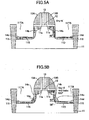
- the trenches 11TA and 11TB are formed by a dry etching process as shown in Figure 5A , wherein the location of the bottom surface 14d of the SiGe mixed crystal regions 14A and 14B are set such that the corner part of the SiGe mixed crystal regions 14A and 14B, where the facet 14b and the bottom surface 14d intersect with each other, does not protrude into the region of the n-type well from the foregoing source/drain regions 11S and 11D. Filling of the trenches 11TA and 11TB with the SiGe mixed crystal regions 14A and 14B will be described in detail later.
- Figure 4B corresponds to the construction of Figure 3 explained previously, in which the facet 14b is formed perpendicularly to the silicon substrate 11 at first by forming the trenches 11TA and 11TB by a dry etching process, as shown in Figure 5B , wherein the facet 14c under the facet 14b is formed subsequently by applying a thermal processing to the silicon substrate 11 at 550°C in a hydrogen ambient after the foregoing dry etching process.
- the facet 14c is formed by the Si (111) surface that forms an angle of 56 degrees with respect to the principal surface of the silicon substrate 11.
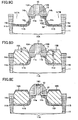
- the construction of Figure 4C is formed by forming the trenches 11TA and 11TB by applying a wet etching process to the silicon substrate 11 by using an organic alkaline etchant (hydration tetramethyl ammonium: TMAH, choline, or the like) or hydration ammonium, or alternatively, by applying a heat treatment of 800°C in an ambient of hydrogen gas and HCl as shown in Figure 5C .
- an organic alkaline etchant hydro tetramethyl ammonium: TMAH, choline, or the like
- TMAH tetramethyl ammonium
- the facet 14b perpendicular to the silicon substrate 11 is not formed in the SiGe mixed crystal layer regions 14A and 14B, and instead, a facet 14c of a Si (111) surface starts right away from the interface between the gate insulation film 12 and the silicon substrate 11 with the angles of 56 degrees to the principal surface of the silicon substrate 11.
- the facet 14b is formed at first in the silicon substrate 11 perpendicularly to the principal surface of the silicon substrate 11, while the facet 14b is changed to a slope formed of the (111) surface by applying a wet etching process to the facet 14b by using TMAH. Further, there is formed another facet 14c formed of the (111) surface.
- the facet 14b and the facet 14c thus formed define together a space of wedge form as the foregoing trenches 11TA and 11TB, such that the wedge formed trenches 11TA and 11TB invade in the silicon substrate 11 into the region right underneath the sidewall insulation films 13A and 13B toward the channel region.
- the facet 14c forms the angle of about 56 degrees to the principal surface of the silicon substrate 11 in correspondence to the Si (111) surface, while the facet 14b forms the angle of about 146 degrees also in correspondence to the Si (111) surface.
- the SiGe mixed crystal regions 14A and 14B grown so as to fill the wedge-shaped trenches 11TA and 11TB have respective tip ends invading to the region right underneath the sidewall insulation films 13A and 13B and coming close to the channel region formed right underneath the gate insulation film 12.
- a strong uniaxial compressive stress is applied to the channel region and mobility of the holes is improved significantly in the channel region.
- concentration of stress at such a tip end part there occurs concentration of stress at such a tip end part, and the effect of increasing the stress in the channel region is enhanced further.
- Figure 4E is the one based on the construction of Figure 4D and represents the case in which formation of the Si epitaxial layers 15A and 15B on the SiGe mixed crystal regions 14A and 14B is omitted.
- Figure 4F is also based on the construction of Figure 4D and represents the case in which a channel layer 11G of a SiGe mixed crystal is formed epitaxially on the silicon substrate 11 in correspondence to the region right underneath the gate insulation film 12. According to such a construction, the channel layer 11G itself induces the uniaxial compressive stress, and it becomes possible to improve the mobility of the holes further in the channel layer 11G.
- Figure 6 is a diagram summarizing the formation process of trenches 11TA and 11TB shown in Figures 5A - 5D in which the epitaxial growth of the SiGe mixed crystal regions 14A and 14B is made.
- the silicon substrate 11 is a so-called (001) substrate having a (001) surface
- the trenches 11TA and 11TB have respective sidewall surfaces each defined by a bottom surface 14d and facets 14b and 14c.
- the facet 14b forms the angle ⁇ 2 to the principal surface of silicon substrate 11, while the facet 14c forms the angle ⁇ 1 with respect to the principal surface of the silicon substrate 11.
- the bottom surface 14d is formed at the depth y1 as measured from the interface between the gate insulation film 12 and the silicon substrate 11, while the facet 14b is formed down to the depth y2.
- the gate electrode 13 extends on the surface of the silicon substrate 11 generally in the ⁇ 110> direction
- the gate electrode 13 may extend also generally in the ⁇ 100> direction.
- any of the foregoing angles ⁇ 1 and ⁇ 2 to about 90 degree and the depth y1 to 20 - 70nm. It should be noted that such a depth y1 can be controlled with high precision by using a dry etching process.
- the angle ⁇ 1 takes the value of 56 degrees in the case the facet 14c is formed of the Si (111) surface as explained before with reference to Figure 4B .
- the foregoing angle ⁇ 1 is by no means limited to the angles of 56 degrees.
- the angle ⁇ 2 can be controlled with high precision by the heat treatment process conducted subsequently to the foregoing dry etching process at about 550°C in the hydrogen ambient.
- the angles ⁇ 1 and ⁇ 2 take the range of 50 - 60 degrees, and in the special case in which the facet 14c is formed of the Si (111) surface, the angles ⁇ 1 and ⁇ 2 take the value of 56 degrees.
- the angles ⁇ 1 and ⁇ 2 are by no means limited to the foregoing angle of 56 degrees.
- the depth y2 becomes zero in the construction of Figure 4C , it is preferable to set the depth y1 to the range of 20 - 70nm.
- angle ⁇ 1, ⁇ 2 and the depth y1 can be controlled with high precision by using a wet etching process applied to the silicon substrate 11 while using the organic alkaline etchant such as TMAH, or alternatively, by a high temperature gas phase etching process conducted in a HCl/hydrogen ambient.
- angles ⁇ 1 and ⁇ 2 and also the depths y1 and y2 precisely, by combining the dry etching process and the wet etching process at the time of formation of the trenches 11TA and 11TB.
- the angles ⁇ 1 and ⁇ 2 take the value of 56 degrees and 146 degrees respectively in the case the facets 14b and 14c are formed by the Si (111) surface.
- the construction of Figures 4D - 4F is not limited in the case in which the facets 14b and 14c are formed by the Si (111) surface.
- the p-type source region 11S and the p-type drain region 11D are formed in the silicon substrate 11 at the outer sides of the sidewall insulation films 13A and 13B, prior to the formation of the trenches 11TA and 11TB. It should be noted that the trenches 11TA and 11TB are formed inside such p-type diffusion regions so as not to exceed the p/n junction interface thereof.
- any of the methods of Figures 5A - 5D it is possible to form the trenches 11TA and 11TB directly in the n-type Si well formed in the device region 11A of the silicon substrate 11 before formation of the source/drain diffusion region 11S, 11D as shown in the example of Figure 7 and thereafter grow a p-type Si layer selectively on the surface of the trenches 11TA and 11TB while supplying the Si gaseous source together with a p-type dopant gas.
- the device region 11A is defined on the surface of p-type silicon substrate 11 by the STI type device isolation structure 11I, and an n-type well is formed in the device region 11A by injecting an n-type impurity element into the device region 11A.
- the gate insulation film 12 and the polysilicon gate electrode 13 are formed on the silicon substrate 11 in correspondence to the device region 11A as a result of patterning of an SiON film and a polysilicon film formed uniformly on the silicon substrate 11, and the p-type source extension region 11a and the p-type drain extension region 11b are formed in the device region 11A by injection of a p-type impurity element such as B+ while using the polysilicon gate electrode 13 as a mask.
- the p-type impurity element such as B+ is injected once more, and as a result, the p-type source region 11S and the p-type drain region 11D are formed in the device region 11A of the silicon substrate 11 at the outer sides of the sidewall insulation films 13A and 13B.
- a part of the device region of the silicon substrate 11 outside the sidewall insulation films 13A and 13B are etched first by a dry etching process with the depth of 10 - 60nm.
- each trench is defined by vertical sidewall surfaces perpendicular to the principal surface of the silicon substrate 11 and a horizontal bottom surface, similarly to the case of Figure 5A explained previously.
- the vertical sidewall surface is etched further by a wet etching process that uses TMAH as the etchant, and with this, the trenches 11TA and 11TB are formed such that the facets 14b and 14c define the wedge-shaped sidewall surface of the trenches 11TA and 11TB.
- TMAH TMAH
- the structure of Figure 8C is introduced into a low-pressure CVD apparatus filled with an inert gas such as hydrogen gas, nitrogen gas, Ar gas, He gas, or the like, and held to the pressure of 5 - 1330Pa, after a removal process of native oxide film, and held for 5 minutes in the maximum at the foregoing pressure of 5 - 1330Pa (H 2 -Bake) after heating to the temperature of 400 - 550°C in a hydrogen ambient (Heat-UP).
- an inert gas such as hydrogen gas, nitrogen gas, Ar gas, He gas, or the like
- a silane (SiH 4 ) gas, a germane (GeH 4 ) gas and a diborane (B 2 H 6 ) gas are supplied over the duration of 1 - 40 minutes respectively as the gaseous source of Si, the gaseous source of Ge and the dopant gas, with respective partial pressures of 1 - 10Pa, 0.1 - 10Pa and 1 ⁇ 10 -5 - 1 ⁇ 10 -3 Pa, in addition to a hydrogen chloride (HCl) gas supplied as an etching gas with the partial pressure of 1 - 10Pa.
- HCl hydrogen chloride
- the crystal quality of the SiGe mixed crystal layers 14A and 14B is improved particularly when the (100) surface or (111) surface of Si is exposed at the bottom surface or sidewall surface of the trenches 11TA and 11TB.
- the construction having the sidewall surface of the wedge form defined by the facets 14b and 14c forming the Si (111) surfaces shown in Figure 8C is thought advantageous for the trenches 11TA and 11TB.
- the SiGe mixed crystal layers 14A and 14B filling the trenches 11TA and 11TB induce the uniaxial compressive stress originating from the lattice constant difference with respect to the silicon substrate 11 in the channel region right underneath the gate insulation film 12 in the foregoing device region 11A. Because the tip end parts of the wedges invade to the regions located right underneath the sidewall insulation films 13A and 13B in the silicon substrate 11, a large compressive stress is applied to the channel region right underneath the gate insulation film 12.
- a p-type semiconductor layer primarily formed of Si is formed on the SiGe mixed crystal layers 14A and 14B to a thickness Ys of 0 - 20nm, by supplying the silane gas and the diborane gas with respective partial pressures of 1 - 10Pa and 1 ⁇ 10 -4 -1 ⁇ 10 -2 Pa, together with the hydrogen chloride (HCl) gas of the partial pressure of 1 - 10Pa, at the temperature equal to or lower than the temperature used for forming the SiGe mixed crystal layers 14A and 14B.
- the cap layers 15A and 15B are respectively formed on the SiGe mixed crystal regions 14A and 14B (CapSi-Depo).
- the thickness Ys is set to 0nm means that there occurs no formation of the cap layers 15A and 15B.
- cap layers 15A and 15B are provided in anticipation of the silicide formation process of Figure 8E , and thus, it is preferable to use a p-type silicon layer, on which silicide formation is made easily, while it is possible that the cap layers 15A and 15B contain Ge with the atomic concentration if 0 - 20%. Further, it is possible to use a SiGeC mixed crystal layer containing about 2% of C (carbon) in terms of atomic concentration for the cap layers 15A and 15B. In the case Ge is to be incorporated into the cap layers 15A and 15B, a GeH 4 gas may be added to the gaseous source in the growth process of the cap layers with a partial pressure of 0 - 0.4Pa.
- the material constituting the sidewall insulation films 13A and 13B contains Si with relatively large amount, the selectivity of growth of the SiGe mixed crystal layer tends to become deteriorated, and there may be caused a growth of SiGe nuclei on such sidewall insulation films 13A and 13B in the case the growth of SiGe mixed crystal regions have been conducted according to the foregoing process.
- the structure of Figure 8D is exposed to a hydrogen chloride (HCl) gas for short time period at the same temperature used for growing the SiGe mixed crystal regions 14A and 14B or lower, such that the part of the sidewall insulation films 13A and 13B or the device isolation structure 11I that may become the nuclei of silicide growth is removed by etching (PostEtch).
- HCl hydrogen chloride
- the structure thus obtained is then cooled to the temperature below 400°C in an inert ambient (CoolDown) and taken out from the low pressure CVD apparatus.
- this PostEtch process can be conducted for example in an inert or reducing ambient of hydrogen, nitrogen, He, or the like, under the process pressure of 5 - 1000Pa while supplying the hydrogen chloride gas with the partial pressure of 10 - 500Pa over the duration of typically 0 - 60 minutes.
- the substrate of Figure 8D thus taken out is introduced to a sputtering apparatus in the process of Figure 8E and silicide films 16A and 16B of nickel silicide or cobalt silicide are formed on the cap layers 15A and 15B respectively, by a salicide process.
- a silicide film 16C is formed also on the polysilicon gate electrode 13 simultaneously.
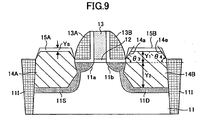
- the SiGe mixed crystal layers 14A and 14B have the thickness Y2 of 20 - 70nm corresponding to the depth of the trenches 11TA and 11TB in the part located under the interface between the gate insulation film 12 and the silicon substrate 11, the epitaxial growth of the SiGe mixed crystal layers 14A and 14B is continued to the height Y1 of 0 - 30nm beyond the foregoing interface.
- the height Y1 is 0nm, this means that the SiGe mixed crystal layers 14A and 14B are not grown beyond the interface between the gate insulation film 12 and the silicon substrate 11.
- silicide layers 16A and 16B it is preferable to control the salicide process for forming the silicide layers 16A and 16B such that the silicide layers 16A and 16B do not to reach the SiGe mixed crystal regions 14A and 14B across the cap layers 15A and 15B.
- the part of the SiGe mixed crystal regions 14A and 14B grown beyond the interface of the gate insulation film 12 and the silicon substrate 11 has a side surface defined by the facet 14a at the side facing the channel region, while the side facing the device isolation structure 11I is defined by the facet 14e.
- the facet 14a forms an angle ⁇ 3 of 40 - 90 degree and the facet 14b forms an angle ⁇ 4 of 40 - 60 degree.
- the silicide layers 16A and 16B on the cap layers 15A and 15B are not formed in contact with the sidewall insulation film 13A or 13B of the gate electrode 13, and it becomes possible to suppress the problems of occurrence short circuit through the silicide layers 16A and 16B or formation of parasitic capacitance between and gate electrode 13 and the silicide layer 16A or 16B.
- this "effective" critical thickness increases with decreasing growth temperature, and thus, it becomes possible to induce the distortion in the channel region of the MOS transistor more effectively, by using the SiGe mixed crystal grown selectively in a localized area at a low temperature.
- the epitaxial growth of the SiGe mixed crystal layers 14A and 14B is possible up to the atomic concentration level of Ge of about 40%.
- the dopant concentration in the SiGe mixed crystal regions 14A and 14B is set to the range of 1 ⁇ 10 18 - 1 ⁇ 10 21 cm -3 .
- the dopant concentration of B is set to about 1 ⁇ 10 18 - 1 ⁇ 10 20 cm -3 in the cap layers 15A and 15B characterized by low Ge concentration level.
- Figure 10A is a diagram summarizing the process of Figure 8D conducted in a low-pressure CVD apparatus explained above as a third embodiment the present invention.
- a substrate to be processed is introduced into the low-pressure CVD apparatus at the temperature of 400°C or lower at first, and the temperature is raised to a predetermined process temperature of 400 - 550°C in a hydrogen ambient (HeatUp).
- the substrate to be processed is held at the same process temperature in the same hydrogen ambient for the duration of 5 minutes in the maximum, and a hydrogen heat treatment process is conducted (H 2 -Bake).
- the processing gas introduced to the low-pressure CVD apparatus is changed at the same process temperature, and the epitaxial growth of the p-type SiGe mixed crystal regions 14A and 14B is conducted in the trenches 11TA and 11TB as explained previously (SiGe Depo).
- the composition or partial pressure of the processing gas introduced into the low-pressure CVD apparatus is changed subsequently to the epitaxial growth of the p-type SiGe mixed crystal regions 14A and 14B while maintaining the same process temperature of 400 - 550°C, and the cap layers 15A and 15B of p-type Si or p-type SiGe(C) mixed crystal are grown epitaxially on the SiGe mixed crystal regions 14A and 14B (Cap Si Depo).
- a hydrogen chloride gas is introduced, after formation of the cap layers 15A and 15B, into the low-pressure CVD apparatus in the inert or hydrogen ambient at the process temperature of 400 - 550°C.
- any structure that can become the nuclei of silicide formation in the silicide formation process of Figure 8E is removed from the sidewall insulation film 13A, 13B or the device isolation structure 11I (Post Etch), and the substrate temperature is subsequently lowered to 400°C or lower (Cool Down) in the hydrogen or inert gas ambient.
- Figure 10B shows the process corresponding to the embodiment explained previously with reference to Figure 9 in which the source region 11S and the drain region 11D are formed growing a p-type Si layer epitaxially after formation of the trenches 11TA and 11TB so as to cover the sidewall surface thereof.
- the source region 11S and the drain region 11D can be formed in this case by introducing the silane gas and the diborane gas and the HCl gas into the low-pressure CVD apparatus with respective partial pressures of 1 - 10Pa, 1 ⁇ 10 -4 - 1 ⁇ 10 -2 Pa and 1 - 10Pa, for example, after the foregoing H 2 -Baking process, at the specified process temperature of 400 - 550°C.
- Figure 11 is a diagram showing the construction of the low-pressure CVD apparatus 40 used for the process of Figure 8D or the process of Figures 10A - 10C explained before.
- the low-pressure CVD apparatus 40 is a so-called cluster type substrate processing apparatus in which the CVD reaction furnace 41 for conducting the process steps of Figures 10A - 10C are connected to a preprocessing chamber 43 via a substrate transportation chamber 42 filled with an inert gas such as a nitrogen gas, and the substrate W having the structure corresponding to the state of Figure 10C is introduced into the substrate transportation chamber 42 via a gate valve not illustrated, wherein the substrate thus introduced is transported from the substrate transportation chamber 42 to the preprocessing chamber 43.
- an inert gas such as a nitrogen gas
- a preprocessing for removing the native oxide film from the substrate surface is conducted by conducting a processing in a diluted hydrofluoric acid (DHF) and subsequent water rinse processing, or by a hydrogen radical cleaning processing, or alternatively by an HF gas phase processing.
- DHF diluted hydrofluoric acid
- the substrate finished with the preprocessing process is transported to the CVD reaction furnace 41 through the substrate transportation chamber 42 without being exposed to the air and the process steps of Figures 10A - 10C are conducted.
- a thermal oxide film or an SiON film having a larger specific dielectric constant than a thermal oxide film is used frequently for the gate insulation film 12.
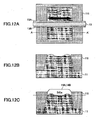
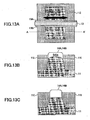
- Figure 12A is a plan view showing the part of the silicon substrate 11 including the device isolation region 11I and the device region 11A
- Figure 12B is a cross-sectional view of Figure 12A taken in the gate width direction
- Figure 12C shows the structure of Figure 12B in the state in which the trenches 11TA and 11TB are formed in the device region 11A and the trenches 11TA and 11TB thus formed are filled with the p-type SiGe mixed crystal regions 14A and 14B.
- the SiGe mixed crystal regions are formed on the undulating bottom surface with a flat top surface.
- increase and decrease of volume of the SiGe mixed crystal caused by undulation of the bottom surface is cancelled out at the level shown in Figure 12C by the dotted line, and compressive stress similar to the one obtained for the case in which the SiGe mixed crystal regions are formed on a flat surface is obtained in the channel region.
- the gate width GW is small, there appears only a convex surface on the surface of the device region 11A as it shown in Figures 13A and 13B , and thus, the effective volume of the SiGe mixed crystal regions 14A and 14B is decreased by the effect of the convex surface at the bottom surface in the case the trenches 11TA and 11TB are formed on the silicon substrate surface having such a convex surface and the trenches are filled with the SiGe mixed crystal regions 14A and 14B, in view of the flat surface of the SiGe mixed crystal regions 14A and 14B appearing as a result of the self-limiting effect. Thereby, the compression stress induced in the channel region is decreased substantially.
- the present embodiment carries out the removal process of the native oxide, conducted immediately before formation of the gate insulation film 12 for removing the native oxide film from the silicon substrate surface, in an ambient not containing hydrogen, such as the ambient of nitrogen, Ar or He, for example, at the temperature that does not exceed 900°C.
- an ambient not containing hydrogen such as the ambient of nitrogen, Ar or He, for example, at the temperature that does not exceed 900°C.
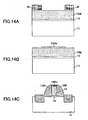
- a mask M is formed on a polysilicon film 13M used for forming the polysilicon gate electrode 13 in correspondence to the polysilicon gate electrode 13 at the time of forming the polysilicon gate electrode 13, by using a silicon oxide film or silicon nitride film as shown in Figure 14A .
- the structure of Figure 14A is exposed to a hydrogen/diborane gas mixture ambient at the temperature of 300 - 550°C, to form a B (boron) film 13Bo on the polysilicon film 13M in correspondence to the region where the gate electrode 13 is formed with the thickness of 1 - 10nm.
- the polysilicon film 13M is pattered to form the gate electrode 13 and the sidewall insulation films 13A and 13B are formed.
- representation of the CVD oxide film 12I is omitted.
- the boron mask pattern 13Bo is formed on the top part of the polysilicon gate electrode 13.
Landscapes
- Insulated Gate Type Field-Effect Transistor (AREA)
- Chemical & Material Sciences (AREA)
- Crystallography & Structural Chemistry (AREA)
- Thin Film Transistor (AREA)
Applications Claiming Priority (1)
| Application Number | Priority Date | Filing Date | Title |
|---|---|---|---|
| JP2004380619A JP4369359B2 (ja) | 2004-12-28 | 2004-12-28 | 半導体装置 |
Publications (3)
| Publication Number | Publication Date |
|---|---|
| EP1677360A2 EP1677360A2 (en) | 2006-07-05 |
| EP1677360A3 EP1677360A3 (en) | 2007-09-05 |
| EP1677360B1 true EP1677360B1 (en) | 2010-05-12 |
Family
ID=36147607
Family Applications (1)
| Application Number | Title | Priority Date | Filing Date |
|---|---|---|---|
| EP05007947A Expired - Lifetime EP1677360B1 (en) | 2004-12-28 | 2005-04-12 | Semiconductor device and fabrication method thereof |
Country Status (7)
| Country | Link |
|---|---|
| US (8) | US7791064B2 (enExample) |
| EP (1) | EP1677360B1 (enExample) |
| JP (1) | JP4369359B2 (enExample) |
| KR (1) | KR100657395B1 (enExample) |
| CN (1) | CN100470838C (enExample) |
| DE (1) | DE602005021196D1 (enExample) |
| TW (1) | TWI258218B (enExample) |
Families Citing this family (224)
| Publication number | Priority date | Publication date | Assignee | Title |
|---|---|---|---|---|
| US8994104B2 (en) | 1999-09-28 | 2015-03-31 | Intel Corporation | Contact resistance reduction employing germanium overlayer pre-contact metalization |
| US7238985B2 (en) * | 2003-08-13 | 2007-07-03 | International Rectifier Corporation | Trench type mosgated device with strained layer on trench sidewall |
| JP4369359B2 (ja) * | 2004-12-28 | 2009-11-18 | 富士通マイクロエレクトロニクス株式会社 | 半導体装置 |
| US7335959B2 (en) * | 2005-01-06 | 2008-02-26 | Intel Corporation | Device with stepped source/drain region profile |
| JP2006351581A (ja) * | 2005-06-13 | 2006-12-28 | Fujitsu Ltd | 半導体装置の製造方法 |
| JP4984665B2 (ja) * | 2005-06-22 | 2012-07-25 | 富士通セミコンダクター株式会社 | 半導体装置およびその製造方法 |
| US7579617B2 (en) * | 2005-06-22 | 2009-08-25 | Fujitsu Microelectronics Limited | Semiconductor device and production method thereof |
| US8105908B2 (en) * | 2005-06-23 | 2012-01-31 | Applied Materials, Inc. | Methods for forming a transistor and modulating channel stress |
| US7494858B2 (en) * | 2005-06-30 | 2009-02-24 | Intel Corporation | Transistor with improved tip profile and method of manufacture thereof |
| US7892905B2 (en) * | 2005-08-02 | 2011-02-22 | Globalfoundries Singapore Pte. Ltd. | Formation of strained Si channel and Si1-xGex source/drain structures using laser annealing |
| CN1941296A (zh) * | 2005-09-28 | 2007-04-04 | 中芯国际集成电路制造(上海)有限公司 | 应变硅cmos晶体管的原位掺杂硅锗与碳化硅源漏极区 |
| CN100442476C (zh) | 2005-09-29 | 2008-12-10 | 中芯国际集成电路制造(上海)有限公司 | 用于cmos技术的应变感应迁移率增强纳米器件及工艺 |
| US7939413B2 (en) | 2005-12-08 | 2011-05-10 | Samsung Electronics Co., Ltd. | Embedded stressor structure and process |
| US7863197B2 (en) * | 2006-01-09 | 2011-01-04 | International Business Machines Corporation | Method of forming a cross-section hourglass shaped channel region for charge carrier mobility modification |
| DE102006009226B9 (de) | 2006-02-28 | 2011-03-10 | Advanced Micro Devices, Inc., Sunnyvale | Verfahren zum Herstellen eines Transistors mit einer erhöhten Schwellwertstabilität ohne Durchlass-Strombeeinträchtigung und Transistor |
| US8017487B2 (en) * | 2006-04-05 | 2011-09-13 | Globalfoundries Singapore Pte. Ltd. | Method to control source/drain stressor profiles for stress engineering |
| US7750416B2 (en) * | 2006-05-03 | 2010-07-06 | Taiwan Semiconductor Manufacturing Company, Ltd. | Modifying work function in PMOS devices by counter-doping |
| JP2007335573A (ja) * | 2006-06-14 | 2007-12-27 | Hitachi Ltd | 半導体装置およびその製造方法 |
| US8853746B2 (en) * | 2006-06-29 | 2014-10-07 | International Business Machines Corporation | CMOS devices with stressed channel regions, and methods for fabricating the same |
| JP5076388B2 (ja) | 2006-07-28 | 2012-11-21 | 富士通セミコンダクター株式会社 | 半導体装置及びその製造方法 |
| KR100725376B1 (ko) | 2006-07-31 | 2007-06-07 | 삼성전자주식회사 | 반도체 장치 및 그 제조 방법 |
| KR100746232B1 (ko) * | 2006-08-25 | 2007-08-03 | 삼성전자주식회사 | 스트레인드 채널을 갖는 모스 트랜지스터 및 그 제조방법 |
| JP5070779B2 (ja) * | 2006-09-21 | 2012-11-14 | ソニー株式会社 | 半導体装置の製造方法および半導体装置 |
| US7534689B2 (en) * | 2006-11-21 | 2009-05-19 | Advanced Micro Devices, Inc. | Stress enhanced MOS transistor and methods for its fabrication |
| US7704840B2 (en) | 2006-12-15 | 2010-04-27 | Advanced Micro Devices, Inc. | Stress enhanced transistor and methods for its fabrication |
| JP2008159803A (ja) * | 2006-12-22 | 2008-07-10 | Toshiba Corp | 半導体装置 |
| US7538387B2 (en) * | 2006-12-29 | 2009-05-26 | Taiwan Semiconductor Manufacturing Company, Ltd. | Stack SiGe for short channel improvement |
| US8217423B2 (en) | 2007-01-04 | 2012-07-10 | International Business Machines Corporation | Structure and method for mobility enhanced MOSFETs with unalloyed silicide |
| JP5326274B2 (ja) | 2007-01-09 | 2013-10-30 | ソニー株式会社 | 半導体装置および半導体装置の製造方法 |
| JP2008171999A (ja) * | 2007-01-11 | 2008-07-24 | Toshiba Corp | 半導体装置およびその製造方法 |
| CN101226899A (zh) * | 2007-01-19 | 2008-07-23 | 中芯国际集成电路制造(上海)有限公司 | 在硅凹陷中后续外延生长应变硅mos晶片管的方法和结构 |
| JP5100137B2 (ja) * | 2007-01-26 | 2012-12-19 | 株式会社東芝 | 半導体装置の製造方法および半導体装置 |
| DE102007004862B4 (de) | 2007-01-31 | 2014-01-30 | Globalfoundries Inc. | Verfahren zur Herstellung von Si-Ge enthaltenden Drain/Source-Gebieten in Transistoren mit geringerem Si/Ge-Verlust |
| JP5359863B2 (ja) | 2007-02-22 | 2013-12-04 | 富士通セミコンダクター株式会社 | 半導体装置及びその製造方法 |
| US7732285B2 (en) * | 2007-03-28 | 2010-06-08 | Intel Corporation | Semiconductor device having self-aligned epitaxial source and drain extensions |
| US7691752B2 (en) * | 2007-03-30 | 2010-04-06 | Intel Corporation | Methods of forming improved EPI fill on narrow isolation bounded source/drain regions and structures formed thereby |
| US20080237634A1 (en) * | 2007-03-30 | 2008-10-02 | International Business Machines Corporation | Crystallographic recess etch for embedded semiconductor region |
| KR101264113B1 (ko) * | 2007-07-16 | 2013-05-13 | 삼성전자주식회사 | 변형된 채널을 갖는 cmos 소자 및 이의 제조방법 |
| US7687337B2 (en) * | 2007-07-18 | 2010-03-30 | Freescale Semiconductor, Inc. | Transistor with differently doped strained current electrode region |
| CN101364545B (zh) * | 2007-08-10 | 2010-12-22 | 中芯国际集成电路制造(上海)有限公司 | 应变硅晶体管的锗硅和多晶硅栅极结构 |
| JP5178103B2 (ja) * | 2007-09-12 | 2013-04-10 | 株式会社東芝 | 半導体装置およびその製造方法 |
| JP5200476B2 (ja) * | 2007-09-27 | 2013-06-05 | 富士通セミコンダクター株式会社 | 半導体装置及びその製造方法 |
| JP5389346B2 (ja) | 2007-10-11 | 2014-01-15 | 富士通セミコンダクター株式会社 | Mos電界効果トランジスタおよびその製造方法 |
| JP2009099702A (ja) | 2007-10-16 | 2009-05-07 | Toshiba Corp | 半導体装置及びその製造方法 |
| US7964910B2 (en) | 2007-10-17 | 2011-06-21 | International Business Machines Corporation | Planar field effect transistor structure having an angled crystallographic etch-defined source/drain recess and a method of forming the transistor structure |
| JP2009111200A (ja) * | 2007-10-31 | 2009-05-21 | Panasonic Corp | 半導体装置及びその製造方法 |
| JP5211647B2 (ja) | 2007-11-01 | 2013-06-12 | 富士通セミコンダクター株式会社 | 半導体装置及びその製造方法 |
| JP2009152312A (ja) * | 2007-12-19 | 2009-07-09 | Toshiba Corp | 半導体装置及びその製造方法 |
| WO2009093328A1 (ja) | 2008-01-25 | 2009-07-30 | Fujitsu Microelectronics Limited | 半導体装置及びその製造方法 |
| US8624295B2 (en) * | 2008-03-20 | 2014-01-07 | Taiwan Semiconductor Manufacturing Company, Ltd. | SRAM devices utilizing strained-channel transistors and methods of manufacture |
| JP5120448B2 (ja) * | 2008-03-31 | 2013-01-16 | 富士通セミコンダクター株式会社 | 半導体装置及びその製造方法 |
| US7960229B2 (en) * | 2008-04-10 | 2011-06-14 | Globalfoundries Inc. | Metal oxide semiconductor transistor with reduced gate height, and related fabrication methods |
| JP5329835B2 (ja) | 2008-04-10 | 2013-10-30 | 株式会社東芝 | 半導体装置の製造方法 |
| US7772095B2 (en) * | 2008-05-28 | 2010-08-10 | International Business Machines Corporation | Integrated circuit having localized embedded SiGe and method of manufacturing |
| CN101593702B (zh) * | 2008-05-30 | 2010-12-22 | 中芯国际集成电路制造(北京)有限公司 | 应变金属氧化物半导体器件的制造方法 |
| JP2010003812A (ja) | 2008-06-19 | 2010-01-07 | Fujitsu Microelectronics Ltd | 半導体装置およびその製造方法 |
| JP4770885B2 (ja) | 2008-06-30 | 2011-09-14 | ソニー株式会社 | 半導体装置 |
| DE102008035816B4 (de) * | 2008-07-31 | 2011-08-25 | GLOBALFOUNDRIES Dresden Module One Ltd. Liability Company & Co. KG, 01109 | Leistungssteigerung in PMOS- und NMOS-Transistoren durch Verwendung eines eingebetteten verformten Halbleitermaterials |
| US8212336B2 (en) * | 2008-09-15 | 2012-07-03 | Acorn Technologies, Inc. | Field effect transistor source or drain with a multi-facet surface |
| DE102008049723B4 (de) * | 2008-09-30 | 2012-01-26 | Advanced Micro Devices, Inc. | Transistor mit eingebettetem Si/Ge-Material mit einer besseren substratüberspannenden Gleichmäßigkeit |
| DE102008049733B3 (de) * | 2008-09-30 | 2010-06-17 | Advanced Micro Devices, Inc., Sunnyvale | Transistor mit eingebettetem Si/Ge-Material mit geringerem Abstand zum Kanalgebiet und Verfahren zur Herstellung des Transistors |
| US7994014B2 (en) * | 2008-10-10 | 2011-08-09 | Advanced Micro Devices, Inc. | Semiconductor devices having faceted silicide contacts, and related fabrication methods |
| JP5315922B2 (ja) * | 2008-10-27 | 2013-10-16 | 富士通セミコンダクター株式会社 | 半導体装置の製造方法 |
| KR20100081667A (ko) * | 2009-01-07 | 2010-07-15 | 삼성전자주식회사 | 스트레인드 채널을 갖는 반도체 장치 및 그 제조 방법 |
| JP5206427B2 (ja) * | 2009-01-08 | 2013-06-12 | 富士通セミコンダクター株式会社 | 半導体装置の製造方法 |
| KR20100088854A (ko) * | 2009-02-02 | 2010-08-11 | 삼성전자주식회사 | 반도체 장치 및 그의 제조 방법 |
| DE102009015748B4 (de) * | 2009-03-31 | 2014-05-22 | Globalfoundries Dresden Module One Limited Liability Company & Co. Kg | Verringern des Silizidwiderstands in SiGe-enthaltenden Drain/Source-Gebieten von Transistoren |
| US9337407B2 (en) * | 2009-03-31 | 2016-05-10 | Epistar Corporation | Photoelectronic element and the manufacturing method thereof |
| US8093665B2 (en) * | 2009-05-18 | 2012-01-10 | Macronix International Co., Ltd. | Semiconductor device and method for fabricating the same |
| DE102009031114B4 (de) * | 2009-06-30 | 2011-07-07 | Globalfoundries Dresden Module One LLC & CO. KG, 01109 | Halbleiterelement, das in einem kristallinen Substratmaterial hergestellt ist und ein eingebettetes in-situ n-dotiertes Halbleitermaterial aufweist, und Verfahren zur Herstellung desselben |
| CN102395771B (zh) * | 2009-07-16 | 2013-09-04 | 丰田自动车株式会社 | 内燃机的控制阀异常判断装置 |
| JP5420345B2 (ja) * | 2009-08-14 | 2014-02-19 | ルネサスエレクトロニクス株式会社 | 半導体装置およびその製造方法 |
| CN102024761A (zh) | 2009-09-18 | 2011-04-20 | 中芯国际集成电路制造(上海)有限公司 | 用于形成半导体集成电路器件的方法 |
| US8022488B2 (en) * | 2009-09-24 | 2011-09-20 | International Business Machines Corporation | High-performance FETs with embedded stressors |
| US8455859B2 (en) * | 2009-10-01 | 2013-06-04 | Taiwan Semiconductor Manufacturing Company, Ltd. | Strained structure of semiconductor device |
| US8368127B2 (en) * | 2009-10-08 | 2013-02-05 | Globalfoundries Singapore Pte., Ltd. | Method of fabricating a silicon tunneling field effect transistor (TFET) with high drive current |
| US8035141B2 (en) * | 2009-10-28 | 2011-10-11 | International Business Machines Corporation | Bi-layer nFET embedded stressor element and integration to enhance drive current |
| US8338258B2 (en) | 2009-11-25 | 2012-12-25 | International Business Machines Corporation | Embedded stressor for semiconductor structures |
| CN102129995B (zh) * | 2010-01-12 | 2012-12-05 | 中芯国际集成电路制造(上海)有限公司 | 金属硅化物接触层的形成方法以及场效应晶体管 |
| KR101576529B1 (ko) | 2010-02-12 | 2015-12-11 | 삼성전자주식회사 | 습식 식각을 이용한 실리콘 파셋트를 갖는 반도체 장치 및 제조방법 |
| US8236660B2 (en) | 2010-04-21 | 2012-08-07 | International Business Machines Corporation | Monolayer dopant embedded stressor for advanced CMOS |
| US9263339B2 (en) * | 2010-05-20 | 2016-02-16 | Taiwan Semiconductor Manufacturing Company, Ltd. | Selective etching in the formation of epitaxy regions in MOS devices |
| US8828850B2 (en) | 2010-05-20 | 2014-09-09 | Taiwan Semiconductor Manufacturing Company, Ltd. | Reducing variation by using combination epitaxy growth |
| US9064688B2 (en) | 2010-05-20 | 2015-06-23 | Taiwan Semiconductor Manufacturing Company, Ltd. | Performing enhanced cleaning in the formation of MOS devices |
| US8299535B2 (en) * | 2010-06-25 | 2012-10-30 | International Business Machines Corporation | Delta monolayer dopants epitaxy for embedded source/drain silicide |
| JP2012019004A (ja) * | 2010-07-07 | 2012-01-26 | Panasonic Corp | 半導体装置及びその製造方法 |
| JP2012019095A (ja) * | 2010-07-08 | 2012-01-26 | Hitachi Kokusai Electric Inc | 半導体装置の製造方法および基板処理装置 |
| US8278196B2 (en) * | 2010-07-21 | 2012-10-02 | Taiwan Semiconductor Manufacturing Company, Ltd. | High surface dopant concentration semiconductor device and method of fabricating |
| KR20120019214A (ko) * | 2010-08-25 | 2012-03-06 | 삼성전자주식회사 | 반도체 집적 회로 장치 |
| KR101703096B1 (ko) * | 2010-09-02 | 2017-02-07 | 삼성전자 주식회사 | 반도체 장치의 제조방법 |
| US8928094B2 (en) | 2010-09-03 | 2015-01-06 | Taiwan Semiconductor Manufacturing Company, Ltd. | Strained asymmetric source/drain |
| KR101776926B1 (ko) | 2010-09-07 | 2017-09-08 | 삼성전자주식회사 | 반도체 소자 및 그 제조 방법 |
| US8377780B2 (en) * | 2010-09-21 | 2013-02-19 | International Business Machines Corporation | Transistors having stressed channel regions and methods of forming transistors having stressed channel regions |
| US8405155B2 (en) * | 2010-09-23 | 2013-03-26 | United Microelectronics Corp. | Semiconductor structure with gate structure, source/drain region and recess filling with epitaxial layer |
| TWI497718B (zh) * | 2010-09-23 | 2015-08-21 | United Microelectronics Corp | 半導體結構 |
| CN102437184B (zh) * | 2010-09-29 | 2015-07-08 | 联华电子股份有限公司 | 半导体结构 |
| KR101811796B1 (ko) | 2010-10-06 | 2018-01-25 | 삼성전자주식회사 | 급경사 접합 프로파일을 갖는 소스/드레인 영역들을 구비하는 반도체 소자 및 그 제조방법 |
| JP2012089784A (ja) * | 2010-10-22 | 2012-05-10 | Renesas Electronics Corp | 半導体装置および半導体装置の製造方法 |
| US8709897B2 (en) * | 2010-11-30 | 2014-04-29 | Taiwan Semiconductor Manufacturing Company, Ltd. | High performance strained source-drain structure and method of fabricating the same |
| US8901537B2 (en) | 2010-12-21 | 2014-12-02 | Intel Corporation | Transistors with high concentration of boron doped germanium |
| US9484432B2 (en) | 2010-12-21 | 2016-11-01 | Intel Corporation | Contact resistance reduction employing germanium overlayer pre-contact metalization |
| US8455930B2 (en) * | 2011-01-05 | 2013-06-04 | Taiwan Semiconductor Manufacturing Company, Ltd. | Strained semiconductor device with facets |
| US8796788B2 (en) | 2011-01-19 | 2014-08-05 | Taiwan Semiconductor Manufacturing Company, Ltd. | Semiconductor devices with strained source/drain structures |
| KR20120099863A (ko) * | 2011-03-02 | 2012-09-12 | 삼성전자주식회사 | 트랜지스터 및 그 제조 방법 |
| US20120228628A1 (en) * | 2011-03-07 | 2012-09-13 | Toshiba America Electronic Components, Inc. | Semiconductor device and method of fabricating the same |
| US8466502B2 (en) | 2011-03-24 | 2013-06-18 | United Microelectronics Corp. | Metal-gate CMOS device |
| US8445363B2 (en) | 2011-04-21 | 2013-05-21 | United Microelectronics Corp. | Method of fabricating an epitaxial layer |
| US8324059B2 (en) * | 2011-04-25 | 2012-12-04 | United Microelectronics Corp. | Method of fabricating a semiconductor structure |
| US8426284B2 (en) | 2011-05-11 | 2013-04-23 | United Microelectronics Corp. | Manufacturing method for semiconductor structure |
| US8481391B2 (en) | 2011-05-18 | 2013-07-09 | United Microelectronics Corp. | Process for manufacturing stress-providing structure and semiconductor device with such stress-providing structure |
| CN102800700B (zh) * | 2011-05-26 | 2015-04-29 | 中芯国际集成电路制造(上海)有限公司 | 晶体管及其形成方法 |
| US8431460B2 (en) | 2011-05-27 | 2013-04-30 | United Microelectronics Corp. | Method for fabricating semiconductor device |
| US8492290B2 (en) * | 2011-06-21 | 2013-07-23 | International Business Machines Corporation | Fabrication of silicon oxide and oxynitride having sub-nanometer thickness |
| CN102867749B (zh) * | 2011-07-06 | 2014-11-05 | 中芯国际集成电路制造(上海)有限公司 | Mos晶体管的形成方法 |
| US8999794B2 (en) * | 2011-07-14 | 2015-04-07 | Taiwan Semiconductor Manufacturing Company, Ltd. | Self-aligned source and drain structures and method of manufacturing same |
| US8716750B2 (en) | 2011-07-25 | 2014-05-06 | United Microelectronics Corp. | Semiconductor device having epitaxial structures |
| US8575043B2 (en) | 2011-07-26 | 2013-11-05 | United Microelectronics Corp. | Semiconductor device and manufacturing method thereof |
| CN102931233B (zh) * | 2011-08-08 | 2016-03-16 | 中芯国际集成电路制造(上海)有限公司 | Nmos晶体管及其形成方法 |
| US8884341B2 (en) | 2011-08-16 | 2014-11-11 | Taiwan Semiconductor Manufacturing Company, Ltd. | Integrated circuits |
| US8647941B2 (en) | 2011-08-17 | 2014-02-11 | United Microelectronics Corp. | Method of forming semiconductor device |
| KR20130020221A (ko) * | 2011-08-19 | 2013-02-27 | 삼성전자주식회사 | 반도체 소자 및 그 제조 방법 |
| US8674433B2 (en) | 2011-08-24 | 2014-03-18 | United Microelectronics Corp. | Semiconductor process |
| FR2979480B1 (fr) * | 2011-08-25 | 2013-09-27 | Commissariat Energie Atomique | Procede de realisation d'un dispositif a transistors contraints par siliciuration des zones de source et de drain |
| US8927374B2 (en) * | 2011-10-04 | 2015-01-06 | Taiwan Semiconductor Manufacturing Company, Ltd. | Semiconductor device and fabrication method thereof |
| US8476169B2 (en) | 2011-10-17 | 2013-07-02 | United Microelectronics Corp. | Method of making strained silicon channel semiconductor structure |
| US20130095627A1 (en) * | 2011-10-18 | 2013-04-18 | Globalfoundries Inc. | Methods of Forming Source/Drain Regions on Transistor Devices |
| US8691659B2 (en) | 2011-10-26 | 2014-04-08 | United Microelectronics Corp. | Method for forming void-free dielectric layer |
| US8754448B2 (en) | 2011-11-01 | 2014-06-17 | United Microelectronics Corp. | Semiconductor device having epitaxial layer |
| US9847225B2 (en) * | 2011-11-15 | 2017-12-19 | Taiwan Semiconductor Manufacturing Company, Ltd. | Semiconductor device and method of manufacturing the same |
| US8647953B2 (en) * | 2011-11-17 | 2014-02-11 | United Microelectronics Corp. | Method for fabricating first and second epitaxial cap layers |
| US8709930B2 (en) | 2011-11-25 | 2014-04-29 | United Microelectronics Corp. | Semiconductor process |
| US8921206B2 (en) * | 2011-11-30 | 2014-12-30 | United Microelectronics Corp. | Semiconductor process |
| US20130149830A1 (en) * | 2011-12-07 | 2013-06-13 | Samsung Electronics Co., Ltd. | Methods of forming field effect transistors having silicon-germanium source/drain regions therein |
| US20130183801A1 (en) * | 2012-01-18 | 2013-07-18 | Tsung-Min Kuo | Method for manufacturing semiconductor devices |
| US9548378B2 (en) * | 2012-02-09 | 2017-01-17 | GlobalFoundries, Inc. | Epitaxial channel formation methods and structures |
| US9136348B2 (en) | 2012-03-12 | 2015-09-15 | United Microelectronics Corp. | Semiconductor structure and fabrication method thereof |
| US9202914B2 (en) | 2012-03-14 | 2015-12-01 | United Microelectronics Corporation | Semiconductor device and method for fabricating the same |
| US8664069B2 (en) | 2012-04-05 | 2014-03-04 | United Microelectronics Corp. | Semiconductor structure and process thereof |
| US8866230B2 (en) | 2012-04-26 | 2014-10-21 | United Microelectronics Corp. | Semiconductor devices |
| US8835243B2 (en) | 2012-05-04 | 2014-09-16 | United Microelectronics Corp. | Semiconductor process |
| WO2013171988A1 (ja) * | 2012-05-16 | 2013-11-21 | 株式会社アルバック | 成膜方法及び成膜装置 |
| CN103426766B (zh) * | 2012-05-24 | 2016-04-20 | 中芯国际集成电路制造(上海)有限公司 | Pmos晶体管及其形成方法 |
| KR101986534B1 (ko) | 2012-06-04 | 2019-06-07 | 삼성전자주식회사 | 내장된 스트레인-유도 패턴을 갖는 반도체 소자 및 그 형성 방법 |
| US8951876B2 (en) | 2012-06-20 | 2015-02-10 | United Microelectronics Corp. | Semiconductor device and manufacturing method thereof |
| US8796695B2 (en) | 2012-06-22 | 2014-08-05 | United Microelectronics Corp. | Multi-gate field-effect transistor and process thereof |
| US9799750B2 (en) * | 2012-07-17 | 2017-10-24 | Taiwan Semiconductor Manufacturing Company, Ltd. | Semiconductor device and fabrication method thereof |
| KR20140016008A (ko) * | 2012-07-30 | 2014-02-07 | 삼성전자주식회사 | 반도체 소자 및 그 제조 방법 |
| US8912608B2 (en) * | 2012-08-17 | 2014-12-16 | Taiwan Semiconductor Manufacturing Company, Ltd. | Semiconductor device and fabrication method thereof |
| US8710632B2 (en) | 2012-09-07 | 2014-04-29 | United Microelectronics Corp. | Compound semiconductor epitaxial structure and method for fabricating the same |
| KR20140036823A (ko) | 2012-09-18 | 2014-03-26 | 삼성전자주식회사 | 반도체 소자 제조 방법 |
| KR20140038826A (ko) | 2012-09-21 | 2014-03-31 | 삼성전자주식회사 | 트랜지스터를 포함하는 반도체 소자 및 그 제조 방법 |
| KR20140039544A (ko) | 2012-09-24 | 2014-04-02 | 삼성전자주식회사 | 반도체 소자 및 그 제조 방법 |
| US9287138B2 (en) | 2012-09-27 | 2016-03-15 | Taiwan Semiconductor Manufacturing Company, Ltd. | FinFET low resistivity contact formation method |
| US8823065B2 (en) * | 2012-11-08 | 2014-09-02 | Taiwan Semiconductor Manufacturing Company, Ltd. | Contact structure of semiconductor device |
| US9105490B2 (en) | 2012-09-27 | 2015-08-11 | Taiwan Semiconductor Manufacturing Company, Ltd. | Contact structure of semiconductor device |
| CN103779278A (zh) * | 2012-10-22 | 2014-05-07 | 中芯国际集成电路制造(上海)有限公司 | Cmos管的形成方法 |
| US9117925B2 (en) | 2013-01-31 | 2015-08-25 | United Microelectronics Corp. | Epitaxial process |
| US9123633B2 (en) * | 2013-02-01 | 2015-09-01 | Taiwan Semiconductor Manufacturing Company, Ltd. | Methods for forming semiconductor regions in trenches |
| US9356136B2 (en) * | 2013-03-07 | 2016-05-31 | Taiwan Semiconductor Manufacturing Co., Ltd. | Engineered source/drain region for n-Type MOSFET |
| US20140264444A1 (en) * | 2013-03-13 | 2014-09-18 | International Business Machines Corporation | Stress-enhancing selective epitaxial deposition of embedded source and drain regions |
| US8753902B1 (en) | 2013-03-13 | 2014-06-17 | United Microelectronics Corp. | Method of controlling etching process for forming epitaxial structure |
| US8940640B2 (en) | 2013-03-13 | 2015-01-27 | Taiwan Semiconductor Manufacturing Company, Ltd. | Source/drain structure of semiconductor device |
| US9034705B2 (en) | 2013-03-26 | 2015-05-19 | United Microelectronics Corp. | Method of forming semiconductor device |
| US9064893B2 (en) | 2013-05-13 | 2015-06-23 | United Microelectronics Corp. | Gradient dopant of strained substrate manufacturing method of semiconductor device |
| US9076652B2 (en) | 2013-05-27 | 2015-07-07 | United Microelectronics Corp. | Semiconductor process for modifying shape of recess |
| US8853060B1 (en) | 2013-05-27 | 2014-10-07 | United Microelectronics Corp. | Epitaxial process |
| US8765546B1 (en) | 2013-06-24 | 2014-07-01 | United Microelectronics Corp. | Method for fabricating fin-shaped field-effect transistor |
| US9245955B2 (en) | 2013-06-28 | 2016-01-26 | Stmicroelectronics, Inc. | Embedded shape SiGe for strained channel transistors |
| US8895396B1 (en) | 2013-07-11 | 2014-11-25 | United Microelectronics Corp. | Epitaxial Process of forming stress inducing epitaxial layers in source and drain regions of PMOS and NMOS structures |
| US9601619B2 (en) | 2013-07-16 | 2017-03-21 | Taiwan Semiconductor Manufacturing Company, Ltd. | MOS devices with non-uniform P-type impurity profile |
| US9209175B2 (en) | 2013-07-17 | 2015-12-08 | Taiwan Semiconductor Manufacturing Company, Ltd. | MOS devices having epitaxy regions with reduced facets |
| US8981487B2 (en) | 2013-07-31 | 2015-03-17 | United Microelectronics Corp. | Fin-shaped field-effect transistor (FinFET) |
| US9224734B2 (en) * | 2013-09-13 | 2015-12-29 | Taiwan Semiconductor Manufacturing Company, Ltd. | CMOS devices with reduced leakage and methods of forming the same |
| US9054217B2 (en) | 2013-09-17 | 2015-06-09 | Samsung Electronics Co., Ltd. | Method for fabricating semiconductor device having an embedded source/drain |
| CN104671194B (zh) * | 2013-12-03 | 2016-08-17 | 中芯国际集成电路制造(上海)有限公司 | 防止结构层脱落的mems器件及其制备方法 |
| US9691898B2 (en) | 2013-12-19 | 2017-06-27 | Taiwan Semiconductor Manufacturing Co., Ltd. | Germanium profile for channel strain |
| US9853154B2 (en) | 2014-01-24 | 2017-12-26 | Taiwan Semiconductor Manufacturing Company Ltd. | Embedded source or drain region of transistor with downward tapered region under facet region |
| US10164107B2 (en) * | 2014-01-24 | 2018-12-25 | Taiwan Semiconductor Manufacturing Company Ltd. | Embedded source or drain region of transistor with laterally extended portion |
| US9379214B2 (en) * | 2014-02-14 | 2016-06-28 | Semi Solutions Llc | Reduced variation MOSFET using a drain-extension-last process |
| KR102167519B1 (ko) | 2014-03-21 | 2020-10-19 | 인텔 코포레이션 | Ge-풍부 p-mos 소스/드레인 컨택트들의 집적을 위한 기술들 |
| CN103871902A (zh) | 2014-03-24 | 2014-06-18 | 上海华力微电子有限公司 | 半导体处理工艺及半导体器件的制备方法 |
| US10084063B2 (en) * | 2014-06-23 | 2018-09-25 | Taiwan Semiconductor Manufacturing Company Ltd. | Semiconductor device and manufacturing method thereof |
| US9893183B2 (en) * | 2014-07-10 | 2018-02-13 | Taiwan Semiconductor Manufacturing Company Ltd. | Semiconductor structure and manufacturing method thereof |
| KR102202754B1 (ko) | 2014-08-14 | 2021-01-15 | 삼성전자주식회사 | 반도체 장치 |
| CN105470134B (zh) * | 2014-09-09 | 2019-06-28 | 中芯国际集成电路制造(上海)有限公司 | 一种半导体器件及其制造方法、电子装置 |
| US9312274B1 (en) | 2014-10-15 | 2016-04-12 | Globalfoundries Inc. | Merged fin structures for finFET devices |
| US9530638B2 (en) * | 2014-10-30 | 2016-12-27 | Applied Materials, Inc. | Method to grow thin epitaxial films at low temperature |
| CN105869991B (zh) | 2015-01-23 | 2018-05-11 | 上海华力微电子有限公司 | 用于改善SiGe厚度的均匀性的方法和系统 |
| CN105990172B (zh) | 2015-01-30 | 2018-07-31 | 上海华力微电子有限公司 | 嵌入式SiGe外延测试块的设计 |
| CN105990342B (zh) | 2015-02-13 | 2019-07-19 | 上海华力微电子有限公司 | 具有用于嵌入锗材料的成形腔的半导体器件及其制造工艺 |
| US9431536B1 (en) | 2015-03-16 | 2016-08-30 | Taiwan Semiconductor Manufacturing Co., Ltd. | Semiconductor device structure with raised source/drain having cap element |
| CN104851884A (zh) | 2015-04-14 | 2015-08-19 | 上海华力微电子有限公司 | 用于锗硅填充材料的成形腔 |
| CN104821336B (zh) | 2015-04-20 | 2017-12-12 | 上海华力微电子有限公司 | 用于使用保形填充层改善器件表面均匀性的方法和系统 |
| US10665693B2 (en) | 2015-04-30 | 2020-05-26 | Taiwan Semiconductor Manufacturing Co., Ltd. | Semiconductor structure and manufacturing method thereof |
| CN105097554B (zh) | 2015-08-24 | 2018-12-07 | 上海华力微电子有限公司 | 用于减少高浓度外延工艺中的位错缺陷的方法和系统 |
| KR102374321B1 (ko) | 2015-10-14 | 2022-03-14 | 삼성전자주식회사 | 반도체 장치 제조 방법 |
| CN106653751B (zh) * | 2015-11-04 | 2019-12-03 | 中芯国际集成电路制造(北京)有限公司 | 半导体器件及其制造方法 |
| WO2017111806A1 (en) | 2015-12-24 | 2017-06-29 | Intel Corporation | Methods of forming doped source/drain contacts and structures formed thereby |
| US10043666B2 (en) * | 2016-02-26 | 2018-08-07 | Applied Materials, Inc. | Method for inter-chamber process |
| CN107403835B (zh) * | 2016-05-19 | 2021-12-14 | 联芯集成电路制造(厦门)有限公司 | 半导体装置及其制作工艺 |
| US9716165B1 (en) | 2016-06-21 | 2017-07-25 | United Microelectronics Corporation | Field-effect transistor and method of making the same |
| US10236214B2 (en) * | 2016-06-29 | 2019-03-19 | International Business Machines Corporation | Vertical transistor with variable gate length |
| US10276663B2 (en) | 2016-07-18 | 2019-04-30 | United Microelectronics Corp. | Tunneling transistor and method of fabricating the same |
| US9865730B1 (en) | 2016-10-31 | 2018-01-09 | International Business Machines Corporation | VTFET devices utilizing low temperature selective epitaxy |
| US10147609B2 (en) * | 2016-12-15 | 2018-12-04 | Taiwan Semiconductor Manufacturing Co., Ltd. | Semiconductor epitaxy bordering isolation structure |
| US10199485B2 (en) * | 2017-01-18 | 2019-02-05 | United Microelectronics Corp. | Semiconductor device including quantum wires |
| FR3063835B1 (fr) * | 2017-03-13 | 2019-04-26 | Commissariat A L'energie Atomique Et Aux Energies Alternatives | Transistor a regions source et drain structurees et son procede d'elaboration |
| KR102414182B1 (ko) * | 2017-06-29 | 2022-06-28 | 삼성전자주식회사 | 반도체 소자 |
| TWI743252B (zh) | 2017-06-30 | 2021-10-21 | 台灣積體電路製造股份有限公司 | 鰭狀場效電晶體裝置與其形成方法 |
| US10347764B2 (en) | 2017-06-30 | 2019-07-09 | Taiwan Semiconductor Manufacturing Company, Ltd. | Semiconductor device with multi-layered source/drain regions having different dopant concentrations and manufacturing method thereof |
| US10672888B2 (en) | 2017-08-21 | 2020-06-02 | International Business Machines Corporation | Vertical transistors having improved gate length control |
| US10868181B2 (en) | 2017-09-27 | 2020-12-15 | Taiwan Semiconductor Manufacturing Co., Ltd. | Semiconductor structure with blocking layer and method for forming the same |
| CN109817713B (zh) * | 2017-11-22 | 2022-04-15 | 中芯国际集成电路制造(上海)有限公司 | 半导体器件及其形成方法 |
| TWI827644B (zh) * | 2018-08-28 | 2024-01-01 | 日商索尼半導體解決方案公司 | 半導體裝置及其製造方法 |
| US11443980B2 (en) * | 2019-09-27 | 2022-09-13 | Taiwan Semiconductor Manufacturing Company, Ltd. | Method of fabricating semiconductor device with metal pad extending into top metal layer |
| TWI715311B (zh) * | 2019-11-26 | 2021-01-01 | 國立交通大學 | 具有寬能隙三五族汲極之金屬氧化物矽半導體場效電晶體及其製造方法 |
| DE102020132562B4 (de) | 2020-01-30 | 2024-02-22 | Taiwan Semiconductor Manufacturing Co., Ltd. | Verfahren zur herstellung einer halbleitervorrichtung und halbleitervorrichtung |
| US11522050B2 (en) * | 2020-01-30 | 2022-12-06 | Taiwan Semiconductor Manufacturing Co., Ltd. | Method of manufacturing a semiconductor device and a semiconductor device |
| CN113224158A (zh) * | 2020-02-04 | 2021-08-06 | 联芯集成电路制造(厦门)有限公司 | 半导体晶体管及其制作方法 |
| CN112382570B (zh) * | 2020-11-02 | 2024-04-26 | 上海华力集成电路制造有限公司 | Pmos的制造方法 |
| WO2022160113A1 (zh) * | 2021-01-27 | 2022-08-04 | 中芯北方集成电路制造(北京)有限公司 | 半导体结构及其形成方法 |
| US20220238711A1 (en) * | 2021-01-27 | 2022-07-28 | Micron Technology, Inc. | Semiconductor device having mos transistor for efficient stress transfer |
| CN113540248A (zh) * | 2021-06-16 | 2021-10-22 | 先之科半导体科技(东莞)有限公司 | 一种大电流的多通道mosfet管 |
| CN117476748A (zh) * | 2022-07-20 | 2024-01-30 | 联芯集成电路制造(厦门)有限公司 | 半导体制作工艺方法 |
Family Cites Families (19)
| Publication number | Priority date | Publication date | Assignee | Title |
|---|---|---|---|---|
| JPS63153863A (ja) | 1986-12-18 | 1988-06-27 | Fujitsu Ltd | 半導体装置の製造方法 |
| US5710450A (en) * | 1994-12-23 | 1998-01-20 | Intel Corporation | Transistor with ultra shallow tip and method of fabrication |
| US6777759B1 (en) * | 1997-06-30 | 2004-08-17 | Intel Corporation | Device structure and method for reducing silicide encroachment |
| EP0908219B1 (en) * | 1997-10-09 | 1999-12-08 | Gkss-Forschungszentrum Geesthacht Gmbh | Multi-stage process for the separation/recovery of gases |
| US6365446B1 (en) | 2000-07-03 | 2002-04-02 | Chartered Semiconductor Manufacturing Ltd. | Formation of silicided ultra-shallow junctions using implant through metal technology and laser annealing process |
| US6621131B2 (en) | 2001-11-01 | 2003-09-16 | Intel Corporation | Semiconductor transistor having a stressed channel |
| US6835246B2 (en) | 2001-11-16 | 2004-12-28 | Saleem H. Zaidi | Nanostructures for hetero-expitaxial growth on silicon substrates |
| KR100406537B1 (ko) * | 2001-12-03 | 2003-11-20 | 주식회사 하이닉스반도체 | 반도체장치의 제조 방법 |
| JP2004031753A (ja) | 2002-06-27 | 2004-01-29 | Renesas Technology Corp | 半導体装置の製造方法 |
| US6921913B2 (en) * | 2003-03-04 | 2005-07-26 | Taiwan Semiconductor Manufacturing Co., Ltd. | Strained-channel transistor structure with lattice-mismatched zone |
| US20050090082A1 (en) * | 2003-10-28 | 2005-04-28 | Texas Instruments Incorporated | Method and system for improving performance of MOSFETs |
| US7413957B2 (en) * | 2004-06-24 | 2008-08-19 | Applied Materials, Inc. | Methods for forming a transistor |
| JP4837902B2 (ja) * | 2004-06-24 | 2011-12-14 | 富士通セミコンダクター株式会社 | 半導体装置 |
| US7157374B1 (en) * | 2004-06-28 | 2007-01-02 | Advanced Micro Devices, Inc. | Method for removing a cap from the gate of an embedded silicon germanium semiconductor device |
| US7332439B2 (en) * | 2004-09-29 | 2008-02-19 | Intel Corporation | Metal gate transistors with epitaxial source and drain regions |
| US7163878B2 (en) * | 2004-11-12 | 2007-01-16 | Texas Instruments Incorporated | Ultra-shallow arsenic junction formation in silicon germanium |
| JP4369359B2 (ja) * | 2004-12-28 | 2009-11-18 | 富士通マイクロエレクトロニクス株式会社 | 半導体装置 |
| JP4481181B2 (ja) * | 2005-01-27 | 2010-06-16 | 富士通マイクロエレクトロニクス株式会社 | 半導体装置およびその製造方法 |
| US7579617B2 (en) * | 2005-06-22 | 2009-08-25 | Fujitsu Microelectronics Limited | Semiconductor device and production method thereof |
-
2004
- 2004-12-28 JP JP2004380619A patent/JP4369359B2/ja not_active Expired - Lifetime
-
2005
- 2005-04-12 EP EP05007947A patent/EP1677360B1/en not_active Expired - Lifetime
- 2005-04-12 DE DE602005021196T patent/DE602005021196D1/de not_active Expired - Lifetime
- 2005-04-18 US US11/107,945 patent/US7791064B2/en active Active
- 2005-04-18 TW TW094112198A patent/TWI258218B/zh not_active IP Right Cessation
- 2005-04-25 KR KR1020050034040A patent/KR100657395B1/ko not_active Expired - Lifetime
- 2005-04-29 CN CNB200510066856XA patent/CN100470838C/zh not_active Expired - Lifetime
-
2009
- 2009-01-16 US US12/320,089 patent/US7667227B2/en not_active Expired - Lifetime
-
2010
- 2010-07-29 US US12/846,162 patent/US8466450B2/en not_active Expired - Lifetime
-
2013
- 2013-05-15 US US13/894,871 patent/US8853673B2/en not_active Expired - Lifetime
-
2014
- 2014-08-26 US US14/468,519 patent/US9112027B2/en not_active Expired - Lifetime
-
2015
- 2015-06-23 US US14/747,634 patent/US9401427B2/en not_active Expired - Lifetime
-
2016
- 2016-06-22 US US15/189,581 patent/US9577098B2/en not_active Expired - Lifetime
- 2016-12-13 US US15/377,540 patent/US9865734B2/en not_active Expired - Fee Related
Also Published As
| Publication number | Publication date |
|---|---|
| DE602005021196D1 (de) | 2010-06-24 |
| TW200623414A (en) | 2006-07-01 |
| US9401427B2 (en) | 2016-07-26 |
| CN1797783A (zh) | 2006-07-05 |
| US20130248930A1 (en) | 2013-09-26 |
| US20170117412A1 (en) | 2017-04-27 |
| US9865734B2 (en) | 2018-01-09 |
| US7791064B2 (en) | 2010-09-07 |
| US8466450B2 (en) | 2013-06-18 |
| EP1677360A3 (en) | 2007-09-05 |
| US20060138398A1 (en) | 2006-06-29 |
| US7667227B2 (en) | 2010-02-23 |
| KR100657395B1 (ko) | 2006-12-20 |
| US20150295086A1 (en) | 2015-10-15 |
| US20140361340A1 (en) | 2014-12-11 |
| US20090134381A1 (en) | 2009-05-28 |
| US9112027B2 (en) | 2015-08-18 |
| CN100470838C (zh) | 2009-03-18 |
| TWI258218B (en) | 2006-07-11 |
| US9577098B2 (en) | 2017-02-21 |
| US20100301394A1 (en) | 2010-12-02 |
| EP1677360A2 (en) | 2006-07-05 |
| JP2006186240A (ja) | 2006-07-13 |
| US8853673B2 (en) | 2014-10-07 |
| US20160308053A1 (en) | 2016-10-20 |
| KR20060076150A (ko) | 2006-07-04 |
| JP4369359B2 (ja) | 2009-11-18 |
Similar Documents
| Publication | Publication Date | Title |
|---|---|---|
| US9865734B2 (en) | Semiconductor device and fabrication method thereof | |
| EP1639636B1 (en) | Optimization of mechanical strain in channels of p-mos and n-mos transistors | |
| US8017487B2 (en) | Method to control source/drain stressor profiles for stress engineering | |
| US9263339B2 (en) | Selective etching in the formation of epitaxy regions in MOS devices | |
| KR101716113B1 (ko) | 반도체 소자 및 이의 제조 방법 | |
| EP1693897B1 (en) | Semiconductor device | |
| KR101050405B1 (ko) | 스트레인드채널을 갖는 반도체장치 제조 방법 | |
| US20080194070A1 (en) | Metal-oxide-semiconductor transistor device, manufacturing method thereof, and method of improving drain current thereof | |
| US20100327329A1 (en) | Semiconductor device and method of fabricating the same | |
| US20050095807A1 (en) | Silicon buffered shallow trench isolation for strained silicon processes | |
| JP4854719B2 (ja) | 半導体装置の製造方法 | |
| JP4859896B2 (ja) | 半導体装置 | |
| US9349864B1 (en) | Methods for selectively forming a layer of increased dopant concentration | |
| US20080070360A1 (en) | Method and structure for forming silicide contacts on embedded silicon germanium regions of cmos devices |
Legal Events
| Date | Code | Title | Description |
|---|---|---|---|
| PUAI | Public reference made under article 153(3) epc to a published international application that has entered the european phase |
Free format text: ORIGINAL CODE: 0009012 |
|
| AK | Designated contracting states |
Kind code of ref document: A2 Designated state(s): AT BE BG CH CY CZ DE DK EE ES FI FR GB GR HU IE IS IT LI LT LU MC NL PL PT RO SE SI SK TR |
|
| AX | Request for extension of the european patent |
Extension state: AL BA HR LV MK YU |
|
| PUAL | Search report despatched |
Free format text: ORIGINAL CODE: 0009013 |
|
| AK | Designated contracting states |
Kind code of ref document: A3 Designated state(s): AT BE BG CH CY CZ DE DK EE ES FI FR GB GR HU IE IS IT LI LT LU MC NL PL PT RO SE SI SK TR |
|
| AX | Request for extension of the european patent |
Extension state: AL BA HR LV MK YU |
|
| 17P | Request for examination filed |
Effective date: 20070906 |
|
| AKX | Designation fees paid |
Designated state(s): DE FR |
|
| RAP1 | Party data changed (applicant data changed or rights of an application transferred) |
Owner name: FUJITSU MICROELECTRONICS LIMITED |
|
| 17Q | First examination report despatched |
Effective date: 20090311 |
|
| GRAP | Despatch of communication of intention to grant a patent |
Free format text: ORIGINAL CODE: EPIDOSNIGR1 |
|
| GRAS | Grant fee paid |
Free format text: ORIGINAL CODE: EPIDOSNIGR3 |
|
| GRAA | (expected) grant |
Free format text: ORIGINAL CODE: 0009210 |
|
| AK | Designated contracting states |
Kind code of ref document: B1 Designated state(s): DE FR |
|
| REF | Corresponds to: |
Ref document number: 602005021196 Country of ref document: DE Date of ref document: 20100624 Kind code of ref document: P |
|
| PLBE | No opposition filed within time limit |
Free format text: ORIGINAL CODE: 0009261 |
|
| STAA | Information on the status of an ep patent application or granted ep patent |
Free format text: STATUS: NO OPPOSITION FILED WITHIN TIME LIMIT |
|
| 26N | No opposition filed |
Effective date: 20110215 |
|
| REG | Reference to a national code |
Ref country code: DE Ref legal event code: R097 Ref document number: 602005021196 Country of ref document: DE Effective date: 20110214 |
|
| REG | Reference to a national code |
Ref country code: FR Ref legal event code: ST Effective date: 20111230 |
|
| PG25 | Lapsed in a contracting state [announced via postgrant information from national office to epo] |
Ref country code: FR Free format text: LAPSE BECAUSE OF NON-PAYMENT OF DUE FEES Effective date: 20110502 |
|
| REG | Reference to a national code |
Ref country code: DE Ref legal event code: R082 Ref document number: 602005021196 Country of ref document: DE Representative=s name: HOFFMANN - EITLE PATENT- UND RECHTSANWAELTE PA, DE |
|
| REG | Reference to a national code |
Ref country code: DE Ref legal event code: R081 Ref document number: 602005021196 Country of ref document: DE Owner name: SOCIONEXT INC., YOKOHAMA-SHI, JP Free format text: FORMER OWNER: FUJITSU SEMICONDUCTOR LTD., YOKOHAMA, KANAGAWA, JP Effective date: 20150512 Ref country code: DE Ref legal event code: R082 Ref document number: 602005021196 Country of ref document: DE Representative=s name: HOFFMANN - EITLE PATENT- UND RECHTSANWAELTE PA, DE Effective date: 20150512 |
|
| PGFP | Annual fee paid to national office [announced via postgrant information from national office to epo] |
Ref country code: DE Payment date: 20240418 Year of fee payment: 20 |
|
| REG | Reference to a national code |
Ref country code: DE Ref legal event code: R079 Ref document number: 602005021196 Country of ref document: DE Free format text: PREVIOUS MAIN CLASS: H01L0029780000 Ipc: H10D0030600000 |
|
| REG | Reference to a national code |
Ref country code: DE Ref legal event code: R071 Ref document number: 602005021196 Country of ref document: DE |