WO2016104702A1 - リチウムイオン電池用硫化物系固体電解質及び固体電解質化合物 - Google Patents
リチウムイオン電池用硫化物系固体電解質及び固体電解質化合物 Download PDFInfo
- Publication number
- WO2016104702A1 WO2016104702A1 PCT/JP2015/086228 JP2015086228W WO2016104702A1 WO 2016104702 A1 WO2016104702 A1 WO 2016104702A1 JP 2015086228 W JP2015086228 W JP 2015086228W WO 2016104702 A1 WO2016104702 A1 WO 2016104702A1
- Authority
- WO
- WIPO (PCT)
- Prior art keywords
- solid electrolyte
- sulfide
- lithium ion
- compound
- lithium
- Prior art date
- Legal status (The legal status is an assumption and is not a legal conclusion. Google has not performed a legal analysis and makes no representation as to the accuracy of the status listed.)
- Ceased
Links
Images


Classifications
-
- C—CHEMISTRY; METALLURGY
- C01—INORGANIC CHEMISTRY
- C01B—NON-METALLIC ELEMENTS; COMPOUNDS THEREOF; METALLOIDS OR COMPOUNDS THEREOF NOT COVERED BY SUBCLASS C01C
- C01B25/00—Phosphorus; Compounds thereof
- C01B25/14—Sulfur, selenium, or tellurium compounds of phosphorus
-
- H—ELECTRICITY
- H01—ELECTRIC ELEMENTS
- H01B—CABLES; CONDUCTORS; INSULATORS; SELECTION OF MATERIALS FOR THEIR CONDUCTIVE, INSULATING OR DIELECTRIC PROPERTIES
- H01B1/00—Conductors or conductive bodies characterised by the conductive materials; Selection of materials as conductors
- H01B1/06—Conductors or conductive bodies characterised by the conductive materials; Selection of materials as conductors mainly consisting of other non-metallic substances
-
- H—ELECTRICITY
- H01—ELECTRIC ELEMENTS
- H01M—PROCESSES OR MEANS, e.g. BATTERIES, FOR THE DIRECT CONVERSION OF CHEMICAL ENERGY INTO ELECTRICAL ENERGY
- H01M10/00—Secondary cells; Manufacture thereof
- H01M10/05—Accumulators with non-aqueous electrolyte
- H01M10/052—Li-accumulators
-
- H—ELECTRICITY
- H01—ELECTRIC ELEMENTS
- H01M—PROCESSES OR MEANS, e.g. BATTERIES, FOR THE DIRECT CONVERSION OF CHEMICAL ENERGY INTO ELECTRICAL ENERGY
- H01M10/00—Secondary cells; Manufacture thereof
- H01M10/05—Accumulators with non-aqueous electrolyte
- H01M10/052—Li-accumulators
- H01M10/0525—Rocking-chair batteries, i.e. batteries with lithium insertion or intercalation in both electrodes; Lithium-ion batteries
-
- H—ELECTRICITY
- H01—ELECTRIC ELEMENTS
- H01M—PROCESSES OR MEANS, e.g. BATTERIES, FOR THE DIRECT CONVERSION OF CHEMICAL ENERGY INTO ELECTRICAL ENERGY
- H01M10/00—Secondary cells; Manufacture thereof
- H01M10/05—Accumulators with non-aqueous electrolyte
- H01M10/056—Accumulators with non-aqueous electrolyte characterised by the materials used as electrolytes, e.g. mixed inorganic/organic electrolytes
- H01M10/0561—Accumulators with non-aqueous electrolyte characterised by the materials used as electrolytes, e.g. mixed inorganic/organic electrolytes the electrolyte being constituted of inorganic materials only
- H01M10/0562—Solid materials
-
- H—ELECTRICITY
- H01—ELECTRIC ELEMENTS
- H01M—PROCESSES OR MEANS, e.g. BATTERIES, FOR THE DIRECT CONVERSION OF CHEMICAL ENERGY INTO ELECTRICAL ENERGY
- H01M10/00—Secondary cells; Manufacture thereof
- H01M10/42—Methods or arrangements for servicing or maintenance of secondary cells or secondary half-cells
- H01M10/44—Methods for charging or discharging
-
- H—ELECTRICITY
- H01—ELECTRIC ELEMENTS
- H01M—PROCESSES OR MEANS, e.g. BATTERIES, FOR THE DIRECT CONVERSION OF CHEMICAL ENERGY INTO ELECTRICAL ENERGY
- H01M4/00—Electrodes
- H01M4/02—Electrodes composed of, or comprising, active material
- H01M4/36—Selection of substances as active materials, active masses, active liquids
- H01M4/38—Selection of substances as active materials, active masses, active liquids of elements or alloys
-
- H—ELECTRICITY
- H01—ELECTRIC ELEMENTS
- H01M—PROCESSES OR MEANS, e.g. BATTERIES, FOR THE DIRECT CONVERSION OF CHEMICAL ENERGY INTO ELECTRICAL ENERGY
- H01M4/00—Electrodes
- H01M4/02—Electrodes composed of, or comprising, active material
- H01M4/36—Selection of substances as active materials, active masses, active liquids
- H01M4/38—Selection of substances as active materials, active masses, active liquids of elements or alloys
- H01M4/386—Silicon or alloys based on silicon
-
- H—ELECTRICITY
- H01—ELECTRIC ELEMENTS
- H01M—PROCESSES OR MEANS, e.g. BATTERIES, FOR THE DIRECT CONVERSION OF CHEMICAL ENERGY INTO ELECTRICAL ENERGY
- H01M4/00—Electrodes
- H01M4/02—Electrodes composed of, or comprising, active material
- H01M4/36—Selection of substances as active materials, active masses, active liquids
- H01M4/48—Selection of substances as active materials, active masses, active liquids of inorganic oxides or hydroxides
- H01M4/50—Selection of substances as active materials, active masses, active liquids of inorganic oxides or hydroxides of manganese
- H01M4/505—Selection of substances as active materials, active masses, active liquids of inorganic oxides or hydroxides of manganese of mixed oxides or hydroxides containing manganese for inserting or intercalating light metals, e.g. LiMn2O4 or LiMn2OxFy
-
- H—ELECTRICITY
- H01—ELECTRIC ELEMENTS
- H01M—PROCESSES OR MEANS, e.g. BATTERIES, FOR THE DIRECT CONVERSION OF CHEMICAL ENERGY INTO ELECTRICAL ENERGY
- H01M4/00—Electrodes
- H01M4/02—Electrodes composed of, or comprising, active material
- H01M4/36—Selection of substances as active materials, active masses, active liquids
- H01M4/48—Selection of substances as active materials, active masses, active liquids of inorganic oxides or hydroxides
- H01M4/52—Selection of substances as active materials, active masses, active liquids of inorganic oxides or hydroxides of nickel, cobalt or iron
- H01M4/525—Selection of substances as active materials, active masses, active liquids of inorganic oxides or hydroxides of nickel, cobalt or iron of mixed oxides or hydroxides containing iron, cobalt or nickel for inserting or intercalating light metals, e.g. LiNiO2, LiCoO2 or LiCoOxFy
-
- H—ELECTRICITY
- H01—ELECTRIC ELEMENTS
- H01M—PROCESSES OR MEANS, e.g. BATTERIES, FOR THE DIRECT CONVERSION OF CHEMICAL ENERGY INTO ELECTRICAL ENERGY
- H01M4/00—Electrodes
- H01M4/02—Electrodes composed of, or comprising, active material
- H01M4/36—Selection of substances as active materials, active masses, active liquids
- H01M4/58—Selection of substances as active materials, active masses, active liquids of inorganic compounds other than oxides or hydroxides, e.g. sulfides, selenides, tellurides, halogenides or LiCoFy; of polyanionic structures, e.g. phosphates, silicates or borates
- H01M4/583—Carbonaceous material, e.g. graphite-intercalation compounds or CFx
- H01M4/587—Carbonaceous material, e.g. graphite-intercalation compounds or CFx for inserting or intercalating light metals
-
- H—ELECTRICITY
- H01—ELECTRIC ELEMENTS
- H01M—PROCESSES OR MEANS, e.g. BATTERIES, FOR THE DIRECT CONVERSION OF CHEMICAL ENERGY INTO ELECTRICAL ENERGY
- H01M4/00—Electrodes
- H01M4/02—Electrodes composed of, or comprising, active material
- H01M4/62—Selection of inactive substances as ingredients for active masses, e.g. binders, fillers
-
- H—ELECTRICITY
- H01—ELECTRIC ELEMENTS
- H01M—PROCESSES OR MEANS, e.g. BATTERIES, FOR THE DIRECT CONVERSION OF CHEMICAL ENERGY INTO ELECTRICAL ENERGY
- H01M4/00—Electrodes
- H01M4/02—Electrodes composed of, or comprising, active material
- H01M4/62—Selection of inactive substances as ingredients for active masses, e.g. binders, fillers
- H01M4/624—Electric conductive fillers
- H01M4/625—Carbon or graphite
-
- H—ELECTRICITY
- H01—ELECTRIC ELEMENTS
- H01M—PROCESSES OR MEANS, e.g. BATTERIES, FOR THE DIRECT CONVERSION OF CHEMICAL ENERGY INTO ELECTRICAL ENERGY
- H01M2300/00—Electrolytes
- H01M2300/0017—Non-aqueous electrolytes
- H01M2300/0065—Solid electrolytes
- H01M2300/0068—Solid electrolytes inorganic
-
- Y—GENERAL TAGGING OF NEW TECHNOLOGICAL DEVELOPMENTS; GENERAL TAGGING OF CROSS-SECTIONAL TECHNOLOGIES SPANNING OVER SEVERAL SECTIONS OF THE IPC; TECHNICAL SUBJECTS COVERED BY FORMER USPC CROSS-REFERENCE ART COLLECTIONS [XRACs] AND DIGESTS
- Y02—TECHNOLOGIES OR APPLICATIONS FOR MITIGATION OR ADAPTATION AGAINST CLIMATE CHANGE
- Y02E—REDUCTION OF GREENHOUSE GAS [GHG] EMISSIONS, RELATED TO ENERGY GENERATION, TRANSMISSION OR DISTRIBUTION
- Y02E60/00—Enabling technologies; Technologies with a potential or indirect contribution to GHG emissions mitigation
- Y02E60/10—Energy storage using batteries
Definitions
- the present invention relates to a solid electrolyte for a lithium ion battery and a sulfide-based solid electrolyte compound for a lithium ion battery that can be suitably used as the solid electrolyte.
- the lithium ion battery is a secondary battery having a structure in which lithium is melted as ions from the positive electrode during charging, moves to the negative electrode and is stored, and reversely, lithium ions return from the negative electrode to the positive electrode during discharging.
- Lithium ion batteries have features such as high energy density and long life, so home appliances such as video cameras, portable electronic devices such as notebook computers and mobile phones, and power tools such as power tools In recent years, it has been applied to large batteries mounted on electric vehicles (EV) and hybrid electric vehicles (HEV).
- This type of lithium ion battery is composed of a positive electrode, a negative electrode, and an ion conductive layer sandwiched between the two electrodes.
- the ion conductive layer includes a separator made of a porous film such as polyethylene or polypropylene, and a nonaqueous electrolytic cell.
- the one filled with liquid is generally used.
- an organic electrolyte using a flammable organic solvent as a solvent is used as the electrolyte, it was necessary to improve the structure and materials to prevent volatilization and leakage. It was also necessary to improve the structure and materials in order to prevent the occurrence of short circuits by installing safety devices that suppress the temperature rise.
- an all-solid-state lithium ion battery obtained by solidifying a battery using a solid electrolyte does not use a flammable organic solvent.
- it has a feature that it can be stacked in series in a cell to increase the voltage.
- this type of solid electrolyte does not move except for Li ions, it is expected that side reactions due to the movement of anions will not occur, leading to improvements in safety and durability.
- Solid electrolytes used in such batteries are required to have as high ionic conductivity as possible and to be chemically and electrochemically stable.
- lithium halides, lithium nitrides, lithium oxyacid salts, or derivatives thereof are known as material candidates.
- Patent Document 2 as a material that is crystalline and has a very high ionic conductivity of 6.49 ⁇ 10 ⁇ 5 Scm ⁇ 1 at room temperature, the general formula Li 2 S—GeS is used.
- a sulfide-based solid electrolyte comprising a lithium ion conductive material as a composite compound represented by 2- X (where X represents at least one of Ga 2 S 3 and ZnS) is disclosed. Has been.
- Patent Document 5 as a solid compound that can be prepared in a single layer in addition to the high fluidity of lithium ions, the general formula (I) Li + (12-nx) B n + X 2 ⁇ (6-x) Y - a lithium ⁇ germanium ore by x selected, in this formula, B n + is, P, As, Ge, Ga , Sb, Si, Sn, Al, in, Ti, V, from the group consisting of Nb and Ta X 2 ⁇ is selected from the group consisting of S, Se and Te, Y ⁇ is selected from the group consisting of Cl, Br, I, F, CN, OCN, SCN, N 3 and 0 ⁇ x ⁇ 2 Lithium silver sulfate germanium ore is disclosed.
- B n + is, P, As, Ge, Ga , Sb, Si, Sn, Al, in, Ti, V, from the group consisting of Nb and Ta X 2 ⁇ is selected from the group consisting of S, Se and Te
- Patent Document 6 a new sulfide-based solid electrolyte having a Li 7 PS 6 structural skeleton, in which part of P is made of Si, can be remarkably increased in electrical conductivity as compared with a conventional solid electrolyte.
- the present inventor has a cubic Argyrodite type crystal structure as a solid electrolyte material compound used in a lithium ion battery from the viewpoint of excellent ionic conductivity, and is Li 7-x PS 6-x Cl x . Attention was focused on the compounds represented. However, since such a compound has extremely high reactivity with moisture and oxygen, it has a problem that when it comes into contact with the atmosphere, it reacts with moisture in the atmosphere to generate hydrogen sulfide. Moreover, even when it is in contact with dry air, it has a problem that the electrical conductivity may decrease due to reaction with oxygen in the air.
- the present invention relates to a sulfide-based solid electrolyte compound for a lithium ion battery having a cubic Argyrodite-type crystal structure, which can suppress the amount of hydrogen sulfide generated when exposed to the atmosphere and when left in dry air Therefore, a new sulfide-based solid electrolyte compound for a lithium ion battery capable of maintaining high electrical conductivity is proposed.
- the present invention includes a sulfide solid for a lithium ion battery, which contains a crystal phase of a cubic Argyrodite type crystal structure and is represented by a composition formula (1): Li 7-x + y PS 6-x Cl x + y It is an electrolyte compound, and x and y in the compositional formula (1) satisfy 0.05 ⁇ y ⁇ 0.9 and ⁇ 3.0x + 1.8 ⁇ y ⁇ ⁇ 3.0x + 5.7.
- a sulfide-based solid electrolyte compound for lithium ion batteries is proposed.
- the sulfide-based solid electrolyte compound proposed by the present invention is superior in oxidation resistance compared to a sulfide-based solid electrolyte compound represented by a stoichiometric composition of Li 7-x PS 6-x Cl x .
- High conductivity can be maintained after leaving in dry air.
- it is excellent in water resistance, and even if it is exposed to the air, it is also excellent in that the amount of hydrogen sulfide generated due to the reaction with moisture in the air can be effectively suppressed.
- the sulfide solid electrolyte compound proposed by the present invention can be particularly suitably used as a solid electrolyte of a lithium ion battery.
- the sulfide-based solid electrolyte according to the present embodiment contains a crystal phase of a cubic Argyrodite crystal structure, and has a composition formula (1): Li 7-x + y PS 6 ⁇ x is Cl x + sulfide-based solid electrolyte compound represented by y ( "compound a" and referred) for lithium ion batteries sulfide-based solid electrolyte containing.
- the mixed phase contains a cubic Argyrodite crystal structure and a crystal phase represented by LiCl. It may consist of.
- the mixed phase containing the crystal phase of the cubic Argyrodite crystal structure and the crystal phase represented by LiCl is a mixture of the crystal phase of the cubic Argyrodite crystal structure and the crystal phase represented by LiCl. In addition to the phase, the case of containing a crystal phase other than these is also included.
- x and y in the composition formula (1) satisfy the following conditions (a) and (b) from the viewpoint of maintaining conductivity after leaving in dry air and suppressing hydrogen sulfide generation. It is preferable.
- the condition (A) is particularly preferably 0.05 ⁇ y ⁇ 0.6, and more preferably 0.05 ⁇ y ⁇ 0.4.
- the condition (b) is particularly preferably ⁇ 3.0x + 2.7 ⁇ y ⁇ ⁇ 3.0x + 5.7, among which ⁇ 3.0x + 3.3 ⁇ y ⁇ ⁇ 3.0x + 5 More preferably, it is .7.
- the solid electrolyte contains a cubic Argyrodite crystal structure crystal phase and a crystal phase represented by LiCl, in addition to (i) and (b) above, It is preferable that the condition (v) is further satisfied.
- condition (g) is particularly preferably 0.05 ⁇ y ⁇ 0.2, and more preferably 0.1 ⁇ y ⁇ 0.2.
- the condition (h) is particularly preferably ⁇ 3.0x + 4.2 ⁇ y ⁇ ⁇ 3.0x + 5.7, among which ⁇ 3.0x + 4.2 ⁇ y ⁇ ⁇ 3.0x + 5 More preferably, .1.
- the solid electrolyte contains a crystal phase having a cubic Argyrodite crystal structure and a crystal phase represented by LiCl
- 2 ⁇ in the X-ray diffraction pattern of the compound A (ray source: Cu)
- [I L (200) / I A (220)] being 0.30 or less means that the conductivity after leaving in dry air can be kept high and the generation of hydrogen sulfide can be suppressed. In this case, it is more preferable if LiCl is contained in an appropriate amount. From this point of view, [I L (200) / I A (220)] is preferably 0.30 or less, more preferably 0.20 or less, and more preferably 0.01 or more or 0.00. More preferably, it is 10 or less, and it is especially preferable that it is 0.05 or more among them.
- this solid electrolyte should just contain the compound A, it may contain the other material and component.
- other materials include other solid electrolyte materials, Li 2 S, Li 3 PS 4 , Li 4 P 2 S 6 , LiPSCl, LiCl, and the like. However, it is not limited to these.
- the present solid electrolyte is composed mainly of Compound A, and 50% by mass or more, particularly 80% by mass or more, of which 90% by mass (including 100% by mass) of Compound A is included in Compound A. It is preferable that it is composed of only Compound A.
- the present solid electrolyte may contain inevitable impurities as long as the effect of the present invention is not adversely affected, that is, less than 5% by mass, particularly less than 3% by mass.
- the conductivity after exposure to dry air can be increased to 1 ⁇ 10 ⁇ 3 S ⁇ cm ⁇ 1 or more, and further to 2 ⁇ 10 ⁇ 3 S ⁇ cm ⁇ 1 or more.
- dry air means air that has been removed to a moisture concentration of 100 ppm or less (dew point of about ⁇ 42 ° C. or less) with an air dryer or the like.
- the present solid electrolyte can suppress the generation amount of hydrogen sulfide (H 2 S) when it is left in the atmosphere to less than 10 cm 3 ⁇ g ⁇ 1 , particularly less than 1.0 cm 3 ⁇ g ⁇ 1. .
- the compound A or the present solid electrolyte can be obtained by, for example, mixing lithium sulfide (Li 2 S) powder, diphosphorus pentasulfide (P 2 S 5 ) powder, and lithium chloride (LiCl) powder, followed by firing. it can.
- Li 2 S lithium sulfide
- P 2 S 5 diphosphorus pentasulfide
- LiCl lithium chloride
- the ratio of lithium sulfide (Li 2 S) powder, phosphorus pentasulfide (P 2 S 5 ) powder, and lithium chloride (LiCl) powder is 38.8 to 72.0 parts (mol%) of lithium sulfide.
- Li 2 S) powder, 10.2-12.4 parts (mol%) of diphosphorous pentasulfide (P 2 S 5 ) powder, 15.6-51.0 parts (mol%) of lithium chloride ( LiCl) powder is preferably mixed.
- the pulverization and mixing may be carried out by reducing the crystallinity of the raw material powder or making it amorphous or homogenizing the raw material mixed powder by a very powerful mechanical pulverization mixing such as mechanical alloying.
- a very powerful mechanical pulverization mixing such as mechanical alloying. The bond with sulfur is broken, sulfur deficiency occurs during firing, and electron conductivity is exhibited. Therefore, pulverization and mixing that can maintain the crystallinity of the raw material powder is desirable.
- the sulfide material tends to cause sulfur deficiency when the temperature rises
- the sulfide material has been enclosed and fired in a quartz tube or the like.
- the enclosed quartz tube is hermetically sealed, the gas contained in the quartz tube is expanded by heating, and the pressure in the quartz tube is increased and may be ruptured. Therefore, it was necessary to make the vacuum as much as possible at the time of sealing.
- sulfur deficiency is likely to occur in the sulfide material.
- the crystallization proceeds from about 200 ° C.
- the compound A can be synthesized even when fired at a relatively low temperature. Therefore, by firing at 350 ° C. or higher under an inert atmosphere or hydrogen sulfide gas (H 2 S), compound A, which is a sulfide having a desired chemical composition with almost no sulfur deficiency, can be produced.
- H 2 S hydrogen sulfide gas
- the sulfur partial pressure in the vicinity of the fired sample can be increased by sulfur gas generated by decomposition of hydrogen sulfide during firing, so that sulfur deficiency is difficult to generate even at high firing temperatures. Electron conductivity can be lowered. Therefore, when firing in an atmosphere containing hydrogen sulfide gas, the firing temperature is preferably 350 to 550 ° C., and particularly preferably 450 ° C. or higher or 500 ° C. or lower. In this way, when firing in the flow of hydrogen sulfide gas (H 2 S), firing at 350 to 550 ° C. enables firing without losing sulfur in the sulfide.
- H 2 S hydrogen sulfide gas
- the firing temperature is preferably 350 to 500 ° C., more preferably 350 ° C. or more and 450 ° C. or less, and particularly preferably 400 ° C. or more and 450 ° C. or less.
- a raw material powder having a small particle size and high reactivity is preferably used.
- baking may be performed in an inert atmosphere.
- the above raw materials are extremely unstable in the atmosphere, decompose by reacting with moisture, generate hydrogen sulfide gas, or oxidize. Therefore, the raw materials are passed through a glove box or the like replaced with an inert gas atmosphere. It is preferable to perform firing in a furnace.
- the present solid electrolyte can be used as a solid electrolyte layer of an all-solid lithium ion battery, a solid electrolyte mixed in a positive electrode / negative electrode mixture, or the like.
- an all solid lithium ion battery can be formed by forming a positive electrode, a negative electrode, and a layer made of the above solid electrolyte between the positive electrode and the negative electrode.
- the solid electrolyte is excellent in water resistance and oxidation resistance, and has little deterioration in characteristics even when handled in dry air.
- an assembly operation of an all-solid-state lithium ion battery can be performed even in a dry room. .
- the layer made of the solid electrolyte is applied by, for example, dropping a slurry made of the solid electrolyte, a binder and a solvent onto the substrate and scrubbing with a doctor blade or the like, a method using an air knife after contacting the slurry, or a screen printing method.
- the film can be formed by a method of forming a film and then removing the solvent through heating and drying. Alternatively, it is also possible to produce a green compact by pressing the solid electrolyte powder by pressing or the like and then processing it appropriately.
- a positive electrode material used as a positive electrode active material of a lithium ion battery can be appropriately used.
- the positive electrode active material include, for example, spinel lithium transition metal oxide, lithium transition metal oxide having a layered structure, or olivine, or a mixture of two or more of these.
- a negative electrode material used as a negative electrode active material of a lithium ion battery can be appropriately used.
- the solid electrolyte is electrochemically stable, artificial graphite, natural graphite, non-graphitizable, which is charged and discharged at a base potential (about 0.1 V vs Li + / Li) comparable to lithium metal.
- a carbon-based material such as carbon (hard carbon) can be used as the negative electrode active material of the lithium ion battery. Therefore, while using this solid electrolyte as an electrolyte of a lithium ion battery and using a carbon-based material as a negative electrode active material, the energy density of the all solid lithium ion battery can be greatly improved.
- a lithium ion battery having the present solid electrolyte and a negative electrode active material containing carbon such as artificial graphite, natural graphite, or non-graphitizable carbon (hard carbon) can be configured.
- a silicon active material that is promising as a high-capacity negative electrode material can be used as a negative electrode active material for a lithium ion battery.
- a tendency for deterioration to progress from the particle surface of the silicon active material is observed by repeated charge and discharge. In this deteriorated part, the oxidation of silicon that takes in oxygen as the electrolyte component proceeds.
- Lithium ion battery using the present solid electrolyte for example, a lithium ion comprising the present solid electrolyte, a negative electrode active material containing silicon (also referred to as “silicon negative electrode active material”), and a positive electrode active material containing a lithium composite oxide Regarding the method of using the battery, it is preferable to set the end voltage of the first charge higher than the end voltage of the second and subsequent charges in the charge / discharge cycle.
- the negative electrode active material includes other materials such as graphite and tin as long as silicon is contained in an amount of 50% by mass or more, preferably 70% by mass or more, particularly preferably 90% by mass or more. You may go out. These other materials may be included as an alloy with silicon.
- the silicon negative electrode active material has a larger capacity than the graphite negative electrode active material. For example, even when the capacity of about 40% of the silicon negative electrode active material is used, the capacity can be sufficiently increased as compared with the graphite negative electrode active material. Moreover, in the design which charges / discharges a battery using 100% capacity
- the charging end voltage of the first cycle is set higher than the charging end voltage of the second and subsequent cycles to increase the activity of the silicon negative electrode active material by charging.
- the silicon negative electrode active material can be made to function with a uniform load factor, and as a result, the life characteristics (cycle characteristics) of the battery can be improved.
- the end voltage of the first charge it is preferable to set to be 0.1 V or more higher than the end voltage of the second and subsequent charges, and more preferably 0.3 V or more, and more preferably 0.5 V or more. It is more preferable to set and charge.
- the upper limit of the difference between the first and second charge end voltages is not critical, it is typically about 2V.
- the usage method of the said lithium ion battery is applicable to the lithium ion battery provided with the silicon negative electrode active material.
- cycle characteristics can be improved as in the case of the present solid electrolyte.
- it is difficult to apply the lithium ion battery because the electrolyte may be decomposed when a high voltage is applied during the first cycle.
- the life characteristics when charged / discharged at high temperature may be reduced due to the influence of oxygen accompanying the silicon negative electrode active material.
- the present solid electrolyte is superior to other sulfide solid electrolytes in that it can suppress the reaction with oxygen. Therefore, the above method of use is applied to a lithium ion battery using the present solid electrolyte. When applied, it is possible to obtain a particularly excellent effect that life characteristics (cycle characteristics) can be maintained even when charging / discharging in a high temperature state.
- the “solid electrolyte” means any substance that can move ions such as Li + in the solid state.
- X to Y X and Y are arbitrary numbers
- it means “preferably greater than X” or “preferably,” with the meaning of “X to Y” unless otherwise specified.
- the meaning of “smaller than Y” is also included.
- X or more X is an arbitrary number
- Y or less Y is an arbitrary number
- the intention of “preferably larger than X” or “preferably smaller than Y” Is included.
- the “lithium ion battery” broadly includes secondary batteries that charge and discharge by moving lithium ions between the positive electrode and the negative electrode.
- Examples and comparative examples Using lithium sulfide (Li 2 S) powder, diphosphorus pentasulfide (P 2 S 5 ) powder, and lithium chloride (LiCl) powder so that the raw material composition (mol%) shown in Table 1 is obtained, the total amount Each was weighed to 5 g and pulverized and mixed for 15 hours with a ball mill to prepare a mixed powder.
- the mixed powder is filled in a carbon container, and this is heated at a temperature rising / lowering rate of 200 ° C./h while circulating 1.0 L / min of hydrogen sulfide gas (H 2 S, purity 100%) in a tubular electric furnace. Baked at 500 ° C. for 4 hours.
- the hydrogen sulfide concentration was measured with a hydrogen sulfide sensor (GX-2009, manufactured by Riken Keiki Co., Ltd.) for hydrogen sulfide generated immediately after the sample was placed in an acrylic box and 300 seconds passed.
- the amount of hydrogen sulfide generated was determined by calculating the volume of hydrogen sulfide from the hydrogen sulfide concentration after 300 seconds had elapsed.
- A indicates a single phase composed of a Li 7-x + y PS 6-x Cl x + y phase having a cubic Argyrodite crystal structure
- a + LiCl is The Li 7-x + y PS 6-x Cl x + y phase and the LiCl phase indicate a mixed phase
- a + Li 2 S means the Li 7-x + y PS 6-x Cl x + y phase And a mixed phase of Li 2 S phase.
- composition formula (1) Li 7-x + y PS 6-x Cl x + y
- the amount of hydrogen sulfide (H 2 S) generated in the above test can be suppressed to less than 10 cm 3 ⁇ g ⁇ 1 , and the conductivity after exposure to dry air in the above test can be suppressed. It has been found that the rate can be increased to 1.0 ⁇ 10 ⁇ 3 S ⁇ cm ⁇ 1 or more.
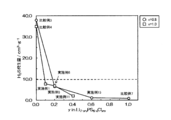
- FIG. 4 shows that when x is approximately 0.8 or more, the LiCl addition amount (y) is high at about 0.2, and when the LiCl addition amount (y) further increases, the conductivity gradually decreases.
- the addition of LiCl causes LiCl to precipitate on the surface of the particles of compound A, thereby suppressing the contact of the sulfide solid electrolyte particles with dry air, so that high conductivity can be maintained even after exposure to dry air. it is conceivable that.
- the amount of LiCl added is increased, the reaction between slight moisture contained in the dry air and LiCl is promoted, and LiCl reacted with moisture reacts with the compound A. Later, high conductivity cannot be maintained.
- FIG. 5 shows that the amount of H 2 S generated decreases as the LiCl addition amount (y) increases. This is because LiCl precipitates on the surface of the compound A particles due to the addition of LiCl, so that contact between the particles of the compound A and the dry air is suppressed, so that it is difficult to react with a slight amount of moisture contained in the dry air. It can be considered that.
- the particle size-adjusted product (D50: 3.1 ⁇ m) of the sample (present solid electrolyte powder) obtained in Example 1 was formed into a disk shape having a thickness of 100 ⁇ m to produce a solid electrolyte pellet. Further, 60 parts by mass of a lithium composite oxide (LiNi 0.5 Co 0.2 Mn 0.33 O 2 ) powder (D50: 2.5 ⁇ m) and a particle size adjusted product (D50: 3.3) of the sample obtained in Example 1 (present solid electrolyte powder). 1 ⁇ m) 38 parts by mass and 2 parts by mass of acetylene black were mixed and formed into a disk shape having a thickness of 100 ⁇ m to produce a positive electrode pellet.
- the lower opening of a polypropylene cylinder (opening diameter: 10.5 mm, height: 18 mm) opened at the top and bottom is closed with a negative electrode, and the negative electrode pellet, the solid electrolyte pellet, and the positive electrode pellet are placed on the negative electrode.
- the dice battery was fabricated by sequentially mounting and closing the upper opening with the positive electrode.
- the battery was placed in an environmental tester set so that the environmental temperature for charging and discharging the battery was 25 ° C., prepared so that it could be charged and discharged, and allowed to stand so that the battery temperature became the environmental temperature.
- the first cycle constant current and constant potential were charged to 0.1V at 0.1C, then constant current was discharged to 2.5V at 0.1C, and the charge / discharge range was set to 4.2 to 2.5V in the second cycle. Charging / discharging was performed.
- the charge / discharge range is set to 4.2 V to 2.5 V after the third cycle, After charging and discharging for one cycle at a constant current of 0.1 C constant current and discharging at a constant current of 0.1 C, charging and discharging cycles were performed 20 times at 0.2 C.
- the battery is placed in an environmental tester set so that the environmental temperature for charging / discharging the battery is 25 ° C., and prepared so that the battery can be charged / discharged.
- the first cycle was charged at a constant current and constant potential to 4.5 V at 0.1 C, and then discharged at a constant current to 2.5 V at 0.1 C, and the charge and discharge range was 4.2 for the second cycle.
- Charging / discharging was performed at ⁇ 2.5V.
- the charge / discharge range is set to 4.2 V to 2.5 V after the third cycle.
- charging and discharging cycles were performed 20 times at 0.2 C.
- 3 mA was set to 1 C, and the current value of each C rate was calculated based on the current value of 1 C, and used for evaluating the capacity maintenance rate.
- the capacity maintenance rate at the 20th cycle was 62.9%, whereas in the example test, the capacity maintenance rate was 95%.
- the gas generation which seems to originate from the electrolyte decomposition reaction normally recognized in the battery containing electrolyte solution was not recognized by the said Example test.
- the present solid electrolyte can suppress the influence of oxygen accompanying the silicon negative electrode active material, so that it can be used in a high temperature environment (40 ° C. or higher) as described above. It was found that the life characteristics (cycle characteristics) in charge / discharge can be improved. And it turned out that it is more preferable to set the end voltage of the first charge higher than the end voltage of the second and subsequent charges at this time.
Landscapes
- Chemical & Material Sciences (AREA)
- Chemical Kinetics & Catalysis (AREA)
- Electrochemistry (AREA)
- General Chemical & Material Sciences (AREA)
- Engineering & Computer Science (AREA)
- Inorganic Chemistry (AREA)
- Manufacturing & Machinery (AREA)
- Organic Chemistry (AREA)
- Condensed Matter Physics & Semiconductors (AREA)
- Physics & Mathematics (AREA)
- General Physics & Mathematics (AREA)
- Materials Engineering (AREA)
- Secondary Cells (AREA)
- Conductive Materials (AREA)
- Battery Electrode And Active Subsutance (AREA)
Abstract
Description
しかしながら、かかる化合物は、水分や酸素との反応性が極めて高いため、大気に触れると、大気中の水分と反応して硫化水素を発生するという課題を抱えていた。また、乾燥空気に触れた場合であっても、空気中の酸素と反応して、導電率が低下することがあるという課題も抱えていた。
よって、本発明が提案する硫化物系固体電解質化合物は、リチウムイオン電池の固体電解質として特に好適に用いることができる。
なお、立方晶系Argyrodite型結晶構造の結晶相と、LiClで示される結晶相とを含有する混合相としては、立方晶系Argyrodite型結晶構造の結晶相と、LiClで示される結晶相との混合相のほか、これら以外の結晶相を含有する場合も包含する。
(イ)・・0.05≦y≦0.9
(ロ)・・-3.0x+1.8≦y≦-3.0x+5.7
また、条件(ロ)については、-3.0x+2.7≦y≦-3.0x+5.7であることが特に好ましく、その中でも-3.0x+3.3≦y≦-3.0x+5.7であることがさらに好ましい。
(ト)・・0.05≦y≦0.4
(チ)・・-3.0x+3.9≦y≦-3.0x+5.7
また、条件(チ)については、-3.0x+4.2≦y≦-3.0x+5.7であることが特に好ましく、その中でも-3.0x+4.2≦y≦-3.0x+5.1であることがさらに好ましい。
この際、[IL(200)/IA(220)]が0.30以下であるということは、乾燥空気放置後の導電率を高く維持でき、かつ硫化水素の発生を抑制できることを意味しており、この場合には、LiClは適量含有するようであればさらに好ましい。
かかる観点から、[IL(200)/IA(220)]は、0.30以下であるのが好ましく、中でも0.20以下であるのがさらに好ましく、その中でも0.01以上或いは0.10以下であるのがよりさらに好ましく、その中でも0.05以上であるのが特に好ましい。
但し、本固体電解質は、化合物Aが主材料であるのが好ましく、本固体電解質全体の50質量%以上、中でも80質量%以上、その中でも90質量%以上(100質量%を含む)を化合物Aが占めるのが好ましく、中でも特に化合物Aのみから構成されることが望ましい。
また、本固体電解質は、上記他の材料の他に、本発明の効果に悪影響の少ない程度すなわち5質量%未満、中でも3質量%未満程度であれば不可避不純物を含んでいてもよい。
本固体電解質に関しては、乾燥空気暴露後の導電率を1×10⁻³S・cm-1以上、さらには2×10⁻³S・cm-1以上に高めることができる。
なお、本明細書における「乾燥空気」とは、エアードライヤー等で水分濃度を100ppm以下(露点で約-42℃以下)まで除去した空気を意味する。
本固体電解質は、本固体電解質は、大気中に放置した際の硫化水素(H2S)発生量を10cm3・g-1未満、中でも1.0cm3・g-1未満に抑えることができる。
硫化物系固体電解質はそもそもイオン伝導性に優れており、酸化物に比べて常温で活物質との界面を形成し易く、界面抵抗を低くできることが知られている。中でも、本固体電解質は、硫黄欠損が少なくて結晶性が高いため、電子伝導性が低く、リチウムイオン伝導性が特に優れている。
次に、化合物Aないし本固体電解質の製造方法の一例について説明する。但し、ここで説明する製造方法はあくまでも一例であり、この方法に限定するものではない。
この際、粉砕混合は、メカニカルアロイング法など、非常に強力な機械的粉砕混合により、原料粉末の結晶性を低下あるいは非晶質化、もしくは原料混合粉末を均質化させてしまうと、カチオンと硫黄との結合が切れてしまい、焼成時に硫黄欠損が生じ、電子伝導性を発現してしまう。そのため、原料粉末の結晶性を維持できる程度の粉砕混合が望ましい。
これに対し、化合物Aは、200℃程度から結晶化が進むことから、比較的低温で焼成しても合成することができる。そのため、不活性雰囲気もしくは硫化水素ガス(H2S)流通下、350℃以上で焼成することによって、硫黄欠損がほとんど無い目的の化学組成の硫化物である化合物Aを作製することができる。
このように硫化水素ガス(H2S)流通下で焼成する際、350~550℃で焼成することにより、硫化物中の硫黄を欠損させることなく焼成することができる。
また、上記の原料は、大気中で極めて不安定で、水分と反応して分解し、硫化水素ガスを発生したり、酸化したりするため、不活性ガス雰囲気に置換したグローブボックス等を通じて、原料を炉内にセットして焼成を行うのが好ましい。
本固体電解質は、全固体リチウムイオン電池の固体電解質層や、正極・負極合材に混合する固体電解質等として使用できる。
例えば正極と、負極と、正極及び負極の間に上記の固体電解質からなる層とを形成することで、全固体リチウムイオン電池を構成することができる。
この際、本固体電解質は、耐水性及び耐酸化性に優れており、乾燥空気中で取り扱っても特性劣化が少ないため、例えばドライルームなどでも全固体リチウムイオン電池の組立作業を行うことができる。
ここで、固体電解質からなる層は、例えば固体電解質とバインダー及び溶剤から成るスラリーを基体上に滴下し、ドクターブレードなどで擦り切る方法、スラリー接触後にエアーナイフで切る方法、スクリーン印刷法等で塗膜を形成し、その後加熱乾燥を経て溶剤を除去する方法などで作製することができる。又は、固体電解質の粉体をプレス等により圧粉体を作製した後、適宜加工して作製することもできる。
例えば、本固体電解質は、電気化学的に安定であることから、リチウム金属に匹敵する卑な電位(約0.1V vs Li+/Li)で充放電する人造黒鉛、天然黒鉛、難黒鉛化性炭素(ハードカーボン)などの炭素系材料を、リチウムイオン電池の負極活物質として使用することができる。そのため、リチウムイオン電池の電解質として本固体電解質を用いると共に、負極活物質として炭素系材料を用いることで、全固体リチウムイオン電池のエネルギー密度を大きく向上させることができる。よって、例えば本固体電解質と、人造黒鉛、天然黒鉛、難黒鉛化性炭素(ハードカーボン)などの炭素を含む負極活物質と、を有するリチウムイオン電池を構成することができる。
また、高容量負極材料として有望なケイ素活物質を、リチウムイオン電池の負極活物質として使用することも可能である。一般的な電解液を用いたリチウムイオン電池では、充放電を繰り返すことにより、ケイ素活物質の粒子表面から劣化が進行する傾向が認められる。この劣化部分では電解液成分の酸素を取り込んだケイ素の酸化が進行するため、電解液に含まれる炭酸塩の一部をフッ素で置換する試みがなされたり、電解液との接触を避けるために活物質表面で被膜を形成する目的でビニレンカーボネート(VC)などを数%添加したりする試みがなされている。リチウムイオン電池の電解質として本固体電解質を用いると共に、負極活物質としてケイ素活物質を用いることにより、酸素源である電解液を含まないばかりか、固体電解質自身の耐酸素反応性や耐水分反応性が向上しているために、固体電解質が電池内に持ち込む不純物としての酸素量も少ないというメリットを有している。そのため、保存特性などの耐久性を一段と向上させることができる。よって、例えば本固体電解質と、ケイ素系負極活物質と、を有するリチウムイオン電池を構成することができる。
本固体電解質を用いたリチウムイオン電池、例えば、本固体電解質と、ケイ素を含む負極活物質(「ケイ素負極活物質」とも称する)と、リチウム複合酸化物を含む正極活物質とを備えたリチウムイオン電池の使用方法に関しては、充放電サイクルにおいて初回の充電の終止電圧を、2回目以降の充電の終止電圧よりも高く設定することが好ましい。
かかる課題を解決するため、上述のように、初回サイクルの充電の終止電圧を、2回目以降のサイクルの充電の終止電圧よりも高く設定して充電してケイ素負極活物質の活性度を高めることで、均等な負荷率でケイ素負極活物質を機能させることができ、その結果、電池の寿命特性(サイクル特性)を高めることができる。
ただし、本固体電解質以外の硫化物系固体電解質を備えたリチウムイオン電池の場合には、ケイ素負極活物質に付随する酸素の影響で、高温状態で充放電した際の寿命特性が低下する可能性がある。これに対し、本固体電解質は、他の硫化物系固体電解質に比べて、酸素との反応を抑えることができる特性に優れているため、本固体電解質を用いたリチウムイオン電池に上記使用方法を適用すると、高温状態で充放電しても寿命特性(サイクル特性)を維持することができるという格別優れた効果を得ることができる。
本発明において「固体電解質」とは、固体状態のままイオン、例えばLi+が移動し得る物質全般を意味する。
また、本発明において「X~Y」(X、Yは任意の数字)と記載した場合、特にことわらない限り「X以上Y以下」の意と共に、「好ましくはXより大きい」又は「好ましくはYより小さい」の意も包含する。
また、「X以上」(Xは任意の数字)又は「Y以下」(Yは任意の数字)と記載した場合、「Xより大きいことが好ましい」又は「Yより小さいことが好ましい」旨の意図を包含する。
また、本発明において「リチウムイオン電池」とは、リチウムイオンが正極と負極の間を移動することで充放電を行う二次電池を広く包含する意である。
表1に示した原料組成(mol%)となるように、硫化リチウム(Li2S)粉末と、五硫化二リン(P2S5)粉末と、塩化リチウム(LiCl)粉末とを用い、全量で5gになるようにそれぞれを秤量し、ボールミルで15時間粉砕混合して混合粉末を調製した。この混合粉末をカーボン製の容器に充填し、これを管状電気炉にて硫化水素ガス(H2S、純度100%)を1.0L/min流通させながら、昇降温速度200℃/hにて500℃で4時間焼成した。その後、試料を乳鉢で解砕し、目開き53μmの篩いで整粒して粉末状のサンプルを得た。
この際、上記秤量、混合、電気炉へのセット、電気炉からの取り出し、解砕及び整粒作業は全て、十分に乾燥されたArガス(露点-60℃以下)で置換されたグローブボックス内で実施した。
実施例・比較例で得られたサンプルについて、組成をICP発光分析法で測定し、組成式を表に示した。
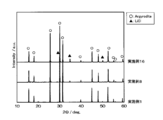
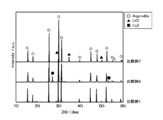
実施例・比較例で得られた粉末状のサンプルをX線回折法(XRD、Cu線源)で分析し、生成相を特定した。
また、この際得られたX線回折パターンから、2θ=25.3~25.9°付近に検出された(220)面のピーク強度IA(220)に対する、2θ=34.8~35.0°付近に検出された(200)面のピーク強度IL(200)の比率[IL(200)/IA(220)]を算出した。
実施例・比較例で得たサンプルを、十分に乾燥されたArガス(露点-60℃以下)で置換されたグローブボックス内で50mgずつ秤量し、ラミネートで密閉された袋に入れた。その後、大気雰囲気で室温(25℃)及び湿度30%で保たれた恒温恒湿槽の中に、容量1755cm3のアクリル製の箱を入れ、アクリル製の箱の内部が恒温恒湿槽内の環境と同一になるまで保持してから、サンプルが入った密閉袋を恒温恒湿槽の中で開封し、素早くアクリル製の箱にサンプルを配置した。サンプルをアクリル製の箱に配置した直後から300秒経過までに発生した硫化水素について、硫化水素センサー(理研計器製GX-2009)にて硫化水素濃度を測定した。硫化水素発生量は、300秒経過後の硫化水素濃度から硫化水素の容積を算出して求めた。
実施例・比較例で得たサンプルを、十分に乾燥されたArガス(露点-60℃以下)で置換されたグローブボックス内で200MPaの圧力にて一軸加圧成形して直径10mm、厚み2~5mmのペレットを作製し、更にペレット上下両面に電極としてのカーボンペーストを塗布した後、180℃で30分熱処理を行い、イオン導電率測定用サンプルを作製した。イオン導電率測定は、室温(25℃)にて交流インピーダンス法にて行った。
実施例・比較例で得たサンプルを、平均露点-45℃の乾燥空気で置換されたグローブボックス内に入れて6時間放置した。その後、サンプルを再び十分に乾燥されたArガス(露点-60℃以下)で置換されたグローブボックス内に入れ、初期導電率の測定と同様に、乾燥空気曝露後のイオン導電率を測定した。
また、表1の生成相の項目において、「A」は立方晶系Argyrodite型結晶構造のLi7-x+yPS6-xClx+y相からなる単相を示し、「A+LiCl」とは、該Li7-x+yPS6-xClx+y相とLiCl相の混合相を示し、「A+Li2S」とは、該Li7-x+yPS6-xClx+y相とLi2S相の混合相を示す。

(電池の作製)
純粋ケイ素粉末(D50:2.5μm、酸素濃度0.7wt%)47.5質量部と実施例1で得たサンプル(本固体電解質粉末)の粒度調整品(D50:3.1μm)47.5質量部、導電助剤としてアセチレンブラック(電気化学工業製)5質量部とを混合して厚さ100μmの円板状に成形して負極ペレットを作製した。
また、実施例1で得たサンプル(本固体電解質粉末)の粒度調整品(D50:3.1μm)を厚さ100μmの円板状に成形して固体電解質ペレットを作製した。
また、リチウム複合酸化物(LiNi0.5Co0.2Mn0.33O2)粉末(D50:2.5μm)60質量部と実施例1で得たサンプル(本固体電解質粉末)の粒度調整品(D50:3.1μm)38質量部とアセチレンブラック2質量部とを混合して厚さ100μmの円板状に成形して正極ペレットを作製した。
上下を開口したポリプロピレン製の円筒(開口径10.5mm、高さ18mm)の下側開口部を負極電極で閉塞し、該負極電極上に、上記負極ペレット、上記固体電解質ペレット及び上記正極ペレットを順次載せて、上側開口部を正極電極で閉塞して、ダイス電池を作製した。
上記のように作製したダイス電池を用いて、次のように充放電試験(参照試験・実施例試験)を実施し、高温サイクル特性を評価した。
なお、上記の比較例試験及び実施例試験では、3mAを1Cとし、その1Cの電流値を基に各々のCレートの電流値を算出し、容量維持率の評価に用いた。
この結果、参照試験では、20サイクル目の容量維持率は62.9%であったのに対し、実施例試験では、容量維持率は95%であった。また、電解液を含む電池において通常認められる電解液分解反応由来と思われるガス発生は、当該実施例試験では認められなかった。
このような試験結果と今まで本発明者が行ってきた試験結果とから、少なくとも、本固体電解質とケイ素負極活物質とを備えたリチウムイオン電池の使用方法に関しては、充放電サイクルにおいて初回の充電の終止電圧を、2回目以降の充電の終止電圧よりも高く設定して充放電することにより、ケイ素負極活物質の活性度を高めて、高い負荷率でケイ素負極活物質を機能させることができ、電池の寿命特性(サイクル特性)を高めることができると共に、ケイ素負極活物質に付随する酸素の影響を本固体電解質が抑えることができるため、上述のような高温環境(40℃以上)での充放電での寿命特性(サイクル特性)を高められることが分かった。
そしてこの際、初回の充電の終止電圧は、2回目以降の充電の終止電圧よりも高く設定して充電するのがより好ましいことも分かった。
Claims (10)
- 立方晶系Argyrodite型結晶構造の結晶相を含有し、組成式(1):Li7-x+yPS6-xClx+yで表されるリチウムイオン電池用硫化物系固体電解質化合物であって、前記組成式(1)におけるx及びyは、0.05≦y≦0.9及び-3.0x+1.8≦y≦-3.0x+5.7を満足することを特徴とするリチウムイオン電池用硫化物系固体電解質化合物。
- 前記組成式(1)におけるx及びyは、0.05≦y≦0.4及び-3.0x+3.9≦y≦-3.0x+5.7を満足することを特徴とする請求項1に記載のリチウムイオン電池用硫化物系固体電解質化合物。
- 請求項1又は2に記載されたリチウムイオン電池用硫化物系固体電解質化合物を含有する固体電解質。
- 立方晶系Argyrodite型結晶構造の結晶相の単一相からなることを特徴とする請求項3に記載の固体電解質。
- 立方晶系Argyrodite型結晶構造の結晶相と、LiClで示される結晶相とを含有することを特徴とする請求項3に記載の固体電解質。
- X線回折パターンにおいて、立方晶系Argyrodite型結晶相の(220)面のピーク強度IA(220)に対する、LiCl結晶相の(200)面のピーク強度IL(200)の比率[IL(200)/IA(220)]が0.30以下であることを特徴とする請求項3に記載の固体電解質。
- 38.8~72.0部(mol%)の硫化リチウム(Li2S)粉末と、10.2~12.4部(mol%)の五硫化二リン(P2S5)粉末と、15.6~51.0部(mol%)の塩化リチウム(LiCl)粉末とを混合し、不活性雰囲気下、350~500℃で焼成するか、又は、硫化水素ガスを含有する雰囲気下、350~550℃で焼成するかすることを特徴とする、請求項1若しくは2に記載のリチウムイオン電池用硫化物系固体電解質化合物、又は、請求項3~6の何れかに記載の固体電解質の製造方法。
- 請求項3~6の何れかに記載の固体電解質を備えたリチウムイオン電池。
- 請求項3~6の何れかに記載の固体電解質と、炭素又はケイ素を含む負極活物質とを備えたリチウムイオン電池。
- 請求項3~6の何れかに記載の固体電解質と、ケイ素を含む負極活物質と、リチウム複合酸化物を含む正極活物質とを備えたリチウムイオン電池の使用方法であって、
充放電サイクルにおいて初回の充電の終止電圧を、2回目以降の充電の終止電圧よりも高く設定することを特徴するリチウムイオン電池の使用方法。
Priority Applications (5)
| Application Number | Priority Date | Filing Date | Title |
|---|---|---|---|
| EP15873270.1A EP3240089B1 (en) | 2014-12-26 | 2015-12-25 | Sulfide-based solid electrolyte for lithium ion cell, and solid electrolyte compound |
| US15/538,667 US9899702B2 (en) | 2014-12-26 | 2015-12-25 | Sulfide-based solid electrolyte for lithium ion cell, and solid electrolyte compound |
| JP2016524552A JP5985120B1 (ja) | 2014-12-26 | 2015-12-25 | リチウムイオン電池用硫化物系固体電解質及び固体電解質化合物 |
| KR1020177006445A KR101797510B1 (ko) | 2014-12-26 | 2015-12-25 | 리튬 이온 전지용 황화물계 고체 전해질 및 고체 전해질 화합물 |
| CN201580067901.5A CN107112586B (zh) | 2014-12-26 | 2015-12-25 | 锂离子电池用硫化物系固体电解质和固体电解质化合物 |
Applications Claiming Priority (2)
| Application Number | Priority Date | Filing Date | Title |
|---|---|---|---|
| JP2014-265950 | 2014-12-26 | ||
| JP2014265950 | 2014-12-26 |
Publications (1)
| Publication Number | Publication Date |
|---|---|
| WO2016104702A1 true WO2016104702A1 (ja) | 2016-06-30 |
Family
ID=56150714
Family Applications (1)
| Application Number | Title | Priority Date | Filing Date |
|---|---|---|---|
| PCT/JP2015/086228 Ceased WO2016104702A1 (ja) | 2014-12-26 | 2015-12-25 | リチウムイオン電池用硫化物系固体電解質及び固体電解質化合物 |
Country Status (6)
| Country | Link |
|---|---|
| US (1) | US9899702B2 (ja) |
| EP (1) | EP3240089B1 (ja) |
| JP (1) | JP5985120B1 (ja) |
| KR (1) | KR101797510B1 (ja) |
| CN (1) | CN107112586B (ja) |
| WO (1) | WO2016104702A1 (ja) |
Cited By (33)
| Publication number | Priority date | Publication date | Assignee | Title |
|---|---|---|---|---|
| WO2018003333A1 (ja) * | 2016-07-01 | 2018-01-04 | 三井金属鉱業株式会社 | リチウム二次電池用硫化物系固体電解質 |
| WO2018030436A1 (ja) * | 2016-08-10 | 2018-02-15 | 出光興産株式会社 | 硫化物固体電解質 |
| WO2018047566A1 (ja) | 2016-09-12 | 2018-03-15 | 出光興産株式会社 | 硫化物固体電解質 |
| JP2018045997A (ja) * | 2016-09-08 | 2018-03-22 | 出光興産株式会社 | 硫化物固体電解質 |
| WO2018092366A1 (ja) | 2016-11-16 | 2018-05-24 | 出光興産株式会社 | 硫化物固体電解質 |
| JP2018097954A (ja) * | 2016-12-09 | 2018-06-21 | トヨタ自動車株式会社 | 硫化物固体電解質の製造方法 |
| WO2018164224A1 (ja) * | 2017-03-08 | 2018-09-13 | 出光興産株式会社 | 硫化物固体電解質粒子 |
| WO2018216730A1 (ja) * | 2017-05-24 | 2018-11-29 | 出光興産株式会社 | 硫化物固体電解質 |
| WO2018225526A1 (ja) | 2017-06-09 | 2018-12-13 | 出光興産株式会社 | 硫化物固体電解質の製造方法 |
| JP2018206774A (ja) * | 2017-06-05 | 2018-12-27 | 出光興産株式会社 | アルジロダイト型結晶構造を有する硫化物固体電解質の製造方法 |
| EP3425700A1 (en) * | 2017-07-06 | 2019-01-09 | Toyota Jidosha Kabushiki Kaisha | All-solid-state lithium ion secondary battery |
| EP3425699A1 (en) * | 2017-07-06 | 2019-01-09 | Toyota Jidosha Kabushiki Kaisha | All-solid-state lithium ion secondary battery |
| WO2019009228A1 (ja) | 2017-07-07 | 2019-01-10 | 三井金属鉱業株式会社 | リチウム二次電池の固体電解質及び当該固体電解質用硫化物系化合物 |
| WO2019031436A1 (ja) | 2017-08-10 | 2019-02-14 | 出光興産株式会社 | 硫化物固体電解質 |
| WO2019131725A1 (ja) | 2017-12-28 | 2019-07-04 | 三井金属鉱業株式会社 | 固体電解質 |
| WO2019176895A1 (ja) | 2018-03-12 | 2019-09-19 | 三井金属鉱業株式会社 | 硫化物系固体電解質粒子 |
| WO2020022305A1 (ja) * | 2018-07-25 | 2020-01-30 | 三井金属鉱業株式会社 | 正極活物質 |
| WO2020095936A1 (ja) * | 2018-11-08 | 2020-05-14 | 三井金属鉱業株式会社 | 硫化物固体電解質及び電池 |
| JP2020095953A (ja) * | 2018-12-05 | 2020-06-18 | 出光興産株式会社 | アルジロダイト型結晶構造を有する固体電解質の製造方法 |
| JP2020126760A (ja) * | 2019-02-04 | 2020-08-20 | 三井金属鉱業株式会社 | 固体電解質 |
| US10833359B2 (en) | 2017-09-08 | 2020-11-10 | Panasonic Intellectual Property Management Co., Ltd. | Solid electrolyte material including sulfide layer and oxide layer, and battery incorporating the solid electrolyte material |
| JP2020198254A (ja) * | 2019-06-04 | 2020-12-10 | 本田技研工業株式会社 | 固体電池用負極材料および固体電池 |
| JPWO2020203224A1 (ja) * | 2019-03-29 | 2021-04-30 | 三井金属鉱業株式会社 | 固体電解質 |
| WO2021117869A1 (ja) | 2019-12-11 | 2021-06-17 | 三井金属鉱業株式会社 | 硫化物固体電解質 |
| DE112020000097T5 (de) | 2019-08-09 | 2021-08-19 | Idemitsu Kosan Co., Ltd. | Verfahren zur Herstellung eines Feststoffelektrolyten |
| JPWO2020203231A1 (ja) * | 2019-03-29 | 2021-10-21 | 三井金属鉱業株式会社 | 硫化物固体電解質 |
| US11387487B2 (en) | 2018-11-08 | 2022-07-12 | Mitsui Mining & Smelting Co., Ltd. | Sulfur-containing compound, solid electrolyte, and battery |
| JPWO2022163541A1 (ja) * | 2021-01-28 | 2022-08-04 | ||
| US11637312B2 (en) | 2017-06-29 | 2023-04-25 | Idemitsu Kosan Co., Ltd. | Sulfide solid electrolyte |
| WO2024047911A1 (ja) * | 2022-08-31 | 2024-03-07 | Jx金属株式会社 | 全固体リチウムイオン電池 |
| WO2024047912A1 (ja) * | 2022-08-31 | 2024-03-07 | Jx金属株式会社 | 全固体リチウムイオン電池の評価方法 |
| JP2024514996A (ja) * | 2021-01-28 | 2024-04-04 | スペシャルティ オペレーションズ フランス | 硫化物電解質を含む組成物 |
| JP2024525564A (ja) * | 2021-07-07 | 2024-07-12 | スペシャルティ オペレーションズ フランス | 硫化リチウムの粉末を得るプロセス及びlps化合物を調製するためのその使用 |
Families Citing this family (58)
| Publication number | Priority date | Publication date | Assignee | Title |
|---|---|---|---|---|
| US9972838B2 (en) | 2016-07-29 | 2018-05-15 | Blue Current, Inc. | Solid-state ionically conductive composite electrodes |
| US20180254518A1 (en) | 2017-03-03 | 2018-09-06 | Blue Current, Inc. | Polymerized in-situ hybrid solid ion-conductive compositions |
| EP3662523B1 (en) * | 2017-08-04 | 2022-03-23 | Toyota Motor Europe | Method for producing electrodes for all-solid state batteries |
| KR102552142B1 (ko) * | 2017-10-13 | 2023-07-05 | 현대자동차주식회사 | 양극 활물질 및 고체 전해질 복합체의 제조 방법 및 이를 포함하는 전고체 전지용 양극의 제조 방법 |
| US10811726B2 (en) * | 2017-11-14 | 2020-10-20 | Samsung Electronics Co., Ltd. | Solid electrolyte for all-solid lithium secondary battery, all-solid lithium secondary battery, and method of preparing the solid electrolyte |
| KR102452005B1 (ko) * | 2017-12-27 | 2022-10-06 | 현대자동차주식회사 | 질소가 첨가된 전고체 전지용 황화물계 고체전해질 |
| CN111656574A (zh) | 2018-02-02 | 2020-09-11 | 本田技研工业株式会社 | 固体电池用正极电极、固体电池及固体电池的制造方法 |
| JP6927131B2 (ja) * | 2018-04-16 | 2021-08-25 | トヨタ自動車株式会社 | 全固体電池の製造方法、全固体電池および全固体電池システム |
| WO2020050269A1 (ja) * | 2018-09-04 | 2020-03-12 | 三井金属鉱業株式会社 | 硫化物系化合物粒子、固体電解質及びリチウム二次電池 |
| CN113365945A (zh) * | 2018-09-19 | 2021-09-07 | 蓝色电流股份有限公司 | 氧化锂硫银锗矿 |
| DE102018218618A1 (de) | 2018-10-31 | 2020-04-30 | Robert Bosch Gmbh | Elektrochemische Festkörperzelle mit verbessertem sulfidischen Festelektrolyt und Verfahren zu dessen Herstellung |
| US11581570B2 (en) | 2019-01-07 | 2023-02-14 | Blue Current, Inc. | Polyurethane hybrid solid ion-conductive compositions |
| CN109921090B (zh) * | 2019-03-08 | 2021-10-26 | 山东大学 | 一种锂离子全固态全电池及其制备方法 |
| WO2020194823A1 (ja) * | 2019-03-26 | 2020-10-01 | 日本碍子株式会社 | 全固体二次電池 |
| KR102378488B1 (ko) * | 2019-03-28 | 2022-03-25 | 도요타 지도샤(주) | 황화물 고체전해질, 황화물 고체전해질의 전구체, 전고체전지 및 황화물 고체전해질의 제조 방법 |
| CN110233282B (zh) * | 2019-06-19 | 2021-09-07 | 浙江锋锂新能源科技有限公司 | 一种带有硅负极和硫化物固体电解质的全固态电池 |
| US20210047195A1 (en) | 2019-08-16 | 2021-02-18 | Blue Current, Inc. | Argyrodites doped with thiophilic metals |
| EP4029827B1 (en) | 2019-09-11 | 2024-02-28 | Mitsui Mining & Smelting Co., Ltd. | Sulfide solid electrolyte |
| US11702337B2 (en) | 2019-09-27 | 2023-07-18 | Samsung Sdi Co., Ltd. | Solid ion conductor, solid electrolyte including the solid ion conductor, electrochemical cell including the solid ion conductor, and preparation method of the same |
| EP4053948A4 (en) * | 2019-10-29 | 2022-11-30 | Mitsui Mining & Smelting Co., Ltd. | SOLID ELECTROLYTE AND ELECTRODE MIXTURE, SOLID ELECTROLYTE LAYER AND SOLID STATE BATTERY WITH IT |
| WO2021085238A1 (ja) | 2019-10-29 | 2021-05-06 | 三井金属鉱業株式会社 | 固体電解質、及びそれを用いた電極合剤、固体電解質層、固体電池 |
| WO2021085239A1 (ja) * | 2019-10-29 | 2021-05-06 | 三井金属鉱業株式会社 | 固体電解質、及びそれを用いた電極合剤、固体電解質層、固体電池 |
| EP3817117A1 (en) | 2019-11-01 | 2021-05-05 | Samsung SDI Co., Ltd. | Solid ion conductor compound, solid electrolyte including solid ion conductor compound, electrochemical cell including solid ion conductor compound, and method of preparing solid ion conductor compound |
| KR102832251B1 (ko) | 2019-11-06 | 2025-07-08 | 삼성에스디아이 주식회사 | 고체 전해질, 이를 포함하는 전기화학전지 및 고체 전해질의 제조방법 |
| EP3819964A1 (en) | 2019-11-07 | 2021-05-12 | Samsung SDI Co., Ltd. | Solid electrolyte, electrochemical cell including solid electrolyte, and method of preparing solid electrolyte |
| KR20220121243A (ko) | 2019-12-20 | 2022-08-31 | 블루 커런트, 인크. | 결합제가 있는 복합 전해질 |
| US12166239B2 (en) | 2019-12-20 | 2024-12-10 | Blue Current, Inc. | Polymer microspheres as binders for composite electrolytes |
| US11394054B2 (en) | 2019-12-20 | 2022-07-19 | Blue Current, Inc. | Polymer microspheres as binders for composite electrolytes |
| EP4084113A4 (en) * | 2019-12-27 | 2023-09-20 | Mitsui Mining & Smelting Co., Ltd. | SULFIDE SOLID ELECTROLYTE AND METHOD FOR THE PRODUCTION THEREOF |
| US11923502B2 (en) | 2020-01-31 | 2024-03-05 | Samsung Sdi Co., Ltd. | All-solid secondary battery and method of preparing same |
| TWI804712B (zh) * | 2020-02-21 | 2023-06-11 | 日商三井金屬鑛業股份有限公司 | 硫化物固體電解質、電極合劑、固體電解質層及全固體電池 |
| TWI829873B (zh) * | 2020-02-24 | 2024-01-21 | 日商三井金屬鑛業股份有限公司 | 硫化物固體電解質及電池 |
| KR20210111949A (ko) * | 2020-03-03 | 2021-09-14 | 삼성에스디아이 주식회사 | 양극 및 이를 포함하는 전고체 이차전지, 및 전고체 이차전지의 제조 방법 |
| JP7421985B2 (ja) * | 2020-03-31 | 2024-01-25 | マクセル株式会社 | 全固体二次電池およびその製造方法 |
| JP7768514B2 (ja) * | 2020-04-09 | 2025-11-12 | ビーエーエスエフ ソシエタス・ヨーロピア | リチウムイオン伝導性固体材料 |
| US10916802B1 (en) | 2020-04-29 | 2021-02-09 | Nanostar Inc. | Ionic conductivity in silicon electrolyte composite particles |
| US11411211B2 (en) | 2020-05-07 | 2022-08-09 | Advano, Inc. | Solid electrolyte-secondary particle composites |
| US11677097B2 (en) * | 2020-06-02 | 2023-06-13 | Samsung Electronics Co., Ltd. | Solid electrolyte, method of preparing the same, and electrochemical device including the same |
| KR20230022158A (ko) * | 2020-06-10 | 2023-02-14 | 미쓰이금속광업주식회사 | 고체 전해질, 전극 합제 및 전지 |
| CN111977681B (zh) * | 2020-08-08 | 2023-10-10 | 天目湖先进储能技术研究院有限公司 | 硫化物固态电解质材料及其原料的气相合成方法及应用 |
| US20230278881A1 (en) * | 2020-08-28 | 2023-09-07 | Mitsui Mining & Smelting Co., Ltd. | Active material, method for producing same, electrode mixture and battery |
| KR20220028942A (ko) | 2020-08-31 | 2022-03-08 | 삼성에스디아이 주식회사 | 전고체 이차전지용 황화물계 고체 전해질, 그 제조방법 및 이를 포함하는 전고체 이차전지 |
| KR20220081053A (ko) | 2020-12-08 | 2022-06-15 | 현대자동차주식회사 | 이온 전도도가 우수한 고체 전해질 |
| KR102269019B1 (ko) * | 2020-12-14 | 2021-06-25 | 한국전자기술연구원 | 고체전해질 및 그를 포함하는 전고체전지 |
| US11824165B2 (en) | 2021-01-25 | 2023-11-21 | Blue Current, Inc. | Solid-state lithium ion multilayer battery and manufacturing method |
| CN117015884A (zh) * | 2021-01-28 | 2023-11-07 | 法国特种经营公司 | 包含硫化物电解质的组合物 |
| EP4307318A4 (en) * | 2021-03-11 | 2025-02-19 | Mitsui Mining & Smelting Co., Ltd. | SOLID ELECTROLYTE AND METHOD FOR PRODUCING THE SAME |
| CN113130980B (zh) * | 2021-04-20 | 2023-11-07 | 清华大学深圳国际研究生院 | 固态电解质及其制备方法、固态锂离子电池 |
| WO2022233023A1 (zh) * | 2021-05-07 | 2022-11-10 | 迪吉亚节能科技股份有限公司 | 固态电解质材料、其制备方法及使用该固态电解质材料的极片、电池芯 |
| KR20230006324A (ko) | 2021-07-02 | 2023-01-10 | 삼성에스디아이 주식회사 | 전고체 이차전지용 황화물계 고체 전해질, 그 제조방법 및 이를 포함하는 전고체 이차전지 |
| CN113851629A (zh) * | 2021-09-24 | 2021-12-28 | 成都汉普高新材料有限公司 | 一种用于全固态电池材料锂磷硫氯的制备方法 |
| CN114163240B (zh) * | 2021-12-23 | 2022-09-09 | 湖南恩捷前沿新材料科技有限公司 | 一种高效的硫卤化合物固态电解质制备方法 |
| JP7751485B2 (ja) * | 2021-12-27 | 2025-10-08 | 出光興産株式会社 | 硫化物固体電解質の製造方法及び電極合材の製造方法 |
| CN114551992B (zh) * | 2022-03-17 | 2024-04-19 | 蜂巢能源科技(无锡)有限公司 | 一种硫化物固态电解质及其制备方法和应用 |
| KR20240093239A (ko) * | 2022-12-15 | 2024-06-24 | 주식회사 엘지에너지솔루션 | 복합 황화물계 고체 전해질 및 이의 제조방법 |
| CN115986203B (zh) * | 2023-03-21 | 2023-06-20 | 中创新航技术研究院(江苏)有限公司 | 固体电解质、其制备方法及包含该电解质的电池 |
| CN117534045A (zh) * | 2023-11-13 | 2024-02-09 | 高能时代(珠海)新能源科技有限公司 | 一种硫化物固体电解质及其制备方法 |
| WO2026089292A1 (ko) * | 2024-10-24 | 2026-04-30 | 주식회사 에코프로비엠 | 황화물계 고체전해질 화합물 |
Citations (3)
| Publication number | Priority date | Publication date | Assignee | Title |
|---|---|---|---|---|
| JP2012048971A (ja) * | 2010-08-26 | 2012-03-08 | Toyota Motor Corp | 硫化物固体電解質材料、正極体およびリチウム固体電池 |
| JP2013201110A (ja) * | 2011-11-07 | 2013-10-03 | Idemitsu Kosan Co Ltd | 固体電解質 |
| JP2014137868A (ja) * | 2013-01-15 | 2014-07-28 | Toyota Motor Corp | 全固体電池およびその製造方法 |
Family Cites Families (7)
| Publication number | Priority date | Publication date | Assignee | Title |
|---|---|---|---|---|
| JP3184517B2 (ja) | 1990-11-29 | 2001-07-09 | 松下電器産業株式会社 | リチウムイオン伝導性固体電解質 |
| JP3744665B2 (ja) | 1997-12-09 | 2006-02-15 | トヨタ自動車株式会社 | リチウムイオン伝導性固体電解質および電池 |
| JP2001250580A (ja) | 2000-03-06 | 2001-09-14 | Masahiro Tatsumisuna | 高リチウムイオン伝導性硫化物セラミックスおよびこれを用いた全固体電池 |
| DE102007048289A1 (de) * | 2007-10-08 | 2009-04-09 | Universität Siegen | Lithium-Argyrodite |
| JP2011096630A (ja) | 2009-10-02 | 2011-05-12 | Sanyo Electric Co Ltd | 固体リチウム二次電池及びその製造方法 |
| JP5443445B2 (ja) * | 2011-07-06 | 2014-03-19 | トヨタ自動車株式会社 | 硫化物固体電解質材料、リチウム固体電池、および、硫化物固体電解質材料の製造方法 |
| JP5701741B2 (ja) | 2011-12-28 | 2015-04-15 | 三井金属鉱業株式会社 | 硫化物系固体電解質 |
-
2015
- 2015-12-25 CN CN201580067901.5A patent/CN107112586B/zh active Active
- 2015-12-25 EP EP15873270.1A patent/EP3240089B1/en active Active
- 2015-12-25 KR KR1020177006445A patent/KR101797510B1/ko active Active
- 2015-12-25 JP JP2016524552A patent/JP5985120B1/ja active Active
- 2015-12-25 WO PCT/JP2015/086228 patent/WO2016104702A1/ja not_active Ceased
- 2015-12-25 US US15/538,667 patent/US9899702B2/en active Active
Patent Citations (3)
| Publication number | Priority date | Publication date | Assignee | Title |
|---|---|---|---|---|
| JP2012048971A (ja) * | 2010-08-26 | 2012-03-08 | Toyota Motor Corp | 硫化物固体電解質材料、正極体およびリチウム固体電池 |
| JP2013201110A (ja) * | 2011-11-07 | 2013-10-03 | Idemitsu Kosan Co Ltd | 固体電解質 |
| JP2014137868A (ja) * | 2013-01-15 | 2014-07-28 | Toyota Motor Corp | 全固体電池およびその製造方法 |
Non-Patent Citations (1)
| Title |
|---|
| See also references of EP3240089A4 * |
Cited By (116)
| Publication number | Priority date | Publication date | Assignee | Title |
|---|---|---|---|---|
| WO2018003333A1 (ja) * | 2016-07-01 | 2018-01-04 | 三井金属鉱業株式会社 | リチウム二次電池用硫化物系固体電解質 |
| JP6293383B1 (ja) * | 2016-07-01 | 2018-03-14 | 三井金属鉱業株式会社 | リチウム二次電池用硫化物系固体電解質 |
| US11699809B2 (en) | 2016-07-01 | 2023-07-11 | Mitsui Mining & Smelting Co., Ltd. | Sulfide-based solid electrolyte for lithium secondary battery |
| EP3454405A4 (en) * | 2016-07-01 | 2019-12-18 | Mitsui Mining and Smelting Co., Ltd. | FIXED ELECTROLYTE ON SULFIDE BASE FOR LITHIUM SECONDARY BATTERY |
| EP3499629A4 (en) * | 2016-08-10 | 2020-01-29 | Idemitsu Kosan Co., Ltd | SOLID-SULFIDE ELECTROLYTE |
| KR20190039123A (ko) | 2016-08-10 | 2019-04-10 | 이데미쓰 고산 가부시키가이샤 | 황화물 고체 전해질 |
| JPWO2018030436A1 (ja) * | 2016-08-10 | 2019-06-13 | 出光興産株式会社 | 硫化物固体電解質 |
| WO2018030436A1 (ja) * | 2016-08-10 | 2018-02-15 | 出光興産株式会社 | 硫化物固体電解質 |
| CN109526242B (zh) * | 2016-08-10 | 2022-04-15 | 出光兴产株式会社 | 硫化物固体电解质 |
| CN109526242A (zh) * | 2016-08-10 | 2019-03-26 | 出光兴产株式会社 | 硫化物固体电解质 |
| US11264642B2 (en) | 2016-08-10 | 2022-03-01 | Idemitsu Kosan Co., Ltd. | Sulfide solid electrolyte |
| JP2018045997A (ja) * | 2016-09-08 | 2018-03-22 | 出光興産株式会社 | 硫化物固体電解質 |
| US10818966B2 (en) | 2016-09-08 | 2020-10-27 | Idemitsu Kosan Co., Ltd. | Sulfide solid electrolyte with argyrodite type crystal structure |
| JP7187637B2 (ja) | 2016-09-08 | 2022-12-12 | 出光興産株式会社 | 硫化物固体電解質の製造方法 |
| JP2022003641A (ja) * | 2016-09-08 | 2022-01-11 | 出光興産株式会社 | 硫化物固体電解質の製造方法 |
| EP3905278A1 (en) | 2016-09-12 | 2021-11-03 | Idemitsu Kosan Co.,Ltd. | Sulfide solid electrolyte |
| KR20230060541A (ko) | 2016-09-12 | 2023-05-04 | 이데미쓰 고산 가부시키가이샤 | 황화물 고체 전해질 |
| KR20190051962A (ko) | 2016-09-12 | 2019-05-15 | 이데미쓰 고산 가부시키가이샤 | 황화물 고체 전해질 |
| KR20190058467A (ko) | 2016-09-12 | 2019-05-29 | 이데미쓰 고산 가부시키가이샤 | 황화물 고체 전해질 |
| KR102942395B1 (ko) | 2016-09-12 | 2026-03-23 | 이데미쓰 고산 가부시키가이샤 | 황화물 고체 전해질 |
| JPWO2018047566A1 (ja) * | 2016-09-12 | 2019-06-24 | 出光興産株式会社 | 硫化物固体電解質 |
| US11271246B2 (en) | 2016-09-12 | 2022-03-08 | Idemitsu Kosan Co., Ltd. | Sulfide solid electrolyte |
| KR20220100107A (ko) | 2016-09-12 | 2022-07-14 | 이데미쓰 고산 가부시키가이샤 | 황화물 고체 전해질 |
| KR20210044905A (ko) | 2016-09-12 | 2021-04-23 | 이데미쓰 고산 가부시키가이샤 | 황화물 고체 전해질 |
| JPWO2018047565A1 (ja) * | 2016-09-12 | 2019-07-11 | 出光興産株式会社 | 硫化物固体電解質 |
| US10374253B2 (en) | 2016-09-12 | 2019-08-06 | Idemitsu Kosan Co., Ltd. | Sulfide solid electrolyte |
| US10879561B2 (en) | 2016-09-12 | 2020-12-29 | Idemitsu Kosan Co., Ltd. | Sulfide solid electrolyte |
| US12183879B2 (en) | 2016-09-12 | 2024-12-31 | Idemitsu Kosan Co., Ltd. | Sulfide solid electrolyte |
| US10483587B2 (en) | 2016-09-12 | 2019-11-19 | Idemitsu Kosan Co., Ltd. | Sulfide solid electrolyte |
| JP7536842B2 (ja) | 2016-09-12 | 2024-08-20 | 出光興産株式会社 | 硫化物固体電解質 |
| JP2023009172A (ja) * | 2016-09-12 | 2023-01-19 | 出光興産株式会社 | 硫化物固体電解質 |
| KR20240026252A (ko) | 2016-09-12 | 2024-02-27 | 이데미쓰 고산 가부시키가이샤 | 황화물 고체 전해질 |
| US11626616B2 (en) | 2016-09-12 | 2023-04-11 | Idemitsu Kosan Co., Ltd. | Sulfide solid electrolyte |
| KR102641046B1 (ko) | 2016-09-12 | 2024-02-27 | 이데미쓰 고산 가부시키가이샤 | 황화물 고체 전해질 |
| WO2018047566A1 (ja) | 2016-09-12 | 2018-03-15 | 出光興産株式会社 | 硫化物固体電解質 |
| WO2018092366A1 (ja) | 2016-11-16 | 2018-05-24 | 出光興産株式会社 | 硫化物固体電解質 |
| KR20220107331A (ko) | 2016-11-16 | 2022-08-02 | 이데미쓰 고산 가부시키가이샤 | 황화물 고체 전해질 |
| CN109937507A (zh) * | 2016-11-16 | 2019-06-25 | 出光兴产株式会社 | 硫化物固体电解质 |
| CN109937507B (zh) * | 2016-11-16 | 2022-10-28 | 出光兴产株式会社 | 硫化物固体电解质 |
| US12525641B2 (en) | 2016-11-16 | 2026-01-13 | Idemitsu Kosan Co., Ltd. | Sulfide solid electrolyte |
| EP4273986A2 (en) | 2016-11-16 | 2023-11-08 | Idemitsu Kosan Co.,Ltd. | Sulfide solid electrolyte |
| EP3544108A4 (en) * | 2016-11-16 | 2020-07-15 | Idemitsu Kosan Co., Ltd | SOLID SULFIDE ELECTROLYTE |
| KR20230034422A (ko) | 2016-11-16 | 2023-03-09 | 이데미쓰 고산 가부시키가이샤 | 황화물 고체 전해질 |
| KR102505389B1 (ko) * | 2016-11-16 | 2023-03-02 | 이데미쓰 고산 가부시키가이샤 | 황화물 고체 전해질 |
| KR102428981B1 (ko) * | 2016-11-16 | 2022-08-03 | 이데미쓰 고산 가부시키가이샤 | 황화물 고체 전해질 |
| US11444317B2 (en) | 2016-11-16 | 2022-09-13 | Idemitsu Kosan Co., Ltd. | Sulfide solid electrolyte |
| EP4586353A2 (en) | 2016-11-16 | 2025-07-16 | Idemitsu Kosan Co., Ltd. | Sulfide solid electrolyte |
| KR102605002B1 (ko) * | 2016-11-16 | 2023-11-22 | 이데미쓰 고산 가부시키가이샤 | 황화물 고체 전해질 |
| KR20190082794A (ko) | 2016-11-16 | 2019-07-10 | 이데미쓰 고산 가부시키가이샤 | 황화물 고체 전해질 |
| JP2018097954A (ja) * | 2016-12-09 | 2018-06-21 | トヨタ自動車株式会社 | 硫化物固体電解質の製造方法 |
| JPWO2018164224A1 (ja) * | 2017-03-08 | 2020-01-09 | 出光興産株式会社 | 硫化物固体電解質粒子 |
| WO2018164224A1 (ja) * | 2017-03-08 | 2018-09-13 | 出光興産株式会社 | 硫化物固体電解質粒子 |
| US11355780B2 (en) | 2017-03-08 | 2022-06-07 | Idemitsu Kosan Co., Ltd. | Sulfide solid electrolyte particles |
| US11276881B2 (en) | 2017-05-24 | 2022-03-15 | Idemitsu Kosan Co., Ltd. | Sulfide solid electrolyte |
| US11652236B2 (en) | 2017-05-24 | 2023-05-16 | Idemitsu Kosan Co., Ltd. | Sulfide solid electrolyte |
| CN110679028B (zh) * | 2017-05-24 | 2023-01-06 | 出光兴产株式会社 | 硫化物固体电解质 |
| CN110679028A (zh) * | 2017-05-24 | 2020-01-10 | 出光兴产株式会社 | 硫化物固体电解质 |
| WO2018216730A1 (ja) * | 2017-05-24 | 2018-11-29 | 出光興産株式会社 | 硫化物固体電解質 |
| JPWO2018216730A1 (ja) * | 2017-05-24 | 2020-05-21 | 出光興産株式会社 | 硫化物固体電解質 |
| JP7013456B2 (ja) | 2017-05-24 | 2022-01-31 | 出光興産株式会社 | 硫化物固体電解質 |
| JP7129226B2 (ja) | 2017-06-05 | 2022-09-01 | 出光興産株式会社 | アルジロダイト型結晶構造を有する硫化物固体電解質の製造方法及び固体電解質製造用の原料混合物 |
| JP2018206774A (ja) * | 2017-06-05 | 2018-12-27 | 出光興産株式会社 | アルジロダイト型結晶構造を有する硫化物固体電解質の製造方法 |
| CN110709950B (zh) * | 2017-06-09 | 2022-04-15 | 出光兴产株式会社 | 硫化物固体电解质的制造方法 |
| CN110709950A (zh) * | 2017-06-09 | 2020-01-17 | 出光兴产株式会社 | 硫化物固体电解质的制造方法 |
| JPWO2018225526A1 (ja) * | 2017-06-09 | 2020-04-09 | 出光興産株式会社 | 硫化物固体電解質の製造方法 |
| WO2018225526A1 (ja) | 2017-06-09 | 2018-12-13 | 出光興産株式会社 | 硫化物固体電解質の製造方法 |
| US11637312B2 (en) | 2017-06-29 | 2023-04-25 | Idemitsu Kosan Co., Ltd. | Sulfide solid electrolyte |
| EP3425699A1 (en) * | 2017-07-06 | 2019-01-09 | Toyota Jidosha Kabushiki Kaisha | All-solid-state lithium ion secondary battery |
| EP3425700A1 (en) * | 2017-07-06 | 2019-01-09 | Toyota Jidosha Kabushiki Kaisha | All-solid-state lithium ion secondary battery |
| US11600846B2 (en) | 2017-07-06 | 2023-03-07 | Toyota Jidosha Kabushiki Kaisha | All-solid-state lithium ion secondary battery |
| US10777841B2 (en) | 2017-07-06 | 2020-09-15 | Toyota Jidosha Kabushiki Kaisha | All-solid-state lithium ion secondary battery |
| US11196083B2 (en) | 2017-07-07 | 2021-12-07 | Mitsui Mining & Smelting Co., Ltd. | Solid electrolyte of lithium secondary battery and sulfide compound for said solid electrolyte |
| KR20200003929A (ko) | 2017-07-07 | 2020-01-10 | 미쓰이금속광업주식회사 | 리튬 이차 전지의 고체 전해질 및 당해 고체 전해질용 황화물계 화합물 |
| WO2019009228A1 (ja) | 2017-07-07 | 2019-01-10 | 三井金属鉱業株式会社 | リチウム二次電池の固体電解質及び当該固体電解質用硫化物系化合物 |
| WO2019031436A1 (ja) | 2017-08-10 | 2019-02-14 | 出光興産株式会社 | 硫化物固体電解質 |
| US10833359B2 (en) | 2017-09-08 | 2020-11-10 | Panasonic Intellectual Property Management Co., Ltd. | Solid electrolyte material including sulfide layer and oxide layer, and battery incorporating the solid electrolyte material |
| KR20200087207A (ko) | 2017-12-28 | 2020-07-20 | 미쓰이금속광업주식회사 | 고체 전해질 |
| US11631887B2 (en) | 2017-12-28 | 2023-04-18 | Mitsui Mining & Smelting Co., Ltd. | Solid electrolyte |
| WO2019131725A1 (ja) | 2017-12-28 | 2019-07-04 | 三井金属鉱業株式会社 | 固体電解質 |
| KR20200028496A (ko) | 2018-03-12 | 2020-03-16 | 미쓰이금속광업주식회사 | 황화물계 고체 전해질 입자 |
| US11688879B2 (en) | 2018-03-12 | 2023-06-27 | Mitsui Mining & Smelting Co., Ltd. | Sulfide-based solid electrolyte particles |
| WO2019176895A1 (ja) | 2018-03-12 | 2019-09-19 | 三井金属鉱業株式会社 | 硫化物系固体電解質粒子 |
| US12315876B2 (en) | 2018-03-12 | 2025-05-27 | Mitsui Mining & Smelting Co., Ltd. | Sulfide-based solid electrolyte particles |
| JP6595153B1 (ja) * | 2018-03-12 | 2019-10-23 | 三井金属鉱業株式会社 | 硫化物系固体電解質粒子 |
| JPWO2020022305A1 (ja) * | 2018-07-25 | 2021-08-02 | 三井金属鉱業株式会社 | 正極活物質 |
| JP7315553B2 (ja) | 2018-07-25 | 2023-07-26 | 三井金属鉱業株式会社 | 正極活物質 |
| WO2020022305A1 (ja) * | 2018-07-25 | 2020-01-30 | 三井金属鉱業株式会社 | 正極活物質 |
| US11387487B2 (en) | 2018-11-08 | 2022-07-12 | Mitsui Mining & Smelting Co., Ltd. | Sulfur-containing compound, solid electrolyte, and battery |
| JP6738983B1 (ja) * | 2018-11-08 | 2020-08-12 | 三井金属鉱業株式会社 | 硫化物固体電解質及び電池 |
| WO2020095936A1 (ja) * | 2018-11-08 | 2020-05-14 | 三井金属鉱業株式会社 | 硫化物固体電解質及び電池 |
| US11108084B2 (en) | 2018-11-08 | 2021-08-31 | Mitsui Mining & Smelting Co., Ltd. | Sulfide solid electrolyte and battery |
| JP2020095953A (ja) * | 2018-12-05 | 2020-06-18 | 出光興産株式会社 | アルジロダイト型結晶構造を有する固体電解質の製造方法 |
| US11380934B2 (en) | 2018-12-05 | 2022-07-05 | Idemitsu Kosan Co., Ltd. | Method for producing solid electrolyte having argyrodite type crystal structure |
| JP7319900B2 (ja) | 2018-12-05 | 2023-08-02 | 出光興産株式会社 | アルジロダイト型結晶構造を有する固体電解質の製造方法 |
| JP2020126760A (ja) * | 2019-02-04 | 2020-08-20 | 三井金属鉱業株式会社 | 固体電解質 |
| JP7239337B2 (ja) | 2019-02-04 | 2023-03-14 | 三井金属鉱業株式会社 | 固体電解質 |
| JPWO2020203231A1 (ja) * | 2019-03-29 | 2021-10-21 | 三井金属鉱業株式会社 | 硫化物固体電解質 |
| JP7324207B2 (ja) | 2019-03-29 | 2023-08-09 | 三井金属鉱業株式会社 | 固体電解質 |
| JPWO2020203224A1 (ja) * | 2019-03-29 | 2021-04-30 | 三井金属鉱業株式会社 | 固体電解質 |
| JP7159454B2 (ja) | 2019-03-29 | 2022-10-24 | 三井金属鉱業株式会社 | 硫化物固体電解質 |
| JP2020198254A (ja) * | 2019-06-04 | 2020-12-10 | 本田技研工業株式会社 | 固体電池用負極材料および固体電池 |
| JP7069086B2 (ja) | 2019-06-04 | 2022-05-17 | 本田技研工業株式会社 | 固体電池用負極材料および固体電池 |
| DE112020000097T5 (de) | 2019-08-09 | 2021-08-19 | Idemitsu Kosan Co., Ltd. | Verfahren zur Herstellung eines Feststoffelektrolyten |
| WO2021117869A1 (ja) | 2019-12-11 | 2021-06-17 | 三井金属鉱業株式会社 | 硫化物固体電解質 |
| US11978850B2 (en) | 2019-12-11 | 2024-05-07 | Mitsui Mining & Smelting Co., Ltd. | Sulfide solid electrolyte |
| KR20220009493A (ko) | 2019-12-11 | 2022-01-24 | 미쓰이금속광업주식회사 | 황화물 고체 전해질 |
| JP2024514996A (ja) * | 2021-01-28 | 2024-04-04 | スペシャルティ オペレーションズ フランス | 硫化物電解質を含む組成物 |
| JP7742365B2 (ja) | 2021-01-28 | 2025-09-19 | 出光興産株式会社 | 固体電解質の製造方法 |
| WO2022163541A1 (ja) * | 2021-01-28 | 2022-08-04 | 出光興産株式会社 | 固体電解質の製造方法 |
| JPWO2022163541A1 (ja) * | 2021-01-28 | 2022-08-04 | ||
| JP2024525564A (ja) * | 2021-07-07 | 2024-07-12 | スペシャルティ オペレーションズ フランス | 硫化リチウムの粉末を得るプロセス及びlps化合物を調製するためのその使用 |
| JP2024034244A (ja) * | 2022-08-31 | 2024-03-13 | Jx金属株式会社 | 全固体リチウムイオン電池 |
| JP2024034250A (ja) * | 2022-08-31 | 2024-03-13 | Jx金属株式会社 | 全固体リチウムイオン電池の評価方法 |
| WO2024047912A1 (ja) * | 2022-08-31 | 2024-03-07 | Jx金属株式会社 | 全固体リチウムイオン電池の評価方法 |
| WO2024047911A1 (ja) * | 2022-08-31 | 2024-03-07 | Jx金属株式会社 | 全固体リチウムイオン電池 |
| JP7853869B2 (ja) | 2022-08-31 | 2026-04-30 | Jx金属株式会社 | 全固体リチウムイオン電池の評価方法 |
Also Published As
| Publication number | Publication date |
|---|---|
| US9899702B2 (en) | 2018-02-20 |
| EP3240089B1 (en) | 2019-04-24 |
| CN107112586A (zh) | 2017-08-29 |
| US20170352916A1 (en) | 2017-12-07 |
| JPWO2016104702A1 (ja) | 2017-04-27 |
| JP5985120B1 (ja) | 2016-09-06 |
| CN107112586B (zh) | 2018-11-02 |
| EP3240089A4 (en) | 2018-05-30 |
| EP3240089A1 (en) | 2017-11-01 |
| KR20170036793A (ko) | 2017-04-03 |
| KR101797510B1 (ko) | 2017-11-14 |
Similar Documents
| Publication | Publication Date | Title |
|---|---|---|
| JP5985120B1 (ja) | リチウムイオン電池用硫化物系固体電解質及び固体電解質化合物 | |
| JP6997216B2 (ja) | 固体電解質 | |
| JP5873533B2 (ja) | リチウムイオン電池用硫化物系固体電解質 | |
| JP5957144B2 (ja) | リチウムイオン電池用硫化物系固体電解質 | |
| JP6595152B2 (ja) | リチウム二次電池の固体電解質及び当該固体電解質用硫化物系化合物 | |
| JP5701741B2 (ja) | 硫化物系固体電解質 | |
| KR102016788B1 (ko) | 소듐 이차전지용 양극활물질, 및 이의 제조 방법 | |
| JP6369126B2 (ja) | 非水電解質二次電池用正極活物質粒子粉末及びその製造方法、並びに非水電解質二次電池 | |
| TWI727734B (zh) | 固體電解質 | |
| Swietoslawski et al. | Searching for the best electrolyte composition for the C/Li2MnSiO4 based battery system |
Legal Events
| Date | Code | Title | Description |
|---|---|---|---|
| ENP | Entry into the national phase |
Ref document number: 2016524552 Country of ref document: JP Kind code of ref document: A |
|
| 121 | Ep: the epo has been informed by wipo that ep was designated in this application |
Ref document number: 15873270 Country of ref document: EP Kind code of ref document: A1 |
|
| ENP | Entry into the national phase |
Ref document number: 20177006445 Country of ref document: KR Kind code of ref document: A |
|
| REEP | Request for entry into the european phase |
Ref document number: 2015873270 Country of ref document: EP |
|
| WWE | Wipo information: entry into national phase |
Ref document number: 15538667 Country of ref document: US |
|
| NENP | Non-entry into the national phase |
Ref country code: DE |