EP3789400A1 - Modified antibody constant region - Google Patents
Modified antibody constant region Download PDFInfo
- Publication number
- EP3789400A1 EP3789400A1 EP20198500.9A EP20198500A EP3789400A1 EP 3789400 A1 EP3789400 A1 EP 3789400A1 EP 20198500 A EP20198500 A EP 20198500A EP 3789400 A1 EP3789400 A1 EP 3789400A1
- Authority
- EP
- European Patent Office
- Prior art keywords
- numbering system
- amino acid
- igg2
- antibody
- seq
- Prior art date
- Legal status (The legal status is an assumption and is not a legal conclusion. Google has not performed a legal analysis and makes no representation as to the accuracy of the status listed.)
- Pending
Links
Images









Classifications
-
- C—CHEMISTRY; METALLURGY
- C07—ORGANIC CHEMISTRY
- C07K—PEPTIDES
- C07K16/00—Immunoglobulins [IGs], e.g. monoclonal or polyclonal antibodies
- C07K16/18—Immunoglobulins [IGs], e.g. monoclonal or polyclonal antibodies against material from animals or humans
- C07K16/28—Immunoglobulins [IGs], e.g. monoclonal or polyclonal antibodies against material from animals or humans against receptors, cell surface antigens or cell surface determinants
- C07K16/2866—Immunoglobulins [IGs], e.g. monoclonal or polyclonal antibodies against material from animals or humans against receptors, cell surface antigens or cell surface determinants against receptors for cytokines, lymphokines, interferons
-
- C—CHEMISTRY; METALLURGY
- C07—ORGANIC CHEMISTRY
- C07K—PEPTIDES
- C07K16/00—Immunoglobulins [IGs], e.g. monoclonal or polyclonal antibodies
- C07K16/18—Immunoglobulins [IGs], e.g. monoclonal or polyclonal antibodies against material from animals or humans
-
- A—HUMAN NECESSITIES
- A61—MEDICAL OR VETERINARY SCIENCE; HYGIENE
- A61K—PREPARATIONS FOR MEDICAL, DENTAL OR TOILETRY PURPOSES
- A61K39/00—Medicinal preparations containing antigens or antibodies
- A61K39/395—Antibodies; Immunoglobulins; Immune serum, e.g. antilymphocytic serum
-
- A—HUMAN NECESSITIES
- A61—MEDICAL OR VETERINARY SCIENCE; HYGIENE
- A61P—SPECIFIC THERAPEUTIC ACTIVITY OF CHEMICAL COMPOUNDS OR MEDICINAL PREPARATIONS
- A61P29/00—Non-central analgesic, antipyretic or antiinflammatory agents, e.g. antirheumatic agents; Non-steroidal antiinflammatory drugs [NSAID]
-
- A—HUMAN NECESSITIES
- A61—MEDICAL OR VETERINARY SCIENCE; HYGIENE
- A61P—SPECIFIC THERAPEUTIC ACTIVITY OF CHEMICAL COMPOUNDS OR MEDICINAL PREPARATIONS
- A61P37/00—Drugs for immunological or allergic disorders
-
- C—CHEMISTRY; METALLURGY
- C07—ORGANIC CHEMISTRY
- C07K—PEPTIDES
- C07K16/00—Immunoglobulins [IGs], e.g. monoclonal or polyclonal antibodies
-
- C—CHEMISTRY; METALLURGY
- C07—ORGANIC CHEMISTRY
- C07K—PEPTIDES
- C07K2317/00—Immunoglobulins specific features
- C07K2317/50—Immunoglobulins specific features characterized by immunoglobulin fragments
- C07K2317/52—Constant or Fc region; Isotype
-
- C—CHEMISTRY; METALLURGY
- C07—ORGANIC CHEMISTRY
- C07K—PEPTIDES
- C07K2317/00—Immunoglobulins specific features
- C07K2317/50—Immunoglobulins specific features characterized by immunoglobulin fragments
- C07K2317/52—Constant or Fc region; Isotype
- C07K2317/524—CH2 domain
-
- C—CHEMISTRY; METALLURGY
- C07—ORGANIC CHEMISTRY
- C07K—PEPTIDES
- C07K2317/00—Immunoglobulins specific features
- C07K2317/50—Immunoglobulins specific features characterized by immunoglobulin fragments
- C07K2317/52—Constant or Fc region; Isotype
- C07K2317/526—CH3 domain
-
- C—CHEMISTRY; METALLURGY
- C07—ORGANIC CHEMISTRY
- C07K—PEPTIDES
- C07K2317/00—Immunoglobulins specific features
- C07K2317/50—Immunoglobulins specific features characterized by immunoglobulin fragments
- C07K2317/52—Constant or Fc region; Isotype
- C07K2317/53—Hinge
-
- C—CHEMISTRY; METALLURGY
- C07—ORGANIC CHEMISTRY
- C07K—PEPTIDES
- C07K2317/00—Immunoglobulins specific features
- C07K2317/70—Immunoglobulins specific features characterized by effect upon binding to a cell or to an antigen
- C07K2317/71—Decreased effector function due to an Fc-modification
-
- C—CHEMISTRY; METALLURGY
- C07—ORGANIC CHEMISTRY
- C07K—PEPTIDES
- C07K2317/00—Immunoglobulins specific features
- C07K2317/90—Immunoglobulins specific features characterized by (pharmaco)kinetic aspects or by stability of the immunoglobulin
- C07K2317/94—Stability, e.g. half-life, pH, temperature or enzyme-resistance
Definitions
- Non-patent Documents 1 and 2 are IgG-type antibody pharmaceuticals available on the market and many antibody pharmaceuticals are currently under development.
- Non-patent Document 4 It has been reported that immunogenicity is and can be enhanced by linking a protein or peptide to the Fc domain of IgG1 (Non-patent Document 4 and Patent Document 1). Interaction between the antibody Fc domain and Fc ⁇ receptor is thought to be a cause of the serious adverse effects encountered in phase-I clinical trials of TGN1412 (Non-patent Document 5). Thus, binding to Fc ⁇ receptor is considered unfavorable in antibody pharmaceuticals intended for neutralizing the biological activity of an antigen from the perspective of adverse effect and immunogenicity.
- IgG2 and IgG4 are unstable under acidic conditions. IgG type antibodies are in general exposed to acidic conditions in the purification process using Protein A and the virus inactivation process. Thus, attention is needed regarding the stability of IgG2 and IgG4 during these processes, and it is preferable that antibody molecules developed as pharmaceuticals are also stable under acidic conditions. Natural IgG2 and IgG4, and Fc ⁇ receptor-nonbinding antibodies derived from IgG2 or IgG4 (Non-patent Documents 6 and 7 and Patent Document 2) have such problems. It is desirable to solve these problems when developing antibodies into pharmaceuticals.
- IgG1-type antibodies are relatively stable under acidic conditions, and the degree of heterogeneity originated from disulfide bonds in the hinge region is also lower in this type of antibodies.
- IgG1 -type antibodies are reported to undergo non-enzymatic peptide bond cleavage in the hinge region in solutions when they are stored as formulations, and Fab fragments are generated as impurities as a result (Non-patent Document 11). It is desirable to overcome the generation of impurity when developing antibodies into pharmaceuticals.
- Non-patent Document 12 For heterogeneity of the C-terminal sequence of an antibody, deletion of C-terminal amino acid lysine residue, and amidation of the C-terminal amino group due to deletion of both of the two C-terminal amino acids, glycine and lysine, have been reported (Non-patent Document 12). It is preferable to eliminate such heterogeneity when developing antibodies into pharmaceuticals.
- the constant region of an antibody pharmaceutical aimed for neutralizing an antigen preferably has a sequence that overcomes all the problems described above. However, a constant region that meets all the requirements has not been reported.
- a preferred form of antibody pharmaceutical administration is thought to be subcutaneous formulation in chronic autoimmune diseases and such.
- Low-cost, convenient antibody pharmaceuticals that can be administered subcutaneously in longer intervals can be provided by increasing the half-life of an antibody in the plasma to prolong its therapeutic effect and thereby reduce the amount of protein administered, and by conferring the antibody with high stability so that high concentration formulations can be prepared.
- An objective of the present invention is to provide antibody constant regions that have improved physicochemical properties (stability and homogeneity), immunogenicity, safety, and pharmacokinetics (retention in plasma (blood)) by amino acid alteration.
- the present inventors conducted dedicated studies to generate antibody constant regions that are improved through alternation of their amino acid sequences and have improved physicochemical properties (stability and homogeneity), immunogenicity, and safety, and pharmacokinetics.
- the present inventors successfully improved antibody constant region to have increased stability under acid conditions, reduced heterogeneity originated from disulfide bonds in the hinge region, reduced heterogeneity originated from the H-chain C terminus, and increased stability at high concentrations, as well as discovered novel constant region sequences having reduced Fc ⁇ receptor-binding activity, while minimizing the generation of novel T-cell epitope peptides.
- the present invention relates to antibody constant regions that are superior in terms of safety, immunogenicity risk, physicochemical properties (stability and homogeneity), and pharmacokinetics a through improvement by amino acid alteration; antibodies comprising such antibody constant region; pharmaceutical compositions comprising such antibody; and methods for producing them. More specifically, the present invention provides:
- the constant region refers to IgG1, IgG2, or IgG4 type constant region.
- the antibody constant region is preferably a human antibody constant region.
- the amino acid sequences of human IgG1, IgG2, and IgG4 constant regions are known (human IgG1 constant region, SEQ ID NO: 1; human IgG2 constant region, SEQ ID NO: 2; and human IgG4 constant region, SEQ ID NO: 3).
- the amino acid substitution-containing antibody constant regions of the present invention may comprise other amino acid substitutions or modifications as long as they comprise the amino acid substitutions of the present invention.
- IgG2 constant regions comprising the amino acid substitutions of the present invention in the IgG2 constant region comprising the amino acid sequence of SEQ ID NO: 2 include IgG2 constant regions that comprise one or more amino acid substitutions and/or modifications in the amino acid sequence of SEQ ID NO: 2 and further comprise the amino acid substitutions of the present invention, as well as IgG2 constant regions that comprise the amino acid substitutions of the present invention and further comprise one or more amino acid substitutions and/or modifications.
- the sequence of human IgG4 constant region has been altered to improve the stability of the hinge region ( Mol. Immunol. 1993 Jan;30(1):105-8 ).
- the sugar chain at position 297 in the EU numbering system may be of any sugar-chain structure, or there may not be any sugar chain linked at this site (for example, can be produced with E. coli ).
- the present invention provides IgG2 constant regions with reduced heterogeneity of hinge region.
- the present invention provides IgG2 constant regions with reduced C-terminal heterogeneity.
- Antibodies comprising an IgG2 constant region comprising an amino acid sequence in which Ala at position 209, Pro at position 210, Thr at position 218, Met at position 276, Cys at position 14, Arg at position 16, Cys at position 102, Glu at position 20, and Ser at position 21 in the amino acid sequence of SEQ ID NO: 2 have been substituted with other amino acids.
- the type of amino acid after substitution is not particularly limited; however, substitutions of Ser for Ala at position 209 (position 330 in the EU numbering system), Ser for Pro at position 210 (position 331 in the EU numbering system), Ala for Thr at position 218 (position 339 in the EU numbering system), Val for Met at position 276 (position 397 in the EU numbering system), Ser for Cys at position 14 (position 131 in the EU numbering system), Lys for Arg at position 16 (position 133 in the EU numbering system), Ser for Cys at position 102 (position 219 in the EU numbering system), Gly for Glu at position 20 (position 137 in the EU numbering system), and Gly for Ser at position 21 (position 138 in the EU numbering system) are preferred.
- IgG2 constant regions of the present invention include IgG2 constant regions resulting from the deletion of Gly at position 325 and Lys at position 326 in the above-described IgG2 constant regions to reduce C-terminal heterogeneity.
- Such antibodies include, for example, IgG2 that comprises a constant region comprising the amino acid sequence of SEQ ID NO: 5 (M14 ⁇ GK).
- Antibodies comprising an IgG2 constant region comprising an amino acid sequence in which Ala at position 209, Pro at position 210, Thr at position 218, Cys at position 14, Arg at position 16, Cys at position 102, Glu at position 20, and Ser at position 21 in the amino acid sequence of SEQ ID NO: 2 have been substituted with other amino acids.
- the type of amino acid after substitution is not particularly limited; however, substitutions of Ser for Ala at position 209 (position 330 in the EU numbering system), Ser for Pro at position 210 (position 331 in the EU numbering system), Ala for Thr at position 218 (position 339 in the EU numbering system), Ser for Cys at position 14 (position 131 in the EU numbering system), Lys for Arg at position 16 (position 133 in the EU numbering system), Ser for Cys at position 102 (position 219 in the EU numbering system), Gly for Glu at position 20 (position 137 in the EU numbering system), and Gly for Ser at position 21 (position 138 in the EU numbering system) are preferred.
- IgG2 constant regions include, for example, IgG2 constant regions comprising the amino acid sequence of SEQ ID NO: 54 (M86).
- IgG2 constant regions of the present invention which have improved stability under acidic conditions and reduced heterogeneity in the hinge region.
- IgG2 constant regions comprising an amino acid sequence in which Met at position 276, Cys at position 14, Arg at position 16, Cys at position 102, Glu at position 20, and Ser at position 21 in the amino acid sequence of SEQ ID NO: 2 have been substituted with other amino acids.
- the type of amino acid after substitution is not particularly limited; however, substitutions of Val for Met at position 276 (position 397 in the EU numbering system), Ser for Cys at position 14 (position 131 in the EU numbering system), Lys for Arg at position 16 (position 133 in the EU numbering system), Ser for Cys at position 102 (position 219 in the EU numbering system), Gly for Glu at position 20 (position 137 in the EU numbering system), and Gly for Ser at position 21 (position 138 in the EU numbering system) are preferred.
- the IgG2 constant regions of the present invention include IgG2 constant regions further comprising the deletion of Gly at position 325 and Lys at position 326 in the above-described IgG2 constant regions.
- Such antibodies include, for example, IgG2 constant regions comprising the amino acid sequence of SEQ ID NO: 7 (M31 ⁇ GK).
- IgG2 constant regions include, for example, IgG2 constant regions comprising the amino acid sequence of SEQ ID NO: 56 (M40).
- the IgG2 constant regions of the present invention include IgG2 constant regions further comprising the deletion of Gly at position 325 and Lys at position 326 in the above-described IgG2 constant regions.
- Such antibodies include, for example, IgG2 constant regions comprising the amino acid sequence of SEQ ID NO: 57 (M40 ⁇ GK).
- the present invention provides IgG2 constant regions comprising an amino acid sequence in which Cys at position 14 (position 131 in the EU numbering system), Arg at position 16 (position 133 in the EU numbering system), Cys at position 102 (position 219 in the EU numbering system), Glu at position 20 (position 137 in the EU numbering system), Ser at position 21 (position 138 in the EU numbering system), His at position 147 (position 268 in the EU numbering system), Arg at position 234 (position 355 in the EU numbering system), and Gln at position 298 (position 419 in the EU numbering system) have been substituted with other amino acids, and simultaneously Gly at position 325 (position 446 in the EU numbering system) and Lys at position 326 (position 447 in the EU numbering system) have been deleted in the amino acid sequence of SEQ ID NO: 2.
- the type of amino acid after substitution is not particularly limited; however, substitutions of Ser for Cys at position 14, Lys for Arg at position 16, Ser for Cys at position 102, Gly for Glu at position 20, Gly for Ser at position 21, Gln for His at position 147, Gln for Arg at position 234, and Glu for Gln at position 298 are preferred.
- the present invention provides an antibody constant region comprising the amino acid sequence of SEQ ID NO: 35 (M58).
- the present invention provides IgG2 constant regions comprising an amino acid sequence in which Cys at position 14 (position 131 in the EU numbering system), Arg at position 16 (position 133 in the EU numbering system), Cys at position 102 (position 219 in the EU numbering system), Glu at position 20 (position 137 in the EU numbering system), Ser at position 21 (position 138 in the EU numbering system), His at position 147 (position 268 in the EU numbering system), Arg at position 234 (position 355 in the EU numbering system), Gln at position 298 (position 419 in the EU numbering system), and Asn at position 313 (position 434 in the EU numbering system) have been substituted with other amino acids, and simultaneously Gly at position 325 (position 446 in the EU numbering system) and Lys at position 326 (position 447 in the EU numbering system) have been deleted in the amino acid sequence of SEQ ID NO: 2.
- the type of amino acid after substitution is not particularly limited; however, substitutions of Ser for Cys at position 14, Lys for Arg at position 16, Ser for Cys at position 102, Gly for Glu at position 20, Gly for Ser at position 21, Gln for His at position 147, Gln for Arg at position 234, Glu for Gin at position 298, and Ala for Asn at position 313 are preferred.
- the present invention provides an antibody constant region comprising the amino acid sequence of SEQ ID NO: 37 (M73).
- antibody constant regions have been optimized to have reduced Fc ⁇ receptor binding activity, reduced immunogenicity risk, improved stability under acidic conditions, reduced heterogeneity, improved pharmacokinetics, and/or higher stability in preparations in comparison with the IgG1 constant region.
- the present invention provides IgG4 constant regions that are stable at acidic conditions.
- the present invention provides IgG4 constant regions comprising an amino acid sequence in which Arg at position 289 (position 409 in the EU numbering system) of the amino acid sequence of SEQ ID NO: 3 has been substituted with another amino acid.
- the type of amino acid after substitution is not particularly limited; however, substitution to Lys is preferred.
- the antibody stability under acidic conditions can be improved by substituting Arg at position 277 (position 409 in the EU numbering system) in the amino acid sequence of SEQ ID NO: 3 with another amino acid.
- the present invention provides IgG4 constant regions in which Gly at position 326 (position 446 in the EU numbering system) and Lys at position 327 (position 447 in the EU numbering system) have been deleted in the IgG4 constant region comprising the amino acid sequence of SEQ ID NO: 3.
- the heterogeneity originated from the C terminus of antibody H chain can be reduced only when both of the amino acids are deleted.
- the type of amino acid after substitution is not particularly limited; however, substitutions of Ser for Cys at position 14 (position 131 in the EU numbering system), Lys for Arg at position 16 (position 133 in the EU numbering system), Gly for Glu at position 20 (position 137 in the EU numbering system), Gly for Ser at position 21 (position 138 in the EU numbering system), Thr for Arg at position 97 (position 214 in the EU numbering system), Arg for Ser at position 100 (position 217 in the EU numbering system), Ser for Tyr at position 102 (position 219 in the EU numbering system), Cys for Gly at position 103 (position 220 in the EU numbering system), Val for Pro at position 104 (position 221 in the EU numbering system), Glu for Pro at position 105 (position 222 in the EU numbering system), Pro for Glu at position 113 (position 233 in the EU numbering system), Val for Phe at position 114 (position 234 in the EU numbering system), Ala for Leu at position 115 (position
- the present invention provides IgG1 constant regions having the deletion of Gly at position 329 (position 446 in the EU numbering system) and Lys at position 330 (position 447 in the EU numbering system) in the IgG1 constant region comprising the amino acid sequence of SEQ ID NO: 1.
- the heterogeneity originated from the H-chain C terminus of an antibody can be reduced only when both of the amino acids are deleted.
- the present invention provides a constant region having the deletion of Gly at position 329 and Lys at position 330 in the amino acid sequence of SEQ ID NO: 36. More specifically, the present invention provides an antibody constant region comprising the amino acid sequence of SEQ ID NO: 43 (M83).
- the present invention also provides antibodies comprising any one of the antibody constant regions described above.
- the type and origin of antibodies of the present invention are not particularly limited, as long as they comprise the antibody constant region described above, and can be any antibodies.
- the antibody constant regions described above and/or antibody molecules comprising an antibody constant region described above can be linked as a form of Fc fusion molecule to antibody-like binding molecule (scaffold molecules), bioactive peptides, binding peptides, or such.
- the antibody constant regions described above can be used as a constant region in an antibody against an arbitrary antigen.
- the antigen is not particularly limited.
- the antibodies of the present invention can also be obtained by, for example, the following methods.
- one or more amino acid residues are first deleted or substituted with amino acids of interest in the constant region.
- Methods for substituting one or more amino acid residues with amino acids of interest include, for example, site-directed mutagenesis ( Hashimoto-Gotoh, T., Mizuno, T., Ogasahara, Y., and Nakagawa, M.
- Site-directed mutagenesis Hashimoto-Gotoh, T., Mizuno, T., Ogasahara, Y., and Nakagawa, M.
- An oligodeoxyribonucleotide-directed dual amber method for site-directed mutagenesis Gene (1995) 152, 271-275 ; Zoller, M. J., and Smith, M.
- an antibody that binds to an antigen of interest is first prepared by methods known to those skilled in the art.
- the prepared antibody is derived from a nonhuman animal, it can be humanized.
- the binding activity of the antibody can be determined by known methods.
- one or more amino acid residues in the constant region of the antibody are deleted or substituted with amino acids of interest.
- the first step of the production methods of the present invention is expressing a DNA encoding an antibody H chain in which one or more amino acid residues in the constant region are deleted or substituted with amino acids of interest, and a DNA encoding an antibody L chain.
- a DNA encoding an H chain in which one or more amino acid residues in the constant region are deleted or substituted with amino acids of interest can be prepared, for example, by obtaining a DNA encoding the constant region of a wild type H chain, and introducing an appropriate substitution so that a codon encoding a particular amino acid in the constant region encodes an amino acid of interest.
- a DNA encoding an H chain in which one or more amino acid residues in the constant region are deleted or substituted with amino acids of interest can also be prepared by designing and then chemically synthesizing a DNA encoding a protein in which one or more amino acid residues in the constant region of the wild type H chain are deleted or substituted with amino acids of interest.
- an H chain expression vector is constructed by inserting a DNA encoding an H chain variable region into an expression vector along with a DNA encoding an H chain constant region.
- an L chain expression vector is constructed by inserting a DNA encoding an L chain variable region into an expression vector along with a DNA encoding an L chain constant region.
- these H and L chain genes may be inserted into a single vector.
- Expression vectors include, for example, SV40 virus-based vectors, EB virus-based vectors, and BPV (papilloma virus)-based vectors, but are not limited thereto.
- the expression products obtained in step (a) are collected.
- the expression products can be collected, for example, by culturing the transformants and then separating the products from the transformed cells or culture media. Separation and purification of antibodies can be achieved by an appropriate combination of methods such as centrifugation, ammonium sulfate fractionation, salting out, ultrafiltration, columns of 1q, FcRn, Protein A, and Protein G, affinity chromatography, ion exchange chromatography, and gel filtration chromatography.
- the present invention also relates to methods for improving the pharmacokinetics of an antibody, which comprise the step of substituting Asn at position 313 (EU434) in an IgG2 constant region comprising the amino acid sequence of SEQ ID NO: 2 or 35 (M58).
- the type of amino acid after substitution is not particularly limited; however, substitution to Ala is preferred.
- the methods of the present invention for improving the pharmacokinetics of an antibody may comprise other steps of amino acid substitution, as long as they comprise the above-described step.
- the present invention also relates to methods for improving the pharmacokinetics of an antibody, which comprise the step of substituting Asn at position 317 (EU434) in an IgG1 constant region comprising the amino acid sequence of SEQ ID NO: 1.
- the type of amino acid after substitution is not particularly limited; however, substitution to Ala is preferred.
- the methods of the present invention for improving the pharmacokinetics of an antibody may comprise other steps of amino acid substitution, as long as they comprise the above-described step.
- the present invention also relates to methods for reducing the FcyR binding of an antibody, which comprise the step of substituting Ser for Ala at position 209 (EU330), Ser for Pro at position 210 (EU331), and Ala for Thr at position 218 (EU339) in an IgG2 constant region comprising the amino acid sequence of SEQ ID NO: 2.
- the methods of the present invention for reducing the FcyR binding of an antibody may comprise other steps of amino acid substitution, as long as they comprise the step of substituting Ser for Ala at position 209 (EU330), Ser for Pro at position 210 (EU331), and Ala for Thr at position 218 (EU339) in an IgG2 constant region comprising the amino acid sequence of SEQ ID NO: 2.
- the method for amino acid substitution is not particularly limited. The substitution can be achieved, for example, by site-directed mutagenesis described above or a method described in the Examples.
- the type of amino acid after substitution is not particularly limited; however, substitutions of Ser for Ala at position 209 (position 330 in the EU numbering system), Ser for Pro at position 210 (position 331 in the EU numbering system), Ala for Thr at position 218 (position 339 in the EU numbering system), Val for Met at position 276 (position 397 in the EU numbering system), Ser for Cys at position 14 (position 131 in the EU numbering system), Lys for Arg at position 16 (position 133 in the EU numbering system), Ser for Cys at position 102 (position 219 in the EU numbering system), Gly for Glu at position 20 (position 137 in the EU numbering system), and Gly for Ser at position 21 (position 138 in the EU numbering system) are preferred.
- the present invention also relates to methods for reducing the heterogeneity originated from the hinge region of IgG2, methods for reducing antibody heterogeneity originated from C-terminus, and/or methods for reducing the FcyR binding of an antibody, all of which comprise, in an IgG2 constant region comprising the amino acid sequence of SEQ ID NO: 2 (M86 ⁇ GK), the steps of:
- the type of amino acid after substitution is not particularly limited; however, substitutions of Ser for Ala at position 209 (position 330 in the EU numbering system), Ser for Pro at position 210 (position 331 in the EU numbering system), Ala for Thr at position 218 (position 339 in the EU numbering system), Ser for Cys at position 14 (position 131 in the EU numbering system), Lys for Arg at position 16 (position 133 in the EU numbering system), Ser for Cys at position 102 (position 219 in the EU numbering system), Gly for Glu at position 20 (position 137 in the EU numbering system), and Gly for Ser at position 21 (position 138 in the EU numbering system) are preferred.
- the methods of the present invention may comprise other steps such as amino acid substitution and deletion, as long as they comprise the steps described above.
- the methods for amino acid substitution and deletion are not particularly limited.
- the substitution and deletion can be achieved, for example, by site-directed mutagenesis described above or a method described in the Examples.
- the present invention also relates to methods for reducing the heterogeneity originated from the hinge region of IgG2, methods for improving antibody stability under acidic conditions, and/or methods for reducing antibody heterogeneity originated from C-terminus, all of which comprise in an IgG2 constant region comprising the amino acid sequence of SEQ ID NO: 2 (M31 ⁇ GK), the steps of:
- the type of amino acid after substitution is not particularly limited; however, substitutions of Val for Met at position 276 (position 397 in the EU numbering system), Ser for Cys at position 14 (position 131 in the EU numbering system), Lys for Arg at position 16 (position 133 in the EU numbering system), Ser for Cys at position 102 (position 219 in the EU numbering system), Gly for Glu at position 20 (position 137 in the EU numbering system), and Gly for Ser at position 21 (position 138 in the EU numbering system) are preferred.
- the present invention further relates to methods for reducing the heterogeneity originated from the hinge region of IgG2 and/or methods for reducing antibody heterogeneity originated from C-terminus, all of which comprise in an IgG2 constant region comprising the amino acid sequence of SEQ ID NO: 2 (M40 ⁇ GK), the steps of:
- the type of amino acid after substitution is not particularly limited; however, substitutions of Ser for Cys at position 14 (position 131 in the EU numbering system), Lys for Arg at position 16 (position 133 in the EU numbering system), Ser for Cys at position 102 (position 219 in the EU numbering system), Gly for Glu at position 20 (position 137 in the EU numbering system), and Gly for Ser at position 21 (position 138 in the EU numbering system) are preferred.
- the present invention also relates to methods for reducing antibody heterogeneity originated from the hinge region of IgG2, methods for improving pharmacokinetics, and/or methods for reducing antibody heterogeneity originated from C-terminus, all of which comprise in an IgG2 constant region comprising the amino acid sequence of SEQ ID NO: 2 (M58), the steps of:
- the present invention also relates to methods for reducing antibody heterogeneity originated from the hinge region of IgG2, methods for improving pharmacokinetics, and/or methods for reducing antibody heterogeneity originated from C-terminus, all of which comprise in an IgG2 constant region comprising the amino acid sequence of SEQ ID NO: 2 (M73), the steps of:
- the methods of the present invention may comprise other steps such as amino acid substitution and deletion, as long as they comprise the steps described above.
- the methods for amino acid substitution and deletion are not particularly limited.
- the substitution and deletion can be achieved, for example, by site-directed mutagenesis described above or a method described in the Examples.
- the present invention also relates to methods for improving antibody stability under acidic conditions, which comprise the step of substituting Arg at position 289 (position 409 in the EU numbering system) of an IgG4 constant region comprising the amino acid sequence of SEQ ID NO: 3 with another amino acid.
- the methods of the present invention for improving antibody stability under acidic conditions may comprise other steps of amino acid substitution, as long as they comprise the step of substituting Arg at position 289 (position 409 in the EU numbering system) in the amino acid sequence of SEQ ID NO: 3 (human IgG4 constant region) with another amino acid.
- the type of amino acid after substitution is not particularly limited; however, substitution to Lys is preferred.
- the method for amino acid substitution is not particularly limited. The substitution can be achieved, for example, by site-directed mutagenesis described above or a method described in the Examples.
- the present invention also relates to methods for reducing the heterogeneity of an antibody, which comprise the step of deleting Gly at position 326 (position 446 in the EU numbering system) and Lys at position 327 (position 447 in the EU numbering system) in an IgG4 constant region comprising the amino acid sequence of SEQ ID NO: 3 ( Mol. Immunol. 1993 Jan;30(1):105-8 ).
- the methods of the present invention for reducing the heterogeneity may comprise other steps of amino acid substitution, as long as they comprise the step of deleting Lys at position 327 (position 447 in the EU numbering system) and/or Gly at position 326 (position 446 in the EU numbering system) in an IgG4 constant region comprising the amino acid sequence of SEQ ID NO: 3.
- the method for amino acid substitution is not particularly limited. The substitution can be achieved, for example, by site-directed mutagenesis described above or a method described in the Examples.
- the type of amino acid after substitution is not particularly limited; however, substitutions of Ser for Cys at position 14 (position 131 in the EU numbering system), Lys for Arg at position 16 (position 133 in the EU numbering system), Gly for Glu at position 20 (position 137 in the EU numbering system), Gly for Ser at position 21 (position 138 in the EU numbering system), Thr for Arg at position 97 (position 214 in the EU numbering system), Arg for Ser at position 100 (position 217 in the EU numbering system), Ser for Tyr at position 102 (position 219 in the EU numbering system), Cys for Gly at position 103 (position 220 in the EU numbering system), Val for Pro at position 104 (position 221 in the EU numbering system), Glu for Pro at position 105 (position 222 in the EU numbering system), Pro for Glu at position 113 (position 233 in the EU numbering system), Val for Phe at position 114 (position 234 in the EU numbering system), Ala for Leu at position 115 (position
- Aqueous solutions used for injection include, for example, physiological saline and isotonic solutions containing glucose or other adjuvants such as D-sorbitol, D-mannose, D-mannitol, and sodium chloride. These can be used in conjunction with suitable solubilizers such as alcohol, specifically ethanol, polyalcohols such as propylene glycol and polyethylene glycol, and non-ionic surfactants such as Polysorbate 80TM and HCO-50.
- suitable solubilizers such as alcohol, specifically ethanol, polyalcohols such as propylene glycol and polyethylene glycol, and non-ionic surfactants such as Polysorbate 80TM and HCO-50.
- the method of administration can be appropriately selected according to the age and symptoms of the patient.
- a single dose of the pharmaceutical composition containing an antibody or a polynucleotide encoding an antibody can be selected, for example, from the range of 0.0001 to 1,000 mg per kg of body weight.
- the dose may be, for example, in the range of 0.001 to 100,000 mg/person.
- the dose is not limited to these values.
- the dose and method of administration vary depending on the patient's body weight, age, and symptoms, and can be appropriately selected by those skilled in the art.
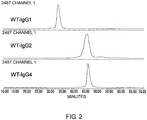
- the constant region of a humanized anti-human IL-6 receptor antibody, humanized PM-1 antibody ( Cancer Res. 1993 Feb 15;53(4):851-6 ), which is of the IgG1 isotype, was substituted with IgG2 or IgG4 ( Mol. Immunol. 1993 Jan;30(1):105-8 ) to generate molecules WT-IgG2 (SEQ ID NO: 13) and WT-IgG4 (SEQ ID NO: 14).
- An animal cell expression vector was used to express the IgGs.
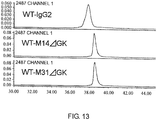
- homogeneous (less heterogeneous) substances are desirable as much as possible for antibody molecules developed as pharmaceuticals.
- wild type IgG2 there is a problem of homogeneity which is important in developing antibody pharmaceuticals.
- US20060194280 (A1 ) has shown that natural IgG2 gives various hetero-peaks as a result of the disulfide bonds in ion exchange chromatography analysis, and that the biological activity varies among these peaks.
- US20060194280 (A1 ) reports refolding in the purification process as a method for combining the hetero-peaks into a single one, but use of such a process in the production is costly and complicated.
- a preferred method for combining the hetero-peaks into a single one is based on amino acid substitution.
- the heterogeneity originated from disulfide bonds in the hinge region should be overcome to develop IgG2 as pharmaceuticals, no report has been published to date on a method for solving this problem through amino acid substitution.
- WT-M17 ⁇ GK (M17 ⁇ GK, SEQ ID NO: 10; WT-M17 ⁇ GK, SEQ ID NO: 20) was constructed by introducing mutations into the IgG1 constant region at positions 233, 234, 235, 236, 327, 330, 331, and 339 in the EU numbering system (G1 ⁇ ab described in Eur. J. Immunol. 1999 Aug;29(8):2613-24 ) to impair the Fc ⁇ receptor binding and by deleting the amino acids at positions 446 and 447 in the EU numbering system to reduce the C-terminal heterogeneity (Example 3).
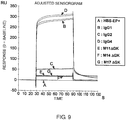
- Fig. 8 The result of comparison of data on the amounts of bound antibody determined is shown in Fig. 8 .
- Fc ⁇ RIIIa binding was assessed by the procedure described below.
- Fc ⁇ RIIIa human-derived Fc ⁇ receptor IIIa immobilized onto a sensor chip was allowed to interact with IgG1, IgG2, IgG4, M11 ⁇ GK, M14 ⁇ GK, or M17 ⁇ GK as an analyte.
- the amounts of bound antibody were compared.
- the measurement was conducted using hFc ⁇ RIIIaV-His6 (recombinant hFc ⁇ RIIIaV-His6 prepared in the applicants' company) as human-derived Fc ⁇ RIIIa, and IgG1, IgG2, IgG4, M11 ⁇ GK, M14 ⁇ GK, and M17 ⁇ GK as samples.
- the amount of increased Fab fragment was comparable between WT-IgG1 and WT-M17 ⁇ GK, while the amounts increased in WT-M14 ⁇ GK and WT-M11 ⁇ GK were about one quarter of the amount in WT.
- Degeneration pathways of IgG type antibody formulations include formation of aggregate and generation of Fab degradate as described in WO 2003/039485 . Based on the two criteria, aggregation and Fab fragment generation, WT-M14 ⁇ GK and WT-M11 ⁇ GK were demonstrated to have a superior stability in formulations as compared to WT-IgG1.
- M14 ⁇ GK prepared in Example 4 was altered by substituting the IgG2 sequence for the amino acids at positions 330, 331, and 339 in the EU numbering system to construct M31 ⁇ GK (M31 ⁇ GK, SEQ ID NO: 7).
- An expression vector for a sequence of antibody H chain whose variable region is WT and constant region sequence is M31 ⁇ GK (WT-M31 ⁇ GK, SEQ ID NO: 22) was constructed by the method described in Reference Example 1. Using WT-M31 ⁇ GK H chain and WT L chain, WT-M31 ⁇ GK was expressed and purified by the method described in Reference Example 1.
- IgG-type antibodies include the IgG1, IgG2, IgG3, and IgG4 isotypes.
- the plasma half-lives of these isotypes in human are reported to be about 36 days for IgG1 and IgG2; about 29 days for IgG3; and 16 days for IgG4 ( Nat. Biotechnol. 2007 Dec; 25(12):1369-72 ).
- the retention of IgG1 and IgG2 in plasma is believed to be the longest.
- the isotypes of antibodies used as pharmaceutical agents are IgG1, IgG2, and IgG4.
- FcRn is a complex of FcRn and ⁇ 2-microglobulin.
- Oligo-DNA primers were prepared based on the human FcRn gene sequence disclosed ( J. Exp. Med. (1994) 180 (6), 2377-2381 ).
- a DNA fragment encoding the whole gene was prepared by PCR using human cDNA (Human Placenta Marathon-Ready cDNA, Clontech) as a template and the prepared primers.
- a DNA fragment encoding the extracellular domain containing the signal region (Met1-Leu290) was amplified by PCR, and inserted into an animal cell expression vector (the amino acid sequence of human FcRn as set forth in SEQ ID NO: 24).
- oligo-DNA primers were prepared based on the human ⁇ 2-microglobulin gene sequence disclosed ( Proc. Natl. Acad. Sci. USA. (2002) 99 (26), 16899-16903 ).
- a DNA fragment encoding the whole gene was prepared by PCR using human cDNA (Hu-Placenta Marathon-Ready cDNA, CLONTECH) as a template and the prepared primers.
- a DNA fragment encoding the whole ⁇ 2-microglobulin containing the signal region was amplified by PCR and inserted into an animal cell expression vector (the amino acid sequence of human ⁇ 2-microglobulin as set forth in SEQ ID NO: 25).
- Soluble human FcRn was expressed by the following procedure.
- the plasmids constructed for human FcRn and ⁇ 2-microglobulin were introduced into cells of the human embryonic kidney cancer-derived cell line HEK293H (Invitrogen) using 10% Fetal Bovine Serum (Invitrogen) by lipofection.
- the resulting culture supernatant was collected, and FcRn was purified using IgG Sepharose 6 Fast Flow (Amersham Biosciences) by the method described in J. Immunol. 2002 Nov 1;169(9):5171-80 , followed by further purification using HiTrap Q HP (GE Healthcare).
- the affinity was computed using BIAevaluation Software. The obtained sensorgram was used to calculate the amount of hFcRn bound to the antibody immediately before the end of human FcRn injection. The affinity of the antibody for human FcRn was calculated by fitting with the steady state affinity method.
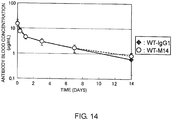
- mice The pharmacokinetics in human FcRn transgenic mice (B6.mFcRn-/-.hFcRn Tg line 276 +/+ mice; Jackson Laboratories) was assessed by the following procedure. An antibody was intravenously administered once at a dose of 1 mg/kg to mice, and blood was collected at appropriate time points. The collected blood was immediately centrifuged at 15,000 rpm and 4°C for 15 minutes to obtain blood plasma. The separated plasma was stored in a freezer at -20°C or below until use. The plasma concentration was determined by ELISA.
- the plasma retention of WT-M14 in human FcRn transgenic mice was comparable to that of WT-IgG1.
- Known methods to improve pharmacokinetics include those to lower the isoelectric point of an antibody and those to enhance the binding to FcRn.
- the modifications described below were introduced to improve the pharmacokinetics of WT-M14. Specifically, the following substitutions were introduced into WT-M31 ⁇ GK, which was prepared from WT-M14 as described in Example 4: substitution of methionine for valine at position 397; substitution of glutamine for histidine at position 268; substitution of glutamine for arginine at position 355; and substitution of glutamic acid for glutamine at position 419 in the EU numbering system.
- WT-M44 (amino acid sequence of SEQ ID NO: 27) was generated by introducing into IgG1 a substitution of alanine for the amino acid at position 434, EU numbering.
- WT-M83 (amino acid sequence of SEQ ID NO: 58) was also generated by deletions of glycine at position 446, EU numbering and lysine at position 447, EU numbering to reduce H chain C-terminal heterogeneity.
- WT-M73 (amino acid sequence of SEQ ID NO: 28) was generated by introducing into WT-M58 a substitution of alanine at position 434, EU numbering.
- Expression vectors for the above antibodies were constructed by the method described in Example 1.
- WT-M44, WT-M58, or WT-M73 was used as H chain, while L (WT) was used as L chain.
- WT-M44, WT-M58, and WT-M73 were expressed and purified by the method described in Example 1.
- WT-IgG1, WT-M14, and WT-M58 were confirmed to have increased retention in plasma relative to WT-IgG1 and WT-M14.
- WT-IgG1, WT-M44, WT-M58, and WT-M73 were assessed for their plasma retention in human FcRn transgenic mice.
- Fig. 15 all of WT-M44, WT-M58, and WT-M73 were confirmed to have improved pharmacokinetics relative to WT-IgG1. The pharmacokinetics-improving effect correlated with the binding activity to human FcRn.
- the plasma level of WT-M73 at Day 28 was improved to about 16 times of that of WT-IgG1. This finding suggests that the pharmacokinetics of antibodies with the M73 constant region in human is also significantly enhanced when compared to antibodies with the IgG1 constant region.
- Antibodies other than the humanized PM1 antibody were: the anti IL-6 receptor antibody F2H/L39 (the amino acid sequences of F2H/L39_VH and F2H/L39 VL as set forth in SEQ ID NOs: 29 and 30, respectively); anti-IL-31 receptor antibody H0L0 (the amino acid sequences of H0L0_VH and H0L0_VL as set forth in SEQ ID NOs: 31 and 32, respectively); and anti-RANKL antibody DNS (the amino acid sequences of DNS_VH and DNS_VL as set forth in SEQ ID NOs: 33 and 34, respectively).
- antibodies with IgG1 constant region (SEQ ID NO: 1), IgG2 constant region (SEQ ID NO: 2), or M14 (SEQ ID NO: 5) or M58 (SEQ ID NO: 35) were generated.
- the generated antibodies were assessed for heterogeneity by cation exchange chromatography using an adequate gradient and an appropriate flow rate on a ProPac WCX-10 (Dionex) column (mobile phase A: 20 mM sodium acetate (pH 5.0), mobile phase B: 20 mM sodium acetate/1M NaCl (pH 5.0)).
- the assessment result obtained by cation exchange chromatography (IEC) is shown in Fig. 16 .
- SKSC SEQ ID NO: 154
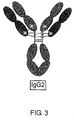
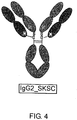
- SEQ ID NO: 38 is an altered constant region obtained by substituting serine for cysteine at position 131 and lysine for arginine at position 133, EU numbering, in the H-chain CH1 domain, and serine for cysteine at position 219, EU numbering, in the H-chain upper hinge of the wild type IgG2 constant region sequence.
- Another possible method for decreasing heterogeneity is a single substitution of serine for cysteine at position 219, or serine for cysteine at position 220, EU numbering, in the H-chain upper hinge.
- the altered IgG2 constant region SC (SEQ ID NO: 39) was prepared by substituting serine for cysteine at position 219 and CS (SEQ ID NO: 40) was prepared by substituting serine for cysteine at position 220, EU numbering, in IgG2.
- WT-SC SEQ ID NO: 41
- WT-CS SEQ ID NO: 42
- WT-IgG1, WT-IgG2, WT-SKSC, and WT-M58 were prepared to have SC and CS, respectively, and compared with WT-IgG1, WT-IgG2, WT-SKSC, and WT-M58 in terms of heterogeneity and thermal stability.
- F2H/L39-IgG1, F2H/L39-IgG2, F2H/L39-SC, F2H/L39-CS, F2H/L39-SKSC, and F2H/L39-M14 which have the constant region of IgG1 (SEQ ID NO: 1), IgG2 (SEQ ID NO: 2), SC (SEQ ID NO: 39), CS (SEQ ID NO: 40), SKSC (SEQ ID NO: 38), or M14 (SEQ ID NO: 5), respectively, were prepared from F2H/L39 (the amino acid sequences of F2H/L39_VH and F2H/L39_VL as set forth in SEQ ID NOs: 29 and 30, respectively), which is an anti IL-6 receptor antibody different from WT. The antibodies were compared with regard to heterogeneity.
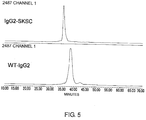
- WT-IgG1, WT-IgG2, WT-SC, WT-CS, WT-SKSC, WT-M58, F2H/L39-IgG1, F2H/L39-IgG2, F2H/L39-SC, F2H/L39-CS, F2H/L39-SKSC, and F2H/L39-M14 were assessed for heterogeneity by cation exchange chromatography using an adequate gradient and an appropriate flow rate on a ProPac WCX-10 (Dionex) column (mobile phase A: 20 mM sodium acetate (pH 5.0), mobile phase B: 20 mM sodium acetate/1M NaCl (pH 5.0)).
- the assessment result obtained by cation exchange chromatography is shown in Fig. 17 .
- Tm value the midpoint temperature of thermal denaturation
- DSC differential scanning calorimetry
- VP-DSC VP-DSC; Microcal
- Tm value the midpoint temperature of thermal denaturation
- Tm value a higher midpoint temperature of thermal denaturation (Tm value) is preferred ( J. Pharm. Sci. 2008 Apr;97(4):1414-26 ).
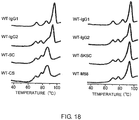
- WT-IgG1, WT-IgG2, WT-SC, WT-CS, WT-SKSC, and WT-M58 were dialyzed (EasySEP; TOMY) against a solution of 20 mM sodium acetate, 150 mM NaCl, pH 6.0. DSC measurement was carried out at a heating rate of 1°C/min in a range of 40 to 100°C, and at a protein concentration of about 0.1 mg/ml. The denaturation curves obtained by DSC are shown in Fig. 18 .
- the Tm values of the Fab domains are listed in Table 4 below. Table 4 Tm/°C WT-IgG1 94.8 WT-IgG2 93.9 WT-SC 86.7 WT-CS 86.4 WT-SKSC 93.7 WT-M58 93.7
- Tm values of WT-IgG1 and WT-IgG2 were almost the same (about 94°C; Tm of IgG2 was about 1 °C lower).
- Tm values of WT-SC and WT-CS were about 86°C, and thus significantly lower than those of WT-IgG1 and WT-IgG2.
- the Tm values of WT-M58 and WT-SKSC were about 94°C, and comparable to those of WT-IgG1 and WT-IgG2.
- WT-SC and WT-CS are markedly unstable as compared to IgG2, and thus, WT-SKSC and WT-M58, both of which also comprise substituion of serine for cysteine in the CHI domain, are preferred in the development of antibody pharmaceuticals.
- the reason for the significant decrease of Tm in WT-SC and WT-CS relative to IgG2 is thought to be differences in the disulfide-bonding pattern between WT-SC or WT-CS and IgG2.
- WT-IgG1, WT-SKSC, and WT-M58 each gave a sharp and single denaturation peak for the Fab domain.
- WT-SC and WT-CS each gave a broader denaturation peak for the Fab domain.
- WT-IgG2 also gave a shoulder peak on the lower temperature side of the Fab domain denaturation peak.
- the above-described result suggests the possibility that each of WT-IgG2, WT-SC, and WT-CS contains two or more components, and thus the natural-IgG2 heterogeneity has not been sufficiently reduced in WT-SC and WT-CS.
- This finding suggests that not only cysteines in the hinge region but also those in the CH1 domain are involved in the wild type-IgG2 heterogeneity, and it is necessary to alter not only cysteines in the hinge region but also those in the CH1 domain to decrease the DSC heterogeneity.
- stability comparable to that of wild type IgG2 can be acheived only when cysteines in both the hinge region and CH1 domain are substituted.
- SC and CS which are constant regions introduced with serine substitution for only the hinge region cysteine, are insufficient as constant regions to decrease heterogeneity originated from the hinge region of IgG2. It was thus discovered that the heterogeneity could be significantly decreased while maintaining an IgG2-equivalent stability, only when the cysteine at position 131, EU numbering, in the CH1 domain was substituted with serine in addition to cysteine at hinge region.
- Such constant regions include M14, M31, M58, and M73 described above.
- M58 and M73 are stable and less heterogeneous, and exhibit improved pharmacokinetics, and therefore are expected to be very useful as constant regions for antibody pharmaceuticals.
- TOCILIZUMAB H chain, WT-IgG1 (SEQ ID NO: 12); L chain, WT (SEQ ID NO: 15).
- Fv3-M73 H chain, VH4-M73, SEQ ID NO: 48; L chain, VL1-kappa, SEQ ID NO: 49
- Fv4-M73 H chain, VH3-M73, SEQ ID NO: 46; L chain, VL3-kappa, SEQ ID NO: 47
- Fv5-M83 H chain, VH5-M83, SEQ ID NO: 44; L chain, VL5-kappa, SEQ ID NO: 45.
- the affinities of prepared Fv3-M73, Fv4-M73, and Fv5-M83 against IL-6 receptor were compared to that of TOCILIZUMAB.
- the affinities of these anti- IL-6 receptor antibodies determined are shown in Table 5 (see Reference Example for method).
- their BaF/gp130-neutralizing activities were compared to those of TOCILIZUMAB and the control (the known high affinity anti-IL-6 receptor antibody described in Reference Example, and VQ8F11-21 hIgG1 described in US 2007/0280945 ) (see Reference Example for method).
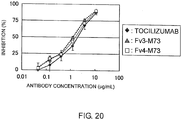
- the results obtained by determining the biological activities of these antibodies using BaF/gp130 are shown in Fig.
- Fv3-M73 and Fv4-M73 exhibit slightly stronger activities than TOCILIZUMAB.
- Fv5-M83 has a very strong activity, which is more than 100 times greater than that of TOCILIZUMAB in terms of 50% inhibitory concentration.
- Fv5-M83 also exhibits about 10 times higher neutralizing activity in terms of 50% inhibitory concentration than the control (the known high-affinity anti-IL-6 receptor antibody).
- the isoelectric points of TOCILIZUMAB, the control, Fv3-M73, Fv4-M73, and Fv5-M83 were determined by isoelectric focusing using a method known to those skilled in the art. The result showed that the isoelectric point was about 9.3 for TOCILIZUMAB; about 8.4 to 8.5 for the control; about 5.7 to 5.8 for Fv3-M73; about 5.6 to 5.7 for Fv4-M73; and 5.4 to 5.5 for Fv5-M83. Thus, each antibody had a significantly lowered isoelectric point when compared to TOCILIZUMAB and the control. Furthermore, the theoretical isoelectric point of the variable regions VH/VL was calculated by GENETYX (GENETYX CORPORATION).
- T-cell epitopes in the variable region sequence of TOCILIZUMAB, Fv3-M73, Fv4-M73, or Fv5-M83 were analyzed using TEPITOPE ( Methods. 2004 Dec;34(4):468-75 ).
- TOCILIZUMAB was predicted to have T-cell epitopes, of which many could bind to HLA.
- the number of sequences that were predicted to bind to T-cell epitopes was significantly reduced in Fv3-M73, Fv4-M73, and Fv5-M83.
- the framework of Fv3-M73, Fv4-M73, or Fv5-M83 has no mouse sequence and is thus fully humanized.
- Each of TOCILIZUMAB, the control, Fv3-M73, Fv4-M73, and Fv5-M83 was intravenously administered once at a dose of 1 mg/kg to cynomolgus monkeys to assess the time courses of their plasma concentrations (see Reference Example for method).
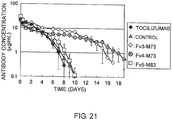
- the plasma concentration time courses of TOCILIZUMAB, Fv3-M73, Fv4-M73, and Fv5-M83 after intravenous administration are shown in Fig. 21 .
- the result showed that each of Fv3-M73, Fv4-M73, and Fv5-M83 exhibited significantly improved pharmacokinetics in cynomolgus monkeys when compared to TOCILIZUMAB and the control. Of them, Fv3-M73 and Fv4-M73 exhibited substantially improved pharmacokinetics when compared to TOCILIZUMAB.
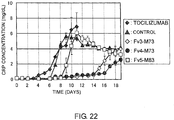
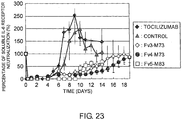
- Cynomolgus monkey IL-6 was administered subcutaneously in the lower back at 5 ⁇ g/kg every day from Day 6 to Day 18 after antibody administration (Day 3 to Day 10 for TOCILIZUMAB), and the CRP concentration in each animal was determined 24 hours later (see Reference Example for method). The time course of CRP concentration after administration of each antibody is shown in Fig. 22 .
- Each of Fv3-M73, Fv4-M73, and Fv5-M83 neutralized membrane-bound cynomolgus monkey IL-6 receptor in a more sustainable way, and suppressed the increase of CRP over a longer period when compared to TOCILIZUMAB and the control (the known high-affinity anti-IL-6 receptor antibody). Furthermore, each of Fv3-M73, Fv4-M73, and Fv5-M83 neutralized soluble cynomolgus monkey IL-6 receptor in a more sustainable way, and suppressed the increase of free soluble cynomolgus monkey IL-6 receptor over a longer period when compared to TOCILIZUMAB and the control.
- Fv3-M73, Fv4-M73, and Fv5-M83 are superior in sustaining the neutralization of membrane-bound and soluble IL-6 receptors than TOCILIZUMAB and the control.
- Fv3-M73 and Fv4-M73 are remarkably superior in sustaining the neutralization.
- Fv5-M83 suppressed CRP and free soluble cynomolgus monkey IL-6 receptor more strongly than Fv3-M73 and Fv4-M73.
- Fv5-M83 is considered to be stronger than Fv3-M73, Fv4-M73, and the control (the known high-affinity anti-IL-6 receptor antibody) in neutralizing membrane-bound and soluble IL-6 receptors.
- Fv3-M73 and Fv4-M73 are highly superior in sustaining their activities as an anti-IL-6 receptor-neutralizing antibody when compared to TOCILIZUMAB and the control, and thus enable to significantly reduce the dosage and frequency of administration.
- Fv5-M83 was demonstrated to be remarkably superior in terms of the strength of activity as an anti-IL-6 receptor-neutralizing antibody as well as sustaining their activity.
- Fv3-M73, Fv4-M73, and Fv5-M83 are expected to be useful as pharmaceutical IL-6 antagonists.
- Oligo-DNA primers were prepared based on the disclosed gene sequence for Rhesus monkey IL-6 receptor ( Birney et al., Ensembl 2006 , Nucleic Acids Res. 2006 Jan 1;34 (Database issue):D556-61 ).
- a DNA fragment encoding the whole cynomolgus monkey IL-6 receptor gene was prepared by PCR using the primers, and as a template, cDNA prepared from the pancreas of cynomolgus monkey.
- the resulting DNA fragment was inserted into an animal cell expression vector, and a stable expression CHO line (cyno.sIL-6R-producing CHO cell line) was prepared using the vector.
- the culture medium of cyno.sIL-6R-producing CHO cells was purified using a HisTrap column (GE Healthcare Bioscience) and then concentrated with Amicon Ultra-15 Ultracel-10k (Millipore).
- a final purified sample of soluble cynomolgus monkey IL-6 receptor (hereinafter cIL-6R) was obtained through further purification on a Superdex200pg16/60 gel filtration column (GE Healthcare Bioscience).
- Cynomolgus monkey IL-6 was prepared by the procedure described below.
- the nucleotide sequence encoding 212 amino acids deposited under SWISSPROT Accession No. P79341 was prepared and cloned into an animal cell expression vector.
- the resulting vector was introduced into CHO cells to prepare a stable expression cell line (cyno.IL-6-producing CHO cell line).
- the culture medium of cyno.IL-6-producing CHO cells was purified using a SP-Sepharose/FF column (GE Healthcare Bioscience) and then concentrated with Amicon Ultra-15 Ultracel-5k (Millipore).
- cIL-6 cynomolgus monkey IL-6
- VQ8F11-21 hIgG1 a known high-affinity anti-IL-6 receptor antibody.
- VQ8F11-21 hIgGI is described in US 2007/0280945 A1 ( US 2007/0280945 A1 ; the amino acid sequences of H chain and L chain as set forth in SEQ ID NOs: 19 and 27, respectively).
- the antibody variable region was constructed by PCR using a combination of synthetic oligo DNAs (assembly PCR). IgG1 was used as the constant region. The antibody variable and constant regions were combined together by assembly PCR, and then inserted into an animal cell expression vector to construct expression vectors for the H chain and L chain of interest.
- control high-affinity anti-IL-6 receptor antibody
- the IL-6 receptor neutralizing activity was assessed using BaF3/gp130 which proliferates in an IL-6/IL-6 receptor-dependent manner.
- BaF3/gp130 cells were suspended at 5 x 10 4 cells/ml in RPMI1640 supplemented with 600 ng/ml or 60 ng/ml human interleukin-6 (TORAY) (final concentration of 300 ng/ml or 30 ng/ml, respectively), appropriate amount of recombinant soluble human IL-6 receptor (SR344), and 10% FBS.
- the cell suspensions were dispensed (50 ⁇ l/well) into 96-well plates (CORNING).
- the purified antibodies were diluted with RPMI1640 containing 10% FBS, and added to each well (50 ⁇ l/well).
- the cells were cultured at 37°C under 5% CO 2 for three days.
- WST-8 Reagent Cell Counting Kit-8; Dojindo Laboratories
- the absorbance at 450 nm was measured using SUNRISE CLASSIC (TECAN).
- the absorbance at 450 nm reference wavelength: 620 nm
- the IL-6 receptor neutralizing activity was assessed using the change of absorbance during two hours as an indicator.
- Antigen-antibody reaction kinetics was analyzed using Biacore T100 (GE Healthcare).
- the SR344-antibody interaction was measured by immobilizing appropriate amounts of anti-IgG ( ⁇ -chain specific) F(ab') 2 onto a sensor chip by amine coupling method, binding antibodies of interest onto the chip at pH7.4, and then running IL-6 receptor SR344 adjusted to be various concentrations at pH7.4 over the chip as an analyte. All measurements were carried out at 37°C.
- the kinetic parameters, association rate constant k a (1/Ms) and dissociation rate constant k d (1/s) were calculated from the sensorgrams obtained by measurement. Then, K D (M) was determined based on the rate constants.
- the respective parameters were determined using Biacore T100 Evaluation Software (GE Healthcare).
- PK/PD test to determine the plasma concentrations of antibodies, CRP, and free soluble IL-6 receptor in monkeys
- the plasma concentrations in cynomolgus monkeys were determined by ELISA using a method known to those skilled in the art.
- the concentration of CRP was determined with an automated analyzer (TBA-120FR; Toshiba Medical Systems Co.) using Cias R CRP (KANTO CHEMICAL CO., INC.).
- the plasma concentration of free soluble cynomolgus monkey IL-6 receptor in cynomolgus monkeys was determined by the procedure described below. All IgG antibodies (cynomolgus monkey IgG, anti-human IL-6 receptor antibody, and anti-human IL-6 receptor antibody-soluble cynomolgus monkey IL-6 receptor complex) in the plasma were adsorbed onto Protein A by loading 30 ⁇ l of cynomolgus monkey plasma onto an appropriate amount of rProtein A Sepharose Fast Flow resin (GE Healthcare) dried in a 0.22- ⁇ m filter cup (Millipore). Then, the solution in cup was spinned down using a high-speed centrifuge to collect the solution that passed through.
- IgG antibodies cynomolgus monkey IgG, anti-human IL-6 receptor antibody, and anti-human IL-6 receptor antibody-soluble cynomolgus monkey IL-6 receptor complex
- the solution that passed through does not contain Protein A-bound anti-human IL-6 receptor antibody-soluble cynomolgus monkey IL-6 receptor complex. Therefore, the concentration of free soluble IL-6 receptor can be determined by measuring the concentration of soluble cynomolgus monkey IL-6 receptor in the solution that passed through Protein A. The concentration of soluble cynomolgus monkey IL-6 receptor was determined using a method known to those skilled in the art for measuring the concentrations of soluble human IL-6 receptor. Soluble cynomolgus monkey IL-6 receptor (cIL-6R) prepared as described above was used as a standard.
- the present invention provides antibody constant regions suitable for pharmaceuticals, whose physicochemical properties (stability and homogeneity), immunogenicity, safety, and pharmacokinetics have been improved by amino acid alteration.
- the present invention relates to the following items:
Landscapes
- Health & Medical Sciences (AREA)
- Chemical & Material Sciences (AREA)
- Organic Chemistry (AREA)
- Immunology (AREA)
- Medicinal Chemistry (AREA)
- Life Sciences & Earth Sciences (AREA)
- General Health & Medical Sciences (AREA)
- Biochemistry (AREA)
- Biophysics (AREA)
- Proteomics, Peptides & Aminoacids (AREA)
- Molecular Biology (AREA)
- Genetics & Genomics (AREA)
- Pharmacology & Pharmacy (AREA)
- Animal Behavior & Ethology (AREA)
- Public Health (AREA)
- Veterinary Medicine (AREA)
- Bioinformatics & Cheminformatics (AREA)
- Engineering & Computer Science (AREA)
- General Chemical & Material Sciences (AREA)
- Chemical Kinetics & Catalysis (AREA)
- Nuclear Medicine, Radiotherapy & Molecular Imaging (AREA)
- Epidemiology (AREA)
- Mycology (AREA)
- Microbiology (AREA)
- Pain & Pain Management (AREA)
- Rheumatology (AREA)
- Peptides Or Proteins (AREA)
- Medicines Containing Antibodies Or Antigens For Use As Internal Diagnostic Agents (AREA)
- Preparation Of Compounds By Using Micro-Organisms (AREA)
- Micro-Organisms Or Cultivation Processes Thereof (AREA)
Applications Claiming Priority (5)
| Application Number | Priority Date | Filing Date | Title |
|---|---|---|---|
| JP2007250147 | 2007-09-26 | ||
| EP18181757.8A EP3415529B1 (en) | 2007-09-26 | 2008-09-26 | Modified antibody constant region |
| PCT/JP2008/067483 WO2009041613A1 (ja) | 2007-09-26 | 2008-09-26 | 抗体定常領域改変体 |
| EP08834649.9A EP2194066B1 (en) | 2007-09-26 | 2008-09-26 | Modified antibody constant region |
| EP15200628.4A EP3059246B1 (en) | 2007-09-26 | 2008-09-26 | Modified antibody constant region |
Related Parent Applications (4)
| Application Number | Title | Priority Date | Filing Date |
|---|---|---|---|
| EP15200628.4A Division EP3059246B1 (en) | 2007-09-26 | 2008-09-26 | Modified antibody constant region |
| EP08834649.9A Division EP2194066B1 (en) | 2007-09-26 | 2008-09-26 | Modified antibody constant region |
| EP18181757.8A Division EP3415529B1 (en) | 2007-09-26 | 2008-09-26 | Modified antibody constant region |
| EP18181757.8A Division-Into EP3415529B1 (en) | 2007-09-26 | 2008-09-26 | Modified antibody constant region |
Publications (1)
| Publication Number | Publication Date |
|---|---|
| EP3789400A1 true EP3789400A1 (en) | 2021-03-10 |
Family
ID=40511493
Family Applications (4)
| Application Number | Title | Priority Date | Filing Date |
|---|---|---|---|
| EP20198500.9A Pending EP3789400A1 (en) | 2007-09-26 | 2008-09-26 | Modified antibody constant region |
| EP18181757.8A Active EP3415529B1 (en) | 2007-09-26 | 2008-09-26 | Modified antibody constant region |
| EP15200628.4A Active EP3059246B1 (en) | 2007-09-26 | 2008-09-26 | Modified antibody constant region |
| EP08834649.9A Active EP2194066B1 (en) | 2007-09-26 | 2008-09-26 | Modified antibody constant region |
Family Applications After (3)
| Application Number | Title | Priority Date | Filing Date |
|---|---|---|---|
| EP18181757.8A Active EP3415529B1 (en) | 2007-09-26 | 2008-09-26 | Modified antibody constant region |
| EP15200628.4A Active EP3059246B1 (en) | 2007-09-26 | 2008-09-26 | Modified antibody constant region |
| EP08834649.9A Active EP2194066B1 (en) | 2007-09-26 | 2008-09-26 | Modified antibody constant region |
Country Status (22)
| Country | Link |
|---|---|
| US (3) | US9688762B2 (enExample) |
| EP (4) | EP3789400A1 (enExample) |
| JP (9) | JP5484060B2 (enExample) |
| KR (6) | KR102339457B1 (enExample) |
| CN (1) | CN101874041B (enExample) |
| AR (4) | AR068563A1 (enExample) |
| AU (1) | AU2008304748C1 (enExample) |
| CA (5) | CA3066453C (enExample) |
| CL (1) | CL2008002886A1 (enExample) |
| DK (2) | DK3059246T3 (enExample) |
| ES (2) | ES2687808T3 (enExample) |
| IL (1) | IL204537A0 (enExample) |
| MX (2) | MX2010003450A (enExample) |
| MY (3) | MY180713A (enExample) |
| PE (1) | PE20090711A1 (enExample) |
| PH (3) | PH12021552811A1 (enExample) |
| PL (1) | PL3059246T3 (enExample) |
| RU (2) | RU2526512C2 (enExample) |
| SG (2) | SG10201605394SA (enExample) |
| TW (2) | TWI563002B (enExample) |
| WO (1) | WO2009041613A1 (enExample) |
| ZA (1) | ZA201002422B (enExample) |
Families Citing this family (189)
| Publication number | Priority date | Publication date | Assignee | Title |
|---|---|---|---|---|
| EP3050963B1 (en) | 2005-03-31 | 2019-09-18 | Chugai Seiyaku Kabushiki Kaisha | Process for production of polypeptide by regulation of assembly |
| JP5014143B2 (ja) * | 2005-10-14 | 2012-08-29 | 学校法人福岡大学 | 膵島移植における移植膵島障害抑制剤 |
| WO2007046489A1 (ja) | 2005-10-21 | 2007-04-26 | Chugai Seiyaku Kabushiki Kaisha | 心疾患治療剤 |
| AR057582A1 (es) * | 2005-11-15 | 2007-12-05 | Nat Hospital Organization | Agentes para suprimir la induccion de linfocitos t citotoxicos |
| WO2007086490A1 (ja) * | 2006-01-27 | 2007-08-02 | Keio University | 脈絡膜血管新生を伴う疾患の治療剤 |
| CA2647846C (en) | 2006-03-31 | 2016-06-21 | Chugai Seiyaku Kabushiki Kaisha | Methods for controlling blood pharmacokinetics of antibodies |
| CN105177091A (zh) | 2006-03-31 | 2015-12-23 | 中外制药株式会社 | 用于纯化双特异性抗体的抗体修饰方法 |
| US9260516B2 (en) * | 2006-04-07 | 2016-02-16 | Osaka University | Method for promoting muscle regeneration by administering an antibody to the IL-6 receptor |
| MY157796A (en) | 2006-06-08 | 2016-07-29 | Chugai Pharmaceutical Co Ltd | Preventive or remedy for inflammatory disease |
| MX2009007830A (es) * | 2007-01-23 | 2009-10-07 | Univ Shinshu | Inhibidor de rechazo cronico. |
| CN106519025B (zh) | 2007-09-26 | 2021-04-23 | 中外制药株式会社 | 利用cdr的氨基酸取代来改变抗体等电点的方法 |
| KR102339457B1 (ko) * | 2007-09-26 | 2021-12-14 | 추가이 세이야쿠 가부시키가이샤 | 항체 정상영역 개변체 |
| CN101939025B (zh) | 2007-12-05 | 2015-03-25 | 中外制药株式会社 | 搔痒症治疗药 |
| CA2708532C (en) | 2007-12-05 | 2018-06-05 | Chugai Seiyaku Kabushiki Kaisha | Anti-il31ra antibody and use thereof |
| CA2721052C (en) | 2008-04-11 | 2023-02-21 | Chugai Seiyaku Kabushiki Kaisha | Antigen-binding molecule capable of binding to two or more antigen molecules repeatedly |
| BRPI0910622A2 (pt) | 2008-04-25 | 2020-03-10 | Dyax Corp. | ANTICORPOS CONTRA FcRn E USOS DOS MESMOS |
| CA2728243C (en) * | 2008-06-05 | 2020-03-10 | National Cancer Center | Il-6 inhibitor for suppressing neuroinvasion in pancreatic cancer |
| TWI440469B (zh) * | 2008-09-26 | 2014-06-11 | Chugai Pharmaceutical Co Ltd | Improved antibody molecules |
| JP5139517B2 (ja) * | 2008-12-05 | 2013-02-06 | 中外製薬株式会社 | 抗nr10抗体、およびその利用 |
| JP2010210772A (ja) * | 2009-03-13 | 2010-09-24 | Dainippon Screen Mfg Co Ltd | 液晶表示装置の製造方法 |
| US9228017B2 (en) | 2009-03-19 | 2016-01-05 | Chugai Seiyaku Kabushiki Kaisha | Antibody constant region variant |
| TWI440470B (zh) * | 2009-03-19 | 2014-06-11 | Chugai Pharmaceutical Co Ltd | 含改良抗體分子之醫藥配方 |
| WO2010107109A1 (ja) * | 2009-03-19 | 2010-09-23 | 中外製薬株式会社 | 抗体定常領域改変体 |
| KR101314880B1 (ko) * | 2009-03-19 | 2013-10-04 | 추가이 세이야쿠 가부시키가이샤 | 관절류머티즘 치료제 |
| RU2011151069A (ru) | 2009-05-15 | 2013-06-20 | Чугаи Сейяку Кабусики Кайся | Анти-axl антитело |
| US9493578B2 (en) | 2009-09-02 | 2016-11-15 | Xencor, Inc. | Compositions and methods for simultaneous bivalent and monovalent co-engagement of antigens |
| US10150808B2 (en) | 2009-09-24 | 2018-12-11 | Chugai Seiyaku Kabushiki Kaisha | Modified antibody constant regions |
| JP5888728B2 (ja) | 2009-11-05 | 2016-03-22 | 国立大学法人大阪大学 | 自己免疫疾患又はアレルギー治療剤とそのスクリーニング方法 |
| TWI609698B (zh) | 2010-01-20 | 2018-01-01 | Chugai Pharmaceutical Co Ltd | 穩定化的含抗體溶液製劑 |
| WO2011092989A1 (ja) | 2010-01-29 | 2011-08-04 | 東レ株式会社 | ポリ乳酸系樹脂シート |
| EP2543730B1 (en) | 2010-03-04 | 2018-10-31 | Chugai Seiyaku Kabushiki Kaisha | Antibody constant region variant |
| SI2578231T1 (sl) | 2010-05-28 | 2023-01-31 | Chugai Seiyaku Kabushiki Kaisha | Okrepljen protitumorski T celični odzivnik |
| EP3029066B1 (en) | 2010-07-29 | 2019-02-20 | Xencor, Inc. | Antibodies with modified isoelectric points |
| IL315833A (en) | 2010-08-02 | 2024-11-01 | Regeneron Pharma | Mice producing binding proteins containing VL regions |
| GB201014033D0 (en) | 2010-08-20 | 2010-10-06 | Ucb Pharma Sa | Biological products |
| RU2620071C2 (ru) | 2010-11-17 | 2017-05-22 | Чугаи Сеияку Кабушики Каиша | Мультиспецифическая связывающая антиген молекула, которая обладает альтернативной функцией к функции фактора свертывания крови viii |
| TWI807362B (zh) * | 2010-11-30 | 2023-07-01 | 日商中外製藥股份有限公司 | 細胞傷害誘導治療劑 |
| BR112013013354A2 (pt) | 2010-11-30 | 2020-10-06 | Chugai Seiyaku Kabushiki Kaisha | molécula de ligação ao antígeno capaz de se ligar a uma pluralidade de moléculas de antígeno repetidamente |
| KR101820558B1 (ko) | 2010-12-23 | 2018-02-28 | 유리타 아. 게. | 넓은 영역에 나노 구조체를 생산하기 위한 시스템 및 방법 |
| HUE033205T2 (en) | 2010-12-23 | 2017-11-28 | Janssen Biotech Inc | Active protease-resistant antibody fc mutants |
| US8741298B2 (en) * | 2011-02-07 | 2014-06-03 | Neotope Biosciences Limited | APOE immunotherapy |
| EP2679681B2 (en) | 2011-02-25 | 2023-11-15 | Chugai Seiyaku Kabushiki Kaisha | FcgammaRIIB-specific FC antibody |
| ES2748583T3 (es) | 2011-06-02 | 2020-03-17 | Dyax Corp | Proteínas de unión al receptor Fc |
| EP4011913A1 (en) | 2011-06-30 | 2022-06-15 | Chugai Seiyaku Kabushiki Kaisha | Heterodimerized polypeptide |
| WO2013012022A1 (ja) | 2011-07-19 | 2013-01-24 | 中外製薬株式会社 | アルギニンアミドまたはその類似化合物を含む安定なタンパク質含有製剤 |
| WO2013022855A1 (en) * | 2011-08-05 | 2013-02-14 | Xencor, Inc. | Antibodies with modified isoelectric points and immunofiltering |
| JP6322411B2 (ja) | 2011-09-30 | 2018-05-09 | 中外製薬株式会社 | 複数の生理活性を有する抗原の消失を促進する抗原結合分子 |
| TW201326209A (zh) | 2011-09-30 | 2013-07-01 | Chugai Pharmaceutical Co Ltd | 具有促進抗原清除之FcRn結合域的治療性抗原結合分子 |
| US12466897B2 (en) | 2011-10-10 | 2025-11-11 | Xencor, Inc. | Heterodimeric human IgG1 polypeptides with isoelectric point modifications |
| US10851178B2 (en) | 2011-10-10 | 2020-12-01 | Xencor, Inc. | Heterodimeric human IgG1 polypeptides with isoelectric point modifications |
| CA3182462A1 (en) * | 2011-10-10 | 2013-04-18 | Xencor, Inc. | A method for purifying antibodies |
| WO2013065708A1 (ja) | 2011-10-31 | 2013-05-10 | 中外製薬株式会社 | 重鎖と軽鎖の会合が制御された抗原結合分子 |
| CN104203981A (zh) * | 2011-12-19 | 2014-12-10 | 合成免疫股份有限公司 | 双特异性抗体分子 |
| TWI593705B (zh) | 2011-12-28 | 2017-08-01 | Chugai Pharmaceutical Co Ltd | Humanized anti-epiregulin antibody and cancer therapeutic agent containing the antibody as an active ingredient |
| US10774132B2 (en) | 2012-01-09 | 2020-09-15 | The Scripps Research Instittue | Ultralong complementarity determining regions and uses thereof |
| WO2013116609A1 (en) * | 2012-02-01 | 2013-08-08 | Regeneron Pharmaceuticals, Inc. | Humanized rodents that express heavy chains containing vl domains |
| CN113527469A (zh) | 2012-02-09 | 2021-10-22 | 中外制药株式会社 | 抗体的Fc区变异体 |
| GB201203051D0 (en) | 2012-02-22 | 2012-04-04 | Ucb Pharma Sa | Biological products |
| GB201203071D0 (en) | 2012-02-22 | 2012-04-04 | Ucb Pharma Sa | Biological products |
| EP2862875B1 (en) | 2012-06-14 | 2023-09-06 | Chugai Seiyaku Kabushiki Kaisha | ANTIGEN-BINDING MOLECULE CONTAINING MODIFIED Fc REGION |
| JP6501521B2 (ja) | 2012-08-24 | 2019-04-17 | 中外製薬株式会社 | FcγRIIb特異的Fc領域改変体 |
| JP6774164B2 (ja) | 2012-08-24 | 2020-10-21 | 中外製薬株式会社 | マウスFcγRII特異的Fc抗体 |
| KR102249779B1 (ko) | 2012-12-27 | 2021-05-07 | 추가이 세이야쿠 가부시키가이샤 | 헤테로이량화 폴리펩티드 |
| WO2014110368A1 (en) | 2013-01-11 | 2014-07-17 | The California Institute For Biomedical Research | Bovine fusion antibodies |
| CA2898100C (en) | 2013-01-14 | 2023-10-10 | Xencor, Inc. | Novel heterodimeric proteins |
| US10487155B2 (en) | 2013-01-14 | 2019-11-26 | Xencor, Inc. | Heterodimeric proteins |
| US9605084B2 (en) | 2013-03-15 | 2017-03-28 | Xencor, Inc. | Heterodimeric proteins |
| US11053316B2 (en) | 2013-01-14 | 2021-07-06 | Xencor, Inc. | Optimized antibody variable regions |
| US10968276B2 (en) | 2013-03-12 | 2021-04-06 | Xencor, Inc. | Optimized anti-CD3 variable regions |
| US9701759B2 (en) | 2013-01-14 | 2017-07-11 | Xencor, Inc. | Heterodimeric proteins |
| US10131710B2 (en) | 2013-01-14 | 2018-11-20 | Xencor, Inc. | Optimized antibody variable regions |
| WO2014113510A1 (en) | 2013-01-15 | 2014-07-24 | Xencor, Inc. | Rapid clearance of antigen complexes using novel antibodies |
| TWI682941B (zh) | 2013-02-01 | 2020-01-21 | 美商再生元醫藥公司 | 含嵌合恆定區之抗體 |
| US10519242B2 (en) | 2013-03-15 | 2019-12-31 | Xencor, Inc. | Targeting regulatory T cells with heterodimeric proteins |
| US10858417B2 (en) | 2013-03-15 | 2020-12-08 | Xencor, Inc. | Heterodimeric proteins |
| EP3421495A3 (en) | 2013-03-15 | 2019-05-15 | Xencor, Inc. | Modulation of t cells with bispecific antibodies and fc fusions |
| US10106624B2 (en) | 2013-03-15 | 2018-10-23 | Xencor, Inc. | Heterodimeric proteins |
| CA2908350C (en) | 2013-04-02 | 2023-08-08 | Futa Mimoto | Fc region variant |
| JP6442404B2 (ja) | 2013-06-11 | 2018-12-19 | 国立研究開発法人国立精神・神経医療研究センター | 再発寛解型多発性硬化症(rrms)患者の治療予後予測方法、及び新規治療適応判断方法 |
| WO2014208482A1 (ja) | 2013-06-24 | 2014-12-31 | 中外製薬株式会社 | ヒト化抗Epiregulin抗体を有効成分として含む腺癌以外の非小細胞肺癌の治療剤 |
| CN105764922B (zh) | 2013-09-27 | 2020-07-17 | 中外制药株式会社 | 多肽异源多聚体的制备方法 |
| JPWO2015068847A1 (ja) | 2013-11-11 | 2017-03-09 | 中外製薬株式会社 | 改変された抗体可変領域を含む抗原結合分子 |
| IL296754A (en) | 2013-12-27 | 2022-11-01 | Chugai Pharmaceutical Co Ltd | A method for isolating an antibody with a low isoelectric point |
| TWI754319B (zh) | 2014-03-19 | 2022-02-01 | 美商再生元醫藥公司 | 用於腫瘤治療之方法及抗體組成物 |
| BR112016021572A2 (pt) | 2014-03-21 | 2017-10-03 | Regeneron Pharma | Métodos para preparar um animal não humano geneticamente modificado e para produzir proteínas de ligação, hibridoma, ácido nucleico, célula, e, proteína de ligação |
| ES2762640T3 (es) | 2014-03-21 | 2020-05-25 | Regeneron Pharma | Proteínas VL de unión a antígeno que exhiben diferentes características de unión |
| MX385936B (es) | 2014-03-28 | 2025-03-11 | Xencor Inc | Anticuerpos biespecíficos que se unen a cd38 y cd3. |
| MX380176B (es) | 2014-04-07 | 2025-03-12 | Chugai Pharmaceutical Co Ltd | Molecula ligada a antigeno inmunoactivada. |
| CN106459954A (zh) | 2014-05-13 | 2017-02-22 | 中外制药株式会社 | 用于具有免疫抑制功能的细胞的t细胞重定向的抗原结合分子 |
| KR101753553B1 (ko) | 2014-06-03 | 2017-07-03 | 엑스바이오테크, 인크. | 스타필로코커스 아우레우스 감염의 치료 및 예방을 위한 조성물 및 방법 |
| EP3155018A4 (en) * | 2014-06-06 | 2018-01-10 | The California Institute for Biomedical Research | Constant region antibody fusion proteins and compositions thereof |
| EP3185004A4 (en) | 2014-08-20 | 2018-05-30 | Chugai Seiyaku Kabushiki Kaisha | Method for measuring viscosity of protein solution |
| MA40764A (fr) | 2014-09-26 | 2017-08-01 | Chugai Pharmaceutical Co Ltd | Agent thérapeutique induisant une cytotoxicité |
| EP4632120A2 (en) | 2014-11-11 | 2025-10-15 | Chugai Seiyaku Kabushiki Kaisha | Library of antigen-binding molecules including modified antibody variable region |
| EP3699198B1 (en) | 2014-11-17 | 2025-03-26 | Regeneron Pharmaceuticals, Inc. | Methods for tumor treatment using cd3xcd20 bispecific antibody |
| HRP20201756T8 (hr) | 2014-11-21 | 2021-08-20 | Bristol-Myers Squibb Company | Antitijela koja sadrže modificirane regije teškog lanca |
| TWI711630B (zh) | 2014-11-21 | 2020-12-01 | 美商必治妥美雅史谷比公司 | 抗cd73抗體及其用途 |
| HRP20211273T1 (hr) | 2014-11-26 | 2021-11-12 | Xencor, Inc. | Heterodimerna protutijela koja vežu cd3 i cd20 |
| US10259887B2 (en) | 2014-11-26 | 2019-04-16 | Xencor, Inc. | Heterodimeric antibodies that bind CD3 and tumor antigens |
| MX2017006918A (es) | 2014-11-26 | 2018-01-25 | Xencor Inc | Anticuerpos heterodimericos que se unen a cd3 y cd38. |
| TWI617580B (zh) | 2014-12-19 | 2018-03-11 | 中外製藥股份有限公司 | 抗c5抗體及使用方法 |
| MY181199A (en) | 2014-12-19 | 2020-12-21 | Chugai Pharmaceutical Co Ltd | Anti-myostatin antibodies, polypeptides containing variant fc regions, and methods of use |
| EP3237449A2 (en) | 2014-12-22 | 2017-11-01 | Xencor, Inc. | Trispecific antibodies |
| CN107108729A (zh) | 2015-02-05 | 2017-08-29 | 中外制药株式会社 | 包含离子浓度依赖性的抗原结合结构域的抗体,fc区变体,il‑8‑结合抗体,及其应用 |
| RU2730590C2 (ru) | 2015-02-27 | 2020-08-24 | Чугаи Сейяку Кабусики Кайся | Композиция для лечения заболеваний, связанных с ил-6 |
| WO2016141387A1 (en) | 2015-03-05 | 2016-09-09 | Xencor, Inc. | Modulation of t cells with bispecific antibodies and fc fusions |
| EP3271403A1 (en) | 2015-03-19 | 2018-01-24 | Regeneron Pharmaceuticals, Inc. | Non-human animals that select for light chain variable regions that bind antigen |
| DK3277725T3 (da) | 2015-03-30 | 2021-01-11 | Regeneron Pharma | Konstante tungkædeområder med reduceret binding til FC-gammareceptorer |
| WO2016159213A1 (ja) | 2015-04-01 | 2016-10-06 | 中外製薬株式会社 | ポリペプチド異種多量体の製造方法 |
| WO2016167263A1 (ja) | 2015-04-14 | 2016-10-20 | 中外製薬株式会社 | Il-31アンタゴニストを有効成分として含有する、アトピー性皮膚炎の予防用及び/又は治療用医薬組成物 |
| JP5954916B1 (ja) | 2015-04-14 | 2016-07-20 | 中外製薬株式会社 | Il−31アンタゴニストを有効成分として含有する、アトピー性皮膚炎の予防用及び/又は治療用医薬組成物 |
| ES2888801T3 (es) | 2015-05-19 | 2022-01-07 | Nat Center Neurology & Psychiatry | Método para determinar la aplicación de una terapia nueva en pacientes con esclerosis múltiple (EM) |
| NZ739721A (en) * | 2015-08-07 | 2019-09-27 | Imaginab Inc | Antigen binding constructs to target molecules |
| EP3378488A4 (en) | 2015-11-18 | 2019-10-30 | Chugai Seiyaku Kabushiki Kaisha | METHOD FOR IMPROVING THE HUMORAL IMMUNE REACTION |
| US11660340B2 (en) | 2015-11-18 | 2023-05-30 | Chugai Seiyaku Kabushiki Kaisha | Combination therapy using T cell redirection antigen binding molecule against cell having immunosuppressing function |
| JP7058219B2 (ja) | 2015-12-07 | 2022-04-21 | ゼンコア インコーポレイテッド | Cd3及びpsmaに結合するヘテロ二量体抗体 |
| WO2017104783A1 (en) | 2015-12-18 | 2017-06-22 | Chugai Seiyaku Kabushiki Kaisha | Anti-myostatin antibodies, polypeptides containing variant fc regions, and methods of use |
| WO2017110981A1 (en) | 2015-12-25 | 2017-06-29 | Chugai Seiyaku Kabushiki Kaisha | Anti-myostatin antibodies and methods of use |
| CA3004288C (en) | 2015-12-28 | 2025-05-27 | Chugai Seiyaku Kabushiki Kaisha | METHOD FOR PROMOTING THE CLEARANCE EFFICIENCY OF A POLYPEPTIDE CONTAINING THE FC REGION |
| BR112018068363A2 (pt) | 2016-03-14 | 2019-01-15 | Chugai Seiyaku Kabushiki Kaisha | fármaco terapêutico indutor de dano celular para uso em terapia de câncer |
| GB201604458D0 (en) | 2016-03-16 | 2016-04-27 | Immatics Biotechnologies Gmbh | Peptides and combination of peptides for use in immunotherapy against cancers |
| WO2017181148A2 (en) | 2016-04-15 | 2017-10-19 | Alpine Immune Sciences, Inc. | Icos ligand variant immunomodulatory proteins and uses thereof |
| TWI820000B (zh) | 2016-04-28 | 2023-11-01 | 日商中外製藥股份有限公司 | 含抗體製劑 |
| FI3468586T3 (fi) | 2016-06-14 | 2024-10-29 | Xencor Inc | Bispesifisiä immuuniaktivaatiota vapauttavia vasta-aineita |
| EA201990017A1 (ru) | 2016-06-17 | 2019-07-31 | Чугаи Сейяку Кабусики Кайся | Антитела к миостатину и способы их применения |
| EP3475304B1 (en) | 2016-06-28 | 2022-03-23 | Xencor, Inc. | Heterodimeric antibodies that bind somatostatin receptor 2 |
| JP6527643B2 (ja) | 2016-08-05 | 2019-06-05 | 中外製薬株式会社 | Il−8関連疾患の治療用又は予防用組成物 |
| US10793632B2 (en) | 2016-08-30 | 2020-10-06 | Xencor, Inc. | Bispecific immunomodulatory antibodies that bind costimulatory and checkpoint receptors |
| SG10201607778XA (en) | 2016-09-16 | 2018-04-27 | Chugai Pharmaceutical Co Ltd | Anti-Dengue Virus Antibodies, Polypeptides Containing Variant Fc Regions, And Methods Of Use |
| CA3040504A1 (en) | 2016-10-14 | 2018-04-19 | Xencor, Inc. | Il15/il15ra heterodimeric fc-fusion proteins |
| US11542337B2 (en) | 2016-12-23 | 2023-01-03 | Bristol Myers Squibb Company | Therapeutic immunoglobulin G4 for improved bioanalytical and bioprocessing properties |
| US11266745B2 (en) | 2017-02-08 | 2022-03-08 | Imaginab, Inc. | Extension sequences for diabodies |
| CN110352074B (zh) | 2017-02-28 | 2024-07-16 | 思进股份有限公司 | 用于偶联的半胱氨酸突变抗体 |
| KR20200006526A (ko) * | 2017-03-28 | 2020-01-20 | 리브젠 바이오파마 홀딩스 리미티드 | 종양 미세 환경에서 면역 반응을 향상시키기 위한 치료제 및 방법 |
| JP7185884B2 (ja) | 2017-05-02 | 2022-12-08 | 国立研究開発法人国立精神・神経医療研究センター | Il-6及び好中球の関連する疾患の治療効果の予測及び判定方法 |
| MA49517A (fr) | 2017-06-30 | 2020-05-06 | Xencor Inc | Protéines de fusion fc hétérodimères ciblées contenant il-15/il-15ra et domaines de liaison à l'antigène |
| WO2019000105A1 (en) | 2017-06-30 | 2019-01-03 | Zymeworks Inc. | STABILIZED CHIMERIC FABES |
| EA202090974A1 (ru) * | 2017-10-18 | 2020-08-05 | Элпайн Иммьюн Сайенсиз, Инк. | Вариантные иммуномодулирующие белки лиганда icos и сопутствующие композиции и способы |
| EP3697441B1 (en) | 2017-10-20 | 2023-06-07 | F. Hoffmann-La Roche AG | Method for generating multispecific antibodies from monospecific antibodies |
| WO2019078344A1 (ja) | 2017-10-20 | 2019-04-25 | 学校法人兵庫医科大学 | 抗il-6受容体抗体を含有する術後の癒着を抑制するための医薬組成物 |
| BR112020007736A2 (pt) | 2017-10-30 | 2020-10-20 | F. Hoffmann-La Roche Ag | composição e método de tratamento |
| AR113816A1 (es) | 2017-11-01 | 2020-06-17 | Chugai Pharmaceutical Co Ltd | Variantes e isoformas de anticuerpos con actividad biológica reducida |
| WO2019094637A1 (en) | 2017-11-08 | 2019-05-16 | Xencor, Inc. | Bispecific and monospecific antibodies using novel anti-pd-1 sequences |
| US10981992B2 (en) | 2017-11-08 | 2021-04-20 | Xencor, Inc. | Bispecific immunomodulatory antibodies that bind costimulatory and checkpoint receptors |
| EP3720884A4 (en) | 2017-12-07 | 2021-09-29 | Chugai Seiyaku Kabushiki Kaisha | ANTIBODIES, COMPOSITIONS FOR USE IN DETECTION OR CAPTURE OF POLYPEPTIDE IN A SAMPLE, AND METHODS FOR DETECTION OR CAPTURE OF POLYPEPTIDE IN A SAMPLE |
| KR102722731B1 (ko) | 2017-12-19 | 2024-10-25 | 젠코어 인코포레이티드 | 조작된 il-2 fc 융합 단백질 |
| WO2019139987A1 (en) | 2018-01-09 | 2019-07-18 | Elstar Therapeutics, Inc. | Calreticulin binding constructs and engineered t cells for the treatment of diseases |
| WO2019178362A1 (en) | 2018-03-14 | 2019-09-19 | Elstar Therapeutics, Inc. | Multifunctional molecules that bind to calreticulin and uses thereof |
| IL277375B2 (en) | 2018-03-15 | 2025-08-01 | Chugai Pharmaceutical Co Ltd | Anti-dengue virus antibodies having cross-reactivity to zika virus and methods of use |
| CN112469477A (zh) | 2018-04-04 | 2021-03-09 | Xencor股份有限公司 | 与成纤维细胞活化蛋白结合的异源二聚体抗体 |
| CA3097741A1 (en) | 2018-04-18 | 2019-10-24 | Xencor, Inc. | Tim-3 targeted heterodimeric fusion proteins containing il-15/il-15ra fc-fusion proteins and tim-3 antigen binding domains |
| JP2021521784A (ja) | 2018-04-18 | 2021-08-30 | ゼンコア インコーポレイテッド | IL−15/IL−15RaFc融合タンパク質とPD−1抗原結合ドメインを含むPD−1標的化ヘテロダイマー融合タンパク質およびそれらの使用 |
| EP3797752B1 (en) | 2018-05-21 | 2024-07-17 | Chugai Seiyaku Kabushiki Kaisha | Lyophilized formulation sealed in glass container |
| CN119080931A (zh) * | 2018-06-04 | 2024-12-06 | 马萨诸塞州渤健公司 | 具有降低的效应功能的抗vla-4抗体 |
| AU2019297451A1 (en) | 2018-07-03 | 2021-01-28 | Marengo Therapeutics, Inc. | Anti-TCR antibody molecules and uses thereof |
| WO2020013170A1 (ja) * | 2018-07-10 | 2020-01-16 | 国立大学法人神戸大学 | 抗SIRPα抗体 |
| SG10202106830VA (en) | 2018-08-10 | 2021-08-30 | Chugai Pharmaceutical Co Ltd | Anti-cd137 antigen-binding molecule and utilization thereof |
| DK3844189T3 (da) | 2018-08-31 | 2025-02-24 | Regeneron Pharma | Doseringsstrategi, der mindsker cytokinfrigivelsessyndrom for CD3/CD20-bispecifikke antistoffer |
| SG11202103192RA (en) | 2018-10-03 | 2021-04-29 | Xencor Inc | Il-12 heterodimeric fc-fusion proteins |
| AU2020224681A1 (en) | 2019-02-21 | 2021-09-16 | Marengo Therapeutics, Inc. | Antibody molecules that bind to NKp30 and uses thereof |
| GB2599228B (en) | 2019-02-21 | 2024-02-07 | Marengo Therapeutics Inc | Multifunctional molecules that bind to T cell related cancer cells and uses thereof |
| MX2021010390A (es) | 2019-03-01 | 2021-11-17 | Xencor Inc | Anticuerpos heterodimericos que se unen a enpp3 y cd3. |
| AU2020255449A1 (en) * | 2019-03-29 | 2021-10-07 | Chugai Seiyaku Kabushiki Kaisha | Anti IL-6 receptor antibody-containing inhibitor for inhibiting deterioration of BBB function |
| TW202509079A (zh) * | 2019-04-04 | 2025-03-01 | 日商小野藥品工業股份有限公司 | 雙特異性抗體 |
| CA3136398A1 (en) | 2019-04-10 | 2020-10-15 | Chugai Seiyaku Kabushiki Kaisha | Method for purifying fc region-modified antibody |
| DE102019121007A1 (de) | 2019-08-02 | 2021-02-04 | Immatics Biotechnologies Gmbh | Antigenbindende Proteine, die spezifisch an MAGE-A binden |
| WO2021100794A1 (ja) | 2019-11-20 | 2021-05-27 | 中外製薬株式会社 | 抗体含有製剤 |
| WO2021122733A1 (en) | 2019-12-18 | 2021-06-24 | F. Hoffmann-La Roche Ag | Bispecific anti-ccl2 antibodies |
| UA128549C2 (uk) | 2019-12-27 | 2024-08-07 | Чугаі Сейяку Кабусікі Кайся | Антитіло до ctla-4 та його застосування |
| JP2023509708A (ja) | 2020-01-03 | 2023-03-09 | マレンゴ・セラピューティクス,インコーポレーテッド | 抗tcr抗体分子およびその使用 |
| TWI895351B (zh) | 2020-02-12 | 2025-09-01 | 日商中外製藥股份有限公司 | 用於癌症之治療的抗cd137抗原結合分子 |
| WO2021231976A1 (en) | 2020-05-14 | 2021-11-18 | Xencor, Inc. | Heterodimeric antibodies that bind prostate specific membrane antigen (psma) and cd3 |
| CN115697404A (zh) * | 2020-05-29 | 2023-02-03 | 中外制药株式会社 | 含有抗体的制剂 |
| MX2023000854A (es) | 2020-07-28 | 2023-02-15 | Chugai Pharmaceutical Co Ltd | Formulacion de jeringa precargada con aguja con protector de aguja que contiene nuevo anticuerpo modificado. |
| WO2022040482A1 (en) | 2020-08-19 | 2022-02-24 | Xencor, Inc. | Anti-cd28 and/or anti-b7h3 compositions |
| JP7731359B2 (ja) | 2020-08-28 | 2025-08-29 | 中外製薬株式会社 | ヘテロ二量体Fcポリペプチド |
| JP7714992B2 (ja) * | 2020-10-02 | 2025-07-30 | 小野薬品工業株式会社 | 二重特異性抗体を有効成分として含む医薬組成物 |
| CN117157319A (zh) | 2021-03-09 | 2023-12-01 | Xencor股份有限公司 | 结合cd3和cldn6的异二聚抗体 |
| KR20230154311A (ko) | 2021-03-10 | 2023-11-07 | 젠코어 인코포레이티드 | Cd3 및 gpc3에 결합하는 이종이량체 항체 |
| CA3221735A1 (en) | 2021-06-18 | 2022-12-22 | F. Hoffmann-La Roche Ag | Bispecific anti-ccl2 antibodies |
| TWI864408B (zh) | 2021-06-25 | 2024-12-01 | 日商中外製藥股份有限公司 | 抗ctla-4抗體的用途 |
| US12448451B2 (en) | 2021-06-25 | 2025-10-21 | Chugai Seiyaku Kabushiki Kaisha | Anti-CTLA-4 antibody and use thereof |
| JP7472405B2 (ja) | 2021-06-25 | 2024-04-22 | 中外製薬株式会社 | 抗ctla-4抗体 |
| US20250332263A1 (en) | 2021-10-04 | 2025-10-30 | Novartis Ag | Surfactant stabilizers |
| MX2024004117A (es) | 2021-10-08 | 2024-04-19 | Chugai Pharmaceutical Co Ltd | Metodo para preparar formulacion de jeringa precargada. |
| CN118414166A (zh) | 2021-12-01 | 2024-07-30 | 中外制药株式会社 | 含有抗体的制剂的制备方法 |
| CN119486774A (zh) | 2022-04-26 | 2025-02-18 | 中外制药株式会社 | 含有药物制剂的内置过滤器的注射器 |
| AU2023323589A1 (en) * | 2022-08-10 | 2025-02-27 | Kyowa Kirin Co., Ltd. | Anti-fgf23 antibody, and fragment of said antibody |
| WO2024214811A1 (ja) | 2023-04-14 | 2024-10-17 | 中外製薬株式会社 | タンパク質含有医薬製剤の安定化方法 |
Citations (9)
| Publication number | Priority date | Publication date | Assignee | Title |
|---|---|---|---|---|
| WO1999058572A1 (en) | 1998-05-08 | 1999-11-18 | Cambridge University Technical Services Limited | Binding molecules derived from immunoglobulins which do not trigger complement mediated lysis |
| WO2003039485A2 (en) | 2001-11-08 | 2003-05-15 | Protein Design Labs | Stable liquid pharmaceutical formulation of igg antibodies |
| US20040081651A1 (en) * | 2001-04-13 | 2004-04-29 | Michael Karpusas | Antibodies to vla-1 |
| WO2004113387A2 (en) * | 2003-06-24 | 2004-12-29 | Merck Patent Gmbh | Tumour necrosis factor receptor molecules with reduced immunogenicity |
| US20050261229A1 (en) | 1999-07-21 | 2005-11-24 | Emd Lexigen Research Center Corp. | Fc fusion proteins for enhancing the immunogenicity of protein and peptide antigens |
| US20060194280A1 (en) | 2004-10-22 | 2006-08-31 | Amgen Inc. | Methods for refolding of recombinant antibodies |
| US20070148167A1 (en) * | 2005-02-14 | 2007-06-28 | Strohl William R | Non-immunostimulatory antibody and compositions containing the same |
| US20070280945A1 (en) | 2006-06-02 | 2007-12-06 | Sean Stevens | High affinity antibodies to human IL-6 receptor |
| EP2031064A1 (de) * | 2007-08-29 | 2009-03-04 | Boehringer Ingelheim Pharma GmbH & Co. KG | Verfahren zur Steigerung von Proteintitern |
Family Cites Families (381)
| Publication number | Priority date | Publication date | Assignee | Title |
|---|---|---|---|---|
| US15133A (en) * | 1856-06-17 | Machine fob paring | ||
| US117097A (en) * | 1871-07-18 | Improvement in brick-machines | ||
| JPS5144499B1 (enExample) | 1970-08-29 | 1976-11-29 | ||
| JPS5334319B2 (enExample) | 1971-12-28 | 1978-09-20 | ||
| JPS5717624B2 (enExample) | 1974-04-17 | 1982-04-12 | ||
| JPS5484060A (en) | 1977-12-12 | 1979-07-04 | Kyushu Sekisui Kogyo | Treatment of raw *wakame* by using chlorella extract |
| US4324710A (en) | 1980-10-02 | 1982-04-13 | The Firestone Tire & Rubber Company | Naturally occurring thermoplastic resins as a substitute for various petroleum-derived materials in rubber stocks |
| US4816567A (en) | 1983-04-08 | 1989-03-28 | Genentech, Inc. | Recombinant immunoglobin preparations |
| US4737456A (en) | 1985-05-09 | 1988-04-12 | Syntex (U.S.A.) Inc. | Reducing interference in ligand-receptor binding assays |
| US4676980A (en) | 1985-09-23 | 1987-06-30 | The United States Of America As Represented By The Secretary Of The Department Of Health And Human Services | Target specific cross-linked heteroantibodies |
| US6548640B1 (en) | 1986-03-27 | 2003-04-15 | Btg International Limited | Altered antibodies |
| JPH0234615Y2 (enExample) | 1986-08-08 | 1990-09-18 | ||
| US5260203A (en) | 1986-09-02 | 1993-11-09 | Enzon, Inc. | Single polypeptide chain binding molecules |
| IL85035A0 (en) | 1987-01-08 | 1988-06-30 | Int Genetic Eng | Polynucleotide molecule,a chimeric antibody with specificity for human b cell surface antigen,a process for the preparation and methods utilizing the same |
| DE3883899T3 (de) | 1987-03-18 | 1999-04-22 | Sb2, Inc., Danville, Calif. | Geänderte antikörper. |
| US5004697A (en) | 1987-08-17 | 1991-04-02 | Univ. Of Ca | Cationized antibodies for delivery through the blood-brain barrier |
| US5606040A (en) | 1987-10-30 | 1997-02-25 | American Cyanamid Company | Antitumor and antibacterial substituted disulfide derivatives prepared from compounds possessing a methyl-trithio group |
| US5770701A (en) | 1987-10-30 | 1998-06-23 | American Cyanamid Company | Process for preparing targeted forms of methyltrithio antitumor agents |
| US5670373A (en) | 1988-01-22 | 1997-09-23 | Kishimoto; Tadamitsu | Antibody to human interleukin-6 receptor |
| US5322678A (en) | 1988-02-17 | 1994-06-21 | Neorx Corporation | Alteration of pharmacokinetics of proteins by charge modification |
| FR2628833B1 (fr) | 1988-03-18 | 1993-06-25 | Pont Sur Sambre Ateliers Mecan | Dispositif assurant le deconfinement d'une charge militaire contenant un explosif |
| CA1332367C (en) | 1988-09-28 | 1994-10-11 | Richard Mark Bartholomew | Method for the reduction of heterogeneity of monoclonal antibodies |
| US5126250A (en) * | 1988-09-28 | 1992-06-30 | Eli Lilly And Company | Method for the reduction of heterogeneity of monoclonal antibodies |
| ATE102631T1 (de) | 1988-11-11 | 1994-03-15 | Medical Res Council | Klonierung von immunglobulin sequenzen aus den variabelen domaenen. |
| DE3920358A1 (de) | 1989-06-22 | 1991-01-17 | Behringwerke Ag | Bispezifische und oligospezifische, mono- und oligovalente antikoerperkonstrukte, ihre herstellung und verwendung |
| GB8916400D0 (en) | 1989-07-18 | 1989-09-06 | Dynal As | Modified igg3 |
| US5208020A (en) | 1989-10-25 | 1993-05-04 | Immunogen Inc. | Cytotoxic agents comprising maytansinoids and their therapeutic use |
| CA2026147C (en) | 1989-10-25 | 2006-02-07 | Ravi J. Chari | Cytotoxic agents comprising maytansinoids and their therapeutic use |
| US5959177A (en) | 1989-10-27 | 1999-09-28 | The Scripps Research Institute | Transgenic plants expressing assembled secretory antibodies |
| US5859205A (en) | 1989-12-21 | 1999-01-12 | Celltech Limited | Humanised antibodies |
| US6150584A (en) | 1990-01-12 | 2000-11-21 | Abgenix, Inc. | Human antibodies derived from immunized xenomice |
| US6075181A (en) | 1990-01-12 | 2000-06-13 | Abgenix, Inc. | Human antibodies derived from immunized xenomice |
| US5770429A (en) | 1990-08-29 | 1998-06-23 | Genpharm International, Inc. | Transgenic non-human animals capable of producing heterologous antibodies |
| CA2095633C (en) | 1990-12-03 | 2003-02-04 | Lisa J. Garrard | Enrichment method for variant proteins with altered binding properties |
| US5571894A (en) | 1991-02-05 | 1996-11-05 | Ciba-Geigy Corporation | Recombinant antibodies specific for a growth factor receptor |
| TW205553B (enExample) | 1991-04-25 | 1993-05-11 | Chugai Pharmaceutical Co Ltd | |
| EP0940468A1 (en) | 1991-06-14 | 1999-09-08 | Genentech, Inc. | Humanized antibody variable domain |
| US5468634A (en) | 1991-06-24 | 1995-11-21 | The University Of North Carolina At Chapel Hill | Axl oncogene |
| GB9114948D0 (en) | 1991-07-11 | 1991-08-28 | Pfizer Ltd | Process for preparing sertraline intermediates |
| US6136310A (en) | 1991-07-25 | 2000-10-24 | Idec Pharmaceuticals Corporation | Recombinant anti-CD4 antibodies for human therapy |
| EP0604580A1 (en) | 1991-09-19 | 1994-07-06 | Genentech, Inc. | EXPRESSION IN E. COLI OF ANTIBODY FRAGMENTS HAVING AT LEAST A CYSTEINE PRESENT AS A FREE THIOL, USE FOR THE PRODUCTION OF BIFUNCTIONAL F(ab') 2? ANTIBODIES |
| FI941572A7 (fi) | 1991-10-07 | 1994-05-27 | Oncologix Inc | Anti-erbB-2-monoklonaalisten vasta-aineiden yhdistelmä ja käyttömenete lmä |
| WO1993008829A1 (en) | 1991-11-04 | 1993-05-13 | The Regents Of The University Of California | Compositions that mediate killing of hiv-infected cells |
| DE69334255D1 (de) | 1992-02-06 | 2009-02-12 | Novartis Vaccines & Diagnostic | Marker für Krebs und biosynthetisches Bindeprotein dafür |
| US6129914A (en) | 1992-03-27 | 2000-10-10 | Protein Design Labs, Inc. | Bispecific antibody effective to treat B-cell lymphoma and cell line |
| ZA936260B (en) | 1992-09-09 | 1994-03-18 | Smithkline Beecham Corp | Novel antibodies for conferring passive immunity against infection by a pathogen in man |
| US5639641A (en) | 1992-09-09 | 1997-06-17 | Immunogen Inc. | Resurfacing of rodent antibodies |
| BR9204244A (pt) | 1992-10-26 | 1994-05-03 | Cofap | Ferro fundido cinzento |
| DE69303494T2 (de) | 1992-11-13 | 1997-01-16 | Idec Pharma Corp | Therapeutische verwendung von chimerischen und markierten antikörper gegen menschlichen b lymphozyt beschränkter differenzierung antigen für die behandlung von b-zell-lymphoma |
| WO1994012215A1 (en) | 1992-12-01 | 1994-06-09 | Protein Design Labs, Inc. | Humanized antibodies reactive with l-selectin |
| US5635483A (en) | 1992-12-03 | 1997-06-03 | Arizona Board Of Regents Acting On Behalf Of Arizona State University | Tumor inhibiting tetrapeptide bearing modified phenethyl amides |
| US5780588A (en) | 1993-01-26 | 1998-07-14 | Arizona Board Of Regents | Elucidation and synthesis of selected pentapeptides |
| WO1994029351A2 (en) | 1993-06-16 | 1994-12-22 | Celltech Limited | Antibodies |
| US5888510A (en) | 1993-07-21 | 1999-03-30 | Chugai Seiyaku Kabushiki Kaisha | Chronic rheumatoid arthritis therapy containing IL-6 antagonist as effective component |
| UA40577C2 (uk) | 1993-08-02 | 2001-08-15 | Мерк Патент Гмбх | Біспецифічна молекула, що використовується для лізису пухлинних клітин, спосіб її одержання, моноклональне антитіло (варіанти), фармацевтичний препарат, фармацевтичний набір (варіанти), спосіб видалення пухлинних клітин |
| IL107742A0 (en) | 1993-11-24 | 1994-02-27 | Yeda Res & Dev | Chemically-modified binding proteins |
| US5945311A (en) | 1994-06-03 | 1999-08-31 | GSF--Forschungszentrumfur Umweltund Gesundheit | Method for producing heterologous bi-specific antibodies |
| US5773001A (en) | 1994-06-03 | 1998-06-30 | American Cyanamid Company | Conjugates of methyltrithio antitumor agents and intermediates for their synthesis |
| DE4419399C1 (de) | 1994-06-03 | 1995-03-09 | Gsf Forschungszentrum Umwelt | Verfahren zur Herstellung von heterologen bispezifischen Antikörpern |
| US8017121B2 (en) | 1994-06-30 | 2011-09-13 | Chugai Seiyaku Kabushika Kaisha | Chronic rheumatoid arthritis therapy containing IL-6 antagonist as effective component |
| US6309636B1 (en) | 1995-09-14 | 2001-10-30 | Cancer Research Institute Of Contra Costa | Recombinant peptides derived from the Mc3 anti-BA46 antibody, methods of use thereof, and methods of humanizing antibody peptides |
| CA2201781C (en) | 1994-10-07 | 2010-01-12 | Tadamitsu Kishimoto | Chronic rheumatoid arthritis therapy containing il-6 antagonist as effective component |
| EP1884524A3 (en) | 1994-10-21 | 2008-06-25 | Chugai Seiyaku Kabushiki Kaisha | Pharmaceutical composition for treatment of diseases caused by IL-6 production |
| US5789199A (en) | 1994-11-03 | 1998-08-04 | Genentech, Inc. | Process for bacterial production of polypeptides |
| US6485943B2 (en) | 1995-01-17 | 2002-11-26 | The University Of Chicago | Method for altering antibody light chain interactions |
| US5876950A (en) | 1995-01-26 | 1999-03-02 | Bristol-Myers Squibb Company | Monoclonal antibodies specific for different epitopes of human GP39 and methods for their use in diagnosis and therapy |
| AU4865296A (en) | 1995-02-28 | 1996-09-18 | Procter & Gamble Company, The | Preparation of noncarbonated beverage products having superior microbial stability |
| US5731168A (en) | 1995-03-01 | 1998-03-24 | Genentech, Inc. | Method for making heteromultimeric polypeptides |
| US5840523A (en) | 1995-03-01 | 1998-11-24 | Genetech, Inc. | Methods and compositions for secretion of heterologous polypeptides |
| US5869046A (en) | 1995-04-14 | 1999-02-09 | Genentech, Inc. | Altered polypeptides with increased half-life |
| US5714586A (en) | 1995-06-07 | 1998-02-03 | American Cyanamid Company | Methods for the preparation of monomeric calicheamicin derivative/carrier conjugates |
| US5712374A (en) | 1995-06-07 | 1998-01-27 | American Cyanamid Company | Method for the preparation of substantiallly monomeric calicheamicin derivative/carrier conjugates |
| US6267958B1 (en) | 1995-07-27 | 2001-07-31 | Genentech, Inc. | Protein formulation |
| CN1241944C (zh) | 1995-09-11 | 2006-02-15 | 协和发酵工业株式会社 | 抗人白介素-5受体α链的抗体 |
| GB9603256D0 (en) | 1996-02-16 | 1996-04-17 | Wellcome Found | Antibodies |
| US20020147326A1 (en) | 1996-06-14 | 2002-10-10 | Smithkline Beecham Corporation | Hexameric fusion proteins and uses therefor |
| EP0938499A1 (en) | 1996-07-19 | 1999-09-01 | Amgen Inc. | Analogs of cationic proteins |
| US5990286A (en) | 1996-12-18 | 1999-11-23 | Techniclone, Inc. | Antibodies with reduced net positive charge |
| JPH10324639A (ja) | 1997-03-21 | 1998-12-08 | Chugai Pharmaceut Co Ltd | Il−6アンタゴニストを有効成分として含有する感作t細胞関与疾患の予防・治療剤 |
| US20070059302A1 (en) | 1997-04-07 | 2007-03-15 | Genentech, Inc. | Anti-vegf antibodies |
| US6884879B1 (en) | 1997-04-07 | 2005-04-26 | Genentech, Inc. | Anti-VEGF antibodies |
| AU751659B2 (en) | 1997-05-02 | 2002-08-22 | Genentech Inc. | A method for making multispecific antibodies having heteromultimeric and common components |
| US6171586B1 (en) | 1997-06-13 | 2001-01-09 | Genentech, Inc. | Antibody formulation |
| JP2002506353A (ja) | 1997-06-24 | 2002-02-26 | ジェネンテック・インコーポレーテッド | ガラクトシル化糖タンパク質の方法及び組成物 |
| US5980893A (en) | 1997-07-17 | 1999-11-09 | Beth Israel Deaconess Medical Center, Inc. | Agonist murine monoclonal antibody as a stimulant for megakaryocytopoiesis |
| US6040498A (en) | 1998-08-11 | 2000-03-21 | North Caroline State University | Genetically engineered duckweed |
| KR20090068385A (ko) | 1997-08-15 | 2009-06-26 | 츄가이 세이야꾸 가부시키가이샤 | 항 인터루킨-6 수용체 항체를 유효성분으로서 함유하는 전신성 홍반성 낭창의 예방 및/또는 치료제 |
| US20020187150A1 (en) | 1997-08-15 | 2002-12-12 | Chugai Seiyaku Kabushiki Kaisha | Preventive and/or therapeutic agent for systemic lupus erythematosus comprising anti-IL-6 receptor antibody as an active ingredient |
| CN1277632A (zh) | 1997-10-03 | 2000-12-20 | 中外制药株式会社 | 天然人源化抗体 |
| WO1999022764A1 (en) | 1997-10-31 | 1999-05-14 | Genentech, Inc. | Methods and compositions comprising glycoprotein glycoforms |
| US6610833B1 (en) | 1997-11-24 | 2003-08-26 | The Institute For Human Genetics And Biochemistry | Monoclonal human natural antibodies |
| BR9813365A (pt) | 1997-12-05 | 2004-06-15 | Scripps Research Inst | Método para produção e humanização de um anticorpo monoclonal de rato |
| JP4124573B2 (ja) | 1998-03-17 | 2008-07-23 | 中外製薬株式会社 | Il−6アンタゴニストを有効成分として含有する炎症性腸疾患の予防又は治療剤 |
| PT1068241E (pt) | 1998-04-02 | 2007-11-19 | Genentech Inc | Variantes de anticorpos e respectivos fragmentos |
| US6194551B1 (en) | 1998-04-02 | 2001-02-27 | Genentech, Inc. | Polypeptide variants |
| ATE512225T1 (de) | 1998-04-03 | 2011-06-15 | Chugai Pharmaceutical Co Ltd | Humanisierter antikörper gegen den menschlichen gewebefaktor (tf) und verfahren für die konstruktion eines solchen humanisierten antikörpers. |
| US20030175884A1 (en) | 2001-08-03 | 2003-09-18 | Pablo Umana | Antibody glycosylation variants having increased antibody-dependent cellular cytotoxicity |
| DK1071700T3 (da) | 1998-04-20 | 2010-06-07 | Glycart Biotechnology Ag | Glykosylerings-modifikation af antistoffer til forbedring af antistofafhængig cellulær cytotoksicitet |
| US20020142374A1 (en) | 1998-08-17 | 2002-10-03 | Michael Gallo | Generation of modified molecules with increased serum half-lives |
| MXPA01005515A (es) | 1998-12-01 | 2003-07-14 | Protein Design Labs Inc | Anticuerpos humanizados para gamma-interferon. |
| AU776910B2 (en) | 1998-12-08 | 2004-09-23 | Merck Patent Gesellschaft Mit Beschrankter Haftung | Modifying protein immunogenicity |
| US6737056B1 (en) | 1999-01-15 | 2004-05-18 | Genentech, Inc. | Polypeptide variants with altered effector function |
| KR101077001B1 (ko) | 1999-01-15 | 2011-10-26 | 제넨테크, 인크. | 효과기 기능이 변화된 폴리펩티드 변이체 |
| US6972125B2 (en) | 1999-02-12 | 2005-12-06 | Genetics Institute, Llc | Humanized immunoglobulin reactive with B7-2 and methods of treatment therewith |
| AU3672800A (en) | 1999-04-09 | 2000-11-14 | Kyowa Hakko Kogyo Co. Ltd. | Method for controlling the activity of immunologically functional molecule |
| EP2325316B8 (en) | 1999-06-02 | 2017-04-19 | Chugai Seiyaku Kabushiki Kaisha | Novel hemopoietin receptor protein, NR10 |
| US7125978B1 (en) | 1999-10-04 | 2006-10-24 | Medicago Inc. | Promoter for regulating expression of foreign genes |
| DE60022369T2 (de) | 1999-10-04 | 2006-05-18 | Medicago Inc., Sainte Foy | Verfahren zur regulation der transkription von fremden genen in gegenwart von stickstoff |
| EP1229125A4 (en) | 1999-10-19 | 2005-06-01 | Kyowa Hakko Kogyo Kk | PROCESS FOR PREPARING A POLYPEPTIDE |
| SE9903895D0 (sv) | 1999-10-28 | 1999-10-28 | Active Biotech Ab | Novel compounds |
| CA2393869A1 (en) | 1999-12-15 | 2001-06-21 | Genetech,Inc. | Shotgun scanning, a combinatorial method for mapping functional protein epitopes |
| CA2395660A1 (en) | 1999-12-29 | 2001-07-12 | Immunogen, Inc. | Cytotoxic agents comprising modified doxorubicins and daunorubicins and their therapeutic use |
| JP2004505609A (ja) | 2000-04-03 | 2004-02-26 | オックスフォード グリコサイエンシズ(ユーケー) リミテッド | 核酸分子、ポリペプチド、ならびにアルツハイマー病の診断および処置を含むそれらの使用 |
| MXPA02010011A (es) | 2000-04-11 | 2003-04-25 | Genentech Inc | Anticuerpos multivalentes y usos para los mismos. |
| JP2004511426A (ja) | 2000-05-03 | 2004-04-15 | ミュンヘン バイオテク アーゲー | 活性化血管部位に関連する陽イオン性の診断薬、画像化剤、および治療薬 |
| US7064191B2 (en) | 2000-10-06 | 2006-06-20 | Kyowa Hakko Kogyo Co., Ltd. | Process for purifying antibody |
| HU231090B1 (hu) | 2000-10-06 | 2020-07-28 | Kyowa Kirin Co., Ltd. | Antitest-kompozíciót termelő sejt |
| US6946292B2 (en) | 2000-10-06 | 2005-09-20 | Kyowa Hakko Kogyo Co., Ltd. | Cells producing antibody compositions with increased antibody dependent cytotoxic activity |
| EP1334731B1 (en) | 2000-10-25 | 2008-02-27 | Chugai Seiyaku Kabushiki Kaisha | Preventives or remedies for psoriasis containing as the active ingredient il-6 antagonist |
| JP4889187B2 (ja) | 2000-10-27 | 2012-03-07 | 中外製薬株式会社 | Il−6アンタゴニストを有効成分として含有する血中mmp−3濃度低下剤 |
| US6596541B2 (en) | 2000-10-31 | 2003-07-22 | Regeneron Pharmaceuticals, Inc. | Methods of modifying eukaryotic cells |
| ES2405944T3 (es) | 2000-11-30 | 2013-06-04 | Medarex, Inc. | Ácidos nucleicos que codifican las secuencias de inmunoglobulina humana reorganizadas a partir de ratones transcromoscómicos transgénicos zadas |
| DK1355919T3 (da) | 2000-12-12 | 2011-03-14 | Medimmune Llc | Molekyler med længere halveringstider, sammensætninger og anvendelser deraf |
| RU2003129528A (ru) | 2001-03-07 | 2005-04-10 | Мерк Патент ГмбХ (DE) | Способ экспрессии белков, содержащих в качестве компонента гибридный изотип антитела |
| UA80091C2 (en) | 2001-04-02 | 2007-08-27 | Chugai Pharmaceutical Co Ltd | Remedies for infant chronic arthritis-relating diseases and still's disease which contain an interleukin-6 (il-6) antagonist |
| PT2208784E (pt) | 2001-06-22 | 2013-04-03 | Chugai Pharmaceutical Co Ltd | Inibidores da proliferação celular contendo um anticorpo anti-glipicano 3 |
| US6833441B2 (en) | 2001-08-01 | 2004-12-21 | Abmaxis, Inc. | Compositions and methods for generating chimeric heteromultimers |
| US20030049203A1 (en) | 2001-08-31 | 2003-03-13 | Elmaleh David R. | Targeted nucleic acid constructs and uses related thereto |
| ATE430580T1 (de) | 2001-10-25 | 2009-05-15 | Genentech Inc | Glycoprotein-zusammensetzungen |
| US20030190705A1 (en) | 2001-10-29 | 2003-10-09 | Sunol Molecular Corporation | Method of humanizing immune system molecules |
| US20040093621A1 (en) | 2001-12-25 | 2004-05-13 | Kyowa Hakko Kogyo Co., Ltd | Antibody composition which specifically binds to CD20 |
| EP3960855A1 (en) | 2001-12-28 | 2022-03-02 | Chugai Seiyaku Kabushiki Kaisha | Method for stabilizing proteins |
| DK1576112T3 (da) | 2002-01-18 | 2012-06-25 | Zymogenetics Inc | Cytokin-receptor zcytor17-multimerer |
| ATE536406T1 (de) | 2002-01-18 | 2011-12-15 | Zymogenetics Inc | Neuartiger zytokin-zcytor17-ligand |
| KR20040082421A (ko) | 2002-02-11 | 2004-09-24 | 제넨테크, 인크. | 빠른 항원 결합 속도를 갖는 항체 변이체 |
| US8188231B2 (en) | 2002-09-27 | 2012-05-29 | Xencor, Inc. | Optimized FC variants |
| US20040110226A1 (en) | 2002-03-01 | 2004-06-10 | Xencor | Antibody optimization |
| US7736652B2 (en) | 2002-03-21 | 2010-06-15 | The Regents Of The University Of California | Antibody fusion proteins: effective adjuvants of protein vaccination |
| EP1498485A4 (en) | 2002-04-09 | 2006-09-06 | Kyowa Hakko Kogyo Kk | MODIFIED GENOME CELLS |
| JP4832719B2 (ja) | 2002-04-09 | 2011-12-07 | 協和発酵キリン株式会社 | FcγRIIIa多型患者に適応する抗体組成物含有医薬 |
| WO2003084569A1 (en) | 2002-04-09 | 2003-10-16 | Kyowa Hakko Kogyo Co., Ltd. | Drug containing antibody composition |
| WO2003085102A1 (en) | 2002-04-09 | 2003-10-16 | Kyowa Hakko Kogyo Co., Ltd. | Cell with depression or deletion of the activity of protein participating in gdp-fucose transport |
| CA2481837A1 (en) | 2002-04-09 | 2003-10-16 | Kyowa Hakko Kogyo Co., Ltd. | Production process for antibody composition |
| EP1498491A4 (en) | 2002-04-09 | 2006-12-13 | Kyowa Hakko Kogyo Kk | METHOD FOR ENHANCING ACTIVITY OF BINDING ANTIBODY COMPOSITION WITH FC GAMMA IIIA RECEPTOR |
| JP2006512891A (ja) | 2002-04-18 | 2006-04-20 | ジェネンコー・インターナショナル・インク | 糸状菌における機能性抗体の生産 |
| WO2005056606A2 (en) | 2003-12-03 | 2005-06-23 | Xencor, Inc | Optimized antibodies that target the epidermal growth factor receptor |
| JP2004086862A (ja) | 2002-05-31 | 2004-03-18 | Celestar Lexico-Sciences Inc | タンパク質相互作用情報処理装置、タンパク質相互作用情報処理方法、プログラム、および、記録媒体 |
| WO2003107218A1 (ja) | 2002-05-31 | 2003-12-24 | セレスター・レキシコ・サイエンシズ株式会社 | 相互作用予測装置 |
| CA2488441C (en) | 2002-06-03 | 2015-01-27 | Genentech, Inc. | Synthetic antibody phage libraries |
| US20060141456A1 (en) | 2002-06-12 | 2006-06-29 | Cynthia Edwards | Methods and compositions for milieu-dependent binding of a targeted agent to a target |
| EP1382969A1 (en) | 2002-07-17 | 2004-01-21 | Max-Planck-Gesellschaft zur Förderung der Wissenschaften e.V. | Diagnosis and prevention of cancer cell invasion |
| TW200407335A (en) | 2002-07-22 | 2004-05-16 | Chugai Pharmaceutical Co Ltd | Non-neutralizing antibody to inhibit the inactivation of activated protein C |
| AU2003264009A1 (en) | 2002-08-15 | 2004-03-03 | Epitomics, Inc. | Humanized rabbit antibodies |
| US7361740B2 (en) | 2002-10-15 | 2008-04-22 | Pdl Biopharma, Inc. | Alteration of FcRn binding affinities or serum half-lives of antibodies by mutagenesis |
| US7217797B2 (en) | 2002-10-15 | 2007-05-15 | Pdl Biopharma, Inc. | Alteration of FcRn binding affinities or serum half-lives of antibodies by mutagenesis |
| CA2502904C (en) | 2002-10-15 | 2013-05-28 | Protein Design Labs, Inc. | Alteration of fcrn binding affinities or serum half-lives of antibodies by mutagenesis |
| GB0224082D0 (en) | 2002-10-16 | 2002-11-27 | Celltech R&D Ltd | Biological products |
| CN103833854B (zh) | 2002-12-16 | 2017-12-12 | 健泰科生物技术公司 | 免疫球蛋白变体及其用途 |
| US7449616B2 (en) * | 2002-12-24 | 2008-11-11 | Pfizer Inc. | Anti-NGF antibodies and methods using same |
| US20050079574A1 (en) | 2003-01-16 | 2005-04-14 | Genentech, Inc. | Synthetic antibody phage libraries |
| WO2004068931A2 (en) | 2003-02-07 | 2004-08-19 | Protein Design Labs Inc. | Amphiregulin antibodies and their use to treat cancer and psoriasis |
| US20040223970A1 (en) | 2003-02-28 | 2004-11-11 | Daniel Afar | Antibodies against SLC15A2 and uses thereof |
| JP2006521387A (ja) | 2003-03-04 | 2006-09-21 | アレクシオン ファーマシューティカルズ, インコーポレイテッド | 寛容誘導抗原提示細胞による抗原提示の誘導によって自己免疫疾患を治療する方法 |
| US7871607B2 (en) | 2003-03-05 | 2011-01-18 | Halozyme, Inc. | Soluble glycosaminoglycanases and methods of preparing and using soluble glycosaminoglycanases |
| US20060104968A1 (en) | 2003-03-05 | 2006-05-18 | Halozyme, Inc. | Soluble glycosaminoglycanases and methods of preparing and using soluble glycosaminogly ycanases |
| KR20050116392A (ko) | 2003-03-24 | 2005-12-12 | 지모제넥틱스, 인코포레이티드 | 항-il-22ra 항체 및 결합 파트너 및 염증에 있어서의사용 방법 |
| JP2004321100A (ja) | 2003-04-25 | 2004-11-18 | Rikogaku Shinkokai | IgGのFc領域を含むタンパク質の変異体 |
| GB2401040A (en) | 2003-04-28 | 2004-11-03 | Chugai Pharmaceutical Co Ltd | Method for treating interleukin-6 related diseases |
| EP2395017A3 (en) | 2003-05-30 | 2012-12-19 | Merus B.V. | Design and use of paired variable regions of specific binding molecules |
| PT1631313E (pt) | 2003-06-05 | 2015-07-02 | Genentech Inc | Terapêutica de combinação para distúrbios de células b |
| CA2531482A1 (en) | 2003-06-30 | 2005-01-20 | Centocor, Inc. | Engineered anti-target immunoglobulin derived proteins, compositions, methods and uses |
| JP2005101105A (ja) | 2003-09-22 | 2005-04-14 | Canon Inc | 位置決め装置、露光装置、デバイス製造方法 |
| US20060134105A1 (en) * | 2004-10-21 | 2006-06-22 | Xencor, Inc. | IgG immunoglobulin variants with optimized effector function |
| CA2542046A1 (en) | 2003-10-08 | 2005-04-21 | Kyowa Hakko Kogyo Co., Ltd. | Fused protein composition |
| EP1705251A4 (en) | 2003-10-09 | 2009-10-28 | Kyowa Hakko Kirin Co Ltd | PROCESS FOR PRODUCING ANTIBODY COMPOSITION BY RNA INHIBITION OF FUNCTION OF $ G (A) 1,6-FUCOSYLTRANSFERASE |
| WO2005035753A1 (ja) | 2003-10-10 | 2005-04-21 | Chugai Seiyaku Kabushiki Kaisha | 機能蛋白質を代替する二重特異性抗体 |
| US20080075712A1 (en) | 2003-10-14 | 2008-03-27 | Kunihiro Hattori | Double Specific Antibodies Substituting For Functional Proteins |
| JP2007531707A (ja) | 2003-10-15 | 2007-11-08 | ピーディーエル バイオファーマ, インコーポレイテッド | IGの重鎖定常領域の位置250、314および/または428の変異誘発によるFc融合タンパク質血清半減期の改変 |
| CA2542691C (en) | 2003-10-17 | 2013-09-24 | Chugai Seiyaku Kabushiki Kaisha | Il-6 antagonist for use as mesothelioma therapeutic agent |
| BRPI0416262B1 (pt) | 2003-11-05 | 2022-04-12 | Roche Glycart Ag | Anticorpo anti-cd20 humano tipo ii humanizado, seu método de produção, seus usos, bem como polinucleotídeo isolado, vetor de expressão e composição farmacêutica |
| BR122018071808B8 (pt) | 2003-11-06 | 2020-06-30 | Seattle Genetics Inc | conjugado |
| EP1697415A1 (en) | 2003-11-12 | 2006-09-06 | Biogen Idec MA Inc. | NEONATAL Fc RECEPTOR (FcRn)-BINDING POLYPEPTIDE VARIANTS, DIMERIC Fc BINDING PROTEINS AND METHODS RELATED THERETO |
| JPWO2005053742A1 (ja) | 2003-12-04 | 2007-06-28 | 協和醗酵工業株式会社 | 抗体組成物を含有する医薬 |
| SI2418220T1 (sl) | 2003-12-10 | 2017-10-30 | E. R. Squibb & Sons, L.L.C. | Interferon alfa protitelesa in njihova uporaba |
| US20050191293A1 (en) | 2003-12-10 | 2005-09-01 | Shrikant Deshpande | IP-10 antibodies and their uses |
| AR048210A1 (es) | 2003-12-19 | 2006-04-12 | Chugai Pharmaceutical Co Ltd | Un agente preventivo para la vasculitis. |
| WO2005062916A2 (en) | 2003-12-22 | 2005-07-14 | Centocor, Inc. | Methods for generating multimeric molecules |
| DK1707627T3 (da) | 2003-12-25 | 2012-12-17 | Kyowa Hakko Kirin Co Ltd | Antagonistisk anti-CD40-antistofmutant. |
| DK1699822T3 (da) * | 2003-12-30 | 2008-08-04 | Merck Patent Gmbh | IL-7-fusionsproteiner med antistofdele, fremstilling deraf og anvendelse deraf |
| EP1709080B1 (en) | 2004-01-09 | 2011-03-09 | Pfizer Inc. | ANTIBODIES TO MAdCAM |
| DE602005020743D1 (de) | 2004-02-11 | 2010-06-02 | Warner Lambert Co | Verfahren zur behandlung von osteoarthritis mit anti-il-6 antikörpern |
| KR20070035482A (ko) | 2004-03-24 | 2007-03-30 | 추가이 세이야쿠 가부시키가이샤 | 인터로킨-6 안타고니스트를 활성성분으로 함유하는내이장해 치료제 |
| AR048335A1 (es) | 2004-03-24 | 2006-04-19 | Chugai Pharmaceutical Co Ltd | Agentes terapeuticos para trastornos del oido interno que contienen un antagonista de il- 6 como un ingrediente activo |
| EP1728801A4 (en) | 2004-03-24 | 2009-10-21 | Chugai Pharmaceutical Co Ltd | SUBTYP OF A HUMANIZED ANTIBODY AGAINST THE INTERLEUKIN-6 RECEPTOR |
| WO2005092925A2 (en) * | 2004-03-24 | 2005-10-06 | Xencor, Inc. | Immunoglobulin variants outside the fc region |
| MXPA06011199A (es) | 2004-03-31 | 2007-04-16 | Genentech Inc | Anticuerpos anti-tgf-beta humanizados. |
| US7785903B2 (en) | 2004-04-09 | 2010-08-31 | Genentech, Inc. | Variable domain library and uses |
| WO2005123780A2 (en) | 2004-04-09 | 2005-12-29 | Protein Design Labs, Inc. | Alteration of fcrn binding affinities or serum half-lives of antibodies by mutagenesis |
| WO2005100402A1 (en) | 2004-04-13 | 2005-10-27 | F.Hoffmann-La Roche Ag | Anti-p-selectin antibodies |
| WO2005112564A2 (en) | 2004-04-15 | 2005-12-01 | The Government Of The United States Of America As Represented By The Secretary Of The Department Of Health And Human Services | Germline and sequence variants of humanized antibodies and methods of making and using them |
| KR100620554B1 (ko) | 2004-06-05 | 2006-09-06 | 한국생명공학연구원 | Tag-72에 대한 인간화 항체 |
| AR049390A1 (es) | 2004-06-09 | 2006-07-26 | Wyeth Corp | Anticuerpos contra la interleuquina-13 humana y usos de los mismos |
| WO2006004663A2 (en) | 2004-06-25 | 2006-01-12 | Medimmune, Inc. | Increasing the production of recombinant antibodies in mammalian cells by site-directed mutagenesis |
| US9012369B2 (en) | 2004-07-06 | 2015-04-21 | Pfizer Inc. | Look-through mutagenesis for developing altered polypeptides with enhanced properties |
| JP2008505174A (ja) | 2004-07-15 | 2008-02-21 | ゼンコー・インコーポレイテッド | 最適化Fc変異体 |
| US20060067930A1 (en) | 2004-08-19 | 2006-03-30 | Genentech, Inc. | Polypeptide variants with altered effector function |
| AU2005282700A1 (en) | 2004-09-02 | 2006-03-16 | Genentech, Inc. | Heteromultimeric molecules |
| WO2006031825A2 (en) | 2004-09-13 | 2006-03-23 | Macrogenics, Inc. | Humanized antibodies against west nile virus and therapeutic and prophylactic uses thereof |
| WO2006031994A2 (en) | 2004-09-14 | 2006-03-23 | Xencor, Inc. | Monomeric immunoglobulin fc domains |
| AU2005284006A1 (en) | 2004-09-14 | 2006-03-23 | Health Protection Agency | Vaccine |
| TWI309240B (en) | 2004-09-17 | 2009-05-01 | Hoffmann La Roche | Anti-ox40l antibodies |
| US7563443B2 (en) | 2004-09-17 | 2009-07-21 | Domantis Limited | Monovalent anti-CD40L antibody polypeptides and compositions thereof |
| JP4958555B2 (ja) | 2004-09-22 | 2012-06-20 | 協和発酵キリン株式会社 | 安定化されたヒトIgG4抗体 |
| CN101065151B (zh) | 2004-09-23 | 2014-12-10 | 健泰科生物技术公司 | 半胱氨酸改造的抗体和偶联物 |
| JO3000B1 (ar) | 2004-10-20 | 2016-09-05 | Genentech Inc | مركبات أجسام مضادة . |
| WO2006047350A2 (en) | 2004-10-21 | 2006-05-04 | Xencor, Inc. | IgG IMMUNOGLOBULIN VARIANTS WITH OPTIMIZED EFFECTOR FUNCTION |
| CA2585891A1 (en) | 2004-10-29 | 2006-05-11 | Medimmune, Inc. | Methods of preventing and treating rsv infections and related conditions |
| US7462697B2 (en) | 2004-11-08 | 2008-12-09 | Epitomics, Inc. | Methods for antibody engineering |
| CA2587766A1 (en) * | 2004-11-10 | 2007-03-01 | Macrogenics, Inc. | Engineering fc antibody regions to confer effector function |
| US8802820B2 (en) | 2004-11-12 | 2014-08-12 | Xencor, Inc. | Fc variants with altered binding to FcRn |
| EP2325206B1 (en) | 2004-11-12 | 2014-03-19 | Xencor, Inc. | Fc variants with altered binding to fcrn |
| CA2586803C (en) | 2004-12-14 | 2012-12-11 | Ge Healthcare Bio-Sciences Ab | Purification of immunoglobulins |
| US8728828B2 (en) | 2004-12-22 | 2014-05-20 | Ge Healthcare Bio-Sciences Ab | Purification of immunoglobulins |
| EP1829961A4 (en) | 2004-12-22 | 2008-06-04 | Chugai Pharmaceutical Co Ltd | PROCESS FOR PREPARING ANTIBODY USING A CELL WHOSE FUCOSE CARRIER FUNCTION IS INHIBITED |
| AU2005321974B2 (en) | 2004-12-27 | 2011-11-17 | Progenics Pharmaceuticals (Nevada), Inc. | Orally deliverable and anti-toxin antibodies and methods for making and using them |
| EP3026063A1 (en) | 2004-12-28 | 2016-06-01 | Innate Pharma S.A. | Monoclonal antibodies against nkg2a |
| PL1699826T3 (pl) | 2005-01-05 | 2009-08-31 | F Star Biotechnologische Forschungs Und Entw M B H | Syntetyczne domeny immunoglobulinowe o właściwościach wiążących modyfikowane w regionach cząsteczki różnych od regionów determinujących komplementarność |
| JP4986633B2 (ja) | 2005-01-12 | 2012-07-25 | 協和発酵キリン株式会社 | 安定化されたヒトIgG2およびIgG3抗体 |
| EP1858925A2 (en) * | 2005-01-12 | 2007-11-28 | Xencor, Inc. | Antibodies and fc fusion proteins with altered immunogenicity |
| EP1858924A1 (en) | 2005-02-14 | 2007-11-28 | ZymoGenetics, Inc. | Methods of treating skin disorders using an il-31ra antagonist |
| EP3050963B1 (en) | 2005-03-31 | 2019-09-18 | Chugai Seiyaku Kabushiki Kaisha | Process for production of polypeptide by regulation of assembly |
| EP1870458B1 (en) | 2005-03-31 | 2018-05-09 | Chugai Seiyaku Kabushiki Kaisha | sc(Fv)2 STRUCTURAL ISOMERS |
| DK1876236T3 (da) | 2005-04-08 | 2014-10-20 | Chugai Pharmaceutical Co Ltd | Antistof som funktionel erstatning for blodkoagulationsfaktor VIII |
| ZA200710599B (en) | 2005-04-15 | 2009-08-26 | Genentech Inc | HGF Beta chain variants |
| JP5255435B2 (ja) | 2005-04-26 | 2013-08-07 | メディミューン,エルエルシー | ヒンジドメイン操作による抗体エフェクター機能の調節 |
| MY148086A (en) | 2005-04-29 | 2013-02-28 | Rinat Neuroscience Corp | Antibodies directed against amyloid-beta peptide and methods using same |
| PA8672101A1 (es) | 2005-04-29 | 2006-12-07 | Centocor Inc | Anticuerpos anti-il-6, composiciones, métodos y usos |
| US8003108B2 (en) | 2005-05-03 | 2011-08-23 | Amgen Inc. | Sclerostin epitopes |
| AU2006244445B2 (en) | 2005-05-05 | 2013-04-18 | Duke University | Anti-CD19 antibody therapy for autoimmune disease |
| AU2007254715B2 (en) | 2005-05-06 | 2013-08-29 | Zymogenetics, Inc. | Methods of treating pain and inflammation in neuronal tissue using IL-31 antagonists |
| WO2006132341A1 (ja) | 2005-06-10 | 2006-12-14 | Chugai Seiyaku Kabushiki Kaisha | sc(Fv)2部位特異的変異体 |
| JP5068167B2 (ja) | 2005-06-10 | 2012-11-07 | 中外製薬株式会社 | メグルミンを含有するタンパク質製剤の安定化剤、およびその利用 |
| KR20080025174A (ko) | 2005-06-23 | 2008-03-19 | 메디뮨 인코포레이티드 | 응집 및 단편화 프로파일이 최적화된 항체 제제 |
| BRPI0612814A2 (pt) | 2005-07-11 | 2017-06-20 | Macrogenics Inc | anticorpo, métodos para redução e para tratamento de uma resposta imune prejudicial em um mamífero, proteína de ligação ao cd16a, e, método para redução dos efeitos colaterais de primeira dose em um paciente |
| PT1919503E (pt) * | 2005-08-10 | 2015-01-05 | Macrogenics Inc | Identificação e manipulação de anticorpos com a regiões de fc variantes e métodos de utilização dos mesmos |
| EP3327033A1 (en) | 2005-08-19 | 2018-05-30 | Wyeth LLC | Antagonist antibodies against gdf-8 and uses in treatment of als and other gdf-8-associated disorders |
| WO2007032634A1 (en) | 2005-09-12 | 2007-03-22 | Industry Foundation Of Chonnam National University | A method for production of mature natural killer cell |
| WO2007041317A2 (en) * | 2005-09-29 | 2007-04-12 | Viral Logic Systems Technology Corp. | Immunomodulatory compositions and uses therefor |
| JP5014143B2 (ja) | 2005-10-14 | 2012-08-29 | 学校法人福岡大学 | 膵島移植における移植膵島障害抑制剤 |
| WO2007046489A1 (ja) | 2005-10-21 | 2007-04-26 | Chugai Seiyaku Kabushiki Kaisha | 心疾患治療剤 |
| WO2007056441A2 (en) | 2005-11-07 | 2007-05-18 | Genentech, Inc. | Binding polypeptides with diversified and consensus vh/vl hypervariable sequences |
| AR057582A1 (es) | 2005-11-15 | 2007-12-05 | Nat Hospital Organization | Agentes para suprimir la induccion de linfocitos t citotoxicos |
| WO2007060411A1 (en) | 2005-11-24 | 2007-05-31 | Ucb Pharma S.A. | Anti-tnf alpha antibodies which selectively inhibit tnf alpha signalling through the p55r |
| JPWO2007061029A1 (ja) | 2005-11-25 | 2009-05-07 | 学校法人慶應義塾 | 前立腺癌治療剤 |
| WO2007064919A2 (en) | 2005-12-02 | 2007-06-07 | Genentech, Inc. | Binding polypeptides with restricted diversity sequences |
| US9084777B2 (en) | 2005-12-28 | 2015-07-21 | Chugai Seiyaku Kabushiki Kaisha | Stabilized antibody-containing formulations |
| EP1984403A2 (en) | 2006-01-12 | 2008-10-29 | Alexion Pharmaceuticals, Inc. | Antibodies to ox-2/cd200 and uses thereof |
| WO2007086490A1 (ja) | 2006-01-27 | 2007-08-02 | Keio University | 脈絡膜血管新生を伴う疾患の治療剤 |
| US8048421B2 (en) | 2006-03-23 | 2011-11-01 | Kyowa Hakko Kirin Co., Ltd. | Agonist antibody to human thrombopoietin receptor |
| PL2004688T5 (pl) | 2006-03-23 | 2014-09-30 | Bioarctic Neuroscience Ab | Ulepszone przeciwciała wobec protofibryli oraz ich zastosowania |
| CN105177091A (zh) | 2006-03-31 | 2015-12-23 | 中外制药株式会社 | 用于纯化双特异性抗体的抗体修饰方法 |
| CA2647846C (en) | 2006-03-31 | 2016-06-21 | Chugai Seiyaku Kabushiki Kaisha | Methods for controlling blood pharmacokinetics of antibodies |
| US9260516B2 (en) | 2006-04-07 | 2016-02-16 | Osaka University | Method for promoting muscle regeneration by administering an antibody to the IL-6 receptor |
| AR060871A1 (es) | 2006-05-09 | 2008-07-16 | Genentech Inc | Union de polipeptidos con supercontigos optimizados |
| ES2514495T3 (es) | 2006-05-25 | 2014-10-28 | Glaxo Group Limited | Anticuerpos humanizados modificados anti-interleucina-18 |
| US8080248B2 (en) | 2006-06-02 | 2011-12-20 | Regeneron Pharmaceuticals, Inc. | Method of treating rheumatoid arthritis with an IL-6R antibody |
| MY157796A (en) | 2006-06-08 | 2016-07-29 | Chugai Pharmaceutical Co Ltd | Preventive or remedy for inflammatory disease |
| WO2007147122A2 (en) | 2006-06-15 | 2007-12-21 | The Board Of Trustees Of The University Of Arkansas | Monoclonal antibodies that selectively recognize methamphetamine and methamphetamine like compounds |
| RS53263B (sr) | 2006-08-14 | 2014-08-29 | Xencor Inc. | Optimizovana antitela usmerena na cd19 |
| US10118970B2 (en) | 2006-08-30 | 2018-11-06 | Genentech, Inc. | Multispecific antibodies |
| US20100034194A1 (en) | 2006-10-11 | 2010-02-11 | Siemens Communications Inc. | Eliminating unreachable subscribers in voice-over-ip networks |
| US20080226635A1 (en) | 2006-12-22 | 2008-09-18 | Hans Koll | Antibodies against insulin-like growth factor I receptor and uses thereof |
| MX2009007830A (es) | 2007-01-23 | 2009-10-07 | Univ Shinshu | Inhibidor de rechazo cronico. |
| EP2107115A1 (en) | 2007-01-24 | 2009-10-07 | Kyowa Hakko Kirin Co., Ltd. | Genetically recombinant antibody composition capable of binding specifically to ganglioside gm2 |
| WO2008092117A2 (en) | 2007-01-25 | 2008-07-31 | Xencor, Inc. | Immunoglobulins with modifications in the fcr binding region |
| US7919594B2 (en) | 2007-02-14 | 2011-04-05 | Vaccinex, Inc. | Human anti-CD100 antibodies |
| ATE554791T1 (de) | 2007-02-23 | 2012-05-15 | Schering Corp | Gentechnisch hergestellte anti-il-23p19- antikörper |
| EP2138576A4 (en) | 2007-03-16 | 2011-02-23 | Kyowa Hakko Kirin Co Ltd | ANTI-CLAUDIN-4 ANTIBODY |
| ES2667863T3 (es) | 2007-03-29 | 2018-05-14 | Genmab A/S | Anticuerpos biespecíficos y métodos de producción de los mismos |
| GB0708002D0 (en) | 2007-04-25 | 2007-06-06 | Univ Sheffield | Antibodies |
| CN100592373C (zh) | 2007-05-25 | 2010-02-24 | 群康科技(深圳)有限公司 | 液晶显示面板驱动装置及其驱动方法 |
| EP2155790A1 (en) | 2007-05-31 | 2010-02-24 | Genmab A/S | Method for extending the half-life of exogenous or endogenous soluble molecules |
| JP6071165B2 (ja) | 2007-05-31 | 2017-02-01 | ゲンマブ エー/エス | 安定なIgG4抗体 |
| JP5424330B2 (ja) | 2007-07-26 | 2014-02-26 | 国立大学法人大阪大学 | インターロイキン6受容体阻害剤を有効成分とする眼炎症疾患治療剤 |
| JP5963341B2 (ja) * | 2007-09-14 | 2016-08-10 | アムジエン・インコーポレーテツド | 均質な抗体集団 |
| KR102339457B1 (ko) | 2007-09-26 | 2021-12-14 | 추가이 세이야쿠 가부시키가이샤 | 항체 정상영역 개변체 |
| WO2009041734A1 (ja) | 2007-09-26 | 2009-04-02 | Kyowa Hakko Kirin Co., Ltd. | ヒトトロンボポエチン受容体に対するアゴニスト抗体 |
| US20110245473A1 (en) | 2007-09-26 | 2011-10-06 | Chugai Seiyaku Kabushiki Kaisha | Anti-IL-6 Receptor Antibody |
| CN106519025B (zh) | 2007-09-26 | 2021-04-23 | 中外制药株式会社 | 利用cdr的氨基酸取代来改变抗体等电点的方法 |
| AR066172A1 (es) | 2007-09-28 | 2009-07-29 | Chugai Pharmaceutical Co Ltd | Metodo para la preparacion de un anticuerpo antiglipicano 3 con modulada cinetica plasmatica mediante variacion de la semivida plasmatica. |
| JP5264752B2 (ja) | 2007-10-02 | 2013-08-14 | 中外製薬株式会社 | インターロイキン6受容体阻害剤を有効成分とする移植片対宿主病治療剤 |
| JO3076B1 (ar) | 2007-10-17 | 2017-03-15 | Janssen Alzheimer Immunotherap | نظم العلاج المناعي المعتمد على حالة apoe |
| ES2400107T3 (es) | 2007-10-22 | 2013-04-05 | Merck Serono S.A. | IFN-beta sencillo fusionado a un fragmento Fc de lgG mutado |
| MX2010005397A (es) | 2007-11-15 | 2010-10-04 | Chugai Pharmaceutical Co Ltd | Anticuerpo monoclonal capaz de unirse a anexelekto, y uso del mismo. |
| CN101939025B (zh) | 2007-12-05 | 2015-03-25 | 中外制药株式会社 | 搔痒症治疗药 |
| CA2708532C (en) | 2007-12-05 | 2018-06-05 | Chugai Seiyaku Kabushiki Kaisha | Anti-il31ra antibody and use thereof |
| RU2528738C2 (ru) | 2007-12-18 | 2014-09-20 | Биоэллаенс К.В. | Антитела, узнающие углеводсодержащий эпитоп на cd43 и сеа, экспрессируемых на раковых клетках и способы их применения |
| KR101616758B1 (ko) | 2007-12-26 | 2016-04-29 | 젠코어 인코포레이티드 | FcRn에 대한 변경된 결합성을 갖는 Fc 변이체 |
| ES2563027T3 (es) | 2008-01-07 | 2016-03-10 | Amgen Inc. | Método para fabricación de moléculas heterodímeras Fc de anticuerpos utilizando efectos de conducción electrostática |
| CN101952454B (zh) | 2008-02-08 | 2014-06-04 | 米迪缪尼有限公司 | 具有减弱的Fc配体亲和性的抗IFNAR1抗体 |
| CA2721052C (en) | 2008-04-11 | 2023-02-21 | Chugai Seiyaku Kabushiki Kaisha | Antigen-binding molecule capable of binding to two or more antigen molecules repeatedly |
| CA2722600C (en) | 2008-05-01 | 2014-01-21 | Amgen Inc. | Anti-hepcidin antibodies and methods of use |
| CA2728243C (en) | 2008-06-05 | 2020-03-10 | National Cancer Center | Il-6 inhibitor for suppressing neuroinvasion in pancreatic cancer |
| TWI440469B (zh) | 2008-09-26 | 2014-06-11 | Chugai Pharmaceutical Co Ltd | Improved antibody molecules |
| JP5814790B2 (ja) | 2008-10-13 | 2015-11-17 | インスティテュート・フォー・リサーチ・イン・バイオメディシンInstitute For Research In Biomedicine | デングウイルス中和抗体およびその使用 |
| SG10201605250SA (en) | 2008-10-14 | 2016-08-30 | Genentech Inc | Immunoglobulin variants and uses thereof |
| DK3338799T3 (da) | 2008-11-25 | 2021-06-14 | Vitaeris Inc | Antistoffer til il-6 og anvendelse deraf |
| AR074438A1 (es) | 2008-12-02 | 2011-01-19 | Pf Medicament | Proceso para la modulacion de la actividad antagonista de un anticuerpo monoclonal |
| WO2010064090A1 (en) | 2008-12-02 | 2010-06-10 | Pierre Fabre Medicament | Process for the modulation of the antagonistic activity of a monoclonal antibody |
| KR20160062207A (ko) | 2008-12-05 | 2016-06-01 | 추가이 세이야쿠 가부시키가이샤 | 항nr10 항체 및 그의 이용 |
| US20120149875A1 (en) | 2009-01-12 | 2012-06-14 | Ge Healthcare Bio-Sciences Ab | Affinity chromatography matrix |
| JP2010210772A (ja) | 2009-03-13 | 2010-09-24 | Dainippon Screen Mfg Co Ltd | 液晶表示装置の製造方法 |
| WO2010107109A1 (ja) | 2009-03-19 | 2010-09-23 | 中外製薬株式会社 | 抗体定常領域改変体 |
| US9228017B2 (en) | 2009-03-19 | 2016-01-05 | Chugai Seiyaku Kabushiki Kaisha | Antibody constant region variant |
| EP2233500A1 (en) | 2009-03-20 | 2010-09-29 | LFB Biotechnologies | Optimized Fc variants |
| DK2417156T3 (en) | 2009-04-07 | 2015-03-02 | Roche Glycart Ag | Trivalent, bispecific antibodies |
| RU2011151069A (ru) | 2009-05-15 | 2013-06-20 | Чугаи Сейяку Кабусики Кайся | Анти-axl антитело |
| MX368932B (es) | 2009-06-26 | 2019-10-22 | Regeneron Pharma | Anticuerpos biespecificos facilmente aislados con formato de inmunoglobulina original. |
| US10150808B2 (en) | 2009-09-24 | 2018-12-11 | Chugai Seiyaku Kabushiki Kaisha | Modified antibody constant regions |
| EP2515452B1 (en) | 2009-12-18 | 2015-04-08 | Electronics and Telecommunications Research Institute | Method for sending/receiving data in a wireless packet communication system in which there is simultaneous communication with a plurality of terminals |
| KR101856792B1 (ko) | 2009-12-25 | 2018-05-11 | 추가이 세이야쿠 가부시키가이샤 | 폴리펩티드 다량체를 정제하기 위한 폴리펩티드의 개변방법 |
| SI2519543T1 (sl) | 2009-12-29 | 2016-08-31 | Emergent Product Development Seattle, Llc | Beljakovine, ki se vežejo s heterodimeri in njihova uporaba |
| WO2011091078A2 (en) | 2010-01-19 | 2011-07-28 | Xencor, Inc. | Antibody fc variants with enhanced complement activity |
| WO2011091181A1 (en) | 2010-01-20 | 2011-07-28 | Tolerx, Inc. | Immunoregulation by anti-ilt5 antibodies and ilt5-binding antibody fragments |
| AU2011207253B2 (en) | 2010-01-20 | 2015-02-12 | Merck Sharp & Dohme Corp. | Anti-ILT5 antibodies and ILT5-binding antibody fragments |
| AU2011222012C1 (en) | 2010-03-02 | 2015-02-26 | Kyowa Kirin Co., Ltd. | Modified antibody composition |
| EP2543730B1 (en) | 2010-03-04 | 2018-10-31 | Chugai Seiyaku Kabushiki Kaisha | Antibody constant region variant |
| BR112012022917A2 (pt) | 2010-03-11 | 2017-01-10 | Pfizer | anticorpos com ligação a antígeno dependente de ph |
| TWI667257B (zh) | 2010-03-30 | 2019-08-01 | 中外製藥股份有限公司 | 促進抗原消失之具有經修飾的FcRn親和力之抗體 |
| KR20130018256A (ko) | 2010-03-31 | 2013-02-20 | 제이에스알 가부시끼가이샤 | 친화성 크로마토그래피용 충전제 |
| US9150663B2 (en) | 2010-04-20 | 2015-10-06 | Genmab A/S | Heterodimeric antibody Fc-containing proteins and methods for production thereof |
| KR101860963B1 (ko) | 2010-04-23 | 2018-05-24 | 제넨테크, 인크. | 이종다량체 단백질의 생산 |
| WO2011143545A1 (en) | 2010-05-14 | 2011-11-17 | Rinat Neuroscience Corporation | Heterodimeric proteins and methods for producing and purifying them |
| EP2578233B1 (en) | 2010-05-28 | 2017-04-26 | National Cancer Center | Therapeutic agent for pancreatic cancer |
| EP3029066B1 (en) | 2010-07-29 | 2019-02-20 | Xencor, Inc. | Antibodies with modified isoelectric points |
| CA2808154A1 (en) | 2010-08-13 | 2012-02-16 | Medimmmune Limited | Monomeric polypeptides comprising variant fc regions and methods of use |
| RU2604490C2 (ru) | 2010-11-05 | 2016-12-10 | Займворкс Инк. | ДИЗАЙН УСТОЙЧИВОГО ГЕТЕРОДИМЕРНОГО АНТИТЕЛА С МУТАЦИЯМИ В Fc ДОМЕНЕ |
| KR20220070586A (ko) | 2010-11-08 | 2022-05-31 | 제넨테크, 인크. | 피하 투여용 항―il―6 수용체 항체 |
| RU2620071C2 (ru) | 2010-11-17 | 2017-05-22 | Чугаи Сеияку Кабушики Каиша | Мультиспецифическая связывающая антиген молекула, которая обладает альтернативной функцией к функции фактора свертывания крови viii |
| TWI807362B (zh) | 2010-11-30 | 2023-07-01 | 日商中外製藥股份有限公司 | 細胞傷害誘導治療劑 |
| BR112013013354A2 (pt) | 2010-11-30 | 2020-10-06 | Chugai Seiyaku Kabushiki Kaisha | molécula de ligação ao antígeno capaz de se ligar a uma pluralidade de moléculas de antígeno repetidamente |
| AU2011341744B2 (en) | 2010-12-14 | 2016-09-08 | Dso National Laboratories | Human monoclonal antibody with specificity for dengue virus serotype 1 E protein and uses thereof |
| WO2012132067A1 (ja) | 2011-03-30 | 2012-10-04 | 中外製薬株式会社 | 抗原結合分子の血漿中滞留性と免疫原性を改変する方法 |
| US20140112883A1 (en) | 2011-04-20 | 2014-04-24 | Liquidating Trust | Methods for reducing an adverse immune response to a foreign antigen in a human subject with anti-cd4 antibodies or cd4-binding fragments thereof or cd4-binding molecules |
| JP5729817B2 (ja) | 2011-06-29 | 2015-06-03 | 日本電信電話株式会社 | 動画像符号化装置、動画像復号装置、動画像符号化方法、動画像復号方法、動画像符号化プログラム及び動画像復号プログラム |
| KR20200096692A (ko) | 2011-09-30 | 2020-08-12 | 추가이 세이야쿠 가부시키가이샤 | 항원의 소실을 촉진시키는 항원 결합 분자 |
| TW201326209A (zh) | 2011-09-30 | 2013-07-01 | Chugai Pharmaceutical Co Ltd | 具有促進抗原清除之FcRn結合域的治療性抗原結合分子 |
| SI2771364T1 (sl) | 2011-10-27 | 2019-10-30 | Genmab As | Produkcija heterodimernih proteinov |
| WO2014067011A1 (en) | 2012-11-02 | 2014-05-08 | Zymeworks Inc. | Crystal structures of heterodimeric fc domains |
| EP2773671B1 (en) | 2011-11-04 | 2021-09-15 | Zymeworks Inc. | Stable heterodimeric antibody design with mutations in the fc domain |
| US20140349321A1 (en) | 2011-12-16 | 2014-11-27 | Agency For Science, Technology And Research | Binding molecules against dengue virus and uses thereof |
| GB201203051D0 (en) | 2012-02-22 | 2012-04-04 | Ucb Pharma Sa | Biological products |
| ES2728301T3 (es) | 2012-03-13 | 2019-10-23 | Novimmune Sa | Anticuerpos biespecíficos fácilmente aislados con formato de inmunoglobulina nativa |
| EP2832856A4 (en) | 2012-03-29 | 2016-01-27 | Chugai Pharmaceutical Co Ltd | ANTI-LAMP5 ANTIBODIES AND USE THEREOF |
| BR112014024612A2 (pt) | 2012-04-02 | 2021-06-08 | Univ North Carolina Chapel Hill | ácido nucleico, polipeptídeo, glicoproteína e quimérica, epítopo de vírus da dengue, partícula semelhante a flavivírus quimérico (vlp), flavivírus quimérico, e métodos in vitro para identificar um anticorpo neutralizante e para identificar uma composição imunogênica contra um vírus da dengue |
| CN120383672A (zh) | 2012-04-20 | 2025-07-29 | 美勒斯公司 | 用于产生免疫球蛋白样分子的方法和手段 |
| US9556254B2 (en) | 2012-05-14 | 2017-01-31 | The Usa, As Represented By The Secretary, Dept. Of Health And Human Services | Cross-reactive antibodies against dengue virus and uses thereof |
| US20140154270A1 (en) | 2012-05-21 | 2014-06-05 | Chen Wang | Purification of non-human antibodies using kosmotropic salt enhanced protein a affinity chromatography |
| EP2857419B1 (en) | 2012-05-30 | 2021-01-13 | Chugai Seiyaku Kabushiki Kaisha | Antigen-binding molecule for eliminating aggregated antigens |
| KR102677704B1 (ko) | 2012-05-30 | 2024-06-21 | 추가이 세이야쿠 가부시키가이샤 | 표적 조직 특이적 항원 결합 분자 |
| JP6297560B2 (ja) | 2012-08-07 | 2018-03-20 | マサチューセッツ インスティテュート オブ テクノロジー | 抗デングウイルス抗体およびその使用 |
| JP6309521B2 (ja) | 2012-08-13 | 2018-04-11 | リジェネロン・ファーマシューティカルズ・インコーポレイテッドRegeneron Pharmaceuticals, Inc. | pH依存性結合特性を有する抗PCSK9抗体 |
| WO2014038686A1 (ja) | 2012-09-10 | 2014-03-13 | 株式会社カネカ | 吸着体 |
| ES2773107T3 (es) | 2012-10-05 | 2020-07-09 | Kyowa Kirin Co Ltd | Composición de proteína heterodimérica |
| EP2970508A4 (en) | 2013-03-15 | 2016-12-14 | Permeon Biologics Inc | GENETICALLY MODIFIED LOADING ANTIBODIES OR ENHANCED ENHANCEMENT ENHANCEMENT TARGETING PROTEIN COMPOSITIONS AND METHODS OF USE |
| US20140377253A1 (en) | 2013-03-15 | 2014-12-25 | Abbvie Biotherapeutics Inc. | Fc variants |
| CN105764922B (zh) | 2013-09-27 | 2020-07-17 | 中外制药株式会社 | 多肽异源多聚体的制备方法 |
| JP2016538275A (ja) | 2013-11-04 | 2016-12-08 | グレンマーク ファーマシューティカルズ, エセ.アー. | T細胞再標的化ヘテロ二量体免疫グロブリン(hetero−dimeric immunoglobulin)の製造 |
| CN106413749B (zh) | 2014-02-11 | 2022-04-05 | 麻省理工学院 | 新颖全谱抗登革抗体 |
| AU2015217572B2 (en) | 2014-02-11 | 2020-10-15 | Visterra, Inc. | Antibody moleules to dengue virus and uses thereof |
| GB201413086D0 (en) | 2014-07-23 | 2014-09-03 | Imp Innovations Ltd And Inst Pasteur | Methods |
| AR101262A1 (es) | 2014-07-26 | 2016-12-07 | Regeneron Pharma | Plataforma de purificación para anticuerpos biespecíficos |
| JP6630036B2 (ja) | 2014-09-30 | 2020-01-15 | Jsr株式会社 | 標的物の精製方法、及び、ミックスモード用担体 |
| MY181199A (en) | 2014-12-19 | 2020-12-21 | Chugai Pharmaceutical Co Ltd | Anti-myostatin antibodies, polypeptides containing variant fc regions, and methods of use |
| CN107108729A (zh) | 2015-02-05 | 2017-08-29 | 中外制药株式会社 | 包含离子浓度依赖性的抗原结合结构域的抗体,fc区变体,il‑8‑结合抗体,及其应用 |
| RU2730590C2 (ru) | 2015-02-27 | 2020-08-24 | Чугаи Сейяку Кабусики Кайся | Композиция для лечения заболеваний, связанных с ил-6 |
| WO2016159213A1 (ja) | 2015-04-01 | 2016-10-06 | 中外製薬株式会社 | ポリペプチド異種多量体の製造方法 |
| CA3004288C (en) | 2015-12-28 | 2025-05-27 | Chugai Seiyaku Kabushiki Kaisha | METHOD FOR PROMOTING THE CLEARANCE EFFICIENCY OF A POLYPEPTIDE CONTAINING THE FC REGION |
| GB201610162D0 (en) | 2016-06-10 | 2016-07-27 | Imp Innovations Ltd And Inst Pasteur | Methods |
| SG10201607778XA (en) | 2016-09-16 | 2018-04-27 | Chugai Pharmaceutical Co Ltd | Anti-Dengue Virus Antibodies, Polypeptides Containing Variant Fc Regions, And Methods Of Use |
| IL277375B2 (en) | 2018-03-15 | 2025-08-01 | Chugai Pharmaceutical Co Ltd | Anti-dengue virus antibodies having cross-reactivity to zika virus and methods of use |
-
2008
- 2008-09-26 KR KR1020217006046A patent/KR102339457B1/ko active Active
- 2008-09-26 ES ES15200628.4T patent/ES2687808T3/es active Active
- 2008-09-26 PL PL15200628T patent/PL3059246T3/pl unknown
- 2008-09-26 PH PH1/2021/552811A patent/PH12021552811A1/en unknown
- 2008-09-26 SG SG10201605394SA patent/SG10201605394SA/en unknown
- 2008-09-26 US US12/680,082 patent/US9688762B2/en active Active
- 2008-09-26 CL CL2008002886A patent/CL2008002886A1/es unknown
- 2008-09-26 CA CA3066453A patent/CA3066453C/en active Active
- 2008-09-26 KR KR1020107008918A patent/KR101680906B1/ko active Active
- 2008-09-26 CA CA3222170A patent/CA3222170A1/en active Pending
- 2008-09-26 AR ARP080104190A patent/AR068563A1/es not_active Application Discontinuation
- 2008-09-26 CA CA2978687A patent/CA2978687C/en active Active
- 2008-09-26 EP EP20198500.9A patent/EP3789400A1/en active Pending
- 2008-09-26 CA CA3139492A patent/CA3139492C/en active Active
- 2008-09-26 KR KR1020187033614A patent/KR102119108B1/ko active Active
- 2008-09-26 PH PH12014502106A patent/PH12014502106A1/en unknown
- 2008-09-26 AU AU2008304748A patent/AU2008304748C1/en active Active
- 2008-09-26 EP EP18181757.8A patent/EP3415529B1/en active Active
- 2008-09-26 PH PH1/2018/501459A patent/PH12018501459B1/en unknown
- 2008-09-26 TW TW103106971A patent/TWI563002B/zh active
- 2008-09-26 ES ES08834649.9T patent/ES2566957T3/es active Active
- 2008-09-26 TW TW097137137A patent/TWI464262B/zh active
- 2008-09-26 MX MX2010003450A patent/MX2010003450A/es active IP Right Grant
- 2008-09-26 DK DK15200628.4T patent/DK3059246T3/en active
- 2008-09-26 MY MYPI2010001335A patent/MY180713A/en unknown
- 2008-09-26 JP JP2009534420A patent/JP5484060B2/ja active Active
- 2008-09-26 KR KR1020207015247A patent/KR102225009B1/ko active Active
- 2008-09-26 CA CA2700394A patent/CA2700394C/en active Active
- 2008-09-26 EP EP15200628.4A patent/EP3059246B1/en active Active
- 2008-09-26 MY MYPI2013002511A patent/MY163473A/en unknown
- 2008-09-26 RU RU2010116278/10A patent/RU2526512C2/ru active
- 2008-09-26 PE PE2008001679A patent/PE20090711A1/es not_active Application Discontinuation
- 2008-09-26 KR KR1020167032250A patent/KR101922788B1/ko active Active
- 2008-09-26 KR KR1020217040531A patent/KR102467302B1/ko active Active
- 2008-09-26 MY MYPI2016002105A patent/MY193526A/en unknown
- 2008-09-26 WO PCT/JP2008/067483 patent/WO2009041613A1/ja not_active Ceased
- 2008-09-26 SG SG2013067822A patent/SG193868A1/en unknown
- 2008-09-26 MX MX2013009569A patent/MX342551B/es unknown
- 2008-09-26 CN CN2008801185811A patent/CN101874041B/zh active Active
- 2008-09-26 DK DK08834649.9T patent/DK2194066T3/en active
- 2008-09-26 EP EP08834649.9A patent/EP2194066B1/en active Active
-
2010
- 2010-03-16 IL IL204537A patent/IL204537A0/en unknown
- 2010-04-07 ZA ZA2010/02422A patent/ZA201002422B/en unknown
-
2014
- 2014-02-18 JP JP2014028047A patent/JP5868441B2/ja active Active
- 2014-06-03 RU RU2014122609/10A patent/RU2014122609A/ru unknown
-
2015
- 2015-11-04 JP JP2015216498A patent/JP5930503B2/ja active Active
-
2016
- 2016-04-22 JP JP2016086016A patent/JP6385386B2/ja active Active
-
2017
- 2017-06-06 US US15/614,842 patent/US11332533B2/en active Active
-
2018
- 2018-01-09 AR ARP180100054A patent/AR110822A2/es not_active Application Discontinuation
- 2018-01-09 AR ARP180100053A patent/AR110887A2/es not_active Application Discontinuation
- 2018-08-07 JP JP2018148078A patent/JP2019001794A/ja not_active Withdrawn
-
2019
- 2019-11-06 AR ARP190103252A patent/AR117007A2/es active IP Right Grant
-
2020
- 2020-10-27 JP JP2020179528A patent/JP7072032B2/ja active Active
-
2022
- 2022-04-14 US US17/720,937 patent/US20220251225A1/en active Pending
- 2022-05-09 JP JP2022076811A patent/JP2022101707A/ja active Pending
-
2023
- 2023-11-27 JP JP2023199525A patent/JP2024012685A/ja active Pending
-
2025
- 2025-06-17 JP JP2025100673A patent/JP2025128348A/ja active Pending
Patent Citations (9)
| Publication number | Priority date | Publication date | Assignee | Title |
|---|---|---|---|---|
| WO1999058572A1 (en) | 1998-05-08 | 1999-11-18 | Cambridge University Technical Services Limited | Binding molecules derived from immunoglobulins which do not trigger complement mediated lysis |
| US20050261229A1 (en) | 1999-07-21 | 2005-11-24 | Emd Lexigen Research Center Corp. | Fc fusion proteins for enhancing the immunogenicity of protein and peptide antigens |
| US20040081651A1 (en) * | 2001-04-13 | 2004-04-29 | Michael Karpusas | Antibodies to vla-1 |
| WO2003039485A2 (en) | 2001-11-08 | 2003-05-15 | Protein Design Labs | Stable liquid pharmaceutical formulation of igg antibodies |
| WO2004113387A2 (en) * | 2003-06-24 | 2004-12-29 | Merck Patent Gmbh | Tumour necrosis factor receptor molecules with reduced immunogenicity |
| US20060194280A1 (en) | 2004-10-22 | 2006-08-31 | Amgen Inc. | Methods for refolding of recombinant antibodies |
| US20070148167A1 (en) * | 2005-02-14 | 2007-06-28 | Strohl William R | Non-immunostimulatory antibody and compositions containing the same |
| US20070280945A1 (en) | 2006-06-02 | 2007-12-06 | Sean Stevens | High affinity antibodies to human IL-6 receptor |
| EP2031064A1 (de) * | 2007-08-29 | 2009-03-04 | Boehringer Ingelheim Pharma GmbH & Co. KG | Verfahren zur Steigerung von Proteintitern |
Non-Patent Citations (52)
| Title |
|---|
| AJ CORDOBABJ SHYONGD BREENRJ HARRIS.: "Nonenzymatic hinge region fragmentation of antibodies in solution", J. CHROMATOGR. B. ANAL. TECHNOL. BIOMED. LIFE SCI., vol. 818, 2005, pages 115 - 121 |
| ANN. HEMATOL., vol. 76, no. 6, June 1998 (1998-06-01), pages 231 - 48 |
| ARMOUR KLCLARK MRHADLEY AGWILLIAMSON LM.: "Recombinant human IgG molecules lacking Fcgamma receptor I binding and monocyte triggering activities", EUR. J. IMMUNOL., vol. 29, no. 8, August 1999 (1999-08-01), pages 2613 - 24, XP002501617, DOI: 10.1002/(SICI)1521-4141(199908)29:08<2613::AID-IMMU2613>3.0.CO;2-J |
| BIOCHEMICAL AND BIOPHYSICAL RESEARCH COMMUNICATIONS, vol. 255, 1999, pages 444 - 450 |
| BIOCHEMICAL AND BIOPHYSICAL RESEARCH COMMUNICATIONS, vol. 308, 2003, pages 94 - 100 |
| BIRNEY ET AL., ENSEMBL 2006, NUCLEIC ACIDS RES., vol. 34, 1 January 2006 (2006-01-01) |
| CANCER RES., vol. 53, no. 4, 15 February 1993 (1993-02-15), pages 851 - 6 |
| CHAU LATSO JYMELROSE JMADRENAS J.: "HuM291 (Nuvion), a humanized Fc receptor-nonbinding antibody against CD3, anergizes peripheral blood T cells as partial agonist of the T cell receptor", TRANSPLANTATION, vol. 71, no. 7, 15 April 2001 (2001-04-15), pages 941 - 50, XP009186613, DOI: 10.1097/00007890-200104150-00020 |
| CHU GCCHELIUS DXIAO GKHOR HKCOULIBALY SBONDARENKO PV.: "Accumulation of Succinimide in a Recombinant Monoclonal Antibody in Mildly Acidic Buffers Under Elevated Temperatures", PHARM. RES., vol. 24, no. 6, 24 March 2007 (2007-03-24), pages 1 145 - 56, XP019507226, DOI: 10.1007/s11095-007-9241-4 |
| COLE MSANASETTI CTSO JY.: "Human IgG2 variants of chimeric anti-CD3 are nonmitogenic to T cells", J. IMMUNOL., vol. 159, no. 7, 1 October 1997 (1997-10-01), pages 3613 - 21, XP002226664 |
| EUR. J. IMMUNOL., vol. 29, no. 8, August 1999 (1999-08-01), pages 2613 - 24 |
| F. L. GRAHAMA. J. VAN DER EB, VIROLOGY, vol. 52, 1973, pages 456 - 467 |
| GESSNER JEHEIKEN HTAMM ASCHMIDT RE.: "The IgG Fc receptor family", ANN. HEMATOL., vol. 76, no. 6, June 1998 (1998-06-01), pages 231 - 48, XP002350430, DOI: 10.1007/s002770050396 |
| GHETIE VPOPOV SBORVAK JRADU CMATESOI DMEDESAN COBER RJWARD ES: "Increasing the serum persistence of an IgG fragment by random mutagenesis", NAT. BIOTECHNOL., vol. 15, no. 7, July 1997 (1997-07-01), pages 637 - 40, XP000876642, DOI: 10.1038/nbt0797-637 |
| GRACE C CHU ET AL: "Accumulation of Succinimide in a Recombinant Monoclonal Antibody in Mildly Acidic Buffers Under Elevated Temperatures", PHARMACEUTICAL RESEARCH, KLUWER ACADEMIC PUBLISHERS-PLENUM PUBLISHERS, NL, vol. 24, no. 6, 24 March 2007 (2007-03-24), pages 1145 - 1156, XP019507226, ISSN: 1573-904X, DOI: 10.1007/S11095-007-9241-4 * |
| GUYRE PMGRAZIANO RFGOLDSTEIN JWALLACE PKMORGANELLI PMWARDWELL KHOWELL AL.: "Increased potency of Fc-receptor-targeted antigens", CANCER IMMUNOL. IMMUNOTHER., vol. 45, no. 3-4, November 1997 (1997-11-01), pages 146 - 8, XP002345172, DOI: 10.1007/s002620050418 |
| HASHIMOTO-GOTOH, T.MIZUNO, T.OGASAHARA, Y.NAKAGAWA, M.: "An oligodeoxyribonucleotide-directed dual amber method for site-directed mutagenesis", GENE, vol. 152, 1995, pages 271 - 275, XP004042690, DOI: 10.1016/0378-1119(94)00750-M |
| HINTON PRXIONG JMJOHLFS MGTANG MTKELLER STSURUSHITA N.: "An engineered human IgGl antibody with longer serum half-life", J. IMMUNOL., vol. 176, no. 1, 1 January 2006 (2006-01-01), pages 346 - 56 |
| INT. IMMUNOL., vol. 18, no. 12, December 2006 (2006-12-01), pages 1759 - 69 |
| J. BIOL. CHEM., vol. 282, no. 3, 19 January 2007 (2007-01-19), pages 1709 - 17 |
| J. EXP. MED., vol. 180, no. 6, 1994, pages 2377 - 2381 |
| J. IMMUNOL., vol. 169, no. 9, 1 November 2002 (2002-11-01), pages 5171 - 80 |
| J. IMMUNOL., vol. 176, no. 1, 1 January 2006 (2006-01-01), pages 346 - 56 |
| J. PHARM. SCI., vol. 97, no. 4, April 2008 (2008-04-01), pages 1414 - 26 |
| JANICE M REICHERTCLARK J ROSENSWEIGLAURA B FADENMATTHEW C DEWITZ: "Monoclonal antibody successes in the clinic", NATURE BIOTECHNOLOGY, vol. 23, 2005, pages 1073 - 1078, XP002555770, DOI: 10.1038/nbt0905-1073 |
| JOHNSON ET AL: "Cation exchange-HPLC and mass spectrometry reveal C-terminal amidation of an IgG1 heavy chain", ANALYTICAL BIOCHEMISTRY, ACADEMIC PRESS INC, NEW YORK, vol. 360, no. 1, 14 December 2006 (2006-12-14), pages 75 - 83, XP005725305, ISSN: 0003-2697, DOI: 10.1016/J.AB.2006.10.012 * |
| JOHNSON KAPAISLEY-FLANGO KTANGARONE BSPORTER TJROUSE JC.: "Cation exchange-HPLC and mass spectrometry reveal C-terminal amidation of an IgGl heavy chain", ANAL. BIOCHEM., vol. 360, no. 1, 1 January 2007 (2007-01-01), pages 75 - 83, XP005725305, DOI: 10.1016/j.ab.2006.10.012 |
| JOURNAL OF VIROLOGY, vol. 75, 2001, pages 2803 - 2809 |
| KRAMER W.FRITZ H. J.: "Oligonucleotide-directed construction of mutations via gapped duplex DNA Methods", ENZYMOL., vol. 154, 1987, pages 350 - 367 |
| KRAMER, W.DRUTSA, V.JANSEN, H. W.KRAMER, B.PFLUGFELDER, M.FRITZ, H. J.: "The gapped duplex DNA approach to oligonucleotide-directed mutation construction", NUCLEIC ACIDS RES., vol. 12, 1984, pages 9441 - 9456, XP002026371 |
| KUNKEL, T. A.: "Rapid and efficient site-specific mutagenesis without phenotypic selection", PROC. NATL. ACAD. SCI. USA, vol. 82, 1985, pages 488 - 492, XP002052322, DOI: 10.1073/pnas.82.2.488 |
| LUND J ET AL: "Expression and characterization of truncated forms of humanized L243 IgG1. Architectural features can influence synthesis of its oligosaccharide chains and affect superoxide production triggered through human Fcgamma receptor I", EUROPEAN JOURNAL OF BIOCHEMISTRY, BLACKWELL PUBLISHING, BERLIN, DE LNKD- DOI:10.1046/J.1432-1327.2000.01839.X, vol. 267, no. 24, 1 December 2000 (2000-12-01), pages 7246 - 7257, XP003002553, ISSN: 0014-2956 * |
| MASAHIRO TSUBAKI ET AL: "C-terminal modification of monoclonal antibody drugs: Amidated species as a general product-related substance", INTERNATIONAL JOURNAL OF BIOLOGICAL MACROMOLECULES, vol. 52, 1 January 2013 (2013-01-01), pages 139 - 147, XP055120412, ISSN: 0141-8130, DOI: 10.1016/j.ijbiomac.2012.09.016 * |
| METHODS, vol. 34, no. 4, December 2004 (2004-12-01), pages 468 - 75 |
| MOL. IMMUNOL., vol. 30, no. 1, January 1993 (1993-01-01), pages 105 - 8 |
| NAT. BIOTECHNOL., vol. 25, no. 12, December 2007 (2007-12-01), pages 1369 - 72 |
| NAT. REV. IMMUNOL., vol. 7, no. 9, September 2007 (2007-09-01), pages 715 - 25 |
| NATURE BIOTECHNOLOGY, vol. 16, 1998, pages 773 - 777 |
| NATURE BIOTECHNOLOGY, vol. 23, 2005, pages 1159 - 1169 |
| NATURE BIOTECHNOLOGY, vol. 25, 2007, pages 563 - 565 |
| P. L. FEIGNER ET AL., PROC. NATL. ACAD. SCI. USA, vol. 84, 1987, pages 7413 |
| PAVLOU AKBELSEY MJ.: "The therapeutic antibodies market to 2008", EUR. J. PHARM. BIOPHARM., vol. 59, no. 3, April 2005 (2005-04-01), pages 389 - 96, XP025317626, DOI: 10.1016/j.ejpb.2004.11.007 |
| PROC. NATL. ACAD. SCI. USA., vol. 103, no. 49, 5 December 2006 (2006-12-05), pages 18709 - 14 |
| PROC. NATL. ACAD. SCI. USA., vol. 99, no. 26, 2002, pages 16899 - 16903 |
| R. W. MALONE ET AL., PROC. NATL. ACAD. SCI. USA, vol. 86, 1989, pages 6077 |
| REDDY M P ET AL: "Elimination of Fc receptor-dependent effector functions of a modified IgG4 monoclonal antibody to human CD4.", JOURNAL OF IMMUNOLOGY (BALTIMORE, MD. : 1950) 15 FEB 2000 LNKD- PUBMED:10657642, vol. 164, no. 4, 15 February 2000 (2000-02-15), pages 1925 - 1933, XP002605437, ISSN: 0022-1767 * |
| REDDY MPKINNEY CACHAIKIN MAPAYNE AFISHMAN-LOBELL JTSUI PDAL MONTE PRDOYLE MLBRIGHAM-BURKE MRANDERSON D: "Elimination of Fc receptor-dependent effector functions of a modified IgG4 monoclonal antibody to human CD4", J. IMMUNOL., vol. 164, no. 4, 15 February 2000 (2000-02-15), pages 1925 - 33 |
| RODOLFO ET AL., IMMUNOLOGY LETTERS, 1999, pages 47 - 52 |
| SHIRE SJSHAHROKH ZLIU J.: "Challenges in the development of high protein concentration formulations", J. PHARM. SCI., vol. 93, no. 6, June 2004 (2004-06-01), pages 1390 - 402, XP009108986, DOI: 10.1002/jps.20079 |
| STRAND VKIMBERLY RISAACS JD.: "Biologic therapies in rheumatology: lessons learned, future directions", NAT. REV. DRUG DISCOV., vol. 6, no. 1, January 2007 (2007-01-01), pages 75 - 92 |
| W. F. D. ACQUA ET AL: "Increasing the Affinity of a Human IgG1 for the Neonatal Fc Receptor: Biological Consequences", THE JOURNAL OF IMMUNOLOGY, vol. 169, no. 9, 1 November 2002 (2002-11-01), US, pages 5171 - 5180, XP055283699, ISSN: 0022-1767, DOI: 10.4049/jimmunol.169.9.5171 * |
| ZOLLER, M. J.SMITH, M.: "Oligonucleotide-directed mutagenesis of DNA fragments cloned into M13 vectors", METHODS ENZYMOL., vol. 100, 1983, pages 468 - 500, XP001088749, DOI: 10.1016/0076-6879(83)00074-9 |
Also Published As
Similar Documents
| Publication | Publication Date | Title |
|---|---|---|
| US20220251225A1 (en) | Modified antibody constant region | |
| EP3674317B1 (en) | Antibody constant region variant | |
| AU2020202383B2 (en) | Modified antibody constant region | |
| RU2837820C2 (ru) | Модифицированная константная область антитела | |
| AU2018201080B2 (en) | Modified antibody constant region |
Legal Events
| Date | Code | Title | Description |
|---|---|---|---|
| PUAI | Public reference made under article 153(3) epc to a published international application that has entered the european phase |
Free format text: ORIGINAL CODE: 0009012 |
|
| STAA | Information on the status of an ep patent application or granted ep patent |
Free format text: STATUS: THE APPLICATION HAS BEEN PUBLISHED |
|
| AC | Divisional application: reference to earlier application |
Ref document number: 3059246 Country of ref document: EP Kind code of ref document: P Ref document number: 3415529 Country of ref document: EP Kind code of ref document: P Ref document number: 2194066 Country of ref document: EP Kind code of ref document: P |
|
| AK | Designated contracting states |
Kind code of ref document: A1 Designated state(s): AT BE BG CH CY CZ DE DK EE ES FI FR GB GR HR HU IE IS IT LI LT LU LV MC MT NL NO PL PT RO SE SI SK TR |
|
| STAA | Information on the status of an ep patent application or granted ep patent |
Free format text: STATUS: REQUEST FOR EXAMINATION WAS MADE |
|
| 17P | Request for examination filed |
Effective date: 20210806 |
|
| RBV | Designated contracting states (corrected) |
Designated state(s): AT BE BG CH CY CZ DE DK EE ES FI FR GB GR HR HU IE IS IT LI LT LU LV MC MT NL NO PL PT RO SE SI SK TR |
|
| STAA | Information on the status of an ep patent application or granted ep patent |
Free format text: STATUS: EXAMINATION IS IN PROGRESS |
|
| 17Q | First examination report despatched |
Effective date: 20230420 |