EP2290413B1 - Adhäsive polarisationsplatte, bildanzeigeanordnung und verfahren zur herstellung einer adhäsiven polarisationsplatte und bildanzeigeanordnung - Google Patents
Adhäsive polarisationsplatte, bildanzeigeanordnung und verfahren zur herstellung einer adhäsiven polarisationsplatte und bildanzeigeanordnung Download PDFInfo
- Publication number
- EP2290413B1 EP2290413B1 EP09754658.4A EP09754658A EP2290413B1 EP 2290413 B1 EP2290413 B1 EP 2290413B1 EP 09754658 A EP09754658 A EP 09754658A EP 2290413 B1 EP2290413 B1 EP 2290413B1
- Authority
- EP
- European Patent Office
- Prior art keywords
- layer
- polarizer
- pressure
- sensitive adhesive
- polarizing plate
- Prior art date
- Legal status (The legal status is an assumption and is not a legal conclusion. Google has not performed a legal analysis and makes no representation as to the accuracy of the status listed.)
- Not-in-force
Links
- 238000000034 method Methods 0.000 title claims description 38
- 238000004519 manufacturing process Methods 0.000 title claims description 25
- 230000001070 adhesive effect Effects 0.000 title description 52
- 239000000853 adhesive Substances 0.000 title description 51
- 230000010287 polarization Effects 0.000 title description 6
- 239000004820 Pressure-sensitive adhesive Substances 0.000 claims description 138
- 239000003795 chemical substances by application Substances 0.000 claims description 115
- 230000001681 protective effect Effects 0.000 claims description 90
- 239000010410 layer Substances 0.000 claims description 78
- 239000011241 protective layer Substances 0.000 claims description 65
- -1 acryl Chemical group 0.000 claims description 52
- 239000012790 adhesive layer Substances 0.000 claims description 32
- 239000004593 Epoxy Substances 0.000 claims description 27
- 230000003287 optical effect Effects 0.000 claims description 24
- 239000012948 isocyanate Substances 0.000 claims description 22
- 150000002513 isocyanates Chemical class 0.000 claims description 22
- 229920001651 Cyanoacrylate Polymers 0.000 claims description 15
- MWCLLHOVUTZFKS-UHFFFAOYSA-N Methyl cyanoacrylate Chemical group COC(=O)C(=C)C#N MWCLLHOVUTZFKS-UHFFFAOYSA-N 0.000 claims description 15
- 238000005520 cutting process Methods 0.000 claims description 12
- 239000010408 film Substances 0.000 description 121
- 229920005989 resin Polymers 0.000 description 52
- 239000011347 resin Substances 0.000 description 52
- 229920002451 polyvinyl alcohol Polymers 0.000 description 51
- 235000019422 polyvinyl alcohol Nutrition 0.000 description 51
- 239000004372 Polyvinyl alcohol Substances 0.000 description 50
- 239000000243 solution Substances 0.000 description 36
- 238000000576 coating method Methods 0.000 description 31
- 239000000178 monomer Substances 0.000 description 29
- 239000011248 coating agent Substances 0.000 description 26
- NIXOWILDQLNWCW-UHFFFAOYSA-M Acrylate Chemical compound [O-]C(=O)C=C NIXOWILDQLNWCW-UHFFFAOYSA-M 0.000 description 25
- 238000001723 curing Methods 0.000 description 23
- 239000004973 liquid crystal related substance Substances 0.000 description 22
- 239000000463 material Substances 0.000 description 22
- 239000003431 cross linking reagent Substances 0.000 description 19
- 239000003822 epoxy resin Substances 0.000 description 19
- 229920000647 polyepoxide Polymers 0.000 description 19
- 238000007689 inspection Methods 0.000 description 18
- 238000001035 drying Methods 0.000 description 16
- 239000004925 Acrylic resin Substances 0.000 description 15
- 150000001875 compounds Chemical class 0.000 description 15
- XLYOFNOQVPJJNP-UHFFFAOYSA-N water Substances O XLYOFNOQVPJJNP-UHFFFAOYSA-N 0.000 description 15
- 229920000178 Acrylic resin Polymers 0.000 description 14
- 238000002360 preparation method Methods 0.000 description 14
- HRPVXLWXLXDGHG-UHFFFAOYSA-N Acrylamide Chemical group NC(=O)C=C HRPVXLWXLXDGHG-UHFFFAOYSA-N 0.000 description 13
- 238000005336 cracking Methods 0.000 description 13
- 238000011282 treatment Methods 0.000 description 13
- XEKOWRVHYACXOJ-UHFFFAOYSA-N Ethyl acetate Chemical compound CCOC(C)=O XEKOWRVHYACXOJ-UHFFFAOYSA-N 0.000 description 12
- 125000002339 acetoacetyl group Chemical group O=C([*])C([H])([H])C(=O)C([H])([H])[H] 0.000 description 12
- 230000000052 comparative effect Effects 0.000 description 11
- 229920001577 copolymer Polymers 0.000 description 11
- 125000003647 acryloyl group Chemical group O=C([*])C([H])=C([H])[H] 0.000 description 10
- 210000002858 crystal cell Anatomy 0.000 description 10
- 230000007547 defect Effects 0.000 description 10
- 230000000694 effects Effects 0.000 description 10
- 239000012788 optical film Substances 0.000 description 10
- 230000008569 process Effects 0.000 description 10
- 230000035882 stress Effects 0.000 description 10
- 239000007864 aqueous solution Substances 0.000 description 9
- 125000003118 aryl group Chemical group 0.000 description 9
- 238000005452 bending Methods 0.000 description 9
- IQPQWNKOIGAROB-UHFFFAOYSA-N isocyanate group Chemical group [N-]=C=O IQPQWNKOIGAROB-UHFFFAOYSA-N 0.000 description 9
- 125000002496 methyl group Chemical group [H]C([H])([H])* 0.000 description 9
- 238000012545 processing Methods 0.000 description 9
- 229920002284 Cellulose triacetate Polymers 0.000 description 8
- NIXOWILDQLNWCW-UHFFFAOYSA-N acrylic acid group Chemical group C(C=C)(=O)O NIXOWILDQLNWCW-UHFFFAOYSA-N 0.000 description 8
- 239000007809 chemical reaction catalyst Substances 0.000 description 8
- 238000007796 conventional method Methods 0.000 description 8
- 125000002887 hydroxy group Chemical group [H]O* 0.000 description 8
- 239000000203 mixture Substances 0.000 description 8
- 229920000642 polymer Polymers 0.000 description 8
- 239000000758 substrate Substances 0.000 description 8
- NNLVGZFZQQXQNW-ADJNRHBOSA-N [(2r,3r,4s,5r,6s)-4,5-diacetyloxy-3-[(2s,3r,4s,5r,6r)-3,4,5-triacetyloxy-6-(acetyloxymethyl)oxan-2-yl]oxy-6-[(2r,3r,4s,5r,6s)-4,5,6-triacetyloxy-2-(acetyloxymethyl)oxan-3-yl]oxyoxan-2-yl]methyl acetate Chemical compound O([C@@H]1O[C@@H]([C@H]([C@H](OC(C)=O)[C@H]1OC(C)=O)O[C@H]1[C@@H]([C@@H](OC(C)=O)[C@H](OC(C)=O)[C@@H](COC(C)=O)O1)OC(C)=O)COC(=O)C)[C@@H]1[C@@H](COC(C)=O)O[C@@H](OC(C)=O)[C@H](OC(C)=O)[C@H]1OC(C)=O NNLVGZFZQQXQNW-ADJNRHBOSA-N 0.000 description 7
- 125000000217 alkyl group Chemical group 0.000 description 7
- IISBACLAFKSPIT-UHFFFAOYSA-N bisphenol A Chemical compound C=1C=C(O)C=CC=1C(C)(C)C1=CC=C(O)C=C1 IISBACLAFKSPIT-UHFFFAOYSA-N 0.000 description 7
- 239000003054 catalyst Substances 0.000 description 7
- 238000006243 chemical reaction Methods 0.000 description 7
- 238000010438 heat treatment Methods 0.000 description 7
- ZFSLODLOARCGLH-UHFFFAOYSA-N isocyanuric acid Chemical group OC1=NC(O)=NC(O)=N1 ZFSLODLOARCGLH-UHFFFAOYSA-N 0.000 description 7
- 230000004048 modification Effects 0.000 description 7
- 238000012986 modification Methods 0.000 description 7
- 239000002904 solvent Substances 0.000 description 7
- 239000000126 substance Substances 0.000 description 7
- 229920005992 thermoplastic resin Polymers 0.000 description 7
- LYCAIKOWRPUZTN-UHFFFAOYSA-N Ethylene glycol Chemical compound OCCO LYCAIKOWRPUZTN-UHFFFAOYSA-N 0.000 description 6
- DNIAPMSPPWPWGF-UHFFFAOYSA-N Propylene glycol Chemical compound CC(O)CO DNIAPMSPPWPWGF-UHFFFAOYSA-N 0.000 description 6
- YXFVVABEGXRONW-UHFFFAOYSA-N Toluene Chemical compound CC1=CC=CC=C1 YXFVVABEGXRONW-UHFFFAOYSA-N 0.000 description 6
- 150000001252 acrylic acid derivatives Chemical class 0.000 description 6
- 150000001412 amines Chemical class 0.000 description 6
- 230000015572 biosynthetic process Effects 0.000 description 6
- 150000001735 carboxylic acids Chemical class 0.000 description 6
- 239000010419 fine particle Substances 0.000 description 6
- UUORTJUPDJJXST-UHFFFAOYSA-N n-(2-hydroxyethyl)prop-2-enamide Chemical group OCCNC(=O)C=C UUORTJUPDJJXST-UHFFFAOYSA-N 0.000 description 6
- 238000004806 packaging method and process Methods 0.000 description 6
- 238000006116 polymerization reaction Methods 0.000 description 6
- NLKNQRATVPKPDG-UHFFFAOYSA-M potassium iodide Chemical compound [K+].[I-] NLKNQRATVPKPDG-UHFFFAOYSA-M 0.000 description 6
- 239000000047 product Substances 0.000 description 6
- 229920002554 vinyl polymer Polymers 0.000 description 6
- ZCYVEMRRCGMTRW-UHFFFAOYSA-N 7553-56-2 Chemical compound [I] ZCYVEMRRCGMTRW-UHFFFAOYSA-N 0.000 description 5
- CERQOIWHTDAKMF-UHFFFAOYSA-N Methacrylic acid Chemical compound CC(=C)C(O)=O CERQOIWHTDAKMF-UHFFFAOYSA-N 0.000 description 5
- 239000002253 acid Substances 0.000 description 5
- 239000000654 additive Substances 0.000 description 5
- 229920002678 cellulose Polymers 0.000 description 5
- 230000008602 contraction Effects 0.000 description 5
- 125000004122 cyclic group Chemical group 0.000 description 5
- 230000002950 deficient Effects 0.000 description 5
- 238000009792 diffusion process Methods 0.000 description 5
- WASQWSOJHCZDFK-UHFFFAOYSA-N diketene Chemical compound C=C1CC(=O)O1 WASQWSOJHCZDFK-UHFFFAOYSA-N 0.000 description 5
- 230000006355 external stress Effects 0.000 description 5
- LNEPOXFFQSENCJ-UHFFFAOYSA-N haloperidol Chemical compound C1CC(O)(C=2C=CC(Cl)=CC=2)CCN1CCCC(=O)C1=CC=C(F)C=C1 LNEPOXFFQSENCJ-UHFFFAOYSA-N 0.000 description 5
- 239000011630 iodine Substances 0.000 description 5
- 229910052740 iodine Inorganic materials 0.000 description 5
- 238000005259 measurement Methods 0.000 description 5
- 239000002245 particle Substances 0.000 description 5
- 229920001223 polyethylene glycol Polymers 0.000 description 5
- 229920005672 polyolefin resin Polymers 0.000 description 5
- 229920001187 thermosetting polymer Polymers 0.000 description 5
- 239000012974 tin catalyst Substances 0.000 description 5
- XLPJNCYCZORXHG-UHFFFAOYSA-N 1-morpholin-4-ylprop-2-en-1-one Chemical compound C=CC(=O)N1CCOCC1 XLPJNCYCZORXHG-UHFFFAOYSA-N 0.000 description 4
- JOYRKODLDBILNP-UHFFFAOYSA-N Ethyl urethane Chemical compound CCOC(N)=O JOYRKODLDBILNP-UHFFFAOYSA-N 0.000 description 4
- 239000002202 Polyethylene glycol Substances 0.000 description 4
- 230000000996 additive effect Effects 0.000 description 4
- PNEYBMLMFCGWSK-UHFFFAOYSA-N aluminium oxide Inorganic materials [O-2].[O-2].[O-2].[Al+3].[Al+3] PNEYBMLMFCGWSK-UHFFFAOYSA-N 0.000 description 4
- 239000001913 cellulose Substances 0.000 description 4
- 235000010980 cellulose Nutrition 0.000 description 4
- 150000002009 diols Chemical class 0.000 description 4
- 238000011156 evaluation Methods 0.000 description 4
- 125000004435 hydrogen atom Chemical group [H]* 0.000 description 4
- JFNLZVQOOSMTJK-KNVOCYPGSA-N norbornene Chemical compound C1[C@@H]2CC[C@H]1C=C2 JFNLZVQOOSMTJK-KNVOCYPGSA-N 0.000 description 4
- 239000004014 plasticizer Substances 0.000 description 4
- 229920000728 polyester Polymers 0.000 description 4
- 239000004645 polyester resin Substances 0.000 description 4
- 239000003505 polymerization initiator Substances 0.000 description 4
- 229920002635 polyurethane Polymers 0.000 description 4
- 239000004814 polyurethane Substances 0.000 description 4
- 239000011118 polyvinyl acetate Substances 0.000 description 4
- 229920002689 polyvinyl acetate Polymers 0.000 description 4
- 238000011417 postcuring Methods 0.000 description 4
- 239000007787 solid Substances 0.000 description 4
- 239000003381 stabilizer Substances 0.000 description 4
- 125000000391 vinyl group Chemical group [H]C([*])=C([H])[H] 0.000 description 4
- SMZOUWXMTYCWNB-UHFFFAOYSA-N 2-(2-methoxy-5-methylphenyl)ethanamine Chemical compound COC1=CC=C(C)C=C1CCN SMZOUWXMTYCWNB-UHFFFAOYSA-N 0.000 description 3
- ZWEHNKRNPOVVGH-UHFFFAOYSA-N 2-Butanone Chemical compound CCC(C)=O ZWEHNKRNPOVVGH-UHFFFAOYSA-N 0.000 description 3
- TXBCBTDQIULDIA-UHFFFAOYSA-N 2-[[3-hydroxy-2,2-bis(hydroxymethyl)propoxy]methyl]-2-(hydroxymethyl)propane-1,3-diol Chemical compound OCC(CO)(CO)COCC(CO)(CO)CO TXBCBTDQIULDIA-UHFFFAOYSA-N 0.000 description 3
- QTBSBXVTEAMEQO-UHFFFAOYSA-N Acetic acid Chemical compound CC(O)=O QTBSBXVTEAMEQO-UHFFFAOYSA-N 0.000 description 3
- CSCPPACGZOOCGX-UHFFFAOYSA-N Acetone Chemical compound CC(C)=O CSCPPACGZOOCGX-UHFFFAOYSA-N 0.000 description 3
- IJGRMHOSHXDMSA-UHFFFAOYSA-N Atomic nitrogen Chemical compound N#N IJGRMHOSHXDMSA-UHFFFAOYSA-N 0.000 description 3
- 229920000089 Cyclic olefin copolymer Polymers 0.000 description 3
- VGGSQFUCUMXWEO-UHFFFAOYSA-N Ethene Chemical compound C=C VGGSQFUCUMXWEO-UHFFFAOYSA-N 0.000 description 3
- 239000005977 Ethylene Substances 0.000 description 3
- PEDCQBHIVMGVHV-UHFFFAOYSA-N Glycerine Chemical compound OCC(O)CO PEDCQBHIVMGVHV-UHFFFAOYSA-N 0.000 description 3
- KFZMGEQAYNKOFK-UHFFFAOYSA-N Isopropanol Chemical compound CC(C)O KFZMGEQAYNKOFK-UHFFFAOYSA-N 0.000 description 3
- OFOBLEOULBTSOW-UHFFFAOYSA-N Malonic acid Chemical compound OC(=O)CC(O)=O OFOBLEOULBTSOW-UHFFFAOYSA-N 0.000 description 3
- ZMXDDKWLCZADIW-UHFFFAOYSA-N N,N-Dimethylformamide Chemical compound CN(C)C=O ZMXDDKWLCZADIW-UHFFFAOYSA-N 0.000 description 3
- LRHPLDYGYMQRHN-UHFFFAOYSA-N N-Butanol Chemical compound CCCCO LRHPLDYGYMQRHN-UHFFFAOYSA-N 0.000 description 3
- MUBZPKHOEPUJKR-UHFFFAOYSA-N Oxalic acid Chemical compound OC(=O)C(O)=O MUBZPKHOEPUJKR-UHFFFAOYSA-N 0.000 description 3
- ZMANZCXQSJIPKH-UHFFFAOYSA-N Triethylamine Chemical compound CCN(CC)CC ZMANZCXQSJIPKH-UHFFFAOYSA-N 0.000 description 3
- 238000010521 absorption reaction Methods 0.000 description 3
- 125000002723 alicyclic group Chemical group 0.000 description 3
- KGBXLFKZBHKPEV-UHFFFAOYSA-N boric acid Chemical compound OB(O)O KGBXLFKZBHKPEV-UHFFFAOYSA-N 0.000 description 3
- 239000004327 boric acid Substances 0.000 description 3
- 125000004432 carbon atom Chemical group C* 0.000 description 3
- 239000012461 cellulose resin Substances 0.000 description 3
- 238000001816 cooling Methods 0.000 description 3
- 150000001991 dicarboxylic acids Chemical class 0.000 description 3
- 150000002148 esters Chemical class 0.000 description 3
- RTZKZFJDLAIYFH-UHFFFAOYSA-N ether Substances CCOCC RTZKZFJDLAIYFH-UHFFFAOYSA-N 0.000 description 3
- 239000006260 foam Substances 0.000 description 3
- 230000004313 glare Effects 0.000 description 3
- 239000011521 glass Substances 0.000 description 3
- 125000000623 heterocyclic group Chemical group 0.000 description 3
- XXMIOPMDWAUFGU-UHFFFAOYSA-N hexane-1,6-diol Chemical compound OCCCCCCO XXMIOPMDWAUFGU-UHFFFAOYSA-N 0.000 description 3
- 239000007788 liquid Substances 0.000 description 3
- 229920003986 novolac Polymers 0.000 description 3
- 125000000962 organic group Chemical group 0.000 description 3
- 239000005011 phenolic resin Substances 0.000 description 3
- 238000006068 polycondensation reaction Methods 0.000 description 3
- 229920001225 polyester resin Polymers 0.000 description 3
- 229920000139 polyethylene terephthalate Polymers 0.000 description 3
- 239000005020 polyethylene terephthalate Substances 0.000 description 3
- 229920001296 polysiloxane Polymers 0.000 description 3
- 230000002265 prevention Effects 0.000 description 3
- QQONPFPTGQHPMA-UHFFFAOYSA-N propylene Natural products CC=C QQONPFPTGQHPMA-UHFFFAOYSA-N 0.000 description 3
- 125000004805 propylene group Chemical group [H]C([H])([H])C([H])([*:1])C([H])([H])[*:2] 0.000 description 3
- 125000006239 protecting group Chemical group 0.000 description 3
- 230000005855 radiation Effects 0.000 description 3
- 230000009467 reduction Effects 0.000 description 3
- 238000007127 saponification reaction Methods 0.000 description 3
- VZCYOOQTPOCHFL-UHFFFAOYSA-N trans-butenedioic acid Natural products OC(=O)C=CC(O)=O VZCYOOQTPOCHFL-UHFFFAOYSA-N 0.000 description 3
- KCZQSKKNAGZQSZ-UHFFFAOYSA-N 1,3,5-tris(6-isocyanatohexyl)-1,3,5-triazin-2,4,6-trione Chemical compound O=C=NCCCCCCN1C(=O)N(CCCCCCN=C=O)C(=O)N(CCCCCCN=C=O)C1=O KCZQSKKNAGZQSZ-UHFFFAOYSA-N 0.000 description 2
- PXGZQGDTEZPERC-UHFFFAOYSA-N 1,4-cyclohexanedicarboxylic acid Chemical compound OC(=O)C1CCC(C(O)=O)CC1 PXGZQGDTEZPERC-UHFFFAOYSA-N 0.000 description 2
- OZAIFHULBGXAKX-UHFFFAOYSA-N 2-(2-cyanopropan-2-yldiazenyl)-2-methylpropanenitrile Chemical compound N#CC(C)(C)N=NC(C)(C)C#N OZAIFHULBGXAKX-UHFFFAOYSA-N 0.000 description 2
- 125000000022 2-aminoethyl group Chemical group [H]C([*])([H])C([H])([H])N([H])[H] 0.000 description 2
- KXGFMDJXCMQABM-UHFFFAOYSA-N 2-methoxy-6-methylphenol Chemical compound [CH]OC1=CC=CC([CH])=C1O KXGFMDJXCMQABM-UHFFFAOYSA-N 0.000 description 2
- 229920002126 Acrylic acid copolymer Polymers 0.000 description 2
- 229930185605 Bisphenol Natural products 0.000 description 2
- VZCYOOQTPOCHFL-OWOJBTEDSA-N Fumaric acid Chemical compound OC(=O)\C=C\C(O)=O VZCYOOQTPOCHFL-OWOJBTEDSA-N 0.000 description 2
- DGAQECJNVWCQMB-PUAWFVPOSA-M Ilexoside XXIX Chemical compound C[C@@H]1CC[C@@]2(CC[C@@]3(C(=CC[C@H]4[C@]3(CC[C@@H]5[C@@]4(CC[C@@H](C5(C)C)OS(=O)(=O)[O-])C)C)[C@@H]2[C@]1(C)O)C)C(=O)O[C@H]6[C@@H]([C@H]([C@@H]([C@H](O6)CO)O)O)O.[Na+] DGAQECJNVWCQMB-PUAWFVPOSA-M 0.000 description 2
- VVQNEPGJFQJSBK-UHFFFAOYSA-N Methyl methacrylate Chemical compound COC(=O)C(C)=C VVQNEPGJFQJSBK-UHFFFAOYSA-N 0.000 description 2
- CNCOEDDPFOAUMB-UHFFFAOYSA-N N-Methylolacrylamide Chemical compound OCNC(=O)C=C CNCOEDDPFOAUMB-UHFFFAOYSA-N 0.000 description 2
- WHNWPMSKXPGLAX-UHFFFAOYSA-N N-Vinyl-2-pyrrolidone Chemical compound C=CN1CCCC1=O WHNWPMSKXPGLAX-UHFFFAOYSA-N 0.000 description 2
- 239000006087 Silane Coupling Agent Substances 0.000 description 2
- VYPSYNLAJGMNEJ-UHFFFAOYSA-N Silicium dioxide Chemical compound O=[Si]=O VYPSYNLAJGMNEJ-UHFFFAOYSA-N 0.000 description 2
- KKEYFWRCBNTPAC-UHFFFAOYSA-N Terephthalic acid Chemical compound OC(=O)C1=CC=C(C(O)=O)C=C1 KKEYFWRCBNTPAC-UHFFFAOYSA-N 0.000 description 2
- ATJFFYVFTNAWJD-UHFFFAOYSA-N Tin Chemical compound [Sn] ATJFFYVFTNAWJD-UHFFFAOYSA-N 0.000 description 2
- GWEVSGVZZGPLCZ-UHFFFAOYSA-N Titan oxide Chemical compound O=[Ti]=O GWEVSGVZZGPLCZ-UHFFFAOYSA-N 0.000 description 2
- ZJCCRDAZUWHFQH-UHFFFAOYSA-N Trimethylolpropane Chemical compound CCC(CO)(CO)CO ZJCCRDAZUWHFQH-UHFFFAOYSA-N 0.000 description 2
- 239000007983 Tris buffer Substances 0.000 description 2
- XTXRWKRVRITETP-UHFFFAOYSA-N Vinyl acetate Chemical compound CC(=O)OC=C XTXRWKRVRITETP-UHFFFAOYSA-N 0.000 description 2
- MCMNRKCIXSYSNV-UHFFFAOYSA-N Zirconium dioxide Chemical compound O=[Zr]=O MCMNRKCIXSYSNV-UHFFFAOYSA-N 0.000 description 2
- 239000006096 absorbing agent Substances 0.000 description 2
- 150000008065 acid anhydrides Chemical class 0.000 description 2
- WNLRTRBMVRJNCN-UHFFFAOYSA-N adipic acid Chemical compound OC(=O)CCCCC(O)=O WNLRTRBMVRJNCN-UHFFFAOYSA-N 0.000 description 2
- 125000001931 aliphatic group Chemical group 0.000 description 2
- 125000003277 amino group Chemical group 0.000 description 2
- 125000004202 aminomethyl group Chemical group [H]N([H])C([H])([H])* 0.000 description 2
- 125000000129 anionic group Chemical group 0.000 description 2
- 239000003963 antioxidant agent Substances 0.000 description 2
- 230000003078 antioxidant effect Effects 0.000 description 2
- 230000008901 benefit Effects 0.000 description 2
- 230000000903 blocking effect Effects 0.000 description 2
- WERYXYBDKMZEQL-UHFFFAOYSA-N butane-1,4-diol Chemical compound OCCCCO WERYXYBDKMZEQL-UHFFFAOYSA-N 0.000 description 2
- 125000003178 carboxy group Chemical group [H]OC(*)=O 0.000 description 2
- 150000001732 carboxylic acid derivatives Chemical class 0.000 description 2
- 239000007795 chemical reaction product Substances 0.000 description 2
- 238000001246 colloidal dispersion Methods 0.000 description 2
- 230000006835 compression Effects 0.000 description 2
- 238000007906 compression Methods 0.000 description 2
- 239000007822 coupling agent Substances 0.000 description 2
- 238000004132 cross linking Methods 0.000 description 2
- LDHQCZJRKDOVOX-NSCUHMNNSA-N crotonic acid Chemical compound C\C=C\C(O)=O LDHQCZJRKDOVOX-NSCUHMNNSA-N 0.000 description 2
- 239000000539 dimer Substances 0.000 description 2
- ZUOUZKKEUPVFJK-UHFFFAOYSA-N diphenyl Chemical compound C1=CC=CC=C1C1=CC=CC=C1 ZUOUZKKEUPVFJK-UHFFFAOYSA-N 0.000 description 2
- 238000009826 distribution Methods 0.000 description 2
- 238000004043 dyeing Methods 0.000 description 2
- 239000000839 emulsion Substances 0.000 description 2
- 125000001495 ethyl group Chemical group [H]C([H])([H])C([H])([H])* 0.000 description 2
- 125000000524 functional group Chemical group 0.000 description 2
- RRAMGCGOFNQTLD-UHFFFAOYSA-N hexamethylene diisocyanate Chemical compound O=C=NCCCCCCN=C=O RRAMGCGOFNQTLD-UHFFFAOYSA-N 0.000 description 2
- 229920001519 homopolymer Polymers 0.000 description 2
- 150000002430 hydrocarbons Chemical group 0.000 description 2
- 238000007654 immersion Methods 0.000 description 2
- QQVIHTHCMHWDBS-UHFFFAOYSA-N isophthalic acid Chemical compound OC(=O)C1=CC=CC(C(O)=O)=C1 QQVIHTHCMHWDBS-UHFFFAOYSA-N 0.000 description 2
- 150000002596 lactones Chemical group 0.000 description 2
- 238000003475 lamination Methods 0.000 description 2
- FPYJFEHAWHCUMM-UHFFFAOYSA-N maleic anhydride Chemical compound O=C1OC(=O)C=C1 FPYJFEHAWHCUMM-UHFFFAOYSA-N 0.000 description 2
- 150000002736 metal compounds Chemical class 0.000 description 2
- 229910001507 metal halide Inorganic materials 0.000 description 2
- 150000005309 metal halides Chemical class 0.000 description 2
- QNILTEGFHQSKFF-UHFFFAOYSA-N n-propan-2-ylprop-2-enamide Chemical compound CC(C)NC(=O)C=C QNILTEGFHQSKFF-UHFFFAOYSA-N 0.000 description 2
- SLCVBVWXLSEKPL-UHFFFAOYSA-N neopentyl glycol Chemical compound OCC(C)(C)CO SLCVBVWXLSEKPL-UHFFFAOYSA-N 0.000 description 2
- BDJRBEYXGGNYIS-UHFFFAOYSA-N nonanedioic acid Chemical compound OC(=O)CCCCCCCC(O)=O BDJRBEYXGGNYIS-UHFFFAOYSA-N 0.000 description 2
- JRZJOMJEPLMPRA-UHFFFAOYSA-N olefin Natural products CCCCCCCC=C JRZJOMJEPLMPRA-UHFFFAOYSA-N 0.000 description 2
- 239000003960 organic solvent Substances 0.000 description 2
- 125000004430 oxygen atom Chemical group O* 0.000 description 2
- WXZMFSXDPGVJKK-UHFFFAOYSA-N pentaerythritol Chemical compound OCC(CO)(CO)CO WXZMFSXDPGVJKK-UHFFFAOYSA-N 0.000 description 2
- 229920001568 phenolic resin Polymers 0.000 description 2
- 125000001997 phenyl group Chemical group [H]C1=C([H])C([H])=C(*)C([H])=C1[H] 0.000 description 2
- WLJVNTCWHIRURA-UHFFFAOYSA-N pimelic acid Chemical compound OC(=O)CCCCCC(O)=O WLJVNTCWHIRURA-UHFFFAOYSA-N 0.000 description 2
- 229920000768 polyamine Polymers 0.000 description 2
- 229920005668 polycarbonate resin Polymers 0.000 description 2
- 239000004431 polycarbonate resin Substances 0.000 description 2
- 229920005749 polyurethane resin Polymers 0.000 description 2
- CYIDZMCFTVVTJO-UHFFFAOYSA-N pyromellitic acid Chemical compound OC(=O)C1=CC(C(O)=O)=C(C(O)=O)C=C1C(O)=O CYIDZMCFTVVTJO-UHFFFAOYSA-N 0.000 description 2
- 230000009257 reactivity Effects 0.000 description 2
- CXMXRPHRNRROMY-UHFFFAOYSA-N sebacic acid Chemical compound OC(=O)CCCCCCCCC(O)=O CXMXRPHRNRROMY-UHFFFAOYSA-N 0.000 description 2
- 229910052708 sodium Inorganic materials 0.000 description 2
- 239000011734 sodium Substances 0.000 description 2
- TYFQFVWCELRYAO-UHFFFAOYSA-N suberic acid Chemical compound OC(=O)CCCCCCC(O)=O TYFQFVWCELRYAO-UHFFFAOYSA-N 0.000 description 2
- 150000005846 sugar alcohols Polymers 0.000 description 2
- 238000012360 testing method Methods 0.000 description 2
- LDHQCZJRKDOVOX-UHFFFAOYSA-N trans-crotonic acid Natural products CC=CC(O)=O LDHQCZJRKDOVOX-UHFFFAOYSA-N 0.000 description 2
- ARCGXLSVLAOJQL-UHFFFAOYSA-N trimellitic acid Chemical compound OC(=O)C1=CC=C(C(O)=O)C(C(O)=O)=C1 ARCGXLSVLAOJQL-UHFFFAOYSA-N 0.000 description 2
- 230000000007 visual effect Effects 0.000 description 2
- 239000004711 α-olefin Substances 0.000 description 2
- DNIAPMSPPWPWGF-VKHMYHEASA-N (+)-propylene glycol Chemical compound C[C@H](O)CO DNIAPMSPPWPWGF-VKHMYHEASA-N 0.000 description 1
- TXUICONDJPYNPY-UHFFFAOYSA-N (1,10,13-trimethyl-3-oxo-4,5,6,7,8,9,11,12,14,15,16,17-dodecahydrocyclopenta[a]phenanthren-17-yl) heptanoate Chemical compound C1CC2CC(=O)C=C(C)C2(C)C2C1C1CCC(OC(=O)CCCCCC)C1(C)CC2 TXUICONDJPYNPY-UHFFFAOYSA-N 0.000 description 1
- MUTGBJKUEZFXGO-OLQVQODUSA-N (3as,7ar)-3a,4,5,6,7,7a-hexahydro-2-benzofuran-1,3-dione Chemical compound C1CCC[C@@H]2C(=O)OC(=O)[C@@H]21 MUTGBJKUEZFXGO-OLQVQODUSA-N 0.000 description 1
- KMOUUZVZFBCRAM-OLQVQODUSA-N (3as,7ar)-3a,4,7,7a-tetrahydro-2-benzofuran-1,3-dione Chemical compound C1C=CC[C@@H]2C(=O)OC(=O)[C@@H]21 KMOUUZVZFBCRAM-OLQVQODUSA-N 0.000 description 1
- 125000004169 (C1-C6) alkyl group Chemical group 0.000 description 1
- ZWVMLYRJXORSEP-UHFFFAOYSA-N 1,2,6-Hexanetriol Chemical compound OCCCCC(O)CO ZWVMLYRJXORSEP-UHFFFAOYSA-N 0.000 description 1
- NNOZGCICXAYKLW-UHFFFAOYSA-N 1,2-bis(2-isocyanatopropan-2-yl)benzene Chemical compound O=C=NC(C)(C)C1=CC=CC=C1C(C)(C)N=C=O NNOZGCICXAYKLW-UHFFFAOYSA-N 0.000 description 1
- FKTHNVSLHLHISI-UHFFFAOYSA-N 1,2-bis(isocyanatomethyl)benzene Chemical compound O=C=NCC1=CC=CC=C1CN=C=O FKTHNVSLHLHISI-UHFFFAOYSA-N 0.000 description 1
- XSCLFFBWRKTMTE-UHFFFAOYSA-N 1,3-bis(isocyanatomethyl)cyclohexane Chemical compound O=C=NCC1CCCC(CN=C=O)C1 XSCLFFBWRKTMTE-UHFFFAOYSA-N 0.000 description 1
- YPFDHNVEDLHUCE-UHFFFAOYSA-N 1,3-propanediol Substances OCCCO YPFDHNVEDLHUCE-UHFFFAOYSA-N 0.000 description 1
- RYHBNJHYFVUHQT-UHFFFAOYSA-N 1,4-Dioxane Chemical compound C1COCCO1 RYHBNJHYFVUHQT-UHFFFAOYSA-N 0.000 description 1
- ALQLPWJFHRMHIU-UHFFFAOYSA-N 1,4-diisocyanatobenzene Chemical compound O=C=NC1=CC=C(N=C=O)C=C1 ALQLPWJFHRMHIU-UHFFFAOYSA-N 0.000 description 1
- ZVEMLYIXBCTVOF-UHFFFAOYSA-N 1-(2-isocyanatopropan-2-yl)-3-prop-1-en-2-ylbenzene Chemical compound CC(=C)C1=CC=CC(C(C)(C)N=C=O)=C1 ZVEMLYIXBCTVOF-UHFFFAOYSA-N 0.000 description 1
- WKBPZYKAUNRMKP-UHFFFAOYSA-N 1-[2-(2,4-dichlorophenyl)pentyl]1,2,4-triazole Chemical compound C=1C=C(Cl)C=C(Cl)C=1C(CCC)CN1C=NC=N1 WKBPZYKAUNRMKP-UHFFFAOYSA-N 0.000 description 1
- RTBFRGCFXZNCOE-UHFFFAOYSA-N 1-methylsulfonylpiperidin-4-one Chemical compound CS(=O)(=O)N1CCC(=O)CC1 RTBFRGCFXZNCOE-UHFFFAOYSA-N 0.000 description 1
- RESPXSHDJQUNTN-UHFFFAOYSA-N 1-piperidin-1-ylprop-2-en-1-one Chemical compound C=CC(=O)N1CCCCC1 RESPXSHDJQUNTN-UHFFFAOYSA-N 0.000 description 1
- WLPAQAXAZQUXBG-UHFFFAOYSA-N 1-pyrrolidin-1-ylprop-2-en-1-one Chemical compound C=CC(=O)N1CCCC1 WLPAQAXAZQUXBG-UHFFFAOYSA-N 0.000 description 1
- GBURUDXSBYGPBL-UHFFFAOYSA-N 2,2,3-trimethylhexanedioic acid Chemical compound OC(=O)C(C)(C)C(C)CCC(O)=O GBURUDXSBYGPBL-UHFFFAOYSA-N 0.000 description 1
- RNFJDJUURJAICM-UHFFFAOYSA-N 2,2,4,4,6,6-hexaphenoxy-1,3,5-triaza-2$l^{5},4$l^{5},6$l^{5}-triphosphacyclohexa-1,3,5-triene Chemical compound N=1P(OC=2C=CC=CC=2)(OC=2C=CC=CC=2)=NP(OC=2C=CC=CC=2)(OC=2C=CC=CC=2)=NP=1(OC=1C=CC=CC=1)OC1=CC=CC=C1 RNFJDJUURJAICM-UHFFFAOYSA-N 0.000 description 1
- WKRCUUPMCASSBN-UHFFFAOYSA-N 2,2-diethylbutanedioic acid Chemical compound CCC(CC)(C(O)=O)CC(O)=O WKRCUUPMCASSBN-UHFFFAOYSA-N 0.000 description 1
- BTUDGPVTCYNYLK-UHFFFAOYSA-N 2,2-dimethylglutaric acid Chemical compound OC(=O)C(C)(C)CCC(O)=O BTUDGPVTCYNYLK-UHFFFAOYSA-N 0.000 description 1
- JAHNSTQSQJOJLO-UHFFFAOYSA-N 2-(3-fluorophenyl)-1h-imidazole Chemical compound FC1=CC=CC(C=2NC=CN=2)=C1 JAHNSTQSQJOJLO-UHFFFAOYSA-N 0.000 description 1
- FALRKNHUBBKYCC-UHFFFAOYSA-N 2-(chloromethyl)pyridine-3-carbonitrile Chemical compound ClCC1=NC=CC=C1C#N FALRKNHUBBKYCC-UHFFFAOYSA-N 0.000 description 1
- JZUMVFMLJGSMRF-UHFFFAOYSA-N 2-Methyladipic acid Chemical compound OC(=O)C(C)CCCC(O)=O JZUMVFMLJGSMRF-UHFFFAOYSA-N 0.000 description 1
- HHRACYLRBOUBKM-UHFFFAOYSA-N 2-[(4-tert-butylphenoxy)methyl]oxirane Chemical compound C1=CC(C(C)(C)C)=CC=C1OCC1OC1 HHRACYLRBOUBKM-UHFFFAOYSA-N 0.000 description 1
- YIJYFLXQHDOQGW-UHFFFAOYSA-N 2-[2,4,6-trioxo-3,5-bis(2-prop-2-enoyloxyethyl)-1,3,5-triazinan-1-yl]ethyl prop-2-enoate Chemical compound C=CC(=O)OCCN1C(=O)N(CCOC(=O)C=C)C(=O)N(CCOC(=O)C=C)C1=O YIJYFLXQHDOQGW-UHFFFAOYSA-N 0.000 description 1
- LCZVSXRMYJUNFX-UHFFFAOYSA-N 2-[2-(2-hydroxypropoxy)propoxy]propan-1-ol Chemical compound CC(O)COC(C)COC(C)CO LCZVSXRMYJUNFX-UHFFFAOYSA-N 0.000 description 1
- MWRUYQUWTPSPHB-UHFFFAOYSA-N 2-cyano-3-methoxyprop-2-enoic acid Chemical compound COC=C(C#N)C(O)=O MWRUYQUWTPSPHB-UHFFFAOYSA-N 0.000 description 1
- 125000000954 2-hydroxyethyl group Chemical group [H]C([*])([H])C([H])([H])O[H] 0.000 description 1
- OMIGHNLMNHATMP-UHFFFAOYSA-N 2-hydroxyethyl prop-2-enoate Chemical compound OCCOC(=O)C=C OMIGHNLMNHATMP-UHFFFAOYSA-N 0.000 description 1
- RASDUGQQSMMINZ-UHFFFAOYSA-N 2-methyl-1-piperidin-1-ylprop-2-en-1-one Chemical compound CC(=C)C(=O)N1CCCCC1 RASDUGQQSMMINZ-UHFFFAOYSA-N 0.000 description 1
- QTWJRLJHJPIABL-UHFFFAOYSA-N 2-methylphenol;3-methylphenol;4-methylphenol Chemical compound CC1=CC=C(O)C=C1.CC1=CC=CC(O)=C1.CC1=CC=CC=C1O QTWJRLJHJPIABL-UHFFFAOYSA-N 0.000 description 1
- KVFQMAZOBTXCAZ-UHFFFAOYSA-N 3,4-Hexanedione Chemical group CCC(=O)C(=O)CC KVFQMAZOBTXCAZ-UHFFFAOYSA-N 0.000 description 1
- WADSJYLPJPTMLN-UHFFFAOYSA-N 3-(cycloundecen-1-yl)-1,2-diazacycloundec-2-ene Chemical compound C1CCCCCCCCC=C1C1=NNCCCCCCCC1 WADSJYLPJPTMLN-UHFFFAOYSA-N 0.000 description 1
- AGNTUZCMJBTHOG-UHFFFAOYSA-N 3-[3-(2,3-dihydroxypropoxy)-2-hydroxypropoxy]propane-1,2-diol Chemical compound OCC(O)COCC(O)COCC(O)CO AGNTUZCMJBTHOG-UHFFFAOYSA-N 0.000 description 1
- UPMLOUAZCHDJJD-UHFFFAOYSA-N 4,4'-Diphenylmethane Diisocyanate Chemical compound C1=CC(N=C=O)=CC=C1CC1=CC=C(N=C=O)C=C1 UPMLOUAZCHDJJD-UHFFFAOYSA-N 0.000 description 1
- VPWNQTHUCYMVMZ-UHFFFAOYSA-N 4,4'-sulfonyldiphenol Chemical compound C1=CC(O)=CC=C1S(=O)(=O)C1=CC=C(O)C=C1 VPWNQTHUCYMVMZ-UHFFFAOYSA-N 0.000 description 1
- NQEZDDPEJMKMOS-UHFFFAOYSA-N 4-trimethylsilylbut-3-yn-2-one Chemical compound CC(=O)C#C[Si](C)(C)C NQEZDDPEJMKMOS-UHFFFAOYSA-N 0.000 description 1
- 229920005509 ACRYPET® VH Polymers 0.000 description 1
- 229920005497 Acrypet® Polymers 0.000 description 1
- LCFVJGUPQDGYKZ-UHFFFAOYSA-N Bisphenol A diglycidyl ether Chemical compound C=1C=C(OCC2OC2)C=CC=1C(C)(C)C(C=C1)=CC=C1OCC1CO1 LCFVJGUPQDGYKZ-UHFFFAOYSA-N 0.000 description 1
- GAWIXWVDTYZWAW-UHFFFAOYSA-N C[CH]O Chemical group C[CH]O GAWIXWVDTYZWAW-UHFFFAOYSA-N 0.000 description 1
- QOSSAOTZNIDXMA-UHFFFAOYSA-N Dicylcohexylcarbodiimide Chemical compound C1CCCCC1N=C=NC1CCCCC1 QOSSAOTZNIDXMA-UHFFFAOYSA-N 0.000 description 1
- LFQSCWFLJHTTHZ-UHFFFAOYSA-N Ethanol Chemical compound CCO LFQSCWFLJHTTHZ-UHFFFAOYSA-N 0.000 description 1
- IAYPIBMASNFSPL-UHFFFAOYSA-N Ethylene oxide Chemical group C1CO1 IAYPIBMASNFSPL-UHFFFAOYSA-N 0.000 description 1
- KRHYYFGTRYWZRS-UHFFFAOYSA-M Fluoride anion Chemical compound [F-] KRHYYFGTRYWZRS-UHFFFAOYSA-M 0.000 description 1
- 108010010803 Gelatin Proteins 0.000 description 1
- SXRSQZLOMIGNAQ-UHFFFAOYSA-N Glutaraldehyde Chemical compound O=CCCCC=O SXRSQZLOMIGNAQ-UHFFFAOYSA-N 0.000 description 1
- 239000005057 Hexamethylene diisocyanate Substances 0.000 description 1
- OWIKHYCFFJSOEH-UHFFFAOYSA-N Isocyanic acid Chemical compound N=C=O OWIKHYCFFJSOEH-UHFFFAOYSA-N 0.000 description 1
- 239000004976 Lyotropic liquid crystal Substances 0.000 description 1
- 229920000877 Melamine resin Polymers 0.000 description 1
- YNAVUWVOSKDBBP-UHFFFAOYSA-N Morpholine Chemical group C1COCCN1 YNAVUWVOSKDBBP-UHFFFAOYSA-N 0.000 description 1
- 229910019142 PO4 Inorganic materials 0.000 description 1
- ALQSHHUCVQOPAS-UHFFFAOYSA-N Pentane-1,5-diol Chemical compound OCCCCCO ALQSHHUCVQOPAS-UHFFFAOYSA-N 0.000 description 1
- FQYUMYWMJTYZTK-UHFFFAOYSA-N Phenyl glycidyl ether Chemical compound C1OC1COC1=CC=CC=C1 FQYUMYWMJTYZTK-UHFFFAOYSA-N 0.000 description 1
- 239000004952 Polyamide Substances 0.000 description 1
- 239000004695 Polyether sulfone Substances 0.000 description 1
- 239000004698 Polyethylene Substances 0.000 description 1
- 239000004743 Polypropylene Substances 0.000 description 1
- RWRDLPDLKQPQOW-UHFFFAOYSA-N Pyrrolidine Chemical group C1CCNC1 RWRDLPDLKQPQOW-UHFFFAOYSA-N 0.000 description 1
- 229920000297 Rayon Polymers 0.000 description 1
- KDYFGRWQOYBRFD-UHFFFAOYSA-N Succinic acid Natural products OC(=O)CCC(O)=O KDYFGRWQOYBRFD-UHFFFAOYSA-N 0.000 description 1
- 229910021626 Tin(II) chloride Inorganic materials 0.000 description 1
- 229910021627 Tin(IV) chloride Inorganic materials 0.000 description 1
- RTAQQCXQSZGOHL-UHFFFAOYSA-N Titanium Chemical compound [Ti] RTAQQCXQSZGOHL-UHFFFAOYSA-N 0.000 description 1
- QYKIQEUNHZKYBP-UHFFFAOYSA-N Vinyl ether Chemical compound C=COC=C QYKIQEUNHZKYBP-UHFFFAOYSA-N 0.000 description 1
- MBHRHUJRKGNOKX-UHFFFAOYSA-N [(4,6-diamino-1,3,5-triazin-2-yl)amino]methanol Chemical compound NC1=NC(N)=NC(NCO)=N1 MBHRHUJRKGNOKX-UHFFFAOYSA-N 0.000 description 1
- XDODWINGEHBYRT-UHFFFAOYSA-N [2-(hydroxymethyl)cyclohexyl]methanol Chemical compound OCC1CCCCC1CO XDODWINGEHBYRT-UHFFFAOYSA-N 0.000 description 1
- TUEIURIZJQRMQE-UHFFFAOYSA-N [2-(tert-butylsulfamoyl)phenyl]boronic acid Chemical compound CC(C)(C)NS(=O)(=O)C1=CC=CC=C1B(O)O TUEIURIZJQRMQE-UHFFFAOYSA-N 0.000 description 1
- YIMQCDZDWXUDCA-UHFFFAOYSA-N [4-(hydroxymethyl)cyclohexyl]methanol Chemical compound OCC1CCC(CO)CC1 YIMQCDZDWXUDCA-UHFFFAOYSA-N 0.000 description 1
- UKLDJPRMSDWDSL-UHFFFAOYSA-L [dibutyl(dodecanoyloxy)stannyl] dodecanoate Chemical compound CCCCCCCCCCCC(=O)O[Sn](CCCC)(CCCC)OC(=O)CCCCCCCCCCC UKLDJPRMSDWDSL-UHFFFAOYSA-L 0.000 description 1
- DHKHKXVYLBGOIT-UHFFFAOYSA-N acetaldehyde Diethyl Acetal Natural products CCOC(C)OCC DHKHKXVYLBGOIT-UHFFFAOYSA-N 0.000 description 1
- 238000006359 acetalization reaction Methods 0.000 description 1
- 150000001241 acetals Chemical class 0.000 description 1
- 238000010306 acid treatment Methods 0.000 description 1
- 230000004913 activation Effects 0.000 description 1
- 239000001361 adipic acid Substances 0.000 description 1
- 235000011037 adipic acid Nutrition 0.000 description 1
- 230000002411 adverse Effects 0.000 description 1
- 150000001298 alcohols Chemical class 0.000 description 1
- 229920003232 aliphatic polyester Polymers 0.000 description 1
- 239000003513 alkali Substances 0.000 description 1
- 150000001336 alkenes Chemical group 0.000 description 1
- 125000005907 alkyl ester group Chemical group 0.000 description 1
- 125000002947 alkylene group Chemical group 0.000 description 1
- 150000001409 amidines Chemical class 0.000 description 1
- JFCQEDHGNNZCLN-UHFFFAOYSA-N anhydrous glutaric acid Natural products OC(=O)CCCC(O)=O JFCQEDHGNNZCLN-UHFFFAOYSA-N 0.000 description 1
- FNGGVJIEWDRLFV-UHFFFAOYSA-N anthracene-1,2-dicarboxylic acid Chemical compound C1=CC=CC2=CC3=C(C(O)=O)C(C(=O)O)=CC=C3C=C21 FNGGVJIEWDRLFV-UHFFFAOYSA-N 0.000 description 1
- 229910000410 antimony oxide Inorganic materials 0.000 description 1
- 239000002216 antistatic agent Substances 0.000 description 1
- 101150059062 apln gene Proteins 0.000 description 1
- NDKBVBUGCNGSJJ-UHFFFAOYSA-M benzyltrimethylammonium hydroxide Chemical compound [OH-].C[N+](C)(C)CC1=CC=CC=C1 NDKBVBUGCNGSJJ-UHFFFAOYSA-M 0.000 description 1
- 230000001588 bifunctional effect Effects 0.000 description 1
- 239000004305 biphenyl Substances 0.000 description 1
- 235000010290 biphenyl Nutrition 0.000 description 1
- 229940106691 bisphenol a Drugs 0.000 description 1
- OHJMTUPIZMNBFR-UHFFFAOYSA-N biuret Chemical compound NC(=O)NC(N)=O OHJMTUPIZMNBFR-UHFFFAOYSA-N 0.000 description 1
- 229910021538 borax Inorganic materials 0.000 description 1
- KDYFGRWQOYBRFD-NUQCWPJISA-N butanedioic acid Chemical compound O[14C](=O)CC[14C](O)=O KDYFGRWQOYBRFD-NUQCWPJISA-N 0.000 description 1
- CQEYYJKEWSMYFG-UHFFFAOYSA-N butyl acrylate Chemical compound CCCCOC(=O)C=C CQEYYJKEWSMYFG-UHFFFAOYSA-N 0.000 description 1
- YMLFYGFCXGNERH-UHFFFAOYSA-K butyltin trichloride Chemical compound CCCC[Sn](Cl)(Cl)Cl YMLFYGFCXGNERH-UHFFFAOYSA-K 0.000 description 1
- CXKCTMHTOKXKQT-UHFFFAOYSA-N cadmium oxide Inorganic materials [Cd]=O CXKCTMHTOKXKQT-UHFFFAOYSA-N 0.000 description 1
- CFEAAQFZALKQPA-UHFFFAOYSA-N cadmium(2+);oxygen(2-) Chemical class [O-2].[Cd+2] CFEAAQFZALKQPA-UHFFFAOYSA-N 0.000 description 1
- 150000007942 carboxylates Chemical class 0.000 description 1
- 230000008859 change Effects 0.000 description 1
- 239000003086 colorant Substances 0.000 description 1
- 239000000109 continuous material Substances 0.000 description 1
- 238000011437 continuous method Methods 0.000 description 1
- 238000010924 continuous production Methods 0.000 description 1
- 229930003836 cresol Natural products 0.000 description 1
- 229920006037 cross link polymer Polymers 0.000 description 1
- XBZSBBLNHFMTEB-UHFFFAOYSA-N cyclohexane-1,3-dicarboxylic acid Chemical compound OC(=O)C1CCCC(C(O)=O)C1 XBZSBBLNHFMTEB-UHFFFAOYSA-N 0.000 description 1
- ILRMPAUJTPZAIQ-UHFFFAOYSA-N cyclohexyl 2-cyanoprop-2-enoate Chemical compound N#CC(=C)C(=O)OC1CCCCC1 ILRMPAUJTPZAIQ-UHFFFAOYSA-N 0.000 description 1
- LNGJOYPCXLOTKL-UHFFFAOYSA-N cyclopentane-1,3-dicarboxylic acid Chemical compound OC(=O)C1CCC(C(O)=O)C1 LNGJOYPCXLOTKL-UHFFFAOYSA-N 0.000 description 1
- 230000006378 damage Effects 0.000 description 1
- FOTKYAAJKYLFFN-UHFFFAOYSA-N decane-1,10-diol Chemical compound OCCCCCCCCCCO FOTKYAAJKYLFFN-UHFFFAOYSA-N 0.000 description 1
- 230000007423 decrease Effects 0.000 description 1
- 229920005994 diacetyl cellulose Polymers 0.000 description 1
- 239000012975 dibutyltin dilaurate Substances 0.000 description 1
- PKKGKUDPKRTKLJ-UHFFFAOYSA-L dichloro(dimethyl)stannane Chemical compound C[Sn](C)(Cl)Cl PKKGKUDPKRTKLJ-UHFFFAOYSA-L 0.000 description 1
- QGBSISYHAICWAH-UHFFFAOYSA-N dicyandiamide Chemical compound NC(N)=NC#N QGBSISYHAICWAH-UHFFFAOYSA-N 0.000 description 1
- 235000014113 dietary fatty acids Nutrition 0.000 description 1
- GPLRAVKSCUXZTP-UHFFFAOYSA-N diglycerol Chemical compound OCC(O)COCC(O)CO GPLRAVKSCUXZTP-UHFFFAOYSA-N 0.000 description 1
- GYZLOYUZLJXAJU-UHFFFAOYSA-N diglycidyl ether Chemical compound C1OC1COCC1CO1 GYZLOYUZLJXAJU-UHFFFAOYSA-N 0.000 description 1
- OREAFAJWWJHCOT-UHFFFAOYSA-N dimethylmalonic acid Chemical compound OC(=O)C(C)(C)C(O)=O OREAFAJWWJHCOT-UHFFFAOYSA-N 0.000 description 1
- 229910001873 dinitrogen Inorganic materials 0.000 description 1
- 238000007598 dipping method Methods 0.000 description 1
- 238000002845 discoloration Methods 0.000 description 1
- 239000002270 dispersing agent Substances 0.000 description 1
- 238000009820 dry lamination Methods 0.000 description 1
- 238000002296 dynamic light scattering Methods 0.000 description 1
- BXKDSDJJOVIHMX-UHFFFAOYSA-N edrophonium chloride Chemical compound [Cl-].CC[N+](C)(C)C1=CC=CC(O)=C1 BXKDSDJJOVIHMX-UHFFFAOYSA-N 0.000 description 1
- 229920001971 elastomer Polymers 0.000 description 1
- 238000010894 electron beam technology Methods 0.000 description 1
- 238000004049 embossing Methods 0.000 description 1
- JJJFUHOGVZWXNQ-UHFFFAOYSA-N enbucrilate Chemical compound CCCCOC(=O)C(=C)C#N JJJFUHOGVZWXNQ-UHFFFAOYSA-N 0.000 description 1
- 229950010048 enbucrilate Drugs 0.000 description 1
- 125000003700 epoxy group Chemical group 0.000 description 1
- 230000032050 esterification Effects 0.000 description 1
- 238000005886 esterification reaction Methods 0.000 description 1
- 125000005670 ethenylalkyl group Chemical group 0.000 description 1
- 238000006266 etherification reaction Methods 0.000 description 1
- FGBJXOREULPLGL-UHFFFAOYSA-N ethyl cyanoacrylate Chemical compound CCOC(=O)C(=C)C#N FGBJXOREULPLGL-UHFFFAOYSA-N 0.000 description 1
- 239000005038 ethylene vinyl acetate Substances 0.000 description 1
- 239000004744 fabric Substances 0.000 description 1
- 239000000194 fatty acid Substances 0.000 description 1
- 229930195729 fatty acid Natural products 0.000 description 1
- 150000004665 fatty acids Chemical class 0.000 description 1
- 239000003063 flame retardant Substances 0.000 description 1
- 239000011888 foil Substances 0.000 description 1
- 239000001530 fumaric acid Substances 0.000 description 1
- 239000007789 gas Substances 0.000 description 1
- 239000000499 gel Substances 0.000 description 1
- 239000008273 gelatin Substances 0.000 description 1
- 229920000159 gelatin Polymers 0.000 description 1
- 235000019322 gelatine Nutrition 0.000 description 1
- 235000011852 gelatine desserts Nutrition 0.000 description 1
- 230000008570 general process Effects 0.000 description 1
- 230000009477 glass transition Effects 0.000 description 1
- VANNPISTIUFMLH-UHFFFAOYSA-N glutaric anhydride Chemical compound O=C1CCCC(=O)O1 VANNPISTIUFMLH-UHFFFAOYSA-N 0.000 description 1
- 229920000578 graft copolymer Polymers 0.000 description 1
- 238000007756 gravure coating Methods 0.000 description 1
- 229920006158 high molecular weight polymer Polymers 0.000 description 1
- 239000012943 hotmelt Substances 0.000 description 1
- 150000004678 hydrides Chemical class 0.000 description 1
- 230000007062 hydrolysis Effects 0.000 description 1
- 238000006460 hydrolysis reaction Methods 0.000 description 1
- 125000004029 hydroxymethyl group Chemical group [H]OC([H])([H])* 0.000 description 1
- 150000002460 imidazoles Chemical class 0.000 description 1
- 230000006872 improvement Effects 0.000 description 1
- 229910003437 indium oxide Inorganic materials 0.000 description 1
- PJXISJQVUVHSOJ-UHFFFAOYSA-N indium(iii) oxide Chemical class [O-2].[O-2].[O-2].[In+3].[In+3] PJXISJQVUVHSOJ-UHFFFAOYSA-N 0.000 description 1
- 230000008595 infiltration Effects 0.000 description 1
- 238000001764 infiltration Methods 0.000 description 1
- 239000003999 initiator Substances 0.000 description 1
- 238000003402 intramolecular cyclocondensation reaction Methods 0.000 description 1
- 238000011835 investigation Methods 0.000 description 1
- XMBWDFGMSWQBCA-UHFFFAOYSA-M iodide Chemical compound [I-] XMBWDFGMSWQBCA-UHFFFAOYSA-M 0.000 description 1
- 229940006461 iodide ion Drugs 0.000 description 1
- PNDPGZBMCMUPRI-UHFFFAOYSA-N iodine Chemical compound II PNDPGZBMCMUPRI-UHFFFAOYSA-N 0.000 description 1
- 125000001449 isopropyl group Chemical group [H]C([H])([H])C([H])(*)C([H])([H])[H] 0.000 description 1
- 150000002576 ketones Chemical class 0.000 description 1
- 150000003951 lactams Chemical class 0.000 description 1
- 239000004816 latex Substances 0.000 description 1
- 229920000126 latex Polymers 0.000 description 1
- 239000000314 lubricant Substances 0.000 description 1
- VZCYOOQTPOCHFL-UPHRSURJSA-N maleic acid Chemical compound OC(=O)\C=C/C(O)=O VZCYOOQTPOCHFL-UPHRSURJSA-N 0.000 description 1
- 230000007246 mechanism Effects 0.000 description 1
- JDSHMPZPIAZGSV-UHFFFAOYSA-N melamine Chemical compound NC1=NC(N)=NC(N)=N1 JDSHMPZPIAZGSV-UHFFFAOYSA-N 0.000 description 1
- QSHDDOUJBYECFT-UHFFFAOYSA-N mercury Chemical compound [Hg] QSHDDOUJBYECFT-UHFFFAOYSA-N 0.000 description 1
- 229910052753 mercury Inorganic materials 0.000 description 1
- 229910052751 metal Inorganic materials 0.000 description 1
- 239000002184 metal Substances 0.000 description 1
- 125000005395 methacrylic acid group Chemical group 0.000 description 1
- LVHBHZANLOWSRM-UHFFFAOYSA-N methylenebutanedioic acid Natural products OC(=O)CC(=C)C(O)=O LVHBHZANLOWSRM-UHFFFAOYSA-N 0.000 description 1
- SNVLJLYUUXKWOJ-UHFFFAOYSA-N methylidenecarbene Chemical compound C=[C] SNVLJLYUUXKWOJ-UHFFFAOYSA-N 0.000 description 1
- 239000012046 mixed solvent Substances 0.000 description 1
- GEMHFKXPOCTAIP-UHFFFAOYSA-N n,n-dimethyl-n'-phenylcarbamimidoyl chloride Chemical compound CN(C)C(Cl)=NC1=CC=CC=C1 GEMHFKXPOCTAIP-UHFFFAOYSA-N 0.000 description 1
- ABMFBCRYHDZLRD-UHFFFAOYSA-N naphthalene-1,4-dicarboxylic acid Chemical compound C1=CC=C2C(C(=O)O)=CC=C(C(O)=O)C2=C1 ABMFBCRYHDZLRD-UHFFFAOYSA-N 0.000 description 1
- DFFZOPXDTCDZDP-UHFFFAOYSA-N naphthalene-1,5-dicarboxylic acid Chemical compound C1=CC=C2C(C(=O)O)=CC=CC2=C1C(O)=O DFFZOPXDTCDZDP-UHFFFAOYSA-N 0.000 description 1
- VAWFFNJAPKXVPH-UHFFFAOYSA-N naphthalene-1,6-dicarboxylic acid Chemical compound OC(=O)C1=CC=CC2=CC(C(=O)O)=CC=C21 VAWFFNJAPKXVPH-UHFFFAOYSA-N 0.000 description 1
- 229910052757 nitrogen Inorganic materials 0.000 description 1
- QJGQUHMNIGDVPM-UHFFFAOYSA-N nitrogen group Chemical group [N] QJGQUHMNIGDVPM-UHFFFAOYSA-N 0.000 description 1
- 239000004745 nonwoven fabric Substances 0.000 description 1
- 239000002667 nucleating agent Substances 0.000 description 1
- RPQUGMLCZLGZTG-UHFFFAOYSA-N octyl cyanoacrylate Chemical compound CCCCCCCCOC(=O)C(=C)C#N RPQUGMLCZLGZTG-UHFFFAOYSA-N 0.000 description 1
- 235000006408 oxalic acid Nutrition 0.000 description 1
- 150000002923 oximes Chemical class 0.000 description 1
- VTRUBDSFZJNXHI-UHFFFAOYSA-N oxoantimony Chemical class [Sb]=O VTRUBDSFZJNXHI-UHFFFAOYSA-N 0.000 description 1
- 230000002093 peripheral effect Effects 0.000 description 1
- ISWSIDIOOBJBQZ-UHFFFAOYSA-N phenol group Chemical group C1(=CC=CC=C1)O ISWSIDIOOBJBQZ-UHFFFAOYSA-N 0.000 description 1
- FCJSHPDYVMKCHI-UHFFFAOYSA-N phenyl benzoate Chemical compound C=1C=CC=CC=1C(=O)OC1=CC=CC=C1 FCJSHPDYVMKCHI-UHFFFAOYSA-N 0.000 description 1
- NBIIXXVUZAFLBC-UHFFFAOYSA-K phosphate Chemical compound [O-]P([O-])([O-])=O NBIIXXVUZAFLBC-UHFFFAOYSA-K 0.000 description 1
- 239000010452 phosphate Substances 0.000 description 1
- XNGIFLGASWRNHJ-UHFFFAOYSA-N phthalic acid Chemical compound OC(=O)C1=CC=CC=C1C(O)=O XNGIFLGASWRNHJ-UHFFFAOYSA-N 0.000 description 1
- 239000000049 pigment Substances 0.000 description 1
- 125000004193 piperazinyl group Chemical group 0.000 description 1
- KNCYXPMJDCCGSJ-UHFFFAOYSA-N piperidine-2,6-dione Chemical group O=C1CCCC(=O)N1 KNCYXPMJDCCGSJ-UHFFFAOYSA-N 0.000 description 1
- 125000003386 piperidinyl group Chemical group 0.000 description 1
- 229920001200 poly(ethylene-vinyl acetate) Polymers 0.000 description 1
- 229920003229 poly(methyl methacrylate) Polymers 0.000 description 1
- 229920002492 poly(sulfone) Polymers 0.000 description 1
- 229920002401 polyacrylamide Polymers 0.000 description 1
- 229920000058 polyacrylate Polymers 0.000 description 1
- 229920002647 polyamide Polymers 0.000 description 1
- 229920006122 polyamide resin Polymers 0.000 description 1
- 229920001230 polyarylate Polymers 0.000 description 1
- 150000004291 polyenes Polymers 0.000 description 1
- 229920006393 polyether sulfone Polymers 0.000 description 1
- 229920000573 polyethylene Polymers 0.000 description 1
- 229920001721 polyimide Polymers 0.000 description 1
- 239000009719 polyimide resin Substances 0.000 description 1
- 239000005056 polyisocyanate Substances 0.000 description 1
- 229920001228 polyisocyanate Polymers 0.000 description 1
- 229920006254 polymer film Polymers 0.000 description 1
- 239000002952 polymeric resin Substances 0.000 description 1
- 229920000193 polymethacrylate Polymers 0.000 description 1
- 239000004926 polymethyl methacrylate Substances 0.000 description 1
- 229920005862 polyol Polymers 0.000 description 1
- 150000003077 polyols Chemical class 0.000 description 1
- 229920001155 polypropylene Polymers 0.000 description 1
- 229920005990 polystyrene resin Polymers 0.000 description 1
- 229920006295 polythiol Polymers 0.000 description 1
- 229920000166 polytrimethylene carbonate Polymers 0.000 description 1
- 239000004800 polyvinyl chloride Substances 0.000 description 1
- 229920000915 polyvinyl chloride Polymers 0.000 description 1
- 229920000036 polyvinylpyrrolidone Polymers 0.000 description 1
- 239000001267 polyvinylpyrrolidone Substances 0.000 description 1
- 235000013855 polyvinylpyrrolidone Nutrition 0.000 description 1
- UIIIBRHUICCMAI-UHFFFAOYSA-N prop-2-ene-1-sulfonic acid Chemical compound OS(=O)(=O)CC=C UIIIBRHUICCMAI-UHFFFAOYSA-N 0.000 description 1
- KCTAWXVAICEBSD-UHFFFAOYSA-N prop-2-enoyloxy prop-2-eneperoxoate Chemical compound C=CC(=O)OOOC(=O)C=C KCTAWXVAICEBSD-UHFFFAOYSA-N 0.000 description 1
- 125000001436 propyl group Chemical group [H]C([*])([H])C([H])([H])C([H])([H])[H] 0.000 description 1
- 125000001453 quaternary ammonium group Chemical group 0.000 description 1
- 150000003242 quaternary ammonium salts Chemical class 0.000 description 1
- 229920005604 random copolymer Polymers 0.000 description 1
- 239000011342 resin composition Substances 0.000 description 1
- 150000003839 salts Chemical class 0.000 description 1
- 238000005488 sandblasting Methods 0.000 description 1
- 230000035939 shock Effects 0.000 description 1
- 239000000377 silicon dioxide Substances 0.000 description 1
- 159000000000 sodium salts Chemical class 0.000 description 1
- 239000004328 sodium tetraborate Substances 0.000 description 1
- 235000010339 sodium tetraborate Nutrition 0.000 description 1
- 238000004528 spin coating Methods 0.000 description 1
- 238000005507 spraying Methods 0.000 description 1
- 239000001119 stannous chloride Substances 0.000 description 1
- 235000011150 stannous chloride Nutrition 0.000 description 1
- 238000003756 stirring Methods 0.000 description 1
- 238000003860 storage Methods 0.000 description 1
- 125000001424 substituent group Chemical group 0.000 description 1
- JDVPQXZIJDEHAN-UHFFFAOYSA-N succinamic acid Chemical compound NC(=O)CCC(O)=O JDVPQXZIJDEHAN-UHFFFAOYSA-N 0.000 description 1
- 229940014800 succinic anhydride Drugs 0.000 description 1
- BDHFUVZGWQCTTF-UHFFFAOYSA-M sulfonate Chemical compound [O-]S(=O)=O BDHFUVZGWQCTTF-UHFFFAOYSA-M 0.000 description 1
- 150000008054 sulfonate salts Chemical class 0.000 description 1
- 239000002335 surface treatment layer Substances 0.000 description 1
- 239000004094 surface-active agent Substances 0.000 description 1
- 229920003002 synthetic resin Polymers 0.000 description 1
- 239000000057 synthetic resin Substances 0.000 description 1
- 125000000999 tert-butyl group Chemical group [H]C([H])([H])C(*)(C([H])([H])[H])C([H])([H])[H] 0.000 description 1
- AFCAKJKUYFLYFK-UHFFFAOYSA-N tetrabutyltin Chemical compound CCCC[Sn](CCCC)(CCCC)CCCC AFCAKJKUYFLYFK-UHFFFAOYSA-N 0.000 description 1
- UWHCKJMYHZGTIT-UHFFFAOYSA-N tetraethylene glycol Chemical compound OCCOCCOCCOCCO UWHCKJMYHZGTIT-UHFFFAOYSA-N 0.000 description 1
- 125000003396 thiol group Chemical group [H]S* 0.000 description 1
- 229910001887 tin oxide Inorganic materials 0.000 description 1
- QHGNHLZPVBIIPX-UHFFFAOYSA-N tin(ii) oxide Chemical class [Sn]=O QHGNHLZPVBIIPX-UHFFFAOYSA-N 0.000 description 1
- HPGGPRDJHPYFRM-UHFFFAOYSA-J tin(iv) chloride Chemical compound Cl[Sn](Cl)(Cl)Cl HPGGPRDJHPYFRM-UHFFFAOYSA-J 0.000 description 1
- 239000010936 titanium Substances 0.000 description 1
- 229910052719 titanium Inorganic materials 0.000 description 1
- DVKJHBMWWAPEIU-UHFFFAOYSA-N toluene 2,4-diisocyanate Chemical compound CC1=CC=C(N=C=O)C=C1N=C=O DVKJHBMWWAPEIU-UHFFFAOYSA-N 0.000 description 1
- RUELTTOHQODFPA-UHFFFAOYSA-N toluene 2,6-diisocyanate Chemical compound CC1=C(N=C=O)C=CC=C1N=C=O RUELTTOHQODFPA-UHFFFAOYSA-N 0.000 description 1
- 238000002834 transmittance Methods 0.000 description 1
- 239000013638 trimer Substances 0.000 description 1
- BPSIOYPQMFLKFR-UHFFFAOYSA-N trimethoxy-[3-(oxiran-2-ylmethoxy)propyl]silane Chemical compound CO[Si](OC)(OC)CCCOCC1CO1 BPSIOYPQMFLKFR-UHFFFAOYSA-N 0.000 description 1
- 125000006839 xylylene group Chemical group 0.000 description 1
Images
Classifications
-
- G—PHYSICS
- G02—OPTICS
- G02B—OPTICAL ELEMENTS, SYSTEMS OR APPARATUS
- G02B5/00—Optical elements other than lenses
- G02B5/30—Polarising elements
- G02B5/3025—Polarisers, i.e. arrangements capable of producing a definite output polarisation state from an unpolarised input state
- G02B5/3033—Polarisers, i.e. arrangements capable of producing a definite output polarisation state from an unpolarised input state in the form of a thin sheet or foil, e.g. Polaroid
-
- B—PERFORMING OPERATIONS; TRANSPORTING
- B29—WORKING OF PLASTICS; WORKING OF SUBSTANCES IN A PLASTIC STATE IN GENERAL
- B29D—PRODUCING PARTICULAR ARTICLES FROM PLASTICS OR FROM SUBSTANCES IN A PLASTIC STATE
- B29D11/00—Producing optical elements, e.g. lenses or prisms
- B29D11/00634—Production of filters
- B29D11/00644—Production of filters polarizing
-
- B—PERFORMING OPERATIONS; TRANSPORTING
- B32—LAYERED PRODUCTS
- B32B—LAYERED PRODUCTS, i.e. PRODUCTS BUILT-UP OF STRATA OF FLAT OR NON-FLAT, e.g. CELLULAR OR HONEYCOMB, FORM
- B32B37/00—Methods or apparatus for laminating, e.g. by curing or by ultrasonic bonding
- B32B37/14—Methods or apparatus for laminating, e.g. by curing or by ultrasonic bonding characterised by the properties of the layers
-
- C—CHEMISTRY; METALLURGY
- C09—DYES; PAINTS; POLISHES; NATURAL RESINS; ADHESIVES; COMPOSITIONS NOT OTHERWISE PROVIDED FOR; APPLICATIONS OF MATERIALS NOT OTHERWISE PROVIDED FOR
- C09J—ADHESIVES; NON-MECHANICAL ASPECTS OF ADHESIVE PROCESSES IN GENERAL; ADHESIVE PROCESSES NOT PROVIDED FOR ELSEWHERE; USE OF MATERIALS AS ADHESIVES
- C09J135/00—Adhesives based on homopolymers or copolymers of compounds having one or more unsaturated aliphatic radicals, each having only one carbon-to-carbon double bond, and at least one being terminated by a carboxyl radical, and containing at least another carboxyl radical in the molecule, or of salts, anhydrides, esters, amides, imides or nitriles thereof; Adhesives based on derivatives of such polymers
- C09J135/04—Homopolymers or copolymers of nitriles
-
- G—PHYSICS
- G02—OPTICS
- G02B—OPTICAL ELEMENTS, SYSTEMS OR APPARATUS
- G02B1/00—Optical elements characterised by the material of which they are made; Optical coatings for optical elements
- G02B1/04—Optical elements characterised by the material of which they are made; Optical coatings for optical elements made of organic materials, e.g. plastics
-
- G—PHYSICS
- G02—OPTICS
- G02F—OPTICAL DEVICES OR ARRANGEMENTS FOR THE CONTROL OF LIGHT BY MODIFICATION OF THE OPTICAL PROPERTIES OF THE MEDIA OF THE ELEMENTS INVOLVED THEREIN; NON-LINEAR OPTICS; FREQUENCY-CHANGING OF LIGHT; OPTICAL LOGIC ELEMENTS; OPTICAL ANALOGUE/DIGITAL CONVERTERS
- G02F1/00—Devices or arrangements for the control of the intensity, colour, phase, polarisation or direction of light arriving from an independent light source, e.g. switching, gating or modulating; Non-linear optics
- G02F1/01—Devices or arrangements for the control of the intensity, colour, phase, polarisation or direction of light arriving from an independent light source, e.g. switching, gating or modulating; Non-linear optics for the control of the intensity, phase, polarisation or colour
- G02F1/13—Devices or arrangements for the control of the intensity, colour, phase, polarisation or direction of light arriving from an independent light source, e.g. switching, gating or modulating; Non-linear optics for the control of the intensity, phase, polarisation or colour based on liquid crystals, e.g. single liquid crystal display cells
- G02F1/133—Constructional arrangements; Operation of liquid crystal cells; Circuit arrangements
- G02F1/1333—Constructional arrangements; Manufacturing methods
- G02F1/1335—Structural association of cells with optical devices, e.g. polarisers or reflectors
- G02F1/133528—Polarisers
-
- C—CHEMISTRY; METALLURGY
- C09—DYES; PAINTS; POLISHES; NATURAL RESINS; ADHESIVES; COMPOSITIONS NOT OTHERWISE PROVIDED FOR; APPLICATIONS OF MATERIALS NOT OTHERWISE PROVIDED FOR
- C09K—MATERIALS FOR MISCELLANEOUS APPLICATIONS, NOT PROVIDED FOR ELSEWHERE
- C09K2323/00—Functional layers of liquid crystal optical display excluding electroactive liquid crystal layer characterised by chemical composition
-
- G—PHYSICS
- G02—OPTICS
- G02F—OPTICAL DEVICES OR ARRANGEMENTS FOR THE CONTROL OF LIGHT BY MODIFICATION OF THE OPTICAL PROPERTIES OF THE MEDIA OF THE ELEMENTS INVOLVED THEREIN; NON-LINEAR OPTICS; FREQUENCY-CHANGING OF LIGHT; OPTICAL LOGIC ELEMENTS; OPTICAL ANALOGUE/DIGITAL CONVERTERS
- G02F2201/00—Constructional arrangements not provided for in groups G02F1/00 - G02F7/00
- G02F2201/50—Protective arrangements
-
- G—PHYSICS
- G02—OPTICS
- G02F—OPTICAL DEVICES OR ARRANGEMENTS FOR THE CONTROL OF LIGHT BY MODIFICATION OF THE OPTICAL PROPERTIES OF THE MEDIA OF THE ELEMENTS INVOLVED THEREIN; NON-LINEAR OPTICS; FREQUENCY-CHANGING OF LIGHT; OPTICAL LOGIC ELEMENTS; OPTICAL ANALOGUE/DIGITAL CONVERTERS
- G02F2202/00—Materials and properties
- G02F2202/28—Adhesive materials or arrangements
-
- Y—GENERAL TAGGING OF NEW TECHNOLOGICAL DEVELOPMENTS; GENERAL TAGGING OF CROSS-SECTIONAL TECHNOLOGIES SPANNING OVER SEVERAL SECTIONS OF THE IPC; TECHNICAL SUBJECTS COVERED BY FORMER USPC CROSS-REFERENCE ART COLLECTIONS [XRACs] AND DIGESTS
- Y10—TECHNICAL SUBJECTS COVERED BY FORMER USPC
- Y10T—TECHNICAL SUBJECTS COVERED BY FORMER US CLASSIFICATION
- Y10T156/00—Adhesive bonding and miscellaneous chemical manufacture
- Y10T156/10—Methods of surface bonding and/or assembly therefor
-
- Y—GENERAL TAGGING OF NEW TECHNOLOGICAL DEVELOPMENTS; GENERAL TAGGING OF CROSS-SECTIONAL TECHNOLOGIES SPANNING OVER SEVERAL SECTIONS OF THE IPC; TECHNICAL SUBJECTS COVERED BY FORMER USPC CROSS-REFERENCE ART COLLECTIONS [XRACs] AND DIGESTS
- Y10—TECHNICAL SUBJECTS COVERED BY FORMER USPC
- Y10T—TECHNICAL SUBJECTS COVERED BY FORMER US CLASSIFICATION
- Y10T156/00—Adhesive bonding and miscellaneous chemical manufacture
- Y10T156/10—Methods of surface bonding and/or assembly therefor
- Y10T156/1052—Methods of surface bonding and/or assembly therefor with cutting, punching, tearing or severing
- Y10T156/1062—Prior to assembly
Definitions
- the invention relates to a pressure-sensitive adhesive polarizing plate including a polarizer, a transparent protective film provided on only one side of the polarizer and a pressure-sensitive adhesive layer placed on the other side of the polarizer, and to a method for manufacture thereof.
- the invention also relates to an image display produced with the pressure-sensitive adhesive polarizing plate.
- the invention further relates to a method for manufacturing the image display.
- the liquid crystal displays needs to have polarizing plates placed on both sides of a glass substrate which forms a liquid crystal panel surface.
- a polarizing plate generally used includes a polarizer composed of a polyvinyl alcohol-based film and a dichroic material such as iodine, and a transparent polarizer-protecting film or films that are made of triacetylcellulose and bonded to one or both sides of the polarizer with a polyvinyl alcohol-based adhesive (Patent Documents 1 and 2). Rigorous durability has been required of polarizing plates, and durability under harsh environments at low and high temperatures has been required.
- a pressure-sensitive adhesive is used to bond the polarizing plates to a liquid crystal cell or other components.
- the pressure-sensitive adhesive is previously used to form a pressure-sensitive adhesive layer on one side of the polarizing plate, because it is advantageous in that the polarizing plate can be instantaneously fixed and that no drying process is necessary for the fixation of the polarizing plate.
- pressure-sensitive adhesive polarizing plates are generally used for the attachment of polarizing plates.
- US 2007/269616 A1 discloses a polarizing plate comprising a polarizer and a cured resin layer, wherein the cure resin layer is formed directly on at least one surface of the polarizer, and the cured resin layer is formed of a solventless photocurable composition containing at least one of a polyfunctional acrylic nnomer and a polyfunctional methacrylic monomer, further a photocurable prepolymer and a photopolymerization initiator.
- JP-A-2006/259313 relates to a formed body for an optical material by forming a resin composition composed of an acrylic resin (a) and an aliphatic polyester resin (b), and further stretching the formed body.
- JP-A-2003/185842 relates to a protective film of a polarizing plate, wherein the protective film is constituted by curing an energy ray-curing composition containing an energy ray polymerizable compound having a bridged hydrocarbon residue.
- JP-A-2007/047498 relates to a protection film for a polarizing plate made of an epoxy-acrylate resin, the protective film including polyvinyl alcohol including iodine or dye.
- the pressure-sensitive adhesive layer is generally used to form a polarizing plate having a polarizer and transparent protective films provided on both sides of the polarizer, and the pressure-sensitive adhesive layer is placed on the transparent protective film in such a polarizing plate.
- the pressure-sensitive adhesive layer is provided on the other side of the polarizer in such a polarizing plate.
- Such a thin, pressure-sensitive adhesive polarizing plate having a transparent protective film provided on only one side of a polarizer has the problems of low durability and easy stretch-directional (MD-directional) cracking of the polarizer under the harsh environments. In particular, the cracking is more likely to occur in large-size polarizing plates.
- a polarizing plate having a polarizer and a protective film formed on at least one side of the polarizer Japanese Patent No. 4131104 .
- Japanese Patent No. 4131104 Japanese Patent No. 4131104
- a polarizing plate has a protective film that is directly formed on the polarizer in place of a transparent protective film, and the publication neither discloses nor suggests that cracking of a polarizer may occur in a thin, pressure-sensitive adhesive polarizing plate having a transparent protective film provided on only one side of a polarizer.
- An object of the invention is to provide a pressure-sensitive adhesive polarizing plate that includes a polarizer and a transparent protective film provided on only one side of the polarizer and a pressure sensitive adhesive layer and has satisfactory durability even under harsh environments at low and high temperatures.
- Another object of the invention is to provide an image display having such a pressure-sensitive adhesive polarizing plate and a method for manufacture thereof.
- the present invention relates to a pressure-sensitive adhesive polarizing plate, including:
- the protective layer (H) is made from a protective layer-forming agent (H') that is an active energy ray-curable layer-forming agent containing a curable component.
- the protective layer (H) satisfies the relation: (photoelastic coefficient (m 2 /N))x(thickness (m)) ⁇ 1x10- 14 (m 3 /N).
- the present invention relates to a method for manufacturing a pressure-sensitive adhesive polarizing plate including a polarizer (P), a transparent protective film (E) provided on only one side of the polarizer (P) with an adhesive layer (G) interposed therebetween, and a pressure-sensitive adhesive layer (B) provided on another side of the polarizer (P) with a protective layer (H) interposed therebetween, including:
- the protective layer (H) is made from a protective layer-forming agent (H') that is an active energy ray-curable layer-forming agent containing a curable component.
- the protective layer (H) satisfies the relation: (photoelastic coefficient (m 2 /N))x (thickness (m)) ⁇ 1x10 -14 (m 3 /N).
- the present invention relates to an image display, including the abovementioned pressure-sensitive adhesive polarizing plate.
- the present invention relates to a method for manufacturing an image display, including the steps of:
- the mechanism of cracking of a polarizer is considered to be as follows.
- a general process of manufacturing a polarizer which includes dyeing and stretching a polyvinyl alcohol-based film
- the film is stretched to a very high degree so as to have a high level of polarizing properties.
- polyvinyl alcohol molecules exhibit high orientation, therefore, the film has such mechanical properties that it has a very high strength in the stretch direction (MD direction) but is very brittle in the TD direction perpendicular thereto. Therefore, when external stress is applied to the polarizer, cracking easily occurs in the MD direction.
- Such cracking causes a serious problem with the display properties of an image display. Examples of such external stress include humidification/drying, heating/cooling, and mechanical tension, compression, and bending.
- the polarizer which is made of polyvinyl alcohol or other hydrophilic materials, absorbs/releases water depending on the external environment, so that it expands and contracts. Specifically, the polarizer absorbs moisture in an amount of 5 to 30% by weight, and in this range, its volume contracts/expands.
- protective films are used on both sides of the polarizer so that the polarizer surface can be prevented from being scratched, such abrupt absorption and release of water can be prevented, the polarizer can be prevented from being changed by such absorption and release of water, and the polarizer can be mechanically maintained.
- the transparent protective films can also serve to inhibit thermal expansion and contraction of the polarizer.
- the transparent protective films can resist stress applied to the polarizer to prevent the polarizer from being cracked.
- the polarizer cannot be prevented from being cracked in the MD direction, because the polarizing plate has an asymmetrical structure and the one side of the polarizer is kept in a free state.
- the pressure-sensitive adhesive layer has a low density and therefore is less capable of blocking infiltration of water.
- the pressure-sensitive adhesive layer also has a very low elastic modulus, and therefore its ability to mechanically hold the polarizer is very low. Thus, the pressure-sensitive adhesive layer may be considered to keep the polarizer free.
- the present invention is directed to a thin pressure-sensitive adhesive polarizing plate including a polarizer (P), a transparent protective film (E) provided on only one side of the polarizer (P) with an adhesive layer (G) interposed therebetween, and a pressure-sensitive adhesive layer (B) provided on the other side of the polarizer (P), in which a protective layer (H) with a tensile modulus of 100 MPa to 2000 MPa is provided between the pressure-sensitive adhesive layer (B) and the polarizer (P).
- the protective layer (H) can prevent the polarizer from being cracked in the MD direction and ensure durability even under harsh environments.
- the pressure-sensitive adhesive polarizing plate of the invention is relatively thin, it has high durability even under harsh environments and therefore, the use of the pressure-sensitive adhesive polarizing plate makes it possible to manufacture an image display with high working efficiency.
- the pressure-sensitive adhesive polarizing plate of the invention is suitable for use in a method for manufacturing an image display in which the steps of providing a roll of the pressure-sensitive adhesive polarizing plate, cutting the polarizing plate, and bonding the cut piece to an optical display unit are performed in a continuous process.
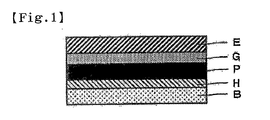
- the pressure-sensitive adhesive polarizing plate of the present invention is described below with reference to Fig. 1 .
- the pressure-sensitive adhesive polarizing plate of the invention includes a polarizer (P), a transparent protective film (E) provided on only one side of the polarizer (P) with an adhesive layer (G) interposed therebetween, and a pressure-sensitive adhesive layer (B) provided on the other side of the polarizer (P) with a protective layer (H) interposed therebetween.
- the transparent protective film (E) may be covered with an adhesion facilitating layer or subjected to an activation treatment, and the adhesion facilitating layer may be bonded to the adhesive layer (G) to form the pressure-sensitive adhesive polarizing plate of the invention.
- a release sheet may be provided on the pressure-sensitive adhesive layer (B).
- the diagonal size of the pressure-sensitive adhesive polarizing plate of the invention is preferably, but not limited to, in the range of 35.6 to 304.9 cm (14 inches to 120 inches). This is because as the size increases, the thin pressure-sensitive adhesive polarizing plate having a transparent protective film only on one side becomes susceptible to cracking under severe environments. It will be understood that the size may be less than 35.6 cm (14 inches).
- the size of the pressure-sensitive adhesive polarizing plate to be used is generally 208.3 cm (82 inches) or less.
- the polarizer is intended to include a film capable of converting natural light or polarized light to the desired polarized light.
- any appropriate polarizer may be used, while a polarizer capable of converting natural light or polarized light to linearly polarized light is preferably used.
- any appropriate polarizer may be used as the polarizer (P) depending on the purpose.
- a polarizer for example, a film that is uniaxially stretched after having dichromatic substances, such as iodine and dichromatic dye, absorbed to hydrophilic high molecular weight polymer films, such as polyvinyl alcohol-based film, partially formalized polyvinyl alcohol-based film, and ethylene-vinyl acetate copolymer-based partially saponified film; poly-ene-based orientation films, such as dehydrated polyvinyl alcohol and dehydrochlorinated polyvinyl chloride, etc. may be mentioned.
- Examples of the polarizer that may be used also include an O-type guest-host polarizer as disclosed in U.S. Patent No. 5,523,863 in which a liquid crystalline composition containing a dichroic substance and a liquid crystalline compound is oriented in a certain direction; and an E-type polarizer as disclosed in U.S. Patent No. 6,049,428 in which a lyotropic liquid crystal is oriented in a certain direction.
- an iodine-containing, polyvinyl alcohol-based film polarizer is preferably used, because of its high degree of polarization.
- materials for the polyvinyl alcohol film for the polarizer of this invention include polyvinyl alcohol and derivatives thereof.
- polyvinyl alcohol derivatives include polyvinyl formal and polyvinyl acetal and those modified with olefins such as ethylene and propylene, those modified with unsaturated carboxylic acids such as acrylic acid, methacrylic acid and crotonic acid, those modified with alkyl esters of unsaturated carboxylic acids, and those modified with acrylamide or the like.
- the degree of polymerization of the polyvinyl alcohol is preferably from 100 to 1,000.
- the degree of saponification of the polyvinyl alcohol is generally from 80 to 100% by mole.
- the polyvinyl alcohol film may also contain an additive such as a plasticizer and a surfactant.
- a plasticizer include polyols and condensates thereof, such as glycerol, diglycerol, triglycerol, ethylene glycol, propylene glycol, and polyethylene glycol.
- the plasticizer is, but not limited to, preferably used at a concentration of 20% by weight or less in the polyvinyl alcohol film.
- the polyvinyl alcohol-based film may be subjected to at least a uniaxial stretching treatment and a dyeing treatment with iodine.
- a boric acid treatment and an iodide ion treatment may be further performed.
- the polyvinyl alcohol-based film having undergone the treatments may be dried to give a polarizer.
- the polarizer (P) used in the polarizing plate of the invention may have any appropriate thickness.
- the thickness of the polarizer is typically from 5 to 80 ⁇ m, preferably from 10 to 50 ⁇ m, more preferably from 20 to 40 ⁇ m. In the above range, excellent optical properties and mechanical strength can be provided.
- thermoplastic resin with a high level of transparency, mechanical strength, thermal stability, moisture blocking properties, isotropy, and the like may be used as a material for forming the transparent protective film.
- thermoplastic resin include cellulose resins such as triacetylcellulose, polyester resins, polyethersulfone resins, polysulfone resins, polycarbonate resins, polyamide resins, polyimide resins, polyolefin resins, (meth)acrylic resins, cyclic olefin polymer resins (norbornene resins), polyarylate resins, polystyrene resins, polyvinyl alcohol resins, and any mixture thereof.
- cellulose resins such as triacetylcellulose, polyester resins, polyethersulfone resins, polysulfone resins, polycarbonate resins, polyamide resins, polyimide resins, polyolefin resins, (meth)acrylic resins, cyclic olefin polymer resins (norbornen
- the transparent protective film may contain any one or more appropriate additives.
- an additive include an ultraviolet absorbing agent, an antioxidant, a lubricant, a plasticizer, a release agent, an anti-discoloration agent, a flame retardant, a nucleating agent, an antistatic agent, a pigment, and a colorant.
- the content of the thermoplastic resin in the transparent protective film is preferably from 50 to 100% by weight, more preferably from 50 to 99% by weight, even more preferably from 60 to 98% by weight, in particular, preferably from 70 to 97% by weight. If the content of the thermoplastic resin in the transparent protective film is less than 50% by weight, high transparency and other properties inherent in the thermoplastic resin may be insufficiently exhibited.
- Amorphous PO films, cycloolefin polymer (COP) films, Arton films (manufactured by JSR Corporation), Zeonor films (manufactured by Zeon Corporation), and so on may also be used.
- the thickness of the transparent protective film is generally from 1 to 500 ⁇ m, in view of strength, workability such as handleability, thin layer formability, or the like, while it may be determined as needed. And in case of thin type, The thickness of the transparent protective film is preferably from 1 to 30 ⁇ m, more preferably from 5 to 200 ⁇ m, much more preferably from 5 to 150 ⁇ m, still much more preferably 20 to 100 ⁇ m.
- At least one selected from a polyester resin, a cellulose resin, a polycarbonate resin, a cyclic polyolefin resin, and a (meth)acrylic resin is preferably used for the transparent protective film according to the present invention.
- the polyester resin may be, but not limited to, any one of homopolymers obtained by polycondensation of one dicarboxylic acid and one diol, copolymers obtained by polycondensation of one or more dicarboxylic acids and two or more diols or copolymers or a copolymer obtained by polycondensation of two or more dicarboxylic acids and one or more diols, and a resin blend containing two or more of the homopolymers or copolymers, in which examples of one or more dicarboxylic acids include terephthalic acid, isophthalic acid, orthophthalic acid, 2,5-naphthalenedicarboxylic acid, 1,4-naphthalenedicarboxylic acid, 1,5-naphthalenedicarboxylic acid, diphenylcarboxylic acid, diphenoxyethanedicarboxylic acid, diphenylsulfonecarboxylic acid, anthracenedicarboxylic acid, 1,3-
- the cellulose resin is an ester of cellulose and a fatty acid.
- a cellulose ester resin include triacetyl cellulose, diacetyl cellulose, tripropionyl cellulose, dipropionyl cellulose, and the like.
- triacetyl cellulose is preferred.
- Much commercially available triacetyl celluloses are placing on sale and are advantageous in view of easy availability and cost.
- Examples of commercially available products of triacetyl cellulose include UV-50, UV-80, SH-80, TD-80U, TD-TAC, and UZ-TAC (trade names) manufactured by Fujifilm Corporation, and KC series manufactured by Konica Minolta.
- these triacetyl cellulose products have a thickness direction retardation (Rth) of about 60 nm or less, while having an in-plane retardation (Re) of almost zero.
- the cyclic polyolefin resin is preferably a norbornene resin.
- Cyclic olefin resin is a generic name for resins produced by polymerization of cyclic olefin used as a polymerizable unit, and examples thereof include the resins disclosed in JP-A Nos. 01-240517 , 03-14882 , and 03-122137 .
- cyclic olefins examples include ring-opened (co)polymers of cyclic olefins, addition polymers of cyclic olefins, copolymers (typically random copolymers) of cyclic olefins and ⁇ -olefins such as ethylene and propylene, graft polymers produced by modification thereof with unsaturated carboxylic acids or derivatives thereof, and hydrides thereof.
- the cyclic olefin include norbornene monomers.
- cyclic polyolefin resins are placing on sale. Examples thereof include Zeonex (trade name) and Zeonor (trade name) series manufactured by Zeon Corporation, Arton (trade name) series manufactured by JSR Corporation, Topas (trade name) series manufactured by Ticona, and Apel (trade name) series manufactured by Mitsui Chemicals, Inc.
- the (meth)acrylic resin preferably has a glass transition temperature (Tg) of 115°C or more, more preferably of 120°C or more, still more preferably of 125°C or more, particularly preferably of 130°C or more. If the Tg is 115°C or more, the resulting polarizing plate can have good durability.
- the upper limit to the Tg of the (meth)acrylic resin is preferably, but not limited to, 170°C or less, in view of formability and the like.
- the (meth)acrylic resin can form a film with an in-plane retardation (Re) of almost zero and a thickness direction retardation (Rth) of almost zero.
- any appropriate (meth)acrylic resin may be used as long as the advantages of the present invention are not reduced.
- examples of such a (meth)acrylic resin include poly(meth)acrylate such as poly(methyl methacrylate), methyl methacrylate-(meth)acrylic acid copolymers, methyl methacrylate-(meth)acrylate copolymers, methyl methacrylate-acrylate-(meth)acrylic acid copolymers, methyl (meth)acrylate-styrene copolymers (such as MS resins), and alicyclic hydrocarbon group-containing polymers (such as methyl methacrylate-cyclohexyl methacrylate copolymers and methyl methacrylate-norbornyl (meth)acrylate copolymers).
- poly(meth)acrylate such as poly(methyl methacrylate), methyl methacrylate-(meth)acrylic acid copolymers, methyl methacrylate-(meth)acrylate copo
- Poly(C 1-6 alkyl (meth)acrylate) such as poly(methyl (meth)acrylate) is preferred, and a methyl methacrylate-based resin mainly composed of a methyl methacrylate unit (50 to 100% by weight, preferably 70 to 100% by weight) is more preferred.
- Examples of the (meth)acrylic resin include Acrypet VH and Acrypet VRL20A each manufactured by Mitsubishi Rayon Co., Ltd., (meth)acrylic resins having a ring structure in their molecule as disclosed in JP-A No. 2004-70296 , and high-Tg (meth)acrylic resins produced by intramolecular crosslinking or intramolecular cyclization reaction.
- Lactone ring structure-containing (meth)acrylic resins may also be used.
- lactone ring structure-containing (meth)acrylic reins include the (meth)acrylic reins disclosed in JP-A Nos. 2000-230016 , 2001-151814 , 2002-120326 , 2002-254544 , and 2005-146084 .
- the (meth)acryl-based resin may be an acrylic resin having an alkyl unsaturated carboxylate structural unit and a glutaric anhydride structural unit.
- acrylic resin examples include those disclosed in JP-A Nos. 2004-70290 , 2004-70296 , 2004-163924 , 2004-292812 , 2005-314534 , 2006-131898 , 2006-206881 , 2006-265532 , 2006-283013 , 2006-299005 , and 2006-335902 .
- the (meth)acryl-based resin may be a thermoplastic resin having a glutarimide unit, a (meth)acrylate unit, and an aromatic vinyl unit.
- thermoplastic resin examples include those disclosed in JP-A Nos. 2006-309033 , 2006-317560 , 2006-328329 , 2006-328334 , 2006-337491 , 2006-337492 , 2006-337493 , and 2006-337569 .
- the transparent protective film (E) to be used may have an in-plane retardation of less than 40 nm and a thickness direction retardation of less than 80 nm so that it can have low birefringence and be capable of not changing polarization.
- a typical example of such a low-birefringence transparent protective film may be an unstretched film.
- the transparent protective film (E) and the polarizer (P) are laminated with the adhesive layer (G) interposed therebetween.
- the pressure-sensitive adhesive layer is preferably used to laminate them with no air gap interposed therebetween.
- the pressure-sensitive adhesive layer (G) is made of an adhesive (G'). Any type of adhesive may be used as the adhesive (G').
- the adhesive layer (G) used to bond the polarizer (P) and the transparent protective film (E) together may be of any of various types such as a water-based type, solvent-based type, hot melt type, or radical-curable type, as long as it is optically transparent.
- a water-based adhesive or a radical-curable adhesive is preferred.
- water-based adhesive used to form the adhesive layer (G) examples include, but are not limited to, a vinyl polymer-based adhesive, a gelatin-based adhesive, a vinyl-based adhesive, a latex-based adhesive, a polyurethane-based adhesive, an isocyanate-based adhesive, a polyester-based adhesive, and an epoxy-based adhesive.
- the adhesive layer may be produced from such a water-based adhesive by applying an aqueous solution of the adhesive and drying it. In the preparation of the aqueous solution, if necessary, a crosslinking agent or any other additive and a catalyst such as an acid may also be added.
- a vinyl polymer-containing adhesive or the like is preferably used as the water-based adhesive, and the vinyl polymer is preferably a polyvinyl alcohol-based resin.
- the polyvinyl alcohol-based resin may also contain a water-soluble crosslinking agent such as boric acid, borax, glutaraldehyde, melamine, or oxalic acid.
- a polyvinyl alcohol-based polymer film is used to form the polarizer
- an adhesive containing polyvinyl alcohol-based resin is preferably used in view of tackiness.
- An adhesive that contains a polyvinyl alcohol-based resin having an acetoacetyl group is more preferred in order to improve durability.
- polyvinyl alcohol-based resin examples include: a polyvinyl alcohol obtained by saponifying a polyvinyl acetate; a derivative thereof; a saponified copolymer of vinyl acetate and a monomer copolymerizable therewith; and polyvinyl alcohols modified by acetalization, urethanization, etherification, grafting, phosphate esterification and the like.
- Examples of the monomers include, unsaturated carboxylic acids such as maleic anhydride, fumaric acid, crotonic acid, itaconic acid and (meth) acrylic acid, and esters thereof; ⁇ -olefins such as ethylene and propylene; (meth)allylsulfonic acid or sodium salt thereof, (meth)allylsulfonate; sodium sulfonate (monoalkyl maleate), sodium disulfonate (alkyl maleate); N-methylolacrylamide; an alkai salt of acrylamide alkylsulfonate; N-vinylpyrrolidone, a derivative of N-vinylpyrrolidone and the like.
- the polyvinyl alcohol-based resins can be either used alone or in combination of two kinds or more.
- an average degree of polymerization is from 100 to 5000, preferably from 1000 to 4000 and an average degree of saponification is from 85 to 100 mol %, preferably from 90 to 100 mol % in consideration of adherence.
- a polyvinyl alcohol-based resin having an acetoacetyl group is obtained by reacting a polyvinyl alcohol-based resin and diketene to each other with a known method.
- known methods include: a method in which a polyvinyl alcohol-based resin is dispersed into a solvent such as acetic acid, to which diketene is added and a method in which a polyvinyl alcohol-based resin is previously dissolved into a solvent such as dimethylformamide or dioxane, to which diketene is added.
- Another example is a method in which diketene gas or diketene liquid is brought into direct contact with a polyvinyl alcohol.
- a degree of modification by an acetoacetyl group in a polyvinyl alcohol-based resin having an acetoacetyl group or groups is preferably from 0.1 to 40 mol %, more preferably from 1 to 20 mol %, especially preferably from 2 to 7 mol %.
- a degree of modification by an acetoacetyl group exceeds 40 mol %, reaction sites with a crosslinking agent is fewer to thereby reduce an effect of improvement on moisture resistance and heat resistance.
- the degree of modification by an acetoacetyl group is a value determined by NMR.
- crosslinking agents that have been used in a polyvinyl alcohol-based adhesive can be used as a crosslinking agent in the present invention without a specific limitation thereon. While the amount of the crosslinking agent to be blended may be appropriately determined depending on the type of the polyvinyl alcohol-based resin and the like, it is generally from 4 to 60 parts by weight, preferably from 10 to 55 parts by weight, more preferably from 20 to 50 parts by weight, based on 100 parts by weight of the polyvinyl alcohol-based resin. In such ranges, good adhesion properties can be obtained.
- the crosslinking agent may be used in an amount of 4 to 60 parts by weight, preferably in an amount of 10 to 55 parts by weight, more preferably in an amount of 20 to 50 parts by weight, similarly to the above, based on 100 parts by weight of the polyvinyl alcohol-based resin. If the amount of the crosslinking agent to be blended is too large, the reaction of the crosslinking agent can proceed within a short time so that the adhesive can tend to form a gel, and as a result, the adhesive can have an extremely short pot life and thus can be difficult to use industrially. From these points of view, the crosslinking agent is used in the above amount, but the resin solution according to the present invention can be stably used even when the amount of the crosslinking agent is large as mentioned above, because the resin solution contains the colloidal metal compound.
- a resin solution containing a polyvinyl alcohol-based resin, a crosslinking agent and a colloidal metal compound with an average particle size of 1 to 100 nm is preferably used as the adhesive.
- the resin solution is generally used in the form of an aqueous solution.
- the concentration of the resin solution may be, but not limited to, from 0.1 to 15% by weight, preferably from 0.5 to 10% by weight, in view of coatability, storage stability or the like.
- the viscosity of the resin solution which is used as the adhesive, is generally, but not limited to, from 1 to 50 mPa ⁇ s.
- the occurrence of knick defects tends to increase as the viscosity of a resin solution decreases.
- the adhesive for polarizing plate of the present invention Using the adhesive for polarizing plate of the present invention, however, the occurrence of knick defects can be prevented even in a low viscosity range such as the range of 1 to 20 mPa ⁇ s, and thus the occurrence of knick defects can be prevented regardless of the viscosity of the resin solution.
- Polyvinyl alcohol-based resin having an acetoacetyl groups cannot have high degree of polymerization in contrast to other general polyvinyl alcohol-based resins, and therefore they are used at a low viscosity as mentioned above. According to the present invention, however, knick defects, which would otherwise be caused by the low viscosity of the resin solution, can be prevented from occurring even when the polyvinyl alcohol-based resin having an acetoacetyl group is being used.
- the adhesive layer may have a thickness of 10 to 300 nm.
- the thickness of the adhesive layer (G1) is more preferably from 10 to 200 nm, still more preferably from 20 to 150 nm, in terms of achieving uniform in-plane thickness and sufficient adhesive force.
- the transparent protective film (E) is adhered to the polarizer (P) with a roll laminator or the like.
- the adhesive may be applied to any one or both of the transparent protective film and the polarizer.
- a drying step is performed to thereby form an adhesive layer that is a dry coated layer.
- a drying temperature is from 5 to 150°C, preferably from 30 to 120°C and for a time of 120 sec or longer, preferably for a time 300 sec or longer.
- radical-curable adhesive examples include various types such as an active energy ray-curable type such as an electron beam-curable type or an ultraviolet-curable type, and a thermosetting type.
- An active energy ray-curable type is preferred, because it is curable in a short time.
- An electron beam-curable type is particularly preferred, and an electron beam-curable adhesive may be used.
- the use of an electron beam in the process of curing the adhesive used for bonding the polarizer to the transparent protective film can eliminate a heating process, which would otherwise be necessary for an ultraviolet-ray curing method, and thus can provide very high productivity.
- the adhesive layer (G1) preferably has a thickness of 0.1 to 20 ⁇ m, more preferably 0.2 to 10 ⁇ m, even more preferably 0.3 to 8 ⁇ m. If the adhesive layer is too thin, the cohesive strength for the adhesion may be lost, so that the adhesive strength may be lost. If the thickness of the adhesive layer (G1) is more than 20 ⁇ m, the cost may increase, and the adhesive itself may have a curing shrinkage effect, which may have an adverse effect on the optical properties of the polarizing plate.
- any appropriate type of pressure-sensitive adhesive may be used to form the pressure-sensitive adhesive layer (B).
- the pressure-sensitive adhesive include rubber pressure-sensitive adhesives, acryl-based pressure-sensitive adhesives, silicone pressure-sensitive adhesives, urethane pressure-sensitive adhesives, vinyl alkyl ether pressure-sensitive adhesives, polyvinyl alcohol pressure-sensitive adhesives, polyvinylpyrrolidone pressure-sensitive adhesives, polyacrylamide pressure-sensitive adhesives, and cellulose pressure-sensitive adhesives.
- pressure-sensitive adhesives those that may be preferably used have excellent optical transparency and weather resistance or heat resistance and exhibits appropriate wettability and pressure-sensitive adhesive properties such as appropriate cohesiveness and tackiness.
- Acryl-based pressure-sensitive adhesives have such properties and therefore are preferably used.
- the pressure-sensitive adhesive layer (B) is generally formed by applying a solution of the pressure-sensitive adhesive to a release sheet and drying the coating.
- the pressure-sensitive adhesive solution may be prepared by dissolving or dispersing the composition in an appropriate single or mixed solvent such as toluene, ethyl acetate or a mixture thereof so that an 10 to 40% by weight solution can be formed.
- the application method to be used may be roll coating such as reverse coating or gravure coating, spin coating, screen coating, fountain coating, dipping, spraying, or any other coating method.
- the pressure-sensitive adhesive layer (B)-carrying release sheet may be subjects to a process of transferring it.
- the pressure-sensitive adhesive layer (B) may be formed as a coating film by applying the pressure-sensitive adhesive to the protective layer (H) provided on one side of the polarizer (P).
- the thickness of the pressure-sensitive adhesive layer (B) is generally from 3 to 100 ⁇ m, preferably from 5 to 50 ⁇ m, more preferably from 10 to 40 ⁇ m.
- the material used to form the release sheet may be any appropriate thin material such as paper, a film of synthetic resin such as polyethylene, polypropylene or polyethylene terephthalate, a robber sheet, a paper sheet, a cloth, a nonwoven fabric, a net, a foam sheet, a metal foil, or a laminate thereof.
- the surface of the release sheet may be subjected to an adhesion-reducing release treatment to increase the releasability from the pressure-sensitive adhesive layer, such as a silicone treatment, a long-chain alkyl treatment or a fluoride treatment.
- the protective layer (H) is placed between the polarizer (P) and the pressure-sensitive adhesive layer (B).
- the protective layer (H) has a tensile modulus of 100 MPa to 2000 MPa.
- the protective layer (H) having a tensile modulus of 100 MPa inhibits expansion and contraction of the polarizer (P) due to external stress such as humidification/drying, heating/cooling, or mechanical pulling, compressing or bending, and inhibits cracking of the polarizer. Cracking of the polarizer (P) is mainly caused by a dimensional change in the direction of contraction of the polarizer (P).
- the mechanically holding ability of the protective layer (H) increases so that the effect of preventing cracking of the polarizer increases.
- the protective layer (H) is formed using a protective layer-forming agent (H') such as a cyanoacrylate-based layer-forming agent, an epoxy-based layer-forming agent, an isocyanate-based layer-forming agent, or an acryl-based layer-forming agent.
- H' a protective layer-forming agent
- the tensile modulus is from 100 to 2,000 MPa, preferably from 150 to 1,000 MPa, more preferably from 500 to 1,000 MPa in view of durability or other properties.
- the cyanoacrylate-based layer-forming agent examples include alkyl- ⁇ -cyanoacrylate such as methyl- ⁇ -cyanoacrylate, ethyl- ⁇ -cyanoacrylate, butyl- ⁇ -cyanoacrylate, or octyl- ⁇ -cyanoacrylate, cyclohexyl- ⁇ -cyanoacrylate, and methoxy- ⁇ -cyanoacrylate.
- the cyanoacrylate-based layer-forming agent may be one used as a cyanoacrylate-based adhesive.
- the epoxy-based layer-forming agent may contain an epoxy resin and a curing agent therefore.
- the epoxy-based layer-forming agent may be one used as an epoxy-based adhesive.
- the epoxy-based layer-forming agent is generally used in the form of a two-component system, in which a curing agent is added to an epoxy resin, while it may be used in the form of a one-component system, which contains an epoxy resin and a curing agent therefore.
- the epoxy-based layer-forming agent is generally used in the form of a solution.
- the solution may be a solvent system, an emulsion, a colloidal dispersion, or an aqueous system such as an aqueous solution.
- the epoxy resin may include a variety of compounds having two or more epoxy groups per molecule, such as bisphenol type epoxy resins, aliphatic type epoxy reins, aromatic type epoxy resins, halogenated bisphenol type epoxy resins, and biphenyl type epoxy resins.
- the epoxy resin may be appropriately determined depending on the epoxy equivalent or the number of functional groups, and in view of durability, epoxy resins with an epoxy equivalent of 500 or less are preferably used.
- phenolic resin type curing agents which include, but are not limited to, phenolic resin type, acid anhydride type, carboxylic acid type, and polyamine type curing agents may be used for the epoxy resin.
- phenolic resin type curing agents examples include phenolic novolac resins, bisphenol novolac resins, xylylene phenol resins, and cresol novolac resins.
- Examples of acid anhydride type curing agents include maleic anhydride, tetrahydrophthalic anhydride, hexahydrophthalic anhydride, and succinic anhydride; and examples of carboxylic acid type curing agents include carboxylic acids such as pyromellitic acid and trimellitic acid, and blocked carboxylic acids formed by addition of vinyl ether.
- Examples of epoxy type two-component, layer-forming agents that may be used include a combination of two components, an epoxy resin and a polythiol, and a combination of two components, an epoxy resin and a polyamide.
- the content of the curing agent is preferably from 30 to 70 parts by weight, more preferably from 40 to 60 parts by weight, based on 100 parts by weight of the epoxy resin, while it depends on the equivalent to the epoxy resin.
- any of various curing accelerators may be used in the epoxy-based layer-forming agent.
- curing accelerators include various imidazole compounds and derivatives thereof, and dicyandiamide.
- a two-component type curable epoxy resin agent is preferably used in an embodiment of the invention, in which the epoxy resin is preferably a bisphenol A type epoxy resin, and the curing component is preferably an amine curing agent, particularly a cyclic amine curing agent.
- the curing component is preferably an amine curing agent, particularly a cyclic amine curing agent.
- any one of the components preferably contains an anionic curing accelerator.
- anionic curing accelerator include an aromatic tertiary amine compound, a lactone compound, 1,2,6-hexanetriol, N,N-dicyclohexylcarbodiimide, and succinic acid amide.
- the isocyanate-based layer-forming agent may be used as a crosslinking agent to form the pressure-sensitive adhesive layer (B).
- a compound having at least two isocyanate groups may be used as such an isocyanate type crosslinking agent.
- the polyisocyanate compound may be used as the isocyanate-based layer-forming agent.
- Specific examples thereof include 2,4-tolylene diisocyanate, 2,6-tolylene diisocyanate, xylylene diisocyanate, 1,3-bisisocyanatomethylcyclohexane, hexamethylene diisocyanate, tetramethylxylylene diisocyanate, m-isopropenyl- ⁇ , ⁇ -dimethylbenzyl isocyanate, methylene bis(4-phenyl isocyanate), p-phenylene diisocyanate, or a dimer thereof, a trimer such as tris(6-isocyanatohexyl) isocyanurate, and reaction products thereof with polyhydric alcohol or a polyamine, such as biuret or trimethylolpropane.
- the isocyanate type crosslinking agent is also preferably a compound having three or more isocyanate groups, such as tris(6-isocyanatohexyl) isocyanurate.
- isocyanate-based layer-forming agent examples include those used as isocyanate type adhesives.
- an isocyanate-based layer-forming agent having a rigid structure in which a cyclic structure (such as a benzene ring, a cyanurate ring, or a isocyanurate ring) makes up a large part of the molecular structure is preferably used in the present invention.
- a cyclic structure such as a benzene ring, a cyanurate ring, or a isocyanurate ring
- trimethylolpropane-tri-tolyleneisocyanate, tris(hexamethyleneisocyanate)isocyanurate, or the like is preferably used as the isocyanate-based layer-forming agent.
- the isocyanate type crosslinking agent to be used may have a protecting group attached to the terminal isocyanate group.
- the protecting group may be oxime, lactam, or the like.
- the protecting group can be dissociated from the isocyanate group by heating the blocked isocyanate group, so that the isocyanate group becomes available for reaction.
- a reaction catalyst may be used to enhance the reactivity of the isocyanate group.
- a reaction catalyst is preferably, but not limited to, a tin-based catalyst or an amine catalyst.
- One or more reaction catalysts may be used.
- the reaction catalyst is generally used in an amount of 5 parts by weight or less based on 100 parts by weight of the isocyanate type crosslinking agent. If the amount of the reaction catalyst is large, the crosslinking reaction rate may be so high that the layer-forming agent may foam. If the layer-forming agent is used after it foams, sufficient tackiness cannot be obtained.
- the reaction catalyst is preferably used in an amount of 0.01 to 5 parts by weight, more preferably 0.05 to 4 parts by weight in the case of using a reaction catalyst.
- the tin-based catalyst is preferably an organo-tin catalyst, while it may be an inorganic tin catalyst or an organo-tin catalyst.
- the inorganic tin catalyst include stannous chloride and stannic chloride.
- the organo-tin catalyst preferably has at least one organic group such as an aliphatic or alicyclic group having a methyl, ethyl, ether, ester, or any other group in the skeleton. Specific examples thereof include tetra-n-butyltin, tri-n-butyltin acetate, n-butyltin trichloride, trimethyltin hydroxide, dimethyltin dichloride, and dibutyltin dilaurate.
- the amine catalyst may also be of any type without particular limitation.
- the amine catalyst preferably has an organic group such as quinoclidine, amidine, diazabicycloundecene, or any other alicyclic group.
- Other examples of the amine catalyst include triethylamine and so on.
- examples of the reaction catalyst also include cobalt naphthenate and benzyltrimethylammonium hydroxide.
- the isocyanate-based layer-forming agent is generally used in the form of a solution.
- the solution may be a solvent system, an emulsion, a colloidal dispersion, or an aqueous system such as an aqueous solution.
- Any organic solvent may be used without particular limitation as long as the components of the layer-forming agent are uniformly soluble. Examples of such an organic solvent include toluene, methyl ethyl ketone, and ethyl acetate.
- an alcohol such as n-butyl alcohol or isopropyl alcohol or a ketone such as acetone may also be added to the aqueous system.
- a dispersing agent may be used, or a functional group less reactive with the isocyanate group, such as carboxylate salt, sulfonate salt or quaternary ammonium salt, or a water-dispersible component such as polyethylene glycol may be introduced into the isocyanate type crosslinking agent.
- the acryl-based layer-forming agent may include a curable component such as a monomer and/or oligomer capable of being radically polymerized by active energy rays or heat.
- the monomer and/or oligomer component capable of being polymerized radically may be a monomer and/or oligomer component having an unsaturated double bond such as that in a (meth)acryloyl group or a vinyl group.
- a monomer and/or oligomer component having a (meth)acryloyl group is preferably used, because of its advantage of high reactivity.
- the monomer component having a (meth)acryloyl group include monomers generally used in forming acrylic polymers.
- the monomer and/or oligomer component capable of being polymerized radically may also be a polyester (meth)acrylate, epoxy (meth)acrylate or urethane (meth)acrylate compound having two or more unsaturated double bonds of (meth)acryloyl groups, vinyl groups or the like in the polyester, epoxy or urethane skeleton similarly to the monomer component.
- the number of the unsaturated double bonds may be two or more, preferably four or more, more preferably six or more.
- the monomer and/or oligomer component having (meth)acryloyl groups include (meth)acrylic acid esters of polyhydric alcohols, such as tripropylene glycol di(meth)acrylate, tetraethylene glycol di(meth)acrylate, 1,6-hexanediol di(meth)acrylate, bisphenol-A diglycidyl ether di(meth)acrylate, neopentyl glycol di(meth)acrylate, trimethylolpropane tri(meth)acrylate, pentaerythritol tri(meth)acrylate, pentaerythritol tetra(meth)acrylate, dipentaerythritol penta(meth)acrylate, dipentaerythritol hexa(meth)acrylate, and caprolactone-modified dipentaerythritol hexa(meth)acrylate.
- polyhydric alcohols such as triprop
- cyanurate or isocyanurate compounds such as 2-propenyl-di-3-butenyl cyanurate, 2-hydroxyethyl bis(2-acryloxyethyl) cyanurate, tris(2-acryloxyethyl) isocyanurate, and tris(2-methacryloxyethyl) isocyanurate.
- the protective layer-forming agent (H') to be used is preferably an active energy ray-curable, acryl-based layer-forming agent containing an active energy ray-curable component.
- the reaction of the thermosetting type, layer-forming agent takes a relatively long time; in contrast, the active energy ray-curable layer-forming agent can very quickly react and provide very high productivity, and therefore, it is preferred.
- the thermosetting type, layer-forming agent is applied to the polarizer (P)
- the properties of the polarizer (P) may be degraded by heating for the reaction.
- the active energy ray-curable layer-forming agent has no such thermal effect, and therefore, it is also preferred for this reason.
- the properties of the polarizer (P) may also be altered by the moisture, because the polarizer (P) is generally a polyvinyl alcohol-based material.
- the active energy ray-curable layer-forming agent has no such thermal effect, and therefore, it is also preferred for this reason.
- the curable component may be a (meth)acryloyl group-containing compound or a vinyl group-containing compound (monomer or oligomer). Any of a monofunctional curable component and a bifunctional or polyfunctional curable component may be used.
- One or more curable components may be selected and used singly or in combination so as to produce an adhesive layer with a protective layer (H) having a tensile modulus of 100 MPa to 2000 MPa.
- the curable component is preferably a (meth)acryloyl group-containing compound.
- An N-substituted amide monomer is preferably used as the (meth)acryloyl group-containing compound. Such a monomer is preferred in view of durability.
- An active energy ray-curable adhesive may be used as the active energy ray-curable layer-forming agent.
- R 1 represents a hydrogen atom or a methyl group
- R 2 represents a hydrogen atom or a straight or branched chain alkyl group having 1 to 4 carbon atoms and optionally having a
- the straight or branched chain alkyl group of 1 to 4 carbon atoms may be methyl, ethyl, isopropyl, or tert-butyl; the hydroxyl group-containing alkyl group may be hydroxymethyl or hydroxyethyl; and the amino group-containing alkyl group may be aminomethyl or aminoethyl.
- R 2 and R 3 may be bonded to form an optionally oxygen atom-containing five- or six-membered ring, which may include a nitrogen-containing heterocyclic ring.
- the heterocyclic ring include a morpholine ring, a piperidine ring, a pyrrolidine ring, and a piperazine ring.
- N-substituted amine monomer examples include N-methyl(meth)acrylamide, N,N-dimethyl(meth)acrylamide, N,N-diethyl(meth)acrylamide, N-isopropylacrylamide, N-butyl(meth)acrylamide, N-hexyl(meth)acrylamide, N-methylol(meth)acrylamide, N-hydroxyethyl(meth)acrylamide, N-methylol-N-propane(meth)acrylamide, aminomethyl(meth)acrylamide, aminoethyl(meth)acrylamide, mercaptomethyl(meth)acrylamide, and mercaptoethyl(meth)acrylamide.
- heterocyclic ring-containing monomer examples include N-acryloylmorpholine, N-acryloylpiperidine, N-methacryloylpiperidine, and N-acryloylpyrrolidine.
- N-acryloylmorpholine examples include N-acryloylmorpholine, N-acryloylpiperidine, N-methacryloylpiperidine, and N-acryloylpyrrolidine.
- One, or two or more of these N-substituted amide monomers may be used singly or in combination.
- the N-substituted amide monomer is preferably N-hydroxyethylacrylamide, N-methylolacrylamide, N-isopropylacrylamide, or N-acryloylmorpholine.
- N-substituted amide monomers exhibit good adhesion to low-moisture-content polarizers or transparent protective films produced with low moisture permeable materials.
- the monomers listed above exhibit good adhesion, and N-hydroxyethylacrylamide is particularly preferred.
- N-hydroxyethylacrylamide is preferably used in combination with N-acryloylmorpholine in view of durability and adhesion.
- the content of N-hydroxyethylacrylamide is preferably 40% by weight or more based on the total amount of N-hydroxyethylacrylamide and N-acryloylmorpholine, in terms of achieving good adhesion.
- the content of N-hydroxyethylacrylamide is more preferably from 40 to 90% by weight, still more preferably from 60 to 90% by weight.
- (meth)acryloyl group-containing compounds for use as the curable component include a variety of epoxy (meth)acrylates, urethane (meth)acrylates, and polyester (meth)acrylates, and a variety of (meth)acrylate monomers.
- epoxy (meth)acrylates, specifically monofunctional (meth)acrylates having an aromatic ring and a hydroxy group are preferably used. If some of these curable components are incapable of forming an adhesive layer with a tensile modulus of 100 MPa or more by themselves, they should be used in combination with the N-substituted amide monomer.
- a variety of monofunctional (meth)acrylates each having an aromatic ring and a hydroxy group may be used.
- the hydroxy group may be present as a substituent on the aromatic ring, but in the present invention, it is preferred that the hydroxy group is present on an organic group (bonded to a hydrocarbon group, specifically bonded to an alkylene group) linking the aromatic ring and (meth)acrylate.
- the monofunctional (meth)acrylate having an aromatic ring and a hydroxy group may be a reaction product of a monofunctional epoxy compound having an aromatic ring with (meth)acrylic acid.
- Examples of the monofunctional epoxy compound having an aromatic ring include phenyl glycidyl ether, tert-butyl phenyl glycidyl ether, and phenyl polyethylene glycol glycidyl ether.
- Examples of the monofunctional (meth)acrylate having an aromatic ring and a hydroxy group include 2-hydroxy-3-phenoxypropyl (meth)acrylate, 2-hydroxy-3-tert-butylphenoxypropyl (meth)acrylate, and 2-hydroxy-3-phenyl polyethylene glycol propyl (meth)acrylate.
- the (meth)acryloyl group-containing compound may also be a carboxyl group-containing monomer, which is also preferred in view of adhesion.
- carboxyl group-containing monomer examples include (meth)acrylic acid, carboxyethyl (meth)acrylate, and carboxypentyl (meth)acrylate. In particular, acrylic acid is preferred.
- the active energy ray-curable layer-forming agent which contains a curable component, may further contain an appropriate additive in addition to the component.
- the active energy ray-curable layer-forming agent may be used in the form of an electron beam- or ultraviolet-curable layer-forming agent.
- a photo-polymerization initiator is not necessarily added to the layer-forming agent.
- a photo-polymerization initiator should be used.
- Such a photo-polymerization initiator is generally used in an amount of 0.1 to 10 parts by weight, preferably 0.5 to 3 parts by weight, based on 100 parts by weight of the curable component.
- the protective layer-forming agent (H') may further contain a coupling agent such as a silane coupling agent or a titanium coupling agent, any of various tackifiers, an ultraviolet-absorbing agent, an antioxidant, or a stabilizer such as a heat-resistant stabilizer or a hydrolysis-resistant stabilizer.
- the adhesive (G') may also contain any of these stabilizers and so on.
- the protective layer (H) is made from the protective layer-forming agent (H').
- the protective layer (H) is generally formed on the polarizer (P).
- the protective layer (H) may have a thickness of 0.01 to 30 ⁇ m, preferably 0.05 to 15 ⁇ m, more preferably 0.1 to 7.5 ⁇ m.
- the thickness of the protective layer (H) is preferably from 0.01 to 5 ⁇ m, more preferably from 0.05 to 3 ⁇ m.
- the thickness of the protective layer (H) is preferably controlled to be in the above range from the viewpoints of the uniform coating formation and the effect on the optical properties.
- the protective layer (H) preferably satisfies the relation: the photoelastic coefficient (m 2 /N) x the thickness (m) ⁇ 1x10 -14 (m 3 /N).
- the photoelastic coefficient may be measured as described below.
- the stress refractive index of a 2 cm wide optical film is measured using an ellipsometer (M220 manufactured by JASCO Corporation), while a stress of 1x10 -6 to 30x10 -6 is applied to the optical film.
- An object of the present invention is to prevent the polarizer (P) from being cracked by the formation of the protective layer (H) on the surface of the polarizer (P).
- the cracking of the polarizer is caused by expansion and contraction of the film upon moisture absorption/drying or heating of the polarizer (P).
- the force is applied to the transparent protective film (E) or the protective layer (H) placed on the surface of the polarizer (P).
- Such stress may induce birefringence, which may seriously affect the display on an image display, because the protective layer (H) formed on the surface of the polarizer (P) according to the invention will be located on the liquid crystal cell side with respect to the polarizer (P).
- the photoelastic coefficient may be used as an index of how easily birefringence is generated by stress.
- the larger photoelastic coefficient indicates that birefringence can be generated by smaller stress.
- the birefringence increases with increasing the thickness of the protective layer (H).
- the component material should have a photoelastic coefficient as small as possible so that the generation of birefringence due to the effect of shrinkage and expansion of the component can be reduced.
- the thickness of the protective layer (H) should preferably be small so that the effect of birefringence can be small. As described above, therefore, the thickness of the protective layer (H) is preferably 30 ⁇ m or less, more preferably 15 ⁇ m or less, even more preferably 7.5 ⁇ m or less.
- the protective layer (H) is generally formed by drying the protective layer-forming agent (H') at 30 to 100°C, preferably 50 to 80°C, for 0.5 to 15 minutes, while the process of forming the protective layer (H) may be appropriately selected depending on the type of the protective layer-forming agent (H').
- the protective layer (H) can be formed in a time shorter than the above time, because it can be quickly cured.
- the polarizer (P) and the pressure-sensitive adhesive layer (B) are laminated with the protective layer (H) interposed therebetween.
- the lamination is generally performed by bonding the pressure-sensitive adhesive layer (B) to the protective layer (H) provided on one side of the polarizer (P).
- the pressure-sensitive adhesive layer (B) to be used is generally provided on a release sheet.
- the lamination may be performed by applying a pressure-sensitive adhesive so that the pressure-sensitive adhesive layer (B) can be formed as a coating on the protective layer (H) provided on one side of the polarizer (P).
- the formation of the protective layer (H) on the polarizer (P) and the bonding between the protective layer (H) and the pressure-sensitive adhesive layer (B) are preferably performed continuously.
- the bonding of the transparent protective film (E) to the polarizer (P) with the adhesive layer (G) is also preferably performed continuously.
- the process from the production of the polarizer to the bonding may also be performed continuously.
- the pressure-sensitive adhesive polarizing plate of the present invention may further include any additional optical layer on the side of the transparent protective film (E) where the polarizer (P) is not bonded with the adhesive layer (G).
- any additional optical layer on the side of the transparent protective film (E) where the polarizer (P) is not bonded with the adhesive layer (G).
- Examples of such an optical layer that may be used include a hard coat layer and any other layer having undergone an anti-reflection treatment, an anti-sticking treatment, or a treatment for diffusion or antiglare purpose.
- a hard coat processing is applied for the purpose of protecting the surface of the polarizing plate from damage, and this hard coat film may be formed by a method in which, for example, a curable coated film with excellent hardness, slide property etc. is added on the surface of the protective film (E) using suitable ultraviolet curable type resins, such as acrylic type and silicone type resins.
- Antireflection processing is applied for the purpose of antireflection of outdoor daylight on the surface of a polarizing plate and it may be prepared by forming an antireflection film according to the conventional method etc.
- a sticking prevention processing is applied for the purpose of adherence prevention with adjoining layer.
- an anti glare processing is applied in order to prevent a disadvantage that outdoor daylight reflects on the surface of a polarizing plate to disturb visual recognition of transmitting light through the polarizing plate, and the processing may be applied, for example, by giving a fine concavo-convex structure to a surface of the protective film (E) using, for example, a suitable method, such as rough surfacing treatment method by sandblasting or embossing and a method of combining transparent fine particle.
- transparent fine particles whose average particle size is 0.5 to 50 ⁇ m, for example, such as inorganic type fine particles that may have conductivity including silica, alumina, titania, zirconia, tin oxides, indium oxides, cadmium oxides, antimony oxides, etc., and organic type fine particles including cross-linked of non-cross-linked polymers may be used.
- the amount of fine particle used is usually 2 to 70 weight parts to the transparent resin 100 weight parts that forms the fine concavo-convex structure on the surface, and preferably 5 to 50 weight parts.
- An anti glare layer may serve as a diffusion layer (viewing angle expanding function etc.) for diffusing transmitting light through the polarizing plate and expanding a viewing angle etc.
- the above-mentioned antireflection layer, sticking prevention layer, diffusion layer, anti glare layer, etc. may be built in the protective film (E) itself, and also they may be prepared as an optical layer different from the protective film.
- the pressure-sensitive adhesive polarizing plate of the present invention is preferably used to form an image display such as a liquid crystal display or an organic EL display.
- the liquid crystal display may be formed according to conventional techniques. Specifically, the liquid crystal display may be typically formed by assembling a liquid crystal cell and the polarizing plate, optionally placing one or more layers of an appropriate component or components such as a diffusion plate, an antiglare layer, an anti-reflection film, a protective plate, a prism array, a lens array sheet, a light diffusion plate, and a backlight at an appropriate location or locations, incorporating a driving circuit, and performing any other process.
- the liquid crystal display may be formed according to any conventional technique, except that the pressure-sensitive adhesive polarizing plate according to the invention is used.
- the liquid crystal cell to be used may be of any type such as TN type, STN type, or n type.
- the pressure-sensitive adhesive polarizing plate of the invention may be placed on one or both sides of a liquid crystal cell.
- the pressure-sensitive adhesive polarizing plates provided on both sides may be the same or different.
- an image display such as a liquid crystal display or an organic EL display is formed using a structure having the transparent protective film (E) placed on only one side of the polarizer (P) as in the pressure-sensitive adhesive polarizing plate of the invention
- different levels of stress may be applied to the polarizer (P) film interfaces on one main surface side, where the transparent protective film (E) is placed, and the other main surface side.
- different layer structures are provided on the front and back sides of the polarizer (P), so that different levels of external stress may be applied to the front and back sides of the polarizer film. This different in the external stress level makes the film more likely to be bent. As described below, the film that is made more likely to be bent is difficult to be processed into an image display by a conventional manufacturing process.
- an optical film manufacturer produces a continuous sheet material concluding an optical film such as a polarizing plate, which includes an optical member, in the form of a material roll (#1).
- the material roll is then slit into a predetermined size (a size according to the size of a substrate) (#2).
- the slit piece of the continuous material is then cut into a specific length according to the size of the substrate to be bonded (#3).
- the specific-length piece of the sheet material (the optical film) is then subjected to an appearance inspection (#4).
- the inspection method may be visual defect inspection or inspection using a known defect inspection system.
- the term "defect" typically means fouling of the surface or the inside, scratches, a foreign substance-containing defect with a dented shape, defective irregularities, bubbles, foreign substances, and so on.
- the finished product is then inspected (#5).
- the finished product inspection is performed according to more rigorous quality standards for determination of non-defective products than those for the appearance inspection.
- the four end faces of the piece of the sheet material are worked (#6). The working is performed to prevent the adhesive or the like from coming out of the end faces in transit.
- the piece of the sheet material is then subjected to clean packaging in a clean room environment (#7).
- packaging for transportation is performed (#8).
- the piece of the sheet material manufactured as described above is transported to a panel processing manufacturer.
- the panel processing manufacturer unpacks the piece of the material sheet transported (#11). An appearance inspection is then performed to check whether scratches, stains or other defects are produced in transit or during unpacking (#12). The piece of the sheet material determined as non-defective in the inspection is then transferred to the next step. This appearance inspection may be omitted in some cases.
- the substrate such as a glass substrate with a sealed liquid crystal cell
- the bonding step is previously manufactured and cleaned before the bonding step (#13).
- the piece of the sheet material and the optical display unit are bonded together (#14).
- the release film is peeled off from the piece of the sheet material so that the adhesive layer can be left, and one side of the substrate is bonded to the surface of the adhesive layer.
- the other side of the optical display unit may also be bonded in a similar manner.
- the optical films are bonded to both sides of the optical display unit, the optical films having the same structure may be bonded, or the optical films having different structures may be bonded.
- a bonded state inspection and a defect inspection are then performed (#15).
- the optical display unit determined as non-defective in the inspection is transferred to an implementing step and implemented into a liquid crystal display (#16).
- the optical display unit determined as defective is subjected to a reworking process (#17).
- the optical member is peeled off from the substrate.
- a new optical member is bonded to the reworked substrate (#14).
- Such a long film may be prepared in the form of a roll, and each piece of the film may be continuously bonded to each liquid crystal cell, while it is fed from the roll under a certain tension. In this process, bending is prevented, so that the above problems can be solved.
- the step (#3) of cutting the polarizing plate into a specific length and the step (#14) of bonding the cut piece to a liquid crystal cell which are separately performed in an optical film manufacturer and a panel processing manufacturer in the conventional method, may be continuously performed in a single place, so that the appearance inspection (#4), finished product inspection (#5), end face working (#6), clean packaging (#7), packaging for transportation (#8), unpacking (#11), and appearance inspection (#12) will be unnecessary and that the bending-induced problem with handling can be solved.
- Such a continuous method for forming an image display includes the steps of: preparing a roll of a long sheet of the polarizing plate according to the invention; cutting the polarizing plate into a predetermined size with cutting means, while feeding the sheet from the roll; and bonding the polarizing plate to an optical display unit with the pressure-sensitive adhesive layer interposed therebetween after the cutting step.
- a polyvinyl alcohol film with an average degree of polymerization of 2,700 and a thickness of 75 ⁇ m was stretched and fed, while it was dyed between rolls having different peripheral speeds.
- the polyvinyl alcohol film was stretched to 1.2 times in the feed direction, while it was allowed to swell by immersion in a water bath at 30°C for 1 minute.
- the film was stretched in the feed direction to 3 times the original length of the unstretched film, while it was dyed by immersion in an aqueous solution at 30°C containing 0.03% by weight of potassium iodide and 0.3% by weight of iodine for 1 minute.
- the film was then stretched to 6 times the original length in the feed direction, while it was immersed for 30 seconds in an aqueous solution at 60°C containing 4% by weight of boric acid and 5% by weight of potassium iodide.
- the resulting stretched film was then dried at 70°C for 2 minutes to give a polarizer.
- the polarizer had a thickness of 30 ⁇ m and a water content of 14.3% by weight.
- a polyvinyl alcohol-based resin having an acetoacetyl group (1200 in average degree of polymerization, 98.5% by mole in degree of saponification, 5% by mole in degree of acetoacetylation) and 50 parts of methylolmelamine were dissolved in pure water to form an aqueous solution with a controlled solid concentration of 3.7%.
- Eighteen parts of an aqueous colloidal alumina solution (15 nm in average particle size, 10% in solid concentration, positively charged) was added to 100 parts of the above aqueous solution to form an aqueous adhesive solution.
- the aqueous adhesive solution had a viscosity of 9.6 mPa ⁇ s and a pH in the range of 4 to 4.5.
- 74 parts of weight of colloidal alumina (15 nm in average particle size) was mixed.
- An aqueous colloidal alumina solution was measured with a particle size distribution meter (Nanotrac UPA150, manufactured by Nikkiso Co., Ltd.) by dynamic light scattering (optical correlation technique).
- a crosslinking agent composed mainly of an isocyanate group-containing compound (Coronate L (trade name) manufactured by Nippon Polyurethane Industry Co., Ltd.) and 0.075 parts of ⁇ -glycidoxypropyltrimethoxysilane (KMB-403 (trade name) manufactured by Shin-Etsu Chemical Co., Ltd.) as a silane coupling agent were added in this order to the acryl-based polymer solution so that a pressure-sensitive adhesive solution was prepared.
- a crosslinking agent composed mainly of an isocyanate group-containing compound (Coronate L (trade name) manufactured by Nippon Polyurethane Industry Co., Ltd.) and 0.075 parts of ⁇ -glycidoxypropyltrimethoxysilane (KMB-403 (trade name) manufactured by Shin-Etsu Chemical Co., Ltd.) as a silane coupling agent were added in this order to the acryl-based polymer solution so that a pressure-sensitive adhesive solution was prepared.
- the pressure-sensitive adhesive solution was applied to the surface of a release sheet made of a release-treated polyethylene terephthalate film (38 ⁇ m in thickness) so that a 25 ⁇ m thick coating could be formed after drying, and then the coating was dried to form a pressure-sensitive adhesive layer.
- TD-TAC triacetylcellulose film
- the adhesive was applied to one side of the transparent protective film so that an 80 nm thick adhesive layer could be formed after drying.
- the resulting protective film was bonded to on side of the polarizer with the adhesive layer interposed therebetween by means of a roller and then dried at 70°C for 6 minutes, so that a polarizing plate having the transparent protective film on only one side was prepared.
- a cyanoacrylate-based layer-forming agent (ARON ALFA (trade name) manufactured by TOAGOSEI CO., LTD.) was used.
- the cyanoacrylate-based layer-forming agent was applied to the polarizer surface of the polarizing plate (the polarizer surface on which no transparent protective film was provided) using a bar coater so that a 3 ⁇ m thick coating could be formed, and the coating was subjected to post-curing at 50°C for 3 seconds. Thereafter, the pressure-sensitive adhesive layer formed on the release-treated surface of the release sheet was bonded to the polarizing plate, so that a pressure-sensitive adhesive polarizing plate was prepared.
- CEMEDINE (trade name) manufactured by CEMEDINE Co., ltd.) was used.
- the epoxy-based layer-forming agent was applied to the polarizer surface of the polarizing plate provided by example 1 (the polarizer surface on which no transparent protective film was provided) using a bar coater so that a 3 ⁇ m thick coating could be formed, and the coating was subjected to post-curing at 50°C for 3 minutes. Thereafter, the pressure-sensitive adhesive layer formed on the release-treated surface of the release sheet was bonded to the polarizing plate, so that a pressure-sensitive adhesive polarizing plate was prepared.
- AQUANATE (trade name) manufactured by NIPPON POLYURETHANE INDUSTRY CO., LTD.
- DBU 1,8-diazabicyclo[5,4,0]-undecene-7
- the isocyanate-based layer-forming agent solution was applied to the polarizer surface of the polarizing plate provided by example 1 (the polarizer surface on which no transparent protective film was provided) using a bar coater so that a 1.5 ⁇ m thick coating could be formed, and the coating was subjected to post-curing at 50°C for 5 minutes. Thereafter, the pressure-sensitive adhesive layer formed on the release-treated surface of the release sheet was bonded to the polarizing plate, so that a pressure-sensitive adhesive polarizing plate was prepared.
- a photo-polymerization initiator (Igracure 907 (trade name) manufactured by Ciba Specialty Chemicals Inc.) was added to 100 parts by weight of hydroxyethyl acryl. The resulting solution was used as an active energy ray-curable layer-forming agent.
- the active energy ray-curable layer-forming agent solution prepared as described above was applied to the polarizer surface of the polarizing plate obtained in Example 1 (the polarizer surface on which no transparent protective film was provided) using a bar coater so that a 10 ⁇ m thick coating could be formed after drying, and the coating was cured by exposure to ultraviolet radiation from a high-pressure mercury lamp at a light intensity of 40 mW/cm 2 (a total integrated light quantity of 1,200 mJ/cm 2 ) for 30 seconds to form a protective layer. Thereafter, the pressure-sensitive adhesive layer formed on the release-treated surface of the release sheet was bonded to the polarizing plate, so that a pressure-sensitive adhesive polarizing plate was prepared.
- the pressure-sensitive adhesive layer formed on the release-treated surface of the release sheet was bonded to the polarizer surface of the polarizing plate obtained in Example 1 (the polarizer surface on which no transparent protective film was provided), so that a pressure-sensitive adhesive polarizing plate was obtained.
- a polyvinyl acetate-based adhesive (GOHSENYL (trade name) manufactured by The Nippon Synthetic Chemical Industry Co., Ltd.) was used.
- the polyvinyl acetate-based layer-forming agent was applied to the polarizer surface of the polarizing plate provided by example 1 (the polarizer surface on which no transparent protective film was provided) using a bar coater so that a 3 ⁇ m thick coating could be formed, and the coating was subjected to post-curing at 50°C for 3 minutes. Thereafter, the pressure-sensitive adhesive layer formed on the release-treated surface of the release sheet was bonded to the polarizing plate, so that a pressure-sensitive adhesive polarizing plate was prepared.
- the protective layer-forming agent (solution) prepared in Example 4 was applied to both sides of the polarizer using a bar coater so that 10 ⁇ m thick coatings could be formed after drying, and the coatings were heated at 80°C for 2 minutes to form coating films.
- the coating films were cured by exposure to ultraviolet radiation from a metal halide lamp at a total integrated light quantity of 300 mJ/cm 2 , so that a polarizing plate including the polarizer and protective layers formed on both sides of the polarizer was obtained.
- the pressure-sensitive adhesive layer formed on the release-treated surface of the release sheet was then bonded to the protective layer of the one side of the resulting polarizing plate, so that a pressure-sensitive adhesive polarizing plate was prepared.
- An emulsion-type polyurethane resin (SUPERFLEX 460 (trade name) manufactured by DAI-ICHI KOGYO SEIYAKU CO., LTD.) was used.
- the aqueous polyurethane resin was applied to a 100 ⁇ m thick norbornene-based film (ZEONOR Film manufactured by ZEON CORPORATION) using a bar coater so that a 10 ⁇ m thick coating could be formed after drying, and the coating was dried in a drier at 80°C for 3 minutes to form a protective layer.
- the protective layer was bonded to the polarizer surface of the polarizing plate obtained in Example 1 (the polarizer surface on which no transparent protective film was provided) using a laminator. After the resulting laminate was dried at 80°C for 2 minutes, the backing (ZEONOR Film) was peeled off. Thereafter, the pressure-sensitive adhesive layer formed on the release-treated surface of the release sheet was bonded to the polarizing plate, so that a pressure-sensitive adhesive polarizing plate was obtained.
- the protective layer-forming agent (solution) prepared in Example 5 was applied to both sides of the polarizer using a bar coater so that 10 ⁇ m thick coatings could be formed after drying, and the coatings were heated at 80°C for 2 minutes to form coating films.
- the coating films were cured by exposure to ultraviolet radiation from a metal halide lamp at a total integrated light quantity of 300 mJ/cm 2 , so that a polarizing plate including the polarizer and protective layers formed on both sides of the polarizer was obtained.
- the pressure-sensitive adhesive layer formed on the release-treated surface of the release sheet was then bonded to the protective layer of the one side of the resulting polarizing plate, so that a pressure-sensitive adhesive polarizing plate was prepared.
- the pressure-sensitive adhesive polarizing plates obtained in the examples and the comparative examples were evaluated as described below. The results are shown in Table 1.
- Table 1 For the measurement of the tensile modulus, a 120 mm-wide, 120 mm-long, 100 ⁇ m-thick sample was prepared by a process including placing a frame between SUS plates, injecting the protective layer-forming agent into the frame, and curing the agent under the same conditions as in each example.
- the protective layer-forming agent was an active energy ray-curable layer-forming agent
- the layer-forming agent was poured into a frame placed on a SUS plate, and the agent was cured by applying active energy rays to the layer-forming agent under the same conditions as in each example.
- the sample piece was cut into a strip of 10 mm width and 100 mm length.
- the sample strip was pulled in the longitudinal direction and subjected to a measurement with a tensile tester (Tensilon) under a temperature environment at 25°C and the conditions described below, and the tensile modulus was determined from the resulting S-S (Strain-Strength) curve.
- the measurement conditions were a pulling rate of 50 mm/minute, a chuck-chuck distance of 50 mm, and a measurement temperature of room temperature.
- the modulus was determined from the S-S curve by a method including drawing a tangent line from the initial rise point of the S-S curve, reading the strength at the point where an extension of the tangent line reached 100% strain, dividing the read value by the cross-sectional area of the sample strip (thickness x sample width (10 mm)), and using the quotient as the tensile modulus (also generally called Young's modulus).
- the resulting polarizing plate was cut into 38 cm (15 inch) diagonal pieces.
- the cut pieces were arranged in a crossed-Nicols configuration and bonded to both sides of a 0.5 mm thick non-alkali glass plate to form a sample.
- the sample was subjected to 100 cycles of a heat shock from -40°C for 30 minutes to 85°C for 30 minutes.
- the sample was taken out and visually observed to determine whether or not (or how many) cracks were formed. This test was performed 5 times.
- the polarizing plate typically with a small size for mobile applications will be free from cracking during practical use. It is therefore concluded that if the protective layer of the polarizing plate for mobile applications has a tensile modulus of 100 MPa or more, the polarizing plate will have satisfactory durability. For example, in order to prevent cracking in applications where the screen size is the same as the size (38 cm (15 inch) size) in this evaluation, the average number of the cracks should be less than one.
- the protective layer of the polarizing plate with 38 cm (15 inch) size has a tensile modulus of 500 MPa or more, the polarizing plate will have satisfactory durability.
- the screen size is large, such as TVs
- the number of the cracks should be zero in the evaluation test with the above sample size (38 cm (15 inch)). It is therefore concluded that if the protective layer of the polarizing plate with a large size such as that for TVs has a tensile modulus of 1,000 MPa or more, the polarizing plate will have satisfactory durability.
- P represents a polarizer
- E a transparent protective film
- G an adhesive layer
- H a protective layer
- B a pressure-sensitive adhesive layer
Landscapes
- Physics & Mathematics (AREA)
- General Physics & Mathematics (AREA)
- Optics & Photonics (AREA)
- Nonlinear Science (AREA)
- Chemical & Material Sciences (AREA)
- Engineering & Computer Science (AREA)
- Mathematical Physics (AREA)
- Organic Chemistry (AREA)
- Crystallography & Structural Chemistry (AREA)
- Manufacturing & Machinery (AREA)
- Mechanical Engineering (AREA)
- Ophthalmology & Optometry (AREA)
- Health & Medical Sciences (AREA)
- Polarising Elements (AREA)
- Laminated Bodies (AREA)
- Adhesive Tapes (AREA)
- Liquid Crystal (AREA)
Claims (8)
- Selbstklebende Polarisationsplatte, umfassend:einen Polarisator (P);eine transparente Schutzfolie (E), die auf nur einer Seite des Polarisators (P) bereitgestellt ist, mit einer dazwischen liegenden Klebstoffschicht (G);eine Haftklebstoffschicht (B), die auf der anderen Seite des Polarisators (P) bereitgestellt ist, mit einer dazwischen liegenden Schutzschicht (H);wobei die Schutzschicht (H) aus einem schutzschichtbildenden Mittel (H') hergestellt ist, welches ein schichtbildendes Mittel auf Cyanoacrylatbasis, ein schichtbildendes Mittel auf Epoxybasis, ein schichtbildendes Mittel auf Isocyanatbasis oder ein schichtbildendes Mittel auf Acrylbasis ist;und dadurch gekennzeichnet, dass die Schutzschicht (H) einen Zugmodul zwischen 100 und 2000 MPa aufweist.
- Selbstklebende Polarisationsplatte nach Anspruch 1, wobei das schutzschichtbildende Mittel (H') ein durch einen aktiven Energiestrahl härtbares schichtbildendes Mittel ist, das eine härtbare Komponente enthält.
- Selbstklebende Polarisationsplatte nach Anspruch 1, wobei die Schutzschicht (H) die Relation erfüllt: fotoelastischer Koeffizient multipliziert mit der Dicke ≤ 1x10-14;
wobei der fotoelastische Koeffizient in m2/N, die Dicke in m und der numerische Wert in m3/N angegeben ist. - Verfahren zum Herstellen einer selbstklebenden Polarisationsplatte, umfassend einen Polarisator (P), eine transparente Schutzfolie (E), die auf nur einer Seite des Polarisators (P) bereitgestellt ist, mit einer dazwischen liegenden Klebstoffschicht (G), und eine Haftklebstoffschicht (B), die auf der anderen Seite des Polarisators (P) bereitgestellt ist, mit einer dazwischen liegenden Schutzschicht (H), umfassend die Schritte:Kleben der transparenten Schutzfolie (E) an den Polarisator (P) mit der dazwischen liegenden Klebstoffschicht (G);Bilden der Schutzschicht (H) auf einer Seite des Polarisators (P);anschließendes Platzieren der Haftklebstoffschicht (B) auf der Schutzschicht (H), so dass ein Laminat aus dem Polarisator (P) und der Haftklebstoffschicht (B) gebildet wird;wobei die Schutzschicht (H) einen Zugmodul zwischen 100 und 2.000 MPa aufweist;wobei die Schutzschicht (H) aus einem schutzschichtbildenden Mittel (H') hergestellt ist, welches ein schichtbildendes Mittel auf Cyanoacrylatbasis, ein schichtbildendes Mittel auf Epoxybasis, ein schichtbildendes Mittel auf Isocyanatbasis oder ein schichtbildendes Mittel auf Acrylbasis ist.
- Verfahren nach Anspruch 4, wobei das schutzschichtbildende Mittel (H') ein durch einen aktiven Energiestrahl härtbares schichtbildendes Mittel ist, das eine härtbare Komponente enthält.
- Verfahren nach Anspruch 4, wobei die Schutzschicht (H) die Relation erfüllt: fotoelastischer Koeffizient multipliziert mit der Dicke ≤ 1x10-14;
wobei der fotoelastische Koeffizient in m2/N, die Dicke in m und der numerische Wert in m3/N angegeben ist. - Bildanzeige, umfassend die selbstklebende Polarisationsplatte nach einem der Ansprüche 1 bis 3.
- Verfahren zum Herstellen einer Bildanzeige, umfassend die Schritte:Herstellen einer Rolle von einer langen Bahn der selbstklebenden Polarisationsplatte nach einem der Ansprüche 4 bis 6;Schneiden der selbstklebenden Polarisationsplatte zu einer vorbestimmten Größe mit Schneidwerkzeugen, während die Bahn von der Rolle zugeführt wird; undKleben der selbstklebenden Polarisationsplatte an eine optische Anzeigeeinheit mit der dazwischen liegenden Haftklebstoffschicht (B) nach dem Schneideschritt.
Priority Applications (2)
| Application Number | Priority Date | Filing Date | Title |
|---|---|---|---|
| PL09754658T PL2290413T3 (pl) | 2008-05-27 | 2009-05-25 | Samoprzylepna płyta polaryzacyjna, wyświetlacz obrazu oraz sposoby wytwarzania samoprzylepnej płyty polaryzacyjnej i wyświetlacza obrazu |
| EP12005506A EP2535748A1 (de) | 2008-05-27 | 2009-05-25 | Adehsiver Polarisator, Bildanzeigevorrichtung und Verfahren zur Herstellung von adhesivenPolarisator, und Bildanzeigevorrichtung |
Applications Claiming Priority (3)
| Application Number | Priority Date | Filing Date | Title |
|---|---|---|---|
| JP2008138281 | 2008-05-27 | ||
| JP2009122796A JP5324316B2 (ja) | 2008-05-27 | 2009-05-21 | 粘着型偏光板、画像表示装置およびそれらの製造方法 |
| PCT/JP2009/059540 WO2009145150A1 (ja) | 2008-05-27 | 2009-05-25 | 粘着型偏光板、画像表示装置およびそれらの製造方法 |
Related Child Applications (1)
| Application Number | Title | Priority Date | Filing Date |
|---|---|---|---|
| EP12005506.6 Division-Into | 2012-07-27 |
Publications (3)
| Publication Number | Publication Date |
|---|---|
| EP2290413A1 EP2290413A1 (de) | 2011-03-02 |
| EP2290413A4 EP2290413A4 (de) | 2012-02-22 |
| EP2290413B1 true EP2290413B1 (de) | 2013-09-18 |
Family
ID=41377023
Family Applications (2)
| Application Number | Title | Priority Date | Filing Date |
|---|---|---|---|
| EP12005506A Withdrawn EP2535748A1 (de) | 2008-05-27 | 2009-05-25 | Adehsiver Polarisator, Bildanzeigevorrichtung und Verfahren zur Herstellung von adhesivenPolarisator, und Bildanzeigevorrichtung |
| EP09754658.4A Not-in-force EP2290413B1 (de) | 2008-05-27 | 2009-05-25 | Adhäsive polarisationsplatte, bildanzeigeanordnung und verfahren zur herstellung einer adhäsiven polarisationsplatte und bildanzeigeanordnung |
Family Applications Before (1)
| Application Number | Title | Priority Date | Filing Date |
|---|---|---|---|
| EP12005506A Withdrawn EP2535748A1 (de) | 2008-05-27 | 2009-05-25 | Adehsiver Polarisator, Bildanzeigevorrichtung und Verfahren zur Herstellung von adhesivenPolarisator, und Bildanzeigevorrichtung |
Country Status (8)
| Country | Link |
|---|---|
| US (3) | US20110043733A1 (de) |
| EP (2) | EP2535748A1 (de) |
| JP (1) | JP5324316B2 (de) |
| KR (1) | KR101673037B1 (de) |
| CN (1) | CN101978295A (de) |
| PL (1) | PL2290413T3 (de) |
| TW (1) | TWI467250B (de) |
| WO (1) | WO2009145150A1 (de) |
Families Citing this family (102)
| Publication number | Priority date | Publication date | Assignee | Title |
|---|---|---|---|---|
| JP2011017813A (ja) * | 2009-07-08 | 2011-01-27 | Casio Computer Co Ltd | 保護板付き表示装置及びその製造方法 |
| JP4888532B2 (ja) * | 2009-07-14 | 2012-02-29 | カシオ計算機株式会社 | 保護板付き電子部材 |
| WO2011105876A2 (ko) * | 2010-02-26 | 2011-09-01 | (주)Lg화학 | 편광판 |
| EP2527885B1 (de) | 2010-02-26 | 2021-09-29 | LG Chem, Ltd. | Polarisationsplatte und flüssigkristall-display bestehend aus dem gleichen |
| JP5751249B2 (ja) * | 2010-03-15 | 2015-07-22 | コニカミノルタ株式会社 | ハードコートフィルム、その製造方法、偏光板、及び液晶表示装置 |
| JP5635299B2 (ja) * | 2010-04-30 | 2014-12-03 | 日東電工株式会社 | 光学フィルム用粘着剤層、その製造方法、粘着型光学フィルム、及び画像表示装置 |
| JP2012008422A (ja) * | 2010-06-28 | 2012-01-12 | Casio Comput Co Ltd | 偏光板、表示パネル、電子機器及び表示パネルの製造方法 |
| JP2012247574A (ja) | 2011-05-26 | 2012-12-13 | Nitto Denko Corp | 粘着型偏光板および画像表示装置 |
| JP6171276B2 (ja) * | 2011-07-12 | 2017-08-02 | 住友化学株式会社 | 偏光子及びその製造方法 |
| US9128321B2 (en) * | 2011-07-21 | 2015-09-08 | Fujifilm Corporation | Polarizing plate and TN-type liquid crystal display including the same |
| JP6090868B2 (ja) * | 2011-08-19 | 2017-03-08 | エルジー・ケム・リミテッド | 偏光板 |
| JP5971498B2 (ja) * | 2011-08-19 | 2016-08-17 | エルジー・ケム・リミテッド | 偏光板 |
| CN103748488B (zh) * | 2011-08-19 | 2016-04-06 | Lg化学株式会社 | 偏光板 |
| CN102955286B (zh) * | 2011-08-23 | 2016-07-06 | 富士胶片株式会社 | 液晶显示器 |
| JPWO2014010511A1 (ja) * | 2012-07-12 | 2016-06-23 | 住友化学株式会社 | 偏光板の製造方法 |
| US20150301248A1 (en) * | 2012-10-02 | 2015-10-22 | Nitto Denko Corporation | Protection film and polarization plate provided with protection film |
| JP2014130298A (ja) * | 2012-12-30 | 2014-07-10 | Tomoegawa Paper Co Ltd | 転写媒体、偏光板、および画像表示装置 |
| JP2016522838A (ja) | 2013-03-27 | 2016-08-04 | エルジー・ケム・リミテッド | 偏光子保護フィルム用樹脂組成物、偏光子保護フィルム、これを含む偏光板および偏光板の製造方法 |
| JP2014206682A (ja) * | 2013-04-15 | 2014-10-30 | 三菱化学株式会社 | In−Cell型偏光子のオーバーコート層形成用樹脂組成物、In−Cell型積層偏光子及びこれを備えてなる液晶表示素子 |
| KR101650235B1 (ko) | 2013-09-30 | 2016-08-22 | 주식회사 엘지화학 | 편광판 |
| KR101496617B1 (ko) * | 2013-09-30 | 2015-02-25 | 주식회사 엘지화학 | 편광판 |
| JPWO2015046225A1 (ja) * | 2013-09-30 | 2017-03-09 | 富士フイルム株式会社 | 偏光板および画像表示装置 |
| KR101620164B1 (ko) | 2013-09-30 | 2016-05-12 | 주식회사 엘지화학 | 라디칼 경화형 접착제 조성물 및 이를 포함하는 편광판 |
| KR101620188B1 (ko) * | 2013-09-30 | 2016-05-12 | 주식회사 엘지화학 | 편광판 및 이를 포함하는 화상표시장치 |
| KR102182888B1 (ko) * | 2013-10-11 | 2020-11-26 | 삼성디스플레이 주식회사 | 편광 필름 절단용 나이프 및 이를 이용한 편광판 제조 방법 |
| KR101846105B1 (ko) | 2013-10-29 | 2018-04-05 | 스미또모 가가꾸 가부시키가이샤 | 편광판 |
| JP6262514B2 (ja) * | 2013-12-12 | 2018-01-17 | 住友化学株式会社 | 偏光板 |
| WO2015111547A1 (ja) * | 2014-01-23 | 2015-07-30 | 富士フイルム株式会社 | 偏光板および画像表示装置 |
| JP6249820B2 (ja) | 2014-02-27 | 2017-12-20 | 住友化学株式会社 | 偏光板の製造方法及び偏光板 |
| WO2015178741A1 (ko) * | 2014-05-22 | 2015-11-26 | 주식회사 엘지화학 | 폴리에틸렌테레프탈레이트 보호 필름을 포함하는 편광판, 그 제조 방법, 이를 포함하는 화상표시장치 및 액정표시장치 |
| JP6376849B2 (ja) * | 2014-06-05 | 2018-08-22 | 日東電工株式会社 | 位相差フィルムの製造方法および積層偏光板の製造方法 |
| JP6603446B2 (ja) * | 2014-06-18 | 2019-11-06 | サムスン エスディアイ カンパニー,リミテッド | 偏光板およびこれを用いた表示装置 |
| CN106489086B (zh) | 2014-06-18 | 2021-02-02 | 住友化学株式会社 | 偏振片、带有粘合剂的偏振板和图像显示装置 |
| KR101958679B1 (ko) | 2014-06-18 | 2019-03-15 | 오지 홀딩스 가부시키가이샤 | 편광자용 점착제 조성물 및 편광자용 점착 시트 |
| JP6508204B2 (ja) | 2014-06-18 | 2019-05-08 | 王子ホールディングス株式会社 | 偏光子用粘着剤組成物及び偏光子用粘着シート |
| KR102172750B1 (ko) * | 2014-06-25 | 2020-11-02 | 동우 화인켐 주식회사 | 초박형 편광판 및 이를 구비하는 액정표시장치 |
| KR101746900B1 (ko) | 2014-06-30 | 2017-06-14 | 주식회사 엘지화학 | 편광판 및 이를 포함하는 화상표시장치 |
| KR101802562B1 (ko) | 2014-08-29 | 2017-11-29 | 삼성에스디아이 주식회사 | 편광판, 이를 위한 편광판용 보호층 조성물 및 이를 포함하는 광학표시장치 |
| US9952362B2 (en) * | 2014-09-30 | 2018-04-24 | Lg Chem, Ltd. | Polarizing plate and display apparatus comprising same |
| SG11201706552PA (en) | 2014-09-30 | 2017-09-28 | Nitto Denko Corp | One-side-protected polarizing film, pressure-sensitive-adhesive-layer-attached polarizing film, image display device, and method for continuously producing same |
| JP6078132B1 (ja) * | 2015-08-27 | 2017-02-08 | 日東電工株式会社 | 偏光フィルムの製造方法 |
| JP6077618B2 (ja) * | 2014-09-30 | 2017-02-08 | 日東電工株式会社 | 片保護偏光フィルム、粘着剤層付偏光フィルム、画像表示装置およびその連続製造方法 |
| WO2016052538A1 (ja) * | 2014-09-30 | 2016-04-07 | 日東電工株式会社 | 偏光フィルムの製造方法 |
| JP6075424B2 (ja) * | 2014-09-30 | 2017-02-08 | 住友化学株式会社 | 偏光板、液晶表示装置及び有機エレクトロルミネッセンス表示装置 |
| JP6077620B2 (ja) | 2014-09-30 | 2017-02-08 | 日東電工株式会社 | 片保護偏光フィルム、粘着剤層付偏光フィルム、画像表示装置およびその連続製造方法 |
| SG11201706378XA (en) * | 2014-09-30 | 2017-09-28 | Nitto Denko Corp | Method for producing polarizing film |
| SG11201706374RA (en) | 2014-09-30 | 2017-09-28 | Nitto Denko Corp | Polarizing film, pressure-sensitive-adhesive-layer-attached polarizing film, and image display device |
| JP6077619B2 (ja) | 2014-09-30 | 2017-02-08 | 日東電工株式会社 | 片保護偏光フィルム、粘着剤層付偏光フィルム、画像表示装置およびその連続製造方法 |
| TWI613468B (zh) * | 2014-09-30 | 2018-02-01 | Lg 化學股份有限公司 | 薄偏光器的製備方法及使用該方法製造的薄偏光器 |
| JP6653990B2 (ja) * | 2014-10-27 | 2020-02-26 | 三星エスディアイ株式会社SAMSUNG SDI Co., LTD. | 偏光板及びこれを備える画像表示装置 |
| KR101745989B1 (ko) * | 2014-12-11 | 2017-06-27 | 동우 화인켐 주식회사 | 편광판 |
| JP2016122181A (ja) * | 2014-12-24 | 2016-07-07 | 住友化学株式会社 | 偏光板及び液晶表示装置 |
| JP6707807B2 (ja) * | 2014-12-24 | 2020-06-10 | 住友化学株式会社 | 偏光板及び液晶表示装置 |
| JP2016139006A (ja) * | 2015-01-27 | 2016-08-04 | 富士フイルム株式会社 | 偏光板、表示素子の前面板、表示装置、タッチパネルの基板、抵抗膜式タッチパネルおよび静電容量式タッチパネル |
| JP6125063B2 (ja) | 2015-02-13 | 2017-05-10 | 日東電工株式会社 | 粘着剤層付偏光フィルム、その製造方法並びに画像表示装置およびその連続製造方法 |
| JP6125061B2 (ja) | 2015-02-13 | 2017-05-10 | 日東電工株式会社 | 偏光フィルム、粘着剤層付偏光フィルム並びに画像表示装置およびその連続製造方法 |
| KR101780540B1 (ko) | 2015-02-16 | 2017-09-22 | 삼성에스디아이 주식회사 | 편광판 및 이를 포함하는 광학표시장치 |
| KR101802575B1 (ko) * | 2015-03-30 | 2017-11-29 | 삼성에스디아이 주식회사 | 편광판, 이의 제조방법 및 이를 포함하는 광학표시장치 |
| KR101845128B1 (ko) * | 2015-03-31 | 2018-04-04 | 삼성에스디아이 주식회사 | 편광판 및 이를 포함하는 광학표시장치 |
| EP3076231B1 (de) * | 2015-03-31 | 2020-06-03 | Samsung Electronics Co., Ltd. | Aussenanzeigevorrichtung |
| KR101813755B1 (ko) | 2015-05-28 | 2017-12-29 | 삼성에스디아이 주식회사 | 편광판 및 이를 포함하는 표시장치 |
| JP6654362B2 (ja) * | 2015-06-04 | 2020-02-26 | 日東電工株式会社 | 粘着剤付き光学フィルム、および画像表示装置の製造方法 |
| JP2017003906A (ja) * | 2015-06-15 | 2017-01-05 | 日東電工株式会社 | 両面粘着剤層付偏光フィルムおよび画像表示装置 |
| KR101803942B1 (ko) * | 2015-06-23 | 2017-12-04 | 주식회사 엘엠에스 | 벤딩 저감이 가능한 반사편광모듈 및 이를 구비한 백라이트 유닛 |
| JP6675776B2 (ja) | 2015-08-27 | 2020-04-01 | 日東電工株式会社 | 片保護偏光フィルム、粘着剤層付偏光フィルムおよび画像表示装置 |
| JP2017058403A (ja) * | 2015-09-14 | 2017-03-23 | 住友化学株式会社 | 偏光板の製造方法 |
| JP2017090523A (ja) * | 2015-11-04 | 2017-05-25 | 日東電工株式会社 | 偏光板 |
| KR20170053039A (ko) * | 2015-11-05 | 2017-05-15 | 스미또모 가가꾸 가부시키가이샤 | 편광판 및 이를 포함하는 화상 표시 장치 |
| JP6324366B2 (ja) * | 2015-12-21 | 2018-05-16 | 住友化学株式会社 | 偏光板 |
| JP6873682B2 (ja) * | 2015-12-25 | 2021-05-19 | 日東電工株式会社 | ゴム系粘着剤組成物、ゴム系粘着剤層、ゴム系粘着剤層付光学フィルム、光学部材、画像表示装置、及びゴム系粘着剤層の製造方法 |
| WO2017110913A1 (ja) * | 2015-12-25 | 2017-06-29 | 日東電工株式会社 | ゴム系粘着剤組成物、ゴム系粘着剤層、ゴム系粘着剤層付光学フィルム、光学部材、画像表示装置、及びゴム系粘着剤層の製造方法 |
| KR102104084B1 (ko) | 2016-02-26 | 2020-04-23 | 닛토덴코 가부시키가이샤 | 편광자, 편보호 편광 필름, 점착제층 부착 편광 필름 및 화상 표시 장치 및 그 연속 제조 방법 |
| JP6806453B2 (ja) * | 2016-03-17 | 2021-01-06 | 日東電工株式会社 | 透明樹脂層付の片保護偏光フィルムの製造方法、粘着剤層付偏光フィルムの製造方法、光学積層体の製造方法 |
| JP6737609B2 (ja) | 2016-03-22 | 2020-08-12 | 日東電工株式会社 | 粘着剤層付の片保護偏光フィルムの製造方法 |
| JP6710560B2 (ja) * | 2016-03-28 | 2020-06-17 | 日東電工株式会社 | 偏光フィルム、粘着剤層付偏光フィルム、偏光フィルムの製造方法、及び画像表示装置 |
| JP6795318B2 (ja) | 2016-03-28 | 2020-12-02 | 日東電工株式会社 | 片保護偏光フィルム、粘着剤層付偏光フィルム、画像表示装置およびその連続製造方法 |
| JP6905312B2 (ja) | 2016-03-30 | 2021-07-21 | 日東電工株式会社 | 光学フィルム、剥離方法及び光学表示パネルの製造方法 |
| US11312794B2 (en) | 2016-04-07 | 2022-04-26 | Dai Nippon Printing Co., Ltd. | Protective film, optical film, laminate, polarizing plate, image display device and method for producing polarizing plate |
| JP6201025B1 (ja) * | 2016-10-14 | 2017-09-20 | 住友化学株式会社 | 偏光子、偏光板及び画像表示装置 |
| JP2018072533A (ja) * | 2016-10-28 | 2018-05-10 | 住友化学株式会社 | 偏光板のセットおよび液晶パネル |
| JP2018200413A (ja) * | 2017-05-29 | 2018-12-20 | 住友化学株式会社 | 偏光板のセットおよび液晶パネル |
| WO2019087806A1 (ja) | 2017-10-31 | 2019-05-09 | 日本ゼオン株式会社 | 偏光フィルム及びその製造方法 |
| KR102112867B1 (ko) * | 2017-11-13 | 2020-05-19 | 삼성에스디아이 주식회사 | 편광판 및 이를 포함하는 광학표시장치 |
| KR102370052B1 (ko) * | 2017-11-29 | 2022-03-03 | 삼성에스디아이 주식회사 | 광학표시장치의 보호 필름, 이를 포함하는 광학 부재 및 이를 포함하는 광학표시장치 |
| KR20190063306A (ko) * | 2017-11-29 | 2019-06-07 | 삼성에스디아이 주식회사 | 광학표시장치의 보호 필름, 이를 포함하는 광학 부재 및 이를 포함하는 광학표시장치 |
| KR102126055B1 (ko) * | 2017-12-22 | 2020-06-23 | 삼성에스디아이 주식회사 | 편광판 및 이를 포함하는 광학표시장치 |
| JP7236217B2 (ja) * | 2018-02-08 | 2023-03-09 | 日東電工株式会社 | 粘着剤付き偏光板 |
| KR102225902B1 (ko) | 2018-05-21 | 2021-03-10 | 주식회사 엘지화학 | 편광판, 이를 포함하는 화상 표시 장치 및 편광판용 접착제 조성물 |
| CN112313549B (zh) * | 2018-06-28 | 2022-09-20 | 日本瑞翁株式会社 | 偏振膜及其制造方法 |
| CN111712742B (zh) | 2018-06-29 | 2022-06-28 | 株式会社Lg化学 | 偏光板、液晶面板和显示装置 |
| KR20200002427A (ko) | 2018-06-29 | 2020-01-08 | 주식회사 엘지화학 | 편광판, 액정 패널 및 디스플레이 장치 |
| WO2020138329A1 (ja) * | 2018-12-27 | 2020-07-02 | 日東電工株式会社 | 偏光板および偏光板ロール |
| KR102815767B1 (ko) * | 2019-01-30 | 2025-06-05 | 닛토덴코 가부시키가이샤 | 점착제층을 갖는 광학 적층 필름 및 화상 표시 장치 |
| JP7240938B2 (ja) * | 2019-04-15 | 2023-03-16 | 住友化学株式会社 | 光学積層体及び画像表示装置 |
| JP7412973B2 (ja) * | 2019-11-19 | 2024-01-15 | 日東電工株式会社 | 偏光板および偏光板ロール |
| JP7412972B2 (ja) * | 2019-11-19 | 2024-01-15 | 日東電工株式会社 | 偏光板および偏光板ロール |
| JP7149975B2 (ja) * | 2020-02-13 | 2022-10-07 | 日東電工株式会社 | 両面粘着剤層付偏光フィルムおよび画像表示装置 |
| JP7596079B2 (ja) * | 2020-04-30 | 2024-12-09 | 日東電工株式会社 | 偏光板および光学機能層付偏光板 |
| JP2020190754A (ja) * | 2020-08-18 | 2020-11-26 | 日東電工株式会社 | 光学フィルム、剥離方法及び光学表示パネルの製造方法 |
| JP7411520B2 (ja) * | 2020-09-02 | 2024-01-11 | 日東電工株式会社 | 偏光板、位相差層付偏光板および有機エレクトロルミネセンス表示装置 |
| JP2022148527A (ja) * | 2021-03-24 | 2022-10-06 | 三菱ケミカル株式会社 | ポリビニルアルコール系偏光子、偏光板およびその製造方法 |
| JP7573712B2 (ja) * | 2022-12-27 | 2024-10-25 | 住友化学株式会社 | 光学積層体及び画像表示装置 |
Family Cites Families (56)
| Publication number | Priority date | Publication date | Assignee | Title |
|---|---|---|---|---|
| JPS6045401B2 (ja) * | 1977-03-16 | 1985-10-09 | 日東電工株式会社 | 偏光板 |
| US4876323A (en) * | 1984-02-27 | 1989-10-24 | Midwest Research Institute | α-substituted acrylic acid esters, their polymers and method of synthesizing same |
| US4737322A (en) * | 1985-09-27 | 1988-04-12 | Staar Surgical Company | Intraocular lens structure with polyimide haptic portion and methods for fabrication |
| JP2825157B2 (ja) | 1988-03-22 | 1998-11-18 | ジェイエスアール株式会社 | 重合体の製造方法 |
| US5523863A (en) | 1988-10-19 | 1996-06-04 | Fergason; James L. | Controlled liquid crystal optical polarizer method and apparatus |
| JP2881751B2 (ja) | 1989-03-10 | 1999-04-12 | 三井化学株式会社 | メッキ用組成物およびメッキ物 |
| JP2712643B2 (ja) | 1989-10-06 | 1998-02-16 | 日本合成ゴム株式会社 | 熱可塑性樹脂成形品 |
| US6049428A (en) | 1994-11-18 | 2000-04-11 | Optiva, Inc. | Dichroic light polarizers |
| JP3656976B2 (ja) * | 1998-01-07 | 2005-06-08 | 日本合成化学工業株式会社 | 偏光板 |
| JP3891527B2 (ja) * | 1998-04-10 | 2007-03-14 | 日本合成化学工業株式会社 | 偏光板 |
| JP4953494B2 (ja) | 1998-12-09 | 2012-06-13 | 株式会社日本触媒 | 透明性耐熱樹脂成形材料、その製造方法とその用途 |
| JP4769348B2 (ja) | 1999-11-26 | 2011-09-07 | 株式会社日本触媒 | 透明性耐熱樹脂の製造方法 |
| JP2001296427A (ja) | 2000-04-17 | 2001-10-26 | Nitto Denko Corp | 偏光板の製造方法及び液晶表示装置 |
| JP4414080B2 (ja) | 2000-10-18 | 2010-02-10 | 株式会社日本触媒 | 透明熱可塑性樹脂積層体 |
| JP4703869B2 (ja) | 2001-03-05 | 2011-06-15 | 株式会社日本触媒 | 熱可塑性樹脂積層体 |
| KR20030014587A (ko) * | 2001-08-10 | 2003-02-19 | 미쓰비시 가가꾸 폴리에스테르 필름 가부시키가이샤 | 폴리에스테르 필름 |
| JP4131104B2 (ja) * | 2001-12-21 | 2008-08-13 | ソニーケミカル&インフォメーションデバイス株式会社 | 偏光板 |
| JP2004070290A (ja) | 2002-06-10 | 2004-03-04 | Toray Ind Inc | 偏光板 |
| JP2004070296A (ja) | 2002-06-14 | 2004-03-04 | Toray Ind Inc | 偏光板保護シートおよび偏光板 |
| KR20040002796A (ko) * | 2002-06-28 | 2004-01-07 | 후지 샤신 필름 가부시기가이샤 | 편광판 점착방법 및 그 장치 |
| EP1548063A4 (de) * | 2002-10-03 | 2008-10-08 | Sekisui Chemical Co Ltd | Thermoplastisches gesättigtes harz auf norbornenbasis enthaltende folie und verfahren zur herstellung der thermoplastisches gesättigtes harz auf norbornenbasis enthaltenden folie |
| JP2004163924A (ja) | 2002-10-24 | 2004-06-10 | Toray Ind Inc | 偏光板およびその製造方法 |
| JP4306269B2 (ja) * | 2003-02-12 | 2009-07-29 | 住友化学株式会社 | 偏光板、その製造方法、光学部材及び液晶表示装置 |
| JP4432551B2 (ja) | 2003-03-12 | 2010-03-17 | 東レ株式会社 | 熱可塑性樹脂組成物、成形品およびフィルム |
| US8932632B2 (en) * | 2003-10-21 | 2015-01-13 | Ppg Industries Ohio, Inc. | Adhesives and sealants nanotechnology |
| JP4340128B2 (ja) | 2003-11-13 | 2009-10-07 | 株式会社日本触媒 | ラクトン環含有重合体の製造方法 |
| JP4301558B2 (ja) * | 2003-12-26 | 2009-07-22 | 日東電工株式会社 | 偏光板用接着剤、偏光板、その製造方法、光学フィルムおよび画像表示装置 |
| JP2005314534A (ja) | 2004-04-28 | 2005-11-10 | Toray Ind Inc | アクリル樹脂フィルム、積層フィルムおよび光学フィルター |
| JP2006131898A (ja) | 2004-10-07 | 2006-05-25 | Toray Ind Inc | 熱可塑性樹脂フィルム |
| WO2006059545A1 (ja) * | 2004-12-02 | 2006-06-08 | Nitto Denko Corporation | 光学補償層付偏光板およびそれを用いた画像表示装置 |
| JP2006206881A (ja) | 2004-12-28 | 2006-08-10 | Toray Ind Inc | アクリル樹脂フィルムおよびその製造方法 |
| US20060147729A1 (en) * | 2004-12-30 | 2006-07-06 | 3M Innovative Properties Company | Transferable antireflection material for use on optical display |
| JP2006220732A (ja) | 2005-02-08 | 2006-08-24 | Nitto Denko Corp | 偏光子保護フィルムとその製造方法、偏光板とその製造方法、および画像表示装置 |
| JP2006265532A (ja) | 2005-02-28 | 2006-10-05 | Toray Ind Inc | 熱可塑性樹脂組成物およびその製造方法 |
| JP2006283013A (ja) | 2005-03-09 | 2006-10-19 | Toray Ind Inc | 光学用アクリル樹脂フィルム |
| JP2006259313A (ja) * | 2005-03-17 | 2006-09-28 | Asahi Kasei Chemicals Corp | 光学材料用成形体 |
| JP2006299005A (ja) | 2005-04-18 | 2006-11-02 | Toray Ind Inc | 熱可塑性樹脂組成物の製造方法 |
| JP2006309033A (ja) | 2005-04-28 | 2006-11-09 | Kaneka Corp | 光学用フィルムの製造方法 |
| JP5004146B2 (ja) * | 2005-04-28 | 2012-08-22 | 日本化薬株式会社 | エポキシ樹脂、およびエポキシ樹脂組成物 |
| JP2006328334A (ja) | 2005-04-28 | 2006-12-07 | Kaneka Corp | 樹脂組成物、またはこれを使用した光学用フィルム、偏光子保護フィルム |
| JP2006317560A (ja) | 2005-05-10 | 2006-11-24 | Kaneka Corp | 偏光子保護フィルムならびにそれを用いた偏光板 |
| JP2006328329A (ja) | 2005-05-30 | 2006-12-07 | Kaneka Corp | 表面保護フィルム用基材、および表面保護フィルム |
| JP4686261B2 (ja) | 2005-05-31 | 2011-05-25 | 株式会社カネカ | 偏光子保護フィルムおよびその製造方法、ならびにそれを用いた偏光板 |
| JP2006337569A (ja) | 2005-05-31 | 2006-12-14 | Kaneka Corp | 偏光子保護フィルムならびにそれを用いた偏光板、液晶表示装置 |
| JP4695439B2 (ja) | 2005-05-31 | 2011-06-08 | 株式会社カネカ | 偏光子保護フィルムならびにそれを用いた偏光板 |
| JP2006337492A (ja) | 2005-05-31 | 2006-12-14 | Kaneka Corp | 偏光子保護フィルムならびにそれを用いた偏光板 |
| JP2006335902A (ja) | 2005-06-02 | 2006-12-14 | Toray Ind Inc | 熱可塑性樹脂組成物およびその製造方法 |
| US20060278337A1 (en) * | 2005-06-09 | 2006-12-14 | Alteco Inc. | Primer for cyanoacrylate adhesive |
| JP4785458B2 (ja) * | 2005-08-10 | 2011-10-05 | 株式会社巴川製紙所 | 偏光板用保護フィルム |
| JP2007153355A (ja) * | 2005-12-01 | 2007-06-21 | Nitto Denko Corp | 板状物品移送用台車 |
| JP2007204386A (ja) | 2006-01-31 | 2007-08-16 | Kagome Co Ltd | 喘息発作予防剤 |
| JP2007316603A (ja) * | 2006-04-28 | 2007-12-06 | Sumitomo Chemical Co Ltd | 複合偏光板及びそれを用いた液晶表示装置 |
| EP2022621A1 (de) * | 2006-05-09 | 2009-02-11 | Nitto Denko Corporation | Verfahren zur herstellung einer optischen kombinations-folie, vorrichtung für das verfahren, optische kombinations-folie und bildanzeigevorrichtung |
| JP2007304366A (ja) | 2006-05-12 | 2007-11-22 | Konica Minolta Opto Inc | 偏光板 |
| JP4740184B2 (ja) * | 2006-05-16 | 2011-08-03 | 日東電工株式会社 | 偏光板およびそれを用いた画像表示装置 |
| KR100933675B1 (ko) | 2007-11-02 | 2009-12-23 | 주식회사 하이닉스반도체 | 지연고정루프 및 이를 포함하는 반도체장치 |
-
2009
- 2009-05-21 JP JP2009122796A patent/JP5324316B2/ja active Active
- 2009-05-25 PL PL09754658T patent/PL2290413T3/pl unknown
- 2009-05-25 EP EP12005506A patent/EP2535748A1/de not_active Withdrawn
- 2009-05-25 KR KR1020107018643A patent/KR101673037B1/ko active Active
- 2009-05-25 CN CN2009801098682A patent/CN101978295A/zh active Pending
- 2009-05-25 EP EP09754658.4A patent/EP2290413B1/de not_active Not-in-force
- 2009-05-25 WO PCT/JP2009/059540 patent/WO2009145150A1/ja not_active Ceased
- 2009-05-25 US US12/990,577 patent/US20110043733A1/en not_active Abandoned
- 2009-05-27 TW TW98117823A patent/TWI467250B/zh active
-
2012
- 2012-12-14 US US13/715,478 patent/US20130126085A1/en not_active Abandoned
- 2012-12-14 US US13/715,438 patent/US20130098524A1/en not_active Abandoned
Also Published As
| Publication number | Publication date |
|---|---|
| JP5324316B2 (ja) | 2013-10-23 |
| TW201007229A (en) | 2010-02-16 |
| EP2290413A4 (de) | 2012-02-22 |
| PL2290413T3 (pl) | 2014-02-28 |
| EP2290413A1 (de) | 2011-03-02 |
| US20130098524A1 (en) | 2013-04-25 |
| EP2535748A1 (de) | 2012-12-19 |
| KR101673037B1 (ko) | 2016-11-04 |
| CN101978295A (zh) | 2011-02-16 |
| US20110043733A1 (en) | 2011-02-24 |
| WO2009145150A1 (ja) | 2009-12-03 |
| JP2010009027A (ja) | 2010-01-14 |
| TWI467250B (zh) | 2015-01-01 |
| US20130126085A1 (en) | 2013-05-23 |
| KR20110014555A (ko) | 2011-02-11 |
Similar Documents
| Publication | Publication Date | Title |
|---|---|---|
| EP2290413B1 (de) | Adhäsive polarisationsplatte, bildanzeigeanordnung und verfahren zur herstellung einer adhäsiven polarisationsplatte und bildanzeigeanordnung | |
| US8197629B2 (en) | Method for producing polarizing plate, polarizing plate, optical film, and image display | |
| KR102718704B1 (ko) | 편광판 및 그 제조 방법, 및 화상 표시 장치 | |
| JP6000103B2 (ja) | 偏光板の製造方法 | |
| JP6983510B2 (ja) | 光学フィルム積層体、その光学フィルム積層体を用いた光学的表示装置、及び透明保護フィルム | |
| KR101422662B1 (ko) | 위상차 점착필름, 그 제조방법 및 이를 포함하는 광학부재 | |
| TWI528058B (zh) | Polarizing plate, optical film and image display device | |
| KR102544911B1 (ko) | 편광판 및 화상 표시 장치 | |
| CN111890762B (zh) | 易粘接薄膜及其制造方法、偏光板以及图像显示装置 | |
| CN113165365B (zh) | 偏振膜、其制造方法及图像显示装置 | |
| JP6293422B2 (ja) | 偏光板、その製造方法、光学フィルムおよび画像表示装置 | |
| JP2020166049A (ja) | 偏光板およびその製造方法、ならびに液晶表示装置 | |
| KR102607551B1 (ko) | 이접착 필름 및 그 제조 방법, 편광판, 및 화상 표시 장치 | |
| KR102878072B1 (ko) | 광학 필름 및 그 제조 방법, 편광판, 및 화상 표시 장치 | |
| JP2021033064A (ja) | 偏光板およびその製造方法、ならびに液晶表示装置 | |
| KR20240037952A (ko) | 편광판 및 화상 표시 장치 | |
| WO2020022164A1 (ja) | 偏光板およびその製造方法、ならびに画像表示装置 |
Legal Events
| Date | Code | Title | Description |
|---|---|---|---|
| PUAI | Public reference made under article 153(3) epc to a published international application that has entered the european phase |
Free format text: ORIGINAL CODE: 0009012 |
|
| 17P | Request for examination filed |
Effective date: 20101220 |
|
| AK | Designated contracting states |
Kind code of ref document: A1 Designated state(s): AT BE BG CH CY CZ DE DK EE ES FI FR GB GR HR HU IE IS IT LI LT LU LV MC MK MT NL NO PL PT RO SE SI SK TR |
|
| AX | Request for extension of the european patent |
Extension state: AL BA RS |
|
| DAX | Request for extension of the european patent (deleted) | ||
| A4 | Supplementary search report drawn up and despatched |
Effective date: 20120119 |
|
| RIC1 | Information provided on ipc code assigned before grant |
Ipc: G02B 5/30 20060101AFI20120113BHEP Ipc: C09J 7/02 20060101ALI20120113BHEP Ipc: B32B 7/02 20060101ALI20120113BHEP Ipc: G02F 1/1335 20060101ALI20120113BHEP Ipc: C09J 133/00 20060101ALI20120113BHEP |
|
| 17Q | First examination report despatched |
Effective date: 20120928 |
|
| GRAP | Despatch of communication of intention to grant a patent |
Free format text: ORIGINAL CODE: EPIDOSNIGR1 |
|
| TPAC | Observations filed by third parties |
Free format text: ORIGINAL CODE: EPIDOSNTIPA |
|
| INTG | Intention to grant announced |
Effective date: 20130424 |
|
| GRAS | Grant fee paid |
Free format text: ORIGINAL CODE: EPIDOSNIGR3 |
|
| GRAA | (expected) grant |
Free format text: ORIGINAL CODE: 0009210 |
|
| AK | Designated contracting states |
Kind code of ref document: B1 Designated state(s): AT BE BG CH CY CZ DE DK EE ES FI FR GB GR HR HU IE IS IT LI LT LU LV MC MK MT NL NO PL PT RO SE SI SK TR |
|
| REG | Reference to a national code |
Ref country code: GB Ref legal event code: FG4D |
|
| REG | Reference to a national code |
Ref country code: CH Ref legal event code: EP |
|
| REG | Reference to a national code |
Ref country code: IE Ref legal event code: FG4D |
|
| REG | Reference to a national code |
Ref country code: AT Ref legal event code: REF Ref document number: 633063 Country of ref document: AT Kind code of ref document: T Effective date: 20131015 |
|
| REG | Reference to a national code |
Ref country code: DE Ref legal event code: R096 Ref document number: 602009018912 Country of ref document: DE Effective date: 20131114 |
|
| PG25 | Lapsed in a contracting state [announced via postgrant information from national office to epo] |
Ref country code: LT Free format text: LAPSE BECAUSE OF FAILURE TO SUBMIT A TRANSLATION OF THE DESCRIPTION OR TO PAY THE FEE WITHIN THE PRESCRIBED TIME-LIMIT Effective date: 20130918 Ref country code: SE Free format text: LAPSE BECAUSE OF FAILURE TO SUBMIT A TRANSLATION OF THE DESCRIPTION OR TO PAY THE FEE WITHIN THE PRESCRIBED TIME-LIMIT Effective date: 20130918 Ref country code: NO Free format text: LAPSE BECAUSE OF FAILURE TO SUBMIT A TRANSLATION OF THE DESCRIPTION OR TO PAY THE FEE WITHIN THE PRESCRIBED TIME-LIMIT Effective date: 20131218 Ref country code: CY Free format text: LAPSE BECAUSE OF FAILURE TO SUBMIT A TRANSLATION OF THE DESCRIPTION OR TO PAY THE FEE WITHIN THE PRESCRIBED TIME-LIMIT Effective date: 20130710 Ref country code: HR Free format text: LAPSE BECAUSE OF FAILURE TO SUBMIT A TRANSLATION OF THE DESCRIPTION OR TO PAY THE FEE WITHIN THE PRESCRIBED TIME-LIMIT Effective date: 20130918 |
|
| REG | Reference to a national code |
Ref country code: NL Ref legal event code: VDEP Effective date: 20130918 |
|
| REG | Reference to a national code |
Ref country code: AT Ref legal event code: MK05 Ref document number: 633063 Country of ref document: AT Kind code of ref document: T Effective date: 20130918 |
|
| REG | Reference to a national code |
Ref country code: LT Ref legal event code: MG4D |
|
| PG25 | Lapsed in a contracting state [announced via postgrant information from national office to epo] |
Ref country code: FI Free format text: LAPSE BECAUSE OF FAILURE TO SUBMIT A TRANSLATION OF THE DESCRIPTION OR TO PAY THE FEE WITHIN THE PRESCRIBED TIME-LIMIT Effective date: 20130918 Ref country code: GR Free format text: LAPSE BECAUSE OF FAILURE TO SUBMIT A TRANSLATION OF THE DESCRIPTION OR TO PAY THE FEE WITHIN THE PRESCRIBED TIME-LIMIT Effective date: 20131219 Ref country code: SI Free format text: LAPSE BECAUSE OF FAILURE TO SUBMIT A TRANSLATION OF THE DESCRIPTION OR TO PAY THE FEE WITHIN THE PRESCRIBED TIME-LIMIT Effective date: 20130918 Ref country code: LV Free format text: LAPSE BECAUSE OF FAILURE TO SUBMIT A TRANSLATION OF THE DESCRIPTION OR TO PAY THE FEE WITHIN THE PRESCRIBED TIME-LIMIT Effective date: 20130918 |
|
| REG | Reference to a national code |
Ref country code: PL Ref legal event code: T3 |
|
| PG25 | Lapsed in a contracting state [announced via postgrant information from national office to epo] |
Ref country code: CY Free format text: LAPSE BECAUSE OF FAILURE TO SUBMIT A TRANSLATION OF THE DESCRIPTION OR TO PAY THE FEE WITHIN THE PRESCRIBED TIME-LIMIT Effective date: 20130918 Ref country code: BE Free format text: LAPSE BECAUSE OF FAILURE TO SUBMIT A TRANSLATION OF THE DESCRIPTION OR TO PAY THE FEE WITHIN THE PRESCRIBED TIME-LIMIT Effective date: 20130918 |
|
| REG | Reference to a national code |
Ref country code: SK Ref legal event code: T3 Ref document number: E 15533 Country of ref document: SK |
|
| PG25 | Lapsed in a contracting state [announced via postgrant information from national office to epo] |
Ref country code: EE Free format text: LAPSE BECAUSE OF FAILURE TO SUBMIT A TRANSLATION OF THE DESCRIPTION OR TO PAY THE FEE WITHIN THE PRESCRIBED TIME-LIMIT Effective date: 20130918 Ref country code: NL Free format text: LAPSE BECAUSE OF FAILURE TO SUBMIT A TRANSLATION OF THE DESCRIPTION OR TO PAY THE FEE WITHIN THE PRESCRIBED TIME-LIMIT Effective date: 20130918 Ref country code: IS Free format text: LAPSE BECAUSE OF FAILURE TO SUBMIT A TRANSLATION OF THE DESCRIPTION OR TO PAY THE FEE WITHIN THE PRESCRIBED TIME-LIMIT Effective date: 20140118 |
|
| PG25 | Lapsed in a contracting state [announced via postgrant information from national office to epo] |
Ref country code: ES Free format text: LAPSE BECAUSE OF FAILURE TO SUBMIT A TRANSLATION OF THE DESCRIPTION OR TO PAY THE FEE WITHIN THE PRESCRIBED TIME-LIMIT Effective date: 20130918 Ref country code: AT Free format text: LAPSE BECAUSE OF FAILURE TO SUBMIT A TRANSLATION OF THE DESCRIPTION OR TO PAY THE FEE WITHIN THE PRESCRIBED TIME-LIMIT Effective date: 20130918 |
|
| REG | Reference to a national code |
Ref country code: DE Ref legal event code: R097 Ref document number: 602009018912 Country of ref document: DE |
|
| PG25 | Lapsed in a contracting state [announced via postgrant information from national office to epo] |
Ref country code: PT Free format text: LAPSE BECAUSE OF FAILURE TO SUBMIT A TRANSLATION OF THE DESCRIPTION OR TO PAY THE FEE WITHIN THE PRESCRIBED TIME-LIMIT Effective date: 20140120 |
|
| PLBE | No opposition filed within time limit |
Free format text: ORIGINAL CODE: 0009261 |
|
| STAA | Information on the status of an ep patent application or granted ep patent |
Free format text: STATUS: NO OPPOSITION FILED WITHIN TIME LIMIT |
|
| 26N | No opposition filed |
Effective date: 20140619 |
|
| PG25 | Lapsed in a contracting state [announced via postgrant information from national office to epo] |
Ref country code: IT Free format text: LAPSE BECAUSE OF FAILURE TO SUBMIT A TRANSLATION OF THE DESCRIPTION OR TO PAY THE FEE WITHIN THE PRESCRIBED TIME-LIMIT Effective date: 20130918 |
|
| PG25 | Lapsed in a contracting state [announced via postgrant information from national office to epo] |
Ref country code: DK Free format text: LAPSE BECAUSE OF FAILURE TO SUBMIT A TRANSLATION OF THE DESCRIPTION OR TO PAY THE FEE WITHIN THE PRESCRIBED TIME-LIMIT Effective date: 20130918 |
|
| REG | Reference to a national code |
Ref country code: DE Ref legal event code: R097 Ref document number: 602009018912 Country of ref document: DE Effective date: 20140619 |
|
| PG25 | Lapsed in a contracting state [announced via postgrant information from national office to epo] |
Ref country code: LU Free format text: LAPSE BECAUSE OF FAILURE TO SUBMIT A TRANSLATION OF THE DESCRIPTION OR TO PAY THE FEE WITHIN THE PRESCRIBED TIME-LIMIT Effective date: 20140525 |
|
| REG | Reference to a national code |
Ref country code: CH Ref legal event code: PL |
|
| PG25 | Lapsed in a contracting state [announced via postgrant information from national office to epo] |
Ref country code: LI Free format text: LAPSE BECAUSE OF NON-PAYMENT OF DUE FEES Effective date: 20140531 Ref country code: MC Free format text: LAPSE BECAUSE OF FAILURE TO SUBMIT A TRANSLATION OF THE DESCRIPTION OR TO PAY THE FEE WITHIN THE PRESCRIBED TIME-LIMIT Effective date: 20130918 Ref country code: CH Free format text: LAPSE BECAUSE OF NON-PAYMENT OF DUE FEES Effective date: 20140531 |
|
| REG | Reference to a national code |
Ref country code: IE Ref legal event code: MM4A |
|
| PG25 | Lapsed in a contracting state [announced via postgrant information from national office to epo] |
Ref country code: IE Free format text: LAPSE BECAUSE OF NON-PAYMENT OF DUE FEES Effective date: 20140525 |
|
| PG25 | Lapsed in a contracting state [announced via postgrant information from national office to epo] |
Ref country code: MT Free format text: LAPSE BECAUSE OF FAILURE TO SUBMIT A TRANSLATION OF THE DESCRIPTION OR TO PAY THE FEE WITHIN THE PRESCRIBED TIME-LIMIT Effective date: 20130918 |
|
| REG | Reference to a national code |
Ref country code: FR Ref legal event code: PLFP Year of fee payment: 8 |
|
| PG25 | Lapsed in a contracting state [announced via postgrant information from national office to epo] |
Ref country code: RO Free format text: LAPSE BECAUSE OF FAILURE TO SUBMIT A TRANSLATION OF THE DESCRIPTION OR TO PAY THE FEE WITHIN THE PRESCRIBED TIME-LIMIT Effective date: 20130918 |
|
| PG25 | Lapsed in a contracting state [announced via postgrant information from national office to epo] |
Ref country code: BG Free format text: LAPSE BECAUSE OF FAILURE TO SUBMIT A TRANSLATION OF THE DESCRIPTION OR TO PAY THE FEE WITHIN THE PRESCRIBED TIME-LIMIT Effective date: 20130918 |
|
| PG25 | Lapsed in a contracting state [announced via postgrant information from national office to epo] |
Ref country code: HU Free format text: LAPSE BECAUSE OF FAILURE TO SUBMIT A TRANSLATION OF THE DESCRIPTION OR TO PAY THE FEE WITHIN THE PRESCRIBED TIME-LIMIT; INVALID AB INITIO Effective date: 20090525 Ref country code: TR Free format text: LAPSE BECAUSE OF FAILURE TO SUBMIT A TRANSLATION OF THE DESCRIPTION OR TO PAY THE FEE WITHIN THE PRESCRIBED TIME-LIMIT Effective date: 20130918 |
|
| REG | Reference to a national code |
Ref country code: FR Ref legal event code: PLFP Year of fee payment: 9 |
|
| REG | Reference to a national code |
Ref country code: FR Ref legal event code: PLFP Year of fee payment: 10 |
|
| PG25 | Lapsed in a contracting state [announced via postgrant information from national office to epo] |
Ref country code: MK Free format text: LAPSE BECAUSE OF FAILURE TO SUBMIT A TRANSLATION OF THE DESCRIPTION OR TO PAY THE FEE WITHIN THE PRESCRIBED TIME-LIMIT Effective date: 20130918 |
|
| PGFP | Annual fee paid to national office [announced via postgrant information from national office to epo] |
Ref country code: DE Payment date: 20210427 Year of fee payment: 13 Ref country code: CZ Payment date: 20210428 Year of fee payment: 13 Ref country code: FR Payment date: 20210412 Year of fee payment: 13 Ref country code: SK Payment date: 20210413 Year of fee payment: 13 |
|
| PGFP | Annual fee paid to national office [announced via postgrant information from national office to epo] |
Ref country code: PL Payment date: 20210415 Year of fee payment: 13 Ref country code: GB Payment date: 20210429 Year of fee payment: 13 |
|
| REG | Reference to a national code |
Ref country code: DE Ref legal event code: R119 Ref document number: 602009018912 Country of ref document: DE |
|
| REG | Reference to a national code |
Ref country code: SK Ref legal event code: MM4A Ref document number: E 15533 Country of ref document: SK Effective date: 20220525 |
|
| GBPC | Gb: european patent ceased through non-payment of renewal fee |
Effective date: 20220525 |
|
| PG25 | Lapsed in a contracting state [announced via postgrant information from national office to epo] |
Ref country code: SK Free format text: LAPSE BECAUSE OF NON-PAYMENT OF DUE FEES Effective date: 20220525 Ref country code: CZ Free format text: LAPSE BECAUSE OF NON-PAYMENT OF DUE FEES Effective date: 20220525 |
|
| PG25 | Lapsed in a contracting state [announced via postgrant information from national office to epo] |
Ref country code: FR Free format text: LAPSE BECAUSE OF NON-PAYMENT OF DUE FEES Effective date: 20220531 |
|
| PG25 | Lapsed in a contracting state [announced via postgrant information from national office to epo] |
Ref country code: GB Free format text: LAPSE BECAUSE OF NON-PAYMENT OF DUE FEES Effective date: 20220525 Ref country code: DE Free format text: LAPSE BECAUSE OF NON-PAYMENT OF DUE FEES Effective date: 20221201 |
|
| PG25 | Lapsed in a contracting state [announced via postgrant information from national office to epo] |
Ref country code: PL Free format text: LAPSE BECAUSE OF NON-PAYMENT OF DUE FEES Effective date: 20220525 |