EP1201650A2 - Composés ioniques dérivés du malonitrile, et leurs utilisations - Google Patents
Composés ioniques dérivés du malonitrile, et leurs utilisations Download PDFInfo
- Publication number
- EP1201650A2 EP1201650A2 EP01129670A EP01129670A EP1201650A2 EP 1201650 A2 EP1201650 A2 EP 1201650A2 EP 01129670 A EP01129670 A EP 01129670A EP 01129670 A EP01129670 A EP 01129670A EP 1201650 A2 EP1201650 A2 EP 1201650A2
- Authority
- EP
- European Patent Office
- Prior art keywords
- group
- radicals
- radical
- cation
- compound according
- Prior art date
- Legal status (The legal status is an assumption and is not a legal conclusion. Google has not performed a legal analysis and makes no representation as to the accuracy of the status listed.)
- Granted
Links
- 0 *c1ccc(*(C#N)C#N)cc1 Chemical compound *c1ccc(*(C#N)C#N)cc1 0.000 description 2
- URLKBWYHVLBVBO-UHFFFAOYSA-N Cc1ccc(C)cc1 Chemical compound Cc1ccc(C)cc1 URLKBWYHVLBVBO-UHFFFAOYSA-N 0.000 description 1
- AOPPTYBGFCASPI-UHFFFAOYSA-N OCCCCN=O Chemical compound OCCCCN=O AOPPTYBGFCASPI-UHFFFAOYSA-N 0.000 description 1
Classifications
-
- B—PERFORMING OPERATIONS; TRANSPORTING
- B01—PHYSICAL OR CHEMICAL PROCESSES OR APPARATUS IN GENERAL
- B01J—CHEMICAL OR PHYSICAL PROCESSES, e.g. CATALYSIS OR COLLOID CHEMISTRY; THEIR RELEVANT APPARATUS
- B01J31/00—Catalysts comprising hydrides, coordination complexes or organic compounds
- B01J31/02—Catalysts comprising hydrides, coordination complexes or organic compounds containing organic compounds or metal hydrides
- B01J31/0215—Sulfur-containing compounds
- B01J31/0222—Sulfur-containing compounds comprising sulfonyl groups
- B01J31/0224—Sulfur-containing compounds comprising sulfonyl groups being perfluorinated, i.e. comprising at least one perfluorinated moiety as substructure in case of polyfunctional compounds
-
- B—PERFORMING OPERATIONS; TRANSPORTING
- B01—PHYSICAL OR CHEMICAL PROCESSES OR APPARATUS IN GENERAL
- B01J—CHEMICAL OR PHYSICAL PROCESSES, e.g. CATALYSIS OR COLLOID CHEMISTRY; THEIR RELEVANT APPARATUS
- B01J31/00—Catalysts comprising hydrides, coordination complexes or organic compounds
- B01J31/02—Catalysts comprising hydrides, coordination complexes or organic compounds containing organic compounds or metal hydrides
- B01J31/0215—Sulfur-containing compounds
-
- B—PERFORMING OPERATIONS; TRANSPORTING
- B01—PHYSICAL OR CHEMICAL PROCESSES OR APPARATUS IN GENERAL
- B01J—CHEMICAL OR PHYSICAL PROCESSES, e.g. CATALYSIS OR COLLOID CHEMISTRY; THEIR RELEVANT APPARATUS
- B01J31/00—Catalysts comprising hydrides, coordination complexes or organic compounds
- B01J31/02—Catalysts comprising hydrides, coordination complexes or organic compounds containing organic compounds or metal hydrides
- B01J31/0215—Sulfur-containing compounds
- B01J31/0222—Sulfur-containing compounds comprising sulfonyl groups
-
- B—PERFORMING OPERATIONS; TRANSPORTING
- B01—PHYSICAL OR CHEMICAL PROCESSES OR APPARATUS IN GENERAL
- B01J—CHEMICAL OR PHYSICAL PROCESSES, e.g. CATALYSIS OR COLLOID CHEMISTRY; THEIR RELEVANT APPARATUS
- B01J31/00—Catalysts comprising hydrides, coordination complexes or organic compounds
- B01J31/02—Catalysts comprising hydrides, coordination complexes or organic compounds containing organic compounds or metal hydrides
- B01J31/0215—Sulfur-containing compounds
- B01J31/0225—Sulfur-containing compounds comprising sulfonic acid groups or the corresponding salts
-
- B—PERFORMING OPERATIONS; TRANSPORTING
- B01—PHYSICAL OR CHEMICAL PROCESSES OR APPARATUS IN GENERAL
- B01J—CHEMICAL OR PHYSICAL PROCESSES, e.g. CATALYSIS OR COLLOID CHEMISTRY; THEIR RELEVANT APPARATUS
- B01J31/00—Catalysts comprising hydrides, coordination complexes or organic compounds
- B01J31/02—Catalysts comprising hydrides, coordination complexes or organic compounds containing organic compounds or metal hydrides
- B01J31/0215—Sulfur-containing compounds
- B01J31/0225—Sulfur-containing compounds comprising sulfonic acid groups or the corresponding salts
- B01J31/0227—Sulfur-containing compounds comprising sulfonic acid groups or the corresponding salts being perfluorinated, i.e. comprising at least one perfluorinated moiety as substructure in case of polyfunctional compounds
-
- B—PERFORMING OPERATIONS; TRANSPORTING
- B01—PHYSICAL OR CHEMICAL PROCESSES OR APPARATUS IN GENERAL
- B01J—CHEMICAL OR PHYSICAL PROCESSES, e.g. CATALYSIS OR COLLOID CHEMISTRY; THEIR RELEVANT APPARATUS
- B01J31/00—Catalysts comprising hydrides, coordination complexes or organic compounds
- B01J31/02—Catalysts comprising hydrides, coordination complexes or organic compounds containing organic compounds or metal hydrides
- B01J31/0234—Nitrogen-, phosphorus-, arsenic- or antimony-containing compounds
- B01J31/0235—Nitrogen containing compounds
-
- B—PERFORMING OPERATIONS; TRANSPORTING
- B01—PHYSICAL OR CHEMICAL PROCESSES OR APPARATUS IN GENERAL
- B01J—CHEMICAL OR PHYSICAL PROCESSES, e.g. CATALYSIS OR COLLOID CHEMISTRY; THEIR RELEVANT APPARATUS
- B01J31/00—Catalysts comprising hydrides, coordination complexes or organic compounds
- B01J31/02—Catalysts comprising hydrides, coordination complexes or organic compounds containing organic compounds or metal hydrides
- B01J31/0234—Nitrogen-, phosphorus-, arsenic- or antimony-containing compounds
- B01J31/0235—Nitrogen containing compounds
- B01J31/0239—Quaternary ammonium compounds
-
- B—PERFORMING OPERATIONS; TRANSPORTING
- B01—PHYSICAL OR CHEMICAL PROCESSES OR APPARATUS IN GENERAL
- B01J—CHEMICAL OR PHYSICAL PROCESSES, e.g. CATALYSIS OR COLLOID CHEMISTRY; THEIR RELEVANT APPARATUS
- B01J31/00—Catalysts comprising hydrides, coordination complexes or organic compounds
- B01J31/02—Catalysts comprising hydrides, coordination complexes or organic compounds containing organic compounds or metal hydrides
- B01J31/0234—Nitrogen-, phosphorus-, arsenic- or antimony-containing compounds
- B01J31/0235—Nitrogen containing compounds
- B01J31/0245—Nitrogen containing compounds being derivatives of carboxylic or carbonic acids
- B01J31/0247—Imides, amides or imidates (R-C=NR(OR))
-
- B—PERFORMING OPERATIONS; TRANSPORTING
- B01—PHYSICAL OR CHEMICAL PROCESSES OR APPARATUS IN GENERAL
- B01J—CHEMICAL OR PHYSICAL PROCESSES, e.g. CATALYSIS OR COLLOID CHEMISTRY; THEIR RELEVANT APPARATUS
- B01J31/00—Catalysts comprising hydrides, coordination complexes or organic compounds
- B01J31/02—Catalysts comprising hydrides, coordination complexes or organic compounds containing organic compounds or metal hydrides
- B01J31/0234—Nitrogen-, phosphorus-, arsenic- or antimony-containing compounds
- B01J31/0235—Nitrogen containing compounds
- B01J31/0245—Nitrogen containing compounds being derivatives of carboxylic or carbonic acids
- B01J31/0251—Guanidides (R2N-C(=NR)-NR2)
-
- B—PERFORMING OPERATIONS; TRANSPORTING
- B01—PHYSICAL OR CHEMICAL PROCESSES OR APPARATUS IN GENERAL
- B01J—CHEMICAL OR PHYSICAL PROCESSES, e.g. CATALYSIS OR COLLOID CHEMISTRY; THEIR RELEVANT APPARATUS
- B01J31/00—Catalysts comprising hydrides, coordination complexes or organic compounds
- B01J31/02—Catalysts comprising hydrides, coordination complexes or organic compounds containing organic compounds or metal hydrides
- B01J31/0234—Nitrogen-, phosphorus-, arsenic- or antimony-containing compounds
- B01J31/0235—Nitrogen containing compounds
- B01J31/0252—Nitrogen containing compounds with a metal-nitrogen link, e.g. metal amides, metal guanidides
-
- B—PERFORMING OPERATIONS; TRANSPORTING
- B01—PHYSICAL OR CHEMICAL PROCESSES OR APPARATUS IN GENERAL
- B01J—CHEMICAL OR PHYSICAL PROCESSES, e.g. CATALYSIS OR COLLOID CHEMISTRY; THEIR RELEVANT APPARATUS
- B01J31/00—Catalysts comprising hydrides, coordination complexes or organic compounds
- B01J31/02—Catalysts comprising hydrides, coordination complexes or organic compounds containing organic compounds or metal hydrides
- B01J31/0234—Nitrogen-, phosphorus-, arsenic- or antimony-containing compounds
- B01J31/0255—Phosphorus containing compounds
- B01J31/0267—Phosphines or phosphonium compounds, i.e. phosphorus bonded to at least one carbon atom, including e.g. sp2-hybridised phosphorus compounds such as phosphabenzene, the other atoms bonded to phosphorus being either carbon or hydrogen
-
- B—PERFORMING OPERATIONS; TRANSPORTING
- B01—PHYSICAL OR CHEMICAL PROCESSES OR APPARATUS IN GENERAL
- B01J—CHEMICAL OR PHYSICAL PROCESSES, e.g. CATALYSIS OR COLLOID CHEMISTRY; THEIR RELEVANT APPARATUS
- B01J31/00—Catalysts comprising hydrides, coordination complexes or organic compounds
- B01J31/02—Catalysts comprising hydrides, coordination complexes or organic compounds containing organic compounds or metal hydrides
- B01J31/0234—Nitrogen-, phosphorus-, arsenic- or antimony-containing compounds
- B01J31/0271—Nitrogen-, phosphorus-, arsenic- or antimony-containing compounds also containing elements or functional groups covered by B01J31/0201 - B01J31/0231
-
- B—PERFORMING OPERATIONS; TRANSPORTING
- B01—PHYSICAL OR CHEMICAL PROCESSES OR APPARATUS IN GENERAL
- B01J—CHEMICAL OR PHYSICAL PROCESSES, e.g. CATALYSIS OR COLLOID CHEMISTRY; THEIR RELEVANT APPARATUS
- B01J31/00—Catalysts comprising hydrides, coordination complexes or organic compounds
- B01J31/02—Catalysts comprising hydrides, coordination complexes or organic compounds containing organic compounds or metal hydrides
- B01J31/0277—Catalysts comprising hydrides, coordination complexes or organic compounds containing organic compounds or metal hydrides comprising ionic liquids, as components in catalyst systems or catalysts per se, the ionic liquid compounds being used in the molten state at the respective reaction temperature
- B01J31/0278—Catalysts comprising hydrides, coordination complexes or organic compounds containing organic compounds or metal hydrides comprising ionic liquids, as components in catalyst systems or catalysts per se, the ionic liquid compounds being used in the molten state at the respective reaction temperature containing nitrogen as cationic centre
- B01J31/0281—Catalysts comprising hydrides, coordination complexes or organic compounds containing organic compounds or metal hydrides comprising ionic liquids, as components in catalyst systems or catalysts per se, the ionic liquid compounds being used in the molten state at the respective reaction temperature containing nitrogen as cationic centre the nitrogen being a ring member
-
- B—PERFORMING OPERATIONS; TRANSPORTING
- B01—PHYSICAL OR CHEMICAL PROCESSES OR APPARATUS IN GENERAL
- B01J—CHEMICAL OR PHYSICAL PROCESSES, e.g. CATALYSIS OR COLLOID CHEMISTRY; THEIR RELEVANT APPARATUS
- B01J31/00—Catalysts comprising hydrides, coordination complexes or organic compounds
- B01J31/02—Catalysts comprising hydrides, coordination complexes or organic compounds containing organic compounds or metal hydrides
- B01J31/0277—Catalysts comprising hydrides, coordination complexes or organic compounds containing organic compounds or metal hydrides comprising ionic liquids, as components in catalyst systems or catalysts per se, the ionic liquid compounds being used in the molten state at the respective reaction temperature
- B01J31/0287—Catalysts comprising hydrides, coordination complexes or organic compounds containing organic compounds or metal hydrides comprising ionic liquids, as components in catalyst systems or catalysts per se, the ionic liquid compounds being used in the molten state at the respective reaction temperature containing atoms other than nitrogen as cationic centre
- B01J31/0288—Phosphorus
-
- B—PERFORMING OPERATIONS; TRANSPORTING
- B01—PHYSICAL OR CHEMICAL PROCESSES OR APPARATUS IN GENERAL
- B01J—CHEMICAL OR PHYSICAL PROCESSES, e.g. CATALYSIS OR COLLOID CHEMISTRY; THEIR RELEVANT APPARATUS
- B01J31/00—Catalysts comprising hydrides, coordination complexes or organic compounds
- B01J31/02—Catalysts comprising hydrides, coordination complexes or organic compounds containing organic compounds or metal hydrides
- B01J31/0277—Catalysts comprising hydrides, coordination complexes or organic compounds containing organic compounds or metal hydrides comprising ionic liquids, as components in catalyst systems or catalysts per se, the ionic liquid compounds being used in the molten state at the respective reaction temperature
- B01J31/0287—Catalysts comprising hydrides, coordination complexes or organic compounds containing organic compounds or metal hydrides comprising ionic liquids, as components in catalyst systems or catalysts per se, the ionic liquid compounds being used in the molten state at the respective reaction temperature containing atoms other than nitrogen as cationic centre
- B01J31/0289—Sulfur
-
- B—PERFORMING OPERATIONS; TRANSPORTING
- B01—PHYSICAL OR CHEMICAL PROCESSES OR APPARATUS IN GENERAL
- B01J—CHEMICAL OR PHYSICAL PROCESSES, e.g. CATALYSIS OR COLLOID CHEMISTRY; THEIR RELEVANT APPARATUS
- B01J31/00—Catalysts comprising hydrides, coordination complexes or organic compounds
- B01J31/02—Catalysts comprising hydrides, coordination complexes or organic compounds containing organic compounds or metal hydrides
- B01J31/04—Catalysts comprising hydrides, coordination complexes or organic compounds containing organic compounds or metal hydrides containing carboxylic acids or their salts
-
- B—PERFORMING OPERATIONS; TRANSPORTING
- B01—PHYSICAL OR CHEMICAL PROCESSES OR APPARATUS IN GENERAL
- B01J—CHEMICAL OR PHYSICAL PROCESSES, e.g. CATALYSIS OR COLLOID CHEMISTRY; THEIR RELEVANT APPARATUS
- B01J31/00—Catalysts comprising hydrides, coordination complexes or organic compounds
- B01J31/02—Catalysts comprising hydrides, coordination complexes or organic compounds containing organic compounds or metal hydrides
- B01J31/06—Catalysts comprising hydrides, coordination complexes or organic compounds containing organic compounds or metal hydrides containing polymers
-
- B—PERFORMING OPERATIONS; TRANSPORTING
- B01—PHYSICAL OR CHEMICAL PROCESSES OR APPARATUS IN GENERAL
- B01J—CHEMICAL OR PHYSICAL PROCESSES, e.g. CATALYSIS OR COLLOID CHEMISTRY; THEIR RELEVANT APPARATUS
- B01J31/00—Catalysts comprising hydrides, coordination complexes or organic compounds
- B01J31/02—Catalysts comprising hydrides, coordination complexes or organic compounds containing organic compounds or metal hydrides
- B01J31/06—Catalysts comprising hydrides, coordination complexes or organic compounds containing organic compounds or metal hydrides containing polymers
- B01J31/068—Polyalkylene glycols
-
- B—PERFORMING OPERATIONS; TRANSPORTING
- B01—PHYSICAL OR CHEMICAL PROCESSES OR APPARATUS IN GENERAL
- B01J—CHEMICAL OR PHYSICAL PROCESSES, e.g. CATALYSIS OR COLLOID CHEMISTRY; THEIR RELEVANT APPARATUS
- B01J31/00—Catalysts comprising hydrides, coordination complexes or organic compounds
- B01J31/02—Catalysts comprising hydrides, coordination complexes or organic compounds containing organic compounds or metal hydrides
- B01J31/12—Catalysts comprising hydrides, coordination complexes or organic compounds containing organic compounds or metal hydrides containing organo-metallic compounds or metal hydrides
- B01J31/123—Organometallic polymers, e.g. comprising C-Si bonds in the main chain or in subunits grafted to the main chain
- B01J31/124—Silicones or siloxanes or comprising such units
-
- B—PERFORMING OPERATIONS; TRANSPORTING
- B01—PHYSICAL OR CHEMICAL PROCESSES OR APPARATUS IN GENERAL
- B01J—CHEMICAL OR PHYSICAL PROCESSES, e.g. CATALYSIS OR COLLOID CHEMISTRY; THEIR RELEVANT APPARATUS
- B01J31/00—Catalysts comprising hydrides, coordination complexes or organic compounds
- B01J31/16—Catalysts comprising hydrides, coordination complexes or organic compounds containing coordination complexes
- B01J31/18—Catalysts comprising hydrides, coordination complexes or organic compounds containing coordination complexes containing nitrogen, phosphorus, arsenic or antimony as complexing atoms, e.g. in pyridine ligands, or in resonance therewith, e.g. in isocyanide ligands C=N-R or as complexed central atoms
- B01J31/1805—Catalysts comprising hydrides, coordination complexes or organic compounds containing coordination complexes containing nitrogen, phosphorus, arsenic or antimony as complexing atoms, e.g. in pyridine ligands, or in resonance therewith, e.g. in isocyanide ligands C=N-R or as complexed central atoms the ligands containing nitrogen
- B01J31/181—Cyclic ligands, including e.g. non-condensed polycyclic ligands, comprising at least one complexing nitrogen atom as ring member, e.g. pyridine
- B01J31/1815—Cyclic ligands, including e.g. non-condensed polycyclic ligands, comprising at least one complexing nitrogen atom as ring member, e.g. pyridine with more than one complexing nitrogen atom, e.g. bipyridyl, 2-aminopyridine
-
- B—PERFORMING OPERATIONS; TRANSPORTING
- B01—PHYSICAL OR CHEMICAL PROCESSES OR APPARATUS IN GENERAL
- B01J—CHEMICAL OR PHYSICAL PROCESSES, e.g. CATALYSIS OR COLLOID CHEMISTRY; THEIR RELEVANT APPARATUS
- B01J31/00—Catalysts comprising hydrides, coordination complexes or organic compounds
- B01J31/16—Catalysts comprising hydrides, coordination complexes or organic compounds containing coordination complexes
- B01J31/22—Organic complexes
- B01J31/2204—Organic complexes the ligands containing oxygen or sulfur as complexing atoms
- B01J31/2208—Oxygen, e.g. acetylacetonates
-
- C—CHEMISTRY; METALLURGY
- C07—ORGANIC CHEMISTRY
- C07B—GENERAL METHODS OF ORGANIC CHEMISTRY; APPARATUS THEREFOR
- C07B37/00—Reactions without formation or introduction of functional groups containing hetero atoms, involving either the formation of a carbon-to-carbon bond between two carbon atoms not directly linked already or the disconnection of two directly linked carbon atoms
- C07B37/02—Addition
-
- C—CHEMISTRY; METALLURGY
- C07—ORGANIC CHEMISTRY
- C07B—GENERAL METHODS OF ORGANIC CHEMISTRY; APPARATUS THEREFOR
- C07B37/00—Reactions without formation or introduction of functional groups containing hetero atoms, involving either the formation of a carbon-to-carbon bond between two carbon atoms not directly linked already or the disconnection of two directly linked carbon atoms
- C07B37/10—Cyclisation
- C07B37/12—Diels-Alder reactions
-
- C—CHEMISTRY; METALLURGY
- C07—ORGANIC CHEMISTRY
- C07C—ACYCLIC OR CARBOCYCLIC COMPOUNDS
- C07C255/00—Carboxylic acid nitriles
- C07C255/01—Carboxylic acid nitriles having cyano groups bound to acyclic carbon atoms
- C07C255/10—Carboxylic acid nitriles having cyano groups bound to acyclic carbon atoms containing cyano groups and halogen atoms, or nitro or nitroso groups, bound to the same acyclic carbon skeleton
-
- C—CHEMISTRY; METALLURGY
- C07—ORGANIC CHEMISTRY
- C07C—ACYCLIC OR CARBOCYCLIC COMPOUNDS
- C07C255/00—Carboxylic acid nitriles
- C07C255/01—Carboxylic acid nitriles having cyano groups bound to acyclic carbon atoms
- C07C255/17—Carboxylic acid nitriles having cyano groups bound to acyclic carbon atoms containing cyano groups and doubly-bound oxygen atoms bound to the same acyclic carbon skeleton
-
- C—CHEMISTRY; METALLURGY
- C07—ORGANIC CHEMISTRY
- C07C—ACYCLIC OR CARBOCYCLIC COMPOUNDS
- C07C255/00—Carboxylic acid nitriles
- C07C255/01—Carboxylic acid nitriles having cyano groups bound to acyclic carbon atoms
- C07C255/24—Carboxylic acid nitriles having cyano groups bound to acyclic carbon atoms containing cyano groups and singly-bound nitrogen atoms, not being further bound to other hetero atoms, bound to the same saturated acyclic carbon skeleton
- C07C255/27—Carboxylic acid nitriles having cyano groups bound to acyclic carbon atoms containing cyano groups and singly-bound nitrogen atoms, not being further bound to other hetero atoms, bound to the same saturated acyclic carbon skeleton containing cyano groups, amino groups and doubly-bound oxygen atoms bound to the carbon skeleton
-
- C—CHEMISTRY; METALLURGY
- C07—ORGANIC CHEMISTRY
- C07C—ACYCLIC OR CARBOCYCLIC COMPOUNDS
- C07C255/00—Carboxylic acid nitriles
- C07C255/45—Carboxylic acid nitriles having cyano groups bound to carbon atoms of rings other than six-membered aromatic rings
- C07C255/46—Carboxylic acid nitriles having cyano groups bound to carbon atoms of rings other than six-membered aromatic rings to carbon atoms of non-condensed rings
-
- C—CHEMISTRY; METALLURGY
- C07—ORGANIC CHEMISTRY
- C07C—ACYCLIC OR CARBOCYCLIC COMPOUNDS
- C07C255/00—Carboxylic acid nitriles
- C07C255/63—Carboxylic acid nitriles containing cyano groups and nitrogen atoms further bound to other hetero atoms, other than oxygen atoms of nitro or nitroso groups, bound to the same carbon skeleton
- C07C255/65—Carboxylic acid nitriles containing cyano groups and nitrogen atoms further bound to other hetero atoms, other than oxygen atoms of nitro or nitroso groups, bound to the same carbon skeleton with the nitrogen atoms further bound to nitrogen atoms
-
- C—CHEMISTRY; METALLURGY
- C07—ORGANIC CHEMISTRY
- C07C—ACYCLIC OR CARBOCYCLIC COMPOUNDS
- C07C257/00—Compounds containing carboxyl groups, the doubly-bound oxygen atom of a carboxyl group being replaced by a doubly-bound nitrogen atom, this nitrogen atom not being further bound to an oxygen atom, e.g. imino-ethers, amidines
- C07C257/10—Compounds containing carboxyl groups, the doubly-bound oxygen atom of a carboxyl group being replaced by a doubly-bound nitrogen atom, this nitrogen atom not being further bound to an oxygen atom, e.g. imino-ethers, amidines with replacement of the other oxygen atom of the carboxyl group by nitrogen atoms, e.g. amidines
- C07C257/14—Compounds containing carboxyl groups, the doubly-bound oxygen atom of a carboxyl group being replaced by a doubly-bound nitrogen atom, this nitrogen atom not being further bound to an oxygen atom, e.g. imino-ethers, amidines with replacement of the other oxygen atom of the carboxyl group by nitrogen atoms, e.g. amidines having carbon atoms of amidino groups bound to acyclic carbon atoms
-
- C—CHEMISTRY; METALLURGY
- C07—ORGANIC CHEMISTRY
- C07C—ACYCLIC OR CARBOCYCLIC COMPOUNDS
- C07C311/00—Amides of sulfonic acids, i.e. compounds having singly-bound oxygen atoms of sulfo groups replaced by nitrogen atoms, not being part of nitro or nitroso groups
- C07C311/01—Sulfonamides having sulfur atoms of sulfonamide groups bound to acyclic carbon atoms
- C07C311/02—Sulfonamides having sulfur atoms of sulfonamide groups bound to acyclic carbon atoms of an acyclic saturated carbon skeleton
- C07C311/03—Sulfonamides having sulfur atoms of sulfonamide groups bound to acyclic carbon atoms of an acyclic saturated carbon skeleton having the nitrogen atoms of the sulfonamide groups bound to hydrogen atoms or to acyclic carbon atoms
-
- C—CHEMISTRY; METALLURGY
- C07—ORGANIC CHEMISTRY
- C07C—ACYCLIC OR CARBOCYCLIC COMPOUNDS
- C07C311/00—Amides of sulfonic acids, i.e. compounds having singly-bound oxygen atoms of sulfo groups replaced by nitrogen atoms, not being part of nitro or nitroso groups
- C07C311/01—Sulfonamides having sulfur atoms of sulfonamide groups bound to acyclic carbon atoms
- C07C311/02—Sulfonamides having sulfur atoms of sulfonamide groups bound to acyclic carbon atoms of an acyclic saturated carbon skeleton
- C07C311/03—Sulfonamides having sulfur atoms of sulfonamide groups bound to acyclic carbon atoms of an acyclic saturated carbon skeleton having the nitrogen atoms of the sulfonamide groups bound to hydrogen atoms or to acyclic carbon atoms
- C07C311/04—Sulfonamides having sulfur atoms of sulfonamide groups bound to acyclic carbon atoms of an acyclic saturated carbon skeleton having the nitrogen atoms of the sulfonamide groups bound to hydrogen atoms or to acyclic carbon atoms to acyclic carbon atoms of hydrocarbon radicals substituted by singly-bound oxygen atoms
-
- C—CHEMISTRY; METALLURGY
- C07—ORGANIC CHEMISTRY
- C07C—ACYCLIC OR CARBOCYCLIC COMPOUNDS
- C07C311/00—Amides of sulfonic acids, i.e. compounds having singly-bound oxygen atoms of sulfo groups replaced by nitrogen atoms, not being part of nitro or nitroso groups
- C07C311/01—Sulfonamides having sulfur atoms of sulfonamide groups bound to acyclic carbon atoms
- C07C311/02—Sulfonamides having sulfur atoms of sulfonamide groups bound to acyclic carbon atoms of an acyclic saturated carbon skeleton
- C07C311/09—Sulfonamides having sulfur atoms of sulfonamide groups bound to acyclic carbon atoms of an acyclic saturated carbon skeleton the carbon skeleton being further substituted by at least two halogen atoms
-
- C—CHEMISTRY; METALLURGY
- C07—ORGANIC CHEMISTRY
- C07C—ACYCLIC OR CARBOCYCLIC COMPOUNDS
- C07C311/00—Amides of sulfonic acids, i.e. compounds having singly-bound oxygen atoms of sulfo groups replaced by nitrogen atoms, not being part of nitro or nitroso groups
- C07C311/48—Amides of sulfonic acids, i.e. compounds having singly-bound oxygen atoms of sulfo groups replaced by nitrogen atoms, not being part of nitro or nitroso groups having nitrogen atoms of sulfonamide groups further bound to another hetero atom
-
- C—CHEMISTRY; METALLURGY
- C07—ORGANIC CHEMISTRY
- C07C—ACYCLIC OR CARBOCYCLIC COMPOUNDS
- C07C317/00—Sulfones; Sulfoxides
- C07C317/02—Sulfones; Sulfoxides having sulfone or sulfoxide groups bound to acyclic carbon atoms
- C07C317/04—Sulfones; Sulfoxides having sulfone or sulfoxide groups bound to acyclic carbon atoms of an acyclic saturated carbon skeleton
-
- C—CHEMISTRY; METALLURGY
- C07—ORGANIC CHEMISTRY
- C07C—ACYCLIC OR CARBOCYCLIC COMPOUNDS
- C07C317/00—Sulfones; Sulfoxides
- C07C317/02—Sulfones; Sulfoxides having sulfone or sulfoxide groups bound to acyclic carbon atoms
- C07C317/08—Sulfones; Sulfoxides having sulfone or sulfoxide groups bound to acyclic carbon atoms of an acyclic unsaturated carbon skeleton
-
- C—CHEMISTRY; METALLURGY
- C07—ORGANIC CHEMISTRY
- C07C—ACYCLIC OR CARBOCYCLIC COMPOUNDS
- C07C317/00—Sulfones; Sulfoxides
- C07C317/14—Sulfones; Sulfoxides having sulfone or sulfoxide groups bound to carbon atoms of six-membered aromatic rings
-
- C—CHEMISTRY; METALLURGY
- C07—ORGANIC CHEMISTRY
- C07C—ACYCLIC OR CARBOCYCLIC COMPOUNDS
- C07C317/00—Sulfones; Sulfoxides
- C07C317/16—Sulfones; Sulfoxides having sulfone or sulfoxide groups and singly-bound oxygen atoms bound to the same carbon skeleton
- C07C317/22—Sulfones; Sulfoxides having sulfone or sulfoxide groups and singly-bound oxygen atoms bound to the same carbon skeleton with sulfone or sulfoxide groups bound to carbon atoms of six-membered aromatic rings of the carbon skeleton
-
- C—CHEMISTRY; METALLURGY
- C07—ORGANIC CHEMISTRY
- C07C—ACYCLIC OR CARBOCYCLIC COMPOUNDS
- C07C317/00—Sulfones; Sulfoxides
- C07C317/24—Sulfones; Sulfoxides having sulfone or sulfoxide groups and doubly-bound oxygen atoms bound to the same carbon skeleton
-
- C—CHEMISTRY; METALLURGY
- C07—ORGANIC CHEMISTRY
- C07C—ACYCLIC OR CARBOCYCLIC COMPOUNDS
- C07C317/00—Sulfones; Sulfoxides
- C07C317/26—Sulfones; Sulfoxides having sulfone or sulfoxide groups and nitrogen atoms, not being part of nitro or nitroso groups, bound to the same carbon skeleton
- C07C317/32—Sulfones; Sulfoxides having sulfone or sulfoxide groups and nitrogen atoms, not being part of nitro or nitroso groups, bound to the same carbon skeleton with sulfone or sulfoxide groups bound to carbon atoms of six-membered aromatic rings of the carbon skeleton
- C07C317/34—Sulfones; Sulfoxides having sulfone or sulfoxide groups and nitrogen atoms, not being part of nitro or nitroso groups, bound to the same carbon skeleton with sulfone or sulfoxide groups bound to carbon atoms of six-membered aromatic rings of the carbon skeleton having sulfone or sulfoxide groups and amino groups bound to carbon atoms of six-membered aromatic rings being part of the same non-condensed ring or of a condensed ring system containing that ring
-
- C—CHEMISTRY; METALLURGY
- C07—ORGANIC CHEMISTRY
- C07C—ACYCLIC OR CARBOCYCLIC COMPOUNDS
- C07C317/00—Sulfones; Sulfoxides
- C07C317/44—Sulfones; Sulfoxides having sulfone or sulfoxide groups and carboxyl groups bound to the same carbon skeleton
-
- C—CHEMISTRY; METALLURGY
- C07—ORGANIC CHEMISTRY
- C07C—ACYCLIC OR CARBOCYCLIC COMPOUNDS
- C07C45/00—Preparation of compounds having >C = O groups bound only to carbon or hydrogen atoms; Preparation of chelates of such compounds
- C07C45/45—Preparation of compounds having >C = O groups bound only to carbon or hydrogen atoms; Preparation of chelates of such compounds by condensation
- C07C45/46—Friedel-Crafts reactions
-
- C—CHEMISTRY; METALLURGY
- C07—ORGANIC CHEMISTRY
- C07C—ACYCLIC OR CARBOCYCLIC COMPOUNDS
- C07C45/00—Preparation of compounds having >C = O groups bound only to carbon or hydrogen atoms; Preparation of chelates of such compounds
- C07C45/61—Preparation of compounds having >C = O groups bound only to carbon or hydrogen atoms; Preparation of chelates of such compounds by reactions not involving the formation of >C = O groups
- C07C45/67—Preparation of compounds having >C = O groups bound only to carbon or hydrogen atoms; Preparation of chelates of such compounds by reactions not involving the formation of >C = O groups by isomerisation; by change of size of the carbon skeleton
- C07C45/68—Preparation of compounds having >C = O groups bound only to carbon or hydrogen atoms; Preparation of chelates of such compounds by reactions not involving the formation of >C = O groups by isomerisation; by change of size of the carbon skeleton by increase in the number of carbon atoms
- C07C45/69—Preparation of compounds having >C = O groups bound only to carbon or hydrogen atoms; Preparation of chelates of such compounds by reactions not involving the formation of >C = O groups by isomerisation; by change of size of the carbon skeleton by increase in the number of carbon atoms by addition to carbon-to-carbon double or triple bonds
-
- C—CHEMISTRY; METALLURGY
- C07—ORGANIC CHEMISTRY
- C07C—ACYCLIC OR CARBOCYCLIC COMPOUNDS
- C07C67/00—Preparation of carboxylic acid esters
-
- C—CHEMISTRY; METALLURGY
- C07—ORGANIC CHEMISTRY
- C07D—HETEROCYCLIC COMPOUNDS
- C07D207/00—Heterocyclic compounds containing five-membered rings not condensed with other rings, with one nitrogen atom as the only ring hetero atom
- C07D207/02—Heterocyclic compounds containing five-membered rings not condensed with other rings, with one nitrogen atom as the only ring hetero atom with only hydrogen or carbon atoms directly attached to the ring nitrogen atom
- C07D207/44—Heterocyclic compounds containing five-membered rings not condensed with other rings, with one nitrogen atom as the only ring hetero atom with only hydrogen or carbon atoms directly attached to the ring nitrogen atom having three double bonds between ring members or between ring members and non-ring members
- C07D207/444—Heterocyclic compounds containing five-membered rings not condensed with other rings, with one nitrogen atom as the only ring hetero atom with only hydrogen or carbon atoms directly attached to the ring nitrogen atom having three double bonds between ring members or between ring members and non-ring members having two doubly-bound oxygen atoms directly attached in positions 2 and 5
- C07D207/448—Heterocyclic compounds containing five-membered rings not condensed with other rings, with one nitrogen atom as the only ring hetero atom with only hydrogen or carbon atoms directly attached to the ring nitrogen atom having three double bonds between ring members or between ring members and non-ring members having two doubly-bound oxygen atoms directly attached in positions 2 and 5 with only hydrogen atoms or radicals containing only hydrogen and carbon atoms directly attached to other ring carbon atoms, e.g. maleimide
- C07D207/452—Heterocyclic compounds containing five-membered rings not condensed with other rings, with one nitrogen atom as the only ring hetero atom with only hydrogen or carbon atoms directly attached to the ring nitrogen atom having three double bonds between ring members or between ring members and non-ring members having two doubly-bound oxygen atoms directly attached in positions 2 and 5 with only hydrogen atoms or radicals containing only hydrogen and carbon atoms directly attached to other ring carbon atoms, e.g. maleimide with hydrocarbon radicals, substituted by hetero atoms, directly attached to the ring nitrogen atom
-
- C—CHEMISTRY; METALLURGY
- C07—ORGANIC CHEMISTRY
- C07D—HETEROCYCLIC COMPOUNDS
- C07D213/00—Heterocyclic compounds containing six-membered rings, not condensed with other rings, with one nitrogen atom as the only ring hetero atom and three or more double bonds between ring members or between ring members and non-ring members
- C07D213/02—Heterocyclic compounds containing six-membered rings, not condensed with other rings, with one nitrogen atom as the only ring hetero atom and three or more double bonds between ring members or between ring members and non-ring members having three double bonds between ring members or between ring members and non-ring members
- C07D213/04—Heterocyclic compounds containing six-membered rings, not condensed with other rings, with one nitrogen atom as the only ring hetero atom and three or more double bonds between ring members or between ring members and non-ring members having three double bonds between ring members or between ring members and non-ring members having no bond between the ring nitrogen atom and a non-ring member or having only hydrogen or carbon atoms directly attached to the ring nitrogen atom
- C07D213/60—Heterocyclic compounds containing six-membered rings, not condensed with other rings, with one nitrogen atom as the only ring hetero atom and three or more double bonds between ring members or between ring members and non-ring members having three double bonds between ring members or between ring members and non-ring members having no bond between the ring nitrogen atom and a non-ring member or having only hydrogen or carbon atoms directly attached to the ring nitrogen atom with hetero atoms or with carbon atoms having three bonds to hetero atoms with at the most one bond to halogen, e.g. ester or nitrile radicals, directly attached to ring carbon atoms
- C07D213/72—Nitrogen atoms
- C07D213/76—Nitrogen atoms to which a second hetero atom is attached
-
- C—CHEMISTRY; METALLURGY
- C07—ORGANIC CHEMISTRY
- C07D—HETEROCYCLIC COMPOUNDS
- C07D219/00—Heterocyclic compounds containing acridine or hydrogenated acridine ring systems
- C07D219/04—Heterocyclic compounds containing acridine or hydrogenated acridine ring systems with hetero atoms or with carbon atoms having three bonds to hetero atoms with at the most one bond to halogen, e.g. ester or nitrile radicals, directly attached to carbon atoms of the ring system
- C07D219/08—Nitrogen atoms
- C07D219/10—Nitrogen atoms attached in position 9
-
- C—CHEMISTRY; METALLURGY
- C07—ORGANIC CHEMISTRY
- C07D—HETEROCYCLIC COMPOUNDS
- C07D231/00—Heterocyclic compounds containing 1,2-diazole or hydrogenated 1,2-diazole rings
- C07D231/02—Heterocyclic compounds containing 1,2-diazole or hydrogenated 1,2-diazole rings not condensed with other rings
- C07D231/10—Heterocyclic compounds containing 1,2-diazole or hydrogenated 1,2-diazole rings not condensed with other rings having two or three double bonds between ring members or between ring members and non-ring members
- C07D231/14—Heterocyclic compounds containing 1,2-diazole or hydrogenated 1,2-diazole rings not condensed with other rings having two or three double bonds between ring members or between ring members and non-ring members with hetero atoms or with carbon atoms having three bonds to hetero atoms with at the most one bond to halogen, e.g. ester or nitrile radicals, directly attached to ring carbon atoms
- C07D231/18—One oxygen or sulfur atom
-
- C—CHEMISTRY; METALLURGY
- C07—ORGANIC CHEMISTRY
- C07D—HETEROCYCLIC COMPOUNDS
- C07D233/00—Heterocyclic compounds containing 1,3-diazole or hydrogenated 1,3-diazole rings, not condensed with other rings
- C07D233/54—Heterocyclic compounds containing 1,3-diazole or hydrogenated 1,3-diazole rings, not condensed with other rings having two double bonds between ring members or between ring members and non-ring members
- C07D233/66—Heterocyclic compounds containing 1,3-diazole or hydrogenated 1,3-diazole rings, not condensed with other rings having two double bonds between ring members or between ring members and non-ring members with hetero atoms or with carbon atoms having three bonds to hetero atoms with at the most one bond to halogen, e.g. ester or nitrile radicals, directly attached to ring carbon atoms
- C07D233/90—Carbon atoms having three bonds to hetero atoms with at the most one bond to halogen, e.g. ester or nitrile radicals
-
- C—CHEMISTRY; METALLURGY
- C07—ORGANIC CHEMISTRY
- C07D—HETEROCYCLIC COMPOUNDS
- C07D239/00—Heterocyclic compounds containing 1,3-diazine or hydrogenated 1,3-diazine rings
- C07D239/02—Heterocyclic compounds containing 1,3-diazine or hydrogenated 1,3-diazine rings not condensed with other rings
- C07D239/24—Heterocyclic compounds containing 1,3-diazine or hydrogenated 1,3-diazine rings not condensed with other rings having three or more double bonds between ring members or between ring members and non-ring members
- C07D239/28—Heterocyclic compounds containing 1,3-diazine or hydrogenated 1,3-diazine rings not condensed with other rings having three or more double bonds between ring members or between ring members and non-ring members with hetero atoms or with carbon atoms having three bonds to hetero atoms with at the most one bond to halogen, directly attached to ring carbon atoms
- C07D239/46—Two or more oxygen, sulphur or nitrogen atoms
- C07D239/60—Three or more oxygen or sulfur atoms
-
- C—CHEMISTRY; METALLURGY
- C07—ORGANIC CHEMISTRY
- C07D—HETEROCYCLIC COMPOUNDS
- C07D241/00—Heterocyclic compounds containing 1,4-diazine or hydrogenated 1,4-diazine rings
- C07D241/36—Heterocyclic compounds containing 1,4-diazine or hydrogenated 1,4-diazine rings condensed with carbocyclic rings or ring systems
- C07D241/38—Heterocyclic compounds containing 1,4-diazine or hydrogenated 1,4-diazine rings condensed with carbocyclic rings or ring systems with only hydrogen or carbon atoms directly attached to the ring nitrogen atoms
- C07D241/40—Benzopyrazines
- C07D241/42—Benzopyrazines with only hydrogen atoms, hydrocarbon or substituted hydrocarbon radicals, directly attached to carbon atoms of the hetero ring
-
- C—CHEMISTRY; METALLURGY
- C07—ORGANIC CHEMISTRY
- C07D—HETEROCYCLIC COMPOUNDS
- C07D249/00—Heterocyclic compounds containing five-membered rings having three nitrogen atoms as the only ring hetero atoms
- C07D249/02—Heterocyclic compounds containing five-membered rings having three nitrogen atoms as the only ring hetero atoms not condensed with other rings
- C07D249/04—1,2,3-Triazoles; Hydrogenated 1,2,3-triazoles
-
- C—CHEMISTRY; METALLURGY
- C07—ORGANIC CHEMISTRY
- C07D—HETEROCYCLIC COMPOUNDS
- C07D249/00—Heterocyclic compounds containing five-membered rings having three nitrogen atoms as the only ring hetero atoms
- C07D249/02—Heterocyclic compounds containing five-membered rings having three nitrogen atoms as the only ring hetero atoms not condensed with other rings
- C07D249/08—1,2,4-Triazoles; Hydrogenated 1,2,4-triazoles
- C07D249/10—1,2,4-Triazoles; Hydrogenated 1,2,4-triazoles with hetero atoms or with carbon atoms having three bonds to hetero atoms with at the most one bond to halogen, e.g. ester or nitrile radicals, directly attached to ring carbon atoms
-
- C—CHEMISTRY; METALLURGY
- C07—ORGANIC CHEMISTRY
- C07D—HETEROCYCLIC COMPOUNDS
- C07D249/00—Heterocyclic compounds containing five-membered rings having three nitrogen atoms as the only ring hetero atoms
- C07D249/02—Heterocyclic compounds containing five-membered rings having three nitrogen atoms as the only ring hetero atoms not condensed with other rings
- C07D249/08—1,2,4-Triazoles; Hydrogenated 1,2,4-triazoles
- C07D249/10—1,2,4-Triazoles; Hydrogenated 1,2,4-triazoles with hetero atoms or with carbon atoms having three bonds to hetero atoms with at the most one bond to halogen, e.g. ester or nitrile radicals, directly attached to ring carbon atoms
- C07D249/12—Oxygen or sulfur atoms
-
- C—CHEMISTRY; METALLURGY
- C07—ORGANIC CHEMISTRY
- C07D—HETEROCYCLIC COMPOUNDS
- C07D251/00—Heterocyclic compounds containing 1,3,5-triazine rings
- C07D251/02—Heterocyclic compounds containing 1,3,5-triazine rings not condensed with other rings
- C07D251/12—Heterocyclic compounds containing 1,3,5-triazine rings not condensed with other rings having three double bonds between ring members or between ring members and non-ring members
- C07D251/26—Heterocyclic compounds containing 1,3,5-triazine rings not condensed with other rings having three double bonds between ring members or between ring members and non-ring members with only hetero atoms directly attached to ring carbon atoms
- C07D251/40—Nitrogen atoms
- C07D251/54—Three nitrogen atoms
- C07D251/70—Other substituted melamines
-
- C—CHEMISTRY; METALLURGY
- C07—ORGANIC CHEMISTRY
- C07D—HETEROCYCLIC COMPOUNDS
- C07D277/00—Heterocyclic compounds containing 1,3-thiazole or hydrogenated 1,3-thiazole rings
- C07D277/60—Heterocyclic compounds containing 1,3-thiazole or hydrogenated 1,3-thiazole rings condensed with carbocyclic rings or ring systems
- C07D277/62—Benzothiazoles
- C07D277/64—Benzothiazoles with only hydrocarbon or substituted hydrocarbon radicals attached in position 2
-
- C—CHEMISTRY; METALLURGY
- C07—ORGANIC CHEMISTRY
- C07D—HETEROCYCLIC COMPOUNDS
- C07D277/00—Heterocyclic compounds containing 1,3-thiazole or hydrogenated 1,3-thiazole rings
- C07D277/60—Heterocyclic compounds containing 1,3-thiazole or hydrogenated 1,3-thiazole rings condensed with carbocyclic rings or ring systems
- C07D277/62—Benzothiazoles
- C07D277/68—Benzothiazoles with hetero atoms or with carbon atoms having three bonds to hetero atoms with at the most one bond to halogen, e.g. ester or nitrile radicals, directly attached in position 2
- C07D277/82—Nitrogen atoms
-
- C—CHEMISTRY; METALLURGY
- C07—ORGANIC CHEMISTRY
- C07D—HETEROCYCLIC COMPOUNDS
- C07D285/00—Heterocyclic compounds containing rings having nitrogen and sulfur atoms as the only ring hetero atoms, not provided for by groups C07D275/00 - C07D283/00
- C07D285/01—Five-membered rings
- C07D285/02—Thiadiazoles; Hydrogenated thiadiazoles
- C07D285/04—Thiadiazoles; Hydrogenated thiadiazoles not condensed with other rings
- C07D285/12—1,3,4-Thiadiazoles; Hydrogenated 1,3,4-thiadiazoles
- C07D285/125—1,3,4-Thiadiazoles; Hydrogenated 1,3,4-thiadiazoles with oxygen, sulfur or nitrogen atoms, directly attached to ring carbon atoms, the nitrogen atoms not forming part of a nitro radical
-
- C—CHEMISTRY; METALLURGY
- C07—ORGANIC CHEMISTRY
- C07D—HETEROCYCLIC COMPOUNDS
- C07D285/00—Heterocyclic compounds containing rings having nitrogen and sulfur atoms as the only ring hetero atoms, not provided for by groups C07D275/00 - C07D283/00
- C07D285/01—Five-membered rings
- C07D285/02—Thiadiazoles; Hydrogenated thiadiazoles
- C07D285/04—Thiadiazoles; Hydrogenated thiadiazoles not condensed with other rings
- C07D285/12—1,3,4-Thiadiazoles; Hydrogenated 1,3,4-thiadiazoles
- C07D285/125—1,3,4-Thiadiazoles; Hydrogenated 1,3,4-thiadiazoles with oxygen, sulfur or nitrogen atoms, directly attached to ring carbon atoms, the nitrogen atoms not forming part of a nitro radical
- C07D285/135—Nitrogen atoms
-
- C—CHEMISTRY; METALLURGY
- C07—ORGANIC CHEMISTRY
- C07D—HETEROCYCLIC COMPOUNDS
- C07D285/00—Heterocyclic compounds containing rings having nitrogen and sulfur atoms as the only ring hetero atoms, not provided for by groups C07D275/00 - C07D283/00
- C07D285/15—Six-membered rings
-
- C—CHEMISTRY; METALLURGY
- C07—ORGANIC CHEMISTRY
- C07D—HETEROCYCLIC COMPOUNDS
- C07D285/00—Heterocyclic compounds containing rings having nitrogen and sulfur atoms as the only ring hetero atoms, not provided for by groups C07D275/00 - C07D283/00
- C07D285/15—Six-membered rings
- C07D285/16—Thiadiazines; Hydrogenated thiadiazines
-
- C—CHEMISTRY; METALLURGY
- C07—ORGANIC CHEMISTRY
- C07D—HETEROCYCLIC COMPOUNDS
- C07D303/00—Compounds containing three-membered rings having one oxygen atom as the only ring hetero atom
- C07D303/02—Compounds containing oxirane rings
- C07D303/34—Compounds containing oxirane rings with hydrocarbon radicals, substituted by sulphur, selenium or tellurium atoms
-
- C—CHEMISTRY; METALLURGY
- C07—ORGANIC CHEMISTRY
- C07D—HETEROCYCLIC COMPOUNDS
- C07D307/00—Heterocyclic compounds containing five-membered rings having one oxygen atom as the only ring hetero atom
- C07D307/02—Heterocyclic compounds containing five-membered rings having one oxygen atom as the only ring hetero atom not condensed with other rings
- C07D307/34—Heterocyclic compounds containing five-membered rings having one oxygen atom as the only ring hetero atom not condensed with other rings having two or three double bonds between ring members or between ring members and non-ring members
- C07D307/38—Heterocyclic compounds containing five-membered rings having one oxygen atom as the only ring hetero atom not condensed with other rings having two or three double bonds between ring members or between ring members and non-ring members with substituted hydrocarbon radicals attached to ring carbon atoms
- C07D307/54—Radicals substituted by carbon atoms having three bonds to hetero atoms with at the most one bond to halogen, e.g. ester or nitrile radicals
-
- C—CHEMISTRY; METALLURGY
- C07—ORGANIC CHEMISTRY
- C07D—HETEROCYCLIC COMPOUNDS
- C07D307/00—Heterocyclic compounds containing five-membered rings having one oxygen atom as the only ring hetero atom
- C07D307/02—Heterocyclic compounds containing five-membered rings having one oxygen atom as the only ring hetero atom not condensed with other rings
- C07D307/34—Heterocyclic compounds containing five-membered rings having one oxygen atom as the only ring hetero atom not condensed with other rings having two or three double bonds between ring members or between ring members and non-ring members
- C07D307/56—Heterocyclic compounds containing five-membered rings having one oxygen atom as the only ring hetero atom not condensed with other rings having two or three double bonds between ring members or between ring members and non-ring members with hetero atoms or with carbon atoms having three bonds to hetero atoms with at the most one bond to halogen, e.g. ester or nitrile radicals, directly attached to ring carbon atoms
- C07D307/64—Sulfur atoms
-
- C—CHEMISTRY; METALLURGY
- C07—ORGANIC CHEMISTRY
- C07D—HETEROCYCLIC COMPOUNDS
- C07D311/00—Heterocyclic compounds containing six-membered rings having one oxygen atom as the only hetero atom, condensed with other rings
- C07D311/02—Heterocyclic compounds containing six-membered rings having one oxygen atom as the only hetero atom, condensed with other rings ortho- or peri-condensed with carbocyclic rings or ring systems
- C07D311/04—Benzo[b]pyrans, not hydrogenated in the carbocyclic ring
- C07D311/42—Benzo[b]pyrans, not hydrogenated in the carbocyclic ring with oxygen or sulfur atoms in positions 2 and 4
- C07D311/44—Benzo[b]pyrans, not hydrogenated in the carbocyclic ring with oxygen or sulfur atoms in positions 2 and 4 with one hydrogen atom in position 3
- C07D311/46—Benzo[b]pyrans, not hydrogenated in the carbocyclic ring with oxygen or sulfur atoms in positions 2 and 4 with one hydrogen atom in position 3 unsubstituted in the carbocyclic ring
- C07D311/52—Enol-esters or -ethers, or sulfur analogues thereof
-
- C—CHEMISTRY; METALLURGY
- C07—ORGANIC CHEMISTRY
- C07D—HETEROCYCLIC COMPOUNDS
- C07D311/00—Heterocyclic compounds containing six-membered rings having one oxygen atom as the only hetero atom, condensed with other rings
- C07D311/02—Heterocyclic compounds containing six-membered rings having one oxygen atom as the only hetero atom, condensed with other rings ortho- or peri-condensed with carbocyclic rings or ring systems
- C07D311/04—Benzo[b]pyrans, not hydrogenated in the carbocyclic ring
- C07D311/58—Benzo[b]pyrans, not hydrogenated in the carbocyclic ring other than with oxygen or sulphur atoms in position 2 or 4
-
- C—CHEMISTRY; METALLURGY
- C07—ORGANIC CHEMISTRY
- C07D—HETEROCYCLIC COMPOUNDS
- C07D311/00—Heterocyclic compounds containing six-membered rings having one oxygen atom as the only hetero atom, condensed with other rings
- C07D311/02—Heterocyclic compounds containing six-membered rings having one oxygen atom as the only hetero atom, condensed with other rings ortho- or peri-condensed with carbocyclic rings or ring systems
- C07D311/78—Ring systems having three or more relevant rings
- C07D311/80—Dibenzopyrans; Hydrogenated dibenzopyrans
- C07D311/82—Xanthenes
-
- C—CHEMISTRY; METALLURGY
- C07—ORGANIC CHEMISTRY
- C07D—HETEROCYCLIC COMPOUNDS
- C07D319/00—Heterocyclic compounds containing six-membered rings having two oxygen atoms as the only ring hetero atoms
- C07D319/04—1,3-Dioxanes; Hydrogenated 1,3-dioxanes
- C07D319/06—1,3-Dioxanes; Hydrogenated 1,3-dioxanes not condensed with other rings
-
- C—CHEMISTRY; METALLURGY
- C07—ORGANIC CHEMISTRY
- C07D—HETEROCYCLIC COMPOUNDS
- C07D333/00—Heterocyclic compounds containing five-membered rings having one sulfur atom as the only ring hetero atom
- C07D333/02—Heterocyclic compounds containing five-membered rings having one sulfur atom as the only ring hetero atom not condensed with other rings
- C07D333/04—Heterocyclic compounds containing five-membered rings having one sulfur atom as the only ring hetero atom not condensed with other rings not substituted on the ring sulphur atom
- C07D333/06—Heterocyclic compounds containing five-membered rings having one sulfur atom as the only ring hetero atom not condensed with other rings not substituted on the ring sulphur atom with only hydrogen atoms, hydrocarbon or substituted hydrocarbon radicals, directly attached to the ring carbon atoms
- C07D333/14—Radicals substituted by singly bound hetero atoms other than halogen
- C07D333/16—Radicals substituted by singly bound hetero atoms other than halogen by oxygen atoms
-
- C—CHEMISTRY; METALLURGY
- C07—ORGANIC CHEMISTRY
- C07D—HETEROCYCLIC COMPOUNDS
- C07D333/00—Heterocyclic compounds containing five-membered rings having one sulfur atom as the only ring hetero atom
- C07D333/02—Heterocyclic compounds containing five-membered rings having one sulfur atom as the only ring hetero atom not condensed with other rings
- C07D333/04—Heterocyclic compounds containing five-membered rings having one sulfur atom as the only ring hetero atom not condensed with other rings not substituted on the ring sulphur atom
- C07D333/06—Heterocyclic compounds containing five-membered rings having one sulfur atom as the only ring hetero atom not condensed with other rings not substituted on the ring sulphur atom with only hydrogen atoms, hydrocarbon or substituted hydrocarbon radicals, directly attached to the ring carbon atoms
- C07D333/24—Radicals substituted by carbon atoms having three bonds to hetero atoms with at the most one bond to halogen, e.g. ester or nitrile radicals
-
- C—CHEMISTRY; METALLURGY
- C07—ORGANIC CHEMISTRY
- C07D—HETEROCYCLIC COMPOUNDS
- C07D405/00—Heterocyclic compounds containing both one or more hetero rings having oxygen atoms as the only ring hetero atoms, and one or more rings having nitrogen as the only ring hetero atom
- C07D405/02—Heterocyclic compounds containing both one or more hetero rings having oxygen atoms as the only ring hetero atoms, and one or more rings having nitrogen as the only ring hetero atom containing two hetero rings
- C07D405/06—Heterocyclic compounds containing both one or more hetero rings having oxygen atoms as the only ring hetero atoms, and one or more rings having nitrogen as the only ring hetero atom containing two hetero rings linked by a carbon chain containing only aliphatic carbon atoms
-
- C—CHEMISTRY; METALLURGY
- C07—ORGANIC CHEMISTRY
- C07D—HETEROCYCLIC COMPOUNDS
- C07D409/00—Heterocyclic compounds containing two or more hetero rings, at least one ring having sulfur atoms as the only ring hetero atoms
- C07D409/02—Heterocyclic compounds containing two or more hetero rings, at least one ring having sulfur atoms as the only ring hetero atoms containing two hetero rings
- C07D409/12—Heterocyclic compounds containing two or more hetero rings, at least one ring having sulfur atoms as the only ring hetero atoms containing two hetero rings linked by a chain containing hetero atoms as chain links
-
- C—CHEMISTRY; METALLURGY
- C07—ORGANIC CHEMISTRY
- C07D—HETEROCYCLIC COMPOUNDS
- C07D417/00—Heterocyclic compounds containing two or more hetero rings, at least one ring having nitrogen and sulfur atoms as the only ring hetero atoms, not provided for by group C07D415/00
- C07D417/02—Heterocyclic compounds containing two or more hetero rings, at least one ring having nitrogen and sulfur atoms as the only ring hetero atoms, not provided for by group C07D415/00 containing two hetero rings
- C07D417/10—Heterocyclic compounds containing two or more hetero rings, at least one ring having nitrogen and sulfur atoms as the only ring hetero atoms, not provided for by group C07D415/00 containing two hetero rings linked by a carbon chain containing aromatic rings
-
- C—CHEMISTRY; METALLURGY
- C07—ORGANIC CHEMISTRY
- C07D—HETEROCYCLIC COMPOUNDS
- C07D417/00—Heterocyclic compounds containing two or more hetero rings, at least one ring having nitrogen and sulfur atoms as the only ring hetero atoms, not provided for by group C07D415/00
- C07D417/14—Heterocyclic compounds containing two or more hetero rings, at least one ring having nitrogen and sulfur atoms as the only ring hetero atoms, not provided for by group C07D415/00 containing three or more hetero rings
-
- C—CHEMISTRY; METALLURGY
- C07—ORGANIC CHEMISTRY
- C07F—ACYCLIC, CARBOCYCLIC OR HETEROCYCLIC COMPOUNDS CONTAINING ELEMENTS OTHER THAN CARBON, HYDROGEN, HALOGEN, OXYGEN, NITROGEN, SULFUR, SELENIUM OR TELLURIUM
- C07F17/00—Metallocenes
- C07F17/02—Metallocenes of metals of Groups 8, 9 or 10 of the Periodic Table
-
- C—CHEMISTRY; METALLURGY
- C08—ORGANIC MACROMOLECULAR COMPOUNDS; THEIR PREPARATION OR CHEMICAL WORKING-UP; COMPOSITIONS BASED THEREON
- C08F—MACROMOLECULAR COMPOUNDS OBTAINED BY REACTIONS ONLY INVOLVING CARBON-TO-CARBON UNSATURATED BONDS
- C08F4/00—Polymerisation catalysts
- C08F4/04—Azo-compounds
-
- C—CHEMISTRY; METALLURGY
- C08—ORGANIC MACROMOLECULAR COMPOUNDS; THEIR PREPARATION OR CHEMICAL WORKING-UP; COMPOSITIONS BASED THEREON
- C08G—MACROMOLECULAR COMPOUNDS OBTAINED OTHERWISE THAN BY REACTIONS ONLY INVOLVING UNSATURATED CARBON-TO-CARBON BONDS
- C08G65/00—Macromolecular compounds obtained by reactions forming an ether link in the main chain of the macromolecule
- C08G65/02—Macromolecular compounds obtained by reactions forming an ether link in the main chain of the macromolecule from cyclic ethers by opening of the heterocyclic ring
- C08G65/32—Polymers modified by chemical after-treatment
- C08G65/329—Polymers modified by chemical after-treatment with organic compounds
- C08G65/334—Polymers modified by chemical after-treatment with organic compounds containing sulfur
- C08G65/3344—Polymers modified by chemical after-treatment with organic compounds containing sulfur containing oxygen in addition to sulfur
-
- C—CHEMISTRY; METALLURGY
- C09—DYES; PAINTS; POLISHES; NATURAL RESINS; ADHESIVES; COMPOSITIONS NOT OTHERWISE PROVIDED FOR; APPLICATIONS OF MATERIALS NOT OTHERWISE PROVIDED FOR
- C09B—ORGANIC DYES OR CLOSELY-RELATED COMPOUNDS FOR PRODUCING DYES, e.g. PIGMENTS; MORDANTS; LAKES
- C09B69/00—Dyes not provided for by a single group of this subclass
-
- C—CHEMISTRY; METALLURGY
- C09—DYES; PAINTS; POLISHES; NATURAL RESINS; ADHESIVES; COMPOSITIONS NOT OTHERWISE PROVIDED FOR; APPLICATIONS OF MATERIALS NOT OTHERWISE PROVIDED FOR
- C09B—ORGANIC DYES OR CLOSELY-RELATED COMPOUNDS FOR PRODUCING DYES, e.g. PIGMENTS; MORDANTS; LAKES
- C09B69/00—Dyes not provided for by a single group of this subclass
- C09B69/02—Dyestuff salts, e.g. salts of acid dyes with basic dyes
-
- C—CHEMISTRY; METALLURGY
- C09—DYES; PAINTS; POLISHES; NATURAL RESINS; ADHESIVES; COMPOSITIONS NOT OTHERWISE PROVIDED FOR; APPLICATIONS OF MATERIALS NOT OTHERWISE PROVIDED FOR
- C09B—ORGANIC DYES OR CLOSELY-RELATED COMPOUNDS FOR PRODUCING DYES, e.g. PIGMENTS; MORDANTS; LAKES
- C09B69/00—Dyes not provided for by a single group of this subclass
- C09B69/10—Polymeric dyes; Reaction products of dyes with monomers or with macromolecular compounds
-
- H—ELECTRICITY
- H01—ELECTRIC ELEMENTS
- H01B—CABLES; CONDUCTORS; INSULATORS; SELECTION OF MATERIALS FOR THEIR CONDUCTIVE, INSULATING OR DIELECTRIC PROPERTIES
- H01B1/00—Conductors or conductive bodies characterised by the conductive materials; Selection of materials as conductors
- H01B1/06—Conductors or conductive bodies characterised by the conductive materials; Selection of materials as conductors mainly consisting of other non-metallic substances
- H01B1/12—Conductors or conductive bodies characterised by the conductive materials; Selection of materials as conductors mainly consisting of other non-metallic substances organic substances
- H01B1/122—Ionic conductors
-
- H—ELECTRICITY
- H01—ELECTRIC ELEMENTS
- H01B—CABLES; CONDUCTORS; INSULATORS; SELECTION OF MATERIALS FOR THEIR CONDUCTIVE, INSULATING OR DIELECTRIC PROPERTIES
- H01B1/00—Conductors or conductive bodies characterised by the conductive materials; Selection of materials as conductors
- H01B1/06—Conductors or conductive bodies characterised by the conductive materials; Selection of materials as conductors mainly consisting of other non-metallic substances
- H01B1/12—Conductors or conductive bodies characterised by the conductive materials; Selection of materials as conductors mainly consisting of other non-metallic substances organic substances
- H01B1/124—Intrinsically conductive polymers
- H01B1/128—Intrinsically conductive polymers comprising six-membered aromatic rings in the main chain, e.g. polyanilines, polyphenylenes
-
- H—ELECTRICITY
- H01—ELECTRIC ELEMENTS
- H01G—CAPACITORS; CAPACITORS, RECTIFIERS, DETECTORS, SWITCHING DEVICES, LIGHT-SENSITIVE OR TEMPERATURE-SENSITIVE DEVICES OF THE ELECTROLYTIC TYPE
- H01G11/00—Hybrid capacitors, i.e. capacitors having different positive and negative electrodes; Electric double-layer [EDL] capacitors; Processes for the manufacture thereof or of parts thereof
- H01G11/02—Hybrid capacitors, i.e. capacitors having different positive and negative electrodes; Electric double-layer [EDL] capacitors; Processes for the manufacture thereof or of parts thereof using combined reduction-oxidation reactions, e.g. redox arrangement or solion
-
- H—ELECTRICITY
- H01—ELECTRIC ELEMENTS
- H01G—CAPACITORS; CAPACITORS, RECTIFIERS, DETECTORS, SWITCHING DEVICES, LIGHT-SENSITIVE OR TEMPERATURE-SENSITIVE DEVICES OF THE ELECTROLYTIC TYPE
- H01G11/00—Hybrid capacitors, i.e. capacitors having different positive and negative electrodes; Electric double-layer [EDL] capacitors; Processes for the manufacture thereof or of parts thereof
- H01G11/54—Electrolytes
- H01G11/58—Liquid electrolytes
- H01G11/62—Liquid electrolytes characterised by the solute, e.g. salts, anions or cations therein
-
- H—ELECTRICITY
- H01—ELECTRIC ELEMENTS
- H01G—CAPACITORS; CAPACITORS, RECTIFIERS, DETECTORS, SWITCHING DEVICES, LIGHT-SENSITIVE OR TEMPERATURE-SENSITIVE DEVICES OF THE ELECTROLYTIC TYPE
- H01G9/00—Electrolytic capacitors, rectifiers, detectors, switching devices, light-sensitive or temperature-sensitive devices; Processes of their manufacture
- H01G9/004—Details
- H01G9/022—Electrolytes; Absorbents
-
- H—ELECTRICITY
- H01—ELECTRIC ELEMENTS
- H01M—PROCESSES OR MEANS, e.g. BATTERIES, FOR THE DIRECT CONVERSION OF CHEMICAL ENERGY INTO ELECTRICAL ENERGY
- H01M10/00—Secondary cells; Manufacture thereof
- H01M10/05—Accumulators with non-aqueous electrolyte
- H01M10/052—Li-accumulators
-
- H—ELECTRICITY
- H01—ELECTRIC ELEMENTS
- H01M—PROCESSES OR MEANS, e.g. BATTERIES, FOR THE DIRECT CONVERSION OF CHEMICAL ENERGY INTO ELECTRICAL ENERGY
- H01M10/00—Secondary cells; Manufacture thereof
- H01M10/05—Accumulators with non-aqueous electrolyte
- H01M10/052—Li-accumulators
- H01M10/0525—Rocking-chair batteries, i.e. batteries with lithium insertion or intercalation in both electrodes; Lithium-ion batteries
-
- H—ELECTRICITY
- H01—ELECTRIC ELEMENTS
- H01M—PROCESSES OR MEANS, e.g. BATTERIES, FOR THE DIRECT CONVERSION OF CHEMICAL ENERGY INTO ELECTRICAL ENERGY
- H01M10/00—Secondary cells; Manufacture thereof
- H01M10/05—Accumulators with non-aqueous electrolyte
- H01M10/056—Accumulators with non-aqueous electrolyte characterised by the materials used as electrolytes, e.g. mixed inorganic/organic electrolytes
- H01M10/0564—Accumulators with non-aqueous electrolyte characterised by the materials used as electrolytes, e.g. mixed inorganic/organic electrolytes the electrolyte being constituted of organic materials only
- H01M10/0565—Polymeric materials, e.g. gel-type or solid-type
-
- H—ELECTRICITY
- H01—ELECTRIC ELEMENTS
- H01M—PROCESSES OR MEANS, e.g. BATTERIES, FOR THE DIRECT CONVERSION OF CHEMICAL ENERGY INTO ELECTRICAL ENERGY
- H01M10/00—Secondary cells; Manufacture thereof
- H01M10/05—Accumulators with non-aqueous electrolyte
- H01M10/056—Accumulators with non-aqueous electrolyte characterised by the materials used as electrolytes, e.g. mixed inorganic/organic electrolytes
- H01M10/0564—Accumulators with non-aqueous electrolyte characterised by the materials used as electrolytes, e.g. mixed inorganic/organic electrolytes the electrolyte being constituted of organic materials only
- H01M10/0566—Liquid materials
- H01M10/0567—Liquid materials characterised by the additives
-
- H—ELECTRICITY
- H01—ELECTRIC ELEMENTS
- H01M—PROCESSES OR MEANS, e.g. BATTERIES, FOR THE DIRECT CONVERSION OF CHEMICAL ENERGY INTO ELECTRICAL ENERGY
- H01M10/00—Secondary cells; Manufacture thereof
- H01M10/05—Accumulators with non-aqueous electrolyte
- H01M10/056—Accumulators with non-aqueous electrolyte characterised by the materials used as electrolytes, e.g. mixed inorganic/organic electrolytes
- H01M10/0564—Accumulators with non-aqueous electrolyte characterised by the materials used as electrolytes, e.g. mixed inorganic/organic electrolytes the electrolyte being constituted of organic materials only
- H01M10/0566—Liquid materials
- H01M10/0568—Liquid materials characterised by the solutes
-
- H—ELECTRICITY
- H01—ELECTRIC ELEMENTS
- H01M—PROCESSES OR MEANS, e.g. BATTERIES, FOR THE DIRECT CONVERSION OF CHEMICAL ENERGY INTO ELECTRICAL ENERGY
- H01M4/00—Electrodes
-
- H—ELECTRICITY
- H01—ELECTRIC ELEMENTS
- H01M—PROCESSES OR MEANS, e.g. BATTERIES, FOR THE DIRECT CONVERSION OF CHEMICAL ENERGY INTO ELECTRICAL ENERGY
- H01M4/00—Electrodes
- H01M4/02—Electrodes composed of, or comprising, active material
- H01M4/36—Selection of substances as active materials, active masses, active liquids
- H01M4/38—Selection of substances as active materials, active masses, active liquids of elements or alloys
- H01M4/381—Alkaline or alkaline earth metals elements
- H01M4/382—Lithium
-
- H—ELECTRICITY
- H01—ELECTRIC ELEMENTS
- H01M—PROCESSES OR MEANS, e.g. BATTERIES, FOR THE DIRECT CONVERSION OF CHEMICAL ENERGY INTO ELECTRICAL ENERGY
- H01M4/00—Electrodes
- H01M4/02—Electrodes composed of, or comprising, active material
- H01M4/36—Selection of substances as active materials, active masses, active liquids
- H01M4/58—Selection of substances as active materials, active masses, active liquids of inorganic compounds other than oxides or hydroxides, e.g. sulfides, selenides, tellurides, halogenides or LiCoFy; of polyanionic structures, e.g. phosphates, silicates or borates
- H01M4/581—Chalcogenides or intercalation compounds thereof
- H01M4/5815—Sulfides
-
- H—ELECTRICITY
- H01—ELECTRIC ELEMENTS
- H01M—PROCESSES OR MEANS, e.g. BATTERIES, FOR THE DIRECT CONVERSION OF CHEMICAL ENERGY INTO ELECTRICAL ENERGY
- H01M4/00—Electrodes
- H01M4/02—Electrodes composed of, or comprising, active material
- H01M4/62—Selection of inactive substances as ingredients for active masses, e.g. binders, fillers
- H01M4/624—Electric conductive fillers
- H01M4/625—Carbon or graphite
-
- H—ELECTRICITY
- H01—ELECTRIC ELEMENTS
- H01M—PROCESSES OR MEANS, e.g. BATTERIES, FOR THE DIRECT CONVERSION OF CHEMICAL ENERGY INTO ELECTRICAL ENERGY
- H01M6/00—Primary cells; Manufacture thereof
-
- H—ELECTRICITY
- H01—ELECTRIC ELEMENTS
- H01M—PROCESSES OR MEANS, e.g. BATTERIES, FOR THE DIRECT CONVERSION OF CHEMICAL ENERGY INTO ELECTRICAL ENERGY
- H01M6/00—Primary cells; Manufacture thereof
- H01M6/14—Cells with non-aqueous electrolyte
- H01M6/16—Cells with non-aqueous electrolyte with organic electrolyte
- H01M6/162—Cells with non-aqueous electrolyte with organic electrolyte characterised by the electrolyte
- H01M6/166—Cells with non-aqueous electrolyte with organic electrolyte characterised by the electrolyte by the solute
-
- H—ELECTRICITY
- H01—ELECTRIC ELEMENTS
- H01M—PROCESSES OR MEANS, e.g. BATTERIES, FOR THE DIRECT CONVERSION OF CHEMICAL ENERGY INTO ELECTRICAL ENERGY
- H01M6/00—Primary cells; Manufacture thereof
- H01M6/14—Cells with non-aqueous electrolyte
- H01M6/18—Cells with non-aqueous electrolyte with solid electrolyte
- H01M6/181—Cells with non-aqueous electrolyte with solid electrolyte with polymeric electrolytes
-
- H—ELECTRICITY
- H01—ELECTRIC ELEMENTS
- H01M—PROCESSES OR MEANS, e.g. BATTERIES, FOR THE DIRECT CONVERSION OF CHEMICAL ENERGY INTO ELECTRICAL ENERGY
- H01M6/00—Primary cells; Manufacture thereof
- H01M6/14—Cells with non-aqueous electrolyte
- H01M6/18—Cells with non-aqueous electrolyte with solid electrolyte
- H01M6/182—Cells with non-aqueous electrolyte with solid electrolyte with halogenide as solid electrolyte
- H01M6/183—Cells with non-aqueous electrolyte with solid electrolyte with halogenide as solid electrolyte with fluoride as solid electrolyte
-
- B—PERFORMING OPERATIONS; TRANSPORTING
- B01—PHYSICAL OR CHEMICAL PROCESSES OR APPARATUS IN GENERAL
- B01J—CHEMICAL OR PHYSICAL PROCESSES, e.g. CATALYSIS OR COLLOID CHEMISTRY; THEIR RELEVANT APPARATUS
- B01J2231/00—Catalytic reactions performed with catalysts classified in B01J31/00
- B01J2231/10—Polymerisation reactions involving at least dual use catalysts, e.g. for both oligomerisation and polymerisation
- B01J2231/12—Olefin polymerisation or copolymerisation
- B01J2231/122—Cationic (co)polymerisation, e.g. single-site or Ziegler-Natta type
-
- B—PERFORMING OPERATIONS; TRANSPORTING
- B01—PHYSICAL OR CHEMICAL PROCESSES OR APPARATUS IN GENERAL
- B01J—CHEMICAL OR PHYSICAL PROCESSES, e.g. CATALYSIS OR COLLOID CHEMISTRY; THEIR RELEVANT APPARATUS
- B01J2231/00—Catalytic reactions performed with catalysts classified in B01J31/00
- B01J2231/10—Polymerisation reactions involving at least dual use catalysts, e.g. for both oligomerisation and polymerisation
- B01J2231/14—Other (co) polymerisation, e.g. of lactides or epoxides
-
- B—PERFORMING OPERATIONS; TRANSPORTING
- B01—PHYSICAL OR CHEMICAL PROCESSES OR APPARATUS IN GENERAL
- B01J—CHEMICAL OR PHYSICAL PROCESSES, e.g. CATALYSIS OR COLLOID CHEMISTRY; THEIR RELEVANT APPARATUS
- B01J2231/00—Catalytic reactions performed with catalysts classified in B01J31/00
- B01J2231/30—Addition reactions at carbon centres, i.e. to either C-C or C-X multiple bonds
- B01J2231/32—Addition reactions to C=C or C-C triple bonds
- B01J2231/324—Cyclisations via conversion of C-C multiple to single or less multiple bonds, e.g. cycloadditions
- B01J2231/326—Diels-Alder or other [4+2] cycloadditions, e.g. hetero-analogues
-
- B—PERFORMING OPERATIONS; TRANSPORTING
- B01—PHYSICAL OR CHEMICAL PROCESSES OR APPARATUS IN GENERAL
- B01J—CHEMICAL OR PHYSICAL PROCESSES, e.g. CATALYSIS OR COLLOID CHEMISTRY; THEIR RELEVANT APPARATUS
- B01J2231/00—Catalytic reactions performed with catalysts classified in B01J31/00
- B01J2231/30—Addition reactions at carbon centres, i.e. to either C-C or C-X multiple bonds
- B01J2231/34—Other additions, e.g. Monsanto-type carbonylations, addition to 1,2-C=X or 1,2-C-X triplebonds, additions to 1,4-C=C-C=X or 1,4-C=-C-X triple bonds with X, e.g. O, S, NH/N
- B01J2231/341—1,2-additions, e.g. aldol or Knoevenagel condensations
-
- B—PERFORMING OPERATIONS; TRANSPORTING
- B01—PHYSICAL OR CHEMICAL PROCESSES OR APPARATUS IN GENERAL
- B01J—CHEMICAL OR PHYSICAL PROCESSES, e.g. CATALYSIS OR COLLOID CHEMISTRY; THEIR RELEVANT APPARATUS
- B01J2231/00—Catalytic reactions performed with catalysts classified in B01J31/00
- B01J2231/30—Addition reactions at carbon centres, i.e. to either C-C or C-X multiple bonds
- B01J2231/34—Other additions, e.g. Monsanto-type carbonylations, addition to 1,2-C=X or 1,2-C-X triplebonds, additions to 1,4-C=C-C=X or 1,4-C=-C-X triple bonds with X, e.g. O, S, NH/N
- B01J2231/348—1,4-additions, e.g. conjugate additions
-
- B—PERFORMING OPERATIONS; TRANSPORTING
- B01—PHYSICAL OR CHEMICAL PROCESSES OR APPARATUS IN GENERAL
- B01J—CHEMICAL OR PHYSICAL PROCESSES, e.g. CATALYSIS OR COLLOID CHEMISTRY; THEIR RELEVANT APPARATUS
- B01J2231/00—Catalytic reactions performed with catalysts classified in B01J31/00
- B01J2231/40—Substitution reactions at carbon centres, e.g. C-C or C-X, i.e. carbon-hetero atom, cross-coupling, C-H activation or ring-opening reactions
- B01J2231/42—Catalytic cross-coupling, i.e. connection of previously not connected C-atoms or C- and X-atoms without rearrangement
- B01J2231/4205—C-C cross-coupling, e.g. metal catalyzed or Friedel-Crafts type
-
- B—PERFORMING OPERATIONS; TRANSPORTING
- B01—PHYSICAL OR CHEMICAL PROCESSES OR APPARATUS IN GENERAL
- B01J—CHEMICAL OR PHYSICAL PROCESSES, e.g. CATALYSIS OR COLLOID CHEMISTRY; THEIR RELEVANT APPARATUS
- B01J2231/00—Catalytic reactions performed with catalysts classified in B01J31/00
- B01J2231/50—Redistribution or isomerisation reactions of C-C, C=C or C-C triple bonds
- B01J2231/54—Metathesis reactions, e.g. olefin metathesis
- B01J2231/543—Metathesis reactions, e.g. olefin metathesis alkene metathesis
-
- B—PERFORMING OPERATIONS; TRANSPORTING
- B01—PHYSICAL OR CHEMICAL PROCESSES OR APPARATUS IN GENERAL
- B01J—CHEMICAL OR PHYSICAL PROCESSES, e.g. CATALYSIS OR COLLOID CHEMISTRY; THEIR RELEVANT APPARATUS
- B01J2531/00—Additional information regarding catalytic systems classified in B01J31/00
- B01J2531/30—Complexes comprising metals of Group III (IIIA or IIIB) as the central metal
- B01J2531/35—Scandium
-
- B—PERFORMING OPERATIONS; TRANSPORTING
- B01—PHYSICAL OR CHEMICAL PROCESSES OR APPARATUS IN GENERAL
- B01J—CHEMICAL OR PHYSICAL PROCESSES, e.g. CATALYSIS OR COLLOID CHEMISTRY; THEIR RELEVANT APPARATUS
- B01J2531/00—Additional information regarding catalytic systems classified in B01J31/00
- B01J2531/80—Complexes comprising metals of Group VIII as the central metal
- B01J2531/82—Metals of the platinum group
- B01J2531/824—Palladium
-
- C—CHEMISTRY; METALLURGY
- C07—ORGANIC CHEMISTRY
- C07C—ACYCLIC OR CARBOCYCLIC COMPOUNDS
- C07C2601/00—Systems containing only non-condensed rings
- C07C2601/06—Systems containing only non-condensed rings with a five-membered ring
- C07C2601/10—Systems containing only non-condensed rings with a five-membered ring the ring being unsaturated
-
- C—CHEMISTRY; METALLURGY
- C07—ORGANIC CHEMISTRY
- C07C—ACYCLIC OR CARBOCYCLIC COMPOUNDS
- C07C2602/00—Systems containing two condensed rings
- C07C2602/36—Systems containing two condensed rings the rings having more than two atoms in common
- C07C2602/42—Systems containing two condensed rings the rings having more than two atoms in common the bicyclo ring system containing seven carbon atoms
-
- G—PHYSICS
- G02—OPTICS
- G02F—OPTICAL DEVICES OR ARRANGEMENTS FOR THE CONTROL OF LIGHT BY MODIFICATION OF THE OPTICAL PROPERTIES OF THE MEDIA OF THE ELEMENTS INVOLVED THEREIN; NON-LINEAR OPTICS; FREQUENCY-CHANGING OF LIGHT; OPTICAL LOGIC ELEMENTS; OPTICAL ANALOGUE/DIGITAL CONVERTERS
- G02F1/00—Devices or arrangements for the control of the intensity, colour, phase, polarisation or direction of light arriving from an independent light source, e.g. switching, gating or modulating; Non-linear optics
- G02F1/01—Devices or arrangements for the control of the intensity, colour, phase, polarisation or direction of light arriving from an independent light source, e.g. switching, gating or modulating; Non-linear optics for the control of the intensity, phase, polarisation or colour
- G02F1/15—Devices or arrangements for the control of the intensity, colour, phase, polarisation or direction of light arriving from an independent light source, e.g. switching, gating or modulating; Non-linear optics for the control of the intensity, phase, polarisation or colour based on an electrochromic effect
- G02F1/1514—Devices or arrangements for the control of the intensity, colour, phase, polarisation or direction of light arriving from an independent light source, e.g. switching, gating or modulating; Non-linear optics for the control of the intensity, phase, polarisation or colour based on an electrochromic effect characterised by the electrochromic material, e.g. by the electrodeposited material
- G02F1/1523—Devices or arrangements for the control of the intensity, colour, phase, polarisation or direction of light arriving from an independent light source, e.g. switching, gating or modulating; Non-linear optics for the control of the intensity, phase, polarisation or colour based on an electrochromic effect characterised by the electrochromic material, e.g. by the electrodeposited material comprising inorganic material
- G02F1/1525—Devices or arrangements for the control of the intensity, colour, phase, polarisation or direction of light arriving from an independent light source, e.g. switching, gating or modulating; Non-linear optics for the control of the intensity, phase, polarisation or colour based on an electrochromic effect characterised by the electrochromic material, e.g. by the electrodeposited material comprising inorganic material characterised by a particular ion transporting layer, e.g. electrolyte
-
- G—PHYSICS
- G02—OPTICS
- G02F—OPTICAL DEVICES OR ARRANGEMENTS FOR THE CONTROL OF LIGHT BY MODIFICATION OF THE OPTICAL PROPERTIES OF THE MEDIA OF THE ELEMENTS INVOLVED THEREIN; NON-LINEAR OPTICS; FREQUENCY-CHANGING OF LIGHT; OPTICAL LOGIC ELEMENTS; OPTICAL ANALOGUE/DIGITAL CONVERTERS
- G02F1/00—Devices or arrangements for the control of the intensity, colour, phase, polarisation or direction of light arriving from an independent light source, e.g. switching, gating or modulating; Non-linear optics
- G02F1/01—Devices or arrangements for the control of the intensity, colour, phase, polarisation or direction of light arriving from an independent light source, e.g. switching, gating or modulating; Non-linear optics for the control of the intensity, phase, polarisation or colour
- G02F1/15—Devices or arrangements for the control of the intensity, colour, phase, polarisation or direction of light arriving from an independent light source, e.g. switching, gating or modulating; Non-linear optics for the control of the intensity, phase, polarisation or colour based on an electrochromic effect
- G02F1/1514—Devices or arrangements for the control of the intensity, colour, phase, polarisation or direction of light arriving from an independent light source, e.g. switching, gating or modulating; Non-linear optics for the control of the intensity, phase, polarisation or colour based on an electrochromic effect characterised by the electrochromic material, e.g. by the electrodeposited material
- G02F1/1516—Devices or arrangements for the control of the intensity, colour, phase, polarisation or direction of light arriving from an independent light source, e.g. switching, gating or modulating; Non-linear optics for the control of the intensity, phase, polarisation or colour based on an electrochromic effect characterised by the electrochromic material, e.g. by the electrodeposited material comprising organic material
- G02F2001/1518—Ferrocene compounds
-
- H—ELECTRICITY
- H01—ELECTRIC ELEMENTS
- H01M—PROCESSES OR MEANS, e.g. BATTERIES, FOR THE DIRECT CONVERSION OF CHEMICAL ENERGY INTO ELECTRICAL ENERGY
- H01M4/00—Electrodes
- H01M4/02—Electrodes composed of, or comprising, active material
-
- H—ELECTRICITY
- H01—ELECTRIC ELEMENTS
- H01M—PROCESSES OR MEANS, e.g. BATTERIES, FOR THE DIRECT CONVERSION OF CHEMICAL ENERGY INTO ELECTRICAL ENERGY
- H01M4/00—Electrodes
- H01M4/02—Electrodes composed of, or comprising, active material
- H01M4/13—Electrodes for accumulators with non-aqueous electrolyte, e.g. for lithium-accumulators; Processes of manufacture thereof
- H01M4/131—Electrodes based on mixed oxides or hydroxides, or on mixtures of oxides or hydroxides, e.g. LiCoOx
-
- H—ELECTRICITY
- H01—ELECTRIC ELEMENTS
- H01M—PROCESSES OR MEANS, e.g. BATTERIES, FOR THE DIRECT CONVERSION OF CHEMICAL ENERGY INTO ELECTRICAL ENERGY
- H01M4/00—Electrodes
- H01M4/02—Electrodes composed of, or comprising, active material
- H01M4/13—Electrodes for accumulators with non-aqueous electrolyte, e.g. for lithium-accumulators; Processes of manufacture thereof
- H01M4/133—Electrodes based on carbonaceous material, e.g. graphite-intercalation compounds or CFx
-
- H—ELECTRICITY
- H01—ELECTRIC ELEMENTS
- H01M—PROCESSES OR MEANS, e.g. BATTERIES, FOR THE DIRECT CONVERSION OF CHEMICAL ENERGY INTO ELECTRICAL ENERGY
- H01M4/00—Electrodes
- H01M4/02—Electrodes composed of, or comprising, active material
- H01M4/13—Electrodes for accumulators with non-aqueous electrolyte, e.g. for lithium-accumulators; Processes of manufacture thereof
- H01M4/134—Electrodes based on metals, Si or alloys
-
- H—ELECTRICITY
- H01—ELECTRIC ELEMENTS
- H01M—PROCESSES OR MEANS, e.g. BATTERIES, FOR THE DIRECT CONVERSION OF CHEMICAL ENERGY INTO ELECTRICAL ENERGY
- H01M4/00—Electrodes
- H01M4/02—Electrodes composed of, or comprising, active material
- H01M4/36—Selection of substances as active materials, active masses, active liquids
- H01M4/38—Selection of substances as active materials, active masses, active liquids of elements or alloys
- H01M4/40—Alloys based on alkali metals
- H01M4/405—Alloys based on lithium
-
- H—ELECTRICITY
- H01—ELECTRIC ELEMENTS
- H01M—PROCESSES OR MEANS, e.g. BATTERIES, FOR THE DIRECT CONVERSION OF CHEMICAL ENERGY INTO ELECTRICAL ENERGY
- H01M4/00—Electrodes
- H01M4/02—Electrodes composed of, or comprising, active material
- H01M4/36—Selection of substances as active materials, active masses, active liquids
- H01M4/48—Selection of substances as active materials, active masses, active liquids of inorganic oxides or hydroxides
-
- H—ELECTRICITY
- H01—ELECTRIC ELEMENTS
- H01M—PROCESSES OR MEANS, e.g. BATTERIES, FOR THE DIRECT CONVERSION OF CHEMICAL ENERGY INTO ELECTRICAL ENERGY
- H01M4/00—Electrodes
- H01M4/02—Electrodes composed of, or comprising, active material
- H01M4/36—Selection of substances as active materials, active masses, active liquids
- H01M4/48—Selection of substances as active materials, active masses, active liquids of inorganic oxides or hydroxides
- H01M4/485—Selection of substances as active materials, active masses, active liquids of inorganic oxides or hydroxides of mixed oxides or hydroxides for inserting or intercalating light metals, e.g. LiTi2O4 or LiTi2OxFy
-
- H—ELECTRICITY
- H01—ELECTRIC ELEMENTS
- H01M—PROCESSES OR MEANS, e.g. BATTERIES, FOR THE DIRECT CONVERSION OF CHEMICAL ENERGY INTO ELECTRICAL ENERGY
- H01M4/00—Electrodes
- H01M4/02—Electrodes composed of, or comprising, active material
- H01M4/36—Selection of substances as active materials, active masses, active liquids
- H01M4/48—Selection of substances as active materials, active masses, active liquids of inorganic oxides or hydroxides
- H01M4/50—Selection of substances as active materials, active masses, active liquids of inorganic oxides or hydroxides of manganese
- H01M4/505—Selection of substances as active materials, active masses, active liquids of inorganic oxides or hydroxides of manganese of mixed oxides or hydroxides containing manganese for inserting or intercalating light metals, e.g. LiMn2O4 or LiMn2OxFy
-
- H—ELECTRICITY
- H01—ELECTRIC ELEMENTS
- H01M—PROCESSES OR MEANS, e.g. BATTERIES, FOR THE DIRECT CONVERSION OF CHEMICAL ENERGY INTO ELECTRICAL ENERGY
- H01M4/00—Electrodes
- H01M4/02—Electrodes composed of, or comprising, active material
- H01M4/36—Selection of substances as active materials, active masses, active liquids
- H01M4/48—Selection of substances as active materials, active masses, active liquids of inorganic oxides or hydroxides
- H01M4/52—Selection of substances as active materials, active masses, active liquids of inorganic oxides or hydroxides of nickel, cobalt or iron
- H01M4/525—Selection of substances as active materials, active masses, active liquids of inorganic oxides or hydroxides of nickel, cobalt or iron of mixed oxides or hydroxides containing iron, cobalt or nickel for inserting or intercalating light metals, e.g. LiNiO2, LiCoO2 or LiCoOxFy
-
- H—ELECTRICITY
- H01—ELECTRIC ELEMENTS
- H01M—PROCESSES OR MEANS, e.g. BATTERIES, FOR THE DIRECT CONVERSION OF CHEMICAL ENERGY INTO ELECTRICAL ENERGY
- H01M4/00—Electrodes
- H01M4/02—Electrodes composed of, or comprising, active material
- H01M4/36—Selection of substances as active materials, active masses, active liquids
- H01M4/58—Selection of substances as active materials, active masses, active liquids of inorganic compounds other than oxides or hydroxides, e.g. sulfides, selenides, tellurides, halogenides or LiCoFy; of polyanionic structures, e.g. phosphates, silicates or borates
- H01M4/5825—Oxygenated metallic salts or polyanionic structures, e.g. borates, phosphates, silicates, olivines
-
- H—ELECTRICITY
- H01—ELECTRIC ELEMENTS
- H01M—PROCESSES OR MEANS, e.g. BATTERIES, FOR THE DIRECT CONVERSION OF CHEMICAL ENERGY INTO ELECTRICAL ENERGY
- H01M4/00—Electrodes
- H01M4/02—Electrodes composed of, or comprising, active material
- H01M4/36—Selection of substances as active materials, active masses, active liquids
- H01M4/60—Selection of substances as active materials, active masses, active liquids of organic compounds
-
- H—ELECTRICITY
- H01—ELECTRIC ELEMENTS
- H01M—PROCESSES OR MEANS, e.g. BATTERIES, FOR THE DIRECT CONVERSION OF CHEMICAL ENERGY INTO ELECTRICAL ENERGY
- H01M4/00—Electrodes
- H01M4/02—Electrodes composed of, or comprising, active material
- H01M4/64—Carriers or collectors
- H01M4/66—Selection of materials
- H01M4/661—Metal or alloys, e.g. alloy coatings
-
- H—ELECTRICITY
- H01—ELECTRIC ELEMENTS
- H01M—PROCESSES OR MEANS, e.g. BATTERIES, FOR THE DIRECT CONVERSION OF CHEMICAL ENERGY INTO ELECTRICAL ENERGY
- H01M6/00—Primary cells; Manufacture thereof
- H01M6/04—Cells with aqueous electrolyte
-
- H—ELECTRICITY
- H01—ELECTRIC ELEMENTS
- H01M—PROCESSES OR MEANS, e.g. BATTERIES, FOR THE DIRECT CONVERSION OF CHEMICAL ENERGY INTO ELECTRICAL ENERGY
- H01M6/00—Primary cells; Manufacture thereof
- H01M6/14—Cells with non-aqueous electrolyte
- H01M6/16—Cells with non-aqueous electrolyte with organic electrolyte
- H01M6/162—Cells with non-aqueous electrolyte with organic electrolyte characterised by the electrolyte
- H01M6/164—Cells with non-aqueous electrolyte with organic electrolyte characterised by the electrolyte by the solvent
-
- H—ELECTRICITY
- H01—ELECTRIC ELEMENTS
- H01M—PROCESSES OR MEANS, e.g. BATTERIES, FOR THE DIRECT CONVERSION OF CHEMICAL ENERGY INTO ELECTRICAL ENERGY
- H01M6/00—Primary cells; Manufacture thereof
- H01M6/14—Cells with non-aqueous electrolyte
- H01M6/16—Cells with non-aqueous electrolyte with organic electrolyte
- H01M6/162—Cells with non-aqueous electrolyte with organic electrolyte characterised by the electrolyte
- H01M6/168—Cells with non-aqueous electrolyte with organic electrolyte characterised by the electrolyte by additives
-
- Y—GENERAL TAGGING OF NEW TECHNOLOGICAL DEVELOPMENTS; GENERAL TAGGING OF CROSS-SECTIONAL TECHNOLOGIES SPANNING OVER SEVERAL SECTIONS OF THE IPC; TECHNICAL SUBJECTS COVERED BY FORMER USPC CROSS-REFERENCE ART COLLECTIONS [XRACs] AND DIGESTS
- Y02—TECHNOLOGIES OR APPLICATIONS FOR MITIGATION OR ADAPTATION AGAINST CLIMATE CHANGE
- Y02E—REDUCTION OF GREENHOUSE GAS [GHG] EMISSIONS, RELATED TO ENERGY GENERATION, TRANSMISSION OR DISTRIBUTION
- Y02E60/00—Enabling technologies; Technologies with a potential or indirect contribution to GHG emissions mitigation
- Y02E60/10—Energy storage using batteries
-
- Y—GENERAL TAGGING OF NEW TECHNOLOGICAL DEVELOPMENTS; GENERAL TAGGING OF CROSS-SECTIONAL TECHNOLOGIES SPANNING OVER SEVERAL SECTIONS OF THE IPC; TECHNICAL SUBJECTS COVERED BY FORMER USPC CROSS-REFERENCE ART COLLECTIONS [XRACs] AND DIGESTS
- Y02—TECHNOLOGIES OR APPLICATIONS FOR MITIGATION OR ADAPTATION AGAINST CLIMATE CHANGE
- Y02E—REDUCTION OF GREENHOUSE GAS [GHG] EMISSIONS, RELATED TO ENERGY GENERATION, TRANSMISSION OR DISTRIBUTION
- Y02E60/00—Enabling technologies; Technologies with a potential or indirect contribution to GHG emissions mitigation
- Y02E60/13—Energy storage using capacitors
-
- Y—GENERAL TAGGING OF NEW TECHNOLOGICAL DEVELOPMENTS; GENERAL TAGGING OF CROSS-SECTIONAL TECHNOLOGIES SPANNING OVER SEVERAL SECTIONS OF THE IPC; TECHNICAL SUBJECTS COVERED BY FORMER USPC CROSS-REFERENCE ART COLLECTIONS [XRACs] AND DIGESTS
- Y10—TECHNICAL SUBJECTS COVERED BY FORMER USPC
- Y10S—TECHNICAL SUBJECTS COVERED BY FORMER USPC CROSS-REFERENCE ART COLLECTIONS [XRACs] AND DIGESTS
- Y10S430/00—Radiation imagery chemistry: process, composition, or product thereof
- Y10S430/1053—Imaging affecting physical property or radiation sensitive material, or producing nonplanar or printing surface - process, composition, or product: radiation sensitive composition or product or process of making binder containing
- Y10S430/1055—Radiation sensitive composition or product or process of making
- Y10S430/127—Spectral sensitizer containing
-
- Y—GENERAL TAGGING OF NEW TECHNOLOGICAL DEVELOPMENTS; GENERAL TAGGING OF CROSS-SECTIONAL TECHNOLOGIES SPANNING OVER SEVERAL SECTIONS OF THE IPC; TECHNICAL SUBJECTS COVERED BY FORMER USPC CROSS-REFERENCE ART COLLECTIONS [XRACs] AND DIGESTS
- Y10—TECHNICAL SUBJECTS COVERED BY FORMER USPC
- Y10T—TECHNICAL SUBJECTS COVERED BY FORMER US CLASSIFICATION
- Y10T29/00—Metal working
- Y10T29/49—Method of mechanical manufacture
- Y10T29/49002—Electrical device making
- Y10T29/49108—Electric battery cell making
-
- Y—GENERAL TAGGING OF NEW TECHNOLOGICAL DEVELOPMENTS; GENERAL TAGGING OF CROSS-SECTIONAL TECHNOLOGIES SPANNING OVER SEVERAL SECTIONS OF THE IPC; TECHNICAL SUBJECTS COVERED BY FORMER USPC CROSS-REFERENCE ART COLLECTIONS [XRACs] AND DIGESTS
- Y10—TECHNICAL SUBJECTS COVERED BY FORMER USPC
- Y10T—TECHNICAL SUBJECTS COVERED BY FORMER US CLASSIFICATION
- Y10T428/00—Stock material or miscellaneous articles
- Y10T428/29—Coated or structually defined flake, particle, cell, strand, strand portion, rod, filament, macroscopic fiber or mass thereof
- Y10T428/2913—Rod, strand, filament or fiber
- Y10T428/2918—Rod, strand, filament or fiber including free carbon or carbide or therewith [not as steel]
Definitions
- the present invention relates to ionic compounds derivatives of malononitrile in which the anionic charge is outsourced, and their uses.
- groups of this type -CO 2 - 1 / mM m + or -SO 3 - 1 / mM m + are not dissociated, and they do not induce solubility in solvents other than water or certain very polar protic solvents like light alcohols, which greatly limits the scope of their use.
- WO93 / 09092 is also known for compounds corresponding to the formula (R F SO 2 ) 2 CY - M + and ionically conductive materials which contain them.
- R F represents a perfluoroalkyl group
- M a mineral or organic cationic species
- Y can be a nitrile group.
- the inventors have found that the compounds containing ionic groups -C (CN) 2 - have excellent solubility and dissociation properties, even when they do not contain perfluorinated strongly electron-withdrawing groups.
- the present invention therefore aims to provide a family of ionic compounds with good solubility and good dissociation, without the need to use complex changes to the starting molecule.
- the precursors of the molecules of the invention are mostly industrial products and / or easily accessible. It should also be noted that the absence, or at least the decrease of the fraction perfluorinated in the compounds of the invention makes it possible to reduce compound production costs and therefore the cost applications that are made of it.
- the cation is a metal cation chosen from alkali metal cations, alkaline earth metal cations, transition metal cations, trivalent metal cations, rare earth cations .
- a metal cation chosen from alkali metal cations, alkaline earth metal cations, transition metal cations, trivalent metal cations, rare earth cations .
- the cation can also be an organometallic cation, in particular a metallocenium.
- organometallic cation in particular a metallocenium.
- organometallic cation can be part of a polymer chain.
- an onium cation carries at least two R radicals different from H, these radicals can together form a aromatic cycle or not, possibly including the center carrying the cationic charge.
- the cationic part of a compound of the invention when it is an onium cation, it can be either in the form of an independent cationic group which is not related to the part cationic only by the ionic bond between the charge positive of the cation and the negative charge of the part anionic.
- the cationic part can do part of a recurring unit of a polymer.
- an onium cation can also be part of the radical Z or of the radical R D carried by the anion center.
- a compound of the invention constitutes a zwitterion.
- the cation of a compound of the invention is an onium cation, it can be chosen so as to introduce into the compound substituents making it possible to confer on said compound specific properties.
- the cation M + can be a cationic heterocycle of aromatic character, comprising at least one nitrogen atom alkylated in the ring.
- an imidazolium, a triazolium, a pyridinium, a 4-dimethylamino-pyridinium said cations optionally carrying a substituent on the carbon atoms of the ring.
- these cations those whose salts have a melting point of less than 150 ° C, more particularly less than 25 ° C.
- the cation is a diaryliodonium cation, a dialkylaryliodonium cation, a triarylsulfonium cation, a trialkylaryl sulfonium cation, or a substituted or unsubstituted phenacyl-dialkyl sulfonium cation.
- the aforementioned cations can be part of a polymer chain.
- the cation M of a compound of the invention can be an organic cation incorporating a group 2,2 '[Azobis (2-2'-imidazolinio-2-yl) propane] 2+ or 2,2'-Azobis (2 -amidiniopropane) 2+ .
- the compound of the invention is therefore particularly advantageous as a radical initiator, thermally activatable and non-volatile, soluble in polar organic solvents and in aprotic solvating monomers and polymers.
- a particular family of compounds of the invention is that which includes an R D Y- group.
- Compounds in which Y is -SO 2 - or -CO- are especially preferred.
- R D is chosen from alkyl, alkenyl, oxa-alkyl, oxa-alkenyl, aza-alkyl, aza-alkenyl, thia-alkyl or thia-alkenyl radicals having from 1 to 24 carbon atoms, or among the aryl, arylalkyl, alkylaryl or alkenylaryl radicals having from 5 to 24 carbon atoms.
- R D is chosen from alkyl or alkenyl radicals having from 1 to 12 carbon atoms and optionally comprising at least one O, N or S heteroatom in the main chain or in a side chain, and / or optionally carrying a hydroxy group, a carbonyl group, an amine group or a carboxyl group.
- R D is chosen from aryl, arylalkyl, alkylaryl or alkenylaryl radicals, in which the aromatic rings and / or their substituents include heteroatoms such as nitrogen, oxygen, sulfur.
- a substituent R D can be a polymer radical, for example a poly (oxyalkylene) radical.
- the compound of the invention is then in the form of a polymer carrying an ionic group -YC (CN) 2 - , M + .
- R D can be a repeating unit of a polymer, for example an oxyalkylene unit or a styrene unit.
- the compound of the invention is then in the form of a polymer in which at least part of the repeating units carry a side group to which is attached an ionic group -YC (CN) 2 - , M + .
- a poly (oxyalkylene) in which at least certain oxyalkylene units carry a substituent -YC (CN) 2 - , M +
- a polystyrene in which at least certain styrene units carry a substituent -YC (CN) 2 - , M + .
- a particular category of compounds according to the invention comprises the compounds in which the substituent R D has at least one anionic ionophore group and / or at least one cationic ionophore group.
- the anionic group can for example be a carboxylate function (-CO 2 - ), a sulfonate function (-SO 3 - ), a sulfonimide function (-SO 2 NSO 2 -) or a sulfonamide function (-SO 2 N-).
- the ionophore group can for example be an iodonium, sulfonium, oxonium, ammonium, amidinium, guanidinium, pyridinium, imidazolium, imidazolinium, triazolium, phosphonium or carbonium group.
- the cationic ionophore group can fully or partially play the role of the cation M.
- R D comprises at least one ethylenic unsaturation and / or a condensable group and / or a group which can be dissociated thermally, photochemically or by ionic dissociation
- the compounds of the invention are reactive compounds which can be subjected to polymerizations , crosslinks or condensations, possibly with other monomers. They can also be used to fix ionophoric groups on polymers carrying the appropriate reactive function.
- a substituent R D can be a mesomorphic group or a chromophore group or a self-doped electronic conductive polymer or a hydrolysable alkoxysilane.
- a substituent R D may contain a group capable of trapping free radicals, for example a hindered phenol or a quinone.
- a substituent R D can also comprise a dissociating dipole, for example an amide function, a sulfonamide function or a nitrile function.
- a substituent R D can also comprise a redox couple, for example a disulfide group, a thioamide group, a ferrocene group, a phenothiazine group, a bis (dialkylaminoaryl) group, a nitroxide group or an aromatic imine group.
- a redox couple for example a disulfide group, a thioamide group, a ferrocene group, a phenothiazine group, a bis (dialkylaminoaryl) group, a nitroxide group or an aromatic imine group.
- a substituent R D can also comprise a complexing ligand, or an optically active group.
- Another category of compounds of the invention includes compounds in which Y is a carbonyl group, R D -CO-representing an amino acid, or an optically or biologically active polypeptide.
- a compound according to the invention comprises a substituent R D which represents a radical having a valence v greater than two, itself comprising at least one group -YC (CN) 2 - , M + .
- R D represents a radical having a valence v greater than two, itself comprising at least one group -YC (CN) 2 - , M + .
- the negative charges present on the anionic part of the compound of the invention must be compensated for by the appropriate number of cations or cationic ionophoric groups M.
- Z can also be a radical C n F 2n + 1 CH 2 -, n being an integer from 1 to 8.
- the base can be chosen from alkylamines (for example triethylamine, di-isopropylamine, quinuclidine), 1,4-diazobicyclo [2,2,2] octane (DABCO); pyridines (for example pyridine, alkylpyridines, dialkylaminopyridines); imidazoles (for example N-alkylimidazoles, imidazo [1,1-a] pyridine); amidines (for example 1,5-diazabicyclo [4,3,0] non-5-ene (DBN), 1,8-diazabicyclo [5,4,0] undec-7-ene (DBU)); guanidines (for example tetramethyl guanidine, 1,3,4,7,8-hexahydro-1-methyl-2H-pyrimido [1,2-a] pyrimidine (HPP)).
- An alkali metal salt of malononitrile can also be used as the base.
- a compound according to the invention can also be obtained by direct coupling between a salt of malononitrile and a carboxylic acid using a coupling agent.
- Z CO
- it is advantageous to use an RZX compound of the pseudo-halide type prepared directly in situ (X RCO 2 , SCO, PTO, BzO) from RCOOH by the action of the condensing agents used in the synthesis peptides (molecular desiccants).
- condensing agents used in the synthesis peptides molecular desiccants.
- Such agents are described for example in Synthesis p. 453 (1972) and in Ann. Rev. Biochem 39 , 841 (1970).
- the compounds of the invention are then prepared from RCOOH to which the molecular desiccant is added, then the compound (1 / nM) [(NC) 2 CH] in stoichiometric proportions, in a polar solvent.
- the condensing agent is chosen from carbodiimides, for example cyclohexyl carbodiimide or diisopropyl carbodiimide; carbonates and oxalates of succinimidyl, phthalimidyl, 1-benzotriazolyl, nitro-, dinitro- or perhalophenols, trifluoroethyl, trichloroethyl; the mixture P ⁇ 3 -diethylazodicarboxylate (DEAD) or P ⁇ 3 -dithiodipyridine; carbonyldiimidazole (Im) 2 CO or phenylphosphoro-diimidazole ⁇ PO (Im) 2 ; amide acetals, for example,
- cation of a compound obtained according to one or other of the processes described above can be replaced by conventional cation exchange processes, either by precipitation or selective extractions, either by the use of ion exchange resins.
- R D of a compound of the invention can be modified by known reactions.
- an R D substituent which includes an allyl group can be transformed by reaction with a peroxide to obtain an epoxidized R D substituent.
- An -NHR group can be converted to a vinyl ester group by reaction with potassium tert-butoxide and vinyl chloroformate. The methods for carrying out these modifications and others are within the reach of those skilled in the art.
- the ionic compounds of the present invention comprise at least one ionophore group on which are attached substituents which can be very varied. Account given the large choice possible for the substitutes, the compounds of the invention allow properties to be induced ion conduction in most organic media, liquids or polymers with even low polarity. Applications are important in the area of electrochemistry, in particular energy storage in primary or secondary generators, in supercapacitors, in fuel cells and in light emitting diodes. Compatibility of compounds ions of the invention with polymers or liquids organic induces antistatic properties marked, even when the content of ionic compound is extremely weak.
- the compounds of the invention which are polymers, as well as polymer compounds obtained at starting from compounds of the invention having the property of polymerize or copolymerize, have the properties listed above with the benefit of having a charge anionic immobile.
- the present invention therefore also relates to the use of ionic compounds as photoinitiators sources of Br ⁇ nsted acids polymerization catalysts or of crosslinking of monomers or prepolymers capable of react cationically, or as catalysts for the modification of polymers.
- the process for the polymerization or crosslinking of monomers or prepolymers capable of reacting cationically is characterized in that a compound of the invention is used as photoinitiator source of acid catalyzing the polymerization reaction.
- a compound of the invention is used as photoinitiator source of acid catalyzing the polymerization reaction.
- the choice of the substituent R D or of the substituent Z is carried out so as to increase the solubility of said compound in the solvents used for the reaction of the monomers or prepolymers, and according to the properties desired for the final polymer.
- the choice of unsubstituted alkyl radicals gives solubility in slightly polar media.
- the choice of radicals comprising an oxa group or a sulfone will give solubility in polar media.
- the radicals including a sulfoxide group, a sulfone group, a phosphine oxide group, a phosphonate group, obtained respectively by addition of oxygen to the sulfur or phosphorus atoms, can confer on the polymer obtained improved properties as regards the , shine, resistance to oxidation or UV.
- the monomers and prepolymers which can be polymerized or crosslinked using the photoinitiators of the present invention are those which can undergo cationic polymerization.
- the monomers and prepolymers which can be polymerized or crosslinked using photoinitiators of the present invention are those who can undergo a cationic polymerization.
- the monomers which have a cyclic ether function, a function cyclic thioether or a cyclic amine function them vinyl compounds, (more particularly ethers vinyl), oxazolines, lactones and lactams.
- ethylene oxide propylene oxide, oxetane, epichlorohydrin, tetrahydrofuran, oxide of styrene, cyclohexene oxide, vinylcyclohexene oxide, glycidol, butylene oxide, octylene oxide, glycidyl ethers and esters (e.g. methacrylate or glycidyl acrylate, phenyl glycidyl ether, bisphenol A diglycidyl ether or its fluorinated derivatives), cyclic acetals having 4 to 15 carbon atoms (for example e.g. dioxolane, 1,3-dioxane, 1,3-dioxepane) and spiro-bicyclo dioxolanes.
- esters e.g. methacrylate or glycidyl acrylate, phenyl glycidyl ether, bisphenol A diglycidyl
- vinyl ethers constitute a very important family of sensitive monomers in cationic polymerization.
- vinyl compounds mention may be made of for example 1,1-dialkylethylenes (for example isobutene), vinyl aromatic monomers (for example styrene, ⁇ -alkylstyrenes, in particular ⁇ -methylstyrene, 4-vinylanisole, acenaphthene), N-vinyl compounds (for for example N-vinylpyrolidone or N-vinyl sulfonamides).
- 1,1-dialkylethylenes for example isobutene
- vinyl aromatic monomers for example styrene, ⁇ -alkylstyrenes, in particular ⁇ -methylstyrene, 4-vinylanisole, acenaphthene
- N-vinyl compounds for for example N-vinylpyrolidone or N-vinyl sulfonamides.
- the compounds in which epoxy groups are carried by a chain aliphatic, an aromatic chain, or a heterocyclic chain for example the glycidic ethers of bisphenol A ethoxylated with 3 to 15 units of ethylene oxide, siloxanes having side groups of the epoxycyclohexeneethyl type obtained by hydrosilylation of copolymers of di alkyl, alkylaryl or diaryl siloxane with methyl hydrogenosiloxane in the presence of vinylcyclohexene oxide, sol-gel type condensation products obtained from triethoxy or trimethoxy silapropylcyclohexene oxide, urethanes incorporating the reaction products of butanediol monovinyl ether and a functional alcohol greater than or equal to 2 on a di or an isocyanate tri aliphatic or aromatic.
- the glycidic ethers of bisphenol A ethoxylated with 3 to 15 units of ethylene oxide siloxanes having side groups of the epoxy
- the polymerization process according to the invention consists mixing at least one monomer or prepolymer capable of polymerize cationically and at least one compound ionic of the invention, and to subject the mixture obtained to a actinic radiation or ⁇ radiation.
- the reaction mixture is subjected to radiation after being formed into a thin layer having a thickness less than 5 mm, preferably in the form of a thin film having a thickness less than or equal to 500 ⁇ m.
- the duration of the reaction depends on the thickness of the sample and the source power at active wavelength ⁇ . She is defined by the speed of travel in front of the source, which is between 300 m / min and 1 cm / min. Layers of final material with a thickness greater than 5 mm can be obtained by repeating the operation several times consisting in spreading a layer and treating it with radiation.
- the amount of photoinitiator used is between 0.01 and 15% by weight relative to the weight of monomer or prepolymer, preferably between 0.1 and 5% by weight.
- An ionic compound of the present invention can be used as a photoinitiator in the absence of solvent, especially when it is desired to polymerize monomers liquids in which the ionic compound used as photoinitiator is soluble or easily dispersible. This form of use is particularly interesting because it eliminates problems related to solvents (toxicity, flammability).
- An ionic compound of the present invention can also be used as a photoinitiator in the form of a homogeneous solution in a solvent inert towards polymerization, ready to use and easily dispersible, in particular in the case where the medium to be polymerized or crosslinking has a high viscosity.
- an inert solvent mention may be made of volatile solvents, such as acetone, methyl ethyl ketone and acetonitrile. These solvents will simply be used to dilute the products to be polymerized or crosslinked (for make it less viscous, especially when it is a prepolymer). They will be removed after polymerization or crosslinking by drying. We can also cite the non-volatile solvents. A non-volatile solvent is also used dilute the products that we want to polymerize or crosslink, and dissolving the ionic compound of the invention used as a photoinitiator, but it will remain in the material formed and so it acts as a plasticizer.
- volatile solvents such as acetone, methyl ethyl ketone and acetonitrile.
- we may include propylene carbonate, ⁇ -butyrolactone, mono-, di-, tri-ethylene or propylene ether-esters glycols, ether-alcohols of mono-, di-, tri-ethylene or propylene glycols, plasticizers such as esters of phthalic acid or citric acid.
- a reactive compound vis-à-vis of polymerization which is a low-mass compound molecular and low viscosity which will play both the role of polymerizable monomer and the role of solvent or thinner for more viscous monomers or prepolymers used together.
- these monomers having served as solvent are part of the macromolecular network finally obtained, their integration being greater in the case of bi-functional monomers.
- the material obtained after irradiation no longer contains products having low molecular weight and vapor pressure appreciable, or likely to contaminate objects with which the polymer is in contact.
- a reactive solvent can be chosen from mono and di ethers mono-, di-, tri-, tetra-ethylene and propylene vinyls glycols, N-methylpyrolidone, 2-propenyl ether propylene carbonate marketed for example under the PEPC name by ISP, New Jersey, United States.
- the radiation can be chosen from ultraviolet radiation, radiation visible, X-rays, ⁇ rays and radiation ⁇ .
- UV light it may be advantageous to add to photoinitiators of the invention of photosensitizers intended to allow efficient photolysis with lengths less energetic waves than those corresponding to the maximum absorption of the photoinitiator, such as those emitted by industrial devices, ( ⁇ ⁇ 300 nm for mercury vapor lamps in particular).
- Such additives are known, and by way of nonlimiting examples, one can quote anthracene, diphenyl-9,10-anthracene, perylene, phenothiazine, tetracene, xanthone, thioxanthone, acetophenone, benzophenone, 1,3,5-triaryl-2-pyrazolines and their derivatives, in particular derivatives of substitution on aromatic rings by radicals alkyls, oxa- or aza-alkyls allowing among other things to change the absorption wavelength.
- Isopropylthioxantone is an example of a preferred photosensitizer when uses an iodonium salt according to the invention as photoinitiator.
- the ultraviolet radiation is particularly preferred. Firstly, it is more convenient to use than other radiation mentioned.
- the photoinitiators are in general directly sensitive to UV rays and photosensitizers are all the more effective as the energy difference ( ⁇ ) is lower.
- the ionic compounds of the invention can also be implemented in association with initiators of the type radicals generated thermally or by the action of actinic radiation. It is thus possible to polymerize or to crosslink mixtures of monomers or prepolymers containing functions whose polymerization modes are different, for example monomers or prepolymers free-radical polymerizing of monomers or cationic polymerizing prepolymers. This possibility is particularly advantageous for creating interpenetrating networks with physical properties different from what would be obtained by simple mixture of polymers from the corresponding monomers.
- the vinyl ethers are not or are only slightly active by priming radical.
- a radical initiator at least one monomer of the ether type vinyl and at least one monomer comprising duplicates links not activated such as those of groups allylics, to carry out a separate polymerization of each type of monomer.
- the monomers electron deficient such as esters or amides fumaric acid, maleic acid, acid acrylic or methacrylic, itaconic acid, acrylonitrile, methacrylonitrile, maleimide and its derivatives, form in the presence of vinyl ethers rich in electrons, charge transfer complexes giving 1: 1 alternating polymers by radical initiation.
- An excess initial vinyl monomers with respect to this stoichiometry preserves polymerizable functions by pure cationic initiation.
- initiators the products following sales representatives: Irgacure 184®, Irgacure 651®, Irgacure 261® Quantacure DMB®, Quantacure ITX®.
- a mixture of a heat-dissociable radical initiator and a cationic photoinitiator according to the invention allows to carry out polymerizations or crosslinks sequential, first under the action of heat, then under the action of actinic radiation.
- Radical initiators may for example be Irgacure® 651 allowing priming radical polymerizations at wavelengths of 365 nm.
- the invention also relates to the use of the ionic compounds of the invention for the chemical amplification reactions of photoresists for microlithography.
- a film of a material comprising a polymer and an ionic compound of the invention is subjected to irradiation.
- the irradiation causes the formation of the acid by replacing the cation M with a proton, which catalyzes the decomposition or transformation of the polymer.
- the monomers formed or the transformed polymer are eliminated and an image of the unexposed parts remains.
- a compound of the invention which is in the form of a polymer consisting essentially of styrenyl repeating units carrying an ionic substituent -C (CN) 2 - .
- polymers containing ester units or aryl ether units of tertioalkyl for example poly (phthalaldehydes), polymers of bisphenol A and of a diacid, polytertiobutoxycarbonyl oxystyrene, polytertiobutoxy- ⁇ -methyl styrene, polyditertiobutylfumarate-co-allyltrimethylsilane and polyacrylates of a tertiary alcohol, in particular tertiary butyl polyacrylate.
- polymers containing ester units or aryl ether units of tertioalkyl for example poly (phthalaldehydes), polymers of bisphenol A and of a diacid, polytertiobutoxycarbonyl oxystyrene, polytertiobutoxy- ⁇ -methyl styrene, polyditertiobutylfumarate-co-allyltrimethylsilane and polyacrylates of a tert
- the ionic compounds of the present invention which exhibit high thermal stability, offer many advantages over the salts known from the prior art. They have priming and propagation speeds comparable to or higher than those obtained using coordination anions of the PF 6 - , AsF 6 - and especially SbF 6 - type .
- the diffusion coefficient of the anion -C (CN) 2 - . is greater than that of hexafluorometallate anions or tetrafluoroborate anions or phenylborate anions.
- the ion pairs exhibit a very strong dissociation, which allows the expression of the intrinsic catalytic properties of the cation M m + , whose active orbitals are easily exposed to the reaction substrates, this in various backgrounds.
- Most of the important reactions of organic chemistry can thus be carried out under non-restrictive conditions, with excellent yields and the ease of separating the catalyst from the reaction medium.
- the demonstration of asymmetric induction by the use of an ionic compound according to the invention which carry a chiral group is particularly important because of its generality and its ease of implementation.
- the present invention therefore has as another object the use of the compounds of the invention as catalysts in the reactions of Friedel-Crafts, Diels-Alder reactions, aldolization reactions, Michael additions, allylation reactions, pinacolic coupling reactions, glycosilation reactions, oxetane ring opening reactions, alkenes methathesis reactions, Ziegler-Natta type polymerizations, open methathesis type polymerizations cycle structure and methathesis-type polymerizations of acyclic dienes.
- the ionic compounds of the invention preferred for use as a catalyst for the above reactions are those in which the cation is chosen from lithium, magnesium, copper, zinc, tin, trivalent metals, including rare earths, platinoids, and their organometallic couples, in particular metallocenes.
- the compounds of the invention can also be used as a solvent for carrying out chemical reactions, photochemical, electrochemical, photoelectrochemical.
- ionic compounds are preferred in which the cation is an imidazolium, a triazolium, a pyridinium or a 4-dimethylamino-pyridinium, said cation optionally carrying a substituent on the atoms of carbon in the cycle.
- the inventors have also found that the anionic charge carried by the group -C (CN) 2 - exerts a stabilizing effect on electronic conductors of the conjugated polymer type, and that the use of a compound in which the substituent Z comprises a long alkyl chain allowed, to make these polymers soluble in the usual organic solvents even in the doped state.
- the grafting of these fillers onto the polymer itself gives polymers with a global cationic charge, soluble and having, in addition to their stability, anticorrosion properties with respect to metals, such as aluminum and ferrous metals.
- the present invention relates to electronically conductive materials comprising an ionic compound of the present invention in which the cationic part is a polycation consisting of a conjugated polymer doped "p".
- the preferred ionic compounds for this application are those in which the substituent Z or R D contains an alkyl chain having from 6 to 20 carbon atoms.
- Cationic type dyes are used more and more frequently as sensitizers for photographic films, for the optical storage of information (optical disks accessible for writing), for lasers.
- the tendency of these conjugated molecules to pile up when they are in solid phases limits their use, due to variations in optical properties compared to the isolated molecule.
- the use of ionic compounds of the invention for the manufacture of cationic dyes whose counter ions, possibly attached to this same molecule, correspond to the functionalities of the invention makes it possible to reduce the phenomena of aggregation, including in matrices solid polymers and stabilize these dyes.
- Another subject of the present invention is a cationic dye composition, characterized in that it contains an ionic compound according to the invention.
- the ionic compounds which are particularly preferred for this application are those in which the negative charge (s) of the anionic group -C (CN) 2 - are either fixed to the dye molecule, or they constitute the counterion of the positive charges of the dye.
- All the compounds according to the invention were prepared for from alkali metal salts of malononitrile.
- said salts were obtained from commercial malononitrile previously purified in a sublimation cell at 40 ° C under secondary vacuum, the malononitrile being recovered after 48 hours on the cold finger of the cell, in the form of white crystals which are then stored under argon.
- the lithium salt was obtained by dosing a solution aqueous malononitrile with a titrated hydroxide solution lithium LiOH, the neutralization point being determined at using a pH meter. The aqueous solution was then lyophilized, then the product dried under vacuum secondary to ambient for 72 hours. We thus obtained the salt of lithium which, stored under argon, has a purity determined by Proton and carbon NMR greater than 99%.
- the sodium and sodium salts were obtained by the same process.
- potassium by replacing lithium hydroxide respectively by sodium hydroxide and potassium hydroxide.
- KC 6 F 13 SO 2 C (CN) 2 and KC 18 F 17 SO 2 C (CN) 2 were prepared.
- the lithium salts were then obtained by ion exchange using LiCl or LiBF 4 in THF. These products have marked surfactant properties, they are soluble in solvating polymers by giving conductive complexes and they confer tensiostatic properties.
- This ionic dye is an indicator of pH in medium non-aqueous (yellow-orange - red-purple transition in the pH range 1-4).
- a sulfonated oligomer of poly (ethylene oxide) PEO a was prepared as follows: 10 g POE mass 600 were dried by azeotropic distillation with benzene and lyophilization. After adding 50 ml of THF, the terminal OH groups were metallized by potassium-naphthalene. The stoichiometry was determined by colorimetry, the end of the reaction being indicated by the persistence of the intense green color of the anion radical of the naphthalene. Then 4.10 g of propanesultone was added. After evaporation of the solvent, the ⁇ , ⁇ -disulfonated polymer was obtained as a powder, and the residual naphthalene has been removed by washing with hexane.
- This material allows to laminate a large number of polymers containing polar units (ether, amide, nitrile, ester), while giving them conductivity high ionic.
- a nonionic surfactant polyoxyethylene-23 lauryl ether C 12 H 25 (OCH 2 CH 2 ) 23 OH (Brij® 35) was sulfonated by a procedure similar to that of Example 3.
- 12 g of Brij® 35 were dried by azeotropic distillation with benzene and lyophilization. After adding 50 ml of THF, the terminal OH groups were metallized with sodium hydride in the presence of 5 mg of triphenylmethane. The stoichiometry was determined by colorimetry, the end of the reaction being indicated by the persistence of the intense red color of the ion 3 C - anion. 1.4 g of 1,4-butanesultone were then added. After evaporation of the solvent, the sulfonated oligomer was obtained in the form of a powder.
- This material has surfactant properties and plasticizing.
- the lithium salt of dibutylaminosulfonylmalononitrile was obtained from dibutylamine.
- the potassium salts were obtained by treating the lithium salts in the minimum of water by fluoride potassium KF. After filtration, evaporation and drying, we have quantitatively recovered potassium salts.
- This salt is very soluble in sparingly polar solvents like dichloromethane or methylene chloride as well than in slightly polar polymer matrices like polymethacrylate methyl.
- This salt makes it possible to initiate, under the effect of radiation actinic (light, ⁇ rays, electron beams), the cationic crosslinking reaction of monomers rich in electrons (vinyl ethers, propylvinyl ethers).
- This salt is a radical polymerization initiator soluble in most common organic solvents (tetrahydrofuran, acetonitrile, dimethylformamide, acetate ethyl, glymes) and in monomers and polymers aprotic solvents, unlike hydrochloride 2,2'-azobis (2-methylpropionamidine).
- a solution in acetonitrile was prepared of 1 part of this initiator and 100 parts of a polymer containing ethylenic unsaturations, obtained by polycondensation of polyethylene glycol of mass 1000 with 3-chloro-2-chloromethyl-1-propene according to the procedure described by Alloin, et al ( Solid States Ionics, (1993), 60, 3).
- the viscous solution obtained was poured onto a polypropylene (PP) film. After evaporation of the solvent, the polymer film with a thickness of 110 ⁇ m on PP was stored for one week in a glove box under argon to dry it. Crosslinking was then initiated by bringing the temperature of the film to 60 ° C.
- the solubility of the initiator used in the polymer matrix therefore makes it possible to obtain efficient and homogeneous crosslinking.
- this initiator unlike for example 2,2'-azobisisobutyronitrile, is not volatile and the amount added can be optimally optimized for each type of polymerization.
- a 1 M solution in nitromethane of the nitrosonium salt of dibutylaminosulfonylmalononitrile was prepared from the potassium salt of dibutylaminosulfonylmalononitrile.
- These salts are particularly advantageous for doping conjugated polymers (polythiophene, polypyrrole, polyaniline) to which they confer appreciable electronic conductivity.
- This salt can be homo- or copolymerized by a polymerization initiated anionically, cationically or radical. It can also be grafted by irradiation on a polymer matrix such as polyvinylidene fluoride.
- the homopolymer obtained by radical polymerization in deaerated water initiated by cyanovaleric acid at 60 ° C, is soluble in the usual organic solvents and in aprotic solvating polymers.
- this salt In polyethylene oxide at an O / Li concentration of 16/1, this salt has a conductivity ⁇ 5.2.10 -4 S.cm -1 at 100 ° C.
- this homopolymer of the lithium salt of 4-styrenesulfonylmalononitrile can be used as catalyst for Diels-Alder reactions.
- the lithium salt of vinylsulfonylmalononitrile was obtained from 11.01 g (100 mmol) of ethylene sulfonyl fluoride (marketed by Fluka, Buchs, Switzerland), having a purity, characterized by proton and carbon NMR, greater than 98%.
- This salt can be homo- or copolymerized by a polymerization initiated by the radical route.
- the lithium salt was quantitatively obtained by treatment of potassium salt in tetrahydrofuran anhydrous by the stoichiometric amount of chloride anhydrous lithium, filtration of the reaction medium, solvent evaporation and vacuum drying.
- This salt can be homo- or copolymerized by a polymerization initiated cationically, by alternating polymerization with an unsaturated monomer initiated by radical path.
- the homopolymer prepared by a polymerization in anhydrous acetonitrile initiated cationically by bis (trifluoromethanesulfonyl) imide has a conductivity at a concentration of 0.8 M in a mixture of dimethylcarbonate and ethylene carbonate (2: 1) from 6.10 -3 S.cm -1 at 30 ° C.
- this homopolymer is soluble in most of the usual organic solvents (tetrahydrofuran, acetonitrile, dimethylformamide, ethyl acetate, glymes) and in aprotic solvating polymers such as polyethylene oxide. This homopolymer therefore constitutes a good material with ionic conduction.
- This compound was oxidized to iodosoacetate K [(NC) 2 CSO 2 C 6 H 4 I (O 2 CCH 3 ) 2 ] by the mixture of acetic acid, acetic anhydride and hydrogen peroxide according to the method of Yamada & al ( Die Makromolecular Chemie, (1972), 152, 153-162). 4.88 g (10 mmol) of said iodosoacetate were suspended in a mixture of 15 ml of methanesulfonic acid and 4.51 g (30 mmol) of butoxybenzene maintained at 0 ° C for 4 hours. The reaction product was poured into 300 ml of ether and the precipitate separated by filtration, washed with ether and dried.
- This zwitterion makes it possible to initiate under the effect of radiation actinic (light, ⁇ rays, electron beams) cationic crosslinking reaction of monomers rich in electrons (vinyl ethers, vinyl propenyl ethers).
- This salt is useful as a polymerization catalyst norbornene vinyl. So we did the polymerization at room temperature norbornene in nitromethane in presence of 300 ppm of this salt. After 2 hours, we have reprecipitated the reaction medium in methanol. We have obtained a polynorbornene having a number average mass of 420,000, with a yield of 82%.
- phenazine (10 mmol) and 139 mg of metallic lithium were introduced into a 30 ml polypropylene (Nalgene®) bottle. 20 ml of anhydrous tetrahydrofuran and agate beads were then added. The closed bottle was then rotated on itself, outside the glove box, on the axis of an engine. Tetrahydrofuran quickly assumed a dark purple color characteristic of mono-lithiated phenazine. After 24 hours, a suspension of an orange precipitate of 9,10-di-Li-dihydrophenazine was obtained.
- This compound is soluble in most solvents usual organic (tetrahydrofuran, acetonitrile, dimethylformamide, ethyl acetate, glymes) and in polymers polar.
- This compound has two reversible redox couples.
- polyethylene oxide we were able to highlight, on a platinum electrode with a diameter of 125 ⁇ m, a first redox couple with a potential ⁇ 3.2 V and a second redox couple with a potential ⁇ 3.8 V, these potentials being measured opposite a lithium electrode.
- this compound When dissolved in a liquid electrolyte, gel or polymer, this compound allows overload protection in lithium batteries, thus playing a role of redox shuttle.
- An electrochromic glazing was thus produced by depositing on a glass plate, covered with a conductive layer of ITO (indium and tin oxide), a solution in acetone of this compound and of poly (benzodiimide- ethylene co-oxide) with a molar mass ⁇ 1100 g / mole, obtained by a process similar to that described in French patent application FR 93/01117. After evaporation of the solvent and drying, a second glass electrode covered with an ITO conductive layer was assembled in a glove box on the previously deposited polymer. After sealing the assembly to make it waterproof, a potential of 1250 mV was applied to the exterior using a potentiostat.
- ITO indium and tin oxide
- poly (benzodiimide- ethylene co-oxide) with a molar mass ⁇ 1100 g / mole
- the lithium salt was obtained by ion exchange with lithium chloride in tetrahydrofuran.
- homopolymers or copolymers with various alkoxysilanes can be obtained in a protic medium, optionally in the presence of a catalyst (acid, base, fluoride).
- a copolymer was prepared by polycondensing the potassium salt of 2- (triethoxysilyl) ethylsulfonylmalononitrile with O- [2- (trimethoxysilyl) ethyl] -O'-methylpolyethylene glycol of mass 5000 (sold by Shearwaters Polymers) (5: 1) in a water / methanol mixture, using as a catalyst a trace of perchloric acid. After a few hours, the solution was concentrated.
- This supercapacity has the following characteristics at 40 ° C: an energy density of 15 Wh / l (i.e. a capacity of 96 F / g of carbon for an electrode), a maximum power of 700 W / kg and good results in cycling (more than 10,000 charge / discharge cycles between 0 and 2 V).
- This type of supercapacitor is particularly interesting for electronics because of the absence of volatile liquids.
- the lithium salt of bis [3- (trimethoxysilyl) propyl] aminosulfonylmalononitrile was synthesized from 12.54 g (40 mmol) of bis [3- (trimethoxysilyl) ) propyl] amine [(CH 3 O) 3 Si (CH 2 ) 3 ] 2 NH), (marketed by Fluka).
- the compound obtained had a purity, characterized by proton and carbon NMR, greater than 98%.
- This compound has properties similar to those of the compound of Example 17 and can be used for the same applications.
- This electrolyte film After pouring this dispersion into a glass ring and evaporating the acetonitrile, a composite electrolyte film of good mechanical strength was obtained, with a thickness of 220 ⁇ m.
- This electrolyte has an ionic conductivity greater than 10 -5 S.cm -1 at 60 ° C, and a cation transport number of 0.92.
- This polymer makes it possible to produce electrolytes gelled polymers with fixed anions. It constitutes the matrix to obtain the gel and it has the properties of a polyelectrolyte.
- a gelled electrolyte was prepared (30% by weight of PANSSM, 35% of ethylene carbonate, 35% of propylene carbonate). This gel has good mechanical properties and a conductivity of 7.9.10 -4 S.cm -1 at 30 ° C. The number of cationic transport of this electrolyte has been estimated at 0.95.
- An electrochemical generator was assembled using said gelled electrolyte, a composite anode constituted by carbon coke (80% by volume) mixed with the copolymer (PANSSM) as binder (20% by volume), and a composite cathode constituted by carbon black (6% by volume), LiCoO 2 (75% by volume) and copolymer (PANSSM) (20% by volume).
- This generator made it possible to perform 1000 charge / discharge cycles between 3 and 4.2 V while retaining a capacity greater than 80% of the capacity in the first cycle, when cycling at 25 ° C. It exhibits very good performance during power calls due to the use of fixed anions.
- the use of fixed anions has also made it possible to improve the evolution of the interface resistance.
- the lithium salts of these three derivatives have been quantitatively prepared by ion exchange between the salt of potassium and lithium chloride in tetrahydrofuran Anhydrous.
- the salts of 1-dodecanesulfonylmalononitrile exhibited an undeniable interest as an additive for the rolling of lithium and for the extrusion of polymers, in particular extrusion of polyethylene oxide.
- the lithium salt was quantitatively obtained in treating the potassium salt in anhydrous tetrahydrofuran by the stoichiometric amount of lithium chloride anhydrous, filtration of the reaction medium, evaporation of the solvent and vacuum drying.
- These compounds can be used as an additive for rolling of lithium and for the extrusion of polymers, in particularly the extrusion of polyethylene oxide. They present also plasticizing and antistatic properties.
- the lithium salt was quantitatively obtained in treating the potassium salt in anhydrous tetrahydrofuran by the stoichiometric amount of lithium chloride anhydrous, filtration of the reaction medium, evaporation of the solvent and vacuum drying.
- salts can be used in reactions chemicals specific to ethylenic bonds. They can particular be homo- or copolymerized by a polymerization initiated by the radical route or by a coordinated polymerization catalyst such as a zircanocene.
- the lithium salt was obtained by treating the salt of potassium in anhydrous tetrahydrofuran by the amount stoichiometric anhydrous lithium chloride, filtration of reaction medium, evaporation of the solvent and drying under empty.
- These salts can be homo- or copolymerized by a polymerization initiated anionically or cationically. More usually they can undergo chemical reactions specific to oxetanes.
- the homopolymer of the potassium salt of 2,3-epoxybutane-1-sulfonylmalononitrile was prepared by an anionic polymerization in tetrahydrofuran initiated by potassium tert-butoxide, then lithium polysel by ion exchange in THF with anhydrous lithium chloride.
- the latter has a conductivity in a gelled medium (21% by weight of polyacrylonitrile, 38% of ethylene carbonate, 33% of propylene carbonate, 8% of the homopolymer) of 1.2.10 -3 S.cm -1 to 30 ° C.
- the number of cationic transport in this electrolyte is 0.76.
- this homopolymer is soluble in most usual organic solvents (tetrahydrofuran, acetonitrile, dimethylformamide, ethyl acetate, glymes) and in aprotic solvating polymers.
- the potassium salt was obtained by processing the salt of lithium, in the minimum of water, by potassium fluoride KF. After filtration, evaporation and drying, it was recovered quantitatively the potassium salt.
- salts are soluble in most solvents usual organic (tetrahydrofuran, acetonitrile, dimethylformamide, ethyl acetate, glymes) and in polymers aprotic solvents such as polyethylene oxide.
- Lithium salt alone or mixed with potassium salt, can be used for Li-Ion batteries with liquid electrolytes or electrolytes gels, and lithium batteries with polymer electrolytes.
- a cell was assembled using an anode constituted by a mixture of carbon coke (80% by volume) and poly (vinylidene fluoride) (PVDF, sold by the company Montedison) as binder (20% by volume), a electrolyte composed of a mixture of ethylene carbonate and dimethylcarbonate (2: 1), gelled with PVDF, containing the lithium salt of 5-trifluoromethyl-1,3,4-thiadiazole-2-sulfonylmalononitrile at a concentration of 1 M and a composite cathode constituted by a mixture of carbon black (6% by volume), Li 2 MnO 4 (75% by volume) and PVDF as binder (20% by volume).
- the stack was cycled at 25 ° C. After 1000 charge / discharge cycles between 2 and 4.7 V, the battery retained a capacity representing approximately 50% of the capacity in the first cycle.
- This molten salt has a conductivity of 4.5.10 -3 S.cm -1 and a freezing point below -20 ° C. Its wide range of redox stability makes it an electrolyte particularly interesting for electrochemical generators such as lithium batteries, super-capacities, light modulation systems, photovoltaic cells.
- Electrochemical supercapacity was achieved using the molten salt of 1-ethyl-3-methyl-1 H -imidazolium from trifluoromethanesulfonylmalononitrile as the electrolyte and carbon / aluminum composites as the electrodes.
- the 150 ⁇ m thick electrodes were placed on either side of a 40 ⁇ m microporous polyethylene and the entire system was sealed in a glove box in a button cell after being soaked liquid molten salt.
- the supercapacitor obtained made it possible to carry out more than 100,000 charge / discharge cycles between 0 and 2.5 V for an energy density greater than 25 Wh / l and a delivered power greater than 1500 W / l.
- the salt of 5 potassium 2-malononitrile-3,5-dinitrobenzotrifluoride to from 10.82 g (40 mmol) of 2-chloro-3,5-dinitrobenzotrifluoride (marketed by Aldrich), having a purity, determined by NMR of fluorine, proton and carbon, greater than 99%.
- the lithium salts were obtained by ion exchange with lithium chloride in THF.
- the corresponding lithium salts were obtained by ion exchange (metathesis) in tetrahydrofuran with the lithium chloride.
- the scandium salts were obtained by treating the corresponding potassium salts with a stoichiometric amount of scandium tetrafluoroborate Sc (BF 4 ) 3 in acetonitrile. After filtration to remove the precipitate of potassium tetrafluoroborate KBF 4 and evaporation of the solvent, the scandium salts of the two enantiomers were quantitatively recovered.
- the two enantiomers of the lithium salt of (N-Methoxybutyl-N-2-butyl-3-methyl) aminosulfonylmalononitrile were obtained by a process similar to that described in Example 6, from the two enantiomers of N-Methoxybutyl -N-2-butyl-3-methyl-amine (marketed by Air Products) with a purity greater than 97%.
- the potassium salts were obtained by treating the lithium salts with potassium fluoride KF in water. After filtration, evaporation and drying, it was recovered quantitatively potassium salts.
- the scandium salts were obtained by treating the potassium salts with a stoichiometric amount of scandium tetrafluoroborate Sc (BF 4 ) 3 in acetonitrile. After filtration to remove the precipitate of potassium tetrafluoroborate KBF 4 and evaporation of the solvent, the scandium salts of the two enantiomers were quantitatively recovered.
- the scandium salt of dibutylaminosulfonylmalononitrile was obtained by treating the potassium salt, obtained in Example 6, with a stoichiometric amount of scandium tetrafluoroborate Sc (BF 4 ) 3 in acetonitrile. After filtration to remove the precipitate of potassium tetrafluoroborate KBF 4 and evaporation of the solvent, the scandium salt of dibutylaminosulfonylmalononitrile (Sc (DBSM) 3 ) was quantitatively recovered.
- a Friedel-Crafts acylation reaction operating as follows.
- DBSM Sc
- anisole 1.08 g (10 mmol) of anisole and 2.04 g of acetic anhydride.
- the reaction medium was diluted with 50 ml of ether and the reaction inhibited with 100 ml of a saturated solution of sodium hydrogen carbonate NaHCO 3 .
- This polymer compound which comprises a doping anion very delocalized in its structure has properties of electronic conductor (PCE).
- PCE electronic conductor
- the battery obtained was cycled at a temperature of 60 ° C between 3 V and 3.9 V. More than 1000 cycles of charge / discharge could be carried out while retaining 80% of the undergraduate capacity.
- polymeric compound of the present example is a good corrosion inhibitor of ferrous metals and allows deposit on effect treated plastics Corona.
- This salt is soluble in polar solvents such as propylene carbonate or solvating polymers based on ethylene oxide and gives conductivities of the order of 10 -4 S.cm -1 at 90 ° C with excellent interface stability with lithium.
Landscapes
- Chemical & Material Sciences (AREA)
- Organic Chemistry (AREA)
- Chemical Kinetics & Catalysis (AREA)
- Engineering & Computer Science (AREA)
- Materials Engineering (AREA)
- Electrochemistry (AREA)
- General Chemical & Material Sciences (AREA)
- Manufacturing & Machinery (AREA)
- Inorganic Chemistry (AREA)
- Power Engineering (AREA)
- Physics & Mathematics (AREA)
- General Physics & Mathematics (AREA)
- Condensed Matter Physics & Semiconductors (AREA)
- Microelectronics & Electronic Packaging (AREA)
- Spectroscopy & Molecular Physics (AREA)
- Health & Medical Sciences (AREA)
- Medicinal Chemistry (AREA)
- Polymers & Plastics (AREA)
- Dispersion Chemistry (AREA)
- Organic Low-Molecular-Weight Compounds And Preparation Thereof (AREA)
- Secondary Cells (AREA)
- Addition Polymer Or Copolymer, Post-Treatments, Or Chemical Modifications (AREA)
- Conductive Materials (AREA)
- Plural Heterocyclic Compounds (AREA)
- Nitrogen- Or Sulfur-Containing Heterocyclic Ring Compounds With Rings Of Six Or More Members (AREA)
- Pyrane Compounds (AREA)
- Battery Electrode And Active Subsutance (AREA)
- Epoxy Compounds (AREA)
- Primary Cells (AREA)
- Macromolecular Compounds Obtained By Forming Nitrogen-Containing Linkages In General (AREA)
- Pyrrole Compounds (AREA)
- Compositions Of Macromolecular Compounds (AREA)
- Low-Molecular Organic Synthesis Reactions Using Catalysts (AREA)
- Nitrogen Condensed Heterocyclic Rings (AREA)
- Heterocyclic Compounds Containing Sulfur Atoms (AREA)
- Carbon And Carbon Compounds (AREA)
- Polymerization Catalysts (AREA)
- Polymerisation Methods In General (AREA)
- Thiazole And Isothizaole Compounds (AREA)
- Pyridine Compounds (AREA)
Abstract
Description
- Z représente un radical électro-attracteur ayant un
paramètre de Hammett au moins égal à celui d'un radical
phényle, choisi parmi :
- j) -SCN, -N3, FSO2-, -CF3, R'FCH2- (R'F étant un radical perfluoré, de préférence CF3-), les radicaux fluoroalkyloxy, fluoroalkylthioxy, fluoroalkényloxy, fluoroalkénylthioxy ;
- jj) les radicaux comprenant un ou plusieurs noyaux aromatiques contenant éventuellement au moins un atome d'azote, d'oxygène, de soufre ou de phosphore, les dits noyaux pouvant être éventuellement des noyaux condensés et/ou lesdits noyaux pouvant éventuellement porter au moins un substituant choisi parmi les halogènes, -CN, -NO2, -SCN, -N3, CF2=CF-O-, les radicaux RF- et RFCH2- dans lesquels RF est un radical perfluoroalkyle ayant de 1 à 12 atomes de carbone, les groupes fluoroalkyloxy, les groupes fluoroalkylthioxy, les radicaux alkyles, alkényles, oxa-alkyles, oxaalkényles, azaalkyles, azaalkényles, thiaalkyles, thiaalkényles, les radicaux polymères, les radicaux possédant au moins un groupement ionophore cationique et/ou au moins un groupement ionophore anionique ; étant entendu qu'un substituant Z peut être un radical monovalent, un radical multivalent ou une partie d'un radical multivalent (incluant un dendrimère) portant au moins un groupement -C(C≡N)2, ou un segment d'un polymère ;
- Y représente un groupement thiocarbonyle, un groupement sulfonyle, un groupement sulfinyle ou un groupement phosphonyle et :
- RD est un radical choisi parmi :
- a) les radicaux alkyle ou alkényle, les radicaux aryle, arylalkyle, alkylaryle ou alkénylaryle, les radicaux alicycliques ou hétérocycliques, y compris les radicaux polycycliques ;
- b) les radicaux alkyle ou alkényle comprenant au moins un groupe fonctionnel éther, thioéther, amine, imine, amide, carboxyle, carbonyle, isocyanate, isothiocyanate, hydroxy ;
- c) les radicaux aryle, arylalkyle, arylalkényle, alkylaryle ou alkénylaryle, dans lesquels les noyaux aromatiques et/ou au moins un substituant du noyau comprennent des hétéroatomes tels que l'azote, l'oxygène, le soufre ;
- d) les radicaux comprenant des cycles aromatiques condensés qui comprennent éventuellement au moins un hétéroatome choisi parmi l'azote, l'oxygène, le soufre ;
- e) les radicaux halogénés ou perhalogénés alkyle, alkényle, aryle, arylalkyle, alkylaryle, lesdits radicaux comprenant éventuellement des groupes fonctionnels éther, thioéther, imine, amine, carboxyle, carbonyle ou hydroxy ;
- f) les radicaux RCC(R')(R")-O- dans lesquels RC est un radical alkylperfluoré et R' et R" sont indépendamment l'un de l'autre un atome d'hydrogène ou un radical tel que défini en a), b), c) ou d) ci-dessus [par exemple CF3CH2O-, (CF3)3CO-, (CF3)2CHO-, CF3CH(C6H5)O-, -CH2(CF2)2CH2-] ;
- g) les radicaux (RB)2N-, dans lesquels les radicaux RB identiques ou différents sont tels que définis en a), b), c), d) et e) ci-dessus, l'un des RB pouvant être un atome d'hydrogène, ou bien les deux radicaux RB forment ensemble un radical divalent qui forme un cycle avec N ;
- h) les radicaux polymères,
- i) les radicaux possédant un ou plusieurs groupements ionophores cationiques et/ou un ou plusieurs groupements ionophores anioniques ;
- les radicaux alkyles, alkényles, oxa-alkyles, oxa-alkényles, aza-alkyles, aza-alkényles, thia-alkyles, thia-alkényles, aryles, arylalkyles, alkylaryles, alkénylaryles, les radicaux dialkylamino et les radicaux dialkylazo ;
- les radicaux cycliques ou hétérocycliques comprenant éventuellement au moins une chaíne latérale comprenant des hétéroatomes tels que l'azote, l'oxygène, le soufre ;
- les radicaux cycliques ou hétérocycliques comprenant éventuellement des hétéroatomes dans le noyau aromatique ;
- les groupes comprenant plusieurs noyaux aromatiques ou hétérocycliques, condensés ou non, contenant éventuellement au moins un atome d'azote, d'oxygène, de soufre ou de phosphore.
- Z et RD étant tels que définis précédemment,
- M' étant H ou un cation tel que défini précédemment pour M,
- L représentant un groupe partant électronégatif tel qu'un halogène, un radical N-imidazoyle, un radical N-triazoyle, un composé donnant un ester activé (par exemple un succinimidyloxy, un benzotriazoloxy ou une O-acylurée), un groupement alcoxyde, un groupement RD-Y-O- ou un groupement RD-Y-S-, et
- A représentant un cation Mm+, un groupe trialkylsilyle, un groupe trialkyle germanyle, un groupe trialkylstannyle ou un groupe tertioalkyle, dans lesquels les substituants alkyles ont de 1 à 6 atomes de carbone.

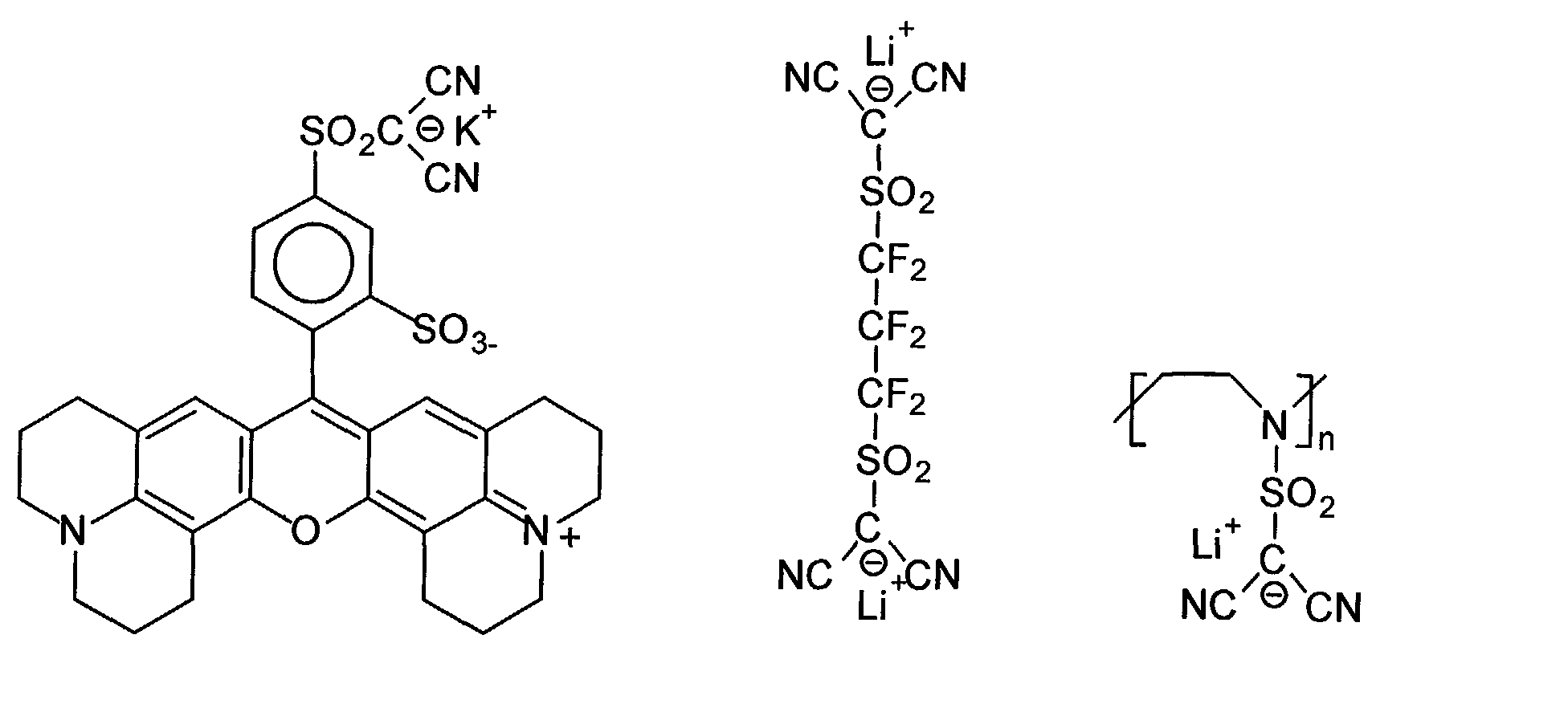






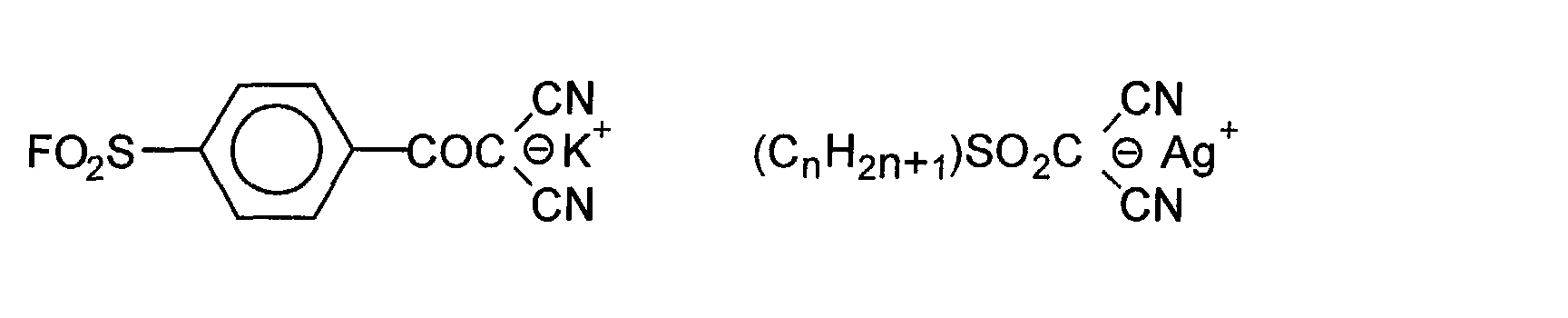
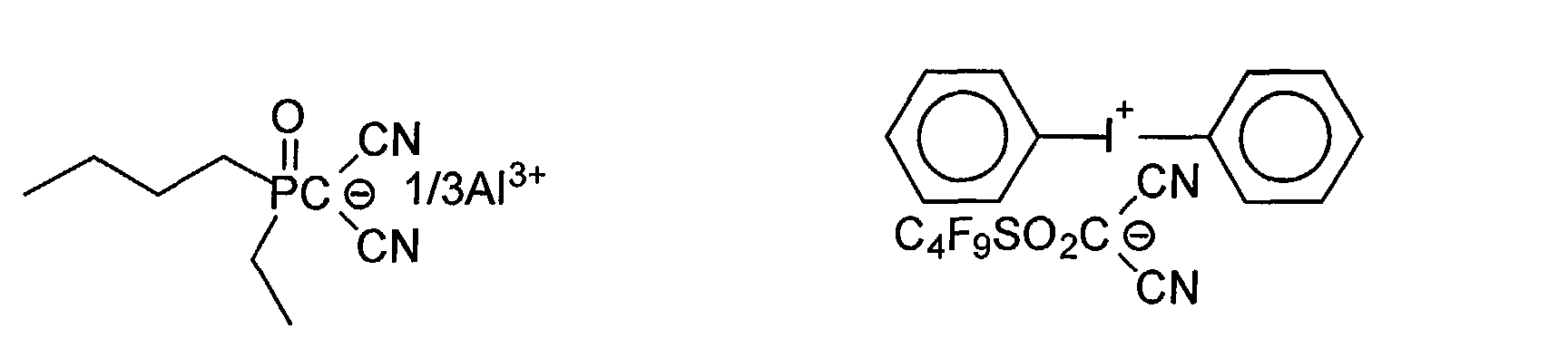



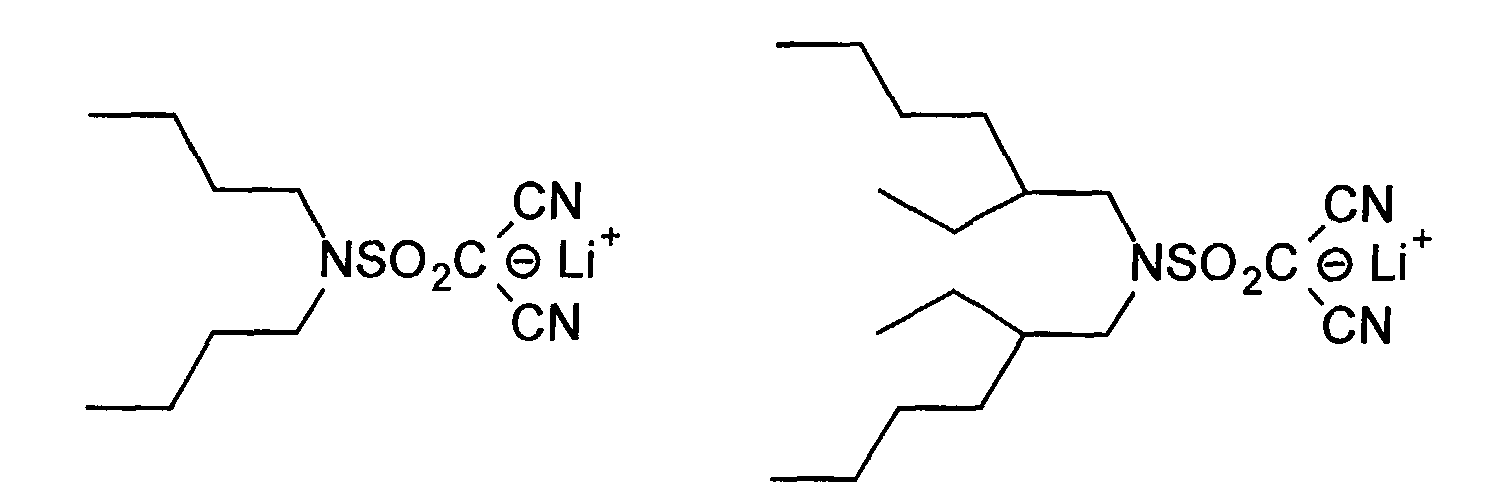
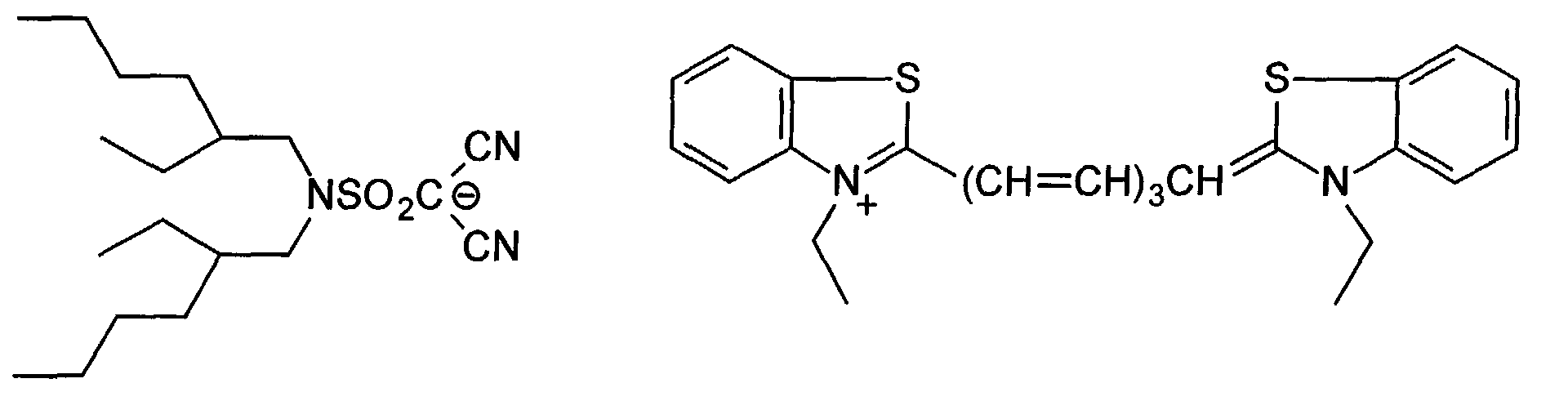


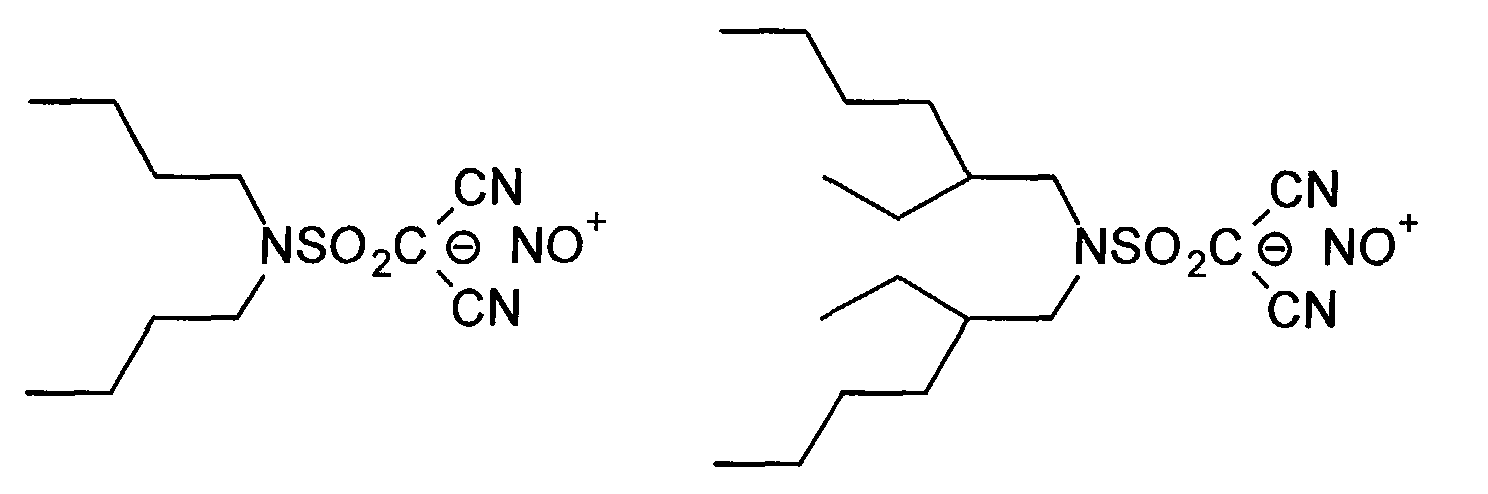


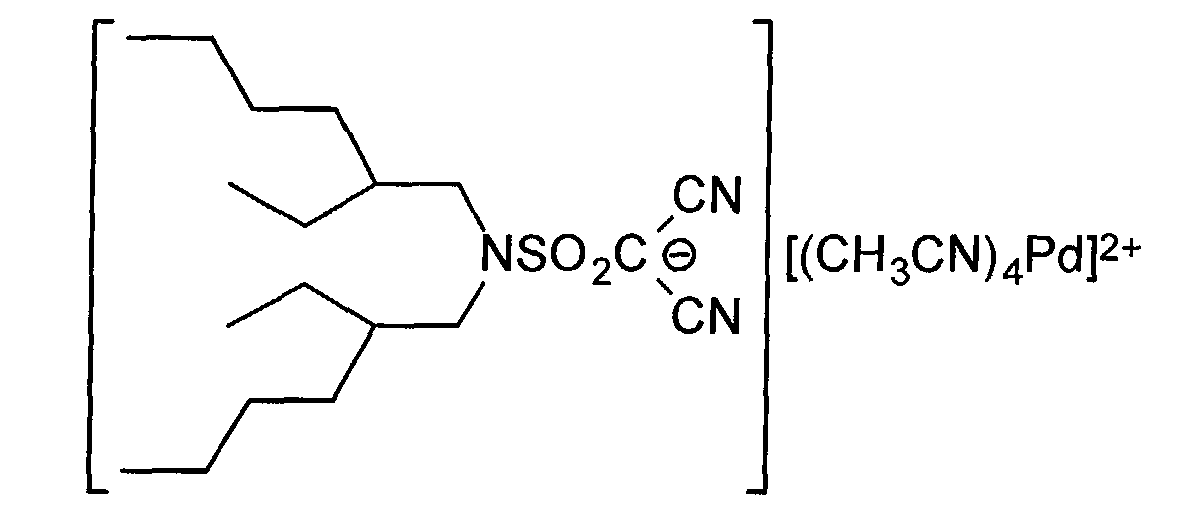


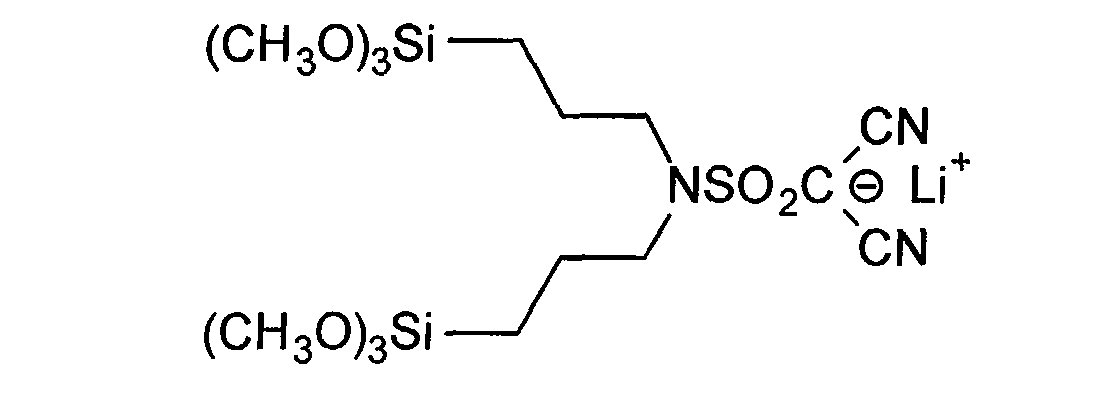




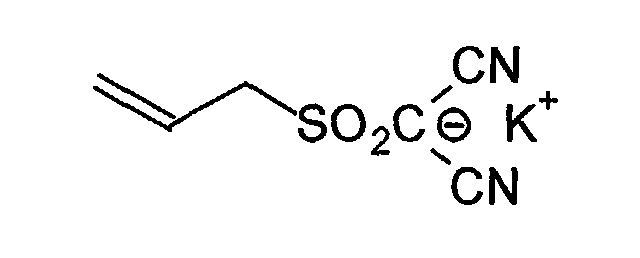
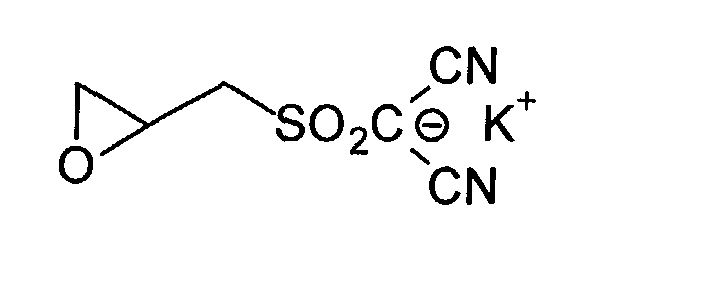
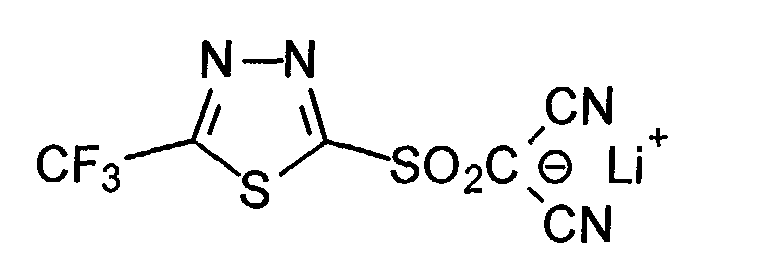


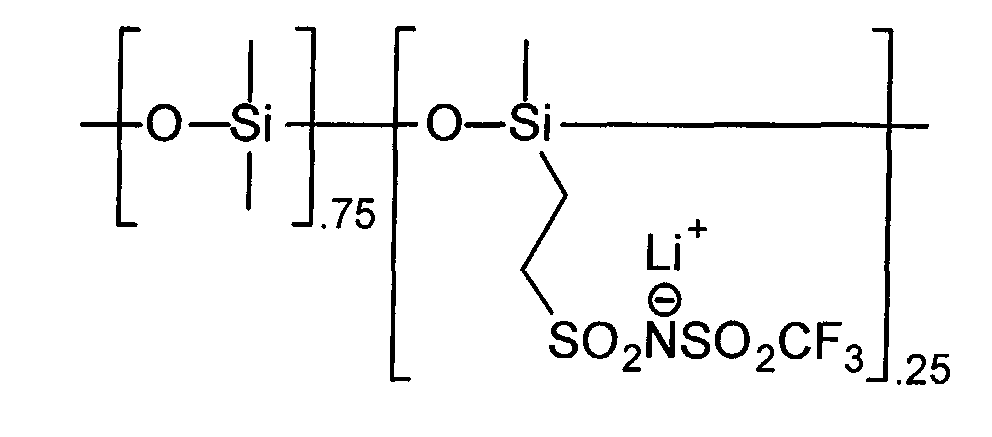

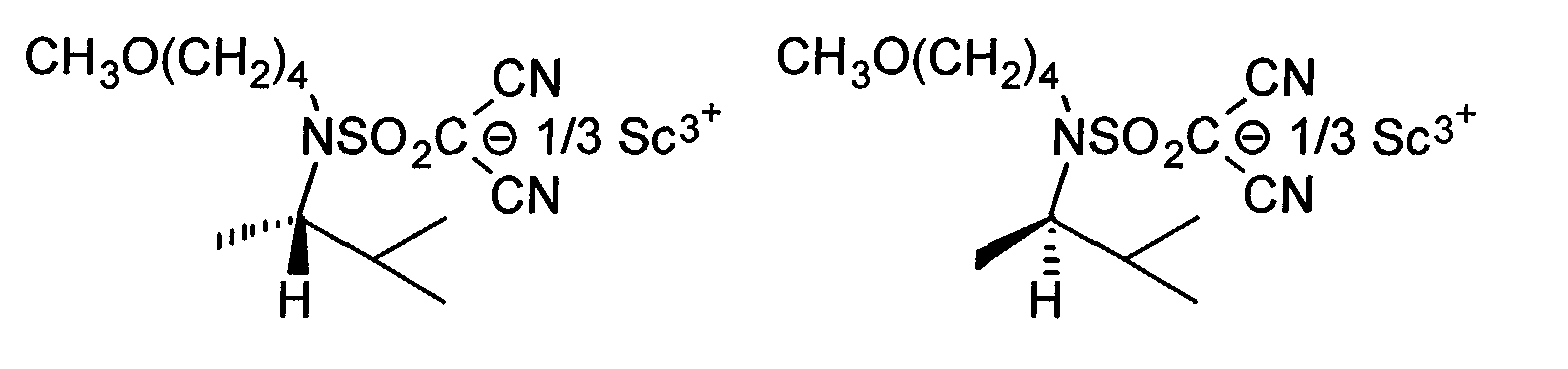



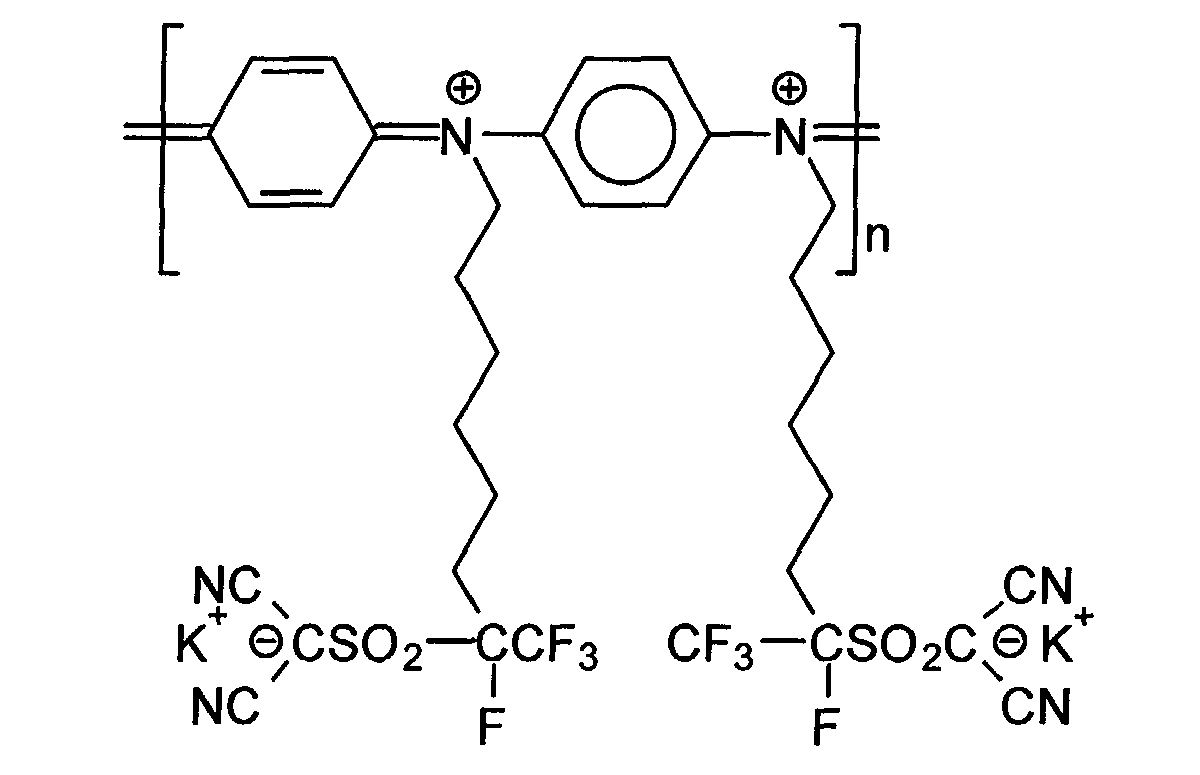
- une cathode composite constituée par 40% en volume du composé polymère obtenu dans le présent exemple et 60% en volume de polyoxyde d'éthylène de masse 3.105 ;
- un électrolyte constitué par un film de polyoxyde d'éthylène de masse 5.106 contenant le sel de lithium de du butanesulfonylmalononitrile, obtenu à l'exemple 20, à une concentration à une concentration O/Li = 20/1 ;
- une anode de lithium métallique.

Claims (53)
- Composé ionique dérivé du malononitrile comprenant une partie anionique associée à au moins une partie cationique Mm+ en nombre suffisant pour assurer la neutralité électronique de l'ensemble, caractérisé en ce que M est un hydroxonium, un nitrosonium NO+, un ammonium -NH4 +, un cation métallique ayant la valence m, un cation organique ayant la valence m ou un cation organométallique ayant la valence m, et que la partie anionique répond à l'une des formules RD-Y-C(C≡N)2 - ou Z-C(C≡N)2 - dans lesquelles :étant entendu qu'un substituant RD peut être un radical monovalent, une partie d'un radical multivalent portant plusieurs groupements -Y-C-(C≡N)2, ou un segment d'un polymère.Z représente un radical électro-attracteur ayant un paramètre de Hammett au moins égal à celui d'un radical phényle, choisi parmi :étant entendu qu'un substituant Z peut être un radical monovalent, un radical multivalent ou une partie d'un radical multivalent (incluant un dendrimère) portant au moins un groupement -C(C≡N)2 -, ou un segment d'un polymère ;j) -SCN, -N3, -CF3, FSO2-, R'FCH2- (R'F étant un radical perfluoré), les radicaux fluoroalkyloxy, fluoroalkylthioxy, fluoroalkényloxy, fluoroalkénylthioxy ;jj) les radicaux comprenant un ou plusieurs noyaux aromatiques contenant éventuellement au moins un atome d'azote, d'oxygène, de soufre ou de phosphore, les dits noyaux pouvant être éventuellement des noyaux condensés et/ou lesdits noyaux pouvant éventuellement porter au moins un substituant choisi parmi les halogènes, -CN, -NO2, -SCN, -N3, CF2=CF-O-, les radicaux RF- et RF-CH2- dans lesquels RF représente un radical perfluoroalkyle ayant de 1 à 12 atomes de carbone, les groupes fluoroalkyloxy, les groupes fluoroalkylthioxy, les radicaux alkyles, alkényles, oxaalkyles, oxaalkényles, azaalkyles, azaalkényles, thiaalkyles, thiaalkényles, les radicaux polymères, les radicaux possédant au moins un groupement ionophore cationique et/ou au moins un groupement ionophore anionique ;Y représente un groupement thiocarbonyle, un groupement sulfonyle, un groupement sulfinyle ou un groupement phosphonyle et :RD est un radical choisi parmi :a) les radicaux alkyle ou alkényle, les radicaux aryle, arylalkyle, alkylaryle ou alkénylaryle, les radicaux alicycliques ou hétérocycliques, y compris les radicaux polycycliques ;b) les radicaux alkyle ou alkényle comprenant au moins un groupe fonctionnel éther, thioéther, amine, imine, amide, carboxyle, carbonyle, isocyanate, isothiocyanate, thiocarbonyle, hydroxy ;c) les radicaux aryle, arylalkyle, arylalkényle, alkylaryle ou alkénylaryle, dans lesquels les noyaux aromatiques et/ou au moins un substituant du noyau comprennent des hétéroatomes tels que l'azote, l'oxygène, le soufre ;d) les radicaux comprenant des cycles aromatiques condensés qui comprennent éventuellement au moins un hétéroatome choisi parmi l'azote, l'oxygène, le soufre ;e) les radicaux halogénés ou perhalogénés alkyle, alkényle, aryle, arylalkyle, alkylaryle, lesdits radicaux comprenant éventuellement des groupes fonctionnels éther, thioéther, imine, amine, carboxyle, carbonyle ou hydroxy ;f) les radicaux RCC(R')(R")-O- dans lesquels RC est un radical alkylperfluoré et R' et R" sont indépendamment l'un de l'autre un atome d'hydrogène ou un radical tel que défini en a), b), c) ou d) ci-dessus;g) les radicaux (RB)2N-, dans lesquels les radicaux RB identiques ou différents sont tels que définis en a), b), c), d) et e) ci-dessus, l'un des RB pouvant être un atome d'hydrogène, ou bien les deux radicaux RB forment ensemble un radical divalent qui forme un cycle avec N ;h) les radicaux polymères,i) les radicaux possédant un ou plusieurs groupements ionophores cationiques et/ou un ou plusieurs groupements ionophores anioniques ;
- Composé selon la revendication 1, caractérisé en ce que le cation organique est un cation onium choisi dans le groupe constitué par les cation R3O+ (oxonium), NR4 + (ammonium), RC(NR2)2 + (amidinium), C(NR2)3 + (guanidinium), C5R6N+ (pyridinium), C3R5N2 + (imidazolium), C2R4N3 + (triazolium), SR3 + (sulfonium), PR4 + (phosphonium), IR2 + (iodonium), (C6R5)3C+ (carbonium), les radicaux R représentant de manière indépendante un H ou un radical choisi dans le groupe constitué par :étant entendu que plusieurs radicaux R peuvent former ensemble des cycles aliphatiques ou aromatiques englobant éventuellement le centre portant la charge cationique.les radicaux alkyles, alkényles, oxa-alkyles, oxa-alkényles, aza-alkyles, aza-alkényles, thia-alkyles, thia-alkényles, aryles, arylalkyles, alkylaryles, alkényl-aryles, les radicaux dialkylamino et les radicaux dialkylazo ;les radicaux cycliques ou hétérocycliques comprenant éventuellement au moins une chaíne latérale comprenant des hétéroatomes tels que l'azote, l'oxygène, le soufre ;les radicaux cycliques ou hétérocycliques comprenant éventuellement des hétéroatomes dans le noyau aromatique ;les groupes comprenant plusieurs noyaux aromatiques ou hétérocycliques, condensés ou non, contenant éventuellement au moins un atome d'azote, d'oxygène, de soufre ou de phosphore ;
- Composé selon la revendication 2, caractérisé en ce que le cation onium fait partie du radical Z ou du radical RD.
- Composé selon la revendication 2, caractérisé en ce que le cation onium fait partie d'une unité récurrente d'un polymère.
- Composé selon la revendication 2, caractérisé en ce que le cation M+ est un hétérocycle cationique à caractère aromatique, comportant au moins un atome d'azote alkylé dans le cycle.
- Composé selon la revendication 5, caractérisé en ce que le cation est un imidazolium, un triazolium, un pyridinium, un 4-diméthylamino-pyridinium, lesdits cations portant éventuellement un substituant sur les atomes de carbone du cycle.
- Composé selon la revendication 2, caractérisé en ce que le cation M est un groupement possédant une liaison -N=N, -N=N+, un groupement sulfonium, un groupement iodonium, ou un cation arène-ferrocénium substitué ou non, éventuellement incorporé dans une trame polymérique.
- Composé selon la revendication 2, caractérisé en ce que le cation est un cation diaryliodonium, un cation dialkylaryliodonium, un cation triarylsulfonium, un cation trialkylaryle sulfonium, ou un cation phénacyl-dialkyl sulfonium substitué ou non.
- Composé selon la revendication 2, caractérisé en ce que le cation aryliodonium, ou le cation alkylaryliodonium, ou le cation triarylsulfonium, ou le cation alkylaryle sulfonium, ou le cation phénacyl-dialkyl sulfonium font partie d'une chaíne polymère.
- Composé selon la revendication 2, caractérisé en ce que M est un cation organique incorporant un groupement 2,2'[Azobis(2-2'-imidazolinio-2-yl)propane]2+ ou 2,2'-Azobis(2-amidiniopropane)2+.
- Composé selon la revendication 1, caractérisé en ce que le cation M est un cation métallique choisi dans le groupe constitué par les cations de métaux alcalins, les cations de métaux alcalino-terreux, les cations de métaux de transition, les cations de métaux trivalents et les cations de terres rares.
- Composé selon la revendication 1, caractérisé en ce que le cation est un métallocénium, choisi dans le groupe constitué par les cations dérivés du ferrocène, du titanocène et du zirconocène, les cations indénocénium, les cations arène métallocénium, les cations des métaux de transition complexés par des ligands possédant éventuellement une chiralité et les cations organométalliques possédant un ou plusieurs groupements alkyles ou aryles fixés d'une manière covalente à un atome ou un groupe d'atome, lesdits cations faisant éventuellement partie d'une chaíne polymère.
- Composé selon la revendication 1, caractérisé en ce que le substituant Z est choisi dans le groupe constitué par -OCnF2n+1, -OC2F4H, -SCnF2n+1 et -SC2F4H, -OCF=CF2, -SCF=CF2, n étant un nombre entier de 1 à 8.
- Composé selon la revendication 1, caractérisé en ce que Z est un radical CnF2n+1CH2-, n étant un nombre entier de 1 à 8.
- Composé selon la revendication 1, caractérisé en ce que RD est choisi parmi les radicaux alkyles, alkényle, oxaalkyle, oxa-alkényle, aza-alkyle, aza-alkényle, thia-alkyle ou thia-alkényle ayant de 1 à 24 atomes de carbone, ou parmi les radicaux aryle, arylalkyle, alkylaryle ou alkénylaryle ayant de 5 à 24 atomes de carbone.
- Composé selon la revendication 1, caractérisé en ce que RD est choisi parmi les radicaux alkyles ou alkényles ayant de 1 à 12 atomes de carbone et comprenant éventuellement au moins un hétéroatome O, N ou S dans la chaíne principale ou dans une chaíne latérale, et/ou portant éventuellement un groupe hydroxy, un groupe carbonyle, un groupe amine, un groupe carboxyle.
- Composé selon la revendication 1, caractérisé en ce que RD est choisi parmi les radicaux aryle, arylalkyle, alkylaryle ou alkénylaryle, dans lesquels les noyaux aromatiques et/ou leurs substituants comprennent des hétéroatomes tels que l'azote, l'oxygène, le soufre.
- Composé selon la revendication 1, caractérisé en ce que RD est partie d'un radical poly(oxyalkylène) ou d'un radical polystyrène.
- Composé selon la revendication 1, caractérisé en ce que RD est un radical possédant un groupement iodonium, un groupement sulfonium, oxonium, ammonium, amidinium, guanidinium, pyridinium, imidazolium, triazolium, phosphonium ou carbonium, ledit groupement ionique jouant totalement ou partiellement le rôle du cation M+.
- Composé selon la revendication 1, caractérisé en ce que RD possède un ou plusieurs groupements ionophores anioniques constitués par une fonction carboxylate (-CO2 -), une fonction sulfonate (-SO3 -), une fonction sulfonimide (-SO2NSO2-) ou une fonction sulfonamide (-SO2N-).
- Composé selon l'une des revendications 1, caractérisé en ce que RD comporte au moins une insaturation éthylénique et/ou un groupe condensable et/ou un groupe dissociable par voie thermique, par voie photochimique ou par dissociation ionique.
- Composé selon l'une des revendications 1, caractérisé en ce que RD représente un groupe mésomorphe ou un groupe chromophore ou un polymère conducteur électronique autodopé ou un alcoxysilane hydrolysable.
- Composé selon la revendication 1, caractérisé en ce que RD représente une unité récurrente d'une chaíne polymère.
- Composé selon la revendication 1, caractérisé en ce que RD comporte un groupement susceptible de piéger les radicaux libres.
- Composé selon la revendication 1, caractérisé en ce que RD comporte ou un dipôle dissociant.
- Composé selon la revendication 1, caractérisé en ce que RD comporte un couple rédox.
- Composé selon la revendication 1, caractérisé en ce que RD comporte ou un ligand complexant.
- Composé selon la revendication 1, caractérisé en ce que RD-Y- est optiquement actif.
- Composé selon la revendication 1, caractérisé en ce que RD représente un radical ayant une valence v supérieure à deux, comportant à chacune de ses extrémités libres un groupe -C(C≡N)2 -.
- Procédé de polymérisation ou de réticulation de monomères ou de prépolymères capables de réagir par voie cationique, caractérisé en ce que l'on utilise un composé selon la revendication 1 comme photoinitiateur source d'acide catalysant la réaction.
- Procédé selon la revendication 30, caractérisé en ce que le composé ionique est choisi parmi ceux dont le cation possède une liaison -N=N+, -N=N-, un groupement sulfonium, un groupement iodonium ou un cation arène-ferrocénium substitué ou non, éventuellement incorporé dans une trame polymérique.
- Procédé selonla revendication 30, caratérisé en ce que le substituant RD du composé ionique est un radical alkyle non substitué, un radical comprenant un groupe oxa ou un sulfone, un radical comprenant un groupement sulfoxyde, sulfone, oxyde de phosphine ou phosphonate.
- Procédé selon la revendication 30, caractérisé en ce que les monomères sont choisis dans le groupe constitué par les composés qui comportent une fonction éther cyclique, une fonction thioéther cyclique ou une fonction amine cyclique, les composés vinyliques, les éthers vinyliques, les oxazolines, les lactones et les lactames.
- Procédé selon la revendication 30, caractérisé en ce que le prépolymère est choisi dans le groupe constitué par les composés dans lesquels des groupements époxy sont portés par une chaíne aliphatique, une chaíne aromatique, ou une chaíne hérérocyclique.
- Procédé selon la revendication 30, caractérisé en ce qu'il consiste à mélanger le photoinitiateur avec au moins un monomère ou prépolymère capable de polymériser par voie cationique, et à soumettre le mélange obtenu à un rayonnement actinique, y compris un rayonnement β.
- Procédé selon la revendication 35, caractérisé en ce que le mélange réactionnel est soumis au rayonnement après avoir été mis sous forme d'une couche mince.
- Procédé selon la revendication 30, caractérisé en ce que le photoinitiateur est utilisé sous forme d'une solution dans un solvant inerte vis à vis de la réaction de polymérisation.
- Procédé selon la revendication 37, caractérisé en ce que le solvant inerte est choisi dans le groupe constitué par l'acétone, la méthyl-éthyl cétone, l'acétonitrile, le carbonate de propylène, la g-butyrolactone, les éther-esters des mono-, di-, tri- éthylène ou propylène glycols, les éther-alcools des mono-, di-, tri- éthylène ou propylène glycols, les esters de l'acide phtalique ou de l'acide citrique.
- Procédé selon la revendication 30, caractérisé en ce que la réaction est effectuée en présence d'un solvant ou d'un diluant constitué par un composé réactif vis à vis de la polymérisation.
- Procédé selon la revendication 39, caractérisé en ce que le composé réactif est choisi dans le groupe constitué par les mono et di éthers vinyliques des mono-, di-, tri-, tétra- éthylène ou propylène glycols, le trivinyl éther triméthylolpropane et le divinyléther du diméthanolcyclohexane, la N-vinylpyrolidone, le 2-propényléther du carbonate de propylène.
- Procédé selon la revendication 30, caractérisé en ce que l'on ajoute un photosensibilisateur au milieu réactionnel.
- Procédé selon la revendication 41, caractérisé en ce que le photosensibilisateur est choisi dans le groupe constitué par l'anthracène, le diphényl-9,10-anthracène, le pérylène, la phénothiazine, le tétracène, la xanthone, la thioxanthone, l'isopropylthioxantone, l'acétophénone, la benzophénone, les 1,3,5-triaryl-2-pyrazolines et leurs dérivés, en particulier les dérivés de substitution sur les noyaux aromatiques par des radicaux alkyles, oxa- ou aza-alkyles.
- Procédé selon la revendication 30, caractérisé en ce que le mélange réactionnel contient en outre au moins un monomère ou prépolymère capable de polymériser par voie radicalaire et un composé capable de libérer un amorceur de polymérisation radicalaire sous l'effet du rayonnement actinique ou du rayonnement β ou sous l'action de la chaleur.
- Procédé de modification des propriétés de solubilité d'un polymère possédant des groupements sensibles aux acides, caractérisé en ce qu'il consiste à soumettre ledit polymère à un rayonnement actinique ou un rayonnement β, en présence d'un composé selon la revendication 1.
- Procédé selon la revendication 44, caractérisé en ce que le polymère contient des motifs ester ou des motifs aryléther dérivés d'alcool tertiaire.
- Procédé selon la revendication 45, caractérisé en ce que le polymère est choisi dans le groupe constitué par les polyacrylates de tertiobutyle, les polyitaconates de tertiobutyle ou de tertio-amyle, le poly(tertiobutoxycarbonyloxystyrène), le poly(tertiobutoxystyrène).
- Procédé selon la revendication 44, caractérisé en ce qu'il est mis en oeuvre pour l'amplification chimique de photorésists.
- Procédé de polymérisation de monomères vinyliques, caractérisé en ce que l'on utilise comme amorceur radicalaire un composé selon la revendication 10.
- Composition de colorant cationique, caractérisée en ce qu'elle contient un composé selon la revendication 1.
- Composition de colorant cationique selon la revendication 49, caractérisé en ce que la ou les charges négatives du groupement anionique RD-Y-C(C≡N)2 - ou Z-C(C≡N)2 - sont soit fixées à la molécule de colorant, soit elles constituent le contre-ion des charges positives du colorant.
- Utilisation d'un composé ionique selon la revendication 1 en tant que catalyseur dans les réactions de Friedel-Crafts, les réactions de Diels-Alder, les réactions d'aldolisation, les additions de Michael, les réactions d'allylation, les réactions de couplage pinacolique, les réactions de glycosilation, les réactions d'ouvertures de cycles des oxétanes, les réactions de méthathèse des alcènes, les polymérisations de type Ziegler-Natta, les polymérisations du type méthathèse par ouverture de cycle et les polymérisations du type méthathèse de diènes acycliques.
- Utilisation selon la revendication 51, caractérisée en ce que le cation du composé ionique est choisi parmi le lithium, le magnésium, le cuivre, le zinc, l'étain, les métaux trivalents, y compris les terres rares, les platinoïdes, et leurs couples organométalliques
- Utilisation d'un composé selon la revendication 6, comme solvant pour effectuer des réactions chimiques, photochimiques, électrochimiques, photoélectrochimiques, ledit composé étant utilisé au dessus de son point de fusion.
Applications Claiming Priority (5)
| Application Number | Priority Date | Filing Date | Title |
|---|---|---|---|
| CA2194127 | 1996-12-30 | ||
| CA002194127A CA2194127A1 (fr) | 1996-12-30 | 1996-12-30 | Anions delocalises utiles en tant que solutes electrolytiques |
| CA2199231 | 1997-03-05 | ||
| CA002199231A CA2199231A1 (fr) | 1997-03-05 | 1997-03-05 | Nouveaux materiaux ioniques |
| EP19970403189 EP0850921B1 (fr) | 1996-12-30 | 1997-12-30 | Matériaux à conduction ionique comprenant un composé ionique dérivé du malononitrile et leurs utilisations |
Related Parent Applications (1)
| Application Number | Title | Priority Date | Filing Date |
|---|---|---|---|
| EP19970403189 Division EP0850921B1 (fr) | 1996-12-30 | 1997-12-30 | Matériaux à conduction ionique comprenant un composé ionique dérivé du malononitrile et leurs utilisations |
Publications (3)
| Publication Number | Publication Date |
|---|---|
| EP1201650A2 true EP1201650A2 (fr) | 2002-05-02 |
| EP1201650A3 EP1201650A3 (fr) | 2004-01-02 |
| EP1201650B1 EP1201650B1 (fr) | 2006-11-22 |
Family
ID=25678955
Family Applications (9)
| Application Number | Title | Priority Date | Filing Date |
|---|---|---|---|
| EP20090166055 Expired - Lifetime EP2380882B1 (fr) | 1996-12-30 | 1997-12-30 | Sels d'anions hétérocycliques, et leurs utilisations comme matériaux à conduction ionique |
| EP97951051A Expired - Lifetime EP0889863B1 (fr) | 1996-12-30 | 1997-12-30 | Materiaux carbones modifies en surface |
| EP19970403190 Expired - Lifetime EP0850932B1 (fr) | 1996-12-30 | 1997-12-30 | Sels d'anions hétérocycliques, et leurs utilisations comme matéreiaux à conductin ionique |
| EP97951052A Expired - Lifetime EP0890176B1 (fr) | 1996-12-30 | 1997-12-30 | Conducteurs protoniques sous forme liquide |
| EP03292436.7A Withdrawn EP1391952A3 (fr) | 1996-12-30 | 1997-12-30 | Sels d'anions pentacycliques ou dérivés de tétrazapentalène, et leurs utilisations comme matériaux à conduction ionique |
| EP19970403189 Expired - Lifetime EP0850921B1 (fr) | 1996-12-30 | 1997-12-30 | Matériaux à conduction ionique comprenant un composé ionique dérivé du malononitrile et leurs utilisations |
| EP19970403187 Expired - Lifetime EP0850920B1 (fr) | 1996-12-30 | 1997-12-30 | Matériaux à conduction ionique contenant un sel d'amides perfluorés et leurs utilisations |
| EP19970403188 Withdrawn EP0850933A1 (fr) | 1996-12-30 | 1997-12-30 | Sels d'anions pentacycliques ou dérivés de tétrazapentalène, et leurs utilisations comme matériaux à conduction ionique |
| EP20010129670 Expired - Lifetime EP1201650B1 (fr) | 1996-12-30 | 1997-12-30 | Composés ioniques dérivés du malonitrile, et leurs utilisations |
Family Applications Before (8)
| Application Number | Title | Priority Date | Filing Date |
|---|---|---|---|
| EP20090166055 Expired - Lifetime EP2380882B1 (fr) | 1996-12-30 | 1997-12-30 | Sels d'anions hétérocycliques, et leurs utilisations comme matériaux à conduction ionique |
| EP97951051A Expired - Lifetime EP0889863B1 (fr) | 1996-12-30 | 1997-12-30 | Materiaux carbones modifies en surface |
| EP19970403190 Expired - Lifetime EP0850932B1 (fr) | 1996-12-30 | 1997-12-30 | Sels d'anions hétérocycliques, et leurs utilisations comme matéreiaux à conductin ionique |
| EP97951052A Expired - Lifetime EP0890176B1 (fr) | 1996-12-30 | 1997-12-30 | Conducteurs protoniques sous forme liquide |
| EP03292436.7A Withdrawn EP1391952A3 (fr) | 1996-12-30 | 1997-12-30 | Sels d'anions pentacycliques ou dérivés de tétrazapentalène, et leurs utilisations comme matériaux à conduction ionique |
| EP19970403189 Expired - Lifetime EP0850921B1 (fr) | 1996-12-30 | 1997-12-30 | Matériaux à conduction ionique comprenant un composé ionique dérivé du malononitrile et leurs utilisations |
| EP19970403187 Expired - Lifetime EP0850920B1 (fr) | 1996-12-30 | 1997-12-30 | Matériaux à conduction ionique contenant un sel d'amides perfluorés et leurs utilisations |
| EP19970403188 Withdrawn EP0850933A1 (fr) | 1996-12-30 | 1997-12-30 | Sels d'anions pentacycliques ou dérivés de tétrazapentalène, et leurs utilisations comme matériaux à conduction ionique |
Country Status (6)
| Country | Link |
|---|---|
| US (16) | US6395367B1 (fr) |
| EP (9) | EP2380882B1 (fr) |
| JP (14) | JP4823401B2 (fr) |
| CA (9) | CA2248242C (fr) |
| DE (6) | DE69736994T2 (fr) |
| WO (6) | WO1998029388A1 (fr) |
Families Citing this family (331)
| Publication number | Priority date | Publication date | Assignee | Title |
|---|---|---|---|---|
| US5962546A (en) † | 1996-03-26 | 1999-10-05 | 3M Innovative Properties Company | Cationically polymerizable compositions capable of being coated by electrostatic assistance |
| JP4823401B2 (ja) * | 1996-12-30 | 2011-11-24 | イドロ―ケベック | 過フッ化アミド塩及びイオン伝導物質としてのその使用方法 |
| WO1999005100A1 (fr) | 1997-07-25 | 1999-02-04 | Acep Inc | Composes ioniques ayant une charge anionique delocalisee, leur utilisation comme composants de conducteurs ioniques ou de catalyseur |
| WO1999005126A1 (fr) | 1997-07-25 | 1999-02-04 | Acep Inc. | Composes ioniques perfluorovinyliques et leur utilisation dans des materiaux conducteurs |
| CA2215849A1 (fr) * | 1997-09-11 | 1999-03-11 | Christophe Michot | Nouveau solvant et composition electrolytique a haute conductivite ayant une stabilite a large plage |
| WO1999028292A1 (fr) * | 1997-12-01 | 1999-06-10 | Acep Inc. | Sels de sulfones perfluores, et leurs utilisations comme materiaux a conduction ionique |
| GB9726008D0 (en) * | 1997-12-10 | 1998-02-04 | Secr Defence | Eletrolyte |
| JP4417554B2 (ja) * | 1998-03-03 | 2010-02-17 | イー・アイ・デュポン・ドウ・ヌムール・アンド・カンパニー | 相当にフッ素化されたイオノマー |
| US6063522A (en) * | 1998-03-24 | 2000-05-16 | 3M Innovative Properties Company | Electrolytes containing mixed fluorochemical/hydrocarbon imide and methide salts |
| FR2781932B1 (fr) * | 1998-07-10 | 2000-09-01 | Giat Ind Sa | Electrolyte solide polymere et ses procedes de preparation |
| US6350545B2 (en) | 1998-08-25 | 2002-02-26 | 3M Innovative Properties Company | Sulfonylimide compounds |
| US6294289B1 (en) * | 1998-08-25 | 2001-09-25 | 3M Innovative Properties Company | Cyano-substituted methide and amide salts |
| DE19858925A1 (de) | 1998-12-19 | 2000-06-21 | Aventis Res & Tech Gmbh & Co | Elektrolytsystem für Lithiumbatterien und dessen Verwendung sowie Verfahren zur Erhöhung der Sicherheit von Lithiumbatterien |
| EP1033731B1 (fr) * | 1999-03-01 | 2006-07-05 | Fuji Photo Film Co., Ltd. | Cellule photoélectrochimique contenant des electrolytes à cristaux liquides |
| JP3724252B2 (ja) * | 1999-04-19 | 2005-12-07 | ダイソー株式会社 | 架橋高分子固体電解質及びその用途 |
| US6372820B1 (en) * | 1999-05-06 | 2002-04-16 | Cabot Corporation | Polymerized modified particles and methods of making the same |
| US6593690B1 (en) * | 1999-09-03 | 2003-07-15 | 3M Innovative Properties Company | Large area organic electronic devices having conducting polymer buffer layers and methods of making same |
| EP1087412B1 (fr) * | 1999-09-24 | 2008-10-01 | Kabushiki Kaisha Toshiba | Composition d'électrolyte, cellule solaire employant cette composition d'électrolyte, et méthode de fabrication de cette cellule solaire |
| US6765115B1 (en) * | 1999-11-23 | 2004-07-20 | E.I. Du Pont De Nemours And Company | Method for preparing dimetal sulfonyl amide salts |
| DE60022076T2 (de) * | 1999-11-23 | 2006-05-24 | E.I. Du Pont De Nemours And Co., Wilmington | Verfahren zur herstellung von dimetall-sulfonamid-salzen |
| CN1175512C (zh) * | 1999-11-29 | 2004-11-10 | 松下电器产业株式会社 | 非水电解质及非水电解质电池 |
| EP1237858B1 (fr) | 1999-12-02 | 2004-07-14 | E.I. Du Pont De Nemours And Company | Procede de preparation d'imides a partir de fluorures de sulfonyle |
| US6692658B2 (en) * | 1999-12-17 | 2004-02-17 | Canon Kabushiki Kaisha | Electrolyte and secondary cell |
| SG83222A1 (en) * | 1999-12-27 | 2001-09-18 | Sumitomo Chemical Co | Catalyst component for addition polymerization, catalyst for addition polymerization, and process for producing addition polymer |
| AU2000253140A1 (en) * | 2000-01-11 | 2001-07-24 | 3M Innovative Properties Company | Perfluoroalkanesulfonate salts in electrochemical systems |
| US6395838B1 (en) | 2000-01-19 | 2002-05-28 | E. I. Du Pont De Nemours And Company | Process for making graft copolymers |
| US6522522B2 (en) * | 2000-02-01 | 2003-02-18 | Cabot Corporation | Capacitors and supercapacitors containing modified carbon products |
| DE10004928A1 (de) * | 2000-02-04 | 2001-08-09 | Solvay Fluor & Derivate | Verwendung von Amidinen |
| US20040082464A1 (en) * | 2000-03-31 | 2004-04-29 | Romano Anna Maria | Complex polymerization catalysts for the homopolymerization of ethylene and for the copolymerization of ethylene |
| US7220914B2 (en) * | 2003-12-01 | 2007-05-22 | Konarka Technologies, Inc. | Zwitterionic compounds and photovoltaic cells containing same |
| JP4682395B2 (ja) * | 2000-04-28 | 2011-05-11 | 日産自動車株式会社 | 非水電池 |
| DE10023744A1 (de) * | 2000-05-15 | 2001-12-13 | Bayer Ag | Elektrochrome Anzeigevorrichtung mit hoher Kantenschärfe |
| US6647166B2 (en) | 2000-08-17 | 2003-11-11 | The Regents Of The University Of California | Electrochromic materials, devices and process of making |
| JP4799776B2 (ja) * | 2000-08-22 | 2011-10-26 | 富士フイルム株式会社 | 電解質組成物及びそれを用いた電気化学電池 |
| JP2002134113A (ja) * | 2000-10-30 | 2002-05-10 | Matsushita Electric Ind Co Ltd | 非水系二次電池 |
| US6841303B2 (en) * | 2001-01-17 | 2005-01-11 | Skc Co., Ltd. | High ionic conductivity gel polymer electrolyte for rechargeable polymer batteries |
| US7253289B2 (en) * | 2001-01-22 | 2007-08-07 | Covalent Associates, Inc. | One-step process for the preparation of halide-free hydrophobic salts |
| EP1370508A2 (fr) * | 2001-03-12 | 2003-12-17 | The Queen's University of Belfast | Procede catalyse par des composes bis-triflimides |
| JP3969077B2 (ja) * | 2001-04-04 | 2007-08-29 | 住友化学株式会社 | 高分子電解質及びその製造方法 |
| US20030054172A1 (en) * | 2001-05-10 | 2003-03-20 | 3M Innovative Properties Company | Polyoxyalkylene ammonium salts and their use as antistatic agents |
| JP4752135B2 (ja) * | 2001-05-25 | 2011-08-17 | 株式会社Gsユアサ | リチウム電池 |
| JP4222466B2 (ja) * | 2001-06-14 | 2009-02-12 | 富士フイルム株式会社 | 電荷輸送材料、それを用いた光電変換素子及び光電池、並びにピリジン化合物 |
| JP4287741B2 (ja) * | 2001-06-22 | 2009-07-01 | アグフア−ゲヴエルト,ナームローゼ・フエンノートシヤツプ | 伝導性パターンを有する材料;ならびに伝導性パターンの形成のための材料及び方法 |
| US6746751B2 (en) | 2001-06-22 | 2004-06-08 | Agfa-Gevaert | Material having a conductive pattern and a material and method for making a conductive pattern |
| US6545109B2 (en) | 2001-06-29 | 2003-04-08 | 3M Innovative Properties Company | Imide salts as emulsifiers for the polymerization of fluoroolefins |
| WO2003011958A1 (fr) * | 2001-08-02 | 2003-02-13 | 3M Innovative Properties Company | Adhesifs autocollants antistatiques optiquement transparents |
| JP4036279B2 (ja) * | 2001-10-09 | 2008-01-23 | よこはまティーエルオー株式会社 | プロトン伝導体及びこれを用いた燃料電池 |
| US7241535B2 (en) * | 2001-10-15 | 2007-07-10 | Samsung Sdi Co., Ltd. | Electrolyte for lithium-sulfur batteries and lithium-sulfur batteries comprising the same |
| JP4004769B2 (ja) * | 2001-10-17 | 2007-11-07 | Necトーキン株式会社 | 電解液、並びにこれを用いた電気化学セル |
| DE10155281A1 (de) * | 2001-11-08 | 2003-06-05 | Solvent Innovation Gmbh | Verfahren zur Entfernung polarisierbarer Verunreinigungen aus Kohlenwasserstoffen und Kohlenwasserstoffgemischen durch Extraktion mit ionischen Flüssigkeiten |
| US7303852B2 (en) * | 2001-12-27 | 2007-12-04 | Shin-Etsu Chemical Co., Ltd. | Photoacid generating compounds, chemically amplified positive resist materials, and pattern forming method |
| CA2474484C (fr) * | 2002-01-25 | 2013-03-26 | Powermers, Inc. | Electrode en polymere modifie pour dispositifs de stockage d'energie et supercondensateur electrochimique comportant cette electrode |
| US20030153094A1 (en) * | 2002-02-13 | 2003-08-14 | Board Of Trustees Of Michigan State University | Conductimetric biosensor device, method and system |
| CN1678948A (zh) * | 2002-03-27 | 2005-10-05 | 艾利丹尼森公司 | 可转换的电-光层压制品 |
| TWI263235B (en) | 2002-04-02 | 2006-10-01 | Nippon Catalytic Chem Ind | Material for electrolytic solutions and use thereof |
| US6803152B2 (en) * | 2002-04-19 | 2004-10-12 | Ener1 Battery Company | Nonaqueous electrolytes based on organosilicon ammonium derivatives for high-energy power sources |
| US7709158B1 (en) | 2002-05-09 | 2010-05-04 | Electrochem Solutions, Inc. | Guanidine derivatives as cations for ambient temperature molten sales in electrochemical power sources |
| US20030211389A1 (en) * | 2002-05-09 | 2003-11-13 | Schlaikjer Carl R. | Guanidine derivatives as cations for ambient temperature molten salts in electrochemical power sources |
| US7042615B2 (en) | 2002-05-17 | 2006-05-09 | The Regents Of The University Of California | Electrochromic devices based on lithium insertion |
| CN100339913C (zh) * | 2002-05-23 | 2007-09-26 | 哥伦比亚化学公司 | 用于燃料电池的、磺化导电聚合物接枝的碳材料 |
| EP1509929A4 (fr) * | 2002-05-23 | 2007-03-21 | Columbian Chem | Materiau conducteur carbone greffe sur un polymere destine a des applications de pile a combustible |
| US7390441B2 (en) * | 2002-05-23 | 2008-06-24 | Columbian Chemicals Company | Sulfonated conducting polymer-grafted carbon material for fuel cell applications |
| US7241334B2 (en) * | 2002-05-23 | 2007-07-10 | Columbian Chemicals Company | Sulfonated carbonaceous materials |
| US7459103B2 (en) * | 2002-05-23 | 2008-12-02 | Columbian Chemicals Company | Conducting polymer-grafted carbon material for fuel cell applications |
| JP2004031423A (ja) * | 2002-06-21 | 2004-01-29 | Nissan Diesel Motor Co Ltd | グローブボックス装置 |
| US7763186B2 (en) * | 2002-06-21 | 2010-07-27 | Los Alamos National Security, Llc | Preparation and purification of ionic liquids and precursors |
| EP1529240A4 (fr) * | 2002-06-21 | 2008-04-16 | Univ California | Electrolytes pour dispositifs electro-optiques comprenant des liquides ioniques |
| KR100463181B1 (ko) * | 2002-07-12 | 2004-12-23 | 삼성에스디아이 주식회사 | 리튬-설퍼 전지용 전해액 및 이를 포함하는 리튬-설퍼 전지 |
| US20040038127A1 (en) * | 2002-08-20 | 2004-02-26 | Schlaikjer Carl Roger | Small cation/delocalizing anion as an ambient temperature molten salt in electrochemical power sources |
| JP2004082365A (ja) * | 2002-08-23 | 2004-03-18 | Fuji Photo Film Co Ltd | 感熱記録材料 |
| US7317047B2 (en) | 2002-09-24 | 2008-01-08 | E.I. Du Pont De Nemours And Company | Electrically conducting organic polymer/nanoparticle composites and methods for use thereof |
| AU2003275203A1 (en) | 2002-09-24 | 2004-04-19 | E.I. Du Pont De Nemours And Company | Water dispersible polythiophenes made with polymeric acid colloids |
| JP4464277B2 (ja) | 2002-09-24 | 2010-05-19 | イー・アイ・デュポン・ドウ・ヌムール・アンド・カンパニー | 導電性有機ポリマー/ナノ粒子複合材料およびその使用方法 |
| CA2499364A1 (fr) | 2002-09-24 | 2004-04-08 | E. I. Du Pont De Nemours And Company | Polyanilines dispersibles dans l'eau obtenues au moyen de colloides d'acides polymeres destinees a des applications electroniques |
| EP1406336A1 (fr) * | 2002-10-01 | 2004-04-07 | Xoliox SA | Composition d'électrolyte polymère présentant des propriétés anticorrosives meilleures d'aluminium |
| KR101015647B1 (ko) * | 2002-11-22 | 2011-02-22 | 닛뽕 카릿또 가부시키가이샤 | 근적외선 흡수색소 및 근적외선 차단필터 |
| EP1528580B2 (fr) † | 2003-01-15 | 2015-07-01 | Nippon Shokubai Co., Ltd. | Cellule solaire sensibilisée par colorant |
| US20040149472A1 (en) * | 2003-02-03 | 2004-08-05 | Warner Benjamin P. | Radiofrequency attenuator and method |
| JP2004265638A (ja) * | 2003-02-25 | 2004-09-24 | Ebara Corp | 混合伝導カーボンおよび電極 |
| US7390438B2 (en) | 2003-04-22 | 2008-06-24 | E.I. Du Pont De Nemours And Company | Water dispersible substituted polydioxythiophenes made with fluorinated polymeric sulfonic acid colloids |
| US7312100B2 (en) * | 2003-05-27 | 2007-12-25 | The North Carolina State University | In situ patterning of electrolyte for molecular information storage devices |
| WO2005001979A2 (fr) * | 2003-06-27 | 2005-01-06 | E.I. Dupont De Nemours And Company | Composes de sulfonamide fluore et membranes d'electrolytes polymeres prepares a partir de ces composes en vue d'une utilisation dans des cellules electrochimiques |
| EP1646054A4 (fr) * | 2003-07-11 | 2010-05-19 | Ube Industries | Melange de base et d'acide et conducteur d'ions compose dudit melange |
| US7001936B2 (en) * | 2003-07-16 | 2006-02-21 | Lexmark International, Inc. | Pigmented inkjet ink |
| EP1673830A2 (fr) * | 2003-09-30 | 2006-06-28 | Honeywell International Inc. | Electrolyte avec temoin |
| US7074491B2 (en) * | 2003-11-04 | 2006-07-11 | Dionex Corporation | Polar silanes for binding to substrates and use of the bound substrates |
| US8828610B2 (en) * | 2004-01-06 | 2014-09-09 | Sion Power Corporation | Electrolytes for lithium sulfur cells |
| US10297827B2 (en) | 2004-01-06 | 2019-05-21 | Sion Power Corporation | Electrochemical cell, components thereof, and methods of making and using same |
| US10629947B2 (en) | 2008-08-05 | 2020-04-21 | Sion Power Corporation | Electrochemical cell |
| US7358012B2 (en) | 2004-01-06 | 2008-04-15 | Sion Power Corporation | Electrolytes for lithium sulfur cells |
| TWI302760B (en) | 2004-01-15 | 2008-11-01 | Lg Chemical Ltd | Electrochemical device comprising aliphatic nitrile compound |
| JP4433165B2 (ja) * | 2004-02-16 | 2010-03-17 | ソニー株式会社 | カチオン伝導体およびこれを用いた電気化学デバイス |
| JP4507629B2 (ja) * | 2004-02-20 | 2010-07-21 | 東洋インキ製造株式会社 | 樹脂グラフトカーボンブラック組成物 |
| WO2005083159A2 (fr) * | 2004-02-23 | 2005-09-09 | E.I. Dupont De Nemours & Company | Appareil de polissage electrolytique mettant en oeuvre une membrane |
| US7351358B2 (en) | 2004-03-17 | 2008-04-01 | E.I. Du Pont De Nemours And Company | Water dispersible polypyrroles made with polymeric acid colloids for electronics applications |
| US7785740B2 (en) * | 2004-04-09 | 2010-08-31 | Air Products And Chemicals, Inc. | Overcharge protection for electrochemical cells |
| US8147962B2 (en) | 2004-04-13 | 2012-04-03 | E. I. Du Pont De Nemours And Company | Conductive polymer composites |
| TW200606970A (en) | 2004-05-10 | 2006-02-16 | Nippon Catalytic Chem Ind | Material for electrolytic solution, ionic material-containing composition and use thereof |
| US7960057B2 (en) * | 2004-05-17 | 2011-06-14 | Toyota Motor Engineering & Manufacturing North America, Inc. | Battery with molten salt electrolyte and phosphorus-containing cathode |
| US20050287441A1 (en) * | 2004-06-23 | 2005-12-29 | Stefano Passerini | Lithium polymer electrolyte batteries and methods of making |
| JP2006008454A (ja) * | 2004-06-25 | 2006-01-12 | Fuji Xerox Co Ltd | 炭素微粒子構造体とその製造方法、およびこれを製造するための炭素微粒子転写体と炭素微粒子構造体製造用溶液、並びに炭素微粒子構造体を用いた炭素微粒子構造体電子素子とその製造方法、そして集積回路 |
| JP4731132B2 (ja) * | 2004-06-29 | 2011-07-20 | 株式会社Adeka | 非水電解液及び該電解液を用いた非水電解液二次電池 |
| JP4412598B2 (ja) * | 2004-07-20 | 2010-02-10 | 第一工業製薬株式会社 | イオンポリマーゲル電解質およびその前駆体組成物 |
| AU2004240178A1 (en) * | 2004-08-20 | 2006-03-09 | Commonwealth Scientific And Industrial Research Organisation | Zwitterionic additives for electrochemical devices |
| EP1634867A1 (fr) * | 2004-08-25 | 2006-03-15 | Lonza AG | Des sels de cations organiques du tricyanométhane |
| EP1796193B1 (fr) * | 2004-09-03 | 2011-12-14 | Nissan Motor Co., Ltd. | Conducteur protonique et pile à combustible utilisant ledit conducteur |
| KR100663032B1 (ko) * | 2004-09-21 | 2006-12-28 | 주식회사 엘지화학 | 공융혼합물을 포함하는 전해질 및 이를 이용한 전기 변색소자 |
| US20060068987A1 (en) * | 2004-09-24 | 2006-03-30 | Srinivas Bollepalli | Carbon supported catalyst having reduced water retention |
| JP4709518B2 (ja) * | 2004-09-29 | 2011-06-22 | 株式会社東芝 | プロトン伝導膜及び燃料電池 |
| WO2006063441A1 (fr) * | 2004-12-13 | 2006-06-22 | Transfert Plus, S.E.C. | Compositions, couples redox et utilisations de ceux-ci |
| FR2879458B1 (fr) * | 2004-12-21 | 2007-07-20 | Centre Nat Rech Scient Cnrse | Sulfamides et sulfinimides fluores |
| AU2006205076B2 (en) | 2005-01-10 | 2010-12-23 | Avery Dennison Corporation | Removable curl labels |
| KR100616666B1 (ko) | 2005-01-27 | 2006-08-28 | 삼성전기주식회사 | 카본나노튜브에 구아니딘기를 형성하는 방법,구아니딘기가 형성된 카본나노튜브를 기판에 부착하는방법 및 이에 따라 제조된 카본나노튜브 및 기판 |
| WO2006088033A1 (fr) * | 2005-02-17 | 2006-08-24 | Kaneka Corporation | Composition pour le revetement d’une surface metallique, procede pour la production d’un polymere conducteur electrique, procede pour le revetement d’une surface metallique, et condensateur electrolytique et procede pour sa production |
| JP2006257288A (ja) * | 2005-03-17 | 2006-09-28 | Kaneka Corp | 金属表面コーティング用組成物、導電性高分子の製造方法、金属表面のコーティング方法、ならびに電解コンデンサおよびその製造方法 |
| JP4856883B2 (ja) * | 2005-03-03 | 2012-01-18 | 富士フイルム株式会社 | 機能性素子、エレクトロクロミック素子、光学デバイス及び撮影ユニット |
| DE102005013790B4 (de) * | 2005-03-24 | 2007-03-29 | Polymaterials Ag | Polymerelektrolyt, Verwendung des Polymerelektrolyten und elektrochemische Vorrichtung, die den Polymerelektrolyten umfasst |
| CA2506104A1 (fr) * | 2005-05-06 | 2006-11-06 | Michel Gauthier | Composes redox a surface modifiee et electrode composite obtenue au moyen de ceux-ci |
| US7619803B2 (en) * | 2005-05-31 | 2009-11-17 | Konica Minolta Holdings, Inc. | Electrochromic display element and full-color electrochromic display element |
| US7579184B2 (en) * | 2005-06-02 | 2009-08-25 | Board Of Trustees Of Michigan State University | Methods to increase dynamic range and improve quantitative analysis in rapid biosensors |
| WO2007002740A2 (fr) | 2005-06-28 | 2007-01-04 | E. I. Du Pont De Nemours And Company | Compositions tampons |
| KR101356296B1 (ko) * | 2005-06-28 | 2014-02-06 | 이 아이 듀폰 디 네모아 앤드 캄파니 | 높은 일 함수의 투명한 도체 |
| WO2007022624A1 (fr) * | 2005-08-22 | 2007-03-01 | Transfert Plus, S.E.C. | Procede de preparation de sulfonylimides et leurs derives |
| WO2007049922A1 (fr) | 2005-10-27 | 2007-05-03 | Lg Chem, Ltd. | Pile secondaire comprenant un melange eutectique et procede de preparation correspondant |
| WO2007055392A1 (fr) * | 2005-11-11 | 2007-05-18 | Nippon Shokubai Co., Ltd. | Compose ionique |
| WO2007068822A2 (fr) * | 2005-12-12 | 2007-06-21 | Phostech Lithium Inc. | Sels de sulfonyl-1, 2, 4-triazole |
| WO2008005055A2 (fr) * | 2005-12-29 | 2008-01-10 | The Board Of Trustees Of The University Of Illinois | Nanoparticules contenant de l'oxyde de titane |
| WO2007117332A2 (fr) * | 2005-12-29 | 2007-10-18 | The Board Of Trustees Of The University Of Illinois | Oxydes quaternaires et catalyseurs les contenant |
| US8216680B2 (en) * | 2006-02-03 | 2012-07-10 | E I Du Pont De Nemours And Company | Transparent composite conductors having high work function |
| JP4682057B2 (ja) * | 2006-02-20 | 2011-05-11 | 富士フイルム株式会社 | 感光性組成物、該感光性組成物を用いたパターン形成方法及び該感光性組成物に用いられる化合物 |
| US20090045373A1 (en) * | 2006-03-10 | 2009-02-19 | Amer Hammami | Compounds, ionic liquids, molten salts and uses thereof |
| JP5683104B2 (ja) * | 2006-03-21 | 2015-03-11 | ノヴァレッド・アクチエンゲゼルシャフト | ドープされた有機半導体材料の製造方法及びそのために用いられる配合物 |
| DE112007000789B4 (de) * | 2006-03-30 | 2012-03-15 | Novaled Ag | Verwendung von Bora-tetraazepentalenen |
| US8268197B2 (en) * | 2006-04-04 | 2012-09-18 | Seeo, Inc. | Solid electrolyte material manufacturable by polymer processing methods |
| WO2007142731A2 (fr) | 2006-04-04 | 2007-12-13 | The Regents Of The University Of California | Électrolytes polymères à haut module élastique |
| US7696122B2 (en) * | 2006-07-05 | 2010-04-13 | Cabot Corporation | Electrocatalyst inks for fuel cell applications |
| US20080214814A1 (en) * | 2006-07-18 | 2008-09-04 | Zaiwei Li | Stable ionic liquid complexes and methods for determining stability thereof |
| KR101375675B1 (ko) * | 2006-07-27 | 2014-03-19 | 니치콘 가부시키가이샤 | 이온성 화합물 |
| EP1903029A1 (fr) * | 2006-08-16 | 2008-03-26 | Lonza Ag | Procédé de fabrication de tricyanométhanides de metal alcalin ou alcalino-terreux |
| US20100092864A1 (en) * | 2006-08-17 | 2010-04-15 | Mitsubishi Chemical Corporation | Negative-electrode active material for lithium ion secondary battery, process for producing the same, and negative electrode for lithium ion secondary battery and lithium ion secondary battery both employing the same |
| US7820323B1 (en) | 2006-09-07 | 2010-10-26 | The United States Of America As Represented By The Secretary Of The Army | Metal borate synthesis process |
| US7833660B1 (en) | 2006-09-07 | 2010-11-16 | The United States Of America As Represented By The Secretary Of The Army | Fluorohaloborate salts, synthesis and use thereof |
| CN101563432B (zh) | 2006-11-02 | 2014-12-03 | 艾利丹尼森公司 | 用于可洗膜的乳液粘合剂 |
| EP2081082A4 (fr) * | 2006-11-08 | 2010-12-08 | Konica Minolta Holdings Inc | Élément d'affichage |
| US7864397B2 (en) * | 2006-12-04 | 2011-01-04 | 3M Innovative Properties Company | Curable electrolyte |
| US8043418B2 (en) * | 2006-12-08 | 2011-10-25 | General Electric Company | Gas separator apparatus |
| KR100767427B1 (ko) * | 2006-12-21 | 2007-10-17 | 제일모직주식회사 | 리튬 2차전지용 비수성 전해액 및 이를 포함하는 리튬2차전지 |
| US20080191172A1 (en) | 2006-12-29 | 2008-08-14 | Che-Hsiung Hsu | High work-function and high conductivity compositions of electrically conducting polymers |
| JP5110625B2 (ja) * | 2007-02-02 | 2012-12-26 | パナソニック株式会社 | 蓄電デバイス |
| US7820347B1 (en) * | 2007-02-06 | 2010-10-26 | The United States Of America As Represented By The Secretary Of The Air Force | Conversion of salt halides to nitrate salts |
| JP2010518581A (ja) * | 2007-02-06 | 2010-05-27 | スリーエム イノベイティブ プロパティズ カンパニー | 新規結合剤を含む電極、並びにその製造方法及び使用方法 |
| US7875388B2 (en) | 2007-02-06 | 2011-01-25 | 3M Innovative Properties Company | Electrodes including polyacrylate binders and methods of making and using the same |
| US8540899B2 (en) | 2007-02-07 | 2013-09-24 | Esionic Es, Inc. | Liquid composite compositions using non-volatile liquids and nanoparticles and uses thereof |
| US8012277B2 (en) * | 2007-04-13 | 2011-09-06 | Alliant Techsystems Inc. | Ionic liquid and a method of synthesizing an ionic liquid |
| CN101657522B (zh) * | 2007-04-13 | 2014-05-07 | 3M创新有限公司 | 防静电光学透明的压敏粘合剂 |
| JP2008266155A (ja) * | 2007-04-17 | 2008-11-06 | Asahi Kasei Corp | スルホンイミドリチウム塩の製造方法 |
| CN101730724A (zh) * | 2007-04-24 | 2010-06-09 | 太阳化学公司 | 用于非水性油墨和涂料的颜料 |
| US8241526B2 (en) * | 2007-05-18 | 2012-08-14 | E I Du Pont De Nemours And Company | Aqueous dispersions of electrically conducting polymers containing high boiling solvent and additives |
| US8287810B2 (en) * | 2007-06-20 | 2012-10-16 | Board Of Trustees Of Michigan State University | Electrically-active ferromagnetic particle conductimetric biosensor test kit |
| KR101451802B1 (ko) * | 2007-07-31 | 2014-10-16 | 삼성에스디아이 주식회사 | 글리시딜 에테르계 화합물을 채용한 유기전해액 및 리튬전지 |
| KR20100057065A (ko) * | 2007-08-16 | 2010-05-28 | 론자 리미티드 | 알칼리 금속 및 알칼리 토금속 트리시아노메타니드의 제조 및 정제방법 |
| WO2009089018A2 (fr) * | 2008-01-08 | 2009-07-16 | Sion Power Corporation | Electrodes poreuses et procédés associés |
| JP4936069B2 (ja) * | 2007-10-31 | 2012-05-23 | 株式会社デンソー | モータ制御装置 |
| US20090122389A1 (en) | 2007-11-14 | 2009-05-14 | E Ink Corporation | Electro-optic assemblies, and adhesives and binders for use therein |
| US20090181441A1 (en) * | 2007-11-27 | 2009-07-16 | Board Of Trustees Of Michigan State University | Porous silicon-polymer composites for biosensor applications |
| WO2009069757A1 (fr) * | 2007-11-30 | 2009-06-04 | Fujikura Ltd. | Composition électrolytique et élément de conversion photoélectrique l'utilisant |
| FR2925181B1 (fr) * | 2007-12-12 | 2010-09-10 | Hydro Quebec | Lentille optique electrochrome |
| KR101509278B1 (ko) * | 2007-12-27 | 2015-04-06 | 도까이 카본 가부시끼가이샤 | 표면 처리 카본 블랙 수성 분산체와 그 제조 방법 |
| WO2009092058A1 (fr) * | 2008-01-16 | 2009-07-23 | Seeo, Inc | Electrolytes polymères gélifiés pour batteries |
| KR101013328B1 (ko) * | 2008-01-18 | 2011-02-09 | 주식회사 엘지화학 | 공융혼합물을 포함하는 전해질 및 이를 구비한전기화학소자 |
| US8034485B2 (en) | 2008-05-29 | 2011-10-11 | 3M Innovative Properties Company | Metal oxide negative electrodes for lithium-ion electrochemical cells and batteries |
| US9782949B2 (en) | 2008-05-30 | 2017-10-10 | Corning Incorporated | Glass laminated articles and layered articles |
| JP5471036B2 (ja) * | 2008-06-05 | 2014-04-16 | ソニー株式会社 | マグネシウムイオン含有非水電解液及びこれを用いた電気化学デバイス |
| US7715082B2 (en) * | 2008-06-30 | 2010-05-11 | Soladigm, Inc. | Electrochromic devices based on lithium insertion |
| JP2010047751A (ja) * | 2008-07-24 | 2010-03-04 | Sumitomo Chemical Co Ltd | イオン交換ポリマー |
| FR2935382B1 (fr) * | 2008-08-29 | 2010-10-08 | Centre Nat Rech Scient | Sel d'anion pentacylique et son utilisation comme electrolyte |
| JP4444355B2 (ja) * | 2008-09-03 | 2010-03-31 | 株式会社東芝 | 燃料電池 |
| US7951525B2 (en) * | 2008-09-08 | 2011-05-31 | International Business Machines Corporation | Low outgassing photoresist compositions |
| US8129448B2 (en) * | 2008-12-18 | 2012-03-06 | Cabot Corporation | Method of preparing polymer modified pigments |
| US20100193449A1 (en) * | 2009-02-02 | 2010-08-05 | Jian-Ku Shang | Materials and methods for removing arsenic from water |
| EP2406796A2 (fr) | 2009-03-12 | 2012-01-18 | E. I. du Pont de Nemours and Company | Compositions polymères électroconductrices pour applications de revêtement |
| ES2929654T3 (es) | 2009-03-30 | 2022-11-30 | Avery Dennison Corp | Etiqueta adhesiva despegable que contiene una capa de película polimérica de alto módulo de tracción |
| EP2414473B1 (fr) | 2009-03-30 | 2014-12-31 | Avery Dennison Corporation | Étiquette adhésive décollable contenant un film polymérique intrinsèquement rétractable |
| ES2622956T3 (es) | 2009-03-30 | 2017-07-10 | Avery Dennison Corporation | Etiqueta adhesiva retirable que contiene una capa de película polimérica que tiene afinidad por el agua |
| US9664974B2 (en) | 2009-03-31 | 2017-05-30 | View, Inc. | Fabrication of low defectivity electrochromic devices |
| FR2944149B1 (fr) * | 2009-04-06 | 2011-04-29 | Centre Nat Rech Scient | Electrode composite. |
| CN102395628B (zh) | 2009-04-21 | 2016-01-20 | E.I.内穆尔杜邦公司 | 导电聚合物组合物和由其制得的膜 |
| JP2012524834A (ja) | 2009-04-24 | 2012-10-18 | イー・アイ・デュポン・ドウ・ヌムール・アンド・カンパニー | 導電性ポリマー組成物およびそれから作製されたフィルム |
| JP5645459B2 (ja) * | 2009-07-10 | 2014-12-24 | 富士フイルム株式会社 | 感活性光線性または感放射線性樹脂組成物およびこれを用いたパターン形成方法 |
| WO2011031297A2 (fr) | 2009-08-28 | 2011-03-17 | Sion Power Corporation | Cellules électrochimiques comprenant des structures poreuses comprenant du soufre |
| EP2314572A1 (fr) | 2009-10-20 | 2011-04-27 | Philipps-Universität Marburg | Sels de lithium d'anions de pentafluorphénylamide, leur fabrication et leur utilisation |
| WO2011056895A1 (fr) * | 2009-11-03 | 2011-05-12 | University Of Notre Dame Du Lac | Liquides ioniques comportant des anions hétéroaromatiques |
| TW201117245A (en) * | 2009-11-11 | 2011-05-16 | Taiwan Textile Res Inst | Water-based electrolyte for electric double layer capacitor and electric double layer capacitor having the same |
| JP5629510B2 (ja) * | 2009-11-30 | 2014-11-19 | 大日本印刷株式会社 | トリアリールメタン系染料 |
| KR101311933B1 (ko) * | 2009-12-29 | 2013-09-27 | 제일모직주식회사 | 전도성 고분자 중합체, 전도성 고분자 조성물, 전도성 고분자 조성물막 및 이를 이용한 유기광전소자 |
| US8730649B2 (en) | 2010-03-12 | 2014-05-20 | Taiwan Textile Research Institute | Aqueous electrolyte solution for electric double-layer capacitor and electric double-layer capacitor having the same |
| JP2011198508A (ja) * | 2010-03-17 | 2011-10-06 | Sony Corp | リチウム二次電池、リチウム二次電池用電解液、電動工具、電気自動車および電力貯蔵システム |
| KR101346977B1 (ko) | 2010-06-04 | 2014-01-02 | 주식회사 엘지화학 | 하이드로포르밀화 반응 부산물 제거용 장치 및 방법 |
| KR20130105838A (ko) | 2010-08-24 | 2013-09-26 | 바스프 에스이 | 전기화학 셀용 전해질 물질 |
| JP5398801B2 (ja) * | 2010-10-29 | 2014-01-29 | 旭化成株式会社 | 高分子電解質 |
| US8828346B2 (en) | 2011-03-08 | 2014-09-09 | Trinapco, Inc. | Method of making fluorosulfonylamine |
| JP5673258B2 (ja) * | 2011-03-17 | 2015-02-18 | 大日本印刷株式会社 | カラーフィルター用着色組成物及びそれを用いたカラーフィルター、並びに表示装置 |
| US8859297B2 (en) | 2011-05-23 | 2014-10-14 | Board Of Trustees Of Michigan State University | Detection of conductive polymer-labeled analytes |
| US8735002B2 (en) | 2011-09-07 | 2014-05-27 | Sion Power Corporation | Lithium sulfur electrochemical cell including insoluble nitrogen-containing compound |
| EP2721665B1 (fr) | 2011-06-17 | 2021-10-27 | Sion Power Corporation | Technique de placage pour électrode |
| JP6060478B2 (ja) * | 2011-08-03 | 2017-01-18 | 住友化学株式会社 | 化合物及びその製造方法 |
| JP5268123B2 (ja) * | 2011-08-26 | 2013-08-21 | 株式会社 東北テクノアーチ | リチウム電池 |
| US10739337B2 (en) | 2011-08-30 | 2020-08-11 | Board Of Trustees Of Michigan State University | Extraction and detection of pathogens using carbohydrate-functionalized biosensors |
| JP2013053208A (ja) * | 2011-09-02 | 2013-03-21 | Dic Corp | 活性エネルギー線硬化型インクジェット記録用インク組成物及び画像形成方法 |
| FR2979630B1 (fr) * | 2011-09-05 | 2013-10-04 | Univ Provence Aix Marseille 1 | Copolymeres a blocs dont un polyanionique base sur un monomere anion de type tfsili comme electrolyte de batterie. |
| US9660294B2 (en) | 2011-09-13 | 2017-05-23 | Wildcat Discovery Technologies, Inc. | Electrolyte materials for batteries and methods for use |
| WO2013039173A1 (fr) * | 2011-09-16 | 2013-03-21 | 独立行政法人産業技術総合研究所 | Élément réfléchissant électrochromique de gradation dans lequel est insérée une couche électrolytique conductrice d'ions hydrogène non aqueuse, et élément de gradation utilisant ledit élément réfléchissant électrochromique de gradation |
| CN103814471A (zh) * | 2011-09-19 | 2014-05-21 | 株式会社Lg化学 | 线缆型二次电池 |
| CN103947027B (zh) | 2011-10-13 | 2016-12-21 | 赛昂能源有限公司 | 电极结构及其制造方法 |
| DE102011055028A1 (de) * | 2011-11-04 | 2013-05-08 | Jacobs University Bremen Ggmbh | Elektrolyt-Zusatz für Lithium-basierte Energiespeicher |
| JP5871209B2 (ja) * | 2011-11-15 | 2016-03-01 | 国立大学法人山形大学 | ビススルホンイミド構造を持つポリマー及びこれを含む電極ならびに電池 |
| WO2013072470A1 (fr) * | 2011-11-17 | 2013-05-23 | Jonsson Erlendur | Anions et sels dérivés présentant une dissociation élevée dans des solvants non protogènes |
| JP2013114934A (ja) * | 2011-11-29 | 2013-06-10 | Nippon Synthetic Chem Ind Co Ltd:The | 金属塩、電極保護膜形成剤、それを用いた二次電池用電解質、及び二次電池 |
| CN104080780B (zh) * | 2011-11-30 | 2018-04-13 | 索尔维公司 | 氟化的麦德鲁姆酸的衍生物、其制备方法、及其作为溶剂添加剂的用途 |
| CA2859023C (fr) | 2011-12-12 | 2023-08-22 | View, Inc. | Dispositifs en couches minces et fabrication de ceux-ci |
| TWI447993B (zh) * | 2011-12-30 | 2014-08-01 | Ind Tech Res Inst | 負極材料與負極極板 |
| DE102012201942B8 (de) * | 2012-02-09 | 2015-02-26 | Ewe-Forschungszentrum Für Energietechnologie E. V. | Verwendung eines aktivierten kohlenstoffhaltigen Materials, Verfahren zur Herstellung einer kohlenstoffhaltigen Elektrode, kohlestoffhaltige Elektrode, deren Verwendung sowie Vanadium-Redox-Flow-Zelle |
| US9077041B2 (en) | 2012-02-14 | 2015-07-07 | Sion Power Corporation | Electrode structure for electrochemical cell |
| DE102012102162A1 (de) * | 2012-03-14 | 2013-09-19 | Westfälische Wilhelms-Universität Münster Körperschaft des öffentlichen Rechts | Ionenleitende polymere Verbindung für elektrochemische Zellen |
| WO2013148242A1 (fr) * | 2012-03-28 | 2013-10-03 | Cabot Corporation | Noirs de carbone oxydés traités avec des polyétheramines et compositions de revêtement les contenant |
| WO2013142994A1 (fr) * | 2012-03-30 | 2013-10-03 | Valorisation-Recherche, Limited Partnership | Liquides ioniques à activité redox |
| CA2776178A1 (fr) | 2012-04-05 | 2013-10-05 | Hydro-Quebec | Composes ioniques |
| JP5660112B2 (ja) * | 2012-04-27 | 2015-01-28 | 株式会社豊田自動織機 | リチウムイオン二次電池用正極及びリチウムイオン二次電池 |
| US9181173B2 (en) | 2012-11-16 | 2015-11-10 | Trinapco, Inc. | Synthesis of tetrabutylammonium bis(fluorosulfonyl)imide and related salts |
| US9577289B2 (en) | 2012-12-17 | 2017-02-21 | Sion Power Corporation | Lithium-ion electrochemical cell, components thereof, and methods of making and using same |
| JP6268833B2 (ja) * | 2012-12-17 | 2018-01-31 | 株式会社豊田中央研究所 | 非水電解液二次電池及び非水電解液二次電池の製造方法 |
| KR101991149B1 (ko) | 2012-12-19 | 2019-06-19 | 시온 파워 코퍼레이션 | 전극 구조물 및 그의 제조 방법 |
| JP6449169B2 (ja) | 2012-12-20 | 2019-01-09 | ソルヴェイ(ソシエテ アノニム) | 電解質中の成分としての窒素含有複素環式アニオンの塩 |
| CN102993196B (zh) * | 2012-12-20 | 2015-01-28 | 北京科技大学 | 三唑类衍生物、其制备方法及其纳米粒子和纳米粒子的应用 |
| US12261284B2 (en) | 2013-03-15 | 2025-03-25 | Sion Power Corporation | Protective structures for electrodes |
| JP6201363B2 (ja) * | 2013-03-25 | 2017-09-27 | 三菱ケミカル株式会社 | 非水系電解液及びそれを用いた非水系電解液電池 |
| WO2015029248A1 (fr) * | 2013-09-02 | 2015-03-05 | 株式会社日立製作所 | Matériau de revêtement de matériau actif d'électrode négative, matériau d'électrode négative l'utilisant, électrode négative, batterie rechargeable lithium-ion, système de batterie, monomère, et procédé de synthèse de monomère |
| JP6162084B2 (ja) * | 2013-09-06 | 2017-07-12 | 富士フイルム株式会社 | 着色組成物、硬化膜、カラーフィルタ、カラーフィルタの製造方法、固体撮像素子、画像表示装置、ポリマー、キサンテン色素 |
| US10385251B2 (en) | 2013-09-30 | 2019-08-20 | University Of Notre Dame Du Lac | Compounds, complexes, compositions, methods and systems for heating and cooling |
| FR3011683A1 (fr) * | 2013-10-03 | 2015-04-10 | Arkema France | Sel d'anion pentacyclique : composition pour batteries |
| FR3012462B1 (fr) * | 2013-10-31 | 2016-01-01 | Arkema France | Compositions stables de poly (3,4-ethylenedioxythiophene) et de stabilisants anioniques a acidite limitee |
| US10086331B2 (en) | 2013-11-05 | 2018-10-02 | University Of Notre Dame Du Lac | Carbon dioxide capture using phase change ionic liquids |
| KR102622781B1 (ko) | 2014-05-01 | 2024-01-08 | 시온 파워 코퍼레이션 | 전극 제조 방법 및 관련 제품 |
| CA2948001C (fr) | 2014-05-12 | 2023-03-14 | Johna Leddy | Electrochimie des lanthanides |
| US10601031B2 (en) | 2014-06-06 | 2020-03-24 | Robert Bosch Gmbh | Polymer electrolyte for a lithium sulfur cell |
| JP6541508B2 (ja) * | 2014-08-25 | 2019-07-10 | 住友化学株式会社 | 塩、樹脂、レジスト組成物及びレジストパターンの製造方法 |
| CN104600357B (zh) * | 2014-12-08 | 2017-05-31 | 上海大学 | 聚合物复合材料固态电解质及其制备方法 |
| US10068715B2 (en) | 2014-12-12 | 2018-09-04 | Corning Incorporated | Activated carbon and electric double layer capacitor thereof |
| US10826113B2 (en) * | 2015-04-13 | 2020-11-03 | Global Graphene Group, Inc. | Zinc ion-exchanging energy storage device |
| JP6658204B2 (ja) * | 2015-04-28 | 2020-03-04 | 信越化学工業株式会社 | 光酸発生剤、レジスト組成物及びパターン形成方法 |
| DE102015210388A1 (de) * | 2015-06-05 | 2016-12-08 | Siemens Aktiengesellschaft | Organische Heterozyklische Alkalimetallsalze als n-Dotierstoffe in der Organischen Elektronik |
| EP3113275B1 (fr) * | 2015-06-29 | 2021-06-09 | VARTA Micro Innovation GmbH | Batterie secondaire au magnesium et systeme d'electrolyte et electrode pour une batterie secondaire au magnesium |
| WO2017011759A1 (fr) * | 2015-07-15 | 2017-01-19 | Trustees Of Boston University | Électrolytes à base de liquides ioniques et dispositifs électrochimiques les comprenant |
| JP2017066377A (ja) * | 2015-09-29 | 2017-04-06 | Jsr株式会社 | 着色組成物、着色硬化膜、並びに表示素子及び固体撮像素子 |
| GB2544495B (en) | 2015-11-17 | 2018-12-05 | Nexeon Ltd | Surface modified electrochemically active material |
| JP2019503032A (ja) * | 2015-11-17 | 2019-01-31 | ネグゼオン・リミテッドNexeon Ltd | 官能化された電気化学的活性材料および官能化の方法 |
| KR102056591B1 (ko) * | 2015-12-07 | 2019-12-17 | 주식회사 엘지화학 | 점착제 조성물 |
| TWI662364B (zh) | 2015-12-31 | 2019-06-11 | Rohm And Haas Electronic Materials Llc | 光致抗蝕劑組合物、包含光致抗蝕劑組合物的經塗佈基板及形成電子裝置的方法 |
| TWI656111B (zh) | 2015-12-31 | 2019-04-11 | Rohm And Haas Electronic Materials Llc | 光酸產生劑 |
| JP6946294B2 (ja) * | 2016-07-26 | 2021-10-06 | 東ソー・ファインケム株式会社 | ハロゲン化物が低減された重合性官能基を有するスルホンイミドの有機溶剤溶液 |
| JP6853636B2 (ja) * | 2016-09-08 | 2021-03-31 | 三菱マテリアル電子化成株式会社 | ペルフルオロアルキルスルホンアミドの製造方法 |
| JP6744848B2 (ja) * | 2016-09-13 | 2020-08-19 | 信越化学工業株式会社 | 粘着剤組成物、生体電極、及び生体電極の製造方法 |
| JP6761386B2 (ja) * | 2016-09-29 | 2020-09-23 | 信越化学工業株式会社 | 粘着剤組成物、生体電極、生体電極の製造方法、及び塩 |
| JP6761384B2 (ja) * | 2016-09-29 | 2020-09-23 | 信越化学工業株式会社 | 粘着剤組成物、生体電極、及び生体電極の製造方法 |
| KR102141267B1 (ko) * | 2016-11-04 | 2020-08-04 | 주식회사 엘지화학 | 방향족 고리를 포함하는 화합물 및 이를 포함하는 중합체 |
| JP6919993B2 (ja) | 2017-01-06 | 2021-08-18 | 信越化学工業株式会社 | 生体電極組成物、生体電極及び生体電極の製造方法 |
| JP6966310B2 (ja) * | 2017-02-06 | 2021-11-10 | 信越化学工業株式会社 | 生体電極組成物、生体電極、生体電極の製造方法、及び高分子化合物 |
| JP6892376B2 (ja) | 2017-02-14 | 2021-06-23 | 信越化学工業株式会社 | 生体電極組成物、生体電極、生体電極の製造方法、及び高分子化合物 |
| JP6765988B2 (ja) * | 2017-02-22 | 2020-10-07 | 信越化学工業株式会社 | 導電性ポリマー用高分子化合物及びその製造方法 |
| JP6661212B2 (ja) * | 2017-02-22 | 2020-03-11 | 信越化学工業株式会社 | 導電性ポリマー複合体及び基板 |
| KR102816969B1 (ko) * | 2017-03-27 | 2025-06-10 | 하이드로-퀘벡 | 전해질 조성물에서 또는 전극 첨가제로서 사용하기 위한 염 |
| ES2693587A1 (es) * | 2017-06-09 | 2018-12-12 | Universidad Carlos Iii De Madrid | Sales a base de aniones orgánicos de sulfonamidas y sus usos |
| US11719606B2 (en) * | 2017-07-06 | 2023-08-08 | University Public Corporation Osaka | Method and reagent for clearing biological tissue |
| KR102719408B1 (ko) * | 2017-08-08 | 2024-10-17 | 젠텍스 코포레이션 | 투명한 이온 교환 멤브레인을 갖는 전기 광학 장치 |
| US10232360B1 (en) | 2017-09-12 | 2019-03-19 | Chevron Phillips Chemical Company, Lp | Use of organic dopants to enhance acetylene hydrogenation catalysts |
| US10245583B1 (en) * | 2017-09-12 | 2019-04-02 | Chevron Phillips Chemical Company, Lp | Use of charge-containing molecules linked with covalent bonds to enhance acetylene hydrogenation catalysts |
| JP6845191B2 (ja) * | 2017-10-19 | 2021-03-17 | 信越化学工業株式会社 | 生体電極組成物、生体電極、及び生体電極の製造方法 |
| JP6920000B2 (ja) | 2017-10-26 | 2021-08-18 | 信越化学工業株式会社 | 生体電極組成物、生体電極、及び生体電極の製造方法 |
| KR102228070B1 (ko) * | 2017-11-01 | 2021-03-12 | 주식회사 엘지화학 | 화학 증폭형 포토레지스트 조성물 및 이를 이용한 포토레지스트 필름 |
| JP6850279B2 (ja) * | 2017-11-21 | 2021-03-31 | 信越化学工業株式会社 | 生体電極組成物、生体電極、及び生体電極の製造方法 |
| CN107706463B (zh) * | 2017-11-23 | 2018-11-06 | 林宝领 | 一种锂电池的亚硝基接枝碳酸酯电解液及制备方法 |
| CN109851703B (zh) * | 2017-11-30 | 2020-10-23 | 比亚迪股份有限公司 | 适用于粘结剂的偏二氟乙烯类共聚物及其制备方法和应用 |
| CN109860471B (zh) * | 2017-11-30 | 2020-12-25 | 比亚迪股份有限公司 | 聚合物隔膜及其制备方法和应用及锂电池 |
| CN109851704B (zh) * | 2017-11-30 | 2020-06-19 | 比亚迪股份有限公司 | 聚合物隔膜及其制备方法和应用及锂电池 |
| CN109935902B (zh) * | 2017-12-19 | 2021-10-19 | 成都大超科技有限公司 | 固态电解质及其锂电池电芯、锂电池 |
| JP6839125B2 (ja) | 2018-04-02 | 2021-03-03 | 信越化学工業株式会社 | 生体電極組成物、生体電極、及び生体電極の製造方法 |
| JP7080732B2 (ja) * | 2018-06-01 | 2022-06-06 | 三菱マテリアル電子化成株式会社 | 含フッ素スルホニルイミド塩基含有シリコーン化合物とそれを含有する導電性シリコーン組成物 |
| US11394056B2 (en) * | 2018-06-08 | 2022-07-19 | Solid State Battery Incorporated | Composite solid polymer electrolytes for energy storage devices |
| JP7111653B2 (ja) | 2018-06-25 | 2022-08-02 | 信越化学工業株式会社 | 生体電極組成物、生体電極、及び生体電極の製造方法 |
| JP7099990B2 (ja) * | 2018-06-26 | 2022-07-12 | 信越化学工業株式会社 | 生体電極組成物、生体電極、及び生体電極の製造方法 |
| JP7222396B2 (ja) | 2018-07-20 | 2023-02-15 | 株式会社ニコン | カメラアクセサリおよび情報送信方法 |
| WO2020025499A1 (fr) | 2018-07-31 | 2020-02-06 | Solvay Sa | Nouveaux composants pour compositions électrolytiques |
| WO2020025501A1 (fr) | 2018-07-31 | 2020-02-06 | Solvay Sa | Nouveaux composants pour compositions d'électrolyte |
| EP3604276A1 (fr) | 2018-07-31 | 2020-02-05 | Solvay Sa | Nouveaux composants pour compositions d'électrolyte |
| EP3605698A1 (fr) | 2018-07-31 | 2020-02-05 | Solvay Sa | Nouveaux composants pour compositions d'électrolyte |
| EP3605700A1 (fr) | 2018-07-31 | 2020-02-05 | Solvay Sa | Nouveaux composants pour compositions d'électrolyte |
| EP3605699A1 (fr) | 2018-07-31 | 2020-02-05 | Solvay Sa | Nouveaux composants pour des compositions d'électrolyte |
| WO2020025502A1 (fr) | 2018-07-31 | 2020-02-06 | Solvay Sa | Nouveaux composants pour compositions d'électrolyte |
| JP6966396B2 (ja) * | 2018-08-23 | 2021-11-17 | 信越化学工業株式会社 | 生体電極組成物、生体電極、及び生体電極の製造方法 |
| KR102650658B1 (ko) * | 2018-11-15 | 2024-03-25 | 삼성전자주식회사 | 헤테로고리 방향족 구조의 음이온을 포함하는 금속염 및 그 제조방법, 그리고 상기 금속염을 포함하는 전해질 및 전기화학소자 |
| CN109776709B (zh) * | 2018-12-25 | 2021-09-07 | 广东工业大学 | 一种聚对苯乙烯磺酰(三氟甲基磺酰)亚胺锂-聚碳酸亚乙烯基酯共聚物及其应用 |
| PL3883037T3 (pl) * | 2019-01-17 | 2023-05-08 | Lg Energy Solution, Ltd. | Elektrolit dla akumulatora litowego i zawierający go akumulator litowy |
| JP7237606B2 (ja) * | 2019-01-25 | 2023-03-13 | 国立大学法人東京農工大学 | 4-スチレン誘導体を重合したポリマー並びに、これを用いたマグネシウム二次電池用バインダーもしくはコート剤、及びマグネシウム二次電池 |
| EP3705035A1 (fr) * | 2019-03-07 | 2020-09-09 | Nederlandse Organisatie voor toegepast- natuurwetenschappelijk Onderzoek TNO | Fabrication d'électrodes compatibles avec la peau |
| DE102019208914A1 (de) * | 2019-06-19 | 2020-12-24 | Robert Bosch Gmbh | Salz mit Anion mit unfluorierter Dialkylamid-Sulfonyl- und/oder -Sulfoximid-Gruppe und mit Perfluoralkyl-Sulfonyl-Gruppe |
| CN110305172B (zh) * | 2019-06-26 | 2020-09-01 | 武汉大学 | 一种钴膦酸盐及其制备方法和作为宽温域质子传导材料的应用 |
| CN110368899A (zh) * | 2019-07-16 | 2019-10-25 | 邱越 | 一种活性炭复合材料及其制备方法和应用 |
| CN110721745B (zh) * | 2019-09-25 | 2020-09-08 | 中山大学 | 一种抗中毒的水溶性过氧化物分解催化剂及其制备方法和应用 |
| KR102735774B1 (ko) * | 2019-12-05 | 2024-11-29 | 주식회사 엘지에너지솔루션 | 리튬 이차전지용 비수전해액 및 이를 포함하는 리튬 이차전지 |
| WO2021150022A1 (fr) * | 2020-01-21 | 2021-07-29 | 하이드로메이트 코팅스, 인크. | Substrat modifié en surface avec un composé cyclique vinyle amino non aromatique et procédé de modification de surface associé |
| US12077646B2 (en) | 2020-01-21 | 2024-09-03 | Quantum MicroMaterials, Inc. | Coating substrate by polymerization of amine compound and apparatus having polymer coated substrate |
| CN115004096B (zh) * | 2020-02-05 | 2024-09-13 | 金泰克斯公司 | 电致变色化合物 |
| CN111477962B (zh) * | 2020-05-29 | 2021-07-20 | 珠海市赛纬电子材料股份有限公司 | 一种锂离子电池非水电解液及含该非水电解液的锂离子电池 |
| CN111883836A (zh) * | 2020-07-24 | 2020-11-03 | 香河昆仑化学制品有限公司 | 一种锂离子电池非水电解液和锂离子电池 |
| CN111883834B (zh) * | 2020-07-24 | 2022-12-13 | 香河昆仑新能源材料股份有限公司 | 一种非水锂离子电池电解液添加剂、包含其的电解液以及锂离子电池 |
| CN111934015B (zh) * | 2020-08-28 | 2022-08-19 | 珠海市赛纬电子材料股份有限公司 | 一种锂离子电池非水电解液及含该非水电解液的锂离子电池 |
| CN116783734A (zh) * | 2020-12-29 | 2023-09-19 | 川崎摩托株式会社 | 质子传导型二次电池用正极活性物质材料及具备该正极活性物质材料的质子传导型二次电池 |
| WO2022238312A1 (fr) | 2021-05-12 | 2022-11-17 | Litronik Batterietechnologie Gmbh | Cellules primaires de métal alcalin comprenant des additifs dinitriles géminaux |
| CN117337506A (zh) * | 2021-05-17 | 2024-01-02 | 中央硝子株式会社 | 非水系电解液和使用其的非水系电解液二次电池 |
| KR102913782B1 (ko) * | 2021-11-16 | 2026-01-15 | 주식회사 엘지에너지솔루션 | 신규한 비수계 전해액용 첨가제 및 이를 포함하는 리튬 이차전지 |
| CN115286587B (zh) * | 2022-07-06 | 2024-02-23 | 珠海中科先进技术研究院有限公司 | 一种高离域的碱金属化合物及其制备方法和应用 |
| WO2024115088A1 (fr) | 2022-11-29 | 2024-06-06 | Litronik Batterietechnologie Gmbh | Cellules de métal alcalin primaires avec des additifs cyano-cycloalcanes |
| WO2025019663A2 (fr) * | 2023-07-18 | 2025-01-23 | Massachusetts Institute Of Technology | Électrolytes à base de sulfonamide fluoré pour batteries sans lithium correspondantes |
| WO2025057818A1 (fr) * | 2023-09-12 | 2025-03-20 | 住友化学株式会社 | Composition d'électrolyte et batterie |
| CN121866666A (zh) * | 2023-09-12 | 2026-04-14 | 住友化学株式会社 | 电解质组合物及电池 |
| WO2025094896A1 (fr) * | 2023-10-31 | 2025-05-08 | 住友化学株式会社 | Batterie |
| FR3155529A1 (fr) | 2023-11-16 | 2025-05-23 | Commissariat A L'energie Atomique Et Aux Energies Alternatives | Procédé de synthèse de sels comportant un anion organique utiles comme matériaux conducteurs ioniques |
| WO2025197682A1 (fr) * | 2024-03-18 | 2025-09-25 | 住友化学株式会社 | Batterie |
| WO2026017310A1 (fr) | 2024-07-16 | 2026-01-22 | Litronik Batterietechnologie Gmbh | Piles primaires à métal alcalin avec additifs cyano-cycloalcènes |
| EP4715902A1 (fr) * | 2024-09-23 | 2026-03-25 | Belenos Clean Power Holding AG | Liant polymère conducteur d'ions pour cathode |
| EP4715926A1 (fr) * | 2024-09-23 | 2026-03-25 | Belenos Clean Power Holding AG | Polymères à conduction ionique pour électrolyte polymère en gel et électrolyte polymère en gel comprenant un tel polymère à conduction ionique |
Family Cites Families (68)
| Publication number | Priority date | Publication date | Assignee | Title |
|---|---|---|---|---|
| US3054800A (en) * | 1949-09-17 | 1962-09-18 | Harry P Burchfield | 3, 5-dinitro-1, 2, 4-triazoles and process for preparing same |
| US2959475A (en) * | 1957-02-19 | 1960-11-08 | Du Pont | Method for the control of weeds |
| CH484920A (de) * | 1966-05-13 | 1970-03-13 | Sandoz Ag | Verfahren zur Herstellung von Aminsalzen von 1,2,4-Triazolen |
| FR2097745A5 (en) * | 1970-04-13 | 1972-03-03 | Minnesota Mining & Mfg | Fluoroalkyl sulphonamido-diaryl-(thio)-ethers and derivs - herbicides antiinflamma |
| NL174644C (nl) * | 1970-04-13 | 1984-07-16 | Minnesota Mining & Mfg | Werkwijze ter bereiding van een herbicide verbinding; tevens werkwijze voor de bereiding van een preparaat met herbicide werking. |
| BE791595A (fr) | 1971-11-18 | 1973-05-17 | Omf California Inc | Electrolyte pour accumulateur |
| JPS5148516B2 (fr) * | 1973-02-07 | 1976-12-21 | ||
| DD118433A1 (fr) * | 1975-03-17 | 1976-03-05 | ||
| US4226873A (en) | 1977-02-23 | 1980-10-07 | Gulf Oil Corporation | 5-Substituted-3-fluorosulfonyl-4H-1,2,4-triazoles and use as insecticides and miticides |
| JPS53117094A (en) * | 1977-03-23 | 1978-10-13 | Mitsubishi Gas Chem Co Inc | Preparation of composition and high polymer |
| US4105525A (en) * | 1978-01-23 | 1978-08-08 | Orion Research Incorporated | Internal standard electrolyte for ammonia sensor |
| EP0010396A1 (fr) * | 1978-10-24 | 1980-04-30 | Fbc Limited | Compositions fongicides et herbicides, certains dérivés de cyanométhane et de cyanoéthylène étant des agents actifs de celles-ci, la préparation de ces dérivés et procédés de lutte contre les champignons et les mauvaises herbes |
| FR2527602A1 (fr) * | 1982-06-01 | 1983-12-02 | Anvar | Bis perhalogenoacyl- ou sulfonyl- imidures de metaux alcalins, leurs solutions solides avec des matieres plastiques et leur application a la constitution d'elements conducteurs pour des generateurs electrochimiques |
| DE3230923A1 (de) * | 1982-08-20 | 1984-02-23 | Basf Ag, 6700 Ludwigshafen | Thiadiazinone, verfahren zu ihrer herstellung und diese enthaltende fungizide |
| JPS6020950A (ja) * | 1983-07-13 | 1985-02-02 | Nippon Zeon Co Ltd | 硬質用塩化ビニル樹脂組成物 |
| US5232940A (en) * | 1985-12-20 | 1993-08-03 | Hatton Leslie R | Derivatives of N-phenylpyrazoles |
| US4664761A (en) * | 1985-12-27 | 1987-05-12 | Uop Inc. | Electrochemical method and apparatus using proton-conducting polymers |
| US4664757A (en) * | 1985-12-27 | 1987-05-12 | Uop Inc. | Method and apparatus for gas detection using proton-conducting polymers |
| JPH0654686B2 (ja) * | 1986-01-14 | 1994-07-20 | 三洋電機株式会社 | 二次電池 |
| JPS62219908A (ja) * | 1986-03-20 | 1987-09-28 | 日本ケミコン株式会社 | 電解コンデンサ用電解液 |
| US4714569A (en) * | 1986-07-22 | 1987-12-22 | Toska Co., Ltd. | Process for preparing conductive coating composition |
| FR2606217B1 (fr) * | 1986-10-30 | 1990-12-14 | Elf Aquitaine | Nouveau materiau a conduction ionique constitue par un sel en solution dans un electrolyte liquide |
| FR2606216A1 (fr) | 1986-10-30 | 1988-05-06 | Elf Aquitaine | Materiau a conduction ionique |
| DE3781144T2 (de) * | 1986-11-10 | 1993-04-08 | Nippon Catalytic Chem Ind | Gefaerbte sphaerische feinpartikel, verfahren zu ihrer herstellung und ihre anwendung. |
| US4966954A (en) * | 1987-03-04 | 1990-10-30 | Rensselaer Polytechnic Institute | Production and processing of thermally stable polyenaminonitriles and polyaminoquinolines therefrom |
| US4882244A (en) * | 1987-04-02 | 1989-11-21 | The University Of Michigan-Ann Arbor | Battery containing a metal anode and an electrolyte providing high rates of metal electrolysis at near ambient temperatures |
| US4835074A (en) * | 1987-09-25 | 1989-05-30 | The Electrosynthesis Company, Inc. | Modified carbons and electrochemical cells containing the same |
| JPH01152165A (ja) * | 1987-12-09 | 1989-06-14 | Nippon Shokubai Kagaku Kogyo Co Ltd | 表面処理されたカーボンブラツクの製造方法 |
| JP2724377B2 (ja) * | 1988-05-12 | 1998-03-09 | 汪芳 白井 | イオン伝導性組成物 |
| FR2645533B1 (fr) | 1989-04-06 | 1991-07-12 | Centre Nat Rech Scient | Procede de synthese de sulfonylimidures |
| NL9001075A (fr) * | 1990-05-04 | 1991-12-02 | Duphar Int Res | |
| IT1246357B (it) * | 1990-07-12 | 1994-11-17 | Ausimont Spa | Processo per la preparazione di composti perfluoroalcossisolfonici |
| US5273840A (en) * | 1990-08-01 | 1993-12-28 | Covalent Associates Incorporated | Methide salts, formulations, electrolytes and batteries formed therefrom |
| US5281261A (en) * | 1990-08-31 | 1994-01-25 | Xerox Corporation | Ink compositions containing modified pigment particles |
| FR2673769B1 (fr) * | 1991-03-07 | 1993-06-18 | Centre Nat Rech Scient | Materiaux polymeriques a conduction ionique. |
| EP0532408A1 (fr) * | 1991-09-13 | 1993-03-17 | Saint-Gobain Vitrage International | Polymère conducteur protonique, application en tant qu'électrolyte dans des dispositifs électrochimiques |
| FR2683524A1 (fr) * | 1991-11-08 | 1993-05-14 | Centre Nat Rech Scient | Derives des bis(perfluorosulfonyl)methanes, leur procede de preparation, et leurs utilisations . |
| FR2687671B1 (fr) * | 1992-02-21 | 1994-05-20 | Centre Nal Recherc Scientifique | Monomeres derives de sultones perhalogenees et polymeres obtenus a partir de ces monomeres. |
| JP2845389B2 (ja) * | 1992-03-10 | 1999-01-13 | 大日精化工業株式会社 | 熱転写記録用着色組成物 |
| DE4217366A1 (de) | 1992-05-26 | 1993-12-02 | Bayer Ag | Imide und deren Salze sowie deren Verwendung |
| US5354784A (en) * | 1992-08-10 | 1994-10-11 | Arakawa Kagaku Kogyo Kabushiki Kaisha | Cyclopentadienyliron complex salt, process for preparing the same and photopolymerizable composition containing the same |
| US5518841A (en) * | 1993-02-12 | 1996-05-21 | Matsushita Electric Industrial Co., Ltd. | Composite cathode |
| US5538812A (en) * | 1994-02-04 | 1996-07-23 | Moltech Corporation | Electrolyte materials containing highly dissociated metal ion salts |
| JP3878206B2 (ja) * | 1994-03-21 | 2007-02-07 | サントル・ナショナル・ドゥ・ラ・ルシェルシュ・シャンティフィク | 良好な耐食性を示すイオン性伝導材料 |
| JP3499916B2 (ja) | 1994-05-30 | 2004-02-23 | 三洋電機株式会社 | 高分子固体電解質電池とその製造方法 |
| FR2723098B1 (fr) * | 1994-07-28 | 1996-10-04 | Centre Nat Rech Scient | Materiau macromoleculaire comportant des substituants ioniques et son utilisation dans les systemes electrochimiques |
| JP3117369B2 (ja) * | 1994-09-12 | 2000-12-11 | セントラル硝子株式会社 | スルホンイミドの製造方法 |
| US5525436A (en) * | 1994-11-01 | 1996-06-11 | Case Western Reserve University | Proton conducting polymers used as membranes |
| US5609990A (en) | 1995-02-08 | 1997-03-11 | Imation Corp. | Optical recording disk having a sealcoat layer |
| WO1996024929A1 (fr) | 1995-02-08 | 1996-08-15 | Minnesota Mining And Manufacturing Company | Revetement antistatique dur necessitant moins de solvant |
| US5514493A (en) * | 1995-03-06 | 1996-05-07 | Minnesota Mining And Manufacturing Company | Perfluoroalkylsulfonates, sulfonimides, and sulfonyl methides, and electrolytes containing them |
| US5874616A (en) | 1995-03-06 | 1999-02-23 | Minnesota Mining And Manufacturing Company | Preparation of bis (fluoroalkylenesulfonyl) imides and (fluoroalkysulfony) (fluorosulfonyl) imides |
| US5748439A (en) * | 1995-06-06 | 1998-05-05 | Telectronics Pacing Systems, Inc. | Capacitors having high strength electrolytic capacitor separators |
| JPH0912920A (ja) * | 1995-06-28 | 1997-01-14 | Nippon Oil Co Ltd | 炭素材料の製造方法 |
| US5831108A (en) * | 1995-08-03 | 1998-11-03 | California Institute Of Technology | High metathesis activity ruthenium and osmium metal carbene complexes |
| US5691081A (en) | 1995-09-21 | 1997-11-25 | Minnesota Mining And Manufacturing Company | Battery containing bis(perfluoroalkylsulfonyl)imide and cyclic perfluoroalkylene disulfonylimide salts |
| US5795496A (en) * | 1995-11-22 | 1998-08-18 | California Institute Of Technology | Polymer material for electrolytic membranes in fuel cells |
| FR2742437B1 (fr) * | 1995-12-14 | 1998-01-09 | Electricite De France | Bis(phenylsulfonyl)imidures, leur procede de preparation et materiaux a conduction ionique les comprenant |
| DE69618019T2 (de) | 1996-03-26 | 2002-08-01 | Minnesota Mining And Mfg. Co., Saint Paul | Kationisch polymerisierbare zusmmensetzungen, die zur beschichtung in einem elektrostatischen verfahren verwendet werden können |
| US5962546A (en) | 1996-03-26 | 1999-10-05 | 3M Innovative Properties Company | Cationically polymerizable compositions capable of being coated by electrostatic assistance |
| US5817376A (en) | 1996-03-26 | 1998-10-06 | Minnesota Mining And Manufacturing Company | Free-radically polymerizable compositions capable of being coated by electrostatic assistance |
| US5688613A (en) * | 1996-04-08 | 1997-11-18 | Motorola, Inc. | Electrochemical cell having a polymer electrolyte |
| DE19632285A1 (de) * | 1996-08-09 | 1998-02-19 | Hoechst Ag | Protonenleiter mit einer Temperaturbeständigkeit in einem weiten Bereich und guten Protonenleitfähigkeiten |
| JP4823401B2 (ja) * | 1996-12-30 | 2011-11-24 | イドロ―ケベック | 過フッ化アミド塩及びイオン伝導物質としてのその使用方法 |
| US6063522A (en) | 1998-03-24 | 2000-05-16 | 3M Innovative Properties Company | Electrolytes containing mixed fluorochemical/hydrocarbon imide and methide salts |
| US5874606A (en) | 1998-03-31 | 1999-02-23 | Occidental Chemical Corporation | Process for making o-arylbenzonitriles |
| US6350545B2 (en) | 1998-08-25 | 2002-02-26 | 3M Innovative Properties Company | Sulfonylimide compounds |
| US6294289B1 (en) | 1998-08-25 | 2001-09-25 | 3M Innovative Properties Company | Cyano-substituted methide and amide salts |
-
1997
- 1997-12-30 JP JP52951898A patent/JP4823401B2/ja not_active Expired - Lifetime
- 1997-12-30 WO PCT/CA1997/001013 patent/WO1998029388A1/fr not_active Ceased
- 1997-12-30 WO PCT/CA1997/001010 patent/WO1998029389A1/fr not_active Ceased
- 1997-12-30 US US09/125,799 patent/US6395367B1/en not_active Expired - Lifetime
- 1997-12-30 DE DE1997636994 patent/DE69736994T2/de not_active Expired - Lifetime
- 1997-12-30 CA CA2248242A patent/CA2248242C/fr not_active Expired - Lifetime
- 1997-12-30 EP EP20090166055 patent/EP2380882B1/fr not_active Expired - Lifetime
- 1997-12-30 CA CA2248244A patent/CA2248244C/fr not_active Expired - Lifetime
- 1997-12-30 EP EP97951051A patent/EP0889863B1/fr not_active Expired - Lifetime
- 1997-12-30 CA CA2805188A patent/CA2805188C/fr not_active Expired - Lifetime
- 1997-12-30 US US09/125,797 patent/US6319428B1/en not_active Expired - Lifetime
- 1997-12-30 CA CA2248246A patent/CA2248246C/fr not_active Expired - Lifetime
- 1997-12-30 JP JP52951698A patent/JP4683675B2/ja not_active Expired - Lifetime
- 1997-12-30 DE DE69715799T patent/DE69715799T2/de not_active Expired - Lifetime
- 1997-12-30 US US09/101,811 patent/US6171522B1/en not_active Expired - Lifetime
- 1997-12-30 US US09/125,792 patent/US6120696A/en not_active Expired - Lifetime
- 1997-12-30 WO PCT/CA1997/001009 patent/WO1998029399A1/fr not_active Ceased
- 1997-12-30 JP JP52951398A patent/JP4070244B2/ja not_active Expired - Lifetime
- 1997-12-30 CA CA2248303A patent/CA2248303C/fr not_active Expired - Lifetime
- 1997-12-30 DE DE69739501T patent/DE69739501D1/de not_active Expired - Lifetime
- 1997-12-30 JP JP52951498A patent/JP4124487B2/ja not_active Expired - Lifetime
- 1997-12-30 US US09/125,798 patent/US6228942B1/en not_active Expired - Lifetime
- 1997-12-30 EP EP19970403190 patent/EP0850932B1/fr not_active Expired - Lifetime
- 1997-12-30 DE DE69721748T patent/DE69721748T2/de not_active Expired - Lifetime
- 1997-12-30 DE DE69705301T patent/DE69705301T2/de not_active Expired - Lifetime
- 1997-12-30 CA CA002248304A patent/CA2248304C/fr not_active Expired - Lifetime
- 1997-12-30 WO PCT/CA1997/001011 patent/WO1998029396A1/fr not_active Ceased
- 1997-12-30 DE DE69715361T patent/DE69715361T2/de not_active Expired - Lifetime
- 1997-12-30 JP JP52951598A patent/JP2000508677A/ja active Pending
- 1997-12-30 CA CA002244979A patent/CA2244979C/fr not_active Expired - Lifetime
- 1997-12-30 EP EP97951052A patent/EP0890176B1/fr not_active Expired - Lifetime
- 1997-12-30 JP JP52951798A patent/JP4361137B2/ja not_active Expired - Lifetime
- 1997-12-30 EP EP03292436.7A patent/EP1391952A3/fr not_active Withdrawn
- 1997-12-30 EP EP19970403189 patent/EP0850921B1/fr not_active Expired - Lifetime
- 1997-12-30 WO PCT/CA1997/001012 patent/WO1998029877A1/fr not_active Ceased
- 1997-12-30 EP EP19970403187 patent/EP0850920B1/fr not_active Expired - Lifetime
- 1997-12-30 EP EP19970403188 patent/EP0850933A1/fr not_active Withdrawn
- 1997-12-30 EP EP20010129670 patent/EP1201650B1/fr not_active Expired - Lifetime
- 1997-12-30 WO PCT/CA1997/001008 patent/WO1998029358A2/fr not_active Ceased
- 1997-12-30 CA CA2704986A patent/CA2704986C/fr not_active Expired - Lifetime
- 1997-12-30 CA CA2683826A patent/CA2683826C/fr not_active Expired - Lifetime
- 1997-12-30 US US09/101,810 patent/US6333425B1/en not_active Expired - Lifetime
-
2000
- 2000-06-30 US US09/609,362 patent/US6365068B1/en not_active Expired - Lifetime
- 2000-08-09 US US09/638,793 patent/US6576159B1/en not_active Expired - Lifetime
-
2001
- 2001-04-06 US US09/826,941 patent/US6506517B2/en not_active Expired - Lifetime
- 2001-05-16 US US09/858,439 patent/US20020009650A1/en not_active Abandoned
-
2002
- 2002-03-27 US US10/107,742 patent/US6835495B2/en not_active Expired - Lifetime
- 2002-09-24 US US10/253,035 patent/US20030052310A1/en not_active Abandoned
- 2002-09-24 US US10/253,970 patent/US20030066988A1/en not_active Abandoned
-
2004
- 2004-02-27 US US10/789,453 patent/US20050074668A1/en not_active Abandoned
- 2004-08-25 US US10/926,283 patent/US7906235B2/en not_active Expired - Fee Related
-
2007
- 2007-07-25 JP JP2007193021A patent/JP2008007781A/ja active Pending
- 2007-10-05 US US11/867,898 patent/US20240253023A1/en not_active Abandoned
-
2008
- 2008-05-30 JP JP2008143090A patent/JP2009004374A/ja active Pending
-
2009
- 2009-01-21 JP JP2009010733A patent/JP4927108B2/ja not_active Expired - Lifetime
- 2009-05-18 JP JP2009120239A patent/JP5629061B2/ja not_active Expired - Lifetime
-
2010
- 2010-01-15 JP JP2010006864A patent/JP5209649B2/ja not_active Expired - Lifetime
-
2013
- 2013-02-22 JP JP2013033109A patent/JP2013173740A/ja active Pending
-
2014
- 2014-01-08 JP JP2014001687A patent/JP2014169271A/ja not_active Withdrawn
-
2015
- 2015-12-01 JP JP2015234934A patent/JP2016104739A/ja active Pending
Also Published As
Similar Documents
| Publication | Publication Date | Title |
|---|---|---|
| EP1201650B1 (fr) | Composés ioniques dérivés du malonitrile, et leurs utilisations | |
| EP0968181B1 (fr) | Sels de sulfones perfluores, et leurs utilisations comme materiaux a conduction ionique | |
| EP1388546B1 (fr) | Utilisation des composés ioniques ayant une charge anionique délocalisée comme composants de catalyseur | |
| FR2683524A1 (fr) | Derives des bis(perfluorosulfonyl)methanes, leur procede de preparation, et leurs utilisations . |
Legal Events
| Date | Code | Title | Description |
|---|---|---|---|
| PUAI | Public reference made under article 153(3) epc to a published international application that has entered the european phase |
Free format text: ORIGINAL CODE: 0009012 |
|
| 17P | Request for examination filed |
Effective date: 20011211 |
|
| AC | Divisional application: reference to earlier application |
Ref document number: 850921 Country of ref document: EP |
|
| AK | Designated contracting states |
Kind code of ref document: A2 Designated state(s): DE FR GB IT |
|
| PUAL | Search report despatched |
Free format text: ORIGINAL CODE: 0009013 |
|
| AK | Designated contracting states |
Kind code of ref document: A3 Designated state(s): DE FR GB IT |
|
| RIC1 | Information provided on ipc code assigned before grant |
Ipc: 7H 01M 6/16 B Ipc: 7C 08J 3/24 B Ipc: 7C 07C 311/02 B Ipc: 7C 08G 65/48 B Ipc: 7C 07C 255/65 B Ipc: 7C 07C 255/27 B Ipc: 7H 01M 10/40 B Ipc: 7C 08G 77/44 B Ipc: 7C 07C 255/17 B Ipc: 7C 07C 255/05 B Ipc: 7C 07C 317/44 A Ipc: 7C 07F 17/02 B Ipc: 7C 08G 73/02 B Ipc: 7C 08F 4/00 B Ipc: 7C 08F 220/44 B Ipc: 7C 07F 7/18 B Ipc: 7C 07C 255/35 B Ipc: 7C 08G 73/06 B Ipc: 7C 07B 41/00 B Ipc: 7C 09K 3/00 B Ipc: 7C 07C 255/31 B |
|
| AKX | Designation fees paid |
Designated state(s): DE FR GB IT |
|
| 17Q | First examination report despatched |
Effective date: 20050111 |
|
| GRAP | Despatch of communication of intention to grant a patent |
Free format text: ORIGINAL CODE: EPIDOSNIGR1 |
|
| GRAS | Grant fee paid |
Free format text: ORIGINAL CODE: EPIDOSNIGR3 |
|
| GRAA | (expected) grant |
Free format text: ORIGINAL CODE: 0009210 |
|
| AC | Divisional application: reference to earlier application |
Ref document number: 0850921 Country of ref document: EP Kind code of ref document: P |
|
| AK | Designated contracting states |
Kind code of ref document: B1 Designated state(s): DE FR GB IT |
|
| REG | Reference to a national code |
Ref country code: GB Ref legal event code: FG4D Free format text: NOT ENGLISH |
|
| REF | Corresponds to: |
Ref document number: 69736994 Country of ref document: DE Date of ref document: 20070104 Kind code of ref document: P |
|
| GBT | Gb: translation of ep patent filed (gb section 77(6)(a)/1977) |
Effective date: 20070215 |
|
| PLBE | No opposition filed within time limit |
Free format text: ORIGINAL CODE: 0009261 |
|
| STAA | Information on the status of an ep patent application or granted ep patent |
Free format text: STATUS: NO OPPOSITION FILED WITHIN TIME LIMIT |
|
| 26N | No opposition filed |
Effective date: 20070823 |
|
| REG | Reference to a national code |
Ref country code: FR Ref legal event code: PLFP Year of fee payment: 19 |
|
| REG | Reference to a national code |
Ref country code: FR Ref legal event code: PLFP Year of fee payment: 20 |
|
| PGFP | Annual fee paid to national office [announced via postgrant information from national office to epo] |
Ref country code: GB Payment date: 20161128 Year of fee payment: 20 Ref country code: DE Payment date: 20161121 Year of fee payment: 20 Ref country code: FR Payment date: 20161121 Year of fee payment: 20 |
|
| PGFP | Annual fee paid to national office [announced via postgrant information from national office to epo] |
Ref country code: IT Payment date: 20161125 Year of fee payment: 20 |
|
| REG | Reference to a national code |
Ref country code: DE Ref legal event code: R071 Ref document number: 69736994 Country of ref document: DE |
|
| REG | Reference to a national code |
Ref country code: GB Ref legal event code: PE20 Expiry date: 20171229 |
|
| PG25 | Lapsed in a contracting state [announced via postgrant information from national office to epo] |
Ref country code: GB Free format text: LAPSE BECAUSE OF EXPIRATION OF PROTECTION Effective date: 20171229 |