WO2015178462A1 - 感光性樹脂組成物及び回路パターンの形成方法 - Google Patents
感光性樹脂組成物及び回路パターンの形成方法 Download PDFInfo
- Publication number
- WO2015178462A1 WO2015178462A1 PCT/JP2015/064644 JP2015064644W WO2015178462A1 WO 2015178462 A1 WO2015178462 A1 WO 2015178462A1 JP 2015064644 W JP2015064644 W JP 2015064644W WO 2015178462 A1 WO2015178462 A1 WO 2015178462A1
- Authority
- WO
- WIPO (PCT)
- Prior art keywords
- photosensitive resin
- resin composition
- compound
- mass
- exposure
- Prior art date
- Legal status (The legal status is an assumption and is not a legal conclusion. Google has not performed a legal analysis and makes no representation as to the accuracy of the status listed.)
- Ceased
Links
Images

Classifications
-
- G—PHYSICS
- G03—PHOTOGRAPHY; CINEMATOGRAPHY; ANALOGOUS TECHNIQUES USING WAVES OTHER THAN OPTICAL WAVES; ELECTROGRAPHY; HOLOGRAPHY
- G03F—PHOTOMECHANICAL PRODUCTION OF TEXTURED OR PATTERNED SURFACES, e.g. FOR PRINTING, FOR PROCESSING OF SEMICONDUCTOR DEVICES; MATERIALS THEREFOR; ORIGINALS THEREFOR; APPARATUS SPECIALLY ADAPTED THEREFOR
- G03F7/00—Photomechanical, e.g. photolithographic, production of textured or patterned surfaces, e.g. printing surfaces; Materials therefor, e.g. comprising photoresists; Apparatus specially adapted therefor
- G03F7/004—Photosensitive materials
-
- C—CHEMISTRY; METALLURGY
- C08—ORGANIC MACROMOLECULAR COMPOUNDS; THEIR PREPARATION OR CHEMICAL WORKING-UP; COMPOSITIONS BASED THEREON
- C08F—MACROMOLECULAR COMPOUNDS OBTAINED BY REACTIONS ONLY INVOLVING CARBON-TO-CARBON UNSATURATED BONDS
- C08F2/00—Processes of polymerisation
- C08F2/46—Polymerisation initiated by wave energy or particle radiation
- C08F2/48—Polymerisation initiated by wave energy or particle radiation by ultraviolet or visible light
- C08F2/50—Polymerisation initiated by wave energy or particle radiation by ultraviolet or visible light with sensitising agents
-
- C—CHEMISTRY; METALLURGY
- C08—ORGANIC MACROMOLECULAR COMPOUNDS; THEIR PREPARATION OR CHEMICAL WORKING-UP; COMPOSITIONS BASED THEREON
- C08F—MACROMOLECULAR COMPOUNDS OBTAINED BY REACTIONS ONLY INVOLVING CARBON-TO-CARBON UNSATURATED BONDS
- C08F222/00—Copolymers of compounds having one or more unsaturated aliphatic radicals, each having only one carbon-to-carbon double bond, and at least one being terminated by a carboxyl radical and containing at least one other carboxyl radical in the molecule; Salts, anhydrides, esters, amides, imides, or nitriles thereof
- C08F222/10—Esters
- C08F222/1006—Esters of polyhydric alcohols or polyhydric phenols
- C08F222/106—Esters of polycondensation macromers
- C08F222/1063—Esters of polycondensation macromers of alcohol terminated polyethers
-
- G—PHYSICS
- G03—PHOTOGRAPHY; CINEMATOGRAPHY; ANALOGOUS TECHNIQUES USING WAVES OTHER THAN OPTICAL WAVES; ELECTROGRAPHY; HOLOGRAPHY
- G03F—PHOTOMECHANICAL PRODUCTION OF TEXTURED OR PATTERNED SURFACES, e.g. FOR PRINTING, FOR PROCESSING OF SEMICONDUCTOR DEVICES; MATERIALS THEREFOR; ORIGINALS THEREFOR; APPARATUS SPECIALLY ADAPTED THEREFOR
- G03F7/00—Photomechanical, e.g. photolithographic, production of textured or patterned surfaces, e.g. printing surfaces; Materials therefor, e.g. comprising photoresists; Apparatus specially adapted therefor
- G03F7/004—Photosensitive materials
- G03F7/027—Non-macromolecular photopolymerisable compounds having carbon-to-carbon double bonds, e.g. ethylenic compounds
-
- G—PHYSICS
- G03—PHOTOGRAPHY; CINEMATOGRAPHY; ANALOGOUS TECHNIQUES USING WAVES OTHER THAN OPTICAL WAVES; ELECTROGRAPHY; HOLOGRAPHY
- G03F—PHOTOMECHANICAL PRODUCTION OF TEXTURED OR PATTERNED SURFACES, e.g. FOR PRINTING, FOR PROCESSING OF SEMICONDUCTOR DEVICES; MATERIALS THEREFOR; ORIGINALS THEREFOR; APPARATUS SPECIALLY ADAPTED THEREFOR
- G03F7/00—Photomechanical, e.g. photolithographic, production of textured or patterned surfaces, e.g. printing surfaces; Materials therefor, e.g. comprising photoresists; Apparatus specially adapted therefor
- G03F7/004—Photosensitive materials
- G03F7/027—Non-macromolecular photopolymerisable compounds having carbon-to-carbon double bonds, e.g. ethylenic compounds
- G03F7/028—Non-macromolecular photopolymerisable compounds having carbon-to-carbon double bonds, e.g. ethylenic compounds with photosensitivity-increasing substances, e.g. photoinitiators
- G03F7/029—Inorganic compounds; Onium compounds; Organic compounds having hetero atoms other than oxygen, nitrogen or sulfur
-
- G—PHYSICS
- G03—PHOTOGRAPHY; CINEMATOGRAPHY; ANALOGOUS TECHNIQUES USING WAVES OTHER THAN OPTICAL WAVES; ELECTROGRAPHY; HOLOGRAPHY
- G03F—PHOTOMECHANICAL PRODUCTION OF TEXTURED OR PATTERNED SURFACES, e.g. FOR PRINTING, FOR PROCESSING OF SEMICONDUCTOR DEVICES; MATERIALS THEREFOR; ORIGINALS THEREFOR; APPARATUS SPECIALLY ADAPTED THEREFOR
- G03F7/00—Photomechanical, e.g. photolithographic, production of textured or patterned surfaces, e.g. printing surfaces; Materials therefor, e.g. comprising photoresists; Apparatus specially adapted therefor
- G03F7/004—Photosensitive materials
- G03F7/027—Non-macromolecular photopolymerisable compounds having carbon-to-carbon double bonds, e.g. ethylenic compounds
- G03F7/028—Non-macromolecular photopolymerisable compounds having carbon-to-carbon double bonds, e.g. ethylenic compounds with photosensitivity-increasing substances, e.g. photoinitiators
- G03F7/031—Organic compounds not covered by group G03F7/029
-
- G—PHYSICS
- G03—PHOTOGRAPHY; CINEMATOGRAPHY; ANALOGOUS TECHNIQUES USING WAVES OTHER THAN OPTICAL WAVES; ELECTROGRAPHY; HOLOGRAPHY
- G03F—PHOTOMECHANICAL PRODUCTION OF TEXTURED OR PATTERNED SURFACES, e.g. FOR PRINTING, FOR PROCESSING OF SEMICONDUCTOR DEVICES; MATERIALS THEREFOR; ORIGINALS THEREFOR; APPARATUS SPECIALLY ADAPTED THEREFOR
- G03F7/00—Photomechanical, e.g. photolithographic, production of textured or patterned surfaces, e.g. printing surfaces; Materials therefor, e.g. comprising photoresists; Apparatus specially adapted therefor
- G03F7/004—Photosensitive materials
- G03F7/027—Non-macromolecular photopolymerisable compounds having carbon-to-carbon double bonds, e.g. ethylenic compounds
- G03F7/032—Non-macromolecular photopolymerisable compounds having carbon-to-carbon double bonds, e.g. ethylenic compounds with binders
- G03F7/033—Non-macromolecular photopolymerisable compounds having carbon-to-carbon double bonds, e.g. ethylenic compounds with binders the binders being polymers obtained by reactions only involving carbon-to-carbon unsaturated bonds, e.g. vinyl polymers
-
- G—PHYSICS
- G03—PHOTOGRAPHY; CINEMATOGRAPHY; ANALOGOUS TECHNIQUES USING WAVES OTHER THAN OPTICAL WAVES; ELECTROGRAPHY; HOLOGRAPHY
- G03F—PHOTOMECHANICAL PRODUCTION OF TEXTURED OR PATTERNED SURFACES, e.g. FOR PRINTING, FOR PROCESSING OF SEMICONDUCTOR DEVICES; MATERIALS THEREFOR; ORIGINALS THEREFOR; APPARATUS SPECIALLY ADAPTED THEREFOR
- G03F7/00—Photomechanical, e.g. photolithographic, production of textured or patterned surfaces, e.g. printing surfaces; Materials therefor, e.g. comprising photoresists; Apparatus specially adapted therefor
- G03F7/20—Exposure; Apparatus therefor
- G03F7/2051—Exposure without an original mask, e.g. using a programmed deflection of a point source, by scanning, by drawing with a light beam, using an addressed light or corpuscular source
- G03F7/2053—Exposure without an original mask, e.g. using a programmed deflection of a point source, by scanning, by drawing with a light beam, using an addressed light or corpuscular source using a laser
- G03F7/2055—Exposure without an original mask, e.g. using a programmed deflection of a point source, by scanning, by drawing with a light beam, using an addressed light or corpuscular source using a laser for the production of printing plates; Exposure of liquid photohardening compositions
-
- H—ELECTRICITY
- H05—ELECTRIC TECHNIQUES NOT OTHERWISE PROVIDED FOR
- H05K—PRINTED CIRCUITS; CASINGS OR CONSTRUCTIONAL DETAILS OF ELECTRIC APPARATUS; MANUFACTURE OF ASSEMBLAGES OF ELECTRICAL COMPONENTS
- H05K3/00—Apparatus or processes for manufacturing printed circuits
- H05K3/02—Apparatus or processes for manufacturing printed circuits in which the conductive material is applied to the surface of the insulating support and is thereafter removed from such areas of the surface which are not intended for current conducting or shielding
- H05K3/06—Apparatus or processes for manufacturing printed circuits in which the conductive material is applied to the surface of the insulating support and is thereafter removed from such areas of the surface which are not intended for current conducting or shielding the conductive material being removed chemically or electrolytically, e.g. by photo-etch process
-
- H—ELECTRICITY
- H05—ELECTRIC TECHNIQUES NOT OTHERWISE PROVIDED FOR
- H05K—PRINTED CIRCUITS; CASINGS OR CONSTRUCTIONAL DETAILS OF ELECTRIC APPARATUS; MANUFACTURE OF ASSEMBLAGES OF ELECTRICAL COMPONENTS
- H05K3/00—Apparatus or processes for manufacturing printed circuits
- H05K3/22—Secondary treatment of printed circuits
- H05K3/28—Applying non-metallic protective coatings
- H05K3/285—Permanent coating compositions
- H05K3/287—Photosensitive compositions
Definitions
- the present invention relates to a photosensitive resin composition that can be developed with an alkaline aqueous solution, and a circuit pattern forming method using the photosensitive resin composition. More specifically, the present invention relates to metal foil precision processing such as printed wiring board manufacturing, flexible printed wiring board manufacturing, IC chip mounting lead frame manufacturing, metal mask manufacturing, etc .; BGA (ball grid array), CSP (chip) Manufacturing of semiconductor packages such as size packages) Manufacturing of tape substrates typified by TAB (Tape Automated Bonding) and COF (Chip On Film: a semiconductor IC mounted on a film-like fine wiring board); Manufacturing of semiconductor bumps A photosensitive resin composition that provides a resist pattern suitable for the production of members such as ITO electrodes, address electrodes, and electromagnetic wave shields in the field of flat panel displays, and a circuit pattern forming method using the photosensitive resin composition.
- metal foil precision processing such as printed wiring board manufacturing, flexible printed wiring board manufacturing, IC chip mounting lead frame manufacturing, metal mask manufacturing, etc .
- BGA ball grid array
- the photosensitive resin composition used for the photolithography method is classified into a negative composition and a positive composition.
- the photolithography method using the negative photosensitive resin composition is performed, for example, as follows: A negative photosensitive resin composition is applied onto the substrate, and pattern exposure is performed to polymerize and cure the exposed portion of the photosensitive resin composition. Next, the unexposed portion is removed with a developing solution to form a resist pattern on the substrate. Furthermore, after a conductor pattern is formed by performing etching or plating treatment, the conductor pattern is formed on the substrate by peeling and removing the resist pattern from the substrate.
- photosensitive resin layer a layer comprising a support and a photosensitive resin composition (hereinafter referred to as “photosensitive resin layer”), and if necessary, a protective layer. Any method of laminating the photosensitive resin layer on the substrate using the sequentially laminated photosensitive resin laminate is used. In the production of a printed wiring board, the latter method is often used.
- the protective layer is peeled from the photosensitive resin laminate.
- the photosensitive resin layer and the support are laminated on a substrate such as a copper clad laminate so that the substrate, the photosensitive resin layer, and the support are in this order.
- the photosensitive resin layer is exposed through a photomask having a desired wiring pattern, and the exposed portion is polymerized and cured.
- the support is peeled off. And a resist pattern is formed on a board
- the protective layer include a polyethylene film;
- the support include a polyethylene terephthalate film;
- the developer include an aqueous solution having weak alkalinity; Each is preferably used.
- the step of dissolving or dispersing and removing the photosensitive resin layer in the unexposed portion with the above developer is called a development step.
- a development step Each time this development process is repeated, the amount of unexposed portion of the photosensitive resin composition dissolved in the developer increases. Therefore, when the development process is repeated, the foamability of the developer tends to increase. This foaming property of the developer significantly reduces the working efficiency in the development process.
- etching process or a pattern plating process is performed using the resist pattern formed through the above development process as a protective mask.
- the resist pattern is peeled from the substrate to manufacture a substrate having a conductor pattern (that is, a printed wiring board).
- Patent Documents 1 and 2 describe a photosensitive resin composition containing a specific alkali-soluble polymer, a monomer, and a photopolymerizable initiator. It is described that high sensitivity and high resolution are realized.
- Patent Document 3 reports means for using polyalkylene alcohol as an additive of the photosensitive resin composition in order to suppress the foamability of the developer.
- the finished line width of a conductor line after etching (for example, a copper line) can be stably produced.
- the resist width after development is stable.
- a minute bottoming phenomenon often referred to as “resist bottom” is observed at the bottom of the resist after development (see FIG. 1).
- the presence of the resist skirt is a factor in varying the width of the conductor line after etching.
- the presence of the resist skirt greatly affects the adhesion of the obtained conductor pattern to the substrate in the manufacturing method in which the conductor pattern is formed by pattern plating.
- DI exposure is an exposure method by scanning a laser spot.
- the irradiation intensity of the laser spot follows a Gaussian distribution. For this reason, regions with low exposure amounts (weak exposure regions) are generated at both ends of the exposure pattern.
- the cured resist in the weakly exposed region is partially dissolved in the subsequent development process because the resistance to the developer is lowered.
- the dissolution residue at this time settles and deposits on the bottom of the resist, and it is considered that a resist skirt is generated.
- This weak exposure area is a problem peculiar to DI using spot multiple exposure. More importantly, since the width of the faint light region is determined as a fixed value, the problem becomes more apparent as the design line width becomes narrower.
- Each exposure machine manufacturer is working on improving the laser spot diameter and the resolution between spots in order to improve the resolution. However, the current situation is that the performance of the exposure machine has not kept pace with the demanded specifications of printed circuit boards.
- Patent Document 3 Japanese Patent Laid-Open No. 2012-159651. Has been.
- Patent Document 3 since the density of the monomer is reduced by the addition of the antifoaming agent, the efficiency of photopolymerization by exposure tends to decrease and the sensitivity tends to decrease.
- the present invention uses a photosensitive resin composition for direct imaging, which is excellent in stability of a conductor line width after etching, adhesion of a conductor line after plating, or both, and the photosensitive resin composition. It is an object to provide a method for forming a circuit pattern.
- the present inventors have intensively studied and repeated experiments. As a result, the inventors have found that the above-described problems can be solved by the following technical means, and have completed the present invention.
- the present invention discloses the following embodiments.
- a photosensitive resin composition comprising: Forming a photosensitive resin layer having a thickness of 25 ⁇ m comprising the photosensitive resin composition on the substrate surface; The resist base width of the resist pattern obtained by performing exposure and development under the condition that the position of the focal point at the time of exposure is shifted from the substrate surface to the inside of the substrate by 200 ⁇ m in the thickness direction of the substrate is 0.01 ⁇ m to 3.5 ⁇ m, and The photosensitive resin composition, which is used for direct imaging exposure.
- a photosensitive resin layer having a thickness of 25 ⁇ m made of the photosensitive resin composition is formed on the substrate surface, exposed using a stove 21-step tablet as a mask, and then developed, so that the maximum number of remaining film steps is 6.
- P ⁇ Q / where Q is the average number of ethylenic double bonds in the compound (C) and P is the reaction rate of ethylenic double bonds in the compound (C) after the exposure.
- a photosensitive resin layer having a thickness of 25 ⁇ m made of the photosensitive resin composition is formed on the substrate surface, exposed using a stove 21-step step tablet as a mask, and then developed.
- P ′ is the reaction rate of ethylenic double bonds in the compound (C) after the exposure.
- the compound (C) is represented by the following general formula (IV): ⁇ Wherein n 1 , n 2 , n 3 , and n 4 each independently represents an integer of 1 to 25, and n 1 + n 2 + n 3 + n 4 is an integer of 9 to 60, R 1 , R 2 , R 3 , and R 4 each independently represents an alkyl group, R 5 , R 6 , R 7 , and R 8 each independently represent an alkylene group, and when there are a plurality of R 5 , R 6 , R 7 , and R 8 , respectively, the plurality of R 5 , R 6 , R 7 and R 8 may be the same as or different from each other.
- the photosensitive resin composition according to any one of [1] to [6], comprising a compound represented by the formula:
- a photosensitive resin composition comprising: The photosensitive resin composition, wherein the compound (C) includes a compound having three or more methacryloyl groups in one molecule.
- a photosensitive resin layer having a thickness of 25 ⁇ m made of the photosensitive resin composition is formed on the substrate surface, exposed using a stove 21-step tablet as a mask, and then developed, so that the maximum number of remaining film steps is 6.
- P ⁇ Q / where Q is the average number of ethylenic double bonds in the compound (C) and P is the reaction rate of ethylenic double bonds in the compound (C) after the exposure.
- a photosensitive resin layer having a thickness of 25 ⁇ m formed of the photosensitive resin composition is formed on the substrate surface, exposed using a stove 21-step tablet as a mask, and then developed, so that the maximum number of remaining film steps is 6.
- P ′ is the reaction rate of ethylenic double bonds in the compound (C) after the exposure.
- the photosensitive resin composition as described in [14] or [15] whose Q / 100 value is 0.3 or more.
- the compound (C) is represented by the following general formula (IV): ⁇ Wherein n 1 , n 2 , n 3 , and n 4 each independently represents an integer of 1 to 25, and n 1 + n 2 + n 3 + n 4 is an integer of 9 to 60, R 1 , R 2 , R 3 , and R 4 each independently represents an alkyl group, R 5 , R 6 , R 7 , and R 8 each independently represent an alkylene group, and when there are a plurality of R 5 , R 6 , R 7 , and R 8 , respectively, the plurality of R 5 , R 6 , R 7 and R 8 may be the same or different from each other.
- the photosensitive resin composition according to any one of [14] to [17], comprising a compound represented by the formula:
- a step of forming a layer of the photosensitive resin composition according to any one of [1] to [26] on a substrate A method for forming a circuit pattern, comprising: a step of exposing and developing the layer of the photosensitive resin composition to form a resist pattern; and a step of etching or plating the substrate on which the resist pattern is formed. . [28] The method according to [27], wherein the exposure is performed by direct imaging exposure.
- the present invention suppresses the generation of resist skirts, thereby improving the width of a conductor line (for example, a copper line) after etching and the adhesion of a conductor line after plating, and forming a circuit pattern by a direct imaging method. It is possible to provide a photosensitive resin composition that can be suitably applied to the present invention, and a method for forming a circuit pattern using the photosensitive resin composition.
- FIG. 1 is a schematic cross-sectional view for explaining the definition of the resist skirt width.
- Photosensitive resin composition One embodiment is: (A) Alkali-soluble polymer: 40 to 80% by mass, (B) Photopolymerization initiator: 0.1 to 20% by mass, (C) Compound having ethylenic double bond: 5 to 50% by mass, A photosensitive resin composition comprising: Forming a photosensitive resin layer having a thickness of 25 ⁇ m comprising the photosensitive resin composition on the substrate surface; The resist base width of the resist pattern obtained by performing exposure and development under the condition that the position of the focal point at the time of exposure is shifted from the substrate surface to the inside of the substrate by 200 ⁇ m in the thickness direction of the substrate is 0.01 ⁇ m to 3.5 ⁇ m, and Provided is the photosensitive resin composition (photosensitive resin composition for direct imaging exposure), which is used for direct imaging exposure.
- a photosensitive resin composition comprising: The (C) compound includes a compound having 3 or more methacryloyl groups in one molecule, and provides the photosensitive resin composition.
- the photosensitive resin composition for direct imaging exposure of the present disclosure is a composition in which a resist pattern obtained by exposure and development under the above conditions gives the specific resist skirt width.
- a photosensitive resin layer made of a photosensitive resin composition having a thickness of 25 ⁇ m is formed on the substrate surface, and exposure and development are performed under the condition that the focal position during exposure is shifted from the substrate surface to the inside of the substrate by 200 ⁇ m in the thickness direction of the substrate.
- the resist skirt width of the resist pattern obtained by performing the process of 0.01 ⁇ m to 3.5 ⁇ m is a requirement that contributes to reducing the variation in the width of the conductor line after etching and improving the adhesion of the conductor line after plating It is.
- a resist skirt width of 0.01 ⁇ m or more is advantageous from the viewpoint of improving the adhesion of the cured resist; this value of 3.5 ⁇ m or less reduces variations in conductor line width after etching. It is advantageous from the viewpoint of improving the adhesion of the conductor line after plating.
- the resist skirt width is preferably 0.02 ⁇ m or more, more preferably 0.03 ⁇ m or more, preferably 2.5 ⁇ m or less, more preferably 2.0 ⁇ m or less, still more preferably 1.5 ⁇ m or less, and particularly preferably 1. 2 ⁇ m or less, most preferably 1 ⁇ m or less. More specific procedures for the exposure and development described above follow the method described in the section of [Example] or a method understood by those skilled in the art to be equivalent thereto.
- the specific resist skirt width described above can be realized by using the components (A) to (C) in specific ratios, and by means (for example, but not limited to) exemplified below. Understood. Hereinafter, each component contained in the photosensitive resin composition of this Embodiment is demonstrated in order.
- the (A) alkali-soluble polymer in the present embodiment is a polymer that can be dissolved in an alkaline aqueous solution.
- a vinyl polymer containing a carboxy group is exemplified, and a copolymer of monomers selected from (meth) acrylic acid, (meth) acrylic acid ester, (meth) acrylonitrile, (meth) acrylamide and the like is preferable.
- the alkali-soluble polymer preferably contains a carboxyl group and has an acid equivalent of 100 to 600. The acid equivalent refers to the mass in grams of an alkali-soluble polymer having 1 equivalent of a carboxyl group therein.
- the acid equivalent is measured by a potentiometric titration method using a 0.1 mol / L sodium hydroxide aqueous solution using a titration device (for example, Hiranuma Automatic Titration Device (COM-555) manufactured by Hiranuma Sangyo Co., Ltd.). it can.
- a titration device for example, Hiranuma Automatic Titration Device (COM-555) manufactured by Hiranuma Sangyo Co., Ltd.
- COM-555 Hiranuma Automatic Titration Device manufactured by Hiranuma Sangyo Co., Ltd.
- the weight average molecular weight of the alkali-soluble polymer is preferably 5,000 or more and 500,000 or less.
- a weight average molecular weight of 5,000 or more is preferable from the viewpoint of the properties of the development aggregate, and from the viewpoint of the properties of the unexposed film such as edge fuse properties and cut chip properties in the photosensitive resin laminate, Setting the weight average molecular weight to 500,000 or less is preferable from the viewpoint of improving the solubility in a developer.
- the edge fuse property is a property that suppresses the phenomenon that the photosensitive resin composition layer protrudes from the end face of the roll when the photosensitive resin laminate is wound into a roll.
- the cut chip property is a property that suppresses a phenomenon that a chip flies when an unexposed film is cut with a cutter. If the cut chip property is poor, the scattered chips adhere to, for example, the upper surface of the photosensitive resin laminate, and the chip is transferred to a mask in a subsequent exposure process, causing defects.
- the weight average molecular weight of the alkali-soluble polymer is more preferably from 5,000 to 300,000, still more preferably from 10,000 to 200,000.
- the alkali-soluble polymer preferably has an aromatic hydrocarbon group.
- An aromatic hydrocarbon group can be introduced into the (A) alkali-soluble polymer by using an aromatic vinyl compound, a (meth) acrylate compound having a benzyl group, or the like as a part of the monomer used in the synthesis.
- the alkali-soluble polymer can be obtained by copolymerizing one or more monomers from the following two types of monomers.
- the first monomer is a carboxylic acid or acid anhydride having one polymerizable unsaturated group in the molecule. Examples include (meth) acrylic acid, fumaric acid, cinnamic acid, crotonic acid, itaconic acid, maleic anhydride, maleic acid half ester, and the like.
- (meth) acrylic acid is preferable.
- (meth) acryl means acryl or methacryl.
- the copolymerization ratio of the first monomer in the alkali-soluble polymer can be easily calculated from the desired acid equivalent value in the alkali-soluble polymer.
- the copolymerization ratio of the first monomer in the alkali-soluble polymer is preferably 10 to 50% by mass based on the total mass of all monomer components. Setting the copolymerization ratio to 10% by mass or more is preferable from the viewpoint of developing good developability and controlling the edge fuse property. Setting the copolymerization ratio to 50% by mass or less is preferable from the viewpoint of improving the resolution and suppressing the generation of the resist tail, and in these viewpoints, 30% by mass or less is more preferable, and 25% by mass. % Or less is more preferable, and 20% by mass or less is particularly preferable.
- the second monomer is non-acidic and has at least one polymerizable unsaturated group in the molecule.
- aromatic vinyl compound examples include styrene and styrene derivatives.
- methyl (meth) acrylate, n-butyl (meth) acrylate, styrene, styrene derivatives, and benzyl (meth) acrylate are preferred as the second monomer.
- styrene, a styrene derivative, and benzyl (meth) acrylate are particularly preferable from the viewpoints of improved resolution, improved adhesion, good development aggregation (small amount of aggregate), and etching resistance.
- the copolymer component in the alkali-soluble polymer aromatic monomers such as aromatic vinyl compounds and (meth) acrylate compounds having a benzyl group can be used.
- the copolymerization ratio of the aromatic monomer compound in the alkali-soluble polymer is preferably 20 to 85% by mass based on the total mass of all monomer components. Setting the copolymerization ratio to 20% by mass or more is preferable from the viewpoints of improving resolution and adhesion, suppressing the generation of aggregates during development, and improving etching resistance, and is 25% by mass or more. More preferably, it is more preferably 30% by mass or more, and particularly preferably 40% by mass or more.
- the copolymerization ratio to 85% by mass or less is preferable from the viewpoint of developing appropriate developability.
- an aromatic vinyl compound is more preferable
- the copolymerization ratio in the alkali-soluble polymer is 20 to 70% by mass based on the total mass of all monomer components. preferable.
- Setting the copolymerization ratio to 20% by mass or more is preferable from the viewpoint of improving resolution, improving adhesion, developing cohesiveness, etching resistance, etc., and more preferably 25% by mass or more. 30% by mass or more, more preferably 40% by mass or more.
- Setting the copolymerization ratio to 70% by mass or less is preferable from the viewpoint of expressing appropriate developability and cured film flexibility, and more preferably 60% by mass or less.
- the copolymerization ratio of the aromatic vinyl compound is more preferably 20 to 50% by mass, and particularly preferably 20 to 30% by mass.
- examples of the aromatic vinyl compound include styrene and styrene derivatives.
- examples of the styrene derivative include oxystyrene, hydroxystyrene, acetoxystyrene, alkyl styrene, halogenoalkyl styrene and the like.
- the alkali-soluble polymer is preferably a copolymer of a monomer mixture containing styrene or a styrene derivative, methyl (meth) acrylate, and (meth) acrylic acid as a copolymerization monomer.
- the copolymerization ratio of the aromatic vinyl compound is preferably 40 to 60% by mass based on the total mass of all monomer components.
- the copolymerization monomer preferably contains styrene or a styrene derivative and methyl (meth) acrylate and / or (meth) acrylic acid.
- the weight average value Tg total of Tg of the alkali-soluble polymer (A) in the photosensitive resin composition can be in the range of 30 to 125 ° C., preferably 50 to 110 ° C. Yes, more preferably 50 to 105 ° C, and still more preferably 50 to 90 ° C. Setting the weight average value of Tg to 30 ° C. or higher is preferable from the viewpoint of controlling the edge fuse property, and setting it to 110 ° C. or lower is preferable from the viewpoint of suppressing the occurrence of the resist tail.
- W i is the solid mass of each alkali-soluble polymer
- Tg i is the glass transition temperature determined by the Fox equation for each of the alkali-soluble polymer
- W total is the total value of the solid mass of each alkali-soluble polymer.
- the glass transition temperature Tg i for each of the alkali-soluble polymer when determined by the Fox equation it is necessary to Tg of a homopolymer made of comonomers to form each alkali-soluble polymer.
- the mechanism by which the resist skirt in DI exposure is suppressed by using the (A) alkali-soluble polymer having the above composition is considered as follows.
- the present invention is not limited to the following theory.
- DI exposure weak exposure areas occur on both sides of the exposure pattern.
- the reaction rate of the resist in the weakly exposed region is lowered.
- the hardened resist in the region has a lower resistance to the developer and is partially dissolved in the subsequent development process. It is presumed that a resist bottom is generated when the dissolution residue at this time settles and accumulates at the bottom of the resist. Therefore, in order to suppress the occurrence of the resist tail, it is considered that the monomer in the resist needs to be efficiently cured even in the weakly exposed region.
- the monomer reaction rate is affected by the diffusion rate between the monomers, and the diffusion rate is considered to be governed by the free volume in the resist. From the above, by designing the composition and structure of (A) the alkali-soluble polymer so that the free volume in the resist is increased, the reaction rate of the monomer can be improved and the resist tail in the weakly exposed region can be suppressed. it is conceivable that.
- the glass transition temperature Tg is used as an index of free volume.
- Tg is the temperature at which the proportion of free volume in the total volume of the polymer begins to increase. Therefore, it is considered that the free volume increases in proportion to the temperature difference from Tg at temperatures above Tg. Under the same temperature condition, the higher the Tg of the substance, the smaller the free volume, and the lower the Tg, the larger the free volume. Therefore, it is considered that a resist composition having a high Tg tends to reduce the monomer reaction rate and thus generates a resist skirt, and a resist composition having a low Tg suppresses the generation of the resist skirt.
- the weight average value Tg total of Tg of the alkali-soluble polymer (A) is low, but it is preferable that Tg total is high considering the control of edge fuse property.
- Tg total is high considering the control of edge fuse property.
- the blending amount of the (A) alkali-soluble polymer in the photosensitive resin composition is 40 to 80% by mass when the total solid content mass of the photosensitive resin composition is 100% by mass.
- the content is preferably in the range, more preferably 50 to 70% by mass. Setting the blending amount to 40% by mass or more is advantageous from the viewpoint of controlling the edge fuse property, while setting the blending amount to 80% by mass or less is advantageous from the viewpoint of controlling the development time. is there.
- (B) the photopolymerization initiator various substances that can be used as the photopolymerization initiator of the photosensitive resin can be used.
- the (B) photopolymerization initiator in the present embodiment for example, one or more selected from the group consisting of acridine compounds, N-aryl- ⁇ -amino acid compounds, and triarylimidazole dimers are used. Can do.
- the acridine-based compound is preferable from the viewpoint of developing high sensitivity, and from the viewpoint of achieving both high sensitivity and suppression of occurrence of the bottom of the resist;
- the triarylimidazole dimer is preferable from the viewpoint of more reliably suppressing the occurrence of the bottom of the resist.
- acridine compound examples include 1,7-bis (9,9′-acridinyl) heptane, 9-phenylacridine, 9-methylacridine, 9-ethylacridine, 9-chloroethylacridine, 9-methoxyacridine, 9 -Ethoxy acridine, 9- (4-methylphenyl) acridine, 9- (4-ethylphenyl) acridine, 9- (4-n-propylphenyl) acridine, 9- (4-n-butylphenyl) acridine, 9- (4-tert-butylphenyl) acridine, 9- (4-methoxyphenyl) acridine, 9- (4-ethoxyphenyl) acridine, 9- (4- (4-acetylphenyl) acridine, 9- (4-dimethylaminophenyl) acridine 9-
- N-aryl- ⁇ -amino acid compounds examples include N-phenylglycine, N-methyl-N-phenylglycine, and N-ethyl-N-phenylglycine.
- N-phenylglycine is preferable because of its high sensitizing effect.
- triarylimidazole dimer examples include 2- (o-chlorophenyl) -4,5-diphenylimidazole dimer and 2- (o-chlorophenyl) -4,5-di (methoxyphenyl) imidazole dimer.
- the acridine compound is more sensitive than the triarylimidazole dimer compound. Furthermore, when a urethane compound is used as the compound having (C) an ethylenic double bond, it is preferable in combination with this in that both foamability and development aggregation are suppressed. N-phenylglycine and its derivatives are preferable in terms of improving sensitivity. In particular, when N-phenylglycine or a derivative thereof is used in combination with an acridine compound, it is preferable in that the occurrence of resist tails can be more reliably suppressed.
- the photopolymerization initiator is It is preferable to include one or more selected from the group consisting of acridine compounds, N-phenylglycine, and N-phenylglycine derivatives.
- acridine compound the following formula (I): 9-phenylacridine represented by the following general formula (II): (Wherein R 1 represents an alkylene group having 1 to 12 carbon atoms) It is preferable that 1 or more types selected from the group which consists of a compound represented by these are included. These compounds are advantageous from the viewpoint of improving sensitivity in DI exposure. It is advantageous from the viewpoint of solubility that the carbon number of R 1 in the general formula (II) is 1 to 12. More preferably, R 1 has 4 to 10 carbon atoms.
- the acridine compound it is preferable to use 9-phenylacridine represented by the above formula (I).
- photopolymerization initiator (B) in the present embodiment only one or more selected from the group consisting of acridine compounds, N-phenylglycine or derivatives thereof, and triarylimidazole dimers may be used. However, it may further contain a photopolymerization initiator other than these.
- (B) As a further example of the photopolymerization initiator, for example, Benzophenone, N, N′-tetramethyl-4,4′-dimethylaminobenzophenone (Michler ketone), N, N′-tetraethyl-4,4′-diaminobenzophenone, 4-methoxy-4′-dimethylaminobenzophenone, 2- Aromatic ketones such as benzyl-2-dimethylamino-1- (4-monofornophenyl) -butanone-1,2-methyl-1- [4- (methylthio) phenyl] -2-morpholino-propanone-1; 2-ethylanthraquinone, phenanthrenequinone, 2-tert-butylanthraquinone, octamethylanthraquinone, 1,2-benzanthraquinone, 2,3-benzanthraquinone, 2-phenylanthraquinone
- the blending amount of the photopolymerization initiator (B) in the photosensitive resin composition is 0.1 to 20% by mass when the total solid mass of the photosensitive resin composition is 100% by mass.
- Making the blending amount 0.1% by mass or more is based on the viewpoint of obtaining an exposure pattern having a sufficient remaining film ratio after development, while making the blending amount 20% by mass or less. Is based on the viewpoint of sufficiently transmitting light to the bottom surface of the resist to obtain high resolution, and the viewpoint of suppressing development aggregation in the developer.
- a preferable range of the blending amount is 0.3 to 10% by mass.
- the blending amount of the acridine compound is preferably 0.01% by mass to 5% by mass with respect to the total solid mass of the photosensitive resin composition.
- the blending amount of 0.01% by mass or more is preferable from the viewpoint of obtaining good sensitivity.
- the blending amount is more preferably 0.1% by mass or more, and particularly preferably 0.2% by mass or more.
- the blending amount is more preferably 3% by mass or less, and particularly preferably 2% by mass or less.
- the content of the N-aryl- ⁇ -amino acid compound is 0. 001 mass% to 5 mass% is preferable. Setting the amount to 0.001% by mass or more is preferable from the viewpoint of obtaining good sensitivity. In particular, when this N-aryl- ⁇ -amino acid compound is used in combination with an acridine compound, it is preferable in that the occurrence of resist tails can be more reliably suppressed.
- the blending amount is more preferably 0.01% by mass or more, further preferably 0.05% by mass or more, and particularly preferably 0.1% by mass or more.
- the blending amount is more preferably 1% by mass or less, and particularly preferably 0.5% by mass or less.
- the content of the triarylimidazole dimer is from 0.1% by mass to the total solid mass of the photosensitive resin composition. It is preferable that it is 15 mass%.
- the blending amount of 0.1% by mass or more is preferable from the viewpoint of obtaining good sensitivity.
- the blending amount is more preferably 1% by mass or more, and particularly preferably 3% by mass or more.
- the blending amount is 15% by mass or less from the viewpoint of obtaining high resolution and suppressing aggregation in the developer.
- the blending amount is more preferably 10% by mass or less, and particularly preferably 6% by mass or less.
- the photosensitive resin composition contains the compound which has (C) ethylenic double bond.
- a preferred example of this compound is a compound (polyfunctional monomer) having a tri- or higher functional methacrylate group (three or more methacryloyl groups in one molecule) and a molecular weight of 500 g / mol to 5,000 g / mol. Is mentioned.
- (C) As a compound the compound which has a tetrafunctional or more methacrylate group (4 or more methacryloyl group in 1 molecule) is more preferable.
- the mechanism by which the resist tail in DI exposure is suppressed by using the compound (C) is considered as follows.
- the present invention is not limited to the following theory. As described above, in the DI exposure, weak exposure areas are generated on both sides of the exposure pattern. Then, it is presumed that when the reaction rate of the resist existing in this region is lowered, the resistance to the developer is lowered and a resist tail is generated. Therefore, in order to suppress the occurrence of the resist tail, it is necessary to increase the cross-linking density by increasing the reaction rate of the compound (C) and improve the developer resistance even in the weakly exposed region. In order for the resist to crosslink, after one double bond in one polyfunctional monomer reacts, another unreacted double bond in the same monomer needs to react further. Therefore, the crosslinking density increases as the compound (C) has many double bonds and the fewer unreacted double bonds remaining after exposure.
- the polyfunctional monomer in which the double bond has reacted even once is incorporated into the high molecular weight growing polymer chain. Therefore, in order for two or more double bonds in the polyfunctional monomer molecule to react, the double bond hanging from the growing polymer chain needs to react with another monomer or the growing polymer. This reaction is disadvantageous because of its great steric hindrance. In order to reduce the steric hindrance of the reaction and promote the reaction, it is necessary to increase the length of the molecular chain between the double bonds in the compound (C). Therefore, the one where the molecular weight of (C) compound is larger is preferable. On the other hand, when the molecular weight is excessively high, the reaction rate of the double bond of the compound (C) is improved, but the amount of the double bond in the composition is lowered. Therefore, also in this case, the crosslinking density is lowered.
- the compound (C) in the present embodiment has an optimum molecular weight and a range of the number of functional groups.
- the molecular weight of the compound is preferably 500 g / mol to 5,000 g / mol, more preferably 600 g / mol to 4,000 g / mol, and still more preferably 700 g / mol to 3,000 g / mol. is there.
- the number of functional groups in the compound is preferably 3 or more, more preferably 4 or more, from the viewpoint of improving the crosslinking density, improving the resolution and adhesion, and suppressing the generation of the resist tail. It is. From the viewpoint of controlling the edge fuse property, trifunctional or more is preferable, and tetrafunctional or more is more preferable. Moreover, from a viewpoint of peeling characteristics, 10 functional or less is preferable, 6 functional or less is more preferable, 5 functional or less is further more preferable, and 4 functional or less is especially preferable. Therefore, tetrafunctionality is most preferable in order to exhibit all of improvement in resolution, suppression of occurrence of resist skirt, control of edge fuse property, and peeling characteristics at a high level.
- a methacrylate monomer having low hydrolyzability is effective.
- the methacrylate monomer is excellent in terms of improving resolution and adhesion, suppressing the occurrence of resist tails, and controlling edge fuse properties.
- the photosensitive resin composition (C) is a compound having an ethylenic double bond represented by the following general formula (III): ⁇ Wherein n 1 , n 2 and n 3 are each independently an integer of 1 to 25, provided that n 1 + n 2 + n 3 is an integer of 3 to 75, R 1 , R 2 , and R 3 are each independently an alkyl group. ⁇ Is preferably included.
- the value of n 1 + n 2 + n 3 is preferably 3 or more and 50 or less. It is preferable that n 1 + n 2 + n 3 is 3 or more from the viewpoint of suppressing the generation of the resist skirt, from the viewpoint of imparting flexibility to the cured film, and from the viewpoint of improving the tent film puncture resistance. It is preferable that 1 + n 2 + n 3 is 50 or less from the viewpoint of obtaining high resolution and adhesion, and good peeling characteristics. A more preferable range of n 1 + n 2 + n 3 is 6 or more and 40 or less, and a more preferable range is 9 or more and 30 or less.
- Specific examples of the compound represented by the general formula (III) include Trimethacrylate having an average of 3 moles of ethylene oxide added to the end of the hydroxyl group of trimethylolpropane; Trimethacrylate having an average of 9 moles of ethylene oxide added to the terminal of the hydroxyl group of trimethylolpropane; Trimethacrylate obtained by adding an average of 15 moles of ethylene oxide to the terminal of the hydroxyl group of trimethylolpropane; Examples include trimethacrylate obtained by adding an average of 30 moles of ethylene oxide to the terminal of the hydroxyl group of trimethylolpropane.
- the photosensitive resin composition has the following general formula (IV) as a compound having (C) an ethylenic double bond: ⁇ Wherein n 1 , n 2 , n 3 , and n 4 each independently represents an integer of 1 to 25, and n 1 + n 2 + n 3 + n 4 is an integer of 4 to 100, R 1 , R 2 , R 3 , and R 4 each independently represents an alkyl group, R 5 , R 6 , R 7 , and R 8 each independently represent an alkylene group, and when there are a plurality of R 5 , R 6 , R 7 , and R 8 , respectively, the plurality of R 5 , R 6 , R 7 and R 8 may be the same or different from each other.
- ⁇ Is preferably included. It is preferable that the compound represented by these is included.
- n 1 + n 2 + n 3 + n 4 is preferably 9 or more and 60 or less. It is preferable that n 1 + n 2 + n 3 + n 4 is 9 or more from the viewpoint of suppressing the occurrence of the resist skirt, improving the tent film puncture resistance, and imparting flexibility to the cured film, It is preferable to set n 1 + n 2 + n 3 + n 4 to 60 or less from the viewpoints of improving resolution and adhesion, obtaining good peeling characteristics, and controlling edge fuse properties.
- n 1 + n 2 + n 3 + n 4 is 9 or more and 40 or less
- a further preferable range is 15 or more and 40 or less
- a particularly preferable range is 15 or more and 28 or less.
- R 5 , R 6 , R 7 and R 8 in the general formula (IV) can each be 1,2-ethylene group, 1,2-propylene group, butylene group, etc. From the viewpoint of imparting flexibility, improving the tent film puncture resistance, suppressing the development aggregation property, and increasing the reactivity of the ethylenic double bond, a 1,2-ethylene group is preferable.
- the compound represented by the general formula (IV) is preferably the following general formula (V): [Wherein, n 1 , n 2 , n 3 and n 4 are each independently an integer of 1 to 25, provided that n 1 + n 2 + n 3 + n 4 is an integer of 4 to 100 and R 1 , R 2 , R 3 , and R 4 are each independently an alkyl group. ⁇ It is a compound represented. The preferred range of n 1 + n 2 + n 3 + n 4 is the same as described above.
- Specific examples of the compound represented by the general formula (IV) include, for example, Tetramethacrylate having an average of 9 moles of ethylene oxide added to the end of the hydroxyl group of pentaerythritol, Tetramethacrylate having an average of 12 moles of ethylene oxide added to the end of the hydroxyl group of pentaerythritol, Tetramethacrylate having an average of 15 moles of ethylene oxide added to the end of the hydroxyl group of pentaerythritol, Tetramethacrylate having an average of 20 moles of ethylene oxide added to the end of the hydroxyl group of pentaerythritol, Tetramethacrylate having an average of 28 moles of ethylene oxide added to the terminal of the hydroxyl group of pentaerythritol, Examples include tetramethacrylate in which an average of 35 mol of ethylene oxide is added to the terminal of the hydroxyl group of pentaerythritol.
- the photosensitive resin composition has the following general formula (VI) as a compound having (C) an ethylenic double bond: ⁇ Wherein R 3 and R 4 are each independently a hydrogen atom or a methyl group; n 9 and n 11 are each independently an integer from 0 to 20 and n 9 + n 11 is an integer from 0 to 20; n 8 and n 10 are each independently an integer from 1 to 20 and n 8 + n 10 is an integer from 2 to 20; The sequence of repeating units of — (C 2 H 4 O) — and — (C 3 H 6 O) — may be random or block, and — (C 2 H 4 O) — and — ( Any of C 3 H 6 O) — may be bonded to the bisphenol structure. ⁇ Is preferably included.
- n 8 + n 9 + n 10 + n 11 is preferably 2 or more and 40 or less.
- Setting n 8 + n 9 + n 10 + n 11 to 2 or more is preferable from the viewpoint of obtaining flexibility of the cured film, while setting n 8 + n 9 + n 10 + n 11 to 40 or less results in improved resolution. From the viewpoint of obtaining.
- a more preferable range of n 8 + n 9 + n 10 + n 11 is 4 or more and 20 or less, and a more preferable range is 6 or more and 12 or less.
- n 8 + n 9 + n 10 + n 11 is 16 or more and 40 or less, and a more preferable range is 30 or more and 40 or less. It is more preferable that n 9 + n 11 is an integer of 1 to 20, and n 8 + n 10 is an integer of 2 to 20.
- Specific examples of the compound represented by the general formula (VI) include, for example, Dimethacrylate of ethylene glycol with an average of 2 moles of ethylene oxide added to both ends of bisphenol A, Dimethacrylate of ethylene glycol with an average of 5 moles of ethylene oxide added to both ends of bisphenol A, Dimethyl methacrylate of alkylene glycol in which an average of 6 moles of ethylene oxide and an average of 2 moles of propylene oxide are added to both ends of bisphenol A, An alkylene glycol dimethacrylate in which an alkylene glycol dimethacrylate having an average of 15 moles of ethylene oxide and an average of 2 moles of propylene oxide added to both ends of bisphenol A is used.
- the photosensitive resin composition includes only the compound represented by each of the above general formulas (III), (IV), and (VI) as the compound (C) having an ethylenic double bond.
- other (C) compounds may be further contained.
- a photopolymerizable ethylenically unsaturated compound can be used as the other (C) compound. Examples of such photopolymerizable ethylenically unsaturated compounds include compounds having one ethylenic double bond, compounds having two ethylenic double bonds, and having three or more ethylenic double bonds. A compound can be illustrated.
- Examples of the compound having one ethylenic double bond include a compound obtained by adding (meth) acrylic acid to one terminal of a polyalkylene oxide; Examples thereof include a compound in which (meth) acrylic acid is added to one end of a polyalkylene oxide and the other end is alkyl etherified or allyl etherified.
- Examples of the compound having two ethylenic double bonds in the molecule include compounds having (meth) acryloyl groups at both ends of the alkylene oxide chain; A compound having a (meth) acryloyl group at both ends of an alkylene oxide chain in which an ethylene oxide unit and a propylene oxide unit are randomly, alternately or block-bonded; A compound having (meth) acryloyl groups at both ends of alkylene oxide-modified bisphenol A; Etc. Of these, compounds having (meth) acryloyl groups at both ends of bisphenol A modified with alkylene oxide are preferred from the viewpoint of resolution and adhesion.
- alkylene oxide modification examples include ethylene oxide modification, propylene oxide modification, butylene oxide modification, pentylene oxide modification, and hexylene oxide modification.
- a compound having a (meth) acryloyl group at both ends of bisphenol A modified with ethylene oxide is more preferable.
- the compound having 3 or more ethylenic double bonds in the molecule is, for example, A compound having 3 mol or more of a group capable of adding an alkylene oxide group in the molecule as a central skeleton is used, and an alkyleneoxy group such as an ethyleneoxy group, a propyleneoxy group, or a butyleneoxy group is added to the compound. It can be obtained by making the obtained alcohol (meth) acrylate.
- examples of the compound capable of becoming a central skeleton include glycerin, trimethylolpropane, pentaerythritol, dipentaerythritol, and a compound having an isocyanurate ring.
- compounds having three or more ethylenic double bonds in the molecule include, for example, polypropylene glycol di (meth) acrylate, polyethylene glycol (meth) acrylate, 2-di (P-hydroxyphenyl) propane (meta ) Acrylate, glycerol tri (meth) acrylate trimethylol tri (meth) acrylate, polyoxypropyltrimethylolpropane tri (meth) acrylate, polyoxyethyltrimethylolpropane tri (meth) acrylate, pentaerythritol tetra (meth) acrylate, di Pentaerythritol penta (meth) acrylate, trimethylpropanetriglycidyl ether tri (meth) acrylate, phenoxypolyethylene glycol (meth) acrylate, nonylpheno Such as polyethylene-glycol (meth) acrylate.
- Other (C) compounds may be used alone or in combination of
- the compounding amount of the compound (C) having an ethylenic double bond in the photosensitive resin composition is 5 to 50% by mass when the total solid mass of the photosensitive resin composition is 100% by mass. Setting the blending amount to 5% by mass or more is based on the viewpoint of improving sensitivity, resolution, and adhesion, while setting the blending amount to 50% by mass or less suppresses edge fuses. It is based on a viewpoint and the viewpoint which suppresses the peeling delay of a cured resist. The blending amount is more preferably 25 to 45% by mass. (C) When the compound having an ethylenic double bond includes the compound represented by the above formula (III), the compounding amount of the compound is when the total solid content of the photosensitive resin composition is 100% by mass.
- the compounding amount of the compound is when the total solid content of the photosensitive resin composition is 100% by mass. It is preferably 2% by mass or more and 40% by mass or less, more preferably 5% by mass or more and 30% by mass or less, and still more preferably 10% by mass or more and 20% by mass or less.
- the compounding amount of the compound is when the total solid content of the photosensitive resin composition is 100% by mass. It is preferably 2% by mass or more and 40% by mass or less, more preferably 5% by mass or more and 30% by mass or less, and still more preferably 10% by mass or more and 20% by mass or less.
- the photosensitive resin composition according to the present invention may contain one or more selected from leuco dyes, fluoran dyes, and coloring substances.
- the exposed portion develops color. Therefore, it is preferable in terms of visibility.
- an inspection machine reads an alignment marker for exposure, it is advantageous in that the contrast between the exposed part and the unexposed part becomes large and can be easily recognized.
- the leuco dye examples include tris (4-dimethylaminophenyl) methane [leucocrystal violet], bis (4-dimethylaminophenyl) phenylmethane [leucomalachite green], and the like.
- leuco crystal violet as the leuco dye from the viewpoint of good contrast.
- the content of the leuco dye in the photosensitive resin composition is preferably 0.1 to 10% by mass when the total solid mass of the photosensitive resin composition is 100% by mass. Setting the content to 0.1% by mass or more is preferable from the viewpoint of improving the contrast between the exposed portion and the unexposed portion. This content is more preferably 0.2% by mass or more, and still more preferably 0.3% by mass or more.
- the content is more preferably 5% by mass or less, and further preferably 1% by mass or less.
- the coloring substance examples include fuchsin, phthalocyanine green, auramine base, paramadienta, crystal violet, methyl orange, Nile blue 2B, Victoria blue, malachite green (manufactured by Hodogaya Chemical Co., Ltd., Eisen (registered trademark) MALACHITE GREEN), basic And Blue 20 and Diamond Green (Hodogaya Chemical Co., Ltd., Eisen (registered trademark) DIAMOND GREEN GH).
- the content of the coloring substance in the photosensitive resin composition is preferably 0.001% by mass to 1% by mass when the total solid content of the photosensitive resin composition is 100% by mass. Setting the content to 0.001% by mass or more is preferable from the viewpoint of improving handleability, while setting the content to 1% by mass or less is preferable from the viewpoint of maintaining storage stability.
- halogen compounds include amyl bromide, isoamyl bromide, isobutylene bromide, ethylene bromide, diphenylmethyl bromide, benzyl bromide, methylene bromide, tribromomethylphenyl sulfone, carbon tetrabromide, tris (2 , 3-dibromopropyl) phosphate, trichloroacetamide, amyl iodide, isobutyl iodide, 1,1,1-trichloro-2,2-bis (p-chlorophenyl) ethane, chlorinated triazine compounds and the like.
- Tribromomethylphenyl sulfone is particularly preferable.
- Halogen compounds such as tribromomethylphenylsulfone are highly effective when used in combination with acridine compounds, improving resolution, improving adhesion, improving sensitivity, improving contrast, improving tent film puncture resistance, It is preferable from the viewpoint of suppressing the occurrence of the bottom of the resist and improving the etching resistance.
- content of the halogen compound in the photosensitive resin composition is 0.01 mass% when the total solid content mass of the photosensitive resin composition is 100 mass%.
- the content is more preferably 0.1% by mass or more, still more preferably 0.3% by mass or more, and particularly preferably 0.5% by mass or more.
- this content is 3 mass% or less from the viewpoint of maintaining the storage stability of the hue in the photosensitive layer and from the viewpoint of suppressing the generation of aggregates during development.
- This content is more preferably 2% by mass or less, and further preferably 1.5% by mass or less.
- the photosensitive resin composition in order to improve the thermal stability and storage stability of the photosensitive resin composition, is a group consisting of radical polymerization inhibitors, benzotriazoles, and carboxybenzotriazoles. You may further contain the 1 or more types of compound chosen from these.
- radical polymerization inhibitor examples include p-methoxyphenol, hydroquinone, pyrogallol, naphthylamine, tert-butylcatechol, biphenol, cuprous chloride, 2,6-di-tert-butyl-p-cresol, 2,2 ′.
- benzotriazoles include 1,2,3-benzotriazole, 1-chloro-1,2,3-benzotriazole, bis (N-2-ethylhexyl) aminomethylene-1,2,3-benzotriazole, Examples thereof include bis (N-2-ethylhexyl) aminomethylene-1,2,3-tolyltriazole, bis (N-2-hydroxyethyl) aminomethylene-1,2,3-benzotriazole, and the like.
- carboxybenzotriazoles include 4-carboxy-1,2,3-benzotriazole, 5-carboxy-1,2,3-benzotriazole, and N- (N, N-di-2-ethylhexyl) aminomethylene. Examples thereof include carboxybenzotriazole, N- (N, N-di-2-hydroxyethyl) aminomethylenecarboxybenzotriazole, N- (N, N-di-2-ethylhexyl) aminoethylenecarboxybenzotriazole and the like.
- the total content of the radical polymerization inhibitor, the benzotriazoles, and the carboxybenzotriazoles is preferably 0.00 as the total of these contents when the total solid mass of the photosensitive resin composition is 100% by mass.
- the content is 01 to 3% by mass, and more preferably 0.05 to 1% by mass. Setting the content to 0.01% by mass or more is preferable from the viewpoint of imparting storage stability to the photosensitive resin composition, while setting the content to 3% by mass or less improves sensitivity. It is preferable from the viewpoint of maintaining and suppressing decolorization of the dye.
- the photosensitive resin composition of this Embodiment may contain a plasticizer as needed.
- the plasticizer include polyethylene glycol, polypropylene glycol, polyoxypropylene polyoxyethylene ether, polyoxyethylene monomethyl ether, polyoxypropylene monomethyl ether, polyoxyethylene polyoxypropylene monomethyl ether, polyoxyethylene monoethyl ether, polyoxyethylene monomethyl ether, Glycol esters such as oxypropylene monoethyl ether and polyoxyethylene polyoxypropylene monoethyl ether; Phthalates such as diethyl phthalate; o-toluenesulfonic acid amide, p-toluenesulfonic acid amide, tributyl citrate, triethyl citrate, acetyl triethyl citrate, acetyl tri-n-propyl acetyl citrate, tri-n-butyl acetyl citrate and the like; Prop
- the content of the plasticizer in the photosensitive resin composition is preferably 1 to 50% by mass, more preferably 1 to 30% by mass, when the total solid content of the photosensitive resin composition is 100% by mass. It is. Setting the content to 1% by mass or more is preferable from the viewpoint of suppressing development time delay and imparting flexibility to the cured film, while setting the content to 50% by mass or less is insufficiently cured. And from the viewpoint of suppressing edge fuses.
- the photosensitive resin composition can be dissolved in a solvent and used as a solution.
- a solvent to be used for example, Ketones represented by methyl ethyl ketone (MEK); Examples include alcohols typified by methanol, ethanol, and isopropanol.
- MEK methyl ethyl ketone
- the solvent is preferably added to the photosensitive resin composition so that the viscosity of the solution of the photosensitive resin composition applied on the support film is 500 to 4,000 mPa ⁇ s at 25 ° C.
- a photosensitive resin layer having a thickness of 25 ⁇ m made of the photosensitive resin composition is formed on the substrate surface, exposed using a stove 21 step tablet as a mask, and then developed.
- P ⁇ Q / where Q is the average number of ethylenic double bonds in the compound (C) and P is the reaction rate of ethylenic double bonds in the compound (C) after the exposure. It is preferable that the value of 100 is 0.7 or more.
- the value of P ⁇ Q / 100 is more preferably 1.0 or more, more preferably 1.5 or more, and 1.7 or more. Is more preferably 2.0 or more, and most preferably 2.5 or more.
- the value of P ⁇ Q / 100 is more preferably 5.0 or less, and 4.0 or less. More preferably, it is particularly preferably 3.5 or less.
- a photosensitive resin layer having a thickness of 25 ⁇ m made of the photosensitive resin composition of the present embodiment was formed on the substrate surface, exposed using a stove 21 step tablet as a mask, and then developed.
- P ′ ⁇ where Q is the average number of ethylenic double bonds in the compound (C) and P ′ is the reaction rate of ethylenic double bonds in the compound (C) after the exposure. It is preferable that the value of Q / 100 is 0.3 or more.
- the exposure amount at this time is a value considering the exposure amount in the weak exposure region.
- the value of P ′ ⁇ Q / 100 is More preferably 0.5 or more, more preferably 0.7 or more, still more preferably 1.0 or more, still more preferably 1.3 or more, and 1.6 or more Particularly preferred is 1.9 or more, most preferred; It is more preferably 5.0 or less, further preferably 3.0 or less, and particularly preferably 2.5 or less.
- the value of P ⁇ Q / 100 is the exposure condition by a direct drawing exposure machine using h line. Measured below.
- the value of P ⁇ Q / 100 is an exposure by a direct drawing exposure machine using i line. Measured under conditions. The value of P ′ ⁇ Q / 100 is measured under exposure conditions using an exposure machine of an ultra high pressure mercury lamp.
- a photosensitive resin laminate can be formed using the photosensitive resin composition of the present disclosure.
- this photosensitive resin laminated body has a support film and the photosensitive resin layer which consists of the said photosensitive resin composition laminated
- the photosensitive resin laminate may have a protective layer on the surface opposite to the support film.
- the support film is preferably a transparent film that transmits light emitted from the exposure light source.
- a support film for example, a polyethylene terephthalate film, a polyvinyl alcohol film, a polyvinyl chloride film, a vinyl chloride copolymer film, a polyvinylidene chloride film, a vinylidene chloride copolymer film, a polymethyl methacrylate copolymer film.
- Examples include polystyrene film, polyacrylonitrile film, styrene copolymer film, polyamide film, and cellulose derivative film. These films can be stretched if necessary.
- the haze of the support film is preferably 5 or less.
- a thinner support film is advantageous in terms of image forming properties and economic efficiency, but it is preferably 10 to 30 ⁇ m in view of the function of maintaining strength.
- An important characteristic of the protective layer used in the photosensitive resin laminate is to have an appropriate adhesion. That is, it is preferable that the adhesive force of the protective layer to the photosensitive resin layer is sufficiently smaller than the adhesive force of the support film to the photosensitive resin layer, and the protective layer can be easily peeled from the photosensitive resin laminate.
- the protective layer for example, a polyethylene film, a polypropylene film, a film having excellent peelability disclosed in JP-A-59-202457 can be used.
- the thickness of the protective layer is preferably 10 to 100 ⁇ m, more preferably 10 to 50 ⁇ m.
- the thickness of the photosensitive resin layer in the photosensitive resin laminate varies depending on the application, but is preferably 5 to 100 ⁇ m, more preferably 7 to 60 ⁇ m. The thinner the photosensitive resin layer, the higher the resolution, and the thicker the film, the better the film strength.
- the photosensitive resin laminate can be produced by sequentially laminating a photosensitive resin layer and, if necessary, a protective layer on a support film.
- a known method can be employed.
- the photosensitive resin composition used for the photosensitive resin layer is mixed with a solvent that dissolves them to form a uniform coating solution.
- the coating liquid can be applied on the support film using a bar coater or a roll coater, and then dried to laminate a photosensitive resin layer made of a photosensitive resin composition on the support film.
- a photosensitive resin laminate can be produced by laminating a protective layer on the photosensitive resin layer.
- ⁇ Circuit pattern forming method> Another embodiment of the present invention is: A step of forming the above-described layer of the photosensitive resin composition of the present disclosure on a substrate (lamination step); A step of exposing and developing the layer of the photosensitive resin composition to form a resist pattern (exposure step and developing step), and a step of etching or plating the substrate on which the resist pattern is formed (etching step or plating step) ) A method of forming a circuit pattern is provided. It is preferable to further include a peeling step for peeling the resist pattern from the laminate after the series of steps described above.
- the layer of the photosensitive resin composition is formed using the above-described photosensitive resin laminate.
- an example of a method for forming a circuit pattern using a photosensitive resin laminate and a copper-clad laminate as a substrate will be described.
- Lamination process It is the process of sticking on board
- substrates such as a copper clad laminated board and a flexible substrate, for example using a hot roll laminator, peeling off the protective layer of the photosensitive resin composition.
- Exposure step In the layer of the photosensitive resin composition formed on the substrate, A step of performing exposure through the mask film in a state in which a mask film having a desired wiring pattern is adhered; It is a step of exposing a desired wiring pattern by a direct imaging exposure method, or a step of exposing by an exposure method of projecting an image of a photomask through a lens.
- the advantages of the photosensitive resin composition according to the present embodiment are more significantly manifested in the direct imaging exposure method by direct drawing of the wiring pattern or the exposure method of projecting the image of the photomask through the lens. In the exposure process, it is preferable to employ a direct imaging exposure method because it is particularly noticeable in the method.
- the support on the photosensitive resin layer is peeled off, and then the unexposed portion is developed and removed using an alkaline aqueous developer to form a resist pattern on the substrate.
- an alkaline aqueous solution an aqueous solution of Na 2 CO 3 or K 2 CO 3 can be used.
- the alkaline aqueous solution is appropriately selected according to the characteristics of the photosensitive resin layer, but it is preferable to use an aqueous Na 2 CO 3 solution having a concentration of about 0.2 to 2% by mass and a temperature of about 20 to 40 ° C.
- a resist pattern can be obtained through each of the above steps.
- these steps may be followed by a heating step at about 100 ° C. to 300 ° C.
- a hot-air, infrared, or far-infrared heating furnace can be used.
- a conductor pattern is manufactured by etching or plating the substrate surface exposed by development (for example, the copper surface of a copper-clad laminate).
- an etching process it is a process of forming a desired circuit pattern by spraying an etching solution from above on the resist pattern formed through the above-described process and etching the copper surface not covered with the resist pattern.
- the etching method include acid etching and alkali etching, and the etching is performed by a method suitable for the photosensitive resin laminate to be used.
- the laminate is treated with an aqueous solution having alkalinity stronger than the developer, and the resist pattern is stripped from the substrate.
- an aqueous solution having alkalinity stronger than the developer there is no restriction
- An aqueous solution of NaOH or KOH having a concentration of about 2 to 5% by mass and a temperature of about 40 to 70 ° C. is generally used.
- a small amount of a water-soluble solvent may be added to the stripping solution.
- ⁇ Board surface preparation> A 0.4 mm thick copper clad laminate in which a rolled copper foil having a thickness of 35 ⁇ m was laminated was used as an evaluation substrate for image quality, resist skirt width, etching property, and peeling time.
- the substrate was treated with CPE-900 (registered trademark, manufactured by Hishoe Chemical Co., Ltd.), then surface-washed with 10% by mass H 2 SO 4 and rinsed with pure water before use. did.
- ⁇ Laminate> Laminating at a roll temperature of 105 ° C with a hot roll laminator (Asahi Kasei Co., Ltd., AL-700) on a copper clad laminate that has been leveled and preheated to 60 ° C while peeling the polyethylene film of the photosensitive resin laminate. By doing this, the laminated body for various evaluation was obtained.
- the air pressure was 0.35 MPa, and the laminating speed was 1.5 m / min. Evaluations other than those specified in the evaluation method described later were performed on samples prepared under the conditions described in the items of various evaluation methods using the laminated body after lamination. General operating methods for exposure, development, etching, and peeling are described below.
- ⁇ Exposure> For exposures other than “(x) P ′ ⁇ Q / 100” to be described later, a direct drawing exposure machine (manufactured by Hitachi Via Mechanics, DE-1DH, light source: GaN blue-violet diode (main wavelength 405 ⁇ 5 nm)) Using a stove 21 step tablet or a predetermined mask pattern for DI exposure, exposure was performed under the condition of an illuminance of 80 mW / cm 2 . This exposure was carried out with an exposure amount at which the maximum number of remaining film stages was 6 when exposed and developed using the stove 21-step tablet as a mask.
- the position of the focal point during exposure was shifted from the substrate surface to the inside of the substrate by 200 ⁇ m in the thickness direction of the substrate.
- a cupric chloride etching solution adjusted to 50 ° C. using a salt copper etching apparatus (manufactured by Tokyo Chemical Industry Co., Ltd., salt copper etching apparatus) By spraying for 1.3 times the minimum etching time, a portion of the copper foil not covered with the resist pattern on the copper clad laminate was dissolved and removed.
- the cupric chloride etching solution is a solution having a cupric chloride concentration of 250 g / L and a hydrochloric acid concentration of 3 mol / L.
- the minimum etching time is the time required until the copper foil on the substrate is completely dissolved and removed.
- ⁇ When the exposure amount at which the maximum number of remaining film steps is 6 is less than 20 mJ / cm 2 ⁇ (Poor): The exposure amount at which the maximum number of remaining film steps is 6 is 20 mJ / cm 2 or more In the case of Examples 20 to 44 and Comparative Examples 9 to 12, the exposure values at which the maximum number of remaining film steps is 6 are listed in Table 1. In applications assumed by these examples, it can be evaluated that the sensitivity is good when the exposure amount is 70 mJ or less, preferably 40 mJ or less, more preferably 30 mJ or less, and still more preferably. Is 20 mJ or less.
- the values of the minimum mask line width are shown in Table 1. In applications assumed by these embodiments, it can be evaluated that the resolution (1) is good when the minimum mask line width is 60 ⁇ m or less, preferably 35 ⁇ m or less, more preferably 25 ⁇ m or less. More preferably, it is 20 ⁇ m or less, and particularly preferably 16 ⁇ m or less.
- the resolution (2) is good, preferably 35 ⁇ m or less, more preferably 30 ⁇ m or less, still more preferably 25 ⁇ m or less, particularly Preferably it is 20 micrometers or less.
- the values of the minimum mask line width are shown in Table 1. In applications assumed by these examples, it can be evaluated that the adhesion is good when the minimum mask line width is 70 ⁇ m or less, preferably 30 ⁇ m or less, more preferably 25 ⁇ m or less. More preferably, it is 20 ⁇ m or less, particularly preferably 10 ⁇ m or less.
- this value was used as a resist line width and ranked according to the following criteria: ⁇ (very good): When the resist skirt width is 1.5 ⁇ m or less ⁇ (Good): When the resist skirt width exceeds 1.5 ⁇ m and is 2.5 ⁇ m or less ⁇ (possible): Resist skirt width is 2 When exceeding .5 ⁇ m and not more than 3.5 ⁇ m x (defect): When resist bottom width exceeds 3.5 ⁇ m For Examples 20 to 44 and Comparative Examples 9 to 12, the value of this resist bottom width is It was described in Table 1.
- the adhesion is good when the value of the resist skirt width is 10 ⁇ m or less, preferably 3 ⁇ m or less, more preferably 2.5 ⁇ m. Or less, more preferably 2 ⁇ m or less, even more preferably 1.5 ⁇ m or less, and particularly preferably 1 ⁇ m or less. See FIG. 1 for the method of measuring the resist hem width.
- the position of the focus at the time of exposure was adjusted to the resist bottom.
- the illuminance during exposure was 80 mW / cm 2 .
- the exposure amount at this time was an exposure amount at which the maximum number of remaining film steps was 6 when exposure was performed using the stove 21-step tablet as a mask and then developed (normal exposure).
- the reaction rate P of the ethylenic double bond of the cured resist obtained by the above operation was determined by FT-IR (manufactured by Thermo SCIENTIFIC, NICOLET 380). The peak height at a wave number of 810 cm ⁇ 1 was measured and this value was defined as the amount of ethylenic double bonds.
- the average number (number of functional groups) of ethylenic double bonds in the compound (C) was calculated, and this value was taken as Q.
- Q was determined in consideration of the content of each component. From the above P and Q, a value of P ⁇ Q / 100 was obtained.
- Table 1 shows the evaluation results of the examples and comparative examples.
- Table 2 shows the names of the components represented by abbreviations in Table 1. All the alkali-soluble polymers shown in Table 2 were subjected to blending as a methyl ethyl ketone solution having a solid content concentration shown in the table. Abbreviations in the functional group type column in the compounds having an ethylenic double bond in Table 2 have the following meanings, respectively.
- Table 3 shows the glass transition temperature (document values) when each monomer used for the synthesis of the alkali-soluble resin is a homopolymer.
- Photosensitive resin composition of this embodiment and photosensitive resin laminate, resist pattern, and circuit pattern manufactured using the same, printed wiring board, manufacture of flexible printed wiring board, lead frame for mounting IC chip, metal It can be suitably used for manufacturing a mask, a semiconductor package such as BGA or CSP, a tape substrate such as TAB or COF, a semiconductor bump, an ITO electrode, an address electrode, and an electromagnetic wave shield.
Landscapes
- Physics & Mathematics (AREA)
- General Physics & Mathematics (AREA)
- Chemical & Material Sciences (AREA)
- Engineering & Computer Science (AREA)
- Spectroscopy & Molecular Physics (AREA)
- Chemical Kinetics & Catalysis (AREA)
- Microelectronics & Electronic Packaging (AREA)
- Manufacturing & Machinery (AREA)
- Medicinal Chemistry (AREA)
- Organic Chemistry (AREA)
- Polymers & Plastics (AREA)
- Health & Medical Sciences (AREA)
- Inorganic Chemistry (AREA)
- Optics & Photonics (AREA)
- Materials For Photolithography (AREA)
- Manufacturing Of Printed Circuit Boards (AREA)
- Exposure And Positioning Against Photoresist Photosensitive Materials (AREA)
- Manufacturing Of Printed Wiring (AREA)
- Polymerisation Methods In General (AREA)
Abstract
Description
基板上にネガ型の感光性樹脂組成物を塗布し、パターン露光して、該感光性樹脂組成物の露光部を重合硬化させる。次いで、未露光部を現像液で除去して基板上にレジストパターンを形成する。更に、エッチング又はめっき処理を施して導体パターンを形成した後、該レジストパターンを該基板上から剥離除去することによって、基板上に導体パターンを形成する。
(1)フォトレジスト溶液を基板に塗布して乾燥させる方法、並びに
(2)支持体及び感光性樹脂組成物から成る層(以下、「感光性樹脂層」という。)、並びに必要により保護層を、順次積層した感光性樹脂積層体を用いて、感光性樹脂層を基板に積層する方法
のいずれかが使用される。プリント配線板の製造においては、後者の方法が使用されることが多い。
先ず、感光性樹脂積層体から保護層を剥離する。次いで、ラミネーターを用いて、銅張積層板などの基板上に、該基板、感光性樹脂層、及び支持体の順序になるように、感光性樹脂層及び支持体を積層する。次いで、所望の配線パターンを有するフォトマスクを介して、該感光性樹脂層を露光して、露光部分を重合硬化させる。次いで、前記支持体を剥離する。そして、現像液により感光性樹脂層の未露光部分を溶解又は分散除去することにより、基板上にレジストパターンを形成させる。
上記保護層としては、例えばポリエチレンフィルムなどが;
支持体としては、例えばポリエチレンテレフタレートフィルムなどが;
現像液としては、例えば弱アルカリ性を有する水溶液などが;
それぞれ好ましく使用される。
DI露光においてレジスト裾の発生が顕著となるメカニズムについては、以下のように考えられる。但し本発明は、以下の理論に拘束されるものではない。
この微弱露光領域は,スポットの多重露光を用いるDIに特有の問題である。更に重要なことは、微弱光領域の幅が固定値として決まるため、設計のライン幅が狭くなるほど問題が顕在化することである。各露光機メーカーは、解像性向上のために、レーザースポット径及びスポット間の分解能の向上に取り組んでいる。しかしながら、露光機の性能は、高性能化して行くプリント基板の要求スペックに追いていないというのが現状である。
本発明は以下の実施態様を開示する。
(B)光重合開始剤:0.1~20質量%、及び
(C)エチレン性二重結合を有する化合物:5~50質量%
を含有する感光性樹脂組成物であって、
該感光性樹脂組成物からなる厚さ25μmの感光性樹脂層を基板表面上に形成し、
露光時の焦点の位置を基板表面から該基板の厚み方向に200μm基板内側にずらした条件で露光及び現像を行って得られるレジストパターンのレジスト裾幅が0.01μm~3.5μmであり、そして
ダイレクトイメージング露光に用いられることを特徴とする、前記感光性樹脂組成物。
前記(C)化合物中のエチレン性二重結合の平均個数をQ、前記露光を行った後の前記(C)化合物中のエチレン性二重結合の反応率をPとした場合のP×Q/100の値が0.7以上である、前記[1]に記載の感光性樹脂組成物。
[3] 前記感光性樹脂組成物からなる厚さ25μmの感光性樹脂層を基板表面上に形成し、ストーファー21段ステップタブレットをマスクとして露光し、次いで現像したときの最高残膜段数が6段となる露光量の1/10の露光量で、該感光性樹脂層に露光を行った時、
前記(C)化合物中のエチレン性二重結合の平均個数をQ、前記露光を行った後の前記(C)化合物中のエチレン性二重結合の反応率をP’とした場合のP’×Q/100の値が0.3以上である、前記[1]又は[2]に記載の感光性樹脂組成物。
[5] 前記(C)化合物が、一分子中に3個以上のメタクリロイル基を有する化合物を含む、前記[1]~[4]のいずれか一項に記載の感光性樹脂組成物。
[6] 前記(C)化合物が、一分子中に4個以上のメタクリロイル基を有する化合物を含む、前記[1]~[5]のいずれか一項に記載の感光性樹脂組成物。
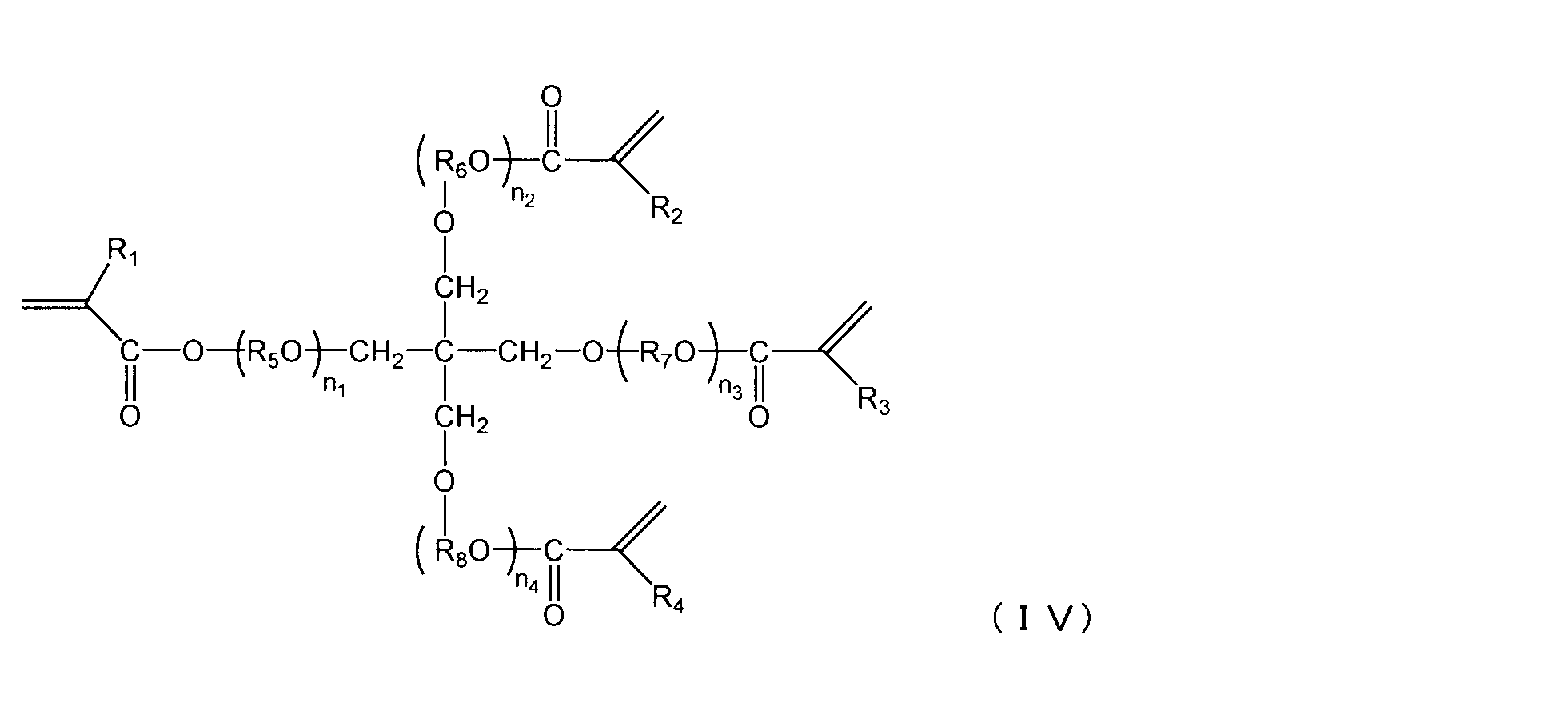
R1、R2、R3、及びR4は、各々独立に、アルキル基を表し、
R5、R6、R7、及びR8は、各々独立にアルキレン基を表し、R5、R6、R7、及びR8が各々複数存在する場合、該複数のR5、R6、R7、及びR8は互いに同一でも異なっていてもよい。}で表される化合物を含む、前記[1]~[6]のいずれか一項に記載の感光性樹脂組成物。
[9] 前記式(IV)において、n1+n2+n3+n4が15~28の整数である、前記[7]に記載の感光性樹脂組成物。
[10] 前記(B)光重合開始剤がアクリジン系化合物を含む、前記[1]~[9]のいずれか一項に記載の感光性樹脂組成物。
[12] 前記(B)光重合開始剤がN-フェニルグリシン又はその誘導体を含む、前記[1]~[11]のいずれか一項に記載の感光性樹脂組成物。
[13] 前記(A)アルカリ可溶性高分子が芳香族炭化水素基を有する、前記[1]~[12]のいずれか一項に記載の感光性樹脂組成物。
(B)光重合開始剤:0.1~20質量%、及び
(C)エチレン性二重結合を有する化合物:5~50質量%
を含有する感光性樹脂組成物であって、
前記(C)化合物が、一分子中に3個以上のメタクリロイル基を有する化合物を含むことを特徴とする、前記感光性樹脂組成物。
前記(C)化合物中のエチレン性二重結合の平均個数をQ、前記露光を行った後の前記(C)化合物中のエチレン性二重結合の反応率をPとした場合のP×Q/100の値が0.7以上である、[14]に記載の感光性樹脂組成物。
前記(C)化合物中のエチレン性二重結合の平均個数をQ、前記露光を行った後の前記(C)化合物中のエチレン性二重結合の反応率をP’とした場合のP’×Q /100の値が0.3以上である、[14]又は[15]に記載の感光性樹脂組成物。
[17] 前記(C)化合物が、一分子中に4個以上のメタクリロイル基を有する化合物を含む、[14]~[16]のいずれか一項に記載の感光性樹脂組成物。
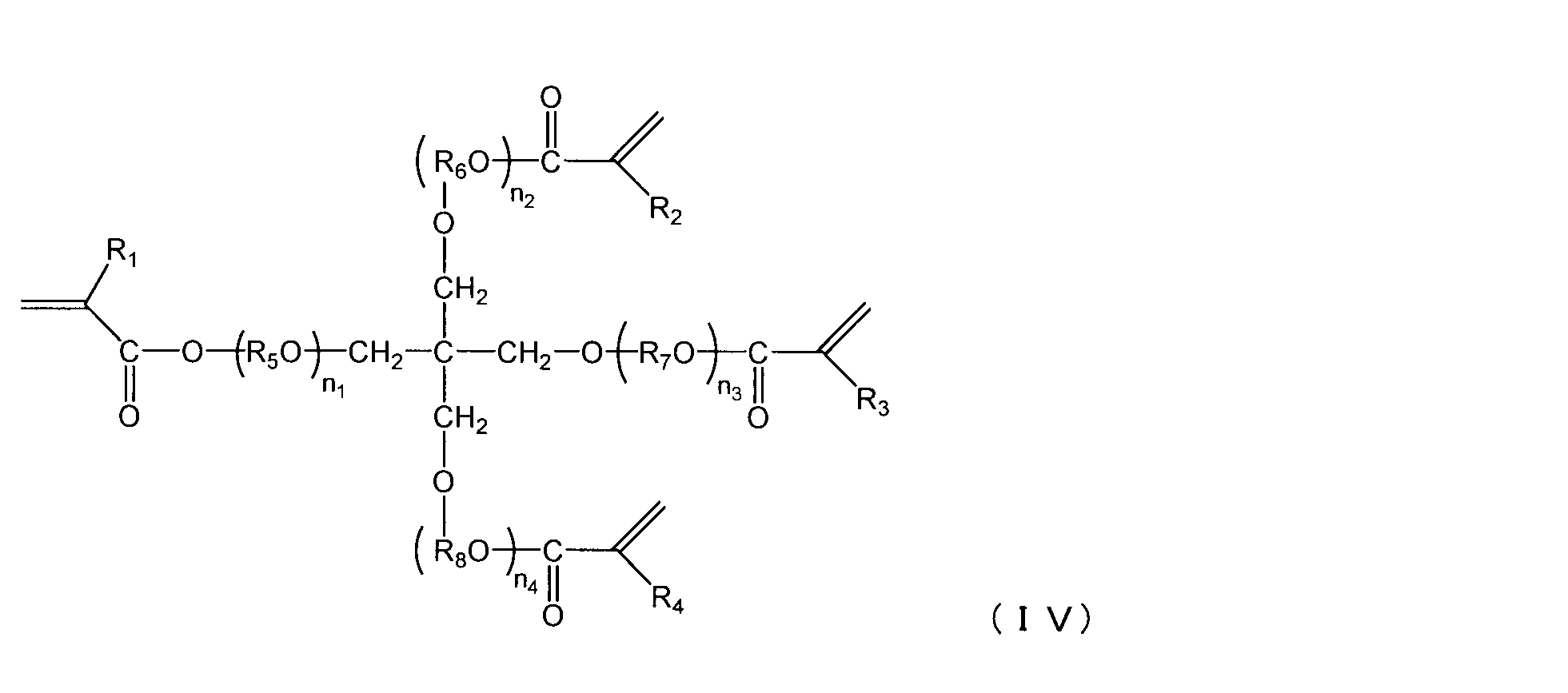
R1、R2、R3、及びR4は、各々独立に、アルキル基を表し、
R5、R6、R7、及びR8は、各々独立に、アルキレン基を表し、R5、R6、R7、及びR8が各々複数存在する場合、該複数のR5、R6、R7、及びR8は互いに同一でも異なっていてもよい。}で表される化合物を含む、前記[14]~[17]のいずれか一項に記載の感光性樹脂組成物。
[20] 前記式(IV)において、n1+n2+n3+n4が15~28の整数である、前記[18]に記載の感光性樹脂組成物。
[21] 前記(B)光重合開始剤がアクリジン系化合物を含む、前記[14]~[20]のいずれか一項に記載の感光性樹脂組成物。
[23] 前記(B)光重合開始剤がN-フェニルグリシン又はその誘導体を含む、前記[14]~[22]のいずれか一項に記載の感光性樹脂組成物。
[24] 前記(A)アルカリ可溶性高分子が芳香族炭化水素基を有する、前記[14]~[23]のいずれか一項に記載の感光性樹脂組成物。
[26] ダイレクトイメージング露光に用いられる、前記[14]~[25]のいずれか一項に記載の感光性樹脂組成物。
該感光性樹脂組成物の層を露光及び現像してレジストパターンを形成する工程、並びに
該レジストパターンが形成された該基板をエッチング又はめっきする工程
を含むことを特徴とする、回路パターンの形成方法。
[28] 前記露光がダイレクトイメージング露光によって行われる、前記[27]に記載の方法。
1つの実施の形態は、
(A)アルカリ可溶性高分子:40~80質量%、
(B)光重合開始剤:0.1~20質量%、
(C)エチレン性二重結合を有する化合物:5~50質量%、
を含有する感光性樹脂組成物であって、
該感光性樹脂組成物からなる厚さ25μmの感光性樹脂層を基板表面上に形成し、
露光時の焦点の位置を基板表面から該基板の厚み方向に200μm基板内側にずらした条件で露光及び現像を行って得られるレジストパターンのレジスト裾幅が0.01μm~3.5μmであり、そして
ダイレクトイメージング露光に用いられることを特徴とする、前記感光性樹脂組成物(ダイレクトイメージング露光用感光性樹脂組成物)を提供する。
(A)アルカリ可溶性高分子:40~80質量%、
(B)光重合開始剤:0.1~20質量%、及び
(C)エチレン性二重結合を有する化合物:5~50質量%
を含有する感光性樹脂組成物であって、
前記(C)化合物が、一分子中に3個以上のメタクリロイル基を有する化合物を含むことを特徴とする、前記感光性樹脂組成物を提供する。
上記の露光及び現像のより具体的な手順は、[実施例]の項に記載する方法又はこれと同等であることが当業者に理解される方法に従う。
本実施の形態における(A)アルカリ可溶性高分子とは、アルカリ性水溶液に溶解させることができる高分子である。例えばカルボキル基を含有するビニル系高分子が挙げられ、好ましくは(メタ)アクリル酸、(メタ)アクリル酸エステル、(メタ)アクリロニトリル、(メタ)アクリルアミドなどから選択されるモノマーの共重合体である。
(A)アルカリ可溶性高分子は、カルボキシル基を含有し、酸当量が100~600であることが好ましい。酸当量とは、その中に1当量のカルボキシル基を有するアルカリ可溶性高分子のグラム単位の質量をいう。酸当量を100以上にすることは、現像耐性、解像度、及び密着性を向上させる観点から好ましく、一方で、酸当量を600以下にすることは、現像性及び剥離性を向上させる観点から好ましい。酸当量の測定は、滴定装置(例えば平沼産業(株)製、平沼自動滴定装置(COM-555))を使用し、0.1mol/Lの水酸化ナトリウム水溶液を用いる電位差滴定法により行うことができる。(A)アルカリ可溶性高分子の酸当量は、より好ましくは250~450である。
(A)アルカリ可溶性高分子が芳香族炭化水素基を有することにより、解像性及び密着性が向上し、現像時の凝集物の発生量が少なくなり、そしてエッチング耐性が向上されるとの利点が得られる。
合成の際に用いるモノマーの一部に芳香族ビニル化合物、ベンジル基を有する(メタ)アクリレート化合物などを用いることにより、(A)アルカリ可溶性高分子に芳香族炭化水素基を導入することができる。
第一のモノマーは、分子中に重合性不飽和基を一個有するカルボン酸又は酸無水物である。例えば、(メタ)アクリル酸、フマル酸、ケイ皮酸、クロトン酸、イタコン酸、マレイン酸無水物、マレイン酸半エステルなどが挙げられる。とりわけ、(メタ)アクリル酸が好ましい。ここで、(メタ)アクリルとは、アクリル又はメタクリルを意味する。
(A)アルカリ可溶性高分子における第一のモノマーの共重合割合は、該アルカリ可溶性高分子における所望の酸当量の値から、容易に計算することができる。(A)アルカリ可溶性高分子における第一のモノマーの共重合割合は、全単量体成分の合計質量を基準として、10~50質量%であることが好ましい。該共重合割合を10質量%以上にすることは、良好な現像性を発現させる観点、エッジフューズ性を制御するなどの観点から好ましい。該共重合割合を50質量%以下にすることは、解像性を向上させる観点、レジスト裾の発生を抑制させる観点などから好ましく、これらの観点においては、30質量%以下がより好ましく、25質量%以下が更に好ましく、20質量%以下が特に好ましい。
第二のモノマーとしては、上記のうち、メチル(メタ)アクリレート、n-ブチル(メタ)アクリレート、スチレン、スチレン誘導体、及びベンジル(メタ)アクリレートが好ましい。これらの中では、スチレン、スチレン誘導体、及びベンジル(メタ)アクリレートが解像性向上、密着性向上や、良好な現像凝集性(凝集物量が少ない)、エッチング耐性の観点でとりわけ好ましい。
上記とは別に、優れた解像性を得るために、芳香族ビニル化合物の共重合割合は、全単量体成分の合計質量を基準として、40~60質量%であることが好ましい。この場合の共重合モノマーとしては、スチレン又はスチレン誘導体と、(メタ)アクリル酸メチル及び/又は(メタ)アクリル酸と、を含むことが好ましい。
Tgtotal= Σi(Wi×Tgi)/Wtotal
{ここで、Wiは各々のアルカリ可溶性高分子の固形質量であり、
Tgiは各々のアルカリ可溶性高分子についてFox式で求められるガラス転移温度であり、
Wtotalは各々のアルカリ可溶性高分子の固形質量の合計値である。}に従って求められる値である。ここで、各々のアルカリ可溶性高分子についてのガラス転移温度TgiをFox式により求める際には、各アルカリ可溶性高分子を形成するコモノマーから成るホモポリマーのTgが必要である。本開示では、この値として文献値(Brandrup,J. Immergut, E. H. 編集、Polymer handbook, Third edition, John wiley & sons, 1989, Chapter VI “Glass transition temperatures of polymers”, p209)を使用するものとする。
実施例において計算に用いたそれぞれのコモノマーのTgiは、表4に示した。
DI露光においては、露光パターンの両側に微弱露光領域が発生する。この微弱露光領域のレジストは、その反応率が低下する。このことにより、該領域における硬化レジストは現像液耐性が低下するから、その後の現像工程において部分的に溶解されることになる。このときの溶解残がレジスト底部に沈降し、堆積することによって、レジスト裾が発生すると推定される。
従って、レジスト裾の発生を抑制するためには、微弱露光領域においてもレジスト中のモノマーが効率良く硬化される必要があると考えられる。モノマーの反応率はモノマー同士の拡散速度の影響を受け、拡散速度はレジスト中の自由体積に支配されると考えられる。
以上のことから、(A)アルカリ可溶性高分子の組成及び構造を、レジスト中の自由体積が大きくなるように設計することにより、モノマーの反応率を向上させて微弱露光領域のレジスト裾を抑制できると考えられる。
同一の温度条件下においては、物質のTgが高いほど自由体積が小さくなり、Tgが低いほど自由体積が大きくなる。そのため、Tgが高いレジスト組成はモノマー反応率が低下し易くなるからレジスト裾が発生し、Tgが低いレジスト組成はレジスト裾の発生が抑制されると考えられる。
このような理由からは(A)アルカリ可溶性高分子のTgの重量平均値Tgtotalは低い方が好ましいが、エッジフューズ性の制御を考慮するとTgtotalは高い方が好ましい。これらの溶性のバランスを考慮した結果、Tgtotalの好ましい範囲として、上記の範囲が例示できるのである。
本発明の実施の形態において、(B)光重合開始剤としては、感光性樹脂の光重合開始剤として使用できる種々の物質を使用できる。
本実施の形態における(B)光重合開始剤としては、例えば、アクリジン系化合物、N-アリール-α-アミノ酸化合物、及びトリアリールイミダゾール二量体から成る群より選択される1種以上を用いることができる。アクリジン系化合物は、高い感度を発現する観点、及び高感度とレジストの裾の発生の抑制とを両立する観点から好ましく;
トリアリールイミダゾール二量体は、レジストの裾の発生をより確実に抑制する観点から好ましい。
N-フェニルグリシン及びその誘導体は、感度向上の点で好ましい。特に、N-フェニルグリシン又はその誘導体をアクリジン系化合物と併用した時には、レジスト裾の発生をより確実に抑制できる点で好ましい。
アクリジン系化合物、N-フェニルグリシン、N-フェニルグリシン誘導体から成る群より選択される1種以上を含むことが好ましい。アクリジン系化合物としては、下記式(I):


で表される化合物から成る群より選択される1種以上を含むことが好ましい。これらの化合物は、DI露光において感度を向上させる観点から有利である。一般式(II)中のR1の炭素数が1~12であることは、溶解性の観点から有利である。R1の炭素数はより好ましくは4~10である。
アクリジン系化合物としては、上記式(I)で表される9-フェニルアクリジンを使用することが好ましい。
(B)光重合開始剤の更なる例としては、例えば、
ベンゾフェノン、N,N’-テトラメチル-4,4’-ジメチルアミノベンゾフェノン(ミヒラーケトン)、N,N’-テトラエチル-4,4’-ジアミノベンゾフェノン、4-メトキシ-4’-ジメチルアミノベンゾフェノン、2-ベンジル-2-ジメチルアミノ-1-(4-モノホルノフェニル)―ブタノン-1、2-メチル-1-[4-(メチルチオ)フェニル]-2-モルフォリノ-プロパノン-1などの芳香族ケトン;
2-エチルアントラキノン、フェナントレンキノン、2-tert-ブチルアントラキノン、オクタメチルアントラキノン、1,2-ベンズアントラキノン、2,3-ベンズアントラキノン、2-フェニルアントラキノン、2,3-ジフェニルアントラキノン、1-クロロアントラキノン、2-メチルアントラキノン、1,4-ナフトキノン、9,10-フェナントラキノン、2-メチル-1,4-ナフトキノン、2,3-ジメチルアントラキノンなどのキノン類;
ベンゾインメチルエーテル、ベンゾインエチルエーテル、ベンゾインフェニルエーテルなどのベンゾインエーテル化合物;
ベンジルメチルケタールなどのベンジル誘導体;
クマリン系化合物;
4,4’-ビス(ジエチルアミノ)ベンゾフェノン;
1-フェニル-3-(4-tert-ブチル-スチリル)-5-(4-tert-ブチル-フェニル)-ピラゾリン、1-フェニル-3-(4-ビフェニル)-5-(4-tert-ブチル-フェニル)-ピラゾリン、1-フェニル-3-(4-ビフェニル)-5-(4-tert-オクチル-フェニル)-ピラゾリンなどのピラゾリン誘導体;
などが挙げられる。
(B)光重合開始剤は、1種を単独で使用しても2種類以上併用してもよい。
本発明の実施の形態において、感光性樹脂組成物は、(C)エチレン性二重結合を有する化合物を含む。この化合物の好ましい例としては、3官能以上のメタクリレート基(一分子中に3個以上のメタクリロイル基)を有し、分子量が500g/mol以上5,000g/mol以下である化合物(多官能モノマー)が挙げられる。(C)化合物としては、4官能以上のメタクリレート基(一分子中に4個以上のメタクリロイル基)を有する化合物がより好ましい。
上述したように、DI露光においては、露光パターンの両側に微弱露光領域が発生する。そして、この領域に存在するレジストの反応率が低下することにより、現像液耐性が低下してレジスト裾が発生すると推定される。従って、レジスト裾の発生を抑制するためには、微弱露光領域においても、(C)化合物の反応率を大きくして架橋密度を高めて現像液耐性を向上する必要がある。
レジストが架橋するためには、ある多官能モノマー中の一つの二重結合が反応した後、同一モノマー中の他の未反応の二重結合が更に反応する必要がある。従って、(C)化合物が多くの二重結合を有し、且つ露光後に残存する未反応の二重結合が少ないほど、架橋密度が大きくなる。
このような観点から、本実施の形態における(C)化合物には、最適な分子量と官能基数の範囲とが存在する。(C)化合物の分子量は500g/mol以上5,000g/mol以下が好ましく、より好ましくは600g/mol以上4,000g/mol以下であり、更に好ましくは700g/mol以上3,000g/mol以下である。
更に、モノマー架橋体の現像液耐性の観点から、加水分解性が低いメタクリレートモノマーが有効である。メタクリレートモノマーは、解像性及び密着性の向上、レジスト裾の発生の抑制、並びにエッジフューズ性の制御の観点で優れている。
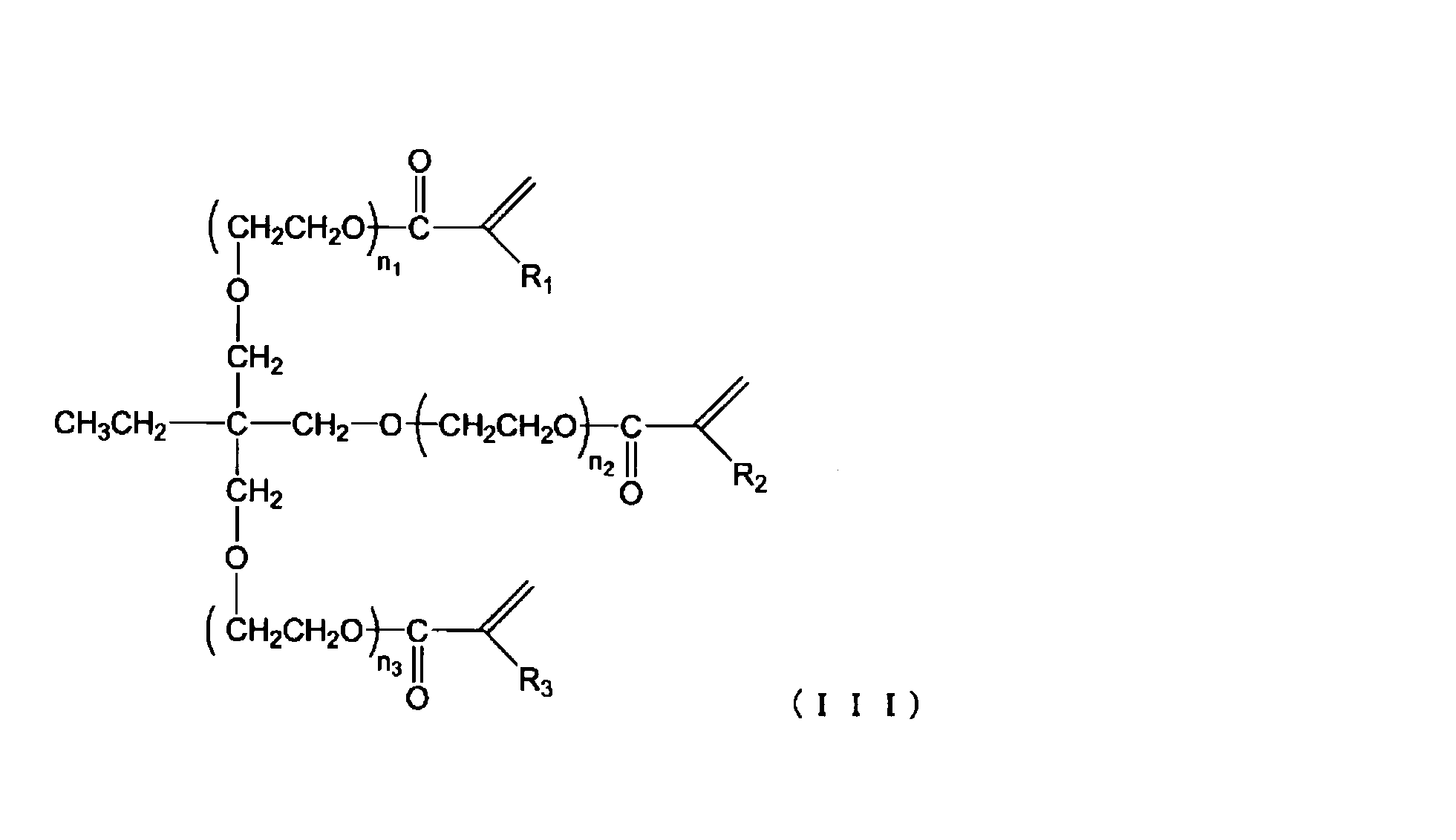
R1、R2、及びR3は、各々独立に、アルキル基である。}で表される化合物を含むことが好ましい。
トリメチロールプロパンの水酸基の末端に平均3モルのエチレンオキサイドを付加したトリメタクリレート、
トリメチロールプロパンの水酸基の末端に平均9モルのエチレンオキサイドを付加したトリメタクリレート、
トリメチロールプロパンの水酸基の末端に平均15モルのエチレンオキサイドを付加したトリメタクリレート、
トリメチロールプロパンの水酸基の末端に平均30モルのエチレンオキサイドを付加したトリメタクリレート
などが挙げられる。

R1、R2、R3、及びR4は、各々独立に、アルキル基を表し、
R5、R6、R7、及びR8は、各々独立に、アルキレン基を表し、R5、R6、R7、及びR8が各々複数存在する場合、該複数のR5、R6、R7、及びR8は互いに同一でも異なっていてもよい。}で表される化合物を含むことが好ましい。で表される化合物を含むことが好ましい。
一般式(IV)中のR5、R6、R7、及びR8としては、各々、1,2-エチレン基、1,2-プロピレン基、ブチレン基などであることができ、硬化膜に柔軟性を付与する観点、テント膜突き刺し耐性を向上させる観点、現像凝集性を抑制する観点、及びエチレン性二重結合の反応性を高める観点から、1,2-エチレン基が好ましい。従って、一般式(IV)で表される化合物として、好ましくは下記一般式(V):

R1、R2、R3、及びR4は、各々独立に、アルキル基である。}で表される化合物である。n1+n2+n3+n4の好ましい範囲は前記と同様である。
ペンタエリスリトールの水酸基の末端に平均9モルのエチレンオキサイドを付加したテトラメタクリレート、
ペンタエリスリトールの水酸基の末端に平均12モルのエチレンオキサイドを付加したテトラメタクリレート、
ペンタエリスリトールの水酸基の末端に平均15モルのエチレンオキサイドを付加したテトラメタクリレート、
ペンタエリスリトールの水酸基の末端に平均20モルのエチレンオキサイドを付加したテトラメタクリレート、
ペンタエリスリトールの水酸基の末端に平均28モルのエチレンオキサイドを付加したテトラメタクリレート、
ペンタエリスリトールの水酸基の末端に平均35モルのエチレンオキサイドを付加したテトラメタクリレート
などが挙げられる。
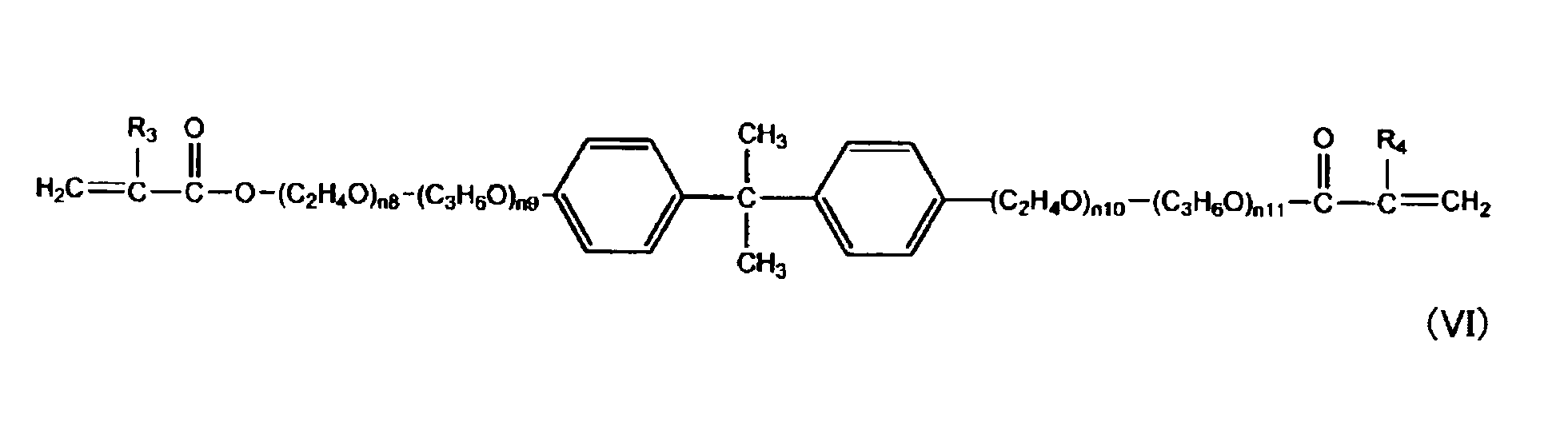
n9及びn11は、各々独立に、0~20の整数であり、且つn9+n11は0~20の整数であり;
n8及びn10は、各々独立に、1~20の整数であり、且つn8+n10は2~20の整数であり;
-(C2H4O)-及び-(C3H6O)-の繰り返し単位の配列は、ランダムであってもブロックであってもよく、-(C2H4O)-及び-(C3H6O)-のいずれがビスフェノール構造に結合していてもよい。}で表される化合物を含むことが好ましい。
ビスフェノールAの両端にそれぞれ平均2モルのエチレンオキサイドを付加したエチレングリコールのジメタクリレート、
ビスフェノールAの両端にそれぞれ平均5モルのエチレンオキサイドを付加したエチレングリコールのジメタクリレート、
ビスフェノールAの両端にそれぞれ平均6モルのエチレンオキサイドと平均2モルのプロピレンオキサイドを付加したアルキレングリコールのジメタクリレート、
ビスフェノールAの両端に平均15モルのエチレンオキサイドと平均2モルのプロピレンオキサイドを付加したアルキレングリコールのジメタクリレートを付加したアルキレングリコールのジメタクリレート
などが挙げられる。
その他の(C)化合物としては、光重合可能なエチレン性不飽和化合物を使用することができる。このような光重合可能なエチレン性不飽和化合物としては、例えば、エチレン性二重結合を1個有する化合物、エチレン性二重結合を2個有する化合物、及びエチレン性二重結合を3個以上有する化合物を例示することができる。
上記エチレン性二重結合を1個有する化合物としては、例えば、ポリアルキレンオキシドの片方の末端に(メタ)アクリル酸を付加した化合物;
ポリアルキレンオキシドの片方の末端に(メタ)アクリル酸を付加し、他方の末端をアルキルエーテル化又はアリルエーテル化した化合物などを挙げることができる。
エチレンオキシド単位とプロピレンオキシド単位とが、ランダム、交互、又はブロック的に結合したアルキレンオキシド鎖の両末端に(メタ)アクリロイル基を有する化合物;
アルキレンオキシド変性されたビスフェノールAの両末端に(メタ)アクリロイル基を有する化合物;
等を挙げることができる。
これらのうち、アルキレンオキシド変性されたビスフェノールAの両末端に(メタ)アクリロイル基を有する化合物が、解像性及び密着性の観点からは好ましい。上記のアルキレンオキシド変性としては、例えば、エチレンオキシド変性、プロピレンオキシド変性、ブチレンオキシド変性、ペンチレンオキシド変性、へキシレンオキシド変性などが挙げられる。エチレンオキシド変性されたビスフェノールAの両末端に(メタ)アクリロイル基を有する化合物が、より好ましい。
中心骨格として分子内にアルキレンオキシド基を付加させることができる基を3モル以上有する化合物を使用し、該化合物に、エチレンオキシ基、プロピレンオキシ基、ブチレンオキシ基などのアルキレンオキシ基を付加させて得られたアルコールを、(メタ)アクリレートとすることにより、得られる。この場合、中心骨格になることができる化合物としては、例えば、グリセリン、トリメチロールプロパン、ペンタエリスリトール、ジペンタエリスリトール、イソシアヌレート環を有する化合物などを挙げることができる。
分子内にエチレン性二重結合を3個以上有する化合物として、具体的には、例えば、ポリプロピレングリコールジ(メタ)アクリレート、ポリエチレングリコール(メタ)アクリレート、2-ジ(P-ヒドロキシフェニル)プロパン(メタ)アクリレート、グリセロールトリ(メタ)アクリレートトリメチロールトリ(メタ)アクリレート、ポリオキシプロピルトリメチロールプロパントリ(メタ)アクリレート、ポリオキシエチルトリメチロールプロパントリ(メタ)アクリレート、ペンタエリスリトールテトラ(メタ)アクリレート、ジペンタエリスリトールペンタ(メタ)アクリレート、トリメチルプロパントリグリシジルエーテルトリ(メタ)アクリレート、フェノキシポリエチレングリコール(メタ)アクリレート、ノニルフェノキシポリエチレングリコール(メタ)アクリレートなどが挙げられる。
その他の(C)化合物は、単独で使用しても、2種類以上を併用しても構わない。
(C)エチレン性二重結合を有する化合物が上記式(III)で表される化合物を含む場合、該化合物の配合量は、感光性樹脂組成物の全固形分質量を100質量%としたとき、2質量%以上40質量%以下とすることが好ましく、5質量%以上30質量%以下とすることがより好ましく、10質量%以上20質量%以下とすることが更に好ましい。
(C)エチレン性二重結合を有する化合物が上記式(IV)で表される化合物を含む場合、該化合物の配合量は、感光性樹脂組成物の全固形分質量を100質量%としたとき、2質量%以上40質量%以下とすることが好ましく、5質量%以上30質量%以下とすることがより好ましく、10質量%以上20質量%以下とすることが更に好ましい。
(C)エチレン性二重結合を有する化合物が上記式(VI)で表される化合物を含む場合、該化合物の配合量は、感光性樹脂組成物の全固形分質量を100質量%としたとき、2質量%以上40質量%以下とすることが好ましく、5質量%以上30質量%以下とすることがより好ましく、10質量%以上20質量%以下とすることが更に好ましい。
本発明に係る感光性樹脂組成物は、ロイコ染料、フルオラン染料、及び着色物質から選ばれる1つ以上を含有してもよい。感光性樹脂組成物がこれらの成分を含有することにより、露光部分が発色する。従って、視認性の点で好ましい。更に、検査機などが露光のための位置合わせマーカーを読み取る場合、露光部と未露光部とのコントラストが大きくなって認識し易くなる点でも有利である。
感光性樹脂組成物中のロイコ染料の含有量は、感光性樹脂組成物の全固形分質量を100質量%としたとき、0.1~10質量%であることが好ましい。当該含有量を0.1質量%以上にすることは、露光部分と未露光部分とのコントラストを向上する観点から好ましい。この含有量は、0.2質量%以上がより好ましく、0.3質量%以上が更に好ましい。一方で、当該含有量を10質量%以下にすることは、感光性樹脂組成物の保存安定性を維持する観点、現像時の凝集物の発生を抑制する観点から好ましい。この含有量は、5質量%以下がより好ましく、1質量%以下が更に好ましい。
感光性樹脂組成物中の着色物質の含有量は、感光性樹脂組成物の全固形分質量を100質量%としたとき、0.001質量%~1質量%であることが好ましい。該含有量を0.001質量%以上にすることは、取扱い性を向上させる観点から好ましく、一方で、該含有量を1質量%以下にすることは、保存安定性を維持する観点から好ましい。
本実施の形態の感光性樹脂組成物において、ロイコ染料と下記のハロゲン化合物とを組み合わせて用いることは、密着性及びコントラストの観点から、好ましい態様である。
ハロゲン化合物としては、例えば、臭化アミル、臭化イソアミル、臭化イソブチレン、臭化エチレン、臭化ジフェニルメチル、臭化ベンジル、臭化メチレン、トリブロモメチルフェニルスルフォン、四臭化炭素、トリス(2,3-ジブロモプロピル)ホスフェート、トリクロロアセトアミド、ヨウ化アミル、ヨウ化イソブチル、1,1,1-トリクロロ-2,2-ビス(p-クロロフェニル)エタン、クロル化トリアジン化合物などが挙げられる。とりわけトリブロモメチルフェニルスルフォンが好ましい。トリブロモメチルフェニルスルフォンのようなハロゲン化合物は、アクリジン系化合物と併用した場合に効果が大きく、解像性の向上、密着性の向上、感度の向上、コントラストの向上、テント膜突き刺し耐性の向上、レジストの裾の発生の抑制、及びエッチング耐性の向上の観点から好ましい。
本実施の形態においては、感光性樹脂組成物の熱安定性及び保存安定性を向上させるために、感光性樹脂組成物は、ラジカル重合禁止剤、ベンゾトリアゾール類、及びカルボキシベンゾトリアゾール類から成る群から選ばれる少なくとも1種以上の化合物を更に含有してもよい。
本実施の形態の感光性樹脂組成物は、必要に応じて可塑剤を含有してもよい。この可塑剤として、例えば、ポリエチレングリコール、ポリプロピレングリコール、ポリオキシプロピレンポリオキシエチレンエーテル、ポリオキシエチレンモノメチルエーテル、ポリオキシプロピレンモノメチルエーテル、ポリオキシエチレンポリオキシプロピレンモノメチルエーテル、ポリオキシエチレンモノエチルエーテル、ポリオキシプロピレンモノエチルエーテル、ポリオキシエチレンポリオキシプロピレンモノエチルエーテルなどのグリコールエステル類;
ジエチルフタレートなどのフタル酸エステル類;
o-トルエンスルフォン酸アミド、p-トルエンスルフォン酸アミド、クエン酸トリブチル、クエン酸トリエチル、アセチルクエン酸トリエチル、アセチルクエン酸トリ-n-プロピル、アセチルクエン酸トリ-n-ブチルなど;
ビスフェノールAの両末端にプロピレンオキサイドを付加したプロピレングリコール、ビスフェノールAの両末端にエチレンオキサイドを付加したエチレングリコールなど;
が挙げられる。これらは、1種を単独で又は2種以上を組み合わせて使用できる。
とりわけ、剥離特性の向上の観点、解像性及び密着性の劣化が少ない観点、レジスト裾の発生を抑制できる観点、硬化膜柔軟性の向上の観点、並びにテント膜突き刺し耐性の向上の観点から、可塑剤としてはp-トルエンスルホンアミドを用いることが好ましい。
感光性樹脂組成物は、溶剤に溶解させて溶液として用いることができる。用いる溶剤としては、例えば、
メチルエチルケトン(MEK)に代表されるケトン類;
メタノール、エタノール、及びイソプロパノールに代表されるアルコール類
などが挙げられる。当該溶剤は、支持フィルム上に塗布する感光性樹脂組成物の溶液の粘度が25℃において500~4,000mPa・sとなるように、感光性樹脂組成物に添加することが好ましい。
本実施の形態の感光性樹脂組成物は、該感光性樹脂組成物からなる厚さ25μmの感光性樹脂層を基板表面上に形成し、ストーファー21段ステップタブレットをマスクとして露光し、次いで現像したときの最高残膜段数が6段となる露光量で、該感光性樹脂層に露光を行った時、
前記(C)化合物中のエチレン性二重結合の平均個数をQ、前記露光を行った後の前記(C)化合物中のエチレン性二重結合の反応率をPとした場合のP×Q/100の値が0.7以上であることが好ましい。
この要件は、硬化レジストパターンにおいてエチレン性二重結合が十分に反応して十分な架橋密度を実現し、微弱露光領域におけるレジスト裾の発生を抑制するための、好ましい要件である。レジスト裾の発生を可及的に抑制するために、上記P×Q/100の値は、1.0以上であることがより好ましく、1.5以上であることがもっと好ましく、1.7以上であることが更に好ましく、2.0以上であることが特に好ましく、2.5以上であることが最も好ましい。一方で、回路パターン形成後に、用済みとなったレジストパターを容易に剥離するために、上記P×Q/100の値は、5.0以下であることがより好ましく、4.0以下であることが更に好ましく、3.5以下であることが特に好ましい。
前記(C)化合物中のエチレン性二重結合の平均個数をQ、前記露光を行った後の前記(C)化合物中のエチレン性二重結合の反応率をP’とした場合のP’×Q/100の値が0.3以上であることが好ましい。このときの露光量は、微弱露光領域の露光量を考慮した値である。上記と同様の観点から、上記P’×Q /100の値は、
0.5以上であることがより好ましく、0.7以上であることがもっと好ましく、1.0以上であることが更に好ましく、1.3以上であることもっと好ましく、1.6以上であること特に好ましく、1.9以上であることが最も好ましく;
5.0以下であることがより好ましく、3.0以下であることが更に好ましく、2.5以下であることが特に好ましい。
上記P’×Q/100の値は、超高圧水銀ランプの露光機による露光条件下で測定される。
本開示の感光性樹脂組成物を用いて、感光性樹脂積層体を形成できる。典型的には、該感光性樹脂積層体は、支持フィルムと、該支持フィルム上に積層された上記感光性樹脂組成物から成る感光性樹脂層と、を有する。該感光性樹脂積層体は、必要により支持フィルム側とは反対側の表面に保護層を有してもよい。
支持フィルムのヘイズは5以下であることが好ましい。
支持フィルムの厚みは、薄い方が画像形成性及び経済性の面で有利であるが、強度を維持する機能も考慮すると、10~30μmであることが好ましい。
保護層の膜厚は10~100μmが好ましく、10~50μmがより好ましい。
感光性樹脂積層体における感光性樹脂層の厚さは、用途において異なるが、好ましくは5~100μm、より好ましくは7~60μmである。感光性樹脂層の厚さが薄いほど解像度は向上し、これが厚いほど膜強度が向上する。
感光性樹脂積層体は、支持フィルム上に、感光性樹脂層、及び必要により保護層を順次積層することにより、作製することができる。その方法としては、既知の方法を採用することができる。例えば、感光性樹脂層に用いる感光性樹脂組成物を、これらを溶解する溶剤と混ぜ合わせ均一な溶液状の塗工液とする。そして、支持フィルム上に、該塗工液をバーコーター又はロールコーターを用いて塗布し、次いで乾燥して前記支持フィルム上に感光性樹脂組成物から成る感光性樹脂層を積層することができる。次いで必要により、該感光性樹脂層上に保護層をラミネートすることにより、感光性樹脂積層体を作製することができる。
本発明の別の実施形態は、
前述した本開示の感光性樹脂組成物の層を基板上に形成する工程(ラミネート工程)、
該感光性樹脂組成物の層を露光及び現像してレジストパターンを形成する工程(露光工程及び現像工程)、並びに
該レジストパターンが形成された該基板をエッチング又はめっきする工程(エッチング工程又はめっき工程)
を含む、回路パターンの形成方法を提供する。上記の一連の工程の後に、積層体からレジストパターンを剥離する剥離工程を更に有することが好ましい。
以下、感光性樹脂積層体、及び基板として銅張積層板を用いて回路パターンを形成する方法の一例を説明する。
感光性樹脂組成物の保護層を剥がしながら、銅張積層板、フレキシブル基板などの基板上に、例えばホットロールラミネーターを用いて密着させる工程である。
上記基板上に形成された感光性樹脂組成物の層に、
所望の配線パターンを有するマスクフィルムを密着させた状態で、該マスクフィルムを介して露光を施す工程、
所望の配線パターンをダイレクトイメージング露光法によって露光を施す工程、又は
フォトマスクの像を、レンズを介して投影する露光法によって露光を施す工程
である。本実施の形態に係る感光性樹脂組成物の利点は、配線パターンの直接描画によるダイレクトイメージング露光方法、又はフォトマスクの像をレンズを介して投影する露光方法においてより顕著に発現し、ダイレクトイメージング露光方法において特に顕著に発現するため、露光工程においては、ダイレクトイメージング露光方法を採用することが好適である。
露光工程の後、感光性樹脂層上の支持体を剥離したうえで、アルカリ水溶液の現像液を用いて未露光部を現像除去してレジストパターンを基板上に形成する工程である。
アルカリ水溶液としては、Na2CO3又はK2CO3の水溶液を用いることができる。アルカリ水溶液は、感光性樹脂層の特性に合わせて適宜選択されるが、約0.2~2質量%の濃度、且つ約20~40℃のNa2CO3水溶液を使用することが好ましい。
上記の各工程を経てレジストパターンを得ることができる。場合により、これらの工程の後に、約100℃~300℃において、1分~5時間の加熱工程を更に行ってもよい。この加熱工程を実施することにより、得られる硬化レジストパターンの密着性や耐薬品性を更に向上することが可能となる。この場合の加熱には、例えば、熱風、赤外線、又は遠赤外線の方式の加熱炉を用いることができる。
現像により露出した基板表面(例えば銅張積層板の銅面)をエッチング又はめっきすることにより、導体パターンを製造する。
エッチング工程の場合、上記の工程を経て形成されたレジストパターンに、上からエッチング液を吹き付けて、該レジストパターンによって覆われていない銅面をエッチングして、所望の回路パターンを形成する工程である。エッチング方法としては、酸性エッチング、アルカリエッチングなどを挙げることができ、使用する感光性樹脂積層体に適した方法で行なわれる。
その後、積層体を現像液よりも強いアルカリ性を有する水溶液によって処理し、基板からレジストパターンを剥離する。剥離用のアルカリ水溶液については特に制限はない。濃度約2~5質量%、且つ温度約40~70℃のNaOH又はKOHの水溶液が一般に用いられる。剥離液に、少量の水溶性溶媒を加えてもよい。
まず、実施例及び比較例の評価用サンプルの作製方法を説明し、次いで、得られたサンプルについての評価方法及び評価結果を示す。
<重量平均分子量の測定>
高分子の重量平均分子量は、日本分光(株)製ゲルパーミエーションクロマトグラフィー(GPC)を用いて、ポリスチレン換算値として求めた。機器構成及び使用試薬は、各々以下のとおりである。
ポンプ:Gulliver製、PU-1580型
カラム:昭和電工(株)製、Shodex(登録商標)KF-807、KF-806M、KF-806M、及びKF-802.5の4本を直列に接続して使用
移動層溶媒:テトラヒドロフラン
検量線:ポリスチレン標準サンプル(昭和電工(株)製Shodex STANDARD SM-105)を用いて作成
実施例及び比較例における評価用サンプルは以下のように作製した。
下記第1表に示す成分(但し、各成分欄における数字は固形分としての配合量(質量部)を示す。)及び溶媒を攪拌により十分に混合して、感光性樹脂組成物調合液とした。実施例1~19、及び比較例1~8の感光性樹脂組成物調合液には、第1表に記載されている成分の他に、
着色物質として、ダイヤモンドグリーンを0.05質量部;
ロイコ染料として、ロイコクリスタルバイオレットを0.6質量部;
ベンゾトリアゾール類として、1-(2-ジ-n-ブチルアミノメチル)-5-カルボキシルベンゾトリアゾールと1-(2-ジ-n-ブチルアミノメチル)-6-カルボキシルベンゾトリアゾールとの1:1(質量比)混合物を0.2質量部;
酸化防止剤として、水添ビスフェノールAのジグリシジルエーテルを0.05質量部;
ラジカル重合禁止剤として、ニトロソフェニルヒドロキシアミンが3モル付加したアルミニウム塩を0.004質量部;及び
可塑剤として、p-トルエンスルホンアミドを2質量部、
を添加した。比較例1及び2以外の感光性樹脂組成物調合液には、更にハロゲン化合物として、トリモブロモメチルフェニルスルフォンを0.7質量部、添加した。
実施例20~44、及び比較例9~12の感光性樹脂組成物調合液には、表1に記載した以外に、上記の追加成分は配合されていない。
また、全部の感光性樹脂組成物調合液は、該調合液に配合したアルカリ可溶性高分子溶液からの持ち込み溶媒や、濃度調整のために追加した溶媒を更に含有する。
以下の第2表に、第1表中に略号で表した各成分の名称を示す。
画像性、レジスト裾幅、エッチング性及び剥離時間の評価基板として、35μm厚の圧延銅箔を積層した0.4mm厚の銅張積層板を用いた。該基板に対して、CPE-900(登録商標、菱江化学(株)製)による処理を行い、次いで10質量%H2SO4で表面洗浄し、更に純水でリンスしたうえで、使用に供した。
感光性樹脂積層体のポリエチレンフィルムを剥がしながら、整面して60℃に予熱した銅張積層板上に、ホットロールラミネーター(旭化成(株)製、AL-700)により、ロール温度105℃でラミネートすることにより、各種評価用の積層体を得た。エアー圧は0.35MPaとし、ラミネート速度は1.5m/minとした。
後述の評価方法において特記した以外の評価には、このラミネート後の積層体を用い、各種評価方法の項目に記載の条件で作製した試料について行った。露光、現像、エッチング、及び剥離の一般的な操作方法について、以下に記載する。
後述の「(x)P’×Q/100」以外の露光においては、直接描画露光機(日立ビアメカニクス(株)製、DE-1DH、光源:GaN青紫ダイオード(主波長405±5nm))により、ストーファー21段ステップタブレット又は所定のDI露光用のマスクパターンを用いて、照度80mW/cm2の条件で露光した。この露光は、前記のストーファー21段ステップタブレットをマスクとして露光、現像したときの最高残膜段数が6段となる露光量で行った。
レジスト裾幅以外の項目を評価するための基板については、露光時の焦点の位置を基板表面に合わせ、
レジスト裾幅を評価するための基板については、露光時の焦点の位置を、基板表面から該基板の厚み方向に200μm基板内側にずらした。
上記のように露光した評価基板のポリエチレンテレフタラートフィルムを剥離した後、アルカリ現像機(フジ機工製、ドライフィルム用現像機)を用いて、30℃に調温した濃度1質量%のNa2CO3水溶液を所定時間スプレーした後、純水を所定時間スプレーして水洗し、感光性樹脂層の未露光部分を溶解除去することにより、硬化レジストパターンを作製した。
現像時間及び水洗時間は、それぞれ、最小現像時間の2倍の時間とした。
最小現像時間とは、未露光部分の感光性樹脂層が完全に溶解するのに要する最も少ない時間をいう。
上記現像によって硬化レジストパターンが形成された評価基板に、塩銅エッチング装置(東京化工機(株)製、塩銅エッチング装置)を用いて、50℃に調温した塩化第二銅エッチング液を、最少エッチング時間の1.3倍の時間の間、スプレーすることにより、銅張積層板上のレジストパターンによって被覆されていない部分の銅箔を溶解除去した。
上記塩化第二銅エッチング液は、塩化第二銅の濃度が250g/L、及び塩化水素酸の濃度が3mol/Lの溶液である。上記最少エッチング時間とは、基板上の銅箔が完全に溶解除去されるまでに要した時間である。
上記エッチングを施した後の評価基板に、50℃に調温した3質量%の水酸化ナトリウム水溶液をスプレーすることにより、硬化レジストパターンを剥離した。
次に、サンプルの評価方法について説明する。
ラミネート後15分経過した感度評価用基板を、ストーファー21段ステップタブレットのマスクを介して露光した。次いで、最小現像時間の2倍の時間で現像した。
露光量を変量しながら上記の操作を繰り返し、最高残膜段数が6段となる露光量を調べた。
実施例1~19及び比較例1~8については、上記の最高残膜段数が6段となる露光量を以下の基準によりランク分けした。
○(良好):最高残膜段数が6段となる露光量が20mJ/cm2未満であった場合
×(不良):最高残膜段数が6段となる露光量が20mJ/cm2以上であった場合
実施例20~44及び比較例9~12については、上記の最高残膜段数が6段となる露光量の値を第1表に記載した。これらの実施例が想定する用途においては、この露光量が70mJ以下である場合に感度が良好であると評価することができ、好ましくは40mJ以下であり、より好ましくは30mJ以下であり、更に好ましくは20mJ以下である。
ラミネート後15分経過した評価用基板を、露光部と未露光部との幅が1:1の比率のラインアンドスペースとなるパターンを露光した。次いで、最小現像時間の2倍の現像時間で現像し、硬化レジストパターンを得た。該硬化レジストパターンにおけるラインアンドスペースパターンが正常に形成されている最小のマスクライン幅を調べた。
実施例1~19及び比較例1~8については、上記の最小マスクライン幅の値を以下の基準によりランク分けした。
○(良好):最小マスクライン幅の値が25μm以下であった場合
△(可):最小マスクライン幅の値が25μmを超え、30μm以下であった場合
×(不良):最小マスクライン幅の値が30μmを超えた場合
実施例20~44及び比較例9~12については、上記の最小マスクライン幅の値を第1表に記載した。これらの実施例が想定する用途においては、この最小マスクライン幅が60μm以下である場合に解像度(1)が良好であると評価することができ、好ましくは35μm以下であり、より好ましくは25μm以下であり、更に好ましくは20μm以下であり、特に好ましくは16μm以下である。
一部の実施例及び比較例については、上記(ii)の解像度評価(1)に加えて、ポジ独立抜けの解像度評価も行った。
すなわち、ラミネート後15分経過した評価用基板を、未露光部がスペースとなるパターンを露光した。次いで、最小現像時間の2倍の現像時間で現像し、硬化レジストパターンを得た。このとき、未露光部のスペースが正常に形成されている最小スペース幅の値を、解像度(ポジ独立抜け)の値とした。
この最小スペース幅が45μm以下である場合に解像度(2)が良好であると評価することができ、好ましくは35μm以下であり、より好ましくは30μm以下であり、更に好ましくは25μm以下であり、特に好ましくは20μm以下である。
ラミネート後15分経過した評価用基板を、露光部がラインとなるパターンを露光した。次いで、最小現像時間の2倍の現像時間で現像し、硬化レジストパターンを得た。該硬化レジストラインが正常に形成されている最小のマスクライン幅を調べた。
実施例1~19及び比較例1~8については、上記の最小マスクライン幅を以下の基準でランク分けした。
○(良好):最小マスクライン幅の値が25μm以下であった場合
△(可):最小マスクライン幅の値が25μmを超え、30μm以下であった場合
×(不良):最小マスクライン幅の値が30μmを超えた場合
実施例20~44及び比較例9~12については、上記の最小マスクライン幅の値を第1表に記載した。これらの実施例が想定する用途においては、この最小マスクライン幅が70μm以下である場合に密着性が良好であると評価することができ、好ましくは30μm以下であり、より好ましくは25μm以下であり、更に好ましくは20μm以下であり、特に好ましくは10μm以下である。
ラミネート後15分経過した評価用基板を、露光部と未露光部との幅が1:1の比率のラインアンドスペースとなるパターンを露光した。露光の際は、露光時の焦点の位置を基板表面から該基板の厚み方向に200μm基板内側にずらした。この措置により、露光パターン端の微弱露光領域が拡大され、レジスト裾幅の大小比較が容易となる。
露光後の基板を、最小現像時間の2倍の現像時間で現像した後、200g/L過硫酸アンモニウム水溶液により基板の銅基材露出部分を60秒間ソフトエッチングすることにより、レジスト裾幅を評価するための試料を得た。該試料のL/S=45μm/45μmの1:1の比率のラインパターン部分を走査型電子顕微鏡〈日立ハイテク製、S-3400N)により観察して該ラインパターンの裾引き部分の幅を求めた。
実施例1~19及び比較例1~8については、この値をレジスト線幅として、以下の基準でランク分けした:
◎(極めて良好):レジスト裾幅が1.5μm以下であった場合
○(良好):レジスト裾幅が1.5μmを超え2.5μm以下であった場合
△(可):レジスト裾幅が2.5μmを超え3.5μm以下であった場合
×(不良):レジスト裾幅が3.5μmを超えた場合
実施例20~44及び比較例9~12については、このレジスト裾幅の値を第1表に記載した。これらの実施例が想定する用途においては、このレジスト裾幅の値が10μm以下である場合に密着性が良好であると評価することができ、好ましくは3μm以下であり、より好ましくは2.5μm以下であり、もっと好ましくは2μm以下であり、更に好ましくは1.5μm以下であり、特に好ましくは1μm以下である。
レジスト裾幅の測定方法については、図1を参照のこと。
ラミネート後15分経過した評価用基板を、露光部と未露光部との幅が1:1の比率のラインアンドスペースとなるパターンを露光した。これを、最小現像時間の2倍の現像時間で現像し、最小エッチング時間の1.3倍の時間でエッチングした後、硬化レジストパターンを水酸化ナトリウム水溶液にて剥離することにより、導体パターンを得た。該導体パターンを光学顕微鏡〈ニコン製、MM-800)にて観察して導体パターンの形状を調べ、以下の基準でランク分けした:
○(良好):導体パターンが直線的に形成されており、且つガタツキ及びエッチング液の染み込みが見られなかった場合
△(可):導体パターンが直線的に形成されているが、エッチング液の染み込みが少し見られた場合
×(不良):導体パターンが直線的に形成されていなかった場合、及びエッチング液の染み込みが顕著に見られた場合のうちの少なくとも一方が観察された場合
前記<感光性樹脂積層体の作製>で作製した感光性樹脂積層体を面積0.048m2に切り出し、保護層及び支持フィルムを剥がした後の感光性樹脂層を120mlの1質量%Na2CO3水溶液中に浸漬して、樹脂層を溶解させた溶液を得た。その溶液を、容量500mlのガス吸収缶に入れ、G3のガラスフィルターを通した6000ml/分の窒素ガスでバブリングした。発生した泡がガス吸収缶から溢れるまでの時間を計り、その結果を以下の基準でランク分けした。
◎(極めて良好):100秒では溢れなかった場合
○(良好):30秒を超え100秒以内に溢れた場合
×(不良):30秒以内に溢れた場合
前記<感光性樹脂積層体の作製>で作製した感光性樹脂積層体を2.5cm角に切り出し、保護層を剥がした後、ポリエチレンテレフタレートフィルム10cm角の中央に挟み、40℃に加熱した油圧プレスにより100kgの力を5分間加えた。その後、感光性樹脂層のはみ出し幅を4方向(計8点)において測定し、その平均値を求めた。本試験はn=2で実施し、n=2の平均値を求め、この平均値をプレスフロー試験の値とした。
この値が大きいと、エッジフューズが発生し易く、実質的にラミネート時に基板に安定して積層する事ができなくなることが、経験的に分かっている。
感光性樹脂積層体のポリエチレンフィルムを剥がしたときの405nm(h線)における透過率は、全ての実施例及び比較例において、65%未満であった。よって、P×Q/100の値は、h線を用いる直接描画露光機による露光条件下で測定する。
前記<感光性樹脂積層体の作製>で作製した感光性樹脂積層体のポリエチレンテレフタレートフィルム(支持層)側から直接描画露光機(日立ビアメカニクス(株)製、DE-1DH、光源:GaN青紫ダイオード(主波長405±5nm))を用いて、ダイレクトイメージング露光を行った。このとき、露光時の焦点の位置を、レジスト底部に合わせた。露光時の照度は80mW/cm2とした。このときの露光量は、前記の方法でストーファー21段ステップタブレットをマスクとして露光し、次いで現像したときの最高残膜段数が6段となる露光量で行った(通常露光)。
以上の操作により得られた硬化レジストのエチレン性二重結合の反応率Pを、FT-IR(Thermo SCIENTIFIC製、NICOLET 380)により求めた。波数810cm-1におけるピーク高さを測定し、この値をエチレン性二重結合の量とした。
前記(C)化合物中のエチレン性二重結合の平均個数(官能基数)を算出し、この値をQとした。前記(C)化合物が複数種類の化合物の混合物である場合には、各成分の含有質量を考慮してQを求めた。
以上のP及びQから、P×Q/100の値を求めた。
前記<感光性樹脂積層体の作製>で作製した感光性樹脂積層体のポリエチレンテレフタレートフィルム(支持層)側から超高圧水銀ランプ(オーク製作所社製、HMW―801)により露光した。露光量は、上記<(ix)P×Q/100>での露光量の1/10の露光量(小数点以下は切り上げ)で行った。それ以外は上記と同様にして、1/10露光(微弱露光)における硬化レジストのエチレン性二重結合の反応率P’をFT-IRにより求めた。
このP’値と、上記と同様にして算出したQの値とから、微弱露光時のP’×Q/100の値を求めた。
感光性樹脂積層体の630nmの透過率を、紫外-可視光(UV-Vis)測定装置((株)日立ハイテクノロジーズ製、U-3010形分光光度計)を用いて以下のように測定した:
(i)感光性樹脂積層体のポリエチレンフィルムを剥がして630nmにおける透過率を測定し、得られた値を初期透過率(Tin)とした。
(ii)40℃で3日間保存した後の感光性樹脂組成物調合液を用いて感光性樹脂積層体を作成し、該感光性樹脂積層体のポリエチレンフィルムを剥がして630nmにおける透過率を測定し、得られた値を保存後透過率(Taf)とした。
色相安定性を、下記数式:
Taf-Tin
により求めた。
ラミネート後15分経過した評価用基板に、5cm×6cmの長方形パターンを露光した。次いで、最小現像時間の2倍の現像時間で現像し、硬化レジストパターンを得た。
この操作によって得られた基板上の硬化レジストパターンを、50℃、2質量%のNaOH水溶液中に浸漬し、レジストが基板から完全に剥離するまでの時間を測定し、これを剥離時間とした。
感光性樹脂積層体をニカフレックス F-30VC1 25C1 1/2(ニッカン工業製)上にラミネートし、幅2.5cm、長さ30cmのパターンを露光した。次いで、最小現像時間の2倍の現像時間で現像し、短冊状サンプルを用意した。
これを、直径が1、2、3、4、5、及び6mmφのSUS棒に、基材側が接触するようにそれぞれ架けた。次いで、折れ曲がり角度が90度になるように上記短冊状サンプルの両端を持って、短冊状サンプルを前後に10往復しごいた。
このとき、レジスト面に亀裂が入らない最も大きいSUS棒の直径を調べ、以下のようにランク付けした。
○(良好):4mmφで亀裂が入らない
△(可):4mmφでは亀裂が入るが、5mmφでは亀裂が入らない
直径6mmの開口部を有する1.6mm厚の銅張り積層板から成る基材の両面に、感光性樹脂積層体をラミネートし、両面の全面に露光した。次いで、最小現像時間の2倍の現像時間で現像することにより、硬化レジストパターンを得た。
そして、上記基板の開口部の部分の膜の突き刺し強度及び伸度を、直径1.5mmの挿入径の円柱を用いて、テンシロン(オリエンテック社製RTM-500)により測定した。
実施例及び比較例の評価結果を第1表に示す。
第2表は、第1表中に略号で表した各成分の名称を示す。第2表に示したアルカリ可溶性高分子は、すべて、該表に記載の固形分濃度を有するメチルエチルケトン溶液として配合に供した。第2表中のエチレン性二重結合を有する化合物における官能基種類欄の略称は、それぞれ以下の意味である。
A:アクリレート基
MA:メタクリレート基
第3表は、アルカリ可溶性樹脂の合成に用いた各モノマーについて、それぞれをホモポリマーとした場合のガラス転移温度(文献値)を示す。
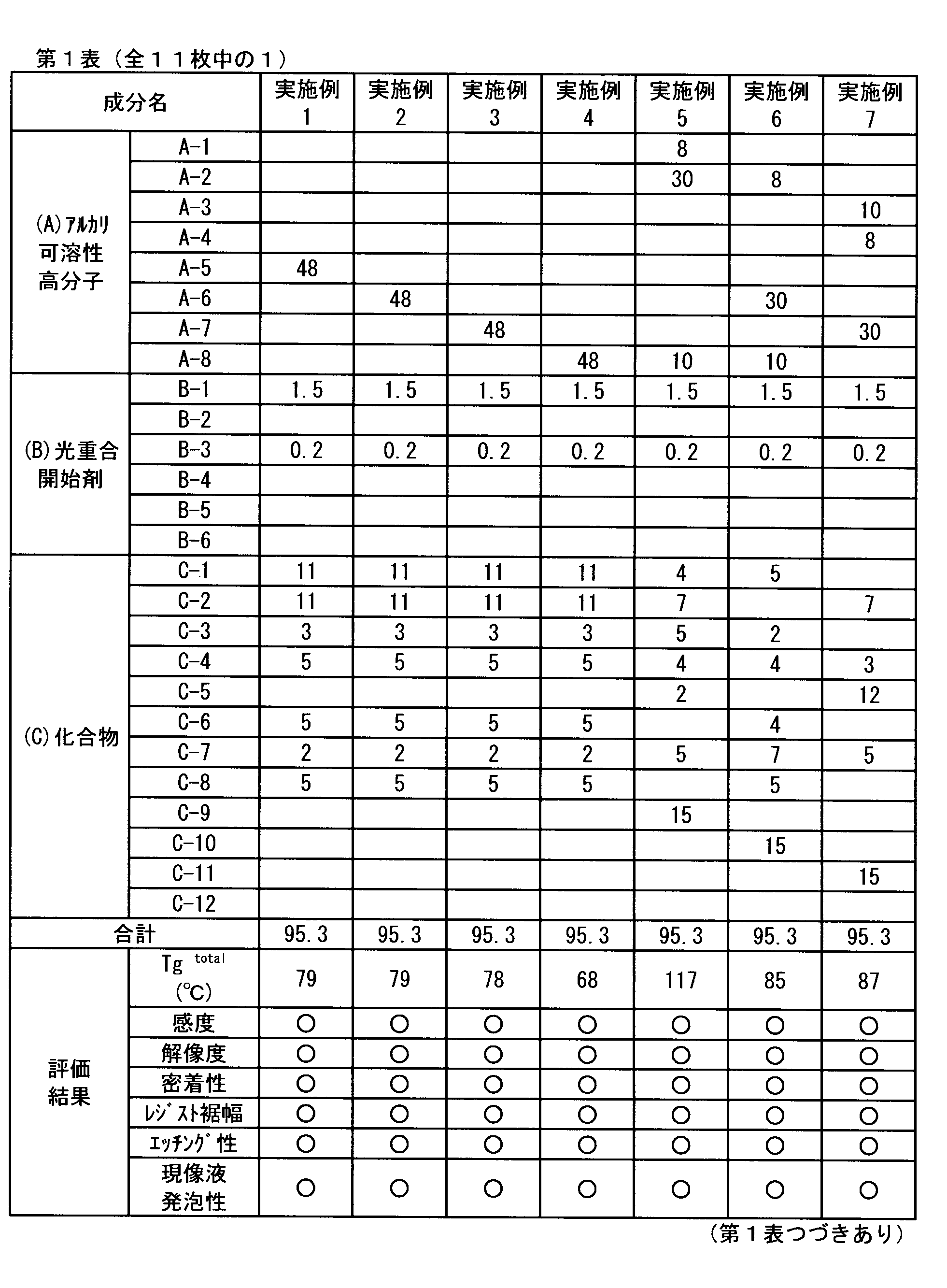

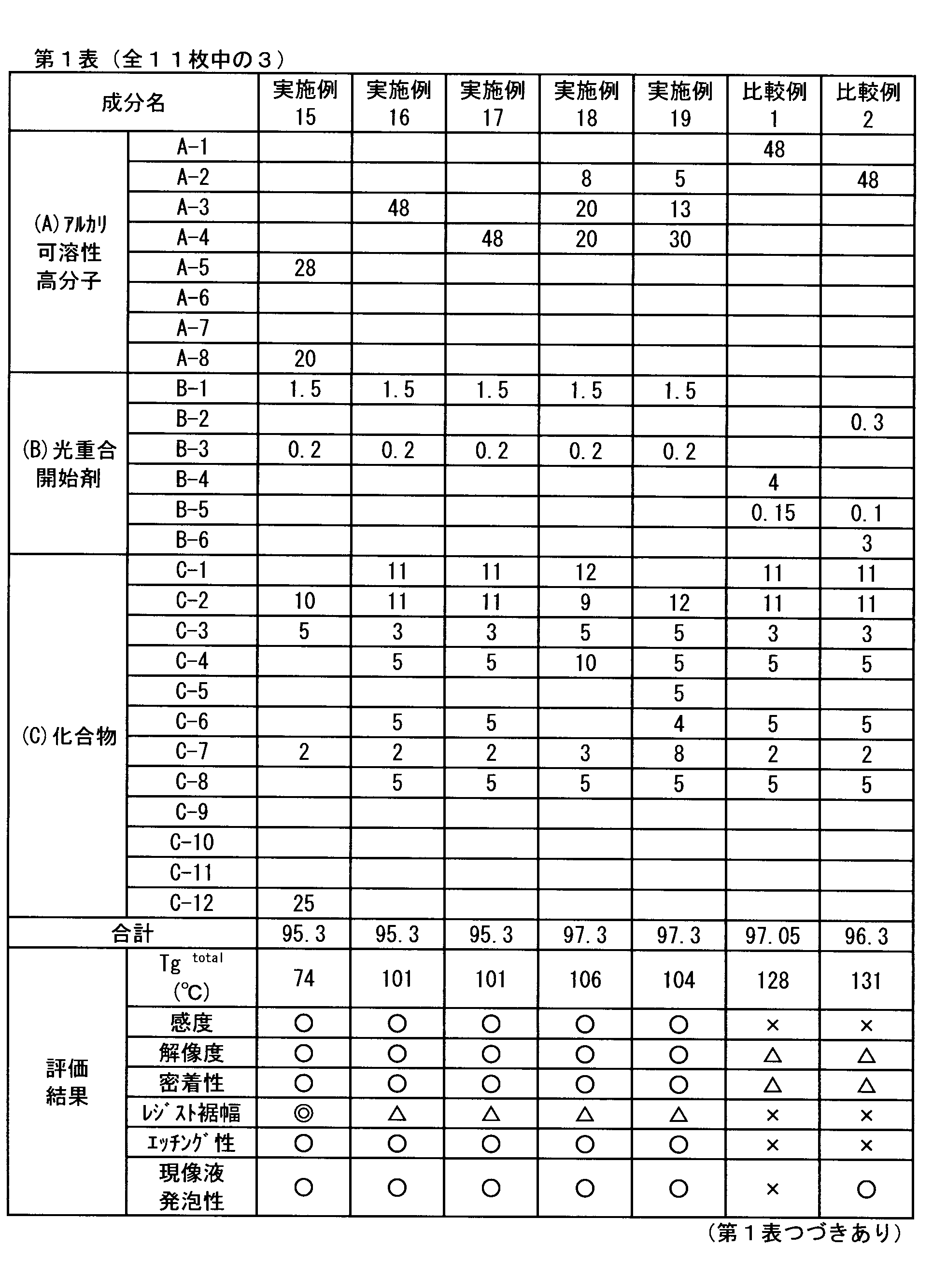


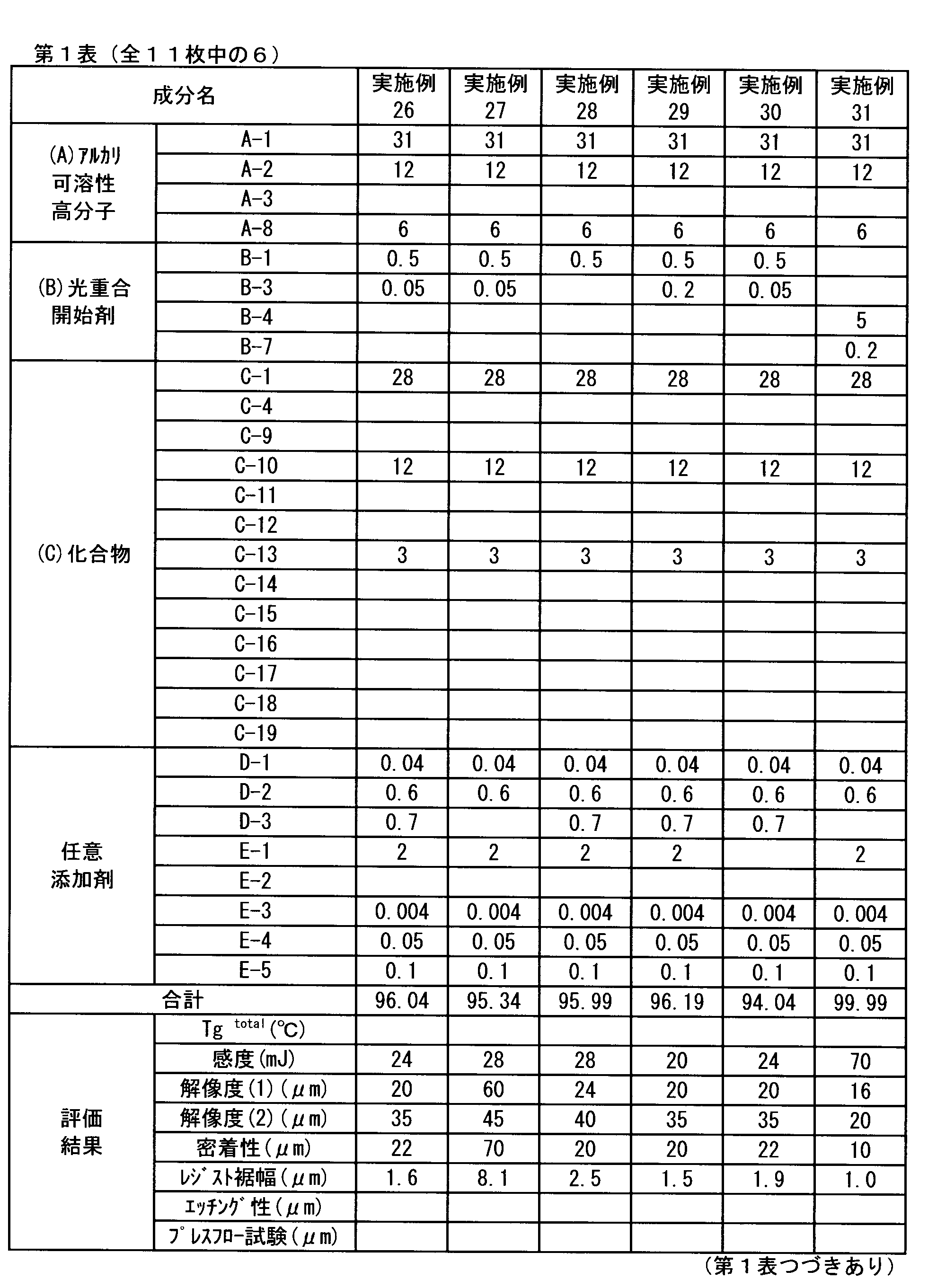

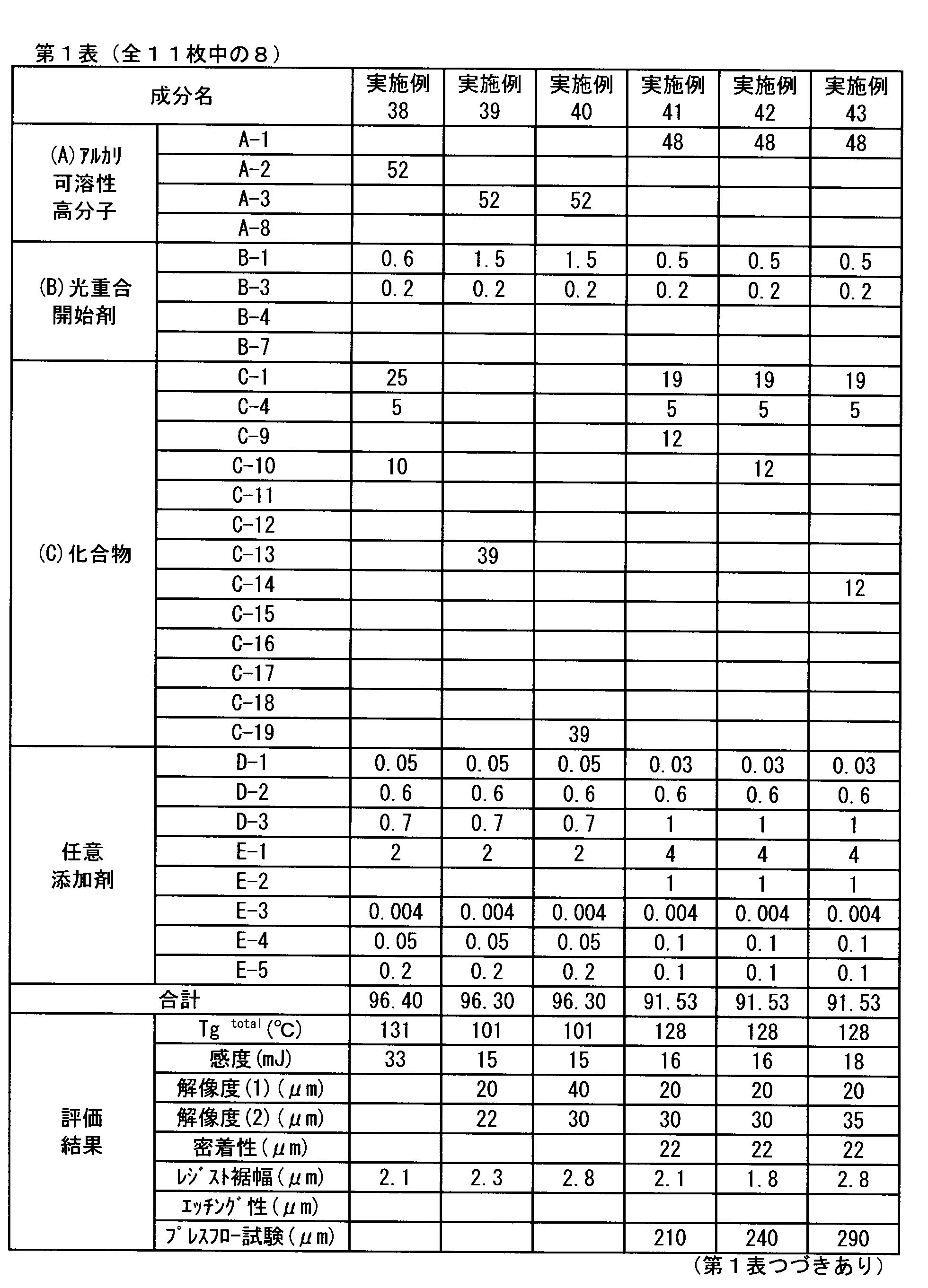


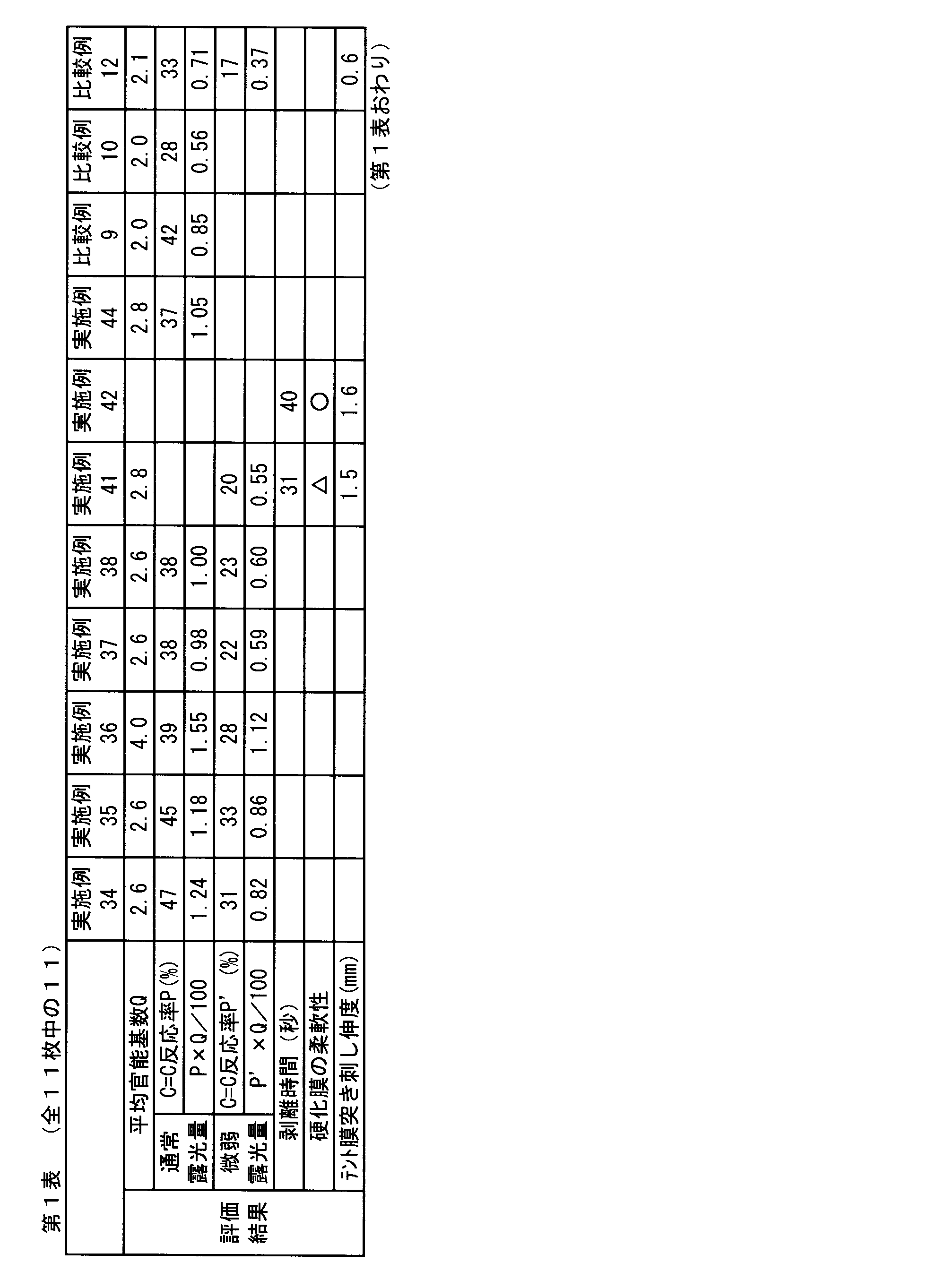

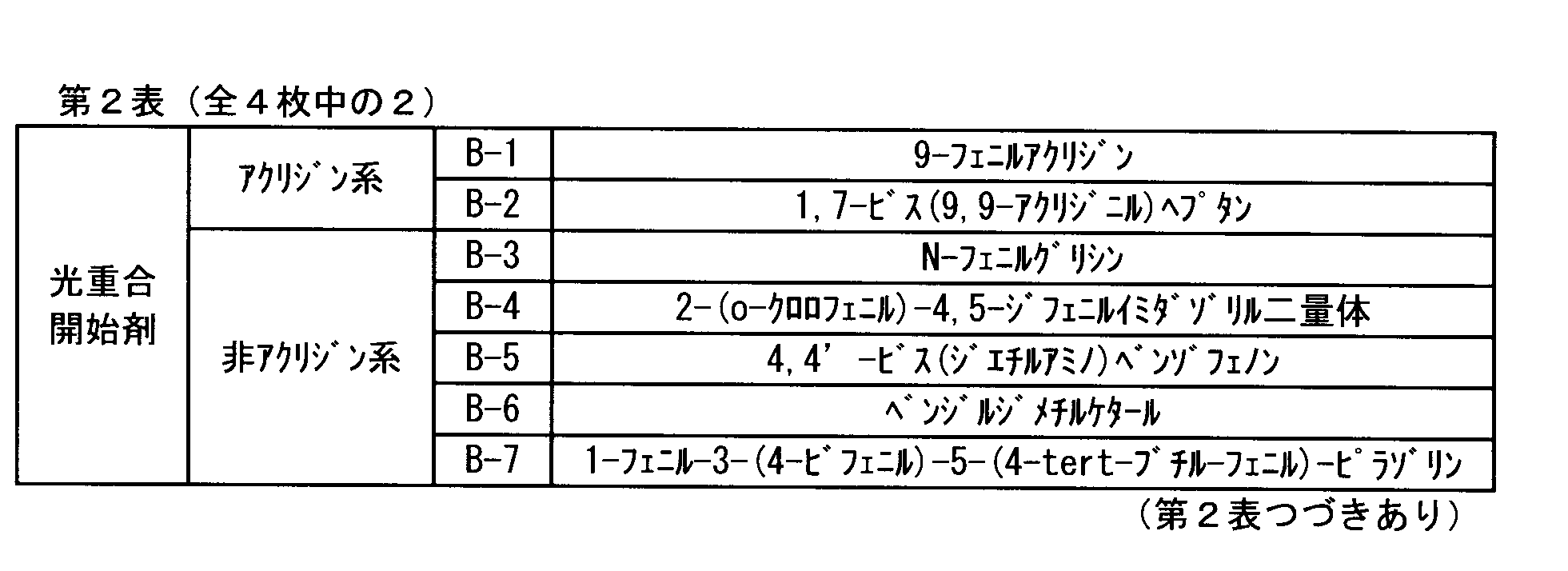

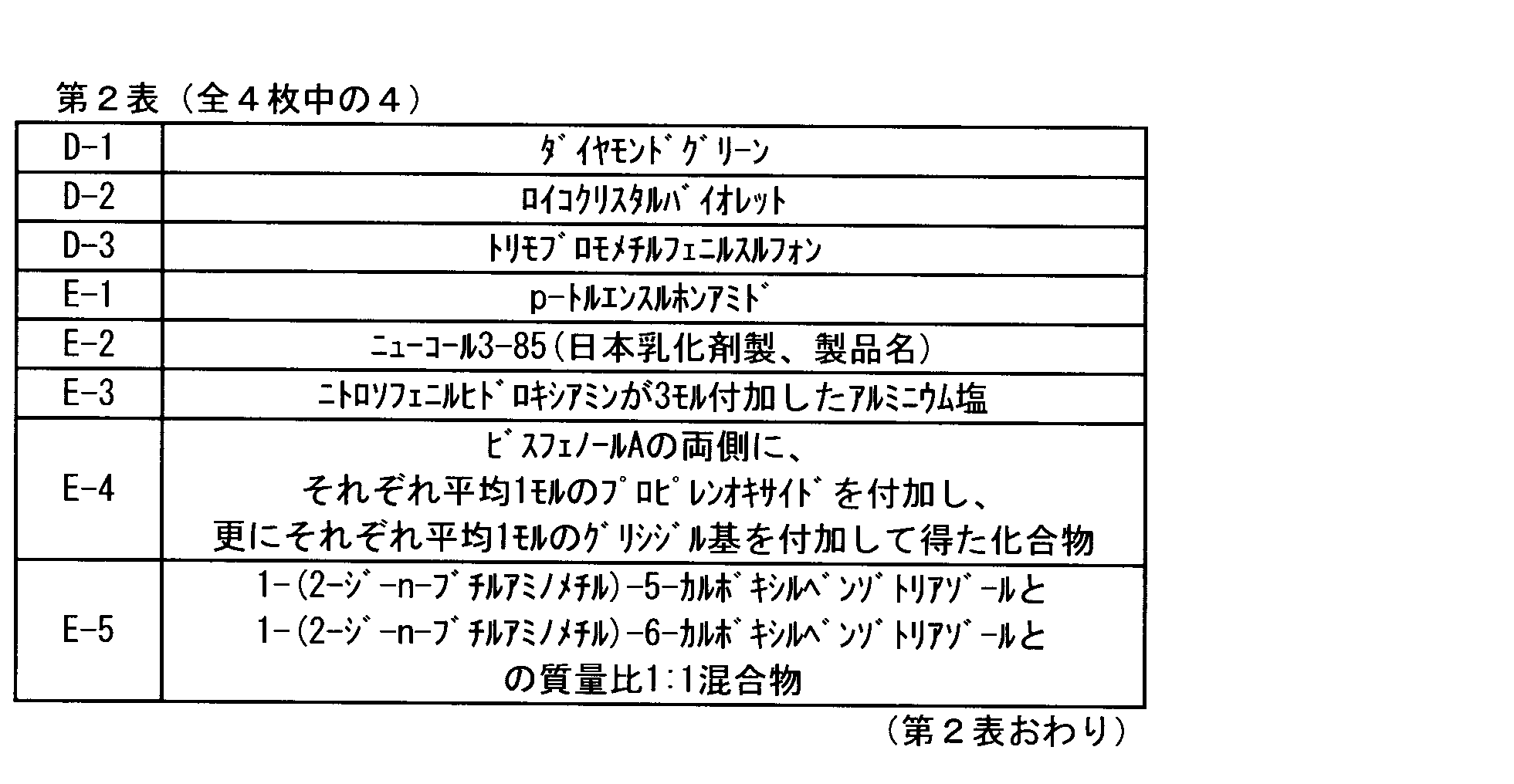
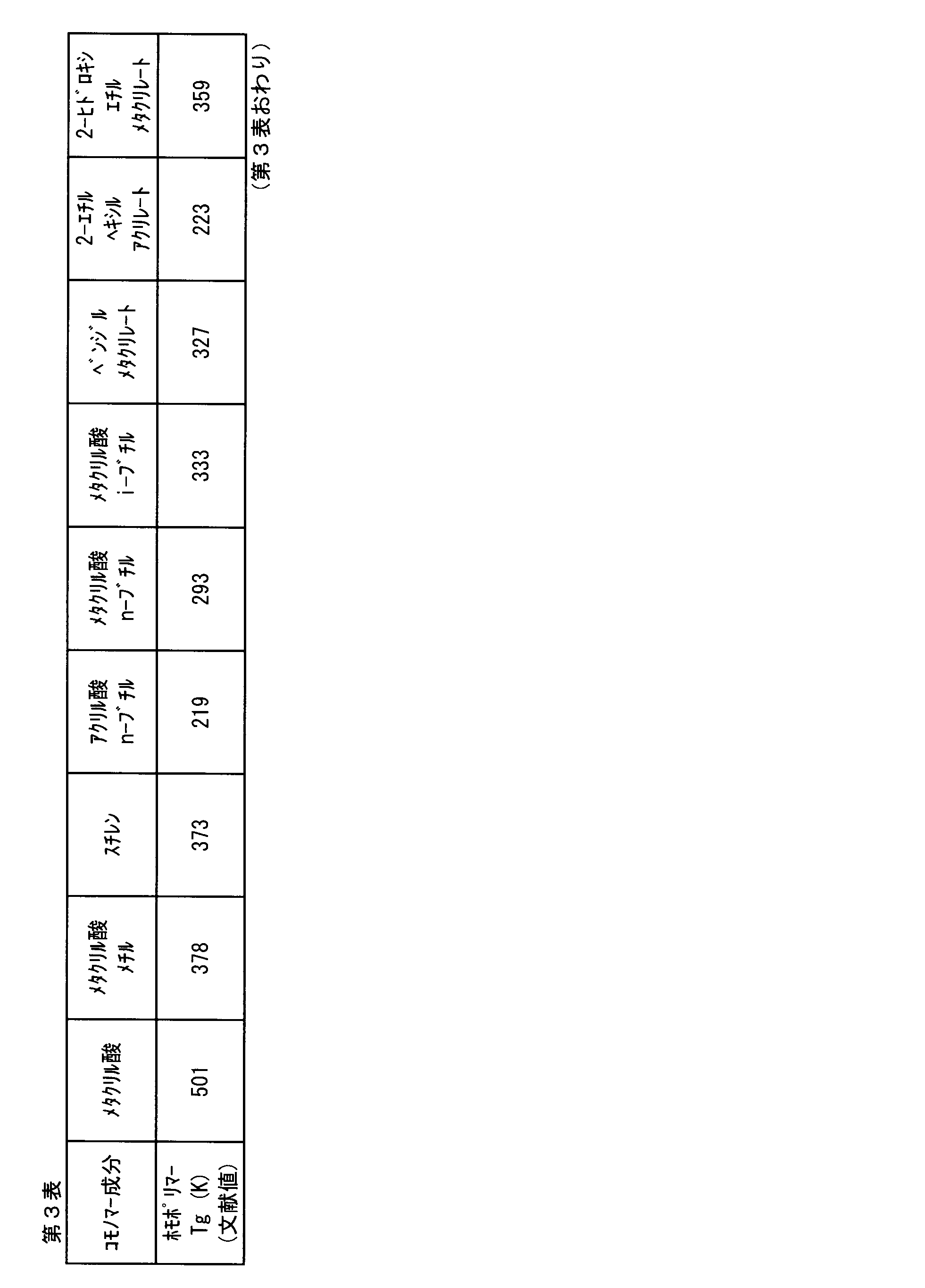
Claims (28)
- (A)アルカリ可溶性高分子:40~80質量%、
(B)光重合開始剤:0.1~20質量%、及び
(C)エチレン性二重結合を有する化合物:5~50質量%
を含有する感光性樹脂組成物であって、
該感光性樹脂組成物からなる厚さ25μmの感光性樹脂層を基板表面上に形成し、
露光時の焦点の位置を基板表面から該基板の厚み方向に200μm基板内側にずらした条件で露光及び現像を行って得られるレジストパターンのレジスト裾幅が0.01μm~3.5μmであり、そして
ダイレクトイメージング露光に用いられることを特徴とする、前記感光性樹脂組成物。 - 前記感光性樹脂組成物からなる厚さ25μmの感光性樹脂層を基板表面上に形成し、ストーファー21段ステップタブレットをマスクとして露光し、次いで現像したときの最高残膜段数が6段となる露光量で、該感光性樹脂層に露光を行った時、
前記(C)化合物中のエチレン性二重結合の平均個数をQ、前記露光を行った後の前記(C)化合物中のエチレン性二重結合の反応率をPとした場合のP×Q/100の値が0.7以上である、請求項1に記載の感光性樹脂組成物。 - 前記感光性樹脂組成物からなる厚さ25μmの感光性樹脂層を基板表面上に形成し、ストーファー21段ステップタブレットをマスクとして露光し、次いで現像したときの最高残膜段数が6段となる露光量の1/10の露光量で、該感光性樹脂層に露光を行った時、
前記(C)化合物中のエチレン性二重結合の平均個数をQ、前記露光を行った後の前記(C)化合物中のエチレン性二重結合の反応率をP’とした場合のP’×Q /100の値が0.3以上である、請求項1又は2に記載の感光性樹脂組成物。 - 前記(A)アルカリ可溶性高分子のTgの重量平均値Tgtotalが30℃以上125℃以下である、請求項1~3のいずれか一項に記載の感光性樹脂組成物。
- 前記(C)化合物が、一分子中に3個以上のメタクリロイル基を有する化合物を含む、請求項1~4のいずれか一項に記載の感光性樹脂組成物。
- 前記(C)化合物が、一分子中に4個以上のメタクリロイル基を有する化合物を含む、請求項1~5のいずれか一項に記載の感光性樹脂組成物。
- 前記(C)化合物が、下記一般式(IV):

R1、R2、R3、及びR4は、各々独立に、アルキル基を表し、
R5、R6、R7、及びR8は、各々独立にアルキレン基を表し、R5、R6、R7、及びR8が各々複数存在する場合、該複数のR5、R6、R7、及びR8は互いに同一でも異なっていてもよい。}で表される化合物を含む、請求項1~6のいずれか一項に記載の感光性樹脂組成物。 - 前記一般式(IV)において、n1+n2+n3+n4が15~40の整数である、請求項7に記載の感光性樹脂組成物。
- 前記式(IV)において、n1+n2+n3+n4が15~28の整数である、請求項7に記載の感光性樹脂組成物。
- 前記(B)光重合開始剤がアクリジン系化合物を含む、請求項1~9のいずれか一項に記載の感光性樹脂組成物。
- 更にハロゲン化合物を含む、請求項1~10のいずれか一項に記載の感光性樹脂組成物。
- 前記(B)光重合開始剤がN-フェニルグリシン又はその誘導体を含む、請求項1~11のいずれか一項に記載の感光性樹脂組成物。
- 前記(A)アルカリ可溶性高分子が芳香族炭化水素基を有する、請求項1~12のいずれか一項に記載の感光性樹脂組成物。
- (A)アルカリ可溶性高分子:40~80質量%、
(B)光重合開始剤:0.1~20質量%、及び
(C)エチレン性二重結合を有する化合物:5~50質量%
を含有する感光性樹脂組成物であって、
前記(C)化合物が、一分子中に3個以上のメタクリロイル基を有する化合物を含むことを特徴とする、前記感光性樹脂組成物。 - 前記感光性樹脂組成物からなる厚さ25μmの感光性樹脂層を基板表面上に形成し、ストーファー21段ステップタブレットをマスクとして露光し、次いで現像したときの最高残膜段数が6段となる露光量で、該感光性樹脂層に露光を行った時、
前記(C)化合物中のエチレン性二重結合の平均個数をQ、前記露光を行った後の前記(C)化合物中のエチレン性二重結合の反応率をPとした場合のP×Q/100の値が0.7以上である、請求項14に記載の感光性樹脂組成物。 - 前記感光性樹脂組成物からなる厚さ25μmの感光性樹脂層を基板表面上に形成し、ストーファー21段ステップタブレットをマスクとして露光し、次いで現像したときの最高残膜段数が6段となる露光量の1/10の露光量で、該感光性樹脂層に露光を行った時、
前記(C)化合物中のエチレン性二重結合の平均個数をQ、前記露光を行った後の前記(C)化合物中のエチレン性二重結合の反応率をP’とした場合のP’×Q /100の値が0.3以上である、請求項14又は15に記載の感光性樹脂組成物。 - 前記(C)化合物が、一分子中に4個以上のメタクリロイル基を有する化合物を含む、請求項14~16のいずれか一項に記載の感光性樹脂組成物。
- 前記(C)化合物が、下記一般式(IV):
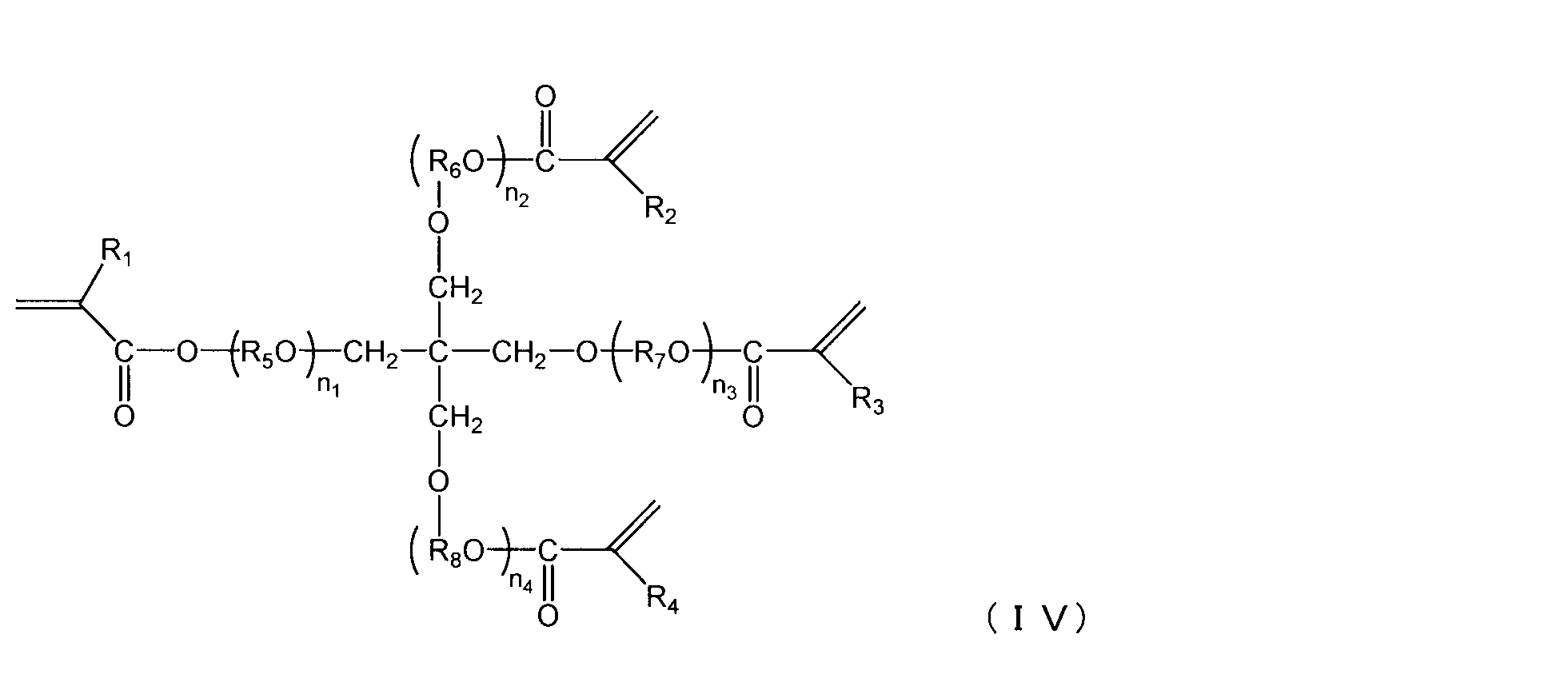
R1、R2、R3、及びR4は、各々独立に、アルキル基を表し、
R5、R6、R7、及びR8は、各々独立に、アルキレン基を表し、R5、R6、R7、及びR8が各々複数存在する場合、該複数のR5、R6、R7、及びR8は互いに同一でも異なっていてもよい。}で表される化合物を含む、請求項14~17のいずれか一項に記載の感光性樹脂組成物。 - 前記式(IV)において、n1+n2+n3+n4が15~40の整数である、請求項18に記載の感光性樹脂組成物。
- 前記式(IV)において、n1+n2+n3+n4が15~28の整数である、請求項18に記載の感光性樹脂組成物。
- 前記(B)光重合開始剤がアクリジン系化合物を含む、請求項14~20のいずれか一項に記載の感光性樹脂組成物。
- 更にハロゲン化合物を含む、請求項14~21のいずれか一項に記載の感光性樹脂組成物。
- 前記(B)光重合開始剤がN-フェニルグリシン又はその誘導体を含む、請求項14~22のいずれか一項に記載の感光性樹脂組成物。
- 前記(A)アルカリ可溶性高分子が芳香族炭化水素基を有する、請求項14~23のいずれか一項に記載の感光性樹脂組成物。
- 前記(A)アルカリ可溶性高分子のTgの重量平均値Tgtotalが30℃以上125℃以下である、請求項14~24のいずれか一項に記載の感光性樹脂組成物。
- ダイレクトイメージング露光に用いられる、請求項14~25のいずれか一項に記載の感光性樹脂組成物。
- 請求項1~26のいずれか一項に記載の感光性樹脂組成物の層を基板上に形成する工程、
該感光性樹脂組成物の層を露光及び現像してレジストパターンを形成する工程、並びに
該レジストパターンが形成された該基板をエッチング又はめっきする工程
を含むことを特徴とする、回路パターンの形成方法。 - 前記露光がダイレクトイメージング露光によって行われる、請求項27に記載の方法。
Priority Applications (8)
| Application Number | Priority Date | Filing Date | Title |
|---|---|---|---|
| KR1020197022465A KR20190092622A (ko) | 2014-05-21 | 2015-05-21 | 감광성 수지 조성물 및 회로 패턴의 형성 방법 |
| KR1020217025400A KR20210102494A (ko) | 2014-05-21 | 2015-05-21 | 감광성 수지 조성물 및 회로 패턴의 형성 방법 |
| JP2016521151A JPWO2015178462A1 (ja) | 2014-05-21 | 2015-05-21 | 感光性樹脂組成物及び回路パターンの形成方法 |
| CN202010587896.3A CN111694218B (zh) | 2014-05-21 | 2015-05-21 | 感光性树脂组合物以及电路图案的形成方法 |
| KR1020227036070A KR102694619B1 (ko) | 2014-05-21 | 2015-05-21 | 감광성 수지 조성물 및 회로 패턴의 형성 방법 |
| KR1020167027956A KR20160131084A (ko) | 2014-05-21 | 2015-05-21 | 감광성 수지 조성물 및 회로 패턴의 형성 방법 |
| MYUI2016002039A MY198993A (en) | 2014-05-21 | 2015-05-21 | Photosensitive resin composition and method for forming circuit pattern |
| CN201580025748.XA CN106462068B (zh) | 2014-05-21 | 2015-05-21 | 感光性树脂组合物以及电路图案的形成方法 |
Applications Claiming Priority (2)
| Application Number | Priority Date | Filing Date | Title |
|---|---|---|---|
| JP2014105267 | 2014-05-21 | ||
| JP2014-105267 | 2014-05-21 |
Publications (1)
| Publication Number | Publication Date |
|---|---|
| WO2015178462A1 true WO2015178462A1 (ja) | 2015-11-26 |
Family
ID=54554122
Family Applications (1)
| Application Number | Title | Priority Date | Filing Date |
|---|---|---|---|
| PCT/JP2015/064644 Ceased WO2015178462A1 (ja) | 2014-05-21 | 2015-05-21 | 感光性樹脂組成物及び回路パターンの形成方法 |
Country Status (6)
| Country | Link |
|---|---|
| JP (2) | JPWO2015178462A1 (ja) |
| KR (4) | KR102694619B1 (ja) |
| CN (2) | CN111694218B (ja) |
| MY (1) | MY198993A (ja) |
| TW (3) | TWI623814B (ja) |
| WO (1) | WO2015178462A1 (ja) |
Cited By (7)
| Publication number | Priority date | Publication date | Assignee | Title |
|---|---|---|---|---|
| WO2016163540A1 (ja) * | 2015-04-08 | 2016-10-13 | 旭化成株式会社 | 感光性樹脂組成物 |
| JP2017120393A (ja) * | 2015-12-28 | 2017-07-06 | 旭化成株式会社 | 積層体 |
| JP2017181646A (ja) * | 2016-03-29 | 2017-10-05 | 旭化成株式会社 | 感光性樹脂組成物、感光性樹脂積層体、レジストパターン形成方法及び導体パターン製造方法 |
| JP2020190735A (ja) * | 2020-07-14 | 2020-11-26 | 旭化成株式会社 | 感光性樹脂組成物、感光性樹脂積層体、レジストパターン形成方法及び導体パターン製造方法 |
| WO2021005766A1 (ja) * | 2019-07-10 | 2021-01-14 | 昭和電工マテリアルズ株式会社 | 感光性樹脂組成物、感光性樹脂フィルム、硬化物の製造方法、積層体、及び電子部品 |
| KR20220038405A (ko) | 2019-11-11 | 2022-03-28 | 아사히 가세이 가부시키가이샤 | 감광성 수지 조성물 및 감광성 수지 적층체 |
| JP2023509860A (ja) * | 2019-12-31 | 2023-03-10 | コーロン インダストリーズ インク | 感光性樹脂組成物およびそれを用いたドライフィルムフォトレジスト、感光性エレメント、回路基板、およびディスプレイ装置 |
Families Citing this family (8)
| Publication number | Priority date | Publication date | Assignee | Title |
|---|---|---|---|---|
| TWI623814B (zh) * | 2014-05-21 | 2018-05-11 | Asahi Kasei E Mat Corporation | 感光性樹脂組合物及電路圖案之形成方法 |
| MY192472A (en) * | 2016-12-07 | 2022-08-22 | Asahi Chemical Ind | Photosensitive resin composition and photosensitive resin laminate |
| TWI700183B (zh) * | 2017-12-20 | 2020-08-01 | 日商旭化成股份有限公司 | 感光性樹脂積層體 |
| CN108663867A (zh) * | 2018-04-11 | 2018-10-16 | 华南师范大学 | 一种染料掺杂的激光防护膜 |
| CN112534351B (zh) * | 2018-08-09 | 2025-03-18 | 旭化成株式会社 | 感光性树脂组合物及抗蚀图案的形成方法 |
| KR102242551B1 (ko) * | 2019-12-31 | 2021-04-20 | 코오롱인더스트리 주식회사 | 감광성 수지 조성물 및 이를 이용한 드라이 필름 포토레지스트, 감광성 엘리먼트, 회로기판, 및 디스플레이 장치 |
| KR20240036559A (ko) * | 2021-07-28 | 2024-03-20 | 닛산 가가쿠 가부시키가이샤 | 포지티브형 감광성 수지 조성물 |
| WO2023054619A1 (ja) * | 2021-09-30 | 2023-04-06 | 太陽インキ製造株式会社 | 感光性樹脂組成物、硬化物、プリント配線板、およびプリント配線板の製造方法 |
Citations (20)
| Publication number | Priority date | Publication date | Assignee | Title |
|---|---|---|---|---|
| JPS63260909A (ja) * | 1987-03-28 | 1988-10-27 | ヘキスト・アクチエンゲゼルシヤフト | 光重合性混合物及びこの混合物から製造される記録材料 |
| JPS6425147A (en) * | 1987-07-22 | 1989-01-27 | Hitachi Chemical Co Ltd | Photosensitive resin composition |
| JPH06242603A (ja) * | 1993-02-15 | 1994-09-02 | Hitachi Chem Co Ltd | 感光性樹脂組成物及びこれを用いた感光性エレメント |
| JP2001272779A (ja) * | 2000-03-23 | 2001-10-05 | Hitachi Chem Co Ltd | 感光性樹脂組成物、これを用いた感光性エレメント、レジストパターンの製造法及びプリント配線板の製造法 |
| JP2002069110A (ja) * | 2000-09-01 | 2002-03-08 | Fuji Photo Film Co Ltd | 光重合性組成物 |
| JP2005122122A (ja) * | 2003-09-22 | 2005-05-12 | Mitsubishi Chemicals Corp | レジスト画像形成方法 |
| JP2006208829A (ja) * | 2005-01-28 | 2006-08-10 | Mitsubishi Chemicals Corp | レジスト画像形成材料、レジスト画像形成材、及びレジスト画像形成方法 |
| JP2006276482A (ja) * | 2005-03-29 | 2006-10-12 | Nichigo Morton Co Ltd | 感光性樹脂組成物及びこれを用いた感光性ドライフィルムレジスト |
| JP2007102117A (ja) * | 2005-10-07 | 2007-04-19 | Nippon Synthetic Chem Ind Co Ltd:The | レーザー用画像形成材、及びパターンめっき用画像形成方法 |
| JP2007310025A (ja) * | 2006-05-16 | 2007-11-29 | Fujifilm Corp | 感光性組成物、感光性フィルム、感光性積層体、永久パターン形成方法、及びプリント基板 |
| WO2008015983A1 (fr) * | 2006-08-03 | 2008-02-07 | Asahi Kasei Emd Corporation | Composition de résine photosensible et stratifié |
| WO2009081925A1 (ja) * | 2007-12-25 | 2009-07-02 | Asahi Kasei E-Materials Corporation | 感光性樹脂積層体 |
| JP2009265630A (ja) * | 2008-03-31 | 2009-11-12 | Fujifilm Corp | カラーフィルター用感光性樹脂組成物、フォトスペーサー及びその製造方法、保護膜、着色パターン、表示装置用基板、並びに表示装置 |
| JP2010002595A (ja) * | 2008-06-19 | 2010-01-07 | Jsr Corp | 感光性組成物および電極の製造方法 |
| JP2010128328A (ja) * | 2008-11-28 | 2010-06-10 | Jsr Corp | 感放射線性樹脂組成物、液晶表示素子のスペーサーおよび保護膜ならびにそれらの形成方法 |
| JP2012048202A (ja) * | 2010-07-30 | 2012-03-08 | Hitachi Chem Co Ltd | 感光性樹脂組成物、感光性エレメント、レジストパターンの製造方法、リードフレームの製造方法、プリント配線板の製造方法及びプリント配線板 |
| JP2012215787A (ja) * | 2011-04-01 | 2012-11-08 | Hitachi Chem Co Ltd | 感光性樹脂組成物、感光性エレメント、レジストパターンの製造方法、並びに、プリント配線板及びその製造方法 |
| JP2013156369A (ja) * | 2012-01-27 | 2013-08-15 | Asahi Kasei E-Materials Corp | 感光性樹脂組成物 |
| JP2014048340A (ja) * | 2012-08-29 | 2014-03-17 | Asahi Kasei E-Materials Corp | 感光性樹脂組成物 |
| WO2015012272A1 (ja) * | 2013-07-23 | 2015-01-29 | 日立化成株式会社 | 投影露光用感光性樹脂組成物、感光性エレメント、レジストパターンの形成方法、プリント配線板の製造方法及びリードフレームの製造方法 |
Family Cites Families (55)
| Publication number | Priority date | Publication date | Assignee | Title |
|---|---|---|---|---|
| US4332879A (en) * | 1978-12-01 | 1982-06-01 | Hughes Aircraft Company | Process for depositing a film of controlled composition using a metallo-organic photoresist |
| JP3332100B2 (ja) * | 1992-03-24 | 2002-10-07 | 株式会社東芝 | パターン形成方法 |
| JPH06289602A (ja) * | 1993-03-31 | 1994-10-18 | Tokyo Ohka Kogyo Co Ltd | ペリレン系色素を用いた感光性樹脂組成物 |
| JPH08107051A (ja) * | 1994-10-06 | 1996-04-23 | Fujitsu Ltd | 半導体装置の製造方法 |
| DE69628996T2 (de) * | 1995-12-21 | 2004-04-22 | Wako Pure Chemical Industries, Ltd. | Polymerzusammensetzung und Rezistmaterial |
| JP2000109619A (ja) * | 1998-10-08 | 2000-04-18 | Japan Polychem Corp | 光崩壊性エチレン系樹脂組成物 |
| JP3711230B2 (ja) * | 1999-08-25 | 2005-11-02 | 東京応化工業株式会社 | 多層型感光材料 |
| JP2001296660A (ja) * | 2000-04-17 | 2001-10-26 | Fuji Photo Film Co Ltd | ポジ型フォトレジスト組成物 |
| US6665118B2 (en) * | 2000-08-30 | 2003-12-16 | Matsushita Electric Industrial Co., Ltd. | Rear-projection screen and rear-projection image display |
| KR100867339B1 (ko) * | 2000-12-01 | 2008-11-06 | 도요 고무 고교 가부시키가이샤 | 연마 패드 및 그 제조 방법 |
| US20030008968A1 (en) * | 2001-07-05 | 2003-01-09 | Yoshiki Sugeta | Method for reducing pattern dimension in photoresist layer |
| JP3715963B2 (ja) * | 2001-11-22 | 2005-11-16 | 三井化学株式会社 | 感光性樹脂組成物、ドライフィルムおよびそれを用いた加工部品 |
| JP2003241386A (ja) * | 2001-12-13 | 2003-08-27 | Fuji Photo Film Co Ltd | ポジ型レジスト組成物 |
| JP2003329826A (ja) * | 2002-05-15 | 2003-11-19 | Sumitomo Chem Co Ltd | カラーフィルタを構成する透明膜形成用感光性樹脂組成物 |
| TW200417294A (en) * | 2002-11-28 | 2004-09-01 | Taiyo Ink Mfg Co Ltd | Photo- and thermo-setting resin composition and printed wiring boards made by using the same |
| JP4317390B2 (ja) * | 2003-06-18 | 2009-08-19 | タムラ化研株式会社 | 感光性樹脂組成物及び電子部品搭載用回路基板の製造方法 |
| JP2005084092A (ja) * | 2003-09-04 | 2005-03-31 | Fuji Photo Film Co Ltd | 感光性平版印刷版 |
| JP4351519B2 (ja) * | 2003-11-26 | 2009-10-28 | 東洋インキ製造株式会社 | 感光性組成物およびカラーフィルタ |
| JP4475505B2 (ja) * | 2004-03-12 | 2010-06-09 | 旭化成イーマテリアルズ株式会社 | レーザー彫刻可能な円筒状印刷原版 |
| JP4366656B2 (ja) * | 2004-07-02 | 2009-11-18 | 東洋紡績株式会社 | ハイパーブランチ構造を有する樹脂及びそれを用いたレジスト剤 |
| CN1892428A (zh) * | 2005-07-08 | 2007-01-10 | 长兴化学工业股份有限公司 | 可光成像组合物 |
| JP2007178450A (ja) * | 2005-12-26 | 2007-07-12 | Fujifilm Corp | パターン形成材料、及びパターン形成方法 |
| JP2007199685A (ja) * | 2005-12-28 | 2007-08-09 | Fujifilm Electronic Materials Co Ltd | 光硬化性着色組成物及びカラーフィルタ、並びに液晶表示装置 |
| JP4969154B2 (ja) * | 2006-05-24 | 2012-07-04 | 旭化成イーマテリアルズ株式会社 | 感光性樹脂組成物及びガラスパターンの形成方法 |
| CN101192004B (zh) * | 2006-11-27 | 2010-05-12 | 乐凯集团第二胶片厂 | 适合于uv-ctp的阴图感光组成物和用其制作的平印版及平印版制作方法 |
| TWI413858B (zh) * | 2007-01-12 | 2013-11-01 | Toyo Ink Mfg Co | 彩色濾光片之製法 |
| KR101102186B1 (ko) * | 2007-01-31 | 2012-01-02 | 히다치 가세고교 가부시끼가이샤 | 감광성 엘리먼트 |
| JP4938571B2 (ja) * | 2007-07-11 | 2012-05-23 | 旭化成イーマテリアルズ株式会社 | 感光性樹脂組成物 |
| EP2182037B1 (en) * | 2007-08-21 | 2019-10-30 | Asahi Kasei Kabushiki Kaisha | Heat-bondable polyurethane film |
| JP2009086374A (ja) * | 2007-09-28 | 2009-04-23 | Fujifilm Corp | 感光性組成物、感光性フィルム、感光性積層体、永久パターン形成方法、及びプリント基板 |
| JP5099381B2 (ja) * | 2007-10-01 | 2012-12-19 | 日産化学工業株式会社 | レジスト下層膜形成組成物及びそれを用いた半導体装置の製造方法並びにレジスト下層膜形成組成物用添加剤 |
| DE112009001135T5 (de) * | 2008-05-12 | 2012-01-12 | The Arizona Board Of Regents On Behalf Of The University Of Arizona | Photovoltaischer Generator mit sphärischer Abbildungslinse zur Verwendung mit einem parabolischen Solarreflektor |
| KR101247912B1 (ko) | 2008-06-02 | 2013-03-26 | 히타치가세이가부시끼가이샤 | 감광성 수지 조성물, 감광성 엘리먼트, 레지스트 패턴의 제조방법, 및 프린트 배선판의 제조방법 |
| JP5187018B2 (ja) * | 2008-06-18 | 2013-04-24 | 凸版印刷株式会社 | 感光性着色組成物及びカラーフィルタ基板及び半透過型液晶表示装置 |
| KR20100031074A (ko) * | 2008-09-11 | 2010-03-19 | 후지필름 가부시키가이샤 | 감광성 조성물 및 기판의 가공 기판의 제조 방법 |
| JP5394707B2 (ja) * | 2008-11-26 | 2014-01-22 | 富士フイルム株式会社 | 感光性組成物および加工基板の製造方法 |
| JP5218762B2 (ja) * | 2008-12-12 | 2013-06-26 | 日産化学工業株式会社 | レジストパターンの形成方法 |
| CN102272676B (zh) | 2009-02-26 | 2013-07-31 | 日立化成株式会社 | 感光性树脂组合物、以及使用了该组合物的感光性元件、抗蚀剂图案的形成方法和印刷线路板的制造方法 |
| JP2010249884A (ja) * | 2009-04-10 | 2010-11-04 | Dupont Mrc Dryfilm Ltd | 光重合性樹脂組成物およびこれを用いた感光性フィルム |
| JP5498051B2 (ja) * | 2009-04-24 | 2014-05-21 | 新日鉄住金化学株式会社 | 隔壁及びカラーフィルター |
| JP5439030B2 (ja) * | 2009-05-18 | 2014-03-12 | 信越化学工業株式会社 | ネガ型レジスト組成物の検査方法及び調製方法 |
| JP2011203495A (ja) * | 2010-03-25 | 2011-10-13 | Fuji Xerox Co Ltd | 電子写真感光体、電子写真感光体の製造方法、プロセスカートリッジ、および画像形成装置 |
| JP5049366B2 (ja) * | 2010-03-29 | 2012-10-17 | 富士フイルム株式会社 | レーザー彫刻型フレキソ印刷版原版 |
| JP5765049B2 (ja) * | 2010-05-27 | 2015-08-19 | Jsr株式会社 | 硬化膜形成用感放射線性樹脂組成物、硬化膜形成用感放射線性樹脂組成物の製造方法、硬化膜、硬化膜の形成方法及び表示素子 |
| JP5751929B2 (ja) * | 2010-06-21 | 2015-07-22 | 新日鉄住金化学株式会社 | ブラックレジスト用感光性樹脂組成物及びカラーフィルター遮光膜 |
| KR20120043461A (ko) * | 2010-10-26 | 2012-05-04 | 황광민 | 절삭분 선별장치 |
| JP5707154B2 (ja) | 2011-01-31 | 2015-04-22 | 旭化成イーマテリアルズ株式会社 | 感光性樹脂組成物及びその用途 |
| JP6019902B2 (ja) * | 2011-09-06 | 2016-11-02 | 日立化成株式会社 | 感光性樹脂組成物、感光性エレメント、レジストパターンの形成方法、及びプリント配線板の製造方法 |
| JP6064480B2 (ja) * | 2011-10-26 | 2017-01-25 | 日立化成株式会社 | 感光性樹脂組成物、感光性エレメント、レジストパターンの形成方法及びプリント配線板の製造方法 |
| JP6229256B2 (ja) * | 2011-10-31 | 2017-11-15 | 日立化成株式会社 | 感光性エレメント、レジストパターンの形成方法及びプリント配線板の製造方法 |
| JP6010322B2 (ja) * | 2012-04-09 | 2016-10-19 | 株式会社カネカ | 硬化性組成物およびその用途 |
| JP6132471B2 (ja) * | 2012-04-16 | 2017-05-24 | 東京応化工業株式会社 | レジストパターン形成方法 |
| KR101302736B1 (ko) * | 2012-10-09 | 2013-09-03 | 기린정밀공업 (주) | Led 무대 조명 장치 |
| JP2015143809A (ja) * | 2013-12-25 | 2015-08-06 | 日立化成株式会社 | 感光性樹脂組成物、感光性エレメント、レジストパターンの形成方法及びプリント配線板の製造方法 |
| TWI623814B (zh) * | 2014-05-21 | 2018-05-11 | Asahi Kasei E Mat Corporation | 感光性樹脂組合物及電路圖案之形成方法 |
-
2015
- 2015-05-21 TW TW105135575A patent/TWI623814B/zh active
- 2015-05-21 CN CN202010587896.3A patent/CN111694218B/zh active Active
- 2015-05-21 TW TW107108334A patent/TWI660241B/zh active
- 2015-05-21 KR KR1020227036070A patent/KR102694619B1/ko active Active
- 2015-05-21 KR KR1020217025400A patent/KR20210102494A/ko not_active Ceased
- 2015-05-21 TW TW104116309A patent/TWI570513B/zh active
- 2015-05-21 JP JP2016521151A patent/JPWO2015178462A1/ja active Pending
- 2015-05-21 KR KR1020197022465A patent/KR20190092622A/ko not_active Ceased
- 2015-05-21 CN CN201580025748.XA patent/CN106462068B/zh active Active
- 2015-05-21 MY MYUI2016002039A patent/MY198993A/en unknown
- 2015-05-21 KR KR1020167027956A patent/KR20160131084A/ko not_active Ceased
- 2015-05-21 WO PCT/JP2015/064644 patent/WO2015178462A1/ja not_active Ceased
-
2017
- 2017-09-04 JP JP2017169781A patent/JP6470805B2/ja active Active
Patent Citations (20)
| Publication number | Priority date | Publication date | Assignee | Title |
|---|---|---|---|---|
| JPS63260909A (ja) * | 1987-03-28 | 1988-10-27 | ヘキスト・アクチエンゲゼルシヤフト | 光重合性混合物及びこの混合物から製造される記録材料 |
| JPS6425147A (en) * | 1987-07-22 | 1989-01-27 | Hitachi Chemical Co Ltd | Photosensitive resin composition |
| JPH06242603A (ja) * | 1993-02-15 | 1994-09-02 | Hitachi Chem Co Ltd | 感光性樹脂組成物及びこれを用いた感光性エレメント |
| JP2001272779A (ja) * | 2000-03-23 | 2001-10-05 | Hitachi Chem Co Ltd | 感光性樹脂組成物、これを用いた感光性エレメント、レジストパターンの製造法及びプリント配線板の製造法 |
| JP2002069110A (ja) * | 2000-09-01 | 2002-03-08 | Fuji Photo Film Co Ltd | 光重合性組成物 |
| JP2005122122A (ja) * | 2003-09-22 | 2005-05-12 | Mitsubishi Chemicals Corp | レジスト画像形成方法 |
| JP2006208829A (ja) * | 2005-01-28 | 2006-08-10 | Mitsubishi Chemicals Corp | レジスト画像形成材料、レジスト画像形成材、及びレジスト画像形成方法 |
| JP2006276482A (ja) * | 2005-03-29 | 2006-10-12 | Nichigo Morton Co Ltd | 感光性樹脂組成物及びこれを用いた感光性ドライフィルムレジスト |
| JP2007102117A (ja) * | 2005-10-07 | 2007-04-19 | Nippon Synthetic Chem Ind Co Ltd:The | レーザー用画像形成材、及びパターンめっき用画像形成方法 |
| JP2007310025A (ja) * | 2006-05-16 | 2007-11-29 | Fujifilm Corp | 感光性組成物、感光性フィルム、感光性積層体、永久パターン形成方法、及びプリント基板 |
| WO2008015983A1 (fr) * | 2006-08-03 | 2008-02-07 | Asahi Kasei Emd Corporation | Composition de résine photosensible et stratifié |
| WO2009081925A1 (ja) * | 2007-12-25 | 2009-07-02 | Asahi Kasei E-Materials Corporation | 感光性樹脂積層体 |
| JP2009265630A (ja) * | 2008-03-31 | 2009-11-12 | Fujifilm Corp | カラーフィルター用感光性樹脂組成物、フォトスペーサー及びその製造方法、保護膜、着色パターン、表示装置用基板、並びに表示装置 |
| JP2010002595A (ja) * | 2008-06-19 | 2010-01-07 | Jsr Corp | 感光性組成物および電極の製造方法 |
| JP2010128328A (ja) * | 2008-11-28 | 2010-06-10 | Jsr Corp | 感放射線性樹脂組成物、液晶表示素子のスペーサーおよび保護膜ならびにそれらの形成方法 |
| JP2012048202A (ja) * | 2010-07-30 | 2012-03-08 | Hitachi Chem Co Ltd | 感光性樹脂組成物、感光性エレメント、レジストパターンの製造方法、リードフレームの製造方法、プリント配線板の製造方法及びプリント配線板 |
| JP2012215787A (ja) * | 2011-04-01 | 2012-11-08 | Hitachi Chem Co Ltd | 感光性樹脂組成物、感光性エレメント、レジストパターンの製造方法、並びに、プリント配線板及びその製造方法 |
| JP2013156369A (ja) * | 2012-01-27 | 2013-08-15 | Asahi Kasei E-Materials Corp | 感光性樹脂組成物 |
| JP2014048340A (ja) * | 2012-08-29 | 2014-03-17 | Asahi Kasei E-Materials Corp | 感光性樹脂組成物 |
| WO2015012272A1 (ja) * | 2013-07-23 | 2015-01-29 | 日立化成株式会社 | 投影露光用感光性樹脂組成物、感光性エレメント、レジストパターンの形成方法、プリント配線板の製造方法及びリードフレームの製造方法 |
Cited By (14)
| Publication number | Priority date | Publication date | Assignee | Title |
|---|---|---|---|---|
| JPWO2016163540A1 (ja) * | 2015-04-08 | 2017-11-02 | 旭化成株式会社 | 感光性樹脂組成物 |
| TWI706222B (zh) * | 2015-04-08 | 2020-10-01 | 日商旭化成股份有限公司 | 感光性樹脂組合物 |
| WO2016163540A1 (ja) * | 2015-04-08 | 2016-10-13 | 旭化成株式会社 | 感光性樹脂組成物 |
| CN112882342A (zh) * | 2015-12-28 | 2021-06-01 | 旭化成株式会社 | 层压体 |
| JP2017120393A (ja) * | 2015-12-28 | 2017-07-06 | 旭化成株式会社 | 積層体 |
| CN112882342B (zh) * | 2015-12-28 | 2024-04-19 | 旭化成株式会社 | 层压体 |
| JP2017181646A (ja) * | 2016-03-29 | 2017-10-05 | 旭化成株式会社 | 感光性樹脂組成物、感光性樹脂積層体、レジストパターン形成方法及び導体パターン製造方法 |
| WO2021005766A1 (ja) * | 2019-07-10 | 2021-01-14 | 昭和電工マテリアルズ株式会社 | 感光性樹脂組成物、感光性樹脂フィルム、硬化物の製造方法、積層体、及び電子部品 |
| KR20220038405A (ko) | 2019-11-11 | 2022-03-28 | 아사히 가세이 가부시키가이샤 | 감광성 수지 조성물 및 감광성 수지 적층체 |
| KR20250009559A (ko) | 2019-11-11 | 2025-01-17 | 아사히 가세이 가부시키가이샤 | 감광성 수지 조성물 및 감광성 수지 적층체 |
| US12353130B2 (en) | 2019-11-11 | 2025-07-08 | Asahi Kasei Kabushiki Kaisha | Photosensitive resin composition and photosensitive resin multilayer body |
| JP2023509860A (ja) * | 2019-12-31 | 2023-03-10 | コーロン インダストリーズ インク | 感光性樹脂組成物およびそれを用いたドライフィルムフォトレジスト、感光性エレメント、回路基板、およびディスプレイ装置 |
| JP7376723B2 (ja) | 2019-12-31 | 2023-11-08 | コーロン インダストリーズ インク | 感光性樹脂組成物およびそれを用いたドライフィルムフォトレジスト、感光性エレメント、回路基板、およびディスプレイ装置 |
| JP2020190735A (ja) * | 2020-07-14 | 2020-11-26 | 旭化成株式会社 | 感光性樹脂組成物、感光性樹脂積層体、レジストパターン形成方法及び導体パターン製造方法 |
Also Published As
| Publication number | Publication date |
|---|---|
| TWI570513B (zh) | 2017-02-11 |
| TWI660241B (zh) | 2019-05-21 |
| CN106462068B (zh) | 2020-07-24 |
| TW201602729A (zh) | 2016-01-16 |
| KR20210102494A (ko) | 2021-08-19 |
| KR20160131084A (ko) | 2016-11-15 |
| TWI623814B (zh) | 2018-05-11 |
| TW201820036A (zh) | 2018-06-01 |
| CN111694218B (zh) | 2023-09-08 |
| KR20220148301A (ko) | 2022-11-04 |
| MY198993A (en) | 2023-10-06 |
| JP6470805B2 (ja) | 2019-02-13 |
| CN106462068A (zh) | 2017-02-22 |
| JPWO2015178462A1 (ja) | 2017-04-20 |
| TW201708959A (zh) | 2017-03-01 |
| KR102694619B1 (ko) | 2024-08-12 |
| JP2017223993A (ja) | 2017-12-21 |
| CN111694218A (zh) | 2020-09-22 |
| KR20190092622A (ko) | 2019-08-07 |
Similar Documents
| Publication | Publication Date | Title |
|---|---|---|
| JP6470805B2 (ja) | 感光性樹脂組成物及び回路パターンの形成方法 | |
| JP5707420B2 (ja) | 感光性樹脂組成物 | |
| KR102368239B1 (ko) | 레지스트 패턴의 형성 방법, 프린트 배선판의 제조 방법, 투영 노광용 감광성 수지 조성물 및 감광성 엘리먼트 | |
| WO2015098870A1 (ja) | 感光性樹脂組成物、感光性エレメント、レジストパターンの形成方法及びプリント配線板の製造方法 | |
| KR102882782B1 (ko) | 감광성 수지 적층체 | |
| JP5205464B2 (ja) | 感光性樹脂組成物、感光性樹脂積層体、レジストパターン形成方法並びに導体パターン、プリント配線板、リードフレーム、基材及び半導体パッケージの製造方法 | |
| JP2009128419A (ja) | 感光性樹脂組成物および積層体 | |
| JP5793924B2 (ja) | 感光性樹脂組成物、感光性エレメント、レジストパターンの製造方法、及びプリント配線板の製造方法 | |
| JP5763944B2 (ja) | 感光性樹脂組成物、感光性樹脂積層体、レジストパターン形成方法及び導体パターン製造方法 | |
| JP6567952B2 (ja) | 感光性樹脂組成物、感光性樹脂積層体及びレジストパターン形成方法 | |
| JP6113976B2 (ja) | 感光性樹脂組成物 | |
| JP5411521B2 (ja) | 感光性樹脂積層体 | |
| JP5469399B2 (ja) | 感光性樹脂組成物 | |
| KR102750131B1 (ko) | 감광성 수지 조성물 및 감광성 수지 적층체 | |
| JP2010271395A (ja) | 感光性樹脂組成物、感光性樹脂積層体、レジストパターン形成方法及び導体パターンの製造方法 | |
| WO2026084060A1 (ja) | 感光性樹脂積層体 | |
| JP6630088B2 (ja) | 感光性樹脂組成物 |
Legal Events
| Date | Code | Title | Description |
|---|---|---|---|
| 121 | Ep: the epo has been informed by wipo that ep was designated in this application |
Ref document number: 15796541 Country of ref document: EP Kind code of ref document: A1 |
|
| ENP | Entry into the national phase |
Ref document number: 2016521151 Country of ref document: JP Kind code of ref document: A |
|
| ENP | Entry into the national phase |
Ref document number: 20167027956 Country of ref document: KR Kind code of ref document: A |
|
| NENP | Non-entry into the national phase |
Ref country code: DE |
|
| 122 | Ep: pct application non-entry in european phase |
Ref document number: 15796541 Country of ref document: EP Kind code of ref document: A1 |