EP2566501B1 - Method and device for transdermal delivery of parathyroid hormone using a microprojection array - Google Patents
Method and device for transdermal delivery of parathyroid hormone using a microprojection array Download PDFInfo
- Publication number
- EP2566501B1 EP2566501B1 EP11778302.7A EP11778302A EP2566501B1 EP 2566501 B1 EP2566501 B1 EP 2566501B1 EP 11778302 A EP11778302 A EP 11778302A EP 2566501 B1 EP2566501 B1 EP 2566501B1
- Authority
- EP
- European Patent Office
- Prior art keywords
- array
- hpth
- microprotrusion
- dry weight
- dextran
- Prior art date
- Legal status (The legal status is an assumption and is not a legal conclusion. Google has not performed a legal analysis and makes no representation as to the accuracy of the status listed.)
- Active
Links
Images


Classifications
-
- A—HUMAN NECESSITIES
- A61—MEDICAL OR VETERINARY SCIENCE; HYGIENE
- A61K—PREPARATIONS FOR MEDICAL, DENTAL OR TOILETRY PURPOSES
- A61K9/00—Medicinal preparations characterised by special physical form
- A61K9/0012—Galenical forms characterised by the site of application
- A61K9/0019—Injectable compositions; Intramuscular, intravenous, arterial, subcutaneous administration; Compositions to be administered through the skin in an invasive manner
- A61K9/0021—Intradermal administration, e.g. through microneedle arrays or needleless injectors
-
- A—HUMAN NECESSITIES
- A61—MEDICAL OR VETERINARY SCIENCE; HYGIENE
- A61K—PREPARATIONS FOR MEDICAL, DENTAL OR TOILETRY PURPOSES
- A61K38/00—Medicinal preparations containing peptides
- A61K38/16—Peptides having more than 20 amino acids; Gastrins; Somatostatins; Melanotropins; Derivatives thereof
- A61K38/17—Peptides having more than 20 amino acids; Gastrins; Somatostatins; Melanotropins; Derivatives thereof from animals; from humans
- A61K38/22—Hormones
- A61K38/29—Parathyroid hormone, i.e. parathormone; Parathyroid hormone-related peptides
-
- A—HUMAN NECESSITIES
- A61—MEDICAL OR VETERINARY SCIENCE; HYGIENE
- A61K—PREPARATIONS FOR MEDICAL, DENTAL OR TOILETRY PURPOSES
- A61K47/00—Medicinal preparations characterised by the non-active ingredients used, e.g. carriers or inert additives; Targeting or modifying agents chemically bound to the active ingredient
- A61K47/06—Organic compounds, e.g. natural or synthetic hydrocarbons, polyolefins, mineral oil, petrolatum or ozokerite
- A61K47/22—Heterocyclic compounds, e.g. ascorbic acid, tocopherol or pyrrolidones
-
- A—HUMAN NECESSITIES
- A61—MEDICAL OR VETERINARY SCIENCE; HYGIENE
- A61K—PREPARATIONS FOR MEDICAL, DENTAL OR TOILETRY PURPOSES
- A61K47/00—Medicinal preparations characterised by the non-active ingredients used, e.g. carriers or inert additives; Targeting or modifying agents chemically bound to the active ingredient
- A61K47/06—Organic compounds, e.g. natural or synthetic hydrocarbons, polyolefins, mineral oil, petrolatum or ozokerite
- A61K47/26—Carbohydrates, e.g. sugar alcohols, amino sugars, nucleic acids, mono-, di- or oligo-saccharides; Derivatives thereof, e.g. polysorbates, sorbitan fatty acid esters or glycyrrhizin
-
- A—HUMAN NECESSITIES
- A61—MEDICAL OR VETERINARY SCIENCE; HYGIENE
- A61K—PREPARATIONS FOR MEDICAL, DENTAL OR TOILETRY PURPOSES
- A61K47/00—Medicinal preparations characterised by the non-active ingredients used, e.g. carriers or inert additives; Targeting or modifying agents chemically bound to the active ingredient
- A61K47/30—Macromolecular organic or inorganic compounds, e.g. inorganic polyphosphates
- A61K47/34—Macromolecular compounds obtained otherwise than by reactions only involving carbon-to-carbon unsaturated bonds, e.g. polyesters, polyamino acids, polysiloxanes, polyphosphazines, copolymers of polyalkylene glycol or poloxamers
-
- A—HUMAN NECESSITIES
- A61—MEDICAL OR VETERINARY SCIENCE; HYGIENE
- A61K—PREPARATIONS FOR MEDICAL, DENTAL OR TOILETRY PURPOSES
- A61K47/00—Medicinal preparations characterised by the non-active ingredients used, e.g. carriers or inert additives; Targeting or modifying agents chemically bound to the active ingredient
- A61K47/30—Macromolecular organic or inorganic compounds, e.g. inorganic polyphosphates
- A61K47/36—Polysaccharides; Derivatives thereof, e.g. gums, starch, alginate, dextrin, hyaluronic acid, chitosan, inulin, agar or pectin
-
- A—HUMAN NECESSITIES
- A61—MEDICAL OR VETERINARY SCIENCE; HYGIENE
- A61M—DEVICES FOR INTRODUCING MEDIA INTO, OR ONTO, THE BODY; DEVICES FOR TRANSDUCING BODY MEDIA OR FOR TAKING MEDIA FROM THE BODY; DEVICES FOR PRODUCING OR ENDING SLEEP OR STUPOR
- A61M37/00—Other apparatus for introducing media into the body; Percutany, i.e. introducing medicines into the body by diffusion through the skin
- A61M37/0015—Other apparatus for introducing media into the body; Percutany, i.e. introducing medicines into the body by diffusion through the skin by using microneedles
-
- A—HUMAN NECESSITIES
- A61—MEDICAL OR VETERINARY SCIENCE; HYGIENE
- A61P—SPECIFIC THERAPEUTIC ACTIVITY OF CHEMICAL COMPOUNDS OR MEDICINAL PREPARATIONS
- A61P19/00—Drugs for skeletal disorders
- A61P19/08—Drugs for skeletal disorders for bone diseases, e.g. rachitism, Paget's disease
- A61P19/10—Drugs for skeletal disorders for bone diseases, e.g. rachitism, Paget's disease for osteoporosis
-
- A—HUMAN NECESSITIES
- A61—MEDICAL OR VETERINARY SCIENCE; HYGIENE
- A61M—DEVICES FOR INTRODUCING MEDIA INTO, OR ONTO, THE BODY; DEVICES FOR TRANSDUCING BODY MEDIA OR FOR TAKING MEDIA FROM THE BODY; DEVICES FOR PRODUCING OR ENDING SLEEP OR STUPOR
- A61M37/00—Other apparatus for introducing media into the body; Percutany, i.e. introducing medicines into the body by diffusion through the skin
- A61M37/0015—Other apparatus for introducing media into the body; Percutany, i.e. introducing medicines into the body by diffusion through the skin by using microneedles
- A61M2037/0023—Drug applicators using microneedles
-
- A—HUMAN NECESSITIES
- A61—MEDICAL OR VETERINARY SCIENCE; HYGIENE
- A61M—DEVICES FOR INTRODUCING MEDIA INTO, OR ONTO, THE BODY; DEVICES FOR TRANSDUCING BODY MEDIA OR FOR TAKING MEDIA FROM THE BODY; DEVICES FOR PRODUCING OR ENDING SLEEP OR STUPOR
- A61M37/00—Other apparatus for introducing media into the body; Percutany, i.e. introducing medicines into the body by diffusion through the skin
- A61M37/0015—Other apparatus for introducing media into the body; Percutany, i.e. introducing medicines into the body by diffusion through the skin by using microneedles
- A61M2037/0061—Methods for using microneedles
Definitions
- This disclosure relates generally to a microprotrusion array for use in therapy, and a kit for transdermally administering human parathyroid hormone (1-34), and related features thereof.
- hPTH Human parathyroid hormone
- PTH is involved in calcium and phosphorus homeostasis and the control of bone growth and density.
- Two forms of recombinant hPTH have been evaluated in clinical trials, hPTH(1-34) and the full length 84-amino acid, hPTH(1-84).
- hPTH (1-34) is an N-terminal fragment of PTH, which, along with fragment 1-38, retains the full biological activity of the intact protein.
- rDNA-derived, injectable form of hPTH(1-34) was approved in the United States in 2002 for the treatment of severe osteoporosis and is sold under the tradename FORTEO® (Eli Lilly), referred to hereafter as subcutaneously injected teriparatide.
- the subcutaneously injected teriparatide is typically prescribed for women with a history of osteoporotic fracture, those having multiple risk factors for fracture, or who have failed or are intolerant of other osteoporosis therapies. In postmenopausal women, subcutaneously injected teriparatide has been found to increase bone mineral density and reduce the risk of vertebral and non-vertebral fractures.
- Subcutaneously injected teriparatide has also been described to increase bone mass in men with primary or hypogonadal osteoporosis who are at a high risk for fracture. In men with primary or hypogonadal osteoporosis, subcutaneously injected teriparatide has similarly been reported to increase bone mineral density. In 2009, subcutaneously injected teriparatide was also approved for treatment of osteoporosis in men and women associated with sustained systemic glucocorticoid therapy at high risk for fracture.
- Oste degenerative diseases such as osteoporosis occur in a substantial portion of the senior adult population. Osteoporosis encompasses a heterogeneous group of disorders that represent a major risk for bone fractures, and a substantial burden on the health care system. Billions of dollars are spent annually on medical care for the treatment of osteoporosis. Clinically, osteoporosis is characterized by diminished bone mass, decreased bone mineral density (BMD) and bone mineral content (BMC), and loss of bone architecture resulting in decreased bone strength and increased risk of bone fracture.
- BMD bone mineral density
- BMC bone mineral content
- PTH or PTH(1-34) is thought to exert its effects through receptor-mediated activation of two intracellular signaling pathways via (1) adenylate cyclase and protein kinase A, and (2) phospholipase C and protein kinase C.
- PTH(1-34) builds bone mass, restores bone architecture, and reduces the risk of vertebral and non-vertebral bone fractures in osteoporotic patients who are at high risk of fracture ( R. Neer, NEJM, 344:1434, 2001 ).
- PTH(1-34) requires daily subcutaneous injections - an administration regime that is less than ideal. Indeed, most patients have an aversion to self-injection of drugs, and the need to visit a clinic or doctor's office for administration is inconvenient and burdensome. Moreover, severely osteoporotic patients may be unable to self-administer such injections, such that each of the foregoing factors can contribute to poor patient compliance.
- PTH is most effectively delivered to a patient in a pulsatile fashion to achieve active bone formation. That is to say, plasma concentrations of PTH should ideally rise rapidly after administration (rapid onset) and fall rapidly after a peak has been reached (rapid decline), generally resulting in a spike in the plasma concentration profile.
- a particularly desirable method of administration of PTH is one that achieves such a plasma concentration profile.
- any such method should avoid subcutaneous injection, limit irritation to the skin and body mucosa, and provide a desired pulsatile delivery profile as described above, among having other advantageous features.
- Such method should ideally provide for high levels of PTH bioavailability, be amenable to self-administration by the patient, be minimally invasive, and ideally provide a pharmacokinetic profile that is similar to, or preferably improved over, that achieved upon subcutaneous administration.
- US 2008/269685 A1 discloses microprotrusion arrays containing hPTH (1-34), dextran and sorbitol.
- the present disclosure is directed generally to a device and microprotrusion array for use in therapy, which transdermally administers hPTH (1-34), in a pulsatile fashion to a mammalian subject, where the use results in pharmacokinetics and a related delivery profile that are surprisingly superior to subcutaneously administered hPTH (1-34), particularly with respect to the rapid pharmacokinetics achieved. Additional advantageous features achieved by the device and use of the invention are described in greater detail herein.
- a microprotrusion array for use in therapy, said array comprising a plurality of microprotrusions extending from an approximately planar base, each rnicroprotrusion comprising an end portion distal to the base and an upper portion proximal to the base, at least the end portion comprising parathyroid hormone (PTH) in a water-soluble polymer matrix; wherein the PTH is a human parathyroid hormone (1-34); wherein the water-soluble matrix comprises (i) 7.5-12.8% dry weight of hPTH (1-34); (ii) 35-70% dry weight of at least one dextran; and (iii) 10-35% dry weight of sorbitol; wherein dextran is present in the end portion of the microprotrusions in an amount greater than that of any of the other components and sorbitol is present in an amount less than dextran; wherein the base is comprised of a water-insoluble polymer; wherein the upper portion of each microprotrusion is
- the microprotrusion array comprises from about 1500 to about 3200 microprotrusions, more preferably from about 2200 to about 3200 microprotrusions.
- the microprotrusion array possesses a diameter ranging from about 8 millimeters to about 14 millimeters.
- the water-soluble matrix further comprises histidine and histidine hydrochloride.
- the microprotrusions themselves comprise hPTH (1-34) in a water-soluble polymer matrix, rather than having hPTH (1-34) present as a coating on the microprotrusions. That is, the hPTH (1-34)is admixed with and/or incorporated into the water-soluble polymer matrix from which at least the tip portions of each microprojection is formed.
- the water-insoluble polymer comprises poly(lactic acid-co-glycolic acid).
- the base and the upper portion of the microprotrusion array comprise the same water-insoluble polymer.
- the base and the upper portion of the microprotrusion array comprise the same material.
- each microprotrusion in the microprotrusion array are composed of a water-insoluble polymer material that dissolves or biodegrades after insertion into the skin.
- the array is maintained on the skin site for no more than about 10 minutes, alternatively for about 10 minutes or less, alternatively for a time between 1 second and 10 minutes, inclusive, or between 5 seconds, 10 seconds, 15 seconds and 10 minutes.
- the array is maintained on the skin site for no more than about 5 minutes, alternatively for about 5 minutes or less.
- the use is effective to deliver at least about 55 percent of the total dose of hPTH (1-34) in the array to the subject. In another embodiment, the use is effective to deliver at least about 60 percent of the total dose of hPTH (1-34) in the array to the subject, more preferably at least about 65 percent of the total hPTH (1-34) dose in the array, based on a residual analysis of the device.
- the microprotrusion array is applied to the abdomen of the subject
- the use achieves an elimination half-life (t 1/2 ) of hPTH (1-34) that is at least about 15%, 20%, 22% 25% or 30% lower than the elimination half-life (t 1/2 ) of the same dose of hPTH (1-34) administered subcutaneously.
- kits comprising (i) a microprotrusion array comprised of a plurality of microprotrusions extending from an approximately planar base, each microprotrusion comprising an end portion distal to the base and an upper portion proximal to the base, the end portion of each microprotrusion comprising PTH in a water-soluble polymer matrix, said array comprising a therapeutically effective amount of PTH, wherein the PTH is human parathyroid hormone (1-34); wherein water-soluble polymer matrix comprises (i) 7.5-12.8% dry weight of hPTH(1-34); (ii) 35-70% dry weight of at least one dextran; and (iii) 10-35% dry weight of sorbitol; wherein dextran is present in the end portion of the microprotrusions in an amount greater than that of any of the other components and sorbitol is present in an amount less than dextran; wherein the base is comprised of a water-insoluble polymer and wherein
- the microprotrusion array is provided in the kit secured to a support or holding member, such as a plunger, that is insertable into the applicator assembly.
- the kit further comprises an applicator assembly comprising a housing in which the array support member and microprotrusion array can be disposed, and an energy-storage member that, in one embodiment, is movable between first and second stable configurations.
- the kit comprises a rnicroprotrusion array according to one or more of the array embodiments described herein.
- the applicator assembly further comprises fasteners to temporarily connect the housing and the energy storage member prior to assembly.
- the applicator assembly is packaged in a first package or protective container.
- the microprotrusion array and an array support member are packaged together in a second package or protective container.
- the kit comprises (i) a packaged applicator assembly and (ii) a packaged microprotrusion array and array support member that is insertable into the applicator assembly prior to use.
- Pulsatile delivery or delivery in a pulsatile fashion refers to a rapid rise in blood plasma concentration of hPTH (1-34) after administration, followed by a rapid decline of blood plasma concentration of drug following attainment of Cmax (i.e., generally characterized by a "spike” in the concentration profile).
- Transdermal refers to the delivery of hPTH (1-34) into and/or through the skin for local or systemic therapy.
- PTH PTH-agent or to "hPTH(1-34)
- hPTH(1-34) PTH-agent or to "hPTH(1-34)
- hPTH(1-34) PTH-agent or to "hPTH(1-34)
- hPTH(1-34) PTH-agent or to "hPTH(1-34)
- hPTH(1-34) PTH-agent or to "hPTH(1-34)
- hPTH(1-34) hPTH salts
- teriparatide including recombinant hPTH(1-34), synthetic hPTH(1-34), and simple known derivatives of hPTH(1-34), such as hPTH(1-34) amide.
- hPTH salts include, without limitation, salts having counter-ions such as acetate, propionate, butyrate, pentanoate, hexanoate, heptanoate, levulinate, chloride, bromide, citrate, succinate, maleate, glycolate, gluconate, giucuronate, 3-hydroxyisobutyrate, tricarballylicate, malonate, adipate, citraconate, glutarate, itaconate, mesaconate, citramalate, dimethylolpropinate, tiglicate, glycerate, methacrylate, isocrotonate, beta-hydroxibutyrate, crotonate, angelate, hydracrylate, ascorbate, aspartate, glutamate, 2-hydroxyisobutyrate, lactate, malate, pyruvate, fumarate, tartarate, nitrate, phosphate, benzene, sulfonate, methane sulfon
- microprotrusion refers to elements adapted to penetrate or pierce the stratum corneum or other biological membranes.
- illustrative microprotrusions or microprojections may include, in addition to those provided herein, microblades as described in U.S. Patent No. 6,219,574 and Canadian Patent Application No. 2,226,718 , edged microneedles as described in U.S. Patent No. 6,652,478 , and microprotrusions as described in US Patent Publication No. US 2008/0269685 .
- a material that is "water-soluble” such as the polymer matrix described herein, is dissolvable at physiological pH, such that the material dissolves into or within the skin.
- microprotrusion array for use in therapy and drug delivery system (kit) for transdermally administering parathyroid hormone (PTH) using an array of microprojections.
- kit therapy and drug delivery system
- PTH parathyroid hormone
- the use and related drug delivery system provides several unexpected advantages over subcutaneous administration, in particular with the pharmacokinetic profile achieved, especially its rapid on-set to Cmax and subsequent rapid elimination rate, thus permitting a pulsed delivery profile.
- the use, exemplary microprojection arrays, and related features will now be described in greater detail below.
- the microprojections have a height of at least about 100 ⁇ m, or at least about 150 ⁇ m, or at least about 200 ⁇ m, or at least about 250 ⁇ m, or at least about 300 ⁇ m.
- the rnicroprojections have a height of no more than about 1 mm, no more than about 500 ⁇ m, no more than about 300 ⁇ m, or in some cases no more than about 200 ⁇ m or 150 ⁇ m.
- the microprojections may have an aspect ratio (height to diameter at base) of at least 10:1, preferably at least about 5:1, more preferably at least about 3:1, or at least about 2:1, or at least about 1:1.
- An illustrative shape for the microprojections is a cone with a polygonal bottom, for example, being hexagonal or rhombus-shaped. Additional microprojection shapes include those provided, for example, in U.S. Patent Publication No. 2004/0087992 . While the array itself may possess any of a number of shapes, the array is generally sized to possess a diameter of from about 5 millimeters to about 25 millimeters, or from about 7 to about 20 millimeters, or from about 8 to about 14 millimeters. Exemplary diameters include 5, 6, 7, 8, 9, 10, 11, 12, 13, 14, 15, 16, 17, 18, 19, 20, 21, 22, 23, 24, and 25 millimeters.
- the microprojections may in some cases have a shape which becomes thicker towards the base, for example microprojections which have roughly the appearance of a funnel, or more generally where the diameter of the microprojection grows in a faster than linear fashion with respect to distance to the microprojection's distal end. Such a shape may, for example, facilitate drug loading.
- a portion of the microprojection adjacent to the base which may be referred to herein as a "backing portion” or 'foundation' or as an "upper portion” may be designed not to penetrate the skin.
- the number of microprotrusions in the array is preferably at least about 100, at least about 500, at least about 1000, at least about 1400, at least about 1600, or at least about 2000.
- the number of microprotrusions in the array may range from about 1000 to about 4000, or from about 2000 to about 4000, or from about 2000 to about 3500, or from about 2200 to about 3200.
- the area density of microprotrusions, given their small size, may not be particularly high, but for example the number of microprotrusions per cm 2 may be at least about 50, at least about 250, at least about 500, at least about 750, at least about 1000, or at least about 1500.
- An illustrative microprotrusion array is described herein in Examples 9-11.
- an array is prepared by (a) providing a mold with cavities corresponding to the negative of the microprotrusions, (b) filling the mold with a casting solution comprising a biocompatible material such as a biocompatible polymer and a solvent, (c) removing the solvent, and (d) demolding the resulting array from the mold.
- the solution will contain PTH.
- the microprojections themselves comprise PTH in a water-soluble polymer matrix, as opposed to having the PTH present as a coating on a microprojection or microneedle made of a different, biocompatible material such as a metal.
- the molds can be made using a variety of methods and materials.
- Materials for forming a mold include ceramic materials, silicone rubbers, polyurethanes, and waxes.
- a exemplary silicone rubber system is the Sylgard® system from Dow Corning (Midland, MI), for example Sylgard® 184.
- Nusil MED 6215, 6210 is an alternative system available from NuSil Technology (Carpinteria, CA).
- the molds can be prepared by any of a number of methods including casting the liquid mold material over a master microneedle array and allowing the material to dry and solidify by curing the liquid mold material over a master microneedle array so it solidifies, such curing being affected by temperature or other means, by heating the mold material until it melts, followed by casting the melted liquid over microarray, and allowing the material to cool and solidify, or by pressing the master microneedle array into the mold material.
- the molds can also be made by plating metal (such as nickel, copper or gold) onto a master microneedle array.
- the solution which is cast comprises one or more polymers in a solvent and PTH.
- the polymers should be biocompatible, in some cases, biodegradable. By this term is meant that a polymer will degrade under expected conditions of in vivo use (e.g., insertion into skin), irrespective of the mechanism of biodegradation.
- Exemplary mechanisms of biodegradation include disintegration, dispersion, dissolution, erosion, hydrolysis, and enzymatic degradation.
- One preferred mechanism of biodegradation is dissolution, where the polymer is water-soluble.
- Biocompatible, biodegradable, or bioerodible polymers for use in the instant microprojection arrays include poly(lactic acid) (PLA), poly(glycolic acid) (PGA), poly(lactic acid-co-glycolic acid)s (PLGAs), poiyanhydrides, polyorthoesters, polyetheresters, poiycaprolactones (PCL), polyesteramides, poly(butyric acid), poly(valeric acid), polyvinylpyrrolidone (PVP), polyvinyl alcohol (PVA), polyethylene glycol (PEG), block copolymers of PEG-PLA, PEG-PLA-PEG, PLA-PEG-PLA, PEG-PLGA, PEG-PLGA-PEG, PLGA-PEG-PLGA, PEG-PCL, PEG-PCL-PEG, PCL-PEG-PCL, copolymers of ethylene glycol-propylene glycol-ethylene glycol (PEG-PPG-PEG, trade name of
- sugars include dextrose, fructose, galactose, maltose, maltulose, iso-maltulose, mannose, lactose, lactulose, sucrose, and trehalose.
- Sugar alcohols for example lactitol, maltitol, sorbitol, and mannitol, may also be employed.
- Cyclodextrins can also be used advantageously in microneedle arrays, for example ⁇ , ⁇ , and ⁇ cyclodextrins, for example hydroxypropyl- ⁇ -cyclodextrin and methyl- ⁇ -cyclodextrin.
- Sugars and sugar alcohols may also be helpful in stabilization of peptides and proteins and in modifying the mechanical properties of the microprojections by exhibiting a plasticizing-like effect.
- the polymer used for forming a casting solution to fill in the tips or end portion of the microprojections is the polysaccharide, dextran (e.g., Dextran 1, Dextran 10, Dextran 20, Dextran 40, Dextran 70, Dextran 75, and mixtures thereof), combined with the sugar alcohol, sorbitol.
- dextran e.g., Dextran 1, Dextran 10, Dextran 20, Dextran 40, Dextran 70, Dextran 75, and mixtures thereof
- the formulation for filling the end portion or tip of the microprojections comprises hPTH(1-34), dextran, and sorbitol.
- the PTH is provided in a water-soluble matrix, and the water-soluble matrix comprises dextran, sorbitol, and PTH counter-ion, if contained in the PTH source material.
- Additional components may include buffers such as histidine and histidine hydrochloride.
- the polymers used may possess a variety and range of molecular weights.
- the polymers may, for example, have molecular weights of at least about 1kD, at least about 5kD, at least about 10 kD, at least about 20 kD, at least about 22 kD, at least about 30 kD, at least about 50 kD, or at least about 100 kD.
- Exemplary solvents for casting include water, alcohols (for example, C 2 to C 8 alcohols such as propanol and butanol), and alcohol esters, or mixtures of these. Such solvents are typically useful for casting components which themselves are water-soluble. Other solvents include esters, ethers, ketones, nitriles, lactones, amides, hydrocarbons and their derivatives as well as mixtures thereof.
- the mold itself, or portions of it, may be treated to improve wetting using any of a number of well-known surface treatments, such as surfactant coating, salt coating, radiofrequency treatment, or plasma treatment.
- Illustrative tip diameters include those of less than about 10 ⁇ m, or less than about 5 ⁇ m, less than 2 ⁇ m, less than about 1.5 ⁇ m, or even less than about 1 ⁇ m.
- the microprotrusion array may be prepared to contain, in addition to PTH, any of a number of different polymers and other additives.
- the array comprises an approximately planar base and a plurality of microprotrusions attached thereto.
- the array typically further contains a plurality (meaning 2 or more) of layers arranged roughly parallel to the plane of the base, where at least two of the plurality of layers comprise different polymers.
- One layer of the plurality of layers comprises PTH.
- at least one layer of the array or the array housing adheres to human skin.
- the microprojections themselves possess a higher amount of PTH.
- the end portion of the microprojection comprises a higher amount of PTH than the upper portion and/or the base.
- the tips or end portions of the microprojections will dissolve more rapidly than other portions of the array, making delivery of drug particularly efficient.
- the array may be left on the skin for only a short period of time during which essentially only the microprojections can dissolve to a substantial extent. The desirability of placing a higher amount of active such as PTH in the projections themselves is particularly high when the active is costly.
- An array configuration that is effective to achieve a high amount of active in the tips or end portions of the microprojections themselves is to load or place a first drug-containing polymer layer in the tips or end portion of the microprojections (or in a substantial portion of the microprojections), and a second polymer layer which includes the upper portion of base or a substantial proportion of the base, but is absent drug (PTH).
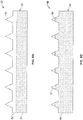
- FIGS. 9A-9B depict schematically in cross-section two exemplary microprojection arrays.
- FIG. 9A is not in accordance with the invention.
- microprojection array 50 comprises a base 58 and a plurality of microprojections, such as representative microprojection 56.
- the microprojection array comprises two layers, a first layer 52 and a second layer 54 (shaded).
- the microprojections, taken in this array to be the portions of the array that extend from the planar surface defined by the proximal skin contacting side of first layer 52, are composed of the material from which first layer 52 is manufactured.
- second layer 54 and first layer 52 collectively define the base of the microprojection array, the base having a planar surface from which the microprojections extend.
- the microprojections extending from layer 52 are comprised of the material from which layer 52 is fabricated. That is, the microprojections are fabricated from a first material and all or a portion of the base is fabricated from the same material. In another array, the microprojections are fabricated from a first material and a portion of the base is fabricated from a different material.
- the microprojection array 60 depicted in Fig. 9B is in accordance with the invention.
- this array there are also a plurality of microprojections, such as microprojection 66 which is representative.
- Each microprojection in the array has an end portion or distal tip 62 that contacts and penetrates (upon application of force) the stratum corneum, and an upper portion proximal the a planar base 64.
- the base member and the upper portion of each microprotrusion is comprised of a first material, indicated by the shading in the drawing.
- the end portion of each microprotrusion is fabricated from a different material.
- the material from which the base and upper portions are fabricated is a water-insoluble polymer, and the end portion of each microprotrusion is fabricated from a second or different material that is a water-soluble or dissolvable material.
- the PTH is incorporated into only the end portion of each microprotrusion (i.e., "drug-in-tip" as described in the examples of the invention) or can be incorporated into the end portion and the upper potion of each microprotrusion.
- PTH can also be incorporated into the base, but is normally not for cost of goods and/or safety reasons.
- the first material forming the base and upper portion of each microprotrusion, and the material forming the end portion of each microprotrusion are the same polymer material, preferably a dissolvable or biodegradable water soluble polymer, and differ only in that the material forming the end portions contains PTH and the material forming the base and upper portions contain no active agent or a different active agent than the end portions.
- the array of the invention at least 80% of the dose of PTH in the microprotrusion array is confined to the end portion (tip) of each microprotrusion, wherein the "tip" intends that portion of a microprotrusion that is intended to penetrate the stratum corneum. In one embodiment, at least about 85% or at least about 90% or 95% or 98% of the dose of PTH in the microprotrusion array is confined to the end portion (tip) of each microprotrusion.
- the solution comprising PTH is cast so that it fills the cavities of a mold. This solution is then dried. A further solution with a lower or zero concentration of active, constituting a second layer, is then cast over the solution or layer comprising the PTH.
- the polymers used in the first layer are preferably not soluble In the solvent used for the second layer.
- the second layer preferably uses a different polymer or polymers from the ones used in the first layer. This procedure may produce an array having two layers, and in which the microprojections are enriched in active. In such an array, the active would not be expected to substantially diffuse into the second layer.
- the second layer may comprise any of a number of polymers such as cellulose acetate butyrate, cellulose acetate, cellulose acetate propionate, ethyl cellulose, nitrocellulose, hydroxypropyl methyl cellulose phthalate, polystyrene, polyacrylates (such as acrylate/octylacrylamide copolymers, Dermacryl® 97), polymethacrylates (such as Eudragit® E, RL, RS, L100, S100, L100-55), or poly(hydroxyl alkanoates).
- the second layer comprises a biocompatible, biodegradable polymer(s) such as PLA, PGA, PLGA, polycaprolactone and copolymers thereof.
- a particularly preferred polymer is the water-insoluble polymer, PLGA.
- the second layer comprising the upper portion of the microprojection, and in certain instances, the base, is cast in an organic solvent.
- Preferred solvents for preparing and casting the second layer include alcohols, for example isopropyl alcohol and ethanol, and esters, for example ethyl acetate, heptane, or propyl acetate, or other solvents such as acetonitrile, dimethylsulfone (DMSO), N-methylpyrrolidone (NMP), or glycofurol.
- the microprojections of the array preferably detach from the array following insertion into the skin.
- only a tip portion of each microprojection detaches from the microarray.
- detachment of all of a microprojection or of only a portion of each microprojection is achieved by degradation or dissolution of the material from which that microprojection or that portion of the microprojection is manufactured. Advantages related to this feature include the elimination of sharp disposal requirements, and elimination of needle stick injury.
- Detachable microprojections may be prepared using a number of approaches.
- a layered approach for example, may be used in which the array is composed of multiple layers, and a layer comprising the attachment areas of the microprojections to the array is more readily degradable or dissolvable than the other layers, such that upon activation, the drug-containing tip of the microprojection is detached from the upper portion of the microprojection or from the base, depending upon the specific configuration.
- the layer comprising the attachment areas may be more rapidly hydrated than the other layers.
- the array may also comprise a polymer or polymer blend having bioadhesive properties which within a certain range of moisture will have higher adhesive strength the greater the moisture.
- the multilayer array is one in which the layer or layers in which the microneedles principally lie possess bioadhesive characteristics.
- Exemplary polymers with bioadhesive characteristics include suitably plasticized polyvinyl alcohol and polyvinylpyrrolidone.
- An extensive discussion of a class of bioadhesive polymer blends is found in U.S. Patent No. 6.576,712 and U.S. Published Patent Applications Nos. 2003/0170308 and 2005/0215727 which teach bioadhesive polymer blends and adhesion testing.
- Preferable bioadhesive polymers are those which possess hydrogen-bonded crosslinks between strands of the primary polymers. These crosslinks may comprise a comparatively small molecule which forms hydrogen bonds to two primary polymer strands. It is believed that certain sugars may act as a small molecule crosslinker in this manner with particular primary polymers such as polyvinyl alcohol, dextran and tetrastarch.
- the microprojection arrays may also include one or more additives or measures to retard or diminish microorganism growth.
- the microprojection arrays may be packaged in a sealed, low oxygen environment to retard aerobic microorganisms and eventually destroy their viability.
- the arrays may also be packaged in a low moisture environment to dehydrate microorganisms.
- a pharmaceutically acceptable antibacterial agent may be included in the formulation or the packaging. Examples of such agents are benzalkonium chloride, benzyl alcohol, chlorbutanol, meta cresol, esters of hydroxyl benzoic acid, phenol, thimerosal, and silver or silver salts.
- a surfactant or detergent can be added to the casting formulations to disrupt the cell membrane of potential microorganisms; alternatively, a desiccant may be added to the packaging.
- Antioxidants may also be added to the formulation, for example, to protect the PTH from oxidation.
- Exemplary antioxidants include methionine, cysteine, D-alpha tocopherol acetate, DL-alpha tocopherol, ascorbyl palmitate, ascorbic acid, butylated hydroxyanisole, butylated hydroxyquinone, butylhydroxyanisole, hydroxycomarin, butylated hydroxytoluene, cephalin, ethyl gallate, propyl gallate, octyl gallate, lauryl gallate, propylhydroxybenzoate, trihydroxybutyrophenone, dimethylphenol, ditertbutylphenol, vitamin E, lecithin, and ethanolamine.
- Chelating agents e.g. ethylenediaminetetraacetic acid (EDTA), may also be added to the formulation to protect PTH from oxidation.
- EDTA ethylenediaminetetraacetic acid
- the drug-containing formulation sometimes referred to herein as the drug-in-tip or DIT formulation, contains an amount of PTH sufficient to provide a therapeutically effective amount in the final microprojection array product.
- the array comprises a dose of hPTH (1-34) and at least 80% of the dose is disposed in the end portions of the microprotrusions.
- the amount of PTH ranges from about 10- 500 ⁇ g per dosage unit, or from about 10- 250 ⁇ g per dosage unit, or from about 10-100 ⁇ g per dosage unit.
- the PTH is contained in a water-soluble polymer matrix.
- the matrix comprises at least one dextran.
- the dextran preferably possesses a molecular weight ranging from about 1 to about 150 kilodaltons, or from about 40 to about 100 kilodaltons.
- Representative dextrans possess each of the following molecular weights: 1 kilodaltons, 10 kilodaltons, 20 kilodaltons, 40 kilodaltons, 70 kilodaltons, and 75 kilodaltons.
- Dextran is present in the final end portion of the microprojections in an amount greater than that of any of the other components.
- the amount of dextran, such as dextran 70, ranges from 35 percent by weight to 70 percent by weight, of the DIT formulation, based upon dry weight (i.e., the layer after solvent removal).
- the amount of PTH contained in the water-soluble polymer matrix is 7.5-12.8% by dry weight, preferably from 7.5 percent by dry weight to 10 percent by dry weight.
- the other major component of the DIT layer is the sugar alcohol, sorbitol. Sorbitol is present in an amount less than dextran. Sorbitol content is from 10 percent by weight to 35 percent by weight, of the formulation.
- the main components forming the water-soluble polymer matrix are PTH, dextran, and sorbitol. Additional lesser components include the buffers histidine and histidine hydrochloride, as well as any PTH counterions, if applicable.
- the casting solutions or precursor solutions to the final DIT layer are prepared to have a total solids content ranging from about 1% solids to about 50% solids, or from 15% solids to about 45% solids, where representative solids contents include 5, 10, 15, 20, 25, 30, 35, 40, 45 and 50% solids.
- the upper portion or layer of the microprojections and base typically comprise at least one water-insoluble polymer and are substantially absent PTH, to provide an array having microprojections that are PTH-enriched in comparison to the upper portion and base portions of the array.
- water-insoluble polymer is PLGA, and in particular, poly(lactic acid-co-glycolic acid), having a lactide to glycolide ratio of 75/25. Materials having other DL-lactide to glycolide ratios may also be used, such as 50:50. 65:35, 85:15, or PLA by itself.
- the PLGA is ester-terminated.
- Such polymers are available from Durect (Cupertino, CA).
- Example 9 Description of an exemplary PTH formulation as described above is provided in Example 9.
- the microprojection array forms part of a final transdermal delivery system or product.
- the product typically comprises the microprotrusion array according to any one or more of the embodiments provided herein, and an array support member (also referred to herein as a microprojection-holding member).
- the array support member (or microprojection-holding member) is typically affixed or affixable to the base of the microprotrusion array at the surface opposite the microprotrusions.
- One such exemplary microprojection-holding member is a plunger as described in Example 10.
- the product may further comprise an applicator assembly that comprises a housing and an energy storage member effective to activate the device. See, e.g., FIGs. 1 and 2 , along with Example 10.
- FIGS. 1 and 2 such an applicator suitable for use is illustrated in FIGS. 1 and 2 , where an applicator 180 is shown fully assembled in FIG. 1 and in exploded view in FIG. 2 .
- An outer housing 182 is dimensioned to contain an energy-storage member 183 and a microprojection-holding member 184 which holds a microprojection array (not shown in the figures).
- microprojection-holding member 184 is held in place by two platforms in housing 182, such as platform 196, against which a projection member, such as members 185, 187 in member 184, engages.
- a user twists member 184 (e.g., with thumb and forefingers gripping projection members 185, 187 ) so that it is no longer over the platforms and restrained by them.
- energy-storage member 183 moves downward pressing the microprojection-holding member in a downward direction to contact the microprojection array against the skin.
- FIGS. 1 and 2 is further provided with an optional set of components for adapting to skin, in this case an adapter 190, a snap ring 186, and an extender 188.
- FIG. 1 shows an optional adhesive 192 and an optional release liner 194.
- An optional safety feature to prevent inadvertent or accidental actuation of the applicator can also be provided.
- a pin 197 is removably inserted through a cavity in microprojection holding member 184 prior to use.
- the applicator may be simplified and adapted to reduce the number of parts.
- a user pulls pin 197 from its retaining position as shown in FIG.1 to permit a user to activate the applicator by the twisting motion described above.
- Various configurations, components, and embodiments of a microprojection array-based transdermal delivery system suitable for administering PTH according to the methods provided herein are described in co-owned U.S. Provisional Patent Application No. 60/331,175, filed on May 4, 2010 , and published as US 9,687,640 B2 . It will be appreciated that the applicator described herein is merely exemplary, and that any applicator that achieves penetration of the microprojections into the skin of a user is contemplated for use in the claimed methods.
- kit components are provided as part of a kit, e.g., for assembly prior to actuation and use.
- an assembled form is described herein. See, e.g., FIG. 1 .
- one such kit may contain a microprojection array along with an array support member, where the array support member is affixable or affixed to the base of the microprotrusion array at the surface opposite the microprotrusions.
- the kit may optionally further comprise an applicator assembly comprising a housing in which the array support member and microprotrusion array can be disposed, combined with an energy storage member that is movable between first and second configurations (e.g., a resting position and a position in which the microprojection-holding member is extended in a downward direction to contact the microprojection array against the skin as described above).
- the energy storage member is a spring.
- the applicator assembly comprises fasteners to temporarily hold together the housing and the energy storage member.
- the kit may also comprise various components of the final product as described above to be assembled prior to use, where any of the individual or combinations of components may be provided in primary packaging, and optionally further contained in secondary packaging.
- microprojection array for use according to the invention was used to administer transdermally hPTH(1-34) to healthy human subjects.
- hPTH(1-34) was also administered subcutaneously to a healthy group of human subjects. Details of this study are provided in Example 11, and the resulting data are presented in FIGS. 3-8 and in Table 1, now to be described.
- a microprojection array was prepared as detailed in Example 9 and inserted into an applicator-array assembly to form a transdermal delivery system, as described in Example 10.
- the system described in Examples 9 and 10 is referred to herein, and in the drawings, as “MicroCor® hPTH(1-34)" or more simply, “MicroCor®”.
- the delivery system was designed to deliver a systemic dose of hPTH (1-34) across the stratum corneum barrier layer of the skin upon activation of the applicator to deploy an array of microstructures causing the array of microstructures to penetrate the stratum corneum.
- FIG. 3 is a plot of average hPTH(1-34) plasma concentration (pg/mL) versus time, in hours, for subjects treated hPTH administered via the transdermal microneedle delivery system (under the tradename MicroCor®) at a dose of 32 ⁇ g (open squares) and 64 ⁇ g (open diamonds) or via subcutaneous injection (Forteo®) at a dose of 20 ⁇ g (open triangles).
- FIGS. 3 is a plot of average hPTH(1-34) plasma concentration (pg/mL) versus time, in hours, for subjects treated hPTH administered via the transdermal microneedle delivery system (under the tradename MicroCor®) at a dose of 32 ⁇ g (open squares) and 64 ⁇ g (
- the microprotrusion array for use in therapy comprises contacting the skin of a subject with the microprotrusion array containing a dose of PTH and causing all or a portion, preferably a majority, of the microprotrusions to penetrate the stratum corneum. Entry of the microprotrusions into the skin achieves delivery of the PTH to the subject, wherein the time to maximum plasma concentration (Tmax) is less than 10 minutes, preferably less than 9 minutes.
- Tmax time to maximum plasma concentration
- T 1/2 The elimination half life (T 1/2 ), calculated in accord with standard equations and methods in the art and generally reflective of the time for the plasma concentration to fall to half of its original value, was 37 minutes for the 32 ⁇ g dose of hPTH administered via the transdermal microneedle delivery system. The elimination half life was 52 minutes for the 20 ⁇ g dose of hPTH administered via subcutaneous injection.
- the microprotrusion array in use in therapy comprises contacting the skin of a subject with the microprotrusion array containing a dose of PTH and causing all or a portion, preferably a majority, of the microprotrusions to penetrate the stratum corneum. Entry of the microprotrusions into the skin achieves delivery of the PTH to the subject, wherein the elimination half life of PTH is less than about 45 minutes, and more preferably is 40 minutes or less.
- the PTH when administered via the microneedle delivery system of the invention wherein PTH is contained in a water-soluble polymer matrix in at least the tip portions of each microprojection in an array, provides a time to maximum plasma concentration (Tmax) of less than 10 minutes or 9 minutes or less, and an elimination half life of less than about 45 minutes, and more preferably 44, 43, 42, 41 or 40 minutes or less.
- Tmax time to maximum plasma concentration
- PTH administered in accord with the microprotrusion array of the invention provides a maximum plasma concentration of greater than about 100 pg/mL, more preferably of 125, 130, 135, 140, 145, 150, 155, 160, 165, 170, or 175 pg/mL, for a dose of 32 ⁇ g PTH, in less than 10 minutes or 9 minutes, and an elimination half life of less than about 45 minutes, and more preferably 44, 43, 42, 41 or 40 minutes or less.
- the microprotrusion array for use in therapy comprises contacting the skin of a subject with the microprotrusion array containing a dose of PTH and causing all or a portion, preferably a majority, of the microprotrusions to penetrate the stratum corneum. Entry of the microprotrusions into the skin achieves delivery of the PTH to the subject, wherein the time to maximum plasma concentration (Tmax) is 50% lower (shorter), more preferably 55%, 60%, 65% or 70% less than the time to maximum plasma concentration achieved with the same, or lower dose, of PTH delivered via subcutaneous injection.
- Tmax time to maximum plasma concentration
- the PTH administration via a transdermal microneedle array for use in accord with that of the invention provides delivery of PTH to the subject such that the elimination half life is at least about 15%, 20%, 22% or 25% faster than the elimination half life achieved with the same, or lower dose, of PTH delivered via subcutaneous injection.
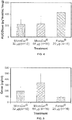
- Dose-normalized area under the curve values in pg*min/mL* ⁇ g were calculated from the plasma concentration data, and are presented in FIG. 4 .
- the AUC values for the exemplary microprotrusion array-based hPTH transdermal delivery system was approximately 48% lower than the AUC value for hPTH administered subcutaneously via injection.
- the lower AUC of the drug when administered via microneedles transdermally is indicative of the fast elimination half life, and supportive of this use being able to achieve the desirable pulastile delivery profile, wherein a pulse of drug is provided to the system with a rapid onset to maximum blood concentration and a fast elimination half-life of drug.
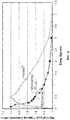
- FIG. 8 presents the pharmacokinetic data from the study of Example 11 in a different way, to illustrate the pulsatile delivery profile achieved with the microneedle array delivery system of the invention.
- the plasma concentration value at each time point was normalized by the maximum concentration value achieved by each of the three treatment regimens: 32 microgram and 64 microgram doses of PTH delivered by the microprotrusion array and the 20 microgram dose delivered via subcutaneous injection.
- the Cmax normalized plasma concentration data is plotted against time, in hours. The time to achieve Cmax of well under 30 minutes when PTH is delivered transdermally from the microneedle array compared to the time to reach Cmax of greater than 30 minutes when administered subcutaneously is evident.
- the exemplary microprojection array-based PTH products of the invention exhibit rapid pharmacokinetic properties.
- Such properties include a shorter Tmax, a higher Cmax, and a shorter elimination half life, T 1/2 .
- administration using a microprojection array-based PTH product is effective to achieve a Tmax value that is at least about 2 times less, or at least about 3 times less, or at least about 4, or 5, or 6, or 7 times or more less than that achieved by SC administration of the same PTH moiety, preferably based upon normalized Cmax values.
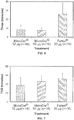
- hPTH Absorption of hPTH (1-34) occurs more rapidly when delivered with the microprojection array-based delivery system when compared to delivery via subcutaneous injection (i.e., hPTH product Forteo®), as illustrated by the higher dose-normalized C max values and the faster T max values for both the high and low dose microprojection array-based treatments.
- the elimination half-life based upon microprojection array-based PTH treatment was also less than with subcutaneously administered PTH (Forteo®).
- microprojection array-based treatment is more effective in achieving the desired pulsatile delivery profile of PTH (i.e., rapid on set and rapid offset after reaching Cmax), as can be seen in Figs. 3 and 8 .
- the transdermal microprojection array delivery systems were analyzed after use, to assess residual PTH content in the microprojection array.
- Analysis for residual PTH in the arrays following application to a subject for delivery of the drug revealed that, on average, about 85% of drug was delivered from the microprojection array device (i.e., 85% drug delivery efficiency, data not shown).
- the use includes providing for use in therapy a microprojection array capable of delivery at least about 55%, or at least about 60%, or at least about 65%, or at least about 70%, or at least about 75%, or at least about 80%, or at least about 85% of the total PTH dose in the array when applied to the skin of the patient for the desired amount of time.
- the microprojection array-delivery system can be applied to a skin site for times other than the 5 minutes utilized in the present study.
- the system is maintained on the skin for no more than 15 minutes, or for no more than 10 minutes, or even for no more than 5 minutes. That is to say, the microprojection array is maintained on the skin for no more than about 15 minutes, or 14 minutes, or 13 minutes, or 12 minutes, or 11 minutes, or 10 minutes, or 9 minutes, or 8 minutes, or 7 minutes, or 6 minutes or even 5 minutes.
- any of a number of skin sites may be used for application of PTH such as the thigh, arm, etc., one preferred skin site is the abdomen.
- the use comprises contacting the skin of the subject with a microprotrusion array containing a dose of PTH and causing all or a portion, preferably a majority, of the microprotrusions to penetrate the stratum corneum.
- the microprotrusions in the array are left in contact with the skin for a period of time.
- Application of the device to the skin in accord with the use delivers at least about 40%, 45%, 50%, 55% or 60% of the total PTH dose in the microprotrusion array into systemic circulation of the subject.
- the delivery efficiency of the microprojection array is determined based on comparing the pharmacokinetic parameters, and in particular AUC, to pharmacokinetic parameters achieved from a subcutaneously injected dose of PTH.
- kits, microprojection arrays for use in therapy and related devices described herein may be used for treating any condition receptive to treatment with PTH.
- the PTH-containing microprojection arrays may be used to deliver PTH for treatment of osteoporosis, osteopenia, periodontal disease, and in particular, periodontal disease associated with alveolar bone loss.
- the PTH-containing microprojection arrays are also contemplated for use in healing bone fractures, improving bone fracture healing rates and for reducing risk of fracture in at risk persons.
- kits, microprojection arrays for use in therapy and related devices described herein may be used for (i) treating postmenopausal women with osteoporosis at high risk for fracture, (ii) increasing bone mass in men with primary or hypogonadal osteoporosis at high risk for fracture, (iii) treatment of osteoporosis in men and women with osteoporosis associated with sustained glucocorticoid therapy at high risk for fracture, and (iv) treatment of osteoporotic patients who have failed or are intolerant of other available osteoporosis therapies.
- a clean mold is placed in a mold folder.
- the mold is then placed in a Petri dish and a small amount of formulation, for example, 200 ⁇ L, is placed on the mold.
- An illustrative formulation such as those described herein is applied.
- the formulation is spread manually over the mold using a transfer pipette with a trimmed tip.
- the formulation is then vortexed, for example, for five seconds, using a commercial vibrating instrument.
- the mold containing formulation is placed in a pressure vessel under 1 atm for about 1 minute. Pressure is released, and the mold placed in an incubator at 32°C, for about 1 hr.
- the array is then demolded, for example, using double-sided adhesive tape, and optionally attached to a backing.
- an additional layer is cast on the mold using similar procedures.
- An exemplary composition e.g., containing 75 ⁇ L of 20 wt% Eudragit® EPO in a 3:1 mixture of ethanol and isopropyl alcohol is cast onto the mold.
- the additional layer may be spread out, for example, using a glass slide.
- the mold containing the additional layer is placed in a pressure vessel and pressurized at 1 atm for 2 minutes. The pressure is released and the mold is allowed to dry in the pressure vessel for an additional five minutes, without disturbing. The mold is again dried in the incubator for 1 hr at 32°C, and then demolded.
- a microprojection array with two layers is typically prepared by the following steps.
- STEP 1 Casting a solution comprising an active agent, polymer, and possibly other components in a mold .
- the clean mold is placed in a mold holder.
- a small amount of formulation, for example, 75 ⁇ L, as a droplet on the mold, is dispensed by placing a cover slip on top of the droplet to help spread the liquid onto the entire surface of the mold.
- An exemplary wet formulation contains, for example, 15% human parathyroid hormone 1-34 fragment (hPTH1-34), 65% dextran 70 and 20% sorbitol, in a histidine buffer solvent with a total solids content of 30% as applied to the mold.
- the loaded mold i.e., containing drug formulation
- the excess formulation is wiped with a silicone or metal wiper with the interference between wiper edge and surface of mold about 1-10 mils.
- the mold is placed in an incubator at a temperature of 32°C, for about half an hour. After incubating, the dry formulation contains 5% human parathyroid hormone 1-34 fragment (hPTH1-34), 21% dextran 70 and 7% sorbitol, with histidine and histidine hydrochloride also present.
- STEP 2 Casting an additional layer on top of the first layer in the mold .
- the mold with drug-containing layer cast is removed from the drying oven, and any residue of dry formulation left on the base of the mold is removed by tape strip using a 3M 1516 single-sided adhesive.
- a thin film is cast using a wiper with the clearance between edge of the wipe and the surface of the mold about 10-20 mil.
- the mold is then placed into a pressure vessel under 10-30 psi with controlled venting for about 5 min.
- the mold is further dried at room temperature for about 30 min.
- the array may then be demolded, for example using double-sided adhesive tape, and optionally attached to a polyethylene terephthalate film as backing.
- Microprojection arrays were prepared according to the general procedures described above. The following table provides the relative amounts of water-soluble matrix components and active agent, along with the percent solids content of the resulting exemplary casting solutions.
- Table 4-1 Ex. # Polymer Sugar hPTH (1-34) Solids in casting solution Type Wt% Type Wt% Wt% Wt% B1 PVA 52.6 Sucrose 26.3 21.1 22.8 B2 PVA 46.2 Sucrose 23.1 30.7 26 B3 Dextran 70 67.5 Sorbitol 14 18.5 33 B4 Dextran 70 64.9 Sorbitol 19.5 15.6 30.8 B5 Dextran 40 67.5 Sorbitol 14 18.5 33 B6 Dextran 40 64.9 Sorbitol 19.5 15.6 30.8 B7 Tetrastarch 67.5 Sorbitol 14 18.5 33 B8 Tetrastarch 64.9 Sorbitol 19.5 15.6 30.8 B9* Dextran 70 64.8 Sorbitol 19.3 15.5 31.2 *ca. 0.4 wt% of methi
- the backing layer (which in this example comprises the upper portion of the microprotrusion proximal to the base and the base itself) comprises one or more water-insoluble polymers.
- the polymer solutions were typically prepared by dissolving the polymers in a solvent or solvent mixture at room temperature with a polymer concentration ranging from about 15-30% by weight.
- PVP Polyvinylpyrrolidone
- PLA poly(lactic acid-co-glycolic acid)
- IPA isopropyl alcohol
- a microneedle array with three layers is prepared as follows.
- a microneedle array for sustained release of drug substance from the array is prepared in the following steps. 1) Casting a drug-containing layer for sustained release of drug substance . A clean mold is placed in a mold holder. A small amount (e.g., 75 ⁇ L) of aqueous solution containing, e.g., hPTH(1-34), components for a polymeric matrix such as polyethylene glycol-co-poly(lactic acid-co-glycolic acid) (PEG-PLGA) copolymer, and excipients such as sucrose or sorbitol, is dispensed into the mold.
- the polymeric matrix is generally amphiphilic in nature, where the hydrophobic segment(s) of the polymer are effective to control the release of drug substance.
- Exemplary formulations of this type are described in the table below.
- the liquid formulation is spread manually on the surface of the mold with a glass cover slip.
- the formulation-loaded mold is placed in a pressure vessel under ca. 50 psi for about 30 seconds. Pressure is then released. Excess formulation is wiped with a silicone or metal wiper with the interference between wiper edge and surface of the mold about 1-10 mils.
- the mold is placed in an incubator at room temperature for about half an hour.
- Table 7-1 Ex.
- step 2) Casting a dissolvable laver on top of the drug-containing layer in the mold .
- a small amount of formulation for example, 25 ⁇ L
- a cover slip is placed on top of the droplet to spread the liquid onto the entire surface of the mold.
- an illustrative wet formulation contains 70% Dextran 70, and 30% sorbitol, in histidine buffer solvent, such that the formulation contains, for example, 30% solids content as applied.
- the drug-polymer matrix loaded mold is placed in a pressure vessel under ca. 50 psi for about 30 seconds, Pressure is then released.
- Excess formulation is wiped with a silicone or metal wiper with the interference between wiper edge and the surface of the mold about 1-8 mils.
- the mold is placed in an incubator at a temperature of 32°C, for about half an hour.
- 3) Casting a backing layer on top of the dissolvable layer in the mold .
- approximately 150 ⁇ L of backing solution (upper portion layer) containing poly(lactic acid-co-glycolic acid) (PLGA) with a L/G ratio of 75/25 in acetonitrile is placed on the mold (on top of the dissolvable layer) and a thin film is cast using a wiper with the clearance between edge of the wipe and surface of mold about 10-20 mil.
- the mold is then placed into a pressure vessel under 10-30 psi with controlled venting for about 5 min.
- the mold is further dried at room temperature for about 30 min.
- the array is demolded, for example using double-sided adhesive tape, and optionally attached to a polyethylene terephthalate film as backing.
- Dry films of microneedle casting formulations were prepared using process conditions similar to those for casting microneedle arrays to evaluate the stability of hPTH (1-34 fragment) in the dried form.
- About 200 ⁇ L of liquid formulation was placed in an Eppendorf tube.
- the formulation was spread into a thin film in the inside wall of the tube, then dried at 32°C for 30 min, and then further dried under vacuum at room temperature overnight.
- the dry films inside the Eppendorf tube were packaged in a polyfoil bag and stored at different temperatures for different durations.
- the purity of the hPTH(1-34) was analyzed by both reverse phase HPLC (rp-HPLC) and size exclusion HPLC (sec-HPLC). The details of the formulations are indicated in Table 8-1 below.
- Table 8-1 Ex. # Polymer Sugar hPTH (1-34) Solids in casting solution Type Wt% Type Wt% Wt% Wt% F1 PVA 52.6 Sucrose 26.3 21.1 22.8 F2 Dextran 70 64.9 Sorbitol 19.5 15.6 30.8 F3 Tetrastarch 64.9 Sorbitol 19.5 15.6 30.8 F4* Dextran 70 64.1 Sorbitol 19.4 15.4 31.2 *ca. 0.4 wt% of methionine was added to the formulation as an antioxidant agent.
- Table 8-2 illustrates the chemical purity as determined by rp-HPLC of the hPTH(1-34) in different formulations as a function of storage time at three different temperatures.
- Table 8-3 illustrates the monomer content as determined by sec-HPLC of the hPTH(1-34) in different formulations as a function of storage time at three different temperatures. It appears that hPTH(1-34) is stable during storage for up to one month at even elevated temperature in all the formulations examined.
- a microprojection array containing a therapeutically effective amount of hPTH(1-34) (32 ⁇ g) was prepared for use in a Phase I clinical study as follows.
- the microprotrusions of the array can be characterized generally as comprising a DIT (drug-in-tip) layer and a "backing" layer.
- the DIT layer includes hPTH(1-34) in a water-soluble matrix.
- hPTH(1-34) H-Ser-Val-Ser-Glu-Ile-Gln-Leu-Met-His-Asn-Leu-Gly-Lys-His-Leu-Asn-Ser-Met-Glu-Arg-Val-Glu-Trp-Leu-Arg-Lys-Lys-Leu-Gln-Asp-Val-His-Asn-Phe-OH ( SEQ ID NO:1 )
- the tip of the microprojections is also referred to herein as the layer at the bottom-most portion of the tips or microprotrusions (i.e., proximal to the skin when placed upon the skin), also referred to herein as the "end portion” that is distal to the base of the array).
- the "backing" layer as referred to in certain of these examples, encompasses both the upper portion of the microprotrusions proximal to the base of the array as well as the base itself, where the base is the portion of the array that supports the tips.
- the backing layer comprises a biocompatible, non-water soluble matrix.
- the material in the upper portion of the microprotrusions is the same as the base material itself, so that the non-water soluble matrix formulation is applied as a single layer to fill the mold atop the DIT layer.
- the DIT layer of the microstructure array dissolves into the skin and contains the components provided in Table 9-1. Acetate was the counter-ion in the hPTH(1-34) drug substance.
- Table 9-1 Composition of Drug-in-Tip Layer of hPTH(1-34) TDS Trade Name Chemical Name of Ingredient Quantity ( ⁇ g/unit) Range ( ⁇ g/unit) % w/w (of the microstructure array) hPTH (1-34) human Parathyroid hormone (1-34) 32.0 25.6 - 38.4 12.8 Dextran 70 Dextran, 70,000 Dalton molecular weight 160.0 128.0 - 192.0 58.6 Sorbitol, N.F.
- the backing portion or layer of the array was composed of poly(DL-lactide-co-glycolide), 75:25, ester terminated (Tradename: LACTEL®).
- the ingredients forming the tip portion of the formulation i.e., the DIT formulation
- the solvent was removed from the backing (upper portion proximal to the base, and base) during processing and was limited to a level below the amounts recommended in ICH residual solvent guidelines.
- a delivery system also referred to as an applicator-array assembly, comprising a microprojection array prepared in accord with Example 9 and an applicator as described with reference to Figs. 1-2 , was assembled as follows.
- a microprojection holding member with a microprojection array (Example 9) was prepared and packaged, and separately an applicator assembly (i.e., an applicator as in Figs. 1-2 absent the microprojection-holding member) was packaged.
- the two separate packages were provided in a single boxed unit to each clinical site, for assembly of the applicator-array assembly prior to use on a patient (see Example 11 below for clinical data).
- the microprojection array contained was 11 millimeters in diameter with approximately 2700 microprojections arranged in a hexagonal pattern.
- the microprojection array was mounted on the microprojection-holding member (element 184 of Fig. 2 ) using an adhesive laminate.
- the microprojection-holding member/microprojection array was packaged inside a protective container and pouched in a dry nitrogen environment.
- the applicator assembly comprised of an outer housing (element 182 of Fig. 2 ) with a skin contact adhesive and a release liner (elements 192, 194, respectively, of Fig. 2 ), an energy storage member (in this case, a metal wave spring), and elements to hold these items together.
- This applicatory assembly was packaged inside a protective container and pouched.
- the microprojection-holding member/microprojection array Prior to use of the system, the microprojection-holding member/microprojection array was inserted into the applicator assembly, and the system was activated by compressing the spring and then twisting the microprojection-holding member to lock and hold the compressed spring in place in the applicator.
- the user twists the microprojection-holding member to unlock or unseat it from the outer cover, thus causing the spring to release its stored energy causing accelerated movement of the microprojection-holding member and attached microprojection array into contact with the skin.
- the microstructures Upon contact with the skin, the microstructures penetrate past the stratum corneum, and the hPTH dissolves into the skin rapidly. Following actuation of the spring and delivery of hPTH, the system is removed and discarded,
- the plasma sampling schedule was as follows: pre-treatment, 5, 10, 15, 20. 25. 30. 40, 50, 60, 75, 90, 120, 180, 240, 300, 360 minutes, and 24 hours post-treatment.
- Vital signs were monitored pre-treatment, and at 15 and 30 minutes, and 1, 2, 3, 4, 5. 6, 8, 10, 12, and 24 hours post-treatment.
- hPTH transdermally via the microarray demonstrated good skin tolerability. Skin effects were transient and well-tolerated, with mild to moderate erythema observed. In terms of general safety, all treatment regimes were well-tolerated. No significant adverse events nor unexpected adverse events occurred. In fact, there was no difference in the overall treatment-related adverse events between the MicroCor® and the Forteo®-based treatments. No significant changes were observed in serum calcium, and no anti-PTH antibodies were detected, again further demonstrating the overall safety of MicroCor®-based treatment in human subjects. Data is presented in Figs. 3-8 and Table 1, above.
Landscapes
- Health & Medical Sciences (AREA)
- Life Sciences & Earth Sciences (AREA)
- Chemical & Material Sciences (AREA)
- Public Health (AREA)
- Animal Behavior & Ethology (AREA)
- General Health & Medical Sciences (AREA)
- Veterinary Medicine (AREA)
- Pharmacology & Pharmacy (AREA)
- Medicinal Chemistry (AREA)
- Epidemiology (AREA)
- Engineering & Computer Science (AREA)
- Dermatology (AREA)
- General Chemical & Material Sciences (AREA)
- Chemical Kinetics & Catalysis (AREA)
- Endocrinology (AREA)
- Oil, Petroleum & Natural Gas (AREA)
- Proteomics, Peptides & Aminoacids (AREA)
- Inorganic Chemistry (AREA)
- Bioinformatics & Cheminformatics (AREA)
- Physical Education & Sports Medicine (AREA)
- Anesthesiology (AREA)
- Medical Informatics (AREA)
- Biomedical Technology (AREA)
- Heart & Thoracic Surgery (AREA)
- Hematology (AREA)
- Biochemistry (AREA)
- Immunology (AREA)
- Zoology (AREA)
- Molecular Biology (AREA)
- Gastroenterology & Hepatology (AREA)
- Orthopedic Medicine & Surgery (AREA)
- Rheumatology (AREA)
- Nuclear Medicine, Radiotherapy & Molecular Imaging (AREA)
- Organic Chemistry (AREA)
- Medicinal Preparation (AREA)
- Medicines That Contain Protein Lipid Enzymes And Other Medicines (AREA)
- Media Introduction/Drainage Providing Device (AREA)
Applications Claiming Priority (2)
| Application Number | Priority Date | Filing Date | Title |
|---|---|---|---|
| US33122610P | 2010-05-04 | 2010-05-04 | |
| PCT/US2011/035261 WO2011140274A2 (en) | 2010-05-04 | 2011-05-04 | Method and device for transdermal delivery of parathyroid hormone using a microprojection array |
Publications (3)
| Publication Number | Publication Date |
|---|---|
| EP2566501A2 EP2566501A2 (en) | 2013-03-13 |
| EP2566501A4 EP2566501A4 (en) | 2014-04-16 |
| EP2566501B1 true EP2566501B1 (en) | 2019-03-13 |
Family
ID=44902423
Family Applications (1)
| Application Number | Title | Priority Date | Filing Date |
|---|---|---|---|
| EP11778302.7A Active EP2566501B1 (en) | 2010-05-04 | 2011-05-04 | Method and device for transdermal delivery of parathyroid hormone using a microprojection array |
Country Status (7)
| Country | Link |
|---|---|
| US (4) | US9687641B2 (enExample) |
| EP (1) | EP2566501B1 (enExample) |
| JP (2) | JP6327852B2 (enExample) |
| AU (1) | AU2011248108B2 (enExample) |
| CA (1) | CA2798145C (enExample) |
| ES (1) | ES2719595T3 (enExample) |
| WO (1) | WO2011140274A2 (enExample) |
Families Citing this family (46)
| Publication number | Priority date | Publication date | Assignee | Title |
|---|---|---|---|---|
| WO2008130587A2 (en) | 2007-04-16 | 2008-10-30 | Corium International, Inc. | Solvent-cast microneedle arrays containing active |
| US8911749B2 (en) | 2007-04-16 | 2014-12-16 | Corium International, Inc. | Vaccine delivery via microneedle arrays |
| JP6327852B2 (ja) * | 2010-05-04 | 2018-05-23 | コリウム インターナショナル, インコーポレイテッド | 微小突起アレイを使用した副甲状腺ホルモンの経皮送達のための方法及びデバイス |
| PL2568806T3 (pl) | 2010-05-12 | 2017-03-31 | Radius Health, Inc. | Schematy lecznicze |
| AU2011312490B2 (en) | 2010-09-28 | 2015-06-25 | Radius Pharmaceuticals, Inc. | Selective androgen receptor modulators |
| JP6265740B2 (ja) | 2011-10-06 | 2018-01-24 | 久光製薬株式会社 | アプリケータ |
| AU2012345777B2 (en) | 2011-11-30 | 2016-05-12 | Kindeva Drug Delivery L.P. | Microneedle device including a peptide therapeutic agent and an amino acid and methods of making and using the same |
| EP2865409B1 (en) * | 2012-06-22 | 2020-06-24 | Toppan Printing Co., Ltd. | Needle-shaped body and manufacturing method for needle-shaped body |
| RU2698095C2 (ru) | 2012-12-21 | 2019-08-22 | Кориум Интернэшнл, Инк. | Микроматрица для доставки терапевтического средства и способы использования |
| RU2622605C2 (ru) | 2013-02-28 | 2017-06-16 | Кимберли-Кларк Ворлдвайд, Инк. | Устройство трансдермальной доставки лекарств |
| WO2014142135A1 (ja) * | 2013-03-12 | 2014-09-18 | 武田薬品工業株式会社 | マイクロニードルパッチ |
| BR122020006959B1 (pt) | 2013-03-12 | 2022-04-26 | Corium, Inc | Aplicador de microprojeções |
| ES2921174T3 (es) | 2013-03-15 | 2022-08-19 | Corium Inc | Conjunto de microestructuras para el suministro de agentes activos, método de fabricación del conjunto de microestructuras y formulación líquida del mismo |
| WO2014150285A2 (en) | 2013-03-15 | 2014-09-25 | Corium International, Inc. | Multiple impact microprojection applicators and methods of use |
| US10384045B2 (en) | 2013-03-15 | 2019-08-20 | Corium, Inc. | Microarray with polymer-free microstructures, methods of making, and methods of use |
| AU2014233695A1 (en) * | 2013-03-15 | 2015-10-01 | Corium International, Inc. | Microarray for delivery of therapeutic agent and methods of use |
| WO2014144973A1 (en) * | 2013-03-15 | 2014-09-18 | Corium International, Inc. | Microarray for delivery of therapeutic agent, methods of use, and methods of making |
| WO2015012112A1 (ja) | 2013-07-22 | 2015-01-29 | 凸版印刷株式会社 | マイクロニードル、および、マイクロニードルの製造方法 |
| WO2015129545A1 (ja) * | 2014-02-27 | 2015-09-03 | 久光製薬株式会社 | マイクロニードル・シート |
| ES2939940T3 (es) | 2014-03-28 | 2023-04-28 | Univ Duke | Tratamiento del cáncer de mama utilizando moduladores selectivos de los receptores de estrógenos |
| EP4218724A3 (en) | 2014-08-29 | 2023-08-16 | Corium Pharma Solutions, Inc. | Microstructure array for delivery of active agents |
| EP3188714A1 (en) | 2014-09-04 | 2017-07-12 | Corium International, Inc. | Microstructure array, methods of making, and methods of use |
| MA41818A (fr) * | 2015-03-27 | 2018-01-30 | Leo Pharma As | Timbre à micro-aiguilles pour administration d'un principe actif à la peau |
| MX384605B (es) | 2015-04-29 | 2025-03-14 | Radius Pharmaceuticals Inc | Combinación de palbociclib y rad1901 para usarse en el tratamiento de cáncer de mama en un sujeto con cáncer positivo a receptor de estrógeno. |
| WO2017004067A1 (en) | 2015-06-29 | 2017-01-05 | Corium International, Inc. | Microarray for delivery of therapeutic agent, methods of use, and methods of making |
| WO2017018086A1 (ja) * | 2015-07-29 | 2017-02-02 | 日本写真印刷株式会社 | マイクロニードルシート |
| US10987502B2 (en) | 2015-12-15 | 2021-04-27 | Hisamitsu Pharmaceutical Co., Inc. | Microneedle sheet |
| US20170348218A1 (en) * | 2016-06-03 | 2017-12-07 | Sanova Bioscience Inc | Microneedle patch containing hyaluronic acid for cosmetic use |
| WO2017223115A1 (en) | 2016-06-22 | 2017-12-28 | Radius Health, Inc. | Ar+ breast cancer treatment methods |
| KR102590629B1 (ko) | 2016-12-16 | 2023-10-19 | 소렌토 쎄라퓨틱스, 인코포레이티드 | 유체 전달 장치용 어플리케이션 디바이스 및 그 이용 방법 |
| CN113730789A (zh) | 2016-12-16 | 2021-12-03 | 索伦托治疗有限公司 | 具有抽气机构的流体递送装置及其使用方法 |
| EP3554619B1 (en) * | 2016-12-16 | 2021-10-20 | Sorrento Therapeutics, Inc. | Fluid delivery apparatus and method of assembly |
| CA3047258A1 (en) | 2016-12-16 | 2018-06-21 | Sorrento Therapeutics, Inc. | A fluid delivery apparatus having a controller assembly and method of use |
| WO2018111620A2 (en) | 2016-12-16 | 2018-06-21 | Kimberly-Clark Worldwide, Inc. | Method for administering a medicament suitable for treating a migraine or cluster headache |
| ES2912537T3 (es) | 2016-12-16 | 2022-05-26 | Sorrento Therapeutics Inc | Banda de sujeción para un aparato de administración de fluidos y método de utilización |
| EP3565542B1 (en) | 2017-01-05 | 2024-04-10 | Radius Pharmaceuticals, Inc. | Polymorphic forms of rad1901-2hcl |
| KR101776659B1 (ko) * | 2017-02-27 | 2017-09-11 | 주식회사 쿼드메디슨 | 마이크로 니들 및 이의 제조방법 |
| WO2020005973A1 (en) | 2018-06-25 | 2020-01-02 | Corium, Inc. | Hybrid method of forming microstructure array molds, methods of making microstructure arrays, and methods of use |
| SG11202013177WA (en) | 2018-07-04 | 2021-01-28 | Radius Pharmaceuticals Inc | Polymorphic forms of rad 1901-2hcl |
| US12441745B2 (en) | 2019-02-12 | 2025-10-14 | Radius Pharmaceuticals, Inc. | Processes and compounds |
| WO2020231939A1 (en) * | 2019-05-10 | 2020-11-19 | Cornell University | Nanoprojection devices as well as methods of making and using such devices |
| US20230073125A1 (en) * | 2019-10-29 | 2023-03-09 | The Regents Of The University Of California | Periodontal micropatch and uses thereof |
| WO2021221973A1 (en) | 2020-04-28 | 2021-11-04 | Ticona Llc | Microneedle assembly |
| EP4389189A4 (en) * | 2021-08-20 | 2025-08-27 | Cosmed Pharmaceutical Co Ltd | HIGH-PERFORMANCE MICRONEEDLE ARRAY |
| CN116510014A (zh) * | 2022-01-28 | 2023-08-01 | 苏州悦肤达医疗科技有限公司 | 药物组合物、微针制剂、微针给药系统、制备方法和应用 |
| US20260007869A1 (en) | 2023-06-23 | 2026-01-08 | Vaxess Technologies, Inc. | Microneedle array patches (maps), systems, and methods for manufacturing and using same |
Family Cites Families (464)
| Publication number | Priority date | Publication date | Assignee | Title |
|---|---|---|---|---|
| US1554510A (en) | 1924-04-23 | 1925-09-22 | Elsie W Kirby | Massaging device |
| US1770632A (en) | 1928-07-02 | 1930-07-15 | Arthur E Smith | Ampul syringe |
| US2046240A (en) | 1932-07-01 | 1936-06-30 | Thomas W Bayley | Abrasive article |
| US2434407A (en) | 1946-01-05 | 1948-01-13 | Hofe George Douglas | Depilatory device |
| NL200971A (enExample) | 1954-10-04 | |||
| JPS4637758Y1 (enExample) | 1967-12-13 | 1971-12-27 | ||
| US3675766A (en) | 1970-02-04 | 1972-07-11 | Sol Roy Rosenthal | Multiple puncture injector device |
| US3704194A (en) | 1970-07-02 | 1972-11-28 | Gen Electric | Perforated reinforced plastic member and method for making |
| US3917785A (en) | 1971-01-27 | 1975-11-04 | Johnson & Johnson | Method for producing nonwoven fabric |
| US3964482A (en) | 1971-05-17 | 1976-06-22 | Alza Corporation | Drug delivery device |
| BE795384A (fr) | 1972-02-14 | 1973-08-13 | Ici Ltd | Pansements |
| DE2319591C2 (de) | 1973-04-18 | 1982-02-25 | Kirchner & Wilhelm, 7000 Stuttgart | Medizinischer Apparat |
| FR2232331B1 (enExample) | 1973-06-06 | 1978-03-24 | Guerin A Ets | |
| AT347283B (de) | 1975-03-07 | 1978-12-27 | Collo Gmbh | Schaumstoffkoerper fuer reinigungs-, scheuer- und/oder polierzwecke u. dgl. |
| US4151240A (en) | 1976-10-19 | 1979-04-24 | The Procter & Gamble Company | Method for debossing and perforating a running ribbon of thermoplastic film |
| US4180232A (en) | 1977-01-13 | 1979-12-25 | Hardigg James S | Truss panel mold |
| US4117841A (en) | 1977-02-07 | 1978-10-03 | Anthony Perrotta | Medicated bandage pocket |
| JPS5428369A (en) | 1977-08-03 | 1979-03-02 | Yamakawa Tsuneko | Method of forming needleelike projection of thermoplastic resin on sheet |
| US4342314A (en) | 1979-03-05 | 1982-08-03 | The Procter & Gamble Company | Resilient plastic web exhibiting fiber-like properties |
| US4402696A (en) | 1979-10-15 | 1983-09-06 | Gulko Bruce N | Folded applicator |
| US4381963A (en) | 1980-07-30 | 1983-05-03 | The University Of Rochester | Micro fabrication molding process |
| US4509908A (en) | 1981-02-02 | 1985-04-09 | The Procter & Gamble Company | Apparatus for uniformly debossing and aperturing a resilient plastic web |
| US4395215A (en) | 1981-02-02 | 1983-07-26 | The Procter & Gamble Company | Film forming structure for uniformly debossing and selectively aperturing a resilient plastic web and method for its construction |
| US4463045A (en) | 1981-03-02 | 1984-07-31 | The Procter & Gamble Company | Macroscopically expanded three-dimensional plastic web exhibiting non-glossy visible surface and cloth-like tactile impression |
| US4460370A (en) | 1981-10-29 | 1984-07-17 | Almedco, Inc. | Trans-dermal medication application cell |
| US4460368A (en) | 1981-10-29 | 1984-07-17 | Almedco, Inc. | Trans-dermal medication system |
| US4966159A (en) | 1981-12-14 | 1990-10-30 | Maganias Nicholas H | Allergy test strip |
| US4585991A (en) | 1982-06-03 | 1986-04-29 | Texas Instruments Incorporated | Solid state multiprobe testing apparatus |
| FR2535602B1 (fr) | 1982-11-05 | 1986-06-13 | Stallergenes Lab | Dispositif scarificateur |
| US4556441A (en) | 1983-01-24 | 1985-12-03 | Faasse Jr Adrian L | Pharmaceutical packaging method |
| US4515168A (en) | 1983-07-22 | 1985-05-07 | Chester Martin H | Clamp-on nerve stimulator and locator |
| US5591123A (en) | 1983-08-18 | 1997-01-07 | Drug Delivery Systems Inc. | Programmable control mounting system for transdermal drug applicator |
| US4708716A (en) | 1983-08-18 | 1987-11-24 | Drug Delivery Systems Inc. | Transdermal drug applicator |
| US4695422A (en) | 1984-02-16 | 1987-09-22 | The Procter & Gamble Company | Production of formed material by solid-state formation with a high-pressure liquid stream |
| US4583982A (en) | 1984-08-24 | 1986-04-22 | Vlock D G | Fluid dispenser |
| US5569469A (en) | 1984-10-16 | 1996-10-29 | Vectorpharma International, S.P.A. | Poorly soluble medicaments supported on polymer substances in a form suitable for increasing their dissolving rate |
| US5135477A (en) | 1984-10-29 | 1992-08-04 | Medtronic, Inc. | Iontophoretic drug delivery |
| US4597961A (en) | 1985-01-23 | 1986-07-01 | Etscorn Frank T | Transcutaneous application of nicotine |
| FI864293A7 (fi) | 1985-02-26 | 1986-10-23 | Univ Johns Hopkins | Uusverisuonituksen inhibiittoreita ja niiden valmistus- ja käyttömene telmiä. |
| US4904475A (en) | 1985-05-03 | 1990-02-27 | Alza Corporation | Transdermal delivery of drugs from an aqueous reservoir |
| US4609518A (en) | 1985-05-31 | 1986-09-02 | The Procter & Gamble Company | Multi-phase process for debossing and perforating a polymeric web to coincide with the image of one or more three-dimensional forming structures |
| US4630603A (en) | 1986-02-13 | 1986-12-23 | The Kendall Company | Wound dressing |
| US4743249A (en) | 1986-02-14 | 1988-05-10 | Ciba-Geigy Corp. | Dermal and transdermal patches having a discontinuous pattern adhesive layer |
| AU597890B2 (en) | 1986-03-14 | 1990-06-14 | Drug Delivery Systems Inc. | Transdermal drug applicator and electrodes therefor |
| US4660721A (en) | 1986-04-07 | 1987-04-28 | Cvp Systems, Inc. | Sterilization package |
| US4784737A (en) | 1986-04-18 | 1988-11-15 | The United States Department Of Energy | Electromicroinjection of particles into living cells |
| US4837049A (en) | 1986-06-17 | 1989-06-06 | Alfred E. Mann Foundation For Scientific Research | Method of making an electrode array |
| US4743234A (en) | 1987-05-18 | 1988-05-10 | The Cloverline, Inc. | Syringe magnifier |
| US4842794A (en) | 1987-07-30 | 1989-06-27 | Applied Extrusion Technologies, Inc. | Method of making apertured films and net like fabrics |
| US5061258A (en) | 1987-08-07 | 1991-10-29 | Martz Joel D | Vapor permeable dressing with releasable medication |
| US4846821A (en) | 1987-08-24 | 1989-07-11 | The Procter & Gamble Company | Substantially fluid-impervious microbubbled polymeric web exhibiting low levels of noise when subjected to movement |
| ES2040348T3 (es) | 1987-08-24 | 1993-10-16 | The Procter & Gamble Company | Lamina de polimero con microburbujas, substancialmente impermeable a los fluidos, y metodo y aparato para producirla. |
| US4812305A (en) | 1987-11-09 | 1989-03-14 | Vocal Rodolfo S | Well medicine strip |
| SU1641346A1 (ru) | 1987-12-08 | 1991-04-15 | Мгту Им.Н.Э.Баумана | Устройство дл электростимул ции |
| DK157899C (da) | 1987-12-15 | 1990-09-03 | Coloplast As | Hudpladeprodukt |
| FR2625937B1 (fr) | 1988-01-19 | 1993-04-30 | Vuillaume Andre | Procede et dispositif pour perforer un produit en feuille, et produit perfore ainsi obtenu |
| US5362307A (en) | 1989-01-24 | 1994-11-08 | The Regents Of The University Of California | Method for the iontophoretic non-invasive-determination of the in vivo concentration level of an inorganic or organic substance |
| US5198192A (en) | 1988-05-18 | 1993-03-30 | Inax Corporation | Apparatus for detecting ingredient in urine, a toilet stool equipped with a urine detecting device and a room for urine detecting facility |
| US4894054A (en) | 1988-06-20 | 1990-01-16 | Miskinyar Shir A | Preloaded automatic disposable syringe |
| JP2608921B2 (ja) | 1988-06-27 | 1997-05-14 | ティーディーケイ株式会社 | 高誘電率セラミックス組成物 |
| GB2221394B (en) | 1988-08-05 | 1992-03-04 | Eilert Eilertsen | An injection device |
| DE3844247A1 (de) | 1988-12-29 | 1990-07-12 | Minnesota Mining & Mfg | Vorrichtung, insbesondere pflaster zum transdermalen verabreichen eines medikaments |
| SU1667864A1 (ru) | 1989-03-23 | 1991-08-07 | Опытный завод энергетического машиностроения | Электростимул тор |
| US5134079A (en) | 1989-03-27 | 1992-07-28 | International Technidyne Corp. | Fluid sample collection and delivery system and methods particularly adapted for body fluid sampling |
| US5788983A (en) | 1989-04-03 | 1998-08-04 | Rutgers, The State University Of New Jersey | Transdermal controlled delivery of pharmaceuticals at variable dosage rates and processes |
| US5531675A (en) | 1989-05-10 | 1996-07-02 | Yoo; Tae W. | Micro-acupuncture needle for a finger of a hand |
| CA2016900A1 (en) | 1989-07-06 | 1991-01-06 | Ronald J. Filipski | Tines structure in clinical applicator |
| EP0429842B1 (en) | 1989-10-27 | 1996-08-28 | Korea Research Institute Of Chemical Technology | Device for the transdermal administration of protein or peptide drug |
| US5215088A (en) | 1989-11-07 | 1993-06-01 | The University Of Utah | Three-dimensional electrode device |
| JP2646766B2 (ja) | 1989-11-08 | 1997-08-27 | 日本電気株式会社 | 皮膚角層の除去器具 |
| US5190558A (en) | 1989-11-08 | 1993-03-02 | Nec Corporation | Method of eliminating stratum corneum from the skin and an instrument to be used therefor |
| US5697901A (en) | 1989-12-14 | 1997-12-16 | Elof Eriksson | Gene delivery by microneedle injection |
| US5244711A (en) | 1990-03-12 | 1993-09-14 | Mcneil-Ppc, Inc. | Apertured non-woven fabric |
| US5162043A (en) | 1990-03-30 | 1992-11-10 | Alza Corporation | Iontophoretic delivery device |
| US5139029A (en) | 1990-04-06 | 1992-08-18 | Henry Fishman | Allergy testing apparatus and method |
| IT1246382B (it) | 1990-04-17 | 1994-11-18 | Eurand Int | Metodo per la cessione mirata e controllata di farmaci nell'intestino e particolarmente nel colon |
| DE69114390T2 (de) | 1990-07-19 | 1996-06-05 | Nardino Righi | Sicherheitsspritze zum einmaligen Gebrauch. |
| US5279544A (en) | 1990-12-13 | 1994-01-18 | Sil Medics Ltd. | Transdermal or interdermal drug delivery devices |
| US5156591A (en) | 1990-12-13 | 1992-10-20 | S. I. Scientific Innovations Ltd. | Skin electrode construction and transdermal drug delivery device utilizing same |
| TW279133B (enExample) | 1990-12-13 | 1996-06-21 | Elan Med Tech | |
| US5527288A (en) | 1990-12-13 | 1996-06-18 | Elan Medical Technologies Limited | Intradermal drug delivery device and method for intradermal delivery of drugs |
| US5158073A (en) | 1990-12-18 | 1992-10-27 | Bukowski Voytek Z | Acupressure foot massage mat |
| US5252279A (en) | 1991-01-17 | 1993-10-12 | Reinhold Industries | Method for making perforated articles |
| US5312456A (en) | 1991-01-31 | 1994-05-17 | Carnegie Mellon University | Micromechanical barb and method for making the same |
| US5160315A (en) | 1991-04-05 | 1992-11-03 | Minnesota Mining And Manufacturing Company | Combined adhesive strip and transparent dressing delivery system |
| TW273531B (en) | 1991-08-14 | 1996-04-01 | Chicopee | Textile-like apertured plastic films |
| JP3189337B2 (ja) | 1991-11-08 | 2001-07-16 | 日本電気株式会社 | 皮膚角層の除去器具および除去方法 |
| JPH05162076A (ja) | 1991-12-13 | 1993-06-29 | Sony Corp | 遊離微粒子噴射加工装置 |
| JP3640667B2 (ja) | 1992-02-18 | 2005-04-20 | マクニール−ピーピーシー・インコーポレイテッド | 織物様有孔可塑性フィルム |
| US5256360A (en) | 1992-03-25 | 1993-10-26 | Panasonic Technologies, Inc. | Method of manufacturing a precision micro-filter |
| US5756117A (en) | 1992-04-08 | 1998-05-26 | International Medical Asscociates, Inc. | Multidose transdermal drug delivery system |
| IE930532A1 (en) | 1993-07-19 | 1995-01-25 | Elan Med Tech | Liquid material dispenser and valve |
| US5318557A (en) | 1992-07-13 | 1994-06-07 | Elan Medical Technologies Limited | Medication administering device |
| US5308625A (en) | 1992-09-02 | 1994-05-03 | Cygnus Therapeutic Systems | Enhancement of transdermal drug delivery using monoalkyl phosphates and other absorption promoters |
| US5462743A (en) | 1992-10-30 | 1995-10-31 | Medipro Sciences Limited | Substance transfer system for topical application |
| US5250067A (en) | 1992-11-30 | 1993-10-05 | Ala Gelfer | Body treatment pad having a multiple number of sharpened skin-penetration protuberances |
| US5383512A (en) | 1993-01-27 | 1995-01-24 | Midwest Research Institute | Method for fabricating a substrate having spaced apart microcapillaries thereon |
| JPH06238644A (ja) | 1993-02-15 | 1994-08-30 | Taiyo Yuden Co Ltd | セラミックグリーンシートの加工方法 |
| KR100355857B1 (ko) | 1993-03-22 | 2003-03-31 | 미네소타 마이닝 앤드 매뉴팩춰링 캄파니 | 접착성합성체드레싱및그제조방법 |
| US6685682B1 (en) | 1993-03-22 | 2004-02-03 | 3M Innovative Properties Company | Carrier delivered dressing and method of manufacture |
| GB9305930D0 (en) | 1993-03-22 | 1993-05-12 | Moran Peter L | Electrical circuit board |
| IE68890B1 (en) | 1993-04-08 | 1996-07-24 | Elan Med Tech | Intradermal delivery device |
| NZ250994A (en) | 1993-05-27 | 1995-09-26 | Ndm Acquisition Corp | Wound dressing comprising a hydrogel layer bound to a porous backing layer which is bound to a thin film layer by adhesive |
| US5330452A (en) | 1993-06-01 | 1994-07-19 | Zook Gerald P | Topical medicating device |
| US5728089A (en) | 1993-06-04 | 1998-03-17 | The Regents Of The University Of California | Microfabricated structure to be used in surgery |
| US5320600A (en) | 1993-06-14 | 1994-06-14 | Lambert Wm S | Plural content container for simultaneous ejection |
| CA2132277C (en) | 1993-10-22 | 2005-05-10 | Giorgio Cirelli | Injection device |
| JP3590805B2 (ja) | 1993-11-10 | 2004-11-17 | 株式会社ニコン | 採血装置 |
| US5962011A (en) | 1993-12-06 | 1999-10-05 | Schering-Plough Healthcare Products, Inc. | Device for delivery of dermatological ingredients |
| ZA951461B (en) | 1994-02-22 | 1996-01-24 | Univ Illinois | Genes and genetic elements associated with sensitivity to platimun-based drugs |
| US5457041A (en) | 1994-03-25 | 1995-10-10 | Science Applications International Corporation | Needle array and method of introducing biological substances into living cells using the needle array |
| US5536263A (en) | 1994-03-30 | 1996-07-16 | Lectec Corporation | Non-occulusive adhesive patch for applying medication to the skin |
| US5503843A (en) | 1994-04-22 | 1996-04-02 | Flora Inc. | Transdermal delivery of alpha adrenoceptor blocking agents |
| KR0134151B1 (ko) | 1994-05-23 | 1998-04-14 | 이형도 | 인슐린 패치 |
| KR0134152B1 (ko) | 1994-05-23 | 1998-04-14 | 이형도 | 의약품 투여용 피부흠집 형성장치 |
| DE19518932C2 (de) | 1994-05-23 | 1999-03-18 | Samsung Electro Mech | Vorrichtung zur Perforation der Haut für die Vorbereitung einer transdermalen Medikation |
| CA2149836C (en) | 1994-05-23 | 1999-07-06 | Sang Bae Choi | Perforating device for dermal administration |
| US5851549A (en) | 1994-05-25 | 1998-12-22 | Becton Dickinson And Company | Patch, with system and apparatus for manufacture |
| US5512219A (en) | 1994-06-03 | 1996-04-30 | Reflexite Corporation | Method of casting a microstructure sheet having an array of prism elements using a reusable polycarbonate mold |
| US5591139A (en) | 1994-06-06 | 1997-01-07 | The Regents Of The University Of California | IC-processed microneedles |
| US5487726A (en) | 1994-06-16 | 1996-01-30 | Ryder International Corporation | Vaccine applicator system |
| US5771890A (en) | 1994-06-24 | 1998-06-30 | Cygnus, Inc. | Device and method for sampling of substances using alternating polarity |
| US5496304A (en) | 1994-07-20 | 1996-03-05 | University Of Utah Research Foundation | Surgical marking pen |
| US5498235A (en) | 1994-09-30 | 1996-03-12 | Becton Dickinson And Company | Iontophoresis assembly including patch/controller attachment |
| US5551953A (en) | 1994-10-31 | 1996-09-03 | Alza Corporation | Electrotransport system with remote telemetry link |
| IE72524B1 (en) | 1994-11-04 | 1997-04-23 | Elan Med Tech | Analyte-controlled liquid delivery device and analyte monitor |
| US6120488A (en) | 1994-11-28 | 2000-09-19 | The Procter & Gamble Company | Absorbent articles having cuffs and topsheet with skin care composition(s) disposed thereon |
| CA2205444A1 (en) | 1994-12-09 | 1996-06-13 | Novartis Ag | Transdermal system |
| AU5869796A (en) | 1995-05-22 | 1996-12-11 | Ned A. Godshall | Micromechanical patch for enhancing the delivery of compound s through the skin |
| WO1996037155A1 (en) | 1995-05-22 | 1996-11-28 | Silicon Microdevices, Inc. | Micromechanical device and method for enhancing delivery of compounds through the skin |
| US5869079A (en) | 1995-06-02 | 1999-02-09 | Oculex Pharmaceuticals, Inc. | Formulation for controlled release of drugs by combining hydrophilic and hydrophobic agents |
| DE19525607A1 (de) | 1995-07-14 | 1997-01-16 | Boehringer Ingelheim Kg | Transcorneales Arzneimittelfreigabesystem |
| US5780050A (en) | 1995-07-20 | 1998-07-14 | Theratech, Inc. | Drug delivery compositions for improved stability of steroids |
| JP2713255B2 (ja) | 1995-08-11 | 1998-02-16 | 日本電気株式会社 | 浸出液吸引装置 |
| IE77523B1 (en) | 1995-09-11 | 1997-12-17 | Elan Med Tech | Medicament delivery device |
| US5735273A (en) | 1995-09-12 | 1998-04-07 | Cygnus, Inc. | Chemical signal-impermeable mask |
| JP2718408B2 (ja) | 1995-09-20 | 1998-02-25 | 日本電気株式会社 | 浸出液吸引装置 |
| US5645977A (en) | 1995-09-22 | 1997-07-08 | Industrial Technology Research Institute | Method of making molds for manufacturing multiple-lead microstructures |
| US5658515A (en) | 1995-09-25 | 1997-08-19 | Lee; Abraham P. | Polymer micromold and fabrication process |
| US5776103A (en) | 1995-10-11 | 1998-07-07 | Science Incorporated | Fluid delivery device with bolus injection site |
| US5662127A (en) | 1996-01-17 | 1997-09-02 | Bio-Plas, Inc. | Self-contained blood withdrawal apparatus and method |
| US5730721A (en) | 1996-01-25 | 1998-03-24 | Vesture Corporation | Medical applicator and method |
| JP3430771B2 (ja) | 1996-02-05 | 2003-07-28 | 株式会社デンソー | 半導体力学量センサの製造方法 |
| JPH09215755A (ja) | 1996-02-09 | 1997-08-19 | Poritoronikusu:Kk | 皮接治療具 |
| US5948488A (en) | 1996-04-30 | 1999-09-07 | 3M Innovative Properties Company | Glittering cube-corner article |
| ATE234129T1 (de) | 1996-06-18 | 2003-03-15 | Alza Corp | Vorrichtung zur verbesserung der transdermalen verabreichung von medikamenten oder der abnahme von körperflüssigkeiten |
| DE19624578A1 (de) | 1996-06-20 | 1998-01-08 | Nancy L Divers | Vorrichtung zur Hautpflege |
| WO1998000193A1 (en) | 1996-07-03 | 1998-01-08 | Altea Technologies, Inc. | Multiple mechanical microporation of skin or mucosa |
| US6512010B1 (en) | 1996-07-15 | 2003-01-28 | Alza Corporation | Formulations for the administration of fluoxetine |
| JP4054381B2 (ja) | 1996-09-17 | 2008-02-27 | デカ・プロダクツ・リミテッド・パートナーシップ | 移送による薬伝達システム |
| DE19649100A1 (de) | 1996-11-27 | 1998-06-04 | Lohmann Therapie Syst Lts | Verfahren zur verlustarmen Herstellung wirkstoffhaltiger scheibenförmiger Formkörper und diese enthaltende transdermale therapeutische Systeme |
| WO1998028307A1 (en) | 1996-12-23 | 1998-07-02 | Sartomer Company, Inc. | Free radically polymerizable silane monomers and oligomers and the method for making them |
| US5873849A (en) | 1997-04-24 | 1999-02-23 | Ichor Medical Systems, Inc. | Electrodes and electrode arrays for generating electroporation inducing electrical fields |
| JP3097600B2 (ja) | 1997-05-30 | 2000-10-10 | 日本電気株式会社 | 角質層穿刺装置 |
| US5904712A (en) | 1997-06-12 | 1999-05-18 | Axelgaard Manufacturing Co., Ltd. | Current-controlling electrode |
| US5928207A (en) | 1997-06-30 | 1999-07-27 | The Regents Of The University Of California | Microneedle with isotropically etched tip, and method of fabricating such a device |
| US6241701B1 (en) | 1997-08-01 | 2001-06-05 | Genetronics, Inc. | Apparatus for electroporation mediated delivery of drugs and genes |
| US6055453A (en) | 1997-08-01 | 2000-04-25 | Genetronics, Inc. | Apparatus for addressing needle array electrodes for electroporation therapy |
| US6216034B1 (en) | 1997-08-01 | 2001-04-10 | Genetronics, Inc. | Method of programming an array of needle electrodes for electroporation therapy of tissue |
| US6047208A (en) | 1997-08-27 | 2000-04-04 | Becton, Dickinson And Company | Iontophoretic controller |
| US20010023324A1 (en) | 1997-11-03 | 2001-09-20 | Allan Pronovost | Glucose detector and method for diagnosing diabetes |
| US5868244A (en) | 1997-12-01 | 1999-02-09 | Ethicon, Inc. | Microbial barrier vented package for sterile medical devices and method of packaging |
| US5938684A (en) | 1997-12-09 | 1999-08-17 | Sierra Self Healing Products, Inc. | Accupressure device for therapeutic relief |
| US6918901B1 (en) | 1997-12-10 | 2005-07-19 | Felix Theeuwes | Device and method for enhancing transdermal agent flux |
| CN1161164C (zh) | 1997-12-11 | 2004-08-11 | 阿尔扎有限公司 | 用于通过体表导入或提取质剂的装置 |
| PT1037686E (pt) | 1997-12-11 | 2005-10-31 | Alza Corp | Aparelho para potenciar o fluxo de agente transdermico |
| DK1037687T3 (da) | 1997-12-11 | 2009-01-26 | Alza Corp | Anordning til at forbedre et middels transdermale strömning |
| US6135990A (en) | 1997-12-17 | 2000-10-24 | University Of South Florida | Electroporation device and method |
| US6778853B1 (en) | 1997-12-17 | 2004-08-17 | University Of South Florida | Electroporation device |
| CA2315890C (en) | 1997-12-22 | 2009-08-11 | Alza Corporation | Rate controlling membranes for controlled drug delivery devices |
| US6024553A (en) | 1997-12-22 | 2000-02-15 | Mcneil-Ppc, Inc. | Apparatus for supporting a starting web during formation of the apertured web |
| JP4647098B2 (ja) | 1997-12-31 | 2011-03-09 | メドトロニック ミニメド インコーポレイテッド | 挿入セットのための挿入装置 |
| JPH11230707A (ja) | 1998-02-10 | 1999-08-27 | Mitsutoyo Corp | マイクロセンサデバイスの製造方法 |
| US6106751A (en) | 1998-03-18 | 2000-08-22 | The Regents Of The University Of California | Method for fabricating needles via conformal deposition in two-piece molds |
| US6136008A (en) | 1998-03-19 | 2000-10-24 | 3M Innovative Properties Company | Skin abrader for biomedical electrode |
| US5902800A (en) | 1998-03-27 | 1999-05-11 | Glenpharma | Dextran formulations and method for treatment of inflammatory joint disorders |
| US6091975A (en) | 1998-04-01 | 2000-07-18 | Alza Corporation | Minimally invasive detecting device |
| US6120792A (en) | 1998-04-29 | 2000-09-19 | Juni; Jack E. | Medicated skin patch and method for its use |
| US6290679B1 (en) | 1999-05-14 | 2001-09-18 | Disetronic Licensing Ag | Device for metered administration of an injectable product |
| CA2333201A1 (en) | 1998-05-22 | 1999-12-02 | California Institute Of Technology | Microfabricated cell sorter |
| US6503231B1 (en) | 1998-06-10 | 2003-01-07 | Georgia Tech Research Corporation | Microneedle device for transport of molecules across tissue |
| AU767122B2 (en) | 1998-06-10 | 2003-10-30 | Georgia Tech Research Corporation | Microneedle devices and methods of manufacture and use thereof |
| GB9815820D0 (en) | 1998-07-22 | 1998-09-16 | Secr Defence | Improvements relating to micro-machining |
| GB9815819D0 (en) | 1998-07-22 | 1998-09-16 | Secr Defence | Transferring materials into cells and a microneedle array |
| DE69921489T2 (de) | 1998-08-31 | 2005-10-27 | Johnson & Johnson Consumer Companies, Inc. | Elektrotransportvorrichtung mit klingen |
| JP2000146777A (ja) | 1998-09-08 | 2000-05-26 | Matsushita Electric Ind Co Ltd | 検体採取方法、検体採取装置、検体採取用容器、検体測定方法、検体測定装置および検体測定用容器 |
| US7048723B1 (en) | 1998-09-18 | 2006-05-23 | The University Of Utah Research Foundation | Surface micromachined microneedles |
| US6036659A (en) | 1998-10-09 | 2000-03-14 | Flexsite Diagnostics, Inc. | Collection device for biological samples and methods of use |
| US6038465A (en) | 1998-10-13 | 2000-03-14 | Agilent Technologies, Inc. | Telemedicine patient platform |
| US6611706B2 (en) | 1998-11-09 | 2003-08-26 | Transpharma Ltd. | Monopolar and bipolar current application for transdermal drug delivery and analyte extraction |
| EP1003078A3 (en) | 1998-11-17 | 2001-11-07 | Corning Incorporated | Replicating a nanoscale pattern |
| JP4214584B2 (ja) | 1998-11-27 | 2009-01-28 | 株式会社デンソー | 半導体力学量センサおよびその製造方法 |
| AU2189400A (en) | 1998-12-18 | 2000-07-03 | Minimed, Inc. | Insertion sets with micro-piercing members for use with medical devices and methods of using the same |
| JP2000194142A (ja) | 1998-12-25 | 2000-07-14 | Fujitsu Ltd | パタ―ン形成方法及び半導体装置の製造方法 |
| JP2000232095A (ja) | 1999-02-12 | 2000-08-22 | Nippon Telegr & Teleph Corp <Ntt> | 半導体表面の微細パターン形成方法 |
| JP2000232971A (ja) | 1999-02-15 | 2000-08-29 | Arkray Inc | 吸引浸出液採取方法および装置 |
| US5997549A (en) | 1999-02-16 | 1999-12-07 | Sauceda; Charles J. | Wart removing tool |
| US6132449A (en) | 1999-03-08 | 2000-10-17 | Agilent Technologies, Inc. | Extraction and transportation of blood for analysis |
| US6183770B1 (en) | 1999-04-15 | 2001-02-06 | Acutek International | Carrier patch for the delivery of agents to the skin |
| US6689103B1 (en) | 1999-05-07 | 2004-02-10 | Scimed Life System, Inc. | Injection array apparatus and method |
| JP2000323461A (ja) | 1999-05-11 | 2000-11-24 | Nec Corp | 微細パターン形成装置、その製造方法、および形成方法 |
| NO311797B1 (no) | 1999-05-12 | 2002-01-28 | Thin Film Electronics Asa | Fremgangsmåter til mönstring av polymerfilmer og anvendelse av fremgangsmåtene |
| JP4114761B2 (ja) | 1999-05-14 | 2008-07-09 | 国立大学法人群馬大学 | 情報記録ディスク用スタンパー、その製造方法、情報記録ディスク、および情報記録ディスク製造方法 |
| US6743211B1 (en) | 1999-11-23 | 2004-06-01 | Georgia Tech Research Corporation | Devices and methods for enhanced microneedle penetration of biological barriers |
| WO2000074763A2 (en) | 1999-06-04 | 2000-12-14 | Georgia Tech Research Corporation | Devices and methods for enhanced microneedle penetration of biological barriers |
| US6611707B1 (en) | 1999-06-04 | 2003-08-26 | Georgia Tech Research Corporation | Microneedle drug delivery device |
| US6256533B1 (en) | 1999-06-09 | 2001-07-03 | The Procter & Gamble Company | Apparatus and method for using an intracutaneous microneedle array |
| US6379324B1 (en) | 1999-06-09 | 2002-04-30 | The Procter & Gamble Company | Intracutaneous microneedle array apparatus |
| US6312612B1 (en) | 1999-06-09 | 2001-11-06 | The Procter & Gamble Company | Apparatus and method for manufacturing an intracutaneous microneedle array |
| DE19927359A1 (de) | 1999-06-16 | 2000-12-21 | Creavis Tech & Innovation Gmbh | Elektrophoretische Displays aus lichtstreuenden Trägermaterialien |
| JP3654059B2 (ja) | 1999-06-25 | 2005-06-02 | 松下電工株式会社 | 赤外線センサーの製造方法 |
| EP1198852B1 (en) | 1999-07-21 | 2009-12-02 | E Ink Corporation | Preferred methods for producing electrical circuit elements used to control an electronic display |
| JP3387897B2 (ja) | 1999-08-30 | 2003-03-17 | キヤノン株式会社 | 構造体の製造方法、並びに該製造方法により製造される構造体及び該構造体を用いた構造体デバイス |
| US6623457B1 (en) | 1999-09-22 | 2003-09-23 | Becton, Dickinson And Company | Method and apparatus for the transdermal administration of a substance |
| US6835184B1 (en) | 1999-09-24 | 2004-12-28 | Becton, Dickinson And Company | Method and device for abrading skin |
| US20030093089A1 (en) | 1999-10-20 | 2003-05-15 | Greenberg Ronald Allan | Apparatus for variable micro abrasion of human tissue and/or hides using different size and types of abrasive particles |
| US6355054B1 (en) | 1999-11-05 | 2002-03-12 | Ceramoptec Industries, Inc. | Laser system for improved transbarrier therapeutic radiation delivery |
| MXPA02004863A (es) | 1999-11-15 | 2003-01-28 | Velcro Ind | Miembro de sujecion dermica. |
| JP2003514677A (ja) | 1999-11-17 | 2003-04-22 | ザ・リージェンツ・オブ・ザ・ユニバーシティー・オブ・カリフォルニア | ナノメートルスケールの細孔のある膜を形成するための装置及び方法 |
| US6511463B1 (en) | 1999-11-18 | 2003-01-28 | Jds Uniphase Corporation | Methods of fabricating microneedle arrays using sacrificial molds |
| WO2001039675A1 (en) | 1999-12-01 | 2001-06-07 | Aesthetic Technologies, Inc. | Skin abrasion system and method |
| ATE295200T1 (de) | 1999-12-10 | 2005-05-15 | Alza Corp | Hautbehandlungsvorrichtung zur verlängerten transdermalen verabreichung von medikamenten |
| DE60024312T2 (de) | 1999-12-10 | 2006-08-17 | Alza Corp., Mountain View | Transdermale Wirkstoffabgabe von makromolekularen Wirkstoffen und Vorrichtung hierfür |
| EP1239775B1 (en) | 1999-12-16 | 2005-03-16 | ALZA Corporation | Device for enhancing transdermal flux of sampled agents |
| US6406638B1 (en) | 2000-01-06 | 2002-06-18 | The Regents Of The University Of California | Method of forming vertical, hollow needles within a semiconductor substrate, and needles formed thereby |
| US6248120B1 (en) | 2000-01-10 | 2001-06-19 | P. Z. “HTL” Spolka Akcyjna | Puncturing device |
| US6375627B1 (en) | 2000-03-02 | 2002-04-23 | Agilent Technologies, Inc. | Physiological fluid extraction with rapid analysis |
| US6558361B1 (en) | 2000-03-09 | 2003-05-06 | Nanopass Ltd. | Systems and methods for the transport of fluids through a biological barrier and production techniques for such systems |
| US6629949B1 (en) | 2000-05-08 | 2003-10-07 | Sterling Medivations, Inc. | Micro infusion drug delivery device |
| US6565532B1 (en) | 2000-07-12 | 2003-05-20 | The Procter & Gamble Company | Microneedle apparatus used for marking skin and for dispensing semi-permanent subcutaneous makeup |
| JP4001311B2 (ja) | 2000-06-01 | 2007-10-31 | 株式会社リコー | 液滴吐出ヘッド、インクジェット記録装置、マイクロアクチュエータ |
| US6537242B1 (en) | 2000-06-06 | 2003-03-25 | Becton, Dickinson And Company | Method and apparatus for enhancing penetration of a member for the intradermal sampling or administration of a substance |
| US6607513B1 (en) | 2000-06-08 | 2003-08-19 | Becton, Dickinson And Company | Device for withdrawing or administering a substance and method of manufacturing a device |
| JP2002000728A (ja) | 2000-06-19 | 2002-01-08 | Terumo Corp | 微小針を備えた噴射式の薬液注入装置 |
| US6494830B1 (en) | 2000-06-22 | 2002-12-17 | Guidance Interactive Technologies, Inc. | Handheld controller for monitoring/using medical parameters |
| US6589202B1 (en) | 2000-06-29 | 2003-07-08 | Becton Dickinson And Company | Method and apparatus for transdermally sampling or administering a substance to a patient |
| CA2415076C (en) | 2000-07-07 | 2010-04-13 | Mikhail M. Feldstein | Preparation of hydrophilic pressure sensitive adhesives having optimized adhesive properties |
| US6603987B2 (en) | 2000-07-11 | 2003-08-05 | Bayer Corporation | Hollow microneedle patch |
| US6440096B1 (en) | 2000-07-14 | 2002-08-27 | Becton, Dickinson And Co. | Microdevice and method of manufacturing a microdevice |
| US6656147B1 (en) | 2000-07-17 | 2003-12-02 | Becton, Dickinson And Company | Method and delivery device for the transdermal administration of a substance |
| US20080164638A1 (en) | 2006-11-28 | 2008-07-10 | Wei Zhang | Method and apparatus for rapid imprint lithography |
| GB0017999D0 (en) | 2000-07-21 | 2000-09-13 | Smithkline Beecham Biolog | Novel device |
| AU2000261716A1 (en) | 2000-07-25 | 2002-02-05 | Dickinson Legg Limited | Lamina separator |
| US6533949B1 (en) | 2000-08-28 | 2003-03-18 | Nanopass Ltd. | Microneedle structure and production method therefor |
| JP2002079499A (ja) | 2000-09-08 | 2002-03-19 | Terumo Corp | 針形状物の作製方法および作製された針 |
| CA2357386C (en) | 2000-09-15 | 2009-03-24 | Timberjack Inc. | High rotation felling head mechanism |
| AU2001293460A1 (en) | 2000-10-05 | 2002-04-15 | Thomas Marsoner | Medical injection device |
| EP1341442B1 (en) | 2000-10-13 | 2005-06-29 | Alza Corporation | Microblade array impact applicator |
| AU2001296828B2 (en) | 2000-10-13 | 2005-11-24 | Alza Corporation | Apparatus and method for piercing skin with microprotrusions |
| US7419481B2 (en) | 2000-10-13 | 2008-09-02 | Alza Corporation | Apparatus and method for piercing skin with microprotrusions |
| ES2317940T3 (es) | 2000-10-13 | 2009-05-01 | Alza Corporation | Dispositivo de retencion para un elemento de microsalientes para aplicador de impactos. |
| US7828827B2 (en) | 2002-05-24 | 2010-11-09 | Corium International, Inc. | Method of exfoliation of skin using closely-packed microstructures |
| US7131987B2 (en) | 2000-10-16 | 2006-11-07 | Corium International, Inc. | Microstructures and method for treating and conditioning skin which cause less irritation during exfoliation |
| US6821281B2 (en) | 2000-10-16 | 2004-11-23 | The Procter & Gamble Company | Microstructures for treating and conditioning skin |
| CA2427381A1 (en) | 2000-10-26 | 2002-11-28 | Alza Corporation | Transdermal drug delivery devices having coated microprotrusions |
| US6533884B1 (en) | 2000-11-03 | 2003-03-18 | Printpack Illinois, Inc. | Method and system for extrusion embossing |
| JP3525177B2 (ja) | 2000-11-14 | 2004-05-10 | 関西ティー・エル・オー株式会社 | X線を用いた材料の加工方法 |
| US6591133B1 (en) | 2000-11-27 | 2003-07-08 | Microlin Llc | Apparatus and methods for fluid delivery using electroactive needles and implantable electrochemical delivery devices |
| US9302903B2 (en) | 2000-12-14 | 2016-04-05 | Georgia Tech Research Corporation | Microneedle devices and production thereof |
| US6508947B2 (en) | 2001-01-24 | 2003-01-21 | Xerox Corporation | Method for fabricating a micro-electro-mechanical fluid ejector |
| EP1364396A4 (en) | 2001-02-05 | 2005-08-31 | Becton Dickinson Co | MICROVORSPRUNGSARRAY AND METHOD FOR THE PRODUCTION OF A MICROVORPHUNGS |
| JP3696513B2 (ja) | 2001-02-19 | 2005-09-21 | 住友精密工業株式会社 | 針状体の製造方法 |
| US6663820B2 (en) | 2001-03-14 | 2003-12-16 | The Procter & Gamble Company | Method of manufacturing microneedle structures using soft lithography and photolithography |
| US20020193729A1 (en) | 2001-04-20 | 2002-12-19 | Cormier Michel J.N. | Microprojection array immunization patch and method |
| NZ529029A (en) | 2001-04-20 | 2005-07-29 | Alza Corp | Microprojection array having a beneficial agent containing coating |
| ATE438418T1 (de) | 2001-05-01 | 2009-08-15 | Av Topchiev Inst Petrochemical | Hydrogel-zusammensetzungen |
| US20050215727A1 (en) | 2001-05-01 | 2005-09-29 | Corium | Water-absorbent adhesive compositions and associated methods of manufacture and use |
| US6585742B2 (en) | 2001-05-08 | 2003-07-01 | Dowling B. Stough | Wart removal method and device |
| US6591124B2 (en) | 2001-05-11 | 2003-07-08 | The Procter & Gamble Company | Portable interstitial fluid monitoring system |
| US6921410B2 (en) | 2001-05-29 | 2005-07-26 | Scimed Life Systems, Inc. | Injection molded vaso-occlusive elements |
| US20020188310A1 (en) | 2001-06-08 | 2002-12-12 | Seward Kirk Partick | Microfabricated surgical device |
| ES2268050T3 (es) | 2001-06-08 | 2007-03-16 | Becton, Dickinson And Company | Dispositivo para manipular un conjunto de agujas o abrasion. |
| US6767341B2 (en) | 2001-06-13 | 2004-07-27 | Abbott Laboratories | Microneedles for minimally invasive drug delivery |
| WO2003000236A1 (en) | 2001-06-23 | 2003-01-03 | Lyotropic Therapeutics, Inc | Particles with improved solubilization capacity |
| US20040204669A1 (en) | 2001-07-05 | 2004-10-14 | Hofmann Gunter A. | Apparatus for electroporation mediated delivery for drugs and genes |
| US6749792B2 (en) | 2001-07-09 | 2004-06-15 | Lifescan, Inc. | Micro-needles and methods of manufacture and use thereof |
| JP5055672B2 (ja) | 2001-07-31 | 2012-10-24 | 大日本印刷株式会社 | 薄膜パターン形成用スタンプ |
| JP4919446B2 (ja) | 2001-08-09 | 2012-04-18 | 学校法人東京電機大学 | 微細溝加工方法及びその装置 |
| US6881203B2 (en) | 2001-09-05 | 2005-04-19 | 3M Innovative Properties Company | Microneedle arrays and methods of manufacturing the same |
| CA2460673A1 (en) | 2001-09-14 | 2003-03-27 | The Procter & Gamble Company | Method of exfoliation of skin using closely-packed microstructures and apparatus therefor |
| JP2005503210A (ja) | 2001-09-14 | 2005-02-03 | ザ プロクター アンド ギャンブル カンパニー | 回転可能構造を用いて皮膚を介して組成物を皮膚に送達するための微細構造 |
| US20040087992A1 (en) | 2002-08-09 | 2004-05-06 | Vladimir Gartstein | Microstructures for delivering a composition cutaneously to skin using rotatable structures |
| WO2003024507A2 (en) | 2001-09-19 | 2003-03-27 | Biovalve Technologies, Inc. | Microneedles, microneedle arrays, and systems and methods relating to same |
| AU2002337788A1 (en) | 2001-09-28 | 2003-04-07 | Biovalve Technologies, Inc. | Microneedle with membrane |
| US7429258B2 (en) | 2001-10-26 | 2008-09-30 | Massachusetts Institute Of Technology | Microneedle transport device |
| US20050208050A1 (en) | 2001-11-09 | 2005-09-22 | Gerd Multhaup | Compounds for the diagnosis/prevention/treatment of alzheimer's disease |
| US20030093028A1 (en) | 2001-11-09 | 2003-05-15 | Michael Spiegel | Appararus and method for magnetic induction of therapeutic electric fields |
| US20030199810A1 (en) | 2001-11-30 | 2003-10-23 | Trautman Joseph Creagan | Methods and apparatuses for forming microprojection arrays |
| EP1478428B1 (en) | 2002-02-04 | 2009-07-15 | Becton, Dickinson and Company | Device and method for delivering or withdrawing a substance through the skin |
| US6780171B2 (en) | 2002-04-02 | 2004-08-24 | Becton, Dickinson And Company | Intradermal delivery device |
| US7115108B2 (en) | 2002-04-02 | 2006-10-03 | Becton, Dickinson And Company | Method and device for intradermally delivering a substance |
| US7713214B2 (en) | 2002-04-19 | 2010-05-11 | Pelikan Technologies, Inc. | Method and apparatus for a multi-use body fluid sampling device with optical analyte sensing |
| US6945952B2 (en) * | 2002-06-25 | 2005-09-20 | Theraject, Inc. | Solid solution perforator for drug delivery and other applications |
| KR100993477B1 (ko) | 2002-06-25 | 2010-11-11 | 권성윤 | 약물 송달 및 다른 용도를 위한 신속 용해형마이크로-퍼포레이터 |
| AR040302A1 (es) | 2002-06-28 | 2005-03-23 | Alza Corp | Dispositivos para la liberacion transdermica de farmacos, que presentan microprotrusiones recubiertas |
| WO2004009172A1 (en) | 2002-07-19 | 2004-01-29 | 3M Innovative Properties Company | Microneedle devices and microneedle delivery apparatus |
| ATE421990T1 (de) | 2002-07-22 | 2009-02-15 | Meito Sangyo Kk | Zusammensetzung zur förderung der vermehrung von lactobacillus casei subsp. casei |
| JP2004065775A (ja) | 2002-08-08 | 2004-03-04 | Sanwa Kagaku Kenkyusho Co Ltd | 針状構造体を備えたデバイス |
| TW200409657A (en) | 2002-08-08 | 2004-06-16 | Alza Corp | Transdermal vaccine delivery device having coated microprotrusions |
| AU2003268206B2 (en) | 2002-08-29 | 2008-12-18 | Becton, Dickinson And Company | Microprotrusion arrays and methods for using same to deliver substances into tissue |
| AU2003275311A1 (en) | 2002-09-16 | 2004-04-30 | Sung-Yun Kwon | Solid micro-perforators and methods of use |
| US7148211B2 (en) | 2002-09-18 | 2006-12-12 | Genzyme Corporation | Formulation for lipophilic agents |
| DE10244503A1 (de) | 2002-09-25 | 2004-04-08 | Capsulution Nanoscience Ag | Methode zur Herstellung und Stabilisierung von Mikro- und Nanosuspensionen mit Amphiphilen und Polyelektrolyten |
| US20040106904A1 (en) | 2002-10-07 | 2004-06-03 | Gonnelli Robert R. | Microneedle array patch |
| GB0226401D0 (en) | 2002-11-12 | 2002-12-18 | Koninkl Philips Electronics Nv | Electroluminescent devices and their manufacture |
| AR042815A1 (es) | 2002-12-26 | 2005-07-06 | Alza Corp | Dispositivo de suministro de agente activo que tiene miembros compuestos |
| US7578954B2 (en) | 2003-02-24 | 2009-08-25 | Corium International, Inc. | Method for manufacturing microstructures having multiple microelements with through-holes |
| US6926694B2 (en) | 2003-05-09 | 2005-08-09 | Medsolve Technologies, Llc | Apparatus and method for delivery of therapeutic and/or diagnostic agents |
| US7572405B2 (en) | 2003-06-02 | 2009-08-11 | Corium International Inc. | Method for manufacturing microstructures having hollow microelements using fluidic jets during a molding operation |
| BRPI0412021A (pt) | 2003-06-30 | 2006-08-15 | Alza Corp | método para revestir microprojeções de perfuração de pele |
| JP2007521092A (ja) | 2003-07-02 | 2007-08-02 | アルザ・コーポレーシヨン | 小突起アレイの免疫化パッチおよび方法 |
| US20050049549A1 (en) * | 2003-08-04 | 2005-03-03 | Wong Patrick S.L. | Method and device for enhancing transdermal agent flux |
| US8353861B2 (en) | 2003-09-18 | 2013-01-15 | Texmac, Inc. | Applicator for applying functional substances into human skin |
| AU2004285481A1 (en) | 2003-10-24 | 2005-05-12 | Alza Corporation | Apparatus and method for enhancing transdermal drug delivery |
| US7097631B2 (en) | 2003-10-31 | 2006-08-29 | Alza Corporation | Self-actuating applicator for microprojection array |
| WO2005046769A2 (en) | 2003-11-12 | 2005-05-26 | Vidacare Corporation | Reusable intraosseous device and method for accessing bone marrow in the sternum |
| CA2552385C (en) | 2003-12-29 | 2013-07-23 | 3M Innovative Properties Company | Medical devices and kits including same |
| CA2552241C (en) | 2003-12-30 | 2013-10-01 | Durect Corporation | Co-polymeric devices for controlled release of active agents |
| AT500095B8 (de) | 2004-01-23 | 2007-02-15 | Braun Werner Mag | Transdermales abgabesystem |
| WO2005082593A1 (en) | 2004-02-17 | 2005-09-09 | Avery Dennison Corporation | Method of making microneedles |
| JP2007523771A (ja) | 2004-02-23 | 2007-08-23 | スリーエム イノベイティブ プロパティズ カンパニー | マイクロニードルアレイの成形方法 |
| US20050203575A1 (en) | 2004-03-15 | 2005-09-15 | Unilever Home & Personal Care Usa, Division Of Conopco, Inc. | Skin microactivation system and method |
| AU2005228145B2 (en) | 2004-03-24 | 2011-03-03 | Corium Pharma Solutions, Inc. | Transdermal delivery device |
| CN101124343A (zh) | 2004-04-01 | 2008-02-13 | 阿尔扎公司 | 用于经皮肤输送流感疫苗的装置和方法 |
| AU2005235990A1 (en) | 2004-04-13 | 2005-11-03 | Alza Corporation | Apparatus and method for transdermal delivery of multiple vaccines |
| MXPA06013168A (es) * | 2004-05-13 | 2007-05-15 | Johnson & Johnson | Aparato y metodo para el suministro transdermico de agentes de la hormona paratiroidea. |
| EP3329960A1 (en) | 2004-06-10 | 2018-06-06 | 3M Innovative Properties Company | Patch application device and kit |
| WO2006015299A2 (en) | 2004-07-30 | 2006-02-09 | Microchips, Inc. | Multi-reservoir device for transdermal drug delivery and sensing |
| TW200618830A (en) | 2004-08-10 | 2006-06-16 | Alza Corp | Micorprojection apparatus and system with low infection potential |
| GB2417462A (en) | 2004-08-31 | 2006-03-01 | Eastman Chem Co | Moulding of thermoplastic polyesters |
| KR20070057954A (ko) | 2004-09-28 | 2007-06-07 | 알자 코포레이션 | 알룸-애주번트가 있는 면역 활성제의 안정화 |
| KR20070102669A (ko) | 2004-11-18 | 2007-10-19 | 쓰리엠 이노베이티브 프로퍼티즈 컴파니 | 로우-프로파일 미세 바늘 어레이 인가 장치 |
| ATE504328T1 (de) | 2004-11-18 | 2011-04-15 | 3M Innovative Properties Co | Mikronadelanordungsapplikator und halter |
| WO2006055799A1 (en) | 2004-11-18 | 2006-05-26 | 3M Innovative Properties Company | Masking method for coating a microneedle array |
| US8057842B2 (en) | 2004-11-18 | 2011-11-15 | 3M Innovative Properties Company | Method of contact coating a microneedle array |
| JP2008520367A (ja) | 2004-11-18 | 2008-06-19 | スリーエム イノベイティブ プロパティズ カンパニー | 皮膚非接触型のマイクロニードルアレイアプリケータ |
| JP5133697B2 (ja) | 2004-12-10 | 2013-01-30 | スリーエム イノベイティブ プロパティズ カンパニー | 医療用デバイス |
| US20060134188A1 (en) | 2004-12-20 | 2006-06-22 | Hans-Peter Podhaisky | Transdermal pharmaceutical preparation with a progesterone A-specific ligand (PRASL) as active ingredient |
| KR20070100820A (ko) | 2005-01-31 | 2007-10-11 | 가부시키가이샤 바이오세렌택 | 경피 흡수 제제, 경피 흡수 제제 유지 시트 및 경피 흡수제제 유지 용구 |
| US20070043320A1 (en) | 2005-02-09 | 2007-02-22 | Kenany Saad A | Microstream injector |
| WO2006101459A1 (en) | 2005-03-23 | 2006-09-28 | Agency For Science, Technology And Research | Microneedles |
| JP2006271781A (ja) | 2005-03-30 | 2006-10-12 | Toppan Printing Co Ltd | 医療品用滅菌包装袋の製造方法 |
| WO2006108185A1 (en) | 2005-04-07 | 2006-10-12 | 3M Innovative Properties Company | System and method for tool feedback sensing |
| US20060253079A1 (en) | 2005-04-25 | 2006-11-09 | Mcdonough Justin | Stratum corneum piercing device |
| JP2006341089A (ja) | 2005-05-13 | 2006-12-21 | Fujikura Ltd | 医薬物運搬用器具およびその製造方法 |
| WO2007002523A2 (en) | 2005-06-24 | 2007-01-04 | 3M Innovative Properties Company | Collapsible patch with microneedle array |
| US20100256568A1 (en) | 2005-06-27 | 2010-10-07 | Frederickson Franklyn L | Microneedle cartridge assembly and method of applying |
| CA2613111C (en) | 2005-06-27 | 2015-05-26 | 3M Innovative Properties Company | Microneedle array applicator device and method of array application |
| WO2007012114A1 (en) | 2005-07-25 | 2007-02-01 | Nanotechnology Victoria Pty Ltd | Microarray device |
| US20070078414A1 (en) | 2005-08-05 | 2007-04-05 | Mcallister Devin V | Methods and devices for delivering agents across biological barriers |
| CN101687094B (zh) | 2005-09-06 | 2012-09-26 | 谢拉杰克特股份有限公司 | 含有药物颗粒和/或药物吸附颗粒的固体溶液穿孔器 |
| ES2377884T3 (es) | 2005-11-04 | 2012-04-02 | Novartis Vaccines And Diagnostics S.R.L. | Vacunas contra la gripe que incluyen combinaciones de adyuvantes particulados e inmunopotenciadores |
| JP2007130030A (ja) | 2005-11-08 | 2007-05-31 | Toray Ind Inc | マイクロニードル、マイクロニードル集合体及びその製造方法 |
| WO2007061781A1 (en) | 2005-11-18 | 2007-05-31 | 3M Innovative Properties Company | Coatable compositions, coatings derived therefrom and microarrays having such coatings |
| US7842008B2 (en) | 2005-11-21 | 2010-11-30 | Becton, Dickinson And Company | Intradermal delivery device |
| US20080275400A1 (en) | 2005-12-23 | 2008-11-06 | Ferguson Dennis E | Manufacturing Microneedle Arrays |
| US7658728B2 (en) | 2006-01-10 | 2010-02-09 | Yuzhakov Vadim V | Microneedle array, patch, and applicator for transdermal drug delivery |
| JP2007190112A (ja) | 2006-01-18 | 2007-08-02 | Toray Ind Inc | マイクロニードル |
| JP2009529400A (ja) | 2006-03-10 | 2009-08-20 | アルザ コーポレイション | 高バリア保持具を備えた微小突起アレイの適用 |
| WO2007106597A2 (en) * | 2006-03-15 | 2007-09-20 | Alza Corporation | Method for the transdermal delivery of parathyroid hormone agents for treating osteopenia |
| US9119945B2 (en) | 2006-04-20 | 2015-09-01 | 3M Innovative Properties Company | Device for applying a microneedle array |
| AU2007288442A1 (en) * | 2006-05-09 | 2008-02-28 | Apogee Technology, Inc. | Nanofiber structures on asperities for sequestering, carrying and transferring substances |
| US20080063866A1 (en) | 2006-05-26 | 2008-03-13 | Georgia Tech Research Corporation | Method for Making Electrically Conductive Three-Dimensional Structures |
| JP2008006178A (ja) | 2006-06-30 | 2008-01-17 | Fujifilm Corp | マイクロニードルシートの製造方法及び製造装置 |
| WO2008011625A2 (en) | 2006-07-21 | 2008-01-24 | Georgia Tech Researh Corporation | Microneedle devices and methods of drug delivery or fluid withdrawal |
| US20090182306A1 (en) | 2006-07-21 | 2009-07-16 | Georgia Tech Research Corporation | Microneedle Devices and Methods of Drug Delivery or Fluid Withdrawal |
| JP4396776B2 (ja) | 2006-07-27 | 2010-01-13 | 凸版印刷株式会社 | マイクロニードルの製造方法 |
| ITMI20061538A1 (it) | 2006-08-02 | 2008-02-03 | Mediolanum Pharmaceuticals Ltd | Impianti sottocutanei in grado di rilasciare il principio attivo per un periodo prolungato di tempo |
| WO2008020632A1 (en) | 2006-08-18 | 2008-02-21 | Toppan Printing Co., Ltd. | Microneedle and microneedle patch |
| DK2054109T3 (en) | 2006-08-24 | 2018-03-19 | Hoffmann La Roche | INTRODUCTION DEVICE FOR INTRODUCTION HEADS, ESPECIALLY FOR INFUSION KITS |
| JP4925039B2 (ja) | 2006-09-21 | 2012-04-25 | 日東電工株式会社 | 糖材料の調製方法ならびに糖材料、糖材料を含むマイクロニードルおよびマイクロニードルをそなえてなる経皮製剤 |
| US20110165236A1 (en) | 2006-09-22 | 2011-07-07 | Biokey, Inc. | Controlled release hydrogel formulation |
| EP2090331A4 (en) | 2006-11-22 | 2012-04-18 | Toppan Printing Co Ltd | MICRONADEL ARRANGEMENT AND MANUFACTURING METHOD THEREFOR |
| US7785301B2 (en) | 2006-11-28 | 2010-08-31 | Vadim V Yuzhakov | Tissue conforming microneedle array and patch for transdermal drug delivery or biological fluid collection |
| JP2008142183A (ja) | 2006-12-07 | 2008-06-26 | Fujifilm Corp | マイクロニードルシート及びその製造方法 |
| US20080214987A1 (en) | 2006-12-22 | 2008-09-04 | Nanomed Devices, Inc. | Microdevice And Method For Transdermal Delivery And Sampling Of Active Substances |
| JP5553612B2 (ja) | 2007-01-22 | 2014-07-16 | コリウム インターナショナル, インコーポレイテッド | マイクロニードルアレイ用アプリケータ |
| US20100004608A1 (en) | 2007-01-29 | 2010-01-07 | Medrx Co., Ltd. | Process for producing microneedle of thermosensitive substance |
| JP4959363B2 (ja) | 2007-02-14 | 2012-06-20 | 凸版印刷株式会社 | 針状体の製造方法 |
| US8911749B2 (en) | 2007-04-16 | 2014-12-16 | Corium International, Inc. | Vaccine delivery via microneedle arrays |
| WO2008130587A2 (en) | 2007-04-16 | 2008-10-30 | Corium International, Inc. | Solvent-cast microneedle arrays containing active |
| US7578985B2 (en) | 2007-04-18 | 2009-08-25 | Gas Technology Institute | Method for direct oxidation of hydrogen sulfide to elemental sulfur at low temperatures |
| US20080269665A1 (en) | 2007-04-24 | 2008-10-30 | Johan Petersen | Chemotherapy delivery device |
| WO2008139648A1 (ja) | 2007-05-15 | 2008-11-20 | Hisamitsu Pharmaceutical Co., Inc. | マイクロニードルのコーティング方法 |
| JP2008284318A (ja) | 2007-05-15 | 2008-11-27 | Kosumedei Seiyaku Kk | 生体由来物質からなる投薬用微細針 |
| EP2155934A2 (en) | 2007-05-30 | 2010-02-24 | Dow Global Technologies Inc. | High-output solvent-based electrospinning |
| WO2009008988A1 (en) | 2007-07-09 | 2009-01-15 | Apogee Technology, Inc. | Immunostimulating polyphosphazene compounds for intradermal immunization |
| US20090017210A1 (en) * | 2007-07-09 | 2009-01-15 | Andrianov Alexander K | Methods and systems for coating a microneedle with a dosage of a biologically active compound |
| JP2010534622A (ja) | 2007-07-26 | 2010-11-11 | サノフィ パストゥール リミテッド | 抗原−アジュバント組成物および方法 |
| CA2695731C (en) | 2007-08-06 | 2018-04-03 | Transderm, Inc. | Microneedle arrays formed from polymer films |
| US20120150023A1 (en) | 2007-08-06 | 2012-06-14 | Kaspar Roger L | Microneedle arrays for active agent delivery |
| EP2200677A1 (en) | 2007-09-17 | 2010-06-30 | ICU Medical, Inc. | Insertion devices for infusion devices |
| JP4885816B2 (ja) | 2007-09-27 | 2012-02-29 | 富士フイルム株式会社 | 機能性膜の製造方法および製造装置 |
| JP2009082206A (ja) | 2007-09-27 | 2009-04-23 | Fujifilm Corp | 機能性膜の製造方法 |
| EP2205169B1 (en) | 2007-09-28 | 2016-11-16 | The Queen's University of Belfast | Delivery device and method |
| US20090117158A1 (en) * | 2007-10-23 | 2009-05-07 | Mahmoud Ameri | Transdermal sustained release drug delivery |
| CA2706404C (en) | 2007-11-21 | 2017-04-11 | Bioserentach Co., Ltd. | Preparation for body surface application and preparation for body surface application-holding sheet |
| WO2009079712A1 (en) | 2007-12-24 | 2009-07-02 | The University Of Queensland | Coating method |
| JP5267910B2 (ja) | 2008-02-28 | 2013-08-21 | コスメディ製薬株式会社 | マイクロニードルアレイ |
| WO2009142741A1 (en) | 2008-05-21 | 2009-11-26 | Theraject, Inc. | Method of manufacturing solid solution peforator patches and uses thereof |
| EP2294415A4 (en) | 2008-05-23 | 2011-10-05 | Univ Queensland | ANALYTIC DETECTION BY MEANS OF MICRONADELPFLASTER WITH ANALYTICAL REAGENT |
| KR20100037389A (ko) | 2008-10-01 | 2010-04-09 | 연세대학교 산학협력단 | 다중 약물방출조절이 가능한 솔리드 마이크로구조체 및 이의 제조방법 |
| JP5879126B2 (ja) * | 2008-10-07 | 2016-03-08 | ジン・トゥオJIN Tuo | 相転移ポリマーマイクロニードル |
| CN102333565A (zh) | 2008-10-16 | 2012-01-25 | 昆士兰大学 | 用于涂布帖剂组件上的突起物的方法和相关的装置 |
| KR20100064669A (ko) | 2008-12-05 | 2010-06-15 | 폴 곽 | 마이크로 니들 피부 미용기 |
| CN102325563A (zh) | 2008-12-22 | 2012-01-18 | 昆士兰大学 | 贴剂制备 |
| KR101634836B1 (ko) | 2008-12-26 | 2016-06-29 | 히사미쓰 세이야꾸 가부시키가이샤 | 마이크로 니들 디바이스 |
| JP2010233673A (ja) | 2009-03-30 | 2010-10-21 | Fujifilm Corp | 経皮吸収シート及びその製造方法 |
| JP2010233674A (ja) | 2009-03-30 | 2010-10-21 | Fujifilm Corp | マイクロニードルシート及びその使用方法並びに製造方法 |
| JP5820805B2 (ja) | 2009-04-24 | 2015-11-24 | コリウム インターナショナル, インコーポレイテッド | マイクロプロジェクションのアレイの製造のためのプロセス |
| JP2011012050A (ja) | 2009-06-03 | 2011-01-20 | Bioserentack Co Ltd | 多孔性基盤を用いたマイクロニードル・アレイとその製造方法 |
| US8747362B2 (en) | 2009-06-10 | 2014-06-10 | Hisamitsu Pharmaceutical Co., Inc | Microneedle device |
| RU2414255C1 (ru) | 2009-07-01 | 2011-03-20 | Институт теоретической и прикладной механики им. С.А. Христиановича СО РАН (ИТПМ СО РАН) | Способ введения жидкого вещества в микрокапсулы и устройство для его осуществления |
| IN2012DN00906A (enExample) | 2009-07-23 | 2015-04-03 | Hisamitsu Pharmaceutical Co | |
| AU2010276511B2 (en) | 2009-07-31 | 2013-09-19 | Kindeva Drug Delivery L.P. | Hollow microneedle arrays |
| US8834423B2 (en) | 2009-10-23 | 2014-09-16 | University of Pittsburgh—of the Commonwealth System of Higher Education | Dissolvable microneedle arrays for transdermal delivery to human skin |
| DK2327433T3 (da) | 2009-11-26 | 2012-07-23 | Hoffmann La Roche | Udefra udløselig kanyleanordning |
| WO2011105496A1 (ja) | 2010-02-24 | 2011-09-01 | 久光製薬株式会社 | マイクロニードルデバイス |
| US20110306853A1 (en) | 2010-03-19 | 2011-12-15 | Michael Darryl Black | Body fluid sampling/fluid delivery device |
| KR20130018783A (ko) | 2010-03-30 | 2013-02-25 | 우노메디컬 에이/에스 | 의료기구 |
| US9586044B2 (en) | 2010-04-28 | 2017-03-07 | Kimberly-Clark Worldwide, Inc. | Method for increasing the permeability of an epithelial barrier |
| JP6327852B2 (ja) * | 2010-05-04 | 2018-05-23 | コリウム インターナショナル, インコーポレイテッド | 微小突起アレイを使用した副甲状腺ホルモンの経皮送達のための方法及びデバイス |
| AU2011248166B2 (en) | 2010-05-04 | 2015-12-17 | Corium Pharma Solutions, Inc. | Applicators for microneedles |
| TWI500427B (zh) | 2010-05-14 | 2015-09-21 | Abbvie Inc | Il-1結合蛋白 |
| DK2399624T3 (en) | 2010-06-21 | 2016-01-18 | Hoffmann La Roche | A device for insertion of a soft part of the body tissue of a patient |
| CA2808965C (en) | 2010-08-20 | 2020-01-07 | Theraject, Inc. | Soluble needle arrays for delivery of influenza vaccines |
| US8703727B2 (en) | 2010-08-24 | 2014-04-22 | Aphios Corporation | Nanotechnology formulation of poorly soluble compounds |
| JP5937092B2 (ja) | 2010-10-19 | 2016-06-22 | トラスティーズ オブ タフツ カレッジ | シルクフィブロインベースのマイクロニードルおよびその製造方法 |
| ES2565805T3 (es) | 2010-11-09 | 2016-04-07 | Seventh Sense Biosystems, Inc. | Sistemas e interfaces para el muestreo de sangre |
| CN102000020B (zh) | 2010-11-17 | 2012-10-10 | 河南羚锐制药股份有限公司北京药物研究院 | 新型可降解聚合物微针贴剂及其制备方法 |
| US8540672B2 (en) | 2010-12-22 | 2013-09-24 | Valeritas, Inc. | Microneedle patch applicator |
| JP6112615B2 (ja) | 2011-01-24 | 2017-04-12 | イッサム リサーチ ディべロップメント カンパニー オブ ザ ヘブライ ユニバーシティー オブ エルサレム,リミテッドYissum Research Development Company Of The Hebrew University Of Jerusalem,Ltd. | 薬物の皮膚及び全身送達のためのナノ粒子 |
| CN103429222B (zh) | 2011-03-07 | 2015-09-09 | 3M创新有限公司 | 微针装置和方法 |
| GB2486748B (en) | 2011-03-24 | 2013-04-10 | Owen Mumford Ltd | Autoinjector devices |
| GB201107642D0 (en) | 2011-05-09 | 2011-06-22 | Univ Cork | Method |
| US11179553B2 (en) | 2011-10-12 | 2021-11-23 | Vaxxas Pty Limited | Delivery device |
| AU2012345777B2 (en) | 2011-11-30 | 2016-05-12 | Kindeva Drug Delivery L.P. | Microneedle device including a peptide therapeutic agent and an amino acid and methods of making and using the same |
| ES2923757T3 (es) | 2011-12-16 | 2022-09-30 | Modernatx Inc | Composiciones de ARNm modificado |
| CN102580232B (zh) | 2012-02-23 | 2013-12-18 | 游学秋 | 一种丝素微针系统和丝素纳米颗粒及其制备方法 |
| US8765725B2 (en) | 2012-05-08 | 2014-07-01 | Aciex Therapeutics, Inc. | Preparations of hydrophobic therapeutic agents, methods of manufacture and use thereof |
| WO2013172999A1 (en) | 2012-05-16 | 2013-11-21 | Mewa Singh | Pharmaceutical compositions for the delivery of substantially water-insoluble drugs |
| JP2015522342A (ja) | 2012-06-29 | 2015-08-06 | イーエルシー マネージメント エルエルシー | 1つ以上の化粧品成分を含むマイクロニードル |
| US20150290163A1 (en) | 2012-11-02 | 2015-10-15 | Cosmed Pharmaceutical Co., Ltd. | Retinoic acid microneedle |
| CN104780967B (zh) | 2012-11-13 | 2017-04-12 | 富士胶片株式会社 | 经皮吸收片的制造方法 |
| WO2014077244A1 (ja) | 2012-11-13 | 2014-05-22 | 富士フイルム株式会社 | 経皮吸収シート及びその製造方法 |
| AU2013352155B2 (en) | 2012-11-29 | 2016-06-16 | Massachusetts Institute Of Technology | Adhesive articles containing a combination of surface micropatterning and reactive chemistry and methods of making and using thereof |
| RU2698095C2 (ru) | 2012-12-21 | 2019-08-22 | Кориум Интернэшнл, Инк. | Микроматрица для доставки терапевтического средства и способы использования |
| CN104027324B (zh) | 2013-03-06 | 2017-12-15 | 中国科学院理化技术研究所 | 一种可溶性微针疫苗贴片及其制备方法 |
| BR122020006959B1 (pt) | 2013-03-12 | 2022-04-26 | Corium, Inc | Aplicador de microprojeções |
| WO2014142135A1 (ja) | 2013-03-12 | 2014-09-18 | 武田薬品工業株式会社 | マイクロニードルパッチ |
| US10384045B2 (en) | 2013-03-15 | 2019-08-20 | Corium, Inc. | Microarray with polymer-free microstructures, methods of making, and methods of use |
| ES2921174T3 (es) | 2013-03-15 | 2022-08-19 | Corium Inc | Conjunto de microestructuras para el suministro de agentes activos, método de fabricación del conjunto de microestructuras y formulación líquida del mismo |
| AU2014233695A1 (en) | 2013-03-15 | 2015-10-01 | Corium International, Inc. | Microarray for delivery of therapeutic agent and methods of use |
| WO2014144973A1 (en) | 2013-03-15 | 2014-09-18 | Corium International, Inc. | Microarray for delivery of therapeutic agent, methods of use, and methods of making |
| WO2014150285A2 (en) | 2013-03-15 | 2014-09-25 | Corium International, Inc. | Multiple impact microprojection applicators and methods of use |
| WO2015023557A1 (en) | 2013-08-12 | 2015-02-19 | Nanomedical Systems, Inc. | Device and method for sustained release of low water solubility therapeutic agent in solubilizer |
| WO2015164840A1 (en) | 2014-04-24 | 2015-10-29 | Georgia Tech Research Corporation | Microneedles and methods of manufacture thereof |
| EP4218724A3 (en) | 2014-08-29 | 2023-08-16 | Corium Pharma Solutions, Inc. | Microstructure array for delivery of active agents |
| EP3188714A1 (en) | 2014-09-04 | 2017-07-12 | Corium International, Inc. | Microstructure array, methods of making, and methods of use |
| JP5931155B2 (ja) | 2014-09-30 | 2016-06-08 | 日本写真印刷株式会社 | マイクロニードルシートの梱包体及びその製造方法 |
| AU2015342808A1 (en) | 2014-11-07 | 2017-05-25 | Corium, Inc. | Medical device packaging |
| WO2016149152A1 (en) | 2015-03-13 | 2016-09-22 | The University Of North Carolina At Chapel Hill | Polymeric microneedles and rapid additive manufacturing of the same |
| WO2017004067A1 (en) | 2015-06-29 | 2017-01-05 | Corium International, Inc. | Microarray for delivery of therapeutic agent, methods of use, and methods of making |
| WO2017116076A1 (ko) | 2015-12-28 | 2017-07-06 | 주식회사 엔도더마 | 경피 흡수용 마이크로구조체 및 이의 제조방법 |
-
2011
- 2011-05-04 JP JP2013509240A patent/JP6327852B2/ja active Active
- 2011-05-04 ES ES11778302T patent/ES2719595T3/es active Active
- 2011-05-04 AU AU2011248108A patent/AU2011248108B2/en active Active
- 2011-05-04 EP EP11778302.7A patent/EP2566501B1/en active Active
- 2011-05-04 WO PCT/US2011/035261 patent/WO2011140274A2/en not_active Ceased
- 2011-05-04 US US13/101,071 patent/US9687641B2/en active Active
- 2011-05-04 CA CA2798145A patent/CA2798145C/en active Active
-
2016
- 2016-07-08 JP JP2016135849A patent/JP6279662B2/ja active Active
-
2017
- 2017-06-14 US US15/623,305 patent/US20170281535A1/en not_active Abandoned
-
2020
- 2020-02-10 US US16/786,906 patent/US11419816B2/en active Active
-
2022
- 2022-07-15 US US17/812,995 patent/US12377044B2/en active Active
Non-Patent Citations (1)
| Title |
|---|
| MONICA GIROTRA ET AL: "The use of parathyroid hormone in the treatment of osteoporosis", REVIEWS IN ENDOCRINE AND METABOLIC DISORDERS, KLUWER ACADEMIC PUBLISHERS, BO, vol. 7, no. 1-2, 17 October 2006 (2006-10-17), pages 113 - 121, XP019467895, ISSN: 1573-2606, [retrieved on 20061017], DOI: 10.1007/S11154-006-9007-Z * |
Also Published As
| Publication number | Publication date |
|---|---|
| US12377044B2 (en) | 2025-08-05 |
| US9687641B2 (en) | 2017-06-27 |
| AU2011248108B2 (en) | 2016-05-26 |
| US20170281535A1 (en) | 2017-10-05 |
| JP2013527853A (ja) | 2013-07-04 |
| CA2798145C (en) | 2022-10-18 |
| EP2566501A4 (en) | 2014-04-16 |
| CA2798145A1 (en) | 2011-11-10 |
| US11419816B2 (en) | 2022-08-23 |
| US20230027289A1 (en) | 2023-01-26 |
| EP2566501A2 (en) | 2013-03-13 |
| WO2011140274A3 (en) | 2012-04-05 |
| JP6279662B2 (ja) | 2018-02-14 |
| WO2011140274A2 (en) | 2011-11-10 |
| JP6327852B2 (ja) | 2018-05-23 |
| ES2719595T3 (es) | 2019-07-11 |
| AU2011248108A1 (en) | 2012-12-13 |
| JP2017019785A (ja) | 2017-01-26 |
| US20200405630A1 (en) | 2020-12-31 |
| US20110276028A1 (en) | 2011-11-10 |
Similar Documents
| Publication | Publication Date | Title |
|---|---|---|
| US12377044B2 (en) | Method and device for transdermal delivery of parathyroid hormone using a microprojection array | |
| JP7624030B2 (ja) | 薬物の持続放出のための分離可能なマイクロニードルアレイ | |
| EP2968119B1 (en) | Microarray for delivery of therapeutic agent, methods of use, and methods of making | |
| US7556821B2 (en) | Apparatus and method for transdermal delivery of parathyroid hormone agents | |
| EP2968118B1 (en) | Microarray for delivery of therapeutic agent and methods of use | |
| EP3359241B1 (en) | Formulations of pthrp analogues, transdermal patches thereof, and uses thereof | |
| RU2282468C2 (ru) | Устройство для трансдермальной доставки лекарственных средств, имеющее микровыступы с покрытием | |
| TW200528154A (en) | Composition and apparatus for transdermal delivery | |
| JP2016512754A5 (enExample) | ||
| JP2016518868A (ja) | 活性剤の送達のための微細構造物のアレイ | |
| US20100226966A1 (en) | Method for transdermal controlled release drug delivery | |
| US20180133165A1 (en) | Transdermal therapeutic system for the administration of peptides | |
| ZA200610412B (en) | Apparatus and method for transdermal delivery of parathyroid hormone agents | |
| KR20070017197A (ko) | 부갑상샘 호르몬 약제의 경피전달용 장치 및 방법 |
Legal Events
| Date | Code | Title | Description |
|---|---|---|---|
| PUAI | Public reference made under article 153(3) epc to a published international application that has entered the european phase |
Free format text: ORIGINAL CODE: 0009012 |
|
| 17P | Request for examination filed |
Effective date: 20121128 |
|
| AK | Designated contracting states |
Kind code of ref document: A2 Designated state(s): AL AT BE BG CH CY CZ DE DK EE ES FI FR GB GR HR HU IE IS IT LI LT LU LV MC MK MT NL NO PL PT RO RS SE SI SK SM TR |
|
| DAX | Request for extension of the european patent (deleted) | ||
| A4 | Supplementary search report drawn up and despatched |
Effective date: 20140313 |
|
| RIC1 | Information provided on ipc code assigned before grant |
Ipc: A61M 37/00 20060101ALI20140307BHEP Ipc: A61K 9/00 20060101ALI20140307BHEP Ipc: A61K 9/08 20060101ALI20140307BHEP Ipc: A61K 47/36 20060101ALI20140307BHEP Ipc: A61P 19/10 20060101ALI20140307BHEP Ipc: A61K 47/30 20060101ALI20140307BHEP Ipc: A61K 47/48 20060101ALI20140307BHEP Ipc: A61K 38/22 20060101AFI20140307BHEP |
|
| STAA | Information on the status of an ep patent application or granted ep patent |
Free format text: STATUS: EXAMINATION IS IN PROGRESS |
|
| 17Q | First examination report despatched |
Effective date: 20161115 |
|
| REG | Reference to a national code |
Ref country code: DE Ref legal event code: R079 Ref document number: 602011057135 Country of ref document: DE Free format text: PREVIOUS MAIN CLASS: A61K0038220000 Ipc: A61M0037000000 |
|
| RIC1 | Information provided on ipc code assigned before grant |
Ipc: A61K 47/26 20060101ALI20180601BHEP Ipc: A61K 47/36 20060101ALI20180601BHEP Ipc: A61K 47/34 20060101ALI20180601BHEP Ipc: A61M 37/00 20060101AFI20180601BHEP Ipc: A61K 47/22 20060101ALI20180601BHEP Ipc: A61K 38/29 20060101ALI20180601BHEP |
|
| GRAP | Despatch of communication of intention to grant a patent |
Free format text: ORIGINAL CODE: EPIDOSNIGR1 |
|
| STAA | Information on the status of an ep patent application or granted ep patent |
Free format text: STATUS: GRANT OF PATENT IS INTENDED |
|
| INTG | Intention to grant announced |
Effective date: 20180719 |
|
| GRAS | Grant fee paid |
Free format text: ORIGINAL CODE: EPIDOSNIGR3 |
|
| GRAA | (expected) grant |
Free format text: ORIGINAL CODE: 0009210 |
|
| STAA | Information on the status of an ep patent application or granted ep patent |
Free format text: STATUS: THE PATENT HAS BEEN GRANTED |
|
| AK | Designated contracting states |
Kind code of ref document: B1 Designated state(s): AL AT BE BG CH CY CZ DE DK EE ES FI FR GB GR HR HU IE IS IT LI LT LU LV MC MK MT NL NO PL PT RO RS SE SI SK SM TR |
|
| REG | Reference to a national code |
Ref country code: GB Ref legal event code: FG4D |
|
| REG | Reference to a national code |
Ref country code: CH Ref legal event code: EP Ref country code: AT Ref legal event code: REF Ref document number: 1106867 Country of ref document: AT Kind code of ref document: T Effective date: 20190315 |
|
| REG | Reference to a national code |
Ref country code: IE Ref legal event code: FG4D |
|
| REG | Reference to a national code |
Ref country code: DE Ref legal event code: R096 Ref document number: 602011057135 Country of ref document: DE |
|
| REG | Reference to a national code |
Ref country code: NL Ref legal event code: FP |
|
| REG | Reference to a national code |
Ref country code: ES Ref legal event code: FG2A Ref document number: 2719595 Country of ref document: ES Kind code of ref document: T3 Effective date: 20190711 |
|
| REG | Reference to a national code |
Ref country code: LT Ref legal event code: MG4D |
|
| PG25 | Lapsed in a contracting state [announced via postgrant information from national office to epo] |
Ref country code: LT Free format text: LAPSE BECAUSE OF FAILURE TO SUBMIT A TRANSLATION OF THE DESCRIPTION OR TO PAY THE FEE WITHIN THE PRESCRIBED TIME-LIMIT Effective date: 20190313 Ref country code: FI Free format text: LAPSE BECAUSE OF FAILURE TO SUBMIT A TRANSLATION OF THE DESCRIPTION OR TO PAY THE FEE WITHIN THE PRESCRIBED TIME-LIMIT Effective date: 20190313 Ref country code: SE Free format text: LAPSE BECAUSE OF FAILURE TO SUBMIT A TRANSLATION OF THE DESCRIPTION OR TO PAY THE FEE WITHIN THE PRESCRIBED TIME-LIMIT Effective date: 20190313 Ref country code: NO Free format text: LAPSE BECAUSE OF FAILURE TO SUBMIT A TRANSLATION OF THE DESCRIPTION OR TO PAY THE FEE WITHIN THE PRESCRIBED TIME-LIMIT Effective date: 20190613 |
|
| PG25 | Lapsed in a contracting state [announced via postgrant information from national office to epo] |
Ref country code: HR Free format text: LAPSE BECAUSE OF FAILURE TO SUBMIT A TRANSLATION OF THE DESCRIPTION OR TO PAY THE FEE WITHIN THE PRESCRIBED TIME-LIMIT Effective date: 20190313 Ref country code: RS Free format text: LAPSE BECAUSE OF FAILURE TO SUBMIT A TRANSLATION OF THE DESCRIPTION OR TO PAY THE FEE WITHIN THE PRESCRIBED TIME-LIMIT Effective date: 20190313 Ref country code: BG Free format text: LAPSE BECAUSE OF FAILURE TO SUBMIT A TRANSLATION OF THE DESCRIPTION OR TO PAY THE FEE WITHIN THE PRESCRIBED TIME-LIMIT Effective date: 20190613 Ref country code: LV Free format text: LAPSE BECAUSE OF FAILURE TO SUBMIT A TRANSLATION OF THE DESCRIPTION OR TO PAY THE FEE WITHIN THE PRESCRIBED TIME-LIMIT Effective date: 20190313 Ref country code: GR Free format text: LAPSE BECAUSE OF FAILURE TO SUBMIT A TRANSLATION OF THE DESCRIPTION OR TO PAY THE FEE WITHIN THE PRESCRIBED TIME-LIMIT Effective date: 20190614 |
|
| REG | Reference to a national code |
Ref country code: AT Ref legal event code: MK05 Ref document number: 1106867 Country of ref document: AT Kind code of ref document: T Effective date: 20190313 |
|
| PG25 | Lapsed in a contracting state [announced via postgrant information from national office to epo] |
Ref country code: PT Free format text: LAPSE BECAUSE OF FAILURE TO SUBMIT A TRANSLATION OF THE DESCRIPTION OR TO PAY THE FEE WITHIN THE PRESCRIBED TIME-LIMIT Effective date: 20190713 Ref country code: AL Free format text: LAPSE BECAUSE OF FAILURE TO SUBMIT A TRANSLATION OF THE DESCRIPTION OR TO PAY THE FEE WITHIN THE PRESCRIBED TIME-LIMIT Effective date: 20190313 Ref country code: EE Free format text: LAPSE BECAUSE OF FAILURE TO SUBMIT A TRANSLATION OF THE DESCRIPTION OR TO PAY THE FEE WITHIN THE PRESCRIBED TIME-LIMIT Effective date: 20190313 Ref country code: SK Free format text: LAPSE BECAUSE OF FAILURE TO SUBMIT A TRANSLATION OF THE DESCRIPTION OR TO PAY THE FEE WITHIN THE PRESCRIBED TIME-LIMIT Effective date: 20190313 Ref country code: RO Free format text: LAPSE BECAUSE OF FAILURE TO SUBMIT A TRANSLATION OF THE DESCRIPTION OR TO PAY THE FEE WITHIN THE PRESCRIBED TIME-LIMIT Effective date: 20190313 Ref country code: CZ Free format text: LAPSE BECAUSE OF FAILURE TO SUBMIT A TRANSLATION OF THE DESCRIPTION OR TO PAY THE FEE WITHIN THE PRESCRIBED TIME-LIMIT Effective date: 20190313 |
|
| PG25 | Lapsed in a contracting state [announced via postgrant information from national office to epo] |
Ref country code: PL Free format text: LAPSE BECAUSE OF FAILURE TO SUBMIT A TRANSLATION OF THE DESCRIPTION OR TO PAY THE FEE WITHIN THE PRESCRIBED TIME-LIMIT Effective date: 20190313 Ref country code: SM Free format text: LAPSE BECAUSE OF FAILURE TO SUBMIT A TRANSLATION OF THE DESCRIPTION OR TO PAY THE FEE WITHIN THE PRESCRIBED TIME-LIMIT Effective date: 20190313 |
|
| REG | Reference to a national code |
Ref country code: DE Ref legal event code: R097 Ref document number: 602011057135 Country of ref document: DE |
|
| PG25 | Lapsed in a contracting state [announced via postgrant information from national office to epo] |
Ref country code: IS Free format text: LAPSE BECAUSE OF FAILURE TO SUBMIT A TRANSLATION OF THE DESCRIPTION OR TO PAY THE FEE WITHIN THE PRESCRIBED TIME-LIMIT Effective date: 20190713 Ref country code: AT Free format text: LAPSE BECAUSE OF FAILURE TO SUBMIT A TRANSLATION OF THE DESCRIPTION OR TO PAY THE FEE WITHIN THE PRESCRIBED TIME-LIMIT Effective date: 20190313 |
|
| PLBE | No opposition filed within time limit |
Free format text: ORIGINAL CODE: 0009261 |
|
| STAA | Information on the status of an ep patent application or granted ep patent |
Free format text: STATUS: NO OPPOSITION FILED WITHIN TIME LIMIT |
|
| PG25 | Lapsed in a contracting state [announced via postgrant information from national office to epo] |
Ref country code: DK Free format text: LAPSE BECAUSE OF FAILURE TO SUBMIT A TRANSLATION OF THE DESCRIPTION OR TO PAY THE FEE WITHIN THE PRESCRIBED TIME-LIMIT Effective date: 20190313 Ref country code: MC Free format text: LAPSE BECAUSE OF FAILURE TO SUBMIT A TRANSLATION OF THE DESCRIPTION OR TO PAY THE FEE WITHIN THE PRESCRIBED TIME-LIMIT Effective date: 20190313 |
|
| REG | Reference to a national code |
Ref country code: BE Ref legal event code: MM Effective date: 20190531 |
|
| 26N | No opposition filed |
Effective date: 20191216 |
|
| PG25 | Lapsed in a contracting state [announced via postgrant information from national office to epo] |
Ref country code: LU Free format text: LAPSE BECAUSE OF NON-PAYMENT OF DUE FEES Effective date: 20190504 Ref country code: SI Free format text: LAPSE BECAUSE OF FAILURE TO SUBMIT A TRANSLATION OF THE DESCRIPTION OR TO PAY THE FEE WITHIN THE PRESCRIBED TIME-LIMIT Effective date: 20190313 |
|
| PG25 | Lapsed in a contracting state [announced via postgrant information from national office to epo] |
Ref country code: TR Free format text: LAPSE BECAUSE OF FAILURE TO SUBMIT A TRANSLATION OF THE DESCRIPTION OR TO PAY THE FEE WITHIN THE PRESCRIBED TIME-LIMIT Effective date: 20190313 |
|
| PG25 | Lapsed in a contracting state [announced via postgrant information from national office to epo] |
Ref country code: IE Free format text: LAPSE BECAUSE OF NON-PAYMENT OF DUE FEES Effective date: 20190504 |
|
| PG25 | Lapsed in a contracting state [announced via postgrant information from national office to epo] |
Ref country code: BE Free format text: LAPSE BECAUSE OF NON-PAYMENT OF DUE FEES Effective date: 20190531 |
|
| PG25 | Lapsed in a contracting state [announced via postgrant information from national office to epo] |
Ref country code: CY Free format text: LAPSE BECAUSE OF FAILURE TO SUBMIT A TRANSLATION OF THE DESCRIPTION OR TO PAY THE FEE WITHIN THE PRESCRIBED TIME-LIMIT Effective date: 20190313 |
|
| PG25 | Lapsed in a contracting state [announced via postgrant information from national office to epo] |
Ref country code: HU Free format text: LAPSE BECAUSE OF FAILURE TO SUBMIT A TRANSLATION OF THE DESCRIPTION OR TO PAY THE FEE WITHIN THE PRESCRIBED TIME-LIMIT; INVALID AB INITIO Effective date: 20110504 Ref country code: MT Free format text: LAPSE BECAUSE OF FAILURE TO SUBMIT A TRANSLATION OF THE DESCRIPTION OR TO PAY THE FEE WITHIN THE PRESCRIBED TIME-LIMIT Effective date: 20190313 |
|
| PG25 | Lapsed in a contracting state [announced via postgrant information from national office to epo] |
Ref country code: MK Free format text: LAPSE BECAUSE OF FAILURE TO SUBMIT A TRANSLATION OF THE DESCRIPTION OR TO PAY THE FEE WITHIN THE PRESCRIBED TIME-LIMIT Effective date: 20190313 |
|
| REG | Reference to a national code |
Ref country code: DE Ref legal event code: R081 Ref document number: 602011057135 Country of ref document: DE Owner name: CORIUM PHARMA SOLUTIONS, INC., GRAND RAPIDS, US Free format text: FORMER OWNER: CORIUM INTERNATIONAL, INC, MENLO PARK, CALIF., US |
|
| REG | Reference to a national code |
Ref country code: GB Ref legal event code: 732E Free format text: REGISTERED BETWEEN 20230316 AND 20230322 |
|
| REG | Reference to a national code |
Ref country code: ES Ref legal event code: PC2A Owner name: CORIUM PHARMA SOLUTIONS, INC. Effective date: 20240711 |
|
| PGFP | Annual fee paid to national office [announced via postgrant information from national office to epo] |
Ref country code: NL Payment date: 20250526 Year of fee payment: 15 |
|
| PGFP | Annual fee paid to national office [announced via postgrant information from national office to epo] |
Ref country code: ES Payment date: 20250602 Year of fee payment: 15 |
|
| PGFP | Annual fee paid to national office [announced via postgrant information from national office to epo] |
Ref country code: IT Payment date: 20250521 Year of fee payment: 15 |
|
| PGFP | Annual fee paid to national office [announced via postgrant information from national office to epo] |
Ref country code: CH Payment date: 20250601 Year of fee payment: 15 |
|
| PGFP | Annual fee paid to national office [announced via postgrant information from national office to epo] |
Ref country code: GB Payment date: 20260527 Year of fee payment: 16 |
|
| PGFP | Annual fee paid to national office [announced via postgrant information from national office to epo] |
Ref country code: DE Payment date: 20260528 Year of fee payment: 16 |
|
| PGFP | Annual fee paid to national office [announced via postgrant information from national office to epo] |
Ref country code: FR Payment date: 20260525 Year of fee payment: 16 |