EP2806859B1 - Formulierungen von 3-(6-(1-(2.2-difluorbenzo[d][1,3]dioxol-5-yl)-cyclopropancarboxamid)-3-methylpyridin-2-yl)benzoesäure - Google Patents
Formulierungen von 3-(6-(1-(2.2-difluorbenzo[d][1,3]dioxol-5-yl)-cyclopropancarboxamid)-3-methylpyridin-2-yl)benzoesäure Download PDFInfo
- Publication number
- EP2806859B1 EP2806859B1 EP13703243.9A EP13703243A EP2806859B1 EP 2806859 B1 EP2806859 B1 EP 2806859B1 EP 13703243 A EP13703243 A EP 13703243A EP 2806859 B1 EP2806859 B1 EP 2806859B1
- Authority
- EP
- European Patent Office
- Prior art keywords
- compound
- tablet
- another embodiment
- composition
- pharmaceutical composition
- Prior art date
- Legal status (The legal status is an assumption and is not a legal conclusion. Google has not performed a legal analysis and makes no representation as to the accuracy of the status listed.)
- Active
Links
- HSDZRBOLWOSTJE-CYLZPBAZSA-N CC(C1)c(cc2)c1c1c2NC=C(C(N/C(/C)=C(\CN)/C=C(\C)/N2C3CCC2CC3)=O)C1=O Chemical compound CC(C1)c(cc2)c1c1c2NC=C(C(N/C(/C)=C(\CN)/C=C(\C)/N2C3CCC2CC3)=O)C1=O HSDZRBOLWOSTJE-CYLZPBAZSA-N 0.000 description 1
- NRFFSKQXKPIUDL-UHFFFAOYSA-N CCOC(C(c(cc1)cc(O2)c1OC2(F)F)C#N)O Chemical compound CCOC(C(c(cc1)cc(O2)c1OC2(F)F)C#N)O NRFFSKQXKPIUDL-UHFFFAOYSA-N 0.000 description 1
- UVAQOWGNNXDBGC-UHFFFAOYSA-N Cc(cc1)cc2c1NC=C(C(Nc(c(C(F)(F)F)c1)ccc1N1C(CCC3)C3CCC1)=O)C2=O Chemical compound Cc(cc1)cc2c1NC=C(C(Nc(c(C(F)(F)F)c1)ccc1N1C(CCC3)C3CCC1)=O)C2=O UVAQOWGNNXDBGC-UHFFFAOYSA-N 0.000 description 1
- 0 Cc1ccc(NC(C2(CC2)c(cc2)cc(O3)c2OC3(F)F)=O)nc1-c1cccc(*)c1 Chemical compound Cc1ccc(NC(C2(CC2)c(cc2)cc(O3)c2OC3(F)F)=O)nc1-c1cccc(*)c1 0.000 description 1
- UFSKUSARDNFIRC-UHFFFAOYSA-N Cc1ccc(NC(C2(CC2)c(cc2)cc(O3)c2OC3(F)F)=O)nc1-c1cccc(C(O)=O)c1 Chemical compound Cc1ccc(NC(C2(CC2)c(cc2)cc(O3)c2OC3(F)F)=O)nc1-c1cccc(C(O)=O)c1 UFSKUSARDNFIRC-UHFFFAOYSA-N 0.000 description 1
- SZRHWHHXVXSGMT-UHFFFAOYSA-N FC1(Oc(cc(cc2)Br)c2O1)F Chemical compound FC1(Oc(cc(cc2)Br)c2O1)F SZRHWHHXVXSGMT-UHFFFAOYSA-N 0.000 description 1
- OGDSGFSPCQGELG-UHFFFAOYSA-N N#CCc(cc1)cc(O2)c1OC2(F)F Chemical compound N#CCc(cc1)cc(O2)c1OC2(F)F OGDSGFSPCQGELG-UHFFFAOYSA-N 0.000 description 1
Images







Classifications
-
- A—HUMAN NECESSITIES
- A61—MEDICAL OR VETERINARY SCIENCE; HYGIENE
- A61K—PREPARATIONS FOR MEDICAL, DENTAL OR TOILETRY PURPOSES
- A61K31/00—Medicinal preparations containing organic active ingredients
- A61K31/33—Heterocyclic compounds
- A61K31/395—Heterocyclic compounds having nitrogen as a ring hetero atom, e.g. guanethidine or rifamycins
- A61K31/435—Heterocyclic compounds having nitrogen as a ring hetero atom, e.g. guanethidine or rifamycins having six-membered rings with one nitrogen as the only ring hetero atom
- A61K31/44—Non condensed pyridines; Hydrogenated derivatives thereof
- A61K31/4427—Non condensed pyridines; Hydrogenated derivatives thereof containing further heterocyclic ring systems
- A61K31/443—Non condensed pyridines; Hydrogenated derivatives thereof containing further heterocyclic ring systems containing a five-membered ring with oxygen as a ring hetero atom
-
- A—HUMAN NECESSITIES
- A61—MEDICAL OR VETERINARY SCIENCE; HYGIENE
- A61K—PREPARATIONS FOR MEDICAL, DENTAL OR TOILETRY PURPOSES
- A61K9/00—Medicinal preparations characterised by special physical form
- A61K9/20—Pills, tablets, discs, rods
- A61K9/28—Dragees; Coated pills or tablets, e.g. with film or compression coating
-
- A—HUMAN NECESSITIES
- A61—MEDICAL OR VETERINARY SCIENCE; HYGIENE
- A61J—CONTAINERS SPECIALLY ADAPTED FOR MEDICAL OR PHARMACEUTICAL PURPOSES; DEVICES OR METHODS SPECIALLY ADAPTED FOR BRINGING PHARMACEUTICAL PRODUCTS INTO PARTICULAR PHYSICAL OR ADMINISTERING FORMS; DEVICES FOR ADMINISTERING FOOD OR MEDICINES ORALLY; BABY COMFORTERS; DEVICES FOR RECEIVING SPITTLE
- A61J3/00—Devices or methods specially adapted for bringing pharmaceutical products into particular physical or administering forms
- A61J3/10—Devices or methods specially adapted for bringing pharmaceutical products into particular physical or administering forms into the form of compressed tablets
-
- A—HUMAN NECESSITIES
- A61—MEDICAL OR VETERINARY SCIENCE; HYGIENE
- A61K—PREPARATIONS FOR MEDICAL, DENTAL OR TOILETRY PURPOSES
- A61K31/00—Medicinal preparations containing organic active ingredients
- A61K31/33—Heterocyclic compounds
- A61K31/395—Heterocyclic compounds having nitrogen as a ring hetero atom, e.g. guanethidine or rifamycins
- A61K31/435—Heterocyclic compounds having nitrogen as a ring hetero atom, e.g. guanethidine or rifamycins having six-membered rings with one nitrogen as the only ring hetero atom
- A61K31/47—Quinolines; Isoquinolines
-
- A—HUMAN NECESSITIES
- A61—MEDICAL OR VETERINARY SCIENCE; HYGIENE
- A61K—PREPARATIONS FOR MEDICAL, DENTAL OR TOILETRY PURPOSES
- A61K31/00—Medicinal preparations containing organic active ingredients
- A61K31/33—Heterocyclic compounds
- A61K31/395—Heterocyclic compounds having nitrogen as a ring hetero atom, e.g. guanethidine or rifamycins
- A61K31/435—Heterocyclic compounds having nitrogen as a ring hetero atom, e.g. guanethidine or rifamycins having six-membered rings with one nitrogen as the only ring hetero atom
- A61K31/47—Quinolines; Isoquinolines
- A61K31/4709—Non-condensed quinolines and containing further heterocyclic rings
-
- A—HUMAN NECESSITIES
- A61—MEDICAL OR VETERINARY SCIENCE; HYGIENE
- A61K—PREPARATIONS FOR MEDICAL, DENTAL OR TOILETRY PURPOSES
- A61K45/00—Medicinal preparations containing active ingredients not provided for in groups A61K31/00 - A61K41/00
- A61K45/06—Mixtures of active ingredients without chemical characterisation, e.g. antiphlogistics and cardiaca
-
- A—HUMAN NECESSITIES
- A61—MEDICAL OR VETERINARY SCIENCE; HYGIENE
- A61K—PREPARATIONS FOR MEDICAL, DENTAL OR TOILETRY PURPOSES
- A61K47/00—Medicinal preparations characterised by the non-active ingredients used, e.g. carriers or inert additives; Targeting or modifying agents chemically bound to the active ingredient
- A61K47/06—Organic compounds, e.g. natural or synthetic hydrocarbons, polyolefins, mineral oil, petrolatum or ozokerite
- A61K47/08—Organic compounds, e.g. natural or synthetic hydrocarbons, polyolefins, mineral oil, petrolatum or ozokerite containing oxygen, e.g. ethers, acetals, ketones, quinones, aldehydes, peroxides
- A61K47/10—Alcohols; Phenols; Salts thereof, e.g. glycerol; Polyethylene glycols [PEG]; Poloxamers; PEG/POE alkyl ethers
-
- A—HUMAN NECESSITIES
- A61—MEDICAL OR VETERINARY SCIENCE; HYGIENE
- A61K—PREPARATIONS FOR MEDICAL, DENTAL OR TOILETRY PURPOSES
- A61K47/00—Medicinal preparations characterised by the non-active ingredients used, e.g. carriers or inert additives; Targeting or modifying agents chemically bound to the active ingredient
- A61K47/06—Organic compounds, e.g. natural or synthetic hydrocarbons, polyolefins, mineral oil, petrolatum or ozokerite
- A61K47/08—Organic compounds, e.g. natural or synthetic hydrocarbons, polyolefins, mineral oil, petrolatum or ozokerite containing oxygen, e.g. ethers, acetals, ketones, quinones, aldehydes, peroxides
- A61K47/12—Carboxylic acids; Salts or anhydrides thereof
-
- A—HUMAN NECESSITIES
- A61—MEDICAL OR VETERINARY SCIENCE; HYGIENE
- A61K—PREPARATIONS FOR MEDICAL, DENTAL OR TOILETRY PURPOSES
- A61K47/00—Medicinal preparations characterised by the non-active ingredients used, e.g. carriers or inert additives; Targeting or modifying agents chemically bound to the active ingredient
- A61K47/30—Macromolecular organic or inorganic compounds, e.g. inorganic polyphosphates
- A61K47/32—Macromolecular compounds obtained by reactions only involving carbon-to-carbon unsaturated bonds, e.g. carbomers, poly(meth)acrylates, or polyvinyl pyrrolidone
-
- A—HUMAN NECESSITIES
- A61—MEDICAL OR VETERINARY SCIENCE; HYGIENE
- A61K—PREPARATIONS FOR MEDICAL, DENTAL OR TOILETRY PURPOSES
- A61K47/00—Medicinal preparations characterised by the non-active ingredients used, e.g. carriers or inert additives; Targeting or modifying agents chemically bound to the active ingredient
- A61K47/30—Macromolecular organic or inorganic compounds, e.g. inorganic polyphosphates
- A61K47/36—Polysaccharides; Derivatives thereof, e.g. gums, starch, alginate, dextrin, hyaluronic acid, chitosan, inulin, agar or pectin
- A61K47/38—Cellulose; Derivatives thereof
-
- A—HUMAN NECESSITIES
- A61—MEDICAL OR VETERINARY SCIENCE; HYGIENE
- A61K—PREPARATIONS FOR MEDICAL, DENTAL OR TOILETRY PURPOSES
- A61K9/00—Medicinal preparations characterised by special physical form
- A61K9/0012—Galenical forms characterised by the site of application
- A61K9/0053—Mouth and digestive tract, i.e. intraoral and peroral administration
-
- A—HUMAN NECESSITIES
- A61—MEDICAL OR VETERINARY SCIENCE; HYGIENE
- A61K—PREPARATIONS FOR MEDICAL, DENTAL OR TOILETRY PURPOSES
- A61K9/00—Medicinal preparations characterised by special physical form
- A61K9/14—Particulate form, e.g. powders, Processes for size reducing of pure drugs or the resulting products, Pure drug nanoparticles
- A61K9/16—Agglomerates; Granulates; Microbeadlets ; Microspheres; Pellets; Solid products obtained by spray drying, spray freeze drying, spray congealing,(multiple) emulsion solvent evaporation or extraction
-
- A—HUMAN NECESSITIES
- A61—MEDICAL OR VETERINARY SCIENCE; HYGIENE
- A61K—PREPARATIONS FOR MEDICAL, DENTAL OR TOILETRY PURPOSES
- A61K9/00—Medicinal preparations characterised by special physical form
- A61K9/14—Particulate form, e.g. powders, Processes for size reducing of pure drugs or the resulting products, Pure drug nanoparticles
- A61K9/16—Agglomerates; Granulates; Microbeadlets ; Microspheres; Pellets; Solid products obtained by spray drying, spray freeze drying, spray congealing,(multiple) emulsion solvent evaporation or extraction
- A61K9/1605—Excipients; Inactive ingredients
- A61K9/1617—Organic compounds, e.g. phospholipids, fats
- A61K9/1623—Sugars or sugar alcohols, e.g. lactose; Derivatives thereof; Homeopathic globules
-
- A—HUMAN NECESSITIES
- A61—MEDICAL OR VETERINARY SCIENCE; HYGIENE
- A61K—PREPARATIONS FOR MEDICAL, DENTAL OR TOILETRY PURPOSES
- A61K9/00—Medicinal preparations characterised by special physical form
- A61K9/14—Particulate form, e.g. powders, Processes for size reducing of pure drugs or the resulting products, Pure drug nanoparticles
- A61K9/16—Agglomerates; Granulates; Microbeadlets ; Microspheres; Pellets; Solid products obtained by spray drying, spray freeze drying, spray congealing,(multiple) emulsion solvent evaporation or extraction
- A61K9/1605—Excipients; Inactive ingredients
- A61K9/1629—Organic macromolecular compounds
- A61K9/1652—Polysaccharides, e.g. alginate, cellulose derivatives; Cyclodextrin
-
- A—HUMAN NECESSITIES
- A61—MEDICAL OR VETERINARY SCIENCE; HYGIENE
- A61K—PREPARATIONS FOR MEDICAL, DENTAL OR TOILETRY PURPOSES
- A61K9/00—Medicinal preparations characterised by special physical form
- A61K9/20—Pills, tablets, discs, rods
-
- A—HUMAN NECESSITIES
- A61—MEDICAL OR VETERINARY SCIENCE; HYGIENE
- A61K—PREPARATIONS FOR MEDICAL, DENTAL OR TOILETRY PURPOSES
- A61K9/00—Medicinal preparations characterised by special physical form
- A61K9/20—Pills, tablets, discs, rods
- A61K9/2004—Excipients; Inactive ingredients
- A61K9/2013—Organic compounds, e.g. phospholipids, fats
-
- A—HUMAN NECESSITIES
- A61—MEDICAL OR VETERINARY SCIENCE; HYGIENE
- A61K—PREPARATIONS FOR MEDICAL, DENTAL OR TOILETRY PURPOSES
- A61K9/00—Medicinal preparations characterised by special physical form
- A61K9/20—Pills, tablets, discs, rods
- A61K9/2004—Excipients; Inactive ingredients
- A61K9/2022—Organic macromolecular compounds
- A61K9/2027—Organic macromolecular compounds obtained by reactions only involving carbon-to-carbon unsaturated bonds, e.g. polyvinyl pyrrolidone, poly(meth)acrylates
-
- A—HUMAN NECESSITIES
- A61—MEDICAL OR VETERINARY SCIENCE; HYGIENE
- A61K—PREPARATIONS FOR MEDICAL, DENTAL OR TOILETRY PURPOSES
- A61K9/00—Medicinal preparations characterised by special physical form
- A61K9/20—Pills, tablets, discs, rods
- A61K9/2004—Excipients; Inactive ingredients
- A61K9/2022—Organic macromolecular compounds
- A61K9/205—Polysaccharides, e.g. alginate, gums; Cyclodextrin
- A61K9/2054—Cellulose; Cellulose derivatives, e.g. hydroxypropyl methylcellulose
-
- A—HUMAN NECESSITIES
- A61—MEDICAL OR VETERINARY SCIENCE; HYGIENE
- A61K—PREPARATIONS FOR MEDICAL, DENTAL OR TOILETRY PURPOSES
- A61K9/00—Medicinal preparations characterised by special physical form
- A61K9/20—Pills, tablets, discs, rods
- A61K9/2072—Pills, tablets, discs, rods characterised by shape, structure or size; Tablets with holes, special break lines or identification marks; Partially coated tablets; Disintegrating flat shaped forms
- A61K9/2077—Tablets comprising drug-containing microparticles in a substantial amount of supporting matrix; Multiparticulate tablets
-
- A—HUMAN NECESSITIES
- A61—MEDICAL OR VETERINARY SCIENCE; HYGIENE
- A61K—PREPARATIONS FOR MEDICAL, DENTAL OR TOILETRY PURPOSES
- A61K9/00—Medicinal preparations characterised by special physical form
- A61K9/20—Pills, tablets, discs, rods
- A61K9/2095—Tabletting processes
-
- A—HUMAN NECESSITIES
- A61—MEDICAL OR VETERINARY SCIENCE; HYGIENE
- A61K—PREPARATIONS FOR MEDICAL, DENTAL OR TOILETRY PURPOSES
- A61K9/00—Medicinal preparations characterised by special physical form
- A61K9/20—Pills, tablets, discs, rods
- A61K9/28—Dragees; Coated pills or tablets, e.g. with film or compression coating
- A61K9/2806—Coating materials
- A61K9/2833—Organic macromolecular compounds
- A61K9/286—Polysaccharides, e.g. gums; Cyclodextrin
- A61K9/2866—Cellulose; Cellulose derivatives, e.g. hydroxypropyl methylcellulose
-
- A—HUMAN NECESSITIES
- A61—MEDICAL OR VETERINARY SCIENCE; HYGIENE
- A61P—SPECIFIC THERAPEUTIC ACTIVITY OF CHEMICAL COMPOUNDS OR MEDICINAL PREPARATIONS
- A61P1/00—Drugs for disorders of the alimentary tract or the digestive system
- A61P1/10—Laxatives
-
- A—HUMAN NECESSITIES
- A61—MEDICAL OR VETERINARY SCIENCE; HYGIENE
- A61P—SPECIFIC THERAPEUTIC ACTIVITY OF CHEMICAL COMPOUNDS OR MEDICINAL PREPARATIONS
- A61P1/00—Drugs for disorders of the alimentary tract or the digestive system
- A61P1/16—Drugs for disorders of the alimentary tract or the digestive system for liver or gallbladder disorders, e.g. hepatoprotective agents, cholagogues, litholytics
-
- A—HUMAN NECESSITIES
- A61—MEDICAL OR VETERINARY SCIENCE; HYGIENE
- A61P—SPECIFIC THERAPEUTIC ACTIVITY OF CHEMICAL COMPOUNDS OR MEDICINAL PREPARATIONS
- A61P1/00—Drugs for disorders of the alimentary tract or the digestive system
- A61P1/18—Drugs for disorders of the alimentary tract or the digestive system for pancreatic disorders, e.g. pancreatic enzymes
-
- A—HUMAN NECESSITIES
- A61—MEDICAL OR VETERINARY SCIENCE; HYGIENE
- A61P—SPECIFIC THERAPEUTIC ACTIVITY OF CHEMICAL COMPOUNDS OR MEDICINAL PREPARATIONS
- A61P11/00—Drugs for disorders of the respiratory system
-
- A—HUMAN NECESSITIES
- A61—MEDICAL OR VETERINARY SCIENCE; HYGIENE
- A61P—SPECIFIC THERAPEUTIC ACTIVITY OF CHEMICAL COMPOUNDS OR MEDICINAL PREPARATIONS
- A61P11/00—Drugs for disorders of the respiratory system
- A61P11/02—Nasal agents, e.g. decongestants
-
- A—HUMAN NECESSITIES
- A61—MEDICAL OR VETERINARY SCIENCE; HYGIENE
- A61P—SPECIFIC THERAPEUTIC ACTIVITY OF CHEMICAL COMPOUNDS OR MEDICINAL PREPARATIONS
- A61P11/00—Drugs for disorders of the respiratory system
- A61P11/06—Antiasthmatics
-
- A—HUMAN NECESSITIES
- A61—MEDICAL OR VETERINARY SCIENCE; HYGIENE
- A61P—SPECIFIC THERAPEUTIC ACTIVITY OF CHEMICAL COMPOUNDS OR MEDICINAL PREPARATIONS
- A61P15/00—Drugs for genital or sexual disorders; Contraceptives
- A61P15/10—Drugs for genital or sexual disorders; Contraceptives for impotence
-
- A—HUMAN NECESSITIES
- A61—MEDICAL OR VETERINARY SCIENCE; HYGIENE
- A61P—SPECIFIC THERAPEUTIC ACTIVITY OF CHEMICAL COMPOUNDS OR MEDICINAL PREPARATIONS
- A61P19/00—Drugs for skeletal disorders
- A61P19/08—Drugs for skeletal disorders for bone diseases, e.g. rachitism, Paget's disease
-
- A—HUMAN NECESSITIES
- A61—MEDICAL OR VETERINARY SCIENCE; HYGIENE
- A61P—SPECIFIC THERAPEUTIC ACTIVITY OF CHEMICAL COMPOUNDS OR MEDICINAL PREPARATIONS
- A61P19/00—Drugs for skeletal disorders
- A61P19/08—Drugs for skeletal disorders for bone diseases, e.g. rachitism, Paget's disease
- A61P19/10—Drugs for skeletal disorders for bone diseases, e.g. rachitism, Paget's disease for osteoporosis
-
- A—HUMAN NECESSITIES
- A61—MEDICAL OR VETERINARY SCIENCE; HYGIENE
- A61P—SPECIFIC THERAPEUTIC ACTIVITY OF CHEMICAL COMPOUNDS OR MEDICINAL PREPARATIONS
- A61P21/00—Drugs for disorders of the muscular or neuromuscular system
- A61P21/02—Muscle relaxants, e.g. for tetanus or cramps
-
- A—HUMAN NECESSITIES
- A61—MEDICAL OR VETERINARY SCIENCE; HYGIENE
- A61P—SPECIFIC THERAPEUTIC ACTIVITY OF CHEMICAL COMPOUNDS OR MEDICINAL PREPARATIONS
- A61P21/00—Drugs for disorders of the muscular or neuromuscular system
- A61P21/04—Drugs for disorders of the muscular or neuromuscular system for myasthenia gravis
-
- A—HUMAN NECESSITIES
- A61—MEDICAL OR VETERINARY SCIENCE; HYGIENE
- A61P—SPECIFIC THERAPEUTIC ACTIVITY OF CHEMICAL COMPOUNDS OR MEDICINAL PREPARATIONS
- A61P25/00—Drugs for disorders of the nervous system
-
- A—HUMAN NECESSITIES
- A61—MEDICAL OR VETERINARY SCIENCE; HYGIENE
- A61P—SPECIFIC THERAPEUTIC ACTIVITY OF CHEMICAL COMPOUNDS OR MEDICINAL PREPARATIONS
- A61P25/00—Drugs for disorders of the nervous system
- A61P25/08—Antiepileptics; Anticonvulsants
-
- A—HUMAN NECESSITIES
- A61—MEDICAL OR VETERINARY SCIENCE; HYGIENE
- A61P—SPECIFIC THERAPEUTIC ACTIVITY OF CHEMICAL COMPOUNDS OR MEDICINAL PREPARATIONS
- A61P25/00—Drugs for disorders of the nervous system
- A61P25/14—Drugs for disorders of the nervous system for treating abnormal movements, e.g. chorea, dyskinesia
-
- A—HUMAN NECESSITIES
- A61—MEDICAL OR VETERINARY SCIENCE; HYGIENE
- A61P—SPECIFIC THERAPEUTIC ACTIVITY OF CHEMICAL COMPOUNDS OR MEDICINAL PREPARATIONS
- A61P25/00—Drugs for disorders of the nervous system
- A61P25/14—Drugs for disorders of the nervous system for treating abnormal movements, e.g. chorea, dyskinesia
- A61P25/16—Anti-Parkinson drugs
-
- A—HUMAN NECESSITIES
- A61—MEDICAL OR VETERINARY SCIENCE; HYGIENE
- A61P—SPECIFIC THERAPEUTIC ACTIVITY OF CHEMICAL COMPOUNDS OR MEDICINAL PREPARATIONS
- A61P25/00—Drugs for disorders of the nervous system
- A61P25/28—Drugs for disorders of the nervous system for treating neurodegenerative disorders of the central nervous system, e.g. nootropic agents, cognition enhancers, drugs for treating Alzheimer's disease or other forms of dementia
-
- A—HUMAN NECESSITIES
- A61—MEDICAL OR VETERINARY SCIENCE; HYGIENE
- A61P—SPECIFIC THERAPEUTIC ACTIVITY OF CHEMICAL COMPOUNDS OR MEDICINAL PREPARATIONS
- A61P27/00—Drugs for disorders of the senses
- A61P27/02—Ophthalmic agents
-
- A—HUMAN NECESSITIES
- A61—MEDICAL OR VETERINARY SCIENCE; HYGIENE
- A61P—SPECIFIC THERAPEUTIC ACTIVITY OF CHEMICAL COMPOUNDS OR MEDICINAL PREPARATIONS
- A61P3/00—Drugs for disorders of the metabolism
-
- A—HUMAN NECESSITIES
- A61—MEDICAL OR VETERINARY SCIENCE; HYGIENE
- A61P—SPECIFIC THERAPEUTIC ACTIVITY OF CHEMICAL COMPOUNDS OR MEDICINAL PREPARATIONS
- A61P3/00—Drugs for disorders of the metabolism
- A61P3/06—Antihyperlipidemics
-
- A—HUMAN NECESSITIES
- A61—MEDICAL OR VETERINARY SCIENCE; HYGIENE
- A61P—SPECIFIC THERAPEUTIC ACTIVITY OF CHEMICAL COMPOUNDS OR MEDICINAL PREPARATIONS
- A61P3/00—Drugs for disorders of the metabolism
- A61P3/08—Drugs for disorders of the metabolism for glucose homeostasis
- A61P3/10—Drugs for disorders of the metabolism for glucose homeostasis for hyperglycaemia, e.g. antidiabetics
-
- A—HUMAN NECESSITIES
- A61—MEDICAL OR VETERINARY SCIENCE; HYGIENE
- A61P—SPECIFIC THERAPEUTIC ACTIVITY OF CHEMICAL COMPOUNDS OR MEDICINAL PREPARATIONS
- A61P35/00—Antineoplastic agents
-
- A—HUMAN NECESSITIES
- A61—MEDICAL OR VETERINARY SCIENCE; HYGIENE
- A61P—SPECIFIC THERAPEUTIC ACTIVITY OF CHEMICAL COMPOUNDS OR MEDICINAL PREPARATIONS
- A61P43/00—Drugs for specific purposes, not provided for in groups A61P1/00-A61P41/00
-
- A—HUMAN NECESSITIES
- A61—MEDICAL OR VETERINARY SCIENCE; HYGIENE
- A61P—SPECIFIC THERAPEUTIC ACTIVITY OF CHEMICAL COMPOUNDS OR MEDICINAL PREPARATIONS
- A61P5/00—Drugs for disorders of the endocrine system
- A61P5/14—Drugs for disorders of the endocrine system of the thyroid hormones, e.g. T3, T4
-
- A—HUMAN NECESSITIES
- A61—MEDICAL OR VETERINARY SCIENCE; HYGIENE
- A61P—SPECIFIC THERAPEUTIC ACTIVITY OF CHEMICAL COMPOUNDS OR MEDICINAL PREPARATIONS
- A61P5/00—Drugs for disorders of the endocrine system
- A61P5/18—Drugs for disorders of the endocrine system of the parathyroid hormones
-
- A—HUMAN NECESSITIES
- A61—MEDICAL OR VETERINARY SCIENCE; HYGIENE
- A61P—SPECIFIC THERAPEUTIC ACTIVITY OF CHEMICAL COMPOUNDS OR MEDICINAL PREPARATIONS
- A61P7/00—Drugs for disorders of the blood or the extracellular fluid
-
- A—HUMAN NECESSITIES
- A61—MEDICAL OR VETERINARY SCIENCE; HYGIENE
- A61P—SPECIFIC THERAPEUTIC ACTIVITY OF CHEMICAL COMPOUNDS OR MEDICINAL PREPARATIONS
- A61P7/00—Drugs for disorders of the blood or the extracellular fluid
- A61P7/10—Antioedematous agents; Diuretics
-
- A—HUMAN NECESSITIES
- A61—MEDICAL OR VETERINARY SCIENCE; HYGIENE
- A61P—SPECIFIC THERAPEUTIC ACTIVITY OF CHEMICAL COMPOUNDS OR MEDICINAL PREPARATIONS
- A61P9/00—Drugs for disorders of the cardiovascular system
- A61P9/04—Inotropic agents, i.e. stimulants of cardiac contraction; Drugs for heart failure
-
- A—HUMAN NECESSITIES
- A61—MEDICAL OR VETERINARY SCIENCE; HYGIENE
- A61K—PREPARATIONS FOR MEDICAL, DENTAL OR TOILETRY PURPOSES
- A61K2121/00—Preparations for use in therapy
Definitions
- the invention relates to pharmaceutical compositions comprising 3-(6-(1-(2,2-difluorobenzo[d][1,3]dioxol-5-yl)cyclopropanecarboxamido)-3-methylpyridin-2-yl)benzoic acid (Compound 1), methods for manufacturing such compositions and methods for administering pharmaceutical compositions comprising same.
- CFTR is a cAMP/ATP-mediated anion channel that is expressed in a variety of cells types, including absorptive and secretory epithelia cells, where it regulates anion flux across the membrane, as well as the activity of other ion channels and proteins. In epithelia cells, normal functioning of CFTR is critical for the maintenance of electrolyte transport throughout the body, including respiratory and digestive tissue.
- CFTR is composed of approximately 1480 amino acids that encode a protein made up of a tandem repeat of transmembrane domains, each containing six transmembrane helices and a nucleotide binding domain. The two transmembrane domains are linked by a large, polar, regulatory (R)-domain with multiple phosphorylation sites that regulate channel activity and cellular trafficking.
- CFTR cystic fibrosis
- a defect in this gene causes mutations in CFTR resulting in cystic fibrosis ("CF"), the most common fatal genetic disease in humans. Cystic fibrosis affects approximately one in every 2,500 infants in the United States. Within the general United States population, up to 10 million people carry a single copy of the defective gene without apparent ill effects. In contrast, individuals with two copies of the CF associated gene suffer from the debilitating and fatal effects of CF, including chronic lung disease.
- the most prevalent mutation is a deletion of phenylalanine at position 508 of the CFTR amino acid sequence, and is commonly referred to as F508del-CFTR. This mutation occurs in approximately 70 percent of the cases of cystic fibrosis and is associated with a severe disease. Other mutations include the R117H and G551D.
- F508del-CFTR in the membrane are functional, albeit less than wild-type CFTR.
- other disease causing mutations in CFTR that result in defective trafficking, synthesis, and/or channel gating could be up- or down-regulated to alter anion secretion and modify disease progression and/or severity.
- CFTR transports a variety of molecules in addition to anions
- this role represents one element in an important mechanism of transporting ions and water across the epithelium.
- the other elements include the epithelial Na + channel, ENaC, Na + /2Cl - /K + co-transporter, Na + -K + -ATPase pump and the basolateral membrane K + channels, that are responsible for the uptake of chloride into the cell.
- Chloride absorption takes place by the coordinated activity of ENaC and CFTR present on the apical membrane and the Na + -K + -ATPase pump and Cl- channels expressed on the basolateral surface of the cell.
- Secondary active transport of chloride from the luminal side leads to the accumulation of intracellular chloride, which can then passively leave the cell via Cl - channels, resulting in a vectorial transport.
- Compound 1 in salt form is disclosed in International PCT Publication WO 2007056341 as a modulator of CFTR activity and thus as a useful treatment for CFTR-mediated diseases such as cystic fibrosis.
- Compound 1 Form I which is substantially crystalline and salt-free, is disclosed in United States Published Patent Application US20090170905, filed December 4, 2008 .
- Compound 1 Form II and Compound 1 HCl salt Form A are disclosed in United States Published Patent Application US20110263654, filed April 7, 2011 . All applications are incorporated in their entirety by reference herein.
- Compound 1 as part of a combination with ivacaftor (N-(5-hydroxy-2,4-ditert-butylphenyl)-4-oxo-1H-quinoline-3-carboxamide), has been granted a Breakthrough Therapy Designation from the Food and Drug Administration (FDA) for the treatment of cystic fibrosis, one of only two such grants at the time of the filing of this application (the other being for ivacaftor).
- FDA Food and Drug Administration
- This demonstrates a significant unmet need for the effective treatment of the cause of cystic fibrosis over symptomatic treatments.
- a common challenge for drugs approved by the FDA is the occasional lack of drug availability for patients in need thereof. Accordingly, a significant unmet need exists for the presently disclosed Compound 1 formulations and processes for preparing them in a continuous and controlled manner.
- the invention relates to pharmaceutical compositions, pharmaceutical preparations, and solid dosage forms comprising 3-(6-(1-(2,2-difluorobenzo[d][1,3]dioxol-5-yl) cyclopropanecarboxamido)-3-methylpyridin-2-yl)benzoic acid (Compound 1) which has the structure below:
- the invention provides a pharmaceutical composition comprising:
- Compound 1 is in substantially one of its crystalline solid forms. In one embodiment, Compound 1 is in substantially crystalline Form I (Compound 1 Form I). In one embodiment, Compound 1 is in substantially crystalline Form II (Compound 1 Form II). In one embodiment, Compound 1 is in substantially crystalline HCl salt form (Compound 1 HCl Salt Form A). It is understood that the term "Compound 1," as used throughout, includes, amongst other forms, including non-crystalline forms, the following solid state forms: Compound 1 Form I, Compound 1 Form II, and/or Compound 1 HCl Salt Form A.
- the pharmaceutical composition comprises 25 mg to 400 mg. In some embodiments, the pharmaceutical composition comprises 25 mg of Compound 1. In some embodiments, the pharmaceutical composition comprises 50 mg of Compound 1. In some embodiments, the pharmaceutical composition comprises 100 mg of Compound 1. In some embodiments, the pharmaceutical composition comprises 125 mg of Compound 1. In some embodiments, the pharmaceutical composition comprises 150 mg of Compound 1. In some embodiments, the pharmaceutical composition comprises 200 mg of Compound 1. In some embodiments, the pharmaceutical composition comprises 250 mg of Compound 1. In some embodiments, the pharmaceutical composition comprises 300 mg of Compound 1. In some embodiments, the pharmaceutical composition comprises 400 mg of Compound 1.
- the invention provides a pharmaceutical composition
- a pharmaceutical composition comprising the following components: Roller Compaction Granule Blend (%w/w) Compound 1 20-40 Microcrystalline cellulose 30-50 Mannitol 10-30 Croscarmellose Sodium 1-5 Sodium Lauryl Sulfate 0.1-2 Colloidal Silica 0.1-1 Magnesium Stearate 1-3 Tablet Composition (%w/w) Roller Compaction Granule Blend 99-99.9 Magnesium Stearate 0.1-1
- the invention provides a pharmaceutical composition
- a pharmaceutical composition comprising the following components: high Shear Granule Blend (%w/w) Compound 1 60-70 Microcrystalline cellulose 5-15 Croscarmellose Sodium 1-5 Sodium Lauryl Sulfate 0.1-2 Polyvinylpyrrolidone 1-5 Tablet Composition (%w/w) High Shear Granule Blend 75-89 Microcrystalline cellulose 10-15 Croscarmellose Sodium 1-5 Magnesium Stearate 0.1-5
- the invention provides a pharmaceutical composition
- a pharmaceutical composition comprising the following components: High Shear Granule Blend (%w/w) Compound 1 Form I 60-70 Microcrystalline cellulose 5-15 Croscarmellose Sodium 1-5 Polyvinylpyrrolidone 1-5 Sodium Lauryl Sulfate 0.1-2 Tablet Composition (%w/w) High Shear Granule Blend 78-89 Microcrystalline cellulose 10-15 Croscarmellose Sodium 1-5 Magnesium Stearate 0.1-2 Film Coated Tablet (%w/w) Core Tablet Composition 95-99 Film Coat 1-5 Wax Trace
- the invention provides a pharmaceutical composition
- a pharmaceutical composition comprising the following components: Roller Compaction Granule Blend (%w/w) Compound 1 Form I 30 Microcrystalline cellulose 42.3 Mannitol 21.2 Croscarmellose Sodium 3 Sodium Lauryl Sulfate 1 Colloidal Silica 0.5 Magnesium Stearate 2 Tablet Composition (%w/w) Roller Compaction Granule Blend 99.5 Magnesium Stearate 0.5
- the invention provides a pharmaceutical composition
- a pharmaceutical composition comprising the following components: High Shear Granule Blend (%w/w) Compound 1 Form I 40-80 Microcrystalline cellulose 20-40 Mannitol 10-15 Croscarmellose Sodium 1-5 Polyvinylpyrrolidone 1-10 Sodium Lauryl Sulfate 0.1-2 Tablet Composition (%w/w) High Shear Granule Blend 95-99 Croscarmellose Sodium 1-4 Magnesium Stearate 0.1-1
- the invention provides a pharmaceutical composition
- a pharmaceutical composition comprising the following components: High Sheat Granule Blend (%w/w) Compound 1 Form I 50 Microcrystalline cellulose 30 Mannitol 13 Croscarmellose Sodium 2 Polyvinylpyrrolidone 4 Sodium Lauryl Sulfate 1 Tablet Composition (%w/w) High Shear Granule Blend 97.5 Croscarmellose Sodium 2.0 Magnesium Stearate 0.5
- the invention provides a pharmaceutical composition
- a pharmaceutical composition comprising the following components: High Shear Granule Blend (%w/w) Compound 1 Form I 60 Microcrystalline cellulose 20 Mannitol 13 Croscarmellose Sodium 2 Polyvinylpyrrolidone 4 Sodium Lauryl Sulfate 1 Tablet Composition (%w/w) High Shear Granule Blend 97.5 Croscarmellose Sodium 2.0 Magnesium Stearate 0.5
- the invention provides a pharmaceutical composition
- a pharmaceutical composition comprising the following components: High Sheat Granule Blend (%w/w) Compound 1 Form I 60 Microcrystalline cellulose 20 Mannitol 13 Croscarmellose Sodium 2 Polyvinylpyrrolidone 4 Sodium Lauryl Sulfate 1 Tablet Composition (%w/w) High Shear Granule Blend 83 Microcrystalline cellulose 14 Croscarmellose Sodium 2 Magnesium Stearate 1
- the invention provides a pharmaceutical composition
- a pharmaceutical composition comprising the following components: Twin Screw Granule Blend (%w/w) Compound 1 Form I 60 Microcrystalline cellulose 20 Mannitol 13 Croscarmellose Sodium 2 Polyvinylpyrrolidone 4 Sodium Lauryl Sulfate 1 Tablet Composition (%w/w) Twin Screw Granule Blend 83 Microcrystalline cellulose 14 Croscarmellose Sodium 2 Magnesium Stearate 1
- the invention provides a pharmaceutical composition
- a pharmaceutical composition comprising the following components: Twin Screw Wet Granule Blend (%w/w) Compound 1 Form I 80.0 Microcrystalline cellulose 13.6 Croscarmellose Sodium 2.5 Polyvinylpyrrolidone 3.1 Sodium Lauryl Sulfate 0.7 Tablet Composition (%w/w) Twin Screw Granule Blend 83 Microcrystalline cellulose 12 Croscarmellose Sodium 4 Magnesium Stearate 1
- the invention provides a pharmaceutical composition
- a pharmaceutical composition comprising the following components: Twin Screw Granule Blend (%w/w) Compound 1 Form I 80.0 Microcrystalline cellulose 13.6 Croscarmellose Sodium 2.5 Polyvinylpyrrolidone 3.1 Sodium Lauryl Sulfate 0.7 Tablet Composition (%w/w) Twin Screw Granule Blend 83 Microcrystalline cellulose 12 Croscarmellose Sodium 4 Magnesium Stearate 1 Film Couted Tablet (%w/w) Core Tablet Composition 97 Film Coat 3 Wax Trace
- the invention provides a pharmaceutical composition comprising the following components: High Sheat Granule Blend mg Compound 1 Form I 200 Microcrystalline cellulose 66 Mannitol 43 Croscarmellose Sodium 7 Polyvinylpyrrolidone 13 Sodium Lauryl Sulfate 3 Core Tablet Composition (200 mg dose) mg High Shear Granule Blend 332 Microcrystalline cellulose 56 Croscarmellose Sodium 8 Magnesium Stearate 4 Film Coated Tablet (200 mg dose) mg Core Tablet Composition 400 Film Coat 12 Wax trace
- the invention provides a pharmaceutical composition comprising the following components: Twin Screw Granule Blend mg Compound 1 Form I 200 Microcrystalline cellulose 66 Mannitol 43 Croscarmellose Sodium 7 Polyvinylpyrrolidone 13 Sodium Lauryl Sulfate 3 Core Tablet Composition (200 mg dose) mg Twin Screw Granule Blend 332 Microcrystalline cellulose 56 Croscarmellose Sodium 8 Magnesium Stearate 4
- the invention provides a pharmaceutical composition comprising the following components: High Shear Granule Blend mg Compound 1 Form I 200 Microcrystalline cellulose 67 Mannitol 45 Croscarmellose Sodium 7 Polyvinylpyrrolidone 10.4 Sodium Lauryl Sulfate 2.6 Core Tablet Composition (200 mg dose) mg High Shear Granule Blend 332 Microcrystalline cellulose 56 Croscarmellose Sodium 8 Magnesium Stearate 4 Film Coated Tablet (200 mg dose) mg Core Tablet Composition 400 Film Coat 12 Wax trace
- the invention provides a pharmaceutical composition
- a pharmaceutical composition comprising the following components: High Shear Granule blend mg Compound 1 Form I 300 Microcrystalline cellulose 99 Mannitol 64.5 Croscarmellose Sodium 10.5 Polyvinylpyrrolidone 19.5 Sodium Lauryl Sulfate 4.5 Core Tablet Composition (300 mg dose) mg High Shear Granule Blend 498 Microcrystalline cellulose 84 Croscarmellose Sodium 12 Magnesium Stearate 6 Film Coated Tablet (300 mg dose) mg Core Tablet Composition 600 Film Coat 18 Wax trace
- the invention provides a pharmaceutical composition comprising the following components: High Shear Granule Blend mg Compound 1 Form I 300 Microcrystalline cellulose 100.5 Mannitol 67.5 Croscarmellose Sodium 10.5 Polyvinylpyrrolidone 15.6 Sodium Lauryl Sulfate 3.9 Core Tablet Composition (300 mg dose) mg High Shear Granule Blend 498 Microcrystalline cellulose 84 Croscarmellose Sodium 12 Magnesium Stearate 6 Film Coated Tablet (300 mg dose) gm Core Tablet Composition 600 Film Coat 18 Wax trace
- the invention provides a pharmaceutical composition
- a pharmaceutical composition comprising the following components: High Shear Granule Blend (%w/w) Compound 1 Form I 70 Microcrystalline cellulose 12 Mannitol 11 Croscarmellose Sodium 2 Polyvinylpyrrolidone 4 Sodium Lauryl Sulfate 1 Tablet Composition (%w/w) High Shear Granule Blend 97.5 Croscarmellose Sodium 2.0 Magnesium Stearate 0.5
- the invention provides a pharmaceutical composition
- a pharmaceutical composition comprising the following components: High Shear Granule Blend (%w/w) Compound 1 Form I or Form II 61 Microcrystalline cellulose 20.3 Mannitol 13.2 Croscarmellose Sodium 2 Polyvinylpyrrolidone 2.7 Sodium Lauryl Sulfate 0.7 Tablet Composition (%w/w) High Shear Granule Blend 83 Microcrystalline cellulose 14 Croscarmellose Sodium 2 Magnesium Stearate 1
- the invention provides a pharmaceutical composition comprising the following components: High Shear Granule Blend mg Compound 1 Form I or Form II 100 Microcrystalline cellulose 33.3 Mannitol 21.7 Croscarmellose Sodium 3.3 Polyvinylpyrrolidone 4.4 Sodium Lauryl Sulfate 1.1 Core Tablet Composition (100 mg dose) mg High Shear Granule Blend 163.9 Microcrystalline cellulose 27.6 Croscarmellose Sodium 3.9 Magnesium Stearate 2.0
- the invention provides a pharmaceutical composition comprising the following components: Twin Screw Granule Blend mg Compound 1 Form I 200 Microcrystalline cellulose 34.0 Croscarmellose Sodium 6.3 Polyvinylpyrrolidone 7.8 Sodium Lauryl Sulfate 1.8 Core Tablet Composition (200 mg dose) mg Twin Screw Granule Blend 249.9 Microcrystalline cellulose 36.1 Croscarmellose Sodium 12.0 Magnesium Stearate 3.0
- the invention provides a pharmaceutical composition
- a pharmaceutical composition comprising the following components: Twin Screw Granule Blend mg Compound 1 Form I 400 Microcrystalline cellulose 68.0 Croscarmellose Sodium 12.6 Polyvinylpyrrolidone 15.6 Sodium Lauryl Sulfate 3.6 Core Tablet Composition (400 mg dose) mg Twin Screw Granule Blend 499.8 Microcrystalline cellulose 72.2 Croscarmellose Sodium 24.0 Magnesium Stearate 6.0
- the invention provides a pharmaceutical composition
- a pharmaceutical composition comprising the following components: Twin Screw Granule Blend mg Compound 1 Form I 200 Microcrystalline cellulose 34.0 Croscarmellose Sodium 6.3 Polyvinylpyrrolidone 7.8 Sodium Lauryl Sulfate 1.8 Core Tablet Composition (200 mg dose) mg Twin Screw Granule Blend 249.9 Microcrystalline cellulose 36.1 Croscarmellose Sodium 12.0 Magnesium Stearate 3.0 Film Coated Tablet (200 mg dose, 310 mg total) mg Core Tablet Composition 301 Film Coat 9.0 Wax trace
- the invention provides a pharmaceutical composition
- a pharmaceutical composition comprising the following components: Twin Screw Granule Blend mg Compound 1 Form I 400 Microcrystalline cellulose 68.0 Croscarmellose Sodium 12.6 Polyvinylpyrrolidone 15.6 Sodium Lauryl Sulfate 3.6 Core Tablet Composition (400 mg dose) mg Twin Screw Granule Blend 499.8 Microcrystalline cellulose 72.2 Croscarmellose Sodium 24.0 Magnesium Stearate 6.0 Film Coated Tablet (400 mg dose, 620 mg total) mg Core Tablet Composition 602 Film Coat 18.0 Wax trace
- the invention provides a pharmaceutical composition in the form of a tablet that comprises Compound 1, and one or more pharmaceutically acceptable excipients, for example, a filler, a disintegrant, a surfactant, a diluent, a binder, a glidant, and a lubricant and any combination thereof, where the tablet has a dissolution of at least about 50% in about 30 minutes.
- the dissolution rate is at least about 75% in about 30 minutes.
- the dissolution rate is at least about 90% in about 30 minutes.
- the tablet has a target friability of less than 1.0% after 400 revolutions.
- the tablet has a target friability of less than 1.0% after 400 revolutions.
- the invention provides a pharmaceutical composition as described herein further comprising an additional therapeutic agent.
- the additional therapeutic agent is N-(5-hydroxy-2,4-ditert-butyl-phenyl)-4-oxo-1H-quinoline-3-carboxamide.
- the invention provides a method of treating a CFTR mediated disease in a mammal comprising administering to the mammal an effective amount of a pharmaceutical composition as described herein.
- the CFTR mediated disease is cystic fibrosis, emphysema, COPD, or osteoporosis.
- the CFTR mediated disease is cystic fibrosis.
- This method may further comprise administering an additional therapeutic agent, wherein in some embodiments, the additional therapeutic agent is selected from a mucolytic agent, bronchodilator, an anti-biotic, an anti-infective agent, an antiinflammatory agent, a CFTR potentiator, or a nutritional agent.
- the additional therapeutic agent is N-(5-hydroxy-2,4-ditert-butyl-phenyl)-4-oxo-1H-quinoline-3-carboxamide.
- the patient has a F508del- CFTR mutation.
- the patient is homozygous for F508del.
- the patient is heterozygous for F508del.
- the invention features a kit comprising a tablet of the present invention, and a separate therapeutic agent or pharmaceutical composition thereof.
- the Compound 1 in the tablet is in Form I.
- the therapeutic agent is a cystic fibrosis corrector other than Compound 1.
- the therapeutic agent is a cystic fibrosis potentiator.
- the therapeutic agent is N-(5-hydroxy-2,4-ditert-butyl-phenyl)-4-oxo-1H-quinoline-3-carboxamide.
- the tablet and the therapeutic agent are in separate containers.
- the separate containers are bottles.
- the separate containers are vials.
- the separate containers are blister packs.
- the invention provides a process for making the pharmaceutical compositions described herein by a roller compaction process comprising the steps of screening and weighing Compound 1 and excipients; blending Compound 1 and excipients for a suitable amount of time; roller compacting the blend into ribbons and milling the ribbons into granules; blending the granules with extra-granular excipients for a suitable amount of time; compressing the blend into tablets; coating the tablets; and, optionally, printing a monogram on one or both tablet faces.
- the invention provides a process for making the pharmaceutical compositions described herein by a high shear granulation process comprising the steps of screening and weighing Compound 1 and excipients; mixing Compound 1 and excipients while adding a granulation fluid comprising surfactant and a binder at a suitable mixing speed for a suitable amount of time and chopping the mixture into granules; drying the granules; blending the granules with extra-granular excipients for a suitable amount of time; compressing the blend into tablets; coating the tablets; and, optionally, printing a monogram on one or both tablet faces.
- the invention provides a continuous or semi-continuous process for making the pharmaceutical compositions described herein by a twin screw wet granulation process comprising the steps of screening and weighing Compound 1 and excipients; mixing Compound 1 and excipients in a blender and feeding the blend into a continuous granulator while adding a granulation fluid comprising surfactant and a binder at a suitable rate for a suitable amount of time and chopping the mixture into granules; drying the granules; blending the granules with extra-granular excipients for a suitable amount of time; compressing the blend into tablets; optionally the process further comprises coating the tablets; and, optionally, printing a monogram on one or both tablet faces.
- CTR cystic fibrosis transmembrane conductance regulator
- a " ⁇ F508" or “F508del” is a specific mutation within the CFTR protein.
- the mutation is a deletion of the three nucleotides that comprise the codon for amino acid phenylalanine at position 508, resulting in CFTR protein that lacks this particular phenylalanine.
- a patient who is "homozygous" for a particular mutation e.g. F508del, has the same mutation on both alleles.
- a patient who is "heterozygous" for a particular mutation e.g. F508del, has this mutation on one allele, and a different mutation on the other allele.
- CFTR corrector refers to a compound that augments or induces the amount of functional CFTR protein to the cell surface, resulting in increased functional activity.
- CFTR potentiator refers to a compound that augments or induces the channel activity of CFTR protein located at the cell surface, resulting in increased functional activity.
- API active pharmaceutical ingredient
- exemplary APIs include 3-(6-(1-(2,2-difluorobenzo[d][1,3]dioxol-5-yl)cyclopropanecarboxamido)-3-methylpyridin-2-yl)benzoic acid (Compound 1).
- solid form when used herein to refer to 3-(6-(1-(2,2-difluorobenzo[d][1,3]dioxol-5-yl)cyclopropanecarboxamido)-3-methylpyridin-2-yl) benzoic acid (Compound 1), refer to a solid form e.g. crystals and the like, comprising Compound 1 which is not predominantly in a liquid or a gaseous state.
- substantially amorphous refers to a solid material having little or no long range order in the position of its molecules.
- substantially amorphous materials have less than about 15% crystallinity (e.g., less than about 10% crystallinity or less than about 5% crystallinity).
- 'substantially amorphous' includes the descriptor, 'amorphous', which refers to materials having no (0%) crystallinity.
- substantially crystalline refers to a solid material having predominantly long range order in the position of its molecules.
- substantially crystalline materials have more than about 85% crystallinity (e.g., more than about 90% crystallinity or more than about 95% crystallinity).
- 'substantially crystalline' includes the descriptor, 'crystalline', which refers to materials having 100% crystallinity.
- crystalline and related terms used herein, when used to describe a substance, component, product, or form, means that the substance, component or product is substantially crystalline as determined by X-ray diffraction. (See, e.g., Remington: The Science and Practice of Pharmacy, 21st Ed., Lippincott Williams & Wilkins, Baltimore, Md. (2003 ); The United States Pharmacopeia, 23rd ed., 1843-1844 (1995 )).
- composition generally refers to a composition of two or more components, usually one or more drugs (e.g., one drug (e.g., Compound 1 Form I, Compound 1 Form II, or Compound 1 HCl Salt Form A)) and one or more pharmaceutical excipients.
- drugs e.g., one drug (e.g., Compound 1 Form I, Compound 1 Form II, or Compound 1 HCl Salt Form A)
- pharmaceutical excipients e.g., one drug (e.g., Compound 1 Form I, Compound 1 Form II, or Compound 1 HCl Salt Form A)
- solid dosage form generally refers to a pharmaceutical composition, which when used in an oral mode of administration include capsules, tablets, pills, powders and granules.
- the active compound is mixed with at least one inert, pharmaceutically acceptable excipient or carrier.
- an “excipient” includes functional and non-functional ingredients in a pharmaceutical composition.
- a "disintegrant” is an excipient that hydrates a pharmaceutical composition and aids in tablet dispersion.
- a "diluent” or “filler” is an excipient that adds bulkiness to a pharmaceutical composition.
- a "surfactant” is an excipient that imparts pharmaceutical compositions with enhanced solubility and/or wetability.
- a "binder” is an excipient that imparts a pharmaceutical composition with enhanced cohesion or tensile strength (e.g., hardness).
- glidant is an excipient that imparts a pharmaceutical compositions with enhanced flow properties.
- a "colorant” is an excipient that imparts a pharmaceutical composition with a desired color.
- colorants include commercially available pigments such as FD&C Blue # 1 Aluminum Lake, FD&C Blue #2, other FD&C Blue colors, titanium dioxide, iron oxide, and/or combinations thereof.
- the pharmaceutical composition provided by the invention is purple.
- a "lubricant” is an excipient that is added to pharmaceutical compositions that are pressed into tablets.
- the lubricant aids in compaction of granules into tablets and ejection of a tablet of a pharmaceutical composition from a die press.
- centimeter 1 mL.
- mean particle diameter is the average particle diameter as measured using techniques such as laser light scattering, image analysis, or sieve analysis.
- the granules used to prepare the pharmaceutical compositions provided by the invention have a mean particle diameter of less than 1.0 mm.
- the granules used to prepare the pharmaceutical compositions provided by the invention have a bulk density of about 0.5-0.7 g/cc.
- an effective amount or "therapeutically effective amount” of a drug compound of the invention may vary according to factors such as the disease state, age, and weight of the subject, and the ability of the compound of the invention to elicit a desired response in the subject. Dosage regimens may be adjusted to provide the optimum therapeutic response. An effective amount is also one in which any toxic or detrimental effects (e.g., side effects) of the compound of the invention are outweighed by the therapeutically beneficial effects.
- the terms “therapeutically effective amount” and “effective amount” of a compound mean an amount sufficient to provide a therapeutic benefit in the treatment or management of a disease or disorder, or to delay or minimize one or more symptoms associated with the disease or disorder.
- a “therapeutically effective amount” and “effective amount” of a compound mean an amount of therapeutic agent, alone or in combination with one or more other agent(s), which provides a therapeutic benefit in the treatment or management of the disease or disorder.
- the terms “therapeutically effective amount” and “effective amount” can encompass an amount that improves overall therapy, reduces or avoids symptoms or causes of disease or disorder, or enhances the therapeutic efficacy of another therapeutic agent.
- substantially pure as used in the phrase "substantially pure Compound 1 Form I, Compound 1 Form II, or Compound 1 HCl Salt Form A,” means greater than about 90% purity. In another embodiment, substantially pure refers to greater than about 95% purity. In another embodiment, substantially pure refers to greater than about 98% purity. In another embodiment, substantially pure refers to greater than about 99% purity.
- the term “about” or “approximately” means an acceptable error for a particular value as determined by one of ordinary skill in the art, which depends in part on how the value is measured or determined.
- the term “about” or “approximately” means within 1, 2, 3, or 4 standard deviations. In certain embodiments, the term “about” or “approximately” means within 30%, 25%, 20%, 15%, 10%, 9%, 8%, 7%, 6%, 5%, 4%, 3%, 2%, 1%, 0.5%, 0.1%, or 0.05% of a given value or range.
- Compound 1 includes, but is not limited to, the solid forms of Compound 1 as described herein, e.g. Compound 1 Form I, Compound 1 Form II, or Compound 1 HCl Salt Form A, as well as combinations thereof.
- the invention provides pharmaceutical compositions, pharmaceutical formulations and solid dosage forms comprising Compound 1 which may be in substantially crystalline form.
- Compound 1 is in crystalline Form I (Compound 1 Form I).
- Compound 1 is in crystalline Form II (Compound 1 Form II).
- Compound 1 is in crystalline HCl salt form (Compound 1 HCl Salt Form A).
- the amount of Compound 1 that is present in the pharmaceutical composition is 25 mg, 50 mg, 75 mg, 100 mg, 125 mg, 150 mg, 200 mg, 250 mg, or 400 mg.
- weight/weight relative percent of Compound 1 that is present in the pharmaceutical composition is from 10 to 75 percent.
- 3-(6-(1-(2,2-difluorobenzo[d][1,3]dioxol-5-yl)cyclopropanecarboxamido)-3-methylpyridin-2-yl)benzoic acid is present as substantially pure Compound 1.
- substantially pure means greater than ninety percent pure; preferably greater than 95 percent pure; more preferably greater than 99.5 percent pure (i.e., not mixed with other crystalline forms of Compound 1).
- the invention provides a pharmaceutical composition comprising:
- the pharmaceutical composition comprises 25 mg of Compound 1. In another embodiment of this aspect, the pharmaceutical composition comprises 50 mg of Compound 1. In another embodiment of this aspect, the pharmaceutical composition comprises 100 mg of Compound 1. In another embodiment of this aspect, the pharmaceutical composition comprises 125 mg of Compound 1. In another embodiment of this aspect, the pharmaceutical composition comprises 150 mg of Compound 1. In another embodiment of this aspect, the pharmaceutical composition comprises 200 mg of Compound 1. In another embodiment of this aspect, the pharmaceutical composition comprises 250 mg of Compound 1. In another embodiment of this aspect, the pharmaceutical composition comprises 300 mg of Compound 1. In another embodiment of this aspect, the pharmaceutical composition comprises 400 mg of Compound 1.
- the pharmaceutical compositions comprises Compound 1, wherein Compound 1 is present in an amount of at least 15 wt% (e.g., at least 20 wt%, at least 30 wt%, at least 40 wt%, at least 50 wt%, at least 60 wt%, or at least 70 wt%) by weight of the composition.
- Compound 1 is present in an amount of at least 15 wt% (e.g., at least 20 wt%, at least 30 wt%, at least 40 wt%, at least 50 wt%, at least 60 wt%, or at least 70 wt%) by weight of the composition.
- the pharmaceutical composition comprises Compound 1, a filler, a diluent, a disintegrant, a surfactant, a glidant, and a lubricant.
- the composition comprises from about 20 wt% to about 50 wt% (e.g., about 25-35 wt%) of Compound 1 by weight of the composition, and more typically, from 25 wt% to about 45 wt% (e.g., about 28-32 wt%) of Compound 1 by weight of the composition.
- the pharmaceutical composition comprises Compound 1, a filler, a diluent, a disintegrant, a surfactant, a binder, and a lubricant.
- the composition comprises from about 30 wt% to about 60 wt% (e.g., about 40-55 wt%) of Compound 1 by weight of the composition, and more typically from 35 wt% to about 70 wt% (e.g., about 45-55 wt%) of Compound 1 by weight of the composition.
- the concentration of Compound 1 in the composition depends on several factors such as the amount of pharmaceutical composition needed to provide a desired amount of Compound 1 and the desired dissolution profile of the pharmaceutical composition.
- the pharmaceutical composition comprises Compound 1, in which Compound 1 in its solid form has a mean particle diameter, measured by light scattering (e.g., using a Malvern Mastersizer available from Malvern Instruments in England) of 0.1 microns to 10 microns.
- the particle size of Compound 1 is 1 micron to 5 microns.
- Compound 1 has a particle size D50 of 2.0 microns.
- the pharmaceutical compositions which are oral formulations also comprise one or more excipients such as fillers, disintegrants, surfactants, diluents, binders, glidants, lubricants, colorants, or fragrances and any combination thereof.
- excipients such as fillers, disintegrants, surfactants, diluents, binders, glidants, lubricants, colorants, or fragrances and any combination thereof.
- Fillers suitable for the invention are compatible with the ingredients of the pharmaceutical composition, i.e., they do not substantially reduce the solubility, the hardness, the chemical stability, the physical stability, or the biological activity of the pharmaceutical composition.
- Exemplary fillers include: celluloses, modified celluloses, (e.g. sodium carboxymethyl cellulose, ethyl cellulose hydroxymethyl cellulose, hydroxypropylcellulose), cellulose acetate, microcrystalline cellulose, calcium phosphates, dibasic calcium phosphate, starches (e.g. corn starch, potato starch), sugars (e.g., sorbitol) lactose, sucrose, or the like), or any combination thereof.
- the pharmaceutical composition comprises at least one filler in an amount of at least 5 wt% (e.g., at least about 20 wt%, at least about 30 wt%, or at least about 40 wt%) by weight of the composition.
- the pharmaceutical composition comprises from about 10 wt% to about 60 wt% (e.g., from about 20 wt% to about 55 wt%, from about 25 wt% to about 50 wt%, or from about 27 wt% to about 45 wt%) of filler, by weight of the composition.
- the pharmaceutical composition comprises at least about 20 wt% (e.g., at least 30 wt% or at least 40 wt%) of microcrystalline cellulose, for example MCC Avicel PH102, by weight of the composition.
- the pharmaceutical composition comprises from about 10 wt% to about 60 wt% (e.g., from about 20 wt% to about 55 wt% or from about 25 wt% to about 45 wt%) of microcellulose, by weight of the composition.
- Disintegrants suitable for the invention enhance the dispersal of the pharmaceutical composition and are compatible with the ingredients of the pharmaceutical composition, i.e., they do not substantially reduce the chemical stability, the physical stability, the hardness, or the biological activity of the pharmaceutical composition.
- Exemplary disintegrants include croscarmellose sodium, sodium starch glycolate, or a combination thereof.
- the pharmaceutical composition comprises disintegrant in an amount of about 10 wt% or less (e.g., about 7 wt% or less, about 6 wt% or less, or about 5 wt% or less) by weight of the composition.
- the pharmaceutical composition comprises from about 1 wt% to about 10 wt% (e.g., from about 1.5 wt% to about 7.5 wt% or from about 2.5 wt% to about 6 wt%) of disintegrant, by weight of the composition.
- the pharmaceutical composition comprises about 10 wt% or less (e.g., 7 wt% or less, 6 wt% or less, or 5 wt% or less) of croscarmellose sodium, by weight of the composition.
- the pharmaceutical composition comprises from about 1 wt% to about 10 wt% (e.g., from about 1.5 wt% to about 7.5 wt% or from about 2.5 wt% to about 6 wt%) of croscarmellose sodium, by weight of the composition.
- the pharmaceutical composition comprises from about 0.1% to about 10 wt% (e.g., from about 0.5 wt% to about 7.5 wt% or from about 1.5 wt% to about 6 wt%) of disintegrant, by weight of the composition. In still other examples, the pharmaceutical composition comprises from about 0.5% to about 10 wt% (e.g., from about 1.5 wt% to about 7.5 wt% or from about 2.5 wt% to about 6 wt%) of disintegrant, by weight of the composition.
- Surfactants suitable for the invention enhance the wettability of the pharmaceutical composition and are compatible with the ingredients of the pharmaceutical composition, i.e., they do not substantially reduce the chemical stability, the physical stability, the hardness, or the biological activity of the pharmaceutical composition.
- exemplary surfactants include sodium lauryl sulfate (SLS), sodium stearyl fumarate (SSF), polyoxyethylene 20 sorbitan mono-oleate (e.g., TweenTM), any combination thereof, or the like.
- the pharmaceutical composition comprises a surfactant in an amount of about 10 wt% or less (e.g., about 5 wt% or less, about 2 wt% or less, about 1 wt% or less, about 0.8 wt% or less, or about 0.6 wt% or less) by weight of the composition.
- the pharmaceutical composition includes from about 10 wt% to about 0.1 wt% (e.g., from about 5 wt% to about 0.2 wt% or from about 2 wt% to about 0.3 wt%) of surfactant, by weight of the composition.
- the pharmaceutical composition comprises 10 wt% or less (e.g., about 5 wt% or less, about 2 wt% or less, about 1 wt% or less, about 0.8 wt% or less, or about 0.6 wt% or less) of sodium lauryl sulfate, by weight of the composition.
- the pharmaceutical composition comprises from about 10 wt% to about 0.1 wt% (e.g., from about 5 wt% to about 0.2 wt% or from about 2 wt% to about 0.3 wt%) of sodium lauryl sulfate, by weight of the composition.
- Binders suitable for the invention enhance the tablet strength of the pharmaceutical composition and are compatible with the ingredients of the pharmaceutical composition, i.e., they do not substantially reduce the chemical stability, the physical stability, or the biological activity of the pharmaceutical composition.
- exemplary binders include polyvinylpyrrolidone, dibasic calcium phosphate, sucrose, corn (maize) starch, modified cellulose (e.g., hydroxymethyl cellulose), or any combination thereof.
- the pharmaceutical composition comprises a binder in an amount of at least about 0.1 wt% (e.g., at least about 1 wt%, at least about 3 wt%, at least about 4 wt%, or at least about 5 wt%) by weight of the composition.
- the pharmaceutical composition comprises from about 0.1 wt% to about 10 wt% (e.g., from about 1 wt% to about 10 wt% or from about 2 wt% to about 7 wt%) of binder, by weight of the composition.
- the pharmaceutical composition comprises at least about 0.1 wt% (e.g., at least about 1 wt%, at least about 2 wt%, at least about 3 wt%, or at least about 4 wt%) of polyvinylpyrrolidone, by weight of the composition.
- the pharmaceutical composition comprises a glidant in an amount ranging from about 0.1 wt% to about 10 wt% (e.g., from about 1 wt% to about 8 wt% or from about 2 wt% to about 5 wt%) of polyvinylpyrrolidone, by weight of the composition.
- Diluents suitable for the invention may add necessary bulk to a formulation to prepare tablets of the desired size and are generally compatible with the ingredients of the pharmaceutical composition, i.e., they do not substantially reduce the solubility, the hardness, the chemical stability, the physical stability, or the biological activity of the pharmaceutical composition.
- Exemplary diluents include: sugars, for example, confectioner's sugar, compressible sugar, dextrates, dextrin, dextrose, lactose, mannitol, sorbitol, cellulose, and modified celluloses, for example, powdered cellulose, talc, calcium phosphate, starch, or any combination thereof.
- the pharmaceutical composition comprises a diluent in an amount of 40 wt% or less (e.g., 35 wt% or less, 30 wt% or less, or 25 wt% or less, or 20 wt% or less, or 15 wt% or less, or 10 wt% or less) by weight of the composition.
- the pharmaceutical composition comprises from about 40 wt% to about 1 wt% (e.g., from about 35 wt% to about 5 wt% or from about 30 wt% to about 7 wt%, from about 25 wt% to about 10 wt%, from about 20 wt% to about 15 wt%) of diluent, by weight of the composition.
- the pharmaceutical composition comprises 40 wt% or less (e.g., 35 wt% or less, 25 wt% or less, or 15 wt% or less) of mannitol, by weight of the composition.
- the pharmaceutical composition comprises from about 35 wt% to about 1 wt% (e.g., from about 30 wt% to about 5 wt% or from about 25 wt% to about 10 wt%) of mannitol, by weight of the composition.
- Glidants suitable for the invention enhance the flow properties of the pharmaceutical composition and are compatible with the ingredients of the pharmaceutical composition, i.e., they do not substantially reduce the solubility, the hardness, the chemical stability, the physical stability, or the biological activity of the pharmaceutical composition.
- exemplary glidants include colloidal silicon dioxide, talc, or a combination thereof.
- the pharmaceutical composition comprises a glidant in an amount of 2 wt% or less (e.g., 1.75 wt%, 1.25 wt% or less, or 1.00 wt% or less) by weight of the composition.
- the pharmaceutical composition comprises from about 2 wt% to about 0.05 wt% (e.g., from about 1.5 wt% to about 0.07 wt% or from about 1.0 wt% to about 0.09 wt%) of glidant, by weight of the composition.
- the pharmaceutical composition comprises 2 wt% or less (e.g., 1.75 wt%, 1.25 wt% or less, or 1.00 wt% or less) of colloidal silicon dioxide, by weight of the composition.
- the pharmaceutical composition comprises from about 2 wt% to about 0.05 wt% (e.g., from about 1.5 wt% to about 0.07 wt% or from about 1.0 wt% to about 0.09 wt%) of colloidal silicon dioxide, by weight of the composition.
- the pharmaceutical composition can include an oral solid pharmaceutical dosage form which can comprise a lubricant that can prevent adhesion of a granulate-bead admixture to a surface (e.g., a surface of a mixing bowl, a compression die and/or punch).
- a lubricant can also reduce interparticle friction within the granulate and improve the compression and ejection of compressed pharmaceutical compositions from a die press.
- the lubricant is also compatible with the ingredients of the pharmaceutical composition, i.e., they do not substantially reduce the solubility, the hardness, or the biological activity of the pharmaceutical composition.
- Exemplary lubricants include magnesium stearate, calcium stearate, zinc stearate, sodium stearate, stearic acid, aluminum stearate, leucine, glyceryl behenate, hydrogenated vegetable oil or any combination thereof.
- the pharmaceutical composition comprises a lubricant in an amount of 5 wt% or less (e.g., 4.75 wt%, 4.0 wt% or less, or 3.00 wt% or less, or 2.0 wt% or less) by weight of the composition.
- the pharmaceutical composition comprises from about 5 wt% to about 0.10 wt% (e.g., from about 4.5 wt% to about 0.5 wt% or from about 3 wt% to about 1 wt%) of lubricant, by weight of the composition.
- the pharmaceutical composition comprises 5 wt% or less (e.g., 4.0 wt% or less, 3.0 wt% or less, or 2.0 wt% or less, or 1.0 wt% or less) of magnesium stearate, by weight of the composition.
- the pharmaceutical composition comprises from about 5 wt% to about 0.10 wt% (e.g., from about 4.5 wt% to about 0.15 wt% or from about 3.0 wt% to about 0.50 wt%) of magnesium stearate, by weight of the composition.
- compositions of the invention can optionally comprise one or more colorants, flavors, and/or fragrances to enhance the visual appeal, taste, and/or scent of the composition.
- Suitable colorants, flavors, or fragrances are compatible with the ingredients of the pharmaceutical composition, i.e., they do not substantially reduce the solubility, the chemical stability, the physical stability, the hardness, or the biological activity of the pharmaceutical composition.
- the pharmaceutical composition comprises a colorant, a flavor, and/or a fragrance.
- the pharmaceutical compositions provided by the invention are purple.
- the pharmaceutical composition includes or can be made into tablets and the tablets can be coated with a colorant and optionally labeled with a logo, other image and/or text using a suitable ink.
- the pharmaceutical composition includes or can be made into tablets and the tablets can be coated with a colorant, waxed, and optionally labeled with a logo, other image and/or text using a suitable ink.
- Suitable colorants and inks are compatible with the ingredients of the pharmaceutical composition, i.e., they do not substantially reduce the solubility, the chemical stability, the physical stability, the hardness, or the biological activity of the pharmaceutical composition.
- the suitable colorants and inks can be any color and are water based or solvent based.
- tablets made from the pharmaceutical composition are coated with a colorant and then labeled with a logo, other image, and/or text using a suitable ink.
- tablets comprising pharmaceutical composition as described herein can be coated with about 3 wt% (e.g., less than about 6 wt% or less than about 4 wt%) of film coating comprising a colorant.
- the colored tablets can be labeled with a logo and text indicating the strength of the active ingredient in the tablet using a suitable ink.
- tablets comprising pharmaceutical composition as described herein can be coated with about 3 wt% (e.g., less than about 6 wt% or less than about 4 wt%) of a film coating comprising a colorant.
- tablets made from the pharmaceutical composition are coated with a colorant, waxed, and then labeled with a logo, other image, and/or text using a suitable ink.
- tablets comprising pharmaceutical composition as described herein can be coated with about 3 wt% (e.g., less than about 6 wt% or less than about 4 wt%) of film coating comprising a colorant.
- the colored tablets can be waxed with Carnauba wax powder weighed out in the amount of about 0.01% w/w of the starting tablet core weight.
- the waxed tablets can be labeled with a logo and text indicating the strength of the active ingredient in the tablet using a suitable ink.
- tablets comprising pharmaceutical composition as described herein can be coated with about 3 wt% (e.g., less than about 6 wt% or less than about 4 wt%) of a film coating comprising a colorant
- the colored tablets can be waxed with Carnauba wax powder weighed out in the amount of about 0.01% w/w of the starting tablet core weight.
- the waxed tablets can be labeled with a logo and text indicating the strength of the active ingredient in the tablet using a pharmaceutical grade ink such as a black ink (e.g., Opacode® S-1-17823, a solvent based ink, commercially available from Colorcon, Inc. of West Point, PA.).
- a black ink e.g., Opacode® S-1-17823, a solvent based ink, commercially available from Colorcon, Inc. of West Point, PA.
- One exemplary pharmaceutical composition comprises from about 15 wt% to about 70 wt% (e.g., from about 15 wt% to about 60 wt%, from about 15 wt% to about 50 wt%, or from about 15 wt% to about 40 wt%, or from about 20 wt% to about 70 wt%, or from about 30 wt% to about 70 wt%, or from about 40 wt% to about 70 wt%, or from about 50 wt% to about 70 wt%) of Compound 1, by weight of the composition.
- wt% to about 70 wt% e.g., from about 15 wt% to about 60 wt%, from about 15 wt% to about 50 wt%, or from about 15 wt% to about 40 wt%, or from about 20 wt% to about 70 wt%, or from about 30 wt% to about 70 wt%, or from about 40 wt% to about 70
- compositions can also include one or more pharmaceutically acceptable excipients, for example, from about 20 wt% to about 50 wt% of a filler; from about 1 wt% to about 5 wt% of a disintegrant; from about 2 wt% to about 0.3 wt% of a surfactant; from about 0.1 wt% to about 5 wt% of a binder; from about 1 wt% to about 30 wt% of a diluent; from about 2 wt% to about 0.05 wt% of a glidant; and from about 5 wt% to about 0.1 wt% of a lubricant.
- pharmaceutically acceptable excipients for example, from about 20 wt% to about 50 wt% of a filler; from about 1 wt% to about 5 wt% of a disintegrant; from about 2 wt% to about 0.3 wt% of a surfactant; from about 0.1 w
- the pharmaceutical composition comprises a composition containing from about 15 wt% to about 70 wt% (e.g., from about 20 wt% to about 40 wt%, from about 25 wt% to about 60 wt%, or from about 30 wt% to about 55 wt%) of Compound 1, by weight of the composition; and one or more excipients, for example, from about 20 wt% to about 50 wt% of a filler; from about 1 wt% to about 5 wt% of a disintegrant; from about 2 wt% to about 0.3 wt% of a surfactant; from about 0.1 wt% to about 5 wt% of a binder; from about 1 wt% to about 30 wt% of a diluent; from about 2 wt% to about 0.05 wt% of a glidant; and from about 5 wt% to about 0.1 wt% of a lubricant.
- Another exemplary pharmaceutical composition comprises from about 15 wt% to about 70 wt% (e.g., from about 15 wt% to about 60 wt%, from about 15 wt% to about 50 wt%, or from about 15 wt% to about 40 wt% or from about 20 wt% to about 70 wt%, or from about 30 wt% to about 70 wt%, or from about 40 wt% to about 70 wt%, or from about 50 wt% to about 70 wt%) of Compound 1 by weight of the composition, and one or more excipients, for example, from about 20 wt% to about 50 wt% of a filler; from about 1 wt% to about 5 wt% of a disintegrant; from about 2 wt% to about 0.3 wt% of a surfactant; from about 0.1 wt% to about 5 wt% of a binder; from about 1 wt% to about 30 wt%
- Another exemplary pharmaceutical composition comprises from about 15 wt% to about 70 wt% (e.g., from about 15 wt% to about 60 wt%, from about 15 wt% to about 50 wt%, or from about 15 wt% to about 40 wt% or from about 20 wt% to about 70 wt%, or from about 30 wt% to about 70 wt%, or from about 40 wt% to about 70 wt%, or from about 50 wt% to about 70 wt%) of Compound 1 by weight of the composition, and one or more excipients, for example, from about 20 wt% to about 50 wt% of a filler; from about 1 wt% to about 5 wt% of a disintegrant; from about 2 wt% to about 0.3 wt% of a surfactant; from about 0.1 wt% to about 5 wt% of a binder; from about 1 wt% to about 30 wt%
- Another exemplary pharmaceutical composition comprises from about 15 wt% to about 70 wt% (e.g., from about 15 wt% to about 60 wt%, from about 15 wt% to about 50 wt%, or from about 15 wt% to about 40 wt% or from about 20 wt% to about 70 wt%, or from about 30 wt% to about 70 wt%, or from about 40 wt% to about 70 wt%, or from about 50 wt% to about 70 wt%) of Compound 1 and one or more excipients, for example, from about 20 wt% to about 50 wt% of a filler; from about 1 wt% to about 5 wt% of a disintegrant; from about 2 wt% to about 0.3 wt% of a surfactant; from about 0.1 wt% to about 5 wt% of a binder; from about 1 wt% to about 30 wt% of a dil
- the invention is a granular pharmaceutical composition comprising:
- Another granular composition formulated into an oral formulation of the invention comprises:
- a pharmaceutical oral formulation of the invention comprises:
- Another pharmaceutical oral formulation of the invention comprises:
- Another pharmaceutical oral formulation of the invention comprises:
- Another pharmaceutical oral formulation of the invention comprises:
- Another pharmaceutical oral formulation of the invention comprises:
- Another pharmaceutical oral formulation of the invention comprises:
- Another pharmaceutical oral formulation of the invention comprises:
- compositions of the invention can be processed into a tablet form, capsule form, pouch form, lozenge form, or other solid form that is suited for oral administration.
- the pharmaceutical compositions are in tablet form.
- a shaped pharmaceutical tablet composition having an initial hardness of 5-21 kP ⁇ 20 percent comprises: about 30 wt% of Compound 1; about 42 wt% of microcrystalline cellulose by weight of the composition; about 21 wt% of mannitol by weight of the composition; about 3 wt% of sodium croscarmellose sodium by weight of the composition; about 1 wt% of sodium lauryl sulfate by weight of the composition; about 2.5 wt% of magnesium stearate by weight of the composition; and about 0.5 wt% of colloidal silica by weight of the composition.
- the amount of Compound 1 in the shaped pharmaceutical tablet ranges from about 25 mg to about 250 mg, for example, 50 mg, or 75 mg, or 100 mg, or 150 mg, 200 mg, or 250 mg Compound 1 per tablet.
- a shaped pharmaceutical tablet composition having an initial hardness of 5-21 kP ⁇ 20 percent comprises: about 49 wt% of a Compound 1; about 29 wt% of microcrystalline cellulose by weight of the composition; about 12.6 wt% of mannitol by weight of the composition; about 4 wt% of sodium croscarmellose sodium by weight of the composition; about 4 wt% of polyvinylpyrrolidone by weight of the composition; about 1 wt% of sodium lauryl sulfate by weight of the composition; and about 0.5 wt% of magnesium stearate by weight of the composition.
- the amount of Compound 1 in the shaped pharmaceutical tablet ranges from about 25 mg to about 250 mg, for example, 50 mg, or 75 mg, or 100 mg, or 150 mg, 200 mg, or 250 mg Compound 1 per tablet.
- the shaped pharmaceutical tablet contains about 100 mg of Compound 1. In certain embodiments, the shaped pharmaceutical tablet contains about 200 mg of Compound 1.
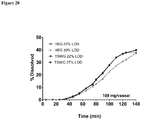
- Another aspect of the invention provides a pharmaceutical formulation consisting of a tablet or capsule that includes a Compound 1 and other excipients (e.g., a filler, a disintegrant, a surfactant, a binder, a glidant, a colorant, a lubricant, or any combination thereof), each of which is described above and in the Examples below, wherein the tablet has a dissolution of at least about 50% (e.g., at least about 60%, at least about 70%, at least about 80%, at least about 90%, or at least about 99%) in about 30 minutes.
- a Compound 1 e.g., a filler, a disintegrant, a surfactant, a binder, a glidant, a colorant, a lubricant, or any combination thereof
- the pharmaceutical composition consists of a tablet that includes Compound 1 in an amount ranging from 25 mg to 250 mg, for example, 25 mg, or 50 mg, or 75 mg, or 100 mg, or 150 mg, 200 mg, or 250 mg and one or more excipients (e.g., a filler, a disintegrant, a surfactant, a binder, a glidant, a colorant, a lubricant, or any combination thereof), each of which is described above and in the Examples below, wherein the tablet has a dissolution of from about 50% to about 100% (e.g., from about 55% to about 95% or from about 60% to about 90%) in about 30 minutes.
- excipients e.g., a filler, a disintegrant, a surfactant, a binder, a glidant, a colorant, a lubricant, or any combination thereof
- the pharmaceutical composition consists of a tablet that comprises a composition comprising Compound 1; and one or more excipients from: a filler, a diluent, a disintegrant, a surfactant, a binder, a glidant, and a lubricant, wherein the tablet has a dissolution of at least about 50% (e.g., at least about 60%, at least about 70%, at least about 80%, at least about 90%, or at least about 99%) in about 30 minutes.
- a dissolution e.g., at least about 60%, at least about 70%, at least about 80%, at least about 90%, or at least about 99%
- the tablet comprises a composition comprising at least about 25 mg (e.g., at least about 30 mg, at least about 40 mg, or at least about 50 mg) of Compound 1; and one or more excipients from: a filler, a diluent, a disintegrant, a surfactant, a binder, a glidant, and a lubricant.
- a filler e.g., at least about 30 mg, at least about 40 mg, or at least about 50 mg
- excipients from: a filler, a diluent, a disintegrant, a surfactant, a binder, a glidant, and a lubricant.
- the tablet comprises a composition comprising at least about 25 mg (e.g., at least about 30 mg, at least about 40 mg, at least about 50 mg, at least about 100 mg, or at least 150 mg) of Compound 1 and one or more excipients from: a filler, a diluent, a disintegrant, a surfactant, a binder, a glidant, and a lubricant.
- Dissolution can be measured with a standard USP Type II apparatus that employs a dissolution media of 0.1% CTAB dissolved in 900 mL of DI water, buffered at pH 6.8 with 50 mM potassium phosphate monoasic, stirring at about 50-75 rpm at a temperature of about 37 °C. A single experimental tablet is tested in each test vessel of the apparatus. Dissolution can also be measured with a standard USP Type II apparatus that employs a dissolution media of 0.7% sodium lauryl sulfate dissolved in 900 mL of 50 mM sodium phosphate buffer (pH 6.8), stirring at about 65 rpm at a temperature of about 37 °C. A single experimental tablet is tested in each test vessel of the apparatus.
- Dissolution can also be measured with a standard USP Type II apparatus that employs a dissolution media of 0.5% sodium lauryl sulfate dissolved in 900 mL of 50 mM sodium phosphate buffer (pH 6.8), stirring at about 65 rpm at a temperature of about 37 °C. A single experimental tablet is tested in each test vessel of the apparatus.
- Compound 1 is used as the starting point for the other solid state forms and can be prepared by coupling an acid chloride moiety with an amine moiety according to Schemes 1-4.
- Scheme 1 depicts the preparation of 1-(2,2-difluorobenzo[d][1,3]dioxol-5-yl)cyclopropanecarbonyl chloride, which is used in Scheme 3 to make the amide linkage of Compound 1.
- 2,2-difluorobenzo[d][1,3]dioxole-5-carboxylic acid is commercially available from Saltigo (an affiliate of the Lanxess Corporation). Reduction of the carboxylc acid moiety in 2,2-difluorobenzo[d][1,3]dioxole-5-carboxylic acid to the primary alcohol, followed by conversion to the corresponding chloride using thionyl chloride (SOCl 2 ), provides 5-(chloromethyl)-2,2-difluorobenzo[d][1,3]dioxole, which is subsequently converted to 2-(2,2-difluorobenzo[d][1,3]dioxol-5-yl)acetonitrile using sodium cyanide.
- SOCl 2 thionyl chloride
- Scheme 2 depicts an alternative synthesis of the requisite acid chloride.
- 5-bromomethyl-2,2-difluoro-1,3-benzodioxole is coupled with ethyl cyanoacetate in the presence of a palladium catalyst to form the corresponding alpha cyano ethyl ester.
- Saponification of the ester moiety to the carboxylic acid gives the cyanoethyl compound.
- Alkylation of the cyanoethyl compound with 1-bromo-2-chloro ethane in the presence of base gives the cyanocyclopropyl compound.
- Treatment of the cyanocyclopropyl compound with base gives the carboxylate salt, which is converted to the carboxylic acid by treatment with acid. Conversion of the carboxylic acid to the acid chloride is then accomplished using a chlorinating agent such as thionyl chloride or the like.
- Scheme 3 depicts the preparation of the requisite tert-butyl 3-(6-amino-3-methylpyridin-2-yl)benzoate, which is coupled with 1-(2,2-difluorobenzo[d][1,3]dioxol-5-yl)cyclopropanecarbonyl chloride in Scheme 3 to give Compound 1.
- Palladium-catalyzed coupling of 2-bromo-3-methylpyridine with 3-(tert-butoxycarbonyl)phenylboronic acid gives tert-butyl 3-(3-methylpyridin-2-yl)benzoate, which is subsequently converted to the desired compound.
- Scheme 4 depicts the coupling of 1-(2,2-difluorobenzo[d][1,3]dioxol-5-yl)cyclopropanecarbonyl chloride with tert-butyl 3-(6-amino-3-methylpyridin-2-yl)benzoate using triethyl amine and 4-dimethylaminopyridine to initially provide the tert-butyl ester of Compound 1.
- Compound 1 Form I is prepared by dispersing or dissolving a salt form, such as the HCl salt, of Compound 1 in an appropriate solvent for an effective amount of time. Treatment of the tert-butyl ester with an acid such as HCl, gives the HCL salt of Compound 1, which is typically a crystalline solid. Compound 1 Form I may also be prepared directly from the t-butyl ester precursor by treatment with an appropriate acid, such as formic acid.
- the HCl salt of 3-(6-(1-(2,2-difluorobenzo[d][1,3]dioxol-5-yl) cyclopropanecarboxamido)-3-methylpyridin-2-yl)benzoic acid can be used to make Form I by dispersing or dissolving the HCl salt of 3-(6-(1-(2,2-difluorobenzo[d][1,3]dioxol-5-yl) cyclopropanecarboxamido)-3-methylpyridin-2-yl)benzoic acid in an appropriate solvent for an effective amount of time.
- salts of 3-(6-(1-(2,2-difluorobenzo[d][1,3]dioxol-5-yl) cyclopropanecarboxamido)-3-methylpyridin-2-yl)benzoic acid may be used, such as, for example, salts derived from other mineral or organic acids.
- the other salts result from acid-mediated hydrolysis of the t-butyl ester moiety.
- Salts derived from other acids may include, for example, nitric, sulfuric, phosphoric, boric, acetic, benzoic and malonic.
- the appropriate solvent may be water or an alcohol/water mixture such as 50% methanol/water mixture, even though the HCl salt form of 3-(6-(1-(2,2-difluorobenzo[d][1,3]dioxol-5-yl) cyclopropanecarboxamido)-3-methylpyridin-2-yl)benzoic acid is only sparingly soluble in water.
- the appropriate solvent is water.
- the effective amount of time for formation of Form I from the salt of 3-(6-(1-(2,2-difluorobenzo[d][1,3]dioxol-5-yl)cyclopropanecarboxamido)-3-methylpyridin-2-yl)benzoic acid can be any time between 2 to 24 hours or greater. It is recognized that the amount of time needed is inversely proportional to the temperature. That is, the higher the temperature the less time needed to affect dissociation of acid to form Form I. When the solvent is water, stirring the dispersion for approximately 24 hours at room temperature provides Form I in an approximately 98% yield.
- substantially pure refers to greater than about 90% purity. In another embodiment, substantially pure refers to greater than about 95% purity. In another embodiment, substantially pure refers to greater than about 98% purity. In another embodiment, substantially pure refers to greater than about 99% purity.
- the temperature selected depends in part on the solvent used and is well within the determination capabilities of one of ordinary skill in the art. In one embodiment, the temperature is between room temperature and about 80 °C. In another embodiment, the temperature is between room temperature and about 40 °C. In another embodiment, the temperature is between about 40 °C and about 60 °C. In another embodiment, the temperature is between about 60 °C and about 80 °C.
- Compound 1 Form I may also be formed directly from 3-(6-(1-(2,2-difluorobenzo[d][1,3]dioxol-5-yl)cyclopropanecarboxamido)-3-methylpyridin-2-yl)-t-butylbenzoate (cf. Scheme 3), which is a precursor to the salt of Compound 1.
- Compound 1 Form I may be further purified by recrystallization from an organic solvent.
- organic solvents include, but are not limited to, toluene, cumene, anisol, 1-butanol, isopropyl acetate, butyl acetate, isobutyl acetate, methyl t -butyl ether, methyl isobutyl ketone and 1-propanol-water mixtures.
- the temperature may be as described above.
- Form I is dissolved in 1-butanol at 75 °C until it is completely dissolved. Cooling down the solution to 10 °C at a rate of 0.2 °C/min yields crystals of Form I which may be isolated by filtration.
- Compound 1 Form I is characterized by one or more peaks at 15.2 to 15.6 degrees, 16.1 to 16.5 degrees, and 14.3 to 14.7 degrees in an X-ray powder diffraction obtained using Cu K alpha radiation. In another embodiment, Compound 1 Form I is characterized by one or more peaks at 15.4, 16.3, and 14.5 degrees. In another embodiment, Compound 1 Form I is further characterized by a peak at 14.6 to 15.0 degrees. In another embodiment, Compound 1 Form I is further characterized by a peak at 14.8 degrees. In another embodiment, Compound 1 Form I is further characterized by a peak at 17.6 to 18.0 degrees. In another embodiment, Compound 1 Form I is further characterized by a peak at 17.8 degrees.
- Compound 1 Form I is further characterized by a peak at 16.4 to 16.8 degrees. In another embodiment, Compound 1 Form I is further characterized by a peak at 16.4 to 16.8 degrees. In another embodiment, Compound 1 Form I is further characterized by a peak at 16.6 degrees. In another embodiment, Compound 1 Form I is further characterized by a peak at 7.6 to 8.0 degrees. In another embodiment, Compound 1 Form I is further characterized by a peak at 7.8 degrees. In another embodiment, Compound 1 Form I is further characterized by a peak at 25.8 to 26.2 degrees. In another embodiment, Compound 1 Form I is further characterized by a peak at 26.0 degrees. In another embodiment, Compound 1 Form I is further characterized by a peak at 21.4 to 21.8 degrees.
- Compound 1 Form I is further characterized by a peak at 21.6 degrees. In another embodiment, Compound 1 Form I is further characterized by a peak at 23.1 to 23.5 degrees. In another embodiment, Compound 1 Form I is further characterized by a peak at 23.3 degrees. In some embodiments, Compound 1 Form I is characterized by a diffraction pattern substantially similar to that of Figure 1 . In some embodiments, Compound 1 Form I is characterized by a diffraction pattern substantially similar to that of Figure 2 .
- the particle size distribution of D90 is about 82 ⁇ m or less for Compound 1 Form I. In some embodiments, the particle size distribution of D50 is about 30 ⁇ m or less for Compound 1 Form I.
- Compound 1 Form II is prepared by slurrying Compound 1 Form I in an appropriate solvent at a sufficient concentration for a sufficient time. The slurry is then filtered centrifugally or under vacuum and dried at ambient conditions for sufficient time to yield Compound 1 Form II.
- about 20 to 40 mg of Compound 1 Form I is slurried in about 400 to 600 ⁇ L of an appropriate solvent. In another embodiment, about 25 to 35 mg of Compound 1 Form I is slurried in about 450 to 550 ⁇ L of an appropriate solvent. In another embodiment, about 30 mg of Compound 1 Form I is slurried in about 500 ⁇ L of an appropriate solvent.
- the time that Compound 1 Form I is allowed to slurry with the solvent is from1 hour to four days. More particularly, the time that Compound 1 Form I is allowed to slurry with the solvent is from1 to 3 days. More particularly, the time is 2 days.
- the appropriate solvent is selected from an organic solvent of sufficient size to fit the voids in the crystalline lattice of Compound 1 Form II. In other embodiments, the solvate is of sufficient size to fit in voids measuring about 100 ⁇ 3 .
- the solvent is selected from the group consisting of methanol, ethanol, acetone, 2-propanol, acetonitrile, tetrahydrofuran, methyl acetate, 2-butanone, ethyl formate, and 2-methyl tetrahydrofuran.
- Compound 1 Form II may be obtained from a mixture comprising one or more of these solvents and water.
- the effective amount of time for drying Compound 1 Form II is 1 to 24 hours. More particularly, the time is 6 to 18 hours. More particularly, the time is about 12 hours.
- Compound 1 Form II is prepared by dispersing or dissolving a salt form of Compound 1, such as an HCl salt of Compound 1 in an appropriate solvent for an effective amount of time.
- Compound 1 Form II as disclosed herein comprises a crystalline lattice of Compound 1 in which voids in the crystalline lattice are empty, or occupied, or partially occupied by one or more molecules of a suitable solvent.
- suitable solvents include, but are not limited to, methanol, ethanol, acetone, 2-propanol, acetonitrile, tetrahydrofuran, methyl acetate, 2-butanone, ethyl formate, and 2-methyl tetrahydrofuran.
- Certain physical characterisics of Compound 1 isostructural solvate forms, such as X-ray powder diffraction, melting point and DSC, are not substantially affected by the particular solvent molecule in question.
- Compound 1 Form II is characterized by one or more peaks at 21.50 to 21.90 degrees, 8.80 to 9.20 degrees, and 10.80 to 11.20 degrees in an X-ray powder diffraction obtained using Cu K alpha radiation.
- Compound 1 Form II is characterized by one or more peaks at 21.50 to 21.90 degrees, 8.80 to 9.20 degrees, 10.80 to 11.20 degrees, 18.00 to 18.40 degrees, and 22.90 to 23.30 degrees in an X-ray powder diffraction obtained using Cu K alpha radiation.
- Compound 1 Form II is characterized by one or more peaks at 21.70, 8.98, and 11.04 degrees.
- Compound 1 Form II is characterized by one or more peaks at 21.70, 8.98, 11.04, 18.16, and 23.06 degrees. In another embodiment, Compound 1 Form II is characterized by a peak at 21.50 to 21.90 degrees. In another embodiment, Compound 1 Form II is further characterized by a peak at 21.70 degrees. In another embodiment, Compound 1 Form II is further characterized by a peak at 8.80 to 9.20 degrees. In another embodiment, Compound 1 Form II is further characterized by a peak at 8.98 degrees. In another embodiment, Compound 1 Form II is further characterized by a peak at 10.80 to 11.20 degrees. In another embodiment, Compound 1 Form II is further characterized by a peak at 11.04.
- Compound 1 Form II is further characterized by a peak at 18.00 to 18.40 degrees. In another embodiment, Compound 1 Form II is further characterized by a peak at 18.16 degrees. In another embodiment, Compound 1 Form II is further characterized by a peak at 22.90 to 23.30 degrees. In another embodiment, Compound 1 Form II is further characterized by a peak at 23.06 degrees. In another embodiment, Compound 1 Form II is further characterized by a peak at 20.40 to 20.80 degrees. In another embodiment, Compound 1 Form II is further characterized by a peak at 20.63 degrees. In another embodiment, Compound 1 Form II is further characterized by a peak at 22.00 to 22.40 degrees.
- Compound 1 Form II is further characterized by a peak at 22.22 degrees. In another embodiment, Compound 1 Form II is further characterized by a peak at 18.40 to 18.80 degrees. In another embodiment, Compound 1 Form II is further characterized by a peak at 18.57 degrees. In another embodiment, Compound 1 Form II is further characterized by a peak at 16.50 to 16.90 degrees. In another embodiment, Compound 1 Form II is further characterized by a peak at 16.66 degrees. In another embodiment, Compound 1 Form II is further characterized by a peak at 19.70 to 20.10 degrees. In another embodiment, Compound 1 Form II is further characterized by a peak at 19.86 degrees.
- Compound 1 Form II is characterized by a diffraction pattern substantially similar to that of Figure 3 . In some embodiments, Compound 1 Form II is characterized by diffraction patterns substantially similar to those provided in Figure 4 .
- the solvate that forms Compound 1 Form II is selected from the group consisting of methanol, ethanol, acetone, 2-propanol, acetonitrile, tetrahydrofuran, methyl acetate, 2-butanone, ethyl formate, and 2-methyl tetrahydrofuran.
- Diffraction patterns are provided for the following Compound 1 Form II: methanol ( Figure 5 ), ethanol ( Figure 6 ), acetone ( Figure 7 ), 2-propanol ( Figure 8 ), acetonitrile ( Figure 9 ), tetrahydrofuran ( Figure 10 ), methyl acetate ( Figure 11 ), 2-butanone ( Figure 12 ), ethyl formate ( Figure 13 ), and 2-methytetrahydrofuran ( Figure 14 ).
- the invention provides Compound 1 Form II which exhibits two or more phase transitions as determined by DSC or a similar analytic method known to the skilled artisan.
- the DSC of Compound 1 Form II is substantially similar to the DSC trace depicted in Figure 15 .
- the DSC gives two phase transitions.
- the DSC gives three phase transitions.
- one of the phase transitions occurs between 200 and 207 °C.
- one of the phase transitions occurs between 204 and 206 °C.
- one of the phase transitions occurs between 183 and 190 °C.
- one of the phase transitions occurs between 185 and 187 °C.
- the melting point of Compound 1, Solvate Form A is between 183 °C to 190 °C.
- the melting point of Compound 1, Solvate Form A is between 185 °C to 187 °C.
- Compound 1 Form II comprises 1 to 10 weight percent (wt. %) solvate as determined by TGA. In some embodiments, the TGA of Compound 1 Form II is substantially similar to the TGA trace depicted in Figure 16 . In another embodiment, Compound 1 Form II comprises 2 to 5 wt. % solvate as determined by TGA or a similar analytic method known to the skilled artisan.
- the conformation of Compound 1 Form II acetone solvate is substantially similar to that depicted in Figure 17 , which is based on single X-ray analysis.
- Compound 1 HCl Salt Form A can be prepared from the HCl salt of Compound 1, by dissolving the HCl salt of Compound 1 in a minimum of solvent and removing the solvent by slow evaporation.
- the solvent is an alcohol.
- the solvent is ethanol.
- Slow evaporation is generally carried out by impeding the evaporation of the solvent.
- slow evaporation involves dissolving the HCl salt of Compound 1 in a vial and covering the vial with parafilm that contains a hole poked in it.
- Compound 1 HCl Salt Form A is characterized by one or more peaks at 8.80 to 9.20 degrees, 17.30 to 17.70 degrees, and 18.20 to 18.60 degrees in an X-ray powder diffraction obtained using Cu K alpha radiation.
- Compound 1 HCl Salt Form A is characterized by one or more peaks at 8.80 to 9.20 degrees, 17.30 to 17.70 degrees, 18.20 to 18.60 degrees, 10.10 to 10.50, and 15.80 to 16.20 degrees in an X-ray powder diffraction obtained using Cu K alpha radiation.
- Compound 1 HCl Salt Form A is characterized by one or more peaks at 8.96, 17.51, and 18.45 degrees.
- Compound 1 HCl Salt Form A is characterized by one or more peaks at 8.96, 17.51, 18.45. 10.33, and 16.01 degrees. In another embodiment, Compound 1 HCl Salt Form A is characterized by a peak at 8.80 to 9.20 degrees. In another embodiment, Compound 1 HCl Salt Form A is characterized by a peak at 8.96 degrees. In another embodiment, Compound 1 HCl Salt Form A is further characterized by a peak at 17.30 to 17.70 degrees. In another embodiment, Compound 1 HCl Salt Form A is characterized by a peak at 17.51 degrees. In another embodiment, Compound 1 HCl Salt Form A is further characterized by a peak at 18.20 to 18.60 degrees.
- Compound 1 HCl Salt Form A is further characterized by a peak at 18.45degrees. In another embodiment, Compound 1 HCl Salt Form A is further characterized by a peak at 10.10 to 10.50 degrees. In another embodiment, Compound 1 HCl Salt Form A is further characterized by a peak at 10.33 degrees. In another embodiment, Compound 1 HCl Salt Form A is further characterized by a peak at 15.80 to 16.20 degrees. In another embodiment, Compound 1 HCl Salt Form A is further characterized by a peak at 16.01 degrees. In another embodiment, Compound 1 HCl Salt Form A is further characterized by a peak at 11.70 to 12.10 degrees. In another embodiment, Compound 1 HCl Salt Form A is further characterized by a peak at 11.94 degrees.
- Compound 1 HCl Salt Form A is further characterized by a peak at 7.90 to 8.30 degrees. In another embodiment, Compound 1 HCl Salt Form A is further characterized by a peak at 8.14 degrees. In another embodiment, Compound 1 HCl Salt Form A is further characterized by a peak at 9.90 to 10.30 degrees. In another embodiment, Compound 1 HCl Salt Form A is further characterized by a peak at 10.10 degrees. In another embodiment, Compound 1 HCl Salt Form A is further characterized by a peak at 16.40 to 16.80 degrees. In another embodiment, Compound 1 HCl Salt Form A is further characterized by a peak at 16.55 degrees.
- Compound 1 HCl Salt Form A is further characterized by a peak at 9.30 to 9.70 degrees. In another embodiment, Compound 1 HCl Salt Form A is further characterized by a peak at 9.54 degrees. In another embodiment, Compound 1 HCl Salt Form A is further characterized by a peak at 16.40 to 16.80 degrees. In another embodiment, Compound 1 HCl Salt Form A is further characterized by a peak at 16.55 degrees. In some embodiments, Compound 1 HCl Salt Form A is characterized as a dimer as depicted in Figure 18 .
- Compound 1 HCl Salt Form A is characterized by a diffraction pattern substantially similar to that of Figure 19 .
- the dosage unit forms of the invention can be produced by compacting or compressing an admixture or composition, for example, a powder or granules, under pressure to form a stable three-dimensional shape (e.g., a tablet).
- tablette includes compressed pharmaceutical dosage unit forms of all shapes and sizes, whether coated or uncoated.
- dosage unit form refers to a physically discrete unit of agent appropriate for the patient to be treated.
- a compacted mixture has a density greater than that of the mixture prior to compaction.
- a dosage unit form of the invention can have almost any shape including concave and/or convex faces, rounded or angled corners, and a rounded to rectilinear shape.
- the compressed dosage forms of the invention comprise a rounded tablet having flat faces.
- the solid pharmaceutical dosage forms of the invention can be prepared by any compaction and compression method known by persons of ordinary skill in the art of forming compressed solid pharmaceutical dosage forms.
- the formulations provided herein may be prepared using conventional methods known to those skilled in the field of pharmaceutical formulation, as described, e.g., in pertinent textbooks. See, e.g., Remington: The Science and Practice of Pharmacy, 21st Ed., Lippincott Williams & Wilkins, Baltimore, Md. (2003 ); Ansel et al., Pharmaceutical Dosage Forms And Drug Delivery Systems, 7th Edition, Lippincott Williams & Wilkins, (1999 ); The Handbook of Pharmaceutical Excipients, 4th edition, Rowe et al., Eds., American Pharmaceuticals Association (2003 ); Gibson, Pharmaceutical Preformulation And Formulation, CRC Press (2001 ), these references hereby incorporated herein by reference in their entirety.
- solid forms including powders comprising the active agent Compound 1 and the included pharmaceutically acceptable excipients (e.g. filler, diluent, disintegrant, surfactant, glidant, binder, lubricant, or any combination thereof) can be subjected to a dry granulation process.
- the dry granulation process causes the powder to agglomerate into larger particles having a size suitable for further processing. Dry granulation can improve the flowability of a mixture in order to be able to produce tablets that comply with the demand of mass variation or content uniformity.
- Formulations as described herein may be produced using one or more mixing and dry granulations steps.
- the order and the number of the mixing and granulation steps do not seem to be critical.
- at least one of the excipients and Compound 1 can be been subject to dry granulation or wet high shear granulation before compression into tablets. Dry granulation of Compound 1 and the excipients made together prior to tablet compression seem, surprisingly, to be a simple, inexpensive and efficient way of providing close physical contact between the ingredients of the present compositions and formulations and thus results in a tablet formulation with good stability properties.
- Dry granulation can be carried out by a mechanical process, which transfers energy to the mixture without any use of any liquid substances (neither in the form of aqueous solutions, solutions based on organic solutes, or mixtures thereof) in contrast to wet granulation processes, also contemplated herein.
- the mechanical process requires compaction such as the one provided by roller compaction.
- An example of an alternative method for dry granulation is slugging.
- roller compaction is a granulation process comprising highly intensive mechanical compacting of one or more substances.
- a pharmaceutical composition comprising an admixture of powders is pressed, that is roller compacted, between 2 counter rotating rollers to make a solid sheet which is subsequently crushed in a sieve to form a particulate matter. In this particulate matter, a close mechanical contact between the ingredients can be obtained.
- roller compaction equipment is Minipactor® a Gerteis 3W-Polygran from Gerteis Maschinen+Processengineering AG.
- tablet compression according to the invention can occur without any use of any liquid substances (neither in the form of aqueous solutions, solutions based on organic solutes, or mixtures thereof), i.e. a dry granulation process.
- the resulting core or tablet has a compressive strength in the range of 1 to 15 kP; such as 1.5 to 12.5 kP, preferably in the range of 2 to 10 kP.
- the ingredients are weighed according to the formula set herein.
- all of the intragranular ingredients are sifted and mixed well.
- the ingredients can be lubricated with a suitable lubricant, for example, magnesium stearate.
- the next step can comprise compaction/slugging of the powder admixture and sized ingredients.
- the compacted or slugged blends are milled into granules and sifted to obtain the desired size.
- the granules can be further lubricated with, for example, magnesium stearate.
- the granular composition of the invention can be compressed on suitable punches into various pharmaceutical formulations in accordance with the invention.
- the tablets can be coated with a film, colorant or other coating.
- Another aspect of the invention provides a method for producing a pharmaceutical composition
- a method for producing a pharmaceutical composition comprising providing an admixture of a composition comprising Compound 1 and one or more excipients selected from: a filler, a diluent, a binder, a glidant, a surfactant, a lubricant, a disintegrant, and compressing the composition into a tablet having a dissolution of at least about 50% in about 30 minutes.
- a wet granulation process is performed to yield the pharmaceutical formulation of the invention from an admixture of powdered and liquid ingredients.
- a pharmaceutical composition comprising an admixture of a composition comprising Compound 1 and one or more excipients selected from: a filler, a diluent, a binder, a glidant, a surfactant, a lubricant, a disintegrant, are weighed as per the formula set herein.
- all of the intragranular ingredients are sifted and mixed in a high shear or low shear granulator or a twin screw granulator using water or water with a surfactant or water with a binder or water with a surfactant and a binder to granulate the powder blend.
- a fluid other than water can also be used with or without surfactant and/or binder to granulate the powder blend.
- the wet granules can optionally be milled using a suitable mill.
- water may optionally be removed from the admixture by drying the ingredients in any suitable manner.
- the dried granules can optionally be milled to the required size.
- extra granular excipients can be added by blending (for example a filler, a diluent, and a disintegrant).
- the sized granules can be further lubricated with magnesium stearate and a disintegrant, for example, croscarmellose sodium.
- the granular composition of the invention can be compressed on suitable punches into various pharmaceutical formulations in accordance with the invention.
- the tablets can be coated with a film, colorant or other coating.
- the pharmaceutical compositions of the present invention are prepared by a continuous twin screw wet granulation (TSWG) process.
- TSWG continuous twin screw wet granulation
- Continuous manufacturing delivers high quality and highly consistent product with on-line monitoring and control. Continuous manufacturing also facilitates quality by design development with a "data rich" design space and an easier to understand impact of upstream variables on the downstream process and final product quality.
- the pharmaceutical compositions of the present invention can be finalized early on commercial scale equipment which avoids scale-up risks and formulation changes late in development.
- continuous manufacturing has commercial manufacturing advantages such as improved process control, reduced product handling, and real time release efficiencies. The overall result is a more robust, controllable, and scalable process that has fewer process checks resulting in increased product quality and therefore greater patient safety.
- HSG high shear granulation
- TSWG tetrachlorosilicate
- the continuous process starts with feeding individual excipients and Compound 1 into a continuous in-line blender through loss-in-weight feeding. From this blender, the material is continuously conveyed and processed through twin screw wet granulation, drying, milling, extra-granular excipient addition, blending, compression and film coating.
- a tablet comprising Compound 1 may be prepared continuously according to the below flow chart.
- the admixture can comprise optional additives, such as, one or more colorants, one or more flavors, and/or one or more fragrances as described above and in the Examples below.
- the relative concentrations (e.g., wt%) of each of these ingredients (and any optional additives) in the admixture are also presented above and in the Examples below.
- the ingredients constituting the admixture can be provided sequentially or in any combination of additions; and, the ingredients or combination of ingredients can be provided in any order.
- the lubricant is the last component added to the admixture.
- the admixture comprises a composition of Compound 1, and any one or more of the excipients; a binder, a glidant, a surfactant, a diluent, a lubricant, a disintegrant, and a filler, wherein each of these ingredients is provided in a powder form (e.g., provided as particles having a mean or average diameter, measured by light scattering, of 250 ⁇ m or less (e.g., 150 ⁇ m or less, 100 ⁇ m or less, 50 ⁇ m or less, 45 ⁇ m or less, 40 ⁇ m or less, or 35 ⁇ m or less)).
- a powder form e.g., provided as particles having a mean or average diameter, measured by light scattering, of 250 ⁇ m or less (e.g., 150 ⁇ m or less, 100 ⁇ m or less, 50 ⁇ m or less, 45 ⁇ m or less, 40 ⁇ m or less, or 35 ⁇ m or less)).
- the admixture comprises a composition of Compound 1, a diluent, a glidant, a surfactant, a lubricant, a disintegrant, and a filler, wherein each of these ingredients is provided in a powder form (e.g., provided as particles having a mean diameter, measured by light scattering, of 250 ⁇ m or less (e.g., 150 ⁇ m or less, 100 ⁇ m or less, 50 ⁇ m or less, 45 ⁇ m or less, 40 ⁇ m or less, or 35 ⁇ m or less)).
- a powder form e.g., provided as particles having a mean diameter, measured by light scattering, of 250 ⁇ m or less (e.g., 150 ⁇ m or less, 100 ⁇ m or less, 50 ⁇ m or less, 45 ⁇ m or less, 40 ⁇ m or less, or 35 ⁇ m or less)).
- the admixture comprises a composition of Compound 1, a diluent, a binder, a surfactant, a lubricant, a disintegrant, and a filler, wherein each of these ingredients is provided in a powder form (e.g., provided as particles having a mean diameter, measured by light scattering, of 250 ⁇ m or less (e.g., 150 ⁇ m or less, 100 ⁇ m or less, 50 ⁇ m or less, 45 ⁇ m or less, 40 ⁇ m or less, or 35 ⁇ m or less))
- a powder form e.g., provided as particles having a mean diameter, measured by light scattering, of 250 ⁇ m or less (e.g., 150 ⁇ m or less, 100 ⁇ m or less, 50 ⁇ m or less, 45 ⁇ m or less, 40 ⁇ m or less, or 35 ⁇ m or less)
- the admixture comprises a composition of Compound 1, and any combination of: a binder, a glidant, a diluent, a surfactant, a lubricant, a disintegrant, and a filler, wherein each of these ingredients is substantially free of water.
- Each of the ingredients comprises less than 5 wt% (e.g., less than 2 wt%, less than 1 wt%, less than 0.75 wt%, less than 0.5 wt%, or less than 0.25 wt%) of water by weight of the ingredient.
- the admixture comprises a composition of Compound 1, a diluent, a glidant, a surfactant, a lubricant, a disintegrant, and a filler, wherein each of these ingredients is substantially free of water.
- each of the ingredients comprises less than 5 wt% (e.g., less than 2 wt%, less than 1 wt%, less than 0.75 wt%, less than 0.5 wt%, or less than 0.25 wt%) of water by weight of the ingredient.
- compressing the admixture into a tablet is accomplished by filling a form (e.g., a mold) with the admixture and applying pressure to admixture. This can be accomplished using a die press or other similar apparatus.
- a form e.g., a mold
- the admixture of Compound 1 and excipients can be first processed into granular form. The granules can then be sized and compressed into tablets or formulated for encapsulation according to known methods in the pharmaceutical art. It is also noted that the application of pressure to the admixture in the form can be repeated using the same pressure during each compression or using different pressures during the compressions.
- the admixture of powdered ingredients or granules can be compressed using a die press that applies sufficient pressure to form a tablet having a dissolution of about 50% or more at about 30 minutes (e.g., about 55% or more at about 30 minutes or about 60% or more at about 30 minutes).
- the admixture is compressed using a die press to produce a tablet hardness of at least about 5 kP (at least about 5.5 kP, at least about 6 kP, at least about 7 kP, at least about 10 kP, or at least 15 kP).
- the admixture is compressed to produce a tablet hardness of between about 5 and 20 kP.
- tablets comprising a pharmaceutical composition as described herein can be coated with about 3.0 wt% of a film coating comprising a colorant by weight of the tablet.
- the colorant suspension or solution used to coat the tablets comprises about 20%w/w of solids by weight of the colorant suspension or solution.
- the coated tablets can be labeled with a logo, other image or text.
- the method for producing a pharmaceutical composition comprises providing an admixture of a solid forms, e.g. an admixture of powdered and/or liquid ingredients, the admixture comprising Compound 1 and one or more excipients selected from: a binder, a glidant, a diluent, a surfactant, a lubricant, a disintegrant, and a filler; mixing the admixture until the admixture is substantially homogenous, and compressing or compacting the admixture into a granular form. Then the granular composition comprising Compound 1 can be compressed into tablets or formulated into capsules as described above or in the Examples below.
- a solid forms e.g. an admixture of powdered and/or liquid ingredients
- the admixture comprising Compound 1 and one or more excipients selected from: a binder, a glidant, a diluent, a surfactant, a lub
- methods for producing a pharmaceutical composition comprises providing an admixture of Compound 1, and one or more excipients, e.g. a binder, a glidant, a diluent, a surfactant, a lubricant, a disintegrant, and a filler; mixing the admixture until the admixture is substantially homogenous, and compressing/compacting the admixture into a granular form using a roller compactor using a dry granulation composition as set forth in the Examples below or alternatively, compressed/compacted into granules using a high shear wet granule compaction process as set forth in the Examples below.
- Pharmaceutical formulations for example a tablet as described herein, can be made using the granules prepared incorporating Compound 1 in addition to the selected excipients described herein.
- the admixture is mixed by stirring, blending, shaking, or the like using hand mixing, a mixer, a blender, any combination thereof, or the like.
- mixing can occur between successive additions, continuously throughout the ingredient addition, after the addition of all of the ingredients or combinations of ingredients, or any combination thereof.
- the admixture is mixed until it has a substantially homogenous composition.
- the present invention comprises jet milling Compound 1, Compound 1 Form I, Compound 1 Form II, Compound 1 HCl Salt Form A in a suitable, conventional milling apparatus using air pressure suitable to produce particles having a significant particle size fraction between 0.1 microns and 50 microns.
- the particle size is between 0.1 microns and 20 microns.
- the particles size is between 0.1 microns and 10 microns.
- the particle size is between 1.0 microns and 5 microns.
- Compound 1, Compound 1 Form I, Compound 1 Form II, Compound 1 HCl Salt Form A has a particle size D50 of 2.0 microns.
- a second therapeutic agent can be formulated together with Compound 1 to form a unitary or single dose form, for example, a tablet or capsule.
- Dosage forms prepared as above can be subjected to in vitro dissolution evaluations according to Test 711 " Dissolution” in United States Pharmacopoeia 29, United States Pharmacopeial Convention, Inc., Rockville, Md., 2005 ("USP "), to determine the rate at which the active substance is released from the dosage forms.
- the content of active substance and the impurity levels are conveniently measured by techniques such as high performance liquid chromatography (HPLC).
- the invention includes use of packaging materials such as containers and closures of high-density polyethylene (HDPE), low-density polyethylene (LDPE) and or polypropylene and/or glass, glassine foil, aluminum pouches, and blisters or strips composed of aluminum or high-density polyvinyl chloride (PVC), optionally including a desiccant, polyethylene (PE), polyvinylidene dichloride (PVDC), PVC/PE/PVDC, and the like.
- packaging materials such as containers and closures of high-density polyethylene (HDPE), low-density polyethylene (LDPE) and or polypropylene and/or glass, glassine foil, aluminum pouches, and blisters or strips composed of aluminum or high-density polyvinyl chloride (PVC), optionally including a desiccant, polyethylene (PE), polyvinylidene dichloride (PVDC), PVC/PE/PVDC, and the like.
- PVDC polyvinylidene dichloride
- the pharmaceutical compositions of the invention can be administered to a patient once daily or about every twenty four hours. Alternatively, the pharmaceutical compositions of the invention can be administered to a patient twice daily or about every twelve hours. These pharmaceutical compositions are administered as oral formulations containing about 25 mg, 50 mg, 100 mg, 125 mg, 150 mg, 200 mg, 250 mg, or 400 mg of Compound 1.
- the pharmaceutical compositions comprise a filler; a diluent; a disintegrant; a surfactant; at least one of a binder and a glidant; and a lubricant.
- a dose of 400 mg of Compound 1 may comprise two tablets of the invention each containing 200 mg of Compound 1, or four tablets of the invention each containing 100 mg of Compound 1.
- the compound and pharmaceutically acceptable compositions and formulations of the invention can be employed in combination therapies; that is, Compound 1 and pharmaceutically acceptable compositions thereof can be administered concurrently with, prior to, or subsequent to, one or more other desired therapeutics or medical procedures.
- the particular combination of therapies (therapeutics or procedures) to employ in a combination regimen will take into account compatibility of the desired therapeutics and/or procedures and the desired therapeutic effect to be achieved.
- the therapies employed may achieve a desired effect for the same disorder (for example, an inventive compound may be administered concurrently with another agent used to treat the same disorder), or they may achieve different effects (e.g., control of any adverse effects).
- additional therapeutic agents that are normally administered to treat or prevent a particular disease for example, a CFTR mediated disease, or condition, are known as "appropriate for the disease or condition being treated.”
- the additional therapeutic agent is selected from a mucolytic agent, bronchodialator, an antibiotic, an anti-infective agent, an anti-inflammatory agent, a CFTR modulator other than Compound 1 of the invention, or a nutritional agent.
- the additional agent is ( R )-1-(2,2-difluorobenzo[d][1,3]dioxol-5-yl)-N-(1-(2,3-dihydroxypropyl)-6-fluoro-2-(1-hydroxy-2-methylpropan-2-yl)-1H-indol-5-yl)cyclopropanecarboxamide.
- the additional agent is N-(5-hydroxy-2,4-ditert-butyl-phenyl)-4-oxo-1H-quinoline-3-carboxamide.
- the additional agent is selected from Table 1: Table 1. 1 2 3 4 5 6 7 8 9 10 11 12 13 14
- the additional agent is any combination of the above agents.
- the composition may comprise Compound 1, ( R )-1-(2,2-difluorobenzo[d][1,3]dioxol-5-yl)-N-(1-(2,3-dihydroxypropyl)-6-fluoro-2-(1-hydroxy-2-methylpropan-2-yl)-1H-indol-5-yl)cyclopropanecarboxamide, and N-(5-hydroxy-2,4-ditert-butyl-phenyl)-4-oxo-1H-quinoline-3-carboxamide.
- the composition may comprise Compound 1, N-(5-hydroxy-2,4-ditert-butyl-phenyl)-4-oxo-1H-quinoline-3-carboxamide, and any one of the compounds from Table 1, i.e. compounds 1 through 14 of Table 1, or any combination thereof.
- the additional therapeutic agent is an antibiotic.
- antibiotics useful herein include tobramycin, including tobramycin inhaled powder (TIP), azithromycin, aztreonam, including the aerosolized form of aztreonam, amikacin, including liposomal formulations thereof, ciprofloxacin, including formulations thereof suitable for administration by inhalation, levoflaxacin, including aerosolized formulations thereof, and combinations of two antibiotics, e.g., fosfomycin and tobramycin.
- the additional agent is a mucolyte.
- exemplary mucolytes useful herein includes Pulmozyme®.
- the additional agent is a bronchodialator.
- exemplary bronchodialtors include albuterol, metaprotenerol sulfate, pirbuterol acetate, salmeterol, or tetrabuline sulfate.
- the additional agent is effective in restoring lung airway surface liquid.
- Such agents improve the movement of salt in and out of cells, allowing mucus in the lung airway to be more hydrated and, therefore, cleared more easily.
- Exemplary such agents include hypertonic saline, denufosol tetrasodium ([[(3S,5R)-5-(4-amino-2-oxopyrimidin-1-yl)-3-hydroxyoxolan-2-yl]methoxy-hydroxyphosphoryl][[[(2R,3S,4R,5R)-5-(2,4-dioxopyrimidin-1-yl)-3, 4-dihydroxyoxolan-2-yl]methoxy-hydroxyphosphoryl]oxy-hydroxyphosphoryl] hydrogen phosphate), or bronchitol (inhaled formulation of mannitol).
- the additional agent is an anti-inflammatory agent, i.e., an agent that can reduce the inflammation in the lungs.
- agents useful herein include ibuprofen, docosahexanoic acid (DHA), sildenafil, inhaled glutathione, pioglitazone, hydroxychloroquine, or simavastatin.
- the additional agent is a CFTR modulator other than Compound 1, i.e., an agent that has the effect of modulating CFTR activity.
- CFTR modulator other than Compound 1, i.e., an agent that has the effect of modulating CFTR activity.
- agents include ataluren (“PTC124®”; 3-[5-(2-fluorophenyl)-1,2,4-oxadiazol-3-yl]benzoic acid), sinapultide, lancovutide, depelestat (a human recombinant neutrophil elastase inhibitor), and cobiprostone (7- ⁇ (2R, 4aR, 5R, 7aR)-2-[(3S)-1,1-difluoro-3-methylpentyl]-2-hydroxy-6-oxooctahydrocyclopenta[b]pyran-5-yl ⁇ heptanoic acid).
- the additional agent is a nutritional agent.
- exemplary nutritional agents include pancrelipase (pancreating enzyme replacement), including Pancrease®, Pancreacarb®, Ultrase®, or Creon®, Liprotomase® (formerly Trizytek®), Aquadeks®, or glutathione inhalation.
- the additional nutritional agent is pancrelipase.
- the additional agent is a compound selected from gentamicin, curcumin, cyclophosphamide, 4-phenylbutyrate, miglustat, felodipine, nimodipine, Philoxin B, geniestein, Apigenin, cAMP/cGMP modulators such as rolipram, sildenafil, milrinone, tadalafil, amrinone, isoproterenol, albuterol, and almeterol, deoxyspergualin, HSP 90 inhibitors, HSP 70 inhibitors, proteosome inhibitors such as epoxomicin, lactacystin, etc.
- the additional agent is a compound selected from 3-amino-6-(4-fluoro-phenyl)-5-trifluoromethyl-pyridine-2-carboxylic acid (3,3,3-trifluoro-2-hydroxy-2-methyl-propyl)-amide; 5-amino-6'-methyl-3-trifluoromethyl-[2,3]bipyridinyl-6-carboxylic acid (3,3,3-trifluoro-2-hydroxy -2-methyl-propyl)-amide; 3-amino-6-cyclopropyl-N-(3,3,3-trifluoro-2-hydroxy-2-methylpropyl)-5-(trifluoromethyl)picolinamide; 3-amino-6-methoxy-N-(3,3,3-trifluoro-2-hydroxy-2-(trifluoromethyl)propyl)-5-(trifluoro methyl)picolinamide; 3-amino-6-(4-fluoro-phenyl)-5-trifluoromethyl-pyridine-2-carboxylic
- the additional agent is trimethylangelicin. In another embodiment, the additional agent is a compound disclosed in WO 2012171954 , incorporated herein in its entirety by reference.
- the additional agent is a compound disclosed in WO 2004028480 , WO 2004110352 , WO 2005094374 , WO 2005120497 , or WO 2006101740 .
- the additional agent is a benzo[c]quinolizinium derivative that exhibits CFTR modulation activity or a benzopyran derivative that exhibits CFTR modulation activity.
- the additional agent is a compound disclosed in U.S. Pat. No. 7,202,262 , U.S. Pat. No.
- the additional agent is a compound disclosed in WO2004080972 , WO2004111014 , WO2005035514 , WO2005049018 , WO2006099256 , WO2006127588 , or WO2007044560 .
- the additional agent is N-(5-hydroxy-2,4-ditert-butyl-phenyl)-4-oxo-1H-quinoline-3-carboxamide.
- 600 mg of Compound 1 may be administered to a subject in need thereof followed by co-administration of 250 mg of N-(5-hydroxy-2,4-ditert-butyl-phenyl)-4-oxo-1H-quinoline-3-carboxamide (Compound 2).
- the dosage amounts may be achieved by administration of one or more tablets of the invention.
- administration of 600 mg of Compound 1 may be achieved by administering three tablets each containing 200 mg of Compound 1, four tablets each containing 150 mg of Compound 1, or one table of 400 mg Compound 1 and one tablet of 200 mg Compound 1.
- Compound 2 may be administered as a pharmaceutical composition comprising Compound 2 and a pharmaceutically acceptable carrier.
- the duration of administration may continue until amelioration of the disease is achieved or until a subject's physician advises, e.g. duration of administration may be less than a week, 1 week, 2 weeks, 3 weeks, or a month or longer.
- the co-administration period may be preceded by an administration period of just Compound 1 alone. For example, there could be administration of 600 mg of Compound 1 for 2 weeks followed by co-administration of 250 mg of Compound 2 for 1 additional week. In another embodiment, 600 mg of Compound 1 may be administered bid (twice daily) for 28 days followed by 250 mg of Compound 2 administered bid (twice daily) for 28 days.
- 600 mg of Compound 1 may be administered qd (once a day) for 28 days followed by 250 mg of Compound 2 administered qd (once a day) for 28 days.
- 600 mg of Compound 1 may be administered qd (once a day) for 28 days followed by co-administration of 600 mg of Compound 1 qd (once a day) and 250 mg of Compound 2 q12h (once every 12 hours) for 28 days.
- 600 mg of Compound 1 may be administered qd (once a day) and 250 mg of Compound 2 administered qd (once a day).
- 600 mg of Compound 1 may be administered to a subject in need thereof followed by co-administration of 450 mg of N-(5-hydroxy-2,4-ditert-butyl-phenyl)-4-oxo-1H-quinoline-3-carboxamide (Compound 2).
- the dosage amounts may be achieved by administration of one or more tablets of the invention.
- administration of 600 mg of Compound 1 may be achieved by administering three tablets each containing 200 mg of Compound 1, or four tablets each containing 150 mg of Compound 1.
- Compound 2 may be administered as a pharmaceutical composition comprising Compound 2 and a pharmaceutically acceptable carrier. The duration of administration may continue until amelioration of the disease is achieved or until a subject's physician advises, e.g.
- duration of administration may be less than a week, 1 week, 2 weeks, 3 weeks, or a month or longer.
- the co-administration period may be preceded by an administration period of just Compound 1 alone.
- 600 mg of Compound 1 may be administered bid (twice daily) for 28 days followed by 450 mg of Compound 2 administered bid (twice daily) for 28 days.
- 400 mg of Compound 1 may be administered to a subject in need thereof followed by co-administration of 350 mg of N-(5-hydroxy-2,4-ditert-butyl-phenyl)-4-oxo-1H-quinoline-3-carboxamide (Compound 2).
- the dosage amounts may be achieved by administration of one or more tablets of the invention.
- administration of 400 mg of Compound 1 may be achieved by administering two tablets each containing 200 mg of Compound 1, or four tablets each containing 100 mg of Compound 1.
- Compound 2 may be administered as a pharmaceutical composition comprising Compound 2 and a pharmaceutically acceptable carrier. The duration of administration may continue until amelioration of the disease is achieved or until a subject's physician advises, e.g.
- duration of administration may be less than a week, 1 week, 2 weeks, 3 weeks, or a month or longer.
- the co-administration period may be preceded by an administration period of just Compound 1 alone.
- 400 mg of Compound 1 may be administered q8h (every 8 hours) for 28 days followed by 350 mg of Compound 2 administered q8h (every 8 hours) for 28 days.
- 400 mg of Compound 1 may be administered to a subject in need thereof followed by co-administration of 250 mg of N-(5-hydroxy-2,4-ditert-butyl-phenyl)-4-oxo-1H-quinoline-3-carboxamide (Compound 2).
- the dosage amounts may be achieved by administration of one or more tablets of the invention.
- administration of 400 mg of Compound 1 may be achieved by administering two tablets each containing 200 mg of Compound 1, or four tablets each containing 100 mg of Compound 1.
- Compound 2 may be administered as a pharmaceutical composition comprising Compound 2 and a pharmaceutically acceptable carrier. The duration of administration may continue until amelioration of the disease is achieved or until a subject's physician advises, e.g.
- duration of administration may be less than a week, 1 week, 2 weeks, 3 weeks, or a month or longer.
- the co-administration period may be preceded by an administration period of just Compound 1 alone.
- 400 mg of Compound 1 may be administered bid (twice daily) for 28 days followed by 250 mg of Compound 2 administered bid (twice daily) for 28 days.
- 400 mg of Compound 1 may be administered bid (twice daily) for 28 days followed by 250 mg of Compound 2 administered qd (once daily) for 28 days.
- 400 mg of Compound 1 may be administered qd (once a day) for 28 days followed by co-administration of 400 mg of Compound 1 qd (once a day) and 250 mg of Compound 2 q12h (once every 12 hours) for 28 days.
- 400 mg of Compound 1 may be administered bid (twice daily) and 250 mg of Compound 2 administered qd (once daily).
- 400 mg of Compound 1 may be administered once a day to a subject in need thereof followed by co-administration of 150 mg of Compound 2 once a day.
- the dosage amounts may be achieved by administration of one or more tablets of the invention.
- administration of 400 mg of Compound 1 may be achieved by administering two tablets each containing 200 mg of Compound 1, or four tablets each containing 100 mg of Compound 1.
- Compound 2 may be administered as a pharmaceutical composition comprising Compound 2 and a pharmaceutically acceptable carrier.
- the duration of administration may continue until amelioration of the disease is achieved or until a subject's physician advises, e.g. duration of administration may be less than a week, 1 week, 2 weeks, 3 weeks, or a month or longer.
- the co-administration period may be preceded by an administration period of just Compound 1 alone. For example, there could be administration of 400 mg of Compound 1 for 2 weeks followed by co-administration of 150 mg or 250 mg of Compound 2 for 1 additional week.
- 400 mg of Compound 1 may be administered once a day to a subject in need thereof followed by co-administration of 150 mg of Compound 2 every 12 hours. In another embodiment, 400 mg of Compound 1 may be administered once a day to a subject in need thereof followed by co-administration of 250 mg of Compound 2 every 12 hours. In these embodiments, the dosage amounts may be achieved by administration of one or more tablets of the invention. For example, administration of 400 mg of Compound 1 may be achieved by administering two tablets each containing 200 mg of Compound 1, or four tablets each containing 100 mg of Compound 1.
- Compound 2 may be administered as a pharmaceutical composition comprising Compound 2 and a pharmaceutically acceptable carrier.
- the duration of administration may continue until amelioration of the disease is achieved or until a subject's physician advises, e.g. duration of administration may be less than a week, 1 week, 2 weeks, 3 weeks, or a month or longer.
- the co-administration period may be preceded by an administration period of just Compound 1 alone. For example, there could be administration of 400 mg of Compound 1 for 2 weeks followed by co-administration of 150 mg or 250 mg of Compound 2 for 1 additional week.
- 200 mg of Compound 1 may be administered qd (once a day) for 28 days followed by co-administration of 200 mg of Compound 1 qd (once a day) and 250 mg of Compound 2 q12h (once every 12 hours) for 28 days.
- the 100 mg, 200 mg, and 300 mg of Compound 1 tablets may be combined to form a number of different dosage amounts.
- dosage amounts of 100 mg, 200 mg, 300 mg, 400 mg, 500 mg, 600 mg, 700 mg, 800 mg, 900 mg, 1000 mg, 1100 mg, or 1200 mg of Compound 1 may be administered by using the 100 mg, 200 mg, and 300 mg tablet formulations and multiples thereof.
- a dosage amount of 900 mg of Compound 1 may be administered using 3 300 mg tablets of Compound 1.
- a dosage amount of 600 mg of Compound 1 may be administered using 3 200 mg tablets of Compound 1 or 2 300 mg tablets of Compound 1. Any of the preceding dosage amounts of this paragraph my be administered with the amounts of Compound 2 and/or dosage schedules of the preceding 3 paragraphs.
- the amount of additional therapeutic agent present in the compositions of this invention will be no more than the amount that would normally be administered in a composition comprising that therapeutic agent as the only active agent.
- the amount of additional therapeutic agent in the presently disclosed compositions will range from about 50% to 100% of the amount normally present in a composition comprising that agent as the only therapeutically active agent.
- the invention features a kit comprising a tablet of the present invention, and a separate therapeutic agent or pharmaceutical composition thereof.
- the Compound 1 in the tablet is in Form I.
- the therapeutic agent is a cystic fibrosis corrector other than Compound 1.
- the therapeutic agent is a cystic fibrosis potentiator.
- the therapeutic agent is N-(5-hydroxy-2,4-ditert-butyl-phenyl)-4-oxo-1H-quinoline-3-carboxamide.
- the tablet and the therapeutic agent are in separate containers.
- the separate containers are bottles.
- the separate containers are vials.
- the separate containers are blister packs.
- the invention also provides a method of treating, lessening the severity of, or symptomatically treating a disease in a patient, the method comprising administering an effective amount of the pharmaceutical composition of the invention to the patient, wherein the disease is selected from cystic fibrosis, asthma, smoke induced COPD, chronic bronchitis, rhinosinusitis, constipation, pancreatitis, pancreatic insufficiency, male infertility caused by congenital bilateral absence of the vas deferens (CBAVD), mild pulmonary disease, idiopathic pancreatitis, allergic bronchopulmonary aspergillosis (ABPA), liver disease, hereditary emphysema, hereditary hemochromatosis, coagulation-fibrinolysis deficiencies, such as protein C deficiency, Type 1 hereditary angioedema, lipid processing deficiencies, such as familial hypercholesterolemia, Type 1 chylomicronemia, abetalipoproteinemia,
- Compound 1 as part of a combination with ivacaftor (N-(5-hydroxy-2,4-ditert-butylphenyl)-4-oxo-1H-quinoline-3-carboxamide), has been granted a Breakthrough Therapy Designation from the Food and Drug Administration (FDA) for the treatment of cystic fibrosis, one of only two such grants at the time of the filing of this application (the other being for ivacaftor).
- FDA Food and Drug Administration
- This demonstrates a significant unmet need for the effective treatment of the cause of cystic fibrosis over symptomatic treatments.
- a common challenge for drugs approved by the FDA is the occasional lack of drug availability for patients in need thereof. Accordingly, a significant unmet need exists for the presently disclosed Compound 1 formulations and processes for preparing them in a continuous and controlled manner.
- the invention also provides a method of treating, lessening the severity of, or symptomatically treating a disease in a patient comprising administering an effective amount of the pharmaceutical composition of the invention to the patient, wherein the disease is selected from generalized epilepsy with ferbrile seizures plus (GEFS+), general epilepsy with ferbile and aferbrile seizures, myotonia, paramyotonia congenital, potassium-aggravated myotonia, hyperkalemic periodic paralysis, LQTS, LQTS/Brugada syndrome, autosomal-dominant LQTS with deafness, autosomal-recessive LQTS, LQTS with dysmorphic features, congenital and acquired LQTS, Timothy syndrome, persistent hyperinsulinemic hypolglycemia of infancy, dilated cardiomyopathy, autosomal-dominant LQTS, Dent disease, Osteopetrosis, Bartter syndrome type III, central core disease, malignant hyperthermia, and catechol
- the present invention is directed to a method of treating, lessening the severity of, or symptomatically treating cystic fibrosis in a patient comprising administering an effective amount of the pharmaceutical composition of the invention to the patient, wherein the patient possesses the CFTR genetic mutation N1303K, ⁇ I507, or R560T.
- the present invention is directed to a method of treating, lessening the severity of, or symptomatically treating cystic fibrosis in a patient comprising administering an effective amount of the pharmaceutical composition of the invention to the patient, wherein the patient possesses the CFTR genetic mutation G551D.
- the patient is homozygous for G551D.
- the patient is heterozygous for G551D wherein the other CFTR genetic mutation is any one of F508del, G542X, N1303K, W1282X, R117H, R553X, 1717-1G->A, 621 + 1G->T, 2789 + 5G->A, 3849 + 10kbC->T, R1162X, G85E, 3120 + 1G->A, ⁇ I507, 1898 + 1G->A, 3659delC, R347P, R560T, R334W, A455E, 2184delA, or 711 + 1G->T.
- the other CFTR genetic mutation is any one of F508del, G542X, N1303K, W1282X, R117H, R553X, 1717-1G->A, 621 + 1G->T, 2789 + 5G->A, 3849 + 10kbC->T, R1162X, G85E, 3120 + 1G->A,
- the present invention is directed to a method of treating, lessening the severity of, or symptomatically treating cystic fibrosis in a patient comprising administering an effective amount of the pharmaceutical composition of the invention to the patient, wherein the patient possesses the CFTR genetic mutation F508del.
- the patient is homozygous for F508del.
- the patient is heterozygous for F508del wherein the other CFTR genetic mutation is any one of G551D, G542X, N1303K, W1282X, R117H, R553X, 1717-1G->A, 6 2 1 + 1G->T, 2789 + 5G->A, 3849 + 10kbC->T, R1162X, G85E, 3120 + 1G->A, ⁇ I507, 1898 + 1G->A, 3659delC, R347P, R560T, R334W, A455E, 2184delA, or 777 + 7G->T.
- the other CFTR genetic mutation is any one of G551D, G542X, N1303K, W1282X, R117H, R553X, 1717-1G->A, 6 2 1 + 1G->T, 2789 + 5G->A, 3849 + 10kbC->T, R1162X, G85E, 3120 + 1G->A,
- the pharmaceutically acceptable compositions of the present invention comprising Compound 1 are useful for treating, lessening the severity of, or symptomatically treating cystic fibrosis in patients who exhibit residual CFTR activity in the apical membrane of respiratory and non-respiratory epithelia.
- the presence of residual CFTR activity at the epithelial surface can be readily detected using methods known in the art, e.g., standard electrophysiological, biochemical, or histochemical techniques. Such methods identify CFTR activity using in vivo or ex vivo electrophysiological techniques, measurement of sweat or salivary Cl - concentrations, or ex vivo biochemical or histochemical techniques to monitor cell surface density.
- the pharmaceutical compositions comprising Compound 1 are useful for treating, lessening the severity of, or symptomatically treating cystic fibrosis in patients who exhibit little to no residual CFTR activity.
- the pharmaceutical compositions comprising Compound 1 are useful for treating, lessening the severity of, or symptomatically treating cystic fibrosis in patients who exhibit little to no residual CFTR activity in the apical membrane of respiratory epithelia.
- the compounds and compositions of the present invention are useful for treating or lessening the severity of cystic fibrosis in patients who have residual CFTR activity induced or augmented.
- a residual CFTR inducer or augmenter can be done using pharmacological methods.
- the compounds and compositions of the present invention are useful for treating or lessening the severity of cystic fibrosis in patients who have residual CFTR activity induced or augmented using or gene therapy. Such methods increase the amount of CFTR present at the cell surface, thereby inducing a hitherto absent CFTR activity in a patient or augmenting the existing level of residual CFTR activity in a patient.
- compositions of the present invention comprising Compound 1, as described herein, are useful for treating or lessening the severity of cystic fibrosis in patients within certain genotypes exhibiting residual CFTR activity, e.g., Class I mutations (not synthesized), class II mutation (misfolding), class III mutations (impaired regulation or gating), class IV mutations (altered conductance), or class V mutations (reduced synthesis).
- Class I mutations not synthesized
- class II mutation misfolding
- class III mutations impaired regulation or gating
- class IV mutations altered conductance
- class V mutations reduced synthesis
- compositions of the present invention comprising Compound 1, as described herein, are useful for treating, lessening the severity of, or symptomatically treating cystic fibrosis in patients within certain clinical phenotypes, e.g., a moderate to mild clinical phenotype that typically correlates with the amount of residual CFTR activity in the apical membrane of epithelia.
- phenotypes include patients exhibiting pancreatic sufficiency.
- compositions of the present invention comprising Compound 1, as described herein, are useful for treating, lessening the severity of, or symptomatically treating patients diagnosed with pancreatic sufficiency, idiopathic pancreatitis and congenital bilateral absence of the vas deferens, or mild lung disease wherein the patient exhibits residual CFTR activity.
- compositions of the present invention comprising Compound 1, as described herein, are useful for treating, lessening the severity of, or symptomatically treating patients diagnosed with pancreatic sufficiency, idiopathic pancreatitis and congenital bilateral absence of the vas deferens, or mild lung disease wherein the patient has wild type CFTR.
- COPD chronic obstructive pulmonary disease
- COPD dry eye disease
- Sjögren's Syndrome a chronic obstructive pulmonary disease
- COPD chronic obstructive pulmonary disease
- CFTR dry eye disease
- Sjögren's Syndrome a chronic obstructive pulmonary disease
- COPD is characterized by airflow limitation that is progressive and not fully reversible. The airflow limitation is due to mucus hypersecretion, emphysema, and bronchiolitis.
- Activators of mutant or wild-type CFTR offer a potential treatment of mucus hypersecretion and impaired mucociliary clearance that is common in COPD.
- CFTR Dry eye disease
- tear aqueous production and abnormal tear film lipid, protein and mucin profiles There are many causes of dry eye, some of which include age, Lasik eye surgery, arthritis, medications, chemical/thermal burns, allergies, and diseases, such as cystic fibrosis and Sjögrens's syndrome.
- Increasing anion secretion via CFTR would enhance fluid transport from the corneal endothelial cells and secretory glands surrounding the eye to increase corneal hydration.
- Sjögrens's syndrome is an autoimmune disease in which the immune system attacks moisture-producing glands throughout the body, including the eye, mouth, skin, respiratory tissue, liver, vagina, and gut. Symptoms, include, dry eye, mouth, and vagina, as well as lung disease. The disease is also associated with rheumatoid arthritis, systemic lupus, systemic sclerosis, and polymypositis/dermatomyositis. Defective protein trafficking is believed to cause the disease, for which treatment options are limited. Augmenters or inducers of CFTR activity may hydrate the various organs afflicted by the disease and help to elevate the associated symptoms.
- the invention relates to a method of augmenting or inducing anion channel activity in vitro or in vivo, comprising contacting the channel with a pharmaceutical composition of the present invention.
- the anion channel is a chloride channel or a bicarbonate channel.
- the anion channel is a chloride channel.
- the exact amount required will vary from subject to subject, depending on the species, age, and general condition of the subject, the severity of the infection, the particular agent, its mode of administration, and the like.
- the compounds of the invention are preferably formulated in dosage unit form for ease of administration and uniformity of dosage.
- dosage unit form refers to a physically discrete unit of agent appropriate for the patient to be treated. It will be understood, however, that the total daily usage of the compounds and compositions of the invention will be decided by the attending physician within the scope of sound medical judgment.
- the specific effective dose level for any particular patient or organism will depend upon a variety of factors including the disorder being treated and the severity of the disorder; the activity of the specific compound employed; the specific composition employed; the age, body weight, general health, sex and diet of the patient; the time of administration, route of administration, and rate of excretion of the specific compound employed; the duration of the treatment; drugs used in combination or coincidental with the specific compound employed, and like factors well known in the medical arts.
- patient means an animal, preferably a mammal, and most preferably a human.
- XRD X-Ray diffraction
- Unmicronized Compound 1, Compound 1 Form I, Compound 1 Form II, or Compound 1 HCl Salt Form A is sieved to de-lump it prior to placing it into the jet mill hopper. All sieves are disposable and received a wipe prior to use. Unmicronized Compound 1, Compound 1 Form I, Compound 1 Form II, or Compound 1 HCl Salt Form A is added to the jet mill hopper at a controlled feeding rate using compressed nitrogen gas.
- the gas pressure range is 40-45/45-70 (Venturi/Mill) PSI and the feeding rate range is 0.5-1.6 Kg/Hour.
- the Compound 1, Compound 1 Form I, Compound 1 Form II, or Compound 1 HCl Salt Form A is micronized in the mill through particle-particle and particle-wall collisions and the processed Compound 1, Compound 1 Form I, Compound 1 Form II, or Compound 1 HCl Salt Form A is emptied into the micronized product containers. It is believed that one of ordinary skill in the art may also achieve Compound 1, Compound 1 Form I, Compound 1 Form II, or Compound 1 HCl Salt Form A with a favorable particle size through pin milling based in part on the conditions described above.
- DSC Differential scanning calorimetry
- Vitride® sodium bis(2-methoxyethoxy)aluminum hydride [or NaAlH 2 (OCH 2 CH 2 OCH 3 ) 2 ], 65 wgt% solution in toluene was purchased from Aldrich Chemicals.
- 2,2-Difluoro-1,3-benzodioxole-5-carboxylic acid was purchased from Saltigo (an affiliate of the Lanxess Corporation).
- a reactor was purged with nitrogen and charged with 900 mL of toluene.
- the solvent was degassed via nitrogen sparge for no less than 16 h.
- To the reactor was then charged Na 3 PO 4 (155.7 g, 949.5 mmol), followed by bis(dibenzylideneacetone) palladium (0) (7.28 g, 12.66 mmol).
- a 10% w/w solution of tert-butylphosphine in hexanes (51.23 g, 25.32 mmol) was charged over 10 min at 23 °C from a nitrogen purged addition funnel.
- 1-(2,2-difluoro-1,3-benzodioxol-5-yl)-cyclopropanecarboxylic acid (1.2 eq) is slurried in toluene (2.5 vol) and the mixture was heated to 60 °C. SOCl 2 (1.4 eq) was added via addition funnel. The toluene and SOCl 2 were distilled from the reaction mixture after 30 minutes. Additional toluene (2.5 vol) was added and the resulting mixture was distilled again, leaving the product acid chloride as an oil, which was used without further purification.
- tert -Butyl-3-(3-methylpyridin-2-yl)benzoate (1.0 eq) was dissolved in EtOAc (6 vol). Water (0.3 vol) was added, followed by urea-hydrogen peroxide (3 eq). Phthalic anhydride (3 eq) was then added portionwise to the mixture as a solid at a rate to maintain the temperature in the reactor below 45 °C. After completion of the phthalic anhydride addition, the mixture was heated to 45 °C. After stirring for an additional 4 hours, the heat was turned off. 10% w/w aqueous Na 2 SO 3 (1.5 eq) was added via addition funnel. After completion of Na 2 SO 3 addition, the mixture was stirred for an additional 30 min and the layers separated.
- the DSC trace of Compound 1 Form I is shown in Figure 22 . Melting for Compound 1 Form I occurs at about 204 °C.
- Colorless crystals of Compound 1 Form I were obtained by cooling a concentrated 1-butanol solution from 75°C to 10 °C at a rate of 0.2 °C/min. A crystal with dimensions of 0.50 x 0.08 x 0.03 mm was selected, cleaned with mineral oil, mounted on a MicroMount and centered on a Bruker APEX II system. Three batches of 40 frames separated in reciprocal space were obtained to provide an orientation matrix and initial cell parameters. Final cell parameters were obtained and refined based on the full data set.
- a diffraction data set of reciprocal space was obtained to a resolution of 0.82 ⁇ using 0.5° steps using 30 s exposure for each frame. Data were collected at 100 (2) K. Integration of intensities and refinement of cell parameters were accomplished using APEXII software. Observation of the crystal after data collection showed no signs of decomposition.
- Compound 1 Form I (approximately 30 mg) was slurried in 500 ⁇ L of an appropriate solvent (for example, methanol, ethanol, acetone, 2-propanol, acetonitrile, tetrahydrofuran, methyl acetate, 2-butanone, ethyl formate, and -methyl tetrahydrofuran for two days. The slurry was then filitered centrifugally or under vacuum and was left to dry at ambient temperature overnight to yield Compound 1 Form II.
- an appropriate solvent for example, methanol, ethanol, acetone, 2-propanol, acetonitrile, tetrahydrofuran, methyl acetate, 2-butanone, ethyl formate, and -methyl tetrahydrofuran
- the DSC trace of Compound 1 Form II Acetone Solvate is shown in Figure 15 , showing two phase transitions.
- the melting point for Compound 1 Form II Acetone Solvate occurs at about 188 °C and 205 °C.
- the density of Compound 1 in Compound 1 Form II calculated from structural data is 1.430/cm 3 at 100 K.
- Colorless crystals of Compound 1 HCl Salt Form A were obtained by slow evaporation from a concentrated solution of the HCl salt of Compound 1 in ethanol.
- a crystal with dimensions of 0.30 x 1/5 x 0.15 mm was selected, cleaned using mineral oil, mounted on a MicroMount and centered on a Bruker APEX II diffractometer.
- Three batches of 40 frames separated in reciprocal space were obtained to provide an orientation matrix and initial cell parameters. Final cell parameters were obtained and refined based on the full data set.
- Figure 18 provides a conformational image of Compound 1 HCl Salt Form A as a dimer, based on single crystal analysis.
- An X-ray diffraction pattern of Compound 1 HCl Salt Form A calculated from the crystal structure is shown in Figure 27 .
- Table 8 contains the calculated peaks for Figure 27 in descending order of relative intensity.
- a tablet was prepared with the components and amounts listed in Table 9 for Exemplary Tablet 1A comprising 100mg of API, i.e. Compound 1 Form I.
- Exemplary Tablet 1A (formulated to have 100 mg of Compound 1) is prepared using a dry roller compaction device formulation process.
- grades/brands were microcrystalline cellulose: Avicel PH102; mannitol: Pearlitol SD 100; croscarmellose sodium: Acdisol; and colloidal silica: Cabosil. Table 9.
- roller Compaction Granule Blend (%w/w) Compound 1 Form I 30 Microcrystalline cellulose 42.3 Mannitol 21.2 Croscarmellose Sodium 3 Sodium Lauryl Sulfate 1 Colloidal Silica 0.5 Magnesium Stearate 2 Tablet Composition (100 mg dose, 335 mg image) (%w/w) Roller Granule Blend 99.5 Compaction Magnesium Stearate 0.5
- a tablet was prepared with the components and amounts listed in Table 10 for Exemplary Tablet 1B comprising 100mg of API, i.e. Compound 1 Form I.
- Exemplary Tablet 1B (formulated to have 100 mg of Compound 1 Form I) is prepared using a wet high shear granule formulation process.
- grades/brands were as follows. High Shear Granule Blend - microcrystalline cellulose: Avicel PH101; mannitol: Pearlitol C50; croscarmellose sodium: Acdisol; polyvinylpyrrolidone: Kollidon PVP K30; and in the Tablet Composition - croscarmellose sodium: Acdisol.
- Table 10 Table 10.
- High Shear Granule Blend (%w/w) Compound 1 Form I 50 Microcrystalline cellulose 30 Mannitol 13 Croscarmellose Sodium 2 Polyvinylpyrrolidone 4 Sodium Lauryl Sulfate 1 Tablet Composition (100mg dose, 205 mg image) (%w/w) High Shear Granule Blend 97.5 Croscarmellose Sodium 2.0 Magnesium Stearate 0.5
- a tablet was prepared with the components and amounts listed in Table 11 for Exemplary Tablet 1C comprising 100mg of API, i.e. crystalline Compound 1 Form I.
- Exemplary Tablet 1C (formulated to have 100 mg of crystalline Compound 1 Form I) is prepared using a wet high shear granule formulation process.
- grades/brands were as follows. High Shear Granule Blend - microcrystalline cellulose: Avicel PH101; mannitol: Pearlitol C50; croscarmellose sodium: Acdisol; polyvinylpyrrolidone: Kollidon PVP K30; and in the Tablet Composition - croscarmellose sodium: Acdisol.
- Table 11 Table 11
- High Shear Granule Blend (%w/w) Compound 1 Form I 60 Microcrystalline cellulose 20 Mannitol 13 Croscarmellose Sodium 2 Polyvinylpyrrolidone 4 Sodium Lauryl Sulfate 1 Tablet Composition (100mg dose, 171 mg image) (%w/w) High Shear Granule Blend 97.5 Croscarmellose Sodium 2.0 Magnesium Stearate 0.5
- a tablet was prepared with the components and amounts listed in Table 12 for Exemplary Tablet ID comprising 200mg of API, i.e. crystalline Compound 1 Form I.
- Exemplary Tablet ID (formulated to have 200 mg of crystalline Compound 1 Form I) is prepared using a wet high shear granule formulation process.
- grades/brands were as follows. High Shear Granule Blend - microcrystalline cellulose: Avicel PH101; mannitol: Pearlitol C50; croscarmellose sodium: Acdisol; polyvinylpyrrolidone: Kollidon PVP K30; and in the Tablet Composition - microcrystalline cellulose: Avicel PH200; croscarmellose sodium: Acdisol; and magnesium stearate: 5712.
- High Sheat Granule Blend (%w/w) Compound 1 Form I 60 Microcrystalline cellulose 20 Mannitol 13 Croscarmellose Sodium 2 Polyvinylpyrrolidone 4 Sodium Lauryl Sulfate 1 Tablet Composition (200mg dose, 402 mg image) (%w/w) High Shear Granule Blend 83 Microcrystalline cellulose 14 Croscarmellose Sodium 2 Magnesium Stearate 1
- a tablet was prepared with the components and amounts listed in Table 13 for Exemplary Tablet IE comprising 200 mg of API, i.e. crystalline Compound 1 Form I.
- Exemplary Tablet IE (formulated to have 200 mg of crystalline Compound 1 Form I) is prepared using a wet high shear granule formulation process.
- grades/brands were as follows.
- High Shear Granule Blend - microcrystalline cellulose Avicel PH101; mannitol: Pearlitol C50; croscarmellose sodium: Acdisol; polyvinylpyrrolidone: Kollidon PVP K30; and in the Core Tablet Composition - microcrystalline cellulose: Avicel PH200; croscarmellose sodium: Acdisol; and magnesium stearate: 5712; and in the film coat - film coat: Opadry II; wax: Carnauba. Table 13.
- High Shear Granula Blend mg Compound 1 Form I 200 Microcrystalline cellulose 66 Mannitol 43 Croscarmellose Sodium 7 Polyvinylpyrrolidone 13 Sodium Lauryl Sulfate 3 Core Tablet Composition (200 mg dose, 400 mg image) mg High Shear Granule Blend 332 Microcrystalline cellulose 56 Croscarmellose Sodium 8 Magnesium Stearate 4 Film Coated Tablet (200 mg dose, 412 mg image) mg Core Tablet Composition 400 Film Coat 12 Wax trace
- a tablet was prepared with the components and amounts listed in Table 14 for Exemplary Tablet IF comprising 200 mg of API, i.e. crystalline Compound 1 Form I.
- Exemplary Tablet IF (formulated to have 200 mg of crystalline Compound 1 Form I) is prepared using a wet high shear granule formulation process.
- grades/brands were as follows.
- High Shear Granule Blend - microcrystalline cellulose Avicel PH101; mannitol: Pearlitol C50; croscarmellose sodium: Acdisol; polyvinylpyrrolidone: Kollidon PVP K30; and in the Core Tablet Composition - microcrystalline cellulose: Avicel PH200; croscarmellose sodium: Acdisol; and magnesium stearate: 5712; and in the film coat - film coat: Opadry II; wax: Carnauba. Table 14.
- High Shear Granule Blend mg Compound 1 Form I 200 Microcrystalline cellulose 67 Mannitol 45 Croscarmellose Sodium 7 Polyvinylpyrrolidone 10.4 Sodium Lauryl Sulfate 2.6 Core Tablet Composition (200 mg dose, 400 mg image) mg High Shear Granule Blend 332 Microcrystalline cellulose 56 Croscarmellose Sodium 8 Magnesium Stearate 4 Film Coated Tablet (200 mg dose, 412 mg image) mg Core Tablet Composition 400 Film Coat 12 Wax 0.04
- a tablet was prepared with the components and amounts listed in Table 15 for Exemplary Tablet 1G comprising 100 mg of API, i.e. crystalline Compound 1 Form I.
- Exemplary Tablet 1G (formulated to have 100 mg of crystalline Compound 1 Form I) is prepared using a wet high shear granule formulation process.
- grades/brands were as follows. High Shear Granule Blend - microcrystalline cellulose: Avicel PH101; mannitol: Pearlitol C50; croscarmellose sodium: Acdisol; polyvinylpyrrolidone: Kollidon PVP K30; and in the Tablet Composition - croscarmellose sodium: Acdisol.
- Table 15 Table 15
- High Shear Granule Blend (%w/w) Compound 1 Form I 70 Microcrystalline cellulose 12 Mannitol 11 Croscarmellose Sodium 2 Polyvinylpyrrolidone 4 Sodium Lauryl Sulfate 1 Tablet Composition (100mg dose, 147 mg image) (%w/w) High Shear Granule Blend 97.5 Croscarmellose Sodium 2.0 Magnesium Stearate 0.5
- a tablet was prepared with the components and amounts listed in Table 16 for Exemplary Tablet 1H comprising 100 mg of API, i.e. crystalline Compound 1 Form I or Form II.
- Exemplary Tablet 1H (formulated to have 100 mg of crystalline Compound 1 Form I or Form II) is prepared using a wet high shear granule formulation process.
- grades/brands were as follows.
- High Shear Granule Blend - microcrystalline cellulose Avicel PH101; mannitol: Pearlitol C50; croscarmellose sodium: Acdisol; polyvinylpyrrolidone: Kollidon PVP K30; and in the Core Tablet Composition - microcrystalline cellulose: Avicel PH200; croscarmellose sodium: Acdisol; and magnesium stearate: 5712. Table 16.
- High Sheat Granule Blend (%w/w) Compound 1 Form I or Form II 61 Microcrystalline cellulose 20.3 Mannitol 13.2 Croscarmellose Sodium 2 Polyvinylpyrrolidone 2.7 Sodium Lauryl Sulfate 0.7 Tablet Composition (100 mg dose, 197 mg image) (%w/w) High Shear Granule Blend 83 Microcrystalline cellulose 14 Croscarmellose Sodium 2 Magnesium Stearate 1
- a tablet was prepared with the components and amounts listed in Table 17 for Exemplary Tablet 1I comprising 100 mg of API, i.e. crystalline Compound 1 Form I or Form II.
- Exemplary Tablet 1I (formulated to have 100 mg of crystalline Compound 1 Form I or Form II) is prepared using a wet high shear granule formulation process.
- grades/brands were as follows.
- High Shear Granule Blend - microcrystalline cellulose Avicel PH101; mannitol: Pearlitol C50; croscarmellose sodium: Acdisol; polyvinylpyrrolidone: Kollidon PVP K30; and in the Core Tablet Composition - microcrystalline cellulose: Avicel PH200; croscarmellose sodium: Acdisol; and magnesium stearate: 5712. Table 17.
- High Shear Granule Blend mg Compound 1 Form I or Form II 100 Microcrystalline cellulose 33.3 Mannitol 21.7 Croscarmellose Sodium 3.3 Polyvinylpyrrolidone 4.4 Sodium Lauryl Sulfate 1.1 Core Tablet Composition (100 mg dose, 197 mg image) mg High Shear Granule Blend 163.9 Microcrystalline cellulose 27.6 Croscarmellose Sodium 3.9 Magnesium Stearate 2.0
- a tablet was prepared with the components and amounts listed in Table 18 for Exemplary Tablet 1J comprising 300 mg of API, i.e. crystalline Compound 1 Form I.
- Exemplary Tablet 1J (formulated to have 300 mg of crystalline Compound 1 Form I) is prepared using a wet high shear granule formulation process.
- grades/brands were as follows.
- High Shear Granule Blend - microcrystalline cellulose Avicel PH101; mannitol: Pearlitol C50; croscarmellose sodium: Acdisol; polyvinylpyrrolidone: Kollidon PVP K30; and in the Core Tablet Composition - microcrystalline cellulose: Avicel PH200; croscarmellose sodium: Acdisol; and magnesium stearate: 5712; and in the film coat - film coat: Opadry II; wax: Carnauba. Table 18.
- High Shear Granule Blend mg Compound 1 Form I 300 Microcrystalline cellulose 99 Mannitol 64.5 Croscarmellose Sodium 10.5 Polyvinylpyrrolidone 19.5 Sodium Lauryl Sulfate 4.5 Core Tablet Composition (300 mg dose, 600 mg image) mg High Shear Granule Blend 498 Microcrystalline cellulose 84 Croscarmellose Sodium 12 Magnesium Stearate 6 Film Coated Tablet (300 mg dose, 618 mg image) mg Core Tablet Composition 600 Film Coat 18 Wax 0.06
- a tablet was prepared with the components and amounts listed in Table 19 for Exemplary Tablet 1K comprising 300 mg of API, i.e. crystalline Compound 1 Form I.
- Exemplary Tablet 1K (formulated to have 300 mg of crystalline Compound 1 Form I) is prepared using a wet high shear granule formulation process.
- grades/brands were as follows.
- High Shear Granule Blend - microcrystalline cellulose Avicel PH101; mannitol: Pearlitol C50; croscarmellose sodium: Acdisol; polyvinylpyrrolidone: Kollidon PVP K30; and in the Core Tablet Composition - microcrystalline cellulose: Avicel PH200; croscarmellose sodium: Acdisol; and magnesium stearate: 5712; and in the film coat - film coat: Opadry II; wax: Carnauba. Table 19.
- High Shear Granule Blend mg Compound 1 Form I 300 Microcrystalline cellulose 100.5 Mannitol 67.5 Croscarmellose Sodium 10.5 Polyvinylpyrrolidone 15.6 Sodium Lauryl Sulfate 3.9 Core Tablet Composition (300 mg dose, 600 mg image) mg High Shear Granule Blend 498 Microcrystalline cellulose 84 Croscarmellose Sodium 12 Magnesium Stearate 6 Film Coated Tablet (300 mg dose, 618 mg image) mg Core Tablet Composition 600 Film Coat 18 Wax 0.06
- a tablet was prepared with the components and amounts listed in Table 20 for Exemplary Tablet 1L comprising 200 mg of API, i.e. crystalline Compound 1 Form I.
- Exemplary Tablet 1L (formulated to have 200 mg of crystalline Compound 1 Form I) is prepared using a twin screw wet granulation formulation process.
- grades/brands were as follows.
- Twin Screw Granule Blend - microcrystalline cellulose Avicel PH101; croscarmellose sodium: Acdisol; polyvinylpyrrolidone: Kollidon PVP K30; and in the Core Tablet Composition - microcrystalline cellulose: Avicel PH200; croscarmellose sodium: Acdisol; and magnesium stearate: 5712; and in the film coat - film coat: Opadry II; wax: Carnauba. Table 20.
- Twin Screw Granule Blend mg Compound 1 Form I 200 Microcrystalline cellulose 34.0 Croscarmellose Sodium 6.3 Polyvinylpyrrolidone 7.8 Sodium Lauryl Sulfate 1.8 Core Tablet Composition (200 mg dose) mg Twin Screw Granule Blend 249.9 Microcrystalline cellulose 36.1 Croscarmellose Sodium 12.0 Magnesium Stearate 3.0 Film Coated Tablet (200 mg dose, 310 mg total) mg Core Tablet Composition 301 Film Coat 9.0 Wax trace
- a tablet was prepared with the components and amounts listed in Table 21 for Exemplary Tablet 1M comprising 400 mg of API, i.e. crystalline Compound 1 Form I.
- Exemplary Tablet 1M (formulated to have 400 mg of crystalline Compound 1 Form I) is prepared using a twin screw wet granule formulation process.
- grades/brands were as follows.
- Twin Screw Granule Blend - microcrystalline cellulose Avicel PH101; croscarmellose sodium: Acdisol; polyvinylpyrrolidone: Kollidon PVP K30; and in the Core Tablet Composition - microcrystalline cellulose: Avicel PH200; croscarmellose sodium: Acdisol; and magnesium stearate: 5712; and in the film coat - film coat: Opadry II; wax: Carnauba. Table 21.
- Twin Screw Granule Blend mg Compound 1 Form I 400 Microcrystalline cellulose 68.0 Croscarmellose Sodium 12.6 Polyvinylpyrrolidone 15.6 Sodium Lauryl Sulfate 3.6 Core Tablet Composition (400 mg dose) mg Twin Screw Granule Blend 499.8 Microcrystalline cellulose 72.2 Croscarmellose Sodium 24.0 Magnesium Stearate 6.0 Film Coated Tablet (400 mg dose, 620 mg total) mg Core Tablet Composition 602 Film Coat 18.0 Wax trace
- Roller Compactors Alexanderwerk WP 120, Vector TF-Mini, or Vector TF-Labo.
- Compound 1 and excipients may be screened prior to or after weigh-out. Appropriate screen sizes are mesh 20, mesh 40, or mesh 60. Compound 1 may be pre-blended with one or more of the excipients to simplify screening.
- Compound 1 and excipients may be added to the blender in different order.
- the blending may be performed in a Turbula blender or a v-shell blender.
- the components may be blended for 10 minutes without lubricant followed by additional blending with lubricant for 3 minutes.
- the blend may be roller compacted in ribbons and milled into granules using an Alexanderwerk WP 120.
- the rolls used may be the 25 mm rolls using a compaction pressure of 18 to 50 bar, a roller speed of 3 to 12 RPM, and a screw feeder speed of 20 to 80 RPM.
- the screen sizes of the integrated mill may be 2 mm for the top screen and 0.8 mm for the bottom screen.
- the roller compacted granules may be blended with extra-granular excipients such as fillers and lubricant using a V-shell blender.
- the blending time may be 5, 3 or 1 minute(s).
- the compression blend has been compressed into tablets using a single station Riva MiniPress with 10 mm tooling.
- the weight of the tablets for a 100 mg dose may be about 200, 250, or 300 mg.
- Tablets may be film coated using a pan coater, such as, for example an O'Hara Labcoat.
- a pan coater such as, for example an O'Hara Labcoat.
- Film coated tablets may be printed with a monogram on one or both tablet faces with, for example, a Hartnett Delta printer.
- Granulator Procept MiPro with a 250 ml or 1 L granulation bowl.
- Compound 1 and excipients may be screened prior to or after weigh-out. Possible screen sizes are mesh 20, mesh 40, or mesh 60. Compound 1 may be pre-blended with one or more of the excipients to simplify screening.
- Granulation Fluid - SLS and binder are added to purified water and mixed until dissolved.
- a suitable ratio is 2.5% w/w SLS and 10.0% w/w PVP K30 in water.
- Granulation The excipients and compound 1 are added to the granulation bowl.
- the order of addition may be Compound 1, disintegrant, diluent, and filler.
- the components may be mixed in the 250 ml bowl for 1 minute at impeller speed 1000 RPM and chopper speed 1000 RPM.
- Granulation may be performed at an impeller speed of 2000 RPM with a chopper speed of 4000 RPM while adding the granulation fluid with a syringe pump at 1.5 to 4.5 g/min.
- the fluid addition time may be 4 to 12 minutes.
- the granules may be wet-massed for about 10 seconds to about 1 minute.
- One notable advantage of the present high shear granulation process is using a granulation fluid that comprises both a surfactant and the binder for better granulation through increased wettability.
- the surfactant is SLS.
- the granules may be reduced in size using a screen mill or a cone mill.
- the granules may be dried using a vacuum oven, tray dryer, bi-conical dryer, or fluid bed drier.
- the granules have been dried using a vacuum oven with a nitrogen purge.
- the granules may be blended with extra-granular excipients.
- the granules have been blended with extra-granular disintegrant, diluent, filler, and lubricant.
- the granules have been blended using the Turbula blender for 3 minutes pre-lubricant and 1 minute with lubricant.
- a larger scale blender such as a 4-quart V-shell blender may be used.
- the compression blend has been compressed into tablets using a single station Riva MiniPress with 8 mm, or 10 mm tooling.
- the weight of the tablets for a 100 mg dose may be about 160, 200, or 250 mg.
- Tablets may be film coated using a pan coater, such as, for example an O'Hara Labcoat.
- a pan coater such as, for example an O'Hara Labcoat.
- Film coated tablets may be printed with a monogram on one or both tablet faces with, for example, a Hartnett Delta printer.
- Granulator ConsiGma or Leistritz or Thermo Fisher twin screw granulator.
- Compound 1 and excipients may be screened prior to or after weigh-out. Possible screen sizes are mesh 20, mesh 40, or mesh 60. Compound 1 may be pre-blended with one or more of the excipients to simplify screening.
- Compound 1 and excipients may be added to the blender in different order.
- the blending may be performed in a Turbula blender, a v-shell blender, a bin blender, or a continuous blender.
- the components may be blended for 10 minutes for batch blenders or continuously for a continuous blender.
- Granulation Fluid - SLS and binder are added to purified water and mixed until dissolved.
- a suitable ratio is 2.5% w/w SLS and 10.0% w/w PVP K30 in water.
- Granulation The blend containing Compound 1 and excipients may be dosed into the twin screw granulator using a Loss in Weight feeder at a rate of 10 kg/hr.
- the granulation fluid may be added using a peristaltic pump at a rate of 3.5 kg/hr.
- the granulator may be run at a speed of 400 RPM.
- a notable advantage of the present twin screw wet granulation process is using a granulation fluid that comprises both a surfactant and the binder for better granulation through increased wettability.
- the surfactant is SLS.
- Another notable advantage is that because the process is continuous and at any moment in time only a limited amount of material is processed, the process can be well controlled and results in a high quality product.
- the granules may be reduced in size using a screen mill or a cone mill
- the granules may be dried using a vacuum oven, tray dryer, bi-conical dryer, or fluid bed drier.
- the granules may be blended with extra-granular excipients.
- the granules have been blended using a 300 liter bin blender for 60 revolutions.
- the compression blend has been compressed into tablets using a Courtoy Modul P rotary press
- Tablets may be film coated using a pan coater, such as, for example an O'Hara Labcoat.
- a pan coater such as, for example an O'Hara Labcoat.
- Film coated tablets may be printed with a monogram on one or both tablet faces with, for example, a Hartnett Delta printer.
- the invention relates to a method of treating a CFTR mediated disease in a subject comprising administering to a subject in need thereof an effective amount of the pharmaceutical composition provided by the invention.
- the pharmaceutical composition is administered to the subject once every two weeks.
- the pharmaceutical composition is administered to the subject once a week.
- the pharmaceutical composition is administered to the subject once every three days.
- the pharmaceutical composition is administered to the subject once a day.
- the optical membrane potential assay utilized voltage-sensitive FRET sensors described by Gonzalez and Tsien ( See Gonzalez, J. E. and R. Y. Tsien (1995) "Voltage sensing by fluorescence resonance energy transfer in single cells” Biophys J 69(4): 1272-80 , and Gonzalez, J. E. and R. Y. Tsien (1997) “Improved indicators of cell membrane potential that use fluorescence resonance energy transfer” Chem Biol 4(4): 269-77 ) in combination with instrumentation for measuring fluorescence changes such as the Voltage/Ion Probe Reader (VIPR) ( See, Gonzalez, J. E., K. Oades, et al. (1999) "Cell-based assays and instrumentation for screening ion-channel targets” Drug Discov Today 4(9): 431-439 ).
- VIPR Voltage/Ion Probe Reader
- These voltage sensitive assays are based on the change in fluorescence resonant energy transfer (FRET) between the membrane-soluble, voltage-sensitive dye, DiSBAC 2 (3), and a fluorescent phospholipid, CC2-DMPE, which is attached to the outer leaflet of the plasma membrane and acts as a FRET donor.
- FRET fluorescence resonant energy transfer
- V m fluorescent phospholipid
- the changes in fluorescence emission were monitored using VIPRTM II, which is an integrated liquid handler and fluorescent detector designed to conduct cell-based screens in 96- or 384-well microtiter plates.
- NIH3T3 mouse fibroblasts stably expressing F508del -CFTR are used for optical measurements of membrane potential.
- the cells are maintained at 37 °C in 5% CO 2 and 90 % humidity in Dulbecco's modified Eagle's medium supplemented with 2 mM glutamine, 10 % fetal bovine serum, 1 X NEAA, ⁇ -ME, 1 X pen/strep, and 25 mM HEPES in 175 cm 2 culture flasks.
- the cells were seeded at 30,000/well in 384-well matrigel-coated plates and cultured for 2 hrs at 37 °C before culturing at 27 °C for 24 hrs for the potentiator assay.
- the cells are cultured at 27 °C or 37 °C with and without compounds for 16 - 24 hours.
- FRT ⁇ F508-CFTR epithelial cells grown on Costar Snapwell cell culture inserts were mounted in an Ussing chamber (Physiologic Instruments, Inc., San Diego, CA), and the monolayers were continuously short-circuited using a Voltage-clamp System (Department of Bioengineering, University of Iowa, IA, and, Physiologic Instruments, Inc., San Diego, CA). Transepithelial resistance was measured by applying a 2-mV pulse. Under these conditions, the FRT epithelia demonstrated resistances of 4 K ⁇ / cm 2 or more.
- the solutions were maintained at 27 °C and bubbled with air.
- the electrode offset potential and fluid resistance were corrected using a cell-free insert. Under these conditions, the current reflects the flow of Cl - through F508del -CFTR expressed in the apical membrane.
- the I SC was digitally acquired using an MP100A-CE interface and AcqKnowledge software (v3.2.6; BIOPAC Systems, Santa Barbara, CA).
- Typical protocol utilized a basolateral to apical membrane Cl - concentration gradient. To set up this gradient, normal ringer was used on the basolateral membrane, whereas apical NaCl was replaced by equimolar sodium gluconate (titrated to pH 7.4 with NaOH) to give a large Cl - concentration gradient across the epithelium. All experiments were performed with intact monolayers. To fully activate F508del -CFTR, forskolin (10 ⁇ M) and the PDE inhibitor, IBMX (100 ⁇ M), were applied followed by the addition of the CFTR potentiator, genistein (50 ⁇ M).
- Typical protocol utilized a basolateral to apical membrane Cl - concentration gradient.
- normal ringers was used on the basolateral membrane and was permeabilized with nystatin (360 ⁇ g/ml), whereas apical NaCl was replaced by equimolar sodium gluconate (titrated to pH 7.4 with NaOH) to give a large Cl - concentration gradient across the epithelium. All experiments were performed 30 min after nystatin permeabilization. Forskolin (10 ⁇ M) and all test compounds were added to both sides of the cell culture inserts. The efficacy of the putative F508del -CFTR potentiators was compared to that of the known potentiator, genistein.
- Basolateral solution in mM: NaCl (135), CaCl 2 (1.2), MgCl 2 (1.2), K 2 HPO 4 (2.4), KHPO 4 (0.6), N-2-hydroxyethylpiperazine-N'-2-ethanesulfonic acid (HEPES) (10), and dextrose (10).
- the solution was titrated to pH 7.4 with NaOH.
- FRT Fisher rat epithelial cells expressing F508del -CFTR
- FRT ⁇ F508-CFTR Fisher rat epithelial cells expressing F508del -CFTR
- the cells were cultured on Costar Snapwell cell culture inserts and cultured for five days at 37 °C and 5% CO 2 in Coon's modified Ham's F-12 medium supplemented with 5% fetal calf serum, 100 U/ml penicillin, and 100 ⁇ g/ml streptomycin.
- the cells Prior to use for characterizing the potentiator activity of compounds, the cells were incubated at 27 °C for 16 - 48 hrs to correct for the F508del -CFTR. To determine the activity of corrections compounds, the cells were incubated at 27 °C or 37 °C with and without the compounds for 24 hours.
- the macroscopic F508del -CFTR current (I ⁇ F508 ) in temperature- and test compound-corrected NIH3T3 cells stably expressing F508del -CFTR were monitored using the perforated-patch, whole-cell recording. Briefly, voltage-clamp recordings of I ⁇ F508 were performed at room temperature using an Axopatch 200B patch-clamp amplifier (Axon Instruments Inc., Foster City, CA). All recordings were acquired at a sampling frequency of 10 kHz and low-pass filtered at 1 kHz. Pipettes had a resistance of 5 - 6 M ⁇ when filled with the intracellular solution.
- the cells were incubated with 10 ⁇ M of the test compound for 24 hours at 37°C and the current density was compared to the 27°C and 37°C controls (% activity). Prior to recording, the cells were washed 3X with extracellular recording medium to remove any remaining test compound. Preincubation with 10 ⁇ M of correction compounds significantly increased the cAMP- and genistein-dependent current compared to the 37°C controls.
- F508del -CFTR potentiators to increase the macroscopic F508del -CFTR Cl - current (I ⁇ F508 ) in NIH3T3 cells stably expressing F508del -CFTR was also investigated using perforated-patch-recording techniques.
- the potentiators identified from the optical assays evoked a dose-dependent increase in I ⁇ F508 with similar potency and efficacy observed in the optical assays.
- the reversal potential before and during potentiator application was around -30 mV, which is the calculated E Cl (-28 mV).
- Intracellular solution in mM: Cs-aspartate (90), CsCl (50), MgCl 2 (1), HEPES (10), and 240 ⁇ g/ml amphotericin-B (pH adjusted to 7.35 with CsOH).
- Extracellular solution (in mM): N-methyl-D-glucamine (NMDG)-Cl (150), MgCl 2 (2), CaCl 2 (2), HEPES (10) (pH adjusted to 7.35 with HCl).
- NIH3T3 mouse fibroblasts stably expressing F508del -CFTR are used for whole-cell recordings.
- the cells are maintained at 37 °C in 5% CO 2 and 90 % humidity in Dulbecco's modified Eagle's medium supplemented with 2 mM glutamine, 10 % fetal bovine serum, 1 X NEAA, ⁇ -ME, 1 X pen/strep, and 25 mM HEPES in 175 cm 2 culture flasks.
- 2,500 - 5,000 cells were seeded on poly-L-lysine-coated glass coverslips and cultured for 24 - 48 hrs at 27 °C before use to test the activity of potentiators; and incubated with or without the correction compound at 37 °C for measuring the activity of correctors.
- the single-channel activities of temperature-corrected F508del -CFTR stably expressed in NIH3T3 cells and activities of potentiator compounds were observed using excised inside-out membrane patch.
- voltage-clamp recordings of single-channel activity were performed at room temperature with an Axopatch 200B patch-clamp amplifier (Axon Instruments Inc.). All recordings were acquired at a sampling frequency of 10 kHz and low-pass filtered at 400 Hz.
- Patch pipettes were fabricated from Corning Kovar Sealing #7052 glass (World Precision Instruments, Inc., Sarasota, FL) and had a resistance of 5 - 8 M ⁇ when filled with the extracellular solution.
- the F508del -CFTR was activated after excision, by adding 1 mM Mg-ATP, and 75 nM of the cAMP-dependent protein kinase, catalytic subunit (PKA; Promega Corp. Madison, WI). After channel activity stabilized, the patch was perifused using a gravity-driven microperfusion system. The inflow was placed adjacent to the patch, resulting in complete solution exchange within 1 - 2 sec. To maintain F508del -CFTR activity during the rapid perifusion, the nonspecific phosphatase inhibitor F - (10 mM NaF) was added to the bath solution. Under these recording conditions, channel activity remained constant throughout the duration of the patch recording (up to 60 min). Currents produced by positive charge moving from the intra- to extracellular solutions (anions moving in the opposite direction) are shown as positive currents. The pipette potential (V p ) was maintained at 80 mV.
- V p The pipette potential
- Extracellular solution (in mM): NMDG (150), aspartic acid (150), CaCl 2 (5), MgCl 2 (2), and HEPES (10) (pH adjusted to 7.35 with Tris base).
- Intracellular solution in mM: NMDG-Cl (150), MgCl 2 (2), EGTA (5), TES (10), and Tris base (14) (pH adjusted to 7.35 with HCl).
- NIH3T3 mouse fibroblasts stably expressing F508del -CFTR are used for excised-membrane patch-clamp recordings.
- the cells are maintained at 37 °C in 5% CO 2 and 90 % humidity in Dulbecco's modified Eagle's medium supplemented with 2 mM glutamine, 10 % fetal bovine serum, 1 X NEAA, ⁇ -ME, 1 X pen/strep, and 25 mM HEPES in 175 cm 2 culture flasks.
- 2,500 - 5,000 cells were seeded on poly-L-lysine-coated glass coverslips and cultured for 24 - 48 hrs at 27 °C before use.
Landscapes
- Health & Medical Sciences (AREA)
- Chemical & Material Sciences (AREA)
- Life Sciences & Earth Sciences (AREA)
- Veterinary Medicine (AREA)
- Public Health (AREA)
- General Health & Medical Sciences (AREA)
- Animal Behavior & Ethology (AREA)
- Pharmacology & Pharmacy (AREA)
- Medicinal Chemistry (AREA)
- Engineering & Computer Science (AREA)
- Bioinformatics & Cheminformatics (AREA)
- Epidemiology (AREA)
- Chemical Kinetics & Catalysis (AREA)
- General Chemical & Material Sciences (AREA)
- Organic Chemistry (AREA)
- Nuclear Medicine, Radiotherapy & Molecular Imaging (AREA)
- Neurology (AREA)
- Diabetes (AREA)
- Physical Education & Sports Medicine (AREA)
- Biomedical Technology (AREA)
- Neurosurgery (AREA)
- Orthopedic Medicine & Surgery (AREA)
- Hematology (AREA)
- Endocrinology (AREA)
- Pulmonology (AREA)
- Molecular Biology (AREA)
- Biophysics (AREA)
- Rheumatology (AREA)
- Obesity (AREA)
- Pain & Pain Management (AREA)
- Psychology (AREA)
- Cardiology (AREA)
- Oil, Petroleum & Natural Gas (AREA)
- Inorganic Chemistry (AREA)
- Hospice & Palliative Care (AREA)
- Psychiatry (AREA)
- Heart & Thoracic Surgery (AREA)
- Otolaryngology (AREA)
- Physiology (AREA)
- Ophthalmology & Optometry (AREA)
Claims (5)
- Kontinuierliches Verfahren zur Herstellung einer Tablette, die Verbindung 1 umfasst, umfassend die Schritte:a) Mischen von Verbindung 1, eines Füllstoffs und eines Sprengmittels in einem Mischer, um ein Gemisch zu bilden;b) Herstellen einer Granulationslösung mit Wasser, einem Bindemittel und einem grenzflächenaktiven Mittel;c) Zuführen des Gemischs aus Schritt a) in einen kontinuierlichen Doppelschneckengranulator unter Zugeben der Granulationslösung aus Schritt b), um Granulatkörner zu erzeugen;d) Trocknen der Granulatkörner aus Schritt c) und Mahlen davon;e) Mischen der gemahlenen Granulatkörner aus Schritt d) mit einem Füllstoff, einem Sprengmittel und einem Schmiermittel, um ein Gemisch zu bilden; undf) Komprimieren des Gemischs aus Schritt e) zu einer Tablette;wobei Verbindung 1 3-(6-(1-(2,2-Difluorbenzo[d][1,3]dioxol-5-yl)cyclopropancarboxamido)-3-methylpyridin-2-yl)benzoesäure ist.
- Verfahren gemäß Anspruch 1, wobei das Verfahren ferner den Schritt des Beschichtens der Tablette aus Schritt f) umfasst.
- Verfahren gemäß Anspruch 2, wobei die Tablette mit einem Film oder einem Farbmittel beschichtet wird.
- Verfahren gemäß Anspruch 1, Anspruch 2 oder Anspruch 3, wobei die Verbindung 1 (3-(6-(1-(2,2-Difluorbenzo[d][1,3]dioxol-5-yl)cyclopropancarboxamido)-3-methylpyridin-2-yl)benzoesäure) in der Form I vorliegt, wobei die Form I durch ein oder mehrere Maxima bei 15,2 bis 15,6 Grad, 16,1 bis 16,5 Grad und 14,3 bis 14,7 Grad in einer Röntgenpulverbeugung unter Verwendung von Cu-K-alpha-Strahlung gekennzeichnet ist.
- Verfahren gemäß einem der Ansprüche 1-4, wobei die Tablette ferner N-(5-Hydroxy-2,4-di-tert-butylphenyl)-4-oxo-1H-chinolin-3-carboxamid umfasst.
Priority Applications (6)
| Application Number | Priority Date | Filing Date | Title |
|---|---|---|---|
| SI201331548T SI2806859T1 (sl) | 2012-01-25 | 2013-01-25 | Formulacije 3-(6-(1-(2.2-difluorobenzo(d)(1,3)dioksol-5-il) ciklopropankarboksamido)-3-metilpiridin-2-il)benzojske kisline |
| PL13703243T PL2806859T3 (pl) | 2012-01-25 | 2013-01-25 | Formulacje kwasu 3-(6-(1-(2,2-difluorobenzo[d][1,3]dioksol-5- ilo)cyklopropanokarboksyamido)-3-metylopirydyn-2-ylo)benzoesowego |
| SM20190451T SMT201900451T1 (it) | 2012-01-25 | 2013-01-25 | Formulazioni di acido 3-(6-(1-(2,2-difluorobenzo[d][1,3]diossol-5-il) ciclopropancarbossammido)-3-metilpiridin-2-il)benzoico |
| MEP-2019-225A ME03464B (de) | 2012-01-25 | 2013-01-25 | Formulierungen von 3-(6-(1-(2.2-difluorbenzo[d][1,3]dioxol-5-yl)-cyclopropancarboxamid)-3-methylpyridin-2-yl)benzoesäure |
| RSP20191056 RS59262B1 (sr) | 2012-01-25 | 2013-01-25 | Formulacije 3-(6-(1-(2.2-difluorobenzo[d][1,3]dioksol-5-il) ciklopropankarboksamido)-3-metilpiridin-2-il)benzojeve kiseline |
| HRP20191439 HRP20191439T1 (hr) | 2012-01-25 | 2013-01-25 | Formulacije 3-(6-(1-(2.2-difluorobenzo[d][1,3]dioksol-5-il) ciklopropankarboksamido)-3-metilpiridin-2-il)benzojeve kiseline |
Applications Claiming Priority (5)
| Application Number | Priority Date | Filing Date | Title |
|---|---|---|---|
| US201261590479P | 2012-01-25 | 2012-01-25 | |
| US201261651218P | 2012-05-24 | 2012-05-24 | |
| US201261691898P | 2012-08-22 | 2012-08-22 | |
| US201261708691P | 2012-10-02 | 2012-10-02 | |
| PCT/US2013/023100 WO2013112804A1 (en) | 2012-01-25 | 2013-01-25 | Formulations of 3-(6-(1-(2.2-difluorobenzo[d][1,3]dioxol-5-yl) cyclopropanecarboxamido)-3-methylpyridin-2-yl)benzoic acid |
Publications (2)
| Publication Number | Publication Date |
|---|---|
| EP2806859A1 EP2806859A1 (de) | 2014-12-03 |
| EP2806859B1 true EP2806859B1 (de) | 2019-05-15 |
Family
ID=47679064
Family Applications (1)
| Application Number | Title | Priority Date | Filing Date |
|---|---|---|---|
| EP13703243.9A Active EP2806859B1 (de) | 2012-01-25 | 2013-01-25 | Formulierungen von 3-(6-(1-(2.2-difluorbenzo[d][1,3]dioxol-5-yl)-cyclopropancarboxamid)-3-methylpyridin-2-yl)benzoesäure |
Country Status (30)
| Country | Link |
|---|---|
| US (5) | US20130186801A1 (de) |
| EP (1) | EP2806859B1 (de) |
| JP (1) | JP2015504920A (de) |
| KR (1) | KR20140117612A (de) |
| CN (2) | CN104168890A (de) |
| AU (1) | AU2013212003C1 (de) |
| BR (1) | BR112014018378B1 (de) |
| CA (2) | CA3128556A1 (de) |
| CL (1) | CL2014001979A1 (de) |
| CY (1) | CY1122197T1 (de) |
| DK (1) | DK2806859T3 (de) |
| ES (1) | ES2742277T3 (de) |
| HK (1) | HK1199205A1 (de) |
| HR (1) | HRP20191439T1 (de) |
| HU (1) | HUE044676T2 (de) |
| IL (1) | IL233830B (de) |
| LT (1) | LT2806859T (de) |
| ME (1) | ME03464B (de) |
| MX (1) | MX355183B (de) |
| NZ (1) | NZ727015A (de) |
| PL (1) | PL2806859T3 (de) |
| PT (1) | PT2806859T (de) |
| RS (1) | RS59262B1 (de) |
| RU (1) | RU2644723C2 (de) |
| SG (2) | SG11201404404QA (de) |
| SI (1) | SI2806859T1 (de) |
| SM (1) | SMT201900451T1 (de) |
| UA (1) | UA114619C2 (de) |
| WO (1) | WO2013112804A1 (de) |
| ZA (1) | ZA201405590B (de) |
Families Citing this family (78)
| Publication number | Priority date | Publication date | Assignee | Title |
|---|---|---|---|---|
| ZA200602755B (en) | 2003-09-06 | 2007-06-27 | Vertex Pharma | Modulators of ATP-binding cassette transporters |
| US7977322B2 (en) | 2004-08-20 | 2011-07-12 | Vertex Pharmaceuticals Incorporated | Modulators of ATP-binding cassette transporters |
| LT2502911T (lt) | 2004-06-24 | 2017-09-11 | Vertex Pharmaceuticals Incorporated | Atp surišančios kasetės transporterių moduliatoriai |
| ATE512145T1 (de) | 2005-08-11 | 2011-06-15 | Vertex Pharma | Modulatoren des cystic fibrosis transmembrane conductance regulators |
| EP1945632B1 (de) | 2005-11-08 | 2013-09-18 | Vertex Pharmaceuticals Incorporated | Heterozyklische modulatoren von atp-bindenden kassettentransportern |
| AU2006336504C9 (en) | 2005-12-28 | 2015-05-14 | Vertex Pharmaceuticals Incorporated | 1-(benzo [D] [1,3] dioxol-5-yl) -N- (phenyl) cyclopropane- carboxamide derivatives and related compounds as modulators of ATP-Binding Cassette transporters for the treatment of Cystic Fibrosis |
| WO2007079139A2 (en) | 2005-12-28 | 2007-07-12 | Vertex Pharmaceuticals, Inc. | Solid forms of n-[2,4-bis(1,1-dimethylethyl)-5-hydroxyphenyl]-1,4-dihydro-4-oxoquinoline-3-carboxamide |
| NZ571803A (en) | 2006-04-07 | 2011-12-22 | Vertex Pharma | Amide indole derivatives as modulators of ATP-binding cassette transporters |
| US7645789B2 (en) | 2006-04-07 | 2010-01-12 | Vertex Pharmaceuticals Incorporated | Indole derivatives as CFTR modulators |
| USRE50453E1 (en) | 2006-04-07 | 2025-06-10 | Vertex Pharmaceuticals Incorporated | Indole derivatives as CFTR modulators |
| US10022352B2 (en) | 2006-04-07 | 2018-07-17 | Vertex Pharmaceuticals Incorporated | Modulators of ATP-binding cassette transporters |
| US8563573B2 (en) | 2007-11-02 | 2013-10-22 | Vertex Pharmaceuticals Incorporated | Azaindole derivatives as CFTR modulators |
| US8969386B2 (en) | 2007-05-09 | 2015-03-03 | Vertex Pharmaceuticals Incorporated | Modulators of CFTR |
| HUE028426T2 (en) | 2007-08-24 | 2016-12-28 | Vertex Pharma | Isothiazolopyridinones for (inter alia) treating cystic fibrosis |
| SI2217572T1 (sl) | 2007-11-16 | 2014-05-30 | Vertex Pharmaceuticals Incorporated | Izokinolinski modulatorji prenaĺ alcev z atp-vezavno kaseto |
| EP2639224B1 (de) | 2007-12-07 | 2016-08-24 | Vertex Pharmaceuticals Incorporated | Verfahren zur Herstellung von Cycloalkylcarboxamidopyridinbenzoesäuren |
| SI2225230T1 (sl) | 2007-12-07 | 2017-03-31 | Vertex Pharmaceuticals Incorporated | Trdne oblike 3-(6-(1-2,2-difluorobenzo(d)(1,3)dioxol-5-il)ciklopropan- karboksamido)-3-metilpiridin-2-il) benzojske kisline |
| US20100036130A1 (en) | 2007-12-07 | 2010-02-11 | Vertex Pharmaceuticals Incorporated | Processes for producing cycloalkylcarboxamido-pyridine benzoic acids |
| NZ720282A (en) | 2008-02-28 | 2017-12-22 | Vertex Pharma | Heteroaryl derivatives as cftr modulators |
| EP2271621B1 (de) | 2008-03-31 | 2013-11-20 | Vertex Pharmaceuticals Incorporated | Pyridylderivate als cftr-modulatoren |
| US20100074949A1 (en) | 2008-08-13 | 2010-03-25 | William Rowe | Pharmaceutical composition and administration thereof |
| US12458635B2 (en) | 2008-08-13 | 2025-11-04 | Vertex Pharmaceuticals Incorporated | Pharmaceutical composition and administrations thereof |
| JP2012504143A (ja) | 2008-09-29 | 2012-02-16 | バーテックス ファーマシューティカルズ インコーポレイテッド | 3−(6−(1−(2,2−ジフルオロベンゾ[d][1,3]ジオキソール−5−イル)シクロプロパンカルボキサミド)−3−メチルピリジン−2−イル)安息香酸の用量単位 |
| SI2408750T1 (sl) | 2009-03-20 | 2015-11-30 | Vertex Pharmaceuticals Incorporated | Postopek za izdelavo modulatorjev cistično-fibroznega transmembranskega regulatorja prevodnosti |
| US8802868B2 (en) | 2010-03-25 | 2014-08-12 | Vertex Pharmaceuticals Incorporated | Solid forms of (R)-1(2,2-difluorobenzo[D][1,3]dioxo1-5-yl)-N-(1-(2,3-dihydroxypropyl-6-fluoro-2-(1-hydroxy-2-methylpropan2-yl)-1H-Indol-5-yl)-Cyclopropanecarboxamide |
| HRP20211752T1 (hr) | 2010-04-07 | 2022-02-18 | Vertex Pharmaceuticals Incorporated | Farmaceutski pripravci 3-(6-(1-(2,2-difluorobenzo[d][1,3]dioksol-5-il)ciklopropankarboksamido)-3-metilpiridin-2-il)benzojeve kiseline i njihova primjena |
| HRP20160682T1 (hr) | 2010-04-07 | 2016-07-29 | Vertex Pharmaceuticals Incorporated | Čvrsti oblici 3-(6-(1-(2,2-difluorobenzo[d][1,3]dioksol-5-il)ciklopropankarboksiamido)-3-metilpiridin-2-il)benzojeve kiseline |
| ES2608474T3 (es) | 2010-04-22 | 2017-04-11 | Vertex Pharmaceuticals Incorporated | Proceso de producción de compuestos indol cycloalkylcarboxamido |
| IN2014KN00885A (de) | 2011-11-08 | 2015-10-02 | Vertex Pharma | |
| WO2013112804A1 (en) | 2012-01-25 | 2013-08-01 | Vertex Pharmaceuticals Incorporated | Formulations of 3-(6-(1-(2.2-difluorobenzo[d][1,3]dioxol-5-yl) cyclopropanecarboxamido)-3-methylpyridin-2-yl)benzoic acid |
| EP2819670A1 (de) | 2012-02-27 | 2015-01-07 | Vertex Pharmaceuticals Incorporated | Pharmazeutische zusammensetzung und verabreichung davon |
| WO2014014841A1 (en) | 2012-07-16 | 2014-01-23 | Vertex Pharmaceuticals Incorporated | Pharmaceutical compositions of (r)-1-(2,2-diflurorbenzo[d][1,3]dioxol-5-yl)-n-(1-(2,3-dihydroxypropyl)-6-fluoro-2-(1-hydroxy-2-methylpropan-2-yl)-1h-indol-5-yl) cyclopropanecarboxamide and administration thereof |
| US9402821B2 (en) * | 2012-08-13 | 2016-08-02 | Inserm (Institut National De La Sante Et De La Recherche Medicale) | Methods and pharmaceutical compositions for treatment of cystic fibrosis |
| LT3470063T (lt) * | 2012-11-02 | 2025-02-10 | Vertex Pharmaceuticals Incorporated | Farmacinės kompozicijos, skirtos cftr nulemtų ligų gydymui |
| US20160074374A1 (en) * | 2013-04-26 | 2016-03-17 | Vertex Pharmaceuticals Incorporated | Correctors acting through msd1 of cftr protein |
| JP6963896B2 (ja) * | 2013-11-12 | 2021-11-10 | バーテックス ファーマシューティカルズ インコーポレイテッドVertex Pharmaceuticals Incorporated | Cftr媒介性疾患の処置のための医薬組成物を調製する方法 |
| ES2885181T3 (es) | 2014-04-15 | 2021-12-13 | Vertex Pharma | Composiciones farmacéuticas para el tratamiento de enfermedades mediadas por el regulador de la conductancia transmembrana de fibrosis quística |
| TWI735416B (zh) | 2014-10-06 | 2021-08-11 | 美商維泰克斯製藥公司 | 囊腫纖維化症跨膜傳導調節蛋白之調節劑 |
| KR20170063954A (ko) * | 2014-10-07 | 2017-06-08 | 버텍스 파마슈티칼스 인코포레이티드 | 낭성 섬유증 막횡단 전도도 조절자의 조정제의 공-결정 |
| PT3221692T (pt) | 2014-11-18 | 2021-09-10 | Vertex Pharma | Processo de realização de testagem de alta produtividade por cromatografia líquida de alta eficiência |
| CN106432209A (zh) * | 2015-08-11 | 2017-02-22 | 苏州晶云药物科技有限公司 | Lumacaftor的新晶型及其制备方法 |
| CN107033120B (zh) * | 2016-02-03 | 2020-03-17 | 苏州旺山旺水生物医药有限公司 | 2-(2,2-二氟苯并[d][1,3]二氧杂环戊烯-5-基)乙氰的制备方法 |
| HUP1600271A2 (hu) | 2016-04-25 | 2017-10-30 | Druggability Tech Ip Holdco Ltd | Ivacaftor és Lumacaftor sóinak és származékainak komplexei, eljárás azok elõállítására és azok gyógyszerészetileg elfogadható készítményei |
| US10206915B2 (en) | 2016-04-25 | 2019-02-19 | Druggability Technologies Ip Holdco Limited | Complexes of Ivacaftor and its salts and derivatives, process for the preparation thereof and pharmaceutical compositions containing them |
| HUP1600269A2 (hu) | 2016-04-25 | 2017-10-30 | Druggability Tech Ip Holdco Ltd | Lumacaftornak, sóinak és származékainak komplexei, eljárás azok elõállítására és azok gyógyászati készítményei |
| US10376501B2 (en) | 2016-04-25 | 2019-08-13 | Druggability Technologies Ip Holdco Limited | Complexes of lumacaftor and its salts and derivatives, process for the preparation thereof and pharmaceutical compositions containing them |
| US10383865B2 (en) | 2016-04-25 | 2019-08-20 | Druggability Technologies Ip Holdco Limited | Pharmaceutical combination composition comprising complex formulations of Ivacaftor and Lumacaftor and their salts and derivatives, process for their preparation thereof and pharmaceutical compositions containing them |
| SI3519401T1 (sl) | 2016-09-30 | 2022-01-31 | Vertex Pharmaceuticals Incorporated | Modulator regulatorja transmembranske prevodnosti pri cistični fibrozi, farmacevtski sestavki, postopki zdravljenja in proces za izdelavo modulatorja |
| CN110267948B (zh) | 2016-12-09 | 2023-12-08 | 弗特克斯药品有限公司 | 囊性纤维化跨膜传导调控剂的调节剂、药物组合物、治疗方法和制备所述调节剂的方法 |
| AU2018279646B2 (en) | 2017-06-08 | 2023-04-06 | Vertex Pharmaceuticals Incorporated | Methods of treatment for cystic fibrosis |
| MA49631A (fr) | 2017-07-17 | 2020-05-27 | Vertex Pharma | Méthodes de traitement de la fibrose kystique |
| TWI799435B (zh) | 2017-08-02 | 2023-04-21 | 美商維泰克斯製藥公司 | 製備化合物之製程 |
| US10654829B2 (en) | 2017-10-19 | 2020-05-19 | Vertex Pharmaceuticals Incorporated | Crystalline forms and compositions of CFTR modulators |
| KR102716244B1 (ko) | 2017-12-08 | 2024-10-14 | 버텍스 파마슈티칼스 인코포레이티드 | 낭포성 섬유증 막횡단 전도 조절자의 조정제의 제조 방법 |
| TWI810243B (zh) | 2018-02-05 | 2023-08-01 | 美商維泰克斯製藥公司 | 用於治療囊腫纖化症之醫藥組合物 |
| AU2019222758B2 (en) | 2018-02-15 | 2022-07-07 | Vertex Pharmaceuticals Incorporated | Macrocycles as modulators of cystic fibrosis transmembrane conductance regulator, pharmaceutical compositions thereof, their use in the treatment of cystic fibrosis, and process for making them |
| US20210139514A1 (en) | 2018-04-05 | 2021-05-13 | Vertex Pharmaceuticals Incorporated | Modulators of cystic fibrosis transmembrane conductance regulator |
| EP3774825A1 (de) | 2018-04-13 | 2021-02-17 | Vertex Pharmaceuticals Incorporated | Modulatoren des transmembranleitfähigkeitsreglers von zystischer fibrose, pharmazeutische zusammensetzungen, behandlungsverfahren und verfahren zur herstellung des modulators |
| HRP20240793T1 (hr) | 2018-04-18 | 2024-09-13 | Constellation Pharmaceuticals, Inc. | Modulatori enzima koji modificiraju metil, njihovi pripravci i upotreba |
| EP3797108B1 (de) | 2018-05-21 | 2022-07-20 | Constellation Pharmaceuticals, Inc. | Modulatoren von methyl modifizierenden enzyme, zusammensetzungen und ihre verwendung |
| TWI848092B (zh) | 2019-04-03 | 2024-07-11 | 美商維泰克斯製藥公司 | 囊腫纖維化跨膜傳導調節蛋白調節劑 |
| RS65302B1 (sr) * | 2019-07-17 | 2024-04-30 | Cytokinetics Inc | Oralne formulacije inhibitora srčanog sarkomera |
| LT4003532T (lt) | 2019-07-24 | 2024-11-11 | Constellation Pharmaceuticals, Inc. | 7-chlor-2- (4-(3-metoksiazetidin-1-il)cikloheksil)-2,4-dimetil-n-((6-metil-4-(metiltio)-2-okso-1,2-dihidropiridin-3-il)metil)benzo[d][1,3]dioksol-5-karboksamido kristalinės formos |
| TWI867024B (zh) | 2019-08-14 | 2024-12-21 | 美商維泰克斯製藥公司 | 囊腫纖維化跨膜傳導調節蛋白之調節劑 |
| CA3150162A1 (en) | 2019-08-14 | 2021-02-18 | Vertex Pharmaceuticals Incorporated | Crystalline forms of cftr modulators |
| TWI899097B (zh) | 2019-08-14 | 2025-10-01 | 美商維泰克斯製藥公司 | 製備cftr調節劑之方法 |
| EP4031648A1 (de) * | 2019-09-19 | 2022-07-27 | Life Technologies Corporation | Zellkulturmedientabletten und verfahren zur herstellung |
| WO2022194399A1 (en) | 2020-07-13 | 2022-09-22 | Idorsia Pharmaceuticals Ltd | Macrocycles as cftr modulators |
| CR20230120A (es) | 2020-08-07 | 2023-09-01 | Vertex Pharma | Moduladores del regulador de la conductancia transmembrana de la fibrosis quística |
| IL300413A (en) | 2020-08-13 | 2023-04-01 | Vertex Pharma | Crystal forms of CFTR modulators |
| EP4225762A1 (de) | 2020-10-07 | 2023-08-16 | Vertex Pharmaceuticals Incorporated | Modulatoren des regulators der transmembran-leitfähigkeit bei zystischer fibrose |
| US12324802B2 (en) | 2020-11-18 | 2025-06-10 | Vertex Pharmaceuticals Incorporated | Modulators of cystic fibrosis transmembrane conductance regulator |
| AU2021397294A1 (en) | 2020-12-10 | 2023-07-06 | Vertex Pharmaceuticals Incorporated | Methods of treatment for cystic fibrosis |
| CN116410131B (zh) * | 2021-12-31 | 2025-09-23 | 山东新时代药业有限公司 | 米力农药物共晶体及其制备方法 |
| KR20250084132A (ko) | 2022-09-15 | 2025-06-10 | 이도르시아 파마슈티컬스 리미티드 | 마크로시클릭 cftr 조절제 |
| CA3267791A1 (en) | 2022-09-15 | 2024-03-21 | Idorsia Pharmaceuticals Ltd | CRYSTALLINE FORM OF (3S,7S,10R,13R)-13-BENZYL-20-FLUORO-7-ISOBUTYL-N-(2-(3-METHOXY-1,2,4-OXADIAZOL-5-YL)ETHYL)-6,9-DIMETHYL-1,5,8,11-TETRAOXO-10-(2,2,2-TRIFLUOROETHYL)-1,2,3,4,5,6,7,8,9,10,11,12,13,14-TETRADECAHYDRO-[1]OXA[4,7,10,14]TETRAAZACYCLOHEPTADECINO [16,17-F]QUINOLINE-3-CARBOXAMIDE |
| TW202421102A (zh) | 2022-09-15 | 2024-06-01 | 瑞士商愛杜西亞製藥有限公司 | 巨環cftr調節劑與cftr校正子及/或cftr增效劑之組合 |
| WO2025186214A1 (en) | 2024-03-05 | 2025-09-12 | Idorsia Pharmaceuticals Ltd | Macrocyclic cftr modulators |
Family Cites Families (277)
| Publication number | Priority date | Publication date | Assignee | Title |
|---|---|---|---|---|
| US3758475A (en) | 1971-07-20 | 1973-09-11 | Sandoz Ag | Pyrido(2,3-d)pyrimidin 2 ones |
| IT1226048B (it) | 1981-12-14 | 1990-12-10 | Medea Res Srl | Composti ad attivita'antiinfiammatoria, processo per la loro preparazione e composizioni farmaceutiche relative |
| EP0081756B1 (de) | 1981-12-14 | 1985-05-15 | MEDEA RESEARCH S.r.l. | Verbindungen, als entzündungshemmendes Mittel und als Hustenmittel wirksam, Verfahren zu ihrer Herstellung und diese enthaltende pharmazeutische Zusammensetzungen |
| US4501729A (en) | 1982-12-13 | 1985-02-26 | Research Corporation | Aerosolized amiloride treatment of retained pulmonary secretions |
| EP0278374A3 (de) | 1987-02-06 | 1989-03-01 | Pharmatest Apparatebau Gmbh | Vorrichtung zur Bestimmung der Wirkstoff-Freigabe von pharmazeutischen Produkten |
| US5981714A (en) | 1990-03-05 | 1999-11-09 | Genzyme Corporation | Antibodies specific for cystic fibrosis transmembrane conductance regulator and uses therefor |
| JP3167762B2 (ja) | 1990-11-27 | 2001-05-21 | 武田薬品工業株式会社 | ピリドピリダジン誘導体およびその用途 |
| AU3136293A (en) | 1991-11-15 | 1993-06-15 | Isp Investments Inc. | Pharmaceutical tablet with pvp having an enhanced drug dissolution rate |
| US5612360A (en) | 1992-06-03 | 1997-03-18 | Eli Lilly And Company | Angiotensin II antagonists |
| CA2107196A1 (en) | 1992-09-29 | 1994-03-30 | Mitsubishi Chemical Corporation | Carboxamide derivatives |
| US6060024A (en) | 1993-07-14 | 2000-05-09 | Zymark Corporation | Automatic dissolution testing system |
| GB9317764D0 (en) | 1993-08-26 | 1993-10-13 | Pfizer Ltd | Therapeutic compound |
| KR100342275B1 (ko) | 1993-10-21 | 2002-12-05 | 지.디. 썰 엘엘씨 | 산화질소신타제저해제로서유용한아미디노유도체 |
| DE4405712A1 (de) | 1994-02-23 | 1995-08-24 | Basf Ag | Substituierte Naphthyridine und deren Verwendung |
| CZ289317B6 (cs) | 1994-04-11 | 2002-01-16 | Sankyo Company Limited | Heterocyklická sloučenina, farmaceutický prostředek ji obsahující a její pouľití |
| RU2154064C2 (ru) | 1994-09-27 | 2000-08-10 | Жансен Фармасетика Н.В. | N-замещенные пиперидинилбензоаты, их n-оксидные формы, фармацевтически приемлемые соли присоединения кислот и стереохимически изомерные формы, способы их получения, фармацевтическая композиция на их основе и промежуточный продукт |
| DK0788600T3 (da) | 1994-10-28 | 2002-08-05 | Sophion Bioscience As | Patch-clamp-apparat og -teknik med høj gennemgang og lave fluidvolumenkrav |
| US5656256A (en) | 1994-12-14 | 1997-08-12 | The University Of North Carolina At Chapel Hill | Methods of treating lung disease by an aerosol containing benzamil or phenamil |
| US5510379A (en) | 1994-12-19 | 1996-04-23 | Warner-Lambert Company | Sulfonate ACAT inhibitors |
| US5585115A (en) | 1995-01-09 | 1996-12-17 | Edward H. Mendell Co., Inc. | Pharmaceutical excipient having improved compressability |
| WO1997036876A1 (en) | 1996-04-03 | 1997-10-09 | Merck & Co., Inc. | Inhibitors of farnesyl-protein transferase |
| AU4159297A (en) | 1996-08-23 | 1998-03-06 | Agouron Acquisition Corp. | Neuropeptide-y ligands |
| CA2276081A1 (en) | 1996-12-30 | 1998-07-09 | Lekhanh O. Tran | Inhibitors of farnesyl-protein transferase |
| CO4920215A1 (es) | 1997-02-14 | 2000-05-29 | Novartis Ag | Tabletas de oxacarbazepina recubiertas de una pelicula y metodo para la produccion de estas formulaciones |
| US5948814A (en) | 1997-02-20 | 1999-09-07 | The Curators Of The University Of Missouri | Genistein for the treatment of cystic fibrosis |
| WO1998047868A1 (en) | 1997-04-18 | 1998-10-29 | Smithkline Beecham Plc | Heterocycle-containing urea derivatives as 5ht1a, 5ht1b and 5ht1d receptor antagonists |
| WO1999018066A1 (en) | 1997-10-02 | 1999-04-15 | Sankyo Company, Limited | Amidocarboxylic acid derivatives |
| ES2216495T3 (es) | 1998-02-17 | 2004-10-16 | G.D. SEARLE & CO. | Procedimiento para la resolucion enzimatica de lactamas. |
| EP1086078B1 (de) | 1998-06-08 | 2003-02-05 | Schering Corporation | Neuropeptid y5-rezeptorantagonisten |
| US6426331B1 (en) | 1998-07-08 | 2002-07-30 | Tularik Inc. | Inhibitors of STAT function |
| AUPP609198A0 (en) | 1998-09-22 | 1998-10-15 | Curtin University Of Technology | Use of non-peptidyl compounds for the treatment of insulin related ailments |
| DE69926806D1 (de) | 1998-12-18 | 2005-09-22 | Bristol Myers Squibb Pharma Co | N-ureidoalkylpiperidine als modulatoren der aktivität der chemokinrezeptoren |
| TR200102490T2 (tr) | 1999-02-24 | 2001-12-21 | F.Hoffmann-La Roche Ag | Fenil ve piridinil türevleri |
| PT1035115E (pt) | 1999-02-24 | 2005-01-31 | Hoffmann La Roche | Derivados de 4-fenilpiridina e a sua utilizacao como antagonistas do receptor nk-1 |
| KR100437587B1 (ko) | 1999-02-24 | 2004-06-30 | 에프. 호프만-라 로슈 아게 | 3-페닐피리딘 유도체 및 그의 뉴로키닌-1 수용체길항제로서의 용도 |
| JP3472180B2 (ja) | 1999-03-08 | 2003-12-02 | 日本電信電話株式会社 | 3次元周期構造体及び2次元周期構造体並びにそれらの作製方法 |
| UA71971C2 (en) | 1999-06-04 | 2005-01-17 | Agoron Pharmaceuticals Inc | Diaminothiazoles, composition based thereon, a method for modulation of protein kinases activity, a method for the treatment of diseases mediated by protein kinases |
| BR0012291A (pt) | 1999-06-18 | 2002-03-26 | Bayer Ag | Fenoxifluorpirimidinas |
| UA74539C2 (en) | 1999-12-08 | 2006-01-16 | Pharmacia Corp | Crystalline polymorphous forms of celecoxib (variants), a method for the preparation thereof (variants), a pharmaceutical composition (variants) |
| WO2001046165A2 (en) | 1999-12-16 | 2001-06-28 | Novartis Ag | N-heteroaryl-amides and their use as parasiticides |
| EP1248869A2 (de) | 2000-01-07 | 2002-10-16 | Transform Pharmaceuticals, Inc. | Hochdurchsatzherstellung sowie bestimmung und analyse verschiedener fester formen |
| WO2001054690A1 (en) | 2000-01-28 | 2001-08-02 | Biogen, Inc. | Pharmaceutical compositions containing anti-beta 1 integrin compounds and uses |
| WO2001056989A2 (en) | 2000-02-01 | 2001-08-09 | Cor Therapeutics, Inc. | Inhibitors of factor xa |
| US20010047100A1 (en) | 2000-04-26 | 2001-11-29 | Kjaersgaard Hans Joergen | Chiral imidazoyl intermediates for the synthesis of 2-(4-imidazoyl)-cyclopropyl derivatives |
| WO2001083517A1 (en) | 2000-05-03 | 2001-11-08 | Tularik Inc. | Stat4 and stat6 binding dipeptide derivatives |
| US6499984B1 (en) | 2000-05-22 | 2002-12-31 | Warner-Lambert Company | Continuous production of pharmaceutical granulation |
| CN1386118A (zh) | 2000-06-01 | 2002-12-18 | 布里斯托尔-迈尔斯斯奎布药品公司 | 作为Aβ蛋白产生抑制剂的被环状琥珀酸酯取代的内酰胺类化合物 |
| TWI259180B (en) | 2000-08-08 | 2006-08-01 | Hoffmann La Roche | 4-Phenyl-pyridine derivatives |
| WO2002022605A1 (en) | 2000-09-15 | 2002-03-21 | Vertex Pharmaceuticals Incorporated | Pyrazole compounds useful as protein kinase inhibitors |
| JP4272338B2 (ja) | 2000-09-22 | 2009-06-03 | バイエル アクチェンゲゼルシャフト | ピリジン誘導体 |
| WO2002028348A2 (en) | 2000-10-04 | 2002-04-11 | The Children's Hospital Of Philadelphia | Compositions and methods for treatment of cystic fibrosis |
| GB2367816A (en) | 2000-10-09 | 2002-04-17 | Bayer Ag | Urea- and thiourea-containing derivatives of beta-amino acids |
| ATE269856T1 (de) | 2000-10-20 | 2004-07-15 | Merck Patent Gmbh | Chirale binaphtol-verbindungen |
| US6884782B2 (en) | 2000-11-08 | 2005-04-26 | Amgen Inc. | STAT modulators |
| JP4323802B2 (ja) | 2000-12-01 | 2009-09-02 | エムジーアイ・ジーピー・インコーポレーテッド | 化合物およびその使用 |
| GB0102687D0 (en) | 2001-02-02 | 2001-03-21 | Pharmacia & Upjohn Spa | Oxazolyl-pyrazole derivatives active as kinase inhibitors,process for their preparation and pharmaceutical compositions comprising them |
| US6531597B2 (en) | 2001-02-13 | 2003-03-11 | Hoffmann-La Roche Inc. | Process for preparation of 2-phenyl acetic acid derivatives |
| US6962674B2 (en) | 2001-02-28 | 2005-11-08 | Varian, Inc. | Dissolution test apparatus |
| WO2003084997A1 (en) | 2001-04-10 | 2003-10-16 | Transtech Pharma, Inc. | Probes, systems and methods for drug discovery |
| CA2444395C (en) | 2001-04-23 | 2010-12-21 | F. Hoffmann-La Roche Ag | Use of nk-1 receptor antagonists against benign prostatic hyperplasia |
| HUP0400316A2 (hu) | 2001-05-22 | 2005-02-28 | Neurogen Corporation | CRF1 modulátor hatású 5-szubsztituált-2-arilpiridin származékok és ezeket tartalmazó gyógyszerkészítmények |
| US20030083345A1 (en) | 2001-07-10 | 2003-05-01 | Torsten Hoffmann | Method of treatment and/or prevention of brain, spinal or nerve injury |
| US6627646B2 (en) | 2001-07-17 | 2003-09-30 | Sepracor Inc. | Norastemizole polymorphs |
| CA2448737C (en) | 2001-07-20 | 2010-06-01 | Boehringer Ingelheim (Canada) Ltd. | Viral polymerase inhibitors |
| WO2003007888A2 (en) | 2001-07-20 | 2003-01-30 | Adipogenix, Inc. | Fat accumulation-modulating compounds |
| AU2002333524A1 (en) | 2001-09-11 | 2003-03-24 | Glaxosmithkline K.K. | Furo-and thienopyrimidine derivatives as angiogenesis inhibitors |
| PA8557501A1 (es) | 2001-11-12 | 2003-06-30 | Pfizer Prod Inc | Benzamida, heteroarilamida y amidas inversas |
| JP2003155285A (ja) | 2001-11-19 | 2003-05-27 | Toray Ind Inc | 環状含窒素誘導体 |
| JP2003221386A (ja) | 2001-11-26 | 2003-08-05 | Takeda Chem Ind Ltd | 二環性誘導体、その製造法およびその用途 |
| PL370989A1 (en) | 2001-12-21 | 2005-06-13 | Novo Nordisk A/S | Amide derivatives as gk activators |
| TW200307539A (en) | 2002-02-01 | 2003-12-16 | Bristol Myers Squibb Co | Cycloalkyl inhibitors of potassium channel function |
| TW200304820A (en) | 2002-03-25 | 2003-10-16 | Avanir Pharmaceuticals | Use of benzimidazole analogs in the treatment of cell proliferation |
| TW200403058A (en) | 2002-04-19 | 2004-03-01 | Bristol Myers Squibb Co | Heterocyclo inhibitors of potassium channel function |
| FR2840807B1 (fr) | 2002-06-12 | 2005-03-11 | Composition cosmetique de soin et/ou de maquillage, structuree par des polymeres silicones et des organogelateurs, sous forme rigide | |
| AU2003265398A1 (en) | 2002-08-09 | 2004-02-25 | Transtech Pharma, Inc. | Aryl and heteroaryl compounds and methods to modulate coagulation |
| GB0221443D0 (en) | 2002-09-16 | 2002-10-23 | Glaxo Group Ltd | Pyridine derivates |
| AU2003277162C1 (en) | 2002-09-30 | 2009-12-24 | The Regents Of The University Of California | Cystic fibrosis transmembrane conductance regulator protein inhibitors and uses thereof |
| AU2003235962A1 (en) | 2002-10-02 | 2004-04-23 | Meiji Seika Kaisha, Ltd. | Antibacterial medicinal composition of enhanced oral absorptivity |
| JP3546208B2 (ja) | 2002-10-02 | 2004-07-21 | 明治製菓株式会社 | 経口吸収性が改善された抗菌性医薬組成物 |
| WO2004035571A1 (en) | 2002-10-15 | 2004-04-29 | Rigel Pharmaceuticals, Inc. | Substituted indoles and their use as hcv inhibitors |
| EP1558576A4 (de) | 2002-10-30 | 2008-04-16 | Merck & Co Inc | PIPERIDINYLCYCLOPENTYLARYLBENZYLAMIDMODULATORENDER CHEMOKINREZEPTORAKTIVITûT |
| WO2004040295A1 (en) | 2002-10-31 | 2004-05-13 | Nanostream, Inc. | Parallel detection chromatography systems |
| ES2379075T3 (es) | 2002-11-26 | 2012-04-20 | Universiteit Gent | Proceso y aparato para granulación húmeda continua de material en polvo |
| MXPA05006367A (es) | 2002-12-12 | 2005-08-29 | Pharmacia Corp | Metodo de uso de compuestos de aminocianopiridina como inhibidores de cinasa-2 de proteina activada de cinasa de proteina activada por mitogeno. |
| DE60336850D1 (en) | 2003-01-06 | 2011-06-01 | Lilly Co Eli | Substituierte arylcyclopropylacetamide als glucokinaseaktivatoren |
| RU2351590C2 (ru) | 2003-02-10 | 2009-04-10 | Вертекс Фармасьютикалз Инкорпорейтед | Способ получения диариламина |
| US7223788B2 (en) | 2003-02-14 | 2007-05-29 | Sanofi-Aventis Deutschland Gmbh | Substituted N-aryl heterocycles, process for their preparation and their use as medicaments |
| WO2004080972A1 (en) | 2003-03-12 | 2004-09-23 | Vertex Pharmaceuticals Incorporated | Pirazole modulators of atp-binding cassette transporters |
| HUE047569T2 (hu) | 2003-04-11 | 2020-04-28 | Ptc Therapeutics Inc | 1,2,4-oxadiazol-benzoesav vegyület és nonszensz szupresszióra történõ alkalmazása |
| BRPI0409914A (pt) | 2003-04-30 | 2006-04-25 | Inst For Pharm Discovery Inc | ácidos carboxìlicos substituìdos |
| US7696244B2 (en) | 2003-05-16 | 2010-04-13 | The Regents Of The University Of California | Compounds having activity in increasing ion transport by mutant-CFTR and uses thereof |
| EP1646615B1 (de) | 2003-06-06 | 2009-08-26 | Vertex Pharmaceuticals Incorporated | Pyrimidin-derivate zur verwendung als modulatoren von atp-bindende kassette transportern |
| CA2530075C (en) | 2003-06-27 | 2012-08-21 | Harvey Pollard | Amphiphilic pyridinium compounds, method of making and use thereof |
| GB0315111D0 (en) | 2003-06-27 | 2003-07-30 | Cancer Rec Tech Ltd | Substituted 5-membered ring compounds and their use |
| JP2005053902A (ja) | 2003-07-18 | 2005-03-03 | Nippon Nohyaku Co Ltd | フェニルピリジン類、その中間体及びこれを有効成分とする除草剤 |
| AR045582A1 (es) | 2003-09-05 | 2005-11-02 | Neurogen Corp | Piridinas pirazinas y pirimidinas heteroarilo fusionadas como ligandos receptores de crf1 |
| ZA200602755B (en) | 2003-09-06 | 2007-06-27 | Vertex Pharma | Modulators of ATP-binding cassette transporters |
| US7534894B2 (en) | 2003-09-25 | 2009-05-19 | Wyeth | Biphenyloxy-acids |
| US20050070718A1 (en) | 2003-09-30 | 2005-03-31 | Abbott Gmbh & Co. Kg | Heteroaryl-substituted 1,3-dihydroindol-2-one derivatives and medicaments containing them |
| MXPA06004005A (es) | 2003-10-08 | 2006-06-28 | Vertex Pharma | Moduladores de transportadores con casete de union con atp. |
| JPWO2005037269A1 (ja) | 2003-10-21 | 2006-12-28 | 住友製薬株式会社 | 新規ピペリジン誘導体 |
| FR2861304B1 (fr) | 2003-10-23 | 2008-07-18 | Univ Grenoble 1 | Modulateurs des canaux cftr |
| GB0325956D0 (en) | 2003-11-06 | 2003-12-10 | Addex Pharmaceuticals Sa | Novel compounds |
| JP4869072B2 (ja) | 2003-11-14 | 2012-02-01 | バーテックス ファーマシューティカルズ インコーポレイテッド | Atp結合カセットトランスポーターのモジュレーターとして有用なチアゾールおよびオキサゾール |
| EP1687001A2 (de) | 2003-11-19 | 2006-08-09 | Glaxo Group Limited | Verwendung von cyclooxygenase-2-selektiven hemmern zur behandlung von schizophrenie |
| JP3746062B2 (ja) | 2003-12-05 | 2006-02-15 | 第一製薬株式会社 | 固形製剤およびその製造方法 |
| ES2238001B1 (es) | 2004-01-21 | 2006-11-01 | Vita Cientifica, S.L. | Nuevas formas polimorficas de ondansetron, procedimientos para su preparacion, composiciones farmaceuticas que los contienen y su uso como aantiemeticos. |
| MXPA06008606A (es) | 2004-01-30 | 2007-04-13 | Vertex Pharma | Moduladores de transportadores con casete de union a atp. |
| US7977322B2 (en) | 2004-08-20 | 2011-07-12 | Vertex Pharmaceuticals Incorporated | Modulators of ATP-binding cassette transporters |
| CN100567270C (zh) | 2004-02-19 | 2009-12-09 | 万有制药株式会社 | 磺酰胺衍生物 |
| KR101836467B1 (ko) | 2004-03-25 | 2018-03-08 | 아스텔라스세이야쿠 가부시키가이샤 | 솔리페나신 또는 그의 염의 고형 제제용 조성물 |
| BRPI0509282A (pt) | 2004-03-30 | 2007-09-18 | Univ California | compostos contendo hidrazida inibidores de cftr e seus usos |
| ES2241496B1 (es) | 2004-04-15 | 2006-12-01 | Almirall Prodesfarma, S.A. | Nuevos derivados de piridina. |
| EP1734820A4 (de) | 2004-04-16 | 2008-01-23 | Neurogen Corp | Imidazopyrazine, imidazopyridine und imidazopyrimidine als crf1-rezeptorliganden |
| US7618978B2 (en) | 2004-04-22 | 2009-11-17 | Eli Lilly And Company | Amides as BACE inhibitors |
| US7585885B2 (en) | 2004-04-22 | 2009-09-08 | Eli Lilly And Company | Pyrrolidine derivatives useful as BACE inhibitors |
| CA2568499A1 (en) | 2004-06-01 | 2005-12-15 | Tm Bioscience Corporation | Method of detecting cystic fibrosis associated mutations |
| AU2005251745A1 (en) | 2004-06-04 | 2005-12-22 | The Regents Of The University Of California | Compounds having activity in increasing ion transport by mutant-CFTR and uses thereof |
| TWI428271B (zh) | 2004-06-09 | 2014-03-01 | Smithkline Beecham Corp | 生產藥物之裝置及方法 |
| US8354427B2 (en) | 2004-06-24 | 2013-01-15 | Vertex Pharmaceutical Incorporated | Modulators of ATP-binding cassette transporters |
| US20140343098A1 (en) | 2004-06-24 | 2014-11-20 | Vertex Pharmaceuticals Incorporated | Modulators of atp-binding cassette transporters |
| LT2502911T (lt) | 2004-06-24 | 2017-09-11 | Vertex Pharmaceuticals Incorporated | Atp surišančios kasetės transporterių moduliatoriai |
| BRPI0512829A (pt) | 2004-07-01 | 2008-04-08 | Warner Lambert Co | preparação de composições farmacêuticas contendo nanopartìculas |
| CA2572292A1 (en) | 2004-07-02 | 2006-02-09 | Advancis Pharmaceutical Corporation | Tablet for pulsed delivery |
| ZA200700811B (en) | 2004-08-06 | 2008-10-29 | Otsuka Pharma Co Ltd | Aromatic compound |
| EP1794135A1 (de) | 2004-09-27 | 2007-06-13 | Amgen Inc. | Substituierte heterocyclische verbindungen und verfahren zu ihrer verwendung |
| BRPI0516093A (pt) | 2004-10-12 | 2008-08-19 | Astrazeneca Ab | derivado de quinazolina, processo para a preparação do mesmo, composição farmacêutica, uso de um derivado de quinazolina, e, método para tratamento de distúrbios proliferativos celulares em um animal de sanque quente |
| EP2402323A3 (de) | 2004-10-13 | 2012-05-30 | PTC Therapeutics, Inc. | Pyrazol- oder Triazolverbindungen und ihre Verwendung zur Herstellung eines Heilmittels zur Behandlung durch somatische Mutationen bewirkter Krankheiten |
| JP5036126B2 (ja) | 2004-10-19 | 2012-09-26 | 日医工株式会社 | エバスチン経口投与用製剤 |
| WO2006048699A1 (en) * | 2004-11-04 | 2006-05-11 | Wockhardt Limited | Pharmaceutical compositions of antihistamine and decongestant |
| WO2006051394A1 (en) | 2004-11-15 | 2006-05-18 | Pfizer Products Inc. | Azabenzoxazoles for the treatment of cns disorders |
| CA2589495C (en) | 2004-12-15 | 2013-10-01 | Dompe Pha.R.Ma. S.P.A. | 2-arylpropionic acid derivatives and pharmaceutical compositions containing them |
| JP4790260B2 (ja) | 2004-12-22 | 2011-10-12 | 出光興産株式会社 | アントラセン誘導体を用いた有機エレクトロルミネッセンス素子 |
| KR101276987B1 (ko) | 2005-01-25 | 2013-06-25 | 바이엘 크롭사이언스 아게 | 아인산, 포세틸-al 또는 두 가지 모두의 동시적 분석방법 |
| WO2006080884A1 (en) | 2005-01-27 | 2006-08-03 | Astrazeneca Ab | Novel biaromatic compounds, inhibitors of the p2x7-receptor |
| US7888374B2 (en) | 2005-01-28 | 2011-02-15 | Abbott Laboratories | Inhibitors of c-jun N-terminal kinases |
| WO2006082952A1 (ja) | 2005-02-01 | 2006-08-10 | Takeda Pharmaceutical Company Limited | アミド化合物 |
| EP2363128B1 (de) | 2005-03-11 | 2016-02-17 | Vertex Pharmaceuticals Incorporated | Indol-Modulatoren von ATP-bindenden Kassetten-Transportern |
| CA2600869A1 (en) | 2005-03-18 | 2006-09-28 | The Regents Of The University Of California | Compounds having activity in correcting mutant-cftr processing and uses thereof |
| US7402596B2 (en) | 2005-03-24 | 2008-07-22 | Renovis, Inc. | Bicycloheteroaryl compounds as P2X7 modulators and uses thereof |
| TWI377206B (en) | 2005-04-06 | 2012-11-21 | Theravance Inc | Crystalline form of a quinolinone-carboxamide compound |
| PT2402002T (pt) | 2005-04-08 | 2018-10-08 | Ptc Therapeutics Inc | Composições de 1,2,4-oxadiazole oralmente activo para terapia de supressão de mutações nonsense |
| EP1710246A1 (de) | 2005-04-08 | 2006-10-11 | Schering Aktiengesellschaft | Sulfoximine-Pyrimidine Makrozyklus und deren Salzen, Verfahren zur ihrer Herstellung, und deren pharmazeutische Verwendung gegen Krebs |
| TW200716594A (en) | 2005-04-18 | 2007-05-01 | Neurogen Corp | Substituted heteroaryl CB1 antagonists |
| WO2006113919A2 (en) | 2005-04-19 | 2006-10-26 | Bayer Pharmaceuticals Corporation | Aryl alkyl acid derivatives for and use thereof |
| JP2008538561A (ja) | 2005-04-20 | 2008-10-30 | メルク エンド カムパニー インコーポレーテッド | アンジオテンシンii受容体アンタゴニスト |
| EP1879875A1 (de) | 2005-04-22 | 2008-01-23 | Wyeth | Kristallformen von {[(2r)-7-(2,6-dichlorophenyl)-5-fluoro-2,3-dihydro-1-benzofuran-2-yl]methyl}amin-hydrochlorid |
| GB0510139D0 (en) | 2005-05-18 | 2005-06-22 | Addex Pharmaceuticals Sa | Novel compounds B1 |
| EP1891018B1 (de) | 2005-05-24 | 2011-11-16 | Vertex Pharmaceuticals, Inc. | Modulatoren von atp-bindenden kassettentransportern |
| JP2008545744A (ja) | 2005-06-02 | 2008-12-18 | バイエル・クロツプサイエンス・アクチエンゲゼルシヤフト | フェニルアルキル置換ヘテロアリール誘導体 |
| JP2008543919A (ja) | 2005-06-21 | 2008-12-04 | アステックス・セラピューティクス・リミテッド | 医薬化合物 |
| ES2367844T3 (es) | 2005-08-11 | 2011-11-10 | Vertex Pharmaceuticals, Inc. | Moduladores del regulador de la conductancia transmembrana de la fibrosis quística. |
| ATE512145T1 (de) | 2005-08-11 | 2011-06-15 | Vertex Pharma | Modulatoren des cystic fibrosis transmembrane conductance regulators |
| EA013909B1 (ru) | 2005-09-09 | 2010-08-30 | Смитклайн Бичам Корпорейшн | Пиридиновые производные и их применение для лечения психотических расстройств |
| CN103893145A (zh) | 2005-09-23 | 2014-07-02 | 弗·哈夫曼-拉罗切有限公司 | 新型制剂 |
| AU2006302371A1 (en) | 2005-10-06 | 2007-04-19 | Vertex Pharmaceuticals Incorporated | Modulators of ATP-Binding cassette transporters |
| DK1940821T3 (da) | 2005-10-19 | 2013-06-10 | Gruenenthal Gmbh | Nye vanilloid-receptorligander og deres anvendelse til fremstilling af lægemidler. |
| EP1945632B1 (de) | 2005-11-08 | 2013-09-18 | Vertex Pharmaceuticals Incorporated | Heterozyklische modulatoren von atp-bindenden kassettentransportern |
| US20120232059A1 (en) | 2005-11-08 | 2012-09-13 | Vertex Pharmaceuticals Incorporated | Modulators of ATP-Binding Cassette Transporters |
| WO2007054480A1 (en) | 2005-11-08 | 2007-05-18 | N.V. Organon | 2-(benzimidazol-1-yl)-acetamide biaryl derivatives and their use as inhibitors of the trpv1 receptor |
| GB0606891D0 (en) | 2006-04-05 | 2006-05-17 | Council Cent Lab Res Councils | Raman Analysis Of Pharmaceutical Tablets |
| JP5103403B2 (ja) | 2005-12-05 | 2012-12-19 | スミスクライン ビーチャム コーポレーション | 2−ピリミジニルピラゾロピリジンErbBキナーゼ阻害剤 |
| CA2634113A1 (en) | 2005-12-24 | 2007-07-05 | Vertex Pharmaceuticals Incorporated | Quinolin- 4 - one derivatives as modulators of abc transporters |
| AU2006331565A1 (en) | 2005-12-27 | 2007-07-05 | Vertex Pharmaceuticals Incorporated | Compounds useful in CFTR assays and methods therewith |
| WO2007079139A2 (en) | 2005-12-28 | 2007-07-12 | Vertex Pharmaceuticals, Inc. | Solid forms of n-[2,4-bis(1,1-dimethylethyl)-5-hydroxyphenyl]-1,4-dihydro-4-oxoquinoline-3-carboxamide |
| AU2006336504C9 (en) | 2005-12-28 | 2015-05-14 | Vertex Pharmaceuticals Incorporated | 1-(benzo [D] [1,3] dioxol-5-yl) -N- (phenyl) cyclopropane- carboxamide derivatives and related compounds as modulators of ATP-Binding Cassette transporters for the treatment of Cystic Fibrosis |
| US7671221B2 (en) | 2005-12-28 | 2010-03-02 | Vertex Pharmaceuticals Incorporated | Modulators of ATP-Binding Cassette transporters |
| EP1966585A2 (de) | 2005-12-30 | 2008-09-10 | Caliper Life Sciences, Inc. | Integriertes auflösungsverarbeitungs- und probenübergabesystem |
| US10022352B2 (en) | 2006-04-07 | 2018-07-17 | Vertex Pharmaceuticals Incorporated | Modulators of ATP-binding cassette transporters |
| NZ571803A (en) | 2006-04-07 | 2011-12-22 | Vertex Pharma | Amide indole derivatives as modulators of ATP-binding cassette transporters |
| US7645789B2 (en) | 2006-04-07 | 2010-01-12 | Vertex Pharmaceuticals Incorporated | Indole derivatives as CFTR modulators |
| EP2021797B1 (de) | 2006-05-12 | 2011-11-23 | Vertex Pharmaceuticals, Inc. | Zusammensetzungen aus n-[2,4-bis(1,1-dimethylethyl)-5-hydroxyphenyl]-1,4-dihydro-4-oxochinolin-3-carboxamid |
| US20090252790A1 (en) | 2006-05-13 | 2009-10-08 | Novo Nordisk A/S | Tablet formulation |
| CA2668305C (en) | 2006-11-03 | 2017-01-03 | Vertex Pharmaceuticals Incorporated | Azaindole derivatives as cftr modulators |
| US8563573B2 (en) | 2007-11-02 | 2013-10-22 | Vertex Pharmaceuticals Incorporated | Azaindole derivatives as CFTR modulators |
| US7754739B2 (en) | 2007-05-09 | 2010-07-13 | Vertex Pharmaceuticals Incorporated | Modulators of CFTR |
| JP5318400B2 (ja) | 2006-11-20 | 2013-10-16 | 第一三共株式会社 | レボフロキサシン含有錠剤 |
| JP2010510974A (ja) | 2006-11-27 | 2010-04-08 | ノバルティス アーゲー | 置換ジヒドロイミダゾールおよび腫瘍の処置におけるその使用 |
| CN101206205B (zh) | 2006-12-22 | 2011-08-10 | 中国科学院大连化学物理研究所 | 微流量液相色谱在线大体积进样的方法和专用装置 |
| CN101209399B (zh) | 2006-12-27 | 2010-07-28 | 中国科学院沈阳应用生态研究所 | 一种往复式振荡机样品安放与固定装置 |
| CN101210906A (zh) | 2006-12-29 | 2008-07-02 | 电子科技大学 | 高通量自动化药物筛选实验检测系统 |
| JP5023716B2 (ja) | 2007-01-25 | 2012-09-12 | カシオ計算機株式会社 | 蒸発型ゲッター材、ゲッターポンプ、減圧構造、反応装置、発電装置及び電子機器 |
| US20080260820A1 (en) | 2007-04-19 | 2008-10-23 | Gilles Borrelly | Oral dosage formulations of protease-resistant polypeptides |
| KR101509829B1 (ko) | 2007-05-02 | 2015-04-06 | 포톨라 파마슈티컬스, 인코포레이티드 | 혈소판 adp 수용체 억제제로 작용하는 화합물을 이용한 병용요법 |
| US8969386B2 (en) | 2007-05-09 | 2015-03-03 | Vertex Pharmaceuticals Incorporated | Modulators of CFTR |
| WO2008147952A1 (en) | 2007-05-25 | 2008-12-04 | Vertex Pharmaceuticals Incorporated | Modulators of cystic fibrosis transmembrane conductance regulator |
| US20110177999A1 (en) | 2007-08-09 | 2011-07-21 | Vertex Pharmaceuticals Incorporated | Therapeutic Combinations Useful in Treating CFTR Related Diseases |
| HUE028426T2 (en) | 2007-08-24 | 2016-12-28 | Vertex Pharma | Isothiazolopyridinones for (inter alia) treating cystic fibrosis |
| DE102007042754A1 (de) | 2007-09-07 | 2009-03-12 | Bayer Healthcare Ag | Substituierte 6-Phenylnikotinsäuren und ihre Verwendung |
| AU2008298545B2 (en) | 2007-09-14 | 2013-12-12 | Vertex Pharmaceuticals Incorporated | Modulators of cystic fibrosis transmembrane conductance regulator |
| WO2009038683A2 (en) | 2007-09-14 | 2009-03-26 | Vertex Pharmaceuticals Incorporated | Solid forms of n-[2,4-bis(1,1-dimethylethyl)-5-hydroxyphenyl]-1,4-dihydro-4-oxoquinoline-3-carboxamide |
| FR2921657A1 (fr) | 2007-09-28 | 2009-04-03 | Sanofi Aventis Sa | Derives de nicotinamide, leur preparation et leur application en therapeutique |
| SI2217572T1 (sl) | 2007-11-16 | 2014-05-30 | Vertex Pharmaceuticals Incorporated | Izokinolinski modulatorji prenaĺ alcev z atp-vezavno kaseto |
| DE102007058718A1 (de) | 2007-12-06 | 2009-06-10 | Erweka Gmbh | Vorrichtung und Verfahren zur automatischen Freisetzung und Messung von Wirkstoffen aus einer Arzneizubereitung |
| WO2009076141A2 (en) * | 2007-12-07 | 2009-06-18 | Vertex Pharmaceuticals Incorporated | Formulations of 3-(6-(1-(2,2-difluorobenzo[d][1,3]dioxol-5-yl) cycklopropanecarboxamido)-3-methylpyridin-2-yl)benzoic acid |
| US20100036130A1 (en) | 2007-12-07 | 2010-02-11 | Vertex Pharmaceuticals Incorporated | Processes for producing cycloalkylcarboxamido-pyridine benzoic acids |
| SI2225230T1 (sl) | 2007-12-07 | 2017-03-31 | Vertex Pharmaceuticals Incorporated | Trdne oblike 3-(6-(1-2,2-difluorobenzo(d)(1,3)dioxol-5-il)ciklopropan- karboksamido)-3-metilpiridin-2-il) benzojske kisline |
| EP2639224B1 (de) | 2007-12-07 | 2016-08-24 | Vertex Pharmaceuticals Incorporated | Verfahren zur Herstellung von Cycloalkylcarboxamidopyridinbenzoesäuren |
| JP5637859B2 (ja) | 2007-12-13 | 2014-12-10 | バーテックス ファーマシューティカルズ インコーポレイテッドVertex Pharmaceuticals Incorporated | 嚢胞性線維症膜コンダクタンスレギュレーターのモジュレーター |
| EP2238283A4 (de) * | 2008-02-01 | 2012-07-11 | Glaxosmithkline Llc | Verfahren und vorrichtung zur vorhersage der eigenschaften von granulat und daraus hergestellte darreichungsformen |
| WO2009100258A1 (en) | 2008-02-05 | 2009-08-13 | Hollis-Eden Pharmaceuticals, Inc. | Pharmaceutical solid state forms |
| NZ720282A (en) | 2008-02-28 | 2017-12-22 | Vertex Pharma | Heteroaryl derivatives as cftr modulators |
| WO2009111228A2 (en) | 2008-02-29 | 2009-09-11 | Waters Technologies Corporation | Chromatography-based monitoring and control of multiple process streams |
| EP2271621B1 (de) | 2008-03-31 | 2013-11-20 | Vertex Pharmaceuticals Incorporated | Pyridylderivate als cftr-modulatoren |
| GB0813709D0 (en) * | 2008-07-26 | 2008-09-03 | Univ Dundee | Method and product |
| HRP20180328T1 (hr) | 2008-08-13 | 2018-04-20 | Vertex Pharmaceuticals Inc. | FARMACEUTSKI PRIPRAVAK N-[2,4-bis(1,1-DIMETILETIL)-5-HIDROKSIFENIL]-1,4-DIHIDRO-4-OKSOKINOLIN-3-KARBOKSAMIDA I NJEGOVO DAVANJE |
| US20100074949A1 (en) | 2008-08-13 | 2010-03-25 | William Rowe | Pharmaceutical composition and administration thereof |
| US20100256184A1 (en) | 2008-08-13 | 2010-10-07 | Vertex Pharmaceuticals Incorporated | Pharmaceutical composition and administrations thereof |
| JP2012504143A (ja) * | 2008-09-29 | 2012-02-16 | バーテックス ファーマシューティカルズ インコーポレイテッド | 3−(6−(1−(2,2−ジフルオロベンゾ[d][1,3]ジオキソール−5−イル)シクロプロパンカルボキサミド)−3−メチルピリジン−2−イル)安息香酸の用量単位 |
| US20110257223A1 (en) | 2008-10-23 | 2011-10-20 | Vertex Pharmaceuticals Incorporated | Modulators of Cystic Fibrosis Transmembrane Conductance Regulator |
| NZ592685A (en) | 2008-10-23 | 2013-04-26 | Vertex Pharma | Modulators of cystic fibrosis transmembrane conductance regulator |
| US8314239B2 (en) | 2008-10-23 | 2012-11-20 | Vertex Pharmaceutical Incorporated | Modulators of cystic fibrosis transmembrane conductance regulator |
| PT2358680E (pt) | 2008-10-23 | 2013-05-14 | Vertex Pharma | Formas sólidas de n-(4-(7-azabiciclo[2.2.1]heptan-7-il)-2- (trifluorometil)fenil)-4-oxo- 5-(trifluorometil)-1,4- dihidroquinolina-3-carboxamida |
| BRPI0919895B1 (pt) | 2008-10-31 | 2019-08-13 | Bio Merieux Inc | método para identificação de um microorganismo desconhecido a partir de uma amostra de teste |
| EP2365972B1 (de) | 2008-11-06 | 2014-12-17 | Vertex Pharmaceuticals Incorporated | Modulatoren von atp-bindenden kassettentransportern |
| UA104876C2 (uk) | 2008-11-06 | 2014-03-25 | Вертекс Фармасьютікалз Інкорпорейтед | Модулятори atф-зв'язувальних касетних транспортерів |
| EP2382197B1 (de) | 2008-12-30 | 2016-10-05 | Vertex Pharmaceuticals Incorporated | Modulatoren des cystic fibrosis transmembrane conductance regulators |
| HRP20181261T1 (hr) | 2009-03-20 | 2018-12-14 | Vertex Pharmaceuticals Incorporated | Modulatori regulatora transmembranske provodljivosti cistične fibroze |
| SI2408750T1 (sl) | 2009-03-20 | 2015-11-30 | Vertex Pharmaceuticals Incorporated | Postopek za izdelavo modulatorjev cistično-fibroznega transmembranskega regulatorja prevodnosti |
| US8481678B2 (en) | 2009-03-30 | 2013-07-09 | E I Du Pont De Nemours And Company | Peptide-based tooth whitening reagents |
| EP2427166B1 (de) * | 2009-05-07 | 2013-10-16 | Gea Pharma Systems Limited | Tablettenproduktionsmodul und verfahren zur kontinuierlichen herstellung von tabletten |
| JP5355269B2 (ja) | 2009-07-16 | 2013-11-27 | 大日本住友製薬株式会社 | 顕微ラマン分光法による固体材料中の分散粒子の粒径の測定法 |
| BR112012006031A2 (pt) | 2009-09-17 | 2019-09-24 | Vertex Pharma | processo para preparação de compostos azabicíclicos. |
| US20110098311A1 (en) | 2009-10-22 | 2011-04-28 | Vertex Pharmaceuticals Incorported | Compositions for treatment of cystic fibrosis and other chronic diseases |
| CN102648182A (zh) | 2009-10-23 | 2012-08-22 | 沃泰克斯药物股份有限公司 | 用于制备囊性纤维化跨膜传导调节因子的调节剂的方法 |
| WO2011050220A1 (en) | 2009-10-23 | 2011-04-28 | Vertex Pharmaceuticals Incorporated | Solid forms of n-(4-(7-azabicyclo[2.2.1]heptan-7-yl)-2-trifluoromethyl)phenyl)-4-oxo-5-(trifluoromethyl)-1,4-dihydroquinoline-3-carboxamide |
| US8471029B2 (en) | 2010-03-19 | 2013-06-25 | Vertex Pharmaceutical Incorporated | Solid forms of N-[2,4-bis(1,1-dimethylethyl)-5-hydroxyphenyl]-1,4-dihydro-4-oxoquinoline-3-carboxamide |
| US8247436B2 (en) | 2010-03-19 | 2012-08-21 | Novartis Ag | Pyridine and pyrazine derivative for the treatment of CF |
| US20110251253A1 (en) | 2010-03-25 | 2011-10-13 | Vertex Pharmaceuticals Incorporated | Solid forms of (r)-1-(2,2-difluorobenzo[d][1,3]dioxol-5-yl)-n-(1-(2,3-dihydroxypropyl)-6-fluoro-2-(1-hydroxy-2-methylpropan-2-yl)-1h-indol-5-yl) cyclopropanecarboxamide |
| US8802868B2 (en) | 2010-03-25 | 2014-08-12 | Vertex Pharmaceuticals Incorporated | Solid forms of (R)-1(2,2-difluorobenzo[D][1,3]dioxo1-5-yl)-N-(1-(2,3-dihydroxypropyl-6-fluoro-2-(1-hydroxy-2-methylpropan2-yl)-1H-Indol-5-yl)-Cyclopropanecarboxamide |
| HRP20211752T1 (hr) * | 2010-04-07 | 2022-02-18 | Vertex Pharmaceuticals Incorporated | Farmaceutski pripravci 3-(6-(1-(2,2-difluorobenzo[d][1,3]dioksol-5-il)ciklopropankarboksamido)-3-metilpiridin-2-il)benzojeve kiseline i njihova primjena |
| HRP20160682T1 (hr) | 2010-04-07 | 2016-07-29 | Vertex Pharmaceuticals Incorporated | Čvrsti oblici 3-(6-(1-(2,2-difluorobenzo[d][1,3]dioksol-5-il)ciklopropankarboksiamido)-3-metilpiridin-2-il)benzojeve kiseline |
| CA2796642A1 (en) | 2010-04-22 | 2011-10-27 | Vertex Pharmaceuticals Incorporated | Pharmaceutical compositions and administrations thereof |
| ES2608474T3 (es) | 2010-04-22 | 2017-04-11 | Vertex Pharmaceuticals Incorporated | Proceso de producción de compuestos indol cycloalkylcarboxamido |
| AU2011242454A1 (en) | 2010-04-22 | 2012-11-08 | Vertex Pharmaceuticals Incorporated | Pharmaceutical compositions and administrations thereof |
| NZ603044A (en) | 2010-04-22 | 2015-08-28 | Vertex Pharma | Pharmaceutical compositions comprising cftr modulators and administrations thereof |
| CA2798412A1 (en) | 2010-05-20 | 2011-11-24 | Vertex Pharmaceuticals Incorporated | Pharmaceutical compositions and administrations thereof |
| TW201202250A (en) | 2010-05-20 | 2012-01-16 | Vertex Pharma | Processes for producing modulators of cystic fibrosis transmembrane conductance regulator |
| US8563593B2 (en) | 2010-06-08 | 2013-10-22 | Vertex Pharmaceuticals Incorporated | Formulations of (R)-1-(2,2-difluorobenzo[D] [1,3] dioxol-5-yl)-N-(1-(2,3-dihydroxypropyl)-6-fluoro-2-(1-hydroxy-2-methylpropan-2-yl)-1H-indol-5-yl)cyclopropanecarboxamide |
| CA2808501A1 (en) | 2010-08-23 | 2012-03-01 | Vertex Pharmaceuticals Incorporated | Pharmaceutical composition of (r)-1-(2,2-difluorobenzo[d][1,3]dioxol-5-yl)-n-(1-(2,3-dihydroxy propyl)-6-fluoro-2-(1-hydroxy-2-methylpropan-2-yl)-1h-indol-5-yl) cyclopropanecarboxamide and administration therof |
| RU2013113627A (ru) | 2010-08-27 | 2014-10-10 | Вертекс Фармасьютикалз Инкорпорейтед | Фармацевтическая композиция и ее введения |
| CN102058889A (zh) | 2010-11-05 | 2011-05-18 | 王定豪 | 包含抗凝血类药物的分散片及其应用 |
| US8802700B2 (en) | 2010-12-10 | 2014-08-12 | Vertex Pharmaceuticals Incorporated | Modulators of ATP-Binding Cassette transporters |
| ITMI20111068A1 (it) | 2011-06-14 | 2012-12-15 | Azienda Ospedaliera Universitaria I Ntegrata Di Ve | Trimetilangelicina come correttore di cftr in cellule dell'epitelio bronchiale |
| JP5798400B2 (ja) | 2011-07-26 | 2015-10-21 | 富士電機株式会社 | 医薬品製造制御装置、医薬品製造制御方法、医薬品製造制御プログラム、医薬品製造システム |
| CN102507770A (zh) | 2011-10-25 | 2012-06-20 | 中国检验检疫科学研究院 | 检测化妆品中六氯酚的高效液相色谱法 |
| EP2773349A1 (de) | 2011-11-02 | 2014-09-10 | Vertex Pharmaceuticals Incorporated | Verwendung von (n- [2, 4-bis (1, 1-dimethylethyl) - 5 - hydroxyphenyl]- 1, - 4 dihydro - 4 - oxochinolin- 3 - carboxamid) zur behandlung von cftr-vermittelten krankheiten |
| US20140127901A1 (en) | 2012-11-08 | 2014-05-08 | Taiwan Semiconductor Manufacturing Company, Ltd. | Low-k damage free integration scheme for copper interconnects |
| IN2014KN00885A (de) | 2011-11-08 | 2015-10-02 | Vertex Pharma | |
| WO2013112804A1 (en) | 2012-01-25 | 2013-08-01 | Vertex Pharmaceuticals Incorporated | Formulations of 3-(6-(1-(2.2-difluorobenzo[d][1,3]dioxol-5-yl) cyclopropanecarboxamido)-3-methylpyridin-2-yl)benzoic acid |
| EP2819670A1 (de) | 2012-02-27 | 2015-01-07 | Vertex Pharmaceuticals Incorporated | Pharmazeutische zusammensetzung und verabreichung davon |
| US8674108B2 (en) | 2012-04-20 | 2014-03-18 | Vertex Pharmaceuticals Incorporated | Solid forms of N-[2,4-bis(1,1-dimethylethy)-5-hydroxyphenyl]-1,4-dihydro-4-oxoquinoline-3-carboxamide |
| JP2013253790A (ja) | 2012-06-05 | 2013-12-19 | Chube Univ | ニバレノールの分析法 |
| AU2013270681A1 (en) | 2012-06-08 | 2014-12-18 | Vertex Pharmaceuticals Incorporated | Pharmaceutical compositions for the treatment of CFTR -mediated disorders |
| WO2014014841A1 (en) | 2012-07-16 | 2014-01-23 | Vertex Pharmaceuticals Incorporated | Pharmaceutical compositions of (r)-1-(2,2-diflurorbenzo[d][1,3]dioxol-5-yl)-n-(1-(2,3-dihydroxypropyl)-6-fluoro-2-(1-hydroxy-2-methylpropan-2-yl)-1h-indol-5-yl) cyclopropanecarboxamide and administration thereof |
| US20140092376A1 (en) | 2012-10-01 | 2014-04-03 | Momentive Performance Materials, Inc. | Container and method for in-line analysis of protein compositions |
| LT3470063T (lt) | 2012-11-02 | 2025-02-10 | Vertex Pharmaceuticals Incorporated | Farmacinės kompozicijos, skirtos cftr nulemtų ligų gydymui |
| US9636301B2 (en) | 2012-12-04 | 2017-05-02 | Arbutus Biopharma Corporation | In vitro release assay for liposome encapsulated vincristine |
| US20140221424A1 (en) | 2013-01-30 | 2014-08-07 | Vertex Pharmaceuticals Incorporated | Pharmaceutical compositions for use in the treatment of cystic fibrosis |
| CN103743826B (zh) | 2013-08-28 | 2015-12-02 | 合肥久诺医药科技有限公司 | 一种阿齐沙坦的高效液相色谱分析方法 |
| CN103822976B (zh) | 2013-10-15 | 2015-05-27 | 辽宁省食品药品检验所 | 一种测定化妆品中4-甲氧基水杨酸钾的方法 |
| JP6963896B2 (ja) | 2013-11-12 | 2021-11-10 | バーテックス ファーマシューティカルズ インコーポレイテッドVertex Pharmaceuticals Incorporated | Cftr媒介性疾患の処置のための医薬組成物を調製する方法 |
| ES2885181T3 (es) | 2014-04-15 | 2021-12-13 | Vertex Pharma | Composiciones farmacéuticas para el tratamiento de enfermedades mediadas por el regulador de la conductancia transmembrana de fibrosis quística |
| CN104090038B (zh) | 2014-07-07 | 2015-09-30 | 黄宏南 | 一种直接测定冬虫夏草产品中冬虫夏草多糖肽含量的方法 |
| CN104122346B (zh) | 2014-07-31 | 2016-03-16 | 国家烟草质量监督检验中心 | 一种水基胶中尿素含量的测定方法 |
| CN104122345B (zh) | 2014-07-31 | 2015-08-12 | 国家烟草质量监督检验中心 | 烟用纸中1,1,1-三羟甲基丙烷的测定方法 |
| TWI735416B (zh) | 2014-10-06 | 2021-08-11 | 美商維泰克斯製藥公司 | 囊腫纖維化症跨膜傳導調節蛋白之調節劑 |
| KR20170063954A (ko) | 2014-10-07 | 2017-06-08 | 버텍스 파마슈티칼스 인코포레이티드 | 낭성 섬유증 막횡단 전도도 조절자의 조정제의 공-결정 |
| PT3221692T (pt) | 2014-11-18 | 2021-09-10 | Vertex Pharma | Processo de realização de testagem de alta produtividade por cromatografia líquida de alta eficiência |
| MA41031A (fr) | 2014-11-26 | 2017-10-03 | Catabasis Pharmaceuticals Inc | Conjugués cystéamine-acide gras et leur utilisation comme activateurs de l'autophagie |
| WO2016086136A1 (en) | 2014-11-26 | 2016-06-02 | Catabasis Pharmaceuticals, Inc. | Fatty acid cysteamine conjugates of cftr modulators and their use in treating medical disorders |
| US10414768B2 (en) | 2014-12-05 | 2019-09-17 | Centre National De La Recherche Scientifique (Cnrs) | Compounds for treating cystic fibrosis |
| JP6662885B2 (ja) | 2015-01-26 | 2020-03-11 | ライジェル ファーマシューティカルズ, インコーポレイテッド | カルボン酸生物学的等価体としてのテトラゾロン |
| TWI730959B (zh) | 2015-05-19 | 2021-06-21 | 英商葛蘭素史克智慧財產發展有限公司 | 作為激酶抑制劑之雜環醯胺 |
| CN105890945A (zh) | 2016-04-01 | 2016-08-24 | 中国热带农业科学院分析测试中心 | 超声离心渗液进样快速测定土壤中速效钾的方法 |
| WO2018183367A1 (en) | 2017-03-28 | 2018-10-04 | Van Goor Fredrick F | Methods of treating cystic fibrosis in patients with residual function mutations |
| JP2025121274A (ja) | 2024-02-06 | 2025-08-19 | 澁谷工業株式会社 | 容器整列装置 |
-
2013
- 2013-01-25 WO PCT/US2013/023100 patent/WO2013112804A1/en not_active Ceased
- 2013-01-25 RS RSP20191056 patent/RS59262B1/sr unknown
- 2013-01-25 CA CA3128556A patent/CA3128556A1/en not_active Abandoned
- 2013-01-25 BR BR112014018378-3A patent/BR112014018378B1/pt active IP Right Grant
- 2013-01-25 NZ NZ727015A patent/NZ727015A/en unknown
- 2013-01-25 SG SG11201404404QA patent/SG11201404404QA/en unknown
- 2013-01-25 CN CN201380014510.8A patent/CN104168890A/zh active Pending
- 2013-01-25 LT LT13703243T patent/LT2806859T/lt unknown
- 2013-01-25 UA UAA201409332 patent/UA114619C2/uk unknown
- 2013-01-25 HK HK14112732.2A patent/HK1199205A1/xx unknown
- 2013-01-25 ES ES13703243T patent/ES2742277T3/es active Active
- 2013-01-25 SG SG10201606135TA patent/SG10201606135TA/en unknown
- 2013-01-25 PT PT13703243T patent/PT2806859T/pt unknown
- 2013-01-25 MX MX2014009117A patent/MX355183B/es active IP Right Grant
- 2013-01-25 SM SM20190451T patent/SMT201900451T1/it unknown
- 2013-01-25 US US13/750,069 patent/US20130186801A1/en not_active Abandoned
- 2013-01-25 JP JP2014554845A patent/JP2015504920A/ja active Pending
- 2013-01-25 DK DK13703243.9T patent/DK2806859T3/da active
- 2013-01-25 PL PL13703243T patent/PL2806859T3/pl unknown
- 2013-01-25 SI SI201331548T patent/SI2806859T1/sl unknown
- 2013-01-25 RU RU2014134456A patent/RU2644723C2/ru active
- 2013-01-25 ME MEP-2019-225A patent/ME03464B/de unknown
- 2013-01-25 EP EP13703243.9A patent/EP2806859B1/de active Active
- 2013-01-25 AU AU2013212003A patent/AU2013212003C1/en active Active
- 2013-01-25 HR HRP20191439 patent/HRP20191439T1/hr unknown
- 2013-01-25 KR KR1020147023566A patent/KR20140117612A/ko not_active Ceased
- 2013-01-25 CN CN201711401405.6A patent/CN108066306B/zh active Active
- 2013-01-25 HU HUE13703243 patent/HUE044676T2/hu unknown
- 2013-01-25 CA CA2862859A patent/CA2862859C/en active Active
-
2014
- 2014-07-25 CL CL2014001979A patent/CL2014001979A1/es unknown
- 2014-07-27 IL IL233830A patent/IL233830B/en active IP Right Grant
- 2014-07-29 ZA ZA2014/05590A patent/ZA201405590B/en unknown
-
2016
- 2016-04-07 US US15/093,582 patent/US20160324788A1/en not_active Abandoned
-
2017
- 2017-07-20 US US15/655,354 patent/US20180008546A1/en not_active Abandoned
-
2019
- 2019-07-26 US US16/523,493 patent/US20200085750A1/en not_active Abandoned
- 2019-08-09 CY CY20191100861T patent/CY1122197T1/el unknown
-
2021
- 2021-02-12 US US17/174,764 patent/US12508231B2/en active Active
Non-Patent Citations (1)
| Title |
|---|
| None * |
Also Published As
Similar Documents
| Publication | Publication Date | Title |
|---|---|---|
| US12508231B2 (en) | Formulations of 3-(6-(1-(2,2-difluorobenzo[d][1,3]dioxol-5-yl) cyclopropanecarboxamido)-3-methylpyridin-2-yl)benzoic acid | |
| EP2555755B1 (de) | Pharmazeutische zusammensetzungen von 3-(6-(1-(2,2-difluorbenzo[d][1,3]dioxol-5-yl)-cyclopropancarboxamido)-3-methylpyridin-2-yl)benzoesäure und ihre verabreichung | |
| EP2914248B2 (de) | Pharmazeutische zusammensetzungen zur behandlung von cftr-vermittelten erkrankungen | |
| HK40073066A (en) | Pharmaceutical compositions of 3-(6-(1-(2,2-difluorobenzo[d][1,3]dioxol-5-yl) cyclopropanecarboxamido)-3-methylpyriodin-2-yl)benzoic acid and administration thereof | |
| HK40073066B (en) | Pharmaceutical compositions of 3-(6-(1-(2,2-difluorobenzo[d][1,3]dioxol-5-yl) cyclopropanecarboxamido)-3-methylpyriodin-2-yl)benzoic acid and administration thereof | |
| AU2016213697B2 (en) | Pharmaceutical compositions of 3-(6-(1-(2,2-difluorobenzo[d][1,3]dioxol-5-yl) cyclopropanecarboxamido)-3-methylpyridin-2-yl)benzoic acid and administration thereof | |
| AU2015205839B2 (en) | Pharmaceutical compositions of 3-(6-(1-(2,2-difluorobenzo[d][1,3]dioxol-5-yl) cyclopropanecarboxamido)-3-methylpyridin-2-yl)benzoic acid and administration thereof | |
| HK1235667A1 (en) | Pharmaceutical compositions of 3-(6-(1-(2,2-difluorobenzo[d][1,3]dioxol-5-yl) cyclopropanecarboxamido)-3-methylpyriodin-2-yl)benzoic acid and administration thereof | |
| HK1235667B (en) | Pharmaceutical compositions of 3-(6-(1-(2,2-difluorobenzo[d][1,3]dioxol-5-yl) cyclopropanecarboxamido)-3-methylpyriodin-2-yl)benzoic acid and administration thereof |
Legal Events
| Date | Code | Title | Description |
|---|---|---|---|
| PUAI | Public reference made under article 153(3) epc to a published international application that has entered the european phase |
Free format text: ORIGINAL CODE: 0009012 |
|
| 17P | Request for examination filed |
Effective date: 20140808 |
|
| AK | Designated contracting states |
Kind code of ref document: A1 Designated state(s): AL AT BE BG CH CY CZ DE DK EE ES FI FR GB GR HR HU IE IS IT LI LT LU LV MC MK MT NL NO PL PT RO RS SE SI SK SM TR |
|
| AX | Request for extension of the european patent |
Extension state: BA ME |
|
| 17Q | First examination report despatched |
Effective date: 20161109 |
|
| GRAP | Despatch of communication of intention to grant a patent |
Free format text: ORIGINAL CODE: EPIDOSNIGR1 |
|
| INTG | Intention to grant announced |
Effective date: 20170822 |
|
| GRAJ | Information related to disapproval of communication of intention to grant by the applicant or resumption of examination proceedings by the epo deleted |
Free format text: ORIGINAL CODE: EPIDOSDIGR1 |
|
| INTC | Intention to grant announced (deleted) | ||
| GRAP | Despatch of communication of intention to grant a patent |
Free format text: ORIGINAL CODE: EPIDOSNIGR1 |
|
| INTG | Intention to grant announced |
Effective date: 20180219 |
|
| GRAJ | Information related to disapproval of communication of intention to grant by the applicant or resumption of examination proceedings by the epo deleted |
Free format text: ORIGINAL CODE: EPIDOSDIGR1 |
|
| GRAP | Despatch of communication of intention to grant a patent |
Free format text: ORIGINAL CODE: EPIDOSNIGR1 |
|
| INTC | Intention to grant announced (deleted) | ||
| INTG | Intention to grant announced |
Effective date: 20181119 |
|
| GRAS | Grant fee paid |
Free format text: ORIGINAL CODE: EPIDOSNIGR3 |
|
| GRAA | (expected) grant |
Free format text: ORIGINAL CODE: 0009210 |
|
| AK | Designated contracting states |
Kind code of ref document: B1 Designated state(s): AL AT BE BG CH CY CZ DE DK EE ES FI FR GB GR HR HU IE IS IT LI LT LU LV MC MK MT NL NO PL PT RO RS SE SI SK SM TR |
|
| AX | Request for extension of the european patent |
Extension state: BA ME |
|
| REG | Reference to a national code |
Ref country code: CH Ref legal event code: EP Ref country code: GB Ref legal event code: FG4D |
|
| REG | Reference to a national code |
Ref country code: DE Ref legal event code: R096 Ref document number: 602013055373 Country of ref document: DE |
|
| REG | Reference to a national code |
Ref country code: IE Ref legal event code: FG4D |
|
| REG | Reference to a national code |
Ref country code: DK Ref legal event code: T3 Effective date: 20190801 |
|
| REG | Reference to a national code |
Ref country code: HR Ref legal event code: TUEP Ref document number: P20191439T Country of ref document: HR |
|
| REG | Reference to a national code |
Ref country code: RO Ref legal event code: EPE |
|
| REG | Reference to a national code |
Ref country code: CH Ref legal event code: NV Representative=s name: E. BLUM AND CO. AG PATENT- UND MARKENANWAELTE , CH |
|
| REG | Reference to a national code |
Ref country code: SE Ref legal event code: TRGR |
|
| REG | Reference to a national code |
Ref country code: NL Ref legal event code: FP |
|
| REG | Reference to a national code |
Ref country code: PT Ref legal event code: SC4A Ref document number: 2806859 Country of ref document: PT Date of ref document: 20190904 Kind code of ref document: T Free format text: AVAILABILITY OF NATIONAL TRANSLATION Effective date: 20190813 |
|
| REG | Reference to a national code |
Ref country code: NO Ref legal event code: T2 Effective date: 20190515 |
|
| REG | Reference to a national code |
Ref country code: EE Ref legal event code: FG4A Ref document number: E017870 Country of ref document: EE Effective date: 20190812 |
|
| REG | Reference to a national code |
Ref country code: HR Ref legal event code: T1PR Ref document number: P20191439 Country of ref document: HR |
|
| REG | Reference to a national code |
Ref country code: HU Ref legal event code: AG4A Ref document number: E044676 Country of ref document: HU |
|
| REG | Reference to a national code |
Ref country code: GR Ref legal event code: EP Ref document number: 20190402431 Country of ref document: GR Effective date: 20191128 |
|
| REG | Reference to a national code |
Ref country code: HR Ref legal event code: ODRP Ref document number: P20191439 Country of ref document: HR Payment date: 20200108 Year of fee payment: 8 |
|
| REG | Reference to a national code |
Ref country code: ES Ref legal event code: FG2A Ref document number: 2742277 Country of ref document: ES Kind code of ref document: T3 Effective date: 20200213 |
|
| REG | Reference to a national code |
Ref country code: DE Ref legal event code: R097 Ref document number: 602013055373 Country of ref document: DE |
|
| PLBE | No opposition filed within time limit |
Free format text: ORIGINAL CODE: 0009261 |
|
| STAA | Information on the status of an ep patent application or granted ep patent |
Free format text: STATUS: NO OPPOSITION FILED WITHIN TIME LIMIT |
|
| 26N | No opposition filed |
Effective date: 20200218 |
|
| REG | Reference to a national code |
Ref country code: SK Ref legal event code: T3 Ref document number: E 34214 Country of ref document: SK |
|
| REG | Reference to a national code |
Ref country code: AT Ref legal event code: UEP Ref document number: 1132611 Country of ref document: AT Kind code of ref document: T Effective date: 20190515 |
|
| REG | Reference to a national code |
Ref country code: HR Ref legal event code: ODRP Ref document number: P20191439 Country of ref document: HR Payment date: 20210105 Year of fee payment: 9 |
|
| REG | Reference to a national code |
Ref country code: HR Ref legal event code: ODRP Ref document number: P20191439 Country of ref document: HR Payment date: 20220104 Year of fee payment: 10 |
|
| REG | Reference to a national code |
Ref country code: HR Ref legal event code: ODRP Ref document number: P20191439 Country of ref document: HR Payment date: 20230104 Year of fee payment: 11 |
|
| P01 | Opt-out of the competence of the unified patent court (upc) registered |
Effective date: 20230528 |
|
| REG | Reference to a national code |
Ref country code: HR Ref legal event code: ODRP Ref document number: P20191439 Country of ref document: HR Payment date: 20240104 Year of fee payment: 12 |
|
| REG | Reference to a national code |
Ref country code: HR Ref legal event code: ODRP Ref document number: P20191439 Country of ref document: HR Payment date: 20250108 Year of fee payment: 13 |
|
| PGFP | Annual fee paid to national office [announced via postgrant information from national office to epo] |
Ref country code: BG Payment date: 20250115 Year of fee payment: 13 |
|
| PGFP | Annual fee paid to national office [announced via postgrant information from national office to epo] |
Ref country code: AL Payment date: 20250119 Year of fee payment: 13 |
|
| PGFP | Annual fee paid to national office [announced via postgrant information from national office to epo] |
Ref country code: MK Payment date: 20250108 Year of fee payment: 13 |
|
| PGFP | Annual fee paid to national office [announced via postgrant information from national office to epo] |
Ref country code: LV Payment date: 20251231 Year of fee payment: 14 |
|
| PGFP | Annual fee paid to national office [announced via postgrant information from national office to epo] |
Ref country code: SI Payment date: 20251230 Year of fee payment: 14 |
|
| REG | Reference to a national code |
Ref country code: CH Ref legal event code: U11 Free format text: ST27 STATUS EVENT CODE: U-0-0-U10-U11 (AS PROVIDED BY THE NATIONAL OFFICE) Effective date: 20260201 |
|
| REG | Reference to a national code |
Ref country code: HR Ref legal event code: ODRP Ref document number: P20191439 Country of ref document: HR Payment date: 20260113 Year of fee payment: 14 |
|
| PGFP | Annual fee paid to national office [announced via postgrant information from national office to epo] |
Ref country code: NL Payment date: 20260126 Year of fee payment: 14 Ref country code: LU Payment date: 20260127 Year of fee payment: 14 |
|
| PGFP | Annual fee paid to national office [announced via postgrant information from national office to epo] |
Ref country code: HU Payment date: 20260109 Year of fee payment: 14 |
|
| PGFP | Annual fee paid to national office [announced via postgrant information from national office to epo] |
Ref country code: SM Payment date: 20260112 Year of fee payment: 14 |
|
| PGFP | Annual fee paid to national office [announced via postgrant information from national office to epo] |
Ref country code: SE Payment date: 20260127 Year of fee payment: 14 |
|
| PGFP | Annual fee paid to national office [announced via postgrant information from national office to epo] |
Ref country code: LT Payment date: 20251231 Year of fee payment: 14 Ref country code: GB Payment date: 20260127 Year of fee payment: 14 |
|
| PGFP | Annual fee paid to national office [announced via postgrant information from national office to epo] |
Ref country code: ES Payment date: 20260202 Year of fee payment: 14 Ref country code: MC Payment date: 20260105 Year of fee payment: 14 |
|
| PGFP | Annual fee paid to national office [announced via postgrant information from national office to epo] |
Ref country code: DE Payment date: 20260128 Year of fee payment: 14 Ref country code: NO Payment date: 20260128 Year of fee payment: 14 Ref country code: DK Payment date: 20260126 Year of fee payment: 14 Ref country code: IE Payment date: 20260127 Year of fee payment: 14 |
|
| PGFP | Annual fee paid to national office [announced via postgrant information from national office to epo] |
Ref country code: HR Payment date: 20260113 Year of fee payment: 14 Ref country code: AT Payment date: 20260128 Year of fee payment: 14 |
|
| PGFP | Annual fee paid to national office [announced via postgrant information from national office to epo] |
Ref country code: FI Payment date: 20260126 Year of fee payment: 14 Ref country code: BE Payment date: 20260127 Year of fee payment: 14 Ref country code: RO Payment date: 20260113 Year of fee payment: 14 Ref country code: IT Payment date: 20260121 Year of fee payment: 14 |
|
| PGFP | Annual fee paid to national office [announced via postgrant information from national office to epo] |
Ref country code: RS Payment date: 20260105 Year of fee payment: 14 |
|
| PGFP | Annual fee paid to national office [announced via postgrant information from national office to epo] |
Ref country code: IS Payment date: 20260120 Year of fee payment: 14 Ref country code: FR Payment date: 20260126 Year of fee payment: 14 |
|
| PGFP | Annual fee paid to national office [announced via postgrant information from national office to epo] |
Ref country code: TR Payment date: 20260116 Year of fee payment: 14 |
|
| PGFP | Annual fee paid to national office [announced via postgrant information from national office to epo] |
Ref country code: PT Payment date: 20260112 Year of fee payment: 14 Ref country code: CH Payment date: 20260201 Year of fee payment: 14 Ref country code: CZ Payment date: 20260108 Year of fee payment: 14 |
|
| PGFP | Annual fee paid to national office [announced via postgrant information from national office to epo] |
Ref country code: GR Payment date: 20260127 Year of fee payment: 14 Ref country code: PL Payment date: 20260102 Year of fee payment: 14 Ref country code: CY Payment date: 20260109 Year of fee payment: 14 Ref country code: MT Payment date: 20260108 Year of fee payment: 14 |
|
| PGFP | Annual fee paid to national office [announced via postgrant information from national office to epo] |
Ref country code: EE Payment date: 20260116 Year of fee payment: 14 Ref country code: SK Payment date: 20260102 Year of fee payment: 14 |