EP0065285A2 - Durch Strahlung polymerisierbares Gemisch und damit hergestelltes Kopiermaterial - Google Patents
Durch Strahlung polymerisierbares Gemisch und damit hergestelltes Kopiermaterial Download PDFInfo
- Publication number
- EP0065285A2 EP0065285A2 EP82104185A EP82104185A EP0065285A2 EP 0065285 A2 EP0065285 A2 EP 0065285A2 EP 82104185 A EP82104185 A EP 82104185A EP 82104185 A EP82104185 A EP 82104185A EP 0065285 A2 EP0065285 A2 EP 0065285A2
- Authority
- EP
- European Patent Office
- Prior art keywords
- polymerizable
- formula
- layer
- dimethacrylate
- radiation
- Prior art date
- Legal status (The legal status is an assumption and is not a legal conclusion. Google has not performed a legal analysis and makes no representation as to the accuracy of the status listed.)
- Granted
Links
Classifications
-
- G—PHYSICS
- G03—PHOTOGRAPHY; CINEMATOGRAPHY; ANALOGOUS TECHNIQUES USING WAVES OTHER THAN OPTICAL WAVES; ELECTROGRAPHY; HOLOGRAPHY
- G03F—PHOTOMECHANICAL PRODUCTION OF TEXTURED OR PATTERNED SURFACES, e.g. FOR PRINTING, FOR PROCESSING OF SEMICONDUCTOR DEVICES; MATERIALS THEREFOR; ORIGINALS THEREFOR; APPARATUS SPECIALLY ADAPTED THEREFOR
- G03F7/00—Photomechanical, e.g. photolithographic, production of textured or patterned surfaces, e.g. printing surfaces; Materials therefor, e.g. comprising photoresists; Apparatus specially adapted therefor
- G03F7/004—Photosensitive materials
-
- C—CHEMISTRY; METALLURGY
- C08—ORGANIC MACROMOLECULAR COMPOUNDS; THEIR PREPARATION OR CHEMICAL WORKING-UP; COMPOSITIONS BASED THEREON
- C08F—MACROMOLECULAR COMPOUNDS OBTAINED BY REACTIONS ONLY INVOLVING CARBON-TO-CARBON UNSATURATED BONDS
- C08F299/00—Macromolecular compounds obtained by interreacting polymers involving only carbon-to-carbon unsaturated bond reactions, in the absence of non-macromolecular monomers
- C08F299/02—Macromolecular compounds obtained by interreacting polymers involving only carbon-to-carbon unsaturated bond reactions, in the absence of non-macromolecular monomers from unsaturated polycondensates
- C08F299/022—Macromolecular compounds obtained by interreacting polymers involving only carbon-to-carbon unsaturated bond reactions, in the absence of non-macromolecular monomers from unsaturated polycondensates from polycondensates with side or terminal unsaturations
- C08F299/024—Macromolecular compounds obtained by interreacting polymers involving only carbon-to-carbon unsaturated bond reactions, in the absence of non-macromolecular monomers from unsaturated polycondensates from polycondensates with side or terminal unsaturations the unsaturation being in acrylic or methacrylic groups
-
- C—CHEMISTRY; METALLURGY
- C08—ORGANIC MACROMOLECULAR COMPOUNDS; THEIR PREPARATION OR CHEMICAL WORKING-UP; COMPOSITIONS BASED THEREON
- C08F—MACROMOLECULAR COMPOUNDS OBTAINED BY REACTIONS ONLY INVOLVING CARBON-TO-CARBON UNSATURATED BONDS
- C08F2/00—Processes of polymerisation
- C08F2/46—Polymerisation initiated by wave energy or particle radiation
- C08F2/48—Polymerisation initiated by wave energy or particle radiation by ultraviolet or visible light
-
- G—PHYSICS
- G03—PHOTOGRAPHY; CINEMATOGRAPHY; ANALOGOUS TECHNIQUES USING WAVES OTHER THAN OPTICAL WAVES; ELECTROGRAPHY; HOLOGRAPHY
- G03F—PHOTOMECHANICAL PRODUCTION OF TEXTURED OR PATTERNED SURFACES, e.g. FOR PRINTING, FOR PROCESSING OF SEMICONDUCTOR DEVICES; MATERIALS THEREFOR; ORIGINALS THEREFOR; APPARATUS SPECIALLY ADAPTED THEREFOR
- G03F7/00—Photomechanical, e.g. photolithographic, production of textured or patterned surfaces, e.g. printing surfaces; Materials therefor, e.g. comprising photoresists; Apparatus specially adapted therefor
- G03F7/004—Photosensitive materials
- G03F7/027—Non-macromolecular photopolymerisable compounds having carbon-to-carbon double bonds, e.g. ethylenic compounds
-
- Y—GENERAL TAGGING OF NEW TECHNOLOGICAL DEVELOPMENTS; GENERAL TAGGING OF CROSS-SECTIONAL TECHNOLOGIES SPANNING OVER SEVERAL SECTIONS OF THE IPC; TECHNICAL SUBJECTS COVERED BY FORMER USPC CROSS-REFERENCE ART COLLECTIONS [XRACs] AND DIGESTS
- Y10—TECHNICAL SUBJECTS COVERED BY FORMER USPC
- Y10S—TECHNICAL SUBJECTS COVERED BY FORMER USPC CROSS-REFERENCE ART COLLECTIONS [XRACs] AND DIGESTS
- Y10S430/00—Radiation imagery chemistry: process, composition, or product thereof
- Y10S430/1053—Imaging affecting physical property or radiation sensitive material, or producing nonplanar or printing surface - process, composition, or product: radiation sensitive composition or product or process of making binder containing
- Y10S430/1055—Radiation sensitive composition or product or process of making
- Y10S430/106—Binder containing
- Y10S430/111—Polymer of unsaturated acid or ester
-
- Y—GENERAL TAGGING OF NEW TECHNOLOGICAL DEVELOPMENTS; GENERAL TAGGING OF CROSS-SECTIONAL TECHNOLOGIES SPANNING OVER SEVERAL SECTIONS OF THE IPC; TECHNICAL SUBJECTS COVERED BY FORMER USPC CROSS-REFERENCE ART COLLECTIONS [XRACs] AND DIGESTS
- Y10—TECHNICAL SUBJECTS COVERED BY FORMER USPC
- Y10S—TECHNICAL SUBJECTS COVERED BY FORMER USPC CROSS-REFERENCE ART COLLECTIONS [XRACs] AND DIGESTS
- Y10S430/00—Radiation imagery chemistry: process, composition, or product thereof
- Y10S430/1053—Imaging affecting physical property or radiation sensitive material, or producing nonplanar or printing surface - process, composition, or product: radiation sensitive composition or product or process of making binder containing
- Y10S430/1055—Radiation sensitive composition or product or process of making
- Y10S430/114—Initiator containing
- Y10S430/117—Free radical
Definitions
- the invention relates to a mixture polymerizable by radiation, in particular light, which contains as essential components a water-insoluble binder which is soluble or swellable in aqueous alkaline solutions, a photoinitiator and a polyglycol dimethacrylate or diacrylate.
- the mixture is particularly suitable as a photoresist for the production of printed circuits, galvano-stencils and etched microstructures. Another area of application is the production of etched low and high pressure molds.
- Negative photoresists which are applied as a solution to the substrate to be processed, are based essentially on the following types of compounds: polyvinyl cinnamates (US Pat. No. 2,690,966, US Pat. No. 2,732,301), polyvinyl cinnamylidene esters (US Pat. No. 3,549,368), polystyrene cinnamyl ketone (US Pat. No. 2,566,302) and other polymers containing cinnamoyl groups (DE-PS 1 063 802 and 1 067 219, DE-OS 21 11 415), allyl ester prepolymers (US Pat. No. 3,376,138, US Pat. No. 3,376,139, US PS 3 462 267) and polyisoprene (US Pat. No. 2,852,379, GB Pat. No. 892,811).
- Negative-working liquid photoresist compositions which are based on the crosslinking by photo-initiated free-radical polymerization and can be developed in an aqueous-alkaline manner, e.g. B. described in DE-PS 20 60 575.
- the mixtures mentioned there are sensitive to oxygen.
- the layers must be provided with a polyvinyl alcohol top layer.
- Another major problem is the stickiness of photopolymerizable layers, which can make contact exposure impossible. So they show. layers described in DE-OS 20 64 079 tendency to stick or emboss if they are exposed in direct contact with a template.
- DE-OS 30 28 136 describes photopolymerizable mixtures which can advantageously be used as prefabricated, transferable photoresist layers applied to a plastic film as a temporary layer support. These layers are transferred to the final support by lamination under pressure and heating.
- they contain polymerizable compounds with a higher molecular weight, namely diacrylates or dimethacrylates of polyglycols, especially polyethylene glycols, with 14 to 23 glycol units in order to prevent the monomer from evaporating at the lamination temperature.
- the object of the invention was to provide a radiation-polymerizable mixture which is suitable as a dry and liquid photoresist, gives layers with a non-sticky surface and is not very sensitive to oxygen.
- any radiation whose energy corresponds at least to that of the short-wave visible light can be considered as electromagnetic radiation, to which the mixture according to the invention is sensitive.
- Light of a wavelength in the range from 300 to 500 nm is preferred, but X-ray, electron and other corpuscular radiation and laser radiation are also suitable for triggering the polymerization.
- the initiator system can be adapted or sensitized to the desired radiation in a known manner.
- n is a number from 0 to 20, in particular from 0 to 10.
- R and R ' are preferably methyl groups.
- the polyether diols especially the saturated representatives, are preferred.
- Y is preferably the group (-C p H 2p -0) m - , with values from 2 to 10, in particular from 2 to 4, being preferred for p.
- unsaturated diols they preferably have 4 to 10 carbon atoms per diol unit.
- polyester diols from hydroxycarboxylic acids are usually prepared from lactones by ring opening with a molecule of H-active compound HO-C S H 2s -ZH.
- s preferably has a value of 2 to 6
- Z is preferably an oxygen atom.
- polyester diols with molecular weights in the range of about 500 to 3000 are well suited.
- the polymerizable di- or polyurethanes are prepared in a manner known per se, e.g. B. as described in US Pat. No. 3,297,745, DE-OS 20 64 079 and DE-OS 28 22 190.
- glycerol diester 1 mol of glycidyl acrylate or glycidyl methacrylate is first reacted with 1 mol of acrylic or methacrylic acid. Then 2 mol of this reaction product reacted with 1 mole of diisocyanate.
- the diisocyanate is either monomeric or a reaction product of monomeric diisocyanate in excess with the diol component. In the latter case, the diol component HO-YH is first reacted with the desired excess of diisocyanate. As a rule, polymer-homologous mixtures are obtained.
- the non-uniformity of the molecular weights of the diisocyanates obtained therefrom leads to products which are highly viscous and practically cannot be crystallized.
- the total amount of polymerizable compounds in the mixture according to the invention is generally 20 to 80, preferably 30 to 70% by weight of the non-volatile constituents of the mixture.
- photoinitiators for example benzoin, benzoin ether, multinuclear quinones, e.g. B. 2-ethyl anthraquinone; Acridine derivatives, e.g. B. 9-phenyl-acridine, 9-p-methoxyphenyl-acridine, 9-acetylamino-acridine, benz (a) acridine; Phenazine derivatives, e.g. B.
- the photoinitiators are generally added in an amount of 0.1 to 20% by weight, based on the non-volatile constituents of the photopolymerizable mixture.
- binders Natural or synthetic polymers which are insoluble in water and soluble or at least swellable in aqueous-alkaline solutions are used as binders, since layers with such binders can be developed with the preferred aqueous-alkaline developers.
- binders can e.g. B. contain the following groups: -COOH, -PO 3 H 2 , -SO 3 H, -SO 2 NH 2 , -SO 2 -NH-CO- and the like. Examples include: maleate resins, polymers of N.
- the amount of binder is generally 20 to 80, preferably 30 to 70 wt .-% of the components of the mixture.
- the photopolymerizable mixture optionally also contains stabilizers or inhibitors for prevention the dark polymerization of the monomers, hydrogen donors, compounds for reducing oxygen sensitivity, wetting agents, plasticizers, sensitometric regulators, dyes and colorless or color pigments.
- Aliphatic polyethers are mainly used as hydrogen donors. If necessary, this function can also be performed by the binder or by the polymerizable monomer if these have labile hydrogen atoms.
- Disulfides described in DE-OS 29 44 866 can advantageously be added as compounds for reducing oxygen sensitivity.
- the photosensitive materials are produced using the mixture according to the invention in a known manner.
- the mixture is taken up in a solvent and the solution or dispersion is applied as a film by pouring, spraying, dipping or roller application onto the support provided and then dried.
- the type of support depends on the intended use of the light-sensitive material.
- plastic films can also be used (Polyethylene terephthalate, cellulose acetate) or screen printing support (perlongaze, nickel sieves) can be used.
- the mixture according to the invention produces photopolymerizable layers with high photosensitivity.
- the layers show no tendency to stick or emboss even with layer thicknesses of up to 150 ⁇ m. They can be developed with aqueous alkaline solutions and show excellent developer resistance.
- the ratio of the layer thickness of the photopolymerizable layer to the resolution is 1: 1 to 1: 2.
- the flanks of the exposed layer parts and thus also the metal structure are almost straight and vertical for layer thicknesses of up to 110 ⁇ m.
- the copying materials are imaged in a known manner, e.g. B. by contact exposure under a transparent template.
- the usual light sources such as carbon arc lamps, xenon lamps, high-pressure mercury lamps doped with metal halides and the like are used.
- the imaging can also be done with laser light, e.g. B. with an argon ion laser.
- the exposed copy materials are developed in a known manner by washing out the unexposed layer regions with a developer.
- Suitable developers are aqueous solutions, the buffer salts, e.g. B. ammonium or alkali phosphates, silicates, hydroxides or carbonates; Wetting agents, dyes, if necessary with water Miscible organic solvents and other common additives can contain, as well as aqueous solutions of wetting agents.
- the mixtures according to the invention are suitable for the production of dry resist films, relief images, screen printing stencils and color proofing films. They can also be used as fast-curing coating compositions, dental filling compositions, adhesives and for the production of hard, thermostable moldings.
- the mixtures are particularly advantageously used in dissolved form for the production of etching or galvanic protective layers on metallic substrates. Above all, they are suitable for use on supports made of copper, such as, for. B. used for the production of copied circuits and gravure forms. They can also be used as prefabricated dry resist films with advantage for the same applications.
- the mixture according to the invention is distinguished by a particularly low sensitivity to oxygen, which is also outstanding in thin layers is shaped.
- the layers are not sticky after the solution has dried and are not embossed by the template even in vacuum contact. It is surprising that this property is only achieved by the above described p olypropylenglykolester of formula I.
- these monomers are replaced by the same or an equivalent amount of polyethylene glycol bisacrylate or methacrylate, a sticky layer is obtained.
- the mixture can be applied in layer thicknesses of approximately 0.5 to 150 ⁇ m. Even in this thickness, it shows a high sensitivity to light and is nevertheless quickly developable with alkaline solutions with good developer resistance. It can therefore be used for the production of electroplating templates.
- the flanks of the exposed parts of the layer and thus also the metal structure are almost straight and vertical with layer thicknesses of up to 110 ⁇ m.
- a solution from was spun onto a phenolic laminate plate laminated with 35 ⁇ m thick copper foil in such a way that a layer thickness of 80 ⁇ m was obtained after drying at 100 ° C.
- the plate was exposed for 6 seconds using a 5 kW metal halide lamp at a distance of 110 cm between the lamp and the vacuum copying frame. Both a 13-step exposure wedge with density increments of 0.15 and a line template with line widths and distances down to 80 ⁇ m were used as templates.
- the layer was developed with 0.8% sodium carbonate solution in a spray processor for 100 seconds. Five to six fully cross-linked wedge stages were obtained.
- the plate showed no infiltration or damage.
- the overhang or the inclination of a flank of the resist layer was 7 ⁇ m with a resist web width of 138 ⁇ m, i. H. the upper edge of the resist flank protruded 7 ⁇ m beyond the lower edge.
- the plate could then be decoated in 5% KOH solution at 50 ° C and the exposed copper etched away in the usual etching media.
- the monomer is replaced by the dimethacrylate of polyethylene glycol 400, by trimethylolethane triacrylate or a reaction product of 1 mol of 2,2,4-trimethylhexamethylene diisocyanate and 2 mol of hydroxyethyl methacrylate, layers are obtained, of which the film template after exposure only tears out by damaging the resist layer can be removed from layer parts.
- Example 1 The resist solution described in Example 1 was spun onto a phenolic laminate board laminated with 35 ⁇ m thick copper foil and dried (layer thickness 108 ⁇ m). The plate was exposed for 8 seconds and then developed for 140 seconds with 0.8% sodium carbonate solution. 6 were fully networked. Get wedge steps.
- This plate also showed no infiltration or damage and could be decoated with KOH solution and etched with conventional etching agents.
- a resist layer was applied to 10 ⁇ m thick, pre-nickel-plated, 0.2 mm thick brass sheet.
- the resist layer was dried for 10 minutes immediately after application with an infrared radiator (1200 W) at a distance of 20 cm from the layer.
- the layer thickness was 70 ⁇ m. It was exposed for 50 seconds with a 400 W lamp and then developed with 0.8% sodium carbonate solution. The development time was 80 seconds, the resistance time 7 minutes.
- the resolution was around 65 ⁇ m.
- test plate was passivated in 2% potassium bichromate solution for 3 minutes and, after a water rinse (30 seconds) at 3 A / dm 2, was nickel-plated for 2 hours and 3 hours, respectively. 70 ⁇ m or 110 ⁇ m nickel were deposited.
- the nickel electroplating template was removed and the resist template was then removed with acetone.
- a solution of the following composition was spin-coated onto a phenolic laminate carrier laminated with 17 ⁇ m thick copper foil in such a way that a layer thickness of 5 ⁇ m was obtained after drying:
- the plate was exposed to a 5 kW metal halide lamp for 20 seconds. Both a gravure screen (web width 36 ⁇ m) and an Itek test template (elements from 2 - 500 ⁇ m) served as a template. It was developed for 35 seconds with 0.8% sodium carbonate solution.
- the resolution after development was about 10 ⁇ m
- the web width of the gravure screen was 48 ⁇ m.
- a solution from was stretched biaxially on one and / spin-coated heat-set polyethylene terephthalate film of thickness 25 microns so as to obtain, after drying at 100 ° C a layer weight of 40 g / m 2.
- the dry resist film thus prepared was laminated using a commercial laminator at 120 ° C on a preheated, with 35 / laminated to thick copper foil phenol resin laminate plate, and exposed 4 seconds with commercially available exposure apparatus.
- a line template with line widths and spacing down to 80 / um served as a template.
- the polyester film was peeled off and the layer was developed with 0.8% sodium carbonate solution in a spray processor for 90 seconds.
- the plate was then further treated and galvanized as described in Example 1, however, the lead tin bath was treated for 20 minutes at 1 A / dm 2 and the metal build-up obtained was 10 / ⁇ m.
- the plate showed no infiltration or damage. The color of the resist was unchanged. The plate could then be decoated in 5% KOH solution at 50 ° C and the exposed copper etched away in the usual etching media.
- a resist layer which contained 3.2 pbw of polyethylene glycol 400 dimethacrylate instead of the monomer mixture specified above, showed, after lead tin electroplating, in particular in baths with a high fluoroboric acid content (300 g / l), a clear gold discoloration combined with a certain embrittlement.
Landscapes
- Chemical & Material Sciences (AREA)
- Physics & Mathematics (AREA)
- Medicinal Chemistry (AREA)
- Health & Medical Sciences (AREA)
- Polymers & Plastics (AREA)
- Organic Chemistry (AREA)
- Chemical Kinetics & Catalysis (AREA)
- General Physics & Mathematics (AREA)
- Spectroscopy & Molecular Physics (AREA)
- Polymerisation Methods In General (AREA)
- Photosensitive Polymer And Photoresist Processing (AREA)
- Macromonomer-Based Addition Polymer (AREA)
- Manufacturing Of Printed Circuit Boards (AREA)
- Organic Low-Molecular-Weight Compounds And Preparation Thereof (AREA)
- Addition Polymer Or Copolymer, Post-Treatments, Or Chemical Modifications (AREA)
Abstract
Description
- Die Erfindung betrifft ein durch Strahlung, insbesondere Licht, polymerisierbares Gemisch, das als wesentliche Bestandteile ein wasserunlösliches, in wäßrig alkalischen Lösungen lösliches oder quellbares Bindemittel, einen Photoinitiator sowie ein'Polyglykoldimethacrylat oder -diacrylat enthält.
- Das Gemisch eignet sich insbesondere als Photoresist zur Herstellung von gedruckten Schaltungen, Galvano-Schablonen und geätzten Mikrostrukturen. Als weiteres Anwendungsgebiet ist die Herstellung von geätzten Tief- und Hochdruckformen zu nennen.
- Negativ arbeitende Photoresistlacke, die als Lösung auf den zu bearbeitenden Schichtträger aufgebracht werden, basieren im wesentlichen auf folgenden Verbindungstypen: Polyvinylcinnamate (US-PS 2 690 966, US-PS 2 732 301), Polyvinylcinnamylidenester (US-PS 3 549 368), Polystyrolcinnamylketon (US-PS 2 566 302) und andere Cinnamoylgruppen enthaltende Polymere (DE-PS 1 063 802 und 1 067 219, DE-OS 21 11 415), Allylesterpräpolymere (US-PS 3 376 138, US-PS 3 376 139, US-PS 3 462 267) sowie Polyisoprene (US-PS 2 852 379, GB-PS 892 811).
- Obwohl einige dieser Substanzen in der Praxis als Photoresistlösungen verwendet werden, haben die meisten von ihnen bestimmte Nachteile. Sie erfordern entweder organische Lösungsmittel zur Entwicklung oder haben eine relativ geringe Lichtempfindlichkeit. Andere haben eine schlechte Haftung auf Metalloberflächen oder lassen sich nur zu relativ geringen Schichtdicken verarbeiten.
- Negativ arbeitende flüssige Photoresistmassen, die auf der Vernetzung durch photoinitiierte radikalische Polymerisation beruhen und wäßrig-alkalisch entwickelbar sind, werden z. B. in der DE-PS 20 60 575 beschrieben. Die dort erwähnten Gemische sind jedoch empfindlich gegenüber Sauerstoff. Aus diesem Grund müssen die Schichten mit einer Polyvinylalkohol-Deckschicht versehen werden. Ein weiteres großes Problem ist die Klebrigkeit von photopolymerisierbaren Schichten, die eine Kontaktbelichtung unmöglich machen kann. So zeigen auch die. in der DE-OS 20 64 079 beschriebenen Schichten Klebe- bzw. Verprägungsneigung, wenn sie im unmittelbaren Kontakt mit einer Vorlage belichtet werden.
- In der DE-OS 30 28 136 werden photopolymerisierbare Gemische beschrieben, die sich vorteilhaft als vorgefertigte, auf eine Kunststoffolie als temporären Schichtträger aufgebrachte übertragbare Photoresistschichten anwenden lassen. Diese Schichten werden durch Laminieren unter Druck und Erwärmen auf den endgültigen Träger übertragen. Sie enthalten zu diesem Zweck polymerisierbare Verbindungen mit höherem Molekulargewicht, nämlich Diacrylate oder Dimethacrylate von Polyglykolen, besonders Polyethylenglykolen, mit 14 bis 23 Glykoleinheiten, um ein Verdampfen des Monomeren bei der Laminiertemperatur auszuschließen.
- Die Anwendung derartiger Gemische als Photoresistlösungen, die als solche vom Anwender unmittelbar auf den zu bearbeitenden Schichtträger aufgebracht und getrocknet werden, hat sich bisher in der Praxis nicht durchgesetzt, da das manuelle Aufbringen von schützenden Deckschichten oder -folien auf die Photoresistschicht durch den Verbraucher zu schwierig ist.
- Aufgabe der Erfindung war es, ein durch Strahlung polymerisierbares Gemisch bereitzustellen, das sich als Trocken- und Flüssigphotoresist eignet, Schichten mit nicht klebriger Oberfläche ergibt und gegenüber Sauerstoff wenig empfindlich ist.
- Gegenstand der Erfindung ist ein durch Strahlung polymerisierbares Gemisch, das als wesentliche Bestandteile
- a) ein wasserunlösliches, in wäßrig-alkalischen Lösungen lösliches oder mindestens quellbares Bindemittel,
- b) einen durch Strahlung aktivierbaren Polymerisationsinitiator und
- c) ein Polyglykoldimethacrylat oder -diacrylat
- Das erfindungsgemäße Gemisch ist dadurch gekennzeichnet, daß das Polyglykoldimethacrylat oder -diacrylat eine Verbindung der Formel

- R ein Wasserstoffatom oder eine Methylgruppe und
- n eine Zahl von 2 bis 13, vorzugsweise von 4 bis 10,
- Als elektromagnetische Strahlung, gegenüber der das erfindungsgemäße Gemisch empfindlich ist, kommt jede Strahlung in Betracht, deren Energie mindestens der des kurzwelligen sichtbaren Lichts entspricht. Bevorzugt wird Licht einer Wellenlänge im Bereich von 300 bis 500 nm, es sind aber auch Röntgen-, Elektronen- und andere Korpuskularstrahlung sowie Laserstrahlung zur Auslösung der Polymerisation geeignet. In jedem Fall kann in bekannter Weise das Initiatorsystem der gewünschten Strahlung angepaßt bzw. für diese sensibilisiert werden.
- Von den Verbindungen der Formel I werden diejenigen besonders bevorzugt, in denen R eine Methylgruppe ist. Die Verbindungen sind als solche bekannt und im Handel erhältlich.
- Außer der polymerisierbaren Verbindung der Formel I kann das erfindungsgemäße Gemisch bis zu 90 %, bezogen auf den Gesamtgehalt an polymerisierbaren Verbindungen, andere Acryl- oder Methacrylsäureester von 2-4-wertigen Alkoholen enthalten. Mit besonderem Vorteil werden Acryl- und insbesondere Methacrylsäureester von mehrwertigen, besonders zweiwertigen Alkoholen, die Urethangruppen im Molekül enthalten, zugesetzt. Besonders bevorzugt werden Urethanverbindungen der allgemeinen Formel II

- X einen Kohlenwasserstoffrest, bevorzugt einen gesättigten aliphatischen oder cycloaliphatischen Rest, mit 2 bis 20 Kohlenstoffatomen,
- Y eine der Gruppen

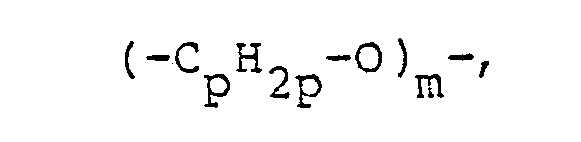
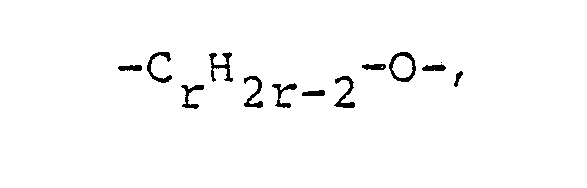


- R und R' Wasserstoffatome oder Methylgruppen,
- R" 0, S, CR2 oder SO2,
- Q eine Phenylgruppe oder eine der Gruppen


- Z 0 oder NR,
- n eine Zahl von 0 bis 20,
- m eine Zahl von 1 bis 40,
- p eine Zahl von 2 bis 20,
- q eine Zahl von 2 bis 10,
- r eine Zahl von 4 bis 20 und
- s eine Zahl von 2 bis 10
- Von den Verbindungen der Formel II werden diejenigen bevorzugt, bei denen n eine Zahl von 0 bis 20, insbesondere von 0 bis 10, ist.
- R und R' sind bevorzugt Methylgruppen.
- Von den zur Herstellung der polymerisierbaren Urethane verwendeten Diolkomponenten werden die Polyetherdiole, besonders die gesättigten Vertreter, bevorzugt. Y ist also vorzugsweise die Gruppe (-C pH2p -0) m-, wobei für p Werte von 2 bis 10, insbesondere von 2 bis 4, bevorzugt werden. Wenn ungesättigte Diole verwendet werden, haben diese je Dioleinheit vorzugsweise 4 bis 10 Kohlenstoffatome.
- Für bestimmte Zwecke, z. B. zur Erzielung bestimmter mechanischer Eigenschaften oder höherer Lichtempfindlichkeiten, kann es auch vorteilhaft sein, Polyesterdiole zu verwenden. Diese können in bekannter Weise aus Dicarbonsäure- und Dioleinheiten oder aus Hydroxycarbonsäureeinheiten aufgebaut sein. Dabei werden als Hydroxycarbonsäuren solche mit q = 3 bis 6 bevorzugt.
- Die Polyesterdiole aus Hydroxycarbonsäuren werden gewöhnlich aus Lactonen durch Ringöffnung mit einem Molekül H-aktiver Verbindung HO-CSH2s-Z-H hergestellt. Hierin hat s bevorzugt einen Wert von 2 bis 6, Z ist bevorzugt ein Sauerstoffatom.
- Allgemein sind Polyesterdiole mit Molekulargewichten im Bereich von etwa 500 bis 3000 gut geeignet.
- Die Herstellung der polymerisierbaren Di- bzw. Polyurethane erfolgt in an sich bekannter Weise, z. B. wie es in der US-PS 3 297 745, der DE-OS 20 64 079 und der DE-OS 28 22 190 beschrieben ist.
- Man setzt zunächst zur Herstellung des Glycerindiesters 1 Mol Glycidylacrylat oder Glycidylmethacrylat mit 1 Mol Acryl- oder Methacrylsäure um. Anschließend werden 2 Mol von diesem Reaktionsprodukt mit 1 Mol Diisocyanat umgesetzt. Das Diisocyanat ist dabei entweder monomer oder ein Reaktionsprodukt von monomerem Diisocyanat im überschuß mit Diolkomponente. Im letzteren Falle wird zuvor die Diolkomponente HO-Y-H mit dem gewünschten Überschuß an Diisocyanat umgesetzt. Dabei werden in der Regel polymerhomologe Gemische erhalten. Die Uneinheitlichkeit der Molekulargewichte der daraus erhaltenen Diisocyanate führt zu Produkten, die hochviskos und praktisch nicht kristallisierbar sind.
- Die Verbindungen der Formel II und ihre Herstellung und Anwendung sind ausführlich in der deutschen Patentanmeldung P 30 48 502 beschrieben.
- Die Gesamtmenge an polymerisierbaren Verbindungen in dem erfindungsgemäßen Gemisch beträgt im allgemeinen 20 bis 80, bevorzugt 30 bis 70 Gew.-%, der nichtflüchtigen Bestandteile des Gemisches.
- Als Photoinitiatoren eignen sich eine Vielzahl von Substanzen, beispielsweise Benzoin, Benzoinether, Mehrkernchinone, z. B. 2-Ethyl-anthrachinon; Acridinderivate, z. B. 9-Phenyl-acridin, 9-p-Methoxyphenyl-acridin, 9-Acetylamino-acridin, Benz(a)acridin; Phenazinderivate, z. B. 9,10-Dimethyl-benz(a)phenazin, 9-Methyl-benz(a)-phenazin, 10-Methoxy-benz(a)phenazin; Chinoxalinderivate, z. B. 6,4',4"-Trimethoxy-2,3-diphenyl-chinoxalin, 4',4"-Dimethoxy-2,3-diphenyl-5-aza-chinoxalin und Chinazolinderivate.
- Die Photoinitiatoren werden im allgemeinen in einer Menge von 0,1 bis 20 Gew.-%, bezogen auf die nicht flüchtigen Bestandteile des photopolymerisierbaren Gemischs, zugesetzt.
- Als Bindemittel werden natürliche oder synthetische Polymere verwendet, die in Wasser unlöslich und in wäßrig-alkalischen Lösungen löslich oder mindestens quellbar sind, da sich Schichten mit solchen Bindemitteln mit den bevorzugten wäßrig-alkalischen Entwicklern entwickeln lassen. Derartige Bindemittel können z. B. die folgenden Gruppen enthalten: -COOH, -PO3H2, -SO3H, -SO2NH2, -SO2-NH-CO- und dgl.. Als Beispiele hierfür seien genannt: Maleinatharze, Polymerisate aus N-(p-Tolyl- sulfonyl)-carbaminsäure-(ß-methacryloyloxy-ethyl)ester und Mischpolymerisate dieser und ähnlicher Monomerer mit anderen Monomeren, Styrol-Maleinsäureanhydrid-Mischpolymerisate, Methylmethacrylat-Methacrylsäure-Mischpolymerisate und Mischpolymerisate aus Methacrylsäure, Alkylmethacrylaten und Methylmethacrylat und/oder Styrol, Acrylnitril u. a., wie sie in den DE-OS 20 64 080 und 23 63 806 beschrieben sind.
- Die Menge des Bindemittels beträgt im allgemeinen 20 bis 80, vorzugsweise 30 bis 70 Gew.-% der Bestandteile des Gemischs.
- Das photopolymerisierbare Gemisch enthält außer Monomeren, Bindemitteln und Photoinitiatoren noch gegebenenfalls Stabilisatoren bzw. Inhibitoren zur Verhinderung der Dunkelpolymerisation der Monomeren, Wasserstoffdonatoren, Verbindungen zur Verminderung der Sauerstoffempfindlichkeit, Netzmittel, Weichmacher, sensitometrische Regler, Farbstoffe und farblose oder Farbpigmente.
- Als Wasserstoffdonatoren werden in der Hauptsache aliphatische Polyether verwendet. Gegebenenfalls kann diese Funktion auch vom Bindemittel oder von dem polymerisierbaren Monomeren übernommen werden, wenn diese labile Wasserstoffatome besitzen.
- Als Verbindungen zur Verminderung der Sauerstoffempfindlichkeit können mit Vorteil die in der DE-OS 29 44 866 beschriebenen Disulfide zugesetzt werden.
- Die Herstellung der lichtempfindlichen Materialien unter Verwendung des erfindungsgemäßen Gemischs erfolgt in bekannter Weise. Das Gemisch wird in einem Lösungsmittel aufgenommen und die Lösung bzw. Dispersion durch Gießen, Sprühen, Tauchen oder Antragen mit Walzen auf den vorgesehenen Träger als Film aufgebracht und anschließend getrocknet.
- Die Art des Schichtträgers richtet sich nach dem Verwendungszweck des lichtempfindlichen Materials.
- Neben Kupfer, Stahl, verchromtem Kupfer oder Stahl, Zink, Nickel, Aluminium und Aluminiumlegierungen können auch thermisch gewachsene oder abgeschiedene Siliciumdioxidschichten oder dotierte Oxidschichten, Kunststoffolien (Polyethylenterephthalat, Cellulcseacetat) oder Siebdruckträger (Perlongaze, Nickelsiebe) verwendet werden.
- Das erfindungsgemäße Gemisch ergibt photopolymerisierbare Schichten mit hoher Lichtempfindlichkeit. Die Schichten zeigen keine Klebe- oder Verprägungsneigung auch bei Schichtdicken bis zu 150 µm. Sie können mit wäßrig-alkalischen Lösungen entwickelt werden und zeigen eine ausgezeichnete Entwicklerresistenz. Das Verhältnis von Schichtdicke der photopolymerisierbaren Schicht zur Auflösung liegt bei.1:1 bis 1:2. Die Flanken der belichteten Schichtteile und damit auch der Metallaufbau sind bei Schichtdicken bis zu 110 um nahezu gerade und senkrecht.
- Die Bebilderung der Kopiermaterialien erfolgt in bekannter Weise, z. B. durch Kontaktbelichtung unter einer Transparentvorlage. Dabei werden die üblichen Lichtquellen, wie Kohlenbogenlampen, Xenonlampen, mit Metallhalogeniden dotierte Quecksilberhochdrucklampen und dgl. verwendet. Die Bebilderung kann auch mit Laserlicht erfolgen, z. B. mit einem Argon-Ionen-Laser.
- Die Entwicklung der belichteten Kopiermaterialien erfolgt in bekannter Weise durch Auswaschen der unbelichteten Schichtbereiche mit einem Entwickler. Geeignete Entwickler sind wäßrige Lösungen, die Puffersalze, z. B. Ammonium- oder Alkaliphosphate, -silikate, -hydroxide oder -carbonate; Netzmittel, Farbstoffe, ggf. mit Wasser mischbare organische Lösungsmittel und andere übliche Zusätze enthalten können, sowie wäßrige Lösungen von Netzmitteln.
- Die erfindungsgemäßen Gemische eignen sich für die Herstellung von Trockenresistfolien, Reliefbildern, Siebdruckschablonen und Farbprüffolien. Sie sind auch brauchbar als schnellhärtende Überzugsmassen, Zahnfüllmassen, Klebstoffe und zur Herstellung harter, thermostabiler Formkörper.
- Mit besonderem Vorteil werden die Gemische in gelöster Form zur Herstellung von Ätz- bzw. Galvanoschutzschichten auf metallischen Trägern verwendet. Vor allem sind sie zur Anwendung auf Trägern aus, Kupfer geeignet, wie sie z. B. zur Herstellung von kopierten Schaltungen und Tiefdruckformen verwendet werden. Sie lassen sich auch als vorgefertigte Trockenresistfolien mit Vorteil für die gleichen Anwendungen einsetzen.
- Die ausgezeichnete Haftung der belichteten Schichtteile bewährt sich bei diesen Anwendungsformen nicht nur während der Entwicklung, sondern auch während einer nachfolgenden Ätzung und galvanischen Verstärkung des Trägers, bei der die Schichten eine gute Resistenz zeigen.
- Das erfindungsgemäße Gemisch zeichnet sich bei Verwendung der als Zusatz bevorzugten Urethanmonomeren der Formel II durch eine besonders geringe Empfindlichkeit gegenüber Sauerstoff aus, die auch bei dünnen Schichten noch ausgeprägt ist. Die Schichten sind nach dem Trocknen der Lösung nicht klebrig und werden auch im Vakuumkontakt durch die Vorlage nicht verprägt. Es ist überraschend, daß diese Eigenschaft nur durch die oben beschriebenen polypropylenglykolester der Formel I erreicht wird. Bei Ersatz dieser Monomeren durch die gleiche oder die äquivalente Menge Polyethylenglykolbisacrylat oder -methacrylat wird eine klebrige Schicht erhalten.
- Das Gemisch kann in Schichtdicken von etwa 0,5 bis 150µm aufgebracht werden. Es zeigt auch in dieser Dicke eine hohe Lichtempfindlichkeit und ist trotzdem schnell mit alkalischen Lösungen entwickelbar bei guter Entwicklerresistenz. Es ist deshalb für die Herstellung von Galvanoschablonen einsetzbar. Die Flanken der belichteten Schichtteile und damit auch der Metallaufbau sind bei Schichtdicken bis zu 110µm nahezu gerade und senkrecht.
- In manchen Fällen kann es vorteilhaft sein, die Schicht vor dem Ätzen durch Einbrennen noch widerstandsfähiger zu machen.
- Die folgenden Beispiele erläutern Ausführungsformen des erfindungsgemäßen Gemischs und deren Verwendung zur Herstellung von photopolymerisierbaren Kopiermaterialien. Prozentangaben und Mengenverhältnisse sind, wenn nichts anderes angegeben ist, in Gewichtseinheiten zu verstehen.
- Eine Lösung von

- Nach der Belichtung wurde die Schicht mit 0,8 %iger Natriumcarbonatlösung in einem Sprühentwicklungsgerät 100 Sekunden lang entwickelt. Es wurden fünf bis sechs vollvernetzte Keilstufen erhalten.
- Die Platte wurde dann 30 Sekunden mit Leitungswasser gespült, 30 Sekunden in einer 15 %igen Ammoniumperoxydisulfat-Lösung angeätzt, erneut mit Wasser gespült, 30 Sekunden in 10 %ige Schwefelsäure getaucht und sodann nacheinander in den folgenden Elektrolytbädern galvanisiert:
- 1) 50 Minuten in einem Kupferelektrolytbad der Firma Schlötter, Geislingen/Steige, Typ "Glanzkupfer-Bad PC" Stromdichte: 2,5 A/dm 2 Metallaufbau: ca. 25 µm Temperatur: Raumtemperatur
- 2) 55 Minuten in einem Bleizinnbad LA der Firma Schlötter, Geislingen/Steige Stromdichte: 2 A/dm 2 Metallaufbau: 55 pm Temperatur: Raumtemperatur
- Die Platte zeigte keinerlei Unterwanderungen oder Beschädigungen.
- Der überhang bzw. die Neigung einer Flanke der Resistschicht betrug 7 µm bei einer Resistbahnbreite von 138 um, d. h. die Oberkante der Resistflanke ragte um 7 µm über die Unterkante hinaus.
- Die Platte konnte sodann in 5 %iger KOH-Lösung bei 50°C entschichtet und das freigelegte Kupfer in den üblichen Ätzmedien weggeätzt werden.
- Ersetzt man das Monomere durch das Dimethacrylat von Polyethylenglykol 400, durch Trimethylolethantriacrylat oder ein Umsetzungsprodukt aus 1 Mol 2,2,4-Trimethylhexamethylendiisocyanat und 2 Mol Hydroxyethylmethacrylat, so erhält man Schichten, von denen die Filmvorlage nach dem Belichten nur unter Beschädigung der Resistschicht durch Herausreißen von Schichtteilen entfernt werden kann.
- Wie in Beispiel 1 wurde eine kupferkaschierte Isolierstoffplatte beschichtet, getrocknet, belichtet und entwickelt. Die Platte wurde dann wie folgt galvanisiert:
- 1) 100 Minuten in dem in Beispiel 1 angegebenen Kupferelektrolytbad Stromdichte: 2,5 A/dm 2 Metallaufbau: ca. 50 um Temperatur: Raumtemperatur
- 2) 10 Minuten in einem Nickelbad der Firma Schlötter, Geislingen/Steige, Typ "Norma" Stromdichte: 4 A/dm 2 Metallaufbau: ca. 10 um Temperatur: 50°C
- 3) 12 Minuten in einem Goldbad der Firma Blasberg, Solingen, Typ "Autronex CC" Stromdichte: 1 A/dm 2 Metallaufbau: ca. 5 µm Temperatur: 40°C Auch diese Platte zeigte keine Unterwanderungen oder Beschädigungen.
- Die in Beispiel 1 beschriebene Resistlösung wurde auf eine mit 35 pm starker Kupferfolie kaschierte Phenoplast-Schichtstoffplatte aufgeschleudert und getrocknet (Schichtdicke 108 µm). Die Platte wurde 8 Sekunden belichtet und dann 140 Sekunden mit 0,8 %iger Natriumcarbonat-Lösung entwickelt. Es wurden 6 vollvernetzte . Keilstufen erhalten.
- Nach der in Beispiel 1 beschriebenen Vorbehandlung wurde die Platte wie folgt galvanisiert:
- 180 Minuten in dem in Beispiel 2 angegebenen Nickelbad Stromdichte: 4 A/dm 2 Metallaufbau: 180 µm Temperatur: 50°C
- Auch diese Platte zeigte keinerlei Unterwanderungen oder Beschädigungen und ließ sich mit KOH-Lösung entschichent und mit üblichen Ätzmitteln ätzen.
- Es wurde ein Überhang der einseitigen Resistflanke von 13 µm bei einer Resistbahnbreite von 138 um ermittelt.
- 100 ml der Photoresistlösung aus Beispiel 1 wurden mit 25 ml Butanon und 25 ml Ethylenglykolmonoethylether verdünnt.
- Mit Hilfe einer Mettenheimer Zylindersprühanlage wurde eine Resistschicht auf 10 µm dick vorvernickeltes'0,2 mm starkes Messingblech aufgebracht. Die Resistschicht wurde sofort nach dem Aufbringen 10 Minuten lang mit einem Infrarotstrahler (1.200 W) mit 20 cm Abstand zur Schicht getrocknet. Die Schichtdicke betrug 70 µm. Es wurde 50 Sekunden mit einer 400-W-Lampe belichtet und dann mit 0,8 %iger Natriumcarbonat-Lösung entwickelt. Die Entwicklungszeit betrug 80 Sekunden, die Resistenzzeit 7 Minuten. Die Auflösung lag bei etwa 65 µm.
- Die Versuchsplatte wurde 3 Minuten in 2 %iger Kaliumbichromatlösung passiviert und nach einer Wasserspülung (30 Sekunden) bei 3 A/dm2 2 Stunden bzw. 3 Stunden vernickelt. Dabei wurden 70 um bzw. 110 pm Nickel abgeschieden.
- Die Nickel-Galvanoschablone wurde entfernt und die Resistschablone anschließend mit Aceton abgelöst.
- Auf einen mit 17 um dicker Kupferfolie kaschierten Phenoplast-Schichtstoffträger wurde eine Lösung folgender Zusammensetzung so aufgeschleudert, daß nach den Trocknen eine Schichtdicke von 5 µm erhalten wurde:
-

- Die Platte wurde 20 Sekunden mit einer 5 kW-Metallhalogenidlampe belichtet. Als Vorlage diente sowohl ein Tiefdruckraster (Stegbreite 36 µm) als auch eine Itek-Testvorlage (Elemente von 2 - 500 µm). Es wurde 35 Sekunden mit 0,8 %iger Natriumcarbonat-Lösung entwickelt.
- Die Auflösung nach dem Entwickeln lag bei etwa 10 um, die Stegbreite des Tiefdruckrasters betrug 48 µm.
- Nach dem Ätzen mit Eisen-III-chlorid-Lösung bei 40°C (65 Sekunden) wurden Raster-Stegbreiten von 12 µm, gemessen an der Oberkante, und 33 um an der Unterkante erhalten.
- Es wurden Lösungen wie in Beispiel 5 bereitet, die an Stelle der dort eingesetzten Menge Polypropylenglykol-420-dimethacrylat (PPG-420-DMA) Mischungen dieses Dimethacrylats mit anderen di- bzw. polyfunktionellen Methacrylaten oder Acrylaten enthielten.

- Eine Lösung von

- Die so hergestellte Trockenresistfolie wurde mit einer handelsüblichen Laminiervorrichtung bei 120°C auf eine vorgewärmte, mit 35/um starker Kupferfolie kaschierte Phenoplast-Schichtstoffplatte laminiert und 4 Sekunden mit einem handelsüblichen Belichtungsgerät belichtet. Als Vorlage diente eine Strichvorlage mit Linienbreiten und Abständen bis herab zu 80/um.
- Nach der Belichtung wurde die Polyesterfolie abgezogen und die Schicht mit 0,8 %iger Natriumcarbonatlösung in einem Sprühentwicklungsgerät 90 Sekunden lang entwickelt.
- Die Platte wurde dann, wie in Beispiel 1 beschrieben, weiter behandelt und galvanisiert, jedoch wurde in dem Bleizinnbad 20 Minuten bei 1 A/dm2 behandelt, und der erhaltene Metallaufbau betrug 10/um.
- Die Platte zeigte keinerlei Unterwanderungen oder Beschädigungen. Die Farbe des Resists war unverändert. Die Platte konnte dann in 5 %iger KOH-Lösung bei 50°C entschichtet und das freigelegte Kupfer in den üblichen Ätzmedien weggeätzt werden.
- Eine Resistschicht, die anstelle des oben angegebenen Monomerengemischs 3,2 Gt Polyethylenglykol-400-dimethacrylat enthielt, zeigte nach der Bleizinn-Galvanik, insbesondere in Bädern mit hohem Fluoroborsäuregehalt (300 g/1), eine deutliche Goldverfärbung, verbunden mit einer gewissen Versprödung.
- Das verwendete Elastomere wurde wie folgt hergestellt:
- A. In einem 1-Liter-Vierhalskolben, ausgerüstet mit Rührer, Thermometer, Rückflußkühler und Trockenrohr, wurden 426 Gt Glycidylmethacrylat und 216 Gt Adipinsäure durch Rühren vermischt und nach Zugabe von 19,7 Gt p-Methoxy-phenol und 6,4 Gt Benzyl-triethylammoniumchlorid vorsichtig auf eine Innentemperatur von 30°C erhitzt. Nach ca. 2 Stunden wurde eine klare Lösung erhalten, die noch 14 Stunden bei 80°C gehalten wurde. Der Gehalt an freiem Glycidylmethacrylat war nach dieser Zeit kleiner als 0,5 %.
- B. In einen mit Rührer, Thermometer, Tropftrichter, Kühler und Trockenrohr bestückten 1-Liter-Vierhalskolben wurden 143 Gt eines oligomeren Diisocyanats aus Tolylendiisocyanat und Poly-l,4-butandiol mit einem mittleren Molekulargewicht um 2000 und einem Isocyanatgruppengehalt von 4,1 Gew.-% (Adiprene L 100), gelöst in 300 Vt Methylethylketon, gegeben und mit 0,87 Gt Benzochinon und 0,85 Vt einer Lösung versetzt, die durch Lösen von 6,3 Gt Eisen-III-acetylacetonat und 0,45 Gt Triethylamin in Methylethylketon und Auffüllen mit Methylethylketon auf 100 Vt hergestellt wurde. In den Tropftrichter wurde eine Lösung von 31,33 Gt des nach A erhaltenen Umsetzungsproduktes in 300 Vt Methyl-ethylketon gefüllt und der auf 70°C erhitzten und gerührten Lösung im Kolben innerhalb 40 Minuten zugetropft. Nach zweistündigem Nachrühren bei 30°C wurden dem klaren Reaktionsgemisch 10 Vt Ethanol zugesetzt. Durch Abdestillieren des Lösemittels wurde aus der viskosen Lösung eine nicht klebende kautschukartige Masse erhalten, die in zahlreichen organischen Lösungsmitteln, wie Tetrahydrofuran, Aceton oder Toluol klar löslich war. Die reduzierte spezifische Viskosität des Produkts betrug 0,72 dl/g (gemessen an einer l%igen Lösung in Dimethylformamid bei 25°C).
enthält.
ist.
bedeutet.
Claims (7)
enthält,
dadurch gekennzeichnet, daß das Polyglykoldiacrylat bzw. -dimethacrylat eine Verbindung der Formel I

ist.
enthält, dadurch gekennzeichnet, daß das Polyglykoldiacrylat bzw. -dimethacrylat eine Verbindung der Formel I

ist.
Priority Applications (1)
| Application Number | Priority Date | Filing Date | Title |
|---|---|---|---|
| AT82104185T ATE17792T1 (de) | 1981-05-20 | 1982-05-13 | Durch strahlung polymerisierbares gemisch und damit hergestelltes kopiermaterial. |
Applications Claiming Priority (2)
| Application Number | Priority Date | Filing Date | Title |
|---|---|---|---|
| DE19813120052 DE3120052A1 (de) | 1981-05-20 | 1981-05-20 | Durch strahlung polymerisierbares gemisch und damit hergestelltes kopiermaterial |
| DE3120052 | 1981-05-20 |
Publications (3)
| Publication Number | Publication Date |
|---|---|
| EP0065285A2 true EP0065285A2 (de) | 1982-11-24 |
| EP0065285A3 EP0065285A3 (en) | 1983-02-16 |
| EP0065285B1 EP0065285B1 (de) | 1986-01-29 |
Family
ID=6132792
Family Applications (1)
| Application Number | Title | Priority Date | Filing Date |
|---|---|---|---|
| EP82104185A Expired EP0065285B1 (de) | 1981-05-20 | 1982-05-13 | Durch Strahlung polymerisierbares Gemisch und damit hergestelltes Kopiermaterial |
Country Status (8)
| Country | Link |
|---|---|
| US (1) | US4495271A (de) |
| EP (1) | EP0065285B1 (de) |
| JP (1) | JPS57196231A (de) |
| KR (1) | KR880001434B1 (de) |
| AT (1) | ATE17792T1 (de) |
| DE (2) | DE3120052A1 (de) |
| HK (1) | HK65887A (de) |
| SG (1) | SG33687G (de) |
Cited By (9)
| Publication number | Priority date | Publication date | Assignee | Title |
|---|---|---|---|---|
| EP0155652A3 (en) * | 1984-03-17 | 1986-07-30 | E.I. Du Pont De Nemours And Company | Photopolymerizable mixture and recording material produced from it |
| EP0152889A3 (en) * | 1984-02-18 | 1986-08-06 | Basf Aktiengesellschaft | Photosensitive recording material |
| EP0186844A3 (en) * | 1984-12-24 | 1986-08-27 | Basf Aktiengesellschaft | Light-sensitive registration material |
| EP0249468A3 (en) * | 1986-06-10 | 1988-09-07 | Mitsubishi Chemical Industries Limited | Photopolymerizable composition |
| EP0382524A3 (de) * | 1989-02-09 | 1990-12-05 | Mitsubishi Rayon Co., Ltd. | Durch Vernetzung härtbare Harzzusammensetzung |
| EP0429279A1 (de) * | 1989-11-17 | 1991-05-29 | Mitsubishi Rayon Co., Ltd. | Fotovernetzbare Harzzusammensetzungen und ihre Verwendung bei der Herstellung von Trockenfilm-Resisten |
| EP0606117A3 (en) * | 1987-10-30 | 1996-06-12 | Mhb Joint Venture | Compositions useful for forming interpenetrating polymeric networks. |
| US5679485A (en) * | 1993-03-31 | 1997-10-21 | Nippon Zeon Co., Ltd. | Photosensitive composition, photosensitive rubber plate and process for producing same, and flexographic plate and process for producing same |
| WO2006089988A1 (es) * | 2005-02-24 | 2006-08-31 | Mobile Safe Data Services, Sl | Cápsula para botellas y botella |
Families Citing this family (192)
| Publication number | Priority date | Publication date | Assignee | Title |
|---|---|---|---|---|
| DE3605717A1 (de) * | 1985-02-28 | 1986-08-28 | Hoechst Celanese Corp., Somerville, N.J. | Durch strahlung polymerisierbares gemisch |
| US4690501A (en) * | 1985-07-08 | 1987-09-01 | Desoto, Inc. | Ultraviolet curable optical glass fiber coatings from acrylate terminated, end-branched polyurethane polyurea oligomers |
| US4690502A (en) * | 1985-07-08 | 1987-09-01 | Desoto, Inc. | Ultraviolet curable optical glass fiber coatings from acrylate terminated, end-branched polyurethane polyurea oligomers |
| US4806574A (en) * | 1985-07-22 | 1989-02-21 | Desoto, Inc. | Ultraviolet curable coatings for optical glass fiber based on a polyfunctional core |
| US4798852A (en) * | 1985-10-29 | 1989-01-17 | Desoto, Inc. | Ultraviolet curable coatings for optical glass fiber |
| DE3710282A1 (de) * | 1987-03-28 | 1988-10-13 | Hoechst Ag | Photopolymerisierbares gemisch und daraus hergestelltes aufzeichnungsmaterial |
| DE3710281A1 (de) * | 1987-03-28 | 1988-10-06 | Hoechst Ag | Photopolymerisierbares gemisch und daraus hergestelltes aufzeichnungsmaterial |
| US5190992A (en) * | 1987-05-13 | 1993-03-02 | Denki Kagaku Kogyo Kabushiki Kaisha | Photocurable resin composition for glass lamination |
| US5461086A (en) * | 1987-05-13 | 1995-10-24 | Denki Kagaku Kogyo Kabushiki Kaisha | Photocurable resin composition for glass lamination, laminated glass product and process for its production |
| JPS6456442A (en) * | 1987-08-27 | 1989-03-03 | Okamoto Kagaku Kogyo Kk | Production of printing plate |
| DE3743457A1 (de) * | 1987-12-22 | 1989-07-06 | Hoechst Ag | Photopolymerisierbares gemisch und daraus hergestelltes aufzeichnungsmaterial |
| DE3832032A1 (de) * | 1988-09-21 | 1990-03-22 | Hoechst Ag | Photopolymerisierbares gemisch und daraus hergestelltes aufzeichnungsmaterial |
| DE3931467A1 (de) * | 1989-09-21 | 1991-04-04 | Hoechst Ag | Durch strahlung polymerisierbares gemisch und verfahren zur herstellung einer loetstopmaske |
| US6214522B1 (en) * | 1998-08-28 | 2001-04-10 | Macdermid, Incorporated | Photosensitive resin composition useful in fabricating printing plates |
| JP4130030B2 (ja) | 1999-03-09 | 2008-08-06 | 富士フイルム株式会社 | 感光性組成物および1,3−ジヒドロ−1−オキソ−2h−インデン誘導体化合物 |
| KR100493961B1 (ko) * | 1999-08-17 | 2005-06-10 | 주식회사 엘지화학 | 감광성 수지 조성물 |
| JP4132707B2 (ja) | 2001-03-29 | 2008-08-13 | 富士フイルム株式会社 | 画像記録材料 |
| JP2003302770A (ja) | 2002-02-08 | 2003-10-24 | Fuji Photo Film Co Ltd | 画像形成方法 |
| JP4137577B2 (ja) | 2002-09-30 | 2008-08-20 | 富士フイルム株式会社 | 感光性組成物 |
| EP1464486B1 (de) | 2003-03-26 | 2009-06-17 | FUJIFILM Corporation | Flachdruckverfahren und vorsensibilisierte Platte |
| JP4291638B2 (ja) | 2003-07-29 | 2009-07-08 | 富士フイルム株式会社 | アルカリ可溶性ポリマー及びそれを用いた平版印刷版原版 |
| US20050153239A1 (en) | 2004-01-09 | 2005-07-14 | Fuji Photo Film Co., Ltd. | Lithographic printing plate precursor and lithographic printing method using the same |
| JP2005231255A (ja) | 2004-02-20 | 2005-09-02 | Fuji Photo Film Co Ltd | 平版印刷方法及びそれに用いる平版印刷版原版 |
| US20070144384A1 (en) | 2004-05-19 | 2007-06-28 | Fuji Photo Film Co., Ltd | Image recording method |
| EP1602982B1 (de) | 2004-05-31 | 2013-12-18 | FUJIFILM Corporation | Flachdruckverfahren |
| JP4452572B2 (ja) | 2004-07-06 | 2010-04-21 | 富士フイルム株式会社 | 感光性組成物およびそれを用いた画像記録方法 |
| ATE398298T1 (de) | 2004-07-20 | 2008-07-15 | Fujifilm Corp | Bilderzeugendes material |
| US7425406B2 (en) | 2004-07-27 | 2008-09-16 | Fujifilm Corporation | Lithographic printing plate precursor and lithographic printing method |
| ATE389900T1 (de) | 2004-08-24 | 2008-04-15 | Fujifilm Corp | Verfahren zur herstellung einer lithographischen druckplatte |
| JP4607521B2 (ja) | 2004-08-25 | 2011-01-05 | コダック株式会社 | 平版印刷版原版の現像処理方法及び装置 |
| JP2006062188A (ja) | 2004-08-26 | 2006-03-09 | Fuji Photo Film Co Ltd | 色画像形成材料及び平版印刷版原版 |
| JP4429116B2 (ja) | 2004-08-27 | 2010-03-10 | 富士フイルム株式会社 | 平版印刷版原版及び平版印刷版の製版方法 |
| JP2006068963A (ja) | 2004-08-31 | 2006-03-16 | Fuji Photo Film Co Ltd | 重合性組成物、それを用いた親水性膜、及び、平版印刷版原版 |
| JP5089866B2 (ja) | 2004-09-10 | 2012-12-05 | 富士フイルム株式会社 | 平版印刷方法 |
| US20060150846A1 (en) | 2004-12-13 | 2006-07-13 | Fuji Photo Film Co. Ltd | Lithographic printing method |
| JP2006181838A (ja) | 2004-12-27 | 2006-07-13 | Fuji Photo Film Co Ltd | 平版印刷版原版 |
| EP1685957B1 (de) | 2005-01-26 | 2013-12-11 | FUJIFILM Corporation | Flachdruckverfahrenstapel |
| EP1696268B1 (de) | 2005-02-28 | 2016-11-09 | FUJIFILM Corporation | Flachdruckplattenvorläufer |
| EP1701213A3 (de) | 2005-03-08 | 2006-11-22 | Fuji Photo Film Co., Ltd. | Lichtempfindliche Zusammensetzung |
| JP4538350B2 (ja) | 2005-03-18 | 2010-09-08 | 富士フイルム株式会社 | 感光性組成物および画像記録材料並びに画像記録方法 |
| JP4574506B2 (ja) | 2005-03-23 | 2010-11-04 | 富士フイルム株式会社 | 平版印刷版原版、及びその製版方法 |
| JP4524235B2 (ja) | 2005-03-29 | 2010-08-11 | 富士フイルム株式会社 | 平版印刷版原版 |
| JP4474317B2 (ja) | 2005-03-31 | 2010-06-02 | 富士フイルム株式会社 | 平版印刷版の作製方法 |
| JP4792326B2 (ja) | 2005-07-25 | 2011-10-12 | 富士フイルム株式会社 | 平版印刷版の作製方法および平版印刷版原版 |
| JP4815270B2 (ja) | 2005-08-18 | 2011-11-16 | 富士フイルム株式会社 | 平版印刷版の作製方法及び作製装置 |
| JP4759343B2 (ja) | 2005-08-19 | 2011-08-31 | 富士フイルム株式会社 | 平版印刷版原版および平版印刷方法 |
| JP4694324B2 (ja) | 2005-09-09 | 2011-06-08 | 富士フイルム株式会社 | 感光性平版印刷版の製造方法 |
| JP5171005B2 (ja) | 2006-03-17 | 2013-03-27 | 富士フイルム株式会社 | 高分子化合物およびその製造方法、並びに顔料分散剤 |
| JP4777226B2 (ja) | 2006-12-07 | 2011-09-21 | 富士フイルム株式会社 | 画像記録材料、及び新規化合物 |
| US8771924B2 (en) | 2006-12-26 | 2014-07-08 | Fujifilm Corporation | Polymerizable composition, lithographic printing plate precursor and lithographic printing method |
| JP2008163081A (ja) | 2006-12-27 | 2008-07-17 | Fujifilm Corp | レーザー分解性樹脂組成物およびそれを用いるパターン形成材料ならびにレーザー彫刻型フレキソ印刷版原版 |
| JP4945432B2 (ja) | 2006-12-28 | 2012-06-06 | 富士フイルム株式会社 | 平版印刷版の作製方法 |
| EP2447780B1 (de) | 2007-01-17 | 2013-08-28 | Fujifilm Corporation | Verfahren zur Herstellung einer Lithographiedruckplatte |
| JP4881756B2 (ja) | 2007-02-06 | 2012-02-22 | 富士フイルム株式会社 | 感光性組成物、平版印刷版原版、平版印刷方法、及び新規シアニン色素 |
| ATE471812T1 (de) | 2007-03-23 | 2010-07-15 | Fujifilm Corp | Negativ-lithografiedruckplattenvorläufer und lithografiedruckverfahren damit |
| JP4860525B2 (ja) | 2007-03-27 | 2012-01-25 | 富士フイルム株式会社 | 硬化性組成物及び平版印刷版原版 |
| JP2008238711A (ja) | 2007-03-28 | 2008-10-09 | Fujifilm Corp | 親水性部材及び下塗り組成物 |
| EP1974914B1 (de) | 2007-03-29 | 2014-02-26 | FUJIFILM Corporation | Verfahren zur Herstellung einer Lithographiedruckplatte |
| JP5030638B2 (ja) | 2007-03-29 | 2012-09-19 | 富士フイルム株式会社 | カラーフィルタ及びその製造方法 |
| EP1975710B1 (de) | 2007-03-30 | 2013-10-23 | FUJIFILM Corporation | Plattenherstellungsverfahren eines Lithografiedruckplattenvorläufers |
| EP1975706A3 (de) | 2007-03-30 | 2010-03-03 | FUJIFILM Corporation | Lithografiedruckplattenvorläufer |
| JP5046744B2 (ja) | 2007-05-18 | 2012-10-10 | 富士フイルム株式会社 | 平版印刷版原版、及びそれを用いた印刷方法 |
| EP2006738B1 (de) | 2007-06-21 | 2017-09-06 | Fujifilm Corporation | Lithographiedruckplattenvorläufer |
| EP2006091B1 (de) | 2007-06-22 | 2010-12-08 | FUJIFILM Corporation | Lithographiedruckplattenvorläufer und Plattenherstellungsverfahren |
| US8221957B2 (en) | 2007-07-02 | 2012-07-17 | Fujifilm Corporation | Planographic printing plate precursor and printing method using the same |
| JP5213375B2 (ja) | 2007-07-13 | 2013-06-19 | 富士フイルム株式会社 | 顔料分散液、硬化性組成物、それを用いるカラーフィルタ及び固体撮像素子 |
| KR101412719B1 (ko) | 2007-07-17 | 2014-06-26 | 후지필름 가부시키가이샤 | 감광성 조성물, 경화성 조성물, 신규 화합물, 광중합성조성물, 컬러 필터, 및, 평판 인쇄판 원판 |
| JP2009069761A (ja) | 2007-09-18 | 2009-04-02 | Fujifilm Corp | 平版印刷版の製版方法 |
| JP2009091555A (ja) | 2007-09-18 | 2009-04-30 | Fujifilm Corp | 硬化性組成物、画像形成材料及び平版印刷版原版 |
| KR20100061730A (ko) | 2007-09-19 | 2010-06-08 | 후지필름 가부시키가이샤 | 아세틸렌 화합물, 그 염, 그 축합물 및 그 조성물 |
| JP2009083106A (ja) | 2007-09-27 | 2009-04-23 | Fujifilm Corp | 平版印刷版用版面保護剤及び平版印刷版の製版方法 |
| EP2042311A1 (de) | 2007-09-28 | 2009-04-01 | FUJIFILM Corporation | Lithographiedruckplattenvorläufer, Verfahren zur Herstellung einer Lithographiedruckplatte und Lithographiedruckverfahren |
| JP4951454B2 (ja) | 2007-09-28 | 2012-06-13 | 富士フイルム株式会社 | 平版印刷版の作成方法 |
| JP5244518B2 (ja) | 2007-09-28 | 2013-07-24 | 富士フイルム株式会社 | 平版印刷版原版及び平版印刷版の作製方法 |
| EP2042928B1 (de) | 2007-09-28 | 2010-07-28 | FUJIFILM Corporation | Negatives lichtempfindliches Material und negativer planographischer Druckplattenvorläufer |
| JP5002399B2 (ja) | 2007-09-28 | 2012-08-15 | 富士フイルム株式会社 | 平版印刷版原版の処理方法 |
| JP5055077B2 (ja) | 2007-09-28 | 2012-10-24 | 富士フイルム株式会社 | 画像形成方法および平版印刷版原版 |
| JP4890408B2 (ja) | 2007-09-28 | 2012-03-07 | 富士フイルム株式会社 | 重合性組成物及びそれを用いた平版印刷版原版、アルカリ可溶性ポリウレタン樹脂、並びに、ジオール化合物の製造方法 |
| JP4994175B2 (ja) | 2007-09-28 | 2012-08-08 | 富士フイルム株式会社 | 平版印刷版原版、及びそれに用いる共重合体の製造方法 |
| JP5322537B2 (ja) | 2007-10-29 | 2013-10-23 | 富士フイルム株式会社 | 平版印刷版原版 |
| JP5448416B2 (ja) | 2007-10-31 | 2014-03-19 | 富士フイルム株式会社 | 着色硬化性組成物、カラーフィルタ及びその製造方法、ならびに固体撮像素子 |
| CN101430505B (zh) | 2007-11-08 | 2013-04-17 | 富士胶片株式会社 | 激光雕刻用树脂组合物、激光雕刻用树脂印刷版原版、凸版印刷版以及制备凸版印刷版的方法 |
| WO2009063824A1 (ja) | 2007-11-14 | 2009-05-22 | Fujifilm Corporation | 塗布膜の乾燥方法及び平版印刷版原版の製造方法 |
| JP2009139852A (ja) | 2007-12-10 | 2009-06-25 | Fujifilm Corp | 平版印刷版の作製方法及び平版印刷版原版 |
| JP2009186997A (ja) | 2008-01-11 | 2009-08-20 | Fujifilm Corp | 平版印刷版原版、平版印刷版の作製方法及び平版印刷版方法 |
| JP5155677B2 (ja) | 2008-01-22 | 2013-03-06 | 富士フイルム株式会社 | 平版印刷版原版、およびその製版方法 |
| JP5500831B2 (ja) | 2008-01-25 | 2014-05-21 | 富士フイルム株式会社 | レリーフ印刷版の作製方法及びレーザー彫刻用印刷版原版 |
| JP5241252B2 (ja) | 2008-01-29 | 2013-07-17 | 富士フイルム株式会社 | レーザー彫刻用樹脂組成物、レーザー彫刻用レリーフ印刷版原版、レリーフ印刷版及びレリーフ印刷版の製造方法 |
| JP5371449B2 (ja) | 2008-01-31 | 2013-12-18 | 富士フイルム株式会社 | 樹脂、顔料分散液、着色硬化性組成物、これを用いたカラーフィルタ及びその製造方法 |
| JP2009184188A (ja) | 2008-02-05 | 2009-08-20 | Fujifilm Corp | 平版印刷版原版および印刷方法 |
| JP5150287B2 (ja) | 2008-02-06 | 2013-02-20 | 富士フイルム株式会社 | 平版印刷版の作製方法及び平版印刷版原版 |
| JP5137618B2 (ja) | 2008-02-28 | 2013-02-06 | 富士フイルム株式会社 | レーザー彫刻用樹脂組成物、レーザー彫刻用レリーフ印刷版原版、レリーフ印刷版及びレリーフ印刷版の製造方法 |
| EP2095970A1 (de) | 2008-02-29 | 2009-09-02 | Fujifilm Corporation | Harzzusammensetzung für die Lasergravur, Harzdruckplattenvorläufer für die Lasergravur, Reliefdruckplatte und Verfahren zur Herstellung der Reliefdruckplatte |
| JP5448352B2 (ja) | 2008-03-10 | 2014-03-19 | 富士フイルム株式会社 | 着色硬化性組成物、カラーフィルタ、及び、固体撮像素子 |
| JP5175582B2 (ja) | 2008-03-10 | 2013-04-03 | 富士フイルム株式会社 | 平版印刷版の作製方法 |
| JP2009214428A (ja) | 2008-03-11 | 2009-09-24 | Fujifilm Corp | 平版印刷版原版および平版印刷方法 |
| KR101671249B1 (ko) | 2008-03-17 | 2016-11-01 | 후지필름 가부시키가이샤 | 착색 감광성 조성물, 컬러필터, 액정표시소자, 및 고체촬상소자 |
| JP5334624B2 (ja) | 2008-03-17 | 2013-11-06 | 富士フイルム株式会社 | 着色硬化性組成物、カラーフィルタ、及びカラーフィルタの製造方法 |
| KR20090100262A (ko) | 2008-03-18 | 2009-09-23 | 후지필름 가부시키가이샤 | 감광성 수지 조성물, 차광성 컬러필터와 그 제조 방법, 및 고체촬상소자 |
| JP5305704B2 (ja) | 2008-03-24 | 2013-10-02 | 富士フイルム株式会社 | 新規化合物、光重合性組成物、カラーフィルタ用光重合性組成物、カラーフィルタ、及びその製造方法、固体撮像素子、並びに、平版印刷版原版 |
| JP5422146B2 (ja) | 2008-03-25 | 2014-02-19 | 富士フイルム株式会社 | 平版印刷版作成用処理液および平版印刷版原版の処理方法 |
| JP2009258705A (ja) | 2008-03-25 | 2009-11-05 | Fujifilm Corp | 平版印刷版原版 |
| JP2009236942A (ja) | 2008-03-25 | 2009-10-15 | Fujifilm Corp | 平版印刷版原版及びその製版方法 |
| JP2009236355A (ja) | 2008-03-26 | 2009-10-15 | Fujifilm Corp | 乾燥方法及び装置 |
| EP2259137B1 (de) | 2008-03-27 | 2016-08-31 | FUJIFILM Corporation | Verfahren zur herstellung einer lithografieplatte |
| JP5183268B2 (ja) | 2008-03-27 | 2013-04-17 | 富士フイルム株式会社 | 平版印刷版原版 |
| EP2105298B1 (de) | 2008-03-28 | 2014-03-19 | FUJIFILM Corporation | Negativ arbeitender Lithografiedruckplattenvorläufer und Lithografiedruckverfahren damit |
| JP5173528B2 (ja) | 2008-03-28 | 2013-04-03 | 富士フイルム株式会社 | 感光性樹脂組成物、遮光性カラーフィルター及びその製造方法、並びに、固体撮像素子 |
| JP2009244421A (ja) | 2008-03-28 | 2009-10-22 | Fujifilm Corp | 平版印刷版の製版方法 |
| JP5322575B2 (ja) | 2008-03-28 | 2013-10-23 | 富士フイルム株式会社 | レーザー彫刻用樹脂組成物、画像形成材料、レーザー彫刻用レリーフ印刷版原版、レリーフ印刷版、及びレリーフ印刷版の製造方法 |
| JP5305793B2 (ja) | 2008-03-31 | 2013-10-02 | 富士フイルム株式会社 | レリーフ印刷版及びレリーフ印刷版の製造方法 |
| JP5528677B2 (ja) | 2008-03-31 | 2014-06-25 | 富士フイルム株式会社 | 重合性組成物、固体撮像素子用遮光性カラーフィルタ、固体撮像素子および固体撮像素子用遮光性カラーフィルタの製造方法 |
| JP4914864B2 (ja) | 2008-03-31 | 2012-04-11 | 富士フイルム株式会社 | 平版印刷版の作製方法 |
| EP2110261B1 (de) | 2008-04-18 | 2018-03-28 | FUJIFILM Corporation | Aluminiumlegierungsplatte für eine lithographische Druckplatte, lithographische Druckplattenträger, Druckplattenvorläufer, Verfahren zur Herstellung einer Aluminiumlegierungsplatte für eine lithographische Druckplatte und Verfahren zur Herstellung eines lithographischen Druckplatteträgers |
| KR101441998B1 (ko) | 2008-04-25 | 2014-09-18 | 후지필름 가부시키가이샤 | 중합성 조성물, 차광성 컬러필터, 흑색 경화성 조성물, 고체촬상소자용 차광성 컬러필터와 그 제조 방법, 및 고체촬상소자 |
| JP5222624B2 (ja) | 2008-05-12 | 2013-06-26 | 富士フイルム株式会社 | 黒色感光性樹脂組成物、及びカラーフィルタ並びにその製造方法 |
| JP5171506B2 (ja) | 2008-06-30 | 2013-03-27 | 富士フイルム株式会社 | 新規化合物、重合性組成物、カラーフィルタ、及びその製造方法、固体撮像素子、並びに、平版印刷版原版 |
| JP5296434B2 (ja) | 2008-07-16 | 2013-09-25 | 富士フイルム株式会社 | 平版印刷版用原版 |
| JP5444933B2 (ja) | 2008-08-29 | 2014-03-19 | 富士フイルム株式会社 | ネガ型平版印刷版原版及びそれを用いる平版印刷方法 |
| JP5364513B2 (ja) | 2008-09-12 | 2013-12-11 | 富士フイルム株式会社 | 平版印刷版原版用現像液及び平版印刷版の製造方法 |
| JP5398282B2 (ja) | 2008-09-17 | 2014-01-29 | 富士フイルム株式会社 | レーザー彫刻用樹脂組成物、レーザー彫刻用レリーフ印刷版原版、レリーフ印刷版の製造方法、及びレリーフ印刷版 |
| JP5466462B2 (ja) | 2008-09-18 | 2014-04-09 | 富士フイルム株式会社 | 平版印刷版原版、平版印刷版の製造方法及び平版印刷版 |
| JP5449898B2 (ja) | 2008-09-22 | 2014-03-19 | 富士フイルム株式会社 | 平版印刷版原版、及びそれを用いた印刷方法 |
| JP2010097175A (ja) | 2008-09-22 | 2010-04-30 | Fujifilm Corp | 平版印刷版の作製方法及び平版印刷版原版 |
| JP5408942B2 (ja) | 2008-09-22 | 2014-02-05 | 富士フイルム株式会社 | 平版印刷版原版および製版方法 |
| US8151705B2 (en) | 2008-09-24 | 2012-04-10 | Fujifilm Corporation | Method of preparing lithographic printing plate |
| BRPI0918828A2 (pt) | 2008-09-24 | 2018-04-24 | Fujifilm Corporation | método de preparação de placa de impressão litográfica |
| JP2010102322A (ja) | 2008-09-26 | 2010-05-06 | Fujifilm Corp | 平版印刷版の製版方法 |
| JP5171514B2 (ja) | 2008-09-29 | 2013-03-27 | 富士フイルム株式会社 | 着色硬化性組成物、カラーフィルタ、及びカラーフィルタの製造方法 |
| JP5660268B2 (ja) | 2008-09-30 | 2015-01-28 | 富士フイルム株式会社 | 平版印刷版原版、平版印刷版の製版方法及び重合性モノマー |
| JP5127651B2 (ja) | 2008-09-30 | 2013-01-23 | 富士フイルム株式会社 | 着色硬化性組成物、カラーフィルタ及びその製造方法、並びに固体撮像素子 |
| JP5140540B2 (ja) | 2008-09-30 | 2013-02-06 | 富士フイルム株式会社 | 平版印刷版原版および平版印刷版の作製方法 |
| JP5340102B2 (ja) | 2008-10-03 | 2013-11-13 | 富士フイルム株式会社 | 分散組成物、重合性組成物、遮光性カラーフィルタ、固体撮像素子、液晶表示装置、ウェハレベルレンズ、及び撮像ユニット |
| US20120021358A1 (en) | 2008-11-26 | 2012-01-26 | Fujifilm Corporation | Process for making lithographic printing plate, developer for lithographic printing plate precursor, and replenisher for lithographic printing plate precursor development |
| CN102264537B (zh) | 2008-12-26 | 2014-07-16 | 富士胶片株式会社 | 表面金属膜材料、表面金属膜材料的制作方法、金属图案材料的制作方法及金属图案材料 |
| EP2204698B1 (de) | 2009-01-06 | 2018-08-08 | FUJIFILM Corporation | Plattenoberflächenbehandlungsmittel für eine lithografische Druckplatte und Verfahren zur Behandlung der lithografischen Druckplatte |
| JP5669386B2 (ja) | 2009-01-15 | 2015-02-12 | 富士フイルム株式会社 | 新規化合物、重合性組成物、カラーフィルタ、及びその製造方法、固体撮像素子、並びに、平版印刷版原版 |
| EP2221665A3 (de) | 2009-02-19 | 2011-03-16 | Fujifilm Corporation | Dispersionszusammensetzung, lichtempfindliche Harzzusammensetzung für einen lichtabschirmenden Farbfilter, lichtabschirmender Farbfilter, Herstellungsverfahren dafür und Festkörperbildsensor mit dem Farbfilter |
| JP5554106B2 (ja) | 2009-03-31 | 2014-07-23 | 富士フイルム株式会社 | 着色硬化性組成物、カラーフィルタの製造方法、カラーフィルタ、固体撮像素子、および液晶表示装置 |
| JP5535814B2 (ja) | 2009-09-14 | 2014-07-02 | 富士フイルム株式会社 | 光重合性組成物、カラーフィルタ、及びその製造方法、固体撮像素子、液晶表示装置、平版印刷版原版、並びに、新規化合物 |
| JP5501175B2 (ja) | 2009-09-28 | 2014-05-21 | 富士フイルム株式会社 | 分散組成物及びその製造方法、遮光性カラーフィルタ用感光性樹脂組成物及びその製造方法、遮光性カラーフィルタ及びその製造方法、並びに固体撮像素子 |
| JP5701576B2 (ja) | 2009-11-20 | 2015-04-15 | 富士フイルム株式会社 | 分散組成物及び感光性樹脂組成物、並びに固体撮像素子 |
| JP2012003225A (ja) | 2010-01-27 | 2012-01-05 | Fujifilm Corp | ソルダーレジスト用重合性組成物及びソルダーレジストパターンの形成方法 |
| JP5525873B2 (ja) | 2010-03-15 | 2014-06-18 | 富士フイルム株式会社 | 平版印刷版の作製方法 |
| JP2011221522A (ja) | 2010-03-26 | 2011-11-04 | Fujifilm Corp | 平版印刷版の作製方法 |
| JP5049366B2 (ja) | 2010-03-29 | 2012-10-17 | 富士フイルム株式会社 | レーザー彫刻型フレキソ印刷版原版 |
| JP5791874B2 (ja) | 2010-03-31 | 2015-10-07 | 富士フイルム株式会社 | 着色組成物、インクジェット用インク、カラーフィルタ及びその製造方法、固体撮像素子、並びに表示装置 |
| JP5638285B2 (ja) | 2010-05-31 | 2014-12-10 | 富士フイルム株式会社 | 重合性組成物、硬化膜、カラーフィルタ、カラーフィルタの製造方法、および固体撮像素子 |
| JP5457955B2 (ja) | 2010-06-28 | 2014-04-02 | 富士フイルム株式会社 | レーザー彫刻用樹脂組成物、レーザー彫刻用レリーフ印刷版原版、レーザー彫刻用レリーフ印刷版原版の製造方法、及び、レリーフ印刷版の製版方法 |
| JP5544239B2 (ja) | 2010-07-29 | 2014-07-09 | 富士フイルム株式会社 | 重合性組成物 |
| JP2012073594A (ja) | 2010-08-31 | 2012-04-12 | Fujifilm Corp | 平版印刷版の作製方法 |
| JP2012068357A (ja) | 2010-09-22 | 2012-04-05 | Eastman Kodak Co | 平版印刷版原版 |
| JP5274598B2 (ja) | 2011-02-22 | 2013-08-28 | 富士フイルム株式会社 | レーザー彫刻用組成物、レリーフ印刷版原版、レリーフ印刷版の製版方法、及び、レリーフ印刷版 |
| JP5705584B2 (ja) | 2011-02-24 | 2015-04-22 | 富士フイルム株式会社 | 平版印刷版の製版方法 |
| JP5705969B2 (ja) | 2011-03-28 | 2015-04-22 | 富士フイルム株式会社 | 平版印刷版の製版方法 |
| JP5255100B2 (ja) | 2011-07-29 | 2013-08-07 | 富士フイルム株式会社 | レーザー彫刻型フレキソ印刷版原版及びその製造方法、並びに、フレキソ印刷版及びその製版方法 |
| JP5438074B2 (ja) | 2011-08-12 | 2014-03-12 | 富士フイルム株式会社 | レーザー彫刻用フレキソ印刷版原版の製造方法 |
| EP2565037B1 (de) | 2011-08-31 | 2014-10-01 | Fujifilm Corporation | Verfahren zur Herstellung eines Flexodruckplattenvorläufers für Lasergravierung, und Verfahren zur Herstellung einer Flexodruckplatte |
| JP5714544B2 (ja) | 2011-09-15 | 2015-05-07 | 富士フイルム株式会社 | 製版処理廃液のリサイクル方法 |
| CN103827749B (zh) | 2011-09-26 | 2018-06-15 | 富士胶片株式会社 | 平版印刷版的制版方法 |
| WO2013047229A1 (ja) | 2011-09-26 | 2013-04-04 | 富士フイルム株式会社 | 平版印刷版の製版方法 |
| JP5690696B2 (ja) | 2011-09-28 | 2015-03-25 | 富士フイルム株式会社 | 平版印刷版の製版方法 |
| IN2014CN03280A (de) | 2011-11-04 | 2015-07-03 | Fujifilm Corp | |
| CN103135345A (zh) | 2011-11-28 | 2013-06-05 | 富士胶片株式会社 | 激光雕刻用树脂组合物、激光雕刻用柔性印刷版原版及其制法、及柔性印刷版及其制版法 |
| JP5913938B2 (ja) | 2011-11-30 | 2016-05-11 | 富士フイルム株式会社 | 光拡散性転写材料、光拡散層の形成方法、及び有機電界発光装置の製造方法 |
| JP5466689B2 (ja) | 2011-11-30 | 2014-04-09 | 富士フイルム株式会社 | フレキソ印刷版用樹脂組成物、フレキソ印刷版原版及びその製造方法、並びに、フレキソ印刷版及びその製版方法 |
| JP5628943B2 (ja) | 2012-01-31 | 2014-11-19 | 富士フイルム株式会社 | レーザー彫刻型フレキソ印刷版用樹脂組成物、レーザー彫刻型フレキソ印刷版原版及びその製造方法、並びに、フレキソ印刷版及びその製版方法 |
| CN106183520B (zh) | 2012-03-29 | 2019-05-17 | 富士胶片株式会社 | 平版印刷版原版、及其印刷方法 |
| JP2013240998A (ja) | 2012-04-27 | 2013-12-05 | Fujifilm Corp | レーザー彫刻用樹脂組成物、レーザー彫刻用レリーフ印刷版原版の製造方法、レリーフ印刷版原版、レリーフ印刷版の製版方法及びレリーフ印刷版 |
| JP5955454B2 (ja) | 2013-03-14 | 2016-07-20 | 富士フイルム株式会社 | 製版処理廃液の濃縮方法及びリサイクル方法 |
| JP2015047743A (ja) | 2013-08-30 | 2015-03-16 | 富士フイルム株式会社 | レーザー彫刻用樹脂組成物、レーザー彫刻用フレキソ印刷版原版の製造方法、フレキソ印刷版原版、フレキソ印刷版の製版方法及びフレキソ印刷版 |
| JP2015047744A (ja) | 2013-08-30 | 2015-03-16 | 富士フイルム株式会社 | レーザー彫刻用樹脂組成物、レーザー彫刻用レリーフ印刷版原版の製造方法、レリーフ印刷版原版、レリーフ印刷版の製版方法及びレリーフ印刷版 |
| EP3045320A4 (de) | 2013-09-13 | 2017-05-31 | Fujifilm Corporation | Verfahren zur herstellung einer flexodruckoriginalplatte für lasergravur, verfahren zur herstellung einer flexodruckplatte und harzzusammensetzung für lasergravur |
| WO2015046297A1 (ja) | 2013-09-26 | 2015-04-02 | 富士フイルム株式会社 | レーザー彫刻用樹脂組成物、レーザー彫刻用フレキソ印刷版原版及びその製造方法、並びに、フレキソ印刷版及びその製版方法 |
| JP2015123714A (ja) | 2013-12-27 | 2015-07-06 | 富士フイルム株式会社 | レーザー彫刻用樹脂組成物、レーザー彫刻型フレキソ印刷版原版及びその製造方法、並びに、フレキソ印刷版の製版方法 |
| JP6387614B2 (ja) | 2014-01-09 | 2018-09-12 | セイコーエプソン株式会社 | 三次元造形物の製造方法およびインクセット |
| JP2015131398A (ja) | 2014-01-09 | 2015-07-23 | セイコーエプソン株式会社 | 三次元造形物の製造方法、三次元造形物製造装置、インクセットおよび三次元造形物 |
| JP6273849B2 (ja) | 2014-01-15 | 2018-02-07 | セイコーエプソン株式会社 | 三次元造形物の製造方法、三次元造形物製造装置およびインクセット |
| JP2015157423A (ja) | 2014-02-25 | 2015-09-03 | セイコーエプソン株式会社 | 三次元造形物製造装置、三次元造形物の製造方法および三次元造形物 |
| JP6061911B2 (ja) | 2014-02-27 | 2017-01-18 | 富士フイルム株式会社 | レーザー彫刻用樹脂組成物、レーザー彫刻用フレキソ印刷版原版及びその製造方法、並びに、フレキソ印刷版の製版方法 |
| JP2015168111A (ja) | 2014-03-05 | 2015-09-28 | セイコーエプソン株式会社 | 三次元造形物製造装置、三次元造形物の製造方法および三次元造形物 |
| JP2015174339A (ja) | 2014-03-14 | 2015-10-05 | セイコーエプソン株式会社 | 三次元造形物製造装置、三次元造形物の製造方法および三次元造形物 |
| JP2015174272A (ja) | 2014-03-14 | 2015-10-05 | セイコーエプソン株式会社 | 三次元造形物の製造方法、三次元造形物製造装置および三次元造形物 |
| JP2015174338A (ja) | 2014-03-14 | 2015-10-05 | セイコーエプソン株式会社 | 三次元造形物製造装置、三次元造形物の製造方法および三次元造形物 |
| JP2015174361A (ja) | 2014-03-17 | 2015-10-05 | セイコーエプソン株式会社 | 三次元造形物の製造方法および三次元造形物 |
| JP6458346B2 (ja) | 2014-03-18 | 2019-01-30 | セイコーエプソン株式会社 | 三次元造形物製造装置および三次元造形物の製造方法 |
| JP2015182434A (ja) | 2014-03-26 | 2015-10-22 | セイコーエプソン株式会社 | 三次元造形物製造装置、三次元造形物の製造方法および三次元造形物 |
| JP6454977B2 (ja) | 2014-03-26 | 2019-01-23 | セイコーエプソン株式会社 | 三次元造形物製造装置 |
| JP2016010870A (ja) | 2014-06-27 | 2016-01-21 | セイコーエプソン株式会社 | 三次元造形物の製造方法および三次元造形物 |
| TW201609934A (zh) | 2014-07-01 | 2016-03-16 | 精工愛普生股份有限公司 | 三維造形用組合物、三維造形物之製造方法及三維造形物 |
| JP6515557B2 (ja) | 2015-02-04 | 2019-05-22 | セイコーエプソン株式会社 | 三次元造形物製造用部材、三次元造形物製造装置、三次元造形物の製造方法および三次元造形物 |
| TWI634135B (zh) | 2015-12-25 | 2018-09-01 | 日商富士軟片股份有限公司 | 樹脂、組成物、硬化膜、硬化膜的製造方法及半導體元件 |
Family Cites Families (20)
| Publication number | Priority date | Publication date | Assignee | Title |
|---|---|---|---|---|
| DE2060575C3 (de) * | 1970-12-09 | 1979-09-06 | Hoechst Ag, 6000 Frankfurt | Photopolymerisierbares Gemisch |
| DE2064080C3 (de) * | 1970-12-28 | 1983-11-03 | Hoechst Ag, 6230 Frankfurt | Lichtempfindliches Gemisch |
| DE2064079C2 (de) * | 1970-12-28 | 1982-09-09 | Hoechst Ag, 6000 Frankfurt | Photopolymerisierbares Gemisch |
| DE2363806B2 (de) * | 1973-12-21 | 1979-05-17 | Hoechst Ag, 6000 Frankfurt | Lichtempfindliches Gemisch |
| JPS5815779B2 (ja) * | 1974-05-21 | 1983-03-28 | ウベ コウサン カブシキガイシヤ | ヒカリコウカセイオユウスル ヘンセイポリブタジエンソセイブツ |
| ZA757984B (en) * | 1974-10-04 | 1976-12-29 | Dynachem Corp | Polymers for aqueous processed photoresists |
| JPS51116893A (en) * | 1975-04-08 | 1976-10-14 | Ube Ind Ltd | Photo-setting compositions |
| AU507014B2 (en) * | 1975-11-05 | 1980-01-31 | Hercules Inc. | Photopolymer compositions |
| JPS52117985A (en) * | 1976-03-30 | 1977-10-03 | Hitachi Chem Co Ltd | Photosensitive polymer composition |
| US4229517A (en) * | 1976-11-13 | 1980-10-21 | E. I. Du Pont De Nemours And Company | Dot-etchable photopolymerizable elements |
| DE2758150A1 (de) * | 1977-12-27 | 1979-06-28 | Ibm Deutschland | Anordnung zum nachfuehren von elektroden fuer vielfachelektroden-schreibkoepfe von metallpapierdruckern |
| US4177074A (en) * | 1978-01-25 | 1979-12-04 | E. I. Du Pont De Nemours And Company | Butadiene/acrylonitrile photosensitive, elastomeric polymer compositions for flexographic printing plates |
| US4198238A (en) * | 1978-06-22 | 1980-04-15 | Hercules Incorporated | Photopolymerizable composition |
| US4227980A (en) * | 1978-09-13 | 1980-10-14 | Whittaker Corporation | Photoreactive coating compositions based on urethane modified acrylates |
| JPS5950051B2 (ja) * | 1978-12-13 | 1984-12-06 | 東レ株式会社 | 感光性ポリアミド樹脂組成物 |
| US4272608A (en) * | 1979-04-05 | 1981-06-09 | E. I. Du Pont De Nemours And Company | Photosensitive compositions containing thermoplastic ionomeric elastomers useful in flexographic printing plates |
| US4245030A (en) * | 1979-05-23 | 1981-01-13 | Hoechst Aktiengesellschaft | Photopolymerizable mixture containing improved plasticizer |
| JPS5619752A (en) * | 1979-07-27 | 1981-02-24 | Hitachi Chemical Co Ltd | Photosensitive resin composition laminate |
| JPS5633640A (en) * | 1979-08-28 | 1981-04-04 | Arai Tokuji | Photopolymerizable photosensitive resin composition and photosensitive sheet structure containing layer of such composition |
| JPS5653171A (en) * | 1979-09-11 | 1981-05-12 | Hitachi Chem Co Ltd | Preparation of adhesive film |
-
1981
- 1981-05-20 DE DE19813120052 patent/DE3120052A1/de not_active Withdrawn
-
1982
- 1982-05-09 KR KR8202177A patent/KR880001434B1/ko not_active Expired
- 1982-05-13 DE DE8282104185T patent/DE3268767D1/de not_active Expired
- 1982-05-13 AT AT82104185T patent/ATE17792T1/de active
- 1982-05-13 EP EP82104185A patent/EP0065285B1/de not_active Expired
- 1982-05-17 JP JP57081707A patent/JPS57196231A/ja active Granted
- 1982-05-19 US US06/379,865 patent/US4495271A/en not_active Expired - Lifetime
-
1987
- 1987-04-10 SG SG336/87A patent/SG33687G/en unknown
- 1987-09-10 HK HK658/87A patent/HK65887A/xx not_active IP Right Cessation
Cited By (9)
| Publication number | Priority date | Publication date | Assignee | Title |
|---|---|---|---|---|
| EP0152889A3 (en) * | 1984-02-18 | 1986-08-06 | Basf Aktiengesellschaft | Photosensitive recording material |
| EP0155652A3 (en) * | 1984-03-17 | 1986-07-30 | E.I. Du Pont De Nemours And Company | Photopolymerizable mixture and recording material produced from it |
| EP0186844A3 (en) * | 1984-12-24 | 1986-08-27 | Basf Aktiengesellschaft | Light-sensitive registration material |
| EP0249468A3 (en) * | 1986-06-10 | 1988-09-07 | Mitsubishi Chemical Industries Limited | Photopolymerizable composition |
| EP0606117A3 (en) * | 1987-10-30 | 1996-06-12 | Mhb Joint Venture | Compositions useful for forming interpenetrating polymeric networks. |
| EP0382524A3 (de) * | 1989-02-09 | 1990-12-05 | Mitsubishi Rayon Co., Ltd. | Durch Vernetzung härtbare Harzzusammensetzung |
| EP0429279A1 (de) * | 1989-11-17 | 1991-05-29 | Mitsubishi Rayon Co., Ltd. | Fotovernetzbare Harzzusammensetzungen und ihre Verwendung bei der Herstellung von Trockenfilm-Resisten |
| US5679485A (en) * | 1993-03-31 | 1997-10-21 | Nippon Zeon Co., Ltd. | Photosensitive composition, photosensitive rubber plate and process for producing same, and flexographic plate and process for producing same |
| WO2006089988A1 (es) * | 2005-02-24 | 2006-08-31 | Mobile Safe Data Services, Sl | Cápsula para botellas y botella |
Also Published As
| Publication number | Publication date |
|---|---|
| EP0065285A3 (en) | 1983-02-16 |
| KR830010404A (ko) | 1983-12-30 |
| KR880001434B1 (ko) | 1988-08-08 |
| ATE17792T1 (de) | 1986-02-15 |
| SG33687G (en) | 1987-07-17 |
| DE3268767D1 (en) | 1986-03-13 |
| JPS57196231A (en) | 1982-12-02 |
| HK65887A (en) | 1987-09-18 |
| EP0065285B1 (de) | 1986-01-29 |
| DE3120052A1 (de) | 1982-12-09 |
| JPH0447812B2 (de) | 1992-08-05 |
| US4495271A (en) | 1985-01-22 |
Similar Documents
| Publication | Publication Date | Title |
|---|---|---|
| EP0065285B1 (de) | Durch Strahlung polymerisierbares Gemisch und damit hergestelltes Kopiermaterial | |
| EP0054700B1 (de) | Durch Strahlung polymerisierbares Gemisch und daraus hergestelltes strahlungsempfindliches Aufzeichnungsmaterial | |
| EP0098982B1 (de) | Photopolymerisierbares Gemisch und damit hergestelltes photopolymerisierbares Kopiermaterial | |
| DE2064079C2 (de) | Photopolymerisierbares Gemisch | |
| DE2361041C3 (de) | Photopolymerisierbares Gemisch | |
| EP0005750B1 (de) | Photopolymerisierbares Gemisch und lichtempfindliches Schichtübertragungsmaterial | |
| EP0006124B1 (de) | Photopolymerisierbares Gemisch und lichtempfindliches Schichtübertragungsmaterial | |
| EP0474009B1 (de) | Photopolymerisierbares Gemisch und daraus hergestelltes photopolymerisierbares Aufzeichnungsmaterial | |
| EP0048913B1 (de) | Gummielastische, ethylenisch ungesättigte Polyurethane enthaltendes durch Strahlung polymerisierbares Gemisch | |
| EP0073444B1 (de) | Durch Strahlung polymerisierbares Gemisch und daraus hergestelltes photopolymerisierbares Kopiermaterial | |
| EP0280979B1 (de) | Lichtempfindliches Aufzeichnungsmaterial mit erhöhter Flexibilität | |
| EP0071789B2 (de) | Für die Herstellung von Photoresistschichten geeignetes Schichtübertragungsmaterial | |
| EP0097864B1 (de) | Photopolymerisierbares Gemisch und damit hergestelltes photopolymerisierbares Kopiermaterial | |
| DE3931525B4 (de) | Lichtempfindliche Zusammensetzung | |
| DE3114931A1 (de) | Durch strahlung polymerisierbares gemisch und daraus hergestelltes photopolymerisierbares kopiermaterial | |
| EP0311926A2 (de) | Photopolymerisierbares Gemisch | |
| EP0222320B1 (de) | Durch Strahlung polymerisierbares Gemisch, daraus hergestelltes Aufzeichnungsmaterial und Verfahren zur Herstellung von Reliefaufzeichnungen | |
| EP0244748B1 (de) | Lichtempfindliches Gemisch und daraus hergestelltes lichtempfindliches Aufzeichnungsmaterial | |
| DE4102173A1 (de) | Lagerstabile loesung eines carboxylgruppenhaltigen copolymerisats sowie verfahren zur herstellung von photoempfindlichen lacken und offsetdruckplatten | |
| EP0021429A2 (de) | Photopolymerisierbares Kopiermaterial und Verfahren zur Herstellung von Reliefbildern | |
| EP0244749B1 (de) | Lichtempfindliches Gemisch und daraus hergestelltes lichtempfindliches Aufzeichnungsmaterial | |
| EP0008787B1 (de) | Positive Elektronenstrahl-Resistlackbindemittel | |
| EP0413216A2 (de) | Photopolymerisierbares Schichtübertragungsmaterial | |
| EP0476519A1 (de) | Photopolymerisierbares Gemisch und daraus hergestelltes Aufzeichnungsmaterial | |
| DE3908409A1 (de) | Lichtempfindliches aufzeichnungsmaterial und verfahren zur herstellung gedruckter schaltungen |
Legal Events
| Date | Code | Title | Description |
|---|---|---|---|
| PUAI | Public reference made under article 153(3) epc to a published international application that has entered the european phase |
Free format text: ORIGINAL CODE: 0009012 |
|
| AK | Designated contracting states |
Designated state(s): AT BE CH DE FR GB IT NL SE |
|
| PUAL | Search report despatched |
Free format text: ORIGINAL CODE: 0009013 |
|
| AK | Designated contracting states |
Designated state(s): AT BE CH DE FR GB IT LI NL SE |
|
| 17P | Request for examination filed |
Effective date: 19830629 |
|
| ITF | It: translation for a ep patent filed | ||
| GRAA | (expected) grant |
Free format text: ORIGINAL CODE: 0009210 |
|
| AK | Designated contracting states |
Designated state(s): AT BE CH DE FR GB IT LI NL SE |
|
| REF | Corresponds to: |
Ref document number: 17792 Country of ref document: AT Date of ref document: 19860215 Kind code of ref document: T |
|
| REF | Corresponds to: |
Ref document number: 3268767 Country of ref document: DE Date of ref document: 19860313 |
|
| ET | Fr: translation filed | ||
| PLBE | No opposition filed within time limit |
Free format text: ORIGINAL CODE: 0009261 |
|
| STAA | Information on the status of an ep patent application or granted ep patent |
Free format text: STATUS: NO OPPOSITION FILED WITHIN TIME LIMIT |
|
| 26N | No opposition filed | ||
| ITTA | It: last paid annual fee | ||
| EAL | Se: european patent in force in sweden |
Ref document number: 82104185.2 |
|
| PGFP | Annual fee paid to national office [announced via postgrant information from national office to epo] |
Ref country code: AT Payment date: 20010410 Year of fee payment: 20 |
|
| PGFP | Annual fee paid to national office [announced via postgrant information from national office to epo] |
Ref country code: FR Payment date: 20010411 Year of fee payment: 20 |
|
| PGFP | Annual fee paid to national office [announced via postgrant information from national office to epo] |
Ref country code: GB Payment date: 20010419 Year of fee payment: 20 |
|
| PGFP | Annual fee paid to national office [announced via postgrant information from national office to epo] |
Ref country code: SE Payment date: 20010420 Year of fee payment: 20 |
|
| PGFP | Annual fee paid to national office [announced via postgrant information from national office to epo] |
Ref country code: DE Payment date: 20010423 Year of fee payment: 20 Ref country code: CH Payment date: 20010423 Year of fee payment: 20 |
|
| PGFP | Annual fee paid to national office [announced via postgrant information from national office to epo] |
Ref country code: NL Payment date: 20010424 Year of fee payment: 20 |
|
| PGFP | Annual fee paid to national office [announced via postgrant information from national office to epo] |
Ref country code: BE Payment date: 20010508 Year of fee payment: 20 |
|
| BE20 | Be: patent expired |
Free format text: 20020513 *HOECHST A.G. |
|
| REG | Reference to a national code |
Ref country code: GB Ref legal event code: IF02 |
|
| PG25 | Lapsed in a contracting state [announced via postgrant information from national office to epo] |
Ref country code: LI Free format text: LAPSE BECAUSE OF EXPIRATION OF PROTECTION Effective date: 20020512 Ref country code: GB Free format text: LAPSE BECAUSE OF EXPIRATION OF PROTECTION Effective date: 20020512 Ref country code: CH Free format text: LAPSE BECAUSE OF EXPIRATION OF PROTECTION Effective date: 20020512 |
|
| PG25 | Lapsed in a contracting state [announced via postgrant information from national office to epo] |
Ref country code: NL Free format text: LAPSE BECAUSE OF EXPIRATION OF PROTECTION Effective date: 20020513 Ref country code: AT Free format text: LAPSE BECAUSE OF EXPIRATION OF PROTECTION Effective date: 20020513 |
|
| REG | Reference to a national code |
Ref country code: GB Ref legal event code: PE20 Effective date: 20020512 |
|
| REG | Reference to a national code |
Ref country code: CH Ref legal event code: PL |
|
| NLV7 | Nl: ceased due to reaching the maximum lifetime of a patent |
Effective date: 20020513 |
|
| EUG | Se: european patent has lapsed |
Ref document number: 82104185.2 |