EP0474009B1 - Photopolymerisierbares Gemisch und daraus hergestelltes photopolymerisierbares Aufzeichnungsmaterial - Google Patents
Photopolymerisierbares Gemisch und daraus hergestelltes photopolymerisierbares Aufzeichnungsmaterial Download PDFInfo
- Publication number
- EP0474009B1 EP0474009B1 EP91113842A EP91113842A EP0474009B1 EP 0474009 B1 EP0474009 B1 EP 0474009B1 EP 91113842 A EP91113842 A EP 91113842A EP 91113842 A EP91113842 A EP 91113842A EP 0474009 B1 EP0474009 B1 EP 0474009B1
- Authority
- EP
- European Patent Office
- Prior art keywords
- compound
- alkyl
- weight
- mixture according
- photopolymerizable
- Prior art date
- Legal status (The legal status is an assumption and is not a legal conclusion. Google has not performed a legal analysis and makes no representation as to the accuracy of the status listed.)
- Expired - Lifetime
Links
- 239000000203 mixture Substances 0.000 title claims description 28
- 239000000463 material Substances 0.000 title claims description 11
- 150000001875 compounds Chemical class 0.000 claims description 20
- -1 dialkylamino compound Chemical class 0.000 claims description 19
- 125000000217 alkyl group Chemical group 0.000 claims description 18
- 239000011230 binding agent Substances 0.000 claims description 13
- 239000010408 film Substances 0.000 claims description 9
- YRHRIQCWCFGUEQ-UHFFFAOYSA-N thioxanthen-9-one Chemical class C1=CC=C2C(=O)C3=CC=CC=C3SC2=C1 YRHRIQCWCFGUEQ-UHFFFAOYSA-N 0.000 claims description 8
- 239000000758 substrate Substances 0.000 claims description 7
- PCNDJXKNXGMECE-UHFFFAOYSA-N Phenazine Natural products C1=CC=CC2=NC3=CC=CC=C3N=C21 PCNDJXKNXGMECE-UHFFFAOYSA-N 0.000 claims description 6
- DZBUGLKDJFMEHC-UHFFFAOYSA-N acridine Chemical compound C1=CC=CC2=CC3=CC=CC=C3N=C21 DZBUGLKDJFMEHC-UHFFFAOYSA-N 0.000 claims description 6
- 125000005843 halogen group Chemical group 0.000 claims description 6
- UFHFLCQGNIYNRP-UHFFFAOYSA-N Hydrogen Chemical compound [H][H] UFHFLCQGNIYNRP-UHFFFAOYSA-N 0.000 claims description 5
- 125000003545 alkoxy group Chemical group 0.000 claims description 5
- 239000001257 hydrogen Substances 0.000 claims description 5
- 229910052739 hydrogen Inorganic materials 0.000 claims description 5
- 125000004183 alkoxy alkyl group Chemical group 0.000 claims description 4
- 125000005161 aryl oxy carbonyl group Chemical group 0.000 claims description 4
- 125000003178 carboxy group Chemical group [H]OC(*)=O 0.000 claims description 4
- VEPOHXYIFQMVHW-XOZOLZJESA-N 2,3-dihydroxybutanedioic acid (2S,3S)-3,4-dimethyl-2-phenylmorpholine Chemical compound OC(C(O)C(O)=O)C(O)=O.C[C@H]1[C@@H](OCCN1C)c1ccccc1 VEPOHXYIFQMVHW-XOZOLZJESA-N 0.000 claims description 3
- 239000012670 alkaline solution Substances 0.000 claims description 3
- 125000004453 alkoxycarbonyl group Chemical group 0.000 claims description 3
- 125000002947 alkylene group Chemical group 0.000 claims description 3
- 239000013039 cover film Substances 0.000 claims description 3
- XSCHRSMBECNVNS-UHFFFAOYSA-N quinoxaline Chemical compound N1=CC=NC2=CC=CC=C21 XSCHRSMBECNVNS-UHFFFAOYSA-N 0.000 claims 2
- 238000010526 radical polymerization reaction Methods 0.000 claims 2
- SMWDFEZZVXVKRB-UHFFFAOYSA-N anhydrous quinoline Natural products N1=CC=CC2=CC=CC=C21 SMWDFEZZVXVKRB-UHFFFAOYSA-N 0.000 claims 1
- 229920003023 plastic Polymers 0.000 claims 1
- CDBYLPFSWZWCQE-UHFFFAOYSA-L Sodium Carbonate Chemical compound [Na+].[Na+].[O-]C([O-])=O CDBYLPFSWZWCQE-UHFFFAOYSA-L 0.000 description 6
- 239000012965 benzophenone Substances 0.000 description 6
- 229920002120 photoresistant polymer Polymers 0.000 description 6
- 239000000243 solution Substances 0.000 description 6
- LYCAIKOWRPUZTN-UHFFFAOYSA-N Ethylene glycol Chemical compound OCCO LYCAIKOWRPUZTN-UHFFFAOYSA-N 0.000 description 5
- 229920001577 copolymer Polymers 0.000 description 5
- 0 *c(cc1)ccc1N Chemical compound *c(cc1)ccc1N 0.000 description 4
- YIKSHDNOAYSSPX-UHFFFAOYSA-N 1-propan-2-ylthioxanthen-9-one Chemical compound S1C2=CC=CC=C2C(=O)C2=C1C=CC=C2C(C)C YIKSHDNOAYSSPX-UHFFFAOYSA-N 0.000 description 4
- MTRFEWTWIPAXLG-UHFFFAOYSA-N 9-phenylacridine Chemical compound C1=CC=CC=C1C1=C(C=CC=C2)C2=NC2=CC=CC=C12 MTRFEWTWIPAXLG-UHFFFAOYSA-N 0.000 description 4
- RYGMFSIKBFXOCR-UHFFFAOYSA-N Copper Chemical compound [Cu] RYGMFSIKBFXOCR-UHFFFAOYSA-N 0.000 description 4
- 125000003118 aryl group Chemical group 0.000 description 4
- 239000002585 base Substances 0.000 description 4
- 125000004432 carbon atom Chemical group C* 0.000 description 4
- 239000000178 monomer Substances 0.000 description 4
- FZUGPQWGEGAKET-UHFFFAOYSA-N parbenate Chemical compound CCOC(=O)C1=CC=C(N(C)C)C=C1 FZUGPQWGEGAKET-UHFFFAOYSA-N 0.000 description 4
- 229920000642 polymer Polymers 0.000 description 4
- 230000005855 radiation Effects 0.000 description 4
- 230000035945 sensitivity Effects 0.000 description 4
- FFISWZPYNKWIRR-UHFFFAOYSA-N 5-oxidophenazin-5-ium Chemical compound C1=CC=C2[N+]([O-])=C(C=CC=C3)C3=NC2=C1 FFISWZPYNKWIRR-UHFFFAOYSA-N 0.000 description 3
- MQMCZRZPDPSXTD-UHFFFAOYSA-N 9-(4-methoxyphenyl)acridine Chemical compound C1=CC(OC)=CC=C1C1=C(C=CC=C2)C2=NC2=CC=CC=C12 MQMCZRZPDPSXTD-UHFFFAOYSA-N 0.000 description 3
- PEDCQBHIVMGVHV-UHFFFAOYSA-N Glycerine Chemical compound OCC(O)CO PEDCQBHIVMGVHV-UHFFFAOYSA-N 0.000 description 3
- 206010034972 Photosensitivity reaction Diseases 0.000 description 3
- DNIAPMSPPWPWGF-UHFFFAOYSA-N Propylene glycol Chemical compound CC(O)CO DNIAPMSPPWPWGF-UHFFFAOYSA-N 0.000 description 3
- MTHSVFCYNBDYFN-UHFFFAOYSA-N diethylene glycol Chemical compound OCCOCCO MTHSVFCYNBDYFN-UHFFFAOYSA-N 0.000 description 3
- 125000005442 diisocyanate group Chemical group 0.000 description 3
- 239000000975 dye Substances 0.000 description 3
- 150000002148 esters Chemical class 0.000 description 3
- 238000004519 manufacturing process Methods 0.000 description 3
- 230000036211 photosensitivity Effects 0.000 description 3
- 229920000139 polyethylene terephthalate Polymers 0.000 description 3
- 239000005020 polyethylene terephthalate Substances 0.000 description 3
- 150000003248 quinolines Chemical class 0.000 description 3
- 229910000029 sodium carbonate Inorganic materials 0.000 description 3
- 239000011550 stock solution Substances 0.000 description 3
- PUPZLCDOIYMWBV-UHFFFAOYSA-N (+/-)-1,3-Butanediol Chemical compound CC(O)CCO PUPZLCDOIYMWBV-UHFFFAOYSA-N 0.000 description 2
- ZWEHNKRNPOVVGH-UHFFFAOYSA-N 2-Butanone Chemical compound CCC(C)=O ZWEHNKRNPOVVGH-UHFFFAOYSA-N 0.000 description 2
- KXGFMDJXCMQABM-UHFFFAOYSA-N 2-methoxy-6-methylphenol Chemical compound [CH]OC1=CC=CC([CH])=C1O KXGFMDJXCMQABM-UHFFFAOYSA-N 0.000 description 2
- KORJZGKNZUDLII-UHFFFAOYSA-N 9-(4-methylphenyl)acridine Chemical compound C1=CC(C)=CC=C1C1=C(C=CC=C2)C2=NC2=CC=CC=C12 KORJZGKNZUDLII-UHFFFAOYSA-N 0.000 description 2
- VPLULAHPJPTIIO-UHFFFAOYSA-N 9-methylbenzo[a]phenazine Chemical compound C1=CC=C2C3=NC4=CC=C(C)C=C4N=C3C=CC2=C1 VPLULAHPJPTIIO-UHFFFAOYSA-N 0.000 description 2
- LFQSCWFLJHTTHZ-UHFFFAOYSA-N Ethanol Chemical compound CCO LFQSCWFLJHTTHZ-UHFFFAOYSA-N 0.000 description 2
- CERQOIWHTDAKMF-UHFFFAOYSA-M Methacrylate Chemical compound CC(=C)C([O-])=O CERQOIWHTDAKMF-UHFFFAOYSA-M 0.000 description 2
- CERQOIWHTDAKMF-UHFFFAOYSA-N Methacrylic acid Chemical compound CC(=C)C(O)=O CERQOIWHTDAKMF-UHFFFAOYSA-N 0.000 description 2
- VVQNEPGJFQJSBK-UHFFFAOYSA-N Methyl methacrylate Chemical compound COC(=O)C(C)=C VVQNEPGJFQJSBK-UHFFFAOYSA-N 0.000 description 2
- 239000004698 Polyethylene Substances 0.000 description 2
- ATUOYWHBWRKTHZ-UHFFFAOYSA-N Propane Chemical compound CCC ATUOYWHBWRKTHZ-UHFFFAOYSA-N 0.000 description 2
- 244000028419 Styrax benzoin Species 0.000 description 2
- 235000000126 Styrax benzoin Nutrition 0.000 description 2
- PPBRXRYQALVLMV-UHFFFAOYSA-N Styrene Chemical compound C=CC1=CC=CC=C1 PPBRXRYQALVLMV-UHFFFAOYSA-N 0.000 description 2
- 235000008411 Sumatra benzointree Nutrition 0.000 description 2
- 150000001251 acridines Chemical class 0.000 description 2
- 150000001412 amines Chemical class 0.000 description 2
- 229940111121 antirheumatic drug quinolines Drugs 0.000 description 2
- RWCCWEUUXYIKHB-UHFFFAOYSA-N benzophenone Chemical compound C=1C=CC=CC=1C(=O)C1=CC=CC=C1 RWCCWEUUXYIKHB-UHFFFAOYSA-N 0.000 description 2
- 150000008366 benzophenones Chemical class 0.000 description 2
- ZLSMCQSGRWNEGX-UHFFFAOYSA-N bis(4-aminophenyl)methanone Chemical compound C1=CC(N)=CC=C1C(=O)C1=CC=C(N)C=C1 ZLSMCQSGRWNEGX-UHFFFAOYSA-N 0.000 description 2
- WERYXYBDKMZEQL-UHFFFAOYSA-N butane-1,4-diol Chemical compound OCCCCO WERYXYBDKMZEQL-UHFFFAOYSA-N 0.000 description 2
- 229910052802 copper Inorganic materials 0.000 description 2
- 239000010949 copper Substances 0.000 description 2
- 239000011889 copper foil Substances 0.000 description 2
- 238000009713 electroplating Methods 0.000 description 2
- 235000019382 gum benzoic Nutrition 0.000 description 2
- 125000004435 hydrogen atom Chemical group [H]* 0.000 description 2
- 238000010030 laminating Methods 0.000 description 2
- 229920003145 methacrylic acid copolymer Polymers 0.000 description 2
- 239000005445 natural material Substances 0.000 description 2
- 230000003287 optical effect Effects 0.000 description 2
- 239000005011 phenolic resin Substances 0.000 description 2
- 229920001568 phenolic resin Polymers 0.000 description 2
- 125000002294 quinazolinyl group Chemical class N1=C(N=CC2=CC=CC=C12)* 0.000 description 2
- 150000003252 quinoxalines Chemical class 0.000 description 2
- 125000003866 trichloromethyl group Chemical group ClC(Cl)(Cl)* 0.000 description 2
- 125000004953 trihalomethyl group Chemical group 0.000 description 2
- JOYRKODLDBILNP-UHFFFAOYSA-N urethane group Chemical group NC(=O)OCC JOYRKODLDBILNP-UHFFFAOYSA-N 0.000 description 2
- OFQQAHXMZRVKAX-UHFFFAOYSA-N (4-methylphenyl)sulfonyl-[2-(2-methylprop-2-enoyloxy)ethyl]carbamic acid Chemical compound CC(=C)C(=O)OCCN(C(O)=O)S(=O)(=O)C1=CC=C(C)C=C1 OFQQAHXMZRVKAX-UHFFFAOYSA-N 0.000 description 1
- 125000006273 (C1-C3) alkyl group Chemical group 0.000 description 1
- 229920002818 (Hydroxyethyl)methacrylate Polymers 0.000 description 1
- UOCLXMDMGBRAIB-UHFFFAOYSA-N 1,1,1-trichloroethane Chemical compound CC(Cl)(Cl)Cl UOCLXMDMGBRAIB-UHFFFAOYSA-N 0.000 description 1
- UYEDESPZQLZMCL-UHFFFAOYSA-N 1,2-dimethylthioxanthen-9-one Chemical compound C1=CC=C2C(=O)C3=C(C)C(C)=CC=C3SC2=C1 UYEDESPZQLZMCL-UHFFFAOYSA-N 0.000 description 1
- ATOUXIOKEJWULN-UHFFFAOYSA-N 1,6-diisocyanato-2,2,4-trimethylhexane Chemical compound O=C=NCCC(C)CC(C)(C)CN=C=O ATOUXIOKEJWULN-UHFFFAOYSA-N 0.000 description 1
- INUMMPHTUPBOEU-UHFFFAOYSA-N 1-phenylacridine Chemical compound C1=CC=CC=C1C1=CC=CC2=NC3=CC=CC=C3C=C12 INUMMPHTUPBOEU-UHFFFAOYSA-N 0.000 description 1
- OOFNZXALWTXBKG-UHFFFAOYSA-N 10-methoxybenzo[a]phenazine Chemical compound C1=CC=C2C3=NC4=CC(OC)=CC=C4N=C3C=CC2=C1 OOFNZXALWTXBKG-UHFFFAOYSA-N 0.000 description 1
- ICHRXRGANSBSAW-UHFFFAOYSA-N 10-methylbenzo[a]phenazine Chemical compound C1=CC=C2C3=NC4=CC(C)=CC=C4N=C3C=CC2=C1 ICHRXRGANSBSAW-UHFFFAOYSA-N 0.000 description 1
- GOKIEMZASYETFM-UHFFFAOYSA-N 10-phenylacridin-9-one Chemical compound C12=CC=CC=C2C(=O)C2=CC=CC=C2N1C1=CC=CC=C1 GOKIEMZASYETFM-UHFFFAOYSA-N 0.000 description 1
- GNRGOLFXGWHGSA-UHFFFAOYSA-N 11-methoxyphenanthro[9,10-b]quinoxaline Chemical compound C1=CC=C2C3=NC4=CC(OC)=CC=C4N=C3C3=CC=CC=C3C2=C1 GNRGOLFXGWHGSA-UHFFFAOYSA-N 0.000 description 1
- GEBRPJJJIRIALP-UHFFFAOYSA-N 2,3-dihydro-1h-cyclopenta[b]quinoline Chemical class C1=CC=C2N=C(CCC3)C3=CC2=C1 GEBRPJJJIRIALP-UHFFFAOYSA-N 0.000 description 1
- SMZOUWXMTYCWNB-UHFFFAOYSA-N 2-(2-methoxy-5-methylphenyl)ethanamine Chemical compound COC1=CC=C(C)C=C1CCN SMZOUWXMTYCWNB-UHFFFAOYSA-N 0.000 description 1
- YADRUDAWXGQAES-UHFFFAOYSA-N 2-(4-phenylbuta-1,3-dienyl)quinoline Chemical compound C=1C=C2C=CC=CC2=NC=1C=CC=CC1=CC=CC=C1 YADRUDAWXGQAES-UHFFFAOYSA-N 0.000 description 1
- QTUVQQKHBMGYEH-UHFFFAOYSA-N 2-(trichloromethyl)-1,3,5-triazine Chemical class ClC(Cl)(Cl)C1=NC=NC=N1 QTUVQQKHBMGYEH-UHFFFAOYSA-N 0.000 description 1
- WWWGCTBLOQAQDB-UHFFFAOYSA-N 3-[(2-chlorophenyl)methylidene]-9-phenyl-1,2-dihydrocyclopenta[b]quinoline Chemical compound ClC1=CC=CC=C1C=C1C(N=C2C(C=CC=C2)=C2C=3C=CC=CC=3)=C2CC1 WWWGCTBLOQAQDB-UHFFFAOYSA-N 0.000 description 1
- AKHRGCACVSPHGC-UHFFFAOYSA-N 4-acridin-9-ylphenol Chemical compound Oc1ccc(cc1)-c1c2ccccc2nc2ccccc12 AKHRGCACVSPHGC-UHFFFAOYSA-N 0.000 description 1
- SOFKFJCGICZZGY-UHFFFAOYSA-N 8-methylbenzo[a]phenazine Chemical compound C1=CC=C2C(N=C3C=CC=C(C3=N3)C)=C3C=CC2=C1 SOFKFJCGICZZGY-UHFFFAOYSA-N 0.000 description 1
- FMWQYKDNAFZCNB-UHFFFAOYSA-N 9,10-dimethylbenzo[a]phenazine Chemical compound C1=CC=CC2=C(N=C3C(C=C(C(=C3)C)C)=N3)C3=CC=C21 FMWQYKDNAFZCNB-UHFFFAOYSA-N 0.000 description 1
- NIXOWILDQLNWCW-UHFFFAOYSA-M Acrylate Chemical compound [O-]C(=O)C=C NIXOWILDQLNWCW-UHFFFAOYSA-M 0.000 description 1
- NLHHRLWOUZZQLW-UHFFFAOYSA-N Acrylonitrile Chemical compound C=CC#N NLHHRLWOUZZQLW-UHFFFAOYSA-N 0.000 description 1
- 229930185605 Bisphenol Natural products 0.000 description 1
- BZPSPMPOKOFZJD-UHFFFAOYSA-N C[O]1=CC=CCC1 Chemical compound C[O]1=CC=CCC1 BZPSPMPOKOFZJD-UHFFFAOYSA-N 0.000 description 1
- ZAMOUSCENKQFHK-UHFFFAOYSA-N Chlorine atom Chemical compound [Cl] ZAMOUSCENKQFHK-UHFFFAOYSA-N 0.000 description 1
- IMROMDMJAWUWLK-UHFFFAOYSA-N Ethenol Chemical compound OC=C IMROMDMJAWUWLK-UHFFFAOYSA-N 0.000 description 1
- IAYPIBMASNFSPL-UHFFFAOYSA-N Ethylene oxide Chemical compound C1CO1 IAYPIBMASNFSPL-UHFFFAOYSA-N 0.000 description 1
- 108010010803 Gelatin Proteins 0.000 description 1
- WOBHKFSMXKNTIM-UHFFFAOYSA-N Hydroxyethyl methacrylate Chemical compound CC(=C)C(=O)OCCO WOBHKFSMXKNTIM-UHFFFAOYSA-N 0.000 description 1
- 241000530268 Lycaena heteronea Species 0.000 description 1
- 229920003171 Poly (ethylene oxide) Polymers 0.000 description 1
- 229920002845 Poly(methacrylic acid) Chemical class 0.000 description 1
- 239000004952 Polyamide Substances 0.000 description 1
- 239000004743 Polypropylene Substances 0.000 description 1
- GOOHAUXETOMSMM-UHFFFAOYSA-N Propylene oxide Chemical compound CC1CO1 GOOHAUXETOMSMM-UHFFFAOYSA-N 0.000 description 1
- 229920002125 Sokalan® Chemical class 0.000 description 1
- 229910000831 Steel Inorganic materials 0.000 description 1
- XTXRWKRVRITETP-UHFFFAOYSA-N Vinyl acetate Chemical compound CC(=O)OC=C XTXRWKRVRITETP-UHFFFAOYSA-N 0.000 description 1
- HCHKCACWOHOZIP-UHFFFAOYSA-N Zinc Chemical compound [Zn] HCHKCACWOHOZIP-UHFFFAOYSA-N 0.000 description 1
- 150000001241 acetals Chemical class 0.000 description 1
- 125000004442 acylamino group Chemical group 0.000 description 1
- 150000001298 alcohols Chemical class 0.000 description 1
- 229910000288 alkali metal carbonate Inorganic materials 0.000 description 1
- 229910000318 alkali metal phosphate Inorganic materials 0.000 description 1
- 229910052910 alkali metal silicate Inorganic materials 0.000 description 1
- 229920000180 alkyd Polymers 0.000 description 1
- 229910052782 aluminium Inorganic materials 0.000 description 1
- XAGFODPZIPBFFR-UHFFFAOYSA-N aluminium Chemical compound [Al] XAGFODPZIPBFFR-UHFFFAOYSA-N 0.000 description 1
- 150000004056 anthraquinones Chemical class 0.000 description 1
- 229940027991 antiseptic and disinfectant quinoline derivative Drugs 0.000 description 1
- 125000003710 aryl alkyl group Chemical group 0.000 description 1
- 125000003609 aryl vinyl group Chemical group 0.000 description 1
- 125000004104 aryloxy group Chemical group 0.000 description 1
- SEXRCKWGFSXUOO-UHFFFAOYSA-N benzo[a]phenazine Chemical compound C1=CC=C2N=C3C4=CC=CC=C4C=CC3=NC2=C1 SEXRCKWGFSXUOO-UHFFFAOYSA-N 0.000 description 1
- 229960002130 benzoin Drugs 0.000 description 1
- 230000015572 biosynthetic process Effects 0.000 description 1
- IISBACLAFKSPIT-UHFFFAOYSA-N bisphenol A Chemical compound C=1C=C(O)C=CC=1C(C)(C)C1=CC=C(O)C=C1 IISBACLAFKSPIT-UHFFFAOYSA-N 0.000 description 1
- 125000001246 bromo group Chemical group Br* 0.000 description 1
- 150000004649 carbonic acid derivatives Chemical class 0.000 description 1
- 229920003086 cellulose ether Polymers 0.000 description 1
- 239000007795 chemical reaction product Substances 0.000 description 1
- 239000000460 chlorine Substances 0.000 description 1
- 229910052801 chlorine Inorganic materials 0.000 description 1
- 230000000052 comparative effect Effects 0.000 description 1
- 239000000470 constituent Substances 0.000 description 1
- 230000007797 corrosion Effects 0.000 description 1
- 238000005260 corrosion Methods 0.000 description 1
- 238000004132 cross linking Methods 0.000 description 1
- 239000003431 cross linking reagent Substances 0.000 description 1
- LDHQCZJRKDOVOX-NSCUHMNNSA-N crotonic acid Chemical compound C\C=C\C(O)=O LDHQCZJRKDOVOX-NSCUHMNNSA-N 0.000 description 1
- 238000001723 curing Methods 0.000 description 1
- 150000003997 cyclic ketones Chemical class 0.000 description 1
- ISAOCJYIOMOJEB-UHFFFAOYSA-N desyl alcohol Natural products C=1C=CC=CC=1C(O)C(=O)C1=CC=CC=C1 ISAOCJYIOMOJEB-UHFFFAOYSA-N 0.000 description 1
- 125000004663 dialkyl amino group Chemical group 0.000 description 1
- 239000000539 dimer Substances 0.000 description 1
- 150000002009 diols Chemical class 0.000 description 1
- 238000001035 drying Methods 0.000 description 1
- 238000005516 engineering process Methods 0.000 description 1
- 239000003822 epoxy resin Chemical class 0.000 description 1
- 238000005530 etching Methods 0.000 description 1
- 239000011888 foil Substances 0.000 description 1
- 239000008273 gelatin Substances 0.000 description 1
- 229920000159 gelatin Polymers 0.000 description 1
- 235000019322 gelatine Nutrition 0.000 description 1
- 235000011852 gelatine desserts Nutrition 0.000 description 1
- 229910052736 halogen Inorganic materials 0.000 description 1
- 150000002367 halogens Chemical class 0.000 description 1
- LNEPOXFFQSENCJ-UHFFFAOYSA-N haloperidol Chemical class C1CC(O)(C=2C=CC(Cl)=CC=2)CCN1CCCC(=O)C1=CC=C(F)C=C1 LNEPOXFFQSENCJ-UHFFFAOYSA-N 0.000 description 1
- 125000005842 heteroatom Chemical group 0.000 description 1
- LNCPIMCVTKXXOY-UHFFFAOYSA-N hexyl 2-methylprop-2-enoate Chemical compound CCCCCCOC(=O)C(C)=C LNCPIMCVTKXXOY-UHFFFAOYSA-N 0.000 description 1
- WGCNASOHLSPBMP-UHFFFAOYSA-N hydroxyacetaldehyde Natural products OCC=O WGCNASOHLSPBMP-UHFFFAOYSA-N 0.000 description 1
- 239000004615 ingredient Substances 0.000 description 1
- 239000003112 inhibitor Substances 0.000 description 1
- VZCYOOQTPOCHFL-UPHRSURJSA-N maleic acid Chemical compound OC(=O)\C=C/C(O)=O VZCYOOQTPOCHFL-UPHRSURJSA-N 0.000 description 1
- 229910001507 metal halide Inorganic materials 0.000 description 1
- 150000005309 metal halides Chemical class 0.000 description 1
- 125000000325 methylidene group Chemical group [H]C([H])=* 0.000 description 1
- JCDWETOKTFWTHA-UHFFFAOYSA-N methylsulfonylbenzene Chemical compound CS(=O)(=O)C1=CC=CC=C1 JCDWETOKTFWTHA-UHFFFAOYSA-N 0.000 description 1
- 229960001156 mitoxantrone Drugs 0.000 description 1
- QBRHXTCIXTXYEV-UHFFFAOYSA-N n-acridin-9-ylacetamide Chemical compound C1=CC=C2C(NC(=O)C)=C(C=CC=C3)C3=NC2=C1 QBRHXTCIXTXYEV-UHFFFAOYSA-N 0.000 description 1
- PNLUGRYDUHRLOF-UHFFFAOYSA-N n-ethenyl-n-methylacetamide Chemical compound C=CN(C)C(C)=O PNLUGRYDUHRLOF-UHFFFAOYSA-N 0.000 description 1
- SLCVBVWXLSEKPL-UHFFFAOYSA-N neopentyl glycol Chemical compound OCC(C)(C)CO SLCVBVWXLSEKPL-UHFFFAOYSA-N 0.000 description 1
- 229910052757 nitrogen Inorganic materials 0.000 description 1
- 125000004433 nitrogen atom Chemical group N* 0.000 description 1
- 229920000620 organic polymer Polymers 0.000 description 1
- 239000003960 organic solvent Substances 0.000 description 1
- WXZMFSXDPGVJKK-UHFFFAOYSA-N pentaerythritol Chemical compound OCC(CO)(CO)CO WXZMFSXDPGVJKK-UHFFFAOYSA-N 0.000 description 1
- 125000001997 phenyl group Chemical group [H]C1=C([H])C([H])=C(*)C([H])=C1[H] 0.000 description 1
- 238000000016 photochemical curing Methods 0.000 description 1
- 239000000049 pigment Substances 0.000 description 1
- 239000002985 plastic film Substances 0.000 description 1
- 229920006255 plastic film Polymers 0.000 description 1
- 239000004014 plasticizer Substances 0.000 description 1
- 229920002401 polyacrylamide Polymers 0.000 description 1
- 239000004584 polyacrylic acid Chemical class 0.000 description 1
- 229920002647 polyamide Polymers 0.000 description 1
- 229920000647 polyepoxide Chemical class 0.000 description 1
- 229920000728 polyester Polymers 0.000 description 1
- 229920006267 polyester film Polymers 0.000 description 1
- 229920000573 polyethylene Polymers 0.000 description 1
- 229920001223 polyethylene glycol Polymers 0.000 description 1
- 229940068918 polyethylene glycol 400 Drugs 0.000 description 1
- 238000006116 polymerization reaction Methods 0.000 description 1
- 229920001155 polypropylene Polymers 0.000 description 1
- 229920001451 polypropylene glycol Polymers 0.000 description 1
- 229920001290 polyvinyl ester Polymers 0.000 description 1
- 229920001289 polyvinyl ether Chemical class 0.000 description 1
- 229920000036 polyvinylpyrrolidone Polymers 0.000 description 1
- 239000001267 polyvinylpyrrolidone Substances 0.000 description 1
- 235000013855 polyvinylpyrrolidone Nutrition 0.000 description 1
- 125000002924 primary amino group Chemical group [H]N([H])* 0.000 description 1
- 239000000047 product Substances 0.000 description 1
- 239000001294 propane Substances 0.000 description 1
- 229920005989 resin Polymers 0.000 description 1
- 239000011347 resin Substances 0.000 description 1
- 150000004760 silicates Chemical class 0.000 description 1
- 239000002904 solvent Substances 0.000 description 1
- 238000004528 spin coating Methods 0.000 description 1
- 238000005507 spraying Methods 0.000 description 1
- 239000003381 stabilizer Substances 0.000 description 1
- 239000010959 steel Substances 0.000 description 1
- 239000000126 substance Substances 0.000 description 1
- 125000001424 substituent group Chemical group 0.000 description 1
- 150000005846 sugar alcohols Polymers 0.000 description 1
- RLGKSXCGHMXELQ-ZRDIBKRKSA-N trans-2-styrylquinoline Chemical compound C=1C=C2C=CC=CC2=NC=1\C=C\C1=CC=CC=C1 RLGKSXCGHMXELQ-ZRDIBKRKSA-N 0.000 description 1
- VZCYOOQTPOCHFL-UHFFFAOYSA-N trans-butenedioic acid Natural products OC(=O)C=CC(O)=O VZCYOOQTPOCHFL-UHFFFAOYSA-N 0.000 description 1
- LDHQCZJRKDOVOX-UHFFFAOYSA-N trans-crotonic acid Natural products CC=CC(O)=O LDHQCZJRKDOVOX-UHFFFAOYSA-N 0.000 description 1
- ZIBGPFATKBEMQZ-UHFFFAOYSA-N triethylene glycol Chemical compound OCCOCCOCCO ZIBGPFATKBEMQZ-UHFFFAOYSA-N 0.000 description 1
- QXJQHYBHAIHNGG-UHFFFAOYSA-N trimethylolethane Chemical compound OCC(C)(CO)CO QXJQHYBHAIHNGG-UHFFFAOYSA-N 0.000 description 1
- 229920002554 vinyl polymer Polymers 0.000 description 1
- 230000004304 visual acuity Effects 0.000 description 1
- 239000000080 wetting agent Substances 0.000 description 1
- 239000011701 zinc Substances 0.000 description 1
- 229910052725 zinc Inorganic materials 0.000 description 1
- 150000007934 α,β-unsaturated carboxylic acids Chemical class 0.000 description 1
Images


Classifications
-
- G—PHYSICS
- G03—PHOTOGRAPHY; CINEMATOGRAPHY; ANALOGOUS TECHNIQUES USING WAVES OTHER THAN OPTICAL WAVES; ELECTROGRAPHY; HOLOGRAPHY
- G03F—PHOTOMECHANICAL PRODUCTION OF TEXTURED OR PATTERNED SURFACES, e.g. FOR PRINTING, FOR PROCESSING OF SEMICONDUCTOR DEVICES; MATERIALS THEREFOR; ORIGINALS THEREFOR; APPARATUS SPECIALLY ADAPTED THEREFOR
- G03F7/00—Photomechanical, e.g. photolithographic, production of textured or patterned surfaces, e.g. printing surfaces; Materials therefor, e.g. comprising photoresists; Apparatus specially adapted therefor
- G03F7/004—Photosensitive materials
- G03F7/027—Non-macromolecular photopolymerisable compounds having carbon-to-carbon double bonds, e.g. ethylenic compounds
-
- G—PHYSICS
- G03—PHOTOGRAPHY; CINEMATOGRAPHY; ANALOGOUS TECHNIQUES USING WAVES OTHER THAN OPTICAL WAVES; ELECTROGRAPHY; HOLOGRAPHY
- G03F—PHOTOMECHANICAL PRODUCTION OF TEXTURED OR PATTERNED SURFACES, e.g. FOR PRINTING, FOR PROCESSING OF SEMICONDUCTOR DEVICES; MATERIALS THEREFOR; ORIGINALS THEREFOR; APPARATUS SPECIALLY ADAPTED THEREFOR
- G03F7/00—Photomechanical, e.g. photolithographic, production of textured or patterned surfaces, e.g. printing surfaces; Materials therefor, e.g. comprising photoresists; Apparatus specially adapted therefor
- G03F7/004—Photosensitive materials
- G03F7/027—Non-macromolecular photopolymerisable compounds having carbon-to-carbon double bonds, e.g. ethylenic compounds
- G03F7/028—Non-macromolecular photopolymerisable compounds having carbon-to-carbon double bonds, e.g. ethylenic compounds with photosensitivity-increasing substances, e.g. photoinitiators
- G03F7/031—Organic compounds not covered by group G03F7/029
-
- Y—GENERAL TAGGING OF NEW TECHNOLOGICAL DEVELOPMENTS; GENERAL TAGGING OF CROSS-SECTIONAL TECHNOLOGIES SPANNING OVER SEVERAL SECTIONS OF THE IPC; TECHNICAL SUBJECTS COVERED BY FORMER USPC CROSS-REFERENCE ART COLLECTIONS [XRACs] AND DIGESTS
- Y10—TECHNICAL SUBJECTS COVERED BY FORMER USPC
- Y10S—TECHNICAL SUBJECTS COVERED BY FORMER USPC CROSS-REFERENCE ART COLLECTIONS [XRACs] AND DIGESTS
- Y10S430/00—Radiation imagery chemistry: process, composition, or product thereof
- Y10S430/1053—Imaging affecting physical property or radiation sensitive material, or producing nonplanar or printing surface - process, composition, or product: radiation sensitive composition or product or process of making binder containing
- Y10S430/1055—Radiation sensitive composition or product or process of making
- Y10S430/114—Initiator containing
- Y10S430/12—Nitrogen compound containing
- Y10S430/121—Nitrogen in heterocyclic ring
-
- Y—GENERAL TAGGING OF NEW TECHNOLOGICAL DEVELOPMENTS; GENERAL TAGGING OF CROSS-SECTIONAL TECHNOLOGIES SPANNING OVER SEVERAL SECTIONS OF THE IPC; TECHNICAL SUBJECTS COVERED BY FORMER USPC CROSS-REFERENCE ART COLLECTIONS [XRACs] AND DIGESTS
- Y10—TECHNICAL SUBJECTS COVERED BY FORMER USPC
- Y10S—TECHNICAL SUBJECTS COVERED BY FORMER USPC CROSS-REFERENCE ART COLLECTIONS [XRACs] AND DIGESTS
- Y10S430/00—Radiation imagery chemistry: process, composition, or product thereof
- Y10S430/1053—Imaging affecting physical property or radiation sensitive material, or producing nonplanar or printing surface - process, composition, or product: radiation sensitive composition or product or process of making binder containing
- Y10S430/1055—Radiation sensitive composition or product or process of making
- Y10S430/114—Initiator containing
- Y10S430/122—Sulfur compound containing
- Y10S430/123—Sulfur in heterocyclic ring
Definitions
- the invention relates to a photopolymerizable mixture which contains, as essential components, a polymeric binder, an ethylenically unsaturated, free-radically polymerizable compound and a photoinitiator. It also relates to a photopolymerizable drawing material consisting of a support and a photopolymerizable layer consisting of the mixture mentioned above. Mixtures and materials of this type are used for the production of printing plates, relief images and photoresists.
- photoinitiators are known from the patent literature. Examples are benzophenone, 4,4'-bis-dialkylamino-benzophenones, anthraquinones, thone derivatives, benzoins, benzoin ethers, 2,4,5-triarylimidazolyl dimers, acridine, phenazine, quinoline derivatives or trichloromethyl compounds, in particular trichloromethyl-s-triazines.
- Combinations of two or more types of photoinitiators are also described, e.g. B. combinations of 4,4'-bis-dialkylamino-benzophenone with benzophenone or other compounds, combinations of benzoylmethylene-N-alkyl-naphthothiazoline and trihalomethyltriazines, combinations of a 2,4,5-triaryl-imidazolyl dimer and a p-aminophenyl ketone, Combinations of dimethylthioxanthone and 4-dialkylamino-benzoic acid esters (JP-A 82/23 602), combinations of N-heterocyclic compounds, especially acridine compounds, with compounds containing trichloromethyl groups (EP-A 243 784) and combinations of these two components and photoreducible dyes (EP -A 287 817).
- B combinations of 4,4'-bis-dialkylamino-benzophenone with benzophenone or other compounds, combinations of benzoyl
- DE-A 35 03 113 describes acylhaloacetamide derivatives and mixtures of these photoinitiators with 4,4'-bis-dialkylamino-benzophenones, benzophenone derivatives or cyclic ketones.
- US-A 3 661 588 relates to photoinitiator mixtures consisting of a p-aminophenyl ketone and an active methylene or amino compound.
- DE-A 26 10 842 describes a mixture of N-phenylacridone and trihalomethyl compounds.
- Ternary photoinitiator systems are also known, for. B. a mixture of a 4,4'-bis-dialkylamino-benzophenone, a benzophenone derivative and a compound with a trihalomethyl group (DE-A 33 39 228).
- the photosensitivity could be increased significantly, but so far it has not been possible to improve the other two properties at the same time.
- a high sensitivity to light requires a positive flank structure, i. H. a resist line is created that is wider at the base than at the top edge.
- a positive or negative edge shape in turn results in poorer resolution.
- the object of the invention was to propose a photopolymerizable mixture which meets the three requirements mentioned above.
- the recording material according to the invention is characterized in that the layer contains the above-mentioned compounds (d) and (e) as further photoinitiator components.
- the thioxanthones of the formula I are preferably compounds in which at least two of the radicals R 1 to R 4 , preferably three of these radicals, are hydrogen atoms. If these radicals are or contain alkyl or alkoxy radicals, they can generally contain 1 to 6, in particular 1 to 4, carbon atoms. Phenyloxycarbonyl groups which are optionally substituted by halogen atoms or C 1 -C 3 alkyl groups are preferred as aryloxycarbonyl groups. Chlorine and bromine atoms are preferred as halogen atoms.
- R 5 , R 6 , R 9 and R 10 are alkyl groups with generally 1 to 8, preferably 1 to 4, carbon atoms.
- R 7 is generally an alkyl group with 1 to 6, preferably 1 to 3, or an alkoxyalkyl group with 2 to 8, preferably 3 to 6 carbon atoms.
- R 8 generally has 2 to 6 carbon atoms.
- N-heterocyclic compounds examples include compounds of the acridine or phenazine type which can contain a further nitrogen atom as a hetero atom in one of the outer aromatic rings and up to two fused benzene rings on these rings and which can also carry up to three substituents which are the same or are different and are H, halogen, alkyl, alkoxy, aryl, aryloxy, amino, acylamino or aralkenyl radicals.
- N-heterocyclic compounds are: 9-phenylacridine, 9- (p-tolyl) -acridine, 9- (4-methoxyphenyl) -acridine, 9- (4-hydroxyphenyl) -acridine, 9-acetylamino-acridine, benz [ a] phenazin, 8-methyl-benz [a] -phenazin, 9,10-dimethyl-benz [a] phenazin, 9-methylbenz [a] -phenazin, 10-methyl-benz [a] phenazin, 9-methoxybenz [ a] -phenazin, 10-methoxy-benz [a] phenazin, dibenz [a, c] phenazin, 11-methoxy-dibenz [a, c] phenazin, dibenz [a, j] phenazin, thereof in particular 9-phenylacridin, 9 - (p-Tolyl) acridine, benz
- the N-heterocyclic compound is used in an amount of 0.01 to 3.0, preferably 0.05 to 1.0% by weight.
- the amount of thioxanthone and dialkylamino compound is 0.1 to 4.0% by weight, preferably 0.2 to 2.0% by weight. In general, 0.3 to 3, preferably 0.5 up to 2 parts by weight of thioxanthone per part by weight of dialkylamino compound.
- the quantitative ratio of thioxanthone + dialkylamino compound to N-heterocyclic compound is generally in the range from 1: 1 to 20: 1, preferably between 2: 1 and 15: 1.
- the mixtures according to the invention contain polymerizable compounds with at least one, preferably at least two terminal ethylenic double bonds.
- esters of acrylic or methacrylic acid with polyhydric, preferably primary, alcohols are used as polymerizable compounds.
- polyhydric alcohols examples include ethylene glycol, propylene glycol, 1,4-butanediol, 1,3-butanediol, diethylene glycol, triethylene glycol, polyethylene or polypropylene glycols with molecular weights from 200 to 1,000, neopentyl glycol, glycerol, trimethylolethane and propane, pentaerythritol, bisphenol glycol A derivatives and reaction products of these compounds with ethylene oxide and / or propylene oxide.
- Bisacrylates and bismethacrylates containing urethane groups are also advantageously used, which are obtained by reacting 1 mol of a diisocyanate with 2 mol of hydroxyalkyl acrylate or methacrylate.
- the diisocyanate can also be an oligomeric product obtained by reacting a diol with a molar excess of monomeric diisocyanate.
- Such and similar Monomers containing urethane groups are described in DE-A 20 64 079, 28 22 190, 30 48 502 and 35 40 480.
- the proportion of monomers in the layer is generally about 10 to 75, preferably 20 to 60,% by weight.
- a large number of soluble organic polymers can be used as binders.
- the following may be mentioned as examples: polyamides, polyvinyl esters, polyvinyl acetals, polyvinyl ethers, epoxy resins, polyacrylic acid esters, polymethacrylic acid esters, polyesters, alkyd resins, polyacrylamide, vinyl alcohol, polyethylene oxide, polydimethylacrylamide, polyvinylpyrrolidone, polyvinylmethylformamide, vinyl methylacetamide and monopolymers, which form as well as copolymers which are derived from copolymers and copolymers.
- binders are natural substances or converted natural substances, e.g. Gelatin and cellulose ether.
- binders which are water-insoluble but soluble or at least swellable in aqueous-alkaline solutions, since layers with such binders can be developed with the preferred aqueous-alkaline developers.
- Such binders can e.g. B. contain the following groups: -COOH, -PO 3 H 2 , -SO 3 H; -SO 2 NH-, -SO 2 -NH-SO 2 - and -SO 2- NH-CO-.
- Examples include: maleate resins, polymers of ⁇ -methacryloyloxy-ethyl N- (p-tolylsulfonyl) -carbamic acid and copolymers of these and similar monomers with other monomers, and vinyl acetate / crotonic acid and styrene / maleic anhydride copolymers.
- the binders described in DE-A 38 05 706 based on an ⁇ , ⁇ -unsaturated carboxylic acid, a methacrylate, an acrylate and a compound with an aromatic substituent can also be used successfully.
- the mixture can, as customary further constituents, merization inhibitors, other stabilizers, substance donors, photosensitivity regulators, dyes, leuco dyes, photooxidants, e.g. B. methylphenyl sulfone, pigments, plasticizers and thermally activated crosslinking agents.
- actinic radiation whose energy is sufficient to initiate a polymerization can be considered as actinic radiation, to which the mixture according to the invention is sensitive.
- Laser radiation in the visible and UV range can also be used. Short-wave visible and close UV light is preferred.
- the surface of the substrate can be chemically or mechanically pretreated to properly adjust the adhesion of the layer.
- the mixture according to the invention is preferably used as a dry transferable photoresist material.
- This can be done in a known manner as a prefabricated, transferable dry resist film on the workpiece to be machined, eg. B. on printed circuit board base material.
- a solution of the mixture in a solvent is applied to a suitable substrate, e.g. B. a polyester film, applied and dried.
- the layer thickness of the resist layer can be approximately 10 to 80, preferably 20 to 60 ⁇ m.
- the free surface of the layer is preferably covered with a cover film, e.g. B. made of polyethylene or polypropylene.
- the finished laminate can be saved as a large roll and, if necessary, cut into resist rolls of any width.
- the foils can be processed with devices commonly used in dry resist technology.
- the cover film is peeled off in a commercially available laminating device and the photoresist layer is laminated onto drilled, copper-coated base material.
- the plate thus prepared is then exposed through a template and developed in a known manner after the carrier film has been removed.
- Organic developers e.g. B. trichloroethane, or aqueous, preferably aqueous alkaline solutions, e.g. As of alkali metal phosphates, carbonates or silicates, suitable, to which small amounts of water-miscible organic solvents or wetting agents can be added if necessary.
- aqueous alkaline solutions e.g. As of alkali metal phosphates, carbonates or silicates, suitable, to which small amounts of water-miscible organic solvents or wetting agents can be added if necessary.
- the mixtures according to the invention can be used for a wide variety of applications. With particular advantage they are in the form of a dry resist film for the production of reserves, i. H. Corrosion protection layers or galvano reserves, on metallic supports, e.g. B. copper used.
- the solutions were spun onto biaxially stretched and heat-set polyethylene terephthalate films of 25 ⁇ m thickness in such a way that a layer weight of 45 g / m 2 was obtained after drying at 100 ° C.
- the dry resist films produced in this way were laminated with a commercially available laminating device at 115 ° C. to phenolic resin laminate sheets laminated with 35 ⁇ m thick copper foil.
- the exposure templates 1 and 2 described below were then used to expose for 5 s with a 5 kW metal halide lamp in a vacuum copying frame, for 8 s through the exposure template 3 and then to develop with 1% sodium carbonate solution.
- Exposure template 1 dark 47 ⁇ m (lines) transparent 300 ⁇ m (spacing) Width of the exposed channel (top edge / bottom edge) A (V) - not resolved B (V) 71/58 ⁇ m positive resist edges no 1: 1 reproduction of resist removal C.
- the attached images show microscopic images of cross sections through the corresponding resist pattern.
- Exposure template 5 dark 56 ⁇ m transparent 300 ⁇ m Channel: (top edge / bottom edge) A (V) 58/42 ⁇ m positive resist edges no 1: 1 reproduction B (V) 70/61 ⁇ m as a C. 56/54 ⁇ m vertical resist edges 1: 1 reproduction Exposure template 6 dark 65 ⁇ m transparent 300 ⁇ m Channel: (top edge / bottom edge) A (V) 65/45 positive resist edges no 1: 1 reproduction B (V) 77/69 ⁇ m as a C. 66/64 ⁇ m vertical resist edges 1: 1 reproduction
- Phenylacridine leads to poorer resolution, combined with the formation of strongly positive resist flanks and rounded resist edges.
- the thioxanthone / amine mixture results in a reduced sensitivity to light and no 1: 1 reproduction of the structures.
- the resist flank shape is positive, especially with fine structures. Sectional images of the patterns are shown in Fig. 2.
- the films were also laminated to phenolic resin laminate plates laminated with copper foil and then exposed under a template consisting of a line pattern with 50 ⁇ m wide black lines and 50 ⁇ m wide spaces and a gray scale wedge, so that after development with 1% sodium carbonate solution (30 ° C - 45 seconds spraying) the resist at level 8 (optical density 1.18) was still sufficiently hardened and remained, but the resist below level 9 (optical density 1.33) was dissolved and removed by the developer.
- Patterns B and D according to the invention reproduced the 50 ⁇ m bar pattern excellently, with patterns A and C the exposed bars had grown together, ie a certain amount of light crosslinking and photocuring had also taken place under the black lines.
Landscapes
- Physics & Mathematics (AREA)
- Spectroscopy & Molecular Physics (AREA)
- General Physics & Mathematics (AREA)
- Manufacturing Of Printed Circuit Boards (AREA)
- Materials For Photolithography (AREA)
- Photosensitive Polymer And Photoresist Processing (AREA)
- Polymerisation Methods In General (AREA)
Description
- Die Erfindung betrifft ein photopolymerisierbares Gemisch, das als wesentliche Bestandteile ein polymeres Bindemittel, eine ethylenisch ungesättigte radikalisch polymerisierbare Verbindung und einen Photoinitiator enthält. Sie betrifft ferner ein photopolymerisierbares zeichnungsmaterial aus einem Schichtträger und einer photopolymerisierbaren Schicht, die aus dem vorstehend genannten Gemisch besteht. Gemische und Materialien dieser Art dienen zur Herstellung von Druckplatten, Reliefbildern und Photoresists.
- Aus der Patentliteratur ist eine große Anzahl an Photoinitiatoren bekannt. Beispiele sind Benzophenon, 4,4'-Bis-dialkylamino-benzophenone, Anthrachinone, thonderivate, Benzoine, Benzoinether, 2,4,5-Triarylimidazolyldimere, Acridin-, Phenazin-, Chinolinderivate oder Trichlormethylverbindungen, insbesondere Trichlormethyl-s-triazine.
- Auch Kombinationen aus zwei oder mehreren Arten von Photoinitiatoren sind beschrieben, z. B. Kombinationen von 4,4'-Bis-dialkylamino-benzophenon mit Benzophenon oder anderen Verbindungen, Kombinationen von Benzoylmethylen-N-alkyl-naphthothiazolin und Trihalogenmethyltriazinen, Kombinationen aus einem 2,4,5-Triaryl-imidazolyldimeren und einem p-Aminophenylketon, Kombinationen von Dimethylthioxanthon und 4-Dialkylamino-benzoesäureestern (JP-A 82/23 602), Kombinationen von N-heterocyclischen Verbindungen, besonders Acridinverbindungen, mit Trichlormethylgruppen enthaltenden Verbindungen (EP-A 243 784) und Kombinationen aus diesen zwei Komponenten und photoreduzierbaren Farbstoffen (EP-A 287 817).
- In der DE-A 35 03 113 werden Acylhalogenacetamidderivate sowie Gemische dieser Photoinitiatoren mit 4,4'-Bis-dialkylamino-benzophenonen, Benzophenonderivaten oder cyclischen Ketonen beschrieben. Gegenstand der US-A 3 661 588 sind Photoinitiatormischungen, bestehend aus einem p-Aminophenylketon und einer aktiven Methylen- oder Aminoverbindung. In der DE-A 26 10 842 wird ein Gemisch aus N-Phenylacridon und Trihalogenmethylverbindungen beschrieben.
- Auch ternäre Photoinitiatorsysteme sind bekannt, so z. B. ein Gemisch aus einem 4,4'-Bis-dialkylamino-benzophenon, einem Benzophenonderivat und einer Verbindung mit einer Trihalogenmethylgruppe (DE-A 33 39 228).
- Ein wichtiges Anwendungsgebiet solcher Gemische ist die Herstellung von Trockenresistmaterialien. Da hierbei Photoresistschichten einer Dicke in der Größenordnung von 10 bis 100 µm eingesetzt werden, kommt es darauf an, daß die Flanken der entwickelten Resistlinien möglichst senkrecht verlaufen, damit die auf dem Substrat, z. B. der Leiterplatte, abgedeckte Linie auch möglichst genau der Vorlage entspricht. An Trockenresists werden daher insbesondere drei Anforderungen gestellt:
- 1.) Hohe Lichtempfindlichkeit,
- 2.) Hohe Auflösung,
- 3.) Senkrechte Flankenform.
- Mit den bekannten Photoinitiatorkombinationen konnte zwar die Lichtempfindlichkeit wesentlich gesteigert werden, jedoch gelang es bisher nicht, zugleich die beiden anderen Eigenschaften zu verbessern. In der Regel bedingt eine hohe Lichtempfindlichkeit eine positive Flankenstruktur, d. h. es entsteht eine Resistlinie, die an der Basis breiter ist als an der Oberkante. Eine positive oder negative Flankenform hat wiederum eine schlechtere Auflösung zur Folge.
- Aufgabe der Erfindung war es, ein photopolymerisierbares Gemisch vorzuschlagen, das den drei vorstehend genannten Anforderungen gerecht wird.
- Gegenstand der Erfindung ist ein photopolymerisierbares Gemisch, das als wesentliche Bestandteile
- a) ein polymeres Bindemittel,
- b) eine radikalisch polymerisierbare Verbindung mit mindestens einer endständigen ethylenischen Doppelbindung und
- c) eine als Photoinitiator wirksame N-heterocyclische Verbindung
- Das erfindungsgemäße Gemisch ist dadurch gekennzeichnet, daß es als weitere Photoinitiator-Komponenten
- d) ein Thioxanthonderivat der Formel I

- e) eine Dialkylaminoverbindung einer der Formeln II oder III
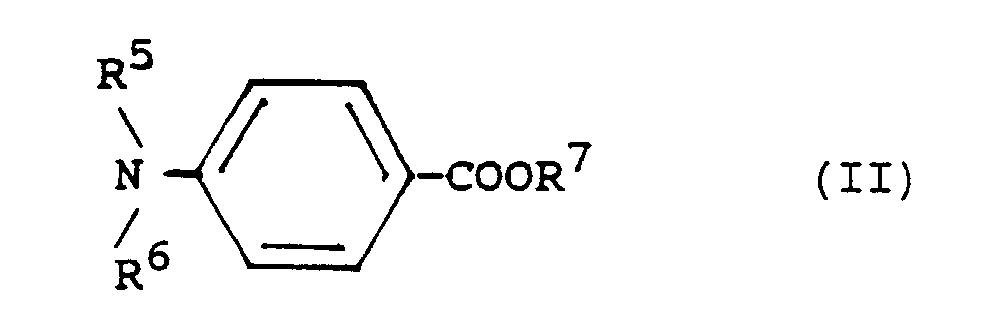

- R1, R2,
- Wasserstoff- oder Halogenatome oder
- R3 und R4
- Alkyl-, Alkoxy-, Carboxyl-, Alkoxycarbonyl- oder Aryloxycarbonylgruppen,
- R5, R6, R9 und R10
- Alkylgruppen,
- R7
- eine Alkyl- oder Alkoxyalkylgruppe und
- R8
- eine Alkylengruppe
- Erfindungsgemäß wird ferner ein photopolymerisierbares Aufzeichnungsmaterial mit einem Schichtträger und einer photopolymerisierbaren Schicht vorgeschlagen, die als wesentliche Bestandteile
- a) ein polymeres Bindemittel,
- b) eine radikalisch polymerisierbare Verbindung mit mindestens einer endständigen ethylenischen Doppelbindung und
- c) eine als Photoinitiator wirksame N-heterocyclische Verbindung
- Das erfindungsgemäße Aufzeichnungsmaterial ist dadurch gekennzeichnet, daß die Schicht als weitere Photoinitiator-Komponenten die vorstehend genannten Verbindungen (d) und (e) enthält.
- Die Thioxanthone der Formel I sind vorzugsweise Verbindungen, in denen mindestens zwei der Reste R1 bis R4, vorzugsweise drei dieser Reste Wasserstoffatome sind. Wenn diese Reste Alkyl- oder Alkoxyreste sind oder enthalten, können diese im allgemeinen 1 bis 6, insbesondere 1 bis 4 Kohlenstoffatome enthalten. Als Aryloxycarbonylgruppen werden Phenyloxycarbonylgruppen bevorzugt, die ggf. durch Halogenatome oder C1-C3-Alkylgruppen substituiert sind. Als Halogenatome werden Chlor- und Bromatome bevorzugt.
- In den Dialkylaminoverbindungen der Formeln II und III sind R5, R6, R9 und R10 Alkylgruppen mit im allgemeinen 1 bis 8, vorzugsweise 1 bis 4 Kohlenstoffatomen. R7 ist im allgemeinen eine Alkylgruppe mit 1 bis 6, vorzugsweise 1 bis 3, oder eine Alkoxyalkylgruppe mit 2 bis 8, vorzugsweise 3 bis 6 Kohlenstoffatomen. R8 hat im allgemeinen 2 bis 6 Kohlenstoffatome.
- Bevorzugt werden Verbindungen der Formel I mit R1 = Alkyl und R2 bis R4 = Wasserstoff und als Coinitiatoren Verbindungen der Formel II.
- Beispiele für bevorzugte N-heterocyclische Verbindungen sind in der DE-A 20 27 467 beschrieben. Es handelt sich hierbei um Verbindungen vom Acridin- oder Phenazintyp, die in einem der äußeren aromatischen Ringe ein weiteres Stickstoffatom als Heteroatom und an diesen Ringen bis zu zwei anellierte Benzolringe enthalten können und die ferner bis zu drei Substituenten tragen können, die gleich oder verschieden sind und H, Halogen, Alkyl-, Alkoxy-, Aryl-, Aryloxy-, Amino-, Acylamino- oder Aralkenylreste sind.
- Als weitere N-heterocyclische Verbindungen sind Chinoxaline und Chinazoline zu nennen, wie sie in der DE-A 20 39 861 beschrieben sind. Ebenso sind die in der EP-A 374 704 beschriebenen substituierten Acridine geeignet.
- Weitere Beispiele sind in der EP-A 220 589 beschrieben. Es handelt sich dabei um Chinoline, insbesondere 2,3-Dihydro-1H-cyclopenta[b]chinoline der allgemeinen Formel IV

- R11
- ein substituierter oder unsubstituierter m-wertiger carbo- oder heterocyclischer aromatischer Rest,
- R12
- ein Wasserstoffatom, ein Alkyl-, Aryl-, Aralkyl- oder Aralkenylrest ist,
- R13 und R14
- gleich oder verschieden sind und Wasserstoff- oder Halogenatome, Alkyl- oder Alkoxyreste bedeuten,
- n
- 0 oder 1 und
- m
- 1 oder 2 ist.
- Auch 2-(Aryl-vinyl)- und 2-(4-Aryl-butadienyl)chinoline, wie sie in der EP-A 11 786 beschrieben sind, sind als N-Heterocyclen geeignet.
- Beispiele für N-heterocyclische Verbindungen sind: 9-Phenylacridin, 9-(p-Tolyl)-acridin, 9-(4-Methoxyphenyl)-acridin, 9-(4-Hydroxyphenyl)-acridin, 9-Acetylamino-acridin, Benz[a]phenazin, 8-Methyl-benz[a]-phenazin, 9,10-Dimethyl-benz[a]phenazin, 9-Methylbenz[a]-phenazin, 10-Methyl-benz[a]phenazin, 9-Methoxybenz[a]-phenazin, 10-Methoxy-benz[a]phenazin, Dibenz[a,c]phenazin, 11-Methoxy-dibenz[a,c]phenazin, Dibenz[a,j]phenazin, davon insbesondere 9-Phenylacridin, 9-(p-Tolyl)-acridin, Benz[a]-phenazin und 9-Methylbenz[a]phenazin, Chinoxalinderivate, z.B. 6,4',4"-Trimethoxy-2,3-diphenylchinoxalin, 4',4"-Dimethoxy-2,3-diphenyl-5-azachinoxalin, Chinazolinderivate, 2-Styrylchinolin, Cinnamylidenchinaldin und 3-(o-Chlor-benzyliden)-9-phenyl-2,3-dihydro-1H-cyclopenta[b]chinolin.
- Die N-heterocyclische Verbindung wird in einer Menge von 0,01 bis 3,0, vorzugsweise 0,05 bis 1,0 Gew.-% eingesetzt.
- Die Menge an Thioxanthon und Dialkylaminoverbindung beträgt je 0,1 bis 4,0 Gew.-%, bevorzugt 0,2 bis 2,0 Gew.-%. Dabei werden im allgemeinen 0,3 bis 3, vorzugs0,5 bis 2 Gewichtsteile Thioxanthon je Gewichtsteil Dialkylaminoverbindung eingesetzt.
- Das Mengenverhältnis von Thioxanthon + Dialkylaminoverbindung zu N-heterocyclischer Verbindung liegt im allgemeinen im Bereich von 1:1 bis 20:1, vorzugsweise zwischen 2:1 und 15:1.
- Die erfindungsgemäßen Gemische enthalten polymerisierbare Verbindungen mit mindestens einer, vorzugsweise mindestens zwei endständigen ethylenischen Doppelbindungen. Als polymerisierbare Verbindungen werden im allgemeinen Ester der Acryl- oder Methacrylsäure mit mehrwertigen, vorzugsweise primären, Alkoholen verwendet. Beispiele für geeignete mehrwertige Alkohole sind Ethylenglykol, Propylenglykol, Butandiol-1,4, Butandiol-1,3, Diethylenglykol, Triethylenglykol, Polyethylen- oder Polypropylenglykole mit Molekulargewichten von 200 bis 1.000, Neopentylglykol, Glycerin, Trimethylolethan und -propan, Pentaerythrit, Bisphenol-A-Derivate sowie Umsetzungsprodukte dieser Verbindungen mit Ethylenoxid und/oder Propylenoxid. Mit Vorteil werden auch Urethangruppen enthaltende Bisacrylate und Bismethacrylate eingesetzt, die durch Umsetzung von 1 mol eines Diisocyanats mit 2 mol Hydroxyalkylacrylat oder -methacrylat erhalten werden. Das Diisocyanat kann auch ein oligomeres, durch Umsetzen eines Diols mit einem molaren Überschuß an monomerem Diisocyanat erhaltenes Produkt sein. Derartige und ähnliche Urethangruppen enthaltende Monomere sind in den DE-A 20 64 079, 28 22 190, 30 48 502 und 35 40 480 beschrieben.
- Der Mengenanteil der Schicht an Monomeren beträgt im allgemeinen etwa 10 bis 75, vorzugsweise 20 bis 60 Gew.-%.
- Als Bindemittel kann eine Vielzahl löslicher organischer Polymerisate Einsatz finden. Als Beispiele seien genannt: Polyamide, Polyvinylester, Polyvinylacetale, Polyvinylether, Epoxidharze, Polyacrylsäureester, Polymethacrylsäureester, Polyester, Alkydharze, Polyacrylamid, vinylalkohol, Polyethylenoxid, Polydimethylacrylamid, Polyvinylpyrrolidon, Polyvinylmethylformamid, vinylmethylacetamid sowie Mischpolymerisate der Monomeren, die die aufgezählten Homopolymerisate bilden.
- Ferner kommen als Bindemittel Naturstoffe oder umgewandelte Naturstoffe in Betracht, z.B. Gelatine und Celluloseether.
- Mit besonderem Vorteil werden Bindemittel verwendet, die wasserunlöslich, aber in wäßrig-alkalischen Lösungen löslich oder mindestens quellbar sind, da sich Schichten mit solchen Bindemitteln mit den bevorzugten wäßrig-alkalischen Entwicklern entwickeln lassen. Derartige Bindemittel können z. B. die folgenden Gruppen enthalten: -COOH, -PO3H2, -SO3H; -SO2NH-, -SO2-NH-SO2- und -SO2-NH-CO-.
- Als Beispiele hierfür seien genannt: Maleinatharze, Polymerisate aus N-(p-Tolyl-sulfonyl)-carbaminsäure-β-methacryloyloxy-ethylester und Mischpolymerisate dieser und ähnlicher Monomerer mit anderen Monomeren sowie Vinylacetat/Crotonsäure- und Styrol/Maleinsäureanhydrid-Mischpolymerisate. Alkylmethacrylat/Methacrylsäure-Mischpolymerisate und Mischpolymerisate aus Methacrylsäure, höheren Alkylmethacrylaten und Methylmethacrylat und/oder Styrol, Acrylnitril u.a., wie sie in den DE-A 20 64 080, 23 63 806 oder 34 27 519 beschrieben sind, werden bevorzugt. Mit Erfolg können auch die in der DE-A 38 05 706 beschriebenen Bindemittel auf Basis einer α,β-ungesättigten Carbonsäure, eines Methacrylats, eines Acrylats und einer Verbindung mit einem aromatischen Substituenten eingesetzt werden.
- Das Gemisch kann als übliche weitere Bestandteile merisationsinhibitoren, sonstige Stabilisatoren, stoffdonatoren, Lichtempfindlichkeitsregler, Farbstoffe, Leukofarbstoffe, Photooxydationsmittel, z. B. methylphenylsulfon, Pigmente, Weichmacher und thermisch aktivierbare Vernetzungsmittel enthalten.
- Als aktinische Strahlung, gegenüber der das erfindungsgemäße Gemisch empfindlich ist, kommt jede elektromagnetische Strahlung in Betracht, deren Energie zur Auslösung einer Polymerisation ausreicht. Geeignet sind insbesondere sichtbares und ultraviolettes Licht, Röntgen- und Elektronenstrahlung. Auch Laserstrahlung im sichtbaren und UV-Bereich kann verwendet werden. Bevorzugt wird kurzwelliges sichtbares und nahes UV-Licht.
- Als Schichtträger für mit dem erfindungsgemäßen Gemisch hergestellte Aufzeichnungsmaterialien sind beispielsweise Aluminium, Stahl, Zink, Kupfer, Siebe oder Kunststofffolien, z. B. aus Polyethylenterephthalat, geeignet. Die Trägeroberfläche kann chemisch oder mechanisch vorbehandelt werden, um die Haftung der Schicht richtig einzustellen.
- Das erfindungsgemäße Gemisch findet bevorzugt Anwendung als trocken übertragbares Photoresistmaterial. Dazu kann es in bekannter Weise als vorgefertigte, übertragbare Trockenresistfolie auf das zu bearbeitende Werkstück, z. B. auf Leiterplatten-Basismaterial, aufgebracht werden. Im allgemeinen wird zur Herstellung des resistmaterials eine Lösung des Gemisches in einem Lösemittel auf einen geeigneten Schichtträger, z. B. eine Polyesterfolie, aufgebracht und getrocknet. Die Schichtdicke der Resistschicht kann etwa 10 bis 80, vorzugsweise 20 bis 60 µm betragen. Die freie Oberfläche der Schicht wird vorzugsweise mit einer Deckfolie, z. B. aus Polyethylen oder Polypropylen, abgedeckt. Das fertige Laminat kann als Großrolle gespeichert und bei Bedarf zu Resistrollen beliebiger Breite zerschnitten werden.
- Die Folien lassen sich mit in der Trockenresisttechnik üblichen Geräten verarbeiten. In einer handelsüblichen Laminiervorrichtung wird die Deckfolie abgezogen und die Photoresistschicht auf gebohrtes, verkupfertes Basismaterial laminiert. Die so präparierte Platte wird dann durch eine Vorlage belichtet und nach Abziehen der Trägerfolie in bekannter Weise entwickelt.
- Als Entwickler sind organische Lösemittel, z. B. Trichlorethan, oder wäßrige, vorzugsweise wäßrig-alkalische Lösungen, z. B. von Alkaliphosphaten, -carbonaten oder -silikaten, geeignet, denen gegebenenfalls kleine Mengen an mit Wasser mischbaren, organischen Lösemitteln oder an Netzmitteln zugesetzt werden können.
- Die erfindungsgemäßen Gemische lassen sich für die verschiedensten Anwendungsgebiete einsetzen. Mit besonderem Vorteil werden sie in Form eines Trockenresistfilms zur Herstellung von Reservagen, d. h. Ätzschutzschichten oder Galvanoreserven, auf metallischen Trägern, z. B. Kupfer, verwendet.
- Bei Einsatz der erfindungsgemäßen Photoinitiatorkombination erhält man Photoresistschichten mit hoher Lichtempfindlichket, einem hervorragenden Auflösungsvermögen und senkrechten Resistflanken unabhängig von der Filmvorlage (positiv oder negativ). Wenn die N-heterocyclische Verbindung allein als Photoinitiator eingesetzt wird, werden eine reduzierte Auflösung und positive Resistflanken erhalten, was insbesondere für Galvanoanwendungen von Nachteil ist. Das Thioxanthon/Amin-Gemisch allein ergibt eine geringere Lichtempfindlichkeit mit ungenügender Durchhärtung des Resistsockels. Bei Einsatz einer Positivvorlage (Galvanoanwendung) werden dabei positive, bei Einsatz einer Negativvorlage (Ätzanwendung) negative Flanken ausgebildet. Beides ist für den praktischen Einsatz von Nachteil.
- Die folgenden Beispiele erläutern bevorzugte Ausführungsformen der Erfindung. Mengenverhältnisse und Prozentzahlen sind in Gewichtseinheiten zu verstehen, wenn nichts anderes angegeben ist. Die Mengen an Bestandteilen sind in der Regel in Gewichtsteilen (Gt) angegeben. Das Zeichen (V) hinter einer Beispielsvariante gibt an, daß es sich um ein Vergleichsbeispiel handelt.
- In Stammlösungen aus je


A (V) 0,06 Gt 9-Phenylacridin, B (V) 0,24 Gt Isopropylthioxanthon und 0,30 Gt 4-Dimethylamino-benzoesäureethylester oder C 0,06 Gt 9-Phenylacridin, 0,24 Gt Isopropylthioxanthon und 0,30 Gt 4-Dimethylamino-benzoesäureethylester - Die Lösungen wurden auf biaxial verstreckte und thermofixierte Polyethylenterephthalatfolien von 25 µm Stärke so aufgeschleudert, daß nach dem Trocknen bei 100 °C jeweils ein Schichtgewicht von 45 g/m2 erhalten wurde.
- Die so hergestellten Trockenresistfolien wurden mit einer handelsüblichen Laminiervorrichtung bei 115 °C auf mit 35 µm starker Kupferfolie kaschierte Phenolharz-Schichtstoffplatten laminiert. Anschließend wurde durch die unten beschriebenen Belichtungsvorlagen 1 bzw. 2 mit einer 5-kW-Metallhalogenidlampe in einem Vakuumkopierrahmen 5 s, durch die Belichtungsvorlage 3 8 s belichtet und dann mit 1 %iger Sodalösung entwickelt.
Belichtungsvorlage 1 dunkel 47 µm (Linien) transparent 300 µm (Abstände) Breite des freigelegten Kanals (Oberkante/ Unterkante) A (V) - nicht aufgelöst B (V) 71/58 µm positive Resistflanken keine 1 : 1 Wiedergabe Resistabhebung C 47/47 µm senkrechte Resistflanken 1 : 1 Wiedergabe Belichtungsvorlage 2 dunkel 300 µm transparent 46 µm Breite der Resistlinie (Oberkante/Unterkante) A (V) 46/50 µm positive Resistflanken B (V) 34/31 µm negative Resistflanken keine 1 : 1 Wiedergabe Resistabhebung C 45/45 µm senkrechte Resistflanken 1 : 1 Wiedergabe Belichtungsvorlage 3 dunkel 71 µm transparent 300 µm Kanal (Oberkante/Unterkante) A (V) - nicht aufgelöst B (V) 85/76 µm positive Resistflanken keine 1 : 1 Wiedergabe C 69/69 µm senkrechte Resistflanken 1 : 1 Wiedergabe - Die beiliegenden Bilder (Fig. 1) zeigen mikroskopische Aufnahmen von Querschnitten durch die entsprechenden Resistmuster.
- Zu Stammlösungen aus je

A (V) 0,06 Gt 9-(4-Methoxy-phenyl)-acridin, B (V) 0,24 Gt Isopropylthioxanthon und 0,30 Gt 4-Dimethylamino-benzoesäureethylester oder C 0,06 Gt 9-(4-Methoxy-phenyl)-acridin, 0,24 Gt Isopropylthioxanthon und 0,30 Gt 4-Dimethylamino-benzoesäureethylester - Durch Aufschleudern wurden wie in Beispiel 1 beschrieben Trockenresistschichten hergestellt. Es wurde laminiert, 9 s durch die unten beschriebenen Belichtungsvorlagen 4, 5 und 6 belichtet und in 1 %iger Sodalösung entwickelt.


Belichtungsvorlage 5 dunkel 56 µm transparent 300 µm Kanal: (Oberkante/Unterkante) A (V) 58/42 µm positive Resistflanken keine 1 : 1 Wiedergabe B (V) 70/61 µm wie A C 56/54 µm senkrechte Resistflanken 1 : 1 Wiedergabe Belichtungsvorlage 6 dunkel 65 µm transparent 300 µm Kanal: (Oberkante/Unterkante) A (V) 65/45 positive Resistflanken keine 1 : 1 Wiedergabe B (V) 77/69 µm wie A C 66/64 µm senkrechte Resistflanken 1 : 1 Wiedergabe - Phenylacridin führt zu einer schlechteren Auflösung, verbunden mit der Ausbildung stark positiver Resistflanken und abgerundeten Resistkanten. Das Thioxanthon/Amin-Gemisch ergibt eine reduzierte Lichtempfindlichkeit und keine 1 : 1 Wiedergabe der Strukturen. Außerdem ist die Resistflankenform positiv, insbesondere bei feinen Strukturen. Schnittbilder der Muster sind in Fig. 2 wiedergegeben.
- Vier Stammlösungen aus je
54 Gt eines Polymerisats aus Methacrylsäure, Methylmethacrylat und Hexylmethacrylat (35:5:60), 16 Gt des Diurethans aus 2 mol Hydroxyethylmethacrylat und 1 mol 2,2,4-Trimethyl-hexamethylendiisocyanat, 30 Gt Polyethylenglykol-400-dimethacrylat, 0,1 Gt 1,4-Bis-(4-tert.butoxy-phenylamino)-5,8-dihydroxyanthrachinon und 0,05 Gt Samaronmarineblau HR (CI Disperse Blue 290) in 110 Gt Butanon und 110 Gt Ethanol 

- Die Lösungen wurden wie im Beispiel 1 beschrieben auf Polyethylenterephthalatfolie aufgebracht und getrocknet.
- Die Folien wurden ebenso auf mit Kupferfolie kaschierte Phenolharz-Schichtstoffplatten laminiert und anschließend unter einer Vorlage, die aus einem Linienmuster mit 50 µm breiten schwarzen Linien und 50 µm breiten Zwischenräumen sowie einem Graustufenkeil bestand, so belichtet, daß nach dem Entwickeln mit 1 %iger Sodalösung (30 °C - 45 Sekunden Sprühen) der Resist unter der Stufe 8 (optische Dichte 1,18) noch ausreichend gehärtet war und stehen blieb, der Resist unter der Stufe 9 (optische Dichte 1.33) aber durch den Entwickler gelöst und entfernt wurde.
- Anschließend wurde die Auflösung beurteilt:
Die erfindungsgemäßen Muster B und D gaben das 50 µm-Balkenmuster vorzüglich wieder, bei den Mustern A und C waren die belichteten Balken zusammengewachsen, d.h. auch unter den schwarzen Linien hatte eine gewisse Lichtvernetzung und Photohärtung stattgefunden.
Claims (10)
- Photopolymerisierbares Gemisch, das als wesentliche Bestandteilea) ein polymeres Bindemittel,b) eine radikalisch polymerisierbare Verbindung mit mindestens einer endständigen ethylenischen Doppelbindung undc) eine N-heterocyclische Verbindung als Photoinitiatorenthält, dadurch gekennzeichnet, daß es als weitere Photoinitiator-Komponentend) ein Thioxanthonderivat der Formel I
 e) eine Dialkylaminoverbindung einer der Formeln II oder III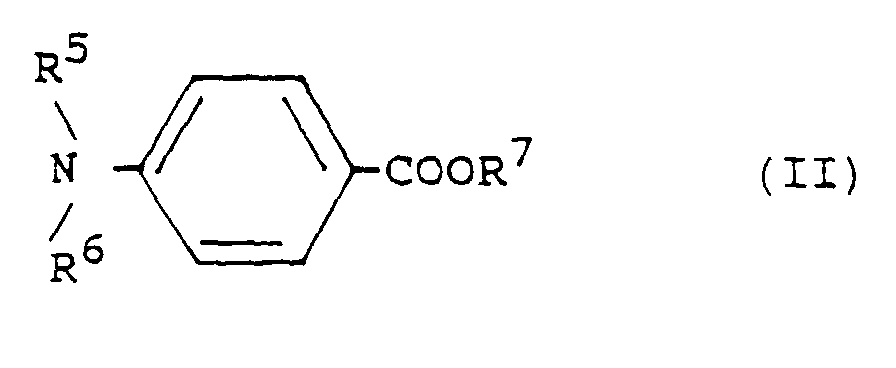
 R1, R2, Wasserstoff- oder Halogenatome oderR3 und R4 Alkyl-, Alkoxy-, Carboxyl-, Alkoxycarbonyl- oder AryloxycarbonylgruppenR5, R6, R9 und R10 AlkylgruppenR7 eine Alkyl- oder Alkoxyalkylgruppe undR8 eine Alkylengruppebedeuten.
 - Gemisch nach Anspruch 1, dadurch gekennzeichnet, daß die N-heterocyclische Verbindung eine Acridin-, Phenazin-, Chinoxalin- oder Chinolinverbindung ist.
- Gemisch nach Anspruch 1, dadurch gekennzeichnet, daß die N-heterocyclische Verbindung in einer Menge von 0,01 bis 3 Gew.-% darin enthalten ist.
- Gemisch nach Anspruch 1, dadurch gekennzeichnet, daß es je 0,1 bis 4 Gew.-% an Verbindung (d) und Verbindung (e) enthält.
- Gemisch nach Anspruch 1, dadurch gekennzeichnet, daß es 1 bis 20 Gewichtsteile der Gesamtmenge an (d) + (e) je 1 Gewichtsteil N-heterocyclische Verbindung (c) enthält.
- Gemisch nach Anspruch 1, dadurch gekennzeichnet, daß das Mengenverhältnis von (d) zu (e) 3:1 bis 1:3 beträgt.
- Gemisch nach Anspruch 1, dadurch gekennzeichnet, daß das Bindemittel wasserunlöslich und in wäßrigalkalischen Lösungen löslich ist.
- Gemisch nach Anspruch 1, dadurch gekennzeichnet, daß es 20 bis 90 Gew.-% Bindemittel und 10 bis 75 Gew.-% an polymerisierbaren Verbindungen enthält.
- Photopolymerisierbares Aufzeichnungsmaterial mit einem Schichtträger und einer photopolymerisierbaren Schicht, die als wesentliche Bestandteilea) ein polymeres Bindemittel,b) eine radikalisch polymerisierbare Verbindung mit mindestens einer endständigen ethylenischen Doppelbindung undc) eine als Photoinitiator wirksame N-heterocyclische Verbindungenthält, dadurch gekennzeichnet, daß sie als weitere Photoinitiator-Komponentend) ein Thioxanthonderivat der Formel I
 e) eine Dialkylaminoverbindung einer der Formeln II oder III
 R1, R2, Wasserstoff- oder Halogenatome oderR3 und R4 Alkyl-, Alkoxy-, Carboxyl-, Alkoxycarbonyl- oder AryloxycarbonylgruppenR5, R6, R9 und R10 AlkylgruppenR7 eine Alkyl- oder Alkoxyalkylgruppe undR8 eine Alkylengruppebedeuten.
 - Photopolymerisierbares Aufzeichnungsmaterial nach Anspruch 9, dadurch gekennzeichnet, daß der Schichtträger eine flexible transparente Kunststoffolie ist, die mit der photopolymerisierbaren Schicht abtrennbar verbunden ist und daß die Schicht auf der dem Schichtträger abgewandten Seite eine flexible Abdeckfolie trägt, deren Haftung an der photopolymerisierbaren Schicht geringer ist als die des Schichtträgers.
Applications Claiming Priority (2)
| Application Number | Priority Date | Filing Date | Title |
|---|---|---|---|
| DE4027301 | 1990-08-29 | ||
| DE4027301A DE4027301A1 (de) | 1990-08-29 | 1990-08-29 | Photopolymerisierbares gemisch und daraus hergestelltes photopolymerisierbares aufzeichnungsmaterial |
Publications (2)
| Publication Number | Publication Date |
|---|---|
| EP0474009A1 EP0474009A1 (de) | 1992-03-11 |
| EP0474009B1 true EP0474009B1 (de) | 1997-06-04 |
Family
ID=6413149
Family Applications (1)
| Application Number | Title | Priority Date | Filing Date |
|---|---|---|---|
| EP91113842A Expired - Lifetime EP0474009B1 (de) | 1990-08-29 | 1991-08-19 | Photopolymerisierbares Gemisch und daraus hergestelltes photopolymerisierbares Aufzeichnungsmaterial |
Country Status (5)
| Country | Link |
|---|---|
| US (2) | US6127091A (de) |
| EP (1) | EP0474009B1 (de) |
| JP (1) | JP2980743B2 (de) |
| KR (1) | KR100190200B1 (de) |
| DE (2) | DE4027301A1 (de) |
Families Citing this family (34)
| Publication number | Priority date | Publication date | Assignee | Title |
|---|---|---|---|---|
| JPH07281437A (ja) * | 1994-04-14 | 1995-10-27 | Asahi Chem Ind Co Ltd | 光硬化性樹脂積層体 |
| JP3782134B2 (ja) * | 1995-07-20 | 2006-06-07 | 旭化成エレクトロニクス株式会社 | プリント配線板の製造方法 |
| EP0908306B3 (de) | 1997-10-08 | 2009-08-05 | Agfa-Gevaert | Verfahren zur Herstellung einer positiv arbeitenden Druckplatte aus wärmempfindlichem Bildaufzeichnungsmaterial |
| DE69901642T3 (de) | 1998-03-14 | 2019-03-21 | Agfa Nv | Verfahren zur Herstellung einer positiv arbeitenden Druckplatte aus einem wärmeempfindlichem Bildaufzeichnungsmaterial |
| JP4488601B2 (ja) * | 2000-07-13 | 2010-06-23 | 旭化成イーマテリアルズ株式会社 | 感光性樹脂積層体 |
| EP1256444B1 (de) | 2001-04-09 | 2004-06-30 | Agfa-Gevaert | Positivarbeitende lithographische Druckplattenvorläufer |
| US6680158B2 (en) * | 2001-07-31 | 2004-01-20 | Chi Mei Corporation | Radiation-sensitive resin composition for spacer |
| US7455949B2 (en) | 2002-10-15 | 2008-11-25 | Agfa Graphics, N.V. | Polymer for heat-sensitive lithographic printing plate precursor |
| US7458320B2 (en) | 2002-10-15 | 2008-12-02 | Agfa Graphics, N.V. | Polymer for heat-sensitive lithographic printing plate precursor |
| US7198877B2 (en) | 2002-10-15 | 2007-04-03 | Agfa-Gevaert | Heat-sensitive lithographic printing plate precursor |
| EP1413925A3 (de) * | 2002-10-23 | 2004-08-25 | Konica Minolta Holdings, Inc. | Lichtempfindliche Zusammensetzung und lichtempfindliche lithographische Druckplatte |
| EP1697144A1 (de) | 2003-12-18 | 2006-09-06 | Agfa-Gevaert N.V. | Vorläufer für positiv arbeitende lithographische druckplatte |
| US7678533B2 (en) | 2005-06-30 | 2010-03-16 | Agfa Graphics, N.V. | Heat-sensitive lithographic printing plate precursor |
| ES2367179T3 (es) | 2006-03-17 | 2011-10-31 | Agfa Graphics N.V. | Método de preparación de una placa de impresión litográfica. |
| DE602006009919D1 (de) | 2006-08-03 | 2009-12-03 | Agfa Graphics Nv | Flachdruckplattenträger |
| DE602007006822D1 (de) | 2007-11-30 | 2010-07-08 | Agfa Graphics Nv | Verfahren zur Behandlung einer Lithografiedruckplatte |
| US20090191491A1 (en) * | 2008-01-28 | 2009-07-30 | John Ganjei | Method of Creating an Image in a Photoresist Laminate |
| EP2098376B1 (de) | 2008-03-04 | 2013-09-18 | Agfa Graphics N.V. | Verfahren zur Herstellung eines Lithographiedruckplattenträgers |
| ES2365885T3 (es) | 2008-03-31 | 2011-10-13 | Agfa Graphics N.V. | Un método para tratar una plancha de impresión litográfica. |
| EP2159049B1 (de) | 2008-09-02 | 2012-04-04 | Agfa Graphics N.V. | Wärmeempfindlicher, positiv arbeitender Lithographiedruckformvorläufer |
| EP2213690B1 (de) | 2009-01-30 | 2015-11-11 | Agfa Graphics N.V. | Neues alkalisches lösliches harz |
| JP5344034B2 (ja) * | 2009-03-13 | 2013-11-20 | 日立化成株式会社 | 感光性樹脂組成物、並びにこれを用いた感光性エレメント、レジストパターンの形成方法及びプリント配線板の製造方法 |
| ATE553920T1 (de) | 2009-06-18 | 2012-05-15 | Agfa Graphics Nv | Lithographiedruckplattenvorläufer |
| EP2329951B1 (de) | 2009-12-04 | 2012-06-20 | AGFA Graphics NV | Lithographiedruckplattenvorläufer |
| ES2395993T3 (es) | 2010-03-19 | 2013-02-18 | Agfa Graphics N.V. | Precursor de plancha de impresión litográfica |
| US20130298792A1 (en) | 2011-01-25 | 2013-11-14 | Agfa Graphics Nv | Lithographic printing plate precursor |
| ES2427137T3 (es) | 2011-02-18 | 2013-10-29 | Agfa Graphics N.V. | Precursor de plancha de impresión litográfica |
| JP5826006B2 (ja) * | 2011-12-01 | 2015-12-02 | 旭化成イーマテリアルズ株式会社 | 感光性樹脂組成物 |
| ES2655798T3 (es) | 2014-12-08 | 2018-02-21 | Agfa Nv | Sistema para reducir los residuos de ablación |
| EP3170662B1 (de) | 2015-11-20 | 2019-08-14 | Agfa Nv | Flachdruckplattenvorläufer |
| AU2017235148A1 (en) | 2016-03-16 | 2018-07-12 | Agfa Nv | Method and apparatus for processing a lithographic printing plate |
| EP3637188A1 (de) | 2018-10-08 | 2020-04-15 | Agfa Nv | Sprudelnder entwicklervorläufer zur verarbeitung eines lithografischen druckplattenvorläufers |
| KR102192404B1 (ko) | 2019-01-04 | 2020-12-17 | 우상학 | 식품포장용 합성수지 필름에 살포하는 미세분말 이형제의 제조방법 |
| EP3778253A1 (de) | 2019-08-13 | 2021-02-17 | Agfa Nv | Verfahren zur verarbeitung einer lithografiedruckplatte |
Family Cites Families (8)
| Publication number | Priority date | Publication date | Assignee | Title |
|---|---|---|---|---|
| JPS57104135A (en) * | 1980-12-20 | 1982-06-29 | Konishiroku Photo Ind Co Ltd | Photopolymerizable composition |
| DE3131448A1 (de) * | 1981-08-07 | 1983-02-24 | Basf Ag, 6700 Ludwigshafen | Fuer die herstellung von photoresistschichten geeignete photopolymerisierbare aufzeichnungsmasse |
| DE3420425A1 (de) * | 1984-06-01 | 1985-12-05 | Hoechst Ag, 6230 Frankfurt | Photopolymerisierbares gemisch, das als photoinitiator ein 1,3,10-triazaanthracen-4-on- enthaelt |
| EP0287516B1 (de) * | 1987-04-14 | 1993-03-31 | Ciba-Geigy Ag | Klebstoffe |
| GB8715435D0 (en) * | 1987-07-01 | 1987-08-05 | Ciba Geigy Ag | Forming images |
| GB8716378D0 (en) * | 1987-07-11 | 1987-08-19 | Autotype Int Ltd | Photopolymerisable compositions |
| US4940648A (en) * | 1988-02-12 | 1990-07-10 | Hoechst Celanese Corporation | Increased sensitivity photoinitiation compositions |
| JPH01238656A (ja) * | 1988-03-18 | 1989-09-22 | Nippon Paint Co Ltd | 高感度光重合性組成物 |
-
1990
- 1990-08-29 DE DE4027301A patent/DE4027301A1/de not_active Withdrawn
-
1991
- 1991-08-19 EP EP91113842A patent/EP0474009B1/de not_active Expired - Lifetime
- 1991-08-19 DE DE59108737T patent/DE59108737D1/de not_active Expired - Lifetime
- 1991-08-28 KR KR1019910014921A patent/KR100190200B1/ko not_active Expired - Lifetime
- 1991-08-29 JP JP3244382A patent/JP2980743B2/ja not_active Expired - Lifetime
-
1997
- 1997-11-03 US US08/963,136 patent/US6127091A/en not_active Expired - Lifetime
- 1997-11-03 US US08/962,781 patent/US6114091A/en not_active Expired - Lifetime
Also Published As
| Publication number | Publication date |
|---|---|
| JPH0667427A (ja) | 1994-03-11 |
| DE59108737D1 (de) | 1997-07-10 |
| US6127091A (en) | 2000-10-03 |
| KR100190200B1 (ko) | 1999-06-01 |
| EP0474009A1 (de) | 1992-03-11 |
| JP2980743B2 (ja) | 1999-11-22 |
| DE4027301A1 (de) | 1992-03-05 |
| KR920004450A (ko) | 1992-03-27 |
| US6114091A (en) | 2000-09-05 |
Similar Documents
| Publication | Publication Date | Title |
|---|---|---|
| EP0474009A1 (de) | Photopolymerisierbares Gemisch und daraus hergestelltes photopolymerisierbares Aufzeichnungsmaterial | |
| EP0031592B1 (de) | Photopolymerisierbares Gemisch und damit hergestelltes photopolymerisierbares Kopiermaterial | |
| EP0098982B1 (de) | Photopolymerisierbares Gemisch und damit hergestelltes photopolymerisierbares Kopiermaterial | |
| EP0071789B2 (de) | Für die Herstellung von Photoresistschichten geeignetes Schichtübertragungsmaterial | |
| EP0065285B1 (de) | Durch Strahlung polymerisierbares Gemisch und damit hergestelltes Kopiermaterial | |
| EP0054700B1 (de) | Durch Strahlung polymerisierbares Gemisch und daraus hergestelltes strahlungsempfindliches Aufzeichnungsmaterial | |
| DE2802440C2 (de) | ||
| EP0280979B1 (de) | Lichtempfindliches Aufzeichnungsmaterial mit erhöhter Flexibilität | |
| EP0447930B1 (de) | Photopolymerisierbares Gemisch und daraus hergestelltes Aufzeichnungsmaterial | |
| EP0311926B1 (de) | Photopolymerisierbares Gemisch | |
| EP0374704B1 (de) | Photopolymerisierbares Gemisch und dieses enthaltendes photopolymerisierbares Aufzeichnungsmaterial | |
| EP0234570B1 (de) | Photopolymersierbares Gemisch, dieses enthaltendes lichtempfindliches Aufzeichnungselement sowie Verfahren zur Herstellung einer Flachdruckform mittels dieses lichtempfindliches Aufzeichnungselements | |
| EP0097864A1 (de) | Photopolymerisierbares Gemisch und damit hergestelltes photopolymerisierbares Kopiermaterial | |
| EP0355387A2 (de) | Photopolymerisierbares Gemisch und daraus hergestelltes Aufzeichnungsmaterial | |
| EP0003804B1 (de) | Photopolymerisierbares Gemisch, das einen Monoazofarbstoff enthält | |
| EP0222320B1 (de) | Durch Strahlung polymerisierbares Gemisch, daraus hergestelltes Aufzeichnungsmaterial und Verfahren zur Herstellung von Reliefaufzeichnungen | |
| EP0249857A2 (de) | Lichtempfindliches Aufzeichnungselement | |
| DE2558813C2 (de) | Lichtempfindliches Gemisch mit synergistischem Initiatorsystem | |
| EP0220589B1 (de) | Photopolymerisierbares Gemisch und dieses enthaltendes photopolymerisierbares Aufzeichnungsmaterial | |
| EP0434968A2 (de) | Lichtempfindliche Zubereitung und Verfahren zur Herstellung von Photoresisten und Druckplatten | |
| EP0321827A2 (de) | Photopolymerisierbares Gemisch und daraus hergestelltes Aufzeichnungsmaterial | |
| EP0476519A1 (de) | Photopolymerisierbares Gemisch und daraus hergestelltes Aufzeichnungsmaterial | |
| EP0163257A1 (de) | Photopolymerisierbares Gemisch, das als Photoinitiator ein 1,3,10-Triazaanthracen-4-on enthält | |
| DD160084A1 (de) | Mit sichtbarer strahlung fotopolymerisierbares gemisch | |
| DE3227913A1 (de) | Photopolymerisierbares gemisch und damit hergestelltes photopolymerisierbares kopiermaterial |
Legal Events
| Date | Code | Title | Description |
|---|---|---|---|
| PUAI | Public reference made under article 153(3) epc to a published international application that has entered the european phase |
Free format text: ORIGINAL CODE: 0009012 |
|
| AK | Designated contracting states |
Kind code of ref document: A1 Designated state(s): CH DE FR GB LI |
|
| 17P | Request for examination filed |
Effective date: 19920627 |
|
| RAP1 | Party data changed (applicant data changed or rights of an application transferred) |
Owner name: MORTON INTERNATIONAL, INC. |
|
| GRAG | Despatch of communication of intention to grant |
Free format text: ORIGINAL CODE: EPIDOS AGRA |
|
| 17Q | First examination report despatched |
Effective date: 19960808 |
|
| GRAH | Despatch of communication of intention to grant a patent |
Free format text: ORIGINAL CODE: EPIDOS IGRA |
|
| GRAH | Despatch of communication of intention to grant a patent |
Free format text: ORIGINAL CODE: EPIDOS IGRA |
|
| GRAA | (expected) grant |
Free format text: ORIGINAL CODE: 0009210 |
|
| AK | Designated contracting states |
Kind code of ref document: B1 Designated state(s): CH DE FR GB LI |
|
| REG | Reference to a national code |
Ref country code: CH Ref legal event code: NV Representative=s name: KIRKER & CIE SA Ref country code: CH Ref legal event code: EP |
|
| GBT | Gb: translation of ep patent filed (gb section 77(6)(a)/1977) |
Effective date: 19970610 |
|
| REF | Corresponds to: |
Ref document number: 59108737 Country of ref document: DE Date of ref document: 19970710 |
|
| ET | Fr: translation filed | ||
| RAP2 | Party data changed (patent owner data changed or rights of a patent transferred) |
Owner name: MORTON INTERNATIONAL, INC. |
|
| PLBE | No opposition filed within time limit |
Free format text: ORIGINAL CODE: 0009261 |
|
| STAA | Information on the status of an ep patent application or granted ep patent |
Free format text: STATUS: NO OPPOSITION FILED WITHIN TIME LIMIT |
|
| 26N | No opposition filed | ||
| REG | Reference to a national code |
Ref country code: GB Ref legal event code: IF02 |
|
| PGFP | Annual fee paid to national office [announced via postgrant information from national office to epo] |
Ref country code: CH Payment date: 20070815 Year of fee payment: 17 |
|
| REG | Reference to a national code |
Ref country code: CH Ref legal event code: NV Representative=s name: PATENTANWAELTE SCHAAD, BALASS, MENZL & PARTNER AG Ref country code: CH Ref legal event code: PUE Owner name: ETERNAL TECHNOLOGY CORPORATION Free format text: MORTON INTERNATIONAL, INC.#100 NORTH RIVERSIDE PLAZA#CHICAGO ILLINOIS 60606-1596 (US) -TRANSFER TO- ETERNAL TECHNOLOGY CORPORATION#1800 TOUCHSTONE ROAD#COLONIAL HEIGHTS, VA 23834 (US) |
|
| REG | Reference to a national code |
Ref country code: GB Ref legal event code: 732E |
|
| REG | Reference to a national code |
Ref country code: CH Ref legal event code: PL |
|
| REG | Reference to a national code |
Ref country code: FR Ref legal event code: TP |
|
| PG25 | Lapsed in a contracting state [announced via postgrant information from national office to epo] |
Ref country code: LI Free format text: LAPSE BECAUSE OF NON-PAYMENT OF DUE FEES Effective date: 20080831 Ref country code: CH Free format text: LAPSE BECAUSE OF NON-PAYMENT OF DUE FEES Effective date: 20080831 |
|
| PGFP | Annual fee paid to national office [announced via postgrant information from national office to epo] |
Ref country code: FR Payment date: 20090825 Year of fee payment: 19 |
|
| PGFP | Annual fee paid to national office [announced via postgrant information from national office to epo] |
Ref country code: DE Payment date: 20090821 Year of fee payment: 19 Ref country code: GB Payment date: 20090818 Year of fee payment: 19 |
|
| GBPC | Gb: european patent ceased through non-payment of renewal fee |
Effective date: 20100819 |
|
| REG | Reference to a national code |
Ref country code: FR Ref legal event code: ST Effective date: 20110502 |
|
| REG | Reference to a national code |
Ref country code: DE Ref legal event code: R119 Ref document number: 59108737 Country of ref document: DE Effective date: 20110301 |
|
| PG25 | Lapsed in a contracting state [announced via postgrant information from national office to epo] |
Ref country code: FR Free format text: LAPSE BECAUSE OF NON-PAYMENT OF DUE FEES Effective date: 20100831 Ref country code: DE Free format text: LAPSE BECAUSE OF NON-PAYMENT OF DUE FEES Effective date: 20110301 |
|
| PG25 | Lapsed in a contracting state [announced via postgrant information from national office to epo] |
Ref country code: GB Free format text: LAPSE BECAUSE OF NON-PAYMENT OF DUE FEES Effective date: 20100819 |