EP4310183B1 - Verfahren und systeme zur tröpfchenbasierten einzelzellenbarcodierung - Google Patents
Verfahren und systeme zur tröpfchenbasierten einzelzellenbarcodierung Download PDFInfo
- Publication number
- EP4310183B1 EP4310183B1 EP23174169.5A EP23174169A EP4310183B1 EP 4310183 B1 EP4310183 B1 EP 4310183B1 EP 23174169 A EP23174169 A EP 23174169A EP 4310183 B1 EP4310183 B1 EP 4310183B1
- Authority
- EP
- European Patent Office
- Prior art keywords
- cell
- bead
- beads
- barcode
- nucleic acid
- Prior art date
- Legal status (The legal status is an assumption and is not a legal conclusion. Google has not performed a legal analysis and makes no representation as to the accuracy of the status listed.)
- Active
Links
Images











Classifications
-
- C—CHEMISTRY; METALLURGY
- C12—BIOCHEMISTRY; BEER; SPIRITS; WINE; VINEGAR; MICROBIOLOGY; ENZYMOLOGY; MUTATION OR GENETIC ENGINEERING
- C12N—MICROORGANISMS OR ENZYMES; COMPOSITIONS THEREOF; PROPAGATING, PRESERVING, OR MAINTAINING MICROORGANISMS; MUTATION OR GENETIC ENGINEERING; CULTURE MEDIA
- C12N15/00—Mutation or genetic engineering; DNA or RNA concerning genetic engineering, vectors, e.g. plasmids, or their isolation, preparation or purification; Use of hosts therefor
- C12N15/09—Recombinant DNA-technology
- C12N15/10—Processes for the isolation, preparation or purification of DNA or RNA
- C12N15/1034—Isolating an individual clone by screening libraries
- C12N15/1065—Preparation or screening of tagged libraries, e.g. tagged microorganisms by STM-mutagenesis, tagged polynucleotides, gene tags
-
- C—CHEMISTRY; METALLURGY
- C12—BIOCHEMISTRY; BEER; SPIRITS; WINE; VINEGAR; MICROBIOLOGY; ENZYMOLOGY; MUTATION OR GENETIC ENGINEERING
- C12N—MICROORGANISMS OR ENZYMES; COMPOSITIONS THEREOF; PROPAGATING, PRESERVING, OR MAINTAINING MICROORGANISMS; MUTATION OR GENETIC ENGINEERING; CULTURE MEDIA
- C12N15/00—Mutation or genetic engineering; DNA or RNA concerning genetic engineering, vectors, e.g. plasmids, or their isolation, preparation or purification; Use of hosts therefor
- C12N15/09—Recombinant DNA-technology
-
- C—CHEMISTRY; METALLURGY
- C12—BIOCHEMISTRY; BEER; SPIRITS; WINE; VINEGAR; MICROBIOLOGY; ENZYMOLOGY; MUTATION OR GENETIC ENGINEERING
- C12N—MICROORGANISMS OR ENZYMES; COMPOSITIONS THEREOF; PROPAGATING, PRESERVING, OR MAINTAINING MICROORGANISMS; MUTATION OR GENETIC ENGINEERING; CULTURE MEDIA
- C12N15/00—Mutation or genetic engineering; DNA or RNA concerning genetic engineering, vectors, e.g. plasmids, or their isolation, preparation or purification; Use of hosts therefor
- C12N15/09—Recombinant DNA-technology
- C12N15/10—Processes for the isolation, preparation or purification of DNA or RNA
- C12N15/1003—Extracting or separating nucleic acids from biological samples, e.g. pure separation or isolation methods; Conditions, buffers or apparatuses therefor
- C12N15/1006—Extracting or separating nucleic acids from biological samples, e.g. pure separation or isolation methods; Conditions, buffers or apparatuses therefor by means of a solid support carrier, e.g. particles, polymers
-
- C—CHEMISTRY; METALLURGY
- C12—BIOCHEMISTRY; BEER; SPIRITS; WINE; VINEGAR; MICROBIOLOGY; ENZYMOLOGY; MUTATION OR GENETIC ENGINEERING
- C12Q—MEASURING OR TESTING PROCESSES INVOLVING ENZYMES, NUCLEIC ACIDS OR MICROORGANISMS; COMPOSITIONS OR TEST PAPERS THEREFOR; PROCESSES OF PREPARING SUCH COMPOSITIONS; CONDITION-RESPONSIVE CONTROL IN MICROBIOLOGICAL OR ENZYMOLOGICAL PROCESSES
- C12Q1/00—Measuring or testing processes involving enzymes, nucleic acids or microorganisms; Compositions therefor; Processes of preparing such compositions
- C12Q1/68—Measuring or testing processes involving enzymes, nucleic acids or microorganisms; Compositions therefor; Processes of preparing such compositions involving nucleic acids
- C12Q1/6806—Preparing nucleic acids for analysis, e.g. for polymerase chain reaction [PCR] assay
-
- C—CHEMISTRY; METALLURGY
- C12—BIOCHEMISTRY; BEER; SPIRITS; WINE; VINEGAR; MICROBIOLOGY; ENZYMOLOGY; MUTATION OR GENETIC ENGINEERING
- C12Q—MEASURING OR TESTING PROCESSES INVOLVING ENZYMES, NUCLEIC ACIDS OR MICROORGANISMS; COMPOSITIONS OR TEST PAPERS THEREFOR; PROCESSES OF PREPARING SUCH COMPOSITIONS; CONDITION-RESPONSIVE CONTROL IN MICROBIOLOGICAL OR ENZYMOLOGICAL PROCESSES
- C12Q1/00—Measuring or testing processes involving enzymes, nucleic acids or microorganisms; Compositions therefor; Processes of preparing such compositions
- C12Q1/68—Measuring or testing processes involving enzymes, nucleic acids or microorganisms; Compositions therefor; Processes of preparing such compositions involving nucleic acids
- C12Q1/6869—Methods for sequencing
-
- B—PERFORMING OPERATIONS; TRANSPORTING
- B01—PHYSICAL OR CHEMICAL PROCESSES OR APPARATUS IN GENERAL
- B01L—CHEMICAL OR PHYSICAL LABORATORY APPARATUS FOR GENERAL USE
- B01L2200/00—Solutions for specific problems relating to chemical or physical laboratory apparatus
- B01L2200/06—Fluid handling related problems
- B01L2200/0647—Handling flowable solids, e.g. microscopic beads, cells, particles
- B01L2200/0652—Sorting or classification of particles or molecules
-
- B—PERFORMING OPERATIONS; TRANSPORTING
- B01—PHYSICAL OR CHEMICAL PROCESSES OR APPARATUS IN GENERAL
- B01L—CHEMICAL OR PHYSICAL LABORATORY APPARATUS FOR GENERAL USE
- B01L2200/00—Solutions for specific problems relating to chemical or physical laboratory apparatus
- B01L2200/06—Fluid handling related problems
- B01L2200/0647—Handling flowable solids, e.g. microscopic beads, cells, particles
- B01L2200/0668—Trapping microscopic beads
-
- B—PERFORMING OPERATIONS; TRANSPORTING
- B01—PHYSICAL OR CHEMICAL PROCESSES OR APPARATUS IN GENERAL
- B01L—CHEMICAL OR PHYSICAL LABORATORY APPARATUS FOR GENERAL USE
- B01L2200/00—Solutions for specific problems relating to chemical or physical laboratory apparatus
- B01L2200/06—Fluid handling related problems
- B01L2200/0673—Handling of plugs of fluid surrounded by immiscible fluid
-
- B—PERFORMING OPERATIONS; TRANSPORTING
- B01—PHYSICAL OR CHEMICAL PROCESSES OR APPARATUS IN GENERAL
- B01L—CHEMICAL OR PHYSICAL LABORATORY APPARATUS FOR GENERAL USE
- B01L2300/00—Additional constructional details
- B01L2300/02—Identification, exchange or storage of information
- B01L2300/021—Identification, e.g. bar codes
-
- B—PERFORMING OPERATIONS; TRANSPORTING
- B01—PHYSICAL OR CHEMICAL PROCESSES OR APPARATUS IN GENERAL
- B01L—CHEMICAL OR PHYSICAL LABORATORY APPARATUS FOR GENERAL USE
- B01L3/00—Containers or dishes for laboratory use, e.g. laboratory glassware; Droppers
- B01L3/50—Containers for the purpose of retaining a material to be analysed, e.g. test tubes
- B01L3/502—Containers for the purpose of retaining a material to be analysed, e.g. test tubes with fluid transport, e.g. in multi-compartment structures
- B01L3/5027—Containers for the purpose of retaining a material to be analysed, e.g. test tubes with fluid transport, e.g. in multi-compartment structures by integrated microfluidic structures, i.e. dimensions of channels and chambers are such that surface tension forces are important, e.g. lab-on-a-chip
- B01L3/502761—Containers for the purpose of retaining a material to be analysed, e.g. test tubes with fluid transport, e.g. in multi-compartment structures by integrated microfluidic structures, i.e. dimensions of channels and chambers are such that surface tension forces are important, e.g. lab-on-a-chip specially adapted for handling suspended solids or molecules independently from the bulk fluid flow, e.g. for trapping or sorting beads, for physically stretching molecules
-
- B—PERFORMING OPERATIONS; TRANSPORTING
- B01—PHYSICAL OR CHEMICAL PROCESSES OR APPARATUS IN GENERAL
- B01L—CHEMICAL OR PHYSICAL LABORATORY APPARATUS FOR GENERAL USE
- B01L3/00—Containers or dishes for laboratory use, e.g. laboratory glassware; Droppers
- B01L3/50—Containers for the purpose of retaining a material to be analysed, e.g. test tubes
- B01L3/502—Containers for the purpose of retaining a material to be analysed, e.g. test tubes with fluid transport, e.g. in multi-compartment structures
- B01L3/5027—Containers for the purpose of retaining a material to be analysed, e.g. test tubes with fluid transport, e.g. in multi-compartment structures by integrated microfluidic structures, i.e. dimensions of channels and chambers are such that surface tension forces are important, e.g. lab-on-a-chip
- B01L3/502769—Containers for the purpose of retaining a material to be analysed, e.g. test tubes with fluid transport, e.g. in multi-compartment structures by integrated microfluidic structures, i.e. dimensions of channels and chambers are such that surface tension forces are important, e.g. lab-on-a-chip characterised by multiphase flow arrangements
- B01L3/502784—Containers for the purpose of retaining a material to be analysed, e.g. test tubes with fluid transport, e.g. in multi-compartment structures by integrated microfluidic structures, i.e. dimensions of channels and chambers are such that surface tension forces are important, e.g. lab-on-a-chip characterised by multiphase flow arrangements specially adapted for droplet or plug flow, e.g. digital microfluidics
Definitions
- the nucleic acid cleavage comprises transposon-mediated cleavage, CRISPR/Cas9-mediated cleavage, or any combination thereof.
- the one or more reactions are performed in the partition. In some embodiments, the one or more reactions are performed outside the partition. In some embodiments, the one or more reactions are performed prior to (a). In some embodiments, the one or more reactions are performed subsequent to (a).
- the method may further comprise providing a barcode bead comprising said nucleic acid barcode molecule coupled thereto. In some embodiments, the barcode bead may comprise a polymer or gel bead.
- the barcode bead is degradable upon application of a stimulus.
- the method comprises releasing the nucleic acid barcode molecule from the barcode bead upon application of the stimulus to the barcode bead.
- the stimulus is a chemical stimulus, a biological stimulus, a temperature change, exposure to light, a pH change, or any combination thereof.
- the chemical stimulus is a reducing agent.
- the reducing agent is dithiothreitol, ⁇ -mercaptoethanol, (2S)-2-amino-1,4-dimercaptobutane, tris(2-carboxyethyl) phosphine, or any combination thereof.
- the stimulus is a chemical or biological stimulus
- the partition comprises the stimulus.
- the method comprises releasing the modified nucleic acid from the cell bead upon application of a stimulus.
- the stimulus is a chemical stimulus, a biological stimulus, a temperature change, exposure to light, a pH change, or any combination thereof.
- the chemical stimulus is a reducing agent.
- the reducing agent is dithiothreitol, ⁇ -mercaptoethanol, (2S)-2-amino-1,4-dimercaptobutane, tris(2-carboxyethyl) phosphine, or any combination thereof.
- the stimulus is a chemical or biological stimulus
- the partition comprises the stimulus.
- the plurality of partitions is part of a population of partitions that includes one or more partitions that are unoccupied by a cell bead and/or a barcode bead.
- barcode generally refers to a label, or identifier, that conveys or is capable of conveying information about the analyte.
- a barcode can be part of an analyte.
- a barcode can be a tag attached to an analyte (e.g., nucleic acid molecule) or a combination of the tag in addition to an endogenous characteristic of the analyte (e.g., size of the analyte or end sequence(s)).
- a barcode may be unique.
- Barcodes can have a variety of different formats, for example, barcodes can include: polynucleotide barcodes; random nucleic acid and/or amino acid sequences; and synthetic nucleic acid and/or amino acid sequences.
- a barcode can be attached to an analyte in a reversible or irreversible manner.
- a barcode can be added to, for example, a fragment of a deoxyribonucleic acid (DNA) or ribonucleic acid (RNA) sample before, during, and/or after sequencing of the sample. Barcodes can allow for identification and/or quantification of individual sequencing-reads in real time.
- adaptor(s) can be used synonymously.
- An adaptor or tag can be coupled to a polynucleotide sequence to be "tagged” by any approach including ligation, hybridization, or other approaches.
- the macromolecular constituent may comprise a polynucleotide.
- the macromolecular constituent may comprise multiple polynucleotides.
- the macromolecular constituent may compromise chromatin or functional equivalents.
- the macromolecular constituent may comprise a peptide.
- the macromolecular constituent may comprise a polypeptide.
- the macromolecular constituent may comprise a polynucleotide/polypeptide complex.
- the term "tag,” as used herein, generally refers to a material capable of binding to a macromolecular constituent (e.g., DNA, RNA or protein).
- the tag may bind to the macromolecular constituent with high affinity.
- the tag may bind to the macromolecular constituent with high specificity.
- the tag may comprise a nucleotide sequence.
- the tag may comprise an oligonucleotide or polypeptide sequence.
- the tag may comprise a DNA aptamer.
- the tag may be or comprise a primer.
- the tag may be or comprise a protein.
- the tag may comprise a polypeptide.
- the tag may be or include a barcode, such as a barcode sequence.
- the tag may be a molecular species or atomic species (e.g., atomic particle, collection of atomic particles, or quantum dot).
- a dimension of a fluidic channel of a microfluidic device may be at most about 10 mm, at most about 9 mm, at most about 8 mm, at most about 7 mm, at most about 6 mm, at most about 5 mm, at most about 4 mm, at most about 3 mm, at most about 2 mm, at most about 1 mm, at most about 900 micrometers ( ⁇ m), at most about 800 ⁇ m, at most 700 ⁇ m, at most about 600 ⁇ m, at most about 500 ⁇ m, at most about 400 ⁇ m, at most about 300 ⁇ m, at most about 200 ⁇ m, at most about 100 ⁇ m, at most about 90 ⁇ m, at most about 70 ⁇ m, at most about 60 ⁇ m, at most about 50 ⁇ m, at most about 40 ⁇ m, at most about 30 ⁇ m, at most about 20 ⁇ m, at most about 10 ⁇ m, at most about 8 ⁇ m, at most about 6 ⁇ m, at most about 4 ⁇ m, at most
- a dimension of a fluidic channel of a microfluidic device may be at least about 1 ⁇ m, at least about 2 ⁇ m, at least about 4 ⁇ m, at least about 6 ⁇ m, at least about 8 ⁇ m, at least about 10 ⁇ m, at least about 20 ⁇ m, at least about 30 ⁇ m, at least about 40 ⁇ m, at least about 50 ⁇ m, at least about 60 ⁇ m, at least about 70 ⁇ m, at least about 80 ⁇ m, at least about 90 ⁇ m, at least about 100 ⁇ m, at least about 200 ⁇ m, at least about 300 ⁇ m, at least about 400 ⁇ m, at least about 500 ⁇ m, at least about 600 ⁇ m, at least about 700 ⁇ m, at least about 800 ⁇ m, at least about 900 ⁇ m, at least about 1 mm, at least about 2 mm, at least about 3 mm, at least about 4 mm, at least about 5 mm, at least about 6 mm, at least about 7 mm
- Microfluidic devices described herein can also include any additional components that can, for example, aid in regulating fluid flow, such as a fluid flow regulator (e.g., a pump, a source of pressure, etc.), features that aid in preventing clogging of fluidic channels (e.g., funnel features in channels; reservoirs positioned between channels, reservoirs that provide fluids to fluidic channels, etc.) and/or removing debris from fluid streams, such as, for example, filters. Additional microfluidic features are described in U.S. Patent Publication No. 2015/0292988 .
- microfluidic devices may be configured as a fluidic chip that includes one or more reservoirs that supply fluids to an arrangement of microfluidic channels and also includes one or more reservoirs that receive fluids that have passed through the microfluidic device.
- microfluidic devices may be constructed of any suitable material(s), including polymer species and glass.
- Nucleic acid sequencing technologies have yielded substantial results in sequencing biological materials, including providing substantial sequence information on individual organisms, and relatively pure biological samples. However, these systems have traditionally not been effective at being able to identify and characterize cells at the single cell level.
- nucleic acid sequencing technologies derive the nucleic acids that they sequence from collections of cells obtained from tissue or other samples, such as biological fluids (e.g., blood, plasma, etc).
- the cells can be processed (e.g., all together) to extract the genetic material that represents an average of the population of cells, which can then be processed into sequencing ready DNA libraries that are configured for a given sequencing technology.
- the nucleic acids derived from the cells may include DNA, or RNA, including, e.g., mRNA, total RNA, or the like, that may be processed to produce cDNA for sequencing. Following processing, absent a cell specific marker, attribution of genetic material as being contributed by a subset of cells or an individual cell may not be possible in such an ensemble approach.
- ensemble sample preparation methods can be, from the outset, predisposed to primarily identifying and characterizing the majority constituents in the sample of cells, and may not be designed to pick out the minority constituents, e.g., genetic material contributed by one cell, a few cells, or a small percentage of total cells in the sample.
- an ensemble approach can be predisposed to presenting potentially inaccurate data from cell populations that are non-homogeneous in terms of expression levels. In some cases, where expression is high in a small minority of the cells in an analyzed population, and absent in the majority of the cells of the population, an ensemble method may indicate low level expression for the entire population.
- next generation sequencing technologies may rely upon the geometric amplification of nucleic acid fragments, such as via polymerase chain reaction, in order to produce sufficient DNA for the sequencing library.
- amplification can be biased toward amplification of majority constituents in a sample, and may not preserve the starting ratios of such minority and majority components.
- the single molecule systems can also have large input DNA requirements.
- Some single molecule sequencing systems can have sample input DNA requirements of from 500 nanograms (ng) to upwards of 10 micrograms ( ⁇ g), which may not be obtainable from individual cells or even small subpopulations of cells.
- other NGS systems can be optimized for starting amounts of sample DNA in the sample of from approximately 50 ng to about 1 ⁇ g, for example.
- the methods described herein may compartmentalize the analysis of macromolecular constituents derived from a cell, e.g., nucleic acids from individual cells or small groups of cells, and then allow that analysis to be attributed back to the individual cell or small group of cells from which the nucleic acids were derived. This can be accomplished regardless of whether the cell population represents a 50/50 mix of cell types, a 90/10 mix of cell types, or virtually any ratio of cell types, as well as a complete heterogeneous mix of different cell types, or any mixture between these.
- the methods described herein provide for the compartmentalization, depositing or partitioning of the macromolecular constituent(s) of a cell or virus from a sample into discrete compartments or partitions (referred to interchangeably herein as partitions), where each partition maintains separation of its own contents from the contents of other partitions.
- partitions may themselves be partitioned into additional partitions, such as, for example, droplets or wells.
- Unique identifiers e.g., barcodes
- Barcodes may be delivered, for example on an oligonucleotide, to a partition via any suitable mechanism.
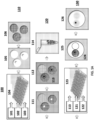
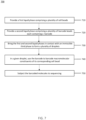
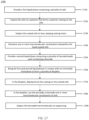
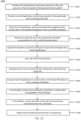
- Method 100 comprises three different phases 110, 120 and 130 that correspond to generation of cell beads comprising a cell or virus or its macromolecular constituent(s) (110); solvent exchange to bring generated partitions into an aqueous phase, cell or virus lysis and denaturation of the cell or virus or macromolecular constituent(s) of the cell or virus (120); and generation of partitions comprising the generated cell beads and barcodes and subsequent tagging (e.g., barcoding) (130).
- a cell e.g., a fixed cell, a cross-linked cell
- Method 100 comprises three different phases 110, 120 and 130 that correspond to generation of cell beads comprising a cell or virus or its macromolecular constituent(s) (110); solvent exchange to bring generated partitions into an aqueous phase, cell or virus lysis and denaturation of the cell or virus or macromolecular constituent(s) of the cell or virus (120); and generation of partitions comprising the generated cell beads and barcodes and subsequent tagging (e.g., barcoding) (
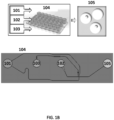
- an oil 101, polymeric or gel precursors 102 and cells 103 are provided to a microfluidic chip 104.
- a photograph of an example microfluidic chip 104 is shown in FIG. 1B .
- the microfluidic chip 104 comprises a plurality of reservoirs for the oil 101, polymeric or gel precursors 102 and cell or virus reagents 103.
- Polymeric or gel precursors 102 and cell or virus reagents 103 are flowed (e.g., via the action of an applied force, such as negative pressure via a vacuum or positive pressure via a pump) from their reservoirs to a first channel junction at which point they combine to form an aqueous stream.
- This aqueous stream is then flowed to a second channel junction, to which oil 101 is also provided.
- the aqueous stream provided from the first channel junction is immiscible with the oil 101 resulting in the generation of a suspension of aqueous droplets in the oil which then flow to reservoir 105 and represent the product 105 from the microfluidic process.
- Flow can be controlled within the microfluidic chip 104 via any suitable strategy, including the use of one or more flow regulators in a channel or various channels, dimensioning of microfluidic channels, etc.
- the product comprises droplets 105 comprising a cell from the cells 103 and polymeric or gel precursors 102.
- the droplets 105 are then subjected to conditions suitable to polymerize or gel the polymeric or gel precursors 102 in the droplets 105, which generates cell beads 106 that encapsulate the cell or virus reagents 103 (e.g., a cell, a fixed cell, a cross-linked cell, component(s) or a cell) in the droplets 105.
- the cell or virus reagents 103 e.g., a cell, a fixed cell, a cross-linked cell, component(s) or a cell
- phase 120 is initiated which includes solvent exchange 111 to resuspend the cell beads 106 in an aqueous phase. Additional details and examples regarding solvent exchange are provided elsewhere herein.
- the resuspended cell beads 106 can then, in bulk, be subjected conditions suitable to lyse cells or viruses associated with the cell beads 106 and, separately or contemporaneously, also subjected, in bulk, to conditions to denature nucleic acids derived from the cells or viruses associated with the cell beads 106.
- the polymeric matrix of the cell beads 106 effectively hinders or prohibits diffusion of larger molecules, such as nucleic acids, from the cell beads 106.
- the cell beads 106 are sufficiently porous to denaturation agents that permit denaturation of trapped nucleic acids within the cell beads 106.
- the cell beads can then be subjected, in bulk, to conditions suitable for performing one or more reactions on nucleic acids derived from the cells or viruses associated with the cell beads 106. Additional details and examples regarding reactions on nucleic acids are provided elsewhere herein.
- the resulting cell beads 113 are then collected 114 and can be stored prior to initiation of phase 130.
- droplets comprising the cell beads 113 and barcode beads (e.g., gel beads) 122 comprising barcode sequences are generated.
- an oil 121, the cell beads 113 and barcode beads 122 each comprising a barcode sequence (e.g., each bead comprising a unique barcode sequence) are provided to a microfluidic chip 123.
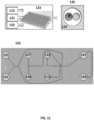
- a photograph of an example microfluidic chip 123 is shown in FIG. 1C .
- the microfluidic chip 123 comprises a plurality of reservoirs for the oil 121, cell beads 113 and barcode beads 122.
- the chip also includes additional reservoirs 127 and 128 that may be used to supply additional reagents (e.g., reagents for nucleic acid amplification, reagents that can degrade or dissolve cell beads 113 and/or barcode beads 122, reagents that degrade linkages between barcodes and barcode beads 122, etc.) to phase 130.
- Cell beads 113 and barcode beads 122 are flowed (e.g., via the action of an applied force, such as negative pressure via a vacuum or positive pressure via a pump) from their reservoirs to a first channel junction at which point they combine to form an aqueous mixture. Materials from reservoirs 127 and 128 can also be provided to the mixture at the first channel junction.
- cell beads and barcode beads can be mixed before introduction into the microfluidic chip.
- a single reservoir of the microfluidic chip 123 comprises a mixture of cell beads and barcode beads.
- the ratio of cell beads to barcode beads in the mixture can be varied to alter the number of droplets generated that comprise a single cell bead and a single barcode bead.
- the mixture of cell beads and barcode beads may be flowed (e.g., via the action of an applied force, such as negative pressure via a vacuum or positive pressure via a pump) from the reservoir to a first channel junction, in some cases together with materials from reservoirs 127 and/or 128.
- cells may be mixed with barcode beads.
- a collection of cells and cell beads may be mixed with barcode beads, or a collection of cells may be mixed with barcode beads.
- the mixture comprising cell beads (or cells), barcode beads, and in some cases additional reagents is then flowed to a second channel junction, to which oil 121 is also provided.
- the aqueous mixture provided from the first channel junction is immiscible with the oil 121 resulting in the generation of a suspension of aqueous droplets 125 in the oil which then flow to reservoir 125 and represent the product from the microfluidic process.
- the microfluidic chip can also include a reservoir 129 that can accept excess oil from the stream emerging from the second channel. Flow can be controlled within the microfluidic chip 123 via any suitable strategy, including the use of one or more flow regulators (see FIGS.
- the product comprises droplets 125 comprising a cell bead 113 and a barcode bead 122, in addition to any other reagents provided by reservoirs 127 and 128.
- a given droplet of the droplets 125 comprises a single cell bead and a single barcode bead.
- reagents that degrade or dissolve the cell beads 113, barcoded beads 122 and/or linkages between barcodes and barcode beads 122 are present in droplets, these reagents can release the nucleic acids trapped in the cell beads 113 from the cell beads 113 and release the barcodes from the barcode beads 122.
- the released barcodes can then interact with the released nucleic acids to generate barcoded constructs for nucleic acid sequencing as described elsewhere herein.
- a given droplet comprises a single cell bead and a single barcode bead comprising oligonucleotides having a common barcode sequence
- a given sequencing construct generated from the given droplet 125 can be associated with the cell or virus of the given cell bead via its barcode sequence.
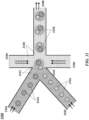
- FIG. 31 shows an example of a microfluidic channel structure 3100 for delivering barcode carrying beads to droplets.
- the channel structure 3100 can include channel segments 3101, 3102, 3104, 3106 and 3108 communicating at a channel junction 3110.
- the channel segment 3101 may transport an aqueous fluid 3112 that includes a plurality of beads 3114 (e.g., with nucleic acid molecules, oligonucleotides, molecular tags) along the channel segment 3101 into junction 3110.
- the plurality of beads 3114 may be sourced from a suspension of beads.
- the channel segment 3101 may be connected to a reservoir comprising an aqueous suspension of beads 3114.
- the activated COOH groups can then react with an appropriate species (e.g., a species comprising an amine functional group where the carboxylic acid groups are activated to be reactive with an amine functional group) comprising a moiety to be linked to the bead.
- an appropriate species e.g., a species comprising an amine functional group where the carboxylic acid groups are activated to be reactive with an amine functional group
- Activation of disulfide linkages within a bead can be controlled such that a small number of disulfide linkages are activated. Control may be exerted, for example, by controlling the concentration of a reducing agent used to generate free thiol groups and/or concentration of reagents used to form disulfide bonds in bead polymerization. In some cases, a low concentration (e.g., molecules of reducing agent:gel bead ratios of less than about 10,000, less than about 100,000, less than about 1,000,000, less than about 10,000,000, less than about 100,000,000, less than about 1,000,000,000, less than about 10,000,000,000, or less than about 100,000,000,000) of reducing agent may be used for reduction.
- a low concentration e.g., molecules of reducing agent:gel bead ratios of less than about 10,000, less than about 100,000, less than about 1,000,000, less than about 10,000,000, less than about 100,000,000, less than about 1,000,000,000, less than about 10,000,000,000, or less than about 100,000,000,000
- Controlling the number of disulfide linkages that are reduced to free thiols may be useful in ensuring bead structural integrity during functionalization.
- optically-active agents such as fluorescent dyes may be may be coupled to beads via free thiol groups of the beads and used to quantify the number of free thiols present in a bead and/or track a bead.
- addition of moieties to a gel bead after gel bead formation may be advantageous.
- addition of an oligonucleotide (e.g., barcoded oligonucleotide) after gel bead formation may avoid loss of the species during chain transfer termination that can occur during polymerization.
- smaller precursors e.g., monomers or cross linkers that do not comprise side chain groups and linked moieties
- functionalization after gel bead synthesis can minimize exposure of species (e.g., oligonucleotides) to be loaded with potentially damaging agents (e.g., free radicals) and/or chemical environments.
- the generated gel may possess an upper critical solution temperature (UCST) that can permit temperature driven swelling and collapse of a bead.
- UCT upper critical solution temperature
- Such functionality may aid in oligonucleotide (e.g., a primer) infiltration into the bead during subsequent functionalization of the bead with the oligonucleotide.
- Post-production functionalization may also be useful in controlling loading ratios of species in beads, such that, for example, the variability in loading ratio is minimized.
- Species loading may also be performed in a batch process such that a plurality of beads can be functionalized with the species in a single batch.
- beads can be non-covalently loaded with one or more reagents.
- the beads can be non-covalently loaded by, for instance, subjecting the beads to conditions sufficient to swell the beads, allowing sufficient time for the reagents to diffuse into the interiors of the beads, and subjecting the beads to conditions sufficient to de-swell the beads.
- the swelling of the beads may be accomplished, for instance, by placing the beads in a thermodynamically favorable solvent, subjecting the beads to a higher or lower temperature or temperature change, subjecting the beads to a higher or lower ion concentration, and/or subjecting the beads to an electric field.
- the de-swelling of the beads may be accomplished, for instance, by transferring the beads in a thermodynamically unfavorable solvent, subjecting the beads to a lower or high temperature or temperature change different from that use to swell the beads, subjecting the beads to a lower or higher ion concentration different from that used to swell the beads, and/or removing the electric field.
- Transferring the beads may cause pores in the beads to shrink. Such shrinking may then hinder reagents within the beads from diffusing out of the interiors of the beads. The hindrance may be due to steric interactions between the reagents and the interiors of the beads.
- the transfer may be accomplished microfluidically. For instance, the transfer may be achieved by moving the beads from one co-flowing solvent stream to a different co-flowing solvent stream. The swellability and/or pore size of the beads may be adjusted by changing the polymer composition of the bead.
- an acrydite moiety linked to precursor, another species linked to a precursor, or a precursor itself comprises a labile bond, such as chemically, thermally, or photosensitive bonds e.g., disulfide bonds, UV sensitive bonds, or the like.
- a labile bond such as chemically, thermally, or photosensitive bonds e.g., disulfide bonds, UV sensitive bonds, or the like.
- the bead may also comprise the labile bond.
- the labile bond may be, for example, useful in reversibly linking (e.g., covalently linking) species (e.g., barcodes, primers, etc.) to a bead.
- a thermally labile bond may include a nucleic acid hybridization based attachment, e.g., where an oligonucleotide is hybridized to a complementary sequence that is attached to the bead, such that thermal melting of the hybrid releases the oligonucleotide, e.g., a barcode containing sequence, from the bead or microcapsule.
- a nucleic acid hybridization based attachment e.g., where an oligonucleotide is hybridized to a complementary sequence that is attached to the bead, such that thermal melting of the hybrid releases the oligonucleotide, e.g., a barcode containing sequence, from the bead or microcapsule.
- Barcodes that are releasably, cleavably or reversibly attached to the beads described herein include barcodes that are released or releasable through cleavage of a linkage between the barcode molecule and the bead, or that are released through degradation of the underlying bead itself, allowing the barcodes to be accessed or accessible by other reagents, or both.
- the barcodes that are releasable as described herein may sometimes be referred to as being activatable, in that they are available for reaction once released.
- an activatable barcode may be activated by releasing the barcode from a bead (or other suitable type of partition described herein).
- Other activatable configurations are also envisioned in the context of the described methods and systems.
- labile bonds that may be coupled to a precursor or bead include an ester linkage (e.g., cleavable with an acid, a base, or hydroxylamine), a vicinal diol linkage (e.g., cleavable via sodium periodate), a Diels-Alder linkage (e.g., cleavable via heat), a sulfone linkage (e.g., cleavable via a base), a silyl ether linkage (e.g., cleavable via an acid), a glycosidic linkage (e.g., cleavable via an amylase), a peptide linkage (e.g., cleavable via a protease), or a phosphodiester linkage (e.g., cleavable via a nuclease (
- Species that do not participate in polymerization may also be encapsulated in beads during bead generation (e.g., during polymerization of precursors). Such species may be entered into polymerization reaction mixtures such that generated beads comprise the species upon bead formation. In some cases, such species may be added to the gel beads after formation.
- species may include, for example, oligonucleotides, reagents for a nucleic acid amplification reaction (e.g., primers (e.g. random primers, primers specific for a given DNA loci), polymerases, nucleotides (e.g.
- co-factors e.g., ionic co-factors
- reagents for enzymatic reactions e.g., enzymes, co-factors, substrates
- reagents for reverse transcription e.g. oligonucleotide primers or reverse transcriptase
- nucleic acid modification reactions such as polymerization, ligation, digestion, methylation, random mutagenesis, bisulfite conversion, uracil hydrolysis, nucleic acid repair, nucleic acid insertion or cleavage (e.g.
- Beads may be of uniform size or heterogeneous size.
- the diameter of a bead may be about 1 ⁇ m, 5 ⁇ m, 10 ⁇ m, 20 ⁇ m, 30 ⁇ m, 40 ⁇ m, 50 ⁇ m, 60 ⁇ m, 70 ⁇ m, 80 ⁇ m, 90 ⁇ m, 100 ⁇ m, 250 ⁇ m, 500 ⁇ m, or 1mm.
- a bead may have a diameter of at least about 1 ⁇ m, 5 ⁇ m, 10 ⁇ m, 20 ⁇ m, 30 ⁇ m, 40 ⁇ m, 50 ⁇ m, 60 ⁇ m, 70 ⁇ m, 80 ⁇ m, 90 ⁇ m, 100 ⁇ m, 250 ⁇ m, 500 ⁇ m, 1mm, or more.
- a bead may have a diameter of less than about 1 ⁇ m, 5 ⁇ m, 10 ⁇ m, 20 ⁇ m, 30 ⁇ m, 40 ⁇ m, 50 ⁇ m, 60 ⁇ m, 70 ⁇ m, 80 ⁇ m, 90 ⁇ m, 100 ⁇ m, 250 ⁇ m, 500 ⁇ m, or 1mm. In some cases, a bead may have a diameter in the range of about 40-75 ⁇ m, 30-75 ⁇ m, 20-75 ⁇ m, 40-85 ⁇ m, 40-95 ⁇ m, 20-100 ⁇ m, 10-100 ⁇ m, 1-100 ⁇ m, 20-250 ⁇ m, or 20-500 ⁇ m.
- beads are provided as a population or plurality of beads having a relatively monodisperse size distribution.
- maintaining relatively consistent bead characteristics, such as size can contribute to the overall consistency.
- the beads described herein may have size distributions that have a coefficient of variation in their cross-sectional dimensions of less than 50%, less than 40%, less than 30%, less than 20%, and in some cases less than 15%, less than 10%, or less than 5%.
- Beads may be of any suitable shape. Examples of bead shapes include, but are not limited to, spherical, non-spherical, oval, oblong, amorphous, circular, cylindrical, and variations thereof.
- the beads may be degradable, disruptable, or dissolvable spontaneously or upon exposure to one or more stimuli (e.g., temperature changes, pH changes, exposure to particular chemical species or phase, exposure to light, reducing agent, etc.).
- a bead may be dissolvable, such that material components of the beads are solubilized when exposed to a particular chemical species or an environmental change, such as a change temperature or a change in pH.
- a gel bead is degraded or dissolved at elevated temperature and/or in basic conditions.
- a bead may be thermally degradable such that when the bead is exposed to an appropriate change in temperature (e.g., heat), the bead degrades.
- Degradation or dissolution of a bead bound to a species e.g., a oligonucleotide, e.g., barcoded oligonucleotide
- a species e.g., a oligonucleotide, e.g., barcoded oligonucleotide
- a degradable bead may comprise one or more species with a labile bond such that, when the bead/species is exposed to the appropriate stimuli, the bond is broken and the bead degrades.
- the labile bond may be a chemical bond (e.g., covalent bond, ionic bond) or may be another type of physical interaction (e.g., van der Waals interactions, dipole-dipole interactions, etc.).
- a crosslinker used to generate a bead may comprise a labile bond.
- the labile bond can be broken and the bead degraded. For example, upon exposure of a polyacrylamide gel bead comprising cystamine crosslinkers to a reducing agent, the disulfide bonds of the cystamine can be broken and the bead degraded.
- a degradable bead may be useful in more quickly releasing an attached species (e.g., an oligonucleotide, a barcode sequence, a primer, etc) from the bead when the appropriate stimulus is applied to the bead as compared to a bead that does not degrade.
- an attached species e.g., an oligonucleotide, a barcode sequence, a primer, etc
- the species may have greater mobility and accessibility to other species in solution upon degradation of the bead.
- a species may also be attached to a degradable bead via a degradable linker (e.g., disulfide linker).
- the degradable linker may respond to the same stimuli as the degradable bead or the two degradable species may respond to different stimuli.
- a barcode sequence may be attached, via a disulfide bond, to a polyacrylamide bead comprising cystamine.
- the bead Upon exposure of the barcoded-bead to a reducing agent, the bead degrades and the barcode sequence is released upon breakage of both the disulfide linkage between the barcode sequence and the bead and the disulfide linkages of the cystamine in the bead.
- a degradable bead may be introduced into a partition, such as a droplet of an emulsion or a well, such that the bead degrades within the partition and any associated species (e.g., oligonucleotides) are released within the droplet when the appropriate stimulus is applied.
- the free species e.g., oligonucleotides
- a polyacrylamide bead comprising cystamine and linked, via a disulfide bond, to a barcode sequence, may be combined with a reducing agent within a droplet of a water-in-oil emulsion.
- the reducing agent breaks the various disulfide bonds resulting in bead degradation and release of the barcode sequence into the aqueous, inner environment of the droplet.
- heating of a droplet comprising a bead-bound barcode sequence in basic solution may also result in bead degradation and release of the attached barcode sequence into the aqueous, inner environment of the droplet.
- degradation may refer to the disassociation of a bound or entrained species from a bead, both with and without structurally degrading the physical bead itself.
- entrained species may be released from beads through osmotic pressure differences due to, for example, changing chemical environments.
- alteration of bead pore sizes due to osmotic pressure differences can generally occur without structural degradation of the bead itself.
- an increase in pore size due to osmotic swelling of a bead can permit the release of entrained species within the bead.
- osmotic shrinking of a bead may cause a bead to better retain an entrained species due to pore size contraction.
- reducing agent free (or DTT free) enzyme preparations in treating the beads described herein.
- examples of such enzymes include, e.g., polymerase enzyme preparations, reverse transcriptase enzyme preparations, ligase enzyme preparations, as well as many other enzyme preparations that may be used to treat the beads described herein.
- the terms "reducing agent free” or "DTT free” preparations can refer to a preparation having less than 1/10th, less than 1/50th, and even less than 1/100th of the lower ranges for such materials used in degrading the beads.
- a bead may be formed from materials that comprise degradable chemical crosslinkers, such as BAC or cystamine. Degradation of such degradable crosslinkers may be accomplished through a number of mechanisms.
- a bead may be contacted with a chemical degrading agent that may induce oxidation, reduction or other chemical changes.
- a chemical degrading agent may be a reducing agent, such as dithiothreitol (DTT).
- Beads may also be induced to release their contents upon the application of a thermal stimulus.
- a change in temperature can cause a variety of changes to a bead. For example, heat can cause a solid bead to liquefy. A change in heat may cause melting of a bead such that a portion of the bead degrades. In other cases, heat may increase the internal pressure of the bead components such that the bead ruptures or explodes. Heat may also act upon heat-sensitive polymers used as materials to construct beads.
- a chemical degrading agent may be a reducing agent, such as DTT, wherein DTT may degrade the disulfide bonds formed between a crosslinker and gel precursors, thus degrading the bead.
- a reducing agent may be added to degrade the bead, which may or may not cause the bead to release its contents.
- reducing agents may include dithiothreitol (DTT), ⁇ -mercaptoethanol, (2S)-2-amino-1,4-dimercaptobutane (dithiobutylamine or DTBA), tris(2-carboxyethyl) phosphine (TCEP), or combinations thereof.
- the reducing agent may be present at a concentration of about 0.1mM, 0.5mM, 1mM, 5mM, or 10mM.
- the reducing agent may be present at a concentration of at least about 0.1mM, 0.5mM, 1mM, 5mM, 10mM, or greater than 10 mM.
- the reducing agent may be present at a concentration of at most about 0.1mM, 0.5mM, 1mM, 5mM, or 10mM.
- barcode molecules e.g., primer, e.g., barcoded oligonucleotide
- primer e.g., barcoded oligonucleotide
- the barcode molecules e.g., primer, e.g., barcoded oligonucleotide
- pre-defined concentration may be selected to facilitate certain reactions for generating a sequencing library, e.g., amplification, within the partition.
- the pre-defined concentration of the primer is limited by the process of producing oligonucleotide bearing beads.
- the compartments or partitions can comprise partitions that are flowable within fluid streams. These partitions may comprise, e.g., micro-vesicles that have an outer barrier surrounding an inner fluid center or core, or, in some cases, they may comprise a porous matrix that is capable of entraining and/or retaining materials within its matrix. Partitions can comprise droplets of aqueous fluid within a non-aqueous continuous phase, e.g., an oil phase. A variety of different vessels are described in, for example, U.S. Patent Application Publication No. 2014/0155295 . Emulsion systems for creating stable droplets in non-aqueous or oil continuous phases are described in detail in, e.g., U.S. Patent Application Publication No. 2010/0105112 .
- allocating individual cell beads to discrete partitions may generally be accomplished by introducing a flowing stream of cell beads in an aqueous fluid into a flowing stream of a non-aqueous fluid, such that droplets are generated at the junction of the two streams.
- the occupancy of the resulting partitions e.g., number of cell beads per partition
- the relative flow rates of the fluids can be selected such that, on average, the partitions contain less than one cell bead per partition, in order to ensure that those partitions that are occupied, are primarily singly occupied.
- the relative flow rates of the fluids can be selected such that a majority of partitions are occupied, e.g., allowing for a small percentage of unoccupied partitions.
- the flows and channel architectures can be controlled as to ensure a requisite number of singly occupied partitions, less than a certain level of unoccupied partitions and less than a certain level of multiply occupied partitions.
- the systems and methods described herein can be operated such that a majority of occupied partitions include no more than one cell bead per occupied partition.
- the partitioning process is conducted such that fewer than 40% of the occupied partitions contain more than one cell bead, fewer than 35% of the occupied partitions contain more than one cell bead, fewer than 30% of the occupied partitions contain more than one cell bead, fewer than 25% of the occupied partitions contain more than one cell bead, fewer than 20% of the occupied partitions contain more than one cell bead, fewer than 15% of the occupied partitions contain more than one cell bead, fewer than 10% of the occupied partitions contain more than one cell bead, or fewer than 5% of the occupied partitions include more than one cell bead per partition.
- the Poissonian distribution may expectedly increase the number of partitions that may include multiple cell beads.
- the flow of one or more of the cell beads, or other fluids directed into a partitioning zone can be manipulated to control occupancy of partitions with cell beads such that no more than 60% of the generated partitions are unoccupied, no more than 50% of the generated partitions are unoccupied, no more than 45% of the generated partitions are unoccupied, no more than 40% of the generated partitions are unoccupied, no more than 35% of the generated partitions are unoccupied, no more than 30% of the generated partitions are unoccupied, no more than 25% of the generated partitions are unoccupied, no more than 20% of the generated partitions are unoccupied, or no more than 10% of the generated partitions are unoccupied.
- These flows can be controlled so as to present non-Poissonian distribution of single occupied partitions while providing lower levels of unoccupied partitions.
- unoccupied partitions can be achieved while still providing any of the single occupancy rates described above.
- the use of the systems and methods described herein creates resulting partitions (e.g., droplets comprising cell beads) that have multiple occupancy rates of less than 50%, less than 45%, less than 40%, less than 35%, less than 30%, less than 25%, less than 20%, less than 15%, less than 10%, less than 5% or less than 1%.
- multiply occupied partitions e.g., containing two, three, four or more cell beads and/or microcapsules (e.g., beads, gel beads) comprising barcoded oligonucleotides within a single partition. Accordingly, as noted above, the flow characteristics of the cell bead and/or bead containing fluids and partitioning fluids may be controlled to provide for such multiply occupied partitions.
- the flow parameters may be controlled to provide a requisite occupancy rate at greater than 50% of the partitions, greater than 55% of the partitions, greater than 60% of the partitions, greater than 65% of the partitions, greater than 70% of the partitions, greater than 75% of the partitions, greater than 80% of the partitions, greater than 85% of the partitions, greater than 90% of the partitions, greater than 95% of the partitions, or higher.
- additional microcapsules are used to deliver additional reagents to a partition.
- the flow and frequency of the different beads into the channel or junction may be controlled to provide for the requisite ratio of microcapsules from each source, while ensuring the requisite pairing or combination of such beads into a partition with the requisite number of cell beads.
- the partitions described herein may comprise small volumes, e.g., less than 10 ⁇ L, less than 5 ⁇ L, less than 1 ⁇ L, less than 900 picoliters (pL), less than 800 pL, less than 700 pL, less than 600 pL, less than 500 pL, less than 400pL, less than 300 pL, less than 200 pL, less than 100pL, less than 50 pL, less than 20 pL, less than 10 pL, less than 1 pL, less than 500 nanoliters (nL), or even less than 100 nL, 50 nL, or even less.
- small volumes e.g., less than 10 ⁇ L, less than 5 ⁇ L, less than 1 ⁇ L, less than 900 picoliters (pL), less than 800 pL, less than 700 pL, less than 600 pL, less than 500 pL, less than 400pL, less than 300 pL, less than 200 pL, less than 100pL, less
- the droplets may have overall volumes that are less than 1000 pL, less than 900 pL, less than 800 pL, less than 700 pL, less than 600 pL, less than 500 pL, less than 400pL, less than 300 pL, less than 200 pL, less than 100pL, less than 50 pL, less than 20 pL, less than 10 pL, or even less than 1 pL.
- the sample fluid volume, e.g., including co-partitioned cell beads, within the partitions may be less than 90% of the above described volumes, less than 80%, less than 70%, less than 60%, less than 50%, less than 40%, less than 30%, less than 20%, or even less than 10% the above described volumes.
- partitioning species may generate a population or plurality of partitions.
- any suitable number of partitions can be generated to generate the plurality of partitions.
- a plurality of partitions may be generated that comprises at least about 1,000 partitions, at least about 5,000 partitions, at least about 10,000 partitions, at least about 50,000 partitions, at least about 100,000 partitions, at least about 500,000 partitions, at least about 1,000,000 partitions, at least about 5,000,000 partitions at least about 10,000,000 partitions, at least about 50,000,000 partitions, at least about 100,000,000 partitions, at least about 500,000,000 partitions or at least about 1,000,000,000 partitions.
- the plurality of partitions may comprise both unoccupied partitions (e.g., empty partitions) and occupied partitions.
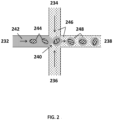
- FIG. 2 shows an example of a simplified microfluidic channel structure for partitioning individual cell beads.
- the majority of occupied partitions include no more than one cell bead per occupied partition and, in some cases, some of the generated partitions are unoccupied. In some cases, though, some of the occupied partitions may include more than one cell bead.
- the partitioning process may be controlled such that fewer than 25% of the occupied partitions contain more than one cell bead, fewer than 20% of the occupied partitions have more than one cell bead, while in some cases, fewer than 10% or even fewer than 5% of the occupied partitions include more than one cell bead per partition.
- the channel structure can include channel segments 232, 234, 236 and 238 communicating at a channel junction 240.
- a first aqueous fluid 242 that includes suspended cell bead 244 may be transported along channel segment 232 into junction 240, while a second fluid 246 that is immiscible with the aqueous fluid 242 is delivered to the junction 240 from channel segments 234 and 236 to create discrete droplets 118 of the aqueous fluid including individual cell bead 244, flowing into channel segment 238.
- This second fluid 246 can comprise an oil, such as a fluorinated oil, that includes a fluorosurfactant for stabilizing the resulting droplets, e.g., inhibiting subsequent coalescence of the resulting droplets.
- an oil such as a fluorinated oil
- fluorosurfactant for stabilizing the resulting droplets, e.g., inhibiting subsequent coalescence of the resulting droplets.
- particularly useful partitioning fluids and fluorosurfactants are described for example, in U.S. Patent Application Publication No. 2010/0105112 .
- Macromolecular constituents derived from a cell or virus may be encapsulated within a cell bead. Encapsulation of macromolecular constituents derived from a cell or virus may be performed by a variety of processes. Such processes combine an aqueous fluid containing the a cell, virus, components thereof, or macromolecular constituents thereof to be analyzed with a polymeric precursor material that may be capable of being formed into a gel or other solid or semi-solid matrix upon application of a particular stimulus to the polymer precursor.
- Such stimuli include, e.g., thermal stimuli (either heating or cooling), photo-stimuli (e.g., through photo-curing), chemical stimuli (e.g., through crosslinking, polymerization initiation of the precursor (e.g., through added initiators), or the like.
- Preparation of cell beads comprising macromolecular constituents derived from a cell or virus thereof may be performed by a variety of methods.
- air knife droplet or aerosol generators may be used to dispense droplets of precursor fluids into gelling solutions in order to form cell beads that include individual a cell, virus, or macromolecular constituents thereof.
- membrane based encapsulation systems may be used to generate cell beads comprising encapsulated a cell, virus, components thereof, or macromolecular constituents thereof as described herein.
- Microfluidic systems of the present disclosure such as that shown in FIG. 2 , may be readily used in encapsulating cells as described herein.
- FIG. 2 may be readily used in encapsulating cells as described herein.
- non-aqueous fluid 246 may also include an initiator to cause polymerization and/or crosslinking of the polymer precursor to form the microcapsule that includes the entrained cells.
- initiator to cause polymerization and/or crosslinking of the polymer precursor to form the microcapsule that includes the entrained cells. Examples of polymer precursor/initiator pairs include those described in U.S. Patent Application Publication No. 2014/0378345 .
- the activation agent may comprise a cross-linking agent, or a chemical that activates a cross-linking agent within the formed droplets.
- the activation agent may comprise a polymerization initiator.
- the polymer precursor comprises a mixture of acrylamide monomer with a N,N'-bis-(acryloyl)cystamine (BAC) comonomer
- an agent such as tetraethylmethylenediamine (TEMED) may be provided within the second fluid streams in channel segments 234 and 236, which initiates the copolymerization of the acrylamide and BAC into a cross-linked polymer network or, hydrogel.
- TEMED tetraethylmethylenediamine
- the TEMED may diffuse from the second fluid 246 into the aqueous first fluid 242 comprising the linear polyacrylamide, which will activate the crosslinking of the polyacrylamide within the droplets, resulting in the formation of the gel, e.g., hydrogel, microcapsules 248, as solid or semi-solid beads or particles entraining the cells 244.
- the gel e.g., hydrogel, microcapsules 248, as solid or semi-solid beads or particles entraining the cells 244.
- alginate droplets followed by exposure to divalent metal ions, e.g., Ca2+, can be used as an encapsulation process using the described processes.
- divalent metal ions e.g., Ca2+
- agarose droplets may also be transformed into capsules through temperature based gelling, e.g., upon cooling, or the like.
- encapsulated macromolecular constituents derived from a cell or virus can be selectively releasable from the microcapsule, e.g., through passage of time, or upon application of a particular stimulus, that degrades the microcapsule sufficiently to allow the cell, or its contents to be released from the microcapsule, e.g., into a partition, such as a droplet.
- a partition such as a droplet.
- degradation of the microcapsule may be accomplished through the introduction of an appropriate reducing agent, such as DTT or the like, to cleave disulfide bonds that cross link the polymer matrix (see, e.g., U.S. Patent Application Publication No. 2014/0378345 .
- the cell bead may be contacted with lysis reagents in order to release the contents of cells or viruses associated with the cell bead.
- the lysis agents can be contacted with a cell bead suspension in bulk after cell bead formation.
- reagents can also be contacted with the cell beads, including, for example, DNase and RNase inactivating agents or inhibitors, such as proteinase K, chelating agents, such as EDTA, and other reagents employed in removing or otherwise reducing negative activity or impact of different cell lysate components on subsequent processing of nucleic acids.
- the cell beads may be exposed to an appropriate stimulus to release the cell beads or their contents from a co-partitioned microcapsule.
- a chemical stimulus may be co-partitioned along with an encapsulated cell bead to allow for the degradation of the microcapsule and release of the macromolecular constituents into the larger partition.
- this stimulus may be the same as the stimulus described elsewhere herein for release of oligonucleotides from their respective microcapsule (e.g., bead). In alternative aspects, this may be a different and non-overlapping stimulus, in order to allow an encapsulated cell bead release its contents into a partition at a different time from the release of oligonucleotides into the same partition.
- Additional reagents may also be co-partitioned with the cell beads.
- reagents may be encapsulated within the cell beads.
- reagents may be outside the cell beads.
- Reagents may be those useful in modification of a cell bead's nucleic acid (e.g., DNA, RNA, etc.), where such modification may include ligation, digestion, methylation, random mutagenesis, bisulfite conversion, uracil hydrolysis, nucleic acid repair, capping, or decapping.
- Additional reagents may also include reagents useful in amplification of a cell bead's nucleic acid, including primers (e.g.
- Additional reagents may also include proteases to remove proteins bound to a cell bead's nucleic acids and transposons to fragment or insert a known sequence into a cell bead's DNA. Additional reagents may also include a nucleic acid, a Cas9 nuclease and a guide RNA to mediate editing of a cell bead's DNA.
- Macromolecular components may be processed (e.g., subjected to nucleic acid amplification) prior to generation of cell beads.
- macromolecular components contained within the cell beads may be further processed. Further processing may, in some instances, occur prior to partitioning of the cell beads into discrete partitions. Further processing may also occur following partitioning of the cell beads into discrete partitions and prior to release of the contents of the cell beads into their respective partitions. Alternatively or additionally, further processing may occur once the contents of the cell beads are released into their respective partitions.
- Further processing may include, for example, nucleic acid modification, where such modification may include ligation, digestion, methylation, random mutagenesis, bisulfite conversion, uracil hydrolysis, nucleic acid repair, capping, or decapping. Further processing may also include nucleic acid amplification, including isothermal amplification (e.g., loop mediated isothermal amplification or multiple displacement amplification) or PCR (e.g., DOP-PCR), where amplification may incorporate unmodified bases, modified bases, or non-canonical bases. Additional processing may also include nucleic acid insertion or cleavage (e.g., via CRISPR/Cas9-mediated or transposon-mediated insertion or cleavage). Additional processing may also include reverse transcription, where reverse transcription may incorporate unmodified bases, modified bases, or non-canonical bases.
- nucleic acid modification may include ligation, digestion, methylation, random mutagenesis, bisulfite conversion, uracil hydrolysis,
- the macromolecular component contents of individual cell beads can be provided with unique identifiers such that, upon characterization of those macromolecular components they may be attributed as having been derived from the same cell bead or particles (and, thus, cell or virus originally associated with the cell bead).
- unique identifiers such that, upon characterization of those macromolecular components they may be attributed as having been derived from the same cell bead or particles (and, thus, cell or virus originally associated with the cell bead).
- the ability to attribute characteristics to a cell, virus, components thereof, or macromolecular constituents thereof of individual cell beads or groups of cell beads is provided by the assignment of unique identifiers specifically to an individual cell bead or groups of cell beads.
- Unique identifiers e.g., in the form of nucleic acid barcodes can be assigned or associated with individual cell beads or populations of cell bead, in order to tag or label the cell bead's macromolecular components (and as a result, its characteristics) with the unique identifiers. These unique identifiers can then be used to attribute the cell bead's components and characteristics to the original cell or virus(s) associated with the cell bead. In some aspects, this is performed by co-partitioning the individual cell bead or groups of cell beads with the unique identifiers.
- the unique identifiers are provided in the form of oligonucleotides that comprise nucleic acid barcode sequences that may be attached to or otherwise associated with the nucleic acid contents of individual cell bead, or to other components of the cell bead, and particularly to fragments of those nucleic acids.
- the oligonucleotides are partitioned such that as between oligonucleotides in a given partition, the nucleic acid barcode sequences contained therein are the same, but as between different partitions, the oligonucleotides can, and do have differing barcode sequences, or at least represent a large number of different barcode sequences across all of the partitions in a given analysis.
- only one nucleic acid barcode sequence can be associated with a given partition, although in some cases, two or more different barcode sequences may be present.
- the nucleic acid barcode sequences can include from 6 to about 20 or more nucleotides within the sequence of the oligonucleotides.
- the length of a barcode sequence may be 6, 7, 8, 9, 10, 11, 12, 13, 14, 15, 16, 17, 18, 19, 20 nucleotides or longer.
- the length of a barcode sequence may be at least 6, 7, 8, 9, 10, 11, 12, 13, 14, 15, 16, 17, 18, 19, 20 nucleotides or longer.
- the length of a barcode sequence may be at most 6, 7, 8, 9, 10, 11, 12, 13, 14, 15, 16, 17, 18, 19, 20 nucleotides or shorter.
- each partition of the population can include at least 100 oligonucleotide molecules, at least 500 oligonucleotide molecules, at least 1,000 oligonucleotide molecules, at least 5,000 oligonucleotide molecules, at least 10,000 oligonucleotide molecules, at least 50,000 oligonucleotide molecules, at least 100,000 oligonucleotide molecules, at least 500,000 oligonucleotides, at least 1,000,000 oligonucleotide molecules, at least 5,000,000 oligonucleotide molecules, at least 10,000,000 oligonucleotide molecules, at least 50,000,000 oligonucleotide molecules, at least 100,000,000 oligonucleotide molecules, and in some cases at least 1 billion oligonucleotide molecules.
- compositions include the polyacrylamide matrices described above for encapsulation of a cell, virus, components thereof, or macromolecular constituents thereof, and may be degraded for release of the attached oligonucleotides through exposure to a reducing agent, such as DTT.
- a reducing agent such as DTT
- oligonucleotides that include a barcode sequence are co-partitioned in, e.g., a droplet 302 in an emulsion, along with a sample nucleic acid 304.
- a sample nucleic acid may be from a cell bead.
- the oligonucleotides 308 may be provided on a bead 306 that is co-partitioned with the sample nucleic acid 304, which oligonucleotides are releasable from the bead 306, as shown in panel A.
- the oligonucleotides 308 include a barcode sequence 312, in addition to one or more functional sequences, e.g., sequences 310, 314 and 316.
- oligonucleotide 308 is shown as comprising barcode sequence 312, as well as sequence 310 that may function as an attachment or immobilization sequence for a given sequencing system, e.g., a P5 sequence used for attachment in flow cells of an Illumina Hiseq ® or Miseq ® system.
- the oligonucleotides also include a primer sequence 316, which may include a random or targeted N-mer for priming replication of portions of the sample nucleic acid 304.
- oligonucleotide 308 is also included within oligonucleotide 308 .
- sequence 314 may provide a sequencing priming region, such as a "read1" or R1 priming region, that is used to prime polymerase mediated, template directed sequencing by synthesis reactions in sequencing systems.
- the functional sequences may be selected to be compatible with a variety of different sequencing systems, e.g., 454 Sequencing, Ion Torrent Proton or PGM, Illumina X10, etc., and the requirements thereof.
- the barcode sequence 312, immobilization sequence 310 and R1 sequence 314 may be common to all of the oligonucleotides attached to a given bead.
- the primer sequence 316 may vary for random N-mer primers, or may be common to the oligonucleotides on a given bead for certain targeted applications.
- the functional sequences may include primer sequences useful for RNA-seq applications.
- the oligonucleotides may include poly-T primers for priming reverse transcription of RNA for RNA-seq.
- oligonucleotides in a given partition e.g., included on an individual bead, may include multiple types of primer sequences in addition to the common barcode sequences, such as DNA-sequencing or RNA sequencing primers, e.g., poly-T primer sequences included within the oligonucleotides coupled to the bead.
- materials derived from a single partitioned cell bead may be subjected to DNA or RNA sequencing processes.
- the barcoded nucleic acid fragments may then be subjected to characterization, e.g., through sequence analysis, or they may be further amplified in the process, as shown in panel D.
- additional oligonucleotides e.g., oligonucleotide 308b, also released from bead 306, may prime the fragments 318 and 320. This is shown for fragment 318.
- the oligonucleotide anneals with the fragment 318, and is extended to create a complement 326 to at least a portion of fragment 318 which includes sequence 328, that comprises a duplicate of a portion of the sample nucleic acid sequence. Extension of the oligonucleotide 308b continues until it has replicated through the oligonucleotide portion 308 of fragment 318.
- the oligonucleotides may be configured to prompt a stop in the replication by the polymerase at a particular point, e.g., after replicating through sequences 316 and 314 of oligonucleotide 308 that is included within fragment 318.
- this may be accomplished by different methods, including, for example, the incorporation of different nucleotides and/or nucleotide analogues that are not capable of being processed by the polymerase enzyme used.
- this may include the inclusion of uracil containing nucleotides within the sequence region 312 to prevent a non-uracil tolerant polymerase to cease replication of that region.
- partial hairpin structures By forming these partial hairpin structures, it allows for the removal of first level duplicates of the sample sequence from further replication, e.g., preventing iterative copying of copies.
- the partial hairpin structure also provides a useful structure for subsequent processing of the created fragments, e.g., fragment 326.
- the amplification of the nucleic acids of the cell bead may be performed until the barcoded overlapping fragments within the partition constitute at least 1X coverage of the particular portion or all of the associated cell or virus' genome, at least 2X, at least 3X, at least 4X, at least 5X, at least 10X, at least 20X, at least 40X or more coverage of the genome or its relevant portion of interest.
- the barcoded fragments may be directly sequenced on an appropriate sequencing system, e.g., an Illumina Hiseq ® , Miseq ® or X10 system, or they may be subjected to additional processing, such as further amplification, attachment of other functional sequences, e.g., second sequencing primers, for reverse reads, sample index sequences, and the like.
- an appropriate sequencing system e.g., an Illumina Hiseq ® , Miseq ® or X10 system
- additional processing such as further amplification, attachment of other functional sequences, e.g., second sequencing primers, for reverse reads, sample index sequences, and the like.
- All of the fragments from multiple different partitions may then be pooled for sequencing on high throughput sequencers as described herein, where the pooled fragments comprise a large number of fragments derived from the nucleic acids of different cell beads or small cell bead populations, but where the fragments from the nucleic acids of a given cell bead will share the same barcode sequence.
- each fragment is coded as to its partition of origin, and consequently its single cell bead or small population of cell beads
- the sequence of that fragment may be attributed back to that cell bead or those cell beads (and, thus, the original cell or population of cells or viruses) based upon the presence of the barcode, which will also aid in applying the various sequence fragments from multiple partitions to assembly of individual genomes for different cell beads.
- FIG. 4 This is schematically illustrated in FIG. 4 .
- a first nucleic acid 404 from a first cell bead 400, and a second nucleic acid 406 from a second cell bead 402 are each partitioned along with their own sets of barcode oligonucleotides as described above.
- the nucleic acids may comprise a chromosome, entire genome, transcript or other nucleic acid from the cell bead.
- each cell bead's nucleic acids 404 and 406 is then processed to separately provide overlapping set of second fragments of the first fragment(s), e.g., second fragment sets 408 and 410.
- This processing also provides the second fragments with a barcode sequence that is the same for each of the second fragments derived from a particular first fragment.
- the barcode sequence for second fragment set 408 is denoted by "1" while the barcode sequence for fragment set 410 is denoted by "2".
- a diverse library of barcodes may be used to differentially barcode large numbers of different fragment sets. However, it is not necessary for every second fragment set from a different first fragment to be barcoded with different barcode sequences. In fact, in many cases, multiple different first fragments may be processed concurrently to include the same barcode sequence. Diverse barcode libraries are described in detail elsewhere herein.
- the barcoded fragments may then be pooled for sequencing using, for example, sequence by synthesis technologies available from Illumina or Ion Torrent division of Thermo-Fisher, Inc.
- sequence reads 412 can be attributed to their respective fragment set, e.g., as shown in aggregated reads 414 and 416, at least in part based upon the included barcodes, and in some cases, in part based upon the sequence of the fragment itself.
- the attributed sequence reads for each fragment set are then assembled to provide the assembled sequence for each cell bead's nucleic acids, e.g., sequences 418 and 420, which in turn, may be attributed to individual cell beads and cell or virus (e.g., cells) encapsulated within the cell beads.
- nucleic acids e.g., sequences 418 and 420
- individual cell beads and cell or virus e.g., cells
- a particularly valuable application of the cell bead processes described herein is in the sequencing and characterization of macromolecular constituents of a diseased cell that is associated with the cell bead.
- a diseased cell can have altered metabolic properties, gene expression, and/or morphologic features.
- Exemplary diseases include inflammatory disorders, metabolic disorders, nervous system disorders, and cancer.
- cancer cells Of particular interest are cancer cells.
- conventional analytical techniques including the ensemble sequencing processes alluded to above, are not highly adept at picking small variations in genomic make-up of cancer cells, particularly where those exist in a sea of normal tissue cells.
- wide variations can exist and can be masked by the ensemble approaches to sequencing (See, e.g., Patel, et al., Single-cell RNA-seq highlights intratumoral heterogeneity in primary glioblastoma, Science DOI: 10.1126/science.1254257 (Published online June 12, 2014 ).
- Cancer cells may be derived from solid tumors, hematological malignancies, cell lines, or obtained as circulating tumor cells, and subjected to the partitioning processes described above. Upon analysis, one can identify individual cell sequences as deriving from a single cell or small group of cells, and distinguish those over normal tissue cell sequences.
- Non-limiting examples of cancer cells include cells of cancers such as Acanthoma, Acinic cell carcinoma, Acoustic neuroma, Acral lentiginous melanoma, Acrospiroma, Acute eosinophilic leukemia, Acute lymphoblastic leukemia, Acute megakaryoblastic leukemia, Acute monocytic leukemia, Acute myeloblastic leukemia with maturation, Acute myeloid dendritic cell leukemia, Acute myeloid leukemia, Acute promyelocytic leukemia, Adamantinoma, Adenocarcinoma, Adenoid cystic carcinoma, Adenoma, Adenomatoid odontogenic tumor, Adrenocortical carcinoma, Adult T-cell leukemia, Aggressive NK-cell leukemia, AIDS-Related Cancers, AIDS-related lymphoma, Alveolar soft part sarcoma, Ameloblastic fibroma, Anal cancer, Anaplastic large cell
- a single immune cell can be analyzed together with any associated pathogen (e.g., microbe) which may be adhered to the immune cell (e.g., via an immune receptor).
- individual T cells are analyzed using the methods disclosed herein.
- individual B cells are analyzed using the methods disclosed herein.
- a first and second set of targeted barcode constructs may be targeted to either of a forward strand and reverse strand of a double-stranded sample nucleic acid.
- the first set can comprise targeted barcode constructs comprising a P5 sequence, a barcode sequence, and a targeted N-mer to either of a first target sequence or a second target sequence.
- the second set can comprise targeted barcode constructs comprising a P5 sequence, a barcode sequence, and a targeted N-mer to either of the first target sequence and the second target sequence.
- Each construct can also comprise any additional sequences between the barcode and the targeted N-mer.
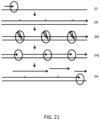
- the polymerase based incorporation of dUTP results in a growing template strand (long arrow) at (ii) in FIG. 21 .
- the reaction may include an enzyme (oval with bolt) capable of excising dUTP and creating nicks in the copied template DNA strand, but not in the original target sequence.
- the nicking by the enzyme capable of excising dUTP may result in the production of a plurality of amplified strands (short arrows), each of which may be shorter than the original template strand.
- phi29 DNA polymerase may engage at the nick sites for additional amplification in a priming independent amplification process.
- the original target sequence may be recycled as a template upon strand displacement of released amplified fragments owing to the highly processive nature of the phi29 DNA polymerase. Subsequent amplifications may mirror the previously described process to produce additional released amplified fragments.
- the priming free amplification methods may be extended to provide a barcoding capability, for instance as shown in FIGS. 22A-C .
- FIG. 22A shows a method of barcoding amplified templates generated by the priming free amplification using an extension barcoding approach.
- Strand displacement and the high processivity of phi29 DNA polymerase may allow the release of amplified fragments, thereby enabling recycling of the template for further amplification.
- the single strand fragments that are generated during stand displacement may be converted to dsDNA by the hexamer or by the Nmer part of the same polymerase.
- FIG. 22B shows a method of barcoding amplified templates generated by the priming free amplification using a single stranded or double stranded template to barcode ligation approach.
- the template DNA molecules may be converted to either single stranded (using, for instance, changes in temperature or an enzyme) or double stranded (using, for instance, an enzyme).
- the molecular barcodes, (such as oligonucleotides) may be attached through a ligation process using a ssDNA ligase, dsDNA ligase, or another nucleic acid modifying enzyme. Additional oligonucleotides serving as molecular handles may be added to the first barcode tag in subsequent ligations.
- FIG. 22C shows a method of barcoding amplified templates generated by the priming free amplification by attaching a single strand DNA molecule (with barcode or primer sequence) to a bead from the 3' end.
- the 5' end of the oligo may be pre-adenylated (either chemically or enzymatically).
- the oligo may be sequestered using Hotstart-IT binding protein which may be released using heat.
- APP DNA/RNA ligase may ligate 5' pre-adenylated oligo with 3' end of the library molecule.
- amplification may be performed using the degenerate oligonucleotide primed-polymerase chain reaction (DOP-PCR) method.
- DOP-PCR uses a partially degenerate sequence in a PCR protocol with two different annealing temperatures. The first PCR cycles are performed using a low annealing temperature. These cycles are then followed by a large number of PCR cycles with a higher annealing temperature. The use of the lower first annealing temperature may ensure that fragments that are specifically tagged in the first PCR cycles are amplified at the higher second annealing temperature.
- the DOP-PCR method may allow random amplification of DNA from any source.
- DOP-PCR is characterized by the use of modified PCR primers.
- the DOP-PCR primer consists of three regions.
- the 5'-end carries a recognition sequence for XhoI (C ⁇ TCGAG), a restriction endonuclease that cuts rarely within the human genome.
- DOP-PCR comprises two different cycling stages. In the first low stringency phase, low-temperature annealing and extension in the first five to eight cycles occurs at many binding sites in the genome. The 3'-end of the primer binds at sites in the genome complementary to the 6-bp well-defined sequence at the 3'-end of the primer ( ⁇ 10(6) sites in the human genome).
- the adjacent random hexamer sequence (displaying all possible combinations of the nucleotides A, G, C, and T) can then anneal and tags these sequences with the DOP primer.
- the PCR annealing temperature is raised, which increases priming specificity during amplification of the tagged sequence.
- DOP-PCR Whole-genome amplification by degenerate oligonucleotide primed PCR (DOP-PCR), CSH Protoc DOI: 10.1101/pdb.prot4919 (Published January 1, 2008).
- the processes and systems described herein may also be used to characterize individual cells or viruses as a way to provide an overall profile of a cellular, or other organismal population.
- a variety of applications require the evaluation of the presence and quantification of different cells or viruses or organism types within a population of cells or viruses, including, for example, microbiome analysis and characterization, environmental testing, food safety testing, epidemiological analysis, e.g., in tracing contamination or the like.
- the analysis processes described above may be used to individually characterize, sequence and/or identify large numbers of individual cells or viruses within a population. This characterization may then be used to assemble an overall profile of the originating population, which can provide important prognostic and diagnostic information.
- shifts in human microbiomes including, e.g., gut, buccal, epidermal microbiomes, etc.
- Using the cell bead analysis methods and systems described herein one can again, characterize, sequence and identify individual cells in an overall population, and identify shifts within that population that may be indicative of diagnostic ally relevant factors.
- sequencing of bacterial 16S ribosomal RNA genes has been used as a highly accurate method for taxonomic classification of bacteria.
- Using the targeted amplification and sequencing processes described above can provide identification of individual cells within a population of cells. One may further quantify the numbers of different cells within a population to identify current states or shifts in states over time.
- identification and diagnosis of infection or potential infection may also benefit from the cell bead analyses described herein, e.g., to identify microbial species present in large mixes of other cells and/or nucleic acids, from any diagnostically relevant environment, e.g., cerebrospinal fluid, blood, fecal or intestinal samples, or the like.
- the foregoing analyses may also be particularly useful in the characterization of potential drug resistance of different cells or pathogens, e.g., cancer cells, bacterial pathogens, etc., through the analysis of distribution and profiling of different resistance markers/mutations across cell populations in a given sample. Additionally, characterization of shifts in these markers/mutations across populations of cells over time can provide valuable insight into the progression, alteration, prevention, and treatment of a variety of diseases characterized by such drug resistance issues.
- pathogens e.g., cancer cells, bacterial pathogens, etc.
- analysis of different environmental samples to profile the microbial organisms, viruses, or other biological contaminants that are present within such samples can provide important information about disease epidemiology, and potentially aid in forecasting disease outbreaks, epidemics an pandemics.
- a sample is provided that contains cells associated with cell beads that are to be analyzed and characterized as to their cell surface proteins.
- a library of antibodies, antibody fragments, or other molecules having a binding affinity to the cell surface proteins or antigens (or other cell features) for which the cell is to be characterized also referred to herein as cell surface feature binding groups.
- binding groups can include a reporter molecule that is indicative of the cell surface feature to which the binding group binds.
- a binding group type that is specific to one type of cell surface feature will comprise a first reporter molecule, while a binding group type that is specific to a different cell surface feature will have a different reporter molecule associated with it.
- these reporter molecules will comprise oligonucleotide sequences. Oligonucleotide based reporter molecules can provide advantages of being able to generate significant diversity in terms of sequence, while also being readily attachable to most biomolecules, e.g., antibodies, etc., as well as being readily detected, e.g., using sequencing or array technologies.
- the binding groups include oligonucleotides attached to them.
- a first binding group type e.g., antibodies to a first type of cell surface feature
- a reporter oligonucleotide that has a first nucleotide sequence.
- Different binding group types e.g., antibodies having binding affinity for other, different cell surface features
- reporter oligonucleotides that comprise different nucleotide sequences, e.g., having a partially or completely different nucleotide sequence.
- the reporter oligonucleotide sequence may be known and readily identifiable as being associated with the known cell surface feature binding group.
- oligonucleotides may be directly coupled to the binding group, or they may be attached to a bead, molecular lattice, e.g., a linear, globular, cross-slinked, or other polymer, or other framework that is attached or otherwise associated with the binding group, which allows attachment of multiple reporter oligonucleotides to a single binding group.
- molecular lattice e.g., a linear, globular, cross-slinked, or other polymer, or other framework that is attached or otherwise associated with the binding group, which allows attachment of multiple reporter oligonucleotides to a single binding group.
- reporter molecules can comprise the same sequence, or a particular binding group will include a known set of reporter oligonucleotide sequences.
- the reporter molecules can be different and attributable to the particular binding group.
- Attachment of the reporter groups to the binding groups may be achieved through any of a variety of direct or indirect, covalent or non-covalent associations or attachments.
- oligonucleotide reporter groups associated with antibody based binding groups such oligonucleotides may be covalently attached to a portion of an antibody or antibody fragment using chemical conjugation techniques (e.g., Lightning-Link ® antibody labeling kits available from Innova Biosciences), as well as other non-covalent attachment mechanisms, e.g., using biotinylated antibodies and oligonucleotides (or beads that include one or more biotinylated linker, coupled to oligonucleotides) with an avidin or streptavidin linker.
- chemical conjugation techniques e.g., Lightning-Link ® antibody labeling kits available from Innova Biosciences
- other non-covalent attachment mechanisms e.g., using biotinylated antibodies and oligonucleotides (or beads that include one or more biotiny
- Antibody and oligonucleotide biotinylation techniques are available (See, e.g., Fang, et al., Fluoride-Cleavable Biotinylation Phosphoramidite for 5'-end-Labeling and Affinity Purification of Synthetic Oligonucleotides, Nucleic Acids Res. Jan 15, 2003; 31(2):708-715 , DNA 3' End Biotinylation Kit, available from Thermo Scientific).
- protein and peptide biotinylation techniques have been developed and are readily available (See, e.g., U.S. Patent No. 6,265,552 ).
- the reporter oligonucleotides may be provided having any of a range of different lengths, depending upon the diversity of reporter molecules or a given analysis, the sequence detection scheme employed, and the like. In some cases, these reporter sequences can be greater than about 5 nucleotides in length, greater than or equal to about 10 nucleotides in length, greater than or equal to about 20, 30, 40, 50, 60, 70, 80, 90, 100, 120, 150 or 200 nucleotides in length. In some cases, these reporter nucleotides may be less than about 250 nucleotides in length, less than or equal to about 200, 180, 150, 120 100, 90, 80, 70, 60, 50, 40, or 30 nucleotides in length.
- the reporter oligonucleotides may be selected to provide barcoded products that are already sized, and otherwise configured to be analyzed on a sequencing system. For example, these sequences may be provided at a length that ideally creates sequenceable products of a length for particular sequencing systems. Likewise, these reporter oligonucleotides may include additional sequence elements, in addition to the reporter sequence, such as sequencer attachment sequences, sequencing primer sequences, amplification primer sequences, or the complements to any of these.
- a cell surface profile of individual cells Based upon the reporter molecules that emanate from an individual partition based upon the presence of the barcode sequence, one may then create a cell surface profile of individual cells from a population of cells. Profiles of individual cells or populations of cells may be compared to profiles from other cells, e.g., 'normal' cells, to identify variations in cell surface features, which may provide diagnostically relevant information. In particular, these profiles may be particularly useful in the diagnosis of a variety of disorders that are characterized by variations in cell surface receptors, such as cancer and other disorders.
- the ester formed in the first operation may be exposed to a disulfide crosslinking agent.
- the ester may be exposed to cystamine (2,2'-dithiobis(ethylamine)).
- cystamine 2,2'-dithiobis(ethylamine)
- an encapsulated cell and barcode bead is surrounded by polymeric strands, such as polyacrylamide strands linked together by disulfide bridges thereby resulting in a cell bead comprising the cell and barcode bead.
- the cell and barcode bead may be encased inside of the cell bead.
- one or more magnetic (e.g., paramagnetic) particles may be encapsulated within the cell bead such, as for example, by also including such particles within a droplet along with polymeric precursors.
- FIG. 15 shows a flowchart depicting an example method 1500 of producing droplets containing a droplet containing a cell bead, a barcode bead (e.g., a gel bead), and generating sequence reads from macromolecular components a cell associated with the cell bead.
- the method 1500 may comprise the following operations.
- the second liquid phase can be brought into contact with an immiscible third phase comprising a plurality of barcode beads comprising barcodes and a denaturant neutralization agent.
- the third liquid phase may be aqueous.
- the barcode beads each contain a barcode to barcode one or more macromolecular constituents of the plurality of cells.
- the first liquid phase and the third liquid phase are the same phase. The bringing together of the second liquid phase and the third liquid phase can generate a mixture comprising the barcode beads and the first droplets.
- the lysis may be achieved with a detergent present in the first droplet, such as sodium dodecyl sulfate (SDS), 4-(1,1,3,3-Tetramethylbutyl)phenyl-polyethylene glycol (Triton X-100) or any non-ionic surfactant, or a saponin.
- the lysis may be achieved with an enzyme in the first droplet, such as a proteinase or a lytic enzyme (such as a lysozyme, cellulose, or zymolase).
- the lysis may be achieved by exposing first droplet to freeze thawing.
- the lysis may be achieved by exposing the first droplet to electromagnetic radiation, such as ultraviolet (UV) light.
- the lysis may be achieved by exposing the first droplet to heat.
- the lysis may be achieved by exposing the contents of the first droplet to any other lysis agent.
- a first liquid phase comprising a plurality of cells.
- the first liquid phase may be aqueous.
- the first liquid phase may comprise a cellular growth medium.
- the first liquid phase may comprise a minimal growth medium.
- the coated cells can be subjected to conditions sufficient to lyse the cells.
- lysis is completed with the aid of a lysis agent in a droplet.
- lysis of coated cells is completed in bulk.
- the lysis of the cells may occur subsequent to subjecting the cells to conditions sufficient to encapsulate the cells in the polymer coating.
- the lysis may release macromolecular constituents of the lysed coated cells.
- the coating of the cells may retain the macromolecular constituents released from the cells within the confines of the coating.
- the lysis may be achieved by exposing the coated cells to sodium hydroxide (NaOH), potassium hydroxide (KOH), or any other alkaline agent.
- a second liquid phase comprising a plurality of barcode beads
- the second liquid phase may be aqueous.
- the second liquid phase may comprise a cellular growth medium.
- the second liquid phase may comprise a minimal growth medium.
- the barcode beads each contain a barcode to barcode one or more macromolecular constituents of the plurality of coated cells.
- the first liquid phase and the second liquid phase are the same phase.
- the first liquid phase and the second liquid phase are mixed to provide a mixed phase.
- the first liquid phase and the second liquid phase are brought together with a third liquid phase that is immiscible with the first and second liquid phase.
- the third liquid phase may interact with the first and second liquid phases in such a manner as to partition each of the plurality of coated cells and the plurality of barcode beads into a plurality of droplets.
- the third liquid phase may comprise an oil and may also comprise a surfactant.
- the third liquid phase may comprise a fluorinated hydrocarbon.
- a given droplet may include a single coated cell and a single barcode bead. In some cases, at least 80%, at least 90%, at least 95%, at least 99%, at least 99.5%, at least 99.9%, at least 99.95%, or at least 99.99% of the droplets may contain a single coated cell.
- the coated cells are subjected to conditions sufficient to depolymerize the coating.
- the depolymerization of the coating may be achieved by exposing the coated cells to a reducing agent (e.g., dithiothreitol (DTT)), which may be in a partition.
- DTT dithiothreitol
- the depolymerization of the coating may be achieved by exposing the coated cells to any substance capable of depolymerizing the coating.
- operation 1770 also includes releasing barcodes from the barcode beads, which may be achieved with the same stimulus, such as, for example, used to reverse cross-linking of the coated cell. In some cases, the stimuli are different. Released barcodes can then participate in barcoding as in operation 1780.
- the barcode is used to barcode one or more macromolecular constituents of a given cell in a given droplet.
- the macromolecular constituents of the cell is subjected to conditions sufficient for nucleic acid amplification for barcoding.
- a barcode can function as a primer in such amplification.
- ligation can be used for barcoding.
- the barcode is used to identify one or more macromolecular constituents of the cell.
- the barcode is subjected to nucleic acid sequencing to identify one or more macromolecular components.
- the sequencing is untargeted sequencing.
- the sequencing is targeted sequencing.
- the barcoded macromolecules are subjected to sequencing to generate reads.
- the sequencing may be performed within a droplet.
- the sequencing may be performed outside of a droplet.
- the sequencing may be performed by releasing the barcoded macromolecules from a droplet and sequencing the barcoded macromolecules using a sequencer, such as an Illumina sequencer or any other sequencer described herein.
- a given barcoded sequencing read can be used to identify the cell from which the barcoded sequencing read was generated. Such capability can link particular sequences to particular cells. Additional details and examples regarding nucleic acid sequencing methods are described elsewhere herein.
- the barcoded macromolecules may be further processed prior to sequencing.
- the barcoded macromolecules are subjected to nucleic acid amplification (e.g., PCR) prior to sequencing.
- additional sequences are ligated to barcoded macromolecules.
- Such further processing may be performed in a droplet or external to the droplet, such as by releasing the barcoded macromolecules from the droplets.
- FIG. 18 shows a droplet containing a single coated cell and a single barcode bead produced using the method 1700.
- a droplet 1800 of aqueous liquid is formed inside a volume 1805 of a liquid that is immiscible with the aqueous liquid.
- the droplet contains a single barcode bead 1820.
- the droplet also contains a single coated cell 1810 containing one or more macromolecular constituents 1815.
- the coated cell is surrounded by a coating 1830f.
- FIG. 19 shows a flowchart that depicts a method 1900 of producing droplets containing cell and a single barcode bead and generating sequence reads from macromolecular components of the cell.
- a droplet comprising aqueous fluids having different viscosities can segregate an included cell to particular regions within the droplet.
- two miscible phases are provided in the droplet, but which two miscible phases are of sufficiently different physical properties (e.g., have substantially different viscosities) that diffusion between the two phases is limited.
- the two miscible phases are phases of an aqueous two phase system (ATPS).
- miscible phases examples include an aqueous phase and an aqueous phase comprising one or more of glycerol, ficoll, dextran and polyethylene glycol (PEG).
- aqueous phase examples include glycerol, ficoll, dextran and polyethylene glycol (PEG).
- PEG polyethylene glycol
- incompatible chemical or biochemical reagents may be sequestered into the different phases.
- the slowed diffusion may allow for the timed exposure of the cell in the droplet or barcode bead to chemical or biochemical reagents.
- the method 1900 may comprise the following operations.
- a first liquid phase comprising a plurality of cells.
- the first liquid phase may be aqueous.
- the first liquid phase may comprise a cellular growth medium.
- the first liquid phase may comprise a minimal growth medium.
- the first liquid phase may comprise one of two miscible liquid phases between which two liquid phases diffusion of molecules from one phase to the other is limited.
- the first liquid phase may comprise one component of an ATPS or may comprise one or more viscosity enhancing agents, such as glycerol, ficoll, dextran or polyethylene glycol (PEG).
- the cells are subjected to conditions sufficient to lyse the cells.
- lysis is achieved via the aid of a lysis agent present in the first liquid phase within a droplet.
- the lysis may release macromolecular constituents of the lysed cells.
- diffusion of these macromolecular constituents may be limited.
- the lysis may be achieved by exposing the cells to sodium hydroxide (NaOH), potassium hydroxide (KOH), or any other alkaline agent, which may be in the droplet.
- the lysed cells can be subjected to conditions sufficient to denature one or more macromolecular constituents released by the lysed cells.
- denaturation is completed via the aid of a denaturation agent present in the first liquid phase within a droplet.
- the denaturing may be achieved by exposing the cells to sodium hydroxide (NaOH), which may be in the droplet.
- NaOH sodium hydroxide
- the denaturing may be achieved by exposing the cells to any other denaturing agent, which may be in the droplet.
- operation 1950 is completed contemporaneous to operation 1940.
- a denaturing agent can both denature macromolecular constituents and lyse the cells.
- barcodes are subjected to nucleic acid sequencing to identify one or more macromolecular components.
- the sequencing is untargeted sequencing.
- the sequencing is targeted sequencing.
- operation 1960 also includes releasing barcodes from the barcode beads, which may be achieved with a stimulus such as a reducing agent (e.g. DTT). Released barcodes can then participate in barcoding.
- a stimulus such as a reducing agent (e.g. DTT). Released barcodes can then participate in barcoding.
- the barcoded macromolecules may be further processed prior to sequencing.
- the barcoded macromolecules are subjected to nucleic acid amplification (e.g., PCR) prior to sequencing.
- additional sequences are ligated to barcoded macromolecules.
- Such further processing may be performed in a droplet or external to the droplet, such as by releasing the barcoded macromolecules from the droplets.
- FIG. 20 shows a droplet containing a single cell and a single barcode bead produced using the method 2000.
- a droplet 2000 of aqueous liquid is formed inside a volume 2005 of a liquid that is immiscible with the aqueous liquid.
- the droplet contains a single gel bead 2020.
- the droplet also contains a single cell 2010 containing one or more macromolecular constituents 2015.
- the droplet also contains two different aqueous phases that separately confine the barcode bead 2020 and the cell 2010.
- Phase 2030g comprises the cell 2010
- phase 2030a comprises the barcode bead 2020.
- compositions, systems and methods for generating cell beads in cell beads can be useful for positioning cells encapsulated in cell beads at the center or substantially at the center of the cells beads.
- centering of a cell can prevent the contents of the cell beads (e.g., cells, components of cells, biomolecules derived from cells, nucleic acids from cells) from diffusing or leaking out of the cell bead. Loss of these materials can lead to partial or complete loss of the sequencing information for the contents of a given cell bead. For example, leakage of nucleic acids from cells at the edges of cell beads can lead to noisy profiles derived from sequencing and/or potential false positive calls.
- cell beads in cell beads can be generated by a similar process used to generate single gel beads, as described elsewhere herein. First order cell beads can be generated as described herein, and then subjected to the same process for cell bead generation again to generate cell beads in cell beads.
- the stream comprising the cell beads 2701 and polymeric or gel precursors then flows through a fourth microfluidic channel 2708 to a second channel intersection with fifth and sixth channels 2709 and 2710.
- the fifth and sixth channels provide a phase immiscible with the aqueous phase of cell beads 2701 and polymeric or gel precursors flowing in channel 2708.
- the stream comprising the cell beads 2701 and polymeric or gel precursors from the fourth channel 2708 flows into the immiscible stream such that droplets 2711 comprising cell beads and polymeric or gel precursors are generated and flow away from the second intersection in a seventh channel 2712.
- the droplets 2711 can then be subject to conditions suitable for polymerizing or gelling the precursors in the droplets 2711 and subject to solvent exchange as is described elsewhere herein and the resulting cell beads in cell beads recovered.
- FIG. 28A A photograph showing generation of droplets comprising cell beads and polymeric or gel precursors using a microfluidic device, similar to that shown schematically in FIG. 27 , is shown in FIG. 28A .
- an aqueous phase comprising cell beads 2701 provided from channel 2705 is provided to a first channel junction, into which aqueous phase polymeric or gel precursors flow from channel 2706.
- the resulting aqueous mixture comprising both cell beads 2701 and polymeric or gel precursors, flows through channel 2708 into a second channel junction, into which oil provided by channel 2709 flows.
- the interaction between oil and aqueous phases generates droplets 2711 that comprise a cell bead 2701 and polymeric or gel precursors that flow away from the second channel junction in channel 2712.
- FIG. 28B shows a photograph of a cell bead in cell bead generated from droplets generated in FIG. 28A .
- the cell bead in cell bead comprises a larger cell bead 2800 that encapsulates a smaller cell bead 2801.
- the smaller cell bead 2801 encapsulates a cell 2802.
- the cell 2802 is substantially centered within the larger cell bead 2800.
- FIG. 29 shows a histogram of Depth Positional Coefficient of Variation (DPCV) values across individual cells, whose nucleic acids were sequenced using a cell bead in cell bead sample preparation approach.
- DPCV Depth Positional Coefficient of Variation
- cells may be centered in droplets without the generation of a cell bead comprising a cell bead.
- droplets comprising polymeric or gel precursors and cells may be subjected to shearing prior to cell bead generation. Shearing may be achieved, for example, via orbital shaking or in a microfluidic channel.
- the kinetics of polymerization or gelation of the precursors can be controlled such that polymerization or gelation is sufficiently slow or delayed.
- Slower or delayed polymerization or gelling can permit internal circulation of droplet contents that can center a cell within a droplet, such that it can then be fixed in place at the center of a cell bead upon precursor polymerization or gelling.
- FIG. 30 depicts a bar plot showing different categories of cell beads as a function of example conditions used to make the cell beads.
- the cell beads were classified into three categories (edge, off-center, center) depending on the location of a cells with respect to either the edge or the center of a given cell bead.
- the cell beads were generated with varying time and speed of shaking on an orbital shaker, as is discussed above.
- cells may also be centered in droplets by forming core-shell beads, with cells suspended in the solution that forms the core.
- Cells may be formed by viscosity-mismatched flowing streams such that cells are suspended in a core fluid having a different viscosity than a shell fluid.
- the shell fluid may be liquid and/or formed from a cross-linked matrix such as a cross-linked polymer. Examples of such core-shell beads are described in Rossow et al., J. Am. Chem. Soc. 2012, 134, 4983-4989 .
- Core-shell beads having cells suspended in the cores may also be formed through the generation of aqueous-in-aqueous droplets made from aqueous two-phase systems.
- the cells are suspended in a core solution (e.g., a polymer core solution, a polyethylene glycol (PEG) core solution) that is then surrounded by a cross-linked shell (e.g., cross-linked dextran shell).
- a core solution e.g., a polymer core solution, a polyethylene glycol (PEG) core solution
- PEG polyethylene glycol
- This bead may be generated from aqueous-in-aqueous droplets with one aqueous phase comprising cross-link precursors and another aqueous phase comprising cells. Additional details regarding the formation of core-shell beads from aqueous two-phase systems are provided in Mytnyk et al., RSC Adv., 2017, 7, 11331-11337 .
- the order of the operations of one or more of the example methods 700, 900, 1000, 1100, 1300, 1500, 1700, 1900, and 2500 discussed above can be changed, some of the operations removed, some of the operations duplicated, and additional operations added as appropriate.
- Some of the operations can be performed in succession. Some of the operations can be performed in parallel. Some of the operations can be performed once. Some of the operations can be performed more than once. Some of the operations can comprise sub-operations. Some of the operations can be automated and some of the operations can be manual.
- the processor as described herein can comprise one or more instructions to perform at least a portion of one or more operations of one or more of the methods.
- these examples are described above with respect to cell analysis, the same procedures can be extended to other biological species containing macromolecular constituents that can be barcoded, including viruses.
- the systems may utilize a droplet generator (e.g., a microfluidic device, droplet generators having a T-junction, droplet generators that generate droplets with cross-channel flow focusing, droplet generators that generate droplets with step/edge emulsification, droplet generations that generate droplets with gradient generation, droplet generators that use piezo/acoustics for droplet generation).
- a droplet generator e.g., a microfluidic device, droplet generators having a T-junction, droplet generators that generate droplets with cross-channel flow focusing, droplet generators that generate droplets with step/edge emulsification, droplet generations that generate droplets with gradient generation, droplet generators that use piezo/acoustics for droplet generation.
- a droplet generator is a microfluidic device which includes mixing of immiscible fluids at channel junctions of one or more channels to form droplets.
- the channels may be microchannels.
- the microchannels may be implemented on microfluidic devices. Examples of such microfluidic devices and their operation are provided in FIG. 1B , FIG. 1C , FIG. 1D , and FIG. 31 and are described elsewhere herein.
- Such systems may also include a controller programmed to implement a method described herein, including one of the example methods 100, 700, 900, 1000, 1100, 1300, 1500, 1700, 1900, and 2500 described herein.
- FIG. 6 shows a computer system 601 that is programmed or otherwise configured to implement methods or parts of methods described herein, including example methods 100, 700, 900, 1000, 1100, 1300, 1500, 1700, 1900, and 2500.
- the computer system 601 can regulate various aspects of the present disclosure, such as, for example, sample preparation of cellular materials in cell beads, barcoding of these materials and/or analysis of barcoded molecules.
- the computer system 601 can be an electronic device of a user or a computer system that is remotely located with respect to the electronic device.
- the electronic device can be a mobile electronic device.
- the computer system 601 includes a central processing unit (CPU, also "processor” and “computer processor” herein) 605, which can be a single core or multi core processor, or a plurality of processors for parallel processing.
- the computer system 601 also includes memory or memory location 610 (e.g., random-access memory, read-only memory, flash memory), electronic storage unit 615 (e.g., hard disk), communication interface 620 (e.g., network adapter) for communicating with one or more other systems, and peripheral devices 625, such as cache, other memory, data storage and/or electronic display adapters.
- the memory 610, storage unit 615, interface 620 and peripheral devices 625 are in communication with the CPU 605 through a communication bus (solid lines), such as a motherboard.
- the storage unit 615 can be a data storage unit (or data repository) for storing data.
- the computer system 601 can be operatively coupled to a computer network ("network") 630 with the aid of the communication interface 620.
- the network 630 can be the Internet, an internet and/or extranet, or an intranet and/or extranet that is in communication with the Internet.
- the network 630 in some cases is a telecommunication and/or data network.
- the network 630 can include one or more computer servers, which can enable distributed computing, such as cloud computing.
- the network 630 in some cases with the aid of the computer system 601, can implement a peer-to-peer network, which may enable devices coupled to the computer system 601 to behave as a client or a server.
- the CPU 605 can execute a sequence of machine-readable instructions, which can be embodied in a program or software.
- the instructions may be stored in a memory location, such as the memory 610.
- the instructions can be directed to the CPU 605, which can subsequently program or otherwise configure the CPU 605 to implement methods of the present disclosure. Examples of operations performed by the CPU 605 can include fetch, decode, execute, and writeback.
- the CPU 605 can be part of a circuit, such as an integrated circuit.
- a circuit such as an integrated circuit.
- One or more other components of the system 601 can be included in the circuit.
- the circuit is an application specific integrated circuit (ASIC).
- the storage unit 615 can store files, such as drivers, libraries and saved programs.
- the storage unit 615 can store user data, e.g., user preferences and user programs.
- the computer system 601 in some cases can include one or more additional data storage units that are external to the computer system 601, such as located on a remote server that is in communication with the computer system 601 through an intranet or the Internet.
- the computer system 601 can communicate with one or more remote computer systems through the network 630.
- the computer system 601 can communicate with a remote computer system of a user.
- remote computer systems include personal computers (e.g., portable PC), slate or tablet PC's (e.g., Apple ® iPad, Samsung ® Galaxy Tab), telephones, Smart phones (e.g., Apple ® iPhone, Android-enabled device, Blackberry ® ), or personal digital assistants.
- the user can access the computer system 601 via the network 630.
- Methods as described herein can be implemented by way of machine (e.g., computer processor) executable code stored on an electronic storage location of the computer system 601, such as, for example, on the memory 610 or electronic storage unit 615.
- the machine executable or machine readable code can be provided in the form of software.
- the code can be executed by the processor 605.
- the code can be retrieved from the storage unit 615 and stored on the memory 610 for ready access by the processor 605.
- the electronic storage unit 615 can be precluded, and machine-executable instructions are stored on memory 610.
- the code can be pre-compiled and configured for use with a machine having a processer adapted to execute the code, or can be compiled during runtime.
- the code can be supplied in a programming language that can be selected to enable the code to execute in a pre-compiled or as-compiled fashion.
- aspects of the systems and methods provided herein can be embodied in programming.
- Various aspects of the technology may be thought of as “products” or “articles of manufacture” typically in the form of machine (or processor) executable code and/or associated data that is carried on or embodied in a type of machine readable medium.
- Machine-executable code can be stored on an electronic storage unit, such as memory (e.g., read-only memory, random-access memory, flash memory) or a hard disk.
- “Storage” type media can include any or all of the tangible memory of the computers, processors or the like, or associated modules thereof, such as various semiconductor memories, tape drives, disk drives and the like, which may provide non-transitory storage at any time for the software programming.
- All or portions of the software may at times be communicated through the Internet or various other telecommunication networks. Such communications, for example, may enable loading of the software from one computer or processor into another, for example, from a management server or host computer into the computer platform of an application server.
- another type of media that may bear the software elements includes optical, electrical and electromagnetic waves, such as used across physical interfaces between local devices, through wired and optical landline networks and over various air-links.
- the physical elements that carry such waves, such as wired or wireless links, optical links or the like, also may be considered as media bearing the software.
- terms such as computer or machine "readable medium” refer to any medium that participates in providing instructions to a processor for execution.
- a machine readable medium such as computer-executable code
- a tangible storage medium such as computer-executable code
- Non-volatile storage media include, for example, optical or magnetic disks, such as any of the storage devices in any computer(s) or the like, such as may be used to implement the databases, etc. shown in the drawings.
- Volatile storage media include dynamic memory, such as main memory of such a computer platform.
- Tangible transmission media include coaxial cables; copper wire and fiber optics, including the wires that comprise a bus within a computer system.
- Carrier-wave transmission media may take the form of electric or electromagnetic signals, or acoustic or light waves such as those generated during radio frequency (RF) and infrared (IR) data communications.
- RF radio frequency
- IR infrared
- Common forms of computer-readable media therefore include for example: a floppy disk, a flexible disk, hard disk, magnetic tape, any other magnetic medium, a CD-ROM, DVD or DVD-ROM, any other optical medium, punch cards paper tape, any other physical storage medium with patterns of holes, a RAM, a ROM, a PROM and EPROM, a FLASH-EPROM, any other memory chip or cartridge, a carrier wave transporting data or instructions, cables or links transporting such a carrier wave, or any other medium from which a computer may read programming code and/or data.
- Many of these forms of computer readable media may be involved in carrying one or more sequences of one or more instructions to a processor for execution.
- the computer system 601 can include or be in communication with an electronic display 635 that comprises a user interface (UI) 640.
- UI user interface
- Examples of UI's include, without limitation, a graphical user interface (GUI) and web-based user interface.
- Methods and systems of the present disclosure can be implemented by way of one or more algorithms.
- An algorithm can be implemented by way of software upon execution by the central processing unit 605.
- the algorithm can, for example, implement methods or parts of methods described herein, including example methods 100, 700, 900, 1000, 1100, 1300, 1500, 1700, 1900, and 2500.
- the systems and methods described herein may be used to detect infectious agents in cells.
- the systems and methods may be used to collect CD4 T-cells in droplets and subject the collected CD4 T-cells to nucleic acid sequencing.
- the nucleic acid sequencing may reveal the presence of HIV-derived nucleic acids in the cells.
- the extent to which the HIV infection has spread in an HIV-infected subject may be measured by collecting and performing nucleic acid sequencing on all CD4 T-cells obtained from the HIV-infected subject.
- the systems and methods may be used to detect any infections agents in cells.
- FIG. 23 shows a schematic depicting an example method 2300 for retaining long nucleic acid segments and removing short nucleic acid segments.
- a mixture of short and long DNA segments is collected.
- the mixture of long and short DNA segments is loaded into cell beads.
- the mixture may be loaded into the cell beads by any of the systems and methods described herein.
- the mixture may be loaded into the cell beads such that some cell beads enclose a mixture of short nucleic acid segments and long nucleic acid segments.
- the cell beads are washed. During washing, the short nucleic acid segments are washed out of the cell beads, such that the cell beads retain the long nucleic acid segments.
- Cell beads can be tailored to have porosity that traps longer nucleic acid segments within cell beads but allows shorter nucleic acid segments to diffuse or flow out of the cell beads.
- the cell beads containing long nucleic acid segments are combined with gel beads to form droplets containing one or more cell beads and one or more gel beads.
- a fifth operation 2350 the DNA segments are subjected to nucleic acid sequencing, as described herein.
- nucleic acid loci may be derived from nucleic acids that are associated with or encapsulated within a cell bead.
- amplification may be performed in an individual partition among a plurality of partitions, such as a droplet among a plurality of droplets. Where partitions are implemented, an individual partition may comprise a cell bead having the nucleic acid(s) to be amplified. In some cases, amplification of nucleic acid(s) of a cell bead may be completed prior to partitioning.
- FIG. 24 shows an example process for amplifying and barcoding targeted nucleic acid sequences.
- the forward primers hybridize with their respective loci where present and are extended via the action of the polymerase and, in some cases, with the aid of thermal cycling.
- the resulting constructs (not shown in FIG. 24 ) comprise both the universal nucleic acid sequence and complementary sequences of target loci present.
- the reverse primers hybridize to the complementary sequences of the target loci generated in the first stage and are extended to generate constructs (not shown in FIG. 24 ) comprising the original loci sequences and a complementary sequence of the universal nucleic acid sequence.
- the constructs generated in the second stage are shorter in length than those generated in the first round, such that the sequences derived from the nucleic acids analyzed that are present in these constructs are the target loci sequences.
- barcoded nucleic acid molecules shown in FIG. 24 , comprising an R1 primer sequence (e.g., primer for sequencing), a barcode sequence (BC), and the universal nucleic acid sequence are provided.
- the barcoded nucleic acid molecules may be coupled to beads and/or may be releasable from the beads. In some cases, these beads are partitioned with cell beads in which amplification of target loci has already been completed prior to partitioning. In other cases, these beads are partitioned with cell beads prior to such amplification. Moreover, where releasable from beads, the barcoded nucleic acid molecules can be released from the beads prior to participating in further downstream reactions.
- the barcoded nucleic acid molecules can be contacted with the amplified nucleic acids generated above and corresponding to the various loci present.
- the universal nucleic acid sequence of the barcoded nucleic acid molecules can hybridize with complementary sequences generated in second-stage constructs discussed above.
- the hybridized barcoded nucleic acid molecules are then extended via the action of a polymerase, such as with the aid of thermal cycling, to generate barcoded constructs comprising the sequences of the barcoded nucleic acid molecules and sequences complementary to the second stage constructs discussed above and corresponding to the original loci sequences analyzed.
- the resulting barcoded constructs can then be further processed to add additional sequences and then subject to sequencing.
- amplification schemes described above can generate barcoded, target-specific constructs for sequencing analysis.
Landscapes
- Chemical & Material Sciences (AREA)
- Life Sciences & Earth Sciences (AREA)
- Health & Medical Sciences (AREA)
- Organic Chemistry (AREA)
- Engineering & Computer Science (AREA)
- Zoology (AREA)
- Wood Science & Technology (AREA)
- Genetics & Genomics (AREA)
- Proteomics, Peptides & Aminoacids (AREA)
- Bioinformatics & Cheminformatics (AREA)
- General Engineering & Computer Science (AREA)
- Biotechnology (AREA)
- Molecular Biology (AREA)
- Analytical Chemistry (AREA)
- Microbiology (AREA)
- General Health & Medical Sciences (AREA)
- Biochemistry (AREA)
- Biophysics (AREA)
- Physics & Mathematics (AREA)
- Biomedical Technology (AREA)
- Immunology (AREA)
- Plant Pathology (AREA)
- Chemical Kinetics & Catalysis (AREA)
- Crystallography & Structural Chemistry (AREA)
- Bioinformatics & Computational Biology (AREA)
- Measuring Or Testing Involving Enzymes Or Micro-Organisms (AREA)
- Virology (AREA)
Claims (13)
- Verfahren zum Analysieren einer oder mehrerer Komponenten aus einer Probe, umfassend:(a) Bereitstellen einer Vielzahl von Zellkügelchen und einer Vielzahl von Nukleinsäure-Barcodemolekülen, wobei ein Zellkügelchen der Vielzahl von Zellkügelchen makromolekulare Bestandteile umfasst, die von einer Zelle oder einem Virus abgeleitet sind, die in einer Polymer- oder Gelmatrix eingekapselt sind, wobei die makromolekularen Bestandteile ein Nukleinsäuremolekül umfassen, und wobei ein Nukleinsäure-Barcodemolekül der Vielzahl von Nukleinsäure-Barcodemolekülen eine Barcode-Sequenz umfasst;(b) innerhalb des Zellkügelchens,(i) Unterziehen des Nukleinsäuremoleküls einer Nukleinsäuremodifikationsreaktion, um ein modifiziertes Nukleinsäuremolekül in dem Zellkügelchen zu erzeugen; und(ii) Verwenden des modifizierten Nukleinsäuremoleküls und des Nukleinsäure-Barcodemoleküls zum Erzeugen eines Barcode-codierten Nukleinsäuremoleküls in dem Zellkügelchen, umfassend (I) eine Sequenz des modifizierten Nukleinsäuremoleküls oder Derivats davon und (II) die Barcode-Sequenz oder das Derivat davon; und(c) Sequenzieren des Barcode-codierten Nukleinsäuremoleküls oder eines Derivats davon, um eine Sequenz des Nukleinsäuremoleküls zu identifizieren.
- Verfahren nach Anspruch 1, wobei die Nukleinsäuremodifikationsreaktion ausgewählt ist aus der Gruppe bestehend aus Ligation, Verdau, Methylierung, Zufallsmutagenese, Bisulfitumwandlung, Uracilhydrolyse, Nukleinsäurereparatur, Capping, Decapping und einer beliebigen Kombination davon.
- Verfahren nach Anspruch 1, ferner umfassend das Bereitstellen eines Barcode-Kügelchens, das das daran gekoppelte Nukleinsäure-Barcodemolekül umfasst.
- Verfahren nach Anspruch 3, wobei das Barcode-Kügelchen ein Polymer- oder Gelkügelchen umfasst.
- Verfahren nach Anspruch 4, ferner umfassend das Freisetzen des Nukleinsäure-Barcodemoleküls von dem Barcode-Kügelchen bei Aufbringen eines Stimulus auf das Barcode-Kügelchen, ausgewählt aus der Gruppe bestehend aus chemischem Stimulus, einem biologischen Stimulus, einer Temperaturänderung, Lichteinwirkung, einer pH-Änderung und einer beliebigen Kombination davon.
- Verfahren nach Anspruch 1, ferner umfassend das Unterteilen der Vielzahl von Zellkügelchen in eine Vielzahl von Unterteilungen, so dass eine Unterteilung der Vielzahl von Unterteilungen das Zellkügelchen der Vielzahl von Zellkügelchen umfasst.
- Verfahren nach Anspruch 6, wobei (b) in der Unterteilung durchgeführt wird.
- Verfahren nach Anspruch 6, wobei (b) außerhalb der Unterteilung durchgeführt wird.
- Verfahren nach Anspruch 1, ferner umfassend das Freisetzen der modifizierten Nukleinsäure von dem Zellkügelchen nach dem Aufbringen eines Stimulus auf das Zellkügelchen, ausgewählt aus der Gruppe bestehend aus chemischem Stimulus, einem biologischen Stimulus, einer Temperaturänderung, Lichteinwirkung, einer pH-Änderung und einer beliebigen Kombination davon.
- Verfahren nach Anspruch 1, ferner umfassend das Durchführen einer oder mehrerer zusätzlicher Reaktionen an dem modifizierten Nukleinsäuremolekül vor dem Sequenzieren.
- Verfahren nach Anspruch 10, wobei die eine oder die mehreren zusätzlichen Reaktionen eine Nukleinsäureamplifikationsreaktion umfassen.
- Verfahren nach Anspruch 1, ferner umfassend, vor (a), (i) Unterteilen einer Vielzahl von Zellen, die die Zelle und einen Polymer- oder Gelvorläufer umfassen, in eine Vielzahl von Unterteilungen und (ii) Unterziehen der Vielzahl von Unterteilungen, um ausreichend zu konditionieren, um die Polymer- oder Gelvorläufer in der Vielzahl von Unterteilungen zu polymerisieren oder zu vernetzen, um die Vielzahl von Zellkügelchen zu erzeugen.
- Verfahren nach Anspruch 12, ferner umfassend das Unterziehen der Zelle Bedingungen, die ausreichen, um die Zelle zu lysieren.
Priority Applications (1)
| Application Number | Priority Date | Filing Date | Title |
|---|---|---|---|
| EP25180524.8A EP4628582A2 (de) | 2017-01-30 | 2018-01-30 | Verfahren und systeme zur tröpfchenbasierten einzelzellenbarcodierung |
Applications Claiming Priority (6)
| Application Number | Priority Date | Filing Date | Title |
|---|---|---|---|
| US201762452261P | 2017-01-30 | 2017-01-30 | |
| US201762500943P | 2017-05-03 | 2017-05-03 | |
| US201762570783P | 2017-10-11 | 2017-10-11 | |
| EP22151565.3A EP4029939B1 (de) | 2017-01-30 | 2018-01-30 | Verfahren und systeme für eine einzelzellbarcodierung auf tröpfchenbasis |
| EP18744153.0A EP3545089B1 (de) | 2017-01-30 | 2018-01-30 | Verfahren und systeme für eine einzelzellbarcodierung auf tröpfchenbasis |
| PCT/US2018/016019 WO2018140966A1 (en) | 2017-01-30 | 2018-01-30 | Methods and systems for droplet-based single cell barcoding |
Related Parent Applications (3)
| Application Number | Title | Priority Date | Filing Date |
|---|---|---|---|
| EP18744153.0A Division EP3545089B1 (de) | 2017-01-30 | 2018-01-30 | Verfahren und systeme für eine einzelzellbarcodierung auf tröpfchenbasis |
| EP22151565.3A Division EP4029939B1 (de) | 2017-01-30 | 2018-01-30 | Verfahren und systeme für eine einzelzellbarcodierung auf tröpfchenbasis |
| EP22151565.3A Division-Into EP4029939B1 (de) | 2017-01-30 | 2018-01-30 | Verfahren und systeme für eine einzelzellbarcodierung auf tröpfchenbasis |
Related Child Applications (2)
| Application Number | Title | Priority Date | Filing Date |
|---|---|---|---|
| EP25180524.8A Division EP4628582A2 (de) | 2017-01-30 | 2018-01-30 | Verfahren und systeme zur tröpfchenbasierten einzelzellenbarcodierung |
| EP25180524.8A Division-Into EP4628582A2 (de) | 2017-01-30 | 2018-01-30 | Verfahren und systeme zur tröpfchenbasierten einzelzellenbarcodierung |
Publications (4)
| Publication Number | Publication Date |
|---|---|
| EP4310183A2 EP4310183A2 (de) | 2024-01-24 |
| EP4310183A3 EP4310183A3 (de) | 2024-02-21 |
| EP4310183C0 EP4310183C0 (de) | 2025-07-09 |
| EP4310183B1 true EP4310183B1 (de) | 2025-07-09 |
Family
ID=62978297
Family Applications (4)
| Application Number | Title | Priority Date | Filing Date |
|---|---|---|---|
| EP18744153.0A Active EP3545089B1 (de) | 2017-01-30 | 2018-01-30 | Verfahren und systeme für eine einzelzellbarcodierung auf tröpfchenbasis |
| EP25180524.8A Pending EP4628582A2 (de) | 2017-01-30 | 2018-01-30 | Verfahren und systeme zur tröpfchenbasierten einzelzellenbarcodierung |
| EP22151565.3A Active EP4029939B1 (de) | 2017-01-30 | 2018-01-30 | Verfahren und systeme für eine einzelzellbarcodierung auf tröpfchenbasis |
| EP23174169.5A Active EP4310183B1 (de) | 2017-01-30 | 2018-01-30 | Verfahren und systeme zur tröpfchenbasierten einzelzellenbarcodierung |
Family Applications Before (3)
| Application Number | Title | Priority Date | Filing Date |
|---|---|---|---|
| EP18744153.0A Active EP3545089B1 (de) | 2017-01-30 | 2018-01-30 | Verfahren und systeme für eine einzelzellbarcodierung auf tröpfchenbasis |
| EP25180524.8A Pending EP4628582A2 (de) | 2017-01-30 | 2018-01-30 | Verfahren und systeme zur tröpfchenbasierten einzelzellenbarcodierung |
| EP22151565.3A Active EP4029939B1 (de) | 2017-01-30 | 2018-01-30 | Verfahren und systeme für eine einzelzellbarcodierung auf tröpfchenbasis |
Country Status (4)
| Country | Link |
|---|---|
| US (5) | US10428326B2 (de) |
| EP (4) | EP3545089B1 (de) |
| CN (2) | CN117512066A (de) |
| WO (1) | WO2018140966A1 (de) |
Families Citing this family (270)
| Publication number | Priority date | Publication date | Assignee | Title |
|---|---|---|---|---|
| US8835358B2 (en) | 2009-12-15 | 2014-09-16 | Cellular Research, Inc. | Digital counting of individual molecules by stochastic attachment of diverse labels |
| US20190300945A1 (en) | 2010-04-05 | 2019-10-03 | Prognosys Biosciences, Inc. | Spatially Encoded Biological Assays |
| US10787701B2 (en) | 2010-04-05 | 2020-09-29 | Prognosys Biosciences, Inc. | Spatially encoded biological assays |
| GB201106254D0 (en) | 2011-04-13 | 2011-05-25 | Frisen Jonas | Method and product |
| US20130034884A1 (en) * | 2011-06-22 | 2013-02-07 | Genomatica, Inc. | Microorganisms for producing 1,4-butanediol and methods related thereto |
| US11435358B2 (en) | 2011-06-23 | 2022-09-06 | Board Of Regents, The University Of Texas System | Single molecule peptide sequencing |
| WO2013130674A1 (en) | 2012-02-27 | 2013-09-06 | Cellular Research, Inc. | Compositions and kits for molecular counting |
| US10221442B2 (en) | 2012-08-14 | 2019-03-05 | 10X Genomics, Inc. | Compositions and methods for sample processing |
| US10400280B2 (en) | 2012-08-14 | 2019-09-03 | 10X Genomics, Inc. | Methods and systems for processing polynucleotides |
| US10323279B2 (en) | 2012-08-14 | 2019-06-18 | 10X Genomics, Inc. | Methods and systems for processing polynucleotides |
| EP3901273A1 (de) | 2012-08-14 | 2021-10-27 | 10X Genomics, Inc. | Mikrokapselzusammensetzungen und verfahren dafür |
| US11591637B2 (en) | 2012-08-14 | 2023-02-28 | 10X Genomics, Inc. | Compositions and methods for sample processing |
| US9701998B2 (en) | 2012-12-14 | 2017-07-11 | 10X Genomics, Inc. | Methods and systems for processing polynucleotides |
| US9951386B2 (en) | 2014-06-26 | 2018-04-24 | 10X Genomics, Inc. | Methods and systems for processing polynucleotides |
| US10752949B2 (en) | 2012-08-14 | 2020-08-25 | 10X Genomics, Inc. | Methods and systems for processing polynucleotides |
| US10273541B2 (en) | 2012-08-14 | 2019-04-30 | 10X Genomics, Inc. | Methods and systems for processing polynucleotides |
| DK3511423T4 (da) | 2012-10-17 | 2024-07-29 | Spatial Transcriptomics Ab | Fremgangsmåder og produkt til optimering af lokaliseret eller rumlig detektion af genekspression i en vævsprøve |
| WO2014093676A1 (en) | 2012-12-14 | 2014-06-19 | 10X Technologies, Inc. | Methods and systems for processing polynucleotides |
| US10533221B2 (en) | 2012-12-14 | 2020-01-14 | 10X Genomics, Inc. | Methods and systems for processing polynucleotides |
| CN105102697A (zh) | 2013-02-08 | 2015-11-25 | 10X基因组学有限公司 | 多核苷酸条形码生成 |
| CN118240918A (zh) | 2013-06-25 | 2024-06-25 | 普罗格诺西斯生物科学公司 | 采用微流控装置的空间编码生物分析 |
| KR102536833B1 (ko) | 2013-08-28 | 2023-05-26 | 벡톤 디킨슨 앤드 컴퍼니 | 대량의 동시 단일 세포 분석 |
| US10395758B2 (en) | 2013-08-30 | 2019-08-27 | 10X Genomics, Inc. | Sequencing methods |
| US9824068B2 (en) | 2013-12-16 | 2017-11-21 | 10X Genomics, Inc. | Methods and apparatus for sorting data |
| BR112016023625A2 (pt) | 2014-04-10 | 2018-06-26 | 10X Genomics, Inc. | dispositivos fluídicos, sistemas e métodos para encapsular e particionar reagentes, e aplicações dos mesmos |
| EP3889325A1 (de) | 2014-06-26 | 2021-10-06 | 10X Genomics, Inc. | Verfahren zur analyse von nukleinsäuren aus einzelzellen oder zellpopulationen |
| JP2017522866A (ja) | 2014-06-26 | 2017-08-17 | 10エックス ジェノミクス, インコーポレイテッド | 核酸配列の分析 |
| US12312640B2 (en) | 2014-06-26 | 2025-05-27 | 10X Genomics, Inc. | Analysis of nucleic acid sequences |
| CN114807307A (zh) | 2014-10-29 | 2022-07-29 | 10X 基因组学有限公司 | 用于靶核酸测序的方法和组合物 |
| US9975122B2 (en) | 2014-11-05 | 2018-05-22 | 10X Genomics, Inc. | Instrument systems for integrated sample processing |
| BR112017014902A2 (pt) | 2015-01-12 | 2018-03-13 | 10X Genomics Inc | processos e sistemas para a preparação de bibliotecas de sequenciamento de ácido nucleico e bibliotecas preparadas usando os mesmos |
| EP3262407B1 (de) | 2015-02-24 | 2023-08-30 | 10X Genomics, Inc. | Partitionsverarbeitungsverfahren und -systeme |
| AU2016222719B2 (en) | 2015-02-24 | 2022-03-31 | 10X Genomics, Inc. | Methods for targeted nucleic acid sequence coverage |
| CN107208158B (zh) | 2015-02-27 | 2022-01-28 | 贝克顿迪金森公司 | 空间上可寻址的分子条形编码 |
| WO2016160844A2 (en) | 2015-03-30 | 2016-10-06 | Cellular Research, Inc. | Methods and compositions for combinatorial barcoding |
| EP3280820B1 (de) | 2015-04-10 | 2019-06-26 | Spatial Transcriptomics AB | Räumlich getrennte multiplex-nukleinsäureanalyse von biologischen proben |
| WO2016172373A1 (en) | 2015-04-23 | 2016-10-27 | Cellular Research, Inc. | Methods and compositions for whole transcriptome amplification |
| CN108026524A (zh) | 2015-09-11 | 2018-05-11 | 赛卢拉研究公司 | 用于核酸文库标准化的方法和组合物 |
| US11371094B2 (en) | 2015-11-19 | 2022-06-28 | 10X Genomics, Inc. | Systems and methods for nucleic acid processing using degenerate nucleotides |
| ES2926495T3 (es) | 2015-12-04 | 2022-10-26 | 10X Genomics Inc | Métodos y composiciones para el análisis de ácidos nucleicos |
| JP6735348B2 (ja) | 2016-02-11 | 2020-08-05 | 10エックス ジェノミクス, インコーポレイテッド | 全ゲノム配列データのデノボアセンブリのためのシステム、方法及び媒体 |
| CN119574873A (zh) | 2016-05-02 | 2025-03-07 | Encodia公司 | 采用核酸编码的大分子分析 |
| WO2017197343A2 (en) | 2016-05-12 | 2017-11-16 | 10X Genomics, Inc. | Microfluidic on-chip filters |
| WO2017197338A1 (en) | 2016-05-13 | 2017-11-16 | 10X Genomics, Inc. | Microfluidic systems and methods of use |
| US10301677B2 (en) | 2016-05-25 | 2019-05-28 | Cellular Research, Inc. | Normalization of nucleic acid libraries |
| US10202641B2 (en) | 2016-05-31 | 2019-02-12 | Cellular Research, Inc. | Error correction in amplification of samples |
| US10640763B2 (en) | 2016-05-31 | 2020-05-05 | Cellular Research, Inc. | Molecular indexing of internal sequences |
| KR102522023B1 (ko) | 2016-09-26 | 2023-04-17 | 셀룰러 리서치, 인크. | 바코딩된 올리고뉴클레오티드 서열을 갖는 시약을 이용한 단백질 발현의 측정 |
| US10550429B2 (en) | 2016-12-22 | 2020-02-04 | 10X Genomics, Inc. | Methods and systems for processing polynucleotides |
| US10815525B2 (en) | 2016-12-22 | 2020-10-27 | 10X Genomics, Inc. | Methods and systems for processing polynucleotides |
| US12264411B2 (en) | 2017-01-30 | 2025-04-01 | 10X Genomics, Inc. | Methods and systems for analysis |
| EP3545089B1 (de) | 2017-01-30 | 2022-03-09 | 10X Genomics, Inc. | Verfahren und systeme für eine einzelzellbarcodierung auf tröpfchenbasis |
| CN110382708A (zh) | 2017-02-01 | 2019-10-25 | 赛卢拉研究公司 | 使用阻断性寡核苷酸进行选择性扩增 |
| US10995333B2 (en) | 2017-02-06 | 2021-05-04 | 10X Genomics, Inc. | Systems and methods for nucleic acid preparation |
| EP4218738B1 (de) | 2017-02-24 | 2024-10-16 | The Regents of The University of California | Partikeltropfenstrukturen und verfahren zur herstellung und verwendung davon |
| EP4230746A3 (de) | 2017-05-26 | 2023-11-01 | 10X Genomics, Inc. | Einzelzellanalyse von transposase-zugänglichem chromatin |
| US10400235B2 (en) | 2017-05-26 | 2019-09-03 | 10X Genomics, Inc. | Single cell analysis of transposase accessible chromatin |
| CN110719959B (zh) | 2017-06-05 | 2021-08-06 | 贝克顿迪金森公司 | 针对单细胞的样品索引 |
| NZ759924A (en) * | 2017-08-01 | 2023-07-28 | Illumina Inc | Hydrogel beads for nucleotide sequencing |
| US10837047B2 (en) | 2017-10-04 | 2020-11-17 | 10X Genomics, Inc. | Compositions, methods, and systems for bead formation using improved polymers |
| US10590244B2 (en) | 2017-10-04 | 2020-03-17 | 10X Genomics, Inc. | Compositions, methods, and systems for bead formation using improved polymers |
| CN111386134B (zh) | 2017-10-04 | 2023-11-03 | 10X基因组学有限公司 | 使用改进的聚合物形成珠的组合物、方法和系统 |
| WO2019084043A1 (en) | 2017-10-26 | 2019-05-02 | 10X Genomics, Inc. | METHODS AND SYSTEMS FOR NUCLEIC ACID PREPARATION AND CHROMATIN ANALYSIS |
| WO2019084165A1 (en) | 2017-10-27 | 2019-05-02 | 10X Genomics, Inc. | METHODS AND SYSTEMS FOR SAMPLE PREPARATION AND ANALYSIS |
| US20210355483A1 (en) | 2017-10-31 | 2021-11-18 | Encodia, Inc. | Methods and kits using nucleic acid encoding and/or label |
| CN119716077A (zh) | 2017-10-31 | 2025-03-28 | Encodia公司 | 采用核酸编码和/或标签进行分析的试剂盒 |
| EP3625361A1 (de) | 2017-11-15 | 2020-03-25 | 10X Genomics, Inc. | Funktionalisierte gelperlen |
| US10829815B2 (en) | 2017-11-17 | 2020-11-10 | 10X Genomics, Inc. | Methods and systems for associating physical and genetic properties of biological particles |
| WO2019108851A1 (en) | 2017-11-30 | 2019-06-06 | 10X Genomics, Inc. | Systems and methods for nucleic acid preparation and analysis |
| EP3724658A1 (de) | 2017-12-12 | 2020-10-21 | 10X Genomics, Inc. | Systeme und verfahren zur einzelzellverarbeitung |
| CN118547046A (zh) | 2017-12-22 | 2024-08-27 | 10X基因组学有限公司 | 用于处理来自一个或多个细胞的核酸分子的系统和方法 |
| WO2019148042A1 (en) * | 2018-01-26 | 2019-08-01 | 10X Genomics, Inc. | Compositions and methods for sample processing |
| CN112005115A (zh) | 2018-02-12 | 2020-11-27 | 10X基因组学有限公司 | 表征来自单个细胞或细胞群体的多种分析物的方法 |
| DK3752634T3 (da) | 2018-02-13 | 2022-10-24 | Illumina Inc | DNA Sequencing Using Hydrogel Beads / DNA-sekventering ved anvendelse af hydrogelkorn |
| WO2019165318A1 (en) | 2018-02-22 | 2019-08-29 | 10X Genomics, Inc. | Ligation mediated analysis of nucleic acids |
| US11639928B2 (en) | 2018-02-22 | 2023-05-02 | 10X Genomics, Inc. | Methods and systems for characterizing analytes from individual cells or cell populations |
| WO2019169028A1 (en) | 2018-02-28 | 2019-09-06 | 10X Genomics, Inc. | Transcriptome sequencing through random ligation |
| WO2019191321A1 (en) * | 2018-03-28 | 2019-10-03 | 10X Genomics, Inc. | Nucleic acid enrichment within partitions |
| SG11202009889VA (en) | 2018-04-06 | 2020-11-27 | 10X Genomics Inc | Systems and methods for quality control in single cell processing |
| AU2019257320B2 (en) | 2018-04-20 | 2022-04-07 | Illumina, Inc. | Methods of encapsulating single cells, the encapsulated cells and uses thereof |
| ES3014208T3 (en) | 2018-05-03 | 2025-04-21 | Becton Dickinson Co | Molecular barcoding on opposite transcript ends |
| JP7407128B2 (ja) | 2018-05-03 | 2023-12-28 | ベクトン・ディキンソン・アンド・カンパニー | ハイスループットマルチオミクスサンプル解析 |
| WO2019217758A1 (en) | 2018-05-10 | 2019-11-14 | 10X Genomics, Inc. | Methods and systems for molecular library generation |
| US11932899B2 (en) * | 2018-06-07 | 2024-03-19 | 10X Genomics, Inc. | Methods and systems for characterizing nucleic acid molecules |
| US11703427B2 (en) | 2018-06-25 | 2023-07-18 | 10X Genomics, Inc. | Methods and systems for cell and bead processing |
| US11574706B2 (en) | 2018-06-28 | 2023-02-07 | 10X Genomics, Inc. | Systems and methods for visualization of single-cell resolution characteristics |
| EP3821010A4 (de) | 2018-07-12 | 2022-04-20 | Board of Regents, The University of Texas System | Detektion der molekularen nachbarschaft durch oligonukleotide |
| US12188014B1 (en) | 2018-07-25 | 2025-01-07 | 10X Genomics, Inc. | Compositions and methods for nucleic acid processing using blocking agents |
| US20200032335A1 (en) | 2018-07-27 | 2020-01-30 | 10X Genomics, Inc. | Systems and methods for metabolome analysis |
| US12163179B2 (en) | 2018-08-03 | 2024-12-10 | 10X Gemomics, Inc. | Methods and systems to minimize barcode exchange |
| WO2020041148A1 (en) | 2018-08-20 | 2020-02-27 | 10X Genomics, Inc. | Methods and systems for detection of protein-dna interactions using proximity ligation |
| US12065688B2 (en) | 2018-08-20 | 2024-08-20 | 10X Genomics, Inc. | Compositions and methods for cellular processing |
| US11519033B2 (en) | 2018-08-28 | 2022-12-06 | 10X Genomics, Inc. | Method for transposase-mediated spatial tagging and analyzing genomic DNA in a biological sample |
| US11639517B2 (en) | 2018-10-01 | 2023-05-02 | Becton, Dickinson And Company | Determining 5′ transcript sequences |
| US12331320B2 (en) | 2018-10-10 | 2025-06-17 | The Research Foundation For The State University Of New York | Genome edited cancer cell vaccines |
| BR112021005976A2 (pt) | 2018-10-26 | 2021-06-29 | Illumina, Inc. | modulação de microesferas de polímero para processamento de dna |
| US11512356B2 (en) * | 2018-11-08 | 2022-11-29 | Tokitae Llc | Systems and methods for particle multiplexing in droplets |
| JP7618548B2 (ja) | 2018-11-08 | 2025-01-21 | ベクトン・ディキンソン・アンド・カンパニー | ランダムプライミングを使用した単一細胞の全トランスクリプトーム解析 |
| EP3894589A2 (de) | 2018-12-10 | 2021-10-20 | 10X Genomics, Inc. | Auflösung von räumlichen anordnungen unter verwendung von dekonvolution |
| US11459607B1 (en) | 2018-12-10 | 2022-10-04 | 10X Genomics, Inc. | Systems and methods for processing-nucleic acid molecules from a single cell using sequential co-partitioning and composite barcodes |
| EP3894552A1 (de) | 2018-12-13 | 2021-10-20 | Becton, Dickinson and Company | Selektive verlängerung in der vollständigen transkriptomanalyse von einzelzellen |
| AU2019405752A1 (en) * | 2018-12-18 | 2021-08-12 | Mbl International Corp. | Compositions of streptavidin-oligo conjugates of pMHC occupancy |
| WO2020142779A1 (en) | 2019-01-06 | 2020-07-09 | 10X Genomics, Inc. | Methods and systems for enrichment of barcodes |
| US11649485B2 (en) | 2019-01-06 | 2023-05-16 | 10X Genomics, Inc. | Generating capture probes for spatial analysis |
| US11926867B2 (en) | 2019-01-06 | 2024-03-12 | 10X Genomics, Inc. | Generating capture probes for spatial analysis |
| US12169198B2 (en) | 2019-01-08 | 2024-12-17 | 10X Genomics, Inc. | Systems and methods for sample analysis |
| US11845983B1 (en) | 2019-01-09 | 2023-12-19 | 10X Genomics, Inc. | Methods and systems for multiplexing of droplet based assays |
| US11661631B2 (en) | 2019-01-23 | 2023-05-30 | Becton, Dickinson And Company | Oligonucleotides associated with antibodies |
| SG11202012938YA (en) * | 2019-02-04 | 2021-01-28 | Illumina Inc | Microfluidic droplet generators |
| WO2020168013A1 (en) | 2019-02-12 | 2020-08-20 | 10X Genomics, Inc. | Methods for processing nucleic acid molecules |
| WO2020167862A1 (en) | 2019-02-12 | 2020-08-20 | 10X Genomics, Inc. | Systems and methods for transfer of reagents between droplets |
| US12305239B2 (en) | 2019-02-12 | 2025-05-20 | 10X Genomics, Inc. | Analysis of nucleic acid sequences |
| US11851683B1 (en) | 2019-02-12 | 2023-12-26 | 10X Genomics, Inc. | Methods and systems for selective analysis of cellular samples |
| WO2020167866A1 (en) | 2019-02-12 | 2020-08-20 | 10X Genomics, Inc. | Systems and methods for transposon loading |
| US11467153B2 (en) | 2019-02-12 | 2022-10-11 | 10X Genomics, Inc. | Methods for processing nucleic acid molecules |
| US12275993B2 (en) | 2019-02-12 | 2025-04-15 | 10X Genomics, Inc. | Analysis of nucleic acid sequences |
| WO2020167920A1 (en) | 2019-02-14 | 2020-08-20 | Cellular Research, Inc. | Hybrid targeted and whole transcriptome amplification |
| US11655499B1 (en) | 2019-02-25 | 2023-05-23 | 10X Genomics, Inc. | Detection of sequence elements in nucleic acid molecules |
| EP3938537A1 (de) | 2019-03-11 | 2022-01-19 | 10X Genomics, Inc. | Systeme und verfahren zur verarbeitung von optisch markierten perlen |
| EP3947722A1 (de) | 2019-03-27 | 2022-02-09 | 10X Genomics, Inc. | Systeme und verfahren zur verarbeitung von rna aus zellen |
| CN113874423B (zh) | 2019-04-03 | 2025-02-14 | 10X基因组学有限公司 | 用于使用改进的聚合物形成珠粒的组合物、方法和系统 |
| JPWO2020218549A1 (de) * | 2019-04-26 | 2020-10-29 | ||
| CN114072499B (zh) | 2019-04-30 | 2024-08-06 | Encodia公司 | 用于制备分析物的方法和相关试剂盒 |
| EP3973074A4 (de) | 2019-05-22 | 2023-09-06 | Mission Bio, Inc. | Verfahren und vorrichtung zur simultanen gezielten sequenzierung von dna, rna und protein |
| WO2020243579A1 (en) | 2019-05-30 | 2020-12-03 | 10X Genomics, Inc. | Methods of detecting spatial heterogeneity of a biological sample |
| CN114040975A (zh) * | 2019-06-07 | 2022-02-11 | 生物辐射实验室股份有限公司 | 每液滴多个珠的解决方案 |
| CN112301097B (zh) * | 2019-07-26 | 2022-10-21 | 申翌生物科技(杭州)有限公司 | 样本裂解和pcr反应组合物 |
| EP3995563A4 (de) | 2019-07-01 | 2022-10-05 | Shenyi Biotech (Hangzhou) Co., Ltd. | Neues verfahren zur durchführung einer pcr-reaktion unter verwendung eines umfassenden pcr-reaktionssystems |
| WO2021016239A1 (en) | 2019-07-22 | 2021-01-28 | Becton, Dickinson And Company | Single cell chromatin immunoprecipitation sequencing assay |
| US12235262B1 (en) | 2019-09-09 | 2025-02-25 | 10X Genomics, Inc. | Methods and systems for single cell protein analysis |
| AU2020364147A1 (en) | 2019-10-11 | 2022-05-26 | 10X Genomics, Inc. | Methods for analyte detection and analysis |
| US12157124B2 (en) | 2019-11-06 | 2024-12-03 | 10X Genomics, Inc. | Imaging system hardware |
| WO2021092433A2 (en) | 2019-11-08 | 2021-05-14 | 10X Genomics, Inc. | Enhancing specificity of analyte binding |
| JP7522189B2 (ja) | 2019-11-08 | 2024-07-24 | ベクトン・ディキンソン・アンド・カンパニー | 免疫レパートリーシーケンシングのための完全長v(d)j情報を得るためのランダムプライミングの使用 |
| EP4055185A1 (de) | 2019-11-08 | 2022-09-14 | 10X Genomics, Inc. | Räumlich markierte analytfänger für analyt-multiplexing |
| LU101494B1 (de) * | 2019-11-27 | 2021-05-28 | Cytena Gmbh | Verfahren zum Dispensieren einer flüssigen Probe mittels einer Dispensiereinrichtung |
| CN112844500A (zh) * | 2019-11-28 | 2021-05-28 | 中国科学院大连化学物理研究所 | 一种基于双水相体系的聚电解质微囊一步制备法 |
| FI3891300T3 (fi) | 2019-12-23 | 2023-05-10 | 10X Genomics Inc | Menetelmät spatiaalista analyysiä varten rna-templatoitua ligaatiota käyttäen |
| WO2021133842A1 (en) | 2019-12-23 | 2021-07-01 | 10X Genomics, Inc. | Compositions and methods for using fixed biological samples in partition-based assays |
| WO2021133845A1 (en) | 2019-12-23 | 2021-07-01 | 10X Genomics, Inc. | Reversible fixing reagents and methods of use thereof |
| WO2021146166A1 (en) * | 2020-01-13 | 2021-07-22 | Fluent Biosciences Inc. | Methods and systems for single cell gene profiling |
| WO2021146187A1 (en) * | 2020-01-13 | 2021-07-22 | Fluent Biosciences Inc. | Emulsion based drug screening |
| WO2021146207A1 (en) | 2020-01-13 | 2021-07-22 | Becton, Dickinson And Company | Methods and compositions for quantitation of proteins and rna |
| JP2023511279A (ja) | 2020-01-13 | 2023-03-17 | フルーエント バイオサイエンシーズ インコーポレイテッド | 単一細胞シーケンシング |
| US12365942B2 (en) | 2020-01-13 | 2025-07-22 | 10X Genomics, Inc. | Methods of decreasing background on a spatial array |
| US12405264B2 (en) | 2020-01-17 | 2025-09-02 | 10X Genomics, Inc. | Electrophoretic system and method for analyte capture |
| US11702693B2 (en) | 2020-01-21 | 2023-07-18 | 10X Genomics, Inc. | Methods for printing cells and generating arrays of barcoded cells |
| US11732299B2 (en) | 2020-01-21 | 2023-08-22 | 10X Genomics, Inc. | Spatial assays with perturbed cells |
| US20210230681A1 (en) | 2020-01-24 | 2021-07-29 | 10X Genomics, Inc. | Methods for spatial analysis using proximity ligation |
| ES2993319T3 (en) | 2020-01-29 | 2024-12-27 | Becton Dickinson Co | Barcoded wells for spatial mapping of single cells through sequencing |
| US11821035B1 (en) | 2020-01-29 | 2023-11-21 | 10X Genomics, Inc. | Compositions and methods of making gene expression libraries |
| US12076701B2 (en) | 2020-01-31 | 2024-09-03 | 10X Genomics, Inc. | Capturing oligonucleotides in spatial transcriptomics |
| US11898205B2 (en) | 2020-02-03 | 2024-02-13 | 10X Genomics, Inc. | Increasing capture efficiency of spatial assays |
| US12110541B2 (en) | 2020-02-03 | 2024-10-08 | 10X Genomics, Inc. | Methods for preparing high-resolution spatial arrays |
| US12112833B2 (en) | 2020-02-04 | 2024-10-08 | 10X Genomics, Inc. | Systems and methods for index hopping filtering |
| US11732300B2 (en) | 2020-02-05 | 2023-08-22 | 10X Genomics, Inc. | Increasing efficiency of spatial analysis in a biological sample |
| WO2021158925A1 (en) | 2020-02-07 | 2021-08-12 | 10X Genomics, Inc. | Quantitative and automated permeabilization performance evaluation for spatial transcriptomics |
| US11835462B2 (en) | 2020-02-11 | 2023-12-05 | 10X Genomics, Inc. | Methods and compositions for partitioning a biological sample |
| WO2021163611A1 (en) | 2020-02-13 | 2021-08-19 | 10X Genomics, Inc. | Methods for characterizing cells using gene expression and chromatin accessibility |
| US12281357B1 (en) | 2020-02-14 | 2025-04-22 | 10X Genomics, Inc. | In situ spatial barcoding |
| US12399123B1 (en) | 2020-02-14 | 2025-08-26 | 10X Genomics, Inc. | Spatial targeting of analytes |
| US11891654B2 (en) | 2020-02-24 | 2024-02-06 | 10X Genomics, Inc. | Methods of making gene expression libraries |
| WO2021173719A1 (en) | 2020-02-25 | 2021-09-02 | Becton, Dickinson And Company | Bi-specific probes to enable the use of single-cell samples as single color compensation control |
| US11926863B1 (en) | 2020-02-27 | 2024-03-12 | 10X Genomics, Inc. | Solid state single cell method for analyzing fixed biological cells |
| US11768175B1 (en) | 2020-03-04 | 2023-09-26 | 10X Genomics, Inc. | Electrophoretic methods for spatial analysis |
| US11866782B2 (en) | 2020-03-16 | 2024-01-09 | Fluent Biosciences Inc. | Multi-omic analysis in monodisperse droplets |
| WO2021195169A1 (en) | 2020-03-24 | 2021-09-30 | Fluent Biosciences Inc. | Viral detection using template emulsification |
| EP4127221A4 (de) * | 2020-03-24 | 2024-04-17 | Cellecta, Inc. | Einzellige genetische analyse |
| WO2021207610A1 (en) | 2020-04-10 | 2021-10-14 | 10X Genomics, Inc. | Cold protease treatment method for preparing biological samples |
| WO2021212042A1 (en) | 2020-04-16 | 2021-10-21 | 10X Genomics, Inc. | Compositions and methods for use with fixed samples |
| EP4139485B1 (de) | 2020-04-22 | 2023-09-06 | 10X Genomics, Inc. | Verfahren zur räumlichen analyse unter verwendung von gezieltem rna-abbau |
| WO2021222301A1 (en) | 2020-04-27 | 2021-11-04 | 10X Genomics, Inc. | Methods and systems for analysis and identification of barcode multiplets |
| WO2021222302A1 (en) | 2020-04-27 | 2021-11-04 | 10X Genomics, Inc. | Methods and systems for increasing cell recovery efficiency |
| WO2021226290A1 (en) | 2020-05-05 | 2021-11-11 | 10X Genomics, Inc. | Methods for identification of antigen-binding molecules |
| US11851700B1 (en) | 2020-05-13 | 2023-12-26 | 10X Genomics, Inc. | Methods, kits, and compositions for processing extracellular molecules |
| US11661625B2 (en) | 2020-05-14 | 2023-05-30 | Becton, Dickinson And Company | Primers for immune repertoire profiling |
| CN116134308B (zh) | 2020-05-19 | 2025-05-27 | 10X基因组学有限公司 | 电泳盒和仪器 |
| EP4553168A3 (de) | 2020-05-22 | 2025-08-27 | 10x Genomics, Inc. | Räumliche analyse zur erkennung von sequenzvarianten |
| EP4414459B1 (de) | 2020-05-22 | 2025-09-03 | 10X Genomics, Inc. | Simultane räumlich-zeitliche messung der genexpression und der zellaktivität |
| EP4159873A4 (de) * | 2020-05-29 | 2024-07-17 | Riken | Verfahren zur behandlung einer zellpopulation und verfahren zur analyse von genen in der zellpopulation |
| US12157913B2 (en) | 2020-06-02 | 2024-12-03 | Becton, Dickinson And Company | Oligonucleotides and beads for 5 prime gene expression assay |
| US12265079B1 (en) | 2020-06-02 | 2025-04-01 | 10X Genomics, Inc. | Systems and methods for detecting analytes from captured single biological particles |
| WO2021247543A2 (en) | 2020-06-02 | 2021-12-09 | 10X Genomics, Inc. | Nucleic acid library methods |
| EP4600376A3 (de) | 2020-06-02 | 2025-10-22 | 10X Genomics, Inc. | Räumliche transkriptomik für antigenrezeptoren |
| US12031177B1 (en) | 2020-06-04 | 2024-07-09 | 10X Genomics, Inc. | Methods of enhancing spatial resolution of transcripts |
| WO2021252499A1 (en) | 2020-06-08 | 2021-12-16 | 10X Genomics, Inc. | Methods of determining a surgical margin and methods of use thereof |
| US12435363B1 (en) | 2020-06-10 | 2025-10-07 | 10X Genomics, Inc. | Materials and methods for spatial transcriptomics |
| EP4172362B1 (de) | 2020-06-25 | 2024-09-18 | 10X Genomics, Inc. | Räumliche analyse der dna-methylierung |
| US12168801B1 (en) | 2020-07-02 | 2024-12-17 | 10X Genomics, Inc. | Hybrid/capture probe designs for full-length cDNA |
| US12209280B1 (en) | 2020-07-06 | 2025-01-28 | 10X Genomics, Inc. | Methods of identifying abundance and location of an analyte in a biological sample using second strand synthesis |
| US11761038B1 (en) | 2020-07-06 | 2023-09-19 | 10X Genomics, Inc. | Methods for identifying a location of an RNA in a biological sample |
| US11981960B1 (en) | 2020-07-06 | 2024-05-14 | 10X Genomics, Inc. | Spatial analysis utilizing degradable hydrogels |
| US11932901B2 (en) | 2020-07-13 | 2024-03-19 | Becton, Dickinson And Company | Target enrichment using nucleic acid probes for scRNAseq |
| WO2022015970A1 (en) | 2020-07-15 | 2022-01-20 | Fluent Biosciences Inc. | Tiered ligation oligos |
| EP4189112A1 (de) | 2020-07-31 | 2023-06-07 | Becton Dickinson and Company | Einzelzellentest für transposase-zugängliches chromatin |
| US11802312B2 (en) | 2020-08-10 | 2023-10-31 | Dimension Genomics Inc. | Devices and methods for multi-dimensional genome analysis |
| US11981958B1 (en) | 2020-08-20 | 2024-05-14 | 10X Genomics, Inc. | Methods for spatial analysis using DNA capture |
| EP4208292B1 (de) | 2020-09-02 | 2024-11-06 | 10X Genomics, Inc. | Strömungsfokussierungsvorrichtungen, systeme und verfahren zur tröpfchenbildung mit hohem durchsatz |
| WO2022051529A1 (en) | 2020-09-02 | 2022-03-10 | 10X Genomics, Inc. | Devices, systems, and methods for high throughput droplet formation |
| WO2022061150A2 (en) | 2020-09-18 | 2022-03-24 | 10X Geonomics, Inc. | Sample handling apparatus and image registration methods |
| US11926822B1 (en) | 2020-09-23 | 2024-03-12 | 10X Genomics, Inc. | Three-dimensional spatial analysis |
| EP4217464B1 (de) | 2020-09-23 | 2024-05-22 | 10X Genomics, Inc. | Selektive enzymatische gelierung |
| EP4225934B1 (de) | 2020-10-09 | 2024-07-24 | 10X Genomics, Inc. | Verfahren und zusammensetzungen zur analyse antigenbindender moleküle |
| WO2022076914A1 (en) | 2020-10-09 | 2022-04-14 | 10X Genomics, Inc. | Methods and compositions for profiling immune repertoire |
| US12298314B2 (en) | 2020-10-09 | 2025-05-13 | 10X Genomics, Inc. | Methods and compositions for analyzing target binding of molecules |
| WO2022081643A2 (en) | 2020-10-13 | 2022-04-21 | 10X Genomics, Inc. | Compositions and methods for generating recombinant antigen binding molecules from single cells |
| WO2022098726A1 (en) * | 2020-11-03 | 2022-05-12 | Fluent Biosciences Inc. | Systems and methods for making sequencing libraries |
| US12480158B1 (en) | 2020-11-05 | 2025-11-25 | 10X Genomics, Inc. | Methods and systems for processing polynucleotides |
| US12084715B1 (en) | 2020-11-05 | 2024-09-10 | 10X Genomics, Inc. | Methods and systems for reducing artifactual antisense products |
| WO2022103712A1 (en) | 2020-11-13 | 2022-05-19 | 10X Genomics, Inc. | Nano-partitions (encapsulated nucleic acid processing enzymes) for cell-lysis and multiple reactions in partition-based assays |
| US11827935B1 (en) | 2020-11-19 | 2023-11-28 | 10X Genomics, Inc. | Methods for spatial analysis using rolling circle amplification and detection probes |
| US11739443B2 (en) | 2020-11-20 | 2023-08-29 | Becton, Dickinson And Company | Profiling of highly expressed and lowly expressed proteins |
| WO2022132206A1 (en) | 2020-12-15 | 2022-06-23 | Becton, Dickinson And Company | Single cell secretome analysis |
| EP4121555A1 (de) | 2020-12-21 | 2023-01-25 | 10X Genomics, Inc. | Verfahren, zusammensetzungen und systeme zur erfassung von sonden und/oder barcodes |
| EP4275051A1 (de) | 2021-01-08 | 2023-11-15 | 10X Genomics, Inc. | Verfahren zur erzeugung antigenbindender moleküle aus einzelzellen |
| US12398262B1 (en) | 2021-01-22 | 2025-08-26 | 10X Genomics, Inc. | Triblock copolymer-based cell stabilization and fixation system and methods of use thereof |
| WO2022178304A1 (en) | 2021-02-19 | 2022-08-25 | 10X Genomics, Inc. | High-throughput methods for analyzing and affinity-maturing an antigen-binding molecule |
| ES2989523T3 (es) | 2021-02-19 | 2024-11-26 | 10X Genomics Inc | Método de uso de un dispositivo modular de soporte para ensayos |
| WO2022182662A1 (en) | 2021-02-23 | 2022-09-01 | 10X Genomics, Inc. | Compositions and methods for mapping antigen-binding molecule affinity to antigen regions of interest |
| WO2022182664A1 (en) | 2021-02-23 | 2022-09-01 | 10X Genomics, Inc. | A method for epitope binning of novel monoclonal antibodies |
| EP4298244A1 (de) | 2021-02-23 | 2024-01-03 | 10X Genomics, Inc. | Sonden-basierte analyse von nukleinsäuren und proteinen |
| EP4298239B1 (de) | 2021-02-23 | 2025-11-05 | 10X Genomics, Inc. | Arzneistoff-screening-verfahren |
| CN117178061A (zh) | 2021-02-23 | 2023-12-05 | 10X基因组学有限公司 | 单细胞聚糖谱分析 |
| EP4524261A3 (de) | 2021-03-18 | 2025-05-14 | 10X Genomics, Inc. | Multiplex-erfassung von gen- und proteinexpression aus einer biologischen probe |
| WO2022195089A1 (en) * | 2021-03-19 | 2022-09-22 | Paris Sciences Et Lettres | Methods for the selective analysis of cells or organelles |
| WO2022204539A1 (en) | 2021-03-26 | 2022-09-29 | 10X Genomics, Inc. | Devices, methods, and systems for improved droplet recovery |
| WO2022221428A1 (en) | 2021-04-14 | 2022-10-20 | 10X Genomics, Inc. | Compositions and methods for single cell analyte detection and analysis |
| EP4428246A3 (de) | 2021-04-14 | 2024-11-27 | 10X Genomics, Inc. | Verfahren zur messung der fehllokalisierung eines analyten |
| WO2022236054A1 (en) | 2021-05-06 | 2022-11-10 | 10X Genomics, Inc. | Methods for increasing resolution of spatial analysis |
| WO2022251509A1 (en) * | 2021-05-27 | 2022-12-01 | Chan Zuckerberg Biohub, Inc. | Partitioning cells for high throughput single-cell sequencing |
| WO2022256345A1 (en) | 2021-06-01 | 2022-12-08 | 10X Genomics, Inc. | Methods and systems for engineering antibodies, and antigen-binding fragments thereof, to have altered characteristics |
| EP4582555A3 (de) | 2021-06-03 | 2025-10-22 | 10X Genomics, Inc. | Verfahren, zusammensetzungen, kits und systeme zur verbesserung der analyterfassung zur räumlichen analyse |
| EP4351788A4 (de) | 2021-06-04 | 2025-04-09 | Enumerix, Inc. | Zusammensetzungen, verfahren und systeme zur einzelzellenbarcodierung und -sequenzierung |
| EP4359755A1 (de) | 2021-06-23 | 2024-05-01 | 10X Genomics, Inc. | Chop-fix-verfahren und häckselvorrichtung zur herstellung biologischer proben |
| WO2023004019A1 (en) * | 2021-07-21 | 2023-01-26 | President And Fellows Of Harvard College | Methods of crosslinking polymers and hydrogel microparticles and of encapsulating biologically active compounds, compositions made therefrom and devices |
| WO2023009988A1 (en) | 2021-07-26 | 2023-02-02 | 10X Genomics, Inc. | Nucleic acid processing via circularization |
| EP4388123B1 (de) | 2021-08-17 | 2025-06-18 | 10X Genomics, Inc. | Zusammensetzungen, systeme und verfahren zur enzymoptimierung |
| EP4509614A3 (de) | 2021-09-01 | 2025-05-14 | 10X Genomics, Inc. | Verfahren, zusammensetzungen und kits zur blockierung einer erfassungssonde auf einer räumlichen anordnung |
| WO2023060110A1 (en) | 2021-10-05 | 2023-04-13 | 10X Genomics, Inc. | Methods of immune cell analysis |
| EP4419707A1 (de) | 2021-11-10 | 2024-08-28 | 10X Genomics, Inc. | Verfahren, zusammensetzungen und kits zur bestimmung der position eines analyten in einer biologischen probe |
| WO2023086847A1 (en) | 2021-11-10 | 2023-05-19 | Encodia, Inc. | Methods for barcoding macromolecules in individual cells |
| EP4305195A2 (de) | 2021-12-01 | 2024-01-17 | 10X Genomics, Inc. | Verfahren, zusammensetzungen und systeme für verbesserten in-situ-nachweis von analyten und raumanalyse |
| WO2023107539A1 (en) * | 2021-12-10 | 2023-06-15 | Bio-Rad Laboratories, Inc. | Compositions, methods, and systems for sample processing with morphology-adjustable functionalized particles |
| WO2023114310A1 (en) | 2021-12-15 | 2023-06-22 | 10X Genomics, Inc. | Methods for improving sensitivity of immune profiling using oligo-tagged antigens |
| WO2023122033A1 (en) | 2021-12-20 | 2023-06-29 | 10X Genomics, Inc. | Self-test for pathology/histology slide imaging device |
| WO2023215861A1 (en) | 2022-05-06 | 2023-11-09 | 10X Genomics, Inc. | Reagents for characterizing antigen-binding molecules from immune cells |
| WO2023225259A1 (en) | 2022-05-20 | 2023-11-23 | 10X Genomics, Inc. | Compositions and methods for characterizing antigen binding molecules from single cells |
| WO2023225294A1 (en) | 2022-05-20 | 2023-11-23 | 10X Genomics, Inc. | Improved major histocompatibility complex molecules |
| WO2023225201A1 (en) | 2022-05-20 | 2023-11-23 | 10X Genomics, Inc. | Compositions and methods for characterizing t cell, or t cell-like, receptors from single cells |
| WO2023235596A1 (en) | 2022-06-03 | 2023-12-07 | 10X Genomics, Inc. | Systems and methods for determining antigen binding specificity of antigen binding molecules |
| WO2023235570A1 (en) | 2022-06-03 | 2023-12-07 | 10X Genomics, Inc. | Methods and compositions for the identification of antigen binding molecules using lipoparticle-based antigen mapping |
| TW202413653A (zh) | 2022-06-06 | 2024-04-01 | 美商建南德克公司 | 用於單細胞核酸定序之組合索引 |
| US20240035071A1 (en) | 2022-06-17 | 2024-02-01 | 10X Genomics, Inc. | Catalytic de-crosslinking of samples for in situ analysis |
| WO2023250422A1 (en) | 2022-06-23 | 2023-12-28 | 10X Genomics, Inc. | Compositions and methods for characterizing multispecific antigen binding molecules from single cells |
| WO2024006734A1 (en) | 2022-06-27 | 2024-01-04 | 10X Genomics, Inc. | Methods for preparing and using mhc multimer reagents compositions |
| EP4547858A1 (de) | 2022-06-29 | 2025-05-07 | 10x Genomics, Inc. | Sonden-basierte analyse von nukleinsäuren und proteinen |
| WO2024015733A1 (en) | 2022-07-13 | 2024-01-18 | 10X Genomics, Inc. | Improved methods and systems for identification and characterization of antigen-binding molecules from single cells |
| WO2024015378A1 (en) | 2022-07-13 | 2024-01-18 | 10X Genomics, Inc. | Methods and systems for characterizing antigen-binding molecules expressed by immune cells |
| WO2024015856A1 (en) | 2022-07-13 | 2024-01-18 | 10X Genomics, Inc. | Compositions and methods for characterizing binding characteristics of antigen binding molecules from single cells |
| DE102022119712A1 (de) * | 2022-08-05 | 2024-02-08 | Endress+Hauser BioSense GmbH | Verfahren zum Einbringen einer aufzukonzentrierenden biologischen Probe mit biologischem Material in eine zentrifugal-mikrofluidische Kartusche |
| WO2024050299A1 (en) | 2022-08-29 | 2024-03-07 | 10X Genomics, Inc. | Improved methods and compositions for characterization of antigen-binding molecules from single cells |
| WO2024076908A1 (en) | 2022-10-03 | 2024-04-11 | 10X Genomics, Inc. | Compositions and methods for analyzing genomic insertion sites of exogenous nucleic acids |
| CN116656787A (zh) * | 2023-04-04 | 2023-08-29 | 墨卓生物科技(浙江)有限公司 | 一种核酸序列扩增和标记的方法 |
| WO2024243444A1 (en) | 2023-05-23 | 2024-11-28 | 10X Genomics, Inc. | Methods and systems for characterizing analytes from individual cells or cell populations |
| WO2025054490A1 (en) * | 2023-09-08 | 2025-03-13 | Rasyn, Llc | Multi-omic analysis using beyond-poisson droplet loading |
| WO2025064703A1 (en) | 2023-09-21 | 2025-03-27 | 10X Genomics, Inc. | Compositions and methods for particle hashing |
| WO2025096581A1 (en) | 2023-10-31 | 2025-05-08 | 10X Genomics, Inc. | Methods of spatial analysis and single nuclei sequencing |
| WO2025111369A1 (en) | 2023-11-21 | 2025-05-30 | 10X Genomics, Inc. | Probe-based analysis of polynucleotides and proteins |
| WO2025166072A1 (en) | 2024-02-01 | 2025-08-07 | 10X Genomics, Inc. | Compositions and methods for sample analysis |
| WO2025166185A1 (en) | 2024-02-02 | 2025-08-07 | 10X Genomics, Inc. | Methods of crispr guide rna sequencing in single cell workflows |
Family Cites Families (752)
| Publication number | Priority date | Publication date | Assignee | Title |
|---|---|---|---|---|
| US1014495A (en) | 1910-01-28 | 1912-01-09 | Purd J Lincoln | Reciprocating electric motor for drills. |
| US1011916A (en) | 1911-03-18 | 1911-12-19 | Carl H Carlson | Butcher's-block scraper. |
| US1025336A (en) | 1911-06-01 | 1912-05-07 | Thomas Townson | Automatic spark-timing mechanism for internal-combustion engines. |
| US1017431A (en) | 1911-07-19 | 1912-02-13 | Frederick Lillich | Car-fender. |
| US1027354A (en) | 1912-03-27 | 1912-05-21 | Jakob Emil Noeggerath | Railway system. |
| US2797149A (en) | 1953-01-08 | 1957-06-25 | Technicon International Ltd | Methods of and apparatus for analyzing liquids containing crystalloid and non-crystalloid constituents |
| US3047367A (en) | 1959-12-01 | 1962-07-31 | Technicon Instr | Automatic analysis with fluid segmentation |
| US3479141A (en) | 1967-05-17 | 1969-11-18 | Technicon Corp | Method and apparatus for analysis |
| US4124638A (en) | 1977-09-12 | 1978-11-07 | Hansen John N | Solubilizable polyacrylamide gels containing disulfide cross-linkages |
| US4253846A (en) | 1979-11-21 | 1981-03-03 | Technicon Instruments Corporation | Method and apparatus for automated analysis of fluid samples |
| GB2097692B (en) | 1981-01-10 | 1985-05-22 | Shaw Stewart P D | Combining chemical reagents |
| DE3230289A1 (de) | 1982-08-14 | 1984-02-16 | Bayer Ag, 5090 Leverkusen | Herstellung von pharmazeutischen oder kosmetischen dispersionen |
| US4582802A (en) | 1983-09-30 | 1986-04-15 | The United States Of America As Represented By The Department Of Health And Human Services | Stimulation of enzymatic ligation of DNA by high concentrations of nonspecific polymers |
| JPS60227826A (ja) | 1984-04-27 | 1985-11-13 | Sogo Yatsukou Kk | pHに応答するグラフトカプセル |
| US4916070A (en) | 1986-04-14 | 1990-04-10 | The General Hospital Corporation | Fibrin-specific antibodies and method of screening for the antibodies |
| US5618711A (en) | 1986-08-22 | 1997-04-08 | Hoffmann-La Roche Inc. | Recombinant expression vectors and purification methods for Thermus thermophilus DNA polymerase |
| US4872895A (en) | 1986-12-11 | 1989-10-10 | American Telephone And Telegraph Company, At&T Bell Laboratories | Method for fabricating articles which include high silica glass bodies |
| US5202231A (en) | 1987-04-01 | 1993-04-13 | Drmanac Radoje T | Method of sequencing of genomes by hybridization of oligonucleotide probes |
| US5525464A (en) | 1987-04-01 | 1996-06-11 | Hyseq, Inc. | Method of sequencing by hybridization of oligonucleotide probes |
| US5149625A (en) | 1987-08-11 | 1992-09-22 | President And Fellows Of Harvard College | Multiplex analysis of DNA |
| US5137829A (en) | 1987-10-05 | 1992-08-11 | Washington University | DNA transposon TN5SEQ1 |
| US5185099A (en) | 1988-04-20 | 1993-02-09 | Institut National De Recherche Chimique Appliquee | Visco-elastic, isotropic materials based on water, fluorinate sufactants and fluorinated oils, process for their preparation, and their use in various fields, such as optics, pharmacology and electrodynamics |
| US5237016A (en) | 1989-01-05 | 1993-08-17 | Siska Diagnostics, Inc. | End-attachment of oligonucleotides to polyacrylamide solid supports for capture and detection of nucleic acids |
| US6176962B1 (en) | 1990-02-28 | 2001-01-23 | Aclara Biosciences, Inc. | Methods for fabricating enclosed microchannel structures |
| US5756334A (en) | 1990-04-26 | 1998-05-26 | New England Biolabs, Inc. | Thermostable DNA polymerase from 9°N-7 and methods for producing the same |
| ATE176002T1 (de) | 1990-07-24 | 1999-02-15 | Hoffmann La Roche | Verringerung von nicht spezifischer amplifikation während einer (in vitro) nukleinsäure amplifikation unter verwendung von modifizierten nukleinsäure basen |
| US5489523A (en) | 1990-12-03 | 1996-02-06 | Stratagene | Exonuclease-deficient thermostable Pyrococcus furiosus DNA polymerase I |
| US6582908B2 (en) | 1990-12-06 | 2003-06-24 | Affymetrix, Inc. | Oligonucleotides |
| US5270183A (en) | 1991-02-08 | 1993-12-14 | Beckman Research Institute Of The City Of Hope | Device and method for the automated cycling of solutions between two or more temperatures |
| US5994056A (en) | 1991-05-02 | 1999-11-30 | Roche Molecular Systems, Inc. | Homogeneous methods for nucleic acid amplification and detection |
| JP3340434B2 (ja) | 1991-07-04 | 2002-11-05 | ダコ アクティーゼルスカブ | ジビニルスルホンに由来する成分を含んで成る水溶性ポリマーベース試薬及び抱合体 |
| WO1993003151A1 (en) | 1991-08-10 | 1993-02-18 | Medical Research Council | Treatment of cell populations |
| CA2118806A1 (en) | 1991-09-18 | 1993-04-01 | William J. Dower | Method of synthesizing diverse collections of oligomers |
| US5413924A (en) | 1992-02-13 | 1995-05-09 | Kosak; Kenneth M. | Preparation of wax beads containing a reagent for release by heating |
| AU3816993A (en) | 1992-03-19 | 1993-10-21 | Regents Of The University Of California, The | Multiple tag labeling method for DNA sequencing |
| DE69319427T2 (de) | 1992-05-01 | 1998-12-10 | Univ Pennsylvania | Analyse bei messung des durchflusswiderstandes |
| US5587128A (en) | 1992-05-01 | 1996-12-24 | The Trustees Of The University Of Pennsylvania | Mesoscale polynucleotide amplification devices |
| US5840865A (en) | 1992-09-14 | 1998-11-24 | Institute Of Molecular Biology And Biotechnology/Forth | Eukaryotic transposable element |
| US5897783A (en) | 1992-09-24 | 1999-04-27 | Amersham International Plc | Magnetic separation method |
| US5569364A (en) | 1992-11-05 | 1996-10-29 | Soane Biosciences, Inc. | Separation media for electrophoresis |
| EP0682671A4 (de) | 1993-02-01 | 1998-01-14 | Seq Ltd | Verfahren und geräte zur sequenzierung von dns. |
| WO1994019101A1 (en) | 1993-02-16 | 1994-09-01 | Alliance Pharmaceutical Corp. | Method of microemulsifying fluorinated oils |
| NZ265555A (en) | 1993-04-19 | 1997-09-22 | Medisorb Technologies Internat | Biodegradable microparticle compositions of antisense oligodeoxyribonucleotides |
| ATE208658T1 (de) | 1993-07-28 | 2001-11-15 | Pe Corp Ny | Vorrichtung und verfahren zur nukleinsäurevervielfältigung |
| WO1995004069A1 (en) | 1993-07-30 | 1995-02-09 | Affymax Technologies N.V. | Biotinylation of proteins |
| US5512131A (en) | 1993-10-04 | 1996-04-30 | President And Fellows Of Harvard College | Formation of microstamped patterns on surfaces and derivative articles |
| US20030044777A1 (en) | 1993-10-28 | 2003-03-06 | Kenneth L. Beattie | Flowthrough devices for multiple discrete binding reactions |
| US5605793A (en) | 1994-02-17 | 1997-02-25 | Affymax Technologies N.V. | Methods for in vitro recombination |
| US5558071A (en) | 1994-03-07 | 1996-09-24 | Combustion Electromagnetics, Inc. | Ignition system power converter and controller |
| US5648211A (en) | 1994-04-18 | 1997-07-15 | Becton, Dickinson And Company | Strand displacement amplification using thermophilic enzymes |
| ATE190727T1 (de) | 1994-05-11 | 2000-04-15 | Genera Tech Ltd | Verfahren zum einfangen von einem ligand aus einer flüssigkeit und vorrichtung zur dessen ausführung |
| US5705628A (en) | 1994-09-20 | 1998-01-06 | Whitehead Institute For Biomedical Research | DNA purification and isolation using magnetic particles |
| US5846719A (en) | 1994-10-13 | 1998-12-08 | Lynx Therapeutics, Inc. | Oligonucleotide tags for sorting and identification |
| US5585069A (en) | 1994-11-10 | 1996-12-17 | David Sarnoff Research Center, Inc. | Partitioned microelectronic and fluidic device array for clinical diagnostics and chemical synthesis |
| EP0812434B1 (de) | 1995-03-01 | 2013-09-18 | President and Fellows of Harvard College | Oberflächenstrukturierung mittels mikrokontaktdruckverfahren, sowie damit erzeugte artikel |
| US5700642A (en) | 1995-05-22 | 1997-12-23 | Sri International | Oligonucleotide sizing using immobilized cleavable primers |
| EP0832287B1 (de) | 1995-06-07 | 2007-10-10 | Solexa, Inc | Oligonukleotid-tags zur sortierung und identifizierung |
| JP4293634B2 (ja) | 1995-06-07 | 2009-07-08 | ソレクサ・インコーポレイテッド | 分類および同定のためのオリゴヌクレオチドタグ |
| US5856174A (en) | 1995-06-29 | 1999-01-05 | Affymetrix, Inc. | Integrated nucleic acid diagnostic device |
| US6866760B2 (en) | 1998-08-27 | 2005-03-15 | E Ink Corporation | Electrophoretic medium and process for the production thereof |
| US5872010A (en) | 1995-07-21 | 1999-02-16 | Northeastern University | Microscale fluid handling system |
| US6057149A (en) | 1995-09-15 | 2000-05-02 | The University Of Michigan | Microscale devices and reactions in microscale devices |
| US5851769A (en) | 1995-09-27 | 1998-12-22 | The Regents Of The University Of California | Quantitative DNA fiber mapping |
| US5736330A (en) | 1995-10-11 | 1998-04-07 | Luminex Corporation | Method and compositions for flow cytometric determination of DNA sequences |
| US6001571A (en) | 1995-11-30 | 1999-12-14 | Mandecki; Wlodek | Multiplex assay for nucleic acids employing transponders |
| US6051377A (en) | 1995-11-30 | 2000-04-18 | Pharmaseq, Inc. | Multiplex assay for nucleic acids employing transponders |
| US5736332A (en) | 1995-11-30 | 1998-04-07 | Mandecki; Wlodek | Method of determining the sequence of nucleic acids employing solid-phase particles carrying transponders |
| US6355198B1 (en) | 1996-03-15 | 2002-03-12 | President And Fellows Of Harvard College | Method of forming articles including waveguides via capillary micromolding and microtransfer molding |
| EP0832436A1 (de) | 1996-04-15 | 1998-04-01 | Dade Behring Inc. | Verfahren und vorrichtung zur analyse |
| EP1736554B1 (de) | 1996-05-29 | 2013-10-09 | Cornell Research Foundation, Inc. | Bestimmung von Unterschieden in der Nukleinsäuresequenz mittels einer Kombination von Ligasebestimmung und Polymerasekettenreaktion |
| US5846727A (en) | 1996-06-06 | 1998-12-08 | Board Of Supervisors Of Louisiana State University And Agricultural & Mechanical College | Microsystem for rapid DNA sequencing |
| ATE206633T1 (de) | 1996-07-15 | 2001-10-15 | Calcitech Ltd | Herstellung von pulvern |
| US5965443A (en) | 1996-09-09 | 1999-10-12 | Wisconsin Alumni Research Foundation | System for in vitro transposition |
| US5900481A (en) | 1996-11-06 | 1999-05-04 | Sequenom, Inc. | Bead linkers for immobilizing nucleic acids to solid supports |
| US6133436A (en) | 1996-11-06 | 2000-10-17 | Sequenom, Inc. | Beads bound to a solid support and to nucleic acids |
| WO1998022625A1 (en) | 1996-11-20 | 1998-05-28 | The Regents Of The University Of Michigan | Microfabricated isothermal nucleic acid amplification devices and methods |
| US5958703A (en) | 1996-12-03 | 1999-09-28 | Glaxo Group Limited | Use of modified tethers in screening compound libraries |
| US20020172965A1 (en) | 1996-12-13 | 2002-11-21 | Arcaris, Inc. | Methods for measuring relative amounts of nucleic acids in a complex mixture and retrieval of specific sequences therefrom |
| US20050042625A1 (en) | 1997-01-15 | 2005-02-24 | Xzillion Gmbh & Co. | Mass label linked hybridisation probes |
| US6297006B1 (en) | 1997-01-16 | 2001-10-02 | Hyseq, Inc. | Methods for sequencing repetitive sequences and for determining the order of sequence subfragments |
| US20020034737A1 (en) | 1997-03-04 | 2002-03-21 | Hyseq, Inc. | Methods and compositions for detection or quantification of nucleic acid species |
| ATE273381T1 (de) | 1997-02-12 | 2004-08-15 | Eugene Y Chan | Verfahren zur analyse von polymeren |
| US7622294B2 (en) | 1997-03-14 | 2009-11-24 | Trustees Of Tufts College | Methods for detecting target analytes and enzymatic reactions |
| US6327410B1 (en) | 1997-03-14 | 2001-12-04 | The Trustees Of Tufts College | Target analyte sensors utilizing Microspheres |
| US6391622B1 (en) | 1997-04-04 | 2002-05-21 | Caliper Technologies Corp. | Closed-loop biochemical analyzers |
| US6143496A (en) | 1997-04-17 | 2000-11-07 | Cytonix Corporation | Method of sampling, amplifying and quantifying segment of nucleic acid, polymerase chain reaction assembly having nanoliter-sized sample chambers, and method of filling assembly |
| DK0975807T3 (da) | 1997-05-02 | 2007-01-29 | Gen Probe Inc | To-trins hybridisering og indfangning af et polynukleotid |
| JP2002503336A (ja) | 1997-05-16 | 2002-01-29 | アルバータ リサーチ カウンシル | 微量流通システムおよびその使用方法 |
| US6969488B2 (en) | 1998-05-22 | 2005-11-29 | Solexa, Inc. | System and apparatus for sequential processing of analytes |
| JP4294740B2 (ja) | 1997-05-23 | 2009-07-15 | ソレクサ・インコーポレイテッド | 分析物の系列的プロセシングのためのシステムおよび装置 |
| US20040241759A1 (en) | 1997-06-16 | 2004-12-02 | Eileen Tozer | High throughput screening of libraries |
| CA2792122C (en) | 1997-07-07 | 2015-09-08 | Medical Research Council | In vitro sorting method |
| GB9714716D0 (en) | 1997-07-11 | 1997-09-17 | Brax Genomics Ltd | Characterising nucleic acids |
| FI103809B (fi) | 1997-07-14 | 1999-09-30 | Finnzymes Oy | In vitro -menetelmä templaattien tuottamiseksi DNA-sekventointia varten |
| US6974669B2 (en) | 2000-03-28 | 2005-12-13 | Nanosphere, Inc. | Bio-barcodes based on oligonucleotide-modified nanoparticles |
| US6368871B1 (en) | 1997-08-13 | 2002-04-09 | Cepheid | Non-planar microstructures for manipulation of fluid samples |
| AU8908198A (en) | 1997-08-15 | 1999-03-08 | Hyseq, Inc. | Methods and compositions for detection or quantification of nucleic acid species |
| US6207031B1 (en) | 1997-09-15 | 2001-03-27 | Whitehead Institute For Biomedical Research | Methods and apparatus for processing a sample of biomolecular analyte using a microfabricated device |
| US20020092767A1 (en) | 1997-09-19 | 2002-07-18 | Aclara Biosciences, Inc. | Multiple array microfluidic device units |
| US7214298B2 (en) | 1997-09-23 | 2007-05-08 | California Institute Of Technology | Microfabricated cell sorter |
| WO1999018438A1 (en) | 1997-10-02 | 1999-04-15 | Aclara Biosciences, Inc. | Capillary assays involving separation of free and bound species |
| US5842787A (en) | 1997-10-09 | 1998-12-01 | Caliper Technologies Corporation | Microfluidic systems incorporating varied channel dimensions |
| US6511803B1 (en) | 1997-10-10 | 2003-01-28 | President And Fellows Of Harvard College | Replica amplification of nucleic acid arrays |
| WO1999019341A1 (en) | 1997-10-10 | 1999-04-22 | President & Fellows Of Harvard College | Replica amplification of nucleic acid arrays |
| US6485944B1 (en) | 1997-10-10 | 2002-11-26 | President And Fellows Of Harvard College | Replica amplification of nucleic acid arrays |
| HUP0003986A3 (en) | 1997-10-14 | 2001-04-28 | Luminex Corp Austin | Precision fluorescently dyed particles and methods of making and using same |
| DE69830854T2 (de) | 1997-12-04 | 2006-04-20 | Amersham Biosciences Uk Ltd., Amersham | Mehrfaches testverfahren |
| AU1726199A (en) | 1997-12-31 | 1999-07-19 | Chiron Corporation | Metastatic cancer regulated gene |
| WO1999042597A1 (en) | 1998-02-19 | 1999-08-26 | President And Fellows Of Harvard College | Monovalent, multivalent, and multimeric mhc binding domain fusion proteins and conjugates, and uses therefor |
| US6207384B1 (en) | 1998-03-27 | 2001-03-27 | The General Hospital Corporation | Systematic identification of essential genes by in vitro transposon mutagenesis |
| US6022716A (en) | 1998-04-10 | 2000-02-08 | Genset Sa | High throughput DNA sequencing vector |
| AU3555599A (en) | 1998-04-13 | 1999-11-01 | Luminex Corporation | Liquid labeling with fluorescent microparticles |
| US5997636A (en) | 1998-05-01 | 1999-12-07 | Instrumentation Technology Associates, Inc. | Method and apparatus for growing crystals |
| US6780591B2 (en) | 1998-05-01 | 2004-08-24 | Arizona Board Of Regents | Method of determining the nucleotide sequence of oligonucleotides and DNA molecules |
| US6123798A (en) | 1998-05-06 | 2000-09-26 | Caliper Technologies Corp. | Methods of fabricating polymeric structures incorporating microscale fluidic elements |
| US6306590B1 (en) | 1998-06-08 | 2001-10-23 | Caliper Technologies Corp. | Microfluidic matrix localization apparatus and methods |
| JP2002531056A (ja) | 1998-08-07 | 2002-09-24 | セレイ, エルエルシー | 遺伝子分析におけるゲルマイクロドロップ |
| US6159736A (en) | 1998-09-23 | 2000-12-12 | Wisconsin Alumni Research Foundation | Method for making insertional mutations using a Tn5 synaptic complex |
| AR021833A1 (es) | 1998-09-30 | 2002-08-07 | Applied Research Systems | Metodos de amplificacion y secuenciacion de acido nucleico |
| CN1326549A (zh) | 1998-10-13 | 2001-12-12 | 微生物系统公司 | 基于无源流体动力学的流体管路元件 |
| US6489096B1 (en) | 1998-10-15 | 2002-12-03 | Princeton University | Quantitative analysis of hybridization patterns and intensities in oligonucleotide arrays |
| SE9803614L (sv) | 1998-10-19 | 2000-04-20 | Muhammed Mamoun | Förfarande och anordning för framställning av nanopartiklar |
| WO2000026412A1 (en) | 1998-11-02 | 2000-05-11 | Kenneth Loren Beattie | Nucleic acid analysis using sequence-targeted tandem hybridization |
| US5942609A (en) | 1998-11-12 | 1999-08-24 | The Porkin-Elmer Corporation | Ligation assembly and detection of polynucleotides on solid-support |
| US6569631B1 (en) | 1998-11-12 | 2003-05-27 | 3-Dimensional Pharmaceuticals, Inc. | Microplate thermal shift assay for ligand development using 5-(4″dimethylaminophenyl)-2-(4′-phenyl)oxazole derivative fluorescent dyes |
| AU2206800A (en) | 1998-12-11 | 2000-06-26 | Regents Of The University Of California, The | Targeted molecular bar codes and methods for using the same |
| NO986133D0 (no) | 1998-12-23 | 1998-12-23 | Preben Lexow | FremgangsmÕte for DNA-sekvensering |
| GB9900298D0 (en) | 1999-01-07 | 1999-02-24 | Medical Res Council | Optical sorting method |
| US6416642B1 (en) | 1999-01-21 | 2002-07-09 | Caliper Technologies Corp. | Method and apparatus for continuous liquid flow in microscale channels using pressure injection, wicking, and electrokinetic injection |
| US6635419B1 (en) | 1999-02-16 | 2003-10-21 | Applera Corporation | Polynucleotide sequencing method |
| US20030027214A1 (en) | 1999-02-17 | 2003-02-06 | Kamb Carl Alexander | Methods for substrate-ligand interaction screening |
| WO2000050642A1 (en) | 1999-02-23 | 2000-08-31 | Caliper Technologies Corp. | Sequencing by incorporation |
| US6171850B1 (en) | 1999-03-08 | 2001-01-09 | Caliper Technologies Corp. | Integrated devices and systems for performing temperature controlled reactions and analyses |
| US6303343B1 (en) | 1999-04-06 | 2001-10-16 | Caliper Technologies Corp. | Inefficient fast PCR |
| US6908737B2 (en) | 1999-04-15 | 2005-06-21 | Vitra Bioscience, Inc. | Systems and methods of conducting multiplexed experiments |
| US20060275782A1 (en) | 1999-04-20 | 2006-12-07 | Illumina, Inc. | Detection of nucleic acid reactions on bead arrays |
| WO2000065042A1 (en) | 1999-04-28 | 2000-11-02 | The Board Of Trustees Of The Leland Stanford Junior University | P element derived vector and methods for its use |
| EP1192447A2 (de) | 1999-05-12 | 2002-04-03 | Aclara BioSciences, Inc. | Multiplexer nachweis von fluoreszenz in mikrofluidischen vorrichtungen |
| WO2000070095A2 (en) | 1999-05-17 | 2000-11-23 | Dade Behring Inc. | Homogeneous isothermal amplification and detection of nucleic acids using a template switch oligonucleotide |
| US20020051971A1 (en) | 1999-05-21 | 2002-05-02 | John R. Stuelpnagel | Use of microfluidic systems in the detection of target analytes using microsphere arrays |
| US6846622B1 (en) | 1999-05-26 | 2005-01-25 | Oregon Health & Science University | Tagged epitope protein transposable element |
| US20030124509A1 (en) | 1999-06-03 | 2003-07-03 | Kenis Paul J.A. | Laminar flow patterning and articles made thereby |
| US6372813B1 (en) | 1999-06-25 | 2002-04-16 | Motorola | Methods and compositions for attachment of biomolecules to solid supports, hydrogels, and hydrogel arrays |
| US6613580B1 (en) | 1999-07-06 | 2003-09-02 | Caliper Technologies Corp. | Microfluidic systems and methods for determining modulator kinetics |
| US6977145B2 (en) | 1999-07-28 | 2005-12-20 | Serono Genetics Institute S.A. | Method for carrying out a biochemical protocol in continuous flow in a microreactor |
| US6524456B1 (en) | 1999-08-12 | 2003-02-25 | Ut-Battelle, Llc | Microfluidic devices for the controlled manipulation of small volumes |
| EP1210358A4 (de) | 1999-08-13 | 2005-01-05 | Univ Brandeis | Nachweis von nukleinsäuren |
| AU6788100A (en) | 1999-08-20 | 2001-03-19 | Luminex Corporation | Liquid array technology |
| EP1208238B1 (de) | 1999-08-27 | 2008-11-12 | Matrix Technologies Corporation | Verfahren zur Immobilisierung von Oligonukleotiden auf festem Trägermaterial |
| US6982146B1 (en) | 1999-08-30 | 2006-01-03 | The United States Of America As Represented By The Department Of Health And Human Services | High speed parallel molecular nucleic acid sequencing |
| KR20020071853A (ko) | 1999-10-13 | 2002-09-13 | 시그나츄어 바이오사이언스 인코포레이티드 | 테스트 샘플에서 분자 이벤트를 탐지 및 규명하는 시스템및 방법 |
| US6958225B2 (en) | 1999-10-27 | 2005-10-25 | Affymetrix, Inc. | Complexity management of genomic DNA |
| AU1100201A (en) | 1999-10-28 | 2001-05-08 | Board Of Trustees Of The Leland Stanford Junior University | Methods of in vivo gene transfer using a sleeping beauty transposon system |
| HK1052203A1 (zh) | 1999-11-08 | 2003-09-05 | 荣研化学株式会社 | 检测突变和/或多态性的方法 |
| US6432290B1 (en) | 1999-11-26 | 2002-08-13 | The Governors Of The University Of Alberta | Apparatus and method for trapping bead based reagents within microfluidic analysis systems |
| CA2399199A1 (en) | 2000-02-23 | 2001-08-30 | Ring-Ling Chien | Multi-reservoir pressure control system |
| KR20020089357A (ko) | 2000-02-23 | 2002-11-29 | 자이오믹스, 인코포레이티드 | 높은 샘플 표면을 구비하는 칩 |
| IL134830A0 (en) | 2000-03-01 | 2001-05-20 | Chay 13 Medical Res Group N V | Peptides and immunostimulatory and anti-bacterial pharmaceutical compositions containing them |
| EP1267912A2 (de) | 2000-03-14 | 2003-01-02 | Burkhard Göke | Wirkungen von glucagon-ähnlichem peptid-1 auf die antro-pyloro-duodenal mobilität |
| JP4927287B2 (ja) | 2000-03-31 | 2012-05-09 | マイクロニックス、インコーポレーテッド | タンパク質の結晶化のマイクロ流動体装置 |
| AU2001250058A1 (en) | 2000-04-06 | 2001-10-23 | Caliper Technologies Corp. | Methods and devices for achieving long incubation times in high-throughput systems |
| ES2632538T3 (es) | 2000-04-10 | 2017-09-14 | Taxon Biosciences, Inc. | Métodos para el estudio y análisis genético de poblaciones |
| US6481453B1 (en) | 2000-04-14 | 2002-11-19 | Nanostream, Inc. | Microfluidic branch metering systems and methods |
| US6800298B1 (en) | 2000-05-11 | 2004-10-05 | Clemson University | Biological lubricant composition and method of applying lubricant composition |
| US20060008799A1 (en) | 2000-05-22 | 2006-01-12 | Hong Cai | Rapid haplotyping by single molecule detection |
| WO2001089696A2 (en) | 2000-05-24 | 2001-11-29 | Micronics, Inc. | Microfluidic concentration gradient loop |
| US6645432B1 (en) | 2000-05-25 | 2003-11-11 | President & Fellows Of Harvard College | Microfluidic systems including three-dimensionally arrayed channel networks |
| US20060263888A1 (en) | 2000-06-02 | 2006-11-23 | Honeywell International Inc. | Differential white blood count on a disposable card |
| US6632606B1 (en) | 2000-06-12 | 2003-10-14 | Aclara Biosciences, Inc. | Methods for single nucleotide polymorphism detection |
| ATE319087T1 (de) | 2000-06-21 | 2006-03-15 | Bioarray Solutions Ltd | Multianalytische molekularanalyse durch verwendung anwendungsspezifischer zufallspartikelarrays |
| AU2001281076A1 (en) | 2000-08-07 | 2002-02-18 | Nanostream, Inc. | Fluidic mixer in microfluidic system |
| US6610499B1 (en) | 2000-08-31 | 2003-08-26 | The Regents Of The University Of California | Capillary array and related methods |
| US6773566B2 (en) | 2000-08-31 | 2004-08-10 | Nanolytics, Inc. | Electrostatic actuators for microfluidics and methods for using same |
| DE60140553D1 (de) | 2000-09-14 | 2009-12-31 | Caliper Life Sciences Inc | MIKROFLUIDISCHE VORRICHTUNGEN UND METHODEN UM TEMPERATUR-VERMITTELTE REAKTIONEN DURCHZUFüHREN |
| EP1334347A1 (de) | 2000-09-15 | 2003-08-13 | California Institute Of Technology | Miniaturisierte querstromvorrichtungen und -verfahren |
| US7258774B2 (en) | 2000-10-03 | 2007-08-21 | California Institute Of Technology | Microfluidic devices and methods of use |
| MXPA02005717A (es) | 2000-10-10 | 2003-10-14 | Diversa Corp | Analisis de alto rendimiento o a base de capilares para bioactividad o biomoleuclas. |
| JP2002155305A (ja) | 2000-11-14 | 2002-05-31 | Akira Kawasaki | 単分散粒子の製造装置及び単分散粒子の製造方法及びその製造方法で製造された単分散粒子 |
| CA2332186A1 (en) | 2001-02-08 | 2002-08-08 | Her Majesty In Right Of Canada As Represented By The Minister Of Agricul Ture And Agri-Food Canada | Replicative in vivo gene targeting |
| US7670559B2 (en) | 2001-02-15 | 2010-03-02 | Caliper Life Sciences, Inc. | Microfluidic systems with enhanced detection systems |
| CA2437417C (en) | 2001-02-22 | 2016-07-26 | Anika Therapeutics, Inc. | Thiol-modified hyaluronan |
| EP1510251B1 (de) | 2001-02-23 | 2006-09-06 | Japan Science and Technology Agency | Vorrichtung und Verfahren zum Herstellen von Mikrokapseln |
| US7211654B2 (en) | 2001-03-14 | 2007-05-01 | Regents Of The University Of Michigan | Linkers and co-coupling agents for optimization of oligonucleotide synthesis and purification on solid supports |
| US20150329617A1 (en) | 2001-03-14 | 2015-11-19 | Dynal Biotech Asa | Novel MHC molecule constructs, and methods of employing these constructs for diagnosis and therapy, and uses of MHC molecules |
| US20020150502A1 (en) | 2001-04-03 | 2002-10-17 | Weigl Bernhard H. | Surface tension reduction channel |
| US7138267B1 (en) | 2001-04-04 | 2006-11-21 | Epicentre Technologies Corporation | Methods and compositions for amplifying DNA clone copy number |
| US20030027221A1 (en) | 2001-04-06 | 2003-02-06 | Scott Melissa E. | High-throughput screening assays by encapsulation |
| US7572642B2 (en) | 2001-04-18 | 2009-08-11 | Ambrigen, Llc | Assay based on particles, which specifically bind with targets in spatially distributed characteristic patterns |
| DE60229246D1 (de) | 2001-05-26 | 2008-11-20 | One Cell Systems Inc | |
| US6880576B2 (en) | 2001-06-07 | 2005-04-19 | Nanostream, Inc. | Microfluidic devices for methods development |
| US7179423B2 (en) | 2001-06-20 | 2007-02-20 | Cytonome, Inc. | Microfluidic system including a virtual wall fluid interface port for interfacing fluids with the microfluidic system |
| US7262063B2 (en) | 2001-06-21 | 2007-08-28 | Bio Array Solutions, Ltd. | Directed assembly of functional heterostructures |
| US7682353B2 (en) | 2001-06-29 | 2010-03-23 | Coloplast A/S | Catheter device |
| US6613523B2 (en) | 2001-06-29 | 2003-09-02 | Agilent Technologies, Inc. | Method of DNA sequencing using cleavable tags |
| US7077152B2 (en) | 2001-07-07 | 2006-07-18 | Nanostream, Inc. | Microfluidic metering systems and methods |
| US7799552B2 (en) | 2001-07-20 | 2010-09-21 | California Institute Of Technology | Protein and nucleic acid expression systems |
| US6767731B2 (en) | 2001-08-27 | 2004-07-27 | Intel Corporation | Electron induced fluorescent method for nucleic acid sequencing |
| US7297485B2 (en) | 2001-10-15 | 2007-11-20 | Qiagen Gmbh | Method for nucleic acid amplification that results in low amplification bias |
| US6783647B2 (en) | 2001-10-19 | 2004-08-31 | Ut-Battelle, Llc | Microfluidic systems and methods of transport and lysis of cells and analysis of cell lysate |
| CA2464350A1 (en) | 2001-10-19 | 2003-05-30 | West Virginia University Research Corporation | Microfluidic system for proteome analysis |
| US20030149307A1 (en) | 2001-10-24 | 2003-08-07 | Baxter International Inc. | Process for the preparation of polyethylene glycol bis amine |
| EP1448789A4 (de) | 2001-10-30 | 2007-01-03 | Nanomics Biosystems Pty Ltd | Einrichtung und verfahren zur gezielten synthese chemischer bibliotheken |
| US7262056B2 (en) | 2001-11-08 | 2007-08-28 | Mirus Bio Corporation | Enhancing intermolecular integration of nucleic acids using integrator complexes |
| GB0127564D0 (en) | 2001-11-16 | 2002-01-09 | Medical Res Council | Emulsion compositions |
| US7335153B2 (en) | 2001-12-28 | 2008-02-26 | Bio Array Solutions Ltd. | Arrays of microparticles and methods of preparation thereof |
| AU2003210438A1 (en) | 2002-01-04 | 2003-07-24 | Board Of Regents, The University Of Texas System | Droplet-based microfluidic oligonucleotide synthesis engine |
| AU2003202026A1 (en) | 2002-01-16 | 2003-09-02 | Dynal Biotech Asa | Method for isolating nucleic acids and protein from a single sample |
| KR100459870B1 (ko) | 2002-02-22 | 2004-12-04 | 한국과학기술원 | 트랜스포존과 Cre/loxP 부위 특이적 재조합 방법을 이용하는 염색체의 특정부위가 제거된 미생물 변이주 제조방법 |
| WO2003078659A2 (en) | 2002-03-20 | 2003-09-25 | Innovativebio.Biz | Microcapsules with controlable permeability encapsulating a nucleic acid amplification reaction mixture and their use as reaction compartments for parallels reactions |
| US7901939B2 (en) | 2002-05-09 | 2011-03-08 | University Of Chicago | Method for performing crystallization and reactions in pressure-driven fluid plugs |
| JP4855680B2 (ja) | 2002-05-09 | 2012-01-18 | ザ・ユニバーシティ・オブ・シカゴ | 圧力駆動プラグによる輸送と反応のための装置および方法 |
| US7527966B2 (en) | 2002-06-26 | 2009-05-05 | Transgenrx, Inc. | Gene regulation in transgenic animals using a transposon-based vector |
| JP2006507921A (ja) | 2002-06-28 | 2006-03-09 | プレジデント・アンド・フェロウズ・オブ・ハーバード・カレッジ | 流体分散のための方法および装置 |
| AU2003252136A1 (en) | 2002-07-24 | 2004-02-09 | Ptc Therapeutics, Inc. | METHODS FOR IDENTIFYING SMALL MOLEDULES THAT MODULATE PREMATURE TRANSLATION TERMINATION AND NONSENSE MEDIATED mRNA DECAY |
| IL151660A0 (en) | 2002-09-09 | 2003-04-10 | Univ Ben Gurion | Method for isolating and culturing unculturable microorganisms |
| ES2315397T3 (es) | 2002-09-30 | 2009-04-01 | F. Hoffmann-La Roche Ag | Oligonucleotidos para obtener el genotipo del gen de timidilato sintasa. |
| US20040081962A1 (en) | 2002-10-23 | 2004-04-29 | Caifu Chen | Methods for synthesizing complementary DNA |
| US6979713B2 (en) | 2002-11-25 | 2005-12-27 | 3M Innovative Properties Company | Curable compositions and abrasive articles therefrom |
| US20050266582A1 (en) | 2002-12-16 | 2005-12-01 | Modlin Douglas N | Microfluidic system with integrated permeable membrane |
| US20040248299A1 (en) | 2002-12-27 | 2004-12-09 | Sumedha Jayasena | RNA interference |
| WO2004065617A2 (en) | 2003-01-17 | 2004-08-05 | The Trustees Of Boston University | Haplotype analysis |
| CA2513541A1 (en) | 2003-01-29 | 2004-08-19 | 454 Corporation | Method for preparing single-stranded dna libraries |
| WO2004070042A1 (en) | 2003-02-10 | 2004-08-19 | Max-Delbrück-Centrum Für Molekulare Medizin (Mdc) | Transposon-based targeting system |
| US20100022414A1 (en) | 2008-07-18 | 2010-01-28 | Raindance Technologies, Inc. | Droplet Libraries |
| US7041481B2 (en) | 2003-03-14 | 2006-05-09 | The Regents Of The University Of California | Chemical amplification based on fluid partitioning |
| US10533998B2 (en) | 2008-07-18 | 2020-01-14 | Bio-Rad Laboratories, Inc. | Enzyme quantification |
| US7316903B2 (en) | 2003-03-28 | 2008-01-08 | United States Of America As Represented By The Department Of Health And Human Services | Detection of nucleic acid sequence variations using phase Mu transposase |
| GB0307403D0 (en) | 2003-03-31 | 2003-05-07 | Medical Res Council | Selection by compartmentalised screening |
| GB0307428D0 (en) | 2003-03-31 | 2003-05-07 | Medical Res Council | Compartmentalised combinatorial chemistry |
| US20060078893A1 (en) | 2004-10-12 | 2006-04-13 | Medical Research Council | Compartmentalised combinatorial chemistry by microfluidic control |
| SI1613346T1 (sl) | 2003-04-04 | 2013-02-28 | Pah Usa 15 Llc | Mikrofluidizirane emulzije olja v vodi in sestava cepiv |
| US20100035254A1 (en) | 2003-04-08 | 2010-02-11 | Pacific Biosciences Of California, Inc. | Composition and method for nucleic acid sequencing |
| EP2127736A1 (de) | 2003-04-10 | 2009-12-02 | The President and Fellows of Harvard College | Erzeugung und Kontrolle von Fluiden |
| US20060275915A1 (en) | 2003-05-16 | 2006-12-07 | Global Technologies (Nz) Ltd. | Method and apparatus for mixing sample and reagent in a suspension fluid |
| DE112004001376D2 (de) | 2003-05-19 | 2006-04-13 | Knoell Hans Forschung Ev | Vorrichtung und Verfahren zur Strukturierung von Flüssigkeiten und zum zudosieren von Reaktionsflüssigkeiten zu in Separationsmedium eingebetteten Flüssigkeitskompartimenten |
| WO2004105734A1 (en) | 2003-05-28 | 2004-12-09 | Valorisation Recherche, Societe En Commandite | Method of preparing microcapsules |
| GB0313170D0 (en) * | 2003-06-09 | 2003-07-16 | Qinetiq Ltd | Method and apparatus for spore disruption and/or detection |
| CA2529285A1 (en) | 2003-06-13 | 2004-12-29 | The General Hospital Corporation | Microfluidic systems for size based removal of red blood cells and platelets from blood |
| GB2403475B (en) | 2003-07-01 | 2008-02-06 | Oxitec Ltd | Stable integrands |
| GB0315438D0 (en) | 2003-07-02 | 2003-08-06 | Univ Manchester | Analysis of mixed cell populations |
| CA2531105C (en) | 2003-07-05 | 2015-03-17 | The Johns Hopkins University | Method and compositions for detection and enumeration of genetic variations |
| CN1842368B (zh) | 2003-08-27 | 2014-05-28 | 哈佛大学 | 流体物种的电子控制 |
| CA2542512A1 (en) | 2003-09-04 | 2005-03-17 | Nathan Ravi | Hydrogel nanocompsites for ophthalmic applications |
| EP1663497B2 (de) | 2003-09-05 | 2020-03-25 | Stokes Bio Limited | Mikrofluidanalysesystem |
| US7354706B2 (en) | 2003-09-09 | 2008-04-08 | The Regents Of The University Of Colorado, A Body Corporate | Use of photopolymerization for amplification and detection of a molecular recognition event |
| US20090004739A1 (en) | 2003-09-22 | 2009-01-01 | Taku Demura | Efficient Method of Preparing Dna Inverted Repeat |
| EP2381255A1 (de) | 2003-09-25 | 2011-10-26 | Toyama Prefecture | Microwell-Array-Chip und Verfahren zu dessen Herstellung |
| WO2005047521A2 (en) | 2003-11-10 | 2005-05-26 | Investigen, Inc. | Methods of preparing nucleic acid for detection |
| EP1691792A4 (de) | 2003-11-24 | 2008-05-28 | Yeda Res & Dev | Zusammensetzungen und verfahren für die sortierung in vitro von molekül- und zell-bibliotheken |
| US8071364B2 (en) | 2003-12-24 | 2011-12-06 | Transgenrx, Inc. | Gene therapy using transposon-based vectors |
| CA2553833C (en) | 2004-01-28 | 2012-10-02 | 454 Corporation | Nucleic acid amplification with continuous flow emulsion |
| US20050181379A1 (en) | 2004-02-18 | 2005-08-18 | Intel Corporation | Method and device for isolating and positioning single nucleic acid molecules |
| US20100216153A1 (en) | 2004-02-27 | 2010-08-26 | Helicos Biosciences Corporation | Methods for detecting fetal nucleic acids and diagnosing fetal abnormalities |
| EP1718769A4 (de) | 2004-02-27 | 2008-05-14 | Harvard College | Polonie-fluoreszenz-in-situ-sequenzierkügelchen |
| KR100552706B1 (ko) | 2004-03-12 | 2006-02-20 | 삼성전자주식회사 | 핵산 증폭 방법 및 장치 |
| JP4777238B2 (ja) | 2004-03-23 | 2011-09-21 | 独立行政法人科学技術振興機構 | 微小液滴の生成方法及び装置 |
| US20050221339A1 (en) | 2004-03-31 | 2005-10-06 | Medical Research Council Harvard University | Compartmentalised screening by microfluidic control |
| EP1735668A2 (de) | 2004-04-13 | 2006-12-27 | President And Fellows Of Harvard College | Verfahren und vorrichtungen zur manipulation und/oder bestimmung von biologischen proben und anderen objekten |
| US20050250147A1 (en) | 2004-05-10 | 2005-11-10 | Macevicz Stephen C | Digital profiling of polynucleotide populations |
| WO2006047183A2 (en) | 2004-10-21 | 2006-05-04 | New England Biolabs, Inc. | Recombinant dna nicking endonuclease and uses thereof |
| US7799553B2 (en) | 2004-06-01 | 2010-09-21 | The Regents Of The University Of California | Microfabricated integrated DNA analysis system |
| US7700281B2 (en) | 2004-06-30 | 2010-04-20 | Usb Corporation | Hot start nucleic acid amplification |
| US7968085B2 (en) | 2004-07-05 | 2011-06-28 | Ascendis Pharma A/S | Hydrogel formulations |
| CN1648671B (zh) | 2005-02-06 | 2012-09-26 | 成都夸常医学工业有限公司 | 多反应器分析芯片检测方法和分析芯片及检测装置 |
| US7608434B2 (en) | 2004-08-04 | 2009-10-27 | Wisconsin Alumni Research Foundation | Mutated Tn5 transposase proteins and the use thereof |
| WO2006030993A1 (en) | 2004-09-14 | 2006-03-23 | Jin-Ho Choy | Information code system using dna sequences |
| US7892731B2 (en) | 2004-10-01 | 2011-02-22 | Radix Biosolutions, Ltd. | System and method for inhibiting the decryption of a nucleic acid probe sequence used for the detection of a specific nucleic acid |
| US7968287B2 (en) | 2004-10-08 | 2011-06-28 | Medical Research Council Harvard University | In vitro evolution in microfluidic systems |
| WO2007001448A2 (en) | 2004-11-04 | 2007-01-04 | Massachusetts Institute Of Technology | Coated controlled release polymer particles as efficient oral delivery vehicles for biopharmaceuticals |
| WO2006051552A2 (en) | 2004-11-15 | 2006-05-18 | Yeda Research And Development Co. Ltd. At The Weizmann Institute Of Science | Directed evolution and selection using in vitro compartmentalization |
| US7329493B2 (en) | 2004-12-22 | 2008-02-12 | Asiagen Corporation | One-tube nested PCR for detecting Mycobacterium tuberculosis |
| US8883487B2 (en) | 2004-12-23 | 2014-11-11 | Abbott Point Of Care Inc. | Molecular diagnostics system and methods |
| WO2006078841A1 (en) | 2005-01-21 | 2006-07-27 | President And Fellows Of Harvard College | Systems and methods for forming fluidic droplets encapsulated in particles such as colloidal particles |
| US7579153B2 (en) | 2005-01-25 | 2009-08-25 | Population Genetics Technologies, Ltd. | Isothermal DNA amplification |
| US7393665B2 (en) | 2005-02-10 | 2008-07-01 | Population Genetics Technologies Ltd | Methods and compositions for tagging and identifying polynucleotides |
| US7407757B2 (en) | 2005-02-10 | 2008-08-05 | Population Genetics Technologies | Genetic analysis by sequence-specific sorting |
| CA2598520A1 (en) | 2005-02-18 | 2006-08-24 | Canon U.S. Life Sciences, Inc. | Devices and methods for identifying genomic dna of organisms |
| EP1867702B1 (de) | 2005-02-21 | 2011-09-28 | Kagoshima University | Verfahren zur reinigung von biodiesel-kraftstoff |
| US20070054119A1 (en) | 2005-03-04 | 2007-03-08 | Piotr Garstecki | Systems and methods of forming particles |
| US9040237B2 (en) | 2005-03-04 | 2015-05-26 | Intel Corporation | Sensor arrays and nucleic acid sequencing applications |
| US9039273B2 (en) | 2005-03-04 | 2015-05-26 | President And Fellows Of Harvard College | Method and apparatus for forming multiple emulsions |
| JP2006289250A (ja) | 2005-04-08 | 2006-10-26 | Kao Corp | マイクロミキサー及びそれを用いた流体混合方法 |
| WO2006125458A1 (en) * | 2005-05-27 | 2006-11-30 | ETH Zürich | Parallel sequencing of transformed nucleic acids in encapsulated cells |
| US8407013B2 (en) | 2005-06-07 | 2013-03-26 | Peter K. Rogan | AB initio generation of single copy genomic probes |
| EP3492602A1 (de) | 2005-06-15 | 2019-06-05 | Complete Genomics, Inc. | Einzelne molekülarrays für genetische und chemische analyse |
| JP2006349060A (ja) | 2005-06-16 | 2006-12-28 | Ntn Corp | ボールねじ |
| WO2007002490A2 (en) | 2005-06-22 | 2007-01-04 | The Research Foundation Of State University Of New York | Massively parallel 2-dimensional capillary electrophoresis |
| WO2007002567A2 (en) | 2005-06-23 | 2007-01-04 | Nanosphere, Inc. | Selective isolation and concentration of nucleic acids from complex samples |
| JP4927730B2 (ja) | 2005-07-05 | 2012-05-09 | 一般財団法人化学及血清療法研究所 | 改変トランスポゾンベクター及びその利用方法 |
| JP5051490B2 (ja) | 2005-07-08 | 2012-10-17 | 独立行政法人産業技術総合研究所 | マクロ生体材料を内包する無機マイクロカプセルおよびその製造方法 |
| US20070020640A1 (en) | 2005-07-21 | 2007-01-25 | Mccloskey Megan L | Molecular encoding of nucleic acid templates for PCR and other forms of sequence analysis |
| FR2888912B1 (fr) | 2005-07-25 | 2007-08-24 | Commissariat Energie Atomique | Procede de commande d'une communication entre deux zones par electromouillage, dispositif comportant des zones isolables les unes des autres et procede de realisation d'un tel dispositif |
| ATE510930T1 (de) | 2005-08-02 | 2011-06-15 | Rubicon Genomics Inc | Zusammensetzungen und verfahren zur bearbeitung und amplifikation von dna mit verwendung mehrerer enzyme in einer einzigen reaktion |
| WO2007024840A2 (en) | 2005-08-22 | 2007-03-01 | Critical Therapeutics, Inc. | Method of quantitating nucleic acids by flow cytometry microparticle-based array |
| US7556776B2 (en) | 2005-09-08 | 2009-07-07 | President And Fellows Of Harvard College | Microfluidic manipulation of fluids and reactions |
| JP2007074967A (ja) | 2005-09-13 | 2007-03-29 | Canon Inc | 識別子プローブ及びそれを用いた核酸増幅方法 |
| EP1931943A2 (de) | 2005-09-16 | 2008-06-18 | The Regents of the University of California | Kolorimetrisches bio-barcode-verstärkungsassay zur erkennung von analyten |
| US7960104B2 (en) | 2005-10-07 | 2011-06-14 | Callida Genomics, Inc. | Self-assembled single molecule arrays and uses thereof |
| WO2007120265A2 (en) | 2005-11-14 | 2007-10-25 | Applera Corporation | Coded molecules for detecting target analytes |
| US20070134277A1 (en) | 2005-12-09 | 2007-06-14 | Children's Medical Center Corporation | Pharmaceutical formulation for sulfur-containing drugs in liquid dosage forms |
| US20070141584A1 (en) | 2005-12-20 | 2007-06-21 | Roberts Douglas N | Methods for assessment of native chromatin on microarrays |
| US7932037B2 (en) | 2007-12-05 | 2011-04-26 | Perkinelmer Health Sciences, Inc. | DNA assays using amplicon probes on encoded particles |
| WO2007081386A2 (en) | 2006-01-11 | 2007-07-19 | Raindance Technologies, Inc. | Microfluidic devices and methods of use |
| US7537897B2 (en) | 2006-01-23 | 2009-05-26 | Population Genetics Technologies, Ltd. | Molecular counting |
| US7544473B2 (en) | 2006-01-23 | 2009-06-09 | Population Genetics Technologies Ltd. | Nucleic acid analysis using sequence tokens |
| EP2004316B8 (de) | 2006-01-27 | 2011-04-13 | President and Fellows of Harvard College | Koaleszenz fluider tröpfchen |
| ES2739484T3 (es) | 2006-02-02 | 2020-01-31 | Univ Leland Stanford Junior | Prueba genética fetal no invasiva mediante análisis digital |
| WO2007092538A2 (en) | 2006-02-07 | 2007-08-16 | President And Fellows Of Harvard College | Methods for making nucleotide probes for sequencing and synthesis |
| GB0603251D0 (en) | 2006-02-17 | 2006-03-29 | Isis Innovation | DNA conformation |
| SG170028A1 (en) | 2006-02-24 | 2011-04-29 | Callida Genomics Inc | High throughput genome sequencing on dna arrays |
| CN101432439B (zh) | 2006-02-24 | 2013-07-24 | 考利达基因组股份有限公司 | Dna阵列上的高通量基因组测序 |
| US20070231823A1 (en) | 2006-03-23 | 2007-10-04 | Mckernan Kevin J | Directed enrichment of genomic DNA for high-throughput sequencing |
| JP4921829B2 (ja) | 2006-03-30 | 2012-04-25 | 株式会社東芝 | 微粒子の製造装置、乳化剤保持部、微粒子の製造方法および分子膜の製造方法 |
| US20090181864A1 (en) | 2006-03-31 | 2009-07-16 | Nam Trung Nguyen | Active control for droplet-based microfluidics |
| EP2007907A2 (de) | 2006-04-19 | 2008-12-31 | Applera Corporation | Reagenzien, verfahren und bibliotheken für gelfreie, perlenbasierte sequenzierung |
| US7811603B2 (en) | 2006-05-09 | 2010-10-12 | The Regents Of The University Of California | Microfluidic device for forming monodisperse lipoplexes |
| JP2010506136A (ja) | 2006-05-11 | 2010-02-25 | レインダンス テクノロジーズ, インコーポレイテッド | 微小流体デバイス |
| US7941279B2 (en) | 2006-05-22 | 2011-05-10 | Nanostring Technologies, Inc. | Systems and methods for analyzing nanoreporters |
| US20080124726A1 (en) | 2006-05-26 | 2008-05-29 | Althea Technologies, Inc. | Biochemical analysis of partitioned cells |
| FR2901717A1 (fr) | 2006-05-30 | 2007-12-07 | Centre Nat Rech Scient | Procede de traitement de gouttes dans un circuit microfluidique. |
| EP3424598B1 (de) | 2006-06-14 | 2022-06-08 | Verinata Health, Inc. | Analyse seltener zellen mittels probentrennung und dna-etiketten |
| WO2007149432A2 (en) | 2006-06-19 | 2007-12-27 | The Johns Hopkins University | Single-molecule pcr on microparticles in water-in-oil emulsions |
| WO2008005675A2 (en) | 2006-06-30 | 2008-01-10 | Applera Corporation | Emulsion pcr and amplicon capture |
| EP1878501A1 (de) | 2006-07-14 | 2008-01-16 | Roche Diagnostics GmbH | Vorrichtung zur Heizung und Kühlung |
| US8394590B2 (en) | 2006-08-02 | 2013-03-12 | California Institute Of Technology | Capture agents and related methods and systems for detecting and/or sorting targets |
| EP2077912B1 (de) | 2006-08-07 | 2019-03-27 | The President and Fellows of Harvard College | Fluorkohlenstoffemulsionsstabilisierende tenside |
| JP5553602B2 (ja) | 2006-09-06 | 2014-07-16 | キヤノン ユー.エス. ライフ サイエンシズ, インコーポレイテッド | マイクロ流体アッセイを実施するためのチップ及びカートリッジ設計構成 |
| AU2007302586B2 (en) | 2006-09-25 | 2013-06-27 | Archer-Daniels-Midland Company | Superabsorbent surface-treated carboxyalkylated polysaccharides and process for producing same |
| US7935518B2 (en) | 2006-09-27 | 2011-05-03 | Alessandra Luchini | Smart hydrogel particles for biomarker harvesting |
| US20080166720A1 (en) | 2006-10-06 | 2008-07-10 | The Regents Of The University Of California | Method and apparatus for rapid nucleic acid analysis |
| US8841116B2 (en) | 2006-10-25 | 2014-09-23 | The Regents Of The University Of California | Inline-injection microdevice and microfabricated integrated DNA analysis system using same |
| WO2008070352A2 (en) | 2006-10-27 | 2008-06-12 | Complete Genomics, Inc. | Efficient arrays of amplified polynucleotides |
| US8709787B2 (en) | 2006-11-14 | 2014-04-29 | Handylab, Inc. | Microfluidic cartridge and method of using same |
| US8603749B2 (en) | 2006-11-15 | 2013-12-10 | Biospherex, LLC | Multitag sequencing ecogenomics analysis-US |
| US20080242560A1 (en) | 2006-11-21 | 2008-10-02 | Gunderson Kevin L | Methods for generating amplified nucleic acid arrays |
| US8598328B2 (en) | 2006-12-13 | 2013-12-03 | National University Corporation Nagoya University | Tol1 factor transposase and DNA introduction system using the same |
| JP2008167722A (ja) | 2007-01-15 | 2008-07-24 | Konica Minolta Medical & Graphic Inc | 磁性支持体上での加熱による核酸単離方法 |
| US7844658B2 (en) | 2007-01-22 | 2010-11-30 | Comcast Cable Holdings, Llc | System and method for providing an application to a device |
| US20080176768A1 (en) | 2007-01-23 | 2008-07-24 | Honeywell Honeywell International | Hydrogel microarray with embedded metal nanoparticles |
| WO2008093098A2 (en) | 2007-02-02 | 2008-08-07 | Illumina Cambridge Limited | Methods for indexing samples and sequencing multiple nucleotide templates |
| US8003312B2 (en) | 2007-02-16 | 2011-08-23 | The Board Of Trustees Of The Leland Stanford Junior University | Multiplex cellular assays using detectable cell barcodes |
| FI20075124A0 (fi) | 2007-02-21 | 2007-02-21 | Valtion Teknillinen | Menetelmä ja testikitti nukleotidivariaatioiden toteamiseksi |
| US9029085B2 (en) | 2007-03-07 | 2015-05-12 | President And Fellows Of Harvard College | Assays and other reactions involving droplets |
| US20080228268A1 (en) | 2007-03-15 | 2008-09-18 | Uluru, Inc. | Method of Formation of Viscous, Shape Conforming Gels and Their Uses as Medical Prosthesis |
| US7776927B2 (en) | 2007-03-28 | 2010-08-17 | President And Fellows Of Harvard College | Emulsions and techniques for formation |
| US20100130369A1 (en) | 2007-04-23 | 2010-05-27 | Advanced Liquid Logic, Inc. | Bead-Based Multiplexed Analytical Methods and Instrumentation |
| CN101293191B (zh) | 2007-04-25 | 2011-11-09 | 中国科学院过程工程研究所 | 一种琼脂糖凝胶微球的制备方法 |
| WO2008135512A2 (en) | 2007-05-02 | 2008-11-13 | Jerzy Paszkowski | Dna amplification method |
| CN101720359A (zh) | 2007-06-01 | 2010-06-02 | 454生命科学公司 | 从多重混合物中识别个别样本的系统和方法 |
| CA2689427C (en) | 2007-06-05 | 2015-12-29 | Eugenia Kumacheva | Multiple continuous microfluidic reactors for the scaled up synthesis of gel or polymer particles |
| WO2009005680A1 (en) | 2007-06-29 | 2009-01-08 | President And Fellows Of Harvard College | Methods and apparatus for manipulation of fluidic species |
| WO2009011808A1 (en) | 2007-07-13 | 2009-01-22 | President And Fellows Of Harvard College | Droplet-based selection |
| US8454906B2 (en) | 2007-07-24 | 2013-06-04 | The Regents Of The University Of California | Microfabricated droplet generator for single molecule/cell genetic analysis in engineered monodispersed emulsions |
| US20130084243A1 (en) | 2010-01-27 | 2013-04-04 | Liliane Goetsch | Igf-1r specific antibodies useful in the detection and diagnosis of cellular proliferative disorders |
| US8563527B2 (en) | 2007-08-20 | 2013-10-22 | Pharmain Corporation | Oligonucleotide core carrier compositions for delivery of nucleic acid-containing therapeutic agents, methods of making and using the same |
| US8268564B2 (en) | 2007-09-26 | 2012-09-18 | President And Fellows Of Harvard College | Methods and applications for stitched DNA barcodes |
| WO2009048532A2 (en) | 2007-10-05 | 2009-04-16 | President And Fellows Of Harvard College | Formation of particles for ultrasound application, drug release, and other uses, and microfluidic methods of preparation |
| US20090099040A1 (en) | 2007-10-15 | 2009-04-16 | Sigma Aldrich Company | Degenerate oligonucleotides and their uses |
| US20100086914A1 (en) | 2008-10-03 | 2010-04-08 | Roche Molecular Systems, Inc. | High resolution, high throughput hla genotyping by clonal sequencing |
| US8334013B2 (en) | 2007-11-02 | 2012-12-18 | Stc.Unm | Mesoporous metal oxide microspheres and method for forming same |
| WO2009061372A1 (en) | 2007-11-02 | 2009-05-14 | President And Fellows Of Harvard College | Systems and methods for creating multi-phase entities, including particles and/or fluids |
| US8592150B2 (en) | 2007-12-05 | 2013-11-26 | Complete Genomics, Inc. | Methods and compositions for long fragment read sequencing |
| CN101918590B (zh) | 2007-12-10 | 2013-03-27 | 高晓莲 | 核酸测序 |
| US7771944B2 (en) | 2007-12-14 | 2010-08-10 | The Board Of Trustees Of The University Of Illinois | Methods for determining genetic haplotypes and DNA mapping |
| WO2009085215A1 (en) | 2007-12-21 | 2009-07-09 | President And Fellows Of Harvard College | Systems and methods for nucleic acid sequencing |
| EP2620511B1 (de) | 2008-01-17 | 2018-02-28 | Sequenom, Inc. | Einzelmolekül-Nukleinsäurensequenzanalyseverfahren |
| WO2009100382A1 (en) | 2008-02-07 | 2009-08-13 | Pacific Biosciences Of California, Inc. | Cis reactive oxygen quenchers integrated into linkers |
| JP5468271B2 (ja) | 2008-02-08 | 2014-04-09 | 花王株式会社 | 微粒子分散液の製造方法 |
| US20090203531A1 (en) | 2008-02-12 | 2009-08-13 | Nurith Kurn | Method for Archiving and Clonal Expansion |
| US9011777B2 (en) | 2008-03-21 | 2015-04-21 | Lawrence Livermore National Security, Llc | Monodisperse microdroplet generation and stopping without coalescence |
| US8961902B2 (en) | 2008-04-23 | 2015-02-24 | Bioscale, Inc. | Method and apparatus for analyte processing |
| US9068181B2 (en) | 2008-05-23 | 2015-06-30 | The General Hospital Corporation | Microfluidic droplet encapsulation |
| DE102008025656B4 (de) | 2008-05-28 | 2016-07-28 | Genxpro Gmbh | Verfahren zur quantitativen Analyse von Nukleinsäuren, Marker dafür und deren Verwendung |
| GB0810051D0 (en) | 2008-06-02 | 2008-07-09 | Oxford Biodynamics Ltd | Method of diagnosis |
| EP2303246A1 (de) | 2008-06-05 | 2011-04-06 | President and Fellows of Harvard College | Polymersome, kolloidosome, liposome und andere spezies im zusammenhang mit fluidtröpfchen |
| EP2291533B2 (de) | 2008-07-02 | 2020-09-30 | Illumina Cambridge Limited | Verwendung von kügelchengruppen zur herstellung von arrays auf oberflächen |
| EP2303245B1 (de) | 2008-07-11 | 2016-12-28 | ETH Zurich | Abbaubare mikrokapseln |
| WO2010009735A2 (en) | 2008-07-23 | 2010-01-28 | Dako Denmark A/S | Combinatorial analysis and repair |
| US20100062494A1 (en) | 2008-08-08 | 2010-03-11 | President And Fellows Of Harvard College | Enzymatic oligonucleotide pre-adenylation |
| US8383345B2 (en) | 2008-09-12 | 2013-02-26 | University Of Washington | Sequence tag directed subassembly of short sequencing reads into long sequencing reads |
| WO2010033200A2 (en) | 2008-09-19 | 2010-03-25 | President And Fellows Of Harvard College | Creation of libraries of droplets and related species |
| US20110159499A1 (en) | 2009-11-25 | 2011-06-30 | Quantalife, Inc. | Methods and compositions for detecting genetic material |
| US9417190B2 (en) | 2008-09-23 | 2016-08-16 | Bio-Rad Laboratories, Inc. | Calibrations and controls for droplet-based assays |
| US9764322B2 (en) | 2008-09-23 | 2017-09-19 | Bio-Rad Laboratories, Inc. | System for generating droplets with pressure monitoring |
| US20120252015A1 (en) | 2011-02-18 | 2012-10-04 | Bio-Rad Laboratories | Methods and compositions for detecting genetic material |
| US9156010B2 (en) | 2008-09-23 | 2015-10-13 | Bio-Rad Laboratories, Inc. | Droplet-based assay system |
| US8709762B2 (en) | 2010-03-02 | 2014-04-29 | Bio-Rad Laboratories, Inc. | System for hot-start amplification via a multiple emulsion |
| EP2889029A1 (de) | 2008-09-25 | 2015-07-01 | Cephalon, Inc. | Flüssige Formulierungen aus Bendamustin |
| US8361299B2 (en) | 2008-10-08 | 2013-01-29 | Sage Science, Inc. | Multichannel preparative electrophoresis system |
| US9080211B2 (en) | 2008-10-24 | 2015-07-14 | Epicentre Technologies Corporation | Transposon end compositions and methods for modifying nucleic acids |
| CA2750054C (en) | 2008-10-24 | 2018-05-29 | Epicentre Technologies Corporation | Transposon end compositions and methods for modifying nucleic acids |
| US20100113296A1 (en) | 2008-11-05 | 2010-05-06 | Joel Myerson | Methods And Kits For Nucleic Acid Analysis |
| US8748103B2 (en) | 2008-11-07 | 2014-06-10 | Sequenta, Inc. | Monitoring health and disease status using clonotype profiles |
| WO2010065266A1 (en) | 2008-12-02 | 2010-06-10 | Bio-Rad Laboratories, Inc. | Chromatin structure detection |
| US8748094B2 (en) | 2008-12-19 | 2014-06-10 | President And Fellows Of Harvard College | Particle-assisted nucleic acid sequencing |
| KR101065807B1 (ko) | 2009-01-23 | 2011-09-19 | 충남대학교산학협력단 | 액적 기반의 미세유체 칩을 이용한 마이크로 캡슐 제조방법 |
| JP5457222B2 (ja) | 2009-02-25 | 2014-04-02 | エフ.ホフマン−ラ ロシュ アーゲー | 小型化ハイスループット核酸分析 |
| US9347092B2 (en) | 2009-02-25 | 2016-05-24 | Roche Molecular System, Inc. | Solid support for high-throughput nucleic acid analysis |
| WO2010104604A1 (en) | 2009-03-13 | 2010-09-16 | President And Fellows Of Harvard College | Method for the controlled creation of emulsions, including multiple emulsions |
| WO2010104597A2 (en) | 2009-03-13 | 2010-09-16 | President And Fellows Of Harvard College | Scale-up of microfluidic devices |
| EP2230312A1 (de) | 2009-03-19 | 2010-09-22 | Helmholtz-Zentrum für Infektionsforschung GmbH | Sondenverbindung zum Nachweisen und Isolieren von Enzymen sowie Mittel und Verfahren zu ihrer Verwendung |
| WO2010111231A1 (en) | 2009-03-23 | 2010-09-30 | Raindance Technologies, Inc. | Manipulation of microfluidic droplets |
| EP3495498B1 (de) | 2009-03-30 | 2021-10-27 | Illumina, Inc. | Genexpressionsanalyse in einzelzellen |
| JP5985390B2 (ja) | 2009-04-02 | 2016-09-06 | フリューダイム・コーポレイション | 標的核酸にバーコードを付加するためのマルチプライマー増幅方法 |
| US9085798B2 (en) | 2009-04-30 | 2015-07-21 | Prognosys Biosciences, Inc. | Nucleic acid constructs and methods of use |
| US9334531B2 (en) | 2010-12-17 | 2016-05-10 | Life Technologies Corporation | Nucleic acid amplification |
| FR2945545B1 (fr) | 2009-05-14 | 2011-08-05 | Univ Aix Marseille Ii | Methode de detection d'adn procaryote extrait d'un echantillon de selles |
| FR2945819B1 (fr) | 2009-05-19 | 2011-06-17 | Commissariat Energie Atomique | Dispositif et procede d'isolement de cibles biologiques ou chimiques |
| US8574835B2 (en) | 2009-05-29 | 2013-11-05 | Life Technologies Corporation | Scaffolded nucleic acid polymer particles and methods of making and using |
| US9524369B2 (en) | 2009-06-15 | 2016-12-20 | Complete Genomics, Inc. | Processing and analysis of complex nucleic acid sequence data |
| EP2977455B1 (de) | 2009-06-15 | 2020-04-15 | Complete Genomics, Inc. | Verfahren zur sequenzierung langer fragmentabschnitte |
| AU2010266010B2 (en) | 2009-06-26 | 2015-08-20 | President And Fellows Of Harvard College | Fluid injection |
| US20110028412A1 (en) | 2009-08-03 | 2011-02-03 | Cappellos, Inc. | Herbal enhanced analgesic formulations |
| US20110033548A1 (en) | 2009-08-05 | 2011-02-10 | E.I. Du Pont De Nemours And Company | Degradable crosslinked aminated dextran microspheres and methods of use |
| WO2011021102A2 (en) | 2009-08-20 | 2011-02-24 | Population Genetics Technologies Ltd | Compositions and methods for intramolecular nucleic acid rearrangement |
| US9493822B2 (en) | 2009-09-01 | 2016-11-15 | Koninklijke Philips Electronics N.V. | Devices and methods for microarray selection |
| WO2011028764A2 (en) | 2009-09-02 | 2011-03-10 | President And Fellows Of Harvard College | Multiple emulsions created using jetting and other techniques |
| JP6155418B2 (ja) | 2009-09-02 | 2017-07-05 | バイオ−ラッド・ラボラトリーズ・インコーポレーテッド | 多重エマルジョンの合体による、流体を混合するためのシステム |
| US9625454B2 (en) | 2009-09-04 | 2017-04-18 | The Research Foundation For The State University Of New York | Rapid and continuous analyte processing in droplet microfluidic devices |
| GB0918564D0 (en) | 2009-10-22 | 2009-12-09 | Plasticell Ltd | Nested cell encapsulation |
| US9056289B2 (en) | 2009-10-27 | 2015-06-16 | President And Fellows Of Harvard College | Droplet creation techniques |
| US10207240B2 (en) | 2009-11-03 | 2019-02-19 | Gen9, Inc. | Methods and microfluidic devices for the manipulation of droplets in high fidelity polynucleotide assembly |
| WO2011140627A1 (en) | 2009-11-04 | 2011-11-17 | The University Of British Columbia | Nucleic acid-containing lipid particles and related methods |
| GB2485850C (en) | 2009-11-25 | 2019-01-23 | Bio Rad Laboratories | Methods and compositions for detecting copy number and chromosome aneuploidy by ligation probes and partitioning the ligated products prior to amplification |
| US9023769B2 (en) | 2009-11-30 | 2015-05-05 | Complete Genomics, Inc. | cDNA library for nucleic acid sequencing |
| US8835358B2 (en) | 2009-12-15 | 2014-09-16 | Cellular Research, Inc. | Digital counting of individual molecules by stochastic attachment of diverse labels |
| AU2010330936B2 (en) | 2009-12-17 | 2014-05-22 | Keygene N.V. | Restriction enzyme based whole genome sequencing |
| US10837883B2 (en) | 2009-12-23 | 2020-11-17 | Bio-Rad Laboratories, Inc. | Microfluidic systems and methods for reducing the exchange of molecules between droplets |
| JP5901046B2 (ja) | 2010-02-19 | 2016-04-06 | 国立大学法人 千葉大学 | OATP1B3mRNAの新規な選択的スプライシングバリアント |
| ES2565563T3 (es) | 2010-02-25 | 2016-04-05 | Advanced Liquid Logic, Inc. | Método para preparar bibliotecas de ácidos nucleicos |
| US8236574B2 (en) | 2010-03-01 | 2012-08-07 | Quanterix Corporation | Ultra-sensitive detection of molecules or particles using beads or other capture objects |
| CA2767182C (en) | 2010-03-25 | 2020-03-24 | Bio-Rad Laboratories, Inc. | Droplet generation for droplet-based assays |
| WO2011127099A1 (en) | 2010-04-05 | 2011-10-13 | Prognosys Biosciences, Inc. | Spatially encoded biological assays |
| US9255291B2 (en) | 2010-05-06 | 2016-02-09 | Bioo Scientific Corporation | Oligonucleotide ligation methods for improving data quality and throughput using massively parallel sequencing |
| US20120000777A1 (en) | 2010-06-04 | 2012-01-05 | The Regents Of The University Of California | Devices and methods for forming double emulsion droplet compositions and polymer particles |
| CN103119439A (zh) | 2010-06-08 | 2013-05-22 | 纽亘技术公司 | 用于多重测序的方法和组合物 |
| US8703493B2 (en) | 2010-06-15 | 2014-04-22 | Src, Inc. | Location analysis using fire retardant-protected nucleic acid-labeled tags |
| US20120003657A1 (en) | 2010-07-02 | 2012-01-05 | Samuel Myllykangas | Targeted sequencing library preparation by genomic dna circularization |
| US20120238738A1 (en) | 2010-07-19 | 2012-09-20 | New England Biolabs, Inc. | Oligonucleotide Adapters: Compositions and Methods of Use |
| CN103202812B (zh) | 2010-08-09 | 2015-10-28 | 南京大学 | 一种制备用于体内递送药理活性物质的蛋白纳米粒的方法 |
| US20130203675A1 (en) | 2010-09-16 | 2013-08-08 | Joseph M. DeSimone | Asymmetric biofunctional silyl monomers and particles thereof as prodrugs and delivery vehicles for pharmaceutical, chemical and biological agents |
| CN110878345A (zh) | 2010-09-21 | 2020-03-13 | 安捷伦科技有限公司 | 通过分子计数提高等位基因调用的置信度 |
| EP2625526B1 (de) | 2010-10-04 | 2017-03-15 | Genapsys Inc. | Systeme und verfahren für automatisierte und wiederverwendbare parallele biologische reaktionen |
| US9999886B2 (en) | 2010-10-07 | 2018-06-19 | The Regents Of The University Of California | Methods and systems for on demand droplet generation and impedance based detection |
| EP3561073A1 (de) | 2010-10-08 | 2019-10-30 | President and Fellows of Harvard College | Immunsequenzierung mit hohem durchsatz |
| EP2625320B1 (de) | 2010-10-08 | 2019-03-27 | President and Fellows of Harvard College | Einzelzellen-barcoding mit hohem durchsatz |
| US20130225623A1 (en) | 2010-10-27 | 2013-08-29 | Mount Sinai School Of Medicine | Methods of Treating Psychiatric or Neurological Disorders with MGLUR Antagonists |
| EP4016086A1 (de) | 2010-11-01 | 2022-06-22 | Bio-Rad Laboratories, Inc. | System zur formung von emulsionen |
| WO2012061832A1 (en) | 2010-11-05 | 2012-05-10 | Illumina, Inc. | Linking sequence reads using paired code tags |
| US9074251B2 (en) | 2011-02-10 | 2015-07-07 | Illumina, Inc. | Linking sequence reads using paired code tags |
| US8829171B2 (en) | 2011-02-10 | 2014-09-09 | Illumina, Inc. | Linking sequence reads using paired code tags |
| ES2615733T3 (es) * | 2010-12-16 | 2017-06-08 | Gigagen, Inc. | Métodos para el análisis masivo paralelo de ácidos nucleicos en células individuales |
| EP2655666A2 (de) | 2010-12-23 | 2013-10-30 | Sequenom, Inc. | Nachweis fötaler genetischer variationen |
| US9163281B2 (en) | 2010-12-23 | 2015-10-20 | Good Start Genetics, Inc. | Methods for maintaining the integrity and identification of a nucleic acid template in a multiplex sequencing reaction |
| GB201101429D0 (en) | 2011-01-27 | 2011-03-16 | Biocompatibles Uk Ltd | Drug delivery system |
| US8765455B2 (en) | 2011-01-27 | 2014-07-01 | Lawrence Livermore National Security, Llc | Chip-based droplet sorting |
| CA2821559C (en) | 2011-01-28 | 2017-01-31 | Illumina, Inc. | Oligonucleotide replacement for di-tagged and directional libraries |
| WO2016100976A2 (en) | 2014-12-19 | 2016-06-23 | Apprise Bio, Inc. | Methods for identifying multiple epitopes in selected sub-populations of cells |
| WO2012106385A2 (en) | 2011-01-31 | 2012-08-09 | Apprise Bio, Inc. | Methods of identifying multiple epitopes in cells |
| US20120196755A1 (en) * | 2011-02-01 | 2012-08-02 | University Of Washington Through Its Center For Commercializtion | Compositions and methods for genome-wide mapping of chromosome breakage and other methods for manipulation of cells embedded in matrix |
| CA2826131C (en) | 2011-02-02 | 2019-11-05 | Jay Ashok Shendure | Massively parallel continguity mapping |
| US9266104B2 (en) | 2011-02-11 | 2016-02-23 | Raindance Technologies, Inc. | Thermocycling device for nucleic acid amplification and methods of use |
| US9364803B2 (en) | 2011-02-11 | 2016-06-14 | Raindance Technologies, Inc. | Methods for forming mixed droplets |
| EP3736281A1 (de) | 2011-02-18 | 2020-11-11 | Bio-Rad Laboratories, Inc. | Zusammensetzungen und verfahren für molekulare etikettierung |
| US20140045706A1 (en) | 2011-02-25 | 2014-02-13 | Illumina, Inc. | Methods and systems for haplotype determination |
| WO2012129363A2 (en) | 2011-03-24 | 2012-09-27 | President And Fellows Of Harvard College | Single cell nucleic acid detection and analysis |
| WO2012150317A1 (en) | 2011-05-05 | 2012-11-08 | Institut National De La Sante Et De La Recherche Medicale (Inserm) | Linear dna amplification |
| GB2489714B (en) | 2011-04-05 | 2013-11-06 | Tracesa Ltd | Fluid Identification Method |
| GB201106254D0 (en) | 2011-04-13 | 2011-05-25 | Frisen Jonas | Method and product |
| CN107368705B (zh) | 2011-04-14 | 2021-07-13 | 完整基因有限公司 | 分析生物体的基因组dna的方法和计算机系统 |
| EP3789498B1 (de) | 2011-04-25 | 2025-08-13 | Bio-Rad Laboratories, Inc. | Verfahren zur nukleinsäureanalyse |
| US9957558B2 (en) | 2011-04-28 | 2018-05-01 | Life Technologies Corporation | Methods and compositions for multiplex PCR |
| ES2716013T3 (es) | 2011-04-28 | 2019-06-07 | Univ Leland Stanford Junior | Identificación de polinucleótidos asociados a una muestra |
| JP6100685B2 (ja) | 2011-05-16 | 2017-03-22 | 地方独立行政法人 大阪府立病院機構 | 血中dnaの定量的検出による悪性新生物の病勢の進行を評価する方法 |
| US9005935B2 (en) | 2011-05-23 | 2015-04-14 | Agilent Technologies, Inc. | Methods and compositions for DNA fragmentation and tagging by transposases |
| CN103547362B (zh) | 2011-05-23 | 2016-05-25 | 哈佛学院院长等 | 乳液、包括多重乳液的控制 |
| WO2012166425A2 (en) | 2011-05-27 | 2012-12-06 | President And Fellows Of Harvard College | Methods of amplifying whole genome of a single cell |
| US8841071B2 (en) | 2011-06-02 | 2014-09-23 | Raindance Technologies, Inc. | Sample multiplexing |
| US9150916B2 (en) | 2011-06-24 | 2015-10-06 | Beat Christen | Compositions and methods for identifying the essential genome of an organism |
| US8927218B2 (en) | 2011-06-27 | 2015-01-06 | Flir Systems, Inc. | Methods and compositions for segregating target nucleic acid from mixed nucleic acid samples |
| EP2729501A2 (de) | 2011-07-07 | 2014-05-14 | Life Technologies Corporation | Polymerteilchen, nukleinsäurepolymerpartikel sowie verfahren zu ihrer herstellung und verwendung |
| US20130017978A1 (en) | 2011-07-11 | 2013-01-17 | Finnzymes Oy | Methods and transposon nucleic acids for generating a dna library |
| US9605304B2 (en) | 2011-07-20 | 2017-03-28 | The Hong Kong Polytechnic University | Ultra-stable oligonucleotide-gold and-silver nanoparticle conjugates and method of their preparation |
| US8658430B2 (en) | 2011-07-20 | 2014-02-25 | Raindance Technologies, Inc. | Manipulating droplet size |
| US20130189700A1 (en) | 2011-07-25 | 2013-07-25 | Bio-Rad Laboratories, Inc. | Breakage of an emulsion containing nucleic acid |
| EP2737089B1 (de) | 2011-07-29 | 2017-09-06 | Bio-rad Laboratories, Inc. | Bibliothekscharakterisierung durch digitalen test |
| JP6158808B2 (ja) | 2011-08-04 | 2017-07-05 | セイジ サイエンス,インコーポレイティド | 流体を処理するためのシステム及び方法 |
| EP2753715A4 (de) | 2011-09-09 | 2015-05-20 | Univ Leland Stanford Junior | Verfahren zur gewinnung einer sequenz |
| EP2768607B1 (de) | 2011-09-26 | 2021-08-18 | Thermo Fisher Scientific GENEART GmbH | Multiwell-platte für die hocheffiziente kleinvolumige nukleinsäuresynthese |
| EP2760578B1 (de) | 2011-09-28 | 2020-08-26 | President and Fellows of Harvard College | Systeme und verfahren zur herstellung von tröpfchen und/oder fluidischen manipulation |
| WO2013055955A1 (en) | 2011-10-12 | 2013-04-18 | Complete Genomics, Inc. | Identification of dna fragments and structural variations |
| US9469874B2 (en) | 2011-10-18 | 2016-10-18 | The Regents Of The University Of California | Long-range barcode labeling-sequencing |
| US20130109576A1 (en) | 2011-10-28 | 2013-05-02 | Anthony P. Shuber | Methods for detecting mutations |
| EP2774277A4 (de) | 2011-11-04 | 2015-07-22 | Intel Corp | Signalisierung zur konfiguration koordinierter downlink-mehrpunktkommunikationen |
| WO2013072790A1 (en) | 2011-11-16 | 2013-05-23 | International Business Machines Corporation | Microfluidic device with deformable valve |
| US9938524B2 (en) | 2011-11-22 | 2018-04-10 | Active Motif, Inc. | Multiplex isolation of protein-associated nucleic acids |
| US10689643B2 (en) | 2011-11-22 | 2020-06-23 | Active Motif, Inc. | Targeted transposition for use in epigenetic studies |
| EP4249605B1 (de) | 2011-12-22 | 2024-08-28 | President And Fellows Of Harvard College | Verfahren zum nachweis von analyten |
| US20150125865A1 (en) | 2011-12-23 | 2015-05-07 | Gigagen, Inc. | Methods And Apparatuses For Droplet Mixing |
| KR102081560B1 (ko) | 2012-02-09 | 2020-02-25 | 라이프 테크놀로지스 코포레이션 | 친수성 중합체성 입자 및 그의 제조 방법 |
| US9637781B2 (en) | 2012-02-14 | 2017-05-02 | The Johns Hopkins University | MiRNA analysis methods |
| US9090662B2 (en) | 2012-02-15 | 2015-07-28 | Wisconsin Alumni Research Foundation | Dithioamine reducing agents |
| US10202628B2 (en) | 2012-02-17 | 2019-02-12 | President And Fellows Of Harvard College | Assembly of nucleic acid sequences in emulsions |
| US9176031B2 (en) | 2012-02-24 | 2015-11-03 | Raindance Technologies, Inc. | Labeling and sample preparation for sequencing |
| EP3305918B1 (de) | 2012-03-05 | 2020-06-03 | President and Fellows of Harvard College | Verfahren für epigenetische sequenzierung |
| NO2694769T3 (de) | 2012-03-06 | 2018-03-03 | ||
| EP2647426A1 (de) | 2012-04-03 | 2013-10-09 | Max-Planck-Gesellschaft zur Förderung der Wissenschaften e.V. | Replikation von verteilten Nukleinsäuremolekülen mit Aufrechterhaltung ihrer relativen Verteilung durch hybridisierungsbasierte Bindung |
| KR20150014925A (ko) | 2012-04-16 | 2015-02-09 | 바이오로지컬 다이나믹스, 인크. | 핵산 시료 제조 |
| US20130296173A1 (en) | 2012-04-23 | 2013-11-07 | Complete Genomics, Inc. | Pre-anchor wash |
| WO2013177046A1 (en) | 2012-05-21 | 2013-11-28 | Solulink, Inc. | Methods and/or use of oligonucleotide conjugates for suppressing background due to cross-hybridization |
| EP4148142B1 (de) | 2012-05-21 | 2025-08-13 | The Scripps Research Institute | Verfahren zur probenvorbereitung |
| EP2861760B1 (de) | 2012-06-15 | 2020-01-01 | The Board of Regents of The University of Texas System | Sequenzierung von mehreren transkripten aus einer einzelnen zelle mit hohem durchsatz |
| US20150247182A1 (en) | 2012-07-24 | 2015-09-03 | Adaptive Biotechnologies Corp. | Single cell analysis using sequence tags |
| EP4450644A3 (de) | 2012-08-08 | 2025-01-08 | F. Hoffmann-La Roche AG | Erhöhung des dynamikbereichs zur identifizierung mehrerer epitope in zellen |
| CN104736725A (zh) | 2012-08-13 | 2015-06-24 | 加利福尼亚大学董事会 | 用于检测生物组分的方法和系统 |
| US10400280B2 (en) | 2012-08-14 | 2019-09-03 | 10X Genomics, Inc. | Methods and systems for processing polynucleotides |
| US10273541B2 (en) | 2012-08-14 | 2019-04-30 | 10X Genomics, Inc. | Methods and systems for processing polynucleotides |
| US11591637B2 (en) | 2012-08-14 | 2023-02-28 | 10X Genomics, Inc. | Compositions and methods for sample processing |
| US10752949B2 (en) | 2012-08-14 | 2020-08-25 | 10X Genomics, Inc. | Methods and systems for processing polynucleotides |
| US9701998B2 (en) | 2012-12-14 | 2017-07-11 | 10X Genomics, Inc. | Methods and systems for processing polynucleotides |
| US20150005200A1 (en) | 2012-08-14 | 2015-01-01 | 10X Technologies, Inc. | Compositions and methods for sample processing |
| US20140378322A1 (en) | 2012-08-14 | 2014-12-25 | 10X Technologies, Inc. | Compositions and methods for sample processing |
| US9951386B2 (en) | 2014-06-26 | 2018-04-24 | 10X Genomics, Inc. | Methods and systems for processing polynucleotides |
| EP3901273A1 (de) | 2012-08-14 | 2021-10-27 | 10X Genomics, Inc. | Mikrokapselzusammensetzungen und verfahren dafür |
| US10221442B2 (en) | 2012-08-14 | 2019-03-05 | 10X Genomics, Inc. | Compositions and methods for sample processing |
| US20140378345A1 (en) | 2012-08-14 | 2014-12-25 | 10X Technologies, Inc. | Compositions and methods for sample processing |
| US20150005199A1 (en) | 2012-08-14 | 2015-01-01 | 10X Technologies, Inc. | Compositions and methods for sample processing |
| US20140378349A1 (en) | 2012-08-14 | 2014-12-25 | 10X Technologies, Inc. | Compositions and methods for sample processing |
| US10323279B2 (en) | 2012-08-14 | 2019-06-18 | 10X Genomics, Inc. | Methods and systems for processing polynucleotides |
| EP2898096B1 (de) | 2012-09-21 | 2024-02-14 | The Broad Institute, Inc. | Verfahren zur markierung von rns |
| US9644199B2 (en) | 2012-10-01 | 2017-05-09 | Agilent Technologies, Inc. | Immobilized transposase complexes for DNA fragmentation and tagging |
| GB201217772D0 (en) | 2012-10-04 | 2012-11-14 | Base4 Innovation Ltd | Sequencing method |
| US9133510B2 (en) | 2012-10-15 | 2015-09-15 | Life Technologies Corporation | Compositions, methods, systems and kits for target nucleic acid enrichment |
| DK3511423T4 (da) | 2012-10-17 | 2024-07-29 | Spatial Transcriptomics Ab | Fremgangsmåder og produkt til optimering af lokaliseret eller rumlig detektion af genekspression i en vævsprøve |
| CA2889862C (en) | 2012-11-05 | 2021-02-16 | Rubicon Genomics, Inc. | Barcoding nucleic acids |
| EP2917366B1 (de) | 2012-11-06 | 2017-08-02 | Oxford Nanopore Technologies Limited | Quadruplex verfahren |
| CA2890441A1 (en) | 2012-11-07 | 2014-05-15 | Good Start Genetics, Inc. | Methods and systems for identifying contamination in samples |
| WO2014109845A1 (en) | 2012-12-03 | 2014-07-17 | Yilin Zhang | Single-stranded polynucleotide amplification methods |
| CN105121648B (zh) | 2012-12-12 | 2021-05-07 | 布罗德研究所有限公司 | 用于序列操纵的系统、方法和优化的指导组合物的工程化 |
| US10533221B2 (en) | 2012-12-14 | 2020-01-14 | 10X Genomics, Inc. | Methods and systems for processing polynucleotides |
| WO2014093676A1 (en) | 2012-12-14 | 2014-06-19 | 10X Technologies, Inc. | Methods and systems for processing polynucleotides |
| EP2752664A1 (de) | 2013-01-07 | 2014-07-09 | Max-Planck-Gesellschaft zur Förderung der Wissenschaften e.V. | Etikettenfreies Verfahren zur Erkennung von Analyten |
| US9683230B2 (en) | 2013-01-09 | 2017-06-20 | Illumina Cambridge Limited | Sample preparation on a solid support |
| HK1218151A1 (zh) | 2013-01-25 | 2017-02-03 | Bio-Rad Laboratories, Inc. | 实施液滴膨胀的系统和方法 |
| US11110458B2 (en) | 2013-02-01 | 2021-09-07 | Bio-Rad Laboratories, Inc. | System for detection of spaced droplets |
| CN105102697A (zh) | 2013-02-08 | 2015-11-25 | 10X基因组学有限公司 | 多核苷酸条形码生成 |
| CN108212237B (zh) | 2013-03-06 | 2020-12-08 | 哈佛学院院长及董事 | 形成相对单分散液滴的装置和方法 |
| CN108441541A (zh) | 2013-03-08 | 2018-08-24 | 伯乐生命医学产品有限公司 | 用于聚合酶链反应测定的组合物、方法和系统 |
| CA3094792A1 (en) | 2013-03-13 | 2014-09-18 | Illumina, Inc. | Methods and compositions for nucleic acid sequencing |
| US9273349B2 (en) | 2013-03-14 | 2016-03-01 | Affymetrix, Inc. | Detection of nucleic acids |
| WO2014152155A1 (en) | 2013-03-14 | 2014-09-25 | The Broad Institute, Inc. | Massively multiplexed rna sequencing |
| US20140274729A1 (en) | 2013-03-15 | 2014-09-18 | Nugen Technologies, Inc. | Methods, compositions and kits for generation of stranded rna or dna libraries |
| WO2014144495A1 (en) | 2013-03-15 | 2014-09-18 | Abvitro, Inc. | Single cell bar-coding for antibody discovery |
| EP2971097B1 (de) | 2013-03-15 | 2018-08-01 | Verinata Health, Inc | Erstellen von zellfreien genbibliotheken direkt aus blut |
| HK1221013A1 (zh) | 2013-03-15 | 2017-05-19 | 普罗格诺西斯生物科学公司 | 用於检测肽/mhc/tcr结合的方法 |
| WO2014145760A1 (en) | 2013-03-15 | 2014-09-18 | Bio-Rad Laboratories, Inc. | Droplet generator with collection tube |
| JP6587544B2 (ja) | 2013-03-15 | 2019-10-09 | シグニス バイオテク エセ.エレ.ウ.Sygnis Biotech S.L.U. | 熱安定なTthPrimPolを用いた増幅及び配列決定方法 |
| US9328382B2 (en) | 2013-03-15 | 2016-05-03 | Complete Genomics, Inc. | Multiple tagging of individual long DNA fragments |
| EP2981349B1 (de) | 2013-04-02 | 2025-02-05 | Bio-Rad Laboratories, Inc. | Systeme zur handhabung mikrofluidischer tröpfchen |
| US9896717B2 (en) | 2013-05-09 | 2018-02-20 | Bio-Rad Laboratories, Inc. | Magnetic immuno digital PCR assay |
| SG11201508985VA (en) | 2013-05-23 | 2015-12-30 | Univ Leland Stanford Junior | Transposition into native chromatin for personal epigenomics |
| ES2754177T3 (es) | 2013-06-12 | 2020-04-16 | Massachusetts Gen Hospital | Métodos para la detección multiplexada de moléculas diana y sus usos |
| US20160122753A1 (en) | 2013-06-12 | 2016-05-05 | Tarjei Mikkelsen | High-throughput rna-seq |
| EP3825406A1 (de) * | 2013-06-17 | 2021-05-26 | The Broad Institute Inc. | Abgabe und verwendung von crispr-cas-systemen, vektoren und zusammensetzungen für leber-targeting und -behandlung |
| US20160208323A1 (en) | 2013-06-21 | 2016-07-21 | The Broad Institute, Inc. | Methods for Shearing and Tagging DNA for Chromatin Immunoprecipitation and Sequencing |
| CN118240918A (zh) | 2013-06-25 | 2024-06-25 | 普罗格诺西斯生物科学公司 | 采用微流控装置的空间编码生物分析 |
| BR112015032512A8 (pt) * | 2013-06-27 | 2020-01-07 | 10X Genomics Inc | método de implementação de código de barras de materiais de amostra |
| US9840718B2 (en) | 2013-07-12 | 2017-12-12 | University Of South Alabama | Minimal piggyBac vectors for genome integration |
| CN103394410B (zh) | 2013-07-25 | 2016-04-20 | 博奥生物集团有限公司 | 一种位置可调节的智能磁力架 |
| GB2516684A (en) | 2013-07-30 | 2015-02-04 | Sphere Fluidics Ltd | Microfluidic devices and systems |
| KR102536833B1 (ko) | 2013-08-28 | 2023-05-26 | 벡톤 디킨슨 앤드 컴퍼니 | 대량의 동시 단일 세포 분석 |
| US10395758B2 (en) | 2013-08-30 | 2019-08-27 | 10X Genomics, Inc. | Sequencing methods |
| JP6700173B2 (ja) | 2013-09-24 | 2020-05-27 | ザ リージェンツ オブ ザ ユニバーシティ オブ カリフォルニア | ターゲット検出方法及びシステム |
| GB201317301D0 (en) | 2013-09-30 | 2013-11-13 | Linnarsson Sten | Method for capturing and encoding nucleic acid from a plurality of single cells |
| CN106062209B (zh) | 2013-10-09 | 2021-08-06 | Stc.Unm 公司 | 合成性长阅读dna测序 |
| US9937495B2 (en) | 2013-10-28 | 2018-04-10 | Massachusetts Institute Of Technology | Hydrogel microstructures with immiscible fluid isolation for small reaction volumes |
| US9824068B2 (en) | 2013-12-16 | 2017-11-21 | 10X Genomics, Inc. | Methods and apparatus for sorting data |
| US20140315755A1 (en) | 2013-12-26 | 2014-10-23 | Tao Chen | Genome-wide Antisense Oligonucleotide and RNAi |
| PT3089822T (pt) | 2013-12-30 | 2022-05-06 | Atreca Inc | Análise de ácidos nucleicos associados com células isoladas usando códigos de barras de ácido nucleico |
| KR101464100B1 (ko) | 2014-01-29 | 2014-11-21 | 성균관대학교산학협력단 | 생체 적용 가능한 리포솜-핵산형광 나노 융합체, 이의 응용, 및 이의 제조방법 |
| EP3102691B1 (de) | 2014-02-03 | 2019-09-11 | Thermo Fisher Scientific Baltics UAB | Verfahren zur kontrollierten dna-fragmentierung |
| EP2986761B1 (de) | 2014-02-13 | 2018-08-15 | Bio-rad Laboratories, Inc. | Chromosomenkonformationserfassung in tröpfchen partitionen |
| WO2015131110A1 (en) | 2014-02-27 | 2015-09-03 | Igenomx International Genomics Corporation | Methods for analysis of somatic mobile elements, and uses thereof |
| BR112016023625A2 (pt) | 2014-04-10 | 2018-06-26 | 10X Genomics, Inc. | dispositivos fluídicos, sistemas e métodos para encapsular e particionar reagentes, e aplicações dos mesmos |
| SG11201608585RA (en) | 2014-04-15 | 2016-11-29 | Illumina Inc | Modified transposases for improved insertion sequence bias and increased dna input tolerance |
| US20150298091A1 (en) | 2014-04-21 | 2015-10-22 | President And Fellows Of Harvard College | Systems and methods for barcoding nucleic acids |
| AU2015250034B2 (en) * | 2014-04-21 | 2019-06-20 | President And Fellows Of Harvard College | Systems and methods for barcoding nucleic acids |
| US10975371B2 (en) | 2014-04-29 | 2021-04-13 | Illumina, Inc. | Nucleic acid sequence analysis from single cells |
| EP3146046B1 (de) | 2014-05-23 | 2020-03-11 | Digenomix Corporation | Haploidombestimmung durch digitalisierte transposone |
| SG10202005892SA (en) | 2014-06-06 | 2020-07-29 | Herlev Hospital | Determining antigen recognition through barcoding of mhc multimers |
| US9534215B2 (en) | 2014-06-11 | 2017-01-03 | Life Technologies Corporation | Systems and methods for substrate enrichment |
| JP6666268B2 (ja) | 2014-06-11 | 2020-03-13 | サンプリクス アンパーツゼルスカブ | 液滴ソートによるヌクレオチド配列排除富化(needls) |
| WO2015188839A2 (en) | 2014-06-13 | 2015-12-17 | Immudex Aps | General detection and isolation of specific cells by binding of labeled molecules |
| US10480021B2 (en) | 2014-06-23 | 2019-11-19 | Yale University | Methods for closed chromatin mapping and DNA methylation analysis for single cells |
| US11155809B2 (en) | 2014-06-24 | 2021-10-26 | Bio-Rad Laboratories, Inc. | Digital PCR barcoding |
| JP2017522866A (ja) | 2014-06-26 | 2017-08-17 | 10エックス ジェノミクス, インコーポレイテッド | 核酸配列の分析 |
| US10017759B2 (en) | 2014-06-26 | 2018-07-10 | Illumina, Inc. | Library preparation of tagged nucleic acid |
| KR20170023011A (ko) | 2014-06-26 | 2017-03-02 | 10엑스 제노믹스, 인크. | 시료 분석용 방법들 및 조성물 |
| EP3889325A1 (de) | 2014-06-26 | 2021-10-06 | 10X Genomics, Inc. | Verfahren zur analyse von nukleinsäuren aus einzelzellen oder zellpopulationen |
| WO2015200891A1 (en) | 2014-06-26 | 2015-12-30 | 10X Technologies, Inc. | Processes and systems for nucleic acid sequence assembly |
| US10119167B2 (en) | 2014-07-18 | 2018-11-06 | Illumina, Inc. | Non-invasive prenatal diagnosis of fetal genetic condition using cellular DNA and cell free DNA |
| US20160024558A1 (en) | 2014-07-23 | 2016-01-28 | 10X Genomics, Inc. | Nucleic acid binding proteins and uses thereof |
| WO2016033251A2 (en) | 2014-08-26 | 2016-03-03 | Nugen Technologies, Inc. | Compositions and methods for targeted nucleic acid sequence enrichment and high efficiency library generation |
| CA2997906A1 (en) | 2014-09-09 | 2016-03-17 | The Broad Institute, Inc. | A droplet-based method and apparatus for composite single-cell nucleic acid analysis |
| NZ730044A (en) | 2014-09-15 | 2024-08-30 | Abvitro Llc | High-throughput nucleotide library sequencing |
| BR122021026781B1 (pt) | 2014-10-17 | 2023-11-14 | Illumina Cambridge Limited | Transposon de preservação de contiguidade |
| CN114807307A (zh) | 2014-10-29 | 2022-07-29 | 10X 基因组学有限公司 | 用于靶核酸测序的方法和组合物 |
| US9975122B2 (en) | 2014-11-05 | 2018-05-22 | 10X Genomics, Inc. | Instrument systems for integrated sample processing |
| BR112017014902A2 (pt) | 2015-01-12 | 2018-03-13 | 10X Genomics Inc | processos e sistemas para a preparação de bibliotecas de sequenciamento de ácido nucleico e bibliotecas preparadas usando os mesmos |
| SG11201705425SA (en) | 2015-01-13 | 2017-08-30 | 10X Genomics Inc | Systems and methods for visualizing structural variation and phasing information |
| CN115011670A (zh) * | 2015-02-04 | 2022-09-06 | 加利福尼亚大学董事会 | 通过在离散实体中条形码化对核酸进行测序 |
| CN107208156B (zh) | 2015-02-09 | 2021-10-08 | 10X基因组学有限公司 | 用于使用变异识别数据来确定结构变异和定相的系统和方法 |
| RU2761432C2 (ru) | 2015-02-10 | 2021-12-08 | Иллюмина, Инк. | Способ и композиция для анализа клеточных компонентов |
| AU2016222719B2 (en) | 2015-02-24 | 2022-03-31 | 10X Genomics, Inc. | Methods for targeted nucleic acid sequence coverage |
| EP3262407B1 (de) | 2015-02-24 | 2023-08-30 | 10X Genomics, Inc. | Partitionsverarbeitungsverfahren und -systeme |
| CN107208158B (zh) | 2015-02-27 | 2022-01-28 | 贝克顿迪金森公司 | 空间上可寻址的分子条形编码 |
| CN107614700A (zh) * | 2015-03-11 | 2018-01-19 | 布罗德研究所有限公司 | 基因型和表型偶联 |
| EP3271713B1 (de) | 2015-03-18 | 2021-05-05 | The Broad Institute, Inc. | Massiv parallele on-chip-koaleszenz von mikroemulsionen |
| WO2016160908A1 (en) | 2015-03-30 | 2016-10-06 | Verily Life Sciences Llc | Methods for combining single cell profiling with combinatorial nanoparticle conjugate library screening |
| EP3280820B1 (de) | 2015-04-10 | 2019-06-26 | Spatial Transcriptomics AB | Räumlich getrennte multiplex-nukleinsäureanalyse von biologischen proben |
| CN107614684A (zh) | 2015-04-17 | 2018-01-19 | 哈佛学院院长及董事 | 用于基因测序和其它应用的条形编码系统及方法 |
| US20180195060A1 (en) | 2015-04-20 | 2018-07-12 | Bgi Shenzhen | Method for constructing long fragment dna library |
| US20160314242A1 (en) | 2015-04-23 | 2016-10-27 | 10X Genomics, Inc. | Sample indexing methods and compositions for sequencing applications |
| MX2017013471A (es) | 2015-04-27 | 2018-08-01 | Abvitro Llc | Metodo de secuenciamiento, determinacion, apareamiento y validacion de agentes terapeuticos y antigenos especificos de enfermedades. |
| US20160348093A1 (en) | 2015-05-18 | 2016-12-01 | 10X Genomics, Inc. | Mobile Solid Phase Compositions for Use in Biochemical Reactions and Analyses |
| CN107532218A (zh) | 2015-05-18 | 2018-01-02 | 10X基因组学有限公司 | 稳定化还原剂及其使用方法 |
| WO2016187717A1 (en) | 2015-05-26 | 2016-12-01 | Exerkine Corporation | Exosomes useful for genome editing |
| US20180087050A1 (en) | 2015-05-27 | 2018-03-29 | Jianbiao Zheng | Methods of inserting molecular barcodes |
| SG10201913628RA (en) | 2015-06-24 | 2020-03-30 | Oxford Biodynamics Ltd | Detection processes using sites of chromosome interaction |
| CN108026575B (zh) | 2015-07-17 | 2022-08-19 | 哈佛学院董事及会员团体 | 扩增核酸序列的方法 |
| US10934636B2 (en) | 2015-08-12 | 2021-03-02 | CeMM—FORSCHUNGSZENTRUM FÜR MOLEKULARE MEDIZIN GmbH | Methods for studying nucleic acids |
| US11479805B2 (en) | 2015-08-21 | 2022-10-25 | The General Hospital Corporation | Combinatorial single molecule analysis of chromatin |
| WO2017053903A1 (en) | 2015-09-24 | 2017-03-30 | Abvitro Llc | Single amplicon activated exclusion pcr |
| EP3353326B1 (de) | 2015-09-24 | 2022-08-24 | AbVitro LLC | Affinitätsoligonukleotidkonjugate und verwendungen davon |
| EP3353550A1 (de) | 2015-09-25 | 2018-08-01 | AbVitro LLC | Hochdurchsatzverfahren für t-zell-rezeptorzielidentifizierung von nativ gepaarten t-zell rezeptorsequenzen |
| EP3362032A4 (de) | 2015-10-13 | 2019-05-01 | President and Fellows of Harvard College | Systeme und verfahren zur herstellung und verwendung von gel-mikrokugeln |
| EP3366818B1 (de) | 2015-10-19 | 2021-04-14 | Zhejiang Annoroad Bio-Technology Co., Ltd. | Verfahren zur herstellung einer hochauflösenden einzelligen hi-c-bibliothek mit vielen informationen |
| EP3365454A1 (de) | 2015-10-20 | 2018-08-29 | 10X Genomics, Inc. | Verfahren und systeme für genetische hochdurchsatz-einzelzellenmanipulation |
| WO2017075265A1 (en) * | 2015-10-28 | 2017-05-04 | The Broad Institute, Inc. | Multiplex analysis of single cell constituents |
| WO2017075294A1 (en) | 2015-10-28 | 2017-05-04 | The Board Institute Inc. | Assays for massively combinatorial perturbation profiling and cellular circuit reconstruction |
| WO2017079593A1 (en) | 2015-11-04 | 2017-05-11 | Atreca, Inc. | Combinatorial sets of nucleic acid barcodes for analysis of nucleic acids associated with single cells |
| WO2017087910A1 (en) | 2015-11-19 | 2017-05-26 | 10X Genomics, Inc. | Transformable tagging compositions, methods, and processes incorporating same |
| ES2926495T3 (es) | 2015-12-04 | 2022-10-26 | 10X Genomics Inc | Métodos y composiciones para el análisis de ácidos nucleicos |
| EP3397764A4 (de) | 2015-12-30 | 2019-05-22 | Bio-Rad Laboratories, Inc. | Digitale proteinquantifizierung |
| JP6735348B2 (ja) | 2016-02-11 | 2020-08-05 | 10エックス ジェノミクス, インコーポレイテッド | 全ゲノム配列データのデノボアセンブリのためのシステム、方法及び媒体 |
| US20170260584A1 (en) | 2016-02-11 | 2017-09-14 | 10X Genomics, Inc. | Cell population analysis using single nucleotide polymorphisms from single cell transcriptomes |
| EP3423598B1 (de) | 2016-03-01 | 2024-05-01 | Universal Sequencing Technology Corporation | Verfahren und kits zur verfolgung des nukleinsäure-target-ursprungs zur nukleinsäuresequenzierung |
| SG11201807444PA (en) | 2016-03-10 | 2018-09-27 | Univ Leland Stanford Junior | Transposase-mediated imaging of the accessible genome |
| CN109312402A (zh) | 2016-04-11 | 2019-02-05 | 得克萨斯州大学系统董事会 | 用于检测单个t细胞受体亲和力和序列的方法和组合物 |
| WO2017180949A1 (en) | 2016-04-15 | 2017-10-19 | President And Fellows Of Harvard College | Systems and methods for the collection of droplets and/or other entities |
| WO2017184707A1 (en) | 2016-04-19 | 2017-10-26 | President And Fellows Of Harvard College | Immobilization-based systems and methods for genetic analysis and other applications |
| CN119574873A (zh) | 2016-05-02 | 2025-03-07 | Encodia公司 | 采用核酸编码的大分子分析 |
| WO2017197343A2 (en) | 2016-05-12 | 2017-11-16 | 10X Genomics, Inc. | Microfluidic on-chip filters |
| WO2017197338A1 (en) | 2016-05-13 | 2017-11-16 | 10X Genomics, Inc. | Microfluidic systems and methods of use |
| CA3033506A1 (en) | 2016-08-10 | 2018-02-15 | President And Fellows Of Harvard College | Methods of de novo assembly of barcoded genomic dna fragments |
| US10688494B2 (en) | 2016-08-23 | 2020-06-23 | 10X Genomics, Inc. | Microfluidic surface-mediated emulsion stability control |
| WO2018044831A1 (en) | 2016-08-30 | 2018-03-08 | Integrated Dna Technologies, Inc. | Cleavable hairpin primers |
| WO2018039969A1 (en) | 2016-08-31 | 2018-03-08 | President And Fellows Of Harvard College | Methods of whole genome digital amplification |
| JP7057348B2 (ja) | 2016-08-31 | 2022-04-19 | プレジデント アンド フェローズ オブ ハーバード カレッジ | 蛍光in situ配列決定を用いた単一アッセイに生体分子の検出を組み合わせる方法 |
| US20180080021A1 (en) | 2016-09-17 | 2018-03-22 | The Board Of Trustees Of The Leland Stanford Junior University | Simultaneous sequencing of rna and dna from the same sample |
| KR102522023B1 (ko) | 2016-09-26 | 2023-04-17 | 셀룰러 리서치, 인크. | 바코딩된 올리고뉴클레오티드 서열을 갖는 시약을 이용한 단백질 발현의 측정 |
| WO2018064640A1 (en) | 2016-10-01 | 2018-04-05 | Berkeley Lights, Inc. | Dna barcode compositions and methods of in situ identification in a microfluidic device |
| CN109983126A (zh) | 2016-10-19 | 2019-07-05 | 10X基因组学有限公司 | 用于条形码化单个细胞或细胞群的核酸分子的方法和系统 |
| GB201619458D0 (en) | 2016-11-17 | 2017-01-04 | Spatial Transcriptomics Ab | Method for spatial tagging and analysing nucleic acids in a biological specimen |
| ES2922281T3 (es) | 2016-12-07 | 2022-09-12 | Mgi Tech Co Ltd | Método para construir una biblioteca de secuenciación de una célula individual y uso del mismo |
| CN110139932B (zh) | 2016-12-19 | 2024-05-17 | 生物辐射实验室股份有限公司 | 液滴加标的相邻性保留的标签化dna |
| CA3047328A1 (en) * | 2016-12-21 | 2018-06-28 | The Regents Of The University Of California | Single cell genomic sequencing using hydrogel based droplets |
| US10815525B2 (en) | 2016-12-22 | 2020-10-27 | 10X Genomics, Inc. | Methods and systems for processing polynucleotides |
| US10011872B1 (en) | 2016-12-22 | 2018-07-03 | 10X Genomics, Inc. | Methods and systems for processing polynucleotides |
| US20190177800A1 (en) | 2017-12-08 | 2019-06-13 | 10X Genomics, Inc. | Methods and compositions for labeling cells |
| AU2017386533B2 (en) | 2016-12-29 | 2024-05-09 | Illumina, Inc. | Analysis system for orthogonal access to and tagging of biomolecules in cellular compartments |
| EP3565907B1 (de) | 2017-01-06 | 2022-05-04 | Editas Medicine, Inc. | Verfahren zur beurteilung der nukleasespaltung |
| WO2018132635A1 (en) | 2017-01-12 | 2018-07-19 | Massachusetts Institute Of Technology | Methods for analyzing t cell receptors and b cell receptors |
| EP3545089B1 (de) | 2017-01-30 | 2022-03-09 | 10X Genomics, Inc. | Verfahren und systeme für eine einzelzellbarcodierung auf tröpfchenbasis |
| US10995333B2 (en) | 2017-02-06 | 2021-05-04 | 10X Genomics, Inc. | Systems and methods for nucleic acid preparation |
| US10347365B2 (en) | 2017-02-08 | 2019-07-09 | 10X Genomics, Inc. | Systems and methods for visualizing a pattern in a dataset |
| EP4218738B1 (de) * | 2017-02-24 | 2024-10-16 | The Regents of The University of California | Partikeltropfenstrukturen und verfahren zur herstellung und verwendung davon |
| GB201704402D0 (en) * | 2017-03-20 | 2017-05-03 | Blacktrace Holdings Ltd | Single cell DNA sequencing |
| KR20190133711A (ko) | 2017-03-24 | 2019-12-03 | 싱가포르국립대학교 | 분자의 다중 검출 방법 |
| EP3610034B1 (de) | 2017-04-12 | 2022-06-08 | Karius, Inc. | Verfahren, systeme und zusammensetzungen zur probenvorbereitung |
| WO2018191701A1 (en) | 2017-04-14 | 2018-10-18 | The Broad Institute, Inc. | High-throughput screens for exploring biological functions of microscale biological systems |
| US20180312822A1 (en) | 2017-04-26 | 2018-11-01 | 10X Genomics, Inc. | Mmlv reverse transcriptase variants |
| CN110945139B (zh) | 2017-05-18 | 2023-09-05 | 10X基因组学有限公司 | 用于分选液滴和珠的方法和系统 |
| US10544413B2 (en) | 2017-05-18 | 2020-01-28 | 10X Genomics, Inc. | Methods and systems for sorting droplets and beads |
| CN110870018B (zh) | 2017-05-19 | 2024-11-22 | 10X基因组学有限公司 | 用于分析数据集的系统和方法 |
| US10914729B2 (en) | 2017-05-22 | 2021-02-09 | The Trustees Of Princeton University | Methods for detecting protein binding sequences and tagging nucleic acids |
| US10400235B2 (en) | 2017-05-26 | 2019-09-03 | 10X Genomics, Inc. | Single cell analysis of transposase accessible chromatin |
| WO2018226546A1 (en) | 2017-06-05 | 2018-12-13 | 10X Genomics, Inc. | Gaskets for the distribution of pressures in a microfluidic system |
| WO2018236615A1 (en) | 2017-06-20 | 2018-12-27 | 10X Genomics, Inc. | Methods and systems for improved droplet stabilization |
| CN108336542B (zh) | 2017-06-23 | 2020-02-21 | 番禺得意精密电子工业有限公司 | 电连接器 |
| NZ759924A (en) | 2017-08-01 | 2023-07-28 | Illumina Inc | Hydrogel beads for nucleotide sequencing |
| US9946577B1 (en) | 2017-08-14 | 2018-04-17 | 10X Genomics, Inc. | Systems and methods for distributed resource management |
| US10821442B2 (en) | 2017-08-22 | 2020-11-03 | 10X Genomics, Inc. | Devices, systems, and kits for forming droplets |
| US10590244B2 (en) | 2017-10-04 | 2020-03-17 | 10X Genomics, Inc. | Compositions, methods, and systems for bead formation using improved polymers |
| US10837047B2 (en) | 2017-10-04 | 2020-11-17 | 10X Genomics, Inc. | Compositions, methods, and systems for bead formation using improved polymers |
| WO2019084328A1 (en) | 2017-10-26 | 2019-05-02 | 10X Genomics, Inc. | METHODS FOR PREPARING NUCLEIC ACID MOLECULES |
| US20190127731A1 (en) | 2017-10-26 | 2019-05-02 | 10X Genomics, Inc. | Methods for preparing nucleic acid molecules |
| WO2019084043A1 (en) | 2017-10-26 | 2019-05-02 | 10X Genomics, Inc. | METHODS AND SYSTEMS FOR NUCLEIC ACID PREPARATION AND CHROMATIN ANALYSIS |
| WO2019083852A1 (en) | 2017-10-26 | 2019-05-02 | 10X Genomics, Inc. | MICROFLUIDIC CHANNEL NETWORKS FOR PARTITIONING |
| WO2019084165A1 (en) | 2017-10-27 | 2019-05-02 | 10X Genomics, Inc. | METHODS AND SYSTEMS FOR SAMPLE PREPARATION AND ANALYSIS |
| EP3625361A1 (de) | 2017-11-15 | 2020-03-25 | 10X Genomics, Inc. | Funktionalisierte gelperlen |
| US10829815B2 (en) | 2017-11-17 | 2020-11-10 | 10X Genomics, Inc. | Methods and systems for associating physical and genetic properties of biological particles |
| WO2019108851A1 (en) | 2017-11-30 | 2019-06-06 | 10X Genomics, Inc. | Systems and methods for nucleic acid preparation and analysis |
| WO2019113235A1 (en) | 2017-12-06 | 2019-06-13 | 10X Genomics, Inc. | Methods and systems for processing nucleic acid molecules |
| EP3724658A1 (de) | 2017-12-12 | 2020-10-21 | 10X Genomics, Inc. | Systeme und verfahren zur einzelzellverarbeitung |
| CN118547046A (zh) | 2017-12-22 | 2024-08-27 | 10X基因组学有限公司 | 用于处理来自一个或多个细胞的核酸分子的系统和方法 |
| WO2019148042A1 (en) | 2018-01-26 | 2019-08-01 | 10X Genomics, Inc. | Compositions and methods for sample processing |
| EP3749740B1 (de) | 2018-02-05 | 2023-08-30 | The Board Of Trustees Of The Leland Stanford Junior University | Systeme und verfahren für multiplexmessungen in einzel- und ensemble-zellen |
| CN112005115A (zh) | 2018-02-12 | 2020-11-27 | 10X基因组学有限公司 | 表征来自单个细胞或细胞群体的多种分析物的方法 |
| WO2019165318A1 (en) | 2018-02-22 | 2019-08-29 | 10X Genomics, Inc. | Ligation mediated analysis of nucleic acids |
| WO2019169028A1 (en) | 2018-02-28 | 2019-09-06 | 10X Genomics, Inc. | Transcriptome sequencing through random ligation |
| WO2019169347A1 (en) | 2018-03-02 | 2019-09-06 | 10X Genomics, Inc. | Systems and apparatus for holding plates |
| WO2019191321A1 (en) | 2018-03-28 | 2019-10-03 | 10X Genomics, Inc. | Nucleic acid enrichment within partitions |
| SG11202009889VA (en) | 2018-04-06 | 2020-11-27 | 10X Genomics Inc | Systems and methods for quality control in single cell processing |
| WO2019217758A1 (en) | 2018-05-10 | 2019-11-14 | 10X Genomics, Inc. | Methods and systems for molecular library generation |
| US20190345636A1 (en) | 2018-05-10 | 2019-11-14 | 10X Genomics, Inc. | Methods and systems for molecular library generation |
| US20190352717A1 (en) | 2018-05-18 | 2019-11-21 | 10X Genomics, Inc. | Targeted non-invasive prenatal testing |
| US11932899B2 (en) | 2018-06-07 | 2024-03-19 | 10X Genomics, Inc. | Methods and systems for characterizing nucleic acid molecules |
| US11703427B2 (en) | 2018-06-25 | 2023-07-18 | 10X Genomics, Inc. | Methods and systems for cell and bead processing |
| US11574706B2 (en) | 2018-06-28 | 2023-02-07 | 10X Genomics, Inc. | Systems and methods for visualization of single-cell resolution characteristics |
| US20200033366A1 (en) | 2018-07-27 | 2020-01-30 | 10X Genomics, Inc. | Systems and methods for metabolome analysis |
| US20200032335A1 (en) | 2018-07-27 | 2020-01-30 | 10X Genomics, Inc. | Systems and methods for metabolome analysis |
| US12163179B2 (en) | 2018-08-03 | 2024-12-10 | 10X Gemomics, Inc. | Methods and systems to minimize barcode exchange |
| US12065688B2 (en) | 2018-08-20 | 2024-08-20 | 10X Genomics, Inc. | Compositions and methods for cellular processing |
| WO2020041148A1 (en) | 2018-08-20 | 2020-02-27 | 10X Genomics, Inc. | Methods and systems for detection of protein-dna interactions using proximity ligation |
| US20200105373A1 (en) | 2018-09-28 | 2020-04-02 | 10X Genomics, Inc. | Systems and methods for cellular analysis using nucleic acid sequencing |
| US11459607B1 (en) | 2018-12-10 | 2022-10-04 | 10X Genomics, Inc. | Systems and methods for processing-nucleic acid molecules from a single cell using sequential co-partitioning and composite barcodes |
| WO2020142779A1 (en) | 2019-01-06 | 2020-07-09 | 10X Genomics, Inc. | Methods and systems for enrichment of barcodes |
| WO2020168013A1 (en) | 2019-02-12 | 2020-08-20 | 10X Genomics, Inc. | Methods for processing nucleic acid molecules |
| US11467153B2 (en) | 2019-02-12 | 2022-10-11 | 10X Genomics, Inc. | Methods for processing nucleic acid molecules |
| WO2020167866A1 (en) | 2019-02-12 | 2020-08-20 | 10X Genomics, Inc. | Systems and methods for transposon loading |
| WO2020167862A1 (en) | 2019-02-12 | 2020-08-20 | 10X Genomics, Inc. | Systems and methods for transfer of reagents between droplets |
| US11655499B1 (en) | 2019-02-25 | 2023-05-23 | 10X Genomics, Inc. | Detection of sequence elements in nucleic acid molecules |
| EP3938537A1 (de) | 2019-03-11 | 2022-01-19 | 10X Genomics, Inc. | Systeme und verfahren zur verarbeitung von optisch markierten perlen |
| EP3947722A1 (de) | 2019-03-27 | 2022-02-09 | 10X Genomics, Inc. | Systeme und verfahren zur verarbeitung von rna aus zellen |
| CN114729392A (zh) | 2019-09-06 | 2022-07-08 | 10X基因组学有限公司 | 用于对细胞和细胞珠粒进行条形码化的系统和方法 |
| WO2021133842A1 (en) | 2019-12-23 | 2021-07-01 | 10X Genomics, Inc. | Compositions and methods for using fixed biological samples in partition-based assays |
| WO2021133845A1 (en) | 2019-12-23 | 2021-07-01 | 10X Genomics, Inc. | Reversible fixing reagents and methods of use thereof |
| US20210270703A1 (en) | 2020-02-28 | 2021-09-02 | 10X Genomics, Inc. | Method for isolating nuclei and cells from tissues |
| WO2021207610A1 (en) | 2020-04-10 | 2021-10-14 | 10X Genomics, Inc. | Cold protease treatment method for preparing biological samples |
| WO2021212042A1 (en) | 2020-04-16 | 2021-10-21 | 10X Genomics, Inc. | Compositions and methods for use with fixed samples |
| WO2021222301A1 (en) | 2020-04-27 | 2021-11-04 | 10X Genomics, Inc. | Methods and systems for analysis and identification of barcode multiplets |
| WO2021222302A1 (en) | 2020-04-27 | 2021-11-04 | 10X Genomics, Inc. | Methods and systems for increasing cell recovery efficiency |
| US20220162671A1 (en) | 2020-10-15 | 2022-05-26 | 10X Genomics, Inc. | Methods and systems for barcoding multiple nucleic acid analytes |
| WO2022103712A1 (en) | 2020-11-13 | 2022-05-19 | 10X Genomics, Inc. | Nano-partitions (encapsulated nucleic acid processing enzymes) for cell-lysis and multiple reactions in partition-based assays |
| EP4298239B1 (de) | 2021-02-23 | 2025-11-05 | 10X Genomics, Inc. | Arzneistoff-screening-verfahren |
| EP4298244A1 (de) | 2021-02-23 | 2024-01-03 | 10X Genomics, Inc. | Sonden-basierte analyse von nukleinsäuren und proteinen |
| US20220403375A1 (en) | 2021-06-09 | 2022-12-22 | 10X Genomics, Inc. | Methods for enriching nucleic acid libraries for target molecules that do not produce artefactual antisense reads |
| EP4359755A1 (de) | 2021-06-23 | 2024-05-01 | 10X Genomics, Inc. | Chop-fix-verfahren und häckselvorrichtung zur herstellung biologischer proben |
| US20230167496A1 (en) | 2021-10-01 | 2023-06-01 | 10X Genomics, Inc. | Compositions and methods for isolating nucleic acid molecules |
| WO2023076528A2 (en) | 2021-10-28 | 2023-05-04 | 10X Genomics, Inc. | Methods for sample preparation |
| EP4547858A1 (de) | 2022-06-29 | 2025-05-07 | 10x Genomics, Inc. | Sonden-basierte analyse von nukleinsäuren und proteinen |
-
2018
- 2018-01-30 EP EP18744153.0A patent/EP3545089B1/de active Active
- 2018-01-30 EP EP25180524.8A patent/EP4628582A2/de active Pending
- 2018-01-30 EP EP22151565.3A patent/EP4029939B1/de active Active
- 2018-01-30 CN CN202311497245.5A patent/CN117512066A/zh active Pending
- 2018-01-30 EP EP23174169.5A patent/EP4310183B1/de active Active
- 2018-01-30 WO PCT/US2018/016019 patent/WO2018140966A1/en not_active Ceased
- 2018-01-30 CN CN201880008233.2A patent/CN110214186B/zh active Active
- 2018-02-02 US US15/887,947 patent/US10428326B2/en active Active
-
2019
- 2019-05-22 US US16/419,461 patent/US20200165603A1/en not_active Abandoned
- 2019-05-22 US US16/419,428 patent/US12264316B2/en active Active
-
2021
- 2021-03-22 US US17/208,369 patent/US11193122B2/en active Active
- 2021-11-02 US US17/517,282 patent/US20220195420A1/en active Pending
Also Published As
| Publication number | Publication date |
|---|---|
| EP3545089A1 (de) | 2019-10-02 |
| WO2018140966A1 (en) | 2018-08-02 |
| EP4628582A2 (de) | 2025-10-08 |
| CN110214186A (zh) | 2019-09-06 |
| US20210222158A1 (en) | 2021-07-22 |
| US20200024596A1 (en) | 2020-01-23 |
| EP4310183A3 (de) | 2024-02-21 |
| EP3545089A4 (de) | 2020-08-05 |
| US10428326B2 (en) | 2019-10-01 |
| EP4029939A1 (de) | 2022-07-20 |
| EP4310183C0 (de) | 2025-07-09 |
| US12264316B2 (en) | 2025-04-01 |
| US20180216162A1 (en) | 2018-08-02 |
| US20220195420A1 (en) | 2022-06-23 |
| US20200165603A1 (en) | 2020-05-28 |
| EP3545089B1 (de) | 2022-03-09 |
| CN117512066A (zh) | 2024-02-06 |
| EP4310183A2 (de) | 2024-01-24 |
| CN110214186B (zh) | 2023-11-24 |
| US11193122B2 (en) | 2021-12-07 |
| EP4029939B1 (de) | 2023-06-28 |
| EP4029939C0 (de) | 2023-06-28 |
Similar Documents
| Publication | Publication Date | Title |
|---|---|---|
| US11193122B2 (en) | Methods and systems for droplet-based single cell barcoding | |
| US11732302B2 (en) | Methods and systems for processing polynucleotides | |
| US20220389503A1 (en) | Methods and systems for processing polynucleotides | |
| EP3978622B1 (de) | Zusammensetzung zur verarbeitung von polynukleotiden | |
| US12264411B2 (en) | Methods and systems for analysis |
Legal Events
| Date | Code | Title | Description |
|---|---|---|---|
| STAA | Information on the status of an ep patent application or granted ep patent |
Free format text: STATUS: UNKNOWN |
|
| PUAI | Public reference made under article 153(3) epc to a published international application that has entered the european phase |
Free format text: ORIGINAL CODE: 0009012 |
|
| STAA | Information on the status of an ep patent application or granted ep patent |
Free format text: STATUS: THE APPLICATION HAS BEEN PUBLISHED |
|
| REG | Reference to a national code |
Ref country code: DE Ref legal event code: R079 Free format text: PREVIOUS MAIN CLASS: C12N0015100000 Ipc: C12N0015090000 Ref document number: 602018083552 Country of ref document: DE |
|
| PUAL | Search report despatched |
Free format text: ORIGINAL CODE: 0009013 |
|
| AC | Divisional application: reference to earlier application |
Ref document number: 3545089 Country of ref document: EP Kind code of ref document: P Ref document number: 4029939 Country of ref document: EP Kind code of ref document: P |
|
| AK | Designated contracting states |
Kind code of ref document: A2 Designated state(s): AL AT BE BG CH CY CZ DE DK EE ES FI FR GB GR HR HU IE IS IT LI LT LU LV MC MK MT NL NO PL PT RO RS SE SI SK SM TR |
|
| AK | Designated contracting states |
Kind code of ref document: A3 Designated state(s): AL AT BE BG CH CY CZ DE DK EE ES FI FR GB GR HR HU IE IS IT LI LT LU LV MC MK MT NL NO PL PT RO RS SE SI SK SM TR |
|
| RIC1 | Information provided on ipc code assigned before grant |
Ipc: C12N 15/10 20060101ALI20240116BHEP Ipc: C12Q 1/6806 20180101ALI20240116BHEP Ipc: C12Q 1/68 20180101ALI20240116BHEP Ipc: C12N 15/09 20060101AFI20240116BHEP |
|
| STAA | Information on the status of an ep patent application or granted ep patent |
Free format text: STATUS: REQUEST FOR EXAMINATION WAS MADE |
|
| STAA | Information on the status of an ep patent application or granted ep patent |
Free format text: STATUS: EXAMINATION IS IN PROGRESS |
|
| 17P | Request for examination filed |
Effective date: 20240820 |
|
| RBV | Designated contracting states (corrected) |
Designated state(s): AL AT BE BG CH CY CZ DE DK EE ES FI FR GB GR HR HU IE IS IT LI LT LU LV MC MK MT NL NO PL PT RO RS SE SI SK SM TR |
|
| 17Q | First examination report despatched |
Effective date: 20240918 |
|
| GRAP | Despatch of communication of intention to grant a patent |
Free format text: ORIGINAL CODE: EPIDOSNIGR1 |
|
| STAA | Information on the status of an ep patent application or granted ep patent |
Free format text: STATUS: GRANT OF PATENT IS INTENDED |
|
| INTG | Intention to grant announced |
Effective date: 20250129 |
|
| GRAS | Grant fee paid |
Free format text: ORIGINAL CODE: EPIDOSNIGR3 |
|
| GRAA | (expected) grant |
Free format text: ORIGINAL CODE: 0009210 |
|
| STAA | Information on the status of an ep patent application or granted ep patent |
Free format text: STATUS: THE PATENT HAS BEEN GRANTED |
|
| AC | Divisional application: reference to earlier application |
Ref document number: 3545089 Country of ref document: EP Kind code of ref document: P Ref document number: 4029939 Country of ref document: EP Kind code of ref document: P |
|
| AK | Designated contracting states |
Kind code of ref document: B1 Designated state(s): AL AT BE BG CH CY CZ DE DK EE ES FI FR GB GR HR HU IE IS IT LI LT LU LV MC MK MT NL NO PL PT RO RS SE SI SK SM TR |
|
| REG | Reference to a national code |
Ref country code: GB Ref legal event code: FG4D |
|
| REG | Reference to a national code |
Ref country code: CH Ref legal event code: EP |
|
| REG | Reference to a national code |
Ref country code: IE Ref legal event code: FG4D |
|
| REG | Reference to a national code |
Ref country code: DE Ref legal event code: R096 Ref document number: 602018083552 Country of ref document: DE |
|
| U01 | Request for unitary effect filed |
Effective date: 20250710 |
|
| U07 | Unitary effect registered |
Designated state(s): AT BE BG DE DK EE FI FR IT LT LU LV MT NL PT RO SE SI Effective date: 20250717 |