EP0916396B1 - Kombinatorische Strategien für die Polymersynthese - Google Patents
Kombinatorische Strategien für die Polymersynthese Download PDFInfo
- Publication number
- EP0916396B1 EP0916396B1 EP98118908A EP98118908A EP0916396B1 EP 0916396 B1 EP0916396 B1 EP 0916396B1 EP 98118908 A EP98118908 A EP 98118908A EP 98118908 A EP98118908 A EP 98118908A EP 0916396 B1 EP0916396 B1 EP 0916396B1
- Authority
- EP
- European Patent Office
- Prior art keywords
- substrate
- regions
- channels
- monomer
- reaction
- Prior art date
- Legal status (The legal status is an assumption and is not a legal conclusion. Google has not performed a legal analysis and makes no representation as to the accuracy of the status listed.)
- Expired - Lifetime
Links
- 229920000642 polymer Polymers 0.000 title claims abstract description 106
- 230000015572 biosynthetic process Effects 0.000 title description 48
- 238000003786 synthesis reaction Methods 0.000 title description 46
- 238000000034 method Methods 0.000 claims abstract description 129
- 239000000758 substrate Substances 0.000 claims description 300
- 239000000178 monomer Substances 0.000 claims description 154
- 239000003153 chemical reaction reagent Substances 0.000 claims description 57
- 230000008878 coupling Effects 0.000 claims description 53
- 238000010168 coupling process Methods 0.000 claims description 53
- 238000005859 coupling reaction Methods 0.000 claims description 53
- 150000001875 compounds Chemical class 0.000 claims description 29
- 125000006239 protecting group Chemical group 0.000 claims description 29
- 238000000151 deposition Methods 0.000 claims description 9
- 238000004519 manufacturing process Methods 0.000 claims description 7
- 239000002253 acid Substances 0.000 claims description 4
- 230000001678 irradiating effect Effects 0.000 claims description 4
- 229920003229 poly(methyl methacrylate) Polymers 0.000 claims description 4
- 239000004926 polymethyl methacrylate Substances 0.000 claims description 4
- 238000010894 electron beam technology Methods 0.000 claims description 2
- 239000007787 solid Substances 0.000 abstract description 12
- 238000006243 chemical reaction Methods 0.000 description 152
- 239000000243 solution Substances 0.000 description 69
- 239000000376 reactant Substances 0.000 description 40
- 108020003175 receptors Proteins 0.000 description 40
- 102000005962 receptors Human genes 0.000 description 40
- 108090000765 processed proteins & peptides Proteins 0.000 description 38
- 239000000463 material Substances 0.000 description 32
- 235000001014 amino acid Nutrition 0.000 description 28
- 150000001413 amino acids Chemical class 0.000 description 28
- 239000012530 fluid Substances 0.000 description 25
- 230000027455 binding Effects 0.000 description 24
- 102000004196 processed proteins & peptides Human genes 0.000 description 24
- 230000008569 process Effects 0.000 description 20
- 239000011159 matrix material Substances 0.000 description 18
- 230000002209 hydrophobic effect Effects 0.000 description 17
- 239000003446 ligand Substances 0.000 description 17
- 238000003491 array Methods 0.000 description 15
- -1 viral epitopes Substances 0.000 description 15
- 108091034117 Oligonucleotide Proteins 0.000 description 14
- 210000004027 cell Anatomy 0.000 description 14
- 239000000284 extract Substances 0.000 description 13
- JLCPHMBAVCMARE-UHFFFAOYSA-N [3-[[3-[[3-[[3-[[3-[[3-[[3-[[3-[[3-[[3-[[3-[[5-(2-amino-6-oxo-1H-purin-9-yl)-3-[[3-[[3-[[3-[[3-[[3-[[5-(2-amino-6-oxo-1H-purin-9-yl)-3-[[5-(2-amino-6-oxo-1H-purin-9-yl)-3-hydroxyoxolan-2-yl]methoxy-hydroxyphosphoryl]oxyoxolan-2-yl]methoxy-hydroxyphosphoryl]oxy-5-(5-methyl-2,4-dioxopyrimidin-1-yl)oxolan-2-yl]methoxy-hydroxyphosphoryl]oxy-5-(6-aminopurin-9-yl)oxolan-2-yl]methoxy-hydroxyphosphoryl]oxy-5-(6-aminopurin-9-yl)oxolan-2-yl]methoxy-hydroxyphosphoryl]oxy-5-(6-aminopurin-9-yl)oxolan-2-yl]methoxy-hydroxyphosphoryl]oxy-5-(6-aminopurin-9-yl)oxolan-2-yl]methoxy-hydroxyphosphoryl]oxyoxolan-2-yl]methoxy-hydroxyphosphoryl]oxy-5-(5-methyl-2,4-dioxopyrimidin-1-yl)oxolan-2-yl]methoxy-hydroxyphosphoryl]oxy-5-(4-amino-2-oxopyrimidin-1-yl)oxolan-2-yl]methoxy-hydroxyphosphoryl]oxy-5-(5-methyl-2,4-dioxopyrimidin-1-yl)oxolan-2-yl]methoxy-hydroxyphosphoryl]oxy-5-(5-methyl-2,4-dioxopyrimidin-1-yl)oxolan-2-yl]methoxy-hydroxyphosphoryl]oxy-5-(6-aminopurin-9-yl)oxolan-2-yl]methoxy-hydroxyphosphoryl]oxy-5-(6-aminopurin-9-yl)oxolan-2-yl]methoxy-hydroxyphosphoryl]oxy-5-(4-amino-2-oxopyrimidin-1-yl)oxolan-2-yl]methoxy-hydroxyphosphoryl]oxy-5-(4-amino-2-oxopyrimidin-1-yl)oxolan-2-yl]methoxy-hydroxyphosphoryl]oxy-5-(4-amino-2-oxopyrimidin-1-yl)oxolan-2-yl]methoxy-hydroxyphosphoryl]oxy-5-(6-aminopurin-9-yl)oxolan-2-yl]methoxy-hydroxyphosphoryl]oxy-5-(4-amino-2-oxopyrimidin-1-yl)oxolan-2-yl]methyl [5-(6-aminopurin-9-yl)-2-(hydroxymethyl)oxolan-3-yl] hydrogen phosphate Polymers Cc1cn(C2CC(OP(O)(=O)OCC3OC(CC3OP(O)(=O)OCC3OC(CC3O)n3cnc4c3nc(N)[nH]c4=O)n3cnc4c3nc(N)[nH]c4=O)C(COP(O)(=O)OC3CC(OC3COP(O)(=O)OC3CC(OC3COP(O)(=O)OC3CC(OC3COP(O)(=O)OC3CC(OC3COP(O)(=O)OC3CC(OC3COP(O)(=O)OC3CC(OC3COP(O)(=O)OC3CC(OC3COP(O)(=O)OC3CC(OC3COP(O)(=O)OC3CC(OC3COP(O)(=O)OC3CC(OC3COP(O)(=O)OC3CC(OC3COP(O)(=O)OC3CC(OC3COP(O)(=O)OC3CC(OC3COP(O)(=O)OC3CC(OC3COP(O)(=O)OC3CC(OC3COP(O)(=O)OC3CC(OC3COP(O)(=O)OC3CC(OC3CO)n3cnc4c(N)ncnc34)n3ccc(N)nc3=O)n3cnc4c(N)ncnc34)n3ccc(N)nc3=O)n3ccc(N)nc3=O)n3ccc(N)nc3=O)n3cnc4c(N)ncnc34)n3cnc4c(N)ncnc34)n3cc(C)c(=O)[nH]c3=O)n3cc(C)c(=O)[nH]c3=O)n3ccc(N)nc3=O)n3cc(C)c(=O)[nH]c3=O)n3cnc4c3nc(N)[nH]c4=O)n3cnc4c(N)ncnc34)n3cnc4c(N)ncnc34)n3cnc4c(N)ncnc34)n3cnc4c(N)ncnc34)O2)c(=O)[nH]c1=O JLCPHMBAVCMARE-UHFFFAOYSA-N 0.000 description 12
- 230000000694 effects Effects 0.000 description 12
- 238000012216 screening Methods 0.000 description 11
- XUIMIQQOPSSXEZ-UHFFFAOYSA-N Silicon Chemical compound [Si] XUIMIQQOPSSXEZ-UHFFFAOYSA-N 0.000 description 10
- 238000005284 basis set Methods 0.000 description 10
- GNBHRKFJIUUOQI-UHFFFAOYSA-N fluorescein Chemical compound O1C(=O)C2=CC=CC=C2C21C1=CC=C(O)C=C1OC1=CC(O)=CC=C21 GNBHRKFJIUUOQI-UHFFFAOYSA-N 0.000 description 10
- 239000007788 liquid Substances 0.000 description 10
- 150000007523 nucleic acids Chemical class 0.000 description 10
- 239000010703 silicon Substances 0.000 description 10
- 229910052710 silicon Inorganic materials 0.000 description 10
- 239000000126 substance Substances 0.000 description 10
- 238000012546 transfer Methods 0.000 description 10
- YMWUJEATGCHHMB-UHFFFAOYSA-N Dichloromethane Chemical compound ClCCl YMWUJEATGCHHMB-UHFFFAOYSA-N 0.000 description 9
- 239000011521 glass Substances 0.000 description 9
- 108020004707 nucleic acids Proteins 0.000 description 9
- 102000039446 nucleic acids Human genes 0.000 description 9
- URLZCHNOLZSCCA-VABKMULXSA-N Leu-enkephalin Chemical compound C([C@@H](C(=O)N[C@@H](CC(C)C)C(O)=O)NC(=O)CNC(=O)CNC(=O)[C@@H](N)CC=1C=CC(O)=CC=1)C1=CC=CC=C1 URLZCHNOLZSCCA-VABKMULXSA-N 0.000 description 8
- DTQVDTLACAAQTR-UHFFFAOYSA-N Trifluoroacetic acid Chemical compound OC(=O)C(F)(F)F DTQVDTLACAAQTR-UHFFFAOYSA-N 0.000 description 8
- 238000009396 hybridization Methods 0.000 description 8
- 239000002904 solvent Substances 0.000 description 8
- 241000894007 species Species 0.000 description 8
- 230000002194 synthesizing effect Effects 0.000 description 8
- 238000005406 washing Methods 0.000 description 8
- 102000004190 Enzymes Human genes 0.000 description 7
- 108090000790 Enzymes Proteins 0.000 description 7
- 229940079593 drug Drugs 0.000 description 7
- 239000003814 drug Substances 0.000 description 7
- 238000001704 evaporation Methods 0.000 description 7
- 230000008020 evaporation Effects 0.000 description 7
- 238000012360 testing method Methods 0.000 description 7
- 238000009736 wetting Methods 0.000 description 7
- ZMXDDKWLCZADIW-UHFFFAOYSA-N N,N-Dimethylformamide Chemical compound CN(C)C=O ZMXDDKWLCZADIW-UHFFFAOYSA-N 0.000 description 6
- NQRYJNQNLNOLGT-UHFFFAOYSA-N Piperidine Chemical compound C1CCNCC1 NQRYJNQNLNOLGT-UHFFFAOYSA-N 0.000 description 6
- 238000013459 approach Methods 0.000 description 6
- 125000005647 linker group Chemical group 0.000 description 6
- 238000000926 separation method Methods 0.000 description 6
- 125000006850 spacer group Chemical group 0.000 description 6
- 238000013519 translation Methods 0.000 description 6
- 230000014616 translation Effects 0.000 description 6
- 235000012431 wafers Nutrition 0.000 description 6
- 230000003213 activating effect Effects 0.000 description 5
- 230000004913 activation Effects 0.000 description 5
- 238000011161 development Methods 0.000 description 5
- 238000010586 diagram Methods 0.000 description 5
- 239000010410 layer Substances 0.000 description 5
- 238000013507 mapping Methods 0.000 description 5
- 230000007246 mechanism Effects 0.000 description 5
- 239000012528 membrane Substances 0.000 description 5
- 239000000203 mixture Substances 0.000 description 5
- 229920001184 polypeptide Polymers 0.000 description 5
- 239000007790 solid phase Substances 0.000 description 5
- 229910052782 aluminium Inorganic materials 0.000 description 4
- XAGFODPZIPBFFR-UHFFFAOYSA-N aluminium Chemical compound [Al] XAGFODPZIPBFFR-UHFFFAOYSA-N 0.000 description 4
- 150000001412 amines Chemical class 0.000 description 4
- 238000004891 communication Methods 0.000 description 4
- 230000000295 complement effect Effects 0.000 description 4
- 239000000539 dimer Substances 0.000 description 4
- 230000033001 locomotion Effects 0.000 description 4
- 239000008188 pellet Substances 0.000 description 4
- 239000004417 polycarbonate Substances 0.000 description 4
- 230000000087 stabilizing effect Effects 0.000 description 4
- 238000011282 treatment Methods 0.000 description 4
- 125000003088 (fluoren-9-ylmethoxy)carbonyl group Chemical group 0.000 description 3
- RZVAJINKPMORJF-UHFFFAOYSA-N Acetaminophen Chemical compound CC(=O)NC1=CC=C(O)C=C1 RZVAJINKPMORJF-UHFFFAOYSA-N 0.000 description 3
- LYCAIKOWRPUZTN-UHFFFAOYSA-N Ethylene glycol Chemical compound OCCO LYCAIKOWRPUZTN-UHFFFAOYSA-N 0.000 description 3
- 238000007792 addition Methods 0.000 description 3
- 239000003242 anti bacterial agent Substances 0.000 description 3
- 229940088710 antibiotic agent Drugs 0.000 description 3
- 238000003556 assay Methods 0.000 description 3
- 230000008859 change Effects 0.000 description 3
- 239000003795 chemical substances by application Substances 0.000 description 3
- 238000000576 coating method Methods 0.000 description 3
- 238000010511 deprotection reaction Methods 0.000 description 3
- 239000000975 dye Substances 0.000 description 3
- 238000002474 experimental method Methods 0.000 description 3
- MHMNJMPURVTYEJ-UHFFFAOYSA-N fluorescein-5-isothiocyanate Chemical compound O1C(=O)C2=CC(N=C=S)=CC=C2C21C1=CC=C(O)C=C1OC1=CC(O)=CC=C21 MHMNJMPURVTYEJ-UHFFFAOYSA-N 0.000 description 3
- 239000007850 fluorescent dye Substances 0.000 description 3
- 125000000524 functional group Chemical group 0.000 description 3
- 108091008039 hormone receptors Proteins 0.000 description 3
- 244000005700 microbiome Species 0.000 description 3
- 230000003287 optical effect Effects 0.000 description 3
- 230000003204 osmotic effect Effects 0.000 description 3
- 230000036961 partial effect Effects 0.000 description 3
- 229920000515 polycarbonate Polymers 0.000 description 3
- 238000002360 preparation method Methods 0.000 description 3
- 238000012545 processing Methods 0.000 description 3
- 239000005297 pyrex Substances 0.000 description 3
- 230000002829 reductive effect Effects 0.000 description 3
- 239000000523 sample Substances 0.000 description 3
- 239000002356 single layer Substances 0.000 description 3
- 239000002699 waste material Substances 0.000 description 3
- ZPGDWQNBZYOZTI-GOSISDBHSA-N (2r)-1-(9h-fluoren-9-ylmethoxycarbonyl)pyrrolidine-2-carboxylic acid Chemical compound OC(=O)[C@H]1CCCN1C(=O)OCC1C2=CC=CC=C2C2=CC=CC=C21 ZPGDWQNBZYOZTI-GOSISDBHSA-N 0.000 description 2
- WYTZZXDRDKSJID-UHFFFAOYSA-N (3-aminopropyl)triethoxysilane Chemical compound CCO[Si](OCC)(OCC)CCCN WYTZZXDRDKSJID-UHFFFAOYSA-N 0.000 description 2
- LFQSCWFLJHTTHZ-UHFFFAOYSA-N Ethanol Chemical compound CCO LFQSCWFLJHTTHZ-UHFFFAOYSA-N 0.000 description 2
- 102000018997 Growth Hormone Human genes 0.000 description 2
- 108010051696 Growth Hormone Proteins 0.000 description 2
- 150000008575 L-amino acids Chemical class 0.000 description 2
- 108090001090 Lectins Proteins 0.000 description 2
- 102000004856 Lectins Human genes 0.000 description 2
- TWRXJAOTZQYOKJ-UHFFFAOYSA-L Magnesium chloride Chemical compound [Mg+2].[Cl-].[Cl-] TWRXJAOTZQYOKJ-UHFFFAOYSA-L 0.000 description 2
- 102000003840 Opioid Receptors Human genes 0.000 description 2
- 108090000137 Opioid Receptors Proteins 0.000 description 2
- 239000004952 Polyamide Substances 0.000 description 2
- 239000004793 Polystyrene Substances 0.000 description 2
- 239000012190 activator Substances 0.000 description 2
- WYTGDNHDOZPMIW-RCBQFDQVSA-N alstonine Natural products C1=CC2=C3C=CC=CC3=NC2=C2N1C[C@H]1[C@H](C)OC=C(C(=O)OC)[C@H]1C2 WYTGDNHDOZPMIW-RCBQFDQVSA-N 0.000 description 2
- 125000003277 amino group Chemical group 0.000 description 2
- 230000000890 antigenic effect Effects 0.000 description 2
- 230000004888 barrier function Effects 0.000 description 2
- 239000011324 bead Substances 0.000 description 2
- 230000003197 catalytic effect Effects 0.000 description 2
- 210000000170 cell membrane Anatomy 0.000 description 2
- 239000000919 ceramic Substances 0.000 description 2
- 238000003486 chemical etching Methods 0.000 description 2
- 238000004140 cleaning Methods 0.000 description 2
- 238000010276 construction Methods 0.000 description 2
- 230000001419 dependent effect Effects 0.000 description 2
- 230000008021 deposition Effects 0.000 description 2
- 125000003438 dodecyl group Chemical group [H]C([H])([H])C([H])([H])C([H])([H])C([H])([H])C([H])([H])C([H])([H])C([H])([H])C([H])([H])C([H])([H])C([H])([H])C([H])([H])C([H])([H])* 0.000 description 2
- 230000005684 electric field Effects 0.000 description 2
- 238000005530 etching Methods 0.000 description 2
- 238000011049 filling Methods 0.000 description 2
- 150000004676 glycans Chemical class 0.000 description 2
- 239000000122 growth hormone Substances 0.000 description 2
- FUZZWVXGSFPDMH-UHFFFAOYSA-N hexanoic acid Chemical compound CCCCCC(O)=O FUZZWVXGSFPDMH-UHFFFAOYSA-N 0.000 description 2
- 125000001183 hydrocarbyl group Chemical group 0.000 description 2
- 125000001165 hydrophobic group Chemical group 0.000 description 2
- 238000002347 injection Methods 0.000 description 2
- 239000007924 injection Substances 0.000 description 2
- NOESYZHRGYRDHS-UHFFFAOYSA-N insulin Chemical compound N1C(=O)C(NC(=O)C(CCC(N)=O)NC(=O)C(CCC(O)=O)NC(=O)C(C(C)C)NC(=O)C(NC(=O)CN)C(C)CC)CSSCC(C(NC(CO)C(=O)NC(CC(C)C)C(=O)NC(CC=2C=CC(O)=CC=2)C(=O)NC(CCC(N)=O)C(=O)NC(CC(C)C)C(=O)NC(CCC(O)=O)C(=O)NC(CC(N)=O)C(=O)NC(CC=2C=CC(O)=CC=2)C(=O)NC(CSSCC(NC(=O)C(C(C)C)NC(=O)C(CC(C)C)NC(=O)C(CC=2C=CC(O)=CC=2)NC(=O)C(CC(C)C)NC(=O)C(C)NC(=O)C(CCC(O)=O)NC(=O)C(C(C)C)NC(=O)C(CC(C)C)NC(=O)C(CC=2NC=NC=2)NC(=O)C(CO)NC(=O)CNC2=O)C(=O)NCC(=O)NC(CCC(O)=O)C(=O)NC(CCCNC(N)=N)C(=O)NCC(=O)NC(CC=3C=CC=CC=3)C(=O)NC(CC=3C=CC=CC=3)C(=O)NC(CC=3C=CC(O)=CC=3)C(=O)NC(C(C)O)C(=O)N3C(CCC3)C(=O)NC(CCCCN)C(=O)NC(C)C(O)=O)C(=O)NC(CC(N)=O)C(O)=O)=O)NC(=O)C(C(C)CC)NC(=O)C(CO)NC(=O)C(C(C)O)NC(=O)C1CSSCC2NC(=O)C(CC(C)C)NC(=O)C(NC(=O)C(CCC(N)=O)NC(=O)C(CC(N)=O)NC(=O)C(NC(=O)C(N)CC=1C=CC=CC=1)C(C)C)CC1=CN=CN1 NOESYZHRGYRDHS-UHFFFAOYSA-N 0.000 description 2
- 239000002523 lectin Substances 0.000 description 2
- 239000003550 marker Substances 0.000 description 2
- 239000002609 medium Substances 0.000 description 2
- 102000006240 membrane receptors Human genes 0.000 description 2
- 108020004084 membrane receptors Proteins 0.000 description 2
- 229910052751 metal Inorganic materials 0.000 description 2
- 239000002184 metal Substances 0.000 description 2
- 238000005459 micromachining Methods 0.000 description 2
- 238000012544 monitoring process Methods 0.000 description 2
- BQJCRHHNABKAKU-KBQPJGBKSA-N morphine Chemical compound O([C@H]1[C@H](C=C[C@H]23)O)C4=C5[C@@]12CCN(C)[C@@H]3CC5=CC=C4O BQJCRHHNABKAKU-KBQPJGBKSA-N 0.000 description 2
- 239000002858 neurotransmitter agent Substances 0.000 description 2
- 125000006502 nitrobenzyl group Chemical group 0.000 description 2
- 239000002777 nucleoside Substances 0.000 description 2
- 125000003835 nucleoside group Chemical group 0.000 description 2
- 238000010647 peptide synthesis reaction Methods 0.000 description 2
- 230000003711 photoprotective effect Effects 0.000 description 2
- 229920002120 photoresistant polymer Polymers 0.000 description 2
- 229920002647 polyamide Polymers 0.000 description 2
- 108091033319 polynucleotide Proteins 0.000 description 2
- 102000040430 polynucleotide Human genes 0.000 description 2
- 239000002157 polynucleotide Substances 0.000 description 2
- 229920001282 polysaccharide Polymers 0.000 description 2
- 239000005017 polysaccharide Substances 0.000 description 2
- 229920002223 polystyrene Polymers 0.000 description 2
- 238000003825 pressing Methods 0.000 description 2
- 239000011347 resin Substances 0.000 description 2
- 229920005989 resin Polymers 0.000 description 2
- 238000012552 review Methods 0.000 description 2
- 229910001220 stainless steel Inorganic materials 0.000 description 2
- 239000010935 stainless steel Substances 0.000 description 2
- 125000004079 stearyl group Chemical group [H]C([*])([H])C([H])([H])C([H])([H])C([H])([H])C([H])([H])C([H])([H])C([H])([H])C([H])([H])C([H])([H])C([H])([H])C([H])([H])C([H])([H])C([H])([H])C([H])([H])C([H])([H])C([H])([H])C([H])([H])C([H])([H])[H] 0.000 description 2
- 238000003860 storage Methods 0.000 description 2
- 235000000346 sugar Nutrition 0.000 description 2
- 150000008163 sugars Chemical class 0.000 description 2
- 239000006163 transport media Substances 0.000 description 2
- SWZCTMTWRHEBIN-QFIPXVFZSA-N (2s)-2-(9h-fluoren-9-ylmethoxycarbonylamino)-3-(4-hydroxyphenyl)propanoic acid Chemical compound C([C@@H](C(=O)O)NC(=O)OCC1C2=CC=CC=C2C2=CC=CC=C21)C1=CC=C(O)C=C1 SWZCTMTWRHEBIN-QFIPXVFZSA-N 0.000 description 1
- NDKDFTQNXLHCGO-UHFFFAOYSA-N 2-(9h-fluoren-9-ylmethoxycarbonylamino)acetic acid Chemical compound C1=CC=C2C(COC(=O)NCC(=O)O)C3=CC=CC=C3C2=C1 NDKDFTQNXLHCGO-UHFFFAOYSA-N 0.000 description 1
- IYAYDWLKTPIEDC-UHFFFAOYSA-N 2-[2-hydroxyethyl(3-triethoxysilylpropyl)amino]ethanol Chemical compound CCO[Si](OCC)(OCC)CCCN(CCO)CCO IYAYDWLKTPIEDC-UHFFFAOYSA-N 0.000 description 1
- XCDJMQRPMLFIHY-PZMMFNHRSA-N 2-aminoacetic acid;(2s)-2-amino-4-methylpentanoic acid;(2s)-2-amino-3-phenylpropanoic acid Chemical compound NCC(O)=O.CC(C)C[C@H](N)C(O)=O.OC(=O)[C@@H](N)CC1=CC=CC=C1 XCDJMQRPMLFIHY-PZMMFNHRSA-N 0.000 description 1
- USFZMSVCRYTOJT-UHFFFAOYSA-N Ammonium acetate Chemical compound N.CC(O)=O USFZMSVCRYTOJT-UHFFFAOYSA-N 0.000 description 1
- 239000005695 Ammonium acetate Substances 0.000 description 1
- VHUUQVKOLVNVRT-UHFFFAOYSA-N Ammonium hydroxide Chemical compound [NH4+].[OH-] VHUUQVKOLVNVRT-UHFFFAOYSA-N 0.000 description 1
- 208000023275 Autoimmune disease Diseases 0.000 description 1
- 241000894006 Bacteria Species 0.000 description 1
- CPELXLSAUQHCOX-UHFFFAOYSA-M Bromide Chemical compound [Br-] CPELXLSAUQHCOX-UHFFFAOYSA-M 0.000 description 1
- 241000283707 Capra Species 0.000 description 1
- 108010078791 Carrier Proteins Proteins 0.000 description 1
- 102000014914 Carrier Proteins Human genes 0.000 description 1
- VYZAMTAEIAYCRO-UHFFFAOYSA-N Chromium Chemical compound [Cr] VYZAMTAEIAYCRO-UHFFFAOYSA-N 0.000 description 1
- 150000008574 D-amino acids Chemical class 0.000 description 1
- GSNUFIFRDBKVIE-UHFFFAOYSA-N DMF Natural products CC1=CC=C(C)O1 GSNUFIFRDBKVIE-UHFFFAOYSA-N 0.000 description 1
- 230000004568 DNA-binding Effects 0.000 description 1
- 241000233866 Fungi Species 0.000 description 1
- 102000004877 Insulin Human genes 0.000 description 1
- 108090001061 Insulin Proteins 0.000 description 1
- 241001465754 Metazoa Species 0.000 description 1
- 229920003171 Poly (ethylene oxide) Polymers 0.000 description 1
- 239000004698 Polyethylene Substances 0.000 description 1
- 229920002873 Polyethylenimine Polymers 0.000 description 1
- 239000004642 Polyimide Substances 0.000 description 1
- 229920002396 Polyurea Polymers 0.000 description 1
- ONIBWKKTOPOVIA-UHFFFAOYSA-N Proline Natural products OC(=O)C1CCCN1 ONIBWKKTOPOVIA-UHFFFAOYSA-N 0.000 description 1
- 230000004570 RNA-binding Effects 0.000 description 1
- 208000037065 Subacute sclerosing leukoencephalitis Diseases 0.000 description 1
- 206010042297 Subacute sclerosing panencephalitis Diseases 0.000 description 1
- 239000004809 Teflon Substances 0.000 description 1
- 229920006362 Teflon® Polymers 0.000 description 1
- 241000700605 Viruses Species 0.000 description 1
- 230000002378 acidificating effect Effects 0.000 description 1
- 230000009471 action Effects 0.000 description 1
- 239000000556 agonist Substances 0.000 description 1
- 229930013930 alkaloid Natural products 0.000 description 1
- HSFWRNGVRCDJHI-UHFFFAOYSA-N alpha-acetylene Natural products C#C HSFWRNGVRCDJHI-UHFFFAOYSA-N 0.000 description 1
- 150000001371 alpha-amino acids Chemical class 0.000 description 1
- 235000008206 alpha-amino acids Nutrition 0.000 description 1
- 229940043376 ammonium acetate Drugs 0.000 description 1
- 235000019257 ammonium acetate Nutrition 0.000 description 1
- 239000000908 ammonium hydroxide Substances 0.000 description 1
- 230000003321 amplification Effects 0.000 description 1
- 238000004458 analytical method Methods 0.000 description 1
- 239000005557 antagonist Substances 0.000 description 1
- 239000000427 antigen Substances 0.000 description 1
- 108091007433 antigens Proteins 0.000 description 1
- 102000036639 antigens Human genes 0.000 description 1
- 230000008901 benefit Effects 0.000 description 1
- 239000011230 binding agent Substances 0.000 description 1
- 230000004071 biological effect Effects 0.000 description 1
- 230000008827 biological function Effects 0.000 description 1
- 239000012620 biological material Substances 0.000 description 1
- HRQGCQVOJVTVLU-UHFFFAOYSA-N bis(chloromethyl) ether Chemical compound ClCOCCl HRQGCQVOJVTVLU-UHFFFAOYSA-N 0.000 description 1
- 230000000903 blocking effect Effects 0.000 description 1
- 230000036772 blood pressure Effects 0.000 description 1
- 210000004556 brain Anatomy 0.000 description 1
- 125000003178 carboxy group Chemical group [H]OC(*)=O 0.000 description 1
- 239000003054 catalyst Substances 0.000 description 1
- 238000004113 cell culture Methods 0.000 description 1
- 230000001413 cellular effect Effects 0.000 description 1
- 229920002678 cellulose Polymers 0.000 description 1
- 239000001913 cellulose Substances 0.000 description 1
- 239000007806 chemical reaction intermediate Substances 0.000 description 1
- 239000013626 chemical specie Substances 0.000 description 1
- 238000005229 chemical vapour deposition Methods 0.000 description 1
- FDJUMMKAFUMWBI-UHFFFAOYSA-N chloro carbonochloridate Chemical compound ClOC(Cl)=O FDJUMMKAFUMWBI-UHFFFAOYSA-N 0.000 description 1
- 238000003776 cleavage reaction Methods 0.000 description 1
- 239000011248 coating agent Substances 0.000 description 1
- 238000012875 competitive assay Methods 0.000 description 1
- 230000006835 compression Effects 0.000 description 1
- 238000007906 compression Methods 0.000 description 1
- 238000000748 compression moulding Methods 0.000 description 1
- 239000000470 constituent Substances 0.000 description 1
- 230000001276 controlling effect Effects 0.000 description 1
- 238000007796 conventional method Methods 0.000 description 1
- 230000002596 correlated effect Effects 0.000 description 1
- 230000000875 corresponding effect Effects 0.000 description 1
- 239000013078 crystal Substances 0.000 description 1
- 238000005520 cutting process Methods 0.000 description 1
- 229920005565 cyclic polymer Polymers 0.000 description 1
- 238000002716 delivery method Methods 0.000 description 1
- 230000000994 depressogenic effect Effects 0.000 description 1
- 238000013461 design Methods 0.000 description 1
- 238000001514 detection method Methods 0.000 description 1
- 206010012601 diabetes mellitus Diseases 0.000 description 1
- 239000000032 diagnostic agent Substances 0.000 description 1
- 229940039227 diagnostic agent Drugs 0.000 description 1
- 150000004985 diamines Chemical class 0.000 description 1
- 208000037265 diseases, disorders, signs and symptoms Diseases 0.000 description 1
- 208000035475 disorder Diseases 0.000 description 1
- 229920001971 elastomer Polymers 0.000 description 1
- 239000000806 elastomer Substances 0.000 description 1
- 230000007613 environmental effect Effects 0.000 description 1
- 235000019441 ethanol Nutrition 0.000 description 1
- 230000001747 exhibiting effect Effects 0.000 description 1
- 230000008713 feedback mechanism Effects 0.000 description 1
- 238000001917 fluorescence detection Methods 0.000 description 1
- 239000012634 fragment Substances 0.000 description 1
- 238000013023 gasketing Methods 0.000 description 1
- 239000000499 gel Substances 0.000 description 1
- 230000005484 gravity Effects 0.000 description 1
- 229920000140 heteropolymer Polymers 0.000 description 1
- 150000002402 hexoses Chemical class 0.000 description 1
- 239000005556 hormone Substances 0.000 description 1
- 229940088597 hormone Drugs 0.000 description 1
- 229930195733 hydrocarbon Natural products 0.000 description 1
- 150000002430 hydrocarbons Chemical class 0.000 description 1
- 125000002887 hydroxy group Chemical group [H]O* 0.000 description 1
- 238000005286 illumination Methods 0.000 description 1
- 238000007654 immersion Methods 0.000 description 1
- 230000003100 immobilizing effect Effects 0.000 description 1
- 230000002163 immunogen Effects 0.000 description 1
- 238000013383 initial experiment Methods 0.000 description 1
- 238000001746 injection moulding Methods 0.000 description 1
- 229940125396 insulin Drugs 0.000 description 1
- 230000003993 interaction Effects 0.000 description 1
- 238000002955 isolation Methods 0.000 description 1
- 238000002372 labelling Methods 0.000 description 1
- 238000003698 laser cutting Methods 0.000 description 1
- 239000007791 liquid phase Substances 0.000 description 1
- 238000001459 lithography Methods 0.000 description 1
- 238000003754 machining Methods 0.000 description 1
- 229910001629 magnesium chloride Inorganic materials 0.000 description 1
- MYWUZJCMWCOHBA-VIFPVBQESA-N methamphetamine Chemical compound CN[C@@H](C)CC1=CC=CC=C1 MYWUZJCMWCOHBA-VIFPVBQESA-N 0.000 description 1
- 238000004377 microelectronic Methods 0.000 description 1
- 238000002156 mixing Methods 0.000 description 1
- 238000012986 modification Methods 0.000 description 1
- 230000004048 modification Effects 0.000 description 1
- 238000005232 molecular self-assembly Methods 0.000 description 1
- 229960005181 morphine Drugs 0.000 description 1
- 238000000465 moulding Methods 0.000 description 1
- 229930014626 natural product Natural products 0.000 description 1
- 239000012454 non-polar solvent Substances 0.000 description 1
- 238000003199 nucleic acid amplification method Methods 0.000 description 1
- 239000002773 nucleotide Substances 0.000 description 1
- 125000003729 nucleotide group Chemical group 0.000 description 1
- JRZJOMJEPLMPRA-UHFFFAOYSA-N olefin Natural products CCCCCCCC=C JRZJOMJEPLMPRA-UHFFFAOYSA-N 0.000 description 1
- 238000002515 oligonucleotide synthesis Methods 0.000 description 1
- 229920001542 oligosaccharide Polymers 0.000 description 1
- 150000002482 oligosaccharides Chemical class 0.000 description 1
- 229940127240 opiate Drugs 0.000 description 1
- 210000003463 organelle Anatomy 0.000 description 1
- 239000003960 organic solvent Substances 0.000 description 1
- 230000003647 oxidation Effects 0.000 description 1
- 238000007254 oxidation reaction Methods 0.000 description 1
- 239000002245 particle Substances 0.000 description 1
- 230000037361 pathway Effects 0.000 description 1
- 150000002972 pentoses Chemical class 0.000 description 1
- 150000003904 phospholipids Chemical class 0.000 description 1
- 238000000206 photolithography Methods 0.000 description 1
- 230000000704 physical effect Effects 0.000 description 1
- 229920000412 polyarylene Polymers 0.000 description 1
- 229920000728 polyester Polymers 0.000 description 1
- 229920000573 polyethylene Polymers 0.000 description 1
- 229920001721 polyimide Polymers 0.000 description 1
- 239000002861 polymer material Substances 0.000 description 1
- 229920001296 polysiloxane Polymers 0.000 description 1
- 229920002635 polyurethane Polymers 0.000 description 1
- 239000004814 polyurethane Substances 0.000 description 1
- 239000002244 precipitate Substances 0.000 description 1
- 239000000047 product Substances 0.000 description 1
- 230000001737 promoting effect Effects 0.000 description 1
- 239000011253 protective coating Substances 0.000 description 1
- 238000000159 protein binding assay Methods 0.000 description 1
- 235000018102 proteins Nutrition 0.000 description 1
- 102000004169 proteins and genes Human genes 0.000 description 1
- 108090000623 proteins and genes Proteins 0.000 description 1
- 238000005086 pumping Methods 0.000 description 1
- 238000004445 quantitative analysis Methods 0.000 description 1
- 239000010453 quartz Substances 0.000 description 1
- 239000011541 reaction mixture Substances 0.000 description 1
- 238000004064 recycling Methods 0.000 description 1
- 230000001105 regulatory effect Effects 0.000 description 1
- 230000002441 reversible effect Effects 0.000 description 1
- 238000000518 rheometry Methods 0.000 description 1
- 238000007363 ring formation reaction Methods 0.000 description 1
- 239000012266 salt solution Substances 0.000 description 1
- 150000003839 salts Chemical class 0.000 description 1
- 230000007017 scission Effects 0.000 description 1
- 239000000565 sealant Substances 0.000 description 1
- 239000012812 sealant material Substances 0.000 description 1
- 238000007789 sealing Methods 0.000 description 1
- 239000002094 self assembled monolayer Substances 0.000 description 1
- 239000013545 self-assembled monolayer Substances 0.000 description 1
- 239000004065 semiconductor Substances 0.000 description 1
- VYPSYNLAJGMNEJ-UHFFFAOYSA-N silicon dioxide Inorganic materials O=[Si]=O VYPSYNLAJGMNEJ-UHFFFAOYSA-N 0.000 description 1
- 150000003384 small molecules Chemical class 0.000 description 1
- 238000010532 solid phase synthesis reaction Methods 0.000 description 1
- 230000009870 specific binding Effects 0.000 description 1
- 150000003431 steroids Chemical class 0.000 description 1
- 125000001424 substituent group Chemical group 0.000 description 1
- 125000000446 sulfanediyl group Chemical group *S* 0.000 description 1
- 150000004763 sulfides Chemical class 0.000 description 1
- 239000002344 surface layer Substances 0.000 description 1
- 230000004083 survival effect Effects 0.000 description 1
- 208000024891 symptom Diseases 0.000 description 1
- 230000005062 synaptic transmission Effects 0.000 description 1
- 230000001225 therapeutic effect Effects 0.000 description 1
- 238000006257 total synthesis reaction Methods 0.000 description 1
- 239000003053 toxin Substances 0.000 description 1
- 231100000765 toxin Toxicity 0.000 description 1
- 108700012359 toxins Proteins 0.000 description 1
- 230000001131 transforming effect Effects 0.000 description 1
- 239000013638 trimer Substances 0.000 description 1
- 229960005486 vaccine Drugs 0.000 description 1
- 239000012808 vapor phase Substances 0.000 description 1
- 230000003639 vasoconstrictive effect Effects 0.000 description 1
- 231100000611 venom Toxicity 0.000 description 1
- 239000002435 venom Substances 0.000 description 1
- 210000001048 venom Anatomy 0.000 description 1
- 230000003612 virological effect Effects 0.000 description 1
- XLYOFNOQVPJJNP-UHFFFAOYSA-N water Substances O XLYOFNOQVPJJNP-UHFFFAOYSA-N 0.000 description 1
Images





Classifications
-
- B—PERFORMING OPERATIONS; TRANSPORTING
- B01—PHYSICAL OR CHEMICAL PROCESSES OR APPARATUS IN GENERAL
- B01J—CHEMICAL OR PHYSICAL PROCESSES, e.g. CATALYSIS OR COLLOID CHEMISTRY; THEIR RELEVANT APPARATUS
- B01J19/00—Chemical, physical or physico-chemical processes in general; Their relevant apparatus
- B01J19/0046—Sequential or parallel reactions, e.g. for the synthesis of polypeptides or polynucleotides; Apparatus and devices for combinatorial chemistry or for making molecular arrays
-
- B—PERFORMING OPERATIONS; TRANSPORTING
- B82—NANOTECHNOLOGY
- B82Y—SPECIFIC USES OR APPLICATIONS OF NANOSTRUCTURES; MEASUREMENT OR ANALYSIS OF NANOSTRUCTURES; MANUFACTURE OR TREATMENT OF NANOSTRUCTURES
- B82Y30/00—Nanotechnology for materials or surface science, e.g. nanocomposites
-
- C—CHEMISTRY; METALLURGY
- C07—ORGANIC CHEMISTRY
- C07H—SUGARS; DERIVATIVES THEREOF; NUCLEOSIDES; NUCLEOTIDES; NUCLEIC ACIDS
- C07H21/00—Compounds containing two or more mononucleotide units having separate phosphate or polyphosphate groups linked by saccharide radicals of nucleoside groups, e.g. nucleic acids
-
- C—CHEMISTRY; METALLURGY
- C07—ORGANIC CHEMISTRY
- C07K—PEPTIDES
- C07K1/00—General methods for the preparation of peptides, i.e. processes for the organic chemical preparation of peptides or proteins of any length
- C07K1/04—General methods for the preparation of peptides, i.e. processes for the organic chemical preparation of peptides or proteins of any length on carriers
- C07K1/045—General methods for the preparation of peptides, i.e. processes for the organic chemical preparation of peptides or proteins of any length on carriers using devices to improve synthesis, e.g. reactors, special vessels
-
- C—CHEMISTRY; METALLURGY
- C07—ORGANIC CHEMISTRY
- C07K—PEPTIDES
- C07K1/00—General methods for the preparation of peptides, i.e. processes for the organic chemical preparation of peptides or proteins of any length
- C07K1/04—General methods for the preparation of peptides, i.e. processes for the organic chemical preparation of peptides or proteins of any length on carriers
- C07K1/047—Simultaneous synthesis of different peptide species; Peptide libraries
-
- C—CHEMISTRY; METALLURGY
- C07—ORGANIC CHEMISTRY
- C07K—PEPTIDES
- C07K5/00—Peptides containing up to four amino acids in a fully defined sequence; Derivatives thereof
- C07K5/04—Peptides containing up to four amino acids in a fully defined sequence; Derivatives thereof containing only normal peptide links
- C07K5/10—Tetrapeptides
- C07K5/1002—Tetrapeptides with the first amino acid being neutral
- C07K5/1005—Tetrapeptides with the first amino acid being neutral and aliphatic
- C07K5/1008—Tetrapeptides with the first amino acid being neutral and aliphatic the side chain containing 0 or 1 carbon atoms, i.e. Gly, Ala
-
- C—CHEMISTRY; METALLURGY
- C07—ORGANIC CHEMISTRY
- C07K—PEPTIDES
- C07K5/00—Peptides containing up to four amino acids in a fully defined sequence; Derivatives thereof
- C07K5/04—Peptides containing up to four amino acids in a fully defined sequence; Derivatives thereof containing only normal peptide links
- C07K5/10—Tetrapeptides
- C07K5/1002—Tetrapeptides with the first amino acid being neutral
- C07K5/1016—Tetrapeptides with the first amino acid being neutral and aromatic or cycloaliphatic
-
- G—PHYSICS
- G01—MEASURING; TESTING
- G01N—INVESTIGATING OR ANALYSING MATERIALS BY DETERMINING THEIR CHEMICAL OR PHYSICAL PROPERTIES
- G01N35/00—Automatic analysis not limited to methods or materials provided for in any single one of groups G01N1/00 - G01N33/00; Handling materials therefor
- G01N35/10—Devices for transferring samples or any liquids to, in, or from, the analysis apparatus, e.g. suction devices, injection devices
- G01N35/1065—Multiple transfer devices
- G01N35/1072—Multiple transfer devices with provision for selective pipetting of individual channels
-
- B—PERFORMING OPERATIONS; TRANSPORTING
- B01—PHYSICAL OR CHEMICAL PROCESSES OR APPARATUS IN GENERAL
- B01J—CHEMICAL OR PHYSICAL PROCESSES, e.g. CATALYSIS OR COLLOID CHEMISTRY; THEIR RELEVANT APPARATUS
- B01J2219/00—Chemical, physical or physico-chemical processes in general; Their relevant apparatus
- B01J2219/00274—Sequential or parallel reactions; Apparatus and devices for combinatorial chemistry or for making arrays; Chemical library technology
- B01J2219/00277—Apparatus
- B01J2219/00351—Means for dispensing and evacuation of reagents
- B01J2219/00364—Pipettes
-
- B—PERFORMING OPERATIONS; TRANSPORTING
- B01—PHYSICAL OR CHEMICAL PROCESSES OR APPARATUS IN GENERAL
- B01J—CHEMICAL OR PHYSICAL PROCESSES, e.g. CATALYSIS OR COLLOID CHEMISTRY; THEIR RELEVANT APPARATUS
- B01J2219/00—Chemical, physical or physico-chemical processes in general; Their relevant apparatus
- B01J2219/00274—Sequential or parallel reactions; Apparatus and devices for combinatorial chemistry or for making arrays; Chemical library technology
- B01J2219/00277—Apparatus
- B01J2219/00351—Means for dispensing and evacuation of reagents
- B01J2219/00364—Pipettes
- B01J2219/00367—Pipettes capillary
-
- B—PERFORMING OPERATIONS; TRANSPORTING
- B01—PHYSICAL OR CHEMICAL PROCESSES OR APPARATUS IN GENERAL
- B01J—CHEMICAL OR PHYSICAL PROCESSES, e.g. CATALYSIS OR COLLOID CHEMISTRY; THEIR RELEVANT APPARATUS
- B01J2219/00—Chemical, physical or physico-chemical processes in general; Their relevant apparatus
- B01J2219/00274—Sequential or parallel reactions; Apparatus and devices for combinatorial chemistry or for making arrays; Chemical library technology
- B01J2219/00277—Apparatus
- B01J2219/00351—Means for dispensing and evacuation of reagents
- B01J2219/00364—Pipettes
- B01J2219/00367—Pipettes capillary
- B01J2219/00369—Pipettes capillary in multiple or parallel arrangements
-
- B—PERFORMING OPERATIONS; TRANSPORTING
- B01—PHYSICAL OR CHEMICAL PROCESSES OR APPARATUS IN GENERAL
- B01J—CHEMICAL OR PHYSICAL PROCESSES, e.g. CATALYSIS OR COLLOID CHEMISTRY; THEIR RELEVANT APPARATUS
- B01J2219/00—Chemical, physical or physico-chemical processes in general; Their relevant apparatus
- B01J2219/00274—Sequential or parallel reactions; Apparatus and devices for combinatorial chemistry or for making arrays; Chemical library technology
- B01J2219/00277—Apparatus
- B01J2219/00351—Means for dispensing and evacuation of reagents
- B01J2219/00378—Piezoelectric or ink jet dispensers
-
- B—PERFORMING OPERATIONS; TRANSPORTING
- B01—PHYSICAL OR CHEMICAL PROCESSES OR APPARATUS IN GENERAL
- B01J—CHEMICAL OR PHYSICAL PROCESSES, e.g. CATALYSIS OR COLLOID CHEMISTRY; THEIR RELEVANT APPARATUS
- B01J2219/00—Chemical, physical or physico-chemical processes in general; Their relevant apparatus
- B01J2219/00274—Sequential or parallel reactions; Apparatus and devices for combinatorial chemistry or for making arrays; Chemical library technology
- B01J2219/00277—Apparatus
- B01J2219/00351—Means for dispensing and evacuation of reagents
- B01J2219/00389—Feeding through valves
-
- B—PERFORMING OPERATIONS; TRANSPORTING
- B01—PHYSICAL OR CHEMICAL PROCESSES OR APPARATUS IN GENERAL
- B01J—CHEMICAL OR PHYSICAL PROCESSES, e.g. CATALYSIS OR COLLOID CHEMISTRY; THEIR RELEVANT APPARATUS
- B01J2219/00—Chemical, physical or physico-chemical processes in general; Their relevant apparatus
- B01J2219/00274—Sequential or parallel reactions; Apparatus and devices for combinatorial chemistry or for making arrays; Chemical library technology
- B01J2219/00277—Apparatus
- B01J2219/00351—Means for dispensing and evacuation of reagents
- B01J2219/00414—Means for dispensing and evacuation of reagents using suction
- B01J2219/00416—Vacuum
-
- B—PERFORMING OPERATIONS; TRANSPORTING
- B01—PHYSICAL OR CHEMICAL PROCESSES OR APPARATUS IN GENERAL
- B01J—CHEMICAL OR PHYSICAL PROCESSES, e.g. CATALYSIS OR COLLOID CHEMISTRY; THEIR RELEVANT APPARATUS
- B01J2219/00—Chemical, physical or physico-chemical processes in general; Their relevant apparatus
- B01J2219/00274—Sequential or parallel reactions; Apparatus and devices for combinatorial chemistry or for making arrays; Chemical library technology
- B01J2219/00277—Apparatus
- B01J2219/00351—Means for dispensing and evacuation of reagents
- B01J2219/00427—Means for dispensing and evacuation of reagents using masks
- B01J2219/0043—Means for dispensing and evacuation of reagents using masks for direct application of reagents, e.g. through openings in a shutter
-
- B—PERFORMING OPERATIONS; TRANSPORTING
- B01—PHYSICAL OR CHEMICAL PROCESSES OR APPARATUS IN GENERAL
- B01J—CHEMICAL OR PHYSICAL PROCESSES, e.g. CATALYSIS OR COLLOID CHEMISTRY; THEIR RELEVANT APPARATUS
- B01J2219/00—Chemical, physical or physico-chemical processes in general; Their relevant apparatus
- B01J2219/00274—Sequential or parallel reactions; Apparatus and devices for combinatorial chemistry or for making arrays; Chemical library technology
- B01J2219/00277—Apparatus
- B01J2219/00351—Means for dispensing and evacuation of reagents
- B01J2219/00427—Means for dispensing and evacuation of reagents using masks
- B01J2219/00432—Photolithographic masks
-
- B—PERFORMING OPERATIONS; TRANSPORTING
- B01—PHYSICAL OR CHEMICAL PROCESSES OR APPARATUS IN GENERAL
- B01J—CHEMICAL OR PHYSICAL PROCESSES, e.g. CATALYSIS OR COLLOID CHEMISTRY; THEIR RELEVANT APPARATUS
- B01J2219/00—Chemical, physical or physico-chemical processes in general; Their relevant apparatus
- B01J2219/00274—Sequential or parallel reactions; Apparatus and devices for combinatorial chemistry or for making arrays; Chemical library technology
- B01J2219/00277—Apparatus
- B01J2219/00457—Dispensing or evacuation of the solid phase support
- B01J2219/00475—Sheets
-
- B—PERFORMING OPERATIONS; TRANSPORTING
- B01—PHYSICAL OR CHEMICAL PROCESSES OR APPARATUS IN GENERAL
- B01J—CHEMICAL OR PHYSICAL PROCESSES, e.g. CATALYSIS OR COLLOID CHEMISTRY; THEIR RELEVANT APPARATUS
- B01J2219/00—Chemical, physical or physico-chemical processes in general; Their relevant apparatus
- B01J2219/00274—Sequential or parallel reactions; Apparatus and devices for combinatorial chemistry or for making arrays; Chemical library technology
- B01J2219/00277—Apparatus
- B01J2219/00497—Features relating to the solid phase supports
- B01J2219/005—Beads
-
- B—PERFORMING OPERATIONS; TRANSPORTING
- B01—PHYSICAL OR CHEMICAL PROCESSES OR APPARATUS IN GENERAL
- B01J—CHEMICAL OR PHYSICAL PROCESSES, e.g. CATALYSIS OR COLLOID CHEMISTRY; THEIR RELEVANT APPARATUS
- B01J2219/00—Chemical, physical or physico-chemical processes in general; Their relevant apparatus
- B01J2219/00274—Sequential or parallel reactions; Apparatus and devices for combinatorial chemistry or for making arrays; Chemical library technology
- B01J2219/00277—Apparatus
- B01J2219/00497—Features relating to the solid phase supports
- B01J2219/00527—Sheets
-
- B—PERFORMING OPERATIONS; TRANSPORTING
- B01—PHYSICAL OR CHEMICAL PROCESSES OR APPARATUS IN GENERAL
- B01J—CHEMICAL OR PHYSICAL PROCESSES, e.g. CATALYSIS OR COLLOID CHEMISTRY; THEIR RELEVANT APPARATUS
- B01J2219/00—Chemical, physical or physico-chemical processes in general; Their relevant apparatus
- B01J2219/00274—Sequential or parallel reactions; Apparatus and devices for combinatorial chemistry or for making arrays; Chemical library technology
- B01J2219/00277—Apparatus
- B01J2219/00497—Features relating to the solid phase supports
- B01J2219/00527—Sheets
- B01J2219/00529—DNA chips
-
- B—PERFORMING OPERATIONS; TRANSPORTING
- B01—PHYSICAL OR CHEMICAL PROCESSES OR APPARATUS IN GENERAL
- B01J—CHEMICAL OR PHYSICAL PROCESSES, e.g. CATALYSIS OR COLLOID CHEMISTRY; THEIR RELEVANT APPARATUS
- B01J2219/00—Chemical, physical or physico-chemical processes in general; Their relevant apparatus
- B01J2219/00274—Sequential or parallel reactions; Apparatus and devices for combinatorial chemistry or for making arrays; Chemical library technology
- B01J2219/00277—Apparatus
- B01J2219/00497—Features relating to the solid phase supports
- B01J2219/00527—Sheets
- B01J2219/00531—Sheets essentially square
-
- B—PERFORMING OPERATIONS; TRANSPORTING
- B01—PHYSICAL OR CHEMICAL PROCESSES OR APPARATUS IN GENERAL
- B01J—CHEMICAL OR PHYSICAL PROCESSES, e.g. CATALYSIS OR COLLOID CHEMISTRY; THEIR RELEVANT APPARATUS
- B01J2219/00—Chemical, physical or physico-chemical processes in general; Their relevant apparatus
- B01J2219/00274—Sequential or parallel reactions; Apparatus and devices for combinatorial chemistry or for making arrays; Chemical library technology
- B01J2219/00277—Apparatus
- B01J2219/00497—Features relating to the solid phase supports
- B01J2219/00527—Sheets
- B01J2219/00536—Sheets in the shape of disks
-
- B—PERFORMING OPERATIONS; TRANSPORTING
- B01—PHYSICAL OR CHEMICAL PROCESSES OR APPARATUS IN GENERAL
- B01J—CHEMICAL OR PHYSICAL PROCESSES, e.g. CATALYSIS OR COLLOID CHEMISTRY; THEIR RELEVANT APPARATUS
- B01J2219/00—Chemical, physical or physico-chemical processes in general; Their relevant apparatus
- B01J2219/00274—Sequential or parallel reactions; Apparatus and devices for combinatorial chemistry or for making arrays; Chemical library technology
- B01J2219/00583—Features relative to the processes being carried out
- B01J2219/00585—Parallel processes
-
- B—PERFORMING OPERATIONS; TRANSPORTING
- B01—PHYSICAL OR CHEMICAL PROCESSES OR APPARATUS IN GENERAL
- B01J—CHEMICAL OR PHYSICAL PROCESSES, e.g. CATALYSIS OR COLLOID CHEMISTRY; THEIR RELEVANT APPARATUS
- B01J2219/00—Chemical, physical or physico-chemical processes in general; Their relevant apparatus
- B01J2219/00274—Sequential or parallel reactions; Apparatus and devices for combinatorial chemistry or for making arrays; Chemical library technology
- B01J2219/00583—Features relative to the processes being carried out
- B01J2219/0059—Sequential processes
-
- B—PERFORMING OPERATIONS; TRANSPORTING
- B01—PHYSICAL OR CHEMICAL PROCESSES OR APPARATUS IN GENERAL
- B01J—CHEMICAL OR PHYSICAL PROCESSES, e.g. CATALYSIS OR COLLOID CHEMISTRY; THEIR RELEVANT APPARATUS
- B01J2219/00—Chemical, physical or physico-chemical processes in general; Their relevant apparatus
- B01J2219/00274—Sequential or parallel reactions; Apparatus and devices for combinatorial chemistry or for making arrays; Chemical library technology
- B01J2219/00583—Features relative to the processes being carried out
- B01J2219/00596—Solid-phase processes
-
- B—PERFORMING OPERATIONS; TRANSPORTING
- B01—PHYSICAL OR CHEMICAL PROCESSES OR APPARATUS IN GENERAL
- B01J—CHEMICAL OR PHYSICAL PROCESSES, e.g. CATALYSIS OR COLLOID CHEMISTRY; THEIR RELEVANT APPARATUS
- B01J2219/00—Chemical, physical or physico-chemical processes in general; Their relevant apparatus
- B01J2219/00274—Sequential or parallel reactions; Apparatus and devices for combinatorial chemistry or for making arrays; Chemical library technology
- B01J2219/00583—Features relative to the processes being carried out
- B01J2219/00603—Making arrays on substantially continuous surfaces
- B01J2219/00605—Making arrays on substantially continuous surfaces the compounds being directly bound or immobilised to solid supports
-
- B—PERFORMING OPERATIONS; TRANSPORTING
- B01—PHYSICAL OR CHEMICAL PROCESSES OR APPARATUS IN GENERAL
- B01J—CHEMICAL OR PHYSICAL PROCESSES, e.g. CATALYSIS OR COLLOID CHEMISTRY; THEIR RELEVANT APPARATUS
- B01J2219/00—Chemical, physical or physico-chemical processes in general; Their relevant apparatus
- B01J2219/00274—Sequential or parallel reactions; Apparatus and devices for combinatorial chemistry or for making arrays; Chemical library technology
- B01J2219/00583—Features relative to the processes being carried out
- B01J2219/00603—Making arrays on substantially continuous surfaces
- B01J2219/00605—Making arrays on substantially continuous surfaces the compounds being directly bound or immobilised to solid supports
- B01J2219/00608—DNA chips
-
- B—PERFORMING OPERATIONS; TRANSPORTING
- B01—PHYSICAL OR CHEMICAL PROCESSES OR APPARATUS IN GENERAL
- B01J—CHEMICAL OR PHYSICAL PROCESSES, e.g. CATALYSIS OR COLLOID CHEMISTRY; THEIR RELEVANT APPARATUS
- B01J2219/00—Chemical, physical or physico-chemical processes in general; Their relevant apparatus
- B01J2219/00274—Sequential or parallel reactions; Apparatus and devices for combinatorial chemistry or for making arrays; Chemical library technology
- B01J2219/00583—Features relative to the processes being carried out
- B01J2219/00603—Making arrays on substantially continuous surfaces
- B01J2219/00605—Making arrays on substantially continuous surfaces the compounds being directly bound or immobilised to solid supports
- B01J2219/0061—The surface being organic
-
- B—PERFORMING OPERATIONS; TRANSPORTING
- B01—PHYSICAL OR CHEMICAL PROCESSES OR APPARATUS IN GENERAL
- B01J—CHEMICAL OR PHYSICAL PROCESSES, e.g. CATALYSIS OR COLLOID CHEMISTRY; THEIR RELEVANT APPARATUS
- B01J2219/00—Chemical, physical or physico-chemical processes in general; Their relevant apparatus
- B01J2219/00274—Sequential or parallel reactions; Apparatus and devices for combinatorial chemistry or for making arrays; Chemical library technology
- B01J2219/00583—Features relative to the processes being carried out
- B01J2219/00603—Making arrays on substantially continuous surfaces
- B01J2219/00605—Making arrays on substantially continuous surfaces the compounds being directly bound or immobilised to solid supports
- B01J2219/00612—Making arrays on substantially continuous surfaces the compounds being directly bound or immobilised to solid supports the surface being inorganic
-
- B—PERFORMING OPERATIONS; TRANSPORTING
- B01—PHYSICAL OR CHEMICAL PROCESSES OR APPARATUS IN GENERAL
- B01J—CHEMICAL OR PHYSICAL PROCESSES, e.g. CATALYSIS OR COLLOID CHEMISTRY; THEIR RELEVANT APPARATUS
- B01J2219/00—Chemical, physical or physico-chemical processes in general; Their relevant apparatus
- B01J2219/00274—Sequential or parallel reactions; Apparatus and devices for combinatorial chemistry or for making arrays; Chemical library technology
- B01J2219/00583—Features relative to the processes being carried out
- B01J2219/00603—Making arrays on substantially continuous surfaces
- B01J2219/00605—Making arrays on substantially continuous surfaces the compounds being directly bound or immobilised to solid supports
- B01J2219/00614—Delimitation of the attachment areas
- B01J2219/00617—Delimitation of the attachment areas by chemical means
-
- B—PERFORMING OPERATIONS; TRANSPORTING
- B01—PHYSICAL OR CHEMICAL PROCESSES OR APPARATUS IN GENERAL
- B01J—CHEMICAL OR PHYSICAL PROCESSES, e.g. CATALYSIS OR COLLOID CHEMISTRY; THEIR RELEVANT APPARATUS
- B01J2219/00—Chemical, physical or physico-chemical processes in general; Their relevant apparatus
- B01J2219/00274—Sequential or parallel reactions; Apparatus and devices for combinatorial chemistry or for making arrays; Chemical library technology
- B01J2219/00583—Features relative to the processes being carried out
- B01J2219/00603—Making arrays on substantially continuous surfaces
- B01J2219/00605—Making arrays on substantially continuous surfaces the compounds being directly bound or immobilised to solid supports
- B01J2219/00614—Delimitation of the attachment areas
- B01J2219/00621—Delimitation of the attachment areas by physical means, e.g. trenches, raised areas
-
- B—PERFORMING OPERATIONS; TRANSPORTING
- B01—PHYSICAL OR CHEMICAL PROCESSES OR APPARATUS IN GENERAL
- B01J—CHEMICAL OR PHYSICAL PROCESSES, e.g. CATALYSIS OR COLLOID CHEMISTRY; THEIR RELEVANT APPARATUS
- B01J2219/00—Chemical, physical or physico-chemical processes in general; Their relevant apparatus
- B01J2219/00274—Sequential or parallel reactions; Apparatus and devices for combinatorial chemistry or for making arrays; Chemical library technology
- B01J2219/00583—Features relative to the processes being carried out
- B01J2219/00603—Making arrays on substantially continuous surfaces
- B01J2219/00605—Making arrays on substantially continuous surfaces the compounds being directly bound or immobilised to solid supports
- B01J2219/00623—Immobilisation or binding
- B01J2219/00626—Covalent
-
- B—PERFORMING OPERATIONS; TRANSPORTING
- B01—PHYSICAL OR CHEMICAL PROCESSES OR APPARATUS IN GENERAL
- B01J—CHEMICAL OR PHYSICAL PROCESSES, e.g. CATALYSIS OR COLLOID CHEMISTRY; THEIR RELEVANT APPARATUS
- B01J2219/00—Chemical, physical or physico-chemical processes in general; Their relevant apparatus
- B01J2219/00274—Sequential or parallel reactions; Apparatus and devices for combinatorial chemistry or for making arrays; Chemical library technology
- B01J2219/00583—Features relative to the processes being carried out
- B01J2219/00603—Making arrays on substantially continuous surfaces
- B01J2219/00605—Making arrays on substantially continuous surfaces the compounds being directly bound or immobilised to solid supports
- B01J2219/00632—Introduction of reactive groups to the surface
- B01J2219/00637—Introduction of reactive groups to the surface by coating it with another layer
-
- B—PERFORMING OPERATIONS; TRANSPORTING
- B01—PHYSICAL OR CHEMICAL PROCESSES OR APPARATUS IN GENERAL
- B01J—CHEMICAL OR PHYSICAL PROCESSES, e.g. CATALYSIS OR COLLOID CHEMISTRY; THEIR RELEVANT APPARATUS
- B01J2219/00—Chemical, physical or physico-chemical processes in general; Their relevant apparatus
- B01J2219/00274—Sequential or parallel reactions; Apparatus and devices for combinatorial chemistry or for making arrays; Chemical library technology
- B01J2219/00583—Features relative to the processes being carried out
- B01J2219/00603—Making arrays on substantially continuous surfaces
- B01J2219/00659—Two-dimensional arrays
-
- B—PERFORMING OPERATIONS; TRANSPORTING
- B01—PHYSICAL OR CHEMICAL PROCESSES OR APPARATUS IN GENERAL
- B01J—CHEMICAL OR PHYSICAL PROCESSES, e.g. CATALYSIS OR COLLOID CHEMISTRY; THEIR RELEVANT APPARATUS
- B01J2219/00—Chemical, physical or physico-chemical processes in general; Their relevant apparatus
- B01J2219/00274—Sequential or parallel reactions; Apparatus and devices for combinatorial chemistry or for making arrays; Chemical library technology
- B01J2219/00583—Features relative to the processes being carried out
- B01J2219/00603—Making arrays on substantially continuous surfaces
- B01J2219/00675—In-situ synthesis on the substrate
-
- B—PERFORMING OPERATIONS; TRANSPORTING
- B01—PHYSICAL OR CHEMICAL PROCESSES OR APPARATUS IN GENERAL
- B01J—CHEMICAL OR PHYSICAL PROCESSES, e.g. CATALYSIS OR COLLOID CHEMISTRY; THEIR RELEVANT APPARATUS
- B01J2219/00—Chemical, physical or physico-chemical processes in general; Their relevant apparatus
- B01J2219/00274—Sequential or parallel reactions; Apparatus and devices for combinatorial chemistry or for making arrays; Chemical library technology
- B01J2219/0068—Means for controlling the apparatus of the process
- B01J2219/00686—Automatic
-
- B—PERFORMING OPERATIONS; TRANSPORTING
- B01—PHYSICAL OR CHEMICAL PROCESSES OR APPARATUS IN GENERAL
- B01J—CHEMICAL OR PHYSICAL PROCESSES, e.g. CATALYSIS OR COLLOID CHEMISTRY; THEIR RELEVANT APPARATUS
- B01J2219/00—Chemical, physical or physico-chemical processes in general; Their relevant apparatus
- B01J2219/00274—Sequential or parallel reactions; Apparatus and devices for combinatorial chemistry or for making arrays; Chemical library technology
- B01J2219/0068—Means for controlling the apparatus of the process
- B01J2219/00686—Automatic
- B01J2219/00689—Automatic using computers
-
- B—PERFORMING OPERATIONS; TRANSPORTING
- B01—PHYSICAL OR CHEMICAL PROCESSES OR APPARATUS IN GENERAL
- B01J—CHEMICAL OR PHYSICAL PROCESSES, e.g. CATALYSIS OR COLLOID CHEMISTRY; THEIR RELEVANT APPARATUS
- B01J2219/00—Chemical, physical or physico-chemical processes in general; Their relevant apparatus
- B01J2219/00274—Sequential or parallel reactions; Apparatus and devices for combinatorial chemistry or for making arrays; Chemical library technology
- B01J2219/0068—Means for controlling the apparatus of the process
- B01J2219/00702—Processes involving means for analysing and characterising the products
-
- B—PERFORMING OPERATIONS; TRANSPORTING
- B01—PHYSICAL OR CHEMICAL PROCESSES OR APPARATUS IN GENERAL
- B01J—CHEMICAL OR PHYSICAL PROCESSES, e.g. CATALYSIS OR COLLOID CHEMISTRY; THEIR RELEVANT APPARATUS
- B01J2219/00—Chemical, physical or physico-chemical processes in general; Their relevant apparatus
- B01J2219/00274—Sequential or parallel reactions; Apparatus and devices for combinatorial chemistry or for making arrays; Chemical library technology
- B01J2219/00709—Type of synthesis
- B01J2219/00711—Light-directed synthesis
-
- B—PERFORMING OPERATIONS; TRANSPORTING
- B01—PHYSICAL OR CHEMICAL PROCESSES OR APPARATUS IN GENERAL
- B01J—CHEMICAL OR PHYSICAL PROCESSES, e.g. CATALYSIS OR COLLOID CHEMISTRY; THEIR RELEVANT APPARATUS
- B01J2219/00—Chemical, physical or physico-chemical processes in general; Their relevant apparatus
- B01J2219/00274—Sequential or parallel reactions; Apparatus and devices for combinatorial chemistry or for making arrays; Chemical library technology
- B01J2219/00718—Type of compounds synthesised
- B01J2219/0072—Organic compounds
- B01J2219/00722—Nucleotides
-
- B—PERFORMING OPERATIONS; TRANSPORTING
- B01—PHYSICAL OR CHEMICAL PROCESSES OR APPARATUS IN GENERAL
- B01J—CHEMICAL OR PHYSICAL PROCESSES, e.g. CATALYSIS OR COLLOID CHEMISTRY; THEIR RELEVANT APPARATUS
- B01J2219/00—Chemical, physical or physico-chemical processes in general; Their relevant apparatus
- B01J2219/00274—Sequential or parallel reactions; Apparatus and devices for combinatorial chemistry or for making arrays; Chemical library technology
- B01J2219/00718—Type of compounds synthesised
- B01J2219/0072—Organic compounds
- B01J2219/00725—Peptides
-
- C—CHEMISTRY; METALLURGY
- C07—ORGANIC CHEMISTRY
- C07B—GENERAL METHODS OF ORGANIC CHEMISTRY; APPARATUS THEREFOR
- C07B2200/00—Indexing scheme relating to specific properties of organic compounds
- C07B2200/11—Compounds covalently bound to a solid support
-
- C—CHEMISTRY; METALLURGY
- C40—COMBINATORIAL TECHNOLOGY
- C40B—COMBINATORIAL CHEMISTRY; LIBRARIES, e.g. CHEMICAL LIBRARIES
- C40B40/00—Libraries per se, e.g. arrays, mixtures
- C40B40/04—Libraries containing only organic compounds
- C40B40/06—Libraries containing nucleotides or polynucleotides, or derivatives thereof
-
- C—CHEMISTRY; METALLURGY
- C40—COMBINATORIAL TECHNOLOGY
- C40B—COMBINATORIAL CHEMISTRY; LIBRARIES, e.g. CHEMICAL LIBRARIES
- C40B40/00—Libraries per se, e.g. arrays, mixtures
- C40B40/04—Libraries containing only organic compounds
- C40B40/10—Libraries containing peptides or polypeptides, or derivatives thereof
-
- C—CHEMISTRY; METALLURGY
- C40—COMBINATORIAL TECHNOLOGY
- C40B—COMBINATORIAL CHEMISTRY; LIBRARIES, e.g. CHEMICAL LIBRARIES
- C40B50/00—Methods of creating libraries, e.g. combinatorial synthesis
- C40B50/14—Solid phase synthesis, i.e. wherein one or more library building blocks are bound to a solid support during library creation; Particular methods of cleavage from the solid support
-
- C—CHEMISTRY; METALLURGY
- C40—COMBINATORIAL TECHNOLOGY
- C40B—COMBINATORIAL CHEMISTRY; LIBRARIES, e.g. CHEMICAL LIBRARIES
- C40B60/00—Apparatus specially adapted for use in combinatorial chemistry or with libraries
- C40B60/14—Apparatus specially adapted for use in combinatorial chemistry or with libraries for creating libraries
-
- Y—GENERAL TAGGING OF NEW TECHNOLOGICAL DEVELOPMENTS; GENERAL TAGGING OF CROSS-SECTIONAL TECHNOLOGIES SPANNING OVER SEVERAL SECTIONS OF THE IPC; TECHNICAL SUBJECTS COVERED BY FORMER USPC CROSS-REFERENCE ART COLLECTIONS [XRACs] AND DIGESTS
- Y02—TECHNOLOGIES OR APPLICATIONS FOR MITIGATION OR ADAPTATION AGAINST CLIMATE CHANGE
- Y02P—CLIMATE CHANGE MITIGATION TECHNOLOGIES IN THE PRODUCTION OR PROCESSING OF GOODS
- Y02P20/00—Technologies relating to chemical industry
- Y02P20/50—Improvements relating to the production of bulk chemicals
- Y02P20/55—Design of synthesis routes, e.g. reducing the use of auxiliary or protecting groups
-
- Y—GENERAL TAGGING OF NEW TECHNOLOGICAL DEVELOPMENTS; GENERAL TAGGING OF CROSS-SECTIONAL TECHNOLOGIES SPANNING OVER SEVERAL SECTIONS OF THE IPC; TECHNICAL SUBJECTS COVERED BY FORMER USPC CROSS-REFERENCE ART COLLECTIONS [XRACs] AND DIGESTS
- Y10—TECHNICAL SUBJECTS COVERED BY FORMER USPC
- Y10S—TECHNICAL SUBJECTS COVERED BY FORMER USPC CROSS-REFERENCE ART COLLECTIONS [XRACs] AND DIGESTS
- Y10S435/00—Chemistry: molecular biology and microbiology
- Y10S435/97—Test strip or test slide
-
- Y—GENERAL TAGGING OF NEW TECHNOLOGICAL DEVELOPMENTS; GENERAL TAGGING OF CROSS-SECTIONAL TECHNOLOGIES SPANNING OVER SEVERAL SECTIONS OF THE IPC; TECHNICAL SUBJECTS COVERED BY FORMER USPC CROSS-REFERENCE ART COLLECTIONS [XRACs] AND DIGESTS
- Y10—TECHNICAL SUBJECTS COVERED BY FORMER USPC
- Y10S—TECHNICAL SUBJECTS COVERED BY FORMER USPC CROSS-REFERENCE ART COLLECTIONS [XRACs] AND DIGESTS
- Y10S435/00—Chemistry: molecular biology and microbiology
- Y10S435/973—Simultaneous determination of more than one analyte
-
- Y—GENERAL TAGGING OF NEW TECHNOLOGICAL DEVELOPMENTS; GENERAL TAGGING OF CROSS-SECTIONAL TECHNOLOGIES SPANNING OVER SEVERAL SECTIONS OF THE IPC; TECHNICAL SUBJECTS COVERED BY FORMER USPC CROSS-REFERENCE ART COLLECTIONS [XRACs] AND DIGESTS
- Y10—TECHNICAL SUBJECTS COVERED BY FORMER USPC
- Y10T—TECHNICAL SUBJECTS COVERED BY FORMER US CLASSIFICATION
- Y10T436/00—Chemistry: analytical and immunological testing
- Y10T436/14—Heterocyclic carbon compound [i.e., O, S, N, Se, Te, as only ring hetero atom]
- Y10T436/142222—Hetero-O [e.g., ascorbic acid, etc.]
- Y10T436/143333—Saccharide [e.g., DNA, etc.]
-
- Y—GENERAL TAGGING OF NEW TECHNOLOGICAL DEVELOPMENTS; GENERAL TAGGING OF CROSS-SECTIONAL TECHNOLOGIES SPANNING OVER SEVERAL SECTIONS OF THE IPC; TECHNICAL SUBJECTS COVERED BY FORMER USPC CROSS-REFERENCE ART COLLECTIONS [XRACs] AND DIGESTS
- Y10—TECHNICAL SUBJECTS COVERED BY FORMER USPC
- Y10T—TECHNICAL SUBJECTS COVERED BY FORMER US CLASSIFICATION
- Y10T436/00—Chemistry: analytical and immunological testing
- Y10T436/25—Chemistry: analytical and immunological testing including sample preparation
- Y10T436/2575—Volumetric liquid transfer
Definitions
- the present invention relates to the field of polymer synthesis and screening. More specifically, in one embodiment the invention provides an improved method and system for synthesizing arrays of diverse polymer sequences. According to a specific aspect of the invention, a method of synthesizing diverse polymer sequences such as peptides or oligonucleotides is provided.
- the diverse polymer sequences may be used, for example, in screening studies for determination of binding affinity.
- Pirrung et al . U.S. Patent No. 5,143,854 (see also PCT Application No. WO 90/15070) and Fodor et al ., PCT Publication No. WO 92/10092 disclose methods of forming vast arrays of peptides and other polymer sequences using, for example, light-directed synthesis techniques. See also, Fodor et al ., Science (1991) 251 :767-777.
- VLSIPSTM techniques have met with substantial success. However, in some cases it is desirable to have alternate/additional methods of forming polymer sequences which would not utilize, for example, light as an activator, or which would not utilize light exclusively.
- Methods and devices for synthesizing high-density arrays of diverse polymer sequences such as diverse peptides and oligonucleotides are provided by virtue of the present invention.
- methods and devices for delivering (and, in some cases, immobilizing) available libraries of compounds on specific regions of a substrate are provided by this invention.
- various monomers or other reactants are delivered to multiple reaction sites on a single substrate where they are reacted in parallel.
- a series of channels, grooves, or spots are formed on or adjacent a substrate.
- Reagents are selectively flowed through or deposited in the channels, grooves, or spots, forming an array having different compounds - and in some embodiments, classes of compounds at selected locations on the substrate.
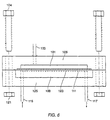
- a block having a series of channels, such as grooves, on a surface thereof is utilized.
- the block is placed in contact with a derivatized glass or other substrate.
- a pipettor or other delivery system is used to flow selected reagents to one or more of a series of apertures connected to the channels, or place reagents in the channels directly, filling the channels and "striping" the substrate with a first reagent, coupling a first group of monomers thereto.
- the first group of monomers need not be homogenous.
- a monomer A may be placed in a first group of the channels, a monomer B in a second group of channels, and a monomer C in a third group of channels.
- the channels may in some embodiments thereafter be provided with additional reagents, providing coupling of additional monomers to the first group of monomers.
- the block is then translated or rotated, again placed on the substrate, and the process is repeated with a second reagent, coupling a second group of monomers to different regions of the substrate.
- the process is repeated until a diverse set of polymers of desired sequence and length is formed on the substrate.
- a number of polymers having diverse monomer sequences such as peptides or oligonucleotides are formed on the substrate at known locations.
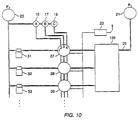
- a series of microchannels or microgrooves are formed on a substrate, along with an appropriate array of microvalves.
- the channels and valves are used to flow selected reagents over a derivatized surface.
- the microvalves are used to determine which of the channels are opened for any particular coupling step.
- one embodiment of the invention provides a method of forming diverse polymer sequences on a single substrate, the substrate comprising a surface with a plurality of selected regions.
- the method includes the steps of forming a plurality of channels adjacent the surface, the channels at least partially having a wall thereof defined by a portion of the selected regions; and placing selected reagents in the channels to synthesize polymer sequences at the portion of the selected regions, the portion of the selected regions comprising polymers with a sequence of monomers different from polymers in at least one other of the selected regions.
- the channels or flow paths themselves constitute the selected reaction regions.
- the substrate may be a series of adjoining parallel channels, each having reaction sites therein.
- a substrate which has an array of discrete reaction regions separated from one another by inert regions.
- a first monomer solution is spotted on a first set of reaction regions of a suitably derivatized substrate. Thereafter, a second monomer solution is spotted on a second set of regions, a third monomer solution is spotted on a third set and so on, until a number of the regions each have one species of monomer located therein. These monomers are reacted with the surface, and the substrate is subsequently washed and prepared for reaction with a new set of monomers.
- Dimers, trimers, and larger polymers of controlled length and monomer sequence are prepared by repeating the above steps with different groupings of the reaction regions and monomer solutions.
- the polymers or other compounds of the array are delivered to the regions as complete species, and thus the above polymer synthesis steps are unnecessary.
- a plurality of reaction regions on the substrate surface are surrounded by a constraining region such as a non-wetting region which hinders the transport of reactants between adjacent reaction regions.
- the regions of the array are defined by selective irradiation of a substrate surface containing photolabile hydrophobic protecting groups. In areas where the surface is irradiated, the hydrophobic protecting groups are removed to define reaction regions.
- an aqueous or other polar reactant solution is deposited in the reaction region, it will have a relatively large wetting angle with the substrate surface so that by adjusting the amount deposited, one can ensure no flow to adjacent regions.
- the invention can be used in variety of applications.
- the invention can be used as a synthesis tool (as for example in peptide syntheses), as a screening tool (as for example in screening compound libraries for drug activity), or as a monitoring/diagnostic tool (as for example in medical or environmental testing).
- the invention is used for nucleic acid-based diagnostics.
- the present invention provides for the formation of arrays of large numbers of different polymer sequences.
- the invention provides for the synthesis of an array of different peptides or oligonucleotides in selected regions of a substrate.
- Such substrates having the diverse sequences formed thereon may be used in, for example, screening studies to evaluate their interaction with receptors such as antibodies and nucleic acids.
- the invention provides for screening of peptides to determine which if any of a diverse set of peptides has a strong binding affinity with a receptor and, in most preferred embodiments, to determine the relative binding affinity of various peptides with a receptor of interest.
- Such diverse polymer sequences are preferably synthesized on a single substrate. By synthesizing the diverse polymer sequences on a single substrate, processing of the sequences to evaluate characteristics such as relative binding affinity is more easily conducted.
- processing of the sequences to evaluate characteristics is more easily conducted.
- the entire substrate and, therefore, all or a group of the polymer sequences may be exposed to an appropriately labelled receptor and evaluated simultaneously.
- the present invention can be employed to localize and, in some cases, immobilize vast collections of synthetic chemical compounds or natural product extracts.
- compounds are deposited on predefined regions of a substrate.
- the reaction of the immobilized compound (or compounds) with various test compositions such as the members of the chemical library or a biological extract are tested by dispensing small aliquots of each member of the library or extract to a different region.
- Competitive assays or other well-known techniques can be used to identify a desired activity. As an example, a large collection of human receptors is deposited on a substrate, one in each region to form an array. A plant/animal extract is then screened for binding to various receptors of the array.
- the present invention has certain features in common with the "light directed" methods described in U.S. Patent No. 5,143,854.
- the light directed methods discussed in the '854 patent involve activating predefined regions of the substrate and then contacting the substrate with a preselected monomer solution.
- the predefined regions can be activated with a light source shown through a mask (much in the manner of photolithography techniques used in integrated circuit fabrication). Other regions of the substrate remain inactive because they are blocked by the mask from illumination.
- a light pattern defines which regions of the substrate react with a given monomer.
- a mechanical device or physical structure defines the regions which are available to react with a given monomer.
- a wall or other physical barrier is used to block a given monomer solution from contacting any but a few selected regions of a substrate.
- the amount of the monomer (or other) solution deposited and the composition of the substrate act to separate different monomer solutions on the substrate. This permits different monomers to be delivered and coupled to different regions simultaneously (or nearly simultaneously) and reduces the number of separate washing and other reaction steps necessary to form an array of polymers.
- the reaction conditions at different activated regions can be controlled independently. Thus, the reactant concentrations and other parameters can be varied independently from reaction site to reaction site, to optimize the procedure.
- light or another activator is used in conjunction with the physical structures to define reaction regions.
- a light source activates various regions of the substrate at one time and then a mechanical system directs monomer solutions to different activated regions, in parallel.
- reagents are delivered to the substrate by either (1) flowing within a channel defined on predefined regions or (2) "spotting" on predefined regions.
- spotting on predefined regions.
- other approaches, as well as combinations of spotting and flowing, may be employed.
- certain activated regions of the substrate are mechanically separated from other regions when the monomer solutions are delivered to the various reaction sites.
- a typical "flow channel” method of the present invention can generally be described as follows. Diverse polymer sequences are synthesized at selected regions of a substrate by forming flow channels on a surface of the substrate through which appropriate reagents flow or in which appropriate reagents are placed. For example, assume a monomer "A" is to be bound to the substrate in a first group of selected regions. If necessary, all or part of the surface of the substrate in all or a part of the selected regions is activated for binding by, for example, flowing appropriate reagents through all or some of the channels, or by washing the entire substrate with appropriate reagents. After placement of a channel block on the surface of the substrate, a reagent having the monomer A flows through or is placed in all or some of the channel(s). The channels provide fluid contact to the first selected regions, thereby binding the monomer A on the substrate directly or indirectly (via a linker) in the first selected regions.
- a monomer B is coupled to second selected regions, some of which may be included among the first selected regions.
- the second selected regions will be in fluid contact with a second flow channel(s) through translation, rotation, or replacement of the channel block on the surface of the substrate; through opening or closing a selected valve; or through deposition of a layer of photoresist.
- a step is performed for activating at least the second regions.
- the monomer B is flowed through or placed in the second flow channel(s), binding monomer B at the second selected locations.
- the resulting sequences bound to the substrate at this stage of processing will be, for example, A, B, and AB. The process is repeated to form a vast array of sequences of desired length at known locations on the substrate.
- monomer A can be flowed through some of the channels, monomer B can be flowed through other channels, a monomer C can be flowed through still other channels, etc.
- monomer A can be flowed through some of the channels, monomer B can be flowed through other channels, a monomer C can be flowed through still other channels, etc.
- many or all of the reaction regions are reacted with a monomer before the channel block must be moved or the substrate must be washed and/or reactivated.
- the number of washing and activation steps can be minimized.
- a protective coating such as a hydrophilic or hydrophobic coating (depending upon the nature of the solvent) is utilized over portions of the substrate to be protected, sometimes in combination with materials that facilitate wetting by the reactant solution in other regions. In this manner, the flowing solutions are further prevented from passing outside of their designated flow paths.
- a monomer A can be delivered to and coupled with a first group of reaction regions which have been appropriately activated. Thereafter, a monomer B can be delivered to and reacted with a second group of activated reaction regions.
- reactants are delivered by directly depositing (rather than flowing) relatively small quantities of them in selected regions.
- the entire substrate surface can be sprayed or otherwise coated with a solution.
- a dispenser moves from region to region, depositing only as much monomer as necessary at each stop.
- Typical dispensers include a micropipette to deliver the monomer solution to the substrate and a robotic system to control the position of the micropipette with respect to the substrate.
- the dispenser includes a series of tubes, a manifold, an array of pipettes, or the like so that various reagents can be delivered to the reaction regions simultaneously.
- Fig. 1 illustrates an example of the invention.
- monomers and dimers of the monomer group A, B, C, and D are to be bound at selected regions of the substrate.
- the substrate may be biological, nonbiological, organic, inorganic, or a combination of any of these, existing as particles, strands, precipitates, gels, sheets, tubing, spheres, containers, capillaries, pads, slices, films, plates, slides, etc.
- the substrate may have any convenient shape, such as a disc, square, sphere, circle, etc.
- the substrate is preferably flat but may take on a variety of alternative surface configurations.
- the substrate may contain raised or depressed regions on which the synthesis takes place.
- the substrate and its surface form a support on which to carry out the reactions described herein.
- These monomers are bound using first flow channel paths x 1 , x 2 , x 3 , and x 4 which are formed or placed on or adjacent the substrate in a first orientation, and second flow channel paths y 1 , y 2 , y 3 , and y 4 which are formed or placed on or adjacent the substrate ir a second orientation.
- the second flow channel paths intersect at least a part of the first flow channel paths.
- the flow channels are formed according to techniques which are described in greater detail elsewhere herein.
- the substrate is subjected to one or more preliminary treatments such as, for example, cleaning and the optional placement of "linker” molecules on the surface thereof.
- the substrate may also be provided with various active groups, common monomer sequences which will form a part of the polymers, or the like.
- a first coupling step one or more of the flow channels are provided with the first monomer A, which binds through covalent bonds or otherwise to the substrate (directly or indirectly) where the flow channel contacts the substrate.
- the flow channels x 1 and x 2 are utilized, binding the monomer A to the substrate along the entire length of the substrate adjacent to the x 1 and x 2 channels.
- Each coupling step may in some embodiments be composed of a variety of substeps.
- each coupling step may include one or more substeps for washing, chemical activation, or the like.
- a second monomer B is provided to selected flow channels and the monomer B binds to the substrate where the second flow channels provide contact therewith.
- monomer B is bound along channels x 3 and x 4 .
- a process step refers to the injection of one or more channels with one or more reagents.
- a “coupling step” refers to the addition of a monomer in a polymer.
- Fig. 3 illustrates the mapping of sequences formed using the above illustrated steps.
- the sequences A, B, C, D, AD, BD, AC, and BC have been formed using only two process steps. Accordingly, it is seen that the process provides for the synthesis of vast arrays of polymer sequences using only a relatively few process steps.
- it is necessary to use only two process steps to form all of the 4 2 16 dimers of a four-monomer basis set.
- to form all 4 8 octomers of a four-monomer basis set it is necessary to provide only 256 flow channels oriented in the "x" direction, and 256 flow channels oriented in the "y” direction, with a total of eight coupling steps.
- the power of the technique is further illustrated by synthesizing the complete array of six hexamer peptides from a 20 amino acid basis set.
- This array will include 20 6 or 64,000,000 regions defining 64,000,000 different peptides and can be formed in only six process steps.
- the method requires only three different templates, one having 20 parallel channels, a second having 400 channels each 1/20th as wide as the first, and a third having 8000 channels each 1/20th as wide as the second.
- Each template will be used in two process steps, each at an orientation at 90 degrees with respect to the other as illustrated in Fig. 4.
- the substrate is activated and then solutions of each of the 20 amine acid basis set (or other 20 member basis set) are flowed over and reacted on a different predefined stripe in a first orientation.
- the entire substrate is again activated and the first template is placed in a second orientation, perpendicular to the first (Fig. 4a).
- the 20 amino acid solutions are then flowed along 20 new predefined stripes (each perpendicular to the original set of stripes).
- the 20 predefined regions are first activated and then contacted with the individual monomers so that all 20 stripes are reacted before the next activation step is necessary.
- 20 coupling steps are conducted in parallel, greatly reducing the number of necessary activation steps.
- the four remaining coupling steps employ the second and third templates.
- the third and fourth process steps (Fig. 4b) 20 channels are devoted to each monomer
- the fifth and sixth process steps (Fig. 4c) 400 channels are devoted to each monomer.
- the entire substrate undergoes reaction during a single process step.
- only six process steps (requiring a total of about 24 hours) are required to produce the entire library of 64,000,000 peptide hexamers.
- a single template having 8000 channels to control delivery e.g. 400 channels for each of the 20 amino acids in the first round
- the present invention offers extremely rapid methods of preparing diverse polymer arrays.
- Figs. 5a and 5b illustrate details of a first embodiment of a device used for performing the synthesis steps described above.
- Fig. 5a illustrates the device in top view
- Fig. 5b illustrates the device in cross-sectional side view.
- the device is used to synthesize polymer sequences on substrate 401.
- Substrate 401 is coupled to a rotating stage 403 and removably held by clamp 405 to channel block 407.
- Channel block 407 has etched therein a plurality of channels 409 in the form of stripes therein. Each channel is provided with a flow inlet 411 and an outlet 413.
- a vacuum source 415 is applied to one or more of the outlets 413, while a pipettor 417 is slidably mounted on arm 419 to deliver selected reagents from reservoir(s) 421 to selected flow inlets 411.
- Figs. 6-11 displays an apparatus for holding a substrate 111 in place against a channel block 109 by evenly distributing pressure over the substrate in a pressure chamber 101. Pressurized gas is admitted through gas pressure inlet 103 to provide clamping pressure to immobilize the substrate while fluids are flowed from fluid flow inlet 115, through channel 123, and out fluid outlet 117.
- the upper and lower portions of the pressure chamber housing 105 and 125 are held together by nuts 121 and bolts 104.
- other means such as clamps can be used to hold the pressure chamber housing portions together.
- Fig. 7 illustrates preferred flow path configurations in channel blocks of the present invention.
- fluid delivery sites 127, 129, 131, 133, 135, and 137 are connected to channels leading to reaction region 141.
- Fig. 7b A similar arrangement is shown for comparison in Fig. 7b where the orientation of the flow channels in the reaction regions is shifted by 90 degrees on a rectangular channel block.
- Vacuum ports 145 and 146 to an external vacuum line are provided so that substrate position is maintained during fluid flow.
- the channels shown in Figs. 7a and 7b form a "fanned channel array" on channel block 139 in a manner analogous to that of the lead pattern employed in integrated circuits.
- This provides significantly increased separation of fluid delivery points in comparison to the high density of channels in the reaction region.
- at least about a 4:1 increase in spatial separation typically can be attained by the fanned arrangement.
- the delivery ports can be separated by 0.8 mm.
- the spatial separation can be further increased by staggering the delivery ports as shown for ports 127, 129, and 131. This can provide an additional channel separation of at least about 3:1. Thus, for the channels separated by 200 microns, a staggered fanned array provides 2.4 mm separation between the delivery ports. Thus, fluid can be delivered to a high-density array of channels in the reaction region from standard 1.6 mm TeflonTM tubing. If additional spacing is necessary, the substrate size can be increased, while preserving the reaction region size.
- the fluid delivery ports are accessed from holes in the back surface of a stabilizing plate 108 on the channel block.
- the stabilizing plate which is preferably made from fused pyrex, provides structural integrity to the channel block during clamping in the pressure chamber. It may also provide a means to access the channel block ports and reduce leakage between ports or channels.
- the channels 123 of the channel block are formed on a wafer 106 which generally may be any machinable or cast material, and preferably may be etched silicon or a micromachined ceramic.
- the channel block is pressure-formed or injection-molded from a suitable polymer material.
- the entire channel block arrangement is mounted on a rigid channel block sub-plate 110 including a vacuum line 112, ports for fluid delivery lines 115, ports for fluid outlet lines 117, and recessed regions for plug ends 151 and 153.
- the substrate can be clamped against the top surface of the channel block (by vacuum or pressurized gas as shown in the embodiment of Fig. 6) while fluid enters and exits from below.
- the subplate will be made from a rigid material such as stainless steel or anodized aluminum.
- Plug ends 151 are provided with a conical upper surface that mates with a conical recess 118 in pyrex stabilizing plate 108. Plug ends 151 also have a cylindrical lower surface that mates with cylindrical recess 116 in sub-plate 110. The subplate and stabilizing plate are held together by bolt 114 and threaded insert 112 or other suitable engagement means.
- Fig. 10 shows a fluid flow diagram of a preferred system of the present invention.
- the pressure is controlled at point 25 (P1) and point 21 (P2) so that a pressure drop (P1-P2) is maintained across the system.
- Coupling compounds such as activated monomers are supplied from reservoirs 31, 32, and 33. Additional reagents are supplied from reservoirs 15, 17, and 19.
- the monomer and coupling reagent reservoirs shown in Fig. 10 are representative of a potentially much larger series of reservoirs.
- the reagents and coupling compounds are combined at nodes 27, 28, and 29 before being directed to channel block 139. Mixing of the appropriate reagents and coupling compounds is controlled by valves at the nodes which are in turn controlled by electronic control 23. Waste fluids that have been directed across the substrate are removed through line 35.
- the system displayed in Fig. 10 allows control of all channels in parallel by regulating only a few variables. For example, a constant pressure gradient is maintained across all channels simultaneously by fixing P1 and P2. Thus, the flow rate in each channel is dependent upon the cross-sectional area of the flow channel and the rheological properties of the fluids. Because the channels have a uniform cross-section and because the coupling compounds are typically provided as dilute solutions of a single solvent, a uniform flow rate is created across all channels. With this system the coupling time in all channels can be varied simultaneously by simply adjusting the pressure gradient across the system.
- the valves of the system are preferably controlled by a single electronic output from control 23.
- the fanned channel array design shown in Fig. 7 provides for two separate channel blocks to be used in successive process steps during a chemical synthesis.
- One block forms a horizontal array on the solid substrate, while the other block forms a vertical array.
- the solid substrate is transferred from one block to the other during successive process steps.
- the fanned channel array transfer block 75 illustrated in Figs. 11a and 11b provides one device for maintaining accurate registration of the solid substrate 71 relative to the channel blocks 79 during repeated transfers.
- a single channel block can be used for horizontal and vertical arrays by simply rotating it by 90 degrees as necessary.
- the transfer block is positioned with respect to the channel block so that the dimensional characteristics of the solid substrate are not used in the alignment.
- the transfer block 75 is aligned to the channel block by kinematic mount 81 while vacuum is switched from vacuum line 83 on the channel block to vacuum line 77 on the transfer block (during normal operation, a vacuum holds the substrate against the channel block).
- the substrate and transfer block are then moved and repositioned relative to the second channel bock. Vacuum is then switched to the second channel block, retaining the substrate in proper alignment. This way, accurate registration can be assured between process steps regardless of variation in the dimensions of individual substrates.
- the transfer block system also maintains alignment of the matrix area during transfers to and from the flow cell during experiments utilizing both mechanical and light-directed process steps.
- the channel block need not be utilized. Instead, in some embodiments, small "strips" of reagent are applied to the substrate by, for example, striping the substrate or channels therein with a pipettor. Such embodiments bear some resemblance to the spotting embodiments of this invention.
- the channels will be formed by depositing a photoresist such as those used extensively in the semiconductor industry. Such materials include polymethyl methacrylate (PMMA) and its derivatives, and electron beam resists such as poly(olefin sulfones) and the like (more fully described in Ghandi, "VLSI Fabrication Principles," Wiley (1983) Chapter 10). According to these embodiments, a resist is deposited, selectively exposed, and etched, leaving a portion of the substrate exposed for coupling. These steps of depositing resist, selectively removing resist and monomer coupling are repeated to form polymers of desired sequence at desired locations.
- a resist can be used to activate certain regions of the substrate.
- Certain resist materials such as acid-generating polymers, for example, will release protons upon irradiation.
- a substrate covered with such material is irradiated through a mask or otherwise selectively irradiated so that the irradiated regions of the substrate are exposed to acidic conditions.
- Acid-labile protecting group on the substrate or oligomers on the substrate are removed, leaving an activated region.
- all or part of the resist may be removed.
- the resist will be removed only in the activated regions, so that the channels are formed at the activated regions.
- the resist can be removed from the entire substrate. In this case, a separate channel block can then be contacted with the substrate to define flow channels, or a conventional VLSIPSTM procedure can be employed.
- the substrate is conventional glass, pyrex, quartz, any one of a variety of polymeric materials, or the like.
- the substrate may be made from any one of a variety of materials such as silicon, polystyrene, polycarbonate, or the like.
- the channel block is made of silicon or polychlorotrifluorethylene, such as material known under the trade name KelFTM 80 made by 3M, although a wide variety of materials such as polystyrene, polycarbonate, glass, elastomers such as Kalrez made by DuPont, various ceramics, stainless steel, or the like may be utilized.
- the channels in the channel block are preferably made by machining, compression molding, injection molding, lithography, laser cutting, or the like depending upon the material of interest.
- the raised portions of the channels in the channel block are treated by lapping with lapping film (0.3 ⁇ m grit).
- lapping film 0.3 ⁇ m grit.
- Such smooth surfaces provide good seals to the substrate without the use of a sealant and, therefore, without the possibility of leaving sealant material on the substrate when rotating the channel block.
- all operations are conducted at substantially ambient temperatures and pressures.
- a particularly preferred channel block is prepared by chemical etching of polished silicon wafers.
- Chemical etching is a widely used technique in integrated circuit fabrications. It can easily provide 60 or more 100 micron channels on a 12.8 mm region of a polished silicon wafer. Even after etching, the top (unetched) surface regions of the wafer retains the very flat profile of the unetched wafer. Thus, close contact with the substrate is ensured during flow cell operation.
- the surface of the substrate is appropriately treated by cleaning with, for example, organic solvents, methylene chloride, DMF, ethyl alcohol, or the like.
- the substrate may be provided with appropriate linker molecules on the surface thereof.
- the linker molecules may be, for example, aryl acetylene, ethylene glycol oligomers containing from 2-10 monomers or more, diamines, diacids, amino acids, or combinations thereof.
- the surface is provided with protected surface active groups such as TBOC or FMOC protected amino acids.
- protected surface active groups such as TBOC or FMOC protected amino acids.
- a protecting group removal agent is, thereafter, directed through a first selected channel or group of channels by placing the pipettor on the flow inlet of the selected channel and, optionally, the vacuum source on the outlet of the channel.
- this protecting group removal agent may be, for example, trifluoroacetic acid (TFA). This step is optionally followed by steps of washing to remove excess TFA with, for example, dichloromethane (DCM).
- a first amino acid or other monomer A is directed through the first selected flow channel.
- this first amino acid is also provided with an appropriate protecting group such as TBOC, FMOC, NVOC, or the like.
- This step is also followed by appropriate washing steps.
- the of deprotection/coupling steps employed in the first group of channels are concurrently with or thereafter repeated in additional groups of channels.
- monomer A will be directed through the first group of channels
- monomer B will be directed through a second group of flow channels, etc., so that a variety of different monomers are coupled on parallel channels of the substrate.
- the substrate and the channel block are separated and, optionally, the entire substrate is washed with an appropriate material to remove any unwanted materials from the points where the channels contact the substrate.
- the substrate and/or block is then, optionally, washed and translated and/or rotated with the stage.
- the substrate is rotated 90 degrees from its original position, although some embodiments may provide for greater or less rotation, such as from 0 to 180 degrees.
- two or more different channel blocks are employed to produce different flow patterns across the substrate.
- the channel block When the channel block is rotated, it may simultaneously be translated with respect to the substrate.
- Translated means any relative motion of the substrate and/or channel block, while “rotation” is intended to refer to rotation of the substrate and/or channel block about an axis perpendicular to the substrate and/or channel block. According to some embodiments the relative rotation is at different angles for different stages of the synthesis.
- a monomer B may be directed through selected flow channels, providing the polymer AB at intersections of the channels formed by the channel block in the first position with the channels formed by the channel block after 90-degree rotation.
- While rotation of the channel block is provided according to preferred embodiments of the invention, such rotation is not required.
- polymers having different monomer sequences may be formed.
- a portion of the channels may be filled with monomer "A,” and a portion filled with monomer "B” in a first coupling step. All or a portion of the first channels are then filled with a monomer "C,” and all or a portion of the second channels are filled with a monomer "D,” forming the sequences AB and CD.
- Such steps could be used to form 100 sequences using a basis set of 10 monomers with a 100-groove channel block.
- the invention provides a multichannel solid-phase synthesizer as shown in Fig. 12.
- a collection of delivery lines such as a manifold or collection of tubes 1000 delivers activated reagents to a synthesis support matrix 1002.
- the collection of tubes 1000 may take the form of a rigid synthesis block manifold which can be precisely aligned with the synthesis support matrix 1002.
- the support matrix contains a plurality of reaction regions 1004 in which compounds may be immobilized or synthesized.
- the reaction regions include synthesis frits, pads, resins, or the like.
- the solutions delivered to the individual reactant regions of the support matrix flow through the reaction regions to waste disposal regions, recycling tank(s), separators, etc.
- the. reaction solutions simply pass through the reaction regions under the influence of gravity, while in other embodiments, the solutions are pulled or pushed through the reaction regions by vacuum or pressure.
- the individual reaction regions 1004 of the support matrix are separated from one another by walls or gaskets 1006. These prevent the reactant solution in one reaction region from moving to and contaminating adjacent reaction regions.
- the reaction regions are defined by tubes which may be filled with resin or reaction mixture.
- the gasketing allows close contact between the support matrix 1002 and a "mask" (not shown).
- the mask serves to control delivery of a first group reactant solutions through predetermined lines (tubes) to a first set of reaction regions.
- the mask can be changed so that a new group reactants is delivered to a new set of reaction regions.
- a combinatorial strategy can be employed to prepare a large array of polymers or other compounds.
- mechanisms other than masks can be employed to block the individual delivery tubes.
- an array of control valves within the tubes may be suitable for some embodiments.
- the quantity of immobilized material in the reaction regions can be controlled.
- relatively thin support synthesis matrices can be used to produce small amounts of surface bound oligomers for analysis, while thicker support matrices can be used to synthesize relatively large quantities of oligomers which can be cleaved from the support for further use.
- a collector having dimensions matching the individual synthesis supports can be employed to collect oligomers that are ultimately freed from the reaction matrix.
- reaction regions a square synthesis matrix measuring 10 cm along each side and having 5 mm reaction regions separated by 5 mm wide gaskets provides 100 individual syntheses sites (reaction regions). By reducing the size of the reaction regions to 2.5 mm on each side, 400 reactions regions become available.
- Fig. 13a illustrates one of the possible arrangements in which the channels 409 are arranged in a serpentine arrangement in the channel block 407. Through appropriate translation and/or rotation of the channel block, polymers of desired monomer sequence are formed at the intersection of the channels during successive polymer additions, such as at location 501, where the intersection of a previous or subsequent set of channels is shown in dashed lines.
- Fig. 13b illustrates another arrangement in which channels (in this case without flow paths 413) are provided in a linear arrangement, with groups 503 and 505 located in adjacent regions of the substrate and extending only a portion of the substrate length.
- the various reagents are not pumped through the apertures 413. Instead, the reagent is placed in one of the grooves, such as the grooves 409 shown in Fig. 13b, filling the groove.
- the substrate is then placed on top of the channel block, and the exposed portions of the substrate are permitted to react with the materials in the grooves.
- the channels are of the same width as the raised regions between the channels. According to these embodiments, the substrate may then be moved laterally by one channel width or an integer multiple of a channel width, permitting reaction with and placement of monomers on the regions between the channels in a previous coupling step. Thereafter, the substrate or channel block will be rotated for the next series of coupling steps.
- the process is repeated to provide more than 10 different polymer sequences on the surface of the substrate. In more preferred embodiments, the process is repeated to provide more than 10 2 , 10 3 , 10 4 , 10 5 , 10 6 , or more polymer sequences on a single substrate. In some embodiments the process is repeated to provide polymers with as few as two monomers, although the process may be readily adapted to form polymers having 3, 4, 5, 6, 10, 15, 20, 30, 40, 50, 75, 100 or more monomers therein.
- the array of polymer sequences is utilized in one or more of a variety of screening processes, one of which is described in copending application U.S. Serial No. 796,947, filed on November 22, 1991.
- the substrate is then exposed to a receptor of interest such as an enzyme or antibody.
- the receptor is labelled with fluorescein, or otherwise labelled, so as to provide for easy detection of the location at which the receptor binds.
- the channel block is used to direct solutions containing a receptor over a synthesized array of polymers.
- the channel block is used to direct receptor solutions having different receptor concentrations over regions of the substrate.
- amplification of the signal provided by way of fluorescein labelling is provided by exposing the substrate to the antibody of interest, and then exposing the substrate to a labelled material which is complementary to the antibody of interest and which preferably binds at multiple locations of the antibody of interest.
- a labelled material which is complementary to the antibody of interest and which preferably binds at multiple locations of the antibody of interest.
- a labelled second antibody may be exposed to the substrate which is, for example, goat antimouse.
- monomers are deposited from a dispenser in droplets that fill predefined regions.
- the dispenser deposits a first monomer in a series of predefined regions by moving over a first region, dispensing a droplet, moving to a second region, dispensing a droplet, and so on until the each of the selected regions has received the monomer.
- the dispenser deposits a second monomer in a second series of predefined regions in much the same manner.
- more than one dispenser may be used so that more than one monomer are simultaneously deposited.
- the monomers may react immediately on contact with the reaction regions or may require a further activation step, such as the addition of catalyst. After some number of monomers have been deposited and reacted in predefined regions throughout the substrate, the unreacted monomer solution is removed from the substrate. This completes a first process step.
- the spacing between the individual reaction regions of the substrate preferably will be less than about 3 mm, and more preferably between about 5 and 100 ⁇ m. Further, the angular relation between the regions is preferably consistent to within 1 degree and more preferably to within 0.1 degree.
- the substrate will include at least about 100 reaction regions, more preferably at least about 1000 reaction regions, and most preferably at least about 10,000 reaction regions. Of course, the density of reaction regions on the substrate will vary. In preferred embodiments, there are at least about 1000 reaction regions per cm 2 of substrate, and more preferably at least about 10,000 regions per cm 2 .
- a frame of reference common to the delivery instrument and the substrate is required.
- the reference coordinates of the instrument must be accurately mapped onto the reference coordinates of the substrate.
- only two reference points on the substrate are necessary to map the array of polymer regions completely.
- the dispenser instrument locates these reference points and then adjusts its internal reference coordinates to provide the necessary mapping. After this, the dispenser can move a particular distance in a particular direction and be positioned directly over a known region. Of course, the dispenser instrument must provide precisely repeatable movements. Further, the individual regions of the array must not move with respect to the reference marks on the substrate after the reference marks have been formed. Unfortunately, pressing or other mechanical operations commonly encountered during fabrication and use of a substrate can warp the substrate such that the correspondence between the reference marks and the reaction regions is altered.
- a substrate containing both "global” and “local” reference marks is employed.
- two global reference marks are conveniently located on the substrate to define the initial frame of reference.
- the dispenser instrument has an approximate map of the substrate and the predefined regions therein.
- the substrate is further subdivided into local frames of reference.
- the dispenser is positioned within one of the local frames of reference.
- the dispensing instrument looks for local reference marks to define further a local frame of reference. From these, the dispenser moves exactly to the reaction region where the monomer is deposited. In this manner, the effects of warpage or other deformation can be minimized.
- the number of local reference marks is determined by the amount of deformation expected in the substrate. If the substrate is sufficiently rigid so that little or no deformation will occur, very few local reference marks are required. If substantial deformation is expected, however, more local reference marks are required.
- a vision or blind system may be employed.
- a camera is rigidly mounted to the dispenser nozzle.
- the dispenser is known to be a fixed distance and direction away from the point, and a frame of reference is established.
- Blind systems of the present invention locate the reference point(s) by capacitive, resistive, or optical techniques, for example.
- an optical technique a laser beam is transmitted through or reflected from the substrate. When the beam encounters a reference mark, a change in light intensity is detected by a sensor. Capacitive and resistive techniques are similarly applied. A sensor registers a change in capacitance or resistivity when a reference point is encountered.
- the dispenser is translated from one reaction region to other regions of the substrate by a correct distance in the correct direction (this is the "dead reckoning" navigational technique).
- the dispenser deposits correctly metered amounts of monomer.
- Analogous systems widely used in the microelectronic device fabrication and testing arts can move at rates of up to 3-10 stops per second. The translational (X-Y) accuracy of such systems is well within 1 ⁇ m.
- Translational mechanisms for moving the dispenser are preferably equipped with closed loop position feedback mechanisms (encoders) and have insignificant backlash and hysteresis.
- the translation mechanism has a high resolution, i.e. better than one motor tick per encoder count.
- the electro-mechanical mechanism preferably has a high repeatability relative to the reaction region diameter travel distance (typically ⁇ 1 ⁇ m or better).
- the dispenser nozzle To deposit a drop of monomer solution on the substrate accurately, the dispenser nozzle must be placed a correct distance above the surface.
- the dispenser tip preferably will be located about 5-50 ⁇ m above the substrate surface when a five nanoliter drop is released. More preferably, the drop will be about 10 ⁇ m above the substrate surface when the drop is released. The degree of control necessary to achieve such accuracy is attained with a repeatable high-resolution translation mechanism of the type described above.
- the height above the substrate is determined by moving the dispenser toward the substrate in small increments, until the dispenser tip touches the substrate. At this point, the dispenser is moved away from the surface a fixed number of increments which corresponds to a specific distance. From there the drop is released to the cell below.
- the increments in which the dispenser moves less than about 5 ⁇ m and more preferably less than about 2 ⁇ m.
- the dispenser nozzle is encircled by a sheath that rigidly extends a fixed distance beyond the dispenser tip. Preferably, this distance corresponds to the distance the solution drop will fall when delivered to the selected reaction region.
- the sheath contacts the substrate surface, the movement of the dispenser is halted and the drop is released. It is not necessary in this embodiment to move the dispenser back, away from the substrate, after contact is made.
- the point of contact with the surface can be determined by a variety of techniques such as by monitoring the capacitance or resistance between the tip of the dispenser (or sheath) and the substrate below. A rapid change in either of these properties is observed upon contact with the surface.
- the dispenser is aligned with respect to the region of interest by a system analogous to that employed in magnetic and optical storage media fields.
- the region in which monomer is to be deposited is identified by a track and sector location on the disk.
- the dispenser is then moved to the appropriate track while the disk substrate rotates.
- the appropriate cell is positioned below the dispenser (as referenced by the appropriate sector on the track), a droplet of monomer solution is released.
- Control of the droplet size may be accomplished by various techniques.
- a conventional micropipetting instrument is adapted to dispense droplets of five nanoliters or smaller from a capillary. Such droplets fit within regions having diameters of 300 ⁇ m or less when a non-wetting mask of the invention is employed.
- the dispenser is a piezoelectric pump that generates charged droplets and guides them to the reaction region by an electric field in a manner analogous to conventional ink-jet printers.
- some ink-jet printers can be used with minor modification by simply substituting a monomer containing solution for ink.
- European Patent Application 260 965 describes the use of a commercial printer to apply an antibody to a solid matrix. In the process, a solution containing the antibody is forced through a small bore nozzle that is vibrating in a manner that fragments the solution into discrete droplets. The droplets are subsequently charged by passing through an electric field and then deflected onto the matrix material.
- a conventional ink drop printer includes a reservoir in which ink is held under pressure.
- the ink reservoir feeds a pipe which is connected to a nozzle.
- An electromechanical transducer is employed to vibrate the nozzle at some suitable high frequency.
- the actual structure of the nozzle may have a number of different constructions, including a drawn glass tube which is vibrated by an external transducer, or a metal tube vibrated by an external transducer (e.g. a piezoelectric crystal) or a magnetostrictive metal tube which is magnetostrictively vibrated.
- the ink accordingly is ejected from the nozzle in a stream which shortly thereafter breaks into individual drops.
- An electrode may be present near the nozzle to impart a charge to the droplets.
- Conventional ink drop dispensers are described in U.S. Patent Nos. 3,281,860 and 4,121,222.
- the reactant solutions are delivered from a reservoir to the substrate by an electrophoretic pump.
- a thin capillary connects a reservoir of the reactant with the nozzle of the dispenser.
- electrodes are present at both ends of the capillary to provide a potential difference.
- the speed at which a chemical species travels in a potential gradient of an electrophoretic medium is governed by a variety of physical properties, including the charge density, size, and shape of the species being transported, as well as the physical and chemical properties of the transport medium itself. Under the proper conditions of potential gradient, capillary dimensions, and transport medium rheology, a hydrodynamic flow will be set up within the capillary.
- an electrophoretic pump of the present invention bulk fluid containing the reactant of interest is pumped from a reservoir to the substrate.
- the reactant solution is precisely delivered to predefined reaction regions.
- the electrophoretic pump is used to produce an array containing various fractions of an unknown reactant solution.
- an extract from a biological material such as leaf or a cell culture might contain various unknown materials, including receptors, ligands, alkaloids, nucleic acids, and even biological cells, some of which may have a desired activity.
- a reservoir of such extract is electrophoretically pumped, the various species contained therein will move through the capillary at different rates.
- the various components being pumped should have some charge so that they can be separated. If the substrate is moved with respect to the dispenser while the extract components art being separated electrophoretically, an array containing various independent species is produced. This array is then tested for activity in a binding assay or other appropriate test.
- the components in the extract solution are tagged with, for example, a fluorescent label. Then, during the process of delivering the solution with the electrophoretic pump, a fluorescence detector determines when labeled species are being deposited on the substrate. In some embodiments, the tag selectively binds to certain types of compounds within the extract, and imparts a charge to those compounds.
- osmotic pumps delivers a steady flow of solution for a relatively long period.
- the construction of such pumps is well-known in the art, generally incorporating a solution of the extract of interest within a solvent permeable bag. Osmotic pressure is applied to the extract solution by solvent molecules diffusing across the bag to equalize a concentration difference. The extract is thus forced out of a nozzle in the bag at a constant rate.
- Cell sorters are also well-known in the art, and can be used in applications where it is desirable to apply single biological cells to distinct locations on the substrate.
- minuscule aliquots of each test substance can also be delivered to the cell as miniature pellets.
- Such pellets can be formed from the compound of interest (e.g. ligands for use in an affinity assay) and one or more kinds of inert binding material.
- the composition of such binders and methods for the preparation of the pellets will be apparent to those of skill in the art.
- mini-pellets will be compatible with a wide variety of test substances, stable for long periods of time, suitable for easy withdrawal from the storage vessel and dispensing (i.e., non-tacky, preferably suspendable in a liquid such as physiological buffer), and inert with respect to the binding activity of receptors.
- the reactant solutions in each predefined region are prevented from moving to adjacent regions by appropriate barriers or constraining regions.
- a hydrophilic material is used to coat the reaction regions, while a hydrophobic material is used in preferred embodiments to coat the region surrounding the individual reaction regions.
- a hydrophobic material is used in preferred embodiments to coat the region surrounding the individual reaction regions.
- different surface coatings are generally preferred.
- the contact angle between the droplet and the substrate is advantageously controlled. Large contact angles between the reactant droplets and the substrate are desired because the solution then wets a relatively small reaction region with shallow contact angles, on the other hand, the droplet wets a larger area. In extreme cases, the droplet will spread to cover the entire surface.
- the contact angle is determined by the following expression, known as Young's equation: where ⁇ is the wetting angle, is the solid-air tension, is the solid-liquid tension, and is the liquid-air surface tension.
- the values of these surface tensions are governed by thermodynamic considerations including the chemical constituents of the liquid and the solid substrate.
- the liquid-air surface tension for various chemicals is easily measured by a variety of techniques such as those described in Adamson, Physical Chemistry of Surfaces , John Wiley and Sons, 5th Ed. (1990).
- the difference of the solid-liquid and solid-air tensions can, for a given system, be determined empirically from a Zisman plot. In this approach, the contact angles are measured for a homologous series of liquids on a given solid surface.
- Methods for controlling chemical composition and therefore the local surface free energy of a substrate surface include a variety of techniques apparent to those skilled in the art.
- Chemical vapor deposition and other techniques applied in the fabrication of integrated circuits can be applied to deposit highly uniform layers on selected regions of a surface.
- the wettability of a silicon wafer surface has been manipulated on the micrometer scale through a combination of self-assembled monolayer depositions and micromachining. See Abbott et al ., "Manipulation of the Wettability of Surfaces on the .1 to 1 Micrometer Scale Through Micromachining and Molecular Self-Assembly” Science, 257 (Sept. 4, 1992).
- the perimeters of the individual regions are formed on a hydrophilic substrate refined by selectively removing hydrophobic protecting groups from the substrate surface.
- a mono-layer of hydrophobic photoprotecting groups can be coupled to, for example, linker molecules attached to the substrate surface.
- the surface then is selectively irradiated (or otherwise activated by, for example, acid) through a mask to expose those areas where the reaction regions are to be located. This cleaves the protecting groups from the substrate surface, causing the reaction regions to be less hydrophobic than the surrounding area. This process produces a high density of reaction regions on the substrate surface. Because hydrophobic materials have lower surface free energies (surface tensions) than water, the solution droplet in the cell beads rather than spreads.
- the substrate is prepared by first covalently attaching a monolayer of the desired reactive functional group (e.g. amine, hydroxyl, carboxyl, thio, etc.), which is protected by a hydrophobic photolabile protecting moiety.
- the monolayer may be deposited by a silanation reaction as shown below
- Y is a spacer group such as a polymethylene chain
- X is a reactive protected group such as NH, C(O)O, O, S, etc.
- Pr is a hydrophobic photolabile protecting group.
- the substrate surface is first derivatized by, for example, a silanation reaction with appropriates to provide an amine layer.
- a molecule including a spacer, a reactive group, and a photolabile group is then coupled to the surface.
- the photolabile protecting group should be sufficiently hydrophobic as to render the substrate surface substantially non-wettable. Removal of the protecting group in specific areas by exposure to light through a suitable mask, liberates the reactive functional groups. Because these groups are hydrophilic in character, they will render the substrate wettable in the exposed regions.
- the class of nitrobenzyl protecting groups which is exemplified by the nitroveratryl group, imparts significant hydrophobicity to glass surfaces to which a member of the class is attached.
- the hydrophobicity of the basic nitrobenzyl protecting group is enhanced by appending group chain hydrocarbon substituent.
- Exemplary hydrophobic chains include C 12 H 25 (lauryl) or C 18 H 37 (stearyl) substituents.
- the syntheses of suitably activated forms (bromide, chloromethyl ether, and oxycarbonyl chloride) of a typical protecting group is schematically outlined in Fig. 14.
- the spacer group contributes to the net hydrophobic or hydrophilic nature of the surface.
- those spacers consisting primarily of hydrocarbon chains, such as -(CH 2 ) a -, tend to decrease wettability.
- Spacers including polyoxyethylene , or polyamide chains tend to make the surface more hydrophilic.
- An even greater effect is achieved by using spacer groups which possess, in addition to the protected functional group, several "masked” hydrophilic moieties. This is illustrated below.
- the hydrophilic reaction regions is a two-dimensional circle or other shape having an aspect ratio near one (i.e. the length is not substantially larger or smaller than the width).
- the hydrophilic region may take the form of a long channel which is used to direct flowing reactants in the manner described above.
- reaction regions are three-dimensional areas defined by, for example, gaskets or dimples on the substrate surface.
- the dimples or gaskets may also act as identification marks directing the dispenser to the region of interest.
- the solvent or other liquid used to deliver the reactant
- the partial pressure of volatile reagents can be adjusted so that the liquid and vapor phase fugacities are equalized and the thermodynamic force driving evaporation is reduced.
- the partial pressure of the reagents may be increased by providing a relatively large reservoir of volatile reagents in a sealed chamber.
- solvents having a low vapor pressure under the conditions of interest can be used.
- evaporation can be further controlled by application of a film or coverplate having a reverse array pattern. Other methods of preventing evaporation are well-known in the physical chemical arts and may be used in the present invention.
- evaporation is advantageously employed to accelerate hybridization of target oligonucleotides with immobilized oligonucleotides in the reaction regions.
- fluorescently tagged or otherwise labelled target oligonucleotides in solution e.g., a solution cotaining a salt such as ammonium acetate or magnesium chloride
- a solution cotaining a salt such as ammonium acetate or magnesium chloride
- hybridization is carried out at room temperature, ten minutes to a few hours are typically required to complete the reaction. After sufficient time, the unhybridized DNA is washed or otherwise removed from the substrate. Finally, the substrate is imaged to detect regions in which the probe and target DNA have hybridized.
- evaporation can be advantageously employed to increase the local concentration of non-DNA solutes in a variety of reactions besides hybridization.
- receptor solutions are sufficiently volatile that the local receptor concentration increases in the reaction regions containing peptides, for example, to be screened.
- arrays produced according to the above spotting embodiments are generally used in much the same manner as the arrays produced by the flow channel embodiments described above.
- the arrays can be used in screening with fluorescein labelled receptors as described in PCT Publication No. WO92/10092.
- microvalve structures are used to form channels along selected flow paths on the substrate.
- an array of microvalves is formed and operated by an overlying or underlying array of electrodes that is used to energize selected valves to open and close such valves.
- Fig. 15 illustrates such a structure
- Fig. 15a illustrating the system in end view cross-section
- Fig. 15b illustrating the system in top view.
- the structure shown therein provides for only two synthesis chambers for the purpose of clarity, but in most embodiments a far greater number of chambers will be provided.
- Microvalves are discussed in detail in, for example, Zdeblick, U.S. Patent No. 4,966,646, and Knutti, "Advanced Silicon Microstructures," ASICT Conference (1989).
- a substrate 602 is provided with a plurality of channels 604 formed using photolithographic, or other related techniques.
- the channels lead up to a synthesis chamber 606.
- valve structure 608 At the end of each channel is valve structure 608.
- the channels. lead up to the chambers, but may be isolated from the chambers by the valves. Multiple valves may be provided for each chamber.
- the right valve on the left chamber and the left valve on the right chamber are open while the remaining valves are closed. Accordingly, if reagent is delivered to the top of the substrate, it will flow through the open channel to and through the chamber on the left, but not the one on the right. Accordingly, coupling steps may be conducted on the chamber with selected reagents directed to selected chambers, using the techniques discussed above.
- a valve is supplied on one side of the chamber 606, but the valve on the opposite side is replaced by a semi-permeable membrane. According to these embodiments, it becomes possible to flow a selected reagent into the chamber 606 and, thereafter, flow another selected reagent through the flow channel adjacent the semi-permeable membrane.
- the semi-permeable membrane will permit a portion of the material on one side or the other to pass through the membrane. Such embodiments will be useful in, for example, cell studies.
- Screening will be performed by, for example, separating or cutting two halves of the device, enabling screening by, for example, contacting with a fluorescein labelled antibody, or the like followed by photodetection.
- Figs. 16a and 16b illustrate another alternative embodiment of the invention which combines the mechanical polymer synthesis techniques disclosed herein with light-directed synthesis techniques.
- a substrate 401 is irradiated in selected regions, shown as the stripes in Fig. 16a.
- the surface of the substrate is provided with photoremovable groups in accordance with PCT Publication No. WO92/10092 on, for example, amine groups in the specific case of peptide synthesis.
- regions 701, 702, and 703 of the substrate are deprotected, leaving remaining regions of the substrate protected by photoremovable groups such as nitroveratryl oxycarbonyl ("NVOC").
- the widths of the irradiated regions equal the widths of the protected regions of the substrate.
- the substrate is contacted with a channel block 407.
- the channels 704, 705, and 707 are aligned with the regions 701, 702, and 703, respectively, on the substrate 401.
- specific embodiments of the invention provide for irradiated regions and channels in the form of stripes, which are aligned during this step. Other embodiments, however, will provide for other shapes of irradiated regions and channels, and other relative orientations of the irradiated regions and channels.
- the channel block and substrate will be aligned with, for example, an alignment mark placed on both the substrate and the channel block.
- the substrate may be placed on the channel block with, for example, a vacuum tip.
- a selected reagent is flowed through or placed in the channels in the channel block for coupling to the regions which have previously been exposed to light.
- the substrate may be placed in contact with a prefilled channel block in some embodiments to avoid compression of the channel block to the substrate and dead spots during pumping.
- a different reagent flows through each of the channels 701, 702, and 703 such as, for example, a reagent containing monomers A, B, and C.
- the process may then, optionally, involve a second coupling step in which the substrate is translated by, e.g., one channel width, to provide coupling of a monomer in the regions between the original channels.
- the process of directed irradiation by light, followed by coupling with the channel block is repeated at the previously unexposed regions.
- the process is then preferably repeated again, with the stripes of the mask and the channel block rotated at, for example, 90 degrees.
- the coupling steps will provide for the formation of polymers having diverse monomer sequences at selected regions of the substrate through appropriate translation of the mask and substrate, and through appropriate mask selection.
- the light shown through the mask is diffracted to varying degrees around the edges of the dark regions of the mask.
- some undesired removal of photosensitive protecting groups at the edges of "dark" regions occurs.
- This effect is exacerbated by the repeated mask translations and subsequent exposures, ultimately leading to inhomogeneous synthesis sites at the edges of the predefined regions.
- the effect is, of course, dependent upon the thickness of the glass substrate and the angle at which the light is diffracted. If the mask is positioned on the "backside" of the substrate, a diffraction angle of 2.5° and a substrate thickness of 0.7 mm creates a 60 ⁇ m strip of light (of variable intensity) flanking each edge. For a 0.1 mm thick substrate, the strip is approximately 5 ⁇ m wide.
- a pinhole mask may be employed to activate and/or define reaction regions of the substrate.
- light shown through the pinhole mask is directed onto a substrate containing photoremovable hydrophobic groups.
- the groups in the illuminated regions are then removed to define hydrophilic reaction regions.
- the pinhole mask contains a series of circular holes of defined diameter and separation, e.g., 20 ⁇ m diameter holes spaced 50 ⁇ m apart.
- a stationary pinhole mask is sandwiched between the substrate and a translational mask of the type described in PCT Publication No. WO92/10092. In this manner selected regions of the substrate can be activated for polymer synthesis without bleed-over.
- the translational mask is used to illuminate selected holes of the stationary pinhole mask, and is aligned such that its edges dissect the distance separating the holes of the stationary mask thereby eliminating diffractive removal of photoprotecting groups at neighboring sites. Because there is negligible bleed-over incident light, inhomogeneous synthesis at sites juxtaposed along the edge is eliminated. The resulting circular sites do, of course, contain variable sequence density due to diffraction at the edges of the pinhole mask, but the sequences at each predefined region are homogeneous. In addition, each synthesis region is surrounded by a "dark" region when the substrate is probed with a labeled target. Thus, no bleed-over fluorescence signal is introduced by binding at neighboring sites.
- a pinhole mask containing 20 ⁇ m circular holes separated by 50 ⁇ m requires a total synthesis area for the complete set of octanucleotides of only 1.78 cm 2 .
- thinner substrates allow for smaller reaction sites separated by larger distances.
- the area from which reliable data can be obtained is also reduced when smaller sites are used.
- the density of reaction sites is ultimately determined by the diffraction angle and the distance between the pinhole mask and the reaction regions (typically the substrate thickness).
- the pinhole mask takes the form of a layer coated on the substrate. This avoids the need for a separate stationary mask to generate the dot pattern.
- the surface layer provides well defined synthesis regions in which to deposit reactants according to the spotting embodiments described above. Further, the surface pinhole mask is conveniently embossed with local reference coordinates for use in navigational systems used to deliver monomer solutions to proper regions as described above. Preferred pinhole masks are made from opaque or reflective materials such as chrome.
- a flat piece of conventional glass having dimensions of about 42 mm x 42 mm was derivatized with aminopropyltriethoxysilane.
- the entire slide was deprotected and washed using conventional techniques.
- a fluorescein marker of FITC was then injected into flow channels formed when a block of KelFTM 81 with 10 channels of 1 mm depth and 1 mm width were brought into contact with the substrate.
- the fluorescein marker was in a solution of DMF and flowed through the channels by injecting the material into the groove with a manual pipet.
- Fluorescein dye was similarly injected into every other channel in the block, the block was rotated, and the process was repeated.
- the expected resulting plot of fluorescent intensity versus location is schematically illustrated in Fig. 17. Dark regions are shown at the intersections of the vertical and horizontal stripes, while lighter grey at non-intersecting regions of the stripes. The dark grey regions indicate expected regions of high dye concentration, while the light regions indicate regions of expected lower dye concentration.
- YGGFL SEQ. ID NO:1
- YpGFL SEQ. ID NO:2
- pGGFL SEQ. ID NO:3
- ppGFL the abbreviations are included in Stryer, Biochemistry , Third Ed. (1988); lower case letters indicate D-optical isomers and upper case letters indicate L-optical iscmers.
- An entire glass substrate was derivatized with TBOC-protected aminopropyltriethoxysilane, deprotected with TFA, coated with FMOC-protected caproic acid (a linker), deprotected with piperidine, and coated with FMOC-protected Glycine-Phenylalanine-Leucine (GFL).
- This FMOC-GFL-coated slide was sealed to the channel block, and all 10 grooves were deprotected with piperidine in DMF. After washing the grooves, FMOC Glycine (G) was injected in the odd grooves, and FMOC d-Proline (p) was injected in the even grooves. After a two-hour coupling time, using standard coupling chemistry, all grooves were washed with DMF. The grooves were vacuum dried, the block removed and rotated 90 degrees. After resealing, all grooves were deprotected with piperidine in DMF and washed. FMOC Tyrosine (Y) was injected in the odd grooves, and FMOC p in the even grooves. After coupling the grooves were washed and vacuum dried. Accordingly, 25 regions of each of the compounds YGGFL, YpGFL, pGGFL, and ppGFL were synthesized on the substrate. The substrate was removed and stained with FITC-labelled antibodies (Herz antibody 3E7).
- the resulting slide showed bright regions of high fluorescence.
- White squares are in locations of YGGFL.
- the darkest regions are pGGFL and ppGFL.
- the YGGFL sites were the most intense, followed by the YpGFL sites.
- the pGGFL and ppGFL intensities were near background levels, consistent with expected results with the Herz antibody.
- a grid pattern of fluorescein isothiocyanate coupled to a substrate was made by using a flow cell of this invention.
- a two by three inch NVOC-derivatized substrate was photolyzed through a mask to produce 400 micron activated bands on one axis.
- An etched silicon channel block having 64 parallel 100 micron channels separated by 100 micron walls was then clamped to the substrate on the other axis (i.e., perpendicular to the axis of 400 micron activated bands).
- the clamping assembly consisting of aluminum top and bottom clamp plates was used. Pressure was applied by tightening two bolts with a torque wrench to 400 psi.
- a 7 mM fluorescein isothiocyanate solution was flowed through the channels by pipetting directly to exposed channel ends.
- a center region of a two by three inch slide was derivatized with bis(2-Hydroxyethyl) aminopropyltriethoxy silane.
- Six nucleosides were then coupled to the entire reaction region using a synthesis process consisting of deprotection, coupling, and oxidation steps for each monomer applied. These first six nucleosides were coupled in a reaction region defined by a 0.84 inch diameter circular well in an aluminum template clamped to the two by three inch slide.
- the seventh and eighth monomers were applied to the substrate by flowing monomer solutions through 100 micron channels in an etched silicon channel block (employed in Example C above).
- the seventh base was coupled along the long axis (vertical) of the two-inch by three-inch slide, and the eighth base perpendicular to the seventh, along the short axis (horizontal) of the slide. This defined an active matrix region of 1.28 by 1.28 cm having a density of 2,500 reaction regions per square centimeter.
- the channel block was centered over the reaction region and clamped to the substrate using a clamping assembly consisting of machined aluminum plates. This aligned the two inch by three inch substrate relative to the channel block in the desired orientation. Rotation of the top clamp plate and channel block relative to the bottom clamp plate and substrate between the seventh and eighth coupling steps provided for the matrix of intersecting rows and columns.
- fluid delivery wells were connected to laser-drilled holes which entered individual channels from the back surface of the channel block. These delivery wells were used to pipette coupling reagents into channels while the channel block was clamped to the substrate. Corresponding fluid-retrieval wells were connected to vacuum at the downstream of the channel block, drawing fluid through the channels and out to a waste container. Thus continuous fluid flow over the substrate in the channel region during coupling steps was achieved.
- cleavage of exocyclic amines was performed by immersion of the reaction region in concentrated ammonium hydroxide. The reaction region was then incubated at 15°C for one hour in a 10 nM solution of the complementary base sequence 5' GCGTCGGC-F (SEQ. ID No:5), where "F” is a fluorescein molecule coupled to the 3' end of the oligonucleotide. The target chain solution was then flushed from the reaction region and replaced with neat 6x SSPE buffer, also at 15°C. Finally, the reaction region was then scanned using a laser fluorescence detection system while immersed in the buffer.
- the brightest regions in the resulting image correspond to channel intersections where a full octamer was synthesized on the substrate surface.
- Vertical columns on the image displayed the channel regions where the seventh base was coupled, while horizontal rows display the channel regions where the eighth base was coupled.
- Brightness in the channel intersection regions indicated hybridization between che fluoresceinated target chain and the complementary chain synthesized and bound to the substrate in these regions.
- the vertical stripes of the image showed a consistent brightness with regions of significantly greater brightness at the intersection regions.
- the horizontal stripes did not contain the consistent brightness of the vertical stripes, but did have regions of brightness at the intersections with the vertical stripes.
- the consistent brightness along the seventh monomer axis (vertical) indicated partial hybridization of the target chain in areas where seven of the eight complementary bases were coupled to the substrate surface.
- the lack of brightness along the eighth monomer axis (horizontal) is consistent with the expectation that a chain of six matching bases bound to the substrate surface will not hybridize effectively to an octamer in solution (heptamers with six matching bases followed by a mismatch at the seventh position).
- the darker background consists of hexamers consisting of the first six monomers coupled to the entire reaction region.
- said step of forming a plurality of channels comprises the step of placing a channel block adjacent said surface, said channel block having a plurality of grooves therein, walls of said grooves and said surface at least partially defining said flow channels.
- the step of placing selected reagents in said channels may comprise the steps of:
- the steps of removing and flowing may further comprise the steps of:
- the method of this aspect of the invention further comprises the step of screening said polymers for binding affinity with a receptor.
- At least 10 different polymers are formed on said surface.
- at least 1,000 different polymers are formed on said surface.
- At least 100,000 different polymers are formed on said surface.
- said polymers are selected from the group consisting of oligonucleotides and peptides.
- said selected regions each have an area of less than about 10,000 microns 2 .
- said steps of placing selected reagents in said channels may comprise:
- said step of placing a pipet in fluid communication with said channel may be a step of placing said pipet in contact with an orifice on a side of said substrate opposite said surface.
- said step of placing a pipet in fluid communication with said channel may be a step of placing a plurality of pipets in communication with a plurality of said channels and flowing different reagents through at least two of said channels.
- the method of this aspect of the invention may be preceded by the step of forming an array of valves of said surface whereby fluid may be directed to desired locations on said surface, and selectively operating said valves and flowing said selected reagents through channels formed thereby.
- the method of this aspect of the invention may be preceded by the step of irradiating portions of said substrate with light whereby photoremovable groups are removed from active groups on said substrate.
- Said selected irradiated portions may be in the form of stripes, and wherein said step of forming channels comprises forming said channels along a path of said stripes, different reagents placed in at least a portion of said channels.
- a method of forming a plurality of peptide sequences on a surface of a single substrate comprising the steps of:
- kit for forming diverse polymer sequences comprising:
- said substrate may comprise active site protecting groups, and may further comprise a deprotecting material for removal of said protecting groups.
- said grooves may be connected to apertures in said channel block, said apertures extending through a back surface of said substrate.
- the kit may further comprise means for irradiating selected portions of said substrate for removal of protecting groups on said substrate, said protecting groups removed from active sites on said substrate upon exposure to light.
- Said means for irradiating may comprise a light source and a light mask, said light mask comprising regions opaque to said light and regions transmissive to said light.
- said means for injecting may comprise a pipettor.
- Said pipettor may comprise a plurality of pipettes, each of which is coupled to a different one of said grooves.
- a system for conducting a plurality of reactions on a single substrate comprising:
- the substrate may comprise a plurality of passages and the reactions are supports within said passages.
- the means for delivering the one or more reactants may be flow channels of a channel block adjacent the substrate and the means for constraining at least some of the reactants are walls of the flow channel.
- the means for constraining at least some of the reactants may be a hydrophobic layer on the surface of the substrate.
- a substrate comprising:
- the constraining region may comprise hydrophobic protecting groups.
- the protecting groups may be photolabile.
- the reaction regions may define channels.
- the substrate may include greater than about 1000 reaction regions.
- a method of forming a plurality of polymers having diverse monomer sequences on a substrate the substrate including a plurality of reaction regions surrounded by a constraining region, the reaction regions being more wettable by one or more monomer solutions than the constraining region, the method comprising:
- the steps of placing monomer solutions in the first reaction region may include moving a pipette with respect to the substrate and depositing at least one monomer solution in the first reaction region.
- the method of this aspect of the invention may further comprise steps of periodically removing monomer solutions from the first and second reaction regions after selected monomers have been coupled to the first and second polymers.
- a first monomer may be coupled in the first reaction region and a second monomer may be coupled in the second reaction regions before additional monomers are placed and coupled in the first and second reaction regions.
- the monomer solutions may be placed in the first and second reaction regions by a dispenser selected from the group consisting of an electrophoretic pump, a pipette, and a charged drop dispenser.
- a method of transforming a first heterogeneous array of compounds on a single substrate, the heterogeneous array of compounds having a plurality of reaction regions comprising the following steps:
- the method of this aspect of the invention may further comprise a step of isolating the first group of reaction regions from the second group of reaction regions.
- the first group of reaction regions may be isolated by placing a channel block against the substrate.
- the first group of reaction regions may be isolated from the second group of reaction regions by walls on the substrate.
- the substrate may include a series of flow through reaction regions separated from one another by walls.
- the first group of reaction regions may be isolated from the second group of reaction regions by one or more non-wetting regions on the substrate.
- the heterogenous arrays may have greater than about 1000 distinct reaction regions.
- the method of this aspect of the invention may further comprise the following steps:
Landscapes
- Chemical & Material Sciences (AREA)
- Organic Chemistry (AREA)
- Health & Medical Sciences (AREA)
- Biochemistry (AREA)
- Life Sciences & Earth Sciences (AREA)
- Molecular Biology (AREA)
- General Health & Medical Sciences (AREA)
- Genetics & Genomics (AREA)
- Medicinal Chemistry (AREA)
- Biophysics (AREA)
- Engineering & Computer Science (AREA)
- Proteomics, Peptides & Aminoacids (AREA)
- Analytical Chemistry (AREA)
- General Physics & Mathematics (AREA)
- Physics & Mathematics (AREA)
- Nanotechnology (AREA)
- Pathology (AREA)
- Condensed Matter Physics & Semiconductors (AREA)
- Immunology (AREA)
- Composite Materials (AREA)
- Materials Engineering (AREA)
- Crystallography & Structural Chemistry (AREA)
- Chemical Kinetics & Catalysis (AREA)
- Biotechnology (AREA)
- Apparatus Associated With Microorganisms And Enzymes (AREA)
- Polymerisation Methods In General (AREA)
- Peptides Or Proteins (AREA)
- Addition Polymer Or Copolymer, Post-Treatments, Or Chemical Modifications (AREA)
- Physical Or Chemical Processes And Apparatus (AREA)
- Graft Or Block Polymers (AREA)
- Saccharide Compounds (AREA)
- Application Of Or Painting With Fluid Materials (AREA)
- Automatic Analysis And Handling Materials Therefor (AREA)
- Materials For Medical Uses (AREA)
- Moulding By Coating Moulds (AREA)
- Measuring Or Testing Involving Enzymes Or Micro-Organisms (AREA)
Claims (13)
- Ein Verfahren zur Herstellung eines Arrays diverser Polymersequenzen auf einem Substrat, wobei verschiedene Polymere in verschiedenen Regionen auf dem Substrat lokalisiert werden, das die Sequenz der folgenden Schritte umfasst:(a) das zur Verfügungstellen eines Substrats mit einer Oberfläche zum Verbinden mit einem Reagens,(b) das Absetzen einer Widerstandsschicht auf der Oberfläche des Substrats,(c) das selektive Bestrahlen der Widerstandsschicht,(d) das Entfernen der bestrahlten Regionen der Widerstandsschicht oder der gesamten Widerstandsschicht, um eine Bindungsregion herzustellen, und(e) das kovalente Verbinden eines Reagens mit der Bindungsregion.
- Ein Verfahren wie es in Anspruch 1 beansprucht wird, worin nach dem kovalenten Verbinden mit Reagens die Sequenz der Schritte des Absetzens der Widerstandsschicht, des Entfemens der Widerstandsschicht und des kovalenten Bindens des Reagens an die Oberfläche mehrfach wiederholt wird, so dass verschiedene Polymere an verschiedene Regionen auf dem Substrat gebunden werden.
- Ein Verfahren wie es in Anspruch 2 beansprucht wird, worin Reagenzien, die an die Oberfläche gebunden sind, durch Schutzgruppen geschützt sind, und die Schutzgruppen vor dem Reagieren exponierter Regionen mit Reagens entfernt werden.
- Ein Verfahren wie es in Anspruch 2 oder Anspruch 3 beansprucht wird, worin die Bestrahlung der Widerstandsschicht die Oberfläche darunter aktiviert.
- Ein Verfahren wie es in Anspruch 4 beansprucht wird, worin die Widerstandsschicht ein Säure- generierendes Polymer ist.
- Ein Verfahren wie es in einem der vorangegangenen Ansprüche beansprucht wird, worin die Widerstandsschicht Polymethylmethacrylat (PMMA) oder seine Derivate umfasst.
- Ein Verfahren wie es in einem der Ansprüche 1 bis 5 beansprucht wird, worin die Widerstandsschicht einen Elektronenstrahlwiderstand umfasst, vorzugsweise ein Poly(olefinsulfon).
- Ein Verfahren wie es in einem der Ansprüche 3 bis 7 beansprucht wird, worin die Schutzgruppen säurelabil sind.
- Ein Verfahren wie es in einem der vorangegangenen Ansprüche beansprucht wird, worin das Reagens ein Monomer ist.
- Ein Verfahren wie es in einem der vorangegangenen Ansprüche beansprucht wird, worin die Reagenzien eine Bibliothek von Verbindungen umfassen.
- Ein Verfahren wie es in einem der vorangegangenen Ansprüche beansprucht wird, worin ein separater Block, der mindestens einen Kanal auf einer Oberfläche davon umfasst, mit dem Substrat in Kontakt gebracht wird, wodurch mindestens ein Flusskanal für Reagenzien zur Verfügung gestellt wird.
- Die Verwendung einer Widerstandsschicht in einem Verfahren zur Herstellung eines Arrays diverser Polymersequenzen auf einem Substrat, worin verschiedene Polymer in verschiedenen Regionen auf dem Substrat lokalisiert sind.
- Eine Verwendung wie sie in Anspruch 12 beansprucht wird, worin das Verfahren ein solches ist, wie es in einem der Ansprüche 1 bis 11 definiert wird.
Priority Applications (1)
| Application Number | Priority Date | Filing Date | Title |
|---|---|---|---|
| EP05007868A EP1588761A3 (de) | 1991-11-22 | 1992-11-20 | Verfahren zur Herstellung von Polymerarrays |
Applications Claiming Priority (5)
| Application Number | Priority Date | Filing Date | Title |
|---|---|---|---|
| US796243 | 1991-11-22 | ||
| US07/796,243 US5384261A (en) | 1991-11-22 | 1991-11-22 | Very large scale immobilized polymer synthesis using mechanically directed flow paths |
| US07/874,849 US5412087A (en) | 1992-04-24 | 1992-04-24 | Spatially-addressable immobilization of oligonucleotides and other biological polymers on surfaces |
| US874849 | 1992-04-24 | ||
| EP92925414A EP0624059A4 (en) | 1991-11-22 | 1992-11-20 | Combinatorial strategies for polymer synthesis. |
Related Parent Applications (1)
| Application Number | Title | Priority Date | Filing Date |
|---|---|---|---|
| EP92925414A Division EP0624059A4 (en) | 1991-11-22 | 1992-11-20 | Combinatorial strategies for polymer synthesis. |
Publications (3)
| Publication Number | Publication Date |
|---|---|
| EP0916396A2 EP0916396A2 (de) | 1999-05-19 |
| EP0916396A3 EP0916396A3 (de) | 2000-01-19 |
| EP0916396B1 true EP0916396B1 (de) | 2005-04-13 |
Family
ID=27121714
Family Applications (5)
| Application Number | Title | Priority Date | Filing Date |
|---|---|---|---|
| EP05007868A Withdrawn EP1588761A3 (de) | 1991-11-22 | 1992-11-20 | Verfahren zur Herstellung von Polymerarrays |
| EP92925414A Withdrawn EP0624059A4 (en) | 1991-11-22 | 1992-11-20 | Combinatorial strategies for polymer synthesis. |
| EP00203704A Expired - Lifetime EP1086742B2 (de) | 1991-11-22 | 1992-11-20 | Kombinatorische Strategien für Polymersynthese |
| EP99202441A Revoked EP0972564B1 (de) | 1991-11-22 | 1992-11-20 | Verfahren zur Herstellung von Polymerarrays |
| EP98118908A Expired - Lifetime EP0916396B1 (de) | 1991-11-22 | 1992-11-20 | Kombinatorische Strategien für die Polymersynthese |
Family Applications Before (4)
| Application Number | Title | Priority Date | Filing Date |
|---|---|---|---|
| EP05007868A Withdrawn EP1588761A3 (de) | 1991-11-22 | 1992-11-20 | Verfahren zur Herstellung von Polymerarrays |
| EP92925414A Withdrawn EP0624059A4 (en) | 1991-11-22 | 1992-11-20 | Combinatorial strategies for polymer synthesis. |
| EP00203704A Expired - Lifetime EP1086742B2 (de) | 1991-11-22 | 1992-11-20 | Kombinatorische Strategien für Polymersynthese |
| EP99202441A Revoked EP0972564B1 (de) | 1991-11-22 | 1992-11-20 | Verfahren zur Herstellung von Polymerarrays |
Country Status (9)
| Country | Link |
|---|---|
| US (3) | US5677195A (de) |
| EP (5) | EP1588761A3 (de) |
| JP (3) | JP3939338B2 (de) |
| AT (3) | ATE293011T1 (de) |
| AU (1) | AU675054B2 (de) |
| CA (1) | CA2124087C (de) |
| DE (3) | DE69233087T2 (de) |
| HK (1) | HK1025278A1 (de) |
| WO (1) | WO1993009668A1 (de) |
Families Citing this family (1006)
| Publication number | Priority date | Publication date | Assignee | Title |
|---|---|---|---|---|
| US6054270A (en) * | 1988-05-03 | 2000-04-25 | Oxford Gene Technology Limited | Analying polynucleotide sequences |
| US5744101A (en) | 1989-06-07 | 1998-04-28 | Affymax Technologies N.V. | Photolabile nucleoside protecting groups |
| US6955915B2 (en) | 1989-06-07 | 2005-10-18 | Affymetrix, Inc. | Apparatus comprising polymers |
| US5547839A (en) | 1989-06-07 | 1996-08-20 | Affymax Technologies N.V. | Sequencing of surface immobilized polymers utilizing microflourescence detection |
| US5143854A (en) * | 1989-06-07 | 1992-09-01 | Affymax Technologies N.V. | Large scale photolithographic solid phase synthesis of polypeptides and receptor binding screening thereof |
| US6919211B1 (en) | 1989-06-07 | 2005-07-19 | Affymetrix, Inc. | Polypeptide arrays |
| US5925525A (en) * | 1989-06-07 | 1999-07-20 | Affymetrix, Inc. | Method of identifying nucleotide differences |
| DE69132905T2 (de) * | 1990-12-06 | 2002-08-01 | Affymetrix, Inc. (N.D.Ges.D.Staates Delaware) | Detektion von Nukleinsäuresequenzen |
| US5384261A (en) * | 1991-11-22 | 1995-01-24 | Affymax Technologies N.V. | Very large scale immobilized polymer synthesis using mechanically directed flow paths |
| US6943034B1 (en) | 1991-11-22 | 2005-09-13 | Affymetrix, Inc. | Combinatorial strategies for polymer synthesis |
| DE69233087T2 (de) * | 1991-11-22 | 2003-12-24 | Affymetrix, Inc. (N.D.Ges.D.Staates Delaware) | Verfahren zur Herstellung von Polymerarrays |
| US6849462B1 (en) | 1991-11-22 | 2005-02-01 | Affymetrix, Inc. | Combinatorial strategies for polymer synthesis |
| US5573905A (en) * | 1992-03-30 | 1996-11-12 | The Scripps Research Institute | Encoded combinatorial chemical libraries |
| US6767510B1 (en) | 1992-05-21 | 2004-07-27 | Biosite, Inc. | Diagnostic devices and apparatus for the controlled movement of reagents without membranes |
| US7524456B1 (en) * | 1992-05-21 | 2009-04-28 | Biosite Incorporated | Diagnostic devices for the controlled movement of reagents without membranes |
| US6905882B2 (en) * | 1992-05-21 | 2005-06-14 | Biosite, Inc. | Diagnostic devices and apparatus for the controlled movement of reagents without membranes |
| AU4779493A (en) * | 1992-07-21 | 1994-02-14 | Bunsen Rush Laboratories Inc. | Oligomer library formats and methods relating thereto |
| US5420328A (en) * | 1992-09-11 | 1995-05-30 | Affymax Technologies, N.V. | Methods for the synthesis of phosphonate esters |
| HUT72495A (en) * | 1992-10-01 | 1996-05-28 | Cold Spring Harbor Lab | Complex combinatorial chemical libraries encoded with tags |
| US5795714A (en) * | 1992-11-06 | 1998-08-18 | Trustees Of Boston University | Method for replicating an array of nucleic acid probes |
| US6436635B1 (en) | 1992-11-06 | 2002-08-20 | Boston University | Solid phase sequencing of double-stranded nucleic acids |
| US5807683A (en) * | 1992-11-19 | 1998-09-15 | Combichem, Inc. | Combinatorial libraries and methods for their use |
| US5605798A (en) | 1993-01-07 | 1997-02-25 | Sequenom, Inc. | DNA diagnostic based on mass spectrometry |
| IL106106A0 (en) * | 1993-06-22 | 1993-10-20 | Interpharm Lab Ltd | Library of polymeric molecules and its preparation |
| US6401267B1 (en) * | 1993-09-27 | 2002-06-11 | Radoje Drmanac | Methods and compositions for efficient nucleic acid sequencing |
| US6156501A (en) * | 1993-10-26 | 2000-12-05 | Affymetrix, Inc. | Arrays of modified nucleic acid probes and methods of use |
| US7375198B2 (en) | 1993-10-26 | 2008-05-20 | Affymetrix, Inc. | Modified nucleic acid probes |
| US20030232361A1 (en) * | 1993-10-26 | 2003-12-18 | Affymetrix, Inc. | Nucleic acid array preparation using purified phosphoramidites |
| US6893816B1 (en) | 1993-10-28 | 2005-05-17 | Houston Advanced Research Center | Microfabricated, flowthrough porous apparatus for discrete detection of binding reactions |
| US5429807A (en) * | 1993-10-28 | 1995-07-04 | Beckman Instruments, Inc. | Method and apparatus for creating biopolymer arrays on a solid support surface |
| US6315953B1 (en) * | 1993-11-01 | 2001-11-13 | Nanogen, Inc. | Devices for molecular biological analysis and diagnostics including waveguides |
| US6225059B1 (en) | 1993-11-01 | 2001-05-01 | Nanogen, Inc. | Advanced active electronic devices including collection electrodes for molecular biological analysis and diagnostics |
| US6068818A (en) * | 1993-11-01 | 2000-05-30 | Nanogen, Inc. | Multicomponent devices for molecular biological analysis and diagnostics |
| US6331274B1 (en) | 1993-11-01 | 2001-12-18 | Nanogen, Inc. | Advanced active circuits and devices for molecular biological analysis and diagnostics |
| US6726880B1 (en) | 1993-11-01 | 2004-04-27 | Nanogen, Inc. | Electronic device for performing active biological operations and method of using same |
| US6254827B1 (en) | 1993-11-01 | 2001-07-03 | Nanogen, Inc. | Methods for fabricating multi-component devices for molecular biological analysis and diagnostics |
| US6099803A (en) * | 1994-07-07 | 2000-08-08 | Nanogen, Inc. | Advanced active electronic devices for molecular biological analysis and diagnostics |
| US7034110B2 (en) | 1994-01-05 | 2006-04-25 | Arqule, Inc. | Method of identifying chemical compounds having selected properties for a particular application |
| CA2180526A1 (en) * | 1994-01-05 | 1995-07-13 | Joseph C. Hogan, Jr. | Method of identifying chemical compounds having selected properties for a particular application |
| AU1562895A (en) * | 1994-01-12 | 1995-08-01 | Massachusetts Institute Of Technology | Process for making xanthene or cubane based compounds, and protease inhibitors |
| GB9401833D0 (en) * | 1994-02-01 | 1994-03-30 | Isis Innovation | Method for discovering ligands |
| US6741344B1 (en) | 1994-02-10 | 2004-05-25 | Affymetrix, Inc. | Method and apparatus for detection of fluorescently labeled materials |
| US6015880A (en) * | 1994-03-16 | 2000-01-18 | California Institute Of Technology | Method and substrate for performing multiple sequential reactions on a matrix |
| DE69527585T2 (de) * | 1994-06-08 | 2003-04-03 | Affymetrix, Inc. | Verfahren und Vorrichtung zum Verpacken von Chips |
| US6287850B1 (en) | 1995-06-07 | 2001-09-11 | Affymetrix, Inc. | Bioarray chip reaction apparatus and its manufacture |
| US7615368B1 (en) * | 1994-06-17 | 2009-11-10 | The Board Of Trustees Of The Leland Stanford Junior University | Microarrays of polypeptides |
| US7323298B1 (en) | 1994-06-17 | 2008-01-29 | The Board Of Trustees Of The Leland Stanford Junior University | Microarray for determining the relative abundances of polynuceotide sequences |
| US7378236B1 (en) | 1994-06-17 | 2008-05-27 | The Board Of Trustees Of The Leland Stanford Junior University | Method for analyzing gene expression patterns |
| US7625697B2 (en) | 1994-06-17 | 2009-12-01 | The Board Of Trustees Of The Leland Stanford Junior University | Methods for constructing subarrays and subarrays made thereby |
| US5807522A (en) * | 1994-06-17 | 1998-09-15 | The Board Of Trustees Of The Leland Stanford Junior University | Methods for fabricating microarrays of biological samples |
| US5939268A (en) * | 1994-07-26 | 1999-08-17 | The Scripps Research Institute | Combinatorial libraries of molecules and methods for producing same |
| US6558633B1 (en) * | 1994-09-21 | 2003-05-06 | Isis Pharmaceuticals, Inc. | Chemical reaction apparatus and methods |
| US5985356A (en) | 1994-10-18 | 1999-11-16 | The Regents Of The University Of California | Combinatorial synthesis of novel materials |
| US6004617A (en) * | 1994-10-18 | 1999-12-21 | The Regents Of The University Of California | Combinatorial synthesis of novel materials |
| US6121048A (en) * | 1994-10-18 | 2000-09-19 | Zaffaroni; Alejandro C. | Method of conducting a plurality of reactions |
| US7767627B1 (en) | 1994-10-18 | 2010-08-03 | Symyx Solutions, Inc. | Combinatorial synthesis of inorganic or composite materials |
| US5603351A (en) * | 1995-06-07 | 1997-02-18 | David Sarnoff Research Center, Inc. | Method and system for inhibiting cross-contamination in fluids of combinatorial chemistry device |
| US5712171A (en) | 1995-01-20 | 1998-01-27 | Arqule, Inc. | Method of generating a plurality of chemical compounds in a spatially arranged array |
| US5959098A (en) | 1996-04-17 | 1999-09-28 | Affymetrix, Inc. | Substrate preparation process |
| US5599695A (en) * | 1995-02-27 | 1997-02-04 | Affymetrix, Inc. | Printing molecular library arrays using deprotection agents solely in the vapor phase |
| US6239273B1 (en) | 1995-02-27 | 2001-05-29 | Affymetrix, Inc. | Printing molecular library arrays |
| NZ306051A (en) * | 1995-03-10 | 1999-11-29 | Meso Scale Technologies Llc | Testing using electrochemiluminescence |
| US6428955B1 (en) | 1995-03-17 | 2002-08-06 | Sequenom, Inc. | DNA diagnostics based on mass spectrometry |
| WO1996030393A1 (en) * | 1995-03-27 | 1996-10-03 | Warner-Lambert Company | A method for the synthesis of mixtures of compounds |
| US5922534A (en) | 1995-03-28 | 1999-07-13 | Hewlett-Packard Company | Dry biochemical assay plate and method for making the same |
| US7803529B1 (en) | 1995-04-11 | 2010-09-28 | Sequenom, Inc. | Solid phase sequencing of biopolymers |
| US5830655A (en) | 1995-05-22 | 1998-11-03 | Sri International | Oligonucleotide sizing using cleavable primers |
| US5776674A (en) * | 1995-06-05 | 1998-07-07 | Seq, Ltd | Chemical biochemical and biological processing in thin films |
| US5767238A (en) * | 1995-06-07 | 1998-06-16 | Combichem, Inc. | Inverse solid phase synthesis |
| US6720149B1 (en) * | 1995-06-07 | 2004-04-13 | Affymetrix, Inc. | Methods for concurrently processing multiple biological chip assays |
| US6168948B1 (en) | 1995-06-29 | 2001-01-02 | Affymetrix, Inc. | Miniaturized genetic analysis systems and methods |
| US20050100946A1 (en) * | 1995-06-29 | 2005-05-12 | Affymetrix, Inc. | Integrated nucleic acid diagnostic device and method for in-situ confocal microscopy |
| US5856174A (en) | 1995-06-29 | 1999-01-05 | Affymetrix, Inc. | Integrated nucleic acid diagnostic device |
| CA2187969C (en) | 1995-10-17 | 2006-05-30 | Dale L. Boger | A template for solution phase synthesis of combinatorial libraries |
| US6953663B1 (en) | 1995-11-29 | 2005-10-11 | Affymetrix, Inc. | Polymorphism detection |
| US6300063B1 (en) | 1995-11-29 | 2001-10-09 | Affymetrix, Inc. | Polymorphism detection |
| US5906606A (en) | 1995-12-04 | 1999-05-25 | Target Therapuetics, Inc. | Braided body balloon catheter |
| US20110028350A1 (en) * | 1995-12-15 | 2011-02-03 | Affymetrix, Inc. | Photocleavable protecting groups |
| US6147205A (en) * | 1995-12-15 | 2000-11-14 | Affymetrix, Inc. | Photocleavable protecting groups and methods for their use |
| US6022963A (en) * | 1995-12-15 | 2000-02-08 | Affymetrix, Inc. | Synthesis of oligonucleotide arrays using photocleavable protecting groups |
| WO1997026986A1 (de) * | 1996-01-23 | 1997-07-31 | Novartis Ag | Vorrichtung und verfahren zum synthetisieren von makromolekülen |
| AU735440B2 (en) * | 1996-02-09 | 2001-07-05 | Cornell Research Foundation Inc. | Detection of nucleic acid sequence differences using the ligase detection reaction with addressable arrays |
| US6852487B1 (en) | 1996-02-09 | 2005-02-08 | Cornell Research Foundation, Inc. | Detection of nucleic acid sequence differences using the ligase detection reaction with addressable arrays |
| US6063633A (en) | 1996-02-28 | 2000-05-16 | The University Of Houston | Catalyst testing process and apparatus |
| US6051378A (en) * | 1996-03-04 | 2000-04-18 | Genetrace Systems Inc. | Methods of screening nucleic acids using mass spectrometry |
| US6777217B1 (en) | 1996-03-26 | 2004-08-17 | President And Fellows Of Harvard College | Histone deacetylases, and uses related thereto |
| US6114122A (en) * | 1996-03-26 | 2000-09-05 | Affymetrix, Inc. | Fluidics station with a mounting system and method of using |
| US6458530B1 (en) | 1996-04-04 | 2002-10-01 | Affymetrix Inc. | Selecting tag nucleic acids |
| US6706875B1 (en) * | 1996-04-17 | 2004-03-16 | Affyemtrix, Inc. | Substrate preparation process |
| EP0896590A1 (de) | 1996-05-03 | 1999-02-17 | Warner-Lambert Company | Schnellreinigung mittels eines polymergestütztes abschreckprozesses |
| EP0902885A4 (de) | 1996-05-16 | 2006-09-27 | Affymetrix Inc | System und verfahren zur erkennung markierter materialien |
| US5958342A (en) * | 1996-05-17 | 1999-09-28 | Incyte Pharmaceuticals, Inc. | Jet droplet device |
| SE9602545L (sv) * | 1996-06-25 | 1997-12-26 | Michael Mecklenburg | Metod för att diskriminera komplexa biologiska prover |
| US5858666A (en) * | 1996-08-29 | 1999-01-12 | Biotechnology Research And Development Corporation | Apparatus and method of detection employing an AC frequency sensor array |
| US5965363A (en) | 1996-09-19 | 1999-10-12 | Genetrace Systems Inc. | Methods of preparing nucleic acids for mass spectrometric analysis |
| CA2270132A1 (en) | 1996-11-06 | 1998-05-14 | Sequenom, Inc. | Dna diagnostics based on mass spectrometry |
| US6024925A (en) | 1997-01-23 | 2000-02-15 | Sequenom, Inc. | Systems and methods for preparing low volume analyte array elements |
| US6133436A (en) * | 1996-11-06 | 2000-10-17 | Sequenom, Inc. | Beads bound to a solid support and to nucleic acids |
| CA2702219C (en) * | 1996-11-06 | 2013-01-08 | Sequenom, Inc. | High density immobilization of nucleic acids |
| US7285422B1 (en) * | 1997-01-23 | 2007-10-23 | Sequenom, Inc. | Systems and methods for preparing and analyzing low volume analyte array elements |
| DE19648695C2 (de) * | 1996-11-25 | 1999-07-22 | Abb Patent Gmbh | Vorrichtung zur automatischen und kontinuierlichen Analyse von Flüssigkeitsproben |
| CA2274587A1 (en) | 1996-12-10 | 1998-06-18 | Genetrace Systems Inc. | Releasable nonvolatile mass-label molecules |
| WO1998029736A1 (en) * | 1996-12-31 | 1998-07-09 | Genometrix Incorporated | Multiplexed molecular analysis apparatus and method |
| DE19705910C1 (de) * | 1997-02-15 | 1998-06-18 | Inst Physikalische Hochtech Ev | Mikrokammerarray mit hoher Kammerdichte |
| US20020015997A1 (en) * | 1997-06-16 | 2002-02-07 | Lafferty William Michael | Capillary array-based sample screening |
| US6559296B2 (en) | 1997-08-29 | 2003-05-06 | Olympus Optical Co., Ltd. | DNA capillary |
| JP3938982B2 (ja) * | 1997-08-29 | 2007-06-27 | オリンパス株式会社 | Dnaキャピラリィ |
| US6207370B1 (en) | 1997-09-02 | 2001-03-27 | Sequenom, Inc. | Diagnostics based on mass spectrometric detection of translated target polypeptides |
| US7252950B1 (en) | 1997-09-04 | 2007-08-07 | The Regents Of The University Of California | Assays for detecting modulators of cytoskeletal function |
| IL134702A (en) * | 1997-09-11 | 2004-03-28 | Bioventures Inc | High density arrays and methods of making the same |
| US20020155495A1 (en) * | 2000-04-17 | 2002-10-24 | Millstein Larry S. | Method for producing arrays and devices relating thereto |
| DE69804653T2 (de) | 1997-10-31 | 2002-11-28 | Pe Corp Ny Foster City | Verfahren und vorrichtung zur herstellung von matrixen von proben |
| WO1999028290A1 (en) | 1997-12-03 | 1999-06-10 | Massachusetts Institute Of Technology | Synthesis of oligoarylamines, and uses and reagents related thereto |
| US6268131B1 (en) | 1997-12-15 | 2001-07-31 | Sequenom, Inc. | Mass spectrometric methods for sequencing nucleic acids |
| US20100105572A1 (en) * | 1997-12-19 | 2010-04-29 | Kris Richard M | High throughput assay system |
| US6083682A (en) * | 1997-12-19 | 2000-07-04 | Glaxo Group Limited | System and method for solid-phase parallel synthesis of a combinatorial collection of compounds |
| US20030096232A1 (en) * | 1997-12-19 | 2003-05-22 | Kris Richard M. | High throughput assay system |
| US20030039967A1 (en) * | 1997-12-19 | 2003-02-27 | Kris Richard M. | High throughput assay system using mass spectrometry |
| US6289229B1 (en) | 1998-01-20 | 2001-09-11 | Scimed Life Systems, Inc. | Readable probe array for in vivo use |
| DE69825722T2 (de) * | 1998-02-04 | 2005-08-25 | Corning Inc. | Substrat zum Drucken einer Matrize |
| ATE393912T1 (de) | 1998-02-04 | 2008-05-15 | Invitrogen Corp | Microarrays und ihre verwendungen |
| AU755239B2 (en) * | 1998-02-11 | 2002-12-05 | University Of Houston, The | Method and apparatus for chemical and biochemical reactions using photo-generated reagents |
| US6117396A (en) * | 1998-02-18 | 2000-09-12 | Orchid Biocomputer, Inc. | Device for delivering defined volumes |
| NZ506204A (en) * | 1998-02-20 | 2003-06-30 | Nanogen Inc | Advanced active devices and methods for molecular biological analysis and diagnostics |
| US20030215957A1 (en) * | 1998-02-20 | 2003-11-20 | Tony Lemmo | Multi-channel dispensing system |
| WO1999042813A1 (en) * | 1998-02-23 | 1999-08-26 | Wisconsin Alumni Research Foundation | Method and apparatus for synthesis of arrays of dna probes |
| US6407816B1 (en) * | 1998-02-23 | 2002-06-18 | Zygo Corporation | Interferometer and method for measuring the refractive index and optical path length effects of air |
| US6087103A (en) * | 1998-03-04 | 2000-07-11 | Lifespan Biosciences, Inc. | Tagged ligand arrays for identifying target-ligand interactions |
| EP1717249A1 (de) | 1998-03-12 | 2006-11-02 | Georgetown University | Peptide, die eine Cholesterin-Erkennungssequenz enhalten und deren Verwendungen |
| US6723564B2 (en) | 1998-05-07 | 2004-04-20 | Sequenom, Inc. | IR MALDI mass spectrometry of nucleic acids using liquid matrices |
| US6872535B2 (en) | 1998-05-20 | 2005-03-29 | Aventis Pharmaceuticals Inc. | Three-dimensional array of supports for solid-phase parallel synthesis and method of use |
| US6271957B1 (en) * | 1998-05-29 | 2001-08-07 | Affymetrix, Inc. | Methods involving direct write optical lithography |
| US6858423B1 (en) | 1998-06-05 | 2005-02-22 | The Regents Of The University Of California | Optical Amplification of molecular interactions using liquid crystals |
| US6284197B1 (en) * | 1998-06-05 | 2001-09-04 | The Regents Of The University Of California | Optical amplification of molecular interactions using liquid crystals |
| US20020119579A1 (en) * | 1998-07-14 | 2002-08-29 | Peter Wagner | Arrays devices and methods of use thereof |
| US6897073B2 (en) * | 1998-07-14 | 2005-05-24 | Zyomyx, Inc. | Non-specific binding resistant protein arrays and methods for making the same |
| US6406921B1 (en) * | 1998-07-14 | 2002-06-18 | Zyomyx, Incorporated | Protein arrays for high-throughput screening |
| US6682942B1 (en) | 1998-07-14 | 2004-01-27 | Zyomyx, Inc. | Microdevices for screening biomolecules |
| US6576478B1 (en) * | 1998-07-14 | 2003-06-10 | Zyomyx, Inc. | Microdevices for high-throughput screening of biomolecules |
| US6780582B1 (en) * | 1998-07-14 | 2004-08-24 | Zyomyx, Inc. | Arrays of protein-capture agents and methods of use thereof |
| US20030138973A1 (en) * | 1998-07-14 | 2003-07-24 | Peter Wagner | Microdevices for screening biomolecules |
| US6908770B1 (en) | 1998-07-16 | 2005-06-21 | Board Of Regents, The University Of Texas System | Fluid based analysis of multiple analytes by a sensor array |
| US6521182B1 (en) * | 1998-07-20 | 2003-02-18 | Lifescan, Inc. | Fluidic device for medical diagnostics |
| US6830934B1 (en) * | 1999-06-15 | 2004-12-14 | Lifescan, Inc. | Microdroplet dispensing for a medical diagnostic device |
| DE19940752A1 (de) * | 1998-08-28 | 2000-04-27 | Febit Ferrarius Biotech Gmbh | Verfahren zur Herstellung eines mit biologisch oder chemisch funktionellen Materialien beschichteten Trägers (BioChip) |
| US6461812B2 (en) | 1998-09-09 | 2002-10-08 | Agilent Technologies, Inc. | Method and multiple reservoir apparatus for fabrication of biomolecular arrays |
| DE69917914T2 (de) * | 1998-09-18 | 2004-11-04 | Symyx Technologies, Inc., Santa Clara | Herstellung von kombinatorischen arrays von materialen durch methoden der synthese in lösung |
| US6203989B1 (en) | 1998-09-30 | 2001-03-20 | Affymetrix, Inc. | Methods and compositions for amplifying detectable signals in specific binding assays |
| US7071324B2 (en) | 1998-10-13 | 2006-07-04 | Brown University Research Foundation | Systems and methods for sequencing by hybridization |
| US6262216B1 (en) * | 1998-10-13 | 2001-07-17 | Affymetrix, Inc. | Functionalized silicon compounds and methods for their synthesis and use |
| US7034143B1 (en) | 1998-10-13 | 2006-04-25 | Brown University Research Foundation | Systems and methods for sequencing by hybridization |
| WO2000023803A1 (en) * | 1998-10-16 | 2000-04-27 | Millstein Larry S | Methods of making patterned arrays of analyte-binding molecules |
| US7510841B2 (en) | 1998-12-28 | 2009-03-31 | Illumina, Inc. | Methods of making and using composite arrays for the detection of a plurality of target analytes |
| US7595189B2 (en) * | 1999-01-08 | 2009-09-29 | Applied Biosystems, Llc | Integrated optics fiber array |
| WO2000040334A1 (en) | 1999-01-08 | 2000-07-13 | Pe Corporation (Ny) | Fiber array for contacting chemical species and methods for using and making same |
| US20050026209A1 (en) * | 1999-01-08 | 2005-02-03 | Vann Charles S. | Optical fiber bundle for detecting binding of chemical species |
| US6291516B1 (en) | 1999-01-13 | 2001-09-18 | Curis, Inc. | Regulators of the hedgehog pathway, compositions and uses related thereto |
| EP1722236A1 (de) * | 1999-02-16 | 2006-11-15 | Applera Corporation | System zur Kügelchenausgabe |
| US7101510B2 (en) | 1999-02-16 | 2006-09-05 | Applera Corporation | Matrix storage and dispensing system |
| US6432719B1 (en) | 1999-02-16 | 2002-08-13 | Pe Corporation (Ny) | Matrix storage and dispensing system |
| ATE334197T1 (de) * | 1999-02-19 | 2006-08-15 | Febit Biotech Gmbh | Verfahren zur herstellung von polymeren |
| US6319476B1 (en) | 1999-03-02 | 2001-11-20 | Perseptive Biosystems, Inc. | Microfluidic connector |
| WO2000053617A1 (en) * | 1999-03-08 | 2000-09-14 | Protogene Laboratories, Inc. | Methods and compositions for economically synthesizing and assembling long dna sequences |
| US6296702B1 (en) | 1999-03-15 | 2001-10-02 | Pe Corporation (Ny) | Apparatus and method for spotting a substrate |
| DE19913076A1 (de) | 1999-03-23 | 2000-10-19 | Hahn Schickard Ges | Vorrichtung und Verfahren zum Aufbringen von Mikrotröpfchen auf ein Substrat |
| JP2002539918A (ja) * | 1999-03-24 | 2002-11-26 | トルサナ バイオセンサー アクティーゼルスカブ | 固体表面上の空間的に向けられた相互作用 |
| US6582906B1 (en) | 1999-04-05 | 2003-06-24 | Affymetrix, Inc. | Proportional amplification of nucleic acids |
| US6824866B1 (en) * | 1999-04-08 | 2004-11-30 | Affymetrix, Inc. | Porous silica substrates for polymer synthesis and assays |
| AU4698600A (en) | 1999-05-05 | 2000-11-17 | Ut-Battelle, Llc | Method and apparatus for combinatorial chemistry |
| US6225109B1 (en) * | 1999-05-27 | 2001-05-01 | Orchid Biosciences, Inc. | Genetic analysis device |
| JP3469504B2 (ja) * | 1999-06-01 | 2003-11-25 | 日立ソフトウエアエンジニアリング株式会社 | マイクロアレイチップ及びそのインデックス方法 |
| US6716579B1 (en) | 1999-06-11 | 2004-04-06 | Narayan Baidya | Gene specific arrays, preparation and use |
| US6399394B1 (en) | 1999-06-30 | 2002-06-04 | Agilent Technologies, Inc. | Testing multiple fluid samples with multiple biopolymer arrays |
| DE60027309T2 (de) * | 1999-07-02 | 2006-08-31 | Symyx Technologies, Inc., Santa Clara | Polymerverzweigungen zur immobilisierung von molekülen auf oberflächen oder substraten, wobei die polymere wasserlösliche oder wasserdispergierbare segmente und sonden aufweisen |
| US7022517B1 (en) | 1999-07-16 | 2006-04-04 | Board Of Regents, The University Of Texas System | Method and apparatus for the delivery of samples to a chemical sensor array |
| US6346423B1 (en) | 1999-07-16 | 2002-02-12 | Agilent Technologies, Inc. | Methods and compositions for producing biopolymeric arrays |
| US7144700B1 (en) | 1999-07-23 | 2006-12-05 | Affymetrix, Inc. | Photolithographic solid-phase polymer synthesis |
| US6864050B2 (en) * | 1999-07-30 | 2005-03-08 | Affymetrix, Inc. | Single-phase amplification of nucleic acids |
| US6713309B1 (en) | 1999-07-30 | 2004-03-30 | Large Scale Proteomics Corporation | Microarrays and their manufacture |
| US6653151B2 (en) | 1999-07-30 | 2003-11-25 | Large Scale Proteomics Corporation | Dry deposition of materials for microarrays using matrix displacement |
| US7179638B2 (en) | 1999-07-30 | 2007-02-20 | Large Scale Biology Corporation | Microarrays and their manufacture by slicing |
| CA2317179A1 (en) | 1999-09-01 | 2001-03-01 | Affymetrix, Inc. | Macromolecular arrays on polymeric brushes and methods for preparing the same |
| WO2001019516A1 (en) * | 1999-09-13 | 2001-03-22 | Hoffmann La Roche | Suspension handling system |
| US7211390B2 (en) * | 1999-09-16 | 2007-05-01 | 454 Life Sciences Corporation | Method of sequencing a nucleic acid |
| FR2798675B1 (fr) * | 1999-09-16 | 2004-02-27 | Centre Nat Rech Scient | Procede et dispositif de fabrication d'un support porteur d'une pluralite de sequences polynucleotidiques et/ou peptidiques differentes |
| US7244559B2 (en) * | 1999-09-16 | 2007-07-17 | 454 Life Sciences Corporation | Method of sequencing a nucleic acid |
| US6307004B1 (en) * | 1999-09-20 | 2001-10-23 | General Electric Company | Method for parallel melt-polymerization |
| EP1094318B1 (de) * | 1999-10-22 | 2007-03-28 | Ngk Insulators, Ltd. | DNA-Chip und Verfahren zur Herstellung desselben |
| US6958225B2 (en) | 1999-10-27 | 2005-10-25 | Affymetrix, Inc. | Complexity management of genomic DNA |
| US7448258B2 (en) * | 1999-10-29 | 2008-11-11 | Avery Dennison Corporation | High throughput screening for moisture barrier characteristics of materials |
| US6689319B1 (en) * | 1999-10-29 | 2004-02-10 | Agilent Technologies, Ind. | Apparatus for deposition and inspection of chemical and biological fluids |
| US6315958B1 (en) | 1999-11-10 | 2001-11-13 | Wisconsin Alumni Research Foundation | Flow cell for synthesis of arrays of DNA probes and the like |
| US6680208B1 (en) * | 1999-11-19 | 2004-01-20 | Becton, Dickinson And Company | Rapid protein identification using antibody mixtures |
| US6800439B1 (en) | 2000-01-06 | 2004-10-05 | Affymetrix, Inc. | Methods for improved array preparation |
| AU2001247195A1 (en) * | 2000-01-31 | 2001-08-07 | Board Of Regents, The University Of Texas System | Method and system for collecting and transmitting chemical information |
| US6515131B2 (en) | 2000-02-22 | 2003-02-04 | Biostream Therapeutics, Inc. | Imagining agents for diagnosis of Parkinson's disease |
| US20030129724A1 (en) | 2000-03-03 | 2003-07-10 | Grozinger Christina M. | Class II human histone deacetylases, and uses related thereto |
| US6833450B1 (en) | 2000-03-17 | 2004-12-21 | Affymetrix, Inc. | Phosphite ester oxidation in nucleic acid array preparation |
| US6806361B1 (en) | 2000-03-17 | 2004-10-19 | Affymetrix, Inc. | Methods of enhancing functional performance of nucleic acid arrays |
| US20050119473A1 (en) * | 2000-03-17 | 2005-06-02 | Affymetrix, Inc. | Phosphite ester oxidation in nucleic acid array preparation |
| EP1276904B1 (de) | 2000-03-22 | 2013-08-28 | Life Technologies Corporation | Verfahren zur verwendung von halbleiter-nanokristallen bei nukleinsäure-assays auf bead-basis |
| US8852937B2 (en) | 2000-03-30 | 2014-10-07 | Curis, Inc. | Small organic molecule regulators of cell proliferation |
| US7115653B2 (en) | 2000-03-30 | 2006-10-03 | Curis, Inc. | Small organic molecule regulators of cell proliferation |
| US6613798B1 (en) | 2000-03-30 | 2003-09-02 | Curis, Inc. | Small organic molecule regulators of cell proliferation |
| US6683108B1 (en) | 2000-03-30 | 2004-01-27 | Curis, Inc. | Agonists of hedgehog signaling pathways and uses related thereto |
| CA2402525A1 (en) * | 2000-03-31 | 2001-10-11 | Genentech, Inc. | Compositions and methods for detecting and quantifying gene expression |
| US6884578B2 (en) | 2000-03-31 | 2005-04-26 | Affymetrix, Inc. | Genes differentially expressed in secretory versus proliferative endometrium |
| US7157564B1 (en) | 2000-04-06 | 2007-01-02 | Affymetrix, Inc. | Tag nucleic acids and probe arrays |
| CA2408291C (en) | 2000-05-04 | 2014-07-15 | Yale University | High density protein arrays for screening of protein activity |
| CA2344946A1 (en) * | 2000-05-10 | 2001-11-10 | Symyx Technologies, Inc. | Polymer libraries on a substrate, method of forming polymer libraries on a substrate and characterization methods with same |
| WO2001090225A1 (en) * | 2000-05-22 | 2001-11-29 | Kabushiki Kaisya Advance | Novel method for forming polymer pattern |
| US6393898B1 (en) | 2000-05-25 | 2002-05-28 | Symyx Technologies, Inc. | High throughput viscometer and method of using same |
| US6664067B1 (en) * | 2000-05-26 | 2003-12-16 | Symyx Technologies, Inc. | Instrument for high throughput measurement of material physical properties and method of using same |
| US7005259B1 (en) | 2000-06-01 | 2006-02-28 | Affymetrix, Inc. | Methods for array preparation using substrate rotation |
| DE10027524A1 (de) * | 2000-06-02 | 2001-12-13 | Max Planck Gesellschaft | Vorrichtung und Verfahren zur Bearbeitung von substratgebundenen Proben |
| EP1161985B1 (de) * | 2000-06-05 | 2005-10-26 | STMicroelectronics S.r.l. | Verfahren zur Herstellung integrierter chemischer Mikroreaktoren aus Halbleitermaterial sowie integrierter Mikroreaktor |
| DE60141463D1 (de) | 2000-06-08 | 2010-04-15 | Immune Disease Inst Inc | Methoden und verbindungen zur hemmung immunoglobulin-vermittelter reperfusions-verletzungen |
| US6455007B1 (en) * | 2000-06-13 | 2002-09-24 | Symyx Technologies, Inc. | Apparatus and method for testing compositions in contact with a porous medium |
| AU2001268468A1 (en) | 2000-06-13 | 2001-12-24 | The Trustees Of Boston University | Use of nucleotide analogs in the analysis of oligonucleotide mixtures and in highly multiplexed nucleic acid sequencing |
| AU2001268077A1 (en) * | 2000-06-22 | 2002-01-02 | Atto Instruments, Llc. | High efficiency cell analysis system and high throughput drug screening system |
| US20020055110A1 (en) * | 2000-06-23 | 2002-05-09 | Ian Tomlinson | Matrix screening method |
| DK1292710T3 (da) * | 2000-06-23 | 2007-12-27 | Domantis Ltd | Fremgangsmåde til matrix-screening |
| US20020115068A1 (en) * | 2000-06-23 | 2002-08-22 | Ian Tomlinson | Matrix screening method |
| US6511277B1 (en) | 2000-07-10 | 2003-01-28 | Affymetrix, Inc. | Cartridge loader and methods |
| US6596490B2 (en) * | 2000-07-14 | 2003-07-22 | Applied Gene Technologies, Inc. | Nucleic acid hairpin probes and uses thereof |
| US6380377B1 (en) | 2000-07-14 | 2002-04-30 | Applied Gene Technologies, Inc. | Nucleic acid hairpin probes and uses thereof |
| WO2002008453A2 (en) * | 2000-07-21 | 2002-01-31 | Phase-1 Molecular Toxicology | Canine toxicity genes |
| US6422249B1 (en) | 2000-08-10 | 2002-07-23 | Affymetrix Inc. | Cartridge washing system and methods |
| DE60135150D1 (de) * | 2000-08-15 | 2008-09-11 | Bioforce Nanosciences Inc | Vorrichtung zur bildung von nanomolekularen netzwerken |
| US6965704B2 (en) * | 2000-08-22 | 2005-11-15 | Affymetrix, Inc. | System, method, and computer software product for grid alignment of multiple scanned images |
| EP2390819A1 (de) | 2000-08-22 | 2011-11-30 | Affymetrix, Inc. | System, Verfahren und Computersoftwareprodukt zur Steuerung eines biologischen Microarray-Scanners |
| US7062092B2 (en) | 2000-08-22 | 2006-06-13 | Affymetrix, Inc. | System, method, and computer software product for gain adjustment in biological microarray scanner |
| US20020164634A1 (en) * | 2000-08-26 | 2002-11-07 | Perlegen Sciences, Inc. | Methods for reducing complexity of nucleic acid samples |
| US7108969B1 (en) | 2000-09-08 | 2006-09-19 | Affymetrix, Inc. | Methods for detecting and diagnosing oral cancer |
| WO2002020150A2 (en) * | 2000-09-11 | 2002-03-14 | Affymetrix, Inc. | Photocleavable protecting groups |
| US20040185464A1 (en) * | 2000-09-15 | 2004-09-23 | Kris Richard M. | High throughput assay system |
| GB0022978D0 (en) | 2000-09-19 | 2000-11-01 | Oxford Glycosciences Uk Ltd | Detection of peptides |
| US7900505B2 (en) | 2000-09-25 | 2011-03-08 | Labcyte Inc. | Acoustic assessment of fluids in a plurality of reservoirs |
| US20020061258A1 (en) * | 2000-09-25 | 2002-05-23 | Mutz Mitchell W. | Focused acoustic energy in the preparation and screening of combinatorial libraries |
| WO2002027321A2 (en) | 2000-09-26 | 2002-04-04 | Health Research Incorporated | Analysis of hiv-1 coreceptor use in the clinical care of hiv-1-infected patients |
| WO2002026373A1 (fr) * | 2000-09-27 | 2002-04-04 | Centre National De La Recherche Scientifique (C.N.R.S.) | Procede et dispositif de fabrication d'un support porteur d'une pluralite de sequences polynucleotidiques et/ou peptidiques differentes |
| US20030082604A1 (en) * | 2000-09-27 | 2003-05-01 | Swanson Melvin J. | High density arrays |
| US20100261159A1 (en) * | 2000-10-10 | 2010-10-14 | Robert Hess | Apparatus for assay, synthesis and storage, and methods of manufacture, use, and manipulation thereof |
| JP5305553B2 (ja) | 2000-10-12 | 2013-10-02 | ユニバーシティー オブ ロチェスター | 癌細胞の増殖を阻害する組成物 |
| US6908732B2 (en) | 2000-10-13 | 2005-06-21 | President & Fellows Of Harvard College | Compounds and methods for regulating cell differentiation |
| DE10051396A1 (de) * | 2000-10-17 | 2002-04-18 | Febit Ferrarius Biotech Gmbh | Verfahren und Vorrichtung zur integrierten Synthese und Analytbestimmung an einem Träger |
| US20020142483A1 (en) | 2000-10-30 | 2002-10-03 | Sequenom, Inc. | Method and apparatus for delivery of submicroliter volumes onto a substrate |
| US20020094304A1 (en) * | 2000-12-22 | 2002-07-18 | Tom Yang | High speed liquid deposition apparatus for microarray fabrication |
| WO2002052045A1 (en) * | 2000-12-26 | 2002-07-04 | Aviva Biosciences | Active and biocompatible platforms prepared by polymerization of surface coating films |
| US7205161B2 (en) * | 2001-01-10 | 2007-04-17 | Symyx Technologies, Inc. | Polymer brushes for immobilizing molecules to a surface or substrate having improved stability |
| US6918309B2 (en) * | 2001-01-17 | 2005-07-19 | Irm Llc | Sample deposition method and system |
| KR100860291B1 (ko) * | 2001-01-19 | 2008-09-25 | 에게아 바이오사이언시스, 인크. | 표적 폴리펩티드를 암호화하는 폴리뉴클레오티드의 컴퓨터지시된 어셈블리 |
| US20030003436A1 (en) * | 2001-02-05 | 2003-01-02 | Willson C. Grant | Use of mesoscale self-assembly and recognition to effect delivery of sensing reagent for arrayed sensors |
| AU2002306486A1 (en) | 2001-02-09 | 2002-08-28 | Microchem Solutions | Method and apparatus for sample injection in microfabricated devices |
| WO2002070118A2 (en) * | 2001-02-09 | 2002-09-12 | Microchem Solutions | Apparatus and method for small-volume fluid manipulation and transportation |
| US20020160527A1 (en) * | 2001-02-26 | 2002-10-31 | 3M Innovative Properties Company | Combinatorial library comprising pouches as packages for library members and method therefor |
| WO2002070020A2 (en) | 2001-03-02 | 2002-09-12 | University Of Western Ontario | Polymer precursors of radiolabeled compounds, and methods of making and using the same |
| JP2002267667A (ja) * | 2001-03-08 | 2002-09-18 | Hitachi Software Eng Co Ltd | マイクロアレイ及びマイクロアレイ用基板 |
| WO2002072789A2 (en) * | 2001-03-12 | 2002-09-19 | Irm, Llc. | Genomics-driven high speed cellular assays, development thereof, and collections of cellular reporters |
| PT1423400E (pt) * | 2001-03-19 | 2006-12-29 | Harvard College | Evolução de nova função molecular |
| TWI242045B (en) * | 2001-03-26 | 2005-10-21 | Cheng Technology Corp | Image-directed chemical synthesis |
| US20020176927A1 (en) * | 2001-03-29 | 2002-11-28 | Kodas Toivo T. | Combinatorial synthesis of material systems |
| US6596489B2 (en) | 2001-03-30 | 2003-07-22 | Applied Gene Technologies | Methods and compositions for analyzing nucleotide sequence mismatches using RNase H |
| AU785425B2 (en) | 2001-03-30 | 2007-05-17 | Genetic Technologies Limited | Methods of genomic analysis |
| US7115726B2 (en) * | 2001-03-30 | 2006-10-03 | Perlegen Sciences, Inc. | Haplotype structures of chromosome 21 |
| US6727479B2 (en) | 2001-04-23 | 2004-04-27 | Stmicroelectronics S.R.L. | Integrated device based upon semiconductor technology, in particular chemical microreactor |
| KR20030092107A (ko) | 2001-04-24 | 2003-12-03 | 메사추세츠 인스티튜트 오브 테크놀로지 | 탄소-헤테로원자 및 탄소-탄소 결합을 형성하는 구리-촉매방법 |
| DE10121571A1 (de) * | 2001-04-26 | 2002-10-31 | Lifebits Ag | Festphasen-Synthese von Oligomeren |
| US20020160427A1 (en) * | 2001-04-27 | 2002-10-31 | Febit Ag | Methods and apparatuses for electronic determination of analytes |
| US7138506B2 (en) * | 2001-05-09 | 2006-11-21 | Genetic Id, Na, Inc. | Universal microarray system |
| US7244853B2 (en) | 2001-05-09 | 2007-07-17 | President And Fellows Of Harvard College | Dioxanes and uses thereof |
| WO2003000404A1 (en) * | 2001-06-22 | 2003-01-03 | Domantis Limited | Matrix screening method |
| US6662091B2 (en) | 2001-06-29 | 2003-12-09 | Battelle Memorial Institute | Diagnostics/prognostics using wireless links |
| EP1405044A1 (de) | 2001-07-02 | 2004-04-07 | Battelle Memorial Institute | Intelligente mikrosensoreinheit |
| WO2003004690A2 (en) * | 2001-07-06 | 2003-01-16 | 454$m(3) CORPORATION | Method for isolation of independent, parallel chemical micro-reactions using a porous filter |
| AU2002327220A1 (en) * | 2001-07-10 | 2003-01-29 | Wisconsin Alumni Research Foundation | Surface plasmon resonance imaging of micro-arrays |
| US20030013208A1 (en) * | 2001-07-13 | 2003-01-16 | Milagen, Inc. | Information enhanced antibody arrays |
| US7687437B2 (en) | 2001-07-13 | 2010-03-30 | Nanosphere, Inc. | Method for immobilizing molecules onto surfaces |
| US7297553B2 (en) | 2002-05-28 | 2007-11-20 | Nanosphere, Inc. | Method for attachment of silylated molecules to glass surfaces |
| US7348140B1 (en) | 2001-07-25 | 2008-03-25 | Acadia Pharmaceuticals, Inc. | Clinical indications for genotyping polymorphic variants of G-protein coupled receptors |
| EP1453600A1 (de) * | 2001-08-10 | 2004-09-08 | Oxford Genome Sciences (UK) Limited | Flüssigkeitszuführungsvorrichtung und verfahren |
| US20050019223A1 (en) * | 2001-08-10 | 2005-01-27 | Platt Albert Edward | Liquid delivery apparatus and method |
| US6663596B2 (en) | 2001-08-13 | 2003-12-16 | Scimed Life Systems, Inc. | Delivering material to a patient |
| US20080026367A9 (en) * | 2001-08-17 | 2008-01-31 | Perlegen Sciences, Inc. | Methods for genomic analysis |
| US6857309B2 (en) | 2001-08-24 | 2005-02-22 | Symyx Technologies, Inc. | High throughput mechanical rapid serial property testing of materials libraries |
| US6650102B2 (en) | 2001-08-24 | 2003-11-18 | Symyx Technologies, Inc. | High throughput mechanical property testing of materials libraries using a piezoelectric |
| US6769292B2 (en) | 2001-08-24 | 2004-08-03 | Symyx Technologies, Inc | High throughput rheological testing of materials |
| US6772642B2 (en) | 2001-08-24 | 2004-08-10 | Damian A. Hajduk | High throughput mechanical property and bulge testing of materials libraries |
| US6736017B2 (en) | 2001-08-24 | 2004-05-18 | Symyx Technologies, Inc. | High throughput mechanical rapid serial property testing of materials libraries |
| US6837115B2 (en) * | 2001-08-24 | 2005-01-04 | Symyx Technologies, Inc. | High throughput mechanical rapid serial property testing of materials libraries |
| US6690179B2 (en) | 2001-08-24 | 2004-02-10 | Symyx Technologies, Inc. | High throughput mechanical property testing of materials libraries using capacitance |
| US6860148B2 (en) | 2001-08-24 | 2005-03-01 | Symyx Technologies, Inc. | High throughput fabric handle screening |
| US7666661B2 (en) | 2001-08-27 | 2010-02-23 | Platypus Technologies, Llc | Substrates, devices, and methods for quantitative liquid crystal assays |
| US20050147984A1 (en) * | 2001-08-31 | 2005-07-07 | Clondiag Chip Technologies Gmbh | Interaction detection on several probe arrays |
| US20030054396A1 (en) * | 2001-09-07 | 2003-03-20 | Weiner Michael P. | Enzymatic light amplification |
| US6955788B2 (en) | 2001-09-07 | 2005-10-18 | Affymetrix, Inc. | Apparatus and method for aligning microarray printing head |
| US6974671B1 (en) | 2001-09-12 | 2005-12-13 | Salk Institute For Biological Studies | Methods for indentifying compounds that modulate gluconeogenesis through the binding of CREB to the PGC-1 promoter |
| US6900237B2 (en) * | 2001-09-14 | 2005-05-31 | Axys Pharmaceuticals, Inc. | Sulfonamide compounds as protease inhibitors |
| US20030055587A1 (en) * | 2001-09-17 | 2003-03-20 | Symyx Technologies, Inc. | Rapid throughput surface topographical analysis |
| US20030148538A1 (en) * | 2001-10-03 | 2003-08-07 | Ng Kin Chiu | Apparatus and method for fabricating high density microarrays and applications thereof |
| US20040053232A1 (en) * | 2001-10-05 | 2004-03-18 | Perlegen Sciences, Inc. | Haplotype structures of chromosome 21 |
| US6956114B2 (en) | 2001-10-30 | 2005-10-18 | '454 Corporation | Sulfurylase-luciferase fusion proteins and thermostable sulfurylase |
| US20050124022A1 (en) * | 2001-10-30 | 2005-06-09 | Maithreyan Srinivasan | Novel sulfurylase-luciferase fusion proteins and thermostable sulfurylase |
| US6902921B2 (en) * | 2001-10-30 | 2005-06-07 | 454 Corporation | Sulfurylase-luciferase fusion proteins and thermostable sulfurylase |
| CA2460283A1 (en) * | 2001-10-31 | 2003-05-08 | Pfizer Products Inc. | Therapeutics and diagnostics for disorders of erythropoiesis |
| US20040023237A1 (en) * | 2001-11-26 | 2004-02-05 | Perelegen Sciences Inc. | Methods for genomic analysis |
| US20050221283A1 (en) * | 2001-12-11 | 2005-10-06 | Mahant Vijay K | Biochip |
| WO2003053586A1 (en) * | 2001-12-19 | 2003-07-03 | Affymetrix, Inc. | Array plates and method for constructing array plates |
| US6790620B2 (en) * | 2001-12-24 | 2004-09-14 | Agilent Technologies, Inc. | Small volume chambers |
| US6846454B2 (en) * | 2001-12-24 | 2005-01-25 | Agilent Technologies, Inc. | Fluid exit in reaction chambers |
| EP1323465A1 (de) * | 2001-12-31 | 2003-07-02 | Corning Incorporated | Flexibler Druckkopf fuer Matrix von hoher dichte mit Einrichtung und Methode zur Ausrrichtung von Pinplatte, Behältern und Substrat zueinander |
| US7013709B2 (en) * | 2002-01-31 | 2006-03-21 | Symyx Technologies, Inc. | High throughput preparation and analysis of plastically shaped material samples |
| US7157229B2 (en) | 2002-01-31 | 2007-01-02 | Nimblegen Systems, Inc. | Prepatterned substrate for optical synthesis of DNA probes |
| EP1572168B1 (de) | 2002-02-06 | 2010-05-26 | Vicor Technologies, Inc. | Anti-infarkt-moleküle |
| EP1534729A2 (de) * | 2002-02-26 | 2005-06-01 | University of Utah Research Foundation | Mit bluthochdruck und virusknospung assoziierte nedd4l-varianten |
| US6825229B2 (en) | 2002-03-07 | 2004-11-30 | Blanchette Rockefeller Neurosciences Institute | Methods for Alzheimer's Disease treatment and cognitive enhancement |
| US20050065205A1 (en) | 2002-03-07 | 2005-03-24 | Daniel Alkon | Methods for Alzheimer's disease treatment and cognitive enhance |
| US7381399B2 (en) | 2002-03-11 | 2008-06-03 | Molecular Insight Pharmaceuticals, Inc. | Technetium-dipyridine complexes, and methods of use thereof |
| EP1345026B1 (de) | 2002-03-15 | 2010-05-05 | Affymetrix, Inc. | System und Verfahren zur Abtastung von biologischen Materialien |
| WO2003081211A2 (en) * | 2002-03-19 | 2003-10-02 | Cengent Therapeutics, Inc. | Discrete bayesian analysis of data |
| JP2002357607A (ja) * | 2002-03-20 | 2002-12-13 | Olympus Optical Co Ltd | 集積化反応装置 |
| US7833800B2 (en) * | 2002-04-01 | 2010-11-16 | Palo Alto Research Center Incorporated | Thermal sensing with bridge circuitry |
| US7147763B2 (en) * | 2002-04-01 | 2006-12-12 | Palo Alto Research Center Incorporated | Apparatus and method for using electrostatic force to cause fluid movement |
| US7754492B2 (en) * | 2002-04-01 | 2010-07-13 | Palo Alto Research Center Incorporated | Thermal sensing device |
| US7473030B2 (en) | 2002-04-01 | 2009-01-06 | Palo Alto Research Center Incorporated | Thermal sensing |
| US7473031B2 (en) * | 2002-04-01 | 2009-01-06 | Palo Alto Research Center, Incorporated | Resistive thermal sensing |
| AU2003231032B2 (en) | 2002-04-22 | 2008-07-10 | Johns Hopkins University School Of Medicine | Modulators of hedgehog signaling pathways, compositions and uses related thereto |
| WO2003090605A2 (en) * | 2002-04-26 | 2003-11-06 | Board Of Regents, The University Of Texas System | Method and system for the detection of cardiac risk factors |
| US20030203500A1 (en) * | 2002-04-26 | 2003-10-30 | Symyx Technologies, Inc. | High throughput testing of fluid samples using an electric field |
| US20040023275A1 (en) * | 2002-04-29 | 2004-02-05 | Perlegen Sciences, Inc. | Methods for genomic analysis |
| US7691967B2 (en) | 2002-04-30 | 2010-04-06 | Trustees Of Tufts College | Smart pro-drugs of serine protease inhibitors |
| US20030214553A1 (en) * | 2002-05-14 | 2003-11-20 | Microsoft Corporation | Ink regions in an overlay control |
| WO2004041061A2 (en) | 2002-05-22 | 2004-05-21 | Platypus Technologies, Llc | Substrates, devices, and methods for cellular assays |
| US20030219755A1 (en) * | 2002-05-24 | 2003-11-27 | Nanibhushan Dattagupta | Compositions and methods for performing hybridization assays using target enhanced signal amplification (TESA) |
| US7537936B2 (en) * | 2002-05-31 | 2009-05-26 | Agilent Technologies, Inc. | Method of testing multiple fluid samples with multiple biopolymer arrays |
| US20030232379A1 (en) * | 2002-06-14 | 2003-12-18 | Amorese Douglas A. | Methods of performing array based assays and compositions for practicing the same |
| US7144950B2 (en) | 2003-09-17 | 2006-12-05 | The Regents Of The University Of California | Conformationally flexible cationic conjugated polymers |
| US7332273B2 (en) | 2002-06-20 | 2008-02-19 | Affymetrix, Inc. | Antireflective coatings for high-resolution photolithographic synthesis of DNA arrays |
| DE60333646D1 (de) | 2002-06-20 | 2010-09-16 | Univ California | Verfahren und zusammensetzungen zum nachweis und zur analyse von polynukleotiden unter verwendung von licht einfangenden multichromophoren |
| US7442342B2 (en) | 2002-06-26 | 2008-10-28 | Ge Healthcare Bio-Sciences Ab | Biochip holder and method of collecting fluid |
| US20040009482A1 (en) * | 2002-07-09 | 2004-01-15 | Nanibhushan Dattagupta | Compositions and methods for detecting streptococcus agalactiae surface immunogenic protein genes |
| US20040009574A1 (en) * | 2002-07-09 | 2004-01-15 | Nanibhushan Dattagupta | Compositions and methods for detecting streptococcus agalactiae capsular polysaccharide synthesis genes |
| US7504215B2 (en) | 2002-07-12 | 2009-03-17 | Affymetrix, Inc. | Nucleic acid labeling methods |
| EP1385006A3 (de) * | 2002-07-24 | 2004-09-01 | F. Hoffmann-La Roche Ag | System und Patrone zur Verarbeitung einer biologischen Probe |
| US7632916B2 (en) | 2002-08-02 | 2009-12-15 | 3M Innovative Properties Company | Process to modify polymeric materials and resulting compositions |
| AU2003257109A1 (en) * | 2002-08-05 | 2004-02-23 | Invitrogen Corporation | Compositions and methods for molecular biology |
| US20050287648A1 (en) | 2002-08-05 | 2005-12-29 | University Of Rochester | Protein Transducing Domain/Deaminase Chimeric Proteins, Related Compounds, and Uses Thereof |
| US20060073475A1 (en) * | 2002-08-09 | 2006-04-06 | Nanibhushan Dattagupta | Compositions and methods for detecting pathogenic bacteria expressing chaperonin proteins |
| US20050233473A1 (en) * | 2002-08-16 | 2005-10-20 | Zyomyx, Inc. | Methods and reagents for surface functionalization |
| WO2004016767A2 (en) * | 2002-08-19 | 2004-02-26 | The President And Fellows Of Harvard College | Evolving new molecular function |
| US7508608B2 (en) | 2004-11-17 | 2009-03-24 | Illumina, Inc. | Lithographically fabricated holographic optical identification element |
| US7619819B2 (en) | 2002-08-20 | 2009-11-17 | Illumina, Inc. | Method and apparatus for drug product tracking using encoded optical identification elements |
| US7441703B2 (en) | 2002-08-20 | 2008-10-28 | Illumina, Inc. | Optical reader for diffraction grating-based encoded optical identification elements |
| CA2497152C (en) | 2002-08-26 | 2016-06-07 | The Regents Of The University Of California | Methods and compositions for detection and analysis of polynucleotides using light harvesting multichromophores |
| EP1575707A1 (de) | 2002-09-12 | 2005-09-21 | Cyvera Corporation | Verfahren und vorrichtung zur ausrichtung von länglichen mikroperlen zu deren untersuchung |
| US7092160B2 (en) | 2002-09-12 | 2006-08-15 | Illumina, Inc. | Method of manufacturing of diffraction grating-based optical identification element |
| AU2003270726A1 (en) | 2002-09-12 | 2004-04-30 | Cidra Corporation | Diffraction grating-based encoded micro-particles for multiplexed experiments |
| US20040123650A1 (en) * | 2002-09-17 | 2004-07-01 | Symyx Technologies, Inc. | High throughput rheological testing of materials |
| US7279134B2 (en) * | 2002-09-17 | 2007-10-09 | Intel Corporation | Microfluidic devices with porous membranes for molecular sieving, metering, and separations |
| WO2004029586A1 (en) * | 2002-09-27 | 2004-04-08 | Nimblegen Systems, Inc. | Microarray with hydrophobic barriers |
| US20040110212A1 (en) * | 2002-09-30 | 2004-06-10 | Mccormick Mark | Microarrays with visual alignment marks |
| CA2500936C (en) | 2002-09-30 | 2012-10-30 | Nimblegen Systems, Inc. | Parallel loading of arrays |
| WO2004031351A2 (en) * | 2002-10-01 | 2004-04-15 | Nimblegen Systems, Inc. | Microarrays having multiple oligonucleotides in single array features |
| US20050003369A1 (en) * | 2002-10-10 | 2005-01-06 | Affymetrix, Inc. | Method for depleting specific nucleic acids from a mixture |
| US7112443B2 (en) * | 2002-10-18 | 2006-09-26 | Symyx Technologies, Inc. | High throughput permeability testing of materials libraries |
| US7341865B1 (en) * | 2002-10-25 | 2008-03-11 | Perlegen Sciences, Inc. | Liquid delivery devices and methods |
| US20040081966A1 (en) * | 2002-10-25 | 2004-04-29 | Peck Bill J. | Chemical array linking layers |
| WO2004042429A2 (en) * | 2002-10-31 | 2004-05-21 | Luna Innovations, Inc. | Fiber-optic flow cell and method relating thereto |
| AU2003301825A1 (en) * | 2002-10-31 | 2004-06-07 | Pfizer Products, Inc. | Panels of molecular targets differentially expressed during cd8+ t-cell priming |
| AU2002952696A0 (en) | 2002-11-14 | 2002-11-28 | Genomics Research Partners Pty Ltd | Status determination |
| MXPA05005398A (es) * | 2002-11-22 | 2006-03-09 | Univ Johns Hopkins | Meta para terapia de deterioro cognitivo. |
| SG121829A1 (en) * | 2002-11-29 | 2006-05-26 | Asml Netherlands Bv | Lithographic apparatus and device manufacturing method |
| EP1424599B1 (de) * | 2002-11-29 | 2008-03-12 | ASML Netherlands B.V. | Lithographischer Apparat und Verfahren zur Herstellung einer Vorrichtung |
| EP2583958B1 (de) | 2002-12-09 | 2016-08-10 | Massachusetts Institute of Technology (MIT) | Liganden für Metalle und darauf beruhende verbesserte metallkatalysierte Verfahren |
| US20040126766A1 (en) * | 2002-12-26 | 2004-07-01 | Amorese Douglas A. | Breakaway seal for processing a subarray of an array |
| US7419638B2 (en) | 2003-01-14 | 2008-09-02 | Micronics, Inc. | Microfluidic devices for fluid manipulation and analysis |
| US8081792B2 (en) | 2003-08-20 | 2011-12-20 | Illumina, Inc. | Fourier scattering methods for encoding microbeads and methods and apparatus for reading the same |
| US7575865B2 (en) * | 2003-01-29 | 2009-08-18 | 454 Life Sciences Corporation | Methods of amplifying and sequencing nucleic acids |
| DE602004026033D1 (de) * | 2003-01-29 | 2010-04-29 | 454 Corp | Zweiendige sequenzierung |
| CN1771335A (zh) | 2003-02-13 | 2006-05-10 | 加州大学评议会 | 使用集光多生色团检测和分析多核苷酸-结合蛋白相互作用的方法和组合物 |
| US20040166124A1 (en) | 2003-02-25 | 2004-08-26 | Dunfield John Stephen | Fluid-jet pens configured for making modulated release bioactive agents |
| US20090124514A1 (en) * | 2003-02-26 | 2009-05-14 | Perlegen Sciences, Inc. | Selection probe amplification |
| US20060183132A1 (en) * | 2005-02-14 | 2006-08-17 | Perlegen Sciences, Inc. | Selection probe amplification |
| US20040235019A1 (en) * | 2003-03-06 | 2004-11-25 | Agouron Pharmaceuticals, Inc. | Diagnostics and therapeutics for the gene expression signature of PPAR-gamma receptor ligand |
| US6970240B2 (en) * | 2003-03-10 | 2005-11-29 | Applera Corporation | Combination reader |
| US7713485B2 (en) * | 2003-03-19 | 2010-05-11 | Industrial Technology Research Institute | Microfluidics switch with moving planes |
| US8017323B2 (en) * | 2003-03-26 | 2011-09-13 | President And Fellows Of Harvard College | Free reactant use in nucleic acid-templated synthesis |
| EP1616026A1 (de) | 2003-04-14 | 2006-01-18 | Novartis AG | Genexpression in der osteoblastichen differenzierung |
| KR20060100200A (ko) | 2003-05-02 | 2006-09-20 | 더 유니버시티 오브 웨스턴 온타리오 | 방사선제약 화합물의 합성에 유용한 보조기 |
| WO2004099440A1 (en) * | 2003-05-09 | 2004-11-18 | Capital Biochip Company, Ltd. | Methods and compositions for detecting sars virus |
| WO2004104922A2 (en) * | 2003-05-16 | 2004-12-02 | Board Of Regents, The University Of Texas System | Image and part recognition technology |
| US9317922B2 (en) | 2003-05-16 | 2016-04-19 | Board Of Regents The University Of Texas System | Image and part recognition technology |
| US20040241659A1 (en) * | 2003-05-30 | 2004-12-02 | Applera Corporation | Apparatus and method for hybridization and SPR detection |
| US20040248323A1 (en) | 2003-06-09 | 2004-12-09 | Protometrix, Inc. | Methods for conducting assays for enzyme activity on protein microarrays |
| EP2316973A1 (de) | 2003-06-10 | 2011-05-04 | The Trustees Of Boston University | Nachweismethoden für Lungenerkrankungen |
| US8133670B2 (en) * | 2003-06-13 | 2012-03-13 | Cold Spring Harbor Laboratory | Method for making populations of defined nucleic acid molecules |
| US20040259100A1 (en) | 2003-06-20 | 2004-12-23 | Illumina, Inc. | Methods and compositions for whole genome amplification and genotyping |
| US8034303B2 (en) | 2003-06-20 | 2011-10-11 | Universal Bio Research Co., Ltd. | Sample arraying/assembling device, its method, and apparatus using sample assembly |
| US7642064B2 (en) | 2003-06-24 | 2010-01-05 | Ventana Medical Systems, Inc. | Enzyme-catalyzed metal deposition for the enhanced detection of analytes of interest |
| ES2330441T3 (es) | 2003-06-24 | 2009-12-10 | Ventana Medical Systems, Inc. | Deposito de metal catalizado por una enzima para la deteccion in situ mejorada de epitopos inmunohistoquimicos y secuencias de acido nucleico. |
| US7534563B2 (en) * | 2003-06-30 | 2009-05-19 | Agilent Technologies, Inc. | Methods for producing ligand arrays |
| CN100494399C (zh) * | 2003-06-30 | 2009-06-03 | 清华大学 | 一种基于dna芯片的基因分型方法及其应用 |
| EP1654390B1 (de) | 2003-07-25 | 2009-11-11 | Platypus Technologies, LLC | Analytnachweis auf flüssigkristallbasis |
| IL157206A0 (en) * | 2003-08-03 | 2004-02-19 | Correlating spatial position of chemical species on a substrate with molecular weight, structure and chemical reactivity | |
| US20050100911A1 (en) * | 2003-08-06 | 2005-05-12 | Perlegen Sciences, Inc. | Methods for enriching populations of nucleic acid samples |
| US7317415B2 (en) | 2003-08-08 | 2008-01-08 | Affymetrix, Inc. | System, method, and product for scanning of biological materials employing dual analog integrators |
| CN1580283A (zh) * | 2003-08-13 | 2005-02-16 | 清华大学 | 一种检测核酸分子的方法 |
| CA2535971C (en) | 2003-08-20 | 2018-04-10 | Biosite, Inc. | Methods and compositions for measuring biologically active natriuretic peptides and for improving their therapeutic potential |
| US7711492B2 (en) | 2003-09-03 | 2010-05-04 | The United States Of America As Represented By The Department Of Health And Human Services | Methods for diagnosing lymphoma types |
| US8131475B2 (en) | 2003-09-03 | 2012-03-06 | The United States Of America As Represented By The Secretary, Department Of Health And Human Services | Methods for identifying, diagnosing, and predicting survival of lymphomas |
| US7795007B2 (en) | 2003-09-23 | 2010-09-14 | Wisconsin Alumni Research Foundation | Detection of post-translationally modified peptides with liquid crystals |
| JP4668911B2 (ja) * | 2003-09-23 | 2011-04-13 | ウィスコンシン アルムニ リサーチ ファンデイション | アフィニティー・マイクロコンタクトプリントされた生体分子を検出するための液晶の使用 |
| US20050227251A1 (en) | 2003-10-23 | 2005-10-13 | Robert Darnell | Method of purifying RNA binding protein-RNA complexes |
| US20050277125A1 (en) * | 2003-10-27 | 2005-12-15 | Massachusetts Institute Of Technology | High-density reaction chambers and methods of use |
| FR2861608B1 (fr) * | 2003-10-31 | 2005-12-23 | Commissariat Energie Atomique | Dispositif de travail comportant des zones de travail bordees, laboratoire sur puce et microsysteme |
| US20070207055A1 (en) * | 2003-10-31 | 2007-09-06 | Commissariat A L'energie Atomique | Operating Device Comprising A Localized Zone For The Capture Of A Drop A Liquid Of Interest |
| FR2861609B1 (fr) * | 2003-10-31 | 2006-02-03 | Commissariat Energie Atomique | Procede de repartition de gouttes d'un liquide d'interet sur une surface |
| EP1687396A2 (de) | 2003-11-10 | 2006-08-09 | Platypus Technologies, LLC | Substrate, vorrichtungen und verfahren für zelltests |
| WO2005054516A2 (en) | 2003-11-26 | 2005-06-16 | Advandx, Inc. | Peptide nucleic acid probes for analysis of certain staphylococcus species |
| CA2549190A1 (en) | 2003-12-11 | 2005-06-30 | Board Of Regents, The University Of Texas System | Method and system for the analysis of saliva using a sensor array |
| US20050191682A1 (en) | 2004-02-17 | 2005-09-01 | Affymetrix, Inc. | Methods for fragmenting DNA |
| US7433123B2 (en) | 2004-02-19 | 2008-10-07 | Illumina, Inc. | Optical identification element having non-waveguide photosensitive substrate with diffraction grating therein |
| CA2552356C (en) | 2004-02-24 | 2013-11-19 | The General Hospital Corporation | Catalytic radiofluorination |
| US20050266432A1 (en) * | 2004-02-26 | 2005-12-01 | Illumina, Inc. | Haplotype markers for diagnosing susceptibility to immunological conditions |
| US8101431B2 (en) | 2004-02-27 | 2012-01-24 | Board Of Regents, The University Of Texas System | Integration of fluids and reagents into self-contained cartridges containing sensor elements and reagent delivery systems |
| US8105849B2 (en) | 2004-02-27 | 2012-01-31 | Board Of Regents, The University Of Texas System | Integration of fluids and reagents into self-contained cartridges containing sensor elements |
| CA2560066A1 (en) | 2004-03-01 | 2005-09-15 | The Cbr Institute For Biomedical Research, Inc. | Natural igm antibodies and inhibitors thereof |
| WO2005095964A2 (en) | 2004-03-24 | 2005-10-13 | Tripath Imaging, Inc. | Methods and compositions for the detection of cervical disease |
| ATE398774T1 (de) * | 2004-04-21 | 2008-07-15 | Pamgene Bv | Maskierte feste träger |
| US7690325B2 (en) * | 2004-04-30 | 2010-04-06 | Bioforce Nanosciences, Inc. | Method and apparatus for depositing material onto a surface |
| US20060010513A1 (en) * | 2004-05-11 | 2006-01-12 | Melville Mark W | Oligonucleotide arrays to monitor gene expression and methods for making and using same |
| TW201207390A (en) | 2004-05-18 | 2012-02-16 | Brni Neurosciences Inst | Method for screening agent for antidepressant activity |
| US8034553B2 (en) | 2004-06-24 | 2011-10-11 | Kimberly-Clark Worldwide, Inc. | Biomarkers for wound healing |
| US7702466B1 (en) | 2004-06-29 | 2010-04-20 | Illumina, Inc. | Systems and methods for selection of nucleic acid sequence probes |
| US20060000709A1 (en) * | 2004-06-30 | 2006-01-05 | Sebastian Bohm | Methods for modulation of flow in a flow pathway |
| US20060002817A1 (en) * | 2004-06-30 | 2006-01-05 | Sebastian Bohm | Flow modulation devices |
| US20060001551A1 (en) * | 2004-06-30 | 2006-01-05 | Ulrich Kraft | Analyte monitoring system with wireless alarm |
| US8343074B2 (en) * | 2004-06-30 | 2013-01-01 | Lifescan Scotland Limited | Fluid handling devices |
| CN1985174B (zh) * | 2004-07-12 | 2010-12-22 | 爱科来株式会社 | 分析用具 |
| JP2006038460A (ja) * | 2004-07-22 | 2006-02-09 | Olympus Corp | 基板固定装置及びこれを備えた試験片の製造装置並びに試験片の製造方法 |
| US7342093B2 (en) | 2004-07-23 | 2008-03-11 | University Of Massachusetts | Compounds that inhibit Hsp90 protein-protein interactions with IAP proteins |
| EP1782075B1 (de) * | 2004-08-04 | 2023-10-04 | Life Technologies Corporation | Verfahren zum unterschiedlichen beschichten eines substrats |
| US20060105453A1 (en) | 2004-09-09 | 2006-05-18 | Brenan Colin J | Coating process for microfluidic sample arrays |
| US12070731B2 (en) | 2004-08-04 | 2024-08-27 | Life Technologies Corporation | Methods and systems for aligning dispensing arrays with microfluidic sample arrays |
| US7763708B2 (en) * | 2004-08-12 | 2010-07-27 | Institute For Protein Science Co., Ltd. | Methods and compositions for modulating C5-a-mediated inflammatory responses |
| KR100657895B1 (ko) | 2004-08-17 | 2006-12-14 | 삼성전자주식회사 | 잉크젯 방식의 마이크로어레이 제작용 스폿팅 장치 및이를 이용한 스폿팅 방법 |
| WO2006023312A2 (en) | 2004-08-20 | 2006-03-02 | Carl Deirmengian | Diagnostic assay for source of inflammation |
| FI20041204A0 (fi) | 2004-09-16 | 2004-09-16 | Riikka Lund | Menetelmät immuunivälitteisiin sairauksiin liittyvien uusien kohdegeenien hyödyntämiseksi |
| US7390739B2 (en) * | 2005-05-18 | 2008-06-24 | Lazovsky David E | Formation of a masking layer on a dielectric region to facilitate formation of a capping layer on electrically conductive regions separated by the dielectric region |
| EP1647600A3 (de) | 2004-09-17 | 2006-06-28 | Affymetrix, Inc. (A US Entity) | Verfahren zur Kennzeichnung von biologischen Proben durch Hinzufügung von Nukleinsäre "bar-code" Markierungen |
| US8084400B2 (en) * | 2005-10-11 | 2011-12-27 | Intermolecular, Inc. | Methods for discretized processing and process sequence integration of regions of a substrate |
| US20060060301A1 (en) * | 2004-09-17 | 2006-03-23 | Lazovsky David E | Substrate processing using molecular self-assembly |
| US8882914B2 (en) * | 2004-09-17 | 2014-11-11 | Intermolecular, Inc. | Processing substrates using site-isolated processing |
| US7749881B2 (en) * | 2005-05-18 | 2010-07-06 | Intermolecular, Inc. | Formation of a masking layer on a dielectric region to facilitate formation of a capping layer on electrically conductive regions separated by the dielectric region |
| US20060292846A1 (en) * | 2004-09-17 | 2006-12-28 | Pinto Gustavo A | Material management in substrate processing |
| US20060073511A1 (en) | 2004-10-05 | 2006-04-06 | Affymetrix, Inc. | Methods for amplifying and analyzing nucleic acids |
| US20060078895A1 (en) * | 2004-10-12 | 2006-04-13 | Peck Bill J | Methods for in situ generation of nucleic acid arrays |
| US7682782B2 (en) | 2004-10-29 | 2010-03-23 | Affymetrix, Inc. | System, method, and product for multiple wavelength detection using single source excitation |
| CA2524964A1 (en) | 2004-10-29 | 2006-04-29 | Affymetrix, Inc. | Automated method of manufacturing polymer arrays |
| US7602952B2 (en) | 2004-11-16 | 2009-10-13 | Illumina, Inc. | Scanner having spatial light modulator |
| US7604173B2 (en) | 2004-11-16 | 2009-10-20 | Illumina, Inc. | Holographically encoded elements for microarray and other tagging labeling applications, and method and apparatus for making and reading the same |
| WO2006058034A2 (en) * | 2004-11-22 | 2006-06-01 | Intermolecular, Inc. | Molecular self-assembly in substrate processing |
| US7879710B2 (en) * | 2005-05-18 | 2011-02-01 | Intermolecular, Inc. | Substrate processing including a masking layer |
| DE102004056980A1 (de) * | 2004-11-25 | 2006-06-01 | Clondiag Chip Technologies Gmbh | Verfahren zur ortsspezifischen Synthese von Biopolymeren auf festen Trägern |
| NL1027633C2 (nl) * | 2004-12-01 | 2006-06-02 | Stichting Tech Wetenschapp | Werkwijzen en mengsel voor (bio)chemische analyse en synthese. |
| US7647186B2 (en) * | 2004-12-07 | 2010-01-12 | Illumina, Inc. | Oligonucleotide ordering system |
| WO2006060922A2 (en) * | 2004-12-10 | 2006-06-15 | Simon Fraser University | Microfluidic microarray assemblies and methods of manufacturing and using same |
| US8338093B2 (en) * | 2004-12-31 | 2012-12-25 | Affymetrix, Inc. | Primer array synthesis and validation |
| US7547775B2 (en) * | 2004-12-31 | 2009-06-16 | Affymetrix, Inc. | Parallel preparation of high fidelity probes in an array format |
| WO2006074471A2 (en) | 2005-01-10 | 2006-07-13 | The Regents Of The University Of California | Cationic conjugated polymers suitable for strand-specific polynucleotide detection in homogeneous and solid state assays |
| SG171690A1 (en) | 2005-03-22 | 2011-06-29 | Harvard College | Treatment of protein degradation disorders |
| US8076090B2 (en) | 2005-04-05 | 2011-12-13 | Corning Incorporated | Label free biosensors and cells |
| JP2008537120A (ja) | 2005-04-14 | 2008-09-11 | ザ トラスティーズ オブ ボストン ユニバーシティ | 分類予測を使用した肺障害についての診断 |
| EP2392328A1 (de) | 2005-05-09 | 2011-12-07 | Hydra Biosciences, Inc. | Verbindungen zur Modulierung der TRPV3-Funktion |
| EP2312315A1 (de) | 2005-05-18 | 2011-04-20 | Novartis AG | Verfahren zur Diagnose und Behandlung von Krankheiten mit einer autoimmunen und/oder entzündlichen Komponente |
| WO2006127020A1 (en) | 2005-05-19 | 2006-11-30 | The Government Of The United States Of America, As Represented By The Secretary, Department Of Health And Human Services, Centers For Disease Control And Prevention | FUNCTIONAL EPITOPES OF STREPTOCOCCUS PNEUMONIAE PsaA ANTIGEN AND USES THEREOF |
| US8263414B2 (en) | 2005-05-23 | 2012-09-11 | Siemens Healthcare Diagnostics Inc. | Dispensing of a diagnostic liquid onto a diagnostic reagent |
| EP1910824A4 (de) | 2005-05-31 | 2012-11-21 | Labnow Inc | Verfahren und zusammensetzungen in zusammenhang mit der erstellung und verwendung eines weissen blutbildes |
| DK1907571T3 (en) | 2005-06-15 | 2017-08-21 | Complete Genomics Inc | NUCLEIC ACID ANALYSIS USING INCIDENTAL MIXTURES OF NON-OVERLAPPING FRAGMENTS |
| US20070054890A1 (en) | 2005-07-29 | 2007-03-08 | Alkon Daniel L | Protein synthesis required for long-term memory is induced by PKC activation on days preceding associative learning |
| US7662572B2 (en) | 2005-08-25 | 2010-02-16 | Platypus Technologies, Llc. | Compositions and liquid crystals |
| WO2007044396A2 (en) | 2005-10-04 | 2007-04-19 | The Research Foundation Of State University Of New York | Fibronectin polypeptides and methods of use |
| US20070134690A1 (en) * | 2005-10-07 | 2007-06-14 | Baylor Research Institute | Diagnosis of systemic onset juvenile idiopathic arthritis through blood leukocyte microarray analysis |
| US7902063B2 (en) * | 2005-10-11 | 2011-03-08 | Intermolecular, Inc. | Methods for discretized formation of masking and capping layers on a substrate |
| US8776717B2 (en) * | 2005-10-11 | 2014-07-15 | Intermolecular, Inc. | Systems for discretized processing of regions of a substrate |
| US7955436B2 (en) * | 2006-02-24 | 2011-06-07 | Intermolecular, Inc. | Systems and methods for sealing in site-isolated reactors |
| EP2395076A1 (de) | 2005-10-14 | 2011-12-14 | MUSC Foundation For Research Development | Targeting von PAX2 zur Induktion der DEFB1-vermittelten Tumorimmunität und Krebstherapie |
| US8080534B2 (en) | 2005-10-14 | 2011-12-20 | Phigenix, Inc | Targeting PAX2 for the treatment of breast cancer |
| WO2007111681A2 (en) * | 2005-10-31 | 2007-10-04 | Wisconsin Alumni Research Foundation | Device and methods for liquid crystal-based bioagent detection |
| US8075852B2 (en) | 2005-11-02 | 2011-12-13 | Affymetrix, Inc. | System and method for bubble removal |
| US20080038714A1 (en) * | 2005-11-02 | 2008-02-14 | Affymetrix, Inc. | Instrument to Pneumatically Control Lab Cards and Method Thereof |
| US20080311585A1 (en) * | 2005-11-02 | 2008-12-18 | Affymetrix, Inc. | System and method for multiplex liquid handling |
| US20070099288A1 (en) * | 2005-11-02 | 2007-05-03 | Affymetrix, Inc. | Microfluidic Methods, Devices, and Systems for Fluid Handling |
| US8007267B2 (en) * | 2005-11-02 | 2011-08-30 | Affymetrix, Inc. | System and method for making lab card by embossing |
| US7576037B2 (en) | 2005-11-18 | 2009-08-18 | Mei Technologies, Inc. | Process and apparatus for combinatorial synthesis |
| WO2007061981A2 (en) * | 2005-11-21 | 2007-05-31 | Lumera Corporation | Surface plasmon resonance spectrometer with an actuator-driven angle scanning mechanism |
| US7623624B2 (en) | 2005-11-22 | 2009-11-24 | Illumina, Inc. | Method and apparatus for labeling using optical identification elements characterized by X-ray diffraction |
| US7329860B2 (en) | 2005-11-23 | 2008-02-12 | Illumina, Inc. | Confocal imaging methods and apparatus |
| US7463358B2 (en) * | 2005-12-06 | 2008-12-09 | Lumera Corporation | Highly stable surface plasmon resonance plates, microarrays, and methods |
| US7634363B2 (en) | 2005-12-07 | 2009-12-15 | Affymetrix, Inc. | Methods for high throughput genotyping |
| EP1969506A1 (de) * | 2005-12-13 | 2008-09-17 | Erasmus University Medical Center Rotterdam | Genetische hirntumor-markierer |
| US20070161031A1 (en) * | 2005-12-16 | 2007-07-12 | The Board Of Trustees Of The Leland Stanford Junior University | Functional arrays for high throughput characterization of gene expression regulatory elements |
| US20070255054A1 (en) * | 2005-12-30 | 2007-11-01 | Affymetrix, Inc. | Oligonucleotide synthesis with intermittent and post synthetic oxidation |
| CA2637600A1 (en) | 2006-01-17 | 2007-07-26 | Health Research, Inc. | Heteroduplex tracking assay |
| US20070207487A1 (en) * | 2006-01-25 | 2007-09-06 | Emig Christopher J | Photoelectrochemical synthesis of high density combinatorial polymer arrays |
| JP2009524438A (ja) | 2006-01-27 | 2009-07-02 | トライパス イメージング インコーポレイテッド | 卵巣癌を有する可能性の高い患者を同定するための方法およびそのための組成物 |
| US9445025B2 (en) | 2006-01-27 | 2016-09-13 | Affymetrix, Inc. | System, method, and product for imaging probe arrays with small feature sizes |
| US20070202610A1 (en) * | 2006-02-10 | 2007-08-30 | Chiang Tony P | Method and apparatus for combinatorially varying materials, unit process and process sequence |
| US8772772B2 (en) * | 2006-05-18 | 2014-07-08 | Intermolecular, Inc. | System and method for increasing productivity of combinatorial screening |
| DK2010168T3 (da) | 2006-02-14 | 2014-07-21 | Harvard College | Histondeacetylase-inhibitore |
| WO2008091349A1 (en) | 2006-02-14 | 2008-07-31 | The President And Fellows Of Harvard College | Bifunctional histone deacetylase inhibitors |
| JP2009529329A (ja) | 2006-03-09 | 2009-08-20 | トラスティーズ オブ ボストン ユニバーシティ | 鼻腔上皮細胞の遺伝子発現プロファイルを用いた、肺疾患のための診断および予後診断の方法 |
| EP2004221A2 (de) | 2006-03-23 | 2008-12-24 | Novartis Pharma AG | Antitumorzellenantigen-antikörper-therapeutika |
| WO2007111937A1 (en) * | 2006-03-23 | 2007-10-04 | Applera Corporation | Directed enrichment of genomic dna for high-throughput sequencing |
| WO2008118167A1 (en) * | 2006-03-24 | 2008-10-02 | The Regents Of The University Of Michigan | Method for forming molecular sequences on surfaces |
| US7914988B1 (en) | 2006-03-31 | 2011-03-29 | Illumina, Inc. | Gene expression profiles to predict relapse of prostate cancer |
| US7830575B2 (en) | 2006-04-10 | 2010-11-09 | Illumina, Inc. | Optical scanner with improved scan time |
| WO2007130434A2 (en) * | 2006-05-02 | 2007-11-15 | Applera Corporation | Variable volume dispenser and method |
| WO2007130429A2 (en) | 2006-05-03 | 2007-11-15 | The President And Fellows Of Harvard College | Histone deacetylase and tubulin deacetylase inhibitors |
| WO2007133740A1 (en) * | 2006-05-15 | 2007-11-22 | Generation Biotech, Llc | Method for identification of novel physical linkage of genomic sequences |
| US7674924B2 (en) | 2006-05-22 | 2010-03-09 | Third Wave Technologies, Inc. | Compositions, probes, and conjugates and uses thereof |
| US11001881B2 (en) | 2006-08-24 | 2021-05-11 | California Institute Of Technology | Methods for detecting analytes |
| EP2489745B1 (de) * | 2006-06-05 | 2017-01-11 | California Institute Of Technology | Echtzeit-Mikroarrays |
| WO2008013918A2 (en) | 2006-07-26 | 2008-01-31 | Myelin Repair Foundation, Inc. | Cell cycle regulation and differentiation |
| US11525156B2 (en) | 2006-07-28 | 2022-12-13 | California Institute Of Technology | Multiplex Q-PCR arrays |
| WO2008014485A2 (en) | 2006-07-28 | 2008-01-31 | California Institute Of Technology | Multiplex q-pcr arrays |
| US7842499B2 (en) * | 2006-08-07 | 2010-11-30 | Platypus Technologies, Llc | Substrates, devices, and methods for cellular assays |
| WO2008021071A2 (en) | 2006-08-07 | 2008-02-21 | Platypus Technologies, Llc | Substrates, devices, and methods for cellular assays |
| NZ574659A (en) | 2006-08-07 | 2012-08-31 | Nsure Holding B V | Quality control of agricultural products based on gene expression |
| CA2660286A1 (en) | 2006-08-09 | 2008-02-21 | Homestead Clinical Corporation | Organ-specific proteins and methods of their use |
| ES2548759T3 (es) | 2006-08-24 | 2015-10-20 | Surface Logix, Inc. | Compuestos farmacocinéticamente mejorados |
| US11560588B2 (en) | 2006-08-24 | 2023-01-24 | California Institute Of Technology | Multiplex Q-PCR arrays |
| EP2145001A2 (de) | 2006-09-19 | 2010-01-20 | Asuragen, Inc. | Von mir-15, mir-26, mir -31,mir -145, mir-147, mir-188, mir-215, mir-216 mir-331, mmu-mir-292-3p regulierte gene und stoffwechselwege als ziele für einen therapeutischen eingriff |
| CA2664383C (en) | 2006-09-19 | 2017-08-22 | Asuragen, Inc. | Micrornas differentially expressed in pancreatic diseases and uses thereof |
| EP2066812A4 (de) | 2006-09-21 | 2010-04-28 | Univ Rochester | Zusammensetzungen und verfahren in zusammenhang mit proteinverschiebungstherapie für myotone dystrophie |
| JP5420414B2 (ja) | 2006-10-06 | 2014-02-19 | シリゲン グループ リミテッド | 指向性バイオマーカシグナル増幅用の蛍光方法および材料 |
| US9845494B2 (en) | 2006-10-18 | 2017-12-19 | Affymetrix, Inc. | Enzymatic methods for genotyping on arrays |
| WO2008136852A2 (en) | 2006-11-01 | 2008-11-13 | University Of Rochester | Methods and compositions related to the structure and function of apobec3g |
| US20110218176A1 (en) | 2006-11-01 | 2011-09-08 | Barbara Brooke Jennings-Spring | Compounds, methods, and treatments for abnormal signaling pathways for prenatal and postnatal development |
| US8338109B2 (en) | 2006-11-02 | 2012-12-25 | Mayo Foundation For Medical Education And Research | Predicting cancer outcome |
| EP2092074A4 (de) | 2006-11-02 | 2010-06-09 | Univ Yale | Beurteilung der befruchtungsfähigkeit von eizellen |
| NZ576428A (en) | 2006-11-03 | 2012-04-27 | Baylor Res Inst | Diagnosis of metastatic melanoma and monitoring indicators of immunosuppression through blood leukocyte microarray analysis |
| US20080242560A1 (en) * | 2006-11-21 | 2008-10-02 | Gunderson Kevin L | Methods for generating amplified nucleic acid arrays |
| US8293684B2 (en) * | 2006-11-29 | 2012-10-23 | Exiqon | Locked nucleic acid reagents for labelling nucleic acids |
| US8011317B2 (en) * | 2006-12-29 | 2011-09-06 | Intermolecular, Inc. | Advanced mixing system for integrated tool having site-isolated reactors |
| US20100248975A1 (en) * | 2006-12-29 | 2010-09-30 | Gunjan Tiwari | Fluorogenic peptide substrate arrays for highly multiplexed, real-time monitoring of kinase activities |
| JP2010514839A (ja) | 2007-01-03 | 2010-05-06 | バーナム インスティテュート フォー メディカル リサーチ | クロット結合化合物に関連する方法および組成物 |
| CN101688237A (zh) | 2007-01-11 | 2010-03-31 | 伊拉兹马斯大学医疗中心 | 环状染色体构象捕获(4c) |
| WO2008098182A1 (en) | 2007-02-08 | 2008-08-14 | University Of Utah Research Foundation | Methods and compositions related to inhibition of viral entry |
| ES2528033T3 (es) | 2007-02-09 | 2015-02-03 | Blanchette Rockefeller Neurosciences Institute | Efectos terapéuticos de las briostatinas sobre la alteración de la memoria inducida por isquemia/accidente vascular cerebral y lesiones cerebrales |
| CN101848726A (zh) | 2007-02-09 | 2010-09-29 | 布朗歇特洛克菲勒神经科学研究所 | 苔藓抑素、苔藓抑素类似物和其它相关物质对头部创伤引起的记忆缺陷和脑损伤的疗效 |
| EP1961825A1 (de) | 2007-02-26 | 2008-08-27 | INSERM (Institut National de la Santé et de la Recherche Medicale) | Verfahren zur Vorhersage des Auftretens von Metastasen bei Brustkrebspatienten |
| EP2135080A4 (de) * | 2007-03-08 | 2010-12-01 | Switchgear Genomics | Funktionelle arrays zur charakterisierung mit hohem durchsatz von regulatorischen elementen in nichttranslatierten bereichen von genen |
| US20080241831A1 (en) * | 2007-03-28 | 2008-10-02 | Jian-Bing Fan | Methods for detecting small RNA species |
| JP2008256376A (ja) * | 2007-03-30 | 2008-10-23 | Fujifilm Corp | 検体の検出方法及びバイオチップ |
| CA2683559C (en) | 2007-04-13 | 2019-09-24 | Dana Farber Cancer Institute, Inc. | Methods for treating cancer resistant to erbb therapeutics |
| US8200440B2 (en) | 2007-05-18 | 2012-06-12 | Affymetrix, Inc. | System, method, and computer software product for genotype determination using probe array data |
| US20090176664A1 (en) * | 2007-06-01 | 2009-07-09 | Keting Chu | High density peptide arrays containing kinase or phosphatase substrates |
| CA2690734A1 (en) | 2007-06-14 | 2008-12-24 | Richard A. Clark | Polypeptides and methods of use |
| US7960313B2 (en) * | 2007-06-14 | 2011-06-14 | Intermolecular, Inc. | Combinatorial processing including stirring |
| WO2009023676A1 (en) | 2007-08-12 | 2009-02-19 | Integrated Dna Technologies, Inc. | Microarray system with improved sequence specificity |
| US7785172B2 (en) * | 2007-08-14 | 2010-08-31 | Intermolecular, Inc. | Combinatorial processing including rotation and movement within a region |
| EP2193365A4 (de) * | 2007-08-20 | 2015-05-13 | Platypus Technologies Llc | Verbesserte vorrichtungen für zelltests |
| US20090060786A1 (en) * | 2007-08-29 | 2009-03-05 | Gibum Kim | Microfluidic apparatus for wide area microarrays |
| US20090180931A1 (en) | 2007-09-17 | 2009-07-16 | Sequenom, Inc. | Integrated robotic sample transfer device |
| CN102027367B (zh) * | 2008-02-29 | 2016-03-23 | 西北大学 | 促进生物反应的屏障 |
| US9012370B2 (en) | 2008-03-11 | 2015-04-21 | National Cancer Center | Method for measuring chromosome, gene or specific nucleotide sequence copy numbers using SNP array |
| US8039817B2 (en) | 2008-05-05 | 2011-10-18 | Illumina, Inc. | Compensator for multiple surface imaging |
| US20110105356A1 (en) * | 2008-05-07 | 2011-05-05 | Derosier Chad F | Compositions and methods for providing substances to and from an array |
| US8472683B2 (en) * | 2008-05-09 | 2013-06-25 | General Electric Company | Motion correction in tomographic images |
| CA2725978A1 (en) | 2008-05-28 | 2009-12-03 | Genomedx Biosciences, Inc. | Systems and methods for expression-based discrimination of distinct clinical disease states in prostate cancer |
| US10407731B2 (en) | 2008-05-30 | 2019-09-10 | Mayo Foundation For Medical Education And Research | Biomarker panels for predicting prostate cancer outcomes |
| AU2009253696A1 (en) | 2008-05-30 | 2009-12-03 | The University Of British Columbia | Methods of diagnosing rejection of a kidney allograft using genomic or proteomic expression profiling |
| SI2297359T1 (sl) | 2008-05-30 | 2014-05-30 | The University Of North Carolina At Chapel Hill | Profili genskega izraĹľanja za napovedovanje izida raka dojke |
| ES2552937T3 (es) | 2008-06-06 | 2015-12-03 | The United States Of America, As Represented By The Secretary, Dept. Of Health And Human Services | Factor de predicción de supervivencia para linfoma difuso de células B grandes |
| US9682372B2 (en) | 2008-06-19 | 2017-06-20 | Carterra, Inc. | Tip overlay for continuous flow spotting apparatus |
| EP2321264B1 (de) | 2008-07-23 | 2016-05-04 | President and Fellows of Harvard College | Deacetylaseinhibitoren und anwendungen davon |
| WO2010027641A2 (en) * | 2008-08-15 | 2010-03-11 | Georgetown University | Na channels, disease, and related assays and compositions |
| WO2010031047A2 (en) | 2008-09-15 | 2010-03-18 | Platypus Technologies, Llc | Detection of vapor phase compounds by changes in physical properties of a liquid crystal |
| US8318439B2 (en) | 2008-10-03 | 2012-11-27 | Micronics, Inc. | Microfluidic apparatus and methods for performing blood typing and crossmatching |
| US20100087325A1 (en) * | 2008-10-07 | 2010-04-08 | Illumina, Inc. | Biological sample temperature control system and method |
| WO2010048337A2 (en) | 2008-10-22 | 2010-04-29 | Illumina, Inc. | Preservation of information related to genomic dna methylation |
| WO2010051319A2 (en) * | 2008-10-31 | 2010-05-06 | Abbott Laboratories | Genomic classification of malignant melanoma based on patterns of gene copy number alterations |
| JP5632382B2 (ja) * | 2008-10-31 | 2014-11-26 | アッヴィ・インコーポレイテッド | 遺伝子コピー数変化のパターンに基づいた非小細胞肺癌のゲノム分類 |
| EP2359278A2 (de) * | 2008-10-31 | 2011-08-24 | Abbott Laboratories | Verfahren zum assemblieren von panels von krebszellenlinien zur verwendung beim testen der wirksamkeit einer oder mehrerer pharmazeutischer verbindungen |
| JP5570516B2 (ja) * | 2008-10-31 | 2014-08-13 | アッヴィ・インコーポレイテッド | 遺伝子コピー数の変化のパターンに基づいた結腸直腸癌のゲノム分類 |
| ES2796111T3 (es) | 2008-11-14 | 2020-11-25 | Brigham & Womens Hospital Inc | Métodos terapéuticos relacionados con células madre cancerosas |
| US10236078B2 (en) | 2008-11-17 | 2019-03-19 | Veracyte, Inc. | Methods for processing or analyzing a sample of thyroid tissue |
| US9495515B1 (en) | 2009-12-09 | 2016-11-15 | Veracyte, Inc. | Algorithms for disease diagnostics |
| US20120070443A1 (en) | 2008-12-02 | 2012-03-22 | University Of Utah Research Foundation | Pde1 as a target therapeutic in heart disease |
| IL313131A (en) | 2009-02-11 | 2024-07-01 | Caris Mpi Inc | Molecular characterization of tumors |
| US9074258B2 (en) | 2009-03-04 | 2015-07-07 | Genomedx Biosciences Inc. | Compositions and methods for classifying thyroid nodule disease |
| CN102448977A (zh) | 2009-04-09 | 2012-05-09 | 加州理工学院 | 用于聚合物合成的多路复用位点 |
| US9206482B2 (en) | 2009-04-29 | 2015-12-08 | Genomedx Biosciences Inc. | Systems and methods for expression-based classification of thyroid tissue |
| EP3360978A3 (de) | 2009-05-07 | 2018-09-26 | Veracyte, Inc. | Verfahren zur diagnose von schilddrüsenerkrankungen |
| US20120190574A1 (en) | 2009-06-19 | 2012-07-26 | The Arizona Board of Regents, A body Corporate of the State of Arizona for and on behalf of Arizona | Compound Arrays for Sample Profiling |
| SG177355A1 (en) | 2009-06-26 | 2012-02-28 | Sirigen Inc | Signal amplified biological detection with conjugated polymers |
| US8716344B2 (en) | 2009-08-11 | 2014-05-06 | President And Fellows Of Harvard College | Class- and isoform-specific HDAC inhibitors and uses thereof |
| US20120149663A1 (en) | 2009-08-18 | 2012-06-14 | Georgetown University | Boronic acid compositions and methods related to cancer |
| US20110059453A1 (en) * | 2009-08-23 | 2011-03-10 | Affymetrix, Inc. | Poly(A) Tail Length Measurement by PCR |
| US8934098B2 (en) * | 2009-08-31 | 2015-01-13 | Life Technologies Corporation | Fast-indexing filter wheel and method of use |
| US8815779B2 (en) | 2009-09-16 | 2014-08-26 | SwitchGear Genomics, Inc. | Transcription biomarkers of biological responses and methods |
| JP2013507365A (ja) | 2009-10-07 | 2013-03-04 | サンフォード−バーナム メディカル リサーチ インスティテュート | 血餅結合脂質化合物に関する方法および組成物 |
| WO2011045396A2 (en) | 2009-10-16 | 2011-04-21 | Novartis Ag | Biomarkers of tumor pharmacodynamic response |
| CA2779223A1 (en) | 2009-10-27 | 2011-05-12 | Caris Mpi, Inc. | Molecular profiling for personalized medicine |
| EP2496944A2 (de) | 2009-11-05 | 2012-09-12 | Novartis AG | Prädiktive biomarker für die progression von fibrose |
| EP2501414B1 (de) | 2009-11-17 | 2018-01-10 | The Trustees Of The University Of Pennsylvania | Smn-delta-7-degron: neuartige zusammensetzungen und verfahren zu ihrer verwendung |
| WO2011068569A1 (en) | 2009-12-04 | 2011-06-09 | Biotium, Inc. | Heterocycle-substituted xanthene dyes |
| US8501122B2 (en) | 2009-12-08 | 2013-08-06 | Affymetrix, Inc. | Manufacturing and processing polymer arrays |
| US10446272B2 (en) | 2009-12-09 | 2019-10-15 | Veracyte, Inc. | Methods and compositions for classification of samples |
| US8835358B2 (en) | 2009-12-15 | 2014-09-16 | Cellular Research, Inc. | Digital counting of individual molecules by stochastic attachment of diverse labels |
| US20110143966A1 (en) * | 2009-12-15 | 2011-06-16 | Affymetrix, Inc. | Surface Modifications and Methods for their Synthesis and Use |
| EP2512497A1 (de) | 2009-12-18 | 2012-10-24 | Sanford-Burnham Medical Research Institute | Verfahren und zusammensetzungen im zusammenhang mit gerinnselbindenden verbndungen |
| GB0922377D0 (en) | 2009-12-22 | 2010-02-03 | Arab Gulf University The | Mutant LDL receptor |
| US9476868B2 (en) | 2009-12-23 | 2016-10-25 | Hill's Pet Nutrition, Inc. | Compositions and methods for diagnosing and treating kidney disorders in a canine |
| ES2977359T3 (es) | 2010-01-19 | 2024-08-22 | Sirigen Ii Ltd | Nuevos reactivos para la amplificación dirigida de la señal de un biomarcador |
| WO2011091435A2 (en) | 2010-01-25 | 2011-07-28 | Mount Sinai School Of Medicine | Methods of treating liver disease |
| PL2531880T3 (pl) | 2010-02-01 | 2017-09-29 | Illumina Inc. | Sposoby ogniskowania oraz układy optyczne i zespoły optyczne realizujące te sposoby |
| MX2012009318A (es) | 2010-02-10 | 2012-09-07 | Novartis Ag | Metodos y compuestos para el crecimiento muscular. |
| CN202281746U (zh) | 2010-03-06 | 2012-06-20 | 伊鲁米那股份有限公司 | 检测来自样品光信号的测定设备及其光学组件和光学系统 |
| MX380504B (es) | 2010-06-03 | 2025-03-12 | Pharmacyclics Llc | El uso de inhibidores de la tirosina quinasa de bruton (btk). |
| WO2011154139A2 (en) | 2010-06-07 | 2011-12-15 | Roche Diagnostics Gmbh | Gene expression markers for predicting response to interleukin-6 receptor-inhibiting monoclonal antibody drug treatment |
| WO2011159942A1 (en) | 2010-06-18 | 2011-12-22 | Illumina, Inc. | Conformational probes and methods for sequencing nucleic acids |
| WO2012050920A1 (en) | 2010-09-29 | 2012-04-19 | Illumina, Inc. | Compositions and methods for sequencing nucleic acids |
| US8753816B2 (en) | 2010-10-26 | 2014-06-17 | Illumina, Inc. | Sequencing methods |
| US20130315934A1 (en) | 2010-10-28 | 2013-11-28 | Yale University | Methods and Compositions for Assessing and Treating Cancer |
| AU2011329002C1 (en) | 2010-11-15 | 2017-05-25 | Accelerated Biosciences Corp. | Generation of neural stem cells from human trophoblast stem cells |
| US20130267443A1 (en) | 2010-11-19 | 2013-10-10 | The Regents Of The University Of Michigan | ncRNA AND USES THEREOF |
| EP3081651A1 (de) | 2010-11-24 | 2016-10-19 | Yale University | Zusammensetzungen und verfahren zur diagnose und behandlung von erkrankungen und leiden im zusammenhang mit d-dt |
| JP5754685B2 (ja) * | 2010-12-02 | 2015-07-29 | 国立研究開発法人農業・食品産業技術総合研究機構 | 基板上でビルドアップ型コンビナトリアルライブラリーを合成する方法 |
| WO2012090073A2 (en) | 2010-12-30 | 2012-07-05 | The Netherlands Cancer Institute | Methods and compositions for predicting chemotherapy sensitivity |
| US8951781B2 (en) | 2011-01-10 | 2015-02-10 | Illumina, Inc. | Systems, methods, and apparatuses to image a sample for biological or chemical analysis |
| EP2813851B1 (de) | 2011-02-24 | 2016-06-08 | Hill's Pet Nutrition, Inc. | Zusammensetzungen und Verfahren zur Diagnostizierung von Nierenerkrankungen bei Katzen |
| EP2680925B1 (de) | 2011-03-02 | 2019-11-20 | Berg LLC | Interrogatorische zellbasierte assays und verwendung derselben |
| JP5971769B2 (ja) | 2011-03-15 | 2016-08-17 | ザ ユニバーシティー オブ ノースカロライナ アット チャペル ヒル | アントラサイクリン療法を用いて乳癌を処置する方法 |
| EP2686441B1 (de) | 2011-03-18 | 2019-05-08 | Eisai R&D Management Co., Ltd. | Verfahren und verwendungen zur vorhersage der reaktion auf eribulin |
| US20140323392A1 (en) | 2011-03-28 | 2014-10-30 | University Of Utah Research Foundation | Methods and compositions related to inhibition of viral entry |
| US9777332B2 (en) | 2011-03-31 | 2017-10-03 | St. Jude Children's Research Hospital | Methods and compositions for identifying minimal residual disease in acute lymphoblastic leukemia |
| WO2012138789A2 (en) | 2011-04-04 | 2012-10-11 | Netherlands Cancer Institute | Methods and compositions for predicting resistance to anticancer treatment |
| US20140296248A1 (en) | 2011-04-04 | 2014-10-02 | Stichting het Nederlands Kanker Instiuut-Antoni van Leeuwenhoek ziekenhuis | Methods and compositions for predicting resistance to anticancer treatment |
| US20120258871A1 (en) | 2011-04-08 | 2012-10-11 | Prognosys Biosciences, Inc. | Peptide constructs and assay systems |
| US10427125B2 (en) * | 2011-05-09 | 2019-10-01 | Arizona Board Of Regents On Behalf Of Arizona State University | Methods for performing patterned chemistry |
| US8778848B2 (en) | 2011-06-09 | 2014-07-15 | Illumina, Inc. | Patterned flow-cells useful for nucleic acid analysis |
| WO2012174294A1 (en) | 2011-06-15 | 2012-12-20 | Hill's Pet Nutrition, Inc. | Compositions and methods for diagnosing and monitoring hyperthyroidism in a feline |
| WO2013009705A2 (en) | 2011-07-09 | 2013-01-17 | The Trustees Of Columbia University In The City Of New York | Biomarkers, methods, and compositions for inhibiting a multi-cancer mesenchymal transition mechanism |
| US9644241B2 (en) | 2011-09-13 | 2017-05-09 | Interpace Diagnostics, Llc | Methods and compositions involving miR-135B for distinguishing pancreatic cancer from benign pancreatic disease |
| WO2013063519A1 (en) | 2011-10-26 | 2013-05-02 | Asuragen, Inc. | Methods and compositions involving mirna expression levels for distinguishing pancreatic cysts |
| WO2013063544A1 (en) | 2011-10-27 | 2013-05-02 | Asuragen, Inc. | Mirnas as diagnostic biomarkers to distinguish benign from malignant thyroid tumors |
| CA2856163C (en) | 2011-10-28 | 2019-05-07 | Illumina, Inc. | Microarray fabrication system and method |
| UA118649C2 (uk) | 2011-11-18 | 2019-02-25 | Елнілем Фармасьютікалз, Інк. | ДВОЛАНЦЮГОВИЙ ЗАСІБ ДЛЯ PHKі ТА ФАРМАЦЕВТИЧНА КОМПОЗИЦІЯ ДЛЯ ІНГІБУВАННЯ ЕКСПРЕСІЇ ТРАНСТИРЕТИНУ (TTR) |
| US20140017174A1 (en) | 2011-11-30 | 2014-01-16 | Raja Atreya | Methods and compositions for determining responsiveness to treatment with a tnf-alpha inhibitor |
| EP2791359B1 (de) | 2011-12-13 | 2020-01-15 | Decipher Biosciences, Inc. | Krebsdiagnostik mit nichtcodierenden transkripten |
| EP2807271B1 (de) | 2012-01-24 | 2018-08-22 | CD Diagnostics, Inc. | System zum nachweis einer infektion in der synovialflüssigkeit |
| US10202628B2 (en) | 2012-02-17 | 2019-02-12 | President And Fellows Of Harvard College | Assembly of nucleic acid sequences in emulsions |
| CA3285826A1 (en) | 2012-02-22 | 2026-03-02 | The Trustees Of The University Of Pennsylvania | Compositions and methods for generating a persisting population of t cells useful for the treatment of cancer |
| EP3321378B1 (de) | 2012-02-27 | 2021-11-10 | Becton, Dickinson and Company | Zusammensetzungen für molekularen zählung |
| WO2013130512A2 (en) | 2012-02-27 | 2013-09-06 | The University Of North Carolina At Chapel Hill | Methods and uses for molecular tags |
| BR112014024537A2 (pt) | 2012-04-02 | 2017-08-08 | Berg Llc | métodos para identificar moduladores de um sistema biológico, de um processo de doença, e de angiogênese |
| EP2834371B1 (de) | 2012-04-05 | 2019-01-09 | The Regents of The University of California | Genexpressionspaneel für brustkrebsprognose |
| CA2872177A1 (en) | 2012-05-08 | 2013-11-14 | Quidel Corporation | Device for isolating an analyte from a sample, and methods of use |
| CA2874492C (en) | 2012-05-22 | 2021-10-19 | British Columbia Cancer Agency Branch | Nano46 genes and methods to predict breast cancer outcome |
| US9012022B2 (en) | 2012-06-08 | 2015-04-21 | Illumina, Inc. | Polymer coatings |
| HK1206073A1 (en) | 2012-07-24 | 2015-12-31 | 药品循环有限责任公司 | Mutations associated with resistance to inhibitors of bruton's tyrosine kinase (btk) |
| WO2014025761A1 (en) | 2012-08-07 | 2014-02-13 | Children's Medical Center Corporation | Methods to treat neurodegenerative diseases |
| ES3015226T3 (en) | 2012-08-16 | 2025-04-30 | Veracyte Sd Inc | Prostate cancer prognosis using biomarkers |
| EP2885626B1 (de) | 2012-08-20 | 2020-03-04 | Illumina, Inc. | Ein integriertes detektions-, durchflusszell- und photonik-gerät (dfp) |
| US10501735B2 (en) | 2012-08-23 | 2019-12-10 | Quidel Corporation | Device with controlled fluid dynamics, for isolation of an analyte from a sample |
| US20140100124A1 (en) | 2012-10-04 | 2014-04-10 | Asuragen, Inc. | Diagnostic mirnas for differential diagnosis of incidental pancreatic cystic lesions |
| EP2925860B8 (de) | 2012-11-30 | 2019-12-25 | Accelerated BioSciences Corp. | Verfahren zur differenzierung von stammzellen durch modulation von mir-124 |
| BR112015013105B1 (pt) | 2012-12-05 | 2022-02-08 | Alnylam Pharmaceuticals, Inc | Agente de rnai de fita dupla capaz de inibir a expressão de pcsk9, seus usos, composição farmacêutica e método de inibição da expressão de pcsk9 em uma célula in vitro |
| WO2014113804A1 (en) | 2013-01-21 | 2014-07-24 | Abbvie Inc. | Anti-tnf and anti-il17 combination therapy biomarkers for inflammatory disease |
| CN108624668B (zh) | 2013-02-01 | 2022-12-02 | 加利福尼亚大学董事会 | 用于基因组组装及单体型定相的方法 |
| US9411930B2 (en) | 2013-02-01 | 2016-08-09 | The Regents Of The University Of California | Methods for genome assembly and haplotype phasing |
| JP6416793B2 (ja) | 2013-02-28 | 2018-10-31 | カプリオン プロテオミクス インコーポレーテッド | 結核のバイオマーカー及びその使用 |
| PT2970974T (pt) | 2013-03-14 | 2017-11-29 | Alnylam Pharmaceuticals Inc | Composições de irna de componente do complemento c5 e métodos para a sua utilização |
| ES2935257T3 (es) | 2013-03-15 | 2023-03-03 | Univ Chicago | Métodos y composiciones relacionadas con la actividad de las células T |
| US9970932B2 (en) | 2013-03-15 | 2018-05-15 | Arizona Board Of Regents On Behalf Of Arizona State University | Non-covalent patterned chemical features and use thereof in MALDI-based quality control |
| US11976329B2 (en) | 2013-03-15 | 2024-05-07 | Veracyte, Inc. | Methods and systems for detecting usual interstitial pneumonia |
| ES2685549T3 (es) | 2013-03-15 | 2018-10-09 | Illumina Cambridge Limited | Nucleósidos o nucleótidos modificados |
| WO2014144495A1 (en) | 2013-03-15 | 2014-09-18 | Abvitro, Inc. | Single cell bar-coding for antibody discovery |
| US10006919B2 (en) | 2013-03-15 | 2018-06-26 | Arizona Board Of Regents On Behalf Of Arizona State University | Peptide array quality control |
| EP3633048B1 (de) | 2013-03-27 | 2022-10-12 | Alan Handyside | Beurteilung des risikos auf aneuploidie |
| WO2014182844A1 (en) | 2013-05-07 | 2014-11-13 | Micronics, Inc. | Microfluidic devices and methods for performing serum separation and blood cross-matching |
| AU2014268529C1 (en) | 2013-05-22 | 2020-10-01 | Alnylam Pharmaceuticals, Inc. | TMPRSS6 iRNA compositions and methods of use thereof |
| TWI664187B (zh) | 2013-05-22 | 2019-07-01 | 阿尼拉製藥公司 | 絲胺酸蛋白酶抑制因子A1 iRNA組成物及其使用方法 |
| DK3431614T3 (da) | 2013-07-01 | 2021-12-06 | Illumina Inc | Katalysator fri overfladefunktionalisering og polymerpodning |
| KR102160389B1 (ko) * | 2013-08-05 | 2020-09-28 | 트위스트 바이오사이언스 코포레이션 | 드 노보 합성된 유전자 라이브러리 |
| US11136625B2 (en) | 2013-08-28 | 2021-10-05 | Crown Bioscience, Inc. (Taicang) | Gene expression signatures predictive of subject response to a multi-kinase inhibitor and methods of using the same |
| CN105705659B (zh) | 2013-08-28 | 2019-11-29 | 贝克顿迪金森公司 | 大规模平行单细胞分析 |
| AU2014317843A1 (en) | 2013-09-09 | 2016-03-24 | British Columbia Cancer Agency Branch | Methods and kits for predicting outcome and methods and kits for treating breast cancer with radiation therapy |
| AU2014321200A1 (en) | 2013-09-23 | 2016-05-05 | The University Of Chicago | Methods and compositions relating to cancer therapy with DNA damaging agents |
| WO2015042564A1 (en) | 2013-09-23 | 2015-03-26 | Alnylam Pharmaceuticals, Inc. | Methods for treating or preventing transthyretin (ttr) associated diseases |
| US9352315B2 (en) | 2013-09-27 | 2016-05-31 | Taiwan Semiconductor Manufacturing Company, Ltd. | Method to produce chemical pattern in micro-fluidic structure |
| MX372810B (es) | 2013-10-02 | 2020-07-03 | Univ Leland Stanford Junior | Composiciones de wnt y metodos para purificacion. |
| ES2738289T3 (es) | 2013-11-06 | 2020-01-21 | Hospital Clinic Barcelona | Procedimiento para el subtipado de tipos de linfoma por medio de perfiles de expresión |
| WO2015089368A2 (en) | 2013-12-12 | 2015-06-18 | Alnylam Pharmaceuticals, Inc. | Complement component irna compositions and methods of use thereof |
| EP3084523B1 (de) | 2013-12-19 | 2019-07-03 | Illumina, Inc. | Substrate mit nanostrukturierungsoberflächen und verfahren zur herstellung davon |
| JP6666852B2 (ja) | 2014-01-16 | 2020-03-18 | イルミナ インコーポレイテッド | 前立腺がん再発の予後に関する遺伝子発現パネル |
| US9885086B2 (en) | 2014-03-20 | 2018-02-06 | Pharmacyclics Llc | Phospholipase C gamma 2 and resistance associated mutations |
| CA2950623A1 (en) | 2014-05-30 | 2015-12-03 | Myla LAI-GOLDMAN | Methods for typing of lung cancer |
| WO2015191783A2 (en) | 2014-06-10 | 2015-12-17 | Abbvie Inc. | Biomarkers for inflammatory disease and methods of using same |
| US12297505B2 (en) | 2014-07-14 | 2025-05-13 | Veracyte, Inc. | Algorithms for disease diagnostics |
| AU2015296029B2 (en) | 2014-08-01 | 2022-01-27 | Dovetail Genomics, Llc | Tagging nucleic acids for sequence assembly |
| GB201414098D0 (en) | 2014-08-08 | 2014-09-24 | Illumina Cambridge Ltd | Modified nucleotide linkers |
| EP3183577B1 (de) | 2014-08-21 | 2020-08-19 | Illumina Cambridge Limited | Reversible oberflächenfunktionalisierung |
| WO2016040589A1 (en) | 2014-09-12 | 2016-03-17 | Alnylam Pharmaceuticals, Inc. | Polynucleotide agents targeting complement component c5 and methods of use thereof |
| US10590483B2 (en) | 2014-09-15 | 2020-03-17 | Abvitro Llc | High-throughput nucleotide library sequencing |
| US10040048B1 (en) | 2014-09-25 | 2018-08-07 | Synthego Corporation | Automated modular system and method for production of biopolymers |
| TWI864340B (zh) | 2014-10-10 | 2024-12-01 | 美商艾爾妮蘭製藥公司 | 用於抑制hao1(羥酸氧化酶1(乙醇酸鹽氧化酶))基因表現的組合物及方法 |
| WO2016061487A1 (en) | 2014-10-17 | 2016-04-21 | Alnylam Pharmaceuticals, Inc. | Polynucleotide agents targeting aminolevulinic acid synthase-1 (alas1) and uses thereof |
| EP3904519A1 (de) | 2014-10-30 | 2021-11-03 | Genzyme Corporation | Polynukleotidwirkstoffe mit abzielung auf serpinc1 (at3) und verfahren zur verwendung davon |
| PT3212684T (pt) | 2014-10-31 | 2020-02-03 | Illumina Cambridge Ltd | Revestimentos de polímeros e de copolímero de dna |
| CN114606309A (zh) | 2014-11-05 | 2022-06-10 | 威拉赛特公司 | 使用机器学习和高维转录数据的诊断系统和方法 |
| EP3023792A1 (de) | 2014-11-18 | 2016-05-25 | Biosims Technologies | Punktsteuerung |
| GB2548059B (en) | 2014-11-26 | 2020-09-02 | Accelerated Biosciences Corp | Induced hepatocytes and uses thereof |
| CA2975855C (en) | 2015-02-04 | 2025-09-23 | Twist Bioscience Corporation | SYNTHETIC GENE COMPOSITIONS AND ASSEMBLY METHODS |
| CA2975852A1 (en) | 2015-02-04 | 2016-08-11 | Twist Bioscience Corporation | Methods and devices for de novo oligonucleic acid assembly |
| WO2016130572A2 (en) | 2015-02-10 | 2016-08-18 | Dana-Farber Cancer Institute, Inc. | Methods of determining levels of exposure to radiation and uses thereof |
| JP2018510621A (ja) | 2015-02-13 | 2018-04-19 | アルナイラム ファーマシューティカルズ, インコーポレイテッドAlnylam Pharmaceuticals, Inc. | パタチン様ホスホリパーゼドメイン含有3(PNPLA3)iRNA組成物およびその使用方法 |
| JP6777966B2 (ja) | 2015-02-17 | 2020-10-28 | ダブテイル ゲノミクス エルエルシー | 核酸配列アセンブリ |
| US9708647B2 (en) | 2015-03-23 | 2017-07-18 | Insilixa, Inc. | Multiplexed analysis of nucleic acid hybridization thermodynamics using integrated arrays |
| CA2979850C (en) | 2015-03-24 | 2020-07-21 | Illumina, Inc. | Methods, carrier assemblies, and systems for imaging samples for biological or chemical analysis |
| WO2016154540A1 (en) | 2015-03-26 | 2016-09-29 | Dovetail Genomics Llc | Physical linkage preservation in dna storage |
| WO2016169894A1 (en) | 2015-04-20 | 2016-10-27 | F. Hoffmann-La Roche Ag | Specific peptide binders to proteins identified via systemic discovery, maturation and extension process |
| WO2016172377A1 (en) | 2015-04-21 | 2016-10-27 | Twist Bioscience Corporation | Devices and methods for oligonucleic acid library synthesis |
| US10989716B2 (en) | 2015-05-01 | 2021-04-27 | The University Of British Columbia | Biomarkers for the detection of acute rejection in heart transplantation |
| KR102134953B1 (ko) | 2015-05-29 | 2020-07-16 | 일루미나, 인코포레이티드 | 지정된 반응을 수행하기 위한 샘플 캐리어 및 검정 시스템 |
| US9752473B1 (en) | 2015-06-03 | 2017-09-05 | Valvomax, Inc. | Oil drain valve with check ball and detachable bayonet-style actuator |
| EP3307316A1 (de) | 2015-06-12 | 2018-04-18 | Alnylam Pharmaceuticals, Inc. | Gegen komplementkomponente c5 gerichtete irna-zusammensetzungen und verfahren zur verwendung davon |
| WO2016205323A1 (en) | 2015-06-18 | 2016-12-22 | Alnylam Pharmaceuticals, Inc. | Polynucleotde agents targeting hydroxyacid oxidase (glycolate oxidase, hao1) and methods of use thereof |
| US10494632B2 (en) | 2015-07-10 | 2019-12-03 | Alnylam Pharmaceuticals, Inc. | Insulin-like growth factor binding protein, acid labile subunit (IGFALS) compositions and methods of use thereof |
| EP3325648B1 (de) | 2015-07-17 | 2023-03-29 | Illumina, Inc. | Polymerfolien zur sequenzierung von anwendungen |
| WO2017019905A1 (en) | 2015-07-28 | 2017-02-02 | Otonomy, Inc. | Treatment using truncated trk b and trk c antagonists |
| EP3331572A4 (de) | 2015-08-04 | 2019-05-01 | CD Diagnostics, Inc. | Verfahren zur erkennung von unerwünschter lokaler gewebereaktionsnekrose |
| CN116338219A (zh) | 2015-08-24 | 2023-06-27 | 亿明达股份有限公司 | 用于生物和化学测定的线路内蓄压器和流量控制系统 |
| US10889813B2 (en) | 2015-09-02 | 2021-01-12 | Alnylam Pharmaceuticals, Inc. | Programmed cell death 1 ligand 1 (PD-L1) iRNA compositions and methods of use thereof |
| US9499861B1 (en) | 2015-09-10 | 2016-11-22 | Insilixa, Inc. | Methods and systems for multiplex quantitative nucleic acid amplification |
| US10758886B2 (en) | 2015-09-14 | 2020-09-01 | Arizona Board Of Regents On Behalf Of Arizona State University | Conditioned surfaces for in situ molecular array synthesis |
| KR20180050411A (ko) | 2015-09-18 | 2018-05-14 | 트위스트 바이오사이언스 코포레이션 | 올리고핵산 변이체 라이브러리 및 그의 합성 |
| WO2017053450A1 (en) | 2015-09-22 | 2017-03-30 | Twist Bioscience Corporation | Flexible substrates for nucleic acid synthesis |
| KR20180085717A (ko) | 2015-09-24 | 2018-07-27 | 에이비비트로, 엘엘씨 | 친화성-올리고뉴클레오타이드 콘쥬게이트 및 그것의 사용 |
| AU2016326734B2 (en) | 2015-09-25 | 2022-07-07 | Abvitro Llc | High throughput process for T cell receptor target identification of natively-paired T cell receptor sequences |
| DK3245517T3 (en) * | 2015-10-07 | 2019-01-14 | Selma Diagnostics Aps | Flow system and method for digital counting |
| CN108138226B (zh) | 2015-10-18 | 2022-02-11 | 阿费梅特里克斯公司 | 单核苷酸多态性和插入缺失的多等位基因基因分型 |
| SG11201803289VA (en) | 2015-10-19 | 2018-05-30 | Dovetail Genomics Llc | Methods for genome assembly, haplotype phasing, and target independent nucleic acid detection |
| EP3384077A4 (de) | 2015-12-01 | 2019-05-08 | Twist Bioscience Corporation | Funktionalisierte oberflächen und herstellung davon |
| US10975417B2 (en) | 2016-02-23 | 2021-04-13 | Dovetail Genomics, Llc | Generation of phased read-sets for genome assembly and haplotype phasing |
| WO2017155858A1 (en) | 2016-03-07 | 2017-09-14 | Insilixa, Inc. | Nucleic acid sequence identification using solid-phase cyclic single base extension |
| EP3433262A4 (de) | 2016-03-25 | 2019-11-20 | Muralidhar Reddy Moola | Kombinatorische synthese und biomarkerentwicklung |
| CA3054674A1 (en) | 2016-04-04 | 2017-12-10 | Sinopia Biosciences, Inc. | Treating extrapyramidal syndrome using trapidil |
| MA45295A (fr) | 2016-04-19 | 2019-02-27 | Alnylam Pharmaceuticals Inc | Composition d'arni de protéine de liaison de lipoprotéines haute densité (hdlbp/vigiline) et procédés pour les utiliser |
| ES2859423T3 (es) | 2016-04-20 | 2021-10-04 | Us Health | Evaluación del linfoma de células del manto y procedimientos relacionados con el mismo |
| WO2017197300A1 (en) | 2016-05-13 | 2017-11-16 | Dovetail Genomics Llc | Recovering long-range linkage information from preserved samples |
| US11041214B2 (en) | 2016-05-17 | 2021-06-22 | Genecentric Therapeutics, Inc. | Methods for subtyping of lung squamous cell carcinoma |
| WO2017201165A1 (en) | 2016-05-17 | 2017-11-23 | Genecentric Diagnostics, Inc. | Methods for subtyping of lung adenocarcinoma |
| CN109313396B (zh) | 2016-05-18 | 2022-11-22 | Illumina公司 | 使用图案化疏水性表面进行的自组装图案化 |
| EP3469083A1 (de) | 2016-06-10 | 2019-04-17 | Alnylam Pharmaceuticals, Inc. | Gegen komplementkomponente c5 gerichtete irna-zusammensetzungen und verfahren zur verwendung davon zur behandlung von paroxysmaler nächtlicher hämoglobinurie (pnh) |
| WO2017223116A2 (en) | 2016-06-20 | 2017-12-28 | Healthtell Inc. | Methods for differential diagnosis of autoimmune diseases |
| WO2017223117A1 (en) | 2016-06-20 | 2017-12-28 | Healthtell Inc. | Methods for diagnosis and treatment of autoimmune diseases |
| EP3260552A1 (de) | 2016-06-20 | 2017-12-27 | Istituto Europeo di Oncologia (IEO) | Verfahren und kits mit gensignaturen zur stratifizierung von brustkrebspatienten |
| WO2018013883A1 (en) | 2016-07-14 | 2018-01-18 | Caprion Proteomics Inc. | Biomarkers of latent tuberculosis infection |
| KR20190077309A (ko) | 2016-08-04 | 2019-07-03 | 베일러 리서치 인스티튜트 | 식도암 진단 및 치료 방법 |
| WO2018038772A1 (en) | 2016-08-22 | 2018-03-01 | Twist Bioscience Corporation | De novo synthesized nucleic acid libraries |
| EP3504348B1 (de) | 2016-08-24 | 2022-12-14 | Decipher Biosciences, Inc. | Verwendung von genomischen signaturen zur vorhersage des ansprechens von patienten mit prostatakrebs auf postoperative strahlentherapie |
| WO2018053228A1 (en) | 2016-09-15 | 2018-03-22 | The Regents Of The University Of California | Biomarkers for bipolar disorder and schizophrenia |
| EP4664304A3 (de) | 2016-09-21 | 2026-01-21 | Atlas Data Storage, Inc. | Nukleinsäurebasierte datenspeicherung |
| AU2017332495A1 (en) | 2016-09-24 | 2019-04-11 | Abvitro Llc | Affinity-oligonucleotide conjugates and uses thereof |
| WO2018064116A1 (en) | 2016-09-28 | 2018-04-05 | Illumina, Inc. | Methods and systems for data compression |
| CN110168370A (zh) | 2016-11-11 | 2019-08-23 | 健康之语公司 | 用于鉴定候选生物标志物的方法 |
| WO2018098241A1 (en) | 2016-11-22 | 2018-05-31 | University Of Rochester | Methods of assessing risk of recurrent prostate cancer |
| TW202313978A (zh) | 2016-11-23 | 2023-04-01 | 美商阿尼拉製藥公司 | 絲胺酸蛋白酶抑制因子A1 iRNA組成物及其使用方法 |
| TWI865997B (zh) | 2016-12-16 | 2024-12-11 | 美商阿尼拉製藥公司 | 使用甲狀腺素運載蛋白(TTR)iRNA組成物於治療或預防TTR相關疾病之方法 |
| GB2573069A (en) | 2016-12-16 | 2019-10-23 | Twist Bioscience Corp | Variant libraries of the immunological synapse and synthesis thereof |
| WO2018132916A1 (en) | 2017-01-20 | 2018-07-26 | Genomedx Biosciences, Inc. | Molecular subtyping, prognosis, and treatment of bladder cancer |
| WO2018156792A1 (en) | 2017-02-22 | 2018-08-30 | Twist Bioscience Corporation | Nucleic acid based data storage |
| AU2018230784A1 (en) | 2017-03-09 | 2019-10-10 | Decipher Biosciences, Inc. | Subtyping prostate cancer to predict response to hormone therapy |
| US11746381B2 (en) | 2017-03-10 | 2023-09-05 | Cancer Diagnostics Research Innvovations, LLC | Methods for diagnosing and treating gastric cancer using miRNA expression |
| CA3056388A1 (en) | 2017-03-15 | 2018-09-20 | Twist Bioscience Corporation | Variant libraries of the immunological synapse and synthesis thereof |
| US10729741B2 (en) | 2017-03-27 | 2020-08-04 | Neomatrix Therapeutics Inc. | Methods of treating burns with i.v. cP12 in a window from 2 to 6 hours after injury |
| CN110520543A (zh) | 2017-03-29 | 2019-11-29 | 中美冠科生物技术(太仓)有限公司 | 确定胃癌对西妥昔单抗敏感性的系统和方法 |
| WO2018195165A1 (en) | 2017-04-18 | 2018-10-25 | Alnylam Pharmaceuticals, Inc. | Methods for the treatment of subjects having a hepatitis b virus (hbv) infection |
| US20210003570A1 (en) | 2017-05-10 | 2021-01-07 | Rowan University | Diagnostic biomarkers for detecting, subtyping, and/or assessing progression of multiple sclerosis |
| WO2018205035A1 (en) | 2017-05-12 | 2018-11-15 | Genomedx Biosciences, Inc | Genetic signatures to predict prostate cancer metastasis and identify tumor agressiveness |
| US11484543B2 (en) | 2017-05-18 | 2022-11-01 | The Rockefeller University | Compositions and methods for diagnosing and treating diseases and disorders associated with mutant KCNJ5 |
| WO2018213803A1 (en) | 2017-05-19 | 2018-11-22 | Neon Therapeutics, Inc. | Immunogenic neoantigen identification |
| WO2018223055A1 (en) | 2017-06-02 | 2018-12-06 | Affymetrix, Inc. | Array-based methods for analysing mixed samples using differently labelled allele-specific probes |
| WO2018223057A1 (en) | 2017-06-02 | 2018-12-06 | Affymetrix, Inc. | Array-based methods for analysing mixed samples using different allele-specific labels, in particular for detection of fetal aneuploidies |
| US11441174B2 (en) | 2017-06-02 | 2022-09-13 | Affymetrix, Inc. | Array-based methods for analysing mixed samples using differently labelled allele-specific probes |
| IL271205B2 (en) | 2017-06-12 | 2025-02-01 | Twist Bioscience Corp | Methods for assembling continuous nucleic acids |
| WO2018231864A1 (en) | 2017-06-12 | 2018-12-20 | Twist Bioscience Corporation | Methods for seamless nucleic acid assembly |
| EP3638814B8 (de) | 2017-06-14 | 2023-06-21 | The United States of America, as Represented by The Secretary, Department of Health and Human Services | Verfahren zur bestimmung des lymphomtyps |
| WO2018237327A1 (en) | 2017-06-22 | 2018-12-27 | Triact Therapeutics, Inc. | Methods of treating glioblastoma |
| EP3654958A4 (de) | 2017-06-22 | 2021-06-02 | Triact Therapeutics, Inc. | Verfahren zur patientenauswahl und behandlung von trxr- oder prdx-überexprimiertem krebs |
| US11217329B1 (en) | 2017-06-23 | 2022-01-04 | Veracyte, Inc. | Methods and systems for determining biological sample integrity |
| AU2018301829B2 (en) | 2017-07-13 | 2024-08-01 | Alnylam Pharmaceuticals, Inc. | Methods for inhibition of HAO1 (hydroxyacid oxidase 1 (glycolate oxidase) gene expression |
| US11739386B2 (en) | 2017-07-21 | 2023-08-29 | Genecentric Therapeutics, Inc. | Methods for determining response to PARP inhibitors |
| WO2019028285A2 (en) | 2017-08-04 | 2019-02-07 | Genomedx, Inc. | USE OF SPECIFIC GENE EXPRESSION OF IMMUNE CELLS FOR THE PROGNOSIS OF PROSTATE CANCER AND THE PREDICTION OF SENSITIVITY TO RADIOTHERAPY |
| EP3665199A4 (de) | 2017-08-07 | 2021-08-11 | Genecentric Therapeutics, Inc. | Verfahren zur subtypisierung von plattenepithelkarzinomen an kopf und hals |
| CN111566125A (zh) | 2017-09-11 | 2020-08-21 | 特韦斯特生物科学公司 | Gpcr结合蛋白及其合成 |
| EP3681637A4 (de) | 2017-09-11 | 2021-06-02 | Synthego Corporation | System und verfahren zur biopolymersynthese |
| US12025615B2 (en) | 2017-09-15 | 2024-07-02 | Arizona Board Of Regents On Behalf Of Arizona State University | Methods of classifying response to immunotherapy for cancer |
| EP3687501A4 (de) | 2017-09-29 | 2021-06-23 | Triact Therapeutics, Inc. | Iniparib-formulierungen und verwendungen davon |
| CN111565834B (zh) | 2017-10-20 | 2022-08-26 | 特韦斯特生物科学公司 | 用于多核苷酸合成的加热的纳米孔 |
| US11709164B2 (en) | 2017-10-26 | 2023-07-25 | National University Of Singapore | Approach for universal monitoring of minimal residual disease in acute myeloid leukemia |
| US11124833B2 (en) | 2017-10-27 | 2021-09-21 | Colgate-Palmolive Company | Salivary extracellular RNA biomarkers for gingivitis |
| CA3078971A1 (en) | 2017-11-01 | 2019-05-09 | Alnylam Pharmaceuticals, Inc. | Complement component c3 irna compositions and methods of use thereof |
| EP3710587A1 (de) | 2017-11-16 | 2020-09-23 | Alnylam Pharmaceuticals, Inc. | Apolipoprotein-c3 kisspeptin 1 (kiss1)-irna-zusammensetzungen und verfahren zur verwendung davon |
| WO2019100039A1 (en) | 2017-11-20 | 2019-05-23 | Alnylam Pharmaceuticals, Inc. | Serum amyloid p component (apcs) irna compositions and methods of use thereof |
| EP3714053B1 (de) | 2017-11-22 | 2025-12-31 | The University of Chicago | Von chemischer sonde abhängige bewertung der proteinaktivität und verwendung davon |
| AR113490A1 (es) | 2017-12-12 | 2020-05-06 | Amgen Inc | CONSTRUCCIONES DE ARNi PARA INHIBIR LA EXPRESIÓN DE PNPLA3 Y MÉTODOS DE USO DE LAS MISMAS |
| WO2019126097A1 (en) | 2017-12-18 | 2019-06-27 | Alnylam Pharmaceuticals, Inc. | High mobility group box-1 (hmgb1) irna compositions and methods of use thereof |
| IL312616B2 (en) | 2018-01-04 | 2025-08-01 | Twist Bioscience Corp | Dna-based digital information storage |
| WO2019152543A1 (en) | 2018-01-31 | 2019-08-08 | Dovetail Genomics, Llc | Sample prep for dna linkage recovery |
| WO2019160914A1 (en) | 2018-02-13 | 2019-08-22 | Genecentric Therapeutics, Inc. | Methods for subtyping of bladder cancer |
| TWI851574B (zh) | 2018-05-14 | 2024-08-11 | 美商阿尼拉製藥公司 | 血管收縮素原(AGT)iRNA組成物及其使用方法 |
| EP3814497A4 (de) | 2018-05-18 | 2022-03-02 | Twist Bioscience Corporation | Polynukleotide, reagenzien und verfahren zur nukleinsäurehybridisierung |
| EP4600742A3 (de) | 2018-05-29 | 2026-03-11 | Centrillion Technologies, Inc. | Erhöhung der effizienz photochemischer reaktionen auf substraten |
| NL2021377B1 (en) | 2018-07-03 | 2020-01-08 | Illumina Inc | Interposer with first and second adhesive layers |
| CN112639120A (zh) | 2018-07-24 | 2021-04-09 | 阿费梅特里克斯公司 | 用于确定假基因的拷贝数和基因型的基于阵列的方法和试剂盒 |
| WO2020036862A1 (en) | 2018-08-13 | 2020-02-20 | Alnylam Pharmaceuticals, Inc. | HEPATITIS B VIRUS (HBV) dsRNA AGENT COMPOSITIONS AND METHODS OF USE THEREOF |
| JP6958518B2 (ja) * | 2018-09-07 | 2021-11-02 | 株式会社明電舎 | 動力計制御装置 |
| JP2022500003A (ja) | 2018-09-18 | 2022-01-04 | アルナイラム ファーマシューティカルズ, インコーポレイテッドAlnylam Pharmaceuticals, Inc. | ケトヘキソキナーゼ(KHK)iRNA組成物およびその使用方法 |
| CA3114396A1 (en) | 2018-09-28 | 2020-04-02 | Alnylam Pharmaceuticals, Inc. | Transthyretin (ttr) irna compositions and methods of use thereof for treating or preventing ttr-associated ocular diseases |
| EP3864165A4 (de) | 2018-10-09 | 2022-08-03 | Genecentric Therapeutics, Inc. | Nachweis von ursprungskrebszellen |
| WO2020104482A1 (en) | 2018-11-20 | 2020-05-28 | INSERM (Institut National de la Santé et de la Recherche Médicale) | Methods for predicting metastatic potential in patients suffering from sdhb-mutated paraganglioma |
| KR20210111254A (ko) | 2018-11-30 | 2021-09-10 | 캐리스 엠피아이, 아이엔씨. | 차세대 분자 프로파일링 |
| EP3894559A4 (de) | 2018-12-03 | 2023-04-05 | Triplet Therapeutics, Inc. | Verfahren zur behandlung von störungen der trinukleotid-repeat-expansion im zusammenhang mit mlh3-aktivität |
| CA3121510A1 (en) | 2018-12-10 | 2020-06-18 | Amgen Inc. | Rnai constructs for inhibiting pnpla3 expression and methods of use thereof |
| JP2022515744A (ja) | 2018-12-20 | 2022-02-22 | プラクシス プレシジョン メディシンズ, インコーポレイテッド | Kcnt1関連障害の治療のための組成物及び方法 |
| US11293061B2 (en) | 2018-12-26 | 2022-04-05 | Illumina Cambridge Limited | Sequencing methods using nucleotides with 3′ AOM blocking group |
| EP3902816A4 (de) | 2018-12-26 | 2022-09-14 | Twist Bioscience Corporation | Hochgenaue de-novo-polynukleotidsynthese |
| US20220088031A1 (en) | 2019-02-01 | 2022-03-24 | Health Research, Inc. | Methods and compositions for treating resistant and recurrent forms of cancer |
| CA3131689A1 (en) | 2019-02-26 | 2020-09-03 | Twist Bioscience Corporation | Variant nucleic acid libraries for glp1 receptor |
| KR20210144698A (ko) | 2019-02-26 | 2021-11-30 | 트위스트 바이오사이언스 코포레이션 | 항체 최적화를 위한 변이 핵산 라이브러리 |
| EP3937780A4 (de) | 2019-03-14 | 2022-12-07 | InSilixa, Inc. | Verfahren und systeme zur zeitgesteuerten fluoreszenzbasierten detektion |
| US11421271B2 (en) | 2019-03-28 | 2022-08-23 | Illumina Cambridge Limited | Methods and compositions for nucleic acid sequencing using photoswitchable labels |
| CN114051537A (zh) | 2019-04-17 | 2022-02-15 | 艾基诺米公司 | 用于早期诊断子宫平滑肌瘤和平滑肌肉瘤的改进方法 |
| WO2020243329A1 (en) | 2019-05-28 | 2020-12-03 | The Regents Of The University Of California | Methods for treating small cell neuroendocrine and related cancers |
| SG11202113112WA (en) | 2019-05-30 | 2021-12-30 | Amgen Inc | Rnai constructs for inhibiting scap expression and methods of use thereof |
| EP3987019A4 (de) | 2019-06-21 | 2023-04-19 | Twist Bioscience Corporation | Barcode-basierte nukleinsäuresequenzanordnung |
| AU2020302791A1 (en) | 2019-06-27 | 2022-02-03 | Dovetail Genomics, Llc | Methods and compositions for proximity ligation |
| WO2021022108A2 (en) | 2019-08-01 | 2021-02-04 | Alnylam Pharmaceuticals, Inc. | CARBOXYPEPTIDASE B2 (CPB2) iRNA COMPOSITIONS AND METHODS OF USE THEREOF |
| EP4007812A1 (de) | 2019-08-01 | 2022-06-08 | Alnylam Pharmaceuticals, Inc. | Irna-zusammensetzungen der serpinfamilie f element 2 (serpinf2) und verfahren zu deren verwendung |
| WO2021030522A1 (en) | 2019-08-13 | 2021-02-18 | Alnylam Pharmaceuticals, Inc. | SMALL RIBOSOMAL PROTEIN SUBUNIT 25 (RPS25) iRNA AGENT COMPOSITIONS AND METHODS OF USE THEREOF |
| US20220340911A1 (en) | 2019-08-13 | 2022-10-27 | Amgen Inc. | Rnai constructs for inhibiting slc30a8 expression and methods of use thereof |
| CN115023440B (zh) | 2019-09-23 | 2025-09-12 | 特韦斯特生物科学公司 | 结合CD3ε的抗体 |
| US12091777B2 (en) | 2019-09-23 | 2024-09-17 | Twist Bioscience Corporation | Variant nucleic acid libraries for CRTH2 |
| EP4038222A4 (de) | 2019-10-02 | 2023-10-18 | Arizona Board of Regents on behalf of Arizona State University | Verfahren und zusammensetzungen zur identifizierung von neoantigenen zur verwendung bei der behandlung und vorbeugung von krebs |
| EP4045652A1 (de) | 2019-10-18 | 2022-08-24 | Alnylam Pharmaceuticals, Inc. | Irna-zusammensetzungen eines elements der solute-carrier-familie und verwendungsverfahren dafür |
| CA3158320A1 (en) | 2019-10-22 | 2021-04-29 | Alnylam Pharmaceuticals, Inc. | Complement component c3 irna compositions and methods of use thereof |
| WO2021087036A1 (en) | 2019-11-01 | 2021-05-06 | Alnylam Pharmaceuticals, Inc. | HUNTINGTIN (HTT) iRNA AGENT COMPOSITIONS AND METHODS OF USE THEREOF |
| EP4055165A1 (de) | 2019-11-06 | 2022-09-14 | Alnylam Pharmaceuticals, Inc. | Transthyretin (ttr)-irna-zusammensetzungen und verfahren zur verwendung davon für die behandlung oder prävention ttr-assoziierter augenerkrankungen |
| EP4061945A1 (de) | 2019-11-22 | 2022-09-28 | Alnylam Pharmaceuticals, Inc. | Ataxin3 (atxn3)-rnai-wirkstoffzusammensetzungen und verfahren zu deren verwendung |
| MY208607A (en) | 2019-11-27 | 2025-05-20 | Illumina Cambridge Ltd | Cyclooctatetraene containing dyes and compositions |
| IL293489A (en) | 2019-12-02 | 2022-08-01 | Caris Mpi Inc | predictor of pan-cancer platinum response |
| AU2020400030B2 (en) | 2019-12-09 | 2026-05-21 | Twist Bioscience Corporation | Variant nucleic acid libraries for adenosine receptors |
| IL293824A (en) | 2019-12-13 | 2022-08-01 | Alnylam Pharmaceuticals Inc | Compositions of RNA material (c9orf72) human chromosome 9 open reading frame 72 and methods of using them |
| CN115176007A (zh) | 2019-12-16 | 2022-10-11 | 阿尔尼拉姆医药品有限公司 | 含类PATATIN磷脂酶结构域3(PNPLA3)iRNA组合物及其使用方法 |
| WO2021154941A1 (en) | 2020-01-31 | 2021-08-05 | Alnylam Pharmaceuticals, Inc. | Complement component c5 irna compositions for use in the treatment of amyotrophic lateral sclerosis (als) |
| MX2022009999A (es) | 2020-02-14 | 2023-01-19 | Caris Mpi Inc | Puntuacion de prevalencia genomica panomica. |
| CN115397989A (zh) | 2020-02-18 | 2022-11-25 | 阿尔尼拉姆医药品有限公司 | 载脂蛋白C3(APOC3)iRNA组合物及其使用方法 |
| EP4114947A1 (de) | 2020-03-05 | 2023-01-11 | Alnylam Pharmaceuticals, Inc. | Komplementkomponenten-c3-irna-zusammensetzungen und verfahren zur verwendung davon zur behandlung oder prävention von mit komplementkomponenten-c3-assoziierten erkrankungen |
| MX2022011009A (es) | 2020-03-06 | 2022-10-07 | Alnylam Pharmaceuticals Inc | Composiciones de acido ribonucleico de interferencia (arni) de ketohexocinasa (khk) y metodos de uso de las mismas. |
| EP4121534A1 (de) | 2020-03-18 | 2023-01-25 | Alnylam Pharmaceuticals, Inc. | Zusammensetzungen und verfahren zur behandlung von patienten mit einer heterozygoten alaninglyoxylat-aminotransferase-genvariante (agxt) |
| WO2021195307A1 (en) | 2020-03-26 | 2021-09-30 | Alnylam Pharmaceuticals, Inc. | Coronavirus irna compositions and methods of use thereof |
| IL296788A (en) | 2020-03-26 | 2022-11-01 | Sinopia Biosciences Inc | Isotopically labeled trepidil histories |
| EP4127134A4 (de) | 2020-04-01 | 2024-07-31 | Alnylam Pharmaceuticals, Inc. | Irna-wirkstoffzusammensetzungen mit alpha-2a-adrenergen rezeptor (adra2a) und verfahren zur verwendung davon |
| WO2021206917A1 (en) | 2020-04-07 | 2021-10-14 | Alnylam Pharmaceuticals, Inc. | ANGIOTENSIN-CONVERTING ENZYME 2 (ACE2) iRNA COMPOSITIONS AND METHODS OF USE THEREOF |
| EP4133077A1 (de) | 2020-04-07 | 2023-02-15 | Alnylam Pharmaceuticals, Inc. | Irna-zusammensetzungen mit transmembran-serinprotease 2 (tmprss2) und verfahren zur verwendung davon |
| JP7844347B2 (ja) | 2020-04-27 | 2026-04-13 | アルナイラム ファーマシューティカルズ, インコーポレイテッド | アポリポタンパク質E(ApoE)iRNA剤組成物およびその使用方法 |
| BR112022021780A2 (pt) | 2020-04-27 | 2023-03-07 | Twist Bioscience Corp | Bibliotecas de ácido nucléico variantes para coronavírus |
| MX2022013606A (es) | 2020-04-30 | 2023-01-16 | Alnylam Pharmaceuticals Inc | Composiciones de ácido ribonucleico interferente (arni) del factor b de complemento (cfb) y métodos de uso de las mismas. |
| EP3907301A1 (de) | 2020-05-08 | 2021-11-10 | Istituto Europeo di Oncologia S.r.l. | Methoden und kits zur bestimmung des risikos eines erneuten auftretens von brustkrebs |
| EP4150087A1 (de) | 2020-05-15 | 2023-03-22 | Korro Bio, Inc. | Verfahren und zusammensetzungen zur adar-vermittelten bearbeitung des gap-junction-proteins beta 2 (gjb2) |
| EP4150090A1 (de) | 2020-05-15 | 2023-03-22 | Korro Bio, Inc. | Verfahren und zusammensetzungen zur adar-vermittelten bearbeitung von otoflin (otof) |
| WO2021231698A1 (en) | 2020-05-15 | 2021-11-18 | Korro Bio, Inc. | Methods and compositions for the adar-mediated editing of argininosuccinate lyase (asl) |
| WO2021231691A1 (en) | 2020-05-15 | 2021-11-18 | Korro Bio, Inc. | Methods and compositions for the adar-mediated editing of retinoschisin 1 (rsi) |
| EP4150086A1 (de) | 2020-05-15 | 2023-03-22 | Korro Bio, Inc. | Verfahren und zusammensetzungen zur adar-vermittelten bearbeitung von leucinreicher repeat-kinase 2 (lrrk2) |
| EP4150076A1 (de) | 2020-05-15 | 2023-03-22 | Korro Bio, Inc. | Verfahren und zusammensetzungen zur adar-vermittelten bearbeitung von methyl-cpg-bindendem protein 2 (mecp2) |
| EP4150088A1 (de) | 2020-05-15 | 2023-03-22 | Korro Bio, Inc. | Verfahren und zusammensetzungen zur adar-vermittelten bearbeitung von argininosuccinat-synthetase (ass1) |
| EP4150077A1 (de) | 2020-05-15 | 2023-03-22 | Korro Bio, Inc. | Verfahren und zusammensetzungen zur adar-vermittelten bearbeitung von transmembrankanalähnlichem protein 1 (tmc1) |
| US20230279399A1 (en) | 2020-06-01 | 2023-09-07 | Amgen Inc. | Rnai constructs for inhibiting hsd17b13 expression and methods of use thereof |
| US11408000B2 (en) | 2020-06-03 | 2022-08-09 | Triplet Therapeutics, Inc. | Oligonucleotides for the treatment of nucleotide repeat expansion disorders associated with MSH3 activity |
| US12644001B2 (en) | 2020-06-08 | 2026-06-02 | Biotium, Inc. | Fluorenyl cyanine dyes |
| WO2021252557A1 (en) | 2020-06-09 | 2021-12-16 | Alnylam Pharmaceuticals, Inc. | Rnai compositions and methods of use thereof for delivery by inhalation |
| AU2021292296A1 (en) | 2020-06-18 | 2023-01-19 | Alnylam Pharmaceuticals, Inc. | Xanthine dehydrogenase (XDH) iRNA compositions and methods of use thereof |
| IL297992B2 (en) | 2020-06-22 | 2025-03-01 | Illumina Cambridge Ltd | Nucleosides and nucleotides with 3' acetal blocking group |
| KR20230050336A (ko) | 2020-07-10 | 2023-04-14 | 인스티튜트 내셔널 드 라 싼테 에 드 라 리셰르셰 메디칼르 (인 썸) | 뇌전증을 치료하기 위한 방법과 조성물 |
| US11981964B2 (en) | 2020-07-28 | 2024-05-14 | Illumina Cambridge Limited | Substituted coumarin dyes and uses as fluorescent labels |
| CA3190667A1 (en) | 2020-08-26 | 2022-03-03 | Aaron Sato | Methods and compositions relating to glp1r variants |
| US12534494B2 (en) | 2020-08-28 | 2026-01-27 | Twist Bioscience Corporation | Devices and methods for synthesis |
| EP4217489A1 (de) | 2020-09-24 | 2023-08-02 | Alnylam Pharmaceuticals, Inc. | Dipeptidylpeptidase 4 (dpp4)-irna-zusammensetzungen und verfahren zur verwendung davon |
| EP4225917A1 (de) | 2020-10-05 | 2023-08-16 | Alnylam Pharmaceuticals, Inc. | G-protein-gekoppelter rezeptor-75 (gpr75)-irna-zusammensetzungen und verfahren zur verwendung davon |
| EP4229210A4 (de) | 2020-10-19 | 2025-01-08 | Twist Bioscience Corporation | Verfahren zur synthese von oligonukleotiden unter verwendung von gebundenen nukleotiden |
| EP4232582A1 (de) | 2020-10-23 | 2023-08-30 | Alnylam Pharmaceuticals, Inc. | Mucin-5b (muc5b)-irna-zusammensetzungen und verfahren zur verwendung davon |
| CA3200595A1 (en) | 2020-11-13 | 2022-05-19 | Alnylam Pharmaceuticals, Inc. | Coagulation factor v (f5) irna compositions and methods of use thereof |
| WO2022119873A1 (en) | 2020-12-01 | 2022-06-09 | Alnylam Pharmaceuticals, Inc. | Methods and compositions for inhibition of hao1 (hydroxyacid oxidase 1 (glycolate oxidase)) gene expression |
| WO2022125490A1 (en) | 2020-12-08 | 2022-06-16 | Alnylam Pharmaceuticals, Inc. | Coagulation factor x (f10) irna compositions and methods of use thereof |
| US20220195196A1 (en) | 2020-12-17 | 2022-06-23 | Illumina Cambridge Limited | Alkylpyridinium coumarin dyes and uses in sequencing applications |
| US20220195517A1 (en) | 2020-12-17 | 2022-06-23 | Illumina Cambridge Limited | Long stokes shift chromenoquinoline dyes and uses in sequencing applications |
| US20220195516A1 (en) | 2020-12-17 | 2022-06-23 | Illumina Cambridge Limited | Methods, systems and compositions for nucleic acid sequencing |
| US20220195518A1 (en) | 2020-12-22 | 2022-06-23 | Illumina Cambridge Limited | Methods and compositions for nucleic acid sequencing |
| EP4274896A1 (de) | 2021-01-05 | 2023-11-15 | Alnylam Pharmaceuticals, Inc. | Komplementkomponente 9 (c9)-irna-zusammensetzungen und verfahren zur verwendung davon |
| WO2022159620A1 (en) | 2021-01-21 | 2022-07-28 | Twist Bioscience Corporation | Methods and compositions relating to adenosine receptors |
| EP4284950A4 (de) | 2021-01-29 | 2024-12-25 | Board of Regents, The University of Texas System | Verfahren zur behandlung von krebs mit kinasehemmern |
| EP4291654A2 (de) | 2021-02-12 | 2023-12-20 | Alnylam Pharmaceuticals, Inc. | Superoxid-dismutase-1 (sod1)-irna-zusammensetzungen und verfahren zur verwendung davon zur behandlung oder vorbeugung von mit superoxid-dismutase 1 (sod1-) assoziierten neurodegenerativen erkrankungen |
| US20240122865A1 (en) | 2021-02-19 | 2024-04-18 | Pfizer Inc. | Methods of Protecting RNA |
| WO2022182864A1 (en) | 2021-02-25 | 2022-09-01 | Alnylam Pharmaceuticals, Inc. | Prion protein (prnp) irna compositions and methods and methods of use thereof |
| CA3211059A1 (en) | 2021-02-26 | 2022-09-01 | Alnylam Pharmaceuticals, Inc. | Ketohexokinase (khk) irna compositions and methods of use thereof |
| BR112023017737A2 (pt) | 2021-03-04 | 2023-10-03 | Alnylam Pharmaceuticals Inc | Composições de irna de angiopoietina-semelhantes 3 (angptl3) e métodos de uso das mesmas |
| EP4305169A1 (de) | 2021-03-12 | 2024-01-17 | Alnylam Pharmaceuticals, Inc. | Glykogensynthasekinase-3-alpha (gsk3a)-irna-zusammensetzungen und verfahren zur verwendung davon |
| US12258406B2 (en) | 2021-03-24 | 2025-03-25 | Twist Bioscience Corporation | Antibodies that bind CD3 Epsilon |
| BR112023019981A2 (pt) | 2021-03-29 | 2023-12-12 | Alnylam Pharmaceuticals Inc | Composições do agente irna de huntingtina (htt) e métodos de uso das mesmas |
| EP4314293A1 (de) | 2021-04-01 | 2024-02-07 | Alnylam Pharmaceuticals, Inc. | Prolindehydrogenase 2 (prodh2)-irna-zusammensetzungen und verfahren zur verwendung davon |
| CA3216106A1 (en) | 2021-04-26 | 2022-11-03 | Alnylam Pharmaceuticals, Inc. | Transmembrane protease, serine 6 (tmprss6) irna compositions and methods of use thereof |
| EP4330396A1 (de) | 2021-04-29 | 2024-03-06 | Alnylam Pharmaceuticals, Inc. | Signalwandler und aktivator von transkriptionsfaktor 6 (stat6)-irna-zusammensetzungen und verfahren zur verwendung davon |
| KR102932605B1 (ko) | 2021-04-30 | 2026-03-04 | 삼성전자주식회사 | 반도체 소자 |
| WO2022235584A1 (en) | 2021-05-03 | 2022-11-10 | Twist Bioscience Corporation | Variant nucleic acid libraries for glycans |
| KR102884006B1 (ko) | 2021-05-05 | 2025-11-10 | 일루미나 케임브리지 리미티드 | 비스-붕소 융합 헤테로사이클을 함유하는 형광 염료 및 서열분석에서의 용도 |
| JP2024522068A (ja) | 2021-05-18 | 2024-06-11 | アルナイラム ファーマシューティカルズ, インコーポレイテッド | ナトリウム-グルコース共輸送体2(sglt2)irna組成物およびその使用方法 |
| AU2022277632A1 (en) | 2021-05-20 | 2023-11-09 | Illumina Cambridge Limited | Compositions and methods for sequencing by synthesis |
| US20240263177A1 (en) | 2021-05-20 | 2024-08-08 | Korro Bio, Inc. | Methods and Compositions for Adar-Mediated Editing |
| WO2022256283A2 (en) | 2021-06-01 | 2022-12-08 | Korro Bio, Inc. | Methods for restoring protein function using adar |
| WO2022256395A1 (en) | 2021-06-02 | 2022-12-08 | Alnylam Pharmaceuticals, Inc. | Patatin-like phospholipase domain containing 3 (pnpla3) irna compositions and methods of use thereof |
| MX2023014168A (es) | 2021-06-04 | 2024-02-27 | Alnylam Pharmaceuticals Inc | Marco de lectura abierto 72 del cromosoma humano 9 (c9orf72) composiciones de agente de arni y metodos de uso de este. |
| JP2024523000A (ja) | 2021-06-08 | 2024-06-25 | アルナイラム ファーマシューティカルズ, インコーポレイテッド | シュタルガルト病及び/又は網膜結合タンパク質4(rbp4)関連障害を治療又は予防するための組成物及び方法 |
| US12570831B2 (en) | 2021-06-15 | 2026-03-10 | Illumina, Inc. | Hydrogel-free surface functionalization for sequencing |
| WO2022271884A2 (en) | 2021-06-22 | 2022-12-29 | Twist Bioscience Corporation | Methods and compositions relating to covid antibody epitopes |
| US20230194709A9 (en) | 2021-06-29 | 2023-06-22 | Seagate Technology Llc | Range information detection using coherent pulse sets with selected waveform characteristics |
| WO2023278410A1 (en) | 2021-06-29 | 2023-01-05 | Korro Bio, Inc. | Methods and compositions for adar-mediated editing |
| IL309897A (en) | 2021-07-21 | 2024-03-01 | Alnylam Pharmaceuticals Inc | Target gene IRNA compositions associated with a metabolic disorder and methods of using them |
| TW202325312A (zh) | 2021-07-23 | 2023-07-01 | 美商艾拉倫製藥股份有限公司 | β-鏈蛋白(CTNNB1)iRNA組成物及其使用方法 |
| EP4373958A1 (de) | 2021-07-23 | 2024-05-29 | Illumina, Inc. | Verfahren zur herstellung einer substratoberfläche zur dna-sequenzierung |
| JP2024529437A (ja) | 2021-07-29 | 2024-08-06 | アルナイラム ファーマシューティカルズ, インコーポレイテッド | 3-ヒドロキシ-3-メチルグリタル-COAレダクターゼ(HMGCR)iRNA組成物およびその使用方法 |
| AR126675A1 (es) | 2021-08-03 | 2023-11-01 | Alnylam Pharmaceuticals Inc | COMPOSICIONES DE ARNi CONTRA LA TRANSTIRRETINA (TTR) Y SUS MÉTODOS DE USO |
| CA3228255A1 (en) | 2021-08-04 | 2023-02-09 | Alnylam Pharmaceuticals, Inc. | Irna compositions and methods for silencing angiotensinogen (agt) |
| CN118076737A (zh) | 2021-08-13 | 2024-05-24 | 阿尔尼拉姆医药品有限公司 | 因子XII(F12)iRNA组合物及其使用方法 |
| WO2023023285A2 (en) | 2021-08-19 | 2023-02-23 | Twist Bioscience Corporation | Methods and compositions relating to covalently closed nucleic acids |
| JP2024535850A (ja) | 2021-09-17 | 2024-10-02 | アルナイラム ファーマシューティカルズ, インコーポレイテッド | 補体成分(C3)をサイレンシングするためのiRNA組成物および方法 |
| JP2024535888A (ja) | 2021-09-20 | 2024-10-02 | アルナイラム ファーマシューティカルズ, インコーポレイテッド | インヒビンサブユニットベータe(inhbe)モジュレーター組成物およびその使用方法 |
| KR20240067943A (ko) | 2021-09-24 | 2024-05-17 | 알닐람 파마슈티칼스 인코포레이티드 | 미소관 연관 단백질 타우(MAPT) iRNA 제제 조성물 및 이의 사용 방법 |
| EP4416284A1 (de) | 2021-10-15 | 2024-08-21 | Alnylam Pharmaceuticals, Inc. | Extrahepatische irna-zusammensetzungen zur abgabe und verfahren zur verwendung davon |
| WO2023069927A1 (en) | 2021-10-20 | 2023-04-27 | Illumina, Inc. | Methods for capturing library dna for sequencing |
| AU2022370009A1 (en) | 2021-10-22 | 2024-05-16 | Korro Bio, Inc. | Methods and compositions for disrupting nrf2-keap1 protein interaction by adar mediated rna editing |
| CA3235262A1 (en) | 2021-10-22 | 2023-04-27 | Amgen Inc. | Rnai constructs for inhibiting gpam expression and methods of use thereof |
| AR127477A1 (es) | 2021-10-29 | 2024-01-31 | Alnylam Pharmaceuticals Inc | COMPOSICIONES DE ARNi CONTRA EL FACTOR B DEL COMPLEMENTO (CFB) Y MÉTODOS DE USO DE LAS MISMAS |
| EP4423272A2 (de) | 2021-10-29 | 2024-09-04 | Alnylam Pharmaceuticals, Inc. | Huntingtin (htt)-irna-wirkstoffzusammensetzungen und verfahren zur verwendung davon |
| US12697597B2 (en) | 2021-11-01 | 2026-08-04 | Twist Bioscience Corporation | Methods for polynucleotide synthesis |
| WO2023122762A1 (en) | 2021-12-22 | 2023-06-29 | Camp4 Therapeutics Corporation | Modulation of gene transcription using antisense oligonucleotides targeting regulatory rnas |
| EP4453261A1 (de) | 2021-12-22 | 2024-10-30 | Cornell University | Prognostische/prädiktive epigenetische brustkrebssignatur |
| WO2023122363A1 (en) | 2021-12-23 | 2023-06-29 | Illumina Software, Inc. | Dynamic graphical status summaries for nucelotide sequencing |
| US20230215515A1 (en) | 2021-12-23 | 2023-07-06 | Illumina Software, Inc. | Facilitating secure execution of external workflows for genomic sequencing diagnostics |
| AU2022425440A1 (en) | 2021-12-29 | 2024-07-11 | Illumina, Inc. | Automatically switching variant analysis model versions for genomic analysis applications |
| US12325739B2 (en) | 2022-01-03 | 2025-06-10 | Twist Bioscience Corporation | Bispecific SARS-CoV-2 antibodies and methods of use |
| EP4469575A2 (de) | 2022-01-24 | 2024-12-04 | Alnylam Pharmaceuticals, Inc. | Enzym-irna-wirkstoffzusammensetzungen für den heparinsulfatbiosyntheseweg und verfahren zur verwendung davon |
| EP4490318A4 (de) | 2022-03-07 | 2026-06-10 | Twist Bioscience Corp | Methylierungsvermittelte adapterentfernung auf nukleinsäuresequenzen |
| AU2023240337A1 (en) | 2022-03-22 | 2024-01-18 | Illumina, Inc. | Substrate with orthogonally functional nanodomains |
| US20230304086A1 (en) | 2022-03-28 | 2023-09-28 | Illumina Cambridge Limited | Labeled avidin and methods for sequencing |
| US20230314322A1 (en) | 2022-03-29 | 2023-10-05 | Illumina, Inc. | Systems and methods of sequencing polynucleotides |
| US20230383342A1 (en) | 2022-05-31 | 2023-11-30 | Illumina Cambridge Limited | Compositions and methods for nucleic acid sequencing |
| KR20250022763A (ko) | 2022-06-10 | 2025-02-17 | 캠프4 테라퓨틱스 코포레이션 | 조절 rna를 표적으로 하는 안티센스 올리고뉴클레오타이드를 사용하여 프로그래뉼린 발현을 조절하는 방법 |
| CA3259955A1 (en) | 2022-06-28 | 2024-01-04 | Illumina, Inc. | FLUORESCENT DYES CONTAINING A FUSIONED BIS-TETRACYCLIC BORON HETEROCYCLE AND THEIR USES IN SEQUENCED |
| WO2024039776A2 (en) | 2022-08-18 | 2024-02-22 | Alnylam Pharmaceuticals, Inc. | Universal non-targeting sirna compositions and methods of use thereof |
| US20250361558A1 (en) | 2022-08-19 | 2025-11-27 | Illumina, Inc. | Third dna base pair site-specific dna detection |
| EP4594428A2 (de) | 2022-09-30 | 2025-08-06 | Illumina, Inc. | Zusammensetzungen und verfahren zur verringerung von lichtschäden während der sequenzierung |
| EP4627084A1 (de) | 2022-12-01 | 2025-10-08 | Camp4 Therapeutics Corporation | Modulation der syngap1-gentranskription unter verwendung von gegen regulatorische rnas gerichteten antisense-oligonukleotiden |
| EP4630153A1 (de) | 2022-12-07 | 2025-10-15 | Illumina, Inc. | Ätzfreie fotolackstrukturierung in nanowells mit mehreren tiefen |
| KR20250119645A (ko) | 2022-12-16 | 2025-08-07 | 암젠 인크 | Ttr 발현을 억제하기 위한 rnai 구성체 및 이의 사용 방법 |
| AU2023409219A1 (en) | 2022-12-22 | 2024-10-03 | Illumina, Inc. | Palladium catalyst compositions and methods for sequencing by synthesis |
| WO2024137765A1 (en) | 2022-12-22 | 2024-06-27 | Illumina, Inc. | Transition-metal catalyst compositions and methods for sequencing by synthesis |
| US20240271206A1 (en) | 2022-12-27 | 2024-08-15 | Illumina, Inc. | Methods of sequencing using 3' allyl blocked nucleotides |
| IL322261A (en) | 2023-02-09 | 2025-09-01 | Alnylam Pharmaceuticals Inc | Reverser molecules and methods of using them |
| US20240327910A1 (en) | 2023-03-29 | 2024-10-03 | Illumina, Inc. | Naphthalimide dyes and uses in nucleic acid sequencing |
| EP4689181A1 (de) | 2023-03-30 | 2026-02-11 | Illumina, Inc. | Zusammensetzungen und verfahren zur nukleinsäuresequenzierung |
| KR20260006641A (ko) | 2023-05-05 | 2026-01-13 | 오릭 파마슈티칼스, 인크. | 비정형 egfr 돌연변이를 포함하는 암 치료용 egfr 억제제 |
| EP4735958A1 (de) | 2023-06-28 | 2026-05-06 | Illumina, Inc. | Fotolackstrukturierung in nanovertiefungen mit mehreren tiefen |
| AU2024287308A1 (en) | 2023-07-13 | 2025-12-18 | Korro Bio, Inc. | Rna-editing oligonucleotides and uses thereof |
| EP4743577A1 (de) | 2023-07-13 | 2026-05-20 | Korro Bio, Inc. | Rna-editierende oligonukleotide und verwendungen davon |
| EP4754255A1 (de) | 2023-08-04 | 2026-06-10 | Alnylam Pharmaceuticals, Inc. | Verfahren und zusammensetzungen zur behandlung von ctnnb1-assoziierten erkrankungen |
| US20250075269A1 (en) | 2023-08-31 | 2025-03-06 | Illumina, Inc. | Compositions and methods for nucleic acid sequencing |
| WO2025064660A2 (en) | 2023-09-21 | 2025-03-27 | Alnylam Pharmaceuticals, Inc. | Activin a receptor type 1c (acvr1c) irna compositions and methods of use thereof |
| AU2024348221A1 (en) | 2023-09-27 | 2026-04-30 | Judo Bio Inc. | Aminoglycosides for delivery of agents to the kidney |
| EP4784753A2 (de) | 2023-09-27 | 2026-08-05 | Judo Bio Inc. | Auf slc6a19 abzielende modulatorische nukleinsäurewirkstoffe |
| EP4784172A1 (de) | 2023-09-27 | 2026-08-05 | Judo Bio Inc. | Polymyxine zur verabreichung von wirkstoffen an die niere |
| WO2025076031A2 (en) | 2023-10-03 | 2025-04-10 | Alnylam Pharmaceuticals, Inc. | Peritoneal macrophages comprising a nanoparticle encapsulating a nucleic acid molecule and methods of use thereof |
| US20250137048A1 (en) | 2023-10-26 | 2025-05-01 | Illumina, Inc. | 4,5-substituted naphthalimide dyes and uses in nucleic acid sequencing |
| US20250163505A1 (en) | 2023-11-17 | 2025-05-22 | Illumina, Inc. | Conjugated polymers or polymer dots as fluorescent labels |
| WO2025128632A1 (en) | 2023-12-12 | 2025-06-19 | Alnylam Pharmaceuticals, Inc. | Methods and compositions for treating ketohexokinase (khk)-associated diseases |
| AU2024400950A1 (en) | 2023-12-12 | 2026-06-11 | Alnylam Pharmaceuticals, Inc. | Methods and compositions for treating transthyretin (ttr)- associated diseases |
| WO2025128799A1 (en) | 2023-12-12 | 2025-06-19 | Korro Bio, Inc. | Double-stranded rna-editing oligonucleotides and uses thereof |
| US20250215493A1 (en) | 2023-12-28 | 2025-07-03 | Illumina, Inc. | Nucleotides with enzymatically cleavable 3'-o-glycoside blocking groups for sequencing |
| WO2025144711A1 (en) | 2023-12-29 | 2025-07-03 | Illumina, Inc. | Tricyclic polymethine dyes for nucleic acid sequencing |
| WO2025184226A1 (en) | 2024-02-28 | 2025-09-04 | Illumina, Inc. | Nucleotides with terminal phosphate capping |
| WO2025188906A1 (en) | 2024-03-08 | 2025-09-12 | Illumina, Inc. | Modified adenosine nucleotides |
| WO2025221895A1 (en) | 2024-04-19 | 2025-10-23 | Illumina, Inc. | Water soluble polymer scaffolds for dye labeling |
| WO2025230914A1 (en) | 2024-04-29 | 2025-11-06 | Illumina, Inc. | Nucleotides with enzyme-triggered self-immolative linkers for sequencing by synthesis |
| WO2025255388A1 (en) | 2024-06-05 | 2025-12-11 | Camp4 Therapeutics Corporation | Modulation of syngap1 gene transcription using antisense oligonucleotides targeting regulatory rnas |
| WO2026035914A1 (en) | 2024-08-09 | 2026-02-12 | Illumina, Inc. | Nucleotides having 3'-hydroxy blocking groups |
| WO2026050125A1 (en) | 2024-08-28 | 2026-03-05 | Alnylam Pharmaceuticals, Inc. | Methods and compositions for treating an angiotensinogen- (agt-) associated disorder |
| WO2026055461A1 (en) | 2024-09-05 | 2026-03-12 | Aperture Therapeutics, Inc. | Antibody oligonucleotide conjugates comprising an antisense polynucleotide agent conjugated to a cd33 antibody and methods of use thereof |
| WO2026080372A1 (en) | 2024-10-07 | 2026-04-16 | Oric Pharmaceuticals, Inc. | Treatment of cancers comprising egfr extracellular and transmembrane mutations |
| WO2026085164A2 (en) | 2024-10-16 | 2026-04-23 | Alnylam Pharmaceuticals, Inc. | Snca irna formulations and methods of use thereof |
| WO2026136132A1 (en) | 2024-12-16 | 2026-06-25 | Illumina, Inc. | Multi-dye attached polyphosphodiester scaffolds for use in sequencing |
| WO2026136379A1 (en) | 2024-12-17 | 2026-06-25 | Korro Bio, Inc. | Rna-editing oligonucleotides and uses thereof |
| WO2026151811A1 (en) | 2025-01-07 | 2026-07-16 | Camp4 Therapeutics Corporation | Compositions and methods for treating urea cycle disorders |
| WO2026152008A1 (en) | 2025-01-10 | 2026-07-16 | Oric Pharmaceuticals, Inc. | Enozertinib for treating epidermal growth factor receptor (egfr) exon 20 mutant nsclc in combination with amivantamab |
Family Cites Families (137)
| Publication number | Priority date | Publication date | Assignee | Title |
|---|---|---|---|---|
| US3281860A (en) * | 1964-11-09 | 1966-10-25 | Dick Co Ab | Ink jet nozzle |
| CH508202A (fr) * | 1969-02-26 | 1971-05-31 | Micromedic Systems Inc | Mécanisme à cliquets pour entraîner un organe rotatif et utilisation de ce mécanisme |
| CA995049A (en) * | 1972-05-02 | 1976-08-17 | Asahi Kasei Kogyo Kabushiki Kaisha | Apparatus and process for the production of photopolymer plates |
| US4031197A (en) * | 1973-04-25 | 1977-06-21 | Gte New Ventures Corporation | In vitro method for determining allergic hypersensitivity |
| US3915704A (en) * | 1973-11-01 | 1975-10-28 | Xerox Corp | Photoinduced, acid catalyzed degradation of degradable polymers |
| US4166457A (en) * | 1976-08-16 | 1979-09-04 | University Of Utah Research Institute | Fluid self-sealing bioelectrode |
| US4121222A (en) * | 1977-09-06 | 1978-10-17 | A. B. Dick Company | Drop counter ink replenishing system |
| US4392362A (en) * | 1979-03-23 | 1983-07-12 | The Board Of Trustees Of The Leland Stanford Junior University | Micro miniature refrigerators |
| US4282287A (en) * | 1980-01-24 | 1981-08-04 | Giese Roger W | Biochemical avidin-biotin multiple-layer system |
| US4327073A (en) * | 1980-04-07 | 1982-04-27 | Huang Henry V | Automated method for quantitative analysis of biological fluids |
| US4704256A (en) * | 1980-09-23 | 1987-11-03 | California Institute Of Technology | Apparatus for the sequential performance of chemical processes |
| US4378333A (en) * | 1980-12-11 | 1983-03-29 | Laipply Thomas C | Device for preparing blood smears on glass slides and method therefor |
| US4711955A (en) * | 1981-04-17 | 1987-12-08 | Yale University | Modified nucleotides and methods of preparing and using same |
| EP0063810B1 (de) * | 1981-04-29 | 1986-03-05 | Ciba-Geigy Ag | Prüfmittel und Ausrüstung für immunologische Analysen |
| US4483920A (en) * | 1982-05-17 | 1984-11-20 | Hahnemann University | Immobilization of message RNA directly from cells onto filter material |
| DE3301833A1 (de) * | 1983-01-20 | 1984-07-26 | Gesellschaft für Biotechnologische Forschung mbH (GBF), 3300 Braunschweig | Verfahren zur simultanen synthese mehrerer oligonocleotide an fester phase |
| US4994373A (en) * | 1983-01-27 | 1991-02-19 | Enzo Biochem, Inc. | Method and structures employing chemically-labelled polynucleotide probes |
| US4591570A (en) * | 1983-02-02 | 1986-05-27 | Centocor, Inc. | Matrix of antibody-coated spots for determination of antigens |
| US4584277A (en) * | 1983-04-05 | 1986-04-22 | Syntex (U.S.A.) Inc. | Fluorescent multiparameter particle analysis |
| GB8314523D0 (en) * | 1983-05-25 | 1983-06-29 | Lowe C R | Diagnostic device |
| US4542102A (en) * | 1983-07-05 | 1985-09-17 | Molecular Diagnostics, Inc. | Coupling of nucleic acids to solid support by photochemical methods |
| US4987065A (en) * | 1983-07-05 | 1991-01-22 | Enzo Biochem, Inc. | In vivo labelling of polynucleotide sequences |
| US4677054A (en) * | 1983-08-08 | 1987-06-30 | Sloan-Kettering Institute For Cancer Research | Method for simple analysis of relative nucleic acid levels in multiple small samples by cytoplasmic dot hybridization |
| US4598049A (en) * | 1983-08-31 | 1986-07-01 | Systec Inc. | General purpose gene synthesizer |
| EP0155950B1 (de) * | 1983-09-02 | 1990-01-17 | Molecular Biosystems, Inc. | Oligonukleotid-polymer-tragsystem |
| US4746490A (en) * | 1983-09-22 | 1988-05-24 | Saneii Hossain H | Solid phase peptide synthesizer |
| US4849513A (en) * | 1983-12-20 | 1989-07-18 | California Institute Of Technology | Deoxyribonucleoside phosphoramidites in which an aliphatic amino group is attached to the sugar ring and their use for the preparation of oligonucleotides containing aliphatic amino groups |
| US4613566A (en) * | 1984-01-23 | 1986-09-23 | President And Fellows Of Harvard College | Hybridization assay and kit therefor |
| JPS60155942A (ja) * | 1984-01-25 | 1985-08-16 | Fuji Photo Film Co Ltd | 液体試料点着装置 |
| FI71768C (fi) * | 1984-02-17 | 1987-02-09 | Orion Yhtymae Oy | Foerbaettrade nykleinsyrareagenser och foerfarande foer deras framstaellning. |
| US4668476A (en) * | 1984-03-23 | 1987-05-26 | Applied Biosystems, Inc. | Automated polypeptide synthesis apparatus |
| US4704353A (en) * | 1984-04-27 | 1987-11-03 | Molecular Devices Corporation | Photoresponsive redox detection and discrimination |
| DE3565986D1 (en) * | 1984-05-02 | 1988-12-08 | Brendan James Hamill | An apparatus for the chemical synthesis of oligonucleotides |
| US4861420A (en) * | 1984-06-04 | 1989-08-29 | Tactile Perceptions, Inc. | Method of making a semiconductor transducer |
| IL75464A (en) * | 1984-06-12 | 1990-08-31 | Orgenics Ltd | Method and apparatus for multi-analyte assay |
| US4755458A (en) * | 1984-08-30 | 1988-07-05 | Enzo Biochem, Inc. | Composition and method for the detection of the presence of a polynucleotide sequence of interest |
| US4586546A (en) * | 1984-10-23 | 1986-05-06 | Cetus Corporation | Liquid handling device and method |
| US4820630A (en) * | 1984-11-23 | 1989-04-11 | Digene Diagnostics, Incorporated | Assay for nucleic acid sequences, particularly genetic lesions, using interactive labels |
| US4670379A (en) * | 1984-12-19 | 1987-06-02 | E. I. Du Pont De Nemours And Company | Polynucleotide hydridization assays employing catalyzed luminescence |
| US4607526A (en) * | 1984-12-21 | 1986-08-26 | Allied Corporation | Particle analysis system |
| US5026840A (en) * | 1985-01-10 | 1991-06-25 | Molecular Diagnostics, Inc. | Photochemical nucleic acid-labeling reagent having a polyalklamine spacer |
| US4681870A (en) * | 1985-01-11 | 1987-07-21 | Imre Corporation | Protein A-silica immunoadsorbent and process for its production |
| US4675301A (en) * | 1985-04-01 | 1987-06-23 | Eastman Kodak Company | Method for correcting for changes in air pressure above a liquid to be dispensed from a container mounted on a probe |
| NZ215865A (en) * | 1985-04-22 | 1988-10-28 | Commw Serum Lab Commission | Method of determining the active site of a receptor-binding analogue |
| FR2584498B1 (fr) * | 1985-07-02 | 1987-10-16 | Centre Nat Rech Scient | Dispositif pour detecter sur une feuille de nitrocellulose la presence de complexes macromoleculaires, tels que antigenes/anticorps et procede de mise en oeuvre. |
| EP0232357B1 (de) * | 1985-08-05 | 1991-01-30 | Rijksuniversiteit Leiden | Markierte makromoleküle; verfahren zu ihrer herstellung und ihre verwendung in immunologischen oder immunocytochemischen testen |
| US4868105A (en) * | 1985-12-11 | 1989-09-19 | Chiron Corporation | Solution phase nucleic acid sandwich assay |
| ATE88761T1 (de) * | 1986-01-10 | 1993-05-15 | Amoco Corp | Kompetitiver homogener test. |
| US5447841A (en) * | 1986-01-16 | 1995-09-05 | The Regents Of The Univ. Of California | Methods for chromosome-specific staining |
| US4855225A (en) * | 1986-02-07 | 1989-08-08 | Applied Biosystems, Inc. | Method of detecting electrophoretically separated oligonucleotides |
| US4868103A (en) * | 1986-02-19 | 1989-09-19 | Enzo Biochem, Inc. | Analyte detection by means of energy transfer |
| US5348855A (en) * | 1986-03-05 | 1994-09-20 | Miles Inc. | Assay for nucleic acid sequences in an unpurified sample |
| NO870613L (no) * | 1986-03-05 | 1987-09-07 | Molecular Diagnostics Inc | Deteksjon av mikroorganismer i en prve inneholdende nukleinsyre. |
| US4728591A (en) † | 1986-03-07 | 1988-03-01 | Trustees Of Boston University | Self-assembled nanometer lithographic masks and templates and method for parallel fabrication of nanometer scale multi-device structures |
| US4925785A (en) * | 1986-03-07 | 1990-05-15 | Biotechnica Diagnostics, Inc. | Nucleic acid hybridization assays |
| US5310893A (en) * | 1986-03-31 | 1994-05-10 | Hoffmann-La Roche Inc. | Method for HLA DP typing |
| CA1284931C (en) * | 1986-03-13 | 1991-06-18 | Henry A. Erlich | Process for detecting specific nucleotide variations and genetic polymorphisms present in nucleic acids |
| JPH0833320B2 (ja) * | 1986-03-20 | 1996-03-29 | 株式会社東芝 | 自動化学分析装置 |
| US4906439A (en) * | 1986-03-25 | 1990-03-06 | Pb Diagnostic Systems, Inc. | Biological diagnostic device and method of use |
| US4937188A (en) * | 1986-04-15 | 1990-06-26 | Northeastern University | Enzyme activity amplification method for increasing assay sensitivity |
| US4981783A (en) * | 1986-04-16 | 1991-01-01 | Montefiore Medical Center | Method for detecting pathological conditions |
| JPH0652227B2 (ja) * | 1986-04-25 | 1994-07-06 | 梅谷 陽二 | 微小注入量測定装置 |
| US4966646A (en) * | 1986-09-24 | 1990-10-30 | Board Of Trustees Of Leland Stanford University | Method of making an integrated, microminiature electric-to-fluidic valve |
| US4943032A (en) * | 1986-09-24 | 1990-07-24 | Stanford University | Integrated, microminiature electric to fluidic valve and pressure/flow regulator |
| AU603617B2 (en) * | 1986-11-17 | 1990-11-22 | Abbott Laboratories | Apparatus and process for reagent fluid dispensing and printing |
| US4877745A (en) * | 1986-11-17 | 1989-10-31 | Abbott Laboratories | Apparatus and process for reagent fluid dispensing and printing |
| US5028525A (en) * | 1986-11-24 | 1991-07-02 | Regents Of The University Of California | Method of preparing and applying single stranded DNA probes to double stranded target DNAs in situ |
| US5175209A (en) * | 1987-01-06 | 1992-12-29 | Baylor College Of Medicine | Porous wafer for segmented synthesis of biopolymers |
| US4762881A (en) * | 1987-01-09 | 1988-08-09 | E. I. Du Pont De Nemours And Company | Photoreactive benzoylphenylalanines and related peptides |
| US4861866A (en) * | 1987-01-21 | 1989-08-29 | Eldex Laboratories, Inc. | Continuous flow peptide synthesizer |
| US4834946A (en) * | 1987-02-05 | 1989-05-30 | Levin Andrew E | Apparatus for blot screening numerous, small volume, antibody solutions |
| US5077085A (en) * | 1987-03-06 | 1991-12-31 | Schnur Joel M | High resolution metal patterning of ultra-thin films on solid substrates |
| US5079600A (en) * | 1987-03-06 | 1992-01-07 | Schnur Joel M | High resolution patterning on solid substrates |
| AU601021B2 (en) * | 1987-03-11 | 1990-08-30 | Molecular Diagnostics, Inc. | Assay for necleic acid sequences in a sample |
| US5037882A (en) * | 1987-03-11 | 1991-08-06 | Steel Samuel L | Synthesis of oligonucleotide analogs |
| US5026773A (en) * | 1987-03-11 | 1991-06-25 | Samuel Steel | Apparatus for a solid phase synthesis of peptide analogs |
| JPS63223557A (ja) * | 1987-03-13 | 1988-09-19 | Nec Corp | 半導体バイオセンサの製造方法 |
| US5202231A (en) * | 1987-04-01 | 1993-04-13 | Drmanac Radoje T | Method of sequencing of genomes by hybridization of oligonucleotide probes |
| US5525464A (en) * | 1987-04-01 | 1996-06-11 | Hyseq, Inc. | Method of sequencing by hybridization of oligonucleotide probes |
| US4997521A (en) * | 1987-05-20 | 1991-03-05 | Massachusetts Institute Of Technology | Electrostatic micromotor |
| US4874500A (en) * | 1987-07-15 | 1989-10-17 | Sri International | Microelectrochemical sensor and sensor array |
| US4923901A (en) * | 1987-09-04 | 1990-05-08 | Millipore Corporation | Membranes with bound oligonucleotides and peptides |
| US5011770A (en) * | 1987-09-04 | 1991-04-30 | Molecular Devices, Inc. | DNA detection method |
| US5082830A (en) * | 1988-02-26 | 1992-01-21 | Enzo Biochem, Inc. | End labeled nucleotide probe |
| GB8810400D0 (en) * | 1988-05-03 | 1988-06-08 | Southern E | Analysing polynucleotide sequences |
| US4988617A (en) * | 1988-03-25 | 1991-01-29 | California Institute Of Technology | Method of detecting a nucleotide change in nucleic acids |
| US4996646A (en) * | 1988-03-31 | 1991-02-26 | Square D Company | Microprocessor-controlled circuit breaker and system |
| AU631788B2 (en) * | 1988-04-15 | 1992-12-10 | Montefiore Medical Center | Method for determining state of malignant and pre-malignant progression |
| US5002867A (en) * | 1988-04-25 | 1991-03-26 | Macevicz Stephen C | Nucleic acid sequence determination by multiple mixed oligonucleotide probes |
| US5700637A (en) † | 1988-05-03 | 1997-12-23 | Isis Innovation Limited | Apparatus and method for analyzing polynucleotide sequences and method of generating oligonucleotide arrays |
| US4978507A (en) * | 1988-05-31 | 1990-12-18 | Levin Andrew E | Fluid flow manifold for blot type screening apparatus |
| AU3869289A (en) * | 1988-07-14 | 1990-02-05 | Baylor College Of Medicine | Solid phase assembly and reconstruction of biopolymers |
| DK492788D0 (da) * | 1988-09-02 | 1988-09-05 | Morten Meldal | Peptidsynteseapparat |
| GB8822228D0 (en) * | 1988-09-21 | 1988-10-26 | Southern E M | Support-bound oligonucleotides |
| US5200051A (en) * | 1988-11-14 | 1993-04-06 | I-Stat Corporation | Wholly microfabricated biosensors and process for the manufacture and use thereof |
| US5215889A (en) * | 1988-11-18 | 1993-06-01 | The Regents Of The University Of California | Catalytic and reactive polypeptides and methods for their preparation and use |
| WO1990005785A1 (en) * | 1988-11-18 | 1990-05-31 | The Regents Of The University Of California | Method for site-specifically incorporating unnatural amino acids into proteins |
| JPH04504713A (ja) * | 1988-11-18 | 1992-08-20 | ザ リージェンツ オブ ザ ユニバーシティ オブ カリフォルニア | 共役ポリペプチドとその調製および使用方法 |
| US5489507A (en) * | 1988-11-30 | 1996-02-06 | Perkin-Elmer Corporation | DNA detection by color complementation |
| US5077210A (en) * | 1989-01-13 | 1991-12-31 | Eigler Frances S | Immobilization of active agents on substrates with a silane and heterobifunctional crosslinking agent |
| US5053454A (en) * | 1989-02-15 | 1991-10-01 | Sri International | Multiple polymer synthesizer |
| EP0414888A4 (en) * | 1989-03-10 | 1992-03-11 | Synaptics, Inc. | Synaptic element and array |
| EP0392546A3 (de) * | 1989-04-14 | 1991-09-11 | Ro Institut Za Molekularnu Genetiku I Geneticko Inzenjerstvo | Verfahren zur Bestimmung von vollständigen oder partiellen Bestandteilen von sehr kurzen Sequenzen in Proben von Partikeln mikroskopischer Grösse mittels Hybridisierung mit Oligonukleotid-Sonden |
| US4948565A (en) * | 1989-04-25 | 1990-08-14 | Fisher Scientific Company | Analytical system |
| US5143854A (en) * | 1989-06-07 | 1992-09-01 | Affymax Technologies N.V. | Large scale photolithographic solid phase synthesis of polypeptides and receptor binding screening thereof |
| US5279558A (en) * | 1989-06-16 | 1994-01-18 | Science Incorporated | Fluid delivery apparatus with an additive |
| GB2233654A (en) | 1989-07-07 | 1991-01-16 | Nat Res Dev | Immobilised polynucleotides |
| US6031074A (en) * | 1989-08-25 | 2000-02-29 | National Institutes Of Health | Automated Peptide design and synthesis |
| US5110555A (en) * | 1989-09-18 | 1992-05-05 | Miles Inc. | Capillary flow apparatus for inoculation of a test substrate |
| US5232829A (en) * | 1989-09-29 | 1993-08-03 | Hoffmann-La Roche Inc. | Detection of chlamydia trachomatis by polymerase chain reaction using biotin labelled lina primers and capture probes |
| US5023164A (en) * | 1989-10-23 | 1991-06-11 | International Business Machines Corporation | Highly sensitive dry developable deep UV photoresist |
| EP0502060A4 (en) * | 1989-11-13 | 1993-05-05 | Affymax Technologies N.V. | Spatially-addressable immobilization of anti-ligands on surfaces |
| US5215882A (en) * | 1989-11-30 | 1993-06-01 | Ortho Diagnostic Systems, Inc. | Method of immobilizing nucleic acid on a solid surface for use in nucleic acid hybridization assays |
| CZ280777B6 (cs) * | 1990-02-02 | 1996-04-17 | Ústav Organické Chemie A Biochemie Avčr | Mnohonásobná automatizovaná syntéza peptidů na planárních nosičích |
| US5094594A (en) * | 1990-04-23 | 1992-03-10 | Genomyx, Incorporated | Piezoelectric pumping device |
| US5100626A (en) * | 1990-05-24 | 1992-03-31 | Levin Andrew E | Binding assay device with removable cassette and manifold |
| JPH05507878A (ja) * | 1990-06-15 | 1993-11-11 | カイロン コーポレイション | 組込みアッセイアセンブリおよび装置 |
| DE4024545A1 (de) * | 1990-08-02 | 1992-02-06 | Boehringer Mannheim Gmbh | Verfahren und vorrichtung zum dosierten zufuehren einer biochemischen analysefluessigkeit auf ein target |
| EP0484278B1 (de) * | 1990-11-01 | 1995-04-12 | Ciba-Geigy Ag | Vorrichtung zur Aufbereitung oder Vorbereitung von flüssigen Proben für eine chemische Analyse |
| US5384262A (en) * | 1990-11-30 | 1995-01-24 | Quantix Systems, L.P. | Quantitative immunoassay for volatile organic compounds |
| DE69132905T2 (de) | 1990-12-06 | 2002-08-01 | Affymetrix, Inc. (N.D.Ges.D.Staates Delaware) | Detektion von Nukleinsäuresequenzen |
| US5143849A (en) * | 1991-03-21 | 1992-09-01 | Eastman Kodak Company | Tip to surface spacing for optimum dispensing controlled by a detected pressure change in the tip |
| US5846708A (en) * | 1991-11-19 | 1998-12-08 | Massachusetts Institiute Of Technology | Optical and electrical methods and apparatus for molecule detection |
| US5384261A (en) * | 1991-11-22 | 1995-01-24 | Affymax Technologies N.V. | Very large scale immobilized polymer synthesis using mechanically directed flow paths |
| US5412087A (en) * | 1992-04-24 | 1995-05-02 | Affymax Technologies N.V. | Spatially-addressable immobilization of oligonucleotides and other biological polymers on surfaces |
| US5324633A (en) * | 1991-11-22 | 1994-06-28 | Affymax Technologies N.V. | Method and apparatus for measuring binding affinity |
| DE69233087T2 (de) † | 1991-11-22 | 2003-12-24 | Affymetrix, Inc. (N.D.Ges.D.Staates Delaware) | Verfahren zur Herstellung von Polymerarrays |
| ATE170293T1 (de) * | 1992-06-08 | 1998-09-15 | Behring Diagnostics Inc | Flüssigkeitsspendersystem |
| US5288514A (en) * | 1992-09-14 | 1994-02-22 | The Regents Of The University Of California | Solid phase and combinatorial synthesis of benzodiazepine compounds on a solid support |
| WO1994008759A1 (en) * | 1992-10-16 | 1994-04-28 | Thomas Jefferson University | Method and apparatus for robotically performing sanger dideoxynucleotide dna sequencing reactions |
| RU2041261C1 (ru) | 1993-08-11 | 1995-08-09 | Институт молекулярной биологии им.В.А.Энгельгардта РАН | Способ изготовления матрицы для детектирования мисматчей |
| US5429807A (en) * | 1993-10-28 | 1995-07-04 | Beckman Instruments, Inc. | Method and apparatus for creating biopolymer arrays on a solid support surface |
| US5631734A (en) * | 1994-02-10 | 1997-05-20 | Affymetrix, Inc. | Method and apparatus for detection of fluorescently labeled materials |
| US5571639A (en) * | 1994-05-24 | 1996-11-05 | Affymax Technologies N.V. | Computer-aided engineering system for design of sequence arrays and lithographic masks |
| US5807522A (en) * | 1994-06-17 | 1998-09-15 | The Board Of Trustees Of The Leland Stanford Junior University | Methods for fabricating microarrays of biological samples |
| US5545531A (en) * | 1995-06-07 | 1996-08-13 | Affymax Technologies N.V. | Methods for making a device for concurrently processing multiple biological chip assays |
| US5770151A (en) * | 1996-06-05 | 1998-06-23 | Molecular Dynamics, Inc. | High-speed liquid deposition device for biological molecule array formation |
-
1992
- 1992-11-20 DE DE69233087T patent/DE69233087T2/de not_active Expired - Lifetime
- 1992-11-20 DE DE69233331T patent/DE69233331T3/de not_active Expired - Lifetime
- 1992-11-20 AT AT98118908T patent/ATE293011T1/de not_active IP Right Cessation
- 1992-11-20 WO PCT/US1992/010183 patent/WO1993009668A1/en not_active Ceased
- 1992-11-20 EP EP05007868A patent/EP1588761A3/de not_active Withdrawn
- 1992-11-20 EP EP92925414A patent/EP0624059A4/en not_active Withdrawn
- 1992-11-20 AT AT99202441T patent/ATE241426T1/de not_active IP Right Cessation
- 1992-11-20 AT AT00203704T patent/ATE262374T1/de not_active IP Right Cessation
- 1992-11-20 DE DE69233501T patent/DE69233501T2/de not_active Expired - Lifetime
- 1992-11-20 US US07/980,523 patent/US5677195A/en not_active Expired - Lifetime
- 1992-11-20 CA CA002124087A patent/CA2124087C/en not_active Expired - Fee Related
- 1992-11-20 EP EP00203704A patent/EP1086742B2/de not_active Expired - Lifetime
- 1992-11-20 AU AU31481/93A patent/AU675054B2/en not_active Ceased
- 1992-11-20 EP EP99202441A patent/EP0972564B1/de not_active Revoked
- 1992-11-20 EP EP98118908A patent/EP0916396B1/de not_active Expired - Lifetime
- 1992-11-20 JP JP50956793A patent/JP3939338B2/ja not_active Expired - Lifetime
-
1995
- 1995-04-21 US US08/426,202 patent/US6136269A/en not_active Expired - Lifetime
-
1998
- 1998-08-04 US US09/129,463 patent/US6040193A/en not_active Expired - Fee Related
- 1998-12-28 HK HK00104432A patent/HK1025278A1/en not_active IP Right Cessation
-
2002
- 2002-05-13 JP JP2002136772A patent/JP2003061657A/ja active Pending
-
2006
- 2006-02-09 JP JP2006032668A patent/JP2006194897A/ja active Pending
Also Published As
Similar Documents
| Publication | Publication Date | Title |
|---|---|---|
| EP1086742B1 (de) | Kombinatorische Strategien für Polymersynthese | |
| US7736906B2 (en) | Combinatorial strategies for polymer synthesis | |
| US6849462B1 (en) | Combinatorial strategies for polymer synthesis | |
| US5885837A (en) | Very large scale immobilized polymer synthesis using mechanically directed flow paths | |
| US5405783A (en) | Large scale photolithographic solid phase synthesis of an array of polymers | |
| US6121048A (en) | Method of conducting a plurality of reactions | |
| CA2348689C (en) | Combinatorial strategies for polymer synthesis | |
| HK1025278B (en) | Method of forming arrays of polymers | |
| HK1019883A (en) | Very large scale immobilized peptide synthesis | |
| HK1023618A (en) | Apparatus for detection of a fluorescence pattern corresponding to ligand binding on a substrate |
Legal Events
| Date | Code | Title | Description |
|---|---|---|---|
| PUAI | Public reference made under article 153(3) epc to a published international application that has entered the european phase |
Free format text: ORIGINAL CODE: 0009012 |
|
| AC | Divisional application: reference to earlier application |
Ref document number: 624059 Country of ref document: EP |
|
| AK | Designated contracting states |
Kind code of ref document: A2 Designated state(s): AT BE CH DE DK ES FR GB GR IE IT LI LU MC NL SE |
|
| RIN1 | Information on inventor provided before grant (corrected) |
Inventor name: FODOR, STEPHAN P.A. Inventor name: ALDWIN, LOIS Inventor name: BUCHKO, CHRISTOPHER J. Inventor name: WINKLER, JAMES L. |
|
| PUAL | Search report despatched |
Free format text: ORIGINAL CODE: 0009013 |
|
| AK | Designated contracting states |
Kind code of ref document: A3 Designated state(s): AT BE CH DE DK ES FR GB GR IE IT LI LU MC NL SE |
|
| RIN1 | Information on inventor provided before grant (corrected) |
Inventor name: FODOR, STEPHAN P.A. Inventor name: ALDWIN, LOIS Inventor name: BUCHKO, CHRISTOPHER J. Inventor name: WINKLER, JAMES L. |
|
| 17P | Request for examination filed |
Effective date: 20000718 |
|
| 17Q | First examination report despatched |
Effective date: 20010625 |
|
| RAP1 | Party data changed (applicant data changed or rights of an application transferred) |
Owner name: AFFYMETRIX, INC. (A DELAWARE CORPORATION) |
|
| GRAP | Despatch of communication of intention to grant a patent |
Free format text: ORIGINAL CODE: EPIDOSNIGR1 |
|
| RIN1 | Information on inventor provided before grant (corrected) |
Inventor name: FODOR, STEPHAN P.A. Inventor name: ALDWIN, LOIS Inventor name: BUCHKO, CHRISTOPHER J. Inventor name: WINKLER, JAMES L. |
|
| GRAS | Grant fee paid |
Free format text: ORIGINAL CODE: EPIDOSNIGR3 |
|
| GRAA | (expected) grant |
Free format text: ORIGINAL CODE: 0009210 |
|
| AC | Divisional application: reference to earlier application |
Ref document number: 0624059 Country of ref document: EP Kind code of ref document: P |
|
| AK | Designated contracting states |
Kind code of ref document: B1 Designated state(s): AT BE CH DE DK ES FR GB GR IE IT LI LU MC NL SE |
|
| PG25 | Lapsed in a contracting state [announced via postgrant information from national office to epo] |
Ref country code: AT Free format text: LAPSE BECAUSE OF FAILURE TO SUBMIT A TRANSLATION OF THE DESCRIPTION OR TO PAY THE FEE WITHIN THE PRESCRIBED TIME-LIMIT Effective date: 20050413 |
|
| REG | Reference to a national code |
Ref country code: GB Ref legal event code: FG4D |
|
| REG | Reference to a national code |
Ref country code: CH Ref legal event code: EP |
|
| REG | Reference to a national code |
Ref country code: IE Ref legal event code: FG4D |
|
| REF | Corresponds to: |
Ref document number: 69233501 Country of ref document: DE Date of ref document: 20050519 Kind code of ref document: P |
|
| PG25 | Lapsed in a contracting state [announced via postgrant information from national office to epo] |
Ref country code: SE Free format text: LAPSE BECAUSE OF FAILURE TO SUBMIT A TRANSLATION OF THE DESCRIPTION OR TO PAY THE FEE WITHIN THE PRESCRIBED TIME-LIMIT Effective date: 20050713 Ref country code: GR Free format text: LAPSE BECAUSE OF FAILURE TO SUBMIT A TRANSLATION OF THE DESCRIPTION OR TO PAY THE FEE WITHIN THE PRESCRIBED TIME-LIMIT Effective date: 20050713 Ref country code: DK Free format text: LAPSE BECAUSE OF FAILURE TO SUBMIT A TRANSLATION OF THE DESCRIPTION OR TO PAY THE FEE WITHIN THE PRESCRIBED TIME-LIMIT Effective date: 20050713 |
|
| PG25 | Lapsed in a contracting state [announced via postgrant information from national office to epo] |
Ref country code: ES Free format text: LAPSE BECAUSE OF FAILURE TO SUBMIT A TRANSLATION OF THE DESCRIPTION OR TO PAY THE FEE WITHIN THE PRESCRIBED TIME-LIMIT Effective date: 20050724 |
|
| REG | Reference to a national code |
Ref country code: CH Ref legal event code: NV Representative=s name: E. BLUM & CO. PATENTANWAELTE |
|
| PG25 | Lapsed in a contracting state [announced via postgrant information from national office to epo] |
Ref country code: MC Free format text: LAPSE BECAUSE OF NON-PAYMENT OF DUE FEES Effective date: 20051130 Ref country code: LU Free format text: LAPSE BECAUSE OF NON-PAYMENT OF DUE FEES Effective date: 20051130 |
|
| PLBE | No opposition filed within time limit |
Free format text: ORIGINAL CODE: 0009261 |
|
| STAA | Information on the status of an ep patent application or granted ep patent |
Free format text: STATUS: NO OPPOSITION FILED WITHIN TIME LIMIT |
|
| ET | Fr: translation filed | ||
| 26N | No opposition filed |
Effective date: 20060116 |
|
| REG | Reference to a national code |
Ref country code: CH Ref legal event code: PFA Owner name: AFFYMETRIX, INC. (A DELAWARE CORPORATION) Free format text: AFFYMETRIX, INC. (A DELAWARE CORPORATION)#3380 CENTRAL EXPRESSWAY#SANTA CLARA, CA 95051 (US) -TRANSFER TO- AFFYMETRIX, INC. (A DELAWARE CORPORATION)#3380 CENTRAL EXPRESSWAY#SANTA CLARA, CA 95051 (US) |
|
| PGFP | Annual fee paid to national office [announced via postgrant information from national office to epo] |
Ref country code: NL Payment date: 20081124 Year of fee payment: 17 Ref country code: IE Payment date: 20081125 Year of fee payment: 17 Ref country code: CH Payment date: 20081125 Year of fee payment: 17 |
|
| PGFP | Annual fee paid to national office [announced via postgrant information from national office to epo] |
Ref country code: IT Payment date: 20081127 Year of fee payment: 17 |
|
| PGFP | Annual fee paid to national office [announced via postgrant information from national office to epo] |
Ref country code: BE Payment date: 20090128 Year of fee payment: 17 |
|
| BERE | Be: lapsed |
Owner name: *AFFYMETRIX INC. (A DELAWARE CORP.) Effective date: 20091130 |
|
| REG | Reference to a national code |
Ref country code: NL Ref legal event code: V1 Effective date: 20100601 |
|
| REG | Reference to a national code |
Ref country code: CH Ref legal event code: PL |
|
| REG | Reference to a national code |
Ref country code: IE Ref legal event code: MM4A |
|
| PG25 | Lapsed in a contracting state [announced via postgrant information from national office to epo] |
Ref country code: NL Free format text: LAPSE BECAUSE OF NON-PAYMENT OF DUE FEES Effective date: 20100601 Ref country code: LI Free format text: LAPSE BECAUSE OF NON-PAYMENT OF DUE FEES Effective date: 20091130 Ref country code: IE Free format text: LAPSE BECAUSE OF NON-PAYMENT OF DUE FEES Effective date: 20091120 Ref country code: CH Free format text: LAPSE BECAUSE OF NON-PAYMENT OF DUE FEES Effective date: 20091130 Ref country code: BE Free format text: LAPSE BECAUSE OF NON-PAYMENT OF DUE FEES Effective date: 20091130 |
|
| PGFP | Annual fee paid to national office [announced via postgrant information from national office to epo] |
Ref country code: DE Payment date: 20101126 Year of fee payment: 19 |
|
| PG25 | Lapsed in a contracting state [announced via postgrant information from national office to epo] |
Ref country code: IT Free format text: LAPSE BECAUSE OF NON-PAYMENT OF DUE FEES Effective date: 20091120 |
|
| PGFP | Annual fee paid to national office [announced via postgrant information from national office to epo] |
Ref country code: GB Payment date: 20101124 Year of fee payment: 19 |
|
| PGFP | Annual fee paid to national office [announced via postgrant information from national office to epo] |
Ref country code: FR Payment date: 20111128 Year of fee payment: 20 |
|
| REG | Reference to a national code |
Ref country code: DE Ref legal event code: R071 Ref document number: 69233501 Country of ref document: DE |
|
| REG | Reference to a national code |
Ref country code: DE Ref legal event code: R071 Ref document number: 69233501 Country of ref document: DE |
|
| REG | Reference to a national code |
Ref country code: GB Ref legal event code: PE20 Expiry date: 20121119 |
|
| PG25 | Lapsed in a contracting state [announced via postgrant information from national office to epo] |
Ref country code: GB Free format text: LAPSE BECAUSE OF EXPIRATION OF PROTECTION Effective date: 20121119 |