EP4023249B1 - Nucleic acid vaccines - Google Patents
Nucleic acid vaccines Download PDFInfo
- Publication number
- EP4023249B1 EP4023249B1 EP21195046.4A EP21195046A EP4023249B1 EP 4023249 B1 EP4023249 B1 EP 4023249B1 EP 21195046 A EP21195046 A EP 21195046A EP 4023249 B1 EP4023249 B1 EP 4023249B1
- Authority
- EP
- European Patent Office
- Prior art keywords
- mrna
- virus
- influenza
- linear
- hemagglutinin
- Prior art date
- Legal status (The legal status is an assumption and is not a legal conclusion. Google has not performed a legal analysis and makes no representation as to the accuracy of the status listed.)
- Active
Links
Images





























Classifications
-
- A—HUMAN NECESSITIES
- A61—MEDICAL OR VETERINARY SCIENCE; HYGIENE
- A61K—PREPARATIONS FOR MEDICAL, DENTAL OR TOILETRY PURPOSES
- A61K39/00—Medicinal preparations containing antigens or antibodies
- A61K39/12—Viral antigens
- A61K39/145—Orthomyxoviridae, e.g. influenza virus
-
- A—HUMAN NECESSITIES
- A61—MEDICAL OR VETERINARY SCIENCE; HYGIENE
- A61K—PREPARATIONS FOR MEDICAL, DENTAL OR TOILETRY PURPOSES
- A61K9/00—Medicinal preparations characterised by special physical form
- A61K9/14—Particulate form, e.g. powders, Processes for size reducing of pure drugs or the resulting products, Pure drug nanoparticles
- A61K9/16—Agglomerates; Granulates; Microbeadlets ; Microspheres; Pellets; Solid products obtained by spray drying, spray freeze drying, spray congealing,(multiple) emulsion solvent evaporation or extraction
-
- A—HUMAN NECESSITIES
- A61—MEDICAL OR VETERINARY SCIENCE; HYGIENE
- A61K—PREPARATIONS FOR MEDICAL, DENTAL OR TOILETRY PURPOSES
- A61K31/00—Medicinal preparations containing organic active ingredients
- A61K31/70—Carbohydrates; Sugars; Derivatives thereof
- A61K31/7088—Compounds having three or more nucleosides or nucleotides
- A61K31/7105—Natural ribonucleic acids, i.e. containing only riboses attached to adenine, guanine, cytosine or uracil and having 3'-5' phosphodiester links
-
- A—HUMAN NECESSITIES
- A61—MEDICAL OR VETERINARY SCIENCE; HYGIENE
- A61K—PREPARATIONS FOR MEDICAL, DENTAL OR TOILETRY PURPOSES
- A61K39/00—Medicinal preparations containing antigens or antibodies
- A61K39/12—Viral antigens
-
- A—HUMAN NECESSITIES
- A61—MEDICAL OR VETERINARY SCIENCE; HYGIENE
- A61K—PREPARATIONS FOR MEDICAL, DENTAL OR TOILETRY PURPOSES
- A61K39/00—Medicinal preparations containing antigens or antibodies
- A61K39/12—Viral antigens
- A61K39/155—Paramyxoviridae, e.g. parainfluenza virus
-
- A—HUMAN NECESSITIES
- A61—MEDICAL OR VETERINARY SCIENCE; HYGIENE
- A61K—PREPARATIONS FOR MEDICAL, DENTAL OR TOILETRY PURPOSES
- A61K39/00—Medicinal preparations containing antigens or antibodies
- A61K39/39—Medicinal preparations containing antigens or antibodies characterised by the immunostimulating additives, e.g. chemical adjuvants
-
- A—HUMAN NECESSITIES
- A61—MEDICAL OR VETERINARY SCIENCE; HYGIENE
- A61K—PREPARATIONS FOR MEDICAL, DENTAL OR TOILETRY PURPOSES
- A61K48/00—Medicinal preparations containing genetic material which is inserted into cells of the living body to treat genetic diseases; Gene therapy
-
- A—HUMAN NECESSITIES
- A61—MEDICAL OR VETERINARY SCIENCE; HYGIENE
- A61K—PREPARATIONS FOR MEDICAL, DENTAL OR TOILETRY PURPOSES
- A61K9/00—Medicinal preparations characterised by special physical form
- A61K9/0012—Galenical forms characterised by the site of application
- A61K9/0019—Injectable compositions; Intramuscular, intravenous, arterial, subcutaneous administration; Compositions to be administered through the skin in an invasive manner
-
- A—HUMAN NECESSITIES
- A61—MEDICAL OR VETERINARY SCIENCE; HYGIENE
- A61K—PREPARATIONS FOR MEDICAL, DENTAL OR TOILETRY PURPOSES
- A61K9/00—Medicinal preparations characterised by special physical form
- A61K9/10—Dispersions; Emulsions
- A61K9/127—Synthetic bilayered vehicles, e.g. liposomes or liposomes with cholesterol as the only non-phosphatidyl surfactant
- A61K9/1271—Non-conventional liposomes, e.g. PEGylated liposomes or liposomes coated or grafted with polymers
-
- A—HUMAN NECESSITIES
- A61—MEDICAL OR VETERINARY SCIENCE; HYGIENE
- A61K—PREPARATIONS FOR MEDICAL, DENTAL OR TOILETRY PURPOSES
- A61K9/00—Medicinal preparations characterised by special physical form
- A61K9/48—Preparations in capsules, e.g. of gelatin, of chocolate
- A61K9/50—Microcapsules having a gas, liquid or semi-solid filling; Solid microparticles or pellets surrounded by a distinct coating layer, e.g. coated microspheres, coated drug crystals
- A61K9/51—Nanocapsules; Nanoparticles
- A61K9/5107—Excipients; Inactive ingredients
- A61K9/5123—Organic compounds, e.g. fats, sugars
-
- A—HUMAN NECESSITIES
- A61—MEDICAL OR VETERINARY SCIENCE; HYGIENE
- A61K—PREPARATIONS FOR MEDICAL, DENTAL OR TOILETRY PURPOSES
- A61K9/00—Medicinal preparations characterised by special physical form
- A61K9/48—Preparations in capsules, e.g. of gelatin, of chocolate
- A61K9/50—Microcapsules having a gas, liquid or semi-solid filling; Solid microparticles or pellets surrounded by a distinct coating layer, e.g. coated microspheres, coated drug crystals
- A61K9/51—Nanocapsules; Nanoparticles
- A61K9/5107—Excipients; Inactive ingredients
- A61K9/513—Organic macromolecular compounds; Dendrimers
- A61K9/5146—Organic macromolecular compounds; Dendrimers obtained otherwise than by reactions only involving carbon-to-carbon unsaturated bonds, e.g. polyethylene glycol, polyamines, polyanhydrides
-
- A—HUMAN NECESSITIES
- A61—MEDICAL OR VETERINARY SCIENCE; HYGIENE
- A61P—SPECIFIC THERAPEUTIC ACTIVITY OF CHEMICAL COMPOUNDS OR MEDICINAL PREPARATIONS
- A61P31/00—Antiinfectives, i.e. antibiotics, antiseptics, chemotherapeutics
- A61P31/12—Antivirals
- A61P31/14—Antivirals for RNA viruses
- A61P31/16—Antivirals for RNA viruses for influenza or rhinoviruses
-
- C—CHEMISTRY; METALLURGY
- C12—BIOCHEMISTRY; BEER; SPIRITS; WINE; VINEGAR; MICROBIOLOGY; ENZYMOLOGY; MUTATION OR GENETIC ENGINEERING
- C12N—MICROORGANISMS OR ENZYMES; COMPOSITIONS THEREOF; PROPAGATING, PRESERVING, OR MAINTAINING MICROORGANISMS; MUTATION OR GENETIC ENGINEERING; CULTURE MEDIA
- C12N7/00—Viruses; Bacteriophages; Compositions thereof; Preparation or purification thereof
-
- A—HUMAN NECESSITIES
- A61—MEDICAL OR VETERINARY SCIENCE; HYGIENE
- A61K—PREPARATIONS FOR MEDICAL, DENTAL OR TOILETRY PURPOSES
- A61K39/00—Medicinal preparations containing antigens or antibodies
- A61K2039/51—Medicinal preparations containing antigens or antibodies comprising whole cells, viruses or DNA/RNA
- A61K2039/53—DNA (RNA) vaccination
-
- A—HUMAN NECESSITIES
- A61—MEDICAL OR VETERINARY SCIENCE; HYGIENE
- A61K—PREPARATIONS FOR MEDICAL, DENTAL OR TOILETRY PURPOSES
- A61K39/00—Medicinal preparations containing antigens or antibodies
- A61K2039/545—Medicinal preparations containing antigens or antibodies characterised by the dose, timing or administration schedule
-
- A—HUMAN NECESSITIES
- A61—MEDICAL OR VETERINARY SCIENCE; HYGIENE
- A61K—PREPARATIONS FOR MEDICAL, DENTAL OR TOILETRY PURPOSES
- A61K39/00—Medicinal preparations containing antigens or antibodies
- A61K2039/555—Medicinal preparations containing antigens or antibodies characterised by a specific combination antigen/adjuvant
- A61K2039/55511—Organic adjuvants
- A61K2039/55555—Liposomes; Vesicles, e.g. nanoparticles; Spheres, e.g. nanospheres; Polymers
-
- C—CHEMISTRY; METALLURGY
- C12—BIOCHEMISTRY; BEER; SPIRITS; WINE; VINEGAR; MICROBIOLOGY; ENZYMOLOGY; MUTATION OR GENETIC ENGINEERING
- C12N—MICROORGANISMS OR ENZYMES; COMPOSITIONS THEREOF; PROPAGATING, PRESERVING, OR MAINTAINING MICROORGANISMS; MUTATION OR GENETIC ENGINEERING; CULTURE MEDIA
- C12N2760/00—MICROORGANISMS OR ENZYMES; COMPOSITIONS THEREOF; PROPAGATING, PRESERVING, OR MAINTAINING MICROORGANISMS; MUTATION OR GENETIC ENGINEERING; CULTURE MEDIA ssRNA viruses negative-sense
- C12N2760/00011—Details
- C12N2760/16011—Orthomyxoviridae
- C12N2760/16111—Influenzavirus A, i.e. influenza A virus
- C12N2760/16122—New viral proteins or individual genes, new structural or functional aspects of known viral proteins or genes
-
- C—CHEMISTRY; METALLURGY
- C12—BIOCHEMISTRY; BEER; SPIRITS; WINE; VINEGAR; MICROBIOLOGY; ENZYMOLOGY; MUTATION OR GENETIC ENGINEERING
- C12N—MICROORGANISMS OR ENZYMES; COMPOSITIONS THEREOF; PROPAGATING, PRESERVING, OR MAINTAINING MICROORGANISMS; MUTATION OR GENETIC ENGINEERING; CULTURE MEDIA
- C12N2760/00—MICROORGANISMS OR ENZYMES; COMPOSITIONS THEREOF; PROPAGATING, PRESERVING, OR MAINTAINING MICROORGANISMS; MUTATION OR GENETIC ENGINEERING; CULTURE MEDIA ssRNA viruses negative-sense
- C12N2760/00011—Details
- C12N2760/16011—Orthomyxoviridae
- C12N2760/16111—Influenzavirus A, i.e. influenza A virus
- C12N2760/16134—Use of virus or viral component as vaccine, e.g. live-attenuated or inactivated virus, VLP, viral protein
-
- C—CHEMISTRY; METALLURGY
- C12—BIOCHEMISTRY; BEER; SPIRITS; WINE; VINEGAR; MICROBIOLOGY; ENZYMOLOGY; MUTATION OR GENETIC ENGINEERING
- C12N—MICROORGANISMS OR ENZYMES; COMPOSITIONS THEREOF; PROPAGATING, PRESERVING, OR MAINTAINING MICROORGANISMS; MUTATION OR GENETIC ENGINEERING; CULTURE MEDIA
- C12N2760/00—MICROORGANISMS OR ENZYMES; COMPOSITIONS THEREOF; PROPAGATING, PRESERVING, OR MAINTAINING MICROORGANISMS; MUTATION OR GENETIC ENGINEERING; CULTURE MEDIA ssRNA viruses negative-sense
- C12N2760/00011—Details
- C12N2760/16011—Orthomyxoviridae
- C12N2760/16211—Influenzavirus B, i.e. influenza B virus
- C12N2760/16234—Use of virus or viral component as vaccine, e.g. live-attenuated or inactivated virus, VLP, viral protein
-
- Y—GENERAL TAGGING OF NEW TECHNOLOGICAL DEVELOPMENTS; GENERAL TAGGING OF CROSS-SECTIONAL TECHNOLOGIES SPANNING OVER SEVERAL SECTIONS OF THE IPC; TECHNICAL SUBJECTS COVERED BY FORMER USPC CROSS-REFERENCE ART COLLECTIONS [XRACs] AND DIGESTS
- Y02—TECHNOLOGIES OR APPLICATIONS FOR MITIGATION OR ADAPTATION AGAINST CLIMATE CHANGE
- Y02A—TECHNOLOGIES FOR ADAPTATION TO CLIMATE CHANGE
- Y02A50/00—TECHNOLOGIES FOR ADAPTATION TO CLIMATE CHANGE in human health protection, e.g. against extreme weather
- Y02A50/30—Against vector-borne diseases, e.g. mosquito-borne, fly-borne, tick-borne or waterborne diseases whose impact is exacerbated by climate change
Definitions
- the invention relates to vaccines, specifically nucleic acid vaccines (NAVs).
- NAVs nucleic acid vaccines
- the invention relates to ribonucleic acid (RNA) vaccines, i.e .., mRNA vaccines.
- RNA ribonucleic acid
- Vaccination is an effective way to provide phrophylactic protection against infectious diseases, including, but not limited to, viral, bacterial, and/or parasitic diseases, such as influenza, AIDS, hepatotisis virus infection, cholera, malaria and tuberculosis, and many other diseases.
- infectious diseases including, but not limited to, viral, bacterial, and/or parasitic diseases, such as influenza, AIDS, hepatotisis virus infection, cholera, malaria and tuberculosis, and many other diseases.
- influenza infections are the seventh leading cause of death in the United States with 200, 000 hospitalizations and 40,000 deaths seen in the United States per year and cause about 3-5 million hospitalizations and about 300,000 to 500,000 deaths worldwide per year. Millions of people receive flu vaccines to protect them from seasonal flu each year. Vaccination can also rapidly prevent the spread of an emerging influenze pandemic.
- a typical vaccine contains an agent that resembles a weakened or dead form of the disease-causing agent, which could be a microorganism, such as bacteria, virus, fungi, parasites, or one or more toxins and/or one or more proteins, for example, surface proteins, (i.e., antigens) of such a microorganism.
- the antigen or agent in the vaccine can stimulate the body's immune system to recognize the agent as a foreign invader, generate antibodies against it, destroy it and develop a memory of it.
- the vaccine-induced memory enables the immune system to act quickly to protect the body from any of these agents that it later encounters.
- Vaccine production used in the art e.g., antigen vaccine production, has several stages, including the generation of antigens, antigen purification and inactivation, and vaccine formulation.
- the antigen is generated through culturing viruses in cell lines, growing bacteria in bioreactors, or producing recombinant proteins derived from viruses and bacteria in cell cultures, yeast or bacteria. Recombinant proteins are then purified and the viruses and bacteria are inactivated before they are formulated with adjuvants in vaccines. It has been a challenge to drastically reduce the time and expense associated with current technologies in vaccine development.
- Viruses often mutate their surface proteins to generate new antigens which can help them skipping the active immune system that has been immunized by vaccines containing the viruses.
- bacteria acquire and mutate key proteins to evade host defense and effective antibiotic applications.
- influenza A, B and C viruses are the etiological agents of influenza.
- Hemagglutinin (HA) the major envelop glycoprotein of influenza A and B viruses, or its homologue, hemagglutinin-esterase (HE) in influenza C virus, is the natural reservoir of the viruses.
- the rapid evolution of the hemagglutinin (HA) protein of the influenza virus results in the constant emergence of new strains, rendering the adaptive immune response of the host only partially protective to new infections.
- the biggest challenge for therapy and prophylaxis against influenza and other infections using traditional vaccines is the limitation of vaccines in breadth, providing protection only against closely related subtypes.
- today's length of the production process inhibits any fast reaction to develop and produce an adapted vaccine in a pandemic situation.
- WO 2013/143555 discloses delivery of HA-RNA complexed with F4 liposomes which contain DOTMA/DOPE 1:1 Petsch et al. (2012) "Protective efficacy of in vitro synthesized, specific mRNA vaccines against influenza A virus infection",Nature Biotechnology, vol. 30, no. 12, pages 1210-1216 , and WO2012116810 disclose HA mRNA vaccines.
- all mRNAs were complexed with protamine as carrier.
- nucleic acid vaccine comprising:
- the present invention provides said vaccine for use as a therapeutic or prophylactic agent.
- the present invention provides said vaccine for use in a method of preventing or treating an influenza viral infection, the method comprising administering the vaccine to a subject.
- the cationic lipid nanoparticle comprises a molar ratio of about 50% cationic lipid, about 1.5% PEG-modified lipid, about 38.5% cholesterol and about 10% non-cationic lipid. In some embodiments, the cationic lipid nanoparticle comprises a molar ratio of about 55% cationic lipid, about 2.5% PEG lipid, about 32.5% cholesterol and about 10% non-cationic lipid. In some embodiments, the cationic lipid is an ionizable cationic lipid and the non-cationic lipid is a neutral lipid, and the sterol is a cholesterol. In some embodiments, the cationic lipid nanoparticle has a molar ratio of 50:38.5:10:1.5 of cationic lipid: cholesterol: PEG2000-DMG:DSPC.
- the cationic lipid nanoparticle has a mean diameter of 50-150 nm. In some embodiments, the cationic lipid nanoparticle has a mean diameter of 80-100 nm. In some embodiments, the vaccine includes 1.5mg/mL of RNA polynucleotide and 35-45 mg/mL lipids. In some embodiments, the NAV includes about 2 mg/mL of RNA polynucleotide and about 40 mg/mL lipids.
- the open reading frame is codon-optimized.
- the one or more RNA polynucleotides encode a further antigenic polypeptide.
- the further RNA polynucleotide comprises at least one chemical modification and a codon-optimized open reading frame, said open reading frame encoding an antigenic polypeptide.
- the one or more antigenic polypeptide is selected from those proteins listed in Tables 6-16, Tables 29-30, or fragments thereof.
- the open reading frame of the one or more RNA polynucleotides and/or the open reading frame of the second RNA polynucleotide each, independently, encodes an antigenic polypeptide selected from Tables 6-16, Tables 29-30, or fragments thereof.
- each of the open reading frame of the one or more RNA polynucleotides is selected from any of the RNA sequences Table 28, or fragments thereof.
- the virus is a strain of Influenza A or Influenza B or combinations thereof.
- the strain of Influenza A or Influenza B is associated with birds, pigs, horses, dogs, humans or non-human primates.
- the antigenic polypeptide encodes a hemagglutinin protein or fragment thereof.
- the hemagglutinin protein is H1, H2, H3, H4, H5, H6, H7, H8, H9, H10, H11, H12, H13, H14, H15, H16, H17, H18, or a fragment thereof.
- the hemagglutinin protein does not comprise a head domain (HA1).
- the hemagglutinin protein comprises a portion of the head domain (HA1). In some embodiments, the hemagglutinin protein does not comprise a cytoplasmic domain. In some embodiments, the hemagglutinin protein comprises a portion of the cytoplasmic domain. In some embodiments, the truncated hemagglutinin protein. In some embodiments, the truncated hemagglutinin protein comprises a portion of the transmembrane domain.
- the amino acid sequence of the hemagglutinin protein or fragment thereof comprises at least 90%, 91%, 92%, 93%, 94%, 95%, 96%, 97% 98%, or 99% identify with any of the amino acid sequences provided in Table 6-14.
- the virus is selected from the group consisting of H1N1, H3N2, H7N9, and H10N8.
- the antigenic polypeptide is selected from those proteins listed in Tables 6-14, or fragments thereof.
- the NAV is multivalent.
- the open reading frame of the one or more RNA polynucleotides encode at least 2, 3, 4, 5, 6, 7, 8, 9 or 10 antigenic polypeptides.
- the open reading frame of the one or more RNA polynucleotides encode at least 10, 15, 20 or 50 antigenic polypeptides.
- the open reading frame of the one or more RNA polynucleotides encode 2-10, 10-15, 15-20, 20-50, 50-100 or 100-200 antigenic polypeptides.
- the chemical modification is selected from the group consisting of pseudouridine, N1-methylpseudouridine, 2-thiouridine, 4'-thiouridine, 5-methylcytosine, 2-thio-1-methyl-1-deaza-pseudouridine, 2-thio-1-methyl-pseudouridine, 2-thio-5-aza-uridine , 2-thio-dihydropseudouridine, 2-thio-dihydrouridine, 2-thio-pseudouridine, 4-methoxy-2-thio-pseudouridine, 4-methoxy-pseudouridine, 4-thio-1-methyl-pseudouridine, 4-thio-pseudouridine, 5-aza-uridine, Dihydropseudouridine, 5-methoxyuridine and 2'-O-methyl uridine.
- the RNA polynucleotide includes a second chemical modification wherein said second chemical modification is selected from any of those listed in
- the RNA polynucleotide comprises SEQ ID NOs 2459-2621. In some embodiments, the RNA polynucleotide comprises a polynucleotide having at least 80% sequence identity to SEQ ID NOs 2459-2621. In some embodiments, the RNA polynucleotide comprises a polynucleotide encoding an amino acid sequence having at least 90% sequence identity to SEQ ID NO 2254. In some embodiments, the RNA polynucleotide comprises a polynucleotide encoding the amino acid sequence of SEQ ID NO 2254.
- the RNA polynucleotide comprises a polynucleotide encoding an amino acid sequence having at least 90% sequence identity to SEQ ID NO 2259. In some embodiments, the RNA polynucleotide comprises a polynucleotide encoding the amino acid sequence of SEQ ID NO 2259. In some embodiments, the RNA polynucleotide comprises a polynucleotide encoding an amino acid sequence having at least 90% sequence identity to SEQ ID NO 2192. In some embodiments, the RNA polynucleotide comprises a polynucleotide encoding the amino acid sequence of SEQ ID NO 2192.
- the RNA polynucleotide comprises a polynucleotide encoding an amino acid sequence having at least 90% sequence identity to SEQ ID NO 2200. In some embodiments, the RNA polynucleotide comprises a polynucleotide encoding the amino acid sequence of SEQ ID NO 2200. In some embodiments, the RNA polynucleotide comprises SEQ ID NO 2046. In some embodiments, the RNA polynucleotide comprises a polynucleotide having 80-98% sequence identity to SEQ ID NO 2046. In some embodiments, the RNA polynucleotide comprises SEQ ID NO 2119.
- the RNA polynucleotide comprises a polynucleotide having 80-98% sequence identity to SEQ ID NO 2119. In some embodiments, the RNA polynucleotide comprises SEQ ID NO 2054. In some embodiments, the RNA polynucleotide comprises a polynucleotide having 80-98% sequence identity to SEQ ID NO 2054. In some embodiments, the RNA polynucleotide comprises SEQ ID NO 2127. In some embodiments, the RNA polynucleotide comprises a polynucleotide having 80-98% sequence identity to SEQ ID NO 2127.
- the disclosure also provides the vaccine of the invention for use in a method of inducing an antigen specific immune response in a subject comprising administering the vaccines of the invention to the subject in an effective amount to produce an antigen specific immune response.
- the antigen specific immune response comprises a T cell response.
- the antigen specific immune response comprises a B cell response.
- the method of producing an antigen specific immune response involves a single administration of the vaccine.
- the method further comprises administering a booster dose of the vaccine.
- the vaccine is administered to the subject by intradermal or intramuscular injection.
- the booster dose of the vaccine is administered to the subject on day twenty one. In some embodiments, a dosage of between 10 ug/kg and 400 ug/kg of the vaccine is administered to the subject. In some embodiments, a dosage of 25 micrograms of the RNA polynucleotide is included in the vaccine administered to the subject. In some embodiments, a dosage of 100 micrograms of the RNA polynucleotide is included in the vaccine administered to the subject. In some embodiments, a dosage of 400 micrograms of the RNA polynucleotide is included in the vaccine administered to the subject. In some embodiments, the RNA polynucleotide accumulates at a 100 fold higher level in the local lymph node in comparison with the distal lymph node.
- the invention also provides the vaccine of the invention for use in methods of preventing or treating influenza viral infection comprising administering to a subject the vaccine of the invention.
- the antigen specific immune response comprises a T cell response.
- the antigen specific immune response comprises a B cell response.
- the method of producing an antigen specific immune response involves a single administration of the vaccine.
- the vaccine is administered to the subject by intradermal or intramuscular injection.
- the NAV polynucleotides may encode one or more polypeptides of an influenza strain as an antigen.
- antigens include, but are not limited to those antigens encoded by the polynucleotides listed in the Tables presented herein.
- GenBank Accession Number or Gl Accession Number represents either the complete or partial CDS of the encoded antigen.
- the NAV polynucleotides may comprise a region of any of the sequences listed in the tables or entire coding region of the mRNA listed. They may comprise hybrid or chimeric regions, or mimics or variants.
- RNA ribonucleic acid
- mRNA messenger RNA
- One beneficial outcome is to cause intracellular translation of the nucleic acid and production of at least one encoded peptide or polypeptide of interest.
- RNA ribonucleic acid
- mRNA messenger RNA
- an antigen e.g., an antigen derived from an infectious microorganism
- compositions including pharmaceutical compositions and methods for the selection, design, preparation, manufacture, formulation, and/or use of nucleic acid vaccines (NAVs) where at least one component of the NAV is a nucleic acid molecule, e.g., a polynucleotide.
- NAVs nucleic acid vaccines
- compositions including pharmaceutical compositions and methods for the selection, design, preparation, manufacture, formulation, and/or use of nucleic acid vaccines (NAVs) where at least one component of the NAV is a polynucleotide.
- compositions including pharmaceutical compositions
- NAVs nucleic acid vaccines
- the polynucleotides are modified in a manner as to avoid the deficiencies of or provide improvements over other polynucleotide molecules of the art.
- RNA vaccines including mRNA vaccines and self-replicating RNA vaccines
- the therapeutic efficacy of these RNA vaccines have not yet been fully established.
- the inventors have discovered a class of formulations for delivering mRNA vaccines in vivo that results in significantly enhanced, and in many respects synergistic, immune responses including enhanced antigen generation and functional antibody production with neutralization capability. These results are achieved even when significantly lower doses of the mRNA are administered in comparison with mRNA doses used in other classes of lipid based formulations.
- the formulations of the invention have demonstrated significant unexpected in vivo immune responses sufficient to establish the efficacy of functional mRNA vaccines as prophylactic and therapeutic agents.
- the invention involves, in some aspects, the surprising finding that lipid nanoparticle (LNP) formulations significantly enhance the effectiveness of mRNA vaccines, including chemically modified mRNA vaccines.
- LNP lipid nanoparticle
- the efficacy of mRNA vaccines formulated in LNP was examined in vivo using several distinct viral antigens and in a variety of different animal models.
- the results presented herein demonstrate the unexpected superior efficacy of the mRNA vaccines formulated in LNP over other mRNA vaccines formulated in other lipid based carriers as well as over protein antigens.
- the formulations of the invention generate a more rapid immune response following a single dose of antigen than other mRNA or protein based vaccines tested.
- IV intravenous
- IM intramuscular
- ID intradermal
- a study described herein involved intravenous (IV), intramuscular (IM), or intradermal (ID) vaccination of mice, followed by challenge with a lethal dose of virus.
- I intradermal
- significantly stronger early immune responses were observed (anti-viral activity via virus neutralization assay and HA inhibition (HAI)) in comparison to protein antigen and other lipid based formulations (lipoplex).
- HAI titer of greater than 40 is deemed sufficient to protect from a lethal challenge of influenza.
- the rapid response was unexpected, particularly when compared to the response seen with protein antigen and mRNA vaccines formulated in other lipid carriers (lipoplex), which at one week and even at three weeks following vaccination continued to show ineffective HAI titers of less than 40.
- the formulations of the invention continued to provide significantly stronger therapeutic responses than did protein antigen.
- both chemically unmodified and modified mRNA-LNP formulation administered by IV route had enhanced HAI titers with respect to the protein antigen.
- all of the animals receiving an mRNA-LNP formulation by IM or ID administration displayed HAI activity over 40, as compared to protein antigen, which at one week and three weeks continued to show HAI titers of less than 40.
- a mRNA-LNP formulation administered by ID route had a surprising HAI activity of greater than 10,000, in contrast to the HAI titer of around 400 for protein antigen at that time point.
- mice receiving a mRNA-LNP formulation also displayed neutralizing activity of 79-250 (IM) and 250 (ID) by microneutralization assay, in comparison to protein antigen, which had undetectable neutralization activity at that time point.
- IM 79-250
- ID 250
- mice vaccinated with protein antigen displayed neutralizing activity in only 3 of 5 mice and ranging only between 79 and 250.
- the mRNA-LNP formulations of the invention also produced quantitatively and qualitatively better immune responses than did mRNA vaccines formulated in a different lipid carrier (lipoplex).
- the mRNA -lipoplex vaccine produced HAI titers of 197, in comparison to those achieved by the mRNA-LNP formulations of the invention (HAI titers of 635-10,152).
- HAI titers of 635-10,152.
- none of the HAI titers reached the critical level of greater than 40.
- the mRNA -lipoplex vaccines did not result in any detectable neutralizing activity in the micro neutralization activity, even as late as five weeks after vaccination.
- the mRNA-LNP formulations of the invention were superior to other lipid formulations even when the dose of mRNA was significantly lower than in the other lipid formulations.
- the data described above was generated using 10 ⁇ g of mRNA in the mRNA-LNP formulations in contrast to 80 ⁇ g of mRNA in the mRNA-lipoplex formulation.
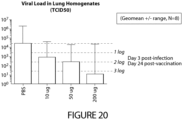
- the formulations of the invention also showed strong efficacy in several non-rodent animal models, including non-human primates. Highly effective vaccination was observed in cynomoglus monkeys and ferrets. Cynomoglus monkeys were vaccinated with various doses of mRNA-LNP formulations (50 pg/dose, 200 pg/dose, 400 pg/dose). Quite surprisingly, the vaccine formulations of the invention at all doses measured significantly reduced viral titers in the lungs of ferrets when exposed to virus just 7 days following single vaccination. Statistically significant increases in antibody titer as measured by HAI and microneutralization were detected as early as 7 days following vaccination and through the entire length of the study (84 days). A single vaccination was able to eliminate all virus in most animals.
- LNP used in the studies described herein has been used previously to deliver siRNA various in animal models as well as in humans.
- the fact that LNP is useful in vaccines is quite surprising. It has been observed that therapeutic delivery of siRNA formulated in LNP causes an undesirable inflammatory response associated with a transient IgM response, typically leading to a reduction in antigen production and a compromised immune response.
- the LNP-mRNA formulations of the invention are demonstrated herein to generate enhanced IgG levels, sufficient for prophylactic and therapeutic methods rather than transient IgM responses.
- NAVs Nucleic Acid Vaccines
- Nucleic Acid Vaccines (NAVs) of the present disclosure comprise one or more polynucleotides, e.g., polynucleotide constructs, which encode one or more wild type or engineered antigens.
- Exemplary polynucleotides, e.g., polynucleotide constructs include antigen-encoding RNA polynucleotides, e.g., mRNAs.
- polynucleotides of the disclosure e.g., antigen-encoding RNA polynucleotides, may include at least one chemical modification. References herein to "NAVs of the invention" relate to those as set out in the appended claims.
- NAV compositions of the invention may comprise other components including, but not limited to, tolerizing agents or adjuvants.
- tolerizing mRNA and/or such as any of those taught for example in USSN 61/892,556 filed October 18, 2013 , and PCT/US2014/61104 filed October 17, 2014 are co-administered with the NAV to induce antigen specific tolerance.
- Adjuvants or immune potentiators may also be administered with or in combination with one or more NAVs.
- an adjuvant acts as a co-signal to prime T-cells and/or B-cells and/or NK cells as to the existence of an infection.
- adjuvants include the enhancement of the immunogenicity of antigens, modification of the nature of the immune response, the reduction of the antigen amount needed for a successful immunization, the reduction of the frequency of booster immunizations needed and an improved immune response in elderly and immunocompromised vaccinees. These may be co-administered by any route, e.g., intramusculary, subcutaneous, IV or intradermal injections.
- Adjuvants useful in the present invention may include, but are not limited to, natural or synthetic. They may be organic or inorganic.
- Aduvants may be selected from any of the classes (1) mineral salts, e.g., aluminium hydroxide and aluminium or calcium phosphate gels; (2) emulsions including: oil emulsions and surfactant based formulations, e.g., microfluidised detergent stabilised oil-in-water emulsion, purified saponin, oil-in-water emulsion, stabilised water-in-oil emulsion; (3) particulate adjuvants, e.g., virosomes (unilamellar liposomal vehicles incorporating influenza haemagglutinin), structured complex of saponins and lipids, polylactide co-glycolide (PLG); (4) microbial derivatives; (5) endogenous human immunomodulators; and/or (6) inert vehicles, such as gold particles; (7) microorganism derived adjuvants; (8) tensoactive compunds; (9) carbohydrates; or combinations thereof.
- mineral salts
- Adjuvants for DNA nucleic acid vaccines have been disclosed in, for example, Kobiyama, et al Vaccines, 2013, 1(3), 278-292 . Any of the adjuvants disclosed by Kobiyama may be used in the RNAVs of the present invention.
- RNAVs of the present invention include any of those listed on the web-based vaccine adjuvant database, Vaxjo; http://www.violinet.org/vaxjo/ and described in for example Sayers, et al., J. Biomedicine and Biotechnology, volume 2012 (2012), Article ID 831486,13 pages
- adjuvants may include,without limitation, cationic liposome-DNA complex JVRS-100, aluminum hydroxide vaccine adjuvant, aluminum phosphate vaccine adjuvant, aluminum potassium sulfate adjuvant, alhydrogel, ISCOM(s) TM , Freund's Complete Adjuvant, Freund's Incomplete Adjuvant, CpG DNA Vaccine Adjuvant, Cholera toxin, Cholera toxin B subunit, Liposomes, Saponin Vaccine Adjuvant, DDA Adjuvant, Squalene-based Adjuvants, Etx B subunit Adjuvant, IL-12 Vaccine Adjuvant, LTK63 Vaccine Mutant Adjuvant, TiterMax Gold Adjuvant, Ribi Vaccine Adjuvant, Montanide ISA 720 Adjuvant, Corynebacterium-derived P40 Vaccine Adjuvant, MPL TM Adjuvant, AS04, AS02,
- adjuvants which may be co-administered with the NAVs of the invention include, but are not limited to interferons, TNF-alpha, TNF-beta, chemokines such as CCL21, eotaxin, HMGB1, SA100-8alpha, GCSF, GMCSF, granulysin, lactoferrin, ovalbumin, CD-40L, CD28 agonists, PD-1, soluble PD1, L1 or L2, or interleukins such as IL-1, IL-2, IL-4, IL-6, IL-7, IL-10, IL-12, IL-13, IL-21, IL-23, IL-15, IL-17, and IL-18. These may be administered with the NAV on the same encoded polynucleotide, e.g., polycistronic, or as separate mRNA encoding the adjuvant and antigen.
- interferons such as CCL21, eotaxin, HMGB
- NAVs of the present invention may vary in their valency. Valency refers to the number of antigenic components in the NAV or NAV polynucleotide (e.g., RNA polynucleotide) or polypeptide.
- the NAVs are monovalent.
- the NAVs are divalent.
- the NAVs are trivalent.
- the NAVs are multi-valent. Multivalent vaccines may comprise 2, 3, 4, 5, 6, 7, 8, 9, 10, 11,12,13,14, 15, 16, 17, 18, 19, 20, or more antigens or antigenic moieties (e.g., antigenic peptides, etc.).
- the antigenic components of the NAVs may be on a single polynucleotide or on separate polynucleotides.
- the NAVs of the present invention can be used as therapeutic or prophylactic agents. They are provided for use in medicine and/or for the priming of immune effector cells, e.g., stimulate/transfect PBMCs ex vivo and re-infuse the activated cells.
- a NAV described herein can be administered to a subject, wherein the polynucleotides is translated in vivo to produce an antigen.
- the active therapeutic agents of the disclosure include NAVs, cells containing NAVs or polypeptides translated from the polynucleotides contained in said NAVs.
- a polypeptide e.g., antigen or immunogen
- Such translation can be in vivo, ex vivo, in culture, or in vitro.
- the cell, tissue or organism is contacted with an effective amount of a composition containing a NAV which contains a polynucletotide that has at least one a translatable region encoding the polypeptide of intereste ( e.g., antigen or immunogen).
- an "effective amount" of the NAV composition is provided based, at least in part, on the target tissue, target cell type, means of administration, physical characteristics of the polynucleotide (e.g., size, and extent of modified nucleosides) and other components of the NAV, and other determinants.
- an effective amount of the NAV composition provides an induced or boosted immune response as a function of antigen production in the cell, preferably more efficient than a composition containing a corresponding unmodified polynucleotide encoding the same antigen.
- Increased antigen production may be demonstrated by increased cell transfection (i.e., the percentage of cells transfected with the NAV), increased protein translation from the polynucleotide, decreased nucleic acid degradation (as demonstrated, e.g., by increased duration of protein translation from a modified polynucleotide), or altered innate immune response of the host cell.
- aspects of the disclosure are directed to methods of inducing in vivo translation of a polypeptide antigen in a mammalian subject in need thereof.
- an effective amount of a NAV composition containing a polynucleotide that has at least one structural or chemical modification and a translatable region encoding the polypeptide (e.g., antigen or immunogen) is administered to the subject using the delivery methods described herein.
- the polynucleotide is provided in an amount and under other conditions such that the polynucleotide is translated in the cell.
- the cell in which the polynucleotide is localized, or the tissue in which the cell is present, may be targeted with one or more than one rounds of NAV administration.
- the administered NAVs comprising polynucleotides directs production of one or more polypeptides that provide a functional immune system-related activity which is substantially absent in the cell, tissue or organism in which the polypeptide is translated.
- the missing functional activity may be enzymatic, structural, or gene regulatory in nature.
- the administered polynucleotides directs production of one or more polypeptides that increases (e.g., synergistically) a functional activity related to the immune system which is present but substantially deficient in the cell in which the polypeptide is translated.
- the polypeptide antagonizes, directly or indirectly, the activity of a biological moiety present in, on the surface of, or secreted from the cell.
- antagonized biological moieties include lipids (e.g., cholesterol), a lipoprotein (e.g., low density lipoprotein), a nucleic acid, a carbohydrate, a protein toxin such as shiga and tetanus toxins, or a small molecule toxin such as botulinum, cholera, and diphtheria toxins.
- the antagonized biological molecule may be an endogenous protein that exhibits an undesirable activity, such as a cytotoxic or cytostatic activity.
- the proteins described herein may be engineered for localization within the cell, potentially within a specific compartment such as the cytoplasms or nucleus, or are engineered for secretion from the cell or translocation to the plasma membrane of the cell.
- polynucleotides of the NAVs and their encoded polypeptides in accordance with the present disclosure may be used for treatment of any of a variety of diseases, disorders, and/or conditions, including but not limited to viral infections (e.g., influenza, HIV, HCV, RSV), parasitic intentions or bacterial infections.
- viral infections e.g., influenza, HIV, HCV, RSV
- parasitic intentions or bacterial infections e.g., parasitic intentions or bacterial infections.
- the subject to whom the therapeutic agent may be administered suffers from or may be at risk of developing a disease, disorder, or deleterious condition.
- GWAS genome-wide association studies
- the agents can be administered simultaneously, for example in a combined unit dose (e.g., providing simultaneous delivery of both agents).
- the agents can also be administered at a specified time interval, such as, but not limited to, an interval of minutes, hours, days or weeks.
- the agents may be concurrently bioavailable, e.g., detectable, in the subject.
- the agents may be administered essentially simultaneously, for example two unit dosages administered at the same time, or a combined unit dosage of the two agents.
- the agents may be delivered in separate unit dosages.
- the agents may be administered in any order, or as one or more preparations that includes two or more agents.
- At least one administration of one of the agents may be made within minutes, one, two, three, or four hours, or even within one or two days of the other agent, e.g., the second agent.
- combinations can achieve synergistic results, e.g., greater than additive results, e.g., at least 25,50,75,100,200,300,400, or 500% greater than additive results.
- the NAVs comprising the polynucleotides disclosed herein, e.g., comprising RNA polynucleotides, may act as a single composition as a vaccine.
- a "vaccine” refers to a composition, for example, a substance or preparation that stimulates, induces, causes or improves immunity in an organism, e.g., an animal organism, for example, a mammalian organism ( e.g., a human)
- a vaccine provides immunity against one or more diseases or disorders in the organism, including prophylactic and/or therapeutic immunity.
- Exemplary vaccines includes one or more agents that resembles an infectious agent, e.g., a disease-causing microorganism, and can be made, for example, from live, attenuated, modified, weakened or killed forms of disease-causing microorganisms, or antigens derived therefrom, including combinations of antigenic components
- a vaccine stimulates, induces causes or improves immunity in an organism or causes or mimics infection in the organism without inducing any disease or disorder.
- a vaccine introduces an antigen into the tissues, extracellular space or cells of a subject and elicits an immune response, thereby protecting the subject from a particular disease or pathogen infection.
- the polynucleotides of the present disclosure may encode an antigen and when the polynucleotides are expressed in cells, a desired immune reponse is achieved.
- NAVs may be administered prophylactically or therapeutically as part of an active immunization scheme to healthy individuals or early in infection during the incubation phase or during active infection after onset of symptoms.
- the NAVs of the present disclosure may also be administered as a second line treatment after the standard first line treatments such as antibiotics and antivirals have failed to induce passive immunity.
- the NAVs of the present invention are useful in settings where resistance to first line treatments has developed and disease persists and induces chronic disease.
- RNA molecules are considered to be significantly safer than DNA vaccines, as RNAs are more easily degraded. They are cleared quickly out of the organism and cannot integrate into the genome and influence the cell's gene expression in an uncontrollable manner. It is also less likely for RNA vaccines to cause severe side effects like the generation of autoimmune disease or anti-DNA antibodies ( Bringmann A. et al., Journal of Biomedicine and Biotechnology (2010), vol. 2010, article ID623687 ). Transfetion with RNA requires only insertion into the cell's cytoplasm, which is easier to achieve than into the nucleus. Howerver, RNA is susceptible to RNase degradation and other natural decomposition in the cytoplasm of cells.
- RNA vaccines Various attempts to increase the stability and shelf life of RNA vaccines.
- US 2005/0032730 to Von Der Mulbe et al. discloses improving the stability of mRNA vaccine compositions by increasing G(guanosine)/C(cytosine) content of the mRNA molecules.
- US 5580859 to Felgner et al. teaches incorporating polynucleotide sequences coding for regulatory proteins that binds to and regulates the stabilities of mRNA. While not wishing to be bound by theory, it is believed that the polynucleotides vaccines (NAVs) of the invention will result in improved stability and therapeutic efficacy due at least in part to the specificity, purity and selectivity of the construct designs.
- NAVs polynucleotides vaccines
- certain modified nucleosides, or combinations thereof, when introduced into the polynucleotides of the NAVs of the invention will activate the innate immune response.
- Such activating molecules are useful as adjuvants when combined with polypeptides and/or othervaccines.
- the activating molecules contain a translatable region which encodes for a polypeptide sequence useful as a vaccine, thus providing the ability to be a self-adjuvant.
- the polynucleotides of the NAVs of the present disclosure may be used in the prevention, treatment and diagnosis of diseases and physical disturbances caused by infectious agents.
- the polynucleotide of the present disclosure may encode at least one polypeptide of interest (antigen) and may be provided to an individual in order to stimulate the immune system to protect against the disease-causing agents.
- the biological activity and/or effect from an antigen or infectious agent may be inhibited and/or abolished by providing one or more polynucleotides which have the ability to bind and neutralize the antigen and/or infectious agent.
- the polynucleotides encoding an immunogen may be delivered to cells to trigger multiple innate response pathways (see International Pub. No. WO2012006377 and US Patent Publication No. US20130177639 ).
- the polynucleotides of the NAVs of the present disclosure encoding an immunogen may be delivered to a vertebrate in a dose amount large enough to be immunogenic to the vertebrate (see International Pub. No. WO2012006372 and WO2012006369 and US Publication No. US20130149375 and US20130177640 ).
- NAVs of the present invention may be utilized in various settings depending on the prevalence of the infection or the degree or level of unmet medical need.
- the NAVs of the present invention may be utilized to treat and/or prevent influenza infection, i.e. diseases and conditions related to influenza virus infection (seasonal and pandemic).
- Symptoms of the influenza infection include dry cough, fever, chills, myalgias progressing to respiratory failure and the risk of secondary bacterial infections (e.g., MRSA).
- Seasonal influenza is ubiquitous and consists of three principal strains (A[H1N1], A [H3N2], and B), which are covered by the annual vaccine.
- Pandemic flu occurs because the viruses' unique reassortment ability allowing antigenic shift as well as transfer between avian and swine flu strains.
- pandemic potential of several new strains have a high mortality rate with few available treatments. Anti-virals only provide symptomatic relief and must be given in the first 48 hours.
- the NAVs of the present invention have superior properties in that they produce much larger antibody titers, produce responses early than commercially available anti-virals and may be administered after the critical 48 hour period while retaining efficacy.
- NAVs represent a tailored active vaccine that not only can prevent infection but can limit transmission of influenza.
- the NAVs may be used to prevent pandemic influenza by reacting to emerging new strains with the very rapid NAV-based vaccine production process.
- new NAV for treating or prophylactically preventing influenza outbreaks including for emerging strains (e.g., H10N8), may be produced in less than six weeks, from the time of antigen identification to available vaccine.
- a single injection of a single antigen encoding NAV polynucleotide may provide protection for an entire flu season.
- the polynucleotides of the NAVs of the invention are not self-replicating RNA.
- Self-replicating RNA have been described, for instance in US Pub. No. US20110300205 and International Pub. No. WO2011005799 and WO2013055905 .
- the polynucleotides of the NAVs of the invention may encode amphipathic and/or immunogenic amphipathic peptides.
- a formulation of the polynucleotides of the NAVs of the invention may further comprise an amphipathic and/or immunogenic amphipathic peptide.
- the polynucleotides comprising an amphipathic and/or immunogenic amphipathic peptide may be formulated as described in US. Pub. No. US20110250237 and International Pub. Nos. WO2010009277 and WO2010009065 .
- the polynucleotides of the NAVs of the invention may be immunostimultory.
- the polynucleotides may encode all or a part of a positive-sense or a negative-sense stranded RNA virus genome (see International Pub No. WO2012092569 and US Pub No. US20120177701 ).
- the immunostimultory polynucleotides of the present invention may be formulated with an excipient for administration as described herein and/or known in the art (see International Pub No. WO2012068295 and US Pub No. US20120213812 ).
- the polynucleotides may further comprise a sequence region encoding a cytokine that promotes the immune response, such as a monokine, lymphokine, interleukin or chemokine, such as IL-1, IL-2, IL-3, IL-4, IL-5, IL-6, IL-7, IL-8, IL-9, IL-10, IL-12, INF- ⁇ , INF- ⁇ , GM-CFS, LT-a, or growth factors such as hGH.
- a cytokine that promotes the immune response
- a monokine such as a monokine, lymphokine, interleukin or chemokine, such as IL-1, IL-2, IL-3, IL-4, IL-5, IL-6, IL-7, IL-8, IL-9, IL-10, IL-12, INF- ⁇ , INF- ⁇ , GM-CFS, LT-a, or growth factors such as hGH.
- the response of the vaccine formulated by the methods described herein may be enhanced by the addition of various compounds to induce the therapeutic effect.
- the vaccine formulation may include a MHC II binding peptide or a peptide having a similar sequence to a MHC II binding peptide (see International Pub Nos. WO2012027365 , WO2011031298 and US Pub No. US20120070493 , US20110110965 ).
- the vaccine formulations may comprise modified nicotinic compounds which may generate an antibody response to nicotine residue in a subject (see International Pub No. WO2012061717 and US Pub No. US20120114677 ).
- the effective amount of the polynucleotides of the NAVs of the invention provided to a cell, a tissue or a subject may be enough for immune prophylaxis.
- the polynucleotides of the NAVs of the invention may be administrated with other prophylactic or therapeutic compounds.
- the prophylactic or therapeutic compound may be an adjuvant or a booster.
- booster refers to an extra administration of the prophylactic composition.
- a booster (or booster vaccine) may be given after an earlier administration of the prophylactic composition.
- the time of administration between the intial administration of the prophylactic composition and the booster may be, but is not limited to, 1 minute, 2 minutes, 3 minutes, 4 minutes, 5 minutes, 6 minutes, 7 minutes, 8 minutes, 9 minutes, 10 minutes, 15 minutes, 20 minutes 35 minutes, 40 minutes, 45 minutes, 50 minutes, 55 minutes, 1 hour, 2 hours, 3 hours, 4 hours, 5 hours, 6 hours, 7 hours, 8 hours, 9 hours, 10 hours, 11 hours, 12 hours, 13 hours, 14 hours, 15 hours, 16 hours, 17 hours, 18 hours, 19 hours, 20 hours, 21 hours, 22 hours, 23 hours, 1 day, 36 hours, 2 days, 3 days, 4 days, 5 days, 6 days, 1 week, 10 days, 2 weeks, 3 weeks, 1 month, 2 months, 3 months, 4 months, 5 months, 6 months, 7 months, 8 months, 9 months, 10 months, 11 months, 1 year, 18 months, 2years, 3years, 4years, 5years, 6years, 7years, 8 years, 9 years, 10 years, 11 years,
- the polynucleotides of the NAVs of the invention may be administered intranasally similar to the administration of live vaccines.
- the polynucleotide may be administered intramuscularly or intradermally similarly to the administration of inactivated vaccines known in the art.
- the NAVs of the invention may be used to protect against and/or prevent the transmission of an emerging or engineered threat which may be known or unknown.
- the NAVs may be formulated by the methods described herein.
- the formulation may comprise a NAV or polynucleotide which can can have a therapetutic and/or prophylactic effect on more than one disease, disorder or condition.
- NAV antibodies of the present invention may be used for research in many applications, such as, but not limited to, identifying and locating intracellular and extracellular proteins, protein interaction, signal pathways and cell biology.
- the NAV may be used in to reduce the risk or inhibit the infection of influenza viruses such as, but not limited to, the highly pathogenic avian influenza virus (such as, but not limited to, H5N1 subtype) infection and human influenza virs (such as, but not limited to, H1N1 subtype and H3N2 subtype) infection.
- influenza viruses such as, but not limited to, the highly pathogenic avian influenza virus (such as, but not limited to, H5N1 subtype) infection and human influenza virs (such as, but not limited to, H1N1 subtype and H3N2 subtype) infection.
- influenza viruses such as, but not limited to, the highly pathogenic avian influenza virus (such as, but not limited to, H5N1 subtype) infection and human influenza virs (such as, but not limited to, H1N1 subtype and H3N2 subtype) infection.
- the polynucleotide described herein which may encode any of the protein sequences described in US Patent No. 8470771 may
- the NAV may be used as a vaccine and may further comprise an adjuvant which may enable the vaccine to elicit a higher immune response.
- the adjuvant could be a sub-micron oil-in-water emulsion which can elicit a higher immune response in human pediatric populations (see e.g., the adjuvanted vaccines described in US Patent Publication No. US20120027813 and US Patent No. US8506966 ).
- NAVs of the present invention may be used to protect, treat or cure infection arising from contact with an infectious agent
- the infectious agent is a strain of Influenza A or Influenza B or combinations thereof.
- the NAVs of the present invention e.g., NAVs comprising one or more antigen-encoding polynucleotides of the present disclosure, may be administered in conjunction with one or more antibiotics.
- Anti-bacterial agents include, but are not limited to, aminoglycosides (e.g., amikacin (AMIKIN ® ), gentamicin (GARAMYCIN ® ), kanamycin (KANTREX ® ), neomycin (MYCIFRADIN ® ), netilmicin (NETROMYCIN ® ), tobramycin (NEBCIN ® ), Paromomycin (HUMATIN ® )), ansamycins ( e.g., geldanamycin, herbimycin), carbacephem ( e.g., loracarbef (LORABID ® ), Carbapenems ( e.g., ertapenem (INVANZ ® ), doripenem (DORIBAX ® ), imipenem/cilastatin (PRIMAXIN ® ), meropenem (MERREM ® ), cephalosporins (first generation) (e.g., cef
- NAVs of the present invention may be utilized in various settings depending on the prevalence of the infection or the degree or level of unmet medical need. Some applications of the NAVs of the disclosure are outlined in Table 1. Table 1. Infectious Agents by prevalence and Medical Need Unmet Need (Infectious Agent Target) Prevalence Short term benign Long term sequelae Short term morbidity but some treatment Short term mortality; no treatment available Ubiquitous HPV, HCV, UTRIs Dengue, Chikungunya, ETEC and GI bacteria and S. Pneumo PNA seasonal and pandemic influenza, MRSA and TB At risk populations VZV, Lyme and Chlamydia, N. gonorrhea and HSV Noroviruses, HEV, CMV, HIV and N.
- VEV toxin-mediated diseases meningitis Klebsiella, Pseudomonas, Rabies and C. difficile Rare disease -- VEV toxin-mediated diseases, hantavirus, arborviruses such as JE, WNV and EEE
- Certain abbreviations include: HPV - Human Papillomavirus; HCV - Hepatitis C Virus; HEV - Human Enterovirus; MERS-CoV: Middle East Respiratory Syndrom Corona Virus; VZV - Varicella-zoster Virus; MRSA - Methicillin-resistant Staph areus; TB-tuberculosis; WNV-West Nile Virus; VEV--vesicular exanthema virus; EEE-Eastern equine encephalitis, JE-Japanese encephalitis, ETEC-Enterotoxigenic E. coli.
- Symptoms of the flu include dry cough, fever, chills, myalgias progressing to respiratory failure and the risk of secondary bacterial infections (e.g., MRSA).
- Seasonal influenza is ubiquitous and consists of three principal strains (A [H1N1], A [H3N2], and B), which are covered by the annual vaccine.
- Pandemic flu occurs because the viruses' unique reassortment ability allowing antigenic shift as well as transfer between avian and swine flu strains.
- pandemic potential of several new strains have a high mortality rate with few available treatments. Anti-virals only provide symptomatic relief and must be given in the first 48 hours.
- the NAVs of the present invention have superior properties in that they produce much larger antibody titers, produce responses early than commercially available anti-virals and may be administered after the critical 48 hour period while retaining efficacy.
- NAVs represent a tailored active vaccine that not only can prevent infection but can limit transmission of influenza.
- the NAVs may be used to prevent pandemic influenza by reacting to emerging new strains with the very rapid NAV-based vaccine production process.
- new NAV for treating or prophylactically preventing influenza outbreaks including for emerging strains (e.g., H7N9 and H10N8), may be produced in less than six weeks, from the time of antigen identification to available vaccine.
- a single injection of a single antigen encoding NAV polynucleotide may provide protection for an entire flu season.
- the NAV compositions of the present invention may also be used to maintain or restore antigenic memory in a subject or population as part of a vaccination plan.
- NAV compositions may be created which include polynucleotides that encode one or more flu year antigens.
- a flu year antigen is an antigen which is selected from a strain of influenza used as a component of a flu vaccine from a particularyear.
- influenza A strain, A/Port Chalmers/1/1973(H3N2)-like virus represents one strain component of the Northern Hemisphere vaccine from 1974-1975.
- a vaccination scheme or plan is developed which allows for not only ongoing vaccination in the current year but antigenic memory booster vaccinations across years, strains, or groups thereof to establish and maintain antigenic memory in a population. In this manner, a population is less likely to succumb to any pandemic or outbreak involving recurrence of older strains or the appearance of antigens from older strains.
- any combination of prior vaccine component strains utilized to create or design an antigenic memory booster vaccine is referred to here as a reference set.
- NAVs which are antigenic memory booster vaccines are administered to boost antigenic memory across a time period of 2, 3, 4, 5, 6, 7, 8, 9, 10, 11, 12, 13, 14, 15, 16, 17, 18, 19, 20, 21, 22, 23, 24, 25, 26, 27, 28, 29, 30, 35, 40, 45, 50or more years.
- NAVs which are antigenic memory booster vaccines are administered to boost antigenic memory for alternating historic years including every other year from the past vaccine component strains relative to a current year.
- the selection of the vaccine components can be from every 3 rd , 4 th , 5 th , 6 th , 7 th , 8 th , 9 th , 10 th or more years.
- NAVs which are antigenic memory booster vaccines are administered to boost antigenic memory over ten year periods.
- NAVs which are antigenic memory booster vaccines are administered to boost antigenic memory and are selected from a number of influenza type A strains as a first selection combined with a selection from a number of influenza type B strains or other strains listed herein.
- the number of selections of type A or type B may be independently, 1, 2, 1, 4, 5, 6, 7, 8, 9, 10 or more.
- the antigenic memory booster vaccine strains for antigen encoding in the NAVs may be selected from either the Northern or Southern hemisphere vaccine components independently.
- the NAV booster vaccine may be used in a population either once or periodically to create herd immunity. Such immunity is present when greater than 30% of a population is protected.
- the NAV polnynucleotides may encode one or more polypeptides of an influenza strain as an antigen.
- antigens include, but are not limited to those antigens encoded by the polynucleotides listed in Tables 6-18.
- the GenBank Accession Number represents either the complete or partial CDS of the encoded antigen.
- the NAV polynucleotides may comprise a region of any of the sequences listed in the tables or entire coding region of the mRNA listed They may comprise hybrid or chimeric regions, or mimics orvariants.
- any of the strains referred to in Tables 6-14 may also be used in an antigenic memory booster vaccine as described herein.
- Table 6 Influenza H1N1 Antigens Strain/Protein Length GenBank/Gl Accession No. Influenza A virus (A/Bayern/7/95(H1N1)) NA gene for neuraminidase, genomic RNA 1,459 bp linear mRNA AJ518104.1 GI:31096418 Influenza A virus (AlBrazil/11/1978(X-71)(H1 N1)) mRNA for hemagglutinin HA1, escape variant 1 1,072 bp linear mRNA X86654.1 GI:995549 Influenza A virus (AlBrazil/11/1978(X-71)(H1 N1)) mRNA for hemagglutinin HA1, escape variant 2 1,072 bp linear mRNA X86655.1 GI:995550 Influenza A virus (AlBrazil/11/1978(X
- Influenza A virus (A/swine/Germany/8533/1991(H1N1)) mRNA for hemagglutinin precursor 1,730 bp linear mRNA Z46434.1 GI:565611 Influenza A virus (A/swine/Guangdong/711/2001 (H1 N1)) nonfunctional hemagglutinin (HA) mRNA, partial sequence 1,690 bp linear mRNA AY852271.1 GI:60327789 Influenza A virus (A/swine/Haseluenne/IDT2617/03(H1N1)) hemagglutinin mRNA, complete cds 1,809 bp linear mRNA EU163946.1 GI:157679548 Influenza A virus (A/swine/Hokkaido/2/81 (H1N1)) hemagglutinin precursor (HA) mRNA, partial cds 981 bp linear mRNA U47306.1 GI:1912342
- Influenza A virus (A/swine/Wisconsin/1/1967(H1N1)) nucleoprotein mRNA, complete cds 1,565 bp linear mRNA M76607.1 GI:325086 Influenza A virus (A/swine/Wisconsin/1915/1988(H1N1)) nucleoprotein mRNA, complete cds 1,565 bp linear mRNA M76608.1 GI:325088 Influenza A virus (A/swine/WI/1915/1988(H1N1)) nucleoprotein (segment 5) mRNA, complete cds 1,550 bp linear mRNA L46850.1 GI:954757 Influenza A virus (A/Switzerland/8808/2002(H1 N1)) partial m1 gene for matrix protein 1 and partial m2 gene for matrix protein 2, genomic RNA 729 bp linear mRNA AJ532568.1 GI:31096461 Influenza A virus (A/human/Taiwan/001
- Influenza A virus (A/Aichi/2/1968(H3N2)) hemagglutinin (HA) mRNA, complete cds 1,704 bp linear mRNA EF614248.1 GI:148910819 2.
- Influenza A virus (A/Aichi/2/1968(H3N2)) hemagglutinin (HA) mRNA, partial cds 1,698 bp linear mRNA EF614249.1 GI:148910821 3.
- Influenza A virus (A/Aichi/2/1968(H3N2)) hemagglutinin (HA) mRNA, partial cds 1,698 bp linear mRNA EF614250.1 GI:148910823 4.
- Influenza A virus (A/Aichi/2/1968(H3N2)) hemagglutinin (HA) mRNA, partial cds 1,698 bp linear mRNA EF614251.1 GI:148910825 5.
- Influenza A virus (A/Akita/1/1995(H3N2)) haemagglutinin mRNA, partial cds 1,032 bp linear mRNA U48444.1 GI:1574989 6.
- Influenza A virus (A/Beijing/32/1992(H3N2)) mRNA for haemagglutinin 1,041 bp linear mRNA Z46392.1 GI:609020 7.
- Influenza A virus (A/Canada/33312/99(H3N2)) hemagglutinin (HA) mRNA, partial cds 987 bp linear mRNA AF501516.1 GI:21314288 8.
- Influenza A virus (A/Charlottesville/10/99 (H3N2)) hemagglutinin mRNA, partial cds 987 bp linear mRNA AF297094.1 GI:11228917 9.
- Influenza A virus (A/Charlottesville/49/99 (H3N2)) hemagglutinin mRNA, partial cds 987 bp linear mRNA AF297096.1 GI:11228921 10. Influenza A virus (A/Charlottesville/69/99 (H3N2)) hemagglutinin mRNA, partial cds 987 bp linear mRNA AF297097.1 GI:11228923 11. Influenza A virus (A/Charlottesville/73/99 (H3N2)) hemagglutinin mRNA, partial cds 987 bp linear mRNA AF297095.1 GI:11228919 12.
- Influenza A virus (A/England/1/1993(H3N2)) mRNA for haemagglutinin 1,041 bp linear mRNA Z46393.1 GI:609024 13. Influenza A virus (A/England/247/1993(H3N2)) mRNA for haemagglutinin 1,041 bp linear mRNA Z46394.1 GI:609025 14. Influenza A virus (A/England/269/93(H3N2)) mRNA for haemagglutinin 1,041 bp linear mRNA Z46395.1 GI:609027 15.
- Influenza A virus (A/England/284/1993(H3N2)) mRNA for haemagglutinin 1,041 bp linear mRNA Z46396.1 GI:609029 16. Influenza A virus (A/England/286/1993(H3N2)) mRNA for haemagglutinin 1,041 bp linear mRNA Z46397.1 GI:609031 17. Influenza A virus (A/England/289/1993(H3N2)) mRNA for haemagolutinin 1,041 bp linear mRNA Z46398.1 GI:609033 18.
- Influenza A virus (A/England/328/1993(H3N2)) mRNA for haemagglutinin 1,041 bp linear mRNA Z46399.1 GI:609035 19. Influenza A virus (A/England/346/1993(H3N2)) mRNA for haemagglutinin 1,041 bp linear mRNA Z46400.1 GI:609037 20. Influenza A virus (A/England/347/1993(H3N2)) mRNA for haemagglutinin 1,041 bp linear mRNA Z46401.1 GI:609039 21.
- Influenza A virus (A/England/42/72(H3N2)) hemagglutinin mRNA, partial cds 1,091 bp linear mRNA AF201875.1 GI:6470274 22.
- Influenza A virus (A/England/471/1993(H3N2)) mRNA for haemagglutinin 1,041 bp linear mRNA Z46402.1 GI:609041 23.
- Influenza A virus (A/England/67/1994(H3N2)) mRNA for haemagglutinin 1,041 bp linear mRNA Z46403.1 GL609043 24.
- Influenza A virus (A/England/68/1994(H3N2)) mRNA for haemagglutinin 1,041 bp linear mRNA Z46404.1 GI:609045 25. Influenza A virus (A/England/7/1994(H3N2)) mRNA for haemagglutinin 1,041 bp linear mRNA Z46405.1 GI:609047 28. Influenza A virus (A/Guangdong/25/1993(H3N2)) mRNA for haemagglutinin 1,041 bp linear mRNA Z46406.1 GI:609049 29.
- Influenza A virus (AIHong Kong/1/68(H3N2)) hemagglutinin mRNA, partial cds 1,091 bp linear mRNA AF201874.1 GI:6470272 30.
- Influenza A virus (A/Hong Kong/1/1994(H3N2)) mRNA for haemagglutinin 1,041 bp linear mRNA Z46407.1 GI:609051 31.
- Influenza A virus (AIHong Kong/1143/99(H3N2)) hemagglutinin mRNA, complete cds 1,762 bp linear mRNA AF382319.1 GI:14487957 32.
- Influenza A virus (AIHong Kong/1143/99(H3N2)) hemagglutinin mRNA, complete cds 1,762 bp linear mRNA AF382320.1 GI:14487959 33.
- Influenza A virus (AIHong Kong/1143/99(H3N2)) neuraminidase mRNA, complete cds 1,466 bp linear mRNA AF382329.1 GI:14487977 34.
- Influenza A virus (AIHong Kong/1143/99(H3N2)) neuraminidase mRNA, complete cds 1,466 bp linear mRNA AF382330.1 GI:14487979 35.
- Influenza A virus (A/Hong Kong/1144/99(H3N2)) hemagglutinin mRNA, complete cds 1,762 bp linear mRNA AY035589.1 GI:14486403 36.
- Influenza A virus (AIHong Kong/1144/99(H3N2)) hemagglutinin mRNA, complete cds 1,762 bp linear mRNA AF382321.1 GI:14487961 37.
- Influenza A virus (AIHong Kong/1144/99(H3N2)) hemagglutinin mRNA, complete cds 1,762 bp linear mRNA AF382322.1 GI:14487963 38.
- Influenza A virus (AIHong Kong/1144/99(H3N2)) neuraminidase mRNA, complete cds 1,466 bp linear mRNA AF382331.1 GI:14487981 39.
- Influenza A virus (AIHong Kong/1144/99(H3N2)) neuraminidase mRNA, complete cds 1,466 bp linear mRNA AF382332.1 GI:14487983 40.
- Influenza A virus (AIHong Kong/1179/99(H3N2)) hemagglutinin mRNA, complete cds 1,762 bp linear mRNA AY035590.1 GI:14486405 41.
- Influenza A virus (AIHong Kong/1179/99(H3N2)) hemagglutinin mRNA, complete cds 1,762 bp linear mRNA AF382323.1 GI:14487965 42.
- Influenza A virus (AIHong Kong/1179/99(H3N2)) hemagglutinin mRNA, complete cds 1,762 bp linear mRNA AF382324.1 GI:14487967 43.
- Influenza A virus (AIHong Kong/1180/99(H3N2)) hemagglutinin mRNA, complete cds 1,762 bp linear mRNA AY035591.1 GI:14486407 44.
- Influenza A virus (AIHong Kong/1180/99(H3N2)) hemagglutinin mRNA, complete cds 1,762 bp linear mRNA AF382325.1 GI:14487969 45. Influenza A virus (AIHong Kong/1180/99(H3N2)) hemagglutinin mRNA, complete cds 1,762 bp linear mRNA AF382326.1 GI:14487971 46. Influenza A virus (AIHong Kong/1182/99(H3N2)) hemagglutinin mRNA, complete cds 1,762 bp linear mRNA AF382327.1 GI:14487973 47.
- Influenza A virus (AIHong Kong/1182/99(H3N2)) hemagglutinin mRNA, complete cds 1,762 bp linear mRNA AF382328.1 GI:14487975 48.
- Influenza A virus (A/Hong Kong/2/1994(H3N2)) mRNA for haemagglutinin 1,041 bp linear mRNA Z46408.1 GI:609055 49.
- Influenza A virus (A/Hong Kong/23/1992(H3N2)) mRNA for haemagglutinin 1,041 bp linear mRNA Z46410.1 GI:609053 50.
- Influenza A virus (A/Hong Kong/34/1990(H3N2)) mRNA for haemagglutinin 1,041 bp linear mRNA Z46409.1 GI:609057 51. Influenza A virus (A/England/286/1993(H3N2)) mRNA for haemagglutinin 1,041 bp linear mRNA Z46397.1 GI:609031 52. Influenza A virus (A/England/289/1993(H3N2)) mRNA for haemagglutinin 1,041 bp linear mRNA Z46398.1 GI:609033 53.
- Influenza A virus (A/England/328/1993(H3N2)) mRNA for haemagglutinin 1,041 bp linear mRNA Z46399.1 GI:609035 54. Influenza A virus (A/England/346/1993(H3N2)) mRNA for haemagglutinin 1,041 bp linear mRNA Z46400.1 GI:609037 55. Influenza A virus (A/England/347/1993(H3N2)) mRNA for haemagglutinin 1,041 bp linear mRNA Z46401.1 GI:609039 56.
- Influenza A virus (A/England/42/72(H3N2)) hemagglutinin mRNA, partial cds 1,091 bp linear mRNA AF201875.1 GI:6470274 57.
- Influenza A virus (A/England/471/1993(H3N2)) mRNA for haemagglutinin 1,041 bp linear mRNA Z46402.1 GI:609041 58.
- Influenza A virus (A/England/67/1994(H3N2)) mRNA for haemagglutinin 1,041 bp linear mRNA Z46403.1 GI:609043 59.
- Influenza A virus (A/England/68/1994(H3N2)) mRNA for haemagglutinin 1,041 bp linear mRNA Z46404.1 GI:609045 60.
- Influenza A virus (A/England/7/1994(H3N2)) mRNA for haemagglutinin 1,041 bp linear mRNA Z46405.1 GI:609047 63.
- Influenza A virus (A/Guangdong/25/1993(H3N2)) mRNA for haemagglutinin 1,041 bp linear mRNA Z46406.1 GI:609049 65.
- Influenza A virus (A/Hebei/19/1995(H3N2)) haemagglutinin mRNA, partial cds 1,032 bp linear mRNA U48447.1 GI:1574995 66.
- Influenza A virus (A/Hebei/41/1994(H3N2)) haemagglutinin mRNA, partial cds 1,032 bp linear mRNA U48441.1 GI:1574983 67.
- Influenza A virus (AIHong Kong/1/68(H3N2)) hemagglutinin mRNA, partial cds 1,091 bp linear mRNA AF201874.1 GI:6470272 68.
- Influenza A virus (A/Hong Kong/1/1994(H3N2)) mRNA for haemagglutinin 1,041 bp linear mRNA Z46407.1 GI:609051 69.
- Influenza A virus (AIHong Kong/1143/99(H3N2)) hemagglutinin mRNA, complete cds 1,762 bp linear mRNA AY035588.1 GI:14486401 70.
- Influenza A virus (AIHong Kong/1143/99(H3N2)) hemagglutinin mRNA, complete cds 1,762 bp linear mRNA AF382319.1 GI:14487957 71.
- Influenza A virus (AIHong Kong/1143/99(H3N2)) hemagglutinin mRNA, complete cds 1,762 bp linear mRNA AF382320.1 GI:14487959 72.
- Influenza A virus (AIHong Kong/1143/99(H3N2)) neuraminidase mRNA, complete cds 1,466 bp linear mRNA AF382329.1 GI:14487977 73.
- Influenza A virus (AIHong Kong/1143/99(H3N2)) neuraminidase mRNA, complete cds 1,466 bp linear mRNA AF382330.1 GI:14487979 74.
- Influenza A virus (AIHong Kong/1144/99(H3N2)) hemagglutinin mRNA, complete cds 1,762 bp linear mRNA AY035589.1 GI:14486403 75.
- Influenza A virus (AIHong Kong/1144/99(H3N2)) hemagglutinin mRNA, complete cds 1,762 bp linear mRNA AF382321.1 GI:14487961 76.
- Influenza A virus (AIHong Kong/1144/99(H3N2)) hemagglutinin mRNA, complete cds 1,762 bp linear mRNA AF382322.1 GI:14487963 77.
- Influenza A virus (AIHong Kong/1144/99(H3N2)) neuraminidase mRNA, complete cds 1,466 bp linear mRNA AF382331.1 GI:14487981 78.
- Influenza A virus (AIHong Kong/1144/99(H3N2)) neuraminidase mRNA, complete cds 1,466 bp linear mRNA AF382332.1 GI:14487983 79.
- Influenza A virus (AIHong Kong/1179/99(H3N2)) hemagglutinin mRNA, complete cds 1,762 bp linear mRNA AY035590.1 GI:14486405 80.
- Influenza A virus (AIHong Kong/1179/99(H3N2)) hemagglutinin mRNA, complete cds 1,762 bp linear mRNA AF382323.1 GI:14487965 81.
- Influenza A virus (AIHong Kong/1179/99(H3N2)) hemagglutinin mRNA, complete cds 1,762 bp linear mRNA AF382324.1 GI:14487967 82.
- Influenza A virus (AIHong Kong/1180/99(H3N2)) hemagglutinin mRNA, complete cds 1,762 bp linear mRNA AY035591.1 GI:14486407 83.
- Influenza A virus (AIHong Kong/1180/99(H3N2)) hemagglutinin mRNA, complete cds 1,762 bp linear mRNA AF382325.1 GI:14487969 84.
- Influenza A virus (AIHong Kong/1180/99(H3N2)) hemagglutinin mRNA, complete cds 1,762 bp linear mRNA AF382326.1 GI:14487971 85.
- Influenza A virus (AIHong Kong/1182/99(H3N2)) hemagglutinin mRNA, complete cds 1,762 bp linear mRNA AY035592.1 GI:14486409 86.
- Influenza A virus (AIHong Kong/1182/99(H3N2)) hemagglutinin mRNA, complete cds 1,762 bp linear mRNA AF382327.1 GI:14487973 87.
- Influenza A virus (AIHong Kong/1182/99(H3N2)) hemagglutinin mRNA, complete cds 1,762 bp linear mRNA AF382328.1 GI:14487975 88.
- Influenza A virus (A/Hong Kong/2/1994(H3N2)) mRNA for haemagglutinin 1,041 bp linear mRNA Z46408.1 GI:609055 89.
- Influenza A virus (A/Hong Kong/23/1992(H3N2)) mRNA for haemagglutinin 1,041 bp linear mRNA Z46410.1 GI:609053 90.
- Influenza A virus (A/lndiana/28170/99(H3N2)) hemagglutinin (HA) mRNA, partial cds 987 bp linear mRNA AF501534.1 GI:21314324 92.
- Influenza A virus (A/Kinmen/618/03(H3N2)) hemagglutinin (HA) mRNA, partial cds 529 bp linear mRNA AY961997.1 GI:68138151 93.
- Influenza A virus (A/Kinmen/618/03(H3N2)) neuraminidase (NA) mRNA, partial cds 383 bp linear mRNA AY973325.1 GI:70673206 94.
- Influenza A virus (A/Kinmen/618/03(H3N2)) nucleoprotein (NP) mRNA, partial cds 882 bp linear mRNA AY986986.1 GI:70728099 95.
- Influenza A virus (A/Kinmen/621/03(H3N2)) hemagglutinin (HA) mRNA, partial cds 545 bp linear mRNA AY962017.1 GI:68138191 96.
- Influenza A virus (A/Kinmen/621/03(H3N2)) neuraminidase (NA) mRNA, partial cds 386 bp linear mRNA AY973326.1 GI:70673208 97.
- Influenza A virus (A/Kinmen/621/03(H3N2)) nucleoprotein (NP) mRNA, partial cds 882 bp linear mRNA AY986987.1 GI:70728101 98.
- Influenza A virus (A/Kinmen/639/04(H3N2)) hemagglutinin (HA) mRNA, partial cds 786 bp linear mRNA AY962008.1 GI:68138173 99.
- Influenza A virus (A/Kinmen/639/04(H3N2)) neuraminidase (NA) mRNA, partial cds 381 bp linear mRNA AY973327.1 GI:70673210 100.
- Influenza A virus (A/Kinmen/639/04(H3N2)) nucleoprotein (NP) mRNA, partial cds 882 bp linear mRNA AY986988.1 GI:70728103 101.
- Influenza A virus (A/Kinmen/641/04(H3N2)) hemagglutinin (HA) mRNA, partial cds 596 bp linear mRNA AY962004.1 GI:68138165 102.
- Influenza A virus (A/Kinmen/641/04(H3N2)) neuraminidase (NA) mRNA, partial cds 785 bp linear mRNA AY973328.1 GI:70673212 103.
- Influenza A virus (A/Kinmen/642/04(H3N2)) hemagglutinin (HA) mRNA, partial cds 576 bp linear mRNA AY962001.1 GI:68138159 104.
- Influenza A virus (A/Kinmen/642/04(H3N2)) neuraminidase (NA) mRNA, partial cds 580 bp linear mRNA AY973329.1 GI:70673214 105.
- Influenza A virus (A/Kinmen/642/04(H3N2)) nucleoprotein (NP) mRNA, partial cds 882 bp linear mRNA AY986989.1 GI:70728105 106.
- Influenza A virus (A/Kinmen/645/04(H3N2)) hemagglutinin (HA) mRNA, partial cds 789 bp linear mRNA AY962009.1 GI:68138175 107.
- Influenza A virus (A/Kinmen/645/04(H3N2)) neuraminidase (NA) mRNA, partial cds 581 bp linear mRNA AY973330.1 GI:70673216 108.
- Influenza A virus (A/Kinmen/645/04(H3N2)) nucleoprotein (NP) mRNA, partial cds 981 bp linear mRNA AY986990.1 GI:70728107 109.
- Influenza A virus (A/LosAngeles/2/1987(H3N2)) polymerase protein basic 2 (PB2) mRNA, complete cds 2,341 bp linear mRNA U62543.1 GI:1480737 110.
- Influenza A virus (A/Madrid/252/1993(H3N2)) mRNA for haemagglutinin 1,041 bp linear mRNA Z46411.1 GI:609067 111.
- Influenza A virus (A/Michigan/22568/99(H3N2)) hemagglutinin (HA) mRNA, partial cds 987 bp linear mRNA AF501531.1 GI:21314318 112.
- Influenza A virus (A/Michigan/22692/99(H3N2)) hemagglutinin (HA) mRNA, partial cds 987 bp linear mRNA AF501518.1 GI:21314292 113.
- Influenza A virus (A/Moscow/10/99(H3N2)) partial NS1 gene for non structural protein 1 and partial NS2 gene for non structural protein 2, genomic RNA 754 bp linear mRNA AJ519454.1 GI:31096423 114.
- Influenza A virus (A/ningbo/17/2002(H3N2)) hemagglutinin (HA) mRNA, partial cds 987 bp linear mRNA AY138518.1 GI:24895178 115.
- Influenza A virus (A/ningbo/25/2002(H3N2)) hemagglutinin (HA) mRNA, partial cds 987 bp linear mRNA AY138517.1 GI:24895169 116.
- Influenza A virus (A/NT/60/68/29C(H3N2)) mRNA for haemagglutinin (HA1 and HA2 genes) 1,765 bp linear mRNA V01103.1 GI:60800 117.
- Influenza A virus (A/Oklahoma/323/03(H3N2)) hemagglutinin mRNA, complete cds 1,701 bp linear mRNA DQ059385.1 GI:66933143 118.
- Influenza A virus (A/Oklahoma/323/03(H3N2)) neuraminidase mRNA, complete cds 1,410 bp linear mRNA DQ059384.2 GI:75859981 119.
- Influenza A virus (A/Panama/2007/99(H3N2)) partial NS1 gene for non structural protein 1 and partial NS2 gene for non structural protein 2, genomic RNA 766 bp linear mRNA AJ519458.1 GI:31096435 120.
- Influenza A virus (A/Pennsalvanya/20109/99(H3N2)) hemagglutinin (HA) mRNA, partial cds 987 bp linear mRNA AF501526.1 GI:21314308 121.
- Influenza A virus (A/Philippines/2/82(H3N2)) hemagglutinin mRNA, partial cds 1,091 bp linear mRNA AF233691.1 GI:7331124 122.
- Influenza A virus (A/Pingtung/303/04(H3N2)) hemagglutinin (HA) mRNA, partial cds 767 bp linear mRNA AY962000.1 GI:68138157 123.
- Influenza A virus (A/Pingtung/303/04(H3N2)) neuraminidase (NA) mRNA, partial cds 783 bp linear mRNA AY973331.1 GI:70673218 124.
- Influenza A virus (A/Pingtung/303/04(H3N2)) nucleoprotein (NP) mRNA, partial cds 928 bp linear mRNA AY986991.1 GI:70728109 125.
- Influenza A virus (A/Pingtung/313/04(H3N2)) hemagglutinin (HA) mRNA, partial cds 788 bp linear mRNA AY961999.1 GI:68138155 126.
- Influenza A virus (A/Pingtung/313/04(H3N2)) neuraminidase (NA) mRNA, partial cds 787 bp linear mRNA AY973332.1 GI:70673220 127.
- Influenza A virus (A/Pingtung/313/04(H3N2)) nucleoprotein (NP) mRNA, partial cds 882 bp linear mRNA AY986992.1 GI:70728111 128.
- Influenza A virus (Alruddy turnstone/Delaware/142/99 (H3N2)) nonfunctional matrix protein mRNA, partial sequence 927 bp linear mRNA AY664458.1 GI:51011862 129.
- Influenza A virus (A/Scotland/142/1993(H3N2)) mRNA for haemagglutinin 1,041 bp linear mRNA Z46413.1 GI:609059 130.
- Influenza A virus (A/Scotland/160/1993(H3N2)) mRNA for haemagglutinin 1,041 bp linear mRNA Z46414.1 GI:609061 131. Influenza A virus (A/Scotland/173/1993(H3N2)) mRNA for haemagglufinin 1,041 bp linear mRNA Z46416.1 GI:609063 132. Influenza A virus (A/Scotland/174/1993(H3N2)) mRNA for haemagglutinin 1,041 bp linear mRNA Z46415.1 GI:609065 133.
- Influenza A virus (A/Scotland/2/1993(H3N2)) mRNA for haemagglutinin 1,041 bp linear mRNA Z46412.1 GI:609069 134.
- Influenza A virus (A/Sendai/c182/1994(H3N2)) haemagglutinin mRNA, partial cds 1,032 bp linear mRNA U48439.1 GI:1574979 135.
- Influenza A virus (A/Sendai/c373/1995(H3N2)) haemagglutinin mRNA, partial cds 1,032 bp linear mRNA U48445.1 GI:1574991 136.
- Influenza A virus (A/Sendai/c384/1994(H3N2)) haemagglutinin mRNA, partial cds 1,032 bp linear mRNA U48440.1 GI:1574981 137.
- Influenza A virus (A/Shangdong/9/1993(H3N2)) mRNA for haemagglutinin 1,041 bp linear mRNA Z46417.1 GI:609071 138.
- Influenza A virus (A/Shanghai/11/1987/X99aE high yield reassortant(H3N2)) hemagglutinin (HA) mRNA, partial cds 987 bp linear mRNA L19416.1 GI:348117 139.
- Influenza A virus (A/sw/Shizuoka/110/97(H3N2)) polymerase basic 2 (PB2) mRNA, complete cds 2,280 bp linear mRNA AF225514.1 GI:27462098 140.
- Influenza A virus (A/sw/Shizuoka/110/97(H3N2)) polymerase basic 1 (PB1) mRNA, complete cds 2,274 bp linear mRNA AF225518.1 GI:27462106 141.
- Influenza A virus (A/sw/Shizuoka/110/97(H3N2)) polymerase acidic (PA) mRNA, complete cds 2,151 bp linear mRNA AF225522.1 GI:27462114 142.
- Influenza A virus (A/sw/Shizuoka/110/97(H3N2)) nucleoprotein (NP) mRNA, complete cds 1,497 bp linear mRNA AF225534.1 GI:27462146 143.
- Influenza A virus (A/sw/Shizuoka/110/97(H3N2)) neuraminidase (NA) mRNA, complete cds 1,410 bp linear mRNA AF225538.1 GI:27462154 144.
- Influenza A virus (A/sw/Shizuoka/110/97(H3N2)) hemagglutinin (HA1) mRNA, partial cds 984 bp linear mRNA AF225542.1 GI:27462162 145.
- Influenza A virus (A/sw/Shizuoka/115/97(H3N2)) polymerase basic 2 (PB2) mRNA, complete cds 2,280 bp linear mRNA AF225515.1 GI:27462100 146.
- Influenza A virus (A/sw/Shizuoka/115/97(H3N2)) polymerase basic 1 (PB1) mRNA, complete cds 2,274 bp linear mRNA AF225519.1 GI:27462108 147.
- Influenza A virus (A/sw/Shizuoka/115/97(H3N2)) polymerase acidic (PA) mRNA, complete cds 2,151 bp linear mRNA AF225523.1 GI:27462116 148.
- Influenza A virus (A/sw/Shizuoka/115/97(H3N2)) nucleoprotein (NP) mRNA, complete cds 1,497 bp linear mRNA AF225535.1 GI:27462148 149.
- Influenza A virus (A/sw/Shizuoka/115/97(H3N2)) neuraminidase (NA) mRNA, complete cds 1,410 bp linear mRNA AF225539.1 GI:27462156 150.
- Influenza A virus (A/sw/Shizuoka/115/97(H3N2)) hemagglutinin (HA1) mRNA, partial cds 984 bp linear mRNA AF225543.1 GI:27462164 151.
- Influenza A virus (A/sw/Shizuoka/119/97(H3N2)) polymerase basic 2 (PB2) mRNA, complete cds 2,280 bp linear mRNA AF225516.1 GI:27462102 152.
- Influenza A virus (A/sw/Shizuoka/119/97(H3N2)) polymerase basic 1 (PB1) mRNA, complete cds 2,274 bp linear mRNA AF225520.1 GI:27462110 153.
- Influenza A virus (A/sw/Shizuoka/119/97(H3N2)) polymerase acidic (PA) mRNA, complete cds 2,151 bp linear mRNA AF225524.1 GI:27462118 154.
- Influenza A virus (A/sw/Shizuoka/119/97(H3N2)) nucleoprotein (NP) mRNA, complete cds 1,497 bp linear mRNA AF225536.1 GI:27462150 155.
- Influenza A virus (A/sw/Shizuoka/119/97(H3N2)) neuraminidase (NA) mRNA, complete cds 1,410 bp linear mRNA AF225540.1 GI:27462158 156.
- Influenza A virus (A/sw/Shizuoka/119/97(H3N2)) hemagglutinin (HA1) mRNA, partial cds 984 bp linear mRNA AF225544.1 GI:27462166 159.
- Influenza A virus (A/swinelBakum/IDT 1769/2003(H3N2)) neuraminidase mRNA, complete cds 1,410 bp linear mRNA EU163948.1 GI:157679552 163.
- Influenza A virus (A/swine/Fujian/668/01(H3N2)) nonfunctional hemagglutinin mRNA, complete sequence 1,738 bp linear mRNA AY857957.1 GI:58042507 164.
- Influenza A virus (A/swine/Re220/92hp(H3N2)) neuraminidase mRNA, complete cds 1,465 bp linear mRNA EU163949.1 GI:157679554 168.
- Influenza A virus (A/sw/Shizuoka/120/97(H3N2)) polymerase basic 2 (PB2) mRNA, complete cds 2,280 bp linear mRNA AF225517.1 GI:27462104 169.
- Influenza A virus (A/sw/Shizuoka/120/97(H3N2)) polymerase basic 1 (PB1) mRNA, complete cds 2,274 bp linear mRNA AF225521.1 GI:27462112 170.
- Influenza A virus (A/sw/Shizuoka/120/97(H3N2)) polymerase acidic (PA) mRNA, complete cds 2,151 bp linear mRNA AF225525.1 GI:27462120 171.
- Influenza A virus (A/sw/Shizuoka/120/97(H3N2)) nucleoprotein (NP) mRNA, complete cds 1,497 bp linear mRNA AF225537.1 GI:27462152 172.
- Influenza A virus (A/sw/Shizuoka/120/97(H3N2)) neuraminidase (NA) mRNA, complete cds 1,410 bp linear mRNA AF225541.1 GI:27462160 173.
- Influenza A virus (A/sw/Shizuoka/120/97(H3N2)) hemagglutinin (HA1) mRNA, partial cds 984 bp linear mRNA AF225545.1 GI:27462168 174.
- Influenza A virus (A/Switzerland/7729/98(H3N2)) hemagglutinin mRNA, complete cds 1,762 bp linear mRNA AY032978.1 GI:14161723 175.
- Influenza A virus (A/Switzerland/7729/98(H3N2)) hemagglutinin mRNA, complete cds 1,762 bp linear mRNA AF382318.1 GI:14487955 176.
- Influenza A virus (A/Tainan/704/03(H3N2)) hemagglutinin (HA) mRNA, partial cds 528 bp linear mRNA AY962011.1 GI:68138179 177.
- Influenza A virus (A/Tainan/704/03(H3N2)) neuraminidase (NA) mRNA, partial cds 384 bp linear mRNA AY973333.1 GI:70673222 178.
- Influenza A virus (A/Tainan/704/03(H3N2)) nucleoprotein (NP) mRNA, partial cds 882 bp linear mRNA AY986993.1 GI:70728113 179.
- Influenza A virus (A/Tainan/712/03(H3N2)) hemagglutinin (HA) mRNA, partial cds 519 bp linear mRNA AY962012.1 GI:68138181 180.
- Influenza A virus (A/Tainan/712/03(H3N2)) neuraminidase (NA) mRNA, partial cds 383 bp linear mRNA AY973334.1 GI:70673224 181.
- Influenza A virus (A/Tainan/712/03(H3N2)) nucleoprotein (NP) mRNA, partial cds 882 bp linear mRNA AY986994.1 GI:70728115 182.
- Influenza A virus (A/Tainan/722/03(H3N2)) hemagglutinin (HA) mRNA, partial cds 784 bp linear mRNA AY962005.1 GI:68138167 183.
- Influenza A virus (A/Tainan/722/03(H3N2)) neuraminidase (NA) mRNA, partial cds 592 bp linear mRNA AY973335.1 GI:70673226 184.
- Influenza A virus (A/Tainan/722/03(H3N2)) nucleoprotein (NP) mRNA, partial cds 936 bp linear mRNA AY986995.1 GI:70728117 185.
- Influenza A virus (A/Taipei/407/03(H3N2)) hemagglutinin (HA) mRNA, partial cds 788 bp linear mRNA AY961998.1 GI:68138153 186.
- Influenza A virus (A/Taipei/407/03(H3N2)) neuraminidase (NA) mRNA, partial cds 787 bp linear mRNA AY973336.1 GI:70673228 187.
- Influenza A virus (A/Taipei/407/03(H3N2)) nucleoprotein (NP) mRNA, partial cds 882 bp linear mRNA AY986996.1 GI:70728119 188.
- Influenza A virus (A/Taipei/416/03(H3N2)) hemagglutinin (HA) mRNA, partial cds 787 bp linear mRNA AY962007.1 GI:68138171 189.
- Influenza A virus (A/Taipei/416/03(H3N2)) neuraminidase (NA) mRNA, partial cds 782 bp linear mRNA AY973337.1 GI:70673230 190.
- Influenza A virus (A/Taipei/416/03(H3N2)) nucleoprotein (NP) mRNA, partial cds 882 bp linear mRNA AY986997.1 GI:70728121 191.
- Influenza A virus (A/Taiwan/0020/98 (H3N2)) polymerase basic protein 1 (PB1) mRNA, partial cds 297 bp linear mRNA AY303703.1 GI:32330895 192.
- Influenza A virus (A/Taiwan/0040/2003(H3N2)) hemagglutinin mRNA, partial cds 791 bp linear mRNA AY604817.1 GI:50727514 193.
- Influenza A virus (A/Taiwan/0045/98 (H3N2)) polymerase basic protein 1 (PB1) mRNA, partial cds 297 bp linear mRNA AY303705.1 GI:32330899 194.
- Influenza A virus (A/human/Taiwan/0095/96(H3N2)) hemagglutinin (HA) mRNA, partial cds 844 bp linear mRNA AF362820.1 GI:15055140 195.
- Influenza A virus (A/Taiwan/0097/2003(H3N2)) hemagglutinin mRNA, partial cds 791 bp linear mRNA AY604828.1 GI:50727536 196.
- Influenza A virus (A/Taiwan/0104/2001 (H3N2)) polymerase basic protein 1 (PB1) mRNA, partial cds 297 bp linear mRNA AY303706.1 GI:32330901 197.
- Influenza A virus (A/human/Taiwan/01 18/98(H3N2)) hemagglutinin (HA) mRNA, partial cds 844 bp linear mRNA AF362805.1 GI:15055110 198.
- Influenza A virus (A/Taiwan/0122/2003(H3N2)) hemagglutinin mRNA, partial cds 791 bp linear mRNA AY604823.1 GI:50727526 199.
- Influenza A virus (A/human/Taiwan/0149/00(H3N2)) hemagglutinin (HA) mRNA, partial cds 844 bp linear mRNA AF362806.1 GI:15055112 200.
- Influenza A virus (A/Taiwan/0275/2000 (H3N2)) polymerase basic protein 1 (PB1) mRNA, partial cds 297 bp linear mRNA AY303712.1 GI:32330913 201.
- Influenza A virus (A/Taiwan/0275/2000 (H3N2)) hemagglutinin (HA) mRNA, partial cds 844 bp linear mRNA AY303713.1 GI:32330915 202.
- Influenza A virus (A/human/Taiwan/0293/98(H3N2)) hemagglutinin (HA) mRNA, partial cds 844 bp linear mRNA AF362807.1 GI:15055114 203.
- Influenza A virus (A/Taiwan/0346/98 (H3N2)) polymerase basic protein 1 (PB1) mRNA, partial cds 297 bp linear mRNA AY303715.1 GI:32330919 204.
- Influenza A virus (A/Taiwan/0379/2000 (H3N2)) polymerase basic protein 1 (PB1) mRNA, partial cds 297 bp linear mRNA AY303716.1 GI:32330921 205.
- Influenza A virus (A/Taiwan/0379/2000 (H3N2)) hemagglutinin (HA) mRNA, partial cds 844 bp linear mRNA AY303717.1 GI:32330923 206.
- Influenza A virus (A/Taiwan/0388/2001(H3N2)) hemagglutinin (HA) mRNA, partial cds 791 bp linear mRNA AY625729.1 GI:50604415 207.
- Influenza A virus (A/human/Taiwan/0389/99(H3N2)) hemagglutinin (HA) mRNA, partial cds 844 bp linear mRNA AF362808.1 GI:15055116 208.
- Influenza A virus (A/human/Taiwan/0423/98(H3N2)) hemagglutinin (HA) mRNA, partial cds 844 bp linear mRNA AF362809.1 GI:15055118 209.
- Influenza A virus (A/Taiwan/0423/98 (H3N2)) polymerase basic protein 1 (PB1) mRNA, partial cds 297 bp linear mRNA AY303718.1 GI:32330925 210.
- Influenza A virus (A/human/Taiwan/0464/98(H3N2)) hemagglutinin (HA) mRNA, partial cds 844 bp linear mRNA AF362810.1 GI:15055120 211.
- Influenza A virus (A/Taiwan/0464/98 (H3N2)) polymerase basic protein 1 (PB1) mRNA, partial cds 297 bp linear mRNA AY303719.1 GI:32330927 212.
- Influenza A virus (A/Taiwan/0568/2001(H3N2)) hemagglutinin (HA) mRNA, partial cds 791 bp linear mRNA AY625730.1 GI:50604440 213.
- Influenza A virus (A/Taiwan/0570/2003(H3N2)) hemagglutinin mRNA, partial cds 791 bp linear mRNA AY604822.1 GI:50727524 214.
- Influenza A virus (A/Taiwan/0572/2003(H3N2)) hemagglutinin mRNA, partial cds 791 bp linear mRNA AY604827.1 GI:50727534 215.
- Influenza A virus (A/Taiwan/0578/2003(H3N2)) hemagglutinin mRNA, partial cds 791 bp linear mRNA AY604821.1 GI:50727522 216.
- Influenza A virus (A/Taiwan/0583/2003(H3N2)) hemagglutinin mRNA, partial cds 791 bp linear mRNA AY604820.1 GI:50727520 217.
- Influenza A virus (A/Taiwan/0646/2000 (H3N2)) polymerase basic protein 1 (PB1) mRNA, partial cds 297 bp linear mRNA AY303722.1 GI:32330933 218.
- Influenza A virus (A/Taiwan/0646/2000 (H3N2)) hemagglutinin (HA) mRNA, partial cds 844 bp linear mRNA AY303723.1 GI:32330935 219.
- Influenza A virus (A/human/Taiwan/0830/99(H3N2)) hemagglutinin (HA) mRNA, partial cds 844 bp linear mRNA AF362811.1 GI:15055122 220.
- Influenza A virus (A/Taiwan/0964/2001 (H3N2)) hemagglutinin (HA) mRNA, partial cds 791 bp linear mRNA AY625731.1 GI:50604469 221.
- Influenza A virus (A/human/Taiwan/1008/99(H3N2)) hemagglutinin (HA) mRNA, partial cds 844 bp linear mRNA AF362812.1 GI:15055124 222.
- Influenza A virus (A/Taiwan/1008/99 (H3N2)) polymerase basic protein 1 (PB1) mRNA, partial cds 297 bp linear mRNA AY303725.1 GI:32330939 223.
- Influenza A virus (A/Taiwan/1219/2004(H3N2)) hemagglutinin (HA) mRNA, partial cds 750 bp linear mRNA EU068138.1 GI:158452149 224.
- Influenza A virus (A/Taiwan/1315/2005(H3N2)) hemagglutinin (HA) mRNA, partial cds 750 bp linear mRNA EU068125.1 GI:158452123 225.
- Influenza A virus (A/Taiwan/1511/2004(H3N2)) hemagglutinin (HA) mRNA, partial cds 750 bp linear mRNA EU068153.1 GI:158452179 226.
- Influenza A virus (A/Taiwan/1533/2003(H3N2)) hemagglutinin (HA) mRNA, partial cds 750 bp linear mRNA EU068119.1 GI:158452111 227.
- Influenza A virus (A/human/Taiwan/1537/99(H3N2)) hemagglutinin (HA) mRNA, partial cds 844 bp linear mRNA AF362813.1 GI:15055126 228.
- Influenza A virus (A/Taiwan/1537/99 (H3N2)) polymerase basic protein 1 (PB1) mRNA, partial cds 297 bp linear mRNA AY303728.1 GI:32330945 229.
- Influenza A virus (A/Taiwan/1566/2003(H3N2)) hemagglutinin mRNA, partial cds 791 bp linear mRNA AY604826.1 GI:50727532 230.
- Influenza A virus (A/Taiwan/1568/2003(H3N2)) hemagglutinin mRNA, partial cds 791 bp linear mRNA AY604819.1 GI:50727518 231.
- Influenza A virus (A/Taiwan/158/2003(H3N2)) hemagglutinin (HA) mRNA, partial cds 750 bp linear mRNA EU068116.1 GI:158452105 232.
- Influenza A virus (A/Taiwan/1600/96(H3N2)) matrix protein M1 (M) mRNA, partial cds 875 bp linear mRNA AF138709.2 GI:4996869 233.
- Influenza A virus (A/Taiwan/1613/2003(H3N2)) hemagglutinin (HA) mRNA, partial cds 750 bp linear mRNA EU068117.1 GI:158452107 234.
- Influenza A virus (A/Taiwan/1651/2004(H3N2)) hemagglutinin (HA) mRNA, partial cds 750 bp linear mRNA EU068148.1 GI:158452169 235.
- Influenza A virus (A/human/Taiwan/1748/97(H3N2)) hemagglutinin (HA) mRNA, partial cds 844 bp linear mRNA AF362814.1 GI:15055128 236.
- Influenza A virus (A/Taiwan/1748/97 (H3N2)) polymerase basic protein 1 (PB1) mRNA, partial cds 297 bp linear mRNA AY303729.1 GI:32330947 237.
- Influenza A virus (A/Taiwan/179/96(H3N2)) matrix protein M1 (M) mRNA, partial cds 872 bp linear mRNA AF138707.2 GI:4996865 238.
- Influenza A virus (A/Taiwan/1817/2004(H3N2)) hemagglutinin (HA) mRNA, partial cds 750 bp linear mRNA EU068139.1 GI:158452151 239.
- Influenza A virus (A/Taiwan/1904/2003(H3N2)) hemagglutinin (HA) mRNA, partial cds 750 bp linear mRNA EU068154.1 GI:158452181 240.
- Influenza A virus (A/Taiwan/1921/2003(H3N2)) hemagglutinin (HA) mRNA, partial cds 750 bp linear mRNA EU068155.1 GI:158452183 241.
- Influenza A virus (A/human/Taiwan/1986/96(H3N2)) hemagglutinin (HA) mRNA, partial cds 844 bp linear mRNA AF362815.1 GI:15055130 242.
- Influenza A virus (A/Taiwan/1990/96 (H3N2)) polymerase basic protein 1 (PB1) mRNA, partial cds 297 bp linear mRNA AY303730.1 GI:32330949 243.
- Influenza A virus (A/Taiwan/1990/96 (H3N2)) hemagglutinin (HA) mRNA, partial cds 844 bp linear mRNA AY303731.1 GI:32330951 244.
- Influenza A virus (A/Taiwan/20/98(H3N2)) H3 hemagglutinin (HA) mRNA, partial cds 861 bp linear mRNA AF139938.1 GI:4972940 245.
- Influenza A virus (A/Taiwan/20/98(H3N2)) N2 neuraminidase (NA) mRNA, partial cds 392 bp linear mRNA AF140627.1 GI:4972988 246.
- Influenza A virus (A/Taiwan/20/98(H3N2)) matrix protein M1 (M) mRNA, partial cds 875 bp linear mRNA AF138715.2 GI:4996879 247.
- Influenza A virus (A/human/Taiwan/2031/97(H3N2)) hemagglutinin (HA) mRNA, partial cds 844 bp linear mRNA AF362816.1 GI:15055132 248.
- Influenza A virus (A/Taiwan/2034/96(H3N2)) H3 hemagglutinin (HA) mRNA, partial cds 861 bp linear mRNA AF139937.1 GI:4972938 249.
- Influenza A virus (A/Taiwan/2034/96(H3N2)) N2 neuraminidase (NA) mRNA, partial cds 392 bp linear mRNA AF140620.1 GI:4972974 250.
- Influenza A virus (A/Taiwan/2034/96(H3N2)) polymerase basic protein 1 (PB1) mRNA, partial cds 297 bp linear mRNA AY303732.1 GI:32330953 251.
- Influenza A virus (A/Taiwan/2040/2003(H3N2)) hemagglutinin mRNA, partial cds 791 bp linear mRNA AY604818.1 GI:50727516 252.
- Influenza A virus (A/Taiwan/2072/2006(H3N2)) hemagglutinin (HA) mRNA, partial cds 750 bp linear mRNA EU068131.1 GI:158452135 253.
- Influenza A virus (A/Taiwan/21/98(H3N2)) H3 hemagglutinin (HA) mRNA, partial cds 861 bp linear mRNA AF139934.1 GI:4972932 254.
- Influenza A virus (A/Taiwan/21/98(H3N2)) N2 neuraminidase (NA) mRNA, partial cds 392 bp linear mRNA AF140624.1 GI:4972982 255.
- Influenza A virus (A/Taiwan/21/98(H3N2)) matrix protein M1 (M) mRNA, partial cds 875 bp linear mRNA AF138716.2 GI:4996881 256.
- Influenza A virus (A/Taiwan/2191/96(H3N2)) H3 hemagglutinin (HA) mRNA, partial cds 861 bp linear mRNA AF139932.1 GI:4972928 257.
- Influenza A virus (A/Taiwan/2191/96(H3N2)) N2 neuraminidase (NA) mRNA, partial cds 392 bp linear mRNA AF140622.1 GI:4972978 258.
- Influenza A virus (A/Taiwan/2191/96(H3N2)) matrix protein M1 (M) mRNA, partial cds 875 bp linear mRNA AF138711.3 GI:156147502 259.
- Influenza A virus (A/Taiwan/2192/96(H3N2)) H3 hemagglutinin (HA) mRNA, partial cds 861 bp linear mRNA AF139936.1 GI:4972936 260.
- Influenza A virus (A/Taiwan/2192/96(H3N2)) N2 neuraminidase (NA) mRNA, partial cds 392 bp linear mRNA AF140626.1 GI:4972986 261.
- Influenza A virus (A/Taiwan/2195/96 (H3N2)) polymerase basic protein 1 (PB1) mRNA, partial cds 297 bp linear mRNA AY303735.1 GI:32330959 262.
- Influenza A virus (A/Taiwan/2195/96 (H3N2)) hemagglutinin (HA) mRNA, partial cds 844 bp linear mRNA AY303736.1 GI:32330961 263.
- Influenza A virus (A/Taiwan/224/98(H3N2)) matrix protein M1 (M) mRNA, partial cds 875 bp linear mRNA AF138718.2 GI:4996885 264.
- Influenza A virus (A/human/Taiwan/2548/99(H3N2)) hemagglutinin (HA) mRNA, partial cds 844 bp linear mRNA AF362817.1 GI:15055134 265.
- Influenza A virus (A/Taiwan/268/2005(H3N2)) hemagglutinin (HA) mRNA, partial cds 750 bp linear mRNA EU068120.1 Gl:158452113 266.
- Influenza A virus (A/Taiwan/3008/2004(H3N2)) hemagglutinin (HA) mRNA, partial cds 750 bp linear mRNA EU068149.1 GI:158452171 267.
- Influenza A virus (A/Taiwan/3075/2003(H3N2)) hemagglutinin (HA) mRNA, partial cds 750 bp linear mRNA EU068152.1 GI:158452177 268.
- Influenza A virus (A/human/Taiwan/3083/00(H3N2)) hemagglutinin (HA) mRNA, partial cds 940 bp linear mRNA AF362818.1 GI:15055136 269.
- Influenza A virus (A/Taiwan/3131/2002(H3N2)) hemagglutinin mRNA, partial cds 791 bp linear mRNA AY604811.1 GI:50727502 270.
- Influenza A virus (A/Taiwan/3154/2004(H3N2)) hemagglutinin (HA) mRNA, partial cds 750 bp linear mRNA EU068145.1 GI:158452163 271.
- Influenza A virus (A/Taiwan/3187/2004(H3N2)) hemagglutinin (HA) mRNA, partial cds 750 bp linear mRNA EU068141.1 GI:158452155 272.
- Influenza A virus (A/Taiwan/3245/2004(H3N2)) hemagglutinin (HA) mRNA, partial cds 750 bp linear mRNA EU068134.1 GI:158452141 273.
- Influenza A virus (A/Taiwan/3294/2005(H3N2)) hemagglutinin (HA) mRNA, partial cds 750 bp linear mRNA EU068133.1 GI:158452139 274.
- Influenza A virus (A/Taiwan/3351/97(H3N2)) H3 hemagglutinin (HA) mRNA, partial cds 861 bp linear mRNA AF139935.1 GI:4972934 275.
- Influenza A virus (A/Taiwan/3351/97(H3N2)) N2 neuraminidase (NA) mRNA, partial cds 392 bp linear mRNA AF140625.1 GI:4972984 276.
- Influenza A virus (A/Taiwan/3351/97(H3N2)) matrix protein M1 (M) mRNA, partial cds 875 bp linear mRNA AF138713.2 GI:4996875 277.
- Influenza A virus (A/Taiwan/3351/97(H3N2)) polymerase basic protein 1 (PB1) mRNA, partial cds 297 bp linear mRNA AY303738.1 GI:32330965 278.
- Influenza A virus (A/Taiwan/3387/2005(H3N2)) hemagglutinin (HA) mRNA, partial cds 750 bp linear mRNA EU068132.1 GI:158452137 279.
- Influenza A virus (A/Taiwan/3396/97 (H3N2)) polymerase basic protein 1 (PB1) mRNA, partial cds 297 bp linear mRNA AY303742.1 GI:32330973 280.
- Influenza A virus (A/Taiwan/3396/97 (H3N2)) hemagglutinin (HA) mRNA, partial cds 844 bp linear mRNA AY303743.1 GI:32330975 281.
- Influenza A virus (A/Taiwan/3427/97(H3N2)) H3 hemagglutinin (HA) mRNA, partial cds 861 bp linear mRNA AF139930.1 GI:4972924 282.
- Influenza A virus (A/Taiwan/3427/97(H3N2)) N2 neuraminidase (NA) mRNA, partial cds 392 bp linear mRNA AF140619.1 GI:4972972 283.
- Influenza A virus (A/Taiwan/346/98(H3N2)) H3 hemagglutinin (HA) mRNA, partial cds 861 bp linear mRNA AF139940.1 GI:4972944 284.
- Influenza A virus (A/Taiwan/346/98(H3N2)) N2 neuraminidase (NA) mRNA, partial cds 392 bp linear mRNA AF140787.1 GI:4972992 285.
- Influenza A virus (A/Taiwan/346/98(H3N2)) matrix protein M1 (M) mRNA, partial cds 875 bp linear mRNA AF138719.2 GI:4996887 286.
- Influenza A virus (A/human/Taiwan/3460/00(H3N2)) truncated hemagglutinin (HA) mRNA, partial cds 942 bp linear mRNA AF362819.1 GI:15055138 287.
- Influenza A virus (A/Taiwan/3469/97(H3N2)) H3 hemagglutinin (HA) mRNA, partial cds 861 bp linear mRNA AF139933.1 GI:4972930 288.
- Influenza A virus (A/Taiwan/3469/97(H3N2)) N2 neuraminidase (NA) mRNA, partial cds 392 bp linear mRNA AF140623.1 GI:4972980 289.
- Influenza A virus (A/Taiwan/3469/97(H3N2)) matrix protein M1 (M) mRNA, partial cds 875 bp linear mRNA AF138714.2 GI:4996877 290.
- Influenza A virus (A/Taiwan/3503/97 (H3N2)) polymerase basic protein 1 (PB1) mRNA, partial cds 297 bp linear mRNA AY303744.1 GI:32330977 291.
- Influenza A virus (A/Taiwan/3503/97 (H3N2)) hemagglutinin (HA) mRNA, partial cds 844 bp linear mRNA AY303745.1 GI:32330979 292.
- Influenza A virus (A/Taiwan/3513/96(H3N2)) matrix protein M1 (M) mRNA, partial cds 919 bp linear mRNA AF138712.1 GI:4928900 293.
- Influenza A virus (A/Taiwan/3513/97(H3N2)) H3 hemagglutinin (HA) mRNA, partial cds 861 bp linear mRNA AF139931.1 GI:4972926 294.
- Influenza A virus (A/Taiwan/3513/97(H3N2)) N2 neuraminidase (NA) mRNA, partial cds 392 bp linear mRNA AF140621.1 GI:4972976 295.
- Influenza A virus (A/Taiwan/3744/2002(H3N2)) hemagglutinin mRNA, partial cds 791 bp linear mRNA AY604814.1 GI:50727508 296.
- Influenza A virus (A/human/Taiwan/3760/00(H3N2)) hemagglutinin (HA) mRNA, partial cds 940 bp linear mRNA AF362804.1 GI:15055108 297.
- Influenza A virus (A/Taiwan/3896/2001 (H1N1)) hemagglutinin (HA) mRNA, partial cds 561 bp linear mRNA AY303747.1 GI:32330983 298.
- Influenza A virus (A/Taiwan/4050/2003(H3N2)) hemagglutinin mRNA, partial cds 791 bp linear mRNA AY604825.1 GI:50727530 299.
- Influenza A virus (A/Taiwan/4063/2003(H3N2)) hemagglutinin mRNA, partial cds 791 bp linear mRNA AY604824.1 GI:50727528 300.
- Influenza A virus (A/Taiwan/41/2004(H3N2)) hemagglutinin (HA) mRNA, partial cds 750 bp linear mRNA EU068137.1 GI:158452147 301.
- Influenza A virus (A/Taiwan/45/98(H3N2)) H3 hemagglutinin (HA) mRNA, partial cds 861 bp linear mRNA AF139939.1 GI:4972942 302.
- Influenza A virus (A/Taiwan/45/98(H3N2)) N2 neuraminidase (NA) mRNA, partial cds 392 bp linear mRNA AF140628.1 GI:4972990 303.
- Influenza A virus (A/Taiwan/45/98(H3N2)) matrix protein M1 (M) mRNA, partial cds 875 bp linear mRNA AF138717.2 GI:4996883 304.
- Influenza A virus (A/Taiwan/4548/2003(H3N2)) hemagglutinin (HA) mRNA, partial cds 750 bp linear mRNA EU068114.1 GI:158452101 305.
- Influenza A virus (A/Taiwan/4673/2002(H3N2)) hemagglutinin mRNA, partial cds 791 bp linear mRNA AY604813.1 GI:50727506 306.
- Influenza A virus (A/Taiwan/4680/2002(H3N2)) hemagglutinin mRNA, partial cds 791 bp linear mRNA AY604812.1 GI:50727504 307.
- Influenza A virus (A/Taiwan/4735/2004(H3N2)) hemagglutinin (HA) mRNA, partial cds 750 bp linear mRNA EU068136.1 GI:158452145 308.
- Influenza A virus (A/Taiwan/4829/2005(H3N2)) hemagglutinin (HA) mRNA, partial cds 750 bp linear mRNA EU068142.1 GI:158452157 309. Influenza A virus (A/Taiwan/4836/2005(H3N2)) hemagglutinin (HA) mRNA, partial cds 750 bp linear mRNA EU068130.1 GI:158452133 310.
- Influenza A virus (A/Taiwan/4865/2005(H3N2)) hemagglutinin (HA) mRNA, partial cds 750 bp linear mRNA EU068143.1 GI:158452159 311. Influenza A virus (A/Taiwan/4883/2005(H3N2)) hemagglutinin (HA) mRNA, partial cds 750 bp linear mRNA EU068121.1 GI:158452115 312. Influenza A virus (A/Taiwan/4938/2002(H3N2)) hemagglutinin mRNA, partial cds 791 bp linear mRNA AY604809.1 GI:50727498 313.
- Influenza A virus (A/Taiwan/4954/2002(H3N2)) hemagglutinin mRNA, partial cds 791 bp linear mRNA AY604815.1 GI:50727510 314. Influenza A virus (A/Taiwan/4963/2002(H3N2)) hemagglutinin mRNA, partial cds 791 bp linear mRNA AY604810.1 GI:50727500 315. Influenza A virus (A/Taiwan/4987/2005(H3N2)) hemagglutinin (HA) mRNA, partial cds 750 bp linear mRNA EU068122.1 GI:158452117 316.
- Influenza A virus (A/Taiwan/4990/2005(H3N2)) hemagglutinin (HA) mRNA, partial cds 750 bp linear mRNA EU068127.1 GI:158452127 317.
- Influenza A virus (A/Taiwan/5/2003(H3N2)) hemagglutinin (HA) mRNA, partial cds 750 bp linear mRNA EU068118.1 GI:158452109 318.
- Influenza A virus (A/Taiwan/5153/2002(H3N2)) hemagglutinin mRNA, partial cds 791 bp linear mRNA AY604816.1 GI:50727512 319.
- Influenza A virus (A/Taiwan/5267/2005(H3N2)) hemagglutinin (HA) mRNA, partial cds 750 bp linear mRNA EU068128.1 GI:158452129 320.
- Influenza A virus (A/Taiwan/556/2004(H3N2)) hemagglutinin (HA) mRNA, partial cds 750 bp linear mRNA EU068146.1 GI:158452165 321.
- Influenza A virus (A/Taiwan/5694/2005(H3N2)) hemagglutinin (HA) mRNA, partial cds 750 bp linear mRNA EU068126.1 GI:158452125 322.
- Influenza A virus (A/Taiwan/587/2004(H3N2)) hemagglutinin (HA) mRNA, partial cds 750 bp linear mRNA EU068147.1 GI:158452167 323.
- Influenza A virus (A/Taiwan/592/2004(H3N2)) hemagglutinin (HA) mRNA, partial cds 750 bp linear mRNA EU068151.1 GI:158452175 324.
- Influenza A virus (A/Taiwan/7099/2003(H3N2)) hemagglutinin mRNA, partial cds 791 bp linear mRNA AY604829.1 GI:50727538 325.
- Influenza A virus (A/Taiwan/7100/2003(H3N2)) hemagglutinin mRNA, partial cds 791 bp linear mRNA AY604830.1 GI:50727540 326.
- Influenza A virus (A/Taiwan/7196/2003(H3N2)) hemagglutinin (HA) mRNA, partial cds 750 bp linear mRNA EU068150.1 GI:158452173 327.
- Influenza A virus (A/Taiwan/7568/2004(H3N2)) hemagglutinin (HA) mRNA, partial cds 750 bp linear mRNA EU068135.1 GI:158452143 328.
- Influenza A virus (A/Taiwan/7601/2005(H3N2)) hemagglutinin (HA) mRNA, partial cds 750 bp linear mRNA EU068144.1 GI:158452161 329.
- Influenza A virus (A/Taiwan/7681/2005(H3N2)) hemagglutinin (HA) mRNA, partial cds 750 bp linear mRNA EU068124.1 GI:158452121 330.
- Influenza A virus (A/Taiwan/7702/2005(H3N2)) hemagglutinin (HA) mRNA, partial cds 750 bp linear mRNA EU068123.1 GI:158452119 331.
- Influenza A virus (A/Taiwan/7873/2005(H3N2)) hemagglutinin (HA) mRNA, partial cds 750 bp linear mRNA EU068129.1 GI:158452131 332.
- Influenza A virus (A/Taiwan/8/2003(H3N2)) hemagglutinin (HA) mRNA, partial cds 750 bp linear mRNA EU068115.1 GI:158452103 333.
- Influenza A virus (A/Taiwan/93/2004(H3N2)) hemagglutinin (HA) mRNA, partial cds 750 bp linear mRNA EU068140.1 GI:158452153 334.
- Influenza A virus (A/Taoyuan/108/02(H3N2)) hemagglutinin (HA) mRNA, partial cds 528 bp linear mRNA AY962016.1 GI:68138189 335.
- Influenza A virus (A/Taoyuan/108/02(H3N2)) neuraminidase (NA) mRNA, partial cds 754 bp linear mRNA AY973338.1 GI:70673232 336.
- Influenza A virus (A/Taoyuan/108/02(H3N2)) nucleoprotein (NP) mRNA, partial cds 882 bp linear mRNA AY986998.1 GI:70728123 337.
- Influenza A virus (A/Thailand/CU124/2006(H3N2)) neuraminidase (NA) mRNA, complete cds 1,410 bp linear mRNA EU021285.1 GI:154224724 338.
- Influenza A virus (A/Thailand/CU124/2006(H3N2)) hemagglutinin (HA) mRNA, complete cds 1,701 bp linear mRNA EU021284.1 GI:154224795 339.
- Influenza A virus (A/Thailand/CU228/2006(H3N2)) neuraminidase (NA) mRNA, complete cds 1,410 bp linear mRNA EU021275.1 GI:154224714 340.
- Influenza A virus (AlThailand/CU228/2006(H3N2)) hemagglutinin (HA) mRNA, complete cds 1,701 bp linear mRNA EU021274.1 GI:154224785 341.
- Influenza A virus (A/Thailand/CU23/2006(H3N2)) neuraminidase (NA) mRNA, partial cds 1,347 bp linear mRNA EU021267.1 GI:154224706 342.
- Influenza A virus (A/Thailand/CU23/2006(H3N2)) hemagglutinin (HA) mRNA, complete cds 1,701 bp linear mRNA EU021266.1 GI:154224777 343.
- Influenza A virus (A/Thailand/CU231/2006(H3N2)) neuraminidase (NA) mRNA, complete cds 1,410 bp linear mRNA EU021283.1 GI:154224722 344.
- Influenza A virus (A/Thailand/CU231/2006(H3N2)) hemagglutinin (HA) mRNA, complete cds 1,701 bp linear mRNA EU021282.1 GI:154224793 345.
- Influenza A virus (A/Thailand/CU259/2006(H3N2)) neuraminidase (NA) mRNA, complete cds 1,410 bp linear mRNA EU021279.1 GI:154224718 346.
- Influenza A virus (A/Thailand/CU259/2006(H3N2)) hemagglutinin (HA) mRNA, complete cds 1,701 bp linear mRNA EU021278.1 GI:154224789 347.
- Influenza A virus (A/Thailand/CU260/2006(H3N2)) neuraminidase (NA) mRNA, complete cds 1,410 bp linear mRNA EU021281.1 GI:154224720 348.
- Influenza A virus (A/Thailand/CU260/2006(H3N2)) hemagglutinin (HA) mRNA, partial cds 1,129 bp linear mRNA EU021280.1 GI:154224791 349.
- Influenza A virus (A/Thailand/CU272/2007(H3N2)) neuraminidase (NA) mRNA, complete cds 1,410 bp linear mRNA EU021271.1 GI:154224710 350.
- Influenza A virus (A/Thailand/CU272/2007(H3N2)) hemagglutinin (HA) mRNA, complete cds 1,701 bp linear mRNA EU021270.1 GI:154224781 351.
- Influenza A virus (A/Thailand/CU280/2007(H3N2)) neuraminidase (NA) mRNA, complete cds 1,410 bp linear mRNA EU021273.1 GI:154224712 352.
- Influenza A virus (A/Thailand/CU280/2007(H3N2)) hemagglutinin (HA) mRNA, complete cds 1,701 bp linear mRNA EU021272.1 GI:154224783 353.
- Influenza A virus (A/Thailand/CU282/2007(H3N2)) neuraminidase (NA) mRNA, complete cds 1,410 bp linear mRNA EU021277.1 GI:154224716 354.
- Influenza A virus (A/Thailand/CU282/2007(H3N2)) hemagglutinin (HA) mRNA, complete cds 1,701 bp linear mRNA EU021276.1 GI:154224787 355.
- Influenza A virus (A/Thailand/CU32/2006(H1N1)) neuraminidase (NA) mRNA, complete cds 1,413 bp linear mRNA EU021265.1 GI:154224704 361.
- Influenza A virus (A/Thailand/CU46/2006(H3N2)) neuraminidase (NA) mRNA, complete cds 1,410 bp linear mRNA EU021269.1 GI:154224708 362.
- Influenza A virus (A/Thailand/CU46/2006(H3N2)) hemagglutinin (HA) mRNA, complete cds 1,701 bp linear mRNA EU021268.1 GI:154224779 377.
- Influenza A virus (A/Tottori/849AM1AL3/1994(H3N2)) hemagglutinin (HA) mRNA, partial cds 987 bp linear mRNA U77837.1 GI:2992515 378.
- Influenza A virus (A/Tottori/849AM2/1994(H3N2)) hemagglutinin (HA) mRNA, partial cds 987 bp linear mRNA U77833.1 GI:2992507 379.
- Influenza A virus (A/Tottori/849AM2AL3/1994(H3N2)) hemagglutinin (HA) mRNA, partial cds 987 bp linear mRNA U77839.1 GI:2992519 380.
- Influenza A virus (A/Tottori/849AM4/1994(H3N2)) hemagglutinin (HA) mRNA, partial cds 987 bp linear mRNA U77835.1 GI:2992511 382.
- Influenza A virus (A/Tottori/872AM2/1994(H3N2)) hemagglutinin (HA) mRNA, partial cds 987 bp linear mRNA U77834.1 GI:2992509 383.
- Influenza A virus (A/Tottori/872AM2AL3/1994(H3N2)) hemagglutinin (HA) mRNA, partial cds 987 bp linear mRNA U77840.1 GI:2992521 384.
- Influenza A virus (A/Tottori/872AM4/1994(H3N2)) hemagglutinin (HA) mRNA, partial cds 987 bp linear mRNA U77836.1 GI:2992513 385.
- Influenza A virus (A/Tottori/872K4/1994(H3N2)) hemagglutinin (HA) mRNA, partial cds 987 bp linear mRNA U77832.1 GI:2992505 386.
- Influenza A virus (A/United Kingdom/26554/99(H3N2)) hemagglutinin (HA) mRNA, partial cds 987 bp linear mRNA AF501529.1 GI:21314314 387.
- Influenza A virus (A/United Kingdom/34300/99(H3N2)) hemagglutinin (HA) mRNA, partial cds 987 bp linear mRNA AF501527.1 GI:21314310 388.
- Influenza A virus (A/Utah/20997/99(H3N2)) hemagglutinin (HA) mRNA, partial cds 987 bp linear mRNA AF501533.1 GI:21314322 389.
- Influenza A virus (A/Victoria/3/75) segment 5 nucleoprotein mRNA, complete cds 1,565 bp linear mRNA AF072545.1 GI:4218933 390.
- Influenza A virus (AlVienna/47/96M(H3N2)) hemagglutinin (HA) mRNA, complete cds 1,762 bp linear mRNA AF017270.2 GI:14286338 391.
- Influenza A virus (A/Vienna/47/96V(H3N2)) hemagglutinin (HA) mRNA, complete cds 1,762 bp linear mRNA AF017272.2 GI.15004991 392.
- Influenza A virus (AlVienna/81/96V(H3N2)) hemagglutinin (HA) mRNA, partial cds 1,069 bp linear mRNA AF017271.1 GI:2407251 393.
- Influenza A virus (A/Virginia/21712/99(H3N2)) hemagglutinin (HA) mRNA, partial cds 987 bp linear mRNA AF501532.1 GI:21314320 394.
- Influenza A virus (A/Virginia/21716/99(H3N2)) hemagglutinin (HA) mRNA, partial cds 987 bp linear mRNA AF501515.1 GI:21314286 395.
- Influenza A virus (A/Virginia/21735/99(H3N2)) hemagglutinin (HA) mRNA, partial cds 987 bp linear mRNA AF501530.1 GI:21314316 396.
- Influenza A virus (A/Virginia/21743/99(H3N2)) hemagglutinin (HA) mRNA, partial cds 987 bp linear mRNA AF501524.1 GI:21314304 397.
- Influenza A virus (A/Virginia/21754/99(H3N2)) hemagglutinin (HA) mRNA, partial cds 987 bp linear mRNA AF501519.1 GI:21314294 398.
- Influenza A virus (A/Virginia/21799/99(H3N2)) hemagglutinin (HA) mRNA, partial cds 987 bp linear mRNA AF501523.1 GI:21314302 399.
- Influenza A virus (A/Virginia/21817/99(H3N2)) hemagglutinin (HA) mRNA, partial cds 987 bp linear mRNA AF501525.1 GI:21314306 400.
- Influenza A virus (A/Virginia/21822/99(H3N2)) hemagglutinin (HA) mRNA, partial cds 987 bp linear mRNA AF501520.1 GI:21314296 401.
- Influenza A virus (A/Virginia/21828/99(H3N2)) hemagglutinin (HA) mRNA, partial cds 987 bp linear mRNA AF501528.1 GI:21314312 402.
- Influenza A virus (AlVirginia/21833/99(H3N2)) hemagglutinin (HA) mRNA, partial cds 987 bp linear mRNA AF501517.1 GI:21314290 403.
- Influenza A virus (A/Virginia/21845/99(H3N2)) hemagglutinin (HA) mRNA, partial cds 987 bp linear mRNA AF501522.1 GI:21314300 404.
- Influenza A virus (A/Virginia/21847/99(H3N2)) hemagglutinin (HA) mRNA, partial cds 987 bp linear mRNA AF501535.1 GI:21314326 405.
- Influenza A virus (A/Virginia/G1/99(H3N2)) hemagglutinin (HA) mRNA, partial cds 987 bp linear mRNA AF501521.1 GI:21314298 406.
- Influenza A virus (A/Yilan/508/03(H3N2)) neuraminidase (NA) mRNA, partial cds 755 bp linear mRNA AY973339.1 GI:70673234 407.
- Influenza A virus (A/Yilan/508/03(H3N2)) nucleoprotein (NP) mRNA, partial cds 882 bp linear mRNA AY986999.1 GI:70728125 408.
- Influenza A virus (A/Yilan/513/03(H3N2)) hemagglutinin (HA) mRNA, partial cds 740 bp linear mRNA AY962015.1 GI:68138187 409. Influenza A virus (AlYilan/513/03(H3N2)) neuraminidase (NA) mRNA, partial cds 396 bp linear mRNA AY973340.1 GI:70673236 410. Influenza A virus (A/Yilan/513/03(H3N2)) nucleoprotein (NP) mRNA, partial cds 882 bp linear mRNA AY987000.1 GI:70728127 411.
- Influenza A virus (A/Yilan/515/03(H3N2)) hemagglutinin (HA) mRNA, partial cds 511 bp linear mRNA AY962010.1 GI:68138177 412.
- Influenza A virus (AlYilan/515/03(H3N2)) neuraminidase (NA) mRNA, partial cds 394 bp linear mRNA AY973341.1 GI:70673238 413.
- Influenza A virus (A/Yilan/516/03(H3N2)) nucleoprotein (NP) mRNA, partial cds 882 bp linear mRNA AY987001.1 GI:70728129 414.
- Influenza A virus (A/Yilan/518/03(H3N2)) hemagglutinin (HA) mRNA, partial cds 530 bp linear mRNA AY962006.1 GI:68138169 415.
- Influenza A virus (A/Yilan/518/03(H3N2)) neuraminidase (NA) mRNA, partial cds 397 bp linear mRNA AY973342.1 GL70673240 416.
- Influenza A virus (A/Yilan/518/03(H3N2)) nucleoprotein (NP) mRNA, partial cds 882 bp linear mRNA AY987002.1 GI:70728131 417.
- Influenza A virus (A/Yilan/538/04(H3N2)) hemagglutinin (HA) mRNA, partial cds 777 bp linear mRNA AY962002.1 GI:68138161 418.
- Influenza A virus (A/Yilan/538/04(H3N2)) neuraminidase (NA) mRNA, partial cds 783 bp linear mRNA AY973343.1 GI:70673242 419.
- Influenza A virus (A/Yilan/538/04(H3N2)) nucleoprotein (NP) mRNA, partial cds 882 bp linear mRNA AY987003.1 GI:70728133 420.
- Influenza A virus (A/Yilan/549/04(H3N2)) hemagglutinin (HA) mRNA, partial cds 788 bp linear mRNA AY962003.1 GI:68138163 421.
- Influenza A virus (A/Yilan/549/04(H3N2)) neuraminidase (NA) mRNA, partial cds 779 bp linear mRNA AY973344.1 GI:70673244 422.
- Influenza A virus (A/Yilan/549/04(H3N2)) nucleoprotein (NP) mRNA, partial cds 882 bp linear mRNA AY987004.1 GI:70728135 423.
- Influenza A virus (A/Yilan/557/04(H3N2)) hemagglutinin (HA) mRNA, partial cds 776 bp linear mRNA AY962013.1 GI:68138183 424.
- Influenza A virus (A/Yilan/557/04(H3N2)) neuraminidase (NA) mRNA, partial cds 796 bp linear mRNA AY973345.1 GI:70673246 425.
- Influenza A virus (A/Yilan/557/04(H3N2)) nucleoprotein (NP) mRNA, partial cds 882 bp linear mRNA AY987005.1 GI:70728137 426.
- Influenza A virus (A/Yilan/566/04(H3N2)) hemagglutinin (HA) mRNA, partial cds 753 bp linear mRNA AY962014.1 GI:68138185 427.
- Influenza A virus (A/Yilan/566/04(H3N2)) neuraminidase (NA) mRNA, partial cds 808 bp linear mRNA AY973346.1 GI:70673248 428.
- Influenza A virus (A/Yilan/566/04(H3N2)) nucleoprotein (NP) mRNA, partial cds 882 bp linear mRNA AY987006.1 GI:70728139 429.
- Influenza A virus (A/zhejiang/06/99(H3N2)) hemagglutinin (HA) mRNA, partial cds 987 bp linear mRNA AY138513.1 GI:24895131 430.
- Influenza A virus (A/zhejiang/10/98(H3N2)) hemagglutinin (HA) mRNA, partial cds 987 bp linear mRNA AY138515.1 GI:24895149 431.
- Influenza A virus (A/zhejiang/11/2002(H3N2)) hemagglutinin (HA) mRNA, partial cds 987 bp linear mRNA AY138516.1 GI:24895159 432.
- Influenza A virus (A/zhejiang/12/99(H3N2)) hemagglutinin-like (HA) mRNA, partial sequence 987 bp linear mRNA AY138514.1 GI:24895141 433.
- Influenza A virus (A/zhejiang/8/2002(H3N2)) hemagglutinin (HA) mRNA, partial cds 987 bp linear mRNA AY138519.1 GI:24895188 434.
- Influenza H5N1 Antigens 1. Influenza A virus (A/chicken/Burkina Faso/01.03/2006(H5N1)) mRNA for non-structural protein (ns gene) 827 bp linear mRNA AM503036.1 GI:147846308 2. Influenza A virus (A/chicken/Burkina Faso/13.1/2006(H5N1)) partial mRNA for matrix protein 1 (m1 gene) 990 bp linear mRNA AM503007.1 GI:147846250 3.
- Influenza A virus (A/chicken/Burkina Faso/13.1/2006(H5N1)) mRNA for nucleoprotein (np gene) 1,529 bp linear mRNA AM503029.1 GI:147846294 4. Influenza A virus (A/chicken/Burkina Faso/13.1/2006(H5N1)) mRNA for non-structural protein (ns gene) 827 bp linear mRNA AM503037.1 GI:147846310 5. Influenza A virus (A/chicken/Burkina Faso/13.1/2006(H5N1)) partial mRNA for polymerase (pa gene) 2,169 bp linear mRNA AM503046.1 GI:147846328 6.
- Influenza A virus (A/chicken/Burkina Faso/13.1/2006(H5N1)) partial mRNA for polymerase basic protein 1 (pb1 gene) 2,259 bp linear mRNA AM503056.1 GI:147846348 7.
- Influenza A virus (A/chicken/Burkina Faso/13.1/2006(H5N1)) partial mRNA for polymerase basic protein 2 (pb2 gene) 2,315 bp linear mRNA AM503067.1 GI:147846859 8.
- Influenza A virus (A/chicken/China/1/02(H5N1)) hemagglutinin (HA) mRNA, complete cds 1,736 bp linear mRNA DQ023145.1 GI:66775624 9.
- Influenza A virus (A/chicken/China/1/02(H5N1)) nucleoprotein (NP) mRNA, complete cds 1,509 bp linear mRNA DQ023146.1 GI:66775626 10.
- Influenza A virus (A/chicken/China/1/02(H5N1)) neuraminidase (NA) mRNA, complete cds 1,379 bp linear mRNA DQ023147.1 GI:66775628 11.
- Influenza A virus (A/chicken/Crimea/04/2005(H5N1)) matrix protein (M) mRNA, complete cds 999 bp linear mRNA DQ650660.1 GI:109692767 12.
- Influenza A virus (A/chicken/Crimea/04/2005(H5N1)) nonstructural protein (NS) mRNA, complete cds 850 bp linear mRNA DQ650662.1 GI:109692771 13.
- Influenza A virus (A/chicken/Crimea/08/2005(H5N1)) matrix protein (M) mRNA, complete cds 994 bp linear mRNA DQ650664.1 GI:109692775 14.
- Influenza A virus (A/chicken/Crimea/08/2005(H5N1)) nucleoprotein (NP) mRNA, complete cds 1,532 bp linear mRNA DQ650666.1 GI:109692779 15.
- Influenza A virus (A/chicken/Crimea/08/2005(H5N1)) nonstructural protein (NS) mRNA, complete cds 850 bp linear mRNA DQ650667.1 GI:109692781 16.
- Influenza A virus (A/chicken/Crimea/08/2005(H5N1)) polymerase acidic protein (PA) mRNA, complete cds 2,208 bp linear mRNA DQ650668.1 GI:109692783 17.
- Influenza A virus (A/chicken/Crimea/08/2005(H5N1)) polymerase basic protein 2 (PB2) mRNA, complete cds 2,305 bp linear mRNA DQ650670.1 GI:109692787 18.
- Influenza A virus (A/chicken/Dovolnoe/03/2005(H5N1)) hemagglutinin (HA) mRNA, partial cds 1,015 bp linear mRNA DQ676838.1 GI:108782527 20.
- Influenza A virus (A/chicken/Guangxi/12/2004(H5N1)) polymerase PB2 mRNA, complete cds 2,341 bp linear mRNA DQ366327.1 G1:86753731 21.
- Influenza A virus (A/chicken/Guangxi/12/2004(H5N1)) polymerase PB1 mRNA, complete cds 2,341 bp linear mRNA DQ366328.1 G1:86753741 22.
- Influenza A virus (A/chicken/Guangxi/12/2004(H5N1)) PA protein mRNA, complete cds 2,233 bp linear mRNA DQ366329.1 G1:86753751 23.
- Influenza A virus (A/chicken/Guangxi/12/2004(H5N1)) nucleocapsid mRNA, complete cds 1,565 bp linear mRNA DQ366331.1 G1:86753771 24.
- Influenza A virus (A/chicken/Guangxi/12/2004(H5N1)) matrix protein mRNA, complete cds 1,027 bp linear mRNA DQ366333.1 G1:86753791 25.
- Influenza A virus (A/chicken/Hong Kong/258/97(H5N1)) hemagglutinin mRNA, complete cds 1,718 bp linear mRNA AF057291.1 GI:3068720 26.
- Influenza A virus (A/chicken/Hong Kong/258/97(H5N1)) neuraminidase mRNA, partial cds 1,318 bp linear mRNA AF057292.1 GI:3068722 27.
- Influenza A virus (A/chicken/Hong Kong/258/97(H5N1)) nucleoprotein mRNA, complete cds 1,508 bp linear mRNA AF057293.1 GI:3068724 28.
- Influenza A virus (A/Chicken/Hong Kong/728/97 (H5N1)) hemagglutinin H5 mRNA, complete cds 1,726 bp linear mRNA AF082034.1 GI:4240435 29.
- Influenza A virus (A/Chicken/Hong Kong/786/97 (H5N1)) hemagglutinin H5 mRNA, complete cds 1,726 bp linear mRNA AF082035.1 GI:4240437 30.
- Influenza A virus (A/chicken/Hong Kong/915/97(H5N1)) hemagglutinin H5 mRNA, complete cds 1,726 bp linear mRNA AF082036.1 GI:4240439 31.
- Influenza A virus (A/chicken/Hong Kong/990/97 (H5N1)) hemagglutinin H5 mRNA, partial cds 1,091 bp linear mRNA AF082037.1 GI:4240441 32.
- Influenza A virus (A/chicken/Krasnodar/01/2006(H5N1)) matrix protein 1 (M) mRNA, complete cds 1,002 bp linear mRNA DQ676835.1 GI:108782521 33.
- Influenza A virus (A/chicken/Krasnodar/01/2006(H5N1)) nonstructural protein (NS) mRNA, complete cds 850 bp linear mRNA DQ676837.1 GI:108782525 34.
- Influenza A virus (A/chicken/Kurgan/20172005(H5N1)) hemagglutinin (HA) mRNA, complete cds 1,754 bp linear mRNA DQ449632.1 GI:90289625 35.
- Influenza A virus (A/chicken/Kurgan/20172005(H5N1)) matrix protein 1 (M) mRNA, complete cds 1,002 bp linear mRNA DQ449633.1 GI:90289627 36.
- Influenza A virus (A/chicken/Kurgan/20172005(H5N1)) neuraminidase (NA) mRNA, complete cds 1,373 bp linear mRNA DQ449634.1 GI:90289629 37.
- Influenza A virus (A/chicken/Kurgan/20172005(H5N1)) nucleoprotein (NP) mRNA, complete cds 1,540 bp linear mRNA DQ449635.1 GI:90289631 38.
- Influenza A virus (A/chicken/Kurgan/20172005(H5N1)) nonstructural protein (NS) mRNA, complete cds 850 bp linear mRNA DQ449636.1 GI:90289633 39.
- Influenza A virus (A/chicken/Kurgan/20172005(H5N1)) polymerase acidic protein (PA) mRNA, complete cds 2,208 bp linear mRNA DQ449637.1 GI:90289635 40.
- Influenza A virus (A/chicken/Kurgan/20172005(H5N1)) polymerase basic protein 1 (PB1) mRNA, complete cds 2,316 bp linear mRNA DQ449638.1 GI:90289637 41.
- Influenza A virus (A/chicken/Kurgan/20172005(H5N1)) polymerase basic protein 2 (PB2) mRNA, complete cds 2,316 bp linear mRNA DQ449639.1 GI:90289646 42.
- Influenza A virus (A/chicken/Lobzenko/01/2008(H5N1)) hemagglutinin (HA) mRNA, partial cds 184 bp linear mRNA EU447276.1 GI:168998217 43.
- Influenza A virus (A/chicken/Mahachkala/20172006(H5N1)) matrix protein 1 (M) mRNA, complete cds 1,002 bp linear mRNA DQ676831.1 GI:108782513 44.
- Influenza A virus (A/chicken/Mahachkala/20172006(H5N1)) nonstructural protein (NS) mRNA, complete cds 850 bp linear mRNA DQ676833.1 GI:108782517 45.
- Influenza A virus (A/chicken/Nigeria/AB13/2006(H5N1)) mRNA for nucleoprotein (np aene) 1,531 bp linear mRNA AM503030.1 GI:147846296 46.
- Influenza A virus (A/chicken/Nigeria/AB13/2006(H5N1)) mRNA for nonstructural protein (ns gene) 827 bp linear mRNA AM503040.1 GI:147846316 47.
- Influenza A virus (A/chicken/Nigeria/AB13/2006(H5N1)) partial mRNA for polymerase (pa aene) 2,169 bp linear mRNA AM503051.1 GI:147846338 48. Influenza A virus (A/chicken/Nigeria/AB13/2006(H5N1)) partial mRNA for polymerase basic protein 1 (pb1 gene) 2,259 bp linear mRNA AM503060.1 GI:147846845 49.
- Influenza A virus (A/chicken/Nigeria/AB13/2006(H5N1)) partial mRNA for polymerase basic protein 2 (pb2 aene) 2,315 bp linear mRNA AM503071.1 GI:147846867 70.
- Influenza A virus (A/chicken/Hong Kong/3123.1/2002(H5N1)) neuraminidase (NA) mRNA, partial cds 1,055 bp linear mRNA DQ250158.1 GI:82412012 75.
- Influenza A virus (A/chicken/Krasnodar/01/2006(H5N1)) hemagglutinin (HA) mRNA, complete cds 1,754 bp linear mRNA DQ676834.1 GI:108782519 78.
- Influenza A virus (A/chicken/Krasnodar/01/2006(H5N1)) neuraminidase (NA) mRNA, complete cds 1,373 bp linear mRNA DQ676836.2 GI:115520953 91.
- Influenza A virus (A/chicken/Lobzenko/01/2008(H5N1)) hemagglutinin (HA) mRNA, partial cds 184 bp linear mRNA EU447276.1 GI:168998217 92.
- Influenza A virus (A/chicken/Mahachkala/20172006(H5N1)) hemagglutinin (HA) mRNA, complete cds 1,683 bp linear mRNA DQ676830.1 GI:108782511 94.
- Influenza A virus (A/chicken/Mahachkala/20172006(H5N1)) neuraminidase (NA) mRNA, complete cds 1,373 bp linear mRNA DQ676832.1 GI:108782515 96.
- Influenza A virus (A/chicken/Malaysia/01/2004(H5N1)) neuramidase (NA) mRNA, partial cds 433 bp linear mRNA 00096567.1 GI:69145364 97.
- Influenza A virus (A/chicken/Nigeria/AB13/2006(H5N1)) partial mRNA for hemagglutinin (ha gene) 1,722 bp linear mRNA AM503002.1 GI:147846240 98.
- Influenza A virus (A/chicken/Nigeria/AB13/2006(H5N1)) partial mRNA for neuraminidase (na gene) 1,329 bp linear mRNA AM503020.1 GI:147846276 105.
- Influenza A virus (A/chicken/Nigeria/AB14/2006(H5N1)) partial mRNA for hemagglutinin (ha gene) 1,719 bp linear mRNA AM503003.1 GI:147846242 106.
- Influenza A virus (A/chicken/Nigeria/AB14/2006(H5N1)) partial mRNA for matrix protein 1 (m1 gene) 953 bp linear mRNA AM503011.1 GI:147846258 107.
- Influenza A virus (A/chicken/Nigeria/AB14/2006(H5N1)) partial mRNA for neuraminidase (na gene) 1,343 bp linear mRNA AM503025.1 GI:147846286 108.
- Influenza A virus (A/chicken/Nigeria/AB14/2006(H5N1)) mRNA for nonstructural protein (ns gene) 827 bp linear mRNA AM503041.1 GI:147846318 109.
- Influenza A virus (A/chicken/Nigeria/AB14/2006(H5N1)) partial mRNA for polymerase (pa gene) 2,169 bp linear mRNA AM503054.1 GI:147846344 110.
- Influenza A virus (A/chicken/Nigeria/AB14/2006(H5N1)) partial mRNA for polymerase basic protein 1 (pb1 gene) 2,259 bp linear mRNA AM503061.1 GI:147846847 111.
- Influenza A virus (A/chicken/Nigeria/AB14/2006(H5N1)) partial mRNA for polymerase basic protein 2 (pb2 gene) 2,315 bp linear mRNA AM503072.1 GI:147846869 112.
- Influenza A virus (A/chicken/Nigeria/AB14/2006(H5N1)) mRNA for nucleoprotein (np gene) 1,548 bp linear mRNA AM503034.2 G1:149773117 113.
- Influenza A virus (A/chicken/Nigeria/BA210/2006(H5N1)) partial mRNA for neuraminidase (na gene) 1,342 bp linear mRNA AM503022.1 GI:147846280 114.
- Influenza A virus (A/chicken/NigeriaIBA211/2006(H5N1)) partial mRNA for neuraminidase (na gene) 1,321 bp linear mRNA AM503021.1 GI:147846278 115.
- Influenza A virus (A/chicken/Nigeria/BA211/2006(H5N1)) partial mRNA for polymerase basic protein 2 (pb2 aene) 2,315 bp linear mRNA AM503073.1 GI:147846871 116.
- Influenza A virus (A/chicken/Nigeria/FA4/2006(H5N1)) partial mRNA for hemagglutinin (ha gene) 1,717 bp linear mRNA AM503004.1 GI:147846244 117.
- Influenza A virus (A/chicken/Nigeria/FA4/2006(H5N1)) partial mRNA for matrix protein 1 (m1 aene) 989 bp linear mRNA AM503013.1 GI:147846262 118.
- Influenza A virus (A/chicken/Nigeria/FA4/2006(H5N1)) partial mRNA for neuraminidase (na gene) 1,321 bp linear mRNA AM503026.1 G1:147846288 119.
- Influenza A virus (A/chicken/Nigeria/FA4/2006(H5N1)) mRNA for nonstructural protein (ns aene) 827 bp linear mRNA AM503045.1 GI:147846326 120.
- Influenza A virus (A/chicken/Nigeria/FA4/2006(H5N1)) partial mRNA for polymerase (pa gene) 2,169 bp linear mRNA AM503055.1 GI:147846346 121.
- Influenza A virus (A/chicken/Nigeria/FA4/2006(H5N1)) partial mRNA for polymerase basic protein 1 (pb1 aene) 2,259 bp linear mRNA AM503064.1 GI:147846853 122.
- Influenza A virus (A/chicken/Nigeria/FA4/2006(H5N1)) partial mRNA for polymerase basic protein 2 (pb2 gene) 2,224 bp linear mRNA AM503074.1 GI:147846873 123.
- Influenza A virus (A/chicken/Nigeria/FA6/2006(H5N1)) partial mRNA for hemagglutinin (ha aene) 1,717 bp linear mRNA AM502998.1 GI:147846232 124.
- Influenza A virus (A/chicken/Nigeria/FA6/2006(H5N1)) partial mRNA for matrix protein 1 (m1 gene) 965 bp linear mRNA AM503012.1 GI:147846260 125.
- Influenza A virus (A/chicken/Nigeria/FA6/2006(H5N1)) partial mRNA for neuraminidase (na aene) 1,327 bp linear mRNA AM503023.1 GI:147846282 126.
- Influenza A virus (A/chicken/Nigeria/FA6/2006(H5N1)) mRNA for nucleoprotein (np gene) 1,543 bp linear mRNA AM503031.1 GI:147846298 127.
- Influenza A virus (A/chicken/Nigeria/FA6/2006(H5N1)) partial mRNA for polymerase (pa aene) 2,169 bp linear mRNA AM503052.1 GI:147846340 128.
- Influenza A virus (A/chicken/Nigeria/FA6/2006(H5N1)) partial mRNA for polymerase basic protein 1 (pb1 gene) 2,259 bp linear mRNA AM503063.1 GI:147846851 129.
- Influenza A virus (A/chicken/Nigeria/FA7/2006(H5N1)) partial mRNA for hemagglutinin (ha aene) 1,710 bp linear mRNA AM502999.1 GI:147846234 130.
- Influenza A virus (A/chicken/Nigeria/FA7/2006(H5N1)) partial mRNA for matrix protein 1 (m1 gene) 1,001 bp linear mRNA AM503009.1 GI:147846254 131.
- Influenza A virus (A/chicken/Nigeria/FA7/2006(H5N1)) partial mRNA for neuraminidase (na gene) 1,331 bp linear mRNA AM503018.1 GI:147846272 132.
- Influenza A virus (A/chicken/Nigeria/FA7/2006(H5N1)) mRNA for nucleoprotein (np gene) 1,531 bp linear mRNA AM503035.1 GI:147846306 133.
- Influenza A virus (A/chicken/Nigeria/FA7/2006(H5N1)) mRNA for non-structural protein (ns gene) 827 bp linear mRNA AM503042.1 GI:147846320 134.
- Influenza A virus (A/chicken/Nigeria/FA7/2006(H5N1)) partial mRNA for polymerase (pa gene) 2,169 bp linear mRNA AM503049.1 GI:147846334 135.
- Influenza A virus (A/chicken/Nigeria/FA7/2006(H5N1)) partial mRNA for polymerase basic protein 1 (pb1 gene) 2,259 bp linear mRNA AM503057.1 GI:147846350 136.
- Influenza A virus (A/chicken/Nigeria/FA7/2006(H5N1)) partial mRNA for polymerase basic protein 2 (pb2 gene) 2,315 bp linear mRNA AM503068.1 GI:147846861 137.
- Influenza A virus (A/chicken/Nigeria/IF10/2006(H5N1)) partial mRNA for hemagglutinin (ha gene) 1,714 bp linear mRNA AM503001.1 GI:147846238 138.
- Influenza A virus (A/chicken/Nigeria/IF10/2006(H5N1)) partial mRNA for matrix protein 1 (m1 gene) 990 bp linear mRNA AM503010.1 GI:147846256 139.
- Influenza A virus (A/chicken/Nigeria/IF10/2006(H5N1)) partial mRNA for neuraminidase (na gene) 1,332 bp linear mRNA AM503024.1 GI:147846284 140.
- Influenza A virus (A/chicken/Nigeria/IF10/2006(H5N1)) mRNA for non-structural protein (ns gene) 827 bp linear mRNA AM503044.1 GI:147846324 141.
- Influenza A virus (A/chicken/Nigeria/IF10/2006(H5N1)) partial mRNA for polymerase (pa gene) 2,169 bp linear mRNA AM503053.1 GI:147846342 142.
- Influenza A virus (A/chicken/Nigeria/IF10/2006(H5N1)) partial mRNA for polymerase basic protein 1 (pb1 gene) 2,259 bp linear mRNA AM503059.1 GI:147846843 143.
- Influenza A virus (A/chicken/Nigeria/IF10/2006(H5N1)) partial mRNA for polymerase basic protein 2 (pb2 aene) 2,315 bp linear mRNA AM503069.1 GI:147846863 144.
- Influenza A virus (A/chicken/Nigeria/IF10/2006(H5N1)) mRNA for nucleoprotein (np gene) 1,550 bp linear mRNA AM503033.2 G1:149773115 145.
- Influenza A virus (A/chicken/Nigeria/OD8/2006(H5N1)) partial mRNA for hemaagglutinin (ha aene) 1,719 bp linear mRNA AM503005.1 GI:147846246 146.
- Influenza A virus (A/chicken/Nigeria/OD8/2006(H5N1)) partial mRNA for matrix protein 1 (m1 gene) 989 bp linear mRNA AM503014.1 G1:147846264 147.
- Influenza A virus (A/chicken/Nigeria/OD9/2006(H5N1)) partial mRNA for hemagglutinin (ha aene) 1,720 bp linear mRNA AM503000.1 GI:147846236 148.
- Influenza A virus (A/chicken/Nigeria/OD9/2006(H5N1)) partial mRNA for matrix protein 1 (m1 gene) 988 bp linear mRNA AM503015.1 GI:147846266 149.
- Influenza A virus (A/chicken/Nigeria/OD9/2006(H5N1)) partial mRNA for neuraminidase (na aene) 1,330 bp linear mRNA AM503019.1 GI:147846274 150.
- Influenza A virus (A/chicken/Nigeria/009/2006(H5N1)) mRNA for nucleoprotein (np gene) 1,531 bp linear mRNA AM503032.1 GI:147846300 151.
- Influenza A virus (A/chicken/Nigeria/OD9/2006(H5N1)) mRNA for non-structural protein (ns aene) 827 bp linear mRNA AM503043.1 GI:147846322 152.
- Influenza A virus (A/chicken/Nigeria/009/2006(H5N1)) partial mRNA for polymerase (pa gene) 2,169 bp linear mRNA AM503050.1 GI:147846336 153.
- Influenza A virus (A/chicken/Nigeria/009/2006(H5N1)) partial mRNA for polymerase basic protein 1 (pb1 aene) 2,259 bp linear mRNA AM503058.1 GI:147846841 154.
- Influenza A virus (A/chicken/Nigeria/009/2006(H5N1)) partial mRNA for polymerase basic protein 2 (pb2 gene) 2,315 bp linear mRNA AM503070.1 GI:147846865 155.
- Influenza A virus (A/chicken/Scotland/59(H5N1)) mRNA for haemagglutinin precursor 1,768 bp linear mRNA X07869.1 GI:60482 156.
- Influenza A virus (A/chicken/Scotland/59(H5N1)) N1 gene for neuraminidase, genomic RNA 1,445 bp linear mRNA AJ416625.1 GI:39840717 161.
- Influenza A virus (A/chicken/zz/02/2004(H5N1)) nucleoprotein mRNA, complete cds 1,497 bp linear mRNA DQ208502.1 GI:77158587 162.
- Influenza A virus (A/common coot/Switzerland/V544/2006(H5N1)) hemagglutinin (HA) gene, complete cds 1,707 bp linear mRNA EF110519.1 GI:119394676 163.
- Influenza A virus (A/domestic goose/Pavlodar/1/2005(H5N1)) hemagglutinin (HA) mRNA, complete cds 1,735 bp linear mRNA EU190482.1 GI:158516739 164.
- Influenza A virus (A/duck/Eastern China/145/2003(H5N1)) segment 6 neuraminidase (NA) mRNA, complete cds 1,401 bp linear mRNA EU429750.1 GI:167859465 165.
- Influenza A virus (A/duck/Eastern China/150/2003(H5N1)) segment 6 neuraminidase (NA) mRNA, complete cds 1,407 bp linear mRNA EU429731.1 GI:167859427 166.
- Influenza A virus (A/duck/Eastern China/22/2005(H5N1)) segment 6 neuraminidase (NA) mRNA, complete cds 1,398 bp linear mRNA EU429783.1 GI:167859531 167.
- Influenza A virus (A/duck/Eastern China/304/2002(H5N1)) segment 6 neuraminidase (NA) mRNA, complete cds 1,398 bp linear mRNA EU429747.1 GI:167859459 168.
- Influenza A virus (A/duck/Eastern China/318/2002(H5N1)) segment 6 neuraminidase (NA) mRNA, complete cds 1,401 bp linear mRNA EU429727.1 GI:167859419 169.
- Influenza A virus (A/duck/Eastern China/37/2006(H5N1)) segment 6 neuraminidase (NA) mRNA, complete cds 1,399 bp linear mRNA EU429778.1 GI:167859521 170.
- Influenza A virus (A/duck/Eastern China/40/2005(H5N1)) segment 6 neuraminidase (NA) mRNA, complete cds 1,398 bp linear mRNA EU429757.1 GI:167859479 171.
- Influenza A virus (A/duck/Eastern China/48/2006(H5N1)) segment 6 neuraminidase (NA) mRNA, complete cds 1,398 bp linear mRNA EU429779.1 GI:167859523 172.
- Influenza A virus (A/duck/Eastern China/51/2005(H5N1)) segment 6 neuraminidase (NA) mRNA, complete cds 1,398 bp linear mRNA EU429763.1 GI:167859491 173.
- Influenza A virus (A/duck/Eastern China/54/2005(H5N1)) segment 6 neuraminidase (NA) mRNA, complete cds 1,398 bp linear mRNA EU429758.1 GI:167859481 174.
- Influenza A virus (A/duck/Eastern China/58/2005(H5N1)) segment 6 neuraminidase (NA) mRNA, complete cds 1,398 bp linear mRNA EU429764.1 GI:167859493 175.
- Influenza A virus (A/duck/Eastern China/59/2005(H5N1)) segment 6 neuraminidase (NA) mRNA, complete cds 1,398 bp linear mRNA EU429759.1 GI:167859483 176.
- Influenza A virus (A/duck/Eastern China/89/2005(H5N1)) segment 6 neuraminidase (NA) mRNA, complete cds 1,398 bp linear mRNA EU429765.1 GI:167859495 177.
- Influenza A virus (A/duck/Eastern China/89/2006(H5N1)) segment 6 neuraminidase (NA) mRNA, complete cds 1,399 bp linear mRNA EU429785.1 GI:167859535 178.
- Influenza A virus (A/duck/Eastern China/97/2001(H5N1)) segment 6 neuraminidase (NA) mRNA, complete cds 1,398 bp linear mRNA EU429717.1 GI:167859399 179.
- Influenza A virus (A/duck/Fujian/01/2002(H5N1)) polymerase basic protein 2 (PB2) mRNA, complete cds 2,281 bp linear mRNA AY585504.1 GI:47156226 180.
- Influenza A virus (A/duck/Fujian/01/2002(H5N1)) matrix protein mRNA, complete cds 760 bp linear mRNA AY585378.1 GI:47156310 181.
- Influenza A virus (A/duck/Fujian/01/2002(H5N1)) neuraminidase (NA) mRNA, complete cds 1,357 bp linear mRNA AY585399.1 GI:47156352 182.
- Influenza A virus (A/duck/Fujian/01/2002(H5N1)) nucleoprotein (NP) mRNA, complete cds 1,497 bp linear mRNA AY585420.1 GI:47156394 183.
- Influenza A virus (A/duck/Fujian/01/2002(H5N1)) nonstructural protein 1 (NS1) mRNA, partial cds 686 bp linear mRNA AY585441.1 GI:47156436 184.
- Influenza A virus (A/duck/Fujian/13/2002(H5N1)) polymerase basic protein 2 (PB2) mRNA, complete cds 2,281 bp linear mRNA AY585505.1 GI:47156228 185.
- Influenza A virus (A/duck/Fujian/13/2002(H5N1)) matrix protein mRNA, complete cds 761 bp linear mRNA AY585379.1 GI:47156312 186.
- Influenza A virus (A/duck/Fujian/13/2002(H5N1)) neuraminidase (NA) mRNA, complete cds 1,357 bp linear mRNA AY585400.1 GI:47156354 187.
- Influenza A virus (A/duck/Fujian/13/2002(H5N1)) nucleoprotein (NP) mRNA, complete cds 1,499 bp linear mRNA AY585421.1 GI:47156396 188.
- Influenza A virus (A/duck/Fujian/13/2002(H5N1)) nonstructural protein 1 (NS1) mRNA, partial cds 685 bp linear mRNA AY585442.1 GI:47156438 189.
- Influenza A virus (A/duck/Fujian/17/2001 (H5N1)) polymerase basic protein 2 (PB2) mRNA, complete cds 2,281 bp linear mRNA AY585506.1 GI:47156230 190.
- Influenza A virus (A/duck/Fujian/17/2001 (H5N1)) matrix protein mRNA, complete cds 759 bp linear mRNA AY585380.1 GI:47156314 191.
- Influenza A virus (A/duck/Fujian/17/2001 (H5N1)) nonstructural protein 1 (NS1) mRNA, complete cds 686 bp linear mRNA AY585443.1 GI:47156440 194.
- Influenza A virus (A/duck/Fujian/19/2000(H5N1)) polymerase basic protein 2 (PB2) mRNA, complete cds 2,281 bp linear mRNA AY585507.1 GI:47156232 195.
- Influenza A virus (A/duck/Fujian/19/2000(H5N1)) matrix protein mRNA, complete cds 760 bp linear mRNA AY585381.1 GI:47156316 196.
- Influenza A virus (A/duck/Fujian/19/2000(H5N1)) neuraminidase (NA) mRNA, complete cds 1,355 bp linear mRNA AY585402.1 GI:47156358 197.
- Influenza A virus (A/duck/Fujian/19/2000(H5N1)) nucleoprotein (NP) mRNA, complete cds 1,498 bp linear mRNA AY585423.1 GI:47156400 198.
- Influenza A virus (A/duck/Fujian/19/2000(H5N1)) nonstructural protein 1 (NS1) mRNA, complete cds 687 bp linear mRNA AY585444.1 GI:47156442 199.
- Influenza A virus (A/duck/Guangdong/01/2001(H5N1)) polymerase basic protein 2 (PB2) mRNA, complete cds 2,281 bp linear mRNA AY585508.1 GI:47156234 200.
- Influenza A virus (A/duck/Guangdong/01/2001(H5N1)) matrix protein mRNA, complete cds 760 bp linear mRNA AY585382.1 GI:47156318 201.
- Influenza A virus (A/duck/Guangdong/01/2001(H5N1)) neuraminidase (NA) mRNA, complete cds 1,414 bp linear mRNA AY585403.1 GI:47156360 202.
- Influenza A virus (A/duck/Guangdong/01/2001 (H5N1)) nucleoprotein (NP) mRNA, complete cds 1,497 bp linear mRNA AY585424.1 GI:47156402 203.
- Influenza A virus (A/duck/Guangdong/01/2001(H5N1)) nonstructural protein 1 (NS1) mRNA, complete cds 687 bp linear mRNA AY585445.1 GI:47156444 204.
- Influenza A virus (A/duck/Guangdong/07/2000(H5N1)) polymerase basic protein 2 (PB2) mRNA, complete cds 2,280 bp linear mRNA AY585509.1 GI:47156236 205.
- Influenza A virus (A/duck/Guangdong/07/2000(H5N1)) matrix protein mRNA, complete cds 759 bp linear mRNA AY585383.1 GI:47156320 206.
- Influenza A virus (A/duck/Guangdong/07/2000(H5N1)) neuraminidase (NA) mRNA, complete cds 1,417 bp linear mRNA AY585404.1 GI:47156362 207.
- Influenza A virus (A/duck/Guangdong/07/2000(H5N1)) nucleoprotein (NP) mRNA, complete cds 1,497 bp linear mRNA AY585425.1 GI:47156404 208.
- Influenza A virus (A/duck/Guangdong/07/2000(H5N1)) nonstructural protein 1 (NS1) mRNA, partial cds 690 bp linear mRNA AY585446.1 GI:47156446 209. Influenza A virus (A/duck/Guangdong/12/2000(H5N1)) polymerase basic protein 2 (PB2) mRNA, complete cds 2,281 bp linear mRNA AY585510.1 GI:47156238 210. Influenza A virus (A/duck/Guangdong/12/2000(H5N1)) matrix protein mRNA, complete cds 760 bp linear mRNA AY585384.1 GI:47156322 211.
- Influenza A virus (A/duck/Guangdong/12/2000(H5N1)) neuraminidase (NA) mRNA, complete cds 1,359 bp linear mRNA AY585405.1 GI:47156364 212.
- Influenza A virus (A/duck/Guangdong/12/2000(H5N1)) nucleoprotein (NP) mRNA, complete cds 1,498 bp linear mRNA AY585426.1 GI:47156406 213.
- Influenza A virus (A/duck/Guangdong/12/2000(H5N1)) nonstructural protein 1 (NS1) mRNA, partial cds 685 bp linear mRNA AY585447.1 GI:47156448 214.
- Influenza A virus (A/duck/Guangdong/22/2002(H5N1)) polymerase basic protein 2 (PB2) mRNA, complete cds 2,281 bp linear mRNA AY585511.1 GI:47156240 215.
- Influenza A virus (A/duck/Guangdong/22/2002(H5N1)) matrix protein mRNA, complete cds 760 bp linear mRNA AY585385.1 GI:47156324 216.
- Influenza A virus (A/duck/Guangdong/22/2002(H5N1)) neuraminidase (NA) mRNA, complete cds 1,412 bp linear mRNA AY585406.1 GI:47156366 217.
- Influenza A virus (A/duck/Guangdong/22/2002(H5N1)) nucleoprotein (NP) mRNA, complete cds 1,499 bp linear mRNA AY585427.1 GI:47156408 218.
- Influenza A virus (A/duck/Guangdong/22/2002(H5N1)) nonstructural protein 1 (NS1) mRNA, complete cds 682 bp linear mRNA AY585448.1 GI:47156450 219.
- Influenza A virus (A/duck/Guangdong/40/2000(H5N1)) polymerase basic protein 2 (PB2) mRNA, complete cds 2,281 bp linear mRNA AY585512.1 GI:47156242 220.
- Influenza A virus (A/duck/Guangdong/40/2000(H5N 1)) matrix protein mRNA, complete cds 760 bp linear mRNA AY585386.1 GI:47156326 221.
- Influenza A virus (A/duck/Guangdong/40/2000(H5N1)) neuraminidase (NA) mRNA, partial cds 1,401 bp linear mRNA AY585407.1 GI:47156368 222.
- Influenza A virus (A/duck/Guangdong/40/2000(H5N1)) nucleoprotein (NP) mRNA, complete cds 1,499 bp linear mRNA AY585428.1 GI:47156410 223.
- Influenza A virus (A/duck/Guangdong/40/2000(H5N1)) nonstructural protein 1 (NS1) mRNA, partial cds 689 bp linear mRNA AY585449.1 GI:47156452 224.
- Influenza A virus (A/duck/Guangxi/07/1999(H5N1)) polymerase basic protein 2 (PB2) mRNA, complete cds 2,281 bp linear mRNA AY585513.1 GI:47156244 225.
- Influenza A virus (A/duck/Guangxi/07/1999(H5N1)) matrix protein mRNA, complete cds 760 bp linear mRNA AY585387.1 GI:47156328 226.
- Influenza A virus (A/duck/Guangxi/07/1999(H5N1)) neuraminidase (NA) mRNA, complete cds 1,421 bp linear mRNA AY585408.1 GI:47156370 227.
- Influenza A virus (A/duck/Guangxi/07/1999(H5N1)) nucleoprotein (NP) mRNA, complete cds 1,501 bp linear mRNA AY585429.1 GI:47156412 228.
- Influenza A virus (A/duck/Guangxi/07/1999(H5N1)) nonstructural protein 1 (NS1) mRNA, partial cds 687 bp linear mRNA AY585450.1 GI:47156454 229.
- Influenza A virus (A/duck/Guangxi/13/2004(H5N1)) nonstructural protein 1 mRNA, complete cds 875 bp linear mRNA DQ366342.1 GI:86753723 230.
- Influenza A virus (A/duck/Guangxi/13/2004(H5N1)) polymerase PB2 mRNA, complete cds 2,341 bp linear mRNA DQ366335.1 GI:86753733 231.
- Influenza A virus (A/duck/Guangxi/13/2004(H5N1)) polymerase PB1 mRNA, complete cds 2,341 bp linear mRNA DQ366336.1 GI:86753743 232.
- Influenza A virus (A/duck/Guangxi/13/2004(H5N1)) PA protein mRNA, complete cds 2,233 bp linear mRNA DQ366337.1 GI:86753753 233.
- Influenza A virus (A/duck/Guangxi/13/2004(H5N1)) hemagglutinin mRNA, complete cds 1,776 bp linear mRNA DQ366338.1 GI:86753763 234.
- Influenza A virus (A/duck/Guangxi/13/2004(H5N1)) nucleocapsid mRNA, complete cds 1,565 bp linear mRNA DQ366339.1 GI:86753773 235.
- Influenza A virus (A/duck/Guangxi/13/2004(H5N1)) neuraminidase mRNA, complete cds 1,378 bp linear mRNA DQ366340.1 GI:86753783 236.
- Influenza A virus (A/duck/Guangxi/13/2004(H5N1)) matrix protein mRNA, complete cds 1,027 bp linear mRNA DQ366341.1 GI:86753793 237.
- Influenza A virus (A/duck/Guangxi/22/2001(H5N1)) polymerase basic protein 2 (PB2) mRNA, complete cds 2,281 bp linear mRNA AY585514.1 GI:47156246 238.
- Influenza A virus (A/duck/Guangxi/22/2001 (H5N1)) matrix protein mRNA, partial cds 757 bp linear mRNA AY585388.1 GI:47156330 239.
- Influenza A virus (A/duck/Guangxi/22/2001 (H5N1)) neuraminidase (NA) mRNA, complete cds 1,414 bp linear mRNA AY585409.1 GI:47156372 240.
- Influenza A virus (A/duck/Guangxi/22/2001 (H5N1)) nucleoprotein (NP) mRNA, complete cds 1,498 bp linear mRNA AY585430.1 GI:47156414 241.
- Influenza A virus (A/duck/Guangxi/22/2001(H5N1)) nonstructural protein 1 (NS1) mRNA, complete cds 687 bp linear mRNA AY585451.1 GI:47156456 242.
- Influenza A virus (A/duck/Guangxi/35/2001(H5N1)) polymerase basic protein 2 (PB2) mRNA, complete cds 2,281 bp linear mRNA AY585515.1 GI:47156248 243.
- Influenza A virus (A/duck/Guangxi/35/2001(H5N1)) matrix protein mRNA, complete cds 760 bp linear mRNA AY585389.1 GI:47156332 244.
- Influenza A virus (A/duck/Guangxi/35/2001(H5N1)) neuraminidase (NA) mRNA, complete cds 1,414 bp linear mRNA AY585410.1 GI:47156374 245.
- Influenza A virus (A/duck/Guangxi/35/2001 (H5N1)) nucleoprotein (NP) mRNA, complete cds 1,498 bp linear mRNA AY585431.1 GI:47156416 246.
- Influenza A virus (A/duck/Guangxi/35/2001(H5N1)) nonstructural protein 1 (NS1) mRNA, complete cds 685 bp linear mRNA AY585452.1 GI:47156458 247.
- Influenza A virus (A/duck/Guangxi/50/2001(H5N1)) polymerase basic protein 2 (PB2) mRNA, complete cds 2,281 bp linear mRNA AY585516.1 GI:47156250 248.
- Influenza A virus (A/duck/Guangxi/50/2001(H5N1)) matrix protein mRNA, complete cds 760 bp linear mRNA AY585398.1 GI:47156350 249.
- Influenza A virus (A/duck/Guangxi/50/2001(H5N1)) neuraminidase (NA) mRNA, complete cds 1,354 bp linear mRNA AY585411.1 GI:47156376 250.
- Influenza A virus (A/duck/Guangxi/50/2001 (H5N1)) nucleoprotein (NP) mRNA, complete cds 1,498 bp linear mRNA AY585432.1 GI:47156418 251.
- Influenza A virus (A/duck/Guangxi/50/2001(H5N1)) nonstructural protein 1 (NS1) mRNA, complete cds 686 bp linear mRNA AY585453.1 GI:47156460 252.
- Influenza A virus (A/duck/Guangxi/53/2002(H5N1)) polymerase basic protein 2 (PB2) mRNA, complete cds 2,281 bp linear mRNA AY585517.1 GI:47156252 253.
- Influenza A virus (A/duck/Guangxi/53/2002(H5N1)) matrix protein mRNA, complete cds 760 bp linear mRNA AY585390.1 GI:47156334 254.
- Influenza A virus (A/duck/Guangxi/53/2002(H5N1)) neuraminidase (NA) mRNA, complete cds 1,361 bp linear mRNA AY585412.1 GI:47156378 255.
- Influenza A virus (A/duck/Guangxi/53/2002(H5N1)) nucleoprotein (NP) mRNA, complete cds 1,498 bp linear mRNA AY585433.1 GI:47156420 256.
- Influenza A virus (A/duck/Guangxi/53/2002(H5N1)) nonstructural protein 1 (NS1) mRNA, partial cds 687 bp linear mRNA AY585454.1 GI:47156462 257.
- Influenza A virus (A/duck/Kurgan/08/2005(H5N1)) hemagglutinin (HA) mRNA, complete cds 1,754 bp linear mRNA DQ449640.1 GI:90289674 258.
- Influenza A virus (A/duck/Kurgan/08/2005(H5N1)) matrix protein 1 (M) mRNA, complete cds 1,002 bp linear mRNA DQ449641.1 GI:90289689 259.
- Influenza A virus (A/duck/Kurgan/08/2005(H5N1)) neuraminidase (NA) mRNA, complete cds 1,373 bp linear mRNA DQ449642.1 GI:90289708 260.
- Influenza A virus (A/duck/Kurgan/08/2005(H5N1)) nucleoprotein (NP) mRNA, complete cds 1,540 bp linear mRNA DQ449643.1 GI:90289731 261.
- Influenza A virus (A/duck/Kurgan/08/2005(H5N1)) nonstructural protein (NS) mRNA, complete cds 850 bp linear mRNA DQ449644.1 GI:90289739 262.
- Influenza A virus (A/duck/Kurgan/08/2005(H5N1)) polymerase acidic protein (PA) mRNA, complete cds 2,208 bp linear mRNA DQ449645.1 GI:90289756 263.
- PA polymerase acidic protein
- Influenza A virus (A/duck/Kurgan/08/2005(H5N1)) polymerase basic protein 1 (PB1) mRNA, complete cds 2,316 bp linear mRNA DQ449646.1 GI:90289774 264.
- Influenza A virus (A/duck/Kurgan/08/2005(H5N1)) polymerase basic protein 2 (PB2) mRNA, complete cds 2,316 bp linear mRNA DQ449647.1 GI:90289783 266.
- Influenza A virus (A/duck/Shanghai/08/2001(H5N1)) polymerase basic protein 2 (PB2) mRNA, complete cds 2,281 bp linear mRNA AY585518.1 GI:47156254 267.
- Influenza A virus (A/duck/Shanghai/08/2001(H5N1)) matrix protein mRNA, complete cds 760 bp linear mRNA AY585391.1 GI:47156336 268.
- Influenza A virus (A/duck/Shanghai/08/2001(H5N1)) neuraminidase (NA) mRNA, complete cds 1,357 bp linear mRNA AY585413.1 GI:47156380 269.
- Influenza A virus (A/duck/Shanghai/08/2001(H5N1)) nucleoprotein (NP) mRNA, complete cds 1,498 bp linear mRNA AY585434.1 GI:47156422 270.
- Influenza A virus (A/duck/Shanghai/08/2001(H5N1)) nonstructural protein 1 (NS1) mRNA, partial cds 685 bp linear mRNA AY585455.1 GI:47156464 271.
- Influenza A virus (A/duck/Shanghai/13/2001(H5N1)) polymerase basic protein 2 (PB2) mRNA, complete cds 2,281 bp linear mRNA AY585519.1 GI:47156256 272.
- Influenza A virus (A/duck/Shanghai/13/2001(H5N1)) matrix protein mRNA, complete cds 760 bp linear mRNA AY585392.1 GI:47156338 273.
- Influenza A virus (A/duck/Shanghai/13/2001(H5N1)) neuraminidase (NA) mRNA, complete cds 1,417 bp linear mRNA AY585414.1 GI:47156382 274.
- Influenza A virus (A/duck/Shanghai/13/2001(H5N1)) nucleoprotein (NP) mRNA, complete cds 1,499 bp linear mRNA AY585435.1 GI:47156424 275.
- Influenza A virus (A/duck/Shanghai/13/2001(H5N1)) nonstructural protein 1 (NS1) mRNA, complete cds 685 bp linear mRNA AY585456.1 GI:47156466 276.
- Influenza A virus (A/duck/Shanghai/35/2002(H5N1)) polymerase basic protein 2 (PB2) mRNA, complete cds 2,281 bp linear mRNA AY585520.1 GI:47156258 277.
- Influenza A virus (A/duck/Shanghai/35/2002(H5N1)) matrix protein mRNA, complete cds 760 bp linear mRNA AY585393.1 GI:47156340 278.
- Influenza A virus (A/duck/Shanghai/35/2002(H5N1)) neuraminidase (NA) mRNA, complete cds 1,363 bp linear mRNA AY585415.1 GI:47156384 279.
- Influenza A virus (A/duck/Shanghai/35/2002(H5N1)) nucleoprotein (NP) mRNA, complete cds 1,498 bp linear mRNA AY585436.1 GI:47156426 280.
- Influenza A virus (A/duck/Shanghai/35/2002(H5N1)) nonstructural protein 1 (NS1) mRNA, partial cds 685 bp linear mRNA AY585457.1 GI:47156468 281.
- Influenza A virus (A/duck/Shanghai/37/2002(H5N1)) polymerase basic protein 2 (PB2) mRNA, complete cds 2,281 bp linear mRNA AY585521.1 GI:47156260 282.
- Influenza A virus (A/duck/Shanghai/37/2002(H5N1)) matrix protein mRNA, complete cds 760 bp linear mRNA AY585394.1 GI:47156342 283.
- Influenza A virus (A/duck/Shanghai/37/2002(H5N1)) neuraminidase (NA) mRNA, complete cds 1,361 bp linear mRNA AY585416.1 GI:47156386 284.
- Influenza A virus (A/duck/Shanghai/37/2002(H5N1)) nucleoprotein (NP) mRNA, complete cds 1,497 bp linear mRNA AY585437.1 GI:47156428 285.
- Influenza A virus (A/duck/Shanghai/37/2002(H5N1)) nonstructural protein 1 (NS1) mRNA, partial cds 685 bp linear mRNA AY585458.1 GI:47156470 286.
- Influenza A virus (A/duck/Shanghai/38/2001(H5N1)) polymerase basic protein 2 (PB2) mRNA, complete cds 2,282 bp linear mRNA AY585522.1 GI:47156262 287.
- Influenza A virus (A/duck/Shanghai/38/2001(H5N1)) matrix protein mRNA, complete cds 760 bp linear mRNA AY585395.1 GI:47156344 288.
- Influenza A virus (A/duck/Shanghai/38/2001(H5N1)) neuraminidase (NA) mRNA, complete cds 1,355 bp linear mRNA AY585417.1 GI:47156388 289.
- Influenza A virus (A/duck/Shanghai/38/2001 (H5N1)) nucleoprotein (NP) mRNA, complete cds 1,499 bp linear mRNA AY585438.1 GI:47156430 290.
- Influenza A virus (A/duck/Shanghai/38/2001(H5N1)) nonstructural protein 1 (NS1) mRNA, partial cds 692 bp linear mRNA AY585459.1 GI:47156472 291.
- Influenza A virus (A/duck/Sheyang/1/2005(H5N1)) nonstructural protein (NS) mRNA, complete cds 875 bp linear mRNA DQ354059.1 GI:87128643 292.
- Influenza A virus (A/duck/Tuva/01/2006(H5N1)) hemagglutinin (HA) mRNA, complete cds 1,748 bp linear mRNA DQ861291.1 GI:112820195 293.
- Influenza A virus (A/duck/Tuva/01/2006(H5N1)) matrix protein 1 (M1) mRNA, complete cds 991 bp linear mRNA DQ861292.1 GI:112820197 294.
- Influenza A virus (A/duck/Tuva/01/2006(H5N1)) neuraminidase (NA) mRNA, complete cds 1,364 bp linear mRNA DQ861293.1 GI:112820199 295.
- Influenza A virus (A/duck/Tuva/01/2006(H5N1)) nucleoprotein (NP) mRNA, complete cds 1,531 bp linear mRNA DQ861294.1 GI:112820201 296.
- Influenza A virus (A/duck/Tuva/01/2006(H5N1)) nonstructural protein (NS) mRNA, complete cds 842 bp linear mRNA DQ861295.1 GI:112820203 297.
- Influenza A virus (A/duck/Vietnam/1/2005(H5N1)) nonstructural protein 1 mRNA, complete cds 890 bp linear mRNA DQ366310.1 GI:86753715 298.
- Influenza A virus (A/duck/Vietnam/1/2005(H5N1)) polymerase PB2 mRNA, complete cds 2,341 bp linear mRNA DQ366303.1 GI:86753725 299.
- Influenza A virus (A/duck/Vietnam/1/2005(H5N1)) polymerase PB1 mRNA, complete cds 2,341 bp linear mRNA DQ366304.1 GI:86753735 300.
- Influenza A virus (A/ducklVietnam/1/2005(H5N1)) PA protein mRNA, complete cds 2,233 bp linear mRNA DQ366305.1 GI:86753745 301.
- Influenza A virus (A/duck/Vietnam/1/2005(H5N1)) hemagglutinin mRNA, complete cds 1,779 bp linear mRNA DQ366306.1 GI:86753755 302.
- Influenza A virus (A/ducklVietnam/1/2005(H5N1)) nucleocapsid mRNA, complete cds 1,565 bp linear mRNA DQ366307.1 GI:86753765 303.
- Influenza A virus (A/duck/Vietnam/1/2005(H5N1)) neuraminidase mRNA, complete cds 1,401 bp linear mRNA DQ366308.1 GI:86753775 304.
- Influenza A virus (A/duck/Vietnam/1/2005(H5N1)) matrix protein mRNA, complete cds 1,027 bp linear mRNA DQ366309.1 GI:86753785 305.
- Influenza A virus (A/duck/Vietnam/8/05(H5N1)) nonstructural protein 1 mRNA, complete cds 890 bp linear mRNA DQ366326.1 GI:86753719 306.
- Influenza A virus (A/duck/Vietnam/8/05(H5N1)) polymerase PB2 mRNA, complete cds 2,341 bp linear mRNA DQ366319.1 GI:86753729 307.
- Influenza A virus (A/duck/Vietnam/8/05(H5N1)) polymerase PB1 mRNA, complete cds 2,341 bp linear mRNA DQ366320.1 GI:86753739 308.
- Influenza A virus (A/duck/Vietnam/8/05(H5N1)) PA protein mRNA, complete cds 2,233 bp linear mRNA DQ366321.1 GI:86753749 309.
- Influenza A virus (A/duck/Vietnam/8/05(H5N1)) hemagglutinin mRNA, complete cds 1,779 bp linear mRNA DQ366322.1 GI:86753759 310.
- Influenza A virus (AlducklViefnam/8/05(H5N1)) nucleocapsid mRNA, complete cds 1,565 bp linear mRNA DQ366323.1 GI:86753769 311.
- Influenza A virus (A/duck/Vietnam/8/05(H5N1)) neuraminidase mRNA, complete cds 1,401 bp linear mRNA DQ366324.1 GI:86753779 312. Influenza A virus (A/ducklVietnam/8/05(H5N1)) matrix protein mRNA, complete cds 1,027 bp linear mRNA DQ366325.1 GI:86753789 313. Influenza A virus (A/duck/Yangzhou/232/2004(H5N1)) nonfunctional nonstructural protein (NS) mRNA, complete sequence 876 bp linear mRNA DQ354060.1 GI:87128645 314.
- Influenza A virus (A/duck/Zhejiang/11/2000(H5N1)) polymerase basic protein 2 (PB2) mRNA, complete cds 2,281 bp linear mRNA AY585523.1 GI:47156264 315.
- Influenza A virus (A/duck/Zhejiang/11/2000(H5N1)) matrix protein mRNA, complete cds 760 bp linear mRNA AY585396.1 GI:47156346 316.
- Influenza A virus (A/duck/Zhejiang/11/2000(H5N1)) neuraminidase (NA) mRNA, complete cds 1,352 bp linear mRNA AY585418.1 GI:47156390 317.
- Influenza A virus (A/duck/Zhejiang/11/2000(H5N1)) nucleoprotein (NP) mRNA, complete cds 1,498 bp linear mRNA AY585439.1 GI:47156432 318.
- Influenza A virus (A/duck/Zhejiang/11/2000(H5N1)) nonstructural protein 1 (NS1) mRNA, partial cds 687 bp linear mRNA AY585460.1 GI:47156474 319.
- Influenza A virus (Alduck/Zhejiang/52/2000(H5N1)) polymerase basic protein 2 (PB2) mRNA, complete cds 2,281 bp linear mRNA AY585524.1 GI:47156266 320.
- Influenza A virus (A/duck/Zhejiang/52/2000(H5N1)) matrix protein mRNA, complete cds 760 bp linear mRNA AY585397.1 GI:47156348 321.
- Influenza A virus (A/duck/Zhejiang/52/2000(H5N1)) neuraminidase (NA) mRNA, complete cds 1,423 bp linear mRNA AY585419.1 GI:47156392 322.
- Influenza A virus (A/duck/Zhejiang/52/2000(H5N1)) nucleoprotein (NP) mRNA, complete cds 1,499 bp linear mRNA AY585440.1 GI:47156434 323.
- Influenza A virus (A/duck/Zhejiang/52/2000(H5N1)) nonstructural protein 1 (NS1) mRNA, complete cds 686 bp linear mRNA AY585461.1 GI:47156476 324.
- Influenza A virus (A/Egypt/0636-NAMRU3/2007(H5N1)) hemagglutinin (HA) mRNA, complete cds 1,749 bp linear mRNA EF382359.1 GI:124244205 325.
- Influenza A virus (A/goosander/Switzerland/V82/06 (H5N1)) hemagglutinin (HA) gene, complete cds 1,707 bp linear mRNA EF110518.1 GI:119394674 326.
- Influenza A virus (A/goose/Guangdong/1/96/(H5N1)) hemagglutinin mRNA, complete cds 1,707 bp linear mRNA AF148678.1 GI:5007022 327.
- Influenza A virus (A/Goose/Huadong/1/2000(H5N1)) hemagglutinin (HA) mRNA, complete cds 1,779 bp linear mRNA DQ201829.1 GI:76786306 328.
- Influenza A virus (A/Goose/Huadong/1/2000(H5N1)) neuraminidase (NA) mRNA, complete cds 1,458 bp linear mRNA DQ201830.1 GI:76786308 329.
- Influenza A virus (A/goose/Hungary/2823/2/2007(H5N1)) polymerase PB1 (PB1) mRNA, partial cds 2,287 bp linear mRNA EF446768.1 GI:126428373 330.
- Influenza A virus (A/goose/Hungary/2823/2/2007(H5N1)) polymerase PB2 (PB2) mRNA, partial cds 2,274 bp linear mRNA EF446769.1 GI:126428375 331.
- Influenza A virus (A/goose/Hungary/2823/2/2007(H5N1)) polymerase PA (PA) mRNA, complete cds 2,175 bp linear mRNA EF446770.1 GI:126428377 332.
- Influenza A virus (A/goose/Hungary/2823/2/2007(H5N1)) hemagglutinin (HA) mRNA, complete cds 1,735 bp linear mRNA EF446771.1 GI:126428379 333.
- Influenza A virus (A/goose/Hungary/2823/2/2007(H5N1)) nucleocapsid protein (NP) mRNA, partial cds 1,473 bp linear mRNA EF446772.1 GI:126428381 334.
- Influenza A virus (A/goose/Hungary/2823/2/2007(H5N1)) neuraminidase (NA) mRNA, partial cds 1,311 bp linear mRNA EF446773.1 GI:126428383 335.
- Influenza A virus (A/goose/Hungary/2823/2/2007(H5N1)) matrix protein 1 (M1) mRNA, partial cds 971 bp linear mRNA EF446774.1 GI:126428385 336.
- Influenza A virus (A/goose/Hungary/2823/2/2007(H5N1)) nonstructural protein 1 (NS1) mRNA, partial cds 795 bp linear mRNA EF446775.1 GI:126428387 337.
- Influenza A virus (A/goose/Hungary/3413/2007(H5N1)) polymerase PB1 (PB1) mRNA, partial cds 2,277 bp linear mRNA EF446776.1 GI:126428389 338.
- Influenza A virus (A/goose/Hungary/3413/2007(H5N1)) polymerase PB2 (PB2) mRNA, partial cds 2,274 bp linear mRNA EF446777.1 GI:126428391 339.
- Influenza A virus (A/goose/Hungary/3413/2007(H5N1)) polymerase PA (PA) mRNA, partial cds 2,163 bp linear mRNA EF446778.1 GI:126428393 340.
- Influenza A virus (A/goose/Hungary/3413/2007(H5N1)) hemagglutinin (HA) mRNA, complete cds 1,722 bp linear mRNA EF446779.1 GI:126428395 341.
- Influenza A virus (A/goose/Hungary/3413/2007(H5N1)) nucleocapsid protein (NP) mRNA, partial cds 1,463 bp linear mRNA EF446780.1 GI:126428397 342.
- Influenza A virus (A/goose/Hungary/3413/2007(H5N1)) neuraminidase (NA) mRNA, partial cds 1,289 bp linear mRNA EF446781.1 GI:126428399 343.
- Influenza A virus (A/goose/Hungary/3413/2007(H5N1)) matrix protein 1 (M1) mRNA, partial cds 955 bp linear mRNA EF446782.1 GI:126428401 344.
- Influenza A virus (A/goose/Hungary/3413/2007(H5N1)) nonstructural protein 1 (NS1) mRNA, complete cds 805 bp linear mRNA EF446783.1 GI:126428403 345.
- Influenza A virus (A/goose/jiangsu/131/2002(H5N1)) nonfunctional nonstructural protein (NS) mRNA, complete sequence 877 bp linear mRNA DQ354061.1 GI:87128646 346.
- Influenza A virus (A/goose/Jiangsu/220/2003(H5N1)) nonstructural protein (NS) mRNA, complete cds 875 bp linear mRNA DQ354062.1 GI:87128647 347.
- Influenza A virus (A/goose/Krasnoozerka/627/2005(H5N1)) hemagglutinin (HA) mRNA, complete cds 1,754 bp linear mRNA DQ676840.1 GI:108782531 348.
- Influenza A virus (A/goose/Krasnoozerka/627/2005(H5N1)) nucleoprotein (NP) mRNA, complete cds 1,530 bp linear mRNA DQ676841.1 GI:108782533 349.
- Influenza A virus (A/goose/Krasnoozerka/627/2005(H5N1)) nonstructural protein (NS) mRNA, complete cds 850 bp linear mRNA DQ676842.1 GI:108782535 350.
- Influenza A virus (A/goose/Vietnam/3/05(H5N1)) nonstructural protein 1 mRNA, complete cds 890 bp linear mRNA DQ366318.1 GI:86753717 351.
- Influenza A virus (A/goose/Vietnam/3/05(H5N1)) polymerase PB2 mRNA, complete cds 2,341 bp linear mRNA DQ366311.1 GI:86753727 352.
- Influenza A virus (A/goose/Vietnam/3/05(H5N1)) polymerase PB1 mRNA, complete cds 2,341 bp linear mRNA DQ366312.1 GI:86753737 353.
- Influenza A virus (A/goose/Vietnam/3/05(H5N1)) PA protein mRNA, complete cds 2,233 bp linear mRNA DQ366313.1 GI:86753747 354.
- Influenza A virus (A/goose/Vietnam/3/05(H5N1)) hemagglutinin mRNA, complete cds 1,779 bp linear mRNA DQ366314.1 GI:86753757 355.
- Influenza A virus (A/goose/Vietnam/3/05(H5N1)) nucleocapsid mRNA, complete cds 1,565 bp linear mRNA DQ366315.1 GI:86753767 356.
- Influenza A virus (A/goose/Vietnam/3/05(H5N1)) neuraminidase mRNA, complete cds 1,401 bp linear mRNA DQ366316.1 GI:86753777 357.
- Influenza A virus (A/goose/Vietnam/3/05(H5N1)) matrix protein mRNA, complete cds 1,027 bp linear mRNA DQ366317.1 GI:86753787 358.
- Influenza A virus (A/gull/Pennsylvania/4175/83(H5N1)) hemagglutinin H5 mRNA, partial cds 1,700 bp linear mRNA AF082043.1 GI:4240453 360. Influenza A virus (A/HongKong/156/97(H5N1)) neuraminidase mRNA, complete cds 1,388 bp linear mRNA AF028708.1 GI:2865377 361.
- Influenza A virus (A/HongKong/156/97(H5N1)) hemagglutinin mRNA, complete cds 1,741 bp linear mRNA AF028709.1 GI:2865379 362.
- Influenza A virus (A/HongKong/156/97(H5N1)) nucleoprotein mRNA, complete cds 1,549 bp linear mRNA AF028710.1 GI:2865381 363.
- Influenza A virus (Alhooded vulture/Burkina Faso/1/2006(H5N1)) partial mRNA for nucleoprotein (np gene) 1,451 bp linear mRNA AM503028.1 GI:147846292 364.
- Influenza A virus (A/hooded vulture/Burkina Faso/1/2006(H5N1)) mRNA for non-structural protein (ns gene) 827 bp linear mRNA AM503038.1 GI:147846312 365.
- Influenza A virus (Alhooded vulture/Burkina Faso/1/2006(H5N1)) partial mRNA for polymerase (pa gene) 2,169 bp linear mRNA AM503047.1 GI:147846330 366.
- Influenza A virus (Alhooded vulture/Burkina Faso/1/2006(H5N1)) partial mRNA for polymerase basic protein 1 (pb1 gene) 1,686 bp linear mRNA AM503065.1 GI:147846855 367.
- Influenza A virus (Alhooded vulture/Burkina Faso/2/2006(H5N1)) partial mRNA for matrix protein 1 (m1 gene) 977 bp linear mRNA AM503006.1 GI:147846248 368.
- Influenza A virus (Alhooded vulture/Burkina Faso/2/2006(H5N1)) partial mRNA for neuraminidase (na gene) 1,336 bp linear mRNA AM503017.1 GI:147846270 369.
- Influenza A virus (Alhooded vulture/Burkina Faso/2/2006(H5N1)) partial mRNA for nucleoprotein (np gene) 1,499 bp linear mRNA AM503027.1 GI:147846290 370.
- Influenza A virus (A/hooded vulture/Burkina Faso/2/2006(H5N1)) mRNA for non-structural protein (ns gene) 827 bp linear mRNA AM503039.1 GI:147846314 371.
- Influenza A virus (Alhooded vulture/Burkina Faso/2/2006(H5N1)) partial mRNA for polymerase (pa gene) 2,169 bp linear mRNA AM503048.1 GI:147846332 372.
- Influenza A virus (Alhooded vulture/Burkina Faso/2/2006(H5N1)) partial mRNA for polymerase basic protein 1 (pb1 gene) 2,259 bp linear mRNA AM503062.1 GI:147846849 373.
- Influenza A virus (Alhooded vulture/Burkina Faso/2/2006(H5N1)) partial mRNA for polymerase basic protein 2 (pb2 gene) 2,315 bp linear mRNA AM503066.1 GI:147846857 374.
- Influenza A virus (A/lndonesia/COC177/2005(H5N1)) M2 protein mRNA, complete cds 294 bp linear mRNA EU014135.1 GI:151336850 375.
- Influenza A virus (A/lndonesia/COC298/2005(H5N1)) M2 protein mRNA, complete cds 294 bp linear mRNA EU014138.1 GI:151336856 376.
- Influenza A virus (A/Indonesia/CDC485/2006(H5N1)) M2 protein mRNA, complete cds 294 bp linear mRNA EU014136.1 GI:151336852 377.
- Influenza A virus (Allndonesia/CDC530/2006(H5N1)) M2 protein mRNA, complete cds 294 bp linear mRNA EU014134.1 GI:151336848 378. Influenza A virus (A/Indonesia/COC535/2006(H5N1)) M2 protein mRNA, complete cds 294 bp linear mRNA EU014133.1 GI:151336846 379. Influenza A virus (A/IndonesialCDC54012006(H5N1)) M2 protein mRNA, complete cds 294 bp linear mRNA EU014132.1 GI:151336844 380.
- Influenza A virus (A/Indonesia/CDC561/2006(H5N1)) M2 protein mRNA, complete cds 294 bp linear mRNA EU014137.1 GI:151336854 381.
- Influenza A virus (A/lndonesia/CDC60/2005(H5N1)) M2 protein mRNA, complete cds 294 bp linear mRNA EU014139.1 GI:151336858 382.
- Influenza A virus (A/mallard/Wisconsin/428/75(H5N1)) hemagglutinin mRNA, partial cds 996 bp linear mRNA U79453.1 GI:1840071 383.
- Influenza A virus (A/ostrich/VRLCU/Egypt/2011(H5N1)) segment 4 hemagglutinin (HA) mRNA, partial cds 441 bp linear mRNA JN157759.1 GI:338223304 384.
- Influenza A virus (A/quail/yunnan/092/2002(H5N1)) nonstructural protein (NS) mRNA, complete cds 875 bp linear mRNA DQ354063.1 GI:87128649 385.
- Influenza A virus (A/R(Turkey/Ontario/7732/66-Bellamy/42)(H5N1)) HA mRNA for hemagglutinin, partial cds 1,472 bp linear mRNA AB241613.1 GI:82581222 386.
- Influenza A virus (A/Thailand/LFPN-2004/2004(H5N1)) neuraminidase mRNA, complete cds 1,350 bp linear mRNA AY679513.1 GI:50843945 387.
- Influenza A virus (A/Thailand/LFPN-2004/2004(H5N1)) hemagglutinin mRNA, complete cds 1,704 bp linear mRNA AY679514.1 GI:50843949 388.
- Influenza A virus (A/tiger/Thailand/CU-T4/04(H5N1)) polymerase basic protein 2 (PB2) mRNA, partial cds 534 bp linear mRNA DQ017251.1 GI:65329524 389.
- Influenza A virus (A/tiger/Thailand/CU-T5/04(H5N1)) polymerase basic protein 2 (PB2) mRNA, partial cds 582 bp linear mRNA DQ017252.1 GI:65329536 390.
- Influenza A virus (A/tiger/Thailand/CU-T6/04(H5N1)) polymerase basic protein 2 (PB2) mRNA, partial cds 564 bp linear mRNA 000172511 GI:65329553 391.
- Influenza A virus (A/tiger/Thailand/CU-T8/04(H5N1)) polymerase basic protein 2 (PB2) mRNA, partial cds 582 bp linear mRNA DQ017254.1 GI:65329568 392.
- Influenza A virus (A/turkey/England/250/2007(H5N1)) hemagglutinin (HA) mRNA, partial cds 1,695 bp linear mRNA EF441263.1 GI:129307104 393.
- Influenza A virus (A/turkey/England/250/2007(H5N1)) matrix protein (M) mRNA, partial cds 943 bp linear mRNA EF441264.1 GI:129307106 394.
- Influenza A virus (A/turkey/England/250/2007(H5N1)) nonstructural protein 1 (NS1) mRNA, complete cds 812 bp linear mRNA EF441265.1 GI:129307109 395.
- Influenza A virus (A/turkey/England/250/2007(H5N1)) polymerase PA (PA) mRNA, complete cds 2,185 bp linear mRNA EF441266.1 GI:129307111 396.
- PA polymerase PA
- Influenza A virus (A/turkey/England/250/2007(H5N1)) polymerase PB2 (PB2) mRNA, partial cds 2,272 bp linear mRNA EF441267.1 GI:129307113 397.
- Influenza A virus (A/turkey/England/250/2007(H5N1)) nucleocapsid (NP) mRNA, partial cds 1,396 bp linear mRNA EF441268.1 GI:129307115 398.
- Influenza A virus (A/turkey/England/250/2007(H5N1)) polymerase PB1 (PB1) mRNA, partial cds 2,288 bp linear mRNA EF441269.1 GI:129307117 399.
- Influenza A virus (A/turkey/England/250/2007(H5N1)) neuraminidase (NA) mRNA, partial cds 1,276 bp linear mRNA EF441270.1 GI:129307119 A/chicken/Burkina Faso/13.1/2006(H5N1) neuraminidase (NA) AM503016.1 A/chicken/Crimea/04/2005(H5N1) neuraminidase (NA) 00650661.1 A/chicken/Crimea/04/2005(H5N1) hemagglutinin DQ650659.1 A/chicken/Crimea/08/2005(H5N1) polymerase basic protein 1 (PB1) DQ650669.1 A/chicken/Crimea/08/2005(H5N1) neuraminidase (NA) DQ650665.1 A/chicken/Crimea/08/2005(H5N1) hemagglutinin (HA
- Influenza A Antigens (H1N*, H2N*, H3N*) Strain/Protein Length GenBank / GI Accession Nos. H1N* Influenza A virus (A/duck/Hong Kong/193/1977(H1N2)) nucleoprotein (NP) mRNA, partial cds 1,402 bp linear mRNA U49097.1 GI:1912392 Influenza A virus (A/duck/Hong Kong/193/1977(H1N2)) polymerase (PB1) mRNA, partial cds 258 bp linear mRNA U48285.1 GI:1912374 Influenza A virus (A/England/2/2002(H1N2)) partial NS1 gene for non structural protein 1 and partial NS2 gene for non structural protein 2, genomic RNA 795 bp linear mRNA AJ519455.1 GI:31096426 Influenza A virus (A/England/3/02(H1N2)) partial mRNA for nucleo
- genomic RNA 773 bp linear mRNA AJ519456.1 GI:31096429 Influenza A virus (A/Saudi Arabia/2231/2001(H1N2)) partial NS1 gene for non structural protein 1 and partial NS2 gene for non structural protein 2, genomic RNA 772 bp linear mRNA AJ519453.1 GI:31096420 Influenza A virus (A/Scotland/122/01(H1N2)) partial mRNA for nucleoprotein (np gene) 384 bp linear mRNA AJ489495.1 GI:27526852 Influenza A virus (A/Scotland/122/01 (H1N2)) partial mRNA for polymerase subunit 2 (pb2 gene) 442 bp linear mRNA AJ489486.1 GI:27526834 Influenza A virus (A/swine/Bakum/1832/2000(H1N2)) hemagglutinin (HA) mRNA, partial cds 832 bp
- H4N*-H13N* SEQ ID NO Strain/Protein GenBank Access No. H4N* 1215 A/chicken/Singapore/1992(H4N1) M2 protein EU014144.1 1216 A/mallard/Alberta/47/98(H4N1) nonfunctional matrix protein AY664488.1 1217 A/duck/Hong Kong/412/1978(H4N2) polymerase (PB1) U48279.1 1218 A/mallard/Alberta/300/77 (H4N3) nonfunctional matrix protein AY664480.1 1219 A/Duck/Czechoslovakia/56(H4N6) segment 4 hemagglutinin AF290436.1 1220 A/duck/Eastern China/376/2004(H4N6) segment 6neuraminidase (NA) EU429792.1 1221 A/duck/Eastern China/01/2007(H4N6) segment 6 neuraminidase (NA) EU429792.1 1221
- RNA polynucleotides encoding an influenza hemagglutinin protein or a fragment thereof.
- hemagglutinin hemagglutinin protein
- HA hemagglutinin protein
- hemagglutinin proteins are comprised of several domains: a globular head domain, a stalk domain (also referred to as a stem domain), a transmembrane domain, and a cytoplasmic domain. It is generally though that during infection of a host cell (e.g ., a eukaryotic cell such as a human cell) with an influenza virus, the hemagglutinin protein recognizes and binds to sialic acid of a receptor on the surface of a host cell facilitating attachment of the virus to the host cell (Gamblin et al., 2004; Ha et al., 2000).
- a host cell e.g ., a eukaryotic cell such as a human cell
- the hemagglutinin protein undergoes a pH-dependent conformational change that allows for the hemagglutinin protein to facilitate fusion of the viral envelope with the endosome membrane of host cell and entry of the viral nucleic acid into the host cell.
- influenza viruses are classified based on the amino acid sequence of the viral hemagglutinin protein and/or the amino acid sequence of the viral neuraminidase (NA).
- the hemagglutinin is of the subtype H1, H2, H3, H4, H5, H6, H7, H8, H9, H10, H11, H12, H13, H14, H15, H16, H17, or H18.
- the differences in amino acid sequences between hemagglutinin proteins of different subtypes are largely found within the sequence of the head domain of the protein.
- hemagglutininin protein Many naturally occurring and experimentally derived antibodies that bind and neutralize the hemagglutinin protein are thought to bind epitopes within the head domain of hemagglutinin and prevent or reduce interaction of hemagglutinin with sialic acid on receptors of host cells, thereby preventing or reducing infection of the cell.
- neutralizing antibodies may prevent or reduce fusion of the virus membrane with the membrane of the endosome.
- Such antibodies may bind epitopes within the stalk domain, thereby inhibiting the conformations change of the protein.
- the RNA polynucleotides described herein encode a fragment of a hemagglutinin protein, such as a truncated hemagglutinin protein.
- the fragment is a headless hemagglutinin, meaning the fragment does not comprise the head domain
- the fragment comprises a portion of the head domain.
- the fragment is a stalk fragment (see, e.g. , Mallajosyula et al. PNAS (2014) E2514-E2523 ).
- fragment does not comprise the cytoplasmic domain.
- the fragment does not comprise the transmembrane domain.
- the fragment may be referred to as a soluble or secreted hemagglutinin protein or fragment.
- the RNA polypeptide encodes a hemagglutinin protein or fragment thereof that is at least 90% (e.g. , 91%, 92%, 93%, 94%, 95%, 96%, 97%, 98%, or 99%) identical to a hemagglutinin protein provided by an amino acid sequence in Table 14-16.
- the terms "identical” or percent "identity" in the context of two or more polypeptide sequences refer to two or more sequences that are the same. The percent identity between polypeptide sequences may be performed using algorithms known in the art, such as BLAST and CLUSTAL.
- the sequence of the hemagglutinin protein or fragment thereof may be obtained from any source.
- the sequence of the hemagglutinin protein or fragment thereof is from an avian influenza strain.
- the sequence of the hemagglutinin protein or fragment thereof is from an avian influenza strain that is capable of or at risk of infecting human subjects.
- the sequence of the hemagglutinin protein or fragment thereof is from a porcine influenza strain.
- the sequence of the hemagglutinin protein or fragment thereof is from a porcine influenza strain that is capable of or at risk of infecting human subjects.
- sequence of the hemagglutinin or fragment thereof may be modified or optimized (such as codon optimized) for expression in a particular cell or host organism.
- Antigens encoded by the NAVs of the present invention include polypeptides, peptides and/or polypeptides of interest and are encoded by the polynucleotides of the invention. Polynucleotides encoding such antigens are described in more detail below under “Design, Synthesis and Quantitation of NAV Polynucleotides”. References herein to "NAVs of the invention” relate to those as set out in the appended claims. References to polynucleotides, polypeptides or antigens "of the invention” relate to those in the context of the NAVs of the invention.
- the polynucleotides encode at least one polypeptide of interest, e.g., an antigen.
- Antigens of the present disclosure may be wild type (i.e., derived from the infectious agent) or modified (e.g., engineered, designed or artificial). They may have any combination of the features described herein.
- NAVs of the present invention comprise nucleic acid molecules, specifically mRNA polynucleotides which encode one or more peptides or polypeptides of interest. Such peptides or polypeptides, according to the invention serve as an antigen or antigenic molecule.
- linear polynucleotides encoding one or more antigens of the NAVs of the present invention which are made using only in vitro transcription (IVT) enzymatic synthesis methods are referred to as "IVT polynucleotides"
- polynucleotides of the present invention which have portions or regions which differ in size and/or chemical modification pattern, chemical modification position, chemical modification percent or chemical modification population and combinations of the foregoing are known as "chimeric polynucleotides"
- a "chimera” according to the present invention is an entity having two or more incongruous or heterogeneous parts or regions
- a "part" or "region" of a polynucleotide is defined as any portion of the polynucleotide which is less than the entire length of the polynucleotide.
- the polynucleotides of the present invention that are circular are known as “circular polynucleotides” or "circP.”
- “circular polynucleotides” or “circP” means a single stranded circular polynucleotide which acts substantially like, and has the properties of, an RNA.
- the term “circular” is also meant to encompass any secondary or tertiary configuration of the circP.
- the polynucleotide includes from about 30 to about 100,000 nucleotides (e.g., from 30 to 50, from 30 to 100, from 30 to 250, from 30 to 500, from 30 to 1,000, from 30 to 1,500, from 30 to 3,000, from 30 to 5,000, from 30 to 7,000, from 30 to 10,000, from 30 to 25,000, from 30 to 50,000, from 30 to 70,000, from 100 to 250, from 100 to 500, from 100 to 1,000, from 100 to 1,500, from 100 to 3,000, from 100 to 5,000, from 100 to 7,000, from 100 to 10,000, from 100 to 25,000, from 100 to 50,000, from 100 to 70,000, from 100 to 100,000, from 500 to 1,000, from 500 to 1,500, from 500 to 2,000, from 500 to 3,000, from 500 to 5,000, from 500 to 7,000, from 500 to 10,000, from 500 to 25,000, from 500 to 50,000, from 500 to 70,000, from 500 to 100,000, from 1,000 to 1,500, from 1,000, from 500 to 2,000, from 500 to 3,000, from 500 to 5,000
- the length of a region encoding at least one peptide polypeptide of interest of the polynucleotides present invention is greater than about 30 nucleotides in length (e.g., at least or greater than about 35, 40, 45, 50, 55, 60, 70, 80, 90, 100, 120, 140, 160, 180, 200, 250, 300,350,400,450,500,600,700,800,900,1,000, 1,100, 1,200, 1,300, 1,400, 1,500, 1,600, 1,700, 1,800, 1,900, 2,000, 2,500, and 3,000, 4,000, 5,000, 6,000, 7,000, 8,000, 9,000, 10,000, 20,000, 30,000, 40,000, 50,000, 60,000, 70,000, 80,000, 90,000 or up to and including 100,000 nucleotides).
- a region may be referred to as a "coding region” or "region encoding.”
- mRNA messenger RNA
- mRNA messenger RNA
- mRNA refers to any polynucleotide which encodes at least one peptide or polypeptide of interest and which is capable of being translated to produce the encoded peptide polypeptide of interest in vitro, in vivo, in situ or ex vivo.
- the polynucleotides of the present invention are chemically modified.
- a "structural" modification is one in which two or more linked nucleosides are inserted, deleted, duplicated, inverted or randomized in a polynucleotide without significant chemical modification to the nucleotides themselves. Because chemical bonds will necessarily be broken and reformed to effect a structural modification, structural modifications are of a chemical nature and hence are chemical modifications. However, structural modifications will result in a different sequence of nucleotides.
- the polynucleotide "ATCG” may be chemically modified to "AT-5meC-G".
- the same polynucleotide may be structurally modified from "ATCG” to "ATCCCG".
- the dinucleotide "CC” has been inserted, resulting in a structural modification to the polynucleotide.
- the polynucleotides of the present invention may have a uniform chemical modification of all or any of the same nucleoside type or a population of modifications produced by mere downward titration of the same starting modification in all or any of the same nucleoside type, or a measured percent of a chemical modification of all any of the same nucleoside type but with random incorporation, such as where all uridines are replaced by a uridine analog, e.g., pseudouridine.
- the polynucleotides may have a uniform chemical modification of two, three, or four of the same nucleoside type throughout the entire polynucleotide (such as all uridines and all cytosines, etc. are modified in the same way).
- modified polynucleotides When the polynucleotides of the present invention are chemically and/or structurally modified the polynucleotides may be referred to as "modified polynucleotides"
- the polynucleotides of the present invention may include a sequence encoding a self-cleaving peptide.
- the self-cleaving peptide may be, but is not limited to, a 2A peptide.
- the 2A peptide may have the protein sequence: GSGATNFSLLKQAGDVEENPGP (SEQ ID NO: 2005), fragments or variants thereof.
- the 2A peptide cleaves between the last glycine and last proline.
- the polynucleotides of the present invention may include a polynucleotide sequence encoding the 2A peptide having the protein sequence GSGATNFSLLKQAGDVEENPGP (SEQ ID NO: 2005) fragments or variants thereof.
- polynucleotide sequence encoding the 2A peptide is GGAAGCGGAGCTACTAACTTCAGCCTGCTGAAGCAGGCTGGAGACGTGGAGGAGAACCCTGGACCT (SEQ ID NO: 2006).
- the polynucleotide sequence of the 2A peptide may be modified or codon optimized by the methods described herein and/or are known in the art.
- this sequence may be used to separate the coding region of two or more polypeptides of interest.
- the sequence encoding the 2A peptide may be between a first coding region A and a second coding region B (A-2Apep-B). The presence of the 2A peptide would result in the cleavage of one long protein into protein A, protein B and the 2A peptide. Protein A and protein B may be the same or different peptides or polypeptides of interest.
- the 2A peptide may be used in the polynucleotides of the present invention to produce two, three, four, five, six, seven, eight, nine, ten or more proteins.
- the basic components of an mRNA molecule include at least a coding region, a 5'UTR, a 3'UTR, a 5' cap and a poly-A fail.
- the IVT polynucleotides of the present invention may function as mRNA but are distinguished from wild-type mRNA in their functional and/or structural design features which serve to overcome existing problems of effective polypeptide production using nucleic-acid based therapeutics. It is to be understood that the antigens of the NAVs of the present invention may be encoded by IVT polynucleotides, as described herein.
- Figure 1 shows a primary construct + 100 of an IVT polynucleotide of the present invention.
- Such polynucleotides are useful in NAV compositions, RNAV compositions or mRNA vaccines.
- "primary construct" refers to a polynucleotide of the present invention which encodes one or more polypeptides of interest and which retains sufficient structural and/or chemical features to allow the polypeptide of interest encoded therein to be translated.
- the polynucleotide 100 here contains a first region of linked nucleotides 102 that is flanked by a first flanking region 104 and a second flaking region 106.
- the polypeptide of interest may comprise at its 5' terminus one or more signal sequences encoded by a signal sequence region 103.
- the flanking region 104 may comprise a region of linked nucleotides comprising one or more complete or incomplete 5' UTRs sequences which may be completely codon optimized or partially codon optimized.
- the flanking region 104 may include at least one nucleic acid sequence including, but not limited to, miR sequences, TERZAK TM sequences and translation control sequences.
- the flanking region 104 may also comprise a 5' terminal cap 108.
- the 5' terminal capping region 108 may include a naturally occurring cap, a synthetic cap or an optimized cap.
- optimized caps include the caps taught by Rhoads in US Patent No. US7074596 and International Patent Publication No. WO2008157668 , WO2009149253 and WO2013103659 .
- the second flanking region 106 may comprise a region of linked nucleotides comprising one or more complete or incomplete 3' UTRs.
- the second flanking region 106 may be completely codon optimized or partially codon optimized.
- the flanking region 106 may include at least one nucleic acid sequence including, but not limited to, miR sequences and translation control sequences.
- the flanking region 106 may also comprise a 3' failing sequence 110 .
- the 3' failing sequence 110 may include a synthetic tailing region 112 and/or a chain terminating nucleoside 114.
- Non-liming examples of a synthetic failing region include a polyA sequence, a polyC sequence, and/or a polyA-G quartet.
- Non-limiting examples of chain terminating nucleosides include 2'-O methyl, F and locked nucleic acids (LNA).
- first operational region 105 Bridging the 5' terminus of the first region 102 and the first flanking region 104 is a first operational region 105.
- this operational region comprises a Start codon.
- the operational region may alternatively comprise any translation initiation sequence or signal including a Start codon.
- this operational region comprises a Stop codon.
- the operational region may alternatively comprise any translation initiation sequence or signal including a Stop codon. Multiple serial stop codons may also be used in the IVT polynucleotide.
- the operation region of the present invention may comprise two stop codons.
- the first stop codon may be "TGA” or "UGA” and the second stop codon may be selected from the group consisting of "TAA,” “TGA,” “TAG,” “UAA,” “UGA” or “UAG.”
- the shortest length of the first region of the primary construct of the IVT polynucleotide of the present invention can be the length of a nucleic acid sequence that is sufficient to encode for a dipeptide, a tripeptide, a tetrapeptide, a pentapeptide, a hexapeptide, a heptapeptide, an octapeptide, a nonapeptide, or a decapeptide.
- the length may be sufficient to encode a peptide of 2-30 amino acids, e.g. 5-30, 10-30, 2-25, 5-25, 10-25, or 10-20 amino acids.
- the length may be sufficient to encode for a peptide of at least 11, 12, 13, 14, 15, 17, 20, 25 or 30 amino acids, or a peptide that is no longer than 40 amino acids, e.g. no longer than 35, 30, 25, 20, 17, 15, 14, 13, 12, 11 or 10 amino acids.
- dipeptides that the polynucleotide sequences can encode or include, but are not limited to, carnosine and anserine. It is understood that the NAV, RNAV or mRNA vaccines of the invention may be translatable and include such first region of a primary construct.
- the length of the first region of the primary construct of the IVT polynucleotide encoding the polypeptide of interest of the present invention is greater than about 30 nucleotides in length (e.g., at least or greater than about 35, 40, 45, 50, 55, 60, 70, 80, 90, 100, 120, 140, 160, 180, 200, 250, 300, 350, 400, 450, 500, 600, 700, 800, 900, 1,000, 1,100, 1,200, 1,300, 1,400, 1,500, 1,600, 1,700, 1,800, 1,900, 2,000, 2,500, and 3,000, 4,000, 5,000, 6,000, 7,000, 8,000, 9,000, 10,000, 20,000, 30,000, 40,000, 50,000, 60,000, 70,000, 80,000, 90,000 or up to and including 100,000 nucleotides).
- the IVT polynucleotide includes from about 30 to about 100,000 nucleotides (e.g., from 30 to 50, from 30 to 100, from 30 to 250, from 30 to 500, from 30 to 1,000, from 30 to 1,500, from 30 to 3,000, from 30 to 5,000, from 30 to 7,000, from 30 to 10,000, from 30 to 25,000, from 30 to 50,000, from 30 to 70,000, from 100 to 250, from 100 to 500, from 100 to 1,000, from 100 to 1,500, from 100 to 3,000, from 100 to 5,000, from 100 to 7,000, from 100 to 10,000, from 100 to 25,000, from 100 to 50,000, from 100 to 70,000, from 100 to 100,000, from 500 to 1,000, from 500 to 1,500, from 500 to 2,000, from 500 to 3,000, from 500 to 5,000, from 500 to 7,000, from 500 to 10,000, from 500 to 25,000, from 500 to 50,000, from 500 to 70,000, from 500 to 100,000, from 1,000 to 1,500, from 1,000 to 2,000, from 500 to 3,000, from 500 to 5,000,
- the first and second flanking regions of the IVT polynucleotide may range independently from 15-1,000 nucleotides in length (e.g., greater than 30, 40, 45, 50, 55, 60, 70, 80, 90, 100, 120, 140, 160, 180, 200, 250, 300, 350, 400, 450, 500, 600, 700, 800, and 900 nucleotides or at least 30, 40, 45, 50, 55, 60, 70, 80, 90, 100, 120, 140, 160, 180, 200, 250, 300, 350, 400, 450, 500, 600, 700, 800, 900, and 1,000 nucleotides).
- 15-1,000 nucleotides in length e.g., greater than 30, 40, 45, 50, 55, 60, 70, 80, 90, 100, 120, 140, 160, 180, 200, 250, 300, 350, 400, 450, 500, 600, 700, 800, 900, and 1,000 nucleotides.
- the failing sequence of the IVT polynucleotide may range from absent to 500 nucleotides in length (e.g., at least 60, 70, 80, 90, 120, 140, 160, 180, 200, 250, 300, 350, 400, 450, or 500 nucleotides).
- the tailing region is a polyA tail
- the length may be determined in units of or as a function of polyA Binding Protein binding.
- the polyA tail is long enough to bind at least 4 monomers of PolyA Binding Protein.
- PolyA Binding Protein monomers bind to stretches of approximately 38 nucleotides. As such, it has been observed that polyA fails of about 80 nucleotides (SEQ ID NO: 2276) and 160 nucleotides (SEQ ID NO: 2277) are functional
- the capping region of the IVT polynucleotide may comprise a single cap or a series of nucleotides forming the cap.
- the capping region may be from 1 to 10, e.g. 2-9, 3-8, 4-7, 1-5, 5-10, or at least 2, or 10 or fewer nucleotides in length.
- the cap is absent.
- the first and second operational regions of the IVT polynucleotide may range from 3 to 40, e.g., 5-30, 10-20,15, or at least 4, or 30 or fewer nucleotides in length and may comprise, in addition to a Start and/or Stop codon, one or more signal and/or restriction sequences
- the IVT polynucleotides of the present invention are chemically modified.
- the polynucleotides of the present invention are chemically and/or structurally modified the polynucleotides may be referred to as "modified IVT polynucleotides.”
- the IVT polynucleotides of the present invention may have a uniform chemical modification of all or any of the same nucleoside type or a population of modifications produced by mere downward titration of the same starting modification in all or any of the same nucleoside type, or a measured percent of a chemical modification of all any of the same nucleoside type but with random incorporation, such as where all uridines are replaced by a uridine analog, e.g., pseudouridine.
- the IVT polynucleotides may have a uniform chemical modification of two, three, or four of the same nucleoside type throughout the entire polynucleotide (such as all uridines and all cytosines, etc. are modified in the same way).
- the IVT polynucleotides of the present invention may include a sequence encoding a self-cleaving peptide, described herein, such as but not limited to the 2A peptide.
- the polynucleotide sequence of the 2A peptide in the IVT polynucleotide may be modified or codon optimized by the methods described herein and/or are known in the art.
- this sequence may be used to separate the coding region of two or more polypeptides of interest in the IVT polynucleotide.
- the IVT polynucleotide of the present invention are chemically modified.
- the IVT polynucleotide may be referred to as a "modified IVT polynucleotide.”
- the IVT polynucleotide encodes at least one peptide or polypeptide of interest.
- the IVT polynucleotide may encode two or more peptides or polypeptides of interest.
- Non-limiting examples of peptides or polypeptides of intest include heavy and light chains of antibodies, an enzyme and its substrate, a label and its binding molecule, a second messenger and its enzyme or the components of multimeric proteins or complexes.
- chimeric polynucleotides or RNA constructs of the present invention maintain a modular organization similar to IVT polynucleotides, but the chimeric polynucleotides comprise one or more structural and/or chemical modifications or alterations which impart useful properties to the polynucleotide.
- the chimeric polynucleotides which are modified mRNA molecules of the present invention are termed "chimeric modified mRNA" or "chimeric mRNA.”
- antigens of the NAVs of the present invention may be encoded by chimeric modified mRNA or chimeric mRNA.
- Chimeric polynucleotides have portions or regions which differ in size and/or chemical modification pattern, chemical modification position, chemical modification percent or chemical modification population and combinations of the foregoing.
- Examples of parts or regions, where the chimeric polynucleotide functions as an mRNA and encodes a polypeptide of interest include, but are not limited to, untranslated regions (UTRs, such as the 5' UTR or 3' UTR), coding regions, cap regions, polyA tail regions, start regions, stop regions, signal sequence regions, and combinations thereof.
- UTRs untranslated regions
- Figure 2 illustrates certain embodiments of the chimeric polynucleotides of the invention which may be used as mRNA.
- Figure 3 illustrates a schematic of a series of chimeric polynucleotides identifying various patterns of positional modifications and showing regions analogous to those regions of an mRNA polynucleotide. Regions or parts that join or lie between other regions may also be designed to have subregions. These are shown in the figure.
- the chimeric polynucleotides of the disclosure have a structure comprising Formula I. 5' [A n ] x- L1-[B o ] y- L2-[C p ] z -L3 3' Formula I wherein:
- the chimeric polynucleotide of Formula I encodes one or more peptides or polypeptides of interest. Such encoded molecules may be encoded across two or more regions
- the disclosure features a chimeric polynucleotide encoding a polypeptide, wherein the polynucleotide has a sequence including Formula II: [A n ]-L 1 -[B o ] Formula II
- At least one of [A n ] and [B o ] includes the structure of Formula IV:
- the disclosure features a chimeric polynucleotide encoding a polypeptide, wherein the polynucleotide has a sequence including Formula II: [A n ]-L 1 -[B o ] Formula II
- X 1 is NH. In other instances, X 4 is NH. In certain instances, X 2 is S.
- the polynucleotide includes: (a) a coding region; (b) a 5' UTR including at least one Kozak sequence, (c) a 3' UTR; and (d) at least one 5' cap structure. In other instances, the polynucleotide further includes (e) a poly-A fail.
- one of the coding region, the 5' UTR including at least one Kozak sequence, the 3' UTR, the 5' cap structure, or the poly-A tail includes [A n ]-L 1 -[B 0 ].
- one of the coding region, the 5' UTR including at least one Kozak sequence, the 3' UTR, the 5' cap structure, or the poly-A tail includes [A n ] and another of the coding region, the 5' UTR including at least one Kozak sequence, the 3' UTR, the 5' cap structure, or the poly-A tail includes [B o ].
- the polynucleotide includes at least one modified nucleoside (e.g., a nucleoside of Table 2).
- R 4 is optionally substituted C 2-9 heterocyclylene, for example, the heterocycle may have the structure:
- L 1 is attached to [A n ] at the 3' position of a five-membered sugar ring or 4' position of a six membered sugar ring of one of the nucleosides and to [B o ] at the 5' position of a five-membered sugar ring or 6' position of of a six membered sugar ring of one of the nucleosides.
- the polynucleotide is circular.
- the disclosure features a method of producing a composition including a chimeric polynucleotide encoding a polypeptide, wherein the polynucleotide includes the structure of Formula V:
- the disclosure features a method of producing a composition including a chimeric polynucleotide encoding a polypeptide, wherein the polynucleotide includes the structure of Formula VIII:
- This method includes reacting a compound having the structure of Formula IX: with a compound having the structure of Formula X:
- the disclosure features a method of producing a composition including a chimeric polynucleotide encoding a polypeptide, wherei the polynucleotide includes the structure of Formula XI:
- This method includes reacting a compound having the structure of Formula XII: with a compound having the structure of Formula XIII:
- the disclosure features a method of producing a composition including a chimeric polynucleotide encoding a polypeptide, wherein the polynucleotide has a sequence including Formula II: [A n ]-L 1 -[B o ], Formula II
- This method includes reacting a compound having the structure of Formula XIV [A n ]-(R 1 ) a -(R 2 ) b -(R 3 ) c -N 3 Formula XIII with a compound having the structure of Formula XV: R 27 -(R 5 ) d -(R 6 ) e -(R 7 ) f -[B 0 ] Formula XV
- the optionally substituted triazolene has the structure:
- At least one of the regions of linked nucleosides of A may comprise a sequence of linked nucleosides which can function as a 5' untranslated region (UTR).
- the sequence of linked nucleosides may be a natural or synthetic 5' UTR.
- the chimeric polynucleotide may encode a polypeptide of interest and the sequence of linked nucleosides of A may encode the native 5' UTR of a polypeptide encoded by the chimeric polynucleotide or the sequence of linked nucleosides may be a non-heterologous 5' UTR such as, but not limited to a synthetic UTR.
- At least one of the regions of linked nucleosides of A may be a cap region.
- the cap region may be located 5' to a region of linked nucleosides of A functioning as a 5'UTR.
- the cap region may comprise at least one cap such as, but not limited to, CapO, Cap1, ARCA, inosine, N1-methyl-guanosine, 2'fluoro-guanosine, 7-deaza-guanosine, 8-oxo-guanosine, 2-amino-guanosine, LNA-guanosine, 2-azido-guanosine, Cap2 and Cap4.
- At least one of the regions of linked nucleosdies of B may comprise at least one open reading frame of a nucleic acid sequence.
- the nucleic acid sequence may be codon optimized and/or comprise at least one modification.
- At least one of the regions of linked nucleosides of C may comprise a sequence of linked nucleosides which can function as a 3' UTR.
- the sequence of linked nucleosides may be a natural or synthetic 3' UTR.
- the chimeric polynucleotide may encode a polypeptide of interest and the sequence of linked nucleosides of C may encode the native 3' UTR of a polypeptide encoded by the chimeric polynucleotide or the sequence of linked nucleosides may be a non-heterologous 3' UTR such as, but not limited to a synthetic UTR.
- At least one of the regions of linked nucleosides of A comprises a sequence of linked nucleosides which functions as a 5' UTR and at least one of the regions of linked nucleosides of C comprises a sequence of linked nucleosides which functions as a 3' UTR.
- the 5' UTR and the 3' UTR may be from the same or different species.
- the 5' UTR and the 3' UTR may encode the native untranslated regions from different proteins from the same or different species
- Figures 4 and 5 provide schematics of a series of chimeric polynucleotides illustrating various patterns of positional modifications based on Formula I as well as those having a blocked or structured 3' terminus.
- Chimeric polynucleotides, including the parts or regions thereof, of the present invention may be classified as hemimers, gapmers, wingmers, or blockmers.
- hemimer is chimeric polynucleotide comprising a region or part which comprises half of one pattern, percent, position or population of a chemical modification(s) and half of a second pattern, percent, position or population of a chemical modification(s).
- Chimeric polynucleotides of the present invention may also comprise hemimer subregions. In one embodiment, a part or region is 50% of one and 50% of another
- the entire chimeric polynucleotide can be 50% of one and 50% of the other Any region or part of any chimeric polynucleotide of the invention may be a hemimer.
- Types of hemimers include pattern hemimers, population hemimers or position hemimers. By definition, hemimers are 50:50 percent hemimers.
- a “gapmer” is a chimeric polynucleotide having at least three parts or regions with a gap between the parts or regions
- the “gap” can comprise a region of linked nucleosides or a single nucleoside which differs from the chimeric nature of the two parts or regions flanking it.
- the two parts or regions of a gapmer may be the same or different from each other.
- a "wingmer” is a chimeric polynucleotide having at least three parts or regions with a gap between the parts or regions. Unlike a gapmer, the two flanking parts or regions surrounding the gap in a wingmer are the same in degree or kind. Such similarity may be in the length of number of units of different modifications or in the number of modifications.
- the wings of a wingmer may be longer or shorter than the gap.
- the wing parts or regions may be 20, 30, 40, 50, 60 70, 80, 90 or 95% greater or shorter in length than the region which comprises the gap.
- a "blockmer” is a patterned polynucleotide where parts or regions are of equivalent size or number and type of modifications. Regions or subregions in a blockmer may be 50, 51, 52, 53, 54, 55, 56, 57, 58, 59, 60, 61 62, 63, 64, 65, 66, 67, 68, 69, 70, 71, 72, 73, 74, 75, 76, 77, 78, 79, 80, 81, 82, 83, 84, 85, 86, 87, 88, 89, 90, 91, 92, 93, 94, 95, 96, 97, 98, 99, 100, 101, 102, 103, 104, 105, 106, 107, 108, 109, 110, 111, 112, 113, 114, 115, 116, 117, 118, 119, 120, 121, 122, 123, 124, 125,
- Pattern chimeras Chimeric polynucleotides, including the parts or regions thereof, of the present invention having a chemical modification pattern are referred to as "pattern chimeras.” Pattern chimeras may also be referred to as blockmers. Pattern chimeras are those polynucleotides having a pattern of modifications within, across or among regions or parts.
- Patterns of modifications within a part or region are those which start and stop within a defined region.
- Patterns of modifcations across a part or region are those patterns which start in on part or region and end in another adjacent part or region.
- Patterns of modifications among parts or regions are those which begin and end in one part or region and are repeated in a different part or region, which is not necessarily adjacent to the first region or part.
- the regions or subregions of pattern chimeras or blockmers may have simple alternating patterns such as ABAB[AB]n where each "A" and each "B" represent different chemical modifications (at at least one of the base, sugar or backbone linker), different types of chemical modifications (e.g., naturally occurring and non-naturally occurring), different percentages of modifications or different populations of modifications.
- Different patterns may also be mixed together to form a second order pattern.
- a single alternating pattern may be combined with a triple alternating pattern to form a second order alternating pattern A'B'.
- One example would be [ABABAB][AAABBBAAABBB] [ABABAB][AAABBBAAABBB] [ABABAB][AAABBBAAABBB], where [ABABAB] is A' and [AAABBBAAABBB] is B'.
- Patterns may include three or more different modifications to form an ABCABC[ABC]n pattern. These three component patterns may also be multiples, such as AABBCCAABBCC[AABBCC]n and may be designed as combinations with other patterns such as ABCABCAABBCCABCABCAABBCC, and may be higher order patterns.
- Regions or subregions of position, percent, and population modifications need not reflect an equal contribution from each modification type. They may form series such as "1-2-3-4", "1-2-4-8", where each integer represents the number of units of a particular modification type. Alternatively, they may be odd only, such as '1-3-3-1-3-1-5" or even only "2-4-2-4-6-4-8" or a mixuture of both odd and even number of units such as "1-3-4-2-5-7-3-3-4".
- Pattern chimeras may vary in their chemical modification by degree (such as those described above) or by kind (e.g., different modifications).
- Chimeric polynucleotides, including the parts or regions thereof, of the present disclosure having at least one region with two or more different chemical modifications of two or more nucleoside members of the same nucleoside type (A, C, G, T, or U) are referred to as "positionally modified” chimeras.
- Positionally modified chimeras are also referred to herein as “selective placement” chimeras or “selective placement polynucleotides”.
- selective placement refers to the design of polynucleotides which, unlike polynucleotides in the art where the modification to any A, C, G, T or U is the same by virtue of the method of synthesis, can have different modifications to the individual As, Cs, Gs, Ts or Us in a polynucleotide or region thereof.
- a positionally modified chimeric polynucleotide there may be two or more different chemical modifications to any of the nucleoside types of As, Cs, Gs, Ts, or Us. There may also be combinations of two or more to any two or more of the same nucleoside type.
- a positionally modified or selective placement chimeric polynucleotide may comprise 3 different modifications to the population of adenines in the moleucle and also have 3 different modifications to the population of cytosines in the construct-all of which may have a unique, non-random, placement.
- Percent chimeras Chimeric polynucleotides, including the parts or regions thereof, of the present invention having a chemical modification percent are referred to as "percent chimeras.”
- Percent chimeras may have regions or parts which comprise at least 1%, at least 2%, at least 5%, at least 8%, at least 10%, at least 20%, at least 30%, at least 40%, at least 50%, at least 60%, at least 70%, at least 80%, at least 90%, at least 95%, or at least 99% positional, pattern or population of modifications.
- the percent chimera may be completely modified as to modification position, pattern, or population.
- the percent of modification of a percent chimera may be split between naturally occurring and non-naturally occurring modifications.
- a population chimera may comprise a region or part where nucleosides (their base, sugar or backbone linkage, or combination thereof) have a select population of modifications. Such modifications may be selected from functional populations such as modifications which induce, alter or modulate a phenotypic outcome.
- a functional population may be a population or selection of chemical modifications which increase the level of a cytokine.
- Other functional populations may individually or collectively function to decrease the level of one or more cytokines.
- a “functional population chimera” may be one whose unique functional feature is defined by the population of modifications as described above or the term may apply to the overall function of the chimeric polynucleotide itself. For example, as a whole the chimeric polynucleotide may function in a different or superior way as compared to an unmodified or non-chimeric polynucleotide.
- polynucleotides which have a uniform chemical modification of all of any of the same nucleoside type or a population of modifications produced by mere downward titration of the same starting modification in all of any of the same nucleoside type, or a measured percent of a chemical modification of all any of the same nucleoside type but with random incorporation, such as where all uridines are replaced by a uridine analog, e.g., pseudouridine, are not considred chimeric.
- polynucleotides having a uniform chemical modification of two, three, or four of the same nucleoside type throughout the entire polynucleotide such as all uridines and all cytosines, etc.
- polynucleotide which is not chimeric is the canonical pseudouridine/5-methyl cytosine modified polynucleotide of the prior art.
- IVT in vitro transcription
- These uniform polynucleotides are arrived at entirely via in vitro transcription (IVT) enzymatic synthesis; and due to the limitations of the synthesizing enzymes, they contain only one kind of modification at the occurrence of each of the same nucleoside type, i.e., adenosine (A), thymidine (T), guanosine (G), cytidine (C) or uradine (U), found in the polynucleotide.
- Such polynucleotides may be characterized as IVT polynucleotides.
- the chimeric polynucleotides of the present invention are chemically modified.
- the polynucleotides of the present invention are chemically and/or structurally modified the polynucleotides may be referred to as "modified chimeric polynucleotides.”
- the chimeric polynucleotides may encode two or more peptides or polypeptides of interest.
- peptides or polypeptides of interest include the heavy and light chains of antibodies, an enzyme and its substrate, a label and its binding molecule, a second messenger and its enzyme or the components of multimeric proteins or complexes.
- the regions or parts of the chimeric polynucleotides of the present invention may be separated by a linker or spacer moiety.
- linkers or spaces may be nucleic acid based or non-nucleosidic.
- the chimeric polynucleotides of the present invention may include a sequence encoding a self-cleaving peptide described herein, such as, but not limited to, a 2A peptide.
- the polynucleotide sequence of the 2A peptide in the chimeric polynucleotide may be modified or codon optimized by the methods described herein and/or are known in the art.
- chimeric polynucleotides of the present invention may comprise a region or part which is not positionally modified or not chimeric as defined herein.
- a region or part of a chimeric polynucleotide may be uniformly modified at one ore more A, T, C, G, or U but according to the disclosure, the polynucleotides will not be uniformly modified throughout the entire region or part.
- Regions or parts of chimeric polynucleotides may be from 15-1000 nucleosides in length and a polynucleotide may have from 2-100 different regions or patterns of regions as described herein.
- the chimeric polynucleotides have both coding and non-coding regions and parts.
- Figure 2 illustrates the design of certain chimeric polynucleotides of the present invention when based on the scaffold of the polynucleotide of Figure 1 . Shown in the figure are the regions or parts of the chimeric polynucleotides where patterned regions represent those regions which are positionally modified and open regions illustrate regions which may or may not be modified but which are, when modified, uniformly modified. Chimeric polynucleotides of the present invention may be completely positionally modified or partially positionally modified. They may also have subregions which may be of any pattern or design. Shown in Figure 2 are a chimeric subregion and a hemimer subregion.
- the shortest length of a region of the chimeric polynucleotide of the present invention encoding a peptide can be the length that is sufficient to encode for a dipeptide, a tripeptide, a tetrapeptide, a pentapeptide, a hexapeptide, a heptapeptide, an octapeptide, a nonapeptide, or a decapeptide.
- the length may be sufficient to encode a peptide of 2-30 amino acids, e.g. 5-30, 10-30, 2-25, 5-25, 10-25, or 10-20 amino acids.
- the length may be sufficient to encode for a peptide of at least 11, 12, 13, 14, 15, 17, 20, 25 or 30 amino acids, or a peptide that is no longer than 40 amino acids, e.g. no longer than 35, 30, 25, 20, 17, 15, 14, 13, 12, 11 or 10 amino acids.
- the length of a region of the chimeric polynucleotide of the present invention encoding the peptide or polypeptide of interest is greater than about 30 nucleotides in length (e.g., at least or greater than about 35, 40, 45, 50, 55, 60, 70, 80, 90, 100, 120, 140, 160, 180, 200, 250,300,350,400,450,500,600,700,800,900,1,000, 1,100, 1,200, 1,300, 1,400, 1,500, 1,600, 1,700, 1,800, 1,900, 2,000, 2,500, and 3,000, 4,000, 5,000, 6,000, 7,000, 8,000, 9,000, 10,000, 20,000, 30,000, 40,000, 50,000, 60,000, 70,000, 80,000, 90,000 or up to and including 100,000 nucleotides).
- a region may be referred to as a "coding region” or "region encoding.”
- the chimeric polynucleotide includes from about 30 to about 100,000 nucleotides (e.g., from 30 to 50, from 30 to 100, from 30 to 250, from 30 to 500, from 30 to 1,000, from 30 to 1,500, from 30 to 3,000, from 30 to 5,000, from 30 to 7,000, from 30 to 10,000, from 30 to 25,000, from 30 to 50,000, from 30 to 70,000, from 100 to 250, from 100 to 500, from 100 to 1,000, from 100 to 1,500, from 100 to 3,000, from 100 to 5,000, from 100 to 7,000, from 100 to 10,000, from 100 to 25,000, from 100 to 50,000, from 100 to 70,000, from 100 to 100,000, from 500 to 1,000, from 500 to 1,500, from 500 to 2,000, from 500 to 3,000, from 500 to 5,000, from 500 to 7,000, from 500 to 10,000, from 500 to 25,000, from 500 to 50,000, from 500 to 70,000, from 500 to 100,000, from 1,000 to 1,500, from 1,000 to 2,000, from 500 to 3,000, from 500 to 5,000
- regions or subregions of the chimeric polynucleotides may also range independently from 15-1,000 nucleotides in length (e.g., greater than 30, 40, 45, 50, 55, 60, 70, 80, 90, 100, 110, 120, 130, 140, 150, 160, 170, 180, 190, 200, 225, 250, 275, 300, 325, 350, 375, 400, 425, 450, 475, 500, 550, 600, 650, 700, 750, 800, 850, 900 and 950 nucleotides or at least 30, 40, 45, 50, 55, 60, 70, 80, 90, 100, 110, 120, 130, 140, 150, 160, 170, 180, 190, 200, 225, 250, 275, 300, 325, 350, 375, 400, 425, 450, 475, 500, 550, 600, 650, 700, 750, 800, 850, 900, 950 and 1,000 nucleotides).
- regions or subregions of chimeric polynucleotides may range from absent to 500 nucleotides in length (e.g., at least 60, 70, 80, 90, 100, 110, 120, 130, 140, 150, 160, 170, 180, 190, 200, 250, 300, 350, 400, 450, or 500 nucleotides).
- the region is a polyA tail
- the length may be determined in units of or as a function of polyA Binding Protein binding.
- the polyA tail is long enough to bind at least 4 monomers of PolyA Binding Protein.
- PolyA Binding Protein monomers bind to stretches of approximately 38 nucleotides As such, it has been observed that polyA fails of about 80 nucleotides to about 160 nucleotides (SEQ ID NO: 2278) are functional
- the chimeric polynucleotides of the present invention which function as an mRNA need not comprise a polyA fail.
- chimeric polynucleotides which function as an mRNA may have a capping region.
- the capping region may comprise a single cap or a series of nucleotides forming the cap.
- the capping region may be from 1 to 10, e.g. 2-9, 3-8, 4-7, 1-5, 5-10, or at least 2, or 10 or fewer nucleotides in length.
- the cap is absent.
- the present invention contemplates chimeric polynucleotides which are circular or cyclic.
- circular polynucleotides are circular in nature meaning that the termini are joined in some fashion, whether by ligation, covalent bond, common association with the same protein or other molecule or complex or by hybridization.
- Any of the cicular polynucleotides as taught in for example U.S. Provisional Application Number 61/873,010 filed September 3,2013 may be made chimeric according to the present invention.
- Chimeric polynucleotides, formulations and compositions comprising chimeric polynucleotides, and methods of making, using and administering chimeric polynucleotides are also described in co-pending US Provisional Application No 61/873,034, filed September 3, 2013 , entitled Chimeric Polynucleotides, and US Provisional Application No. 61/877,582, filed September 13, 2013 , entitled Chimeric Polynucleotides.
- the present invention contemplates polynucleotides which are circular or cyclic.
- circular polynucleotides are circular in nature meaning that the termini are joined in some fashion, whether by ligation, covalent bond, common association with the same protein or other molecule or complex or by hybridization.
- Circular polynucleotides of the present invention may be designed according to the circular RNA construct scaffolds shown in Figures 6-12 . Such polynucleotides are cicular polynucleotides or circular constructs.
- the circular polynucleotides or circPs of the present invention which encode at least one peptide or polypeptide of interest are known as circular RNAs or circRNA.
- the antigens of the NAVs of the present invention may be encoded by one or more circular RNAs or circRNAs.
- circular RNA or “circRNA” means a circular polynucleotide that can encode at least one peptide or polypeptide of interest
- sensor sequence means a receptor or pseudo-receptor for endogenous nucleic acid binding molecules.
- Non-limiting examples of sensor sequences include, microRNA binding sites, microRNA seed sequences, microRNA binding sites without the seed sequence, transcription factor binding sites and artificial binding sites engineered to act as pseudo-receptors and portions and fragments thereof.
- circular RNA sponges or circRNA-SP.
- Figure 6A shows a representative circular construct 200 of the circular polynucleotides of the present invention.
- the term "circular construct" refers to a circular polynucleotide transcript which may act substantiatlly similar to and have properties of a RNA molecule. In one embodiment the circular construct acts as an mRNA. If the circular construct encodes one or more peptides or polypeptides of interest (e.g., a circRNA or circRNA-SP) then the polynucleotide transcript retains sufficient structural and/or chemical features to allow the polypeptide of interest encoded therein to be translated.
- Circular constructs may be polynucleotides of the invention When structurally or chemically modified, the construct may be referred to as a modified circP, modified circSP, modified circRNA or modified circRNA-SP.
- the circular construct 200 here contains a first region of linked nucleotides 202 that is flanked by a first flanking region 204 and a second flanking region 206.
- the "first region” may be referred to as a "coding region,” a “non-coding region” or “region encoding” or simply the "first region.”
- this first region may comprise nucleotides such as, but is not limited to, encoding at leaset one peptide or polypeptide of interest and/or nucleotides encoding a sensor region.
- the peptide or polypeptide of interest may comprise at its 5' terminus one or more signal peptide sequences encoded by a signal peptide sequence region 203.
- the first flanking region 204 may comprise a region of linked nucleosides or portion thereof which may act similiarly to an untranslated region (UTR) in an mRNA and/or DNA sequence.
- the first flanking region may also comprise a region of polarity 208.
- the region of polarity 208 may include an IRES sequence or portion thereof.
- the second flanking region 206 may comprise a tailing sequence region 210 and may comprise a region of linked nucleotides or portion thereof 212 which may act similiarly to a UTR in an mRNA and/or DNA.
- first operational region 205 Bridging the 5' terminus of the first region 202 and the first flanking region 104 is a first operational region 205.
- this operational region may comprise a start codon.
- the operational region may alternatively comprise any translation initiation sequence or signal including a start codon.
- this operational region comprises a stop codon.
- the operational region may alternatively comprise any translation initiation sequence or signal including a stop codon. According to the present invention, multiple serial stop codons may also be used.
- the operation region of the present invention may comprise two stop codons.
- the first stop codon may be "TGA” or "UGA” and the second stop codon may be selected from the group consisting of "TAA,” “TGA,” “TAG,” “UAA,” “UGA” or”UAG.”
- At least one non-nucleic acid moiety 201 may be used to prepare a circular construct 200 where the non-nucleic acid moiety 201 is used to bring the first flanking region 204 near the second flanking region 206.
- Non-limiting examples of non-nucleic acid moieties which may be used in the present invention are described herein.
- the circular construct 200 may comprise more than one non-nucleic acid moiety wherein the additional non-nucleic acid moeities may be heterologous or homologous to the first non-nucleic acid moiety.
- the first region of linked nucleosides 202 may comprise a spacer region 214.
- This spacer region 214 may be used to separate the first region of linked nucleosides 202 so that the circular construct can include more than one open reading frame, non-coding region or an open reading frame and a non-coding region.
- the second flanking region 206 may comprise one or more sensor regions 216 in the the 3'UTR 212.
- These sensor sequences as discussed herein operate as pseudo-receptors (or binding sites) for ligands of the local microenvironment of the circular construct.
- microRNA bindng sites or miRNA seeds may be used as sensors such that they function as pseudoreceptors for any microRNAs present in the environment of the circular polynucleotide.
- the one or more sensor regions 216 may be separated by a spacer region 214.
- a circular construct 200 which includes one or more sensor regions 216, may also include a spacer region 214 in the first region of linked nucleosides 202. As discussed above for Figure 7 , this spacer region 214 may be used to separate the first region of linked nucleosides 202 so that the circular construct can include more than one open reading frame and/or more than one non-coding region.
- a circular construct 200 may be a non-coding construct known as a circSP comprising at least one non-coding region such as, but not limited to, a sensor region 216.
- Each of the sensor regions 216 may include, but are not limited to, a miR sequence, a miR seed, a miR binding site and/or a miR sequence without the seed.
- At least one non-nucleic acid moiety 201 may be used to prepare a circular construct 200 which is a non-coding construct.
- the circular construct 200 which is a non-coding construct may comprise more than one non-nucleic acid moiety wherein the additional non-nucleic acid moeities may be heterologous or homologous to the first non-nucleic acid moiety.
- Circular polynucleotides, formulations and compositions comprising circular polynucleotides, and methods of making, using and administering circular polynucleotides are also described in co-pending US Provisional Application No 61/873,010, filed September 3, 2013 , entitled Circular Polynucleotides, and US Provisional Application No. 61/877,527, filed September 13, 2013 , entitled Circular Polynucleotides.
- multiple distinct chimeric polynucleotides and/or IVT polynucleotides may be linked together through the 3'-end using nucleotides which are modified at the 3'-terminus.
- Chemical conjugation may be used to control the stoichiometry of delivery into cells.
- the glyoxylate cycle enzymes isocitrate lyase and malate synthase, may be supplied into cells at a 1:1 ratio to alter cellular fatty acid metabolism.
- This ratio may be controlled by chemically linking chimeric polynucleotides and/or IVT polynucleotides using a 3'-azido terminated nucleotide on one polynucleotides species and a C5-ethynyl or alkynyl-containing nucleotide on the opposite polynucleotide species.
- the modified nucleotide is added post-transcriptionally using terminal transferase (New England Biolabs, Ipswich, MA) according to the manufacturer's protocol.
- Paterns may also be alternating multiples such as CCDD[CCDD] x (an alternating double multiple) or CCCDDD[CCCDDD] x (an alternating triple multiple) pattern.
- polynucleotides of the present invention can be designed to be conjugated to other polynucleotides, dyes, intercalating agents (e . g . acridines), cross-linkers (e . g . psoralene, mitomycin C), porphyrins (TPPC4, texaphyrin, Sapphyrin), polycyclic aromatic hydrocarbons ( e . g ., phenazine, dihydrophenazine), artificial endonucleases ( e . g . EDTA), alkylating agents, phosphate, amino, mercapto, PEG ( e .
- intercalating agents e . g . acridines
- cross-linkers e . g . psoralene, mitomycin C
- porphyrins TPPC4, texaphyrin, Sapphyrin
- polycyclic aromatic hydrocarbons e . g .,
- aspirin vitamin E, folic acid
- synthetic ribonucleases proteins, e.g., glycoproteins, or peptides, e.g., molecules having a specific affinity for a co-ligand, or antibodies e.g., an antibody, that binds to a specified cell type such as a cancer cell, endothelial cell, or bone cell, hormones and hormone receptors, non-peptidic species, such as lipids, lectins, carbohydrates, vitamins, cofactors, or a drug.
- polynucleotides of the present invention which encode an antigen are conjugated to one or more dendritic cell markers.
- Conjugation may result in increased stability and/or half life and may be particularly useful in targeting the polynucleotides to specific sites in the cell, tissue or organism.
- the polynucleotides may be administered with, conjugated to or further encode one or more of RNAi agents, siRNAs, shRNAs, miRNAs, miRNA binding sites, antisense RNAs, ribozymes, catalytic DNA, tRNA, RNAs that induce triple helix formation, aptamers or vectors, and the like.
- RNAi agents siRNAs, shRNAs, miRNAs, miRNA binding sites, antisense RNAs, ribozymes, catalytic DNA, tRNA, RNAs that induce triple helix formation, aptamers or vectors, and the like.
- NAVs may comprise bifunctional polynucleotides (e.g., bifunctional IVT polynucleotides, bifunctional chimeric polynucleotides or bifunctional circular polynucleotides).
- bifunctional polynucleotides are those having or capable of at least two functions. These molecules may also by convention be referred to as multi-functional. It is to be understood that the NAV polynucleotides of the present invention may be conjugated to other molecules or agents, as described supra.
- bifunctional polynucleotides may be encoded by the NAV (the function may not manifest until the encoded product is translated) or may be a property of the polynucleotide itself. It may be structural or chemical.
- Bifunctional modified polynucleotides may comprise a function that is covalently or electrostatically associated with the polynucleotides. Further, the two functions may be provided in the context of a complex of a chimeric polynucleotide and another molecule.
- the noncoding region may be the first region of the IVT polynucleotide or the circular polynucleotide. Alternatively, the noncoding region may be a region other than the first region. As another non-limiting example, the noncoding region may be the A, B and/or C region of the chimeric polynucleotide.
- Such molecules are generally not translated, but can exert an effect on the immune response or protein production by one or more of binding to and sequestering one or more translational machinery components such as a ribosomal protein or a transfer RNA (tRNA), thereby effectively reducing protein expression in the cell or modulating one or more pathways or cascades in a cell which in turn alters protein levels.
- the polynucleotide may contain or encode one or more long noncoding RNA (IncRNA, or lincRNA) or portion thereof, a small nucleolar RNA (sno-RNA), micro RNA (miRNA), small interfering RNA (siRNA) or Piwi-interacting RNA (piRNA). Examples of such IncRNA molecules and RNAi constructs designed to target such IncRNA any of which may be encoded in the polynucleotides are taught in International Publication, WO2012/018881 A2 .
- the polynucleotide encodes one or more polypeptides of interest or fragments thereof.
- polypeptide of interest may include, but is not limited to, whole polypeptides, a plurality of polypeptides or fragments of polypeptides, which independently may be encoded by one or more regions or parts or the whole of a polynucleotide.
- polypeptides of interest refer to any polypeptide which is selected to be encoded within, or whose function is affected by, the polnucleotides of the present invention.
- the peptides or polypetides of the invention are antigenic.
- polypeptide means a polymer of amino acid residues (natural or unnatural) linked together most often by peptide bonds.
- the term, as used herein, refers to proteins, polypeptides, and peptides of any size, structure, or function.
- the polypeptides of interest are antigens encoded by the polynucleotides as described herein.
- polypeptide encoded is smaller than about 50 amino acids and the polypeptide is then termed a peptide. If the polypeptide is a peptide, it will be at least about 2, 3, 4, or at least 5 amino acid residues long.
- polypeptides include gene products, naturally occurring polypeptides, synthetic polypeptides, homologs, orthologs, paralogs, fragments and other equivalents, variants, and analogs of the foregoing.
- a polypeptide may be a single molecule or may be a multi-molecular complex such as a dimer, trimer or tetramer. They may also comprise single chain or multichain polypeptides such as antibodies or insulin and may be associated or linked. Most commonly disulfide linkages are found in multichain polypeptides.
- the term polypeptide may also apply to amino acid polymers in which one or more amino acid residues are an artificial chemical analogue of a corresponding naturally occurring amino acid.
- polypeptide variant refers to molecules which differ in their amino acid sequence from a native or reference sequence.
- the amino acid sequence variants may possess substitutions, deletions, and/or insertions at certain positions within the amino acid sequence, as compared to a native or reference sequence.
- variants will possess at least about 50% identity (homology) to a native or reference sequence, and preferably, they will be at least about 80%, more preferably at least about 90% identical (homologous) to a native or reference sequence.
- variant mimics are provided.
- the term “variant mimic” is one which contains one or more amino acids which would mimic an activated sequence.
- glutamate may serve as a mimic for phosphoro-threonine and/or phosphoro-serine.
- variant mimics may result in deactivation or in an inactivated product containing the mimic, e.g., phenylalanine may act as an inactivating substitution for tyrosine; or alanine may act as an inactivating substitution for serine.
- “Homology” as it applies to amino acid sequences is defined as the percentage of residues in the candidate amino acid sequence that are identical with the residues in the amino acid sequence of a second sequence after aligning the sequences and introducing gaps, if necessary, to achieve the maximum percent homology. Methods and computer programs for the alignment are well known in the art. It is understood that homology depends on a calculation of percent identity but may differ in value due to gaps and penalties introduced in the calculation.
- homologs as it applies to polypeptide sequences means the corresponding sequence of other species having substantial identity to a second sequence of a second species
- Analogs is meant to include polypeptide variants which differ by one or more amino acid alterations, e.g., substitutions, additions or deletions of amino acid residues that still maintain one or more of the properties of the parent or starting polypeptide.
- compositions which are polypeptide based including variants and derivatives These include substitutional, insertional, deletion and covalent variants and derivatives.
- derivative is used synonymously with the term “variant” but generally refers to a molecule that has been modified and/or changed in any way relative to a reference molecule or starting molecule.
- sequence tags or amino acids such as one or more lysines
- Sequence tags can be used for peptide purification or localization.
- Lysines can be used to increase peptide solubility or to allow for biotinylation.
- amino acid residues located at the carboxy and amino terminal regions of the amino acid sequence of a peptide or protein may optionally be deleted providing for truncated sequences
- Certain amino acids e.g., C-terminal or N-terminal residues
- substitutional variants when referring to polypeptides are those that have at least one amino acid residue in a native or starting sequence removed and a different amino acid inserted in its place at the same position.
- the substitutions may be single, where only one amino acid in the molecule has been substituted, or they may be multiple, where two or more amino acids have been substituted in the same molecule.
- conservative amino acid substitution refers to the substitution of an amino acid that is normally present in the sequence with a different amino acid of similar size, charge, or polarity.
- conservative substitutions include the substitution of a non-polar (hydrophobic) residue such as isoleucine, valine and leucine for another non-polar residue.
- conservative substitutions include the substitution of one polar (hydrophilic) residue for another such as between arginine and lysine, between glutamine and asparagine, and between glycine and serine.
- substitution of a basic residue such as lysine, arginine or histidine for another, or the substitution of one acidic residue such as aspartic acid or glutamic acid for another acidic residue are additional examples of conservative substitutions.
- non-conservative substitutions include the substitution of a non-polar (hydrophobic) amino acid residue such as isoleucine, valine, leucine, alanine, methionine for a polar (hydrophilic) residue such as cysteine, glutamine, glutamic acid or lysine and/or a polar residue for a non-polar residue.
- “Insertional variants” when referring to polypeptides are those with one or more amino acids inserted immediately adjacent to an amino acid at a particular position in a native or starting sequence. "Immediately adjacent" to an amino acid means connected to either the alpha-carboxy or alpha-amino functional group of the amino acid.
- deletional variants when referring to polypeptides are those with one or more amino acids in the native or starting amino acid sequence removed. Ordinarily, deletional variants will have one or more amino acids deleted in a particular region of the molecule.
- Covalent derivatives when referring to polypeptides include modifications of a native or starting protein with an organic proteinaceous or non-proteinaceous derivatizing agent, and/or post-translational modifications. Covalent modifications are traditionally introduced by reacting targeted amino acid residues of the protein with an organic derivatizing agent that is capable of reacting with selected side-chains or terminal residues, or by harnessing mechanisms of post-translational modifications that function in selected recombinant host cells. The resultant covalent derivatives are useful in programs directed at identifying residues important for biological activity, for immunoassays, or for the preparation of anti-protein antibodies for immunoaffinity purification of the recombinant glycoprotein. Such modifications are within the ordinary skill in the art and are performed without undue experimentation.
- Certain post-translational modifications are the result of the action of recombinant host cells on the expressed polypeptide.
- Glutaminyl and asparaginyl residues are frequently post-translationally deamidated to the corresponding glutamyl and aspartyl residues. Alternatively, these residues are deamidated under mildly acidic conditions. Either form of these residues may be present in the polypeptides produced in accordance with the present invention.
- polypeptides when referring to polypeptides are defined as distinct amino acid sequence-based components of a molecule.
- Features of the polypeptides encoded by the polynucleotides of the present invention include surface manifestations, local conformational shape, folds, loops, half-loops, domains, half-domains, sites, termini or any combination thereof.
- surface manifestation refers to a polypeptide based component of a protein appearing on an outermost surface.
- local conformational shape means a polypeptide based structural manifestation of a protein which is located within a definable space of the protein.
- fold refers to the resultant conformation of an amino acid sequence upon energy minimization.
- a fold may occur at the secondary or tertiary level of the folding process.
- secondary level folds include beta sheets and alpha helices.
- tertiary folds include domains and regions formed due to aggregation or separation of energetic forces Regions formed in this way include hydrophobic and hydrophilic pockets, and the like.
- the term "turn" as it relates to protein conformation means a bend which alters the direction of the backbone of a peptide or polypeptide and may involve one, two, three or more amino acid residues.
- loop refers to a structural feature of a polypeptide which may serve to reverse the direction of the backbone of a peptide or polypeptide Where the loop is found in a polypeptide and only alters the direction of the backbone, it may comprise four or more amino acid residues.
- Oliva et al. have identified at least 5 classes of protein loops ( J. Mol Biol 266 (4): 814-830; 1997 ). Loops may be open or closed. Closed loops or "cyclic" loops may comprise 2, 3, 4, 5, 6, 7, 8, 9, 10 or more amino acids between the bridging moieties.
- Such bridging moieties may comprise a cysteine-cysteine bridge (Cys-Cys) typical in polypeptides having disulfide bridges or alternatively bridging moieties may be non-protein based such as the dibromozylyl agents used herein.
- Cys-Cys cysteine-cysteine bridge
- bridging moieties may be non-protein based such as the dibromozylyl agents used herein.
- domain refers to a motif of a polypeptide having one or more identifiable structural or functional characteristics or properties (e.g., binding capacity, serving as a site for protein-protein interactions).
- sub-domains may be identified within domains or half-domains, these subdomains possessing less than all of the structural or functional properties identified in the domains or half domains from which they were derived. It is also understood that the amino acids that comprise any of the domain types herein need not be contiguous along the backbone of the polypeptide (i.e., nonadjacent amino acids may fold structurally to produce a domain, half-domain or subdomain).
- site As used herein when referring to polypeptides the terms "site” as it pertains to amino acid based embodiments is used synonymously with “amino acid residue” and "amino acid side chain.”
- a site represents a position within a peptide or polypeptide that may be modified, manipulated, altered, derivatized or varied within the polypeptide based molecules of the present invention.
- terminal refers to an extremity of a peptide or polypeptide. Such extremity is not limited only to the first or final site of the peptide or polypeptide but may include additional amino acids in the terminal regions.
- the polypeptide based molecules of the present invention may be characterized as having both an N-terminus (terminated by an amino acid with a free amino group (NH2)) and a C-terminus (terminated by an amino acid with a free carboxyl group (COOH)).
- Proteins of the invention are in some cases made up of multiple polypeptide chains brought together by disulfide bonds or by non-covalent forces (multimers, oligomers). These sorts of proteins will have multiple N- and C-termini.
- the termini of the polypeptides may be modified such that they begin or end, as the case may be, with a non-polypeptide based moiety such as an organic conjugate.
- any of the features have been identified or defined as a desired component of a polypeptide to be encoded by a polynucleotide of the invention, any of several manipulations and/or modifications of these features may be performed by moving, swapping, inverting, deleting, randomizing or duplicating. Furthermore, it is understood that manipulation of features may result in the same outcome as a modification to the molecules of the invention. For example, a manipulation which involved deleting a domain would result in the alteration of the length of a molecule just as modification of a nucleic acid to encode less than a full length molecule would.
- Modifications and manipulations can be accomplished by methods known in the art such as, but not limited to, site directed mutagenesis or a priori incorporation during chemical synthesis.
- the resulting modified molecules may then be tested for activity using in vitro or in vivo assays such as those described herein or any other suitable screening assay known in the art.
- the polypeptides may comprise a consensus sequence which is discovered through rounds of experimentation.
- a "consensus" sequence is a single sequence which represents a collective population of sequences allowing for variability at one or more sites.
- protein fragments, functional protein domains, and homologous proteins are also considered to be within the scope of polypeptides of interest of this invention.
- any protein fragment meaning a polypeptide sequence at least one amino acid residue shorter than a reference polypeptide sequence but otherwise identical
- a reference protein 10 20, 30, 40, 50, 60, 70, 80, 90,100 or greater than 100 amino acids in length.
- any protein that includes a stretch of about 20, about 30, about 40, about 50, or about 100 amino acids which are about 40%, about 50%, about 60%, about 70%, about 80%, about 90%, about 95%, or about 100% identical to any of the sequences described herein can be utilized in accordance with the invention.
- a polypeptide to be utilized in accordance with the invention includes 2, 3, 4, 5, 6, 7, 8, 9, 10, or more mutations as shown in any of the sequences provided or referenced herein.
- Reference molecules may share a certain identity with the designed molecules (polypeptides or polynucleotides).
- identity refers to a relationship between the sequences of two or more peptides, polypeptides or polynucleotides, as determined by comparing the sequences. In the art, identity also means the degree of sequence relatedness between them as determined by the number of matches between strings of two or more amino acid residues or nucleosides. Identity measures the percent of identical matches between the smaller of two or more sequences with gap alignments (if any) addressed by a particular mathematical model or computer program (i.e., "algorithms").
- the encoded polypeptide variant may have the same or a similar activity as the reference polypeptide.
- the variant may have an altered activity (e.g., increased or decreased) relative to a reference polypeptide.
- variants of a particular polynucleotide or polypeptide of the invention will have at least about 40%, 45%, 50%, 55%, 60%, 65%, 70%, 75%, 80%, 85%, 90%, 91%, 92%, 93%, 94%, 95%, 96%, 97%, 98%, 99% but less than 100% sequence identity to that particular reference polynucleotide or polypeptide as determined by sequence alignment programs and parameters described herein and known to those skilled in the art.
- Such tools for alignment include those of the BLAST suite ( Stephen F. Altschul, Thomas L. Madden, Alejandro A. Schaffer, Jinghui Zhang, Zheng Zhang, Webb Miller, and David J. Lipman (1997), "Gapped BLAST and PSI-BLAST: a new generation of protein database search programs", Nucleic Acids Res. 25:3389-3402 .)
- Other tools are described herein, specifically in the definition of "Identity"
- BLAST algorithm Default parameters in the BLAST algorithm include, for example, an expect threshold of 10, Word size of 28, Match/Mismatch Scores 1, -2, Gap costs Linear. Any filter can be applied as well as a selection for species specific repeats, e.g., Homo sapiens.
- the polynucleotides disclosed herein may also encode one or more cell-penetrating polypeptides.
- cell-penetrating polypeptide or CPP refers to a polypeptide which may facilitate the cellular uptake of molecules.
- a cell-penetrating polypeptide of the present invention may contain one or more detectable labels.
- the polypeptides may be partially labeled or completely labeled throughout.
- the polynucleotides may encode the detectable label completely, partially or not at all
- the cell-penetrating peptide may also include a signal sequence.
- a “signal sequence” refers to a sequence of amino acid residues bound at the amino terminus of a nascent protein during protein translation.
- the signal sequence may be used to signal the secretion of the cell-penetrating polypeptide.
- the polynucleotides may also encode a fusion protein.
- the fusion protein may be created by operably linking a charged protein to a therapeutic protein.
- “operably linked” refers to the therapeutic protein and the charged protein being connected in such a way to permit the expression of the complex when introduced into the cell.
- “charged protein” refers to a protein that carries a positive, negative or overall neutral electrical charge.
- the therapeutic protein may be covalently linked to the charged protein in the formation of the fusion protein.
- the ratio of surface charge to total or surface amino acids may be approximately 0.1, 0.2, 0.3, 0.4, 0.5, 0.6, 0.7, 0.8 or 0.9.
- the cell-penetrating polypeptide encoded by the polynucleotides may form a complex after being translated.
- the complex may comprise a charged protein linked, e.g. covalently linked, to the cell-penetrating polypeptide.
- “Therapeutic protein” refers to a protein that, when administered to a cell has a therapeutic, diagnostic, and/or prophylactic effect and/or elicits a desired biological and/or pharmacological effect.
- the cell-penetrating polypeptide may comprise a first domain and a second domain.
- the first domain may comprise a supercharged polypeptide.
- the second domain may comprise a protein-binding partner.
- protein-binding partner includes, but is not limited to, antibodies and functional fragments thereof, scaffold proteins, or peptides.
- the cell-penetrating polypeptide may further comprise an intracellular binding partner for the protein-binding partner.
- the cell-penetrating polypeptide may be capable of being secreted from a cell where the polynucleotides may be introduced.
- the cell-penetrating polypeptide may also be capable of penetrating the first cell.
- the cell-penetrating polypeptide is capable of penetrating a second cell.
- the second cell may be from the same area as the first cell, or it may be from a different area.
- the area may include, but is not limited to, tissues and organs.
- the second cell may also be proximal or distal to the first cell.
- the polynucleotides may encode a cell-penetrating polypeptide which may comprise a protein-binding partner.
- the protein binding partner may include, but is not limited to, an antibody, a supercharged antibody or a functional fragment.
- the polynucleotides may be introduced into the cell where a cell-penetrating polypeptide comprising the protein-binding partner is introduced.
- the polynucleotides of the present invention may be designed to be co-administered with, a polynucleotide encoding one or more antimicrobial peptides (AMP) or antiviral peptides (AVP).
- AMPs and AVPs have been isolated and described from a wide range of animals such as, but not limited to, microorganisms, invertebrates, plants, amphibians, birds, fish, and mammals ( Wang et al., Nucleic Acids Res. 2009; 37 (Database issue):D933-7 ).
- anti-microbial polypeptides are described in Antimicrobial Peptide Database (http://aps.unmc.edu/AP/main.php; Wang et al., Nucleic Acids Res. 2009; 37 (Database issue):D933-7 ), CAMP: Collection of Anti-Microbial Peptides (http://www.bicnirrh.res.in/antimicrobial/); Thomas et al., Nucleic Acids Res.
- the anti-microbial polypeptides described herein may block cell fusion and/or viral entry by one or more enveloped viruses (e.g., HIV, HCV).
- the anti-microbial polypeptide can comprise or consist of a synthetic peptide corresponding to a region, e.g., a consecutive sequence of at least about 5, 10, 15, 20, 25, 30, 35, 40, 45, 50, 55, or 60 amino acids of the transmembrane subunit of a viral envelope protein, e.g., HIV-1 gp120 or gp41.
- the amino acid and nucleotide sequences of HIV-1 gp120 or gp41 are described in, e.g., Kuiken et al. , (2008). "HIV Sequence Compendium," Los Alamos National Laboratory.
- the anti-microbial polypeptide may have at least about 75%, 80%, 85%, 90%, 95%, 100% sequence homology to the corresponding viral protein sequence. In some embodiments, the anti-microbial polypeptide may have at least about 75%, 80%, 85%, 90%, 95%, or 100% sequence homology to the corresponding viral protein sequence.
- the anti-microbial polypeptide may comprise or consist of a synthetic peptide corresponding to a region, e.g., a consecutive sequence of at least about 5, 10, 15, 20, 25, 30, 35, 40, 45, 50, 55, or 60 amino acids of the binding domain of a capsid binding protein.
- the anti-microbial polypeptide may have at least about 75%, 80%, 85%, 90%, 95%, or 100% sequence homology to the corresponding sequence of the capsid binding protein.
- the anti-microbial polypeptides described herein may block protease dimerization and inhibit cleavage of viral proproteins (e.g., HIV Gag-pol processing) into functional proteins thereby preventing release of one or more enveloped viruses (e.g., HIV, HCV).
- the anti-microbial polypeptide may have at least about 75%, 80%, 85%, 90%, 95%, 100% sequence homology to the corresponding viral protein sequence.
- the anti-microbial polypeptide can comprise or consist of a synthetic peptide corresponding to a region, e.g., a consecutive sequence of at least about 5, 10, 15, 20, 25, 30, 35, 40, 45, 50, 55, or 60 amino acids of the binding domain of a protease binding protein.
- the anti-microbial polypeptide may have at least about 75%, 80%, 85%, 90%, 95%, 100% sequence homology to the corresponding sequence of the protease binding protein.
- the anti-microbial polypeptides described herein can include an in vitro-evolved polypeptide directed against a viral pathogen.
- Anti-microbial polypeptides are small peptides of variable length, sequence and structure with broad spectrum activity against a wide range of microorganisms including, but not limited to, bacteria, viruses, fungi, protozoa, parasites, prions, and tumor/cancer cells. (See, e.g., Zaiou, J Mol Med, 2007; 85:317 ). It has been shown that AMPs have broad-spectrum of rapid onset of killing activities, with potentially low levels of induced resistance and concomitant broad anti-inflammatory effects.
- the anti-microbial polypeptide (e.g., an anti-bacterial polypeptide) may be under 10kDa, e.g., under 8kDa, 6kDa, 4kDa, 2kDa, or 1kDa.
- the anti-microbial polypeptide (e.g., an anti-bacterial polypeptide) consists of from about 6 to about 100 amino acids, e.g., from about 6 to about 75 amino acids, about 6 to about 50 amino acids, about 6 to about 25 amino acids, about 25 to about 100 amino acids, about 50 to about 100 amino acids, or about 75 to about 100 amino acids.
- the anti-microbial polypeptide (e.g., an anti-bacterial polypeptide) may consist of from about 15 to about 45 amino acids. In some embodiments, the anti-microbial polypeptide (e.g., an anti-bacterial polypeptide) is substantially cationic.
- the anti-microbial polypeptide may be substantially amphipathic. In certain embodiments, the anti-microbial polypeptide (e.g., an anti-bacterial polypeptide) may be substantially cationic and amphipathic. In some embodiments, the anti-microbial polypeptide (e.g., an anti-bacterial polypeptide) may be cytostatic to a Gram-positive bacterium. In some embodiments, the anti-microbial polypeptide (e.g., an anti-bacterial polypeptide) may be cytotoxic to a Gram-positive bacterium.
- the anti-microbial polypeptide may be cytostatic and cytotoxic to a Gram-positive bacterium. In some embodiments, the anti-microbial polypeptide (e.g., an anti-bacterial polypeptide) may be cytostatic to a Gram-negative bacterium. In some embodiments, the anti-microbial polypeptide (e.g., an anti-bacterial polypeptide) may be cytotoxic to a Gram-negative bacterium. In some embodiments, the anti-microbial polypeptide (e.g., an anti-bacterial polypeptide) may be cytostatic and cytotoxic to a Gram-positive bacterium.
- the anti-microbial polypeptide may be cytostatic to a virus, fungus, protozoan, parasite, prion, or a combination thereof. In some embodiments, the anti-microbial polypeptide may be cytotoxic to a virus, fungus, protozoan, parasite, prion, or a combination thereof. In certain embodiments, the anti-microbial polypeptide may be cytostatic and cytotoxic to a virus, fungus, protozoan, parasite, prion, or a combination thereof. In some embodiments, the anti-microbial polypeptide may be cytotoxic to a tumor or cancer cell (e.g., a human tumor and/or cancer cell).
- a tumor or cancer cell e.g., a human tumor and/or cancer cell.
- the anti-microbial polypeptide may be cytostatic to a tumor or cancer cell (e.g., a human tumor and/or cancer cell). In certain embodiments, the anti-microbial polypeptide may be cytotoxic and cytostatic to a tumor or cancer cell (e.g., a human tumor or cancer cell). In some embodiments, the anti-microbial polypeptide (e.g., an anti-bacterial polypeptide) may be a secreted polypeptide.
- the anti-microbial polypeptide comprises or consists of a defensin.
- defensins include, but are not limited to, ⁇ -defensins (e.g., neutrophil defensin 1, defensin alpha 1, neutrophil defensin 3, neutrophil defensin 4, defensin 5, defensin 6), ⁇ -defensins (e.g., beta-defensin 1, beta-defensin 2, beta-defensin 103, beta-defensin 107, beta-defensin 110, beta-defensin 136), and ⁇ -defensins.
- the anti-microbial polypeptide comprises or consists of a cathelicidin ( e . g ., hCAP18).
- Anti-viral polypeptides are small peptides of variable length, sequence and structure with broad spectrum activity against a wide range of viruses. See, e.g., Zaiou, J Mol Med, 2007; 85:317 . It has been shown that AVPs have a broad-spectrum of rapid onset of killing activities, with potentially low levels of induced resistance and concomitant broad anti-inflammatory effects.
- the anti-viral polypeptide is under 10kDa, e . g ., under 8kDa, 6kDa, 4kDa, 2kDa, or 1kDa.
- the anti-viral polypeptide comprises or consists of from about 6 to about 100 amino acids, e .
- the anti-viral polypeptide comprises or consists of from about 15 to about 45 amino acids. In some embodiments, the anti-viral polypeptide is substantially cationic. In some embodiments, the anti-viral polypeptide is substantially amphipathic. In certain embodiments, the anti-viral polypeptide is substantially cationic and amphipathic. In some embodiments, the anti-viral polypeptide is cytostatic to a virus. In some embodiments, the anti-viral polypeptide is cytotoxic to a virus.
- the anti-viral polypeptide is cytostatic and cytotoxic to a virus. In some embodiments, the anti-viral polypeptide is cytostatic to a bacterium, fungus, protozoan, parasite, prion, or a combination thereof. In some embodiments, the anti-viral polypeptide is cytotoxic to a bacterium, fungus, protozoan, parasite, prion or a combination thereof. In certain embodiments, the anti-viral polypeptide is cytostatic and cytotoxic to a bacterium, fungus, protozoan, parasite, prion, or a combination thereof.
- the anti-viral polypeptide is cytotoxic to a tumor or cancer cell ( e . g ., a human cancer cell). In some embodiments, the anti-viral polypeptide is cytostatic to a tumor or cancer cell ( e . g ., a human cancer cell). In certain embodiments, the anti-viral polypeptide is cytotoxic and cytostatic to a tumor or cancer cell ( e . g ., a human cancer cell). In some embodiments, the anti-viral polypeptide is a secreted polypeptide.
- the polynucleotides of the present invention may incorporate one or more cytotoxic nucleosides.
- cytotoxic nucleosides may be incorporated into polynucleotides such as bifunctional modified RNAs or mRNAs.
- Cytotoxic nucleoside anti-cancer agents include, but are not limited to, adenosine arabinoside, cytarabine, cytosine arabinoside, 5-fluorouracil, fludarabine, floxuridine, FTORAFUR ® (a combination of tegafur and uracil), tegafur ((RS)-5-fluoro-1-(tetrahydrofuran-2-yl)pyrimidine-2,4(1H,3H)-dione), and 6-mercaptopurine.
- cytotoxic nucleoside analogues are in clinical use, or have been the subject of clinical trials, as anticancer agents.
- examples of such analogues include, but are not limited to, cytarabine, gemcitabine, troxacitabine, decitabine, tezacitabine, 2'-deoxy-2'-methylidenecytidine (DMDC), cladribine, clofarabine, 5-azacytidine, 4'-thio-aracytidine, cyclopentenylcytosine and 1-(2-C-cyano-2-deoxy-beta-D-arabino-pentofuranosyl)-cytosine.
- Another example of such a compound is fludarabine phosphate.
- cytotoxic nucleoside analogues examples include, but are not limited to, N4-behenoyl-1-beta-D-arabinofuranosylcytosine, N4-octadecyl-1-beta-D-arabinofuranosylcytosine, N4-palmitoyl-1-(2-C-cyano-2-deoxy-beta-D-arabino-pentofuranosyl) cytosine, and P-4055 (cytarabine 5'-elaidic acid ester).
- these prodrugs may be converted into the active drugs mainly in the liver and systemic circulation and display little or no selective release of active drug in the tumor tissue.
- active drug for example, capecitabine, a prodrug of 5'-deoxy-5-fluorocytidine (and eventually of 5-fluorouracil), is metabolized both in the liver and in the tumor tissue.
- capecitabine analogues containing "an easily hydrolysable radical under physiological conditions” has been claimed by Fujiu et al. (U.S. Pat. No. 4,966,891 ).
- Cytotoxic nucleotides which may be chemotherapeutic also include, but are not limited to, pyrazolo [3,4-D]-pyrimidines, allopurinol, azathioprine, capecitabine, cytosine arabinoside, fluorouracil, mercaptopurine, 6-thioguanine, acyclovir, ara-adenosine, ribavirin, 7-deaza-adenosine, 7-deaza-guanosine, 6-aza-uracil, 6-aza-cytidine, thymidine ribonucleotide, 5-bromodeoxyuridine, 2-chloro-purine, and inosine, or combinations thereof.
- UTRs Untranslated Regions
- polynucleotides of the present invention may comprise one or more regions or parts which act or function as an untranslated region. Where polynucleotides are designed to encode at least one polypeptide of interest, the polynucleotides may comprise one or more of these untranslated regions.
- UTRs wild type untranslated regions of a gene are transcribed but not translated.
- the 5'UTR starts at the transcription start site and continues to the start codon but does not include the start codon, whereas, the 3'UTR starts immediately following the stop codon and continues until the transcriptional termination signal.
- the regulatory features of a UTR can be incorporated into the polynucleotides of the present invention to, among other things, enhance the stability of the molecule.
- the specific features can also be incorporated to ensure controlled down-regulation of the transcript in case they are misdirected to undesired organs sites.
- Tables 19 and 20 provide a listing of exemplary UTRs which may be utilized in the polynucleotides of the present invention. Shown in Table 19 is a listing of a 5'-untranslated region of the invention. Variants of 5' UTRs may be utilized wherein one or more nucleotides are added or removed to the termini, including A, T, C or G. Table 19. 5'-Untranslated Regions 5' UTR Identifier Namel Description Sequence SEQ ID NO.
- Table 20 Shown in Table 20 is a listing of 3'-untranslated regions of the invention. Variants of 3' UTRs may be utilized wherein one or more nucleotides are added or removed to the termini, including A, T, C or G. Table 20. 3'-Untranslated Regions 3' UTR Identifier Name/ Description Sequence SEQ ID NO.
- Natural 5'UTRs bear features which play roles in translation initiation They harbor signatures like Kozak sequences which are commonly known to be involved in the process by which the ribosome initiates translation of many genes. Kozak sequences have the consensus CCR(A/G)CCAUGG, where R is a purine (adenine or guanine) three bases upstream of the start codon (AUG), which is followed by another 'G'. 5'UTR also have been known to form secondary structures which are involved in elongation factor binding
- liver-expressed mRNA such as albumin, serum amyloid A, Apolipoprotein A/B/E, transferrin, alpha fetoprotein, erythropoietin, or Factor VIII
- introduction of 5' UTR of liver-expressed mRNA such as albumin, serum amyloid A, Apolipoprotein A/B/E, transferrin, alpha fetoprotein, erythropoietin, or Factor VIII, could be used to enhance expression of a nucleic acid molecule, such as a polynucleotides, in hepatic cell lines or liver.
- tissue-specific mRNA to improve expression in that tissue is possible for muscle (MyoD, Myosin, Myoglobin, Myogenin, Herculin), for endothelial cells (Tie-1, CD36), for myeloid cells (CIEBP, AML1, G-CSF, GM-CSF, CD11b, MSR, Fr-1, i-NOS), for leukocytes (CD45, CD18), for adipose tissue (CD36, GLUT4, ACRP30, adiponectin) and for lung epithelial cells (SP-A/B/C/D).
- Untranslated regions useful in the design and manufacture of polynucleotides include, but are not limited, to those disclosed in co-pending, co-owned US Provisional Application ( USSN) 61/829,372 , US Provisional Application 61/829,372 (USSN), and International Application, PCT/US14/21522 filed March 7, 2014
- non-UTR sequences may also be used as regions or subregions within the polynucleotides.
- introns or portions of introns sequences may be incorporated into regions of the polynucleotides of the invention. Incorporation of intronic sequences may increase protein production as well as polynucletoide levels.
- the ORF may be flanked by a 5' UTR which may contain a strong Kozak translational initiation signal and/or a 3' UTR which may include an oligo(dT) sequence for templated addition of a poly-A fail.
- 5'UTR may comprise a first polynucleotide fragment and a second polynucleotide fragment from the same and/or different genes such as the 5'UTRs described in US Patent Application Publication No. 20100293625 .
- any UTR from any gene may be incorporated into the regions of the polynucleotide.
- multiple wild-type UTRs of any known gene may be utilized.
- artificial UTRs which are not variants of wild type regions.
- These UTRs or portions thereof may be placed in the same orientation as in the transcript from which they were selected or may be altered in orientation or location Hence a 5' or 3' UTR may be inverted, shortened, lengthened, made with one or more other 5' UTRs or 3' UTRs.
- the term "altered" as it relates to a UTR sequence means that the UTR has been changed in some way in relation to a reference sequence.
- a 3' or 5' UTR may be altered relative to a wild type or native UTR by the change in orientation or location as taught above or may be altered by the inclusion of additional nucleotides, deletion of nucleotides, swapping or transposition of nucleotides. Any of these changes producing an "altered" UTR (whether 3' or 5') comprise a variant UTR.
- a double, triple or quadruple UTR such as a 5' or 3' UTR may be used.
- a "double" UTR is one in which two copies of the same UTR are encoded either in series or substantially in series.
- a double beta-globin 3' UTR may be used as described in US Patent publication 20100129877 .
- patterned UTRs are those UTRs which reflect a repeating or alternating pattern, such as ABABAB or AABBAABBAABB or ABCABCABC or variants thereof repeated once, twice, or more than 3 times. In these patterns, each letter, A, B, or C represent a different UTR at the nucleotide level.
- flanking regions are selected from a family of transcripts whose proteins share a common function, structure, feature of property.
- polypeptides of interest may belong to a family of proteins which are expressed in a particular cell, tissue or at some time during development.
- the UTRs from any of these genes may be swapped for any other UTR of the same or different family of proteins to create a new polynucleotide.
- a "family of proteins" is used in the broadest sense to refer to a group of two or more polypeptides of interest which share at least one function, structure, feature, localization, origin, or expression pattern.
- the untranslated region may also include translation enhancer elements (TEE).
- TEE translation enhancer elements
- the TEE may include those described in US Application No. 20090226470 .
- AU rich elements can be separated into three classes (Chen et al, 1995): Class I AREs contain several dispersed copies of an AUUUA motif within U-rich regions. C-Myc and MyoD contain class I AREs. Class II AREs possess two or more overlapping UUAUUUA(U/A)(U/A) nonamers. Molecules containing this type of AREs include GM-CSF and TNF-a. Class III ARES are less well defined.
- AREs 3' UTR AU rich elements
- polynucleotides of the invention i.e., antigen-encoding polynucleotides featured in the NAVs of the invention.
- AREs can be identified and removed or mutated to increase the intracellular stability and thus increase translation and production of the resultant protein.
- Transfection experiments can be conducted in relevant cell lines, using polynucleotides of the invention and protein production can be assayed at various time points post-transfection. For example, cells can be transfected with different ARE-engineering molecules and by using an ELISA kit to the relevant protein and assaying protein produced at 6 hour, 12 hour, 24 hour, 48 hour, and 7 days post-transfection.
- microRNAs are 19-25 nucleotide long noncoding RNAs that bind to the 3'UTR of nucleic acid molecules and down-regulate gene expression either by reducing nucleic acid molecule stability or by inhibiting translation.
- the polynucleotides of the invention i.e., antigen-encoding polynucleotides featured in the NAVs of the invention
- a microRNA sequence comprises a "seed" region, i.e., a sequence in the region of positions 2-8 of the mature microRNA, which sequence has perfect Watson-Crick complementarity to the miRNA target sequence.
- a microRNA seed may comprise positions 2-8 or 2-7 of the mature microRNA.
- a microRNA seed may comprise 7 nucleotides (e.g., nucleotides 2-8 of the mature microRNA), wherein the seed-complementary site in the corresponding miRNA target is flanked by an adenine (A) opposed to microRNA position 1.
- a microRNA seed may comprise 6 nucleotides (e.g., nucleotides 2-7 of the mature microRNA), wherein the seed-complementary site in the corresponding miRNA target is flanked byan adenine (A) opposed to microRNA position 1.
- A an adenine
- the bases of the microRNA seed have complete complementarity with the target sequence.
- microRNA target sequences By engineering microRNA target sequences into the polynucleotides (e.g., in a 3'UTR like region or other region) of the invention one can target the molecule for degradation or reduced translation, provided the microRNA in question is available. This process will reduce the hazard of off target effects upon nucleic acid molecule delivery.
- Identification of microRNA, microRNA target regions, and their expression patterns and role in biology have been reported ( Bonauer et al., Curr Drug Targets 2010 11:943-949 ; Anand and Cheresh Curr Opin Hematol 2011 18:171-176 ; Contreras and Rao Leukemia 2012 26:404-413 (2011 Dec 20. doi: 10.1038/leu.2011.356 ); Bartel Cell 2009 136:215-233 ; Landgraf et al, Cell, 2007 129:1401-1414 ).
- miR-122 a microRNA abundant in liver, can inhibit the expression of the gene of interest if one or multiple target sites of miR-122 are engineered into the 3' UTR region of the polynucleotides.
- Introduction of one or multiple binding sites for different microRNA can be engineered to further decrease the longevity, stability, and protein translation of polynucleotides.
- microRNA site refers to a microRNA target site or a microRNA recognition site, or any nucleotide sequence to which a microRNA binds or associates. It should be understood that “binding” may follow traditional Watson-Crick hybridization rules or may reflect any stable association of the microRNA with the target sequence at or adjacent to the microRNA site.
- microRNA binding sites can be engineered out of (i.e. removed from) sequences in which they occur, e.g., in order to increase protein expression in specific tissues.
- miR-122 binding sites may be removed to improve protein expression in the liver. Regulation of expression in multiple tissues can be accomplished through introduction or removal or one or several microRNA binding sites.
- tissues where microRNA are known to regulate mRNA, and thereby protein expression include, but are not limited to, liver (miR-122), muscle (miR-133, miR-206, miR-208), endothelial cells (miR-17-92, miR-126), myeloid cells (miR-142-3p, miR-142-5p, miR-16, miR-21, miR-223, miR-24, miR-27), adipose tissue (let-7, miR-30c), heart (miR-1d, miR-149), kidney (miR-192, miR-194, miR-204), and lung epithelial cells (let-7, miR-133, miR-126).
- MicroRNA can also regulate complex biological processes such as angiogenesis (miR-132) ( Anand and Cheresh Curr Opin Hematol 2011 18:171-176 ).
- microRNA and cell lines useful in the present invention include those taught in for example, U.S. Provisional Application Nos 61/857,436 and 61/857,304 each filed July 23, 2013 .
- binding sites for microRNAs that are involved in such processes may be removed or introduced, in order to tailor the expression of the polynucleotides expression to biologically relevant cell types or to the context of relevant biological processes
- a listing of microRNA, miR sequences and miR binding sites is listed in Table 9 of U.S. Provisional Application No. 61/753,661 filed January 17, 2013 , in Table 9 of U.S. Provisional Application No. 61/754,159 filed January 18, 2013 , and in Table 7 of U.S. Provisional Application No. 61/758,921 filed January 31, 2013 .
- microRNA seed sites can be incorporated into mRNA to decrease expression in certain cells which results in a biological improvement.
- An example of this is incorporation of miR-142 sites into a UGT1A1-expressing lentiviral vector.
- the presence of miR-142 seed sites reduced expression in hematopoietic cells, and as a consequence reduced expression in antigen-presentating cells, leading to the absence of an immune response against the virally expressed UGT1A1 ( Schmitt et al., Gastroenterology 2010; 139:999-1007 ; Gonzalez-Asequinolaza et al.
- polynucleotides i . e ., antigen-encoding polynucleotides featured in the NAVs of the invention
- polynucleotides can be engineered for more targeted expression in specific cell types or only under specific biological conditions.
- tissue-specific microRNA binding sites polynucleotides could be designed that would be optimal for protein expression in a tissue or in the context of a biological condition.
- Transfection experiments can be conducted in relevant cell lines, using engineered polynucleotides and protein production can be assayed at various time points post-transfection.
- cells can be transfected with different microRNA binding site-engineering polynucleotides and by using an ELISA kit to the relevant protein and assaying protein produced at 6 hour, 12 hour, 24 hour, 48 hour, 72 hour and 7 days post-transfection.
- In vivo experiments can also be conducted using microRNA-binding site-engineered molecules to examine changes in tissue-specific expression of formulated polynucleotides.
- the 5' cap structure of a natural mRNA is involved in nuclear export, increasing mRNA stability and binds the mRNA Cap Binding Protein (CBP), which is responsibile for mRNA stability in the cell and translation competency through the association of CBP with poly(A) binding protein to form the mature cyclic mRNA species.
- CBP mRNA Cap Binding Protein
- the cap further assists the removal of 5' proximal introns removal during mRNA splicing.
- Endogenous mRNA molecules may be 5'-end capped generating a 5'-ppp-5'-triphosphate linkage between a terminal guanosine cap residue and the 5'-terminal transcribed sense nucleotide of the mRNA molecule.
- This 5'-guanylate cap may then be methylated to generate an N7-methyl-guanylate residue.
- the ribose sugars of the terminal and/or anteterminal transcribed nucleotides of the 5' end of the mRNA may optionally also be 2'-O-methylated.
- 5'-decapping through hydrolysis and cleavage of the guanylate cap structure may target a nucleic acid molecule, such as an mRNA molecule, for degradation.
- polynucleotides i.e., antigen-encoding polynucleotides featured in the NAVs of the invention
- polynucleotides of the present invention may be designed to incorporate a cap moiety. Modifications to the polynucleotides of the present invention may generate a non-hydrolyzable cap structure preventing decapping and thus increasing mRNA half-life. Because cap structure hydrolysis requires cleavage of 5'-ppp-5' phosphorodiester linkages, modified nucleotides may be used during the capping reaction.
- Vaccinia Capping Enzyme from New England Biolabs (Ipswich, MA) may be used with ⁇ -thio-guanosine nucleotides according to the manufacturer's instructions to create a phosphorothioate linkage in the 5'-ppp-5' cap. Additional modified guanosine nucleotides may be used such as ⁇ -methyl-phosphonate and seleno-phosphate nucleotides.
- Additional modifications include, but are not limited to, 2'-O-methylation of the ribose sugars of 5'-terminal and/or 5'-anteterminal nucleotides of the polynucleotide (as mentioned above) on the 2'-hydroxyl group of the sugar ring.
- Multiple distinct 5'-cap structures can be used to generate the 5'-cap of a nucleic acid molecule, such as a polynucleotide which functions as an mRNA molecule.
- Cap analogs which herein are also referred to as synthetic cap analogs, chemical caps, chemical cap analogs, or structural or functional cap analogs, differ from natural (i.e. endogenous, wild-type or physiological) 5'-caps in their chemical structure, while retaining cap function. Cap analogs may be chemically (i.e. non-enzymatically) or enzymatically synthesized and/or linked to the polynucleotides of the invention.
- the Anti-Reverse Cap Analog (ARCA) cap contains two guanines linked by a 5'-5'-triphosphate group, wherein one guanine contains an N7 methyl group as well as a 3'-O-methyl group (i.e., N7,3'-O-dimethyl-guanosine-5'-triphosphate-5'-guanosine (m 7 G-3'mppp-G; which may equivaliently be designated 3' O-Me-m7G(5')ppp(5')G).
- the 3'-O atom of the other, unmodified, guanine becomes linked to the 5'-terminal nucleotide of the capped polynucleotide.
- the N7- and 3'-O-methlyated guanine provides the terminal moiety of the capped polynucleotide.
- mCAP which is similar to ARCA but has a 2'-O-methyl group on guanosine (i.e., N7,2'-O-dimethyl-guanosine-5'-triphosphate-5'-guanosine, m 7 Gm-ppp-G).
- the cap is a dinucleotide cap analog.
- the dinucleotide cap analog may be modified at different phosphate positions with a boranophosphate group or a phophoroselenoate group such as the dinucleotide cap analogs described in US Patent No. US 8,519,110 .
- the cap is a cap analog is a N7-(4-chlorophenoxyethyl) substituted dicucleotide form of a cap analog known in the art and/or described herein.
- Non-limiting examples of a N7-(4-chlorophenoxyethyl) substituted dicucleotide form of a cap analog include a N7-(4-chlorophenoxyethyl)-G(5')ppp(5')G and a N7-(4-chlorophenoxyethyl)-m 3'-0 G(5')ppp(5')G cap analog (See e.g., the various cap analogs and the methods of synthesizing cap analogs described in Kore et al. Bioorganic & Medicinal Chemistry 2013 21:4570-4574 ).
- a cap analog of the present invention is a 4-chloro/bromophenoxyethyl analog.
- cap analogs allow for the concomitant capping of a polynucleotide or a region thereof, in an in vitro transcription reaction, up to 20% of transcripts can remain uncapped. This, as well as the structural differences of a cap analog from an endogenous 5'-cap structures of nucleic acids produced by the endogenous, cellular transcription machinery, may lead to reduced translational competency and reduced cellular stability.
- Polynucleotides of the invention may also be capped post-manufacture (whether IVT or chemical synthesis), using enzymes, in order to generate more authentic 5'-cap structures.
- the phrase "more authentic” refers to a feature that closely mirrors or mimics, either structurally or functionally, an endogenous or wild type feature. That is, a "more authentic" feature is better representative of an endogenous, wild-type, natural or physiological cellular function and/or structure as compared to synthetic features or analogs, etc., of the prior art, or which outperforms the corresponding endogenous, wild-type, natural or physiological feature in one or more respects.
- Non-limiting examples of more authentic 5'cap structures of the present invention are those which, among other things, have enhanced binding of cap binding proteins, increased half life, reduced susceptibility to 5' endonucleases and/or reduced 5'decapping, as compared to synthetic 5'cap structures known in the art (or to a wild-type, natural or physiological 5'cap structure).
- recombinant Vaccinia Virus Capping Enzyme and recombinant 2'-O-methyltransferase enzyme can create a canonical 5'-5'-triphosphate linkage between the 5'-terminal nucleotide of a polynucleotide and a guanine cap nucleotide wherein the cap guanine contains an N7 methylation and the 5'-terminal nucleotide of the mRNA contains a 2'-O-methyl.
- Cap1 structure Such a structure is termed the Cap1 structure.
- Cap structures include, but are not limited to, 7mG(5')ppp(5')N,pN2p (cap 0), 7mG(5')ppp(5')NlmpNp (cap 1), and 7mG(5')-ppp(5')NImpN2mp (cap 2).
- capping chimeric polynucleotides post-manufacture may be more efficient as nearly 100% of the chimeric polynucleotides may be capped. This is in contrast to -80% when a cap analog is linked to a chimeric polynucleotide in the course of an in vitro transcription reaction
- 5' terminal caps may include endogenous caps or cap analogs.
- a 5' terminal cap may comprise a guanine analog.
- Useful guanine analogs include, but are not limited to, inosine, N1-methyl-guanosine, 2'fluoro-guanosine, 7-deaza-guanosine, 8-oxo-guanosine, 2-amino-guanosine, LNA-guanosine, and 2-azido-guanosine.
- Additional viral sequences such as, but not limited to, the translation enhancer sequence of the barley yellow dwarf virus (BYDV-PAV), the Jaagsiekte sheep retrovirus (JSRV) and/or the Enzootic nasal tumor virus (See e.g., International Pub. No. WO2012129648 ) can be engineered and inserted in the polynucleotides of the invention and can stimulate the translation of the construct in vitro and in vivo. Transfection experiments can be conducted in relevant cell lines at and protein production can be assayed by ELISA at 12hr, 24hr, 48hr, 72 hr and day 7 post-transfection.
- BYDV-PAV barley yellow dwarf virus
- JSRV Jaagsiekte sheep retrovirus
- Enzootic nasal tumor virus See e.g., International Pub. No. WO2012129648
- polynucleotides i.e., antigen-encoding polynucleotides featured in the NAVs of the invention
- IRES internal ribosome entry site
- IRES plays an important role in initiating protein synthesis in absence of the 5' cap structure.
- An IRES may act as the sole ribosome binding site, or may serve as one of multiple ribosome binding sites of an mRNA.
- Polynucleotides containing more than one functional ribosome binding site may encode several peptides or polypeptides that are translated independently by the ribosomes ("multicistronic nucleic acid molecules").
- IRES sequences that can be used according to the invention include without limitation, those from picornaviruses (e.g. FMDV), pest viruses (CFFV), polio viruses (PV), encephalomyocarditis viruses (ECMV), foot-and-mouth disease viruses (FMDV), hepatitis C viruses (HCV), classical swine fever viruses (CSFV), murine leukemia virus (MLV), simian immune deficiency viruses (SIV) or cricket paralysis viruses (CrPV).
- picornaviruses e.g. FMDV
- CFFV pest viruses
- PV polio viruses
- ECMV encephalomyocarditis viruses
- FMDV foot-and-mouth disease viruses
- HCV hepatitis C viruses
- CSFV classical swine fever viruses
- MLV murine leukemia virus
- SIV simian immune deficiency viruses
- CrPV cricket paralysis viruses
- RNA processing a long chain of adenine nucleotides (poly-A fail) may be added to a polynucleotide such as an mRNA molecule in order to increase stability.
- poly-A fail a polynucleotide such as an mRNA molecule
- the 3' end of the transcript may be cleaved to free a 3' hydroxyl.
- poly-A polymerase adds a chain of adenine nucleotides to the RNA
- the process called polyadenylation, adds a poly-A tail that can be between, for example, approximately 80 to approximately 250 residues long (SEQ ID NO: 2279), including approximately 80, 90, 100, 110, 120, 130, 140, 150, 160, 170, 180, 190, 200, 210, 220, 230, 240 or 250 residues long.
- PolyA tails may also be added after the construct is exported from the nucleus.
- terminal groups on the poly A tail may be incorporated for stabilization into polynucleotides of the invention (e . g ., antigen-encoding polynucleotides featured in the RNAVs of the invention).
- Polynucleotides of the present invention may incude des-3' hydroxyl tails. They may also include structural moieties or 2'-Omethyl modifications as taught by Junjie Li, et al. (Current Biology, Vol. 15, 1501-1507, August 23, 2005 ).
- polynucleotides of the present invention may be desiged to encode transcripts with alternative polyA tail structures including histone mRNA. According to Norbury, "Terminal uridylation has also been detected on human replication-dependent histone mRNAs. The turnover of these mRNAs is thought to be important for the prevention of potentially toxic histone accumulation following the completion or inhibition of chromosomal DNA replication.
- mRNAs are distinguished by their lack of a 3' poly(A) tail, the function of which is instead assumed by a stable stem-loop structure and its cognate stem-loop binding protein (SLBP); the latter carries out the same functions as those of PABP on polyadenylated mRNAs" ( Norbury, "Cytoplasmic RNA: a case of the tail wagging the dog," Nature Reviews Molecular Cell Biology; AOP, published online 29 August 2013; doi:10.1038/nrm3645 ).
- SLBP stem-loop binding protein
- Unique poly-A tail lengths provide certain advantages to the polynucleotides of the present invention (i . e ., antigen-encoding polynucleotides featured in the NAVs of the invention).
- the length of a poly-A tail when present, is greater than 30 nucleotides (SEQ ID NO: 2280) in length.
- the poly-A fail is greater than 35 nucleotides (SEQ ID NO: 2281) in length (e.g., at least or greater than about 35, 40, 45, 50, 55, 60, 70, 80, 90, 100, 120, 140, 160, 180, 200, 250, 300, 350, 400, 450, 500, 600, 700, 800, 900, 1,000, 1,100, 1,200, 1,300, 1,400, 1,500, 1,600, 1,700, 1,800, 1,900, 2,000, 2,500, and 3,000 nucleotides).
- the polynucleotide or region thereof includes from about 30 to about 3,000 nucleotides (e.g., from 30 to 50, from 30 to 100, from 30 to 250, from 30 to 500, from 30 to 750, from 30 to 1,000, from 30 to 1,500, from 30 to 2,000, from 30 to 2,500, from 50 to 100, from 50 to 250, from 50 to 500, from 50 to 750, from 50 to 1,000, from 50 to 1,500, from 50 to 2,000, from 50 to 2,500, from 50 to 3,000, from 100 to 500, from 100 to 750, from 100 to 1,000, from 100 to 1,500, from 100 to 2,000, from 100 to 2,500, from 100 to 3,000, from 500 to 750, from 500 to 1,000, from 500 to 1,500, from 500 to 2,000, from 500 to 2,500, from 500 to 3,000, from 1,000 to 1,500, from 1,000 to 2,000, from 1,000 to 2,500, from 1,000 to 3,000, from 1,500 to 2,000, from 1,500 to 2,500, from 1,500 to 3,000, from from about 30 to
- the poly-A fail is designed relative to the length of the overall polynucleotide or the length of a particular region of the polynucleotide. This design may be based on the length of a coding region, the length of a particular feature or region or based on the length of the ultimate product expressed from the polynucleotides.
- the poly-A tail may be 10, 20, 30, 40, 50, 60, 70, 80, 90, or 100% greater in length than the polynucleotide or feature thereof.
- the poly-A fail may also be designed as a fraction of the polynucleotides to which it belongs.
- the poly-A tail may be 10, 20, 30, 40, 50, 60, 70, 80, or 90% or more of the total length of the construct, a construct region or the total length of the construct minus the poly-A tail.
- engineered binding sites and conjugation of polynucleotides for Poly-A binding protein may enhance expression.
- multiple distinct polynucleotides may be linked together via the PABP (Poly-A binding protein) through the 3'-end using modified nucleotides at the 3'-terminus of the poly-A tail.
- Transfection experiments can be conducted in relevant cell lines at and protein production can be assayed by ELISA at 12hr, 24hr, 48hr, 72 hr and day 7 post-transfection.
- the polynucleotides of the present invention are designed to include a polyA-G quartet region.
- the G-quartet is a cyclic hydrogen bonded array of four guanine nucleotides that can be formed by G-rich sequences in both DNA and RNA.
- the G-quartet is incorporated at the end of the poly-A tail.
- the resultant polynucleotide is assayed for stability, protein production and other parameters including half-life at various time points It has been discovered that the polyA-G quartet results in protein production from an mRNA equivalent to at least 75% of that seen using a poly-A tail of 120 nucleotides (SEQ ID NO: 2282) alone.
- the polynucleotides of the present invention may have regions that are analogous to or function like a start codon region.
- the translation of a polynucleotide may initiate on a codon which is not the start codon AUG.
- Translation of the polynucleotide may initiate on an alternative start codon such as, but not limited to, ACG, AGG, AAG, CTG/CUG, GTG/GUG, ATA/AUA, ATT/AUU, TTG/UUG (see Touriol et al. Biology of the Cell 95 (2003) 169-178 and Matsuda and Mauro PLoS ONE, 2010 5:11 ).
- the translation of a polynucleotide begins on the alternative start codon ACG.
- polynucleotide translation begins on the alternative start codon CTG or CUG.
- the translation of a polynucleotide begins on the alternative start codon GTG or GUG.
- Nucleotides flanking a codon that initiates translation such as, but not limited to, a start codon or an alternative start codon, are known to affect the translation efficiency, the length and/or the structure of the polynucleotide. (See e.g., Matsuda and Mauro PLoS ONE, 2010 5:11 ). Masking any of the nucleotides flanking a codon that initiates translation may be used to alter the position of translation initiation, translation efficiency, length and/or structure of a polynucleotide.
- a masking agent may be used near the start codon or alternative start codon in order to mask or hide the codon to reduce the probability of translation initiation at the masked start codon or alternative start codon.
- masking agents include antisense locked nucleic acids (LNA) polynucleotides and exon-junction complexes (EJCs) (See e.g., Matsuda and Mauro describing masking agents LNA polynucleotides and EJCs ( PLoS ONE, 2010 5:11 );.
- a masking agent may be used to mask a start codon of a polynucleotide in order to increase the likelihood that translation will initiate on an alternative start codon.
- a masking agent may be used to mask a first start codon or alternative start codon in order to increase the chance that translation will initiate on a start codon or alternative start codon downstream to the masked start codon or alternative start codon.
- a start codon or alternative start codon may be located within a perfect complement for a miR binding site.
- the perfect complement of a miR binding site may help control the translation, length and/or structure of the polynucleotide similar to a masking agent.
- the start codon or alternative start codon may be located in the middle of a perfect complement for a miR-122 binding site.
- the start codon or alternative start codon may be located after the first nucleotide, second nucleotide, third nucleotide, fourth nucleotide, fifth nucleotide, sixth nucleotide, seventh nucleotide, eighth nucleotide, ninth nucleotide, tenth nucleotide, eleventh nucleotide, twelfth nucleotide, thirteenth nucleotide, fourteenth nucleotide, fifteenth nucleotide, sixteenth nucleotide, seventeenth nucleotide, eighteenth nucleotide, nineteenth nucleotide, twentieth nucleotide or twenty-first nucleotide
- the start codon of a polynucleotide may be removed from the polynucleotide sequence in order to have the translation of the polynucleotide begin on a codon which is not the start codon. Translation of the polynucleotide may begin on the codon following the removed start codon or on a downstream start codon or an alternative start codon.
- the start codon ATG or AUG is removed as the first 3 nucleotides of the polynucleotide sequence in order to have translation initiate on a downstream start codon or alternative start codon.
- the polynucleotide sequence where the start codon was removed may further comprise at least one masking agent for the downstream start codon and/or alternative start codons in order to control or attempt to control the initiation of translation, the length of the polynucleotide and/or the structure of the polynucleotide.
- the polynucleotides of the present invention may include at least two stop codons before the 3' untranslated region (UTR).
- the stop codon may be selected from TGA, TAA and TAG.
- the polynucleotides of the present invention include the stop codon TGA and one additional stop codon.
- the addition stop codon may be TAA.
- the polynucleotides of the present invention include three stop codons.
- the polynucleotides of the invention may also encode additional features which facilitate trafficking of the polypeptides to therapeutically relevant sites.
- One such feature which aids in protein trafficking is the signal sequence.
- a "signal sequence” or “signal peptide” is a polynucleotide or polypeptide, respectively, which is from about 9 to 200 nucleotides (3-60 amino acids) in length which is incorporated at the 5' (or N-terminus) of the coding region or polypeptide encoded, respectively.
- Additional signal sequences which may be utilized in the present invention include those taught in, for example, databases such as those found at http://www.signalpeptide.de/ or http://proline.bic.nus.edu.sg/spdb/. Those described in US Patents 8,124,379 ; 7,413,875 and 7,385,034 are also within the scope of the invention.
- polypeptides of the invention may include various protein cleavage signals and/or sites.
- the polypeptides of the present invention may include at least one protein cleavage signal containing at least one protein cleavage site.
- the protein cleavage site may be located at the N-terminus, the C-terminus, at any space between the N- and the C- termini such as, but not limited to, half-way between the N- and C-termini, between the N-terminus and the half way point, between the half way point and the C-terminus, and combinations thereof.
- the polynucleotides of the present invention may be engineered such that the polynucleotide contains at least one encoded protein cleavage signal.
- the encoded protein cleavage signal may be located in any region including but not limited to before the start codon, after the start codon, before the coding region, within the coding region such as, but not limited to, half way in the coding region, between the start codon and the half way point, between the half way point and the stop codon, after the coding region, before the stop codon, between two stop codons, after the stop codon and combinations thereof.
- the polynucleotides of the present invention may include at least one encoded protein cleavage signal containing at least one protein cleavage site.
- the encoded protein cleavage signal may include, but is not limited to, a proprotein convertase (or prohormone convertase), thrombin and/or Factor Xa protein cleavage signal.
- U.S. Pat. No. 7,374,930 and U.S. Pub. No. 20090227660 use a furin cleavage site to cleave the N-terminal methionine of GLP-1 in the expression product from the Golgi apparatus of the cells.
- the polypeptides of the present invention include at least one protein cleavage signal and/or site with the proviso that the polypeptide is not GLP-1.
- polynucleotides of the invention i . e ., antigen-encoding polynucleotides featured in the NAVs of the invention
- polynucleotides of the invention can include various substitutions and/or insertions.
- the 5'UTR of the polynucleotide may be replaced by the insertion of at least one region and/or string of nucleosides of the same base.
- the region and/or string of nucleotides may include, but is not limited to, at least 3, at least 4, at least 5, at least 6, at least 7 or at least 8 nucleotides and the nucleotides may be natural and/or unnatural.
- the group of nucleotides may include 5-8 adenine, cytosine, thymine, a string of any of the other nucleotides disclosed herein and/or combinations thereof.
- the 5'UTR of the polynucleotide may be replaced by the insertion of at least two regions and/or strings of nucleotides of two different bases such as, but not limited to, adenine, cytosine, thymine, any of the other nucleotides disclosed herein and/or combinations thereof.
- the 5'UTR may be replaced by inserting 5-8 adenine bases followed by the insertion of 5-8 cytosine bases.
- the 5'UTR may be replaced by inserting 5-8 cytosine bases followed by the insertion of 5-8 adenine bases.
- the polynucleotide may include at least one substitution and/or insertion downstream of the transcription start site which may be recognized by an RNA polymerase.
- at least one substitution and/or insertion may occur downstream the transcription start site by substituting at least one nucleic acid in the region just downstream of the transcription start site (such as, but not limited to, +1 to +6). Changes to region of nucleotides just downstream of the transcription start site may affect initiation rates, increase apparent nucleotide triphosphate (NTP) reaction constant values, and increase the dissociation of short transcripts from the transcription complex curing initial transcription ( Brieba et al, Biochemistry (2002) 41: 5144-5149 ).
- the modification, substitution and/or insertion of at least one nucleoside may cause a silent mutation of the sequence or may cause a mutation in the amino acid sequence.
- the polynucleotide may include the substitution of at least 1, at least 2, at least 3, at least 4, at least 5, at least 6, at least 7, at least 8, at least 9, at least 10, at least 11, at least 12 or at least 13 guanine bases downstream of the transcription start site.
- the polynucleotide may include the substitution of at least 1, at least 2, at least 3, at least 4, at least 5 or at least 6 guanine bases in the region just downstream of the transcription start site.
- the guanine bases may be substituted by at least 1, at least 2, at least 3 or at least 4 adenine nucleotides.
- the nucleotides in the region are GGGAGA the guanine bases may be substituted by at least 1, at least 2, at least 3 or at least 4 cytosine bases.
- the guanine bases in the region are GGGAGA the guanine bases may be substituted by at least 1, at least 2, at least 3 or at least 4 thymine, and/or any of the nucleotides described herein.
- the polynucleotide may include at least one substitution and/or insertion upstream of the start codon.
- the start codon is the first codon of the protein coding region whereas the transcription start site is the site where transcription begins.
- the polynucleotide may include, but is not limited to, at least 1, at least 2, at least 3, at least 4, at least 5, at least 6, at least 7 or at least 8 substitutions and/or insertions of nucleotide bases.
- the nucleotide bases may be inserted or substituted at 1, at least 1, at least 2, at least 3, at least 4 or at least 5 locations upstream of the start codon.
- the nucleotides inserted and/or substituted may be the same base (e.g., all A or all C or all T or all G), two different bases (e.g., A and C, A and T, or C and T), three different bases (e.g., A, C and T or A, C and T) or at least four different bases.
- the guanine base upstream of the coding region in the polynucleotide may be substituted with adenine, cytosine, thymine, or any of the nucleotides described herein.
- the substitution of guanine bases in the polynucleotide may be designed so as to leave one guanine base in the region downstream of the transcription start site and before the start codon (see Esvelt et al. Nature (2011) 472(7344):499-503 ).
- at least 5 nucleotides may be inserted at 1 location downstream of the transcription start site but upstream of the start codon and the at least 5 nucleotides may be the same base type.
- the polynucleotides of the present invention may include at least one post transcriptional control modulator.
- post transcriptional control modulators may be, but are not limited to, small molecules, compounds and regulatory sequences.
- post transcriptional control may be achieved using small molecules identified by PTC Therapeutics Inc. (South Plainfield, NJ) using their GEMS TM (Gene Expression Modulation by Small-Moleclues) screening technology.
- the post transcriptional control modulator may be a gene expression modulator which is screened by the method detailed in or a gene expression modulator described in International Publication No. WO2006022712 .
- Methods identifying RNA regulatory sequences involved in translational control are described in International Publication No. WO2004067728 ; methods identifying compounds that modulate untranslated region dependent expression of a gene are described in International Publication No. WO2004065561 .
- the polynucleotides of the present invention may include at least one post transcriptional control modulator is located in the 5' and/or the 3' untranslated region of the polynucleotides of the present invention.
- the polynucleotides of the present invention may include at least one post transcription control modulator to modulate premature translation termination.
- the post transcription control modulators may be compounds described in or a compound found by methods outlined in International Publication Nso. WO2004010106 , WO2006044456 , WO2006044682 , WO2006044503 and WO2006044505 .
- the compound may bind to a region of the 28S ribosomal RNA in order to modulate premature translation termination (See e.g., WO2004010106 ).
- polynucleotides of the present invention may include at least one post transcription control modulator to alter protein expression.
- the expression of VEGF may be regulated using the compounds described in or a compound found by the methods described in International Publication Nos. WO2005118857 , WO2006065480 , WO2006065479 and WO2006058088 .
- the polynucleotides of the present invention may include at least one post transcription control modulator to control translation.
- the post transcription control modulator may be a RNA regulatory sequence.
- the RNA regulatory sequence may be identified by the methods described in International Publication No. WO2006071903 .
- the polynucleotides contained in the NAVs of the invention, their regions or parts or subregions may be codon optimized. Codon optimization methods are known in the art and may be useful in efforts to achieve one or more of several goals. These goals include to match codon frequencies in target and host organisms to ensure proper folding, bias GC content to increase mRNA stability or reduce secondary structures, minimize tandem repeat codons or base runs that may impair gene construction or expression, customize transcriptional and translational control regions, insert or remove protein trafficking sequences, remove/add post translation modification sites in encoded protein (e.g.
- Codon optimization tools, algorithms and services are known in the art, non-limiting examples include services from GeneArt (Life Technologies), DNA2.0 (Menlo Park CA) and/or proprietary methods.
- the ORF sequence is optimized using optimization algorithms. Codon options for each amino acid are given in Table 21. Table 21.
- regions of the polynucleotide may be encoded by regions of the polynucleotide and such regions may be upstream (5') or downstream (3') to a region which encodes a polypeptide. These regions may be incorporated into the polynucleotide before and/or after codon optimization of the protein encoding region or open reading frame (ORF). It is not required that a polynucleotide contain both a 5' and 3' flanking region. Examples of such features include, but are not limited to, untranslated regions (UTRs), Kozak sequences, an oligo(dT) sequence, and detectable tags and may include multiple cloning sites which may have Xbal recognition
- a 5' UTR and/or a 3' UTR region may be provided as flanking regions Multiple 5' or 3' UTRs may be included in the flanking regions and may be the same or of different sequences Any portion of the flanking regions, including none, may be codon optimized and any may independently contain one or more different structural or chemical modifications, before and/or after codon optimization.
- the polynucleotides components are reconstituted and transformed into a vector such as, but not limited to, plasmids, viruses, cosmids, and artificial chromosomes.
- a vector such as, but not limited to, plasmids, viruses, cosmids, and artificial chromosomes.
- the optimized polynculeotide may be reconstituted and transformed into chemically competent E . coli, yeast, neurospora, maize, drosophila, etc. where high copy plasmid-like or chromosome structures occur by methods described herein.
- Synthetic polynucleotides and their nucleic acid analogs play an important role in the research and studies of biochemical processes.
- Various enzyme-assisted and chemical-based methods have been developed to synthesize polynucleotides and nucleic acids, in particular, polynucleotides and nucleic acids featured in the NAVs of the invention, as described infra .
- cDNA encoding the polynucleotides described herein may be transcribed using an in vitro transcription (IVT) system.
- the system typically comprises a transcription buffer, nucleotide triphosphates (NTPs), an RNase inhibitor and a polymerase.
- NTPs may be manufactured in house, may be selected from a supplier, or may be synthesized as described herein.
- the NTPs may be selected from, but are not limited to, those described herein including natural and unnatural (modified) NTPs.
- the polymerase may be selected from, but is not limited to, T7 RNA polymerase, T3 RNA polymerase and mutant polymerases such as, but not limited to, polymerases able to incorporate polynucleotides (e.g., modified nucleic acids).
- RNA polymerases or variants may be used in the synthesis of the polynucleotides of the present invention.
- RNA polymerases may be modified by inserting or deleting amino acids of the RNA polymerase sequence.
- the RNA polymerase may be modified to exhibit an increased ability to incorporate a 2'-modified nucleotide triphosphate compared to an unmodified RNA polymerase (see International Publication WO2008078180 and U.S. Patent 8,101,385 ).
- Variants may be obtained by evolving an RNA polymerase, optimizing the RNA polymerase amino acid and/or nucleic acid sequence and/or by using other methods known in the art.
- T7 RNA polymerase variants may be evolved using the continuous directed evolution system set out by Esvelt et al.
- T7 RNA polymerase may encode at least one mutation such as, but not limited to, lysine at position 93 substituted for threonine (K93T), I4M, A7T, E63V, V64D, A65E, D66Y, T76N, C125R, S128R, A136T, N165S, G175R, H176L, Y178H, F182L, L196F, G198V, D208Y, E222K, S228A, Q239R, T243N, G259D, M267I, G280C, H300R, D351A, A354S, E356D, L360P, A383V, Y385C, D388Y, S397R, M401T, N410S, K450R, P451T, G452V, E484A, H523L, H524N, G
- T7 RNA polymerase variants may encode at least mutation as described in U.S. Pub. Nos. 20100120024 and 20070117112 .
- Variants of RNA polymerase may also include, but are not limited to, substitutional variants, conservative amino acid substitution, insertional variants, deletional variants and/or covalent derivatives
- the polynucleotide may be designed to be recognized by the wild type or variant RNA polymerases. In doing so, the polynucleotide may be modified to contain sites or regions of sequence changes from the wild type or parent polynucleotide.
- Polynucleotide or nucleic acid synthesis reactions may be carried out by enzymatic methods utilizing polymerases.
- Polymerases catalyze the creation of phosphodiester bonds between nucleotides in a polynucleotide or nucleic acid chain.
- DNA polymerase I polymerase I
- a polymerase family including the Klenow fragments of E . Coli, Bacillus DNA polymerase I, Thermus aquaticus (Taq) DNA polymerases, and the T7 RNA and DNA polymerases, is among the best studied of these families.
- DNA polymerase a or B polymerase family, including all eukaryotic replicating DNA polymerases and polymerases from phages T4 and RB69. Although they employ similar catalytic mechanism, these families of polymerases differ in substrate specificity, substrate analog-incorporating efficiency, degree and rate for primer extension, mode of DNA synthesis, exonuclease activity, and sensitivity against inhibitors.
- DNA polymerases are also selected based on the optimum reaction conditions they require, such as reaction temperature, pH, and template and primer concentrations. Sometimes a combination of more than one DNA polymerases is employed to achieve the desired DNA fragment size and synthesis efficiency. For example, Cheng et al. increase pH, add glycerol and dimethyl sulfoxide, decrease denaturation times, increase extension times, and utilize a secondary thermostable DNA polymerase that possesses a 3' to 5' exonuclease activity to effectively amplify long targets from cloned inserts and human genomic DNA ( Cheng et al., PAMS, Vol. 91, 5695-5699 (1994 )).
- RNA polymerases from bacteriophage T3, T7, and SP6 have been widely used to prepare RNAs for biochemical and biophysical studies.
- RNA polymerases, capping enzymes, and poly-A polymerases are disclosed in the copending application No. PCT/US2013/054635 (M032).
- the RNA polymerase which may be used in the synthesis of the chimeric polynucleotides described herein is a Syn5 RNA polymerase (see Zhu et al. Nucleic Acids Research 2013 ).
- the Syn5 RNA polymerase was recently characterized from marine cyanophage Syn5 by Zhu et al. where they also identified the promoter sequence (see Zhu et al. Nucleic Acids Research 2013 ).
- Zhu et al. found that Syn5 RNA polymerase catalyzed RNA synthesis over a wider range of temperatures and salinity as compared to T7 RNA polymerase. Additionally, the requirement for the initiating nucleotide at the promoter was found to be less stringent for Syn5 RNA polymerase as compared to the T7 RNA polymerase making Syn5 RNA polymerase promising for RNA synthesis.
- a Syn5 RNA polymerase may be used in the synthesis of the chimeric polynucleotides described herein.
- a Syn5 RNA polymerase may be used in the synthesis of the chimeric polynucleotide requiring a precise 3'-termini.
- a Syn5 promoter may be used in the synthesis of the chimeric polynucleotides.
- the Syn5 promoter may be 5'-ATTGGGCACCCGTAAGGG-3' (SEQ ID NO: 2041) as described by Zhu et al. (Nucleic Acids Research 2013 ).
- a Syn5 RNA polymerase may be used in the synthesis of chimeric polynucleotides comprising at least one chemical modification described herein and/or known in the art. (see e.g., the incorporation of pseudo-UTP and 5Me-CTP described in Zhu et al. Nucleic Acids Research 2013 ).
- the chimeric polynucleotides described herein may be synthesized using a Syn5 RNA polymerase which has been purified using modified and improved purification procedure described by Zhu et al. (Nucleic Acids Research 2013 ).
- PCR Polymerase chain reaction
- the key components for synthesizing DNA comprise target DNA molecules as a template, primers complementary to the ends of target DNA strands, deoxynucleoside triphosphates (dNTPs) as building blocks, and a DNA polymerase.
- dNTPs deoxynucleoside triphosphates
- PCR PCR progresses through denaturation, annealing and extension steps, the newly produced DNA molecules can act as a template for the next circle of replication, achieving exponentially amplification of the target DNA PCR requires a cycle of heating and cooling for denaturation and annealing.
- Variations of the basic PCR include, but are not limited to, asymmetric PCR (See e.g., Innis et al., PNAS, vol. 85, 9436-9440 (1988 )), inverse PCR (see e.g., Ochman et al., Genetics, vol. 120(3), 621-623, (1988 )), and reverse transcription PCR (RT-PCR) (see e.g., Freeman et al., BioTechniques, vol. 26(1), 112-22,124-5 (1999 )).
- asymmetric PCR See e.g., Innis et al., PNAS, vol. 85, 9436-9440 (1988 )
- inverse PCR see e.g., Ochman et al., Genetics, vol. 120(3), 621-623, (1988 )
- RT-PCR reverse transcription PCR
- a single stranded RNA is the desired target and is converted to a double stranded DNA
- strand displacement amplification is based on the ability of a restriction enzyme to form a nick ( Walker et al., PNAS, vol. 89, 392-396 (1992 )).
- a restriction enzyme recognition sequence is inserted into an annealed primer sequence.
- Primers are extended by a DNA polymerase and dNTPs to form a duplex. Only one strand of the duplex is cleaved by the restriction enzyme. Each single strand chain is then available as a template for subsequent synthesis.
- SDA does not require the complicated temperature control cycle of PCR.
- Nucleic acid sequence-based amplification also called transcription mediated amplification (TMA) is also an isothermal amplification method that utilizes a combination of DNA polymerase, reverse transcriptase, RNAse H, and T7 RNA polymerase ( Compton, Nature, vol. 350, 91-92 (1991 )).
- a target RNA is used as a template and a reverse transcriptase synthesizes its complementary DNA strand.
- RNAse H hydrolyzes the RNA template, making space for a DNA polymerase to synthesize a DNA strand complementary to the first DNA strand which is complementary to the RNA target, forming a DNA duplex.
- T7 RNA polymerase continuously generates complementary RNA strands of this DNA duplex. These RNA strands act as templates for new cycles of DNA synthesis, resulting in amplification of the target gene.
- Rolling-circle amplification amplifies a single stranded circular polynucleotide and involves numerous rounds of isothermal enzymatic synthesis where ⁇ 29 DNA polymerase extends a primer by continuously progressing around the polynucleotide circle to replicate its sequence over and over again. Therefore, a linear copy of the circular template is achieved. A primer can then be annealed to this linear copy and its complementary chain can be synthesized ( Lizardi et al., Nature Genetics, vol. 19, 225-232 (1998 )). A single stranded circular DNA can also serve as a template for RNA synthesis in the presence of an RNA polymerase ( Daubendiek et al., JACS, vol.
- RACE inverse rapid amplification of cDNA ends
- any of the foregoing methods may be utilized in the manufacture of one or more regions of the polynucleotides of the present invention (i.e., antigen-encoding polynucleotides featured in the NAVs of the invention).
- LCR Ligase chain reaction
- DNA fragments may be placed in a NEBNEXT ® ULTRA TM DNA Library Prep Kit by NEWENGLAND BIOLABS ® for end preparation, ligation, size selection, clean-up, PCR amplification and final clean-up.
- US Pat. 8,367,328 to Asada et al. teaches utilizing a reaction enhancer to increase the efficiency of DNA synthesis reactions by DNA polymerases.
- the reaction enhancer comprises an acidic substance or cationic complexes of an acidic substance.
- US Pat. 7.384,739 to Kitabayashi et al. teaches a carboxylate ion-supplying substance that promotes enzymatic DNA synthesis, wherein the carboxylate ioin-supplying substance is selected from oxalic acid, malonic acid, esters of oxalic acid, esters of malonic acid, salts of malonic acid, and esters of maleic acid.
- the composition comprises one enzyme with 3' exonuclease activity but no polymerase activity and another enzyme that is a polymerase. Both of the enzymes are thermostable and are reversibly modified to be inactive at lower temperatures.
- US Pat. No. 7,550,264 to Getts et al. teaches multiple round of synthesis of sense RNA molecules are performed by attaching oligodeoxynucleotides tails onto the 3' end of cDNA molecules and initiating RNA transcription using RNA polymerase.
- US Pat. Publication No. 2013/0183718 to Rohayem teaches RNA synthesis by RNA-dependent RNA polymerases (RdRp) displaying an RNA polymerase activity on single-stranded DNA templates,.
- RdRp RNA-dependent RNA polymerases
- Chimeric polynucleotides or circular polynucleotides of the present invention may be manufactured in whole or in part using solid phase techniques.
- Solid-phase chemical synthesis of polynucleotides or nucleic acids is an automated method wherein molecules are immobilized on a solid support and synthesized step by step in a reactant solution. Impurities and excess reagents are washed away and no purification is required after each step. The automation of the process is amenable on a computer-controlled solid-phase synthesizer. Solid-phase synthesis allows rapid production of polynucleotides or nucleic acids in a relatively large scale that leads to the commercial availability of some polynucleotides or nucleic acids. Furthermore, it is useful in site-specific introduction of chemical modifications in the polynucleotide or nucleic acid sequences. It is an indispensable tool in designing modified derivatives of natural nucleic acids.
- nucleoside building blocks In automated solid-phase synthesis, the chain is synthesized in 3' to 5' direction.
- the hydroxyl group in the 3' end of a nucleoside is tethered to a solid support via a chemically cleavable or light-cleavable linker.
- Activated nucleoside monomers such as 2'-deoxynucleosides (dA, dC, dG and T), ribonucleosides (A, C, G, and U), or chemically modified nucleosides, are added to the support-bound nucleoside sequentially.
- monomers are the 3'-phophoramidite derivatives of nucleoside building blocks.
- the 3' phosphorus atom of the activated monomer couples with the 5' oxygen atom of the support-bound nucleoside to form a phosphite triester.
- all functional groups not involved in the coupling reaction such as the 5' hydroxyl group, the hydroxyl group on the 3' phosphorus atom, the 2' hydroxyl group in ribonucleosides monomers, and the amino groups on the purine or pyrimidine bases, are all blocked with protection groups.
- the next step involves oxidation of the phosphite triester to form a phosphate triester or phosphotriester, where the phosphorus atom is pentavalent.
- the protection group on the 5' hydroxyl group at the end of the growing chain is then removed, ready to couple with an incoming activated monomer building block.
- a cleaving agent such as ammonia or ammonium hydroxide is added to remove all the protecting groups and release the polynucleotide chains from the solid support.
- Light may also be applied to cleave the polynucleotide chain.
- the product can then be further purified with high pressure liquid chromatography (HPLC) or electrophoresis.
- the polynucleotide chain is covalently bound to the solid support via its 3' hydroxyl group.
- the solid supports are insoluble particles also called resins, typically 50-200 ⁇ m in diameter.
- resins typically 50-200 ⁇ m in diameter.
- Many different kinds of resins are now available, as reviewed in " Solid-phase supports for polynucleotide synthesis" by Guzaev (Guzaev, Current Protocols in Nucleic Acid Chemistry, 3.1.1-3.1.60 (2013 )).
- the most common materials for the resins include highly cross-linked polystyrene beads and controlled pore glass (CPG) beads.
- the surface of the beads may be treated to have functional groups, such as amino or aminomethyl groups that can be used as anchoring points for linkers to tether nucleosides.
- the column-based format allows relatively large scale synthesis of the polynucleotides or nucleic acids.
- the resins are held between filters in columns that enable all reagents and solvents to pass through freely.
- Multi-well plates, microarrays, or microchips are designed specifically for cost-effective small scale synthesis. Up to a million polynucleotides can be produced on a single microarray chip. However, the error rates of microchip-based synthesis are higher than traditional column-based methods ( Borovkov et al., Nucleic Acids Research, vol. 38(19), e180 (2010 )).
- Multi-well plates allow parallel synthesis of polynucleotides or nucleic acids with different sequences simultaneously ( Sindelar, et al., Nucleic Acids Research, vol. 23, 982-987 (1995 )).
- the loading on the solid supports is limited
- the morphology and bulkiness of the growing chains on the solid supports might hinder the incoming monomers from reacting with the terminal group of the growing chains. Therefore, the number of monomers that can be added to the growing chain is also limited.
- Linkers are attached to the solid support for further extension of the chain. They are stable to all the reagents used in the synthesis process, except in the end of the synthesis when the chain is detached from the solid support.
- Solid supports with a specific nucleoside linker i.e., A, C, dT, G, or U
- A, C, dT, G, or U can be used to prepare polynucleotides with A, C, T, G, or U as the first nucleotide in the sequence, respectively.
- Universal solid supports with non-nucleoside linkers can be used for all polynucleotide sequences ( US Pat. 6,653,468 to Guzaev et al. ).
- Various non-nucleoside linkers have been developed for universal supports, a lot of them with two vicinal hydroxyl groups. For example, a succinyl group is a frequently used linker.
- a linker refers to a group of atoms, e.g., 10-1,000 atoms, and can be comprised of the atoms or groups such as, but not limited to, carbon, amino, alkylamino, oxygen, sulfur, sulfoxide, sulfonyl, carbonyl, and imine.
- the linker can be attached to a modified nucleoside or nucleotide on the nucleobase or sugar moiety.
- a linker may be nucleic acid based or non-nucleosidic. The linker may be of sufficient length as to not interfere with incorporation into a nucleic acid sequence.
- the linker can be used for any useful purpose, such as to form multimers (e.g., through linkage of two or more chimeric polynucleotides molecules) or conjugates, as well as to administer a therapeutic molecule or incorporate a label, as described herein.
- Examples of chemical groups that can be incorporated into the linker include, but are not limited to, alkyl, alkenyl, alkynyl, amido, amino, ether, thioether, ester, alkylene, heteroalkylene, aryl, or heterocyclyl, each of which can be optionally substituted, as described herein.
- linkers include, but are not limited to, unsaturated alkanes, polyethylene glycols (e.g., ethylene or propylene glycol monomeric units, e.g., diethylene glycol, dipropylene glycol, triethylene glycol, tripropylene glycol, tetraethylene glycol, or tetraethylene glycol), and dextran polymers and derivatives thereof,
- Non-limiting examples of a selectively cleavable bond include an amido bond can be cleaved for example by the use of tris(2-carboxyethyl)phosphine (TCEP), or other reducing agents, and/or photolysis, as well as an ester bond can be cleaved for example by acidic or basic hydrolysis.
- TCEP tris(2-carboxyethyl)phosphine
- protecting groups can be found and/or described, for example, in Greene, et al.(Protective Groups in Organic Synthesis, 2d. Ed., Wiley & Sons, 1991 .)
- the 5' hydroxyl group on the activated nucleoside phosphoramidite monomers may be protected with 4,4'-dimethoxytrityl (DMT) and the hydroxyl group on the phosphorus atom may be protected with 2-cyanoethyl.
- DMT 4,4'-dimethoxytrityl
- the exocyclic amino groups on the A, C, G bases may be protected with acyl groups.
- the reactivity of the activated monomers is important, because of the heterogeneity of the media.
- a majority of solid-phase synthesis uses phosphoramidite nucleosides, the mechanism of which is discussed above.
- Another activated monomer example is nucleoside H-phosphonates ( Abramova, Molecules, vol. 18, 1063-1075 (2013 )).
- a large excess of reagents, such as monomers, oxidizing agents, and deprotection agents, is required in order to ensure high yields in the solid-phase synthesis system.
- the subsequences are cleaved off the resins and assemble within the emulsion droplet.
- a reusable CPG solid support has been developed with a hydroquinone- O , O '-diacetic acid linker (Q-linker) ( Pon et al., Nucleic Acid Research, vol. 27, 1531-1538 (1999 )).
- New protecting groups for solid-phase synthesis have also been developed.
- Nagat et al. has successfully synthesized 110-nt-long RNA with the sequence of a candidate precursor microRNA by using 2-cyanoethoxymethyl (CEM) as the 2'-hydroxy protecting group ( Shiba et al., Nucleic Acids Research, vol. 35, 3287-3296 (2007 )).
- CEM 2-cyanoethoxymethyl
- a 130-nt mRNA has been synthesized encoding a 33-amino acid peptide that includes the sequence of glucagon-like peptide-1 (GLP-1).
- Novel protecting groups for solid-phase synthesis monomers include, but are not limited to, carbonate protecting group disclosed in US Pat. No. 8,309,706 to Dellinger et al. , orthoester-type 2' hydroxyl protecting group and an acyl carbonate-type hydroxyl protecting group disclosed in US Pat. No. 8,242,258 to Dellinger et al. , 2'-hydroxyl thiocarbon protecting group disclosed in US Pat. No.
- Novel solid supports include polymers made from monomers comprising protected hydroxypolyC 2-4 alkyleneoxy chain attached to a polymerizable unit taught in US Pat. No. 7.476,709 to Moody et al. .
- synthesis of chimeric polynucleotides or circular polynucleotides of the present invention by the sequential addition of monomer building blocks may be carried out in a liquid phase.
- a covalent bond is formed between the monomers or between a terminal functional group of the growing chain and an incoming monomer.
- Functional groups not involved in the reaction must be temporarily protected.
- the reaction mixture After the addition of each monomer building block, the reaction mixture has to be purified before adding the next monomer building block.
- the functional group at one terminal of the chain has to be deprotected to be able to react with the next monomer building blocks.
- liquid phase synthesis is labor- and time-consuming and cannot not be automated. Despite the limitations, liquid phase synthesis is still useful in preparing short polynucleotides in a large scale. Because the system is homogenous, it does not require a large excess of reagents and is cost-effective in this respect.
- Short polynucleotide chains with 2-4 nucleotides may be prepared in liquid phase followed by binding to a solid support for extension reactions by solid phase synthesis.
- a high efficiency liquid phase (HELP) synthesis is developed that uses monomethyl ether of polyethylene glycol (MPEG) beads as a support for the monomer building blocks.
- MPEG polyethylene glycol
- MPEG is soluble in methylene chloride and pyridine solvents but precipitates in a diethyl ether solvent.
- RNA fragments 10- to 20-nt long by chemical synthesis to which site-specific modifications may be introduced, annealing the fragments to a cDNA bridge, and then assemble the fragments with T4 DNA ligase ( Moore et al., Science, vol. 256, 992-997 (1992 )).
- a solid-phase synthesizer may produce enough polynucleotides or nucleic acids with good purity to preform PCR and other amplification techniques.
- Agilent Technologies have developed microarrays that are commercially available. Polynucleotides may be synthesized on a microarray substrate, cleaved by a strong base or light, followed by PCR amplification to generate a library of polynucleotides ( Cleary et al., Nature Methods, vol. 1(3), 241-247 (2004 )).
- Regions or subregions of the polynucleotides of the present invention may comprise small RNA molecules such as siRNA, and therefore may be synthesized in the same manner.
- siRNA molecules such as siRNA
- Sigma-Aldrich ® is one of the siRNA suppliers and synthesizes their siRNA using ribonucleoside phosphoramidite monomers protected at the 2' position with a t-butylmethylsilyl (TBDMS) group.
- the solid-phase chemical synthesis is carried out with SIGMA-ALDRICH ® 's Ultra Fast Parallel Synthesis (UFPS) and Ultra Fast Parallel Deprotection (UFPD) to achieve high coupling efficiency and fast deprotection.
- UFPS Ultra Fast Parallel Synthesis
- UPD Ultra Fast Parallel Deprotection
- the final siRNA products may be purified with HPLC or PAGE. Such methods may be used to synthesize regions or subregions of chimeric polynucleotides.
- siRNA construction kit produces siRNA by in vitro transcription of DNA templates and contains the enzymes, buffers, primers needed. Such methods may be used to synthesize regions or subregions of chimeric polynucleotides.
- Polynucleotides of the invention i.e., antigen-encoding polynucleotides featured in the NAVs of the invention
- chimeric polynucleotides and/or circular polynucleotides may be prepared by ligation of one or more regions or subregions.
- Ligation is an indispensable tool for assembling polynucleotide or nucleic acid fragments into larger constructs DNA fragments can be joined by a ligase catalyzed reaction to create recombinant DNA with different functions.
- Oligodexoynucleotides with fluorescent or chemiluminescent labels may also serve as DNA ligase substrates ( Martinelli et al., Clinical Chemistry, vol. 42, 14-18 (1996 )).
- RNA ligases such as T4 RNA ligase catalyze the formation of a phosphodiester bond between two single stranded oligoribonucleotides or RNA fragments. Copies of large DNA constructs have been synthesized with a combination of polynucleotide fragments, thermostable DNA polymerases, and DNA ligases.
- US Pat. Publication No. 2009/0170090 to Ignatov et al. discloses improving PCT, especially enhancing yield of a long distance PCR and/or a low copy DNA template PCR amplication, by using a DNA ligase in addition to a DNA polymerase.
- Ligases may be used with other enzymes to prepare desired chimeric polynucleotide or nucleic acid molecules and to perform genome analysis.
- ligation-mediated selective PCR amplification is disclosed in EP Pat. Pub. No. 0735144 to Kato .
- Complementary DNAs (cDNAs) reverse-transcribed from tissue- or cell-derived RNA or DNA are digested into fragments with type IIS restriction enzymes.
- Biotinylated adapter sequences are attached to the fragments by E . coli DNA ligases.
- the biotin-labeled DNA fragments are then immobilized onto streptavidin-coated beads for downstream analysis.
- a ligation splint or a ligation splint oligo is an oligonucleotide that is used to provide an annealing site or a ligation template for joining two ends of one nucleic acid, i.e., intramolecular joining, or two ends of two nucleic acids, i.e., intermolecular joining, using a ligase or another enzyme with ligase activity.
- the ligation splint holds the ends adjacent to each other and creates a ligation junction between the 5'-phosphorylated and a 3'-hydroxylated ends that are to be ligated.
- a splint-mediated ligation or splint ligation method may be used to synthesize the chimeric polynucleotides described herein.
- the chimeric polynucleotide may be assembled using a method that does not rely on the presence of restriction endonuclease cleavage sites such as the method described in International Patent Publication No. WO2012138453 .
- Splint-mediated ligation allows for the rapid synthesis of the construct using controlled concatenation and without the need or with limited need for the introduction of restriction sites at the joining regions.
- splint ligation may be used to add at least one untranslated region to a coding region of the chimeric polynucleotide.
- splint ligation may be used in combination with other synthesis methods in the synthesis of the chimeric polynucleotides described herein.
- enzymes such as, but not limited to, T4 DNA ligase, AMPLIGASE ® DNA Ligase (EPICENTRE ® Technologies), Tth DNA ligase, Tfl DNA ligase, or Tsc DNA Ligase (Prokaria) can be used.
- T4 DNA ligase can efficiently ligate ends of DNA molecules that are adjacent to each other when hybridized to an RNA splint.
- T4 RNA ligase is a suitable ligase for joining DNA ends with a ligation splint oligo comprising RNA or modified RNA.
- RNA splints include modified RNA containing 2'-fluorine-CTP (2'-F-dCTP) and 2'-fluorine-UTP (2'-F-dUTP) made using the DURASCRIBE ® T7 Transcription Kit (EPICENTRE ® Technologies) disclosed in US Pat. No. 8,137,911 and US Pat. Publication 2012/0156679 to Dahl et al.
- the modified RNA produced from DURASCRIBE ® T7 Transcription kit is completely resistant to RNase A digestion.
- DNA splint and DNA ligase may be used to generate RNA-protein fusions disclosed in US Pat. No. 6,258,558 to Szostak et al. .
- THERMOPHAGE TM ssDNA ligase (Prokazyme), which is derived from phage TS2126 thet infects Thermus scotoductus, catalyzez ATP-dependent intra-and inter-molecular ligation of DNA and RNA.
- the solid-phase chemical synthesis method that uses phosphoramidite monomers is limited to produce DNA molecules with short strands.
- the purity of the DNA products and the yield of reactions become poor when the length exceeds 150 bases.
- Moore and Sharp describe preparing RNA fragments 10- to 20-nt long by chemical synthesis, to which site-specific modifications may be introduced, annealing the fragments to a cDNAsplint, and then assemble the fragments with T4 DNA ligase ( Moore et al., Science, vol. 256, 992-997 (1992 )).
- RNA Ligation reactions of oligoribonucleotides with T4 RNA ligase and a DNA splint or a polyribonucleotide to generate large, synthetic RNAs are described in Bain et al., Nucleic Acids Research, vol. 20(16), 4372 (1992 ), Stark et al., RNA, vol. 12, 2014-2019 (2006 ), and US Pat.
- Application No. 2005/0130201 to Deras et al. . 5'-cap and 3'-polyA fail are often added by enzymatic addition to an oligonucleotide synthesized with solid-phase methods.
- a synthetic capped 42-mer mRNA has been synthesized in three fragments enzymatically ligated as described by Iwase et al. (Nucleic Acids Research, vol. 20,1643-1648 (1992 )).
- a 16.3-kilobase mouse mitochondrial genome has been produced from 600 overlapping 60-mer polynucleotides. The method cycles between in vitro recombination and amplification may be repeated until the desired length is reached ( Gibson et al., Nature Methods, vol. 7, 901-903 (2010 )). The assembly of a 1.08 megabase Mycoplasma mycoides JCVI-syn1.0 genome has also been reported.
- 1080 bp cassettes are produced by assembling polynucleotide fragments chemically generated from a polynucleotide synthesizer. The genome is then assembled in three stages by transformation and homologous recombination in yeast ( Gibson, et al., Science, vol. 329, 52-56 (2010 )).
- Sequential ligation can be performed on a solid substrate.
- initial linker DNA molecules modified with biotin at the end are attached to streptavidin-coated beads.
- the 3'-ends of the linker DNA molecules are complimentary with the 5'-ends of the incoming DNA fragments.
- the beads are washed and collected after each ligation step and the final linear constructs are released by a meganuclease.
- This method allows rapid and efficient assembly of genes in an optimized order and orientation ( Takita, DNA Research, vol. 20(4), 1-10 (2013 )).
- Labeled polynucleotides synthesized on solid-supports are disclosed in US Pat. Pub. No. 2001/0014753 to Soloveichik et al. and US Pat. Pub. No. 2003/0191303 to Vinayak et al..
- the polynucleotides of the present invention may be quantified in exosomes or when derived from one or more bodily fluid.
- peripheral blood serum, plasma, ascites, urine, cerebrospinal fluid (CSF), sputum, saliva, bone marrow, synovial fluid, aqueous humor, amniotic fluid, cerumen, breast milk, broncheoalveolar lavage fluid, semen, prostatic fluid, cowper's fluid or pre-ejaculatory fluid, sweat, fecal matter, hair, tears, cyst fluid, pleural and peritoneal fluid, pericardial fluid, lymph, chyme, chyle, bile, interstitial fluid, menses, pus, sebum, vomit, vaginal secretions, mucosal secretion, stool water, pancreatic juice, lavage fluids from sinus cavities, bronchopulmonary aspirates, blastocyl cavity fluid, and umbilical cord blood.
- CSF cerebrospinal fluid
- saliva aqueous humor
- amniotic fluid cerumen
- breast milk broncheoalveolar lavage fluid
- semen prostatic fluid
- exosomes may be retrieved from an organ selected from the group consisting of lung, heart, pancreas, stomach, intestine, bladder, kidney, ovary, testis, skin, colon, breast, prostate, brain, esophagus, liver, and placenta.
- the exosome quantification method a sample of not more than 2mL is obtained from the subject and the exosomes isolated by size exclusion chromatography, density gradient centrifugation, differential centrifugation, nanomembrane ultrafiltration, immunoabsorbent capture, affinity purification, microfluidic separation, or combinations thereof.
- the level or concentration of a polynucleotide may be an expression level, presence, absence, truncation or alteration of the administered construct. It is advantageous to correlate the level with one or more clinical phenotypes or with an assay for a human disease biomarker.
- the assay may be performed using construct specific probes, cytometry, qRT-PCR, real-time PCR, PCR, flow cytometry, electrophoresis, mass spectrometry, or combinations thereof while the exosomes may be isolated using immunohistochemical methods such as enzyme linked immunosorbent assay (ELISA) methods. Exosomes may also be isolated by size exclusion chromatography, density gradient centrifugation, differential centrifugation, nanomembrane ultrafiltration, immunoabsorbent capture, affinity purification, microfluidic separation, or combinations thereof.
- immunohistochemical methods such as enzyme linked immunosorbent assay (ELISA) methods.
- Exosomes may also be isolated by size exclusion chromatography, density gradient centrifugation, differential centrifugation, nanomembrane ultrafiltration, immunoabsorbent capture, affinity purification, microfluidic separation, or combinations thereof.
- the polynucleotide may be quantified using methods such as, but not limited to, ultraviolet visible spectroscopy (UV/Vis).
- UV/Vis ultraviolet visible spectroscopy
- a non-limiting example of a UV/Vis spectrometer is a NANODROPO spectrometer (ThermoFisher, Waltham, MA).
- the quantified polynucleotide may be analyzed in order to determine if the polynucleotide may be of proper size, check that no degradation of the polynucleotide has occurred.
- Degradation of the polynucleotide may be checked by methods such as, but not limited to, agarose gel electrophoresis, HPLC based purification methods such as, but not limited to, strong anion exchange HPLC, weak anion exchange HPLC, reverse phase HPLC (RP-HPLC), and hydrophobic interaction HPLC (HIC-HPLC), liquid chromatography-mass spectrometry (LCMS), capillary electrophoresis (CE) and capillary gel electrophoresis (CGE).
- HPLC based purification methods such as, but not limited to, strong anion exchange HPLC, weak anion exchange HPLC, reverse phase HPLC (RP-HPLC), and hydrophobic interaction HPLC (HIC-HPLC), liquid chromatography-mass spectrometry (LCMS), capillary electrophoresis (CE) and capillary gel electrophoresis (CGE).
- Purification of the polynucleotides of the invention may include, but is not limited to, polynucleotide clean-up, quality assurance and quality control.
- Clean-up may be performed by methods known in the arts such as, but not limited to, AGENCOURT ® beads (Beckman Coulter Genomics, Danvers, MA), poly-T beads, LNA TM oligo-T capture probes (EXIQONO Inc, Vedbaek, Denmark) or HPLC based purification methods such as, but not limited to, strong anion exchange HPLC, weak anion exchange HPLC, reverse phase HPLC (RP-HPLC), and hydrophobic interaction HPLC (HIC-HPLC).
- HPLC based purification methods such as, but not limited to, strong anion exchange HPLC, weak anion exchange HPLC, reverse phase HPLC (RP-HPLC), and hydrophobic interaction HPLC (HIC-HPLC).
- purification methods such as, but not limited to, strong anion exchange HPLC, weak anion exchange HPLC, reverse phase HPLC (RP-HPLC), and hydrophobic interaction HPLC (HIC-HPLC).
- purification methods such as, but not limited to, strong anion exchange
- a "contaminant” is any substance which makes another unfit, impure or inferior.
- a purified polynucleotide e.g., DNA and RNA
- a quality assurance and/or quality control check may be conducted using methods such as, but not limited to, gel electrophoresis, UV absorbance, or analytical HPLC.
- polynucleotides may be sequenced by methods including, but not limited to reverse-transcriptase-PCR.
- polynucleotides of the invention i.e., antigen-encoding polynucleotides featured in the NAVs of the invention
- polynucleotides of the invention can include various substitutions and/or insertions.
- a study described herein involved intravenous (IV), intramuscular (IM), or intradermal (ID) vaccination of mice, followed by challenge with a lethal dose of virus.
- IV intravenous
- IM intramuscular
- ID intradermal
- An HAI titer of greater than 40 is deemed sufficient to protect from a lethal challenge of influenza.
- the rapid response was unexpected, particularly when compared to the response seen with protein antigen and mRNA vaccines formulated in other lipid carriers (lipoplex), which at one week and even at three weeks following vaccination continued to show ineffective HAI titers of less than 40.
- the formulations of the invention continued to provide significantly stronger therapeutic responses than did protein antigen.
- chemically unmodified mRNA-LNP formulation administered by IV route had enhanced HAI titers with respect to the protein antigen.
- all of the animals receiving an mRNA-LNP formulation by IM or ID administration displayed HAI activity over 40, as compared to protein antigen, which at one week and three weeks continued to show HAI titers of less than 40.
- the chemically modified mRNA-LNP formulation administered by ID route had a surprising HAI activity of greater than 10,000, in contrast to the HAI titer of around 400 for protein antigen at that time point.
- RNA vaccines produced better immune responses than did mRNA vaccines formulated in a different lipid carrier (lipoplex).
- the non-chemically modified mRNA -lipoplex vaccine produced HAI titers of 197, in comparison to those achieved by the mRNA-LNP formulations of the invention (HAI titers of 635-10,152).
- HAI titers of 635-10,152.
- none of the HAI titers reached the critical level of greater than 40.
- the mRNA -lipoplex vaccine did not result in any detectable neutralizing activity in the microneutralization activity, even as late as five weeks after vaccination.
- a polynucleotide such as a chimeric polynucleotide, IVT polynucleotide or a circular polynucleotide
- chemical modification or, as appropriate, “chemically modified” refer to modification with respect to adenosine (A), guanosine (G), uridine (U), thymidine (T) or cytidine (C) ribo- or deoxyribnucleosides in one or more of their position, pattern, percent or population.
- A adenosine
- G guanosine
- U uridine
- T thymidine
- C cytidine
- modification refers to a modification as compared to the canonical set of 20 amino acids.
- the modifications may be various distinct modifications
- the regions may contain one, two, or more (optionally different) nucleoside or nucleotide modifications.
- a modified polynucleotide, introduced to a cell may exhibit reduced degradation in the cell, as compared to an unmodified polynucleotide.
- Modifications of the polynucleotides of the NAVs which are useful in the present invention include, but are not limted to those in Table 22. Noted in the table are the symbol of the modification, the nucleobase type and whether the modification is naturally occurring or not. Table 22.
- the polynucleotides of the NAVs can include any useful linker between the nucleosides.
- linkers including backbone modifications are given in Table 24.
- Table 24. Linker modifications Name TYPE 3'-alkylene phosphonates Linker 3'-amino phosphoramidate Linker alkene containing backbones Linker Aminoalkylphosphoramidates Linker Aminoalkylphosphotriesters Linker Boranophosphates Linker -CH2-0-N(CH3)-CH2- Linker -CH2-N(CH3)-N(CH3)-CH2- Linker -CH2-NH-CH2- Linker chiral phosphonates Linker chiral phosphorothioates Linker formacetyl and thioformacetyl backbones Linker methylene (methylimino) Linker methylene formacetyl and thioformacetyl backbones Linker methyleneimino and methylenehydrazino backbones Linker morph
- the polynucleotides of the NAVs of the invention can include any useful modification, such as to the sugar, the nucleobase, or the internucleoside linkage (e.g. to a linking phosphate / to a phosphodiester linkage / to the phosphodiester backbone).
- One or more atoms of a pyrimidine nucleobase may be replaced or substituted with optionally substituted amino, optionally substituted thiol, optionally substituted alkyl (e.g., methyl or ethyl), or halo (e.g., chloro or fluoro).
- modifications e.g., one or more modifications
- RNAs ribonucleic acids
- DNAs deoxyribonucleic acids
- TAAs threose nucleic acids
- GNAs glycol nucleic acids
- PNAs peptide nucleic acids
- LNAs locked nucleic acids
- Non-natural modified nucleotides may be introduced to polynucleotides, i.e., of the NAVs of the invention, or nucleic acids during synthesis or post-synthesis of the chains to achieve desired functions or properties.
- the modifications may be on internucleotide lineage, the purine or pyrimidine bases, or sugar.
- the modification may be introduced at the terminal of a chain or anywhere else in the chain; with chemical synthesis or with a polymerase enzyme.
- HNAs hexitol nucleic acids
- mRNAs RNA Short messenger RNAs
- antisense effects of a chimeric HNA gapmer oligonucleotide comprising a phosphorothioate central sequence flanked by 5' and 3' HNA sequences have also been studied (See e.g., Kang et al., Nucleic Acids Research, vol. 32(4), 4411-4419 (2004 )).
- modified nucleotides comprising 6-member rings in RNA interference, antisense therapy or other applications are disclosed in US Pat. Application No. 2008/0261905 , US Pat. Application No. 201010009865 , and PCT Application No. WO97/30064 to Herdewijn et al. ).
- Modified nucleic acids and their synthesis are disclosed in copending PCT applications No. PCT/US2012/058519 .
- the synthesis and strategy of modified polynucleotides is reviewed by Verma and Eckstein in Annual Review of Biochemistry, vol. 76, 99-134 (1998 ).
- Either enzymatic or chemical ligation methods can be used to conjugate polynucleotides or their regions with different functional blocks, such as fluorescent labels, liquids, nanoparticles, delivery agents, etc.
- the conjugates of polynucleotides and modified polynucleotides are reviewed by Goodchild in Bioconjugate Chemistry, vol. 1(3), 165-187 (1990 ).
- US Pat. No. 6,835,827 and US Pat. No. 6,525,183 to Vinayak et al. teach synthesis of labeled oligonucleotides using a labeled solid support.
- the invention provides a polynulcleotide containing a degradation domain, which is capable of being acted on in a directed manner within a cell.
- any of the regions of the polynucleotides may be chemically modified as taught herein or as taught in International Application Number PCT/2012/058519 filed October 3, 2012 and U.S. Provisional Application Number 61/837297 filed June 20, 2013 .
- the present invention also includes building blocks, e.g., modified ribonucleosides, and modified ribonucleotides, of polynucleotide molecules, e.g., of the NAVs of the invention.
- building blocks e.g., modified ribonucleosides, and modified ribonucleotides
- polynucleotide molecules e.g., of the NAVs of the invention.
- building blocks can be useful for preparing the polynucleotides of the invention.
- Such building blocks are taught in International Application Number PCT/2012/058519 filed October 3, 2012 and U.S. Provisional Application Number 61/837297 filed June 20, 2013 .
- modified nucleosides and nucleotides e.g., building block molecules
- a polynucleotide e.g., RNA or mRNA, as described herein
- a polynucleotide e.g., RNA or mRNA, as described herein
- RNA or mRNA can be modified on the sugar of the ribonucleic acid.
- the 2' hydroxyl group (OH) can be modified or replaced with a number of different substituents.
- substitutions at the 2'-position include, but are not limited to, H, halo, optionally substituted C 1-6 alkyl; optionally substituted C 1-6 alkoxy; optionally substituted C 6-10 aryloxy; optionally substituted C 3-8 cycloalkyl; optionally substituted C 3-8 cycloalkoxy; optionally substituted C 6-10 aryloxy; optionally substituted C 6-10 aryl-C 1-6 alkoxy, optionally substituted C 1-12 (heterocyclyl)oxy; a sugar (e.g., ribose, pentose, or any described herein); a polyethyleneglycol (PEG), -O(CH 2 CH 2 O) n CH 2 CH 2 OR, where R is H or optionally substituted alkyl, and n is an integer from 0 to 20 (e.g., from 0 to 4, from 0 to 8, from 0 to 10, from 0 to 16, from 1 to 4, from 1 to 8, from 1 to 10, from 1 to 16, from
- RNA includes the sugar group ribose, which is a 5-membered ring having an oxygen.
- modified nucleotides include replacement of the oxygen in ribose (e.g., with S, Se, or alkylene, such as methylene or ethylene); addition of a double bond (e.g., to replace ribose with cyclopentenyl or cyclohexenyl); ring contraction of ribose (e.g., to form a 4-membered ring of cyclobutane or oxetane); ring expansion of ribose (e.g., to form a 6- or 7-membered ring having an additional carbon or heteroatom, such as for anhydrohexitol, altritol, mannitol, cyclohexanyl, cyclohexenyl, and morpholino that also has a phosphoramidate backbone); multicyclic forms (e.
- the sugar group can also contain one or more carbons that possess the opposite stereochemical configuration than that of the corresponding carbon in ribose.
- a polynucleotide molecule can include nucleotides containing, e.g., arabinose, as the sugar.
- Such sugar modifications are taught International Application Number PCT/2012/058519 filed October 3, 2012 and U.S. Provisional Application Number 61/837297 filed June 20, 2013 .
- nucleoside is defined as a compound containing a sugar molecule (e.g., a pentose or ribose) or a derivative thereof in combination with an organic base (e.g., a purine or pyrimidine) or a derivative thereof (also referred to herein as “nucleobase”).
- organic base e.g., a purine or pyrimidine
- nucleotide is defined as a nucleoside including a phosphate group.
- the modified nucleotides may by synthesized by any useful method, as described herein (e.g., chemically, enzymatically, or recombinantly to include one or more modified or non-natural nucleosides).
- the polynucleotides may comprise a region or regions of linked nucleosides. Such regions may have variable backbone linkages.
- the linkages may be standard phosphoester linkages, in which case the polynucleotides would comprise regions of nucleotides.
- the modified nucleotide base pairing encompasses not only the standard adenosine-thymine, adenosine-uracil, or guanosine-cytosine base pairs, but also base pairs formed between nucleotides and/or modified nucleotides comprising non-standard or modified bases, wherein the arrangement of hydrogen bond donors and hydrogen bond acceptors permits hydrogen bonding between a non-standard base and a standard base or between two complementary non-standard base structures.
- non-standard base pairing is the base pairing between the modified nucleotide inosine and adenine, cytosine or uracil.
- the modified nucleosides and nucleotides can include a modified nucleobase.
- nucleobases found in RNA include, but are not limited to, adenine, guanine, cytosine, and uracil.
- nucleobase found in DNA include, but are not limited to, adenine, guanine, cytosine, and thymine.
- modified nucleobases are taught in International Application Number PCT/2012/058519 filed October 3, 2012 and U.S. Provisional Application Number 61/837297 filed June 20, 2013 .
- polynucleotides of the invention i.e., the NAVs of the invention
- the at least one chemical modification of the present invention is set out in the appended claims.
- modified nucleotides and modified nucleotide combinations are provided below in Table 25. These combinations of modified nucleotides can be used to form the polynucleotides of the invention. Unless otherwise noted, the modified nucleotides may be completely substituted for the natural nucleotides of the polynucleotides of the invention. As a non-limiting example, the natural nucleotide uridine may be substituted with a modified nucleoside described herein.
- the natural nucleotide uridine may be partially substituted (e.g., about 0.1%, 1%, 5%, 10%, 15%, 20%, 25%, 30%, 35%, 40%, 45%, 50%, 55%, 60%, 65%, 70%, 75%, 80%, 85%, 90%, 95% or 99.9%) with at least one of the modified nucleoside disclosed herein.
- Any combination of base/sugar or linker may be incorporated into the polynucleotides of the invention and such modifcations are taught in International Application Number PCT/2012/058519 filed October 3, 2012 and U.S. Provisional Application Number 61/837297 filed June 20,. Table 25.
- compositions including NAVs and NAV compositions and/or complexes optionally in combination with one or more pharmaceutically acceptable excipients.
- NAVs are superior to current vaccines in several ways.
- compositions may optionally comprise one or more additional active substances, e.g. therapeutically and/or prophylactically active substances.
- Pharmaceutical compositions of the present disclosure may be sterile and/or pyrogen-free. General considerations in the formulation and/or manufacture of pharmaceutical agents may be found, for example, in Remington: The Science and Practice of Pharmacy 21st ed., Lippincott Williams & Wilkins, 2005 .
- compositions are administered to humans, human patients or subjects.
- active ingredient generally refers to the NAVs or the polynucleotides contained therein, e.g., antigen-encoding polynucleotides, for example, RNA polynucleotides, to be delivered as described herein.
- compositions are principally directed to pharmaceutical compositions which are suitable for administration to humans, it will be understood by the skilled artisan that such compositions are generally suitable for administration to any other animal, e.g., to non-human animals, e.g. non-human mammals. Modification of pharmaceutical compositions suitable for administration to humans in order to render the compositions suitable for administration to various animals is well understood, and the ordinarily skilled veterinary pharmacologist can design and/or perform such modification with merely ordinary, if any, experimentation.
- Subjects to which administration of the pharmaceutical compositions is contemplated include, but are not limited to, humans and/or other primates; mammals, including commercially relevant mammals such as cattle, pigs, horses, sheep, cats, dogs, mice, and/or rats; and/or birds, including commercially relevant birds such as poultry, chickens, ducks, geese, and/or turkeys.
- Formulations of the pharmaceutical compositions described herein may be prepared by any method known or hereafter developed in the art of pharmacology. In general, such preparatory methods include the step of bringing the active ingredient into association with an excipient and/or one or more other accessory ingredients, and then, if necessary and/or desirable, dividing, shaping and/or packaging the product into a desired single- or multi-dose unit.
- compositions in accordance with the disclosure will vary, depending upon the identity, size, and/or condition of the subject treated and further depending upon the route by which the composition is to be administered.
- the composition may comprise between 0.1% and 100%, e.g., between 0.5 and 50%, between 1-30%, between 5-80%, at least 80% (wlw) active ingredient.
- the NAVs of the disclosure can be formulated using one or more excipients to (1) increase stability; (2) increase cell transfection; (3) permit the sustained or delayed release (e.g., from a depot formulation); (4) alter the biodistribution (e.g., target to specific tissues or cell types); (5) increase the translation of encoded protein in vivo ; and/or (6) alter the release profile of encoded protein (antigen) in vivo.
- excipients of the present invention can include, without limitation, lipidoids, liposomes, lipid nanoparticles, polymers, lipoplexes, core-shell nanoparticles, peptides, proteins, cells transfected with NAVs (e.g., for transplantation into a subject), hyaluronidase, nanoparticle mimics and combinations thereof.
- the formulations of the disclosure can include one or more excipients, each in an amount that may increases the stability of the NAV, increases cell transfection by the NAV, increases the expression of polynucleotides encoded protein, and/or alters the release profile of polynucleotide encoded proteins.
- the polynucleotides of the present disclosure may be formulated using self-assembled nucleic acid nanoparticles.
- Formulations of the pharmaceutical compositions described herein may be prepared by any method known or hereafter developed in the art of pharmacology. In general, such preparatory methods include the step of associating the active ingredient with an excipient and/or one or more other accessory ingredients.
- a pharmaceutical composition in accordance with the present disclosure may be prepared, packaged, and/or sold in bulk, as a single unit dose, and/or as a plurality of single unit doses.
- a "unit dose" refers to a discrete amount of the pharmaceutical composition comprising a predetermined amount of the active ingredient.
- the amount of the active ingredient is generally equal to the dosage of the active ingredient which would be administered to a subject and/or a convenient fraction of such a dosage such as, for example, one-half or one-third of such a dosage.
- Relative amounts of the active ingredient, the pharmaceutically acceptable excipient, and/or any additional ingredients in a pharmaceutical composition in accordance with the present disclosure may vary, depending upon the identity, size, and/or condition of the subject being treated and further depending upon the route by which the composition is to be administered.
- the composition may comprise between 0.1% and 99% (wlw) of the active ingredient.
- the composition may comprise between 0.1% and 100%, e.g., between .5 and 50%, between 1-30%, between 5-80%, at least 80% (wlw) active ingredient.
- the formulations described herein may contain at least one polynucleotide, e.g., antigen-encoding polynucleotide.
- the formulations may contain 1, 2, 3, 4 or 5 polynucleotides.
- the formulations described herein may comprise more than one type of polynucleotide, e.g., antigen-encoding polynucleotide.
- the formulation may comprise a chimeric polynucleotide in linear and circular form.
- the formulation may comprise a circular polynucleotide and an
- the formulation may comprise an
- the formulation may contain polynucleotide encoding proteins selected from categories such as, but not limited to, human proteins, veterinary proteins, bacterial proteins, biological proteins, antibodies, immunogenic proteins, therapeutic peptides and proteins, secreted proteins, plasma membrane proteins, cytoplasmic and cytoskeletal proteins, intracellular membrane bound proteins, nuclear proteins, proteins associated with human disease and/or proteins associated with non-human diseases.
- the formulation contains at least three polynucleotides encoding proteins.
- the formulation contains at least five polynucleotide encoding proteins.
- compositions may additionally comprise a pharmaceutically acceptable excipient, which, as used herein, includes, but is not limited to, any and all solvents, dispersion media, diluents, or other liquid vehicles, dispersion or suspension aids, surface active agents, isotonic agents, thickening or emulsifying agents, preservatives, and the like, as suited to the particular dosage form desired.
- a pharmaceutically acceptable excipient includes, but is not limited to, any and all solvents, dispersion media, diluents, or other liquid vehicles, dispersion or suspension aids, surface active agents, isotonic agents, thickening or emulsifying agents, preservatives, and the like, as suited to the particular dosage form desired.
- excipients for formulating pharmaceutical compositions and techniques for preparing the composition are known in the art (see Remington: The Science and Practice of Pharmacy, 21st Edition, A. R. Gennaro, Lippincott, Williams & Wilkins, Baltimore, MD, 2006
- any conventional excipient medium may be contemplated within the scope of the present disclosure, except insofar as any conventional excipient medium may be incompatible with a substance or its derivatives, such as by producing any undesirable biological effect or otherwise interacting in a deleterious manner with any other component(s) of the pharmaceutical composition.
- the particle size of the lipid nanoparticle may be increased and/or decreased.
- the change in particle size may be able to help counter biological reaction such as, but not limited to, inflammation or may increase the biological effect of the modified mRNA delivered to mammals.
- compositions include, but are not limited to, inert diluents, surface active agents and/or emulsifiers, preservatives, buffering agents, lubricating agents, and/or oils. Such excipients may optionally be included in the pharmaceutical formulations of the disclosure.
- the NAVs of the invention are formulated using one or more lipid nanoparticles.
- the ratio of PEG in the lipid nanoparticle (LNP) formulations may be increased or decreased and/or the carbon chain length of the PEG lipid may be modified from C14 to C18 to alter the pharmacokinetics and/or biodistribution of the LNP formulations.
- LNP formulations may contain from about 0.5% to about 3.0%, from about 1.0% to about 3.5%, from about 1.5% to about 40%, from about 2.0% to about 4.5%, from about 2.5% to about 5.0% and/or from about 3.0% to about 6.0% of the lipid molar ratio of PEG-c-DOMG (R-3-[( ⁇ -methoxy-poly(ethyleneglycol)2000)carbamoyl)]-1,2-dimyristyloxypropyl-3-amine) (also referred to herein as PEG-DOMG) as compared to the cationic lipid, DSPC and cholesterol.
- PEG-c-DOMG R-3-[( ⁇ -methoxy-poly(ethyleneglycol)2000)carbamoyl)]-1,2-dimyristyloxypropyl-3-amine
- the PEG-c-DOMG may be replaced with a PEG lipid such as, but not limited to, PEG- DSG (1,2-Distearoyl-sn-glycerol, methoxypolyethylene glycol), PEG-DMG (1,2-Dimyristoyl-sn-glycerol) and/or PEG-DPG (1,2-Dipalmitoyl-sn-glycerol, methoxypolyethylene glycol).
- the cationic lipid may be selected from any lipid known in the art such as, but not limited to, DLin-MC3-DMA, DLin-DMA, C12-200 and DLin-KC2-DMA.
- the NAVs may be formulated in a lipid nanoparticle such as those described in International Publication No. WO2012170930 .
- the NAV formulation comprising the polynucleotide is a nanoparticle which may comprise at least one lipid.
- the lipid may be selected from, but is not limited to, DLin-DMA, DLin-K-DMA, 98N12-5, C12-200, DLin-MC3-DMA, DLin-KC2-DMA, DODMA, PLGA, PEG, PEG-DMG, PEGylated lipids and amino alcohol lipids.
- the lipid may be a cationic lipid such as, but not limited to, DLin-DMA, DLin-D-DMA, DLin-MC3-DMA, DLin-KC2-DMA, DODMA and amino alcohol lipids.
- the amino alcohol cationic lipid may be the lipids described in and/or made by the methods described in US Patent Publication No. US20130150625 .
- the cationic lipid may be 2-amino-3-[(9Z,12Z)-octadeca-9,12-dien-1-yloxy]-2- ⁇ [(9Z,2Z)-ocfadeca-9,12-dien-1-yloxy]mefhyl ⁇ propan-1-ol (Compound 1 in US20130150625 ); 2-amino-3-[(9Z)-octadec-9-en-1-yloxy]-2- ⁇ [(9Z)-octadec-9-en-1-yloxy]methyl ⁇ propan-1-ol (Compound 2 in US20130150625 ); 2-amino-3-[(9Z, 12Z)-octadeca-9,12-dien-1-yloxy]-2-[(octyloxy)methyl]propan-1-ol (Compound 3 in US20130150625 ); and 2-(dimethylamino)-3-[(9Z,12Z)-
- Lipid nanoparticle formulations typically comprise a lipid, in particular, an ionizable cationic lipid, for example, 2,2-dilinoleyl-4-dimethylaminoethyl-[1,3]-dioxolane (DLin-KC2-DMA), dilinoleyl-methyl-4-dimethylaminobutyrate (DLin-MC3-DMA), or di((Z)-non-2-en-1-yl) 9-((4-(dimethylamino)butanoyl)oxy)heptadecanedioate (L319), and further comprise a neutral lipid, a sterol and a molecule capable of reducing particle aggregation, for example a PEG or PEG-modified lipid.
- an ionizable cationic lipid for example, 2,2-dilinoleyl-4-dimethylaminoethyl-[1,3]-dioxolane (DLin-KC
- the lipid nanoparticle formulation consists essentially of (i) at least one lipid selected from the group consisting of 2,2-dilinoleyl-4-dimethylaminoethyl-[1,3]-dioxolane (DLin-KC2-DMA), dilinoleyl-methyl-4-dimethylaminobutyrate (DLin-MC3-DMA), and di((Z)-non-2-en-1-yl) 9-((4-(dimethylamino)butanoyl)oxy)heptadecanedioate (L319); (ii) a neutral lipid selected from DSPC, DPPC, POPC, DOPE and SM; (iii) a sterol, e.g., cholesterol; and (iv) a PEG-lipid, e.g., PEG-DMG or PEG-cDMA, in a molar ratio of about 20-60% cationic lipid: 5-25%
- the formulation includes from about 25% to about 75% on a molar basis of a cationic lipid selected from 2,2-dilinoleyl-4-dimethylaminoethyl-[1,3]-dioxolane (DLin-KC2-DMA), dilinoleyl-methyl-4-dimethylaminobutyrate (DLin-MC3-DMA), and di((Z)-non-2-en-1-yl) 9-((4-(dimethylamino)butanoyl)oxy)heptadecanedioate (L319), e.g., from about 35 to about 65%, from about 45 to about 65%, about 60%, about 57.5%, about 50% or about 40% on a molar basis.
- the molar ration of the lipid nanoparticle is set out in the appended claims.
- the formulation includes from about 0.5% to about 15% on a molar basis of the neutral lipid e.g., from about 3 to about 12%, from about 5 to about 10% or about 15%, about 10%, or about 7.5% on a molar basis.
- Exemplary neutral lipids include, but are not limited to, DSPC, POPC, DPPC, DOPE and SM.
- the formulation includes from about 5% to about 50% on a molar basis of the sterol (e.g., about 15 to about 45%, about 20 to about 40%, about 40%, about 38.5%, about 35%, or about 31% on a molar basis.
- An exemplary sterol is cholesterol.
- the formulation includes from about 0.5% to about 20% on a molar basis of the PEG or PEG-modified lipid (e.g., about 0.5 to about 10%, about 0.5 to about 5%, about 1.5%, about 0.5%, about 1.5%, about 3.5%, or about 5% on a molar basis.
- the PEG or PEG modified lipid comprises a PEG molecule of an average molecular weight of 2,000 Da.
- the PEG or PEG modified lipid comprises a PEG molecule of an average molecular weight of less than 2,000, for example around 1,500 Da, around 1,000 Da, or around 500 Da.
- Exemplary PEG-modified lipids include, but are not limited to, PEG-disfearoyl glycerol (PEG-DMG) (also referred herein as PEG-C14 or C14-PEG), PEG-cDMA (further discussed in Reyes et al. J. Controlled Release, 107, 276-287 (2005 ).
- PEG-DMG PEG-disfearoyl glycerol
- PEG-cDMA further discussed in Reyes et al. J. Controlled Release, 107, 276-287 (2005 ).
- the molar ration of the lipid nanoparticle is set out in the appended claims.
- the formulations of the disclosure include 25-75% of a cationic lipid selected from 2,2-dilinoleyl-4-dimethylaminoethyl-[1,3]-dioxolane (DLin-KC2-DMA), dilinoleyl-methyl-4-dimethylaminobutyrate (DLin-MC3-DMA), and di((Z)-non-2-en-1-yl) 9-((4-(dimethylamino)butanoyl)oxy)heptadecanedioate (L319), 0.5-15% of the neutral lipid, 5-50% of the sterol, and 0.5-20% of the PEG or PEG-modified lipid on a molar basis.
- a cationic lipid selected from 2,2-dilinoleyl-4-dimethylaminoethyl-[1,3]-dioxolane (DLin-KC2-DMA), dilinoleyl-methyl-4-dimethyl
Landscapes
- Health & Medical Sciences (AREA)
- Life Sciences & Earth Sciences (AREA)
- Chemical & Material Sciences (AREA)
- General Health & Medical Sciences (AREA)
- Medicinal Chemistry (AREA)
- Public Health (AREA)
- Veterinary Medicine (AREA)
- Animal Behavior & Ethology (AREA)
- Pharmacology & Pharmacy (AREA)
- Epidemiology (AREA)
- Virology (AREA)
- Engineering & Computer Science (AREA)
- Bioinformatics & Cheminformatics (AREA)
- Microbiology (AREA)
- Immunology (AREA)
- Molecular Biology (AREA)
- Genetics & Genomics (AREA)
- Mycology (AREA)
- Organic Chemistry (AREA)
- Biotechnology (AREA)
- Biochemistry (AREA)
- Biomedical Technology (AREA)
- Wood Science & Technology (AREA)
- Zoology (AREA)
- Pulmonology (AREA)
- Chemical Kinetics & Catalysis (AREA)
- General Chemical & Material Sciences (AREA)
- Optics & Photonics (AREA)
- Nanotechnology (AREA)
- Physics & Mathematics (AREA)
- General Engineering & Computer Science (AREA)
- Nuclear Medicine, Radiotherapy & Molecular Imaging (AREA)
- Communicable Diseases (AREA)
- Oncology (AREA)
- Dermatology (AREA)
- Dispersion Chemistry (AREA)
- Medicines Containing Antibodies Or Antigens For Use As Internal Diagnostic Agents (AREA)
- Pharmaceuticals Containing Other Organic And Inorganic Compounds (AREA)
- Medicines That Contain Protein Lipid Enzymes And Other Medicines (AREA)
- Medicinal Preparation (AREA)
Priority Applications (5)
| Application Number | Priority Date | Filing Date | Title |
|---|---|---|---|
| RS20250020A RS66388B1 (sr) | 2014-04-23 | 2015-04-23 | Vakcine nukleinske kiseline |
| MA59052A MA59052B1 (fr) | 2014-04-23 | 2015-04-23 | Vaccins à base d'acide nucléique |
| HRP20241732TT HRP20241732T1 (hr) | 2014-04-23 | 2015-04-23 | Cjepiva s nukleinskom kiselinom |
| SM20250052T SMT202500052T1 (it) | 2014-04-23 | 2015-04-23 | Vaccini ad acidi nucleici |
| SI201532049T SI4023249T1 (sl) | 2014-04-23 | 2015-04-23 | Cepiva na osnovi nukleinskih kislin |
Applications Claiming Priority (4)
| Application Number | Priority Date | Filing Date | Title |
|---|---|---|---|
| US201461983250P | 2014-04-23 | 2014-04-23 | |
| US201462088994P | 2014-12-08 | 2014-12-08 | |
| EP15783606.5A EP3134131B1 (en) | 2014-04-23 | 2015-04-23 | Nucleic acid vaccines |
| PCT/US2015/027400 WO2015164674A1 (en) | 2014-04-23 | 2015-04-23 | Nucleic acid vaccines |
Related Parent Applications (2)
| Application Number | Title | Priority Date | Filing Date |
|---|---|---|---|
| EP15783606.5A Division EP3134131B1 (en) | 2014-04-23 | 2015-04-23 | Nucleic acid vaccines |
| EP15783606.5A Division-Into EP3134131B1 (en) | 2014-04-23 | 2015-04-23 | Nucleic acid vaccines |
Publications (2)
| Publication Number | Publication Date |
|---|---|
| EP4023249A1 EP4023249A1 (en) | 2022-07-06 |
| EP4023249B1 true EP4023249B1 (en) | 2024-10-09 |
Family
ID=54333225
Family Applications (4)
| Application Number | Title | Priority Date | Filing Date |
|---|---|---|---|
| EP21195046.4A Active EP4023249B1 (en) | 2014-04-23 | 2015-04-23 | Nucleic acid vaccines |
| EP24204789.2A Pending EP4501318A3 (en) | 2014-04-23 | 2015-04-23 | Nucleic acid vaccines |
| EP21191353.8A Active EP3981437B1 (en) | 2014-04-23 | 2015-04-23 | Nucleic acid vaccines |
| EP15783606.5A Active EP3134131B1 (en) | 2014-04-23 | 2015-04-23 | Nucleic acid vaccines |
Family Applications After (3)
| Application Number | Title | Priority Date | Filing Date |
|---|---|---|---|
| EP24204789.2A Pending EP4501318A3 (en) | 2014-04-23 | 2015-04-23 | Nucleic acid vaccines |
| EP21191353.8A Active EP3981437B1 (en) | 2014-04-23 | 2015-04-23 | Nucleic acid vaccines |
| EP15783606.5A Active EP3134131B1 (en) | 2014-04-23 | 2015-04-23 | Nucleic acid vaccines |
Country Status (23)
| Country | Link |
|---|---|
| US (10) | US10022435B2 (enExample) |
| EP (4) | EP4023249B1 (enExample) |
| JP (3) | JP6881813B2 (enExample) |
| CN (1) | CN106659803A (enExample) |
| AU (3) | AU2015249553B2 (enExample) |
| BR (1) | BR112016024644A2 (enExample) |
| CA (2) | CA3177878A1 (enExample) |
| CY (1) | CY1125084T1 (enExample) |
| DK (3) | DK4023249T3 (enExample) |
| ES (3) | ES2909180T3 (enExample) |
| FI (2) | FI4023249T3 (enExample) |
| HR (3) | HRP20220070T1 (enExample) |
| HU (3) | HUE069802T2 (enExample) |
| LT (3) | LT3981437T (enExample) |
| MA (2) | MA58292B1 (enExample) |
| PL (3) | PL3981437T3 (enExample) |
| PT (3) | PT3134131T (enExample) |
| RS (3) | RS63050B1 (enExample) |
| RU (2) | RU2746406C2 (enExample) |
| SG (2) | SG10201912038TA (enExample) |
| SI (3) | SI3134131T1 (enExample) |
| SM (3) | SMT202500052T1 (enExample) |
| WO (1) | WO2015164674A1 (enExample) |
Families Citing this family (300)
| Publication number | Priority date | Publication date | Assignee | Title |
|---|---|---|---|---|
| DE10347710B4 (de) | 2003-10-14 | 2006-03-30 | Johannes-Gutenberg-Universität Mainz | Rekombinante Impfstoffe und deren Verwendung |
| DE102005046490A1 (de) | 2005-09-28 | 2007-03-29 | Johannes-Gutenberg-Universität Mainz | Modifikationen von RNA, die zu einer erhöhten Transkriptstabilität und Translationseffizienz führen |
| WO2012116714A1 (en) | 2011-03-02 | 2012-09-07 | Curevac Gmbh | Vaccination in elderly patients |
| WO2012135805A2 (en) | 2011-03-31 | 2012-10-04 | modeRNA Therapeutics | Delivery and formulation of engineered nucleic acids |
| MX360823B (es) | 2011-05-24 | 2018-11-16 | Tron Translationale Onkologie An Der Univ Der Johannes Gutenberg Univ Mainz Gemeinnuetzige Gmbh | Vacunas individualizadas para el cancer. |
| US20140206753A1 (en) | 2011-06-08 | 2014-07-24 | Shire Human Genetic Therapies, Inc. | Lipid nanoparticle compositions and methods for mrna delivery |
| US9464124B2 (en) | 2011-09-12 | 2016-10-11 | Moderna Therapeutics, Inc. | Engineered nucleic acids and methods of use thereof |
| EP2763701B1 (en) | 2011-10-03 | 2018-12-19 | Moderna Therapeutics, Inc. | Modified nucleosides, nucleotides, and nucleic acids, and uses thereof |
| US10967298B2 (en) | 2012-03-15 | 2021-04-06 | Flodesign Sonics, Inc. | Driver and control for variable impedence load |
| US10704021B2 (en) | 2012-03-15 | 2020-07-07 | Flodesign Sonics, Inc. | Acoustic perfusion devices |
| US9458450B2 (en) | 2012-03-15 | 2016-10-04 | Flodesign Sonics, Inc. | Acoustophoretic separation technology using multi-dimensional standing waves |
| US9950282B2 (en) | 2012-03-15 | 2018-04-24 | Flodesign Sonics, Inc. | Electronic configuration and control for acoustic standing wave generation |
| WO2013143555A1 (en) | 2012-03-26 | 2013-10-03 | Biontech Ag | Rna formulation for immunotherapy |
| DE18200782T1 (de) | 2012-04-02 | 2021-10-21 | Modernatx, Inc. | Modifizierte polynukleotide zur herstellung von proteinen im zusammenhang mit erkrankungen beim menschen |
| MX2014015041A (es) | 2012-06-08 | 2015-06-17 | Shire Human Genetic Therapies | Administración pulmonar de arnm a células objetivo no pulmonares. |
| JP6484558B2 (ja) | 2012-11-28 | 2019-03-13 | バイオエヌテック エールエヌアー ファーマシューティカルズ ゲーエムベーハーBiontech Rna Pharmaceuticals Gmbh | 癌ワクチンの組み合せ物 |
| ES2981185T3 (es) | 2013-03-14 | 2024-10-07 | Translate Bio Inc | Métodos para la purificación de ARN mensajero |
| LT2970456T (lt) | 2013-03-14 | 2021-08-10 | Translate Bio, Inc. | Būdai ir kompozicijos, skirti mrnr koduojamų antikūnų pristatymui |
| CA2904151C (en) | 2013-03-14 | 2023-09-12 | Shire Human Genetic Therapies, Inc. | Cftr mrna compositions and related methods and uses |
| WO2014144767A1 (en) | 2013-03-15 | 2014-09-18 | Moderna Therapeutics, Inc. | Ion exchange purification of mrna |
| US11377470B2 (en) | 2013-03-15 | 2022-07-05 | Modernatx, Inc. | Ribonucleic acid purification |
| PL4332576T3 (pl) | 2013-03-15 | 2025-09-08 | Translate Bio, Inc. | Synergistyczne wzmocnienie dostarczania kwasów nukleinowych poprzez formulacje zmieszane |
| US10077439B2 (en) | 2013-03-15 | 2018-09-18 | Modernatx, Inc. | Removal of DNA fragments in mRNA production process |
| WO2014180490A1 (en) | 2013-05-10 | 2014-11-13 | Biontech Ag | Predicting immunogenicity of t cell epitopes |
| CA2912307C (en) * | 2013-06-11 | 2022-01-11 | Biocartis Nv | Biomolecule drying process for long-term storage |
| DK3019619T3 (da) | 2013-07-11 | 2021-10-11 | Modernatx Inc | Sammensætninger, der omfatter syntetiske polynukleotider, som koder for crispr-beslægtede proteiner, og syntetiske sgrna'er, og anvendelsesfremgangsmåder |
| US10023626B2 (en) | 2013-09-30 | 2018-07-17 | Modernatx, Inc. | Polynucleotides encoding immune modulating polypeptides |
| EP3052511A4 (en) * | 2013-10-02 | 2017-05-31 | Moderna Therapeutics, Inc. | Polynucleotide molecules and uses thereof |
| US20150110857A1 (en) | 2013-10-22 | 2015-04-23 | Shire Human Genetic Therapies, Inc. | Cns delivery of mrna and uses thereof |
| WO2015061491A1 (en) | 2013-10-22 | 2015-04-30 | Shire Human Genetic Therapies, Inc. | Mrna therapy for phenylketonuria |
| BR112016009014B1 (pt) | 2013-10-22 | 2024-02-06 | Translate Bio, Inc | USO DE COMPOSIÇÃO COMPREENDENDO mRNA PARA DEFICIÊNCIA DE ARGININOSSUCINATO SINTETASE |
| CA2935960C (en) | 2014-01-08 | 2023-01-10 | Bart Lipkens | Acoustophoresis device with dual acoustophoretic chamber |
| DK4023249T3 (da) | 2014-04-23 | 2025-01-13 | Modernatx Inc | Nukleinsyrevacciner |
| MX373952B (es) | 2014-04-25 | 2020-07-13 | Shire Human Genetic Therapies | Métodos de purificación de arn mensajero. |
| US10286086B2 (en) | 2014-06-19 | 2019-05-14 | Modernatx, Inc. | Alternative nucleic acid molecules and uses thereof |
| HRP20221536T1 (hr) | 2014-06-25 | 2023-02-17 | Acuitas Therapeutics Inc. | Novi lipidi i formulacije lipidnih nanočestica za isporuku nukleinskih kiselina |
| WO2016011222A2 (en) | 2014-07-16 | 2016-01-21 | Moderna Therapeutics, Inc. | Circular polynucleotides |
| WO2016045732A1 (en) | 2014-09-25 | 2016-03-31 | Biontech Rna Pharmaceuticals Gmbh | Stable formulations of lipids and liposomes |
| WO2016128060A1 (en) | 2015-02-12 | 2016-08-18 | Biontech Ag | Predicting t cell epitopes useful for vaccination |
| EP3289083A4 (en) * | 2015-04-27 | 2018-12-19 | The Trustees Of The University Of Pennsylvania | Nucleoside-modified rna for inducing an adaptive immune response |
| US11021699B2 (en) | 2015-04-29 | 2021-06-01 | FioDesign Sonics, Inc. | Separation using angled acoustic waves |
| US11377651B2 (en) | 2016-10-19 | 2022-07-05 | Flodesign Sonics, Inc. | Cell therapy processes utilizing acoustophoresis |
| US11708572B2 (en) | 2015-04-29 | 2023-07-25 | Flodesign Sonics, Inc. | Acoustic cell separation techniques and processes |
| CA2990202A1 (en) | 2015-06-29 | 2017-01-05 | Acuitas Therapeutics Inc. | Lipids and lipid nanoparticle formulations for delivery of nucleic acids |
| US11364292B2 (en) | 2015-07-21 | 2022-06-21 | Modernatx, Inc. | CHIKV RNA vaccines |
| EP4218805A1 (en) | 2015-07-21 | 2023-08-02 | ModernaTX, Inc. | Infectious disease vaccines |
| US11474085B2 (en) | 2015-07-28 | 2022-10-18 | Flodesign Sonics, Inc. | Expanded bed affinity selection |
| US11459540B2 (en) | 2015-07-28 | 2022-10-04 | Flodesign Sonics, Inc. | Expanded bed affinity selection |
| WO2017019935A1 (en) * | 2015-07-30 | 2017-02-02 | Modernatx, Inc. | Multimeric mrna |
| US12150980B2 (en) | 2015-07-30 | 2024-11-26 | Modernatx, Inc. | Concatemeric peptide epitope RNAs |
| US11564893B2 (en) | 2015-08-17 | 2023-01-31 | Modernatx, Inc. | Methods for preparing particles and related compositions |
| US12109274B2 (en) | 2015-09-17 | 2024-10-08 | Modernatx, Inc. | Polynucleotides containing a stabilizing tail region |
| US11434486B2 (en) | 2015-09-17 | 2022-09-06 | Modernatx, Inc. | Polynucleotides containing a morpholino linker |
| WO2017059902A1 (en) | 2015-10-07 | 2017-04-13 | Biontech Rna Pharmaceuticals Gmbh | 3' utr sequences for stabilization of rna |
| CA3001852A1 (en) | 2015-10-14 | 2017-04-20 | Translate Bio, Inc. | Modification of rna-related enzymes for enhanced production |
| MA46316A (fr) * | 2015-10-22 | 2021-03-24 | Modernatx Inc | Vaccin contre le cytomégalovirus humain |
| AU2016342376A1 (en) | 2015-10-22 | 2018-06-07 | Modernatx, Inc. | Sexually transmitted disease vaccines |
| WO2017070624A1 (en) | 2015-10-22 | 2017-04-27 | Modernatx, Inc. | Tropical disease vaccines |
| CN117731769A (zh) | 2015-10-22 | 2024-03-22 | 摩登纳特斯有限公司 | 用于水痘带状疱疹病毒(vzv)的核酸疫苗 |
| MX2018004918A (es) * | 2015-10-22 | 2019-04-01 | Modernatx Inc | Vacuna del virus herpes simple. |
| CA3003103A1 (en) * | 2015-10-22 | 2017-04-27 | Modernatx, Inc. | Broad spectrum influenza virus vaccine |
| MA52645B1 (fr) * | 2015-10-22 | 2022-06-30 | Modernatx Inc | Vaccins contre le virus respiratoire |
| PT3368507T (pt) | 2015-10-28 | 2023-02-07 | Acuitas Therapeutics Inc | Novos lípidos e formulações de nanopartículas lipídicas para distribuição de ácidos nucleicos |
| CN108699561B (zh) * | 2015-11-19 | 2022-09-13 | 创嘉生物科技有限公司 | 重组乳酸菌及其在口服通用流感疫苗中的用途 |
| MD3386484T2 (ro) | 2015-12-10 | 2022-11-30 | Modernatx Inc | Compoziții și metode de livrare a unor agenți terapeutici |
| US10465190B1 (en) | 2015-12-23 | 2019-11-05 | Modernatx, Inc. | In vitro transcription methods and constructs |
| US11318197B2 (en) | 2016-03-03 | 2022-05-03 | Duke University | Compositions and methods for inducing HIV-1 antibodies |
| WO2017152146A2 (en) | 2016-03-03 | 2017-09-08 | Duke University | Compositions and methods for inducing hiv-1 antibodies |
| JP7150608B6 (ja) | 2016-04-08 | 2022-11-11 | トランスレイト バイオ, インコーポレイテッド | 多量体コード核酸及びその使用 |
| CA3021645A1 (en) | 2016-04-29 | 2017-11-02 | Icahn School Of Medicine At Mount Sinai | Targeting the innate immune system to induce long-term tolerance and to resolve macrophage accumulation in atherosclerosis |
| US11214789B2 (en) | 2016-05-03 | 2022-01-04 | Flodesign Sonics, Inc. | Concentration and washing of particles with acoustics |
| US11085035B2 (en) | 2016-05-03 | 2021-08-10 | Flodesign Sonics, Inc. | Therapeutic cell washing, concentration, and separation utilizing acoustophoresis |
| KR102469450B1 (ko) | 2016-05-18 | 2022-11-22 | 모더나티엑스, 인크. | 인터류킨-12 (il12)를 코딩하는 폴리뉴클레오티드 및 그의 용도 |
| AU2017266932B2 (en) * | 2016-05-18 | 2023-04-20 | Modernatx, Inc. | Polynucleotides encoding alpha-galactosidase A for the treatment of Fabry disease |
| WO2017201342A1 (en) | 2016-05-18 | 2017-11-23 | Modernatx, Inc. | Polynucleotides encoding jagged1 for the treatment of alagille syndrome |
| WO2017201352A1 (en) | 2016-05-18 | 2017-11-23 | Modernatx, Inc. | Mrna combination therapy for the treatment of cancer |
| EP3458034A4 (en) | 2016-05-18 | 2020-01-01 | ModernaTX, Inc. | POLYNUCLEOTIDES ENCODING RELAXIN |
| DK3458474T3 (da) * | 2016-05-18 | 2022-09-26 | Modernatx Inc | Kombinationer af mrna'er, der koder for immunmodulerende polypeptider og anvendelser deraf |
| JP2019522047A (ja) | 2016-06-13 | 2019-08-08 | トランスレイト バイオ, インコーポレイテッド | オルニチントランスカルバミラーゼ欠損症治療のためのメッセンジャーrna療法 |
| KR20190026819A (ko) | 2016-07-07 | 2019-03-13 | 루비우스 테라퓨틱스, 아이엔씨. | 외인성 rna를 발현하는 치료용 세포 시스템과 관련된 조성물 및 방법 |
| CN115537372A (zh) * | 2016-07-13 | 2022-12-30 | 哈佛学院院长等 | 抗原呈递细胞模拟支架及其制备和使用方法 |
| JP2019528312A (ja) * | 2016-08-07 | 2019-10-10 | ノバルティス アーゲー | mRNA媒介性の免疫化方法 |
| CN109803977B (zh) | 2016-08-17 | 2023-03-17 | 菲克特生物科学股份有限公司 | 核酸产品及其施用方法 |
| CN109937253B (zh) | 2016-09-14 | 2023-06-30 | 摩登纳特斯有限公司 | 高纯度rna组合物及其制备方法 |
| WO2018067580A1 (en) | 2016-10-03 | 2018-04-12 | Duke University | Methods to identify immunogens by targeting improbable mutations |
| CN110494543A (zh) | 2016-10-19 | 2019-11-22 | 弗洛设计声能学公司 | 通过声学的亲和细胞提取 |
| WO2018075980A1 (en) | 2016-10-21 | 2018-04-26 | Modernatx, Inc. | Human cytomegalovirus vaccine |
| US12491261B2 (en) | 2016-10-26 | 2025-12-09 | Acuitas Therapeutics, Inc. | Lipid nanoparticle formulations |
| AU2017350488B2 (en) * | 2016-10-26 | 2022-06-23 | Acuitas Therapeutics Inc. | Lipid nanoparticle mRNA vaccines |
| RU2765874C2 (ru) * | 2016-10-26 | 2022-02-04 | МОДЕРНАТиЭкс, ИНК. | Матричные рибонуклеиновые кислоты для усиления иммунных ответов и способы их применения |
| US20190274968A1 (en) * | 2016-10-27 | 2019-09-12 | The Trustees Of The University Of Pennsylvania | Nucleoside-modified rna for inducing an adaptive immune response |
| US10925958B2 (en) | 2016-11-11 | 2021-02-23 | Modernatx, Inc. | Influenza vaccine |
| MA50335A (fr) | 2016-12-08 | 2020-08-19 | Modernatx Inc | Vaccins à acide nucléique contre des virus respiratoires |
| US11384352B2 (en) | 2016-12-13 | 2022-07-12 | Modernatx, Inc. | RNA affinity purification |
| EP3558356A2 (en) | 2016-12-23 | 2019-10-30 | CureVac AG | Mers coronavirus vaccine |
| US11241490B2 (en) | 2017-01-11 | 2022-02-08 | The Trustees Of The University Of Pennsylvania | Nucleoside-modified RNA for inducing an immune response against zika virus |
| EP3576780A1 (en) | 2017-02-01 | 2019-12-11 | Modernatx, Inc. | Immunomodulatory therapeutic mrna compositions encoding activating oncogene mutation peptides |
| RU2022106357A (ru) | 2017-02-01 | 2022-03-24 | МОДЕРНАТиЭкс, ИНК. | Противораковые рнк-вакцины |
| MA47515A (fr) | 2017-02-16 | 2019-12-25 | Modernatx Inc | Compositions immunogènes très puissantes |
| MX2019010155A (es) | 2017-02-27 | 2020-12-10 | Translate Bio Inc | Arnm de cftr optimizado por codón novedoso. |
| WO2018170270A1 (en) * | 2017-03-15 | 2018-09-20 | Modernatx, Inc. | Varicella zoster virus (vzv) vaccine |
| US11576961B2 (en) | 2017-03-15 | 2023-02-14 | Modernatx, Inc. | Broad spectrum influenza virus vaccine |
| US11752206B2 (en) | 2017-03-15 | 2023-09-12 | Modernatx, Inc. | Herpes simplex virus vaccine |
| EP3595713A4 (en) | 2017-03-15 | 2021-01-13 | ModernaTX, Inc. | Respiratory syncytial virus vaccine |
| US20200030432A1 (en) * | 2017-03-17 | 2020-01-30 | Modernatx, Inc. | Zoonotic disease rna vaccines |
| EP3607074A4 (en) | 2017-04-05 | 2021-07-07 | Modernatx, Inc. | REDUCTION OR ELIMINATION OF IMMUNE RESPONSES TO NON-INTRAVENOUS THERAPEUTIC PROTEINS, FOR EXAMPLE SUBCUTANEOUSLY |
| US11357856B2 (en) | 2017-04-13 | 2022-06-14 | Acuitas Therapeutics, Inc. | Lipids for delivery of active agents |
| CN107300583A (zh) * | 2017-04-18 | 2017-10-27 | 武汉博沃生物科技有限公司 | 疫苗中蔗糖含量的检测方法及其应用 |
| EP3641810A4 (en) * | 2017-04-26 | 2021-08-18 | Modernatx, Inc. | VACCINES AGAINST HERPES SIMPLEX VIRUS |
| EP3618859A4 (en) | 2017-04-27 | 2021-05-05 | Vanderbilt University | HEPATITIS C VIRUS GENE SEQUENCES AND METHODS OF USE |
| US11820728B2 (en) | 2017-04-28 | 2023-11-21 | Acuitas Therapeutics, Inc. | Carbonyl lipids and lipid nanoparticle formulations for delivery of nucleic acids |
| MA49138A (fr) | 2017-05-16 | 2020-03-25 | Translate Bio Inc | Traitement de la fibrose kystique par administration d'arnm à codons optimisés codant pour la cftr |
| CA3065111A1 (en) * | 2017-06-02 | 2018-12-06 | Laura SHACKELTON | Genetically attenuated nucleic acid vaccine |
| CA3065177A1 (en) | 2017-06-02 | 2018-12-06 | Laura SHACKELTON | Phenotypically wild-type and genetically attenuated viruses |
| WO2018224166A1 (en) | 2017-06-09 | 2018-12-13 | Biontech Rna Pharmaceuticals Gmbh | Methods for predicting the usefulness of disease specific amino acid modifications for immunotherapy |
| US11786607B2 (en) | 2017-06-15 | 2023-10-17 | Modernatx, Inc. | RNA formulations |
| EP3668833A1 (en) | 2017-08-16 | 2020-06-24 | Acuitas Therapeutics, Inc. | Lipids for use in lipid nanoparticle formulations |
| US11542225B2 (en) | 2017-08-17 | 2023-01-03 | Acuitas Therapeutics, Inc. | Lipids for use in lipid nanoparticle formulations |
| WO2019036000A1 (en) | 2017-08-17 | 2019-02-21 | Acuitas Therapeutics, Inc. | LIPIDS FOR USE IN LIPID NANOPARTICLE FORMULATIONS |
| WO2019036030A1 (en) | 2017-08-17 | 2019-02-21 | Acuitas Therapeutics, Inc. | LIPIDS FOR USE IN LIPID NANOPARTICLE FORMULATIONS |
| WO2019036682A1 (en) | 2017-08-18 | 2019-02-21 | Modernatx, Inc. | RNA VARIANTS POLYMERASE |
| US11866696B2 (en) | 2017-08-18 | 2024-01-09 | Modernatx, Inc. | Analytical HPLC methods |
| US11912982B2 (en) | 2017-08-18 | 2024-02-27 | Modernatx, Inc. | Methods for HPLC analysis |
| EP3668522B1 (en) * | 2017-08-18 | 2024-09-11 | ModernaTX, Inc. | Efficacious mrna vaccines |
| MX2020002348A (es) | 2017-08-31 | 2020-10-08 | Modernatx Inc | Métodos de elaboración de nanopartículas lipídicas. |
| WO2019046818A1 (en) | 2017-09-01 | 2019-03-07 | Dana-Farber Cancer Institute, Inc. | SPECIFIC IMMUNOGENIC PEPTIDES OF BCMA AND TACI ANTIGENS FOR THE TREATMENT OF CANCER |
| MA50253A (fr) | 2017-09-14 | 2020-07-22 | Modernatx Inc | Vaccins à arn contre le virus zika |
| SG11202002562QA (en) * | 2017-09-29 | 2020-04-29 | Intellia Therapeutics Inc | Polynucleotides, compositions, and methods for genome editing |
| US11773144B2 (en) | 2017-10-02 | 2023-10-03 | Duke University | Mosaic HIV-1 envelopes to induce ADCC responses |
| IL321714A (en) * | 2017-10-19 | 2025-08-01 | CureVac SE | Novel artificial nucleic acid molecules |
| GB201718660D0 (en) * | 2017-11-10 | 2017-12-27 | Ucl Business Plc | Improved liposome for mRNA delivery to cells |
| EP3713601A4 (en) * | 2017-11-21 | 2022-03-09 | Modernatx, Inc. | VACCINES AGAINST EPSTEIN-BARR VIRUS |
| EP3723796A1 (en) | 2017-12-13 | 2020-10-21 | CureVac AG | Flavivirus vaccine |
| KR20220066413A (ko) | 2017-12-14 | 2022-05-24 | 프로디자인 소닉스, 인크. | 음향 트랜스듀서 구동기 및 제어기 |
| US12357653B2 (en) | 2017-12-15 | 2025-07-15 | Flagship Pioneering Innovations Vi, Llc | Compositions comprising circular polyribonucleotides and uses thereof |
| CA3084061A1 (en) | 2017-12-20 | 2019-06-27 | Translate Bio, Inc. | Improved composition and methods for treatment of ornithine transcarbamylase deficiency |
| WO2019126144A1 (en) | 2017-12-22 | 2019-06-27 | North Carolina State University | Polymeric fluorophores, compositions comprising the same, and methods of preparing and using the same |
| CN111818940A (zh) * | 2018-01-05 | 2020-10-23 | 安德烈亚斯·罗尔夫-乔纳斯·尼尔森 | 用作疫苗的内源性肿瘤衍生的环状rna及其蛋白质 |
| KR102839166B1 (ko) | 2018-01-12 | 2025-07-28 | 브리스톨-마이어스 스큅 컴퍼니 | 알파-시누클레인을 표적화하는 안티센스 올리고뉴클레오티드 및 그의 용도 |
| CA3088112A1 (en) | 2018-01-12 | 2019-07-18 | Bristol-Myers Squibb Company | Antisense oligonucleotides targeting alpha-synuclein and uses thereof |
| US11911453B2 (en) * | 2018-01-29 | 2024-02-27 | Modernatx, Inc. | RSV RNA vaccines |
| EP3752185A1 (en) * | 2018-02-15 | 2020-12-23 | Icon Genetics GmbH | Immunogenic composition and vaccine for generating an immune response to norovirus |
| CN108424881B (zh) * | 2018-03-23 | 2021-07-27 | 中国食品药品检定研究院 | 一株肠道病毒68型及其在制备ev-d68型感染动物中的应用 |
| CN108324941A (zh) * | 2018-04-03 | 2018-07-27 | 林淑卿 | 猪疾病疫苗用佐剂及其制备方法 |
| TWI682779B (zh) * | 2018-04-03 | 2020-01-21 | 林淑卿 | 豬疾病疫苗用佐劑及其製備方法 |
| CA3097203C (en) * | 2018-04-29 | 2023-09-05 | Precision Nanosystems Inc. | Compositions for transfecting resistant cell types |
| AU2019271215B2 (en) * | 2018-05-16 | 2024-09-12 | Translate Bio, Inc. | Ribose cationic lipids |
| CN108795935B (zh) * | 2018-05-23 | 2022-06-21 | 中国农业科学院上海兽医研究所(中国动物卫生与流行病学中心上海分中心) | 日本血吸虫SjELAV-like 1基因的siRNA及其应用 |
| US12357580B2 (en) | 2018-06-19 | 2025-07-15 | The Board Of Regents Of The University Of Texas System | Lipid nanoparticle compositions for delivery of mRNA and long nucleic acids |
| MD3817751T2 (ro) | 2018-07-03 | 2025-10-31 | Fennec Pharmaceuticals Inc | Compoziții de tiosulfat de sodiu anhidru |
| WO2020041793A1 (en) | 2018-08-24 | 2020-02-27 | Translate Bio, Inc. | Methods for purification of messenger rna |
| EP3846857A4 (en) * | 2018-09-04 | 2022-10-12 | The Board Of Regents Of The University Of Texas System | COMPOSITIONS AND METHODS FOR ORGAN-SPECIFIC DELIVERY OF NUCLEIC ACIDS |
| GB2592505B (en) | 2018-09-04 | 2023-05-03 | Univ Texas | Compositions and methods for organ specific delivery of nucleic acids |
| CA3113025A1 (en) | 2018-09-19 | 2020-03-26 | Modernatx, Inc. | Peg lipids and uses thereof |
| EP4509118A3 (en) * | 2018-09-19 | 2025-05-14 | ModernaTX, Inc. | High-purity peg lipids and uses thereof |
| US12090235B2 (en) | 2018-09-20 | 2024-09-17 | Modernatx, Inc. | Preparation of lipid nanoparticles and methods of administration thereof |
| EP3852911B1 (en) | 2018-09-21 | 2025-01-22 | Acuitas Therapeutics, Inc. | Systems and methods for manufacturing lipid nanoparticles and liposomes |
| AU2019347774A1 (en) | 2018-09-28 | 2021-03-25 | Nutcracker Therapeutics, Inc. | Lipid nanoparticle formulations comprising lipidated cationic peptide compounds for nucleic acid delivery |
| US12138304B2 (en) | 2018-10-01 | 2024-11-12 | Duke University | HIV-1 envelope stabilizing mutations |
| WO2020072162A1 (en) * | 2018-10-01 | 2020-04-09 | Duke University | Compositions comprising hiv envelopes to induce hiv-1 antibodies |
| KR20210093232A (ko) * | 2018-10-09 | 2021-07-27 | 더 유니버시티 오브 브리티시 콜롬비아 | 유기용매와 세제가 없는 형질감염 적격 소포를 포함하는 조성물과 시스템 및 관련 방법 |
| US12331320B2 (en) | 2018-10-10 | 2025-06-17 | The Research Foundation For The State University Of New York | Genome edited cancer cell vaccines |
| AU2019384557B2 (en) | 2018-11-21 | 2025-07-17 | Translate Bio, Inc. | Treatment of cystic fibrosis by delivery of nebulized mRNA encoding CFTR |
| US12042527B2 (en) | 2019-01-08 | 2024-07-23 | Modernatx, Inc. | Use of mRNAs encoding OX40L, IL-23 and IL-36gamma in combination with immune checkpoint blockade for treating particular cancers |
| TWI852977B (zh) | 2019-01-10 | 2024-08-21 | 美商健生生物科技公司 | 前列腺新抗原及其用途 |
| US11453639B2 (en) | 2019-01-11 | 2022-09-27 | Acuitas Therapeutics, Inc. | Lipids for lipid nanoparticle delivery of active agents |
| US11351242B1 (en) | 2019-02-12 | 2022-06-07 | Modernatx, Inc. | HMPV/hPIV3 mRNA vaccine composition |
| JP2022521094A (ja) | 2019-02-20 | 2022-04-05 | モデルナティエックス インコーポレイテッド | 共転写キャッピング用rnaポリメラーゼバリアント |
| US11851694B1 (en) | 2019-02-20 | 2023-12-26 | Modernatx, Inc. | High fidelity in vitro transcription |
| CA3131138A1 (en) | 2019-03-06 | 2020-09-10 | Dana-Farber Cancer Institute, Inc. | T cell receptors specific to b-cell maturation antigen for treatment of cancer |
| EP3938507A4 (en) | 2019-03-11 | 2023-02-22 | ModernaTX, Inc. | PROCEDURE FOR IN VITRO FED BATCH TRANSCRIPTION |
| MA55321A (fr) | 2019-03-15 | 2022-01-19 | Modernatx Inc | Vaccins à base d'arn contre le vih |
| WO2020198403A2 (en) | 2019-03-25 | 2020-10-01 | Flagship Pioneering Innovations Vi, Llc | Compositions comprising modified circular polyribonucleotides and uses thereof |
| CN109880835B (zh) * | 2019-03-28 | 2022-03-25 | 扬州大学 | 重组h9n2禽流感病毒株、其制备方法、禽流感疫苗及其应用 |
| WO2020223158A1 (en) * | 2019-04-30 | 2020-11-05 | The Medical College Of Wisconsin, Inc. | Trans-tympanic membrane delivery platform and uses thereof |
| IL288284B2 (en) | 2019-05-22 | 2024-06-01 | Massachusetts Inst Technology | Circular rna compositions and methods |
| WO2020255055A1 (en) | 2019-06-20 | 2020-12-24 | Janssen Sciences Ireland Unlimited Company | Self-replicating rna molecules for hepatitis b virus (hbv) vaccines and uses thereof |
| US20220323482A1 (en) * | 2019-09-11 | 2022-10-13 | Modernatx, Inc. | Lnp-formulated mrna therapeutics and use thereof for treating human subjects |
| EP4061405A1 (en) | 2019-11-18 | 2022-09-28 | Janssen Biotech, Inc. | Vaccines based on mutant calr and jak2 and their uses |
| CN110897032B (zh) * | 2019-11-19 | 2025-10-14 | 华南理工大学 | 一种发酵饲料蛋白及其制备方法与应用 |
| JP2023504568A (ja) | 2019-12-04 | 2023-02-03 | オルナ セラピューティクス インコーポレイテッド | 環状rna組成物及び方法 |
| WO2021118976A1 (en) | 2019-12-09 | 2021-06-17 | University Of Georgia Research Foundation, Inc. | M. tuberculosis ag85 proteins and methods of use |
| WO2021141944A1 (en) * | 2020-01-07 | 2021-07-15 | Translate Bio Ma, Inc. | Formulations for delivery of oligonucleotides to lung cells |
| US12194089B2 (en) | 2020-02-04 | 2025-01-14 | CureVac SE | Coronavirus vaccine |
| BR112022015565A2 (pt) * | 2020-02-07 | 2022-09-27 | Modernatx Inc | Vacinas de domínio de mrna para sars-cov-2 |
| WO2021160346A1 (en) | 2020-02-13 | 2021-08-19 | Institut Pasteur | Nucleic acid vaccine against the sars-cov-2 coronavirus |
| EP4103226A1 (en) * | 2020-02-14 | 2022-12-21 | eTheRNA Immunotherapies NV | Intranasal mrna vaccines |
| CN111378785A (zh) * | 2020-03-12 | 2020-07-07 | 仁宽(上海)生物科技有限公司 | 用于核酸诊断新型冠状病毒2019-nCov的假病毒标准品及其应用 |
| GB2605538B (en) | 2020-03-23 | 2024-06-26 | Hdt Bio Corp | Compositions and methods for delivery of RNA |
| AU2021252164A1 (en) | 2020-04-09 | 2022-12-15 | Finncure Oy | Mimetic nanoparticles for preventing the spreading and lowering the infection rate of novel coronaviruses |
| US12194157B2 (en) | 2020-04-09 | 2025-01-14 | Finncure Oy | Carrier for targeted delivery to a host |
| JP2023522249A (ja) | 2020-04-22 | 2023-05-29 | ビオンテック・ソシエタス・エウロパエア | コロナウイルスワクチン |
| WO2021229448A1 (en) | 2020-05-11 | 2021-11-18 | Janssen Pharmaceuticals, Inc. | Rna replicon encoding a stabilized corona virus spike protein |
| CN111647557A (zh) * | 2020-05-18 | 2020-09-11 | 中国人民解放军第四军医大学 | 一种表面偶联s蛋白的外泌体及其制备方法和应用 |
| CN113679701B (zh) * | 2020-05-18 | 2024-04-30 | 中国科学院上海药物研究所 | 邻苯三酚及其衍生物作为共价配体反应弹头的用途 |
| JP2023527309A (ja) * | 2020-05-19 | 2023-06-28 | オルナ セラピューティクス インコーポレイテッド | 環状rna組成物及び方法 |
| MX2022015132A (es) * | 2020-05-29 | 2023-03-08 | CureVac SE | Vacunas combinadas a base de acidos nucleicos. |
| US20230248819A1 (en) * | 2020-06-11 | 2023-08-10 | Daiichi Sankyo Company, Limited | Nucleic acid lipid particle vaccine |
| CN111714621B (zh) * | 2020-06-29 | 2021-04-27 | 中国科学院昆明动物研究所 | 转铁蛋白、转铁蛋白受体及其抗体在制备抗SARS-CoV-2病毒的药物中的应用 |
| EP4175664A2 (en) | 2020-07-06 | 2023-05-10 | Janssen Biotech, Inc. | Prostate neoantigens and their uses |
| WO2022015513A2 (en) | 2020-07-13 | 2022-01-20 | The Board Of Trustees Of The Leland Stanford Junior University | Systems and methods to assess rna stability |
| MX2023000614A (es) | 2020-07-16 | 2023-02-13 | Acuitas Therapeutics Inc | Lipidos cationicos para usarse en nanoparticulas lipidicas. |
| WO2022035621A1 (en) * | 2020-07-31 | 2022-02-17 | Combined Therapeutics, Inc. | Compositions and methods for improved vaccination |
| US20220031836A1 (en) * | 2020-08-03 | 2022-02-03 | Avalon GloboCare Corp. | Emulsomes comprising s-layer fusion proteins and methods of use thereof |
| US11406703B2 (en) | 2020-08-25 | 2022-08-09 | Modernatx, Inc. | Human cytomegalovirus vaccine |
| US11492611B2 (en) | 2020-08-31 | 2022-11-08 | The Board Of Trustees Of The Leland Stanford Junior University | Systems and methods for producing RNA constructs with increased translation and stability |
| US20220218622A1 (en) | 2020-10-14 | 2022-07-14 | George Mason Research Foundation, Inc. | Ionizable lipids and methods of manufacture and use thereof |
| WO2022091119A1 (en) * | 2020-10-26 | 2022-05-05 | Gunjan Kumar | A pharmaceutical kit comprising copper sulfate and ascorbic acid |
| WO2022099003A1 (en) | 2020-11-06 | 2022-05-12 | Sanofi | Lipid nanoparticles for delivering mrna vaccines |
| CN112358545B (zh) * | 2020-11-10 | 2022-03-01 | 中国农业大学 | 鸽毛滴虫与白色念珠菌二联卵黄抗体粉的制备方法及应用 |
| US20220175690A1 (en) * | 2020-11-17 | 2022-06-09 | Phosphorex, Inc. | Novel drug delivery composition and process for blood-brain barrier crossing |
| US20220175812A1 (en) | 2020-12-03 | 2022-06-09 | Battelle Memorial Institute | Polymer nanoparticle and dna nanostructure compositions and methods for non-viral delivery |
| GB202019916D0 (en) * | 2020-12-16 | 2021-01-27 | Imperial College Innovations Ltd | RNA vaccine |
| MX2023007574A (es) | 2020-12-22 | 2023-09-29 | CureVac SE | "vacuna de arn contra variantes de sars-cov-2. |
| EP4267181A4 (en) * | 2020-12-23 | 2024-11-20 | Daykin Molecular Systems, LLC | NUCLEIC ACID STABILIZATION SOLUTION FOR VACCINES, THERAPY, DIAGNOSIS, STORAGE AND TRANSPORT |
| US12329811B2 (en) | 2021-01-11 | 2025-06-17 | Modernatx, Inc. | Seasonal RNA influenza virus vaccines |
| US20240066119A1 (en) * | 2021-01-13 | 2024-02-29 | University Of Maryland, College Park | Methods and platforms for eliciting an immune response in the treatment of cancer and compositions and vaccines relating thereto |
| EP4277655A1 (en) * | 2021-01-15 | 2023-11-22 | ModernaTX, Inc. | Variant strain-based coronavirus vaccines |
| AU2022208435A1 (en) | 2021-01-18 | 2023-08-10 | Conserv Bioscience Limited | Coronavirus immunogenic compositions, methods and uses thereof |
| US11524023B2 (en) | 2021-02-19 | 2022-12-13 | Modernatx, Inc. | Lipid nanoparticle compositions and methods of formulating the same |
| US20240165045A1 (en) * | 2021-03-08 | 2024-05-23 | Board Of Regents, The University Of Texas System | Dry powder formulations of nucleic acid lipid nanoparticles |
| CN117355298A (zh) | 2021-03-19 | 2024-01-05 | 生物治疗探索股份有限公司 | 用于调节训练免疫的化合物及其使用方法 |
| US11260113B1 (en) | 2021-03-26 | 2022-03-01 | King Abdulaziz University | NK-lysin peptide compositions and methods for their use as antimicrobial/antiviral agents |
| JP2024516108A (ja) | 2021-04-07 | 2024-04-12 | バテル・メモリアル・インスティテュート | 非ウイルス性担体を同定および使用するための迅速な設計、構築、試験、および学習技術 |
| US20240336672A1 (en) | 2021-04-26 | 2024-10-10 | Institut Pasteur | Human neutralizing monoclonal antibodies against sars-cov-2 and uses thereof |
| US20220363937A1 (en) | 2021-05-14 | 2022-11-17 | Armstrong World Industries, Inc. | Stabilization of antimicrobial coatings |
| JPWO2022244801A1 (enExample) | 2021-05-19 | 2022-11-24 | ||
| US20240238404A1 (en) | 2021-05-19 | 2024-07-18 | Daiichi Sankyo Company, Limited | Influenza virus nucleic acid lipid particle vaccine |
| CN113476598A (zh) * | 2021-07-20 | 2021-10-08 | 武汉圣润生物科技有限公司 | 一种新型冠状病毒亚蛋白纳米疫苗及其制备方法和应用 |
| US12251471B2 (en) | 2021-07-26 | 2025-03-18 | Oregon State University | Inhalable therapeutics |
| JP7687756B2 (ja) * | 2021-07-29 | 2025-06-03 | エスエムエル バイオファーマ カンパニー リミテッド | 発現系およびこれを含む核酸ベースの薬学組成物 |
| US20240350410A1 (en) * | 2021-08-16 | 2024-10-24 | Glaxosmithkline Biologicals Sa | Freeze-drying of lipid nanoparticles (lnps) encapsulating rna and formulations thereof |
| US20250134824A1 (en) * | 2021-08-16 | 2025-05-01 | Glaxosmithkline Biologicals Sa | Low-dose lyophilized rna vaccines and methods for preparing and using the same |
| AU2022336209B2 (en) | 2021-09-03 | 2025-10-16 | CureVac SE | Novel lipid nanoparticles for delivery of nucleic acids |
| JP2024535352A (ja) | 2021-09-22 | 2024-09-30 | エイチディーティー バイオ コーポレーション | Sars-cov-2 rnaワクチン組成物および使用方法 |
| JP2024535351A (ja) | 2021-09-22 | 2024-09-30 | エイチディーティー バイオ コーポレーション | 乾燥ナノ粒子組成物 |
| CA3232725A1 (en) | 2021-09-22 | 2023-03-30 | Steven Gregory REED | Cancer therapy compositions and uses thereof |
| JP2024535353A (ja) | 2021-09-22 | 2024-09-30 | エイチディーティー バイオ コーポレーション | 感染性疾患に対するrnaワクチン |
| US20240398941A1 (en) * | 2021-10-06 | 2024-12-05 | Seqirus Inc. | Lipid nanoparticle comprising a nucleic acid-binding protein |
| MX2024004177A (es) * | 2021-10-08 | 2024-04-23 | Pfizer | Composiciones inmunogenicas de lnp y metodos de los mismos. |
| WO2023064469A1 (en) | 2021-10-13 | 2023-04-20 | Modernatx, Inc. | Compositions of mrna-encoded il15 fusion proteins and methods of use thereof |
| KR20240090727A (ko) | 2021-10-22 | 2024-06-21 | 세일 바이오메디슨스, 인크. | Mrna 백신 조성물 |
| US20250027108A1 (en) | 2021-10-29 | 2025-01-23 | CureVac SE | Improved circular rna for expressing therapeutic proteins |
| AU2022398450A1 (en) | 2021-11-23 | 2024-06-06 | Sail Biomedicines, Inc. | A bacteria-derived lipid composition and use thereof |
| US12186387B2 (en) | 2021-11-29 | 2025-01-07 | BioNTech SE | Coronavirus vaccine |
| WO2023104904A2 (en) | 2021-12-08 | 2023-06-15 | Genclis | The sars-cov-2 and variants use two independent cell receptors to replicate |
| CN115813848B (zh) * | 2021-12-10 | 2023-08-08 | 上海臻上医药科技有限公司 | 微针注射mRNA编码双特异性抗体药物的试剂、方法和应用 |
| IL313486A (en) | 2021-12-16 | 2024-08-01 | Acuitas Therapeutics Inc | Lipids for use in lipid nanoparticle formulations |
| EP4452282A4 (en) * | 2021-12-22 | 2025-10-29 | Terence Francis Mullins | SYSTEM AND METHOD FOR ANTIBODY ACTIVATORS IN AN AQUEOUS IODINE SOLUTION |
| WO2023133500A2 (en) * | 2022-01-07 | 2023-07-13 | Hdt Bio Corp. | Compositions and methods for multivalent immune responses |
| CN114437237B (zh) * | 2022-01-12 | 2023-10-24 | 黑龙江八一农垦大学 | 金黄色葡萄球菌trap靶向重组蛋白抗原及其用途 |
| US20250099614A1 (en) | 2022-01-28 | 2025-03-27 | CureVac SE | Nucleic acid encoded transcription factor inhibitors |
| CN115304756B (zh) * | 2022-01-30 | 2023-05-09 | 上海科技大学 | 一种五元脂质纳米颗粒及其制备方法和应用 |
| US20250327041A1 (en) | 2022-02-24 | 2025-10-23 | Io Biotech Aps | Nucleotide delivery of cancer therapy |
| CA3246384A1 (en) | 2022-04-13 | 2023-10-19 | Fundacio Hospital Univ Vall Dhebron Institut De Recerca | TREATMENT OF NEUROMUSCULAR DISEASES BY GENE THERAPY EXPRESSING THE KLOTHO PROTEIN |
| WO2023212696A1 (en) | 2022-04-29 | 2023-11-02 | Modernatx, Inc. | Lyophilized human cytomegalovirus vaccines |
| CN116942610A (zh) * | 2022-04-29 | 2023-10-27 | 北京祥瑞生物制品股份有限公司 | 一种核酸药物递送系统及其制备方法 |
| CN114591386B (zh) * | 2022-05-10 | 2022-09-09 | 深圳厚存纳米药业有限公司 | 一种含尿苷衍生物的纳米粒、核酸纳米复合物及其制备方法和用途 |
| AU2023274371A1 (en) | 2022-05-25 | 2024-10-31 | CureVac SE | Nucleic acid based vaccine encoding an escherichia coli fimh antigenic polypeptide |
| EP4296274A1 (en) | 2022-06-23 | 2023-12-27 | Universidade de Santiago de Compostela | Peptides for intracellular delivery |
| US12297285B2 (en) | 2022-06-24 | 2025-05-13 | Orna Therapeutics, Inc. | Circular RNA encoding chimeric antigen receptors targeting BCMA |
| US11878055B1 (en) | 2022-06-26 | 2024-01-23 | BioNTech SE | Coronavirus vaccine |
| WO2024020453A2 (en) * | 2022-07-20 | 2024-01-25 | Hdt Bio Corp. | Immune system modulators and uses thereof |
| WO2024089638A1 (en) | 2022-10-28 | 2024-05-02 | Glaxosmithkline Biologicals Sa | Nucleic acid based vaccine |
| GB202216449D0 (en) | 2022-11-04 | 2022-12-21 | Io Biotech Aps | TGF-BETA1 vaccine |
| WO2024102954A1 (en) | 2022-11-10 | 2024-05-16 | Massachusetts Institute Of Technology | Activation induced clipping system (aics) |
| EP4644552A1 (en) | 2022-12-29 | 2025-11-05 | Rinuagene Biotechnology Co., Ltd. | Polynucleotide molecule for preventing or treating hpv infection-related diseases |
| AU2024212425A1 (en) | 2023-01-27 | 2025-08-07 | Sail Biomedicines, Inc. | A modified lipid composition and uses thereof |
| EP4410316A1 (en) * | 2023-02-01 | 2024-08-07 | 4basebio UK Ltd | Nanoparticles for delivery of nucleic acid cargos |
| WO2024178305A1 (en) | 2023-02-24 | 2024-08-29 | Modernatx, Inc. | Compositions of mrna-encoded il-15 fusion proteins and methods of use thereof for treating cancer |
| AU2024233180A1 (en) | 2023-03-08 | 2025-09-25 | CureVac SE | Novel lipid nanoparticle formulations for delivery of nucleic acids |
| WO2024192277A2 (en) | 2023-03-15 | 2024-09-19 | Renagade Therapeutics Management Inc. | Lipid nanoparticles comprising coding rna molecules for use in gene editing and as vaccines and therapeutic agents |
| AU2024236558A1 (en) | 2023-03-15 | 2025-10-09 | Renagade Therapeutics Management Inc. | Delivery of gene editing systems and methods of use thereof |
| WO2024200823A1 (en) | 2023-03-30 | 2024-10-03 | Ose Immunotherapeutics | Lipid-based nanoparticle targeted at activated immune cells for the expression of immune cell enhancing molecule and use thereof |
| WO2024200826A1 (en) | 2023-03-30 | 2024-10-03 | Ose Immunotherapeutics | Lipid-based nanoparticle targeted at activated immune cells for the expression of immune cell inhibiting molecule and use thereof |
| EP4442276A1 (en) | 2023-04-07 | 2024-10-09 | Institut Pasteur | Combined antibodies against sarbecoviruses and uses thereof |
| WO2024220712A2 (en) | 2023-04-19 | 2024-10-24 | Sail Biomedicines, Inc. | Vaccine compositions |
| WO2024230934A1 (en) | 2023-05-11 | 2024-11-14 | CureVac SE | Therapeutic nucleic acid for the treatment of ophthalmic diseases |
| AU2024271830A1 (en) * | 2023-05-12 | 2025-11-27 | Seqirus Inc. | Vaccine adjuvants |
| WO2024238881A1 (en) * | 2023-05-17 | 2024-11-21 | The Regents Of The University Of Michigan | Compositions and methods for preventing and treating candida auris infection |
| WO2024254518A2 (en) * | 2023-06-07 | 2024-12-12 | Nvelop Therapeutics, Inc. | Compositions of lipid delivery particles and method of use thereof |
| WO2025006263A2 (en) * | 2023-06-27 | 2025-01-02 | Cz Biohub Sf, Llc | Design of universal influenza vaccine candidates via antigen reorientation |
| WO2025007148A1 (en) * | 2023-06-30 | 2025-01-02 | Orna Therapeutics, Inc. | Polymer lipid nanoparticle compositions for delivering circular polynucleotides |
| WO2025027116A1 (en) | 2023-08-01 | 2025-02-06 | Institut Curie | Nanoparticles comprising nucleic acid sequences encoding cyclic gmp-amp synthase |
| WO2025049959A2 (en) | 2023-09-01 | 2025-03-06 | Renagade Therapeutics Management Inc. | Gene editing systems, compositions, and methods for treatment of vexas syndrome |
| US20250073334A1 (en) * | 2023-09-05 | 2025-03-06 | The Regents Of The University Of California | Injectable hydrogel for sustained co-delivery of an antigen and an adjuvant, and uses thereof |
| EP4520345A1 (en) | 2023-09-06 | 2025-03-12 | Myneo Nv | Product |
| WO2025072751A1 (en) | 2023-09-29 | 2025-04-03 | Battelle Memorial Institute | Polymer nanoparticle compositions for in vivo expression of polypeptides |
| WO2025081042A1 (en) | 2023-10-12 | 2025-04-17 | Renagade Therapeutics Management Inc. | Nickase-retron template-based precision editing system and methods of use |
| US12441996B2 (en) | 2023-12-08 | 2025-10-14 | Battelle Memorial Institute | Use of DNA origami nanostructures for molecular information based data storage systems |
| WO2025128871A2 (en) | 2023-12-13 | 2025-06-19 | Renagade Therapeutics Management Inc. | Lipid nanoparticles comprising coding rna molecules for use in gene editing and as vaccines and therapeutic agents |
| WO2025133115A1 (en) | 2023-12-21 | 2025-06-26 | Ose Immunotherapeutics | Lipid-based nanoparticles comprising il-35 |
| WO2025155753A2 (en) | 2024-01-17 | 2025-07-24 | Renagade Therapeutics Management Inc. | Improved gene editing system, guides, and methods |
| WO2025153707A1 (en) | 2024-01-19 | 2025-07-24 | Spikimm | Broadly sars-cov-2 neutralizing monoclonal antibodies and uses thereof |
| WO2025174765A1 (en) | 2024-02-12 | 2025-08-21 | Renagade Therapeutics Management Inc. | Lipid nanoparticles comprising coding rna molecules for use in gene editing and as vaccines and therapeutic agents |
| WO2025194138A1 (en) | 2024-03-14 | 2025-09-18 | Tessera Therapeutics, Inc. | St1cas9 compositions and methods for modulating a genome |
| WO2025219454A1 (en) | 2024-04-18 | 2025-10-23 | Poltreg S.A. | Preproinsulin tolerogenic fragments for treating and monitoring type 1 diabetes |
| WO2025231407A1 (en) * | 2024-05-03 | 2025-11-06 | Nutech Ventures | Lipid nanoparticles and methods of making and using |
| WO2025235862A1 (en) | 2024-05-10 | 2025-11-13 | Inndura Therapeutics Inc. | A modified immune cell receptor comprising a target-binding domain and the extracellular domain of cd16a |
| CN119424376B (zh) * | 2025-01-13 | 2025-07-25 | 北京大学 | 一种可超声靶向的脂质纳米颗粒及其应用 |
Citations (25)
| Publication number | Priority date | Publication date | Assignee | Title |
|---|---|---|---|---|
| WO2007024708A2 (en) | 2005-08-23 | 2007-03-01 | The Trustees Of The University Of Pennsylvania | Rna containing modified nucleosides and methods of use thereof |
| WO2010037539A1 (en) | 2008-09-30 | 2010-04-08 | Curevac Gmbh | Composition comprising a complexed (m)rna and a naked mrna for providing or enhancing an immunostimulatory response in a mammal and uses thereof |
| WO2011005799A2 (en) | 2009-07-06 | 2011-01-13 | Novartis Ag | Self replicating rna molecules and uses thereof |
| WO2011068810A1 (en) | 2009-12-01 | 2011-06-09 | Shire Human Genetic Therapies | Delivery of mrna for the augmentation of proteins and enzymes in human genetic diseases |
| WO2011071931A2 (en) | 2009-12-07 | 2011-06-16 | Katalin Kariko | Rna preparations comprising purified modified rna for reprogramming cells |
| WO2012006369A2 (en) | 2010-07-06 | 2012-01-12 | Novartis Ag | Immunisation of large mammals with low doses of rna |
| WO2012019168A2 (en) | 2010-08-06 | 2012-02-09 | Moderna Therapeutics, Inc. | Engineered nucleic acids and methods of use thereof |
| WO2012030901A1 (en) | 2010-08-31 | 2012-03-08 | Novartis Ag | Small liposomes for delivery of immunogen-encoding rna |
| WO2012045075A1 (en) | 2010-10-01 | 2012-04-05 | Jason Schrum | Modified nucleosides, nucleotides, and nucleic acids, and uses thereof |
| WO2012116810A1 (en) | 2011-03-02 | 2012-09-07 | Curevac Gmbh | Vaccination in newborns and infants |
| WO2012135805A2 (en) | 2011-03-31 | 2012-10-04 | modeRNA Therapeutics | Delivery and formulation of engineered nucleic acids |
| WO2012158736A1 (en) | 2011-05-17 | 2012-11-22 | modeRNA Therapeutics | Engineered nucleic acids and methods of use thereof for non-human vertebrates |
| WO2012170930A1 (en) | 2011-06-08 | 2012-12-13 | Shire Human Genetic Therapies, Inc | Lipid nanoparticle compositions and methods for mrna delivery |
| WO2012170889A1 (en) | 2011-06-08 | 2012-12-13 | Shire Human Genetic Therapies, Inc. | Cleavable lipids |
| WO2013052523A1 (en) | 2011-10-03 | 2013-04-11 | modeRNA Therapeutics | Modified nucleosides, nucleotides, and nucleic acids, and uses thereof |
| WO2013090186A1 (en) | 2011-12-14 | 2013-06-20 | modeRNA Therapeutics | Modified nucleic acids, and acute care uses thereof |
| WO2013090648A1 (en) | 2011-12-16 | 2013-06-20 | modeRNA Therapeutics | Modified nucleoside, nucleotide, and nucleic acid compositions |
| WO2013151663A1 (en) | 2012-04-02 | 2013-10-10 | modeRNA Therapeutics | Modified polynucleotides for the production of membrane proteins |
| WO2014081507A1 (en) | 2012-11-26 | 2014-05-30 | Moderna Therapeutics, Inc. | Terminally modified rna |
| WO2014093574A1 (en) | 2012-12-13 | 2014-06-19 | Moderna Therapeutics, Inc. | Modified polynucleotides for altering cell phenotype |
| WO2014152540A1 (en) | 2013-03-15 | 2014-09-25 | Moderna Therapeutics, Inc. | Compositions and methods of altering cholesterol levels |
| WO2014152211A1 (en) | 2013-03-14 | 2014-09-25 | Moderna Therapeutics, Inc. | Formulation and delivery of modified nucleoside, nucleotide, and nucleic acid compositions |
| WO2014159813A1 (en) | 2013-03-13 | 2014-10-02 | Moderna Therapeutics, Inc. | Long-lived polynucleotide molecules |
| WO2015006747A2 (en) | 2013-07-11 | 2015-01-15 | Moderna Therapeutics, Inc. | Compositions comprising synthetic polynucleotides encoding crispr related proteins and synthetic sgrnas and methods of use. |
| WO2015164674A1 (en) | 2014-04-23 | 2015-10-29 | Moderna Therapeutics, Inc. | Nucleic acid vaccines |
Family Cites Families (457)
| Publication number | Priority date | Publication date | Assignee | Title |
|---|---|---|---|---|
| EP0204401A1 (en) | 1985-04-09 | 1986-12-10 | Biogen, Inc. | Method of improving the yield of polypeptides produced in a host cell by stabilizing mRNA |
| US6867195B1 (en) | 1989-03-21 | 2005-03-15 | Vical Incorporated | Lipid-mediated polynucleotide administration to reduce likelihood of subject's becoming infected |
| US5703055A (en) | 1989-03-21 | 1997-12-30 | Wisconsin Alumni Research Foundation | Generation of antibodies through lipid mediated DNA delivery |
| DE69034168T3 (de) | 1989-03-21 | 2013-04-11 | Vical, Inc. | Expression von exogenen Polynukleotidsequenzen in Wirbeltieren |
| FR2676072B1 (fr) | 1991-05-03 | 1994-11-18 | Transgene Sa | Vecteur de delivrance d'arn. |
| WO1995033835A1 (en) | 1994-06-02 | 1995-12-14 | Chiron Corporation | Nucleic acid immunization using a virus-based infection/transfection system |
| US5795587A (en) | 1995-01-23 | 1998-08-18 | University Of Pittsburgh | Stable lipid-comprising drug delivery complexes and methods for their production |
| US5824497A (en) | 1995-02-10 | 1998-10-20 | Mcmaster University | High efficiency translation of mRNA molecules |
| US6111095A (en) | 1995-06-07 | 2000-08-29 | Merck & Co., Inc. | Capped synthetic RNA, analogs, and aptamers |
| US6019980A (en) | 1995-06-07 | 2000-02-01 | Connaught Laboratories Limited | Nucleic acid respiratory syncytial virus vaccines |
| US6534312B1 (en) | 1996-02-22 | 2003-03-18 | Merck & Co., Inc. | Vaccines comprising synthetic genes |
| JP2000516445A (ja) | 1996-06-21 | 2000-12-12 | メルク エンド カンパニー インコーポレーテッド | 合成遺伝子を含むワクチン |
| US5939262A (en) | 1996-07-03 | 1999-08-17 | Ambion, Inc. | Ribonuclease resistant RNA preparation and utilization |
| US6114148C1 (en) | 1996-09-20 | 2012-05-01 | Gen Hospital Corp | High level expression of proteins |
| EP0855184A1 (en) | 1997-01-23 | 1998-07-29 | Grayson B. Dr. Lipford | Pharmaceutical composition comprising a polynucleotide and an antigen especially for vaccination |
| US5989911A (en) | 1997-05-09 | 1999-11-23 | University Of Massachusetts | Site-specific synthesis of pseudouridine in RNA |
| CA2304982A1 (en) | 1997-09-19 | 1999-03-25 | Sequitur, Inc. | Sense mrna therapy |
| CA2305785A1 (en) | 1997-10-07 | 1999-04-15 | University Of Maryland Biotechnology Institute | Method for introducing and expressing rna in animal cells |
| US6432925B1 (en) | 1998-04-16 | 2002-08-13 | John Wayne Cancer Institute | RNA cancer vaccine and methods for its use |
| US6924365B1 (en) | 1998-09-29 | 2005-08-02 | Transkaryotic Therapies, Inc. | Optimized messenger RNA |
| US20090017533A1 (en) | 1998-09-29 | 2009-01-15 | Shire Human Genetic Therapies, Inc., A Delaware Corporation | Optimized messenger rna |
| EP1155124A2 (en) | 1999-02-22 | 2001-11-21 | European Molecular Biology Laboratory | In vitro translation system |
| AU778809B2 (en) | 1999-03-29 | 2004-12-23 | Statens Serum Institut | Method for producing a nucleotide sequence construct with optimised codons for an HIV genetic vaccine based on primary, early HIV isolate and synthetic envelope BX08 constructs |
| ATE289630T1 (de) | 1999-09-09 | 2005-03-15 | Curevac Gmbh | Transfer von mrnas unter verwendung von polykationischen verbindungen |
| WO2002064799A2 (en) | 1999-09-28 | 2002-08-22 | Transkaryotic Therapies, Inc. | Optimized messenger rna |
| AU7725500A (en) | 1999-09-30 | 2001-04-30 | National Jewish Medical And Research Center | Method for inhibition of pathogenic microorganisms |
| CN1254234C (zh) | 2000-06-09 | 2006-05-03 | 莱古伦公司 | 质粒dna(lipogenestm)和含细胞核定位信号/促融合肽缀合物的治疗剂包封到定向脂质体复合体中 |
| GB0017990D0 (en) | 2000-07-21 | 2000-09-13 | Glaxo Group Ltd | Papilloma virus sequences |
| US6696038B1 (en) | 2000-09-14 | 2004-02-24 | Expression Genetics, Inc. | Cationic lipopolymer as biocompatible gene delivery agent |
| JP2004535765A (ja) | 2000-12-07 | 2004-12-02 | カイロン コーポレイション | 前立腺癌においてアップレギュレートされた内因性レトロウイルス |
| US6652886B2 (en) | 2001-02-16 | 2003-11-25 | Expression Genetics | Biodegradable cationic copolymers of poly (alkylenimine) and poly (ethylene glycol) for the delivery of bioactive agents |
| DE10109897A1 (de) | 2001-02-21 | 2002-11-07 | Novosom Ag | Fakultativ kationische Liposomen und Verwendung dieser |
| WO2002085434A1 (de) | 2001-04-21 | 2002-10-31 | Curevac Gmbh | Injektionsgerät für rna applikation |
| DE50214201D1 (de) | 2001-06-05 | 2010-03-25 | Curevac Gmbh | Stabilisierte mRNA mit erhöhtem G/C-Gehalt, enkodierend für ein bakterielles Antigen sowie deren Verwendung |
| DE10162480A1 (de) | 2001-12-19 | 2003-08-07 | Ingmar Hoerr | Die Applikation von mRNA für den Einsatz als Therapeutikum gegen Tumorerkrankungen |
| AU2003235707A1 (en) | 2002-01-18 | 2003-07-30 | Curevac Gmbh | Immunogenic preparations and vaccines on the basis of mrna |
| US7901708B2 (en) | 2002-06-28 | 2011-03-08 | Protiva Biotherapeutics, Inc. | Liposomal apparatus and manufacturing methods |
| DE10229872A1 (de) | 2002-07-03 | 2004-01-29 | Curevac Gmbh | Immunstimulation durch chemisch modifizierte RNA |
| TW200403338A (en) | 2002-07-16 | 2004-03-01 | Advisys Inc | Codon optimized synthetic plasmids |
| US20040167090A1 (en) | 2003-02-21 | 2004-08-26 | Monahan Sean D. | Covalent modification of RNA for in vitro and in vivo delivery |
| US8592197B2 (en) | 2003-07-11 | 2013-11-26 | Novavax, Inc. | Functional influenza virus-like particles (VLPs) |
| DE10335833A1 (de) | 2003-08-05 | 2005-03-03 | Curevac Gmbh | Transfektion von Blutzellen mit mRNA zur Immunstimulation und Gentherapie |
| WO2005027963A2 (en) | 2003-09-15 | 2005-03-31 | The United States Of America As Represented By Thesecretary Of Health And Human Services, Nih | METHODS AND COMPOSITIONS FOR THE GENERATION OF A PROTECTIVE IMMUNE RESPONSE AGAINTS SARS-CoV |
| EP1675613B1 (en) | 2003-09-15 | 2012-05-23 | THE GOVERNMENT OF THE UNITED STATES OF AMERICA, as represented by THE SECRETARY, DEPARTMENT OF HEALTH AND HUMAN SERVICES | Hiv vaccines based on env of multiple clades of hiv |
| US20050065114A1 (en) | 2003-09-23 | 2005-03-24 | Jean-Claude Yvin | Therapeutical treatment with oligo-beta- (1,3) -glucans, drugs used in said treatment |
| DE10347710B4 (de) | 2003-10-14 | 2006-03-30 | Johannes-Gutenberg-Universität Mainz | Rekombinante Impfstoffe und deren Verwendung |
| ES2246694B1 (es) | 2004-04-29 | 2007-05-01 | Instituto Cientifico Y Tecnologico De Navarra, S.A. | Nanoparticulas pegiladas. |
| AU2005248361B2 (en) * | 2004-05-18 | 2010-03-11 | Vical Incorporated | Influenza virus vaccine composition and methods of use |
| JP4764426B2 (ja) | 2004-06-07 | 2011-09-07 | プロチバ バイオセラピューティクス インコーポレイティッド | カチオン性脂質および使用方法 |
| AU2005274948B2 (en) | 2004-07-16 | 2011-09-22 | Genvec, Inc. | Vaccines against aids comprising CMV/R-nucleic acid constructs |
| DE102004035227A1 (de) | 2004-07-21 | 2006-02-16 | Curevac Gmbh | mRNA-Gemisch zur Vakzinierung gegen Tumorerkrankungen |
| DE102004042546A1 (de) | 2004-09-02 | 2006-03-09 | Curevac Gmbh | Kombinationstherapie zur Immunstimulation |
| US8663599B1 (en) | 2004-10-05 | 2014-03-04 | Gp Medical, Inc. | Pharmaceutical composition of nanoparticles |
| EP1846443A4 (en) | 2005-01-07 | 2008-07-23 | Glaxo Group Ltd | NEW USE |
| CN101163714A (zh) | 2005-02-24 | 2008-04-16 | 马萨诸塞大学 | 流感病毒核酸、多肽及其用途 |
| DE102005023170A1 (de) | 2005-05-19 | 2006-11-23 | Curevac Gmbh | Optimierte Formulierung für mRNA |
| US9012219B2 (en) | 2005-08-23 | 2015-04-21 | The Trustees Of The University Of Pennsylvania | RNA preparations comprising purified modified RNA for reprogramming cells |
| US20120021042A1 (en) | 2005-09-15 | 2012-01-26 | Steffen Panzner | Efficient Method For Loading Amphoteric Liposomes With Nucleic Acid Active Substances |
| DE102005046490A1 (de) | 2005-09-28 | 2007-03-29 | Johannes-Gutenberg-Universität Mainz | Modifikationen von RNA, die zu einer erhöhten Transkriptstabilität und Translationseffizienz führen |
| US8101741B2 (en) * | 2005-11-02 | 2012-01-24 | Protiva Biotherapeutics, Inc. | Modified siRNA molecules and uses thereof |
| CA2631714C (en) | 2005-12-02 | 2014-09-16 | Novartis Ag | Nanoparticles for use in immunogenic compositions |
| US8603457B2 (en) | 2005-12-02 | 2013-12-10 | University Of Rochester | Nonsense suppression and genetic codon alteration by targeted modification |
| AU2006338210A1 (en) | 2005-12-14 | 2007-08-23 | The Board Of Regents Of The University Of Oklahoma | RNA virus vaccines and methods |
| DK1976871T3 (da) | 2006-01-13 | 2011-12-12 | Univ Pennsylvania | Vacciner og immunterapeutika under anvendelse af codonoptimerede IL-15 og fremgangsmåder til anvendelse deraf |
| DE102006007433A1 (de) | 2006-02-17 | 2007-08-23 | Curevac Gmbh | Adjuvanz in Form einer Lipid-modifizierten Nukleinsäure |
| ES2362376T3 (es) | 2006-07-07 | 2011-07-04 | Aarhus Universitet | Nanopartículas para la administración de ácido nucleico. |
| CA2658484A1 (en) | 2006-07-20 | 2008-01-24 | Vical Incorporated | Compositions and methods for vaccinating against hsv-2 |
| JP2010507361A (ja) | 2006-07-31 | 2010-03-11 | キュアバック ゲーエムベーハー | 具体的には免疫刺激剤/アジュバントとしての、一般式(I):GlXmGn、または一般式(II):ClXmCnで表される核酸 |
| JP2010500034A (ja) * | 2006-08-09 | 2010-01-07 | メッドイミューン バクシーンズ,インコーポレイティド | インフルエンザ赤血球凝集素変異体およびノイラミニダーゼ変異体 |
| MY170607A (en) | 2006-09-07 | 2019-08-20 | Crucell Holland Bv | Human binding molecules capable of neutralizing influenza virus h5n1 and uses thereof |
| CA2927045A1 (en) | 2006-10-03 | 2008-04-10 | Muthiah Manoharan | Lipid containing formulations |
| DE102006051516A1 (de) | 2006-10-31 | 2008-05-08 | Curevac Gmbh | (Basen-)modifizierte RNA zur Expressionssteigerung eines Proteins |
| WO2008143640A1 (en) | 2006-11-07 | 2008-11-27 | Government Of The United Nations Of America, As Represented By The Secretariat, Department Of Healthand Human Services | Influenza virus nucleic acid microarray and method of use |
| PL2121011T3 (pl) | 2006-12-06 | 2014-10-31 | Novartis Ag | Szczepionki zawierające antygeny czterech szczepów wirusa grypy |
| CN101611145B (zh) | 2006-12-21 | 2013-08-14 | 诺维信股份有限公司 | 用于在细菌细胞中表达基因的修饰型信使rna稳定化序列 |
| DE102006061015A1 (de) | 2006-12-22 | 2008-06-26 | Curevac Gmbh | Verfahren zur Reinigung von RNA im präparativen Maßstab mittels HPLC |
| US8057804B2 (en) | 2006-12-28 | 2011-11-15 | The Trustees Of The University Of Pennsylvania | Herpes simplex virus combined subunit vaccines and methods of use thereof |
| DE102007001370A1 (de) | 2007-01-09 | 2008-07-10 | Curevac Gmbh | RNA-kodierte Antikörper |
| CA2915168C (en) | 2007-01-30 | 2017-05-23 | Epivax, Inc. | Regulatory t cell epitopes, compositions and uses thereof |
| US20100015218A1 (en) | 2007-02-16 | 2010-01-21 | Vasant Jadhav | Compositions and methods for potentiated activity of biologically active molecules |
| EP2120876B1 (en) | 2007-03-05 | 2015-03-04 | Washington University | Nanoparticle delivery systems for membrane-integrating peptides |
| US8877206B2 (en) | 2007-03-22 | 2014-11-04 | Pds Biotechnology Corporation | Stimulation of an immune response by cationic lipids |
| US7682789B2 (en) | 2007-05-04 | 2010-03-23 | Ventana Medical Systems, Inc. | Method for quantifying biomolecules conjugated to a nanoparticle |
| CA3055145A1 (en) | 2007-05-30 | 2008-12-11 | Northwestern University | Nucleic acid functionalized nanoparticles for therapeutic applications |
| WO2008145129A2 (en) | 2007-05-31 | 2008-12-04 | Statens Serum Institut | Influenza vaccines |
| US20090042825A1 (en) | 2007-08-06 | 2009-02-12 | Majed Matar | Composition, method of preparation & application of concentrated formulations of condensed nucleic acids with a cationic lipopolymer |
| US9144546B2 (en) | 2007-08-06 | 2015-09-29 | Clsn Laboratories, Inc. | Nucleic acid-lipopolymer compositions |
| WO2009030254A1 (en) | 2007-09-04 | 2009-03-12 | Curevac Gmbh | Complexes of rna and cationic peptides for transfection and for immunostimulation |
| WO2009039198A2 (en) | 2007-09-17 | 2009-03-26 | The Trustees Of The University Of Pennsylvania | Generation of hyperstable mrnas |
| EP2042193A1 (en) | 2007-09-28 | 2009-04-01 | Biomay AG | RNA Vaccines |
| US8470560B2 (en) | 2007-10-03 | 2013-06-25 | The United States Of America As Represented By The Secretary Of The Army | CR-2 binding peptide P28 as molecular adjuvant for DNA vaccines |
| WO2009046738A1 (en) | 2007-10-09 | 2009-04-16 | Curevac Gmbh | Composition for treating lung cancer, particularly of non-small lung cancers (nsclc) |
| WO2009046739A1 (en) | 2007-10-09 | 2009-04-16 | Curevac Gmbh | Composition for treating prostate cancer (pca) |
| BRPI0817664A2 (pt) | 2007-10-12 | 2015-03-24 | Massachusetts Inst Technology | Nanopartículas, método para preparar nanopartículas e método para tratar terapeuticamente ou profilaticamente um indivíduo |
| US8470771B2 (en) | 2007-11-14 | 2013-06-25 | Institute Of Microbiology, Chinese Academy Of Sciences | Method and medicament for inhibiting the infection of influenza virus |
| US8081186B2 (en) | 2007-11-16 | 2011-12-20 | Microsoft Corporation | Spatial exploration field of view preview mechanism |
| MX2010008468A (es) | 2008-01-31 | 2010-08-30 | Curevac Gmbh | Acidos nucleicos de la formula (i) (nug1xmgnnv)a y derivados de los mismos como un agente/adyuvante inmunoestimulante. |
| US8506966B2 (en) | 2008-02-22 | 2013-08-13 | Novartis Ag | Adjuvanted influenza vaccines for pediatric use |
| US20120027813A1 (en) | 2008-02-22 | 2012-02-02 | Novartis Vaccines And Diagnostics Srl | Adjuvanted influenza vaccines for pediatric use |
| KR101625979B1 (ko) | 2008-03-28 | 2016-05-31 | 국립대학법인 홋가이도 다이가쿠 | 항 h5 아형 a형 인플루엔자 바이러스 헤마글루티닌 모노클로날 항체 |
| US8058069B2 (en) * | 2008-04-15 | 2011-11-15 | Protiva Biotherapeutics, Inc. | Lipid formulations for nucleic acid delivery |
| WO2009127230A1 (en) | 2008-04-16 | 2009-10-22 | Curevac Gmbh | MODIFIED (m)RNA FOR SUPPRESSING OR AVOIDING AN IMMUNOSTIMULATORY RESPONSE AND IMMUNOSUPPRESSIVE COMPOSITION |
| WO2010009277A2 (en) | 2008-07-15 | 2010-01-21 | Novartis Ag | Immunogenic amphipathic peptide compositions |
| WO2010009065A2 (en) | 2008-07-15 | 2010-01-21 | Novartis Ag | Amphipathic peptide compositions |
| AU2015210364B2 (en) | 2008-10-09 | 2017-03-09 | Arbutus Biopharma Corporation | Improved amino lipids and methods for the delivery of nucleic acids |
| WO2010042877A1 (en) | 2008-10-09 | 2010-04-15 | Tekmira Pharmaceuticals Corporation | Improved amino lipids and methods for the delivery of nucleic acids |
| EP2349210B1 (en) | 2008-10-16 | 2015-03-18 | Marina Biotech, Inc. | Processes and compositions for liposomal and efficient delivery of gene silencing therapeutics |
| MX353900B (es) | 2008-11-07 | 2018-02-01 | Massachusetts Inst Technology | Lipidoides de aminoalcohol y usos de los mismos. |
| CN105152939A (zh) | 2008-11-10 | 2015-12-16 | 阿尔尼拉姆医药品有限公司 | 用于递送治疗剂的脂质和组合物 |
| PL2358386T3 (pl) | 2008-11-28 | 2017-04-28 | Statens Serum Institut | Zoptymalizowane szczepionki na grypę |
| EP3243504A1 (en) | 2009-01-29 | 2017-11-15 | Arbutus Biopharma Corporation | Improved lipid formulation |
| WO2010088927A1 (en) | 2009-02-09 | 2010-08-12 | Curevac Gmbh | Use of pei for the improvement of endosomal release and expression of transfected nucleic acids, complexed with cationic or polycationic compounds |
| EP2401365B1 (en) | 2009-02-24 | 2016-04-27 | The Scripps Research Institute | Reengineering mrna primary structure for enhanced protein production |
| CN102438978B (zh) | 2009-03-20 | 2017-02-22 | Clsn实验室股份有限公司 | 聚胺衍生物 |
| US20100273220A1 (en) | 2009-04-22 | 2010-10-28 | Massachusetts Institute Of Technology | Innate immune suppression enables repeated delivery of long rna molecules |
| KR20210031549A (ko) | 2009-05-05 | 2021-03-19 | 알닐람 파마슈티칼스 인코포레이티드 | 지질 조성물 |
| KR20230098713A (ko) | 2009-06-10 | 2023-07-04 | 알닐람 파마슈티칼스 인코포레이티드 | 향상된 지질 조성물 |
| EP2442792A4 (en) * | 2009-06-15 | 2015-12-23 | Alnylam Pharmaceuticals Inc | TESTING GENE PCSK9 LIPID-FORMULATED DSRNA |
| US9732337B2 (en) | 2009-06-16 | 2017-08-15 | The United Stated of America, as represented by the Secretary, Department of Health & Human Services | RNA nanoparticles and nanotubes |
| US8569256B2 (en) | 2009-07-01 | 2013-10-29 | Protiva Biotherapeutics, Inc. | Cationic lipids and methods for the delivery of therapeutic agents |
| DK2459231T3 (en) | 2009-07-31 | 2016-09-05 | Ethris Gmbh | RNA with a combination of unmodified and modified nucleotides for protein expression |
| WO2011017548A1 (en) | 2009-08-05 | 2011-02-10 | Alnylam Pharmaceuticals, Inc. | Lipid formulated compositions and methods for inhibiting expression of eg5 and vegf genes |
| EP2281579A1 (en) | 2009-08-05 | 2011-02-09 | BioNTech AG | Vaccine composition comprising 5'-Cap modified RNA |
| AU2010293059B2 (en) | 2009-08-26 | 2017-03-16 | Selecta Biosciences, Inc. | Compositions that induce T cell help |
| US20110053829A1 (en) | 2009-09-03 | 2011-03-03 | Curevac Gmbh | Disulfide-linked polyethyleneglycol/peptide conjugates for the transfection of nucleic acids |
| JP5823405B2 (ja) | 2009-11-04 | 2015-11-25 | ザ ユニバーシティ オブ ブリティッシュ コロンビア | 核酸含有脂質粒子および関連方法 |
| CA2784568A1 (en) | 2009-12-18 | 2011-06-23 | Martin A. Maier | Lipid particles for delivery of nucleic acids |
| EP3721943A1 (en) | 2009-12-23 | 2020-10-14 | Novartis AG | Lipids, lipid compositions and methods of using them |
| US20110184160A1 (en) | 2010-01-26 | 2011-07-28 | Weiner David B | Nucleic acid molecule encoding consensus influenza a hemagglutinin h1 |
| WO2011106607A2 (en) | 2010-02-26 | 2011-09-01 | Juvaris Biotherapeutics, Inc. | Subunit vaccines for herpes viruses and methods of use |
| US9149432B2 (en) | 2010-03-19 | 2015-10-06 | Massachusetts Institute Of Technology | Lipid vesicle compositions and methods of use |
| EP3391877A1 (en) | 2010-04-08 | 2018-10-24 | The Trustees of Princeton University | Preparation of lipid nanoparticles |
| WO2011130624A2 (en) | 2010-04-16 | 2011-10-20 | Immune Disease Institute, Inc. | Sustained polypeptide expression from synthetic, modified rnas and uses thereof |
| WO2011139911A2 (en) | 2010-04-29 | 2011-11-10 | Isis Pharmaceuticals, Inc. | Lipid formulated single stranded rna |
| WO2011143230A1 (en) | 2010-05-10 | 2011-11-17 | Alnylam Pharmaceuticals | Methods and compositions for delivery of active agents |
| US10077232B2 (en) | 2010-05-12 | 2018-09-18 | Arbutus Biopharma Corporation | Cyclic cationic lipids and methods of use |
| US20130123338A1 (en) | 2010-05-12 | 2013-05-16 | Protiva Biotherapeutics, Inc. | Novel cationic lipids and methods of use thereof |
| EP2387999A1 (en) | 2010-05-21 | 2011-11-23 | CureVac GmbH | Histidine-containing solution for transfection and/or injection of nucleic acids and uses thereof |
| EP2575895A2 (en) | 2010-05-24 | 2013-04-10 | Merck Sharp & Dohme Corp. | Novel amino alcohol cationic lipids for oligonucleotide delivery |
| US20110293700A1 (en) | 2010-05-26 | 2011-12-01 | Selecta Biosciences, Inc. | Nanocarrier compositions with uncoupled adjuvant |
| EP2575767B1 (en) | 2010-06-04 | 2017-01-04 | Sirna Therapeutics, Inc. | Novel low molecular weight cationic lipids for oligonucleotide delivery |
| PL2590676T3 (pl) | 2010-07-06 | 2017-02-28 | Glaxosmithkline Biologicals Sa | Wirionopodobne cząstki dostarczające dla autoreplikujących się cząsteczek rna |
| BR112013000244A2 (pt) | 2010-07-06 | 2016-05-17 | Novartis Ag | lipossomas com lipídeos apresentando pka vantajoso para administração de rna |
| ES2649896T3 (es) | 2010-07-06 | 2018-01-16 | Glaxosmithkline Biologicals Sa | Emulsiones catiónicas de aceite en agua |
| US9770463B2 (en) | 2010-07-06 | 2017-09-26 | Glaxosmithkline Biologicals Sa | Delivery of RNA to different cell types |
| US9192661B2 (en) | 2010-07-06 | 2015-11-24 | Novartis Ag | Delivery of self-replicating RNA using biodegradable polymer particles |
| DK3243526T3 (da) | 2010-07-06 | 2020-02-17 | Glaxosmithkline Biologicals Sa | Levering af rna til at udløse flere immunsignalveje |
| CA2801523C (en) | 2010-07-30 | 2021-08-03 | Curevac Gmbh | Complexation of nucleic acids with disulfide-crosslinked cationic components for transfection and immunostimulation |
| WO2012019630A1 (en) | 2010-08-13 | 2012-02-16 | Curevac Gmbh | Nucleic acid comprising or coding for a histone stem-loop and a poly(a) sequence or a polyadenylation signal for increasing the expression of an encoded protein |
| US9517205B2 (en) | 2010-08-20 | 2016-12-13 | Seqirus UK Limited | Soluble needle arrays for delivery of influenza vaccines |
| US20120058154A1 (en) | 2010-08-20 | 2012-03-08 | Selecta Biosciences, Inc. | Synthetic nanocarrier vaccines comprising peptides obtained or derived from human influenza a virus m2e |
| BR112013004288A2 (pt) | 2010-08-23 | 2016-05-31 | Selecta Biosciences Inc | formas galênicas de múltiplos epítopos direcionados para indução de uma resposta imunológica a antigênios. |
| EP2611927B1 (en) | 2010-08-31 | 2018-08-01 | Sirna Therapeutics, Inc. | Novel single chemical entities and methods for delivery of oligonucleotides |
| JP5908477B2 (ja) | 2010-08-31 | 2016-04-26 | ノバルティス アーゲー | タンパク質をコードするrnaのリポソームによる送達に適した脂質 |
| RS63315B1 (sr) | 2010-08-31 | 2022-07-29 | Glaxosmithkline Biologicals Sa | Pegilovani lipozomi za isporuku rnk koja kodira imunogen |
| MX349088B (es) | 2010-09-20 | 2017-07-10 | Merck Sharp & Dohme | Lípidos catiónicos novedosos de bajo peso molecular para la entrega de oligonucleótidos. |
| JP2013545723A (ja) | 2010-09-30 | 2013-12-26 | メルク・シャープ・エンド・ドーム・コーポレイション | オリゴヌクレオチドの送達のための低分子量カチオン性脂質 |
| CA2814386C (en) | 2010-10-11 | 2019-08-20 | Novartis Ag | Antigen delivery platforms |
| JP2013545727A (ja) | 2010-10-21 | 2013-12-26 | メルク・シャープ・アンド・ドーム・コーポレーション | オリゴヌクレオチド送達用の新規低分子量カチオン性脂質 |
| EP2640190A4 (en) | 2010-11-05 | 2016-05-11 | Selecta Biosciences Inc | MODIFIED NICOTINIC COMPOUNDS AND ASSOCIATED METHODS |
| KR101939150B1 (ko) | 2010-11-12 | 2019-01-17 | 더 트러스티스 오브 더 유니버시티 오브 펜실바니아 | 공통 전립선 항원, 이것을 암호화하는 핵산 분자, 그리고 이것을 포함하는 백신 및 용도 |
| EA030096B1 (ru) | 2010-11-16 | 2018-06-29 | Селекта Байосайенсиз, Инк. | Способы, композиции и нуклеиновые кислоты для стимуляции гуморального иммунного ответа |
| WO2012072096A1 (en) | 2010-12-03 | 2012-06-07 | Biontech Ag | Method for cellular rna expression |
| WO2012089225A1 (en) | 2010-12-29 | 2012-07-05 | Curevac Gmbh | Combination of vaccination and inhibition of mhc class i restricted antigen presentation |
| WO2012092569A2 (en) | 2010-12-31 | 2012-07-05 | Selecta Biosciences, Inc. | Compositions comprising immunostimulatory nucleic acids and related methods |
| AU2012207606B2 (en) | 2011-01-11 | 2017-02-23 | Alnylam Pharmaceuticals, Inc. | Pegylated lipids and their use for drug delivery |
| WO2012099805A2 (en) | 2011-01-19 | 2012-07-26 | Ocean Nanotech, Llc | Nanoparticle based immunological stimulation |
| US10363309B2 (en) | 2011-02-04 | 2019-07-30 | Case Western Reserve University | Targeted nanoparticle conjugates |
| WO2012112730A2 (en) | 2011-02-15 | 2012-08-23 | Merrimack Pharmaceuticals, Inc. | Compositions and methods for delivering nucleic acid to a cell |
| WO2012113413A1 (en) | 2011-02-21 | 2012-08-30 | Curevac Gmbh | Vaccine composition comprising complexed immunostimulatory nucleic acids and antigens packaged with disulfide-linked polyethyleneglycol/peptide conjugates |
| US20140112950A1 (en) | 2011-03-02 | 2014-04-24 | Manmohan Singh | Combination vaccines with lower doses of antigen and/or adjuvant |
| WO2012116714A1 (en) | 2011-03-02 | 2012-09-07 | Curevac Gmbh | Vaccination in elderly patients |
| JP2014511694A (ja) | 2011-04-03 | 2014-05-19 | ザ ジェネラル ホスピタル コーポレーション ドゥーイング ビジネス アズ マサチューセッツ ジェネラル ホスピタル | 修飾型rna(mod−rna)を使用する効率的なインビボタンパク質発現 |
| EA034702B1 (ru) | 2011-04-26 | 2020-03-10 | Молекулар Экспресс, Инк. | Липосомные композиции |
| CN103687590A (zh) | 2011-04-28 | 2014-03-26 | Stc·Unm公司 | 用于靶向给药的多孔纳米颗粒支撑脂双层(原始细胞)及其使用方法 |
| US8691750B2 (en) | 2011-05-17 | 2014-04-08 | Axolabs Gmbh | Lipids and compositions for intracellular delivery of biologically active compounds |
| MX360823B (es) | 2011-05-24 | 2018-11-16 | Tron Translationale Onkologie An Der Univ Der Johannes Gutenberg Univ Mainz Gemeinnuetzige Gmbh | Vacunas individualizadas para el cancer. |
| JP6100762B2 (ja) | 2011-06-02 | 2017-03-22 | ザ リージェンツ オブ ザ ユニバーシティ オブ カリフォルニア | 膜で被包されたナノ粒子および使用方法 |
| US8916696B2 (en) | 2011-06-12 | 2014-12-23 | City Of Hope | Aptamer-mRNA conjugates for targeted protein or peptide expression and methods for their use |
| JP6113155B2 (ja) | 2011-06-20 | 2017-04-12 | ユニバーシティ オブ ピッツバーグ − オブ ザ コモンウェルス システム オブ ハイヤー エデュケイション | 計算で最適化した広い反応性を示すh1n1インフルエンザの抗原 |
| MX350258B (es) | 2011-07-06 | 2017-08-31 | Novartis Ag | Emulsiones cationicas de aceite en agua. |
| EP4115875A1 (en) | 2011-07-06 | 2023-01-11 | GlaxoSmithKline Biologicals S.A. | Liposomes having useful n:p ratio for delivery of rna molecules |
| US9655845B2 (en) | 2011-07-06 | 2017-05-23 | Glaxosmithkline Biologicals, S.A. | Oil-in-water emulsions that contain nucleic acids |
| EP2729168A2 (en) | 2011-07-06 | 2014-05-14 | Novartis AG | Immunogenic compositions and uses thereof |
| CA2840989A1 (en) | 2011-07-06 | 2013-01-10 | Novartis Ag | Immunogenic combination compositions and uses thereof |
| US9008142B2 (en) | 2011-07-22 | 2015-04-14 | Insight Photonic Solutions, Inc. | System and method for optimization of coherence length of tunable laser sources |
| US9018089B2 (en) | 2011-08-30 | 2015-04-28 | International Business Machines Corporation | Multiple step anneal method and semiconductor formed by multiple step anneal |
| SG10201602456WA (en) | 2011-08-31 | 2016-04-28 | Novartis Ag | Pegylated liposomes for delivery of immunogen-encoding rna |
| US9126966B2 (en) | 2011-08-31 | 2015-09-08 | Protiva Biotherapeutics, Inc. | Cationic lipids and methods of use thereof |
| EP3098314B1 (en) | 2011-09-02 | 2019-03-13 | Arrowhead Pharmaceuticals, Inc. | Organic compositions to treat hsf1-related diseases |
| US9464124B2 (en) | 2011-09-12 | 2016-10-11 | Moderna Therapeutics, Inc. | Engineered nucleic acids and methods of use thereof |
| WO2013039861A2 (en) * | 2011-09-12 | 2013-03-21 | modeRNA Therapeutics | Engineered nucleic acids and methods of use thereof |
| IN2014CN02114A (enExample) | 2011-09-20 | 2015-05-29 | Sinai School Medicine | |
| CA2849822C (en) | 2011-09-23 | 2021-05-11 | Gary J. Nabel, M.D. | Novel influenza hemagglutinin protein-based vaccines |
| EP3456317B1 (en) | 2011-09-27 | 2025-09-24 | Alnylam Pharmaceuticals, Inc. | Di-aliphatic substituted pegylated lipids |
| CN104105504A (zh) | 2011-10-11 | 2014-10-15 | 诺华股份有限公司 | 重组多顺反子核酸分子 |
| WO2013059496A1 (en) | 2011-10-18 | 2013-04-25 | Dicerna Pharmaceuticals, Inc. | Amine cationic lipids and uses thereof |
| WO2013057715A1 (en) | 2011-10-20 | 2013-04-25 | Novartis Ag | Adjuvanted influenza b virus vaccines for pediatric priming |
| PE20181541A1 (es) | 2011-10-27 | 2018-09-26 | Massachusetts Inst Technology | Derivados de aminoacidos funcionalizados en la terminal n capaces de formar microesferas encapsuladoras de farmaco |
| CN104093420B (zh) | 2011-11-03 | 2017-07-28 | 森提耐斯特治疗公司 | 针对人肠道病毒的抗原及疫苗 |
| CA2853689C (en) | 2011-11-04 | 2020-06-30 | Nitto Denko Corporation | Method of producing lipid nanoparticles for drug delivery |
| US9579338B2 (en) | 2011-11-04 | 2017-02-28 | Nitto Denko Corporation | Method of producing lipid nanoparticles for drug delivery |
| WO2013078199A2 (en) | 2011-11-23 | 2013-05-30 | Children's Medical Center Corporation | Methods for enhanced in vivo delivery of synthetic, modified rnas |
| US9504741B2 (en) * | 2011-11-23 | 2016-11-29 | Vacdiagn Biotechnology Co., Ltd. | Immune methods against influenza viruses and combinatorial vaccines thereof |
| WO2013086373A1 (en) | 2011-12-07 | 2013-06-13 | Alnylam Pharmaceuticals, Inc. | Lipids for the delivery of active agents |
| TW201330874A (zh) | 2011-12-12 | 2013-08-01 | Kyowa Hakko Kirin Co Ltd | 含有陽離子性脂質之組合之脂質奈米粒子 |
| TWI594767B (zh) | 2011-12-12 | 2017-08-11 | 協和醱酵麒麟有限公司 | 含有陽離子性脂質之藥物傳遞系統用脂質奈米粒子 |
| EP2791364A4 (en) | 2011-12-14 | 2015-11-11 | Moderna Therapeutics Inc | PROCESS FOR RESPONSE TO A BIOLOGICAL THREAT |
| EP2790674B1 (en) | 2011-12-15 | 2017-11-01 | BioNTech AG | Particles comprising single stranded rna and double stranded rna for immunomodulation |
| JP2015510495A (ja) | 2011-12-21 | 2015-04-09 | モデルナ セラピューティクス インコーポレイテッドModerna Therapeutics,Inc. | 器官または器官移植片の生存可能性または寿命を延長する方法 |
| WO2013113325A1 (en) | 2012-01-31 | 2013-08-08 | Curevac Gmbh | Negatively charged nucleic acid comprising complexes for immunostimulation |
| WO2013113326A1 (en) | 2012-01-31 | 2013-08-08 | Curevac Gmbh | Pharmaceutical composition comprising a polymeric carrier cargo complex and at least one protein or peptide antigen |
| WO2013120499A1 (en) | 2012-02-15 | 2013-08-22 | Curevac Gmbh | Nucleic acid comprising or coding for a histone stem-loop and a poly (a) sequence or a polyadenylation signal for increasing the expression of an encoded pathogenic antigen |
| WO2013120498A1 (en) | 2012-02-15 | 2013-08-22 | Curevac Gmbh | Nucleic acid comprising or coding for a histone stem-loop and a poly(a) sequence or a polyadenylation signal for increasing the expression of an encoded allergenic antigen or an autoimmune self-antigen |
| HK1198924A1 (en) | 2012-03-16 | 2015-06-19 | 默克专利股份有限公司 | Targeting aminoacid lipids |
| WO2013148186A1 (en) | 2012-03-26 | 2013-10-03 | President And Fellows Of Harvard College | Lipid-coated nucleic acid nanostructures of defined shape |
| WO2013143555A1 (en) * | 2012-03-26 | 2013-10-03 | Biontech Ag | Rna formulation for immunotherapy |
| RU2651498C2 (ru) | 2012-03-27 | 2018-04-19 | Кьюрвак Аг | Молекулы искусственной нуклеиновой кислоты |
| EP2830596B1 (en) | 2012-03-29 | 2020-12-30 | Translate Bio, Inc. | Lipid-derived neutral nanoparticles |
| US10501513B2 (en) | 2012-04-02 | 2019-12-10 | Modernatx, Inc. | Modified polynucleotides for the production of oncology-related proteins and peptides |
| AU2013243949A1 (en) | 2012-04-02 | 2014-10-30 | Moderna Therapeutics, Inc. | Modified polynucleotides for the production of biologics and proteins associated with human disease |
| US9283287B2 (en) | 2012-04-02 | 2016-03-15 | Moderna Therapeutics, Inc. | Modified polynucleotides for the production of nuclear proteins |
| US9878056B2 (en) | 2012-04-02 | 2018-01-30 | Modernatx, Inc. | Modified polynucleotides for the production of cosmetic proteins and peptides |
| EP3511337A1 (en) | 2012-04-10 | 2019-07-17 | The Trustees of The University of Pennsylvania | Human respiratory syncytial virus concensus antigens, nucleic acid constructs and vaccines made thereform, and methods of using same |
| MX2014015041A (es) * | 2012-06-08 | 2015-06-17 | Shire Human Genetic Therapies | Administración pulmonar de arnm a células objetivo no pulmonares. |
| RS62288B9 (sr) | 2012-06-08 | 2021-12-31 | Nitto Denko Corp | Lipidi za formulacije za dostavu terapeutskih agenasa |
| WO2014028487A1 (en) | 2012-08-13 | 2014-02-20 | Massachusetts Institute Of Technology | Amine-containing lipidoids and uses thereof |
| EP2885419A4 (en) | 2012-08-14 | 2016-05-25 | Moderna Therapeutics Inc | ENZYMES AND POLYMERASES FOR RNA SYNTHESIS |
| WO2014028763A1 (en) | 2012-08-15 | 2014-02-20 | The University Of Chicago | Exosome-based therapeutics against neurodegenerative disorders |
| WO2014093924A1 (en) | 2012-12-13 | 2014-06-19 | Moderna Therapeutics, Inc. | Modified nucleic acid molecules and uses thereof |
| WO2014054026A1 (en) | 2012-10-04 | 2014-04-10 | University Of The Witwatersrand, Johannesburg | Liposomal drug delivery system |
| BR122019025681B1 (pt) | 2012-11-01 | 2023-04-18 | Factor Bioscience Inc | Método para inserir uma sequência de ácido nucleico em uma localização segura de um genoma de uma célula |
| TW201428101A (zh) | 2012-11-08 | 2014-07-16 | Inviragen Inc | 登革熱病毒血清型4型之建構物的組成物、方法及用途 |
| WO2014071963A1 (en) | 2012-11-09 | 2014-05-15 | Biontech Ag | Method for cellular rna expression |
| AU2013343864B2 (en) | 2012-11-09 | 2019-04-04 | BioNTech SE | Method for cellular RNA expression |
| CA2891911C (en) | 2012-12-07 | 2023-03-07 | Alnylam Pharmaceuticals, Inc. | Improved nucleic acid lipid particle formulations |
| US20150366997A1 (en) | 2012-12-07 | 2015-12-24 | Shire Human Genetics Therapies, Inc. | COMPOSITIONS AND METHODS FOR mRNA DELIVERY |
| AU2014204826A1 (en) | 2013-01-10 | 2015-07-09 | Seqirus UK Limited | Influenza virus immunogenic compositions and uses thereof |
| US9974845B2 (en) | 2013-02-22 | 2018-05-22 | Curevac Ag | Combination of vaccination and inhibition of the PD-1 pathway |
| CN107879960B (zh) | 2013-03-08 | 2021-06-22 | 诺华股份有限公司 | 用于传递活性成分的脂质和脂质组合物 |
| LT2970456T (lt) | 2013-03-14 | 2021-08-10 | Translate Bio, Inc. | Būdai ir kompozicijos, skirti mrnr koduojamų antikūnų pristatymui |
| EP3431592A1 (en) | 2013-03-14 | 2019-01-23 | Translate Bio, Inc. | Mrna therapeutic compositions and use to treat diseases and disorders |
| US20160032316A1 (en) | 2013-03-14 | 2016-02-04 | The Trustees Of The University Of Pennsylvania | Purification and Purity Assessment of RNA Molecules Synthesized with Modified Nucleosides |
| CA2906732C (en) | 2013-03-15 | 2023-08-08 | The University Of British Columbia | Lipid nanoparticles for transfection and related methods |
| PL4332576T3 (pl) | 2013-03-15 | 2025-09-08 | Translate Bio, Inc. | Synergistyczne wzmocnienie dostarczania kwasów nukleinowych poprzez formulacje zmieszane |
| EP2971033B8 (en) | 2013-03-15 | 2019-07-10 | ModernaTX, Inc. | Manufacturing methods for production of rna transcripts |
| WO2014144039A1 (en) | 2013-03-15 | 2014-09-18 | Moderna Therapeutics, Inc. | Characterization of mrna molecules |
| US11377470B2 (en) | 2013-03-15 | 2022-07-05 | Modernatx, Inc. | Ribonucleic acid purification |
| CA2898130A1 (en) | 2013-03-15 | 2014-09-18 | The Trustees Of The University Of Pennsylvania | Vaccines with biomolecular adjuvants |
| WO2014144767A1 (en) | 2013-03-15 | 2014-09-18 | Moderna Therapeutics, Inc. | Ion exchange purification of mrna |
| HUE042072T2 (hu) | 2013-03-15 | 2019-06-28 | Glaxosmithkline Biologicals Sa | Eljárások RNS tisztítására |
| US10022434B2 (en) | 2013-03-15 | 2018-07-17 | The Trustees Of The University Of Pennsylvania | Influenza nucleic acid molecules and vaccines made therefrom |
| JP2016516415A (ja) | 2013-03-28 | 2016-06-09 | メディカゴ インコーポレイテッド | 植物におけるインフルエンザウイルス様粒子の生成 |
| US10246708B2 (en) | 2013-05-06 | 2019-04-02 | Alnylam Pharmaceuticals, Inc. | Dosages and methods for delivering lipid formulated nucleic acid molecules |
| US9895443B2 (en) | 2013-06-26 | 2018-02-20 | Massachusetts Institute Of Technology | Multi-tailed lipids and uses thereof |
| TW201534578A (zh) | 2013-07-08 | 2015-09-16 | Daiichi Sankyo Co Ltd | 新穎脂質 |
| JP6620093B2 (ja) | 2013-07-23 | 2019-12-11 | アービュートゥス バイオファーマ コーポレイションArbutus Biopharma Corporation | メッセンジャーrnaを送達するための組成物及び方法 |
| EP3024483B1 (en) | 2013-07-25 | 2020-01-15 | Calder Biosciences Inc. | Conformationally stabilized rsv pre-fusion f proteins |
| WO2015023461A2 (en) | 2013-08-06 | 2015-02-19 | The Trustees Of The University Of Pennsylvania | Influenza nucleic acid molecules and vaccines made therefrom |
| ES2747762T3 (es) | 2013-08-21 | 2020-03-11 | Curevac Ag | Vacuna contra el virus respiratorio sincitial (RSV) |
| KR102354389B1 (ko) | 2013-08-21 | 2022-01-20 | 큐어백 아게 | Rna―암호화된 단백질의 발현을 증가시키는 방법 |
| CN105473157A (zh) | 2013-08-21 | 2016-04-06 | 库瑞瓦格股份公司 | 组合疫苗 |
| US20160194368A1 (en) | 2013-09-03 | 2016-07-07 | Moderna Therapeutics, Inc. | Circular polynucleotides |
| US10023626B2 (en) | 2013-09-30 | 2018-07-17 | Modernatx, Inc. | Polynucleotides encoding immune modulating polypeptides |
| EP3052511A4 (en) | 2013-10-02 | 2017-05-31 | Moderna Therapeutics, Inc. | Polynucleotide molecules and uses thereof |
| EA201690675A1 (ru) | 2013-10-03 | 2016-08-31 | Модерна Терапьютикс, Инк. | Полинуклеотиды, кодирующие рецептор липопротеинов низкой плотности |
| WO2015058069A1 (en) | 2013-10-18 | 2015-04-23 | Moderna Therapeutics, Inc. | Compositions and methods for tolerizing cellular systems |
| MX2016005238A (es) | 2013-10-22 | 2016-08-12 | Shire Human Genetic Therapies | Formulaciones de lipidos para la administracion de acido ribonucleico mensajero. |
| EP2883872A1 (en) | 2013-12-16 | 2015-06-17 | Universite De Bordeaux I | Five-membered cyclic biscarbonates bearing amide linkages, their preparation and their uses for the preparation of polyhydroxyurethanes |
| WO2015095346A1 (en) | 2013-12-19 | 2015-06-25 | Novartis Ag | Lipids and lipid compositions for the delivery of active agents |
| PT3083556T (pt) | 2013-12-19 | 2020-03-05 | Novartis Ag | Lípidos e composições lipídicas para a entrega de agentes ativos |
| US10821175B2 (en) | 2014-02-25 | 2020-11-03 | Merck Sharp & Dohme Corp. | Lipid nanoparticle vaccine adjuvants and antigen delivery systems |
| ES2754239T3 (es) | 2014-03-12 | 2020-04-16 | Curevac Ag | Combinación de vacunación y agonistas de OX40 |
| WO2015149944A2 (en) | 2014-04-01 | 2015-10-08 | Curevac Gmbh | Polymeric carrier cargo complex for use as an immunostimulating agent or as an adjuvant |
| US10286086B2 (en) | 2014-06-19 | 2019-05-14 | Modernatx, Inc. | Alternative nucleic acid molecules and uses thereof |
| HRP20221536T1 (hr) | 2014-06-25 | 2023-02-17 | Acuitas Therapeutics Inc. | Novi lipidi i formulacije lipidnih nanočestica za isporuku nukleinskih kiselina |
| WO2016011226A1 (en) | 2014-07-16 | 2016-01-21 | Moderna Therapeutics, Inc. | Chimeric polynucleotides |
| US20170202979A1 (en) | 2014-07-17 | 2017-07-20 | Modernatx, Inc. | Terminal modifications of polynucleotides |
| JP6731912B2 (ja) | 2014-09-05 | 2020-07-29 | ノバルティス アーゲー | 活性物質の送達用の脂質および脂質組成物 |
| SG11201705264WA (en) | 2014-12-31 | 2017-07-28 | The Usa As Represented By The Secretary Detp Of Health And Human Services | Novel multivalent nanoparticle-based vaccines |
| EP3247363A4 (en) | 2015-01-21 | 2018-10-03 | Moderna Therapeutics, Inc. | Lipid nanoparticle compositions |
| WO2016128060A1 (en) | 2015-02-12 | 2016-08-18 | Biontech Ag | Predicting t cell epitopes useful for vaccination |
| WO2016164762A1 (en) | 2015-04-08 | 2016-10-13 | Moderna Therapeutics, Inc. | Polynucleotides encoding low density lipoprotein receptor egf-a and intracellular domain mutants and methods of using the same |
| AU2016251687C1 (en) | 2015-04-22 | 2023-07-27 | CureVac SE | RNA containing composition for treatment of tumor diseases |
| EP3289083A4 (en) | 2015-04-27 | 2018-12-19 | The Trustees Of The University Of Pennsylvania | Nucleoside-modified rna for inducing an adaptive immune response |
| DK3294326T3 (da) | 2015-05-15 | 2021-05-31 | Curevac Ag | Prime-boost-regimer indbefattende indgivelse af mindst én mrna-konstruktion |
| WO2016201377A1 (en) | 2015-06-10 | 2016-12-15 | Moderna Therapeutics, Inc. | Targeted adaptive vaccines |
| WO2016203025A1 (en) | 2015-06-17 | 2016-12-22 | Curevac Ag | Vaccine composition |
| WO2017011773A2 (en) | 2015-07-15 | 2017-01-19 | Modernatx, Inc. | Codon-optimized nucleic acids encoding antibodies |
| EP4218805A1 (en) * | 2015-07-21 | 2023-08-02 | ModernaTX, Inc. | Infectious disease vaccines |
| WO2017015457A1 (en) | 2015-07-21 | 2017-01-26 | Modernatx, Inc. | Ebola vaccine |
| US11364292B2 (en) * | 2015-07-21 | 2022-06-21 | Modernatx, Inc. | CHIKV RNA vaccines |
| US12150980B2 (en) | 2015-07-30 | 2024-11-26 | Modernatx, Inc. | Concatemeric peptide epitope RNAs |
| WO2017019935A1 (en) | 2015-07-30 | 2017-02-02 | Modernatx, Inc. | Multimeric mrna |
| US11564893B2 (en) | 2015-08-17 | 2023-01-31 | Modernatx, Inc. | Methods for preparing particles and related compositions |
| WO2017031241A1 (en) | 2015-08-17 | 2017-02-23 | Modernatx, Inc. | Rna mapping/fingerprinting |
| DK3350157T3 (da) | 2015-09-17 | 2022-02-14 | Modernatx Inc | Forbindelser og sammensætninger til intracellulær afgivelse af terapeutiske midler |
| FI3954225T3 (fi) | 2015-09-21 | 2023-12-28 | Trilink Biotechnologies Llc | Initioivia huputettuja oligonukleotidialukkeita 5’-huputettujen RNA:iden syntetisoimiseksi |
| CA3001003A1 (en) | 2015-10-05 | 2017-04-13 | Modernatx, Inc. | Methods for therapeutic administration of messenger ribonucleic acid drugs |
| WO2017066789A1 (en) | 2015-10-16 | 2017-04-20 | Modernatx, Inc. | Mrna cap analogs with modified sugar |
| MA46316A (fr) | 2015-10-22 | 2021-03-24 | Modernatx Inc | Vaccin contre le cytomégalovirus humain |
| CN114404581A (zh) | 2015-10-22 | 2022-04-29 | 摩登纳特斯有限公司 | 癌症疫苗 |
| KR20180096592A (ko) | 2015-10-22 | 2018-08-29 | 모더나티엑스, 인크. | 호흡기 세포융합 바이러스 백신 |
| MA52645B1 (fr) | 2015-10-22 | 2022-06-30 | Modernatx Inc | Vaccins contre le virus respiratoire |
| CA3003103A1 (en) | 2015-10-22 | 2017-04-27 | Modernatx, Inc. | Broad spectrum influenza virus vaccine |
| MX2018004918A (es) | 2015-10-22 | 2019-04-01 | Modernatx Inc | Vacuna del virus herpes simple. |
| CN117731769A (zh) | 2015-10-22 | 2024-03-22 | 摩登纳特斯有限公司 | 用于水痘带状疱疹病毒(vzv)的核酸疫苗 |
| AU2016342376A1 (en) | 2015-10-22 | 2018-06-07 | Modernatx, Inc. | Sexually transmitted disease vaccines |
| WO2017070624A1 (en) | 2015-10-22 | 2017-04-27 | Modernatx, Inc. | Tropical disease vaccines |
| PT3368507T (pt) | 2015-10-28 | 2023-02-07 | Acuitas Therapeutics Inc | Novos lípidos e formulações de nanopartículas lipídicas para distribuição de ácidos nucleicos |
| MD3386484T2 (ro) | 2015-12-10 | 2022-11-30 | Modernatx Inc | Compoziții și metode de livrare a unor agenți terapeutici |
| WO2017106799A1 (en) | 2015-12-17 | 2017-06-22 | Modernatx, Inc. | POLYNUCLEOTIDES ENCODING METHYLMALONYL-CoA MUTASE |
| AU2016377681B2 (en) | 2015-12-22 | 2021-05-13 | Modernatx, Inc. | Compounds and compositions for intracellular delivery of agents |
| US10465190B1 (en) | 2015-12-23 | 2019-11-05 | Modernatx, Inc. | In vitro transcription methods and constructs |
| WO2017127750A1 (en) | 2016-01-22 | 2017-07-27 | Modernatx, Inc. | Messenger ribonucleic acids for the production of intracellular binding polypeptides and methods of use thereof |
| WO2017153936A1 (en) | 2016-03-10 | 2017-09-14 | Novartis Ag | Chemically modified messenger rna's |
| EP3452086A1 (en) | 2016-05-04 | 2019-03-13 | CureVac AG | Influenza mrna vaccines |
| WO2017201332A1 (en) | 2016-05-18 | 2017-11-23 | Modernatx, Inc. | Polynucleotides encoding acyl-coa dehydrogenase, very long-chain for the treatment of very long-chain acyl-coa dehydrogenase deficiency |
| MA45050A (fr) | 2016-05-18 | 2019-03-27 | Modernatx Inc | Polynucléotides codant pour la lipoprotéine lipase destinés au traitement de l'hyperlipidémie |
| EP3458034A4 (en) | 2016-05-18 | 2020-01-01 | ModernaTX, Inc. | POLYNUCLEOTIDES ENCODING RELAXIN |
| WO2017201348A1 (en) | 2016-05-18 | 2017-11-23 | Modernatx, Inc. | Polynucleotides encoding galactose-1-phosphate uridylyltransferase for the treatment of galactosemia type 1 |
| JP2019519601A (ja) | 2016-05-18 | 2019-07-11 | モダーナティエックス・インコーポレイテッドModernaTX, Inc. | 急性間欠性ポルフィリン症の治療のためのポルホビリノゲン脱アミノ酵素をコードするポリヌクレオチド |
| AU2017266932B2 (en) | 2016-05-18 | 2023-04-20 | Modernatx, Inc. | Polynucleotides encoding alpha-galactosidase A for the treatment of Fabry disease |
| WO2017201342A1 (en) | 2016-05-18 | 2017-11-23 | Modernatx, Inc. | Polynucleotides encoding jagged1 for the treatment of alagille syndrome |
| MA45053A (fr) | 2016-05-18 | 2019-03-27 | Modernatx Inc | Polynucléotides codant pour un régulateur de conductance transmembranaire de fibrose kystique pour le traitement de la fibrose kystique |
| WO2017201352A1 (en) | 2016-05-18 | 2017-11-23 | Modernatx, Inc. | Mrna combination therapy for the treatment of cancer |
| KR102469450B1 (ko) | 2016-05-18 | 2022-11-22 | 모더나티엑스, 인크. | 인터류킨-12 (il12)를 코딩하는 폴리뉴클레오티드 및 그의 용도 |
| SG11201810162PA (en) | 2016-05-18 | 2018-12-28 | Modernatx Inc | Polynucleotides encoding citrin for the treatment of citrullinemia type 2 |
| US20190382774A1 (en) | 2016-05-18 | 2019-12-19 | Modernatx, Inc. | Polyribonucleotides containing reduced uracil content and uses thereof |
| AU2017286606A1 (en) | 2016-06-14 | 2018-12-13 | Modernatx, Inc. | Stabilized formulations of lipid nanoparticles |
| EP3478838A1 (en) | 2016-06-30 | 2019-05-08 | Arbutus Biopharma Corporation | Compositions and methods for delivering messenger rna |
| CN109937253B (zh) | 2016-09-14 | 2023-06-30 | 摩登纳特斯有限公司 | 高纯度rna组合物及其制备方法 |
| WO2018075980A1 (en) | 2016-10-21 | 2018-04-26 | Modernatx, Inc. | Human cytomegalovirus vaccine |
| WO2018075592A1 (en) | 2016-10-21 | 2018-04-26 | Merck Sharp & Dohme Corp. | Influenza hemagglutinin protein vaccines |
| RU2765874C2 (ru) | 2016-10-26 | 2022-02-04 | МОДЕРНАТиЭкс, ИНК. | Матричные рибонуклеиновые кислоты для усиления иммунных ответов и способы их применения |
| MA46643A (fr) | 2016-10-26 | 2019-09-04 | Modernatx Inc | Méthodes et compositions pour le mappage d'arn |
| AU2017350488B2 (en) | 2016-10-26 | 2022-06-23 | Acuitas Therapeutics Inc. | Lipid nanoparticle mRNA vaccines |
| US11583504B2 (en) | 2016-11-08 | 2023-02-21 | Modernatx, Inc. | Stabilized formulations of lipid nanoparticles |
| JP7738979B2 (ja) | 2016-11-10 | 2025-09-16 | トランスレイト バイオ, インコーポレイテッド | Mrna担持脂質ナノ粒子を調製する改善されたプロセス |
| US10925958B2 (en) | 2016-11-11 | 2021-02-23 | Modernatx, Inc. | Influenza vaccine |
| MA50335A (fr) | 2016-12-08 | 2020-08-19 | Modernatx Inc | Vaccins à acide nucléique contre des virus respiratoires |
| US11384352B2 (en) | 2016-12-13 | 2022-07-12 | Modernatx, Inc. | RNA affinity purification |
| EP3558355A2 (en) | 2016-12-23 | 2019-10-30 | CureVac AG | Henipavirus vaccine |
| US20180243225A1 (en) | 2017-01-25 | 2018-08-30 | Modernatx, Inc. | Ebola/marburg vaccines |
| SG11201906744VA (en) | 2017-01-27 | 2019-08-27 | Methodist Hospital | Core/shell structure platform for immunotherapy |
| RU2022106357A (ru) | 2017-02-01 | 2022-03-24 | МОДЕРНАТиЭкс, ИНК. | Противораковые рнк-вакцины |
| EP3576780A1 (en) | 2017-02-01 | 2019-12-11 | Modernatx, Inc. | Immunomodulatory therapeutic mrna compositions encoding activating oncogene mutation peptides |
| MA47438A (fr) | 2017-02-01 | 2019-12-11 | Modernatx Inc | Structure secondaire de polynucléotide |
| MA47515A (fr) | 2017-02-16 | 2019-12-25 | Modernatx Inc | Compositions immunogènes très puissantes |
| US20200368162A1 (en) | 2017-02-24 | 2020-11-26 | Modernatx, Inc. | Nucleic Acid-Based Therapy of Muscular Dystrophies |
| CA3055653A1 (en) | 2017-03-15 | 2018-09-20 | Modernatx, Inc. | Lipid nanoparticle formulation |
| US11576961B2 (en) | 2017-03-15 | 2023-02-14 | Modernatx, Inc. | Broad spectrum influenza virus vaccine |
| US11752206B2 (en) | 2017-03-15 | 2023-09-12 | Modernatx, Inc. | Herpes simplex virus vaccine |
| AU2018234692B2 (en) | 2017-03-15 | 2022-06-02 | Modernatx, Inc. | Compounds and compositions for intracellular delivery of therapeutic agents |
| EP3595713A4 (en) | 2017-03-15 | 2021-01-13 | ModernaTX, Inc. | Respiratory syncytial virus vaccine |
| WO2018170270A1 (en) | 2017-03-15 | 2018-09-20 | Modernatx, Inc. | Varicella zoster virus (vzv) vaccine |
| US20200030432A1 (en) | 2017-03-17 | 2020-01-30 | Modernatx, Inc. | Zoonotic disease rna vaccines |
| US20200038499A1 (en) | 2017-03-22 | 2020-02-06 | Modernatx, Inc. | Rna bacterial vaccines |
| EP3607074A4 (en) | 2017-04-05 | 2021-07-07 | Modernatx, Inc. | REDUCTION OR ELIMINATION OF IMMUNE RESPONSES TO NON-INTRAVENOUS THERAPEUTIC PROTEINS, FOR EXAMPLE SUBCUTANEOUSLY |
| EP3641810A4 (en) | 2017-04-26 | 2021-08-18 | Modernatx, Inc. | VACCINES AGAINST HERPES SIMPLEX VIRUS |
| US11786607B2 (en) | 2017-06-15 | 2023-10-17 | Modernatx, Inc. | RNA formulations |
| WO2018232355A1 (en) | 2017-06-15 | 2018-12-20 | Modernatx, Inc. | Rna antibodies |
| EP3655040A1 (en) | 2017-07-21 | 2020-05-27 | Modernatx, Inc. | Modified mrna encoding a propionyl-coa carboxylase and uses thereof |
| US11866696B2 (en) | 2017-08-18 | 2024-01-09 | Modernatx, Inc. | Analytical HPLC methods |
| EP3668522B1 (en) | 2017-08-18 | 2024-09-11 | ModernaTX, Inc. | Efficacious mrna vaccines |
| US11912982B2 (en) | 2017-08-18 | 2024-02-27 | Modernatx, Inc. | Methods for HPLC analysis |
| WO2019036682A1 (en) | 2017-08-18 | 2019-02-21 | Modernatx, Inc. | RNA VARIANTS POLYMERASE |
| MX2020002348A (es) | 2017-08-31 | 2020-10-08 | Modernatx Inc | Métodos de elaboración de nanopartículas lipídicas. |
| MA50253A (fr) | 2017-09-14 | 2020-07-22 | Modernatx Inc | Vaccins à arn contre le virus zika |
| PL3703658T3 (pl) | 2017-10-31 | 2022-08-22 | Astrazeneca Ab | Nanocząstki lipidowe do dostarczania zmodyfikowanego rna kodującego polipeptyd vegf-a |
| US20190192646A1 (en) | 2017-11-03 | 2019-06-27 | Modernatx, Inc. | Salmonella vaccines |
| EP3713601A4 (en) | 2017-11-21 | 2022-03-09 | Modernatx, Inc. | VACCINES AGAINST EPSTEIN-BARR VIRUS |
| US11911453B2 (en) | 2018-01-29 | 2024-02-27 | Modernatx, Inc. | RSV RNA vaccines |
| EP3813848A4 (en) | 2018-06-27 | 2022-07-20 | ModernaTX, Inc. | Personalized cancer vaccine epitope selection |
| EP3863645A4 (en) | 2018-09-13 | 2022-11-16 | ModernaTX, Inc. | MODIFIED mRNA FOR THE TREATMENT OF FAMILY PROGRESSIVE INTRAHEPATIC CHOLESTASIS DISORDERS |
| CA3113025A1 (en) | 2018-09-19 | 2020-03-26 | Modernatx, Inc. | Peg lipids and uses thereof |
| EP4509118A3 (en) | 2018-09-19 | 2025-05-14 | ModernaTX, Inc. | High-purity peg lipids and uses thereof |
| US12263248B2 (en) | 2018-09-19 | 2025-04-01 | Modernatx, Inc. | Compounds and compositions for intracellular delivery of therapeutic agents |
| US12090235B2 (en) | 2018-09-20 | 2024-09-17 | Modernatx, Inc. | Preparation of lipid nanoparticles and methods of administration thereof |
| JP2022506839A (ja) | 2018-11-07 | 2022-01-17 | モデルナティエックス インコーポレイテッド | Rnaがんワクチン |
| BR112021014845A2 (pt) | 2019-01-31 | 2021-11-03 | Modernatx Inc | Métodos de preparação de nanopartículas lipídicas |
| US11351242B1 (en) | 2019-02-12 | 2022-06-07 | Modernatx, Inc. | HMPV/hPIV3 mRNA vaccine composition |
| JP2022521094A (ja) | 2019-02-20 | 2022-04-05 | モデルナティエックス インコーポレイテッド | 共転写キャッピング用rnaポリメラーゼバリアント |
| EP3938507A4 (en) | 2019-03-11 | 2023-02-22 | ModernaTX, Inc. | PROCEDURE FOR IN VITRO FED BATCH TRANSCRIPTION |
| MA55321A (fr) | 2019-03-15 | 2022-01-19 | Modernatx Inc | Vaccins à base d'arn contre le vih |
| US11737979B2 (en) | 2019-03-19 | 2023-08-29 | Arcturus Therapeutics, Inc. | Method of making lipid-encapsulated RNA nanoparticles |
| WO2020243561A1 (en) | 2019-05-31 | 2020-12-03 | Modernatx, Inc. | Expanded t cell assay |
| AU2020329226A1 (en) | 2019-08-14 | 2022-02-24 | Modernatx, Inc. | Processes for purifying downstream products of in vitro transcription |
| WO2021050864A1 (en) | 2019-09-11 | 2021-03-18 | Modernatx, Inc. | Human cytomegalovirus vaccine |
| CA3154618A1 (en) | 2019-09-19 | 2021-03-25 | Modernatx, Inc. | Branched tail lipid compounds and compositions for intracellular delivery of therapeutic agents |
| WO2021055811A1 (en) | 2019-09-19 | 2021-03-25 | Modernatx, Inc. | Cap guides and methods of use thereof for rna mapping |
| WO2021142306A1 (en) | 2020-01-10 | 2021-07-15 | Modernatx, Inc. | Variational autoencoder for biological sequence generation |
| US20210228707A1 (en) | 2020-01-28 | 2021-07-29 | Modernatx, Inc. | Coronavirus rna vaccines |
| EP4096683A4 (en) | 2020-01-30 | 2024-04-10 | ModernaTX, Inc. | IMMUNIZATION COMPOSITIONS FOR RESPIRATORY VIRUSES |
| JP2023513043A (ja) | 2020-01-31 | 2023-03-30 | モデルナティエックス インコーポレイテッド | 脂質ナノ粒子を調製する方法 |
| BR112022015565A2 (pt) | 2020-02-07 | 2022-09-27 | Modernatx Inc | Vacinas de domínio de mrna para sars-cov-2 |
| WO2021211343A1 (en) | 2020-04-13 | 2021-10-21 | Modernatx, Inc. | Zika virus mrna vaccines |
| WO2021222304A1 (en) | 2020-04-27 | 2021-11-04 | Modernatx, Inc. | Sars-cov-2 rna vaccines |
| EP4149485A4 (en) | 2020-05-15 | 2024-10-23 | ModernaTX, Inc. | RNA FORMULATIONS FOR HIGH VOLUME DISTRIBUTION AND METHODS OF USE THEREOF FOR THE TREATMENT OF COVID-19 |
| WO2021159130A2 (en) | 2020-05-15 | 2021-08-12 | Modernatx, Inc. | Coronavirus rna vaccines and methods of use |
| US20230190761A1 (en) | 2020-05-21 | 2023-06-22 | Modernatx, Inc. | Methylene blue stabilized mrna compositions |
| CA3185855A1 (en) | 2020-06-05 | 2021-12-09 | Modernatx, Inc. | Bacterial strains for dna production |
| CA3189854A1 (en) | 2020-08-06 | 2022-02-10 | Modernatx, Inc. | Compositions for the delivery of payload molecules to airway epithelium |
| US11406703B2 (en) | 2020-08-25 | 2022-08-09 | Modernatx, Inc. | Human cytomegalovirus vaccine |
| WO2022067010A1 (en) | 2020-09-25 | 2022-03-31 | Modernatx, Inc. | Multi-proline-substituted coronavirus spike protein vaccines |
| AU2021361986A1 (en) | 2020-10-12 | 2023-06-15 | Translate Bio, Inc. | Improved process of preparing mrna-loaded lipid nanoparticles |
| WO2022099003A1 (en) | 2020-11-06 | 2022-05-12 | Sanofi | Lipid nanoparticles for delivering mrna vaccines |
| WO2022137133A1 (en) | 2020-12-22 | 2022-06-30 | Curevac Ag | Rna vaccine against sars-cov-2 variants |
| US12329811B2 (en) | 2021-01-11 | 2025-06-17 | Modernatx, Inc. | Seasonal RNA influenza virus vaccines |
| AU2022207495A1 (en) | 2021-01-15 | 2023-08-03 | Modernatx, Inc. | Variant strain-based coronavirus vaccines |
| EP4277655A1 (en) | 2021-01-15 | 2023-11-22 | ModernaTX, Inc. | Variant strain-based coronavirus vaccines |
| AU2022230446A1 (en) | 2021-03-05 | 2023-09-21 | Modernatx, Inc. | Vlp enteroviral vaccines |
| US20240299531A1 (en) | 2021-03-15 | 2024-09-12 | Moderna TX, Inc | Therapeutic use of sars-cov-2 mrna domain vaccines |
| CA3212653A1 (en) | 2021-03-26 | 2022-09-29 | Glaxosmithkline Biologicals Sa | Immunogenic compositions |
| US20240181030A1 (en) | 2021-03-26 | 2024-06-06 | Modernatx, Inc. | Pertussis vaccine |
| TW202304944A (zh) | 2021-03-31 | 2023-02-01 | 美商現代公司 | 用於產生mRNA之三核苷酸及四核苷酸帽的合成 |
| WO2022212711A2 (en) | 2021-04-01 | 2022-10-06 | Modernatx, Inc. | Methods for identification and ratio determination of rna species in multivalent rna compositions |
| EP4314046A4 (en) | 2021-04-01 | 2025-03-19 | ModernaTX, Inc. | Mucosal expression of antibody structures and isotypes by mRNA |
| JP2024514183A (ja) | 2021-04-13 | 2024-03-28 | モデルナティエックス インコーポレイテッド | エプスタイン-バーウイルスmRNAワクチン |
| WO2022221336A1 (en) | 2021-04-13 | 2022-10-20 | Modernatx, Inc. | Respiratory syncytial virus mrna vaccines |
| WO2022221335A1 (en) | 2021-04-13 | 2022-10-20 | Modernatx, Inc. | Respiratory virus combination vaccines |
| US20240226277A1 (en) | 2021-04-14 | 2024-07-11 | ModernaTX. Inc. | Influenza-coronavirus combination vaccines |
| US20240238211A1 (en) | 2021-04-23 | 2024-07-18 | Modernatx, Inc. | Isoquinoline-stabilized lipid nanoparticle formulations |
| WO2022226277A1 (en) | 2021-04-23 | 2022-10-27 | Modernatx, Inc. | Stabilized formulations |
| EP4329731A1 (en) | 2021-04-29 | 2024-03-06 | ModernaTX, Inc. | Lyophilization methods for preparing lipid formulated therapeutics |
| AU2022268706A1 (en) | 2021-05-03 | 2023-11-30 | Pfizer Inc. | Immunogenic composition against influenza |
| US20220363937A1 (en) | 2021-05-14 | 2022-11-17 | Armstrong World Industries, Inc. | Stabilization of antimicrobial coatings |
| WO2022245888A1 (en) | 2021-05-19 | 2022-11-24 | Modernatx, Inc. | Seasonal flu rna vaccines and methods of use |
| WO2022266012A1 (en) | 2021-06-14 | 2022-12-22 | Modernatx, Inc. | Coronavirus glycosylation variant vaccines |
| EP4355761A1 (en) | 2021-06-14 | 2024-04-24 | ModernaTX, Inc. | Mrna vaccines encoding flexible coronavirus spike proteins |
| WO2022266389A1 (en) | 2021-06-17 | 2022-12-22 | Modernatx, Inc. | Alternative rna purification strategies |
| EP4366768A4 (en) | 2021-07-09 | 2025-05-21 | ModernaTX, Inc. | Pan-human coronavirus vaccines |
| WO2023283642A2 (en) | 2021-07-09 | 2023-01-12 | Modernatx, Inc. | Pan-human coronavirus concatemeric vaccines |
| US20240358819A1 (en) | 2021-07-09 | 2024-10-31 | Modernatx, Inc. | Pan-human coronavirus domain vaccines |
| EP4381059A1 (en) | 2021-08-02 | 2024-06-12 | ModernaTX, Inc. | Extraction-less reverse phase (rp) chromatography of mrna encapsulated in lipid nanoparticles for mrna purity assessment |
| WO2023019181A1 (en) | 2021-08-11 | 2023-02-16 | Modernatx, Inc. | Sars-cov-2 lipid nanoparticle vaccine formulations |
| WO2023018773A1 (en) | 2021-08-11 | 2023-02-16 | Modernatx, Inc. | Lipid nanoparticle formulations and methods of synthesis thereof |
| TW202321446A (zh) | 2021-08-13 | 2023-06-01 | 美商現代公司 | 多管柱層析mRNA純化 |
| WO2023056401A1 (en) | 2021-10-01 | 2023-04-06 | Modernatx, Inc. | Rna formulations for high volume distribution, and methods of using the same for treating a disease or condition caused by or associated with human cytomegalovirus |
| WO2023069900A1 (en) | 2021-10-18 | 2023-04-27 | Modernatx, Inc. | Custom bacterial strain for recombinant protein production |
| US20250011798A1 (en) | 2021-10-18 | 2025-01-09 | Modernatx, Inc. | Markerless dna production |
| US20250231165A1 (en) | 2021-10-20 | 2025-07-17 | Modernatx, Inc. | Drug product surrogate solutions |
| WO2023076358A1 (en) | 2021-10-26 | 2023-05-04 | Exopolymer, Inc. | Heat stable and/or heat activated biopolymers |
| WO2023081311A1 (en) | 2021-11-05 | 2023-05-11 | Modernatx, Inc. | Methods of purifying dna for gene synthesis |
| WO2023092069A1 (en) | 2021-11-18 | 2023-05-25 | Modernatx, Inc. | Sars-cov-2 mrna domain vaccines and methods of use |
| JP2024545152A (ja) | 2021-12-08 | 2024-12-05 | モデルナティエックス インコーポレイテッド | 単純ヘルペスウイルスmRNAワクチン |
| JP2025500257A (ja) | 2021-12-15 | 2025-01-09 | モデルナティエックス インコーポレイテッド | 脂質ナノ粒子の封入効率の決定 |
| WO2023132885A1 (en) | 2022-01-04 | 2023-07-13 | Modernatx, Inc. | Methods of purifying dna for gene synthesis |
| EP4463545A1 (en) | 2022-01-14 | 2024-11-20 | ModernaTX, Inc. | In vitro transcription dna purification and recycling |
| WO2023150256A1 (en) | 2022-02-03 | 2023-08-10 | Modernatx, Inc. | Continuous precipitation for mrna purification |
| EP4475882A1 (en) | 2022-02-09 | 2024-12-18 | ModernaTX, Inc. | Mucosal administration methods and formulations |
| WO2023196914A1 (en) | 2022-04-08 | 2023-10-12 | Modernatx, Inc. | Influenza nucleic acid compositions and uses thereof |
| US20250250614A1 (en) | 2022-04-11 | 2025-08-07 | c/o ModernaTX, Inc. | Detection of mrna purity in a mixture |
| JP2025513874A (ja) | 2022-04-14 | 2025-04-30 | モデルナティエックス インコーポレイテッド | Rnaポリメラーゼバリアント |
| EP4508069A1 (en) | 2022-04-15 | 2025-02-19 | ModernaTX, Inc. | Ribosomal engagement potency assay |
| WO2023212696A1 (en) | 2022-04-29 | 2023-11-02 | Modernatx, Inc. | Lyophilized human cytomegalovirus vaccines |
| WO2023225524A1 (en) | 2022-05-17 | 2023-11-23 | Modernatx, Inc. | Preparation of highly concentrated mrna |
-
2015
- 2015-04-23 DK DK21195046.4T patent/DK4023249T3/da active
- 2015-04-23 PL PL21191353.8T patent/PL3981437T3/pl unknown
- 2015-04-23 SG SG10201912038TA patent/SG10201912038TA/en unknown
- 2015-04-23 HU HUE21195046A patent/HUE069802T2/hu unknown
- 2015-04-23 PL PL21195046.4T patent/PL4023249T3/pl unknown
- 2015-04-23 MA MA58292A patent/MA58292B1/fr unknown
- 2015-04-23 DK DK21191353.8T patent/DK3981437T3/da active
- 2015-04-23 RU RU2016145597A patent/RU2746406C2/ru active
- 2015-04-23 HR HRP20220070TT patent/HRP20220070T1/hr unknown
- 2015-04-23 MA MA59052A patent/MA59052B1/fr unknown
- 2015-04-23 SM SM20250052T patent/SMT202500052T1/it unknown
- 2015-04-23 ES ES15783606T patent/ES2909180T3/es active Active
- 2015-04-23 AU AU2015249553A patent/AU2015249553B2/en not_active Withdrawn - After Issue
- 2015-04-23 CA CA3177878A patent/CA3177878A1/en active Pending
- 2015-04-23 RS RS20220289A patent/RS63050B1/sr unknown
- 2015-04-23 PL PL15783606T patent/PL3134131T3/pl unknown
- 2015-04-23 SI SI201531776T patent/SI3134131T1/sl unknown
- 2015-04-23 SI SI201532049T patent/SI4023249T1/sl unknown
- 2015-04-23 RU RU2021109685A patent/RU2021109685A/ru unknown
- 2015-04-23 ES ES21191353T patent/ES3009962T3/es active Active
- 2015-04-23 ES ES21195046T patent/ES3003986T3/es active Active
- 2015-04-23 DK DK15783606.5T patent/DK3134131T3/da active
- 2015-04-23 HR HRP20241733TT patent/HRP20241733T1/hr unknown
- 2015-04-23 FI FIEP21195046.4T patent/FI4023249T3/fi active
- 2015-04-23 BR BR112016024644A patent/BR112016024644A2/pt active Search and Examination
- 2015-04-23 PT PT157836065T patent/PT3134131T/pt unknown
- 2015-04-23 SM SM20250053T patent/SMT202500053T1/it unknown
- 2015-04-23 HU HUE21191353A patent/HUE069770T2/hu unknown
- 2015-04-23 JP JP2017507919A patent/JP6881813B2/ja active Active
- 2015-04-23 SM SM20220158T patent/SMT202200158T1/it unknown
- 2015-04-23 LT LTEP21191353.8T patent/LT3981437T/lt unknown
- 2015-04-23 LT LTEP21195046.4T patent/LT4023249T/lt unknown
- 2015-04-23 FI FIEP21191353.8T patent/FI3981437T3/fi active
- 2015-04-23 CN CN201580033861.2A patent/CN106659803A/zh active Pending
- 2015-04-23 EP EP21195046.4A patent/EP4023249B1/en active Active
- 2015-04-23 CA CA2946751A patent/CA2946751A1/en active Pending
- 2015-04-23 PT PT211950464T patent/PT4023249T/pt unknown
- 2015-04-23 EP EP24204789.2A patent/EP4501318A3/en active Pending
- 2015-04-23 EP EP21191353.8A patent/EP3981437B1/en active Active
- 2015-04-23 HR HRP20241732TT patent/HRP20241732T1/hr unknown
- 2015-04-23 RS RS20250021A patent/RS66380B1/sr unknown
- 2015-04-23 RS RS20250020A patent/RS66388B1/sr unknown
- 2015-04-23 WO PCT/US2015/027400 patent/WO2015164674A1/en not_active Ceased
- 2015-04-23 HU HUE15783606A patent/HUE057800T2/hu unknown
- 2015-04-23 LT LTEPPCT/US2015/027400T patent/LT3134131T/lt unknown
- 2015-04-23 PT PT211913538T patent/PT3981437T/pt unknown
- 2015-04-23 SG SG11201608798YA patent/SG11201608798YA/en unknown
- 2015-04-23 EP EP15783606.5A patent/EP3134131B1/en active Active
- 2015-04-23 SI SI201532048T patent/SI3981437T1/sl unknown
-
2016
- 2016-04-01 US US15/089,050 patent/US10022435B2/en active Active
- 2016-04-05 US US15/091,123 patent/US9872900B2/en active Active
-
2018
- 2018-07-16 US US16/036,318 patent/US20190008948A1/en not_active Abandoned
- 2018-07-27 US US16/048,154 patent/US10709779B2/en active Active
- 2018-09-27 US US16/144,394 patent/US20190015501A1/en not_active Abandoned
-
2021
- 2021-02-05 JP JP2021017295A patent/JP7504464B2/ja active Active
- 2021-03-17 US US17/204,801 patent/US20210220467A1/en not_active Abandoned
- 2021-05-28 AU AU2021203492A patent/AU2021203492A1/en not_active Abandoned
-
2022
- 2022-02-28 US US17/683,171 patent/US20240398927A9/en not_active Abandoned
- 2022-03-18 CY CY20221100220T patent/CY1125084T1/el unknown
-
2024
- 2024-02-26 JP JP2024026489A patent/JP2024071384A/ja active Pending
- 2024-08-12 US US18/801,071 patent/US20240408191A1/en not_active Abandoned
- 2024-08-12 US US18/801,174 patent/US12329812B2/en active Active
- 2024-08-12 US US18/801,143 patent/US12274743B2/en active Active
- 2024-11-26 AU AU2024266879A patent/AU2024266879A1/en active Pending
Patent Citations (26)
| Publication number | Priority date | Publication date | Assignee | Title |
|---|---|---|---|---|
| WO2007024708A2 (en) | 2005-08-23 | 2007-03-01 | The Trustees Of The University Of Pennsylvania | Rna containing modified nucleosides and methods of use thereof |
| WO2010037539A1 (en) | 2008-09-30 | 2010-04-08 | Curevac Gmbh | Composition comprising a complexed (m)rna and a naked mrna for providing or enhancing an immunostimulatory response in a mammal and uses thereof |
| WO2011005799A2 (en) | 2009-07-06 | 2011-01-13 | Novartis Ag | Self replicating rna molecules and uses thereof |
| WO2011068810A1 (en) | 2009-12-01 | 2011-06-09 | Shire Human Genetic Therapies | Delivery of mrna for the augmentation of proteins and enzymes in human genetic diseases |
| WO2011071931A2 (en) | 2009-12-07 | 2011-06-16 | Katalin Kariko | Rna preparations comprising purified modified rna for reprogramming cells |
| WO2012006369A2 (en) | 2010-07-06 | 2012-01-12 | Novartis Ag | Immunisation of large mammals with low doses of rna |
| WO2012019168A2 (en) | 2010-08-06 | 2012-02-09 | Moderna Therapeutics, Inc. | Engineered nucleic acids and methods of use thereof |
| WO2012030901A1 (en) | 2010-08-31 | 2012-03-08 | Novartis Ag | Small liposomes for delivery of immunogen-encoding rna |
| WO2012045075A1 (en) | 2010-10-01 | 2012-04-05 | Jason Schrum | Modified nucleosides, nucleotides, and nucleic acids, and uses thereof |
| WO2012116810A1 (en) | 2011-03-02 | 2012-09-07 | Curevac Gmbh | Vaccination in newborns and infants |
| WO2012135805A2 (en) | 2011-03-31 | 2012-10-04 | modeRNA Therapeutics | Delivery and formulation of engineered nucleic acids |
| WO2012158736A1 (en) | 2011-05-17 | 2012-11-22 | modeRNA Therapeutics | Engineered nucleic acids and methods of use thereof for non-human vertebrates |
| WO2012170930A1 (en) | 2011-06-08 | 2012-12-13 | Shire Human Genetic Therapies, Inc | Lipid nanoparticle compositions and methods for mrna delivery |
| WO2012170889A1 (en) | 2011-06-08 | 2012-12-13 | Shire Human Genetic Therapies, Inc. | Cleavable lipids |
| WO2013052523A1 (en) | 2011-10-03 | 2013-04-11 | modeRNA Therapeutics | Modified nucleosides, nucleotides, and nucleic acids, and uses thereof |
| WO2013090186A1 (en) | 2011-12-14 | 2013-06-20 | modeRNA Therapeutics | Modified nucleic acids, and acute care uses thereof |
| WO2013090648A1 (en) | 2011-12-16 | 2013-06-20 | modeRNA Therapeutics | Modified nucleoside, nucleotide, and nucleic acid compositions |
| WO2013151663A1 (en) | 2012-04-02 | 2013-10-10 | modeRNA Therapeutics | Modified polynucleotides for the production of membrane proteins |
| WO2013151667A1 (en) * | 2012-04-02 | 2013-10-10 | modeRNA Therapeutics | Modified polynucleotides |
| WO2014081507A1 (en) | 2012-11-26 | 2014-05-30 | Moderna Therapeutics, Inc. | Terminally modified rna |
| WO2014093574A1 (en) | 2012-12-13 | 2014-06-19 | Moderna Therapeutics, Inc. | Modified polynucleotides for altering cell phenotype |
| WO2014159813A1 (en) | 2013-03-13 | 2014-10-02 | Moderna Therapeutics, Inc. | Long-lived polynucleotide molecules |
| WO2014152211A1 (en) | 2013-03-14 | 2014-09-25 | Moderna Therapeutics, Inc. | Formulation and delivery of modified nucleoside, nucleotide, and nucleic acid compositions |
| WO2014152540A1 (en) | 2013-03-15 | 2014-09-25 | Moderna Therapeutics, Inc. | Compositions and methods of altering cholesterol levels |
| WO2015006747A2 (en) | 2013-07-11 | 2015-01-15 | Moderna Therapeutics, Inc. | Compositions comprising synthetic polynucleotides encoding crispr related proteins and synthetic sgrnas and methods of use. |
| WO2015164674A1 (en) | 2014-04-23 | 2015-10-29 | Moderna Therapeutics, Inc. | Nucleic acid vaccines |
Non-Patent Citations (51)
| Title |
|---|
| ANDREW J. GEALL, AYUSH VERMA, GILLIS R. OTTEN, CHRISTINE A. SHAW, ARMIN HEKELE, KAUSTUV BANERJEE, YEN CU, CLAYTON W. BEARD, LUIS A: "Nonviral delivery of self-amplifying RNA vaccines.", PROCEEDINGS OF THE NATIONAL ACADEMY OF SCIENCES (PNAS), NATIONAL ACADEMY OF SCIENCES, vol. 109, no. 36, 4 September 2012 (2012-09-04), pages 14604 - 14609, XP002683929, ISSN: 0027-8424, DOI: 10.1073/PNAS.1209367109 |
| ANDRIES OLIWIA; FILETTE MARINA DE; DE SMEDT STEFAAN C.; DEMEESTER JO; POUCKE MARIO VAN; PEELMAN LUC; SANDERS NIEK N.: "Innate immune response and programmed cell death following carrier-mediated delivery of unmodified mRNA to respiratory cells", JOURNAL OF CONTROLLED RELEASE, ELSEVIER, NL, vol. 167, no. 2, 8 February 2013 (2013-02-08), NL , pages 157 - 166, XP028525413, ISSN: 0168-3659, DOI: 10.1016/j.jconrel.2013.01.033 |
| ANONYMOUS: "98N12-5 - Item No. 37651 - PRODUCT INFORMATION", CAYMAN, 15 February 2023 (2023-02-15), XP093296463, Retrieved from the Internet <URL:https://cdn.caymanchem.com/cdn/seawolf/insert/37651.pdf> |
| ANONYMOUS: "A revision of the system of nomenclature for influenza viruses: a WHO Memorandum*", BULLETIN OF THE WORLD HEALTH ORGANIZATION, WHO, vol. 58, no. 4, 21 January 1980 (1980-01-21), pages 585 - 591, XP093296469 |
| ANONYMOUS: "Administration of H5N1 Influenza Vaccine ASP7373 Completed in Phase II Clinical Trial", ASTELLAS, 11 November 2011 (2011-11-11), XP093296465, Retrieved from the Internet <URL:https://www.astellas.com/en/system/files/news/2018-06/111111_en_3.pdf> |
| ANONYMOUS: "Administration of Seasonal Flu Vaccine ASP7374 Completed in Phase I/II Clinical", ASTELLAS, 15 September 2011 (2011-09-15), XP093296468, Retrieved from the Internet <URL:https://www.astellas.com/en/system/files/news/2018-06/110915_4_en.pdf> |
| ANONYMOUS: "Clinical Review - Fluzone Quadrivalent", FDA, 7 June 2013 (2013-06-07), XP093296459, Retrieved from the Internet <URL:https://www.fda.gov/files/vaccines,%20blood%20&%20biologics/published/Clinical-Review---Fluzone-Quadrivalent.pdf> |
| ANONYMOUS: "Flublok (Influenza Vaccine) Sterile Solution for Intramuscular Injection - HIGHLIGHTS OF PRESCRIBING INFORMATION", FDA, 1 December 2012 (2012-12-01), XP093296497 |
| ANONYMOUS: "Moderna Launches New Venture Valera LLC for Infectious Diseases", MODERNA, 8 January 2015 (2015-01-08), XP093296503, Retrieved from the Internet <URL:https://s29.q4cdn.com/435878511/files/doc_news/2015/01/08/moderna-launches-new-venture-valera-llc-infectious-diseases.pdf> |
| ANONYMOUS: "U.S. FDA Approves Flublok®, the World's First Recombinant, Highly Puried, EggFree Inuenza Vaccine ", PRNEWSWIRE ARTICLE, 16 January 2013 (2013-01-16), XP093296515, Retrieved from the Internet <URL:https://www.prnewswire.com/news-releases/us-fda-approves-flublok-the-worlds-first-recombinant-highly-purified-egg-free-influenza-vaccine-187206411.html> |
| ARMIN HEKELE ET AL.: "Rapidly produced SAM® vaccine against H7N9 influenza is immunogenic in mice", EMERGING MICROBES AND INFECTIONS, vol. 2, 14 August 2013 (2013-08-14), pages e52, XP055397456, DOI: 10.1038/emi.2013.54 |
| BART R. ANDERSON ET AL.: "Incorporation of pseudouridine into mRNA enhances translation by diminishing PKR activation", NUCLEIC ACIDS RESEARCH, vol. 38, no. 17, 10 May 2010 (2010-05-10), pages 5884 - 5892, XP055041208, DOI: 10.1093/nar/gkq347 |
| BATTAGLIA LUIGI, GALLARATE MARINA: "Lipid nanoparticles: state of the art, new preparation methods and challenges in drug delivery", EXPERT OPINION ON DRUG DELIVERY, INFORMA HEALTHCARE, GB, vol. 9, no. 5, 1 May 2012 (2012-05-01), GB , pages 497 - 508, XP093296575, ISSN: 1742-5247, DOI: 10.1517/17425247.2012.673278 |
| BENJAMIN PETSCH ET AL.: "Protective efficacy of in vitro synthesized, specific mRNA vaccines against influenza A virus infection", NATURE BIOTECHNOLOGY, vol. 30, 25 November 2012 (2012-11-25), pages 12, XP055051005, DOI: 10.1038/nbt.2436 |
| BONILLA, F.A. ; OETTGEN, H.C.: "Adaptive immunity", JOURNAL OF ALLERGY AND CLINICAL IMMUNOLOGY, ELSEVIER, AMSTERDAM, NL, vol. 125, no. 2, 1 February 2010 (2010-02-01), AMSTERDAM, NL , pages S33 - S40, XP026914333, ISSN: 0091-6749, DOI: 10.1016/j.jaci.2009.09.017 |
| CHARLOTTE POLLARD ET AL.: "Type I IFN Counteracts the Induction of Antigen-Specific Immune Responses by Lipid-Based Delivery of mRNA Vaccines", MOLECULAR THERAPY, vol. 21, no. 1, January 2013 (2013-01-01), pages 251 - 259, XP055378387, DOI: 10.1038/mt.2012.202 |
| COX MANON M J; PATRIARCA PETER A; TREANOR JOHN: "FluBlok, a recombinant hemagglutinin influenza vaccine", INFLUENZA AND OTHER RESPIRATORY VIRUSES, BLACKWELL PUBLISHING LTD, UK, vol. 2, no. 6, 1 November 2008 (2008-11-01), UK , pages 211 - 219, XP009132772, ISSN: 1750-2640, DOI: 10.1111/j.1750-2659.2008.00053.x |
| D37 - Recoding of a change for WO 2013/151663 |
| D38 - Form 1200 filed for the parent patent |
| D61 - Patentee’s reply to the oppositions of EP3134131 |
| D62 - PCT request Form 101 for WO 2013/151663 |
| D64 - OD decision following opposition proceedings on EP3134131 |
| D74a - Excerpt from 1st International mRNA Health Conference flyer |
| DE KOKER STEFAAN: "Type IIFN and mRNA vaccines: an unusual suspect", UNIVERSITEIT GENT, 1 January 2013 (2013-01-01), XP093296500 |
| ELLEBEDY, A.H. ; WEBBY, R.J.: "Influenza vaccines", VACCINE, ELSEVIER, AMSTERDAM, NL, vol. 27, 5 November 2009 (2009-11-05), AMSTERDAM, NL , pages D65 - D68, XP026694007, ISSN: 0264-410X, DOI: 10.1016/j.vaccine.2009.08.038 |
| GENC BASHA, TATIANA I NOVOBRANTSEVA, NICOLE ROSIN, YUEN YI C TAM, ISMAIL M HAFEZ, MATTHEW K WONG, TSUKASA SUGO, VERA M RUDA, JUNE : "Influence of Cationic Lipid Composition on Gene Silencing Properties of Lipid Nanoparticle Formulations of siRNA in Antigen-Presenting Cells", MOLECULAR THERAPY, NO LONGER PUBLISHED BY ELSEVIER, vol. 19, no. 12, 1 December 2011 (2011-12-01), pages 2186 - 2200, XP055024764, ISSN: 15250016, DOI: 10.1038/mt.2011.190 |
| GREGORY ANTHONY E., TITBALL RICHARD, WILLIAMSON DIANE: "Vaccine delivery using nanoparticles", FRONTIERS IN CELLULAR AND INFECTION MICROBIOLOGY, vol. 3, XP093042960, DOI: 10.3389/fcimb.2013.00013 |
| GROHSKOPF LISA A, SHAY DAVID K, SHIMABUKURO TOM T, SOKOLOW LESLIE Z, KEITEL WENDY A, BRESEE JOSEPH S, COX NANCY J: "Prevention and Control of Seasonal Influenza with Vaccines - Recommendations of the Advisory Committee on Immunization Practices — United States, 2013-2014", CENTERS FOR DISEASE CONTROL AND PREVENTION, MORBIDITY AND MORTALITY WEEKLY REPORT, RECOMMENDATIONS AND REPORTS, vol. 62, no. 7, 20 September 2013 (2013-09-20), XP093296526 |
| HESS PAUL R ET AL: "Vaccination with mRNAs encoding tumor-associated antigens and granulocyte-macrophage colony-stimulating factor efficiently primes CTL responses, but is insufficient to overcome tolerance to a model tumor/self antigen", CANCER IMMUNOLOGY IMMUNOTHERAPY, SPRINGER, BERLIN/HEIDELBERG, vol. 55, no. 6, 1 June 2006 (2006-06-01), Berlin/Heidelberg , pages 672 - 683, XP002467278, ISSN: 0340-7004, DOI: 10.1007/s00262-005-0064-z |
| JACOB ATSMON; EFRAT KATE-ILOVITZ; DIMITRY SHAIKEVICH; YOSSI SINGER; INNA VOLOKHOV; KIRSTEN Y. HAIM; TAMAR BEN-YEDIDIA: "Safety and Immunogenicity of Multimeric-001—a Novel Universal Influenza Vaccine", JOURNAL OF CLINICAL IMMUNOLOGY, KLUWER ACADEMIC PUBLISHERS-PLENUM PUBLISHERS, NE, vol. 32, no. 3, 9 February 2012 (2012-02-09), Ne , pages 595 - 603, XP035054835, ISSN: 1573-2592, DOI: 10.1007/s10875-011-9632-5 |
| JAMES HEYES ET AL.: "Cationic lipid saturation influences intracellular delivery of encapsulated nucleic acids", JOURNAL OF CONTROLLED RELEASE, vol. 107, 17 January 2005 (2005-01-17), pages 276 - 287, XP008157522, DOI: 10.1016/j.jconrel.2005.06.014 |
| JIAO CHENCHEN, WANG BO, CHEN PUCHENG, JIANG YONGPING, LIU JINXIONG: "Analysis of the conserved protective epitopes of hemagglutinin on influenza A viruses", FRONTIERS IN IMMUNOLOGY, FRONTIERS MEDIA, LAUSANNE, CH, vol. 14, 1 February 2023 (2023-02-01), Lausanne, CH , pages 1086297, XP093296577, ISSN: 1664-3224, DOI: 10.3389/fimmu.2023.1086297 |
| JUINE-RUEY CHEN; CHE MA; CHI-HUEY WONG;: "Vaccine design of hemagglutinin glycoprotein against influenza", TRENDS IN BIOTECHNOLOGY., ELSEVIER PUBLICATIONS, CAMBRIDGE., GB, vol. 29, no. 9, GB , pages 426 - 434, XP028383329, ISSN: 0167-7799, DOI: 10.1016/j.tibtech.2011.04.007 |
| KARIKÓ K, BUCKSTEIN M, NI H, WEISSMAN D: "Suppression of RNA recognition by Toll-like receptors: The impact of nucleoside modification and the evolutionary origin of RNA", IMMUNITY, CELL PRESS, AMSTERDAM, NL, vol. 23, no. 2, 1 August 2005 (2005-08-01), AMSTERDAM, NL , pages 165 - 175, XP002634064, ISSN: 1074-7613, DOI: 10.1016/J.IMMUNI.2005.06.008 |
| KATALIN KARIKO ET AL.: "Incorporation of Pseudouridine Into mRNA Yields Superior Nonimmunogenic Vector With Increased Translational Capacity and Biological Stability ", MOLECULAR THERAPY, vol. 16, no. 11, November 2008 (2008-11-01), pages 1833 - 1840, XP055920956, DOI: 10.1038/mt.2008.200 |
| KATALIN KARIKO ET AL.: "Naturally occurring nucleoside modifications suppress the immunostimulatory activity of RNA: Implication for therapeutic RNA development", CURRENT OPINION IN DRUG DISCOVERY & DEVELOPMENT, vol. 10, September 2007 (2007-09-01), pages 5, XP009154595 |
| KATALIN KARIKO ET AL: "Suppression of RNA Recognition by Toll-like Receptors: The Impact of Nucleoside Modification and the Evolutionary Origin of RNA", IMMUNITY, vol. 23, August 2005 (2005-08-01), XP055548954, DOI: 10.1016/j.immuni.2005.06.008 |
| KATHERINE HOUSER, KANTA SUBBARAO: "Influenza Vaccines: Challenges and Solutions", CELL HOST & MICROBE, ELSEVIER, NL, vol. 17, no. 3, 1 March 2015 (2015-03-01), NL , pages 295 - 300, XP055572607, ISSN: 1931-3128, DOI: 10.1016/j.chom.2015.02.012 |
| KELLI MCKENNA, ANNE-SOPHIE BEIGNON, AND NINA BHARDWAJ: "Plasmacytoid dendritic cells: linking innate and adaptive immunity.", JOURNAL OF VIROLOGY, THE AMERICAN SOCIETY FOR MICROBIOLOGY, US, vol. 79, no. 1, 1 January 2005 (2005-01-01), US , pages 17 - 27, XP002716715, ISSN: 0022-538X, DOI: 10.1128/JVI.79.1.17-27.2005 |
| KEN J. ISHII SHIZUO AKIRA: "Nucleic Acids in Innate Immunity", 22 May 2008, CRC PRESS, ISBN: 9780429149870, article TARO KAWAI: "Antiviral Signaling Through TLRs and RLHs", pages: 17 - 29, XP009562573, DOI: 10.1201/9781420068269-7 |
| LEUSCHNER FLORIAN, DUTTA PARTHA, GORBATOV ROSTIC, NOVOBRANTSEVA TATIANA I, DONAHOE JESSICA S, COURTIES GABRIEL, LEE KANG MI, KIM J: "Therapeutic siRNA silencing in inflammatory monocytes in mice", NATURE BIOTECHNOLOGY, NATURE PUBLISHING GROUP US, NEW YORK, vol. 29, no. 11, 1 November 2011 (2011-11-01), New York, pages 1005 - 1010, XP055920900, ISSN: 1087-0156, DOI: 10.1038/nbt.1989 |
| LONEZ, BESSODES, SCHERMAN, VANDENBRANDEN, ESCRIOU, RUYSSCHAERT: "Cationic lipid nanocarriers activate Toll-like receptor 2 and NLRP3 inflammasome pathways", NANOMEDICINE: NANOTECHNOLOGY, BIOLOGY, AND MEDICINE, ELSEVIER, AMSTERDAM, NL, vol. 10, no. 4, 1 May 2014 (2014-05-01), AMSTERDAM, NL, pages 775 - 782, XP093296573, ISSN: 1549-9634, DOI: 10.1016/j.nano.2013.12.003 |
| MARTINON F., ET AL.: "INDUCTION OF VIRUS-SPECIFIC CYTOTOXIC T LYMPHOCYTES IN VIVO BY LIPOSOME-ENTRAPPED MRNA.", EUROPEAN JOURNAL OF IMMUNOLOGY, WILEY-VCH, HOBOKEN, USA, vol. 23., 1 January 1993 (1993-01-01), Hoboken, USA, pages 1719 - 1722., XP000618955, ISSN: 0014-2980, DOI: 10.1002/eji.1830230749 |
| PARDI NORBERT, KARIKO KATALIN, HOGAN MICHAEL, MUR- AMATSU HIROMI, HOXIE JAMES A, WEISSMAN DREW, PATIL SHILPA, GADHE SHARDA, SONAWA: "P41.25 Generating an Anti-HIV Vaccine Using Nucleosidemodified mRNA Encoding Envelope", AIDS RESEARCH AND HUMAN RETROVIRUS, 1 January 2014 (2014-01-01), pages A249, XP093296512, Retrieved from the Internet <URL:https://www.liebertpub.com/doi/epub/10.1089/aid.2014.5554.abstract> DOI: 10.1089/aid.2014.5554.abstract |
| PASCOLO STEVE: "The messenger's great message for vaccination", EXPERT REVIEW OF VACCINES, FUTURE DRUGS, LONDON, GB, vol. 14, no. 2, 1 February 2015 (2015-02-01), GB , pages 153 - 156, XP093296528, ISSN: 1476-0584, DOI: 10.1586/14760584.2015.1000871 |
| RAQUEL P. DEERING ET AL.: "Nucleic acid vaccines: prospects for non-viral delivery of mRNA vaccines", EXPERT OPINION ON DRUG DELIVERY, vol. 11, no. 6, 26 March 2014 (2014-03-26), pages 885 - 899, XP009183535, DOI: 10.1517/17425247.2014.901308 |
| SCHLAKE T, THESS A, FOTIN-MLECZEK M, KALLEN K-J: "Developing mRNA-vaccine technologies", RNA BIOLOGY, TAYLOR & FRANCIS GROUP, vol. 9, no. 11, 1 November 2012 (2012-11-01), pages 1319 - 1330, XP002743467, ISSN: 1547-6286, DOI: 10.4161/rna.22269 |
| SEAN C SEMPLE, AKIN AKINC, JIANXIN CHEN, AMMEN P SANDHU, BARBARA L MUI, CONNIE K CHO, DINAH W Y SAH, DERRICK STEBBING, ERIN J CROS: "Rational design of cationic lipids for siRNA delivery", NATURE BIOTECHNOLOGY, NATURE PUBLISHING GROUP US, NEW YORK, vol. 28, no. 2, 1 February 2010 (2010-02-01), New York, pages 172 - 176, XP002633693, ISSN: 1087-0156, DOI: 10.1038/NBT.1602 |
| SHIZUO AKIRA (EDITOR), KEN J. ISHII (EDITOR): "Nucleic Acids in Innate Immunity", 1 January 2008, CRC PRESS-TAYLOR & FRANCIS GROUP , 6000 BROKEN SOUND PARKWAY NW, STE 300, BOCA RATON, FL 33487-2742 USA , ISBN: 978-1-4200-6825-2, article KATALIN KARIKO, DREW WEISSMAN: "Chapter 13: Impacts of Nucleoside Modification on RNA-Mediated Activation of Toll Like Receptor", pages: 179 - 188, XP009562574 |
| THOMAS KRAMPS, PROBST JOCHEN: "Messenger RNA-based vaccines: progress, challenges, applications", WILEY INTERDISCIPLINARY REVIEWS: RNA, vol. 4, 1 July 2013 (2013-07-01), pages 737 - 749, XP055180522, ISSN: 17577004, DOI: 10.1002/wrna.1189 |
| WANG, K. HOLTZ, K.M. ANDERSON, K. CHUBET, R. MAHMOUD, W. COX, M.M.J.: "Expression and purification of an influenza hemagglutinin-one step closer to a recombinant protein-based influenza vaccine", VACCINE, ELSEVIER, AMSTERDAM, NL, vol. 24, no. 12, 15 March 2006 (2006-03-15), AMSTERDAM, NL , pages 2176 - 2185, XP005298860, ISSN: 0264-410X, DOI: 10.1016/j.vaccine.2005.11.005 |
Also Published As
Similar Documents
| Publication | Publication Date | Title |
|---|---|---|
| US12329812B2 (en) | Nucleic acid vaccines | |
| US20170173128A1 (en) | Targeted adaptive vaccines | |
| WO2015038892A1 (en) | Polynucleotide compositions containing amino acids | |
| WO2015034928A1 (en) | Chimeric polynucleotides | |
| HK40076592B (en) | Nucleic acid vaccines | |
| HK40076592A (en) | Nucleic acid vaccines | |
| HK40072892A (en) | Nucleic acid vaccines | |
| HK40072892B (en) | Nucleic acid vaccines | |
| HK1235003B (en) | Nucleic acid vaccines | |
| HK1237653A1 (en) | Nucleic acid vaccines |
Legal Events
| Date | Code | Title | Description |
|---|---|---|---|
| REG | Reference to a national code |
Ref country code: HR Ref legal event code: TUEP Ref document number: P20241732T Country of ref document: HR |
|
| PUAI | Public reference made under article 153(3) epc to a published international application that has entered the european phase |
Free format text: ORIGINAL CODE: 0009012 |
|
| STAA | Information on the status of an ep patent application or granted ep patent |
Free format text: STATUS: THE APPLICATION HAS BEEN PUBLISHED |
|
| AC | Divisional application: reference to earlier application |
Ref document number: 3134131 Country of ref document: EP Kind code of ref document: P |
|
| AK | Designated contracting states |
Kind code of ref document: A1 Designated state(s): AL AT BE BG CH CY CZ DE DK EE ES FI FR GB GR HR HU IE IS IT LI LT LU LV MC MK MT NL NO PL PT RO RS SE SI SK SM TR |
|
| RAP3 | Party data changed (applicant data changed or rights of an application transferred) |
Owner name: MODERNATX, INC. |
|
| STAA | Information on the status of an ep patent application or granted ep patent |
Free format text: STATUS: REQUEST FOR EXAMINATION WAS MADE |
|
| 17P | Request for examination filed |
Effective date: 20221222 |
|
| RAV | Requested validation state of the european patent: fee paid |
Extension state: MA Effective date: 20221222 |
|
| RAX | Requested extension states of the european patent have changed |
Extension state: ME Payment date: 20221222 Extension state: BA Payment date: 20221222 |
|
| RBV | Designated contracting states (corrected) |
Designated state(s): AL AT BE BG CH CY CZ DE DK EE ES FI FR GB GR HR HU IE IS IT LI LT LU LV MC MK MT NL NO PL PT RO RS SE SI SK SM TR |
|
| REG | Reference to a national code |
Ref country code: HK Ref legal event code: DE Ref document number: 40076592 Country of ref document: HK |
|
| STAA | Information on the status of an ep patent application or granted ep patent |
Free format text: STATUS: EXAMINATION IS IN PROGRESS |
|
| 17Q | First examination report despatched |
Effective date: 20230306 |
|
| TPAC | Observations filed by third parties |
Free format text: ORIGINAL CODE: EPIDOSNTIPA |
|
| RAP3 | Party data changed (applicant data changed or rights of an application transferred) |
Owner name: MODERNATX, INC. |
|
| GRAP | Despatch of communication of intention to grant a patent |
Free format text: ORIGINAL CODE: EPIDOSNIGR1 |
|
| STAA | Information on the status of an ep patent application or granted ep patent |
Free format text: STATUS: GRANT OF PATENT IS INTENDED |
|
| GRAS | Grant fee paid |
Free format text: ORIGINAL CODE: EPIDOSNIGR3 |
|
| GRAA | (expected) grant |
Free format text: ORIGINAL CODE: 0009210 |
|
| STAA | Information on the status of an ep patent application or granted ep patent |
Free format text: STATUS: THE PATENT HAS BEEN GRANTED |
|
| INTG | Intention to grant announced |
Effective date: 20240827 |
|
| AC | Divisional application: reference to earlier application |
Ref document number: 3134131 Country of ref document: EP Kind code of ref document: P |
|
| AK | Designated contracting states |
Kind code of ref document: B1 Designated state(s): AL AT BE BG CH CY CZ DE DK EE ES FI FR GB GR HR HU IE IS IT LI LT LU LV MC MK MT NL NO PL PT RO RS SE SI SK SM TR |
|
| REG | Reference to a national code |
Ref country code: CH Ref legal event code: EP |
|
| REG | Reference to a national code |
Ref country code: DE Ref legal event code: R096 Ref document number: 602015090133 Country of ref document: DE |
|
| REG | Reference to a national code |
Ref country code: IE Ref legal event code: FG4D |
|
| P01 | Opt-out of the competence of the unified patent court (upc) registered |
Free format text: CASE NUMBER: APP_53183/2024 Effective date: 20240924 |
|
| REG | Reference to a national code |
Ref country code: NL Ref legal event code: FP |
|
| REG | Reference to a national code |
Ref country code: FI Ref legal event code: FGE |
|
| REG | Reference to a national code |
Ref country code: DK Ref legal event code: T3 Effective date: 20250106 |
|
| REG | Reference to a national code |
Ref country code: PT Ref legal event code: SC4A Ref document number: 4023249 Country of ref document: PT Date of ref document: 20250114 Kind code of ref document: T Free format text: AVAILABILITY OF NATIONAL TRANSLATION Effective date: 20250108 |
|
| REG | Reference to a national code |
Ref country code: SE Ref legal event code: TRGR |
|
| REG | Reference to a national code |
Ref country code: MA Ref legal event code: VAGR Ref document number: 59052 Country of ref document: MA Kind code of ref document: B1 |
|
| REG | Reference to a national code |
Ref country code: SK Ref legal event code: T3 Ref document number: E 45657 Country of ref document: SK |
|
| REG | Reference to a national code |
Ref country code: HR Ref legal event code: T1PR Ref document number: P20241732 Country of ref document: HR |
|
| REG | Reference to a national code |
Ref country code: DE Ref legal event code: R026 Ref document number: 602015090133 Country of ref document: DE |
|
| REG | Reference to a national code |
Ref country code: GR Ref legal event code: EP Ref document number: 20250400054 Country of ref document: GR Effective date: 20250211 |
|
| PLBI | Opposition filed |
Free format text: ORIGINAL CODE: 0009260 |
|
| REG | Reference to a national code |
Ref country code: ES Ref legal event code: FG2A Ref document number: 3003986 Country of ref document: ES Kind code of ref document: T3 Effective date: 20250311 |
|
| REG | Reference to a national code |
Ref country code: EE Ref legal event code: FG4A Ref document number: E024857 Country of ref document: EE Effective date: 20250109 |
|
| PGFP | Annual fee paid to national office [announced via postgrant information from national office to epo] |
Ref country code: SE Payment date: 20250310 Year of fee payment: 11 |
|
| 26 | Opposition filed |
Opponent name: SANOFI Effective date: 20250303 |
|
| PGFP | Annual fee paid to national office [announced via postgrant information from national office to epo] |
Ref country code: MC Payment date: 20250327 Year of fee payment: 11 |
|
| PGFP | Annual fee paid to national office [announced via postgrant information from national office to epo] |
Ref country code: IS Payment date: 20250318 Year of fee payment: 11 Ref country code: HR Payment date: 20250226 Year of fee payment: 11 |
|
| PGFP | Annual fee paid to national office [announced via postgrant information from national office to epo] |
Ref country code: RO Payment date: 20250327 Year of fee payment: 11 Ref country code: LT Payment date: 20250319 Year of fee payment: 11 Ref country code: NL Payment date: 20250314 Year of fee payment: 11 |
|
| PGFP | Annual fee paid to national office [announced via postgrant information from national office to epo] |
Ref country code: BG Payment date: 20250228 Year of fee payment: 11 |
|
| PGFP | Annual fee paid to national office [announced via postgrant information from national office to epo] |
Ref country code: IE Payment date: 20250224 Year of fee payment: 11 |
|
| PGFP | Annual fee paid to national office [announced via postgrant information from national office to epo] |
Ref country code: EE Payment date: 20250304 Year of fee payment: 11 Ref country code: BE Payment date: 20250318 Year of fee payment: 11 Ref country code: GR Payment date: 20250318 Year of fee payment: 11 Ref country code: LV Payment date: 20250219 Year of fee payment: 11 Ref country code: SI Payment date: 20250225 Year of fee payment: 11 |
|
| PGFP | Annual fee paid to national office [announced via postgrant information from national office to epo] |
Ref country code: FR Payment date: 20250310 Year of fee payment: 11 Ref country code: PL Payment date: 20250226 Year of fee payment: 11 |
|
| REG | Reference to a national code |
Ref country code: HR Ref legal event code: ODRP Ref document number: P20241732 Country of ref document: HR Payment date: 20250226 Year of fee payment: 11 |
|
| PGFP | Annual fee paid to national office [announced via postgrant information from national office to epo] |
Ref country code: IT Payment date: 20250320 Year of fee payment: 11 Ref country code: SK Payment date: 20250312 Year of fee payment: 11 Ref country code: GB Payment date: 20250227 Year of fee payment: 11 |
|
| REG | Reference to a national code |
Ref country code: HU Ref legal event code: AG4A Ref document number: E069802 Country of ref document: HU |
|
| PGFP | Annual fee paid to national office [announced via postgrant information from national office to epo] |
Ref country code: LU Payment date: 20250416 Year of fee payment: 11 |
|
| PGFP | Annual fee paid to national office [announced via postgrant information from national office to epo] |
Ref country code: SM Payment date: 20250429 Year of fee payment: 11 |
|
| PGFP | Annual fee paid to national office [announced via postgrant information from national office to epo] |
Ref country code: FI Payment date: 20250421 Year of fee payment: 11 |
|
| PGFP | Annual fee paid to national office [announced via postgrant information from national office to epo] |
Ref country code: DE Payment date: 20250225 Year of fee payment: 11 |
|
| PGFP | Annual fee paid to national office [announced via postgrant information from national office to epo] |
Ref country code: DK Payment date: 20250411 Year of fee payment: 11 Ref country code: ES Payment date: 20250509 Year of fee payment: 11 |
|
| PLAB | Opposition data, opponent's data or that of the opponent's representative modified |
Free format text: ORIGINAL CODE: 0009299OPPO |
|
| PLBI | Opposition filed |
Free format text: ORIGINAL CODE: 0009260 |
|
| PGFP | Annual fee paid to national office [announced via postgrant information from national office to epo] |
Ref country code: RS Payment date: 20250411 Year of fee payment: 11 Ref country code: HU Payment date: 20250327 Year of fee payment: 11 Ref country code: NO Payment date: 20250409 Year of fee payment: 11 |
|
| PGFP | Annual fee paid to national office [announced via postgrant information from national office to epo] |
Ref country code: AL Payment date: 20250411 Year of fee payment: 11 |
|
| PGFP | Annual fee paid to national office [announced via postgrant information from national office to epo] |
Ref country code: PT Payment date: 20250421 Year of fee payment: 11 |
|
| PGFP | Annual fee paid to national office [announced via postgrant information from national office to epo] |
Ref country code: MT Payment date: 20250423 Year of fee payment: 11 |
|
| PLAX | Notice of opposition and request to file observation + time limit sent |
Free format text: ORIGINAL CODE: EPIDOSNOBS2 |
|
| PGFP | Annual fee paid to national office [announced via postgrant information from national office to epo] |
Ref country code: CH Payment date: 20250501 Year of fee payment: 11 |
|
| PGFP | Annual fee paid to national office [announced via postgrant information from national office to epo] |
Ref country code: AT Payment date: 20250325 Year of fee payment: 11 |
|
| PGFP | Annual fee paid to national office [announced via postgrant information from national office to epo] |
Ref country code: TR Payment date: 20250410 Year of fee payment: 11 |
|
| PGFP | Annual fee paid to national office [announced via postgrant information from national office to epo] |
Ref country code: CZ Payment date: 20250331 Year of fee payment: 11 |
|
| 26 | Opposition filed |
Opponent name: PFIZER INC. Effective date: 20250704 Opponent name: BIONTECH SE Effective date: 20250709 |
|
| R26 | Opposition filed (corrected) |
Opponent name: SANOFI Effective date: 20250303 |
|
| PLAF | Information modified related to communication of a notice of opposition and request to file observations + time limit |
Free format text: ORIGINAL CODE: EPIDOSCOBS2 |
|
| PGFP | Annual fee paid to national office [announced via postgrant information from national office to epo] |
Ref country code: CY Payment date: 20250306 Year of fee payment: 11 |
|
| PGFP | Annual fee paid to national office [announced via postgrant information from national office to epo] |
Ref country code: MK Payment date: 20250225 Year of fee payment: 11 |
|
| VSFP | Annual fee paid to validation state [announced via postgrant information from national office to epo] |
Ref country code: MA Payment date: 20250425 Year of fee payment: 11 |