WO2015115052A1 - 非水電解質二次電池及び非水電解質二次電池の製造方法 - Google Patents
非水電解質二次電池及び非水電解質二次電池の製造方法 Download PDFInfo
- Publication number
- WO2015115052A1 WO2015115052A1 PCT/JP2015/000208 JP2015000208W WO2015115052A1 WO 2015115052 A1 WO2015115052 A1 WO 2015115052A1 JP 2015000208 W JP2015000208 W JP 2015000208W WO 2015115052 A1 WO2015115052 A1 WO 2015115052A1
- Authority
- WO
- WIPO (PCT)
- Prior art keywords
- positive electrode
- secondary battery
- electrolyte secondary
- active material
- oxide
- Prior art date
- Legal status (The legal status is an assumption and is not a legal conclusion. Google has not performed a legal analysis and makes no representation as to the accuracy of the status listed.)
- Ceased
Links
Images
Classifications
-
- H—ELECTRICITY
- H01—ELECTRIC ELEMENTS
- H01M—PROCESSES OR MEANS, e.g. BATTERIES, FOR THE DIRECT CONVERSION OF CHEMICAL ENERGY INTO ELECTRICAL ENERGY
- H01M4/00—Electrodes
- H01M4/02—Electrodes composed of, or comprising, active material
- H01M4/62—Selection of inactive substances as ingredients for active masses, e.g. binders, fillers
-
- H—ELECTRICITY
- H01—ELECTRIC ELEMENTS
- H01M—PROCESSES OR MEANS, e.g. BATTERIES, FOR THE DIRECT CONVERSION OF CHEMICAL ENERGY INTO ELECTRICAL ENERGY
- H01M10/00—Secondary cells; Manufacture thereof
- H01M10/05—Accumulators with non-aqueous electrolyte
- H01M10/052—Li-accumulators
- H01M10/0525—Rocking-chair batteries, i.e. batteries with lithium insertion or intercalation in both electrodes; Lithium-ion batteries
-
- H—ELECTRICITY
- H01—ELECTRIC ELEMENTS
- H01M—PROCESSES OR MEANS, e.g. BATTERIES, FOR THE DIRECT CONVERSION OF CHEMICAL ENERGY INTO ELECTRICAL ENERGY
- H01M10/00—Secondary cells; Manufacture thereof
- H01M10/05—Accumulators with non-aqueous electrolyte
- H01M10/058—Construction or manufacture
- H01M10/0587—Construction or manufacture of accumulators having only wound construction elements, i.e. wound positive electrodes, wound negative electrodes and wound separators
-
- H—ELECTRICITY
- H01—ELECTRIC ELEMENTS
- H01M—PROCESSES OR MEANS, e.g. BATTERIES, FOR THE DIRECT CONVERSION OF CHEMICAL ENERGY INTO ELECTRICAL ENERGY
- H01M4/00—Electrodes
- H01M4/02—Electrodes composed of, or comprising, active material
- H01M4/13—Electrodes for accumulators with non-aqueous electrolyte, e.g. for lithium-accumulators; Processes of manufacture thereof
- H01M4/131—Electrodes based on mixed oxides or hydroxides, or on mixtures of oxides or hydroxides, e.g. LiCoOx
-
- H—ELECTRICITY
- H01—ELECTRIC ELEMENTS
- H01M—PROCESSES OR MEANS, e.g. BATTERIES, FOR THE DIRECT CONVERSION OF CHEMICAL ENERGY INTO ELECTRICAL ENERGY
- H01M4/00—Electrodes
- H01M4/02—Electrodes composed of, or comprising, active material
- H01M4/13—Electrodes for accumulators with non-aqueous electrolyte, e.g. for lithium-accumulators; Processes of manufacture thereof
- H01M4/133—Electrodes based on carbonaceous material, e.g. graphite-intercalation compounds or CFx
-
- H—ELECTRICITY
- H01—ELECTRIC ELEMENTS
- H01M—PROCESSES OR MEANS, e.g. BATTERIES, FOR THE DIRECT CONVERSION OF CHEMICAL ENERGY INTO ELECTRICAL ENERGY
- H01M4/00—Electrodes
- H01M4/02—Electrodes composed of, or comprising, active material
- H01M4/13—Electrodes for accumulators with non-aqueous electrolyte, e.g. for lithium-accumulators; Processes of manufacture thereof
- H01M4/134—Electrodes based on metals, Si or alloys
-
- H—ELECTRICITY
- H01—ELECTRIC ELEMENTS
- H01M—PROCESSES OR MEANS, e.g. BATTERIES, FOR THE DIRECT CONVERSION OF CHEMICAL ENERGY INTO ELECTRICAL ENERGY
- H01M4/00—Electrodes
- H01M4/02—Electrodes composed of, or comprising, active material
- H01M4/36—Selection of substances as active materials, active masses, active liquids
- H01M4/362—Composites
-
- H—ELECTRICITY
- H01—ELECTRIC ELEMENTS
- H01M—PROCESSES OR MEANS, e.g. BATTERIES, FOR THE DIRECT CONVERSION OF CHEMICAL ENERGY INTO ELECTRICAL ENERGY
- H01M4/00—Electrodes
- H01M4/02—Electrodes composed of, or comprising, active material
- H01M4/36—Selection of substances as active materials, active masses, active liquids
- H01M4/38—Selection of substances as active materials, active masses, active liquids of elements or alloys
- H01M4/386—Silicon or alloys based on silicon
-
- H—ELECTRICITY
- H01—ELECTRIC ELEMENTS
- H01M—PROCESSES OR MEANS, e.g. BATTERIES, FOR THE DIRECT CONVERSION OF CHEMICAL ENERGY INTO ELECTRICAL ENERGY
- H01M4/00—Electrodes
- H01M4/02—Electrodes composed of, or comprising, active material
- H01M4/36—Selection of substances as active materials, active masses, active liquids
- H01M4/48—Selection of substances as active materials, active masses, active liquids of inorganic oxides or hydroxides
- H01M4/483—Selection of substances as active materials, active masses, active liquids of inorganic oxides or hydroxides for non-aqueous cells
-
- H—ELECTRICITY
- H01—ELECTRIC ELEMENTS
- H01M—PROCESSES OR MEANS, e.g. BATTERIES, FOR THE DIRECT CONVERSION OF CHEMICAL ENERGY INTO ELECTRICAL ENERGY
- H01M4/00—Electrodes
- H01M4/02—Electrodes composed of, or comprising, active material
- H01M4/36—Selection of substances as active materials, active masses, active liquids
- H01M4/48—Selection of substances as active materials, active masses, active liquids of inorganic oxides or hydroxides
- H01M4/50—Selection of substances as active materials, active masses, active liquids of inorganic oxides or hydroxides of manganese
- H01M4/505—Selection of substances as active materials, active masses, active liquids of inorganic oxides or hydroxides of manganese of mixed oxides or hydroxides containing manganese for inserting or intercalating light metals, e.g. LiMn2O4 or LiMn2OxFy
-
- H—ELECTRICITY
- H01—ELECTRIC ELEMENTS
- H01M—PROCESSES OR MEANS, e.g. BATTERIES, FOR THE DIRECT CONVERSION OF CHEMICAL ENERGY INTO ELECTRICAL ENERGY
- H01M4/00—Electrodes
- H01M4/02—Electrodes composed of, or comprising, active material
- H01M4/36—Selection of substances as active materials, active masses, active liquids
- H01M4/48—Selection of substances as active materials, active masses, active liquids of inorganic oxides or hydroxides
- H01M4/52—Selection of substances as active materials, active masses, active liquids of inorganic oxides or hydroxides of nickel, cobalt or iron
- H01M4/525—Selection of substances as active materials, active masses, active liquids of inorganic oxides or hydroxides of nickel, cobalt or iron of mixed oxides or hydroxides containing iron, cobalt or nickel for inserting or intercalating light metals, e.g. LiNiO2, LiCoO2 or LiCoOxFy
-
- H—ELECTRICITY
- H01—ELECTRIC ELEMENTS
- H01M—PROCESSES OR MEANS, e.g. BATTERIES, FOR THE DIRECT CONVERSION OF CHEMICAL ENERGY INTO ELECTRICAL ENERGY
- H01M4/00—Electrodes
- H01M4/02—Electrodes composed of, or comprising, active material
- H01M4/36—Selection of substances as active materials, active masses, active liquids
- H01M4/58—Selection of substances as active materials, active masses, active liquids of inorganic compounds other than oxides or hydroxides, e.g. sulfides, selenides, tellurides, halogenides or LiCoFy; of polyanionic structures, e.g. phosphates, silicates or borates
- H01M4/583—Carbonaceous material, e.g. graphite-intercalation compounds or CFx
-
- H—ELECTRICITY
- H01—ELECTRIC ELEMENTS
- H01M—PROCESSES OR MEANS, e.g. BATTERIES, FOR THE DIRECT CONVERSION OF CHEMICAL ENERGY INTO ELECTRICAL ENERGY
- H01M10/00—Secondary cells; Manufacture thereof
- H01M10/05—Accumulators with non-aqueous electrolyte
- H01M10/052—Li-accumulators
-
- H—ELECTRICITY
- H01—ELECTRIC ELEMENTS
- H01M—PROCESSES OR MEANS, e.g. BATTERIES, FOR THE DIRECT CONVERSION OF CHEMICAL ENERGY INTO ELECTRICAL ENERGY
- H01M4/00—Electrodes
- H01M4/02—Electrodes composed of, or comprising, active material
- H01M2004/026—Electrodes composed of, or comprising, active material characterised by the polarity
- H01M2004/027—Negative electrodes
-
- H—ELECTRICITY
- H01—ELECTRIC ELEMENTS
- H01M—PROCESSES OR MEANS, e.g. BATTERIES, FOR THE DIRECT CONVERSION OF CHEMICAL ENERGY INTO ELECTRICAL ENERGY
- H01M4/00—Electrodes
- H01M4/02—Electrodes composed of, or comprising, active material
- H01M2004/026—Electrodes composed of, or comprising, active material characterised by the polarity
- H01M2004/028—Positive electrodes
-
- H—ELECTRICITY
- H01—ELECTRIC ELEMENTS
- H01M—PROCESSES OR MEANS, e.g. BATTERIES, FOR THE DIRECT CONVERSION OF CHEMICAL ENERGY INTO ELECTRICAL ENERGY
- H01M4/00—Electrodes
- H01M4/02—Electrodes composed of, or comprising, active material
- H01M4/36—Selection of substances as active materials, active masses, active liquids
- H01M4/58—Selection of substances as active materials, active masses, active liquids of inorganic compounds other than oxides or hydroxides, e.g. sulfides, selenides, tellurides, halogenides or LiCoFy; of polyanionic structures, e.g. phosphates, silicates or borates
- H01M4/583—Carbonaceous material, e.g. graphite-intercalation compounds or CFx
- H01M4/587—Carbonaceous material, e.g. graphite-intercalation compounds or CFx for inserting or intercalating light metals
-
- Y—GENERAL TAGGING OF NEW TECHNOLOGICAL DEVELOPMENTS; GENERAL TAGGING OF CROSS-SECTIONAL TECHNOLOGIES SPANNING OVER SEVERAL SECTIONS OF THE IPC; TECHNICAL SUBJECTS COVERED BY FORMER USPC CROSS-REFERENCE ART COLLECTIONS [XRACs] AND DIGESTS
- Y02—TECHNOLOGIES OR APPLICATIONS FOR MITIGATION OR ADAPTATION AGAINST CLIMATE CHANGE
- Y02E—REDUCTION OF GREENHOUSE GAS [GHG] EMISSIONS, RELATED TO ENERGY GENERATION, TRANSMISSION OR DISTRIBUTION
- Y02E60/00—Enabling technologies; Technologies with a potential or indirect contribution to GHG emissions mitigation
- Y02E60/10—Energy storage using batteries
-
- Y—GENERAL TAGGING OF NEW TECHNOLOGICAL DEVELOPMENTS; GENERAL TAGGING OF CROSS-SECTIONAL TECHNOLOGIES SPANNING OVER SEVERAL SECTIONS OF THE IPC; TECHNICAL SUBJECTS COVERED BY FORMER USPC CROSS-REFERENCE ART COLLECTIONS [XRACs] AND DIGESTS
- Y02—TECHNOLOGIES OR APPLICATIONS FOR MITIGATION OR ADAPTATION AGAINST CLIMATE CHANGE
- Y02P—CLIMATE CHANGE MITIGATION TECHNOLOGIES IN THE PRODUCTION OR PROCESSING OF GOODS
- Y02P70/00—Climate change mitigation technologies in the production process for final industrial or consumer products
- Y02P70/50—Manufacturing or production processes characterised by the final manufactured product
Definitions
- the present invention relates to a non-aqueous electrolyte secondary battery including a positive electrode including a positive electrode active material made of a Li-containing transition metal oxide, a negative electrode, and a non-aqueous electrolyte, and a method for manufacturing a non-aqueous electrolyte secondary battery.
- Patent Document 1 an oxide having a reverse fluorite structure containing a plurality of lithiums is studied as a positive electrode active material.
- Patent Document 1 it is proposed to stabilize the crystal structure of the positive electrode active material by using an oxide having an inverted fluorite structure that includes two or more kinds of cation elements other than lithium.
- an oxide having a reverse fluorite structure is used as an active material of the positive electrode, and thus 4.0 V (vs. Li / It is assumed to be used at a positive electrode potential less than (Li +).
- the oxide having an inverted fluorite structure does not decompose, so the stability of the decomposition residue is unknown.
- the oxide having an inverted fluorite structure is strongly basic, there is a problem of causing gas generation unless it is sufficiently reacted and decomposed.
- the negative electrode material a metal alloying with lithium such as Si and Sn has been studied.
- the Si-based material when used as a negative electrode material, the theoretical capacity is 10 times or more that of an existing graphite negative electrode material. There is a problem that it may be large, and its merit cannot be utilized.
- Patent Document 2 As a technique for improving the irreversible capacity of this Si-based negative electrode material, in Patent Document 2 below, an irreversible negative electrode material is obtained with a sufficiently large charge capacity by mixing an oxide having a reverse fluorite structure with a positive electrode active material. It has been proposed that a battery with a high energy density can be provided by supplementing the capacity.
- Li 5 FeO 4 is known as an oxide having a reverse fluorite structure, but when used as a positive electrode additive, the valence of the transition metal in the structure changes when lithium is extracted during charging. In addition, the structure is decomposed, oxygen is desorbed, lithium can be extracted, and the amount of lithium that can be used for charging and discharging in the battery increases, so that a large charge capacity can be obtained.
- An object of the present invention is to provide a non-aqueous electrolyte secondary battery that has a high capacity and can suppress gas generation during charge storage.
- a nonaqueous electrolyte secondary battery is a nonaqueous electrolyte secondary battery including a positive electrode including a positive electrode active material, a negative electrode, and a nonaqueous electrolyte, wherein the positive electrode includes a Li-containing transition metal oxide.
- a positive electrode additive comprising an active material comprising a material, Li, and an oxide having an inverted fluorite structure containing at least two elements other than Li and oxygen. It is obtained by charging the battery until the positive electrode potential is 4.0 V or more and 4.65 V or less (vs. Li / Li +).
- the charge potential In order to extract more lithium ions from the oxide having a reverse fluorite structure as the positive electrode additive and obtain a large charge capacity, the charge potential must be 4.0 V (vs. Li / Li + ) or higher. There is.
- An oxide having a reverse fluorite structure generates oxygen gas because a decomposition reaction occurs in a voltage region of 4.0 V (vs. Li / Li + ) or higher, but more lithium ions can be extracted. .
- the oxide having the inverted fluorite structure has undergone a structural change due to a decomposition reaction, so that lithium ions cannot be accepted and the discharge capacity does not increase.
- the reaction inactive phase with the electrolyte increases during charge storage, thus suppressing the reaction with the electrolyte
- gas generation during charge storage can be suppressed.
- non-aqueous electrolyte secondary battery that has a high capacity and can suppress the generation of gas during charge storage.
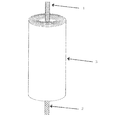
- test cell which consists of a non-aqueous electrolyte secondary battery in this embodiment.
- FIG. 1 is a perspective view of a test cell composed of a non-aqueous electrolyte secondary battery according to this embodiment.
- the test cell shown in FIG. 1 includes a wound electrode body 3 having a positive electrode plate and a negative electrode plate, a positive electrode current collecting tab 1 connected to the positive electrode plate, and a negative electrode current collecting tab 2 connected to the negative electrode plate.
- the wound electrode body 3 includes a positive electrode plate, a negative electrode plate, and a separator each having a belt shape, and is configured to be wound in a state where the positive electrode plate and the negative electrode plate are insulated from each other via the separator.
- the positive electrode active material examples include layered oxides such as lithium-containing composite metal oxides, lithium cobalt oxide (LiCoO 2 ), nickel cobalt lithium manganate (LiNiCoMnO 2 ), nickel cobalt lithium aluminate (LiNiCoAlO 2 ), and manganic acid.
- Examples include spinel-based composite oxides such as lithium (LiMn 2 O 4 ).
- the volume energy density is high lithium cobaltate (LiCoO 2), lithium nickel cobalt manganese oxide (LiNiCoMnO 2), include layered oxides such as lithium nickel cobalt aluminate (LiNiCoAlO 2).
- the average particle diameter of the positive electrode active material is preferably in the range of, for example, about 1 ⁇ m to 100 ⁇ m.
- the particle surface of the positive electrode active material may be coated with a metal oxide, a metal fluoride, a metal phosphorous oxide or the like, and in particular, a rare earth element is preferably attached.
- the rare earth element to be deposited is preferably at least one element selected from, for example, praseodymium, neodymium, erbium, samarium, europium, gadolinium, terbium, dysprosium, holmium, thulium, ytterbium, and lutetium. More preferably, the element is at least one element selected from erbium.
- the attached rare earth element is preferably in the state of a compound such as an oxide or a hydroxide.
- the positive electrode to which the positive electrode additive is added has a large effect of improving the capacity of the battery system in combination with the negative electrode provided with a Si-based material having a large capacity but a large irreversible capacity as a negative electrode active material.
- the positive electrode additive is added too much, the initial efficiency of the positive electrode itself may be lower than the initial efficiency of the negative electrode itself.
- the content of the positive electrode additive is preferably in the range of 0.1% by mass to 10% by mass, and more preferably 4% by mass to 10% by mass.
- the positive electrode active material layer may further contain a conductive agent or a binder in addition to the positive electrode active material and the positive electrode additive.
- a conductive agent or a binder in addition to the positive electrode active material and the positive electrode additive.
- preferable conductive agents include carbon materials such as graphite and acetylene black, copper, nickel, iron, and alloys containing these metals.
- the binder it is preferable to use a material having excellent oxidation resistance in order to suppress oxidative degradation due to desorbed oxygen. Moreover, it is preferable to use what is excellent in alkali resistance for gelatinization suppression, and you may add the additive for suppressing gelation.
- the binder preferably used include, for example, polyvinylidene fluoride.
- additives for suppressing gelation include, for example, malonic acid, maleic acid, citraconic acid, acrylic acid, formic acid, citric acid, acetic acid, oxalic acid, lactic acid, pyrpinic acid, propionic acid, butyric acid, and the like. Can be mentioned.
- the thickness of the positive electrode current collector is not particularly limited, but is preferably in the range of about 1 ⁇ m to 500 ⁇ m.
- the positive electrode current collector is made of a known conductive material used for a non-aqueous electrolyte secondary battery such as a lithium ion battery, and is made of, for example, a non-porous Al metal or an Al alloy containing a metal such as Al. It can be composed of foil. It is preferable to use a large amount of conductive agent for the positive electrode. The utilization rate of the positive electrode additive is improved by using a large amount of a conductive agent to improve current collection. Furthermore, it is preferable to increase the packing density.
- the negative electrode includes a negative electrode current collector and a negative electrode active material layer provided on the negative electrode current collector.
- the negative electrode active material layer is preferably disposed on both sides of the negative electrode current collector, but may be provided on one side of the negative electrode current collector.
- the negative electrode current collector can be constituted by a foil made of a metal such as Cu or an alloy containing a metal such as Cu, for example.
- the thickness of the negative electrode current collector is preferably about 10 ⁇ m to 30 ⁇ m.
- the negative electrode active material is a known negative electrode active material used for non-aqueous electrolyte secondary batteries such as lithium ion batteries.
- a carbon active material, an alloy active material, a carbon active material and an alloy active material are used. Examples include mixtures with substances.
- the carbon-based active material include artificial graphite, natural graphite, non-graphitizable carbon, and graphitizable carbon.
- the alloy-based active material is a material that occludes lithium by being alloyed with lithium at the time of charging under a negative electrode potential and releases lithium at the time of discharging, and examples thereof include a silicon-based active material containing silicon. .
- silicon-based active materials include, for example, silicon, silicon compounds, partially substituted products and solid solutions thereof.
- silicon compound for example, silicon oxide represented by SiOa (0.05 ⁇ a ⁇ 1.95) is preferable.
- the negative electrode active material layer preferably contains an alloy-based active material, and more preferably contains silicon.
- the negative electrode active material layer may include one type of negative electrode active material, or may include a plurality of types of negative electrode active materials.
- the average particle diameter of the negative electrode active material is preferably in the range of, for example, about 1 ⁇ m to 100 ⁇ m.
- the negative electrode active material layer preferably further contains a binder, a conductive agent, and the like in addition to the negative electrode active material.
- a binder it is preferable to use a material having excellent oxidation resistance in order to suppress oxidative degradation due to desorbed oxygen.
- Specific examples of the binder preferably used include, for example, polyvinylidene fluoride.
- nonaqueous electrolyte solvent used in the present invention examples include cyclic carbonates, chain carbonates, esters, cyclic ethers, chain ethers, nitriles, amides, and the like.
- examples of the cyclic carbonate include ethylene carbonate, propylene carbonate, butylene carbonate, etc., and those in which a part or all of these hydrogens are fluorinated can be used. Examples thereof include trifluoropropylene carbonate and fluoroethylene carbonate.
- chain carbonic acid ester examples include dimethyl carbonate, ethyl methyl carbonate, diethyl carbonate, methyl propyl carbonate, ethyl propyl carbonate, methyl isopropyl carbonate, etc., and those in which some or all of these hydrogens are fluorinated. It is possible to use.
- esters include methyl acetate, ethyl acetate, propyl acetate, methyl propionate, ethyl propionate, and ⁇ -butyrolactone.
- cyclic ethers examples include 1,3-dioxolane, 4-methyl-1,3-dioxolane, tetrahydrofuran, 2-methyltetrahydrofuran, propylene oxide, 1,2-butylene oxide, 1,4-dioxane, 1,3, Examples include 5-trioxane, furan, 2-methylfuran, 1,8-cineol, and crown ether.
- chain ethers examples include 1,2-dimethoxyethane, diethyl ether, dipropyl ether, diisopropyl ether, dibutyl ether, dihexyl ether, ethyl vinyl ether, butyl vinyl ether, methyl phenyl ether, ethyl phenyl ether, butyl phenyl ether, and pentyl.
- the nitriles include acetonitrile, and examples of the amides include dimethylformamide. And at least 1 seed
- lithium salt added to the non-aqueous solvent those generally used as an electrolyte in conventional non-aqueous electrolyte secondary batteries can be used.
- a separator will not be specifically limited if a short circuit can be suppressed by the contact of a positive electrode and a negative electrode, and it can impregnate a non-aqueous electrolyte and lithium ion conductivity is obtained.
- the separator can be constituted by, for example, a resin porous film.
- Specific examples of the resin porous membrane include, for example, polypropylene and polyethylene porous membranes, and laminates of polypropylene porous membranes and polyethylene porous membranes.
- the battery configuration is preferably a cylindrical battery because current collection is improved by the configuration pressure of the cylindrical battery and the utilization factor of the positive electrode additive is improved.
- Example 1-1 [Preparation of positive electrode active material] After mixing Li 2 CO 3 as a Li source and an oxide represented by Co 3 O 4 in a Ishikawa type mortar so that the molar ratio of Li to the transition metal element is 1: 1, LiCoO 2 having an average particle size of about 16 ⁇ m was obtained by pulverization after treatment at 950 ° C. for 20 hours in an air atmosphere. The LiCoO 2 particles were prepared, and the particles were added to pure water and stirred to prepare a suspension in which LiCoO 2 was dispersed.
- erbium nitrate pentahydrate [Er (NO 3 ) 3 .5H 2 O] solution was added to this suspension.
- a 10% by mass nitric acid aqueous solution or a 10% by mass sodium hydroxide aqueous solution was appropriately added.
- the obtained powder is dried at 120 ° C., and an erbium hydroxide compound is formed on a part of the surface of the LiCoO 2 .
- the obtained powder was heat-treated in air at 300 ° C. for 5 hours.
- Li-containing compound as positive electrode additive Li 2 O as a Li source, an oxide represented by Fe 2 O 3 and Al (OH) 3 are mixed so that the molar ratio of Li, Fe and Al is 5: 0.9: 0.1. After mixing in an Ishikawa type rough mortar, pulverization was performed after heat treatment at 800 ° C. for 20 hours in an air atmosphere to obtain Li 5 Fe 0.9 Al 0.1 O 4 having an average particle diameter of about 10 ⁇ m. .
- the positive electrode active material prepared as described above and the positive electrode additive prepared as described above were mixed at a mass ratio of 96: 4 to obtain an active material mixture. Further, the active material mixture, carbon powder as the positive electrode conductive agent, polyvinylidene fluoride as the binder, and N-methyl-2-pyrrolidone as the dispersion medium are combined with the active material mixture and the positive electrode conductive agent.
- the positive electrode slurry was prepared by adding the mass ratio to the adhesive so that the ratio was 95: 2.5: 2.5 and then kneading. This positive electrode slurry was applied to an aluminum foil having a thickness of 15 ⁇ m and dried to prepare a positive electrode mixture layer on the aluminum foil.
- the positive electrode was produced in a dry atmosphere with a dew point of ⁇ 30 ° C.
- a negative electrode slurry was prepared by adding graphite as a negative electrode active material and polyvinylidene fluoride as a binder in a mass ratio of 95: 5 and kneading. This negative electrode slurry was applied to a copper foil having a thickness of 10 ⁇ m and dried to prepare a negative electrode mixture layer on the copper foil. Thereafter, the negative electrode mixture layer was rolled with a rolling roller, and a negative electrode current collecting tab was attached to produce a negative electrode.
- Non-aqueous electrolyte To a mixed solvent in which ethylene carbonate (EC), ethyl methyl carbonate (EMC), and diethyl carbonate (DEC) were mixed at a volume ratio of 3: 6: 1, lithium hexafluorophosphate (LiPF 6 ) was changed to 1.0.
- EC ethylene carbonate
- EMC ethyl methyl carbonate
- DEC diethyl carbonate
- LiPF 6 lithium hexafluorophosphate
- a non-aqueous electrolyte was prepared by dissolving to a concentration of mol / liter and adding vinylene carbonate (VC) at a ratio of 2% by mass.
- the test cell has a wound electrode body wound in a spiral shape with a polyolefin microporous membrane separator interposed between a positive electrode and a negative electrode, and an aluminum laminate film and It is composed of The wound electrode body is filled with a non-aqueous electrolyte.
- the negative electrode has a size that can be opposed to the positive electrode.
- the theoretical capacity of the fabricated test cell is 100 mAh.
- Example 1-4 In the production of the Li-containing compound as the positive electrode additive, Li 2 O, Fe so as to match the stoichiometric ratio of Li 5 Fe 0.7 Ga 0.3 O 4 instead of the positive electrode material of Experimental Example 1-1. the 2 O 3, except that a mixture of a Ga 2 O 3, was used to fabricate a non-aqueous electrolyte secondary battery in the same manner as in experimental example 1-1.
- Example 1-5 In the production of the Li-containing compound as the positive electrode additive, the Li 5 Fe 0.99 Ce 0.008 Zr 0.002 O 4 stoichiometric ratio is used instead of the positive electrode material of Experimental Example 1-1.
- a nonaqueous electrolyte secondary battery was produced in the same manner as in Example 1-1, except that 2 O, Fe 2 O 3 , CeO 2 , and ZrO 2 were mixed.
- Example 1-6 In the preparation of the Li-containing compound as the positive electrode additive, the Li material was adjusted so as to meet the stoichiometric ratio of Li 5 Fe 0.9 Ce 0.08 Zr 0.02 O 4 instead of the positive electrode material of Experimental Example 1-1.
- a nonaqueous electrolyte secondary battery was produced in the same manner as in Example 1-1, except that 2 O, Fe 2 O 3 , CeO 2 , and ZrO 2 were mixed.
- Example 1-7 In the preparation of the Li-containing compound as the positive electrode additive, the Li material was adjusted so as to meet the stoichiometric ratio of Li 5 Fe 0.99 Y 0.008 Mn 0.002 O 4 instead of the positive electrode material of Experimental Example 1-1.
- a nonaqueous electrolyte secondary battery was produced in the same manner as in Example 1-1 except that 2 O, Fe 2 O 3 , Y 2 O 3 , and Mn 2 O 3 were mixed.
- Example 1-8> In the preparation of the Li-containing compound as the positive electrode additive, the Li material was adjusted so as to meet the stoichiometric ratio of Li 5 Fe 0.9 Y 0.08 Mn 0.02 O 4 instead of the positive electrode material of Experimental Example 1-1.
- a nonaqueous electrolyte secondary battery was produced in the same manner as in Example 1-1 except that 2 O, Fe 2 O 3 , Y 2 O 3 , and Mn 2 O 3 were mixed.
- Example 1-9 In the production of the Li-containing compound as the positive electrode additive, Li 2 O, CoO so as to match the stoichiometric ratio of Li 6 Co 0.9 Zn 0.1 O 4 instead of the positive electrode material of Experimental Example 1-1.
- a nonaqueous electrolyte secondary battery was fabricated in the same manner as in Experimental Example 1-1, except that ZnO was mixed.
- Example 1 A nonaqueous electrolyte secondary battery was produced in the same manner as in Example 1-1, except that the positive electrode additive was not added and a positive electrode mixture was produced only from the positive electrode active material.
- the reason for the above is to stabilize the internal structure of the positive electrode additive by adding a positive electrode additive made of an oxide having an inverted fluorite structure containing two or more elements other than Li and oxygen into the positive electrode mixture. It is presumed that the decomposition of the non-aqueous electrolyte was suppressed and the generation of gas during charge storage was suppressed. Further, by increasing the substitution amount of Al, Ga, Zn or the like with respect to Fe or Co, the effect of suppressing gas generation during charge storage is further increased.
- the preferable average particle diameter of the positive electrode additive composed of an oxide having an inverted fluorite structure is mainly considered.
- Li 2 O as a Li source an oxide represented by Fe 2 O 3 and H 2 SO 4 are mixed so that the molar ratio of Li, Fe and S is 5: 0.9986: 0.0014.
- the mixture was pulverized after heat treatment at 800 ° C. for 20 hours in an inert atmosphere to obtain Li 5 Fe 0.9986 S 0.0014 O 4 having an average particle diameter of 10 ⁇ m. .
- a test cell was prepared as follows using Li 5 Fe 0.9986 S 0.0014 O 4 having an average particle diameter of 10 ⁇ m prepared in Experimental Example 2-1.
- a polyolefin microporous membrane separator is sandwiched between a positive electrode provided with Li 5 Fe 0.9986 S 0.0014 O 4 having an average particle diameter of 10 ⁇ m and lithium metal as a reference electrode.
- the measurement electrode portion wound in a spiral shape and a reference electrode are used, and the outer package is composed of an aluminum laminate film.
- the measurement electrode portion is filled with a non-aqueous electrolyte.
- Example 2-2 A test cell was prepared in the same manner as in Experimental Example 2-1, except that the grinding conditions were changed and the average particle size was 30 ⁇ m in Experimental Example 2-1.
- Example 2-3 A test cell was prepared in the same manner as in Experimental Example 2-1, except that in Example 2-1, the grinding conditions were changed and the average particle size was 0.1 ⁇ m.
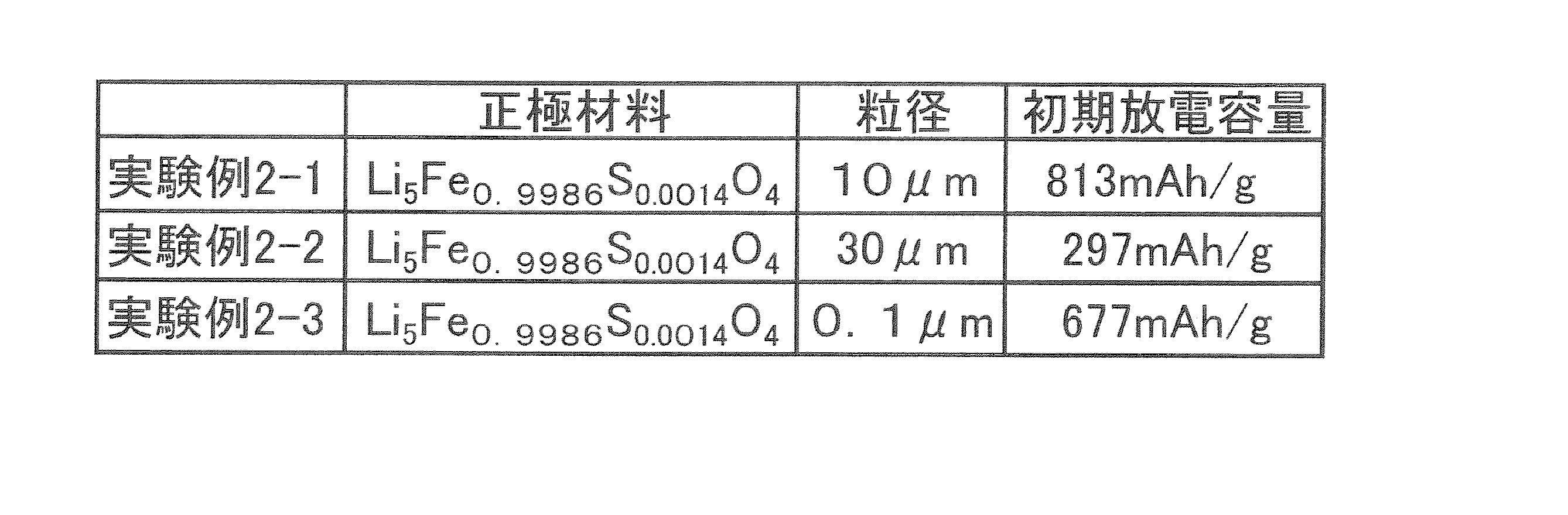
- the initial discharge capacity is significantly reduced in Li 5 Fe 0.9986 S 0.0014 O 4 having an average particle diameter of 30 ⁇ m.
- the average person having a particle diameter of 10 ⁇ m of Li 5 Fe 0.9986 S 0.0014 O 4 is, initial discharge capacity than towards the particle diameter is 0.1 ⁇ m in Li 5 Fe 0.9986 S 0.0014 O 4 I understand that is good.
- the particle diameter is particularly preferably in the range of 0.1 ⁇ m to 10 m.
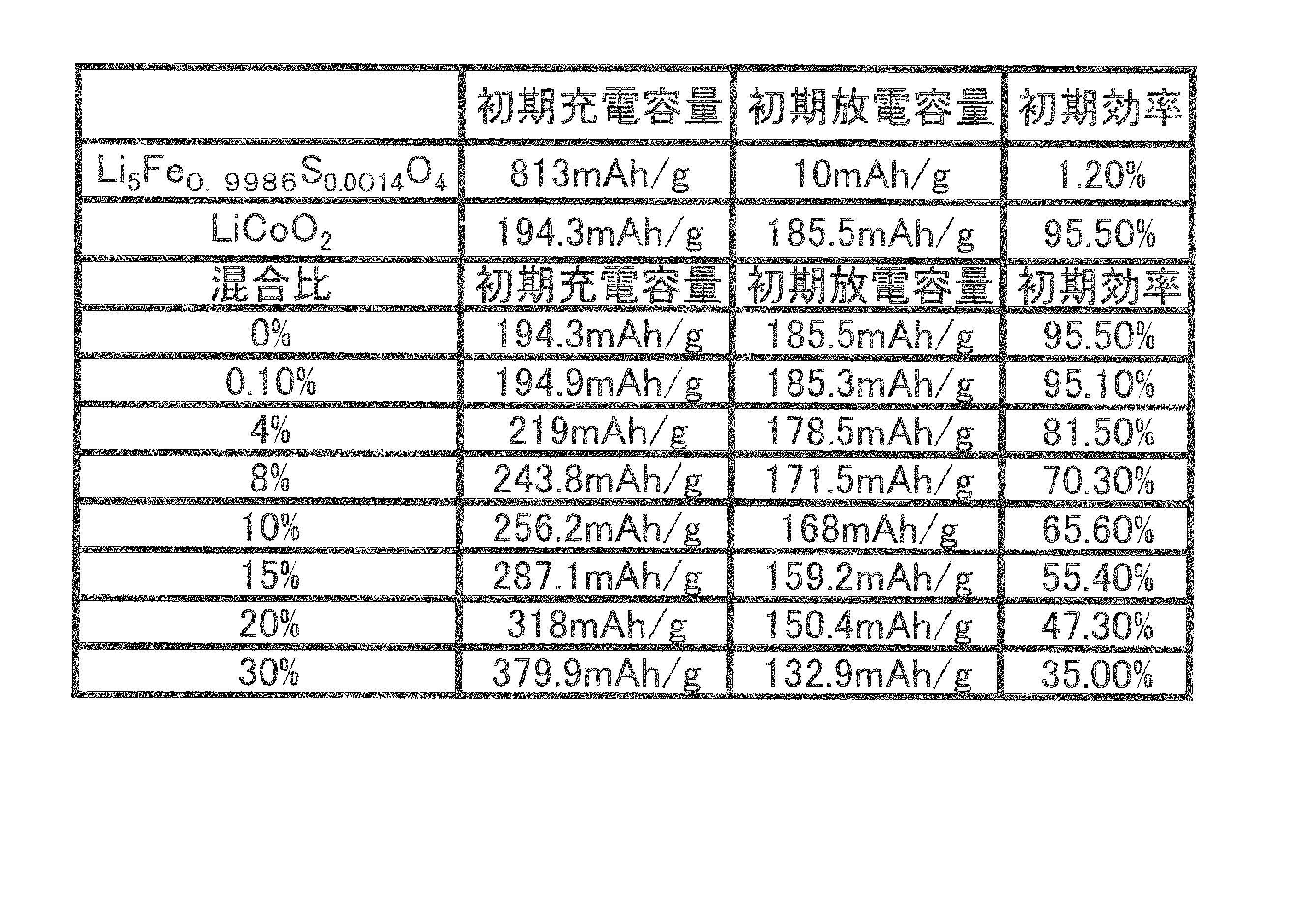
- Example 3 Li 5 Fe 0.9986 S 0.0014 O 4 having an average particle diameter of 10 ⁇ m, which is a positive electrode additive made of an oxide having an inverted fluorite structure manufactured in Experimental Example 2-1, and a positive electrode active material
- the initial charge capacity, initial discharge capacity, and initial efficiency were calculated when the mixing ratio of lithium cobalt oxide was 0%, 0.1%, 4%, 8%, 10%, 15%, 20%, and 30%, respectively.
- the results are shown in Table 3 below.
- the mixing ratio is a value of positive electrode additive / (positive electrode active material + positive electrode additive) ⁇ 100
- the initial efficiency is a value of initial discharge capacity / initial charge capacity ⁇ 100.
- Reference Experiment Example 1 As a reference, the initial charge capacity and initial discharge capacity of LiCoO 2 were measured in the same manner as in Experimental Example 2-1. The difference from Experimental Example 2-1 was that the positive electrode material was changed to Li 5 Fe 0.9986 S 0.0014 O 4 to be LiCoO 2 and the potential during the charge / discharge test was 4.50 V on the basis of lithium. And discharged until 2.50 V on the lithium basis.
- the measurement conditions of Reference Experiment Example 1 are shown in Tables 3 and 4 below.
- the content of the positive electrode additive is preferably in the range of 0.1% by mass to 10% by mass, and more preferably 4% by mass to 10% by mass. It is possible to make a battery in which the irreversible capacity is suppressed by matching the positive electrode initial efficiency with the negative electrode initial efficiency.
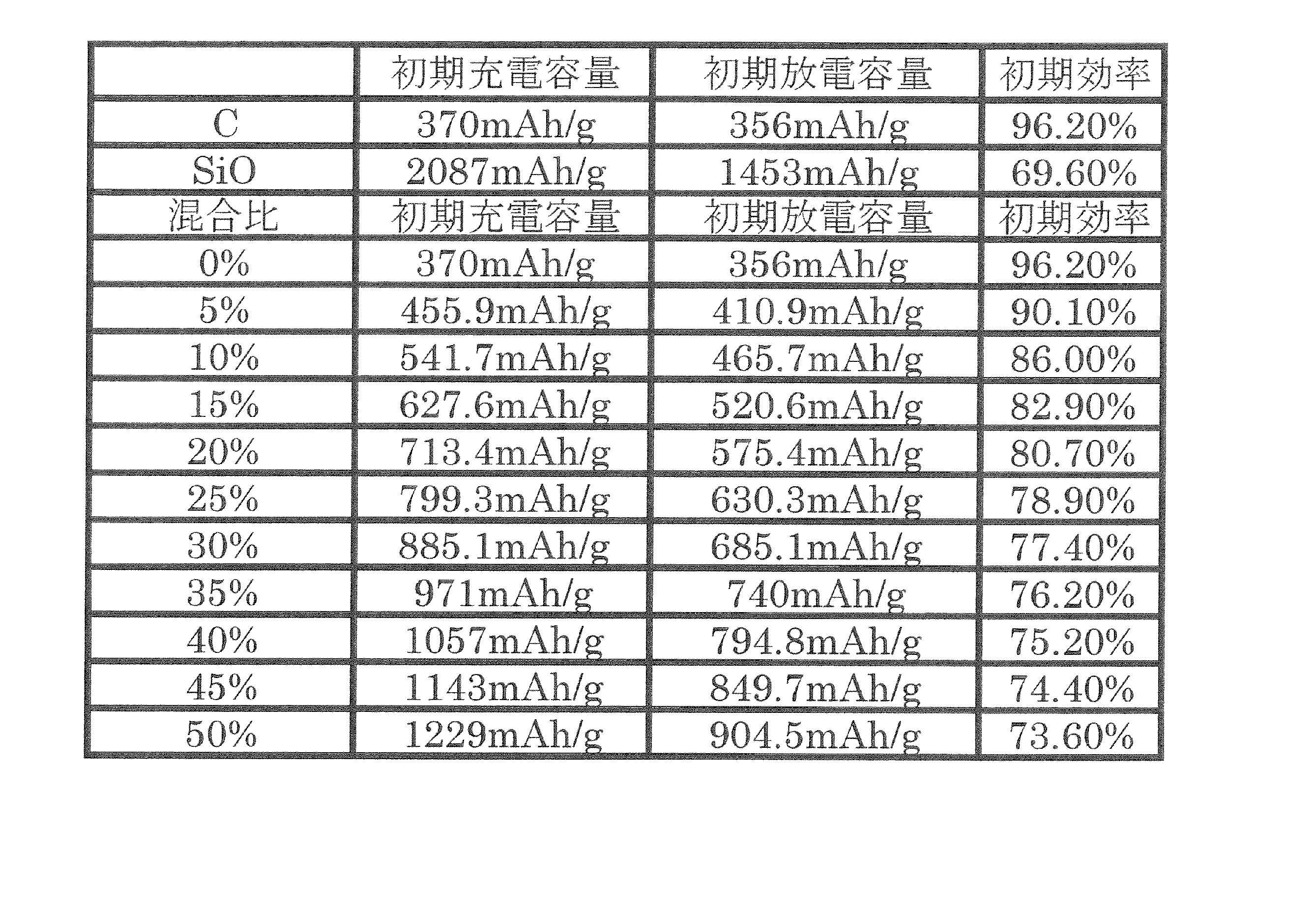
- test cell was prepared in the same manner as in Experimental Example 2-1, except that the negative electrode active material was changed to SiO instead of the positive electrode additive made of an oxide having an inverted fluorite structure prepared in Experimental Example 2-1. .
- the amount of electricity that flowed at this time was measured, and the initial charge capacity (mAh / g) and the initial discharge capacity ( mAh / g) was measured.
- the results are shown in Table 5 below.
- the initial efficiency is a value of initial discharge capacity / initial charge capacity ⁇ 100.
- test cell was prepared in the same manner as in Experimental Example 2-1, except that the negative electrode active material was graphite instead of the positive electrode additive made of an oxide having an inverted fluorite structure prepared in Experimental Example 2-1. .
- the amount of electricity that flowed at this time was measured, and the initial charge capacity (mAh / g) and the initial discharge capacity ( mAh / g) was measured.
- the results are shown in Table 5 below.
- the initial efficiency is a value of initial discharge capacity / initial charge capacity ⁇ 100.
- Electrode body 1. Positive current collector tab 2. Negative electrode current collecting tab 3. Electrode body
Landscapes
- Chemical & Material Sciences (AREA)
- Chemical Kinetics & Catalysis (AREA)
- Electrochemistry (AREA)
- General Chemical & Material Sciences (AREA)
- Engineering & Computer Science (AREA)
- Inorganic Chemistry (AREA)
- Materials Engineering (AREA)
- Manufacturing & Machinery (AREA)
- Composite Materials (AREA)
- Secondary Cells (AREA)
- Battery Electrode And Active Subsutance (AREA)
Abstract
Description
電池構成は円筒型電池の構成圧により集電が良くなり、正極添加剤の利用率が向上するため、電池構成は円筒型電池が好ましい。
[正極活物質の作製]
Li源としてのLi2CO3と、Co3O4で表される酸化物とを、Liと遷移金属元素のモル比が1:1になるように石川式らいかい乳鉢にて混合した後、空気雰囲気中にて950℃で20時間処理後に粉砕することにより、平均粒子径が約16μmのLiCoO2を得た。前記LiCoO2粒子を用意し、この粒子を純水に添加し攪拌して、LiCoO2が分散した懸濁液を調製した。
Li源としてのLi2Oと、Fe2O3で表される酸化物とAl(OH)3とを、LiとFeとAlのモル比が5:0.9:0.1になるように石川式らいかい乳鉢にて混合した後、空気雰囲気中にて800℃で20時間熱処理後に粉砕することにより、平均粒子径が約10μmのLi5Fe0.9Al0.1O4を得た。
前記のように作製した正極活物質と、前記のように作製した正極添加剤とを、質量比で96:4となるように混合し活物質混合物を得た。更に、前記活物質混合物と、正極導電剤としての炭素粉末と、結着剤としてのポリフッ化ビニリデンと、分散媒としてのN-メチル-2-ピロリドンとを、活物質混合物と正極導電剤と結着剤との質量比が95:2.5:2.5の割合になるように加えた後に混練して、正極スラリーを調整した。この正極スラリーを厚み15μmのアルミニウム箔に塗布、乾燥し、前記アルミニウム箔上に正極合剤層を作製した。その後、圧延ローラにより圧延し、正極集電タブを取り付けることで、正極を作製した。尚、正極添加剤は大気中の水分と反応して分解するため、正極の作製は露点-30℃のドライ雰囲気下にて実施した。
負極活物質として黒鉛と、結着剤としてポリフッ化ビニリデンとを質量比95:5の割合になるように加えた後に混練して、負極スラリーを調整した。この負極スラリーを厚み10μmの銅箔に塗布、乾燥し、銅箔上に負極合剤層を作製した。その後、圧延ローラにより、負極合剤層を圧延し、負極集電タブを取り付けることで負極を作製した。
エチレンカーボネート(EC)とエチルメチルカーボネート(EMC)とジエチルカーボネート(DEC)を、3:6:1の体積比で混合した混合溶媒に対し、六フッ化リン酸リチウム(LiPF6)を1.0モル/リットルの濃度になるように溶解させ、また、ビニレンカーボネート(VC)を2質量%の割合で添加して、非水電解液を調整した。
次に、試験セルによる非水電解質二次電池の評価について説明する。試験セルは図1に示したように、正極と負極との間にポリオレフィン製の微多孔膜セパレータをはさんでスパイラル型に巻き取った巻回電極体を有し、外装体としてアルミニウムラミネートフィルムとから構成されている。巻回電極体には非水電解液が満たされている。尚、負極は正極に対して対向可能な寸法となっている。前記作製された試験セルの理論容量は100mAhである。
前記正極添加剤であるLi含有化合物の作製において、実験例1-1の正極材料に替えて、Li5Fe0.8Al0.2O4の化学量論比に合うようにLi2O、Fe2O3、Al(OH)3とを混合した以外は、実験例1-1と同様にして非水電解質二次電池を作製した。
前記正極添加剤であるLi含有化合物の作製において、実験例1-1の正極材料に替えて、Li5Fe0.9Ga0.1O4の化学量論比に合うようLi2O、Fe2O3、Ga2O3とを混合したこと以外は、実験例1-1と同様にして非水電解質二次電池を作製した。
前記正極添加剤であるLi含有化合物の作製において、実験例1-1の正極材料に替えて、Li5Fe0.7Ga0.3O4の化学量論比に合うようLi2O、Fe2O3、Ga2O3とを混合した以外は、実験例1-1と同様にして非水電解質二次電池を作製した。
前記正極添加剤であるLi含有化合物の作製において、実験例1-1の正極材料に替えて、Li5Fe0.99Ce0.008Zr0.002O4の化学量論比にあうようLi2O、Fe2O3、CeO2、ZrO2とを混合した以外は、実験例1-1と同様にして非水電解質二次電池を作製した。
前記正極添加剤であるLi含有化合物の作製において、実験例1-1の正極材料に替えて、Li5Fe0.9Ce0.08Zr0.02O4の化学量論比に合うようLi2O、Fe2O3、CeO2、ZrO2とを混合した以外は、実験例1-1と同様にして非水電解質二次電池を作製した。
前記正極添加剤であるLi含有化合物の作製において、実験例1-1の正極材料に替えて、Li5Fe0.99Y0.008Mn0.002O4の化学量論比に合うようLi2O、Fe2O3、Y2O3、Mn2O3とを混合したこと以外は、実験例1-1と同様にして非水電解質二次電池を作製した。
前記正極添加剤であるLi含有化合物の作製において、実験例1-1の正極材料に替えて、Li5Fe0.9Y0.08Mn0.02O4の化学量論比に合うようLi2O、Fe2O3、Y2O3、Mn2O3とを混合したこと以外は、実験例1-1と同様にして非水電解質二次電池を作製した。
前記正極添加剤であるLi含有化合物の作製において、実験例1-1の正極材料に替えて、Li6Co0.9Zn0.1O4の化学量論比に合うようLi2O、CoO、ZnOとを混合したこと以外は、実験例1-1と同様にして非水電解質二次電池を作製した。
前記正極添加剤であるLi含有化合物の作製において、実験例1-1の正極材料に替えて、Li6Co0.7Zn0.3O4の化学量論比に合うようにLi2O、CoO、ZnOとを混合したこと以外は、実験例1-1と同様にして非水電解質二次電池を作製した。
前記正極添加剤であるLi含有化合物の作製において、実験例1-1の正極材料に替えて、Li6Co0.9Al0.1O4の化学量論比に合うようにLi2O,CoO,Al(OH)3とを混合したこと以外は、実験例1-1と同様にして非水電解質二次電池を作製した。
前記正極添加剤であるLi含有化合物の作製において、実験例1-1の正極材料に替えて、Li6Co0.7Al0.3O4の化学量論比に合うようにLi2O,CoO,Al(OH)3とを混合したこと以外は、実験例1-1と同様にして非水電解質二次電池を作製した。
前記正極添加剤を添加せず、前記正極活物質のみで正極合剤を作製したこと以外は、実験例1-1と同様にして非水電解質二次電池を作製した。
前記正極添加剤であるLi含有化合物の作製において、実験例1-1の正極材料に替えて、Li5FeO4の化学量論比に合うようにLi2O,Fe2O3とを混合したこと以外は、実験例1-1と同様にして非水電解質二次電池を作製した。
前記実験例1-1~実験例1-12及び比較例1~2で作製した試験セルにおいて、0.15It(=15mA)の定電流により、正極の電位が黒鉛基準で4.40Vとなるまで充電し、その後、4.40Vの定電圧で電流が1/50It(=2mA)となるまで充電を行った。次いで、0.10It(=10mA)の定電流で電池電圧が2.50Vとなるまで放電を行ない、このとき流れた電気量を測定して、初期放電容量(mAh/g)とした。
前記充放電試験後、0.15It(=15mA)の定電流により、正極の電位が黒鉛基準で4.40Vとなるまで充電し、その後、4.40Vの定電圧で電流が1/50It(=2mA)となるまで充電を行った。次いで、60℃高温槽に24時間入れ、充電保存試験を行った。
充電保存後の電池を電子天秤にぶら下げて水中に完全に入れ、浮力が生じている状態での電池重量を測定した。ガス発生量が大きな電池は体積が増加しているため、その浮力の影響で重量が小さくなる。充電保存前後での重量を測定し、その差から充電保存時のガス発生率を以下の式より求め、その結果を以下の表1に示す。
ガス発生率(%)=充電保存前後の電池重量差/比較例1の充電保存前後の電池重量差×100

ここでの実験例では、主として、逆蛍石型構造を有する酸化物からなる正極添加剤の好ましい平均粒子径について考察する。Li源としてのLi2Oと、Fe2O3で表される酸化物とH2SO4とを、LiとFeとSのモル比が5:0.9986:0.0014になるように石川式らいかい乳鉢にて混合した後、不活性雰囲気中にて800℃で20時間熱処理後に粉砕することにより、平均粒子径が10μmのLi5Fe0.9986S0.0014O4とを得た。
前記実験例2-1において、粉砕条件を変え、平均粒子径が30μmになるように作製した以外は、前記実験例2-1と同様にして試験セルを作製した。
前記実験例2-1において、粉砕条件を変え、平均粒子径が0.1μmになるように作製したこと以外は、前記実験例2-1と同様にして試験セルを作製した。
前記実験例2-1~2-3において作製した試験セルにおいて、0.05It(=5mA)の定電流により、正極の電位がリチウム基準で4.60Vとなるまで充電し、その後、4.60Vの定電圧で電流が1/1000It(=0.1mA)となるまで充電を行った。次いで、0.05It(=5mA)の定電流で電池電圧が2.10Vとなるまで放電を行ない、このとき流れた電気量を測定して、初期放電容量(mAh/g)とし、その結果を以下表2に示す。
前記実験例2-1で作製した逆蛍石型構造を有する酸化物からなる正極添加剤である平均粒子径径が10μmのLi5Fe0.9986S0.0014O4と正極活物質であるコバルト酸リチウムの混合比を各々0%、0.1%、4%、8%、10%、15%、20%、30%とした時の初期充電容量と初期放電容量及び初期効率を求めた結果を以下表3に示す。混合比は正極添加剤/(正極活物質+正極添加剤)×100の値であり、初期効率は初期放電容量/初期充電容量×100の値である。
参考として、LiCoO2の初期充電容量と初期放電容量を、前記実験例2-1と同様にして測定した。実験例2-1との変更点は、正極材料をLi5Fe0.9986S0.0014O4に替えて、LiCoO2とし、充放電試験時の電位を、リチウム基準で4.50Vとなるまで充電し、リチウム基準で2.50Vとなるまで放電したことである。この参考実験例1の測定条件を以下表3及び表4にあわせて示す。
前記実験例2-2で作製した逆蛍石型構造を有する酸化物からなる正極添加剤である平均粒子径が10μmのLi5Fe0.9986S0.0014O4とコバルト酸リチウムの混合比を各々0%、0.1%、4%、8%、10%、15%、20%、30%とした時の初期充電容量(mAh/g)と初期放電容量(mAh/g)及び初期効率(%)を求めた結果を以下表4に示す。混合比は正極添加剤/(正極活物質+正極添加剤)×100の値であり、初期効率は初期放電容量/初期充電容量×100の値である。
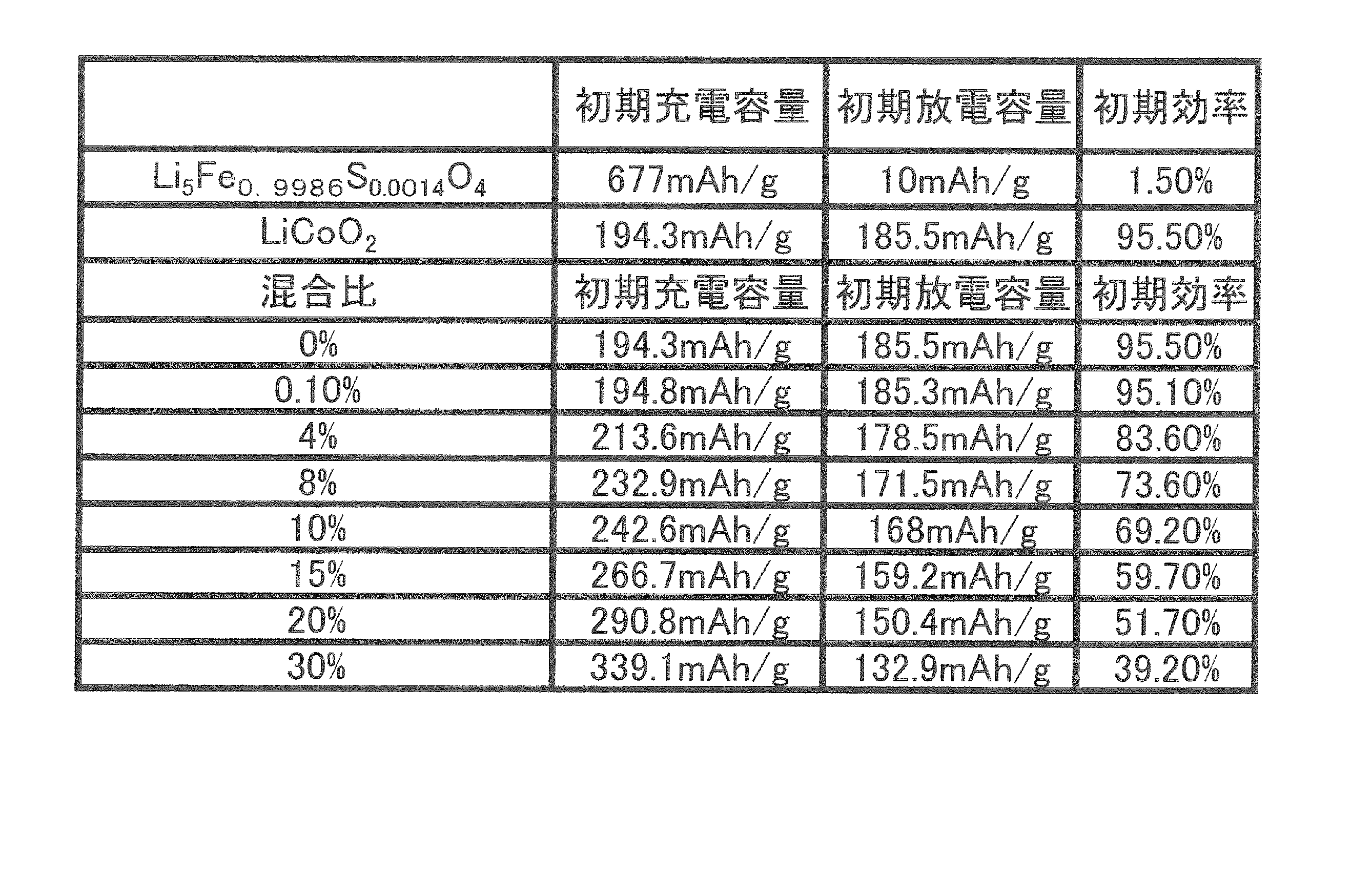
このため、前記正極添加剤の含有量は0.1質量%以上10質量%以下の範囲が好ましく、更には4質量%以上10質量%以下であることが特に好適である。負極初期効率に正極初期効率を合わせることで不可逆容量を抑制した電池を作ることが可能である。
前記実験例2-1で作製した逆蛍石型構造を有する酸化物からなる正極添加剤に替えて、負極活物質をSiOとした以外は前記実験例2-1と同様に試験セルを作製した。その試験セルを0.07It(=7mA)の定電流により、負極の電位がリチウム基準で0Vとなるまで充電を行った。次いで、0.07It(=7mA)の定電流で電池電圧が1.00Vとなるまで放電を行ない、このときに流れた電気量を測定し、初期充電容量(mAh/g)と初期放電容量(mAh/g)を測定した。この結果を以下表5に示す。初期効率は初期放電容量/初期充電容量×100の値である。
前記実験例2-1で作製した逆蛍石型構造を有する酸化物からなる正極添加剤に替えて、負極活物質を黒鉛とした以外は前記実験例2-1と同様に試験セルを作製した。その試験セルを0.07It(=7mA)の定電流により、負極の電位がリチウム基準で0Vとなるまで充電を行った。次いで、0.07It(=7mA)の定電流で電池電圧が1.00Vとなるまで放電を行ない、このときに流れた電気量を測定し、初期充電容量(mAh/g)と初期放電容量(mAh/g)を測定した。この結果を以下表5に示す。初期効率は初期放電容量/初期充電容量×100の値である。
前記参考実験例2で使用した負極活物質としてのSiOと前記参考実験例で使用した黒鉛との混合比を各々0%、5%、10%、15%、20%、25%、30%、35%、40%、45%、50%とした時の初期充電容量(mAh/g)と初期放電容量(mAh/g)及び初期効率(%)を求めた結果を以下表5に示す。混合比はSiO/(黒鉛+SiO)×100の値であり、初期効率は初期放電容量/初期充電容量×100の値である。
Claims (8)
- 正極活物質を含む正極と、負極と、非水電解質とを備える非水電解質二次電池であって、前記正極が、Li含有遷移金属酸化物からなる活物質と、Liと、少なくともLiと酸素以外の2種以上の元素を含む逆蛍石型構造を有する酸化物からなる正極添加剤を含有したものであり、前記非水電解質二次電池を正極電位が4.0V以上4.65V以下(vs.Li/Li+)になるまで充電して得られたものである、非水電解質二次電池。
- 前記逆蛍石型構造を有する酸化物が、一般式LixAyBzO4(x=4~7、y=0.5~1.5、z=0.01~1.5、AはCo、Feから選択される少なくとも1種の金属、BはMn、Zn、Al、Ga、Ge、Ti、Si、Sn、Ce、Y、Zr、S、Naから選択される少なくとも1種の金属)である、請求項1に記載の非水電解質二次電池。
- 請求項2において、前記一般式Bは少なくともAlを含む、非水電解質二次電池。
- 前記正極活物質の表面には希土類元素が付着している、請求項1~3のいずれか1項に記載の非水電解質二次電池。
- 前記正極活物質層中の前記正極活物質に対するLiと、少なくともLiと酸素以外の2種以上の元素を含む逆蛍石型構造を有する酸化物からなる正極添加剤との混合比率は0.1質量%以上10質量%以下の範囲である、請求項1~4のいずれか1項に記載の非水電解質二次電池。
- 前記正極添加剤の粒子径は0.1μm以上10μm以下の範囲である、請求項1~5のいずれか1項に記載の非水電解質二次電池。
- 前記負極が黒鉛材料及び/またはLiを吸蔵放出可能な珪素化合物を含む、請求項1~6のいずれか1項に記載の非水電解質二次電池。
- 正極活物質を含む正極と、負極と、非水電解質とを備える非水電解質二次電池の製造方法において、前記正極が、Li含有遷移金属酸化物からなる活物質と、Liと、少なくともLiと酸素以外の2種以上の元素を含む逆蛍石型構造を有する酸化物からなる正極添加剤を添加するとともに、前記非水電解質二次電池を正極電位が4.0V以上4.65V以下(vs.Li/Li+)になるまで充電する、非水電解質二次電池の製造方法。
Priority Applications (3)
| Application Number | Priority Date | Filing Date | Title |
|---|---|---|---|
| JP2015559805A JP6428647B2 (ja) | 2014-01-31 | 2015-01-20 | 非水電解質二次電池及び非水電解質二次電池の製造方法 |
| US15/113,896 US10256469B2 (en) | 2014-01-31 | 2015-01-20 | Nonaqueous-electrolyte secondary battery and method for manufacturing nonaqueous-electrolyte secondary battery |
| CN201580006524.4A CN105940528B (zh) | 2014-01-31 | 2015-01-20 | 非水电解质二次电池和非水电解质二次电池的制造方法 |
Applications Claiming Priority (2)
| Application Number | Priority Date | Filing Date | Title |
|---|---|---|---|
| JP2014016559 | 2014-01-31 | ||
| JP2014-016559 | 2014-01-31 |
Publications (1)
| Publication Number | Publication Date |
|---|---|
| WO2015115052A1 true WO2015115052A1 (ja) | 2015-08-06 |
Family
ID=53756639
Family Applications (1)
| Application Number | Title | Priority Date | Filing Date |
|---|---|---|---|
| PCT/JP2015/000208 Ceased WO2015115052A1 (ja) | 2014-01-31 | 2015-01-20 | 非水電解質二次電池及び非水電解質二次電池の製造方法 |
Country Status (4)
| Country | Link |
|---|---|
| US (1) | US10256469B2 (ja) |
| JP (1) | JP6428647B2 (ja) |
| CN (1) | CN105940528B (ja) |
| WO (1) | WO2015115052A1 (ja) |
Cited By (33)
| Publication number | Priority date | Publication date | Assignee | Title |
|---|---|---|---|---|
| EP3249721A1 (en) * | 2016-05-27 | 2017-11-29 | Samsung SDI Co., Ltd. | Positive electrode for rechargeable lithium battery and rechargeable lithium battery including same |
| KR20190064423A (ko) * | 2017-11-30 | 2019-06-10 | 주식회사 엘지화학 | 양극 첨가제, 이의 제조 방법, 이를 포함하는 양극 및 리튬 이차 전지 |
| WO2019163476A1 (ja) * | 2018-02-20 | 2019-08-29 | 株式会社Gsユアサ | 正極活物質、正極、非水電解質蓄電素子、正極活物質の製造方法、正極の製造方法、及び非水電解質蓄電素子の製造方法 |
| JP2020053315A (ja) * | 2018-09-27 | 2020-04-02 | 株式会社豊田自動織機 | 複合粒子の製造方法 |
| JPWO2021033345A1 (ja) * | 2019-08-20 | 2021-02-25 | ||
| JPWO2019163475A1 (ja) * | 2018-02-20 | 2021-03-18 | 株式会社Gsユアサ | 正極活物質、正極、非水電解質蓄電素子、正極活物質の製造方法、及び非水電解質蓄電素子の製造方法 |
| JPWO2020026486A1 (ja) * | 2018-07-31 | 2021-08-02 | パナソニックIpマネジメント株式会社 | 正極材料および二次電池 |
| WO2021177258A1 (ja) * | 2020-03-06 | 2021-09-10 | 株式会社Gsユアサ | 正極活物質、正極、非水電解質蓄電素子、蓄電装置、正極活物質の製造方法、正極の製造方法、及び非水電解質蓄電素子の製造方法 |
| WO2022024675A1 (ja) * | 2020-07-29 | 2022-02-03 | 株式会社Gsユアサ | 置換元素の選択方法、正極活物質、正極、非水電解質蓄電素子、蓄電装置、正極活物質の製造方法、正極の製造方法、及び非水電解質蓄電素子の製造方法 |
| WO2022050101A1 (ja) * | 2020-09-01 | 2022-03-10 | 株式会社Gsユアサ | 正極活物質、正極、非水電解質蓄電素子、蓄電装置、正極活物質の製造方法、正極の製造方法、及び非水電解質蓄電素子の製造方法 |
| KR20220045700A (ko) * | 2020-10-06 | 2022-04-13 | 주식회사 엘지에너지솔루션 | 양극 첨가제, 이의 제조 방법, 이를 포함하는 양극 합제 및 리튬 이차 전지 |
| KR20220049483A (ko) * | 2020-10-14 | 2022-04-21 | 주식회사 엘지에너지솔루션 | 이차 전지용 양극 및 상기 양극을 포함하는 이차 전지 |
| KR20220106658A (ko) * | 2021-01-22 | 2022-07-29 | 주식회사 엘지화학 | 리튬 전이 금속 산화물, 리튬 이차 전지용 양극 첨가제 및 이를 포함하는 리튬 이차 전지 |
| KR20220162958A (ko) * | 2021-06-02 | 2022-12-09 | 주식회사 엘지에너지솔루션 | 구조적 안정성이 향상된 리튬 이차전지용 양극, 이의 제조방법 및 이를 포함하는 리튬 이차전지 |
| JP2023519002A (ja) * | 2021-02-23 | 2023-05-09 | エルジー エナジー ソリューション リミテッド | 犠牲正極材およびこれを含むリチウム二次電池 |
| JP2023519375A (ja) * | 2021-02-23 | 2023-05-10 | エルジー エナジー ソリューション リミテッド | 高エネルギー密度を有する電極組立体およびそれを含むリチウム二次電池 |
| CN116349034A (zh) * | 2021-06-03 | 2023-06-27 | 株式会社Lg新能源 | 锂二次电池及其制造方法 |
| JP2023532097A (ja) * | 2021-02-23 | 2023-07-26 | エルジー エナジー ソリューション リミテッド | ガス発生量が低減された犠牲正極材およびこれを含むリチウム二次電池 |
| JP2023532653A (ja) * | 2021-06-01 | 2023-07-31 | エルジー エナジー ソリューション リミテッド | 正極添加剤を含有するリチウム二次電池 |
| JP2023532683A (ja) * | 2021-06-03 | 2023-07-31 | エルジー エナジー ソリューション リミテッド | リチウム二次電池用正極およびこれを含むリチウム二次電池 |
| JP2023533235A (ja) * | 2021-02-23 | 2023-08-02 | エルジー エナジー ソリューション リミテッド | ガス発生量が低減された犠牲正極材およびその製造方法 |
| JP2023536375A (ja) * | 2021-08-10 | 2023-08-25 | 寧徳時代新能源科技股▲分▼有限公司 | 複合金属酸化物材料及びその調製方法、正極シート、二次電池、電池モジュール、電池パック及び電力消費装置 |
| JP2023542195A (ja) * | 2020-10-14 | 2023-10-05 | エルジー エナジー ソリューション リミテッド | 二次電池用の正極及びそれを含む二次電池 |
| JP2023542881A (ja) * | 2021-05-31 | 2023-10-12 | エルジー エナジー ソリューション リミテッド | 正極活物質と非可逆添加剤を含むマスターバッチおよびそれを含有するリチウム二次電池用正極スラリー |
| JP2023545115A (ja) * | 2021-06-03 | 2023-10-26 | エルジー エナジー ソリューション リミテッド | リチウム二次電池用正極およびこれを備えるリチウム二次電池 |
| JP2024502645A (ja) * | 2021-11-24 | 2024-01-22 | エルジー エナジー ソリューション リミテッド | リチウム二次電池の活性化方法 |
| JP2024503160A (ja) * | 2021-01-22 | 2024-01-25 | エルジー・ケム・リミテッド | リチウム遷移金属酸化物、リチウム二次電池用正極添加剤およびそれを含むリチウム二次電池 |
| JP2024505837A (ja) * | 2021-08-04 | 2024-02-08 | エルジー・ケム・リミテッド | リチウム二次電池 |
| JP2024520382A (ja) * | 2021-11-19 | 2024-05-24 | エルジー エナジー ソリューション リミテッド | 正極活物質層用組成物およびリチウム二次電池 |
| WO2024162107A1 (ja) * | 2023-01-31 | 2024-08-08 | パナソニックIpマネジメント株式会社 | 正極活物質及び電池 |
| US12476236B2 (en) | 2021-06-02 | 2025-11-18 | Lg Energy Solution, Ltd. | Positive electrode including positive electrode additive, method of manufacturing positive electrode, and lithium secondary battery including positive electrode |
| KR102947096B1 (ko) * | 2020-06-24 | 2026-04-02 | 주식회사 엘지에너지솔루션 | 양극 첨가제 및 이의 제조 방법 |
| US12712180B2 (en) | 2018-07-31 | 2026-08-18 | Panasonic Intellectual Property Management Co., Ltd. | Positive electrode material and secondary battery |
Families Citing this family (18)
| Publication number | Priority date | Publication date | Assignee | Title |
|---|---|---|---|---|
| CN114725335A (zh) * | 2016-11-24 | 2022-07-08 | 株式会社半导体能源研究所 | 包括正极、负极及电解液的锂离子二次电池的制造方法 |
| JP6944641B2 (ja) * | 2017-04-24 | 2021-10-06 | トヨタ自動車株式会社 | リチウムイオン二次電池およびその製造方法 |
| US10930935B2 (en) * | 2017-11-30 | 2021-02-23 | Lg Chem, Ltd. | Additive for cathode, method for preparing the same, cathode including the same, and lithium secondary battery including the same |
| CN108428861B (zh) * | 2017-12-22 | 2021-07-06 | 合肥国轩高科动力能源有限公司 | 一种硫化亚铁包覆富锂正极材料及其制备方法 |
| WO2019198351A1 (ja) * | 2018-04-10 | 2019-10-17 | パナソニックIpマネジメント株式会社 | 非水電解質二次電池 |
| CN110459762B (zh) * | 2018-05-08 | 2021-03-26 | 中南大学 | 一种掺Mn高铁酸锂、补锂正极材料及其制备和应用 |
| CN112913051B (zh) * | 2018-10-30 | 2024-06-04 | 松下知识产权经营株式会社 | 二次电池 |
| KR102217302B1 (ko) * | 2018-11-30 | 2021-02-18 | 주식회사 포스코 | 리튬 이차 전지용 양극 첨가제, 이의 제조방법, 이를 포함하는 리튬 이차 전지용 양극 및 이를 포함하는 리튬 이차 전지 |
| CN113632259B (zh) * | 2019-03-29 | 2024-08-20 | 松下知识产权经营株式会社 | 锂二次电池 |
| JP7693226B2 (ja) * | 2020-03-06 | 2025-06-17 | 公立大学法人大阪 | 固溶体、電極活物質、電極及び二次電池 |
| KR102977484B1 (ko) * | 2021-03-05 | 2026-06-12 | 주식회사 엘지에너지솔루션 | 리튬 이차전지의 활성화 방법 |
| WO2022255638A1 (ko) * | 2021-06-02 | 2022-12-08 | 주식회사 엘지에너지솔루션 | 양극 첨가제를 포함하는 리튬 이차전지의 활성화 방법 |
| WO2022255636A1 (ko) * | 2021-06-03 | 2022-12-08 | 주식회사 엘지에너지솔루션 | 리튬 이차전지용 양극 및 이를 포함하는 리튬 이차전지 |
| CN117546311A (zh) * | 2021-11-19 | 2024-02-09 | 株式会社Lg新能源 | 正极活性材料层用组合物和锂二次电池 |
| CN116724437A (zh) * | 2021-11-24 | 2023-09-08 | 株式会社Lg新能源 | 锂二次电池的活化方法 |
| CN117096287A (zh) * | 2022-05-11 | 2023-11-21 | 珠海冠宇电池股份有限公司 | 一种改性的正极补锂材料和包括该材料的电池 |
| CN116581264A (zh) * | 2023-05-23 | 2023-08-11 | 中国科学院物理研究所 | 一种高容量复合正极材料、正极极片和锂电池 |
| KR102968007B1 (ko) | 2023-12-22 | 2026-05-22 | 주식회사 엘지에너지솔루션 | 리튬 이차 전지 |
Citations (7)
| Publication number | Priority date | Publication date | Assignee | Title |
|---|---|---|---|---|
| JP2003068302A (ja) * | 2001-08-29 | 2003-03-07 | Hitachi Ltd | リチウムイオン二次電池用の正極材料、及びその正極材料で形成された正極を備えたリチウムイオン二次電池 |
| JP2007287446A (ja) * | 2006-04-14 | 2007-11-01 | Nissan Motor Co Ltd | リチウムイオン二次電池 |
| JP2010244945A (ja) * | 2009-04-08 | 2010-10-28 | Toyota Industries Corp | リチウム二次電池用正極活物質 |
| WO2012086277A1 (ja) * | 2010-12-20 | 2012-06-28 | 三洋電機株式会社 | 非水電解質二次電池用正極及びその正極を用いた非水電解質二次電池 |
| WO2012147507A1 (ja) * | 2011-04-27 | 2012-11-01 | 三洋電機株式会社 | 非水電解質二次電池 |
| WO2012165212A1 (ja) * | 2011-05-31 | 2012-12-06 | 三洋電機株式会社 | 非水電解質二次電池 |
| WO2014118834A1 (ja) * | 2013-01-31 | 2014-08-07 | 三洋電機株式会社 | 非水電解質二次電池用正極及び非水電解質二次電池 |
Family Cites Families (8)
| Publication number | Priority date | Publication date | Assignee | Title |
|---|---|---|---|---|
| US8153295B2 (en) * | 2003-07-17 | 2012-04-10 | Gs Yuasa International Ltd. | Positive electrode active material and its manufacturing method, positive electrode for lithium secondary cell using same, and lithium secondary cell |
| JP4530822B2 (ja) * | 2004-11-30 | 2010-08-25 | 三洋電機株式会社 | 非水電解質二次電池及びその充電方法 |
| JP4632311B2 (ja) * | 2006-04-14 | 2011-02-16 | スタンレー電気株式会社 | 照明装置 |
| JP4827931B2 (ja) * | 2006-12-27 | 2011-11-30 | 三洋電機株式会社 | 非水電解質二次電池およびその製造方法 |
| US8313721B2 (en) * | 2007-09-21 | 2012-11-20 | Uchicago Argonne, Llc | Lithium-oxygen (AIR) electrochemical cells and batteries |
| JP5747457B2 (ja) * | 2010-01-06 | 2015-07-15 | 三洋電機株式会社 | リチウム二次電池 |
| US9047567B2 (en) * | 2011-07-15 | 2015-06-02 | International Business Machines Corporation | Utilizing failures in question and answer system responses to enhance the accuracy of question and answer systems |
| US20130171524A1 (en) * | 2011-12-30 | 2013-07-04 | Sk Innovation Co., Ltd. | Positive active material for rechargeable lithium battery and rechargeable lithium battery including same |
-
2015
- 2015-01-20 US US15/113,896 patent/US10256469B2/en active Active
- 2015-01-20 WO PCT/JP2015/000208 patent/WO2015115052A1/ja not_active Ceased
- 2015-01-20 JP JP2015559805A patent/JP6428647B2/ja active Active
- 2015-01-20 CN CN201580006524.4A patent/CN105940528B/zh active Active
Patent Citations (7)
| Publication number | Priority date | Publication date | Assignee | Title |
|---|---|---|---|---|
| JP2003068302A (ja) * | 2001-08-29 | 2003-03-07 | Hitachi Ltd | リチウムイオン二次電池用の正極材料、及びその正極材料で形成された正極を備えたリチウムイオン二次電池 |
| JP2007287446A (ja) * | 2006-04-14 | 2007-11-01 | Nissan Motor Co Ltd | リチウムイオン二次電池 |
| JP2010244945A (ja) * | 2009-04-08 | 2010-10-28 | Toyota Industries Corp | リチウム二次電池用正極活物質 |
| WO2012086277A1 (ja) * | 2010-12-20 | 2012-06-28 | 三洋電機株式会社 | 非水電解質二次電池用正極及びその正極を用いた非水電解質二次電池 |
| WO2012147507A1 (ja) * | 2011-04-27 | 2012-11-01 | 三洋電機株式会社 | 非水電解質二次電池 |
| WO2012165212A1 (ja) * | 2011-05-31 | 2012-12-06 | 三洋電機株式会社 | 非水電解質二次電池 |
| WO2014118834A1 (ja) * | 2013-01-31 | 2014-08-07 | 三洋電機株式会社 | 非水電解質二次電池用正極及び非水電解質二次電池 |
Cited By (77)
| Publication number | Priority date | Publication date | Assignee | Title |
|---|---|---|---|---|
| EP3249721A1 (en) * | 2016-05-27 | 2017-11-29 | Samsung SDI Co., Ltd. | Positive electrode for rechargeable lithium battery and rechargeable lithium battery including same |
| KR102315787B1 (ko) | 2017-11-30 | 2021-10-21 | 주식회사 엘지에너지솔루션 | 양극 첨가제, 이의 제조 방법, 이를 포함하는 양극 및 리튬 이차 전지 |
| KR20190064423A (ko) * | 2017-11-30 | 2019-06-10 | 주식회사 엘지화학 | 양극 첨가제, 이의 제조 방법, 이를 포함하는 양극 및 리튬 이차 전지 |
| WO2019163476A1 (ja) * | 2018-02-20 | 2019-08-29 | 株式会社Gsユアサ | 正極活物質、正極、非水電解質蓄電素子、正極活物質の製造方法、正極の製造方法、及び非水電解質蓄電素子の製造方法 |
| JP7276310B2 (ja) | 2018-02-20 | 2023-05-18 | 株式会社Gsユアサ | 正極活物質、正極、非水電解質蓄電素子、正極活物質の製造方法、及び非水電解質蓄電素子の製造方法 |
| US11276857B2 (en) | 2018-02-20 | 2022-03-15 | Gs Yuasa International Ltd. | Positive active material, positive electrode, nonaqueous electrolyte energy storage device, method of producing positive active material, and method of producing nonaqueous electrolyte |
| JP7294313B2 (ja) | 2018-02-20 | 2023-06-20 | 株式会社Gsユアサ | 正極活物質、正極、非水電解質蓄電素子、正極活物質の製造方法、正極の製造方法、及び非水電解質蓄電素子の製造方法 |
| JPWO2019163476A1 (ja) * | 2018-02-20 | 2021-03-04 | 株式会社Gsユアサ | 正極活物質、正極、非水電解質蓄電素子、正極活物質の製造方法、正極の製造方法、及び非水電解質蓄電素子の製造方法 |
| JPWO2019163475A1 (ja) * | 2018-02-20 | 2021-03-18 | 株式会社Gsユアサ | 正極活物質、正極、非水電解質蓄電素子、正極活物質の製造方法、及び非水電解質蓄電素子の製造方法 |
| JPWO2020026486A1 (ja) * | 2018-07-31 | 2021-08-02 | パナソニックIpマネジメント株式会社 | 正極材料および二次電池 |
| US12712180B2 (en) | 2018-07-31 | 2026-08-18 | Panasonic Intellectual Property Management Co., Ltd. | Positive electrode material and secondary battery |
| JP7223980B2 (ja) | 2018-07-31 | 2023-02-17 | パナソニックIpマネジメント株式会社 | 正極材料および二次電池 |
| JP7131258B2 (ja) | 2018-09-27 | 2022-09-06 | 株式会社豊田自動織機 | 複合粒子の製造方法 |
| JP2020053315A (ja) * | 2018-09-27 | 2020-04-02 | 株式会社豊田自動織機 | 複合粒子の製造方法 |
| WO2021033345A1 (ja) * | 2019-08-20 | 2021-02-25 | 株式会社Gsユアサ | 正極活物質、正極、非水電解質蓄電素子、正極活物質の製造方法、正極の製造方法、及び非水電解質蓄電素子の製造方法 |
| JPWO2021033345A1 (ja) * | 2019-08-20 | 2021-02-25 | ||
| JP7459877B2 (ja) | 2019-08-20 | 2024-04-02 | 株式会社Gsユアサ | 正極活物質、正極、及び非水電解質蓄電素子 |
| WO2021177258A1 (ja) * | 2020-03-06 | 2021-09-10 | 株式会社Gsユアサ | 正極活物質、正極、非水電解質蓄電素子、蓄電装置、正極活物質の製造方法、正極の製造方法、及び非水電解質蓄電素子の製造方法 |
| KR102947096B1 (ko) * | 2020-06-24 | 2026-04-02 | 주식회사 엘지에너지솔루션 | 양극 첨가제 및 이의 제조 방법 |
| WO2022024675A1 (ja) * | 2020-07-29 | 2022-02-03 | 株式会社Gsユアサ | 置換元素の選択方法、正極活物質、正極、非水電解質蓄電素子、蓄電装置、正極活物質の製造方法、正極の製造方法、及び非水電解質蓄電素子の製造方法 |
| WO2022050101A1 (ja) * | 2020-09-01 | 2022-03-10 | 株式会社Gsユアサ | 正極活物質、正極、非水電解質蓄電素子、蓄電装置、正極活物質の製造方法、正極の製造方法、及び非水電解質蓄電素子の製造方法 |
| KR102968522B1 (ko) * | 2020-10-06 | 2026-05-21 | 주식회사 엘지에너지솔루션 | 양극 첨가제, 이의 제조 방법, 이를 포함하는 양극 합제 및 리튬 이차 전지 |
| KR20220045700A (ko) * | 2020-10-06 | 2022-04-13 | 주식회사 엘지에너지솔루션 | 양극 첨가제, 이의 제조 방법, 이를 포함하는 양극 합제 및 리튬 이차 전지 |
| JP2023542195A (ja) * | 2020-10-14 | 2023-10-05 | エルジー エナジー ソリューション リミテッド | 二次電池用の正極及びそれを含む二次電池 |
| KR102914782B1 (ko) | 2020-10-14 | 2026-01-19 | 주식회사 엘지에너지솔루션 | 이차 전지용 양극 및 상기 양극을 포함하는 이차 전지 |
| JP7670814B2 (ja) | 2020-10-14 | 2025-04-30 | エルジー エナジー ソリューション リミテッド | 二次電池用の正極及びそれを含む二次電池 |
| KR20220049483A (ko) * | 2020-10-14 | 2022-04-21 | 주식회사 엘지에너지솔루션 | 이차 전지용 양극 및 상기 양극을 포함하는 이차 전지 |
| KR102608041B1 (ko) * | 2021-01-22 | 2023-11-30 | 주식회사 엘지화학 | 리튬 전이 금속 산화물, 리튬 이차 전지용 양극 첨가제 및 이를 포함하는 리튬 이차 전지 |
| JP2024503160A (ja) * | 2021-01-22 | 2024-01-25 | エルジー・ケム・リミテッド | リチウム遷移金属酸化物、リチウム二次電池用正極添加剤およびそれを含むリチウム二次電池 |
| KR20220106659A (ko) * | 2021-01-22 | 2022-07-29 | 주식회사 엘지화학 | 리튬 전이 금속 산화물, 리튬 이차 전지용 양극 첨가제 및 이를 포함하는 리튬 이차 전지 |
| KR20220106660A (ko) * | 2021-01-22 | 2022-07-29 | 주식회사 엘지화학 | 리튬 전이 금속 산화물, 리튬 이차 전지용 양극 첨가제 및 이를 포함하는 리튬 이차 전지 |
| US12466743B2 (en) | 2021-01-22 | 2025-11-11 | Lg Chem, Ltd. | Lithium transition metal oxide, positive electrode additive for lithium secondary battery, and lithium secondary battery comprising the same |
| JP7712021B2 (ja) | 2021-01-22 | 2025-07-23 | エルジー・ケム・リミテッド | リチウム遷移金属酸化物、リチウム二次電池用正極添加剤およびそれを含むリチウム二次電池 |
| JP7708493B2 (ja) | 2021-01-22 | 2025-07-15 | エルジー・ケム・リミテッド | リチウム遷移金属酸化物、リチウム二次電池用正極添加剤およびそれを含むリチウム二次電池 |
| JP7708492B2 (ja) | 2021-01-22 | 2025-07-15 | エルジー・ケム・リミテッド | リチウム遷移金属酸化物、リチウム二次電池用正極添加剤およびそれを含むリチウム二次電池 |
| KR20220106658A (ko) * | 2021-01-22 | 2022-07-29 | 주식회사 엘지화학 | 리튬 전이 금속 산화물, 리튬 이차 전지용 양극 첨가제 및 이를 포함하는 리튬 이차 전지 |
| KR102608040B1 (ko) * | 2021-01-22 | 2023-11-30 | 주식회사 엘지화학 | 리튬 전이 금속 산화물, 리튬 이차 전지용 양극 첨가제 및 이를 포함하는 리튬 이차 전지 |
| KR102604921B1 (ko) * | 2021-01-22 | 2023-11-22 | 주식회사 엘지화학 | 리튬 전이 금속 산화물, 리튬 이차 전지용 양극 첨가제 및 이를 포함하는 리튬 이차 전지 |
| JP2024503158A (ja) * | 2021-01-22 | 2024-01-25 | エルジー・ケム・リミテッド | リチウム遷移金属酸化物、リチウム二次電池用正極添加剤およびそれを含むリチウム二次電池 |
| JP2024503159A (ja) * | 2021-01-22 | 2024-01-25 | エルジー・ケム・リミテッド | リチウム遷移金属酸化物、リチウム二次電池用正極添加剤およびそれを含むリチウム二次電池 |
| JP2023519002A (ja) * | 2021-02-23 | 2023-05-09 | エルジー エナジー ソリューション リミテッド | 犠牲正極材およびこれを含むリチウム二次電池 |
| JP2023532097A (ja) * | 2021-02-23 | 2023-07-26 | エルジー エナジー ソリューション リミテッド | ガス発生量が低減された犠牲正極材およびこれを含むリチウム二次電池 |
| JP2023533235A (ja) * | 2021-02-23 | 2023-08-02 | エルジー エナジー ソリューション リミテッド | ガス発生量が低減された犠牲正極材およびその製造方法 |
| JP7607877B2 (ja) | 2021-02-23 | 2025-01-06 | エルジー エナジー ソリューション リミテッド | 犠牲正極材およびこれを含むリチウム二次電池 |
| JP7551213B2 (ja) | 2021-02-23 | 2024-09-17 | エルジー エナジー ソリューション リミテッド | ガス発生量が低減された犠牲正極材およびその製造方法 |
| JP7551212B2 (ja) | 2021-02-23 | 2024-09-17 | エルジー エナジー ソリューション リミテッド | ガス発生量が低減された犠牲正極材およびこれを含むリチウム二次電池 |
| JP2023519375A (ja) * | 2021-02-23 | 2023-05-10 | エルジー エナジー ソリューション リミテッド | 高エネルギー密度を有する電極組立体およびそれを含むリチウム二次電池 |
| EP4109601A4 (en) * | 2021-02-23 | 2024-04-03 | LG Energy Solution, Ltd. | Sacrificial positive electrode material and lithium secondary battery comprising same |
| JP7471729B2 (ja) | 2021-02-23 | 2024-04-22 | エルジー エナジー ソリューション リミテッド | 高エネルギー密度を有する電極組立体およびそれを含むリチウム二次電池 |
| US12655033B2 (en) | 2021-02-23 | 2026-06-16 | Lg Energy Solution, Ltd. | Sacrificial positive electrode material with reduced gas generation and method for preparing same |
| JP7594098B2 (ja) | 2021-05-31 | 2024-12-03 | エルジー エナジー ソリューション リミテッド | 正極活物質と非可逆添加剤を含むマスターバッチおよびそれを含有するリチウム二次電池用正極スラリー |
| JP2023542881A (ja) * | 2021-05-31 | 2023-10-12 | エルジー エナジー ソリューション リミテッド | 正極活物質と非可逆添加剤を含むマスターバッチおよびそれを含有するリチウム二次電池用正極スラリー |
| JP2023532653A (ja) * | 2021-06-01 | 2023-07-31 | エルジー エナジー ソリューション リミテッド | 正極添加剤を含有するリチウム二次電池 |
| JP7666845B2 (ja) | 2021-06-01 | 2025-04-22 | エルジー エナジー ソリューション リミテッド | 正極添加剤を含有するリチウム二次電池 |
| US12476236B2 (en) | 2021-06-02 | 2025-11-18 | Lg Energy Solution, Ltd. | Positive electrode including positive electrode additive, method of manufacturing positive electrode, and lithium secondary battery including positive electrode |
| KR20220162958A (ko) * | 2021-06-02 | 2022-12-09 | 주식회사 엘지에너지솔루션 | 구조적 안정성이 향상된 리튬 이차전지용 양극, 이의 제조방법 및 이를 포함하는 리튬 이차전지 |
| JP7584848B2 (ja) | 2021-06-02 | 2024-11-18 | エルジー エナジー ソリューション リミテッド | 構造的安定性が向上したリチウム二次電池用正極、その製造方法およびそれを含むリチウム二次電池 |
| JP2023540110A (ja) * | 2021-06-02 | 2023-09-21 | エルジー エナジー ソリューション リミテッド | 構造的安定性が向上したリチウム二次電池用正極、その製造方法およびそれを含むリチウム二次電池 |
| KR102978020B1 (ko) * | 2021-06-02 | 2026-06-15 | 주식회사 엘지에너지솔루션 | 구조적 안정성이 향상된 리튬 이차전지용 양극, 이의 제조방법 및 이를 포함하는 리튬 이차전지 |
| JP2023532683A (ja) * | 2021-06-03 | 2023-07-31 | エルジー エナジー ソリューション リミテッド | リチウム二次電池用正極およびこれを含むリチウム二次電池 |
| JP7432020B2 (ja) | 2021-06-03 | 2024-02-15 | エルジー エナジー ソリューション リミテッド | リチウム二次電池用正極およびこれを含むリチウム二次電池 |
| JP7683990B2 (ja) | 2021-06-03 | 2025-05-27 | エルジー エナジー ソリューション リミテッド | リチウム二次電池用正極およびこれを備えるリチウム二次電池 |
| CN116349034A (zh) * | 2021-06-03 | 2023-06-27 | 株式会社Lg新能源 | 锂二次电池及其制造方法 |
| JP2023544809A (ja) * | 2021-06-03 | 2023-10-25 | エルジー エナジー ソリューション リミテッド | リチウム二次電池およびその製造方法 |
| JP7595986B2 (ja) | 2021-06-03 | 2024-12-09 | エルジー エナジー ソリューション リミテッド | リチウム二次電池およびその製造方法 |
| JP2023545115A (ja) * | 2021-06-03 | 2023-10-26 | エルジー エナジー ソリューション リミテッド | リチウム二次電池用正極およびこれを備えるリチウム二次電池 |
| US12676307B2 (en) | 2021-08-04 | 2026-07-07 | Lg Chem, Ltd. | Lithium secondary battery |
| JP2024505837A (ja) * | 2021-08-04 | 2024-02-08 | エルジー・ケム・リミテッド | リチウム二次電池 |
| JP7562219B2 (ja) | 2021-08-04 | 2024-10-07 | エルジー・ケム・リミテッド | リチウム二次電池 |
| JP2023536375A (ja) * | 2021-08-10 | 2023-08-25 | 寧徳時代新能源科技股▲分▼有限公司 | 複合金属酸化物材料及びその調製方法、正極シート、二次電池、電池モジュール、電池パック及び電力消費装置 |
| JP7487323B2 (ja) | 2021-08-10 | 2024-05-20 | 寧徳時代新能源科技股▲分▼有限公司 | 複合金属酸化物材料及びその調製方法、正極シート、二次電池、電池モジュール、電池パック及び電力消費装置 |
| US11967706B2 (en) | 2021-08-10 | 2024-04-23 | Contemporary Amperex Technology Co., Limited | Composite metal oxide material and preparation method thereof, positive electrode plate, secondary battery, battery module, battery pack and electrical device |
| JP7686794B2 (ja) | 2021-11-19 | 2025-06-02 | エルジー エナジー ソリューション リミテッド | 正極活物質層用組成物およびリチウム二次電池 |
| JP2024520382A (ja) * | 2021-11-19 | 2024-05-24 | エルジー エナジー ソリューション リミテッド | 正極活物質層用組成物およびリチウム二次電池 |
| JP2024502645A (ja) * | 2021-11-24 | 2024-01-22 | エルジー エナジー ソリューション リミテッド | リチウム二次電池の活性化方法 |
| JP7776061B2 (ja) | 2021-11-24 | 2025-11-26 | エルジー エナジー ソリューション リミテッド | リチウム二次電池の活性化方法 |
| WO2024162107A1 (ja) * | 2023-01-31 | 2024-08-08 | パナソニックIpマネジメント株式会社 | 正極活物質及び電池 |
Also Published As
| Publication number | Publication date |
|---|---|
| JPWO2015115052A1 (ja) | 2017-03-23 |
| CN105940528B (zh) | 2019-08-02 |
| US10256469B2 (en) | 2019-04-09 |
| CN105940528A (zh) | 2016-09-14 |
| JP6428647B2 (ja) | 2018-11-28 |
| US20160351905A1 (en) | 2016-12-01 |
Similar Documents
| Publication | Publication Date | Title |
|---|---|---|
| JP6428647B2 (ja) | 非水電解質二次電池及び非水電解質二次電池の製造方法 | |
| US10553862B2 (en) | Positive electrode active material for secondary battery and secondary battery | |
| JP6117117B2 (ja) | 非水電解質二次電池の正極及び非水電解質二次電池 | |
| JP6414589B2 (ja) | 非水電解質二次電池 | |
| JP6329972B2 (ja) | 非水電解質二次電池 | |
| JP5247196B2 (ja) | 非水電解質二次電池 | |
| JP6124309B2 (ja) | 非水電解質二次電池用正極活物質及びその正極活物質を用いた非水電解質二次電池 | |
| JP5528564B2 (ja) | 非水電解質二次電池 | |
| JP5648828B2 (ja) | リチウムイオン二次電池 | |
| WO2014118834A1 (ja) | 非水電解質二次電池用正極及び非水電解質二次電池 | |
| JP2003282055A (ja) | 非水電解液二次電池 | |
| JP4853608B2 (ja) | リチウム二次電池 | |
| JPWO2013008581A1 (ja) | 二次電池用活物質 | |
| JPWO2018150843A1 (ja) | 非水電解質二次電池 | |
| CN110073534B (zh) | 非水电解质二次电池 | |
| JP6481907B2 (ja) | リチウム鉄マンガン系複合酸化物、それを用いたリチウムイオン二次電池用正極活物質、リチウムイオン二次電池用正極、及びリチウムイオン二次電池 | |
| JP6545711B2 (ja) | 正極活物質及び非水電解質二次電池 | |
| JP2015176644A (ja) | 非水電解質二次電池用正極活物質及び非水電解質二次電池 | |
| CN109845018B (zh) | 非水电解质二次电池 | |
| JP6512110B2 (ja) | 非水電解質二次電池 | |
| JP7493165B2 (ja) | 非水電解質二次電池 | |
| JP2017216225A (ja) | 電気化学デバイス | |
| JP2022135234A (ja) | 非水系電解液及び該非水系電解液を備える非水系電解液二次電池 | |
| JP2013232322A (ja) | 非水電解質二次電池 |
Legal Events
| Date | Code | Title | Description |
|---|---|---|---|
| 121 | Ep: the epo has been informed by wipo that ep was designated in this application |
Ref document number: 15742672 Country of ref document: EP Kind code of ref document: A1 |
|
| ENP | Entry into the national phase |
Ref document number: 2015559805 Country of ref document: JP Kind code of ref document: A |
|
| WWE | Wipo information: entry into national phase |
Ref document number: 15113896 Country of ref document: US |
|
| NENP | Non-entry into the national phase |
Ref country code: DE |
|
| 122 | Ep: pct application non-entry in european phase |
Ref document number: 15742672 Country of ref document: EP Kind code of ref document: A1 |