EP3902113B1 - Laminated core and electric motor - Google Patents
Laminated core and electric motor Download PDFInfo
- Publication number
- EP3902113B1 EP3902113B1 EP19900218.9A EP19900218A EP3902113B1 EP 3902113 B1 EP3902113 B1 EP 3902113B1 EP 19900218 A EP19900218 A EP 19900218A EP 3902113 B1 EP3902113 B1 EP 3902113B1
- Authority
- EP
- European Patent Office
- Prior art keywords
- tooth
- core
- electrical steel
- adhesion
- steel sheet
- Prior art date
- Legal status (The legal status is an assumption and is not a legal conclusion. Google has not performed a legal analysis and makes no representation as to the accuracy of the status listed.)
- Active
Links
Images



Classifications
-
- H—ELECTRICITY
- H02—GENERATION; CONVERSION OR DISTRIBUTION OF ELECTRIC POWER
- H02K—DYNAMO-ELECTRIC MACHINES
- H02K1/00—Details of the magnetic circuit
- H02K1/06—Details of the magnetic circuit characterised by the shape, form or construction
- H02K1/12—Stationary parts of the magnetic circuit
-
- H—ELECTRICITY
- H01—ELECTRIC ELEMENTS
- H01F—MAGNETS; INDUCTANCES; TRANSFORMERS; SELECTION OF MATERIALS FOR THEIR MAGNETIC PROPERTIES
- H01F27/00—Details of transformers or inductances, in general
- H01F27/24—Magnetic cores
- H01F27/245—Magnetic cores made from sheets, e.g. grain-oriented
-
- B—PERFORMING OPERATIONS; TRANSPORTING
- B32—LAYERED PRODUCTS
- B32B—LAYERED PRODUCTS, i.e. PRODUCTS BUILT-UP OF STRATA OF FLAT OR NON-FLAT, e.g. CELLULAR OR HONEYCOMB, FORM
- B32B15/00—Layered products comprising a layer of metal
- B32B15/01—Layered products comprising a layer of metal all layers being exclusively metallic
- B32B15/011—Layered products comprising a layer of metal all layers being exclusively metallic all layers being formed of iron alloys or steels
-
- C—CHEMISTRY; METALLURGY
- C09—DYES; PAINTS; POLISHES; NATURAL RESINS; ADHESIVES; COMPOSITIONS NOT OTHERWISE PROVIDED FOR; APPLICATIONS OF MATERIALS NOT OTHERWISE PROVIDED FOR
- C09J—ADHESIVES; NON-MECHANICAL ASPECTS OF ADHESIVE PROCESSES IN GENERAL; ADHESIVE PROCESSES NOT PROVIDED FOR ELSEWHERE; USE OF MATERIALS AS ADHESIVES
- C09J133/00—Adhesives based on homopolymers or copolymers of compounds having one or more unsaturated aliphatic radicals, each having only one carbon-to-carbon double bond, and at least one being terminated by only one carboxyl radical, or of salts, anhydrides, esters, amides, imides, or nitriles thereof; Adhesives based on derivatives of such polymers
- C09J133/04—Homopolymers or copolymers of esters
-
- H—ELECTRICITY
- H01—ELECTRIC ELEMENTS
- H01F—MAGNETS; INDUCTANCES; TRANSFORMERS; SELECTION OF MATERIALS FOR THEIR MAGNETIC PROPERTIES
- H01F3/00—Cores, Yokes, or armatures
- H01F3/02—Cores, Yokes, or armatures made from sheets
-
- H—ELECTRICITY
- H01—ELECTRIC ELEMENTS
- H01F—MAGNETS; INDUCTANCES; TRANSFORMERS; SELECTION OF MATERIALS FOR THEIR MAGNETIC PROPERTIES
- H01F41/00—Apparatus or processes specially adapted for manufacturing or assembling magnets, inductances or transformers; Apparatus or processes specially adapted for manufacturing materials characterised by their magnetic properties
- H01F41/02—Apparatus or processes specially adapted for manufacturing or assembling magnets, inductances or transformers; Apparatus or processes specially adapted for manufacturing materials characterised by their magnetic properties for manufacturing cores, coils, or magnets
-
- H—ELECTRICITY
- H02—GENERATION; CONVERSION OR DISTRIBUTION OF ELECTRIC POWER
- H02K—DYNAMO-ELECTRIC MACHINES
- H02K1/00—Details of the magnetic circuit
- H02K1/06—Details of the magnetic circuit characterised by the shape, form or construction
-
- H—ELECTRICITY
- H02—GENERATION; CONVERSION OR DISTRIBUTION OF ELECTRIC POWER
- H02K—DYNAMO-ELECTRIC MACHINES
- H02K1/00—Details of the magnetic circuit
- H02K1/06—Details of the magnetic circuit characterised by the shape, form or construction
- H02K1/12—Stationary parts of the magnetic circuit
- H02K1/14—Stator cores with salient poles
-
- H—ELECTRICITY
- H02—GENERATION; CONVERSION OR DISTRIBUTION OF ELECTRIC POWER
- H02K—DYNAMO-ELECTRIC MACHINES
- H02K1/00—Details of the magnetic circuit
- H02K1/06—Details of the magnetic circuit characterised by the shape, form or construction
- H02K1/12—Stationary parts of the magnetic circuit
- H02K1/18—Means for mounting or fastening magnetic stationary parts on to, or to, the stator structures
-
- H—ELECTRICITY
- H02—GENERATION; CONVERSION OR DISTRIBUTION OF ELECTRIC POWER
- H02K—DYNAMO-ELECTRIC MACHINES
- H02K15/00—Processes or apparatus specially adapted for manufacturing, assembling, maintaining or repairing of dynamo-electric machines
- H02K15/02—Processes or apparatus specially adapted for manufacturing, assembling, maintaining or repairing of dynamo-electric machines of stator or rotor bodies
-
- C—CHEMISTRY; METALLURGY
- C09—DYES; PAINTS; POLISHES; NATURAL RESINS; ADHESIVES; COMPOSITIONS NOT OTHERWISE PROVIDED FOR; APPLICATIONS OF MATERIALS NOT OTHERWISE PROVIDED FOR
- C09J—ADHESIVES; NON-MECHANICAL ASPECTS OF ADHESIVE PROCESSES IN GENERAL; ADHESIVE PROCESSES NOT PROVIDED FOR ELSEWHERE; USE OF MATERIALS AS ADHESIVES
- C09J133/00—Adhesives based on homopolymers or copolymers of compounds having one or more unsaturated aliphatic radicals, each having only one carbon-to-carbon double bond, and at least one being terminated by only one carboxyl radical, or of salts, anhydrides, esters, amides, imides, or nitriles thereof; Adhesives based on derivatives of such polymers
- C09J133/04—Homopolymers or copolymers of esters
- C09J133/06—Homopolymers or copolymers of esters of esters containing only carbon, hydrogen and oxygen, the oxygen atom being present only as part of the carboxyl radical
- C09J133/08—Homopolymers or copolymers of acrylic acid esters
-
- C—CHEMISTRY; METALLURGY
- C09—DYES; PAINTS; POLISHES; NATURAL RESINS; ADHESIVES; COMPOSITIONS NOT OTHERWISE PROVIDED FOR; APPLICATIONS OF MATERIALS NOT OTHERWISE PROVIDED FOR
- C09J—ADHESIVES; NON-MECHANICAL ASPECTS OF ADHESIVE PROCESSES IN GENERAL; ADHESIVE PROCESSES NOT PROVIDED FOR ELSEWHERE; USE OF MATERIALS AS ADHESIVES
- C09J2203/00—Applications of adhesives in processes or use of adhesives in the form of films or foils
- C09J2203/326—Applications of adhesives in processes or use of adhesives in the form of films or foils for bonding electronic components such as wafers, chips or semiconductors
-
- H—ELECTRICITY
- H02—GENERATION; CONVERSION OR DISTRIBUTION OF ELECTRIC POWER
- H02K—DYNAMO-ELECTRIC MACHINES
- H02K2201/00—Specific aspects not provided for in the other groups of this subclass relating to the magnetic circuits
- H02K2201/09—Magnetic cores comprising laminations characterised by being fastened by caulking
-
- H—ELECTRICITY
- H02—GENERATION; CONVERSION OR DISTRIBUTION OF ELECTRIC POWER
- H02K—DYNAMO-ELECTRIC MACHINES
- H02K2213/00—Specific aspects, not otherwise provided for and not covered by codes H02K2201/00 - H02K2211/00
- H02K2213/03—Machines characterised by numerical values, ranges, mathematical expressions or similar information
-
- Y—GENERAL TAGGING OF NEW TECHNOLOGICAL DEVELOPMENTS; GENERAL TAGGING OF CROSS-SECTIONAL TECHNOLOGIES SPANNING OVER SEVERAL SECTIONS OF THE IPC; TECHNICAL SUBJECTS COVERED BY FORMER USPC CROSS-REFERENCE ART COLLECTIONS [XRACs] AND DIGESTS
- Y02—TECHNOLOGIES OR APPLICATIONS FOR MITIGATION OR ADAPTATION AGAINST CLIMATE CHANGE
- Y02T—CLIMATE CHANGE MITIGATION TECHNOLOGIES RELATED TO TRANSPORTATION
- Y02T10/00—Road transport of goods or passengers
- Y02T10/60—Other road transportation technologies with climate change mitigation effect
- Y02T10/64—Electric machine technologies in electromobility
Definitions
- the present invention relates to a laminated core and an electric motor.
- Patent Document 1 a laminated core as described in Patent Document 1 below is known.
- this laminated core electrical steel sheets adjacent in a stacking direction are adhered to each other by an adhesion layer.
- Patent Document 2 describes a laminated iron core in which layers between each of separated laminated teeth sections are adhered together with adhesive.
- Patent Document 3 describes a method for manufacturing a laminated iron core wherein adhesive is applied from partial surfaces or end faces of a unit iron core during lamination after the unit iron core is punched out.
- Patent Document 4 describes direct drive motors with stator slots arranged equally in the circumferential direction and the number of slots being a multiple of 6.
- the present invention has been made in view of the above circumstances, and an object of the present invention is to improve the magnetic properties.
- a region of the core back part not corresponding to any of the tooth parts is a path of a magnetic flux.
- the fastening part in a portion of the core back part corresponding to the tooth part, it is more difficult to obstruct a magnetic circuit as compared with a case in which the fastening part is provided in the path of the magnetic flux. That is, in a portion of the core back part corresponding to the tooth part, the magnetic flux (the magnetic circuit) generated in the tooth part branches toward both sides thereof in the circumferential direction. Therefore, it is unlikely that the fastening part provided in this portion will affect the magnetic circuit. As a result, the iron loss that is generated in the stator core can be reduced, and the magnetic properties of the laminated core can be improved.
- an adhesive shrinks during curing. Therefore, when the adhesive is provided on the electrical steel sheet, a compressive stress is applied to the electrical steel sheet as the adhesive cures. When a compressive stress is applied, a strain occurs in the electrical steel sheet.
- the adhesion part is provided in the first tooth part, but is not provided in the second tooth part. Therefore, a strain due to the curing of the adhesive does not occur in the second tooth parts. Therefore, the strain that occurs in the entire laminated core can be made smaller.
- the first tooth part in which the adhesion part is provided the first tooth part is adhered, and thus rising up of the first tooth part does not occur. If a winding is wound around raised tooth parts, the raised tooth part is deformed by the winding, and a stress is applied to the tooth part by the winding. Therefore, it is possible to suppress application of a stress due to the winding to the first tooth part and the influence of this stress on a magnetic field. However, a compressive stress occurs in the first tooth part due to the adhesion part.
- the tooth parts have the first tooth parts and the second tooth parts. Therefore, the compressive stress and the stress due to the winding can be suppressed and balanced. Therefore, it is possible to provide a laminated core having a high performance in which the magnetic properties are further improved.
- the first tooth parts and the second tooth parts are disposed alternately in the circumferential direction, the first tooth parts to which the compressive stress is applied, but in which the stress due to the winding is suppressed, and the second tooth parts in which the compressive stress does not occur, but to which the stress due to the winding is applied are alternately disposed. Therefore, both stresses can be suppressed in a well-balanced manner.
- the fastening part may be provided in the core back part corresponding to the first tooth parts.
- the electrical steel sheet is deformed, and thus a strain occurs in the electrical steel sheet.
- the fastening part is provided in the core back part corresponding to all of the tooth parts, there is a concern that the iron loss that is generated in the laminated core may increase. Therefore, the fastening part is provided in only the core back part corresponding to the first tooth part which is a part of the tooth parts. Accordingly, the strain that occurs in the entire laminated core can be made smaller.
- the fastening part may be provided in the core back part corresponding to the second tooth part.
- the fastening part is provided in the core back part corresponding to all of the tooth parts, there is a concern that the iron loss that is generated in the laminated core may increase. Therefore, the fastening parts are provided in only the core back part corresponding to the second tooth part which is a part of the tooth parts. Accordingly, the strain that occurs in the entire laminated core can be made smaller.
- an average thickness of the adhesion parts may be 1.0 ⁇ m to 3.0 ⁇ m.
- an average tensile modulus of elasticity E of the adhesion parts may be 1500 MPa to 4500 MPa.
- the adhesion part may be a room temperature adhesion-type acrylic-based adhesive including SGA made of an elastomer-containing acrylic-based adhesive.
- a second aspect of the present invention is an electric motor including the laminated core according to any one of (1) to (6).
- an electric motor according to an embodiment of the present invention will be described with reference to the drawings.
- a motor specifically, an AC motor will be described as an example of the electric motor.
- the AC motor is more specifically a synchronous motor, and further more specifically a permanent magnetic electric motor.
- This type of motor is suitably employed for, for example, an electric vehicle and the like.
- an electric motor 10 includes a stator 20, a rotor 30, a casing 50, and a rotary shaft 60.
- the stator 20 and the rotor 30 are accommodated in the casing 50.
- the stator 20 is fixed to the casing 50.
- the electric motor 10 an inner rotor type electric motor in which the rotor 30 is located inside the stator 20 is used.
- an outer rotor type electric motor in which the rotor 30 is located outside the stator 20 may be used.
- the electric motor 10 is a three-phase AC motor with twelve poles and eighteen slots. However, for example, the number of poles, the number of slots, the number of phases, and the like can be appropriately changed.
- the stator 20 includes a stator core 21 and a winding (not shown).
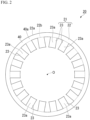
- the stator core 21 includes an annular core back part 22 and a plurality of tooth parts 23.
- the core back part 22 is a region surrounded by an outer circumferential edge 22a of the core back part and an inner circumferential edge 22b (a broken line shown in Fig. 2 ) of the core back part.
- an axial direction of the stator core 21 (the core back part 22) (a direction of the central axis O of the stator core 21) is referred to as an axial direction.
- a radial direction of the stator core 21 (the core back part 22) (a direction orthogonal to the central axis O of the stator core 21) is referred to as a radial direction.
- a circumferential direction of the stator core 21 (the core back part 22) (a direction of rotation around the central axis O of the stator core 21) is referred to as a circumferential direction.
- the core back part 22 is formed in a circular shape in a plan view of the stator 20 in the axial direction.
- the tooth part 23 has a rectangular shape in a plan view.
- the plurality of tooth parts 23 protrude from the core back part 22 in the radial direction (toward the central axis O of the core back part 22 in the radial direction).
- the plurality of tooth parts 23 are disposed at equal intervals in the circumferential direction.
- eighteen tooth parts 23 are provided every 20 degrees in terms of a central angle centered on the central axis O.
- the plurality of tooth parts 23 are formed to have the same shape and the same size.
- the winding is wound around the tooth parts 23.
- the winding may be a concentrated winding or a distributed winding.
- the rotor 30 is disposed inside the stator 20 (the stator core 21) in the radial direction.
- the rotor 30 includes a rotor core 31 and a plurality of permanent magnets 32.
- the rotor core 31 is disposed coaxially with the stator 20 to form an annular shape (a circular shape).
- the rotary shaft 60 is disposed in the rotor core 31.
- the rotary shaft 60 is fixed to the rotor core 31.
- the plurality of permanent magnets 32 are fixed to the rotor core 31.
- a set of two permanent magnets 32 form one magnetic pole.
- a plurality of sets of the permanent magnets 32 are disposed at equal intervals in the circumferential direction.
- twelve sets (twenty four in total) of the permanent magnets 32 are provided every 30 degrees in terms of a central angle centered on the central axis O.
- an interior permanent magnet motor is employed as the permanent magnetic electric motor.
- a plurality of through holes 33 that penetrate the rotor core 31 in the axial direction are formed.
- the plurality of through holes 33 are provided corresponding to the plurality of permanent magnets 32.
- Each permanent magnet 32 is fixed to the rotor core 31 in a state of being disposed in the corresponding through hole 33.
- an outer surface of the permanent magnet 32 and an inner surface of the through hole 33 are adhered to each other by an adhesive, and thus each permanent magnet 32 is fixed to the rotor core 31.
- a surface permanent magnet motor may be used instead of the interior permanent magnet motor.
- Each of the stator core 21 and the rotor core 31 is a laminated core.
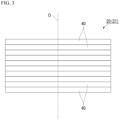
- the laminated core is formed by a plurality of electrical steel sheets 40 being stacked.
- the stacking thickness of each of the stator core 21 and the rotor core 31 is, for example, 50.0 mm.
- the outer diameter of the stator core 21 is, for example, 250.0 mm.
- the inner diameter of the stator core 21 is, for example, 165.0 mm.
- the outer diameter of the rotor core 31 is, for example, 163.0 mm.
- the inner diameter of the rotor core 31 is, for example, 30.0 mm.
- these values are examples, and the stacking thickness, the outer diameter, and the inner diameter of the stator core 21 and the stacking thickness, the outer diameter, and the inner diameter of the rotor core 31 are not limited to these values.
- the inner diameter of the stator core 21 is based on a tip end of the tooth part 23 of the stator core 21.
- the inner diameter of the stator core 21 is a diameter of a virtual circle inscribed in the tip ends of all of the tooth parts 23.
- Each of electrical steel sheets 40 for forming the stator core 21 and the rotor core 31 is formed, for example, by punching an electrical steel sheet serving as a base material.
- a known electrical steel sheet can be used as the electrical steel sheet 40.
- the chemical composition of the electrical steel sheet 40 is not particularly limited.
- a non-grain-oriented electrical steel sheet is employed as the electrical steel sheet 40.
- a non-grain-oriented electrical steel strip of Japanese Industrial Standards (JIS) C 2552: 2014 can be employed.
- a grain-oriented electrical steel sheet can also be employed instead of a non-grain-oriented electrical steel sheet.
- a JIS C 2553: 2012 grain-oriented electrical steel strip can be employed.
- An insulation coating is provided on each of both surfaces of the electrical steel sheet 40 to improve the workability of the electrical steel sheet and to reduce the iron loss of the laminated core.
- the substance constituting the insulation coating for example, (1) an inorganic compound, (2) an organic resin, (3) a mixture of an inorganic compound and an organic resin, and the like can be applied.
- the inorganic compound include (1) a complex of dichromate and boric acid, (2) a complex of phosphate and silica, and the like.
- the organic resin include epoxy-based resins, acrylic-based resins, acrylic-styrene-based resins, polyester-based resins, silicone-based resins, fluorine-based resins, and the like.
- the thickness of the insulation coating (the thickness per one surface of the electrical steel sheet 40) is preferably 0.1 ⁇ m or more.
- the thickness of the insulation coating (the thickness per one surface of the electrical steel sheet 40) is preferably 0.1 ⁇ m or more and 5 ⁇ m or less, and more preferably 0.1 ⁇ m or more and 2 ⁇ m or less.
- the thickness of the electrical steel sheet 40 is preferably 0.10 mm or more.
- the thickness of the electrical steel sheet 40 is preferably 0.65 mm or less.
- the thickness of the electrical steel sheet 40 is preferably 0.35 mm or less.
- the thickness of the electrical steel sheet 40 is more preferably 0.20 mm or 0.25 mm.
- each electrical steel sheet 40 is, for example, 0.10 mm or more and 0.65 mm or less.
- the thickness of each electrical steel sheet 40 is preferably 0.10 mm or more and 0.35 mm or less, and more preferably 0.20 mm or 0.25 mm.
- the thickness of the electrical steel sheet 40 also includes the thickness of the insulation coating.
- the plurality of electrical steel sheets 40 for forming the stator core 21 are stacked in a thickness direction.
- the thickness direction is a thickness direction of the electrical steel sheet 40.
- the thickness direction corresponds to a stacking direction of the electrical steel sheets 40.
- the plurality of electrical steel sheets 40 are disposed coaxially with the central axis O.
- the electrical steel sheet 40 includes the core back part 22 and the plurality of tooth parts 23.
- the plurality of electrical steel sheets 40 for forming the stator core 21 are fixed to each other by adhesion parts 41 and fastening parts 25 which are provided on a surface (a first surface) 40a of the electrical steel sheet 40.
- the fastening part 25 is constituted by a convex part (a dowel) and a concave part which are formed in the electrical steel sheet 40.
- the convex part protrudes from the electrical steel sheet 40 in the stacking direction.
- the concave part is disposed in a portion of the electrical steel sheet 40 which is located on a back side of the convex part.
- the concave part is recessed in the stacking direction with respect to the surface of the electrical steel sheet 40.
- the convex part and the concave part are formed, for example, by a process of pressing the electrical steel sheet 40.
- the fastening part 25 is provided in a portion 24 of the core back part 22 of the electrical steel sheet 40 corresponding to the tooth part 23.
- the adhesion part 41 is provided on a surface to be adhered of the tooth part 23 (a surface 23a shown in Fig. 4 ).
- the portion 24 of the core back part 22 corresponding to the tooth part 23 is a portion interposed between a pair of reference lines in the core back part 22 which extend outward from both side edges of the tooth part 23 in the radial direction in a plan view in the stacking direction. Each pair of reference lines extends in the radial direction.
- the state in which the fastening part 25 is provided in the portion 24 of the core back part 22 corresponding to the tooth part 23 means a state in which each fastening part 25 is provided such that the whole of each fastening part 25 is located inside the portion interposed between the pair of reference lines in the core back part 22.
- the tooth parts 23 are portions that protrude from the core back part 22 in the radial direction.
- the adhesion parts 41 are provided in all of the tooth parts 23. The adhesion part 41 is disposed at a central portion of the tooth part 23.
- the fastening part 25 and the adhesion part 41 are disposed on the virtually same straight line extending in the radial direction.
- the fastening part 25 and the adhesion part 41 are disposed at a position corresponding to a center of the tooth part 23 in the circumferential direction.
- the fastening part 25 is disposed at a center of the core back part 22 in the radial direction.
- the fastening part 25 is preferably disposed in the vicinity of an outer circumferential edge of the core back part 22.
- the vicinity of the outer circumferential edge of the core back part 22 as used herein means a range of 30% of a radial length of the core back part 22 from a radially outer end of the core back part 22.
- the fastening part 25 may be provided in every other tooth part 23 in the circumferential direction.
- the tooth parts 23 of the electrical steel sheet 40 may have a first tooth part 23A in which the adhesion part 41 is provided and a second tooth part 23B in which the adhesion part 41 is not provided. Further, as shown in Fig. 6 , the first tooth parts 23A and the second tooth parts 23B may be disposed alternately in the circumferential direction.
- the fastening part 25 may be provided in a core back part 24A corresponding to the first tooth part 23A (a portion of the core back part 22 located on a radially outer side of the first tooth part 23A, and hereinafter referred to as "a first core back part").
- the whole of one fastening part 25 may be provided in the first core back part 24A.
- a region of the core back part not corresponding to any of the tooth parts is a path of a magnetic flux.
- the fastening part 25 may be provided in an outer circumferential edge of the first core back part 24A or in a center of the first core back part 24A in the circumferential direction.
- the tooth parts 23 of the electrical steel sheet 40 may have the first tooth part 23A in which the adhesion part 41 is provided and the second tooth part 23B in which the adhesion part 41 is not provided. Further, as shown in Fig. 7 , the first tooth parts 23A and the second tooth parts 23B may be disposed alternately in the circumferential direction.
- the fastening parts 25 may be provided in a core back part 24B corresponding to the second tooth part 23B (hereinafter referred to as "a second core back part").
- a second core back part corresponding to the second tooth part 23B
- the whole of one fastening part 25 may be provided in the second core back part 24B.
- the fastening part 25 may be provided in an outer circumferential edge of the second core back part 24B or in a center of the second core back part 24B in the circumferential direction.
- a plurality of the adhesion parts 41 adhere the electrical steel sheets 40 adjacent in the stacking direction to each other.
- the adhesion part 41 is an adhesive that is provided between the electrical steel sheets 40 adjacent in the stacking direction and has cured without being divided.
- the adhesive for example, a thermosetting type adhesive by polymer bonding and the like is used.
- an acrylic-based resin As a composition of the adhesive, (1) an acrylic-based resin, (2) an epoxy-based resin, (3) a composition containing an acrylic-based resin and an epoxy-based resin, and the like can be applied.
- a radical polymerization type adhesive and the like can also be used.
- a room temperature curing type (a room temperature adhesion type) adhesive is desirable.
- the room temperature curing type adhesive is an adhesive that cures at 20°C to 30°C.
- a value range represented using "to” means a range including values before and after "to" as a lower limit value and an upper limit value.
- an acrylic-based adhesive is preferable.
- Typical acrylic-based adhesives include a second generation acrylic-based adhesive (SGA) and the like. Any one of an anaerobic adhesive, an instant adhesive, and an elastomer-containing acrylic-based adhesive can be used as long as the effects of the present invention are not impaired.
- the adhesive referred to here refers to an adhesive in a state before curing. After the adhesive cures, it becomes the adhesion part 41.
- An average tensile modulus of elasticity E of the adhesion parts 41 at room temperature (20°C to 30°C) is in the range of 1500 MPa to 4500 MPa. If the average tensile modulus of elasticity E of the adhesion parts 41 is less than 1500 MPa, a problem that the rigidity of the laminated core is lowered occurs. Therefore, a lower limit of the average tensile modulus of elasticity E of the adhesion parts 41 is 1500 MPa, and more preferably 1800 MPa. On the contrary, if the average tensile modulus of elasticity E of the adhesion parts 41 exceeds 4500 MPa, a problem that the insulation coating formed on the surface of the electrical steel sheet 40 is peeled off occurs. Therefore, an upper limit of the average tensile modulus of elasticity E of the adhesion parts 41 is 4500 MPa, and more preferably 3650 MPa.
- the average tensile modulus of elasticity E is measured by a resonance method. Specifically, a tensile modulus of elasticity is measured in conformity with JIS R 1602: 1995.
- a sample for measurement (not shown) is made.
- This sample is obtained by adhering two electrical steel sheets 40 to each other by the adhesive to be measured and curing the adhesive to form the adhesion part 41.
- the adhesive is a thermosetting type adhesive
- this curing is performed by heating and pressurizing under heating and pressurizing conditions in actual operation.
- the adhesive is a room temperature curing type adhesive
- the curing is performed by pressurizing at room temperature.
- the tensile modulus of elasticity of this sample is measured by a resonance method.
- a method of measuring a tensile modulus of elasticity by the resonance method is performed in conformity with JIS R 1602: 1995.
- the tensile modulus of elasticity of the adhesion parts 41 alone is obtained by removing the influence of the electrical steel sheet 40 itself from the tensile modulus of elasticity (the measured value) of the sample by calculation.
- the tensile modulus of elasticity thus obtained from the sample is equal to an average value for the stator core 21 as a whole, which is a laminated core. Therefore, this value is regarded as the average tensile modulus of elasticity E.
- the composition of the average tensile modulus of elasticity E is set such that the average tensile modulus of elasticity E is hardly changed depending on a stacking position in the stacking direction and a circumferential position around the central axis of the stator core 21. Therefore, a value obtained by measuring the tensile modulus of elasticity of the cured adhesion part 41 at an upper end position of the stator core 21 can be regarded as the average tensile modulus of elasticity E.
- thermosetting type adhesive for example, a method of applying an adhesive to the electrical steel sheets 40, and then adhering the electrical steel sheets 40 to each other by either one or both of heating and press-stacking can be employed.
- a heating means for example, a method of heating in a high temperature tank or an electric furnace, a method of directly energizing, or the like is used.
- the heating means may be any means.
- the thickness of the adhesion part 41 is preferably 1 ⁇ m or more.
- the thickness of the adhesion parts 41 exceed 100 ⁇ m, an adhesion force becomes saturated. Further, as the adhesion part 41 becomes thicker, the space factor decreases, and the magnetic properties of the laminated core in the iron loss and the like deteriorates.
- the thickness of the adhesion part 41 is 1 ⁇ m or more and 100 ⁇ m or less.
- the thickness of the adhesion part 41 is more preferably 1 ⁇ m or more and 10 ⁇ m or less.
- the thickness of the adhesion part 41 means an average thickness of the adhesion part 41.
- the average thickness of the adhesion part 41 is more preferably 1.0 ⁇ m or more and 3.0 ⁇ m or less. If the average thickness of the adhesion part 41 is less than 1.0 ⁇ m, a sufficient adhesion force cannot be secured as described above. Therefore, a lower limit of the average thickness of the adhesion part 41 is 1.0 ⁇ m, and more preferably 1.2 ⁇ m. On the contrary, if the average thickness of the adhesion part 41 becomes thicker than 3.0 ⁇ m, problems such as a large increase in a strain amount of the electrical steel sheet 40 due to shrinkage during thermosetting occur. Therefore, an upper limit of the average thickness of the adhesion part 41 is 3.0 ⁇ m, and more preferably 2.6 ⁇ m.
- the average thickness of the adhesion part 41 is an average value for the stator core 21 as a whole.
- the average thickness of the adhesion part 41 is hardly changed depending on a stacking position in the stacking direction and a circumferential position around the central axis of the stator core 21. Therefore, an average value of values obtained by measuring the thicknesses of the adhesion part 41 at the upper end position in the stator core 21 at ten or more points in the circumferential direction can be regarded as the average thickness of the adhesion part 41.
- the average thickness of the adhesion part 41 can be adjusted, for example, by changing the application amount of the adhesive. Further, for example, in a case of a thermosetting type adhesive, the average tensile modulus of elasticity E of the adhesion parts 41 can be adjusted by changing either one or both of heating and pressurizing conditions applied at the time of adhesion and the type of a curing agent.
- the plurality of electrical steel sheets 40 for forming the rotor core 31 are fixed to each other by fastening parts 42 (dowels, see Fig. 1 ).
- the plurality of electrical steel sheets 40 for forming the rotor core 31 may be stacked via the adhesion parts 41.
- the laminated core such as the stator core 21 and the rotor core 31 may be formed by so-called the rotationally-stacking.
- the fastening part 25 is provided in a portion of the core back part 22 of the electrical steel sheet 40 corresponding to the tooth part 23.
- the adhesion parts 41 is provided in the tooth part 23.
- the tooth parts 23 of the electrical steel sheets 40 adjacent in the stacking direction are partially adhered to each other.
- a region of the core back part not corresponding to any of the tooth parts is a path of a magnetic flux. Therefore, by providing the fastening part 25 in a portion of the core back part 22 corresponding to the tooth part 23 as in the stator core 21 of the present embodiment, it is more difficult to obstruct a magnetic circuit as compared with a case in which the fastening part 25 is provided in the path of the magnetic flux. That is, in a portion of the core back part 22 corresponding to the tooth part 23, the magnetic flux (the magnetic circuit) generated in the tooth part 23 branches toward both sides thereof in the circumferential direction. Therefore, it is unlikely that the fastening part 25 provided in this portion will affect the magnetic circuit. As a result, the iron loss that is generated in the stator core 21 can be reduced, and the magnetic properties of the stator core 21 can be improved.
- an adhesive shrinks during curing. Therefore, when the adhesive is provided on the electrical steel sheet, a compressive stress is applied to the electrical steel sheet as the adhesive cures. When a compressive stress is applied, a strain occurs in the electrical steel sheet. Further, when the fastening parts are provided on the electrical steel sheet, the electrical steel sheet is deformed, and thus a strain occurs in the electrical steel sheet.
- the fastening parts and an adhesion region form a fixing part.
- the fixing part fixes the electrical steel sheets adjacent in the stacking direction to each other. As the area of the fixing part increases, the strain of the electrical steel sheet increases.
- the tooth parts 23 of the electrical steel sheet 40 have the first tooth part 23A in which the adhesion part 41 is provided and the second tooth part 23B in which the adhesion part 41 is not provided. Therefore, the strain due to the curing of the adhesive does not occur in the second tooth part 23B. Accordingly, the area of the fixing part in a plan view in the stacking direction is reduced. Therefore, the strain that occurs in the entire stator core 21 can be made smaller.
- the first tooth part 23A in which the adhesion part 41 is provided, the first tooth part 23A is adhered, and thus rising up of the first tooth part 23A does not occur. If a winding is wound around raised tooth part, the raised floating tooth part is deformed by the winding, and a stress is applied to the tooth part by the winding. Therefore, it is possible to suppress the application of a stress due to the winding to the first tooth part 23A and the influence of this stress on a magnetic field. However, a compressive stress occurs in the first tooth part 23A due to the adhesion parts 41.
- the tooth parts 23 have the first tooth parts 23A and the second tooth parts 23B. Therefore, the compressive stress and the stress due to the winding can be suppressed and balanced. Therefore, it is possible to provide a stator core 21 having a high performance in which the magnetic properties are further improved.
- the first tooth parts 23A and the second tooth parts 23B are disposed alternately in the circumferential direction.
- the first tooth parts 23A to which the compressive stress is applied, but in which the stress due to the winding is suppressed, and the second tooth parts 23B in which the compressive stress does not occur, but to which the stress due to the winding is applied are alternately disposed. Therefore, both stresses can be suppressed in a well-balanced manner.
- the fastening part 25 is provided in the first core back part 24A corresponding to the first tooth part 23A.
- the fastening parts 25 are provided in the core back part 22 corresponding to all of the tooth parts 23, there is a concern that the iron loss that is generated in the stator core 21 may increase. Therefore, the fastening part 25 is provided in only the first core back part 24A corresponding to the first tooth part 23A which is a part of the tooth parts 23. Therefore, the area of the fixing part is reduced. Accordingly, the strain that occurs in the entire stator core 21 can be made smaller.
- the fastening part 25 is provided in the second core back part 24B corresponding to the second tooth part 23B.
- the fastening parts 25 are provided in the core back part 22 corresponding to all of the tooth parts 23, there is a concern that the iron loss that is generated in the stator core 21 may increase. Therefore, the fastening part 25 is provided in only the second core back part 24B corresponding to the second tooth parts 23B which is a part of the tooth parts 23. Therefore, the area of the fixing part is reduced. Accordingly, the strain that occurs in the entire stator core 21 can be made smaller.
- the electric motor 10 according to the present embodiment includes the stator core 21 (the laminated core) according to the present embodiment. Therefore, it is possible to improve the magnetic properties of the electric motor 10.
- the shape of the stator core is not limited to the forms shown in the above-described embodiments. Specifically, the dimensions of the outer diameter and the inner diameter of the stator core, the stacking thickness, the number of the slots, the dimensional ratio of the tooth part in the circumferential direction and the radial direction, the dimensional ratio between the tooth part and the core back part in the radial direction, and the like can be arbitrarily designed according to the properties of the desired electric motor.
- the set of two permanent magnets 32 form one magnetic pole, but the present invention is not limited to this.
- one permanent magnet 32 may form one magnetic pole, or three or more permanent magnets 32 may form one magnetic pole.
- the permanent magnetic electric motor has been described as an example of the electric motor, but the structure of the electric motor is not limited to this as will be illustrated below. As the structure of the electric motor, various known structures that will not be illustrated below can also be employed.
- the permanent magnetic electric motor has been described as an example of the synchronous motor.
- the electric motor may be a reluctance motor or an electromagnet field motor (a wound-field motor).
- the synchronous motor has been described as an example of the AC motor.
- the electric motor may be an induction motor.
- the AC motor has been described as an example of the motor.
- the present invention is not limited to this.
- the electric motor may be a DC motor.
- the motor has been described as an example of the electric motor.
- the electric motor may be an electric generator.
- the laminated core according to the present invention is applied to the stator core has been illustrated.
- the laminated core according to the present invention can also be applied to the rotor core.
- the fastening part 25 was provided in the portion 24 of the core back part 22 of the electrical steel sheet 40 corresponding to the tooth part 23. Further, the adhesion part 41 was provided on the surface 23a of the tooth part 23. The plurality of electrical steel sheets 40 provided with the fastening parts 25 and the adhesion parts 41 were stacked to form the laminated core.
- Two types of laminated cores having different sheet thicknesses of the electrical steel sheet 40 were formed using the electrical steel sheet 40 having a sheet thickness of 0.20 mm and the electrical steel sheet 40 having a sheet thickness of 0.25 mm.
- the fastening part 25 was provided in every other tooth part 23 in the circumferential direction. Except for this point, as in Example 1, two types of laminated cores having different sheet thicknesses of the electrical steel sheet 40 were formed.
- the tooth parts 23 of the electrical steel sheet 40 were configured to have the first tooth part 23A in which the adhesion part 41 is provided and the second tooth part 23B in which the adhesion part 41 is not provided. Further, the first tooth parts 23A and the second tooth parts 23B were disposed alternately in the circumferential direction. Further, the fastening part 25 was provided in the first core back part 24A corresponding to the first tooth part 23A.
- Example 1 two types of laminated cores having different sheet thicknesses of the electrical steel sheet 40 were formed.
- the tooth parts 23 of the electrical steel sheet 40 were configured to have the first tooth part 23A in which the adhesion part 41 is provided and the second tooth part 23B in which the adhesion part 41 is not provided. Further, the first tooth parts 23A and the second tooth parts 23B are disposed alternately in the circumferential direction. Further, the fastening part 25 was provided in the second core back part 24B corresponding to the second tooth part 23B.
- Example 1 two types of laminated cores having different sheet thicknesses of the electrical steel sheet 40 were formed.
- the fastening part 25 was provided in a portion 26 of the core back part 22 of the electrical steel sheet 40 not corresponding to the tooth part 23.
- the adhesion part 41 was provided on the surface 23a of the tooth part 23. Except for these points, as in Example 1, two types of laminated cores having different sheet thicknesses of the electrical steel sheet 40 were formed.
- the portion 26 of the core back part 22 not corresponding to the tooth part 23 is a portion of the core back part 22 which is not on an outer side of the tooth part 23 in the radial direction.
- the evaluation of the iron loss was executed by a simulation using software.
- electromagnetic field simulation software JMAG which is based on a finite element method and is manufactured by JSOL Corporation was used.
- the present invention it is possible to provide a laminated core having improved magnetic properties and an electric motor including the laminated core. Therefore, the industrial applicability is great.
Landscapes
- Engineering & Computer Science (AREA)
- Power Engineering (AREA)
- Manufacturing & Machinery (AREA)
- Chemical & Material Sciences (AREA)
- Organic Chemistry (AREA)
- Iron Core Of Rotating Electric Machines (AREA)
- Manufacturing Cores, Coils, And Magnets (AREA)
Priority Applications (1)
| Application Number | Priority Date | Filing Date | Title |
|---|---|---|---|
| RS20241169A RS66132B1 (sr) | 2018-12-17 | 2019-12-17 | Laminirano jezgro i električni motor |
Applications Claiming Priority (2)
| Application Number | Priority Date | Filing Date | Title |
|---|---|---|---|
| JP2018235862 | 2018-12-17 | ||
| PCT/JP2019/049287 WO2020129937A1 (ja) | 2018-12-17 | 2019-12-17 | 積層コアおよび回転電機 |
Publications (3)
| Publication Number | Publication Date |
|---|---|
| EP3902113A1 EP3902113A1 (en) | 2021-10-27 |
| EP3902113A4 EP3902113A4 (en) | 2022-10-12 |
| EP3902113B1 true EP3902113B1 (en) | 2024-08-21 |
Family
ID=71100317
Family Applications (1)
| Application Number | Title | Priority Date | Filing Date |
|---|---|---|---|
| EP19900218.9A Active EP3902113B1 (en) | 2018-12-17 | 2019-12-17 | Laminated core and electric motor |
Country Status (13)
| Country | Link |
|---|---|
| US (1) | US11710990B2 (pl) |
| EP (1) | EP3902113B1 (pl) |
| JP (1) | JP7111182B2 (pl) |
| KR (1) | KR102485638B1 (pl) |
| CN (1) | CN113196616B (pl) |
| CA (1) | CA3131669C (pl) |
| EA (1) | EA202192067A1 (pl) |
| MY (1) | MY205930A (pl) |
| PL (1) | PL3902113T3 (pl) |
| RS (1) | RS66132B1 (pl) |
| SG (1) | SG11202108994WA (pl) |
| TW (1) | TWI732384B (pl) |
| WO (1) | WO2020129937A1 (pl) |
Families Citing this family (17)
| Publication number | Priority date | Publication date | Assignee | Title |
|---|---|---|---|---|
| PL3902107T3 (pl) | 2018-12-17 | 2026-03-09 | Nippon Steel Corporation | Laminowany rdzeń, sposób jego wytwarzania i silnik elektryczny |
| JP7055209B2 (ja) | 2018-12-17 | 2022-04-15 | 日本製鉄株式会社 | 積層コアおよび回転電機 |
| WO2020129926A1 (ja) | 2018-12-17 | 2020-06-25 | 日本製鉄株式会社 | 積層コアおよび回転電機 |
| JP7515403B2 (ja) | 2018-12-17 | 2024-07-12 | 日本製鉄株式会社 | ステータ用接着積層コア、その製造方法、および回転電機 |
| SG11202108950YA (en) | 2018-12-17 | 2021-09-29 | Nippon Steel Corp | Adhesively-laminated core for stator and electric motor |
| CN113228468B (zh) | 2018-12-17 | 2025-04-11 | 日本制铁株式会社 | 定子用粘接层叠铁芯、其制造方法及旋转电机 |
| CN113196634B (zh) | 2018-12-17 | 2024-10-18 | 日本制铁株式会社 | 层叠铁芯及旋转电机 |
| RS66007B1 (sr) | 2018-12-17 | 2024-10-31 | Nippon Steel Corp | Laminirano jezgro i rotaciona električna mašina |
| EA202192064A1 (ru) | 2018-12-17 | 2021-11-24 | Ниппон Стил Корпорейшн | Шихтованный сердечник и электродвигатель |
| KR102631738B1 (ko) | 2018-12-17 | 2024-02-01 | 닛폰세이테츠 가부시키가이샤 | 적층 코어, 적층 코어의 제조 방법 및 회전 전기 기기 |
| EP3902110B1 (en) | 2018-12-17 | 2026-01-28 | Nippon Steel Corporation | Laminated core and electric motor |
| MY206339A (en) | 2018-12-17 | 2024-12-12 | Nippon Steel Corp | Laminated core, core block, electric motor and method of producing core block |
| TWI724690B (zh) | 2018-12-17 | 2021-04-11 | 日商日本製鐵股份有限公司 | 積層鐵芯及旋轉電機 |
| EP3902120A4 (en) | 2018-12-17 | 2022-10-05 | Nippon Steel Corporation | STACKED CORE AND ROTATING ELECTRICAL MACHINE |
| KR102607691B1 (ko) | 2018-12-17 | 2023-11-30 | 닛폰세이테츠 가부시키가이샤 | 스테이터용 접착 적층 코어 및 회전 전기 기계 |
| EP3902106B1 (en) | 2018-12-17 | 2025-10-29 | Nippon Steel Corporation | Adhesively laminated core for stator, method of manufacturing the same, and electric motor |
| CN118020230A (zh) * | 2021-11-25 | 2024-05-10 | 日本制铁株式会社 | 层叠铁芯及旋转电机 |
Family Cites Families (124)
| Publication number | Priority date | Publication date | Assignee | Title |
|---|---|---|---|---|
| JPS5665326A (en) | 1979-10-29 | 1981-06-03 | Tdk Corp | Magnetic core for magnetic head |
| JPS576427A (en) | 1980-06-11 | 1982-01-13 | Canon Inc | Manufacture of magnetic core |
| JPS60170681A (ja) | 1984-02-16 | 1985-09-04 | Nippon Synthetic Chem Ind Co Ltd:The | 接着剤組成物 |
| JPS60186834A (ja) | 1984-03-07 | 1985-09-24 | Toray Ind Inc | 水現像可能な感光性樹脂版材 |
| JPS60186834U (ja) | 1984-05-18 | 1985-12-11 | 株式会社東芝 | 回転電機の固定子鉄心 |
| US4614022A (en) * | 1985-05-30 | 1986-09-30 | Applied Plastics Co., Inc. | Method for forming multi-laminate core assembly |
| JPS63207639A (ja) | 1987-02-25 | 1988-08-29 | 日新製鋼株式会社 | 制振鋼板及びその製造方法 |
| JPH03247683A (ja) | 1990-02-23 | 1991-11-05 | Sumitomo Chem Co Ltd | アクリル系接着剤組成物 |
| JPH0428743U (pl) | 1990-05-22 | 1992-03-06 | ||
| JP2897344B2 (ja) | 1990-05-23 | 1999-05-31 | 住友化学工業株式会社 | 熱可塑性樹脂組成物 |
| JPH07118620A (ja) | 1993-10-22 | 1995-05-09 | Nippon Zeon Co Ltd | エポキシ系接着剤組成物 |
| JPH07298567A (ja) | 1994-04-26 | 1995-11-10 | Honda Motor Co Ltd | 積層鋼板の接着用加熱装置 |
| JPH08259899A (ja) * | 1995-03-23 | 1996-10-08 | Three Bond Co Ltd | シアノアクリレート系接着剤組成物 |
| JP3369941B2 (ja) | 1997-11-27 | 2003-01-20 | 日本鋼管株式会社 | 接着強度、耐食性及び耐ブロッキング性に優れた接着鉄芯用電磁鋼板の製造方法 |
| JP2000050539A (ja) * | 1998-07-28 | 2000-02-18 | Toshiba Corp | 回転電機の固定子鉄心、固定子鉄心用鋼板部品、固定子鉄心の製造方法および固定子鉄心用鋼板部品の製造方法 |
| JP2000152570A (ja) | 1998-11-06 | 2000-05-30 | Toshiba Corp | 磁石鉄心の製造方法 |
| JP2001115125A (ja) | 1999-10-01 | 2001-04-24 | Three M Innovative Properties Co | ネオジム磁石用接着剤及びモータ |
| FR2803126B1 (fr) | 1999-12-23 | 2006-04-14 | Valeo Equip Electr Moteur | Alternateur pour vehicule a stator generant peu de bruit magnetique |
| JP2002078257A (ja) | 2000-08-24 | 2002-03-15 | Mitsubishi Electric Corp | モーター及びそのローター |
| JP2002164224A (ja) | 2000-08-30 | 2002-06-07 | Mitsui Chemicals Inc | 磁性基材およびその製造方法 |
| JP4020236B2 (ja) * | 2000-09-18 | 2007-12-12 | 電気化学工業株式会社 | 硬化性樹脂組成物、硬化体、接着剤組成物及び接合体 |
| JP2002105283A (ja) | 2000-09-28 | 2002-04-10 | Nhk Spring Co Ltd | エポキシ樹脂分散体およびそれを用いた銅張り積層板及び銅張り金属基板 |
| JP2002125341A (ja) | 2000-10-16 | 2002-04-26 | Denki Kagaku Kogyo Kk | ステーター及びそれを用いたモーター |
| JP2002151335A (ja) | 2000-11-10 | 2002-05-24 | Nippon Steel Corp | 鉄損特性の優れた積層鉄芯およびその製造方法 |
| JP3725776B2 (ja) | 2000-11-10 | 2005-12-14 | 新日本製鐵株式会社 | 積層鉄芯の製造方法およびその製造装置 |
| JP4076323B2 (ja) | 2001-05-08 | 2008-04-16 | 電気化学工業株式会社 | 硬化性樹脂組成物、硬化体、接着剤組成物及び接合体 |
| JP2003199303A (ja) | 2001-12-27 | 2003-07-11 | Matsushita Electric Ind Co Ltd | モータの製造方法 |
| JP4165072B2 (ja) | 2002-01-15 | 2008-10-15 | 日立化成工業株式会社 | 接着剤組成物、接着フィルム、半導体搭載用配線基板及び半導体装置とその製造方法 |
| JP2003219585A (ja) * | 2002-01-22 | 2003-07-31 | Mitsubishi Electric Corp | 積層鉄心およびその製造方法 |
| JP3771933B2 (ja) | 2002-03-08 | 2006-05-10 | Jfeスチール株式会社 | 積層コア用材料及びその製造方法 |
| JP2003284274A (ja) | 2002-03-22 | 2003-10-03 | Nippon Steel Corp | 永久磁石同期モータのロータ |
| JP2004088970A (ja) | 2002-08-29 | 2004-03-18 | Hitachi Ltd | 積層鉄心とそれを用いた回転電機およびトランス |
| JP2004111509A (ja) | 2002-09-17 | 2004-04-08 | Nippon Steel Corp | 鉄損特性の優れた積層鉄芯及びその製造方法 |
| JP4222000B2 (ja) | 2002-10-29 | 2009-02-12 | Nok株式会社 | 磁気エンコーダ |
| CN100476030C (zh) | 2003-02-03 | 2009-04-08 | 新日本制铁株式会社 | 粘接用表面涂覆电磁钢板 |
| JP4987216B2 (ja) | 2003-06-25 | 2012-07-25 | Jfeスチール株式会社 | 寸法精度に優れた積層コア及びその製造方法 |
| JP2005269732A (ja) | 2004-03-17 | 2005-09-29 | Nippon Steel Corp | 鉄芯の製造方法とその方法に適した装置 |
| JP2005268589A (ja) * | 2004-03-19 | 2005-09-29 | Nippon Steel Corp | エネルギー変換機器用磁性部材の簡易製造方法 |
| JP2006254530A (ja) | 2005-03-08 | 2006-09-21 | Mitsubishi Electric Corp | 電動機 |
| JP2006288114A (ja) | 2005-04-01 | 2006-10-19 | Mitsui High Tec Inc | 積層鉄心、及び積層鉄心の製造方法 |
| JP2006353001A (ja) | 2005-06-15 | 2006-12-28 | Japan Servo Co Ltd | 積層鉄心とその製造方法及び製造装置 |
| JP4687289B2 (ja) | 2005-07-08 | 2011-05-25 | 東洋紡績株式会社 | ポリアミド系混合樹脂積層フィルムロール、およびその製造方法 |
| JP4586669B2 (ja) | 2005-08-01 | 2010-11-24 | 住友金属工業株式会社 | 回転子用無方向性電磁鋼板の製造方法 |
| JP4938389B2 (ja) | 2006-09-06 | 2012-05-23 | 三菱電機株式会社 | 積層コアおよびステータ |
| JP4376957B2 (ja) | 2007-07-19 | 2009-12-02 | 積水化学工業株式会社 | 電子部品用接着剤 |
| JP5211651B2 (ja) * | 2007-11-15 | 2013-06-12 | パナソニック株式会社 | モータおよびそれを用いた電子機器 |
| JP5172367B2 (ja) * | 2008-01-23 | 2013-03-27 | 三菱電機株式会社 | 積層コア、積層コアの製造方法、積層コアの製造装置およびステータ |
| JP5428218B2 (ja) | 2008-06-23 | 2014-02-26 | 富士電機株式会社 | 永久磁石形回転電機の回転子構造 |
| CN102325801B (zh) | 2009-01-15 | 2015-02-25 | 株式会社钟化 | 固化性组合物、其固化物、及其制备方法 |
| JP5084770B2 (ja) | 2009-03-13 | 2012-11-28 | 三菱電機株式会社 | 電動機及び圧縮機及び空気調和機 |
| JP5444812B2 (ja) | 2009-04-22 | 2014-03-19 | Jfeスチール株式会社 | 高速モータ用コア材料 |
| CN102459696B (zh) * | 2009-06-17 | 2013-10-16 | 新日铁住金株式会社 | 具有绝缘覆盖膜的电磁钢板及其制造方法 |
| JP2011023523A (ja) * | 2009-07-15 | 2011-02-03 | Nippon Steel Corp | 良好な熱伝導性を有する電磁鋼板積層コアおよびその製造方法 |
| ES2566650T3 (es) | 2009-07-31 | 2016-04-14 | Nippon Steel & Sumitomo Metal Corporation | Placa de acero laminado |
| BE1019128A3 (nl) | 2009-11-06 | 2012-03-06 | Atlas Copco Airpower Nv | Gelamelleerde kern van een magneetlager en werkwijze voor het vervaardigen van zulke gelamelleerde kern. |
| JP5844963B2 (ja) | 2010-03-19 | 2016-01-20 | 積水化学工業株式会社 | 電子部品用接着剤 |
| JP2012029494A (ja) | 2010-07-26 | 2012-02-09 | Nissan Motor Co Ltd | 電動機およびその製造方法 |
| JP2012120299A (ja) | 2010-11-30 | 2012-06-21 | Mitsubishi Electric Corp | ステータコア、回転電機およびステータコアの製造方法 |
| JP5915075B2 (ja) | 2011-10-21 | 2016-05-11 | Jfeスチール株式会社 | 積層コアの製造方法 |
| CN102361374B (zh) * | 2011-10-28 | 2013-09-18 | 安泰科技股份有限公司 | 电机用护盒式非晶、微晶或纳米晶合金定子铁芯及其制备方法 |
| JP2013253153A (ja) | 2012-06-06 | 2013-12-19 | Mitsubishi Chemicals Corp | エポキシ樹脂、エポキシ樹脂組成物、硬化物及び光学部材 |
| JP6134497B2 (ja) | 2012-11-08 | 2017-05-24 | 京セラ株式会社 | 積層コアの製造方法 |
| WO2014102915A1 (ja) | 2012-12-26 | 2014-07-03 | 株式会社 日立製作所 | 低融点ガラス樹脂複合材料と、それを用いた電子・電気機器 |
| JP5896937B2 (ja) | 2013-02-08 | 2016-03-30 | 三菱電機株式会社 | 分割鉄心、及びこの分割鉄心を用いた固定子、並びにこの固定子を備えた回転電機 |
| JP2015012756A (ja) * | 2013-07-01 | 2015-01-19 | 日本精工株式会社 | ダイレクトドライブモータ |
| US9490667B2 (en) | 2013-07-23 | 2016-11-08 | General Electric Company | Apparatus and system for attaching integral spacers to laminations |
| JP6164039B2 (ja) | 2013-10-21 | 2017-07-19 | アイシン・エィ・ダブリュ株式会社 | 積層鉄心の製造方法 |
| JP6066936B2 (ja) * | 2014-01-17 | 2017-01-25 | 三菱電機株式会社 | 積層鉄心の製造方法、固定子の製造方法 |
| JP6064923B2 (ja) | 2014-01-29 | 2017-01-25 | Jfeスチール株式会社 | 積層鉄心の製造方法 |
| JP6065032B2 (ja) | 2014-01-29 | 2017-01-25 | Jfeスチール株式会社 | 積層鉄心製造方法および積層鉄心 |
| JP6248711B2 (ja) | 2014-03-06 | 2017-12-20 | 株式会社デンソー | 回転電機の固定子 |
| JP6383202B2 (ja) | 2014-07-24 | 2018-08-29 | 株式会社三井ハイテック | 積層鉄心の製造方法及び積層鉄心 |
| JP6037055B2 (ja) | 2014-07-29 | 2016-11-30 | Jfeスチール株式会社 | 積層用電磁鋼板、積層型電磁鋼板、積層型電磁鋼板の製造方法、および自動車モーター用鉄心 |
| JP6431316B2 (ja) | 2014-08-26 | 2018-11-28 | 日東シンコー株式会社 | モーター用絶縁シート |
| JP6479392B2 (ja) | 2014-09-30 | 2019-03-06 | 株式会社三井ハイテック | 積層鉄心及びその製造方法 |
| CN104377845A (zh) * | 2014-11-19 | 2015-02-25 | 广东威灵电机制造有限公司 | 定子铁芯及定子、电机 |
| JP6343556B2 (ja) | 2014-12-09 | 2018-06-13 | 株式会社三井ハイテック | 積層鉄心用積層体及びその製造方法並びに積層鉄心の製造方法 |
| JP6587800B2 (ja) | 2014-12-26 | 2019-10-09 | Jfeスチール株式会社 | 積層鉄心の製造方法 |
| JP2016140134A (ja) * | 2015-01-26 | 2016-08-04 | アイシン・エィ・ダブリュ株式会社 | モータコアおよびモータコアの製造方法 |
| JP6432397B2 (ja) | 2015-03-12 | 2018-12-05 | アイシン・エィ・ダブリュ株式会社 | モータの製造方法およびモータコア |
| JP6627270B2 (ja) | 2015-06-12 | 2020-01-08 | 住友ベークライト株式会社 | 整流子 |
| JP2017011863A (ja) | 2015-06-22 | 2017-01-12 | 新日鐵住金株式会社 | モータ鉄心用積層電磁鋼板およびその製造方法 |
| JP2017028911A (ja) | 2015-07-24 | 2017-02-02 | 日東シンコー株式会社 | 回転電機用絶縁紙 |
| KR20180018771A (ko) | 2015-08-21 | 2018-02-21 | 미쓰비시덴키 가부시키가이샤 | 영구자석 매입형 모터, 압축기, 및 냉동 공조 장치 |
| JP6429129B2 (ja) | 2015-08-26 | 2018-11-28 | 日産自動車株式会社 | ロータの製造方法 |
| US11578237B2 (en) | 2015-10-07 | 2023-02-14 | Dai Nippon Printing Co., Ltd. | Adhesive sheet set and method for producing product |
| JP2017075279A (ja) | 2015-10-16 | 2017-04-20 | 株式会社菱晃 | 接着剤及び接合体 |
| JP6400859B2 (ja) * | 2015-11-12 | 2018-10-03 | 三菱電機株式会社 | 鉄心装置およびその製造方法 |
| KR102108990B1 (ko) | 2016-02-25 | 2020-05-11 | 히타치가세이가부시끼가이샤 | 에폭시 수지 조성물, 반경화 에폭시 수지 조성물, 경화 에폭시 수지 조성물, 성형물 및 성형 경화물 |
| WO2017170957A1 (ja) | 2016-03-31 | 2017-10-05 | デンカ株式会社 | 組成物 |
| CN109155574B (zh) | 2016-05-20 | 2020-11-06 | 日本电产株式会社 | 定子铁芯的制造方法 |
| CN107674499B (zh) | 2016-08-01 | 2021-07-13 | 株式会社理光 | 墨水,墨水容器,液体排出装置,图像形成方法及其装置 |
| JP6874550B2 (ja) | 2016-08-01 | 2021-05-19 | 株式会社リコー | インク、インク容器、画像形成方法、画像形成装置、画像形成物、及び液体吐出装置 |
| JP6376706B2 (ja) * | 2016-08-29 | 2018-08-22 | 本田技研工業株式会社 | 積層鋼板の製造方法および製造装置 |
| JP6633212B2 (ja) | 2016-09-01 | 2020-01-22 | 三菱電機株式会社 | 積層鉄心、積層鉄心の製造方法、および積層鉄心を用いた電機子 |
| JP6848314B2 (ja) * | 2016-10-03 | 2021-03-24 | 日本製鉄株式会社 | ステータコアおよび回転電機 |
| JP6724735B2 (ja) | 2016-11-08 | 2020-07-15 | トヨタ自動車株式会社 | 回転電機のステータ |
| KR101874918B1 (ko) | 2016-11-15 | 2018-07-06 | 지에스칼텍스 주식회사 | 저비중 폴리프로필렌 수지 조성물 및 이를 이용한 자동차 내장재용 성형품 |
| CN108155730B (zh) | 2016-12-06 | 2022-02-25 | 松下电器产业株式会社 | 铁芯和电机 |
| JP6905905B2 (ja) | 2016-12-06 | 2021-07-21 | パナソニック株式会社 | 鉄心およびモータ |
| EP3553799B1 (en) | 2016-12-07 | 2021-07-14 | Panasonic Corporation | Method to produce an iron core |
| JP6543608B2 (ja) | 2016-12-22 | 2019-07-10 | 株式会社三井ハイテック | 積層鉄心の製造方法及び積層鉄心の製造装置 |
| WO2018138864A1 (ja) | 2017-01-27 | 2018-08-02 | 三菱電機株式会社 | 固定子、電動機、圧縮機、および冷凍空調装置 |
| JP2018138634A (ja) | 2017-02-24 | 2018-09-06 | 三菱ケミカル株式会社 | 樹脂組成物および該樹脂組成物を用いた半導体装置 |
| JP6866696B2 (ja) | 2017-03-07 | 2021-04-28 | 日本製鉄株式会社 | 無方向性電磁鋼板およびその製造方法、並びにモータコアおよびその製造方法 |
| PL3633830T3 (pl) | 2017-05-23 | 2025-05-05 | Three Bond Co., Ltd. | Sposób wytwarzania laminowanej blachy stalowej |
| JP2018201303A (ja) | 2017-05-29 | 2018-12-20 | 日本電産株式会社 | モータ |
| KR102607691B1 (ko) | 2018-12-17 | 2023-11-30 | 닛폰세이테츠 가부시키가이샤 | 스테이터용 접착 적층 코어 및 회전 전기 기계 |
| CN113228468B (zh) | 2018-12-17 | 2025-04-11 | 日本制铁株式会社 | 定子用粘接层叠铁芯、其制造方法及旋转电机 |
| EP3902110B1 (en) | 2018-12-17 | 2026-01-28 | Nippon Steel Corporation | Laminated core and electric motor |
| RS66007B1 (sr) | 2018-12-17 | 2024-10-31 | Nippon Steel Corp | Laminirano jezgro i rotaciona električna mašina |
| EP3902125A4 (en) | 2018-12-17 | 2022-10-05 | Nippon Steel Corporation | LAMINATED STATOR CORE AND ELECTRIC LATHE |
| PL3902107T3 (pl) | 2018-12-17 | 2026-03-09 | Nippon Steel Corporation | Laminowany rdzeń, sposób jego wytwarzania i silnik elektryczny |
| EA202192064A1 (ru) | 2018-12-17 | 2021-11-24 | Ниппон Стил Корпорейшн | Шихтованный сердечник и электродвигатель |
| EP3902106B1 (en) | 2018-12-17 | 2025-10-29 | Nippon Steel Corporation | Adhesively laminated core for stator, method of manufacturing the same, and electric motor |
| WO2020129926A1 (ja) | 2018-12-17 | 2020-06-25 | 日本製鉄株式会社 | 積層コアおよび回転電機 |
| JP7055209B2 (ja) | 2018-12-17 | 2022-04-15 | 日本製鉄株式会社 | 積層コアおよび回転電機 |
| KR102631738B1 (ko) | 2018-12-17 | 2024-02-01 | 닛폰세이테츠 가부시키가이샤 | 적층 코어, 적층 코어의 제조 방법 및 회전 전기 기기 |
| CN113196634B (zh) | 2018-12-17 | 2024-10-18 | 日本制铁株式会社 | 层叠铁芯及旋转电机 |
| MY206339A (en) | 2018-12-17 | 2024-12-12 | Nippon Steel Corp | Laminated core, core block, electric motor and method of producing core block |
| EP3902120A4 (en) | 2018-12-17 | 2022-10-05 | Nippon Steel Corporation | STACKED CORE AND ROTATING ELECTRICAL MACHINE |
| JP7515403B2 (ja) | 2018-12-17 | 2024-07-12 | 日本製鉄株式会社 | ステータ用接着積層コア、その製造方法、および回転電機 |
| TWI724690B (zh) | 2018-12-17 | 2021-04-11 | 日商日本製鐵股份有限公司 | 積層鐵芯及旋轉電機 |
| SG11202108950YA (en) | 2018-12-17 | 2021-09-29 | Nippon Steel Corp | Adhesively-laminated core for stator and electric motor |
-
2019
- 2019-12-17 TW TW108146106A patent/TWI732384B/zh active
- 2019-12-17 SG SG11202108994WA patent/SG11202108994WA/en unknown
- 2019-12-17 KR KR1020217017203A patent/KR102485638B1/ko active Active
- 2019-12-17 WO PCT/JP2019/049287 patent/WO2020129937A1/ja not_active Ceased
- 2019-12-17 JP JP2020561436A patent/JP7111182B2/ja active Active
- 2019-12-17 EP EP19900218.9A patent/EP3902113B1/en active Active
- 2019-12-17 CA CA3131669A patent/CA3131669C/en active Active
- 2019-12-17 CN CN201980082553.7A patent/CN113196616B/zh active Active
- 2019-12-17 EA EA202192067A patent/EA202192067A1/ru unknown
- 2019-12-17 US US17/413,121 patent/US11710990B2/en active Active
- 2019-12-17 PL PL19900218.9T patent/PL3902113T3/pl unknown
- 2019-12-17 RS RS20241169A patent/RS66132B1/sr unknown
- 2019-12-17 MY MYPI2021005325A patent/MY205930A/en unknown
Also Published As
| Publication number | Publication date |
|---|---|
| CN113196616B (zh) | 2024-03-29 |
| WO2020129937A1 (ja) | 2020-06-25 |
| JPWO2020129937A1 (ja) | 2021-10-21 |
| BR112021009844A2 (pt) | 2021-08-17 |
| US11710990B2 (en) | 2023-07-25 |
| SG11202108994WA (en) | 2021-09-29 |
| CA3131669C (en) | 2024-11-26 |
| CA3131669A1 (en) | 2020-06-25 |
| RS66132B1 (sr) | 2024-11-29 |
| PL3902113T3 (pl) | 2024-11-25 |
| EP3902113A4 (en) | 2022-10-12 |
| TW202032892A (zh) | 2020-09-01 |
| EP3902113A1 (en) | 2021-10-27 |
| CN113196616A (zh) | 2021-07-30 |
| EA202192067A1 (ru) | 2021-11-18 |
| KR102485638B1 (ko) | 2023-01-06 |
| JP7111182B2 (ja) | 2022-08-02 |
| US20220069640A1 (en) | 2022-03-03 |
| KR20210088643A (ko) | 2021-07-14 |
| MY205930A (en) | 2024-11-21 |
| TWI732384B (zh) | 2021-07-01 |
Similar Documents
| Publication | Publication Date | Title |
|---|---|---|
| EP3902113B1 (en) | Laminated core and electric motor | |
| US11979059B2 (en) | Laminated core and electric motor | |
| EP3902105B1 (en) | Laminated core and rotating electric machine | |
| CA3131661C (en) | Laminated core and electric motor | |
| US12261482B2 (en) | Laminated core and electric motor | |
| JPWO2020129936A1 (ja) | 積層コアおよび回転電機 | |
| CA3131500C (en) | Laminated core and electric motor | |
| EA041247B1 (ru) | Шихтованный сердечник и электродвигатель |
Legal Events
| Date | Code | Title | Description |
|---|---|---|---|
| STAA | Information on the status of an ep patent application or granted ep patent |
Free format text: STATUS: THE INTERNATIONAL PUBLICATION HAS BEEN MADE |
|
| PUAI | Public reference made under article 153(3) epc to a published international application that has entered the european phase |
Free format text: ORIGINAL CODE: 0009012 |
|
| STAA | Information on the status of an ep patent application or granted ep patent |
Free format text: STATUS: REQUEST FOR EXAMINATION WAS MADE |
|
| 17P | Request for examination filed |
Effective date: 20210710 |
|
| AK | Designated contracting states |
Kind code of ref document: A1 Designated state(s): AL AT BE BG CH CY CZ DE DK EE ES FI FR GB GR HR HU IE IS IT LI LT LU LV MC MK MT NL NO PL PT RO RS SE SI SK SM TR |
|
| DAV | Request for validation of the european patent (deleted) | ||
| DAX | Request for extension of the european patent (deleted) | ||
| A4 | Supplementary search report drawn up and despatched |
Effective date: 20220909 |
|
| RIC1 | Information provided on ipc code assigned before grant |
Ipc: H02K 1/276 20220101ALN20220905BHEP Ipc: C09J 133/08 20060101ALN20220905BHEP Ipc: H01F 3/02 20060101ALI20220905BHEP Ipc: H02K 1/12 20060101ALI20220905BHEP Ipc: B32B 15/01 20060101ALI20220905BHEP Ipc: H02K 1/06 20060101ALI20220905BHEP Ipc: H01F 27/245 20060101ALI20220905BHEP Ipc: H01F 27/24 20060101ALI20220905BHEP Ipc: H02K 1/18 20060101AFI20220905BHEP |
|
| STAA | Information on the status of an ep patent application or granted ep patent |
Free format text: STATUS: EXAMINATION IS IN PROGRESS |
|
| 17Q | First examination report despatched |
Effective date: 20230523 |
|
| GRAP | Despatch of communication of intention to grant a patent |
Free format text: ORIGINAL CODE: EPIDOSNIGR1 |
|
| STAA | Information on the status of an ep patent application or granted ep patent |
Free format text: STATUS: GRANT OF PATENT IS INTENDED |
|
| RIC1 | Information provided on ipc code assigned before grant |
Ipc: H02K 1/276 20220101ALN20230922BHEP Ipc: C09J 133/08 20060101ALN20230922BHEP Ipc: H01F 3/02 20060101ALI20230922BHEP Ipc: H02K 1/12 20060101ALI20230922BHEP Ipc: B32B 15/01 20060101ALI20230922BHEP Ipc: H02K 1/06 20060101ALI20230922BHEP Ipc: H01F 27/245 20060101ALI20230922BHEP Ipc: H01F 27/24 20060101ALI20230922BHEP Ipc: H02K 1/18 20060101AFI20230922BHEP |
|
| RIC1 | Information provided on ipc code assigned before grant |
Ipc: H02K 1/276 20220101ALN20231005BHEP Ipc: C09J 133/08 20060101ALN20231005BHEP Ipc: H01F 3/02 20060101ALI20231005BHEP Ipc: H02K 1/12 20060101ALI20231005BHEP Ipc: B32B 15/01 20060101ALI20231005BHEP Ipc: H02K 1/06 20060101ALI20231005BHEP Ipc: H01F 27/245 20060101ALI20231005BHEP Ipc: H01F 27/24 20060101ALI20231005BHEP Ipc: H02K 1/18 20060101AFI20231005BHEP |
|
| INTG | Intention to grant announced |
Effective date: 20231018 |
|
| GRAJ | Information related to disapproval of communication of intention to grant by the applicant or resumption of examination proceedings by the epo deleted |
Free format text: ORIGINAL CODE: EPIDOSDIGR1 |
|
| STAA | Information on the status of an ep patent application or granted ep patent |
Free format text: STATUS: EXAMINATION IS IN PROGRESS |
|
| INTC | Intention to grant announced (deleted) | ||
| RIC1 | Information provided on ipc code assigned before grant |
Ipc: H02K 1/276 20220101ALN20240226BHEP Ipc: C09J 133/08 20060101ALN20240226BHEP Ipc: H01F 3/02 20060101ALI20240226BHEP Ipc: H02K 1/12 20060101ALI20240226BHEP Ipc: B32B 15/01 20060101ALI20240226BHEP Ipc: H02K 1/06 20060101ALI20240226BHEP Ipc: H01F 27/245 20060101ALI20240226BHEP Ipc: H01F 27/24 20060101ALI20240226BHEP Ipc: H02K 1/18 20060101AFI20240226BHEP |
|
| GRAP | Despatch of communication of intention to grant a patent |
Free format text: ORIGINAL CODE: EPIDOSNIGR1 |
|
| STAA | Information on the status of an ep patent application or granted ep patent |
Free format text: STATUS: GRANT OF PATENT IS INTENDED |
|
| INTG | Intention to grant announced |
Effective date: 20240405 |
|
| GRAS | Grant fee paid |
Free format text: ORIGINAL CODE: EPIDOSNIGR3 |
|
| GRAA | (expected) grant |
Free format text: ORIGINAL CODE: 0009210 |
|
| STAA | Information on the status of an ep patent application or granted ep patent |
Free format text: STATUS: THE PATENT HAS BEEN GRANTED |
|
| AK | Designated contracting states |
Kind code of ref document: B1 Designated state(s): AL AT BE BG CH CY CZ DE DK EE ES FI FR GB GR HR HU IE IS IT LI LT LU LV MC MK MT NL NO PL PT RO RS SE SI SK SM TR |
|
| REG | Reference to a national code |
Ref country code: GB Ref legal event code: FG4D |
|
| REG | Reference to a national code |
Ref country code: CH Ref legal event code: EP |
|
| REG | Reference to a national code |
Ref country code: IE Ref legal event code: FG4D |
|
| REG | Reference to a national code |
Ref country code: DE Ref legal event code: R096 Ref document number: 602019057655 Country of ref document: DE |
|
| REG | Reference to a national code |
Ref country code: SE Ref legal event code: TRGR |
|
| REG | Reference to a national code |
Ref country code: LT Ref legal event code: MG9D |
|
| REG | Reference to a national code |
Ref country code: NL Ref legal event code: MP Effective date: 20240821 |
|
| PG25 | Lapsed in a contracting state [announced via postgrant information from national office to epo] |
Ref country code: NO Free format text: LAPSE BECAUSE OF FAILURE TO SUBMIT A TRANSLATION OF THE DESCRIPTION OR TO PAY THE FEE WITHIN THE PRESCRIBED TIME-LIMIT Effective date: 20241121 |
|
| REG | Reference to a national code |
Ref country code: AT Ref legal event code: UEP Ref document number: 1716495 Country of ref document: AT Kind code of ref document: T Effective date: 20240821 |
|
| PG25 | Lapsed in a contracting state [announced via postgrant information from national office to epo] |
Ref country code: NL Free format text: LAPSE BECAUSE OF FAILURE TO SUBMIT A TRANSLATION OF THE DESCRIPTION OR TO PAY THE FEE WITHIN THE PRESCRIBED TIME-LIMIT Effective date: 20240821 Ref country code: PT Free format text: LAPSE BECAUSE OF FAILURE TO SUBMIT A TRANSLATION OF THE DESCRIPTION OR TO PAY THE FEE WITHIN THE PRESCRIBED TIME-LIMIT Effective date: 20241223 Ref country code: GR Free format text: LAPSE BECAUSE OF FAILURE TO SUBMIT A TRANSLATION OF THE DESCRIPTION OR TO PAY THE FEE WITHIN THE PRESCRIBED TIME-LIMIT Effective date: 20241122 Ref country code: FI Free format text: LAPSE BECAUSE OF FAILURE TO SUBMIT A TRANSLATION OF THE DESCRIPTION OR TO PAY THE FEE WITHIN THE PRESCRIBED TIME-LIMIT Effective date: 20240821 |
|
| PG25 | Lapsed in a contracting state [announced via postgrant information from national office to epo] |
Ref country code: BG Free format text: LAPSE BECAUSE OF FAILURE TO SUBMIT A TRANSLATION OF THE DESCRIPTION OR TO PAY THE FEE WITHIN THE PRESCRIBED TIME-LIMIT Effective date: 20240821 |
|
| PG25 | Lapsed in a contracting state [announced via postgrant information from national office to epo] |
Ref country code: LV Free format text: LAPSE BECAUSE OF FAILURE TO SUBMIT A TRANSLATION OF THE DESCRIPTION OR TO PAY THE FEE WITHIN THE PRESCRIBED TIME-LIMIT Effective date: 20240821 |
|
| PG25 | Lapsed in a contracting state [announced via postgrant information from national office to epo] |
Ref country code: IS Free format text: LAPSE BECAUSE OF FAILURE TO SUBMIT A TRANSLATION OF THE DESCRIPTION OR TO PAY THE FEE WITHIN THE PRESCRIBED TIME-LIMIT Effective date: 20241221 |
|
| PG25 | Lapsed in a contracting state [announced via postgrant information from national office to epo] |
Ref country code: HR Free format text: LAPSE BECAUSE OF FAILURE TO SUBMIT A TRANSLATION OF THE DESCRIPTION OR TO PAY THE FEE WITHIN THE PRESCRIBED TIME-LIMIT Effective date: 20240821 |
|
| PG25 | Lapsed in a contracting state [announced via postgrant information from national office to epo] |
Ref country code: ES Free format text: LAPSE BECAUSE OF FAILURE TO SUBMIT A TRANSLATION OF THE DESCRIPTION OR TO PAY THE FEE WITHIN THE PRESCRIBED TIME-LIMIT Effective date: 20240821 |
|
| PG25 | Lapsed in a contracting state [announced via postgrant information from national office to epo] |
Ref country code: PT Free format text: LAPSE BECAUSE OF FAILURE TO SUBMIT A TRANSLATION OF THE DESCRIPTION OR TO PAY THE FEE WITHIN THE PRESCRIBED TIME-LIMIT Effective date: 20241223 Ref country code: NO Free format text: LAPSE BECAUSE OF FAILURE TO SUBMIT A TRANSLATION OF THE DESCRIPTION OR TO PAY THE FEE WITHIN THE PRESCRIBED TIME-LIMIT Effective date: 20241121 Ref country code: NL Free format text: LAPSE BECAUSE OF FAILURE TO SUBMIT A TRANSLATION OF THE DESCRIPTION OR TO PAY THE FEE WITHIN THE PRESCRIBED TIME-LIMIT Effective date: 20240821 Ref country code: LV Free format text: LAPSE BECAUSE OF FAILURE TO SUBMIT A TRANSLATION OF THE DESCRIPTION OR TO PAY THE FEE WITHIN THE PRESCRIBED TIME-LIMIT Effective date: 20240821 Ref country code: IS Free format text: LAPSE BECAUSE OF FAILURE TO SUBMIT A TRANSLATION OF THE DESCRIPTION OR TO PAY THE FEE WITHIN THE PRESCRIBED TIME-LIMIT Effective date: 20241221 Ref country code: HR Free format text: LAPSE BECAUSE OF FAILURE TO SUBMIT A TRANSLATION OF THE DESCRIPTION OR TO PAY THE FEE WITHIN THE PRESCRIBED TIME-LIMIT Effective date: 20240821 Ref country code: GR Free format text: LAPSE BECAUSE OF FAILURE TO SUBMIT A TRANSLATION OF THE DESCRIPTION OR TO PAY THE FEE WITHIN THE PRESCRIBED TIME-LIMIT Effective date: 20241122 Ref country code: FI Free format text: LAPSE BECAUSE OF FAILURE TO SUBMIT A TRANSLATION OF THE DESCRIPTION OR TO PAY THE FEE WITHIN THE PRESCRIBED TIME-LIMIT Effective date: 20240821 Ref country code: ES Free format text: LAPSE BECAUSE OF FAILURE TO SUBMIT A TRANSLATION OF THE DESCRIPTION OR TO PAY THE FEE WITHIN THE PRESCRIBED TIME-LIMIT Effective date: 20240821 Ref country code: BG Free format text: LAPSE BECAUSE OF FAILURE TO SUBMIT A TRANSLATION OF THE DESCRIPTION OR TO PAY THE FEE WITHIN THE PRESCRIBED TIME-LIMIT Effective date: 20240821 |
|
| PG25 | Lapsed in a contracting state [announced via postgrant information from national office to epo] |
Ref country code: RO Free format text: LAPSE BECAUSE OF FAILURE TO SUBMIT A TRANSLATION OF THE DESCRIPTION OR TO PAY THE FEE WITHIN THE PRESCRIBED TIME-LIMIT Effective date: 20240821 Ref country code: DK Free format text: LAPSE BECAUSE OF FAILURE TO SUBMIT A TRANSLATION OF THE DESCRIPTION OR TO PAY THE FEE WITHIN THE PRESCRIBED TIME-LIMIT Effective date: 20240821 Ref country code: SM Free format text: LAPSE BECAUSE OF FAILURE TO SUBMIT A TRANSLATION OF THE DESCRIPTION OR TO PAY THE FEE WITHIN THE PRESCRIBED TIME-LIMIT Effective date: 20240821 |
|
| PG25 | Lapsed in a contracting state [announced via postgrant information from national office to epo] |
Ref country code: EE Free format text: LAPSE BECAUSE OF FAILURE TO SUBMIT A TRANSLATION OF THE DESCRIPTION OR TO PAY THE FEE WITHIN THE PRESCRIBED TIME-LIMIT Effective date: 20240821 |
|
| PGFP | Annual fee paid to national office [announced via postgrant information from national office to epo] |
Ref country code: CH Payment date: 20250101 Year of fee payment: 6 |
|
| PG25 | Lapsed in a contracting state [announced via postgrant information from national office to epo] |
Ref country code: SK Free format text: LAPSE BECAUSE OF FAILURE TO SUBMIT A TRANSLATION OF THE DESCRIPTION OR TO PAY THE FEE WITHIN THE PRESCRIBED TIME-LIMIT Effective date: 20240821 |
|
| REG | Reference to a national code |
Ref country code: DE Ref legal event code: R097 Ref document number: 602019057655 Country of ref document: DE |
|
| PLBE | No opposition filed within time limit |
Free format text: ORIGINAL CODE: 0009261 |
|
| STAA | Information on the status of an ep patent application or granted ep patent |
Free format text: STATUS: NO OPPOSITION FILED WITHIN TIME LIMIT |
|
| PG25 | Lapsed in a contracting state [announced via postgrant information from national office to epo] |
Ref country code: MC Free format text: LAPSE BECAUSE OF FAILURE TO SUBMIT A TRANSLATION OF THE DESCRIPTION OR TO PAY THE FEE WITHIN THE PRESCRIBED TIME-LIMIT Effective date: 20240821 |
|
| 26N | No opposition filed |
Effective date: 20250522 |
|
| PG25 | Lapsed in a contracting state [announced via postgrant information from national office to epo] |
Ref country code: LU Free format text: LAPSE BECAUSE OF NON-PAYMENT OF DUE FEES Effective date: 20241217 |
|
| REG | Reference to a national code |
Ref country code: BE Ref legal event code: MM Effective date: 20241231 |
|
| PG25 | Lapsed in a contracting state [announced via postgrant information from national office to epo] |
Ref country code: BE Free format text: LAPSE BECAUSE OF NON-PAYMENT OF DUE FEES Effective date: 20241231 |
|
| PG25 | Lapsed in a contracting state [announced via postgrant information from national office to epo] |
Ref country code: IE Free format text: LAPSE BECAUSE OF NON-PAYMENT OF DUE FEES Effective date: 20241217 |
|
| REG | Reference to a national code |
Ref country code: CH Ref legal event code: U11 Free format text: ST27 STATUS EVENT CODE: U-0-0-U10-U11 (AS PROVIDED BY THE NATIONAL OFFICE) Effective date: 20260101 |
|
| PGFP | Annual fee paid to national office [announced via postgrant information from national office to epo] |
Ref country code: DE Payment date: 20251028 Year of fee payment: 7 |
|
| PGFP | Annual fee paid to national office [announced via postgrant information from national office to epo] |
Ref country code: GB Payment date: 20251030 Year of fee payment: 7 |
|
| PGFP | Annual fee paid to national office [announced via postgrant information from national office to epo] |
Ref country code: AT Payment date: 20251126 Year of fee payment: 7 |
|
| PGFP | Annual fee paid to national office [announced via postgrant information from national office to epo] |
Ref country code: IT Payment date: 20251121 Year of fee payment: 7 |
|
| PGFP | Annual fee paid to national office [announced via postgrant information from national office to epo] |
Ref country code: FR Payment date: 20251110 Year of fee payment: 7 |
|
| PGFP | Annual fee paid to national office [announced via postgrant information from national office to epo] |
Ref country code: SE Payment date: 20251028 Year of fee payment: 7 |
|
| PGFP | Annual fee paid to national office [announced via postgrant information from national office to epo] |
Ref country code: CZ Payment date: 20251203 Year of fee payment: 7 |
|
| PGFP | Annual fee paid to national office [announced via postgrant information from national office to epo] |
Ref country code: PL Payment date: 20251027 Year of fee payment: 7 |
|
| PGFP | Annual fee paid to national office [announced via postgrant information from national office to epo] |
Ref country code: RS Payment date: 20251120 Year of fee payment: 7 |