WO2015152162A1 - ドリル孔あけ用エントリーシート - Google Patents
ドリル孔あけ用エントリーシート Download PDFInfo
- Publication number
- WO2015152162A1 WO2015152162A1 PCT/JP2015/059950 JP2015059950W WO2015152162A1 WO 2015152162 A1 WO2015152162 A1 WO 2015152162A1 JP 2015059950 W JP2015059950 W JP 2015059950W WO 2015152162 A1 WO2015152162 A1 WO 2015152162A1
- Authority
- WO
- WIPO (PCT)
- Prior art keywords
- resin
- drilling
- entry sheet
- resin composition
- tungsten disulfide
- Prior art date
- Legal status (The legal status is an assumption and is not a legal conclusion. Google has not performed a legal analysis and makes no representation as to the accuracy of the status listed.)
- Ceased
Links
Images


Classifications
-
- H—ELECTRICITY
- H05—ELECTRIC TECHNIQUES NOT OTHERWISE PROVIDED FOR
- H05K—PRINTED CIRCUITS; CASINGS OR CONSTRUCTIONAL DETAILS OF ELECTRIC APPARATUS; MANUFACTURE OF ASSEMBLAGES OF ELECTRICAL COMPONENTS
- H05K3/00—Apparatus or processes for manufacturing printed circuits
- H05K3/0011—Working of insulating substrates or insulating layers
- H05K3/0044—Mechanical working of the substrate, e.g. drilling or punching
- H05K3/0047—Drilling of holes
-
- B—PERFORMING OPERATIONS; TRANSPORTING
- B26—HAND CUTTING TOOLS; CUTTING; SEVERING
- B26D—CUTTING; DETAILS COMMON TO MACHINES FOR PERFORATING, PUNCHING, CUTTING-OUT, STAMPING-OUT OR SEVERING
- B26D7/00—Details of apparatus for cutting, cutting-out, stamping-out, punching, perforating, or severing by means other than cutting
- B26D7/08—Means for treating work or cutting member to facilitate cutting
-
- B—PERFORMING OPERATIONS; TRANSPORTING
- B26—HAND CUTTING TOOLS; CUTTING; SEVERING
- B26D—CUTTING; DETAILS COMMON TO MACHINES FOR PERFORATING, PUNCHING, CUTTING-OUT, STAMPING-OUT OR SEVERING
- B26D7/00—Details of apparatus for cutting, cutting-out, stamping-out, punching, perforating, or severing by means other than cutting
- B26D7/08—Means for treating work or cutting member to facilitate cutting
- B26D7/088—Means for treating work or cutting member to facilitate cutting by cleaning or lubricating
-
- B—PERFORMING OPERATIONS; TRANSPORTING
- B26—HAND CUTTING TOOLS; CUTTING; SEVERING
- B26F—PERFORATING; PUNCHING; CUTTING-OUT; STAMPING-OUT; SEVERING BY MEANS OTHER THAN CUTTING
- B26F1/00—Perforating; Punching; Cutting-out; Stamping-out; Apparatus therefor
- B26F1/16—Perforating by tool or tools of the drill type
-
- B—PERFORMING OPERATIONS; TRANSPORTING
- B26—HAND CUTTING TOOLS; CUTTING; SEVERING
- B26F—PERFORATING; PUNCHING; CUTTING-OUT; STAMPING-OUT; SEVERING BY MEANS OTHER THAN CUTTING
- B26F2210/00—Perforating, punching, cutting-out, stamping-out, severing by means other than cutting of specific products
- B26F2210/02—Perforating, punching, cutting-out, stamping-out, severing by means other than cutting of specific products of stacked sheets
-
- H—ELECTRICITY
- H05—ELECTRIC TECHNIQUES NOT OTHERWISE PROVIDED FOR
- H05K—PRINTED CIRCUITS; CASINGS OR CONSTRUCTIONAL DETAILS OF ELECTRIC APPARATUS; MANUFACTURE OF ASSEMBLAGES OF ELECTRICAL COMPONENTS
- H05K2203/00—Indexing scheme relating to apparatus or processes for manufacturing printed circuits covered by H05K3/00
- H05K2203/02—Details related to mechanical or acoustic processing, e.g. drilling, punching, cutting, using ultrasound
- H05K2203/0214—Back-up or entry material, e.g. for mechanical drilling
-
- H—ELECTRICITY
- H05—ELECTRIC TECHNIQUES NOT OTHERWISE PROVIDED FOR
- H05K—PRINTED CIRCUITS; CASINGS OR CONSTRUCTIONAL DETAILS OF ELECTRIC APPARATUS; MANUFACTURE OF ASSEMBLAGES OF ELECTRICAL COMPONENTS
- H05K2203/00—Indexing scheme relating to apparatus or processes for manufacturing printed circuits covered by H05K3/00
- H05K2203/12—Using specific substances
- H05K2203/127—Lubricants, e.g. during drilling of holes
Definitions
- the present invention relates to an entry sheet for drilling holes.
- a drilling method for a laminated board or multilayer board used for printed wiring board materials one or more laminated boards or multilayer boards are stacked, and a metal foil such as aluminum or the like as a backing plate on the uppermost part or A sheet having a resin composition layer formed on the surface of the metal foil (hereinafter, this sheet is generally referred to as “entry sheet for drilling” or simply referred to as “entry sheet”) is provided for drilling.
- a method of processing is generally adopted.
- a “copper-clad laminate” is often used as the laminate, but a “laminate” having no copper foil in the outer layer may be used.
- Patent Document 1 proposes a drilling method using a sheet made of a water-soluble resin such as polyethylene glycol.
- a drilling lubricant sheet in which a water-soluble resin layer is formed on a metal foil is proposed.
- Patent Document 3 proposes an entry sheet for punching in which a water-soluble resin layer is formed on an aluminum foil on which a thermosetting resin thin film is formed.
- Patent Document 4 proposes an entry sheet for drilling using a solid lubricant.
- Patent Document 4 proposes an entry sheet for drilling in which zinc molybdate and molybdenum trioxide are added to a water-soluble resin layer.
- the frictional heat between the drill bit and the laminated plate or the multilayer plate melts the resin composition including the water-soluble resin around the drill bit, thereby improving lubricity. Demonstrated.
- the drill bit easily slips due to melting or thermal deformation of the resin composition. That is, the tip of the drill bit enters the layer containing the resin composition and is looking for a biting point while sliding, but at that time, if the resin composition around the drill bit is in a soft state, Since the working centripetal force is weak, it is difficult for the drill bit to slip sideways. For this reason, there is a limit in improving the hole position accuracy in the processing using the conventional entry sheet for drilling.
- “centering force” means an external stress that improves the centering property of the drill bit. As the centering force, for example, with respect to the center of rotation when the drill bit rotates. The working stress can be mentioned.
- an object of the present invention is to provide an entry sheet for drilling, which has excellent hole position accuracy and can reduce the breakage of a drill bit as compared with a conventional drilling entry sheet. is there.
- the inventors of the present invention compounded tungsten disulfide as a solid lubricant in the resin composition constituting the drill hole entry sheet, It was found that by using a specific range, the centering property of the drill bit is improved and the hole position accuracy is improved. Furthermore, the lubricity of tungsten disulfide increases the lubricity, and the discharge of the chips is smooth, so that the chips are prevented from becoming damped, and the drill by contact between the damped chips and the drill bit is prevented. The inventors have found that the problem of bit breakage can be prevented and that the drilling life is improved by the lubricating action of tungsten disulfide, and the present invention has been completed.
- centering property refers to straightness in the cutting direction during cutting.
- resin composition layer a layer containing a resin composition
- the cutting edge at the tip of the rotating drill bit is slippery. It bites on the surface of the resin composition layer while moving.
- the entry sheet having only improved lubricity the cutting edge at the tip of the drill bit is liable to slide sideways, so that the centering property is impaired and the hole position accuracy is deteriorated.
- a drill hole entry sheet comprising a metal foil and a layer containing a resin composition formed on at least one surface of the metal foil, the resin composition comprising a resin, a solid lubricant And the content of tungsten disulfide contained in the resin composition is 10 parts by mass to 200 parts by mass with respect to 100 parts by mass of the resin contained in the resin composition.
- Entry sheet for drilling (2) The entry sheet for drilling according to (1), wherein the resin composition further includes a solid lubricant different from tungsten disulfide.
- the resin composition includes graphite as a solid lubricant different from the tungsten disulfide.
- the particle size distribution curve of the tungsten disulfide measured by using a laser diffraction particle size distribution analyzer has a maximum particle size of 1 to 20 ⁇ m, according to any one of (1) to (3) Entry sheet for drilling.
- the resin composition includes a water-soluble resin (A).
- the water-soluble resin (A) is polyethylene oxide, polypropylene oxide, sodium polyacrylate, polyacrylamide, polyvinyl pyrrolidone, cellulose derivative, polytetramethylene glycol and polyalkylene glycol polyester, polyethylene glycol, polypropylene glycol, poly One or more selected from the group consisting of monoethers of oxyethylene, polyoxyethylene monostearate, polyoxyethylene sorbitan monostearate, polyglycerin monostearate, and polyoxyethylene propylene copolymer
- thermoplastic water-insoluble resin is an amide elastomer, butadiene elastomer, ester elastomer, olefin elastomer, urethane elastomer, styrene elastomer, polybutene, low density polyethylene, chlorinated polyethylene, metallocene polyolefin.
- the entry sheet for drilling according to (8) which is one or more selected from the group consisting of a copolymer resin, an ionomer resin, and an ethylene / (meth) acrylate copolymer resin.
- the water-insoluble lubricant that is not the solid lubricant is one selected from the group consisting of amide compounds, fatty acid compounds, fatty acid ester compounds, aliphatic hydrocarbon compounds, and higher aliphatic alcohols. Or the entry sheet for drilling
- the excellent lubricity of the resin composition layer containing tungsten disulfide enables excellent hole position accuracy during drilling and the drill bit during drilling. Breakage can be reduced. As a result, it is possible to design a higher density, and to perform drilling with high quality and excellent productivity. Alternatively, the machining life of the drill bit is extended, and the number of stacked holes to be drilled at a time can be increased, contributing to productivity improvement and cost reduction.
- the present embodiment a mode for carrying out the present invention (hereinafter simply referred to as “the present embodiment”) will be described with reference to the drawings as necessary.
- the present invention is limited to the following embodiment. is not.
- the present invention can be variously modified without departing from the gist thereof.
- the same elements are denoted by the same reference numerals, and redundant description is omitted.
- the positional relationship such as up, down, left and right is based on the positional relationship shown in the drawings unless otherwise specified.
- the dimensional ratios in the drawings are not limited to the illustrated ratios.
- “(meth) acryl” means “acryl” and “methacryl” corresponding thereto
- “(meth) acrylate” means “acrylate” and “methacrylate” corresponding thereto.
- the drill hole entry sheet of the present embodiment (hereinafter also referred to simply as “entry sheet”) includes a metal foil and a layer (hereinafter referred to as “resin”) formed on at least one surface of the metal foil. It is also referred to as a “composition layer”.).
- the resin composition includes a resin and tungsten disulfide as a solid lubricant, and the content of tungsten disulfide contained in the resin composition is 100 parts by mass of the resin of the resin composition. On the other hand, it is 10 to 200 parts by mass.
- the solid lubricant is a solid used as a thin film or powder in order to suppress the drill bit wear rate and reduce heat generation due to friction during drilling.
- the solid lubricant preferably has a melting point of 300 ° C. or higher, which makes it more thermally stable even in air at a temperature (for example, 200 ° C.) higher than the operating temperature of the entry sheet during drilling.
- a temperature for example, 200 ° C.
- the operating temperature of the entry sheet at the time of drilling differs depending on the object to be processed, it is preferably 100 ° C or higher and lower than 200 ° C.
- the resin composition contains tungsten disulfide as a solid lubricant.
- Tungsten disulfide is a soft mineral next to talc with a Mohs hardness of 1 to 1.5, and is a solid lubricant that does not melt even at high temperatures and is stable up to 450 ° C. in the atmosphere.
- tungsten disulfide has a higher oxidation temperature of about 100 ° C. than molybdenum disulfide, which can be used as a solid lubricant, and has excellent heat resistance and pressure resistance.
- Tungsten disulfide also has a low coefficient of friction ( ⁇ ), and has a characteristic of exhibiting a stable coefficient of friction without being affected by humidity, particularly in a temperature range of 100 ° C. or higher and lower than 200 ° C. Furthermore, tungsten disulfide has low cohesion when dispersed in the resin composition, and the dispersibility in the resin composition is superior to molybdenum disulfide.
- tungsten disulfide contains sulfur and metal tungsten, which are unreacted products during production, as impurities.
- the purity of tungsten disulfide is preferably 85% by mass or more, more preferably 90% by mass or more, and particularly preferably 95% by mass or more.
- the upper limit of the purity of tungsten disulfide is not specifically limited, 100 mass% may be sufficient and 99 mass% may be sufficient. If the tungsten disulfide has a purity of 85% by mass or more, the performance as a solid lubricant can be more effectively exhibited. Examples of such commercially available tungsten disulfide include Tanmic A and B (trade names) manufactured by Nippon Lubricant Co., Ltd.
- the purity of tungsten disulfide is measured according to the difference method. That is, the value obtained by subtracting the mass of impurities such as sulfur and metallic tungsten contained in tungsten disulfide from the total mass is the purity of tungsten disulfide.
- ICP Inductively Coupled
- the resin composition according to the present embodiment contains 10 to 200 parts by mass of tungsten disulfide with respect to 100 parts by mass of the resin contained in the resin composition.
- the content of tungsten disulfide is preferably 10 parts by mass to 150 parts by mass with respect to 100 parts by mass of the resin, and more preferably 10 parts by mass to 100 parts by mass.
- the content of tungsten disulfide is 10 parts by mass or more, the lubricating effect and the effect of improving the centripetal property of the drill bit can be more effectively and reliably exhibited.
- the content of tungsten disulfide is 200 parts by mass or less, the aggregation of tungsten disulfide in the resin composition can be suppressed. As a result, the drill bit can improve the centripetal property, and the hole position accuracy can be improved. It is also excellent in terms of economic rationality.
- tungsten disulfide is preferably present in a dispersed state in the resin composition.
- the average particle diameter of tungsten disulfide in the resin composition is preferably 1 ⁇ m to 20 ⁇ m, more preferably 1 ⁇ m to 15 ⁇ m, still more preferably 1 ⁇ m to 10 ⁇ m, and particularly preferably 3 ⁇ m to 8 ⁇ m.
- Tungsten disulfide having an average particle diameter of 1 ⁇ m to 20 ⁇ m is a solid having an appropriate volume and an appropriate hardness, so that the characteristics of the layered structure as a lubricant can be more fully exhibited.
- the average particle diameter is 1 ⁇ m or more, it is preferable because the feature as a lubricant called a layered structure can be fully exhibited. Moreover, if an average particle diameter is 20 micrometers or less, a hole position accuracy can be improved further and a chip
- the average particle diameter of tungsten disulfide in this embodiment is measured as follows.
- the soluble component contained in the resin composition constituting the entry sheet for drilling according to the present embodiment is dissolved in warm water of 60 ° C. or higher and / or a solvent.
- the solution of the obtained resin composition is filtered and washed, and the liquid component is sufficiently removed by drying to collect a solid contained in the resin composition.
- the obtained solid was dispersed in a solution consisting of a 0.2% hexametaphosphoric acid solution and a few drops of 10% Triton, and a laser diffraction particle size distribution measuring device (model number: SALD-2100, manufactured by Shimadzu Corporation) was used.
- a particle size distribution curve (number basis) is created from the measurement results.
- the range from the minimum value (minimum particle size) to the maximum value (maximum particle size) indicated by the curve is the particle size range of tungsten disulfide, and the particle size at the maximum peak of the particle size distribution curve (disulfide on a number basis)
- the average particle size is defined as the particle size with the most tungsten.
- the average particle size of the particle size of tungsten disulfide is more important than the maximum particle size. This is because the particle size of tungsten disulfide having a high content ratio in the resin composition has a greater influence on the hole position accuracy and lubricity, which are the characteristics of the entry sheet for drilling. Therefore, it is important to manage the average particle diameter of tungsten disulfide in order to improve the performance of the drill hole entry sheet of this embodiment.
- the drill hole entry sheet according to the present embodiment includes a layer containing a resin composition containing a tungsten disulfide as a solid lubricant, and the tungsten disulfide content in the resin composition.
- the hole position accuracy is excellent as compared with the conventional drill hole entry sheet.
- the drill hole entry sheet of the present embodiment is excellent in drill bit breakage and drilling life.
- FIGS. 10 and 11 are diagrams schematically showing how the drill bit enters the entry sheet when drilling, and the water-soluble resin (A) that has become a crystal indicated by the symbol B is used as the resin.
- FIG. 11 shows a case where the resin composition contains no solid lubricant
- FIG. 11 shows a case where the resin composition contains tungsten disulfide as a solid lubricant.
- the tip of the drill bit A enters the resin composition layer and looks for a biting point while sliding. It will be.
- the present inventors have found that tungsten disulfide is blended as a solid lubricant and the blending amount is optimized.
- the effect of the entry sheet is not limited to the following.
- tungsten disulfide has moderate hardness. And even at the use temperature at the time of drilling, it is a solid lubricant having a volume, that is, it maintains a solid state with a fixed shape, and its position is easily fixed.
- the resin composition containing the water-soluble resin (A) B includes tungsten disulfide E as a solid lubricant, as shown in FIG.
- the tip of the drill bit A bites into tungsten disulfide E, which is a solid lubricant whose shape and position are fixed, when entering the resin composition layer.
- tungsten disulfide E which is a solid lubricant whose shape and position are fixed.
- tungsten disulfide E suppresses thermal deformation of the resin composition and skidding of the drill bit A. Then, the drill bit A can obtain a sufficient centripetal force D, and the hole position accuracy is excellent even in the cumulative 6,000 hits where the wear of the drill bit has advanced.
- tungsten disulfide E adheres to the groove of the drill bit A and can smoothly discharge chips by its lubricating action. As a result, it is possible to prevent the chips generated by drilling from becoming lumps, and to prevent breakage of the drill bit due to the drill bit A coming into contact with the damped chips.
- the tungsten disulfide E adheres to the surface of the drill bit A, the groove, and the hole wall of the object to be drilled (for example, a printed wiring board material such as a laminated board or a multilayer board). It stays with bit A to improve lubricity. As a result, when the entry sheet of this embodiment is used, wear of the drill bit A is suppressed, and the drilling life is excellent.
- the entry sheet by using the above-described tungsten disulfide is superior to molybdenum disulfide, zinc molybdate, or molybdenum trioxide used in the prior art.
- the entry sheet for drilling using the tungsten disulfide of this embodiment as a solid lubricant is used for drilling using a conventional molybdenum disulfide, zinc molybdate, or molybdenum trioxide as a solid lubricant.
- the hole position accuracy and the drilling service life are significantly improved.
- tungsten disulfide is non-swelling. For this reason, it is not necessary to strictly manage the moisture retention as in the case of swellable solid lubricants such as synthetic mica and clay, which is industrially advantageous.
- aqueous solution containing 90 parts by mass of water and 10 parts by mass of a solid lubricant is contained in a container having a constant inner diameter in the height direction, such as a beaker or a flask, and a flat inner bottom surface, and sufficiently mixed Stir.
- the sedimentation height of the solid lubricant is measured, and the sedimentation height ratio (from the inner bottom surface to the upper surface of the solid lubricant sediment relative to the height from the inner bottom surface of the container to the liquid surface of the aqueous solution) (Height ratio) is less than 50% is defined as non-swelling.
- the case where the sedimentation height ratio is 90% or more is defined as dispersion or swelling, and the case where the sedimentation height ratio is 50% or more and less than 90% is defined as swelling.
- the height from the inner bottom surface to the liquid surface is 60 mm
- the height from the inner bottom surface to the top surface of the tungsten disulfide sediment is 22 mm
- the sedimentation height ratio is 36.7%.
- Such characteristics are advantageous in that when tungsten disulfide is dispersed in a resin composition solution to be described later, it is easy to uniformly disperse and hardly aggregate. As a result, also in the resulting entry sheet, tungsten disulfide can be well dispersed throughout the entry sheet. Further, in the cleaning after drilling, tungsten disulfide is less likely to remain in the holes. However, when dispersing tungsten disulfide in the resin composition solution, it is preferable to sufficiently stir so as not to cause a concentration gradient of tungsten disulfide.
- a water-soluble resin (A) is preferable.
- the water-soluble resin (A) is a concept including not only a water-soluble resin described below but also a water-soluble lubricant that is not a solid lubricant.
- the “non-solid lubricant” lubricant is a concept including a liquid lubricant and a semi-solid lubricant.
- the water-soluble resin is not particularly limited, and includes, for example, a group consisting of polyethylene oxide; polypropylene oxide; sodium polyacrylate; polyacrylamide; polyvinyl pyrrolidone; cellulose derivative; polytetramethylene glycol; It is preferable that it is 1 type or 2 types or more selected more.
- the polyester of polyalkylene glycol is a condensate obtained by reacting polyalkylene glycol and dibasic acid. Examples of the polyalkylene glycol include polyethylene glycol, polypropylene glycol, and polytetramethylene glycol, and glycols exemplified by these copolymers.
- dibasic acid examples include partial esters of polyvalent carboxylic acids such as phthalic acid, isophthalic acid, terephthalic acid, sebacic acid and pyromellitic acid, and acid anhydrides. These are used alone or in combination of two or more.
- the type of water-soluble lubricant that is not a solid lubricant is not particularly limited.
- Polyoxyethylene monoethers exemplified by ether, polyoxyethylene nonylphenyl ether, and polyoxyethylene octylphenyl ether polyoxyethylene monostearate; polyoxyethylene sorbitan monostearate; hexaglycerin monostearate; And polyglycerin monostearates exemplified by decaglycerin monostearate; and polyoxyethylene propylene copolymers.
- These can be used individually by 1 type or in mixture of 2 or more types as appropriate.
- polyethylene oxide is preferable as the water-soluble resin
- polyethylene glycol is preferable as the water-soluble lubricant that is not a solid lubricant.
- the resin composition preferably contains a thermoplastic water-insoluble resin.
- the resin composition layer becomes harder and the position of tungsten disulfide in the resin composition layer is more easily maintained.
- the effects of improving the hole position accuracy and improving the lubricity due to the improvement of the centering property, which are the effects of the present invention are more effectively and reliably exhibited.
- thermoplastic water-insoluble resins examples include thermoplastic water-insoluble resins as described above, and the type thereof is not particularly limited, and known ones can be used.
- thermoplastic water-insoluble resins include amide elastomers, butadiene elastomers, ester elastomers, olefin elastomers, urethane elastomers, styrene elastomers, polybutenes, low-density polyethylene, chlorinated polyethylene, metallocene polyolefin resins.
- Ethylene / acrylic acid ester / maleic anhydride copolymer Ethylene / acrylic acid ester / maleic anhydride copolymer, ethylene / glycidyl (meth) acrylate copolymer, ethylene / vinyl acetate copolymer resin, modified ethylene / vinyl acetate copolymer resin, ethylene / (meth) acrylic acid copolymer
- Polymerized resins, ionomer resins, and ethylene / (meth) acrylic acid ester copolymer resins are exemplified.
- a thermoplastic water-insoluble resin is used individually by 1 type or in combination of 2 or more types, and may be used in combination with the water-soluble resin (A).
- water-insoluble means that the solubility in water at room temperature is 10 mg / dm 3 or less. That is, in this specification, “water-soluble” means that the solubility in water at room temperature exceeds 10 mg / dm 3 .
- the resin composition in the present embodiment is not particularly limited except that the resin composition contains a resin and a predetermined amount of tungsten disulfide. It may contain at least one selected from agents.
- the resin composition of the present embodiment contains tungsten disulfide as a solid lubricant, but it also contains a solid lubricant other than tungsten disulfide, so that the hole position accuracy (particularly the hole position accuracy at a high hit number), This is preferable from the viewpoint of suppressing the resin wrapping around the drill bit and reducing the wear of the drill bit tip.
- solid lubricants other than tungsten disulfide include graphite, molybdenum disulfide, and molybdenum trioxide. From the same viewpoint as described above, graphite and molybdenum disulfide are preferable, and graphite is more preferable. More preferably, the graphite has a purity of 95% or more, or a particle size of 30 ⁇ m or less. These are used singly or in combination of two or more.
- the content ratio of tungsten disulfide to other solid lubricant is expressed by mass ratio. It is preferably 10:90 to 90:10, and more preferably 20:80 to 80:20.
- the content ratio is in the above range, the hole position accuracy (particularly the hole position accuracy at a high hit number) is further improved, and the resin wrapping around the drill bit is further suppressed, and the tip of the drill bit is worn. Can be further reduced.
- the type of water-insoluble lubricant that is not a solid lubricant is not particularly limited, and a known substance can be used.
- water-insoluble lubricants include amide compounds exemplified by ethylene bisstearamide, oleic acid amide, stearic acid amide, and methylene bisstearamide, lauric acid, stearic acid, and palmitic acid.
- fatty acid compounds exemplified by oleic acid and the like fatty acid ester compounds exemplified by butyl stearate, butyl oleate, and glycolic laurate, liquid paraffin, and aliphatic hydrocarbons exemplified by polyethylene wax And higher aliphatic alcohols exemplified by olein alcohol and the like. These are used singly or in combination of two or more.
- the resin composition contains a water-insoluble lubricant that is not a solid lubricant, the resin composition layer becomes harder and the position of tungsten disulfide in the resin composition layer is more easily maintained. As a result, the effects of improving the hole position accuracy and improving the lubricity due to the improvement of the centering property, which are the effects of the present invention, are more effectively and reliably exhibited.
- Water-soluble resins that can be included in the above resin composition, water-soluble lubricants that are not solid lubricants, thermoplastic water-insoluble resins, and water-insoluble lubricants that are not solid lubricants are perforated by their lubricity. In addition to its original role of reducing friction during machining and drill wear, it also serves as a carrier for transporting tungsten disulfide to drill bits and printed wiring board materials.
- the thickness of the resin composition layer in the present embodiment is the configuration of the drill bit diameter used when drilling or the drilling object to be processed (for example, a printed wiring board material such as a laminate or multilayer board). It is suitably selected depending on The thickness of the resin composition layer is preferably in the range of 0.02 to 0.3 mm, and more preferably in the range of 0.02 to 0.2 mm. When the thickness of the resin composition layer is 0.02 mm or more, a more sufficient lubrication effect is obtained and the load on the drill bit is reduced, so that breakage of the drill bit can be further suppressed. Moreover, the winding of the resin composition around a drill bit can be suppressed when the thickness of the resin composition layer is 0.3 mm or less.
- the resin composition of the present embodiment can contain additives other than those described above as necessary, as long as the object of the present invention is not impaired.
- the type of additive is not particularly limited, but for example, surface conditioner, leveling agent, antistatic agent, emulsifier, antifoaming agent, wax additive, coupling agent, rheology control agent, antiseptic, antifungal agent, oxidation Examples include inhibitors, light stabilizers, nucleating agents, organic fillers, inorganic fillers, heat stabilizers, and colorants.
- the metal foil used for the drill hole entry sheet of the present embodiment is not particularly limited, but is preferably a metal material that has high adhesion to the resin composition layer and can withstand the impact of the drill bit.
- species of metal foil aluminum is mentioned from a viewpoint of availability, cost, and workability, for example.
- the material of the aluminum foil aluminum having a purity of 95% or more is preferable. Examples of such aluminum foil include 5052, 3004, 3003, 1N30, 1N99, 1050, 1070, 1085, as defined in JIS-H4160. 8021.
- the impact of the drill bit is reduced and the biting property with the tip of the drill bit is improved, combined with the lubricating effect of the drill bit by the resin composition.
- the hole position accuracy of the processed hole can be further increased.
- the thickness of the metal foil is preferably 0.05 to 0.5 mm, more preferably 0.05 to 0.3 mm. If the thickness of the metal foil is 0.05 mm or more, the occurrence of burrs on the drilling object (for example, a laminate) during drilling can be suppressed. Moreover, if the thickness of the metal foil is 0.5 mm or less, it becomes easier to discharge chips generated during drilling.
- the entry sheet can have an adhesive layer that is a resin film between the metal foil and the resin composition layer.
- the thickness of the resin film is preferably 0.002 to 0.02 mm, and more preferably 0.002 to 0.01 mm.
- the resin used for the resin film is not particularly limited as long as it can improve the adhesion with the resin composition layer, and may be any of a thermoplastic resin and a thermosetting resin, or an adhesive property. Resin may be used.
- thermoplastic resin examples include urethane polymers, vinyl acetate polymers, vinyl chloride polymers, polyester polymers, acrylic polymers, and copolymers thereof.
- thermosetting resin examples include epoxy resins and cyanate resins.
- adhesive resin examples include synthetic resins such as melamine resin, urea resin, and phenol resin, and synthetic rubbers such as chloroprene rubber, nitrile rubber, styrene butadiene rubber, and silicone rubber, in addition to the above resins. These are used singly or in combination of two or more.
- tungsten disulfide can be contained in the resin film as a solid lubricant. Inclusion of tungsten disulfide in the resin film also contributes to further improvement in hole position accuracy.
- the content of tungsten disulfide in the resin film is preferably 1 part by mass to 50 parts by mass with respect to 100 parts by mass of the resin in the resin composition forming the resin film, and is 5 parts by mass to 30 parts by mass. It is more preferable. When the content of tungsten disulfide is 1 part by mass or more, the lubricating effect and the centripetal property of the drill bit are improved.
- the adhesiveness of metal foil and a resin composition layer will become more enough.
- the resin of the resin composition forming the resin film to which tungsten disulfide is added the above thermosetting resin, thermoplastic resin or adhesive resin can be used.
- the thickness of the resin film may be appropriately selected according to the particle size of tungsten disulfide.
- each layer constituting the entry sheet of this embodiment is measured as follows. First, using a cross section polisher (manufactured by JEOL Datum Co., Ltd., trade name “CROSS-SECTION POLISHER SM-09010”) or ultramicrotome (Leica, product number “EM UC7”) Cut in the stacking direction. Thereafter, using a scanning electron microscope (Scanning Electron Microscope, KEYENCE product number “VE-7800”), the cross-sections that were cut and observed were observed from the vertical direction, and each layer constituting the layers was observed. For example, the thickness of a metal foil, a resin film, and a resin composition layer is measured. The thickness of five places is measured for one visual field, and the average value is taken as the thickness of each layer.
- the entry sheet for drilling according to the present embodiment is preferable when it is used for drilling a laminated board or a multilayer board because the object of the present invention is more effectively and reliably achieved.
- the drilling process is a drilling process using a drill bit having a diameter (drill bit diameter) of 0.30 mm ⁇ or less
- the object of the present invention can be achieved more effectively and reliably.
- drill bits with a diameter of 0.05mm ⁇ to 0.30mm ⁇ , and small diameter drill bits with a diameter of 0.05mm ⁇ to 0.20mm ⁇ , where hole position accuracy is important the hole position accuracy and drill life are greatly improved. It is suitable at the point made to do.
- the drill bit diameter of 0.05 mm ⁇ is the lower limit of the available drill bit diameter, and is not limited to the above as long as a drill bit having a smaller diameter becomes available. Moreover, there is no problem even if the entry sheet of the present embodiment is adopted for drilling using a drill bit having a diameter of more than 0.30 mm ⁇ .
- the manufacturing method of the entry sheet for drilling according to this embodiment will be described.
- the manufacturing method of the entry sheet for drilling of this embodiment is not specifically limited, For example, it can manufacture as follows.
- a resin composition layer is formed on at least one side of a metal foil.
- a heat-dissolved material in which the resin composition is appropriately melted or directly or indirectly on the metal foil, or a solution dissolved or dispersed in a solvent (hereinafter simply referred to as “resin composition solution”). ) Is applied by a method such as a coating method, and is further dried and / or cooled and solidified.
- a hot melt method in which a sheet containing a resin composition is prepared in advance and bonded to the metal foil may be used. At that time, it is preferable to form a resin film in advance on the surface of the metal foil on which the resin composition layer is formed in order to integrate the metal foil and the resin composition layer.
- the resin composition solution When the resin composition solution is applied onto a metal foil by a coating method or the like and dried, the resin composition solution is a solution containing a mixed solvent composed of water and a solvent having a boiling point lower than that of water. Is preferred. Using a mixed solvent composed of water and a solvent having a lower boiling point than water contributes to the formation of dense spherulites and the reduction of residual bubbles in the resin composition layer.
- the kind of the solvent having a boiling point lower than that of water is not particularly limited, and examples thereof include alcohols such as ethanol, methanol and isopropyl alcohol, and low boiling point solvents such as methyl ethyl ketone and acetone can also be used.
- the mixing ratio water / solvent having a low boiling point
- the mixing ratio is preferably in the range of 90/10 to 50/50 on a mass basis, and 80/20 It is more preferably in the range of ⁇ 50 / 50, even more preferably in the range of 70/30 to 50/50, and particularly preferably in the range of 60/40 to 50/50.
- the mixing ratio of the solvent having a boiling point lower than that of water is 10 or more, when the water-soluble resin (A) is used, dense spherulites are more easily generated.
- the mixing ratio of the solvent having a boiling point lower than that of water is 50 or less, the entry sheet can be produced more stably industrially.
- a drill hole for heat drying is used.
- the temperature of the entry sheet is preferably 120 ° C. to 160 ° C.
- the cooling and solidification is preferably room temperature, and it is preferably cooled to room temperature (for example, 30 ° C. or less) in 5 to 30 seconds.
- the temperature of heat drying is 160 ° C. or lower, the entry sheet can be produced more stably industrially.
- the cooling temperature is room temperature, it is possible to suppress the formation of condensation in a subsequent process.
- the method for dispersing tungsten disulfide as a solid lubricant in the resin composition layer is not particularly limited.
- Tungsten disulfide can be highly dispersed in the layer.
- the entry sheet for drilling according to the present embodiment can be suitably used for drilling a printed wiring board material, more specifically, a laminated board or a multilayer board.
- an entry sheet for drilling is arranged on at least the uppermost surface of one or a plurality of laminated boards or multilayer boards (printed wiring board material) so that the metal foil side is in contact with the printed wiring board material Then, drilling can be performed from the upper surface (surface of the resin composition layer) of the entry sheet.
- the drill hole entry sheet of this embodiment can also reduce the breakage of the drill bit during drilling due to the excellent hole position accuracy during drilling and the excellent lubricity of the resin composition layer. . More specifically, the excellent lubricity of the resin composition layer containing tungsten disulfide improves the hole position accuracy during drilling and reduces the load on the drill bit during drilling. Can reduce breakage. As a result, a higher density design is possible, and drilling with high reliability (high quality) and excellent productivity is possible. Alternatively, the working life of the drill bit is extended, and the number of stacked holes to be drilled at a time can be increased, contributing to productivity improvement and cost reduction.
- Tungsten disulfide is abbreviated as “WS2”, “molybdenum disulfide” as “MoS2”, “graphite” as “C”, “tungsten oxide” as “WO3”, and “molybdenum oxide” as “MoO3”.
- Table 1 shows the specifications of raw materials such as resin compositions, solid lubricants, metal foils, etc. used in the manufacture of entry sheets for drilling holes in Examples and Comparative Examples.
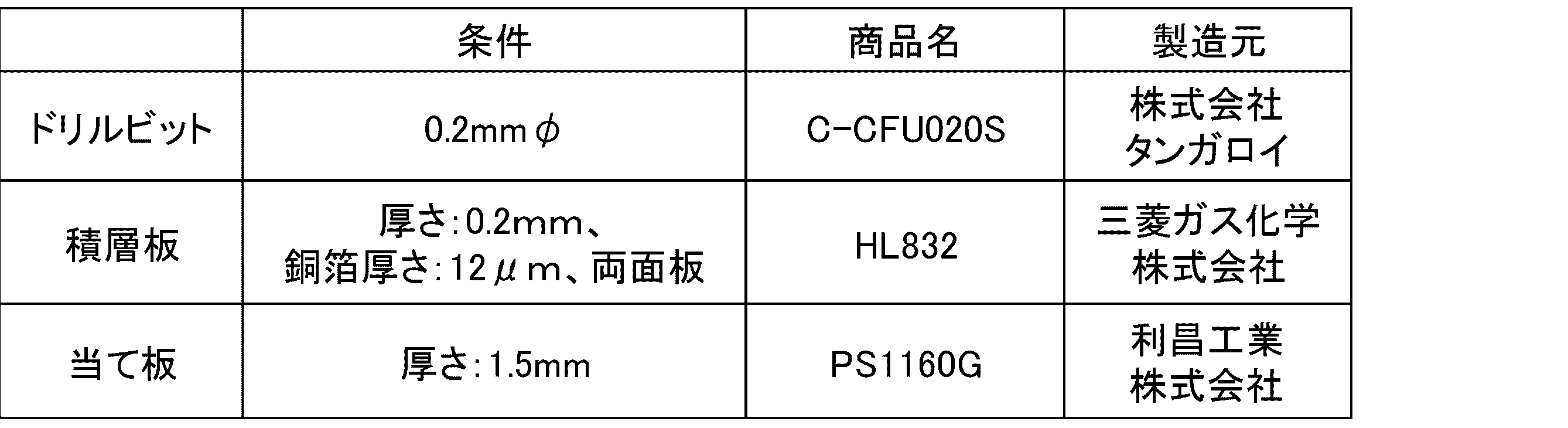
- Table 2 shows the specifications of the drill bit, the laminated plate, and the backing plate used for drilling holes in the examples and comparative examples.
- Example 1 30 parts by mass of polyethylene oxide having a weight average molecular weight of 150,000 (manufactured by Meisei Chemical Co., Ltd., trade name: Altop MG-150) and polyethylene glycol having a weight average molecular weight of 20,000 (trade name, manufactured by Sanyo Chemical Industries, Ltd.) : PEG 20000) 70 parts by mass was dissolved in a water / MeOH (methanol) mixed solution so that the concentration of the resin was 30% by mass to obtain a water-soluble resin solution. The ratio of water and MeOH at this time was 60/40 by mass ratio.
- tungsten disulfide manufactured by Nippon Lubricants Co., Ltd., average particle size: 2 ⁇ m, purity: 98%) as a solid lubricant is added to 100 parts by mass of the resin in the water-soluble resin solution. 10 parts by mass was added and sufficiently dispersed to obtain a resin composition solution.
- the resin composition side of this resin composition solution is an aluminum foil (part number of used aluminum foil: 1N30, thickness 0.1 mm, manufactured by Mitsubishi Aluminum Co., Ltd.) on which an epoxy resin film having a thickness of 0.01 mm is formed on one side.
- the resin composition layer after drying was applied to a thickness of 0.05 mm, dried at 120 ° C. for 5 minutes in a dryer, and then cooled to room temperature. An opening entry sheet was prepared. Note that a scanning electron micrograph (magnification: 5000 times) of a part of tungsten disulfide used in this example is shown in FIG.
- Example 2 a resin composition solution was prepared with the types and content ratios of the respective materials shown in Table 4, and the drilled drilling entry sheet having a resin composition layer thickness of 0.05 mm after drying. was made.
- FIG. 2 shows a scanning electron micrograph (magnification: 5000 times) of a part of molybdenum disulfide used in the examples.
- Example 1 a resin composition solution was prepared with the types and content ratios of the respective materials shown in Table 5, and the drilled drilling entry sheet having a resin composition layer thickness of 0.05 mm after drying. Was made.
- scanning electron micrographs (magnification: 5000 times) of part of tungsten trioxide and molybdenum trioxide used in the comparative example are shown in FIGS. 3 and 4, respectively.
- the solid lubricant is 0.0, 2.0, 5.0, 10.0, 20.0, 25.0, 40.0, 50 per type for 100 parts by mass of the resin of the resin composition. Any amount of 0.0, 60.0, 80.0, 100.0, 150.0, 200.0 parts by mass was added.
- Drill bit diameter 0.2 mm ⁇ (manufactured by Tungaloy Co., Ltd., trade name: C-CFU020S), Rotational speed: 200,000 rpm, Feed rate 13 ⁇ m / rev. , Ascending speed: 25.4 m / min, Processing substrate (laminated plate): product number: HL832, thickness 0.2 mm, copper foil thickness 12 ⁇ m, 6 layers,
- Each sample of the drill hole entry sheet prepared in Examples and Comparative Examples was evaluated as follows. (1) Hole position accuracy On the stacked copper-clad laminate, an entry sheet for drilling was placed with the resin composition layer facing upward, and drilling was performed. A drill bit of 6,000 hits was drilled per drill bit, and the drill bit was repeated using four drill bits. For each drill bit, the hole position and specified coordinates on the back surface (bottom surface) of the bottom plate of the copper-clad laminate for 1 to 1,500 hits, 1 to 3,000 hits, and 1 to 6,000 hits was measured using a hall analyzer (model number: HA-1AM, manufactured by Hitachi Via Mechanics Co., Ltd.).
- n indicates the number of drills used.
- the particle size of the solid lubricant was measured as follows. First, a solid lubricant sample is dispersed in a solution consisting of a 0.2% hexametaphosphoric acid solution and a few drops of 10% Triton, and a laser diffraction particle size distribution analyzer (model number: SALD-2100, manufactured by Shimadzu Corporation) was used to measure the maximum length of each projected solid lubricant particle. Next, a particle size distribution curve (number basis) was created from the measurement results. The range from the maximum particle size to the minimum particle size indicated by the particle size distribution curve was defined as the particle size range of the solid lubricant. Further, the particle size at the maximum peak of the particle size distribution curve (particle size with the largest number of solid lubricants on the basis of the number) was taken as the average particle size.
- Resin winding amount of drill bit (mm 3 ) 1/3 ⁇ (width of resin winding / 2) ⁇ (width of resin winding / 2) ⁇ 3.14 ⁇ (length of resin winding) / 2 ⁇ (drill bit Diameter / 2) x (diameter of drill bit / 2) x 3.14 x (length with resin wrap)
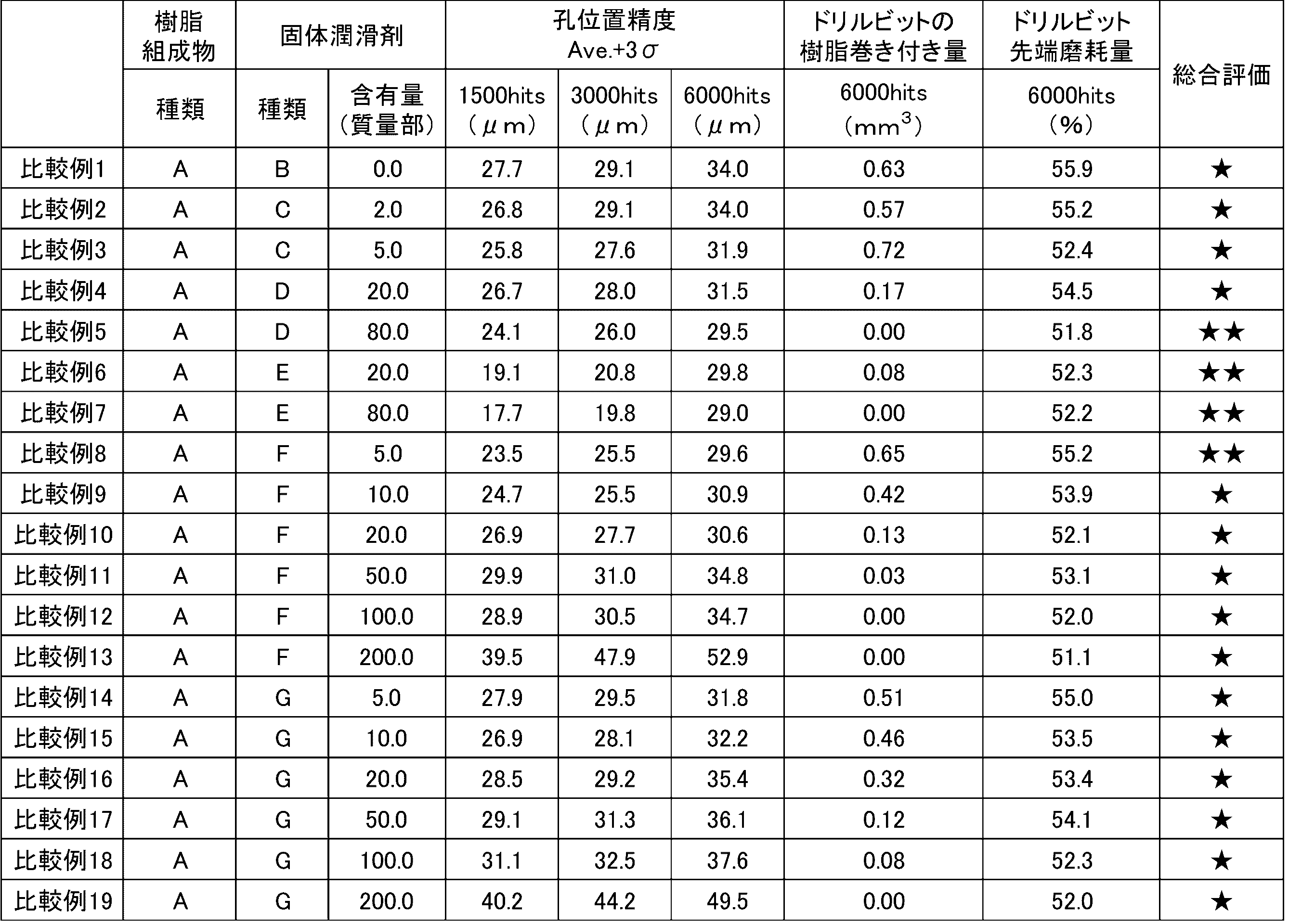
- the results are shown in Tables 4 and 5.
- the graph which compared the amount of resin winding of the drill bit of each example is shown in FIG.
- Wear amount of drill bit tip (%) [(Area of drill bit cutting edge before drilling-Area of non-wearing cutting edge after drilling) / Drill bit cutting edge before drilling Area] ⁇ 100 The results are shown in Tables 4 and 5. Moreover, the graph which compared the amount of wear of the drill bit tip of each example is shown in FIG.
- the hole position accuracy is significantly improved by adding 10 to 200 parts by mass of tungsten disulfide as a solid lubricant to 100 parts by mass of the resin of the resin composition.
- the difference in hole position accuracy between Example 1 and Comparative Example 1 is in terms of drilling life, and the drilling life in Example 1 using tungsten disulfide is Comparative Example 1 in which tungsten disulfide is not added. It was found that this corresponds to more than four times the drilling life. Further, the drilling life in Example 1 using the tungsten disulfide is longer than that in Comparative Examples 8 to 13 using molybdenum disulfide and Comparative Examples 14 to 19 using molybdenum trioxide.
- the drilling service life can be extended four times or more in Examples 10 to 24 using tungsten disulfide and molybdenum disulfide or graphite in combination as solid lubricants.
- tungsten disulfide and graphite are used in combination as a solid lubricant, the drilling life can be further extended, and tungsten disulfide and graphite are used in a mass ratio of 10:90 to 90:10. In this case, it has been found that the drilling life can be further extended.
- the entry sheets of Examples 1 to 24 have hole positions in both the stage where the drill bit wear has not progressed and the stage where wear has progressed, compared to the entry sheets of Comparative Examples 1 to 19. It was found that the accuracy was excellent.
- the drilling entry sheet to which tungsten disulfide of the present invention is added is a conventional molybdenum disulfide, zinc molybdate, molybdenum trioxide. It was found that the hole position accuracy was remarkably superior to that of the drill hole entry sheet to which was added.
- an entry sheet for drilling that has excellent hole position accuracy and reduced breakage of the drill bit as compared to a conventional drilling entry sheet.
- A drill bit
- B crystal of water-soluble resin (A)
- C metal foil
- D centripetal force
- E solid lubricant
Landscapes
- Engineering & Computer Science (AREA)
- Life Sciences & Earth Sciences (AREA)
- Forests & Forestry (AREA)
- Mechanical Engineering (AREA)
- Manufacturing & Machinery (AREA)
- Microelectronics & Electronic Packaging (AREA)
- Perforating, Stamping-Out Or Severing By Means Other Than Cutting (AREA)
- Lubricants (AREA)
- Drilling And Boring (AREA)
- Laminated Bodies (AREA)
Abstract
Description
(1)金属箔と、その金属箔の少なくとも片面上に形成された樹脂組成物を含む層と、を備えるドリル孔あけ用エントリーシートであって、前記樹脂組成物は、樹脂と、固体潤滑剤としての二硫化タングステンと、を含み、前記樹脂組成物に含まれる二硫化タングステンの含有量は、前記樹脂組成物に含まれる樹脂100質量部に対して10質量部~200質量部である、ドリル孔あけ用エントリーシート。
(2)前記樹脂組成物は、二硫化タングステンとは異なる固体潤滑剤を更に含む、(1)記載のドリル孔あけ用エントリーシート。
(3)前記樹脂組成物は、前記二硫化タングステンとは異なる固体潤滑剤として黒鉛を含む、(2)記載のドリル孔あけ用エントリーシート。
(4)レーザー回折式粒度分布測定装置を用いて測定した前記二硫化タングステンの粒度分布曲線の最大ピークにおける粒径が1~20μmである、(1)~(3)のいずれか一つに記載のドリル孔あけ用エントリーシート。
(5)前記樹脂組成物を含む層は、0.02~0.3mmの範囲の厚さを有する、(1)~(4)のいずれか一つに記載のドリル孔あけ用エントリーシート。
(6)前記樹脂組成物は、水溶性樹脂(A)を含む、(1)~(5)のいずれか一つに記載のドリル孔あけ用エントリーシート。
(7)前記水溶性樹脂(A)が、ポリエチレンオキサイド、ポリプロピレンオキサイド、ポリアクリル酸ソーダ、ポリアクリルアミド、ポリビニルピロリドン、セルロース誘導体、ポリテトラメチレングリコール及びポリアルキレングリコールのポリエステル、ポリエチレングリコール、ポリプロピレングリコール、ポリオキシエチレンのモノエーテル類、ポリオキシエチレンモノステアレート、ポリオキシエチレンソルビタンモノステアレート、ポリグリセリンモノステアレート類、及びポリオキシエチレンプロピレン共重合体からなる群より選択される1種又は2種以上である、(6)記載のドリル孔あけ用エントリーシート。
(8)前記樹脂組成物は、熱可塑性の非水溶性樹脂を含む、(1)~(7)のいずれか一つに記載のドリル孔あけ用エントリーシート。
(9)前記熱可塑性の非水溶性樹脂は、アミド系エラストマー、ブタジエン系エラストマー、エステル系エラストマー、オレフィン系エラストマー、ウレタン系エラストマー、スチレン系エラストマー、ポリブテン、低密度ポリエチレン、塩素化ポリエチレン、メタロセン系ポリオレフィン樹脂、エチレン・アクリル酸エステル・無水マレイン酸共重合体、エチレン・グリシジル(メタ)アクリレート共重合体、エチレン・酢酸ビニル共重合樹脂、変性エチレン・酢酸ビニル共重合樹脂、エチレン・(メタ)アクリル酸共重合樹脂、アイオノマー樹脂、及びエチレン・(メタ)アクリル酸エステル共重合樹脂からなる群より選択される1種又は2種以上である、(8)記載のドリル孔あけ用エントリーシート。
(10)前記樹脂組成物は、固体潤滑剤ではない非水溶性潤滑剤を含む、(1)~(9)のいずれか一つに記載のドリル孔あけ用エントリーシート。
(11)前記固体潤滑剤ではない非水溶性潤滑剤は、アマイド系化合物、脂肪酸系化合物、脂肪酸エステル系化合物、脂肪族炭化水素系化合物、及び高級脂肪族アルコールからなる群より選択される1種又は2種以上である、(10)記載のドリル孔あけ用エントリーシート。
(12)前記金属箔は、0.05~0.5mmの範囲の厚さを有する、(1)~(11)のいずれか一つに記載のドリル孔あけ用エントリーシート。
(13)前記金属箔と前記樹脂組成物を含む層との間に、樹脂皮膜である接着層を有し、前記樹脂皮膜は、0.002~0.02mmの範囲の厚さを有する、(1)~(12)のいずれか一つに記載のドリル孔あけ用エントリーシート。
(14)前記樹脂皮膜は、固体潤滑剤として二硫化タングステンを、前記樹脂皮膜に含まれる樹脂100質量部に対して、1質量部~50質量部含有する、請求項13記載のドリル孔あけ用エントリーシート。
(15)直径0.30mmφ以下のドリルビットによる孔あけ加工に用いられる、(1)~(14)のいずれか一つに記載のドリル孔あけ用エントリーシート。
(16)積層板又は多層板のドリル孔あけ加工に用いられる、(1)~(15)のいずれか一つに記載のドリル孔あけ用エントリーシート。
第一に、二硫化タングステンは、適度な硬度がある。そして、ドリル孔あけ加工時の使用温度においても、体積のある固体潤滑剤であり、すなわち、形状の固定された固体の状態を維持し、その位置も固定されやすくなる。その結果、本実施形態のドリル孔明け加工用エントリーシートを用いた孔あけ加工において、水溶性樹脂(A)Bを含む樹脂組成物が固体潤滑剤としての二硫化タングステンEを含む図11に示すような場合、ドリルビットAの先端は、樹脂組成物層に進入する際、形状や位置が固定された固体潤滑剤である二硫化タングステンEに食いつくことになる。そうすると、求芯性が良くなり求芯力Dが強まるので、従来のドリル孔あけ用エントリーシートを用いた孔あけ加工に比べて、特に初期から累積3,000hitsにおける孔位置精度に優れるものとなる。

重量平均分子量150,000のポリエチレンオキサイド(明成化学工業株式会社製、商品名:アルトップMG-150)30質量部と、重量平均分子量20,000のポリエチレングリコール(三洋化成工業株式会社製、商品名:PEG20000)70質量部とを、樹脂の濃度が30質量%になるように、水/MeOH(メタノール)混合溶液に溶解させて、水溶性樹脂溶液を得た。この時の水とMeOHとの比率を質量比で60/40とした。さらに、この水溶性樹脂溶液に、固体潤滑剤として二硫化タングステン(日本潤滑剤株式会社製、平均粒径:2μm、純度:98%)を水溶性樹脂溶液中の樹脂100質量部に対して、10質量部添加し、十分に分散させて樹脂組成物溶液を得た。この樹脂組成物溶液を、片面上に厚さ0.01mmのエポキシ樹脂皮膜を形成したアルミニウム箔(使用アルミニウム箔の品番:1N30、厚さ0.1mm、三菱アルミニウム株式会社製)の樹脂皮膜面側に、バーコーターを用いて、乾燥後の樹脂組成物層の厚さが0.05mmになるように塗布し、乾燥機にて120℃で5分間乾燥後、常温まで冷却することで、ドリル孔あけ用エントリーシートを作製した。なお、本実施例で用いた二硫化タングステンの一部の走査型電子顕微鏡写真(倍率:5000倍)を、図1に示す。
実施例1に準じて、表4に示す各材料の種類及び含有割合にて樹脂組成物溶液を調製し、乾燥後の樹脂組成物層の厚さが0.05mmであるドリル孔あけ用エントリーシートを作製した。なお、実施例で用いた二硫化モリブデンの一部の走査型電子顕微鏡写真(倍率:5000倍)を、図2に示す。
実施例1に準じて、表5に示す各材料の種類及び含有割合にて樹脂組成物溶液を調製し、乾燥後の樹脂組成物層の厚さが0.05mmであるドリル孔あけ用エントリーシートを作製した。なお、比較例で用いた三酸化タングステン及び三酸化モリブデンの一部の走査型電子顕微鏡写真(倍率:5000倍)を、それぞれ図3、図4に示す。
ドリルビット径:0.2mmφ(株式会社タンガロイ製、商品名:C-CFU020S)、
回転数:200,000rpm、
送り速度13μm/rev.、
上昇速度:25.4m/min、
加工基材(積層板):品番:HL832、厚さ0.2mm、銅箔厚さ12μm、6枚重ね、
1~1,500hits、1~3,000hits、1~6,000hitsの孔位置精度、ドリルビットに対する樹脂の巻き付き、ドリルビット先端の摩耗の評価結果を基に、表3の評価基準に従って総合評価を行った。その結果をそれぞれ表4、5に示す。なお、総合評価は、各評価項目から判定される優、良、可及び不可のうち、最も下位のものを反映させた。
(1)孔位置精度
積み重ねた銅張積層板上に、ドリル孔あけ用エントリーシートをその樹脂組成物層を上にして配置し、ドリル孔あけ加工を行った。ドリルビット1本につき6,000hitsの孔あけ加工をし、4本のドリルビットを用いて繰り返した。ドリルビット1本分ごとに、1~1,500hits、1~3,000hits、1~6,000hitsの孔につき、積み重ねた銅張積層板の最下板の裏面(下面)における孔位置と指定座標とのズレを、ホールアナライザー(型番:HA-1AM、日立ビアメカニクス株式会社製)を用いて測定した。そのズレについて、平均値及び標準偏差(σ)を計算し、「平均値+3σ」を算出した。その後、ドリル孔あけ加工全体の孔位置精度として、使用したn本のドリルビットについてそれぞれの「平均値+3σ」の値に対する平均値を算出した。結果を表4及び5に示す。また、各例の孔位置精度を比較したグラフを図5~図7に示す。なお、孔位置精度の算出に用いた式は、下記のとおりである。

固体潤滑剤の粒度は下記のようにして測定した。まず、固体潤滑剤の試料を0.2%ヘキサメタりん酸溶液と10%トリトン数滴とからなる溶液に分散させ、レーザー回折式粒度分布測定装置(型番:SALD-2100、株式会社島津製作所製)を使用して、投影した固体潤滑剤の粒子それぞれの最大長さを測定した。次いで、測定結果から粒度分布曲線(個数基準)を作成した。粒度分布曲線の示す最大粒径から最小粒径の範囲を固体潤滑剤の粒径の範囲とした。また、粒度分布曲線の最大ピークにおける粒径(個数基準で固体潤滑剤が最も多い粒径)を平均粒径とした。
6,000hitsの孔あけ加工後のドリルビットについて、ドリルビットの側面から、倍率25倍のマイクロスコープ(型番VHK-100、株式会社キーエンス製)を用いて、ドリルビットへの樹脂の巻き付きの様子を観察した。ドリルビットの根元に付着した樹脂巻き付きの幅と長さを計測し、ドリルビットの樹脂巻き付き量を、下記式から算出した。なお、長さ、幅及び直径の単位はmmである。
ドリルビットの樹脂巻き付き量(mm3)=1/3×(樹脂巻き付きの幅/2)×(樹脂巻き付きの幅/2)×3.14×(樹脂巻き付きの長さ)/2-(ドリルビットの直径/2)×(ドリルビットの直径/2)×3.14×(樹脂巻き付きの長さ)
結果を表4及び5に示す。また、各例のドリルビットの樹脂巻き付き量を比較したグラフを図8に示す。
孔あけ加工前のドリルビットの刃先を、その先端側から、倍率200倍で、V-LASER顕微鏡(型番:VK-9700、株式会社キーエンス製)にて観察し、ドリルビット先端の切刃の面積を計測した。次いで、6,000hitの孔あけ加工後のドリルビットの先端から加工屑などを取り除いた後、そのドリルビットの刃先を、上記と同様にして観察し、ドリルビット先端の磨耗していない切刃の面積を計測した。ドリルビット先端の摩耗量を、下記式から算出した。面積の単位は全て同じである。
ドリルビット先端の磨耗量(%)=[(孔あけ加工前のドリルビットの切刃の面積-孔あけ加工後の磨耗していない切刃の面積)/孔あけ加工前のドリルビットの切刃の面積]×100
結果を表4及び5に示す。また、各例のドリルビット先端の磨耗量を比較したグラフを図9に示す。


Claims (16)
- 金属箔と、その金属箔の少なくとも片面上に形成された樹脂組成物を含む層と、を備えるドリル孔あけ用エントリーシートであって、
前記樹脂組成物は、樹脂と、固体潤滑剤としての二硫化タングステンと、を含み、
前記樹脂組成物に含まれる二硫化タングステンの含有量は、前記樹脂組成物に含まれる樹脂100質量部に対して10質量部~200質量部である、
ドリル孔あけ用エントリーシート。 - 前記樹脂組成物は、二硫化タングステンとは異なる固体潤滑剤を更に含む、請求項1記載のドリル孔あけ用エントリーシート。
- 前記樹脂組成物は、前記二硫化タングステンとは異なる固体潤滑剤として黒鉛を含む、請求項2記載のドリル孔あけ用エントリーシート。
- レーザー回折式粒度分布測定装置を用いて測定した前記二硫化タングステンの粒度分布曲線の最大ピークにおける粒径が1~20μmである、請求項1~3のいずれか一項に記載のドリル孔あけ用エントリーシート。
- 前記樹脂組成物を含む層は、0.02~0.3mmの範囲の厚さを有する、請求項1~4のいずれか一項に記載のドリル孔あけ用エントリーシート。
- 前記樹脂組成物は、水溶性樹脂(A)を含む、請求項1~5のいずれか一項に記載のドリル孔あけ用エントリーシート。
- 前記水溶性樹脂(A)が、ポリエチレンオキサイド、ポリプロピレンオキサイド、ポリアクリル酸ソーダ、ポリアクリルアミド、ポリビニルピロリドン、セルロース誘導体、ポリテトラメチレングリコール及びポリアルキレングリコールのポリエステル、ポリエチレングリコール、ポリプロピレングリコール、ポリオキシエチレンのモノエーテル類、ポリオキシエチレンモノステアレート、ポリオキシエチレンソルビタンモノステアレート、ポリグリセリンモノステアレート類、及びポリオキシエチレンプロピレン共重合体からなる群より選択される1種又は2種以上である、請求項6記載のドリル孔あけ用エントリーシート。
- 前記樹脂組成物は、熱可塑性の非水溶性樹脂を含む、請求項1~7のいずれか一項に記載のドリル孔あけ用エントリーシート。
- 前記熱可塑性の非水溶性樹脂は、アミド系エラストマー、ブタジエン系エラストマー、エステル系エラストマー、オレフィン系エラストマー、ウレタン系エラストマー、スチレン系エラストマー、ポリブテン、低密度ポリエチレン、塩素化ポリエチレン、メタロセン系ポリオレフィン樹脂、エチレン・アクリル酸エステル・無水マレイン酸共重合体、エチレン・グリシジル(メタ)アクリレート共重合体、エチレン・酢酸ビニル共重合樹脂、変性エチレン・酢酸ビニル共重合樹脂、エチレン・(メタ)アクリル酸共重合樹脂、アイオノマー樹脂、及びエチレン・(メタ)アクリル酸エステル共重合樹脂からなる群より選択される1種又は2種以上である、請求項8記載のドリル孔あけ用エントリーシート。
- 前記樹脂組成物は、固体潤滑剤ではない非水溶性潤滑剤を含む、請求項1~9のいずれか一項に記載のドリル孔あけ用エントリーシート。
- 前記固体潤滑剤ではない非水溶性潤滑剤は、アマイド系化合物、脂肪酸系化合物、脂肪酸エステル系化合物、脂肪族炭化水素系化合物、及び高級脂肪族アルコールからなる群より選択される1種又は2種以上である、請求項10に記載のドリル孔あけ用エントリーシート。
- 前記金属箔は、0.05~0.5mmの範囲の厚さを有する、請求項1~11のいずれか一項に記載のドリル孔あけ用エントリーシート。
- 前記金属箔と前記樹脂組成物を含む層との間に、樹脂皮膜である接着層を有し、前記樹脂皮膜は、0.002~0.02mmの範囲の厚さを有する、請求項1~12のいずれか一項に記載のドリル孔あけ用エントリーシート。
- 前記樹脂皮膜は、固体潤滑剤として二硫化タングステンを、前記樹脂皮膜に含まれる樹脂100質量部に対して、1質量部~50質量部含有する、請求項13記載のドリル孔あけ用エントリーシート。
- 直径0.30mmφ以下のドリルビットによる孔あけ加工に用いられる、請求項1~14のいずれか一項に記載のドリル孔あけ用エントリーシート。
- 積層板又は多層板のドリル孔あけ加工に用いられる、請求項1~15のいずれか一項に記載のドリル孔あけ用エントリーシート。
Priority Applications (5)
| Application Number | Priority Date | Filing Date | Title |
|---|---|---|---|
| SG11201608111PA SG11201608111PA (en) | 2014-03-31 | 2015-03-30 | Entry sheet for drilling |
| CN201580016883.8A CN106132646B (zh) | 2014-03-31 | 2015-03-30 | 钻孔用盖板 |
| KR1020167024356A KR102365234B1 (ko) | 2014-03-31 | 2015-03-30 | 드릴 구멍 내기용 엔트리 시트 |
| JP2016511888A JP6931996B2 (ja) | 2014-03-31 | 2015-03-30 | ドリル孔あけ用エントリーシート |
| US15/300,629 US10674609B2 (en) | 2014-03-31 | 2015-03-30 | Entry sheet for drilling |
Applications Claiming Priority (2)
| Application Number | Priority Date | Filing Date | Title |
|---|---|---|---|
| JP2014-072337 | 2014-03-31 | ||
| JP2014072337 | 2014-03-31 |
Publications (1)
| Publication Number | Publication Date |
|---|---|
| WO2015152162A1 true WO2015152162A1 (ja) | 2015-10-08 |
Family
ID=54240485
Family Applications (1)
| Application Number | Title | Priority Date | Filing Date |
|---|---|---|---|
| PCT/JP2015/059950 Ceased WO2015152162A1 (ja) | 2014-03-31 | 2015-03-30 | ドリル孔あけ用エントリーシート |
Country Status (7)
| Country | Link |
|---|---|
| US (1) | US10674609B2 (ja) |
| JP (1) | JP6931996B2 (ja) |
| KR (1) | KR102365234B1 (ja) |
| CN (1) | CN106132646B (ja) |
| SG (1) | SG11201608111PA (ja) |
| TW (1) | TWI671191B (ja) |
| WO (1) | WO2015152162A1 (ja) |
Cited By (7)
| Publication number | Priority date | Publication date | Assignee | Title |
|---|---|---|---|---|
| WO2018088267A1 (ja) * | 2016-11-14 | 2018-05-17 | 三菱瓦斯化学株式会社 | 構成刃先形成用部材及び構成刃先形成方法 |
| CN108290229A (zh) * | 2015-11-26 | 2018-07-17 | 三菱瓦斯化学株式会社 | 纤维增强复合材料的切削加工方法 |
| WO2018221440A1 (ja) * | 2017-06-01 | 2018-12-06 | 三菱瓦斯化学株式会社 | 微細径用ドリル孔あけ用エントリーシート、及びそれを用いたドリル孔あけ加工方法 |
| WO2019187670A1 (ja) * | 2018-03-30 | 2019-10-03 | 三菱瓦斯化学株式会社 | ドリル孔あけ用エントリーシート及びそれを用いたドリル孔あけ加工方法 |
| US11225625B2 (en) | 2017-05-25 | 2022-01-18 | Mitsubishi Gas Chemical Company, Inc. | Lubricant material for assisting machining process, lubricant sheet for assisting machining process, and machining method |
| US11325199B2 (en) | 2016-02-17 | 2022-05-10 | Mitsubishi Gas Chemical Company, Inc. | Cutting work method and method for producing cut product |
| US11383307B2 (en) | 2015-09-02 | 2022-07-12 | Mitsubishi Gas Chemical Company, Inc. | Entry sheet for drilling and method for drilling processing using same |
Families Citing this family (3)
| Publication number | Priority date | Publication date | Assignee | Title |
|---|---|---|---|---|
| US10774831B2 (en) * | 2017-05-11 | 2020-09-15 | Tenax Energy Solutions, LLC | Method for impregnating the stator of a progressive cavity assembly with nanoparticles |
| JP2020004841A (ja) * | 2018-06-28 | 2020-01-09 | 日本メクトロン株式会社 | 穴開け加工用エントリーシート、穴開け加工用エントリーシートの製造方法及び電子基板の製造方法 |
| US11377614B2 (en) | 2020-05-14 | 2022-07-05 | Megaology Chemical Co., Ltd. | Lubrication board |
Citations (3)
| Publication number | Priority date | Publication date | Assignee | Title |
|---|---|---|---|---|
| JP2010540260A (ja) * | 2007-09-28 | 2010-12-24 | トライ−スター ラミネーツ、 インク. | プリント回路基板に孔を開けるための改善されたシステムおよび方法 |
| WO2011158510A1 (ja) * | 2010-06-18 | 2011-12-22 | 三菱瓦斯化学株式会社 | ドリル孔あけ用エントリーシート |
| WO2013146612A1 (ja) * | 2012-03-27 | 2013-10-03 | 三菱瓦斯化学株式会社 | ドリル孔あけ用エントリーシート |
Family Cites Families (88)
| Publication number | Priority date | Publication date | Assignee | Title |
|---|---|---|---|---|
| US3608054A (en) * | 1968-04-29 | 1971-09-21 | Westinghouse Electric Corp | Cast lubricating films and composites thereof |
| DE2723983C2 (de) | 1977-05-27 | 1984-09-27 | Rheinmetall GmbH, 4000 Düsseldorf | Treibladungsanzünder für hülsenlose Kartuschen von getrennt zu ladender Munition |
| US4243434A (en) | 1978-05-30 | 1981-01-06 | Rocol Limited | Composition for coating metal-working tools |
| US4329238A (en) | 1979-07-30 | 1982-05-11 | Mitrofanova Alla K | Antifriction paste and solid antifriction coating prepared from same |
| US4772496A (en) | 1985-06-15 | 1988-09-20 | Showa Denko Kabushiki Kaisha | Molded product having printed circuit board |
| JPS62114245A (ja) | 1985-11-14 | 1987-05-26 | Oki Electric Ind Co Ltd | 混成集積回路用基板の製造方法 |
| US4875982A (en) | 1987-02-06 | 1989-10-24 | Velie Circuits, Inc. | Plating high aspect ratio holes in circuit boards |
| JPS63277298A (ja) | 1987-05-08 | 1988-11-15 | Nikka Chem Ind Co Ltd | 塑性加工用水溶性潤滑剤 |
| JPH0674389B2 (ja) * | 1988-12-09 | 1994-09-21 | タカタ株式会社 | 潤滑用被覆組成物 |
| US5427698A (en) | 1988-12-09 | 1995-06-27 | Takata Corporation | Coating composition for lubrication |
| US4915550A (en) | 1988-12-22 | 1990-04-10 | Hitachi Seiko Ltd. | Pressure foot of printed circuit board drilling apparatus |
| US5173204A (en) | 1989-06-08 | 1992-12-22 | Century Oils (Canada), Inc. | Solid lubricant with high and positive friction characteristic |
| JP2855824B2 (ja) | 1990-08-08 | 1999-02-10 | 三菱瓦斯化学株式会社 | プリント配線板の孔明け加工法 |
| CN1047716C (zh) | 1991-02-07 | 1999-12-22 | 霍尔德斯科技有限公司 | 在印刷电路板钻孔过程中贴靠印刷电路板的引入板或垫板 |
| JP3169026B2 (ja) | 1991-12-18 | 2001-05-21 | 三菱瓦斯化学株式会社 | 小孔あけ用滑剤シート |
| JPH0617847U (ja) | 1992-08-11 | 1994-03-08 | 株式会社オーエム製作所 | プリント基板穴明け機におけるドリル冷却装置 |
| JP3251082B2 (ja) | 1992-12-17 | 2002-01-28 | 日本パーカライジング株式会社 | アルミニウム板又はアルミニウム合金板の潤滑皮膜形成方法。 |
| JPH0677920U (ja) | 1993-04-19 | 1994-11-01 | マツダ工業株式会社 | 穿孔メタル及びそれを用いた複層板 |
| US5454161A (en) | 1993-04-29 | 1995-10-03 | Fujitsu Limited | Through hole interconnect substrate fabrication process |
| CA2140117A1 (en) | 1994-06-09 | 1995-12-10 | Hiroyuki Tanabe | Coated aluminum material |
| JPH08281508A (ja) | 1995-04-11 | 1996-10-29 | Bridgestone Cycle Co | 自転車用フレ−ム |
| US5985080A (en) | 1996-11-11 | 1999-11-16 | Toyo Seikan Kaisha, Ltd. | Process for producing a resin-metal laminate |
| JP3681848B2 (ja) * | 1996-12-27 | 2005-08-10 | 株式会社松尾工業所 | 丸棒材及び旋盤加工製品 |
| JP3193344B2 (ja) | 1998-05-25 | 2001-07-30 | 東レ・デュポン株式会社 | アラミド繊維用表面処理剤、表面処理されたアラミド繊維、アラミド繊維の表面処理方法および繊維強化複合材料 |
| JP3019070B2 (ja) | 1998-08-17 | 2000-03-13 | 皆見電子工業株式会社 | 穴あけ加工用の当て板 |
| US6200074B1 (en) | 1999-04-07 | 2001-03-13 | James J. Miller | Method for drilling circuit boards |
| JP2000334697A (ja) | 1999-05-25 | 2000-12-05 | Hitachi Via Mechanics Ltd | プリント基板押え装置 |
| JP2001328015A (ja) | 2000-05-19 | 2001-11-27 | Hitachi Tool Engineering Ltd | ツイストドリル |
| JP4201462B2 (ja) | 2000-06-05 | 2008-12-24 | 利昌工業株式会社 | ドリル加工用エントリーボード |
| JP2002038255A (ja) * | 2000-07-27 | 2002-02-06 | Toshiba Tungaloy Co Ltd | 耐摩耗性潤滑膜および被覆部材 |
| JP5176192B2 (ja) | 2000-12-25 | 2013-04-03 | 久米雄 臼田 | 繊維強化金属複合材料に用いられる繊維径が30μm以下で繊維表面の炭素成分を除去したセラミックス繊維とその製法 |
| JP4694702B2 (ja) | 2001-01-17 | 2011-06-08 | ダイジ▲ェ▼ット工業株式会社 | 耐熱金属用ドリル |
| JP2002292599A (ja) | 2001-01-29 | 2002-10-08 | Hitachi Chem Co Ltd | 積層体穴あけ加工用シート |
| DE10131758A1 (de) | 2001-06-30 | 2003-01-16 | Sgl Carbon Ag | Faserverstärkter, wenigstens im Randbereich aus einer Metall-Verbundkeramik bestehender Werkstoff |
| JP4968652B2 (ja) | 2001-07-17 | 2012-07-04 | 日本合成化学工業株式会社 | プリント配線基板穿孔用水分散性樹脂組成物、該組成物よりなるシート及びかかるシートを用いたプリント配線基板の穿孔方法 |
| JP2003094217A (ja) | 2001-09-26 | 2003-04-03 | Mitsubishi Paper Mills Ltd | 孔開け加工用当て板およびその製造方法 |
| JP2003094389A (ja) | 2001-09-26 | 2003-04-03 | Mitsubishi Paper Mills Ltd | 孔開け加工用当て板およびその製造方法 |
| JP4010142B2 (ja) | 2001-12-13 | 2007-11-21 | 三菱瓦斯化学株式会社 | ドリル孔明け用エントリーシート |
| JP4106518B2 (ja) | 2001-10-31 | 2008-06-25 | 三菱瓦斯化学株式会社 | 孔明け用エントリーシート及びドリル孔明け加工法 |
| US6866450B2 (en) | 2001-10-31 | 2005-03-15 | Mitsubishi Gas Chemical Company, Inc. | Entry sheet for drilling and method for drilling hole |
| US20030129030A1 (en) | 2002-01-04 | 2003-07-10 | Jja, Inc. | Lubricant sheet and method of forming the same |
| JP2003225814A (ja) | 2002-02-01 | 2003-08-12 | Nippon Shokubai Co Ltd | 基板孔あけ用潤滑剤および基板孔あけ用潤滑シート |
| JP2003301187A (ja) | 2002-02-05 | 2003-10-21 | Nippon Shokubai Co Ltd | 基板孔あけ用潤滑剤および基板孔あけ用潤滑シート |
| US20050003169A1 (en) * | 2003-01-28 | 2005-01-06 | Nobuyuki Ikeguchi | Lubricant sheet for drilling and method of drilling |
| JP4644414B2 (ja) | 2003-01-28 | 2011-03-02 | 三菱瓦斯化学株式会社 | 着色された孔あけ用滑剤シート |
| JP2004338271A (ja) | 2003-05-16 | 2004-12-02 | Mitsubishi Rayon Co Ltd | 穿孔加工に好適な繊維強化樹脂複合材及び穿孔繊維強化樹脂複合材の製造方法 |
| JP2005028861A (ja) | 2003-07-07 | 2005-02-03 | Zenshi Okada | 装飾用パネルおよびその製造方法 |
| JP2005081508A (ja) | 2003-09-09 | 2005-03-31 | Noritake Co Ltd | 配線基板の孔明け方法 |
| JP4639329B2 (ja) | 2004-12-01 | 2011-02-23 | 長崎県 | チタン合金の水中におけるエンドミル切削加工法 |
| JP2008183626A (ja) | 2005-11-25 | 2008-08-14 | Hamamatsu Kagaku Gijutsu Kenkyu Shinkokai | 超音波振動切削方法及びそれにより得られる繊維強化樹脂 |
| TWI298007B (en) | 2006-04-03 | 2008-06-11 | Uniplus Electronics Co Ltd | Heat-dissipating accessory plate for high speed drilling |
| JP5011823B2 (ja) | 2006-05-30 | 2012-08-29 | 三菱瓦斯化学株式会社 | ドリル孔明け用エントリーシートの製造方法 |
| JP5018226B2 (ja) | 2006-06-30 | 2012-09-05 | 旭硝子株式会社 | 導電膜形成用インク |
| US7750650B2 (en) | 2006-10-26 | 2010-07-06 | Verigy (Singapore) Pte. Ltd. | Solid high aspect ratio via hole used for burn-in boards, wafer sort probe cards, and package test load boards with electronic circuitry |
| JP5012100B2 (ja) | 2007-03-09 | 2012-08-29 | 三菱瓦斯化学株式会社 | ドリル孔明け用エントリーシート |
| TWM320275U (en) | 2007-04-23 | 2007-10-01 | Uniplus Electronics Co Ltd | Heat-dissipation auxiliary board for high-speed drilling |
| TW200843591A (en) * | 2007-04-23 | 2008-11-01 | Uniplus Electronics Co Ltd | Auxiliary material for prolonging durability of high-speed drill bits |
| JP5198809B2 (ja) | 2007-07-12 | 2013-05-15 | 三菱瓦斯化学株式会社 | ドリル穴明け用エントリーシート |
| JP2009039810A (ja) | 2007-08-08 | 2009-02-26 | Kumamoto Univ | 繊維強化複合材の穴あけ方法 |
| JP2009099624A (ja) | 2007-10-12 | 2009-05-07 | Fujitsu Ltd | 配線基板およびその製造方法 |
| JP2009127116A (ja) | 2007-11-27 | 2009-06-11 | Honda Motor Co Ltd | 金属基炭素繊維強化複合材料の製造方法 |
| JP5195404B2 (ja) | 2007-12-26 | 2013-05-08 | 三菱瓦斯化学株式会社 | ドリル孔明け用エントリーシートの製造方法 |
| JP2009176605A (ja) | 2008-01-25 | 2009-08-06 | Asahi Glass Co Ltd | 導電膜付基板の製造方法 |
| JP2009241239A (ja) | 2008-03-31 | 2009-10-22 | Fuji Seiko Ltd | ドリルおよび穴あけ加工方法 |
| RU2507065C2 (ru) | 2008-06-10 | 2014-02-20 | Мицубиси Гэс Кемикал Компани, Инк. | Трафарет для высверливания отверстий |
| FR2937046B1 (fr) | 2008-10-15 | 2012-10-19 | Vallourec Mannesmann Oil & Gas | Composition de lubrification a coefficient de frottement adaptable, pour un element filete d'un composant de joint filete tubulaire |
| JP5495571B2 (ja) | 2009-01-07 | 2014-05-21 | エヌシー産業株式会社 | 多孔薄状物の製造方法 |
| JP2010179379A (ja) | 2009-02-03 | 2010-08-19 | Shigehiko Sakamoto | 穴あけ加工方法 |
| TW201031490A (en) | 2009-02-27 | 2010-09-01 | Foxnum Technology Co Ltd | Cutting apparatus and cutting method thereof |
| TWI499690B (zh) | 2009-03-13 | 2015-09-11 | Ajinomoto Kk | Paste metal laminates |
| JP3153156U (ja) | 2009-05-29 | 2009-08-27 | 合正科技股▲ふん▼有限公司 | 高速孔開け用放熱補助板材 |
| WO2010140333A1 (ja) | 2009-06-01 | 2010-12-09 | 三菱瓦斯化学株式会社 | ドリル孔明け用エントリーシート |
| JP4782222B2 (ja) | 2009-08-03 | 2011-09-28 | ユニオンツール株式会社 | 穴明け工具用非晶質炭素皮膜及び穴明け工具 |
| RU2543201C2 (ru) * | 2009-09-14 | 2015-02-27 | Мицубиси Гэс Кемикал Компани, Инк. | Композиция полиамидной смолы |
| CN102049550B (zh) * | 2009-10-29 | 2012-10-17 | 富葵精密组件(深圳)有限公司 | 用于辅助电路板钻孔的基板及其制作方法 |
| DE102010031130A1 (de) | 2010-07-08 | 2012-01-12 | Msc Polymer Ag | Mechanische Bearbeitung von flächigen Basismaterialien |
| JP5622463B2 (ja) | 2010-07-09 | 2014-11-12 | 株式会社スギノマシン | 穴あけ加工制御方法および穴あけ加工装置 |
| JP5482546B2 (ja) | 2010-07-28 | 2014-05-07 | 富士通株式会社 | プリント配線板、プリント配線板の製造方法及び電子機器 |
| JP5523260B2 (ja) | 2010-09-21 | 2014-06-18 | 宗春 沓名 | 繊維強化複合材料のレーザ溶接方法 |
| KR101852334B1 (ko) * | 2010-12-28 | 2018-04-26 | 미쯔비시 가스 케미칼 컴파니, 인코포레이티드 | 드릴 엔트리 시트 |
| JP5750896B2 (ja) | 2011-01-13 | 2015-07-22 | 富士通株式会社 | 回路基板及びその製造方法、並びに電子装置 |
| JP5729554B2 (ja) | 2011-03-31 | 2015-06-03 | 国立研究開発法人産業技術総合研究所 | 繊維強化型複合材料の加工方法及びその工具 |
| KR102101599B1 (ko) | 2012-03-21 | 2020-04-17 | 미츠비시 가스 가가쿠 가부시키가이샤 | 드릴 구멍 형성용 엔트리 시트 및 드릴 구멍 형성 방법 |
| CN103317791A (zh) * | 2012-03-22 | 2013-09-25 | 叶云照 | 具有双面金属材的钻孔用盖板 |
| JP5451831B2 (ja) | 2012-08-16 | 2014-03-26 | 住友電気工業株式会社 | 繊維強化複合材の穴あけ工具と穴あけ方法 |
| JP3181967U (ja) * | 2012-12-18 | 2013-02-28 | 雲照 葉 | 多層式ドリルリング用蓋板 |
| SG11201506893UA (en) | 2013-03-27 | 2015-09-29 | Mitsubishi Gas Chemical Co | Entry sheet for cutting fiber reinforced composite material or metal, and cutting method for cutting fiber reinforced material or metal |
| CN103554844B (zh) | 2013-10-29 | 2016-02-17 | 广东生益科技股份有限公司 | 一种热固性树脂组合物及其用途 |
-
2015
- 2015-03-30 WO PCT/JP2015/059950 patent/WO2015152162A1/ja not_active Ceased
- 2015-03-30 SG SG11201608111PA patent/SG11201608111PA/en unknown
- 2015-03-30 CN CN201580016883.8A patent/CN106132646B/zh not_active Expired - Fee Related
- 2015-03-30 US US15/300,629 patent/US10674609B2/en not_active Expired - Fee Related
- 2015-03-30 KR KR1020167024356A patent/KR102365234B1/ko not_active Expired - Fee Related
- 2015-03-30 JP JP2016511888A patent/JP6931996B2/ja not_active Expired - Fee Related
- 2015-03-31 TW TW104110351A patent/TWI671191B/zh not_active IP Right Cessation
Patent Citations (3)
| Publication number | Priority date | Publication date | Assignee | Title |
|---|---|---|---|---|
| JP2010540260A (ja) * | 2007-09-28 | 2010-12-24 | トライ−スター ラミネーツ、 インク. | プリント回路基板に孔を開けるための改善されたシステムおよび方法 |
| WO2011158510A1 (ja) * | 2010-06-18 | 2011-12-22 | 三菱瓦斯化学株式会社 | ドリル孔あけ用エントリーシート |
| WO2013146612A1 (ja) * | 2012-03-27 | 2013-10-03 | 三菱瓦斯化学株式会社 | ドリル孔あけ用エントリーシート |
Cited By (17)
| Publication number | Priority date | Publication date | Assignee | Title |
|---|---|---|---|---|
| US11383307B2 (en) | 2015-09-02 | 2022-07-12 | Mitsubishi Gas Chemical Company, Inc. | Entry sheet for drilling and method for drilling processing using same |
| CN108290229A (zh) * | 2015-11-26 | 2018-07-17 | 三菱瓦斯化学株式会社 | 纤维增强复合材料的切削加工方法 |
| CN108290229B (zh) * | 2015-11-26 | 2022-06-28 | 三菱瓦斯化学株式会社 | 纤维增强复合材料的切削加工方法 |
| US11325199B2 (en) | 2016-02-17 | 2022-05-10 | Mitsubishi Gas Chemical Company, Inc. | Cutting work method and method for producing cut product |
| WO2018088267A1 (ja) * | 2016-11-14 | 2018-05-17 | 三菱瓦斯化学株式会社 | 構成刃先形成用部材及び構成刃先形成方法 |
| US11819930B2 (en) | 2016-11-14 | 2023-11-21 | Mitsubishi Gas Chemical Company, Inc. | Material for built-up edge formation and built-up edge formation method |
| JPWO2018088267A1 (ja) * | 2016-11-14 | 2019-09-26 | 三菱瓦斯化学株式会社 | 構成刃先形成用部材及び構成刃先形成方法 |
| JP7029113B2 (ja) | 2016-11-14 | 2022-03-03 | 三菱瓦斯化学株式会社 | 構成刃先形成用部材及び構成刃先形成方法 |
| US11225625B2 (en) | 2017-05-25 | 2022-01-18 | Mitsubishi Gas Chemical Company, Inc. | Lubricant material for assisting machining process, lubricant sheet for assisting machining process, and machining method |
| JPWO2018221440A1 (ja) * | 2017-06-01 | 2020-03-26 | 三菱瓦斯化学株式会社 | 微細径用ドリル孔あけ用エントリーシート、及びそれを用いたドリル孔あけ加工方法 |
| JP7157931B2 (ja) | 2017-06-01 | 2022-10-21 | 三菱瓦斯化学株式会社 | 微細径用ドリル孔あけ用エントリーシート、及びそれを用いたドリル孔あけ加工方法 |
| WO2018221440A1 (ja) * | 2017-06-01 | 2018-12-06 | 三菱瓦斯化学株式会社 | 微細径用ドリル孔あけ用エントリーシート、及びそれを用いたドリル孔あけ加工方法 |
| CN111918752B (zh) * | 2018-03-30 | 2022-02-25 | 三菱瓦斯化学株式会社 | 钻孔用盖板和使用其的钻孔加工方法 |
| JPWO2019187670A1 (ja) * | 2018-03-30 | 2021-05-13 | 三菱瓦斯化学株式会社 | ドリル孔あけ用エントリーシート及びそれを用いたドリル孔あけ加工方法 |
| CN111918752A (zh) * | 2018-03-30 | 2020-11-10 | 三菱瓦斯化学株式会社 | 钻孔用盖板和使用其的钻孔加工方法 |
| WO2019187670A1 (ja) * | 2018-03-30 | 2019-10-03 | 三菱瓦斯化学株式会社 | ドリル孔あけ用エントリーシート及びそれを用いたドリル孔あけ加工方法 |
| JP7129030B2 (ja) | 2018-03-30 | 2022-09-01 | 三菱瓦斯化学株式会社 | ドリル孔あけ用エントリーシート及びそれを用いたドリル孔あけ加工方法 |
Also Published As
| Publication number | Publication date |
|---|---|
| US10674609B2 (en) | 2020-06-02 |
| TWI671191B (zh) | 2019-09-11 |
| TW201544317A (zh) | 2015-12-01 |
| CN106132646B (zh) | 2019-01-22 |
| JP6931996B2 (ja) | 2021-09-08 |
| SG11201608111PA (en) | 2016-11-29 |
| KR20160138395A (ko) | 2016-12-05 |
| CN106132646A (zh) | 2016-11-16 |
| KR102365234B1 (ko) | 2022-02-18 |
| JPWO2015152162A1 (ja) | 2017-04-13 |
| US20170111997A1 (en) | 2017-04-20 |
Similar Documents
| Publication | Publication Date | Title |
|---|---|---|
| JP5896345B2 (ja) | ドリル孔あけ用エントリーシート | |
| JP6931996B2 (ja) | ドリル孔あけ用エントリーシート | |
| JP5842828B2 (ja) | ドリル孔あけ用エントリーシート | |
| US9826643B2 (en) | Entry sheet for drilling and drilling method | |
| KR101906124B1 (ko) | 드릴 천공용 엔트리 시트, 및 그것을 사용한 드릴 천공 가공 방법 | |
| KR101619749B1 (ko) | 천공 엔트리 시트 | |
| KR100628611B1 (ko) | 프린트 배선 기판의 천공 가공에 사용하는 수지 피복 금속판 | |
| JP7129030B2 (ja) | ドリル孔あけ用エントリーシート及びそれを用いたドリル孔あけ加工方法 | |
| JPWO2018221440A1 (ja) | 微細径用ドリル孔あけ用エントリーシート、及びそれを用いたドリル孔あけ加工方法 | |
| JP2006310626A (ja) | プリント基板の穴あけ加工方法及びプリント基板の穴あけ加工シート |
Legal Events
| Date | Code | Title | Description |
|---|---|---|---|
| 121 | Ep: the epo has been informed by wipo that ep was designated in this application |
Ref document number: 15773816 Country of ref document: EP Kind code of ref document: A1 |
|
| ENP | Entry into the national phase |
Ref document number: 20167024356 Country of ref document: KR Kind code of ref document: A |
|
| ENP | Entry into the national phase |
Ref document number: 2016511888 Country of ref document: JP Kind code of ref document: A |
|
| WWE | Wipo information: entry into national phase |
Ref document number: 15300629 Country of ref document: US |
|
| NENP | Non-entry into the national phase |
Ref country code: DE |
|
| 122 | Ep: pct application non-entry in european phase |
Ref document number: 15773816 Country of ref document: EP Kind code of ref document: A1 |