EP3365356B1 - Nucleobase editors and uses thereof - Google Patents
Nucleobase editors and uses thereof Download PDFInfo
- Publication number
- EP3365356B1 EP3365356B1 EP16791744.2A EP16791744A EP3365356B1 EP 3365356 B1 EP3365356 B1 EP 3365356B1 EP 16791744 A EP16791744 A EP 16791744A EP 3365356 B1 EP3365356 B1 EP 3365356B1
- Authority
- EP
- European Patent Office
- Prior art keywords
- domain
- deaminase
- seq
- cas9
- amino acid
- Prior art date
- Legal status (The legal status is an assumption and is not a legal conclusion. Google has not performed a legal analysis and makes no representation as to the accuracy of the status listed.)
- Active
Links
Images





















































Classifications
-
- C—CHEMISTRY; METALLURGY
- C12—BIOCHEMISTRY; BEER; SPIRITS; WINE; VINEGAR; MICROBIOLOGY; ENZYMOLOGY; MUTATION OR GENETIC ENGINEERING
- C12N—MICROORGANISMS OR ENZYMES; COMPOSITIONS THEREOF; PROPAGATING, PRESERVING, OR MAINTAINING MICROORGANISMS; MUTATION OR GENETIC ENGINEERING; CULTURE MEDIA
- C12N9/00—Enzymes; Proenzymes; Compositions thereof; Processes for preparing, activating, inhibiting, separating or purifying enzymes
- C12N9/14—Hydrolases (3)
- C12N9/16—Hydrolases (3) acting on ester bonds (3.1)
- C12N9/22—Ribonucleases [RNase]; Deoxyribonucleases [DNase]
-
- A—HUMAN NECESSITIES
- A61—MEDICAL OR VETERINARY SCIENCE; HYGIENE
- A61P—SPECIFIC THERAPEUTIC ACTIVITY OF CHEMICAL COMPOUNDS OR MEDICINAL PREPARATIONS
- A61P13/00—Drugs for disorders of the urinary system
- A61P13/02—Drugs for disorders of the urinary system of urine or of the urinary tract, e.g. urine acidifiers
-
- A—HUMAN NECESSITIES
- A61—MEDICAL OR VETERINARY SCIENCE; HYGIENE
- A61P—SPECIFIC THERAPEUTIC ACTIVITY OF CHEMICAL COMPOUNDS OR MEDICINAL PREPARATIONS
- A61P13/00—Drugs for disorders of the urinary system
- A61P13/12—Drugs for disorders of the urinary system of the kidneys
-
- A—HUMAN NECESSITIES
- A61—MEDICAL OR VETERINARY SCIENCE; HYGIENE
- A61P—SPECIFIC THERAPEUTIC ACTIVITY OF CHEMICAL COMPOUNDS OR MEDICINAL PREPARATIONS
- A61P17/00—Drugs for dermatological disorders
-
- A—HUMAN NECESSITIES
- A61—MEDICAL OR VETERINARY SCIENCE; HYGIENE
- A61P—SPECIFIC THERAPEUTIC ACTIVITY OF CHEMICAL COMPOUNDS OR MEDICINAL PREPARATIONS
- A61P19/00—Drugs for skeletal disorders
- A61P19/02—Drugs for skeletal disorders for joint disorders, e.g. arthritis, arthrosis
-
- A—HUMAN NECESSITIES
- A61—MEDICAL OR VETERINARY SCIENCE; HYGIENE
- A61P—SPECIFIC THERAPEUTIC ACTIVITY OF CHEMICAL COMPOUNDS OR MEDICINAL PREPARATIONS
- A61P21/00—Drugs for disorders of the muscular or neuromuscular system
-
- A—HUMAN NECESSITIES
- A61—MEDICAL OR VETERINARY SCIENCE; HYGIENE
- A61P—SPECIFIC THERAPEUTIC ACTIVITY OF CHEMICAL COMPOUNDS OR MEDICINAL PREPARATIONS
- A61P21/00—Drugs for disorders of the muscular or neuromuscular system
- A61P21/02—Muscle relaxants, e.g. for tetanus or cramps
-
- A—HUMAN NECESSITIES
- A61—MEDICAL OR VETERINARY SCIENCE; HYGIENE
- A61P—SPECIFIC THERAPEUTIC ACTIVITY OF CHEMICAL COMPOUNDS OR MEDICINAL PREPARATIONS
- A61P25/00—Drugs for disorders of the nervous system
-
- A—HUMAN NECESSITIES
- A61—MEDICAL OR VETERINARY SCIENCE; HYGIENE
- A61P—SPECIFIC THERAPEUTIC ACTIVITY OF CHEMICAL COMPOUNDS OR MEDICINAL PREPARATIONS
- A61P25/00—Drugs for disorders of the nervous system
- A61P25/28—Drugs for disorders of the nervous system for treating neurodegenerative disorders of the central nervous system, e.g. nootropic agents, cognition enhancers, drugs for treating Alzheimer's disease or other forms of dementia
-
- A—HUMAN NECESSITIES
- A61—MEDICAL OR VETERINARY SCIENCE; HYGIENE
- A61P—SPECIFIC THERAPEUTIC ACTIVITY OF CHEMICAL COMPOUNDS OR MEDICINAL PREPARATIONS
- A61P29/00—Non-central analgesic, antipyretic or antiinflammatory agents, e.g. antirheumatic agents; Non-steroidal antiinflammatory drugs [NSAID]
-
- A—HUMAN NECESSITIES
- A61—MEDICAL OR VETERINARY SCIENCE; HYGIENE
- A61P—SPECIFIC THERAPEUTIC ACTIVITY OF CHEMICAL COMPOUNDS OR MEDICINAL PREPARATIONS
- A61P3/00—Drugs for disorders of the metabolism
-
- A—HUMAN NECESSITIES
- A61—MEDICAL OR VETERINARY SCIENCE; HYGIENE
- A61P—SPECIFIC THERAPEUTIC ACTIVITY OF CHEMICAL COMPOUNDS OR MEDICINAL PREPARATIONS
- A61P31/00—Antiinfectives, i.e. antibiotics, antiseptics, chemotherapeutics
- A61P31/12—Antivirals
-
- A—HUMAN NECESSITIES
- A61—MEDICAL OR VETERINARY SCIENCE; HYGIENE
- A61P—SPECIFIC THERAPEUTIC ACTIVITY OF CHEMICAL COMPOUNDS OR MEDICINAL PREPARATIONS
- A61P31/00—Antiinfectives, i.e. antibiotics, antiseptics, chemotherapeutics
- A61P31/12—Antivirals
- A61P31/14—Antivirals for RNA viruses
- A61P31/18—Antivirals for RNA viruses for HIV
-
- A—HUMAN NECESSITIES
- A61—MEDICAL OR VETERINARY SCIENCE; HYGIENE
- A61P—SPECIFIC THERAPEUTIC ACTIVITY OF CHEMICAL COMPOUNDS OR MEDICINAL PREPARATIONS
- A61P35/00—Antineoplastic agents
-
- A—HUMAN NECESSITIES
- A61—MEDICAL OR VETERINARY SCIENCE; HYGIENE
- A61P—SPECIFIC THERAPEUTIC ACTIVITY OF CHEMICAL COMPOUNDS OR MEDICINAL PREPARATIONS
- A61P43/00—Drugs for specific purposes, not provided for in groups A61P1/00-A61P41/00
-
- A—HUMAN NECESSITIES
- A61—MEDICAL OR VETERINARY SCIENCE; HYGIENE
- A61P—SPECIFIC THERAPEUTIC ACTIVITY OF CHEMICAL COMPOUNDS OR MEDICINAL PREPARATIONS
- A61P7/00—Drugs for disorders of the blood or the extracellular fluid
- A61P7/04—Antihaemorrhagics; Procoagulants; Haemostatic agents; Antifibrinolytic agents
-
- A—HUMAN NECESSITIES
- A61—MEDICAL OR VETERINARY SCIENCE; HYGIENE
- A61P—SPECIFIC THERAPEUTIC ACTIVITY OF CHEMICAL COMPOUNDS OR MEDICINAL PREPARATIONS
- A61P9/00—Drugs for disorders of the cardiovascular system
-
- C—CHEMISTRY; METALLURGY
- C07—ORGANIC CHEMISTRY
- C07K—PEPTIDES
- C07K14/00—Peptides having more than 20 amino acids; Gastrins; Somatostatins; Melanotropins; Derivatives thereof
- C07K14/195—Peptides having more than 20 amino acids; Gastrins; Somatostatins; Melanotropins; Derivatives thereof from bacteria
- C07K14/32—Peptides having more than 20 amino acids; Gastrins; Somatostatins; Melanotropins; Derivatives thereof from bacteria from Bacillus (G)
-
- C—CHEMISTRY; METALLURGY
- C12—BIOCHEMISTRY; BEER; SPIRITS; WINE; VINEGAR; MICROBIOLOGY; ENZYMOLOGY; MUTATION OR GENETIC ENGINEERING
- C12N—MICROORGANISMS OR ENZYMES; COMPOSITIONS THEREOF; PROPAGATING, PRESERVING, OR MAINTAINING MICROORGANISMS; MUTATION OR GENETIC ENGINEERING; CULTURE MEDIA
- C12N15/00—Mutation or genetic engineering; DNA or RNA concerning genetic engineering, vectors, e.g. plasmids, or their isolation, preparation or purification; Use of hosts therefor
- C12N15/09—Recombinant DNA-technology
- C12N15/11—DNA or RNA fragments; Modified forms thereof; Non-coding nucleic acids having a biological activity
-
- C—CHEMISTRY; METALLURGY
- C12—BIOCHEMISTRY; BEER; SPIRITS; WINE; VINEGAR; MICROBIOLOGY; ENZYMOLOGY; MUTATION OR GENETIC ENGINEERING
- C12N—MICROORGANISMS OR ENZYMES; COMPOSITIONS THEREOF; PROPAGATING, PRESERVING, OR MAINTAINING MICROORGANISMS; MUTATION OR GENETIC ENGINEERING; CULTURE MEDIA
- C12N15/00—Mutation or genetic engineering; DNA or RNA concerning genetic engineering, vectors, e.g. plasmids, or their isolation, preparation or purification; Use of hosts therefor
- C12N15/09—Recombinant DNA-technology
- C12N15/87—Introduction of foreign genetic material using processes not otherwise provided for, e.g. co-transformation
- C12N15/90—Stable introduction of foreign DNA into chromosome
- C12N15/902—Stable introduction of foreign DNA into chromosome using homologous recombination
- C12N15/907—Stable introduction of foreign DNA into chromosome using homologous recombination in mammalian cells
-
- C—CHEMISTRY; METALLURGY
- C12—BIOCHEMISTRY; BEER; SPIRITS; WINE; VINEGAR; MICROBIOLOGY; ENZYMOLOGY; MUTATION OR GENETIC ENGINEERING
- C12N—MICROORGANISMS OR ENZYMES; COMPOSITIONS THEREOF; PROPAGATING, PRESERVING, OR MAINTAINING MICROORGANISMS; MUTATION OR GENETIC ENGINEERING; CULTURE MEDIA
- C12N9/00—Enzymes; Proenzymes; Compositions thereof; Processes for preparing, activating, inhibiting, separating or purifying enzymes
- C12N9/14—Hydrolases (3)
- C12N9/24—Hydrolases (3) acting on glycosyl compounds (3.2)
- C12N9/2497—Hydrolases (3) acting on glycosyl compounds (3.2) hydrolysing N- glycosyl compounds (3.2.2)
-
- C—CHEMISTRY; METALLURGY
- C12—BIOCHEMISTRY; BEER; SPIRITS; WINE; VINEGAR; MICROBIOLOGY; ENZYMOLOGY; MUTATION OR GENETIC ENGINEERING
- C12N—MICROORGANISMS OR ENZYMES; COMPOSITIONS THEREOF; PROPAGATING, PRESERVING, OR MAINTAINING MICROORGANISMS; MUTATION OR GENETIC ENGINEERING; CULTURE MEDIA
- C12N9/00—Enzymes; Proenzymes; Compositions thereof; Processes for preparing, activating, inhibiting, separating or purifying enzymes
- C12N9/14—Hydrolases (3)
- C12N9/78—Hydrolases (3) acting on carbon to nitrogen bonds other than peptide bonds (3.5)
-
- C—CHEMISTRY; METALLURGY
- C12—BIOCHEMISTRY; BEER; SPIRITS; WINE; VINEGAR; MICROBIOLOGY; ENZYMOLOGY; MUTATION OR GENETIC ENGINEERING
- C12Y—ENZYMES
- C12Y305/00—Hydrolases acting on carbon-nitrogen bonds, other than peptide bonds (3.5)
- C12Y305/04—Hydrolases acting on carbon-nitrogen bonds, other than peptide bonds (3.5) in cyclic amidines (3.5.4)
- C12Y305/04005—Cytidine deaminase (3.5.4.5)
-
- C—CHEMISTRY; METALLURGY
- C07—ORGANIC CHEMISTRY
- C07K—PEPTIDES
- C07K2319/00—Fusion polypeptide
-
- C—CHEMISTRY; METALLURGY
- C07—ORGANIC CHEMISTRY
- C07K—PEPTIDES
- C07K2319/00—Fusion polypeptide
- C07K2319/01—Fusion polypeptide containing a localisation/targetting motif
- C07K2319/09—Fusion polypeptide containing a localisation/targetting motif containing a nuclear localisation signal
-
- C—CHEMISTRY; METALLURGY
- C07—ORGANIC CHEMISTRY
- C07K—PEPTIDES
- C07K2319/00—Fusion polypeptide
- C07K2319/80—Fusion polypeptide containing a DNA binding domain, e.g. Lacl or Tet-repressor
-
- C—CHEMISTRY; METALLURGY
- C12—BIOCHEMISTRY; BEER; SPIRITS; WINE; VINEGAR; MICROBIOLOGY; ENZYMOLOGY; MUTATION OR GENETIC ENGINEERING
- C12N—MICROORGANISMS OR ENZYMES; COMPOSITIONS THEREOF; PROPAGATING, PRESERVING, OR MAINTAINING MICROORGANISMS; MUTATION OR GENETIC ENGINEERING; CULTURE MEDIA
- C12N2310/00—Structure or type of the nucleic acid
- C12N2310/10—Type of nucleic acid
- C12N2310/20—Type of nucleic acid involving clustered regularly interspaced short palindromic repeats [CRISPR]
-
- C—CHEMISTRY; METALLURGY
- C12—BIOCHEMISTRY; BEER; SPIRITS; WINE; VINEGAR; MICROBIOLOGY; ENZYMOLOGY; MUTATION OR GENETIC ENGINEERING
- C12N—MICROORGANISMS OR ENZYMES; COMPOSITIONS THEREOF; PROPAGATING, PRESERVING, OR MAINTAINING MICROORGANISMS; MUTATION OR GENETIC ENGINEERING; CULTURE MEDIA
- C12N2800/00—Nucleic acids vectors
- C12N2800/80—Vectors containing sites for inducing double-stranded breaks, e.g. meganuclease restriction sites
Definitions
- Targeted editing of nucleic acid sequences is a highly promising approach for the study of gene function and also has the potential to provide new therapies for human genetic diseases.
- An ideal nucleic acid editing technology possesses three characteristics: (1) high efficiency of installing the desired modification; (2) minimal off-target activity; and (3) the ability to be programmed to edit precisely any site in a given nucleic acid, e.g., any site within the human genome.
- NHEJ and HDR are stochastic processes that typically result in modest gene editing efficiencies as well as unwanted gene alterations that can compete with the desired alteration.
- 8 Since many genetic diseases in principle can be treated by effecting a specific nucleotide change at a specific location in the genome (for example, a C to T change in a specific codon of a gene associated with a disease), 9 the development of a programmable way to achieve such precision gene editing would represent both a powerful new research tool, as well as a potential new approach to gene editing-based human therapeutics.
- the invention provides a fusion protein comprising: (i) a Cas9 domain; (ii) a cytidine deaminase domain; and (iii) a uracil glycosylase inhibitor (UGI) domain, wherein the Cas9 domain is a Cas9 nickase (nCas9) domain or a dead Cas9 (dCas9) domain.
- the invention provides a method for editing a nucleic acid comprising contacting a nucleic acid molecule with the fusion protein of the first aspect of the invention and a guide RNA, wherein the guide RNA comprises a sequence of at least 10 contiguous nucleotides that is complementary to a target sequence in the genome of an organism and comprises a target base pair, wherein the contacting is performed in vitro, optionally wherein
- the invention provides a complex comprising the fusion protein of the first aspect of the invention, and a guide RNA (gRNA) bound to the Cas9 domain of the fusion protein.
- gRNA guide RNA
- the guide RNA is from 15-100 nucleotides long and comprises a sequence of at least 10 contiguous nucleotides that is complementary to a target sequence.
- the invention provides a vector comprising a polynucleotide encoding the fusion protein of the first aspect of the invention, optionally further comprising a heterologous promoter driving expression of the polynucleotide encoding the fusion protein.
- the invention provides a cell comprising the fusion protein of the first aspect of the invention, or the complex of the third aspect of the invention, or the vector of the fourth aspect of the invention.
- the invention provides the fusion protein of the first aspect of the invention for use as a medicament.
- CRISPR clustered regularly interspaced short palindromic repeat
- CRISPR associated protein-RNA complexes that use an RNA molecule (sgRNA) as a guide to localize the complex to a target DNA sequence via base-pairing.
- sgRNA RNA molecule
- a Cas protein then acts as an endonuclease to cleave the targeted DNA sequence.
- the target DNA sequence must be both complementary to the sgRNA, and also contain a "protospacer-adjacent motif' (PAM) at the 3'-end of the complementary region in order for the system to function.
- PAM protospacer-adjacent motif'
- S. pyogenes Cas9 has been mostly widely used as a tool for genome engineering.
- This Cas9 protein is a large, multi-domain protein containing two distinct nuclease domains. Point mutations can be introduced into Cas9 to abolish nuclease activity, resulting in a dead Cas9 (dCas9) that still retains its ability to bind DNA in a sgRNA-programmed manner. 16
- dCas9 when fused to another protein or domain, dCas9 can target that protein to virtually any DNA sequence simply by co-expression with an appropriate sgRNA.
- dCas9 complex for genome engineering purposes is immense. Its unique ability to bring proteins to specific sites in a genome programmed by the sgRNA in theory can be developed into a variety of site-specific genome engineering tools beyond nucleases, including transcriptional activators, transcriptional repressors, histone-modifying proteins, integrases, and recombinases. 11 Some of these potential applications have recently been implemented through dCas9 fusions with transcriptional activators to afford RNA-guided transcriptional activators, 17,18 transcriptional repressors, 16,19,20 and chromatin modification enzymes. 21 Simple co-expression of these fusions with a variety of sgRNAs results in specific expression of the target genes. These seminal studies have paved the way for the design and construction of readily programmable sequence-specific effectors for the precise manipulation of genomes.
- Some aspects of the disclosure are based on the recognition that certain configurations of a dCas9 domain, and a cytidine deaminase domain fused by a linker are useful for efficiently deaminating target cytidine residues.
- Other aspects of this disclosure relate to the recognition that a nucleobase editing fusion protein with a cytidine deaminase domain fused to the N-terminus of a nuclease inactive Cas9 (dCas9) via a linker was capable of efficiently deaminating target nucleic acids in a double stranded DNA target molecule.
- the fusion protein comprises a nuclease-inactive Cas9 (dCas9) domain and an apolipoprotein B mRNA-editing complex 1 (APOBEC1) deaminase domain, where the deaminase domain is fused to the N-terminus of the dCas9 domain via a linker comprising the amino acid sequence SGSETPGTSESATPES (SEQ ID NO: 7).
- dCas9 nuclease-inactive Cas9
- APOBEC1 apolipoprotein B mRNA-editing complex 1
- the nuclease-inactive Cas9 (dCas9) domain of comprises the amino acid sequence set forth in SEQ ID NO: 263.
- the deaminase is rat APOBEC1 (SEQ ID NO: 284).
- the deaminase is human APOBEC1 (SEQ ID NO: 282).
- the deaminase is pmCDA1 (SEQ ID NO: 5738).
- the deaminase is human APOBEC3G (SEQ ID NO: 275).
- the deaminase is a human APOBEC3G variant of any one of (SEQ ID NOs: 5739-5741).
- Some aspects of the disclosure are based on the recognition that certain configurations of a dCas9 domain, and a cytidine deaminase domain fused by a linker are useful for efficiently deaminating target cytidine residues.
- nucleobase editing fusion protein with an apolipoprotein B mRNA-editing complex 1 (APOBEC1) deaminase domain fused to the N-terminus of a nuclease inactive Cas9 (dCas9) via a linker comprising the amino acid sequence SGSETPGTSESATPES (SEQ ID NO: 7) was capable of efficiently deaminating target nucleic acids in a double stranded DNA target molecule.
- the fusion protein comprises a nuclease-inactive Cas9 (dCas9) domain and an apolipoprotein B mRNA-editing complex 1 (APOBEC1) deaminase domain, where the deaminase domain is fused to the N-terminus of the dCas9 domain via a linker comprising the amino acid sequence SGSETPGTSESATPES (SEQ ID NO: 7).
- dCas9 nuclease-inactive Cas9
- APOBEC1 apolipoprotein B mRNA-editing complex 1
- the fusion protein comprises the amino acid residues 11-1629 of the amino acid sequence set forth in SEQ ID NO: 591. In some embodiments of the disclosure, the fusion protein comprises the amino acid sequence set forth in SEQ ID NO: 591. In some embodiments of the disclosure, the fusion protein comprises the amino acid sequence of any one of SEQ ID NOs: 5737, 5743, 5745, and 5746.
- Some aspects of this disclosure provide strategies, systems, reagents, methods, and kits that are useful for the targeted editing of nucleic acids, including editing a single site within a subject's genome, e.g., a human's genome.
- fusion proteins of Cas9 e.g., dCas9, nuclease active Cas9, or Cas9 nickase
- methods for targeted nucleic acid editing are provided.
- reagents and kits for the generation of targeted nucleic acid editing proteins e.g., fusion proteins of Cas9 and deaminases or deaminase domains, are provided.
- fusion proteins comprising a Cas9 protein as provided herein that is fused to a second protein (e.g., an enzymatic domain such as a cytidine deaminase domain), thus forming a fusion protein.
- a second protein e.g., an enzymatic domain such as a cytidine deaminase domain
- the second protein comprises an enzymatic domain, or a binding domain.
- the enzymatic domain is a nuclease, a nickase, a recombinase, a deaminase, a methyltransferase, a methylase, an acetylase, an acetyltransferase, a transcriptional activator, or a transcriptional repressor domain.
- the enzymatic domain is a nucleic acid editing domain.
- the nucleic acid editing domain is a deaminase domain.
- the deaminase is a cytosine deaminase or a cytidine deaminase. Fusion proteins of the invention comprise a cytidine deaminse domain.
- the deaminase is an apolipoprotein B mRNA-editing complex (APOBEC) family deaminase.
- APOBEC apolipoprotein B mRNA-editing complex
- the deaminase is an APOBEC1 deaminase.
- the deaminase is an APOBEC2 deaminase.
- the deaminase is an APOBEC3 deaminase.
- the deaminase is an APOBEC3A deaminase. In some embodiments, the deaminase is an APOBEC3B deaminase. In some embodiments, the deaminase is an APOBEC3C deaminase. In some embodiments, the deaminase is an APOBEC3D deaminase. In some embodiments, the deaminase is an APOBEC3E deaminase. In some embodiments, the deaminase is an APOBEC3F deaminase. In some embodiments, the deaminase is an APOBEC3G deaminase.
- the deaminase is an APOBEC3H deaminase. In some embodiments, the deaminase is an APOBEC4 deaminase. In some embodiments, the deaminase is an activation-induced deaminase (AID). It should be appreciated that the deaminase may be from any suitable organism ( e.g., a human or a rat). In some embodiments, the deaminase is from a human, chimpanzee, gorilla, monkey, cow, dog, rat, or mouse. In some embodiments, the deaminase is rat APOBEC1 (SEQ ID NO: 284). In some embodiments, the deaminase is human APOBEC1 (SEQ ID NO: 282). In some embodiments, the deaminase is pmCDA1.
- fusion proteins comprising: (i) a nuclease-inactive Cas9 (dCas9) domain comprising the amino acid sequence of SEQ ID NO: 263; and (ii) an apolipoprotein B mRNA-editing complex 1 (APOBEC1) deaminase domain, wherein the deaminase domain is fused to the N-terminus of the dCas9 domain via a linker comprising the amino acid sequence of SGSETPGTSESATPES (SEQ ID NO: 7).
- the deaminase is rat APOBEC1 (SEQ ID NO: 284).
- the deaminase is human APOBEC1 (SEQ ID NO: 282). In some embodiments of the disclosure, the fusion protein comprises the amino acid sequence of SEQ ID NO: 591. In some embodiments of the disclosure, the fusion protein comprises the amino acid sequence of SEQ ID NO: 5737. In some embodiments of the disclosure, the deaminase is pmCDA1 (SEQ ID NO: 5738). In some embodiments of the disclosure, the deaminase is human APOBEC3G (SEQ ID NO: 275). In some embodiments of the disclosure, the deaminase is a human APOBEC3G variant of any one of SEQ ID NOs: 5739-5741.
- fusion proteins comprising: (i) a Cas9 nickase domain and (ii) an apolipoprotein B mRNA-editing complex 1 (APOBEC1) deaminase domain, wherein the deaminase domain is fused to the N-terminus of the Cas9 nickase domain.
- the Cas9 nickase domain comprises a D10X mutation of the amino acid sequence provided in SEQ ID NO: 10, or a corresponding mutation in any of the amino acid sequences provided in SEQ ID NOs: 11-260, wherein X is any amino acid except for D.
- the amino acid sequence of the Cas9 nickase domain comprises a D10A mutation of the amino acid sequence provided in SEQ ID NO: 10, or a corresponding mutation in any of the amino acid sequences provided in SEQ ID NOs: 11-260. In some embodiments of the disclosure, the amino acid sequence of the Cas9 nickase domain comprises a histidine at amino acid position 840 of the amino acid sequence provided in SEQ ID NO: 10, or a corresponding amino acid position in any of the amino acid sequences provided in SEQ ID NOs: 11-260. In some embodiments of the disclosure, the amino acid sequence of the Cas9 nickase domain comprises the amino acid sequence as set forth in SEQ ID NO: 267.
- the deaminase is rat APOBEC1 (SEQ ID NO: 284). In some embodiments of the disclosure, the deaminase is human APOBEC1 (SEQ ID NO: 282). In some embodiments, the deaminase is pmCDA1.
- fusion proteins comprising: (i) a Cas9 nickase domain and (ii) an apolipoprotein B mRNA-editing complex 1 (APOBEC1) deaminase domain, wherein the deaminase domain is fused to the N-terminus of the Cas9 nickase domain.
- the Cas9 nickase domain comprises a D10X mutation of the amino acid sequence provided in SEQ ID NO: 10, or a corresponding mutation in any of the amino acid sequences provided in SEQ ID NOs: 11-260, wherein X is any amino acid except for D.
- the amino acid sequence of the Cas9 nickase domain comprises a D10A mutation of the amino acid sequence provided in SEQ ID NO: 10, or a corresponding mutation in any of the amino acid sequences provided in SEQ ID NOs: 11-260. In some embodiments of the disclosure, the amino acid sequence of the Cas9 nickase domain comprises a histidine at amino acid position 840 of the amino acid sequence provided in SEQ ID NO: 10, or a corresponding amino acid position in any of the amino acid sequences provided in SEQ ID NOs: 11-260. In some embodiments of the disclosure, the amino acid sequence of the Cas9 nickase domain comprises the amino acid sequence as set forth in SEQ ID NO: 267.
- the deaminase is rat APOBEC1 (SEQ ID NO: 284). In some embodiments of the disclosure, the deaminase is human APOBEC1 (SEQ ID NO: 282). In some embodiments of the disclosure, the deaminase is pmCDA1.
- fusion proteins comprising a deaminase domain, a dCas9 domain and a uracil glycosylase inhibitor (UGI) domain demonstrate improved efficiency for deaminating target nucleotides in a nucleic acid molecule.
- U:G heteroduplex DNA may be responsible for a decrease in nucleobase editing efficiency in cells.
- Uracil DNA glycosylase (UDG) catalyzes removal of U from DNA in cells, which may initiate base excision repair, with reversion of the U:G pair to a C:G pair as the most common outcome.
- Uracil DNA Glycosylase Inhibitor may inhibit human UDG activity.
- base excision repair may be inhibited by molecules that bind the single strand, block the edited base, inhibit UGI, inhibit base excision repair, protect the edited base, and/or promote "fixing" of the non-edited strand, etc.
- this disclosure contemplates fusion proteins comprising a dCas9-cytidine deaminase domain that is fused to a UGI domain.
- the fusion protein comprises a nuclease-inactive Cas9 (dCas9) domain; a nucleic acid editing domain; and a uracil glycosylase inhibitor (UGI) domain.
- the dCas9 domain comprises a D10X mutation of the amino acid sequence provided in SEQ ID NO: 10, or a corresponding mutation in any of the amino acid sequences provided in SEQ ID NOs: 11-260, wherein X is any amino acid except for D.
- the amino acid sequence of the dCas9 domain comprises a D10A mutation of the amino acid sequence provided in SEQ ID NO: 10, or a corresponding mutation in any of the amino acid sequences provided in SEQ ID NOs: 11-260. In some embodiments, the amino acid sequence of the dCas9 domain comprises an H840X mutation of the amino acid sequence provided in SEQ ID NO: 10, or a corresponding mutation in any of the amino acid sequences provided in SEQ ID NOs: 11-260, wherein X is any amino acid except for H.
- the amino acid sequence of the dCas9 domain comprises an H840A mutation of the amino acid sequence provided in SEQ ID NO: 10, or a corresponding mutation in any of the amino acid sequences provided in SEQ ID NOs: 11-260. In some embodiments, the dCas9 domain comprises the amino acid sequence as set forth in SEQ ID NO: 263.
- aspects of this disclosure relate to the recognition that fusion proteins using a Cas9 nickase as the Cas9 domain demonstrate improved efficiency for editing nucleic acids.
- aspects of this disclosure relate to the recognition that fusion proteins comprising a Cas9 nickase, a deaminase domain and a UGI domain demonstrate improved efficiency for editing nucleic acids.
- the improved efficiency for editing nucleotides is described below in the Examples section.
- any of the base editors provided herein are capable of modifying a specific nucleotide base without generating a significant proportion of indels.
- An "indel", as used herein, refers to the insertion or deletion of a nucleotide base within a nucleic acid. Such insertions or deletions can lead to frame shift mutations within a coding region of a gene.
- any of the base editors provided herein are capable of generating a greater proportion of intended modifications (e.g., point mutations or deaminations) versus indels.
- any of the base editors provided herein are capable of efficiently generating an intended mutation, such as a point mutation, in a nucleic acid (e.g. a nucleic acid within a genome of a subject) without generating a significant number of unintended mutations, such as unintended point mutations.
- a fusion protein comprises a Cas9 nickase domain, a nucleic acid editing domain; and a uracil glycosylase inhibitor (UGI) domain.
- the amino acid sequence of the Cas9 nickase domain comprises a D10X mutation of the amino acid sequence provided in SEQ ID NO: 10, or a corresponding mutation in any of the amino acid sequences provided in SEQ ID NOs: 11-260, wherein X is any amino acid except for D.
- the amino acid sequence of the Cas9 nickase domain comprises a D10A mutation of the amino acid sequence provided in SEQ ID NO: 10, or a corresponding mutation in any of the amino acid sequences provided in SEQ ID NOs: 11-260.
- the amino acid sequence of the Cas9 nickase domain comprises a histidine at amino acid position 840 of the amino acid sequence provided in SEQ ID NO: 10, or a corresponding amino acid position in any of the amino acid sequences provided in SEQ ID NOs: 11-260.
- the amino acid sequence of the Cas9 nickase domain comprises the amino acid sequence as set forth in SEQ ID NO: 267.
- the deaminase domain of the fusion protein is fused to the N-terminus of the dCas9 domain or the Cas9 nickase.
- the UGI domain is fused to the C-terminus of the dCas9 domain or the Cas9 nickase.
- the dCas9 domain or the Cas9 nickase and the nucleic acid editing domain are fused via a linker.
- the dCas9 domain or the Cas9 nickase and the UGI domain are fused via a linker.
- linkers may be used to link any of the peptides or peptide domains of the invention.
- the linker may be as simple as a covalent bond, or it may be a polymeric linker many atoms in length.
- the linker is a polpeptide or based on amino acids. In other embodiments, the linker is not peptide-like.
- the linker is a covalent bond ( e.g., a carbon-carbon bond, disulfide bond, carbon-heteroatom bond, etc. ) .
- the linker is a carbon-nitrogen bond of an amide linkage.
- the linker is a cyclic or acyclic, substituted or unsubstituted, branched or unbranched aliphatic or heteroaliphatic linker.
- the linker is polymeric ( e.g., polyethylene, polyethylene glycol, polyamide, polyester, etc. ) .
- the linker comprises a monomer, dimer, or polymer of aminoalkanoic acid.
- the linker comprises an aminoalkanoic acid (e.g., glycine, ethanoic acid, alanine, beta-alanine, 3-aminopropanoic acid, 4-aminobutanoic acid, 5-pentanoic acid, etc.
- the linker comprises a monomer, dimer, or polymer of aminohexanoic acid (Ahx). In certain embodiments, the linker is based on a carbocyclic moiety ( e.g., cyclopentane, cyclohexane). In other embodiments, the linker comprises a polyethylene glycol moiety (PEG). In other embodiments, the linker comprises amino acids. In certain embodiments, the linker comprises a peptide. In certain embodiments, the linker comprises an aryl or heteroaryl moiety. In certain embodiments, the linker is based on a phenyl ring.
- the linker may included funtionalized moieties to facilitate attachment of a nucleophile (e.g., thiol, amino) from the peptide to the linker.
- a nucleophile e.g., thiol, amino
- Any electrophile may be used as part of the linker.
- Exemplary electrophiles include, but are not limited to, activated esters, activated amides, Michael acceptors, alkyl halides, aryl halides, acyl halides, and isothiocyanates.
- the linker comprises the amino acid sequence (GGGGS) n (SEQ ID NO: 5), (G) n , (EAAAK) n (SEQ ID NO: 6), (GGS) n , (SGGS) n (SEQ ID NO: 4288), SGSETPGTSESATPES (SEQ ID NO: 7), (XP) n , or any combination thereof, wherein n is independently an integer between 1 and 30, and wherein X is any amino acid.
- the linker comprises the amino acid sequence (GGS) n , wherein n is 1, 3, or 7.
- the linker comprises the amino acid sequence SGSETPGTSESATPES (SEQ ID NO: 7).
- the fusion protein comprises the structure [nucleic acid editing domain]-[optional linker sequence]-[dCas9 or Cas9 nickase]-[optional linker sequence]-[UGI]. In some embodiments, the fusion protein comprises the structure [nucleic acid editing domain]-[optional linker sequence]-[UGI]-[optional linker sequence]-[dCas9 or Cas9 nickase]; [UGI]-[optional linker sequence]-[nucleic acid editing domain]-[optional linker sequence]-[dCas9 or Cas9 nickase]; [UGI]-[optional linker sequence]-[dCas9 or Cas9 nickase]-[optional linker sequence]-[nucleic acid editing domain]; [dCas9 or Cas9 nickase]-[optional linker sequence]-[nucleic acid editing domain]; [dCas9 or Cas
- the nucleic acid editing domain comprises a deaminase. In some embodiments of the disclosure, the nucleic acid editing domain comprises a deaminase.
- the fusion protein comprise a cytidine deaminase. In some embodiments, the deaminase is an apolipoprotein B mRNA-editing complex (APOBEC) family deaminase.
- APOBEC apolipoprotein B mRNA-editing complex
- the deaminase is an APOBEC1 deaminase, an APOBEC2 deaminase, an APOBEC3A deaminase, an APOBEC3B deaminase, an APOBEC3C deaminase, an APOBEC3D deaminase, an APOBEC3F deaminase, an APOBEC3G deaminase, an APOBEC3H deaminase, or an APOBEC4 deaminase.
- the deaminase is an activation-induced deaminase (AID).
- the deaminase is a Lamprey CDA1 (pmCDA1) deaminase.
- the deaminase is from a human, chimpanzee, gorilla, monkey, cow, dog, rat, or mouse. In some embodiments, the deaminase is from a human. In some embodiments the deaminase is from a rat. In some embodiments, the deaminase is a rat APOBEC1 deaminase comprising the amino acid sequence set forth in (SEQ ID NO: 284). In some embodiments, the deaminase is a human APOBEC1 deaminase comprising the amino acid sequence set forth in (SEQ ID NO: 282). In some embodiments, the deaminase is pmCDA1 (SEQ ID NO: 5738).
- the deaminase is human APOBEC3G (SEQ ID NO: 275). In some embodiments, the deaminase is a human APOBEC3G variant of any one of (SEQ ID NOs: 5739-5741). In some embodiments, the deaminase is at least 80%, at least 85%, at least 90%, at least 92%, at least 95%, at least 96%, at least 97%, at least 98%, at least 99%, or at least 99.5% identical to any one of the amino acid sequences set forth in SEQ ID NOs: 266-284 or 5725-5741.
- the UGI domain comprises an amino acid sequence that is at least 80%, at least 85%, at least 90%, at least 92%, at least 95%, at least 96%, at least 97%, at least 98%, at least 99%, or at least 99.5% identical to SEQ ID NO: 600. In some embodiments, the UGI domain comprises the amino acid sequence as set forth in SEQ ID NO: 600.
- Some aspects of this disclosure provide complexes comprising a Cas9 protein or a Cas9 fusion protein as provided herein, and a guide RNA bound to the Cas9 protein or the Cas9 fusion protein.
- Some aspects of this disclosure provide methods of using the Cas9 proteins, fusion proteins, or complexes provided herein. For example, some aspects of this disclosure provide methods comprising contacting a DNA molecule (a) with a Cas9 protein or a fusion protein as provided herein and with a guide RNA, wherein the guide RNA is about 15-100 nucleotides long and comprises a sequence of at least 10 contiguous nucleotides that is complementary to a target sequence; or (b) with a Cas9 protein, a Cas9 fusion protein, or a Cas9 protein or fusion protein complex with a gRNA as provided herein.
- kits comprising a nucleic acid construct, comprising (a) a nucleotide sequence encoding a Cas9 protein or a Cas9 fusion protein as provided herein; and (b) a heterologous promoter that drives expression of the sequence of (a).
- the kit further comprises an expression construct encoding a guide RNA backbone, wherein the construct comprises a cloning site positioned to allow the cloning of a nucleic acid sequence identical or complementary to a target sequence into the guide RNA backbone.
- Some aspects of this disclosure provide polynucleotides encoding a Cas9 protein of a fusion protein as provided herein. Some aspects of this disclosure provide vectors comprising such polynucleotides. In some embodiments, the vector comprises a heterologous promoter driving expression of polynucleotide.
- Some aspects of this disclosure provide cells comprising a Cas9 protein, a fusion protein, a nucleic acid molecule, and/or a vector as provided herein.
- an agent includes a single agent and a plurality of such agents.
- Cas9 or “Cas9 nuclease” refers to an RNA-guided nuclease comprising a Cas9 protein, or a fragment thereof (e.g., a protein comprising an active, inactive, or partially active DNA cleavage domain of Cas9, and/or the gRNA binding domain of Cas9).
- a Cas9 nuclease is also referred to sometimes as a casn1 nuclease or a CRISPR (clustered regularly interspaced short palindromic repeat)-associated nuclease.
- CRISPR is an adaptive immune system that provides protection against mobile genetic elements (viruses, transposable elements and conjugative plasmids).
- CRISPR clusters contain spacers, sequences complementary to antecedent mobile elements, and target invading nucleic acids. CRISPR clusters are transcribed and processed into CRISPR RNA (crRNA). In type II CRISPR systems correct processing of pre-crRNA requires a trans-encoded small RNA (tracrRNA), endogenous ribonuclease 3 (rnc) and a Cas9 protein. The tracrRNA serves as a guide for ribonuclease 3-aided processing of pre-crRNA. Subsequently, Cas9/crRNA/tracrRNA endonucleolytically cleaves linear or circular dsDNA target complementary to the spacer.
- tracrRNA trans-encoded small RNA
- rnc endogenous ribonuclease 3
- Cas9 protein serves as a guide for ribonuclease 3-aided processing of pre-crRNA.
- RNA molecules not complementary to crRNA are first cut endonucleolytically, then trimmed 3'-5' exonucleolytically.
- DNA-binding and cleavage typically requires protein and both RNAs.
- single guide RNAs sgRNA, or simply "gNRA”
- sgRNA single guide RNAs
- gNRA single guide RNAs
- Cas9 recognizes a short motif in the CRISPR repeat sequences (the PAM or protospacer adjacent motif) to help distinguish self versus non-self.
- Cas9 nuclease sequences and structures are well known to those of skill in the art (see, e.g ., " Complete genome sequence of an M1 strain of Streptococcus pyogenes.” Ferretti et al., J.J., McShan W.M., Ajdic D.J., Savic D.J., Savic G., Lyon K., Primeaux C., Sezate S., Suvorov A.N., Kenton S., Lai H.S., Lin S.P., Qian Y., Jia H.G., Najar F.Z., Ren Q., Zhu H., Song L., White J., Yuan X., Clifton S.W., Roe B.A., McLaughlin R.E., Proc.
- Cas9 orthologs have been described in various species, including, but not limited to, S. pyogenes and S. thermophilus. Additional suitable Cas9 nucleases and sequences will be apparent to those of skill in the art based on this disclosure, and such Cas9 nucleases and sequences include Cas9 sequences from the organisms and loci disclosed in Chylinski, Rhun, and Charpentier, "The tracrRNA and Cas9 families of type II CRISPR-Cas immunity systems" (2013) RNA Biology 10:5, 726-737 .
- a Cas9 nuclease has an inactive (e.g., an inactivated) DNA cleavage domain, that is, the Cas9 is a nickase.
- a nuclease-inactivated Cas9 protein may interchangeably be referred to as a "dCas9" protein (for nuclease-"dead” Cas9).
- Methods for generating a Cas9 protein (or a fragment thereof) having an inactive DNA cleavage domain are known (See, e.g., Jinek et al., Science. 337:816-821(2012 ); Qi et al., "Repurposing CRISPR as an RNA-Guided Platform for Sequence-Specific Control of Gene Expression” (2013) Cell. 28; 152(5): 1173-83 .
- the DNA cleavage domain of Cas9 is known to include two subdomains, the HNH nuclease subdomain and the RuvC1 subdomain.
- the HNH subdomain cleaves the strand complementary to the gRNA
- the RuvC1 subdomain cleaves the non-complementary strand. Mutations within these subdomains can silence the nuclease activity of Cas9.
- the mutations D10A and H840A completely inactivate the nuclease activity of S .
- pyogenes Cas9 Jinek et al., Science. 337:816-821 (2012 ); Qi et al., Cell. 28;152(5): 1173-83 (2013 )).
- proteins comprising fragments of Cas9 are provided.
- a protein comprises one of two Cas9 domains: (1) the gRNA binding domain of Cas9; or (2) the DNA cleavage domain of Cas9.
- proteins comprising Cas9 or fragments thereof are referred to as "Cas9 variants.”
- a Cas9 variant shares homology to Cas9, or a fragment thereof.
- a Cas9 variant is at least about 70% identical, at least about 80% identical, at least about 90% identical, at least about 95% identical, at least about 96% identical, at least about 97% identical, at least about 98% identical, at least about 99% identical, at least about 99.5% identical, or at least about 99.9% identical to wild type Cas9.
- the Cas9 variant may have 1, 2, 3, 4, 5, 6, 7, 8, 9, 10, 11, 12, 13, 14, 15, 16, 17, 18, 19, 20, 21, 22, 21, 24, 25, 26, 27, 28, 29, 30, 31, 32, 33, 34, 35, 36, 37, 38, 39, 40, 41, 42, 43, 44, 45, 46, 47, 48, 49, 50 or more amino acid changes compared to wild type Cas9.
- the Cas9 variant comprises a fragment of Cas9 (e.g., a gRNA binding domain or a DNA-cleavage domain), such that the fragment is at least about 70% identical, at least about 80% identical, at least about 90% identical, at least about 95% identical, at least about 96% identical, at least about 97% identical, at least about 98% identical, at least about 99% identical, at least about 99.5% identical, or at least about 99.9% identical to the corresponding fragment of wild type Cas9.
- a fragment of Cas9 e.g., a gRNA binding domain or a DNA-cleavage domain
- the fragment is at least 30%, at least 35%, at least 40%, at least 45%, at least 50%, at least 55%, at least 60%, at least 65%, at least 70%, at least 75%, at least 80%, at least 85%, at least 90%, at least 95% identical, at least 96%, at least 97%, at least 98%, at least 99%, or at least 99.5% of the amino acid length of a corresponding wild type Cas9.
- the fragment is at least 100 amino acids in length. In some embodiments, the fragment is at least 100, 150, 200, 250, 300, 350, 400, 450, 500, 550, 600, 650, 700, 750, 800, 850, 900, 950, 1000, 1050, 1100, 1150, 1200, 1250, or at least 1300 amino acids in length.
- wild type Cas9 corresponds to Cas9 from Streptococcus pyogenes (NCBI Reference Sequence: NC_017053.1, SEQ ID NO:1 (nucleotide); SEQ ID NO:2 (amino acid)). (single underline: HNH domain; double underline: RuvC domain)
- wild type Cas9 corresponds to, or comprises SEQ ID NO:3 (nucleotide) and/or SEQ ID NO: 4 (amino acid): (single underline: HNH domain; double underline: RuvC domain)
- wild type Cas9 corresponds to Cas9 from Streptococcus pyogenes (NCBI Reference Sequence: NC_002737.2, SEQ ID NO: 8 (nucleotide); and Uniport Reference Sequence: Q99ZW2, SEQ ID NO: 10 (amino acid). (single underline: HNH domain; double underline: RuvC domain)
- Cas9 refers to Cas9 from: Corynebacterium ulcerans (NCBI Refs: NC_015683.1, NC_017317.1); Corynebacterium diphtheria (NCBI Refs: NC_016782.1, NC_016786.1); Spiroplasma syrphidicola (NCBI Ref: NC_021284.1); Prevotella intermedia (NCBI Ref: NC_017861.1); Spiroplasma taiwanense (NCBI Ref: NC_021846.1); Streptococcus iniae (NCBI Ref: NC_021314.1); Belliella baltica (NCBI Ref: NC_018010.1); Psychroflexus torquisI (NCBI Ref: NC_018721.1); Streptococcus thermophilus (NCBI Ref: YP_820832.1), Listeria innocua (NCBI Ref: NP_472073.1), Campylobacter
- dCas9 corresponds to, or comprises in part or in whole, a Cas9 amino acid sequence having one or more mutations that inactivate the Cas9 nuclease activity.
- a dCas9 domain comprises D10A and/or H840A mutation.
- the Cas9 domain comprises a D10A mutation, while the residue at position 840 remains a histidine in the amino acid sequence provided in SEQ ID NO: 10, or at corresponding positions in any of the amino acid sequences provided in SEQ ID NOs: 11-260.
- the presence of the catalytic residue H840 restores the acvitity of the Cas9 to cleave the non-edited ( e.g., non-deaminated) strand containing a G opposite the targeted C.
- Restoration of H840 (e.g., from A840) does not result in the cleavage of the target strand containing the C.
- Such Cas9 variants are able to generate a single-strand DNA break (nick) at a specific location based on the gRNA-defined target sequence, leading to repair of the non-edited strand, ultimately resulting in a G to A change on the non-edited strand.
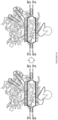
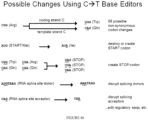
- a schematic representation of this process is shown in Figure 108 .
- the C of a C-G basepair can be deaminated to a U by a deaminase, e.g., an APOBEC deamonase.
- a deaminase e.g., an APOBEC deamonase.
- Nicking the non-edited strand, having the G facilitates removal of the G via mismatch repair mechanisms.
- UGI inhibits UDG, which prevents removal of the U.
- dCas9 variants having mutations other than D10A and H840A are provided, which, e.g., result in nuclease inactivated Cas9 (dCas9).
- Such mutations include other amino acid substitutions at D10 and H820, or other substitutions within the nuclease domains of Cas9 (e.g., substitutions in the HNH nuclease subdomain and/or the RuvC1 subdomain).
- variants or homologues of dCas9 are provided which are at least about 70% identical, at least about 80% identical, at least about 90% identical, at least about 95% identical, at least about 98% identical, at least about 99% identical, at least about 99.5% identical, or at least about 99.9% identical to SEQ ID NO: 10.
- variants of dCas9 are provided having amino acid sequences which are shorter, or longer than SEQ ID NO: 10, by about 5 amino acids, by about 10 amino acids, by about 15 amino acids, by about 20 amino acids, by about 25 amino acids, by about 30 amino acids, by about 40 amino acids, by about 50 amino acids, by about 75 amino acids, by about 100 amino acids or more.
- Cas9 fusion proteins as provided herein comprise the full-length amino acid sequence of a Cas9 protein, e.g., one of the Cas9 sequences provided herein. In other embodiments, however, fusion proteins as provided herein do not comprise a full-length Cas9 sequence, but only a fragment thereof.
- a Cas9 fusion protein provided herein comprises a Cas9 fragment, wherein the fragment binds crRNA and tracrRNA or sgRNA, but does not comprise a functional nuclease domain, e.g., in that it comprises only a truncated version of a nuclease domain or no nuclease domain at all.
- Exemplary amino acid sequences of suitable Cas9 domains and Cas9 fragments are provided herein, and additional suitable sequences of Cas9 domains and fragments will be apparent to those of skill in the art.
- Cas9 refers to Cas9 from: Corynebacterium ulcerans (NCBI Refs: NC_015683.1, NC_017317.1); Corynebacterium diphtheria (NCBI Refs: NC_016782.1, NC_016786.1); Spiroplasma syrphidicola (NCBI Ref: NC_021284.1); Prevotella intermedia (NCBI Ref: NC_017861.1); Spiroplasma taiwanense (NCBI Ref: NC_021846.1); Streptococcus iniae (NCBI Ref: NC_021314.1); Belliella baltica (NCBI Ref: NC_018010.1); Psychroflexus torquisI (NCBI Ref: NC_018721.1); Streptococcus thermophilus (NCBI Ref: YP_820832.1); Listeria innocua (NCBI Ref: NP_472073.1); Campylobacter
- deaminase or “deaminase domain,” as used herein, refers to a protein or enzyme that catalyzes a deamination reaction.
- the deaminase or deaminase domain is a cytidine deaminase, catalyzing the hydrolytic deamination of cytidine or deoxycytidine to uridine or deoxyuridine, respectively.
- the deaminase or deaminase domain is a cytidine deaminase domain, catalyzing the hydrolytic deamination of cytosine to uracil.
- the deaminase or deaminase domain is a naturally-occuring deaminase from an organism, such as a human, chimpanzee, gorilla, monkey, cow, dog, rat, or mouse. In some embodiments, the deaminase or deaminase domain is a variant of a naturally-occuring deaminase from an organism, that does not occur in nature.
- the deaminase or deaminase domain is at least 50%, at least 55%, at least 60%, at least 65%, at least 70%, at least 75% at least 80%, at least 85%, at least 90%, at least 95%, at least 96%, at least 97%, at least 98%, at least 99%, or at least 99.5% identical to a naturally-occuring deaminase from an organism.
- an effective amount refers to an amount of a biologically active agent that is sufficient to elicit a desired biological response.
- an effective amount of a nuclease may refer to the amount of the nuclease that is sufficient to induce cleavage of a target site specifically bound and cleaved by the nuclease.
- an effective amount of a fusion protein provided herein e.g., of a fusion protein comprising a nuclease-inactive Cas9 domain and a nucleic acid editing domain (e.g., a deaminase domain) may refer to the amount of the fusion protein that is sufficient to induce editing of a target site specifically bound and edited by the fusion protein.
- an agent e.g., a fusion protein, a nuclease, a deaminase, a recombinase, a hybrid protein, a protein dimer, a complex of a protein (or protein dimer) and a polynucleotide, or a polynucleotide
- an agent e.g., a fusion protein, a nuclease, a deaminase, a recombinase, a hybrid protein, a protein dimer, a complex of a protein (or protein dimer) and a polynucleotide, or a polynucleotide
- the desired biological response e.g., on the specific allele, genome, or target site to be edited, on the cell or tissue being targeted, and on the agent being used.
- linker refers to a chemical group or a molecule linking two molecules or moieties, e.g., two domains of a fusion protein, such as, for example, a nuclease-inactive Cas9 domain and a nucleic acid editing domain (e.g., a deaminase domain).
- a linker joins a gRNA binding domain of an RNA-programmable nuclease, including a Cas9 nuclease domain, and the catalytic domain of a nucleic-acid editing protein.
- a linker joins a dCas9 and a nucleic-acid editing protein.
- the linker is positioned between, or flanked by, two groups, molecules, or other moieties and connected to each one via a covalent bond, thus connecting the two.
- the linker is an amino acid or a plurality of amino acids (e.g., a peptide or protein).
- the linker is an organic molecule, group, polymer, or chemical moiety.
- the linker is 5-100 amino acids in length, for example, 5, 6, 7, 8, 9, 10, 11, 12, 13, 14, 15, 16, 17, 18, 19, 20, 21, 22, 23, 24, 25, 26, 27, 28, 29, 30, 30-35, 35-40, 40-45, 45-50, 50-60, 60-70, 70-80, 80-90, 90-100, 100-150, or 150-200 amino acids in length. Longer or shorter linkers are also contemplated.
- mutation refers to a substitution of a residue within a sequence, e.g., a nucleic acid or amino acid sequence, with another residue, or a deletion or insertion of one or more residues within a sequence. Mutations are typically described herein by identifying the original residue followed by the position of the residue within the sequence and by the identity of the newly substituted residue. Various methods for making the amino acid substitutions (mutations) provided herein are well known in the art, and are provided by, for example, Green and Sambrook, Molecular Cloning: A Laboratory Manual (4th ed., Cold Spring Harbor Laboratory Press, Cold Spring Harbor, N.Y. (2012 )).
- nucleic acid and “nucleic acid molecule,” as used herein, refer to a compound comprising a nucleobase and an acidic moiety, e.g., a nucleoside, a nucleotide, or a polymer of nucleotides.
- polymeric nucleic acids e.g., nucleic acid molecules comprising three or more nucleotides are linear molecules, in which adjacent nucleotides are linked to each other via a phosphodiester linkage.
- nucleic acid refers to individual nucleic acid residues ( e.g. nucleotides and/or nucleosides).
- nucleic acid refers to an oligonucleotide chain comprising three or more individual nucleotide residues.
- oligonucleotide and polynucleotide can be used interchangeably to refer to a polymer of nucleotides (e.g., a string of at least three nucleotides).
- nucleic acid encompasses RNA as well as single and/or double-stranded DNA.
- Nucleic acids may be naturally occurring, for example, in the context of a genome, a transcript, an mRNA, tRNA, rRNA, siRNA, snRNA, a plasmid, cosmid, chromosome, chromatid, or other naturally occurring nucleic acid molecule.
- a nucleic acid molecule may be a non-naturally occurring molecule, e.g., a recombinant DNA or RNA, an artificial chromosome, an engineered genome, or fragment thereof, or a synthetic DNA, RNA, DNA/RNA hybrid, or including non-naturally occurring nucleotides or nucleosides.
- nucleic acid examples include nucleic acid analogs, e.g., analogs having other than a phosphodiester backbone.
- Nucleic acids can be purified from natural sources, produced using recombinant expression systems and optionally purified, chemically synthesized, etc. Where appropriate, e.g., in the case of chemically synthesized molecules, nucleic acids can comprise nucleoside analogs such as analogs having chemically modified bases or sugars, and backbone modifications. A nucleic acid sequence is presented in the 5' to 3' direction unless otherwise indicated.
- a nucleic acid is or comprises natural nucleosides (e.g.
- nucleoside analogs e.g., 2-aminoadenosine, 2-thiothymidine, inosine, pyrrolo-pyrimidine, 3-methyl adenosine, 5-methylcytidine, 2-aminoadenosine, C5-bromouridine, C5-fluorouridine, C5-iodouridine, C5-propynyl-uridine, C5-propynyl-cytidine, C5-methylcytidine, 2-aminoadenosine, 7-deazaadenosine, 7-deazaguanosine, 8-oxoadenosine, 8-oxoguanosine, O(6)-methylguanine, and 2-thiocyt
- nucleic acid editing domain refers to a protein or enzyme capable of making one or more modifications (e.g., deamination of a cytidine residue) to a nucleic acid (e.g., DNA or RNA).
- exemplary nucleic acid editing domains include, but are not limited to a deaminase, a nuclease, a nickase, a recombinase, a methyltransferase, a methylase, an acetylase, an acetyltransferase, a transcriptional activator, or a transcriptional repressor domain.
- Fusion proteins of the invention comprise a cytidine deaminase, such as an APOBEC or an AID deaminase.
- proliferative disease refers to any disease in which cell or tissue homeostasis is disturbed in that a cell or cell population exhibits an abnormally elevated proliferation rate.
- Proliferative diseases include hyperproliferative diseases, such as pre-neoplastic hyperplastic conditions and neoplastic diseases.
- Neoplastic diseases are characterized by an abnormal proliferation of cells and include both benign and malignant neoplasias. Malignant neoplasia is also referred to as cancer.
- protein refers to a polymer of amino acid residues linked together by peptide (amide) bonds.
- the terms refer to a protein, peptide, or polypeptide of any size, structure, or function. Typically, a protein, peptide, or polypeptide will be at least three amino acids long.
- a protein, peptide, or polypeptide may refer to an individual protein or a collection of proteins.
- One or more of the amino acids in a protein, peptide, or polypeptide may be modified, for example, by the addition of a chemical entity such as a carbohydrate group, a hydroxyl group, a phosphate group, a farnesyl group, an isofarnesyl group, a fatty acid group, a linker for conjugation, functionalization, or other modification, etc.
- a protein, peptide, or polypeptide may also be a single molecule or may be a multi-molecular complex.
- a protein, peptide, or polypeptide may be just a fragment of a naturally occurring protein or peptide.
- a protein, peptide, or polypeptide may be naturally occurring, recombinant, or synthetic, or any combination thereof.
- fusion protein refers to a hybrid polypeptide which comprises protein domains from at least two different proteins.
- One protein may be located at the amino-terminal (N-terminal) portion of the fusion protein or at the carboxy-terminal (C-terminal) protein thus forming an "amino-terminal fusion protein” or a "carboxy-terminal fusion protein,” respectively.
- a protein may comprise different domains, for example, a nucleic acid binding domain (e.g., the gRNA binding domain of Cas9 that directs the binding of the protein to a target site) and a nucleic acid cleavage domain or a catalytic domain of a nucleic-acid editing protein.
- a protein comprises a proteinaceous part, e.g., an amino acid sequence constituting a nucleic acid binding domain, and an organic compound, e.g., a compound that can act as a nucleic acid cleavage agent.
- a protein is in a complex with, or is in association with, a nucleic acid, e.g., RNA.
- Any of the proteins provided herein may be produced by any method known in the art.
- the proteins provided herein may be produced via recombinant protein expression and purification, which is especially suited for fusion proteins comprising a peptide linker. Methods for recombinant protein expression and purification are well known, and include those described by Green and Sambrook, Molecular Cloning: A Laboratory Manual (4th ed., Cold Spring Harbor Laboratory Press, Cold Spring Harbor, N.Y. (2012 )).
- RNA-programmable nuclease and "RNA-guided nuclease” are used interchangeably herein and refer to a nuclease that forms a complex with ( e.g., binds or associates with) one or more RNA that is not a target for cleavage.
- an RNA-programmable nuclease when in a complex with an RNA, may be referred to as a nuclease:RNA complex.
- the bound RNA(s) is referred to as a guide RNA (gRNA).
- gRNAs can exist as a complex of two or more RNAs, or as a single RNA molecule.
- gRNAs that exist as a single RNA molecule may be referred to as single-guide RNAs (sgRNAs), though "gRNA” is used interchangeably to refer to guide RNAs that exist as either single molecules or as a complex of two or more molecules.
- gRNAs that exist as single RNA species comprise two domains: (1) a domain that shares homology to a target nucleic acid (e.g., and directs binding of a Cas9 complex to the target); and (2) a domain that binds a Cas9 protein.
- domain (2) corresponds to a sequence known as a tracrRNA, and comprises a stem-loop structure.
- domain (2) is identical or homologous to a tracrRNA as provided in Jinek et al., Science 337:816-821(2012 ).
- gRNAs e.g., those including domain 2
- a gRNA comprises two or more of domains (1) and (2), and may be referred to as an "extended gRNA.”
- an extended gRNA will, e.g., bind two or more Cas9 proteins and bind a target nucleic acid at two or more distinct regions, as described herein.
- the gRNA comprises a nucleotide sequence that complements a target site, which mediates binding of the nuclease/RNA complex to said target site, providing the sequence specificity of the nuclease:RNA complex.
- the RNA-programmable nuclease is the ( C RISPR-associated system) Cas9 endonuclease, for example Cas9 (Csn1) from Streptococcus pyogenes (see, e.g., " Complete genome sequence of an M1 strain of Streptococcus pyogenes.” Ferretti J.J., McShan W.M., Ajdic D.J., Savic D.J., Savic G., Lyon K., Primeaux C., Sezate S., Suvorov A.N., Kenton S., Lai H.S., Lin S.P., Qian Y., Jia H.G., Najar F.Z., Ren Q., Zhu H., Song L., White J., Yuan X., Clifton S.W., Roe B.A., McLaughlin R.E., Proc.
- Cas9 (Csn1) from Streptococcus
- RNA-programmable nucleases e.g., Cas9
- Cas9 RNA:DNA hybridization to target DNA cleavage sites
- Methods of using RNA-programmable nucleases, such as Cas9, for site-specific cleavage (e.g., to modify a genome) are known in the art (see e.g., Cong, L. et al. Multiplex genome engineering using CRISPR/Cas systems. Science 339, 819-823 (2013 ); Mali, P. et al. RNA-guided human genome engineering via Cas9. Science 339, 823-826 (2013 ); Hwang, W.Y.
- the term "subject,” as used herein, refers to an individual organism, for example, an individual mammal.
- the subject is a human.
- the subject is a non-human mammal.
- the subject is a non-human primate.
- the subject is a rodent.
- the subject is a sheep, a goat, a cattle, a cat, or a dog.
- the subject is a vertebrate, an amphibian, a reptile, a fish, an insect, a fly, or a nematode.
- the subject is a research animal.
- the subject is genetically engineered, e.g., a genetically engineered non-human subject. The subject may be of either sex and at any stage of development.
- target site refers to a sequence within a nucleic acid molecule that is deaminated by a deaminase or a fusion protein comprising a deaminase, (e.g ., a dCas9-deaminase fusion protein provided herein).
- treatment refers to a clinical intervention aimed to reverse, alleviate, delay the onset of, or inhibit the progress of a disease or disorder, or one or more symptoms thereof, as described herein.
- treatment refers to a clinical intervention aimed to reverse, alleviate, delay the onset of, or inhibit the progress of a disease or disorder, or one or more symptoms thereof, as described herein.
- treatment may be administered after one or more symptoms have developed and/or after a disease has been diagnosed. In other embodiments, treatment may be administered in the absence of symptoms, e.g ., to prevent or delay onset of a symptom or inhibit onset or progression of a disease.
- treatment may be administered to a susceptible individual prior to the onset of symptoms (e.g ., in light of a history of symptoms and/or in light of genetic or other susceptibility factors). Treatment may also be continued after symptoms have resolved, for example, to prevent or delay their recurrence.
- recombinant protein or nucleic acid molecule comprises an amino acid or nucleotide sequence that comprises at least one, at least two, at least three, at least four, at least five, at least six, or at least seven mutations as compared to any naturally occurring sequence.
- nucleobase editors or “base editors (BEs),” as used herein, refers to the Cas9 fusion proteins described herein.
- the fusion protein comprises a nuclease-inactive Cas9 (dCas9) fused to a deaminase.
- the fusion protein comprises a Cas9 nickase fused to a deaminase.
- the fusion protein comprises a nuclease-inactive Cas9 fused to a deaminase and further fused to a UGI domain.
- the fusion protein comprises a Cas9 nickase fused to a deaminase and further fused to a UGI domain.
- the dCas9 of the fusion protein comprises a D10A and a H840A mutation of SEQ ID NO: 10, or a corresponding mutation in any of SEQ ID NOs: 11-260, which inactivates nuclease activity of the Cas9 protein.
- the fusion protein comprises a D10A mutation and comprises a histidine at residue 840 of SEQ ID NO: 10, or a corresponding mutation in any of SEQ ID NOs: 11-260, which renders Cas9 capable of cleaving only one strand of a nucleic acid duplex.
- An example of a Cas9 nickase is shown below in SEQ ID NO: 674.
- the terms "nucleobase editors (NBEs)" and “base editors (BEs)” may be used interchangeably.
- uracil glycosylase inhibitor or "UGI,” as used herein, refers to a protein that is capable of inhibiting a uracil-DNA glycosylase base-excision repair enzyme.
- Cas9 nickase refers to a Cas9 protein that is capable of cleaving only one strand of a duplexed nucleic acid molecule (e.g., a duplexed DNA molecule).
- a Cas9 nickase comprises a D10A mutation and has a histidine at position H840 of SEQ ID NO: 10, or a corresponding mutation in any of SEQ ID NOs: 11-260.
- a Cas9 nickase may comprise the amino acid sequence as set forth in SEQ ID NO: 674.
- Such a Cas9 nickase has an active HNH nuclease domain and is able to cleave the non-targeted strand of DNA, i.e., the strand bound by the gRNA. Further, such a Cas9 nickase has an inactive RuvC nuclease domain and is not able to cleave the targeted strand of the DNA, i.e., the strand where base editing is desired.
- Exemplary Cas9 nickase (Cloning vector pPlatTET-gRNA2; Accession No. BAV54124).
- Some aspects of this disclosure provide fusion proteins that comprise a domain capable of binding to a nucleotide sequence (e.g., a Cas9, or a Cpfl protein) and an enzyme domain, for example, a DNA-editing domain, such as, e.g., a deaminase domain.
- a DNA-editing domain such as, e.g., a deaminase domain.
- the deamination of a nucleobase by a deaminase can lead to a point mutation at the respective residue, which is referred to herein as nucleic acid editing.
- Fusion proteins comprising a Cas9 variant or domain and a DNA editing domain can thus be used for the targeted editing of nucleic acid sequences.
- Such fusion proteins are useful for targeted editing of DNA in vitro, e.g., for the generation of mutant cells or animals; for the introduction of targeted mutations, e.g., for the correction of genetic defects in cells ex vivo, e.g., in cells obtained from a subject that are subsequently re-introduced into the same or another subject; and for the introduction of targeted mutations, e.g., the correction of genetic defects or the introduction of deactivating mutations in disease-associated genes in a subject.
- the Cas9 domain of the fusion proteins described herein does not have any nuclease activity but instead is a Cas9 fragment or a dCas9 protein or domain.
- Non-limiting, exemplary Cas9 domains are provided herein.
- the Cas9 domain may be a nuclease active Cas9 domain, a nucleasae inactive Cas9 domain, or a Cas9 nickase.
- the Cas9 domain is a nuclease active domain.
- the Cas9 domain may be a Cas9 domain that cuts both strands of a duplexed nucleic acid ( e.g., both strands of a duplexed DNA molecule).
- the Cas9 domain comprises any one of the amino acid sequences as set forth in SEQ ID NOs: 10-263.
- the Cas9 domain comprises an amino acid sequence that is at least 60%, at least 65%, at least 70%, at least 75%, at least 80%, at least 85%, at least 90%, at least 95%, at least 96%, at least 97%, at least 98%, at least 99%, or at least 99.5% identical to any one of the amino acid sequences set forth in SEQ ID NOs: 10-263.
- the Cas9 domain comprises an amino acid sequence that has 1, 2, 3, 4, 5, 6, 7, 8, 9, 10, 11, 12, 13, 14, 15, 16, 17, 18, 19, 20, 21, 22, 21, 24, 25, 26, 27, 28, 29, 30, 31, 32, 33, 34, 35, 36, 37, 38, 39, 40, 41, 42, 43, 44, 45, 46, 47, 48, 49, 50 or more or more mutations compared to any one of the amino acid sequences set forth in SEQ ID NOs: 10-263.
- the Cas9 domain comprises an amino acid sequence that has at least 10, at least 15, at least 20, at least 30, at leat 40, at least 50, at least 60, at least 70, at least 80, at least 90, at least 100, at least 150, at least 200, at least 250, at least 300, at least 350, at least 400, at least 500, at least 600, at least 700, at least 800, at least 900, at least 1000, at least 1100, or at least 1200 identical contiguous amino acid residues as compared to any one of the amino acid sequences set forth in SEQ ID NOs: 10-263.
- the Cas9 domain is a nuclease-inactive Cas9 domain (dCas9).
- the dCas9 domain may bind to a duplexed nucleic acid molecule (e.g., via a gRNA molecule) without cleaving either strand of the duplexed nucleic acid molecule.
- the nuclease-inactive dCas9 domain comprises a D10X mutation and a H840X mutation of the amino acid sequence set forth in SEQ ID NO: 10, or a corresponding mutation in any of the amino acid sequences provided in SEQ ID NOs: 11-260, wherein X is any amino acid change.
- the nuclease-inactive dCas9 domain comprises a D10A mutation and a H840A mutation of the amino acid sequence set forth in SEQ ID NO: 10, or a corresponding mutation in any of the amino acid sequences provided in SEQ ID NOs: 11-260.
- a nuclease-inactive Cas9 domain comprises the amino acid sequence set forth in SEQ ID NO: 263 (Cloning vector pPlatTET-gRNA2, Accession No. BAV54124). see, e.g., Qi et al., Repurposing CRISPR as an RNA-guided platform for sequence-specific control of gene expression. Cell. 2013; 152(5):1173-83 ).
- nuclease-inactive dCas9 domains will be apparent to those of skill in the art based on this disclosure and knowledge in the field, and are within the scope of this disclosure.
- Such additional exemplary suitable nuclease-inactive Cas9 domains include, but are not limited to, D10A/H840A, D10A/D839A/H840A, and D10A/D839A/H840A/N863A mutant domains (See, e.g., Prashant et al., CAS9 transcriptional activators for target specificity screening and paired nickases for cooperative genome engineering. Nature Biotechnology. 2013; 31(9): 833-838 ).
- the dCas9 domain comprises an amino acid sequence that is at least 60%, at least 65%, at least 70%, at least 75%, at least 80%, at least 85%, at least 90%, at least 95%, at least 96%, at least 97%, at least 98%, at least 99%, or at least 99.5% identical to any one of the dCas9 domains provided herein.
- the Cas9 domain comprises an amino acid sequences that has 1, 2, 3, 4, 5, 6, 7, 8, 9, 10, 11, 12, 13, 14, 15, 16, 17, 18, 19, 20, 21, 22, 21, 24, 25, 26, 27, 28, 29, 30, 31, 32, 33, 34, 35, 36, 37, 38, 39, 40, 41, 42, 43, 44, 45, 46, 47, 48, 49, 50 or more or more mutations compared to any one of the amino acid sequences set forth in SEQ ID NOs: 10-263.
- the Cas9 domain comprises an amino acid sequence that has at least 10, at least 15, at least 20, at least 30, at leat 40, at least 50, at least 60, at least 70, at least 80, at least 90, at least 100, at least 150, at least 200, at least 250, at least 300, at least 350, at least 400, at least 500, at least 600, at least 700, at least 800, at least 900, at least 1000, at least 1100, or at least 1200 identical contiguous amino acid residues as compared to any one of the amino acid sequences set forth in SEQ ID NOs: 10-263.
- the Cas9 domain is a Cas9 nickase.
- the Cas9 nickase may be a Cas9 protein that is capable of cleaving only one strand of a duplexed nucleic acid molecule (e.g., a duplexed DNA molecule).
- the Cas9 nickase cleaves the target strand of a duplexed nucleic acid molecule, meaning that the Cas9 nickase cleaves the strand that is base paired to (complementary to) a gRNA (e.g., an sgRNA) that is bound to the Cas9.
- a gRNA e.g., an sgRNA
- a Cas9 nickase comprises a D10A mutation and has a histidine at position 840 of SEQ ID NO: 10, or a mutation in any of SEQ ID NOs: 11-260.
- a Cas9 nickase may comprise the amino acid sequence as set forth in SEQ ID NO: 674.
- the Cas9 nickase cleaves the non-target, non-base-edited strand of a duplexed nucleic acid molecule, meaning that the Cas9 nickase cleaves the strand that is not base paired to a gRNA ( e.g., an sgRNA) that is bound to the Cas9.
- a Cas9 nickase comprises an H840A mutation and has an aspartic acid residue at position 10 of SEQ ID NO: 10, or a corresponding mutation in any of SEQ ID NOs: 11-260.
- the Cas9 nickase comprises an amino acid sequence that is at least 60%, at least 65%, at least 70%, at least 75%, at least 80%, at least 85%, at least 90%, at least 95%, at least 96%, at least 97%, at least 98%, at least 99%, or at least 99.5% identical to any one of the Cas9 nickases provided herein. Additional suitable Cas9 nickases will be apparent to those of skill in the art based on this disclosure and knowledge in the field, and are within the scope of this disclosure.
- Cas9 domains that have different PAM specificities.
- Cas9 proteins such as Cas9 from S. pyogenes (spCas9)
- spCas9 require a canonical NGG PAM sequence to bind a particular nucleic acid region. This may limit the ability to edit desired bases within a genome.
- the base editing fusion proteins provided herein may need to be placed at a precise location, for example where a target base is placed within a 4 base region (e.g., a "deamination window”), which is approximately 15 bases upstream of the PAM.
- any of the fusion proteins provided herein may contain a Cas9 domain that is capable of binding a nucleotide sequence that does not contain a canonical (e.g., NGG) PAM sequence.
- Cas9 domains that bind to non-canonical PAM sequences have been described in the art and would be apparent to the skilled artisan. For example, Cas9 domains that bind non-canonical PAM sequences have been described in Kleinstiver, B.
- the Cas9 domain is a Cas9 domain from Staphylococcus aureus (SaCas9).
- the SaCas9 domain is a nuclease active SaCas9, a nuclease inactive SaCas9 (SaCas9d), or a SaCas9 nickase (SaCas9n).
- the SaCas9 comprises the amino acid sequence SEQ ID NO: 4273.
- the SaCas9 comprises a N579X mutation of SEQ ID NO: 4273, or a corresponding mutation in any of the amino acid sequences provided in SEQ ID NOs: 11-260, wherein X is any amino acid except for N.
- the SaCas9 comprises a N579A mutation of SEQ ID NO: 4273, or a corresponding mutation in any of the amino acid sequences provided in SEQ ID NOs: 11-260.
- the SaCas9 domain, the SaCas9d domain, or the SaCas9n domain can bind to a nucleic acid seuqnce having a non-canonical PAM.
- the SaCas9 domain, the SaCas9d domain, or the SaCas9n domain can bind to a nucleic acid sequence having a NNGRRT PAM sequence.
- the SaCas9 domain comprises one or more of a E781X, a N967X, and a R1014X mutation of SEQ ID NO: 4273, or a corresponding mutation in any of the amino acid sequences provided in SEQ ID NOs: 11-260, wherein X is any amino acid.
- the SaCas9 domain comprises one or more of a E781K, a N967K, and a R1014H mutation of SEQ ID NO: 4273, or one or more corresponding mutation in any of the amino acid sequences provided in SEQ ID NOs: 11-260.
- the SaCas9 domain comprises a E781K, a N967K, or a R1014H mutation of SEQ ID NO: 4273, or corresponding mutations in any of the amino acid sequences provided in SEQ ID NOs: 11-260.
- the Cas9 domain of any of the fusion proteins provided herein comprises an amino acid sequence that is at least 60%, at least 65%, at least 70%, at least 75%, at least 80%, at least 85%, at least 90%, at least 95%, at least 96%, at least 97%, at least 98%, at least 99%, or at least 99.5% identical to any one of SEQ ID NOs: 4273-4275.
- the Cas9 domain of any of the fusion proteins provided herein comprises the amino acid sequence of any one of SEQ ID NOs: 4273-4275.
- the Cas9 domain of any of the fusion proteins provided herein consists of the amino acid sequence of any one of SEQ ID NOs: 4273-4275.
- Residue N579 of SEQ ID NO: 4273 which is underlined and in bold, may be mutated (e.g., to a A579) to yield a SaCas9 nickase.
- Residue A579 of SEQ ID NO: xx which can be mutated from N579 of SEQ ID NO: 4274 to yield a SaCas9 nickase, is underlined and in bold.
- Residue A579 of SEQ ID NO: 4275 which can be mutated from N579 of SEQ ID NO: 4275 to yield a SaCas9 nickase, is underlined and in bold.
- Residues K781, K967, and H1014 of SEQ ID NO: 4275 which can be mutated from E781, N967, and R1014 of SEQ ID NO: 4275 to yield a SaKKH Cas9 are underlined and in italics.
- the Cas9 domain is a Cas9 domain from Streptococcus pyogenes (SpCas9).
- the SpCas9 domain is a nuclease active SpCas9, a nuclease inactive SpCas9 (SpCas9d), or a SpCas9 nickase (SpCas9n).
- the SpCas9 comprises the amino acid sequence SEQ ID NO: 4276.
- the SpCas9 comprises a D9X mutation of SEQ ID NO: 4276, or a corresponding mutation in any of the amino acid sequences provided in SEQ ID NOs: 11-260, wherein X is any amino acid except for D.
- the SpCas9 comprises a D9A mutation of SEQ ID NO: 4276, or a corresponding mutation in any of the amino acid sequences provided in SEQ ID NOs: 11-260.
- the SpCas9 domain, the SpCas9d domain, or the SpCas9n domain can bind to a nucleic acid seuqnce having a non-canonical PAM.
- the SpCas9 domain, the SpCas9d domain, or the SpCas9n domain can bind to a nucleic acid sequence having a NGG, a NGA, or a NGCG PAM sequence.
- the SpCas9 domain comprises one or more of a D1134X, a R1334X, and a T1336X mutation of SEQ ID NO: 4276, or a corresponding mutation in any of the amino acid sequences provided in SEQ ID NOs: 11-260, wherein X is any amino acid.
- the SpCas9 domain comprises one or more of a D1134E, R1334Q, and T1336R mutation of SEQ ID NO: 4276, or a corresponding mutation in any of the amino acid sequences provided in SEQ ID NOs: 11-260.
- the SpCas9 domain comprises a D1134E, a R1334Q, and a T1336R mutation of SEQ ID NO: 4276, or corresponding mutations in any of the amino acid sequences provided in SEQ ID NOs: 11-260.
- the SpCas9 domain comprises one or more of a D1134X, a R1334X, and a T1336X mutation of SEQ ID NO: 4276, or a corresponding mutation in any of the amino acid sequences provided in SEQ ID NOs: 11-260, wherein X is any amino acid.
- the SpCas9 domain comprises one or more of a D1134V, a R1334Q, and a T1336R mutation of SEQ ID NO: 4276, or a corresponding mutation in any of the amino acid sequences provided in SEQ ID NOs: 11-260.
- the SpCas9 domain comprises a D1134V, a R1334Q, and a T1336R mutation of SEQ ID NO: 4276, or corresponding mutations in any of the amino acid sequences provided in SEQ ID NOs: 11-260.
- the SpCas9 domain comprises one or more of a D1134X, a G1217X, a R1334X, and a T1336X mutation of SEQ ID NO: 4276, or a corresponding mutation in any of the amino acid sequences provided in SEQ ID NOs: 11-260, wherein X is any amino acid.
- the SpCas9 domain comprises one or more of a D1134V, a G1217R, a R1334Q, and a T1336R mutation of SEQ ID NO: 4276, or a corresponding mutation in any of the amino acid sequences provided in SEQ ID NOs: 11-260.
- the SpCas9 domain comprises a D1134V, a G1217R, a R1334Q, and a T1336R mutation of SEQ ID NO: 4276, or corresponding mutations in any of the amino acid sequences provided in SEQ ID NOs: 11-260.
- the Cas9 domain of any of the fusion proteins provided herein comprises an amino acid sequence that is at least 60%, at least 65%, at least 70%, at least 75%, at least 80%, at least 85%, at least 90%, at least 95%, at least 96%, at least 97%, at least 98%, at least 99%, or at least 99.5% identical to any one of SEQ ID NOs: 4276-4280.
- the Cas9 domain of any of the fusion proteins provided herein comprises the amino acid sequence of any one of SEQ ID NOs: 4276-4280.
- the Cas9 domain of any of the fusion proteins provided herein consists of the amino acid sequence of any one of SEQ ID NOs: 4276-4280.
- Residues E1134, Q1334, and R1336 of SEQ ID NO: 4278 which can be mutated from D1134, R1334, and T1336 of SEQ ID NO: 4278 to yield a SpEQR Cas9, are underlined and in bold.
- Residues V1134, Q1334, and R1336 of SEQ ID NO: 4279 which can be mutated from D1134, R1334, and T1336 of SEQ ID NO: 4279 to yield a SpVQR Cas9, are underlined and in bold.
- Residues V1134, R1217, Q1334, and R1336 of SEQ ID NO: 4280, which can be mutated from D1134, G1217, R1334, and T1336 of SEQ ID NO: 4280 to yield a SpVRER Cas9, are underlined and in bold.
- fusion proteins capable of binding to a nucleic acid sequence having a non-canonical (e.g., a non-NGG) PAM sequence:
- VQR-BE3 rAPOBEC1-XTEN-Cas9n-UGI-NLS
- Cas9 fusion proteins comprising a Cas9 domain that has high fidelity. Additional aspects of the disclosure provide Cas9 fusion proteins (e . g ., any of the fusion proteins provided herein) comprising a Cas9 domain with decreased electrostatic interactions between the Cas9 domain and a sugar-phosphate backbone of a DNA, as compared to a wild-type Cas9 domain.
- a Cas9 domain e.g., a wild type Cas9 domain
- any of the Cas9 fusion proteins provided herein comprise one or more of a N497X, a R661X, a Q695X, and/or a Q926X mutation of the amino acid sequence provided in SEQ ID NO: 10, or a corresponding mutation in any of the amino acid sequences provided in SEQ ID NOs: 11-260, wherein X is any amino acid.
- any of the Cas9 fusion proteins provided herein comprise one or more of a N497A, a R661A, a Q695A, and/or a Q926A mutation of the amino acid sequence provided in SEQ ID NO: 10, or a corresponding mutation in any of the amino acid sequences provided in SEQ ID NOs: 11-260.
- the Cas9 domain comprises a D10A mutation of the amino acid sequence provided in SEQ ID NO: 10, or a corresponding mutation in any of the amino acid sequences provided in SEQ ID NOs: 11-260.
- the Cas9 domain (e.g., of any of the fusion proteins provided herein) comprises the amino acid sequence as set forth in SEQ ID NO: 325.
- the fusion protein comprises the amino acid sequence as set forth in SEQ ID NO: 285.
- Cas9 domains with high fidelity are known in the art and would be apparent to the skilled artisan. For example, Cas9 domains with high fidelity have been described in Kleinstiver, B.P., et al. "High-fidelity CRISPR-Cas9 nucleases with no detectable genome-wide off-target effects.” Nature 529, 490-495 (2016 ); and Slaymaker, I.M., et al. "Rationally engineered Cas9 nucleases with improved specificity.” Science 351, 84-88 (2015 ).
- base editor 2 for example base editor 2 (BE2) or base editor 3 (BE3)
- base editor 2 may be converted into high fidelity base editors by modifyint the Cas9 domain as described herein to generate high fidelity base editors, for example high fidelity base editor 2 (HF-BE2) or high fidelity base editor 3 (HF-BE3).
- base editor 2 (BE2) comprises a deaminase domain, a dCas9, and a UGI domain.
- base editor 3 comprises a deaminase domain an nCas9 domain and a UGI domain.
- any of the Cas9 domains may be fused to a second protein, thus fusion proteins provided herein comprise a Cas9 domain as provided herein and a second protein, or a "fusion partner".
- the second protein is fused to the N-terminus of the Cas9 domain.
- the second protein is fused to the C-terminus of the Cas9 domain.
- the second protein that is fused to the Cas9 domain is a nucleic acid editing domain.
- the Cas9 domain and the nucleic acid editing domain are fused via a linker, while in other embodiments the Cas9 domain and the nucleic acid editing domain are fused directly to one another.
- the linker comprises (GGGS) n (SEQ ID NO: 265), (GGGGS) n (SEQ ID NO: 5), (G) n , (EAAAK) n (SEQ ID NO: 6), (GGS) n , (SGGS) n (SEQ ID NO: 4288), SGSETPGTSESATPES (SEQ ID NO: 7), or (XP) n motif, or a combination of any of these, wherein n is independently an integer between 1 and 30, and wherein X is any amino acid.
- the linker comprises a (GGS) n motif, wherein n is 1, 3, or 7. In some embodiments, the linker comprises a (GGS) n motif, wherein n is 1, 2, 3, 4, 5, 6, 7, 8, 9, 10, 11, 12, 13, 14, or 15. In some embodiments, the linker comprises an amino acid sequence of SGSETPGTSESATPES (SEQ ID NO: 7),also referred to as the XTEN linker in the Examples). The length of the linker can influence the base to be edited, as illustrated in the Examples.
- a linker of 3-amino-acid long may give a 2-5, 2-4, 2-3, 3-4 base editing window relative to the PAM sequence
- a 9-amino-acid linker e.g., (GGS) 3 (SEQ ID NO: 596)
- a 16-amino-acid linker (e.g., the XTEN linker) may give a 2-7, 2-6, 2-5, 2-4, 2-3, 3-7, 3-6, 3-5, 3-4, 4-7, 4-6, 4-5, 5-7, 5-6, 6-7 base window relative to the PAM sequence with exceptionally strong activity, and a 21-amino-acid linker (e.g., (GGS) 7 (SEQ ID NO: 597)) may give a 3-8, 3-7, 3-6, 3-5, 3-4, 4-8, 4-7, 4-6, 4-5, 5-8, 5-7, 5-6, 6-8, 6-7, 7-8 base editing window relative to the PAM sequence.
- a 21-amino-acid linker e.g., (GGS) 7 (SEQ ID NO: 597)
- the second protein comprises an enzymatic domain.
- the enzymatic domain is a nucleic acid editing domain.
- a nucleic acid editing domain may be, without limitation, a nuclease, a nickase, a recombinase, a deaminase, a methyltransferase, a methylase, an acetylase, or an acetyltransferase.
- Nonlimiting exemplary binding domains that may be used in accordance with this disclosure include transcriptional activator domains and transcriptional repressor domains.
- second protein comprises a nucleic acid editing domain.
- the nucleic acid editing domain can catalyze a C to U base change.
- the nucleic acid editing domain is a deaminase domain.
- the fusion protein of the invention comprisesa cytidine deaminase domain.
- the deaminase is an apolipoprotein B mRNA-editing complex (APOBEC) family deaminase.
- APOBEC apolipoprotein B mRNA-editing complex
- the deaminase is an APOBEC1 deaminase.
- the deaminase is an APOBEC2 deaminase.
- the deaminase is an APOBEC3 deaminase. In some embodiments, the deaminase is an APOBEC3A deaminase. In some embodiments, the deaminase is an APOBEC3B deaminase. In some embodiments, the deaminase is an APOBEC3C deaminase. In some embodiments, the deaminase is an APOBEC3D deaminase. In some embodiments, the deaminase is an APOBEC3E deaminase. In some embodiments, the deaminase is an APOBEC3F deaminase.
- the deaminase is an APOBEC3G deaminase. In some embodiments, the deaminase is an APOBEC3H deaminase. In some embodiments, the deaminase is an APOBEC4 deaminase. In some embodiments, the deaminase is an activation-induced deaminase (AID). In some embodiments, the deaminase is a vertebrate deaminase. In some embodiments, the deaminase is an invertebrate deaminase.
- the deaminase is a human, chimpanzee, gorilla, monkey, cow, dog, rat, or mouse deaminase. In some embodiments, the deaminase is a human deaminase. In some embodiments, the deaminase is a rat deaminase, e.g., rAPOBEC1. In some embodiments, the deaminase is a Petromyzon marinus cytidine deaminase 1 (pmCDA1). In some embodiments, the deminase is a human APOBEC3G (SEQ ID NO: 275).
- the deaminase is a fragment of the human APOBEC3G (SEQ ID NO: 5740). In some embodiments, the deaminase is a human APOBEC3G variant comprising a D316R_D317R mutation (SEQ ID NO: 5739). In some embodiments, the deaminase is a vigment of the human APOBEC3G and comprising mutations corresponding to the D316R D317R mutations in SEQ ID NO: 275 (SEQ ID NO: 5741).
- the nucleic acid editing domain is at least 80%, at least 85%, at least 90%, at least 92%, at least 95%, at least 96%, at least 97%, at least 98%, at least 99%, or at least 99.5% identical to the deaminase domain of any one of SEQ ID NOs: 266-284, 607-610, 5724-5736, or 5738-5741.
- the nucleic acid editing domain comprises the amino acid sequence of any one of SEQ ID NOs: 266-284, 607-610, 5724-5736, or 5738-5741.
- Some aspects of the disclosure are based on the recognition that modulating the deaminase domain catalytic activity of any of the fusion proteins provided herein, for example by making point mutations in the deaminase domain, affect the processivity of the fusion proteins (e.g., base editors). For example, mutations that reduce, but do not eliminate, the catalytic activity of a deaminase domain within a base editing fusion protein can make it less likely that the deaminase domain will catalyze the deamination of a residue adjacent to a target residue, thereby narrowing the deamination window. The ability to narrow the deaminataion window may prevent unwanted deamination of residues adjacent of specific target residues, which may decrease or prevent off-target effects.
- any of the fusion proteins provided herein comprise a deaminase domain (e.g., a cytidine deaminase domain) that has reduced catalytic deaminase activity.
- any of the fusion proteins provided herein comprise a deaminase domain (e.g., a cytidine deaminase domain) that has a reduced catalytic deaminase activity as compared to an appropriate control.
- the appropriate control may be the deaminase activity of the deaminase prior to introducing one or more mutations into the deaminase. In other embodiments, the appropriate control may be a wild-type deaminase.
- the appropriate control is a wild-type apolipoprotein B mRNA-editing complex (APOBEC) family deaminase.
- APOBEC apolipoprotein B mRNA-editing complex
- the appropriate control is an APOBEC1 deaminase, an APOBEC2 deaminase, an APOBEC3A deaminase, an APOBEC3B deaminase, an APOBEC3C deaminase, an APOBEC3D deaminase, an APOBEC3F deaminase, an APOBEC3G deaminase, or an APOBEC3H deaminase.
- APOBEC1 deaminase an APOBEC2 deaminase
- an APOBEC3A deaminase an APOBEC3B deaminase
- the appropriate control is an activation induced deaminase (AID).
- the appropriate control is a cytidine deaminase 1 from Petromyzon marinus (pmCDA1).
- the deaminse domain may be a deaminase domain that has at least 1%, at least 5%, at least 15%, at least 20%, at least 25%, at least 30%, at least 40%, at least 50%, at least 60%, at lest 70%, at least 80%, at least 90%, or at least 95% less catalytic deaminase activity as compared to an appropriate control.
- any of the fusion proteins provided herein comprise an APOBEC deaminase comprising one or more mutations selected from the group consisting of H121X, H122X, R126X, R126X, R118X, W90X, W90X, and R132X of rAPOBEC1 (SEQ ID NO: 284), or one or more corresponding mutations in another APOBEC deaminase, wherin X is any amino acid.
- any of the fusion proteins provided herein comprise an APOBEC deaminase comprising one or more mutations selected from the group consisting of H121R, H122R, R126A, R126E, R118A, W90A, W90Y, and R132E of rAPOBEC1 (SEQ ID NO: 284), or one or more corresponding mutations in another APOBEC deaminase.
- any of the fusion proteins provided herein comprise an APOBEC deaminase comprising one or more mutations selected from the group consisting of D316X, D317X, R320X, R320X, R313X, W285X, W285X, R326X of hAPOBEC3G (SEQ ID NO: 275), or one or more corresponding mutations in another APOBEC deaminase, wherin X is any amino acid.
- any of the fusion proteins provided herein comprise an APOBEC deaminase comprising one or more mutations selected from the group consisting of D316R, D317R, R320A, R320E, R313A, W285A, W285Y, R326E of hAPOBEC3G (SEQ ID NO: 275), or one or more corresponding mutations in another APOBEC deaminase.
- any of the fusion proteins provided herein comprise an APOBEC deaminase comprising a H121R and a H122R mutation of rAPOBEC1 (SEQ ID NO: 284), or one or more corresponding mutations in another APOBEC deaminase.
- any of the fusion proteins provided herein comprise an APOBEC deaminase comprising a R126A mutation of rAPOBEC1 (SEQ ID NO: 284), or one or more corresponding mutations in another APOBEC deaminase.
- any of the fusion proteins provided herein comprise an APOBEC deaminase comprising a R126E mutation of rAPOBEC1 (SEQ ID NO: 284), or one or more corresponding mutations in another APOBEC deaminase. In some embodiments, any of the fusion proteins provided herein comprise an APOBEC deaminase comprising a R118A mutation of rAPOBEC1 (SEQ ID NO: 284), or one or more corresponding mutations in another APOBEC deaminase.
- any of the fusion proteins provided herein comprise an APOBEC deaminase comprising a W90A mutation of rAPOBEC1 (SEQ ID NO: 284), or one or more corresponding mutations in another APOBEC deaminase. In some embodiments, any of the fusion proteins provided herein comprise an APOBEC deaminase comprising a W90Y mutation of rAPOBEC1 (SEQ ID NO: 284), or one or more corresponding mutations in another APOBEC deaminase.
- any of the fusion proteins provided herein comprise an APOBEC deaminase comprising a R132E mutation of rAPOBEC1 (SEQ ID NO: 284), or one or more corresponding mutations in another APOBEC deaminase. In some embodiments, any of the fusion proteins provided herein comprise an APOBEC deaminase comprising a W90Y and a R126E mutation of rAPOBEC1 (SEQ ID NO: 284), or one or more corresponding mutations in another APOBEC deaminase.
- any of the fusion proteins provided herein comprise an APOBEC deaminase comprising a R126E and a R132E mutation of rAPOBEC1 (SEQ ID NO: 284), or one or more corresponding mutations in another APOBEC deaminase.
- any of the fusion proteins provided herein comprise an APOBEC deaminase comprising a W90Y and a R132E mutation of rAPOBEC1 (SEQ ID NO: 284), or one or more corresponding mutations in another APOBEC deaminase.
- any of the fusion proteins provided herein comprise an APOBEC deaminase comprising a W90Y, R126E, and R132E mutation of rAPOBEC1 (SEQ ID NO: 284), or one or more corresponding mutations in another APOBEC deaminase.
- any of the fusion proteins provided herein comprise an APOBEC deaminase comprising a D316R and a D317R mutation of hAPOBEC3G (SEQ ID NO: 275), or one or more corresponding mutations in another APOBEC deaminase.
- any of the fusion proteins provided herein comprise an APOBEC deaminase comprising a R320A mutation of hAPOBEC3G (SEQ ID NO: 275), or one or more corresponding mutations in another APOBEC deaminase.
- any of the fusion proteins provided herein comprise an APOBEC deaminase comprising a R320E mutation of hAPOBEC3G (SEQ ID NO: 275), or one or more corresponding mutations in another APOBEC deaminase. In some embodiments, any of the fusion proteins provided herein comprise an APOBEC deaminase comprising a R313A mutation of hAPOBEC3G (SEQ ID NO: 275), or one or more corresponding mutations in another APOBEC deaminase.
- any of the fusion proteins provided herein comprise an APOBEC deaminase comprising a W285A mutation of hAPOBEC3G (SEQ ID NO: 275), or one or more corresponding mutations in another APOBEC deaminase.
- any of the fusion proteins provided herein comprise an APOBEC deaminase comprising a W285Y mutation of hAPOBEC3G (SEQ ID NO: 275), or one or more corresponding mutations in another APOBEC deaminase.
- any of the fusion proteins provided herein comprise an APOBEC deaminase comprising a R326E mutation of hAPOBEC3G (SEQ ID NO: 275), or one or more corresponding mutations in another APOBEC deaminase.
- any of the fusion proteins provided herein comprise an APOBEC deaminase comprising a W285Y and a R320E mutation of hAPOBEC3G (SEQ ID NO: 275), or one or more corresponding mutations in another APOBEC deaminase.
- any of the fusion proteins provided herein comprise an APOBEC deaminase comprising a R320E and a R326E mutation of hAPOBEC3G (SEQ ID NO: 275), or one or more corresponding mutations in another APOBEC deaminase.
- any of the fusion proteins provided herein comprise an APOBEC deaminase comprising a W285Y and a R326E mutation of hAPOBEC3G (SEQ ID NO: 275), or one or more corresponding mutations in another APOBEC deaminase.
- any of the fusion proteins provided herein comprise an APOBEC deaminase comprising a W285Y, R320E, and R326E mutation of hAPOBEC3G (SEQ ID NO: 275), or one or more corresponding mutations in another APOBEC deaminase.
- a nuclease-inactive Cas9 domain comprises an amino acid sequence that is at least 80%, at least 85%, at least 90%, at least 92%, at least 95%, at least 96%, at least 97%, at least 98%, at least 99%, or at least 99.5% identical to the amino acid sequence of a Cas9 as provided by any one of SEQ ID NOs: 10-263, and comprises mutations that inactivate the nuclease activity of Cas9.
- the DNA cleavage domain of Cas9 is known to include two subdomains, the HNH nuclease subdomain and the RuvC1 subdomain.
- the HNH subdomain cleaves the strand complementary to the gRNA, whereas the RuvC1 subdomain cleaves the non-complementary strand.
- Mutations within these subdomains can silence the nuclease activity of Cas9.
- the mutations D10A and H840A completely inactivate the nuclease activity of S. pyogenes Cas9 ( Jinek et al., Science.
- the dCas9 of this disclosure comprises a D10A mutation of the amino acid sequence provided in SEQ ID NO: 10, or a corresponding mutation in any of the amino acid sequences provided in SEQ ID NOs: 11-260. In some embodiments, the dCas9 of this disclosure comprises a H840A mutation of the amino acid sequence provided in SEQ ID NO: 10, or a corresponding mutation in any of the amino acid sequences provided in SEQ ID NOs: 11-260.
- the dCas9 of this disclosure comprises both D10A and H840A mutations of the amino acid sequence provided in SEQ ID NO: 10, or a corresponding mutation in any of the amino acid sequences provided in SEQ ID NOs: 11-260.
- the Cas9 further comprises a histidine residue at position 840 of the amino acid sequence provided in SEQ ID NO: 10, or a corresponding mutation in any of the amino acid sequences provided in SEQ ID NOs: 11-260.
- the presence of the catalytic residue H840 restores the acvitity of the Cas9 to cleave the non-edited strand containing a G opposite the targeted C.
- the dCas9 comprises an amino acid sequence of SEQ ID NO: 263. It is to be understood that other mutations that inactivate the nuclease domains of Cas9 may also be included in the dCas9 of this disclosure.
- the Cas9 or dCas9 domains comprising the mutations disclosed herein may be a full-length Cas9, or a fragment thereof.
- proteins comprising Cas9, or fragments thereof are referred to as "Cas9 variants.”
- a Cas9 variant shares homology to Cas9, or a fragment thereof.
- a Cas9 variant is at least about 70% identical, at least about 80% identical, at least about 90% identical, at least about 95% identical, at least about 96% identical, at least about 97% identical, at least about 98% identical, at least about 99% identical, at least about 99.5% identical, or at least about 99.9% to wild type Cas9.
- the Cas9 variant comprises a fragment of Cas9 (e.g., a gRNA binding domain or a DNA-cleavage domain), such that the fragment is at least about 70% identical, at least about 80% identical, at least about 90% identical, at least about 95% identical, at least about 96% identical, at least about 97% identical, at least about 98% identical, at least about 99% identical, at least about 99.5% identical, or at least about 99.9% identical to the corresponding fragment of wild type Cas9, e.g., a Cas9 comprising the amino acid sequence of SEQ ID NO: 10.
- a Cas9 comprising the amino acid sequence of SEQ ID NO: 10.
- any of the Cas9 fusion proteins of this disclosure may further comprise a nucleic acid editing domain (e.g., an enzyme that is capable of modifying nucleic acid, such as a deaminase).
- the nucleic acid editing domain is a DNA-editing domain.
- the nucleic acid editing domain has deaminase activity.
- the nucleic acid editing domain comprises or consists of a deaminase or deaminase domain.
- the fusion protein of the invention comprises a cytidine deaminase.
- the deaminase is an apolipoprotein B mRNA-editing complex (APOBEC) family deaminase. In some embodiments, the deaminase is an APOBEC1 family deaminase. In some embodiments, the deaminase is an activation-induced cytidine deaminase (AID).
- APOBEC apolipoprotein B mRNA-editing complex
- AID activation-induced cytidine deaminase
- a fusion protein comprising a Cas9 domain fused to a nucleic acid editing domain, wherein the nucleic acid editing domain is fused to the N-terminus of the Cas9 domain.
- the Cas9 domain and the nucleic acid editing-editing domain are fused via a linker.
- the linker comprises a (GGGS) n (SEQ ID NO: 265), a (GGGGS) n (SEQ ID NO: 5), a (G) n , an (EAAAK) n (SEQ ID NO: 6), a (GGS) n , (SGGS) n (SEQ ID NO: 4288), an SGSETPGTSESATPES (SEQ ID NO: 7) motif (see, e.g., Guilinger JP, Thompson DB, Liu DR. Fusion of catalytically inactive Cas9 to FokI nuclease improves the specificity of genome modification. Nat. Biotechnol.
- n is independently an integer between 1 and 30.
- n is independently 1, 2, 3, 4, 5, 6, 7, 8, 9, 10, 11, 12, 13, 14, 15, 16, 17, 18, 19, 20, 21, 22, 23, 24, 25, 26, 27, 28, 29, or 30, or, if more than one linker or more than one linker motif is present, any combination thereof.
- the linker comprises a (GGS) n motif, wherein n is 1,2, 3, 4, 5, 6, 7, 8, 9, 10, 11, 12, 13, 14 or 15.
- the linker comprises a (GGS) n motif, wherein n is 1, 3, or 7.
- the linker comprises the amino acid sequence SGSETPGTSESATPES (SEQ ID NO: 7). Additional suitable linker motifs and linker configurations will be apparent to those of skill in the art. In some embodiments, suitable linker motifs and configurations include those described in Chen et al., Fusion protein linkers: property, design and functionality. Adv Drug Deliv Rev. 2013; 65(10):1357-69 . Additional suitable linker sequences will be apparent to those of skill in the art based on the instant disclosure. In some embodiments, the general architecture of exemplary Cas9 fusion proteins provided herein comprises the structure:
- the fusion protein may comprise one or more additional features.
- the fusion protein comprises a nuclear localization sequence (NLS).
- NLS of the fusion protein is localized between the nucleic acid editing domain and the Cas9 domain.
- the NLS of the fusion protein is localized C-terminal to the Cas9 domain.
- localization sequences such as cytoplasmic localization sequences, export sequences, such as nuclear export sequences, or other localization sequences, as well as sequence tags that are useful for solubilization, purification, or detection of the fusion proteins.
- Suitable protein tags include, but are not limited to, biotin carboxylase carrier protein (BCCP) tags, myc-tags, calmodulin-tags, FLAG-tags, hemagglutinin (HA)-tags, polyhistidine tags, also referred to as histidine tags or His-tags, maltose binding protein (MBP)-tags, nus-tags, glutathione-S-transferase (GST)-tags, green fluorescent protein (GFP)-tags, thioredoxin-tags, S-tags, Softags (e.g., Softag 1, Softag 3), strep-tags , biotin ligase tags, FlAsH tags, V5 tags, and SBP-tags. Additional suitable sequences will be apparent to those of skill in the art.
- the fusion protein comprises one or more His tags.
- the nucleic acid editing domain is a deaminase.
- the general architecture of exemplary Cas9 fusion proteins with a deaminase domain comprises the structure:
- nucleic acid editing domain is a cytidine deaminase, for example, of the APOBEC family.
- the apolipoprotein B mRNA-editing complex (APOBEC) family of cytidine deaminase enzymes encompasses eleven proteins that serve to initiate mutagenesis in a controlled and beneficial manner. 29
- One family member, activation-induced cytidine deaminase (AID) is responsible for the maturation of antibodies by converting cytosines in ssDNA to uracils in a transcription-dependent, strand-biased fashion.
- the apolipoprotein B editing complex 3 (APOBEC3) enzyme provides protection to human cells against a certain HIV-1 strain via the deamination of cytosines in reverse-transcribed viral ssDNA. 31 These proteins all require a Zn 2+ -coordinating motif (His-X-Glu-X 23-26 -Pro-Cys-X 2-4 -Cys; SEQ ID NO: 598) and bound water molecule for catalytic activity. The Glu residue acts to activate the water molecule to a zinc hydroxide for nucleophilic attack in the deamination reaction.
- APOBEC3 apolipoprotein B editing complex 3
- Each family member preferentially deaminates at its own particular "hotspot", ranging from WRC (W is A or T, R is A or G) for hAID, to TTC for hAPOBEC3F.
- WRC W is A or T
- R is A or G
- TTC TTC for hAPOBEC3F.
- a recent crystal structure of the catalytic domain of APOBEC3G revealed a secondary structure comprised of a five-stranded ⁇ -sheet core flanked by six ⁇ -helices, which is believed to be conserved across the entire family.
- the active center loops have been shown to be responsible for both ssDNA binding and in determining "hotspot" identity.
- Overexpression of these enzymes has been linked to genomic instability and cancer, thus highlighting the importance of sequence-specific targeting. 35
- Some aspects of this disclosure relate to the recognition that the activity of cytidine deaminase enzymes such as APOBEC enzymes can be directed to a specific site in genomic DNA.
- advantages of using Cas9 as a recognition agent include (1) the sequence specificity of Cas9 can be easily altered by simply changing the sgRNA sequence; and (2) Cas9 binds to its target sequence by denaturing the dsDNA, resulting in a stretch of DNA that is single-stranded and therefore a viable substrate for the deaminase. It should be understood that other catalytic domains, or catalytic domains from other deaminases, can also be used to generate fusion proteins with Cas9, and that the disclosure is not limited in this regard.
- Some aspects of this disclosure are based on the recognition that Cas9:deaminase fusion proteins can efficiently deaminate nucleotides at positions 3-11 according to the numbering scheme in Figure 3 .
- a person of skill in the art will be able to design suitable guide RNAs to target the fusion proteins to a target sequence that comprises a nucleotide to be deaminated.
- the deaminase domain and the Cas9 domain are fused to each other via a linker.
- a linker Various linker lengths and flexibilities between the deaminase domain (e.g., AID) and the Cas9 domain can be employed ( e .
- the linker comprises a (GGS) n motif, wherein n is 1, 3, or 7. In some embodiments, the linker comprises a (an SGSETPGTSESATPES (SEQ ID NO: 7) motif.
- nucleic-acid editing domains e.g., deaminases and deaminase domains
- the active domain of the respective sequence can be used, e.g., the domain without a localizing signal (nuclear localization sequence, without nuclear export signal, cytoplasmic localizing signal).
- fusion proteins as provided herein comprise the full-length amino acid of a nucleic acid editing enzyme, e.g., one of the sequences provided above. In other embodiments, however, fusion proteins as provided herein do not comprise a full-length sequence of a nucleic acid editing enzyme, but only a fragment thereof.
- a fusion protein provided herein comprises a Cas9 domain and a fragment of a nucleic acid editing enzyme, e.g., wherein the fragment comprises a nucleic acid editing domain.
- Exemplary amino acid sequences of nucleic acid editing domains are shown in the sequences above as italicized letters, and additional suitable sequences of such domains will be apparent to those of skill in the art.
- nucleic-acid editing enzyme sequences e.g., deaminase enzyme and domain sequences, that can be used according to aspects of this invention, e.g., that can be fused to a nuclease-inactive Cas9 domain
- additional enzyme sequences include deaminase enzyme or deaminase domain sequences that are at least 70%, at least 75%, at least 80%, at least 85%, at least 90%, at least 95%, at least 96%, at least 97%, at least 98%, or at least 99% similar to the sequences provided herein.
- Additional suitable Cas9 domains, variants, and sequences will also be apparent to those of skill in the art.
- additional suitable Cas9 domains include, but are not limited to, D10A, D10A/D839A/H840A, and D10A/D839A/H840A/N863A mutant domains (See, e.g., Prashant et al., CAS9 transcriptional activators for target specificity screening and paired nickases for cooperative genome engineering. Nature Biotechnology. 2013; 31(9): 833-838 ).
- the Cas9 comprises a histidine residue at position 840 of the amino acid sequence provided in SEQ ID NO: 10, or a corresponding mutation in any of the amino acid sequences provided in SEQ ID NOs: 11-260.
- the presence of the catalytic residue H840 restores the acvitity of the Cas9 to cleave the non-edited strand containing a G opposite the targeted C. Restoration of H840 does not result in the cleavage of the target strand containing the C.
- fusion proteins comprising (i) a Cas9 enzyme or domain (e.g., a first protein); and (ii) a nucleic acid-editing enzyme or domain (e.g., a second protein).
- the fusion proteins provided herein further include (iii) a programmable DNA-binding protein, for example, a zinc-finger domain, a TALE, or a second Cas9 protein (e.g., a third protein).
- fusing a programmable DNA-binding protein e.g., a second Cas9 protein
- a fusion protein comprising (i) a Cas9 enzyme or domain (e.g., a first protein); and (ii) a nucleic acid-editing enzyme or domain (e.g., a second protein)
- a programmable DNA-binding protein e.g., a second Cas9 protein
- a programmable DNA-binding protein e.g., a second Cas9 protein
- a fusion protein comprising (i) a Cas9 enzyme or domain (e.g., a first protein); and (ii) a nucleic acid-editing enzyme or domain (e.g., a second protein)
- NVG canonical PAM
- the third protein is a Cas9 protein (e.g, a second Cas9 protein).
- the third protein is any of the Cas9 proteins provided herein. In some embodiments, the third protein is fused to the fusion protein N-terminal to the Cas9 protein (e.g., the first protein). In some embodiments, the third protein is fused to the fusion protein C-terminal to the Cas9 protein (e.g., the first protein). In some embodiments, the Cas9 domain (e.g., the first protein) and the third protein (e.g., a second Cas9 protein) are fused via a linker (e.g., a second linker).
- a linker e.g., a second linker
- the linker comprises a (GGGGS)n (SEQ ID NO: 5), a (G)n, an (EAAAK)n (SEQ ID NO: 6), a (GGS)n, (SGGS) n (SEQ ID NO: 4288), an SGSETPGTSESATPES (SEQ ID NO: 7), or an (XP)n motif, or a combination of any of these, wherein n is independently an integer between 1 and 30.
- the general architecture of exemplary Cas9 fusion proteins provided herein comprises the structure:
- any of the fusion proteins provided herein that comprise a Cas9 domain may be further fused to a UGI domain either directly or via a linker.
- Some aspects of this disclosure provide deaminase-dCas9 fusion proteins, deaminase-nuclease active Cas9 fusion proteins and deaminase-Cas9 nickase fusion proteins with increased nucleobase editing efficiency.
- U:G heteroduplex DNA may be responsible for the decrease in nucleobase editing efficiency in cells.
- UDG uracil DNA glycosylase
- Uracil DNA Glycosylase Inhibitor may inhibit human UDG activity.
- this disclosure contemplates a fusion protein comprising dCas9-nucleic acid editing domain futher fused to a UGI domain .
- fusion protein comprising a Cas9 nickase-nucleic acid editing domain further fused to a UGI domain.
- a UGI domain may increase the editing efficiency of a nucleic acid editing domain that is capable of catalyzing a C to U change.
- fusion proteins comprising a UGI domain may be more efficient in deaminating C residues.
- the fusion protein comprises the structure:
- the fusion proteins provided herein do not comprise a linker sequence. In some embodiments, one or both of the optional linker sequences are present.
- the "-" used in the general architecture above indicates the presence of an optional linker sequence.
- the fusion proteins comprising a UGI further comprise a nuclear targeting sequence, for example a nuclear localization sequence.
- fusion proteins provided herein further comprise a nuclear localization sequence (NLS).
- NLS nuclear localization sequence
- the NLS is fused to the N-terminus of the fusion protein.
- the NLS is fused to the C-terminus of the fusion protein.
- the NLS is fused to the N-terminus of the UGI protein.
- the NLS is fused to the C-terminus of the UGI protein.
- the NLS is fused to the N-terminus of the Cas9 protein. In some embodiments, the NLS is fused to the C-terminus of the Cas9 protein. In some embodiments, the NLS is fused to the N-terminus of the deaminase. In some embodiments, the NLS is fused to the C-terminus of the deaminase. In some embodiments, the NLS is fused to the N-terminus of the second Cas9. In some embodiments, the NLS is fused to the C-terminus of the second Cas9. In some embodiments, the NLS is fused to the fusion protein via one or more linkers.
- the NLS is fused to the fusioin protein without a linker.
- the NLS comprises an amino acid sequence of any one of the NLS sequences provided or referenced herein.
- the NLS comprises an amino acid sequence as set forth in SEQ ID NO: 741or SEQ ID NO: 742.
- a UGI domain comprises a wild-type UGI or a UGI as set forth in SEQ ID NO: 600.
- the UGI proteins provided herein include fragments of UGI and proteins homologous to a UGI or a UGI fragment.
- a UGI domain comprises a fragment of the amino acid sequence set forth in SEQ ID NO: 600.
- a UGI fragment comprises an amino acid sequence that comprises at least 60%, at least 65%, at least 70%, at least 75%, at least 80%, at least 85%, at least 90%, at least 95%, at least 96%, at least 97%, at least 98%, at least 99%, or at least 99.5% of the amino acid sequence as set forth in SEQ ID NO: 600.
- a UGI comprises an amino acid sequence homologous to the amino acid sequence set forth in SEQ ID NO: 600 or an amino acid sequence homologous to a fragment of the amino acid sequence set forth in SEQ ID NO: 600.
- proteins comprising UGI or fragments of UGI or homologs of UGI or UGI fragments are referred to as "UGI variants.”
- a UGI variant shares homology to UGI, or a fragment thereof.
- a UGI variant is at least 70% identical, at least 75% identical, at least 80% identical, at least 85% identical, at least 90% identical, at least 95% identical, at least 96% identical, at least 97% identical, at least 98% identical, at least 99% identical, at least 99.5% identical, or at least 99.9% identical to a wild type UGI or a UGI as set forth in SEQ ID NO: 600.
- the UGI variant comprises a fragment of UGI, such that the fragment is at least 70% identical, at least 80% identical, at least 90% identical, at least 95% identical, at least 96% identical, at least 97% identical, at least 98% identical, at least 99% identical, at least 99.5% identical, or at least 99.9% to the corresponding fragment of wild-type UGI or a UGI as set forth in SEQ ID NO: 600.
- the UGI comprises the following amino acid sequence: >spIP14739JUNGI _BPPB2 Uracil-DNA glycosylase inhibitor
- UGI protein and nucleotide sequences are provided herein and additional suitable UGI sequences are known to those in the art, and include, for example, those published in Wang et al., Uracil-DNA glycosylase inhibitor gene of bacteriophage PBS2 encodes a binding protein specific for uracil-DNA glycosylase. J. Biol. Chem. 264:1163-1171(1989 ); Lundquist et al., Site-directed mutagenesis and characterization of uracil-DNA glycosylase inhibitor protein. Role of specific carboxylic amino acids in complex formation with Escherichia coli uracil-DNA glycosylase. J. Biol. Chem.
- additional proteins may be uracil glycosylase inhibitors.
- other proteins that are capable of inhibiting (e.g., sterically blocking) a uracil-DNA glycosylase base-excision repair enzyme are within the scope of this disclosure.
- any proteins that block or inhibit base-excision repair as also within the scope of this disclosure are used.
- a protein that binds DNA is used.
- a substitute for UGI is used.
- a uracil glycosylase inhibitor is a protein that binds single-stranded DNA.
- a uracil glycosylase inhibitor may be a Erwinia tasmaniensis single-stranded binding protein.
- the single-stranded binding protein comprises the amino acid sequence (SEQ ID NO: 322).
- a uracil glycosylase inhibitor is a protein that binds uracil.
- a uracil glycosylase inhibitor is a protein that binds uracil in DNA.
- a uracil glycosylase inhibitor is a catalytically inactive uracil DNA-glycosylase protein.
- a uracil glycosylase inhibitor is a catalytically inactive uracil DNA-glycosylase protein that does not excise uracil from the DNA.
- a uracil glycosylase inhibitor is a UdgX.
- the UdgX comprises the amino acid sequence (SEQ ID NO: 323).
- a uracil glycosylase inhibitor is a catalytically inactive UDG.
- a catalytically inactive UDG comprises the amino acid sequence (SEQ ID NO: 324). It should be appreciated that other uracil glycosylase inhibitors would be apparent to the skilled artisan and are within the scope of this disclosure.
- a uracil glycosylase inhibitor is a protein that is homologous to any one of SEQ ID NOs: 322-324.
- a uracil glycosylase inhibitor is a protein that is at least 50% identical, at least 55% identical at least 60% identical, at least 65% identical, at least 70% identical, at least 75% identical, at least 80% identical at least 85% identical, at least 90% identical, at least 95% identical, at least 96% identical, at least 98% identical, at least 99% identical, or at least 99.5% identical to any one of SEQ ID NOs: 322-324.
- the nucleic acid editing domain is a deaminase domain.
- the deaminase is a cytosine deaminase. Fusion proteins of the invention comprise a a cytidine deaminase.
- the deaminase is an apolipoprotein B mRNA-editing complex (APOBEC) family deaminase.
- APOBEC apolipoprotein B mRNA-editing complex
- the deaminase is an APOBEC1 deaminase.
- the deaminase is an APOBEC2 deaminase.
- the deaminase is an APOBEC3 deaminase. In some embodiments, the deaminase is an APOBEC3A deaminase. In some embodiments, the deaminase is an APOBEC3B deaminase. In some embodiments, the deaminase is an APOBEC3C deaminase. In some embodiments, the deaminase is an APOBEC3D deaminase. In some embodiments, the deaminase is an APOBEC3E deaminase. In some embodiments, the deaminase is an APOBEC3F deaminase.
- the deaminase is an APOBEC3G deaminase. In some embodiments, the deaminase is an APOBEC3H deaminase. In some embodiments, the deaminase is an APOBEC4 deaminase. In some embodiments, the deaminase is an activation-induced deaminase (AID). In some embodiments, the demianse is a rat APOBEC 1 (SEQ ID NO: 282). In some embodiments, the deminase is a human APOBEC 1 (SEQ ID No: 284).
- the deaminase is a Petromyzon marinus cytidine deaminase 1 (pmCDA1). In some embodiments, the deminase is a human APOBEC3G (SEQ ID NO: 275). In some embodiments, the deaminase is a fragment of the human APOBEC3G (SEQ ID NO: 5740). In some embodiments, the deaminase is a human APOBEC3G variant comprising a D316R_D317R mutation (SEQ ID NO: 5739). In some embodiments, the deaminase is a nacment of the human APOBEC3G and comprising mutations corresponding to the D316R D317R mutations in SEQ ID NO: 275 (SEQ ID NO: 5741).
- the linker comprises a (GGGS) n (SEQ ID NO: 265), (GGGGS) n (SEQ ID NO: 5), a (G) n , an (EAAAK) n (SEQ ID NO: 6), a (GGS) n , an SGSETPGTSESATPES (SEQ ID NO: 7), or an (XP) n motif, or a combination of any of these, wherein n is independently an integer between 1 and 30.
- UGI protein and nucleotide sequences are provided herein and additional suitable UGI sequences are known to those in the art, and include, for example, those published in Wang et al., Uracil-DNA glycosylase inhibitor gene of bacteriophage PBS2 encodes a binding protein specific for uracil-DNA glycosylase. J. Biol. Chem. 264:1163-1171(1989 ); Lundquist et al., Site-directed mutagenesis and characterization of uracil-DNA glycosylase inhibitor protein. Role of specific carboxylic amino acids in complex formation with Escherichia coli uracil-DNA glycosylase. J. Biol. Chem.
- the optional linker comprises a (GGS) n motif, wherein n is 1, 2, 3, 4, 5, 6, 7, 8, 9, 19, 11, 12, 13, 14, 15, 16, 17, 18, 19, or 20. In some embodiments, the optional linker comprises a (GGS)n motif, wherein n is 1, 3, or 7. In some embodiments, the optional linker comprises the amino acid sequence SGSETPGTSESATPES (SEQ ID NO: 7), which is also referred to as the XTEN linker in the Examples.
- a Cas9 nickase may further facilitate the removal of a base on the non-edited strand in an organism whose genome is edited in vivo.
- the Cas9 nickase as described herein, may comprise a D10A mutation in SEQ ID NO: 10, or a corresponding mutation in any of SEQ ID NOs: 11-260.
- the Cas9 nickase of this disclosure may comprise a histidine at mutation 840 of SEQ ID NO: 10, or a corresponding residue in any of SEQ ID NOs: 11-260.
- Such fusion proteins comprising the Cas9 nickase, can cleave a single strand of the target DNA sequence, e.g., the strand that is not being edited. Without wishing to be bound by any particular theory, this cleavage may inhibit mis-match repair mechanisms that reverse a C to U edit made by the deaminase.
- Some aspects of this disclosure provide complexes comprising any of the fusion proteins provided herein, and a guide RNA bound to a Cas9 domain (e.g., a dCas9, a nuclease active Cas9, or a Cas9 nickase) of fusion protein.
- a Cas9 domain e.g., a dCas9, a nuclease active Cas9, or a Cas9 nickase
- the guide RNA is from 15-100 nucleotides long and comprises a sequence of at least 10 contiguous nucleotides that is complementary to a target sequence. In some embodiments, the guide RNA is 15, 16, 17, 18, 19, 20, 21, 22, 23, 24, 25, 26, 27, 28, 29, 30, 31, 32, 33, 34, 35, 36, 37, 38, 39, 40, 41, 42, 43, 44, 45, 46, 47, 48, 49, or 50 nucleotides long. In some embodiments, the guide RNA comprises a sequence of 15, 16, 17, 18, 19, 20, 21, 22, 23, 24, 25, 26, 27, 28, 29, 30, 31, 32, 33, 34, 35, 36, 37, 38, 39, or 40 contiguous nucleotides that is complementary to a target sequence.
- the target sequence is a DNA sequence. In some embodiments, the target sequence is a sequence in the genome of a mammal. In some embodiments, the target sequence is a sequence in the genome of a human. In some embodiments, the 3' end of the target sequence is immediately adjacent to a canonical PAM sequence (NGG).
- the guide RNA is complementary to a sequence associated with a disease or disorder. In some embodiments, the guide RNA is complementary to a sequence associated with a disease or disorder having a mutation in a gene selected from the genes disclosed in any one of Tables 1-3. In some embodiments, the guide RNA comprises a nucleotide sequence of any one of the guide sequences provided in Table 2 or Table 3. Exemplary sequences in the human genome that may be targeted by the complexes of this disclosure are provided herein in Tables 1-3.
- Some aspects of this disclosure provide methods of using the Cas9 proteins, fusion proteins, or complexes provided herein. For example, some aspects of this disclosure provide methods comprising contacting a DNA molecule (a) with any of the the Cas9 proteins or fusion proteins provided herein, and with at least one guide RNA, wherein the guide RNA is about 15-100 nucleotides long and comprises a sequence of at least 10 contiguous nucleotides that is complementary to a target sequence; or (b) with a Cas9 protein, a Cas9 fusion protein, or a Cas9 protein or fusion protein complex with at least one gRNA as provided herein.
- the 3' end of the target sequence is not immediately adjacent to a canonical PAM sequence (NGG). In some embodiments, the 3' end of the target sequence is immediately adjacent to an AGC, GAG, TTT, GTG, or CAA sequence.
- the invention provides a method for editing a nucleic acid comprising contacting a nucleic acid molecule with the fusion protein of the invention and a guide RNA, wherein the guide RNA comprises a sequence of at least 10 contiguous nucleotides that is complementary to a target sequence in the genome of an organism and comprises a target base pair, wherein the contacting is performed in vitro.
- the target DNA sequence comprises a sequence associated with a disease or disorder. In some embodiments, the target DNA sequence comprises a point mutation associated with a disease or disorder. In some embodiments, the activity of the Cas9 protein, the Cas9 fusion protein, or the complex results in a correction of the point mutation. In some embodiments, the target DNA sequence comprises a T ⁇ C point mutation associated with a disease or disorder, and wherein the deamination of the mutant C base results in a sequence that is not associated with a disease or disorder. In some embodiments, the target DNA sequence encodes a protein and wherein the point mutation is in a codon and results in a change in the amino acid encoded by the mutant codon as compared to the wild-type codon.
- the deamination of the mutant C results in a change of the amino acid encoded by the mutant codon. In some embodiments, the deamination of the mutant C results in the codon encoding the wild-type amino acid. In some embodiments of the disclosure, the contacting is in vivo in a subject. In some embodiments of the disclosure, the subject has or has been diagnosed with a disease or disorder.
- the disease or disorder is cystic fibrosis, phenylketonuria, epidermolytic hyperkeratosis (EHK), Charcot-Marie-Toot disease type 4J, neuroblastoma (NB), von Willebrand disease (vWD), myotonia congenital, hereditary renal amyloidosis, dilated cardiomyopathy (DCM), hereditary lymphedema, familial Alzheimer's disease, HIV, Prion disease, chronic infantile neurologic cutaneous articular syndrome (CINCA), desmin-related myopathy (DRM), a neoplastic disease associated with a mutant PI3KCA protein, a mutant CTNNB 1 protein, a mutant HRAS protein, or a mutant p53 protein.
- EHK epidermolytic hyperkeratosis
- NB neuroblastoma
- vWD von Willebrand disease
- DCM dilated cardiomyopathy
- CINCA chronic infantile neurologic cutaneous articular syndrome
- DRM des
- the fusion protein is used to introduce a point mutation into a nucleic acid by deaminating a target nucleobase, e.g., a C residue.
- the deamination of the target nucleobase results in the correction of a genetic defect, e.g., in the correction of a point mutation that leads to a loss of function in a gene product.
- the genetic defect is associated with a disease or disorder, e.g., a lysosomal storage disorder or a metabolic disease, such as, for example, type I diabetes.
- the methods provided herein are used to introduce a deactivating point mutation into a gene or allele that encodes a gene product that is associated with a disease or disorder.
- methods are provided herein that employ a Cas9 DNA editing fusion protein to introduce a deactivating point mutation into an oncogene (e.g., in the treatment of a proliferative disease).
- a deactivating mutation may, in some embodiments, generate a premature stop codon in a coding sequence, which results in the expression of a truncated gene product, e.g., a truncated protein lacking the function of the full-length protein.
- the purpose of the methods provide herein is to restore the function of a dysfunctional gene via genome editing.
- the Cas9 deaminase fusion proteins provided herein can be validated for gene editing-based human therapeutics in vitro, e.g., by correcting a disease-associated mutation in human cell culture. It will be understood by the skilled artisan that the fusion proteins provided herein, e.g., the fusion proteins comprising a Cas9 domain and a nucleic acid deaminase domain can be used to correct any single point T -> C or A -> G mutation. In the first case, deamination of the mutant C back to U corrects the mutation, and in the latter case, deamination of the C that is base-paired with the mutant G, followed by a round of replication, corrects the mutation.
- An exemplary disease-relevant mutation that can be corrected by the provided fusion proteins in vitro or in vivo is the H1047R (A3140G) polymorphism in the PI3KCA protein.
- the phosphoinositide-3-kinase, catalytic alpha subunit (PI3KCA) protein acts to phosphorylate the 3-OH group of the inositol ring of phosphatidylinositol.
- the PI3KCA gene has been found to be mutated in many different carcinomas, and thus it is considered to be a potent oncogene.
- the A3140G mutation is present in several NCI-60 cancer cell lines, such as, for example, the HCT116, SKOV3, and T47D cell lines, which are readily available from the American Type Culture Collection (ATCC). 38
- a cell carrying a mutation to be corrected e . g ., a cell carrying a point mutation, e . g ., an A3140G point mutation in exon 20 of the PI3KCA gene, resulting in a H1047R substitution in the PI3KCA protein
- an expression construct encoding a Cas9 deaminase fusion protein and an appropriately designed sgRNA targeting the fusion protein to the respective mutation site in the encoding PI3KCA gene.
- Control experiments can be performed where the sgRNAs are designed to target the fusion enzymes to non-C residues that are within the PI3KCA gene.
- Genomic DNA of the treated cells can be extracted, and the relevant sequence of the PI3KCA genes PCR amplified and sequenced to assess the activities of the fusion proteins in human cell culture.
- the instant disclosure provides methods for the treatment of a subject diagnosed with a disease associated with or caused by a point mutation that can be corrected by a Cas9 DNA editing fusion protein provided herein.
- a method is provided that comprises administering to a subject having such a disease, e.g., a cancer associated with a PI3KCA point mutation as described above, an effective amount of a Cas9 deaminase fusion protein that corrects the point mutation or introduces a deactivating mutation into the disease-associated gene.
- the disease is a proliferative disease.
- the disease is a genetic disease.
- the disease is a neoplastic disease. In some embodiments of the disclosure, the disease is a metabolic disease. In some embodiments of the disclosure, the disease is a lysosomal storage disease. Other diseases that can be treated by correcting a point mutation or introducing a deactivating mutation into a disease-associated gene will be known to those of skill in the art, and the disclosure is not limited in this respect.
- the instant disclosure provides methods for the treatment of additional diseases or disorders, e . g ., diseases or disorders that are associated or caused by a point mutation that can be corrected by deaminase-mediated gene editing.
- additional diseases e . g ., diseases or disorders that are associated or caused by a point mutation that can be corrected by deaminase-mediated gene editing.
- Some such diseases are described herein, and additional suitable diseases that can be treated with the strategies and fusion proteins provided herein will be apparent to those of skill in the art based on the instant disclosure.
- Exemplary suitable diseases and disorders are listed below. It will be understood that the numbering of the specific positions or residues in the respective sequences depends on the particular protein and numbering scheme used. Numbering might be different, e.g., in precursors of a mature protein and the mature protein itself, and differences in sequences from species to species may affect numbering.
- Suitable diseases and disorders include, without limitation, cystic fibrosis (see, e . g ., Schwank et al., Functional repair of CFTR by CRISPR/Cas9 in intestinal stem cell organoids of cystic fibrosis patients. Cell stem cell. 2013; 13: 653-658 ; and Wu et. al., Correction of a genetic disease in mouse via use of CRISPR-Cas9. Cell stem cell.
- BSS Bernard-Soulier syndrome
- EHK epidermolytic hyperkeratosis
- leucine to proline mutation at position 54 or 55 if counting the initiator methionine
- a homologous residue in the processed form of ⁇ 1 -antitrypsin or residue 78 in the unprocessed form or a homologous residue (T>C mutation) - see, e.g., Poller et al., Genomics. 1993; 17: 740-743 , see also accession number P01011 in the UNIPROT database; Charcot-Marie-Toot disease type 4J - e .
- NB neuroblastoma
- vWD von Willebrand disease
- DCM dilated cardiomyopathy
- FOXD4 FOXD4 gene
- hereditary lymphedema e.g., histidine to arginine mutation at position 1035 or a homologous residue in VEGFR3 tyrosine kinase (A>G mutation)
- Irrthum et al. Am. J. Hum. Genet.
- CINCA chronic infantile neurologic cutaneous articular syndrome
- the instant disclosure provides lists of genes comprising pathogenic T>C or A>G mutations. Provided herein, are the names of these genes, their respective SEQ ID NOs, their gene IDs, and sequences flanking the mutation site. (Tables 2 and 3). In some instances, the gRNA sequences that can be used to correct the mutations in these genes are disclosed (Tables 2 and 3).
- a Cas9-deaminase fusion protein recognizes canonical PAMs and therefore can correct the pathogenic T>C or A>G mutations with canonical PAMs, e.g., NGG (listed in Tables 2 and 3, SEQ ID NOs: 2540-2702 and 5084-5260), respectively, in the flanking sequences.
- the Cas9 proteins that recognize canonical PAMs comprise an amino acid sequence that is at least 90% identical to the amino acid sequence of Streptococcus pyogenes Cas9 as provided by SEQ ID NO: 10, or to a fragment thereof comprising the RuvC and HNH domains of SEQ ID NO: 10.
- a target site e.g., a site comprising a point mutation to be edited
- a guide RNA typically comprises a tracrRNA framework allowing for Cas9 binding, and a guide sequence, which confers sequence specificity to the Cas9:nucleic acid editing enzyme/domain fusion protein.
- the guide RNA comprises a structure 5'-[guide sequence]-guuuuagagcuagaaauagcaaguuaaaauaaggcuaguccguuaucaacuugaaaaaguggcaccgagucggugcuu uu-3' (SEQ ID NO: 601), wherein the guide sequence comprises a sequence that is complementary to the target sequence.
- the guide sequence is typically 20 nucleotides long.
- Such suitable guide RNA sequences typically comprise guide sequences that are complementary to a nucleic sequence within 50 nucleotides upstream or downstream of the target nucleotide to be edited.
- guide RNA sequences suitable for targeting Cas9:nucleic acid editing enzyme/domain fusion proteins to specific target sequences are provided below.
- any of the base editors provided herein are capable of modifying a specific nucleotide base without generating a significant proportion of indels.
- An "indel", as used herein, refers to the insertion or deletion of a nucleotide base within a nucleic acid. Such insertions or deletions can lead to frame shift mutations within a coding region of a gene.
- any of the base editors provided herein are capable of generating a greater proportion of intended modifications (e.g., point mutations or deaminations) versus indels. In some embodiments, the base editors provided herein are capable of generating a ratio of intended point mutations to indels that is greater than 1:1.
- the base editors provided herein are capable of generating a ratio of intended point mutations to indels that is at least 1.5:1, at least 2:1, at least 2.5:1, at least 3:1, at least 3.5:1, at least 4:1, at least 4.5:1, at least 5:1, at least 5.5:1, at least 6:1, at least 6.5:1, at least 7:1, at least 7.5:1, at least 8:1, at least 10:1, at least 12:1, at least 15:1, at least 20:1, at least 25:1, at least 30:1, at least 40:1, at least 50:1, at least 100:1, at least 200:1, at least 300:1, at least 400:1, at least 500:1, at least 600:1, at least 700:1, at least 800:1, at least 900:1, or at least 1000:1, or more.
- the number of intended mutations and indels may be determined using any suitable method, for example the methods used in the below Examples.
- the base editors provided herein are capable of limiting formation of indels in a region of a nucleic acid.
- the region is at a nucleotide targeted by a base editor or a region within 2, 3, 4, 5, 6, 7, 8, 9, or 10 nucleotides of a nucleotide targeted by a base editor.
- any of the base editors provided herein are capable of limiting the formation of indels at a region of a nucleic acid to less than 1%, less than 1.5%, less than 2%, less than 2.5%, less than 3%, less than 3.5%, less than 4%, less than 4.5%, less than 5%, less than 6%, less than 7%, less than 8%, less than 9%, less than 10%, less than 12%, less than 15%, or less than 20%.
- the number of indels formed at a nucleic acid region may depend on the amount of time a nucleic acid (e.g., a nucleic acid within the genome of a cell) is exposed to a base editor.
- an number or proportion of indels is determined after at least 1 hour, at least 2 hours, at least 6 hours, at least 12 hours, at least 24 hours, at least 36 hours, at least 48 hours, at least 3 days, at least 4 days, at least 5 days, at least 7 days, at least 10 days, or at least 14 days of exposing a nucleic acid (e.g., a nucleic acid within the genome of a cell) to a base editor.
- a nucleic acid e.g., a nucleic acid within the genome of a cell
- a intended mutation is a mutation that is generated by a specific base editor bound to a gRNA, specifically designed to generate the intended mutation.
- the intended mutation is a mutation associated with a disease or disorder.
- the intended mutation is a cytosine (C) to thymine (T) point mutation associated with a disease or disorder.
- the intended mutation is a guanine (G) to adenine (A) point mutation associated with a disease or disorder.
- the intended mutation is a cytosine (C) to thymine (T) point mutation within the coding region of a gene.
- the intended mutation is a guanine (G) to adenine (A) point mutation within the coding region of a gene.
- the intended mutation is a point mutation that generates a stop codon, for example, a premature stop codon within the coding region of a gene.
- the intended mutation is a mutation that eliminates a stop codon.
- the intended mutation is a mutation that alters the splicing of a gene. In some embodiments, the intended mutation is a mutation that alters the regulatory sequence of a gene (e.g., a gene promotor or gene repressor). In some embodiments, any of the base editors provided herein are capable of generating a ratio of intended mutations to unintended mutations (e.g., intended point mutations:unintended point mutations) that is greater than 1:1.
- any of the base editors provided herein are capable of generating a ratio of intended mutations to unintended mutations (e.g., intended point mutations:unintended point mutations) that is at least 1.5:1, at least 2:1, at least 2.5:1, at least 3:1, at least 3.5:1, at least 4:1, at least 4.5:1, at least 5:1, at least 5.5:1, at least 6:1, at least 6.5:1, at least 7:1, at least 7.5:1, at least 8:1, at least 10:1, at least 12:1, at least 15:1, at least 20:1, at least 25:1, at least 30:1, at least 40:1, at least 50:1, at least 100:1, at least 150:1, at least 200:1, at least 250:1, at least 500:1, or at least 1000: 1, or more.
- the characterstics of the base editors described in the "Base Editor Efficiency " section, herein may be applied to any of the fusion proteins, or methods of using the fusion proteins provided herein.
- the method is a method for editing a nucleobase of a nucleic acid (e.g., a base pair of a double-stranded DNA sequence).
- the method comprises the steps of: a) contacting a target region of a nucleic acid (e.g., a double-stranded DNA sequence) with a complex comprising a base editor (e.g., a Cas9 domain fused to a cytidine deaminase domain) and a guide nucleic acid (e.g., gRNA), wherein the target region comprises a targeted nucleobase pair, b) inducing strand separation of said target region, c) converting a first nucleobase of said target nucleobase pair in a single strand of the target region to a second nucleobase, and d) cutting no more than one strand of said target region, where a third nucleobase complementary to the first nucleobase base is replaced by a fourth nucleobase complementary to the second nucleobase; and the method results in less than 20% indel formation in the nucleic acid.
- a target region of a nucleic acid e.g.
- step b is omitted.
- the first nucleobase is a cytosine.
- the second nucleobase is a deaminated cytosine, or a uracil.
- the third nucleobase is a guanine.
- the fourth nucleobase is an adenine.
- the first nucleobase is a cytosine
- the second nucleobase is a deaminated cytosine, or a uracil
- the third nucleobase is a guanine
- the fourth nucleobase is an adenine.
- the method results in less than 19%, 18%, 16%, 14%, 12%, 10%, 8%, 6%, 4%, 2%, 1%, 0.5%, 0.2%, or less than 0.1% indel formation.
- the method further comprises replacing the second nucleobase with a fifth nucleobase that is complementary to the fourth nucleobase, thereby generating an intended edited base pair (e.g., C:G -> T:A).
- the fifth nucleobase is a thymine.
- at least 5% of the intended basepaires are edited.
- at least 10%, 15%, 20%, 25%, 30%, 35%, 40%, 45%, or 50% of the intended basepaires are edited.
- the ratio of intended products to unintended products in the target nucleotide is at least 2:1, 5:1, 10:1, 20:1, 30:1, 40:1, 50:1, 60:1, 70:1, 80:1, 90:1, 100:1, or 200:1, or more. In some embodiments of the disclosure, the ratio of intended point mutation to indel formation is greater than 1:1, 10:1, 50:1, 100:1, 500:1, or 1000:1, or more.
- the cut single strand (nicked strand) is hybridized to the guide nucleic acid. In some embodiments of the disclosure, the cut single strand is opposite to the strand comprising the first nucleobase. In some embodiments of the disclosure, the base editor comprises a Cas9 domain.
- the first base is cytosine
- the second base is not a G, C, A, or T.
- the second base is uracil.
- the first base is cytosine.
- the second base is not a G, C, A, or T.
- the second base is uracil.
- the base editor inhibits base escision repair of the edited strand.
- the base editor protects or binds the non-edited strand.
- the base editor comprises UGI activity.
- the base editor comprises nickase activity.
- the intended edited basepair is upstream of a PAM site.
- the intended edited base pair is 1, 2, 3, 4, 5, 6, 7, 8, 9, 10, 11, 12, 13, 14, 15, 16, 17, 18, 19, or 20 nucleotides upstream of the PAM site.
- the intended edited basepair is downstream of a PAM site.
- the intended edited base pair is 1, 2, 3, 4, 5, 6, 7, 8, 9, 10, 11, 12, 13, 14, 15, 16, 17, 18, 19, or 20 nucleotides downstream stream of the PAM site.
- the method does not require a canonical (e.g., NGG) PAM site.
- the nucleobase editor comprises a linker.
- the linker is 1-25 amino acids in length. In some embodiments of the disclosure, the linker is 5-20 amino acids in length. In some embodiments of the disclosure, linker is 10, 11, 12, 13, 14, 15, 16, 17, 18, 19, or 20 amino acids in length.
- the target region comprises a target window, wherein the target window comprises the target nucleobase pair. In some embodiments of the disclosure, the target window comprises 1-10 nucleotides.
- the target window is 1-9, 1-8, 1-7, 1-6, 1-5, 1-4, 1-3, 1-2, or 1 nucleotides in length. In some embodiments of the disclosure, the target window is 1, 2, 3, 4, 5, 6, 7, 8, 9, 10, 11, 12, 13, 14, 15, 16, 17, 18, 19, or 20 nucleotides in length.
- the intended edited base pair is within the target window. In some embodiments of the disclosure, the target window comprises the intended edited base pair. In some embodiments of the disclosure, the method is performed using any of the base editors provided herein. In some embodiments of the disclosure, a target windo is a deamination window
- the disclosure provides methods for editing a nucleotide.
- the disclosure provides a method for editing a nucleobase pair of a double-stranded DNA sequence.
- the method comprises a) contacting a target region of the double-stranded DNA sequence with a complex comprising a base editor and a guide nucleic acid (e.g., gRNA), where the target region comprises a target nucleobase pair, b) inducing strand separation of said target region, c) converting a first nucleobase of said target nucleobase pair in a single strand of the target region to a second nucleobase, d) cutting no more than one strand of said target region, wherein a third nucleobase complementary to the first nucleobase base is replaced by a fourth nucleobase complementary to the second nucleobase, and the second nucleobase is replaced with a fifth nucleobase that is complementary to the fourth nucleobase,
- step b is omitted.
- at least 5% of the intended basepaires are edited.
- at least 10%, 15%, 20%, 25%, 30%, 35%, 40%, 45%, or 50% of the intended basepaires are edited.
- the method causes less than 19%, 18%, 16%, 14%, 12%, 10%, 8%, 6%, 4%, 2%, 1%, 0.5%, 0.2%, or less than 0.1% indel formation.
- the ratio of intended product to unintended products at the target nucleotide is at least 2:1, 5:1, 10:1, 20:1, 30:1, 40:1, 50:1, 60:1, 70:1, 80:1, 90:1, 100:1, or 200:1, or more. In some embodiments of the disclosure, the ratio of intended point mutation to indel formation is greater than 1:1, 10:1, 50:1, 100:1, 500:1, or 1000:1, or more.
- the cut single strand is hybridized to the guide nucleic acid. In some embodiments of the disclosure, the cut single strand is opposite to the strand comprising the first nucleobase. In some embodiments of the disclosure, the first base is cytosine.
- the second nucleobase is not G, C, A, or T. In some embodiments of the disclosure, the second base is uracil. In some embodiments of the disclosure, the base editor inhibits base escision repair of the edited strand. In some embodiments of the disclosure, the base editor protects or binds the non-edited strand. In some embodiments of the disclosure, the nucleobase editor comprises UGI activity. In some embodiments of the disclosure, the nucleobase edit comprises nickase activity. In some embodiments of the disclosure, the intended edited basepair is upstream of a PAM site.
- the intended edited base pair is 1, 2, 3, 4, 5, 6, 7, 8, 9, 10, 11, 12, 13, 14, 15, 16, 17, 18, 19, or 20 nucleotides upstream of the PAM site.
- the intended edited basepair is downstream of a PAM site.
- the intended edited base pair is 1, 2, 3, 4, 5, 6, 7, 8, 9, 10, 11, 12, 13, 14, 15, 16, 17, 18, 19, or 20 nucleotides downstream stream of the PAM site.
- the method does not require a canonical (e.g., NGG) PAM site.
- the nucleobase editor comprises a linker. In some embodiments of the disclosure, the linker is 1-25 amino acids in length.
- the linker is 5-20 amino acids in length. In some embodiments of the disclosure, the linker is 10, 11, 12, 13, 14, 15, 16, 17, 18, 19, or 20 amino acids in length.
- the target region comprises a target window, wherein the target window comprises the target nucleobase pair. In some embodiments of the disclosure, the target window comprises 1-10 nucleotides. In some embodiment of the disclosure s, the target window is 1-9, 1-8, 1-7, 1-6, 1-5, 1-4, 1-3, 1-2, or 1 nucleotides in length. In some embodiments of the disclosure, the target window is 1, 2, 3, 4, 5, 6, 7, 8, 9, 10, 11, 12, 13, 14, 15, 16, 17, 18, 19, or 20 nucleotides in length. In some embodiments of the disclosure, the intended edited base pair occurs within the target window. In some embodiments of the disclosure, the target window comprises the intended edited base pair. In some embodiments of the disclosure, the nucleobase editor is any one of the base editors provided herein.
- kits comprising a nucleic acid construct, comprising (a) a nucleotide sequence encoding a Cas9 protein or a Cas9 fusion protein as provided herein; and (b) a heterologous promoter that drives expression of the sequence of (a).
- the kit further comprises an expression construct encoding a guide RNA backbone, wherein the construct comprises a cloning site positioned to allow the cloning of a nucleic acid sequence identical or complementary to a target sequence into the guide RNA backbone.
- Some aspects of this disclosure provide polynucleotides encoding a Cas9 protein of a fusion protein as provided herein. Some aspects of this disclosure provide vectors comprising such polynucleotides. In some embodiments, the vector comprises a heterologous promoter driving expression of polynucleotide.
- Some aspects of this disclosure provide cells comprising a Cas9 protein, a fusion protein, a nucleic acid molecule encoding the fusion protein, a complex comprise the Cas9 protein and the gRNA, and/or a vector as provided herein.
- ssDNA single-stranded DNA
- USER Enzyme was obtained from New England Biolabs.
- An ssDNA substrate was provided with a target cytosine residue at different positions. Deamination of the ssDNA cytosine target residue results in conversion of the target cytosine to a uracil.
- the USER Enzyme excises the uracil base and cleaves the ssDNA backbone at that position, cutting the ssDNA substrate into two shorter fragments of DNA.
- the ssDNA substrate is labeled on one end with a dye, e.g., with a 5' Cy3 label (the * in the scheme below).
- a dye e.g., with a 5' Cy3 label (the * in the scheme below).
- the substrate can be subjected to electrophoresis, and the substrate and any fragment released from it can be visualized by detecting the label.
- Cy5 is images, only the fragment with the label will be visible via imaging.
- ssDNA substrates were used that matched the target sequences of the various deaminases tested.
- Expression cassettes encoding the deaminases tested were inserted into a CMV backbone plasmid that has been used previously in the lab (Addgene plasmid 52970).
- the deaminase proteins were expressed using a TNT Quick Coupled Transcription/Translation System (Promega) according to the manufacturers recommendations.
- 5 mL of lysate was incubated with 5' Cy3-labeled ssDNA substrate and 1 unit of USER Enzyme (NEB) for 3 hours.
- the DNA was resolved on a 10% TBE PAGE gel and the DNA was imaged using Cy-dye imaging.
- a schematic reparesentation of the USER Enzyme assay is shown in Figure 41 .
- Figure 1 shows the deaminase activity of the tested deaminases on ssDNA substrates, such as Doench 1, Doench 2, G7' and VEGF Target 2.
- the rAPOBEC1 enzyme exhibited a substantial amount of deamination on the single-stranded DNA substrate with a canonical NGG PAM, but not with a negative control non-canonical NNN PAM.
- Cas9 fusion proteins with APOBEC family deaminases were generated. The following fusion architectures were constructed and tested on ssDNA:
- Figure 2 shows that the N-terminal deaminase fusions showed significant activity on the single stranded DNA substrates. For this reason, only the N-terminal architecture was chosen for further experiments.
- Figure 3 illustrates double stranded DNA substrate binding by deaminase-dCas9:sgRNA complexes.
- a number of double stranded deaminase substrate sequences were generated. The sequences are provided below. The structures according to Figure 3 are identified in these sequences (36bp: underlined, sgRNA target sequence: bold; PAM: boxed; 21bp: italicized). All substrates were labeled with a 5'-Cy3 label: "-": ⁇ In all substrates except for "8U", the top strand in Figure 3 is the complement of the sequence specified here. In the case of "8U”, there is a "G" opposite the U.
- Figure 4 shows the results of a double stranded DNA Deamination Assay.
- the fusions were expressed and purified with an N-terminal His6 tag via both Ni-NTA and sepharose chromatography.
- the various dsDNA substrates shown on the previous slide were incubated at a 1:8 dsDNA:fusion protein ratio and incubated at 37 °C for 2 hours. Once the dCas9 portion of the fusion binds to the DNA it blocks access of the USER enzyme to the DNA.
- the fusion proteins were denatured following the incubation and the dsDNA was purified on a spin column, followed by incubation for 45 min with the USER Enzyme and resolution of the resulting DNA substrate and substrate fragments on a 10% TBE-urea gel.
- Figure 5 demonstrates that Cas9 fusions can target positions 3-11 of double-stranded DNA target sequences (numbered according to the schematic in Figure 3 ).
- Upper Gel 1 ⁇ M rAPOBEC1-GGS-dCas9, 125 nM dsDNA, 1 eq sgRNA.
- Mid Gel 1 ⁇ M rAPOBEC1-(GGS) 3 -dCas9, 125 nM dsDNA, 1 eq sgRNA.
- Lower Gel 1.85 ⁇ M rAPOBEC1-XTEN-dCas9, 125 nM dsDNA, 1 eq sgRNA.
- positions 3-11 are sufficiently exposed to the activity of the deaminase to be targeted by the fusion proteins tested. Access of the deaminase to other positions is most likely blocked by the dCas9 protein.
- the data further indicates that a linker of only 3 amino acids (GGS) is not optimal for allowing the deaminase to access the single stranded portion of the DNA.
- the 9 amino acid linker [(GGS) 3 ] (SEQ ID NO: 596) and the more structured 16 amino acid linker (XTEN) allow for more efficient deamination.
- Figure 6 demonstrates that the correct guide RNA, e.g., the correct sgRNA, is required for deaminase activity.
- the gel shows that fusing the deaminase to dCas9, the deaminase enzyme becomes sequence specific (e.g., using the fusion with an eGFP sgRNA results in no deamination), and also confers the capacity to the deaminase to deaminate dsDNA.
- the native substrate of the deaminase enzyme is ssDNA, and no deamination occurred when no sgRNA was added. This is consistent with reported knowledge that APOBEC deaminase by itself does not deaminate dsDNA.
- the sgRNA sequences used are provided below. sequences (36bp: underlined, sgRNA target sequence: bold; PAM: boxed; 21bp: italicized)
- Exemplary deamination targets The dCas9:deaminase fusion proteins described herein can be delivered to a cell in vitro or ex vivo or to a subject in vivo and can be used to effect C to T or G to A transitions when the target nucleotide is in positions 3-11 with respect to a PAM.
- Exemplary deamination targets include, without limitation, the following: CCR5 truncations: any of the codons encoding Q93, Q102, Q186, R225, W86, or Q261 of CCR5 can be deaminated to generate a STOP codon, which results in a nonfunctional truncation of CCR5 with applications in HIV treatment.
- APOE4 mutations mutant codons encoding C11R and C57R mutant APOE4 proteins can be deaminated to revert to the wild-type amino acid with applications in Alzheimer's treatment.
- eGFP truncations any of the codons encoding Q158, Q184, Q185 can be deaminated to generate a STOP codon, or the codon encoding M1 can be deaminated to encode I, all of which result in loss of eGFP fluorescence, with applications in reporter systems.
- eGFP restoration a mutant codon encoding T65A or Y66C mutant GFP, which does not exhibit substantial fluorescence, can be deaminated to restore the wild-type amino acid and confer fluorescence.
- PIK3CA mutation a mutant codon encoding K111E mutant PIK3CA can be deaminated to restore the wild-type amino acid residue with applications in cancer.
- CTNNB1 mutation a mutant codon encoding T41A mutant CTNNB1 can be deaminated to restore the wild-type amino acid residue with applications in cancer.
- HRAS mutation a mutant codon encoding Q61R mutant HRAS can be deaminated to restore the wild-type amino acid residue with applications in cancer.
- P53 mutations any of the mutant codons encoding Y163C, Y236C, or N239D mutant p53 can be deaminated to encode the wild type amino acid sequence with applications in cancer.
- Figure 7 illustrates the mechanism of target DNA binding of in vivo target sequences by deaminase-dCas9:sgRNA complexes.
- Figure 8 shows successful deamination of exemplary disease-associated target sequences.
- Upper Gel CCR5 Q93: coding strand target in pos. 10 (potential off-targets at positions 2, 5, 6, 8, 9);
- CCR5 Q102 coding strand target in pos. 9 (potential off-targets at positions 1, 12, 14);
- CCR5 Q186 coding strand target in pos. 9 (potential off-targets at positions 1, 5, 15);
- CCR5 R225 coding strand target in pos. 6 (no potential off-targets);
- eGFP Q158 coding strand target in pos. 5 (potential off-targets at positions 1, 13, 16);
- eGFP Q184 /185 coding strand target in pos.
- eGFP M1 template strand target in pos. 12 (potential off-targets at positions 2, 3, 7, 9, 11) (targets positions 7 and 9 to small degree); eGFP T65A: template strand target in pos. 7 (potential off-targets at positions 1, 8, 17); PIK3CA K111E: template strand target in pos. 2 (potential off-targets at positions 5, 8, 10, 16, 17); PIK3CA K111E: template strand target in pos. 13 (potential off-targets at positions 11, 16, 19) X. Lower Gel: CCR5 W86: template strand target in pos.
- APOE4 C11R coding strand target in pos. 11 (potential off-targets at positions 7, 13, 16, 17); APOE4 C57R: coding strand target in pos. 5) (potential off-targets at positions 7, 8, 12); eGFP Y66C: template strand target in pos. 11 (potential off-targets at positions 1, 4 ,6 , 8, 9, 16); eGFP Y66C: template strand target in pos. 3 (potential off-targets at positions 1, 8, 17); CCR5 Q261: coding strand target in pos.
- CTNNB1 T41A template strand target in pos. 7 (potential off-targets at positions 1, 13, 15, 16) X; HRAS Q61R: template strand target in pos. 6 (potential off-targets at positions 1, 2, 4, 5, 9, 10, 13); p53 Y163C: template strand target in pos. 6 (potential off-targets at positions 2, 13, 14); p53 Y236C: template strand target in pos. 8 (potential off-targets at positions 2, 4); p53 N239D: template strand target in pos. 4 (potential off-targets at positions 6, 8).
- Exemplary DNA sequences of disease targets are provided below (PAMs (5'-NGG-3') and target positions are boxed):
- Direct programmable nucleobase editing efficiencies in mammalian cells by dCas9:deaminase fusion proteins can be improved significantly by fusing a uracil glycosylase inhibitor (UGI) to the dCas9:deaminase fusion protein.
- UFI uracil glycosylase inhibitor
- Figure 9 shows in vitro C ⁇ T editing efficiencies in human HEK293 cells using rAPOBEC1 -XTEN-dCas9:
- Figure 10 demonstrates that C ⁇ T editing efficiencies on the same protospacer sequences in HEK293T cells are greatly enhanced when a UGI domain is fused to the rAPOBEC1:dCas9 fusion protein.
- EXAMPLE 4 Direct, programmable conversion of a target nucleotide in genomic DNA without double-stranded DNA cleavage
- Fusions of CRISPR/Cas9 were engineered and the cytidine deaminase enzyme APOBEC1 that retain the ability to be programmed with a guide RNA, do not induce double-stranded DNA breaks, and mediate the direct conversion of cytidine to uracil, thereby effecting a C ⁇ T (or G ⁇ A) substitution following DNA replication, DNA repair, or transcription if the template strand is targeted.
- the resulting "nucleobase editors” convert cytidines within a window of approximately five nucleotides, and can efficiently correct a variety of point mutations relevant to human disease in vitro.
- second- and third-generation nucleobase editors that fuse uracil glycosylase inhibitor (UGI), and that use a Cas9 nickase targeting the non-edited strand, respectively, can overcome the cellular DNA repair response to nucleobase editing, resulting in permanent correction of up to 37% or (-15-75%) of total cellular DNA in human cells with minimal (typically ⁇ 1%) indel formation.
- canonical Cas9-mediated HDR on the same targets yielded an average of 0.7% correction with 4% indel formation.
- Nucleobase editors were used to revert two oncogenic p53 mutations into wild-type alleles in human breast cancer and lymphoma cells, and to convert an Alzheimer's Disease associated Arg codon in ApoE4 into a non-disease-associated Cys codon in mouse astrocytes. Base editing expands the scope and efficiency of genome editing of point mutations.
- the clustered regularly interspaced short palindromic repeat (CRISPR) system is a prokaryotic adaptive immune system that has been adapted to mediate genome engineering in a variety of organisms and cell lines.
- 41 CRISPR/Cas9 protein-RNA complexes localize to a target DNA sequence through base pairing with a guide RNA, and natively create a DNA double-stranded break (DSB) at the locus specified by the guide RNA.
- DSBs DNA double-stranded break
- endogenous DNA repair processes mostly result in random insertions or deletions (indels) at the site of DNA cleavage through non-homologous end joining (NHEJ).
- HDR homology-directed repair
- dCas9 Catalytically dead Cas9
- Asp 10Ala and His840Ala mutations that inactivate its nuclease activity, retains its ability to bind DNA in a guide RNA-programmed manner but does not cleave the DNA backbone. 16,47
- conjugation of dCas9 with an enzymatic or chemical catalyst that mediates the direct conversion of one nucleobase to another could enable RNA-programmed nucleobase editing.
- cytosine C
- U uracil
- T thymine
- dCas9 was fused to cytidine deaminase enzymes in order to test their ability to convert C to U at a guide RNA-specified DNA locus.
- Most known cytidine deaminases operate on RNA, and the few examples that are known to accept DNA require single-stranded DNA.
- Recent studies on the dCas9-target DNA complex reveal that at least nine nucleotides of the displaced DNA strand are unpaired upon formation of the Cas9:guide RNA:DNA "R-loop" complex.
- cytidine deaminase enzymes hAID, hAPOBEC3G, rAPOBEC1, and pmCDA1
- rAPOBEC1 showed the highest deaminase activity under the tested conditions and was chosen for dCas9 fusion experiments ( Figure 36A ).
- rAPOBEC1-dCas9 fusions were expressed and purified with linkers of different length and composition ( Figure 36B ), and evaluated each fusion for single guide RNA (sgRNA)-programmed dsDNA deamination in vitro ( Figures 11A to 11C and Figures 15A to 15D ). Efficient, sequence-specific, sgRNA-dependent C to U conversion was observed in vitro ( Figures 11A to 11C ).
- sgRNA single guide RNA
- NBE1 yielded products consistent with efficient editing of the target C, or of at least one C within the activity window when multiple Cs were present, in six of these seven targets in vitro, with an average apparent editing efficiency of 44% ( Figures 16A to 16B ). In the three cases in which multiple Cs were present within the deamination window, evidence of deamination of some or all of these cytosines was observed.
- NBE1 activity in vitro was assessed on all four NC motifs at positions 1 through 8 within the protospacer ( Figures 12A to 12B ).
- NBE1 activity on substrates was observed to follow the order TC ⁇ CC ⁇ AC >GC, with maximum editing efficiency achieved when the target C is at or near position 7.
- the nucleobase editor is highly processive, and will efficiently convert most of all Cs to Us on the same DNA strand within the 5-base activity window ( Figure 17 ).
- HEK293T cells were transfected with plasmids encoding NBE1 and one of the six target sgRNAs, allowed three days for nucleobase editing to occur, extracted genomic DNA from the cells, and analyzed the loci by HTS.
- C to T editing in cells at the target locus was observed for all six cases, the efficiency of nucleobase editing was 1.1% to 6.3% or 0.8%-7.7% of total DNA sequences (corresponding to 2.2% to 12.6% of targeted strands), a 6.3-fold to 37-fold or 5-fold to 36-fold decrease in efficiency compared to that of in vitro nucleobase editing ( Figures 13A to 13C , Figure 29B and Figure 25 ). It was observed that some base editing outside of the typical window of positions 4 to 8 when the substrate C is preceded by a T, which we attribute to the unusually high activity of APOBEC1 for TC substrates. 48
- U:G heteroduplex DNA catalyzes removal of U from DNA in cells and initiates base excision repair (BER), with reversion of the U:G pair to a C:G pair as the most common outcome ( Figure 29A ).
- NBE2 typically did not result in any detectable indels ( Figure 13C and Figure 29C ), consistent with the known mechanistic dependence of NHEJ on double-stranded DNA breaks. 57,78 Together, these results indicate that conjugating UGI to NBE1 can greatly increase the efficiency of nucleobase editing in human cells.
- Genomic DNA was harvested at two time points: three days after transfection with plasmids expressing NBE2 and appropriate sgRNAs, and after passaging the cells and growing them for four additional days (approximately five subsequent cell divisions). No significant change in editing efficiency was observed between the non-passaged cells (editing observed in 4.6% to 6.6% of targeted strands for three different target Cs) and passaged cells (editing observed in 4.6% to 6.4% of targeted strands for the same three target Cs), confirming that the nucleobase edits became permanent following cell division ( Figure 20 ).
- Indels will on rare occasion arise from the processing of U:G lesions by cellular repair processes, which involve single-strand break intermediates that are known to lead to indels. 84 Given that several hundred endogenous U:G lesions are generated every day per human cell from spontaneous cytidine deaminase, 85 it was anticipate that the total indel frequency from U:G lesion repair is unlikely to increase from BE1 or BE2 activity at a single target locus.
- NBE3 still contains the Asp10Ala mutation in Cas9, it does not induce double-stranded DNA cleavage.
- This strategy of nicking the non-edited strand augmented nucleobase editing efficiency in human cells by an additional 1.4- to 4.8-fold relative to NBE2, resulting in up to 36.3% of total DNA sequences containing the targeted C to T conversion on the same six human genomic targets in HEK293T cells ( Figures 13A to 13C and Figure 29B ).
- Figures 13A to 13C and Figure 29B Importantly, only a small frequency of indels, averaging 0.8% (ranging from 0.2% to 1.6% for the six different loci), was observed from NBE3 treatment ( Figure 13C , Figure 29C , and Figure 34 ).
- off-target nucleobase editing sites should be a subset of the off-target sites of canonical Cas9 variants.
- the top ten known Cas9 off-target loci in human cells that were previously determined using the GUIDE-seq method were sequenced ( Figures 23 to 27 and 31 to 33 ).
- the off-target base-editing substrates contained a C within the five-base target window.
- off-target C to T conversion paralleled off-target Cas9 nuclease-mediated genome modification frequencies ( Figures 23 to 27 ). Also monitored were C to T conversions at 2,500 distinct cytosines surrounding the six on-target and 34 off-target loci tested, representing a total of 14,700,000 sequence reads derived from approximately 1.8 ⁇ 10 6 cells, and observed no detectable increase in C to T conversions at any of these other sites upon NBE1, NBE2, or NBE3 treatment compared to that of untreated cells ( Figure 28 ).
- nucleobase editors include a subset of Cas9 off-target substrates, and that nucleobase editors in human cells do not induce untargeted C to T conversion throughout the genome at levels that can be detected by the methods used here.
- No substantial change was observed in editing efficiency between non-passaged HEK293T cells (editing observed in 1.8% to 2.6% of sequenced strands for the three target Cs with BE2, and 6.2% to 14.3% with BE3) and cells that had undergone approximately five cell divisions after base editing (editing observed in 1.9% to 2.3% of sequenced strands for the same target Cs with BE2, and 6.4% to 14.5% with BE3), confirming that base edits in these cells are durable (Extended Data Fig. 6 ).
- the apolipoprotein E gene variant APOE4 encodes two Arg residues at amino acid positions 112 and 158, and is the largest and most common genetic risk factor for late-onset Alzheimer's disease.
- 64 ApoE variants with Cys residues in positions 112 or 158, including APOE2 (Cys112/Cys158), APOE3 (Cys112/Arg158), and APOE3' (Arg112/Cys158) have been shown 65 or are presumed 81 to confer substantially lower Alzheimer's disease risk than APOE4.
- off-target activities of Cas9, dCas9, and Cas9 nickase have been extensively studied. 54,60-62
- off-target C to T conversions by BE1, BE2, and BE3 paralleled off-target Cas9 nuclease-mediated genome modification frequencies.
- the dominant-negative p53 mutations Tyr163Cys and Asn239Asp are strongly associated with several types of cancer. 66-67 Both of these mutations can be corrected by a C to T conversion on the template strand ( Figures 16A to 16B ).
- a human breast cancer cell line homozygous for the p53 Tyr163Cys mutation (HCC1954 cells) was nucleofected with DNA encoding NBE3 and an sgRNA programmed to correct Tyr163Cys. Because the nucleofection efficiency of HCC1954 cells was ⁇ 10%, a plasmid expressing IRFP was co-nucleofected into these cells to enable isolation of nucleofected cells by fluorescence-activated cell sorting two days after treatment.
- HTS of genomic DNA revealed correction of the Tyr163Cys mutation in 7.6% of nucleofected HCC1954 cells ( Figure 30B and Figure 40A to 40B ). Also nucleofected was a human lymphoma cell line that is heterozygous for p53 Asn239Asp (ST486 cells) with DNA encoding NBE2 and an sgRNA programmed to correct Asn239Asp with 92% nucleofection efficiency). Correction of the Asn239Asp mutation was observed in 11% of treated ST486 cells (12% of nucleofected ST486 cells).
- NCBI ClinVar database 68 was searched for known genetic diseases that could in principle be corrected by this approach.
- ClinVar was filtered by first examining only single nucleotide polymorphisms (SNPs), then removing any nonpathogenic variants. Out of the 24,670 pathogenic SNPs, 3,956 are caused by either a T to C, or an A to G, substitution. This list was further filtered to only include variants with a nearby NGG PAM that would position the SNP within the deamination activity window, resulting in 1,089 clinically relevant pathogenic gene variants that could in principle be corrected by the nucleobase editors described here ( Figure 21 and Table 1).
- NCBI ClinVar database 68 was searched for known genetic diseases that could in principle be corrected by this approach.
- ClinVar was filtered by first examining only single nucleotide polymorphisms (SNPs), then removing any non-pathogenic variants. Out of the 24,670 pathogenic SNPs, 3,956 are caused by either a T to C, or an A to G, substitution. This list was further filtered to only include variants with a nearby NGG PAM that would position the SNP within the deamination activity window, resulting in 911 clinically relevant pathogenic gene variants that could in principle be corrected by the base editors described here. Of these, 284 contain only one C within the base editing activity window. A detailed list of these pathogenic mutations can be found in Table 1.
- any of the base editors provided herein may be used to treat a disease or disorder.
- any base editors provided herein may be used to correct one or more mutations associated with any of the diseases or disorders provided herein.
- Exemplary diseases or disorders that may be treated include, without limitation, 3-Methylglutaconic aciduria type 2, 46,XY gonadal dysgenesis, 4-Alpha-hydroxyphenylpyruvate hydroxylase deficiency, 6-pyruvoyl-tetrahydropterin synthase deficiency, achromatopsia, Acid-labile subunit deficiency, Acrodysostosis, acroerythrokeratoderma, ACTH resistance, ACTH-independent macronodular adrenal hyperplasia, Activated PI3K-delta syndrome, Acute intermittent porphyria, Acute myeloid leukemia, Adams-Oliver syndrome 1/5/6, Adenylosuccinate lyase deficiency, Adrenoleukodyst
- nucleobase editing advances both the scope and effectiveness of genome editing.
- the nucleobase editors described here offer researchers a choice of editing with virtually no indel formation (NBE2), or more efficient editing with a low frequency (here, typically ⁇ 1%) of indel formation (NBE3). That the product of base editing is, by definition, no longer a substrate likely contributes to editing efficiency by preventing subsequent product transformation, which can hamper traditional Cas9 applications.
- nucleobase editing has the potential to expand the type of genome modifications that can be cleanly installed, the efficiency of these modifications, and the type of cells that are amenable to editing.
- Plasmids containing genes encoding NBEl, NBE2, and NBE3 will be available from Addgene. PCR was performed using VeraSeq ULtra DNA polymerase (Enzymatics), or Q5 Hot Start High-Fidelity DNA Polymerase (New England Biolabs). NBE plasmids were constructed using USER cloning (New England Biolabs). Deaminase genes were synthesized as gBlocks Gene Fragments (Integrated DNA Technologies), and Cas9 genes were obtained from previously reported plasmids.
- sgRNA expression plasmids were constructed using site-directed mutagenesis. Briefly, the primers listed in the Supplementary Sequences were 5' phosphorylated using T4 Polynucleotide Kinase (New England Biolabs) according to the manufacturer's instructions.
- PCR was performed using Q5 Hot Start High-Fidelity Polymerase (New England Biolabs) with the phosphorylated primers and the plasmid pFYF1320 (EGFP sgRNA expression plasmid) as a template according to the manufacturer's instructions.
- PCR products were incubated with Dpnl (20 U, New England Biolabs) at 37 °C for 1 h, purified on a QIAprep spin column (Qiagen), and ligated using QuickLigase (New England Biolabs) according to the manufacturer's instructions.
- DNA vector amplification was carried out using Machl competent cells (ThermoFisher Scientific).
- E. Coli BL21 STAR (DE3)-competent cells (ThermoFisher Scientific) were transformed with plasmids encoding pET28b-His 6 -rAPOBEC-linker-dCas9 with GGS, (GGS) 3 , (SEQ ID NO: 596) XTEN, or (GGS) 7 (SEQ ID NO: 597) linkers.
- the resulting expression strains were grown overnight in Luria-Bertani (LB) broth containing 100 ⁇ g/mL of kanamycin at 37 °C.
- the culture was cooled to 4 °C over a period of 2 h, and isopropyl - ⁇ -D-1- thiogalactopyranoside (IPTG) was added at 0.5 mM to induce protein expression.
- IPTG isopropyl - ⁇ -D-1- thiogalactopyranoside
- IPTG isopropyl - ⁇ -D-1- thiogalactopyranoside
- the cells were collected by centrifugation at 4,000 g and resuspended in lysis buffer (50 mM tris(hydroxymethyl)-aminomethane (Tris)-HCl, pH 7.0, 1 M NaCl, 20% glycerol, 10 mM tris(2-carboxyethyl)phosphine (TCEP, Soltec Ventures)).
- Tris tris(hydroxymethyl)-aminomethane
- the cells were lysed by sonication (20 s pulse-on, 20 s pulse-off for 8 min total at 6 W output) and the lysate supernatant was isolated following centrifugation at 25,000 g for 15 min.
- the lysate was incubated with His-Pur nickel-nitriloacetic acid (nickel-NTA) resin (ThermoFisher Scientific) at 4 °C for 1 h to capture the His-tagged fusion protein.
- the resin was transferred to a column and washed with 40 mL of lysis buffer.
- the His-tagged fusion protein was eluted in lysis buffer supplemented with 285 mM imidazole, and concentrated by ultrafiltration (Amicon-Millipore, 100-kDa molecular weight cut-off) to 1 mL total volume.
- the protein was diluted to 20 mL in low-salt purification buffer containing 50 mM tris(hydroxymethyl)-aminomethane (Tris)-HCl, pH 7.0, 0.1 M NaCl, 20% glycerol, 10 mM TCEP and loaded onto SP Sepharose Fast Flow resin (GE Life Sciences).
- Tris tris(hydroxymethyl)-aminomethane
- the resin was washed with 40 mL of this low-salt buffer, and the protein eluted with 5 mL of activity buffer containing 50 mM tris(hydroxymethyl)-aminomethane (Tris)-HCl, pH 7.0, 0.5 M NaCl, 20% glycerol, 1.0 mM TCEP.
- Tris tris(hydroxymethyl)-aminomethane
- the eluted proteins were quantified on a SDSPAGE gel.
- the 80-nt strands (5 ⁇ L of a 100 ⁇ M solution) were combined with the Cy3-labeled primer (5 ⁇ L of a 100 ⁇ M solution) in NEBuffer 2 (38.25 ⁇ L of a 50 mM NaCl, 10 mMTris-HCI, 10 mM MgCl 2 , 1 mM DTT, pH 7.9 solution, New England Biolabs) with dNTPs (0.75 ⁇ L of a 100 mM solution) and heated to 95 °C for 5 min, followed by a gradual cooling to 45 °C at a rate of 0.1 °C/s.
- Klenow exo - (5 U, New England Biolabs) was added and the reaction was incubated at 37 °C for 1 h.
- the solution was diluted with Buffer PB (250 ⁇ L, Qiagen) and isopropanol (50 ⁇ L) and purified on a QIAprep spin column (Qiagen), eluting with 50 ⁇ L of Tris buffer.
- dsDNA Deaminase assay on dsDNA.
- the purified fusion protein (20 ⁇ L of 1.9 ⁇ M in activity buffer) was combined with 1 equivalent of appropriate sgRNA and incubated at ambient temperature for 5 min.
- the Cy3-labeled dsDNA substrate was added to final concentration of 125 nM and the resulting solution was incubated at 37 °C for 2 h.
- the dsDNA was separated from the fusion by the addition of Buffer PB (100 ⁇ L, Qiagen) and isopropanol (25 ⁇ L) and purified on a EconoSpin micro spin column (Epoch Life Science), eluting with 20 ⁇ L of CutSmart buffer (New England Biolabs).
- the 60-mer dsDNA substrate was added to final concentration of 125 nM and the resulting solution was incubated at 37 °C for 2 h.
- the dsDNA was separated from the fusion by the addition of Buffer PB (100 ⁇ L, Qiagen) and isopropanol (25 ⁇ L) and purified on a EconoSpin micro spin column (Epoch Life Science), eluting with 20 ⁇ L of Tris buffer.
- the resulting edited DNA (1 ⁇ L was used as a template) was amplified by PCR using the HTS primer pairs specified in the Supplementary Sequences and VeraSeq Ultra (Enzymatics) according to the manufacturer's instructions with 13 cycles of amplification.
- PCR reaction products were purified using RapidTips (Diffinity Genomics), and the purified DNA was amplified by PCR with primers containing sequencing adapters, purified, and sequenced on a MiSeq high-throughput DNA sequencer (Illumina) as previously described. 73
- HEK293T ATCC CRL-3216
- U2OS ATCC-HTB-96
- ST486 cells ATCC
- Dulbecco's Modified Eagle's Medium plus GlutaMax ThermoFisher
- HCC1954 cells ATCC CRL-2338) were maintained in RPMI-1640 medium (ThermoFisher Scientific) supplemented as described above.
- Immortalized rat astrocytes containing the ApoE4 isoform of the APOE gene were cultured in Dulbecco's Modified Eagle's Medium plus GlutaMax (ThermoFisher Scientific) supplemented with 10% (v/v) fetal bovine serum (FBS) and 200 ⁇ g/mL Geneticin (ThermoFisher Scientific).
- HEK293T cells were seeded on 48-well collagen-coated BioCoat plates (Corning) and transfected at approximately 85% confluency. Briefly, 750 ng of NBE and 250 ng of sgRNA expression plasmids were transfected using 1.5 ⁇ l of Lipofectamine 2000 (ThermoFisher Scientific) per well according to the manufacturer's protocol. Astrocytes, U2OS, HCC1954, HEK293T and ST486 cells were transfected using appropriate AMAXA NUCLEOFECTOR TM II programs according to manufacturer's instructions.
- infrared RFP (Addgene plasmid 45457) 74 was added to the nucleofection solution to assess nucleofection efficiencies in these cell lines.
- nucleofection efficiencies were 25%, 74%, and 92%, respectively.
- nucleofection efficiency was ⁇ 10%. Therefore, following trypsinization, the HCC1954 cells were filtered through a 40 micron strainer (Fisher Scientific), and the nucleofected HCC1954 cells were collected on a Beckman Coulter MoFlo XDP Cell Sorter using the iRFP signal (abs 643 nm, em 670 nm). The other cells were used without enrichment of nucleofected cells.
- Cycle numbers were determined separately for each primer pair as to ensure the reaction was stopped in the linear range of amplification (30, 28, 28, 28, 32, and 32 cycles for EMX1, FANCF, HEK293 site 2, HEK293 site 3, HEK293 site 4, and RNF2 primers, respectively).
- PCR products were purified using RapidTips (Diffinity Genomics). Purified DNA was amplified by PCR with primers containing sequencing adaptors. The products were gel-purified and quantified using the QUANT-IT TM PicoGreen dsDNA Assay Kit (ThermoFisher) and KAPA Library Quantification Kit-Illumina (KAPA Biosystems). Samples were sequenced on an Illumina MiSeq as previously described. 73
- Indel frequencies were quantified with a custom Matlab script shown in the Supplementary Notes using previously described criteria 71 .
- Sequencing reads were scanned for exact matches to two 10-bp sequences that flank both sides of a window in which indels might occur. If no exact matches were located, the read was excluded from analysis. If the length of this indel window exactly matched the reference sequence the read was classified as not containing an indel. If the indel window was two or more bases longer or shorter than the reference sequence, then the sequencing read was classified as an insertion or deletion, respectively.
- SEQ ID NOs: 339-341 appear from top to bottom below, respectively.
- dsDNA substrates were obtained by annealing complementary strands as described in Materials and Methods. Oligonucleotides representing the EMX1, FANCF, HEK293 site 2, HEK293 site 3, HEK293 site 4, and RNF2 loci were originally designed for use in the gel-based deaminase assay and therefore have the same 25-nt sequence on their 5'- ends (matching that of the Cy3-primer). SEQ ID NOs: 443-494 appear from top to bottom below, respectively.
- ssODNs single-stranded oligonucleotide donor templates
- Cas9 variants for example Cas9 proteins from one or more organisms, which may comprise one or more mutations (e.g., to generate dCas9 or Cas9 nickase).
- one or more of the amino acid residues, identified below by an asterek, of a Cas9 protein may be mutated.
- the D10 and/or H840 residues of the amino acid sequence provided in SEQ ID NO: 10, or a corresponding mutation in any of the amino acid sequences provided in SEQ ID NOs: 11-260 are mutated.
- the D10 residue of the amino acid sequence provided in SEQ ID NO: 10, or a corresponding mutation in any of the amino acid sequences provided in SEQ ID NOs: 11-260 is mutated to any amino acid residue, except for D.
- the D10 residue of the amino acid sequence provided in SEQ ID NO: 10, or a corresponding mutation in any of the amino acid sequences provided in SEQ ID NOs: 11-260 is mutated to an A.
- the H840 residue of the amino acid sequence provided in SEQ ID NO: 10, or a corresponding residue in any of the amino acid sequences provided in SEQ ID NOs: 11-260 is an H.
- the H840 residue of the amino acid sequence provided in SEQ ID NO: 10, or a corresponding mutation in any of the amino acid sequences provided in SEQ ID NOs: 11-260 is mutated to any amino acid residue, except for H.
- the H840 residue of the amino acid sequence provided in SEQ ID NO: 10, or a corresponding mutation in any of the amino acid sequences provided in SEQ ID NOs: 11-260 is mutated to an A.
- the D10 residue of the amino acid sequence provided in SEQ ID NO: 10, or a corresponding residue in any of the amino acid sequences provided in SEQ ID NOs: 11-260 is a D.
- a number of Cas9 sequences from various species were aligned to determine whether corresponding homologous amino acid residues of D10 and H840 of SEQ ID NO: 10 or SEQ ID NO: 11 can be identified in other Cas9 proteins, allowing the generation of Cas9 variants with corresponding mutations of the homologous amino acid residues.
- the alignment was carried out using the NCBI Constraint-based Multiple Alignment Tool (COBALT(accessible at st-va.ncbi.nlm.nih.gov/tools/cobalt), with the following parameters. Alignment parameters: Gap penalties -11,-1; End-Gap penalties -5,-1.
- CDD Parameters Use RPS BLAST on; Blast E-value 0.003; Find conserveed columns and Recompute on.
- Query Clustering Parameters Use query clusters on; Word Size 4; Max cluster distance 0.8; Alphabet Regular.
- Sequence 1 SEQ ID NO: 11
- Sequence 2 SEQ ID NO: 12
- Sequence 3 SEQ ID NO: 13
- Sequence 4 SEQ ID NO: 14
- HNH domain (bold and underlined) and the RuvC domain (boxed) are identified for each of the four sequences.
- Amino acid residues 10 and 840 in S1 and the homologous amino acids in the aligned sequences are identified with an asterisk following the respective amino acid residue.
- the alignment demonstrates that amino acid sequences and amino acid residues that are homologous to a reference Cas9 amino acid sequence or amino acid residue can be identified across Cas9 sequence variants, including, but not limited to Cas9 sequences from different species, by identifying the amino acid sequence or residue that aligns with the reference sequence or the reference residue using alignment programs and algorithms known in the art.
- This disclosure provides Cas9 variants in which one or more of the amino acid residues identified by an asterisk in SEQ ID NOs: 11-14 ( e.g., S1, S2, S3, and S4, respectively) are mutated as described herein.
- residues D10 and H840 in Cas9 of SEQ ID NO: 10 that correspond to the residues identified in SEQ ID NOs: 11-14 by an asterisk are referred to herein as "homologous" or "corresponding" residues.
- homologous residues can be identified by sequence alignment, e.g., as described above, and by identifying the sequence or residue that aligns with the reference sequence or residue.
- mutations in Cas9 sequences that correspond to mutations identified in SEQ ID NO: 10 herein, e.g., mutations of residues 10, and 840 in SEQ ID NO: 10 are referred to herein as "homologous" or "corresponding" mutations.
- the mutations corresponding to the D10A mutation in SEQ ID NO: 10 or S1 (SEQ ID NO: 11) for the four aligned sequences above are D11A for S2, D10A for S3, and D13A for S4; the corresponding mutations for H840A in SEQ ID NO: 10 or S1 (SEQ ID NO: 11) are H850A for S2, H842A for S3, and H560A for S4.
- Table 2 shows a list of T to C mutations that may be corrected using any of the base editors provided herein.
- GRNAs and gRNAall indicate the protospacer and PAM sequence, where the PAM sequence is the last 3 nucleotides of each of the sequences in GRNAs and gRNAall.
- GRNAs and gRNAall indicate the protospacer and PAM sequence, where the PAM sequence is the last 3 nucleotides of each of the sequences in GRNAs and gRNAall.
- the pmCDAl (cytidine deaminase 1 from Petromyzon marinus ) activity at the HeK-3 site is evaluated ( Figure 42 ).
- the pmCDAl-nCas9-UGI-NLS (nCas9 indicates the Cas9 nickase described herein) construct is active on some sites (e.g., the C bases on the complementary strand at position 9, 5, 4, and 3) that are not accessible with rAPOBECl (BE3).
- the pmCDAl activity at the HeK-2 site is given in Figure 43 .
- the pmCDA1-XTEN-nCas9-UGI-NLS construct is active on sites adjacent to "G," while rAPOBECl analog (BE3 construct) has low activity on "C”s that are adjacent to "G”s, e.g., the C base at position 11 on the complementary strand.
- the huAPOBEC3G activity at the HeK-2 site is shown in Figure 47 .
- Two constructs were used: huAPOBEC3G-XTEN-nCas9-UGI-NLS and huAPOBEC3G ⁇ (D316R_D317R)-XTEN-nCas9-UGI-NLS.
- the huAPOBEC3G-XTEN-nCas9-UGI-NLS construct has different sequence specificity than rAPOBECl (BE3), as shown in Figure 47 , the editing window appears narrow, as indicated by APOBEC3G's descreased activity at position 4 compared to APOBEC1.
- Mutations made in huAPOBEC3G increased ssDNA binding and resulted in an observable effect on expanding the sites which were edited (compare APOBEC3G with APOBEC3G_RR in Figure 47 ). Mutations were chosen based on APOBEC3G crystal structure, see: Holden et al., Crystal structure of the anti-viral APOBEC3G catalytic domain and functional implication. Nature. (2008); 121-4 .
- EXAMPLE 7 pmCDAl / huAPOBEC3G / rAPOBECl work in E. coli
- LacZ selection optimization for the A to I conversion was performed using a bacterial strain with lacZ encoded on the F plasmid.
- a critical glutamic acid residue was mutated (e.g., GAG to GGG, Glu to Gly mutation) so that G to A by a cytidine deaminase would restore lacZ activity ( Figure 48 ).
- Strain CC102 was selected for the selection assay.
- APOBEC1 and CDA constructs were used in a selection assay to optimize G to A conversion.
- the CDA and APOBEC1 deaminases were cloned into 4 plasmids with different replication origins (hence different copy numbers), SC101, CloDF3, RSF1030, and PUC (copy number: PUC>RSF1030>CloDF3>SC101) and placed under an inducible promoter.
- the plasmids were individually transformed into E. coli cells harboring F plasmid containing the mutated LacZ gene.
- the expression of the deaminases were induced and LacZ activity was detected for each construct ( Figure 49 ).
- CDA exhibited significantly higher activity than APOBEC1 in all instances, regardless of the plasmid copy number the deaminases were cloned in. Further, In terms of the copy number, the deaminase activity was positively correlated with the copy number of the plasmid they are cloned in, i.e., PUC> CloDF3>SC101.
- LacZ reversions were confirmed by sequencing of the genomic DNA at the lacZ locus.
- cells were grown media containg X-gal, where cells having LacZ activity form blue colonies. Blue colonies were selected and grown in minimial media containing lactose. The cells were spun down, washed, and re-plated on minimal media plates (lactose). The blue colony at the highest dilution was then selected, and its genomic DNA was sequenced at the lacZ locus ( Figure 50 ).
- a chloramphenicol reversion assay was designed to test the activity of different cytidine deaminases (e.g., CDA, and APOBEC1).
- a plasmid harboring a mutant CAT1 gene which confers chloramphenicol resistance to bacteria is constructed with RSF1030 as the replication origin.
- the mutant CAT1 gene encodings a CAT1 protein that has a H195R (CAC to CGC) mutation, rendering the protein inactive ( Figure 51 ).
- Deamination of the C base-paired to the G base in the CGC codon would convert the codon back to a CAC codon, restoring the activity of the protein.
- CDA outperforms rAPOBEC in E.
- the minimum inhibitory concentration (MIC) of chlor in S1030 with the selection plasmid was approximately 1 ⁇ g/mL. Both rAPOBEC-XTEN-dCas9-UGI and CDA-XTEN-dCas9-UGI induced DNA correction on the selection plasmid ( Figure 53 ).
- huAPOBEC3G-XTEN-dCas9-UGI protein was tested in the same assay.
- huAPOBEC3G-XTEN-dCas9-UGI exhibited different sequence specificity than the rAPOBECl-XTEN-dCas9-UGI fusion protein.
- Only position 8 was edited with APOBEC3G-XTEN-dCas9-UGI fusion, as compared to the rAPOBEC11-XTEN-dCas9-UGIfusion (in which positions 3, 6, and 8 were edited) ( Figure 54 ).
- dCas9 catalytically dead SpCas9
- dCas9(A840H) a SpCas9 nickase
- a cytidine deaminase enzyme such as rAPOBEC1, pmCDAl, or hAPOBEC3G.
- the genomic locus of interest is encoded by an sgRNA, and DNA binding and local denaturation is facilitated by the dCas9 portion of the fusion.
- wt dCas9 and wt Cas9 exhibit off-target DNA binding and cleavage
- current base editors also exhibit C to T editing at Cas9 off-target loci, which limits their therapeutic usefulness.
- HEK293T cells were transfected with plasmids expressing BE3 or HF-BE3 and a sgRNA matching the EMX1 sequence using Lipofectamine 2000.
- genomic DNA was extracted, amplified by PCR, and analyzed by high-throughput DNA sequencing at the on-target locus, plus the top ten known Cas9 off-target loci for the EMX1 sgRNA, as previously determined by Joung and coworkers using the GUIDE-seq method.
- HEK293T cells were transfected with plasmids expressing BE3 or HF-BE3 and sgRNAs matching the genomic loci indicated using Lipofectamine 2000. Three days after transfection, genomic DNA was extracted, amplified by PCR, and analyzed by high-throughput DNA sequencing at the on-target loci. The percentage of total DNA sequencing reads with all four bases at the target Cs within each protospacer are shown for treatment with BE3 or HF-BE3 ( Figure 56 ). Frequencies of indel formation are shown as well.
- base editing technology allows precise single nucleotide changes in the DNA without inducing double-stranded breaks(DSBs).
- DABs double-stranded breaks
- the current generation of base editor uses the NGG PAM exclusively. This limits its ability to edit desired bases within the genome, as the base editor needs to be placed at a precise location where the target base is placed within a 4-base region (the ⁇ deamination window'), approximately 15 bases upstream of the PAM.
- the base editor may convert all cytidines within its deamination window into thymidines, which could induce amino acid changes other than the one desired by the researcher. See, Komor, A. C. et al. Nature 533, 420-424 (2016 ).
- rAPOBECl mutations probed in this work are listed in Table 5. Some of the mutations resulted in slight apparent impairment of rAPOBECl catalysis, which manifested as preferential editing of one cytidine over another when multiple cytidines are found within the deamination window. Combining some of these mutations had an additive effect, allowing the base editor to discriminate substrate cytidines with higher stringency. Some of the double mutants and the triple mutant allowed selective editing of one cytidine among multiple cytidines that are right next to one another ( Figure 57 ).
- Cpfl a Cas9 homolog
- BE2 and BE3 equivalents Schematics of fusion constructs, including BE2 and BE3 equivalents, are shown in Figure 73 .
- the BE2 equivalent uses catalytically inactive Cpf2 enzyme (dCpfl) instead of Cas9, while the BE3 equivalent includes the Cpfl mutant, which nicks the target strand.
- the bottom schematic depicts different fusion architectures to combine the two innovations illustrated above it ( Figure 73 ).
- the base editing results of HEK293T cell TTTN PAM sites using Cpfl BE2 were examined with different spacers ( Figures 64A to 64C ).
- Cpfl may be used in place of a Cas9 domain in any of the base editors provided herein.
- the Cpfl is a protein that is at lesst 50%, 55%, 60%, 65%, 70%, 75%, 80%, 85%, 90%, 95%, 98%, 99%, or 99.5% identical to SEQ ID NO 313.
- Full Protein Sequence of Cpfl (SEQ ID NO: 313):
- EMX-1 off target site 2 and FANCF off-target site 1 showed the most off-target editing with BE3, compared to all of the off-targets assayed ( Figures 77 and 78 ), while HEK-3 showed no significant editing at off-targets for any of the delivery methods ( Figure 79 ).
- HEK-4 shows some C-to-G editing on at the on-target site, while its off-target sites 1, 3, and 4 showed the most off-target editing of all the assayed sites ( Figure 80 ).
- TYR guide RNAs were tested in an in vitro assay for sgRNA activity ( Figures 81 and 82 ).
- the % HTS reads shows how many C residues were converted to T residues during a 2h incubation with purified BE3 protein and PCR of the resulting product.
- Experiments used an 80-mer synthetic DNA substate with the target deamination site in 60bp of its genomic context. This is not the same as % edited DNA strands because only one strand was nicked, so the product is not amplified by PCR.
- the proportion of HTS reads edited is equal to x/(2-x), where x is the actual proportion of THS reads edited. For 60% editing, the actual proportion of bases edited is 75%.
- Off target is represents BE3 incubated with the same DNA substrate, while bound to an off-target sgRNA. It was found sgRNAs sgRH_13, sgHR_17, and possibly sgHR_16 appeared to be promising targets for in vivo injection experiments.
- BE3 protein was tested in vivo in zebrafish.
- Three embryos from each condition were analyzed independently (single embryo) and for each condition, all of the injected embryos were pooled and sequenced as a pool. The results are shown in Figures 83 to 85 .
- Base editors or complexes provided herein may be used to modify nucleic acids.
- base editors may be used to change a cytosine to a thymine in a nucleic acid (e.g., DNA).
- Such changes may be made to, inter alia, alter the amino acid sequence of a protein, to destroy or create a start codon, to create a stop codon, to distupt splicing donors, to disrupt splicing acceptors or edit regulatory sequences. Examples of possible nucleotide changes are shown in Figure 86 .
- Base editors or complexes provided herein may be used to edit an isoform of Apolipoprotein E in a subject.
- an Apolipoprotein E isoform may be edited to yield an isoform associated with a lower risk of developing Alzheimer's disease.
- Apolipoprotein E has four isoforms that differ at amino acids 112 and 158.
- APOE4 is the largest and most common genetic risk factor for late-onset Alzheimer's disease.
- Arginine residue 158 of APOE4 encoded by the nucleic acid sequence CGC, may be changed to a cysteine by using a base editor ( e.g., BE3) to change the CGC nucleic acid sequence to TGC, which encodes cysteine at residue 158. This change yields an APOE3r isoform, which is associated with lower Alzheimer's disease risk. See Figure 87 .
- APOE 4 mouse astrocytes were nucleofected with Cas9 + template or BE3, targeting the nucleic acid encoding Arginine 158 of APOE4.
- the Cas9 + template yielded only 0.3% editing with 26% indels, while BE3 yielded 75% editing with 5% indels.
- Two additional base-edited cytosines are silent and do not yield changes to the amino acid sequence ( Figure 88 ).
- Base editors or complexes provided herein may be used to treat prion protein diseases such as Creutzfeldt-Jakob disease and fatal familial insomnia, for example, by introducing mutations into a PRNP gene. Reverting PRNP mutations may not yield therapeutic results, and intels in PRNP may be pathogenic. Accordingly, it was tested whether PRNP could be mutated using base editors (e.g., BE3) to introduce a premature stop codon in the PRNP gene. BE3, associated with its guide RNA,was introduced into HEK cells or glioblastoma cells and was capable of editing the PRNP gene to change the encoded arginine at residue 37 to a stop codon. BE3 yielded 41% editing ( Figure 89 ).
- Additional genes that may be edited include the following: APOE editing of Arg 112 and Arg 158 to treat increased Alzheimer's risk; APP editing of Ala 673 to decrease Alzheimer's risk; PRNP editing of Arg 37 to treat fatal familial insomnia and other prion protein diseases; DMD editing of the exons 23 and 51 splice sites to treat Duchenne muscular dystrophy; FTO editing of intron 1 to treat obesity risk; PDS editing of exon 8 to treat Pendred syndrome (genetic deafness); TMC1 editing of exon 8 to treat congenital hearing loss; CYBB editing of various patient-relevant mutations to treat chronic granulomatous disease. Additional diseases that may be treated using the base editors provided herein are shown in Table 6, below.
- UGI also plays a key role. Knocking out UDG (which UGI inhibits) was shown to dramatically improve the cleanliness and efficiency of C to T base editing ( Figure 90 ). Furthermore, base editors with nickase and without UGI were shown to produce a mixture of outcomes, with very high indel rates ( Figure 91 ).
- Base editing is a new approach to genome editing that uses a fusion protein containing a catalytically defective Streptococcus pyogenes Cas9, a cytidine deaminase, and an inhibitor of base excision repair to induce programmable, single-nucleotide C ⁇ T (or G ⁇ A) changes in DNA without generating double-strand DNA breaks, without requiring a donor DNA template, and without inducing an excess of stochastic insertions and deletions 1 .
- CRISPR-Cas9 nucleases have been widely used to mediate targeted genome editing 2 .
- Cas9 forms a complex with a single guide RNA (sgRNA) and induces a double-stranded DNA break (DSB) at the target site specified by the sgRNA sequence.
- sgRNA single guide RNA
- DSB double-stranded DNA break
- Cells primarily respond to this DSB through the non-homologuous end-joining (NHEJ) repair pathway, which results in stochastic insertions or deletions (indels) that can cause frameshift mutations that disrupt the gene.
- NHEJ non-homologuous end-joining
- indels stochastic insertions or deletions
- gene correction can be achieved through an alternative pathway known as homology directed repair (HDR).
- HDR homology directed repair
- Base editing which enables targeted replacement of a C:G base pair with a T:A base pair in a programmable manner without inducing DSBs 1 , has been recently described.
- Base editing uses a fusion protein between a catalytically inactivated (dCas9) or nickase form of Streptococcus pyogenes Cas9 (SpCas9), a cytidine deaminase such as APOBEC1, and an inhibitor of base excision repair such as uracil glycosylase inhibitor (UGI) to convert cytidines into uridines within a five-nucleotide window specified by the sgRNA.
- dCas9 catalytically inactivated
- SpCas9 nickase form of Streptococcus pyogenes Cas9
- APOBEC1 a cytidine deaminase
- UBI uracil glycosy
- the third-generation base editor, BE3, converts C:G base pairs to T:A base pairs, including disease-relevant point mutations, in a variety of cell lines with higher efficiency and lower indel frequency than what can be achieved using other genome editing methods 1 .
- Subsequent studies have validated the deaminase-dCas9 fusion approach in a variety of settings 6,7 .
- BE3 Efficient editing by BE3 requires the presence of an NGG PAM that places the target C within a five-nucleotide window near the PAM-distal end of the protospacer (positions 4-8, counting the PAM as positions 21-23) 1 .
- This PAM requirement substantially limits the number of sites in the human genome that can be efficiently targeted by BE3, as many sites of interest lack an NGG 13- to 17- nucleotides downstream of the target C.
- the high activity and processivity of BE3 results in conversion of all Cs within the editing window to Ts, which can potentially introduce undesired changes to the target locus.
- new C:G to T:A base editors that address both of these limitations are described.
- any Cas9 homolog that binds DNA and forms an "R-loop" complex 8 containing a single-stranded DNA bubble could in principle be converted into a base editor. These new base editors would expand the number of targetable loci by allowing non-NGG PAM sites to be edited.
- the Cas9 homolog from Staphylococcus aureus (SaCas9) is considerably smaller than SpCas9 (1053 vs. 1368 residues), can mediate efficient genome editing in mammalian cells, and requires an NNGRRT PAM 9 .
- SpCas9 was replaced with SaCas9 in BE3 to generate SaBE3 and transfected HEK293T cells with plasmids encoding SaBE3 and sgRNAs targeting six human genomic loci ( Figures 92A and 92B ). After 3 d, the genomic loci were subjected to high-throughput DNA sequencing (HTS) to quantify base editing efficiency.
- HTS high-throughput DNA sequencing
- SaBE3 enabled C to T base editing of target Cs at a variety of genomic sites in human cells, with very high conversion efficiencies (approximately 50-75% of total DNA sequences converted from C to T, without enrichment for transfected cells) arising from targeting Cs at positions 6-11.
- the targeting range of base editors was further expanded by applying recently engineered Cas9 variants that expand or alter PAM specificities.
- Joung and coworkers recently reported three SpCas9 mutants that accept NGA (VQR-Cas9), NGAG (EQR-Cas9), or NGCG(VRER-Cas9) PAM sequences 11 .
- Joung and coworkers engineered a SaCas9 variant containing three mutations (SaKKH-Cas9) that relax its PAM requirement to NNNRRT 12 .
- the SpCas9 portion of BE3 was replaced with these four Cas9 variants to produce VQR-BE3, EQR-BE3, VRER-BE3, and SaKKH-BE3, which target NNNRRT,NGA, NGAG, and NGCG PAMs respectively.
- HEK293T cells were transfected with plasmids encoding these constructs and sgRNAs targeting six genomic loci for each new base editor, and measured C to T base conversions using HTS.
- HEK293T cells were co-transfected with plasmids encoding BE3 and sgRNAs of different spacer lengths targeting a locus with multiple Cs in the editing window. No consistent changes in the width of base editing when using truncated sgRNAs with 17- to 19-base spacers were observed ( Figures 95A to 95C). Truncating the sgRNA spacer to fewer than 17 bases resulted in large losses in activity ( Figure 95A ).
- mutations to the deaminase domain might narrow the width of the editing window through multiple possible mechanisms.
- some mutations may alter substrate binding, the conformation of bound DNA, or substrate accessibility to the active site in ways that reduce tolerance for non-optimal presentation of a C to the deaminase active site.
- APOBEC1 Given the absence of an available APOBEC1 structure, several mutations previously reported to modulate the catalytic activity of APOBEC3G, a cytidine deaminase from the same family that shares 42% sequence similarity of its active site-containing domain to that of APOBEC1, were identified 15 . Corresponding APOBEC1 mutations were incorporated into BE3 and evaluated their effect on base editing efficiency and editing window width in HEK293T cells at two C-rich genomic sites containing Cs at positions 3, 4, 5, 6, 8, 9, 10, 12, 13, and 14 (site A); or containing Cs at positions 5 ,6, 7, 8, 9, 10, 11, and 13 (site B).
- the APOBEC1 mutations R118A and W90A each led to dramatic loss of base editing efficiency ( Figure 97C ).
- R132E led to a general decrease in editing efficiency but did not change the substantially narrow the shape of the editing window ( Figure 97C ).
- Figures 93A and 97C several mutations that narrowed the width of the editing window while maintaining substantial editing efficiency were found ( Figures 93A and 97C ).
- the "editing window width" was defined to represent the artificially calculated window width within which editing efficiency exceeds the half-maximal value for that target.
- the editing window width of BE3 for the two C-rich genomic sites tested was 5.0 (site A) and 6.1 (site B) nucleotides.
- R126 in APOBEC1 is predicted to interact with the phosphate backbone of ssDNA 13 .
- Previous studies have shown that introducing the corresponding mutation into APOBEC3G decreased catalysis by at least 5-fold 14 .
- R126A and R126E increased or maintained activity relative to BE3 at the most strongly edited positions (C5, C6, and C7), while decreasing editing activity at other positions ( Figures 93A and 97C ).
- Each of these two mutations therefore narrowed the width of the editing window at site A and site B to 4.4 and 3.4 nucleotides (R126A), or to 4.2 and 3.1 nucleotides (R126E), respectively ( Figures 93A and97C).
- W90 in APOBEC1 (corresponding to W285 in APOBEC3G) is predicted to form a hydrophobic pocket in the APOBEC3G active site and assist in substrate binding 13 . Mutating this residue to Ala abrogated APOBEC3G's catalytic activity 13 . In BE3, W90A almost completely abrogated base editing efficiency ( Figure 97C ). In contrast, it was found that W90Y only modestly decreased base editing activity while narrowing the editing window width at site A and site B to 3.8 and 4.9 nucleotides, respectively ( Figure 93A ). These results demonstrate that mutations to the cytidine deaminase domain can narrow the activity window width of the corresponding base editors.
- W90Y, R126E, and R132E the three mutations that narrowed the editing window without drastically reducing base editing activity, were combined into doubly and triply mutated base editors.
- the R126E+R132E double mutant (EE-BE3) showed similar maximal editing efficiencies and editing window width as YE2-BE3 ( Figure 97C ).
- the triple mutant W90Y+R126E+R132E (YEE-BE3) exhibited 2.0-fold lower average maximal editing yields but very little editing beyond the C6 position and an editing window width of 2.1 and 1.4 nucleotides for site A and site B, respectively ( Figure 97C ).
- BE3 The base editing outcomes of BE3, YE1-BE3, YE2-BE3, EE-BE3, and YEE-BE3 were further compared in HEK293T cells targeting four well-studied human genomic sites that contain multiple Cs within the BE3 activity window 1 .
- These target loci contained target Cs at positions 4 and 5 (HEK site 3), positions 4 and 6 (HEK site 2), positions 5 and 6 (EMX1), or positions 6, 7, 8, and 11 (FANCF).
- BE3 exhibited little ( ⁇ 1.2-fold) preference for editing any Cs within the position 4-8 activity window.
- YE1-BE3 exhibited a 1.3-fold preference for editing C5 over C4 (HEK site 3), 2.6-fold preference for C6 over C4 (HEK site 2), 2.0-fold preference for C5 over C6 (EMX1), and 1.5-fold preference for C6 over C7 (FANCF) ( Figure 93B ).
- YE2-BE3 and EE-BE3 exhibited somewhat greater positional specificity (narrower activity window) than YE1-BE3, averaging 2.4-fold preference for editing C5 over C4 (HEK site 3), 9.5-fold preference for C6 over C4 (HEK site 2), 2.9-fold preference for C5 over C6 (EMX1), and 2.6-fold preference for C7 over C6 (FANCF) ( Figure 93B ).
- YEE-BE3 showed the greatest positional selectivity, with a 2.9-fold preference for editing C5 over C4 (HEK site 3), 29.7-fold preference for C6 over C4 (HEK site 2), 7.9-fold preference for C5 over C6 (EMX1), and 7.9-fold preference for C7 over C6 (FANCF) ( Figure 93B ).
- the findings establish that mutant base editors can discriminate between adjacent Cs, even when both nucleotides are within the BE3 editing window.
- BE3 generated predominantly T4-T5 (HEK site 3), T4-T6 (HEK site 2), and T5-T6 (EMXI) products in treated HEK293T cells, resulting in, on average, 7.4-fold more products containing two Ts, than products containing a single T.
- YE1-BE3, YE2-BE3, EE-BE3, and YEE-BE3 showed substantially higher preferences for singly edited C4-T5, C4-T6, and T5-C6 products ( Figure 93C ).
- YE1-BE3 yielded products with an average single-T to double-T product ratio of 1.4.
- YE2-BE3 and EE-BE3 yielded products with an average single-T to double-T product ratio of 4.3 and 5.1, respectively ( Figure 93C ). Consistent with the above results, the YEE-BE3 triple mutant favored single-T products by an average of 14.3-fold across the three genomic loci. ( Figure 93C ). For the target site in which only one C is within the target window (HEK site 4, at position C5), all four mutants exhibited comparable editing efficiencies as BE3 ( Figure 98 ). These findings indicate that these BE3 mutants have decreased apparent processivity and can favor the conversion of only a single C at target sites containing multiple Cs within the BE3 editing window. These data also suggest a positional preference of C5 > C6 > C7 ⁇ C4 for these mutant base editors, although this preference could differ depending on the target sequence.
- base editing was substantially expanded by developing base editors that use Cas9 variants with different PAM specificities, and by developing a collection of deaminase mutants with varying editing window widths.
- base editing should be possible using other programmable DNA-binding proteins (such as Cpf1 16 ) that create a bubble of single-stranded DNA that can serve as a substrate for a single-strand-specific nucleotide deaminase enzyme.
- PCR was performed using Q5 Hot Start High-Fidelity DNA Polymerase (New England Biolabs). Plasmids for BE and sgRNA were constructed using USER cloning (New England Biolabs), obtained from previously reported plasmids 1 . DNA vector amplification was carried out using NEB 10beta competent cells (New England Biolabs).
- HEK293T ATCC CRL-3216 were cultured in Dulbecco's Modified Eagle's Medium plus GlutaMax (ThermoFisher) supplemented with 10% (v/v) fetal bovine serum (FBS), at 37 °C with 5% CO 2 .
- Immortalized rat astrocytes containing the ApoE4 isoform of the APOE gene (Taconic Biosciences) were maintained in Dulbecco's Modified Eagle's Medium plus GlutaMax (ThermoFisher Scientific) supplemented with 10% (v/v) fetal bovine serum (FBS) and 200 ⁇ g/mL Geneticin (ThermoFisher Scientific).
- HEK293T cells were seeded on 48-well collagen-coated BioCoat plates (Corning) and transfected at approximately 85% confluency. 750 ng of BE and 250 ng of sgRNA expression plasmids were transfected using 1.5 ⁇ l of Lipofectamine 2000 (ThermoFisher Scientific) per well according to the manufacturer's protocol.
- nucleotide frequencies were assessed using a previously described MATLAB script 1 . Briefly, the reads were aligned to the reference sequence via the Smith-Waterman algorithm. Base calls with Q-scores below 30 were replaced with a placeholder nucleotide (N). This quality threshold results in nucleotide frequencies with an expected theoretical error rate of 1 in 1000.
- Bioinformatic analysis of the ClinVar database of human disease-associated mutations was performed in a manner similar to that previously described but with small adjustments 1 . These adjustments enable the identification of targets with PAMs of customizable length and sequence.
- this improved script includes a priority ranking of target C positions (C5 > C6 > C7 >C8 ⁇ C4), thus enabling the identification of target sites in which the on-target C is either the only cytosine within the window or is placed at a position with higher predicted editing efficiency than any off-target C within the editing window.
- HF-BE3 and BE3 were analyzed in vitro for their capabilities to convert C to T residues at different positions in the spacer with the most permissive motif. Both BE3 and HF-BE3 proteins were found to have the same "window" for base editing ( Figures 103 and 104 ).
- a list of the disease targets is given in Table 9.
- the base to be edited in Table 9 is indicated in bold and underlined.
- Table 9. Base Editor Disease Targets GENE DISEASE SPACER PAM EDITOR DEFECT CELL RB1 RETINOBLA STOMA AAAA GT SAKKH-BE3 SPLICING IMPAIRMENT J82 PTEN CANCER TGA VQR-BE3 W111R MC116 PIK3C A CANCER ACTG GT SAKKH-BE3 K111R CRL-5853 PIK3C A CANCER AGA VQR-BE3 Q546R CRL-2505 TP53 CANCER TGG YEE-BE3 N239D SNU47 5 HRAS CANCER AGG YEE-BE3 Q61R MC/C AR Table 6.
- Exemplary diseases that may be treated using base editors The protospacer and PAM sequences are shown in the sgRNA (PAM) column. The PAM sequence is shown in parentheses and with the base to be edited indicated by underlining.
- Disease target gene symbol Base changed sgRNA (PAM) Base editor Prion disease PRNP R37* GGCAGC C GATACCCGGGGCA(GGG) BE3 GGGCAGC C GATACCCGGGGC(AGG) Pendred syndrome Slc26a4 c.919-2A>G TTATTGTC C GAAATAAAAGA(AGA) BE3 ATTGTC C GAAATAAAAGAAG(AGG) (VQR TTGTC C GAAATAAAAGAAGA(GGA) SaCas9) GTC C GAAATAAAAGAAGAGGAAAA(AAT) GTC C GAAATAAAAGAAGAGGAAAAA(ATT) Congenital deafness Tmc1 c.545A>G CAGGAAG C ACGAGGCCACT
- Table 7 includes gene mutations that may be correcteded by changing a cytosine (C) to a thymine (T), for example, using a BE3 nucleobase editor.
- Table 8 includes gene mutations that may be corrected by changing a guanine (G) to an adenine (A), for example, using a BE3 nucleobase editor.
Landscapes
- Health & Medical Sciences (AREA)
- Life Sciences & Earth Sciences (AREA)
- Chemical & Material Sciences (AREA)
- Organic Chemistry (AREA)
- Engineering & Computer Science (AREA)
- Bioinformatics & Cheminformatics (AREA)
- General Health & Medical Sciences (AREA)
- Genetics & Genomics (AREA)
- Medicinal Chemistry (AREA)
- Wood Science & Technology (AREA)
- Zoology (AREA)
- Molecular Biology (AREA)
- Veterinary Medicine (AREA)
- Chemical Kinetics & Catalysis (AREA)
- Pharmacology & Pharmacy (AREA)
- Animal Behavior & Ethology (AREA)
- General Chemical & Material Sciences (AREA)
- Public Health (AREA)
- Nuclear Medicine, Radiotherapy & Molecular Imaging (AREA)
- Biomedical Technology (AREA)
- General Engineering & Computer Science (AREA)
- Biochemistry (AREA)
- Biotechnology (AREA)
- Microbiology (AREA)
- Neurology (AREA)
- Biophysics (AREA)
- Physical Education & Sports Medicine (AREA)
- Virology (AREA)
- Neurosurgery (AREA)
- Orthopedic Medicine & Surgery (AREA)
- Plant Pathology (AREA)
- Physics & Mathematics (AREA)
- Proteomics, Peptides & Aminoacids (AREA)
- Gastroenterology & Hepatology (AREA)
- Hematology (AREA)
- Rheumatology (AREA)
- Diabetes (AREA)
- Oncology (AREA)
- Communicable Diseases (AREA)
- Urology & Nephrology (AREA)
Description
- This invention was made with government support under grant number R01 EB022376 (formerly R01 GM065400) awarded by the National Institutes of Health, under training grant numbers F32 GM 112366-2 and F32 GM 106601-2 awarded by the National Institutes of Health, and Harvard Biophysics NIH training grant T32 GM008313 awarded by the National Institutes of Health. The government has certain rights in the invention.
- Targeted editing of nucleic acid sequences, for example, the targeted cleavage or the targeted introduction of a specific modification into genomic DNA, is a highly promising approach for the study of gene function and also has the potential to provide new therapies for human genetic diseases.1 An ideal nucleic acid editing technology possesses three characteristics: (1) high efficiency of installing the desired modification; (2) minimal off-target activity; and (3) the ability to be programmed to edit precisely any site in a given nucleic acid, e.g., any site within the human genome.2 Current genome engineering tools, including engineered zinc finger nucleases (ZFNs),3 transcription activator like effector nucleases (TALENs),4 and most recently, the RNA-guided DNA endonuclease Cas9,5 effect sequence-specific DNA cleavage in a genome. This programmable cleavage can result in mutation of the DNA at the cleavage site via non-homologous end joining (NHEJ) or replacement of the DNA surrounding the cleavage site via homology-directed repair (HDR).6,7
- One drawback to the current technologies is that both NHEJ and HDR are stochastic processes that typically result in modest gene editing efficiencies as well as unwanted gene alterations that can compete with the desired alteration.8 Since many genetic diseases in principle can be treated by effecting a specific nucleotide change at a specific location in the genome (for example, a C to T change in a specific codon of a gene associated with a disease),9 the development of a programmable way to achieve such precision gene editing would represent both a powerful new research tool, as well as a potential new approach to gene editing-based human therapeutics.
- In a first aspect, the invention provides a fusion protein comprising: (i) a Cas9 domain; (ii) a cytidine deaminase domain; and (iii) a uracil glycosylase inhibitor (UGI) domain, wherein the Cas9 domain is a Cas9 nickase (nCas9) domain or a dead Cas9 (dCas9) domain.
- In a second aspect, the invention provides a method for editing a nucleic acid comprising contacting a nucleic acid molecule with the fusion protein of the first aspect of the invention and a guide RNA, wherein the guide RNA comprises a sequence of at least 10 contiguous nucleotides that is complementary to a target sequence in the genome of an organism and comprises a target base pair, wherein the contacting is performed in vitro, optionally wherein
- (i) the target base pair comprises a T to C point mutation associated with a disease or disorder, and wherein the deamination of the mutant C base results in a sequence that is not associated with a disease or disorder, or
- (ii) the contacting results in less than 20% indel formation upon base editing, or
- (iii) the contacting results in at least 2:1 intended to unintended product upon base editing.
- In a third aspect, the invention provides a complex comprising the fusion protein of the first aspect of the invention, and a guide RNA (gRNA) bound to the Cas9 domain of the fusion protein., optionally wherein the guide RNA is from 15-100 nucleotides long and comprises a sequence of at least 10 contiguous nucleotides that is complementary to a target sequence.
- In a fourth aspect, the invention provides a vector comprising a polynucleotide encoding the fusion protein of the first aspect of the invention, optionally further comprising a heterologous promoter driving expression of the polynucleotide encoding the fusion protein.
- In a fifth aspect, the invention provides a cell comprising the fusion protein of the first aspect of the invention, or the complex of the third aspect of the invention, or the vector of the fourth aspect of the invention.
- In a sixth aspect, the invention provides the fusion protein of the first aspect of the invention for use as a medicament.
- Certain embodiments of the invention are set out in the dependent claims.
- The clustered regularly interspaced short palindromic repeat (CRISPR) system is a recently discovered prokaryotic adaptive immune system10 that has been modified to enable robust and general genome engineering in a variety of organisms and cell lines.11 CRISPR-Cas (CRISPR associated) systems are protein-RNA complexes that use an RNA molecule (sgRNA) as a guide to localize the complex to a target DNA sequence via base-pairing.12 In the natural systems, a Cas protein then acts as an endonuclease to cleave the targeted DNA sequence.13 The target DNA sequence must be both complementary to the sgRNA, and also contain a "protospacer-adjacent motif' (PAM) at the 3'-end of the complementary region in order for the system to function.14
- Among the known Cas proteins, S. pyogenes Cas9 has been mostly widely used as a tool for genome engineering.15 This Cas9 protein is a large, multi-domain protein containing two distinct nuclease domains. Point mutations can be introduced into Cas9 to abolish nuclease activity, resulting in a dead Cas9 (dCas9) that still retains its ability to bind DNA in a sgRNA-programmed manner.16 In principle, when fused to another protein or domain, dCas9 can target that protein to virtually any DNA sequence simply by co-expression with an appropriate sgRNA.
- The potential of the dCas9 complex for genome engineering purposes is immense. Its unique ability to bring proteins to specific sites in a genome programmed by the sgRNA in theory can be developed into a variety of site-specific genome engineering tools beyond nucleases, including transcriptional activators, transcriptional repressors, histone-modifying proteins, integrases, and recombinases.11 Some of these potential applications have recently been implemented through dCas9 fusions with transcriptional activators to afford RNA-guided transcriptional activators,17,18 transcriptional repressors,16,19,20 and chromatin modification enzymes.21 Simple co-expression of these fusions with a variety of sgRNAs results in specific expression of the target genes. These seminal studies have paved the way for the design and construction of readily programmable sequence-specific effectors for the precise manipulation of genomes.
- Significantly, 80-90% of protein mutations responsible for human disease arise from the substitution, deletion, or insertion of only a single nucleotide.6 Most current strategies for single-base gene correction include engineered nucleases (which rely on the creation of double-strand breaks, DSBs, followed by stochastic, inefficient homology-directed repair, HDR), and DNA-RNA chimeric oligonucleotides.22 The latter strategy involves the design of a RNA/DNA sequence to base pair with a specific sequence in genomic DNA except at the nucleotide to be edited. The resulting mismatch is recognized by the cell's endogenous repair system and fixed, leading to a change in the sequence of either the chimera or the genome. Both of these strategies suffer from low gene editing efficiencies and unwanted gene alterations, as they are subject to both the stochasticity of HDR and the competition between HDR and non-homologous end-joining, NHEJ.23-25 HDR efficiencies vary according to the location of the target gene within the genome,26 the state of the cell cycle,27 and the type of cell/tissue.28 The development of a direct, programmable way to install a specific type of base modification at a precise location in genomic DNA with enzyme-like efficiency and no stochasticity therefore represents a powerful new approach to gene editing-based research tools and human therapeutics.
- Some aspects of the disclosure are based on the recognition that certain configurations of a dCas9 domain, and a cytidine deaminase domain fused by a linker are useful for efficiently deaminating target cytidine residues. Other aspects of this disclosure relate to the recognition that a nucleobase editing fusion protein with a cytidine deaminase domain fused to the N-terminus of a nuclease inactive Cas9 (dCas9) via a linker was capable of efficiently deaminating target nucleic acids in a double stranded DNA target molecule. See for example, Examples 3 and 4 below, which demonstrate that the fusion proteins, which are also referred to herein as base editors, generate less indels and more efficiently deaminate target nucleic acids than other base editors, such as base editors without a UGI domain. In some embodiments of the disclosure, the fusion protein comprises a nuclease-inactive Cas9 (dCas9) domain and an apolipoprotein B mRNA-editing complex 1 (APOBEC1) deaminase domain, where the deaminase domain is fused to the N-terminus of the dCas9 domain via a linker comprising the amino acid sequence SGSETPGTSESATPES (SEQ ID NO: 7). In some embodiments of the disclosure, the nuclease-inactive Cas9 (dCas9) domain of comprises the amino acid sequence set forth in SEQ ID NO: 263. In some embodiments of the disclosure, the deaminase is rat APOBEC1 (SEQ ID NO: 284). In some embodiments of the disclosure, the deaminase is human APOBEC1 (SEQ ID NO: 282). In some embodiments of the disclosure, the deaminase is pmCDA1 (SEQ ID NO: 5738). In some embodiments of the disclosure, the deaminase is human APOBEC3G (SEQ ID NO: 275). In some embodiments of the disclosure, the deaminase is a human APOBEC3G variant of any one of (SEQ ID NOs: 5739-5741).
- Some aspects of the disclosure are based on the recognition that certain configurations of a dCas9 domain, and a cytidine deaminase domain fused by a linker are useful for efficiently deaminating target cytidine residues. Other aspects of this disclosure relate to the recognition that a nucleobase editing fusion protein with an apolipoprotein B mRNA-editing complex 1 (APOBEC1) deaminase domain fused to the N-terminus of a nuclease inactive Cas9 (dCas9) via a linker comprising the amino acid sequence SGSETPGTSESATPES (SEQ ID NO: 7) was capable of efficiently deaminating target nucleic acids in a double stranded DNA target molecule. In some embodiments of the disclosure, the fusion protein comprises a nuclease-inactive Cas9 (dCas9) domain and an apolipoprotein B mRNA-editing complex 1 (APOBEC1) deaminase domain, where the deaminase domain is fused to the N-terminus of the dCas9 domain via a linker comprising the amino acid sequence SGSETPGTSESATPES (SEQ ID NO: 7).
- In some embodiments of the disclosure, the fusion protein comprises the amino acid residues 11-1629 of the amino acid sequence set forth in SEQ ID NO: 591. In some embodiments of the disclosure, the fusion protein comprises the amino acid sequence set forth in SEQ ID NO: 591. In some embodiments of the disclosure, the fusion protein comprises the amino acid sequence of any one of SEQ ID NOs: 5737, 5743, 5745, and 5746.
- Some aspects of this disclosure provide strategies, systems, reagents, methods, and kits that are useful for the targeted editing of nucleic acids, including editing a single site within a subject's genome, e.g., a human's genome. In some embodiments of this disclosure, fusion proteins of Cas9 (e.g., dCas9, nuclease active Cas9, or Cas9 nickase) and deaminases or deaminase domains, are provided. In some embodiments, methods for targeted nucleic acid editing are provided. In some embodiments of this disclosure, reagents and kits for the generation of targeted nucleic acid editing proteins, e.g., fusion proteins of Cas9 and deaminases or deaminase domains, are provided.
- Some aspects of this disclosure provide fusion proteins comprising a Cas9 protein as provided herein that is fused to a second protein (e.g., an enzymatic domain such as a cytidine deaminase domain), thus forming a fusion protein. In some embodiments of this disclosure, the second protein comprises an enzymatic domain, or a binding domain. In some embodiments of this disclosure, the enzymatic domain is a nuclease, a nickase, a recombinase, a deaminase, a methyltransferase, a methylase, an acetylase, an acetyltransferase, a transcriptional activator, or a transcriptional repressor domain. In some embodiments of this disclosure, the enzymatic domain is a nucleic acid editing domain. In some embodiments of this disclosure, the nucleic acid editing domain is a deaminase domain. In some embodiments of this disclosure, the deaminase is a cytosine deaminase or a cytidine deaminase. Fusion proteins of the invention comprise a cytidine deaminse domain. In some embodiments, the deaminase is an apolipoprotein B mRNA-editing complex (APOBEC) family deaminase. In some embodiments, the deaminase is an APOBEC1 deaminase. In some embodiments, the deaminase is an APOBEC2 deaminase. In some embodiments, the deaminase is an APOBEC3 deaminase. In some embodiments, the deaminase is an APOBEC3A deaminase. In some embodiments, the deaminase is an APOBEC3B deaminase. In some embodiments, the deaminase is an APOBEC3C deaminase. In some embodiments, the deaminase is an APOBEC3D deaminase. In some embodiments, the deaminase is an APOBEC3E deaminase. In some embodiments, the deaminase is an APOBEC3F deaminase. In some embodiments, the deaminase is an APOBEC3G deaminase. In some embodiments, the deaminase is an APOBEC3H deaminase. In some embodiments, the deaminase is an APOBEC4 deaminase. In some embodiments, the deaminase is an activation-induced deaminase (AID). It should be appreciated that the deaminase may be from any suitable organism (e.g., a human or a rat). In some embodiments, the deaminase is from a human, chimpanzee, gorilla, monkey, cow, dog, rat, or mouse. In some embodiments, the deaminase is rat APOBEC1 (SEQ ID NO: 284). In some embodiments, the deaminase is human APOBEC1 (SEQ ID NO: 282). In some embodiments, the deaminase is pmCDA1.
- Some aspects of this disclosure provide fusion proteins comprising: (i) a nuclease-inactive Cas9 (dCas9) domain comprising the amino acid sequence of SEQ ID NO: 263; and (ii) an apolipoprotein B mRNA-editing complex 1 (APOBEC1) deaminase domain, wherein the deaminase domain is fused to the N-terminus of the dCas9 domain via a linker comprising the amino acid sequence of SGSETPGTSESATPES (SEQ ID NO: 7). In some embodiments of the disclosure, the deaminase is rat APOBEC1 (SEQ ID NO: 284). In some embodiments of the disclosure, the deaminase is human APOBEC1 (SEQ ID NO: 282). In some embodiments of the disclosure, the fusion protein comprises the amino acid sequence of SEQ ID NO: 591. In some embodiments of the disclosure, the fusion protein comprises the amino acid sequence of SEQ ID NO: 5737. In some embodiments of the disclosure, the deaminase is pmCDA1 (SEQ ID NO: 5738). In some embodiments of the disclosure, the deaminase is human APOBEC3G (SEQ ID NO: 275). In some embodiments of the disclosure, the deaminase is a human APOBEC3G variant of any one of SEQ ID NOs: 5739-5741.
- Some aspects of this disclosure provide fusion proteins comprising: (i) a Cas9 nickase domain and (ii) an apolipoprotein B mRNA-editing complex 1 (APOBEC1) deaminase domain, wherein the deaminase domain is fused to the N-terminus of the Cas9 nickase domain. In some embodiments of the disclosure, the Cas9 nickase domain comprises a D10X mutation of the amino acid sequence provided in SEQ ID NO: 10, or a corresponding mutation in any of the amino acid sequences provided in SEQ ID NOs: 11-260, wherein X is any amino acid except for D. In some embodiments of the disclosure, the amino acid sequence of the Cas9 nickase domain comprises a D10A mutation of the amino acid sequence provided in SEQ ID NO: 10, or a corresponding mutation in any of the amino acid sequences provided in SEQ ID NOs: 11-260. In some embodiments of the disclosure, the amino acid sequence of the Cas9 nickase domain comprises a histidine at amino acid position 840 of the amino acid sequence provided in SEQ ID NO: 10, or a corresponding amino acid position in any of the amino acid sequences provided in SEQ ID NOs: 11-260. In some embodiments of the disclosure, the amino acid sequence of the Cas9 nickase domain comprises the amino acid sequence as set forth in SEQ ID NO: 267. In some embodiments of the disclosure, the deaminase is rat APOBEC1 (SEQ ID NO: 284). In some embodiments of the disclosure, the deaminase is human APOBEC1 (SEQ ID NO: 282). In some embodiments, the deaminase is pmCDA1.
- Some aspects of this disclosure provide fusion proteins comprising: (i) a Cas9 nickase domain and (ii) an apolipoprotein B mRNA-editing complex 1 (APOBEC1) deaminase domain, wherein the deaminase domain is fused to the N-terminus of the Cas9 nickase domain. In some embodiments of the disclosure, the Cas9 nickase domain comprises a D10X mutation of the amino acid sequence provided in SEQ ID NO: 10, or a corresponding mutation in any of the amino acid sequences provided in SEQ ID NOs: 11-260, wherein X is any amino acid except for D. In some embodiments of the disclosure, the amino acid sequence of the Cas9 nickase domain comprises a D10A mutation of the amino acid sequence provided in SEQ ID NO: 10, or a corresponding mutation in any of the amino acid sequences provided in SEQ ID NOs: 11-260. In some embodiments of the disclosure, the amino acid sequence of the Cas9 nickase domain comprises a histidine at amino acid position 840 of the amino acid sequence provided in SEQ ID NO: 10, or a corresponding amino acid position in any of the amino acid sequences provided in SEQ ID NOs: 11-260. In some embodiments of the disclosure, the amino acid sequence of the Cas9 nickase domain comprises the amino acid sequence as set forth in SEQ ID NO: 267. In some embodiments of the disclosure, the deaminase is rat APOBEC1 (SEQ ID NO: 284). In some embodiments of the disclosure, the deaminase is human APOBEC1 (SEQ ID NO: 282). In some embodiments of the disclosure, the deaminase is pmCDA1.
- Other aspects of this disclosure relate to the recognition that fusion proteins comprising a deaminase domain, a dCas9 domain and a uracil glycosylase inhibitor (UGI) domain demonstrate improved efficiency for deaminating target nucleotides in a nucleic acid molecule. Without wishing to be bound by any particular theory, cellular DNA-repair response to the presence of U:G heteroduplex DNA may be responsible for a decrease in nucleobase editing efficiency in cells. Uracil DNA glycosylase (UDG) catalyzes removal of U from DNA in cells, which may initiate base excision repair, with reversion of the U:G pair to a C:G pair as the most common outcome. As demonstrated herein, Uracil DNA Glycosylase Inhibitor (UGI) may inhibit human UDG activity. Without wishing to be bound by any particular theory, base excision repair may be inhibited by molecules that bind the single strand, block the edited base, inhibit UGI, inhibit base excision repair, protect the edited base, and/or promote "fixing" of the non-edited strand, etc. Thus, this disclosure contemplates fusion proteins comprising a dCas9-cytidine deaminase domain that is fused to a UGI domain.
- In some embodiments, the fusion protein comprises a nuclease-inactive Cas9 (dCas9) domain; a nucleic acid editing domain; and a uracil glycosylase inhibitor (UGI) domain. In some embodiments, the dCas9 domain comprises a D10X mutation of the amino acid sequence provided in SEQ ID NO: 10, or a corresponding mutation in any of the amino acid sequences provided in SEQ ID NOs: 11-260, wherein X is any amino acid except for D. In some embodiments, the amino acid sequence of the dCas9 domain comprises a D10A mutation of the amino acid sequence provided in SEQ ID NO: 10, or a corresponding mutation in any of the amino acid sequences provided in SEQ ID NOs: 11-260. In some embodiments, the amino acid sequence of the dCas9 domain comprises an H840X mutation of the amino acid sequence provided in SEQ ID NO: 10, or a corresponding mutation in any of the amino acid sequences provided in SEQ ID NOs: 11-260, wherein X is any amino acid except for H. In some embodiments, the amino acid sequence of the dCas9 domain comprises an H840A mutation of the amino acid sequence provided in SEQ ID NO: 10, or a corresponding mutation in any of the amino acid sequences provided in SEQ ID NOs: 11-260. In some embodiments, the dCas9 domain comprises the amino acid sequence as set forth in SEQ ID NO: 263.
- Further aspects of this disclosure relate to the recognition that fusion proteins using a Cas9 nickase as the Cas9 domain demonstrate improved efficiency for editing nucleic acids. For example, aspects of this disclosure relate to the recognition that fusion proteins comprising a Cas9 nickase, a deaminase domain and a UGI domain demonstrate improved efficiency for editing nucleic acids. For example, the improved efficiency for editing nucleotides is described below in the Examples section.
- Some aspects of the disclosure are based on the recognition that any of the base editors provided herein are capable of modifying a specific nucleotide base without generating a significant proportion of indels. An "indel", as used herein, refers to the insertion or deletion of a nucleotide base within a nucleic acid. Such insertions or deletions can lead to frame shift mutations within a coding region of a gene. In some embodiments, it is desirable to generate base editors that efficiently modify (e.g. mutate or deaminate) a specific nucleotide within a nucleic acid, without generating a large number of insertions or deletions (i.e., indels) in the nucleic acid. In certain embodiments, any of the base editors provided herein are capable of generating a greater proportion of intended modifications (e.g., point mutations or deaminations) versus indels.
- Some aspects of the disclosure are based on the recognition that any of the base editors provided herein are capable of efficiently generating an intended mutation, such as a point mutation, in a nucleic acid (e.g. a nucleic acid within a genome of a subject) without generating a significant number of unintended mutations, such as unintended point mutations.
- In some embodiments, a fusion protein comprises a Cas9 nickase domain, a nucleic acid editing domain; and a uracil glycosylase inhibitor (UGI) domain. In some embodiments, the amino acid sequence of the Cas9 nickase domain comprises a D10X mutation of the amino acid sequence provided in SEQ ID NO: 10, or a corresponding mutation in any of the amino acid sequences provided in SEQ ID NOs: 11-260, wherein X is any amino acid except for D. In some embodiments, the amino acid sequence of the Cas9 nickase domain comprises a D10A mutation of the amino acid sequence provided in SEQ ID NO: 10, or a corresponding mutation in any of the amino acid sequences provided in SEQ ID NOs: 11-260. In some embodiments, the amino acid sequence of the Cas9 nickase domain comprises a histidine at amino acid position 840 of the amino acid sequence provided in SEQ ID NO: 10, or a corresponding amino acid position in any of the amino acid sequences provided in SEQ ID NOs: 11-260. In some embodiments, the amino acid sequence of the Cas9 nickase domain comprises the amino acid sequence as set forth in SEQ ID NO: 267.
- In some embodiments , the deaminase domain of the fusion protein is fused to the N-terminus of the dCas9 domain or the Cas9 nickase. In some embodiments, the UGI domain is fused to the C-terminus of the dCas9 domain or the Cas9 nickase. In some embodiments, the dCas9 domain or the Cas9 nickase and the nucleic acid editing domain are fused via a linker. In some embodiments, the dCas9 domain or the Cas9 nickase and the UGI domain are fused via a linker.
- In certain embodiments, linkers may be used to link any of the peptides or peptide domains of the invention. The linker may be as simple as a covalent bond, or it may be a polymeric linker many atoms in length. In certain embodiments, the linker is a polpeptide or based on amino acids. In other embodiments, the linker is not peptide-like. In certain embodiments, the linker is a covalent bond (e.g., a carbon-carbon bond, disulfide bond, carbon-heteroatom bond, etc.). In certain embodiments, the linker is a carbon-nitrogen bond of an amide linkage. In certain embodiments, the linker is a cyclic or acyclic, substituted or unsubstituted, branched or unbranched aliphatic or heteroaliphatic linker. In certain embodiments, the linker is polymeric (e.g., polyethylene, polyethylene glycol, polyamide, polyester, etc.). In certain embodiments, the linker comprises a monomer, dimer, or polymer of aminoalkanoic acid. In certain embodiments, the linker comprises an aminoalkanoic acid (e.g., glycine, ethanoic acid, alanine, beta-alanine, 3-aminopropanoic acid, 4-aminobutanoic acid, 5-pentanoic acid, etc.). In certain embodiments, the linker comprises a monomer, dimer, or polymer of aminohexanoic acid (Ahx). In certain embodiments, the linker is based on a carbocyclic moiety (e.g., cyclopentane, cyclohexane). In other embodiments, the linker comprises a polyethylene glycol moiety (PEG). In other embodiments, the linker comprises amino acids. In certain embodiments, the linker comprises a peptide. In certain embodiments, the linker comprises an aryl or heteroaryl moiety. In certain embodiments, the linker is based on a phenyl ring. The linker may included funtionalized moieties to facilitate attachment of a nucleophile (e.g., thiol, amino) from the peptide to the linker. Any electrophile may be used as part of the linker. Exemplary electrophiles include, but are not limited to, activated esters, activated amides, Michael acceptors, alkyl halides, aryl halides, acyl halides, and isothiocyanates.
- In some embodiments, the linker comprises the amino acid sequence (GGGGS)n (SEQ ID NO: 5), (G)n, (EAAAK)n (SEQ ID NO: 6), (GGS)n, (SGGS)n (SEQ ID NO: 4288), SGSETPGTSESATPES (SEQ ID NO: 7), (XP)n, or any combination thereof, wherein n is independently an integer between 1 and 30, and wherein X is any amino acid. In some embodiments, the linker comprises the amino acid sequence (GGS)n, wherein n is 1, 3, or 7. In some embodiments, the linker comprises the amino acid sequence SGSETPGTSESATPES (SEQ ID NO: 7).
- In some embodiments, the fusion protein comprises the structure [nucleic acid editing domain]-[optional linker sequence]-[dCas9 or Cas9 nickase]-[optional linker sequence]-[UGI]. In some embodiments, the fusion protein comprises the structure [nucleic acid editing domain]-[optional linker sequence]-[UGI]-[optional linker sequence]-[dCas9 or Cas9 nickase]; [UGI]-[optional linker sequence]-[nucleic acid editing domain]-[optional linker sequence]-[dCas9 or Cas9 nickase]; [UGI]-[optional linker sequence]-[dCas9 or Cas9 nickase]-[optional linker sequence]-[nucleic acid editing domain]; [dCas9 or Cas9 nickase]-[optional linker sequence]-[UGI]-[optional linker sequence]-[nucleic acid editing domain]; or [dCas9 or Cas9 nickase]-[optional linker sequence]-[nucleic acid editing domain]-[optional linker sequence]-[UGI].
- In some embodiments of the disclosure, the nucleic acid editing domain comprises a deaminase. In some embodiments of the disclosure, the nucleic acid editing domain comprises a deaminase. According to the invention, the fusion protein comprise a cytidine deaminase. In some embodiments, the deaminase is an apolipoprotein B mRNA-editing complex (APOBEC) family deaminase. In some embodiments, the deaminase is an APOBEC1 deaminase, an APOBEC2 deaminase, an APOBEC3A deaminase, an APOBEC3B deaminase, an APOBEC3C deaminase, an APOBEC3D deaminase, an APOBEC3F deaminase, an APOBEC3G deaminase, an APOBEC3H deaminase, or an APOBEC4 deaminase. In some embodiments, the deaminase is an activation-induced deaminase (AID). In some embodiments, the deaminase is a Lamprey CDA1 (pmCDA1) deaminase.
- In some embodiments, the deaminase is from a human, chimpanzee, gorilla, monkey, cow, dog, rat, or mouse. In some embodiments, the deaminase is from a human. In some embodiments the deaminase is from a rat. In some embodiments, the deaminase is a rat APOBEC1 deaminase comprising the amino acid sequence set forth in (SEQ ID NO: 284). In some embodiments, the deaminase is a human APOBEC1 deaminase comprising the amino acid sequence set forth in (SEQ ID NO: 282). In some embodiments, the deaminase is pmCDA1 (SEQ ID NO: 5738). In some embodiments, the deaminase is human APOBEC3G (SEQ ID NO: 275). In some embodiments, the deaminase is a human APOBEC3G variant of any one of (SEQ ID NOs: 5739-5741). In some embodiments, the deaminase is at least 80%, at least 85%, at least 90%, at least 92%, at least 95%, at least 96%, at least 97%, at least 98%, at least 99%, or at least 99.5% identical to any one of the amino acid sequences set forth in SEQ ID NOs: 266-284 or 5725-5741.
- In some embodiments, the UGI domain comprises an amino acid sequence that is at least 80%, at least 85%, at least 90%, at least 92%, at least 95%, at least 96%, at least 97%, at least 98%, at least 99%, or at least 99.5% identical to SEQ ID NO: 600. In some embodiments, the UGI domain comprises the amino acid sequence as set forth in SEQ ID NO: 600.
- Some aspects of this disclosure provide complexes comprising a Cas9 protein or a Cas9 fusion protein as provided herein, and a guide RNA bound to the Cas9 protein or the Cas9 fusion protein.
- Some aspects of this disclosure provide methods of using the Cas9 proteins, fusion proteins, or complexes provided herein. For example, some aspects of this disclosure provide methods comprising contacting a DNA molecule (a) with a Cas9 protein or a fusion protein as provided herein and with a guide RNA, wherein the guide RNA is about 15-100 nucleotides long and comprises a sequence of at least 10 contiguous nucleotides that is complementary to a target sequence; or (b) with a Cas9 protein, a Cas9 fusion protein, or a Cas9 protein or fusion protein complex with a gRNA as provided herein.
- Some aspects of this disclosure provide kits comprising a nucleic acid construct, comprising (a) a nucleotide sequence encoding a Cas9 protein or a Cas9 fusion protein as provided herein; and (b) a heterologous promoter that drives expression of the sequence of (a). In some embodiments of the disclosure, the kit further comprises an expression construct encoding a guide RNA backbone, wherein the construct comprises a cloning site positioned to allow the cloning of a nucleic acid sequence identical or complementary to a target sequence into the guide RNA backbone.
- Some aspects of this disclosure provide polynucleotides encoding a Cas9 protein of a fusion protein as provided herein. Some aspects of this disclosure provide vectors comprising such polynucleotides. In some embodiments, the vector comprises a heterologous promoter driving expression of polynucleotide.
- Some aspects of this disclosure provide cells comprising a Cas9 protein, a fusion protein, a nucleic acid molecule, and/or a vector as provided herein.
- The description of exemplary embodiments of the reporter systems above is provided for illustration purposes only and not meant to be limiting. Additional reporter systems, e.g., variations of the exemplary systems described in detail above, are also embraced by this disclosure.
- The summary above is meant to illustrate, in a non-limiting manner, some of the embodiments, advantages, features, and uses of the technology disclosed herein. Other embodiments, advantages, features, and uses of the technology disclosed herein will be apparent from the Detailed Description, the Drawings, the Examples, and the Claims.
-
-
Figure 1 shows the deaminase activity of deaminases on single stranded DNA substrates. Single stranded DNA substrates using randomized PAM sequences (NNN PAM) were used as negative controls. Canonical PAM sequneces used (NGG PAM) -
Figure 2 shows activity of Cas9:deaminase fusion proteins on single stranded DNA substrates. -
Figure 3 illustrates double stranded DNA substrate binding by Cas9:deaminase:sgRNA complexes. -
Figure 4 illustrates a double stranded DNA deamination assay. -
Figure 5 demonstrates that Cas9 fusions can target positions 3-11 of double-stranded DNA target sequences (numbered according to the schematic inFigure 5 ). Upper Gel: 1 µM rAPOBEC1-GGS-dCas9, 125 nM dsDNA, 1 equivalent sgRNA. Mid Gel: 1 µM rAPOBEC1-(GGS)3(SEQ ID NO: 596)-dCas9, 125 nM dsDNA, 1 equivalent sgRNA. Lower Gel: 1.85 µM rAPOBEC1-XTEN-dCas9, 125 nM dsDNA, 1 equivalent sgRNA. -
Figure 6 demonstrates that the correct guide RNA, e.g., the correct sgRNA, is required for deaminase activity. -
Figure 7 illustrates the mechanism of target DNA binding of in vivo target sequences by deaminase-dCas9:sgRNA complexes. -
Figure 8 shows successful deamination of exemplary disease-associated target sequences. -
Figure 9 shows in vitro C→T editing efficiencies using His6-rAPOBEC1-XTEN-dCas9. -
Figure 10 shows C→T editing efficiencies in HEK293T cells is greatly enhanced by fusion with UGI. -
Figures 11A to 11C show NBE1 mediates specific, guide RNA-programmed C to U conversion in vitro.Figure 11A : Nucleobase editing strategy. DNA with a target C (red) at a locus specified by a guide RNA (green) is bound by dCas9 (blue), which mediates the local denaturation of the DNA substrate. Cytidine deamination by a tethered APOBEC1 enzyme (orange) converts the target C to U. The resulting G:U heteroduplex can be permanently converted to an A:T base pair following DNA replication or repair. If the U is in the template DNA strand, it will also result in an RNA transcript containing a G to A mutation following transcription.Figure 11B : Deamination assay showing an activity window of approximately five nucleotides. Following incubation of NBE1-sgRNA complexes with dsDNA substrates at 37 °C for 2 h, the 5' fluorophore-labeled DNA was isolated and incubated with USER enzyme (uracil DNA glycosylase and endonuclease VIII) at 37 °C for 1 h to induce DNA cleavage at the site of any uracils. The resulting DNA was resolved on a denaturing polyacrylamide gel, and any fluorophore-linked strands were visualized. Each lane is labeled according to the position of the target C within the protospacer, or with "-" if no target C is present, counting the base distal from the PAM asposition 1.Figure 11C : Deaminase assay showing the sequence specificity and sgRNA-dependence of NBE1. The DNA substrate with a target C atposition 7 was incubated with NBE1 as inFigure 11B with either the correct sgRNA, a mismatched sgRNA, or no sgRNA. No C to U editing is observed with the mismatched sgRNA or with no sgRNA. The positive control sample contains a DNA sequence with a U synthetically incorporated atposition 7. -
Figures 12A to 12B show effects of sequence context and target C position on nucleobase editing efficiency in vitro.Figure 12A : Effect of changing the sequence surrounding the target C on editing efficiency in vitro. The deamination yield of 80% of targeted strands (40% of total sequencing reads from both strands) for C7 in theprotospacer sequence 5'-TTATTTCGTGGATTTATTTA-3'(SEQ ID NO: 264) was defined as 1.0, and the relative deamination efficiencies of substrates containing all possible single-base mutations at positions 1-6 and 8-13 are shown. Values and error bars reflect the mean and standard deviation of two or more independent biological replicates performed on different days.Figure 12B : Positional effect of each NC motif on editing efficiency in vitro. Each NC target motif was varied frompositions 1 to 8 within the protospacer as indicated in the sequences shown on the right (the PAM shown in red, the protospacer plus onebase 5' to the protospacer are also shown). The percentage of total sequence reads containing T at each of the numbered target C positions following incubation with NBE1 is shown in the graph. Note that the maximum possible deamination yield in vitro is 50% of total sequencing reads (100% of targeted strands). Values and error bars reflect the mean and standard deviation of two or three independent biological replicates performed on different days.Figure 12B depicts SEQ ID NOs: 285 through 292 from top to bottom, respectively. -
Figures 13A to 13C show nucleobase editing in human cells.Figure 13A : Protospacer (black) and PAM (red) sequences of the six mammalian cell genomic loci targeted by nucleobase editors. Target Cs are indicated with subscripted numbers corresponding to their positions within the protospacer.Figure 13A depicts SEQ ID NOs: 293 through 298 from top to bottom, respectively.Figure 13B : HEK293T cells were transfected with plasmids expressing NBE1, NBE2, or NBE3 and an appropriate sgRNA. Three days after transfection, genomic DNA was extracted and analyzed by high-throughput DNA sequencing at the six loci. Cellular C to T conversion percentages, defined as the percentage of total DNA sequencing reads with Ts at the target positions indicated, are shown for NBE1, NBE2, and NBE3 at all six genomic loci, and for wt Cas9 with a donor HDR template at three of the six sites (EMX1,HEK293 site 3, and HEK293 site 4). Values and error bars reflect the mean and standard deviation of three independent biological replicates performed on different days.Figure 13C : Frequency of indel formation, calculated as described in the Methods, is shown following treatment of HEK293T cells with NBE2 and NBE3 for all six genomic loci, or with wt Cas9 and a single-stranded DNA template for HDR at three of the six sites (EMX1,HEK293 site 3, and HEK293 site 4). Values reflect the mean of at least three independent biological replicates performed on different days. -
Figures 14A to 14C show NBE2- and NBE3-mediated correction of three disease-relevant mutations in mammalian cells. For each site, the sequence of the protospacer is indicated to the right of the name of the mutation, with the PAM highlighted in green and the base responsible for the mutation indicated in bold with a subscripted number corresponding to its position within the protospacer. The amino acid sequence above each disease-associated allele is shown, together with the corrected amino acid sequence following nucleobase editing in red. Underneath each sequence are the percentages of total sequencing reads with the corresponding base. Cells were nucleofected with plasmids encoding NBE2 or NBE3 and an appropriate sgRNA. Two days after nucleofection, genomic DNA was extracted and analyzed by HTS to assess pathogenic mutation correction.Figure 14A : The Alzheimer's disease-associated APOE4 allele is converted to APOE3 ' in mouse astrocytes by NBE3 in 11% of total reads (44% of nucleofected astrocytes). Two nearby Cs are also converted to Ts, but with no change to the predicted sequence of the resulting protein (SEQ ID NO: 299).Figure 14B The cancer-associated p53 N239D mutation is corrected by NBE2 in 11% of treated human lymphoma cells (12% of nucleofected cells) that are heterozygous for the mutation (SEQ ID NO: 300).Figure 14C The p53 Y163C mutation is corrected by NBE3 in 7.6% of nucleofected human breast cancer cells (SEQ ID NO: 301). -
Figures 15A to 15D show effects of deaminase-dCas9 linker length and composition on nucleobase editing. Gel-based deaminase assay showing the deamination window of nucleobase editors with deaminase-Cas9 linkers of GGS (Figure 15A ), (GGS)3 (SEQ ID NO: 596) (Figure 15B ), XTEN (Figure 15C ), or (GGS)7 (SEQ ID NO: 597) (Figure 15D ). Following incubation of 1.85 µM editor-sgRNA complexes with 125 nM dsDNA substrates at 37 °C for 2 h, the dye-conjugated DNA was isolated and incubated with USER enzyme (uracil DNA glycosylase and endonuclease VIII) at 37 °C for an additional hour to cleave the DNA backbone at the site of any uracils. The resulting DNA was resolved on a denaturing polyacrylamide gel, and the dye-conjugated strand was imaged. Each lane is numbered according to the position of the target C within the protospacer, or with - if no target C is present. 8U is a positive control sequence with a U synthetically incorporated atposition 8. -
Figures 16A to 16B show NBE1 is capable of correcting disease-relevant mutations in vitro.Figure 16A : Protospacer and PAM sequences (red) of seven disease-relevant mutations. The disease-associated target C in each case is indicated with a subscripted number reflecting its position within the protospacer. For all mutations except both APOE4 SNPs, the target C resides in the template (non-coding) strand.Figure 16A depicts SEQ ID NOs: 302 through 308 from top to bottom, respectively.Figure 16B : Deaminase assay showing each dsDNA oligonucleotide before (-) and after (+) incubation with NBE1, DNA isolation, and incubation with USER enzymes to cleave DNA at positions containing U. Positive control lanes from incubation of synthetic oligonucleotides containing U at various positions within the protospacer with USER enzymes are shown with the corresponding number indicating the position of the U. -
Figure 17 shows processivity of NBE1. The protospacer and PAM (red) of a 60-mer DNA oligonucleotide containing eight consecutive Cs is shown at the top. The oligonucleotide (125 nM) was incubated with NBE1 (2 µM) for 2 h at 37 °C. The DNA was isolated and analyzed by high-throughput sequencing. Shown are the percent of total reads for the most frequent nine sequences observed. The vast majority of edited strands (>93%) have more than one C converted to T. This figure depicts SEQ ID NO: 309. -
Figures 18A to 18H show the effect of fusing UGI to NBE1 to generate NBE2.Figure 18A : Protospacer and PAM (red) sequences of the six mammalian cell genomic loci targeted with nucleobase editors. Editable Cs are indicated with labels corresponding to their positions within the protospacer.Figure 18A depicts SEQ ID NOs: 293 through 298 from top to bottom, respectively.Figures 18B to 18G : HEK293T cells were transfected with plasmids expressing NBE1, NBE2, or NBE1 and UGI, and an appropriate sgRNA. Three days after transfection, genomic DNA was extracted and analyzed by high-throughput DNA sequencing at the six loci. Cellular C to T conversion percentages, defined as the percentage of total DNA sequencing reads with Ts at the target positions indicated, are shown for NBE1, NBE1 and UGI, and NBE2 at all six genomic loci.Figure 18H : C to T mutation rates at 510 Cs surrounding the protospacers of interest for NBE1, NBE1 plus UGI on a separate plasmid, NBE2, and untreated cells are shown. The data show the results of 3,000,000 DNA sequencing reads from 1.5×10⁶ cells. Values reflect the mean of at least two biological experiments conducted on different days. -
Figure 19 shows nucleobase editing efficiencies of NBE2 in U2OS and HEK293T cells. Cellular C to T conversion percentages by NBE2 are shown for each of the six targeted genomic loci in HEK293T cells and U2OS cells. HEK293T cells were transfected usinglipofectamine 2000, and U2OS cells were nucleofected. U2OS nucleofection efficiency was 74%. Three days after plasmid delivery, genomic DNA was extracted and analyzed for nucleobase editing at the six genomic loci by HTS. Values and error bars reflect the mean and standard deviation of at least two biological experiments done on different days. -
Figure 20 shows nucleobase editing persists over multiple cell divisions. Cellular C to T conversion percentages by NBE2 are displayed at two genomic loci in HEK293T cells before and after passaging the cells. HEK293T cells were transfected usingLipofectamine 2000. Three days post transfection, the cells were harvested and split in half. One half was subjected to HTS analysis, and the other half was allowed to propagate for approximately five cell divisions, then harvested and subjected to HTS analysis. -
Figure 21 shows genetic variants from ClinVar that can be corrected in principle by nucleobase editing. The NCBI ClinVar database of human genetic variations and their corresponding phenotypes68 was searched for genetic diseases that can be corrected by current nucleobase editing technologies. The results were filtered by imposing the successive restrictions listed on the left. The x-axis shows the number of occurrences satisfying that restriction and all above restrictions on a logarithmic scale. -
Figure 22 shows in vitro identification of editable Cs in six genomic loci. Synthetic 80-mers with sequences matching six different genomic sites were incubated with NBE1 then analyzed for nucleobase editing via HTS. For each site, the sequence of the protospacer is indicated to the right of the name of the site, with the PAM highlighted in red. Underneath each sequence are the percentages of total DNA sequencing reads with the corresponding base. A target C was considered as "editable" if the in vitro conversion efficiency is >10%. Note that maximum yields are 50% of total DNA sequencing reads since the non-targeted strand is not a substrate for nucleobase editing. This figure depicts SEQ ID NOs: 293 through 298 from top to bottom, respectively. -
Figure 23 shows activities of NBE1, NBE2, and NBE3 at EMX1 off-targets. HEK293T cells were transfected with plasmids expressing NBE1, NBE2, or NBE3 and a sgRNA matching the EMX1sequence using Lipofectamine 2000. Three days after transfection, genomic DNA was extracted, amplified by PCR, and analyzed by high-throughput DNA sequencing at the on-target loci, plus the top ten known Cas9 off-target loci for the EMX1 sgRNA, as previously determined using the GUIDE-seq method55. EMX1 off-target 5 locus did not amplify and is not shown. Sequences of the on-target and off-target protospacers and protospacer adjacent motifs (PAMs) are displayed. Cellular C to T conversion percentages, defined as the percentage of total DNA sequencing reads with T at each position of an original C within the protospacer, are shown for NBE1, NBE2, and NBE3. On the far right are displayed the total number of sequencing reads reported for each sequence. This figure depicts SEQ ID NOs: 293, and 310 through 318 from top to bottom, respectively. -
Figure 24 shows activities of NBE1, NBE2, and NBE3 at FANCF off-targets. HEK293T cells were transfected with plasmids expressing NBE1, NBE2, or NBE3 and a sgRNA matching the FANCFsequence using Lipofectamine 2000. Three days after transfection, genomic DNA was extracted, amplified by PCR, and analyzed by high-throughput DNA sequencing at the on-target loci, plus all of the known Cas9 off-target loci for the FANCF sgRNA, as previously determined using the GUIDE-seq method55. Sequences of the on-target and off-target protospacers and protospacer adjacent motifs (PAMs) are displayed. Cellular C to T conversion percentages, defined as the percentage of total DNA sequencing reads with T at each position of an original C within the protospacer, are shown for NBE1, NBE2, and NBE3. On the far right are displayed the total number of sequencing reads reported for each sequence. This figure depicts SEQ ID NOs: 294 and 319 through 326 from top to bottom, respectively. -
Figure 25 shows activities of NBE1, NBE2, and NBE3 atHEK293 site 2 off-targets. HEK293T cells were transfected with plasmids expressing NBE1, NBE2, or NBE3 and a sgRNA matching theHEK293 site 2sequence using Lipofectamine 2000. Three days after transfection, genomic DNA was extracted, amplified by PCR, and analyzed by high-throughput DNA sequencing at the on-target loci, plus all of the known Cas9 off-target loci for theHEK293 site 2 sgRNA, as previously determined using the GUIDE-seq method55. Sequences of the on-target and off-target protospacers and protospacer adjacent motifs (PAMs) are displayed. Cellular C to T conversion percentages, defined as the percentage of total DNA sequencing reads with T at each position of an original C within the protospacer, are shown for NBE1, NBE2, and NBE3. On the far right are displayed the total number of sequencing reads reported for each sequence. This figure depicts SEQ ID NOs: 295, 327, and 328 from top to bottom, respectively. -
Figure 26 shows activities of NBE1, NBE2, and NBE3 atHEK293 site 3 off-targets. HEK293T cells were transfected with plasmids expressing NBE1, NBE2, or NBE3 and a sgRNA matching theHEK293 site 3sequence using Lipofectamine 2000. Three days after transfection, genomic DNA was extracted, amplified by PCR, and analyzed by high-throughput DNA sequencing at the on-target loci, plus all of the known Cas9 off-target loci for theHEK293 site 3 sgRNA, as previously determined using the GUIDE-seq method55. Sequences of the on-target and off-target protospacers and protospacer adjacent motifs (PAMs) are displayed. Cellular C to T conversion percentages, defined as the percentage of total DNA sequencing reads with T at each position of an original C within the protospacer, are shown for NBE1, NBE2, and NBE3. On the far right are displayed the total number of sequencing reads reported for each sequence. This figure depicts SEQ ID NOs: 296 and 659 through 663 from top to bottom, respectively. -
Figure 27 shows activities of NBE1, NBE2, and NBE3 atHEK293 site 4 off-targets. HEK293T cells were transfected with plasmids expressing NBE1, NBE2, or NBE3 and a sgRNA matching theHEK293 site 4sequence using Lipofectamine 2000. Three days after transfection, genomic DNA was extracted, amplified by PCR, and analyzed by high-throughput DNA sequencing at the on-target loci, plus the top ten known Cas9 off-target loci for theHEK293 site 4 sgRNA, as previously determined using the GUIDE-seq method55. Sequences of the on-target and off-target protospacers and protospacer adjacent motifs (PAMs) are displayed. Cellular C to T conversion percentages, defined as the percentage of total DNA sequencing reads with T at each position of an original C within the protospacer, are shown for NBE1, NBE2, and NBE3. On the far right are displayed the total number of sequencing reads reported for each sequence. This figure depicts SEQ ID NOs: 297 and 664 through 673 from top to bottom, respectively. -
Figure 28 shows non-target C mutation rates. Shown here are the C to T mutation rates at 2,500 distinct cytosines surrounding the six on-target and 34 off-target loci tested, representing a total of 14,700,000 sequence reads derived from approximately 1.8x10⁶ cells. -
Figures 29A to 29C show base editing in human cells.Figure 29A shows possible base editing outcomes in mammalian cells. Initial editing resulted in a U:G mismatch. Recognition and excision of the U by uracil DNA glycosylase (UDG) initiated base excision repair (BER), which lead to reversion to the C:G starting state. BER was impeded by BE2 and BE3, which inhibited UDG. The U:G mismatch was also processed by mismatch repair (MMR), which preferentially repaired the nicked strand of a mismatch. BE3 nicked the non-edited strand containing the G, favoring resolution of the U:G mismatch to the desired U:A or T:A outcome.Figure 29B shows HEK293T cells treated as described in the Materials and Methods in the Examples below. The percentage of total DNA sequencing read with Ts at the target positions indicated show treatment with BE1, BE2, or BE3, or for treatment with wt Cas9 with a donor HDR template.Figure 29C shows frequency of indel formation following the treatment inFigure 29B . Values are listed inFigure 34 . ForFigures 29B and29C , values and error bars reflect the mean and s.d. of three independent biological replicates performed on different days. -
Figures 30A to 30B show BE3-mediated correction of two disease-relevant mutations in mammalian cells. The sequence of the protospacer is shown to the right of the mutation, with the PAM in blue and the target base in red with a subscripted number indicating its position within the protospacer. Underneath each sequence are the percentages of total sequencing reads with the corresponding base. Cells were treated as described in the Materials and Methods.Figure 30A shows the Alzheimer's disease-associated APOE4 allele converted to APOE3r in mouse astrocytes by BE3 in 74.9% of total reads. Two nearby Cs were also converted to Ts, but with no change to the predicted sequence of the resulting protein. Identical treatment of these cells with wt Cas9 and donor ssDNA results in only 0.3% correction, with 26.1% indel formation.Figure 30B shows the cancer associated p53 Y163C mutation corrected by BE3 in 7.6% of nucleofected human breast cancer cells with 0.7% indel formation. Identical treatment of these cells with wt Cas9 and donor ssDNA results in no mutation correction with 6.1% indel formation. This figure depicts SEQ ID NOs: 675 to 680 from top to bottom, respectively. -
Figure 31 shows activities of BE1, BE2, and BE3 atHEK293 site 2 off-targets. HEK293T cells were transfected with plasmids expressing BE1, BE2, or BE3 and a sgRNA matching theHEK293 site 2sequence using Lipofectamine 2000. Three days after transfection, genomic DNA was extracted, amplified by PCR, and analyzed by high-throughput DNA sequencing at the on-target loci, plus all of the known Cas9 and dCas9 off-target loci for theHEK293 site 2 sgRNA, as previously determined by Joung and coworkers using the GUIDE-seq method (63), and Adli and coworkers using chromatin immunoprecipitation high-throughput sequencing (ChIP-seq) experiments (18). Sequences of the on-target and off-target protospacers and protospacer adjacent motifs (PAMs) are displayed. Cellular C to T conversion percentages, defined as the percentage of total DNA sequencing reads with T at each position of an original C within the protospacer, are shown for BE1, BE2, and BE3. On the far right are displayed the total number of sequencing reads reported , and the ChIP-seq signal intensity reported for each sequence. This figure depicts SEQ ID NOs: 681 to 688 from top to bottom, respectively. -
Figure 32 shows activities of BE1, BE2, and BE3 atHEK293 site 3 off-targets. HEK293T cells were transfected with plasmids expressing BE1, BE2, or BE3 and a sgRNA matching theHEK293 site 3sequence using Lipofectamine 2000. Three days after transfection, genomic DNA was extracted, amplified by PCR, and analyzed by high-throughput DNA sequencing at the on-target loci, plus all of the known Cas9 off-target loci and the top five known dCas9 off-target loci for theHEK293 site 3 sgRNA, as previously determined by Joung and coworkers using the GUIDE-seq method54, and using chromatin immunoprecipitation high-throughput sequencing (ChIP-seq) experiments61. Sequences of the on-target and off-target protospacers and protospacer adjacent motifs (PAMs) are displayed. Cellular C to T conversion percentages, defined as the percentage of total DNA sequencing reads with T at each position of an original C within the protospacer, are shown for BE1, BE2, and BE3. On the far right are displayed the total number of sequencing reads reported, and the ChIP-seq signal intensity reported for each sequence. This figure depicts SEQ ID NOs: 689 to 699 from top to bottom, respectively. -
Figure 33 shows activities of BE1, BE2, and BE3 atHEK293 site 4 off-targets. HEK293T cells were transfected with plasmids expressing BE1, BE2, or BE3 and a sgRNA matching theHEK293 site 4sequence using Lipofectamine 2000. Three days after transfection, genomic DNA was extracted, amplified by PCR, and analyzed by high-throughput DNA sequencing at the on-target loci, plus the top ten known Cas9 off-target loci and the top five known dCas9 off-target loci for theHEK293 site 4 sgRNA, as previously determined using the GUIDE-seq method54, and using chromatin immunoprecipitation high-throughput sequencing (ChIP-seq) experiments61. Sequences of the on-target and off-target protospacers and protospacer adjacent motifs (PAMs) are displayed. Cellular C to T conversion percentages, defined as the percentage of total DNA sequencing reads with T at each position of an original C within the protospacer, are shown for BE1, BE2, and BE3. On the far right are displayed the total number of sequencing reads reported, and the ChIP-seq signal intensity reported for each sequence. This figure depicts SEQ ID NOs: 700 to 712 from top to bottom, respectively. -
Figure 34 shows mutation rates of non-protospacer bases following BE3-mediated correction of the Alzheimer's disease-associated APOE4 allele to APOE3r in mouse astrocytes. The DNA sequence of the 50 bases on either side of the protospacer fromFigure 30A and Figure 34B is shown with each base's position relative to the protospacer. The side of the protospacer distal to the PAM is designated with positive numbers, while the side that includes the PAM is designated with negative numbers, with the PAM shown in blue. Underneath each sequence are the percentages of total DNA sequencing reads with the corresponding base for untreated cells, for cells treated with BE3 and an sgRNA targeting the APOE4 C158R mutation, or for cells treated with BE3 and an sgRNA targeting the VEGFA locus. Neither BE3-treated sample resulted in mutation rates above those of untreated controls. This figure depicts SEQ ID NOs: 713 to 716 from top to bottom, respectively. -
Figure 35 shows mutation rates of non-protospacer bases following BE3-mediated correction of the cancer-associated p53 Y163C mutation in HCC1954 human cells. The DNA sequence of the 50 bases on either side of the protospacer fromFigure 30B andFigure 39B is shown with each base's position relative to the protospacer. The side of the protospacer distal to the PAM is designated with positive numbers, while the side that includes the PAM is designated with negative numbers, with the PAM shown in blue. Underneath each sequence are the percentages of total sequencing reads with the corresponding base for untreated cells, for cells treated with BE3 and an sgRNA targeting the TP53 Y163C mutation, or for cells treated with BE3 and an sgRNA targeting the VEGFA locus. Neither BE3-treated sample resulted in mutational rates above those of untreated controls. This figure depicts SEQ ID NOs: 717 to 720 from top to bottom, respectively. -
Figures 36A to 36F show the effects of deaminase, linker length, and linker composition on base editing.Figure 36A shows a gel-based deaminase assay showing activity of rAPOBEC1, pmCDA1, hAID, hAPOBEC3G, rAPOBEC1-GGS-dCas9, rAPOBEC1- (GGS)3(SEQ ID NO: 596)-dCas9, and dCas9-(GGS)3(SEQ ID NO: 596)-rAPOBEC1 on ssDNA. Enzymes were expressed in a mammalian cell lysate-derived in vitro transcription-translation system and incubated with 1.8 µM dye-conjugated ssDNA and USER enzyme (uracil DNA glycosylase and endonuclease VIII) at 37 °C for 2 hours. The resulting DNA was resolved on a denaturing polyacrylamide gel and imaged. The positive control is a sequence with a U synthetically incorporated at the same position as the target C.Figure 36B shows coomassie-stained denaturing PAGE gel of the expressed and purified proteins used inFigures 36C to 36F. Figures 36C to 36F show gel-based deaminase assay showing the deamination window of base editors with deaminase-Cas9 linkers of GGS (Figure 36C ), (GGS)3 (SEQ ID NO: 596) (Figure 36D ), XTEN (Figure 36E ), or (GGS)7 (SEQ ID NO: 597) (Figure 36F ). Following incubation of 1.85 µM deaminase-dCas9 fusions complexed with sgRNA with 125 nM dsDNA substrates at 37 °C for 2 hours, the dye-conjugated DNA was isolated and incubated with USER enzyme at 37 °C for 1 hour to cleave the DNA backbone at the site of any uracils. The resulting DNA was resolved on a denaturing polyacrylamide gel, and the dye-conjugated strand was imaged. Each lane is numbered according to the position of the target C within the protospacer, or with - if no target C is present. 8U is a positive control sequence with a U synthetically incorporated atposition 8.. -
Figures 37A to 37C show BE1 base editing efficiencies are dramatically decreased in mammalian cells.Figure 37A Protospacer (black and red) and PAM (blue) sequences of the six mammalian cell genomic loci targeted by base editors. Target Cs are indicated in red with subscripted numbers corresponding to their positions within the protospacer.Figure 37B shows synthetic 80-mers with sequences matching six different genomic sites were incubated with BE1 then analyzed for base editing by HTS. For each site, the sequence of the protospacer is indicated to the right of the name of the site, with the PAM highlighted in blue. Underneath each sequence are the percentages of total DNA sequencing reads with the corresponding base. We considered a target C as "editable" if the in vitro conversion efficiency is >10%. Note that maximum yields are 50% of total DNA sequencing reads since the non-targeted strand is unaffected by BE1. Values are shown from a single experiment.Figure 37C shows HEK293T cells were transfected with plasmids expressing BE1 and an appropriate sgRNA. Three days after transfection, genomic DNA was extracted and analyzed by high-throughput DNA sequencing at the six loci. Cellular C to T conversion percentages, defined as the percentage of total DNA sequencing reads with Ts at the target positions indicated, are shown for BE1 at all six genomic loci. Values and error bars of all data from HEK293T cells reflect the mean and standard deviation of three independent biological replicates performed on different days.Figure 37A depicts SEQ ID NOs: 721 to 726 from top to bottom, respectively.Figure 37B depicts SEQ ID NOs: 727 to 732 from top to bottom, respectively. -
Figure 38 shows base editing persists over multiple cell divisions. Cellular C to T conversion percentages by BE2 and BE3 are shown forHEK293 sites HEK293 site -
Figures 39A to 39C show non-target C/G mutation rates. Shown here are the C to T and G to A mutation rates at 2,500 distinct cytosines and guanines surrounding the six on-target and 34 off-target loci tested, representing a total of 14,700,000 sequence reads derived from approximately 1.8×.106 cells.Figures 39A and39B show cellular non-target C to T and G to A conversion percentages by BE1, BE2, and BE3 are plotted individually against their positions relative to a protospacer for all 2,500 cytosines/guanines. The side of the protospacer distal to the PAM is designated with positive numbers, while the side that includes the PAM is designated with negative numbers.Figure 39C shows average non-target cellular C to T and G to A conversion percentages by BE1, BE2, and BE3 are shown, as well as the highest and lowest individual conversion percentages. -
Figures 40A to 40B show additional data sets of BE3-mediated correction of two disease-relevant mutations in mammalian cells. For each site, the sequence of the protospacer is indicated to the right of the name of the mutation, with the PAM highlighted in blue and the base responsible for the mutation indicated in red bold with a subscripted number corresponding to its position within the protospacer. The amino acid sequence above each disease-associated allele is shown, together with the corrected amino acid sequence following base editing in green. Underneath each sequence are the percentages of total sequencing reads with the corresponding base. Cells were nucleofected with plasmids encoding BE3 and an appropriate sgRNA. Two days after nucleofection, genomic DNA was extracted from the nucleofected cells and analyzed by HTS to assess pathogenic mutation correction.Figure 40A shows the Alzheimer's disease-associated APOE4 allele is converted to APOE3r in mouse astrocytes by BE3 in 58.3% of total reads only when treated with the correct sgRNA. Two nearby Cs are also converted to Ts, but with no change to the predicted sequence of the resulting protein. Identical treatment of these cells with wt Cas9 and donor ssDNA results in 0.2% correction, with 26.7% indel formation.Figure 40B shows the cancer-associated p53 Y163C mutation is corrected by BE3 in 3.3% of nucleofected human breast cancer cells only when treated with the correct sgRNA. Identical treatment of these cells with wt Cas9 and donor ssDNA results in no detectable mutation correction with 8.0% indel formation.Figures 40A to 40B depict SEQ ID NOs: 733 to 740 from top to bottom, respectively. -
Figure 41 shows a schematic representation of an exemplary USER (Uracil-Specific Excision Reagent) Enzyme-based assay, which may be used to test the activity of various deaminases on single-stranded DNA (ssDNA) substrates. -
Figure 42 is a schematic of the pmCDA-nCas9-UGI-NLS construct and its activity at the HeK-3 site relative to the base editor (rAPOBEC1) and the negative control (untreated). -
Figure 43 is a schematic of the pmCDA1-XTEN-nCas9-UGI-NLS construct and its activity at the HeK-3 site relative to the base editor (rAPOBEC1) and the negative control (untreated). -
Figure 44 shows the percent of total sequencing reads with target C converted to T using cytidine deaminases (CDA) or APOBEC. -
Figure 45 shows the percent of total sequencing reads with target C converted to A using deaminases (CDA) or APOBEC. -
Figure 46 shows the percent of total sequencing reads with target C converted to G using deaminases (CDA) or APOBEC. -
Figure 47 is a schematic of the huAPOBEC3G-XTEN-nCas9-UGI-NLS construct and its activity at the HeK-2 site relative to a mutated form (huAPOBEC3G∗(D316R_D317R)-XTEN-nCas9-UGI-NLS, the base editor (rAPOBEC1) and the negative control (untreated). -
Figure 48 shows the schematic of the LacZ construct used in the selection assay of Example 7. -
Figure 49 shows reversion data from different plasmids and constructs. -
Figure 50 shows the verification of lacZ reversion and the purification of reverted clones. -
Figure 51 is a schematic depicting a deamination selection plasmid used in Example 7. -
Figure 52 shows the results of a chloramphenicol reversion assay (pmCDA1 fusion). -
Figures 53A to 53B demonstrated DNA correction induction of two constructs. -
Figure 54 shows the results of a chloramphenicol reversion assay (huAPOBEC3G fusion). -
Figure 55 shows the activities of BE3 and HF-BE3 at EMX1 off-targets. The sequences, from top to bottom, correspond to SEQ ID NOs: 286-292, 299-301. -
Figure 56 shows on-target base editing efficiencies of BE3 and HF-BE3. -
Figure 57 is a graph demonstrating that mutations affect cytidine deamination with varying degrees. Combinations of mutations that each slightly impairs catalysis allow selective deamination at one position over others. The FANCF site was GGAATC6C7C8TTC11TGCAGCACCTGG (SEQ ID NO: 303). -
Figure 58 is a schematic depicting next generation base editors. -
Figure 59 is a schematic illustrating new base editors made from Cas9 variants. -
Figure 60 shows the base-edited percentage of different NGA PAM sites. -
Figure 61 shows the base-edited percentage of cytidines using NGCG PAM EMX (VRER BE3) and the C1TC3C4C5ATC8AC10ATCAACCGGT (SEQ ID NO: 304) spacer. -
Figure 62 shows the based-edited percentages resulting from different NNGRRT PAM sites. -
Figure 63 shows the based-edited percentages resulting from different NNHRRT PAM sites. -
Figures 64A to 64C show the base-edited percentages resulting from different TTTN PAM sites using Cpfl BE2. The spacers used were:- TTTCCTC3C4C5C6C7C8C9AC11AGGTAGAACAT (
Figure 64A , SEQ ID NO: 305), - TTTCC1C2TC4TGTC8C9AC11ACCCTCATCCTG (
Figure 64B , SEQ ID NO: 306), and - TTTCC1C2C3AGTC7C8TC10C11AC13AC15C16C17TGAAAC (
Figure 64C , SEQ ID NO: 307).
- TTTCCTC3C4C5C6C7C8C9AC11AGGTAGAACAT (
-
Figure 65 is a schematic depicting selective deamination as achieved through kinetic modulation of cytidine deaminase point mutagenesis. -
Figure 66 is a graph showing the effect of various mutations on the deamination window probed in cell culture with multiple cytidines in the spacer. The spacer used was: TGC3C4C5C6TCsC9C10TC12C13C14TGGCCC (SEQ ID NO: 308). -
Figure 67 is a graph showing the effect of various mutations on the deamination window probed in cell culture with multiple cytidines in the spacer. The spacer used was: AGAGC5C6C7C8C9C10C11TC13AAAGAGA (SEQ ID NO: 309). -
Figure 68 is a graph showing the effect of various mutations on the FANCF site with a limited number of cytidines. The spacer used was:
GGAATC6C7C8TTC11TGCAGCACCTGG (SEQ ID NO: 303). Note that the triple mutant (W90Y, R126E, R132E) preferentially edits the cytidine at the sixth position. -
Figure 69 is a graph showing the effect of various mutations on the HEK3 site with a limited number of cytidines. The spacer used was:
GGCC4C5AGACTGAGCACGTGATGG (SEQ ID NO: 310). Note that the double and triple mutants preferentially edit the cytidine at the fifth position over the cytidine in the fourth position. -
Figure 70 is a graph showing the effect of various mutations on the EMX1 site with a limited number of cytidines. The spacer used was:
GAGTC5C6GAGCAGAAGAAGAAGGG (SEQ ID NO: 311). Note that the triple mutant only edits the cytidine at the fifth position, not the sixth. -
Figure 71 is a graph showing the effect of various mutations on the HEK2 site with a limited number of cytidines. The spacer used was:
GAAC4AC6AAAGCATAGACTGCGGG (SEQ ID NO: 312). -
Figure 72 shows on-target base editing efficiencies of BE3 and BE3 comprising mutations W90Y R132E in immortalized astrocytes. -
Figure 73 depicts a schematic of three Cpfl fusion constructs. -
Figures 74 shows a comparison of plasmid delivery of BE3 and HF-BE3 (EMX1, FANCF, and RNF2). -
Figure 75 shows a comparison of plasmid delivery of BE3 and HF-BE3 (HEK3 and HEK 4). -
Figure 76 shows off-target editing of EMX-1 at all 10 sites. -
Figure 77 shows deaminase protein lipofection to HEK cells using a GAGTCCGAGCAGAAGAAGAAG (SEQ ID NO: 313) spacer. The EMX-1 on-target and EMX-1 offtarget site 2 were examined. -
Figure 78 shows deaminase protein lipofection to HEK cells using a GGAATCCCTTCTGCAGCACCTGG (SEQ ID NO: 314) spacer. The FANCF on target and FANCF offtarget site 1 were examined. -
Figure 79 shows deaminase protein lipofection to HEK cells using a GGCCCAGACTGAGCACGTGA (SEQ ID NO: 315) spacer. The HEK-3 on target site was examined. -
Figure 80 shows deaminase protein lipofection to HEK cells using a GGCACTGCGGCTGGAGGTGGGGG (SEQ ID NO: 316) spacer. The HEK-4 on target, offtarget site 1,site 3, andsite 4. -
Figure 81 shows the results of an in vitro assay for sgRNA activity for sgHR_13 (GTCAGGTCGAGGGTTCTGTC (SEQ ID NO: 317) spacer; C8 target: G51 to STOP), sgHR_14 (GGGCCGCAGTATCCTCACTC (SEQ ID NO: 318) spacer; C7 target; C7 target: Q68 to STOP), and sgHR_15 (CCGCCAGTCCCAGTACGGGA (SEQ ID NO: 319) spacer; C10 and C11 are targets: W239 or W237 to STOP). -
Figure 82 shows the results of an in vitro assay for sgHR_17 (CAACCACTGCTCAAAGATGC (SEQ ID NO: 320) spacer; C4 and C5 are targets: W410 to STOP), and sgHR_16 (CTTCCAGGATGAGAACACAG (SEQ ID NO: 321) spacer; C4 and C5 are targets: W273 to STOP). -
Figure 83 shows the direct injection of BE3 protein complexed with sgHR_13 in zebrafish embryos. -
Figure 84 shows the direct injection of BE3 protein complexed with sgHR_16 in zebrafish embryos. -
Figure 85 shows the direct injection of BE3 protein complexed with sgHR_17 in zebrafish embryos. -
Figure 86 shows exemplary nucleic acid changes that may be made using base editors that are capable of making a cytosine to thymine change. -
Figure 87 shows an illustration of apolipoprotein E (APOE) isoforms, demonstrating how a base editor (e.g., BE3) may be used to edit one APOE isoform (e.g., APOE4) into another APOE isoform (e.g., APOE3r) that is associated with a decreased risk of Alzheimer's disease. -
Figure 88 shows base editing of APOE4 to APOE3r in mouse astrocytes. -
Figure 89 shows base editing of PRNP to cause early truncation of the protein atarginine residue 37. -
Figure 90 shows that knocking out UDG (which UGI inhibits) dramatically improves the cleanliness of efficiency of C to T base editing. -
Figure 91 shows that use of a base editor with the nickase but without UGI leads to a mixture of outcomes, with very high indel rates. -
Figures 92A to 92G show that SaBE3, SaKKH-BE3, VQR-BE3, EQR-BE3, and VRER-BE3 mediate efficient base editing at target sites containing non-NGG PAMs in human cells.Figure 92A shows base editor architectures using S. pyogenes and S. aureus Cas9.Figure 92B shows recently characterized Cas9 variants with alternate or relaxed PAM requirements.Figures 92C and92D show HEK293T cells treated with the base editor variants shown as described in Example 12. The percentage of total DNA sequencing reads (with no enrichment for transfected cells) with C converted to T at the target positions indicated are shown. The PAM sequence of each target tested is shown below the X-axis. The charts show the results for SaBE3 and SaKKH-BE3 at genomic loci with NNGRRT PAMs (Figure 92C ), SaBE3 and SaKKH-BE3 at genomic loci with NNNRRT PAMs (Figure 92D ), VQR-BE3 and EQR-BE3 at genomic loci with NGAG PAMs (Figure 92E ), and with NGAH PAMs (Figure 92F ), and VRER-BE3 at genomic loci with NGCG PAMs (Figure 92G ). Values and error bars reflect the mean and standard deviation of at least two biological replicates. -
Figures 93A to 93C demonstrate that base editors with mutations in the cytidine deaminase domain exhibit narrowed editing windows.Figures 93A to 93C show HEK293T cells transfected with plasmids expressing mutant base editors and an appropriate sgRNA. Three days after transfection, genomic DNA was extracted and analyzed by high-throughput DNA sequencing at the indicated loci. The percentage of total DNA sequencing reads (without enrichment for transfected cells) with C changed to T at the target positions indicated are shown for the EMX1 site,HEK293 site 3, FANCF site,HEK293 site 2, site A, and site B loci.Figure 93A illustrates certain cytidine deaminase mutations which narrow the base editing window. SeeFigure 98 for the characterization of additional mutations.Figure 93B shows the effect of cytidine deaminase mutations which effect the editing window width on genomic loci. Combining beneficial mutations has an additive effect on narrowing the editing window.Figure 93C shows that YE1-BE3, YE2-BE3, EE-BE3, and YEE-BE3 effect the product distribution of base editing, producing predominantly singly-modified products in contrast with BE3. Values and error bars reflect the mean and standard deviation of at least two biological replicates. -
Figures 94A and 94B show genetic variants from ClinVar that in principle can be corrected by the base editors developed in this work. The NCBI ClinVar database of human genetic variations and their corresponding phenotypes was searched for genetic diseases that in theory can be corrected by base editing.Figure 94A demonstrates improvement in base editing targeting scope among all pathogenic T→C mutations in the ClinVar database through the use of base editors with altered PAM specificities. The white fractions denote the proportion of pathogenic T→C mutations accessible on the basis of the PAM requirements of either BE3, or BE3 together with the five modified-PAM base editors developed in this work.Figure 94B shows improvement in base editing targeting scope among all pathogenic T→C mutations in the ClinVar database through the use of base editors with narrowed activity windows. BE3 was assumed to edit Cs in positions 4-8 with comparable efficiency as shown inFigures 93A to 93C . YEE-BE3 was assumed to edit with C5>C6>C7>others preference within its activity window. The white fractions denote the proportion of pathogenic T→C mutations that can be edited BE3 without comparable editing of other Cs (left), or that can be edited BE3 or YEE-BE3 without comparable editing of other Cs (right). -
Figures 95A to 95C show the effect of truncated guide RNAs on base editing window width. HEK293T cells were transfected with plasmids expressing BE3 and sgRNAs of different 5' truncation lengths. The treated cells were analyzed as described in the Examples.Figure 95A shows protospacer and PAM sequence (top, SEQ ID NO: 4270) and cellular C to T conversion percentages, defined as the percentage of total DNA sequencing reads with Ts at the target positions indicated, at a site within the EMX1 genomic locus. At this site, the base editing window was altered through the use of a 17-nt truncated gRNA.Figure 95B shows protospacer and PAM sequences (top, SEQ ID NO: 4270) and cellular C to T conversion percentages, defined as the percentage of total DNA sequencing reads with Ts at the target positions indicated, at sites within theHEK site 3 andsite 4 genomic loci. At these sites, no change in the base editing window was observed, but a linear decrease in editing efficiency for all substrate bases as the sgRNA is truncated was noted. -
Figure 96 shows the effect of APOBEC1-Cas9 linker lengths on base editing window width. HEK293T cells were transfected with plasmids expressing base editors with rAPOBEC1-Cas9 linkers of XTEN, GGS, (GGS)3 (SEQ ID NO: 596), (GGS)5 (SEQ ID NO: 4271), or (GGS)7 (SEQ ID NO: 597) and an sgRNA. The treated cells were analyzed as described in the Examples. Cellular C to T conversion percentages, defined as the percentage of total DNA sequencing reads with Ts at the target positions indicated, are shown for the various base editors with different linkers. -
Figures 97A to 97C show the effect of rAPOBEC mutations on base editing window width.Figure 97C shows HEK293T cells transfected with plasmids expressing an sgRNA targeting either Site A or Site B and the BE3 point mutants indicated. The treated cells were analyzed as described in the Examples. All C's in the protospacer and within three basepairs of the protospacer are displayed and the cellular C to T conversion percentages are shown. The `editing window widths', defined as the calculated number of nucleotides within which editing efficiency exceeds the half-maximal value, are displayed for all tested mutants. -
Figure 98 shows the effect of APOBEC1 mutation son product distributions of base editing in mammalian cells. HEK293T cells were transfected with plasmids expressing BE3 or its mutants and an appropriate sgRNAs. The treated cells were analyzed as described in the Examples. Cellular C to T conversion percentages, defined as the percentage of total DNA sequencing reads with Ts at the target positions indicated, are shown (left). Percent of total sequencing reads containing the C to T conversion is shown on the right. The BE3 point mutants do not significantly affect base editing efficiencies atHEK site 4, a site with only one target cytidine. -
Figure 99 shows a comparison of on-target editing plasma delivery in BE3 and HF-BE3. -
Figure 100 shows a comparison of on-target editing in protein and plasma delivery of BE3. -
Figure 101 shows a comparison of on-target editing in protein and plasma devliery of HF-BE3. -
Figure 102 shows that both lipofection and installing HF mutations decrease off-target deamination events. The diamond indicates no off targets were detected and the specificity ratio was set to 100. -
Figure 103 shows in vitro C to T editing on a synthetic substrate with Cs placed at even positions in the protospacer (NNNNTC2TC4TC6TC8TC10TC12TC14TC16TC18TC20NGG, SEQ ID NO: 4272). -
Figure 104 shows in vitro C to T editing on a synthetic substrate with Cs placed at odd positions in the protospacer (NNNNTC2TC4TC6TC8TC10TC12TC14TC16TC18TC20NGG, SEQ ID NO: 4272). -
Figure 105 includes two graphs depicting the specificity ratio of base editing with plasmid vs. protein delivery. -
Figures 106A to 106B shows BE3 activity on non-NGG PAM sites. HEK293T cells were transfected with plasmids expressing BE3 and appropriate sgRNA. The treated cells were analyzed as described in the Examples.Figure 106A shows BE3 activity on sites can be efficiently targeted by SaBE3 or SaKKH-BE3. BE3 shows low but significant activity on the NAG PAM.Figure 106B shows BE3 has significantly reduced editing at sites with NGA or NGCG PAMs, in contrast to VQR-BE3 or VRER-BE3. -
Figures 107A to 107B show the effect of APOBEC1 mutations on VQR-BE3 and SaKKH-BE3. HEK293T cells were transfected with plasmids expressing VQR-BE3, SaKKH-BE3 or its mutants and an appropriate sgRNAs. The treated cells were analyzed as described in the Methods. Cellular C to T conversion percentages, defined as the percentage of total DNA sequencing reads with Ts at the target positions indicated, are shown.Figure 107A shows that the window-modulating mutations can be applied to VQR-BE3 to enable selective base editing at sites targetable by NGA PAM.Figure 107B shows that, when applied to SaKKH-BE3, the mutations cause overall decrease in base editing efficiency without conferring base selectivity within the target window. -
Figure 108 shows a schematic representation of nucleotide editing. The following abbreviations are used: (MMR) - mismatch repair, (BE3 Nickase) - refers tobase editor 3, which comprises a Cas9 nickase domain, (UGI) - uracil glycosylase inhibitor, UDG) - uracil DNA glycosylase, (APOBEC) - refers to an APOBEC cytidine deaminase. - As used herein and in the claims, the singular forms "a," "an," and "the" include the singular and the plural reference unless the context clearly indicates otherwise. Thus, for example, a reference to "an agent" includes a single agent and a plurality of such agents.
- The term "Cas9" or "Cas9 nuclease" refers to an RNA-guided nuclease comprising a Cas9 protein, or a fragment thereof (e.g., a protein comprising an active, inactive, or partially active DNA cleavage domain of Cas9, and/or the gRNA binding domain of Cas9). A Cas9 nuclease is also referred to sometimes as a casn1 nuclease or a CRISPR (clustered regularly interspaced short palindromic repeat)-associated nuclease. CRISPR is an adaptive immune system that provides protection against mobile genetic elements (viruses, transposable elements and conjugative plasmids). CRISPR clusters contain spacers, sequences complementary to antecedent mobile elements, and target invading nucleic acids. CRISPR clusters are transcribed and processed into CRISPR RNA (crRNA). In type II CRISPR systems correct processing of pre-crRNA requires a trans-encoded small RNA (tracrRNA), endogenous ribonuclease 3 (rnc) and a Cas9 protein. The tracrRNA serves as a guide for ribonuclease 3-aided processing of pre-crRNA. Subsequently, Cas9/crRNA/tracrRNA endonucleolytically cleaves linear or circular dsDNA target complementary to the spacer. The target strand not complementary to crRNA is first cut endonucleolytically, then trimmed 3'-5' exonucleolytically. In nature, DNA-binding and cleavage typically requires protein and both RNAs. However, single guide RNAs ("sgRNA", or simply "gNRA") can be engineered so as to incorporate aspects of both the crRNA and tracrRNA into a single RNA species. See, e.g., Jinek M., Chylinski K., Fonfara I., Hauer M., Doudna J.A., Charpentier E. Science 337:816-821(2012). Cas9 recognizes a short motif in the CRISPR repeat sequences (the PAM or protospacer adjacent motif) to help distinguish self versus non-self. Cas9 nuclease sequences and structures are well known to those of skill in the art (see, e.g., "Complete genome sequence of an M1 strain of Streptococcus pyogenes." Ferretti et al., J.J., McShan W.M., Ajdic D.J., Savic D.J., Savic G., Lyon K., Primeaux C., Sezate S., Suvorov A.N., Kenton S., Lai H.S., Lin S.P., Qian Y., Jia H.G., Najar F.Z., Ren Q., Zhu H., Song L., White J., Yuan X., Clifton S.W., Roe B.A., McLaughlin R.E., Proc. Natl. Acad. Sci. U.S.A. 98:4658-4663(2001); "CRISPR RNA maturation by trans-encoded small RNA and host factor RNase III." Deltcheva E., Chylinski K., Sharma C.M., Gonzales K., Chao Y., Pirzada Z.A., Eckert M.R., Vogel J., Charpentier E., Nature 471:602-607(2011); and "A programmable dual-RNA-guided DNA endonuclease in adaptive bacterial immunity." Jinek M., Chylinski K., Fonfara I., Hauer M., Doudna J.A., Charpentier E. Science 337:816-821(2012). Cas9 orthologs have been described in various species, including, but not limited to, S. pyogenes and S. thermophilus. Additional suitable Cas9 nucleases and sequences will be apparent to those of skill in the art based on this disclosure, and such Cas9 nucleases and sequences include Cas9 sequences from the organisms and loci disclosed in Chylinski, Rhun, and Charpentier, "The tracrRNA and Cas9 families of type II CRISPR-Cas immunity systems" (2013) RNA Biology 10:5, 726-737. In some embodiments, a Cas9 nuclease has an inactive (e.g., an inactivated) DNA cleavage domain, that is, the Cas9 is a nickase.
- A nuclease-inactivated Cas9 protein may interchangeably be referred to as a "dCas9" protein (for nuclease-"dead" Cas9). Methods for generating a Cas9 protein (or a fragment thereof) having an inactive DNA cleavage domain are known (See, e.g., Jinek et al., Science. 337:816-821(2012); Qi et al., "Repurposing CRISPR as an RNA-Guided Platform for Sequence-Specific Control of Gene Expression" (2013) Cell. 28; 152(5): 1173-83. For example, the DNA cleavage domain of Cas9 is known to include two subdomains, the HNH nuclease subdomain and the RuvC1 subdomain. The HNH subdomain cleaves the strand complementary to the gRNA, whereas the RuvC1 subdomain cleaves the non-complementary strand. Mutations within these subdomains can silence the nuclease activity of Cas9. For example, the mutations D10A and H840A completely inactivate the nuclease activity of S. pyogenes Cas9 (Jinek et al., Science. 337:816-821 (2012); Qi et al., Cell. 28;152(5): 1173-83 (2013)). In some embodiments of the disclosure, proteins comprising fragments of Cas9 are provided. For example, in some embodiments of the disclosure, a protein comprises one of two Cas9 domains: (1) the gRNA binding domain of Cas9; or (2) the DNA cleavage domain of Cas9. In some embodiments of the disclosure, proteins comprising Cas9 or fragments thereof are referred to as "Cas9 variants." A Cas9 variant shares homology to Cas9, or a fragment thereof. For example, a Cas9 variant is at least about 70% identical, at least about 80% identical, at least about 90% identical, at least about 95% identical, at least about 96% identical, at least about 97% identical, at least about 98% identical, at least about 99% identical, at least about 99.5% identical, or at least about 99.9% identical to wild type Cas9. In some embodiments, the Cas9 variant may have 1, 2, 3, 4, 5, 6, 7, 8, 9, 10, 11, 12, 13, 14, 15, 16, 17, 18, 19, 20, 21, 22, 21, 24, 25, 26, 27, 28, 29, 30, 31, 32, 33, 34, 35, 36, 37, 38, 39, 40, 41, 42, 43, 44, 45, 46, 47, 48, 49, 50 or more amino acid changes compared to wild type Cas9. In some embodiments, the Cas9 variant comprises a fragment of Cas9 (e.g., a gRNA binding domain or a DNA-cleavage domain), such that the fragment is at least about 70% identical, at least about 80% identical, at least about 90% identical, at least about 95% identical, at least about 96% identical, at least about 97% identical, at least about 98% identical, at least about 99% identical, at least about 99.5% identical, or at least about 99.9% identical to the corresponding fragment of wild type Cas9. In some embodiments, the fragment is is at least 30%, at least 35%, at least 40%, at least 45%, at least 50%, at least 55%, at least 60%, at least 65%, at least 70%, at least 75%, at least 80%, at least 85%, at least 90%, at least 95% identical, at least 96%, at least 97%, at least 98%, at least 99%, or at least 99.5% of the amino acid length of a corresponding wild type Cas9.
- In some embodiments, the fragment is at least 100 amino acids in length. In some embodiments, the fragment is at least 100, 150, 200, 250, 300, 350, 400, 450, 500, 550, 600, 650, 700, 750, 800, 850, 900, 950, 1000, 1050, 1100, 1150, 1200, 1250, or at least 1300 amino acids in length. In some embodiments, wild type Cas9 corresponds to Cas9 from Streptococcus pyogenes (NCBI Reference Sequence: NC_017053.1, SEQ ID NO:1 (nucleotide); SEQ ID NO:2 (amino acid)).

 (single underline: HNH domain; double underline: RuvC domain)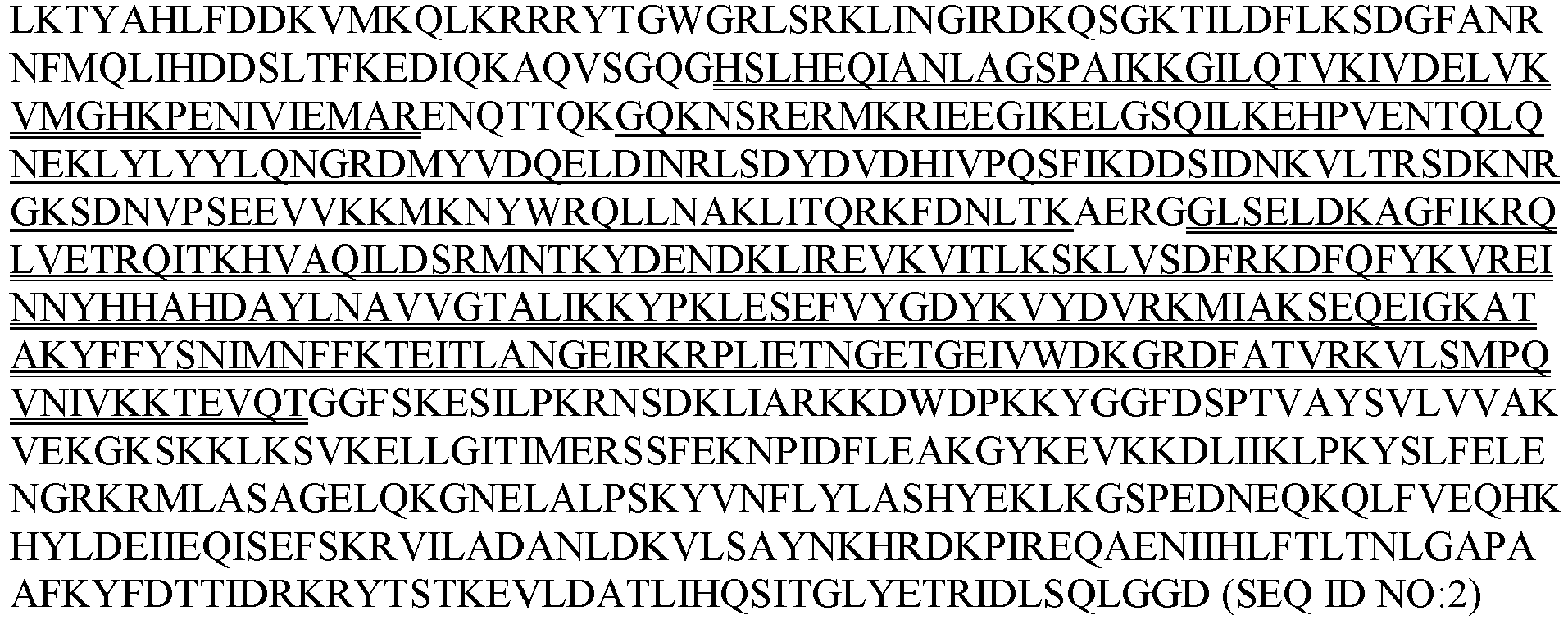
- In some embodiments, wild type Cas9 corresponds to, or comprises SEQ ID NO:3 (nucleotide) and/or SEQ ID NO: 4 (amino acid):
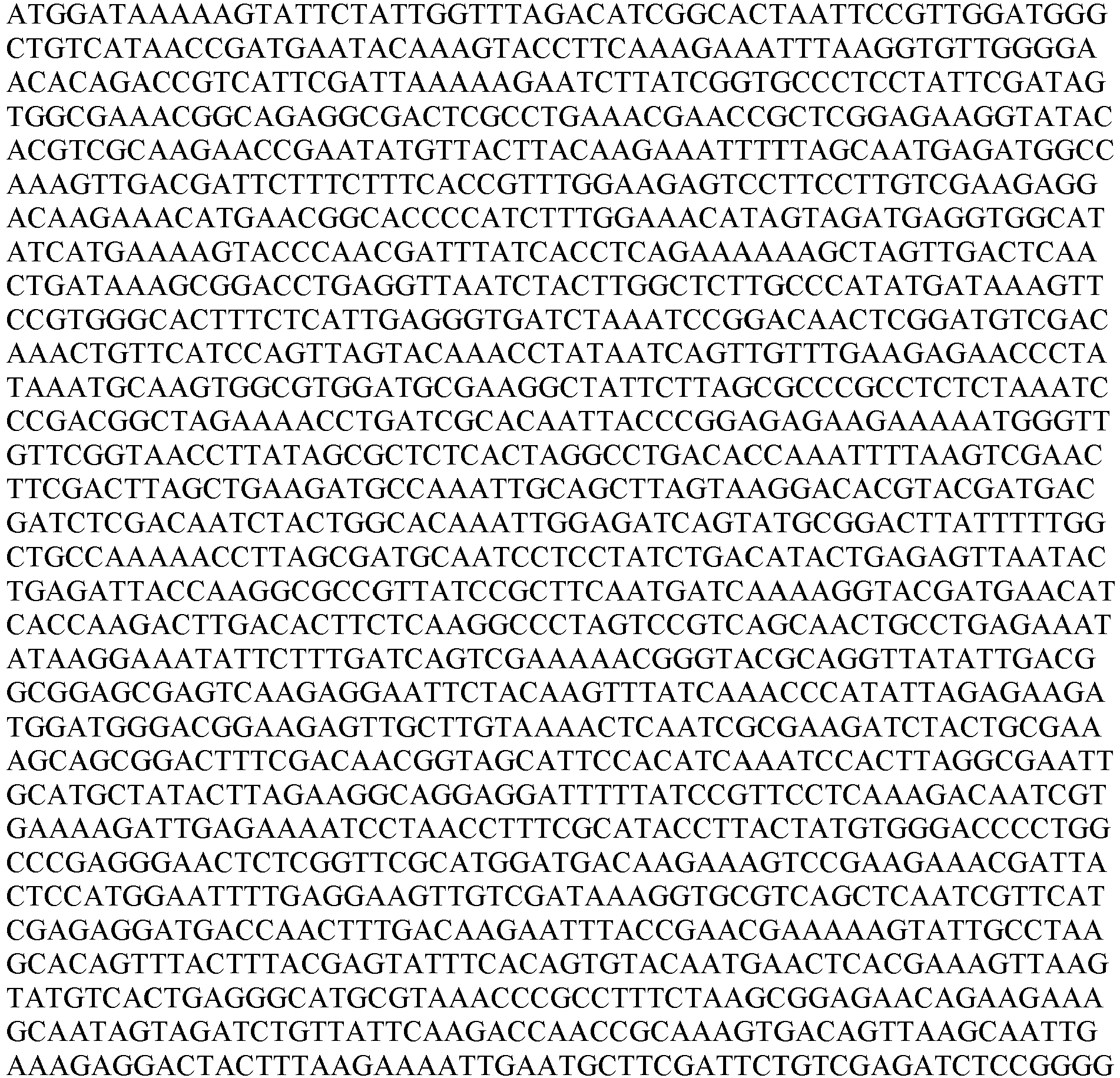

 (single underline: HNH domain; double underline: RuvC domain)
- In some embodiments, wild type Cas9 corresponds to Cas9 from Streptococcus pyogenes (NCBI Reference Sequence: NC_002737.2, SEQ ID NO: 8 (nucleotide); and Uniport Reference Sequence: Q99ZW2, SEQ ID NO: 10 (amino acid).


 (single underline: HNH domain; double underline: RuvC domain)
- In some embodiments, Cas9 refers to Cas9 from: Corynebacterium ulcerans (NCBI Refs: NC_015683.1, NC_017317.1); Corynebacterium diphtheria (NCBI Refs: NC_016782.1, NC_016786.1); Spiroplasma syrphidicola (NCBI Ref: NC_021284.1); Prevotella intermedia (NCBI Ref: NC_017861.1); Spiroplasma taiwanense (NCBI Ref: NC_021846.1); Streptococcus iniae (NCBI Ref: NC_021314.1); Belliella baltica (NCBI Ref: NC_018010.1); Psychroflexus torquisI (NCBI Ref: NC_018721.1); Streptococcus thermophilus (NCBI Ref: YP_820832.1), Listeria innocua (NCBI Ref: NP_472073.1), Campylobacter jejuni (NCBI Ref: YP_002344900.1) or Neisseria. meningitidis (NCBI Ref: YP_002342100.1) or to a Cas9 from any of the organisms listed in Example 5.
- In some embodiments, dCas9 corresponds to, or comprises in part or in whole, a Cas9 amino acid sequence having one or more mutations that inactivate the Cas9 nuclease activity. For example, in some embodiments, a dCas9 domain comprises D10A and/or H840A mutation.
dCas9 (D10A and H840A):(single underline: HNH domain; double underline: RuvC domain).
- In some embodiments, the Cas9 domain comprises a D10A mutation, while the residue at position 840 remains a histidine in the amino acid sequence provided in SEQ ID NO: 10, or at corresponding positions in any of the amino acid sequences provided in SEQ ID NOs: 11-260. Without wishing to be bound by any particular theory, the presence of the catalytic residue H840 restores the acvitity of the Cas9 to cleave the non-edited (e.g., non-deaminated) strand containing a G opposite the targeted C. Restoration of H840 (e.g., from A840) does not result in the cleavage of the target strand containing the C. Such Cas9 variants are able to generate a single-strand DNA break (nick) at a specific location based on the gRNA-defined target sequence, leading to repair of the non-edited strand, ultimately resulting in a G to A change on the non-edited strand. A schematic representation of this process is shown in
Figure 108 . Briefly, the C of a C-G basepair can be deaminated to a U by a deaminase, e.g., an APOBEC deamonase. Nicking the non-edited strand, having the G, facilitates removal of the G via mismatch repair mechanisms. UGI inhibits UDG, which prevents removal of the U. - In other embodiments, dCas9 variants having mutations other than D10A and H840A are provided, which, e.g., result in nuclease inactivated Cas9 (dCas9). Such mutations, by way of example, include other amino acid substitutions at D10 and H820, or other substitutions within the nuclease domains of Cas9 (e.g., substitutions in the HNH nuclease subdomain and/or the RuvC1 subdomain). In some embodiments, variants or homologues of dCas9 (e.g., variants of SEQ ID NO: 10) are provided which are at least about 70% identical, at least about 80% identical, at least about 90% identical, at least about 95% identical, at least about 98% identical, at least about 99% identical, at least about 99.5% identical, or at least about 99.9% identical to SEQ ID NO: 10. In some embodiments, variants of dCas9 (e.g., variants of SEQ ID NO: 10) are provided having amino acid sequences which are shorter, or longer than SEQ ID NO: 10, by about 5 amino acids, by about 10 amino acids, by about 15 amino acids, by about 20 amino acids, by about 25 amino acids, by about 30 amino acids, by about 40 amino acids, by about 50 amino acids, by about 75 amino acids, by about 100 amino acids or more.
- In some embodiments, Cas9 fusion proteins as provided herein comprise the full-length amino acid sequence of a Cas9 protein, e.g., one of the Cas9 sequences provided herein. In other embodiments, however, fusion proteins as provided herein do not comprise a full-length Cas9 sequence, but only a fragment thereof. For example, in some embodiments, a Cas9 fusion protein provided herein comprises a Cas9 fragment, wherein the fragment binds crRNA and tracrRNA or sgRNA, but does not comprise a functional nuclease domain, e.g., in that it comprises only a truncated version of a nuclease domain or no nuclease domain at all. Exemplary amino acid sequences of suitable Cas9 domains and Cas9 fragments are provided herein, and additional suitable sequences of Cas9 domains and fragments will be apparent to those of skill in the art.
- In some embodiments, Cas9 refers to Cas9 from: Corynebacterium ulcerans (NCBI Refs: NC_015683.1, NC_017317.1); Corynebacterium diphtheria (NCBI Refs: NC_016782.1, NC_016786.1); Spiroplasma syrphidicola (NCBI Ref: NC_021284.1); Prevotella intermedia (NCBI Ref: NC_017861.1); Spiroplasma taiwanense (NCBI Ref: NC_021846.1); Streptococcus iniae (NCBI Ref: NC_021314.1); Belliella baltica (NCBI Ref: NC_018010.1); Psychroflexus torquisI (NCBI Ref: NC_018721.1); Streptococcus thermophilus (NCBI Ref: YP_820832.1); Listeria innocua (NCBI Ref: NP_472073.1); Campylobacter jejuni (NCBI Ref: YP_002344900.1); or Neisseria. meningitidis (NCBI Ref: YP_002342100.1).
- The term "deaminase" or "deaminase domain," as used herein, refers to a protein or enzyme that catalyzes a deamination reaction. In some embodiments, the deaminase or deaminase domain is a cytidine deaminase, catalyzing the hydrolytic deamination of cytidine or deoxycytidine to uridine or deoxyuridine, respectively. In some embodiments, the deaminase or deaminase domain is a cytidine deaminase domain, catalyzing the hydrolytic deamination of cytosine to uracil. In some embodiments, the deaminase or deaminase domain is a naturally-occuring deaminase from an organism, such as a human, chimpanzee, gorilla, monkey, cow, dog, rat, or mouse. In some embodiments, the deaminase or deaminase domain is a variant of a naturally-occuring deaminase from an organism, that does not occur in nature. For example, in some embodiments, the deaminase or deaminase domain is at least 50%, at least 55%, at least 60%, at least 65%, at least 70%, at least 75% at least 80%, at least 85%, at least 90%, at least 95%, at least 96%, at least 97%, at least 98%, at least 99%, or at least 99.5% identical to a naturally-occuring deaminase from an organism.
- The term "effective amount," as used herein, refers to an amount of a biologically active agent that is sufficient to elicit a desired biological response. For example, in some embodiments, an effective amount of a nuclease may refer to the amount of the nuclease that is sufficient to induce cleavage of a target site specifically bound and cleaved by the nuclease. In some embodiments, an effective amount of a fusion protein provided herein, e.g., of a fusion protein comprising a nuclease-inactive Cas9 domain and a nucleic acid editing domain (e.g., a deaminase domain) may refer to the amount of the fusion protein that is sufficient to induce editing of a target site specifically bound and edited by the fusion protein. As will be appreciated by the skilled artisan, the effective amount of an agent, e.g., a fusion protein, a nuclease, a deaminase, a recombinase, a hybrid protein, a protein dimer, a complex of a protein (or protein dimer) and a polynucleotide, or a polynucleotide, may vary depending on various factors as, for example, on the desired biological response, e.g., on the specific allele, genome, or target site to be edited, on the cell or tissue being targeted, and on the agent being used.
- The term "linker," as used herein, refers to a chemical group or a molecule linking two molecules or moieties, e.g., two domains of a fusion protein, such as, for example, a nuclease-inactive Cas9 domain and a nucleic acid editing domain (e.g., a deaminase domain). In some embodiments, a linker joins a gRNA binding domain of an RNA-programmable nuclease, including a Cas9 nuclease domain, and the catalytic domain of a nucleic-acid editing protein. In some embodiments, a linker joins a dCas9 and a nucleic-acid editing protein. Typically, the linker is positioned between, or flanked by, two groups, molecules, or other moieties and connected to each one via a covalent bond, thus connecting the two. In some embodiments, the linker is an amino acid or a plurality of amino acids (e.g., a peptide or protein). In some embodiments, the linker is an organic molecule, group, polymer, or chemical moiety. In some embodiments, the linker is 5-100 amino acids in length, for example, 5, 6, 7, 8, 9, 10, 11, 12, 13, 14, 15, 16, 17, 18, 19, 20, 21, 22, 23, 24, 25, 26, 27, 28, 29, 30, 30-35, 35-40, 40-45, 45-50, 50-60, 60-70, 70-80, 80-90, 90-100, 100-150, or 150-200 amino acids in length. Longer or shorter linkers are also contemplated.
- The term "mutation," as used herein, refers to a substitution of a residue within a sequence, e.g., a nucleic acid or amino acid sequence, with another residue, or a deletion or insertion of one or more residues within a sequence. Mutations are typically described herein by identifying the original residue followed by the position of the residue within the sequence and by the identity of the newly substituted residue. Various methods for making the amino acid substitutions (mutations) provided herein are well known in the art, and are provided by, for example, Green and Sambrook, Molecular Cloning: A Laboratory Manual (4th ed., Cold Spring Harbor Laboratory Press, Cold Spring Harbor, N.Y. (2012)).
- The terms "nucleic acid" and "nucleic acid molecule," as used herein, refer to a compound comprising a nucleobase and an acidic moiety, e.g., a nucleoside, a nucleotide, or a polymer of nucleotides. Typically, polymeric nucleic acids, e.g., nucleic acid molecules comprising three or more nucleotides are linear molecules, in which adjacent nucleotides are linked to each other via a phosphodiester linkage. In some embodiments, "nucleic acid" refers to individual nucleic acid residues (e.g. nucleotides and/or nucleosides). In some embodiments, "nucleic acid" refers to an oligonucleotide chain comprising three or more individual nucleotide residues. As used herein, the terms "oligonucleotide" and "polynucleotide" can be used interchangeably to refer to a polymer of nucleotides (e.g., a string of at least three nucleotides). In some embodiments, "nucleic acid" encompasses RNA as well as single and/or double-stranded DNA. Nucleic acids may be naturally occurring, for example, in the context of a genome, a transcript, an mRNA, tRNA, rRNA, siRNA, snRNA, a plasmid, cosmid, chromosome, chromatid, or other naturally occurring nucleic acid molecule. On the other hand, a nucleic acid molecule may be a non-naturally occurring molecule, e.g., a recombinant DNA or RNA, an artificial chromosome, an engineered genome, or fragment thereof, or a synthetic DNA, RNA, DNA/RNA hybrid, or including non-naturally occurring nucleotides or nucleosides. Furthermore, the terms "nucleic acid," "DNA," "RNA," and/or similar terms include nucleic acid analogs, e.g., analogs having other than a phosphodiester backbone. Nucleic acids can be purified from natural sources, produced using recombinant expression systems and optionally purified, chemically synthesized, etc. Where appropriate, e.g., in the case of chemically synthesized molecules, nucleic acids can comprise nucleoside analogs such as analogs having chemically modified bases or sugars, and backbone modifications. A nucleic acid sequence is presented in the 5' to 3' direction unless otherwise indicated. In some embodiments, a nucleic acid is or comprises natural nucleosides (e.g. adenosine, thymidine, guanosine, cytidine, uridine, deoxyadenosine, deoxythymidine, deoxyguanosine, and deoxycytidine); nucleoside analogs (e.g., 2-aminoadenosine, 2-thiothymidine, inosine, pyrrolo-pyrimidine, 3-methyl adenosine, 5-methylcytidine, 2-aminoadenosine, C5-bromouridine, C5-fluorouridine, C5-iodouridine, C5-propynyl-uridine, C5-propynyl-cytidine, C5-methylcytidine, 2-aminoadenosine, 7-deazaadenosine, 7-deazaguanosine, 8-oxoadenosine, 8-oxoguanosine, O(6)-methylguanine, and 2-thiocytidine); chemically modified bases; biologically modified bases (e.g., methylated bases); intercalated bases; modified sugars (e.g., 2'-fluororibose, ribose, 2'-deoxyribose, arabinose, and hexose); and/or modified phosphate groups (e.g., phosphorothioates and 5'-N-phosphoramidite linkages).
- The term "nucleic acid editing domain," as used herein refers to a protein or enzyme capable of making one or more modifications (e.g., deamination of a cytidine residue) to a nucleic acid (e.g., DNA or RNA). Exemplary nucleic acid editing domains include, but are not limited to a deaminase, a nuclease, a nickase, a recombinase, a methyltransferase, a methylase, an acetylase, an acetyltransferase, a transcriptional activator, or a transcriptional repressor domain. Fusion proteins of the invention comprise a cytidine deaminase, such as an APOBEC or an AID deaminase.
- The term "proliferative disease," as used herein, refers to any disease in which cell or tissue homeostasis is disturbed in that a cell or cell population exhibits an abnormally elevated proliferation rate. Proliferative diseases include hyperproliferative diseases, such as pre-neoplastic hyperplastic conditions and neoplastic diseases. Neoplastic diseases are characterized by an abnormal proliferation of cells and include both benign and malignant neoplasias. Malignant neoplasia is also referred to as cancer.
- The terms "protein," "peptide," and "polypeptide" are used interchangeably herein, and refer to a polymer of amino acid residues linked together by peptide (amide) bonds. The terms refer to a protein, peptide, or polypeptide of any size, structure, or function. Typically, a protein, peptide, or polypeptide will be at least three amino acids long. A protein, peptide, or polypeptide may refer to an individual protein or a collection of proteins. One or more of the amino acids in a protein, peptide, or polypeptide may be modified, for example, by the addition of a chemical entity such as a carbohydrate group, a hydroxyl group, a phosphate group, a farnesyl group, an isofarnesyl group, a fatty acid group, a linker for conjugation, functionalization, or other modification, etc. A protein, peptide, or polypeptide may also be a single molecule or may be a multi-molecular complex. A protein, peptide, or polypeptide may be just a fragment of a naturally occurring protein or peptide. A protein, peptide, or polypeptide may be naturally occurring, recombinant, or synthetic, or any combination thereof. The term "fusion protein" as used herein refers to a hybrid polypeptide which comprises protein domains from at least two different proteins. One protein may be located at the amino-terminal (N-terminal) portion of the fusion protein or at the carboxy-terminal (C-terminal) protein thus forming an "amino-terminal fusion protein" or a "carboxy-terminal fusion protein," respectively. A protein may comprise different domains, for example, a nucleic acid binding domain (e.g., the gRNA binding domain of Cas9 that directs the binding of the protein to a target site) and a nucleic acid cleavage domain or a catalytic domain of a nucleic-acid editing protein. In some embodiments, a protein comprises a proteinaceous part, e.g., an amino acid sequence constituting a nucleic acid binding domain, and an organic compound, e.g., a compound that can act as a nucleic acid cleavage agent. In some embodiments, a protein is in a complex with, or is in association with, a nucleic acid, e.g., RNA. Any of the proteins provided herein may be produced by any method known in the art. For example, the proteins provided herein may be produced via recombinant protein expression and purification, which is especially suited for fusion proteins comprising a peptide linker. Methods for recombinant protein expression and purification are well known, and include those described by Green and Sambrook, Molecular Cloning: A Laboratory Manual (4th ed., Cold Spring Harbor Laboratory Press, Cold Spring Harbor, N.Y. (2012)).
- The term "RNA-programmable nuclease," and "RNA-guided nuclease" are used interchangeably herein and refer to a nuclease that forms a complex with (e.g., binds or associates with) one or more RNA that is not a target for cleavage. In some embodiments, an RNA-programmable nuclease, when in a complex with an RNA, may be referred to as a nuclease:RNA complex. Typically, the bound RNA(s) is referred to as a guide RNA (gRNA). gRNAs can exist as a complex of two or more RNAs, or as a single RNA molecule. gRNAs that exist as a single RNA molecule may be referred to as single-guide RNAs (sgRNAs), though "gRNA" is used interchangeably to refer to guide RNAs that exist as either single molecules or as a complex of two or more molecules. Typically, gRNAs that exist as single RNA species comprise two domains: (1) a domain that shares homology to a target nucleic acid (e.g., and directs binding of a Cas9 complex to the target); and (2) a domain that binds a Cas9 protein. In some embodiments, domain (2) corresponds to a sequence known as a tracrRNA, and comprises a stem-loop structure. For example, in some embodiments, domain (2) is identical or homologous to a tracrRNA as provided in Jinek et al., Science 337:816-821(2012). Other examples of gRNAs (e.g., those including domain 2) can be found in U.S. Provisional Patent Application,
U.S.S.N. 61/874,682, filed September 6, 2013 U.S.S.N. 61/874,746, filed September 6, 2013 - Because RNA-programmable nucleases (e.g., Cas9) use RNA:DNA hybridization to target DNA cleavage sites, these proteins are able to be targeted, in principle, to any sequence specified by the guide RNA. Methods of using RNA-programmable nucleases, such as Cas9, for site-specific cleavage (e.g., to modify a genome) are known in the art (see e.g., Cong, L. et al. Multiplex genome engineering using CRISPR/Cas systems. ); Mali, P. et al. RNA-guided human genome engineering via Cas9. ); Hwang, W.Y. et al. Efficient genome editing in zebrafish using a CRISPR-Cas system. ); Jinek, M. et al. RNA-programmed genome editing in human cells. ); Dicarlo, J.E. et al. Genome engineering in Saccharomyces cerevisiae using CRISPR-Cas systems. Nucleic acids research (2013); Jiang, W. et al. RNA-guided editing of bacterial genomes using CRISPR-Cas systems. )).
- The term "subject," as used herein, refers to an individual organism, for example, an individual mammal. In some embodiments, the subject is a human. In some embodiments, the subject is a non-human mammal. In some embodiments, the subject is a non-human primate. In some embodiments, the subject is a rodent. In some embodiments, the subject is a sheep, a goat, a cattle, a cat, or a dog. In some embodiments, the subject is a vertebrate, an amphibian, a reptile, a fish, an insect, a fly, or a nematode. In some embodiments, the subject is a research animal. In some embodiments, the subject is genetically engineered, e.g., a genetically engineered non-human subject. The subject may be of either sex and at any stage of development.
- The term "target site" refers to a sequence within a nucleic acid molecule that is deaminated by a deaminase or a fusion protein comprising a deaminase, (e.g., a dCas9-deaminase fusion protein provided herein).
- The terms "treatment," "treat," and "treating," refer to a clinical intervention aimed to reverse, alleviate, delay the onset of, or inhibit the progress of a disease or disorder, or one or more symptoms thereof, as described herein. As used herein, the terms "treatment," "treat," and "treating" refer to a clinical intervention aimed to reverse, alleviate, delay the onset of, or inhibit the progress of a disease or disorder, or one or more symptoms thereof, as described herein. In some embodiments, treatment may be administered after one or more symptoms have developed and/or after a disease has been diagnosed. In other embodiments, treatment may be administered in the absence of symptoms, e.g., to prevent or delay onset of a symptom or inhibit onset or progression of a disease. For example, treatment may be administered to a susceptible individual prior to the onset of symptoms (e.g., in light of a history of symptoms and/or in light of genetic or other susceptibility factors). Treatment may also be continued after symptoms have resolved, for example, to prevent or delay their recurrence.
- The term "recombinant" as used herein in the context of proteins or nucleic acids refers to proteins or nucleic acids that do not occur in nature, but are the product of human engineering. For example, in some embodiments, a recombinant protein or nucleic acid molecule comprises an amino acid or nucleotide sequence that comprises at least one, at least two, at least three, at least four, at least five, at least six, or at least seven mutations as compared to any naturally occurring sequence.
- The term "nucleobase editors (NBEs)" or "base editors (BEs)," as used herein, refers to the Cas9 fusion proteins described herein. In some embodiments of the disclosure, the fusion protein comprises a nuclease-inactive Cas9 (dCas9) fused to a deaminase. In some embodiments of the disclosure, the fusion protein comprises a Cas9 nickase fused to a deaminase. In some embodiments, the fusion protein comprises a nuclease-inactive Cas9 fused to a deaminase and further fused to a UGI domain. In some embodiments, the fusion protein comprises a Cas9 nickase fused to a deaminase and further fused to a UGI domain. In some embodiments, the dCas9 of the fusion protein comprises a D10A and a H840A mutation of SEQ ID NO: 10, or a corresponding mutation in any of SEQ ID NOs: 11-260, which inactivates nuclease activity of the Cas9 protein. In some embodiments, the fusion protein comprises a D10A mutation and comprises a histidine at residue 840 of SEQ ID NO: 10, or a corresponding mutation in any of SEQ ID NOs: 11-260, which renders Cas9 capable of cleaving only one strand of a nucleic acid duplex. An example of a Cas9 nickase is shown below in SEQ ID NO: 674. The terms "nucleobase editors (NBEs)" and "base editors (BEs)" may be used interchangeably.
- The term "uracil glycosylase inhibitor" or "UGI," as used herein, refers to a protein that is capable of inhibiting a uracil-DNA glycosylase base-excision repair enzyme.
- The term "Cas9 nickase," as used herein, refers to a Cas9 protein that is capable of cleaving only one strand of a duplexed nucleic acid molecule (e.g., a duplexed DNA molecule). In some embodiments, a Cas9 nickase comprises a D10A mutation and has a histidine at position H840 of SEQ ID NO: 10, or a corresponding mutation in any of SEQ ID NOs: 11-260. For example, a Cas9 nickase may comprise the amino acid sequence as set forth in SEQ ID NO: 674. Such a Cas9 nickase has an active HNH nuclease domain and is able to cleave the non-targeted strand of DNA, i.e., the strand bound by the gRNA. Further, such a Cas9 nickase has an inactive RuvC nuclease domain and is not able to cleave the targeted strand of the DNA, i.e., the strand where base editing is desired.
- Exemplary Cas9 nickase (Cloning vector pPlatTET-gRNA2; Accession No. BAV54124).

- Some aspects of this disclosure provide fusion proteins that comprise a domain capable of binding to a nucleotide sequence (e.g., a Cas9, or a Cpfl protein) and an enzyme domain, for example, a DNA-editing domain, such as, e.g., a deaminase domain. The deamination of a nucleobase by a deaminase can lead to a point mutation at the respective residue, which is referred to herein as nucleic acid editing. Fusion proteins comprising a Cas9 variant or domain and a DNA editing domain can thus be used for the targeted editing of nucleic acid sequences. Such fusion proteins are useful for targeted editing of DNA in vitro, e.g., for the generation of mutant cells or animals; for the introduction of targeted mutations, e.g., for the correction of genetic defects in cells ex vivo, e.g., in cells obtained from a subject that are subsequently re-introduced into the same or another subject; and for the introduction of targeted mutations, e.g., the correction of genetic defects or the introduction of deactivating mutations in disease-associated genes in a subject. Typically, the Cas9 domain of the fusion proteins described herein does not have any nuclease activity but instead is a Cas9 fragment or a dCas9 protein or domain. Methods for the use of Cas9 fusion proteins as described herein are also provided.
- Non-limiting, exemplary Cas9 domains are provided herein. The Cas9 domain may be a nuclease active Cas9 domain, a nucleasae inactive Cas9 domain, or a Cas9 nickase. In some embodiments of the disclosure, the Cas9 domain is a nuclease active domain. For example, the Cas9 domain may be a Cas9 domain that cuts both strands of a duplexed nucleic acid (e.g., both strands of a duplexed DNA molecule). In some embodiments, the Cas9 domain comprises any one of the amino acid sequences as set forth in SEQ ID NOs: 10-263. In some embodiments the Cas9 domain comprises an amino acid sequence that is at least 60%, at least 65%, at least 70%, at least 75%, at least 80%, at least 85%, at least 90%, at least 95%, at least 96%, at least 97%, at least 98%, at least 99%, or at least 99.5% identical to any one of the amino acid sequences set forth in SEQ ID NOs: 10-263. In some embodiments, the Cas9 domain comprises an amino acid sequence that has 1, 2, 3, 4, 5, 6, 7, 8, 9, 10, 11, 12, 13, 14, 15, 16, 17, 18, 19, 20, 21, 22, 21, 24, 25, 26, 27, 28, 29, 30, 31, 32, 33, 34, 35, 36, 37, 38, 39, 40, 41, 42, 43, 44, 45, 46, 47, 48, 49, 50 or more or more mutations compared to any one of the amino acid sequences set forth in SEQ ID NOs: 10-263. In some embodiments, the Cas9 domain comprises an amino acid sequence that has at least 10, at least 15, at least 20, at least 30, at
leat 40, at least 50, at least 60, at least 70, at least 80, at least 90, at least 100, at least 150, at least 200, at least 250, at least 300, at least 350, at least 400, at least 500, at least 600, at least 700, at least 800, at least 900, at least 1000, at least 1100, or at least 1200 identical contiguous amino acid residues as compared to any one of the amino acid sequences set forth in SEQ ID NOs: 10-263. - In some embodiments, the Cas9 domain is a nuclease-inactive Cas9 domain (dCas9). For example, the dCas9 domain may bind to a duplexed nucleic acid molecule (e.g., via a gRNA molecule) without cleaving either strand of the duplexed nucleic acid molecule. In some embodiments, the nuclease-inactive dCas9 domain comprises a D10X mutation and a H840X mutation of the amino acid sequence set forth in SEQ ID NO: 10, or a corresponding mutation in any of the amino acid sequences provided in SEQ ID NOs: 11-260, wherein X is any amino acid change. In some embodiments, the nuclease-inactive dCas9 domain comprises a D10A mutation and a H840A mutation of the amino acid sequence set forth in SEQ ID NO: 10, or a corresponding mutation in any of the amino acid sequences provided in SEQ ID NOs: 11-260. As one example, a nuclease-inactive Cas9 domain comprises the amino acid sequence set forth in SEQ ID NO: 263 (Cloning vector pPlatTET-gRNA2, Accession No. BAV54124).
 see, e.g., Qi et al., Repurposing CRISPR as an RNA-guided platform for sequence-specific control of gene expression. Cell. 2013; 152(5):1173-83).
- Additional suitable nuclease-inactive dCas9 domains will be apparent to those of skill in the art based on this disclosure and knowledge in the field, and are within the scope of this disclosure. Such additional exemplary suitable nuclease-inactive Cas9 domains include, but are not limited to, D10A/H840A, D10A/D839A/H840A, and D10A/D839A/H840A/N863A mutant domains (See, e.g., Prashant et al., CAS9 transcriptional activators for target specificity screening and paired nickases for cooperative genome engineering. Nature Biotechnology. 2013; 31(9): 833-838). In some embodiments the dCas9 domain comprises an amino acid sequence that is at least 60%, at least 65%, at least 70%, at least 75%, at least 80%, at least 85%, at least 90%, at least 95%, at least 96%, at least 97%, at least 98%, at least 99%, or at least 99.5% identical to any one of the dCas9 domains provided herein. In some embodiments, the Cas9 domain comprises an amino acid sequences that has 1, 2, 3, 4, 5, 6, 7, 8, 9, 10, 11, 12, 13, 14, 15, 16, 17, 18, 19, 20, 21, 22, 21, 24, 25, 26, 27, 28, 29, 30, 31, 32, 33, 34, 35, 36, 37, 38, 39, 40, 41, 42, 43, 44, 45, 46, 47, 48, 49, 50 or more or more mutations compared to any one of the amino acid sequences set forth in SEQ ID NOs: 10-263. In some embodiments, the Cas9 domain comprises an amino acid sequence that has at least 10, at least 15, at least 20, at least 30, at
leat 40, at least 50, at least 60, at least 70, at least 80, at least 90, at least 100, at least 150, at least 200, at least 250, at least 300, at least 350, at least 400, at least 500, at least 600, at least 700, at least 800, at least 900, at least 1000, at least 1100, or at least 1200 identical contiguous amino acid residues as compared to any one of the amino acid sequences set forth in SEQ ID NOs: 10-263. - In some embodiments, the Cas9 domain is a Cas9 nickase. The Cas9 nickase may be a Cas9 protein that is capable of cleaving only one strand of a duplexed nucleic acid molecule (e.g., a duplexed DNA molecule). In some embodiments the Cas9 nickase cleaves the target strand of a duplexed nucleic acid molecule, meaning that the Cas9 nickase cleaves the strand that is base paired to (complementary to) a gRNA (e.g., an sgRNA) that is bound to the Cas9. In some embodiments, a Cas9 nickase comprises a D10A mutation and has a histidine at position 840 of SEQ ID NO: 10, or a mutation in any of SEQ ID NOs: 11-260. For example, a Cas9 nickase may comprise the amino acid sequence as set forth in SEQ ID NO: 674. In some embodiments the Cas9 nickase cleaves the non-target, non-base-edited strand of a duplexed nucleic acid molecule, meaning that the Cas9 nickase cleaves the strand that is not base paired to a gRNA (e.g., an sgRNA) that is bound to the Cas9. In some embodiments, a Cas9 nickase comprises an H840A mutation and has an aspartic acid residue at
position 10 of SEQ ID NO: 10, or a corresponding mutation in any of SEQ ID NOs: 11-260. In some embodiments the Cas9 nickase comprises an amino acid sequence that is at least 60%, at least 65%, at least 70%, at least 75%, at least 80%, at least 85%, at least 90%, at least 95%, at least 96%, at least 97%, at least 98%, at least 99%, or at least 99.5% identical to any one of the Cas9 nickases provided herein. Additional suitable Cas9 nickases will be apparent to those of skill in the art based on this disclosure and knowledge in the field, and are within the scope of this disclosure. - Some aspects of the disclosure provide Cas9 domains that have different PAM specificities. Typically, Cas9 proteins, such as Cas9 from S. pyogenes (spCas9), require a canonical NGG PAM sequence to bind a particular nucleic acid region. This may limit the ability to edit desired bases within a genome. In some embodiments, the base editing fusion proteins provided herein may need to be placed at a precise location, for example where a target base is placed within a 4 base region (e.g., a "deamination window"), which is approximately 15 bases upstream of the PAM. See Komor, A.C., et al., "Programmable editing of a target base in genomic DNA without double-stranded DNA cleavage" Nature 533, 420-424 (2016). Accordingly, in some embodiments, any of the fusion proteins provided herein may contain a Cas9 domain that is capable of binding a nucleotide sequence that does not contain a canonical (e.g., NGG) PAM sequence. Cas9 domains that bind to non-canonical PAM sequences have been described in the art and would be apparent to the skilled artisan. For example, Cas9 domains that bind non-canonical PAM sequences have been described in Kleinstiver, B. P., et al., "Engineered CRISPR-Cas9 nucleases with altered PAM specificities" Nature 523, 481-485 (2015); and Kleinstiver, B. P., et al., "Broadening the targeting range of Staphylococcus aureus CRISPR-Cas9 by modifying PAM recognition" ).
- In some embodiments, the Cas9 domain is a Cas9 domain from Staphylococcus aureus (SaCas9). In some embodiments, the SaCas9 domain is a nuclease active SaCas9, a nuclease inactive SaCas9 (SaCas9d), or a SaCas9 nickase (SaCas9n). In some embodiments, the SaCas9 comprises the amino acid sequence SEQ ID NO: 4273. In some embodiments, the SaCas9 comprises a N579X mutation of SEQ ID NO: 4273, or a corresponding mutation in any of the amino acid sequences provided in SEQ ID NOs: 11-260, wherein X is any amino acid except for N. In some embodiments, the SaCas9 comprises a N579A mutation of SEQ ID NO: 4273, or a corresponding mutation in any of the amino acid sequences provided in SEQ ID NOs: 11-260. In some embodiments, the SaCas9 domain, the SaCas9d domain, or the SaCas9n domain can bind to a nucleic acid seuqnce having a non-canonical PAM. In some embodiments, the SaCas9 domain, the SaCas9d domain, or the SaCas9n domain can bind to a nucleic acid sequence having a NNGRRT PAM sequence. In some embodiments, the SaCas9 domain comprises one or more of a E781X, a N967X, and a R1014X mutation of SEQ ID NO: 4273, or a corresponding mutation in any of the amino acid sequences provided in SEQ ID NOs: 11-260, wherein X is any amino acid. In some embodiments, the SaCas9 domain comprises one or more of a E781K, a N967K, and a R1014H mutation of SEQ ID NO: 4273, or one or more corresponding mutation in any of the amino acid sequences provided in SEQ ID NOs: 11-260. In some embodiments, the SaCas9 domain comprises a E781K, a N967K, or a R1014H mutation of SEQ ID NO: 4273, or corresponding mutations in any of the amino acid sequences provided in SEQ ID NOs: 11-260.
- In some embodiments, the Cas9 domain of any of the fusion proteins provided herein comprises an amino acid sequence that is at least 60%, at least 65%, at least 70%, at least 75%, at least 80%, at least 85%, at least 90%, at least 95%, at least 96%, at least 97%, at least 98%, at least 99%, or at least 99.5% identical to any one of SEQ ID NOs: 4273-4275. In some embodiments, the Cas9 domain of any of the fusion proteins provided herein comprises the amino acid sequence of any one of SEQ ID NOs: 4273-4275. In some embodiments, the Cas9 domain of any of the fusion proteins provided herein consists of the amino acid sequence of any one of SEQ ID NOs: 4273-4275.
-


- Residue N579 of SEQ ID NO: 4273, which is underlined and in bold, may be mutated (e.g., to a A579) to yield a SaCas9 nickase.
-

- Residue A579 of SEQ ID NO: xx, which can be mutated from N579 of SEQ ID NO: 4274 to yield a SaCas9 nickase, is underlined and in bold.
-

- Residue A579 of SEQ ID NO: 4275, which can be mutated from N579 of SEQ ID NO: 4275 to yield a SaCas9 nickase, is underlined and in bold. Residues K781, K967, and H1014 of SEQ ID NO: 4275, which can be mutated from E781, N967, and R1014 of SEQ ID NO: 4275 to yield a SaKKH Cas9 are underlined and in italics.
- In some embodiments, the Cas9 domain is a Cas9 domain from Streptococcus pyogenes (SpCas9). In some embodiments, the SpCas9 domain is a nuclease active SpCas9, a nuclease inactive SpCas9 (SpCas9d), or a SpCas9 nickase (SpCas9n). In some embodiments, the SpCas9 comprises the amino acid sequence SEQ ID NO: 4276. In some embodiments, the SpCas9 comprises a D9X mutation of SEQ ID NO: 4276, or a corresponding mutation in any of the amino acid sequences provided in SEQ ID NOs: 11-260, wherein X is any amino acid except for D. In some embodiments, the SpCas9 comprises a D9A mutation of SEQ ID NO: 4276, or a corresponding mutation in any of the amino acid sequences provided in SEQ ID NOs: 11-260. In some embodiments, the SpCas9 domain, the SpCas9d domain, or the SpCas9n domain can bind to a nucleic acid seuqnce having a non-canonical PAM. In some embodiments, the SpCas9 domain, the SpCas9d domain, or the SpCas9n domain can bind to a nucleic acid sequence having a NGG, a NGA, or a NGCG PAM sequence. In some embodiments, the SpCas9 domain comprises one or more of a D1134X, a R1334X, and a T1336X mutation of SEQ ID NO: 4276, or a corresponding mutation in any of the amino acid sequences provided in SEQ ID NOs: 11-260, wherein X is any amino acid. In some embodiments, the SpCas9 domain comprises one or more of a D1134E, R1334Q, and T1336R mutation of SEQ ID NO: 4276, or a corresponding mutation in any of the amino acid sequences provided in SEQ ID NOs: 11-260. In some embodiments, the SpCas9 domain comprises a D1134E, a R1334Q, and a T1336R mutation of SEQ ID NO: 4276, or corresponding mutations in any of the amino acid sequences provided in SEQ ID NOs: 11-260. In some embodiments, the SpCas9 domain comprises one or more of a D1134X, a R1334X, and a T1336X mutation of SEQ ID NO: 4276, or a corresponding mutation in any of the amino acid sequences provided in SEQ ID NOs: 11-260, wherein X is any amino acid. In some embodiments, the SpCas9 domain comprises one or more of a D1134V, a R1334Q, and a T1336R mutation of SEQ ID NO: 4276, or a corresponding mutation in any of the amino acid sequences provided in SEQ ID NOs: 11-260. In some embodiments, the SpCas9 domain comprises a D1134V, a R1334Q, and a T1336R mutation of SEQ ID NO: 4276, or corresponding mutations in any of the amino acid sequences provided in SEQ ID NOs: 11-260. In some embodiments, the SpCas9 domain comprises one or more of a D1134X, a G1217X, a R1334X, and a T1336X mutation of SEQ ID NO: 4276, or a corresponding mutation in any of the amino acid sequences provided in SEQ ID NOs: 11-260, wherein X is any amino acid. In some embodiments, the SpCas9 domain comprises one or more of a D1134V, a G1217R, a R1334Q, and a T1336R mutation of SEQ ID NO: 4276, or a corresponding mutation in any of the amino acid sequences provided in SEQ ID NOs: 11-260. In some embodiments, the SpCas9 domain comprises a D1134V, a G1217R, a R1334Q, and a T1336R mutation of SEQ ID NO: 4276, or corresponding mutations in any of the amino acid sequences provided in SEQ ID NOs: 11-260.
- In some embodiments, the Cas9 domain of any of the fusion proteins provided herein comprises an amino acid sequence that is at least 60%, at least 65%, at least 70%, at least 75%, at least 80%, at least 85%, at least 90%, at least 95%, at least 96%, at least 97%, at least 98%, at least 99%, or at least 99.5% identical to any one of SEQ ID NOs: 4276-4280. In some embodiments, the Cas9 domain of any of the fusion proteins provided herein comprises the amino acid sequence of any one of SEQ ID NOs: 4276-4280. In some embodiments, the Cas9 domain of any of the fusion proteins provided herein consists of the amino acid sequence of any one of SEQ ID NOs: 4276-4280.
-
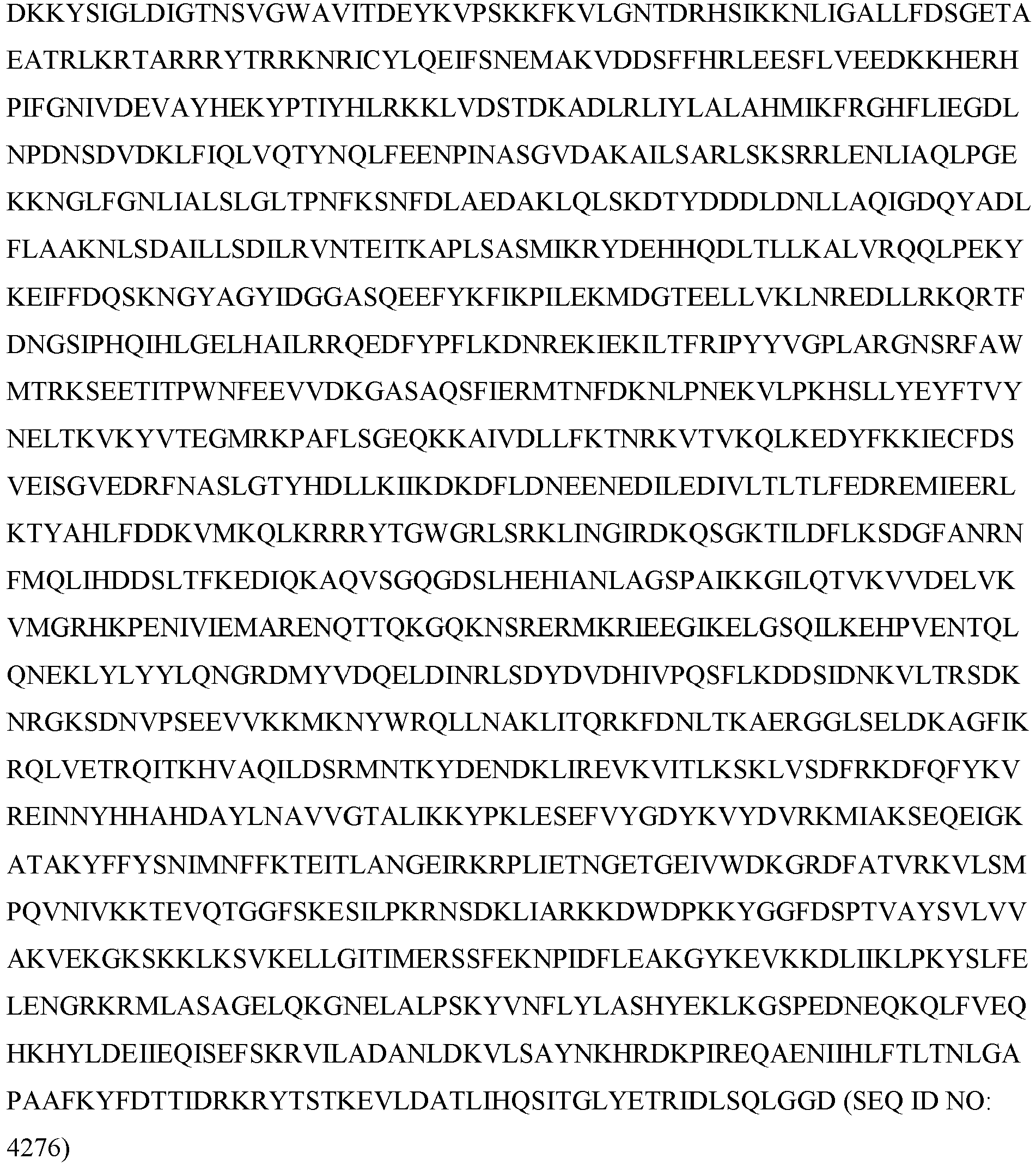
-

-


- Residues E1134, Q1334, and R1336 of SEQ ID NO: 4278, which can be mutated from D1134, R1334, and T1336 of SEQ ID NO: 4278 to yield a SpEQR Cas9, are underlined and in bold.
-


- Residues V1134, Q1334, and R1336 of SEQ ID NO: 4279, which can be mutated from D1134, R1334, and T1336 of SEQ ID NO: 4279 to yield a SpVQR Cas9, are underlined and in bold.
-

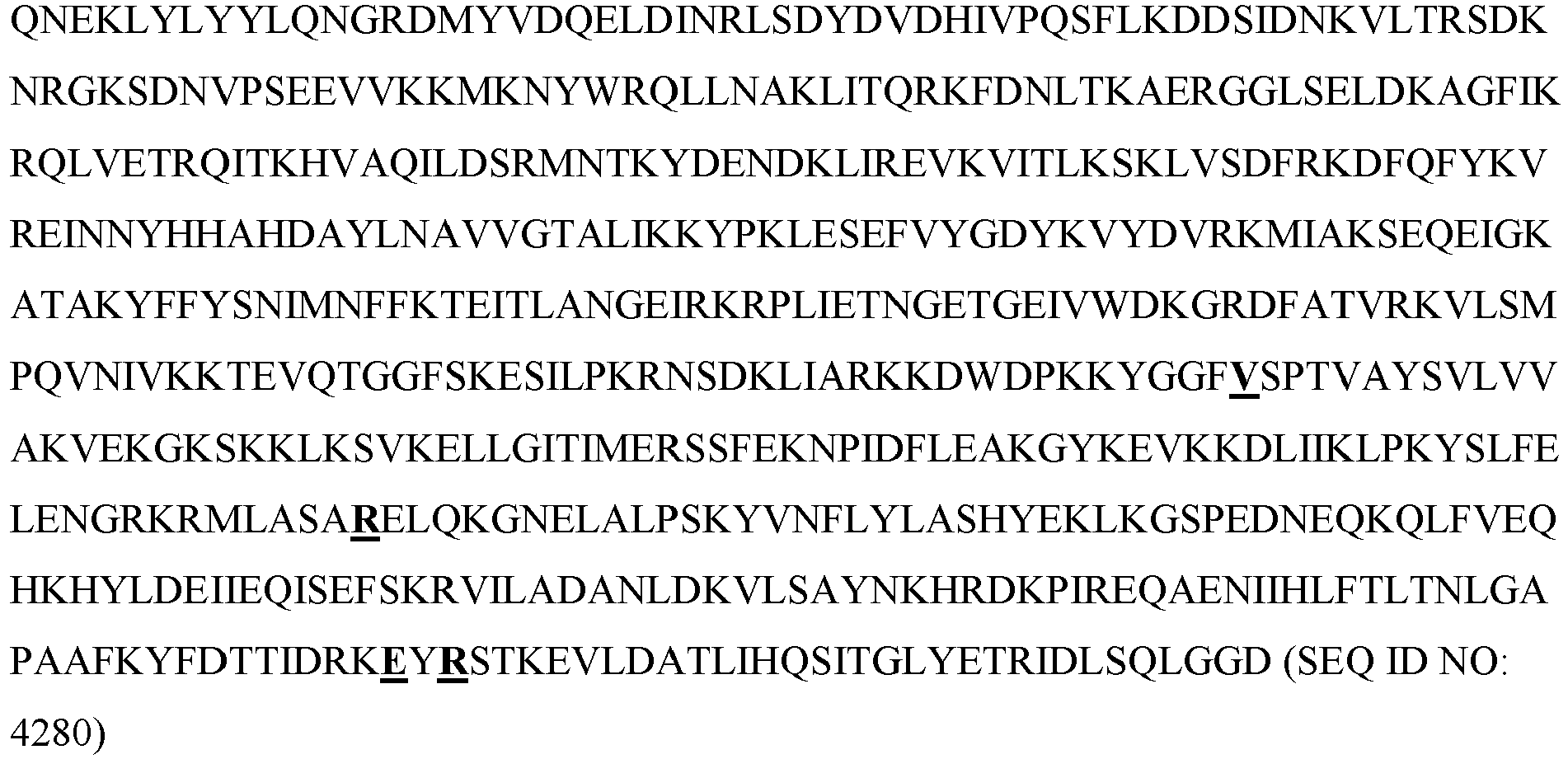
- Residues V1134, R1217, Q1334, and R1336 of SEQ ID NO: 4280, which can be mutated from D1134, G1217, R1334, and T1336 of SEQ ID NO: 4280 to yield a SpVRER Cas9, are underlined and in bold.
- The following are exemplary fusion proteins (e.g., base editing proteins) capable of binding to a nucleic acid sequence having a non-canonical (e.g., a non-NGG) PAM sequence:
-


-

-


-

-

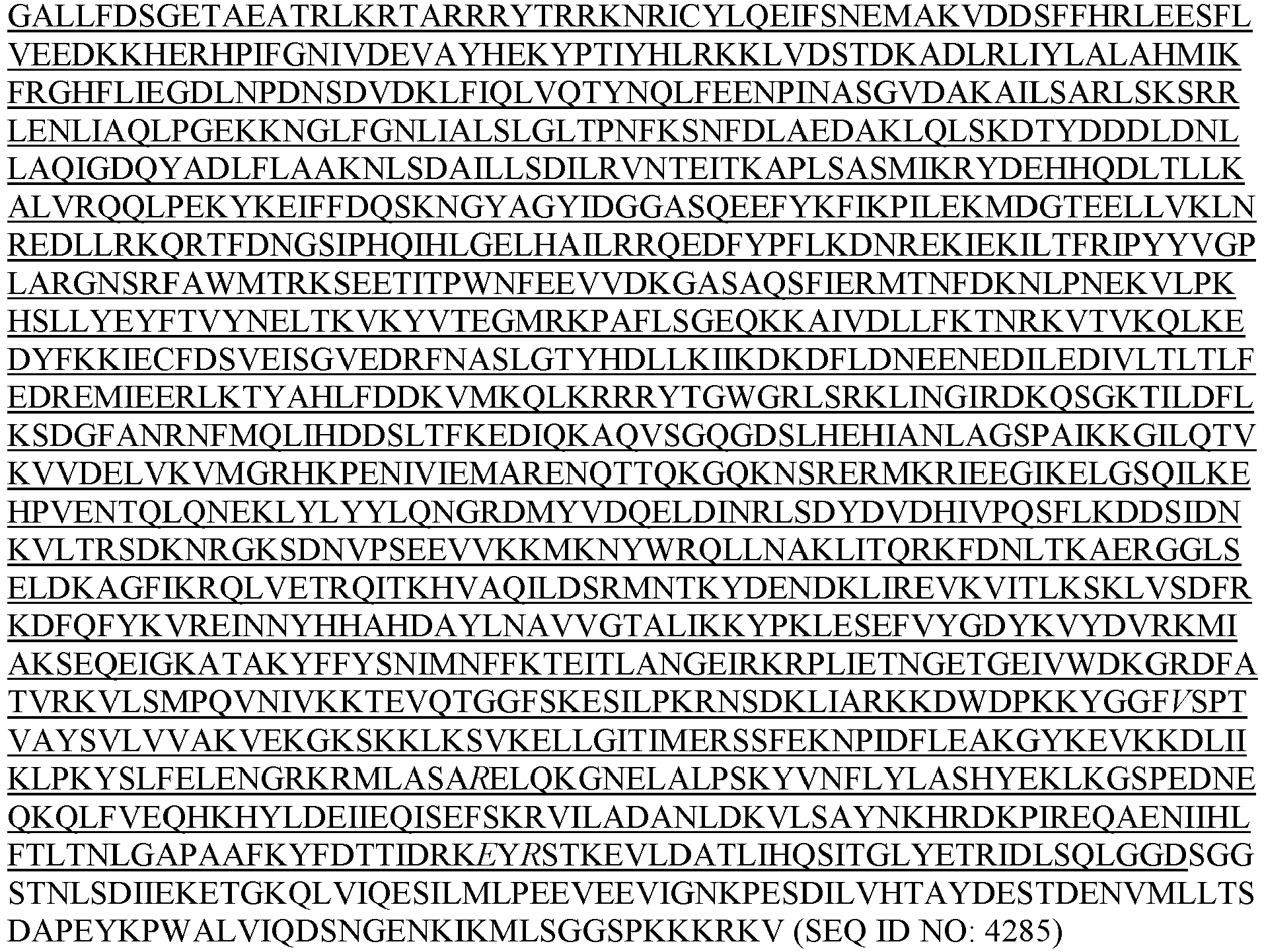
- Some aspects of the disclosure provide Cas9 fusion proteins (e.g., any of the fusion proteins provided herein) comprising a Cas9 domain that has high fidelity. Additional aspects of the disclosure provide Cas9 fusion proteins (e.g., any of the fusion proteins provided herein) comprising a Cas9 domain with decreased electrostatic interactions between the Cas9 domain and a sugar-phosphate backbone of a DNA, as compared to a wild-type Cas9 domain. In some embodiments, a Cas9 domain (e.g., a wild type Cas9 domain) comprises one or more mutations that decreases the association between the Cas9 domain and a sugar-phosphate backbone of a DNA. In some embodiments, any of the Cas9 fusion proteins provided herein comprise one or more of a N497X, a R661X, a Q695X, and/or a Q926X mutation of the amino acid sequence provided in SEQ ID NO: 10, or a corresponding mutation in any of the amino acid sequences provided in SEQ ID NOs: 11-260, wherein X is any amino acid. In some embodiments, any of the Cas9 fusion proteins provided herein comprise one or more of a N497A, a R661A, a Q695A, and/or a Q926A mutation of the amino acid sequence provided in SEQ ID NO: 10, or a corresponding mutation in any of the amino acid sequences provided in SEQ ID NOs: 11-260. In some embodiments, the Cas9 domain comprises a D10A mutation of the amino acid sequence provided in SEQ ID NO: 10, or a corresponding mutation in any of the amino acid sequences provided in SEQ ID NOs: 11-260. In some embodiments, the Cas9 domain (e.g., of any of the fusion proteins provided herein) comprises the amino acid sequence as set forth in SEQ ID NO: 325. In some embodiments, the fusion protein comprises the amino acid sequence as set forth in SEQ ID NO: 285. Cas9 domains with high fidelity are known in the art and would be apparent to the skilled artisan. For example, Cas9 domains with high fidelity have been described in Kleinstiver, B.P., et al. "High-fidelity CRISPR-Cas9 nucleases with no detectable genome-wide off-target effects." Nature 529, 490-495 (2016); and Slaymaker, I.M., et al. "Rationally engineered Cas9 nucleases with improved specificity." ).
- It should be appreciated that the base editors provided herein, for example base editor 2 (BE2) or base editor 3 (BE3), may be converted into high fidelity base editors by modifyint the Cas9 domain as described herein to generate high fidelity base editors, for example high fidelity base editor 2 (HF-BE2) or high fidelity base editor 3 (HF-BE3). In some embodiments, base editor 2 (BE2) comprises a deaminase domain, a dCas9, and a UGI domain. In some embodiments, base editor 3 (BE3) comprises a deaminase domain an nCas9 domain and a UGI domain.
-


-

- Any of the Cas9 domains (e.g., a nuclease active Cas9 protein, a nuclease-inactive dCas9 protein, or a Cas9 nickase protein) disclosed herein may be fused to a second protein, thus fusion proteins provided herein comprise a Cas9 domain as provided herein and a second protein, or a "fusion partner". In some embodiments, the second protein is fused to the N-terminus of the Cas9 domain. However, in other embodiments, the second protein is fused to the C-terminus of the Cas9 domain. In some embodiments, the second protein that is fused to the Cas9 domain is a nucleic acid editing domain. In some embodiments, the Cas9 domain and the nucleic acid editing domain are fused via a linker, while in other embodiments the Cas9 domain and the nucleic acid editing domain are fused directly to one another. In some embodiments, the linker comprises (GGGS)n (SEQ ID NO: 265), (GGGGS)n (SEQ ID NO: 5), (G)n, (EAAAK)n (SEQ ID NO: 6), (GGS)n, (SGGS)n (SEQ ID NO: 4288), SGSETPGTSESATPES (SEQ ID NO: 7), or (XP)n motif, or a combination of any of these, wherein n is independently an integer between 1 and 30, and wherein X is any amino acid. In some embodiments, the linker comprises a (GGS)n motif, wherein n is 1, 3, or 7. In some embodiments, the linker comprises a (GGS)n motif, wherein n is 1, 2, 3, 4, 5, 6, 7, 8, 9, 10, 11, 12, 13, 14, or 15. In some embodiments, the linker comprises an amino acid sequence of SGSETPGTSESATPES (SEQ ID NO: 7),also referred to as the XTEN linker in the Examples). The length of the linker can influence the base to be edited, as illustrated in the Examples. For example, a linker of 3-amino-acid long (e.g., (GGS)i) may give a 2-5, 2-4, 2-3, 3-4 base editing window relative to the PAM sequence, while a 9-amino-acid linker (e.g., (GGS)3 (SEQ ID NO: 596)) may give a 2-6, 2-5, 2-4, 2-3, 3-6, 3-5, 3-4, 4-6, 4-5, 5-6 base editing window relative to the PAM sequence. A 16-amino-acid linker (e.g., the XTEN linker) may give a 2-7, 2-6, 2-5, 2-4, 2-3, 3-7, 3-6, 3-5, 3-4, 4-7, 4-6, 4-5, 5-7, 5-6, 6-7 base window relative to the PAM sequence with exceptionally strong activity, and a 21-amino-acid linker (e.g., (GGS)7 (SEQ ID NO: 597)) may give a 3-8, 3-7, 3-6, 3-5, 3-4, 4-8, 4-7, 4-6, 4-5, 5-8, 5-7, 5-6, 6-8, 6-7, 7-8 base editing window relative to the PAM sequence. The novel finding that varying linker length may allow the dCas9 fusion proteins of the disclosure to edit nucleobases different distances from the PAM sequence affords siginicant clinical importance, since a PAM sequence may be of varying distance to the disease-causing mutation to be corrected in a gene. It is to be understood that the linker lengths described as examples here are not meant to be limiting.
- In some embodiments, the second protein comprises an enzymatic domain. In some embodiments, the enzymatic domain is a nucleic acid editing domain. Such a nucleic acid editing domain may be, without limitation, a nuclease, a nickase, a recombinase, a deaminase, a methyltransferase, a methylase, an acetylase, or an acetyltransferase. Nonlimiting exemplary binding domains that may be used in accordance with this disclosure include transcriptional activator domains and transcriptional repressor domains.
- In some embodiments of the disclosure, second protein comprises a nucleic acid editing domain. In some embodiments of the disclosure, the nucleic acid editing domain can catalyze a C to U base change. In some embodiments of the disclosure, the nucleic acid editing domain is a deaminase domain. The fusion protein of the invention comprisesa cytidine deaminase domain. In some embodiments, the deaminase is an apolipoprotein B mRNA-editing complex (APOBEC) family deaminase. In some embodiments, the deaminase is an APOBEC1 deaminase. In some embodiments, the deaminase is an APOBEC2 deaminase. In some embodiments, the deaminase is an APOBEC3 deaminase. In some embodiments, the deaminase is an APOBEC3A deaminase. In some embodiments, the deaminase is an APOBEC3B deaminase. In some embodiments, the deaminase is an APOBEC3C deaminase. In some embodiments, the deaminase is an APOBEC3D deaminase. In some embodiments, the deaminase is an APOBEC3E deaminase. In some embodiments, the deaminase is an APOBEC3F deaminase. In some embodiments, the deaminase is an APOBEC3G deaminase. In some embodiments, the deaminase is an APOBEC3H deaminase. In some embodiments, the deaminase is an APOBEC4 deaminase. In some embodiments, the deaminase is an activation-induced deaminase (AID). In some embodiments, the deaminase is a vertebrate deaminase. In some embodiments, the deaminase is an invertebrate deaminase. In some embodiments, the deaminase is a human, chimpanzee, gorilla, monkey, cow, dog, rat, or mouse deaminase. In some embodiments, the deaminase is a human deaminase. In some embodiments, the deaminase is a rat deaminase, e.g., rAPOBEC1. In some embodiments, the deaminase is a Petromyzon marinus cytidine deaminase 1 (pmCDA1). In some embodiments, the deminase is a human APOBEC3G (SEQ ID NO: 275). In some embodiments, the deaminase is a fragment of the human APOBEC3G (SEQ ID NO: 5740). In some embodiments, the deaminase is a human APOBEC3G variant comprising a D316R_D317R mutation (SEQ ID NO: 5739). In some embodiments, the deaminase is a frantment of the human APOBEC3G and comprising mutations corresponding to the D316R D317R mutations in SEQ ID NO: 275 (SEQ ID NO: 5741).
- In some embodiments, the nucleic acid editing domain is at least 80%, at least 85%, at least 90%, at least 92%, at least 95%, at least 96%, at least 97%, at least 98%, at least 99%, or at least 99.5% identical to the deaminase domain of any one of SEQ ID NOs: 266-284, 607-610, 5724-5736, or 5738-5741. In some embodiments, the nucleic acid editing domain comprises the amino acid sequence of any one of SEQ ID NOs: 266-284, 607-610, 5724-5736, or 5738-5741.
- Some aspects of the disclosure are based on the recognition that modulating the deaminase domain catalytic activity of any of the fusion proteins provided herein, for example by making point mutations in the deaminase domain, affect the processivity of the fusion proteins (e.g., base editors). For example, mutations that reduce, but do not eliminate, the catalytic activity of a deaminase domain within a base editing fusion protein can make it less likely that the deaminase domain will catalyze the deamination of a residue adjacent to a target residue, thereby narrowing the deamination window. The ability to narrow the deaminataion window may prevent unwanted deamination of residues adjacent of specific target residues, which may decrease or prevent off-target effects.
- In some embodiments, any of the fusion proteins provided herein comprise a deaminase domain (e.g., a cytidine deaminase domain) that has reduced catalytic deaminase activity. In some embodiments, any of the fusion proteins provided herein comprise a deaminase domain (e.g., a cytidine deaminase domain) that has a reduced catalytic deaminase activity as compared to an appropriate control. For example, the appropriate control may be the deaminase activity of the deaminase prior to introducing one or more mutations into the deaminase. In other embodiments, the appropriate control may be a wild-type deaminase. In some embodiments, the appropriate control is a wild-type apolipoprotein B mRNA-editing complex (APOBEC) family deaminase. In some embodiments, the appropriate control is an APOBEC1 deaminase, an APOBEC2 deaminase, an APOBEC3A deaminase, an APOBEC3B deaminase, an APOBEC3C deaminase, an APOBEC3D deaminase, an APOBEC3F deaminase, an APOBEC3G deaminase, or an APOBEC3H deaminase. In some embodiments, the appropriate control is an activation induced deaminase (AID). In some embodiments, the appropriate control is a
cytidine deaminase 1 from Petromyzon marinus (pmCDA1). In some embodiments, the deaminse domain may be a deaminase domain that has at least 1%, at least 5%, at least 15%, at least 20%, at least 25%, at least 30%, at least 40%, at least 50%, at least 60%, at lest 70%, at least 80%, at least 90%, or at least 95% less catalytic deaminase activity as compared to an appropriate control. - In some embodiments, any of the fusion proteins provided herein comprise an APOBEC deaminase comprising one or more mutations selected from the group consisting of H121X, H122X, R126X, R126X, R118X, W90X, W90X, and R132X of rAPOBEC1 (SEQ ID NO: 284), or one or more corresponding mutations in another APOBEC deaminase, wherin X is any amino acid. In some embodiments, any of the fusion proteins provided herein comprise an APOBEC deaminase comprising one or more mutations selected from the group consisting of H121R, H122R, R126A, R126E, R118A, W90A, W90Y, and R132E of rAPOBEC1 (SEQ ID NO: 284), or one or more corresponding mutations in another APOBEC deaminase.
- In some embodiments, any of the fusion proteins provided herein comprise an APOBEC deaminase comprising one or more mutations selected from the group consisting of D316X, D317X, R320X, R320X, R313X, W285X, W285X, R326X of hAPOBEC3G (SEQ ID NO: 275), or one or more corresponding mutations in another APOBEC deaminase, wherin X is any amino acid. In some embodiments, any of the fusion proteins provided herein comprise an APOBEC deaminase comprising one or more mutations selected from the group consisting of D316R, D317R, R320A, R320E, R313A, W285A, W285Y, R326E of hAPOBEC3G (SEQ ID NO: 275), or one or more corresponding mutations in another APOBEC deaminase.
- In some embodiments, any of the fusion proteins provided herein comprise an APOBEC deaminase comprising a H121R and a H122R mutation of rAPOBEC1 (SEQ ID NO: 284), or one or more corresponding mutations in another APOBEC deaminase. In some embodiments, any of the fusion proteins provided herein comprise an APOBEC deaminase comprising a R126A mutation of rAPOBEC1 (SEQ ID NO: 284), or one or more corresponding mutations in another APOBEC deaminase. In some embodiments, any of the fusion proteins provided herein comprise an APOBEC deaminase comprising a R126E mutation of rAPOBEC1 (SEQ ID NO: 284), or one or more corresponding mutations in another APOBEC deaminase. In some embodiments, any of the fusion proteins provided herein comprise an APOBEC deaminase comprising a R118A mutation of rAPOBEC1 (SEQ ID NO: 284), or one or more corresponding mutations in another APOBEC deaminase. In some embodiments, any of the fusion proteins provided herein comprise an APOBEC deaminase comprising a W90A mutation of rAPOBEC1 (SEQ ID NO: 284), or one or more corresponding mutations in another APOBEC deaminase. In some embodiments, any of the fusion proteins provided herein comprise an APOBEC deaminase comprising a W90Y mutation of rAPOBEC1 (SEQ ID NO: 284), or one or more corresponding mutations in another APOBEC deaminase. In some embodiments, any of the fusion proteins provided herein comprise an APOBEC deaminase comprising a R132E mutation of rAPOBEC1 (SEQ ID NO: 284), or one or more corresponding mutations in another APOBEC deaminase. In some embodiments, any of the fusion proteins provided herein comprise an APOBEC deaminase comprising a W90Y and a R126E mutation of rAPOBEC1 (SEQ ID NO: 284), or one or more corresponding mutations in another APOBEC deaminase. In some embodiments, any of the fusion proteins provided herein comprise an APOBEC deaminase comprising a R126E and a R132E mutation of rAPOBEC1 (SEQ ID NO: 284), or one or more corresponding mutations in another APOBEC deaminase. In some embodiments, any of the fusion proteins provided herein comprise an APOBEC deaminase comprising a W90Y and a R132E mutation of rAPOBEC1 (SEQ ID NO: 284), or one or more corresponding mutations in another APOBEC deaminase. In some embodiments, any of the fusion proteins provided herein comprise an APOBEC deaminase comprising a W90Y, R126E, and R132E mutation of rAPOBEC1 (SEQ ID NO: 284), or one or more corresponding mutations in another APOBEC deaminase.
- In some embodiments, any of the fusion proteins provided herein comprise an APOBEC deaminase comprising a D316R and a D317R mutation of hAPOBEC3G (SEQ ID NO: 275), or one or more corresponding mutations in another APOBEC deaminase. In some embodiments, any of the fusion proteins provided herein comprise an APOBEC deaminase comprising a R320A mutation of hAPOBEC3G (SEQ ID NO: 275), or one or more corresponding mutations in another APOBEC deaminase. In some embodiments, any of the fusion proteins provided herein comprise an APOBEC deaminase comprising a R320E mutation of hAPOBEC3G (SEQ ID NO: 275), or one or more corresponding mutations in another APOBEC deaminase. In some embodiments, any of the fusion proteins provided herein comprise an APOBEC deaminase comprising a R313A mutation of hAPOBEC3G (SEQ ID NO: 275), or one or more corresponding mutations in another APOBEC deaminase. In some embodiments, any of the fusion proteins provided herein comprise an APOBEC deaminase comprising a W285A mutation of hAPOBEC3G (SEQ ID NO: 275), or one or more corresponding mutations in another APOBEC deaminase. In some embodiments, any of the fusion proteins provided herein comprise an APOBEC deaminase comprising a W285Y mutation of hAPOBEC3G (SEQ ID NO: 275), or one or more corresponding mutations in another APOBEC deaminase.In some embodiments, any of the fusion proteins provided herein comprise an APOBEC deaminase comprising a R326E mutation of hAPOBEC3G (SEQ ID NO: 275), or one or more corresponding mutations in another APOBEC deaminase. In some embodiments, any of the fusion proteins provided herein comprise an APOBEC deaminase comprising a W285Y and a R320E mutation of hAPOBEC3G (SEQ ID NO: 275), or one or more corresponding mutations in another APOBEC deaminase. In some embodiments, any of the fusion proteins provided herein comprise an APOBEC deaminase comprising a R320E and a R326E mutation of hAPOBEC3G (SEQ ID NO: 275), or one or more corresponding mutations in another APOBEC deaminase. In some embodiments, any of the fusion proteins provided herein comprise an APOBEC deaminase comprising a W285Y and a R326E mutation of hAPOBEC3G (SEQ ID NO: 275), or one or more corresponding mutations in another APOBEC deaminase. In some embodiments, any of the fusion proteins provided herein comprise an APOBEC deaminase comprising a W285Y, R320E, and R326E mutation of hAPOBEC3G (SEQ ID NO: 275), or one or more corresponding mutations in another APOBEC deaminase.
- Some aspects of this disclosure provide fusion proteins comprising (i) a nuclease-inactive Cas9 domain; and (ii) a nucleic acid editing domain. In some embodiments, a nuclease-inactive Cas9 domain (dCas9), comprises an amino acid sequence that is at least 80%, at least 85%, at least 90%, at least 92%, at least 95%, at least 96%, at least 97%, at least 98%, at least 99%, or at least 99.5% identical to the amino acid sequence of a Cas9 as provided by any one of SEQ ID NOs: 10-263, and comprises mutations that inactivate the nuclease activity of Cas9. Mutations that render the nuclease domains of Cas9 inactive are well-known in the art. For example, the DNA cleavage domain of Cas9 is known to include two subdomains, the HNH nuclease subdomain and the RuvC1 subdomain. The HNH subdomain cleaves the strand complementary to the gRNA, whereas the RuvC1 subdomain cleaves the non-complementary strand. Mutations within these subdomains can silence the nuclease activity of Cas9. For example, the mutations D10A and H840A completely inactivate the nuclease activity of S. pyogenes Cas9 (Jinek et al., Science. 337:816-821(2012); Qi et al., Cell. 28;152(5):1173-83 (2013)). In some embodiments, the dCas9 of this disclosure comprises a D10A mutation of the amino acid sequence provided in SEQ ID NO: 10, or a corresponding mutation in any of the amino acid sequences provided in SEQ ID NOs: 11-260. In some embodiments, the dCas9 of this disclosure comprises a H840A mutation of the amino acid sequence provided in SEQ ID NO: 10, or a corresponding mutation in any of the amino acid sequences provided in SEQ ID NOs: 11-260. In some embodiments, the dCas9 of this disclosure comprises both D10A and H840A mutations of the amino acid sequence provided in SEQ ID NO: 10, or a corresponding mutation in any of the amino acid sequences provided in SEQ ID NOs: 11-260. In some embodiments, the Cas9 further comprises a histidine residue at position 840 of the amino acid sequence provided in SEQ ID NO: 10, or a corresponding mutation in any of the amino acid sequences provided in SEQ ID NOs: 11-260. The presence of the catalytic residue H840 restores the acvitity of the Cas9 to cleave the non-edited strand containing a G opposite the targeted C. Restoration of H840 does not result in the cleavage of the target strand containing the C. In some embodiments, the dCas9 comprises an amino acid sequence of SEQ ID NO: 263. It is to be understood that other mutations that inactivate the nuclease domains of Cas9 may also be included in the dCas9 of this disclosure.
- The Cas9 or dCas9 domains comprising the mutations disclosed herein, may be a full-length Cas9, or a fragment thereof. In some embodiments, proteins comprising Cas9, or fragments thereof, are referred to as "Cas9 variants." A Cas9 variant shares homology to Cas9, or a fragment thereof. For example, a Cas9 variant is at least about 70% identical, at least about 80% identical, at least about 90% identical, at least about 95% identical, at least about 96% identical, at least about 97% identical, at least about 98% identical, at least about 99% identical, at least about 99.5% identical, or at least about 99.9% to wild type Cas9. In some embodiments, the Cas9 variant comprises a fragment of Cas9 (e.g., a gRNA binding domain or a DNA-cleavage domain), such that the fragment is at least about 70% identical, at least about 80% identical, at least about 90% identical, at least about 95% identical, at least about 96% identical, at least about 97% identical, at least about 98% identical, at least about 99% identical, at least about 99.5% identical, or at least about 99.9% identical to the corresponding fragment of wild type Cas9, e.g., a Cas9 comprising the amino acid sequence of SEQ ID NO: 10.
- Any of the Cas9 fusion proteins of this disclosure may further comprise a nucleic acid editing domain (e.g., an enzyme that is capable of modifying nucleic acid, such as a deaminase). In some embodiments of the disclosure, the nucleic acid editing domain is a DNA-editing domain. In some embodiments of the disclosure, the nucleic acid editing domain has deaminase activity. In some embodiments of the disclosure, the nucleic acid editing domain comprises or consists of a deaminase or deaminase domain. The fusion protein of the invention comprises a cytidine deaminase. In some embodiments, the deaminase is an apolipoprotein B mRNA-editing complex (APOBEC) family deaminase. In some embodiments, the deaminase is an APOBEC1 family deaminase. In some embodiments, the deaminase is an activation-induced cytidine deaminase (AID). Some nucleic-acid editing domains as well as Cas9 fusion proteins including such domains are described in detail herein. Additional suitable nucleic acid editing domains will be apparent to the skilled artisan based on this disclosure and knowledge in the field.
- Some aspects of the disclosure provide a fusion protein comprising a Cas9 domain fused to a nucleic acid editing domain, wherein the nucleic acid editing domain is fused to the N-terminus of the Cas9 domain. In some embodiments, the Cas9 domain and the nucleic acid editing-editing domain are fused via a linker. In some embodiments, the linker comprises a (GGGS)n (SEQ ID NO: 265), a (GGGGS)n (SEQ ID NO: 5), a (G)n, an (EAAAK)n (SEQ ID NO: 6), a (GGS)n, (SGGS)n (SEQ ID NO: 4288), an SGSETPGTSESATPES (SEQ ID NO: 7) motif (see, e.g., Guilinger JP, Thompson DB, Liu DR. Fusion of catalytically inactive Cas9 to FokI nuclease improves the specificity of genome modification. Nat. Biotechnol. 2014; 32(6): 577-82), or an (XP)n motif, or a combination of any of these, wherein n is independently an integer between 1 and 30. In some embodiments, n is independently 1, 2, 3, 4, 5, 6, 7, 8, 9, 10, 11, 12, 13, 14, 15, 16, 17, 18, 19, 20, 21, 22, 23, 24, 25, 26, 27, 28, 29, or 30, or, if more than one linker or more than one linker motif is present, any combination thereof. In some embodiments, the linker comprises a (GGS)n motif, wherein n is 1,2, 3, 4, 5, 6, 7, 8, 9, 10, 11, 12, 13, 14 or 15. In some embodiments, the linker comprises a (GGS)n motif, wherein n is 1, 3, or 7. In some embodiments, the linker comprises the amino acid sequence SGSETPGTSESATPES (SEQ ID NO: 7). Additional suitable linker motifs and linker configurations will be apparent to those of skill in the art. In some embodiments, suitable linker motifs and configurations include those described in Chen et al., Fusion protein linkers: property, design and functionality. Adv Drug Deliv Rev. 2013; 65(10):1357-69. Additional suitable linker sequences will be apparent to those of skill in the art based on the instant disclosure. In some embodiments, the general architecture of exemplary Cas9 fusion proteins provided herein comprises the structure:
- [NH2]-[nucleic acid editing domain]-[Cas9]-[COOH] or
- [NH2]-[nucleic acid editing domain]-[linker]-[Cas9]-[COOH],
- The fusion proteins of the present disclosure may comprise one or more additional features. For example, in some embodiments, the fusion protein comprises a nuclear localization sequence (NLS). In some embodiments, the NLS of the fusion protein is localized between the nucleic acid editing domain and the Cas9 domain. In some embodiments, the NLS of the fusion protein is localized C-terminal to the Cas9 domain.
- Other exemplary features that may be present are localization sequences, such as cytoplasmic localization sequences, export sequences, such as nuclear export sequences, or other localization sequences, as well as sequence tags that are useful for solubilization, purification, or detection of the fusion proteins. Suitable protein tags provided herein include, but are not limited to, biotin carboxylase carrier protein (BCCP) tags, myc-tags, calmodulin-tags, FLAG-tags, hemagglutinin (HA)-tags, polyhistidine tags, also referred to as histidine tags or His-tags, maltose binding protein (MBP)-tags, nus-tags, glutathione-S-transferase (GST)-tags, green fluorescent protein (GFP)-tags, thioredoxin-tags, S-tags, Softags (e.g.,
Softag 1, Softag 3), strep-tags , biotin ligase tags, FlAsH tags, V5 tags, and SBP-tags. Additional suitable sequences will be apparent to those of skill in the art. In some embodiments, the fusion protein comprises one or more His tags. - In some embodiments, the nucleic acid editing domain is a deaminase. For example, in some embodiments, the general architecture of exemplary Cas9 fusion proteins with a deaminase domain comprises the structure:
- [NH2]-[NLS]-[deaminase]-[Cas9]-[COOH],
- [NH2]-[Cas9]-[deaminase]-[COOH],
- [NH2]-[deaminase]-[Cas9]-[COOH], or
- [NH2]-[deaminase]-[Cas9]-[NLS]-[COOH]
- One exemplary suitable type of nucleic acid editing domain is a cytidine deaminase, for example, of the APOBEC family. The apolipoprotein B mRNA-editing complex (APOBEC) family of cytidine deaminase enzymes encompasses eleven proteins that serve to initiate mutagenesis in a controlled and beneficial manner.29 One family member, activation-induced cytidine deaminase (AID), is responsible for the maturation of antibodies by converting cytosines in ssDNA to uracils in a transcription-dependent, strand-biased fashion.30 The apolipoprotein B editing complex 3 (APOBEC3) enzyme provides protection to human cells against a certain HIV-1 strain via the deamination of cytosines in reverse-transcribed viral ssDNA.31 These proteins all require a Zn2+-coordinating motif (His-X-Glu-X23-26-Pro-Cys-X2-4-Cys; SEQ ID NO: 598) and bound water molecule for catalytic activity. The Glu residue acts to activate the water molecule to a zinc hydroxide for nucleophilic attack in the deamination reaction. Each family member preferentially deaminates at its own particular "hotspot", ranging from WRC (W is A or T, R is A or G) for hAID, to TTC for hAPOBEC3F.32 A recent crystal structure of the catalytic domain of APOBEC3G revealed a secondary structure comprised of a five-stranded β-sheet core flanked by six α-helices, which is believed to be conserved across the entire family.33 The active center loops have been shown to be responsible for both ssDNA binding and in determining "hotspot" identity.34 Overexpression of these enzymes has been linked to genomic instability and cancer, thus highlighting the importance of sequence-specific targeting.35
- Some aspects of this disclosure relate to the recognition that the activity of cytidine deaminase enzymes such as APOBEC enzymes can be directed to a specific site in genomic DNA. Without wishing to be bound by any particular theory, advantages of using Cas9 as a recognition agent include (1) the sequence specificity of Cas9 can be easily altered by simply changing the sgRNA sequence; and (2) Cas9 binds to its target sequence by denaturing the dsDNA, resulting in a stretch of DNA that is single-stranded and therefore a viable substrate for the deaminase. It should be understood that other catalytic domains, or catalytic domains from other deaminases, can also be used to generate fusion proteins with Cas9, and that the disclosure is not limited in this regard.
- Some aspects of this disclosure are based on the recognition that Cas9:deaminase fusion proteins can efficiently deaminate nucleotides at positions 3-11 according to the numbering scheme in
Figure 3 . In view of the results provided herein regarding the nucleotides that can be targeted by Cas9:deaminase fusion proteins, a person of skill in the art will be able to design suitable guide RNAs to target the fusion proteins to a target sequence that comprises a nucleotide to be deaminated. - In some embodiments, the deaminase domain and the Cas9 domain are fused to each other via a linker. Various linker lengths and flexibilities between the deaminase domain (e.g., AID) and the Cas9 domain can be employed (e.g., ranging from very flexible linkers of the form (GGGGS)n (SEQ ID NO: 5), (GGS)n, and (G)n to more rigid linkers of the form (EAAAK)n (SEQ ID NO: 6), (SGGS)n (SEQ ID NO: 4288), SGSETPGTSESATPES (SEQ ID NO: 7) (see, e.g., Guilinger JP, Thompson DB, Liu DR. Fusion of catalytically inactive Cas9 to FokI nuclease improves the specificity of genome modification. Nat. Biotechnol. 2014; 32(6): 577-82) and (XP)n)36 in order to achieve the optimal length for deaminase activity for the specific application. In some embodiments, the linker comprises a (GGS)n motif, wherein n is 1, 3, or 7. In some embodiments, the linker comprises a (an SGSETPGTSESATPES (SEQ ID NO: 7) motif.
- Some exemplary suitable nucleic-acid editing domains, e.g., deaminases and deaminase domains, that can be fused to Cas9 domains according to aspects of this disclosure are provided below. It should be understood that, in some embodiments, the active domain of the respective sequence can be used, e.g., the domain without a localizing signal (nuclear localization sequence, without nuclear export signal, cytoplasmic localizing signal).
- Human AID:
(underline: nuclear localization sequence; double underline: nuclear export signal)

- Mouse AID:
(underline: nuclear localization sequence; double underline: nuclear export signal)

- Dog AID:
(underline: nuclear localization sequence; double underline: nuclear export signal)

- Bovine AID:
(underline: nuclear localization sequence; double underline: nuclear export signal)

- Rat AID
 (underline: nuclear localization sequence; double underline: nuclear export signal)
- Mouse APOBEC-3:
(italic: nucleic acid editing domain)
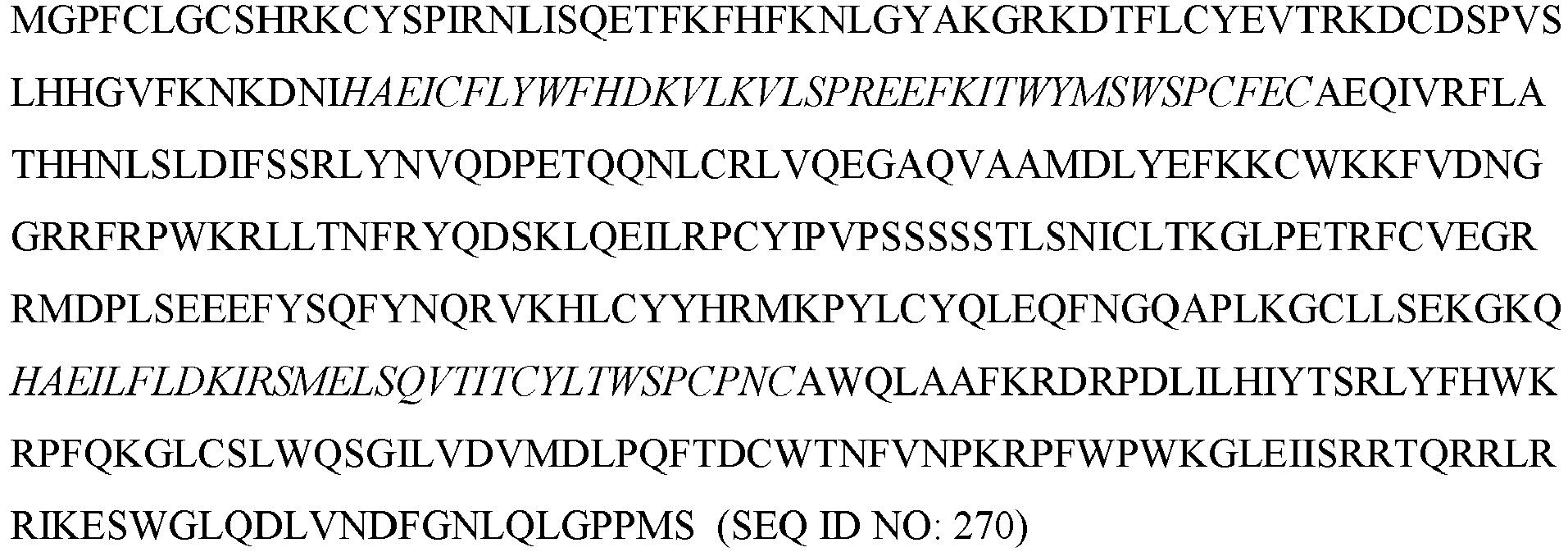
- Rat APOBEC-3:
(italic: nucleic acid editing domain)
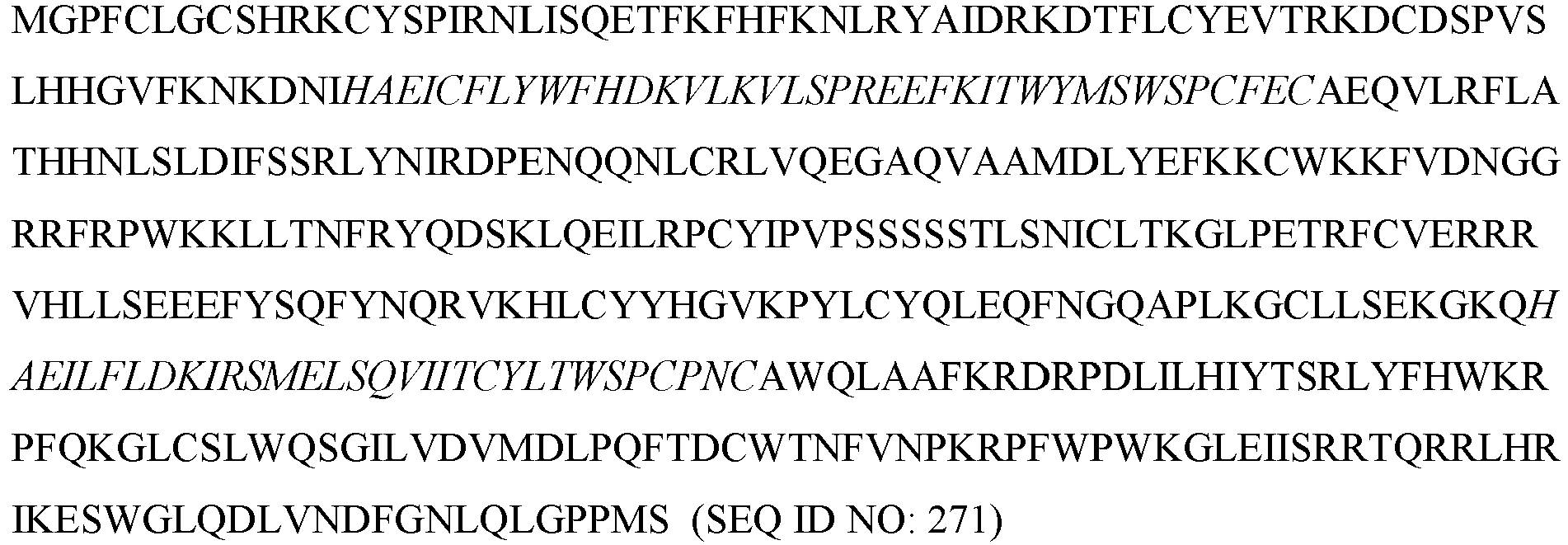
- Rhesus macaque APOBEC-3G:
(italic: nucleic acid editing domain; underline: cytoplasmic localization signal)

- Chimpanzee APOBEC-3G:
(italic: nucleic acid editing domain; underline: cytoplasmic localization signal)

- Green monkey APOBEC-3G:
(italic: nucleic acid editing domain; underline: cytoplasmic localization signal)
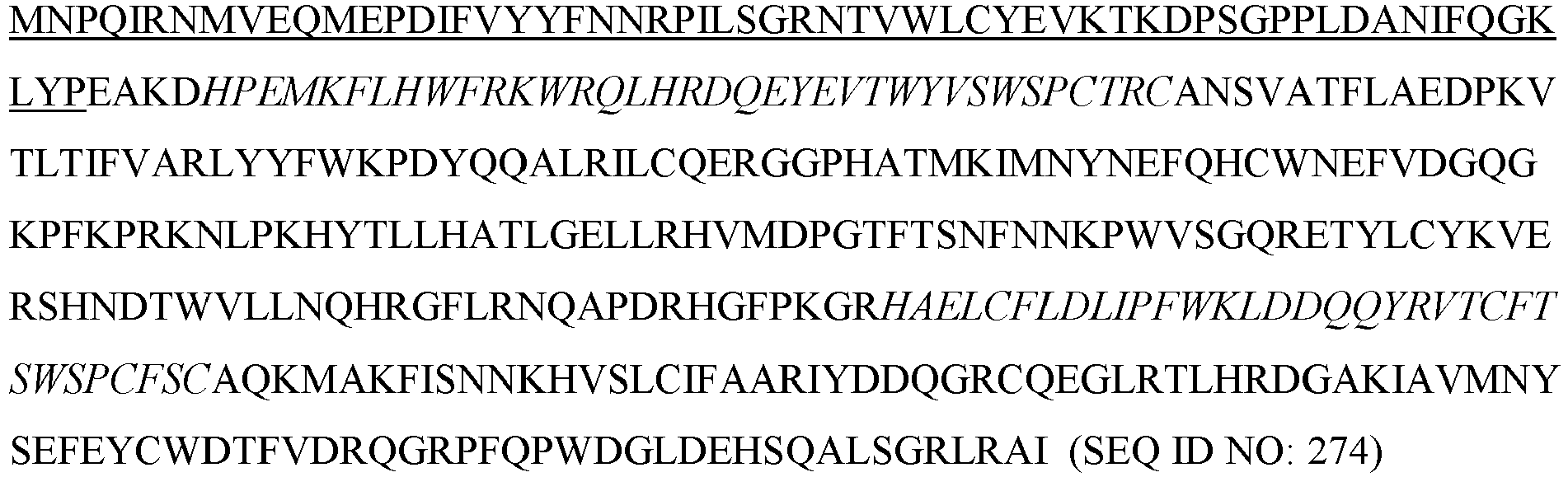
- Human APOBEC-3G:
(italic: nucleic acid editing domain; underline: cytoplasmic localization signal)

- Human APOBEC-3F:
 (italic: nucleic acid editing domain)
- Human APOBEC-3B:
(italic: nucleic acid editing domain)

- Rat APOBEC-3B:
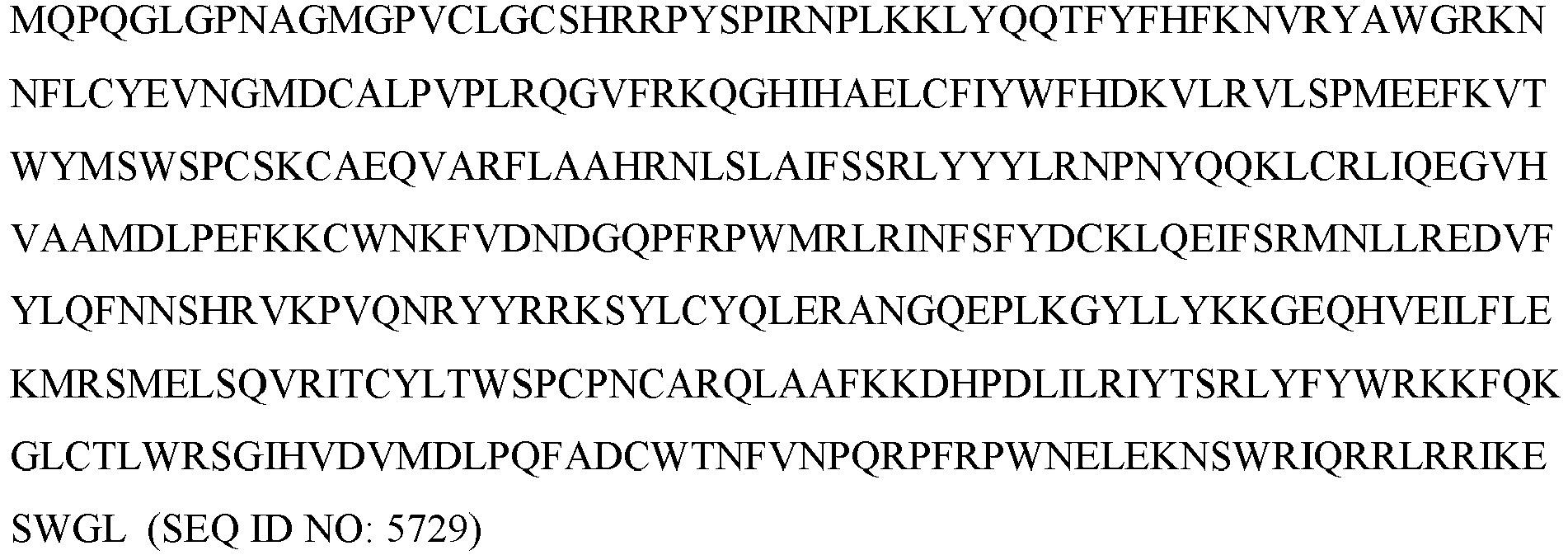
- Bovine APOBEC-3B:

- Chimpanzee APOBEC-3B:
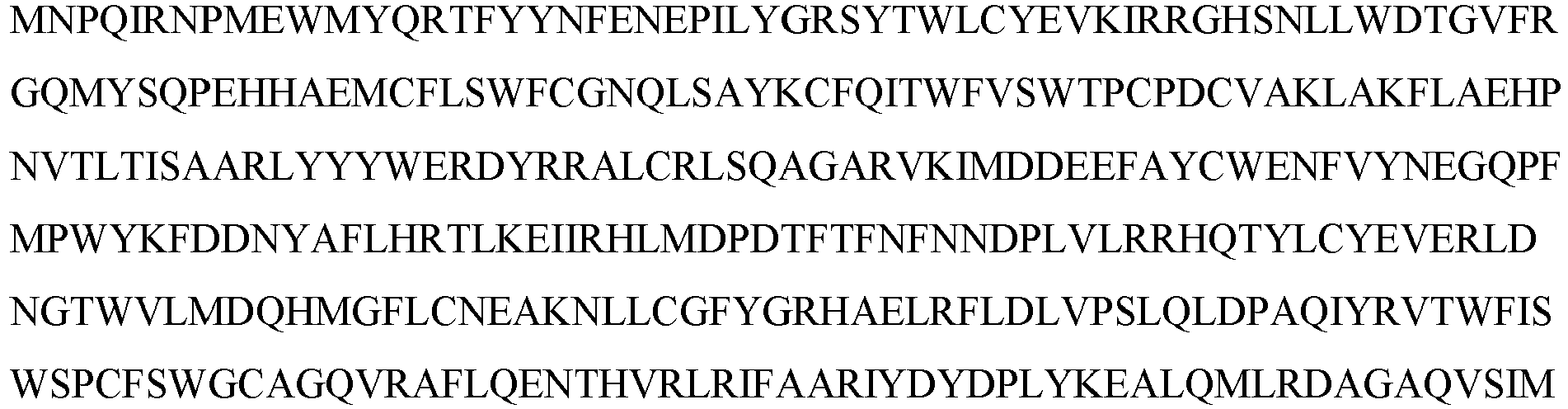

- Human APOBEC-3C:
(italic: nucleic acid editing domain)

- Gorilla APOBEC3C
(italic: nucleic acid editing domain)

- Human APOBEC-3A:
(italic: nucleic acid editing domain)

- Rhesus macaque APOBEC-3A:
(italic: nucleic acid editing domain)

- Bovine APOBEC-3A:
(italic: nucleic acid editing domain)

- Human APOBEC-3H:
(italic: nucleic acid editing domain)

- Rhesus macaque APOBEC-3H:

- Human APOBEC-3D:
(italic: nucleic acid editing domain)
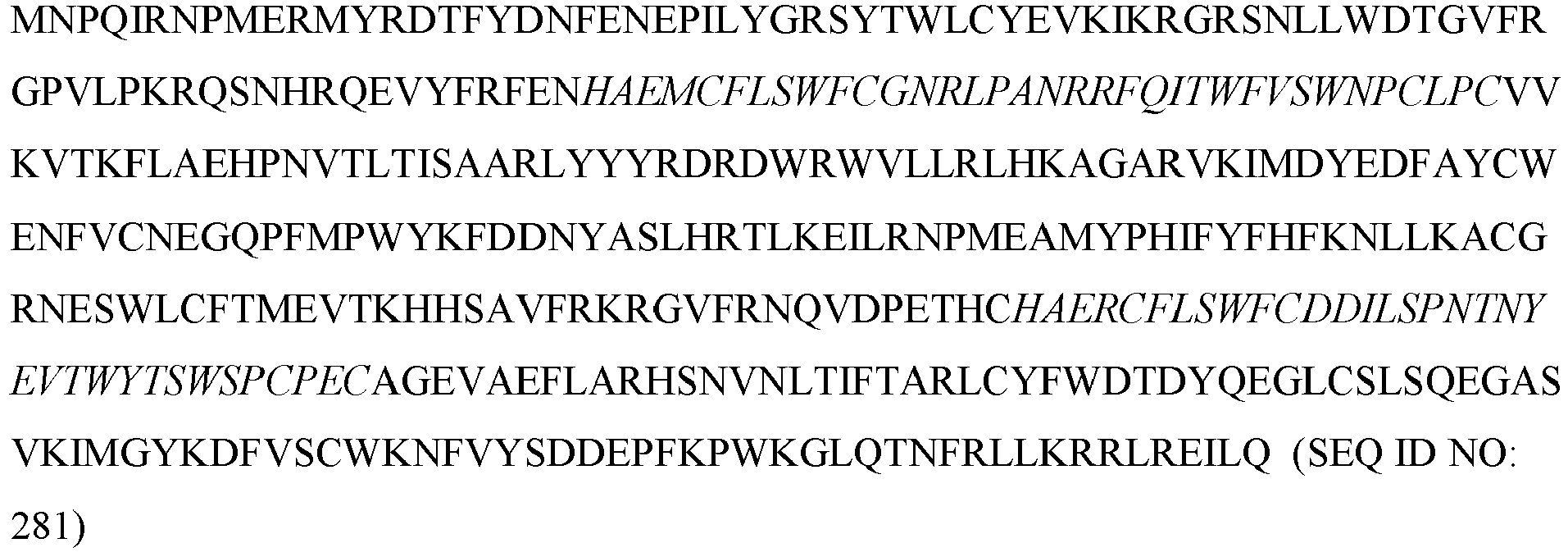
- Human APOBEC-1:

- Mouse APOBEC-1:

- Rat APOBEC-1:
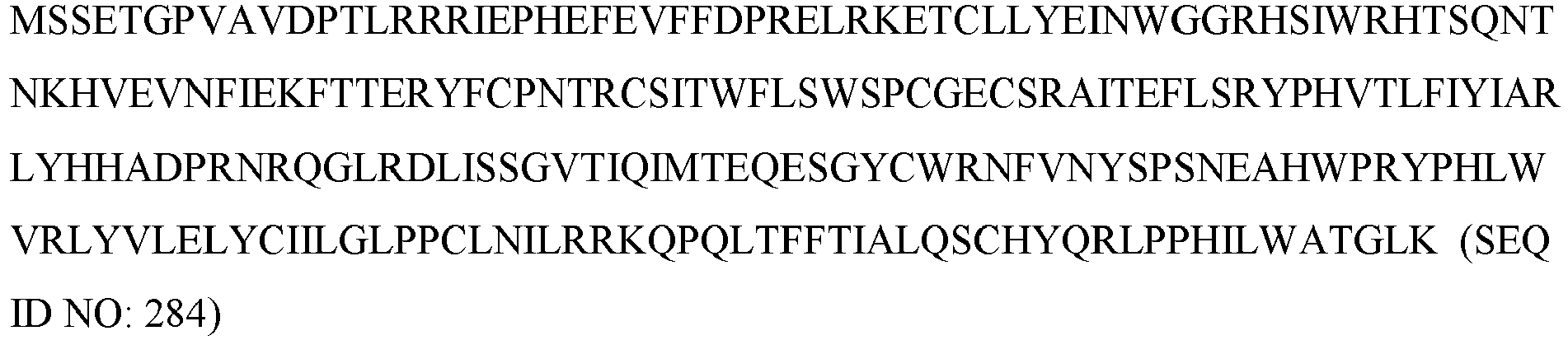
- Human APOBEC-2:

- Mouse APOBEC-2:

- Rat APOBEC-2:

- Bovine APOBEC-2:
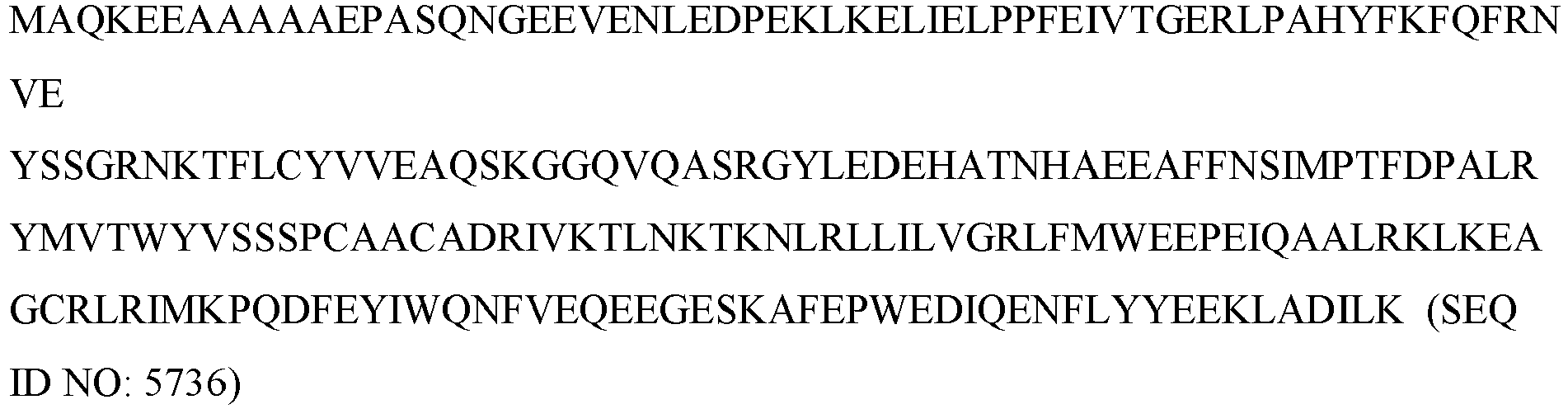
- Petromyzon marinus CDA1 (pmCDA1)


- Human APOBEC3G D316R D317R
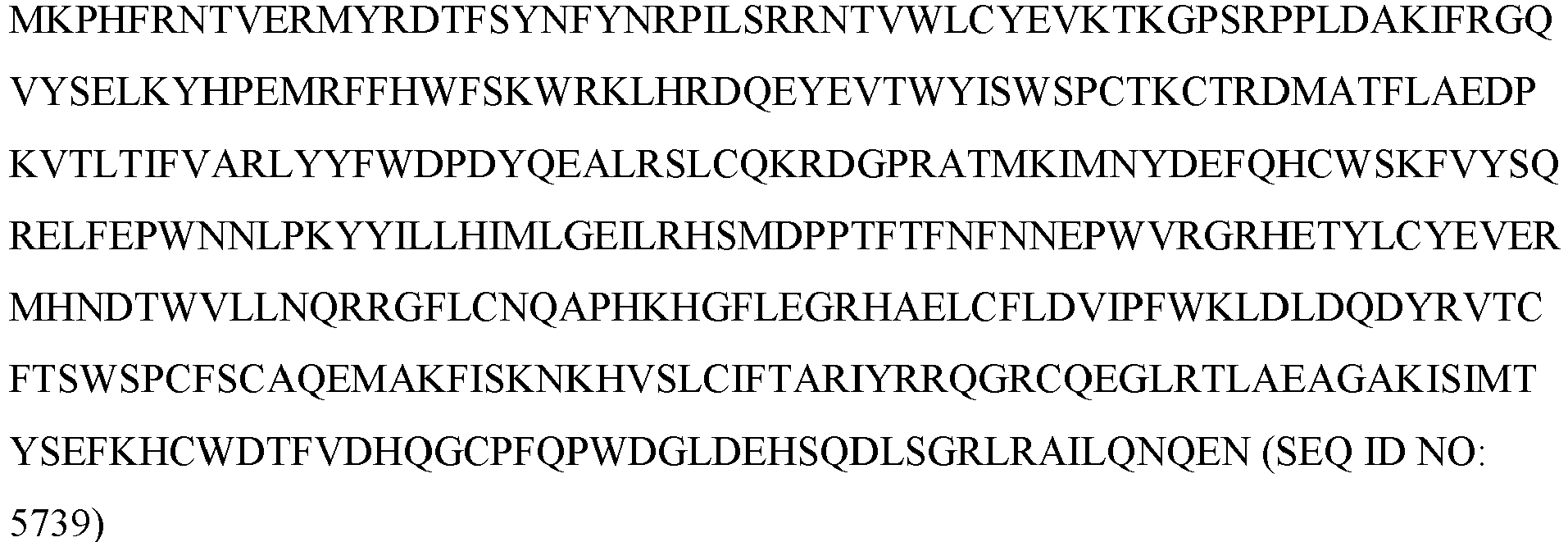
- Human APOBEC3G chain A

- Human APOBEC3G chain A D120R D121R

- In some embodiments, fusion proteins as provided herein comprise the full-length amino acid of a nucleic acid editing enzyme, e.g., one of the sequences provided above. In other embodiments, however, fusion proteins as provided herein do not comprise a full-length sequence of a nucleic acid editing enzyme, but only a fragment thereof. For example, in some embodiments, a fusion protein provided herein comprises a Cas9 domain and a fragment of a nucleic acid editing enzyme, e.g., wherein the fragment comprises a nucleic acid editing domain. Exemplary amino acid sequences of nucleic acid editing domains are shown in the sequences above as italicized letters, and additional suitable sequences of such domains will be apparent to those of skill in the art.
- Additional suitable nucleic-acid editing enzyme sequences, e.g., deaminase enzyme and domain sequences, that can be used according to aspects of this invention, e.g., that can be fused to a nuclease-inactive Cas9 domain, will be apparent to those of skill in the art based on this disclosure. In some embodiments, such additional enzyme sequences include deaminase enzyme or deaminase domain sequences that are at least 70%, at least 75%, at least 80%, at least 85%, at least 90%, at least 95%, at least 96%, at least 97%, at least 98%, or at least 99% similar to the sequences provided herein. Additional suitable Cas9 domains, variants, and sequences will also be apparent to those of skill in the art. Examples of such additional suitable Cas9 domains include, but are not limited to, D10A, D10A/D839A/H840A, and D10A/D839A/H840A/N863A mutant domains (See, e.g., Prashant et al., CAS9 transcriptional activators for target specificity screening and paired nickases for cooperative genome engineering. Nature Biotechnology. 2013; 31(9): 833-838 ). In some embodiments, the Cas9 comprises a histidine residue at position 840 of the amino acid sequence provided in SEQ ID NO: 10, or a corresponding mutation in any of the amino acid sequences provided in SEQ ID NOs: 11-260. The presence of the catalytic residue H840 restores the acvitity of the Cas9 to cleave the non-edited strand containing a G opposite the targeted C. Restoration of H840 does not result in the cleavage of the target strand containing the C.
- Additional suitable strategies for generating fusion proteins comprising a Cas9 domain and a deaminase domain will be apparent to those of skill in the art based on this disclosure in combination with the general knowledge in the art. Suitable strategies for generating fusion proteins according to aspects of this disclosure using linkers or without the use of linkers will also be apparent to those of skill in the art in view of the instant disclosure and the knowledge in the art. For example, Gilbert et al., CRISPR-mediated modular RNA-guided regulation of transcription in eukaryotes. Cell. 2013; 154(2):442-51, showed that C-terminal fusions of Cas9 with VP64 using 2 NLS's as a linker (SPKKKRKVEAS, SEQ ID NO: 599), can be employed for transcriptional activation. Mali et al., CAS9 transcriptional activators for target specificity screening and paired nickases for cooperative genome engineering. Nat Biotechnol. 2013; 31(9):833-8, reported that C-terminal fusions with VP64 without linker can be employed for transcriptional activation. And Maeder et al., CRISPR RNA-guided activation of endogenous human genes. Nat Methods. 2013; 10: 977-979, reported that C-terminal fusions with VP64 using a Gly4Ser (SEQ ID NO: 5) linker can be used as transcriptional activators. Recently, dCas9- FokI nuclease fusions have successfully been generated and exhibit improved enzymatic specificity as compared to the parental Cas9 enzyme (In Guilinger JP, Thompson DB, Liu DR. Fusion of catalytically inactive Cas9 to FokI nuclease improves the specificity of genome modification. Nat. Biotechnol. 2014; 32(6): 577-82, and in Tsai SQ, Wyvekens N, Khayter C, Foden JA, Thapar V, Reyon D, Goodwin MJ, Aryee MJ, Joung JK. Dimeric CRISPR RNA-guided FokI nucleases for highly specific genome editing. Nat Biotechnol. 2014; 32(6):569-76. PMID: 24770325 a SGSETPGTSESATPES (SEQ ID NO: 7) or a GGGGS (SEQ ID NO: 5) linker was used in FokI-dCas9 fusion proteins, respectively).
- Some aspects of this disclosure provide fusion proteins comprising (i) a Cas9 enzyme or domain (e.g., a first protein); and (ii) a nucleic acid-editing enzyme or domain (e.g., a second protein). In some aspects, the fusion proteins provided herein further include (iii) a programmable DNA-binding protein, for example, a zinc-finger domain, a TALE, or a second Cas9 protein (e.g., a third protein). Without wishing to be bound by any particular theory, fusing a programmable DNA-binding protein (e.g., a second Cas9 protein) to a fusion protein comprising (i) a Cas9 enzyme or domain (e.g., a first protein); and (ii) a nucleic acid-editing enzyme or domain (e.g., a second protein) may be useful for improving specificity of the fusion protein to a target nucleic acid sequence, or for improving specificity or binding affinity of the fusion protein to bind target nucleic acid sequence that does not contain a canonical PAM (NGG) sequence. In some embodiments, the third protein is a Cas9 protein (e.g, a second Cas9 protein). In some embodiments, the third protein is any of the Cas9 proteins provided herein. In some embodiments, the third protein is fused to the fusion protein N-terminal to the Cas9 protein (e.g., the first protein). In some embodiments, the third protein is fused to the fusion protein C-terminal to the Cas9 protein (e.g., the first protein). In some embodiments, the Cas9 domain (e.g., the first protein) and the third protein (e.g., a second Cas9 protein) are fused via a linker (e.g., a second linker). In some embodiments, the linker comprises a (GGGGS)n (SEQ ID NO: 5), a (G)n, an (EAAAK)n (SEQ ID NO: 6), a (GGS)n, (SGGS)n (SEQ ID NO: 4288), an SGSETPGTSESATPES (SEQ ID NO: 7), or an (XP)n motif, or a combination of any of these, wherein n is independently an integer between 1 and 30. In some embodiments, the general architecture of exemplary Cas9 fusion proteins provided herein comprises the structure:
- [NH2]-[nucleic acid-editing enzyme or domain]-[Cas9]-[third protein]-[COOH];
- [NH2]-[third protein]-[Cas9]-[nucleic acid-editing enzyme or domain]-[COOH];
- [NH2]-[Cas9]-[nucleic acid-editing enzyme or domain]-[third protein]-[COOH];
- [NH2]-[third protein]-[nucleic acid-editing enzyme or domain]-[Cas9]-[COOH];
- [NH2]-[UGI]-[nucleic acid-editing enzyme or domain]-[Cas9]-[third protein]-[COOH];
- [NH2]-[UGI]-[third protein]-[Cas9]-[nucleic acid-editing enzyme or domain]-[COOH];
- [NH2]-[UGI]-[Cas9]-[nucleic acid-editing enzyme or domain]-[third protein]-[COOH];
- [NH2]-[UGI]-[third protein]-[nucleic acid-editing enzyme or domain]-[Cas9]-[COOH];
- [NH2]-[nucleic acid-editing enzyme or domain]-[Cas9]-[third protein]-[UGI]-[COOH];
- [NH2]-[third protein]-[Cas9]-[nucleic acid-editing enzyme or domain]-[UGI]-[COOH];
- [NH2]-[Cas9]-[nucleic acid-editing enzyme or domain]-[third protein]-[UGI]-[COOH]; or
- [NH2]-[third protein]-[nucleic acid-editing enzyme or domain]-[Cas9]-[UGI]-[COOH];
- [NH2]-[nucleic acid-editing enzyme or domain]-[Cas9]-[second Cas9 protein]-[COOH];
- [NH2]-[second Cas9 protein]-[Cas9]-[nucleic acid-editing enzyme or domain]-[COOH];
- [NH2]-[Cas9]-[nucleic acid-editing enzyme or domain]-[second Cas9 protein]-[COOH];
- [NH2]-[second Cas9 protein]-[nucleic acid-editing enzyme or domain]-[Cas9]-[COOH];
- [NH2]-[UGI]-[nucleic acid-editing enzyme or domain]-[Cas9]-[second Cas9 protein]-[COOH],
- [NH2]-[UGI]-[second Cas9 protein]-[Cas9]-[nucleic acid-editing enzyme or domain]-[COOH];
- [NH2]-[UGI]-[Cas9]-[nucleic acid-editing enzyme or domain]-[second Cas9 protein]-[COOH];
- [NH2]-[UGI]-[second Cas9 protein]-[nucleic acid-editing enzyme or domain]-[Cas9]-[COOH];
- [NH2]-[nucleic acid-editing enzyme or domain]-[Cas9]-[second Cas9 protein]-[UGI]-[COOH];
- [NH2]-[second Cas9 protein]-[Cas9]-[nucleic acid-editing enzyme or domain]-[UGI]-[COOH];
- [NH2]-[Cas9]-[nucleic acid-editing enzyme or domain]-[second Cas9 protein]-[UGI]-[COOH]; or
- [NH2]-[second Cas9 protein]-[nucleic acid-editing enzyme or domain]-[Cas9]-[UGI]-[COOH];
- Some aspects of the disclosure relate to fusion proteins that comprise a uracil glycosylase inhibitor (UGI) domain. In some embodiments, any of the fusion proteins provided herein that comprise a Cas9 domain (e.g., a nuclease active Cas9 domain, a nuclease inactive dCas9 domain, or a Cas9 nickase) may be further fused to a UGI domain either directly or via a linker. Some aspects of this disclosure provide deaminase-dCas9 fusion proteins, deaminase-nuclease active Cas9 fusion proteins and deaminase-Cas9 nickase fusion proteins with increased nucleobase editing efficiency. Without wishing to be bound by any particular theory, cellular DNA-repair response to the presence of U:G heteroduplex DNA may be responsible for the decrease in nucleobase editing efficiency in cells. For example, uracil DNA glycosylase (UDG) catalyzes removal of U from DNA in cells, which may initiate base excision repair, with reversion of the U:G pair to a C:G pair as the most common outcome. As demonstrated in the Examples below, Uracil DNA Glycosylase Inhibitor (UGI) may inhibit human UDG activity. Thus, this disclosure contemplates a fusion protein comprising dCas9-nucleic acid editing domain futher fused to a UGI domain . This disclosure also contemplates a fusion protein comprising a Cas9 nickase-nucleic acid editing domain further fused to a UGI domain. It should be understood that the use of a UGI domain may increase the editing efficiency of a nucleic acid editing domain that is capable of catalyzing a C to U change. For example, fusion proteins comprising a UGI domain may be more efficient in deaminating C residues. In some embodiments, the fusion protein comprises the structure:
- [deaminase]-[optional linker sequence]-[dCas9]-[optional linker sequence]-[UGI];
- [deaminase]-[optional linker sequence]-[UGI]-[optional linker sequence]-[dCas9];
- [UGI]-[optional linker sequence]-[deaminase]-[optional linker sequence]-[dCas9];
- [UGI]-[optional linker sequence]-[dCas9]-[optional linker sequence]-[deaminase];
- [dCas9]-[optional linker sequence]-[deaminase]-[optional linker sequence]-[UGI]; or
- [dCas9]-[optional linker sequence]-[UGI]-[optional linker sequence]-[deaminase].
- [deaminase]-[optional linker sequence]-[Cas9 nickase]-[optional linker sequence]-[UGI];
- [deaminase]-[optional linker sequence]-[UGI]-[optional linker sequence]-[Cas9 nickase];
- [UGI]-[optional linker sequence]-[deaminase]-[optional linker sequence]-[Cas9 nickase];
- [UGI]-[optional linker sequence]-[Cas9 nickase]-[optional linker sequence]-[deaminase];
- [Cas9 nickase]-[optional linker sequence]-[deaminase]-[optional linker sequence]-[UGI]; or
- [Cas9 nickase]-[optional linker sequence]-[UGI]-[optional linker sequence]-[deaminase].
- In some embodiments, the fusion proteins provided herein do not comprise a linker sequence. In some embodiments, one or both of the optional linker sequences are present.
- In some embodiments, the "-" used in the general architecture above indicates the presence of an optional linker sequence. In some embodiments, the fusion proteins comprising a UGI further comprise a nuclear targeting sequence, for example a nuclear localization sequence. In some embodiments, fusion proteins provided herein further comprise a nuclear localization sequence (NLS). In some embodiments, the NLS is fused to the N-terminus of the fusion protein. In some embodiments, the NLS is fused to the C-terminus of the fusion protein. In some embodiments, the NLS is fused to the N-terminus of the UGI protein. In some embodiments, the NLS is fused to the C-terminus of the UGI protein. In some embodiments, the NLS is fused to the N-terminus of the Cas9 protein. In some embodiments, the NLS is fused to the C-terminus of the Cas9 protein. In some embodiments, the NLS is fused to the N-terminus of the deaminase. In some embodiments, the NLS is fused to the C-terminus of the deaminase. In some embodiments, the NLS is fused to the N-terminus of the second Cas9. In some embodiments, the NLS is fused to the C-terminus of the second Cas9. In some embodiments, the NLS is fused to the fusion protein via one or more linkers. In some embodiments, the NLS is fused to the fusioin protein without a linker. In some embodiments, the NLS comprises an amino acid sequence of any one of the NLS sequences provided or referenced herein. In some embodiments, the NLS comprises an amino acid sequence as set forth in SEQ ID NO: 741or SEQ ID NO: 742.
- In some embodiments, a UGI domain comprises a wild-type UGI or a UGI as set forth in SEQ ID NO: 600. In some embodiments, the UGI proteins provided herein include fragments of UGI and proteins homologous to a UGI or a UGI fragment. For example, in some embodiments, a UGI domain comprises a fragment of the amino acid sequence set forth in SEQ ID NO: 600. In some embodiments, a UGI fragment comprises an amino acid sequence that comprises at least 60%, at least 65%, at least 70%, at least 75%, at least 80%, at least 85%, at least 90%, at least 95%, at least 96%, at least 97%, at least 98%, at least 99%, or at least 99.5% of the amino acid sequence as set forth in SEQ ID NO: 600. In some embodiments, a UGI comprises an amino acid sequence homologous to the amino acid sequence set forth in SEQ ID NO: 600 or an amino acid sequence homologous to a fragment of the amino acid sequence set forth in SEQ ID NO: 600. In some embodiments, proteins comprising UGI or fragments of UGI or homologs of UGI or UGI fragments are referred to as "UGI variants." A UGI variant shares homology to UGI, or a fragment thereof. For example a UGI variant is at least 70% identical, at least 75% identical, at least 80% identical, at least 85% identical, at least 90% identical, at least 95% identical, at least 96% identical, at least 97% identical, at least 98% identical, at least 99% identical, at least 99.5% identical, or at least 99.9% identical to a wild type UGI or a UGI as set forth in SEQ ID NO: 600. In some embodiments, the UGI variant comprises a fragment of UGI, such that the fragment is at least 70% identical, at least 80% identical, at least 90% identical, at least 95% identical, at least 96% identical, at least 97% identical, at least 98% identical, at least 99% identical, at least 99.5% identical, or at least 99.9% to the corresponding fragment of wild-type UGI or a UGI as set forth in SEQ ID NO: 600. In some embodiments, the UGI comprises the following amino acid sequence:
>spIP14739JUNGI _BPPB2 Uracil-DNA glycosylase inhibitor
- Suitable UGI protein and nucleotide sequences are provided herein and additional suitable UGI sequences are known to those in the art, and include, for example, those published in Wang et al., Uracil-DNA glycosylase inhibitor gene of bacteriophage PBS2 encodes a binding protein specific for uracil-DNA glycosylase. J. Biol. Chem. 264:1163-1171(1989); Lundquist et al., Site-directed mutagenesis and characterization of uracil-DNA glycosylase inhibitor protein. Role of specific carboxylic amino acids in complex formation with Escherichia coli uracil-DNA glycosylase. J. Biol. Chem. 272:21408-21419(1997); Ravishankar et al., X-ray analysis of a complex of Escherichia coli uracil DNA glycosylase (EcUDG) with a proteinaceous inhibitor. The structure elucidation of a prokaryotic UDG. Nucleic Acids Res. 26:4880-4887(1998); and Putnam et al., Protein mimicry of DNA from crystal structures of the uracil-DNA glycosylase inhibitor protein and its complex with Escherichia coli uracil-DNA glycosylase. J. Mol. Biol. 287:331-346(1999).
- It should be appreciated that additional proteins may be uracil glycosylase inhibitors. For example, other proteins that are capable of inhibiting (e.g., sterically blocking) a uracil-DNA glycosylase base-excision repair enzyme are within the scope of this disclosure. Additionally, any proteins that block or inhibit base-excision repair as also within the scope of this disclosure. In some embodiments of the disclosure, a protein that binds DNA is used. In another embodiment of the disclosure, a substitute for UGI is used. In some embodiments, a uracil glycosylase inhibitor is a protein that binds single-stranded DNA. For example, a uracil glycosylase inhibitor may be a Erwinia tasmaniensis single-stranded binding protein. In some embodiments, the single-stranded binding protein comprises the amino acid sequence (SEQ ID NO: 322). In some embodiments, a uracil glycosylase inhibitor is a protein that binds uracil. In some embodiments, a uracil glycosylase inhibitor is a protein that binds uracil in DNA. In some embodiments, a uracil glycosylase inhibitor is a catalytically inactive uracil DNA-glycosylase protein. In some embodiments, a uracil glycosylase inhibitor is a catalytically inactive uracil DNA-glycosylase protein that does not excise uracil from the DNA. For example, a uracil glycosylase inhibitor is a UdgX. In some embodiments, the UdgX comprises the amino acid sequence (SEQ ID NO: 323). As another example, a uracil glycosylase inhibitor is a catalytically inactive UDG. In some embodiments, a catalytically inactive UDG comprises the amino acid sequence (SEQ ID NO: 324). It should be appreciated that other uracil glycosylase inhibitors would be apparent to the skilled artisan and are within the scope of this disclosure. In some embodiments, a uracil glycosylase inhibitor is a protein that is homologous to any one of SEQ ID NOs: 322-324.. In some embodiments, a uracil glycosylase inhibitor is a protein that is at least 50% identical, at least 55% identical at least 60% identical, at least 65% identical, at least 70% identical, at least 75% identical, at least 80% identical at least 85% identical, at least 90% identical, at least 95% identical, at least 96% identical, at least 98% identical, at least 99% identical, or at least 99.5% identical to any one of SEQ ID NOs: 322-324.
- Erwinia tasmaniensis SSB (themostable single-stranded DNA binding protein)

- UdgX (binds to Uracil in DNA but does not excise)

- UDG (catalytically inactive human UDG, binds to Uracil in DNA but does not excise)

- In some embodiments of the disclosure, the nucleic acid editing domain is a deaminase domain. In some embodiments of the disclosure, the deaminase is a cytosine deaminase. Fusion proteins of the invention comprise a a cytidine deaminase. In some embodiments, the deaminase is an apolipoprotein B mRNA-editing complex (APOBEC) family deaminase. In some embodiments, the deaminase is an APOBEC1 deaminase. In some embodiments, the deaminase is an APOBEC2 deaminase. In some embodiments, the deaminase is an APOBEC3 deaminase. In some embodiments, the deaminase is an APOBEC3A deaminase. In some embodiments, the deaminase is an APOBEC3B deaminase. In some embodiments, the deaminase is an APOBEC3C deaminase. In some embodiments, the deaminase is an APOBEC3D deaminase. In some embodiments, the deaminase is an APOBEC3E deaminase. In some embodiments, the deaminase is an APOBEC3F deaminase. In some embodiments, the deaminase is an APOBEC3G deaminase. In some embodiments, the deaminase is an APOBEC3H deaminase. In some embodiments, the deaminase is an APOBEC4 deaminase. In some embodiments, the deaminase is an activation-induced deaminase (AID). In some embodiments, the demianse is a rat APOBEC 1 (SEQ ID NO: 282). In some embodiments, the deminase is a human APOBEC 1 (SEQ ID No: 284). In some embodiments, the deaminase is a Petromyzon marinus cytidine deaminase 1 (pmCDA1). In some embodiments, the deminase is a human APOBEC3G (SEQ ID NO: 275). In some embodiments, the deaminase is a fragment of the human APOBEC3G (SEQ ID NO: 5740). In some embodiments, the deaminase is a human APOBEC3G variant comprising a D316R_D317R mutation (SEQ ID NO: 5739). In some embodiments, the deaminase is a frantment of the human APOBEC3G and comprising mutations corresponding to the D316R D317R mutations in SEQ ID NO: 275 (SEQ ID NO: 5741).
- In some embodiments, the linker comprises a (GGGS)n (SEQ ID NO: 265), (GGGGS)n (SEQ ID NO: 5), a (G)n, an (EAAAK)n (SEQ ID NO: 6), a (GGS)n, an SGSETPGTSESATPES (SEQ ID NO: 7), or an (XP)n motif, or a combination of any of these, wherein n is independently an integer between 1 and 30.
- Suitable UGI protein and nucleotide sequences are provided herein and additional suitable UGI sequences are known to those in the art, and include, for example, those published in Wang et al., Uracil-DNA glycosylase inhibitor gene of bacteriophage PBS2 encodes a binding protein specific for uracil-DNA glycosylase. J. Biol. Chem. 264:1163-1171(1989); Lundquist et al., Site-directed mutagenesis and characterization of uracil-DNA glycosylase inhibitor protein. Role of specific carboxylic amino acids in complex formation with Escherichia coli uracil-DNA glycosylase. J. Biol. Chem. 272:21408-21419(1997); Ravishankar et al., X-ray analysis of a complex of Escherichia coli uracil DNA glycosylase (EcUDG) with a proteinaceous inhibitor. The structure elucidation of a prokaryotic UDG. Nucleic Acids Res. 26:4880-4887(1998); and Putnam et al., Protein mimicry of DNA from crystal structures of the uracil-DNA glycosylase inhibitor protein and its complex with Escherichia coli uracil-DNA glycosylase. J. Mol. Biol. 287:331-346(1999). In some embodiments, the optional linker comprises a (GGS)n motif, wherein n is 1, 2, 3, 4, 5, 6, 7, 8, 9, 19, 11, 12, 13, 14, 15, 16, 17, 18, 19, or 20. In some embodiments, the optional linker comprises a (GGS)n motif, wherein n is 1, 3, or 7. In some embodiments, the optional linker comprises the amino acid sequence SGSETPGTSESATPES (SEQ ID NO: 7), which is also referred to as the XTEN linker in the Examples.
- In some embodiments, a Cas9 nickase may further facilitate the removal of a base on the non-edited strand in an organism whose genome is edited in vivo. The Cas9 nickase, as described herein, may comprise a D10A mutation in SEQ ID NO: 10, or a corresponding mutation in any of SEQ ID NOs: 11-260. In some embodiments, the Cas9 nickase of this disclosure may comprise a histidine at mutation 840 of SEQ ID NO: 10, or a corresponding residue in any of SEQ ID NOs: 11-260. Such fusion proteins comprising the Cas9 nickase, can cleave a single strand of the target DNA sequence, e.g., the strand that is not being edited. Without wishing to be bound by any particular theory, this cleavage may inhibit mis-match repair mechanisms that reverse a C to U edit made by the deaminase.
- Some aspects of this disclosure provide complexes comprising any of the fusion proteins provided herein, and a guide RNA bound to a Cas9 domain (e.g., a dCas9, a nuclease active Cas9, or a Cas9 nickase) of fusion protein.
- In some embodiments, the guide RNA is from 15-100 nucleotides long and comprises a sequence of at least 10 contiguous nucleotides that is complementary to a target sequence. In some embodiments, the guide RNA is 15, 16, 17, 18, 19, 20, 21, 22, 23, 24, 25, 26, 27, 28, 29, 30, 31, 32, 33, 34, 35, 36, 37, 38, 39, 40, 41, 42, 43, 44, 45, 46, 47, 48, 49, or 50 nucleotides long. In some embodiments, the guide RNA comprises a sequence of 15, 16, 17, 18, 19, 20, 21, 22, 23, 24, 25, 26, 27, 28, 29, 30, 31, 32, 33, 34, 35, 36, 37, 38, 39, or 40 contiguous nucleotides that is complementary to a target sequence. In some embodiments, the target sequence is a DNA sequence. In some embodiments, the target sequence is a sequence in the genome of a mammal. In some embodiments, the target sequence is a sequence in the genome of a human. In some embodiments, the 3' end of the target sequence is immediately adjacent to a canonical PAM sequence (NGG). In some embodiments, the guide RNA is complementary to a sequence associated with a disease or disorder. In some embodiments, the guide RNA is complementary to a sequence associated with a disease or disorder having a mutation in a gene selected from the genes disclosed in any one of Tables 1-3. In some embodiments, the guide RNA comprises a nucleotide sequence of any one of the guide sequences provided in Table 2 or Table 3. Exemplary sequences in the human genome that may be targeted by the complexes of this disclosure are provided herein in Tables 1-3.
- Some aspects of this disclosure provide methods of using the Cas9 proteins, fusion proteins, or complexes provided herein. For example, some aspects of this disclosure provide methods comprising contacting a DNA molecule (a) with any of the the Cas9 proteins or fusion proteins provided herein, and with at least one guide RNA, wherein the guide RNA is about 15-100 nucleotides long and comprises a sequence of at least 10 contiguous nucleotides that is complementary to a target sequence; or (b) with a Cas9 protein, a Cas9 fusion protein, or a Cas9 protein or fusion protein complex with at least one gRNA as provided herein. In some embodiments, the 3' end of the target sequence is not immediately adjacent to a canonical PAM sequence (NGG). In some embodiments, the 3' end of the target sequence is immediately adjacent to an AGC, GAG, TTT, GTG, or CAA sequence. The invention provides a method for editing a nucleic acid comprising contacting a nucleic acid molecule with the fusion protein of the invention and a guide RNA, wherein the guide RNA comprises a sequence of at least 10 contiguous nucleotides that is complementary to a target sequence in the genome of an organism and comprises a target base pair, wherein the contacting is performed in vitro.
- In some embodiments, the target DNA sequence comprises a sequence associated with a disease or disorder. In some embodiments, the target DNA sequence comprises a point mutation associated with a disease or disorder. In some embodiments, the activity of the Cas9 protein, the Cas9 fusion protein, or the complex results in a correction of the point mutation. In some embodiments, the target DNA sequence comprises a T→C point mutation associated with a disease or disorder, and wherein the deamination of the mutant C base results in a sequence that is not associated with a disease or disorder. In some embodiments, the target DNA sequence encodes a protein and wherein the point mutation is in a codon and results in a change in the amino acid encoded by the mutant codon as compared to the wild-type codon. In some embodiments, the deamination of the mutant C results in a change of the amino acid encoded by the mutant codon. In some embodiments, the deamination of the mutant C results in the codon encoding the wild-type amino acid. In some embodiments of the disclosure, the contacting is in vivo in a subject. In some embodiments of the disclosure, the subject has or has been diagnosed with a disease or disorder. In some embodiments, the disease or disorder is cystic fibrosis, phenylketonuria, epidermolytic hyperkeratosis (EHK), Charcot-Marie-Toot disease type 4J, neuroblastoma (NB), von Willebrand disease (vWD), myotonia congenital, hereditary renal amyloidosis, dilated cardiomyopathy (DCM), hereditary lymphedema, familial Alzheimer's disease, HIV, Prion disease, chronic infantile neurologic cutaneous articular syndrome (CINCA), desmin-related myopathy (DRM), a neoplastic disease associated with a mutant PI3KCA protein, a
mutant CTNNB 1 protein, a mutant HRAS protein, or a mutant p53 protein. - Some embodiments provide methods for using the Cas9 DNA editing fusion proteins provided herein. In some embodiments, the fusion protein is used to introduce a point mutation into a nucleic acid by deaminating a target nucleobase, e.g., a C residue. In some embodiments, the deamination of the target nucleobase results in the correction of a genetic defect, e.g., in the correction of a point mutation that leads to a loss of function in a gene product. In some embodiments, the genetic defect is associated with a disease or disorder, e.g., a lysosomal storage disorder or a metabolic disease, such as, for example, type I diabetes. In some embodiments, the methods provided herein are used to introduce a deactivating point mutation into a gene or allele that encodes a gene product that is associated with a disease or disorder. For example, in some embodiments, methods are provided herein that employ a Cas9 DNA editing fusion protein to introduce a deactivating point mutation into an oncogene (e.g., in the treatment of a proliferative disease). A deactivating mutation may, in some embodiments, generate a premature stop codon in a coding sequence, which results in the expression of a truncated gene product, e.g., a truncated protein lacking the function of the full-length protein.
- In some embodiments, the purpose of the methods provide herein is to restore the function of a dysfunctional gene via genome editing. The Cas9 deaminase fusion proteins provided herein can be validated for gene editing-based human therapeutics in vitro, e.g., by correcting a disease-associated mutation in human cell culture. It will be understood by the skilled artisan that the fusion proteins provided herein, e.g., the fusion proteins comprising a Cas9 domain and a nucleic acid deaminase domain can be used to correct any single point T -> C or A -> G mutation. In the first case, deamination of the mutant C back to U corrects the mutation, and in the latter case, deamination of the C that is base-paired with the mutant G, followed by a round of replication, corrects the mutation.
- An exemplary disease-relevant mutation that can be corrected by the provided fusion proteins in vitro or in vivo is the H1047R (A3140G) polymorphism in the PI3KCA protein. The phosphoinositide-3-kinase, catalytic alpha subunit (PI3KCA) protein acts to phosphorylate the 3-OH group of the inositol ring of phosphatidylinositol. The PI3KCA gene has been found to be mutated in many different carcinomas, and thus it is considered to be a potent oncogene.37 In fact, the A3140G mutation is present in several NCI-60 cancer cell lines, such as, for example, the HCT116, SKOV3, and T47D cell lines, which are readily available from the American Type Culture Collection (ATCC).38
- In some embodiments, a cell carrying a mutation to be corrected, e.g., a cell carrying a point mutation, e.g., an A3140G point mutation in
exon 20 of the PI3KCA gene, resulting in a H1047R substitution in the PI3KCA protein, is contacted with an expression construct encoding a Cas9 deaminase fusion protein and an appropriately designed sgRNA targeting the fusion protein to the respective mutation site in the encoding PI3KCA gene. Control experiments can be performed where the sgRNAs are designed to target the fusion enzymes to non-C residues that are within the PI3KCA gene. Genomic DNA of the treated cells can be extracted, and the relevant sequence of the PI3KCA genes PCR amplified and sequenced to assess the activities of the fusion proteins in human cell culture. - It will be understood that the example of correcting point mutations in PI3KCA is provided for illustration purposes and is not meant to limit the instant disclosure. The skilled artisan will understand that the instantly disclosed DNA-editing fusion proteins can be used to correct other point mutations and mutations associated with other cancers and with diseases other than cancer including other proliferative diseases.
- The successful correction of point mutations in disease-associated genes and alleles opens up new strategies for gene correction with applications in therapeutics and basic research. Site-specific single-base modification systems like the disclosed fusions of Cas9 and deaminase enzymes or domains also have applications in "reverse" gene therapy, where certain gene functions are purposely suppressed or abolished. In these cases, site-specifically mutating Trp (TGG), Gln (CAA and CAG), or Arg (CGA) residues to premature stop codons (TAA, TAG, TGA) can be used to abolish protein function in vitro, ex vivo, or in vivo.
- The instant disclosure provides methods for the treatment of a subject diagnosed with a disease associated with or caused by a point mutation that can be corrected by a Cas9 DNA editing fusion protein provided herein. For example, in some embodiments of the disclosure, a method is provided that comprises administering to a subject having such a disease, e.g., a cancer associated with a PI3KCA point mutation as described above, an effective amount of a Cas9 deaminase fusion protein that corrects the point mutation or introduces a deactivating mutation into the disease-associated gene. In some embodiments of the disclosure, the disease is a proliferative disease. In some embodiments of the disclosure, the disease is a genetic disease. In some embodiments of the disclosure, the disease is a neoplastic disease. In some embodiments of the disclosure, the disease is a metabolic disease. In some embodiments of the disclosure, the disease is a lysosomal storage disease. Other diseases that can be treated by correcting a point mutation or introducing a deactivating mutation into a disease-associated gene will be known to those of skill in the art, and the disclosure is not limited in this respect.
- The instant disclosure provides methods for the treatment of additional diseases or disorders, e.g., diseases or disorders that are associated or caused by a point mutation that can be corrected by deaminase-mediated gene editing. Some such diseases are described herein, and additional suitable diseases that can be treated with the strategies and fusion proteins provided herein will be apparent to those of skill in the art based on the instant disclosure. Exemplary suitable diseases and disorders are listed below. It will be understood that the numbering of the specific positions or residues in the respective sequences depends on the particular protein and numbering scheme used. Numbering might be different, e.g., in precursors of a mature protein and the mature protein itself, and differences in sequences from species to species may affect numbering. One of skill in the art will be able to identify the respective residue in any homologous protein and in the respective encoding nucleic acid by methods well known in the art, e.g., by sequence alignment and determination of homologous residues. Exemplary suitable diseases and disorders include, without limitation, cystic fibrosis (see, e.g., Schwank et al., Functional repair of CFTR by CRISPR/Cas9 in intestinal stem cell organoids of cystic fibrosis patients. Cell stem cell. 2013; 13: 653-658; and Wu et. al., Correction of a genetic disease in mouse via use of CRISPR-Cas9. Cell stem cell. 2013; 13: 659-662, neither of which uses a deaminase fusion protein to correct the genetic defect); phenylketonuria - e.g., phenylalanine to serine mutation at position 835 (mouse) or 240 (human) or a homologous residue in phenylalanine hydroxylase gene (T>C mutation) - see, e.g., McDonald et al., Genomics. 1997; 39:402-405; Bernard-Soulier syndrome (BSS) - e.g., phenylalanine to serine mutation at position 55 or a homologous residue, or cysteine to arginine at residue 24 or a homologous residue in the platelet membrane glycoprotein IX (T>C mutation) - see, e.g., Noris et al., British Journal of Haematology. 1997; 97: 312-320, and Ali et al., Hematol. 2014; 93: 381-384; epidermolytic hyperkeratosis (EHK) - e.g., leucine to proline mutation at position 160 or 161 (if counting the initiator methionine) or a homologous residue in keratin 1 (T>C mutation) - see, e.g., Chipev et al., Cell. 1992; 70: 821-828, see also accession number P04264 in the UNIPROT database at www[dot]uniprot[dot]org; chronic obstructive pulmonary disease (COPD) - e.g., leucine to proline mutation at position 54 or 55 (if counting the initiator methionine) or a homologous residue in the processed form of α1-antitrypsin or residue 78 in the unprocessed form or a homologous residue (T>C mutation) - see, e.g., Poller et al., Genomics. 1993; 17: 740-743, see also accession number P01011 in the UNIPROT database; Charcot-Marie-Toot disease type 4J - e.g., isoleucine to threonine mutation at position 41 or a homologous residue in
FIG4 (T>C mutation) - see, e.g., Lenk et al., PLoS Genetics. 2011; 7: e1002104; neuroblastoma (NB) - e.g., leucine to proline mutation at position 197 or a homologous residue in Caspase-9 (T>C mutation) - see, e.g., Kundu et al., 3 Biotech. 2013, 3:225-234 ; von Willebrand disease (vWD) - e.g., cysteine to arginine mutation at position 509 or a homologous residue in the processed form of von Willebrand factor, or at position 1272 or a homologous residue in the unprocessed form of von Willebrand factor (T>C mutation) - see, e.g., Lavergne et al., Br. J. Haematol. 1992 , see also accession number P04275 in the UNIPROT database; 82: 66-72; myotonia congenital - e.g., cysteine to arginine mutation at position 277 or a homologous residue in the muscle chloride channel gene CLCN1 (T>C mutation) - see, e.g., Weinberger et al., The J. of Physiology. 2012; 590: 3449-3464; hereditary renal amyloidosis - e.g., stop codon to arginine mutation at position 78 or a homologous residue in the processed form of apolipoprotein AII or at position 101 or a homologous residue in the unprocessed form (T>C mutation) - see, e.g., Yazaki et al., Kidney Int. 2003; 64: 11-16; dilated cardiomyopathy (DCM) - e.g., tryptophan to Arginine mutation at position 148 or a homologous residue in the FOXD4 gene (T>C mutation), see, e.g., Minoretti et. al., Int. J. of Mol. Med. 2007; 19: 369-372; hereditary lymphedema - e.g., histidine to arginine mutation at position 1035 or a homologous residue in VEGFR3 tyrosine kinase (A>G mutation), see, e.g., Irrthum et al., Am. J. Hum. Genet. 2000; 67: 295-301; familial Alzheimer's disease - e.g., isoleucine to valine mutation at position 143 or a homologous residue in presenilin1 (A>G mutation), see, e.g., Gallo et. al., J. Alzheimer's disease. 2011; 25: 425-431; Prion disease - e.g., methionine to valine mutation at position 129 or a homologous residue in prion protein (A>G mutation) - see, e.g., Lewis et. al., J. of General Virology. 2006; 87: 2443-2449; chronic infantile neurologic cutaneous articular syndrome (CINCA) - e.g., Tyrosine to Cysteine mutation at position 570 or a homologous residue in cryopyrin (A>G mutation) - see, e.g., Fujisawa et. al. Blood. 2007; 109: 2903-2911; and desmin-related myopathy (DRM) - e.g., arginine to glycine mutation atposition 120 or a homologous residue in αβ crystallin (A>G mutation) - see, e.g., Kumar et al., J. Biol. Chem. 1999; 274: 24137-24141. - The instant disclosure provides lists of genes comprising pathogenic T>C or A>G mutations. Provided herein, are the names of these genes, their respective SEQ ID NOs, their gene IDs, and sequences flanking the mutation site. (Tables 2 and 3). In some instances, the gRNA sequences that can be used to correct the mutations in these genes are disclosed (Tables 2 and 3).
- In some embodiments, a Cas9-deaminase fusion protein recognizes canonical PAMs and therefore can correct the pathogenic T>C or A>G mutations with canonical PAMs, e.g., NGG (listed in Tables 2 and 3, SEQ ID NOs: 2540-2702 and 5084-5260), respectively, in the flanking sequences. For example, the Cas9 proteins that recognize canonical PAMs comprise an amino acid sequence that is at least 90% identical to the amino acid sequence of Streptococcus pyogenes Cas9 as provided by SEQ ID NO: 10, or to a fragment thereof comprising the RuvC and HNH domains of SEQ ID NO: 10.
- It will be apparent to those of skill in the art that in order to target a Cas9:nucleic acid editing enzyme/domain fusion protein as disclosed herein to a target site, e.g., a site comprising a point mutation to be edited, it is typically necessary to co-express the Cas9:nucleic acid editing enzyme/domain fusion protein together with a guide RNA, e.g., an sgRNA. As explained in more detail elsewhere herein, a guide RNA typically comprises a tracrRNA framework allowing for Cas9 binding, and a guide sequence, which confers sequence specificity to the Cas9:nucleic acid editing enzyme/domain fusion protein. In some embodiments, the guide RNA comprises a
structure 5'-[guide sequence]-guuuuagagcuagaaauagcaaguuaaaauaaaggcuaguccguuaucaacuugaaaaaguggcaccgagucggugcuu uuu-3' (SEQ ID NO: 601), wherein the guide sequence comprises a sequence that is complementary to the target sequence. The guide sequence is typically 20 nucleotides long. The sequences of suitable guide RNAs for targeting Cas9:nucleic acid editing enzyme/domain fusion proteins to specific genomic target sites will be apparent to those of skill in the art based on the instant disclosure. Such suitable guide RNA sequences typically comprise guide sequences that are complementary to a nucleic sequence within 50 nucleotides upstream or downstream of the target nucleotide to be edited. Some exemplary guide RNA sequences suitable for targeting Cas9:nucleic acid editing enzyme/domain fusion proteins to specific target sequences are provided below. - Some aspects of the disclosure are based on the recognition that any of the base editors provided herein are capable of modifying a specific nucleotide base without generating a significant proportion of indels. An "indel", as used herein, refers to the insertion or deletion of a nucleotide base within a nucleic acid. Such insertions or deletions can lead to frame shift mutations within a coding region of a gene. In some embodiments, it is desirable to generate base editors that efficiently modify (e.g. mutate or deaminate) a specific nucleotide within a nucleic acid, without generating a large number of insertions or deletions (i.e., indels) in the nucleic acid. In certain embodiments, any of the base editors provided herein are capable of generating a greater proportion of intended modifications (e.g., point mutations or deaminations) versus indels. In some embodiments, the base editors provided herein are capable of generating a ratio of intended point mutations to indels that is greater than 1:1. In some embodiments, the base editors provided herein are capable of generating a ratio of intended point mutations to indels that is at least 1.5:1, at least 2:1, at least 2.5:1, at least 3:1, at least 3.5:1, at least 4:1, at least 4.5:1, at least 5:1, at least 5.5:1, at least 6:1, at least 6.5:1, at least 7:1, at least 7.5:1, at least 8:1, at least 10:1, at least 12:1, at least 15:1, at least 20:1, at least 25:1, at least 30:1, at least 40:1, at least 50:1, at least 100:1, at least 200:1, at least 300:1, at least 400:1, at least 500:1, at least 600:1, at least 700:1, at least 800:1, at least 900:1, or at least 1000:1, or more. The number of intended mutations and indels may be determined using any suitable method, for example the methods used in the below Examples.
- In some embodiments, the base editors provided herein are capable of limiting formation of indels in a region of a nucleic acid. In some embodiments, the region is at a nucleotide targeted by a base editor or a region within 2, 3, 4, 5, 6, 7, 8, 9, or 10 nucleotides of a nucleotide targeted by a base editor. In some embodiments, any of the base editors provided herein are capable of limiting the formation of indels at a region of a nucleic acid to less than 1%, less than 1.5%, less than 2%, less than 2.5%, less than 3%, less than 3.5%, less than 4%, less than 4.5%, less than 5%, less than 6%, less than 7%, less than 8%, less than 9%, less than 10%, less than 12%, less than 15%, or less than 20%. The number of indels formed at a nucleic acid region may depend on the amount of time a nucleic acid (e.g., a nucleic acid within the genome of a cell) is exposed to a base editor. In some embodiments, an number or proportion of indels is determined after at least 1 hour, at least 2 hours, at least 6 hours, at least 12 hours, at least 24 hours, at least 36 hours, at least 48 hours, at least 3 days, at least 4 days, at least 5 days, at least 7 days, at least 10 days, or at least 14 days of exposing a nucleic acid (e.g., a nucleic acid within the genome of a cell) to a base editor.
- Some aspects of the disclosure are based on the recognition that any of the base editors provided herein are capable of efficiently generating an intended mutation, such as a point mutation, in a nucleic acid (e.g. a nucleic acid within a genome of a subject) without generating a significant number of unintended mutations, such as unintended point mutations. In some embodiments, a intended mutation is a mutation that is generated by a specific base editor bound to a gRNA, specifically designed to generate the intended mutation. In some embodiments, the intended mutation is a mutation associated with a disease or disorder. In some embodiments, the intended mutation is a cytosine (C) to thymine (T) point mutation associated with a disease or disorder. In some embodiments, the intended mutation is a guanine (G) to adenine (A) point mutation associated with a disease or disorder. In some embodiments, the intended mutation is a cytosine (C) to thymine (T) point mutation within the coding region of a gene. In some embodiments, the intended mutation is a guanine (G) to adenine (A) point mutation within the coding region of a gene. In some embodiments, the intended mutation is a point mutation that generates a stop codon, for example, a premature stop codon within the coding region of a gene. In some embodiments, the intended mutation is a mutation that eliminates a stop codon. In some embodiments, the intended mutation is a mutation that alters the splicing of a gene. In some embodiments, the intended mutation is a mutation that alters the regulatory sequence of a gene (e.g., a gene promotor or gene repressor). In some embodiments, any of the base editors provided herein are capable of generating a ratio of intended mutations to unintended mutations (e.g., intended point mutations:unintended point mutations) that is greater than 1:1. In some embodiments, any of the base editors provided herein are capable of generating a ratio of intended mutations to unintended mutations (e.g., intended point mutations:unintended point mutations) that is at least 1.5:1, at least 2:1, at least 2.5:1, at least 3:1, at least 3.5:1, at least 4:1, at least 4.5:1, at least 5:1, at least 5.5:1, at least 6:1, at least 6.5:1, at least 7:1, at least 7.5:1, at least 8:1, at least 10:1, at least 12:1, at least 15:1, at least 20:1, at least 25:1, at least 30:1, at least 40:1, at least 50:1, at least 100:1, at least 150:1, at least 200:1, at least 250:1, at least 500:1, or at least 1000: 1, or more. It should be appreciated that the characterstics of the base editors described in the "Base Editor Efficiency" section, herein, may be applied to any of the fusion proteins, or methods of using the fusion proteins provided herein.
- Some aspects of the disclosure provide methods for editing a nucleic acid. In some embodiments of the disclosure, the method is a method for editing a nucleobase of a nucleic acid (e.g., a base pair of a double-stranded DNA sequence). In some embodiments of the disclosure, the method comprises the steps of: a) contacting a target region of a nucleic acid (e.g., a double-stranded DNA sequence) with a complex comprising a base editor (e.g., a Cas9 domain fused to a cytidine deaminase domain) and a guide nucleic acid (e.g., gRNA), wherein the target region comprises a targeted nucleobase pair, b) inducing strand separation of said target region, c) converting a first nucleobase of said target nucleobase pair in a single strand of the target region to a second nucleobase, and d) cutting no more than one strand of said target region, where a third nucleobase complementary to the first nucleobase base is replaced by a fourth nucleobase complementary to the second nucleobase; and the method results in less than 20% indel formation in the nucleic acid. It should be appreciated that in some embodiments of the disclosure, step b is omitted. In some embodiments of the disclosure, the first nucleobase is a cytosine. In some embodiments of the disclosure, the second nucleobase is a deaminated cytosine, or a uracil. In some embodiments of the disclosure, the third nucleobase is a guanine. In some embodiments of the disclosure, the fourth nucleobase is an adenine. In some embodiments of the disclosure, the first nucleobase is a cytosine, the second nucleobase is a deaminated cytosine, or a uracil, the third nucleobase is a guanine, and the fourth nucleobase is an adenine.In some embodiments, the method results in less than 19%, 18%, 16%, 14%, 12%, 10%, 8%, 6%, 4%, 2%, 1%, 0.5%, 0.2%, or less than 0.1% indel formation. In some embodiments of the disclosure, the method further comprises replacing the second nucleobase with a fifth nucleobase that is complementary to the fourth nucleobase, thereby generating an intended edited base pair (e.g., C:G -> T:A). In some embodiments of the disclosure, the fifth nucleobase is a thymine. In some embodiments of the disclosure, at least 5% of the intended basepaires are edited. In some embodiments of the disclosure, at least 10%, 15%, 20%, 25%, 30%, 35%, 40%, 45%, or 50% of the intended basepaires are edited.
- In some embodiments of the disclosure, the ratio of intended products to unintended products in the target nucleotide is at least 2:1, 5:1, 10:1, 20:1, 30:1, 40:1, 50:1, 60:1, 70:1, 80:1, 90:1, 100:1, or 200:1, or more. In some embodiments of the disclosure, the ratio of intended point mutation to indel formation is greater than 1:1, 10:1, 50:1, 100:1, 500:1, or 1000:1, or more. In some embodiments of the disclosure, the cut single strand (nicked strand) is hybridized to the guide nucleic acid. In some embodiments of the disclosure, the cut single strand is opposite to the strand comprising the first nucleobase. In some embodiments of the disclosure, the base editor comprises a Cas9 domain. In some embodiments of the disclosure, the first base is cytosine, and the second base is not a G, C, A, or T. In some embodiments of the disclosure, the second base is uracil. In some embodiments of the disclosure, the first base is cytosine. In some embodiments of the disclosure, the second base is not a G, C, A, or T. In some embodiments of the disclosure, the second base is uracil. In some embodiments of the disclosure, the base editor inhibits base escision repair of the edited strand. In some embodiments of the disclosure, the base editor protects or binds the non-edited strand. In some embodiments of the disclosure, the base editor comprises UGI activity. In some embodiments of the disclosure, the base editor comprises nickase activity. In some embodiments of the disclosure, the intended edited basepair is upstream of a PAM site. In some embodiments of the disclosure, the intended edited base pair is 1, 2, 3, 4, 5, 6, 7, 8, 9, 10, 11, 12, 13, 14, 15, 16, 17, 18, 19, or 20 nucleotides upstream of the PAM site. In some embodiments of the disclosure, the intended edited basepair is downstream of a PAM site. In some embodiments of the disclosure, the intended edited base pair is 1, 2, 3, 4, 5, 6, 7, 8, 9, 10, 11, 12, 13, 14, 15, 16, 17, 18, 19, or 20 nucleotides downstream stream of the PAM site. In some embodiments of the disclosure, the method does not require a canonical (e.g., NGG) PAM site. In some embodiments of the disclosure, the nucleobase editor comprises a linker. In some embodiments of the disclosure, the linker is 1-25 amino acids in length. In some embodiments of the disclosure, the linker is 5-20 amino acids in length. In some embodiments of the disclosure, linker is 10, 11, 12, 13, 14, 15, 16, 17, 18, 19, or 20 amino acids in length. In some embodiments of the disclosure, the target region comprises a target window, wherein the target window comprises the target nucleobase pair. In some embodiments of the disclosure, the target window comprises 1-10 nucleotides. In some embodiments of the disclosure, the target window is 1-9, 1-8, 1-7, 1-6, 1-5, 1-4, 1-3, 1-2, or 1 nucleotides in length. In some embodiments of the disclosure, the target window is 1, 2, 3, 4, 5, 6, 7, 8, 9, 10, 11, 12, 13, 14, 15, 16, 17, 18, 19, or 20 nucleotides in length. In some embodiments of the disclosure, the intended edited base pair is within the target window. In some embodiments of the disclosure, the target window comprises the intended edited base pair. In some embodiments of the disclosure, the method is performed using any of the base editors provided herein. In some embodiments of the disclosure, a target windo is a deamination window
- In some embodiments, the disclosure provides methods for editing a nucleotide. In some embodiments, the disclosure provides a method for editing a nucleobase pair of a double-stranded DNA sequence. In some embodiments of the disclosure, the method comprises a) contacting a target region of the double-stranded DNA sequence with a complex comprising a base editor and a guide nucleic acid (e.g., gRNA), where the target region comprises a target nucleobase pair, b) inducing strand separation of said target region, c) converting a first nucleobase of said target nucleobase pair in a single strand of the target region to a second nucleobase, d) cutting no more than one strand of said target region, wherein a third nucleobase complementary to the first nucleobase base is replaced by a fourth nucleobase complementary to the second nucleobase, and the second nucleobase is replaced with a fifth nucleobase that is complementary to the fourth nucleobase, thereby generating an intended edited basepair, wherein the efficiency of generating the intended edited basepair is at least 5%. It should be appreciated that in some embodiments of the disclosure, step b is omitted. In some embodiments of the disclosure, at least 5% of the intended basepaires are edited. In some embodiments of the disclosure, at least 10%, 15%, 20%, 25%, 30%, 35%, 40%, 45%, or 50% of the intended basepaires are edited. In some embodiments of the disclosure, the method causes less than 19%, 18%, 16%, 14%, 12%, 10%, 8%, 6%, 4%, 2%, 1%, 0.5%, 0.2%, or less than 0.1% indel formation. In some embodiments of the disclosure, the ratio of intended product to unintended products at the target nucleotide is at least 2:1, 5:1, 10:1, 20:1, 30:1, 40:1, 50:1, 60:1, 70:1, 80:1, 90:1, 100:1, or 200:1, or more. In some embodiments of the disclosure, the ratio of intended point mutation to indel formation is greater than 1:1, 10:1, 50:1, 100:1, 500:1, or 1000:1, or more. In some embodiments of the disclosure, the cut single strand is hybridized to the guide nucleic acid. In some embodiments of the disclosure, the cut single strand is opposite to the strand comprising the first nucleobase. In some embodiments of the disclosure, the first base is cytosine. In some embodiments of the disclosure, the second nucleobase is not G, C, A, or T. In some embodiments of the disclosure, the second base is uracil. In some embodiments of the disclosure, the base editor inhibits base escision repair of the edited strand. In some embodiments of the disclosure, the base editor protects or binds the non-edited strand. In some embodiments of the disclosure, the nucleobase editor comprises UGI activity. In some embodiments of the disclosure, the nucleobase edit comprises nickase activity. In some embodiments of the disclosure, the intended edited basepair is upstream of a PAM site. In some embodiments of the disclosure, the intended edited base pair is 1, 2, 3, 4, 5, 6, 7, 8, 9, 10, 11, 12, 13, 14, 15, 16, 17, 18, 19, or 20 nucleotides upstream of the PAM site. In some embodiments of the disclosure, the intended edited basepair is downstream of a PAM site. In some embodiments of the disclosure, the intended edited base pair is 1, 2, 3, 4, 5, 6, 7, 8, 9, 10, 11, 12, 13, 14, 15, 16, 17, 18, 19, or 20 nucleotides downstream stream of the PAM site. In some embodiments of the disclosure, the method does not require a canonical (e.g., NGG) PAM site. In some embodiments of the disclosure, the nucleobase editor comprises a linker. In some embodiments of the disclosure, the linker is 1-25 amino acids in length. In some embodiments of the disclosure, the linker is 5-20 amino acids in length. In some embodiments of the disclosure, the linker is 10, 11, 12, 13, 14, 15, 16, 17, 18, 19, or 20 amino acids in length. In some embodiments of the disclosure, the target region comprises a target window, wherein the target window comprises the target nucleobase pair. In some embodiments of the disclosure, the target window comprises 1-10 nucleotides. In some embodiment of the disclosure s, the target window is 1-9, 1-8, 1-7, 1-6, 1-5, 1-4, 1-3, 1-2, or 1 nucleotides in length. In some embodiments of the disclosure, the target window is 1, 2, 3, 4, 5, 6, 7, 8, 9, 10, 11, 12, 13, 14, 15, 16, 17, 18, 19, or 20 nucleotides in length. In some embodiments of the disclosure, the intended edited base pair occurs within the target window. In some embodiments of the disclosure, the target window comprises the intended edited base pair. In some embodiments of the disclosure, the nucleobase editor is any one of the base editors provided herein.
- Some aspects of this disclosure provide kits comprising a nucleic acid construct, comprising (a) a nucleotide sequence encoding a Cas9 protein or a Cas9 fusion protein as provided herein; and (b) a heterologous promoter that drives expression of the sequence of (a). In some embodiments of the disclosure, the kit further comprises an expression construct encoding a guide RNA backbone, wherein the construct comprises a cloning site positioned to allow the cloning of a nucleic acid sequence identical or complementary to a target sequence into the guide RNA backbone.
- Some aspects of this disclosure provide polynucleotides encoding a Cas9 protein of a fusion protein as provided herein. Some aspects of this disclosure provide vectors comprising such polynucleotides. In some embodiments, the vector comprises a heterologous promoter driving expression of polynucleotide.
- Some aspects of this disclosure provide cells comprising a Cas9 protein, a fusion protein, a nucleic acid molecule encoding the fusion protein, a complex comprise the Cas9 protein and the gRNA, and/or a vector as provided herein.
- The description of exemplary embodiments of the reporter systems above is provided for illustration purposes only and not meant to be limiting. Additional reporter systems, e.g., variations of the exemplary systems described in detail above, are also embraced by this disclosure.
- A number of Cas9:Deaminase fusion proteins were generated and deaminase activity of the generated fusions was characterized. The following deaminases were tested:
- Human AID (hAID):

- Human AID-DC (hAID-DC, truncated version of hAID with 7-fold increased activity):

- Rat APOBEC1 (rAPOBEC1):


- Human APOBEC1 (hAPOBEC1)

- Petromyzon marinus (Lamprey) CDA1 (pmCDA1):

- Human APOBEC3G (hAPOBEC3G):

- Deaminase Activity on ssDNA. A USER (Uracil-Specific Excision Reagent) Enzyme-based assay for deamination was employed to test the activity of various deaminases on single-stranded DNA (ssDNA) substrates. USER Enzyme was obtained from New England Biolabs. An ssDNA substrate was provided with a target cytosine residue at different positions. Deamination of the ssDNA cytosine target residue results in conversion of the target cytosine to a uracil. The USER Enzyme excises the uracil base and cleaves the ssDNA backbone at that position, cutting the ssDNA substrate into two shorter fragments of DNA. In some assays, the ssDNA substrate is labeled on one end with a dye, e.g., with a 5' Cy3 label (the * in the scheme below). Upon deamination, excision, and cleavage of the strand, the substrate can be subjected to electrophoresis, and the substrate and any fragment released from it can be visualized by detecting the label. Where Cy5 is images, only the fragment with the label will be visible via imaging.
- In one USER Enzyme assay, ssDNA substrates were used that matched the target sequences of the various deaminases tested. Expression cassettes encoding the deaminases tested were inserted into a CMV backbone plasmid that has been used previously in the lab (Addgene plasmid 52970). The deaminase proteins were expressed using a TNT Quick Coupled Transcription/Translation System (Promega) according to the manufacturers recommendations. After 90 min of incubation, 5 mL of lysate was incubated with 5' Cy3-labeled ssDNA substrate and 1 unit of USER Enzyme (NEB) for 3 hours. The DNA was resolved on a 10% TBE PAGE gel and the DNA was imaged using Cy-dye imaging. A schematic reparesentation of the USER Enzyme assay is shown in
Figure 41 . -
Figure 1 shows the deaminase activity of the tested deaminases on ssDNA substrates, such asDoench 1,Doench 2, G7' andVEGF Target 2. The rAPOBEC1 enzyme exhibited a substantial amount of deamination on the single-stranded DNA substrate with a canonical NGG PAM, but not with a negative control non-canonical NNN PAM. - Cas9 fusion proteins with APOBEC family deaminases were generated. The following fusion architectures were constructed and tested on ssDNA:
- rAPOBEC1-GGS-dCas9 primary sequence

- rAPOBEC1-(GGS)3- dCas9 primary sequence


- dCas9-GGS-rAPOBEC1


- dCas9-GGS3 -rAPOBEC1
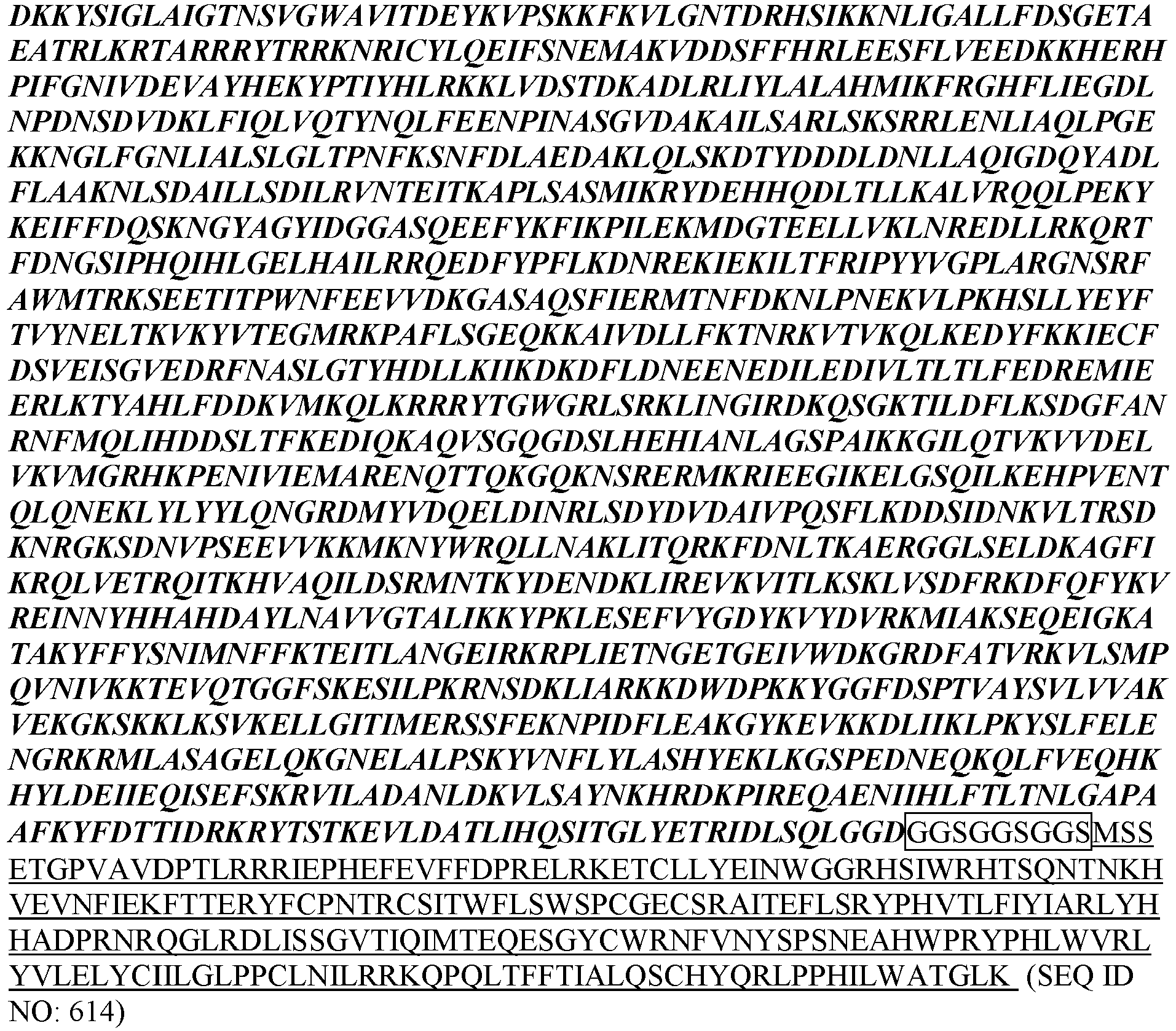
- rAPOBEC1-XTEN -dCas9 primary sequence

-
Figure 2 shows that the N-terminal deaminase fusions showed significant activity on the single stranded DNA substrates. For this reason, only the N-terminal architecture was chosen for further experiments. -
Figure 3 illustrates double stranded DNA substrate binding by deaminase-dCas9:sgRNA complexes. A number of double stranded deaminase substrate sequences were generated. The sequences are provided below. The structures according toFigure 3 are identified in these sequences (36bp: underlined, sgRNA target sequence: bold; PAM: boxed; 21bp: italicized). All substrates were labeled with a 5'-Cy3 label:









 "-":
"-":
 ∗In all substrates except for "8U", the top strand in
Figure 3 is the complement of the sequence specified here. In the case of "8U", there is a "G" opposite the U. -
Figure 4 shows the results of a double stranded DNA Deamination Assay. The fusions were expressed and purified with an N-terminal His6 tag via both Ni-NTA and sepharose chromatography. In order to assess deamination on dsDNA substrates, the various dsDNA substrates shown on the previous slide were incubated at a 1:8 dsDNA:fusion protein ratio and incubated at 37 °C for 2 hours. Once the dCas9 portion of the fusion binds to the DNA it blocks access of the USER enzyme to the DNA. Therefore, the fusion proteins were denatured following the incubation and the dsDNA was purified on a spin column, followed by incubation for 45 min with the USER Enzyme and resolution of the resulting DNA substrate and substrate fragments on a 10% TBE-urea gel. -
Figure 5 demonstrates that Cas9 fusions can target positions 3-11 of double-stranded DNA target sequences (numbered according to the schematic inFigure 3 ). Upper Gel: 1 µM rAPOBEC1-GGS-dCas9, 125 nM dsDNA, 1 eq sgRNA. Mid Gel: 1 µM rAPOBEC1-(GGS)3-dCas9, 125 nM dsDNA, 1 eq sgRNA. Lower Gel: 1.85 µM rAPOBEC1-XTEN-dCas9, 125 nM dsDNA, 1 eq sgRNA. Based on the data from these gels, positions 3-11 (according to the numbering inFigure 3 ) are sufficiently exposed to the activity of the deaminase to be targeted by the fusion proteins tested. Access of the deaminase to other positions is most likely blocked by the dCas9 protein. - The data further indicates that a linker of only 3 amino acids (GGS) is not optimal for allowing the deaminase to access the single stranded portion of the DNA. The 9 amino acid linker [(GGS)3] (SEQ ID NO: 596) and the more structured 16 amino acid linker (XTEN) allow for more efficient deamination.
-
Figure 6 demonstrates that the correct guide RNA, e.g., the correct sgRNA, is required for deaminase activity. The gel shows that fusing the deaminase to dCas9, the deaminase enzyme becomes sequence specific (e.g., using the fusion with an eGFP sgRNA results in no deamination), and also confers the capacity to the deaminase to deaminate dsDNA. The native substrate of the deaminase enzyme is ssDNA, and no deamination occurred when no sgRNA was added. This is consistent with reported knowledge that APOBEC deaminase by itself does not deaminate dsDNA. The data indicates that Cas9 opens the double-stranded DNA helix within a short window, exposing single-stranded DNA that is then accessible to the APOBEC deaminase for cytidine deamination. The sgRNA sequences used are provided below. sequences (36bp: underlined, sgRNA target sequence: bold; PAM: boxed; 21bp: italicized) - DNA sequence 8:

- Correct sgRNA sequence (partial 3' sequence):
5'-AUUAUUCCGCGGAUUUAUUUGUUUUAGAGCUAG..-3' (SEQ ID NO: 634) - eGFP sgRNA sequence (partial 3'-sequence):
5'-CGUAGGCCAGGGUGGUCACGGUUUUAGAGCUAG..-3' (SEQ ID NO: 635) - Exemplary deamination targets. The dCas9:deaminase fusion proteins described herein can be delivered to a cell in vitro or ex vivo or to a subject in vivo and can be used to effect C to T or G to A transitions when the target nucleotide is in positions 3-11 with respect to a PAM. Exemplary deamination targets include, without limitation, the following: CCR5 truncations: any of the codons encoding Q93, Q102, Q186, R225, W86, or Q261 of CCR5 can be deaminated to generate a STOP codon, which results in a nonfunctional truncation of CCR5 with applications in HIV treatment. APOE4 mutations: mutant codons encoding C11R and C57R mutant APOE4 proteins can be deaminated to revert to the wild-type amino acid with applications in Alzheimer's treatment. eGFP truncations: any of the codons encoding Q158, Q184, Q185 can be deaminated to generate a STOP codon, or the codon encoding M1 can be deaminated to encode I, all of which result in loss of eGFP fluorescence, with applications in reporter systems. eGFP restoration: a mutant codon encoding T65A or Y66C mutant GFP, which does not exhibit substantial fluorescence, can be deaminated to restore the wild-type amino acid and confer fluorescence. PIK3CA mutation: a mutant codon encoding K111E mutant PIK3CA can be deaminated to restore the wild-type amino acid residue with applications in cancer. CTNNB1 mutation: a mutant codon encoding T41A mutant CTNNB1 can be deaminated to restore the wild-type amino acid residue with applications in cancer. HRAS mutation: a mutant codon encoding Q61R mutant HRAS can be deaminated to restore the wild-type amino acid residue with applications in cancer. P53 mutations: any of the mutant codons encoding Y163C, Y236C, or N239D mutant p53 can be deaminated to encode the wild type amino acid sequence with applications in cancer.
The feasibility of deaminating these target sequences in double-stranded DNA is demonstrated inFigures 7 and8 .Figure 7 illustrates the mechanism of target DNA binding of in vivo target sequences by deaminase-dCas9:sgRNA complexes. -
Figure 8 shows successful deamination of exemplary disease-associated target sequences. Upper Gel: CCR5 Q93: coding strand target in pos. 10 (potential off-targets at positions 2, 5, 6, 8, 9); CCR5 Q102: coding strand target in pos. 9 (potential off-targets at positions 1, 12, 14); CCR5 Q186: coding strand target in pos. 9 (potential off-targets at positions 1, 5, 15); CCR5 R225: coding strand target in pos. 6 (no potential off-targets); eGFP Q158: coding strand target in pos. 5 (potential off-targets at positions 1, 13, 16); eGFP Q184 /185: coding strand target in pos. 4 and 7 (potential off-targets at positions 3, 12, 14, 15, 16, 17, 18); eGFP M1: template strand target in pos. 12 (potential off-targets at positions 2, 3, 7, 9, 11) (targets positions 7 and 9 to small degree); eGFP T65A: template strand target in pos. 7 (potential off-targets at positions 1, 8, 17); PIK3CA K111E: template strand target in pos. 2 (potential off-targets at positions 5, 8, 10, 16, 17); PIK3CA K111E: template strand target in pos. 13 (potential off-targets at positions 11, 16, 19) X. Lower Gel: CCR5 W86: template strand target in pos. 2 and 3 (potential off-targets at positions 1, 13) X; APOE4 C11R: coding strand target in pos. 11 (potential off-targets at positions 7, 13, 16, 17); APOE4 C57R: coding strand target in pos. 5) (potential off-targets at positions 7, 8, 12); eGFP Y66C: template strand target in pos. 11 (potential off-targets at positions 1, 4 ,6 , 8, 9, 16); eGFP Y66C: template strand target in pos. 3 (potential off-targets at positions 1, 8, 17); CCR5 Q261: coding strand target in pos. 10 (potential off-targets at positions 3, 5, 6, 9, 18); CTNNB1 T41A: template strand target in pos. 7 (potential off-targets at positions 1, 13, 15, 16) X; HRAS Q61R: template strand target in pos. 6 (potential off-targets at positions 1, 2, 4, 5, 9, 10, 13); p53 Y163C: template strand target in pos. 6 (potential off-targets at positions 2, 13, 14); p53 Y236C: template strand target in pos. 8 (potential off-targets at positions 2, 4); p53 N239D: template strand target in pos. 4 (potential off-targets at positions 6, 8). Exemplary DNA sequences of disease targets are provided below (PAMs (5'-NGG-3') and target positions are boxed):













- Direct programmable nucleobase editing efficiencies in mammalian cells by dCas9:deaminase fusion proteins can be improved significantly by fusing a uracil glycosylase inhibitor (UGI) to the dCas9:deaminase fusion protein.
-
Figure 9 shows in vitro C→T editing efficiencies in human HEK293 cells using rAPOBEC1 -XTEN-dCas9: - rAPOBEC1-XTEN-dCas91-NLS primary sequence

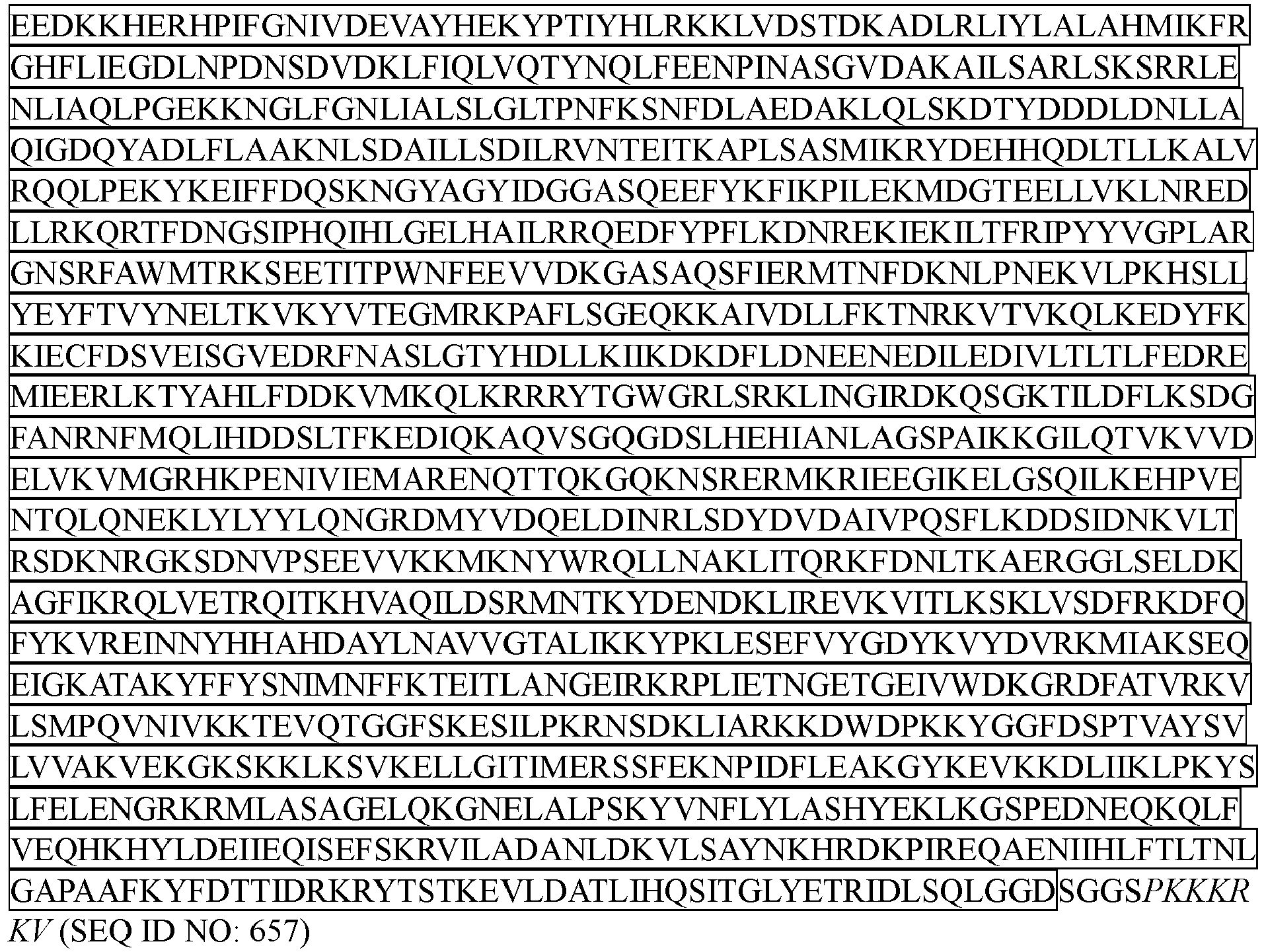
- Protospacer sequences were as follows:

- *PAMs are boxed, C residues within target window (positions 3-11) are numbered and bolded.
-
Figure 10 demonstrates that C→T editing efficiencies on the same protospacer sequences in HEK293T cells are greatly enhanced when a UGI domain is fused to the rAPOBEC1:dCas9 fusion protein.
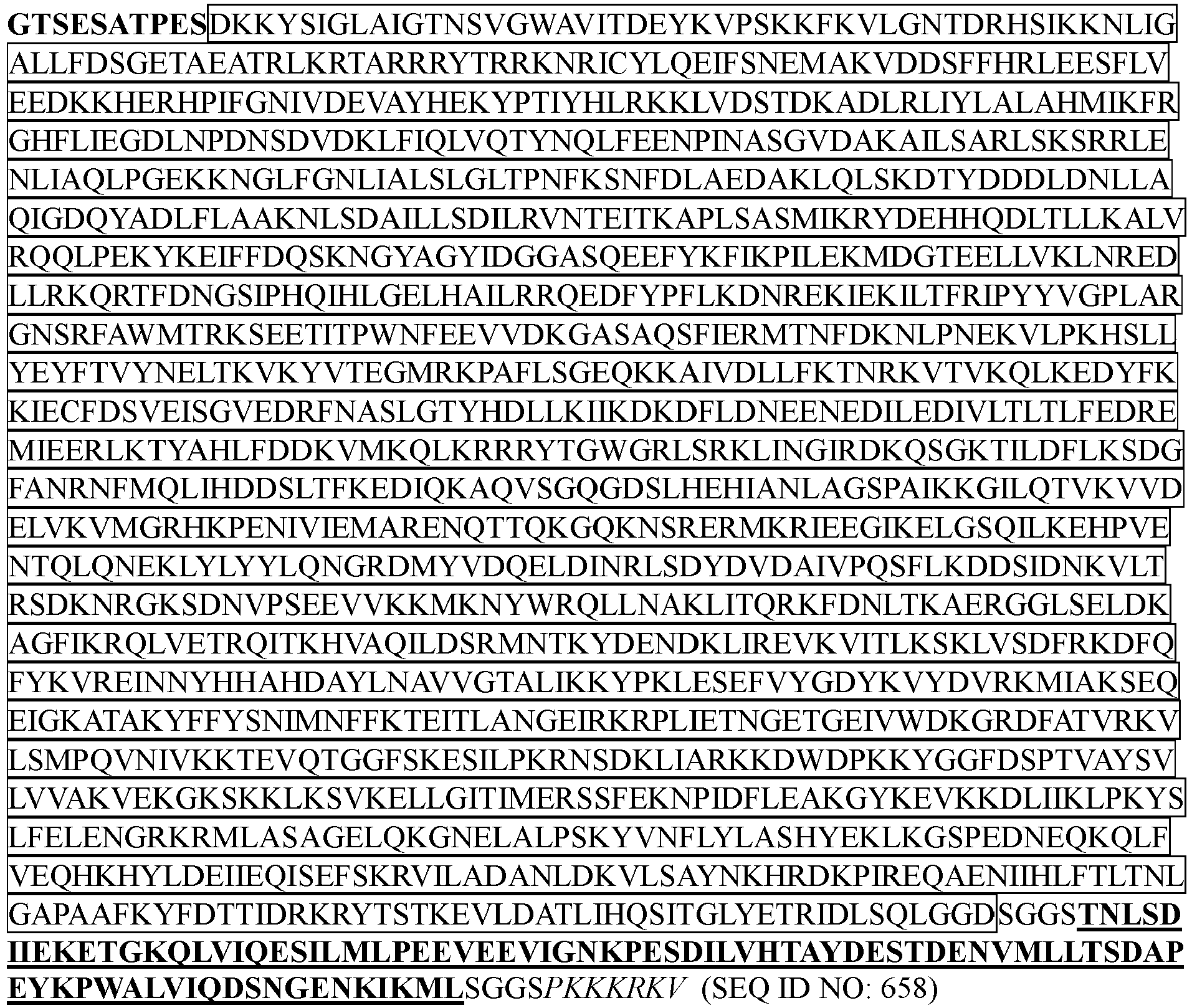
- The percentages in
Figures 9 and10 are shown from sequencing both strands of the target sequence. Because only one of the strands is a substrate for deamination, the maximum possible deamination value in this assay is 50%. Accordingly, the deamination efficiency is double the percentages shown in the tables. E.g., a value of 50% relates to deamination of 100% of double-stranded target sequences.
When a uracil glycosylase inhibitor (UGI) was fused to the dCas9:deaminase fusion protein (e.g., rAPOBEC1-XTEN-dCas9-[UGI]-NLS), a significant increase in editing efficiency in cells was observed. This result indicates that in mammalian cells, the DNA repair machinery that cuts out the uracil base in a U:G base pair is a rate-limiting process in DNA editing. Tethering UGI to the dVas9:deaminase fusion proteins greatly increases editing yields. - Without UGI, typical editing efficiencies in human cells were in the -2-14% yield range (
Figure 9 andFigure 10 , "XTEN" entries). With UGI (Figure 10 , "UGI" entries) the editing was observed in the -6-40% range. Using a UGI fusion is thus more efficient than the current alternative method of correcting point mutations via HDR, which also creates an excess of indels in addition to correcting the point mutation. No indels resulting from treatment with the cas9:deaminase:UGI fusions were observed. - Current genome-editing technologies introduce double-stranded DNA breaks at a target locus of interest as the first step to gene correction.39,40 Although most genetic diseases arise from mutation of a single nucleobase to a different nucleobase, current approaches to revert such changes are very inefficient and typically induce an abundance of random insertions and deletions (indels) at the target locus as a consequence of the cellular response to double-stranded DNA breaks.39,40 Reported herein is the development of nucleobase editing, a new strategy for genome editing that enables the direct conversion of one target nucleobase into another in a programmable manner, without requiring double-stranded DNA backbone cleavage. Fusions of CRISPR/Cas9 were engineered and the cytidine deaminase enzyme APOBEC1 that retain the ability to be programmed with a guide RNA, do not induce double-stranded DNA breaks, and mediate the direct conversion of cytidine to uracil, thereby effecting a C→T (or G→A) substitution following DNA replication, DNA repair, or transcription if the template strand is targeted. The resulting "nucleobase editors" convert cytidines within a window of approximately five nucleotides, and can efficiently correct a variety of point mutations relevant to human disease in vitro. In four transformed human and murine cell lines, second- and third-generation nucleobase editors that fuse uracil glycosylase inhibitor (UGI), and that use a Cas9 nickase targeting the non-edited strand, respectively, can overcome the cellular DNA repair response to nucleobase editing, resulting in permanent correction of up to 37% or (-15-75%) of total cellular DNA in human cells with minimal (typically ≤ 1%) indel formation. In contrast, canonical Cas9-mediated HDR on the same targets yielded an average of 0.7% correction with 4% indel formation. Nucleobase editors were used to revert two oncogenic p53 mutations into wild-type alleles in human breast cancer and lymphoma cells, and to convert an Alzheimer's Disease associated Arg codon in ApoE4 into a non-disease-associated Cys codon in mouse astrocytes. Base editing expands the scope and efficiency of genome editing of point mutations.
- The clustered regularly interspaced short palindromic repeat (CRISPR) system is a prokaryotic adaptive immune system that has been adapted to mediate genome engineering in a variety of organisms and cell lines.41 CRISPR/Cas9 protein-RNA complexes localize to a target DNA sequence through base pairing with a guide RNA, and natively create a DNA double-stranded break (DSB) at the locus specified by the guide RNA. In response to DSBs, endogenous DNA repair processes mostly result in random insertions or deletions (indels) at the site of DNA cleavage through non-homologous end joining (NHEJ). In the presence of a homologous DNA template, the DNA surrounding the cleavage site can be replaced through homology-directed repair (HDR). When simple disruption of a disease-associated gene is sufficient (for example, to treat some gain-of-function diseases), targeted DNA cleavage followed by indel formation can be effective. For most known genetic diseases, however, correction of a point mutation in the target locus, rather than stochastic disruption of the gene, is needed to address or study the underlying cause of the disease.68
- Motivated by this need, researchers have invested intense effort to increase the efficiency of HDR and suppress NHEJ. For example, a small-molecule inhibitor of ligase IV, an essential enzyme in the NHEJ pathway, has been shown to increase HDR efficiency.42,43 However, this strategy is challenging in post-mitotic cells, which typically down-regulate HDR, and its therapeutic relevance is limited by the potential risks of inhibiting ligase IV in non-target cells. Enhanced HDR efficiency can also be achieved by the timed delivery of Cas9-guide RNA complexes into chemically synchronized cells, as HDR efficiency is highly cell-cycle dependent.44 Such an approach, however, is limited to research applications in cell culture since synchronizing cells is highly disruptive. Despite these developments, current strategies to replace point mutations using HDR in most contexts are very inefficient (typically -0.1 to 5%),42,43,45,46, 75 especially in unmodified, non-dividing cells. In addition, HDR competes with NHEJ during the resolution of double-stranded breaks, and indels are generally more abundant outcomes than gene replacement. These observations highlight the need to develop alternative approaches to install specific modifications in genomic DNA that do not rely on creating double-stranded DNA breaks. A small-molecule inhibitor of ligase IV, an essential enzyme in the NHEJ pathway, has been shown to increase HDR efficiency.42,43 However, this strategy is challenging in post-mitotic cells, which typically down-regulate HDR, and its therapeutic relevance is limited by the potential risks of inhibiting ligase IV in non-target cells. Enhanced HDR efficiency can also be achieved by the timed delivery of Cas9-guide RNA complexes into chemically synchronized cells, as HDR efficiency is highly cell-cycle dependent.44 Such an approach, however, is limited to research applications in cell culture since synchronizing cells is highly disruptive. In some cases, it is possible to design HDR templates such that the product of successful HDR contains mutations in the PAM sequence and therefore is no longer a substrate for subsequent Cas9 modification, increasing the overall yield of HDR products,75 although such an approach imposes constraints on the product sequences. Recently, this strategy has been coupled to the use of ssDNA donors that are complementary to the non-target strand and high-efficiency ribonucleoprotein (RNP) delivery to substantially increase the efficiency of HDR, but even in these cases the ratio of HDR to NHEJ outcomes is relatively low (< 2).83
- It was envisioned that direct catalysis of the conversion of one nucleobase to another at a programmable target locus without requiring DNA backbone cleavage could increase the efficiency of gene correction relative to HDR without introducing undesired random indels at the locus of interest. Catalytically dead Cas9 (dCas9), which contains Asp 10Ala and His840Ala mutations that inactivate its nuclease activity, retains its ability to bind DNA in a guide RNA-programmed manner but does not cleave the DNA backbone.16,47 In principle, conjugation of dCas9 with an enzymatic or chemical catalyst that mediates the direct conversion of one nucleobase to another could enable RNA-programmed nucleobase editing. The deamination of cytosine (C) is catalyzed by cytidine deaminases29 and results in uracil (U), which has the base pairing properties of thymine (T). dCas9 was fused to cytidine deaminase enzymes in order to test their ability to convert C to U at a guide RNA-specified DNA locus. Most known cytidine deaminases operate on RNA, and the few examples that are known to accept DNA require single-stranded DNA.48 Recent studies on the dCas9-target DNA complex reveal that at least nine nucleotides of the displaced DNA strand are unpaired upon formation of the Cas9:guide RNA:DNA "R-loop" complex.12 Indeed, in the structure of the Cas9 R- loop complex the first 11 nucleotides of the protospacer on the displaced DNA strand are disordered, suggesting that their movement is not highly restricted.76 It has also been speculated that Cas9 nickase-induced mutations at cytosines in the non-template strand might arise from their accessibility by cellular cytidine deaminase enzymes.77 Recent studies on the dCas9-target DNA complex have revealed that at least 26 bases on the non-template strand are unpaired when Cas9 binds to its target DNA sequence.49 It was reasoned that a subset of this stretch of single-stranded DNA in the R-loop might serve as a substrate for a dCas9-tethered cytidine deaminase to effect direct, programmable conversion of C to U in DNA (
Figure 11A ). - Four different cytidine deaminase enzymes (hAID, hAPOBEC3G, rAPOBEC1, and pmCDA1) were expressed in a mammalian cell lysate-derived in vitro transcription-translation system and evaluated for ssDNA deamination. Of the four enzymes, rAPOBEC1 showed the highest deaminase activity under the tested conditions and was chosen for dCas9 fusion experiments (
Figure 36A ). Although appending rAPOBEC1 to the C-terminus of dCas9 abolishes deaminase activity, fusion to the N-terminus of dCas9 preserves deaminase activity on ssDNA at a level comparable to that of the unfused enzyme. Four rAPOBEC1-dCas9 fusions were expressed and purified with linkers of different length and composition (Figure 36B ), and evaluated each fusion for single guide RNA (sgRNA)-programmed dsDNA deamination in vitro (Figures 11A to 11C andFigures 15A to 15D ).
Efficient, sequence-specific, sgRNA-dependent C to U conversion was observed in vitro (Figures 11A to 11C ). Conversion efficiency was greatest using rAPOBEC1-dCas9 linkers over nine amino acids in length. The number of positions susceptible to deamination (the deamination "activity window") increases with linker length was extended from three to 21 amino acids (Figures 36C to 36F 15A to 15D ). The 16-residue XTEN linker50 was found to offer a promising balance between these two characteristics, with an efficient deamination window of approximately five nucleotides, frompositions 4 to 8 within the protospacer, counting the end distal to the protospacer-adjacent motif (PAM) asposition 1. The rAPOBEC1-XTEN-dCas9 protein served as the first-generation nucleobase editor (NBE1). - Elected were seven mutations relevant to human disease that in theory could be corrected by C to T nucleobase editing, synthesized double-stranded DNA 80-mers of the corresponding sequences, and assessed the ability of NBE1 to correct these mutations in vitro (
Figures 16A to 16B ). NBE1 yielded products consistent with efficient editing of the target C, or of at least one C within the activity window when multiple Cs were present, in six of these seven targets in vitro, with an average apparent editing efficiency of 44% (Figures 16A to 16B ). In the three cases in which multiple Cs were present within the deamination window, evidence of deamination of some or all of these cytosines was observed. In only one of the seven cases tested were substantial yields of edited product observed (Figures 16A to 16B ). Although the preferred sequence context for APOBEC1 substrates is reported to be CC or TC,51 it was anticipated that the increased effective molarity of the deaminase and its single-stranded DNA substrate mediated by dCas9 binding to the target locus may relax this restriction. To illuminate the sequence context generality of NBE1, its ability to edit a 60-mer double-stranded DNA oligonucleotide containing a single fixed C atposition 7 within the protospacer was assayed, as well as all 36 singly mutated variants in which protospacer bases 1-6 and 8-13 were individually varied to each of the other three bases. Each of these 37 sequences were treated with 1.9 µM NBE1, 1.9 µM of the corresponding sgRNA, and 125 nM DNA for 2 h, similar to standard conditions for in vitro Cas9 assays52. High-throughput DNA sequencing (HTS) revealed 50 to 80% C to U conversion of targeted strands (25 to 40% of total sequence reads arising from both DNA strands, one of which is not a substrate for NBE1) (Figure 12A ). The nucleotides surrounding the target C had little effect on editing efficiency was independent of sequence context unless the base immediately 5' of the target C is a G, in which case editing efficiency was substantially lower (Figures 12A to 12B ). NBE1 activity in vitro was assessed on all four NC motifs atpositions 1 through 8 within the protospacer (Figures 12A to 12B ). In general NBE1 activity on substrates was observed to follow the order TC ≥ CC ≥ AC >GC, with maximum editing efficiency achieved when the target C is at or nearposition 7. In addition, it was observed that the nucleobase editor is highly processive, and will efficiently convert most of all Cs to Us on the same DNA strand within the 5-base activity window (Figure 17 ). - While BE1 efficiently processes substrates in a test tube, in cells a tree of possible DNA repair outcomes determines the fate of the initial U:G product of base editing (
Figure 29A ). To test the effectiveness of nucleobase editing in human cells, NBE1 codon usage was optimized for mammalian expression, appended a C-terminal nuclear localization sequence (NLS),53 and assayed its ability to convert C to T in human cells on 14Cs in six well-studied target sites throughout the human genome (Figure 37A ).54 The editable Cs were confirmed within each protospacer in vitro by incubating NBE1 with synthetic 80-mers that correspond to the six different genomic sites, followed by HTS (Figures 13A to 13C ,Figure 29B andFigure 25 ). Next, HEK293T cells were transfected with plasmids encoding NBE1 and one of the six target sgRNAs, allowed three days for nucleobase editing to occur, extracted genomic DNA from the cells, and analyzed the loci by HTS. Although C to T editing in cells at the target locus was observed for all six cases, the efficiency of nucleobase editing was 1.1% to 6.3% or 0.8%-7.7% of total DNA sequences (corresponding to 2.2% to 12.6% of targeted strands), a 6.3-fold to 37-fold or 5-fold to 36-fold decrease in efficiency compared to that of in vitro nucleobase editing (Figures 13A to 13C ,Figure 29B andFigure 25 ). It was observed that some base editing outside of the typical window ofpositions 4 to 8 when the substrate C is preceded by a T, which we attribute to the unusually high activity of APOBEC1 for TC substrates.48 - It was asked whether the cellular DNA repair response to the presence of U:G heteroduplex DNA was responsible for the large decrease in nucleobase editing efficiency in cells (
Figure 29A ). Uracil DNA glycosylase (UDG) catalyzes removal of U from DNA in cells and initiates base excision repair (BER), with reversion of the U:G pair to a C:G pair as the most common outcome (Figure 29A ).55 Uracil DNA glycosylase inhibitor (UGI), an 83-residue protein from B. subtilis bacteriophage PBS1, potently blocks human UDG activity (IC50 = 12 pM).56 UGI was fused to the C-terminus of NBE1 to create the second-generation nucleobase editor NBE2 and repeated editing assays on all six genomic loci. Editing efficiencies in human cells were on average 3-fold higher with NBE2 than with NBE1, resulting in gene conversion efficiencies of up to 22.8% of total DNA sequenced (up to 45.6% of targeted strands) (Figures 13A to 13C andFigure 29B ). To test base editing in human cells, BE1 codon usage was optimized for mammalian expression and appended a C-terminal nuclear localization sequence (NLS).53 - Similar editing efficiencies were observed when a separate plasmid overexpressing UGI was co-transfected with NBE1 (
Figures 18A to 18H ). However, while the direct fusion of UGI to NBE1 resulted in no significant increase in C to T mutations at monitored non-targeted genomic locations, overexpression of unfused UGI detectably increased the frequency of C to T mutations elsewhere in the genome (Figures 18A to 18H ). The generality of NBE2-mediated nucleobase editing was confirmed by assessing editing efficiencies on the same six genomic targets in U2OS cells, and observed similar results with those in HEK293T cells (Figure 19 ). Importantly, NBE2 typically did not result in any detectable indels (Figure 13C andFigure 29C ), consistent with the known mechanistic dependence of NHEJ on double-stranded DNA breaks.57,78 Together, these results indicate that conjugating UGI to NBE1 can greatly increase the efficiency of nucleobase editing in human cells. - The permanence of nucleobase editing in human cells was confirmed by monitoring editing efficiencies over multiple cell divisions in HEK293T cells at two of the tested genomic loci. Genomic DNA was harvested at two time points: three days after transfection with plasmids expressing NBE2 and appropriate sgRNAs, and after passaging the cells and growing them for four additional days (approximately five subsequent cell divisions). No significant change in editing efficiency was observed between the non-passaged cells (editing observed in 4.6% to 6.6% of targeted strands for three different target Cs) and passaged cells (editing observed in 4.6% to 6.4% of targeted strands for the same three target Cs), confirming that the nucleobase edits became permanent following cell division (
Figure 20 ). Indels will on rare occasion arise from the processing of U:G lesions by cellular repair processes, which involve single-strand break intermediates that are known to lead to indels.84 Given that several hundred endogenous U:G lesions are generated every day per human cell from spontaneous cytidine deaminase,85 it was anticipate that the total indel frequency from U:G lesion repair is unlikely to increase from BE1 or BE2 activity at a single target locus. - To further increase the efficiency of nucleobase editing in cells, it was anticipated that nicking the non-edited strand may result in a smaller fraction of edited Us being removed by the cell, since eukaryotic mismatch repair machinery uses strand discontinuity to direct DNA repair to any broken strand of a mismatched duplex (
Figure 29A ).58, 79, 80 The catalytic His residue was restored at position 840 in the Cas9 HNH domain,47,59 resulting in the third-generation nucleobase editor NBE3 that nicks the non-edited strand containing a G opposite the targeted C, but does not cleave the target strand containing the C. Because NBE3 still contains the Asp10Ala mutation in Cas9, it does not induce double-stranded DNA cleavage. This strategy of nicking the non-edited strand augmented nucleobase editing efficiency in human cells by an additional 1.4- to 4.8-fold relative to NBE2, resulting in up to 36.3% of total DNA sequences containing the targeted C to T conversion on the same six human genomic targets in HEK293T cells (Figures 13A to 13C andFigure 29B ). Importantly, only a small frequency of indels, averaging 0.8% (ranging from 0.2% to 1.6% for the six different loci), was observed from NBE3 treatment (Figure 13C ,Figure 29C , andFigure 34 ). In contrast, when cells were treated with wild-type Cas9, sgRNA, and a single-stranded DNA donor template to mediate HDR at three of these loci C to T conversion efficiencies averaging only 0.7% were observed, with much higher relative indel formation averaging 3.9% (Figures 13A to 13C andFigure 29C ). The ratio of allele conversion to NHEJ outcomes averaged >1,000 for BE2, 23 for BE3, and 0.17 for wild-type Cas9 (Fig. 3c). We confirmed the permanence of base editing in human cells by monitoring editing efficiencies over multiple cell divisions in HEK293T cells at theHEK293 site Figure 38 ). These results collectively establish that nucleobase editing can effect much more efficient targeted single-base editing in human cells than Cas9-mediated HDR, and with much less (NBE3) or no (NBE2) indel formation. - Next, the off-target activity of NBE1, NBE2, and NBE3 in human cells was evaluated. The off-target activities of Cas9, dCas9, and Cas9 nickase have been extensively studied (
Figures 23 to 24 and31 to 33 ).54,60-62 Because the sequence preference of rAPOBEC1 has been shown to be independent of DNA bases more than one base from the target C,63 consistent with the sequence context independence observed inFigures 12A to 12B , it was assumed that potential off-target activity of nucleobase editors arises from off-target Cas9 binding. Since only a fraction of Cas9 off-target sites will have a C within the active window for nucleobase editing, off-target nucleobase editing sites should be a subset of the off-target sites of canonical Cas9 variants. For each of the six sites studied, the top ten known Cas9 off-target loci in human cells that were previously determined using the GUIDE-seq method were sequenced (Figures 23 to 27 and31 to 33 ).54,61 Detectable off-target nucleobase editing at only a subset (16/34, 47% for NBE1 and NBE2, and 17/34, 50% for NBE3) of known dCas9 off-target loci was observed. In all cases, the off-target base-editing substrates contained a C within the five-base target window. In general, off-target C to T conversion paralleled off-target Cas9 nuclease-mediated genome modification frequencies (Figures 23 to 27 ). Also monitored were C to T conversions at 2,500 distinct cytosines surrounding the six on-target and 34 off-target loci tested, representing a total of 14,700,000 sequence reads derived from approximately 1.8×10⁶ cells, and observed no detectable increase in C to T conversions at any of these other sites upon NBE1, NBE2, or NBE3 treatment compared to that of untreated cells (Figure 28 ). Taken together, these findings suggest that off-target substrates of nucleobase editors include a subset of Cas9 off-target substrates, and that nucleobase editors in human cells do not induce untargeted C to T conversion throughout the genome at levels that can be detected by the methods used here. No substantial change was observed in editing efficiency between non-passaged HEK293T cells (editing observed in 1.8% to 2.6% of sequenced strands for the three target Cs with BE2, and 6.2% to 14.3% with BE3) and cells that had undergone approximately five cell divisions after base editing (editing observed in 1.9% to 2.3% of sequenced strands for the same target Cs with BE2, and 6.4% to 14.5% with BE3), confirming that base edits in these cells are durable (Extended DataFig. 6 ). - Finally, the potential of nucleobase editing to correct three disease-relevant mutations in mammalian cells was tested. The apolipoprotein E gene variant APOE4 encodes two Arg residues at
amino acid positions positions Figures 16A to 16B ), this conversion was attempted in immortalized mouse astrocytes in which the endogenous murine APOE gene has been replaced by human APOE4 (Taconic). DNA encoding NBE3 and an appropriate sgRNA was delivered into these astrocytes by nucleofection (nucleofection efficiency of 25%), extracted genomic DNA from all treated cells two days later, and measured editing efficiency by HTS. Conversion of Arg158 to Cys158 was observed in 58-75% of total DNA sequencing reads (44% of nucleofected astrocytes) (Figures 14A to 14C andFigures 30A ). Also observed was 36-50% editing of total DNA at the third position ofcodon 158 and 38-55% editing of total DNA at the first position of Leu159, as expected since all three of these Cs are within the active nucleobase editing window. However, neither of the other two C→T conversions results in a change in the amino acid sequence of the ApoE3' protein since both TGC and TGT encode Cys, and both CTG and TTG encode Leu. From > 1,500,000 sequencing reads derived from 1×10⁶ cells evidence of 1.7% indels at the targeted locus following NBE3 treatment was observed (Figure 35 ). In contrast, identical treatment of astrocytes with wt Cas9 and donor ssDNA resulted in 0.1-0.3% APOE4 correction and 26-40% indels at the targeted locus, efficiencies consistent with previous reports of single-base correction using Cas9 and HDR45,75 (Figure 30A andFigure 40A ). Astrocytes treated identically but with an sgRNA targeting the VEGFA locus displayed no evidence of APOE4 base editing (Figure 34 andFigure 40A ). These results demonstrate how nucleobase editors can effect precise, single-amino acid changes in the coding sequence of a protein as the major product of editing, even when their processivity results in more than one nucleotide change in genomic DNA. The off-target activities of Cas9, dCas9, and Cas9 nickase have been extensively studied.54,60-62 In general, off-target C to T conversions by BE1, BE2, and BE3 paralleled off-target Cas9 nuclease-mediated genome modification frequencies. - The dominant-negative p53 mutations Tyr163Cys and Asn239Asp are strongly associated with several types of cancer.66-67 Both of these mutations can be corrected by a C to T conversion on the template strand (
Figures 16A to 16B ). A human breast cancer cell line homozygous for the p53 Tyr163Cys mutation (HCC1954 cells) was nucleofected with DNA encoding NBE3 and an sgRNA programmed to correct Tyr163Cys. Because the nucleofection efficiency of HCC1954 cells was < 10%, a plasmid expressing IRFP was co-nucleofected into these cells to enable isolation of nucleofected cells by fluorescence-activated cell sorting two days after treatment. HTS of genomic DNA revealed correction of the Tyr163Cys mutation in 7.6% of nucleofected HCC1954 cells (Figure 30B andFigure 40A to 40B ). Also nucleofected was a human lymphoma cell line that is heterozygous for p53 Asn239Asp (ST486 cells) with DNA encoding NBE2 and an sgRNA programmed to correct Asn239Asp with 92% nucleofection efficiency). Correction of the Asn239Asp mutation was observed in 11% of treated ST486 cells (12% of nucleofected ST486 cells). Consistent with the findings in HEK cells, no indels were observed from the treatment of ST486 cells with NBE2, and 0.6% indel formation from the treatment of HCC1954 cells with NBE3. No other DNA changes within at least 50 base pairs of both sides of the protospacer were detected at frequencies above that of untreated controls out of > 2,000,000 sequencing reads derived from 2×10⁵ cells (Figures 14A to 14C ,Figure 30B and Table 1). These results collectively represent the conversion of three disease-associated alleles in genomic DNA into their wild-type forms with an efficiency and lack of other genome modification events that is, to our knowledge, not currently achievable using other methods. - To illuminate the potential relevance of nucleobase editors to address human genetic diseases, the NCBI ClinVar database68 was searched for known genetic diseases that could in principle be corrected by this approach. ClinVar was filtered by first examining only single nucleotide polymorphisms (SNPs), then removing any nonpathogenic variants. Out of the 24,670 pathogenic SNPs, 3,956 are caused by either a T to C, or an A to G, substitution. This list was further filtered to only include variants with a nearby NGG PAM that would position the SNP within the deamination activity window, resulting in 1,089 clinically relevant pathogenic gene variants that could in principle be corrected by the nucleobase editors described here (
Figure 21 and Table 1). To illuminate the potential relevance of base editors to address human genetic diseases, the NCBI ClinVar database68 was searched for known genetic diseases that could in principle be corrected by this approach. ClinVar was filtered by first examining only single nucleotide polymorphisms (SNPs), then removing any non-pathogenic variants. Out of the 24,670 pathogenic SNPs, 3,956 are caused by either a T to C, or an A to G, substitution. This list was further filtered to only include variants with a nearby NGG PAM that would position the SNP within the deamination activity window, resulting in 911 clinically relevant pathogenic gene variants that could in principle be corrected by the base editors described here. Of these, 284 contain only one C within the base editing activity window. A detailed list of these pathogenic mutations can be found in Table 1.


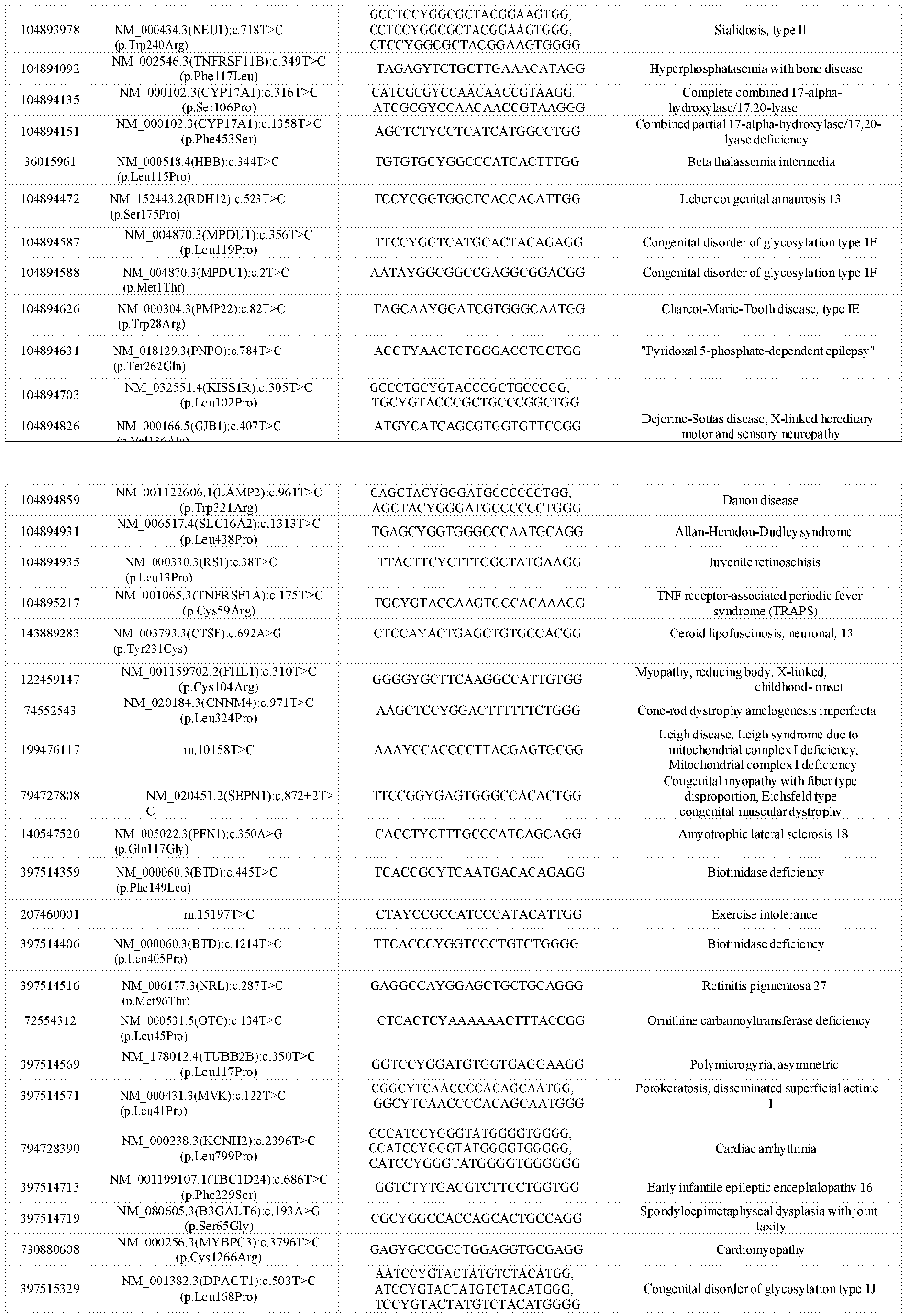


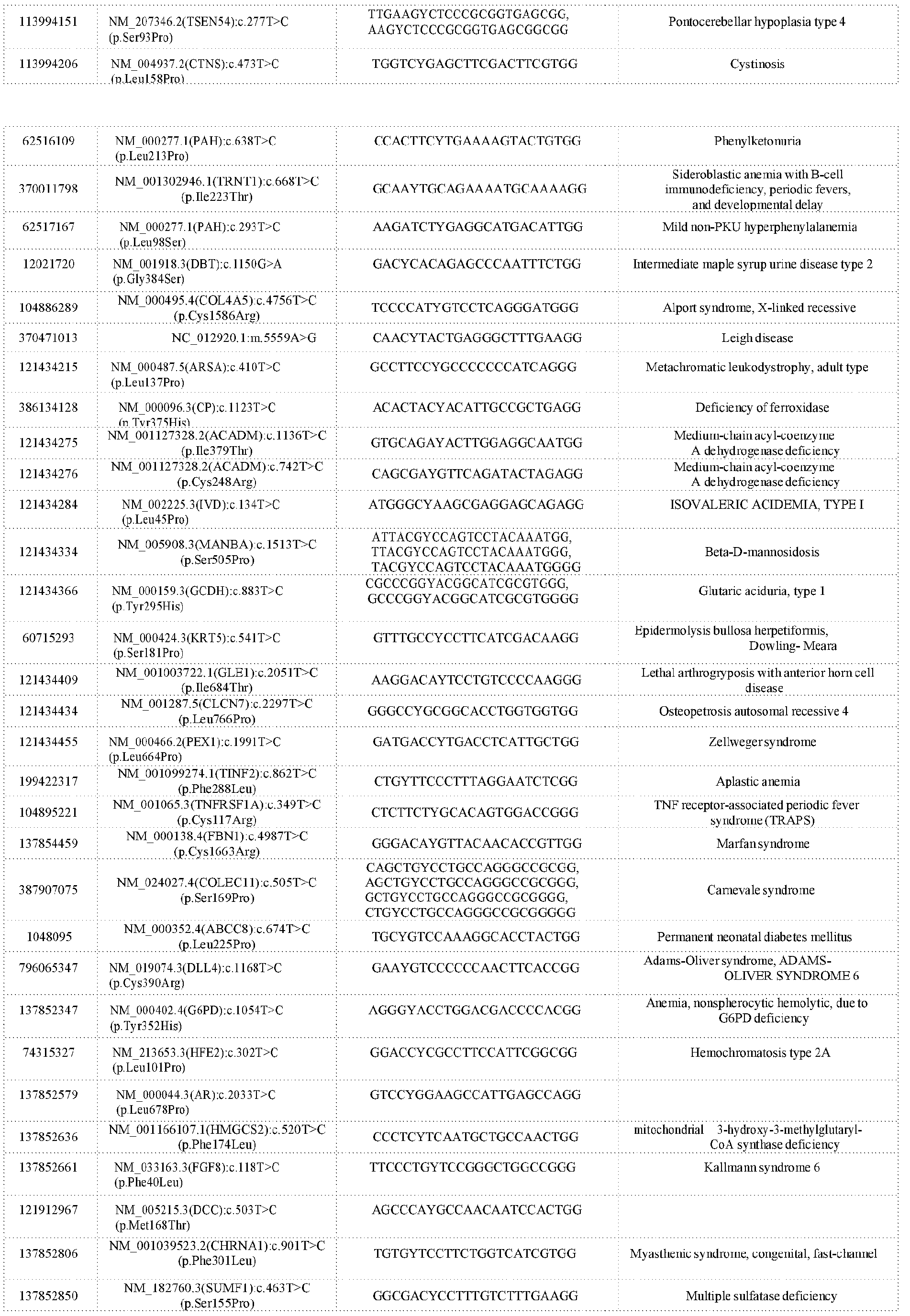


- In some embodiments, any of the base editors provided herein may be used to treat a disease or disorder. For example, any base editors provided herein may be used to correct one or more mutations associated with any of the diseases or disorders provided herein. Exemplary diseases or disorders that may be treated include, without limitation, 3-Methylglutaconic aciduria type 2, 46,XY gonadal dysgenesis, 4-Alpha-hydroxyphenylpyruvate hydroxylase deficiency, 6-pyruvoyl-tetrahydropterin synthase deficiency, achromatopsia, Acid-labile subunit deficiency, Acrodysostosis, acroerythrokeratoderma, ACTH resistance, ACTH-independent macronodular adrenal hyperplasia, Activated PI3K-delta syndrome, Acute intermittent porphyria, Acute myeloid leukemia, Adams-Oliver syndrome 1/5/6, Adenylosuccinate lyase deficiency, Adrenoleukodystrophy, Adult neuronal ceroid lipofuscinosis, Adult onset ataxia with oculomotor apraxia, Advanced sleep phase syndrome, Age-related macular degeneration, Alagille syndrome, Alexander disease, Allan-Herndon-Dudley syndrome, Alport syndrome, X-linked recessive, Alternating hemiplegia of childhood, Alveolar capillary dysplasia with misalignment of pulmonary veins, Amelogenesis imperfecta, Amyloidogenic transthyretin amyloidosis, Amyotrophic lateral sclerosis, Anemia (nonspherocytic hemolytic, due to G6PD deficiency), Anemia (sideroblastic, pyridoxine-refractory, autosomal recessive), Anonychia, Antithrombin III deficiency, Aortic aneurysm, Aplastic anemia, Apolipoprotein C2 deficiency, Apparent mineralocorticoid excess, Aromatase deficiency, Arrhythmogenic right ventricular cardiomyopathy, Familial hypertrophic cardiomyopathy, Hypertrophic cardiomyopathy, Arthrogryposis multiplex congenital, Aspartylglycosaminuria, Asphyxiating thoracic dystrophy, Ataxia with vitamin E deficiency, Ataxia (spastic), Atrial fibrillation, Atrial septal defect, atypical hemolytic-uremic syndrome, autosomal dominant CD11C+/CD1C+ dendritic cell deficiency, Autosomal dominant progressive external ophthalmoplegia with mitochondrial DNA deletions, Baraitser-Winter syndrome, Bartter syndrome, Basa ganglia calcification, Beckwith-Wiedemann syndrome, Benign familial neonatal seizures, Benign scapuloperoneal muscular dystrophy, Bernard Soulier syndrome, Beta thalassemia intermedia, Beta-D-mannosidosis, Bietti crystalline corneoretinal dystrophy, Bile acid malabsorption, Biotinidase deficiency, Borjeson-Forssman-Lehmann syndrome, Boucher Neuhauser syndrome, Bowen-Conradi syndrome, Brachydactyly, Brown-Vialetto-Van laere syndrome, Brugada syndrome, Cardiac arrhythmia, Cardiofaciocutaneous syndrome, Cardiomyopathy, Carnevale syndrome, Carnitine palmitoyltransferase II deficiency, Carpenter syndrome, Cataract, Catecholaminergic polymorphic ventricular tachycardia, Central core disease, Centromeric instability of chromosomes 1,9 and 16 and immunodeficiency, Cerebral autosomal dominant arteriopathy, Cerebro-oculo-facio-skeletal syndrome, Ceroid lipofuscinosis, Charcot-Marie-Tooth disease, Cholestanol storage disease, Chondrocalcinosis, Chondrodysplasia, Chronic progressive multiple sclerosis, Coenzyme Q10 deficiency, Cohen syndrome, Combined deficiency of factor V and factor VIII, Combined immunodeficiency, Combined oxidative phosphorylation deficiency, Combined partial 17-alpha-hydroxylase/17,20- lyase deficiency, Complement factor d deficiency, Complete combined 17-alpha- hydroxylase/17,20-lyase deficiency, Cone-rod dystrophy, Congenital contractural arachnodactyly, Congenital disorder of glycosylation, Congenital lipomatous overgrowth, Neoplasm of ovary, PIK3CA Related Overgrowth Spectrum, Congenital long QT syndrome, Congenital muscular dystrophy, Congenital muscular hypertrophy-cerebral syndrome, Congenital myasthenic syndrome, Congenital myopathy with fiber type disproportion, Eichsfeld type congenital muscular dystrophy, Congenital stationary night blindness, Corneal dystrophy, Cornelia de Lange syndrome, Craniometaphyseal dysplasia, Crigler Najjar syndrome, Crouzon syndrome, Cutis laxa with osteodystrophy, Cyanosis, Cystic fibrosis, Cystinosis, Cytochrome-c oxidase deficiency, Mitochondrial complex I deficiency, D-2-hydroxyglutaric aciduria, Danon disease, Deafness with labyrinthine aplasia microtia and microdontia (LAMM), Deafness, Deficiency of acetyl-CoA acetyltransferase, Deficiency of ferroxidase, Deficiency of UDPglucose-hexose-1-phosphate uridylyltransferase, Dejerine-Sottas disease, Desbuquois syndrome, DFNA, Diabetes mellitus type 2, Diabetes-deafness syndrome, Diamond-Blackfan anemia, Diastrophic dysplasia, Dihydropteridine reductase deficiency, Dihydropyrimidinase deficiency, Dilated cardiomyopathy, Disseminated atypical mycobacterial infection, Distal arthrogryposis, Distal hereditary motor neuronopathy, Donnai Barrow syndrome, Duchenne muscular dystrophy, Becker muscular dystrophy, Dyschromatosis universalis hereditaria, Dyskeratosis congenital, Dystonia, Early infantile epileptic encephalopathy, Ehlers-Danlos syndrome, Eichsfeld type congenital muscular dystrophy, Emery-Dreifuss muscular dystrophy, Enamel-renal syndrome, Epidermolysis bullosa dystrophica inversa, Epidermolysis bullosa herpetiformis, Epilepsy, Episodic ataxia, Erythrokeratodermia variabilis, Erythropoietic protoporphyria, Exercise intolerance, Exudative vitreoretinopathy, Fabry disease, Factor V deficiency, Factor VII deficiency, Factor xiii deficiency, Familial adenomatous polyposis, breast cancer, ovarian cancer, cold urticarial, chronic infantile neurological, cutaneous and articular syndrome, hemiplegic migraine, hypercholesterolemia, hypertrophic cardiomyopathy, hypoalphalipoproteinemia, hypokalemia-hypomagnesemia, juvenile gout, hyperlipoproteinemia, visceral amyloidosis, hypophosphatemic vitamin D refractory rickets, FG syndrome, Fibrosis of extraocular muscles, Finnish congenital nephrotic syndrome, focal epilepsy, Focal segmental glomerulosclerosis, Frontonasal dysplasia, Frontotemporal dementia, Fructose-biphosphatase deficiency, Gamstorp-Wohlfart syndrome, Ganglioside sialidase deficiency, GATA-1-related thrombocytopenia, Gaucher disease, Giant axonal neuropathy, Glanzmann thrombasthenia, Glomerulocystic kidney disease, Glomerulopathy, Glucocorticoid resistance, Glucose-6-phosphate transport defect, Glutaric aciduria, Glycogen storage disease, Gorlin syndrome, Holoprosencephaly, GRACILE syndrome, Haemorrhagic telangiectasia, Hemochromatosis, Hemoglobin H disease, Hemolytic anemia, Hemophagocytic lymphohistiocytosis, Carcinoma of colon, Myhre syndrome, leukoencephalopathy, Hereditary factor IX deficiency disease, Hereditary factor VIII deficiency disease, Hereditary factor XI deficiency disease, Hereditary fructosuria, Hereditary Nonpolyposis Colorectal Neoplasm, Hereditary pancreatitis, Hereditary pyropoikilocytosis, Elliptocytosis, Heterotaxy, Heterotopia, Histiocytic medullary reticulosis, Histiocytosis-lymphadenopathy plus syndrome, HNSHA due to aldolase A deficiency, Holocarboxylase synthetase deficiency, Homocysteinemia, Howel-Evans syndrome, Hydatidiform mole, Hypercalciuric hypercalcemia, Hyperimmunoglobulin D, Mevalonic aciduria, Hyperinsulinemic hypoglycemia, Hyperkalemic Periodic Paralysis, Paramyotonia congenita of von Eulenburg, Hyperlipoproteinemia, Hypermanganesemia, Hypermethioninemia, Hyperphosphatasemia, Hypertension, hypomagnesemia, Hypobetalipoproteinemia, Hypocalcemia, Hypogonadotropic hypogonadism, Hypogonadotropic hypogonadism, Hypohidrotic ectodermal dysplasia, Hyper-IgM immunodeficiency, Hypohidrotic X-linked ectodermal dysplasia, Hypomagnesemia, Hypoparathyroidism, Idiopathic fibrosing alveolitis, Immunodeficiency, Immunoglobulin A deficiency, Infantile hypophosphatasia, Infantile Parkinsonism-dystonia, Insulin-dependent diabetes mellitus, Intermediate maple syrup urine disease, Ischiopatellar dysplasia, Islet cell hyperplasia, Isolated growth hormone deficiency, Isolated lutropin deficiency, Isovaleric acidemia, Joubert syndrome, Juvenile polyposis syndrome, Juvenile retinoschisis, Kallmann syndrome, Kartagener syndrome, Kugelberg-Welander disease, Lattice corneal dystrophy, Leber congenital amaurosis, Leber optic atrophy, Left ventricular noncompaction, Leigh disease, Mitochondrial complex I deficiency, Leprechaunism syndrome, Arthrogryposis, Anterior horn cell disease, Leukocyte adhesion deficiency, Leukodystrophy, Leukoencephalopathy, Ovarioleukodystrophy, L-ferritin deficiency, Li-Fraumeni syndrome, Limb-girdle muscular dystrophy- dystroglycanopathy, Loeys-Dietz syndrome, Long QT syndrome, Macrocephaly/autism syndrome, Macular corneal dystrophy, Macular dystrophy, Malignant hyperthermia susceptibility, Malignant tumor of prostate, Maple syrup urine disease, Marden Walker like syndrome, Marfan syndrome, Marie Unna hereditary hypotrichosis, Mast cell disease, Meconium ileus, Medium-chain acyl-coenzyme A dehydrogenase deficiency, Melnick-Fraser syndrome, Mental retardation, Merosin deficient congenital muscular dystrophy, Mesothelioma, Metachromatic leukodystrophy, Metaphyseal chondrodysplasia, Methemoglobinemia, methylmalonic aciduria, homocystinuria, Microcephaly, chorioretinopathy, lymphedema, Microphthalmia, Mild non-PKU hyperphenylalanemia, Mitchell-Riley syndrome, mitochondrial 3-hydroxy-3-methylglutaryl-CoA synthase deficiency, Mitochondrial complex I deficiency, Mitochondrial complex III deficiency, Mitochondrial myopathy, Mucolipidosis III, Mucopolysaccharidosis, Multiple sulfatase deficiency, Myasthenic syndrome, Mycobacterium tuberculosis, Myeloperoxidase deficiency, Myhre syndrome, Myoclonic epilepsy, Myofibrillar myopathy, Myoglobinuria, Myopathy, Myopia, Myotonia congenital, Navajo neurohepatopathy, Nemaline myopathy, Neoplasm of stomach, Nephrogenic diabetes insipidus, Nephronophthisis, Nephrotic syndrome, Neurofibromatosis, Neutral lipid storage disease, Niemann-Pick disease, Non-ketotic hyperglycinemia, Noonan syndrome, Noonan syndrome-like disorder, Norum disease, Macular degeneration, N-terminal acetyltransferase deficiency, Oculocutaneous albinism, Oculodentodigital dysplasia, Ohdo syndrome, Optic nerve aplasia, Ornithine carbamoyltransferase deficiency, Orofaciodigital syndrome, Osteogenesis imperfecta, Osteopetrosis, Ovarian dysgenesis, Pachyonychia, Palmoplantar keratoderma, nonepidermolytic, Papillon-Lef\xc3\xa8vre syndrome, Haim-Munk syndrome, Periodontitis, Peeling skin syndrome, Pendred syndrome, Peroxisomal fatty acyl-coa reductase 1 disorder, Peroxisome biogenesis disorder, Pfeiffer syndrome, Phenylketonuria, Phenylketonuria, Hyperphenylalaninemia, non-PKU, Pituitary hormone deficiency, Pityriasis rubra pilaris, Polyarteritis nodosa, Polycystic kidney disease, Polycystic lipomembranous osteodysplasia, Polymicrogyria, Pontocerebellar hypoplasia, Porokeratosis, Posterior column ataxia, Primary erythromelalgia, hyperoxaluria, Progressive familial intrahepatic cholestasis, Progressive pseudorheumatoid dysplasia, Propionic acidemia, Pseudohermaphroditism, Pseudohypoaldosteronism, Pseudoxanthoma elasticum-like disorder, Purine-nucleoside phosphorylase deficiency, Pyridoxal 5-phosphate-dependent epilepsy, Renal dysplasia, retinal pigmentary dystrophy, cerebellar ataxia, skeletal dysplasia, Reticular dysgenesis, Retinitis pigmentosa, Usher syndrome, Retinoblastoma, Retinopathy, RRM2B-related mitochondrial disease, Rubinstein-Taybi syndrome, Schnyder crystalline corneal dystrophy, Sebaceous tumor, Severe congenital neutropenia, Severe myoclonic epilepsy in infancy, Severe X-linked myotubular myopathy, onychodysplasia, facial dysmorphism, hypotrichosis, Short-rib thoracic dysplasia, Sialic acid storage disease, Sialidosis, Sideroblastic anemia, Small fiber neuropathy, Smith-Magenis syndrome, Sorsby fundus dystrophy, Spastic ataxia, Spastic paraplegia, Spermatogenic failure, Spherocytosis, Sphingomyelin/cholesterol lipidosis, Spinocerebellar ataxia, Split-hand/foot malformation, Spondyloepimetaphyseal dysplasia, Platyspondylic lethal skeletal dysplasia, Squamous cell carcinoma of the head and neck, Stargardt disease, Sucrase-isomaltase deficiency, Sudden infant death syndrome, Supravalvar aortic stenosis, Surfactant metabolism dysfunction, Tangier disease, Tatton-Brown-rahman syndrome, Thoracic aortic aneurysms and aortic dissections, Thrombophilia, Thyroid hormone resistance, TNF receptor-associated periodic fever syndrome (TRAPS), Tooth agenesis, Torsades de pointes, Transposition of great arteries, Treacher Collins syndrome, Tuberous sclerosis syndrome, Tyrosinase-negative oculocutaneous albinism, Tyrosinase-positive oculocutaneous albinism, Tyrosinemia, UDPglucose-4-epimerase deficiency, Ullrich congenital muscular dystrophy, Bethlem myopathy Usher syndrome, UV-sensitive syndrome, Van der Woude syndrome, popliteal pterygium syndrome, Very long chain acyl-CoA dehydrogenase deficiency, Vesicoureteral reflux, Vitreoretinochoroidopathy, Von Hippel-Lindau syndrome, von Willebrand disease, Waardenburg syndrome, Warsaw breakage syndrome, WFS1-Related Disorders, Wilson disease, Xeroderma pigmentosum, X-linked agammaglobulinemia, X-linked hereditary motor and sensory neuropathy, X-linked severe combined immunodeficiency, and Zellweger syndrome.
- The development of nucleobase editing advances both the scope and effectiveness of genome editing. The nucleobase editors described here offer researchers a choice of editing with virtually no indel formation (NBE2), or more efficient editing with a low frequency (here, typically ≤ 1%) of indel formation (NBE3). That the product of base editing is, by definition, no longer a substrate likely contributes to editing efficiency by preventing subsequent product transformation, which can hamper traditional Cas9 applications. By removing the reliance on double-stranded DNA cleavage and stochastic DNA repair processes that vary greatly by cell state and cell type, nucleobase editing has the potential to expand the type of genome modifications that can be cleanly installed, the efficiency of these modifications, and the type of cells that are amenable to editing. It is likely that recent engineered Cas9 variants69,70, 82 or delivery methods71 with improved DNA specificity, as well as Cas9 variants with altered PAM specificities,72 can be integrated into this strategy to provide additional nucleobase editors with improved DNA specificity or that can target an even wider range of disease-associated mutations. These findings also suggest that engineering additional fusions of dCas9 with enzymes that catalyze additional nucleobase transformations will increase the fraction of the possible DNA base changes that can be made through nucleobase editing. These results also suggest architectures for the fusion of other DNA-modifying enzymes, including methylases and demathylases, that mau enable additional types of programmable genome and epigenome base editing.
- Cloning. DNA sequences of all constructs and primers used in this paper are listed in the Supplementary Sequences. Plasmids containing genes encoding NBEl, NBE2, and NBE3 will be available from Addgene. PCR was performed using VeraSeq ULtra DNA polymerase (Enzymatics), or Q5 Hot Start High-Fidelity DNA Polymerase (New England Biolabs). NBE plasmids were constructed using USER cloning (New England Biolabs). Deaminase genes were synthesized as gBlocks Gene Fragments (Integrated DNA Technologies), and Cas9 genes were obtained from previously reported plasmids.18 Deaminase and fusion genes were cloned into pCMV (mammalian codon-optimized) or pET28b (E. coli codon-optimized) backbones. sgRNA expression plasmids were constructed using site-directed mutagenesis. Briefly, the primers listed in the Supplementary Sequences were 5' phosphorylated using T4 Polynucleotide Kinase (New England Biolabs) according to the manufacturer's instructions. Next, PCR was performed using Q5 Hot Start High-Fidelity Polymerase (New England Biolabs) with the phosphorylated primers and the plasmid pFYF1320 (EGFP sgRNA expression plasmid) as a template according to the manufacturer's instructions. PCR products were incubated with Dpnl (20 U, New England Biolabs) at 37 °C for 1 h, purified on a QIAprep spin column (Qiagen), and ligated using QuickLigase (New England Biolabs) according to the manufacturer's instructions. DNA vector amplification was carried out using Machl competent cells (ThermoFisher Scientific).
- In vitro deaminase assay on ssDNA. Sequences of all ssDNA substrates are listed in the Supplementary Sequences. All Cy3-labelled substrates were obtained from Integrated DNA Technologies (IDT). Deaminases were expressed in vitro using the TNT T7 Quick Coupled Transcription/Translation Kit (Promega) according to the manufacturer's instructions using 1 µg of plasmid. Following protein expression, 5 µL of lysate was combined with 35 µL of ssDNA (1.8 µM) and USER enzyme (1 unit) in CutSmart buffer (New England Biolabs) (50 mM potassium acetate, 29 mM Trisacetate, 10 mM magnesium acetate, 100 ug/mL BSA, pH 7.9) and incubated at 37 °C for 2 h. Cleaved U-containing substrates were resolved from full-length unmodified substrates on a 10% TBE-urea gel (Bio-Rad).
- Expression and purification of His6-rAPOBEC1-linker-dCas9 fusions. E. Coli BL21 STAR (DE3)-competent cells (ThermoFisher Scientific) were transformed with plasmids encoding pET28b-His6-rAPOBEC-linker-dCas9 with GGS, (GGS)3, (SEQ ID NO: 596) XTEN, or (GGS)7 (SEQ ID NO: 597) linkers. The resulting expression strains were grown overnight in Luria-Bertani (LB) broth containing 100 µg/mL of kanamycin at 37 °C. The cells were diluted 1:100 into the same growth medium and grown at 37 °C to OD600 = ~0.6. The culture was cooled to 4 °C over a period of 2 h, and isopropyl -β-D-1- thiogalactopyranoside (IPTG) was added at 0.5 mM to induce protein expression. After ~16 h, the cells were collected by centrifugation at 4,000 g and resuspended in lysis buffer (50 mM tris(hydroxymethyl)-aminomethane (Tris)-HCl, pH 7.0, 1 M NaCl, 20% glycerol, 10 mM tris(2-carboxyethyl)phosphine (TCEP, Soltec Ventures)). The cells were lysed by sonication (20 s pulse-on, 20 s pulse-off for 8 min total at 6 W output) and the lysate supernatant was isolated following centrifugation at 25,000 g for 15 min. The lysate was incubated with His-Pur nickel-nitriloacetic acid (nickel-NTA) resin (ThermoFisher Scientific) at 4 °C for 1 h to capture the His-tagged fusion protein. The resin was transferred to a column and washed with 40 mL of lysis buffer. The His-tagged fusion protein was eluted in lysis buffer supplemented with 285 mM imidazole, and concentrated by ultrafiltration (Amicon-Millipore, 100-kDa molecular weight cut-off) to 1 mL total volume. The protein was diluted to 20 mL in low-salt purification buffer containing 50 mM tris(hydroxymethyl)-aminomethane (Tris)-HCl, pH 7.0, 0.1 M NaCl, 20% glycerol, 10 mM TCEP and loaded onto SP Sepharose Fast Flow resin (GE Life Sciences). The resin was washed with 40 mL of this low-salt buffer, and the protein eluted with 5 mL of activity buffer containing 50 mM tris(hydroxymethyl)-aminomethane (Tris)-HCl, pH 7.0, 0.5 M NaCl, 20% glycerol, 1.0 mM TCEP. The eluted proteins were quantified on a SDSPAGE gel.
- In vitro transcription of sgRNAs, Linear DNA fragments containing the T7 promoter followed by the 20-bp sgRNA target sequence were transcribed in vitro using the primers listed in the Supplementary Sequences with the TranscriptAid T7 High Yield Transcription Kit (ThermoFisher Scientific) according to the manufacturer's instructions. sgRNA products were purified using the MEGAclear Kit (ThermoFisher Scientific) according to the manufacturer's instructions and quantified by UV absorbance.
- Preparation of Cy3-conjugated dsDNA substrates. Sequences of 80-nucleotide unlabeled strands are listed in the Supplementary Sequences and were ordered as PAGE-purified oligonucleotides from IDT. The 25-nt Cy3-labeled primer listed in the Supplementary Sequences is complementary to the 3' end of each 80-nt substrate. This primer was ordered as an HPLC-purified oligonucleotide from IDT. To generate the Cy3-labeled dsDNA substrates, the 80-nt strands (5 µL of a 100 µM solution) were combined with the Cy3-labeled primer (5 µL of a 100 µM solution) in NEBuffer 2 (38.25 µL of a 50 mM NaCl, 10 mMTris-HCI, 10 mM MgCl2, 1 mM DTT, pH 7.9 solution, New England Biolabs) with dNTPs (0.75 µL of a 100 mM solution) and heated to 95 °C for 5 min, followed by a gradual cooling to 45 °C at a rate of 0.1 °C/s. After this annealing period, Klenow exo- (5 U, New England Biolabs) was added and the reaction was incubated at 37 °C for 1 h. The solution was diluted with Buffer PB (250 µL, Qiagen) and isopropanol (50 µL) and purified on a QIAprep spin column (Qiagen), eluting with 50 µL of Tris buffer.
- Deaminase assay on dsDNA. The purified fusion protein (20 µL of 1.9 µM in activity buffer) was combined with 1 equivalent of appropriate sgRNA and incubated at ambient temperature for 5 min. The Cy3-labeled dsDNA substrate was added to final concentration of 125 nM and the resulting solution was incubated at 37 °C for 2 h. The dsDNA was separated from the fusion by the addition of Buffer PB (100 µL, Qiagen) and isopropanol (25 µL) and purified on a EconoSpin micro spin column (Epoch Life Science), eluting with 20 µL of CutSmart buffer (New England Biolabs). USER enzyme (1 U, New England Biolabs) was added to the purified, edited dsDNA and incubated at 37 °C for 1 h. The Cy3-labeled strand was fully denatured from its complement by combining 5 µL of the reaction solution with 15 µL of a DMSO-based loading buffer (5 mM Tris, 0.5 mM EDTA, 12.5% glycerol, 0.02% bromophenol blue, 0.02% xylene cyan, 80% DMSO). The full-length C-containing substrate was separated from any cleaved, U-containing edited substrates on a 10% TBE-urea gel (Bio-Rad) and imaged on a GE Amersham Typhoon imager.
- Preparation of in vitro-edited dsDNA for high-throughput sequencing (HTS). The oligonucleotides listed in the Supplementary Sequences were obtained from IDT. Complementary sequences were combined (5 µL of a 100 µM solution) in Tris buffer and annealed by heating to 95 °C for 5 min, followed by a gradual cooling to 45 °C at a rate of 0.1 °C/s to generate 60-bp dsDNA substrates. Purified fusion protein (20 µL of 1.9 µM in activity buffer) was combined with 1 equivalent of appropriate sgRNA and incubated at ambient temperature for 5 min. The 60-mer dsDNA substrate was added to final concentration of 125 nM and the resulting solution was incubated at 37 °C for 2 h. The dsDNA was separated from the fusion by the addition of Buffer PB (100 µL, Qiagen) and isopropanol (25 µL) and purified on a EconoSpin micro spin column (Epoch Life Science), eluting with 20 µL of Tris buffer. The resulting edited DNA (1 µL was used as a template) was amplified by PCR using the HTS primer pairs specified in the Supplementary Sequences and VeraSeq Ultra (Enzymatics) according to the manufacturer's instructions with 13 cycles of amplification. PCR reaction products were purified using RapidTips (Diffinity Genomics), and the purified DNA was amplified by PCR with primers containing sequencing adapters, purified, and sequenced on a MiSeq high-throughput DNA sequencer (Illumina) as previously described.73
- Cell culture. HEK293T (ATCC CRL-3216), U2OS (ATCC-HTB-96) and ST486 cells (ATCC) were maintained in Dulbecco's Modified Eagle's Medium plus GlutaMax (ThermoFisher) supplemented with 10% (v/v) fetal bovine serum (FBS) and penicillin/streptomycin (lx, Amresco), at 37 °C with 5% CO2. HCC1954 cells (ATCC CRL-2338) were maintained in RPMI-1640 medium (ThermoFisher Scientific) supplemented as described above. Immortalized rat astrocytes containing the ApoE4 isoform of the APOE gene (Taconic Biosciences) were cultured in Dulbecco's Modified Eagle's Medium plus GlutaMax (ThermoFisher Scientific) supplemented with 10% (v/v) fetal bovine serum (FBS) and 200 µg/mL Geneticin (ThermoFisher Scientific).
- Transfections. HEK293T cells were seeded on 48-well collagen-coated BioCoat plates (Corning) and transfected at approximately 85% confluency. Briefly, 750 ng of NBE and 250 ng of sgRNA expression plasmids were transfected using 1.5 µl of Lipofectamine 2000 (ThermoFisher Scientific) per well according to the manufacturer's protocol. Astrocytes, U2OS, HCC1954, HEK293T and ST486 cells were transfected using appropriate AMAXA NUCLEOFECTOR™ II programs according to manufacturer's instructions. 40 ng of infrared RFP (Addgene plasmid 45457)74 was added to the nucleofection solution to assess nucleofection efficiencies in these cell lines. For astrocytes, U2OS, and ST486 cells, nucleofection efficiencies were 25%, 74%, and 92%, respectively. For HCC1954 cells, nucleofection efficiency was <10%. Therefore, following trypsinization, the HCC1954 cells were filtered through a 40 micron strainer (Fisher Scientific), and the nucleofected HCC1954 cells were collected on a Beckman Coulter MoFlo XDP Cell Sorter using the iRFP signal (
abs 643 nm, em 670 nm). The other cells were used without enrichment of nucleofected cells. - High-throughput DNA sequencing of genomic DNA samples. Transfected cells were harvested after 3 d and the genomic DNA was isolated using the Agencourt DNAdvance Genomic DNA Isolation Kit (Beckman Coulter) according to the manufacturer's instructions. On-target and off-target genomic regions of interest were amplified by PCR with flanking HTS primer pairs listed in the Supplementary Sequences. PCR amplification was carried out with Phusion high-fidelity DNA polymerase (ThermoFisher) according to the manufacturer's instructions using 5 ng of genomic DNA as a template. Cycle numbers were determined separately for each primer pair as to ensure the reaction was stopped in the linear range of amplification (30, 28, 28, 28, 32, and 32 cycles for EMX1, FANCF,
HEK293 site 2,HEK293 site 3,HEK293 site 4, and RNF2 primers, respectively). PCR products were purified using RapidTips (Diffinity Genomics). Purified DNA was amplified by PCR with primers containing sequencing adaptors. The products were gel-purified and quantified using the QUANT-IT™ PicoGreen dsDNA Assay Kit (ThermoFisher) and KAPA Library Quantification Kit-Illumina (KAPA Biosystems). Samples were sequenced on an Illumina MiSeq as previously described.73 - Data analysis. Sequencing reads were automatically demultiplexed using MiSeq Reporter (Illumina), and individual FASTQ files were analyzed with a custom Matlab script provided in the Supplementary Notes. Each read was pairwise aligned to the appropriate reference sequence using the Smith-Waterman algorithm. Base calls with a Q-score below 31 were replaced with N's and were thus excluded in calculating nucleotide frequencies. This treatment yields an expected MiSeq base-calling error rate of approximately 1 in 1,000. Aligned sequences in which the read and reference sequence contained no gaps were stored in an alignment table from which base frequencies could be tabulated for each locus.
- Indel frequencies were quantified with a custom Matlab script shown in the Supplementary Notes using previously described criteria71. Sequencing reads were scanned for exact matches to two 10-bp sequences that flank both sides of a window in which indels might occur. If no exact matches were located, the read was excluded from analysis. If the length of this indel window exactly matched the reference sequence the read was classified as not containing an indel. If the indel window was two or more bases longer or shorter than the reference sequence, then the sequencing read was classified as an insertion or deletion, respectively.
- In case of conflict, the present application, including any definitions herein, will control.
- Primers used for generating sgRNA transfection plasmids. rev sgRNA_plasmid was used in all cases. The pFYF1320 plasmid was used as template as noted in Materials and Methods section. SEQ ID NOs: 329-338 appear from top to bottom below, respectively.

- Sequences of all ssDNA substrates used in in vitro deaminase assays. SEQ ID NOs: 339-341 appear from top to bottom below, respectively.

- Primers used for generating PCR products to serve as substrates for T7 transcription of sgRNAs for gel-based deaminase assay. rev_gRNA_T7 was used in all cases. The pFYF1320 plasmid was used as template as noted in Materials and Methods section. SEQ ID NOs: 342-365 appear from top to bottom below, respectively.

- Sequences of 80-nucleotide unlabeled strands and Cy3-labeled universal primer used in gel-based dsDNA deaminase assays. SEQ ID NOs: 366-390 appear from top to bottom below, respectively.


- Primers used for generating PCR products to serve as substrates for T7 transcription of sgRNAs for high-throughput sequencing. rev_gRNA_T7 (above) was used in all cases. The pFYF1320 plasmid was used as template as noted in Materials and Methods section. SEQ ID NOs: 391-442 appear from top to bottom below, respectively.


- Sequences of in vitro-edited dsDNA for high-throughput sequencing (HTS). Shown are the sequences of edited strands. Reverse complements of all sequences shown were also obtained. dsDNA substrates were obtained by annealing complementary strands as described in Materials and Methods. Oligonucleotides representing the EMX1, FANCF,
HEK293 site 2,HEK293 site 3,HEK293 site 4, and RNF2 loci were originally designed for use in the gel-based deaminase assay and therefore have the same 25-nt sequence on their 5'- ends (matching that of the Cy3-primer). SEQ ID NOs: 443-494 appear from top to bottom below, respectively.
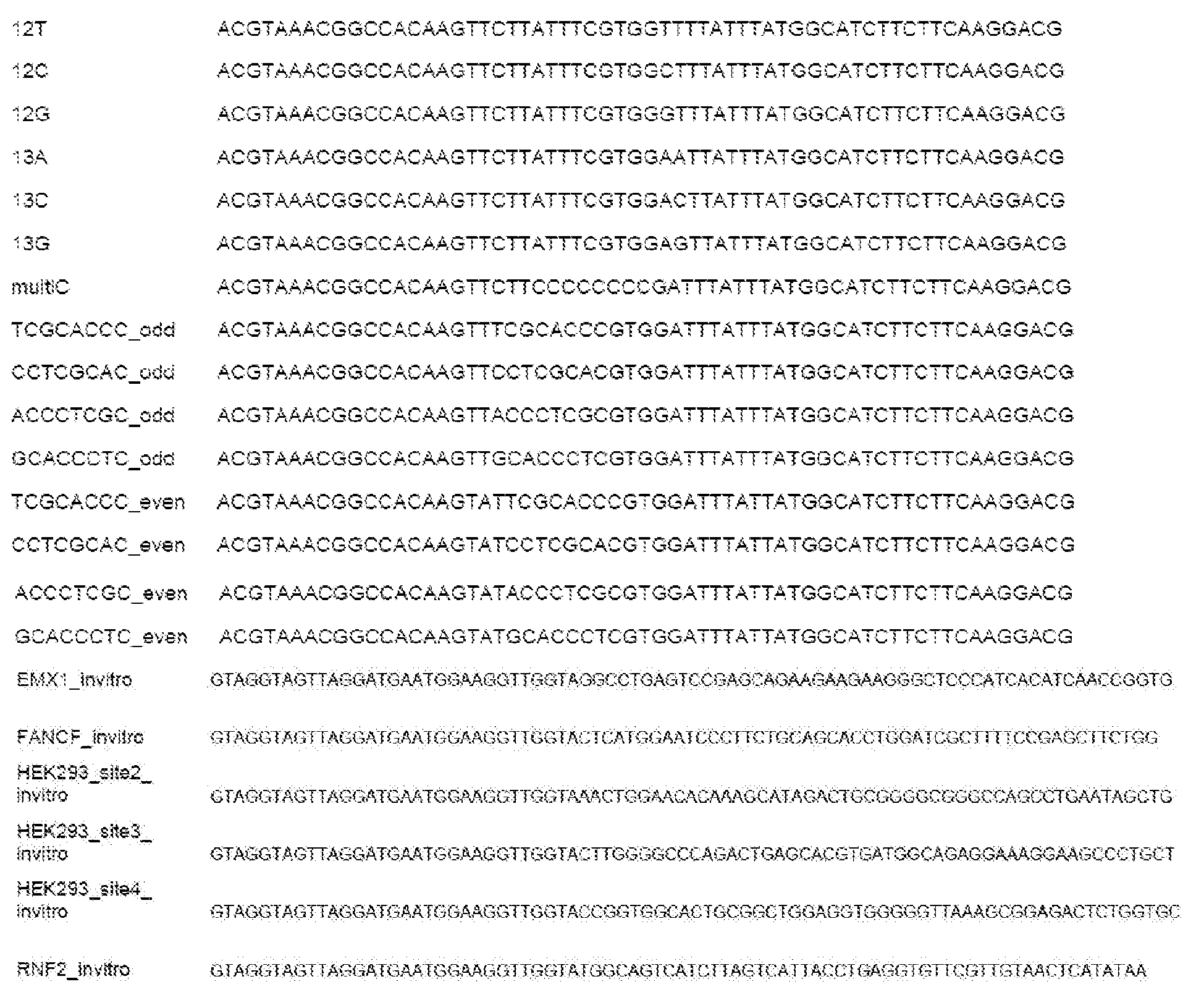
- Primers for HTS of in vitro edited dsDNA. SEQ ID NOs: 495-503 appear top to bottom below, respectively.
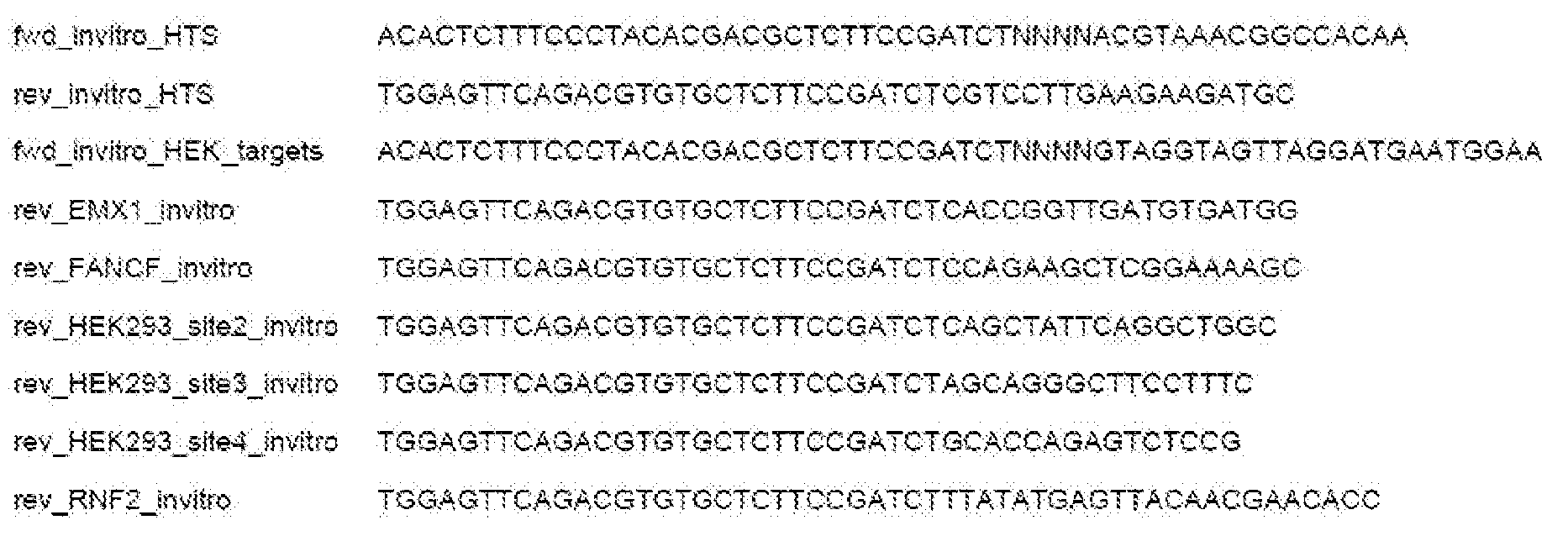
- Primers for HTS of on-target and off-target sites from all mammalian cell culture experiements.SEQ ID NOs: 504-579 and 1869-1900 appear from top to bottom below, respectively.


- Sequences of single-stranded oligonucleotide donor templates (ssODNs) used in HDR studies.
- EMXl sense (SEQ ID NO: 580)

- EMX1 antisense (SEQ ID NO: 581)

-
HEK293 site 3 sense (SEQ ID NO: 582)
-
HEK293 site 3 antisense (SEQ ID NO: 583)
-
HEK site 4 sense (SEQ ID NO: 584)
-
HEK site 4 antisense (SEQ ID NO: 585)
- APOE4 sense (SEQ ID NO: 743)

- APOE4 antisense (SEQ ID NO: 744)

- p53 Y163C sense (SEQ ID NO: 745)

- p53 Y163C antisense (SEQ ID NO: 746)

-
- hAID (SEQ ID NO: 586)

- rAPOBEC1 (mammalian)(SEQ ID NO: 587)

- pmCDA1 (SEQ ID NO: 588)

- haPOBEC3G (SEQ ID NO: 589)
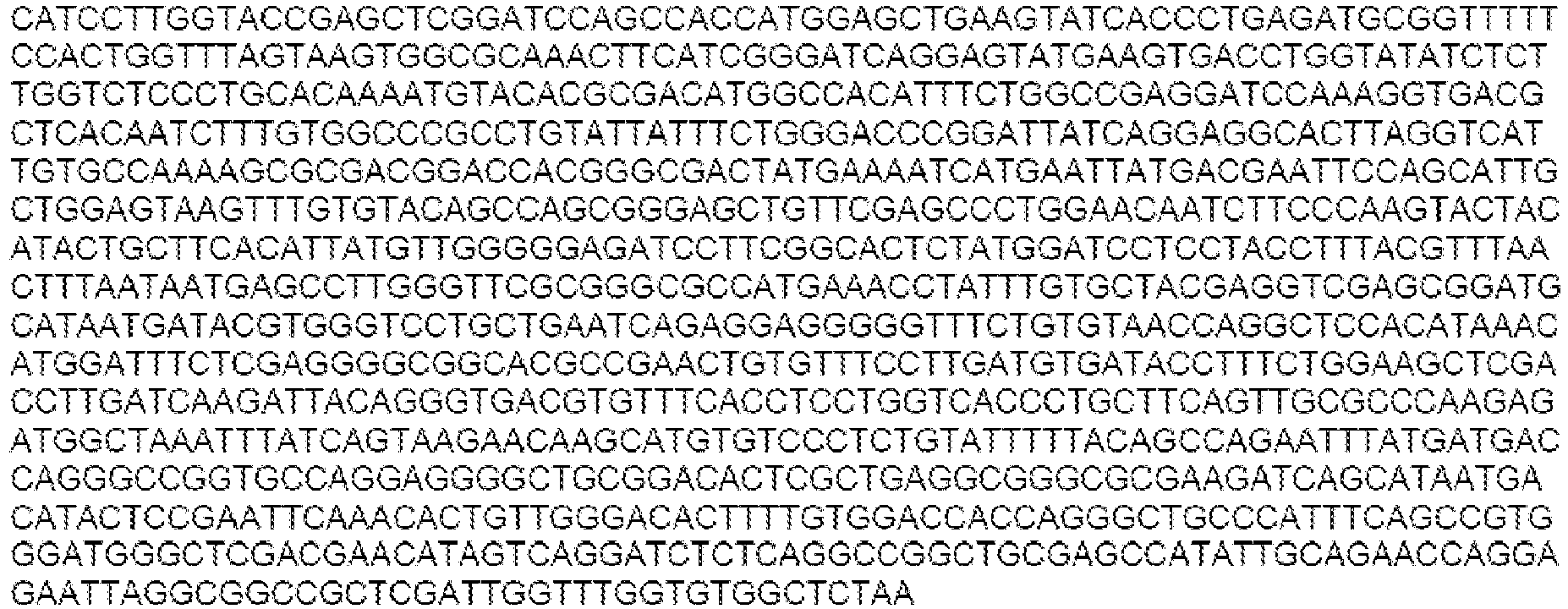
- rAPOBEC1(E. Coli) (SEQ ID NO: 590)

-
- NBE1 for E. Coli expression (His6-rAPOBEC1-XTEN-dCas9) (SEQ ID NO: 591)

- NBE1 for Mammalian expression (rAPOBECl-XTEN-dCas9-NLS) (SEQ ID NO: 592)

- Alternative NBE1 for Mammalian expression with human APOBEC1 (hAPOBECl-XTEN-dCas9-NLS) (SEQ ID NO: 5737)

- NBE2 (rAPOBECl-XTEN-dCas9-UGI-NLS) (SEQ ID NO: 593)

- NBE3 (rAPOBECl-XTEN-Cas9n-UGI-NLS) (SEQ ID NO: 594)

- pmCDAl-XTEN-dCas9-UGI (bacteria) (SEQ ID NO: 5742)


- pmCDAl-XTEN-nCas9-UGI-NLS (mammalian construct) (SEQ ID NO: 5743)
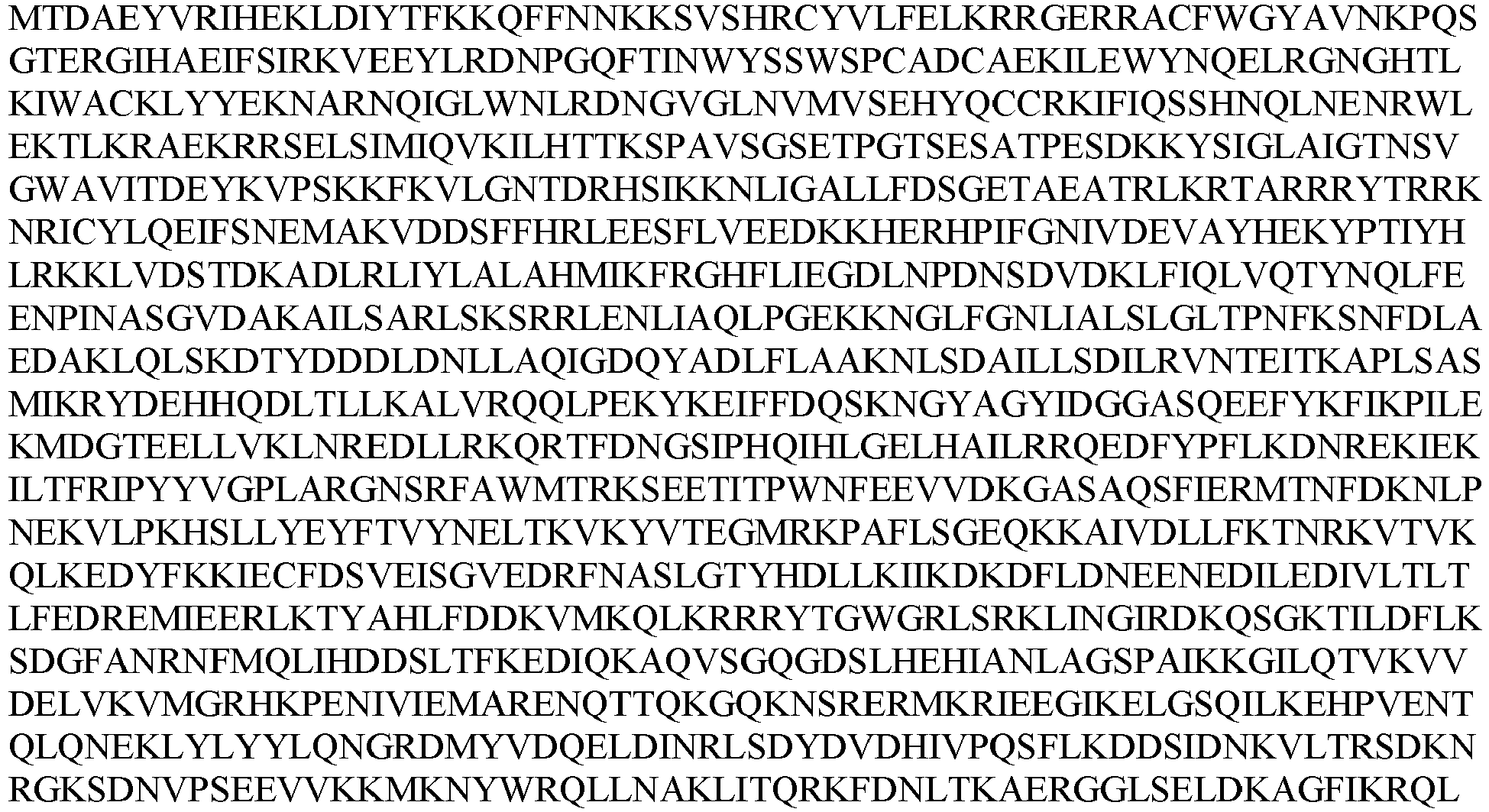

- huAPOBEC3G-XTEN-dCas9-UGI (bacteria) (SEQ ID NO: 5744)

- huAPOBEC3G-XTEN-nCas9-UGI-NLS (mammalian construct) (SEQ ID NO: 5745)


- huAPOBEC3G (D316R_D317R)-XTEN-nCas9-UGI-NLS (mammalian construct) (SEQ ID NO: 5746)

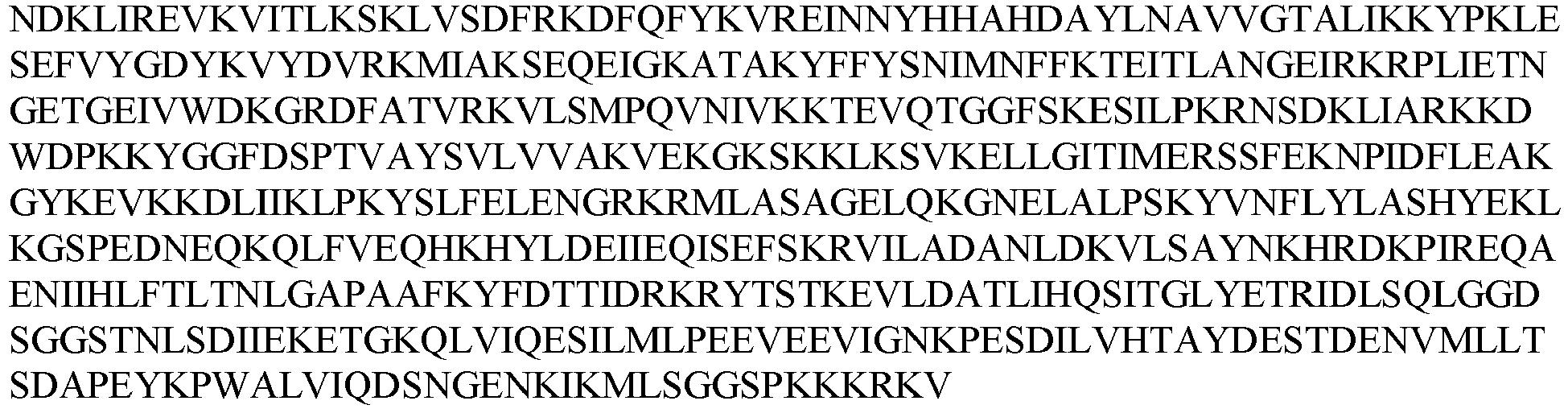
-

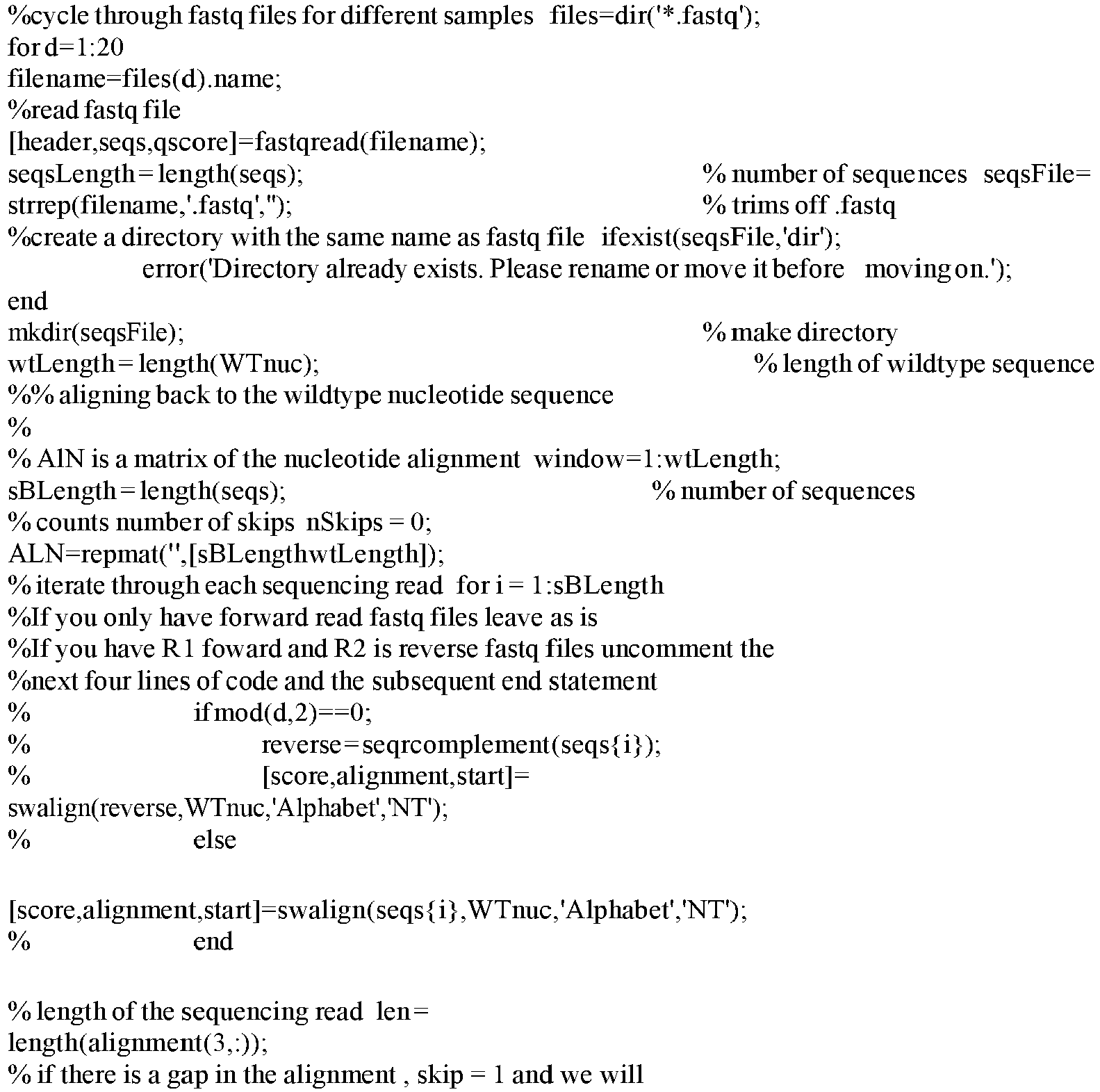


-


- The disclosure provides Cas9 variants, for example Cas9 proteins from one or more organisms, which may comprise one or more mutations (e.g., to generate dCas9 or Cas9 nickase). In some embodiments, one or more of the amino acid residues, identified below by an asterek, of a Cas9 protein may be mutated. In some embodiments, the D10 and/or H840 residues of the amino acid sequence provided in SEQ ID NO: 10, or a corresponding mutation in any of the amino acid sequences provided in SEQ ID NOs: 11-260, are mutated. In some embodiments, the D10 residue of the amino acid sequence provided in SEQ ID NO: 10, or a corresponding mutation in any of the amino acid sequences provided in SEQ ID NOs: 11-260, is mutated to any amino acid residue, except for D. In some embodiments, the D10 residue of the amino acid sequence provided in SEQ ID NO: 10, or a corresponding mutation in any of the amino acid sequences provided in SEQ ID NOs: 11-260, is mutated to an A. In some embodiments, the H840 residue of the amino acid sequence provided in SEQ ID NO: 10, or a corresponding residue in any of the amino acid sequences provided in SEQ ID NOs: 11-260, is an H. In some embodiments, the H840 residue of the amino acid sequence provided in SEQ ID NO: 10, or a corresponding mutation in any of the amino acid sequences provided in SEQ ID NOs: 11-260, is mutated to any amino acid residue, except for H. In some embodiments, the H840 residue of the amino acid sequence provided in SEQ ID NO: 10, or a corresponding mutation in any of the amino acid sequences provided in SEQ ID NOs: 11-260, is mutated to an A. In some embodiments, the D10 residue of the amino acid sequence provided in SEQ ID NO: 10, or a corresponding residue in any of the amino acid sequences provided in SEQ ID NOs: 11-260, is a D.
- A number of Cas9 sequences from various species were aligned to determine whether corresponding homologous amino acid residues of D10 and H840 of SEQ ID NO: 10 or SEQ ID NO: 11 can be identified in other Cas9 proteins, allowing the generation of Cas9 variants with corresponding mutations of the homologous amino acid residues. The alignment was carried out using the NCBI Constraint-based Multiple Alignment Tool (COBALT(accessible at st-va.ncbi.nlm.nih.gov/tools/cobalt), with the following parameters. Alignment parameters: Gap penalties -11,-1; End-Gap penalties -5,-1. CDD Parameters: Use RPS BLAST on; Blast E-value 0.003; Find Conserved columns and Recompute on. Query Clustering Parameters: Use query clusters on;
Word Size 4; Max cluster distance 0.8; Alphabet Regular. - An exemplary alignment of four Cas9 sequences is provided below. The Cas9 sequences in the alignment are: Sequence 1 (S1): SEQ ID NO: 11 | WP_010922251|gi 499224711 | type II CRISPR RNA-guided endonuclease Cas9 [Streptococcus pyogenes]; Sequence 2 (S2): SEQ ID NO: 12 | WP_039695303 | gi 746743737 | type II CRISPR RNA-guided endonuclease Cas9 [Streptococcus gallolyticus]; Sequence 3 (S3): SEQ ID NO: 13 | WP_045635197 | gi 782887988 | type II CRISPR RNA-guided endonuclease Cas9 [Streptococcus mitis]; Sequence 4 (S4): SEQ ID NO: 14 | 5AXW_A | gi 924443546 | Staphylococcus aureus Cas9. The HNH domain (bold and underlined) and the RuvC domain (boxed) are identified for each of the four sequences.
Amino acid residues 10 and 840 in S1 and the homologous amino acids in the aligned sequences are identified with an asterisk following the respective amino acid residue.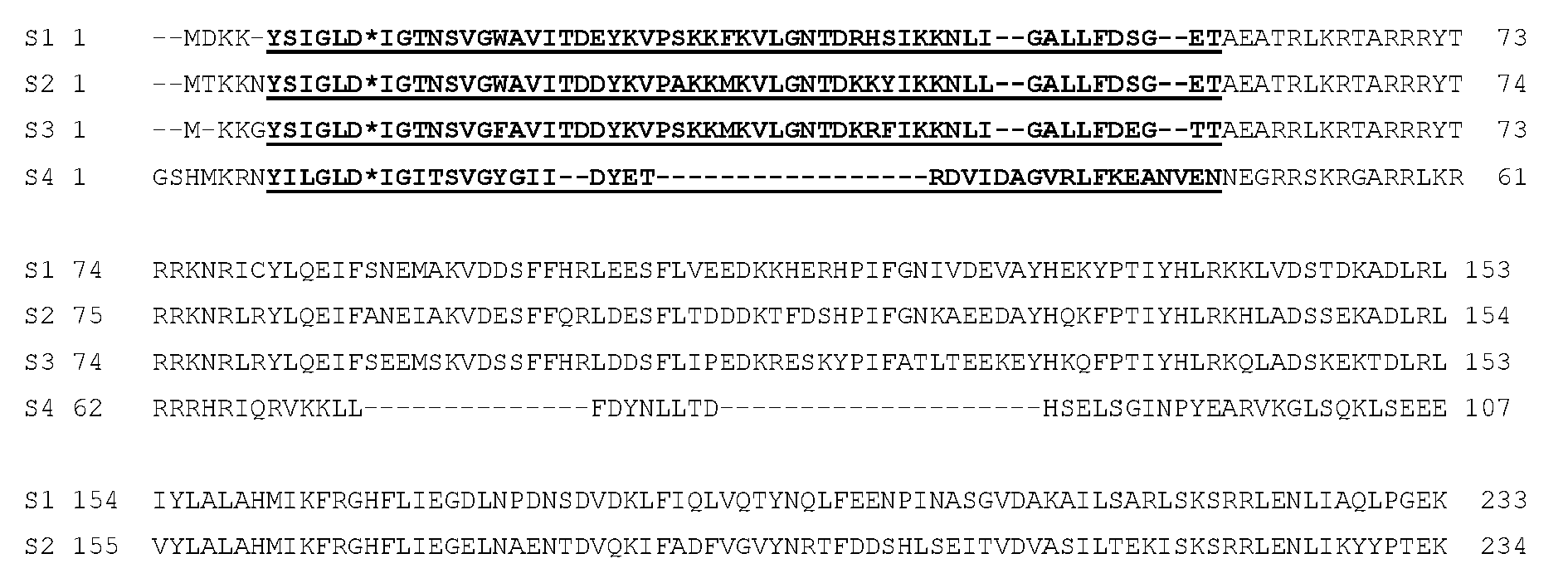

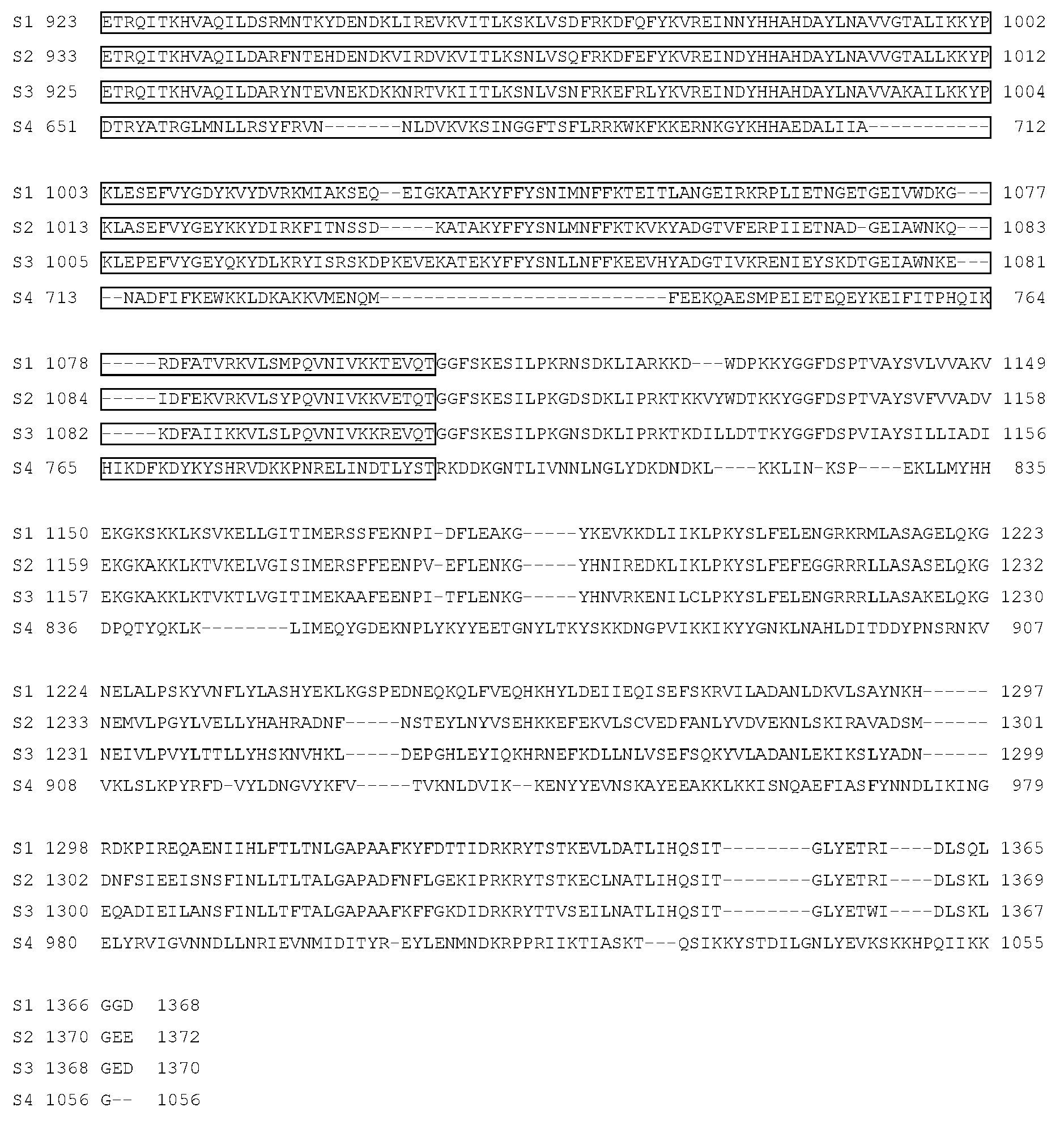
- The alignment demonstrates that amino acid sequences and amino acid residues that are homologous to a reference Cas9 amino acid sequence or amino acid residue can be identified across Cas9 sequence variants, including, but not limited to Cas9 sequences from different species, by identifying the amino acid sequence or residue that aligns with the reference sequence or the reference residue using alignment programs and algorithms known in the art. This disclosure provides Cas9 variants in which one or more of the amino acid residues identified by an asterisk in SEQ ID NOs: 11-14 (e.g., S1, S2, S3, and S4, respectively) are mutated as described herein. The residues D10 and H840 in Cas9 of SEQ ID NO: 10 that correspond to the residues identified in SEQ ID NOs: 11-14 by an asterisk are referred to herein as "homologous" or "corresponding" residues. Such homologous residues can be identified by sequence alignment, e.g., as described above, and by identifying the sequence or residue that aligns with the reference sequence or residue. Similarly, mutations in Cas9 sequences that correspond to mutations identified in SEQ ID NO: 10 herein, e.g., mutations of
residues 10, and 840 in SEQ ID NO: 10, are referred to herein as "homologous" or "corresponding" mutations. For example, the mutations corresponding to the D10A mutation in SEQ ID NO: 10 or S1 (SEQ ID NO: 11) for the four aligned sequences above are D11A for S2, D10A for S3, and D13A for S4; the corresponding mutations for H840A in SEQ ID NO: 10 or S1 (SEQ ID NO: 11) are H850A for S2, H842A for S3, and H560A for S4. - A total of 250 Cas9 sequences (SEQ ID NOs: 11-260) from different species were aligned using the same algorithm and alignment parameters outlined above. Amino acid residues homologous to
residues 10, and 840 of SEQ ID NO: 10 were identified in the same manner as outlined above. The alignments are provided below. The HNH domain (bold and underlined) and the RuvC domain (boxed) are identified for each of the four sequences. Single residues corresponding toamino acid residues 10, and 840 in SEQ ID NO: 10 are boxed in SEQ ID NO: 11 in the alignments, allowing for the identification of the corresponding amino acid residues in the aligned sequences.


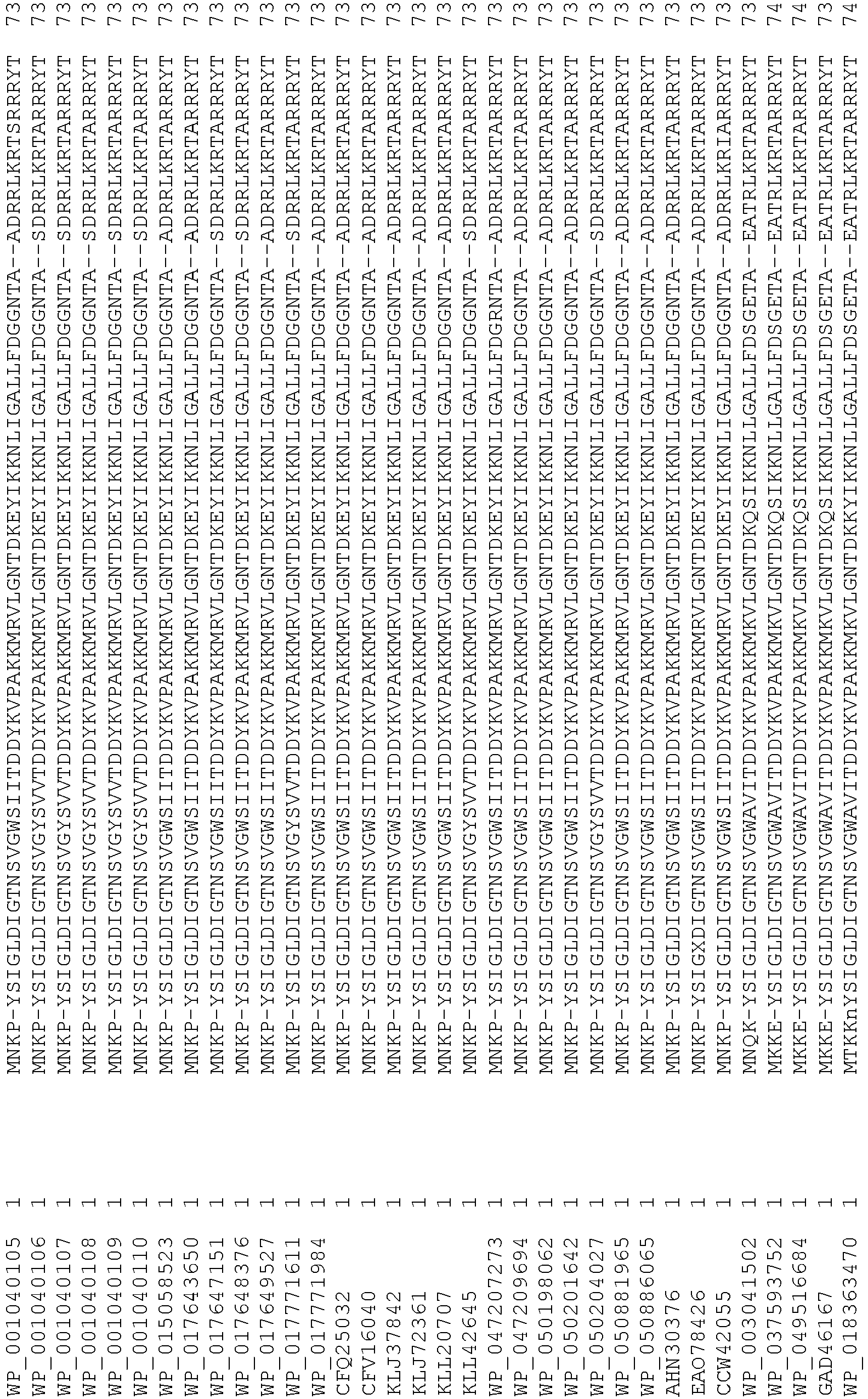


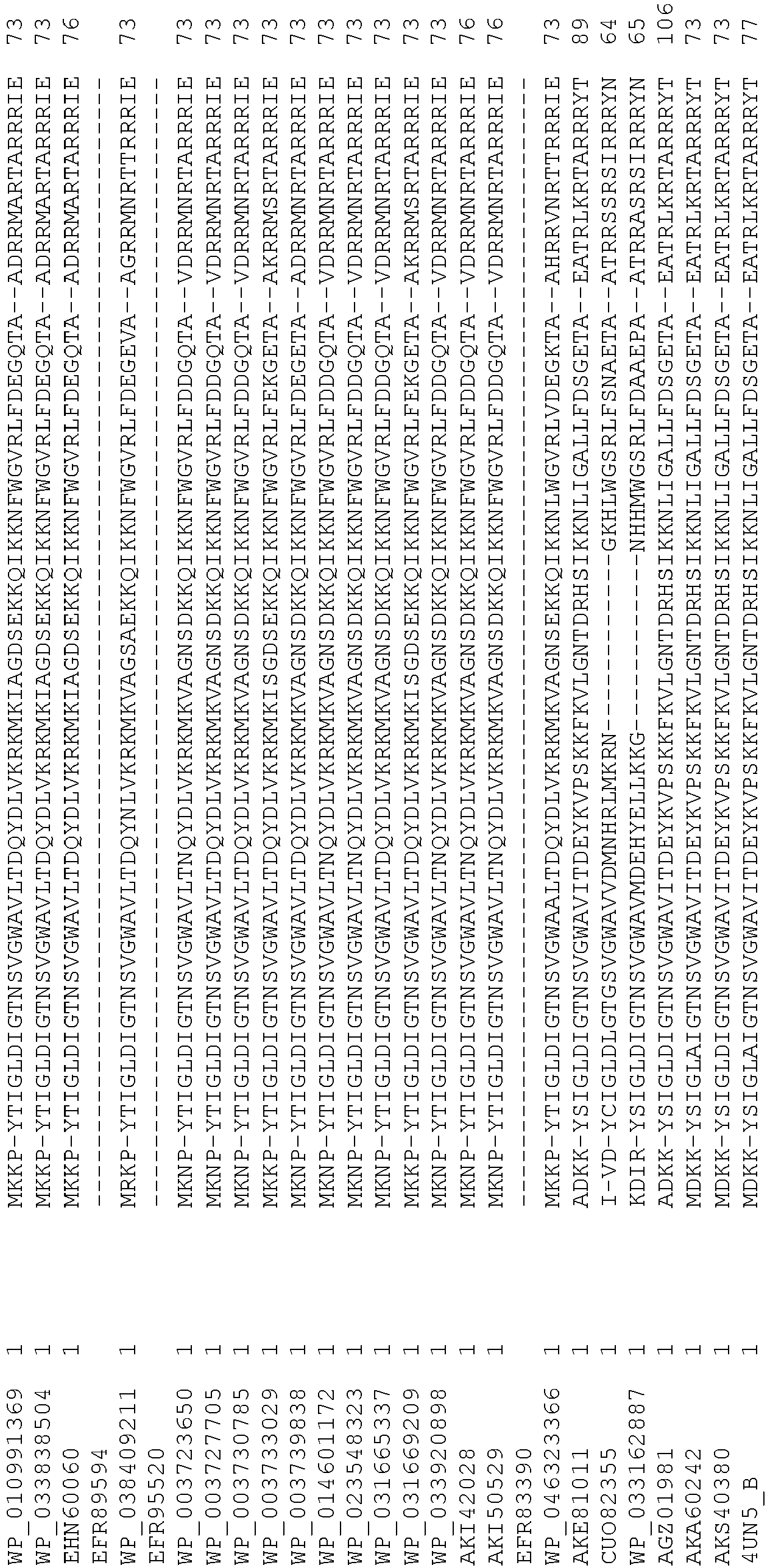


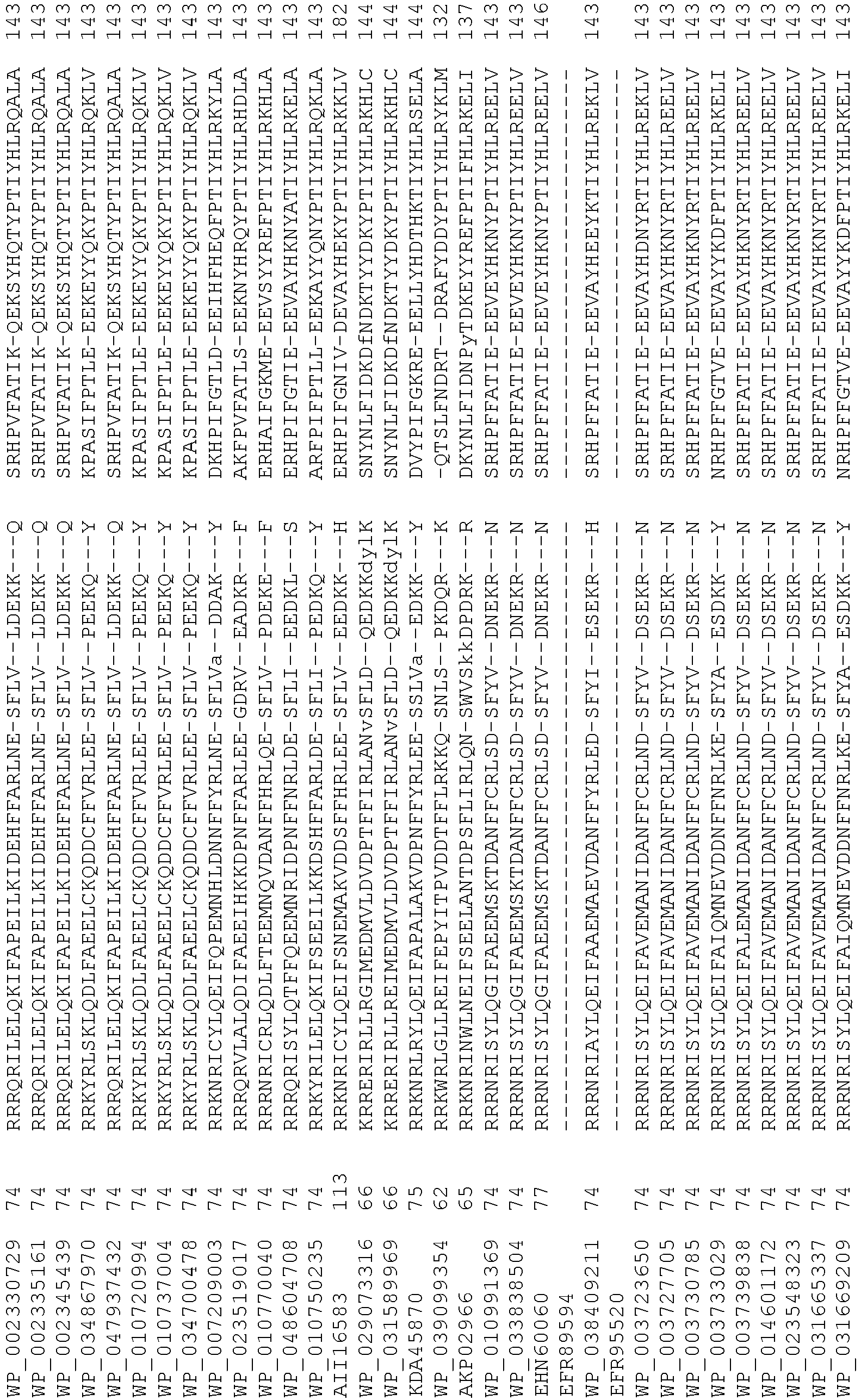

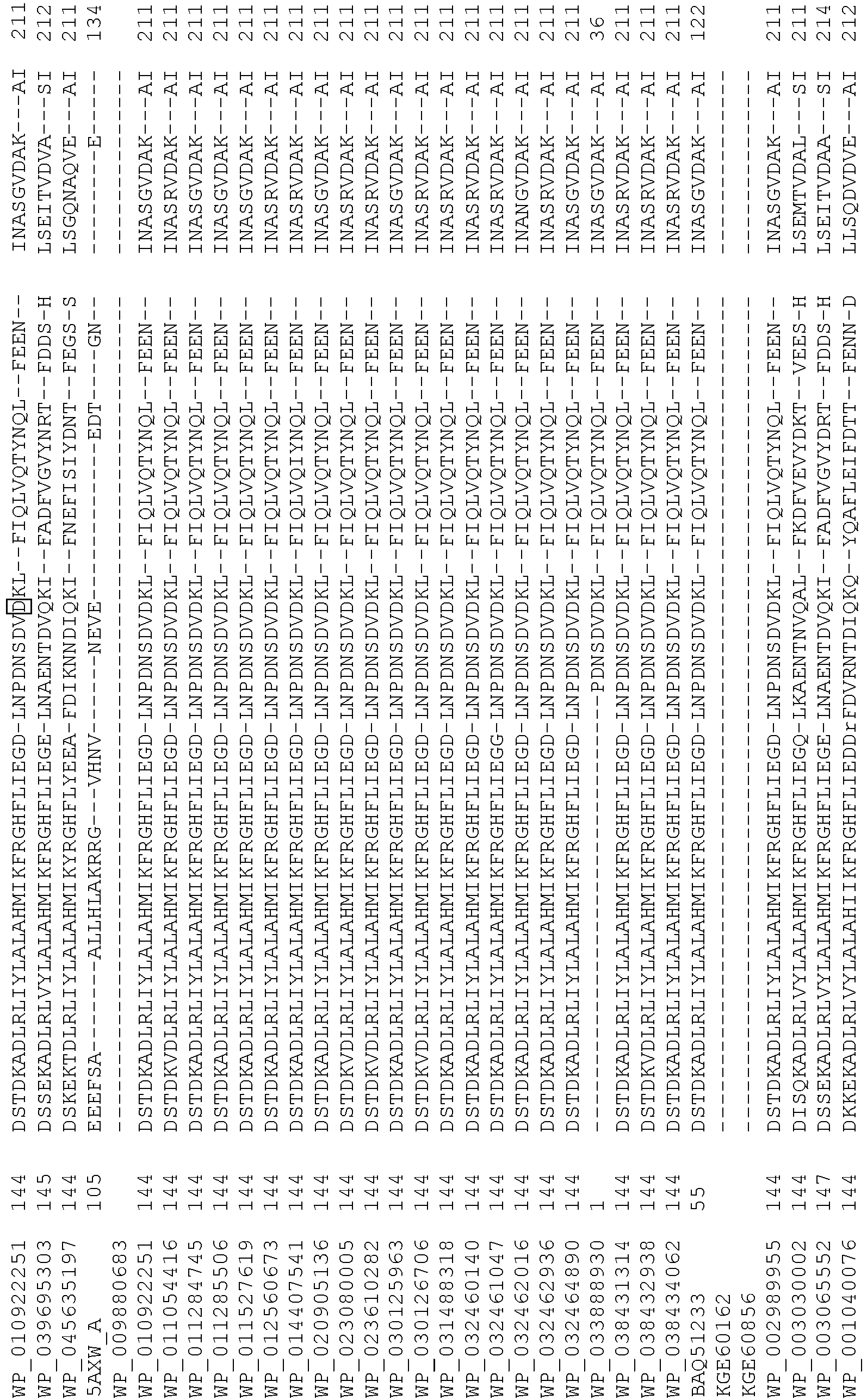


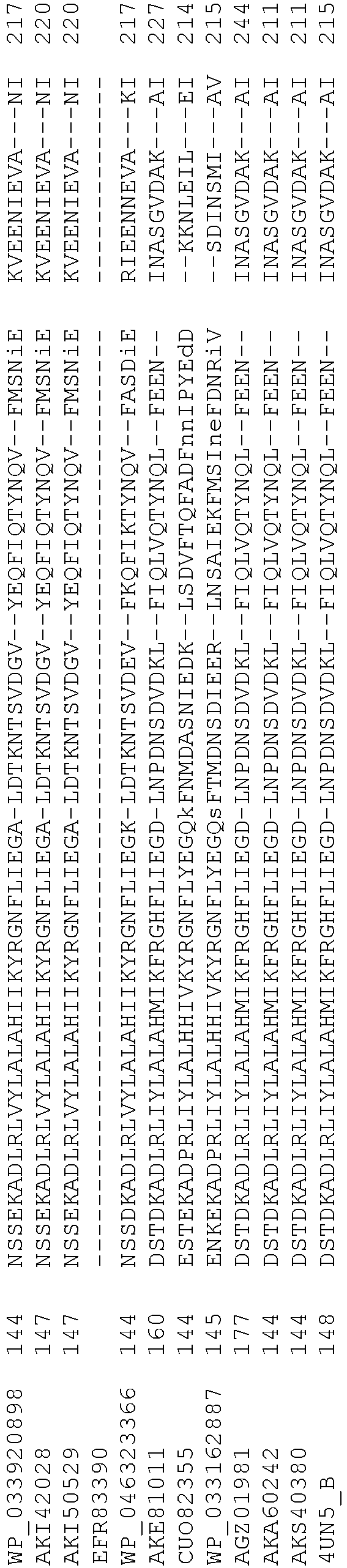


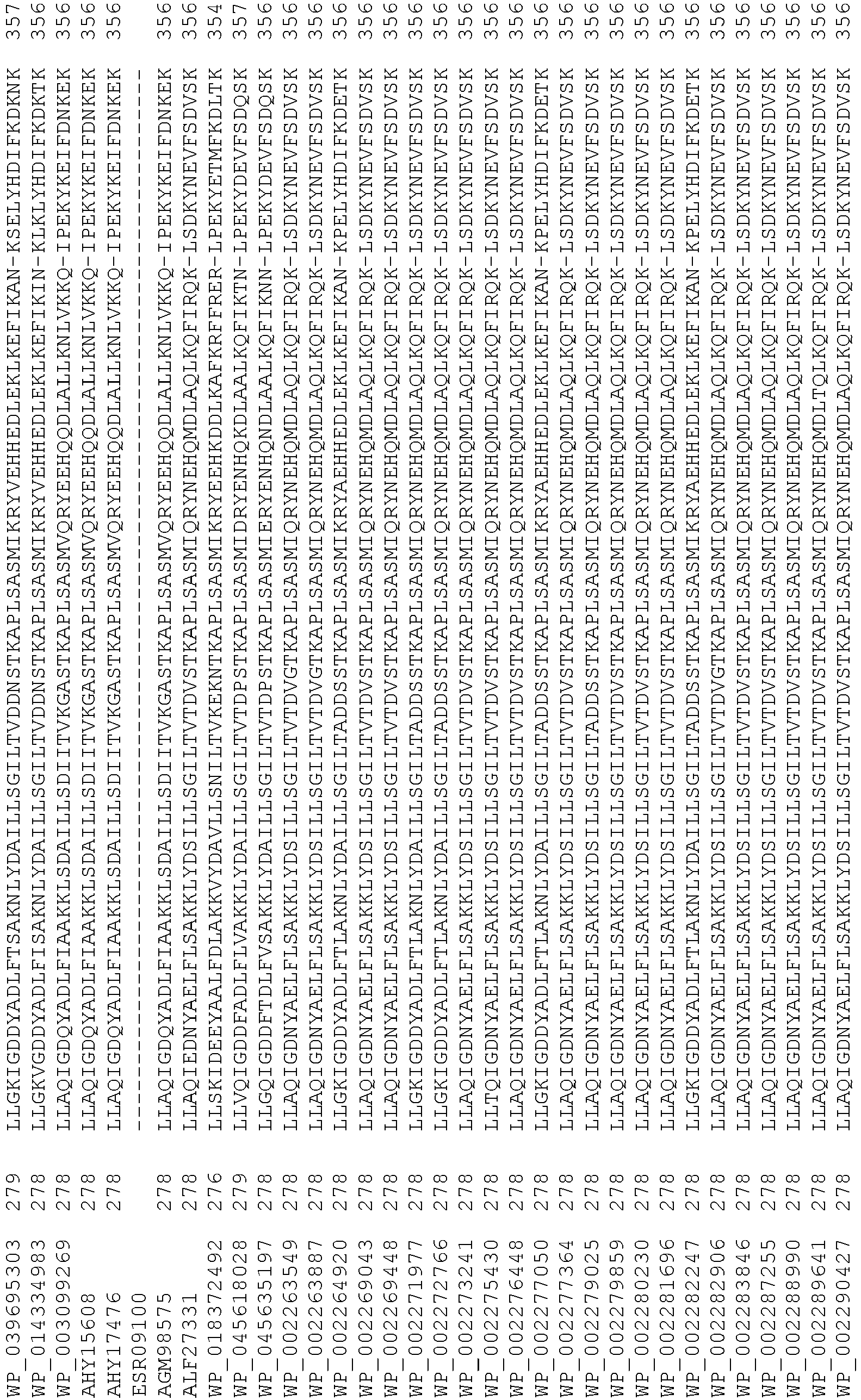


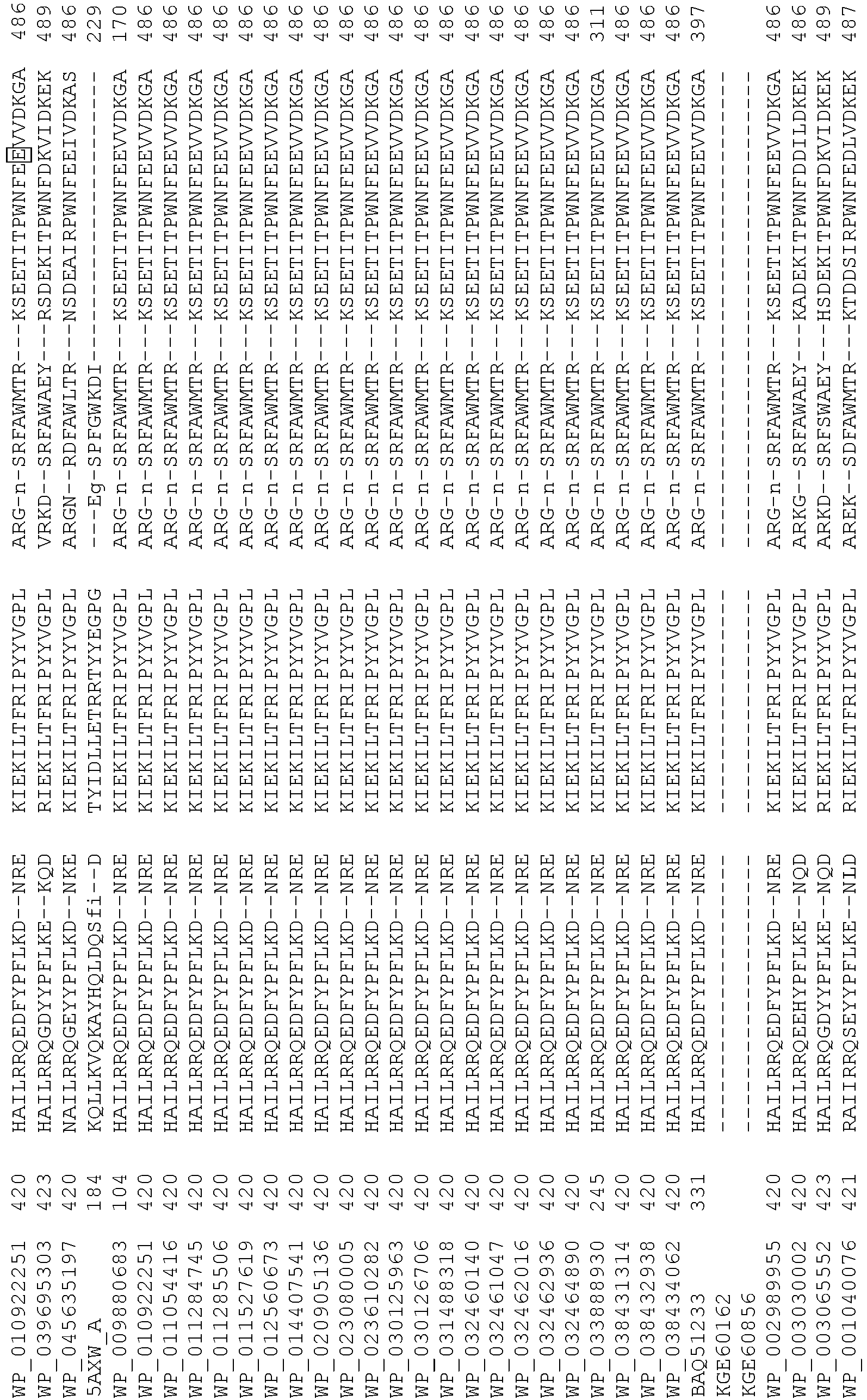

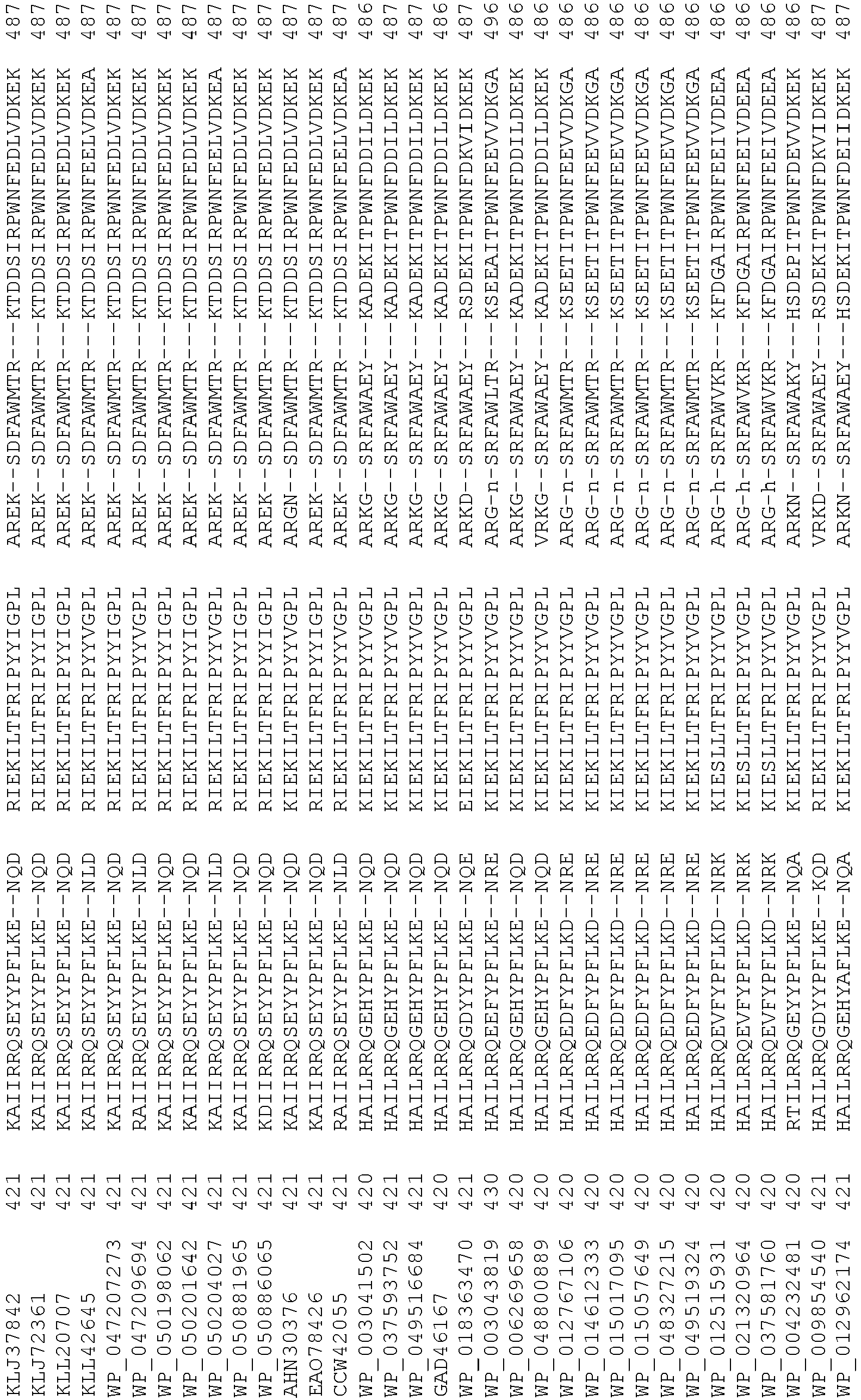
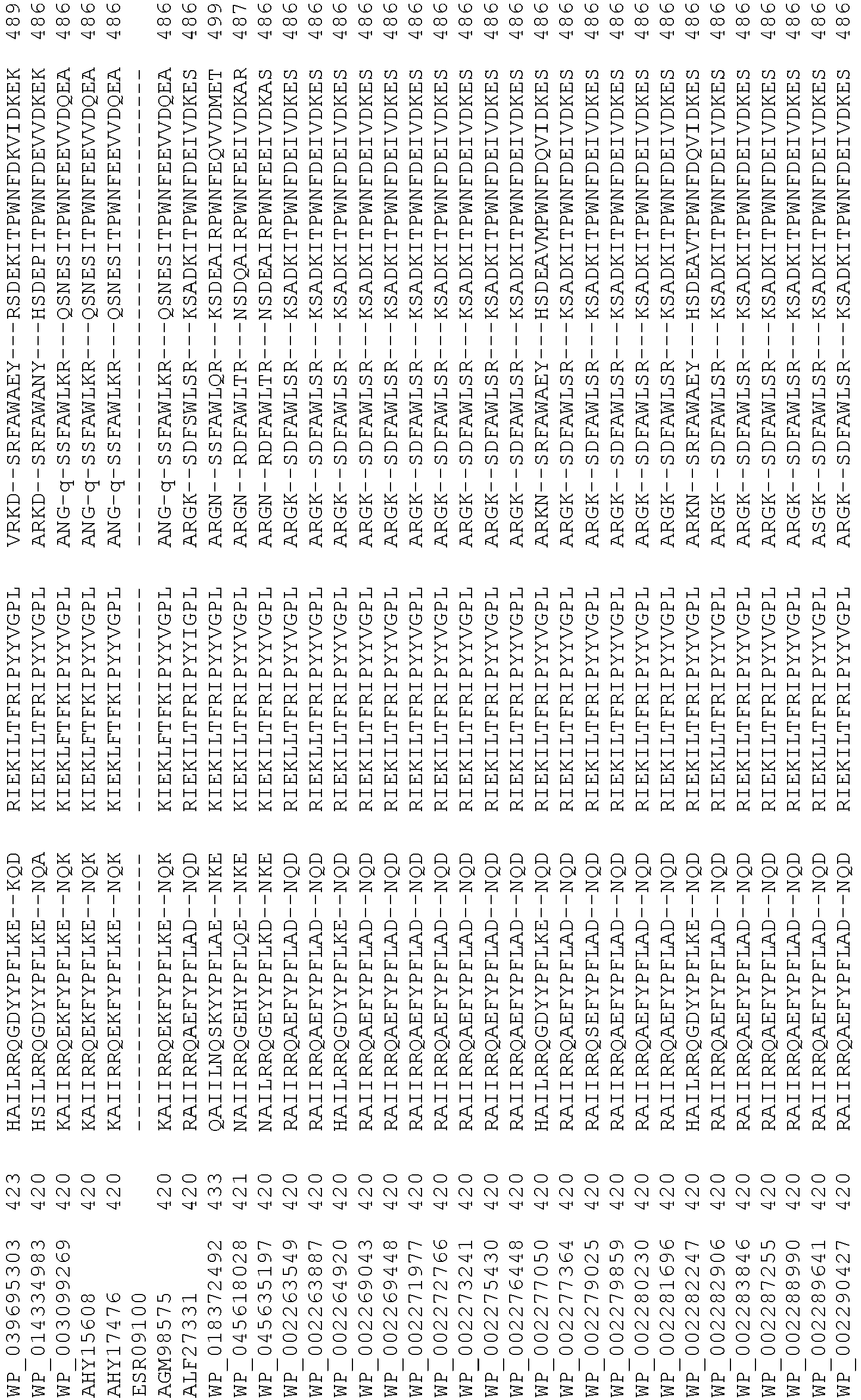


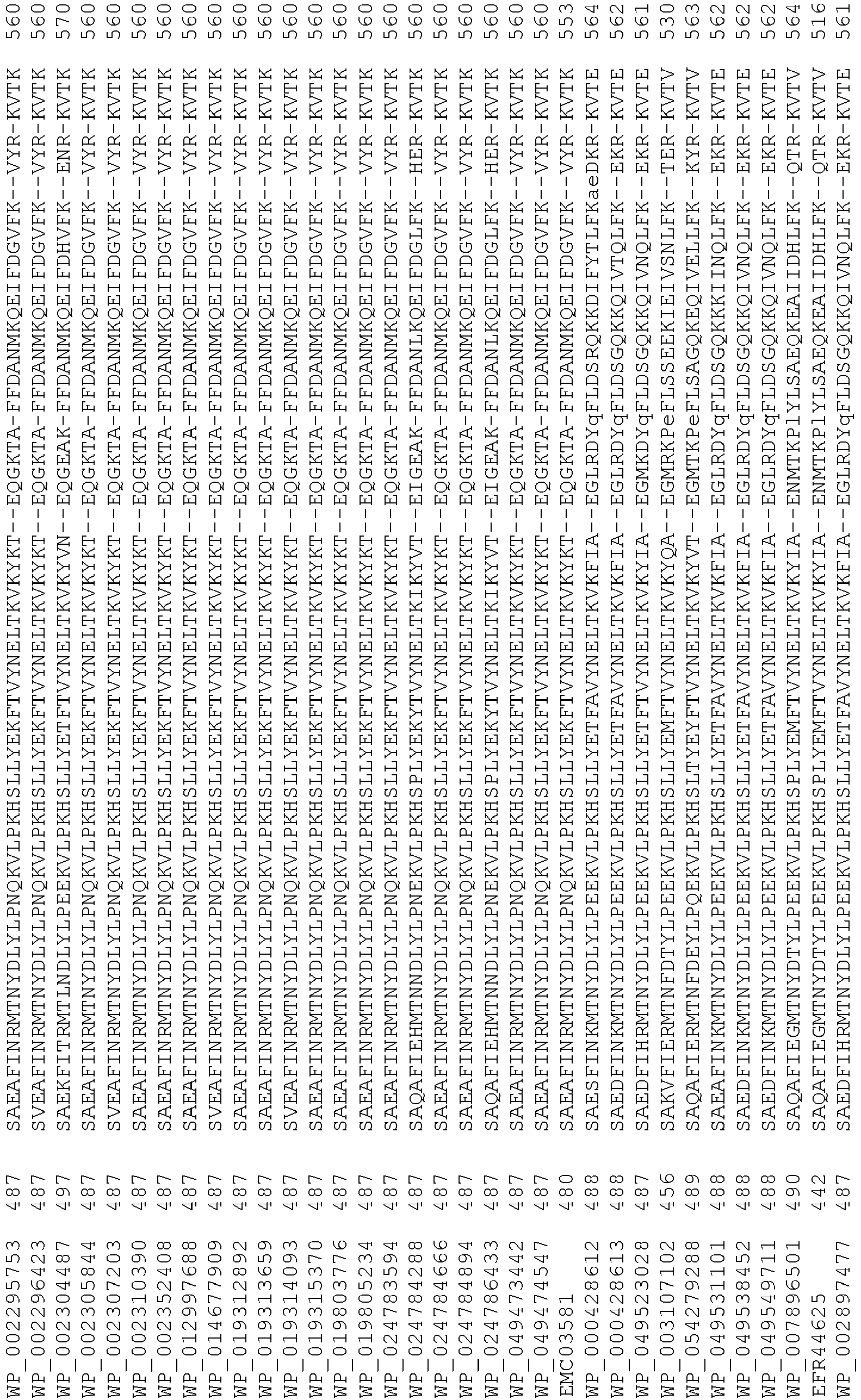


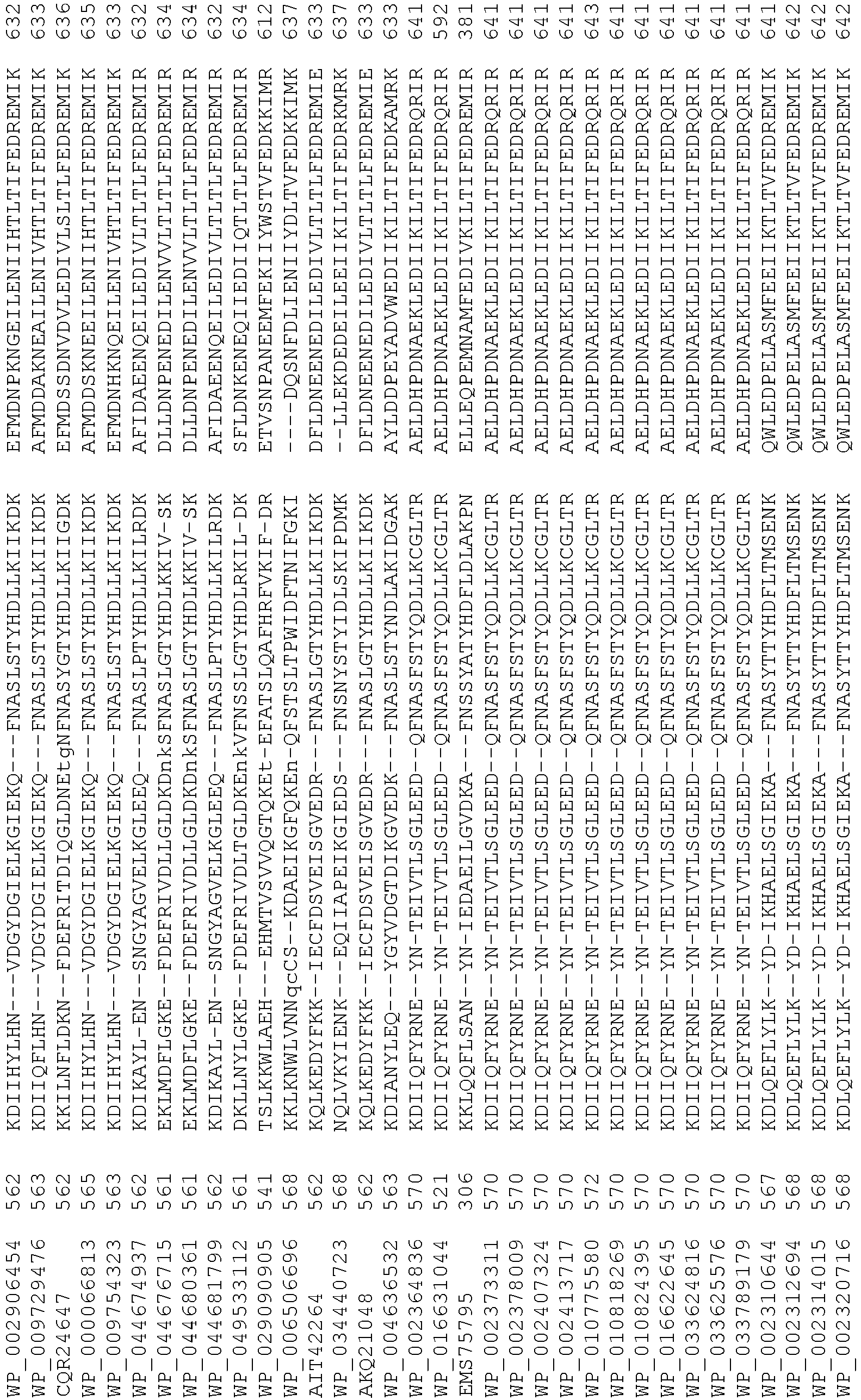


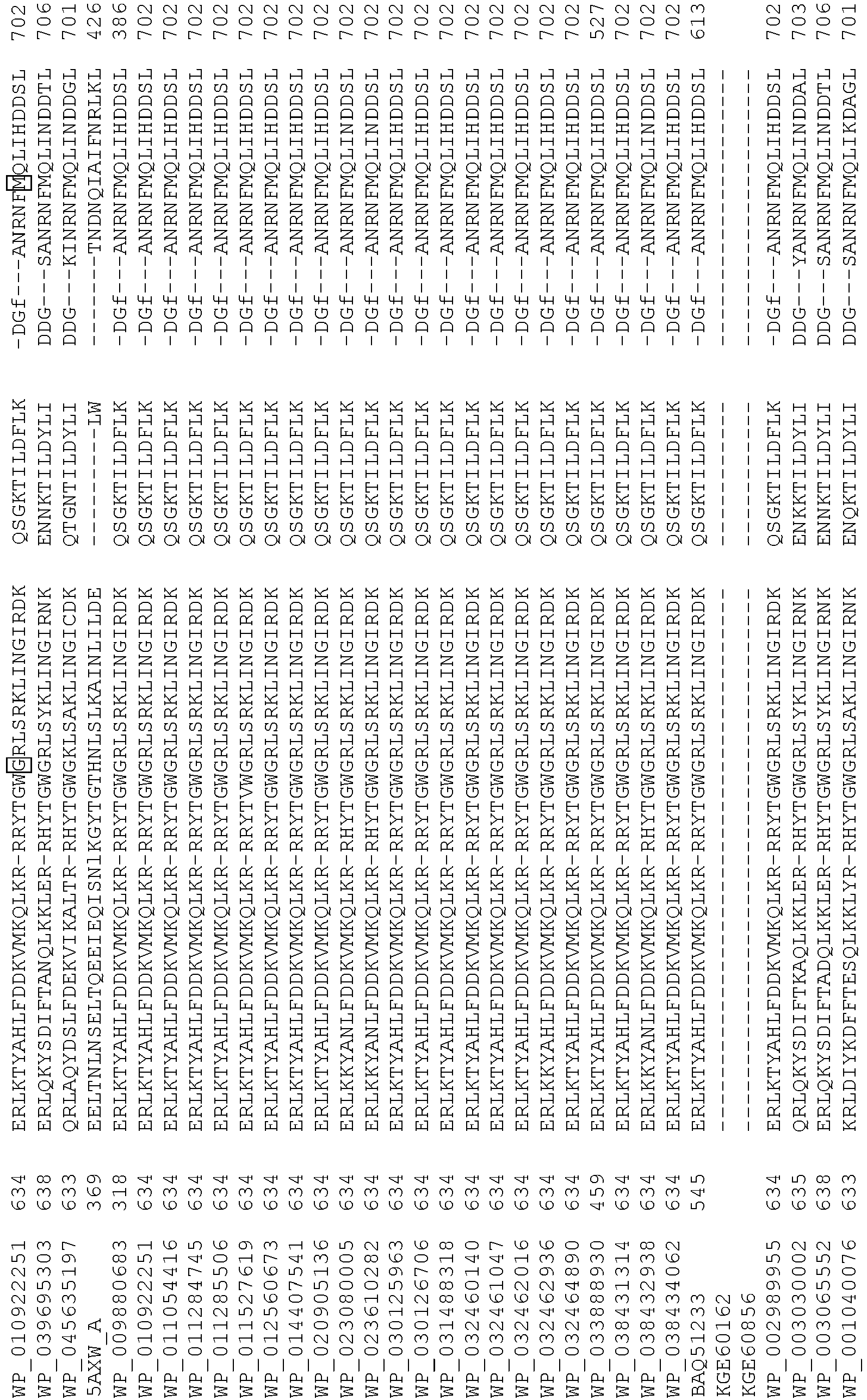
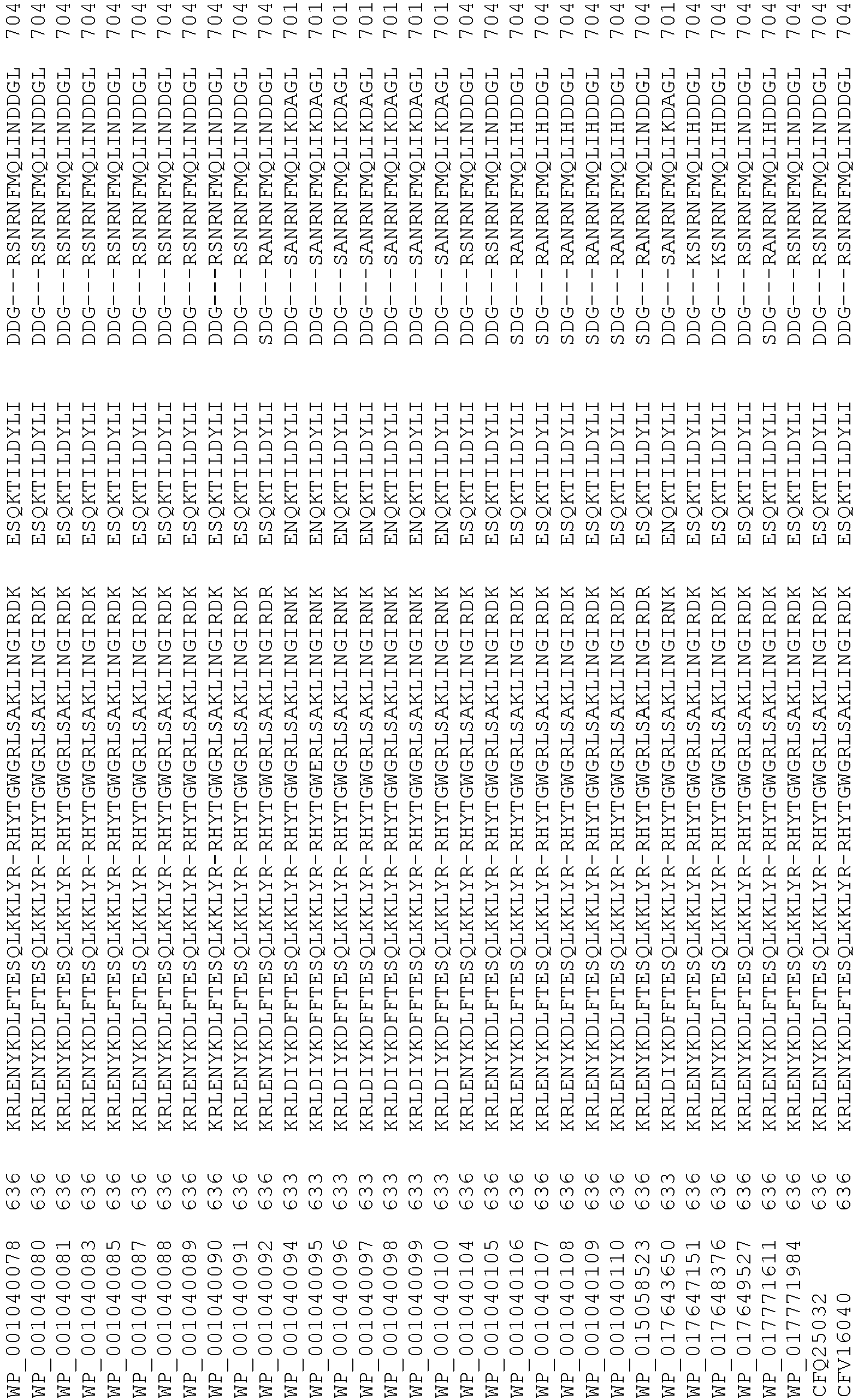
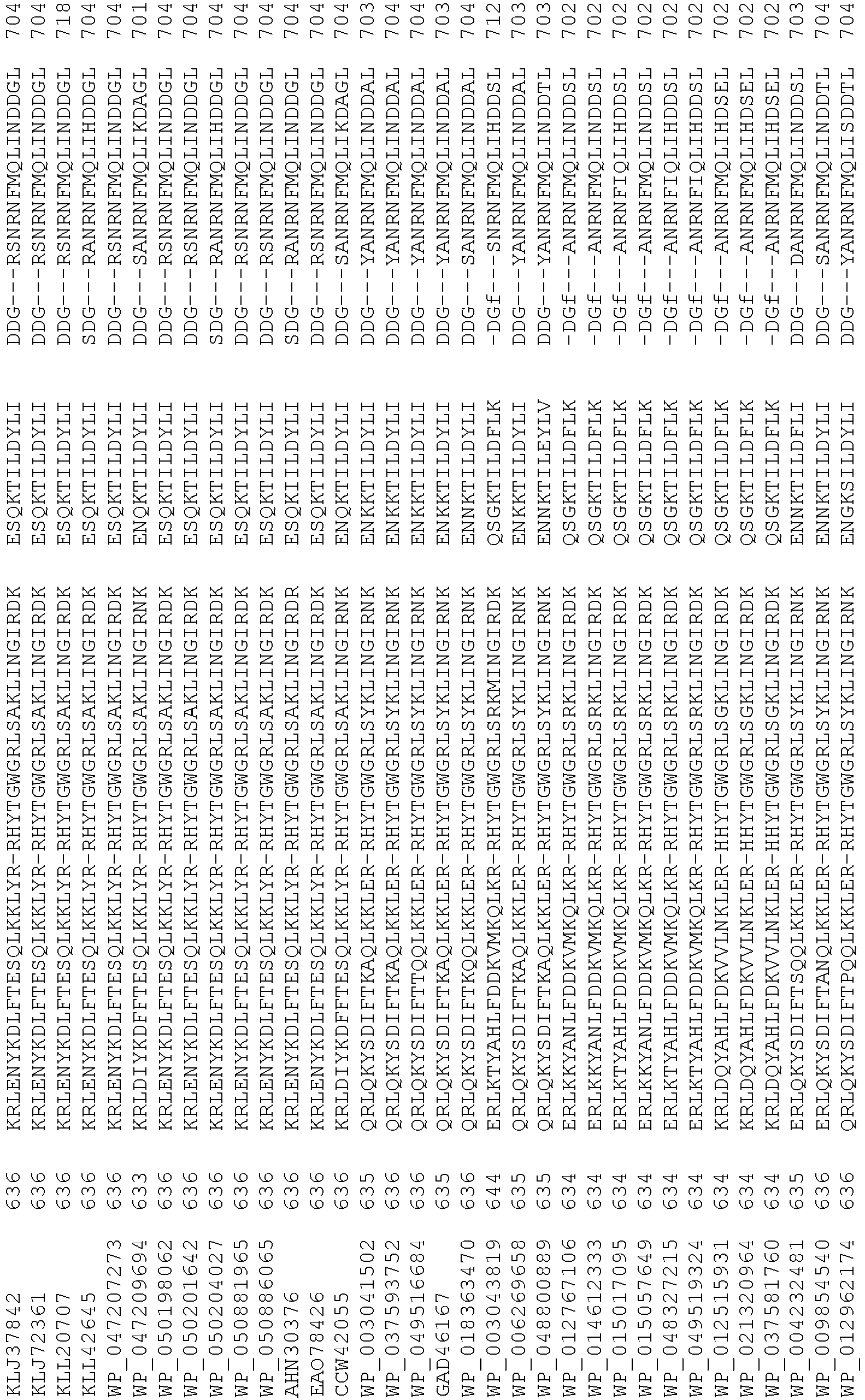


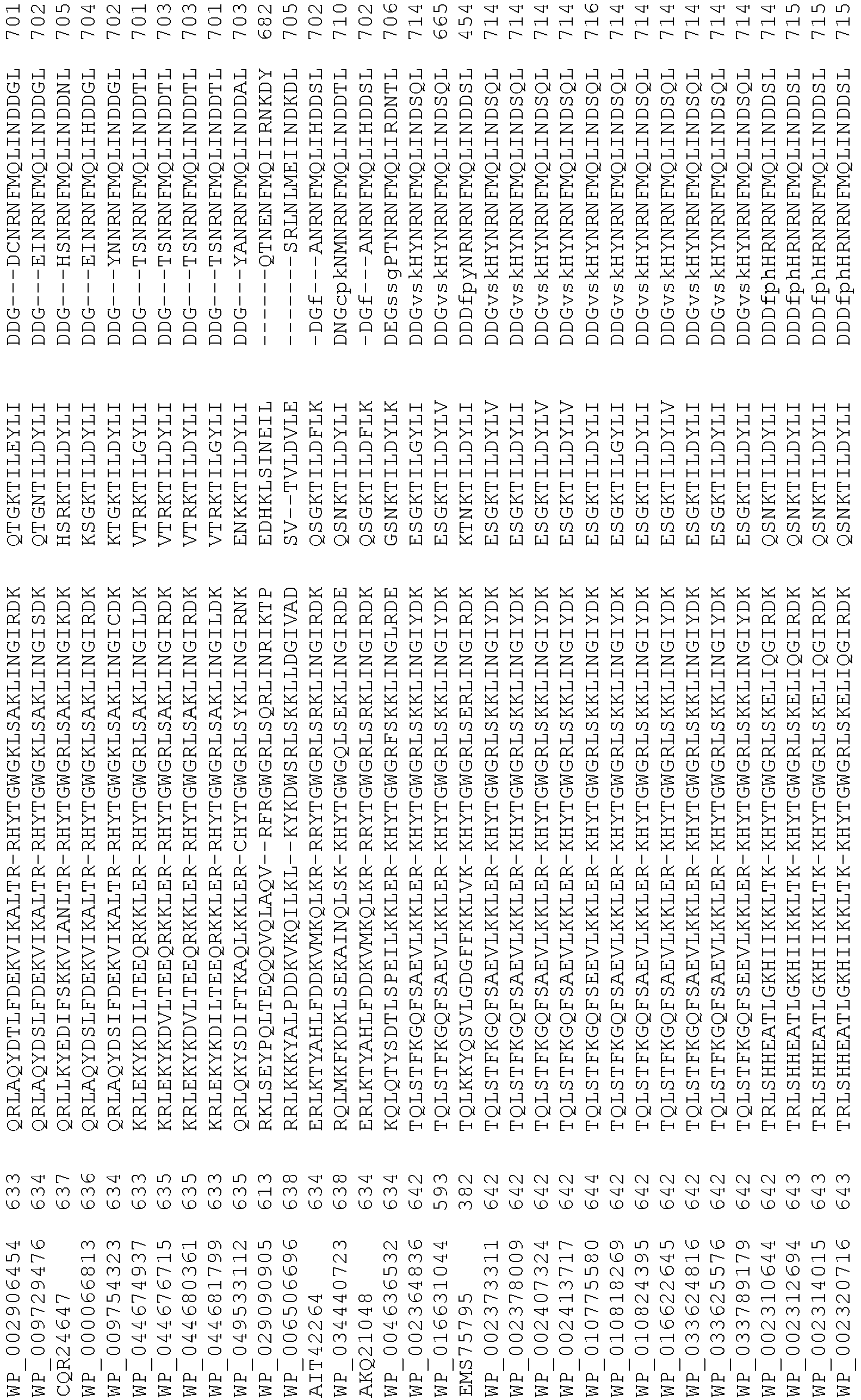
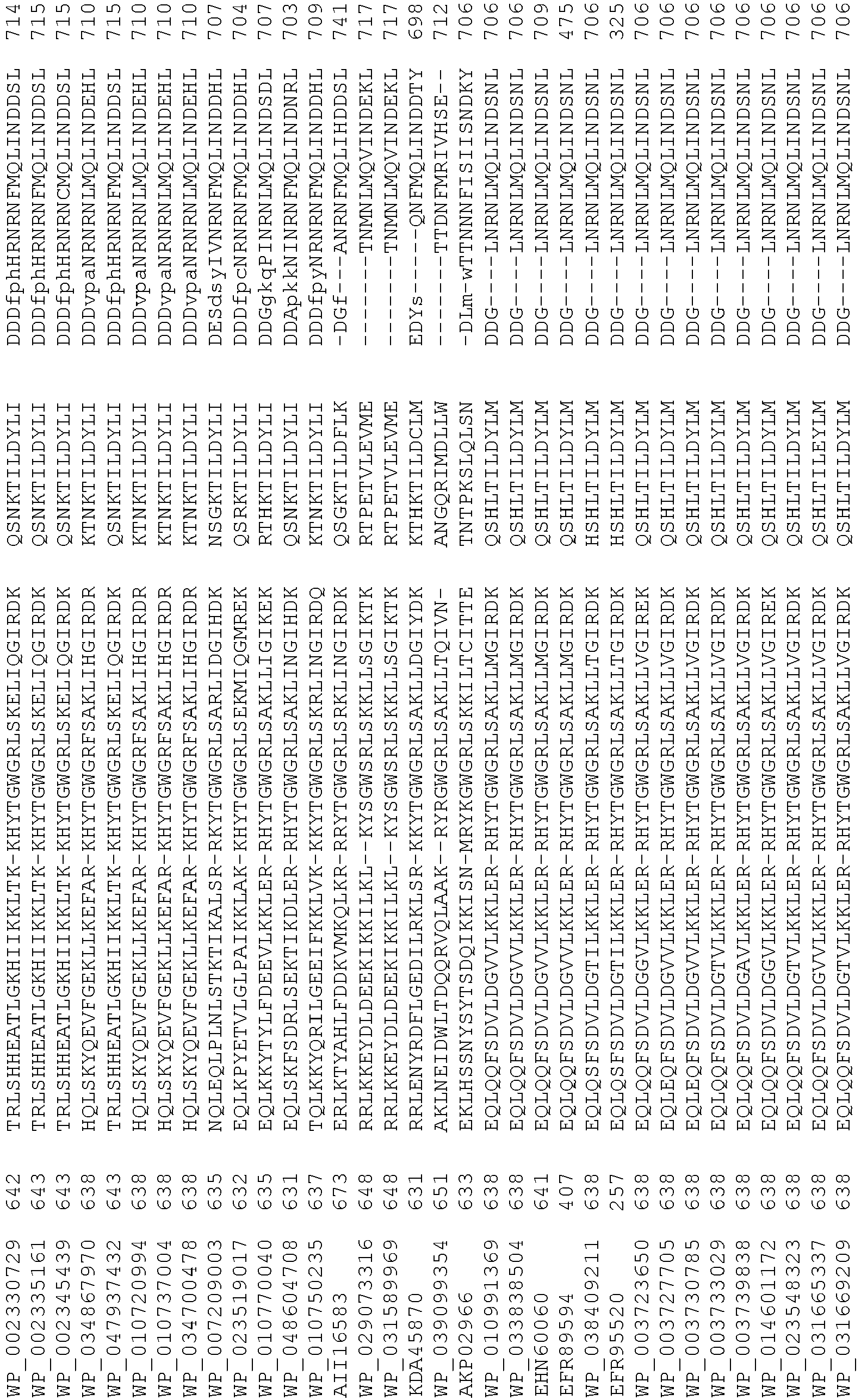

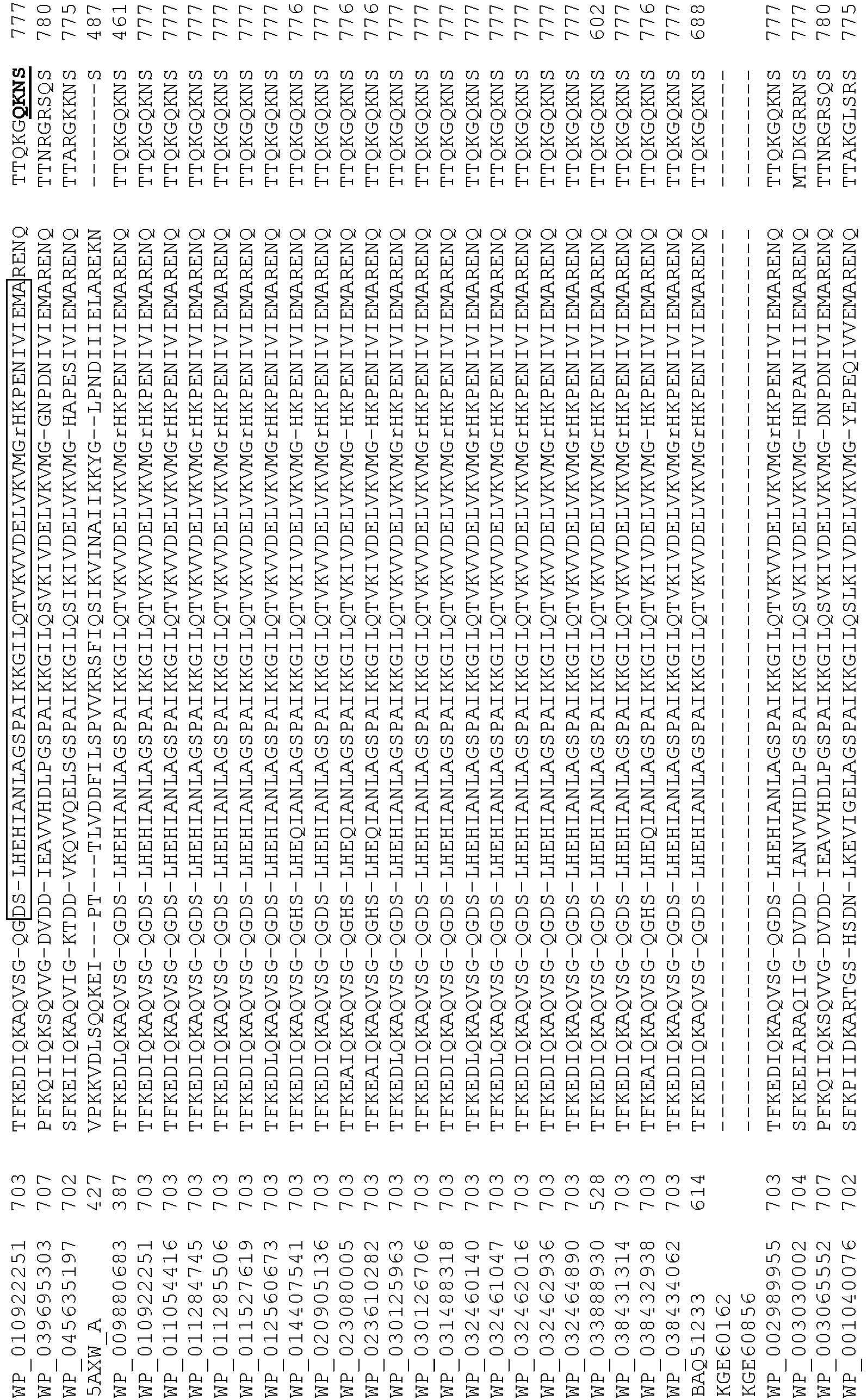


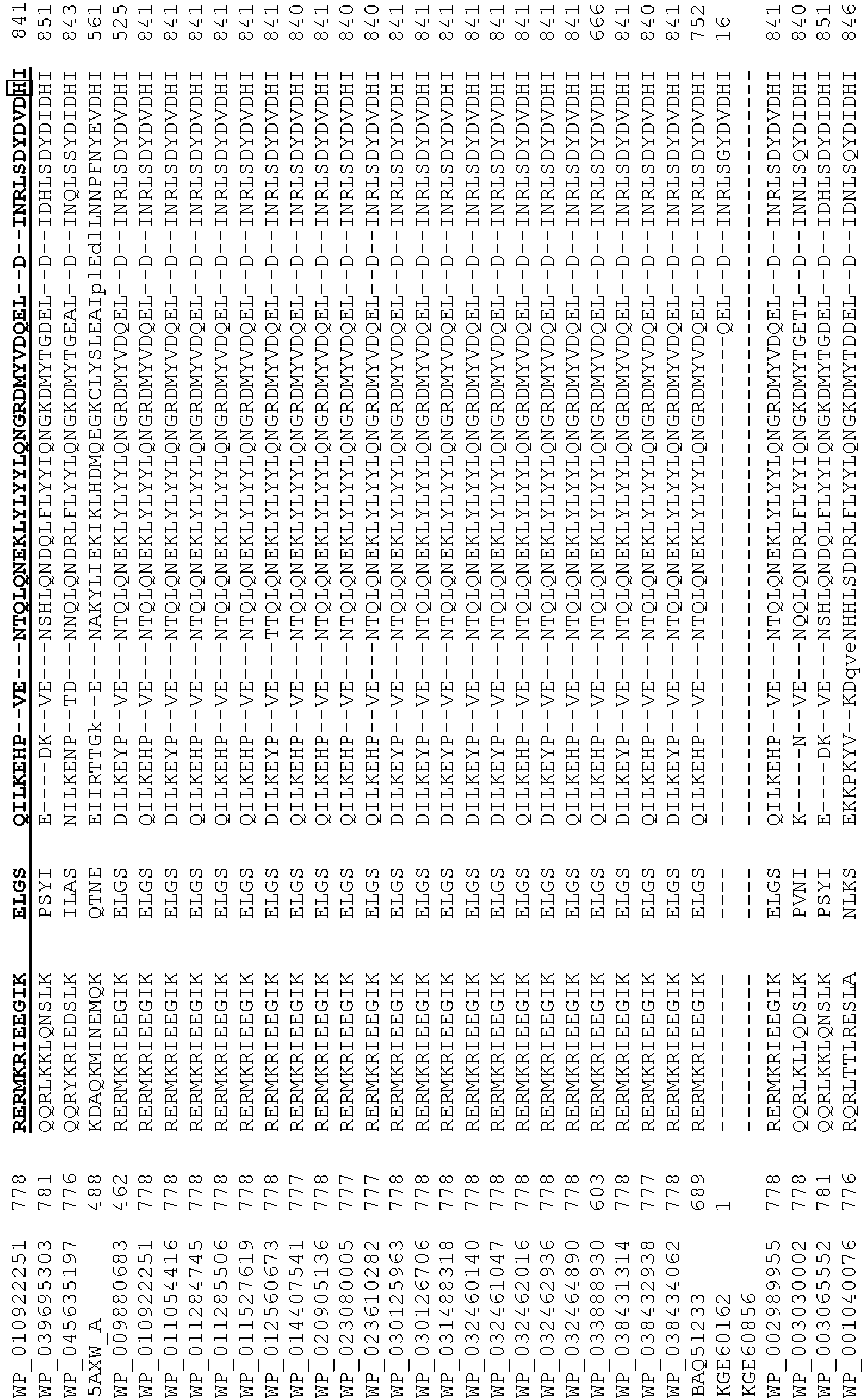


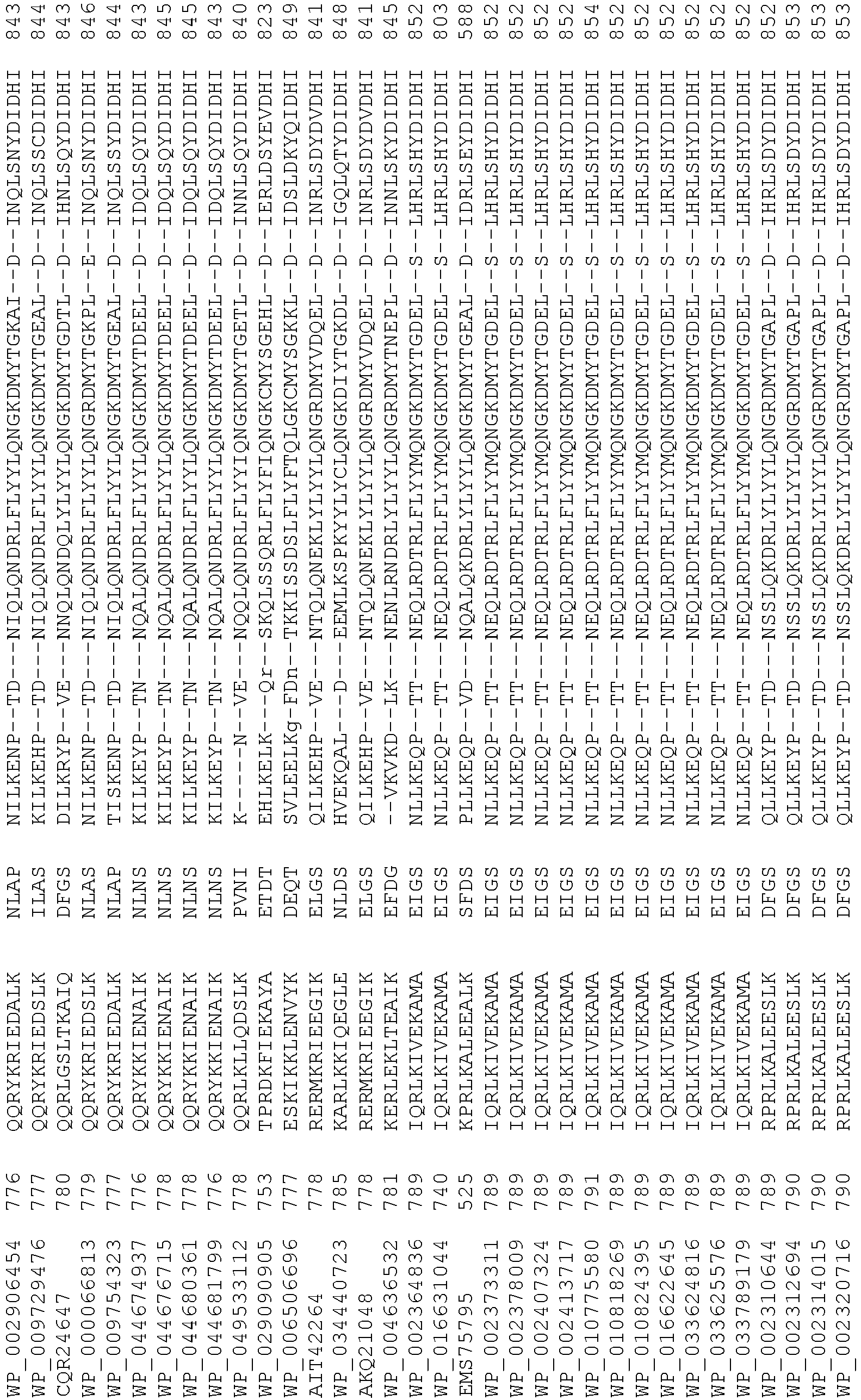


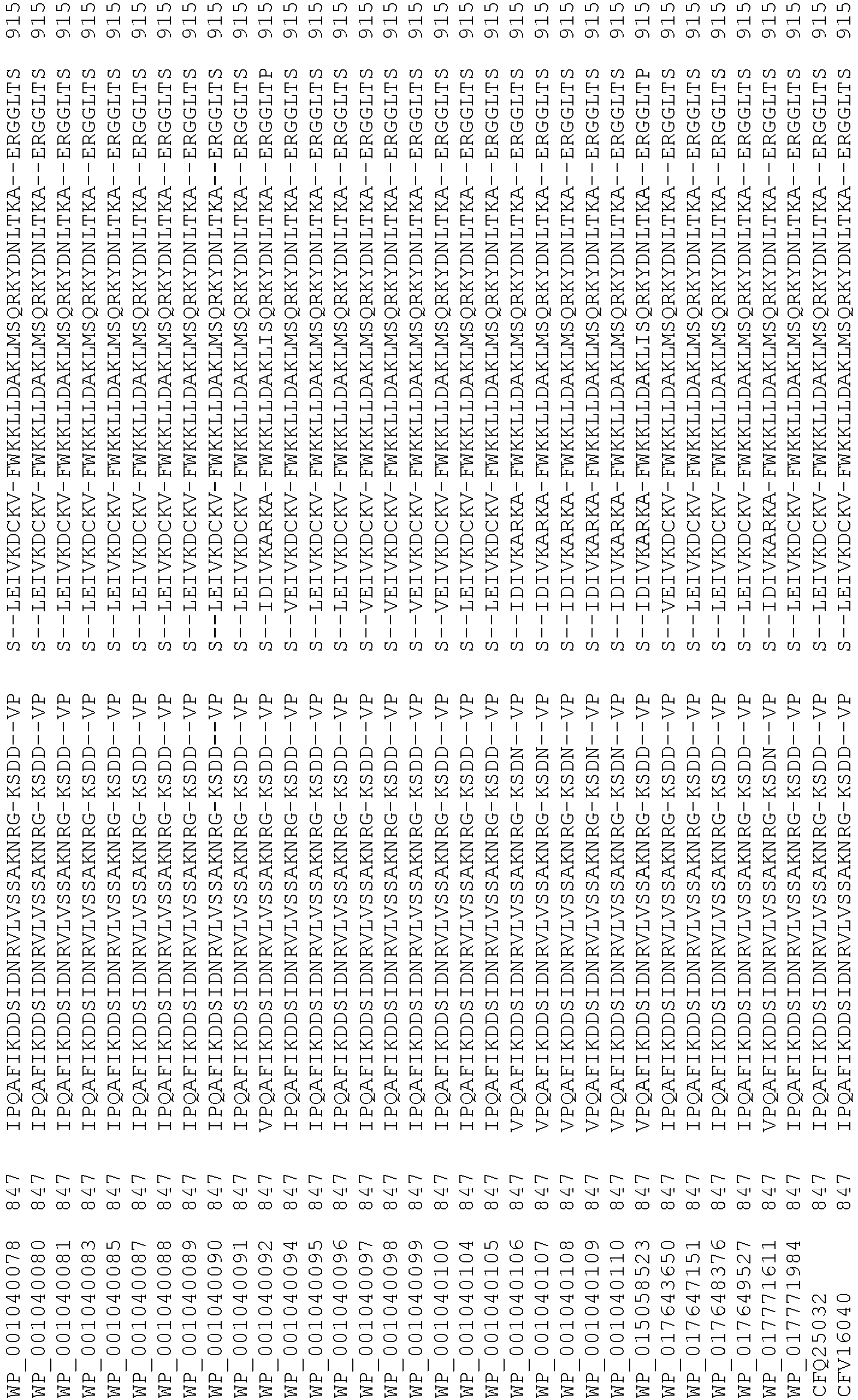


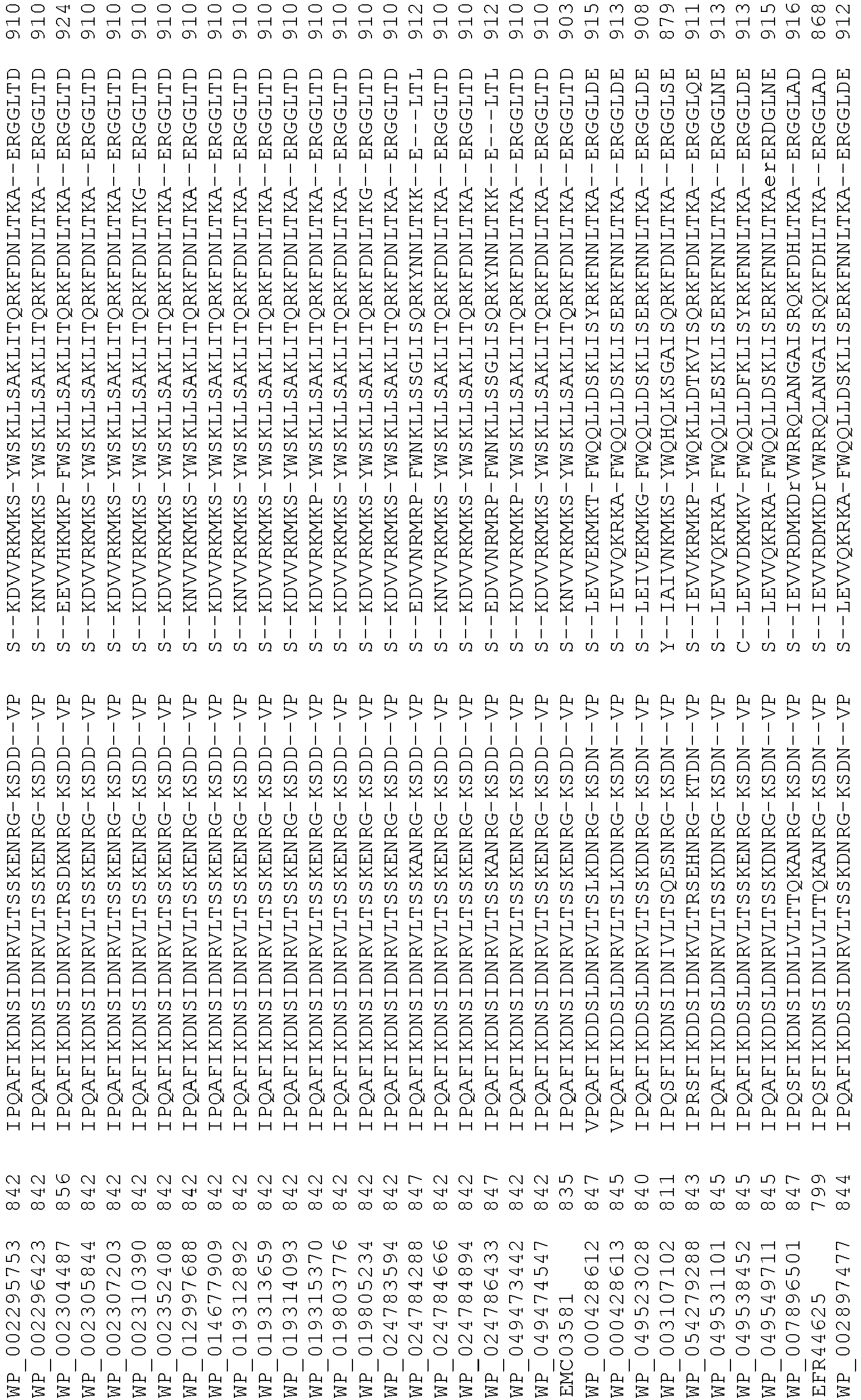


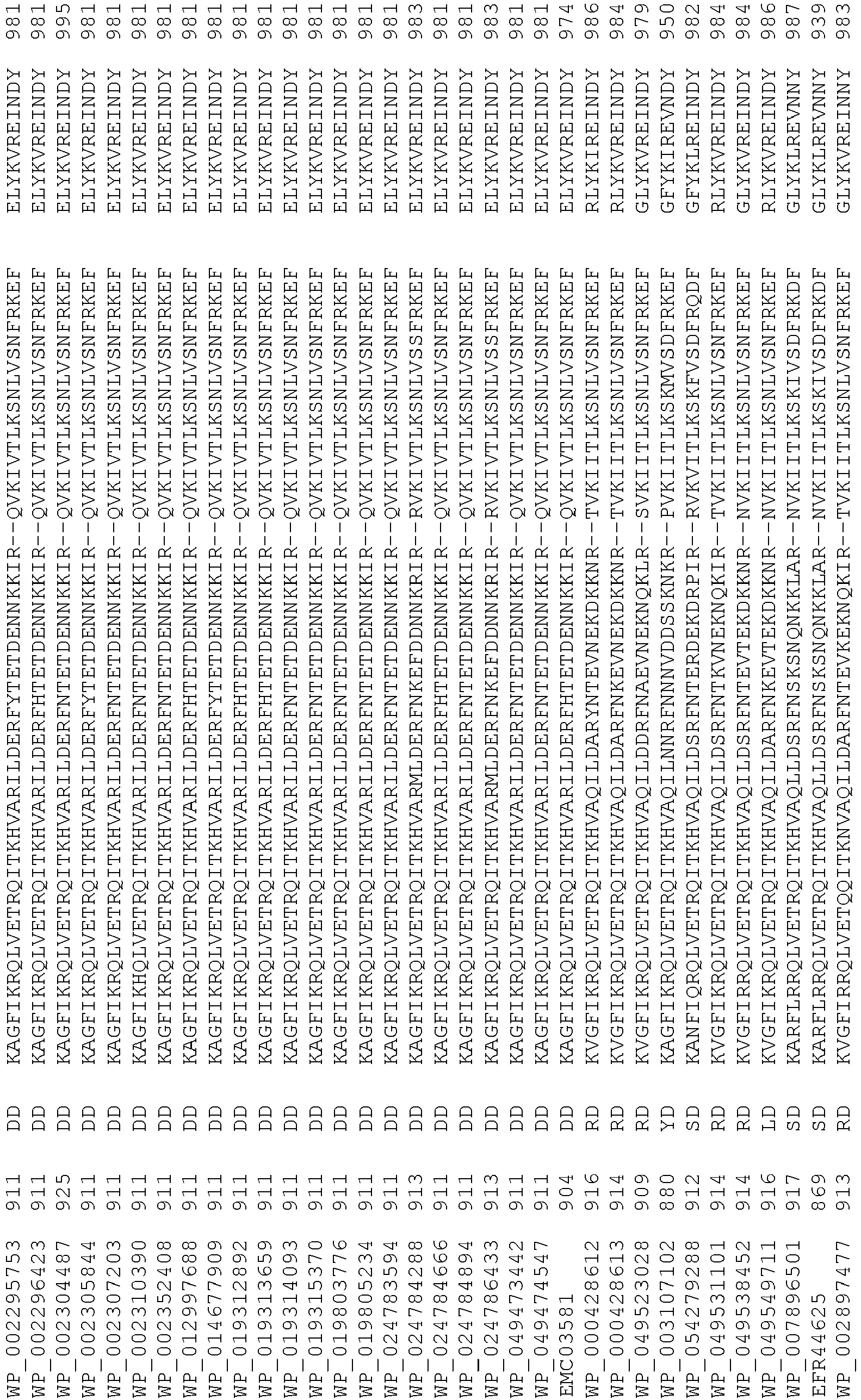

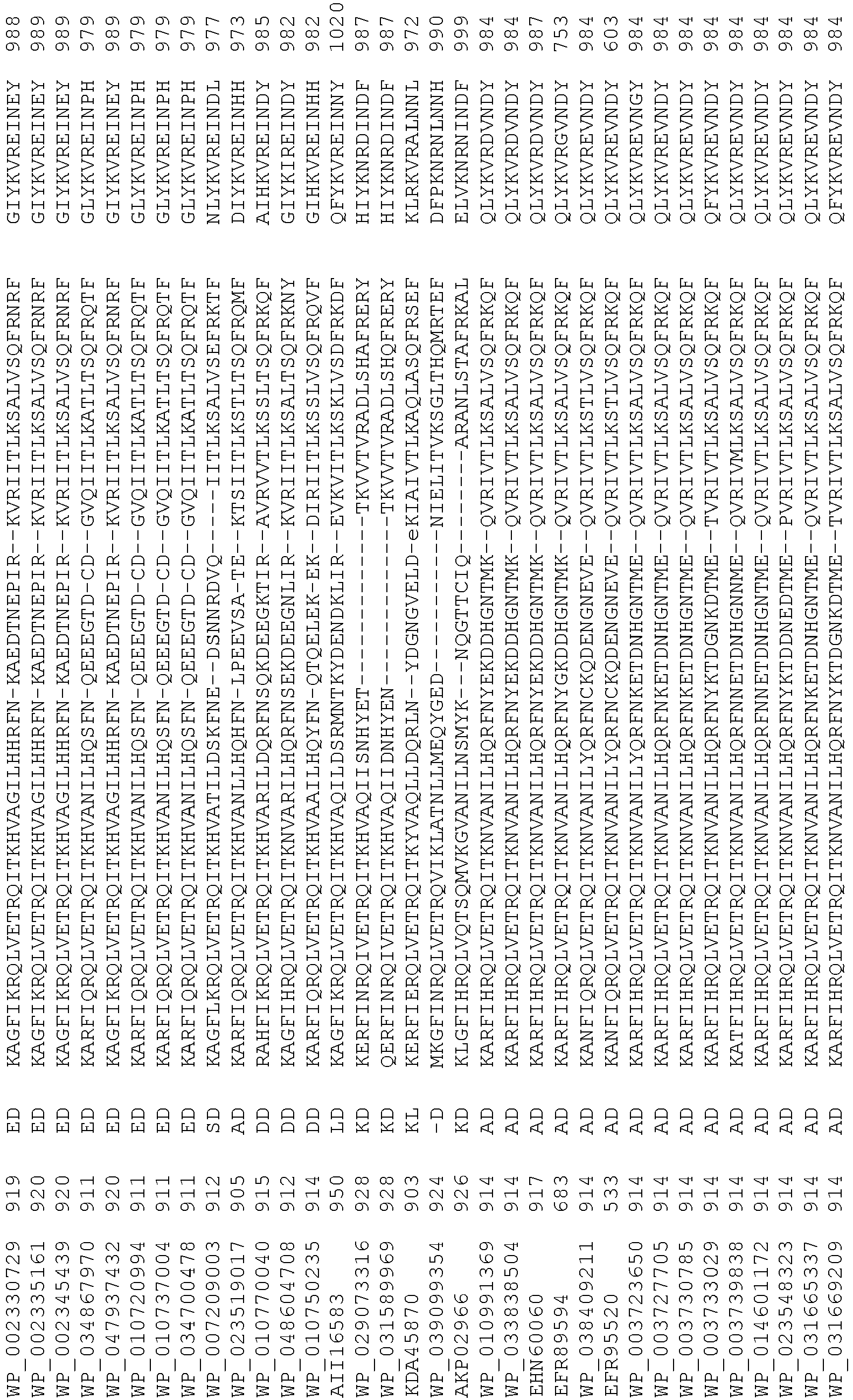

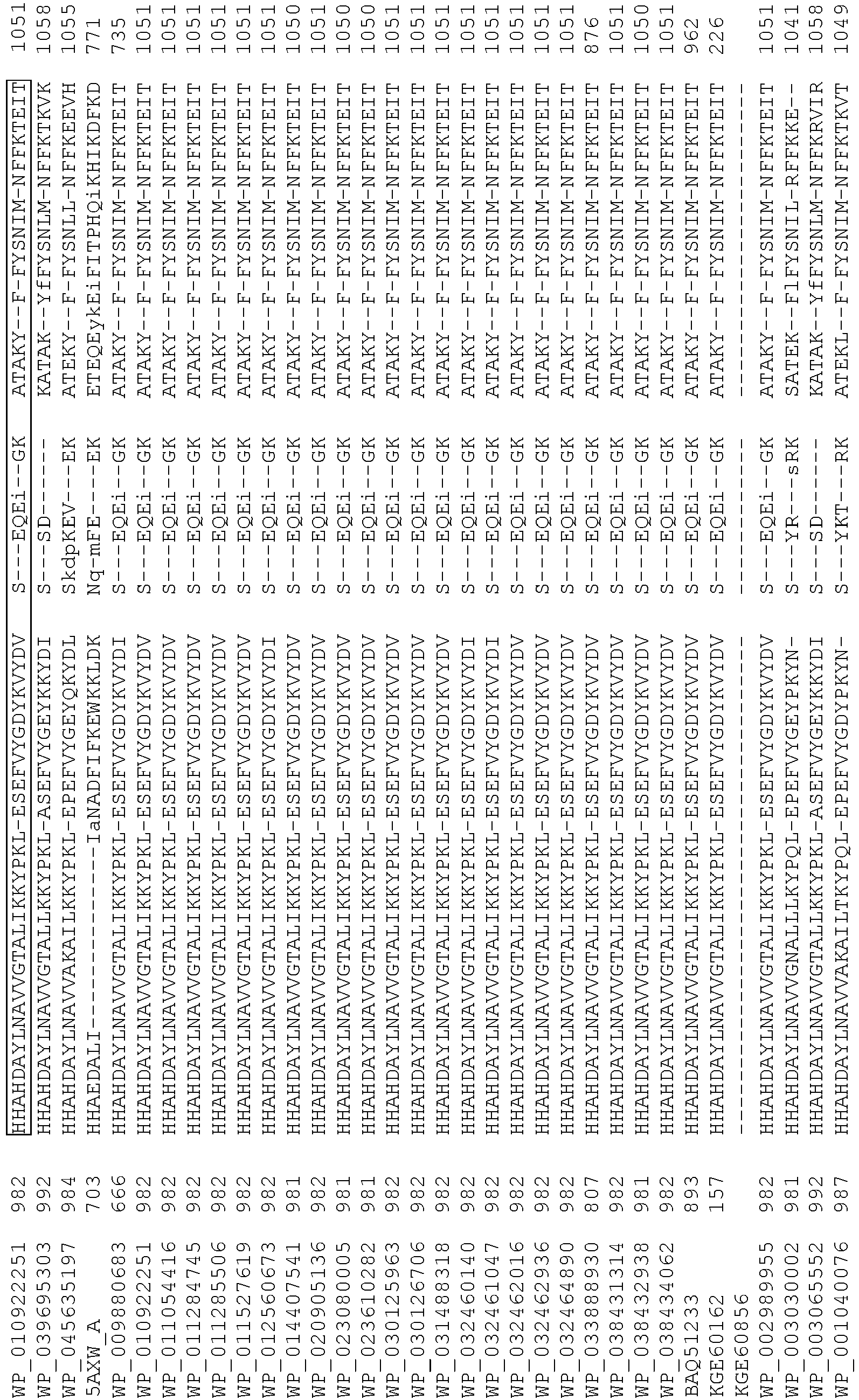
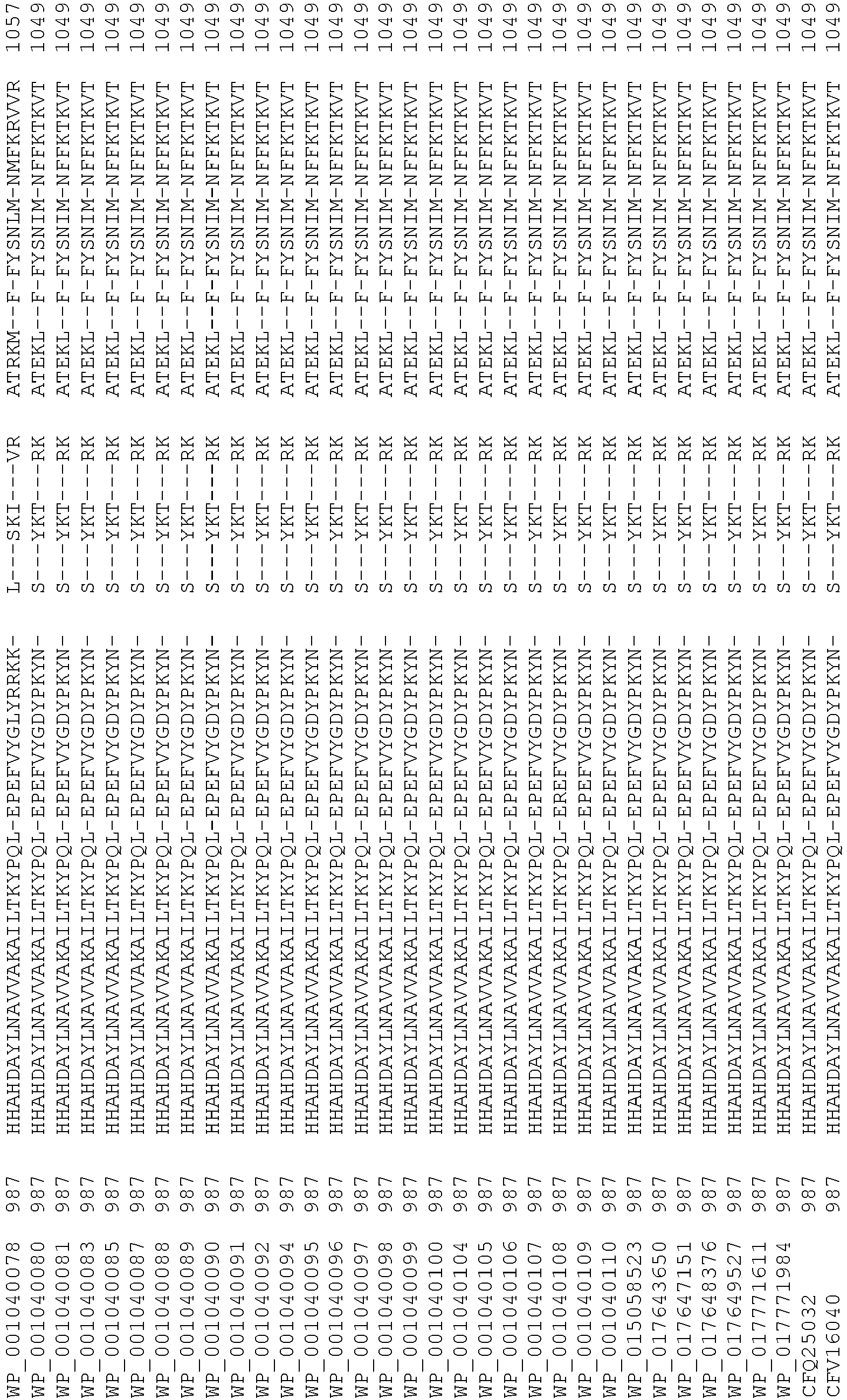


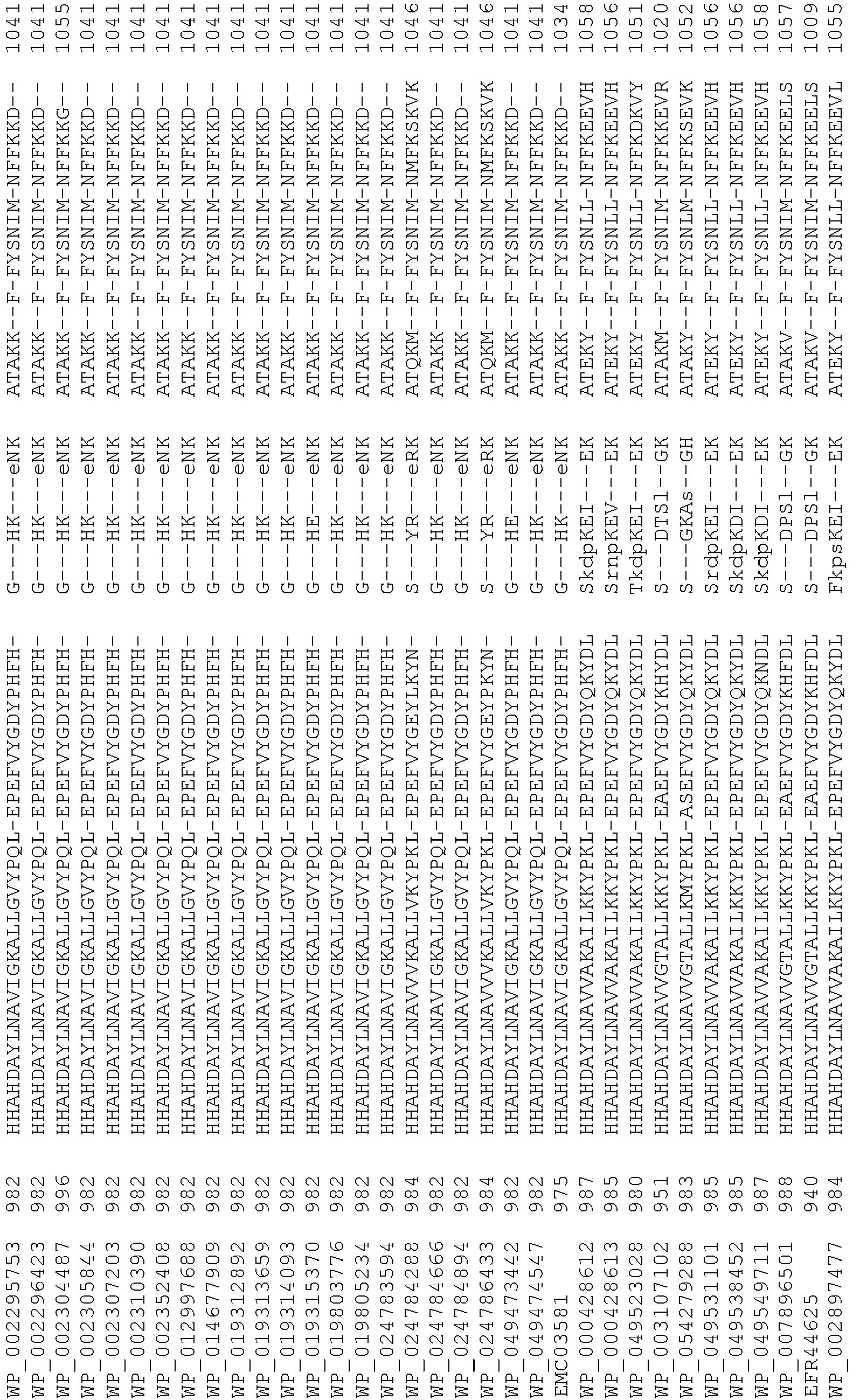

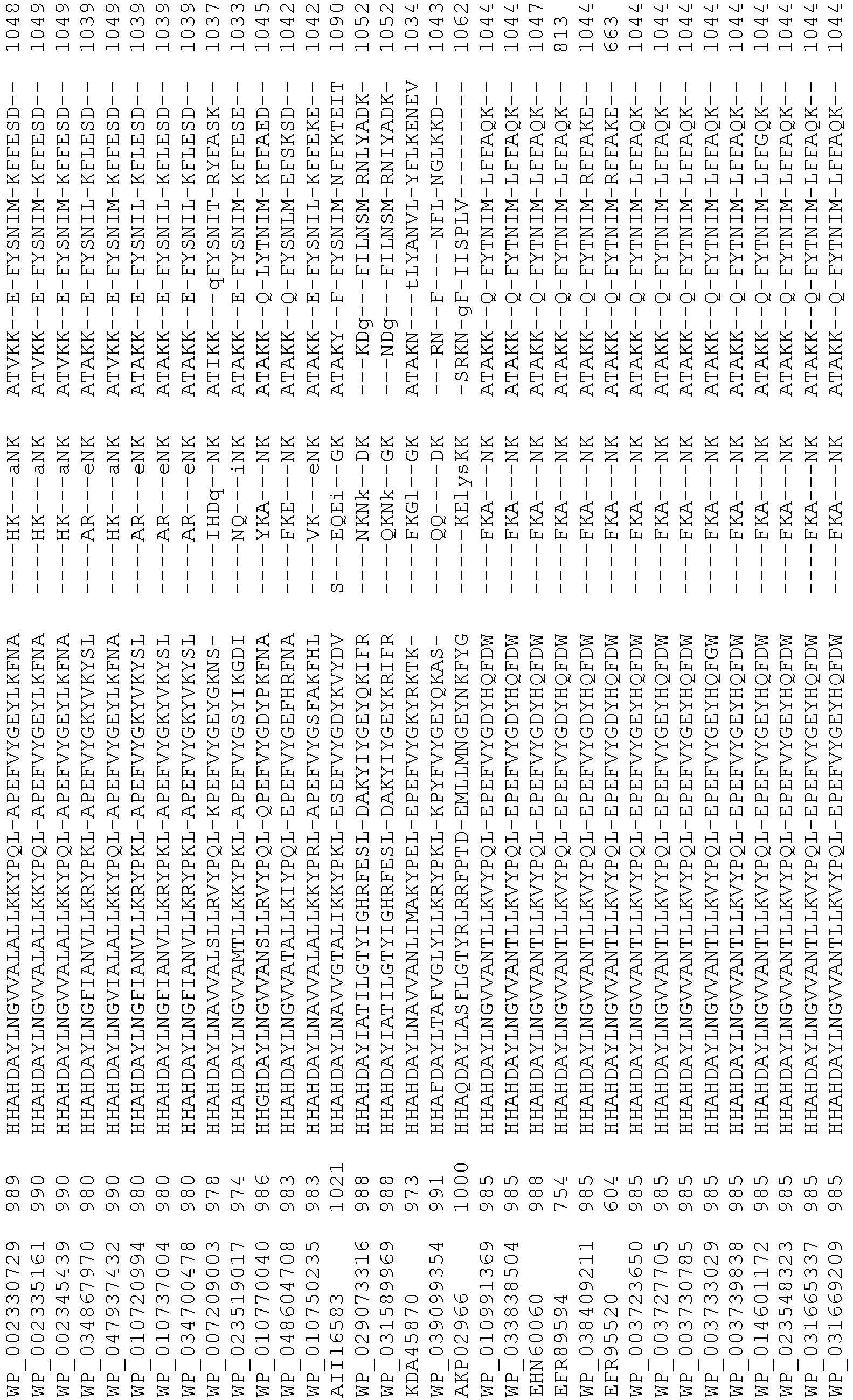


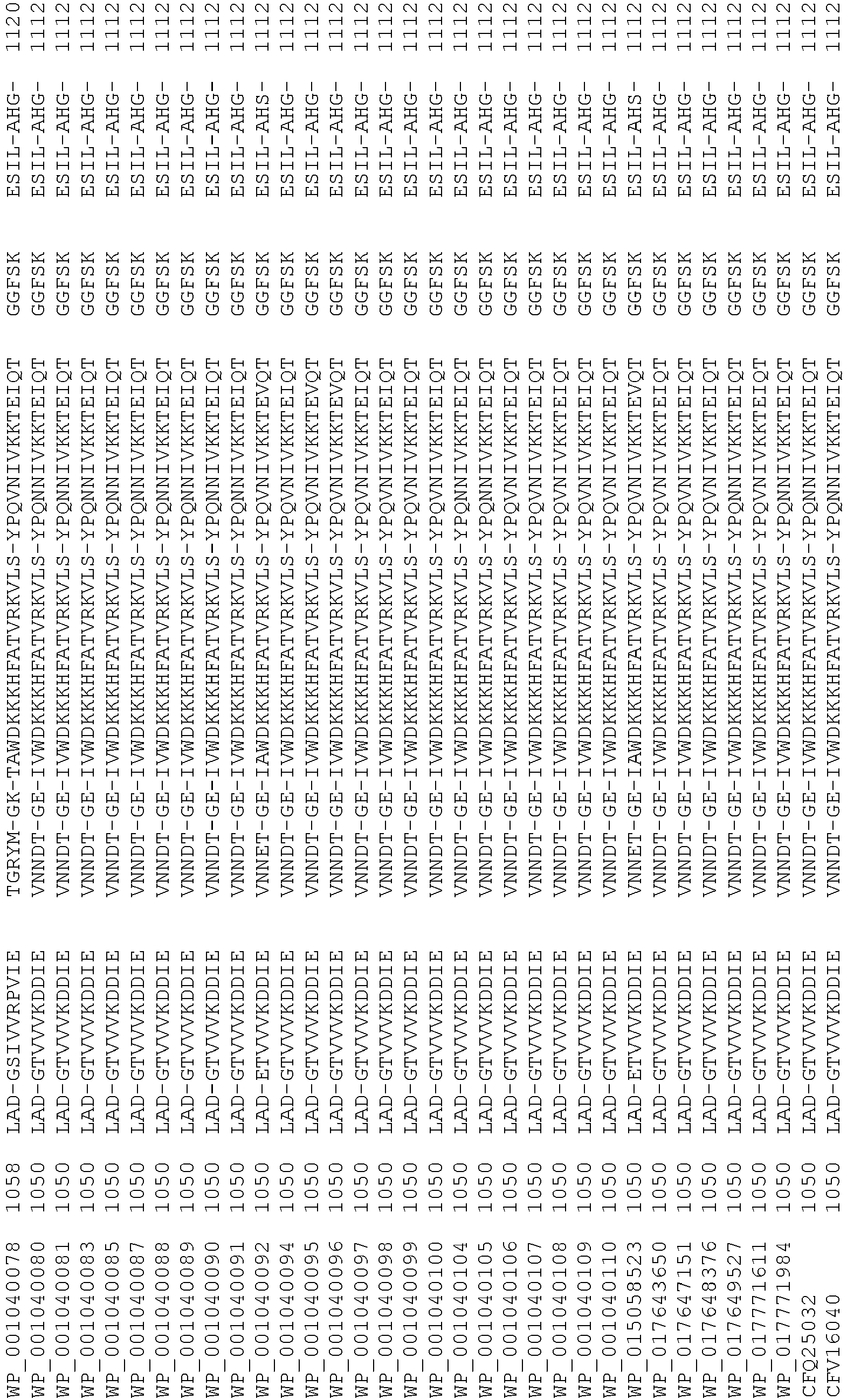


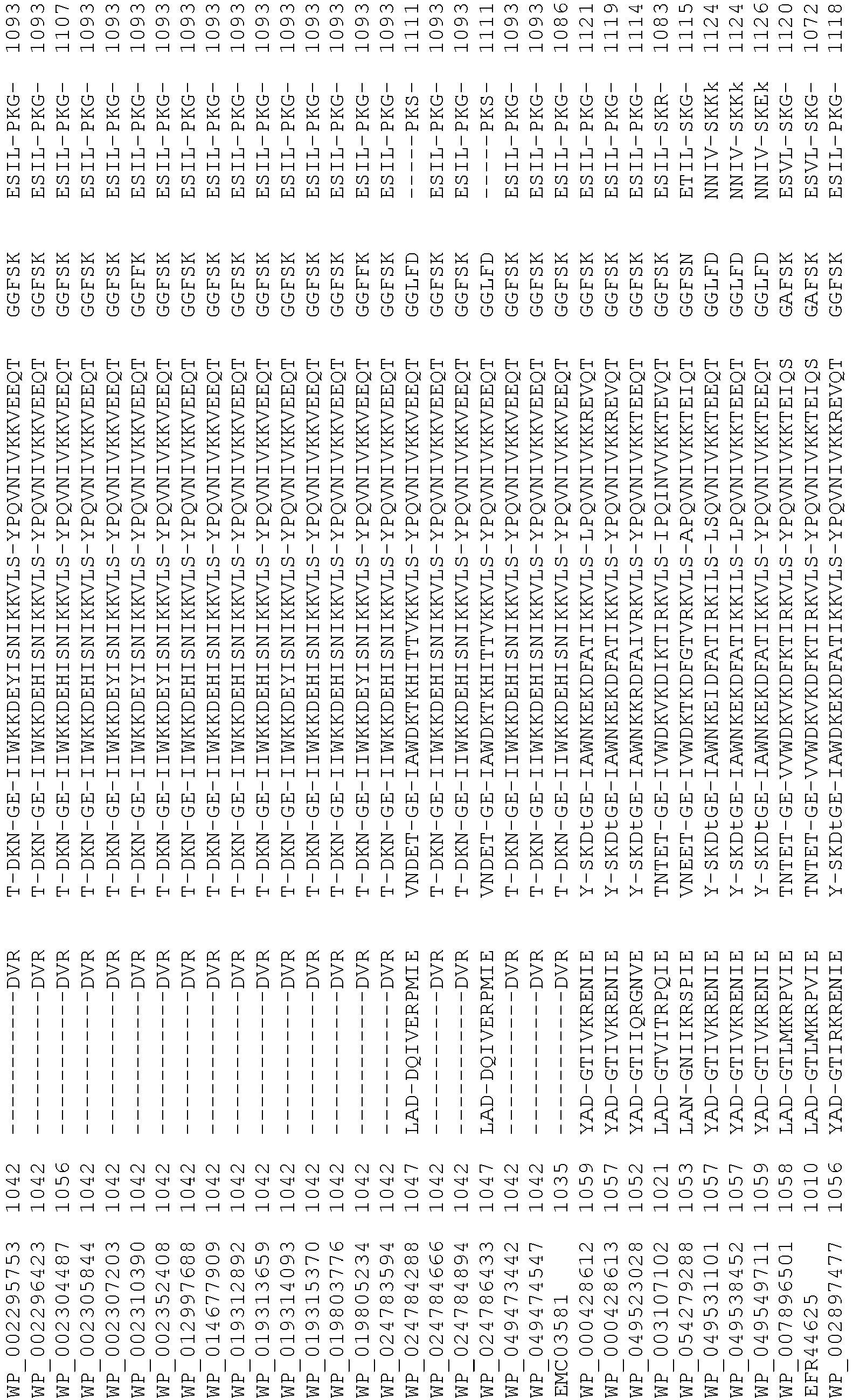


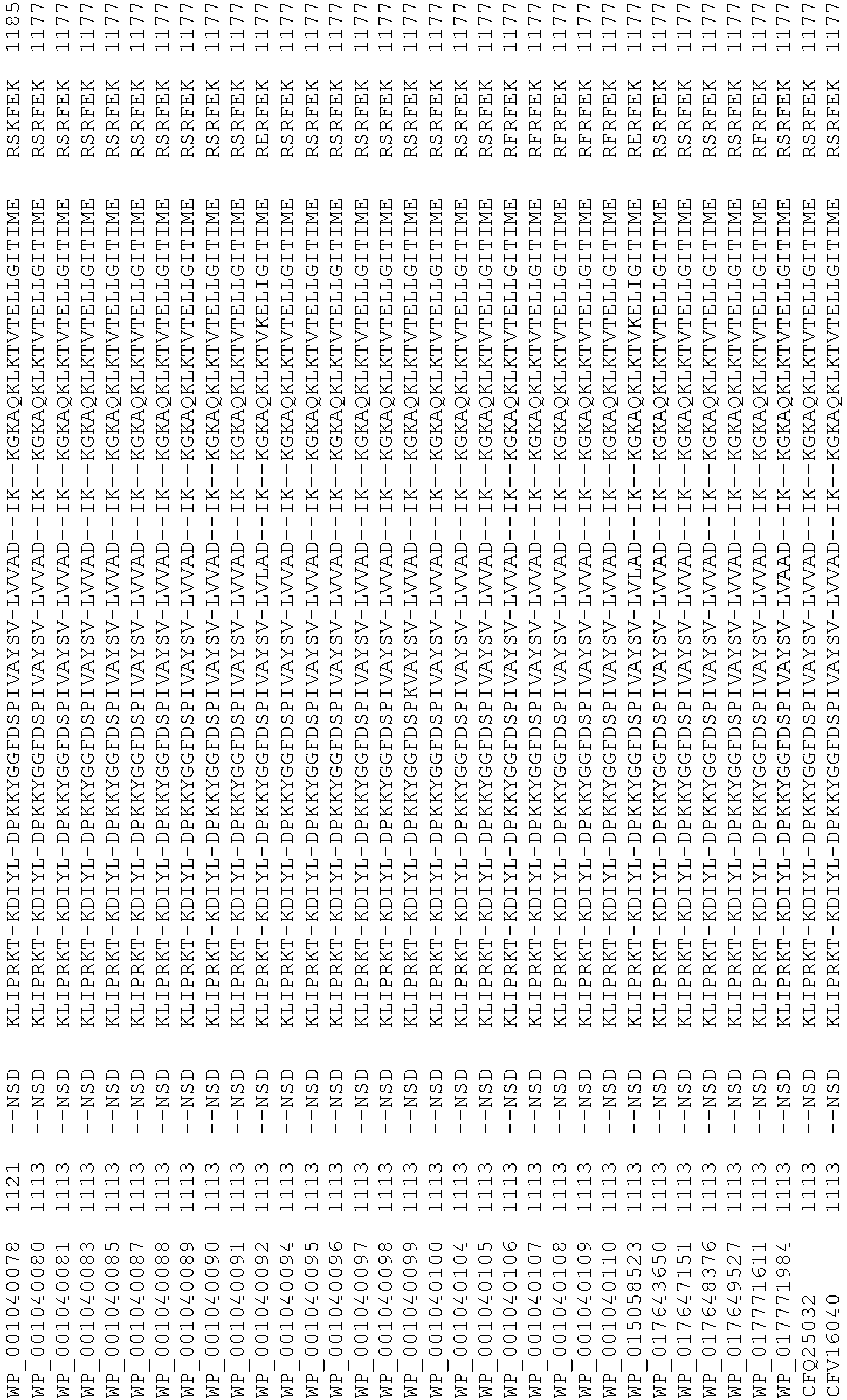


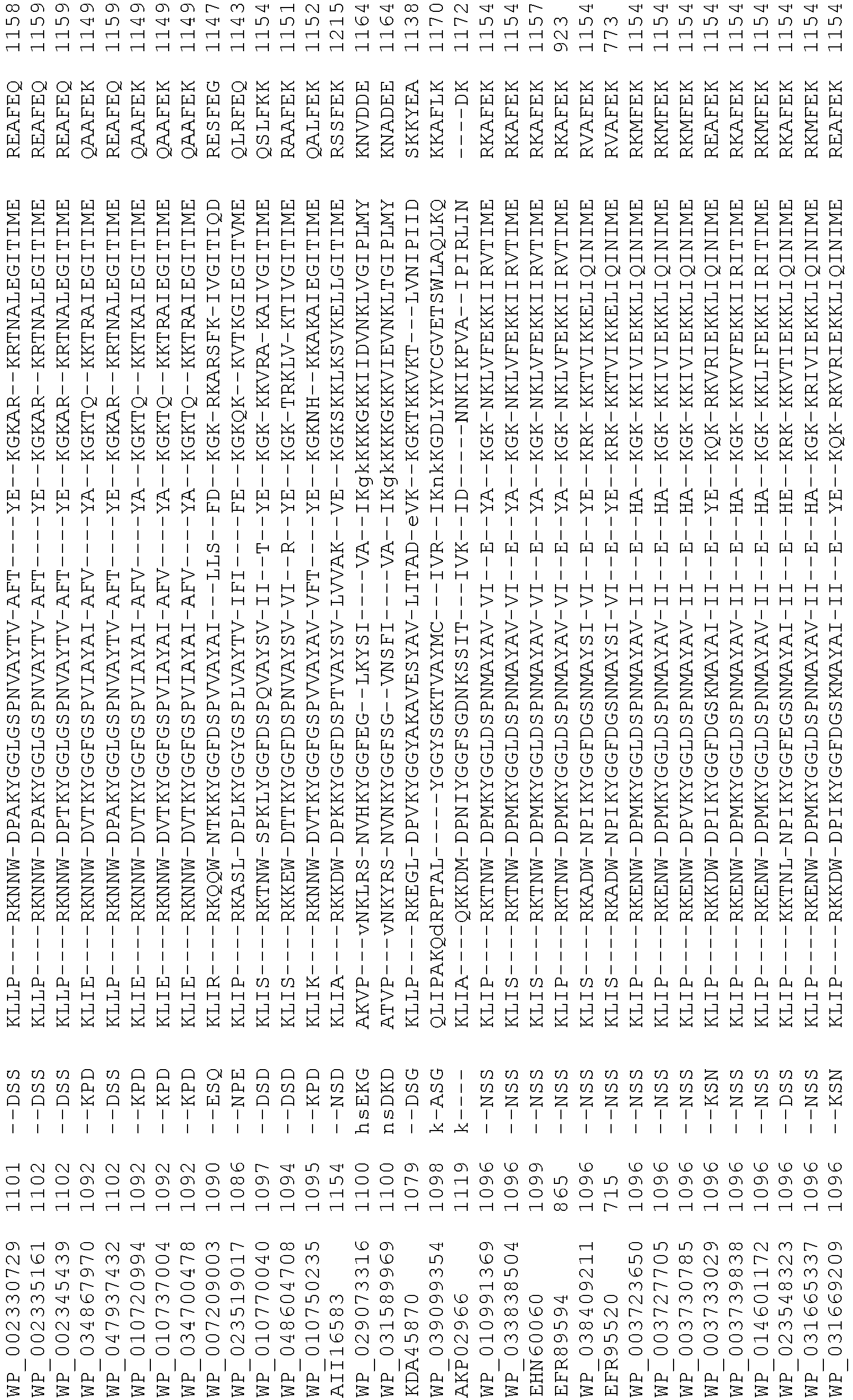

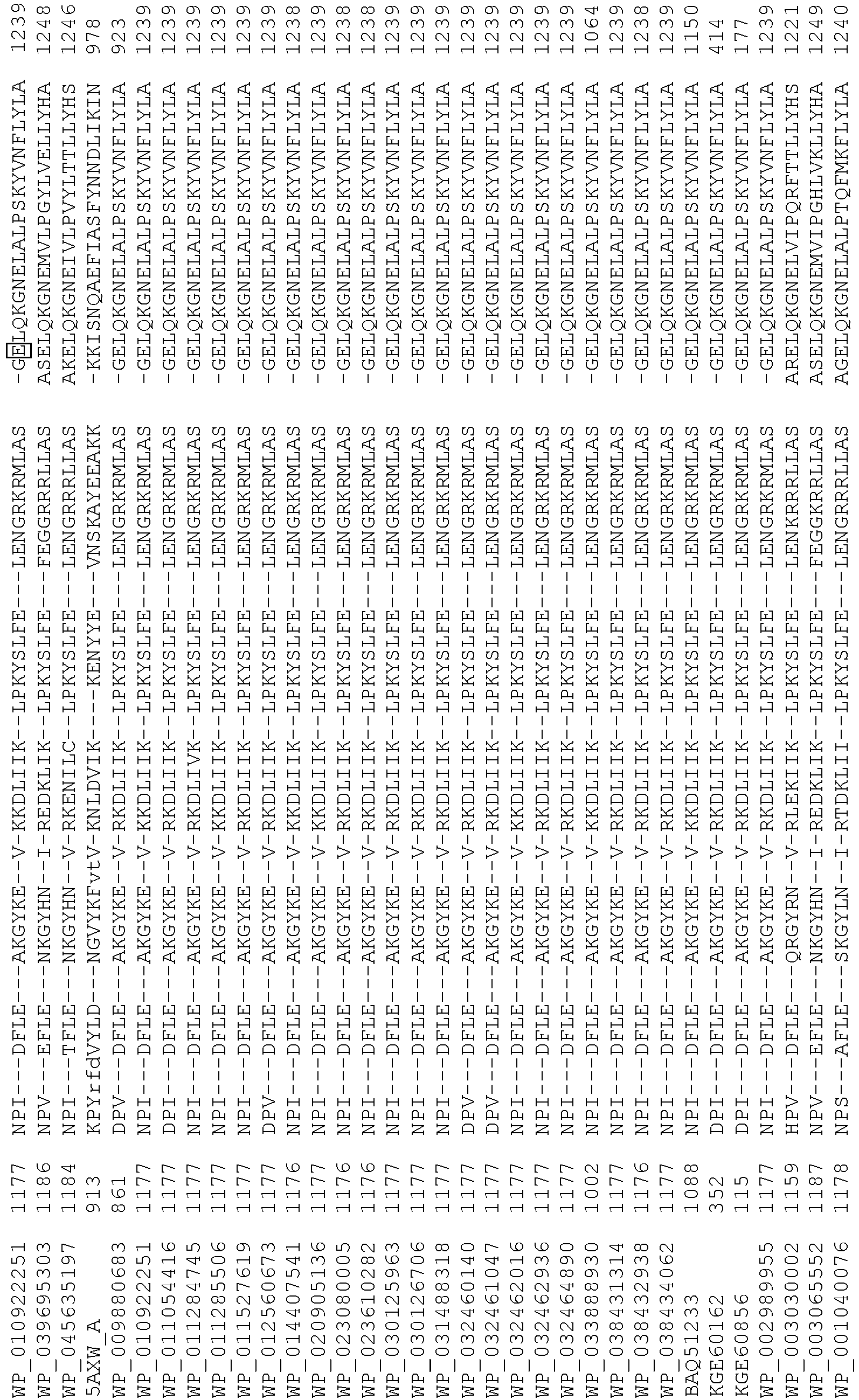
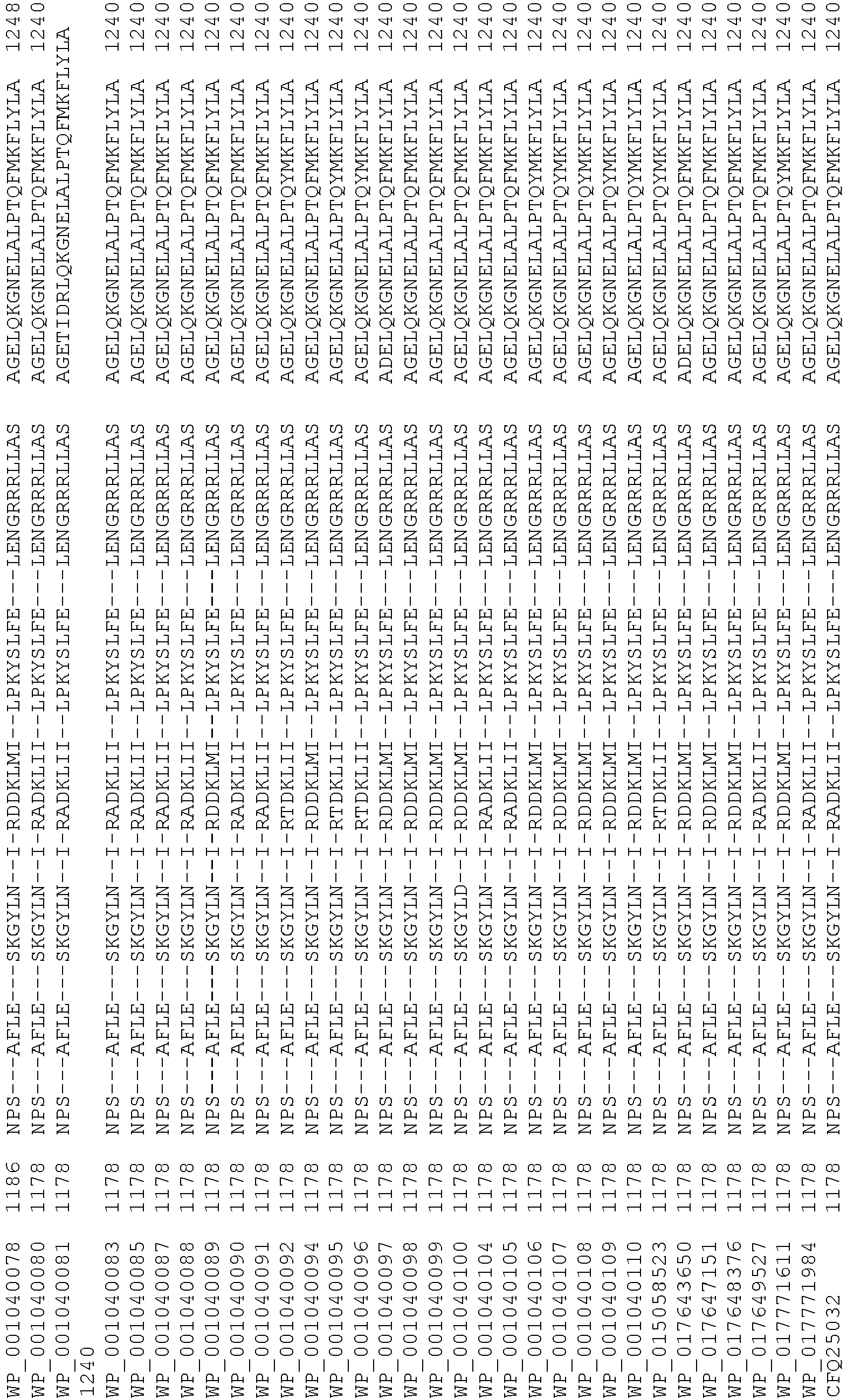
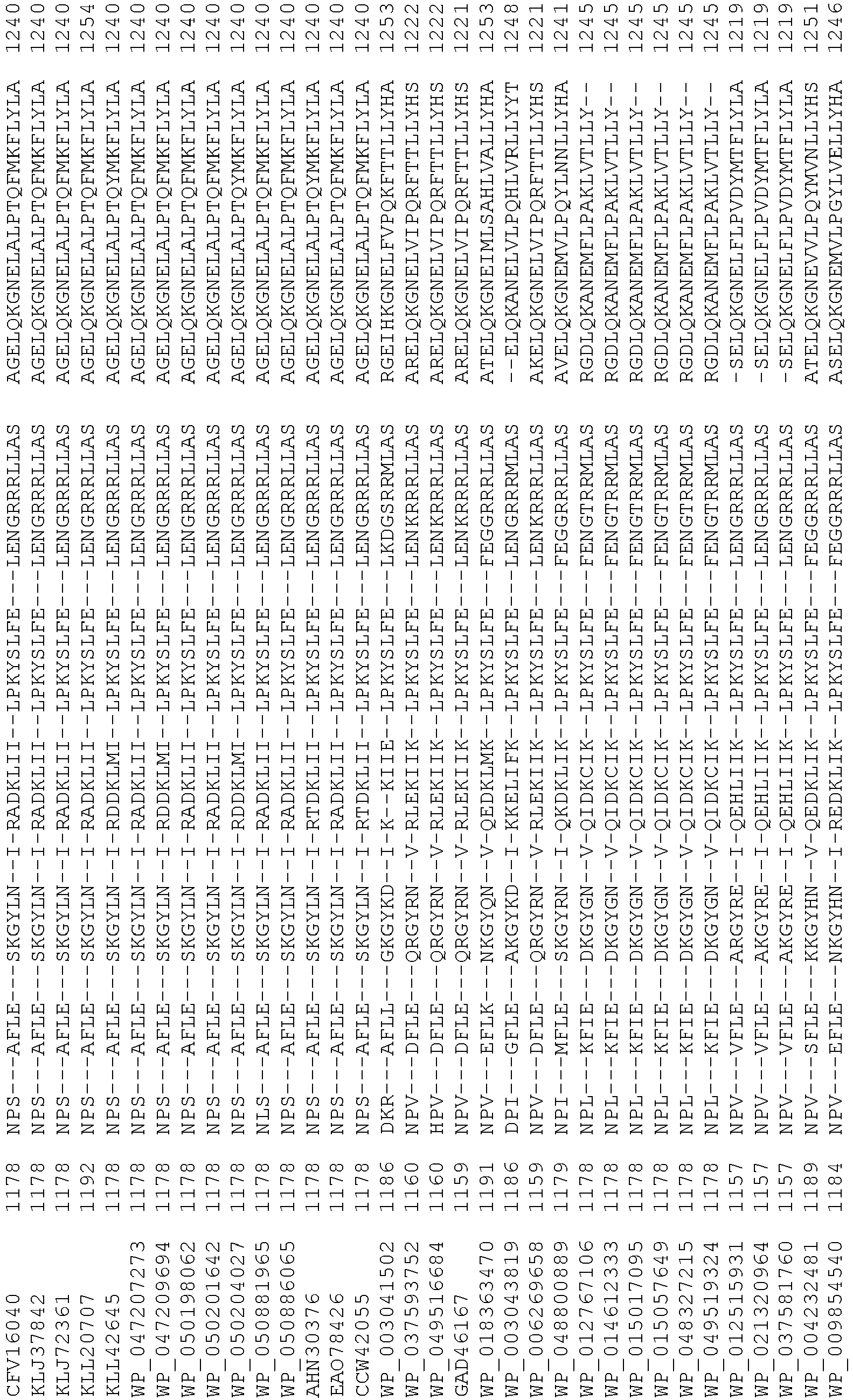


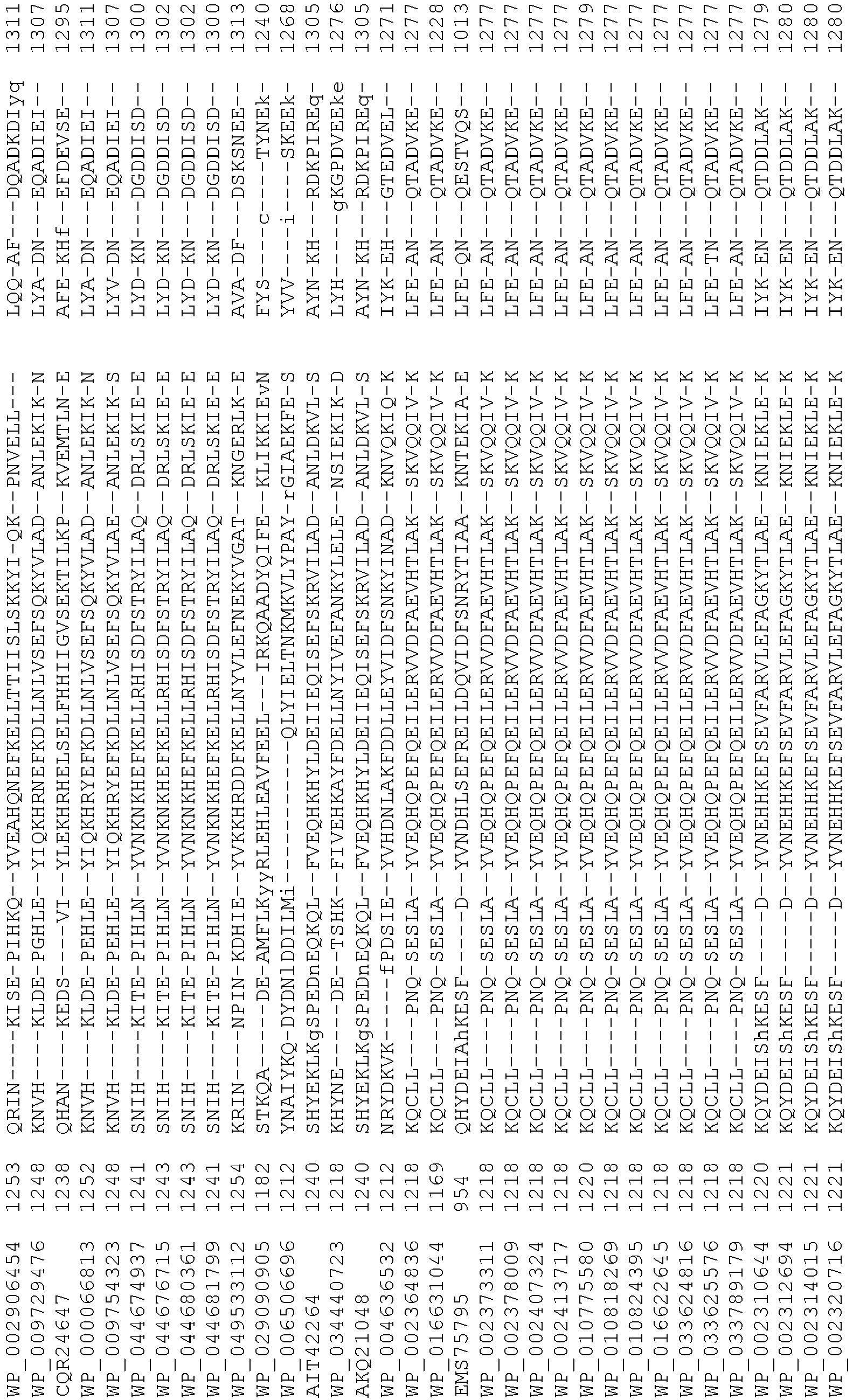


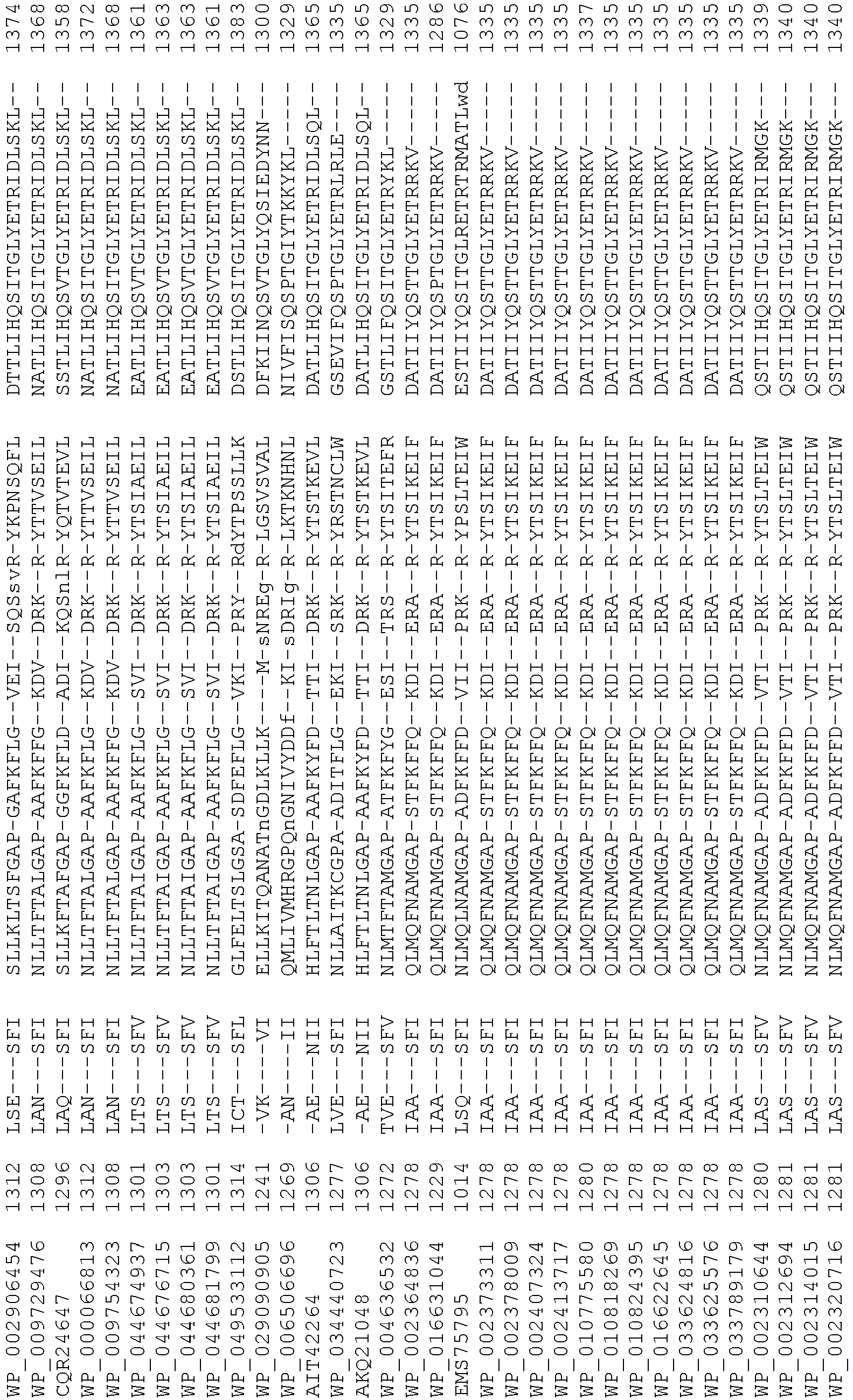


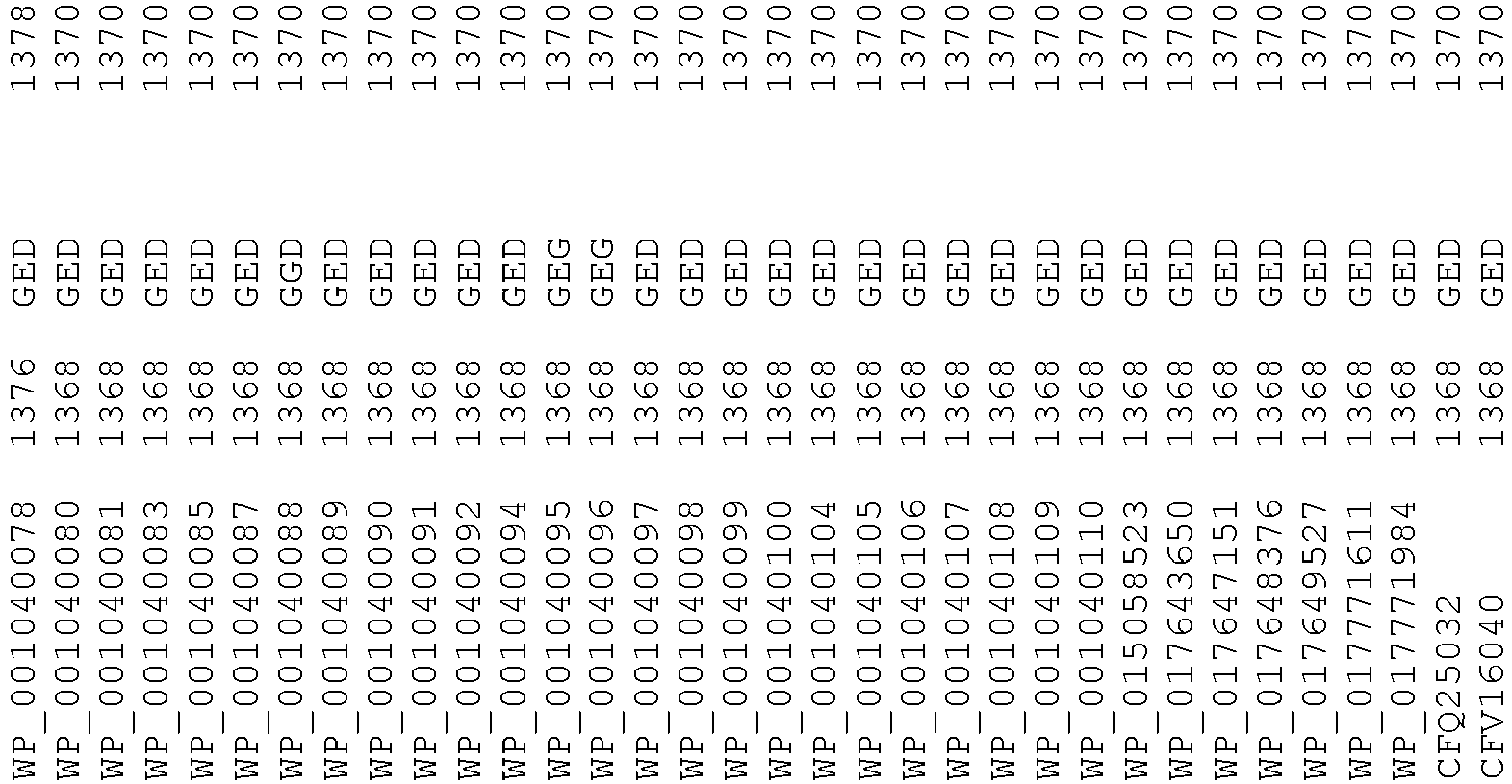


Table 2. T to C changes with NGG PAM. Table 2 shows a list of T to C mutations that may be corrected using any of the base editors provided herein. GRNAs and gRNAall indicate the protospacer and PAM sequence, where the PAM sequence is the last 3 nucleotides of each of the sequences in GRNAs and gRNAall. Name Gene ID Gene Symbol SEQ ID NO: Flanks SEQ ID NO: GRNAs SEQ ID NO: gRNAall NM_000071.2( CBS):c.833T> C (p.Ile278Thr) 875 CBS 2540 
2703 - 2704 
2907 - 2908 
NM_001385.2( DPYS):c.1078T >C (p.Trp360Arg) 1807 DPYS 2541 
2705 - 2707 
2909 - 2911 
NM_000027.3( AGA):c.916T> C (p.Cys306Arg) 175 AGA 2542 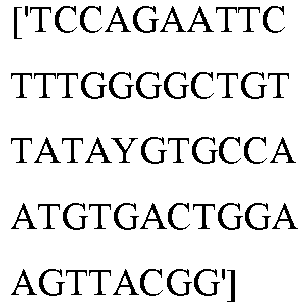
2708 
2912 
NM_000035.3( ALDOB):c.442 T>C (p.Trpl48Arg) 229 ALDO B 2543 
2709 
2913 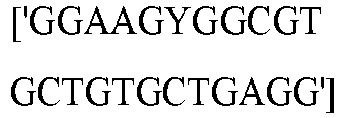
NM_173560.3( RFX6):c.380+2 T>C 2225 46 RFX6 2544 
2710 - 2711 
2914 - 2915 
NM_153704.5( TMEM67):c.18 43T>C (p.Cys615Arg) 9114 7 TMEM 67 2545 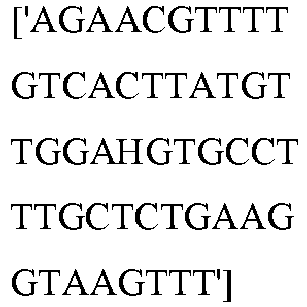
2712 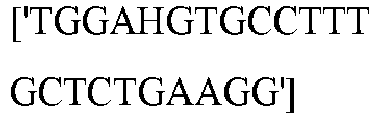
2916 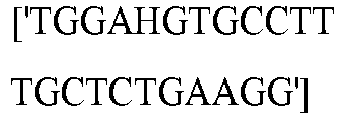
NM_000124.3( ERCC6):c.2960 T>C (p.Leu987Pro) 2074 ERCC6 2546 
2713 
2917 
NM_020435.3( GJC2):c.857T> C (p.Met286Thr) 5716 5 GJC2 2547 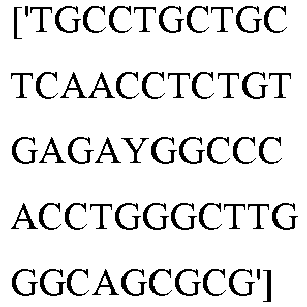
2714 
2918 - 2919 
NM_000920.3( PC):c.434T>C (p.Vall45Ala) 5091 PC 2548 
2715 
2920 
NM_000026.2( ADSL):c.674T >C (p.Met225Thr) 158 ADSL 2549 
2716 
2921 
NM_000391.3( TPP1):c.1093T >C (p.Cys365Arg) 1200 TPP1 2550 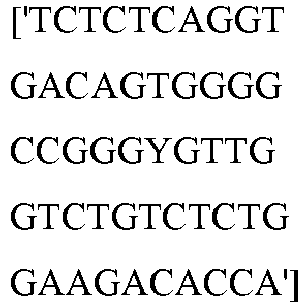
2717 
2922 
NM_004183.3( BESTl):c.704T >C (p.Val235Ala) 7439 BEST1 2551 
2718 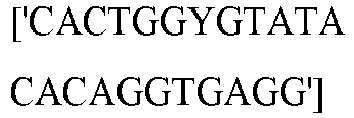
2923 
NM_000019.3( ACATl):c.935 T>C (p.Ile312Thr) 38 ACAT 1 2552 
2719 
2924 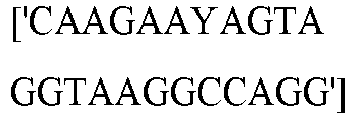
NM_000543.4( SMPD1):c.911 T>C (p.Leu304Pro) 6609 SMPD 1 2553 
2720 
2925 - 2927 
NM_000527.4( 3949 LDLR 2554 
2721 
2928 
LDLR):c.694+2 T>C 

- 2930 
NM_012464.4( TLL1):c.713T> C (p.Val238Ala) 7092 TLL1 2555 
2722 
2931 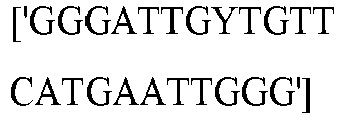
NM_000112.3( SLC26A2):c.-26+2T>C 1836 SLC26 A2 2556 
2723 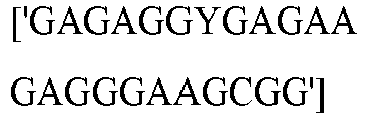
2932 
NM_00100574 1.2(GBA):c.751 T>C (p.Tyr251His) 2629 GBA 2557 
2724 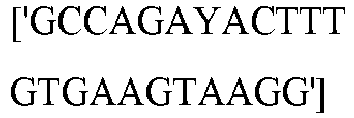
2933 - 2934 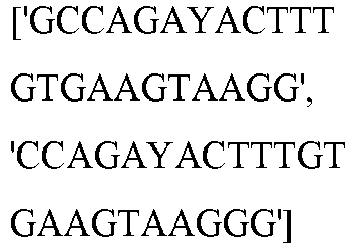
NM_020365.4( EIF2B3):c.1037 T>C (p.Ile346Thr) 8891 EIF2B3 2558 
2725 
2935 
NM_022041.3( GAN):c.1268T >C (p.Ile423Thr) 8139 GAN 2559 
2726 
2936 - 2937 
NM_054027.4( ANKH):c.143T >C (p.Met48Thr) 5617 2 ANKH 2560 
2727 - 2728 
2938 - 2939 
NM_006329.3( FBLN5):c.506T >C (p.llel69Thr) 1051 6 FBLNS 2561 
2729 
2940 
NM_004086.2( -1 - 2562 
2730 
2941 
COCH):c.1535 T>C (p.Met512Thr) 


NM_002942.4( ROBO2):c.283 4T>C (p.Ile945Thr) 6092 ROBO 2 2563 
2731 
2942 
NM_001300.5( KLF6):c.l90T> C (p.Trp64Arg) 1316 KLF6 2564 
2732 
2943 
NM_030653.3( DDX11):c.2271 +2T>C 1663 DDX11 2565 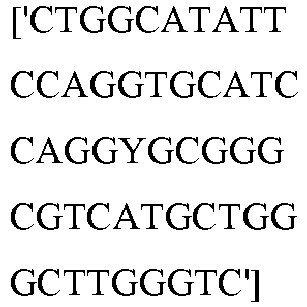
2733 
2944 - 2945 
NM_001451.2( FOXF1):c.1138 T>C (p.Ter380Arg) 2294 FOXF1 2566 
2734 
2946 
NM_000435.2( NOTCH3):c.l3 63T>C (p.Cys455Arg) 4854 NOTC H3 2567 
2735 
2947 - 2948 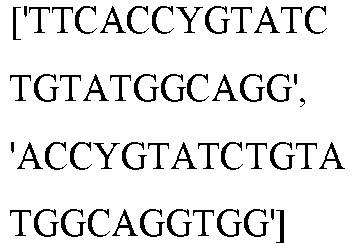
NM_002427.3( MMP13):c.272 T>C (p.Met9lThr) 4322 MMP1 3 2568 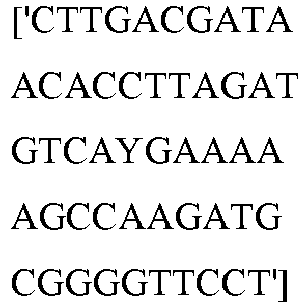
2736 - 2737 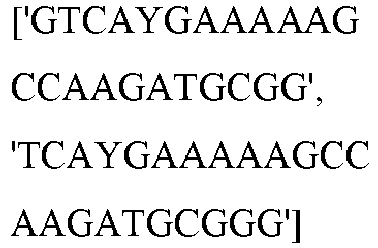
2949 - 2950 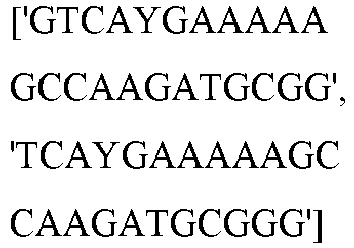
NM_000211.4( ITGB2):c.446T >C (p.Leul49Pro) 3689 ITGB2 2569 
2738 
2951 
NM_005502.3( ABCAl):c.442 9T>C (p.Cys1477Arg ) 19 ABCA 1 2570 
2739 - 2740 
2952 - 2955 
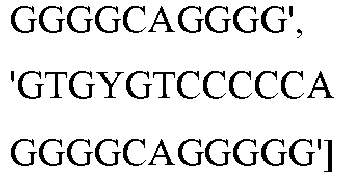
m.12297T>C 4568 MT-TL2 2571 
2741 
2956 
m.4290T>C 4565 MT-TI 2572 
2742 
2957 
m.4291T>C 4565 MT-TI 2573 
2743 
2958 
m.3394T>C 4535 MT-ND1 2574 
2744 
2959 
NM_002764.3( PRPS1):c.344T >C (p.Metll5Thr) 5631 PRPS1 2575 
2745 
2960 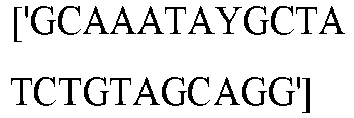
NM_000132.3( F8):c.5372T>C (p.Met1791Thr) 2157 F8 2576 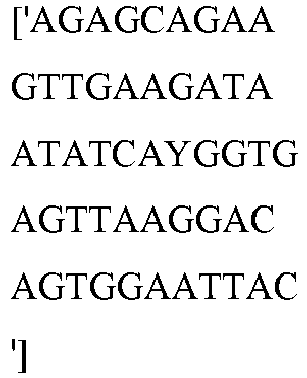
2746 
2961 
NM_000132.3( F8):c.1754T>C (p.Ile585Thr) 2157 F8 2577 
2747 
2962 
NM_000133.3( F9):c.1328T>C (p.Ile443Thr) 2158 F9 2578 
2748 
2963 
NM_000169.2( GLA):c.806T> C (p.Val269Ala) -1 - 2579 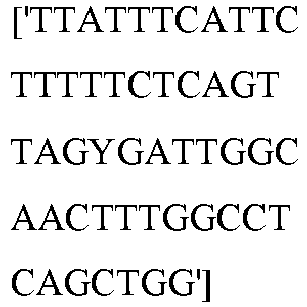
2749 
2964 
NM_000116.4( TAZ):c.352T> C (p.Cys118Arg) 6901 TAZ 2580 
2750 
2965 
NM_000061.2( BTK):c.2T>C (p.MetlThr) 695 BTK 2581 
2751 
2966 
NM_000061.2( BTK):c.1223T> C (p.Leu408Pro) 695 BTK 2582 
2752 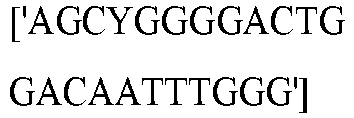
2967 - 2968 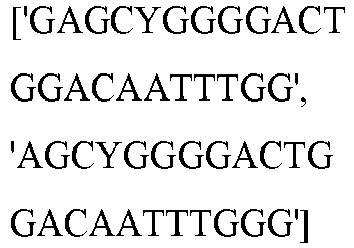
NM_000061.2( BTK):c.1741T> C (p.Trp581Arg) 695 BTK 2583 
2753 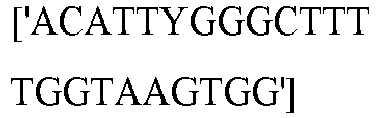
2969 
NM_014009.3( FOXP3):c.970T >C (p.Phe324Leu) 5094 3 FOXP3 2584 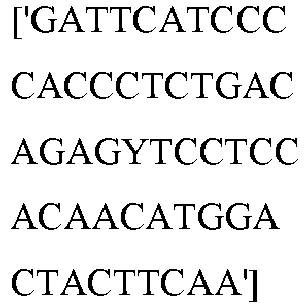
2754 
2970 
NM_003688.3( CASK):c.2740 T>C (p.Trp914Arg) 8573 CASK 2585 
2755 - 2756 
2971 - 2972 
NM_004992.3( MECP2):c.464 T>C (p.Phel55Ser) 4204 MECP 2 2586 
2757 
2973 - 2974 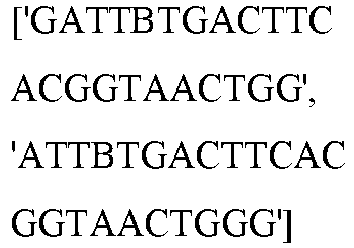
NM_000431.3( MVK):c.803T> C (p.Ile268Thr) 4598 MVK 2587 
2758 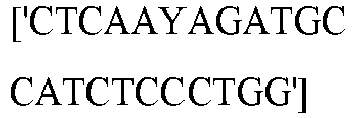
2975 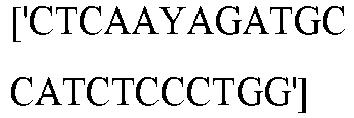

NM_021961.5( TEAD1):c.1261 T>C (p.Tyr?His) 7003 TEAD1 2588 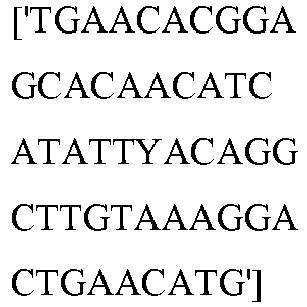
2759 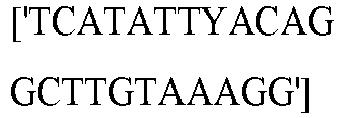
2976 
NM_005633.3( SOS1):c.1294T >C (p.Trp432Arg) 6654 SOS1 2589 
2760 
2977 
NM_006920.4( SCNlA):c.3577 T>C (p.Trp1193Arg) -1 - 2590 
2761 
2978 
NM_000141.4( FGFR2):c.1018 T>C (p.Tyr340His) 2263 FGFR2 2591 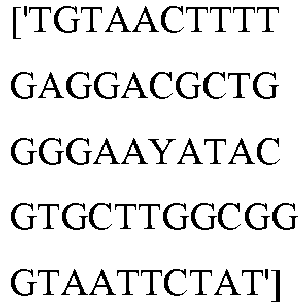
2762 - 2763 
2979 - 2980 
NM_000174.4( GP9):c.70T>C (p.Cys24Arg) 2815 GP9 2592 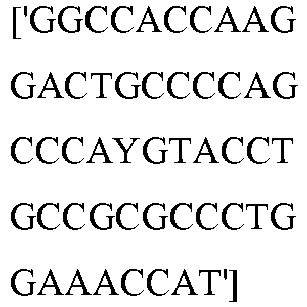
2764 
2981 
NM_000175.3( GPI):c.1574T> C (p.lle525Thr) 2821 GPI 2593 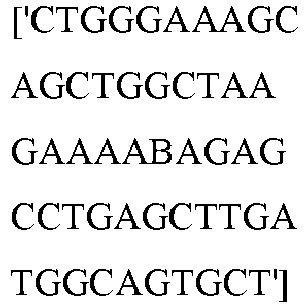
2765 
2982 
NM_000315.2( PTH):c.52T>C (p.Cys18Arg) 5741 PTH 2594 
2766 
2983 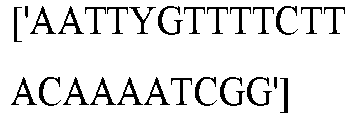
NM_000222.2( KIT):c.1676T> C (p.Val559Ala) 3815 KIT 2595 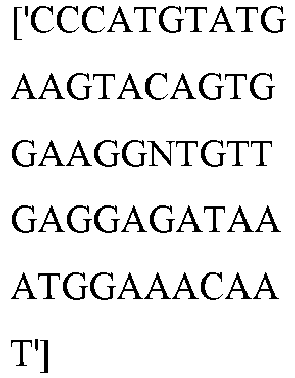
2767 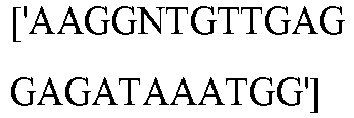
2984 
NM_016835.4( MAPT):c.1839 T>C (p.Asn613=) 4137 MAPT 2596 
2768 - 2769 
2985 - 2986 
NM_170707.3( LMNA):c.1139 T>C (p.Leu380Ser) 4000 LMNA 2597 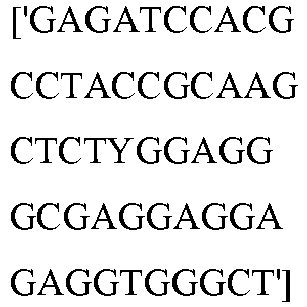
2770 
2987 
NM_000424.3( KRT5):c.20T> C (p.Val7Ala) 3852 KRTS 2598 
2771 - 2773 
2988 - 2991 
NM_000184.2( HBG2):c.125T >C (p.Phe42Ser) 3048 HBG2 2599 
2774 
2992 
NM_000515.4( GH1):c.291+6T >C 2688 GH1 2600 
2775 
2993 
NM_002087.3( GRN):c.2T>C (p.MetlThr) 2896 GRN 2601 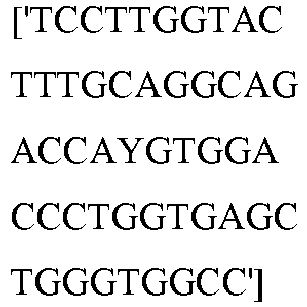
2776 
2994 
NM_00108311 2.2(GPD2):c.19 04T>C (p.Phe635Ser) 2820 GPD2 2602 
2777 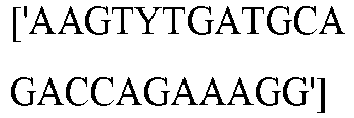
2995 
NM_00101807 7.1(NR3C1):c.1 712T>C (p.Val571Ala) 2908 NR3C1 2603 
2778 
2996 
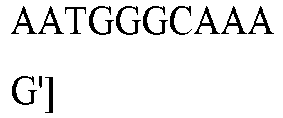
NM_000138.4( FBNl):c.3793T >C (p.Cys1265Arg ) 2200 FBN1 2604 
2779 
2997 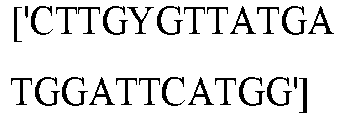
NM_000129.3( F13A1):c.728T >C (p.Met243 Thr) 2162 F13A1 2605 
2780 
2998 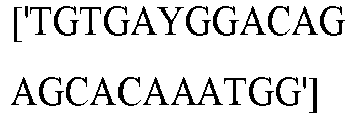
NM_031226.2( CYP19A1):c.74 3+2T>C -1 - 2606 
2781 
2999 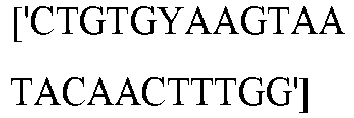
NM_000416.2( IFNGRl):c.260 T>C (p.Ile87Thr) 3459 IFNGR 1 2607 
2782 
3000 
NM_000018.3( ACADVL):c.84 8T>C (p.Val283Ala) 37 ACAD VL 2608 
2783 - 2784 
3001 - 3002 
NM_000195.4( HPS1):c.716T> C (p.Leu239Pro) 3257 HPS1 2609 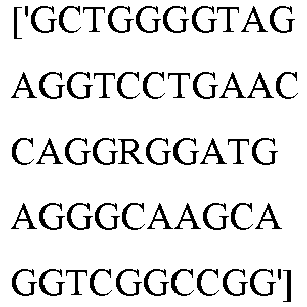
2785 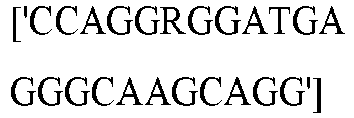
3003 
NM_000352.4( ABCC8):c.257 T>C (p.Val86Ala) 6833 ABCC 8 2610 
2786 - 2787 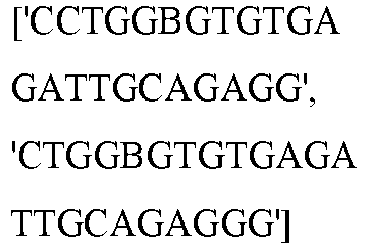
3004 - 3005 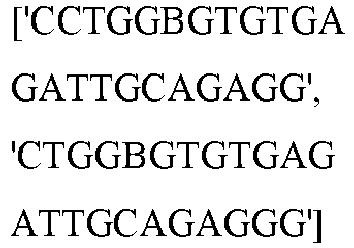
NM_000528.3( MAN2B1):c.24 26T>C (p.Leu809Pro) 4125 MAN2 Bl 2611 
2788 
3006 - 3007 
NM_002863.4( 5836 PYGL 2612 
2789 
3008 
PYGL):c.2461 T>C (p.Tyr821His) 


NM_000495.4( COL4A5):c.46 99T>C (p.Cys1567Arg ) 1287 COL4 A5 2613 
2790 
3009 
NM_000155.3( GALT):c.460T >C (p.Trp154Arg) 2592 GALT 2614 
2791 
3010 
NM_000155.3( GALT):c.482T >C (p.Leu161Pro) 2592 GALT 2615 
2792 
3011 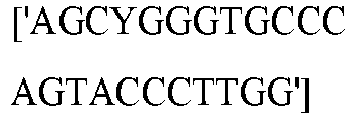
NM_000155.3( GALT):c.499T >C (p.Trpl67Arg) 2592 GALT 2616 
2793 
3012 
NM_000155.3( GALT):c.509T >C (p.llel70Thr) 2592 GALT 2617 
2794 
3013 
NM_004523.3( KIF11):c.2547+ 2T>C 3832 KIF11 2618 
2795 
3014 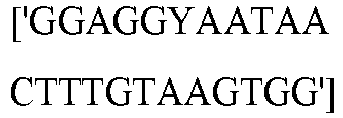
NM_005211.3( CSF1R):c.2381 T>C (p.Ile794Thr) 1436 CSF1R 2619 
2796 
3015 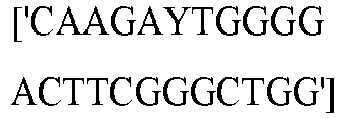
NM_005188.3( CBL):c.ll50T> C (p.Cys384Arg) 867 CBL 2620 
2797 
3016 
NM_006306.3( SMC1A):c.235 1T>C (p.Ile784Thr) 8243 SMC1 A 2621 
2798 
3017 
NM_002242.4( KCNJ13):c.722 T>C (p.Leu241Pro) -1 - 2622 
2799 
3018 
NM_000199.3( SGSH):c.892T >C (p.Ser298Pro) 6448 SGSH 2623 
2800 
3019 
NM_020191.2( MRPS22):c.644 T>C (p.Leu215Pro) 5694 5 MRPS2 2 2624 
2801 
3020 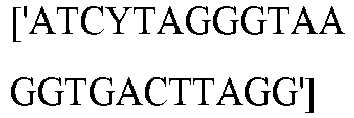
NM_017882.2( CLN6):c.200T> C (p.Leu67Pro) 5498 2 CLN6 2625 
2802 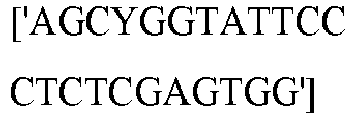
3021 
NM_014874.3( MFN2):c.1392 +2T>C 9927 MFN2 2626 
2803 
3022 
NM_024599.5( RHBDF2):c.55 7T>C (p.Ile186Thr) 7965 1 RHBD F2 2627 
2804 
3023 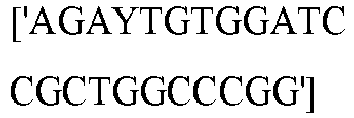
NM_020894.2( UVSSA):c.94T >C (p.Cys32Arg) 5765 4 UVSS A 2628 
2805 
3024 - 3025 
NM_00116158 1.1(POC1A):c. 398T>C 2588 6 POC1A 2629 
2806 
3026 
(p.Leu133Pro) 
NM_005340.6( HINT1):c.250T >C (p.Cys84Arg) 3094 HINT1 2630 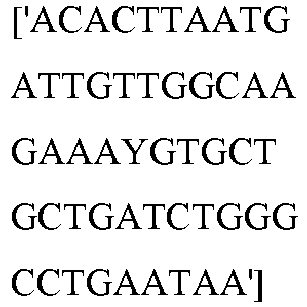
2807 - 2808 
3027 - 3028 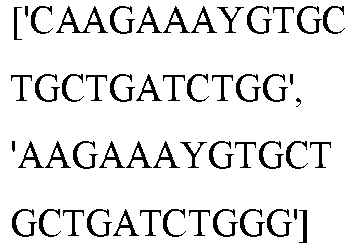
NM_000495.4( COL4A5):c.43 8+2T>C 1287 COL4 A5 2631 
2809 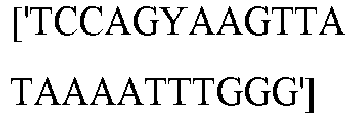
3029 - 3030 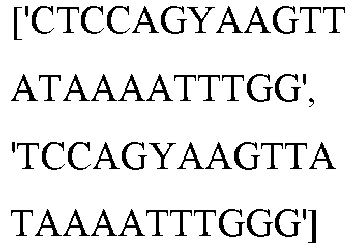
NM_000344.3( SMN1):c.388T >C (p.Tyr130His) 6606 SMN1 2632 
2810 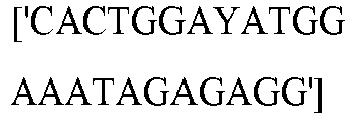
3031 
NM_005334.2( HCFC1):c.-970T>C 3054 HCFC1 2633 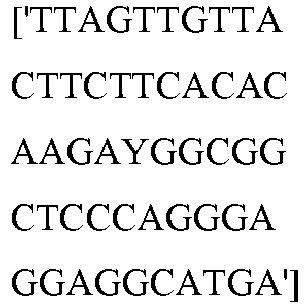
2811 
3032 
NM_000431.3( MVK):c.1039+ 2T>C 4598 MVK 2634 
2812 
3033 - 3034 
NM_018344.5( SLC29A3):c.60 7T>C (p.Ser203Pro) 5531 5 SLC29 A3 2635 
2813 
3035 - 3036 
NM_000108.4( DLD):c.140T> C (p.Ile47Thr) 1738 DLD 2636 
2814 - 2815 
3037 - 3038 
NM_004333.4( BRAF):c.1403 T>C (p.Phe468Ser) 673 BRAF 2637 
2816 - 2817 
3039 - 3040 
NM_000540.2( RYR1):c.1205T 6261 RYR1 2638 
2818 
3041 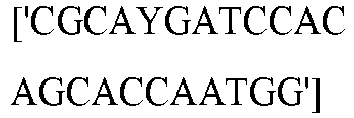
>C (p.Met402Thr) 
NM_000256.3( MYBPC3):c.13 51+2T>C 4607 MYBP C3 2639 
2819 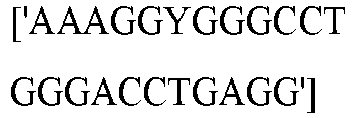
3042 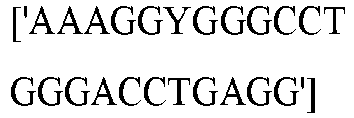
NM_000256.3( MYBPC3):c.82 1+2T>C 4607 MYBP C3 2640 
2820 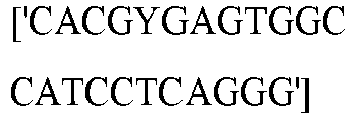
3043 - 3044 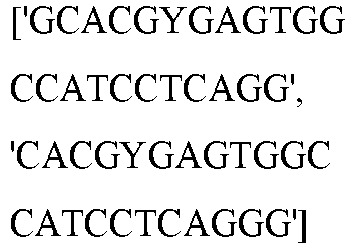
NM_000257.3( MYH7):c.2546 T>C (p.Met849Thr) 4625 MYH7 2641 
2821 
3045 
NM_206933.2( USH2A):c.160 6T>C (p.Cys536Arg) 7399 USH2 A 2642 
2822 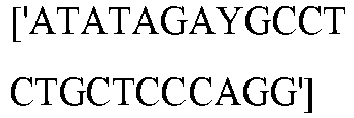
3046 
NM_000059.3( BRCA2):c.316 +2T>C 675 BRCA 2 2643 
2823 
3047 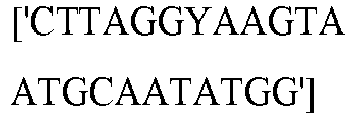
NM_007294.3( BRCA1):c.529 1T>C (p.Leu1764Pro) 672 BRCA 1 2644 
2824 
3048 - 3049 
NM_00113008 9.1(KARS):c.5 17T>C (p.Tyr173His) 3735 KARS 2645 
2825 
3050 - 3051 
NM_00128300 9. 1 (RTEL 1): c. 3 730T>C (p.Cys1244Arg -1 - 2646 
2826 
3052 
) 
NM_005554.3( KRT6A):c.140 6T>C (p.Leu469Pro) 3853 KRT6 A 2647 
2827 
3053 
NM_000218.2( KCNQ1):c.550 T>C (p.Tyr184His) 3784 KCNQ 1 2648 
2828 
3054 - 3056 
NM_198056.2( SCN5A):c.5624 T>C (p.Met1875Thr) 6331 SCN5A 2649 
2829 
3057 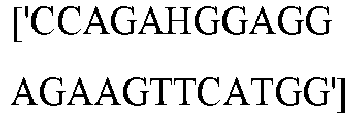
NM_006920.4( SCN1A):c.269 T>C (p.Phe90Ser) 6323 SCN1A 2650 
2830 - 2831 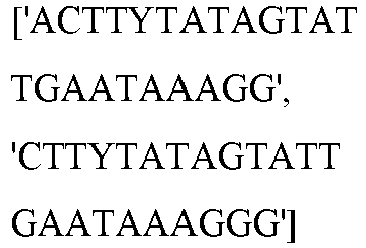
3058 - 3059 
NM_006920.4( SCN1A):c.272 T>C (p.lle91 Thr) 6323 SCN1A 2651 
2832 - 2833 
3060 - 3061 
NM_006514.3( SCN10A):c.166 1T>C (p.Leu554Pro) 6336 SCN10 A 2652 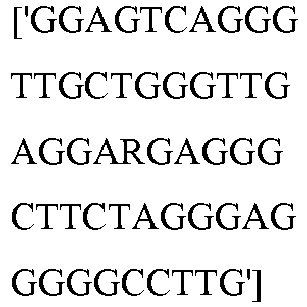
2834 - 2836 
3062 - 3064 
NM_000251.2( MSH2):c.2005 +2T>C 4436 MSH2 2653 
2837 - 2838 
3065 - 3066 
NM_000251.2( MSH2):c.595T >C (p.Cys199Arg) 4436 MSH2 2654 
2839 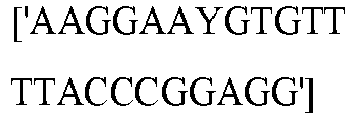
3067 
NM_00100574 2629 GBA 2655 
2840 
3068 
1.2(GBA):c.667 T>C (p.Trp223Arg) 

- 3070 
NM_003494.3( DYSF):c.1284+ 2T>C 8291 DYSF 2656 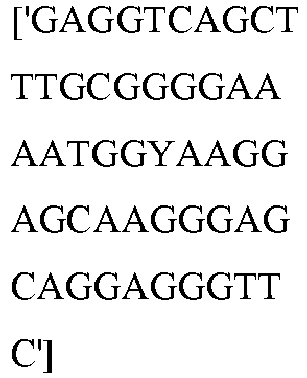
2841 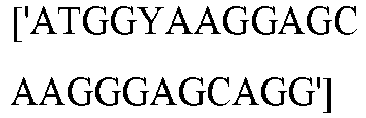
3071 
NM_012463.3( ATP6V0A2):c. 825+2T>C 2354 5 ATP6V 0A2 2657 
2842 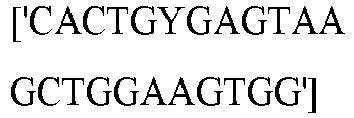
3072 
NM_016725.2( FOLR1):c.493+ 2T>C 2348 FOLR1 2658 
2843 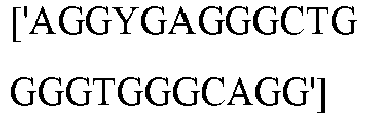
3073 - 3074 
NM_003764.3( STX11):c.173T >C (p.Leu58Pro) 8676 STX11 2659 
2844 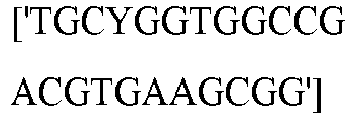
3075 
NM_014714.3( IFT140):c.4078 T>C (p.Cys1360Arg ) 9742 IFT140 2660 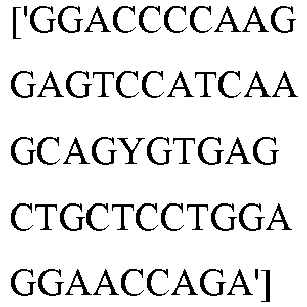
2845 
3076 - 3077 
NM_000531.5( OTC):c.1005+2 T>C 5009 OTC 2661 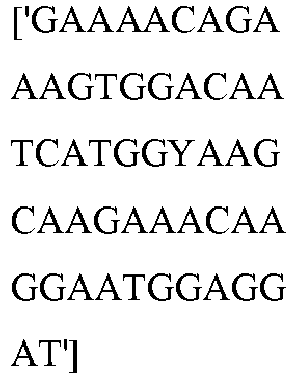
2846 
3078 
NM_000531.5( OTC):c.158T> C (p.Ile53Thr) 5009 OTC 2662 
2847 
3079 
NM_000531.5( 5009 OTC 2663 
2848 
3080 
OTC):c.284T> C (p.Leu95Ser) 


NM_000531.5( OTC):c.2T>C (p.Met1Thr) 5009 OTC 2664 
2849 
3081 
NM_000531.5( OTC):c.526T> C (p.Tyr176His) 5009 OTC 2665 
2850 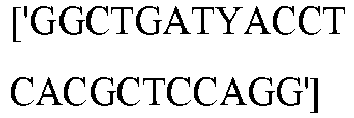
3082 - 3083 
NM_000531.5( OTC):c.779T> C (p.Leu260Ser) 5009 OTC 2666 
2851 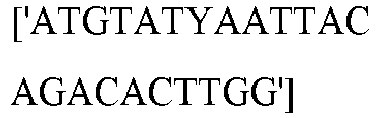
3084 
NM_000322.4( PRPH2):c.736T >C (p.Trp246Arg) 5961 PRPH2 2667 
2852 - 2853 
3085 - 3086 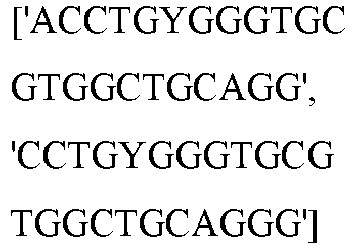
NM_000211.4( ITGB2):c.1877 +2T>C 3689 ITGB2 2668 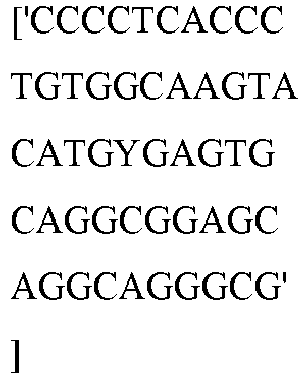
2854 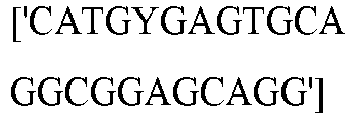
3087 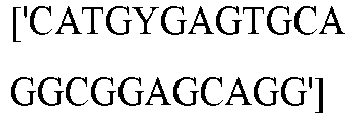
NM_015474.3( SAMHD1):c.11 06T>C (p.Leu369Ser) 2593 9 SAMH D1 2669 
2855 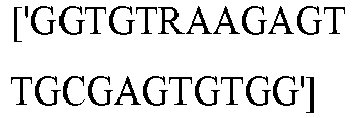
3088 
NM_001101.3( ACTB):c.356T >C (p.Met119Thr) 60 ACTB 2670 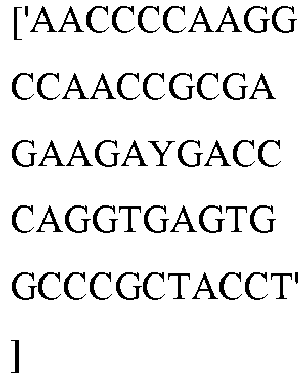
2856 
3089 
NM_015713.4( RRM2B):c.368 T>C 5048 4 RRM2 B 2671 
2857 
3090 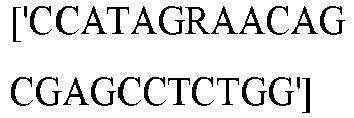
(p.Phe123Ser) 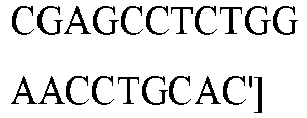
NM_015599.2( PGM3):c.248T >C (p.Leu83Ser) 5238 PGM3 2672 
2858 
3091 
NM_002136.2( HNRNPA1):c.8 17T>C (p.Phe273 Leu) 3178 HNRN PA1 2673 2859 - 2861 3092 - 3094 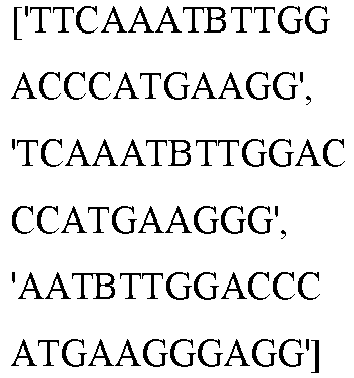
NM_002136.2( HNRNPA1):c.8 41T>C (p.Phe281Leu) 3178 HNRN PA1 2674 2862 3095 
NM_022552.4( DNMT3 A): c.27 05T>C (p.Phe902Ser) 1788 DNMT 3A 2675 
2863 
3096 
NM_000076.2( CDKN 1C): c. *5 +2T>C 1028 CDKN 1C 2676 
2864 - 2866 
3097 - 3099 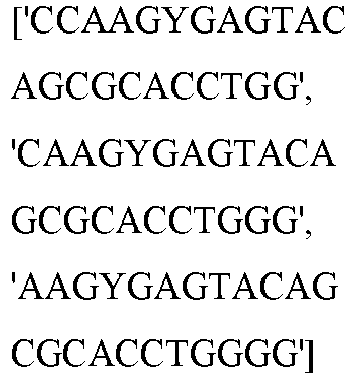
NC_012920.1: m.9478T>C 4514 MT-CO3 2677 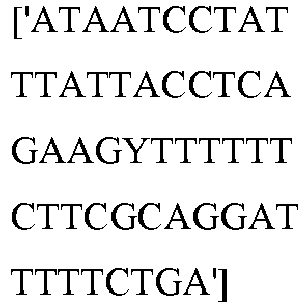
2867 
3100 
NM_002049.3( GATA1):c.2T> C (p.Met1Thr) 2623 GATA 1 2678 
2868 - 2869 
3101 - 3103 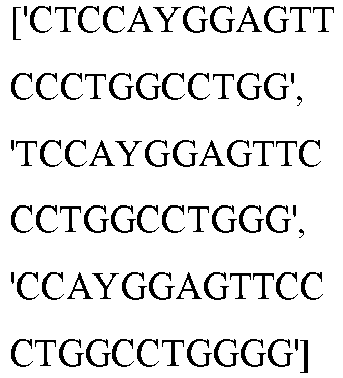
NM_005740.2( DNAL4):c.153 +2T>C 1012 6 DNAL 4 2679 
2870 
3104 

NM_00128722 3.1(SCN11A):c .1142T>C (p.Ile381Thr) 1128 0 SCN11 A 2680 
2871 
3105 - 3106 
NM_00130294 6.1(TRNT1):c.4 97T>C (p.Leu166Ser) 5109 5 TRNT1 2681 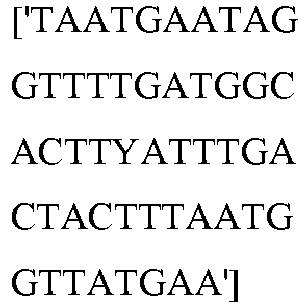
2872 
3107 
NM_178151.2( DCX):c.2T>C (p.Met1Thr) 1641 DCX 2682 
2873 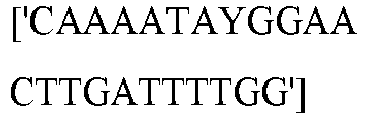
3108 
NM_000169.2( GLA):c.758T> C(p.Ile253Thr) -1 - 2683 
2874 
3109 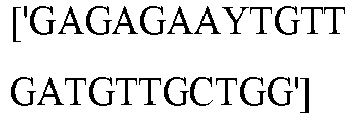
NM_170707.3( LMNA):c.710T >C (p.Phe237Ser) 4000 LMNA 2684 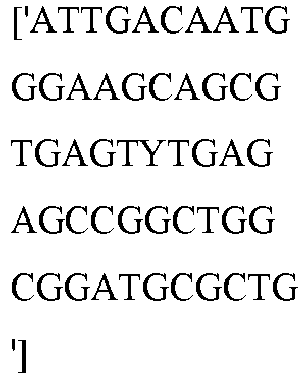
2875 
3110 
NM_000256.3( MYBPC3):c.33 30+2T>C 4607 MYBP C3 2685 
2876 - 2878 
3111 - 3113 
NM_005957.4( MTHFR):c.153 0+2T>C 4524 MTHF R 2686 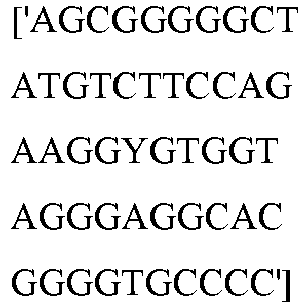
2879 - 2881 
3114 - 3116 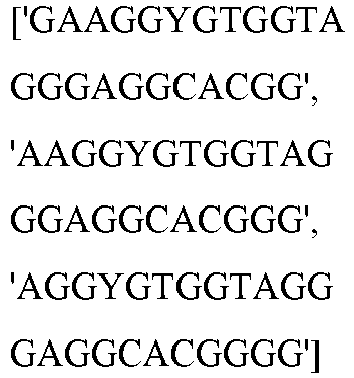
NM_000264.3( PTCH1):c.3168 +2T>C 5727 PTCH1 2687 
2882 - 2884 
3117 - 3119 


NM_000030.2( AGXT):c.322T >C (p.Trp108Arg) 189 AGXT 2688 
2885 
3120 
NM_000023.2( SGCA):c.371T >C (p.Ile124Thr) 6442 SGCA 2689 
2886 
3121 
NM_001103.3( ACTN2):c.683 T>C (p.Met228Thr) 88 ACTN 2 2690 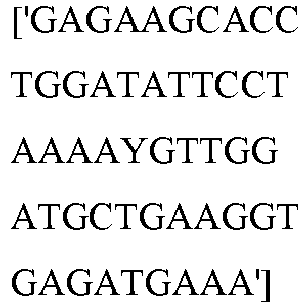
2887 
3122 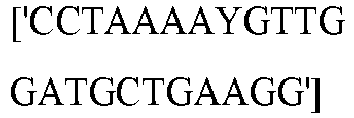
NM_00116596 3.1(SCN1A):c. 4055T>C (p.Leu1352Pro) -1 - 2691 
2888 
3123 
NM_00116596 3.1(SCN1A):c. 1265T>C (p.Val422Ala) 6323 SCN1A 2692 
2889 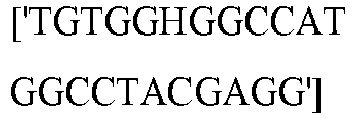
3124 
NM_000426.3( LAMA2):c.828 2T>C (p.lle2761Thr) 3908 LAMA 2 2693 
2890 - 2891 
3125 - 3126 
NM_000257.3( MYH7):c.5117 T>C (p.Leu1706Pro) -1 - 2694 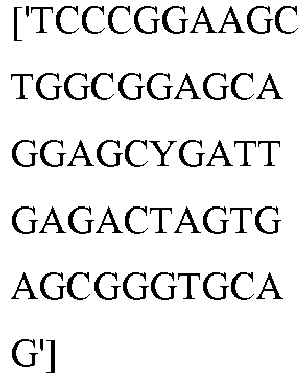
2892 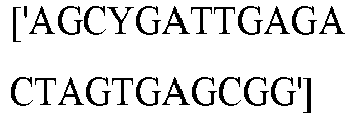
3127 
NM_001399.4( EDA):c.396+2 T>C 1896 EDA 2695 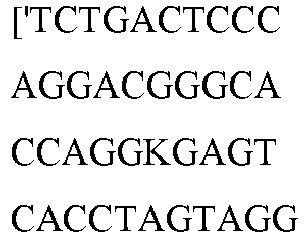
2893 - 2894 
3128 - 3130 


NM_001848.2( COL6A1):c.95 7+2T>C 1291 COL6 A1 2696 
2895 - 2896 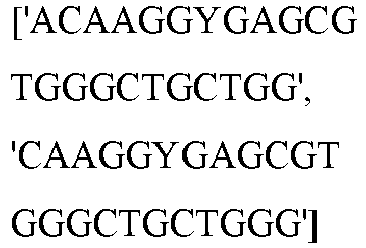
3131 - 3132 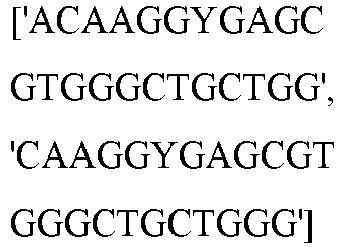
NM_000238.3( KCNH2):c.194 5+6T>C 3757 KCNH 2 2697 
2897 - 2898 
3133 - 3134 
NM_021007.2( SCN2A):c.1271 T>C (p.Val424Ala) 6326 SCN2A 2698 
2899 
3135 
NM_021007.2( SCN2A):c.4308 +2T>C 6326 SCN2A 2699 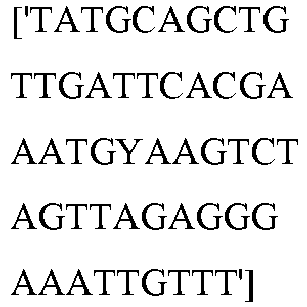
2900 - 2901 
3136 - 3137 
NM_000083.2( CLCN1):c.1283 T>C (p.Phe428Ser) 1180 CLCN1 2700 
2902 - 2903 
3138 - 3139 
NM_004550.4( NDUFS2):c.87 5T>C (p.Met292Thr) 4720 NDUF S2 2701 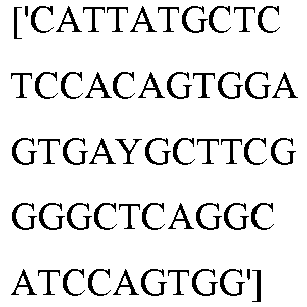
2904 
3140 
NM_000546.5( TP53):c.584T> C (p.Ile195Thr) 7157 TP53 2702 
2905 - 2906 
3141 - 3143 
Table 3. A to G with NGG PAM. Table 2 shows a list of A to G mutations that may be corrected using any of the base editors provided herein. GRNAs and gRNAall indicate the protospacer and PAM sequence, where the PAM sequence is the last 3 nucleotides of each of the sequences in GRNAs and gRNAall. Name Gene ID Gene Symbol SEQ ID NO: Flanks SEQ ID NO: gRNAs SEQ ID NO: gRNAall NM_017547.3(FO XRED 1):c.1289A >G (p.Asn430Ser) 5557 2 FOXRE D1 5084 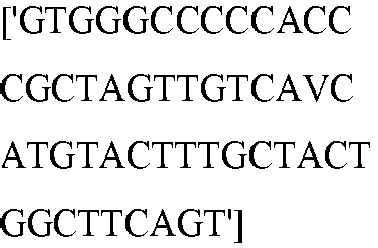
5261 
5464 - 5466 
NM_000071.2(C BS):c.1150A>G (p.Lys384Glu) 875 CBS 5085 
5262 
5467 - 5470 
NM_000552.3(V WF):c.2384A>G (p.Tyr795Cys) 7450 VWF 5086 
5263 
5471 
NM_000552.3(V WF):c.1583A>G (p.Asn528Ser) 7450 VWF 5087 
5264 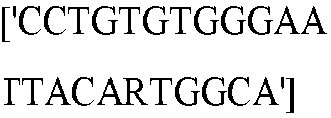
5472 
NM_000308.2(CT SA):c.1238A>G (p.Tyr413Cys) 5476 CTSA 5088 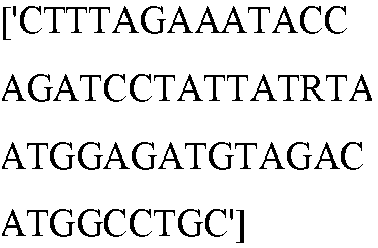
5265 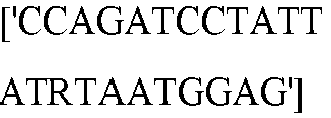
5473 
NM_000277.1(PA H):c.916A>G (p.lle306Val) 5053 PAH 5089 
5266 
5474 - 5476 
NM_000512.4(G ALNS):c.1460A> G (p.Asn487Ser) 2588 GALN S 5090 
5267 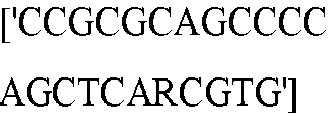
5477 
NM_013319.2(U BIAD1):c.305A> G (p.Asn102Ser) 2991 4 UBIAD 1 5091 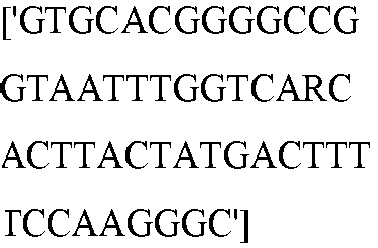
5268 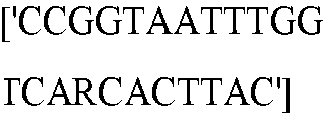
5478 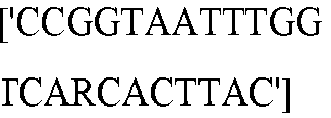
NM_013319.2(U 2991 UBIAD 5092 
5269 
5479 
BIAD1):c.695A> G (p.Asn232Ser) 4 1 


NM_000275.2(O CA2):c.1465A>G (p.Asn489Asp) 4948 OCA2 5093 
5270 
5480 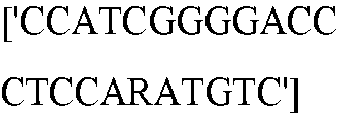
NM_001127255.1 (NLRP7):c.2738A >G (p.Asn913Ser) -1 - 5094 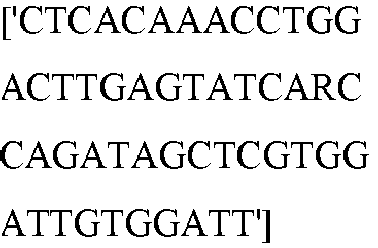
5271 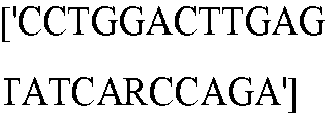
5481 
NM_152783.4(D2 HGDH):c.1315A> G (p.Asn439Asp) 7282 94 D2HG DH 5095 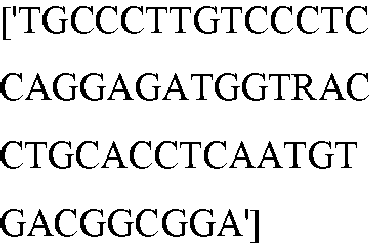
5272 
5482 - 5483 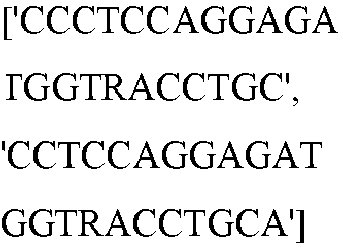
NM_022132.4(M CCC2):c.1309A> G (p.Ile437Val) 6408 7 MCCC 2 5096 
5273 
5484 
NM_000022.2(A DA):c.219-2A>G 100 ADA 5097 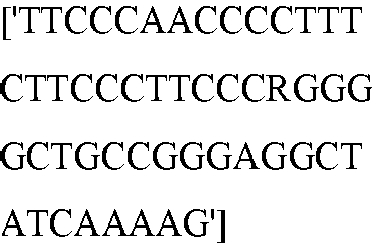
5274 
5485 - 5487 
NM_017780.3(C HD7):c.3082A>G (p.Ile1028Val) 5563 6 CHD7 5098 
5275 
5488 
NM_000483.4(AP OC2):c.1A>G (p.Met1Val) -1 - 5099 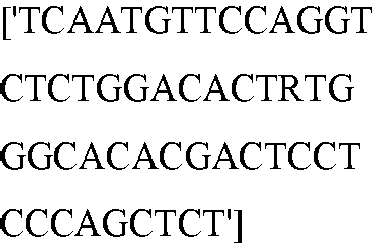
5276 
5489 
NM_000391.3(TP P1):c.887-10A>G 1200 TPP1 5100 
5277 
5490 
NM_017890.4(VP S13B):c.8978A> G (p.Asn2993Ser) 1576 80 VPS13 B 5101 
5278 
5491 
NM_000226.3(K RT9):c.482A>G (p.Asn161Ser) 3857 KRT9 5102 
5279 
5492 

NM_000529.2(M C2R):c.761A>G (p.Tyr254Cys) 4158 MC2R 5103 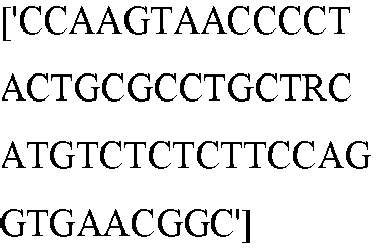
5280 - 5281 
5493 - 5495 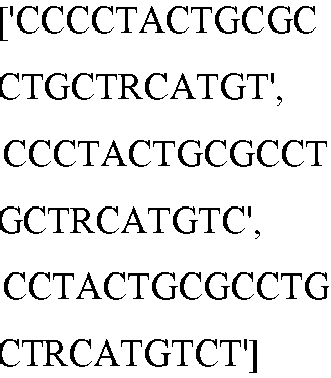
NM_005957.4(M THFR):c.971A>G (p.Asn324Ser) 4524 MTHF R 5104 
5282 
5496 
NM_000403.3(G ALE):c.101A>G (p.Asn34Ser) 2582 GALE 5105 
5283 
5497 
NM_000356.3(TC OF1):c.149A>G (p.Tyr50Cys) 6949 TCOF1 5106 
5284 - 5285 
5498 - 5499 
NM_012464.4(TL L1):c.1885A>G (p.lle629Val) 7092 TLL1 5107 
5286 
5500 
NM_000112.3(SL C26A2):c.1273A> G (p.Asn425Asp) 1836 SLC26 A2 5108 
5287 
5501 
NM_000157.3(G BA):c.680A>G (p.Asn227Ser) 2629 GBA 5109 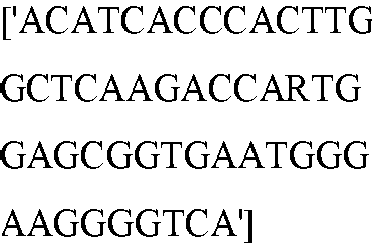
5288 
5502 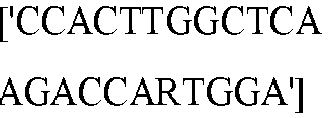
NM_175073.2(AP TX):c.602A>G (p.His201Arg) 5484 0 APTX 5110 
5289 - 5290 
5503 - 5504 
NM_020638.2(FG F23):c.211A>G (p.Ser71Gly) 8074 FGF23 5111 
5291 
5505 - 5507 
NM_021102.3(SP INT2):c.488A>G (p.Tyr163Cys) 1065 3 SPINT2 5112 
5292 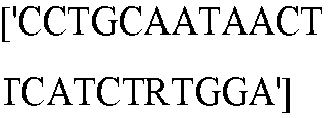
5508 

NM_004795.3(K L):c.578A>G (p.His 193 Arg) 9365 KL 5113 
5293 
5509 
NM_012193.3(FZ D4):c.766A>G (p.lle256Val) -1 - 5114 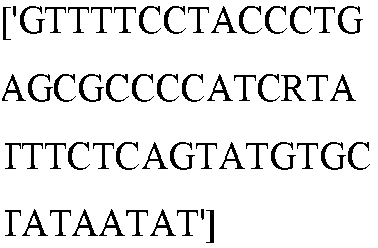
5294 - 5295 
5510 - 5511 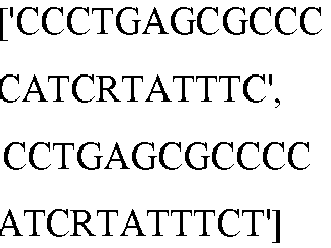
NM_001099274.1 (TINF2):c.838A> G (p.Lys280Glu) 2627 7 TINF2 5115 
5296 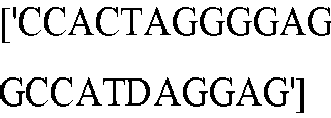
5512 
NM_005682.6(A DGRG1):c.263A> G (p.Tyr88Cys) 9289 ADGR G1 5116 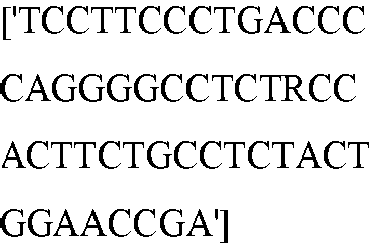
5297 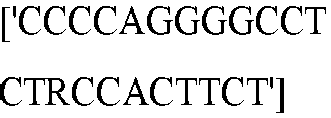
5513 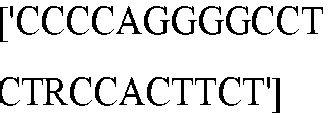
NM_000369.2(TS HR):c.1856A>G (p.Asp619Gly) 7253 TSHR 5117 
5298 
5514 
NM_024009.2(GJ B3):c.497A>G (p.Asn166Ser) 2707 GJB3 5118 
5299 
5515 
NM_003722.4(TP 63):c.697A>G (p.Lys233Glu) 8626 TP63 5119 
5300 
5516 
NM_003494.3(D YSF):c.3443-33A>G 8291 DYSF 5120 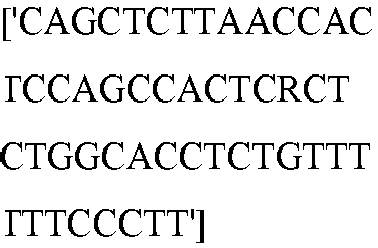
5301 
5517 
NM_003494.3(D YSF):c.1285-2A>G 8291 DYSF 5121 
5302 
5518 - 5520 
NM_002408.3(M GAT2):c.785A>G (p.His262Arg) 4247 MGAT 2 5122 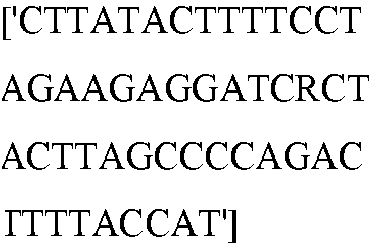
5303 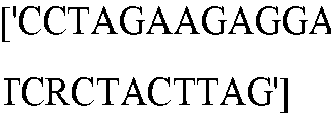
5521 
NM_000492.3(CF 1080 CFTR 5123 
5304 
5522 
TR):c.2738A>G (p.Tyr913 Cys) 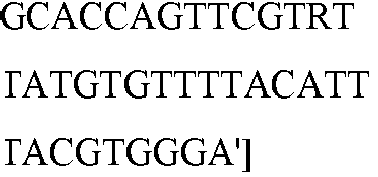


NM_001814.4(CT SC):c.857A>G (p.Gln286Arg) 1075 CTSC 5124 
5305 
5523 - 5525 
NM_005144.4(H R):c.-218A>G 5580 6 HR 5125 5306 5526 - 5527 
NM_018488.2(TB X4):c.1592A>G (p.Gln531Arg) 9496 TBX4 5126 
5307 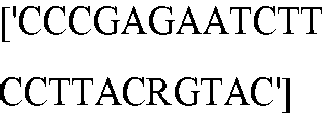
5528 - 5529 
NM_001089.2(A BCA3):c.1702A> G (p.Asn568Asp) 21 ABCA3 5127 
5308 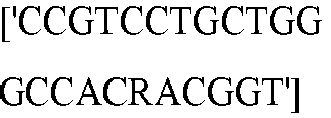
5530 
NM_000525.3(K CNJ11):c.776A> G (p.His259Arg) 3767 KCNJ1 1 5128 
5309 - 5310 
5531 - 5533 
NM_005587.2(M EF2A):c.788A>G (p.Asn263Ser) 4205 MEF2A 5129 
5311 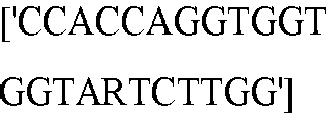
5534 
NM_000098.2(CP T2):c.359A>G (p.Tyr120Cys) 1376 CPT2 5130 
5312 
5535 - 5536 
NM_178138.4(L HX3):c.332A>G (p.Tyr111Cys) 8022 LHX3 5131 
5313 - 5314 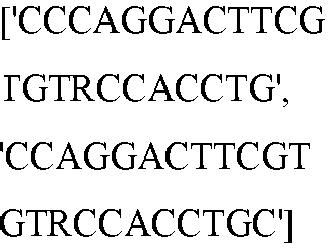
5537 - 5538 
NM_005502.3(A BCA1):c.2804A> G (p.Asn935Ser) 19 ABCA1 5132 
5315 
5539 - 5540 
m.3260A>G 4567 MT-TL1 5133 
5316 
5541 - 

- 5317 
5542 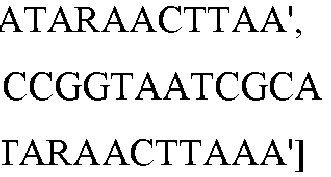
m.4269A>G 4565 MT-TI 5134 
5318 - 5319 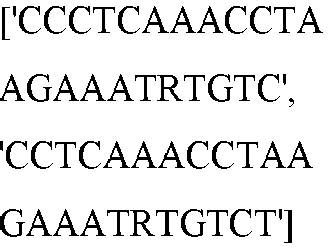
5543 - 5544 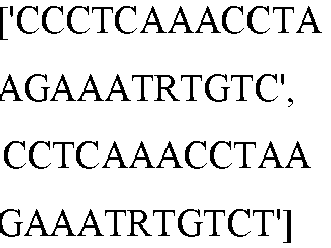
m.14495A>G 4541 MT-ND6 5135 
5320 
5545 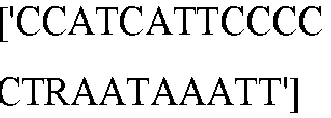
NM_002764.3(PR PS1):c.341A>G (p.Asn114Ser) 5631 PRPS1 5136 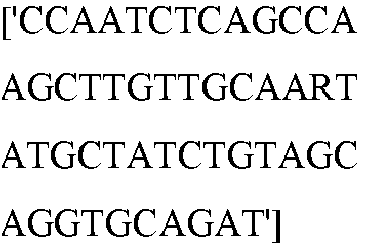
5321 
5546 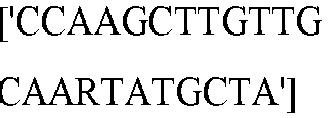
NM_000054.4(A VPR2):c.614A>G (p.Tyr205Cys) 554 AVPR2 5137 
5322 
5547 
NM_000033.3(A BCD1):c.443A>G (p.Asn148Ser) 215 ABCD1 5138 
5323 - 5324 
5548 - 5549 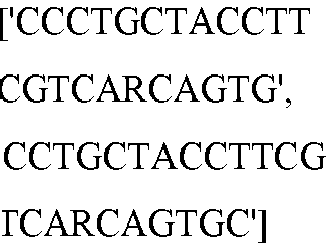
NM_000061.2(BT K):c.1082A>G (p.Tyr361Cys) 695 BTK 5139 
5325 - 5326 
5550 - 5551 
NM_003413.3(ZI C3):c.1213A>G (p.Lys405Glu) 7547 ZIC3 5140 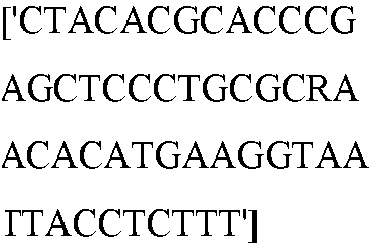
5327 
5552 - 5553 
NM_005448.2(B MP15):c.704A>G (p.Tyr235Cys) 9210 BMP15 5141 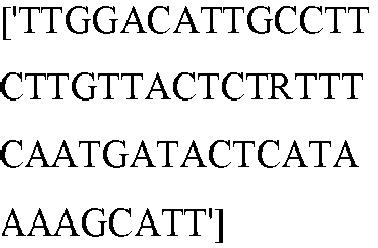
5328 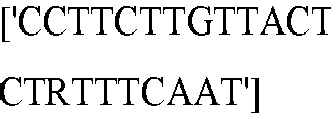
5554 
NM_001363.4(D KC1):c.1069A>G (p.Thr357Ala) 1736 DKC1 5142 
5329 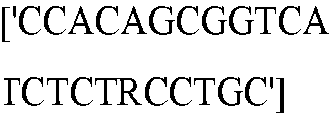
5555 
NM_000481.3(A MT):c.125A>G (p.His42Arg) 275 AMT 5143 
5330 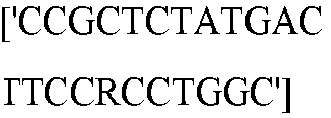
5556 
NM_003361.3(U 7369 UMOD 5144 
5331 
5557 - 
MOD):c.383A>G (p.Asn128Ser) 

5558 
NM_001382.3(DP AGT1):c.509A>G (p.Tyr170Cys) 1798 DPAG T1 5145 
5332 
5559 
NM_001128177.1 (THRB):c.1324A >G (p.Met442Val) 7068 THRB 5146 
5333 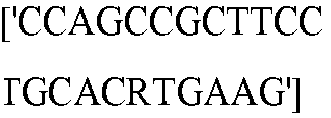
5560 
NM_000141.4(FG FR2):c.874A>G (p.Lys292Glu) 2263 FGFR2 5147 
5334 
5561 - 5563 
NM_000371.3(TT R):c.401A>G (p.Tyr134Cys) 7276 TTR 5148 
5335 - 5337 
5564 - 5566 
NM_000371.3(TT R):c.379A>G (p.Ile127Val) 7276 TTR 5149 
5338 
5567 - 5569 
NM_000174.4(GP 9):c.182A>G (p.Asn61Ser) 2815 GP9 5150 
5339 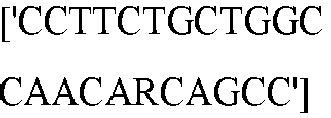
5570 
NM_000222.2(KI T):c. 1924A>G (p.Lys642 Glu) 3815 KIT 5151 
5340 - 5341 
5571 - 5572 
NM_000530.6(M PZ):c.242A>G (p.His81Arg) 4359 MPZ 5152 
5342 
5573 
NM_000233.3(L HCGR):c.1733A> G (p.Asp578Gly) -1 - 5153 
5343 
5574 

NM_000421.3(K RT10):c.1374-2A>G -1 - 5154 
5344 
5575 
NM_000422.2(K RT17):c.274A>G (p.Asn92Asp) 3872 KRT17 5155 
5345 
5576 - 5577 
NM_000422.2(K RT17):c.275A>G (p.Asn92Ser) 3872 KRT17 5156 
5346 
5578 - 5579 
NM_000823.3(G HRHR):c.985A> G (p.Lys329Glu) 2692 GHRH R 5157 
5347 
5580 
NM_000407.4(GP 1BB):c.338A>G (p.Tyr113Cys) -1 - 5158 
5348 - 5349 
5581 - 5583 
NM_001146040.1 (GLRA1):c.920A >G (p.Tyr307Cys) 2741 GLRA1 5159 
5350 - 5351 
5584 - 5586 
NM_182925.4(FL T4):c.3104A>G (p.His1035Arg) 2324 FLT4 5160 
5352 
5587 
NM_212482.1(FN 1):c.2918A>G (p.Tyr973Cys) 2335 FN1 5161 
5353 - 5354 
5588 - 5589 
NM_000121.3(EP OR):c.1460A>G (p.Asn487Ser) 2057 EPOR 5162 
5355 
5590 
NM_001735.2(C5 ):c.1115A>G (p.Lys372Arg) 727 C5 5163 
5356 - 5357 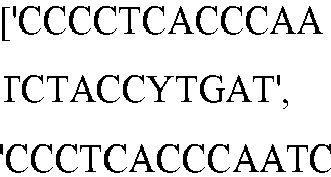
5591 - 5593 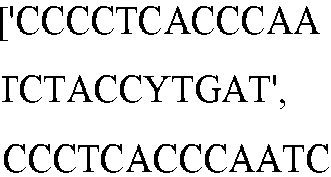


NM_001844.4(C OL2A1):c.4172A >G (p.Tyr1391Cys) 1280 COL2A 1 5164 
5358 - 5359 
5594 - 5595 
NM_001904.3(CT NNB 1):c.121A>G (p.Thr41Ala) 1499 CTNN B1 5165 
5360 
5596 
NM_000040.1(AP OC3):c.280A>G (p.Thr94Ala) 345 APOC3 5166 
5361 - 5362 
5597 - 5598 
NM_000488.3(SE RPINC1):c.655A >G (p.Asn219Asp) 462 SERPI NC1 5167 
5363 
5599 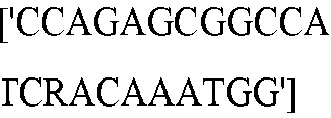
NM_001085.4(SE RPINA3):c.1240 A>G (p.Met414Val) 12 SERPI NA3 5168 
5364 
5600 - 5601 
NM_001145.4(A NG):c.121A>G (p.Lys41Glu) -1 - 5169 
5365 
5602 - 5603 
NM_001100.3(A CTA1):c.350A>G (p.Asn117Ser) 58 ACTA1 5170 
5366 
5604 - 5605 
NM_014053.3(FL VCR1):c.361A>G (p.Asn121Asp) 2898 2 FLVCR 1 5171 
5367 
5606 
NM_000334.4(SC N4A):c.4078A>G (p.Met1360Val) 6329 SCN4A 5172 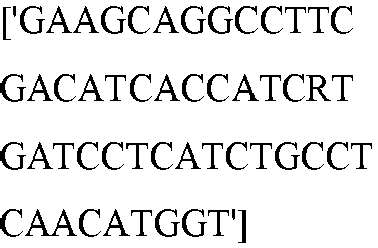
5368 
5607 
NM_004519.3(K CNQ3):c.1403A> G (p.Asn468Ser) 3786 KCNQ 3 5173 
5369 
5608 
NM_007375.3(T 2343 TARD 5174 
5370 
5609 
ARDBP):c.800A> G (p.Asn267Ser) 5 BP 


NM_032520.4(G NPTG):c.610-2A>G 8457 2 GNPT G 5175 
5371 
5610 
NM_000495.4(C OL4A5):c.466-2A>G 1287 COL4A 5 5176 
5372 
5611 
NM_000495.4(C OL4A5):c.1340-2A>G 1287 COL4A 5 5177 
5373 
5612 
NM_000060.3(BT D):c.278A>G (p.Tyr93Cys) 686 BTD 5178 
5374 
5613 
NM_000060.3(BT D):c.641A>G (p.Asn214Ser) 686 BTD 5179 
5375 
5614 
NM_000094.3(C OL7A1):c.425A> G (p.Lys142Arg) 1294 COL7A 1 5180 
5376 
5615 - 5616 
NM_005247.2(FG F3):c.146A>G (p.Tyr49Cys) 2248 FGF3 5181 
5377 - 5378 
5617 - 5618 
NM_000313.3(PR OS1):c.701A>G (p.Tyr234Cys) 5627 PROS 1 5182 
5379 - 5380 
5619 - 5621 
NM_004612.3(T GFBR1):c.134A> G (p.Asn45Ser) 7046 TGFBR 1 5183 
5381 
5622 
m.608A>G 4558 MT-TF 5184 
5382 
5623 - 5624 


NM_001376.4(D YNC1H1):c.2909 A>G (p.Tyr970Cys) 1778 DYNC 1H1 5185 
5383 
5625 
NM_000459.4(TE K):c.2690A>G (p.Tyr897Cys) 7010 TEK 5186 
5384 
5626 
NM_014191.3(SC N8A):c.5302A>G (p.Asn1768Asp) 6334 SCN8A 5187 
5385 
5627 
NM_002552.4(O RC4):c.521A>G (p.Tyr174Cys) 5000 ORC4 5188 
5386 
5628 
NM_004813.2(PE X16):c.992A>G (p.Tyr331Cys) 9409 PEX16 5189 
5387 - 5388 
5629 - 5630 
NM_016952.4(C DON):c.2368A>G (p.Thr790Ala) 5093 7 CDON 5190 
5389 
5631 
NM_016464.4(T MEM138):c.287A >G (p.His96Arg) 5152 4 TMEM 138 5191 
5390 - 5391 
5632 - 5633 
NM_005022.3(PF N1):c.350A>G (p.Glu117Gly) 5216 PFN1 5192 
5392 
5634 
NM_022787.3(N MNAT1):c.817A >G (p.Asn273Asp) 6480 2 NMNA T1 5193 
5393 
5635 
NM_005340.6(HI NT1):c.152A>G (p.His51Arg) 3094 HINT1 5194 
5394 - 5396 
5636 - 5638 
NM_005211.3(CS 1436 CSF1R 5195 
5397 
5639 
F1R):c.2320-2A>G 


NM_001039958.1 (MESP2):c.271A >G (p.Lys91Glu) 1458 73 MESP2 5196 
5398 
5640 
NM_001099274.1 (TINF2):c.850A> G (p.Thr284Ala) 2627 7 TINF2 5197 
5399 
5641 
NM_003863.3(DP M2):c.68A>G (p.Tyr23Cys) 8818 DPM2 5198 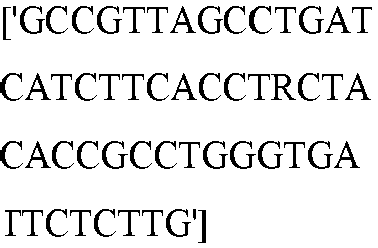
5400 
5642 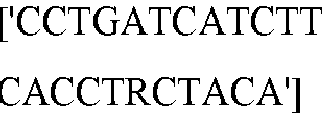
NM_000530.6(M PZ):c.347A>G (p.Asn116Ser) 4359 MPZ 5199 
5401 
5643 
NM_000138.4(FB N1):c.3058A>G (p.Thr1020Ala) 2200 FBN1 5200 
5402 
5644 
NM_000169.2(G LA):c.1153A>G (p.Thr385Ala) -1 - 5201 
5403 
5645 
NM_000257.3(M YH7):c.2206A>G (p.Ile736Val) 4625 MYH7 5202 
5404 
5646 - 5647 
NM_018972.2(G DAP1):c.368A>G (p.His123Arg) 5433 2 GDAP 1 5203 
5405 
5648 
NM_001946.3(D USP6):c.566A>G (p.Asn189Ser) 1848 DUSP6 5204 
5406 
5649 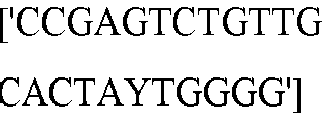
NM_003867.3(FG F17):c.560A>G (p.Asn187Ser) 8822 FGF17 5205 
5407 
5650 
NM_015560.2(OP 4976 OPA1 5206 
5408 
5651 
A1):c.1146A>G (p.Ile382Met) 


NM_002972.3(SB F1):c.1249A>G (p.Met417Val) 6305 SBF1 5207 
5409 
5652 - 5653 
NM_006876.2(B4 GAT1):c.1168A> G (p.Asn390Asp) 1104 1 B4GAT 1 5208 
5410 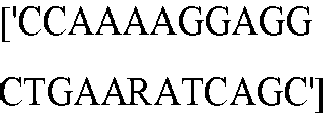
5654 - 5656 
NM_000218.2(K CNQ1):c.332A>G (p.Tyr111Cys) 3784 KCNQ 1 5209 
5411 
5657 
NM_000492.3(CF TR):c.1A>G (p.Met1Val) 1080 CFTR 5210 
5412 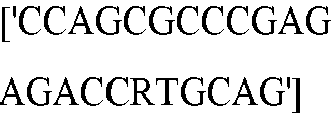
5658 - 5659 
NM_007294.3(B RCA1):c.122A>G (p.His41Arg) 672 BRCA1 5211 
5413 
5660 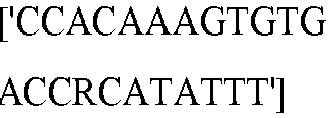
NM_007294.3(B RCA1):c.4485-2A>G 672 BRCA1 5212 
5414 
5661 - 5662 
NM_014795.3(ZE B2):c.3134A>G (p.His1045Arg) 9839 ZEB2 5213 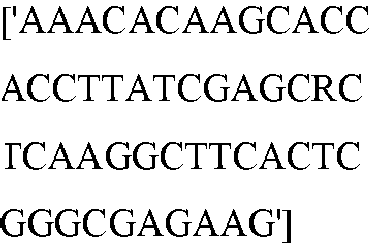
5415 
5663 
NM_001287.5(CL CN7):c.296A>G (p.Tyr99Cys) 1186 CLCN7 5214 
5416 
5664 
NM_080605.3(B3 GALT6):c.1A>G (p.Met1Val) 1267 92 B3GAL T6 5215 
5417 
5665 - 5667 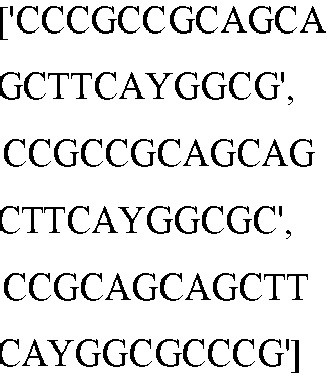
NM_000207.2(IN -1 - 5216 5418 5668 
S):c.*59A>G 


NM_000784.3(C YP27A1):c.1061 A>G (p.Asp354Gly) 1593 CYP27 A1 5217 
5419 
5669 
NM_000540.2(R YR1):c.14572A> G (p.Asn4858Asp) 6261 RYR1 5218 
5420 
5670 
NM_000238.3(K CNH2):c.1478A> G (p.Tyr493Cys) 3757 KCNH 2 5219 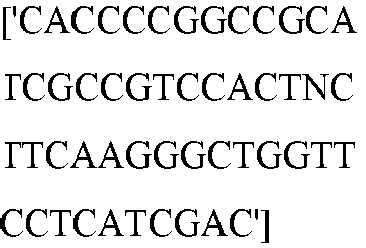
5421 
5671 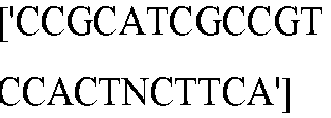
NM_000335.4(SC N5A):c.688A>G (p.lle230Val) 6331 SCN5A 5220 
5422 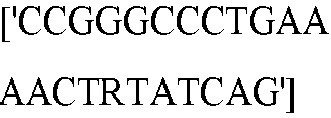
5672 
NM_000169.2(G LA):c.548-2A>G -1 - 5221 
5423 
5673 - 5674 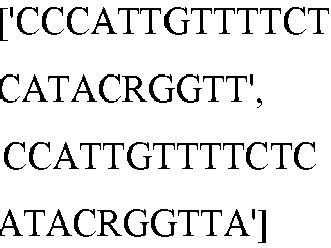
NM_000146.3(FT L):c.1A>G (p.Met1Val) 2512 FTL 5222 
5424 
5675 
NM_000531.5(O TC):c.1034A>G (p.Tyr345Cys) 5009 OTC 5223 
5425 - 5426 
5676 - 5677 
NM_000531.5(O TC):c.350A>G (p.His117Arg) 5009 OTC 5224 
5427 
5678 
NM_000531.5(O TC):c.524A>G (p.Asp175Gly) 5009 OTC 5225 
5428 
5679 
NM_000531.5(O TC):c.527A>G (p.Tyr176Cys) 5009 OTC 5226 
5429 
5680 
NM_000531.5(O 5009 OTC 5227 
5430 
5681 - 
TC):c.542A>G (p.Glu181Gly) 

5682 
NM_024301.4(FK RP):c.1A>G (p.Met1Val) 7914 7 FKRP 5228 
5431 
5683 - 5685 
NM_000321.2(R B1):c.1927A>G (p.Lys643Glu) 5925 RB1 5229 
5432 
5686 
NM_015713.4(R RM2B):c.581A> G (p.Glu194Gly) 5048 4 RRM2 B 5230 
5433 
5687 
NM_000219.5(K CNE1):c.242A>G (p.Tyr81Cys) 3753 KCNE1 5231 
5434 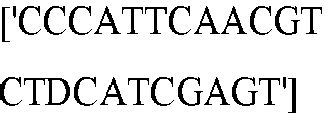
5688 
NM_003108.3(SO X11):c.347A>G (p.Tyr116Cys) 6664 SOX11 5232 
5435 
5689 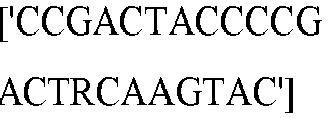
NM_002764.3(PR PS1):c.343A>G (p.Met115Val) 5631 PRPS1 5233 
5436 
5690 
NM_000546.5(TP 53):c.1101-2A>G 7157 TP53 5234 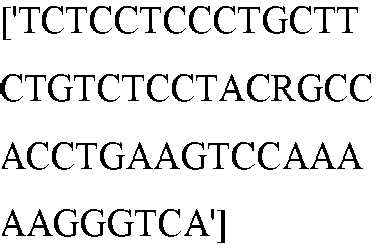
5437 
5691 
NM_000166.5(GJ B1):c.580A>G (p.Met194Val) 2705 GJB1 5235 
5438 
5692 
NM_003159.2(C DKL5):c.449A>G (p.Lys150Arg) 6792 CDKL5 5236 
5439 
5693 
NM_000053.3(A TP7B):c.122A>G (p.Asn41Ser) 540 ATP7B 5237 
5440 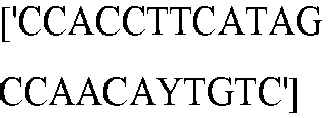
5694 - 5695 


NM_006306.3(S MC1A):c.3254A> G (p.Tyr1085Cys) 8243 SMC1 A 5238 
5441 
5696 
NM_005154.4(US P8):c.2150A>G (p.Tyr717Cys) 9101 USP8 5239 5442 5697 
NM_000117.2(E MD):c.266-2A>G 2010 EMD 5240 
5443 
5698 
NM_207352.3(C YP4V2):c.1393A >G (p.Arg465Gly) 2854 40 CYP4V 2 5241 
5444 
5699 - 5700 
NM_000546.5(TP 53):c.709A>G (p.Met237Val) 7157 TP53 5242 
5445 
5701 
NM_016069.9(PA M16):c.226A>G (p.Asn76Asp) -1 - 5243 
5446 
5702 - 5704 
NM_006785.3(M ALT1):c.1019-2A>G 1089 2 MALT 1 5244 
5447 
5705 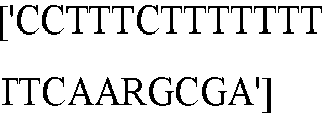
NM_004771.3(M MP20):c.611A>G (p.His204Arg) 9313 MMP2 0 5245 
5448 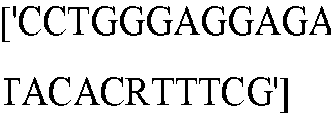
5706 
NM_003159.2(C DKL5):c.458A>G (p.Asp153Gly) 6792 CDKL5 5246 
5449 
5707 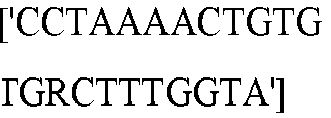
NM_001204830.1 (LIPT1):c.535A> G (p.Thr179Ala) -1 - 5247 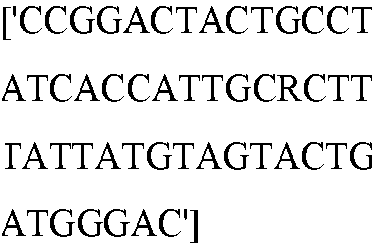
5450 
5708 
NM_000921.4(PD 5139 PDE3A 5248 
5451 
5709 
E3A):c.1333A>G (p.Thr445Ala) 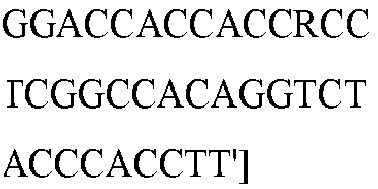


NM_000182.4(H ADHA):c.919-2A>G 3030 HADH A 5249 
5452 
5710 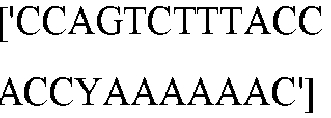
NM_000169.2(G LA):c.620A>G (p.Tyr207Cys) -1 - 5250 
5453 
5711 
NM_000238.3(K CNH2):c.2582A> G (p.Asn861Ser) 3757 KCNH 2 5251 
5454 
5712 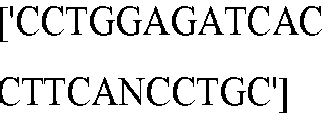
NM_000218.2(K CNQ1):c.605A>G (p.Asp202Gly) 3784 KCNQ 1 5252 
5455 
5713 
NM_012203.1(G RHPR):c.934A>G (p.Asn312Asp) 9380 GRHP R 5253 
5456 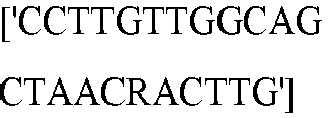
5714 
NM_021007.2(SC N2A):c.387-2A>G 6326 SCN2A 5254 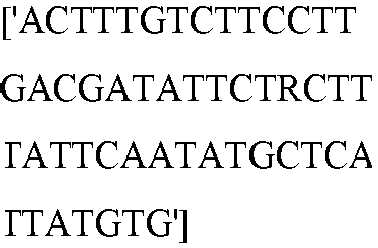
5457 
5715 
NM_002693.2(PO LG):c.2840A>G (p.Lys947Arg) 5428 POLG 5255 
5458 
5716 
NM_020533.2(M COLN1):c.1406A >G (p.Asn469Ser) 5719 2 MCOL N1 5256 
5459 
5717 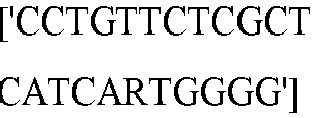
NM_000069.2(C ACNA1S):c.3526 -2A>G 779 CACN A1S 5257 
5460 
5718 - 5719 
NM_017662.4(TR PM6):c.3173A>G (p.Tyr1058Cys) 1408 03 TRPM6 5258 
5461 
5720 
NM_006642.3(SD 1080 SDCC 5259 
5462 
5721 
CCAG8):c.221-2A> G 6 AG8 


NM_003560.2(PL A2G6):c.1349-2A>G 8398 PLA2G 6 5260 
5463 
5722 - 5723 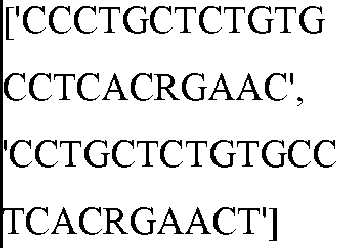
- Other familes of cytidine deaminases as alterantives to base etitor 3 (BE3) constructs were examined. The different C to T editors were developed to have a narrow or different editing window, alternate sequence specificity to expand targetable substrates, and to have higher activity.
- Using the methods described in Example 4, the pmCDAl (
cytidine deaminase 1 from Petromyzon marinus) activity at the HeK-3 site is evaluated (Figure 42 ). The pmCDAl-nCas9-UGI-NLS (nCas9 indicates the Cas9 nickase described herein) construct is active on some sites (e.g., the C bases on the complementary strand atposition - The pmCDAl activity at the HeK-2 site is given in
Figure 43 . The pmCDA1-XTEN-nCas9-UGI-NLS construct is active on sites adjacent to "G," while rAPOBECl analog (BE3 construct) has low activity on "C"s that are adjacent to "G"s, e.g., the C base atposition 11 on the complementary strand. - The percent of total sequencing reads with target C converted to T (
Figure 44 ), C converted to A (Figure 45 ), and C converted to G (Figure 46 ) are shown for CDA and APOBEC1 (the BE3 construct). - The huAPOBEC3G activity at the HeK-2 site is shown in
Figure 47 . Two constructs were used: huAPOBEC3G-XTEN-nCas9-UGI-NLS and huAPOBEC3G∗(D316R_D317R)-XTEN-nCas9-UGI-NLS. The huAPOBEC3G-XTEN-nCas9-UGI-NLS construct has different sequence specificity than rAPOBECl (BE3), as shown inFigure 47 , the editing window appears narrow, as indicated by APOBEC3G's descreased activity atposition 4 compared to APOBEC1. Mutations made in huAPOBEC3G (D316R and D317R) increased ssDNA binding and resulted in an observable effect on expanding the sites which were edited (compare APOBEC3G with APOBEC3G_RR inFigure 47 ). Mutations were chosen based on APOBEC3G crystal structure, see: Holden et al., Crystal structure of the anti-viral APOBEC3G catalytic domain and functional implication. Nature. (2008); 121-4. - LacZ selection optimization for the A to I conversion was performed using a bacterial strain with lacZ encoded on the F plasmid. A critical glutamic acid residue was mutated (e.g., GAG to GGG, Glu to Gly mutation) so that G to A by a cytidine deaminase would restore lacZ activity (
Figure 48 ). Strain CC102 was selected for the selection assay. APOBEC1 and CDA constructs were used in a selection assay to optimize G to A conversion. - To evaluate the the effect of copy number of the plasmids encoding the deaminase constructs on lacZ reversion frequency, the CDA and APOBEC1 deaminases were cloned into 4 plasmids with different replication origins (hence different copy numbers), SC101, CloDF3, RSF1030, and PUC (copy number: PUC>RSF1030>CloDF3>SC101) and placed under an inducible promoter. The plasmids were individually transformed into E. coli cells harboring F plasmid containing the mutated LacZ gene. The expression of the deaminases were induced and LacZ activity was detected for each construct (
Figure 49 ). As shown inFigure 49 , CDA exhibited significantly higher activity than APOBEC1 in all instances, regardless of the plasmid copy number the deaminases were cloned in. Further, In terms of the copy number, the deaminase activity was positively correlated with the copy number of the plasmid they are cloned in, i.e., PUC> CloDF3>SC101. - LacZ reversions were confirmed by sequencing of the genomic DNA at the lacZ locus. To obtain the genomic DNA containing the corrected LacZ gene, cells were grown media containg X-gal, where cells having LacZ activity form blue colonies. Blue colonies were selected and grown in minimial media containing lactose. The cells were spun down, washed, and re-plated on minimal media plates (lactose). The blue colony at the highest dilution was then selected, and its genomic DNA was sequenced at the lacZ locus (
Figure 50 ). - A chloramphenicol reversion assay was designed to test the activity of different cytidine deaminases (e.g., CDA, and APOBEC1). A plasmid harboring a mutant CAT1 gene which confers chloramphenicol resistance to bacteria is constructed with RSF1030 as the replication origin. The mutant CAT1 gene encodings a CAT1 protein that has a H195R (CAC to CGC) mutation, rendering the protein inactive (
Figure 51 ). Deamination of the C base-paired to the G base in the CGC codon would convert the codon back to a CAC codon, restoring the activity of the protein. As shown inFigure 52 , CDA outperforms rAPOBEC in E. coli in restoring the acitivyt of the chloramphenicol reisitance gene. The minimum inhibitory concentration (MIC) of chlor in S1030 with the selection plasmid (pNMG _ch_5) was approximately 1 µg/mL. Both rAPOBEC-XTEN-dCas9-UGI and CDA-XTEN-dCas9-UGI induced DNA correction on the selection plasmid (Figure 53 ). - Next, the huAPOBEC3G-XTEN-dCas9-UGI protein was tested in the same assay. Interestingly, huAPOBEC3G-XTEN-dCas9-UGI exhibited different sequence specificity than the rAPOBECl-XTEN-dCas9-UGI fusion protein. Only
position 8 was edited with APOBEC3G-XTEN-dCas9-UGI fusion, as compared to the rAPOBEC11-XTEN-dCas9-UGIfusion (in whichpositions Figure 54 ). - Current base editing technologies allow for the sequence-specific conversion of a C:G base pair into a T:A base pair in genomic DNA. This is done via the direct catalytic conversion of cytosine to uracil by a cytidine deaminase enzyme and thus, unlike traditional genome editing technologies, does not introduce double-stranded DNA breaks (DSBs) into the DNA as a first step. See, Komor, A.C., Kim, Y.B., Packer, M.S., Zuris, J.A., and Liu, D.R. (2016), "Programmable editing of a target base in genomic DNA without double-stranded DNA cleavage." Nature 533, 420-424; the entire contents of which are incorporated by reference herein. Instead, catalytically dead SpCas9 (dCas9) or a SpCas9 nickase (dCas9(A840H)) is tethered to a cytidine deaminase enzyme such as rAPOBEC1, pmCDAl, or hAPOBEC3G. The genomic locus of interest is encoded by an sgRNA, and DNA binding and local denaturation is facilitated by the dCas9 portion of the fusion. However, just as wt dCas9 and wt Cas9 exhibit off-target DNA binding and cleavage, current base editors also exhibit C to T editing at Cas9 off-target loci, which limits their therapeutic usefulness.
- It has been reported that the introduction of just three to four mutations into SpCas9 that neutralize nonspecific electrostatic interactions between the protein and the sugar-phosphate backbone of its target DNA, increases the DNA binding specificity of SpCas9. See, Kleinstiver, B.P., Pattanayak, V., Prew, M.S., Tsai, S.Q., Nguyen, N.T., Zheng, Z., and Joung, J.K. (2016) "High-fidelity CRISPR-Cas9 nucleases with no detectable genome-wide off-target effects." Nature 529, 490-495; and Slaymaker, I.M., Gao, L., Zetsche, B., Scott, D.A., Yan, W.X., and Zhang, F. (2015) "Rationally engineered Cas9 nucleases with improved specificity. Science 351, 84-88. Four reported neutralizing mutations were therefore incorporated into the initially reported base editor BE3 (SEQ ID NO: 285), and found that off-target C to T editing of this enzyme is also drastically reduced (
Figure 55 ), with no decrease in on-target editing (Figure 56 ). - As shown in
Figure 55 , HEK293T cells were transfected with plasmids expressing BE3 or HF-BE3 and a sgRNA matching the EMX1sequence using Lipofectamine 2000. Three days after transfection, genomic DNA was extracted, amplified by PCR, and analyzed by high-throughput DNA sequencing at the on-target locus, plus the top ten known Cas9 off-target loci for the EMX1 sgRNA, as previously determined by Joung and coworkers using the GUIDE-seq method. See Tsai, S.Q., Zheng, Z., Nguyen, N.T., Liebers, M., Topkar, V.V., Thapar, V., Wyvekens, N., Khayter, C., Iafrate, A.J., Le, L.P., et al. (2015) "GUIDE-seq enables genome-wide profiling of off-target cleavage by CRISPR-Cas nucleases." Nat Biotech 33, 187-197. EMX1 off-target 5 locus did not amplify and is not shown. Sequences of the on-target and off-target protospacers and protospacer adjacent motifs (PAMs) are displayed (Figure 55 ). Cellular C to T conversion percentages, defined as the percentage of total DNA sequencing reads with T at each position of an original C within the protospacer, are shown for BE3 and HF-BE3. - In
Figure 56 , HEK293T cells were transfected with plasmids expressing BE3 or HF-BE3 and sgRNAs matching the genomic loci indicated usingLipofectamine 2000. Three days after transfection, genomic DNA was extracted, amplified by PCR, and analyzed by high-throughput DNA sequencing at the on-target loci. The percentage of total DNA sequencing reads with all four bases at the target Cs within each protospacer are shown for treatment with BE3 or HF-BE3 (Figure 56 ). Frequencies of indel formation are shown as well. - Primary Protein Sequence of HF-BE3 (SEQ ID NO: 285):


- Unlike traditional genome editing platforms, base editing technology allows precise single nucleotide changes in the DNA without inducing double-stranded breaks(DSBs). See, Komor, A. C. et al. Nature 533, 420-424 (2016). The current generation of base editor uses the NGG PAM exclusively. This limits its ability to edit desired bases within the genome, as the base editor needs to be placed at a precise location where the target base is placed within a 4-base region (the `deamination window'), approximately 15 bases upstream of the PAM. See, Komor, A. C. et al. Nature 533, 420-424 (2016). Moreover, due to the high processivity of cytidine deaminase, the base editor may convert all cytidines within its deamination window into thymidines, which could induce amino acid changes other than the one desired by the researcher. See, Komor, A. C. et al. Nature 533, 420-424 (2016).
- Cas9 homologs and other RNA-guided DNA binders that have different PAM specificities were incorporated into the base editor architecture. See, Kleinstiver, B. P. et al. Nature 523, 481-485 (2015); Kleinstiver, B. P. et al. ); and Zetsche, B. et al. Cell 163, 759-771 (2015). Furthermore, innovations that have broadened the PAM specificities of various Cas9 proteins were also incorporated to expand the target reach of the base editor even more. See, Kleinstiver, B. P. et al. Nature 523, 481-485 (2015); and Kleinstiver, B. P. et al. ). The current palette of base editors is summarized in Table 4.


- It was reasoned that the processivity of the base editor could be modulated by making point mutations in the deaminase enzyme. The incorporatation of mutations that slightly reduce the catalytic activity of deaminase in which the base editor could still catalyze on average one round of cytidine deamination but was unlikely to access and catalyze another deamination within the relevant timescale were pursued. In effect, the resulting base editor would have a narrower deamination window.
- rAPOBECl mutations probed in this work are listed in Table 5. Some of the mutations resulted in slight apparent impairment of rAPOBECl catalysis, which manifested as preferential editing of one cytidine over another when multiple cytidines are found within the deamination window. Combining some of these mutations had an additive effect, allowing the base editor to discriminate substrate cytidines with higher stringency. Some of the double mutants and the triple mutant allowed selective editing of one cytidine among multiple cytidines that are right next to one another (
Figure 57 ).
- The next generation of base editors were designed to expand editable cytidines in the genome by using other RNA-guided DNA binders (
Figure 58 ). Using a NGG PAM only allows for a single target within the "window" whereas the use of multiple different PAMs allows for Cas9 to be positioned anywhere to effect selective deamination. A variety of new base editors have been created from Cas9 variants (Figure 59 and Table 4). Different PAM sites (NGA,Figure 60 ; NGCG,Figure 61 ; NNGRRT,Figure 62 ; and NNHRRT,Figure 63 ) were explored. Selective deamination was successfully achieved through kinetic modulation of cytidine deaminase point mutagenesis (Figure 65 and Table 5). - The effect of various mutations on the deamination window was then investigated in cell culture using spacers with multiple cytidines (
Figures 66 and67 ). - Further, the effect of various mutations on different genomic sites with limited numbers of cytidines was examined (
Figures 68 to 71 ). It was found that approximately one cytidine will be edited within the deamination windown in the spacer, while the rest of the cytidines will be left intact. Overall, the preference for editing is as follows: C6 > C5 >> C7 ≈ C4. - Cpfl, a Cas9 homolog, can be obtained as AsCpfl, LbCpfl, or from any other species. Schematics of fusion constructs, including BE2 and BE3 equivalents, are shown in
Figure 73 . The BE2 equivalent uses catalytically inactive Cpf2 enzyme (dCpfl) instead of Cas9, while the BE3 equivalent includes the Cpfl mutant, which nicks the target strand. The bottom schematic depicts different fusion architectures to combine the two innovations illustrated above it (Figure 73 ). The base editing results of HEK293T cell TTTN PAM sites using Cpfl BE2 were examined with different spacers (Figures 64A to 64C ). In some embodiments, Cpfl may be used in place of a Cas9 domain in any of the base editors provided herein. In some embodiments, the Cpfl is a protein that is at lesst 50%, 55%, 60%, 65%, 70%, 75%, 80%, 85%, 90%, 95%, 98%, 99%, or 99.5% identical to SEQ ID NO 313.
Full Protein Sequence of Cpfl (SEQ ID NO: 313):

- Examining the difference between plasmid delivery of BE3 and HF-BE3, it was found that the two edit on-target loci with comparable efficiency (
Figures 74 and75 ). However, HF-BE3 edited off-target loci much less than BE3, meaning that HF-BE3 has a much higher DNA specificity than BE3 (Figure 76 ). Deaminase protein lipofection to HEK cells demonstrated that protein delivery of BE3 results in comparable on-target activity, but much better specificity, than plasmid DNA delivery of BE3. Using improved transfection procedures and better plasmids (n=2), the experiment used the following conditions: protein delivery was 125 nM Cas9:sgRNA complex, plasmid delivery was 750ng BE3/HF-BE3 plasmid + 250ng sgRNA plasmid, and lipofection was with 1.5µL ofLipofectamine 2000 per well. EMX-1 offtarget site 2 and FANCF off-target site 1 showed the most off-target editing with BE3, compared to all of the off-targets assayed (Figures 77 and78 ), while HEK-3 showed no significant editing at off-targets for any of the delivery methods (Figure 79 ). HEK-4 shows some C-to-G editing on at the on-target site, while its off-target sites Figure 80 ). - TYR guide RNAs were tested in an in vitro assay for sgRNA activity (
Figures 81 and82 ). The % HTS reads shows how many C residues were converted to T residues during a 2h incubation with purified BE3 protein and PCR of the resulting product. Experiments used an 80-mer synthetic DNA substate with the target deamination site in 60bp of its genomic context. This is not the same as % edited DNA strands because only one strand was nicked, so the product is not amplified by PCR. The proportion of HTS reads edited is equal to x/(2-x), where x is the actual proportion of THS reads edited. For 60% editing, the actual proportion of bases edited is 75%. "Off target" is represents BE3 incubated with the same DNA substrate, while bound to an off-target sgRNA. It was found sgRNAs sgRH_13, sgHR_17, and possibly sgHR_16 appeared to be promising targets for in vivo injection experiments. - The delivery of BE3 protein in was tested in vivo in zebrafish. Zebrafish embryos (n=16-24) were injected with either scramled sgRNA, sgHR_13, sgHR_16, or sgHR_17 and purified BE3. Three embryos from each condition were analyzed independently (single embryo) and for each condition, all of the injected embryos were pooled and sequenced as a pool. The results are shown in
Figures 83 to 85 . - Base editors or complexes provided herein (e.g., BE3) may be used to modify nucleic acids. For example, base editors may be used to change a cytosine to a thymine in a nucleic acid (e.g., DNA). Such changes may be made to, inter alia, alter the amino acid sequence of a protein, to destroy or create a start codon, to create a stop codon, to distupt splicing donors, to disrupt splicing acceptors or edit regulatory sequences. Examples of possible nucleotide changes are shown in
Figure 86 . - Base editors or complexes provided herein (e.g., BE3) may be used to edit an isoform of Apolipoprotein E in a subject. For example, an Apolipoprotein E isoform may be edited to yield an isoform associated with a lower risk of developing Alzheimer's disease. Apolipoprotein E has four isoforms that differ at
amino acids Arginine residue 158 of APOE4, encoded by the nucleic acid sequence CGC, may be changed to a cysteine by using a base editor (e.g., BE3) to change the CGC nucleic acid sequence to TGC, which encodes cysteine atresidue 158. This change yields an APOE3r isoform, which is associated with lower Alzheimer's disease risk. SeeFigure 87 . - It was tested whether base editor BE3 could be used to edit APOE4 to APOE3r in mouse astrocytes (
Figure 88 ).APOE 4 mouse astrocytes were nucleofected with Cas9 + template or BE3, targeting the nucleicacid encoding Arginine 158 of APOE4. The Cas9 + template yielded only 0.3% editing with 26% indels, while BE3 yielded 75% editing with 5% indels. Two additional base-edited cytosines are silent and do not yield changes to the amino acid sequence (Figure 88 ). - Base editors or complexes provided herein may be used to treat prion protein diseases such as Creutzfeldt-Jakob disease and fatal familial insomnia, for example, by introducing mutations into a PRNP gene. Reverting PRNP mutations may not yield therapeutic results, and intels in PRNP may be pathogenic. Accordingly, it was tested whether PRNP could be mutated using base editors (e.g., BE3) to introduce a premature stop codon in the PRNP gene. BE3, associated with its guide RNA,was introduced into HEK cells or glioblastoma cells and was capable of editing the PRNP gene to change the encoded arginine at
residue 37 to a stop codon. BE3 yielded 41% editing (Figure 89 ). - Additional genes that may be edited include the following: APOE editing of
Arg 112 andArg 158 to treat increased Alzheimer's risk; APP editing of Ala 673 to decrease Alzheimer's risk; PRNP editing ofArg 37 to treat fatal familial insomnia and other prion protein diseases; DMD editing of theexons 23 and 51 splice sites to treat Duchenne muscular dystrophy; FTO editing ofintron 1 to treat obesity risk; PDS editing ofexon 8 to treat Pendred syndrome (genetic deafness); TMC1 editing ofexon 8 to treat congenital hearing loss; CYBB editing of various patient-relevant mutations to treat chronic granulomatous disease. Additional diseases that may be treated using the base editors provided herein are shown in Table 6, below. - UGI also plays a key role. Knocking out UDG (which UGI inhibits) was shown to dramatically improve the cleanliness and efficiency of C to T base editing (
Figure 90 ). Furthermore, base editors with nickase and without UGI were shown to produce a mixture of outcomes, with very high indel rates (Figure 91 ). - Base editing is a new approach to genome editing that uses a fusion protein containing a catalytically defective Streptococcus pyogenes Cas9, a cytidine deaminase, and an inhibitor of base excision repair to induce programmable, single-nucleotide C→T (or G→A) changes in DNA without generating double-strand DNA breaks, without requiring a donor DNA template, and without inducing an excess of stochastic insertions and deletions1. The development of five new C→T (or G→A) base editors that use natural and engineered Cas9 variants with different protospacer-adjacent motif (PAM) specificities to expand the number of sites that can be targeted by base editing by 2.5-fold are described herein. Additionally, new base editors containing mutated cytidine deaminase domains that narrow the width of the apparent editing window from approximately 5 nucleotides to 1 or 2 nucleotides were engineered, enabling the discrimination of neighboring C nucleotides that would previously be edited with comparable efficiency. Together, these developments substantially increase the targeting scope of base editing.
- CRISPR-Cas9 nucleases have been widely used to mediate targeted genome editing2. In most genome editing applications, Cas9 forms a complex with a single guide RNA (sgRNA) and induces a double-stranded DNA break (DSB) at the target site specified by the sgRNA sequence. Cells primarily respond to this DSB through the non-homologuous end-joining (NHEJ) repair pathway, which results in stochastic insertions or deletions (indels) that can cause frameshift mutations that disrupt the gene. In the presence of a donor DNA template with a high degree of homology to the sequences flanking the DSB, gene correction can be achieved through an alternative pathway known as homology directed repair (HDR).3,4 Unfortunately, under most non-perturbative conditions HDR is inefficient, dependent on cell state and cell type, and dominated by a larger frequency of indels.3,4 As most of the known genetic variations associated with human disease are point mutations5, methods that can more efficiently and cleanly make precise point mutations are needed.
- Base editing, which enables targeted replacement of a C:G base pair with a T:A base pair in a programmable manner without inducing DSBs1, has been recently described. Base editing uses a fusion protein between a catalytically inactivated (dCas9) or nickase form of Streptococcus pyogenes Cas9 (SpCas9), a cytidine deaminase such as APOBEC1, and an inhibitor of base excision repair such as uracil glycosylase inhibitor (UGI) to convert cytidines into uridines within a five-nucleotide window specified by the sgRNA.1 The third-generation base editor, BE3, converts C:G base pairs to T:A base pairs, including disease-relevant point mutations, in a variety of cell lines with higher efficiency and lower indel frequency than what can be achieved using other genome editing methods1. Subsequent studies have validated the deaminase-dCas9 fusion approach in a variety of settings6,7.
- Efficient editing by BE3 requires the presence of an NGG PAM that places the target C within a five-nucleotide window near the PAM-distal end of the protospacer (positions 4-8, counting the PAM as positions 21-23)1. This PAM requirement substantially limits the number of sites in the human genome that can be efficiently targeted by BE3, as many sites of interest lack an NGG 13- to 17- nucleotides downstream of the target C. Moreover, the high activity and processivity of BE3 results in conversion of all Cs within the editing window to Ts, which can potentially introduce undesired changes to the target locus. Herein, new C:G to T:A base editors that address both of these limitations are described.
- It was thought that any Cas9 homolog that binds DNA and forms an "R-loop" complex8 containing a single-stranded DNA bubble could in principle be converted into a base editor. These new base editors would expand the number of targetable loci by allowing non-NGG PAM sites to be edited. The Cas9 homolog from Staphylococcus aureus (SaCas9) is considerably smaller than SpCas9 (1053 vs. 1368 residues), can mediate efficient genome editing in mammalian cells, and requires an NNGRRT PAM9. SpCas9 was replaced with SaCas9 in BE3 to generate SaBE3 and transfected HEK293T cells with plasmids encoding SaBE3 and sgRNAs targeting six human genomic loci (
Figures 92A and 92B ). After 3 d, the genomic loci were subjected to high-throughput DNA sequencing (HTS) to quantify base editing efficiency. SaBE3 enabled C to T base editing of target Cs at a variety of genomic sites in human cells, with very high conversion efficiencies (approximately 50-75% of total DNA sequences converted from C to T, without enrichment for transfected cells) arising from targeting Cs at positions 6-11. The efficiency of SaBE3 on NNGRRT-containing target sites in general exceeded that of BE3 on NGG-containing target sites1. Perhaps due to its higher average efficiency, SaBE3 can also result in detectable base editing at target Cs at positions outside of the canonical BE3 activity window (Figure 92C ). In comparison, BE3 showed significantly reduced editing under the same conditions (0-11%), in accordance with the known SpCas9 PAM preference (Figure 106A )10. These data show that SaBE3 can facilitate very efficient base editing at sites not accessible to BE3. - The targeting range of base editors was further expanded by applying recently engineered Cas9 variants that expand or alter PAM specificities. Joung and coworkers recently reported three SpCas9 mutants that accept NGA (VQR-Cas9), NGAG (EQR-Cas9), or NGCG(VRER-Cas9) PAM sequences11. In addition, Joung and coworkers engineered a SaCas9 variant containing three mutations (SaKKH-Cas9) that relax its PAM requirement to NNNRRT12. The SpCas9 portion of BE3 was replaced with these four Cas9 variants to produce VQR-BE3, EQR-BE3, VRER-BE3, and SaKKH-BE3, which target NNNRRT,NGA, NGAG, and NGCG PAMs respectively. HEK293T cells were transfected with plasmids encoding these constructs and sgRNAs targeting six genomic loci for each new base editor, and measured C to T base conversions using HTS.
- SaKKH-BE3 edited sites with NNNRRT PAMs with efficiencies up to 62% of treated, non-enriched cells (
Figure 92D ). As expected, SaBE3 was unable to efficiently edit targets containing PAMs that were NNNHRRT (where H = A, C, or T) (Figure 92D ). VQR-BE3, EQR-BE3, and VRER-BE3 exhibited more modest, but still substantial base editing efficiencies of up to 50% of treated, non-enriched cells at genomic loci with the expected PAM requirements with an editing window similar to that of BE3 (Figures 92E and 92F ). Base editing efficiencies of VQR-BE3, EQR-BE3, and VRER-BE3 in general closely paralleled the reported PAM requirements of the corresponding Cas9 nucleases; for example, EQR-BE3 was unable to efficiently edit targets containing NGAH PAM sequences (Figure 92F ). In contrast, BE3 was unable to edit sites with NGA or NGCG PAMs efficiently (0-3%), likely due to its PAM restrictions (Figure 106B ). - Collectively, the properties of SaBE3, SaKKH-BE3, VQR-BE3, EQR-BE3, and VRER-BE3 establish that base editors exhibit a modularity that facilitates their ability to exploit Cas9 homologs and engineered variants.
- Next, base editors with altered activity window widths were developed. All Cs within the activity window of BE3 can be efficiently converted to Ts1. The ability to modulate the width of this window would be useful in cases in which it is important to edit only a subset of Cs present in the BE3 activity window.
- The length of the linker between APOBEC1 and dCas9 was previously observed to modulate the number of bases that are accessible by APOBEC1 in vitro 1 . In HEK293T cells, however, varying the linker length did not significantly modulate the width of the editing window, suggesting that in the complex cellular milieu, the relative orientation and flexibility of dCas9 and the cytidine deaminase are not strongly determined by linker length (
Figure 96 ). Next, it was thought that truncating the 5' end of the sgRNA might narrow the base editing window by reducing the length of single-stranded DNA accessible to the deaminase upon formation of the RNA-DNA heteroduplex. HEK293T cells were co-transfected with plasmids encoding BE3 and sgRNAs of different spacer lengths targeting a locus with multiple Cs in the editing window. No consistent changes in the width of base editing when using truncated sgRNAs with 17- to 19-base spacers were observed (Figures 95A to 95C). Truncating the sgRNA spacer to fewer than 17 bases resulted in large losses in activity (Figure 95A ). - As an alternative approach, it was thought that mutations to the deaminase domain might narrow the width of the editing window through multiple possible mechanisms. First, some mutations may alter substrate binding, the conformation of bound DNA, or substrate accessibility to the active site in ways that reduce tolerance for non-optimal presentation of a C to the deaminase active site. Second, because the high activity of APOBEC1 likely contributes to the deamination of multiple Cs per DNA binding event,1,13,14 mutations that reduce the catalytic efficiency of the deaminase domain of a base editor might prevent it from catalyzing successive rounds of deamination before dissociating from the DNA. Once any C:G to T:A editing event has taken place, the sgRNA no longer perfectly matches the target DNA sequence and re-binding of the base editor to the target locus should be less favorable. Both strategies were tested in an effort to discover new base editors that distinguish among multiple cytidines within the original editing window.
- Given the absence of an available APOBEC1 structure, several mutations previously reported to modulate the catalytic activity of APOBEC3G, a cytidine deaminase from the same family that shares 42% sequence similarity of its active site-containing domain to that of APOBEC1, were identified15. Corresponding APOBEC1 mutations were incorporated into BE3 and evaluated their effect on base editing efficiency and editing window width in HEK293T cells at two C-rich genomic sites containing Cs at
positions positions - The APOBEC1 mutations R118A and W90A each led to dramatic loss of base editing efficiency (
Figure 97C ). R132E led to a general decrease in editing efficiency but did not change the substantially narrow the shape of the editing window (Figure 97C ). In contrast, several mutations that narrowed the width of the editing window while maintaining substantial editing efficiency were found (Figures 93A and97C ). The "editing window width" was defined to represent the artificially calculated window width within which editing efficiency exceeds the half-maximal value for that target. The editing window width of BE3 for the two C-rich genomic sites tested was 5.0 (site A) and 6.1 (site B) nucleotides. - R126 in APOBEC1 is predicted to interact with the phosphate backbone of ssDNA13. Previous studies have shown that introducing the corresponding mutation into APOBEC3G decreased catalysis by at least 5-fold14. Interestingly, when introduced into APOBEC1 in BE3, R126A and R126E increased or maintained activity relative to BE3 at the most strongly edited positions (C5, C6, and C7), while decreasing editing activity at other positions (
Figures 93A and97C ). Each of these two mutations therefore narrowed the width of the editing window at site A and site B to 4.4 and 3.4 nucleotides (R126A), or to 4.2 and 3.1 nucleotides (R126E), respectively (Figures 93A and97C). - W90 in APOBEC1 (corresponding to W285 in APOBEC3G) is predicted to form a hydrophobic pocket in the APOBEC3G active site and assist in substrate binding13. Mutating this residue to Ala abrogated APOBEC3G's catalytic activity13. In BE3, W90A almost completely abrogated base editing efficiency (
Figure 97C ). In contrast, it was found that W90Y only modestly decreased base editing activity while narrowing the editing window width at site A and site B to 3.8 and 4.9 nucleotides, respectively (Figure 93A ). These results demonstrate that mutations to the cytidine deaminase domain can narrow the activity window width of the corresponding base editors. - W90Y, R126E, and R132E, the three mutations that narrowed the editing window without drastically reducing base editing activity, were combined into doubly and triply mutated base editors. The double mutant W90Y+R126E resulted in a base editor (YE1-BE3) with BE3-like maximal editing efficiencies, but substantially narrowed editing window width (width at site A and site B = 2.9 and 3.0 nucleotides, respectively (
Figure 93A ). The W90Y+R132E base editor (YE2-BE3) exhibited modestly lower editing efficiencies (averaging 1.4-fold lower maximal editing yields across the five sites tested compared with BE3), and also substantially narrowed editing window width (width at site A and site B = 2.7 and 2.8 nucleotides, respectively) (Figure 97C ). The R126E+R132E double mutant (EE-BE3) showed similar maximal editing efficiencies and editing window width as YE2-BE3 (Figure 97C ). The triple mutant W90Y+R126E+R132E (YEE-BE3) exhibited 2.0-fold lower average maximal editing yields but very little editing beyond the C6 position and an editing window width of 2.1 and 1.4 nucleotides for site A and site B, respectively (Figure 97C ). These data taken together indicate that mutations in the cytidine deaminase domain can strongly affect editing window widths, in some cases with minimal or only modest effects on editing efficiency. - The base editing outcomes of BE3, YE1-BE3, YE2-BE3, EE-BE3, and YEE-BE3 were further compared in HEK293T cells targeting four well-studied human genomic sites that contain multiple Cs within the BE3 activity window1. These target loci contained target Cs at
positions 4 and 5 (HEK site 3), positions 4 and 6 (HEK site 2), positions 5 and 6 (EMX1), orpositions Figure 93B ). YE2-BE3 and EE-BE3 exhibited somewhat greater positional specificity (narrower activity window) than YE1-BE3, averaging 2.4-fold preference for editing C5 over C4 (HEK site 3), 9.5-fold preference for C6 over C4 (HEK site 2), 2.9-fold preference for C5 over C6 (EMX1), and 2.6-fold preference for C7 over C6 (FANCF) (Figure 93B ). YEE-BE3 showed the greatest positional selectivity, with a 2.9-fold preference for editing C5 over C4 (HEK site 3), 29.7-fold preference for C6 over C4 (HEK site 2), 7.9-fold preference for C5 over C6 (EMX1), and 7.9-fold preference for C7 over C6 (FANCF) (Figure 93B ). The findings establish that mutant base editors can discriminate between adjacent Cs, even when both nucleotides are within the BE3 editing window. - The product distributions of these four mutants and BE3 were further analyzed by HTS to evaluate their apparent processivity. BE3 generated predominantly T4-T5 (HEK site 3), T4-T6 (HEK site 2), and T5-T6 (EMXI) products in treated HEK293T cells, resulting in, on average, 7.4-fold more products containing two Ts, than products containing a single T. In contrast, YE1-BE3, YE2-BE3, EE-BE3, and YEE-BE3 showed substantially higher preferences for singly edited C4-T5, C4-T6, and T5-C6 products (
Figure 93C ). YE1-BE3 yielded products with an average single-T to double-T product ratio of 1.4. YE2-BE3 and EE-BE3 yielded products with an average single-T to double-T product ratio of 4.3 and 5.1, respectively (Figure 93C ). Consistent with the above results, the YEE-BE3 triple mutant favored single-T products by an average of 14.3-fold across the three genomic loci. (Figure 93C ). For the target site in which only one C is within the target window (HEK site 4, at position C5), all four mutants exhibited comparable editing efficiencies as BE3 (Figure 98 ). These findings indicate that these BE3 mutants have decreased apparent processivity and can favor the conversion of only a single C at target sites containing multiple Cs within the BE3 editing window. These data also suggest a positional preference of C5 > C6 > C7 ≈ C4 for these mutant base editors, although this preference could differ depending on the target sequence. - The window-modulating mutations in APOBEC1 were applied to VQR-BE3, allowing selective base editing of substrates at sites targeted by NGA PAM (
Figure 107A ). However, when these mutations were applied to SaKKH-BE3, a linear decrease in base editing efficiency was observed without the improvement in substrate selectivity, suggesting a different kinetic equilibrium and substrate accessibility of this base editor than those of BE3 and its variants (Figure 107B ). - The five base editors with altered PAM specificities described in this study together increase the number of disease-associated mutations in the ClinVar database that can in principle be corrected by base editing by 2.5-fold (
Figures 94A and 94B ). Similarly, the development of base editors with narrowed editing windows approximately doubles the fraction of ClinVar entries with a properly positioned NGG PAM that can be corrected by base editing without comparable modification of a non-target C (from 31% for BE3 to 59% for YEE-BE3) (Figures 94A and 94B ). - In summary, the targeting scope of base editing was substantially expanded by developing base editors that use Cas9 variants with different PAM specificities, and by developing a collection of deaminase mutants with varying editing window widths. In theory, base editing should be possible using other programmable DNA-binding proteins (such as Cpf116) that create a bubble of single-stranded DNA that can serve as a substrate for a single-strand-specific nucleotide deaminase enzyme.
- Cloning. PCR was performed using Q5 Hot Start High-Fidelity DNA Polymerase (New England Biolabs). Plasmids for BE and sgRNA were constructed using USER cloning (New England Biolabs), obtained from previously reported plasmids1. DNA vector amplification was carried out using NEB 10beta competent cells (New England Biolabs).
- Cell culture. HEK293T (ATCC CRL-3216) were cultured in Dulbecco's Modified Eagle's Medium plus GlutaMax (ThermoFisher) supplemented with 10% (v/v) fetal bovine serum (FBS), at 37 °C with 5% CO2. Immortalized rat astrocytes containing the ApoE4 isoform of the APOE gene (Taconic Biosciences) were maintained in Dulbecco's Modified Eagle's Medium plus GlutaMax (ThermoFisher Scientific) supplemented with 10% (v/v) fetal bovine serum (FBS) and 200 µg/mL Geneticin (ThermoFisher Scientific).
- Transfections. HEK293T cells were seeded on 48-well collagen-coated BioCoat plates (Corning) and transfected at approximately 85% confluency. 750 ng of BE and 250 ng of sgRNA expression plasmids were transfected using 1.5 µl of Lipofectamine 2000 (ThermoFisher Scientific) per well according to the manufacturer's protocol.
- High-throughput DNA sequencing of genomic DNA samples. Transfected cells were harvested after 3 d and the genomic DNA was isolated using the Agencourt DNAdvance Genomic DNA Isolation Kit (Beckman Coulter) according to the manufacturer's instructions. Genomic regions of interest were amplified by PCR with flanking HTS primer pairs listed in the Supplementary Sequences. PCR amplification was carried out with Phusion hot-start II DNA polymerase (ThermoFisher) according to the manufacturer's instructions. PCR products were purified using RapidTips (Diffinity Genomics). Secondary PCR was performed to attach sequencing adaptors. The products were gel-purified and quantified using the KAPA Library Quantification Kit-Illumina (KAPA Biosystems). Samples were sequenced on an Illumina MiSeq as previously described1.
- Data analysis. Nucleotide frequencies were assessed using a previously described MATLAB script 1. Briefly, the reads were aligned to the reference sequence via the Smith-Waterman algorithm. Base calls with Q-scores below 30 were replaced with a placeholder nucleotide (N). This quality threshold results in nucleotide frequencies with an expected theoretical error rate of 1 in 1000.
- Analyses of base editing processivity were performed using a custom python script. This program trims sequencing reads to the 20 nucleotide protospacer sequence as determined by a perfect match for the 7 nucleotide sequences that should flank the target site. These targets were then consolidated and sorted by abundance to assess the frequency of base editing products.
- Bioinformatic analysis of the ClinVar database of human disease-associated mutations was performed in a manner similar to that previously described but with small adjustments1. These adjustments enable the identification of targets with PAMs of customizable length and sequence. In addition, this improved script includes a priority ranking of target C positions (C5 > C6 > C7 >C8 ≈ C4), thus enabling the identification of target sites in which the on-target C is either the only cytosine within the window or is placed at a position with higher predicted editing efficiency than any off-target C within the editing window.
-
- 1 Komor, A. C. et al. Programmable editing of a target base in genomic DNA without double-stranded DNA cleavage. Nature 533, 420-424 (2016).
- 2 Sander, J. D. & Joung, J. K. CRISPR-Cas systems for editing, regulating and targeting genomes. ).
- 3 Cong, L. et al. Multiplex genome engineering using CRISPR/Cas systems. ).
- 4 Ran, F. A. et al. Genome engineering using the CRISPR-Cas9 system. Nat. ).
- 5 Landrum, M. J. et al. ClinVar: public archive of interpretations of clinically relevant variants. Nucleic Acids Res. 44, D862-D868 (2015).
- 6 Nishida, K. et al. Targeted nucleotide editing using hybrid prokaryotic and vertebrate adaptive immune systems. Science 353, aaf8729-1-8 (2016).
- 7 Ma, Y. et al. Targeted AID-mediated mutagenesis (TAM) enables efficient genomic diversification in mammalian cells. Nat. Methods doi:10.1038/nmeth.4027 (2016).
- 8 Jiang, F. et al. Structures of a CRISPR-Cas9 R-loop complex primed for DNA cleavage. ).
- 9 Ran, F. A. et al. In vivo genome editing using Staphylococcus aureus Cas9. Nature 520, 186-191 (2015).
- 10 Zhang, Y. et al. Comparison of non-canonical PAMs for CRISPR/Cas9-mediated DNA cleavage in human cells. Sci. Rep. 4, (2014).
- 11 Kleinstiver, B. P. et. al. Engineered CRISPR-Cas9 nucleases with altered PAM specificities. Nature 523, 481-485 (2015).
- 12 Kleinstiver, B. P. et. al. Broadening the targeting range of Staphylococcus aureus CRISPR-Cas9 by modifying PAM recognition. Nat. Biotechnol. 33, 1293-1298 (2015).
- 13 Holden, L. G. et al. Crystal structure of the anti-viral APOBEC3G catalytic domain and functional implications. Nature 452, 121-124 (2008).
- 14 Chen, K.-M. et al. Structure of the DNA deaminase domain of the HIV-1 restriction factor APOBEC3G. Nature 452, 116-119 (2008).
- 15 Harris, R. S., Petersen-Mahrt, S. K. & Neuberger, M. S. RNA Editing Enzyme APOBEC1 and Some of Its Homologs Can Act as DNA Mutators. ).
- 16 Zetsche, B. et al. Cpfl Is a Single RNA-Guided Endonuclease of a ).
- Using improved transfection procedures and better plasmids, biological replicates (n=3) were used to install the four HF mutations into the Cas9 portion of BE3. The muations do not significantly effect on-targeting editing with plasmid delivery (
Figure 99 ). At the tested concentration, BE3 protein delivery works; however, the on-target editing is lower than for plasmid delivery (Figure 100 ). Protein delivery of BE3 with the HF mutations installed reduces on-targeting ediing efficiency but still yields some edited cells (Figure 101 ). - Both lipofection and installing HF mutations were shown to decrease off-target deamination events. For the four sites shown in
Figure 102 , the off-target sitest (OT) with the highest GUIDE-Seq reads and deamination events were assayed (Komor et al., Nature, 2016). The specificity ratio was calculated by dividing the off-target editing by the on-target editing at the closest corresponding C. In cases where off-target editing was not detectable, the ratio was set to 100. Thus, a higher specificity ratio indicates a more specific construct. BE3 plasmid delivery showed much higher off-target/on-target editing than protein delivery of BE3, plasmid delivery of HF-BE3, or protein delivery of HF-BE3 (Figures 102 and105 ). - Purified proteins HF-BE3 and BE3 were analyzed in vitro for their capabilities to convert C to T residues at different positions in the spacer with the most permissive motif. Both BE3 and HF-BE3 proteins were found to have the same "window" for base editing (
Figures 103 and104 ). - A list of the disease targets is given in Table 9. The base to be edited in Table 9 is indicated in bold and underlined.
Table 9. Base Editor Disease Targets GENE DISEASE SPACER PAM EDITOR DEFECT CELL RB1 RETINOBLA STOMA 
AAAA GT SAKKH-BE3 SPLICING IMPAIRMENT J82 PTEN CANCER 
TGA VQR-BE3 W111R MC116 PIK3C A CANCER 
ACTG GT SAKKH-BE3 K111R CRL-5853 PIK3C A CANCER 
AGA VQR-BE3 Q546R CRL-2505 TP53 CANCER 
TGG YEE- BE3 N239D SNU47 5 HRAS CANCER 
AGG YEE-BE3 Q61R MC/C AR Table 6. Exemplary diseases that may be treated using base editors. The protospacer and PAM sequences are shown in the sgRNA (PAM) column. The PAM sequence is shown in parentheses and with the base to be edited indicated by underlining. Disease target gene symbol Base changed sgRNA (PAM) Base editor Prion disease PRNP R37* GGCAGCCGATACCCGGGGCA(GGG) BE3 GGGCAGCCGATACCCGGGGC(AGG) Pendred syndrome Slc26a4 c.919-2A>G TTATTGTCCGAAATAAAAGA(AGA) BE3 ATTGTCCGAAATAAAAGAAG(AGG) (VQR TTGTCCGAAATAAAAGAAGA(GGA) SaCas9) GTCCGAAATAAAAGAAGAGGAAAA(AAT) GTCCGAAATAAAAGAAGAGGAAAAA(ATT) Congenital deafness Tmc1 c.545A>G CAGGAAGCACGAGGCCACTG(AGG) BE3 AACAGGAAGCACGAGGCCAC(TGA) YE-BE3 AGGAAGCACGAGGCCACTGA(GGA) YEE-BE3 Acquired deafness SNHL S33F TTGGATTCTGGAATCCATTC(TGG) BE3 Alzheimer's Disease APP A673T TCTGCATCCATCTTCACTTC(AGA) BE3 VQR Niemann-Pick Disease Type C NPC1 11061T CTTACAGCCAGTAATGTCAC(CGA) BE3 VQR - Additional exemplary genes in the human genome that may be targeted by the base editors or complexes of this disclosure are provided herein in Tables 7 and 8. Table 7 includes gene mutations that may be correcteded by changing a cytosine (C) to a thymine (T), for example, using a BE3 nucleobase editor. Table 8 includes gene mutations that may be corrected by changing a guanine (G) to an adenine (A), for example, using a BE3 nucleobase editor.


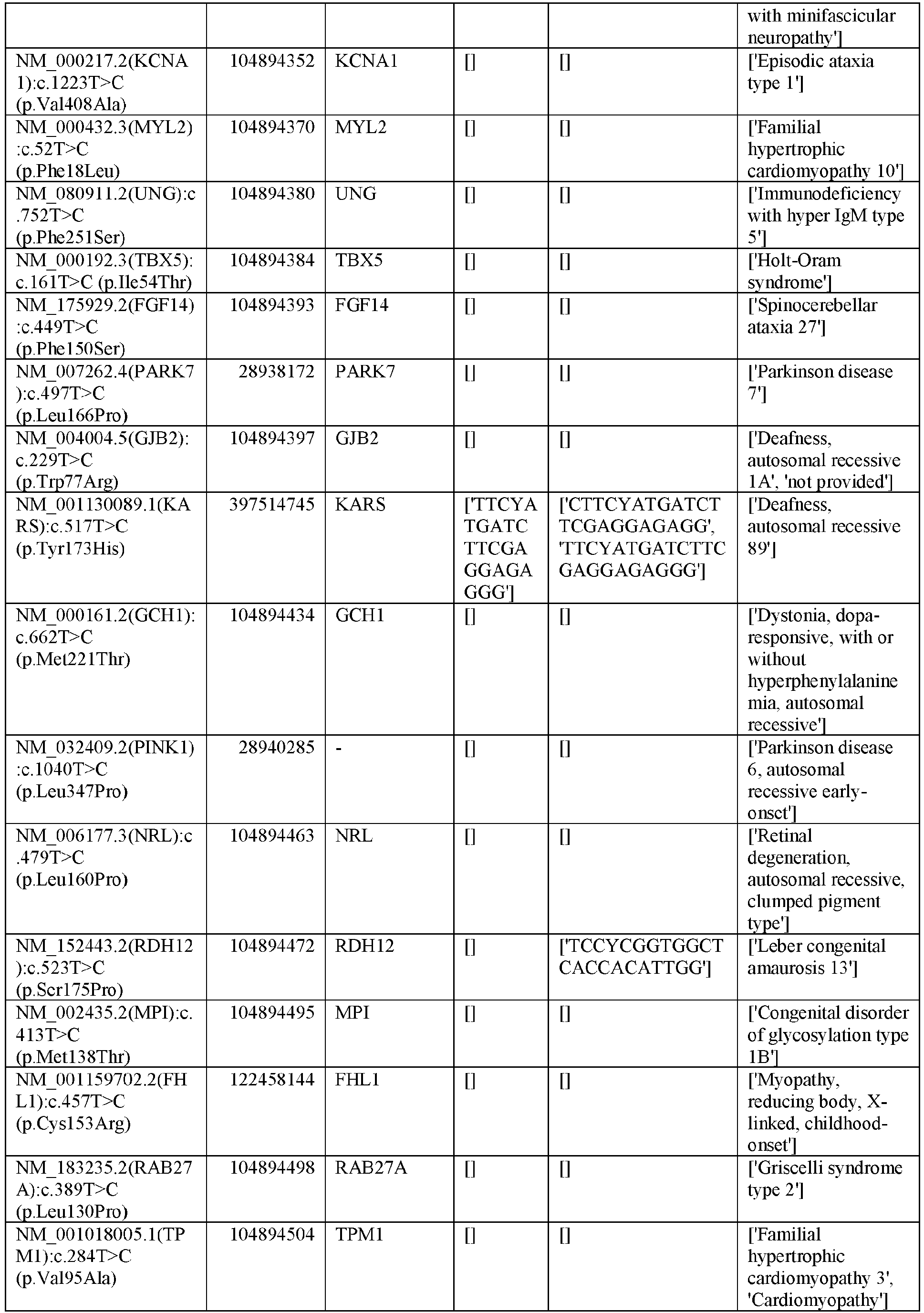


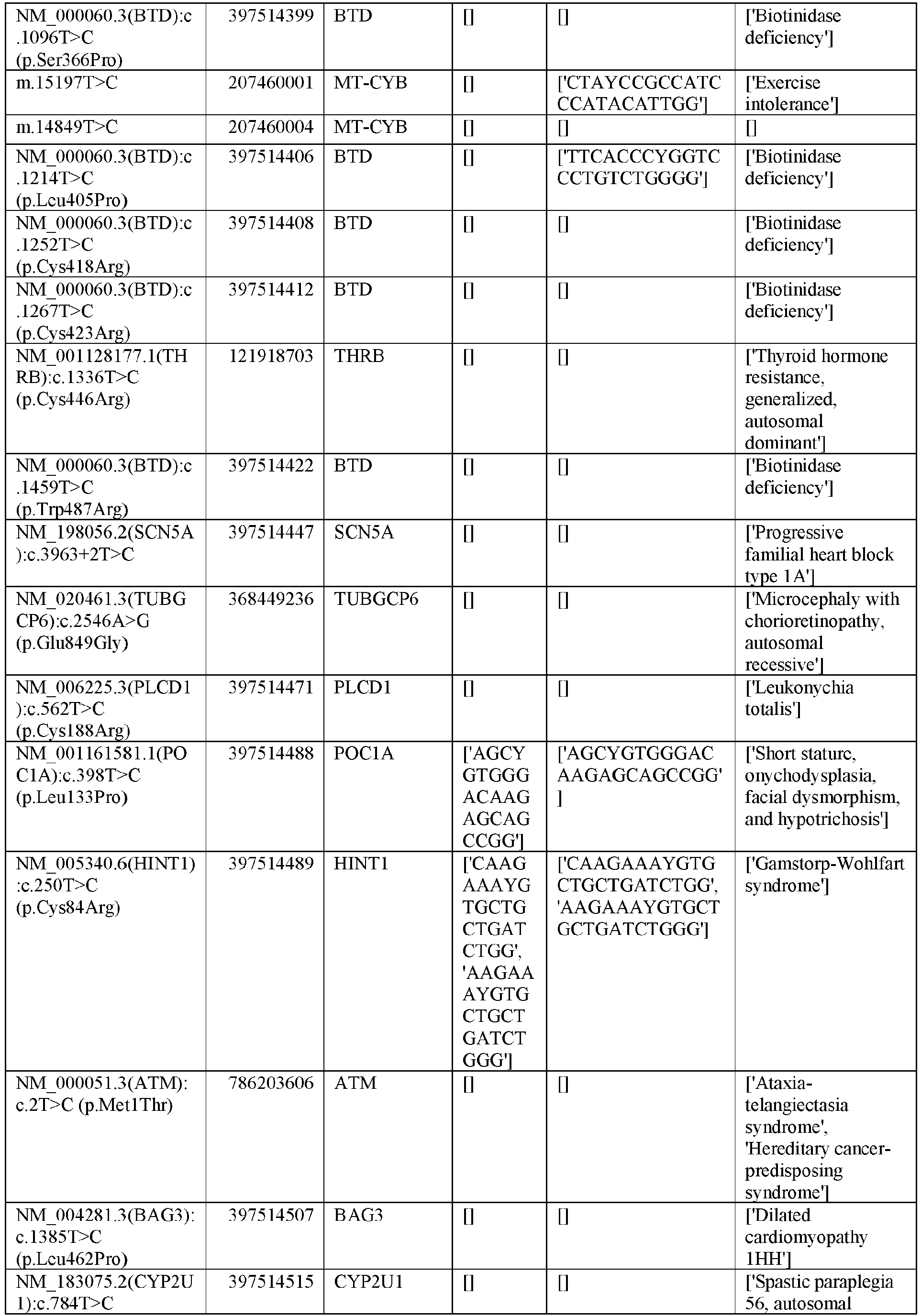


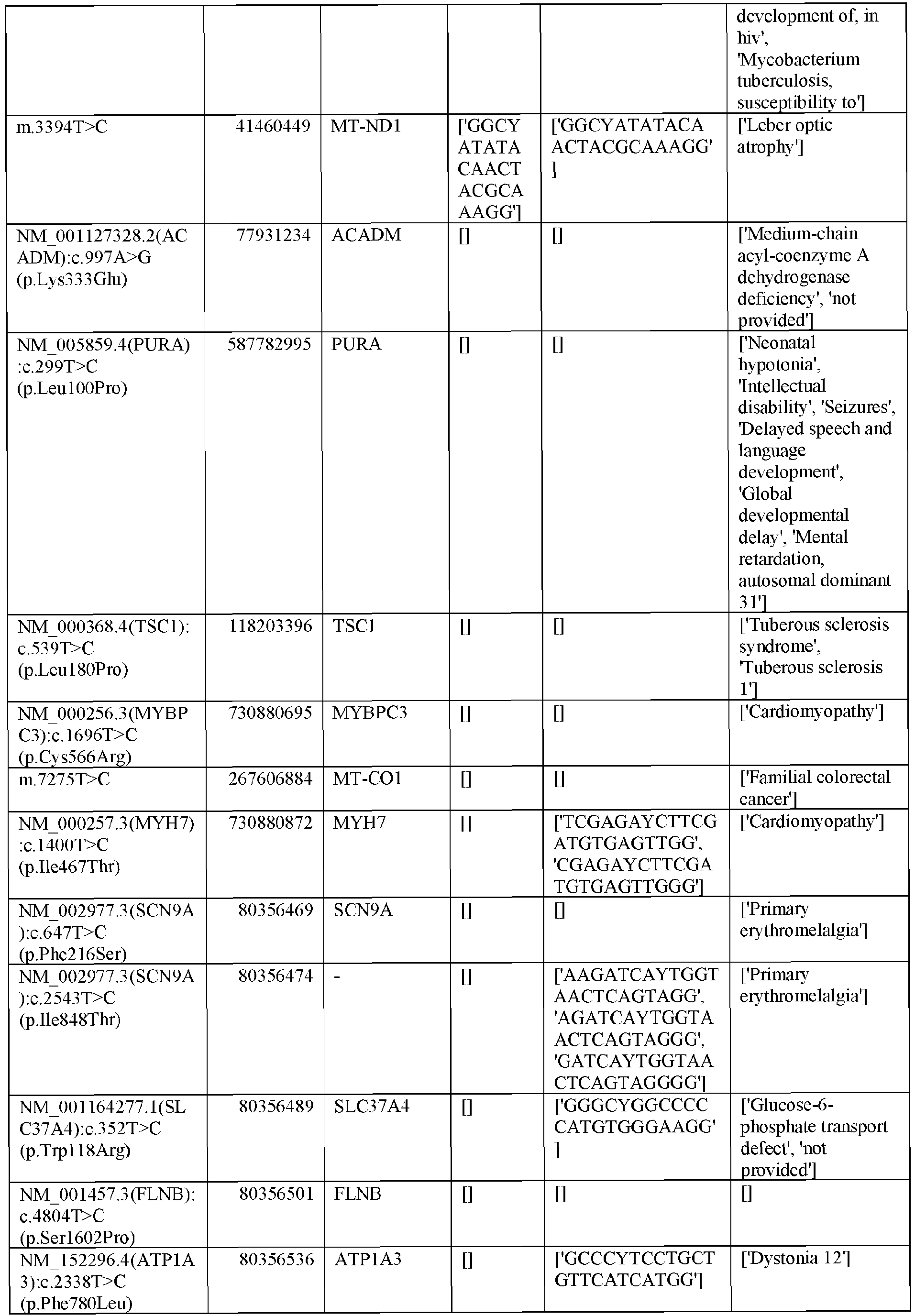


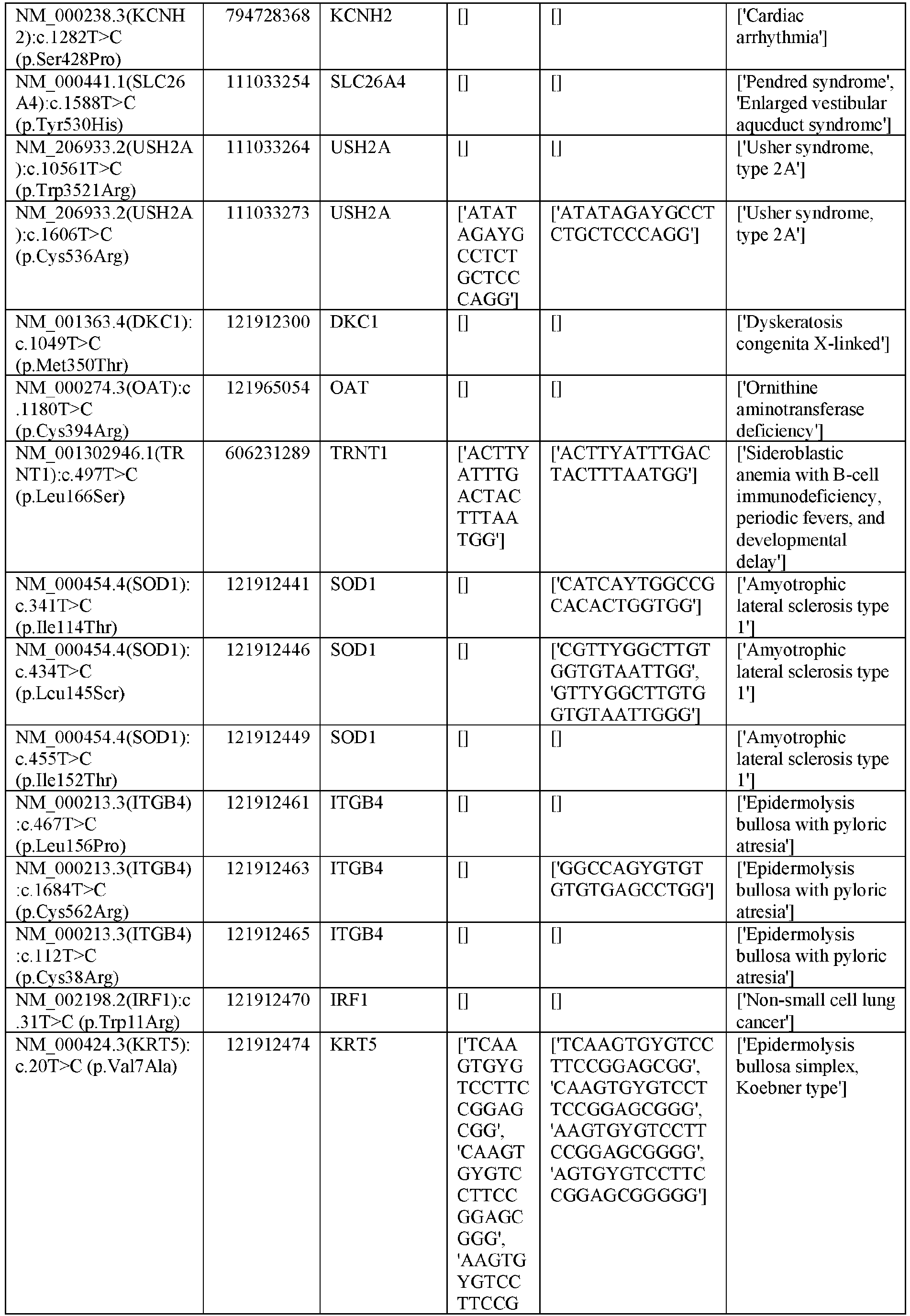


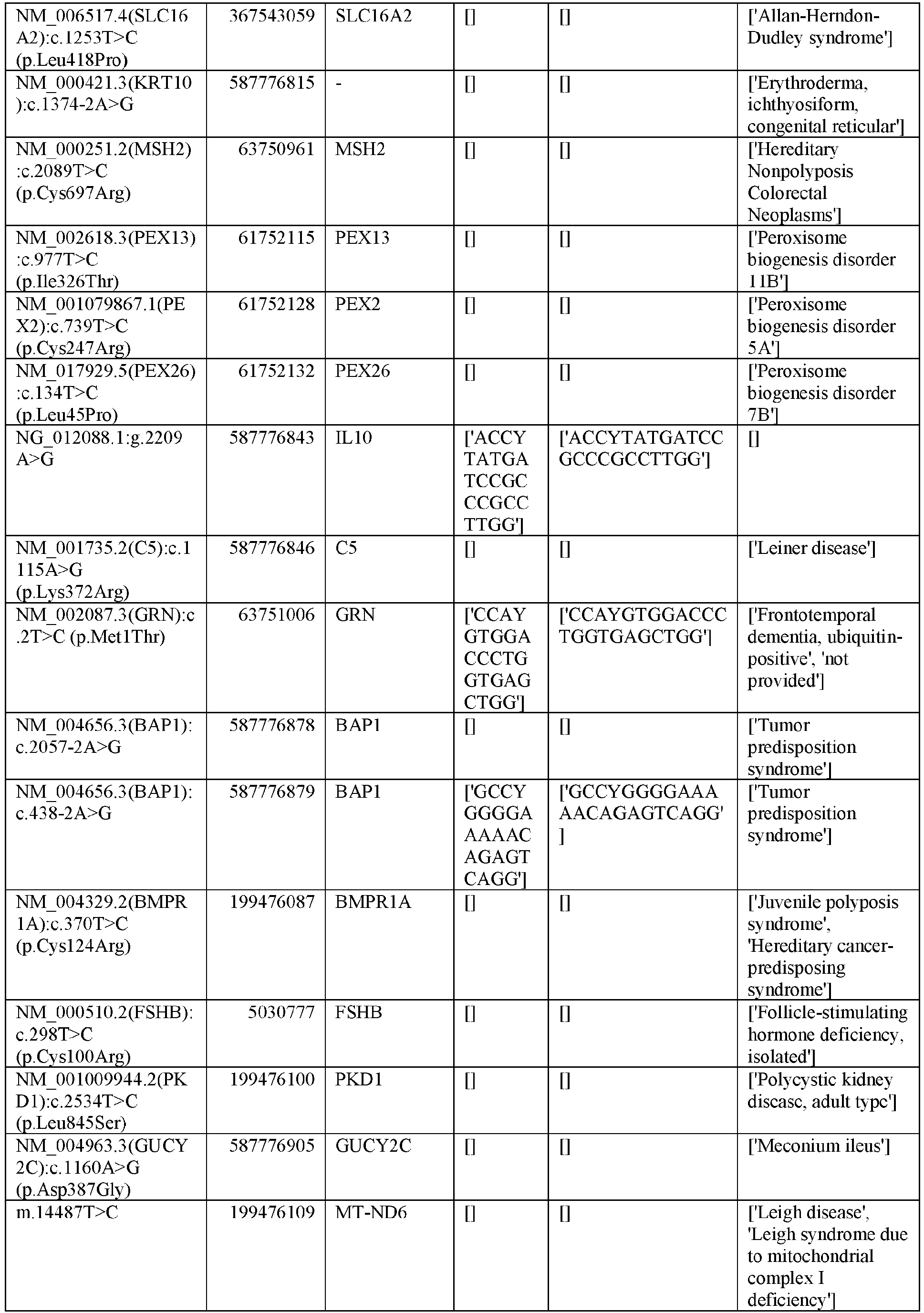
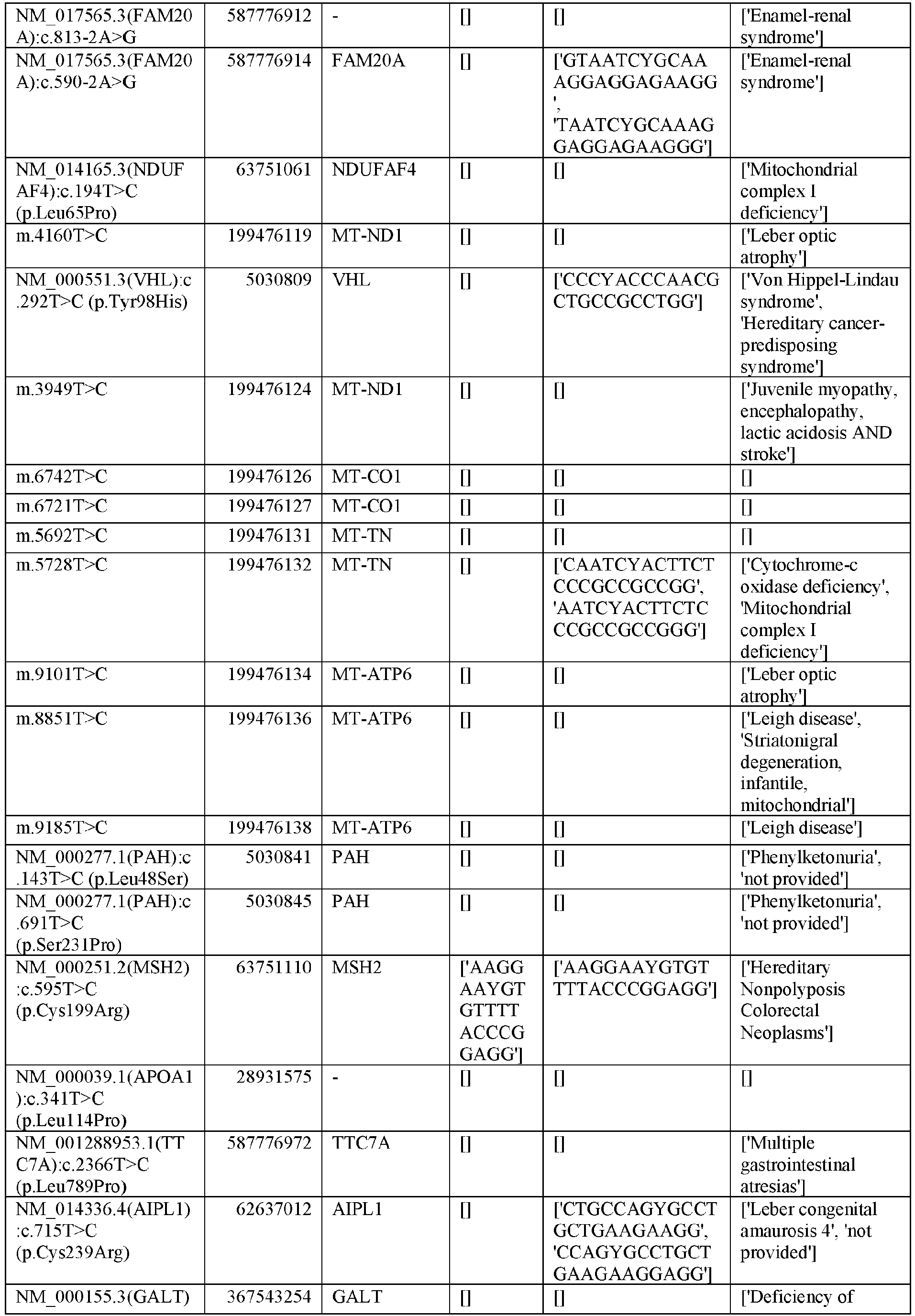


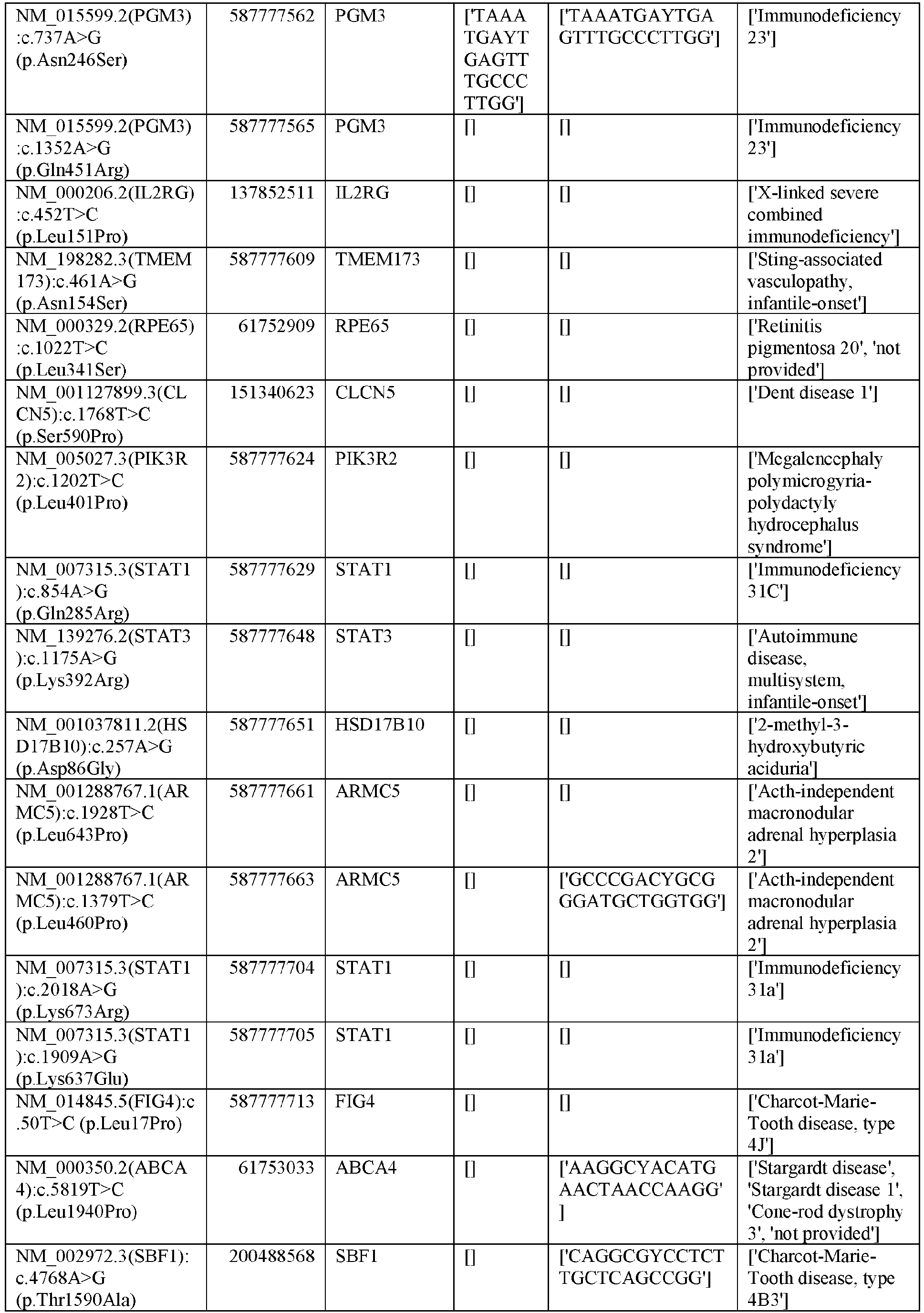


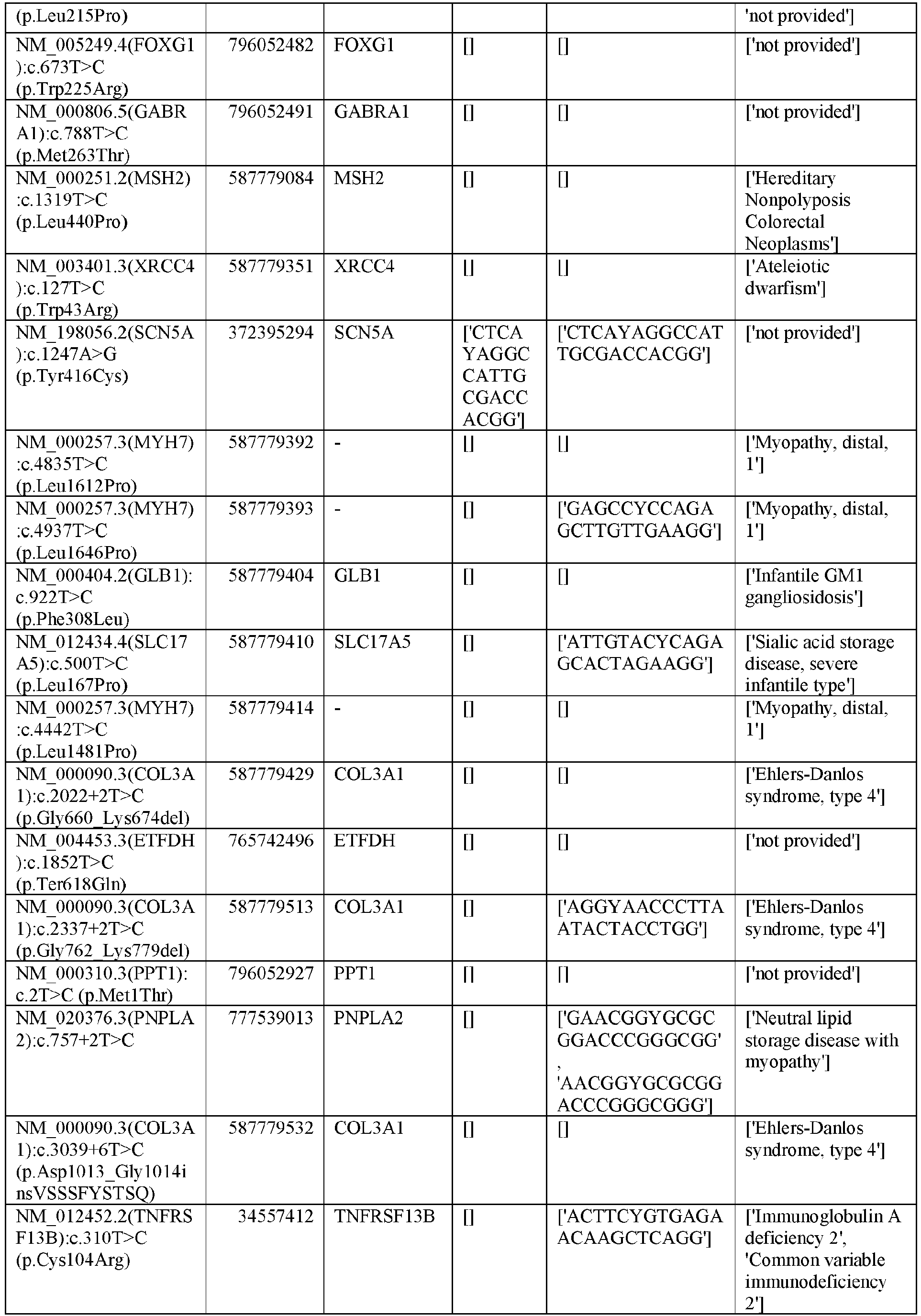


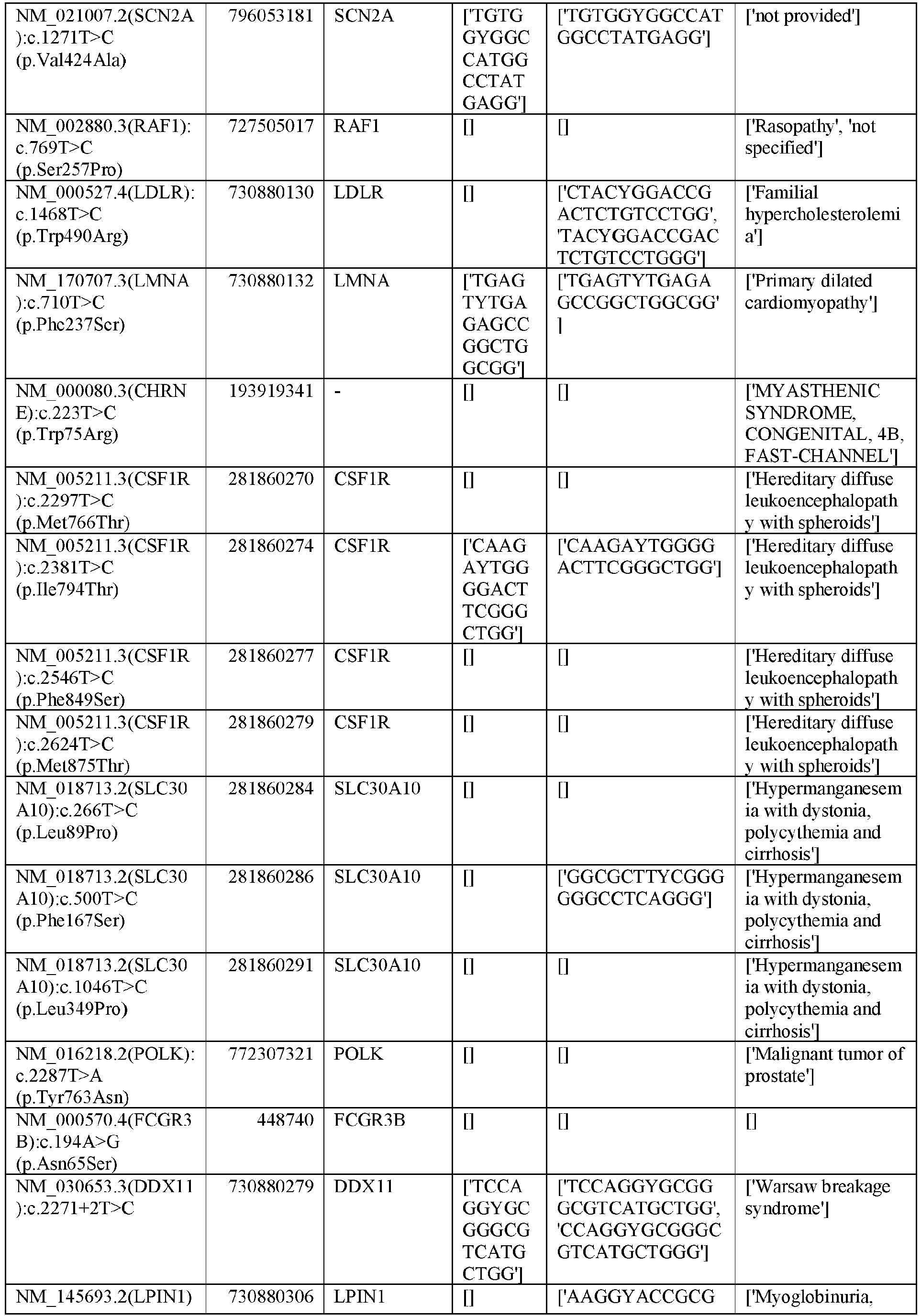
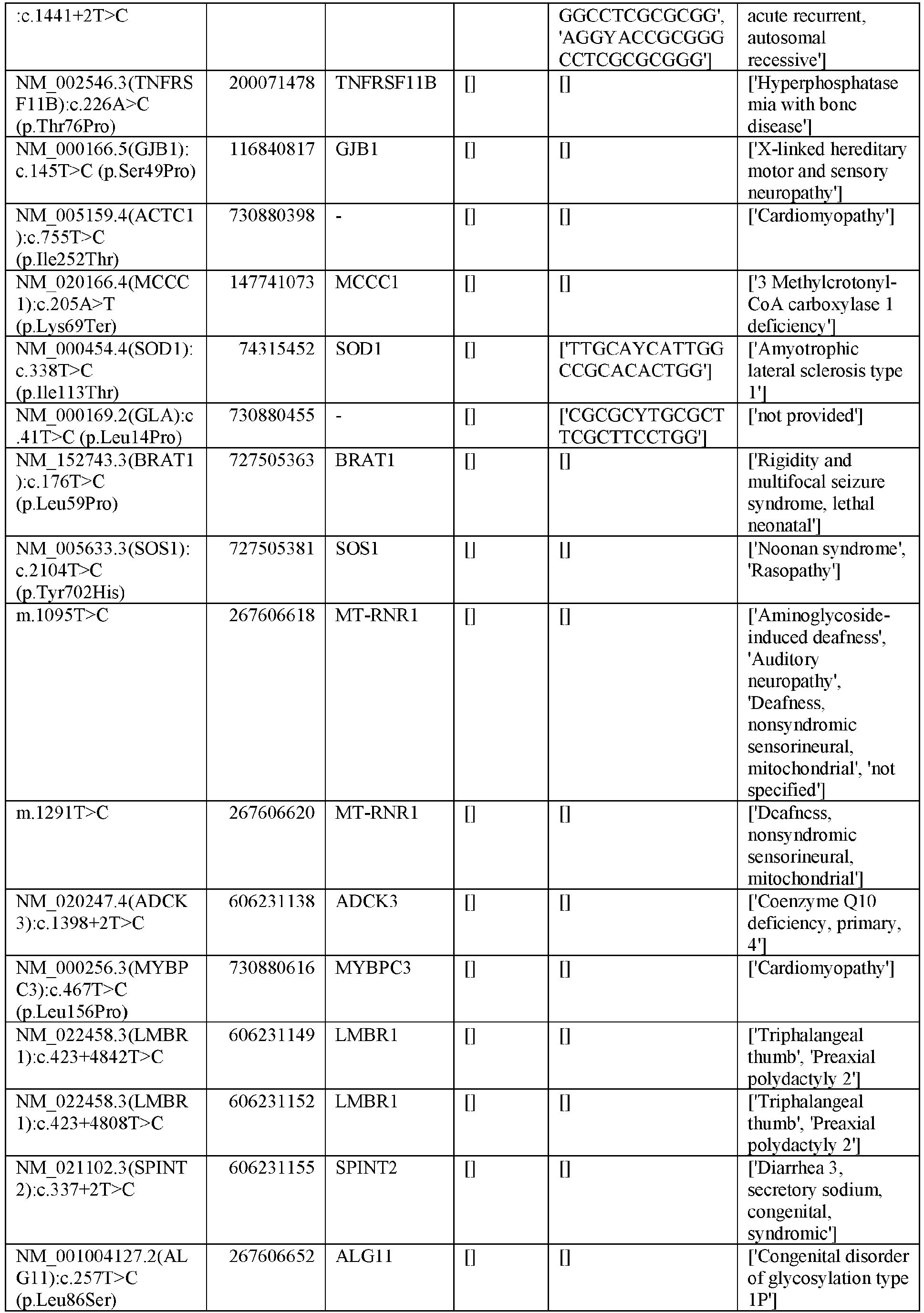


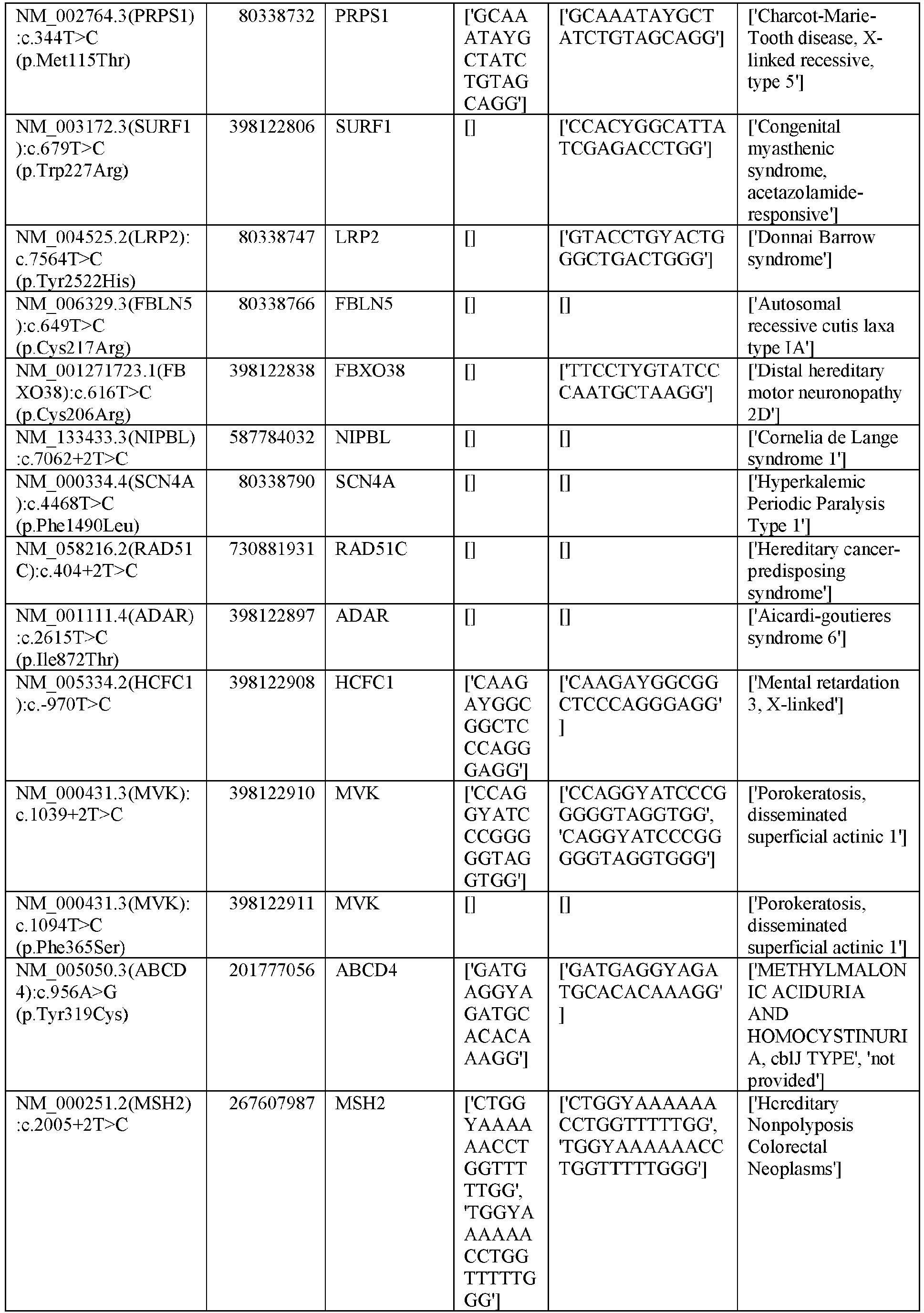


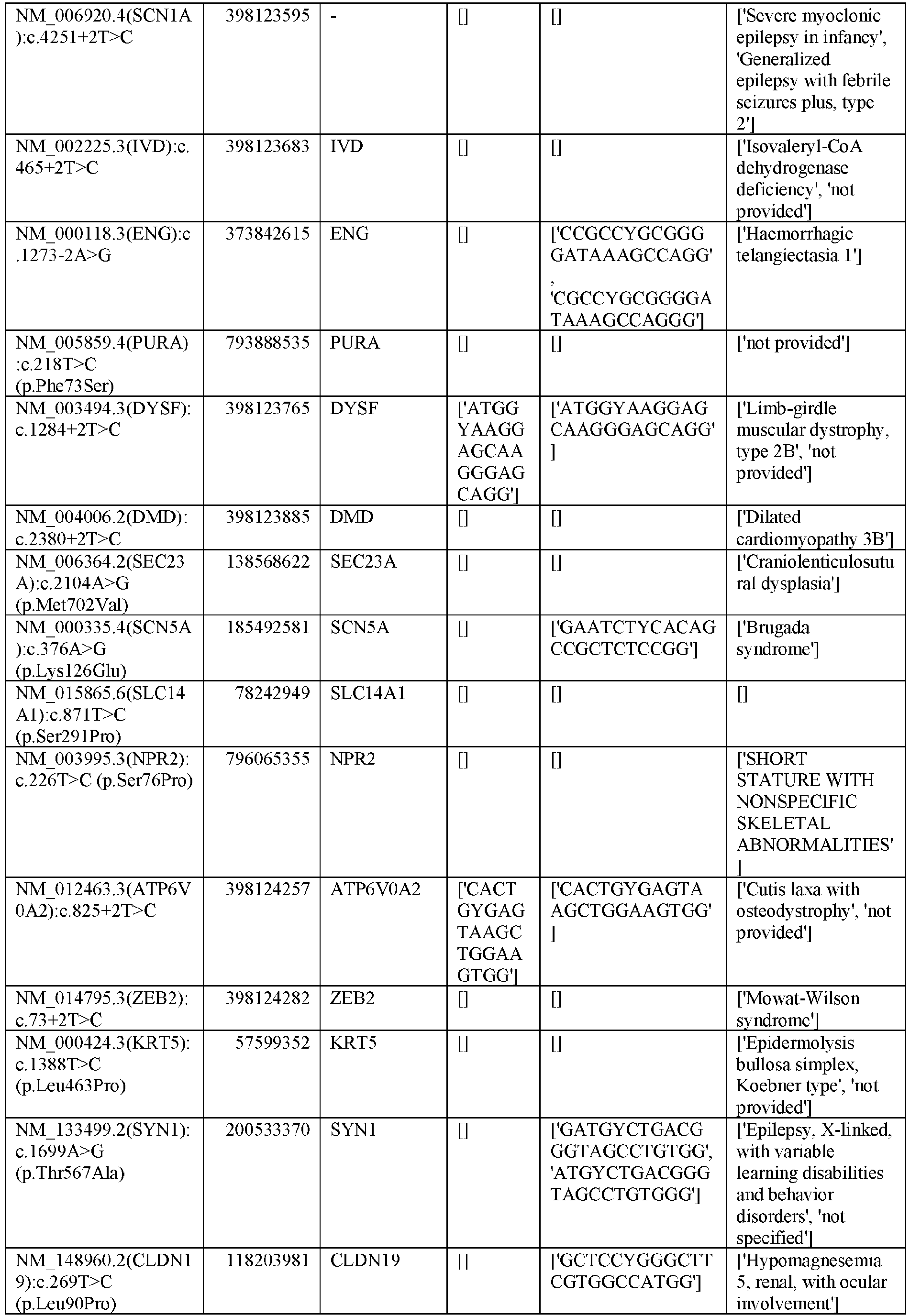


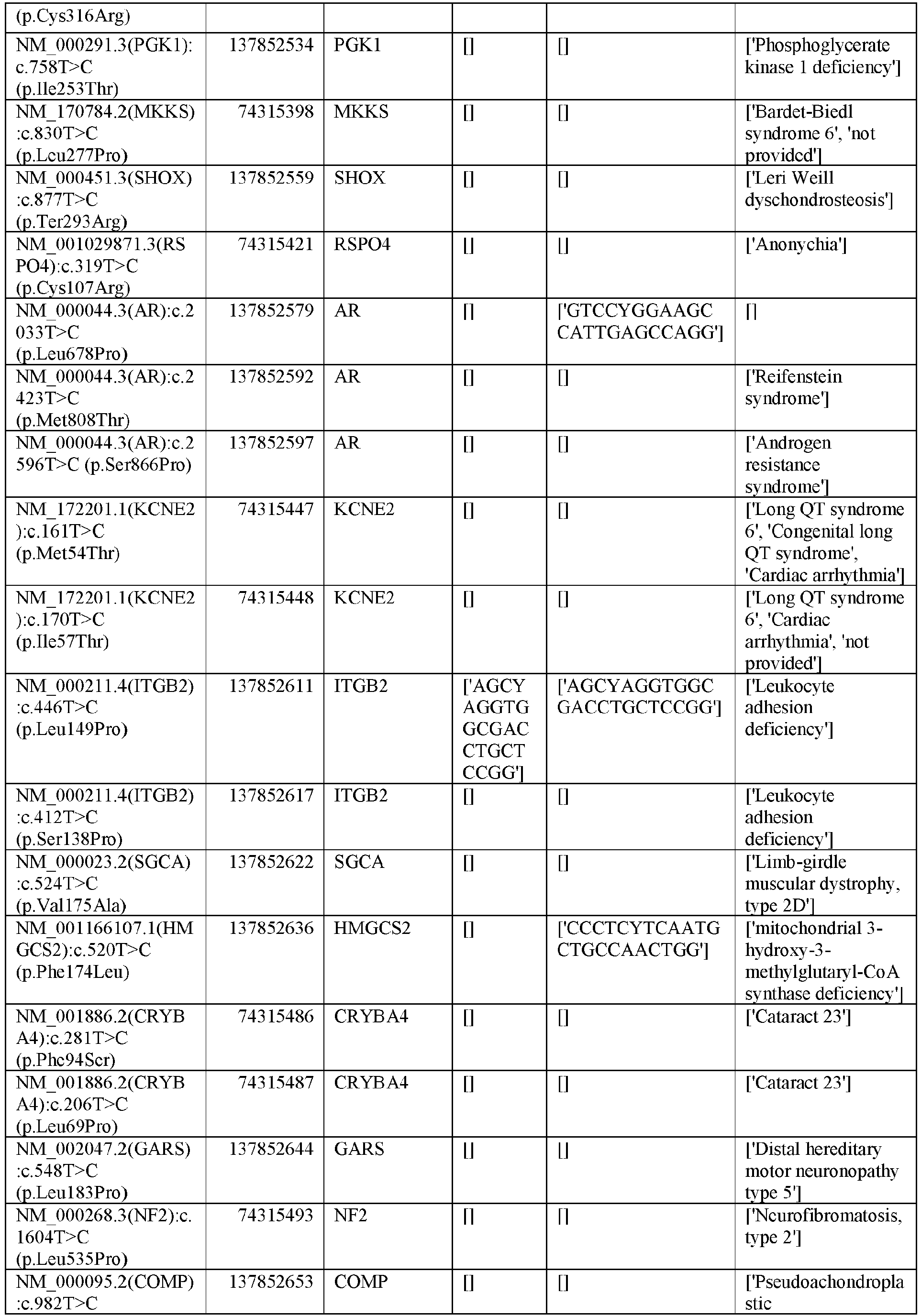


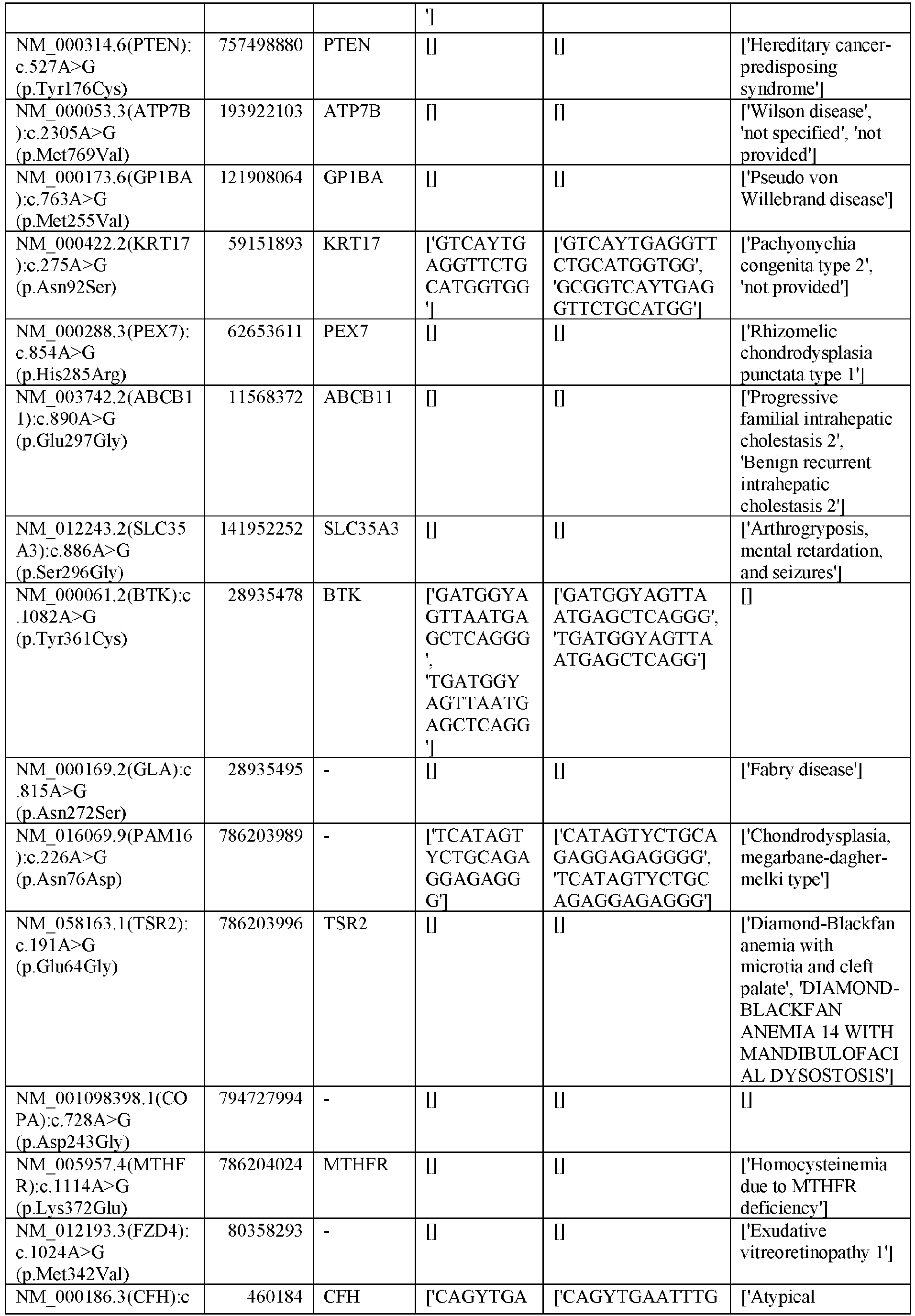


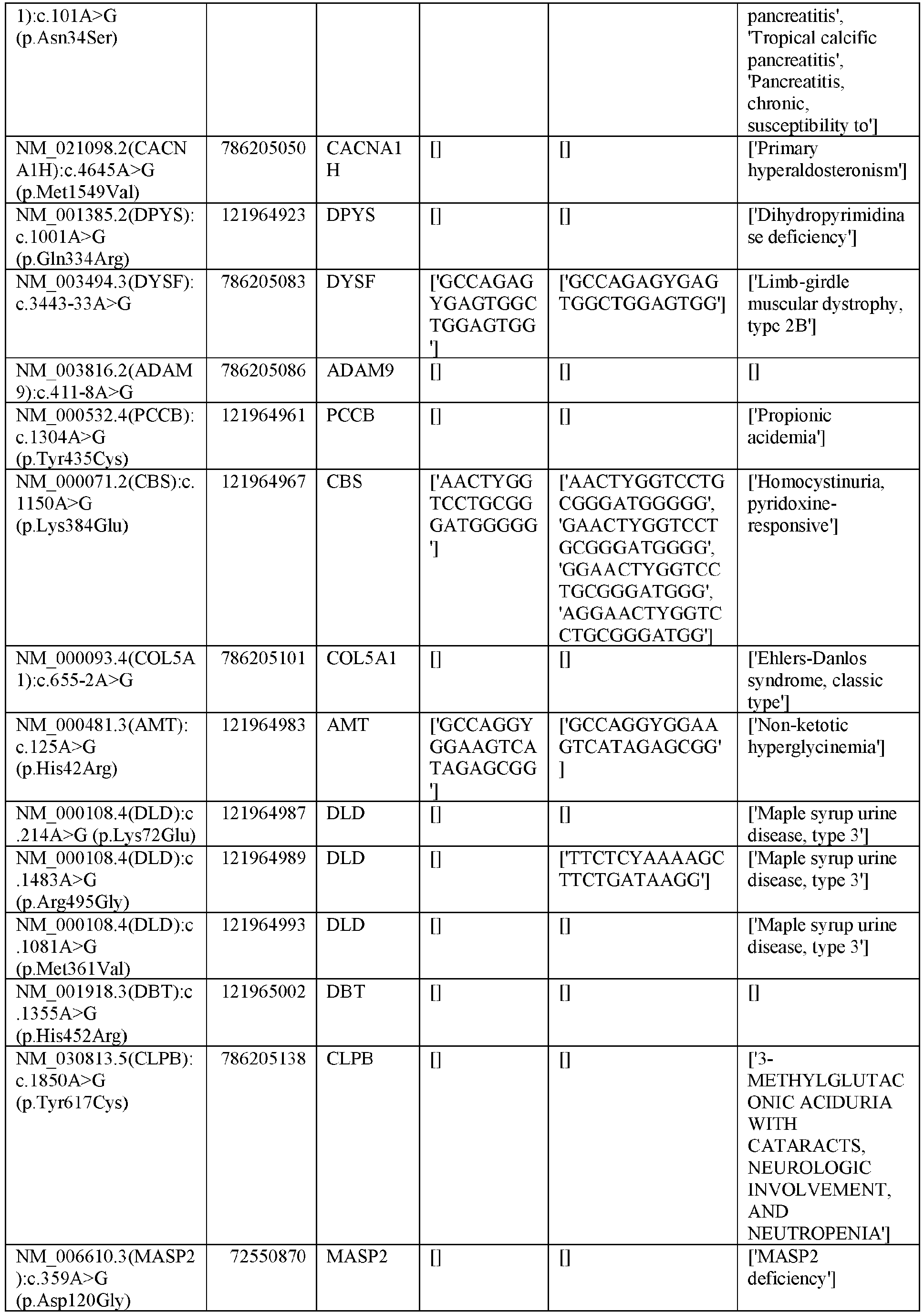


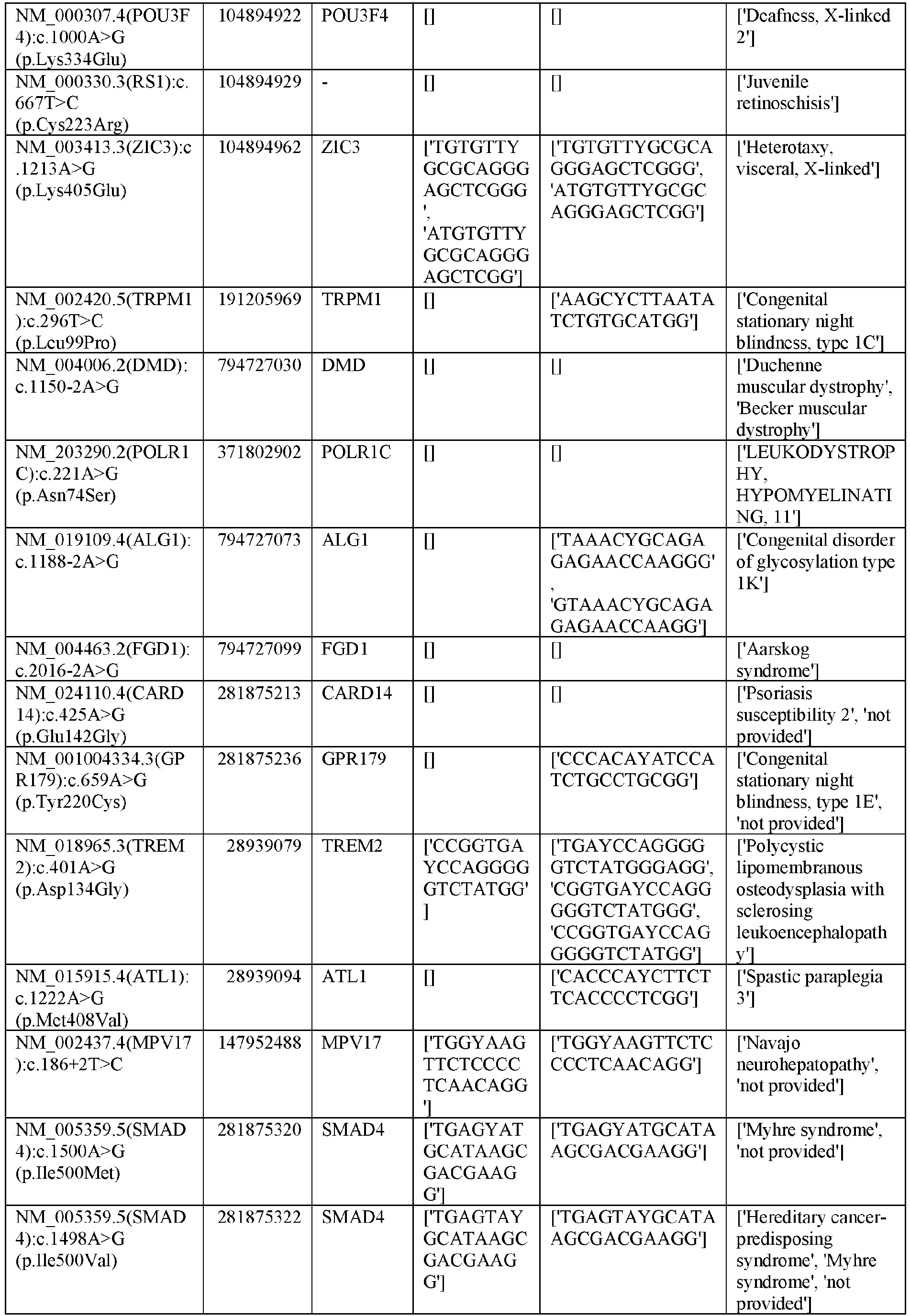
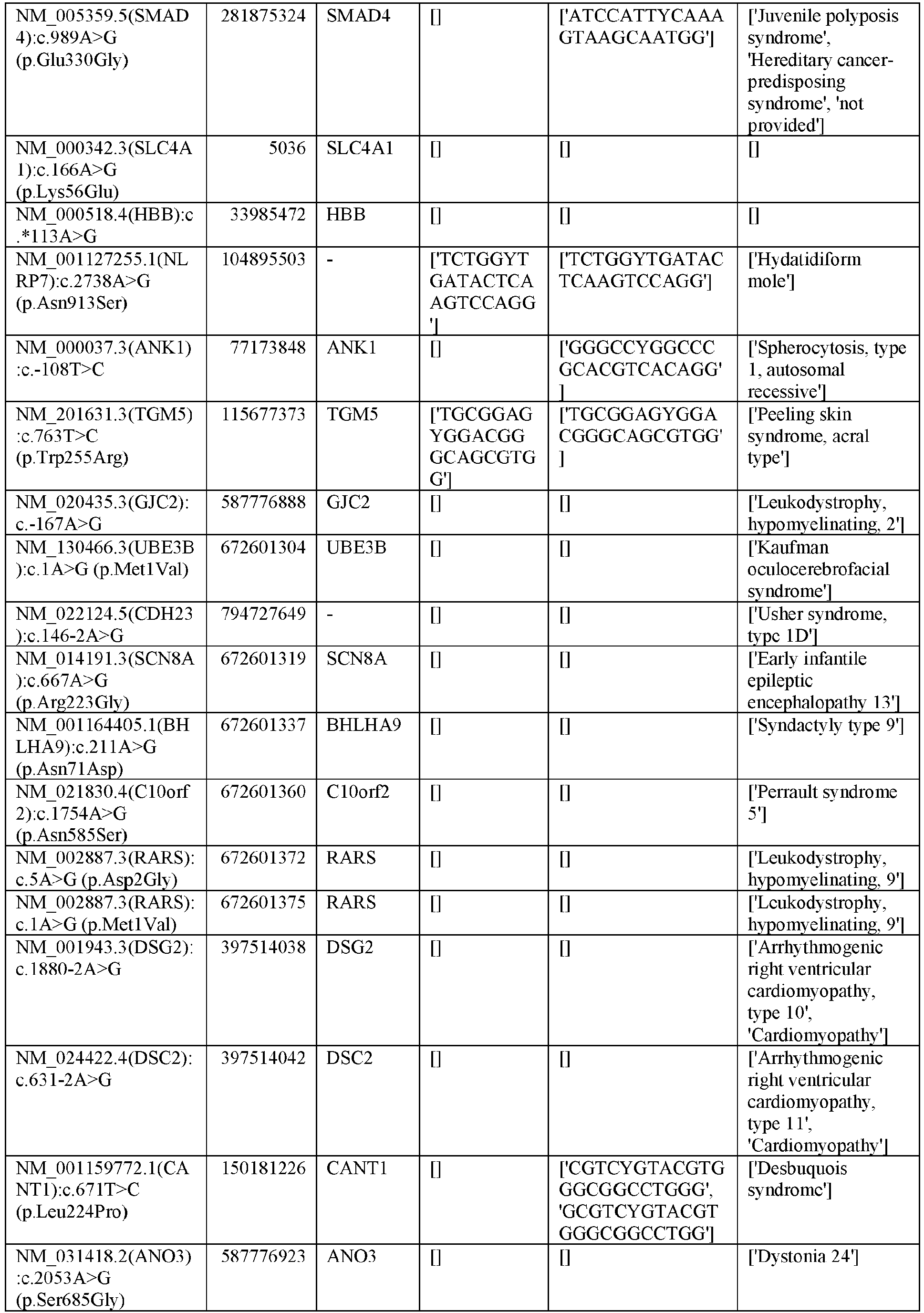

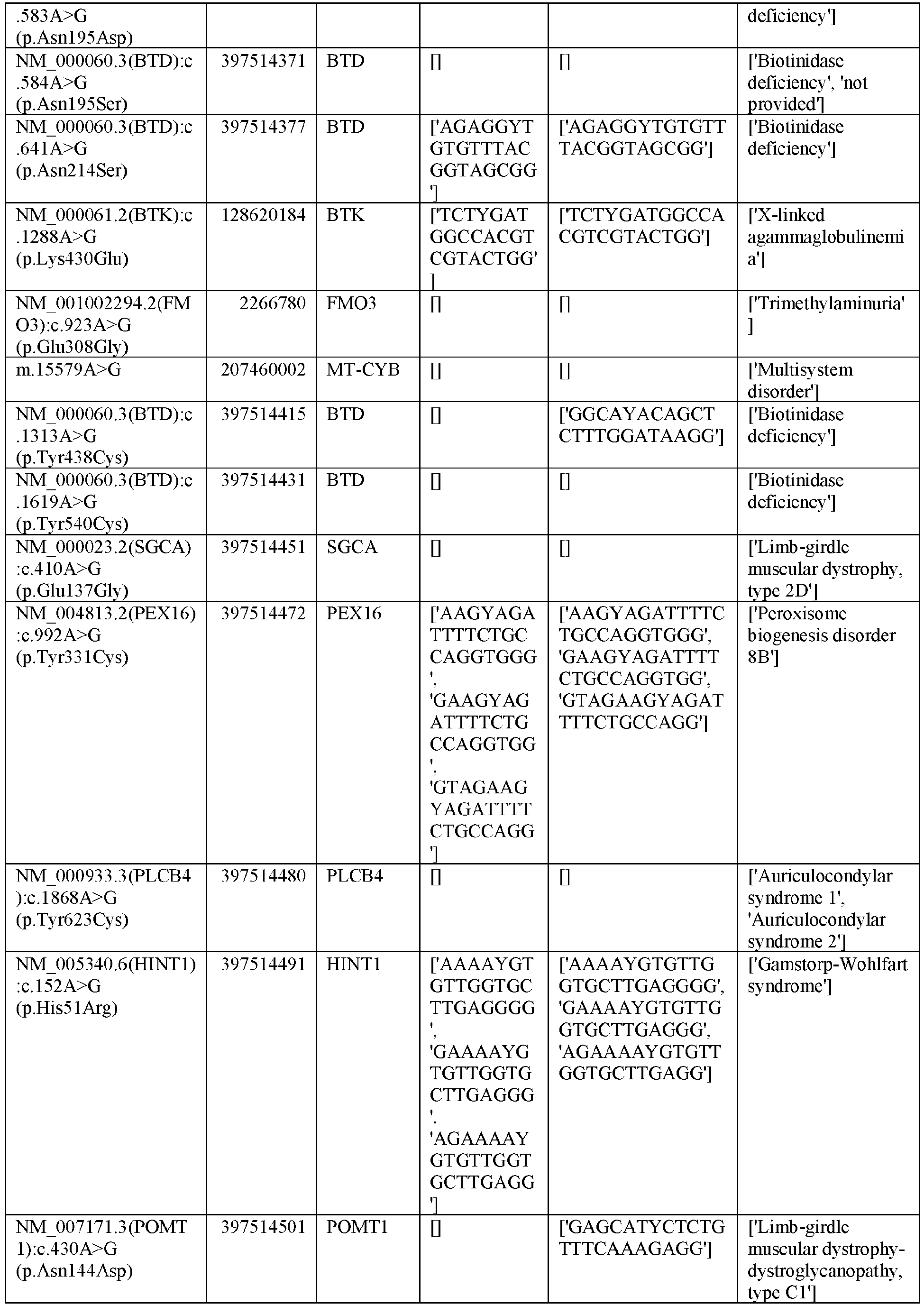


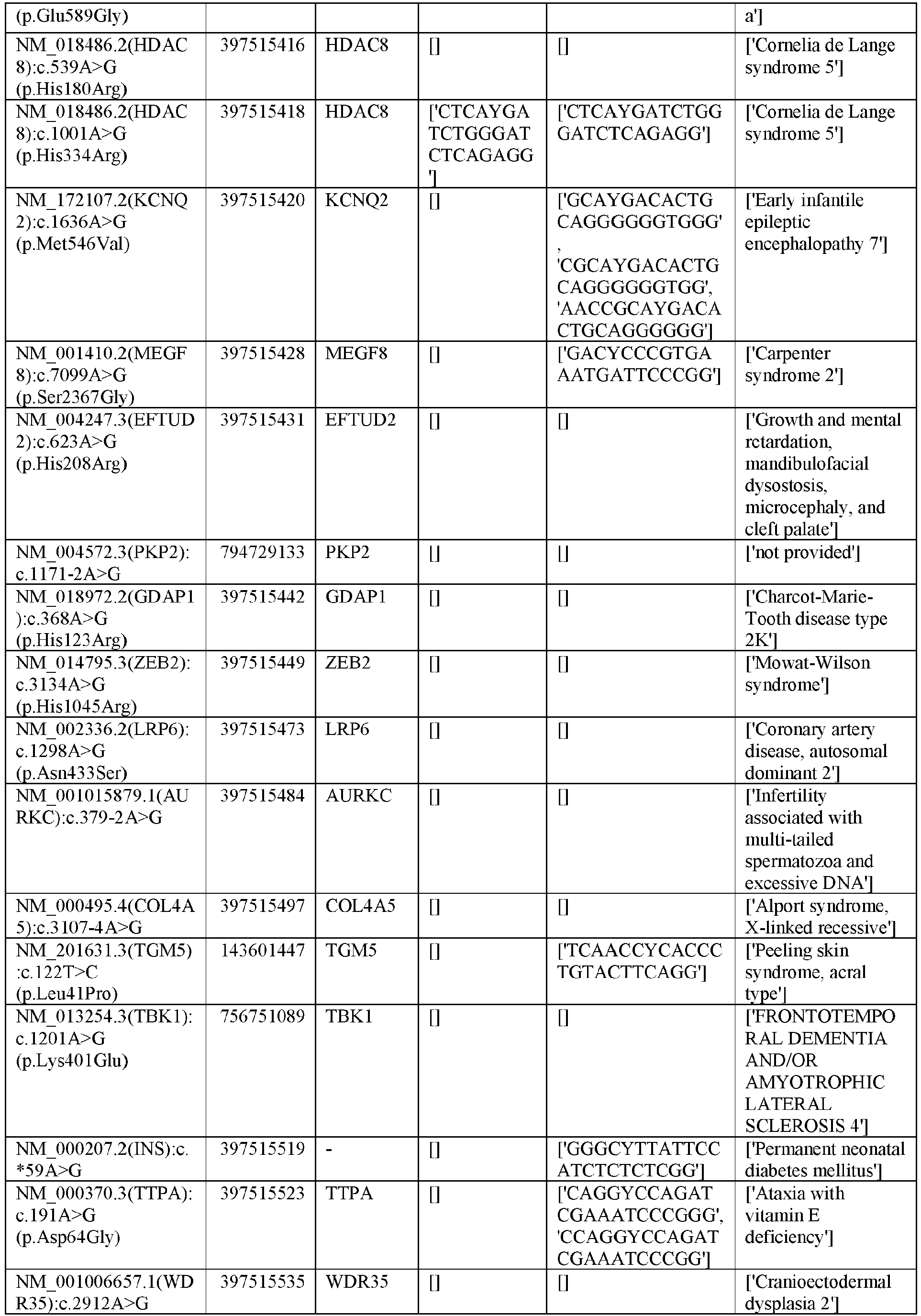


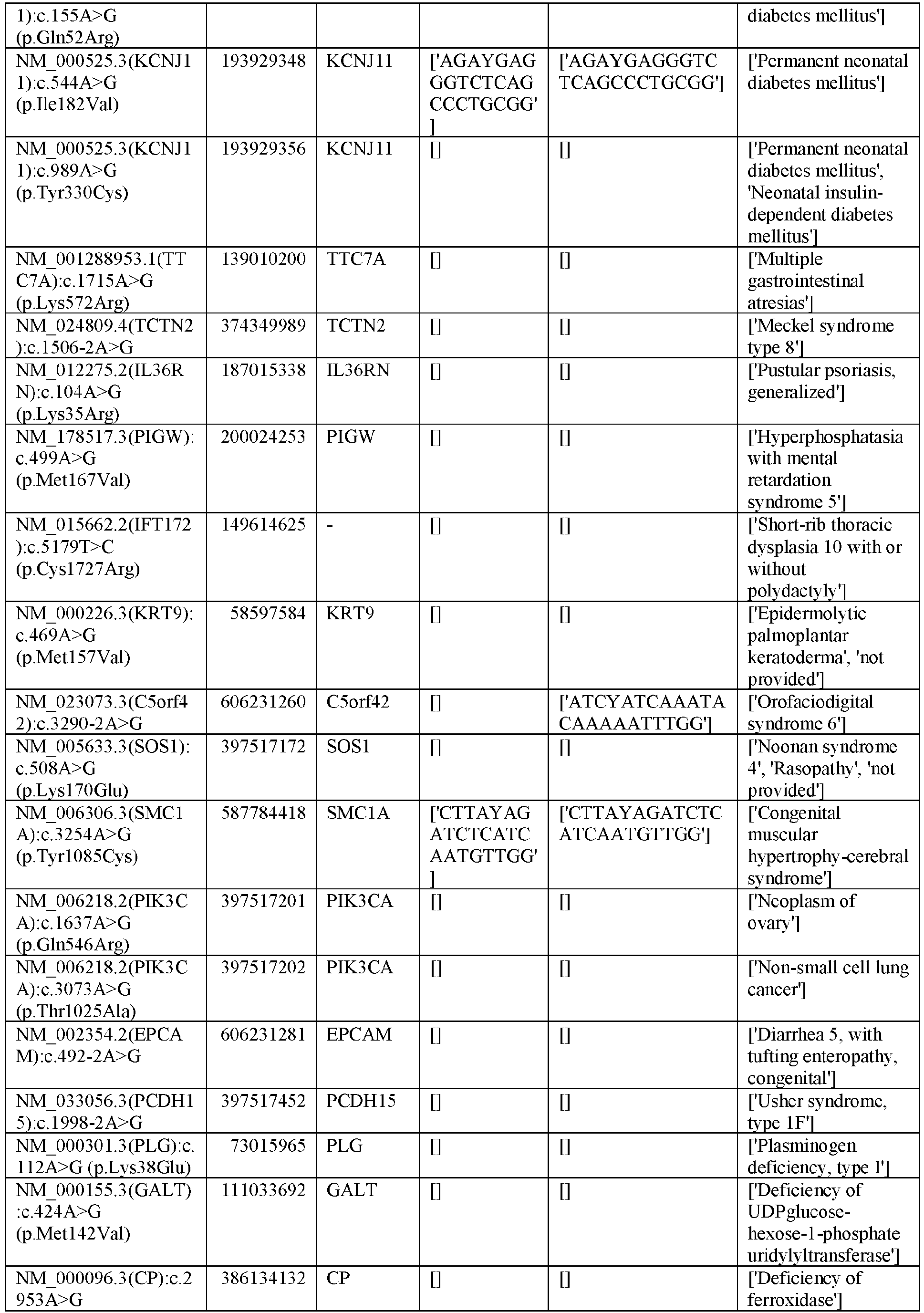


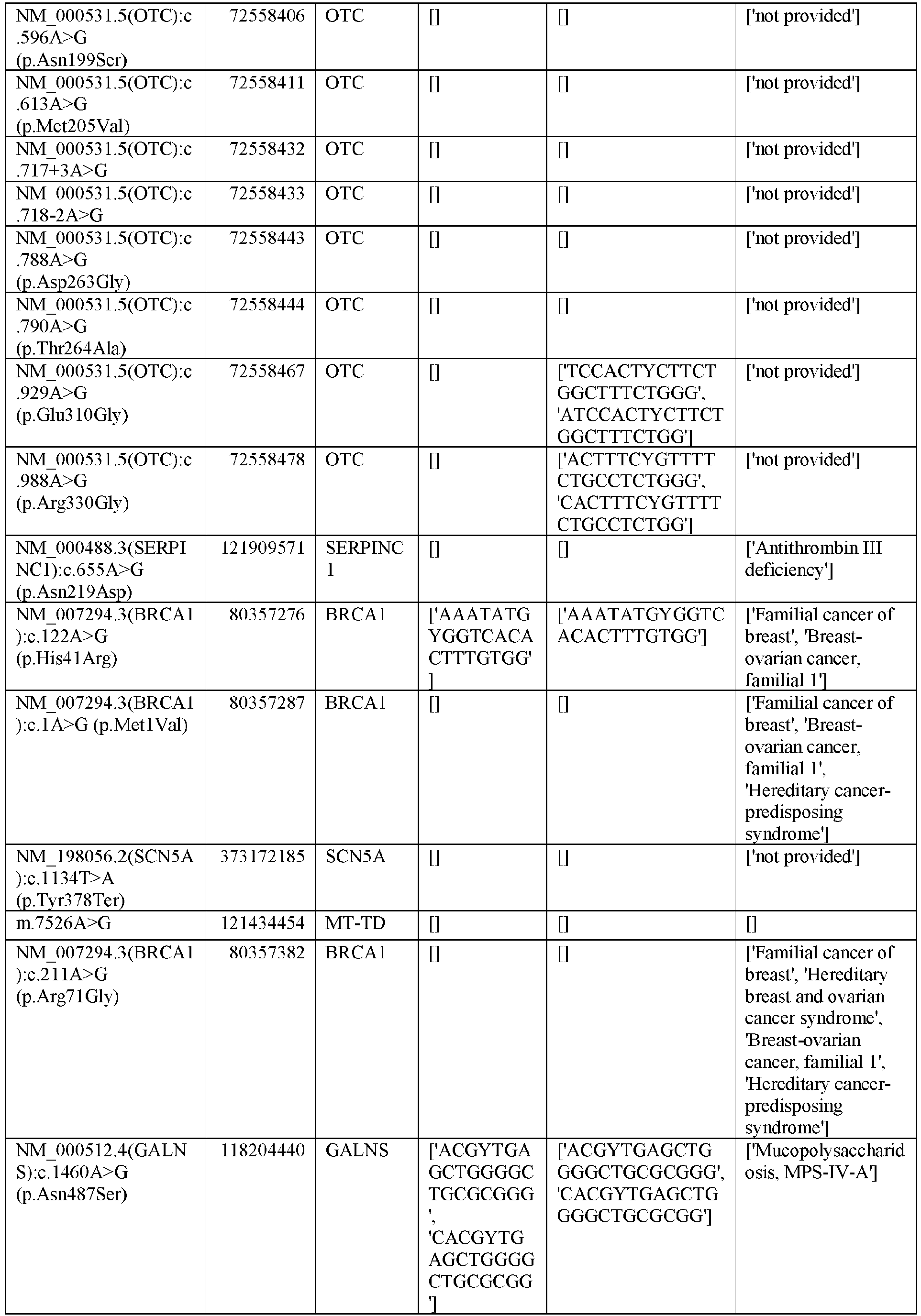

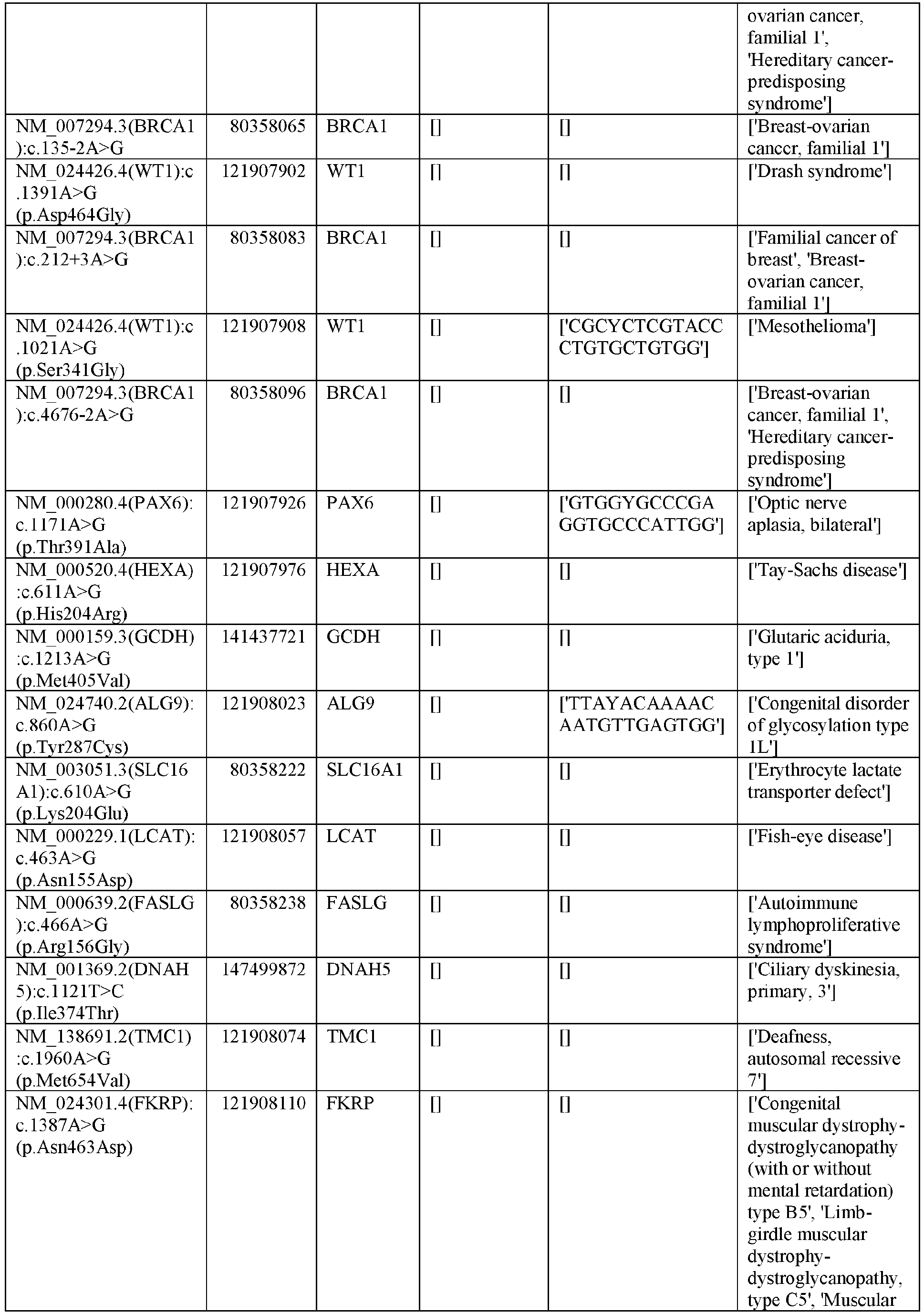


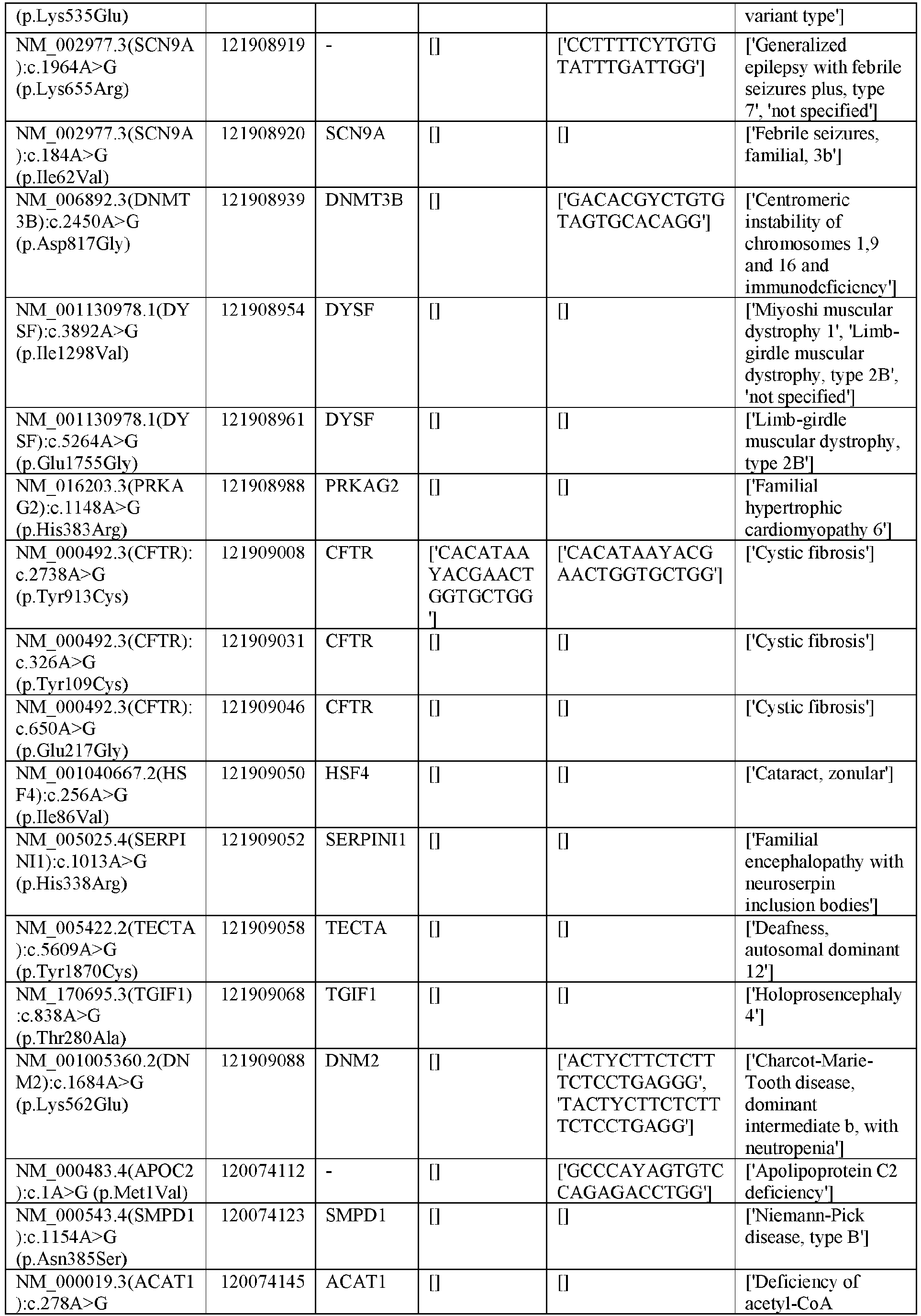


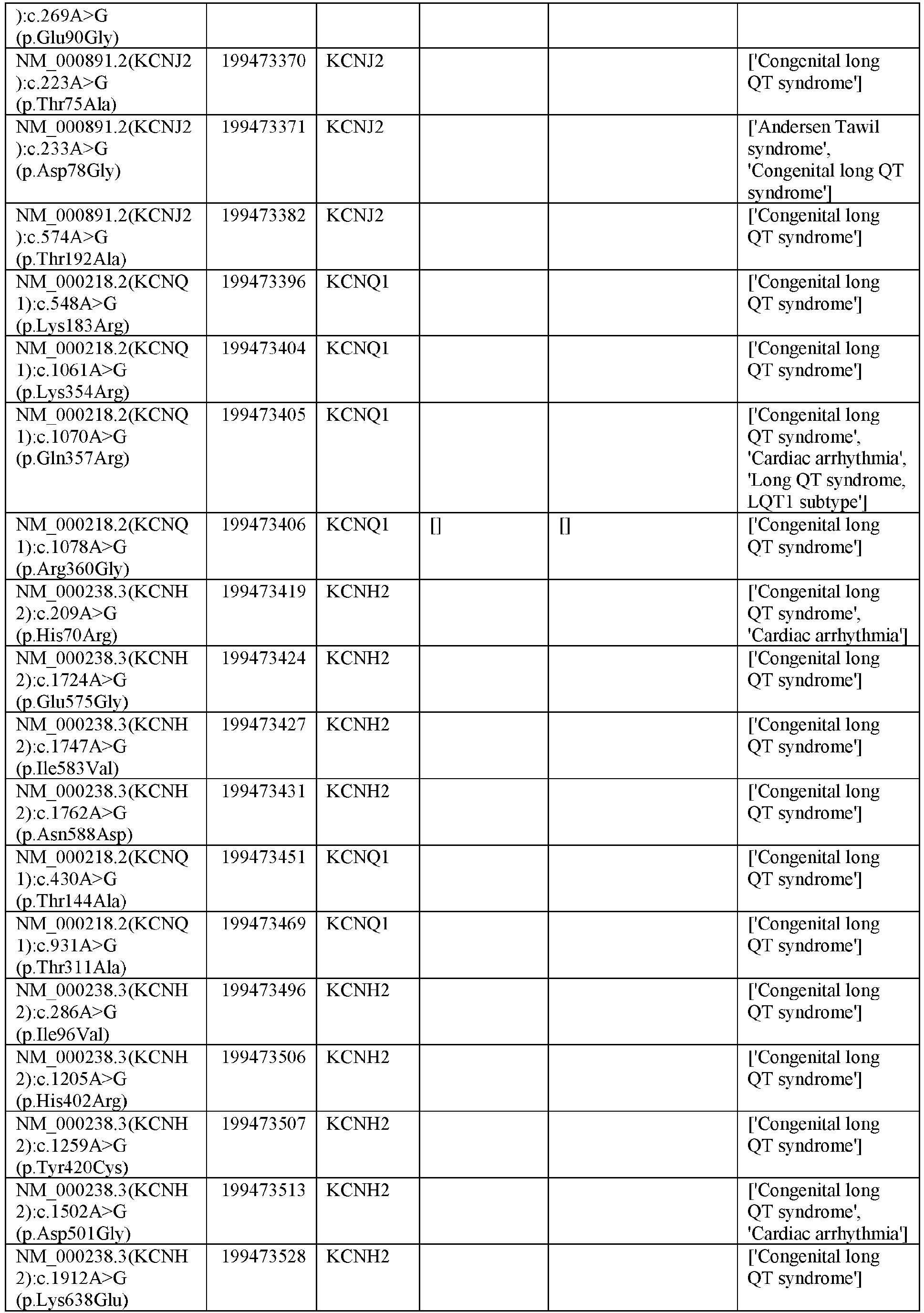


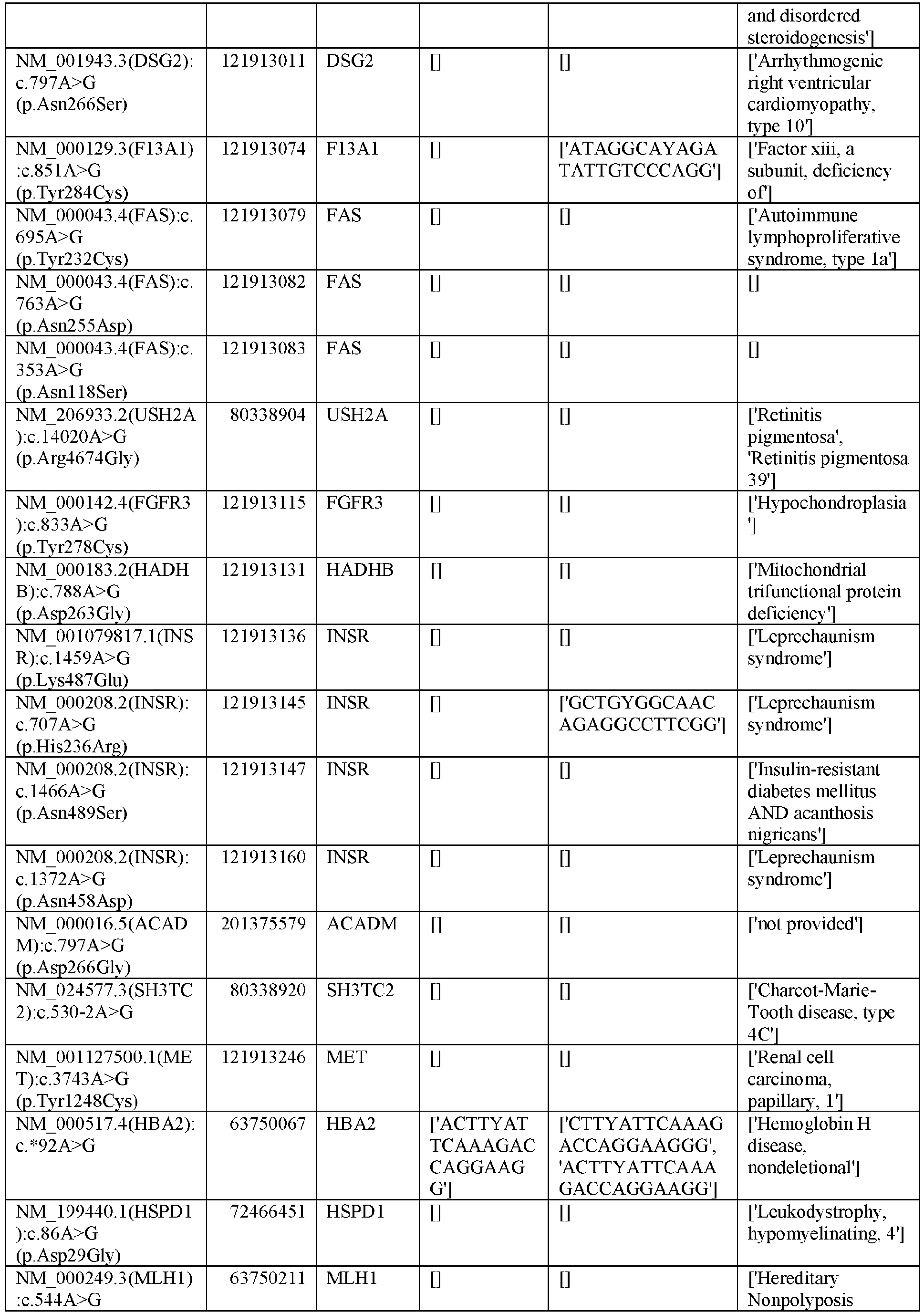


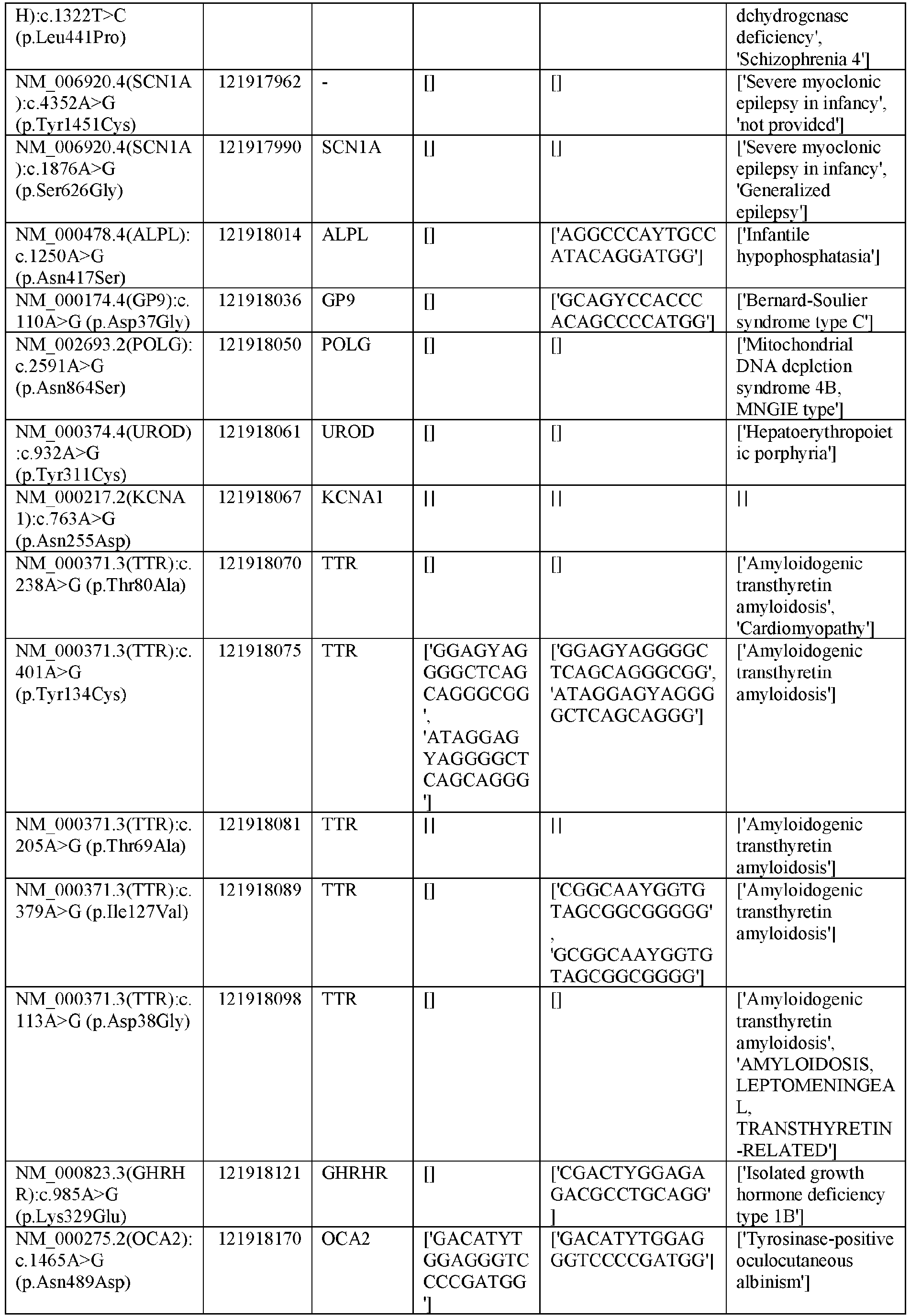


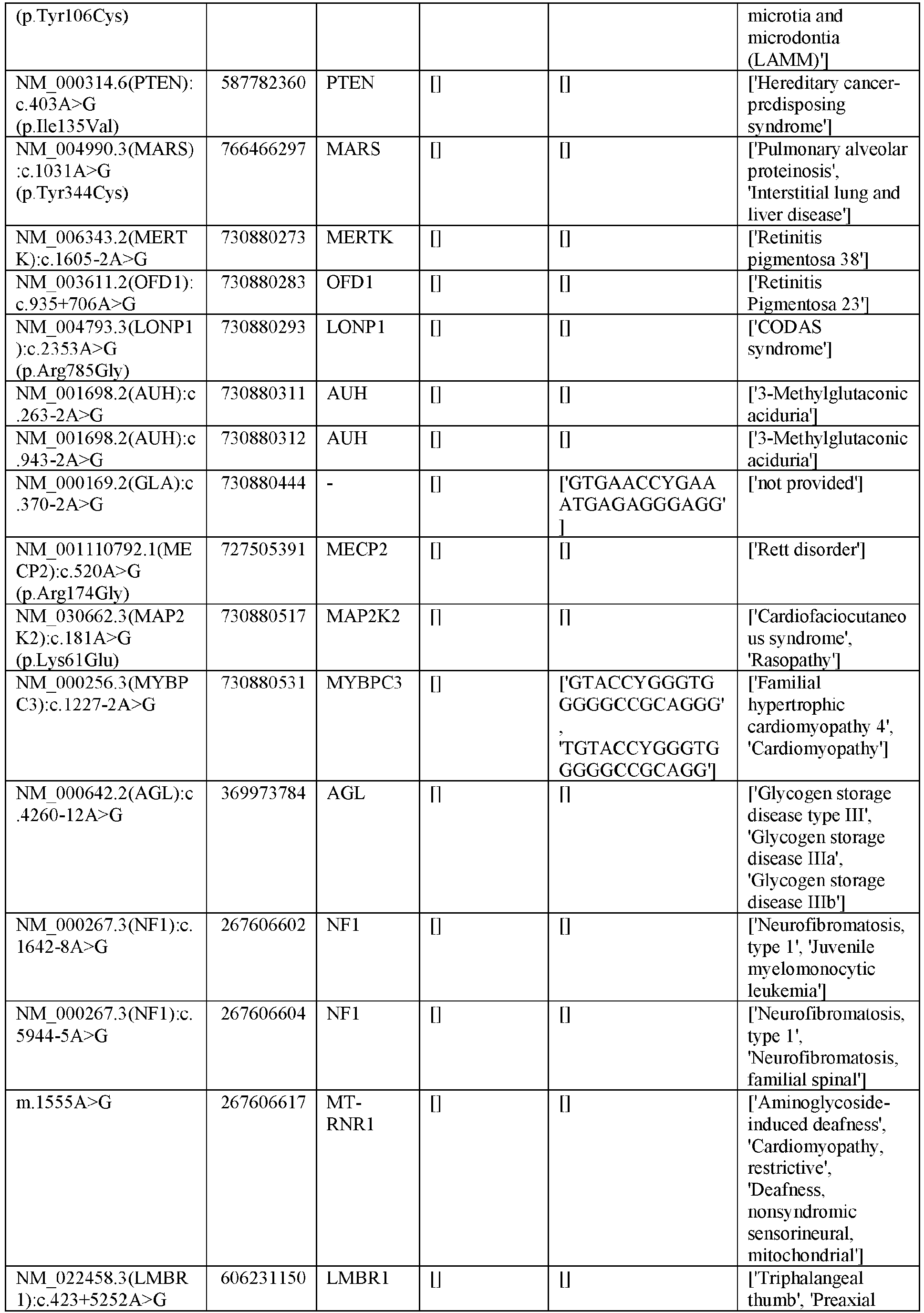


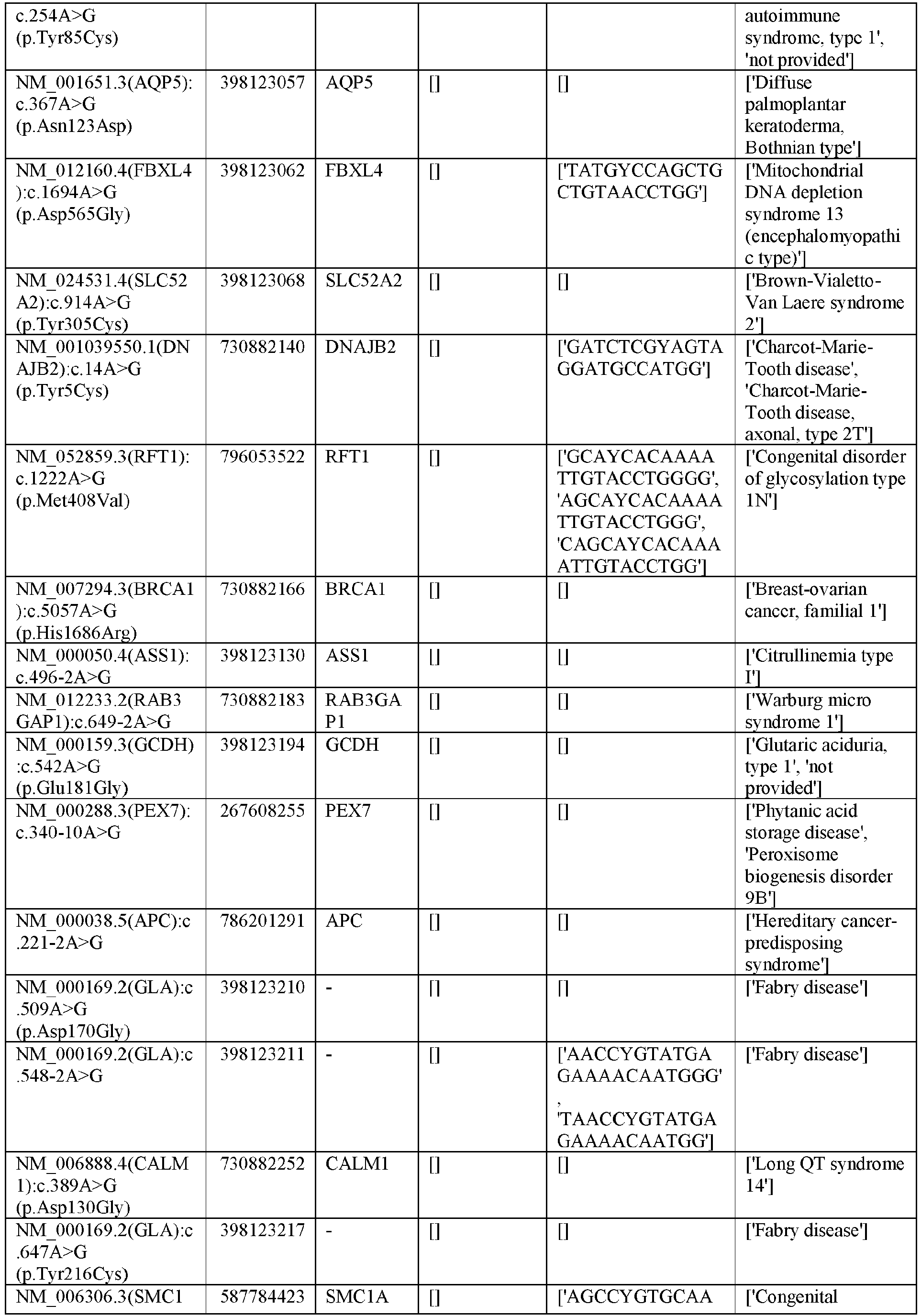

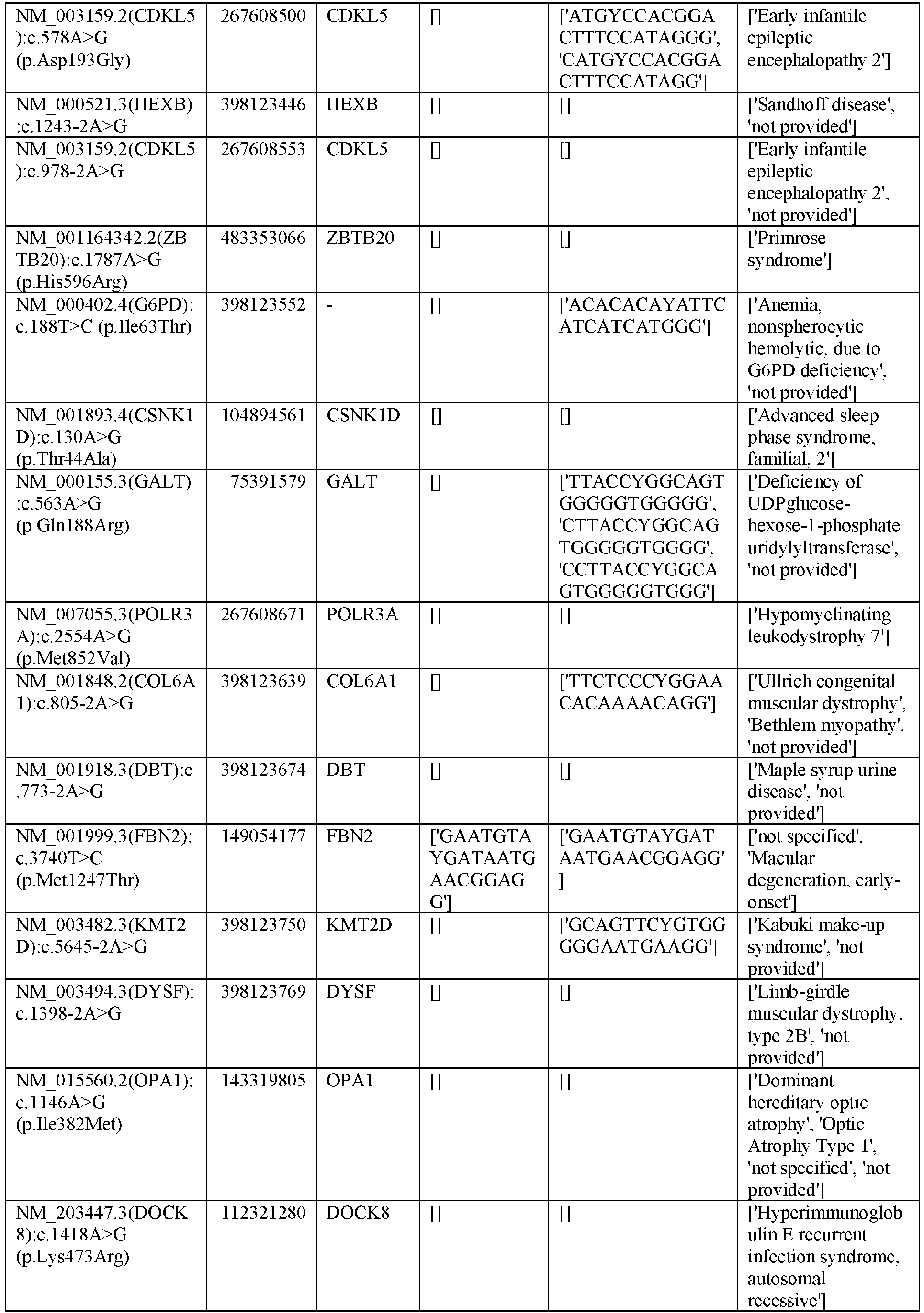


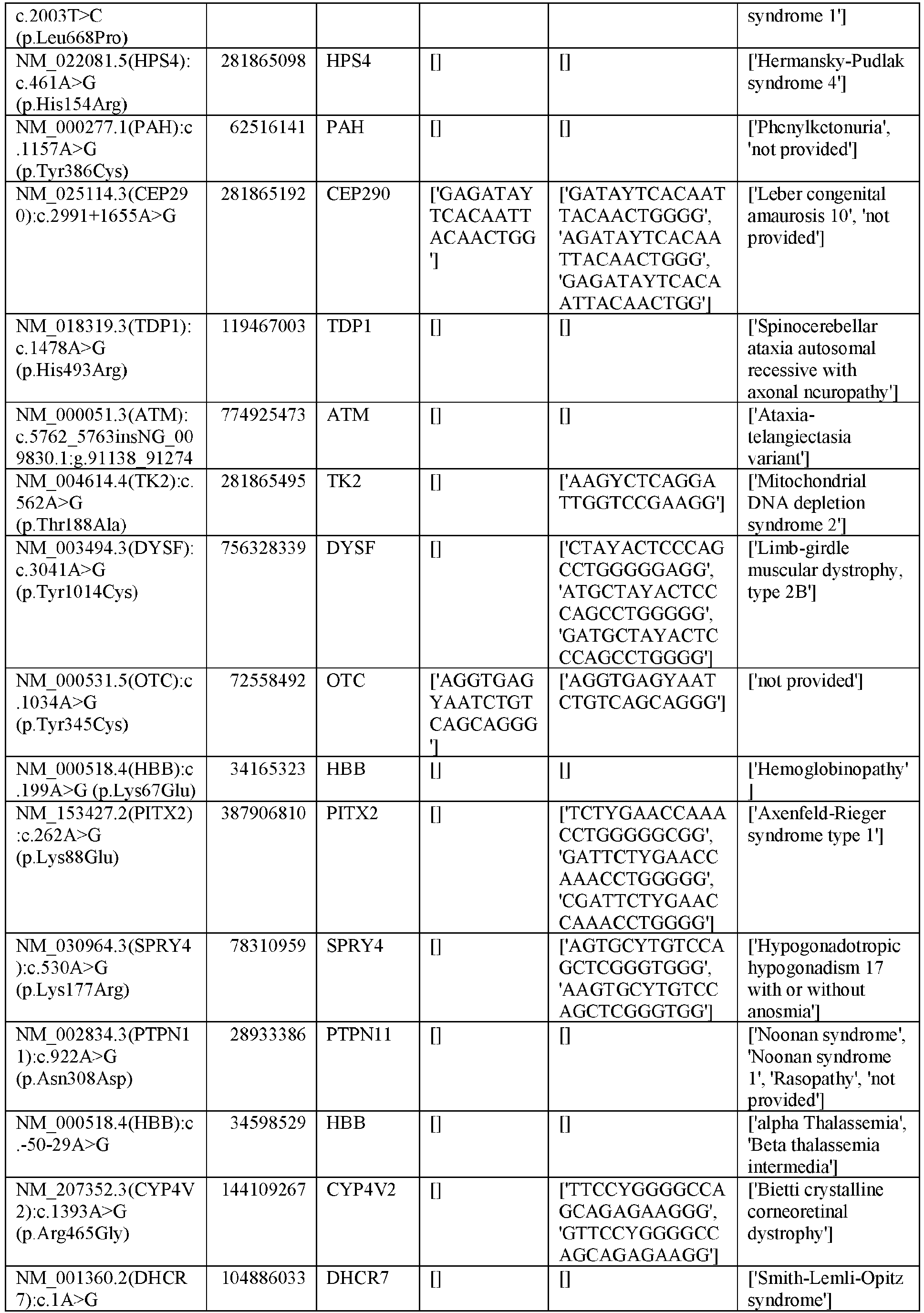

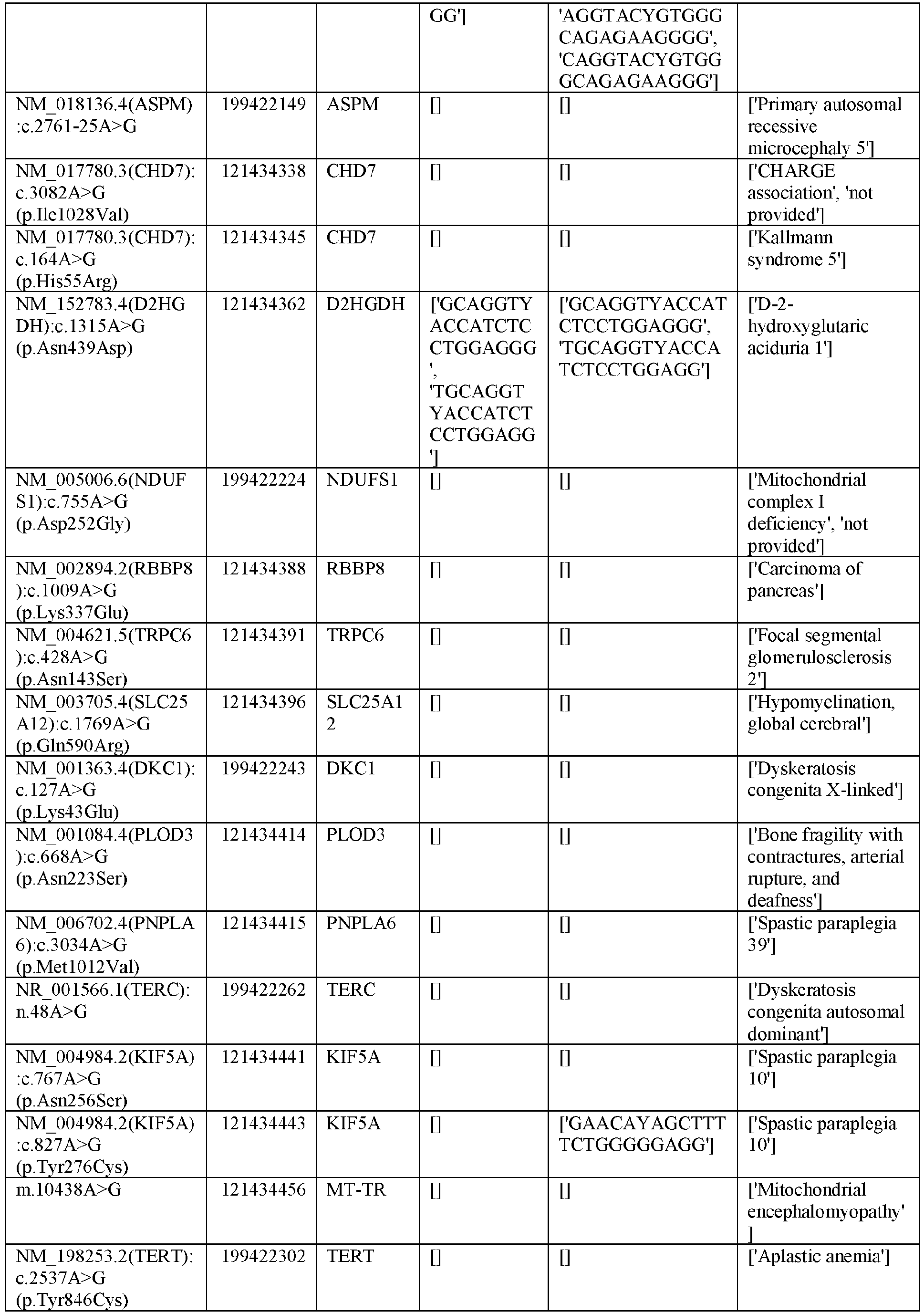


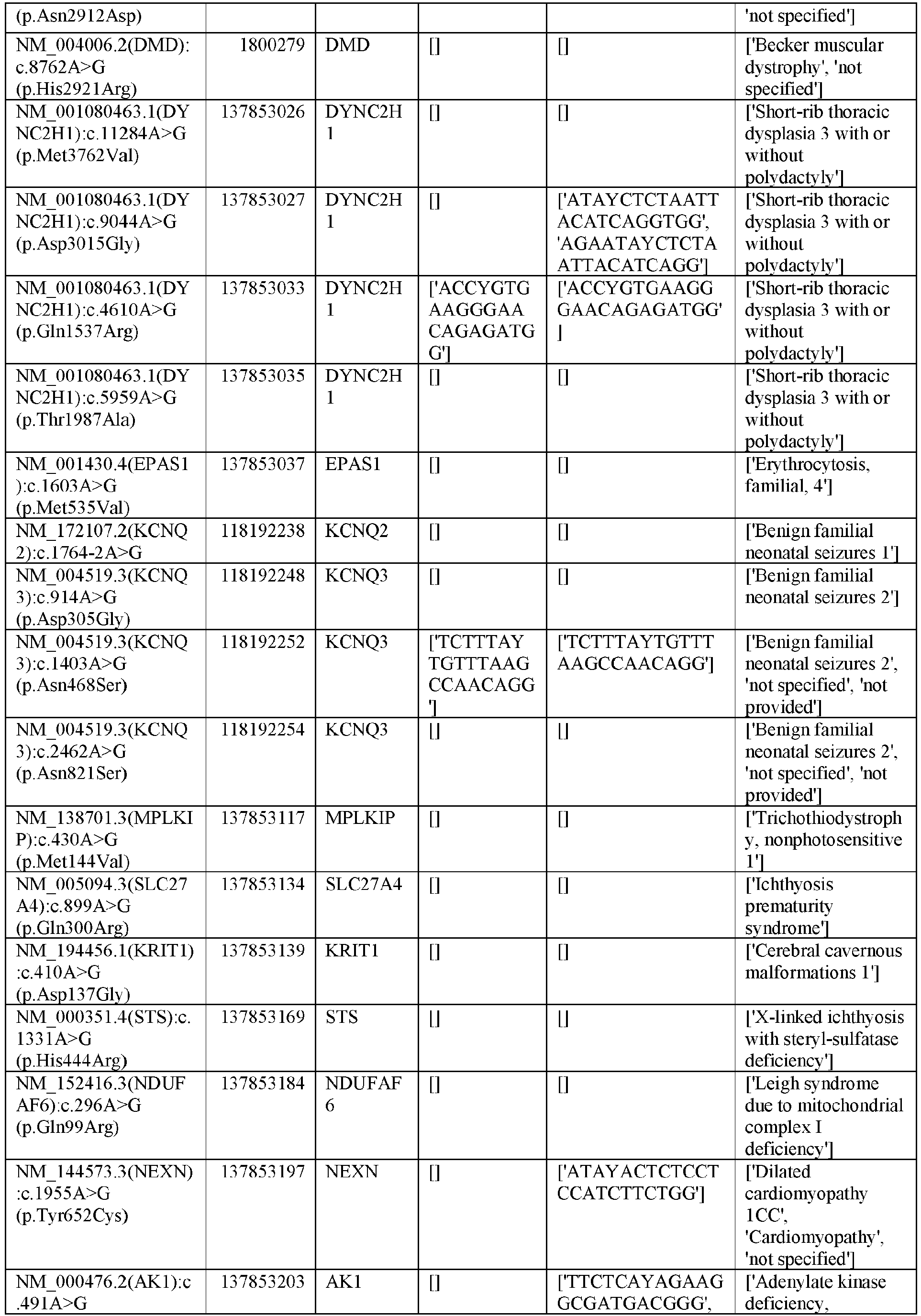

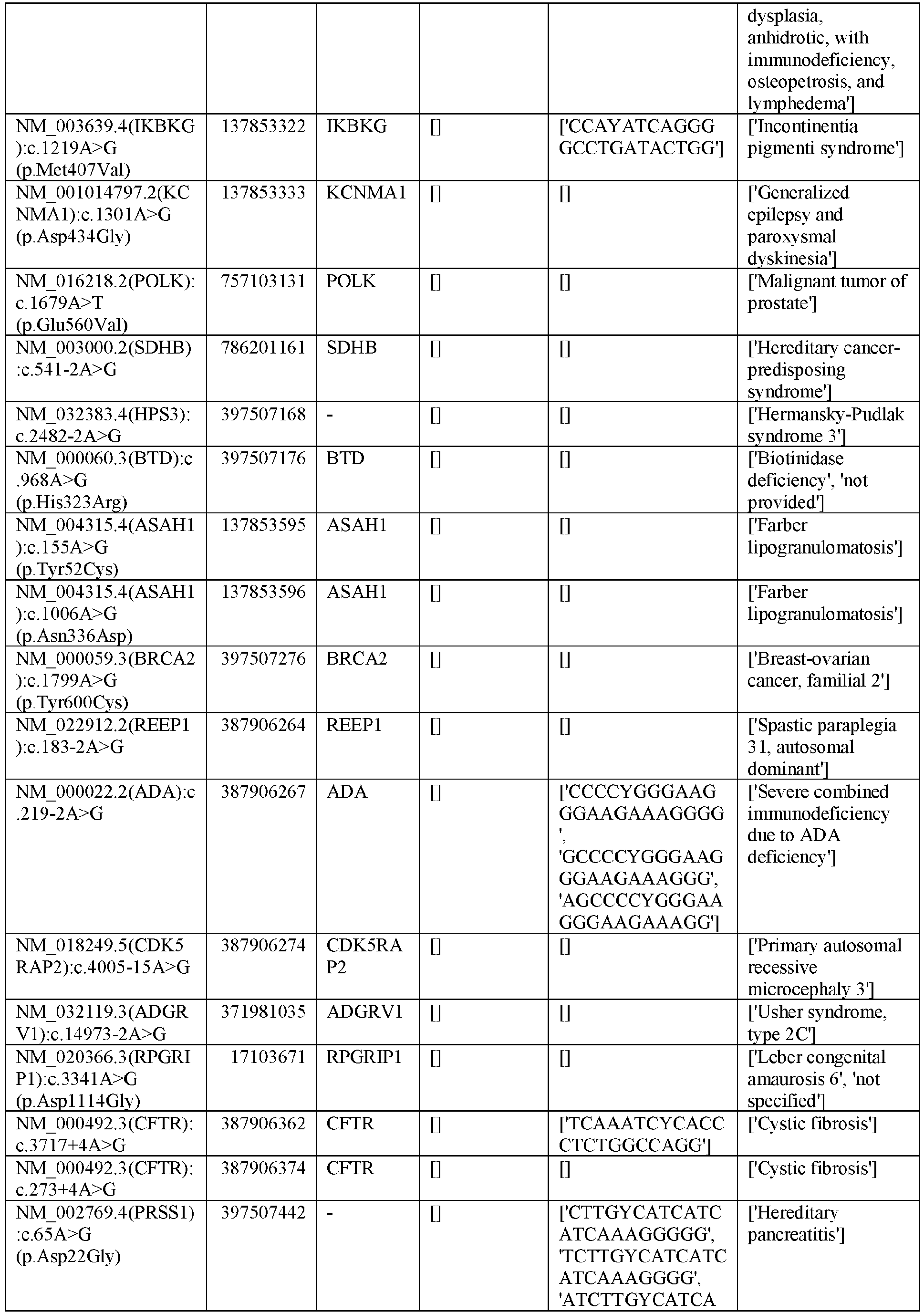

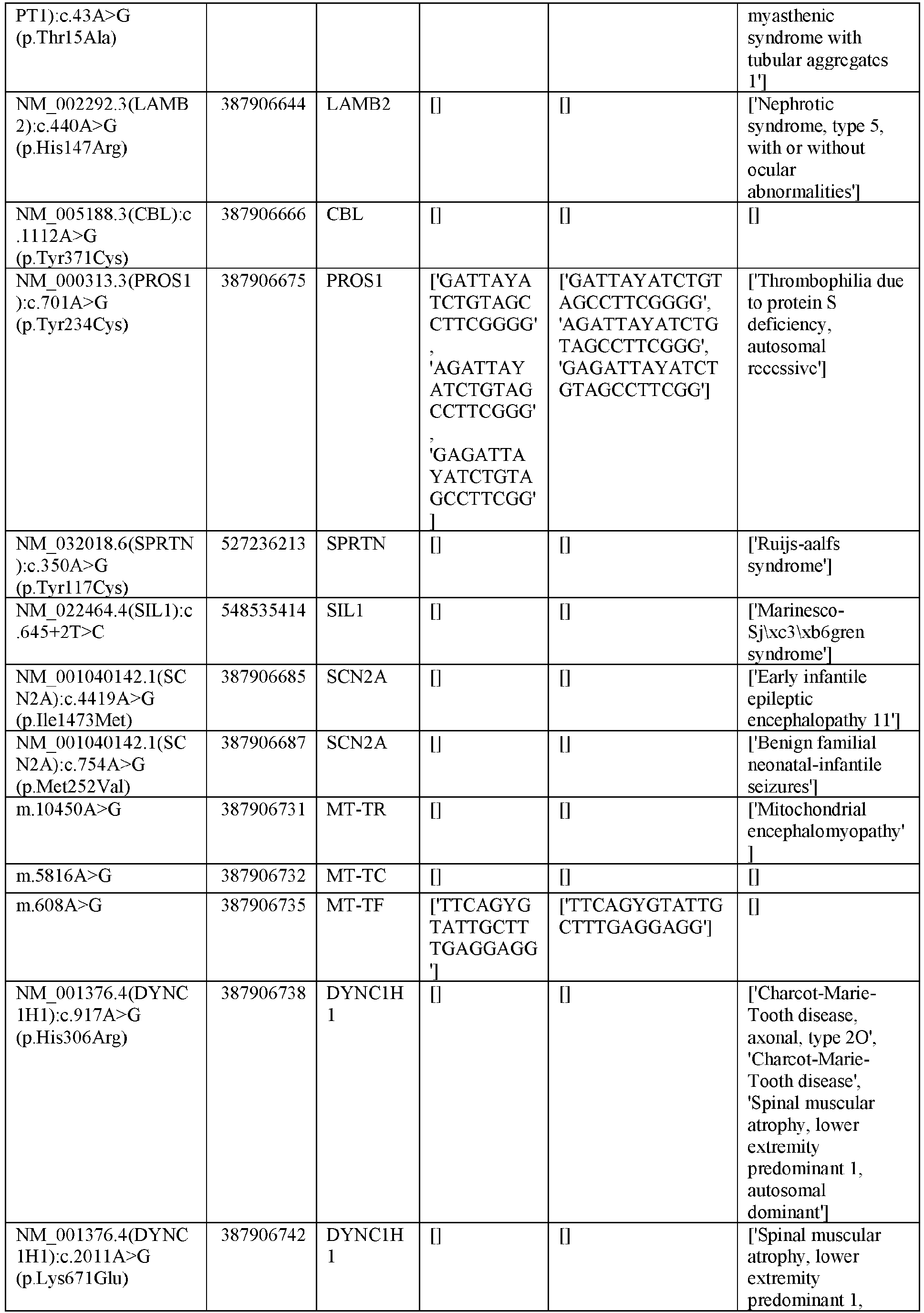


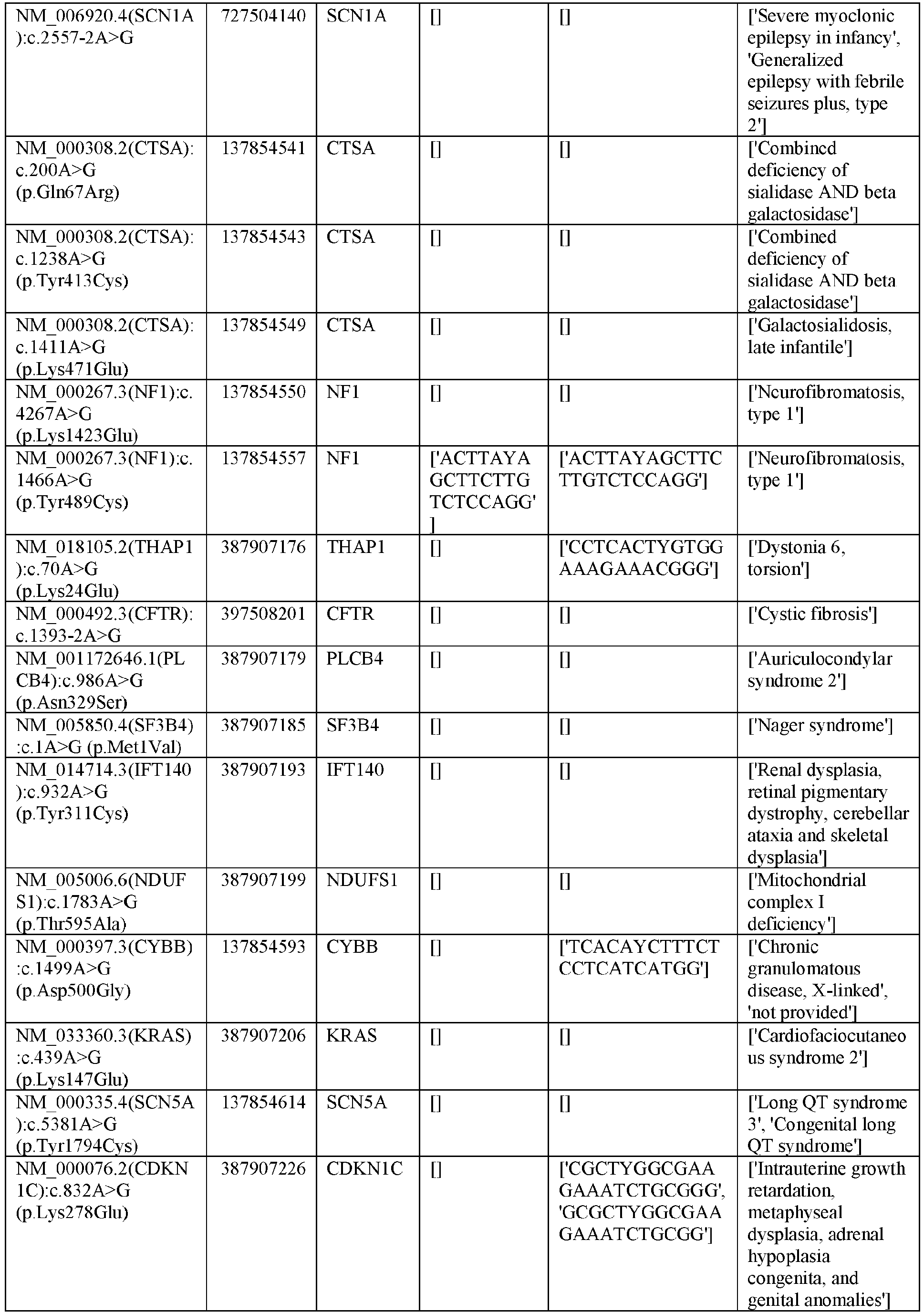

-
- 1. Humbert O, Davis L, Maizels N. Targeted gene therapies: tools, applications, optimization. Crit Rev Biochem Mol.2012; 47(3):264-81. PMID: 22530743.
- 2. Perez-Pinera P, Ousterout DG, Gersbach CA. Advances in targeted genome editing. Curr Opin Chem Biol. 2012; 16(3-4):268-77. PMID: 22819644.
- 3. Urnov FD, Rebar EJ, Holmes MC, Zhang HS, Gregory PD. Genome editing with engineered zinc finger nucleases. Nat Rev Genet. 2010; 11(9):636-46. PMID: 20717154.
- 4. Joung JK, Sander JD. TALENs: a widely applicable technology for targeted genome editing. Nat Rev Mol Cell Biol. 2013; 14(1):49-55. PMID: 23169466.
- 5. Charpentier E, Doudna JA. Biotechnology: Rewriting a genome. Nature. 2013; 495, (7439):50-1. PMID: 23467164.
- 6. Pan Y, Xia L, Li AS, Zhang X, Sirois P, Zhang J, Li K. Biological and biomedical applications of engineered nucleases. Mol Biotechnol. 2013; 55(1):54-62. PMID: 23089945.
- 7. De Souza, N. Primer: genome editing with engineered nucleases. Nat Methods. 2012; 9(1):27. PMID: 22312638.
- 8. Santiago Y, Chan E, Liu PQ, Orlando S, Zhang L, Urnov FD, Holmes MC, Guschin D, Waite A, Miller JC, Rebar EJ, Gregory PD, Klug A, Collingwood TN. Targeted gene knockout in mammalian cells by using engineered zinc-finger nucleases. Proc Natl Acad Sci USA. 2008; 105(15):5809-14. PMID: 18359850.
- 9. Cargill M, Altshuler D, Ireland J, Sklar P, Ardlie K, Patil N, Lane CR, Lim EP, Kalyanaraman N, Nemesh J, Ziaugra L, Friedland L, Rolfe A, Warrington J, Lipshutz R, Daley GQ, Lander ES. Characterization of single-nucleotide polymorphisms in coding regions of human genes. Nat Genet. 1999; 22(3):231-8. PMID: 10391209.
- 10. Jansen R, van Embden JD, Gaastra W, Schouls LM. Identification of genes that are associated with DNA repeats in prokaryotes. Mol Microbiol. 2002; 43(6):1565-75. PMID: 11952905.
- 11. Mali P, Esvelt KM, Church GM. Cas9 as a versatile tool for engineering biology. Nat Methods. 2013; 10(10):957-63. PMID: 24076990.
- 12. Jore MM, Lundgren M, van Duijin E, Bultema JB, Westra ER, Waghmare SP, Wiedenheft B, Pul U, Wurm R, Wagner R, Beijer MR, Barendregt A, Shou K, Snijders AP, Dickman MJ, Doudna JA, Boekema EJ, Heck AJ, van der Cost J, Brouns SJ. Structural basis for CRISPR RNA-guided DNA recognition by Cascade. Nat Struct Mol Biol. 2011; 18(5):529-36. PMID: 21460843.
- 13. Horvath P, Barrangou R. CRISPR/Cas, the immune system of bacteria and archaea. Science. 2010; 327(5962):167-70. PMID: 20056882.
- 14. Wiedenheft B, Sternberg SH, Doudna JA. RNA-guided genetic silencing systems in bacteria and archaea. Nature. 2012; 482(7385):331-8. PMID: 22337052.
- 15. Gasiunas G, Siksnys V. RNA-dependent DNA endonuclease Cas9 of the CRISPR system: Holy Grail of genome editing? Trends Microbiol. 2013; 21(11):562-7. PMID: 24095303.
- 16. Qi LS, Larson MH, Gilbert LA, Doudna JA, Weissman JS, Arkin AP, Lim WA. Repurposing CRISPR as an RNA-guided platform for sequence-specific control of gene expression. Cell. 2013; 152(5):1173-83. PMID: 23452860.
- 17. Perez-Pinera P, Kocak DD, Vockley CM, Adler AF, Kabadi AM, Polstein LR, Thakore PI, Glass KA, Ousterout DG, Leong KW, Guilak F, Crawford GE, Reddy TE, Gersbach CA. RNA-guided gene activation by CRISPR-Cas9-based transcription factors. Nat Methods. 2013; 10(10):973-6. PMID: 23892895.
- 18. Mali P, Aach J, Stranges PB, Esvelt KM, Moosburner M, Kosuri S, Yang L, Church GM. CAS9 transcriptional activators for target specificity screening and paired nickases for cooperative genome engineering. Nat Biotechnol. 2013; 31(9):833-8. PMID: 23907171.
- 19. Gilbert LA, Larson MH, Morsut L, Liu Z, Brar GA, Torres SE, Stern-Ginossar N, Brandman O, Whitehead EH, Doudna JA, Lim WA, Weissman JS, Qi LS. CRISPR-mediated modular RNA-guided regulation of transcription in eukaryotes. Cell. 2013; 154(2):442-51. PMID: 23849981.
- 20. Larson MH, Gilbert LA, Wang X, Lim WA, Weissman JS, Qi LS. CRISPR interference (CRISPRi) for sequence-specific control of gene expression. Nat Protoc. 2013; 8(11):2180-96. PMID: 24136345.
- 21. Mali P, Yang L, Esvelt KM, Aach J, Guell M, DiCarlo JE, Norville JE, Church GM. RNA-guided human genome engineering via Cas9. Science. 2013; 339(6121):823-6. PMID: 23287722.
- 22. Cole-Strauss A, Yoon K, Xiang Y, Byrne BC, Rice MC, Gryn J, Holloman WK, Kmiec EB. Correction of the mutation responsible for sickle cell anemia by an RNA-DNA oligonucleotide. Science. 1996; 273(5280):1386-9. PMID: 8703073.
- 23. Tagalakis AD, Owen JS, Simons JP. Lack of RNA-DNA oligonucleotide (chimeraplast) mutagenic activity in mouse embryos. Mol Reprod Dev. 2005; 71(2):140-4. PMID: 15791601.
- 24. Ray A, Langer M. Homologous recombination: ends as the means. Trends Plant Sci. 2002; 7(10):435-40. PMID 12399177.
- 25. Britt AB, May GD. Re-engineering plant gene targeting. Trends Plant Sci. 2003; 8(2):90-5. PMID: 12597876.
- 26. Vagner V, Ehrlich SD. Efficiency of homologous DNA recombination varies along the Bacillus subtilis chromosome. J Bacteriol. 1988; 170(9):3978-82. PMID: 3137211.
- 27. Saleh-Gohari N, Helleday T. Conservative homologous recombination preferentially repairs DNA double-strand breaks in the S phase of the cell cycle in human cells. Nucleic Acids Res. 2004; 32(12):3683-8. PMID: 15252152.
- 28. Lombardo A, Genovese P, Beausejour CM, Colleoni S, Lee YL, Kim KA, Ando D, Urnov FD, Galli C, Gregory PD, Holmes MC, Naldini L. Gene editing in human stem cells using zinc finger nucleases and integrase-defective lentiviral vector delivery. Nat Biotechnol. 2007; 25(11):1298-306. PMID: 17965707.
- 29. Conticello SG. The AID/APOBEC family of nucleic acid mutators. Genome Biol. 2008; 9(6):229. PMID: 18598372.
- 30. Reynaud CA, Aoufouchi S, Faili A, Weill JC. What role for AID: mutator, or assembler of the immunoglobulin mutasome? Nat Immunol. 2003; 4(7):631-8.
- 31. Bhagwat AS. DNA-cytosine deaminases: from antibody maturation to antiviral defense. DNA Repair (Amst). 2004; 3(1):85-9. PMID: 14697763.
- 32. Navaratnam N, Sarwar R. An overview of cytidine deaminases. Int JHematol. 2006; 83(3):195-200. PMID: 16720547.
- 33. Holden LG, Prochnow C, Chang YP, Bransteitter R, Chelico L, Sen U, Stevens RC, Goodman MF, Chen XS. Crystal structure of the anti-viral APOBEC3G catalytic domain and functional implications. Nature. 2008; 456(7218):121-4. PMID: 18849968.
- 34. Chelico L, Pham P, Petruska J, Goodman MF. Biochemical basis of immunological and retroviral responses to DNA-targeted cytosine deamination by activation-induced cytidine deaminase and APOBEC3G. J Biol Chem. 2009; 284(41). 27761-5. PMID: 19684020.
- 35. Pham P, Bransteitter R, Goodman MF. Reward versus risk: DNA cytidine deaminases triggering immunity and disease. Biochemistry. 2005; 44(8):2703-15. PMID 15723516.
- 36. Chen X, Zaro JL, Shen WC. Fusion protein linkers: property, design and functionality. Adv Drug Deliv Rev. 2013; 65(10):1357-69. PMID: 23026637.
- 37. Lee JW, Soung YH, Kim SY, Lee HW, Park WS, Nam SW, Kim SH, Lee JY, Yoo NJ, Lee SH. PIK3CA gene is frequently mutated in breast carcinomas and hepatocellular carcinomas. Oncogene. 2005; 24(8):1477-80. PMID: 15608678.
- 38. Ikediobi ON, Davies H, Bignell G, Edkins S, Stevens C, O'Meara S, Santarius T, Avis T, Barthorpe S, Brackenbury L, Buck G, Butler A, Clements J, Cole J, Dicks E, Forbes S, Gray K, Halliday K, Harrison R, Hills K, Hinton J, Hunter C, Jenkinson A, Jones D, Kosmidou V, Lugg R, Menzies A, Mironenko T, Parker A, Perry J, Raine K, Richardson D, Shepherd R, Small A, Smith R, Solomon H, Stephens P, Teaque J, Tofts C, Varian J, Webb T, West S, Widaa S, Yates A, Reinhold W, Weinstein JN, Stratton MR, Futreal PA, Wooster R. Mutation analysis of 24 known cancer genes in the NCI-60 cell line set. Mol Cancer Ther. 2006; 5(11):2606-12. PMID: 17088437.
- 39. Cox, D. B., Platt, R. J. & Zhang, F. Therapeutic genome editing: prospects and challenges. ).
- 40. Hilton, I. B. & Gersbach, C. A. Enabling functional genomics with genome engineering. ).
- 41. Sander, J. D. & Joung, J. K. CRISPR-Cas systems for editing, regulating and targeting genomes. ).
- 42. Maruyama, T. et al. Increasing the efficiency of precise genome editing with CRISPR-Cas9 by inhibition of nonhomologous end joining. ).
- 43. Chu, V. T. et al. Increasing the efficiency of homology-directed repair for CRISPR-Cas9-induced precise gene editing in mammalian cells. ).
- 44. Lin, S., Staahl, B. T., Alla, R. K. & Doudna, J. A. Enhanced homology-directed human genome engineering by controlled timing of CRISPR/Cas9 delivery. ).
- 45. Cong, L. et al. Multiplex genome engineering using CRISPR/Cas systems. ).
- 46. Rong, Z., Zhu, S., Xu, Y. & Fu, X. Homologous recombination in human embryonic stem cells using CRISPR/Cas9 nickase and a long DNA donor template. Protein & ).
- 47. Jinek, M. et al. A Programmable Dual-RNA-Guided DNA Endonuclease in Adaptive Bacterial Immunity. Science 337, 816-821, doi:10.1126/science.1225829(2012).
- 48. Harris, R. S., Petersen-Mahrt, S. K. & Neuberger, M. S. RNA Editing Enzyme APOBEC1 and Some of Its Homologs Can Act as DNA Mutators. ).
- 49. Jinek, M. et al. Structures of Cas9 endonucleases reveal RNA-mediated conformational activation. Science 343, 1247997, doi:10.1126/science.1247997 (2014).
- 50. Schellenberger, V. et al. A recombinant polypeptide extends the in vivo half-life of peptides and proteins in a tunable manner. ).
- 51. Saraconi, G., Severi, F., Sala, C., Mattiuz, G. & Conticello, S. G. The RNA editing enzyme APOBEC1 induces somatic mutations and a compatible mutational signature is present in esophageal adenocarcinomas. ).
- 52. Anders, C., Niewoehner, O., Duerst, A. & Jinek, M. Structural basis of PAM-dependent target DNA recognition by the Cas9 endonuclease. Nature 513, 569-573, doi:10.1038/nature13579 (2014).
- 53. Cong, L. et al. Multiplex genome engineering using CRISPR/Cas systems. ).
- 54. Tsai, S. Q. et al. GUIDE-seq enables genome-wide profiling of offtarget cleavage by CRISPR- Cas nucleases. ).
- 55. Kunz, C., Saito, Y. & Schar, P. DNA Repair in mammalian cells: Mismatched repair: variations on a theme. Cellular and molecular life sciences : ).
- 56. D., M. C. et al. Crystal structure of human uracil-DNA glycosylase in complex with a protein inhibitor: protein mimicry of DNA. Cell 82, 701-708 (1995).
- 57. Caldecott, K. W. Single-strand break repair and genetic disease. Nature reviews. ).
- 58. Fukui, K. DNA mismatch repair in eukaryotes and bacteria. Journal of nucleic acids 2010, doi:10.4061/2010/260512 (2010).
- 59. Gasiunas, G., Barrangou, R., Horvath, P. & Siksnys, V. Cas9-crRNA ribonucleoprotein complex mediates specific DNA cleavage for adaptive immunity in bacteria. Proceedings of the National Academy of Sciences 109, E2579-E2586, doi:10.11208507109 (2012).
- 60. Ran, F. A. et al. In vivo genome editing using Staphylococcus aureus Cas9. Nature 520, 186-191, doi:10.1038/nature14299 (2015).
- 61. Kuscu, C., Arslan, S., Singh, R., Thorpe, J. & Adli, M. Genome-wide analysis reveals characteristics of offtarget sites bound by the Cas9 endonuclease. ).
- 62. Wu, X. et al. Genome-wide binding of the CRISPR endonuclease Cas9 in mammalian cells. ).
- 63. Beale, R. C. L. et al. Comparison of the Differential Context-dependence of DNA Deamination by APOBEC Enzymes: Correlation with Mutation Spectra in Vivo. Journal of Molecular Biology 337, 585-596, doi:10.1016/j.jmb.2004.01.046 (2004).
- 64. Kim, J., Basak, J. M. & Holtzman, D. M. The role of apolipoprotein E in Alzheimer's disease. Neuron 63, 287-303, doi:10.1016/j.neuron.2009.06.026 (2009).
- 65. Liu, C. C., Kanekiyo, T., Xu, H. & Bu, G. Apolipoprotein E and Alzheimer disease: risk, mechanisms and therapy. Nature reviews. ).
- 66. Sjöblom, T. et al. The Consensus Coding Sequences of Human Breast and Colorectal Cancers. Science 314, 268-274, doi:10.1126/science.1133427(2006).
- 67. Stephens, P. J. et al. The landscape of cancer genes and mutational processes in breast cancer. Nature 486, 400-404, doi:10.1038/nature11017 (2012).
- 68. Landrum, M. J. et al. ClinVar: public archive of interpretations of clinically relevant variants. Nucleic Acids Research, doi:10.1093/nar/gkv1222 (2015).
- 69. Slaymaker, I. M. et al. Rationally engineered Cas9 nucleases with improved specificity. Science, doi:10.1126/science.aad5227 (2015).
- 70. Davis, K. M., Pattanayak, V., Thompson, D. B., Zuris, J. A. & Liu, D. R. Small molecule-triggered Cas9 protein with improved genome-editing specificity. ).
- 71. Zuris, J. A. et al. Cationic lipid-mediated delivery of proteins enables efficient protein-based genome editing in vitro and in vivo. ).
- 72. Kleinstiver, B. P. et al. Engineered CRISPR-Cas9 nucleases with altered PAM specificities. Nature 523, 481-485, doi:10.1038/nature14592 (2015).
- 73. Pattanayak, V. et al. High-throughput profiling of offtarget DNA cleavage reveals RNA- programmed Cas9 nuclease specificity. ).
- 74. Shcherbakova, D. M. & Verkhusha, V. V. Near-infrared fluorescent proteins for multicolor in vivo imaging. ).
- 75. Ran, F. A. et al. Genome engineering using the CRISPR-Cas9 system. Nat. ).
- 76. Jiang, F. et al. Structures of a CRISPR-Cas9 R-loop complex primed for DNA cleavage. Science, doi:10.1126/science.aad8282 (2016).
- 77. Tsai, S. Q. et al. Dimeric CRISPR RNA-guided FokI nucleases for highly specific genome editing. ).
- 78. Lieber, M. R., Ma, Y., Pannicke, U. & Schwarz, K. Mechanism and regulation of human non-homologous DNA end-joining. Nat Rev ).
- 79. Heller, R. C. & Marians, K. J. Replisome assembly and the direct restart of stalled replication forks. Nat Rev ).
- 80. Pluciennik, A. et al. PCNA function in the activation and strand direction of MutLα endonuclease in mismatch repair. Proceedings of the National Academy of Sciences of the United States of ).
- 81. Seripa, D. et al. The missing ApoE allele. Annals of human genetics 71, 496-500, doi:10.1111/j.1469-1809.2006.00344.x (2007).
- 82. Kleinstiver, B. P. et al. High-fidelity CRISPR-Cas9 nucleases with no detectable genome-wide off-target effects. Nature 529, 490-495, doi:10.1038/nature16526 (2016).
- 83. Richardson, C. D., Ray, G. J., DeWitt, M. A., Curie, G. L. & Corn, J. E. Enhancing homology-directed genome editing by catalytically active and inactive CRISPR-Cas9 using asymmetric donor DNA. ).
- 84. Simonelli, V., Narciso, L., Dogliotti, E. & Fortini, P. Base excision repair intermediates are mutagenic in mammalian cells. ).
- 85. Barnes, D. E. & Lindahl, T. Repair and Genetic Consequences of Endogenous DNA Base Damage in Mammalian Cells. Annual Review of ).
- Those skilled in the art will recognize, or be able to ascertain using no more than routine experimentation, many equivalents of the embodiments described herein. The scope of the present disclosure is not intended to be limited to the above description, but rather is as set forth in the appended claims.

Claims (17)
- A fusion protein comprising: (i) a Cas9 domain; (ii) a cytidine deaminase domain; and (iii) a uracil glycosylase inhibitor (UGI) domain, wherein the Cas9 domain is a Cas9 nickase (nCas9) or a dead Cas9 (dCas9) domain.
- The fusion protein of claim 1, wherein the Cas9 domain comprises an amino acid sequence that is at least 85%, at least 90%, at least 95%, at least 96%, at least 97%, at least 98%, at least 99%, or at least 99.5% identical to the amino acid sequence provided in SEQ ID NO: 674.
- The fusion protein of claim 1 or 2, wherein the Cas9 domain is an nCas9 domain that nicks a nucleotide target strand of a nucleotide duplex, wherein the nucleotide target strand is the strand that binds to a gRNA of the nCas9 domain, optionally wherein the Cas9 domain is an nCas9 domain that comprises a D10A mutation in the amino acid sequence provided in SEQ ID NO: 10, or a corresponding mutation in any of the amino acid sequences provided in SEQ ID NOs: 11-260.
- The fusion protein of any one of claims 1-3, wherein the Cas9 domain is an nCas9 domain that comprises one or more of N497A, R661A, Q695A, or Q926A mutations in the amino acid sequence provided in SEQ ID NO 10, or one or more corresponding mutations in any of the amino acid sequences provided in SEQ ID NOs: 11-260.
- The fusion protein of any one of claims 1-4, wherein the cytidine deaminase domain(i) is a deaminase from the apolipoprotein B mRNA-editing complex (APOBEC) family deaminase, optionally wherein the APOBEC family deaminase is selected from the group consisting of APOBEC1 deaminase, APOBEC2 deaminase, APOBEC3A deaminase, APOBEC3B deaminase, APOBEC3C deaminase, APOBEC3D deaminase, APOBEC3F deaminase, APOBEC3G deaminase, and APOBEC3H deaminase;(ii) comprises an amino acid sequence that is at least 85%, at least 90%, at least 92%, at least 95%, at least 96%, at least 97%, at least 98%, at least 99%, or at least 99.5% identical to an amino acid sequence of SEQ ID NO: 266-284, 607-610, 5724-5736, or 5738-5741;(iii) comprises an amino acid sequence of SEQ ID NO: 266-284, 607-610, 5724-5736, or 5738-5741;(iv) is a rat APOBEC1 (rAPOBEC1) deaminase comprising one or more mutations selected from the group consisting of W90Y, R126E, and R132E of SEQ ID NO: 284, or one or more corresponding mutations in a homologous APOBEC deaminase;(v) is a human APOBEC1 (hAPOBEC1) deaminase comprising one or more mutations selected from the group consisting of W90Y, Q126E, and R132E of SEQ ID NO: 5724, or one or more corresponding mutations in a homologous APOBEC deaminase;(vi) is a human APOBEC3G (hAPOBEC3G) deaminase comprising one or more mutations selected from the group consisting of W285Y, R320E, and R326E of SEQ ID NO: 275, or one or more corresponding mutations in a homologous APOBEC deaminase;(vii) is an activation-induced deaminase (AID); or(viii) is a cytidine deaminase 1 from Petromyzon marinus (pmCDA1).
- The fusion protein of any one of claims 1-5, wherein the UGI domain comprises a domain capable of inhibiting UDG activity, optionally wherein the UGI domain comprises an amino acid sequence that is at least 85% identical, at least 90%, at least 95%, at least 96%, at least 97%, at least 98%, at least 99%, or at least 99.5% to SEQ ID NO: 600, optionally wherein the UGI domain comprises an amino acid sequence of SEQ ID NO: 600.
- The fusion protein of any one of claims 1-6, wherein the fusion protein comprises the structure:(a) NH2-[cytidine deaminase domain]-[Cas9 domain]-[UGI domain]-COOH;(b) NH2-[cytidine deaminase domain]-[Cas9 domain]-[UGI domain]-[second Cas9 domain]-COOH; or(c) NH2-[cytidine deaminase domain]-[Cas9 domain]-[second Cas9 domain]-[UGI domain]-COOH;wherein each instance of "]-[" comprises an optional linker.
- The fusion protein of any one of claims 1-7, wherein the cytidine deaminase domain of (ii) and the nCas9 domain of (i) are linked via a linker comprising the amino acid sequence (GGGS)n (SEQ ID NO: 265), (GGGGS)n (SEQ ID NO: 5), (G)n, (EAAAK)n (SEQ ID NO: 6), (GGS)n, (SGGS)n (SEQ ID NO: 4288), SGSETPGTSESATPES (SEQ ID NO: 7), or (XP)n motif, or a combination thereof, wherein n is independently an integer between 1 and 30, inclusive, and wherein X is any amino acid; or optionally wherein the nCas9 domain and the UGI domain are linked via a linker comprising the amino acid sequence of (GGGS)n (SEQ ID NO: 265), (GGGGS)n (SEQ ID NO: 5), (G)n, (EAAAK)n (SEQ ID NO: 6), (GGS)n, (SGGS)n (SEQ ID NO: 4288), SGSETPGTSESATPES (SEQ ID NO: 7), or (XP)n motif, or a combination thereof, wherein n is independently an integer between 1 and 30, inclusive, and wherein X is any amino acid.
- The fusion protein of any one of claims 1-8 further comprising a nuclear localization sequence (NLS), optionally wherein the NLS comprises the amino acid sequence PKKKRKV (SEQ ID NO: 741) or MDSLLMNRRKFLYQFKNVRWAKGRRETYLC (SEQ ID NO: 742), optionally wherein the fusion protein comprises the structure: NH2-[cytidine deaminase domain]-[nCas9 domain]-[UGI domain]-[NLS]-COOH, and wherein each instance of"]-[" comprises an optional linker, optionally wherein the UGI domain and the NLS are linked via a linker comprising the amino acid sequence: SGGS (SEQ ID NO: 4288).
- The fusion protein of any one of claims 1-9, wherein the fusion protein comprises the amino acid sequence set forth in any one of SEQ ID NOs: 591-594, 611, 612, 615, 657, 658, 5737, 5743, 5745, and 5746.
- A method for editing a nucleic acid comprising contacting a nucleic acid molecule with the fusion protein of any one of claims 1-10 and a guide RNA (gRNA), wherein the gRNA comprises a sequence of at least 10 contiguous nucleotides that is complementary to a target sequence in the genome of an organism and comprises a target base pair, wherein the contacting is performed in vitro, optionally wherein(i) the target base pair comprises a T to C point mutation associated with a disease or disorder, and wherein the deamination of the mutant C base results in a sequence that is not associated with a disease or disorder, or(ii) the contacting results in less than 20% indel formation upon base editing, or(iii) the contacting results in at least 2:1 intended to unintended product upon base editing; provided that the method is not a method for treatment of the human or animal body by surgery or therapy.
- The method of claim 11, wherein the disease or disorder is cystic fibrosis, phenylketonuria, epidermolytic hyperkeratosis (EHK), Charcot-Marie-Toot disease type 4J, neuroblastoma (NB), von Willebrand disease (vWD), myotonia congenital, hereditary renal amyloidosis, dilated cardiomyopathy (DCM), hereditary lymphedema, familial Alzheimer's disease, HIV, Prion disease, chronic infantile neurologic cutaneous articular syndrome (CINCA), desmin-related myopathy (DRM), or a neoplastic disease associated with a mutant PI3KCA protein, a mutant CTNNB1 protein, a mutant HRAS protein, or a mutant p53 protein.
- A complex comprising the fusion protein of any one of claims 1-10, and a gRNA bound to the Cas9 domain of the fusion protein., optionally wherein the gRNA is from 15-100 nucleotides long and comprises a sequence of at least 10 contiguous nucleotides that is complementary to a target sequence.
- The complex of claim 13, wherein the target sequence is a DNA sequence, optionally wherein the target sequence is in the genome of a prokaryote or is in the genome of a eukaryote, such as in the genome of a mammal, optionally wherein the mammal is human.
- A vector comprising a polynucleotide encoding the fusion protein of any one of claims 1-10, optionally further comprising a heterologous promoter driving expression of the polynucleotide encoding the fusion protein.
- A cell comprising the fusion protein of any one of claims 1-10, or the complex of claim 13 or 14, or the vector of claim 15.
- The fusion protein of any one of claims 1-10, the complex of claim 13 or 14, the vector of claim 15, or the cell of claim 16, for use as a medicament.
Priority Applications (1)
| Application Number | Priority Date | Filing Date | Title |
|---|---|---|---|
| EP23181576.2A EP4269577A3 (en) | 2015-10-23 | 2016-10-22 | Nucleobase editors and uses thereof |
Applications Claiming Priority (10)
| Application Number | Priority Date | Filing Date | Title |
|---|---|---|---|
| US201562245828P | 2015-10-23 | 2015-10-23 | |
| US201662279346P | 2016-01-15 | 2016-01-15 | |
| US201662311763P | 2016-03-22 | 2016-03-22 | |
| US201662322178P | 2016-04-13 | 2016-04-13 | |
| US201662357352P | 2016-06-30 | 2016-06-30 | |
| US201662357332P | 2016-06-30 | 2016-06-30 | |
| US201662370700P | 2016-08-03 | 2016-08-03 | |
| US201662398490P | 2016-09-22 | 2016-09-22 | |
| US201662408686P | 2016-10-14 | 2016-10-14 | |
| PCT/US2016/058344 WO2017070632A2 (en) | 2015-10-23 | 2016-10-22 | Nucleobase editors and uses thereof |
Related Child Applications (2)
| Application Number | Title | Priority Date | Filing Date |
|---|---|---|---|
| EP23181576.2A Division-Into EP4269577A3 (en) | 2015-10-23 | 2016-10-22 | Nucleobase editors and uses thereof |
| EP23181576.2A Division EP4269577A3 (en) | 2015-10-23 | 2016-10-22 | Nucleobase editors and uses thereof |
Publications (3)
| Publication Number | Publication Date |
|---|---|
| EP3365356A2 EP3365356A2 (en) | 2018-08-29 |
| EP3365356B1 true EP3365356B1 (en) | 2023-06-28 |
| EP3365356B2 EP3365356B2 (en) | 2026-05-13 |
Family
ID=57249890
Family Applications (4)
| Application Number | Title | Priority Date | Filing Date |
|---|---|---|---|
| EP23181576.2A Pending EP4269577A3 (en) | 2015-10-23 | 2016-10-22 | Nucleobase editors and uses thereof |
| EP16791744.2A Active EP3365356B2 (en) | 2015-10-23 | 2016-10-22 | Nucleobase editors and uses thereof |
| EP24157472.2A Pending EP4434589A3 (en) | 2015-10-23 | 2016-10-22 | Evolved cas9 proteins for gene editing |
| EP16794114.5A Active EP3365357B1 (en) | 2015-10-23 | 2016-10-22 | Evolved cas9 proteins for gene editing |
Family Applications Before (1)
| Application Number | Title | Priority Date | Filing Date |
|---|---|---|---|
| EP23181576.2A Pending EP4269577A3 (en) | 2015-10-23 | 2016-10-22 | Nucleobase editors and uses thereof |
Family Applications After (2)
| Application Number | Title | Priority Date | Filing Date |
|---|---|---|---|
| EP24157472.2A Pending EP4434589A3 (en) | 2015-10-23 | 2016-10-22 | Evolved cas9 proteins for gene editing |
| EP16794114.5A Active EP3365357B1 (en) | 2015-10-23 | 2016-10-22 | Evolved cas9 proteins for gene editing |
Country Status (10)
| Country | Link |
|---|---|
| US (6) | US12043852B2 (en) |
| EP (4) | EP4269577A3 (en) |
| JP (6) | JP7067793B2 (en) |
| KR (1) | KR20180069898A (en) |
| CN (2) | CN108699116A (en) |
| AU (2) | AU2016342380B2 (en) |
| CA (1) | CA3002827A1 (en) |
| IL (4) | IL258821B (en) |
| SG (2) | SG10202104041PA (en) |
| WO (2) | WO2017070633A2 (en) |
Cited By (1)
| Publication number | Priority date | Publication date | Assignee | Title |
|---|---|---|---|---|
| US12152257B2 (en) | 2018-06-04 | 2024-11-26 | University Of Copenhagen | Mutant CPF1 endonucleases |
Families Citing this family (537)
| Publication number | Priority date | Publication date | Assignee | Title |
|---|---|---|---|---|
| WO2011140441A2 (en) | 2010-05-06 | 2011-11-10 | Children's Hospital Medical Center | Methods and systems for converting precursor cells into intestinal tissues through directed differentiation |
| CA2825370A1 (en) | 2010-12-22 | 2012-06-28 | President And Fellows Of Harvard College | Continuous directed evolution |
| WO2013066438A2 (en) | 2011-07-22 | 2013-05-10 | President And Fellows Of Harvard College | Evaluation and improvement of nuclease cleavage specificity |
| WO2013163628A2 (en) | 2012-04-27 | 2013-10-31 | Duke University | Genetic correction of mutated genes |
| US9828582B2 (en) | 2013-03-19 | 2017-11-28 | Duke University | Compositions and methods for the induction and tuning of gene expression |
| US20150044192A1 (en) | 2013-08-09 | 2015-02-12 | President And Fellows Of Harvard College | Methods for identifying a target site of a cas9 nuclease |
| US9359599B2 (en) | 2013-08-22 | 2016-06-07 | President And Fellows Of Harvard College | Engineered transcription activator-like effector (TALE) domains and uses thereof |
| US9340799B2 (en) | 2013-09-06 | 2016-05-17 | President And Fellows Of Harvard College | MRNA-sensing switchable gRNAs |
| US9388430B2 (en) | 2013-09-06 | 2016-07-12 | President And Fellows Of Harvard College | Cas9-recombinase fusion proteins and uses thereof |
| US9526784B2 (en) | 2013-09-06 | 2016-12-27 | President And Fellows Of Harvard College | Delivery system for functional nucleases |
| US20150166984A1 (en) | 2013-12-12 | 2015-06-18 | President And Fellows Of Harvard College | Methods for correcting alpha-antitrypsin point mutations |
| EP3097196B1 (en) | 2014-01-20 | 2019-09-11 | President and Fellows of Harvard College | Negative selection and stringency modulation in continuous evolution systems |
| EP3115457B1 (en) | 2014-03-05 | 2019-10-02 | National University Corporation Kobe University | Genomic sequence modification method for specifically converting nucleic acid bases of targeted dna sequence, and molecular complex for use in same |
| EP3712254A1 (en) | 2014-05-28 | 2020-09-23 | Children's Hospital Medical Center | Methods and systems for converting precursor cells into gastric tissues through directed differentiation |
| EP3919621A1 (en) | 2014-06-23 | 2021-12-08 | The General Hospital Corporation | Genomewide unbiased identification of dsbs evaluated by sequencing (guide-seq) |
| WO2016022363A2 (en) | 2014-07-30 | 2016-02-11 | President And Fellows Of Harvard College | Cas9 proteins including ligand-dependent inteins |
| AU2015330699B2 (en) | 2014-10-10 | 2021-12-02 | Editas Medicine, Inc. | Compositions and methods for promoting homology directed repair |
| WO2016077052A2 (en) | 2014-10-22 | 2016-05-19 | President And Fellows Of Harvard College | Evolution of proteases |
| WO2016073990A2 (en) | 2014-11-07 | 2016-05-12 | Editas Medicine, Inc. | Methods for improving crispr/cas-mediated genome-editing |
| JP6929791B2 (en) | 2015-02-09 | 2021-09-01 | デューク ユニバーシティ | Compositions and methods for epigenome editing |
| JP6817215B2 (en) | 2015-03-03 | 2021-01-20 | ザ ジェネラル ホスピタル コーポレイション | Genetically engineered CRISPR-Cas9 nuclease with modified PAM specificity |
| US11299729B2 (en) | 2015-04-17 | 2022-04-12 | President And Fellows Of Harvard College | Vector-based mutagenesis system |
| EP3294896A1 (en) | 2015-05-11 | 2018-03-21 | Editas Medicine, Inc. | Optimized crispr/cas9 systems and methods for gene editing in stem cells |
| KR102796744B1 (en) | 2015-06-09 | 2025-04-15 | 에디타스 메디신, 인코포레이티드 | CRISPR/CAS-related methods and compositions for improving transplantation |
| JP7044373B2 (en) | 2015-07-15 | 2022-03-30 | ラトガース,ザ ステート ユニバーシティ オブ ニュージャージー | Nuclease-independent targeted gene editing platform and its uses |
| WO2017015545A1 (en) | 2015-07-22 | 2017-01-26 | President And Fellows Of Harvard College | Evolution of site-specific recombinases |
| WO2017015559A2 (en) | 2015-07-23 | 2017-01-26 | President And Fellows Of Harvard College | Evolution of bt toxins |
| WO2017019895A1 (en) | 2015-07-30 | 2017-02-02 | President And Fellows Of Harvard College | Evolution of talens |
| DK3348638T3 (en) | 2015-09-09 | 2023-02-13 | Univ Kobe Nat Univ Corp | METHOD OF CONVERTING GENOME SEQUENCE FROM GRAM-POSITIVE BACTERIA BY SPECIFICALLY CONVERTING NUCLEIC ACID BASE INTO THE INTENDED DNA SEQUENCE, AND MOLECULAR COMPLEX USED THEREFOR |
| EP3353296B1 (en) | 2015-09-24 | 2020-11-04 | Editas Medicine, Inc. | Use of exonucleases to improve crispr/cas-mediated genome editing |
| EP4089175A1 (en) | 2015-10-13 | 2022-11-16 | Duke University | Genome engineering with type i crispr systems in eukaryotic cells |
| SG10202104041PA (en) | 2015-10-23 | 2021-06-29 | Harvard College | Nucleobase editors and uses thereof |
| WO2017090761A1 (en) * | 2015-11-27 | 2017-06-01 | 国立大学法人神戸大学 | Method for converting monocot plant genome sequence in which nucleic acid base in targeted dna sequence is specifically converted, and molecular complex used therein |
| WO2017095967A2 (en) | 2015-11-30 | 2017-06-08 | Duke University | Therapeutic targets for the correction of the human dystrophin gene by gene editing and methods of use |
| US11597924B2 (en) | 2016-03-25 | 2023-03-07 | Editas Medicine, Inc. | Genome editing systems comprising repair-modulating enzyme molecules and methods of their use |
| EP3443081A4 (en) | 2016-04-13 | 2019-10-30 | Duke University | CRISPR / CAS9-BASED REPRESSORS TO INACTIVATE IN VIVO GENE TARGETS AND METHODS OF USE |
| WO2017180694A1 (en) | 2016-04-13 | 2017-10-19 | Editas Medicine, Inc. | Cas9 fusion molecules gene editing systems, and methods of use thereof |
| CN109312329B (en) * | 2016-04-21 | 2023-11-21 | 国立大学法人神户大学 | Methods for improving mutation introduction efficiency in genome sequence modification technology, and molecular complexes used therefor |
| CA3029132A1 (en) | 2016-07-06 | 2018-01-11 | Vertex Pharmaceuticals Incorporated | Materials and methods for treatment of pain related disorders |
| US11459587B2 (en) | 2016-07-06 | 2022-10-04 | Vertex Pharmaceuticals Incorporated | Materials and methods for treatment of pain related disorders |
| EP4275747A3 (en) | 2016-07-19 | 2024-01-24 | Duke University | Therapeutic applications of cpf1-based genome editing |
| US11168313B2 (en) | 2016-07-26 | 2021-11-09 | The General Hospital Corporation | Variants of CRISPR from Prevotella and Francisella 1 (Cpf1) |
| KR20250103795A (en) | 2016-08-03 | 2025-07-07 | 프레지던트 앤드 펠로우즈 오브 하바드 칼리지 | Adenosine nucleobase editors and uses thereof |
| US11661590B2 (en) | 2016-08-09 | 2023-05-30 | President And Fellows Of Harvard College | Programmable CAS9-recombinase fusion proteins and uses thereof |
| WO2018039438A1 (en) | 2016-08-24 | 2018-03-01 | President And Fellows Of Harvard College | Incorporation of unnatural amino acids into proteins using base editing |
| WO2018052247A1 (en) * | 2016-09-13 | 2018-03-22 | 주식회사 툴젠 | Method for identifying dna base editing by means of cytosine deaminase |
| SG11201903089RA (en) | 2016-10-14 | 2019-05-30 | Harvard College | Aav delivery of nucleobase editors |
| SG11201903697WA (en) | 2016-11-04 | 2019-05-30 | Childrens Hospital Med Ct | Liver organoid compositions and methods of making and using same |
| WO2018086623A1 (en) | 2016-11-14 | 2018-05-17 | Institute Of Genetics And Developmental Biology, Chinese Academy Of Sciences | A method for base editing in plants |
| RU2768043C2 (en) | 2016-11-14 | 2022-03-23 | Тулджен Инкорпорейтед | Artificially created sc function control system |
| CN107043779B (en) * | 2016-12-01 | 2020-05-12 | 中国农业科学院作物科学研究所 | Application of a CRISPR/nCas9-mediated site-directed base replacement in plants |
| US11192929B2 (en) * | 2016-12-08 | 2021-12-07 | Regents Of The University Of Minnesota | Site-specific DNA base editing using modified APOBEC enzymes |
| WO2018119010A1 (en) | 2016-12-19 | 2018-06-28 | Editas Medicine, Inc. | Assessing nuclease cleavage |
| WO2018119359A1 (en) | 2016-12-23 | 2018-06-28 | President And Fellows Of Harvard College | Editing of ccr5 receptor gene to protect against hiv infection |
| US20200385753A1 (en) * | 2016-12-23 | 2020-12-10 | Institute For Basic Science | Composition for base editing for animal embryo and base editing method |
| CA3048479A1 (en) | 2016-12-23 | 2018-06-28 | President And Fellows Of Harvard College | Gene editing of pcsk9 |
| JP7219972B2 (en) | 2017-01-05 | 2023-02-09 | ラトガース,ザ ステート ユニバーシティ オブ ニュー ジャージー | DNA double-strand break-independent targeted gene editing platform and its applications |
| EP3565907B1 (en) | 2017-01-06 | 2022-05-04 | Editas Medicine, Inc. | Methods of assessing nuclease cleavage |
| IL268895B2 (en) | 2017-02-28 | 2025-05-01 | Vor Biopharma Inc | Compositions and methods for inhibiting proteins with specific binding |
| US11898179B2 (en) | 2017-03-09 | 2024-02-13 | President And Fellows Of Harvard College | Suppression of pain by gene editing |
| EP3592381A1 (en) | 2017-03-09 | 2020-01-15 | President and Fellows of Harvard College | Cancer vaccine |
| WO2018165629A1 (en) | 2017-03-10 | 2018-09-13 | President And Fellows Of Harvard College | Cytosine to guanine base editor |
| WO2018176009A1 (en) | 2017-03-23 | 2018-09-27 | President And Fellows Of Harvard College | Nucleobase editors comprising nucleic acid programmable dna binding proteins |
| EP3609997A4 (en) | 2017-04-14 | 2021-03-03 | Children's Hospital Medical Center | Multi donor stem cell compositions and methods of making same |
| ES2992912T3 (en) | 2017-04-21 | 2024-12-19 | Massachusetts Gen Hospital | Variants of cpf1 (cas12a) with altered pam specificity |
| US11499151B2 (en) | 2017-04-28 | 2022-11-15 | Editas Medicine, Inc. | Methods and systems for analyzing guide RNA molecules |
| BR112019023377A2 (en) | 2017-05-11 | 2020-06-16 | Institute Of Genetics And Developmental Biology, Chinese Academy Of Sciences | CREATING A HERBICIDE RESISTANT GENE AND USE THE SAME |
| WO2018209320A1 (en) | 2017-05-12 | 2018-11-15 | President And Fellows Of Harvard College | Aptazyme-embedded guide rnas for use with crispr-cas9 in genome editing and transcriptional activation |
| US12297436B2 (en) | 2017-05-18 | 2025-05-13 | The Broad Institute, Inc. | Systems, methods, and compositions for targeted nucleic acid editing |
| AU2018273986A1 (en) * | 2017-05-25 | 2019-12-12 | The General Hospital Corporation | Bipartite base editor (BBE) architectures and type-II-C-Cas9 zinc finger editing |
| US20200140835A1 (en) * | 2017-06-06 | 2020-05-07 | The General Hospital Corporation | Engineered CRISPR-Cas9 Nucleases |
| JP7518620B2 (en) | 2017-06-09 | 2024-07-18 | エディタス・メディシン,インコーポレイテッド | Engineered CAS9 nuclease |
| CN109136272A (en) * | 2017-06-15 | 2019-01-04 | 中山大学 | Base editing system, method, kit and its application in people's system genitale of the mutation of people's HBB gene are repaired for specificity |
| CN108823202A (en) * | 2017-06-15 | 2018-11-16 | 中山大学 | Base editing system, method, kit and its application of the mutation of people's HBB gene are repaired for specificity |
| US20200248169A1 (en) * | 2017-06-26 | 2020-08-06 | The Broad Institute, Inc. | Crispr/cas-cytidine deaminase based compositions, systems, and methods for targeted nucleic acid editing |
| WO2019010164A1 (en) | 2017-07-06 | 2019-01-10 | President And Fellows Of Harvard College | EVOLUTION OF ARNT SYNTHÉTASES |
| BR112020000310A2 (en) * | 2017-07-07 | 2020-07-14 | Toolgen Incorporated | specific target crispr variants |
| WO2019014564A1 (en) | 2017-07-14 | 2019-01-17 | Editas Medicine, Inc. | Systems and methods for targeted integration and genome editing and detection thereof using integrated priming sites |
| CA3106738C (en) * | 2017-07-25 | 2025-02-11 | Shanghai Institutes For Biological Sciences, Chinese Academy Of Sciences | Method for modulating rna splicing by inducing base mutation at splice site or base substitution in polypyrimidine region |
| CN111801345A (en) * | 2017-07-28 | 2020-10-20 | 哈佛大学的校长及成员们 | Methods and compositions for evolutionary base editors using phage-assisted sequential evolution (PACE) |
| CN120989074A (en) * | 2017-07-31 | 2025-11-21 | 映像生物有限公司 | Cell models of eye diseases and their applications in therapies for eye diseases |
| CN107619833B (en) * | 2017-08-14 | 2021-03-02 | 华中农业大学 | Plasmid pZF17-30 for constructing Brucella mutant strain and its construction method and application |
| CN111263810A (en) | 2017-08-22 | 2020-06-09 | 纳匹基因公司 | Organelle genome modification using polynucleotide directed endonucleases |
| CA3073448A1 (en) * | 2017-08-23 | 2019-02-28 | The General Hospital Corporation | Engineered crispr-cas9 nucleases with altered pam specificity |
| WO2019040935A1 (en) | 2017-08-25 | 2019-02-28 | President And Fellows Of Harvard College | Evolution of bont peptidases |
| EP3676376B1 (en) | 2017-08-30 | 2025-01-15 | President and Fellows of Harvard College | High efficiency base editors comprising gam |
| WO2019041296A1 (en) * | 2017-09-01 | 2019-03-07 | 上海科技大学 | Base editing system and method |
| US11530396B2 (en) | 2017-09-05 | 2022-12-20 | The University Of Tokyo | Modified CAS9 protein, and use thereof |
| US11649442B2 (en) | 2017-09-08 | 2023-05-16 | The Regents Of The University Of California | RNA-guided endonuclease fusion polypeptides and methods of use thereof |
| WO2019056002A1 (en) | 2017-09-18 | 2019-03-21 | President And Fellows Of Harvard College | Continuous evolution for stabilized proteins |
| AU2018338318B2 (en) | 2017-09-21 | 2022-12-22 | Massachusetts Institute Of Technology | Systems, methods, and compositions for targeted nucleic acid editing |
| US12297457B2 (en) | 2017-10-10 | 2025-05-13 | Children's Hospital Medical Center | Esophageal tissue and/or organoid compositions and methods of making same |
| US11795443B2 (en) | 2017-10-16 | 2023-10-24 | The Broad Institute, Inc. | Uses of adenosine base editors |
| WO2019135816A2 (en) * | 2017-10-23 | 2019-07-11 | The Broad Institute, Inc. | Novel nucleic acid modifiers |
| US20210130800A1 (en) * | 2017-10-23 | 2021-05-06 | The Broad Institute, Inc. | Systems, methods, and compositions for targeted nucleic acid editing |
| CN107841509B (en) * | 2017-12-06 | 2021-03-23 | 南方医科大学南方医院 | Kit for knocking out glioblastoma DHC2 gene |
| CN111801417B (en) | 2017-12-14 | 2024-10-29 | 克里斯珀医疗股份公司 | New RNA-programmable endonuclease system and its use in genome editing and other applications |
| WO2019118949A1 (en) | 2017-12-15 | 2019-06-20 | The Broad Institute, Inc. | Systems and methods for predicting repair outcomes in genetic engineering |
| EP3728595A1 (en) | 2017-12-21 | 2020-10-28 | CRISPR Therapeutics AG | Materials and methods for treatment of usher syndrome type 2a and/or non-syndromic autosomal recessive retinitis pigmentosa (arrp) |
| EP3727394A4 (en) | 2017-12-21 | 2021-09-08 | Children's Hospital Medical Center | DIGITIZED HUMAN ORGANOIDS AND METHODS OF USING THEM |
| EP3728594A1 (en) | 2017-12-21 | 2020-10-28 | CRISPR Therapeutics AG | Materials and methods for treatment of usher syndrome type 2a |
| WO2019126709A1 (en) | 2017-12-22 | 2019-06-27 | The Broad Institute, Inc. | Cas12b systems, methods, and compositions for targeted dna base editing |
| WO2019126762A2 (en) * | 2017-12-22 | 2019-06-27 | The Broad Institute, Inc. | Cas12a systems, methods, and compositions for targeted rna base editing |
| US12509492B2 (en) | 2018-01-19 | 2025-12-30 | Duke University | Genome engineering with CRISPR-Cas systems in eukaryotes |
| KR102839528B1 (en) * | 2018-01-23 | 2025-07-29 | 기초과학연구원 | Extended single guide RNA and uses thereof |
| WO2019149239A1 (en) * | 2018-02-01 | 2019-08-08 | Institute Of Genetics And Developmental Biology, Chinese Academy Of Sciences | Improved method for genome editing |
| CN108504676B (en) * | 2018-02-05 | 2021-12-10 | 上海科技大学 | pnCasSA-BEC plasmid and application thereof |
| US12060586B2 (en) | 2018-02-15 | 2024-08-13 | The Broad Institute, Inc. | Cell data recorders and uses thereof |
| US11884947B2 (en) | 2018-02-23 | 2024-01-30 | Shanghaitech University | Fusion proteins for base editing |
| EP3755792A4 (en) * | 2018-02-23 | 2021-12-08 | Pioneer Hi-Bred International, Inc. | NEW CASE ORTHOLOGISTS9 |
| CN109021111B (en) * | 2018-02-23 | 2021-12-07 | 上海科技大学 | Gene base editor |
| WO2019168953A1 (en) | 2018-02-27 | 2019-09-06 | President And Fellows Of Harvard College | Evolved cas9 variants and uses thereof |
| EP3765040A4 (en) * | 2018-03-13 | 2021-12-01 | Regents of the University of Minnesota | LYMPHOHEMATOPOIETIC ENGINEERING USING CAS9 BASIC EDITORS |
| JP7550648B2 (en) | 2018-03-19 | 2024-09-13 | クリスパー セラピューティクス アーゲー | Novel rna-programmable endonuclease system and uses thereof |
| US20210017509A1 (en) | 2018-03-23 | 2021-01-21 | The Trustees Of Columbia University In The City Of New York | Gene Editing for Autosomal Dominant Diseases |
| CN111148833B (en) * | 2018-03-26 | 2021-04-02 | 国立大学法人神户大学 | Method for changing target site of double-stranded DNA possessed by cell |
| JP7486189B2 (en) * | 2018-04-06 | 2024-05-17 | 国立大学法人 東京大学 | Engineered BlCas9 nuclease |
| EP3781585A4 (en) | 2018-04-17 | 2022-01-26 | The General Hospital Corporation | SENSITIVE IN VITRO ASSAYS FOR SUBSTRATE AND SITE PREFERENCES OF NUCLEIC ACID BINDERS, MODIFIERS AND CLEAVATORS |
| CN108753775B (en) * | 2018-05-04 | 2021-08-24 | 华南农业大学 | sgRNA targeting APOBEC3G gene and method for knocking out APOBEC3G gene in cynomolgus monkey |
| KR20250133482A (en) * | 2018-05-11 | 2025-09-05 | 빔 테라퓨틱스, 인크. | Methods of editing single nucleotide polymorphism using programmable base editor systems |
| EP3790964A4 (en) * | 2018-05-11 | 2022-06-08 | Beam Therapeutics, Inc. | METHODS OF SUPPRESSING PATHOGENIC MUTATIONS USING BASIC PROGRAMMABLE EDITOR SYSTEMS |
| AU2019265019B2 (en) | 2018-05-11 | 2025-11-06 | Beam Therapeutics Inc. | Methods of substituting pathogenic amino acids using programmable base editor systems |
| US12378549B2 (en) * | 2018-05-11 | 2025-08-05 | UNIVERSITé LAVAL | CRISPR-cas9 system and uses thereof |
| US12343397B2 (en) | 2018-05-17 | 2025-07-01 | Regents Of The University Of Minnesota | Drug-resistant immune cells and methods of use thereof |
| WO2019222537A1 (en) | 2018-05-18 | 2019-11-21 | The United States Of America, As Represented By The Secretary, Department Of Health And Human Services | Catalytically hyperactive variants of human apobec3g protein |
| US12157760B2 (en) | 2018-05-23 | 2024-12-03 | The Broad Institute, Inc. | Base editors and uses thereof |
| CA3101477A1 (en) * | 2018-05-30 | 2019-12-05 | M2X2 Therapeutics, Inc. | Cell therapy |
| EP3801640A4 (en) * | 2018-05-30 | 2022-03-23 | The Regents Of The University Of California | GENE EDITING OF MONOGENIC DISORDERS IN HUMAN HEMATOPOIETIC STEM CELLS AND CORRECTION OF X-LINKED AGAMMAGLOBULINEMIA (XLA) |
| EP3802807B1 (en) | 2018-06-05 | 2024-11-20 | LifeEDIT Therapeutics, Inc. | Rna-guided nucleases and active fragments and variants thereof and methods of use |
| WO2019234132A1 (en) | 2018-06-05 | 2019-12-12 | KWS SAAT SE & Co. KGaA | Base editing in polymerase theta deficient plants |
| WO2019241649A1 (en) | 2018-06-14 | 2019-12-19 | President And Fellows Of Harvard College | Evolution of cytidine deaminases |
| AU2019291918B2 (en) | 2018-06-29 | 2025-06-12 | Editas Medicine, Inc. | Synthetic guide molecules, compositions and methods relating thereto |
| CN110684755B (en) * | 2018-07-05 | 2021-12-31 | 清华大学 | Construction of chimeric SacAS9 based on evolutionary information for enhanced and extended PAM site recognition |
| EP3820495A4 (en) | 2018-07-09 | 2022-07-20 | The Broad Institute Inc. | RNA PROGRAMMABLE EPIGENETIC RNA MODIFIERS AND THEIR USES |
| CN109022477A (en) * | 2018-07-12 | 2018-12-18 | 上海科技大学 | A kind of pnCasPA-BEC plasmid and its application |
| CN112805385B (en) * | 2018-07-24 | 2023-05-30 | 苏州齐禾生科生物科技有限公司 | Base editor based on human APOBEC3A deaminase and application thereof |
| US12421500B2 (en) | 2018-07-26 | 2025-09-23 | Children's Hospital Medical Center | Hepato-biliary-pancreatic tissues and methods of making same |
| KR20210053898A (en) | 2018-07-31 | 2021-05-12 | 더 브로드 인스티튜트, 인코퍼레이티드 | New CRISPR enzyme and system |
| CN112805379B (en) | 2018-08-03 | 2024-08-20 | 比姆医疗股份有限公司 | Multi-effect nucleobase editors and methods for modifying nucleic acid target sequences using the same |
| WO2020033601A1 (en) | 2018-08-07 | 2020-02-13 | The Broad Institute, Inc. | Novel cas12b enzymes and systems |
| CN110819620B (en) * | 2018-08-09 | 2022-11-01 | 北京大学 | Method for carrying out gene mutation on rhodobacter sphaeroides |
| WO2020033083A1 (en) * | 2018-08-10 | 2020-02-13 | Cornell University | Optimized base editors enable efficient editing in cells, organoids and mice |
| US20230021641A1 (en) * | 2018-08-23 | 2023-01-26 | The Broad Institute, Inc. | Cas9 variants having non-canonical pam specificities and uses thereof |
| EP3841204A4 (en) * | 2018-08-23 | 2022-05-18 | Sangamo Therapeutics, Inc. | Engineered target specific base editors |
| WO2020047164A1 (en) | 2018-08-28 | 2020-03-05 | Vor Biopharma, Inc | Genetically engineered hematopoietic stem cells and uses thereof |
| US20210310002A1 (en) * | 2018-08-31 | 2021-10-07 | City Of Hope | Cationic compounds for delivery of nucleic acids |
| US20240173430A1 (en) | 2018-09-05 | 2024-05-30 | The Broad Institute, Inc. | Base editing for treating hutchinson-gilford progeria syndrome |
| EP3850088A4 (en) | 2018-09-07 | 2023-07-19 | Beam Therapeutics, Inc. | COMPOSITIONS AND METHODS FOR IMPROVED BASE TREATMENT |
| AU2019336245B2 (en) | 2018-09-07 | 2026-02-26 | Beam Therapeutics Inc. | Compositions and methods for delivering a nucleobase editing system |
| JP2021535753A (en) | 2018-09-12 | 2021-12-23 | チルドレンズ ホスピタル メディカル センター | Organoid composition for the production of hematopoietic stem cells and their derivatives |
| CN109265562B (en) * | 2018-09-26 | 2021-03-30 | 北京市农林科学院 | Nicking enzyme and application thereof in genome base replacement |
| US12577546B2 (en) * | 2018-10-15 | 2026-03-17 | University Of Massachusetts | Programmable DNA base editing by Nme2Cas9-deaminase fusion proteins |
| WO2020092453A1 (en) | 2018-10-29 | 2020-05-07 | The Broad Institute, Inc. | Nucleobase editors comprising geocas9 and uses thereof |
| US20220010305A1 (en) * | 2018-10-31 | 2022-01-13 | Novozymes A/S | Genome Editing by Guided Endonuclease and Single-stranded Oligonucleotide |
| US12612622B2 (en) | 2018-11-01 | 2026-04-28 | Qi Biodesign Biotechnology Company Limited | Targeted mutagenesis using base editors |
| WO2020092725A1 (en) * | 2018-11-01 | 2020-05-07 | Montana State University | Gene modulation with crispr system type i |
| WO2020102659A1 (en) | 2018-11-15 | 2020-05-22 | The Broad Institute, Inc. | G-to-t base editors and uses thereof |
| CA3121191A1 (en) | 2018-11-28 | 2020-06-04 | Crispr Therapeutics Ag | Optimized mrna encoding cas9 for use in lnps |
| JP7558167B2 (en) | 2018-12-03 | 2024-09-30 | ボード オブ リージェンツ,ザ ユニバーシティ オブ テキサス システム | Oligobenzamide analogs and their use in cancer treatment - Patents.com |
| CN113166744B (en) | 2018-12-14 | 2025-02-07 | 先锋国际良种公司 | Novel CRISPR-Cas system for genome editing |
| SG11202106977PA (en) * | 2018-12-27 | 2021-07-29 | Lifeedit Therapeutics Inc | Polypeptides useful for gene editing and methods of use |
| CN109456973A (en) * | 2018-12-28 | 2019-03-12 | 北京市农林科学院 | Application of the SpCas9n&PmCDA1&UGI base editing system in plant gene editor |
| CN109652440A (en) * | 2018-12-28 | 2019-04-19 | 北京市农林科学院 | Application of the VQRn-Cas9&PmCDA1&UGI base editing system in plant gene editor |
| CN109679989A (en) * | 2018-12-29 | 2019-04-26 | 北京市农林科学院 | A method of improving base editing system editorial efficiency |
| JP2022518463A (en) * | 2019-01-16 | 2022-03-15 | ビーム セラピューティクス インク. | Modified immune cells with enhanced anti-neoplastic activity and immunosuppressive resistance |
| US12351837B2 (en) | 2019-01-23 | 2025-07-08 | The Broad Institute, Inc. | Supernegatively charged proteins and uses thereof |
| CN114040977B (en) * | 2019-01-31 | 2024-09-03 | 比姆医疗股份有限公司 | Nucleobase editors with reduced off-target deamination and assays for characterizing nucleobase editors |
| AU2020216484A1 (en) * | 2019-01-31 | 2021-07-29 | Beam Therapeutics Inc. | Nucleobase editors having reduced off-target deamination and methods of using same to modify a nucleobase target sequence |
| WO2020160371A1 (en) | 2019-02-01 | 2020-08-06 | The University Of Hong Kong | Innervated organoid compositions and methods of making same |
| CN109706185B (en) * | 2019-02-01 | 2021-07-27 | 国家卫生健康委科学技术研究所 | Method for realizing gene knockout based on base editing system mutation initiation codon and application |
| CN116656676A (en) * | 2019-02-02 | 2023-08-29 | 上海科技大学 | A pair of auxiliary guide RNA/guide RNA for editing human PCSK9 nucleic acid sequence |
| EP3921417A4 (en) | 2019-02-04 | 2022-11-09 | The General Hospital Corporation | ADENINE DNA BASE EDITOR VARIANTS WITH REDUCED OFF-TARGET RNA EDITING |
| CA3236512C (en) | 2019-02-13 | 2026-02-24 | Beam Therapeutics Inc. | Compositions and methods for treating hemoglobinopathies |
| CA3128881A1 (en) * | 2019-02-13 | 2020-08-20 | Beam Therapeutics Inc. | Splice acceptor site disruption of a disease-associated gene using adenosine deaminase base editors, including for the treatment of genetic disease |
| SG11202108346WA (en) | 2019-02-13 | 2021-08-30 | Beam Therapeutics Inc | Modified immune cells having adenosine deaminase base editors for modifying a nucleobase in a target sequence |
| AU2020223314A1 (en) | 2019-02-13 | 2021-08-12 | Beam Therapeutics Inc. | Compositions and methods for treating alpha-1 antitrypsin deficiency |
| WO2020168088A1 (en) * | 2019-02-13 | 2020-08-20 | Beam Therapeutics Inc. | Compositions and methods for treating glycogen storage disease type 1a |
| AU2020228028A1 (en) * | 2019-02-25 | 2021-09-30 | University Of Massachusetts | DNA-binding domain transactivators and uses thereof |
| CN110804628B (en) * | 2019-02-28 | 2023-05-12 | 中国科学院脑科学与智能技术卓越创新中心 | Highly specific and non-off-target single-base gene editing tool |
| US20220177877A1 (en) * | 2019-03-04 | 2022-06-09 | President And Fellows Of Harvard College | Highly multiplexed base editing |
| WO2020181193A1 (en) | 2019-03-06 | 2020-09-10 | The Broad Institute, Inc. | T:a to a:t base editing through adenosine methylation |
| WO2020181178A1 (en) | 2019-03-06 | 2020-09-10 | The Broad Institute, Inc. | T:a to a:t base editing through thymine alkylation |
| WO2020181180A1 (en) | 2019-03-06 | 2020-09-10 | The Broad Institute, Inc. | A:t to c:g base editors and uses thereof |
| WO2020181195A1 (en) | 2019-03-06 | 2020-09-10 | The Broad Institute, Inc. | T:a to a:t base editing through adenine excision |
| WO2020181202A1 (en) | 2019-03-06 | 2020-09-10 | The Broad Institute, Inc. | A:t to t:a base editing through adenine deamination and oxidation |
| WO2020209959A1 (en) | 2019-03-08 | 2020-10-15 | Crispr Therapeutics Ag | Nucleobase-editing fusion protein systems, compositions, and uses thereof |
| WO2020191102A1 (en) | 2019-03-18 | 2020-09-24 | The Broad Institute, Inc. | Type vii crispr proteins and systems |
| EP3942043A2 (en) | 2019-03-19 | 2022-01-26 | The Broad Institute, Inc. | Methods and compositions for editing nucleotide sequences |
| CN111748546B (en) * | 2019-03-26 | 2023-05-09 | 复旦大学附属中山医院 | Fusion protein for generating gene point mutation and induction method of gene point mutation |
| CN109929878A (en) * | 2019-03-26 | 2019-06-25 | 西北农林科技大学 | A method of FGF5 gene editing goat is produced using genome base editor system |
| CN113923983B (en) * | 2019-04-03 | 2024-02-27 | 乔治亚大学研究基金公司 | Delivery of CRISPR/MCAS9 via extracellular vesicles for genome editing |
| WO2020206461A1 (en) * | 2019-04-05 | 2020-10-08 | Children's Hospital Of Philadelphia | Compositions and methods for in utero gene editing for monogenic lung disease |
| WO2020208185A1 (en) | 2019-04-12 | 2020-10-15 | Astrazeneca Ab | Compositions and methods for improved gene editing |
| US20220177879A1 (en) * | 2019-04-12 | 2022-06-09 | Duke University | Crispr/cas-based base editing composition for restoring dystrophin function |
| US20220307057A1 (en) * | 2019-04-15 | 2022-09-29 | Emendobio Inc. | Crispr compositions and methods for promoting gene editing of gata2 |
| WO2020214842A1 (en) | 2019-04-17 | 2020-10-22 | The Broad Institute, Inc. | Adenine base editors with reduced off-target effects |
| CN110272900B (en) * | 2019-04-19 | 2024-03-26 | 中国人民解放军陆军军医大学 | sgRNA for preparing skeletal dysplasia pig model and application thereof |
| US12612645B2 (en) | 2019-04-26 | 2026-04-28 | President And Fellows Of Harvard College | AAV vectors encoding mini-PCDH15 and uses thereof |
| AU2020268959B2 (en) * | 2019-05-03 | 2026-02-19 | Specific Biologics Inc. | Lipid-encapsulated dual-cleaving endonuclease for DNA and gene editing |
| EP3966335A4 (en) * | 2019-05-07 | 2023-06-28 | Suzhou Qi Biodesign biotechnology Company Limited | Improved gene editing system |
| US12297440B2 (en) | 2019-05-10 | 2025-05-13 | Basf Se | Regulatory nucleic acid molecules for enhancing gene expression in plants |
| WO2020236972A2 (en) | 2019-05-20 | 2020-11-26 | The Broad Institute, Inc. | Non-class i multi-component nucleic acid targeting systems |
| EP3973054A1 (en) | 2019-05-20 | 2022-03-30 | The Broad Institute Inc. | Aav delivery of nucleobase editors |
| US20220228153A1 (en) | 2019-05-23 | 2022-07-21 | Vor Biopharma Inc. | Compositions and methods for cd33 modification |
| WO2020241869A1 (en) * | 2019-05-30 | 2020-12-03 | 国立大学法人東京大学 | GENOME EDITING SYSTEM USING Cas PROTEIN HAVING TWO TYPES OF NUCLEIC ACID BASE-CONVERTING ENZYMES FUSED THERETO |
| CA3141814A1 (en) | 2019-05-31 | 2020-12-03 | Children's Hospital Medical Center | Shaped organoid compositions and methods of making same |
| CN114174494A (en) | 2019-05-31 | 2022-03-11 | 儿童医院医学中心 | Method for producing and expanding hematopoietic stem cells |
| CN111304180B (en) * | 2019-06-04 | 2023-05-26 | 山东舜丰生物科技有限公司 | Novel DNA nucleic acid cutting enzyme and application thereof |
| CN112048497B (en) * | 2019-06-06 | 2023-11-03 | 辉大(上海)生物科技有限公司 | Novel single-base editing technology and application thereof |
| CN110172507A (en) * | 2019-06-11 | 2019-08-27 | 中国人民解放军第四军医大学 | A kind of Large Vestibular Aqueduct/Pendred syndrome Disease-causing gene SLC26A4 abrupt climatic change kit |
| CN114258398A (en) | 2019-06-13 | 2022-03-29 | 总医院公司 | Engineered human endogenous virus-like particles and methods of delivery to cells using the same |
| CN110184339B (en) * | 2019-06-13 | 2022-09-20 | 复旦大学附属眼耳鼻喉科医院 | Wolfram syndrome I type new mutation site and application thereof |
| JP2022539248A (en) | 2019-07-02 | 2022-09-07 | フレッド ハッチンソン キャンサー リサーチ センター | Recombinant AD35 vectors and related gene therapy improvements |
| JP7600208B2 (en) | 2019-07-29 | 2024-12-16 | ジョージア テック リサーチ コーポレイション | Nanomaterials containing constrained lipids and uses thereof - Patents.com |
| WO2021022043A2 (en) | 2019-07-30 | 2021-02-04 | Pairwise Plants Services, Inc. | Morphogenic regulators and methods of using the same |
| CN110467679B (en) * | 2019-08-06 | 2021-04-23 | 广州大学 | A fusion protein, base editing tool and method and application thereof |
| EP4010474A1 (en) | 2019-08-08 | 2022-06-15 | The Broad Institute, Inc. | Base editors with diversified targeting scope |
| US20220315938A1 (en) * | 2019-08-09 | 2022-10-06 | Regents Of The University Of Minnesota | AUGMENTED sgRNAS AND METHODS FOR THEIR USE TO ENHANCE SOMATIC AND GERMLINE PLANT GENOME ENGINEERING |
| WO2021030344A1 (en) | 2019-08-12 | 2021-02-18 | Lifeedit, Inc. | Rna-guided nucleases and active fragments and variants thereof and methods of use |
| EP4013217A4 (en) * | 2019-08-14 | 2023-09-06 | Pairwise Plants Services, Inc. | MODIFICATION OF FLAVOR CHARACTERISTICS IN CONSUMPTION CROPS BY DEACTIVATION OF THE MYROSINASE/GLUCOSINOLATE SYSTEM |
| WO2021030666A1 (en) | 2019-08-15 | 2021-02-18 | The Broad Institute, Inc. | Base editing by transglycosylation |
| US20220380749A1 (en) * | 2019-08-20 | 2022-12-01 | Tianjin Institute Of Industrial Biotechnology, Chinese Academy Of Sciences | Base editing systems for achieving c to a and c to g base mutation and application thereof |
| EP3783104A1 (en) * | 2019-08-20 | 2021-02-24 | Kemijski Institut | Coiled-coil mediated tethering of crispr-cas and exonucleases for enhanced genome editing |
| WO2021041971A1 (en) | 2019-08-28 | 2021-03-04 | Vor Biopharma, Inc. | Compositions and methods for cll1 modification |
| US20220333116A1 (en) | 2019-08-28 | 2022-10-20 | Vor Biopharma Inc. | Compositions and methods for cd123 modification |
| CN119913134A (en) * | 2019-08-29 | 2025-05-02 | 比姆医疗股份有限公司 | Compositions and methods for editing mutations to allow transcription or expression |
| CN110577965B (en) * | 2019-08-30 | 2022-12-20 | 北京市农林科学院 | Application of xCas9n-epBE base editing system in gene editing |
| CN110551752B (en) * | 2019-08-30 | 2023-03-14 | 北京市农林科学院 | xCas9n-epBE base editing system and application thereof in genome base replacement |
| WO2021046155A1 (en) | 2019-09-03 | 2021-03-11 | Voyager Therapeutics, Inc. | Vectorized editing of nucleic acids to correct overt mutations |
| WO2021046442A1 (en) * | 2019-09-05 | 2021-03-11 | Arbor Biotechnologies, Inc. | Novel crispr dna targeting enzymes and systems |
| AU2020345830A1 (en) * | 2019-09-09 | 2022-03-24 | Beam Therapeutics Inc. | Novel CRISPR enzymes, methods, systems and uses thereof |
| CN114729382A (en) | 2019-09-12 | 2022-07-08 | 巴斯夫欧洲公司 | Regulatory nucleic acid molecules for enhancing gene expression in plants |
| KR20220061241A (en) * | 2019-09-17 | 2022-05-12 | 러트거즈,더스테이트유니버시티오브뉴저지 | Highly efficient DNA base editor mediated by RNA-aptamer recruitment for targeted genomic modification and uses thereof |
| WO2021056302A1 (en) * | 2019-09-26 | 2021-04-01 | Syngenta Crop Protection Ag | Methods and compositions for dna base editing |
| CN115279398B (en) | 2019-09-27 | 2025-07-04 | 比姆医疗股份有限公司 | Compositions and methods for treating liquid cancer |
| CN110564752B (en) * | 2019-09-30 | 2021-07-16 | 北京市农林科学院 | Application of differential surrogate technology in enrichment of C·T base substitution cells |
| US12297426B2 (en) | 2019-10-01 | 2025-05-13 | The Broad Institute, Inc. | DNA damage response signature guided rational design of CRISPR-based systems and therapies |
| WO2021069387A1 (en) | 2019-10-07 | 2021-04-15 | Basf Se | Regulatory nucleic acid molecules for enhancing gene expression in plants |
| US12435330B2 (en) | 2019-10-10 | 2025-10-07 | The Broad Institute, Inc. | Methods and compositions for prime editing RNA |
| KR20220110739A (en) | 2019-10-30 | 2022-08-09 | 페어와이즈 플랜츠 서비시즈, 인크. | Type V CRISPR-CAS base editors and methods of use thereof |
| CN110734900B (en) * | 2019-11-06 | 2022-09-30 | 上海科技大学 | Cytosine base editing tool and application thereof |
| US20220403357A1 (en) * | 2019-11-12 | 2022-12-22 | The Broad Institute, Inc. | Small type ii cas proteins and methods of use thereof |
| US20230086199A1 (en) | 2019-11-26 | 2023-03-23 | The Broad Institute, Inc. | Systems and methods for evaluating cas9-independent off-target editing of nucleic acids |
| CA3163514A1 (en) * | 2019-12-02 | 2021-06-10 | David HUSS | Targeted transfer rnas for treatment of diseases |
| AU2020396138A1 (en) | 2019-12-03 | 2022-06-16 | Basf Se | Regulatory nucleic acid molecules for enhancing gene expression in plants |
| CN121759549A (en) | 2019-12-03 | 2026-03-31 | 比姆医疗股份有限公司 | Synthetic guide RNA, its composition, method and use |
| KR20220116485A (en) | 2019-12-16 | 2022-08-23 | 바스프 아그리컬쳐럴 솔루션즈 시드 유에스 엘엘씨 | Improved genome editing using paired nickases |
| US20230220405A1 (en) | 2019-12-16 | 2023-07-13 | BASF Agricultural Solutions Seed US LLC | Precise introduction of dna or mutations into the genome of wheat |
| US20210180071A1 (en) * | 2019-12-17 | 2021-06-17 | Sigma-Aldrich Co. Llc | Genome editing in bacteroides |
| CA3157127A1 (en) * | 2019-12-18 | 2021-06-24 | Aamir MIR | Cascade/dcas3 complementation assays for in vivo detection of nucleic acid-guided nuclease edited cells |
| CN112979821B (en) * | 2019-12-18 | 2022-02-08 | 华东师范大学 | Fusion protein for improving gene editing efficiency and application thereof |
| CN110951736B (en) * | 2019-12-20 | 2023-03-14 | 北京市农林科学院 | Nuclear localization signal F4NLS and application thereof in improving base editing efficiency and expanding editable base range |
| EP4081635A4 (en) * | 2019-12-26 | 2024-03-27 | Agency for Science, Technology and Research | NUCLEOBASE EDITORS |
| JP2023508731A (en) | 2019-12-30 | 2023-03-03 | ライフエディット セラピューティクス,インコーポレイティド | RNA-guided nucleases, active fragments and variants thereof, and methods of use |
| AU2021206639A1 (en) * | 2020-01-06 | 2022-07-14 | Pairwise Plants Services, Inc. | Recruitment of DNA polymerase for templated editing |
| WO2021141969A1 (en) | 2020-01-09 | 2021-07-15 | Guide Therapeutics, Inc. | Nanomaterials |
| WO2021151073A2 (en) * | 2020-01-24 | 2021-07-29 | The General Hospital Corporation | Unconstrained genome targeting with near-pamless engineered crispr-cas9 variants |
| WO2021151085A2 (en) * | 2020-01-24 | 2021-07-29 | The General Hospital Corporation | Crispr-cas enzymes with enhanced on-target activity |
| EP4093879A4 (en) * | 2020-01-25 | 2024-02-28 | The Trustees of the University of Pennsylvania | Compositions for small molecule control of precise base editing of target nucleic acids and methods of use thereof |
| WO2021151756A1 (en) | 2020-01-27 | 2021-08-05 | Eth Zurich | Base editor lacking hnh and use thereof |
| WO2021155065A1 (en) | 2020-01-28 | 2021-08-05 | The Broad Institute, Inc. | Base editors, compositions, and methods for modifying the mitochondrial genome |
| AU2021212189A1 (en) | 2020-01-30 | 2022-08-04 | Pairwise Plants Services, Inc. | Compositions, systems, and methods for base diversification |
| UY39058A (en) | 2020-01-31 | 2021-08-31 | Pairwise Plants Services Inc | SUPPRESSION OF THE SHADOW EVASION RESPONSE IN PLANTS |
| US20230063560A1 (en) | 2020-02-04 | 2023-03-02 | Pairwise Plans Services, Inc. | Thornless and/or prickleless rubus plants |
| EP4100519A2 (en) | 2020-02-05 | 2022-12-14 | The Broad Institute, Inc. | Adenine base editors and uses thereof |
| EP4707398A2 (en) | 2020-02-05 | 2026-03-11 | The Broad Institute, Inc. | Gene editing methods for treating spinal muscular atrophy |
| US20230123669A1 (en) | 2020-02-05 | 2023-04-20 | The Broad Institute, Inc. | Base editor predictive algorithm and method of use |
| WO2021155607A1 (en) * | 2020-02-07 | 2021-08-12 | 辉大(上海)生物科技有限公司 | Modified cytosine base editor and application thereof |
| US12134775B2 (en) | 2020-02-21 | 2024-11-05 | Pairwise Plants Services, Inc. | Resistance to soybean cyst nematode through gene editing |
| WO2021175759A1 (en) | 2020-03-04 | 2021-09-10 | Basf Se | Method for the production of constitutive bacterial promoters conferring low to medium expression |
| GB2627644B (en) | 2020-03-04 | 2024-11-20 | Verve Therapeutics Inc | Method for the preparation of GalNAc-lipid nanoparticle |
| US20230313234A1 (en) * | 2020-03-04 | 2023-10-05 | Suzhou Qi Biodesign Biotechnology Company Limited | Improved cytosine base editing system |
| WO2021175756A1 (en) | 2020-03-04 | 2021-09-10 | Basf Se | Shuttle vector for expression in e. coli and bacilli |
| CN111172133B (en) * | 2020-03-10 | 2021-12-31 | 上海科技大学 | Base editing tool and application thereof |
| EP4118206A1 (en) | 2020-03-11 | 2023-01-18 | The Broad Institute Inc. | Stat3-targeted base editor therapeutics for the treatment of melanoma and other cancers |
| AU2021236683A1 (en) | 2020-03-19 | 2022-11-17 | Intellia Therapeutics, Inc. | Methods and compositions for directed genome editing |
| CN111508558B (en) * | 2020-03-23 | 2021-12-14 | 广州赛业百沐生物科技有限公司 | Method and system for designing point mutation model based on CRISPR-Cas9 technology |
| US11999946B2 (en) | 2020-03-26 | 2024-06-04 | Pairwise Plants Services, Inc. | Methods for controlling meristem size for crop improvement |
| US11882808B2 (en) | 2020-03-27 | 2024-01-30 | Pairwise Plants Services, Inc. | Methods for improving resistance to soybean rust |
| WO2021207148A1 (en) | 2020-04-06 | 2021-10-14 | Pairwise Plants Services, Inc. | Methods and compositions for increasing resistance to ear rot and stem rot disease in maize |
| US20230212600A1 (en) | 2020-04-16 | 2023-07-06 | Pairwise Plants Services, Inc. | Methods for controlling meristem size for crop improvement |
| US20250263752A1 (en) * | 2020-04-21 | 2025-08-21 | Aspen Neuroscience, Inc. | Gene editing of gba1 in stem cells and method of use of cells differentiated therefrom |
| TW202208626A (en) | 2020-04-24 | 2022-03-01 | 美商生命編輯公司 | Rna-guided nucleases and active fragments and variants thereof and methods of use |
| EP4150051A4 (en) * | 2020-04-27 | 2025-05-21 | The Trustees of The University of Pennsylvania | Compositions useful in treatment of cdkl5 deficiency disorder (cdd) |
| WO2021222318A1 (en) | 2020-04-28 | 2021-11-04 | The Broad Institute, Inc. | Targeted base editing of the ush2a gene |
| BR112022022603A2 (en) * | 2020-05-08 | 2023-01-17 | Broad Inst Inc | METHODS AND COMPOSITIONS FOR SIMULTANEOUS EDITING OF BOTH DUAL-STRANDED NUCLEOTIDE TARGET SEQUENCE STRAINS |
| CA3173882A1 (en) | 2020-05-11 | 2021-11-18 | Alexandra Briner CRAWLEY | Rna-guided nucleic acid binding proteins and active fragments and variants thereof and methods of use |
| EP4150088A1 (en) | 2020-05-15 | 2023-03-22 | Korro Bio, Inc. | Methods and compositions for the adar-mediated editing of argininosuccinate synthetase (ass1) |
| CN115605589A (en) | 2020-05-15 | 2023-01-13 | 巴斯夫欧洲公司(De) | Improved method for producing isoprenoids |
| WO2021231680A1 (en) | 2020-05-15 | 2021-11-18 | Korro Bio, Inc. | Methods and compositions for the adar-mediated editing of methyl-cpg binding protein 2 (mecp2) |
| WO2021231692A1 (en) | 2020-05-15 | 2021-11-18 | Korro Bio, Inc. | Methods and compositions for the adar-mediated editing of otoferlin (otof) |
| WO2021231698A1 (en) | 2020-05-15 | 2021-11-18 | Korro Bio, Inc. | Methods and compositions for the adar-mediated editing of argininosuccinate lyase (asl) |
| EP4150077A1 (en) | 2020-05-15 | 2023-03-22 | Korro Bio, Inc. | Methods and compositions for the adar-mediated editing of transmembrane channel-like protein 1 (tmc1) |
| WO2021231679A1 (en) | 2020-05-15 | 2021-11-18 | Korro Bio, Inc. | Methods and compositions for the adar-mediated editing of gap junction protein beta 2 (gjb2) |
| WO2021231691A1 (en) | 2020-05-15 | 2021-11-18 | Korro Bio, Inc. | Methods and compositions for the adar-mediated editing of retinoschisin 1 (rsi) |
| WO2021231673A1 (en) | 2020-05-15 | 2021-11-18 | Korro Bio, Inc. | Methods and compositions for the adar-mediated editing of leucine rich repeat kinase 2 (lrrk2) |
| BR112022024489A2 (en) | 2020-06-02 | 2023-01-31 | Pairwise Plants Services Inc | METHODS FOR CONTROLLING THE SIZE OF THE MERISTEM TO IMPROVE THE AGRICULTURAL CULTURE |
| US20230235319A1 (en) | 2020-06-12 | 2023-07-27 | Bayer Aktiengesellschaft | Crispr-cas12a directed random mutagenesis agents and methods |
| AR122661A1 (en) | 2020-06-17 | 2022-09-28 | Pairwise Plants Services Inc | MERISTEM SIZE CONTROL METHODS FOR CROP IMPROVEMENT |
| AU2021300169A1 (en) | 2020-06-30 | 2023-02-02 | Pairwise Plants Services, Inc. | Compositions, systems, and methods for base diversification |
| GB202010348D0 (en) | 2020-07-06 | 2020-08-19 | Univ Wageningen | Base editing tools |
| JP2023532375A (en) * | 2020-07-06 | 2023-07-27 | 北京▲輯▼因医▲療▼科技有限公司 | Improved RNA editing methods |
| CN116670154A (en) | 2020-07-24 | 2023-08-29 | 总医院公司 | Enhanced virus-like particles and methods of using same for delivery to cells |
| CN116348596A (en) * | 2020-08-19 | 2023-06-27 | 密歇根大学董事会 | nuclease-mediated nucleic acid modification |
| JP2022037603A (en) * | 2020-08-25 | 2022-03-09 | 国立大学法人 東京大学 | Engineered cjcas9 proteins |
| CN112442532B (en) * | 2020-08-27 | 2023-09-26 | 深圳市卫生健康发展研究中心 | Primer group and kit for simultaneously detecting 20 glucose-6-phosphate dehydrogenase deficiency diseases |
| WO2022047168A1 (en) | 2020-08-28 | 2022-03-03 | Vor Biopharma Inc. | Compositions and methods for cll1 modification |
| CA3192195A1 (en) | 2020-08-28 | 2022-03-03 | Pairwise Plants Services, Inc. | Engineered proteins and methods of use thereof |
| WO2022047165A1 (en) | 2020-08-28 | 2022-03-03 | Vor Biopharma Inc. | Compositions and methods for cd123 modification |
| EP4209588A4 (en) * | 2020-09-04 | 2024-06-26 | Hiroshima University | Method for editing target dna, method for producing cell having edited target dna, and dna edition system for use in said methods |
| US20240041932A1 (en) | 2020-09-14 | 2024-02-08 | Vor Biopharma Inc. | Compositions and methods for cd5 modification |
| US20230398219A1 (en) | 2020-09-14 | 2023-12-14 | Vor Biopharma Inc. | Compositions and methods for cd38 modification |
| US20240033290A1 (en) | 2020-09-18 | 2024-02-01 | Vor Biopharma Inc. | Compositions and methods for cd7 modification |
| US12576151B2 (en) | 2020-09-25 | 2026-03-17 | Beam Therapeutics Inc. | Fratricide resistant modified immune cells and methods of using the same |
| WO2022067240A1 (en) | 2020-09-28 | 2022-03-31 | Vor Biopharma, Inc. | Compositions and methods for cd6 modification |
| US20230364146A1 (en) | 2020-09-30 | 2023-11-16 | Vor Biopharma Inc. | Compositions and methods for cd30 gene modification |
| EP4236970A1 (en) | 2020-10-27 | 2023-09-06 | Vor Biopharma Inc. | Compositions and methods for treating hematopoietic malignancy |
| JP7752686B2 (en) | 2020-10-29 | 2025-10-10 | アンバージェン, インコーポレイテッド | Novel photocleavable mass tags for multiplexed mass spectrometric imaging of tissues using biomolecular probes |
| WO2022094245A1 (en) | 2020-10-30 | 2022-05-05 | Vor Biopharma, Inc. | Compositions and methods for bcma modification |
| WO2022092317A1 (en) * | 2020-10-30 | 2022-05-05 | 国立大学法人東京大学 | ENGINEERED Cas12f PROTEIN |
| CA3201003A1 (en) | 2020-11-13 | 2022-05-19 | Vor Biopharma Inc. | Methods and compositions relating to genetically engineered cells expressing chimeric antigen receptors |
| EP4247960A4 (en) | 2020-11-23 | 2024-10-09 | Pairwise Plants Services, Inc. | AGROBACTERIUM RHIZOGENES AND CELL TRANSFORMATION METHODS |
| GB202019908D0 (en) | 2020-12-16 | 2021-01-27 | Oxford Genetics Ltd | Cripr polypeptides |
| AU2021413252A1 (en) | 2020-12-31 | 2023-06-08 | Vor Biopharma Inc. | Compositions and methods for cd34 gene modification |
| EP4277989A2 (en) * | 2021-01-12 | 2023-11-22 | March Therapeutics, Inc. | Context-dependent, double-stranded dna-specific deaminases and uses thereof |
| CN112626070A (en) * | 2021-01-13 | 2021-04-09 | 海南微氪生物科技股份有限公司 | Directional repair system based on excision enzyme gene editing technology |
| MX2023008328A (en) | 2021-01-20 | 2023-08-15 | Beam Therapeutics Inc | NANOMATERIALS THAT COMPRISE A BIODEGRADABLE CHARACTERISTICS. |
| US12059477B2 (en) | 2021-01-20 | 2024-08-13 | Beam Therapeutics Inc. | Nanomaterials |
| KR20230138490A (en) | 2021-01-29 | 2023-10-05 | 넌티우스 테라퓨틱스 리미티드 | Nucleic acid delivery |
| EP4291641A1 (en) | 2021-02-11 | 2023-12-20 | Pairwise Plants Services, Inc. | Methods and compositions for modifying cytokinin oxidase levels in plants |
| WO2022178307A1 (en) | 2021-02-19 | 2022-08-25 | Beam Therapeutics Inc. | Recombinant rabies viruses for gene therapy |
| CN117203227A (en) | 2021-02-25 | 2023-12-08 | 成对植物服务股份有限公司 | Methods and compositions for modifying root architecture in plants |
| KR102751019B1 (en) * | 2021-03-03 | 2025-01-09 | 연세대학교 산학협력단 | Guide rna for editing kcnq4 gene and composition for treating hearing loss comprising same |
| CN117529555A (en) | 2021-03-23 | 2024-02-06 | 比姆医疗股份有限公司 | Novel CRISPR enzymes, methods, systems and uses thereof |
| US20240165271A1 (en) | 2021-03-26 | 2024-05-23 | The Board Of Regents Of The University Of Texas System | Nucleotide editing to reframe dmd transcripts by base editing and prime editing |
| WO2022217086A1 (en) | 2021-04-09 | 2022-10-13 | Vor Biopharma Inc. | Photocleavable guide rnas and methods of use thereof |
| EP4323384A4 (en) * | 2021-04-12 | 2025-03-19 | The Broad Institute Inc. | EVOLVED DOUBLE-STRANDED DNA DEAMINASE BASE EDITORS AND METHODS OF USE |
| WO2022221699A1 (en) | 2021-04-16 | 2022-10-20 | Beam Therapeutics, Inc. | Genetic modification of hepatocytes |
| EP4337701A4 (en) | 2021-05-10 | 2025-04-09 | Mammoth Biosciences, Inc. | Effector proteins and methods of use |
| CN117729931A (en) * | 2021-05-14 | 2024-03-19 | 比姆医疗股份有限公司 | Compositions and methods for treating transthyretin amyloidosis |
| US12123006B2 (en) * | 2021-05-18 | 2024-10-22 | Shanghaitech University | Base editing tool and use thereof |
| EP4341405A1 (en) | 2021-05-20 | 2024-03-27 | Korro Bio, Inc. | Methods and compositions for adar-mediated editing |
| US20240240165A1 (en) * | 2021-05-25 | 2024-07-18 | ASOCIACIÓN CENTRO DE INVESTIGACIÓN COOPERATIVA EN NANOCIENCIAS "CIC nanoGUNE" | Synthetic cas proteins |
| GB202107586D0 (en) | 2021-05-27 | 2021-07-14 | Complement Therapeutics Ltd | Inhibitory nucleic acids for Factor H family proteins |
| WO2022251644A1 (en) | 2021-05-28 | 2022-12-01 | Lyell Immunopharma, Inc. | Nr4a3-deficient immune cells and uses thereof |
| WO2022256283A2 (en) | 2021-06-01 | 2022-12-08 | Korro Bio, Inc. | Methods for restoring protein function using adar |
| WO2022256578A2 (en) | 2021-06-02 | 2022-12-08 | Beam Therapeutics Inc. | Circular guide rnas for crispr/cas editing systems |
| JP2024520676A (en) | 2021-06-02 | 2024-05-24 | ライエル・イミュノファーマ・インコーポレイテッド | NR4A3-deficient immune cells and uses thereof |
| WO2022261509A1 (en) | 2021-06-11 | 2022-12-15 | The Broad Institute, Inc. | Improved cytosine to guanine base editors |
| AU2022290278A1 (en) | 2021-06-11 | 2024-01-04 | LifeEDIT Therapeutics, Inc. | Rna polymerase iii promoters and methods of use |
| AR126172A1 (en) | 2021-06-17 | 2023-09-27 | Pairwise Plants Services Inc | MODIFICATION OF TRANSCRIPTION FACTORS OF THE FAMILY OF GROWTH REGULATORY FACTORS IN SOYBEAN |
| UY39827A (en) | 2021-06-24 | 2023-01-31 | Pairwise Plants Services Inc | MODIFICATION OF UBIQUITIN LIGASE E3 HECT GENES TO IMPROVE PERFORMANCE TRAITS |
| US20230194709A9 (en) | 2021-06-29 | 2023-06-22 | Seagate Technology Llc | Range information detection using coherent pulse sets with selected waveform characteristics |
| US20250034564A1 (en) | 2021-06-29 | 2025-01-30 | Korro Bio, Inc. | Methods and Compositions for ADAR-Mediated Editing |
| CN117794358A (en) | 2021-07-01 | 2024-03-29 | 成对植物服务股份有限公司 | Methods and compositions for enhancing root development |
| CA3224369A1 (en) * | 2021-07-01 | 2023-01-05 | Eric N. Olson | Compositions and methods for myosin heavy chain base editing |
| US12297435B2 (en) * | 2021-07-02 | 2025-05-13 | Integrated Dna Technologies, Inc. | Mutations in Streptococcus pyogenes Cas9 discovered by broad scanning mutagenesis demonstrate enhancement of DNA cleavage activity |
| US20240327859A1 (en) * | 2021-07-02 | 2024-10-03 | University Of Maryland, College Park | Cytidine deaminases and methods of genome editing using the same |
| WO2023283585A2 (en) | 2021-07-06 | 2023-01-12 | Vor Biopharma Inc. | Inhibitor oligonucleotides and methods of use thereof |
| CN113621634B (en) * | 2021-07-07 | 2023-09-15 | 浙江大学杭州国际科创中心 | Base editing system and base editing method for increasing mutation rate of genome |
| EP4373931A1 (en) | 2021-07-23 | 2024-05-29 | Beam Therapeutics Inc. | Guide rnas for crispr/cas editing systems |
| EP4381062A1 (en) | 2021-08-02 | 2024-06-12 | Vor Biopharma Inc. | Compositions and methods for gene modification |
| EP4380576A4 (en) | 2021-08-03 | 2026-04-29 | Verve Therapeutics Inc | COMPOSITIONS AND METHODS FOR TARGETED RNA DELIVERIES |
| TW202421786A (en) * | 2021-08-06 | 2024-06-01 | 臺北榮民總醫院 | Compositions and methods for treating fabry disease |
| WO2023019188A1 (en) | 2021-08-12 | 2023-02-16 | Pairwise Plants Services, Inc. | Modification of brassinosteroid receptor genes to improve yield traits |
| PY2270221A (en) | 2021-08-17 | 2023-03-20 | Pairwise Plants Services Inc | METHODS AND COMPOSITIONS FOR MODIFYING HISTIDINE KINASE CYTOKININ RECEPTOR GENES IN PLANTS |
| MX2024002276A (en) | 2021-08-30 | 2024-03-07 | Pairwise Plants Services Inc | Modification of ubiquitin binding peptidase genes in plants for yield trait improvement. |
| CN113684271A (en) * | 2021-09-01 | 2021-11-23 | 大连医科大学附属第二医院 | Fusion gene PSMD9-RNF34 in congenital dyskeratosis and application and detection kit thereof |
| AR126938A1 (en) | 2021-09-02 | 2023-11-29 | Pairwise Plants Services Inc | METHODS AND COMPOSITIONS TO IMPROVE PLANT ARCHITECTURE AND PERFORMANCE TRAITS |
| CA3230629A1 (en) | 2021-09-08 | 2023-03-16 | Beam Therapeutics Inc. | Viral guide rna delivery |
| US20240252678A1 (en) * | 2021-09-14 | 2024-08-01 | The Regents Of The University Of California | Synthetic exosomes (se) for cns delivery of crispr for gene editing in brain disorders |
| US20230266293A1 (en) | 2021-09-21 | 2023-08-24 | Pairwise Plants Services, Inc. | Color-based and/or visual methods for identifying the presence of a transgene and compositions and constructs relating to the same |
| US12540332B2 (en) | 2021-09-21 | 2026-02-03 | Pairwise Plants Services, Inc. | Methods and compositions for reducing pod shatter in canola |
| GB2628238A (en) * | 2021-09-22 | 2024-09-18 | Verve Therapeutics Inc | Gene editing of PCSK9 or ANGPTL3 and compositions and methods of using same for treatment of disease |
| JP2024535920A (en) | 2021-09-27 | 2024-10-02 | ブイオーアール バイオファーマ インコーポレーテッド | Fusion polypeptides for gene editing and methods of use thereof |
| WO2023052366A1 (en) | 2021-09-28 | 2023-04-06 | INSERM (Institut National de la Santé et de la Recherche Médicale) | Base editing approaches for the treatment of beta-hemoglobinopathies |
| KR102736922B1 (en) * | 2021-09-30 | 2024-11-29 | 서울대학교산학협력단 | Recombinant vector for base transversion of plant and uses thereof |
| AR127236A1 (en) | 2021-10-04 | 2024-01-03 | Pairwise Plants Services Inc | METHODS TO IMPROVE FLOWER FERTILITY AND SEED YIELD |
| EP4413022A2 (en) | 2021-10-07 | 2024-08-14 | Pairwise Plants Services, Inc. | Methods for improving floret fertility and seed yield |
| AU2022370009A1 (en) | 2021-10-22 | 2024-05-16 | Korro Bio, Inc. | Methods and compositions for disrupting nrf2-keap1 protein interaction by adar mediated rna editing |
| WO2023077148A1 (en) | 2021-11-01 | 2023-05-04 | Tome Biosciences, Inc. | Single construct platform for simultaneous delivery of gene editing machinery and nucleic acid cargo |
| EP4426830A1 (en) | 2021-11-01 | 2024-09-11 | Sigma-Aldrich Co. LLC | Electroporation enhancers for crispr-cas systems |
| WO2023081070A1 (en) | 2021-11-02 | 2023-05-11 | University Of Massachusetts | Nme2Cas9 INLAID DOMAIN FUSION PROTEINS |
| CA3236152A1 (en) | 2021-11-09 | 2023-05-19 | Vor Biopharma Inc. | Compositions and methods for erm2 modification |
| CN113957138B (en) * | 2021-11-22 | 2022-07-12 | 百世诺(北京)医学检验实验室有限公司 | Mutant gene related to rare genetic disease and application thereof |
| WO2023099591A1 (en) | 2021-12-01 | 2023-06-08 | INSERM (Institut National de la Santé et de la Recherche Médicale) | Methods for increasing fetal hemoglobin content by editing the +55-kb region of the erythroid-specific bcl11a enhancer |
| CA3239381A1 (en) | 2021-12-03 | 2023-06-08 | David R. Liu | Compositions and methods for efficient in vivo delivery |
| WO2023102537A2 (en) | 2021-12-03 | 2023-06-08 | The Broad Institute, Inc. | Self-assembling virus-like particles for delivery of nucleic acid programmable fusion proteins and methods of making and using same |
| WO2023107902A1 (en) | 2021-12-06 | 2023-06-15 | Napigen, Inc. | Phosphite dehydrogenase as a selectable marker for mitochondrial transformation |
| AR127904A1 (en) | 2021-12-09 | 2024-03-06 | Pairwise Plants Services Inc | METHODS TO IMPROVE FLOWER FERTILITY AND SEED YIELD |
| WO2023114750A1 (en) | 2021-12-13 | 2023-06-22 | Pairwise Plants Services, Inc. | Model editing systems and methods relating to the same |
| JP2024546841A (en) | 2021-12-17 | 2024-12-26 | ビーム セラピューティクス インク. | Novel CRISPR enzymes, methods, systems, and uses thereof |
| CA3241503A1 (en) | 2021-12-20 | 2023-06-29 | Beam Therapeutics Inc. | Nanomaterials comprising tetravalent lipid compounds |
| EP4452942A1 (en) | 2021-12-20 | 2024-10-30 | Beam Therapeutics Inc. | Nanomaterials comprising disulfides |
| EP4452935A1 (en) | 2021-12-20 | 2024-10-30 | Beam Therapeutics Inc. | Ionizable amine lipids and lipid nanoparticles |
| EP4452930A1 (en) | 2021-12-20 | 2024-10-30 | Beam Therapeutics Inc. | Ionizable amine and ester lipids and lipid nanoparticles |
| EP4452925A1 (en) | 2021-12-20 | 2024-10-30 | Beam Therapeutics Inc. | Nanomaterial comprising diamines |
| CN114350671B (en) * | 2021-12-22 | 2025-03-04 | 湖北省妇幼保健院 | KIF11 gene mutant and its application |
| EP4452335A1 (en) | 2021-12-22 | 2024-10-30 | Tome Biosciences, Inc. | Co-delivery of a gene editor construct and a donor template |
| EP4451853A1 (en) | 2021-12-22 | 2024-10-30 | Basf Agricultural Solutions Seed Us Llc | Improved screening method for genome edited events |
| WO2023133440A1 (en) | 2022-01-06 | 2023-07-13 | Pairwise Plants Services, Inc. | Methods and compositions for trichome removal |
| WO2023141504A2 (en) * | 2022-01-19 | 2023-07-27 | Genomeminer, Inc. (Formally Tupac Bio, Inc.) | Dcas9-integrase for targeted genome editing |
| AU2023209457A1 (en) | 2022-01-21 | 2024-08-08 | Mammoth Biosciences, Inc. | Effector proteins and methods of use |
| WO2023141602A2 (en) | 2022-01-21 | 2023-07-27 | Renagade Therapeutics Management Inc. | Engineered retrons and methods of use |
| CN119317713A (en) | 2022-01-24 | 2025-01-14 | 生命编辑制药股份有限公司 | RNA-guided nucleases, active fragments and variants thereof, and methods of use |
| WO2023144104A1 (en) | 2022-01-25 | 2023-08-03 | INSERM (Institut National de la Santé et de la Recherche Médicale) | Base editing approaches for the treatment of βeta-thalassemia |
| AR128372A1 (en) | 2022-01-31 | 2024-04-24 | Pairwise Plants Services Inc | SUPPRESSION OF THE SHADE AVOIDANCE RESPONSE IN PLANTS |
| EP4476331A2 (en) | 2022-02-07 | 2024-12-18 | Ensoma, Inc. | Inhibitor-resistant mgmt modifications and modification of mgmt-encoding nucleic acids |
| EP4479436A4 (en) * | 2022-02-17 | 2026-04-15 | Correctsequence Therapeutics | MUTITED CYTIDE INDEAMINASENES WITH IMPROVED PROCESSING PRECISION |
| US20230383271A1 (en) | 2022-02-28 | 2023-11-30 | Pairwise Plants Services, Inc. | Engineered proteins and methods of use thereof |
| PY2314419A (en) | 2022-03-02 | 2023-09-25 | Pairwise Plants Services Inc | MODIFICATION OF BRASSINOSTEROID RECEPTOR GENES TO IMPROVE PERFORMANCE TRAITS |
| US20260043040A1 (en) | 2022-03-31 | 2026-02-12 | Pairwise Plants Services, Inc. | Early flowering rosaceae plants with improved characteristics |
| WO2023196772A1 (en) | 2022-04-04 | 2023-10-12 | Beam Therapeutics Inc. | Novel rna base editing compositions, systems, methods and uses thereof |
| JP2025511728A (en) | 2022-04-04 | 2025-04-16 | ブイオーアール バイオファーマ インコーポレーテッド | Compositions and methods for mediating epitope engineering |
| EP4504925A1 (en) | 2022-04-04 | 2025-02-12 | The Broad Institute, Inc. | Cas9 variants having non-canonical pam specificities and uses thereof |
| AU2023251095A1 (en) | 2022-04-07 | 2024-10-17 | Monsanto Technology Llc | Methods and compositions for improving resistance to fusarium head blight |
| WO2023205744A1 (en) | 2022-04-20 | 2023-10-26 | Tome Biosciences, Inc. | Programmable gene insertion compositions |
| CN119278208A (en) | 2022-04-21 | 2025-01-07 | 成对植物服务股份有限公司 | Methods and compositions for improving yield traits |
| CN120456933A (en) | 2022-04-28 | 2025-08-08 | 布罗德研究所股份有限公司 | AAV vectors encoding base editors and their uses |
| PY2331827A (en) | 2022-05-02 | 2023-11-08 | Pairwise Plants Services Inc | METHODS AND COMPOSITIONS TO IMPROVE PERFORMANCE AND DISEASE RESISTANCE |
| UY40255A (en) | 2022-05-05 | 2023-11-15 | Pairwise Plants Services Inc | METHODS AND COMPOSITIONS FOR MODIFYING ROOT ARCHITECTURE AND/OR IMPROVING PERFORMANCE RANGES |
| EP4522647A1 (en) | 2022-05-10 | 2025-03-19 | Institut National de la Santé et de la Recherche Médicale | Base editing approaches for correcting the cd39 (cag>tag) mutation in patients suffering from beta-thalassemia |
| US20250223326A1 (en) | 2022-05-10 | 2025-07-10 | Institut National de la Santé et de la Recherche Médicale | Syncitin-1 fusion proteins and uses thereof for cargo delivery into target cells |
| CN120303407A (en) | 2022-05-17 | 2025-07-11 | 恩维洛普治疗有限责任公司 | Compositions and methods for effective in vivo delivery |
| KR20250027283A (en) | 2022-05-19 | 2025-02-25 | 라이엘 이뮤노파마, 인크. | Polynucleotide targeting nr4a3 and uses thereof |
| WO2023225670A2 (en) | 2022-05-20 | 2023-11-23 | Tome Biosciences, Inc. | Ex vivo programmable gene insertion |
| CN114934031B (en) * | 2022-05-25 | 2023-08-01 | 广州瑞风生物科技有限公司 | Novel Cas effect protein, gene editing system and application |
| JP2025517515A (en) | 2022-05-26 | 2025-06-05 | ユーシービー バイオファルマ エスアールエル | Novel nucleic acid editing protein |
| WO2023230601A1 (en) | 2022-05-27 | 2023-11-30 | Beam Therapeutics Inc. | Identification of nanoparticles for preferential tissue or cell targeting |
| CA3255335A1 (en) | 2022-05-27 | 2023-11-30 | President And Fellows Of Harvard College | Improved mitochondrial base editors and methods for editing mitochondrial dna |
| WO2023240137A1 (en) | 2022-06-08 | 2023-12-14 | The Board Institute, Inc. | Evolved cas14a1 variants, compositions, and methods of making and using same in genome editing |
| KR20250044484A (en) | 2022-06-24 | 2025-03-31 | 튠 쎄라퓨틱스, 인코포레이티드 | Compositions, systems, and methods for reducing low-density lipoprotein through targeted gene inhibition |
| UY40326A (en) | 2022-06-27 | 2023-12-29 | Pairwise Plants Services Inc | METHODS AND COMPOSITIONS FOR MODIFYING SHADE ESCAPE IN PLANTS |
| EP4547693A1 (en) | 2022-06-29 | 2025-05-07 | Pairwise Plants Services, Inc. | Methods and compositions for controlling meristem size for crop improvement |
| CA3259677A1 (en) | 2022-06-29 | 2024-01-04 | Pairwise Plants Services, Inc. | Methods and compositions for controlling meristem size for crop improvement |
| CN115820728B (en) * | 2022-07-11 | 2025-07-04 | 上海贝斯昂科生物科技有限公司 | A method and use of gene editing |
| WO2024015925A2 (en) | 2022-07-13 | 2024-01-18 | Vor Biopharma Inc. | Compositions and methods for artificial protospacer adjacent motif (pam) generation |
| US12171178B2 (en) | 2022-07-18 | 2024-12-24 | Pairwise Plants Services, Inc. | Mustard green plants named ‘PWRG-1’, ‘PWRG-2,’ and ‘PWSGC’ |
| CN120344660A (en) | 2022-07-18 | 2025-07-18 | 雷纳嘉德医疗管理公司 | Gene editing components, systems and methods of use |
| AU2023311822A1 (en) | 2022-07-20 | 2025-01-09 | Beam Therapeutics Inc. | Nanomaterials comprising triols |
| WO2024018056A1 (en) | 2022-07-22 | 2024-01-25 | Institut National de la Santé et de la Recherche Médicale | Base editing approaches for correcting the ivs2-1 (g>a) mutation in patients suffering from βeta-thalassemia |
| WO2024020587A2 (en) | 2022-07-22 | 2024-01-25 | Tome Biosciences, Inc. | Pleiopluripotent stem cell programmable gene insertion |
| WO2024030432A1 (en) | 2022-08-01 | 2024-02-08 | Gensaic, Inc. | Therapeutic phage-derived particles |
| CA3263726A1 (en) | 2022-08-03 | 2024-02-08 | Nuntius Therapeutics Limited | Hybrid peptide dendrimer systems and extrahepatic delivery |
| WO2024030984A1 (en) | 2022-08-04 | 2024-02-08 | Pairwise Plants Services, Inc. | Methods and compositions for improving yield traits |
| AR130164A1 (en) | 2022-08-11 | 2024-11-13 | Pairwise Plants Services Inc | METHODS AND COMPOSITIONS FOR CONTROLLING MERISTEM SIZE FOR CROPS IMPROVEMENT |
| MA71732A (en) | 2022-08-12 | 2025-05-30 | Life Edit Therapeutics, Inc. | RNA-GUIDED NUCLEASES AND ACTIVE FRAGMENTS, RELATED VARIANTS AND METHODS OF USE |
| EP4573191A1 (en) | 2022-08-16 | 2025-06-25 | The Broad Institute, Inc. | Evolved cytosine deaminases and methods of editing dna using same |
| EP4577650A1 (en) | 2022-08-25 | 2025-07-02 | Life Edit Therapeutics, Inc. | Chemical modification of guide rnas with locked nucleic acid for rna guided nuclease-mediated gene editing |
| WO2024044723A1 (en) | 2022-08-25 | 2024-02-29 | Renagade Therapeutics Management Inc. | Engineered retrons and methods of use |
| GB202212806D0 (en) | 2022-09-02 | 2022-10-19 | Nuntius Therapeutics Ltd | Methods for characterisation of nanocarriers |
| JP2025530183A (en) | 2022-09-08 | 2025-09-11 | ザ ユニヴァーシティ コート オブ ザ ユニヴァーシティ オブ エディンバラ | Rett Syndrome Treatment |
| US20240090466A1 (en) | 2022-09-08 | 2024-03-21 | Pairwise Plants Services, Inc. | Methods and compositions for improving yield characteristics in plants |
| WO2024059791A1 (en) | 2022-09-16 | 2024-03-21 | Beam Therapeutics Inc. | Large serine recombinases, systems and uses thereof |
| WO2024073751A1 (en) | 2022-09-29 | 2024-04-04 | Vor Biopharma Inc. | Methods and compositions for gene modification and enrichment |
| WO2024077247A1 (en) | 2022-10-07 | 2024-04-11 | The Broad Institute, Inc. | Base editing methods and compositions for treating triplet repeat disorders |
| US20260125694A1 (en) | 2022-10-20 | 2026-05-07 | Base Se | Regulatory nucleic acid molecules for enhancing gene expression in plants |
| EP4612279A2 (en) | 2022-11-02 | 2025-09-10 | Basf Se | Improved method for the production of natural vanillin |
| WO2024112036A1 (en) * | 2022-11-21 | 2024-05-30 | 고려대학교 산학협력단 | Method for removing adapter dimer in high-efficiency adapter ligation reaction using cas9 protein |
| WO2024125313A1 (en) * | 2022-12-15 | 2024-06-20 | 中国科学院遗传与发育生物学研究所 | Base editor and use thereof |
| JP2026504733A (en) | 2022-12-16 | 2026-02-09 | ライフ エディット セラピューティクス,インコーポレイティド | Guide RNAs targeting the TRAC gene and methods of use |
| CN120500534A (en) | 2022-12-16 | 2025-08-15 | 成对植物服务股份有限公司 | Fusion proteins comprising Cas12a polypeptides and inteins and methods of use thereof |
| WO2024127369A1 (en) | 2022-12-16 | 2024-06-20 | LifeEDIT Therapeutics, Inc. | Guide rnas that target foxp3 gene and methods of use |
| WO2024138194A1 (en) | 2022-12-22 | 2024-06-27 | Tome Biosciences, Inc. | Platforms, compositions, and methods for in vivo programmable gene insertion |
| EP4652271A1 (en) | 2023-01-18 | 2025-11-26 | The Broad Institute, Inc. | Base editing-mediated readthrough of premature termination codons (bert) |
| WO2024159069A1 (en) | 2023-01-27 | 2024-08-02 | Gensaic, Inc. | Icosahedral phage derived particles |
| EP4658786A2 (en) | 2023-02-03 | 2025-12-10 | The Broad Institute Inc. | Gene editing methods, systems, and compositions for treating spinal muscular atrophy |
| JP2026506554A (en) | 2023-02-06 | 2026-02-25 | アンスティチュ ナショナル ドゥ ラ サンテ エ ドゥ ラ ルシェルシュ メディカル | Enrichment of gene-modified hematopoietic stem cells by multiplex base editing |
| WO2024168312A1 (en) | 2023-02-09 | 2024-08-15 | Vor Biopharma Inc. | Methods for treating hematopoietic malignancy |
| WO2024173622A1 (en) | 2023-02-16 | 2024-08-22 | Pairwise Plants Services, Inc. | Methods and compositions for modifying shade avoidance in plants |
| WO2024178397A2 (en) | 2023-02-24 | 2024-08-29 | Elevatebio Technologies, Inc. | Modified immune effector cells and methods of use |
| WO2024179426A2 (en) | 2023-02-28 | 2024-09-06 | Accuredit Therapeutics (Suzhou) Co., Ltd. | Deaminases for use in base editing |
| US20240327811A1 (en) | 2023-03-01 | 2024-10-03 | Pairwise Plants Services, Inc. | Engineered proteins and methods of use thereof |
| UY40661A (en) | 2023-03-02 | 2024-10-15 | Pairwise Plants Services Inc | METHODS AND COMPOSITIONS FOR MODIFYING SHADE AVOIDANCE IN PLANTS |
| UY40664A (en) | 2023-03-09 | 2024-10-15 | Pairwise Plants Services Inc | MODIFICATION OF BRASSINOSTEROID SIGNALING PATHWAY GENES TO IMPROVE PERFORMANCE TRAITS |
| AU2024236558A1 (en) | 2023-03-15 | 2025-10-09 | Renagade Therapeutics Management Inc. | Delivery of gene editing systems and methods of use thereof |
| CN121263402A (en) | 2023-03-15 | 2026-01-02 | 雷纳嘉德医疗管理公司 | Lipid nanoparticles comprising coding RNA molecules for gene editing and as vaccines and therapeutics |
| PE20252680A1 (en) | 2023-03-30 | 2025-11-24 | Pairwise Plants Services Inc | METHODS AND COMPOSITIONS FOR REDUCING THORNS OR SPURS ON PLANTS |
| WO2024206911A2 (en) | 2023-03-30 | 2024-10-03 | Children's Hospital Medical Center | Clinical-grade organoids |
| EP4695272A2 (en) | 2023-04-10 | 2026-02-18 | The Broad Institute Inc. | Directed evolution of engineered virus-like particles (evlps) |
| CN121079412A (en) | 2023-04-28 | 2025-12-05 | 比姆医疗股份有限公司 | Modified guide RNAs |
| CN121263525A (en) * | 2023-05-03 | 2026-01-02 | 宏基因组学公司 | Base editing enzyme |
| WO2024234006A1 (en) | 2023-05-11 | 2024-11-14 | Tome Biosciences, Inc. | Systems, compositions, and methods for targeting liver sinusodial endothelial cells (lsecs) |
| EP4713433A2 (en) | 2023-05-18 | 2026-03-25 | Children's Hospital Medical Center | Liver organoids with intrahepatic sympathetic nerves, and methods of use thereof |
| PY2439028A (en) | 2023-05-18 | 2025-06-18 | Monsanto Technology Llc | METHODS AND COMPOSITIONS FOR IMPROVING PLANT PERFORMANCE CHARACTERISTICS |
| WO2024240748A1 (en) | 2023-05-22 | 2024-11-28 | Basf Se | Improved method for the formation of amides |
| WO2024254346A1 (en) | 2023-06-07 | 2024-12-12 | The Broad Institute, Inc. | Engineered viral like particles (evlps) for the selective transduction of target cells |
| EP4731750A2 (en) | 2023-06-23 | 2026-04-29 | Children's Hospital Medical Center | Methods of matrix-free suspension culture |
| CN116949014A (en) * | 2023-07-13 | 2023-10-27 | 中国科学院天津工业生物技术研究所 | UdgX-SSBE3 protein and method for capturing specific nucleic acid by using same |
| AR133164A1 (en) | 2023-07-18 | 2025-09-03 | Pairwise Plants Services Inc | METHODS AND COMPOSITIONS FOR MODIFYING ROOT ARCHITECTURE IN PLANTS |
| US20250027087A1 (en) | 2023-07-21 | 2025-01-23 | Crispr Therapeutics Ag | Modulating expression of alas1 (5'-aminolevulinate synthase 1) gene |
| AU2024297923A1 (en) | 2023-07-25 | 2026-01-22 | Flagship Pioneering Innovations Vii, Llc | Cas endonucleases and related methods |
| US20250092426A1 (en) | 2023-07-25 | 2025-03-20 | Flagship Pioneering Innovations Vii, Llc | Cas endonucleases and related methods |
| WO2025022367A2 (en) | 2023-07-27 | 2025-01-30 | Life Edit Therapeutics, Inc. | Rna-guided nucleases and active fragments and variants thereof and methods of use |
| AR133310A1 (en) | 2023-07-27 | 2025-09-17 | Pairwise Plants Services Inc | METHODS AND COMPOSITIONS FOR MODIFYING PLANT PERFORMANCE TRAITS |
| WO2025030010A1 (en) | 2023-08-01 | 2025-02-06 | Vor Biopharma Inc. | Compositions comprising genetically engineered hematopoietic stem cells and methods of use thereof |
| WO2025049959A2 (en) | 2023-09-01 | 2025-03-06 | Renagade Therapeutics Management Inc. | Gene editing systems, compositions, and methods for treatment of vexas syndrome |
| WO2025050069A1 (en) | 2023-09-01 | 2025-03-06 | Tome Biosciences, Inc. | Programmable gene insertion using engineered integration enzymes |
| WO2025064734A1 (en) | 2023-09-21 | 2025-03-27 | Pairwise Plants Services, Inc. | Early flowering black raspberry plants with improved characteristics |
| AU2024348958A1 (en) | 2023-09-26 | 2026-04-02 | Pairwise Plants Services, Inc. | Fusion proteins, compositions comprising the same, and methods of use thereof |
| WO2025072331A1 (en) | 2023-09-26 | 2025-04-03 | Flagship Pioneering Innovations Vii, Llc | Cas nucleases and related methods |
| WO2025072803A1 (en) | 2023-09-29 | 2025-04-03 | Children's Hospital Medical Center | Ntrk2 signaling-mediated alveolar capillary injury and repair |
| WO2025080600A1 (en) | 2023-10-11 | 2025-04-17 | Pairwise Plants Services, Inc. | Methods and compositions for improving crop yield traits |
| WO2025083619A1 (en) | 2023-10-18 | 2025-04-24 | Life Edit Therapeutics, Inc. | Rna-guided nucleases and acive fragments and variants thereof and methods of use |
| WO2025096986A1 (en) * | 2023-11-01 | 2025-05-08 | The General Hospital Corporation | Gene editing methods and materials for adult onset leukoencephalopathy |
| WO2025117877A2 (en) | 2023-12-01 | 2025-06-05 | Flagship Pioneering Innovations Vii, Llc | Cas nucleases and related methods |
| WO2025122725A1 (en) | 2023-12-06 | 2025-06-12 | The Broad Institute, Inc. | Methods and compositions for base editing of tpp1 in the treatment of batten disease |
| WO2025137646A1 (en) | 2023-12-22 | 2025-06-26 | Recode Therapeutics, Inc. | Gene editing methods and compositions for treating cystic fibrosis |
| WO2025155753A2 (en) | 2024-01-17 | 2025-07-24 | Renagade Therapeutics Management Inc. | Improved gene editing system, guides, and methods |
| TW202546224A (en) | 2024-02-12 | 2025-12-01 | 美商生命編輯治療學公司 | Novel rna-guided nucleases and proteins for polymerase editing |
| WO2025174765A1 (en) | 2024-02-12 | 2025-08-21 | Renagade Therapeutics Management Inc. | Lipid nanoparticles comprising coding rna molecules for use in gene editing and as vaccines and therapeutic agents |
| WO2025178902A1 (en) | 2024-02-22 | 2025-08-28 | Pairwise Plants Services, Inc. | Methods and compositions for improving yield characteristics in plants |
| WO2025186726A1 (en) | 2024-03-05 | 2025-09-12 | Crispr Therapeutics Ag | Modulating expression of agt (angiotensinogen) gene |
| WO2025212920A1 (en) | 2024-04-03 | 2025-10-09 | Children's Hospital Medical Center | Multi-zonal liver organoids |
| WO2025217202A1 (en) | 2024-04-08 | 2025-10-16 | Children's Hospital Medical Center | Bile duct organoid |
| US20250332260A1 (en) | 2024-04-10 | 2025-10-30 | Garuda Therapeutics, Inc. | Immune compatible cells for allogeneic cell therapies to cover global, ethnic, or disease-specific populations |
| WO2025217616A1 (en) | 2024-04-12 | 2025-10-16 | The Broad Institute, Inc. | Prime editing and base editing of the atp1a3 gene for the treatment of alternating hemiplegia of childhood |
| EP4677108A1 (en) | 2024-04-22 | 2026-01-14 | Basecamp Research Ltd | Method and compositions for detecting off-target editing |
| WO2025224182A2 (en) | 2024-04-23 | 2025-10-30 | Basecamp Research Ltd | Single construct platform for simultaneous delivery of gene editing machinery and nucleic acid cargo |
| WO2025228974A1 (en) | 2024-04-30 | 2025-11-06 | Basf Se | Improved method and enzymes for the production of vitamin a |
| CN118956820B (en) * | 2024-05-10 | 2025-09-09 | 中国人民解放军军事科学院军事医学研究院 | Cas9 protein mutant and application thereof in gene editing technology |
| WO2026006436A1 (en) * | 2024-06-25 | 2026-01-02 | Korro Bio, Inc. | Methods and compositions for the adar-mediated editing of tar dna binding protein 43 kda (tdp43) |
| US20260009010A1 (en) | 2024-07-08 | 2026-01-08 | Pairwise Plants Services, Inc. | Methods and compositions for modification of protospacer adjacent motif specificity of cas12a |
| US12428636B1 (en) | 2024-07-08 | 2025-09-30 | Pairwise Plants Services, Inc. | Methods and compositions for modification of protospacer adjacent motif specificity of CAS12A |
| CN118638763B (en) * | 2024-07-10 | 2025-03-25 | 北京大学 | Cas9 protein with improved stability, kit and method for improving Cas9 protein stability |
| WO2026019870A1 (en) | 2024-07-17 | 2026-01-22 | Pairwise Plants Services, Inc. | Engineered crispr/cas12a proteins and methods of use thereof |
| CN118755816B (en) * | 2024-07-23 | 2025-07-01 | 南京市第一医院 | Molecular markers of aortic dissection and their applications |
| EP4711456A1 (en) * | 2024-09-11 | 2026-03-18 | GenCC GmbH & Co. KG | Method for the manufacture of individualized crispr/cas complexes and individualized crispr/cas complexes |
| US12297441B1 (en) | 2024-09-11 | 2025-05-13 | Pairwise Plants Services, Inc. | Methods and compositions for modifying endocarp structure in Rubus plants |
| WO2026069163A1 (en) | 2024-09-25 | 2026-04-02 | Crispr Therapeutics Ag | Differentiation method for producing immature beta cells |
| WO2026072421A2 (en) | 2024-09-27 | 2026-04-02 | The Broad Institute, Inc. | Base editing methods and compositions for editing prnp in the treatment of prion disease |
| WO2026073244A1 (en) | 2024-09-30 | 2026-04-02 | Ensoma, Inc. | Constructs for multi-lineage expression of therapeutic agents |
| US20260103720A1 (en) | 2024-10-15 | 2026-04-16 | Pairwise Plants Services, Inc. | Methods for high density planting of rubus plants |
| WO2026096539A1 (en) | 2024-10-28 | 2026-05-07 | Beam Therapeutics Inc. | Secondary alcohol lipids |
| US20260117237A1 (en) | 2024-10-30 | 2026-04-30 | Pairwise Plants Services, Inc. | Engineered proteins and methods of use thereof |
| CN120738155B (en) * | 2025-09-08 | 2025-11-11 | 内蒙古大学 | SaCas9 protein mutant with low immunogenicity and application thereof |
| CN121294546A (en) * | 2025-12-12 | 2026-01-09 | 天津市肿瘤医院(天津医科大学肿瘤医院) | Application of a high-performance A3F-BE4max dual AAV system in the treatment of pancreatic cancer |
Citations (4)
| Publication number | Priority date | Publication date | Assignee | Title |
|---|---|---|---|---|
| WO2014186686A2 (en) | 2013-05-17 | 2014-11-20 | Two Blades Foundation | Targeted mutagenesis and genome engineering in plants using rna-guided cas nucleases |
| WO2015089406A1 (en) | 2013-12-12 | 2015-06-18 | President And Fellows Of Harvard College | Cas variants for gene editing |
| WO2015133554A1 (en) | 2014-03-05 | 2015-09-11 | 国立大学法人神戸大学 | Genomic sequence modification method for specifically converting nucleic acid bases of targeted dna sequence, and molecular complex for use in same |
| WO2016183438A1 (en) | 2015-05-14 | 2016-11-17 | Massachusetts Institute Of Technology | Self-targeting genome editing system |
Family Cites Families (1866)
| Publication number | Priority date | Publication date | Assignee | Title |
|---|---|---|---|---|
| US4217344A (en) | 1976-06-23 | 1980-08-12 | L'oreal | Compositions containing aqueous dispersions of lipid spheres |
| US4235871A (en) | 1978-02-24 | 1980-11-25 | Papahadjopoulos Demetrios P | Method of encapsulating biologically active materials in lipid vesicles |
| US4186183A (en) | 1978-03-29 | 1980-01-29 | The United States Of America As Represented By The Secretary Of The Army | Liposome carriers in chemotherapy of leishmaniasis |
| US4182449A (en) | 1978-04-18 | 1980-01-08 | Kozlow William J | Adhesive bandage and package |
| US4261975A (en) | 1979-09-19 | 1981-04-14 | Merck & Co., Inc. | Viral liposome particle |
| US4663290A (en) | 1982-01-21 | 1987-05-05 | Molecular Genetics, Inc. | Production of reverse transcriptase |
| US4485054A (en) | 1982-10-04 | 1984-11-27 | Lipoderm Pharmaceuticals Limited | Method of encapsulating biologically active materials in multilamellar lipid vesicles (MLV) |
| US4501728A (en) | 1983-01-06 | 1985-02-26 | Technology Unlimited, Inc. | Masking of liposomes from RES recognition |
| US4880635B1 (en) | 1984-08-08 | 1996-07-02 | Liposome Company | Dehydrated liposomes |
| US4946787A (en) | 1985-01-07 | 1990-08-07 | Syntex (U.S.A.) Inc. | N-(ω,(ω-1)-dialkyloxy)- and N-(ω,(ω-1)-dialkenyloxy)-alk-1-yl-N,N,N-tetrasubstituted ammonium lipids and uses therefor |
| US5049386A (en) | 1985-01-07 | 1991-09-17 | Syntex (U.S.A.) Inc. | N-ω,(ω-1)-dialkyloxy)- and N-(ω,(ω-1)-dialkenyloxy)Alk-1-YL-N,N,N-tetrasubstituted ammonium lipids and uses therefor |
| US4897355A (en) | 1985-01-07 | 1990-01-30 | Syntex (U.S.A.) Inc. | N[ω,(ω-1)-dialkyloxy]- and N-[ω,(ω-1)-dialkenyloxy]-alk-1-yl-N,N,N-tetrasubstituted ammonium lipids and uses therefor |
| US4797368A (en) | 1985-03-15 | 1989-01-10 | The United States Of America As Represented By The Department Of Health And Human Services | Adeno-associated virus as eukaryotic expression vector |
| US4921757A (en) | 1985-04-26 | 1990-05-01 | Massachusetts Institute Of Technology | System for delayed and pulsed release of biologically active substances |
| US4774085A (en) | 1985-07-09 | 1988-09-27 | 501 Board of Regents, Univ. of Texas | Pharmaceutical administration systems containing a mixture of immunomodulators |
| US5139941A (en) | 1985-10-31 | 1992-08-18 | University Of Florida Research Foundation, Inc. | AAV transduction vectors |
| US5057432A (en) | 1986-02-05 | 1991-10-15 | Wangersky Peter J | Cage-culture turbidostat |
| US4737323A (en) | 1986-02-13 | 1988-04-12 | Liposome Technology, Inc. | Liposome extrusion method |
| US5017492A (en) | 1986-02-27 | 1991-05-21 | Life Technologies, Inc. | Reverse transcriptase and method for its production |
| ATE141646T1 (en) | 1986-04-09 | 1996-09-15 | Genzyme Corp | GENETICALLY TRANSFORMED ANIMALS THAT SECRETE A DESIRED PROTEIN IN MILK |
| US4889818A (en) | 1986-08-22 | 1989-12-26 | Cetus Corporation | Purified thermostable enzyme |
| US5374553A (en) | 1986-08-22 | 1994-12-20 | Hoffmann-La Roche Inc. | DNA encoding a thermostable nucleic acid polymerase enzyme from thermotoga maritima |
| US5079352A (en) | 1986-08-22 | 1992-01-07 | Cetus Corporation | Purified thermostable enzyme |
| US4837028A (en) | 1986-12-24 | 1989-06-06 | Liposome Technology, Inc. | Liposomes with enhanced circulation time |
| US4920016A (en) | 1986-12-24 | 1990-04-24 | Linear Technology, Inc. | Liposomes with enhanced circulation time |
| JPH0825869B2 (en) | 1987-02-09 | 1996-03-13 | 株式会社ビタミン研究所 | Antitumor agent-embedded liposome preparation |
| US4917951A (en) | 1987-07-28 | 1990-04-17 | Micro-Pak, Inc. | Lipid vesicles formed of surfactants and steroids |
| US4911928A (en) | 1987-03-13 | 1990-03-27 | Micro-Pak, Inc. | Paucilamellar lipid vesicles |
| AU607975B2 (en) | 1987-04-23 | 1991-03-21 | Fmc Corporation | Insecticidal cyclopropyl-substituted di(aryl) compounds |
| TR27832A (en) | 1987-04-29 | 1995-08-31 | Monsanto Co | Plants resistant to harmful volatile damage. |
| US4873316A (en) | 1987-06-23 | 1989-10-10 | Biogen, Inc. | Isolation of exogenous recombinant proteins from the milk of transgenic mammals |
| AU632993B2 (en) | 1987-12-15 | 1993-01-21 | Gene Shears Pty. Limited | Ribozymes |
| US5244797B1 (en) | 1988-01-13 | 1998-08-25 | Life Technologies Inc | Cloned genes encoding reverse transcriptase lacking rnase h activity |
| US4965185A (en) | 1988-06-22 | 1990-10-23 | Grischenko Valentin I | Method for low-temperature preservation of embryos |
| EP0768377A1 (en) | 1988-09-02 | 1997-04-16 | Protein Engineering Corporation | Generation and selection of recombinant varied binding proteins |
| US5223409A (en) | 1988-09-02 | 1993-06-29 | Protein Engineering Corp. | Directed evolution of novel binding proteins |
| EP1103616A3 (en) | 1989-02-24 | 2001-06-27 | Monsanto Company | Synthetic plant genes and method for preparation |
| US5047342A (en) | 1989-08-10 | 1991-09-10 | Life Technologies, Inc. | Cloning and expression of T5 DNA polymerase |
| US5270179A (en) | 1989-08-10 | 1993-12-14 | Life Technologies, Inc. | Cloning and expression of T5 DNA polymerase reduced in 3'- to-5' exonuclease activity |
| AU637800B2 (en) | 1989-08-31 | 1993-06-10 | City Of Hope | Chimeric dna-rna catalytic sequences |
| US5264618A (en) | 1990-04-19 | 1993-11-23 | Vical, Inc. | Cationic lipids for intracellular delivery of biologically active molecules |
| US5427908A (en) | 1990-05-01 | 1995-06-27 | Affymax Technologies N.V. | Recombinant library screening methods |
| AU7979491A (en) | 1990-05-03 | 1991-11-27 | Vical, Inc. | Intracellular delivery of biologically active substances by means of self-assembling lipid complexes |
| US5580737A (en) | 1990-06-11 | 1996-12-03 | Nexstar Pharmaceuticals, Inc. | High-affinity nucleic acid ligands that discriminate between theophylline and caffeine |
| US5637459A (en) | 1990-06-11 | 1997-06-10 | Nexstar Pharmaceuticals, Inc. | Systematic evolution of ligands by exponential enrichment: chimeric selex |
| CA2109602C (en) | 1990-07-10 | 2002-10-01 | Gregory P. Winter | Methods for producing members of specific binding pairs |
| GB9015198D0 (en) | 1990-07-10 | 1990-08-29 | Brien Caroline J O | Binding substance |
| EP0894860B1 (en) | 1990-09-28 | 2012-12-12 | F. Hoffmann-La Roche AG | Thermostable DNA polymerases and deletion mutants thereof |
| AU8906091A (en) | 1990-10-05 | 1992-04-28 | Wayne M. Barnes | Thermostable dna polymerase |
| WO1992007065A1 (en) | 1990-10-12 | 1992-04-30 | MAX-PLANCK-Gesellschaft zur Förderung der Wissenschaften e.V. | Modified ribozymes |
| US5173414A (en) | 1990-10-30 | 1992-12-22 | Applied Immune Sciences, Inc. | Production of recombinant adeno-associated virus vectors |
| ES2113940T3 (en) | 1990-12-03 | 1998-05-16 | Genentech Inc | ENRICHMENT METHOD FOR PROTEIN VARIANTS WITH ALTERED UNION PROPERTIES. |
| NZ241311A (en) | 1991-01-17 | 1995-03-28 | Gen Hospital Corp | Rna sequence having trans-splicing activity, plant strains |
| NZ314629A (en) | 1991-01-17 | 2000-08-25 | Gen Hospital Corp | Use trans-splicing ribozymes to prepare medicaments for gene therapies |
| DE69233769D1 (en) | 1991-03-01 | 2009-09-24 | Dyax Corp | Chimeric protein with microprotein having two or more disulfide bonds and embodiments thereof |
| AU662148B2 (en) | 1991-04-10 | 1995-08-24 | Scripps Research Institute, The | Heterodimeric receptor libraries using phagemids |
| DE4216134A1 (en) | 1991-06-20 | 1992-12-24 | Europ Lab Molekularbiolog | SYNTHETIC CATALYTIC OLIGONUCLEOTIDE STRUCTURES |
| DE4122599C2 (en) | 1991-07-08 | 1993-11-11 | Deutsches Krebsforsch | Phagemid for screening antibodies |
| US6872816B1 (en) | 1996-01-24 | 2005-03-29 | Third Wave Technologies, Inc. | Nucleic acid detection kits |
| US5965124A (en) | 1991-12-06 | 1999-10-12 | Whitehead Institute For Biomedical Research | Replication-competent recombinant viral vaccines and method of producing same |
| US5652094A (en) | 1992-01-31 | 1997-07-29 | University Of Montreal | Nucleozymes |
| JPH05274181A (en) | 1992-03-25 | 1993-10-22 | Nec Corp | Setting/canceling system for break point |
| US5587308A (en) | 1992-06-02 | 1996-12-24 | The United States Of America As Represented By The Department Of Health & Human Services | Modified adeno-associated virus vector capable of expression from a novel promoter |
| US5834247A (en) | 1992-12-09 | 1998-11-10 | New England Biolabs, Inc. | Modified proteins comprising controllable intervening protein sequences or their elements methods of producing same and methods for purification of a target protein comprised by a modified protein |
| US5496714A (en) | 1992-12-09 | 1996-03-05 | New England Biolabs, Inc. | Modification of protein by use of a controllable interveining protein sequence |
| US5434058A (en) | 1993-02-09 | 1995-07-18 | Arch Development Corporation | Apolipoprotein B MRNA editing protein compositions and methods |
| US5436149A (en) | 1993-02-19 | 1995-07-25 | Barnes; Wayne M. | Thermostable DNA polymerase with enhanced thermostability and enhanced length and efficiency of primer extension |
| EP0702716A4 (en) | 1993-05-17 | 1999-05-26 | Univ California | Ribozyme gene therapy for hiv infection and aids |
| SE9304060D0 (en) | 1993-12-06 | 1993-12-06 | Bioinvent Int Ab | Methods to select specific bacteriophages |
| US5512462A (en) | 1994-02-25 | 1996-04-30 | Hoffmann-La Roche Inc. | Methods and reagents for the polymerase chain reaction amplification of long DNA sequences |
| US5651981A (en) | 1994-03-29 | 1997-07-29 | Northwestern University | Cationic phospholipids for transfection |
| US5874560A (en) | 1994-04-22 | 1999-02-23 | The United States Of America As Represented By The Department Of Health And Human Services | Melanoma antigens and their use in diagnostic and therapeutic methods |
| US5912155A (en) | 1994-09-30 | 1999-06-15 | Life Technologies, Inc. | Cloned DNA polymerases from Thermotoga neapolitana |
| US5614365A (en) | 1994-10-17 | 1997-03-25 | President & Fellow Of Harvard College | DNA polymerase having modified nucleotide binding site for DNA sequencing |
| US5449639A (en) | 1994-10-24 | 1995-09-12 | Taiwan Semiconductor Manufacturing Company Ltd. | Disposable metal anti-reflection coating process used together with metal dry/wet etch |
| US5767099A (en) | 1994-12-09 | 1998-06-16 | Genzyme Corporation | Cationic amphiphiles containing amino acid or dervatized amino acid groups for intracellular delivery of therapeutic molecules |
| US6057153A (en) | 1995-01-13 | 2000-05-02 | Yale University | Stabilized external guide sequences |
| US5795587A (en) | 1995-01-23 | 1998-08-18 | University Of Pittsburgh | Stable lipid-comprising drug delivery complexes and methods for their production |
| US5830430A (en) | 1995-02-21 | 1998-11-03 | Imarx Pharmaceutical Corp. | Cationic lipids and the use thereof |
| US5851548A (en) | 1995-06-07 | 1998-12-22 | Gen-Probe Incorporated | Liposomes containing cationic lipids and vitamin D |
| JPH0937764A (en) | 1995-07-31 | 1997-02-10 | Chikyu Kankyo Sangyo Gijutsu Kenkyu Kiko | Two-stage fermenter type enzyme production device |
| US5773258A (en) | 1995-08-25 | 1998-06-30 | Roche Molecular Systems, Inc. | Nucleic acid amplification using a reversibly inactivated thermostable enzyme |
| NO953680D0 (en) | 1995-09-18 | 1995-09-18 | Hans Prydz | Cell cycle Enzymes |
| US5962313A (en) | 1996-01-18 | 1999-10-05 | Avigen, Inc. | Adeno-associated virus vectors comprising a gene encoding a lyosomal enzyme |
| US6077705A (en) | 1996-05-17 | 2000-06-20 | Thomas Jefferson University | Ribozyme-mediated gene replacement |
| US6887707B2 (en) | 1996-10-28 | 2005-05-03 | University Of Washington | Induction of viral mutation by incorporation of miscoding ribonucleoside analogs into viral RNA |
| US6713063B1 (en) | 1996-11-20 | 2004-03-30 | Monsanto Technology, Llc | Broad-spectrum δ-endotoxins |
| US6017534A (en) | 1996-11-20 | 2000-01-25 | Ecogen, Inc. | Hybrid Bacillus thuringiensis δ-endotoxins with novel broad-spectrum insecticidal activity |
| US5942664A (en) | 1996-11-27 | 1999-08-24 | Ecogen, Inc. | Bacillus thuringiensis Cry1C compositions toxic to lepidopteran insects and methods for making Cry1C mutants |
| GB9701425D0 (en) | 1997-01-24 | 1997-03-12 | Bioinvent Int Ab | A method for in vitro molecular evolution of protein function |
| US5981182A (en) | 1997-03-13 | 1999-11-09 | Albert Einstein College Of Medicine Of Yeshiva University | Vector constructs for the selection and identification of open reading frames |
| US20040203109A1 (en) | 1997-06-06 | 2004-10-14 | Incyte Corporation | Human regulatory proteins |
| US5849528A (en) | 1997-08-21 | 1998-12-15 | Incyte Pharmaceuticals, Inc.. | Polynucleotides encoding a human S100 protein |
| US6355415B1 (en) | 1997-09-29 | 2002-03-12 | Ohio University | Compositions and methods for the use of ribozymes to determine gene function |
| US6156509A (en) | 1997-11-12 | 2000-12-05 | Genencor International, Inc. | Method of increasing efficiency of directed evolution of a gene using phagemid |
| US6884870B2 (en) | 1998-03-20 | 2005-04-26 | California Institute Of Technology | Fusion proteins for identifying proteases, protease target sites and regulators of protease activity in living cells |
| US6429301B1 (en) | 1998-04-17 | 2002-08-06 | Whitehead Institute For Biomedical Research | Use of a ribozyme to join nucleic acids and peptides |
| US6183998B1 (en) | 1998-05-29 | 2001-02-06 | Qiagen Gmbh Max-Volmer-Strasse 4 | Method for reversible modification of thermostable enzymes |
| US8097648B2 (en) | 1998-06-17 | 2012-01-17 | Eisai R&D Management Co., Ltd. | Methods and compositions for use in treating cancer |
| US6429298B1 (en) | 1998-10-13 | 2002-08-06 | Board Of Regents, The University Of Texas System | Assays for identifying functional alterations in the p53 tumor suppressor |
| US6489542B1 (en) | 1998-11-04 | 2002-12-03 | Monsanto Technology Llc | Methods for transforming plants to express Cry2Ab δ-endotoxins targeted to the plastids |
| EP1829856A3 (en) | 1998-11-12 | 2009-02-25 | Invitrogen Corporation | Transfection reagents |
| US6534261B1 (en) | 1999-01-12 | 2003-03-18 | Sangamo Biosciences, Inc. | Regulation of endogenous gene expression in cells using zinc finger proteins |
| US7013219B2 (en) | 1999-01-12 | 2006-03-14 | Sangamo Biosciences, Inc. | Regulation of endogenous gene expression in cells using zinc finger proteins |
| US6453242B1 (en) | 1999-01-12 | 2002-09-17 | Sangamo Biosciences, Inc. | Selection of sites for targeting by zinc finger proteins and methods of designing zinc finger proteins to bind to preselected sites |
| US6599692B1 (en) | 1999-09-14 | 2003-07-29 | Sangamo Bioscience, Inc. | Functional genomics using zinc finger proteins |
| US20090130718A1 (en) | 1999-02-04 | 2009-05-21 | Diversa Corporation | Gene site saturation mutagenesis |
| US6969731B1 (en) | 1999-02-19 | 2005-11-29 | The University of Illinois, Board of Trustees | Protease inhibitors that overcome drug resistance |
| CA2365601A1 (en) | 1999-03-29 | 2000-10-05 | Kansai Technology Licensing Organization Co., Ltd. | Novel cytidine deaminase |
| US6365410B1 (en) | 1999-05-19 | 2002-04-02 | Genencor International, Inc. | Directed evolution of microorganisms |
| US6472147B1 (en) | 1999-05-25 | 2002-10-29 | The Scripps Research Institute | Methods for display of heterodimeric proteins on filamentous phage using pVII and pIX, compositions, vectors and combinatorial libraries |
| EP1990409A3 (en) | 1999-07-20 | 2011-05-18 | MorphoSys AG | Bacteriophage |
| GB9920194D0 (en) | 1999-08-27 | 1999-10-27 | Advanced Biotech Ltd | A heat-stable thermostable DNA polymerase for use in nucleic acid amplification |
| WO2001036452A2 (en) | 1999-11-18 | 2001-05-25 | Epimmune Inc. | Heteroclitic analogs of class i epitodes |
| CA2392490A1 (en) | 1999-11-24 | 2001-05-31 | Mcs Micro Carrier Systems Gmbh | Polypeptides comprising multimers of nuclear localization signals or of protein transduction domains and their use for transferring molecules into cells |
| HK1049515B (en) | 1999-12-06 | 2006-01-13 | Sangamo Biosciences Inc. | Methods of using randomized libraries of zinc finger proteins for the identification of gene function |
| DE60143192D1 (en) | 2000-02-08 | 2010-11-18 | Sangamo Biosciences Inc | CELLS FOR THE DISCOVERY OF MEDICAMENTS |
| ATE490338T1 (en) | 2000-02-18 | 2010-12-15 | Univ Leland Stanford Junior | ALTERED RECOMBINASES TO MODIFY THE GENOME |
| US7378248B2 (en) | 2000-03-06 | 2008-05-27 | Rigel Pharmaceuticals, Inc. | In vivo production of cyclic peptides for inhibiting protein-protein interaction |
| US7078208B2 (en) | 2000-05-26 | 2006-07-18 | Invitrogen Corporation | Thermostable reverse transcriptases and uses thereof |
| US6573092B1 (en) | 2000-10-10 | 2003-06-03 | Genvec, Inc. | Method of preparing a eukaryotic viral vector |
| ATE439372T1 (en) | 2000-10-27 | 2009-08-15 | Novartis Vaccines & Diagnostic | NUCLEIC ACIDS AND PROTEINS OF GROUP A AND B STREPTOCOCICS |
| EP2283829A1 (en) | 2000-10-30 | 2011-02-16 | Euro-Celtique S.A. | Controlled release hydrocodone formulations |
| US20040003420A1 (en) | 2000-11-10 | 2004-01-01 | Ralf Kuhn | Modified recombinase |
| US7067650B1 (en) | 2000-11-22 | 2006-06-27 | National Institute Of Advanced Industrial Science And Technology | Ribozymes targeting bradeion transcripts and use thereof |
| ATE375394T1 (en) | 2001-01-25 | 2007-10-15 | Evolva Ltd | CONCATEMERE DIFFERENTLY EXPRESSED MULTIPLE GENES |
| US20050222030A1 (en) | 2001-02-21 | 2005-10-06 | Anthony Allison | Modified annexin proteins and methods for preventing thrombosis |
| EP1392846B1 (en) | 2001-02-27 | 2008-06-11 | University of Rochester | METHODS AND COMPOSITIONS FOR MODIFYING APOLIPOPROTEIN B mRNA EDITING |
| US7807408B2 (en) | 2001-03-19 | 2010-10-05 | President & Fellows Of Harvard College | Directed evolution of proteins |
| US7070928B2 (en) | 2001-03-19 | 2006-07-04 | President And Fellows Of Harvard College | Evolving new molecular function |
| US7678554B2 (en) | 2001-03-19 | 2010-03-16 | President And Fellows Of Harvard College | Nucleic acid shuffling |
| US7476500B1 (en) | 2001-03-19 | 2009-01-13 | President And Fellows Of Harvard College | In vivo selection system for enzyme activity |
| US20040197892A1 (en) | 2001-04-04 | 2004-10-07 | Michael Moore | Composition binding polypeptides |
| IL158418A0 (en) | 2001-04-19 | 2004-05-12 | Scripps Research Inst | In vivo incorporation of unnatural amino acids |
| AU2002330714A1 (en) | 2001-05-30 | 2003-01-02 | Biomedical Center | In silico screening for phenotype-associated expressed sequences |
| US8067556B2 (en) | 2001-07-26 | 2011-11-29 | Agilent Technologies, Inc. | Multi-site mutagenesis |
| US7374896B2 (en) | 2001-08-28 | 2008-05-20 | Allergan, Inc. | GFP-SNAP25 fluorescence release assay for botulinum neurotoxin protease activity |
| US20030167533A1 (en) | 2002-02-04 | 2003-09-04 | Yadav Narendra S. | Intein-mediated protein splicing |
| FR2837837B1 (en) | 2002-03-28 | 2006-09-29 | Roussy Inst Gustave | PEPTIDE EPITOPES COMMON TO ANTIGENS OF THE SAME MULTIGENIC FAMILY |
| EP1506288B1 (en) | 2002-05-10 | 2013-04-17 | Medical Research Council | Activation induced deaminase (aid) |
| US20070015238A1 (en) | 2002-06-05 | 2007-01-18 | Snyder Richard O | Production of pseudotyped recombinant AAV virions |
| CA2488668C (en) | 2002-06-06 | 2013-02-26 | Her Majesty The Queen In Right Of Canada, As Represented By The Minister Of Agriculture And Agri-Food | Modifying the dna recombination potential in eukaryotes |
| US9388459B2 (en) | 2002-06-17 | 2016-07-12 | Affymetrix, Inc. | Methods for genotyping |
| CA2492203A1 (en) | 2002-07-12 | 2004-01-22 | Affymetrix, Inc. | Synthetic tag genes |
| WO2004016767A2 (en) | 2002-08-19 | 2004-02-26 | The President And Fellows Of Harvard College | Evolving new molecular function |
| WO2004020636A1 (en) | 2002-08-29 | 2004-03-11 | Monsanto Technology, Llc | Nucleotide sequences encoding cry1bb proteins for enhanced expression in plants |
| JP2006500030A (en) | 2002-09-20 | 2006-01-05 | イェール ユニバーシティ | Riboswitch, method of using the same, and composition for use with riboswitch |
| US8017323B2 (en) | 2003-03-26 | 2011-09-13 | President And Fellows Of Harvard College | Free reactant use in nucleic acid-templated synthesis |
| EP1613962B1 (en) | 2003-04-14 | 2008-10-29 | Caliper Life Sciences, Inc. | Reduction of migration shift assay interference |
| US8017755B2 (en) | 2003-05-23 | 2011-09-13 | President And Fellows Of Harvard College | RNA-based transcriptional regulators |
| WO2005002527A2 (en) | 2003-07-03 | 2005-01-13 | Massachusetts Institute Of Technology | Sirt1 modulation of adipogenesis and adipose function |
| EP1666604B1 (en) | 2003-07-07 | 2008-02-13 | The Scripps Research Institute | Compositions of orthogonal lysyl-tRNA and aminoacyl-tRNA synthetase pairs and uses thereof |
| JP4555292B2 (en) | 2003-08-08 | 2010-09-29 | サンガモ バイオサイエンシズ インコーポレイテッド | Methods and compositions for targeted cleavage and recombination |
| EP2478913A1 (en) | 2003-12-01 | 2012-07-25 | Sloan-Kettering Institute For Cancer Research | Synthetic HLA binding peptide analogues and uses thereof |
| AU2004299457B2 (en) | 2003-12-12 | 2011-03-24 | Government Of The United States Of America, As Represented By The Secretary Department Of Health And Human Services | A human cytotoxic T-lymphocyte epitope and its agonist epitope from the non-variable number of tandem repeat sequence of MUC-1 |
| WO2005081632A2 (en) | 2004-02-26 | 2005-09-09 | State Of Israel, Ministry Of Agriculture, Agricultural Research Organization | Enzymes, cells and methods for site specific recombination at asymmetric sites |
| US7670807B2 (en) | 2004-03-10 | 2010-03-02 | East Tennessee State Univ. Research Foundation | RNA-dependent DNA polymerase from Geobacillus stearothermophilus |
| US7192739B2 (en) | 2004-03-30 | 2007-03-20 | President And Fellows Of Harvard College | Ligand-dependent protein splicing |
| US7595179B2 (en) | 2004-04-19 | 2009-09-29 | Applied Biosystems, Llc | Recombinant reverse transcriptases |
| US7919277B2 (en) | 2004-04-28 | 2011-04-05 | Danisco A/S | Detection and typing of bacterial strains |
| US7476734B2 (en) | 2005-12-06 | 2009-01-13 | Helicos Biosciences Corporation | Nucleotide analogs |
| KR20070056042A (en) | 2004-06-17 | 2007-05-31 | 맨카인드 코포레이션 | Epitope analogs |
| EP1814896A4 (en) | 2004-07-06 | 2008-07-30 | Commercialisation Des Produits | NUCLEIC ACID ADAPTER DEPENDENT OF THE TARGET |
| US20060166319A1 (en) | 2004-08-13 | 2006-07-27 | Chan Michael K | Charging tRNA with pyrrolysine |
| US7851658B2 (en) | 2004-08-17 | 2010-12-14 | President And Fellows Of Harvard College | Palladium-catalyzed carbon-carbon bond forming reactions |
| US8728526B2 (en) | 2004-08-19 | 2014-05-20 | The United States of America, Represented by Secretary of Department of Health and Human Services, NIH | Coacervate microparticles useful for the sustained release administration of therapeutic agents |
| ATE514776T1 (en) | 2004-10-05 | 2011-07-15 | California Inst Of Techn | APTAMER-REGULATED NUCLEIC ACIDS AND USES THEREOF |
| US9034650B2 (en) | 2005-02-02 | 2015-05-19 | Intrexon Corporation | Site-specific serine recombinases and methods of their use |
| WO2006089045A2 (en) | 2005-02-18 | 2006-08-24 | Monogram Biosciences, Inc. | Methods and compositions for determining hypersusceptibility of hiv-1 to non-nucleoside reverse transcriptase inhibitors |
| JP2006248978A (en) | 2005-03-10 | 2006-09-21 | Mebiopharm Co Ltd | New liposome preparation |
| GB0510709D0 (en) | 2005-05-26 | 2005-06-29 | Cymtox Ltd | Water monitoring system |
| US8183178B2 (en) | 2005-06-17 | 2012-05-22 | President And Fellows Of Harvard College | Iterated branching reaction pathways via nucleic acid-mediated chemistry |
| WO2007011722A2 (en) | 2005-07-15 | 2007-01-25 | President And Fellows Of Harvard College | Reaction discovery system |
| US9783791B2 (en) | 2005-08-10 | 2017-10-10 | Agilent Technologies, Inc. | Mutant reverse transcriptase and methods of use |
| AU2012244264B2 (en) | 2005-08-26 | 2015-08-06 | Dupont Nutrition Biosciences Aps | Use |
| NZ597299A (en) | 2005-08-26 | 2013-03-28 | Dupont Nutrition Biosci Aps | Use of a cas gene in combination with CRISPR repeats for modulating resistance in a cell |
| AU2015252023B2 (en) | 2005-08-26 | 2017-06-29 | Dupont Nutrition Biosciences Aps | Use |
| EP1930436B1 (en) | 2005-09-30 | 2011-04-27 | National University Corporation Hokkaido University | Vector for delivering target substance into nucleus or cell |
| KR100784478B1 (en) | 2005-12-05 | 2007-12-11 | 한국과학기술원 | Method of manufacturing a protein with renal function by simultaneous insertion of functional elements |
| US20080051317A1 (en) | 2005-12-15 | 2008-02-28 | George Church | Polypeptides comprising unnatural amino acids, methods for their production and uses therefor |
| JP5364574B2 (en) | 2006-05-05 | 2013-12-11 | モレキュラー、トランスファー、インコーポレイテッド | New reagents for transfection of eukaryotic cells |
| US9399801B2 (en) | 2006-05-19 | 2016-07-26 | Dupont Nutrition Biosciences Aps | Tagged microorganisms and methods of tagging |
| US9150626B2 (en) | 2006-06-02 | 2015-10-06 | President And Fellows Of Harvard College | Protein surface remodeling |
| EP2028272B1 (en) | 2006-06-06 | 2014-01-08 | Panasonic Corporation | Method of modifying nucleotide chain |
| US7572618B2 (en) | 2006-06-30 | 2009-08-11 | Bristol-Myers Squibb Company | Polynucleotides encoding novel PCSK9 variants |
| WO2008005529A2 (en) | 2006-07-07 | 2008-01-10 | The Trustees Columbia University In The City Of New York | Cell-mediated directed evolution |
| US20120322861A1 (en) | 2007-02-23 | 2012-12-20 | Barry John Byrne | Compositions and Methods for Treating Diseases |
| PT2126130E (en) | 2007-03-02 | 2015-08-03 | Dupont Nutrition Biosci Aps | Cultures with improved phage resistance |
| WO2009002418A2 (en) | 2007-06-21 | 2008-12-31 | Merck & Co., Inc. | T-cell peptide epitopes from carcinoembryonic antigen, immunogenic analogs, and uses thereof |
| FR2919804B1 (en) | 2007-08-08 | 2010-08-27 | Erytech Pharma | COMPOSITION AND ANTI-TUMOR THERAPEUTIC VACCINE |
| WO2009033027A2 (en) | 2007-09-05 | 2009-03-12 | Medtronic, Inc. | Suppression of scn9a gene expression and/or function for the treatment of pain |
| EP2188384B1 (en) | 2007-09-27 | 2015-07-15 | Sangamo BioSciences, Inc. | Rapid in vivo identification of biologically active nucleases |
| GB2456549A (en) | 2008-01-18 | 2009-07-22 | Health Prot Agency | Modified botulinum neurotoxin serotype E (BoNT/E) peptides |
| US9029524B2 (en) | 2007-12-10 | 2015-05-12 | California Institute Of Technology | Signal activated RNA interference |
| WO2009108180A2 (en) | 2007-12-20 | 2009-09-03 | University Of Georgia Research Foundation, Inc. | Plant production and delivery system for recombinant proteins as protein-flour or protein-oil compositions |
| US8735064B2 (en) | 2007-12-24 | 2014-05-27 | Bergenbio As | Methods for creating and identifying functional RNA interference elements |
| EP2087789A1 (en) | 2008-02-06 | 2009-08-12 | Heinrich-Heine-Universität Düsseldorf | Fto-modified non-human mammal |
| AU2009212247A1 (en) | 2008-02-08 | 2009-08-13 | Sangamo Therapeutics, Inc. | Treatment of chronic pain with zinc finger proteins |
| US20090227463A1 (en) | 2008-03-04 | 2009-09-10 | Reif John H | Autonomous in vitro evolution |
| GB0806562D0 (en) | 2008-04-10 | 2008-05-14 | Fermentas Uab | Production of nucleic acid |
| WO2009146179A1 (en) | 2008-04-15 | 2009-12-03 | University Of Iowa Research Foundation | Zinc finger nuclease for the cftr gene and methods of use thereof |
| JP2011523353A (en) | 2008-04-28 | 2011-08-11 | プレジデント アンド フェロウズ オブ ハーバード カレッジ | Overcharged protein for cell penetration |
| US8394604B2 (en) | 2008-04-30 | 2013-03-12 | Paul Xiang-Qin Liu | Protein splicing using short terminal split inteins |
| WO2010011961A2 (en) | 2008-07-25 | 2010-01-28 | University Of Georgia Research Foundation, Inc. | Prokaryotic rnai-like system and methods of use |
| FR2934346B1 (en) | 2008-07-28 | 2010-09-03 | Claude Benit | VALVE FOR SANITARY INSTALLATION AND MULTIFUNCTION DEVICE FOR SANITARY APPARATUS COMPRISING SUCH A VALVE |
| JP2010033344A (en) | 2008-07-29 | 2010-02-12 | Azabu Jui Gakuen | Method for expressing uneven distribution of nucleic acid constituent base |
| EP2159286A1 (en) | 2008-09-01 | 2010-03-03 | Consiglio Nazionale Delle Ricerche | Method for obtaining oligonucleotide aptamers and uses thereof |
| JP5723774B2 (en) | 2008-09-05 | 2015-05-27 | プレジデント アンド フェローズ オブ ハーバード カレッジ | Continuous directed evolution of proteins and nucleic acids |
| WO2010026537A1 (en) | 2008-09-05 | 2010-03-11 | Institut National De La Sante Et De La Recherche Medicale (Inserm) | Novel multimodular assembly useful for intracellular delivery |
| US8636884B2 (en) | 2008-09-15 | 2014-01-28 | Abbott Diabetes Care Inc. | Cationic polymer based wired enzyme formulations for use in analyte sensors |
| US20100076057A1 (en) | 2008-09-23 | 2010-03-25 | Northwestern University | TARGET DNA INTERFERENCE WITH crRNA |
| US9404098B2 (en) | 2008-11-06 | 2016-08-02 | University Of Georgia Research Foundation, Inc. | Method for cleaving a target RNA using a Cas6 polypeptide |
| WO2010054154A2 (en) | 2008-11-07 | 2010-05-14 | Danisco A/S | Bifidobacteria crispr sequences |
| US20110016540A1 (en) | 2008-12-04 | 2011-01-20 | Sigma-Aldrich Co. | Genome editing of genes associated with trinucleotide repeat expansion disorders in animals |
| WO2010068289A2 (en) | 2008-12-11 | 2010-06-17 | Pacific Biosciences Of California, Inc. | Classification of nucleic acid templates |
| US9175338B2 (en) | 2008-12-11 | 2015-11-03 | Pacific Biosciences Of California, Inc. | Methods for identifying nucleic acid modifications |
| WO2010075424A2 (en) | 2008-12-22 | 2010-07-01 | The Regents Of University Of California | Compositions and methods for downregulating prokaryotic genes |
| EP2393933A4 (en) | 2009-02-04 | 2013-05-01 | Lucigen Corp | ENZYMES OF COPYING RNA AND DNA |
| US20100305197A1 (en) | 2009-02-05 | 2010-12-02 | Massachusetts Institute Of Technology | Conditionally Active Ribozymes And Uses Thereof |
| US8389679B2 (en) | 2009-02-05 | 2013-03-05 | The Regents Of The University Of California | Targeted antimicrobial moieties |
| GB0903006D0 (en) | 2009-02-23 | 2009-04-08 | Syntaxin Ltd | Modified non-cytotoxic proteases |
| CN102421791A (en) | 2009-03-04 | 2012-04-18 | 得克萨斯系统大学评议会 | Stabilized reverse transcriptase fusion proteins |
| CA2754212C (en) | 2009-03-06 | 2016-08-02 | Synthetic Genomics, Inc. | Methods for cloning and manipulating genomes |
| EP2406288B1 (en) | 2009-03-10 | 2016-12-14 | Baylor Research Institute | Antigen presenting cell targeted vaccines |
| WO2010129019A2 (en) | 2009-04-27 | 2010-11-11 | Pacific Biosciences Of California, Inc. | Real-time sequencing methods and systems |
| US9221886B2 (en) | 2009-04-28 | 2015-12-29 | President And Fellows Of Harvard College | Supercharged proteins for cell penetration |
| WO2010132092A2 (en) | 2009-05-12 | 2010-11-18 | The Scripps Research Institute | Cytidine deaminase fusions and related methods |
| WO2010144150A2 (en) | 2009-06-12 | 2010-12-16 | Pacific Biosciences Of California, Inc. | Real-time analytical methods and systems |
| WO2011002503A1 (en) | 2009-06-30 | 2011-01-06 | Sangamo Biosciences, Inc. | Rapid screening of biologically active nucleases and isolation of nuclease-modified cells |
| US8569256B2 (en) | 2009-07-01 | 2013-10-29 | Protiva Biotherapeutics, Inc. | Cationic lipids and methods for the delivery of therapeutic agents |
| WO2011017293A2 (en) | 2009-08-03 | 2011-02-10 | The General Hospital Corporation | Engineering of zinc finger arrays by context-dependent assembly |
| ES2550202T3 (en) | 2009-08-03 | 2015-11-05 | Recombinetics, Inc. | Methods and compositions for targeted gene modification |
| GB0913681D0 (en) | 2009-08-05 | 2009-09-16 | Glaxosmithkline Biolog Sa | Immunogenic composition |
| US8889394B2 (en) | 2009-09-07 | 2014-11-18 | Empire Technology Development Llc | Multiple domain proteins |
| GB0917240D0 (en) | 2009-10-01 | 2009-11-18 | Medical Res Council | Incorporation of methyl lysine into poiypeptide |
| CA2779495C (en) | 2009-10-30 | 2019-04-30 | Synthetic Genomics, Inc. | Encoding text into nucleic acid sequences |
| DK3202898T3 (en) | 2009-11-02 | 2019-01-14 | Univ Washington | THERAPEUTIC NUCLEASE COMPOSITIONS AND PROCEDURES |
| US9175340B2 (en) | 2009-11-04 | 2015-11-03 | President And Fellows Of Harvard College | Reactivity-dependent and interaction-dependent PCR |
| US20110104787A1 (en) * | 2009-11-05 | 2011-05-05 | President And Fellows Of Harvard College | Fusion Peptides That Bind to and Modify Target Nucleic Acid Sequences |
| US20110142886A1 (en) | 2009-12-01 | 2011-06-16 | Intezyne Technologies, Incorporated | Pegylated polyplexes for polynucleotide delivery |
| PL3338765T3 (en) | 2009-12-01 | 2019-06-28 | Translate Bio, Inc. | Steroid derivative for the delivery of mrna in human genetic diseases |
| CN102087980A (en) | 2009-12-04 | 2011-06-08 | 中国科学院微电子研究所 | High-performance semiconductor device and method of forming the same |
| NO2510096T3 (en) | 2009-12-10 | 2015-03-21 | ||
| JP2013514779A (en) | 2009-12-18 | 2013-05-02 | ボード オブ トラスティーズ オブ ザ レランド スタンフォード ジュニア ユニバーシティ | Use of cytidine deaminase-related drugs to promote demethylation and cell reprogramming |
| JP5902631B2 (en) | 2010-01-22 | 2016-04-13 | ダウ アグロサイエンシィズ エルエルシー | Targeted genome modification |
| CA2787674C (en) | 2010-01-22 | 2022-09-06 | Dow Agrosciences Llc | Excision of transgenes in genetically modified organisms |
| US9198983B2 (en) | 2010-01-25 | 2015-12-01 | Alnylam Pharmaceuticals, Inc. | Compositions and methods for inhibiting expression of Mylip/Idol gene |
| WO2011109031A1 (en) | 2010-03-05 | 2011-09-09 | Synthetic Genomics, Inc. | Methods for cloning and manipulating genomes |
| GB201004575D0 (en) | 2010-03-19 | 2010-05-05 | Immatics Biotechnologies Gmbh | Composition of tumor associated peptides and related anti cancer vaccine for the treatment of gastric cancer and other cancers |
| US8557961B2 (en) | 2010-04-02 | 2013-10-15 | Amunix Operating Inc. | Alpha 1-antitrypsin compositions and methods of making and using same |
| EA024121B9 (en) | 2010-05-10 | 2017-01-30 | Дзе Реджентс Ов Дзе Юниверсити Ов Калифорния | COMPOSITIONS OF ENDORIBONUCLEAS AND METHODS OF THEIR USE |
| EP3156062A1 (en) | 2010-05-17 | 2017-04-19 | Sangamo BioSciences, Inc. | Novel dna-binding proteins and uses thereof |
| GB201008267D0 (en) | 2010-05-18 | 2010-06-30 | Univ Edinburgh | Cationic lipids |
| US20130164271A1 (en) | 2010-05-27 | 2013-06-27 | Max-Planck-Gesellschaft Zur Foederug Der Wissensch E.V. | Tailored recombinase for recombining asymmetric target sites in a plurality of retrovirus strains |
| US8748667B2 (en) | 2010-06-04 | 2014-06-10 | Sirna Therapeutics, Inc. | Low molecular weight cationic lipids for oligonucleotide delivery |
| EP2392208B1 (en) | 2010-06-07 | 2016-05-04 | Helmholtz Zentrum München Deutsches Forschungszentrum für Gesundheit und Umwelt (GmbH) | Fusion proteins comprising a DNA-binding domain of a Tal effector protein and a non-specific cleavage domain of a restriction nuclease and their use |
| US20110201118A1 (en) | 2010-06-14 | 2011-08-18 | Iowa State University Research Foundation, Inc. | Nuclease activity of tal effector and foki fusion protein |
| US8975232B2 (en) | 2010-07-29 | 2015-03-10 | President And Fellows Of Harvard College | Macrocyclic kinase inhibitors and uses thereof |
| CA2807552A1 (en) | 2010-08-06 | 2012-02-09 | Moderna Therapeutics, Inc. | Engineered nucleic acids and methods of use thereof |
| EP2604688B1 (en) | 2010-08-13 | 2018-01-10 | Kyoto University | Variant reverse transcriptase |
| CN103619514B (en) | 2010-09-20 | 2016-09-28 | Spi制药公司 | Microencapsulation methods and articles of manufacture |
| DK2630156T3 (en) | 2010-10-20 | 2018-12-17 | Dupont Nutrition Biosci Aps | CRISPR-CAS SEQUENCES OF LACTOCOCCUS |
| US9458484B2 (en) | 2010-10-22 | 2016-10-04 | Bio-Rad Laboratories, Inc. | Reverse transcriptase mixtures with improved storage stability |
| CN103327970A (en) | 2010-11-26 | 2013-09-25 | 约翰内斯堡威特沃特斯兰德大学 | Polymeric matrix of polymer-lipid nanoparticles as a pharmaceutical dosage form |
| KR101255338B1 (en) | 2010-12-15 | 2013-04-16 | 포항공과대학교 산학협력단 | Polynucleotide delivering complex for a targeting cell |
| MX354210B (en) | 2010-12-16 | 2018-02-16 | Celgene Corp | Controlled release oral dosage forms of poorly soluble drugs and uses thereof. |
| CA2825370A1 (en) | 2010-12-22 | 2012-06-28 | President And Fellows Of Harvard College | Continuous directed evolution |
| US9499592B2 (en) | 2011-01-26 | 2016-11-22 | President And Fellows Of Harvard College | Transcription activator-like effectors |
| KR101818126B1 (en) | 2011-02-09 | 2018-01-15 | (주)바이오니아 | Reverse Transcriptase Having Improved Thermostability |
| US9528124B2 (en) | 2013-08-27 | 2016-12-27 | Recombinetics, Inc. | Efficient non-meiotic allele introgression |
| US9200045B2 (en) | 2011-03-11 | 2015-12-01 | President And Fellows Of Harvard College | Small molecule-dependent inteins and uses thereof |
| US9164079B2 (en) | 2011-03-17 | 2015-10-20 | Greyledge Technologies Llc | Systems for autologous biological therapeutics |
| US20120244601A1 (en) | 2011-03-22 | 2012-09-27 | Bertozzi Carolyn R | Riboswitch based inducible gene expression platform |
| JP2012210172A (en) | 2011-03-30 | 2012-11-01 | Japan Science & Technology Agency | Liposome varying inner material composition responding to external environment |
| US8709466B2 (en) | 2011-03-31 | 2014-04-29 | International Business Machines Corporation | Cationic polymers for antimicrobial applications and delivery of bioactive materials |
| JP5996630B2 (en) | 2011-04-05 | 2016-09-21 | セレクティスCellectis | Method for producing compact TALE-nuclease and use thereof |
| US20140128449A1 (en) | 2011-04-07 | 2014-05-08 | The Board Of Regents Of The University Of Texas System | Oligonucleotide modulation of splicing |
| WO2012148953A1 (en) | 2011-04-25 | 2012-11-01 | Stc.Unm | Solid compositions for pharmaceutical use |
| WO2012149470A1 (en) | 2011-04-27 | 2012-11-01 | Amyris, Inc. | Methods for genomic modification |
| WO2012158985A2 (en) | 2011-05-17 | 2012-11-22 | Transposagen Biopharmaceuticals, Inc. | Methods for site-specific genetic modification in spermatogonial stem cells using zinc finger nuclease (zfn) for the creation of model organisms |
| US8691750B2 (en) | 2011-05-17 | 2014-04-08 | Axolabs Gmbh | Lipids and compositions for intracellular delivery of biologically active compounds |
| WO2012158986A2 (en) | 2011-05-17 | 2012-11-22 | Transposagen Biopharmaceuticals, Inc. | Methods for site-specific genetic modification in stem cells using xanthomonas tal nucleases (xtn) for the creation of model organisms |
| WO2012164565A1 (en) | 2011-06-01 | 2012-12-06 | Yeda Research And Development Co. Ltd. | Compositions and methods for downregulating prokaryotic genes |
| PT2717893T (en) | 2011-06-08 | 2019-08-20 | Translate Bio Inc | Lipid nanoparticle compositions and methods for mrna delivery |
| AU2012279202A1 (en) | 2011-07-01 | 2014-02-20 | President And Fellows Of Harvard College | Macrocyclic insulin-degrading enzyme (IDE) inhibitors and uses thereof |
| US20140274812A1 (en) | 2011-07-15 | 2014-09-18 | The General Hospital Corporation | Methods of Transcription Activator Like Effector Assembly |
| WO2013013105A2 (en) | 2011-07-19 | 2013-01-24 | Vivoscript,Inc. | Compositions and methods for re-programming cells without genetic modification for repairing cartilage damage |
| WO2013066438A2 (en) | 2011-07-22 | 2013-05-10 | President And Fellows Of Harvard College | Evaluation and improvement of nuclease cleavage specificity |
| WO2013039857A1 (en) | 2011-09-12 | 2013-03-21 | modeRNA Therapeutics | Engineered nucleic acids and methods of use thereof |
| WO2013039861A2 (en) | 2011-09-12 | 2013-03-21 | modeRNA Therapeutics | Engineered nucleic acids and methods of use thereof |
| ES2687154T3 (en) | 2011-09-28 | 2018-10-23 | Ribomic Inc. | Aptámero for NGF and its applications |
| ES2618632T3 (en) | 2011-09-28 | 2017-06-21 | Zera Intein Protein Solutions, S.L. | Divided Inteins and Uses of These |
| CN103088008B (en) | 2011-10-31 | 2014-08-20 | 中国科学院微生物研究所 | Cytidine deaminase, its coding gene, and applications of cytidine deaminase and its coding gene |
| GB2496687A (en) | 2011-11-21 | 2013-05-22 | Gw Pharma Ltd | Tetrahydrocannabivarin (THCV) in the protection of pancreatic islet cells |
| WO2013086441A2 (en) | 2011-12-08 | 2013-06-13 | Sarepta Therapeutics, Inc. | Oligonucleotide analogues targeting human lmna |
| JP2015501844A (en) | 2011-12-16 | 2015-01-19 | モデルナ セラピューティクス インコーポレイテッドModerna Therapeutics,Inc. | Modified nucleosides, nucleotides and nucleic acid compositions |
| EP2790708B1 (en) | 2011-12-16 | 2024-10-23 | Targetgene Biotechnologies Ltd. | Compositions and methods for modifying a predetermined target nucleic acid sequence |
| GB201122458D0 (en) | 2011-12-30 | 2012-02-08 | Univ Wageningen | Modified cascade ribonucleoproteins and uses thereof |
| WO2013119602A1 (en) | 2012-02-06 | 2013-08-15 | President And Fellows Of Harvard College | Arrdc1-mediated microvesicles (armms) and uses thereof |
| DK2836226T3 (en) | 2012-02-24 | 2017-09-18 | Hutchinson Fred Cancer Res | COMPOSITIONS AND PROCEDURES FOR TREATING HEMOGLOBINOPATHY |
| NZ629427A (en) | 2012-02-29 | 2016-04-29 | Sangamo Biosciences Inc | Methods and compositions for treating huntington’s disease |
| US20150086581A1 (en) | 2012-03-17 | 2015-03-26 | The Regents Of The University Of California | Fast Diagnosis and Personalized Treatment for Acne |
| US9637739B2 (en) | 2012-03-20 | 2017-05-02 | Vilnius University | RNA-directed DNA cleavage by the Cas9-crRNA complex |
| WO2013141680A1 (en) | 2012-03-20 | 2013-09-26 | Vilnius University | RNA-DIRECTED DNA CLEAVAGE BY THE Cas9-crRNA COMPLEX |
| WO2013152359A1 (en) | 2012-04-06 | 2013-10-10 | The Regents Of The University Of California | Novel tetrazines and method of synthesizing the same |
| CA2871008C (en) | 2012-04-23 | 2022-11-22 | Bayer Cropscience Nv | Targeted genome engineering in plants |
| JP6352250B2 (en) | 2012-05-02 | 2018-07-04 | ダウ アグロサイエンシィズ エルエルシー | Target modification of malate dehydrogenase |
| JP6559063B2 (en) | 2012-05-07 | 2019-08-14 | サンガモ セラピューティクス, インコーポレイテッド | Methods and compositions for nuclease-mediated targeted integration of transgenes |
| US11120889B2 (en) | 2012-05-09 | 2021-09-14 | Georgia Tech Research Corporation | Method for synthesizing a nuclease with reduced off-site cleavage |
| US20150017136A1 (en) | 2013-07-15 | 2015-01-15 | Cellectis | Methods for engineering allogeneic and highly active t cell for immunotherapy |
| EP4541818A3 (en) | 2012-05-25 | 2025-07-23 | Cellectis | Methods for engineering allogeneic and immunosuppressive resistant t cell for immunotherapy |
| LT3401400T (en) | 2012-05-25 | 2019-06-10 | The Regents Of The University Of California | Methods and compositions for rna-directed target dna modification and for rna-directed modulation of transcription |
| EP2854866A4 (en) | 2012-05-30 | 2015-12-23 | Baylor College Medicine | SUPERVOLVED MINIVECTORS AS A TOOL FOR THE REPAIR, MODIFICATION AND REPLACEMENT OF DNA |
| US9102936B2 (en) | 2012-06-11 | 2015-08-11 | Agilent Technologies, Inc. | Method of adaptor-dimer subtraction using a CRISPR CAS6 protein |
| MX2014015204A (en) | 2012-06-12 | 2015-08-07 | Genentech Inc | Methods and compositions for generating conditional knock-out alleles. |
| EP2674501A1 (en) | 2012-06-14 | 2013-12-18 | Agence nationale de sécurité sanitaire de l'alimentation,de l'environnement et du travail | Method for detecting and identifying enterohemorrhagic Escherichia coli |
| WO2013188638A2 (en) | 2012-06-15 | 2013-12-19 | The Regents Of The University Of California | Endoribonucleases and methods of use thereof |
| US20150225734A1 (en) | 2012-06-19 | 2015-08-13 | Regents Of The University Of Minnesota | Gene targeting in plants using dna viruses |
| US9341589B2 (en) | 2012-06-20 | 2016-05-17 | Board Of Regents, The University Of Texas System | Active-electrode integrated biosensor array and methods for use thereof |
| US9267127B2 (en) | 2012-06-21 | 2016-02-23 | President And Fellows Of Harvard College | Evolution of bond-forming enzymes |
| AU2013280693B2 (en) | 2012-06-27 | 2018-01-04 | The Trustees Of Princeton University | Split inteins, conjugates and uses thereof |
| CN104508130B (en) | 2012-06-29 | 2016-09-28 | 麻省理工学院 | Large-scale parallel combination hereditism |
| US9125508B2 (en) | 2012-06-30 | 2015-09-08 | Seasons 4, Inc. | Collapsible tree system |
| EP2872154B1 (en) | 2012-07-11 | 2017-05-31 | Sangamo BioSciences, Inc. | Methods and compositions for delivery of biologics |
| CA2875618C (en) | 2012-07-11 | 2021-04-27 | Sangamo Biosciences, Inc. | Methods and compositions for the treatment of lysosomal storage diseases |
| JP2015527889A (en) | 2012-07-25 | 2015-09-24 | ザ ブロード インスティテュート, インコーポレイテッド | Inducible DNA binding protein and genomic disruption tools and their applications |
| HK1205453A1 (en) | 2012-07-31 | 2015-12-18 | Yeda Research And Development Co. Ltd. | Methods of diagnosing and treating motor neuron diseases |
| US10058078B2 (en) | 2012-07-31 | 2018-08-28 | Recombinetics, Inc. | Production of FMDV-resistant livestock by allele substitution |
| WO2014022702A2 (en) | 2012-08-03 | 2014-02-06 | The Regents Of The University Of California | Methods and compositions for controlling gene expression by rna processing |
| DK2890780T3 (en) | 2012-08-29 | 2020-09-21 | Sangamo Therapeutics Inc | METHODS AND COMPOSITIONS FOR TREATING A GENETIC CONDITION |
| KR102201867B1 (en) | 2012-09-04 | 2021-01-12 | 더 스크립스 리서치 인스티튜트 | Chimeric polypeptides having targeted binding specificity |
| US9937205B2 (en) | 2012-09-04 | 2018-04-10 | The Trustees Of The University Of Pennsylvania | Inhibition of diacylglycerol kinase to augment adoptive T cell transfer |
| ES2714523T3 (en) | 2012-09-04 | 2019-05-28 | Cellectis | Chimeric receptor of multi-chain antigens and uses thereof |
| US9557336B2 (en) | 2012-09-07 | 2017-01-31 | University Of Rochester | Methods and compositions for site-specific labeling of peptides and proteins |
| HK1217732A1 (en) | 2012-09-07 | 2017-01-20 | 美国陶氏益农公司 | Fad3 performance loci and corresponding target site specific binding proteins capable of inducing targeted breaks |
| UA118090C2 (en) | 2012-09-07 | 2018-11-26 | ДАУ АГРОСАЙЄНСІЗ ЕлЕлСі | METHOD OF THE METHER OF THE METHOD OF THE INTEGRED EMBLED SUBSTITUTION OF NUCLEIC NUCLE OF NUCLEIC ACID AND NON-NUCLIC ACID AND NON-SPECIAL SPECIES |
| UA119135C2 (en) | 2012-09-07 | 2019-05-10 | ДАУ АГРОСАЙЄНСІЗ ЕлЕлСі | Engineered transgene integration platform (etip) for gene targeting and trait stacking |
| AR092482A1 (en) | 2012-09-07 | 2015-04-22 | Dow Agrosciences Llc | ENRICHMENT OF THE CLASSIFICATION OF FLUORESCENCE ACTIVATED CELLS (FACS) TO GENERATE PLANTS |
| WO2014043143A1 (en) | 2012-09-11 | 2014-03-20 | Life Technologies Corporation | Nucleic acid amplification |
| GB201216564D0 (en) | 2012-09-17 | 2012-10-31 | Univ Edinburgh | Genetically edited animal |
| WO2014047103A2 (en) | 2012-09-18 | 2014-03-27 | The Translational Genomics Research Institute | Isolated genes and transgenic organisms for producing biofuels |
| US9181535B2 (en) | 2012-09-24 | 2015-11-10 | The Chinese University Of Hong Kong | Transcription activator-like effector nucleases (TALENs) |
| BR112015006368B1 (en) | 2012-09-24 | 2022-02-08 | Medimmune Limited | PROCESS FOR PRODUCTION OF STABLE EUKARYOTIC CELL LINE |
| AU2013326968B2 (en) | 2012-10-03 | 2019-08-08 | Agrivida, Inc. | Multiprotein expression cassettes |
| JO3470B1 (en) | 2012-10-08 | 2020-07-05 | Merck Sharp & Dohme | 5-phenoxy-3h-pyrimidin-4-one derivatives and their use as hiv reverse transcriptase inhibitors |
| EP3763810A3 (en) | 2012-10-10 | 2021-07-14 | Sangamo Therapeutics, Inc. | T cell modifying compounds and uses thereof |
| EP2906602B1 (en) | 2012-10-12 | 2019-01-16 | The General Hospital Corporation | Transcription activator-like effector (tale) - lysine-specific demethylase 1 (lsd1) fusion proteins |
| PL4397760T3 (en) | 2012-10-23 | 2026-03-30 | Toolgen Incorporated | A COMPOSITION FOR CLEFULNING A TARGET DNA COMPRISING A GUIDE RNA SPECIFIC FOR A TARGET DNA AND A NUCLEIC ACID ENCODING A CAS PROTEIN OR A CAS PROTEIN, AND USE THEREOF |
| US20140115728A1 (en) | 2012-10-24 | 2014-04-24 | A. Joseph Tector | Double knockout (gt/cmah-ko) pigs, organs and tissues |
| AP2015008495A0 (en) | 2012-10-30 | 2015-05-31 | Ct For Aquaculture Technologies Inc | Control of sexual maturation in animals |
| AR093296A1 (en) | 2012-10-31 | 2015-05-27 | Kiss György Botond | IDENTIFICATION OF A RESISTANCE GENE TO XANTHOMONAS EUVESICATORIA DE PIMIENTA (CAPSICUM ANNUUM) AND METHOD FOR GENERATING PLANTS TO THAT RESISTANCE |
| US20150291967A1 (en) | 2012-10-31 | 2015-10-15 | Luc Mathis | Coupling herbicide resistance with targeted insertion of transgenes in plants |
| EP2914728B1 (en) | 2012-11-01 | 2020-07-08 | Factor Bioscience Inc. | Methods and products for expressing proteins in cells |
| WO2014071235A1 (en) | 2012-11-01 | 2014-05-08 | Massachusetts Institute Of Technology | Genetic device for the controlled destruction of dna |
| US20140127752A1 (en) | 2012-11-07 | 2014-05-08 | Zhaohui Zhou | Method, composition, and reagent kit for targeted genomic enrichment |
| JP6410237B2 (en) | 2012-11-09 | 2018-10-24 | マルコ アーケッティ | Diffusable factors and cancer cells |
| WO2014081729A1 (en) | 2012-11-20 | 2014-05-30 | J.R. Simplot Company | Tal-mediated transfer dna insertion |
| EP2922960A4 (en) | 2012-11-20 | 2016-06-29 | Cold Spring Harbor Lab | MUTATIONS IN SOLANACIES MODULATING PUSH ARCHITECTURE AND ENHANCING PHENOTYPES ASSOCIATED WITH PERFORMANCE |
| WO2014081855A1 (en) | 2012-11-20 | 2014-05-30 | Universite De Montreal | Methods and compositions for muscular dystrophies |
| AU2013352156B2 (en) | 2012-11-27 | 2018-12-06 | Children's Medical Center Corporation | Targeting BCL11A distal regulatory elements for fetal hemoglobin reinduction |
| US20140150135A1 (en) | 2012-11-29 | 2014-05-29 | North Carolina State University | Synthetic Pathway for Biological Carbon Dioxide Sequestration |
| US20160010154A1 (en) | 2012-11-30 | 2016-01-14 | The Parkinson's Institute | Screening assays for therapeutics for parkinson's disease |
| EP2925866B1 (en) | 2012-11-30 | 2018-07-25 | Aarhus Universitet | Circular rna for inhibition of microrna |
| US9255250B2 (en) | 2012-12-05 | 2016-02-09 | Sangamo Bioscience, Inc. | Isolated mouse or human cell having an exogenous transgene in an endogenous albumin gene |
| WO2014089513A1 (en) | 2012-12-06 | 2014-06-12 | Synthetic Genomics, Inc. | Autonomous replication sequences and episomal dna molecules |
| WO2014089533A2 (en) | 2012-12-06 | 2014-06-12 | Synthetic Genomics, Inc. | Algal mutants having a locked-in high light acclimated phenotype |
| EP3135765A1 (en) | 2012-12-06 | 2017-03-01 | Sigma-Aldrich Co. LLC | Crispr-based genome modification and regulation |
| WO2014089348A1 (en) | 2012-12-07 | 2014-06-12 | Synthetic Genomics, Inc. | Nannochloropsis spliced leader sequences and uses therefor |
| US10272163B2 (en) | 2012-12-07 | 2019-04-30 | The Regents Of The University Of California | Factor VIII mutation repair and tolerance induction |
| WO2014093479A1 (en) | 2012-12-11 | 2014-06-19 | Montana State University | Crispr (clustered regularly interspaced short palindromic repeats) rna-guided control of gene regulation |
| EP3434776A1 (en) | 2012-12-12 | 2019-01-30 | The Broad Institute, Inc. | Methods, models, systems, and apparatus for identifying target sequences for cas enzymes or crispr-cas systems for target sequences and conveying results thereof |
| JP2016504026A (en) | 2012-12-12 | 2016-02-12 | ザ・ブロード・インスティテュート・インコーポレイテッド | Engineering systems, methods and optimization guide compositions for sequence manipulation |
| EP2896697B1 (en) | 2012-12-12 | 2015-09-02 | The Broad Institute, Inc. | Engineering of systems, methods and optimized guide compositions for sequence manipulation |
| US20140310830A1 (en) | 2012-12-12 | 2014-10-16 | Feng Zhang | CRISPR-Cas Nickase Systems, Methods And Compositions For Sequence Manipulation in Eukaryotes |
| WO2014093701A1 (en) | 2012-12-12 | 2014-06-19 | The Broad Institute, Inc. | Functional genomics using crispr-cas systems, compositions, methods, knock out libraries and applications thereof |
| EP2931898B1 (en) | 2012-12-12 | 2016-03-09 | The Broad Institute, Inc. | Engineering and optimization of systems, methods and compositions for sequence manipulation with functional domains |
| IL239317B (en) | 2012-12-12 | 2022-07-01 | Broad Inst Inc | Delivery, engineering and optimization of systems, methods and compositions for sequence manipulation and therapeutic applications |
| US8697359B1 (en) | 2012-12-12 | 2014-04-15 | The Broad Institute, Inc. | CRISPR-Cas systems and methods for altering expression of gene products |
| ES2576126T3 (en) | 2012-12-12 | 2016-07-05 | The Broad Institute, Inc. | Modification by genetic technology and optimization of improved enzyme systems, methods and compositions for sequence manipulation |
| CN114634950A (en) | 2012-12-12 | 2022-06-17 | 布罗德研究所有限公司 | CRISPR-CAS component systems, methods, and compositions for sequence manipulation |
| AU2013359146B2 (en) | 2012-12-13 | 2017-12-07 | Corteva Agriscience Llc | DNA detection methods for site specific nuclease activity |
| WO2014093852A1 (en) | 2012-12-13 | 2014-06-19 | Massachusetts Institute Of Technology | Recombinase-based logic and memory systems |
| US20140173783A1 (en) | 2012-12-13 | 2014-06-19 | Dow Agrosciences Llc | Precision gene targeting to a particular locus in maize |
| SG10201912991WA (en) | 2012-12-17 | 2020-03-30 | Harvard College | Rna-guided human genome engineering |
| US9708589B2 (en) | 2012-12-18 | 2017-07-18 | Monsanto Technology Llc | Compositions and methods for custom site-specific DNA recombinases |
| PL2934097T3 (en) | 2012-12-21 | 2018-11-30 | Cellectis | Potatoes with reduced cold-induced sweetening |
| WO2014104878A1 (en) | 2012-12-27 | 2014-07-03 | Keygene N.V. | Method for removing genetic linkage in a plant |
| LT2943579T (en) | 2013-01-10 | 2018-11-12 | Dharmacon, Inc. | Libraries and methods for generating molecules |
| CA2897932A1 (en) | 2013-01-14 | 2014-07-17 | Recombinetics, Inc. | Hornless livestock |
| EP3919505B1 (en) | 2013-01-16 | 2023-08-30 | Emory University | Uses of cas9-nucleic acid complexes |
| CN103233028B (en) | 2013-01-25 | 2015-05-13 | 南京徇齐生物技术有限公司 | Specie limitation-free eucaryote gene targeting method having no bio-safety influence and helical-structure DNA sequence |
| WO2014123967A2 (en) | 2013-02-05 | 2014-08-14 | University Of Georgia Research Foundation, Inc. | Cell lines for virus production and methods of use |
| US10660943B2 (en) | 2013-02-07 | 2020-05-26 | The Rockefeller University | Sequence specific antimicrobials |
| WO2014127287A1 (en) | 2013-02-14 | 2014-08-21 | Massachusetts Institute Of Technology | Method for in vivo tergated mutagenesis |
| WO2014125668A1 (en) | 2013-02-14 | 2014-08-21 | 国立大学法人大阪大学 | Method for isolating specific genomic region using molecule binding specifically to endogenous dna sequence |
| US20140235933A1 (en) | 2013-02-20 | 2014-08-21 | Regeneron Pharmaceuticals, Inc. | Genetic modification of rats |
| US20150353885A1 (en) | 2013-02-21 | 2015-12-10 | Cellectis | Method to counter-select cells or organisms by linking loci to nuclease components |
| ES2522765B2 (en) | 2013-02-22 | 2015-03-18 | Universidad De Alicante | Method to detect spacer insertions in CRISPR structures |
| EP2958996B1 (en) | 2013-02-25 | 2019-10-16 | Sangamo Therapeutics, Inc. | Methods and compositions for enhancing nuclease-mediated gene disruption |
| JP2016507244A (en) | 2013-02-27 | 2016-03-10 | ヘルムホルツ・ツェントルム・ミュンヒェン・ドイチェス・フォルシュンクスツェントルム・フューア・ゲズントハイト・ウント・ウムベルト(ゲーエムベーハー)Helmholtz Zentrum MuenchenDeutsches Forschungszentrum fuer Gesundheit und Umwelt (GmbH) | Gene editing in oocytes by Cas9 nuclease |
| WO2014138379A1 (en) | 2013-03-06 | 2014-09-12 | The Johns Hopkins University | The telomerator-a tool for chromosome engineering |
| US10612043B2 (en) | 2013-03-09 | 2020-04-07 | Agilent Technologies, Inc. | Methods of in vivo engineering of large sequences using multiple CRISPR/cas selections of recombineering events |
| UA123532C2 (en) | 2013-03-12 | 2021-04-21 | Е. І. Дю Пон Де Немур Енд Компані | Methods for the identification of variant recognition sites for rare-cutting engineered double-strand-break-inducing agents and compositions and uses thereof |
| AU2014248605B2 (en) | 2013-03-12 | 2020-05-28 | Board Of Regents, The University Of Texas System | Methods and compositions for modification of HLA |
| WO2014158593A1 (en) | 2013-03-13 | 2014-10-02 | President And Fellows Of Harvard College | Mutants of cre recombinase |
| WO2014153118A1 (en) | 2013-03-14 | 2014-09-25 | The Board Of Trustees Of The Leland Stanford Junior University | Treatment of diseases and conditions associated with dysregulation of mammalian target of rapamycin complex 1 (mtorc1) |
| US20140283156A1 (en) | 2013-03-14 | 2014-09-18 | Cold Spring Harbor Laboratory | Trans-splicing ribozymes and silent recombinases |
| EP2970940B1 (en) | 2013-03-14 | 2018-07-25 | Translate Bio, Inc. | Mrna therapeutic compositions and use to treat diseases and disorders |
| SG11201507378UA (en) | 2013-03-14 | 2015-10-29 | Caribou Biosciences Inc | Compositions and methods of nucleic acid-targeting nucleic acids |
| US20140349400A1 (en) | 2013-03-15 | 2014-11-27 | Massachusetts Institute Of Technology | Programmable Modification of DNA |
| US11332719B2 (en) | 2013-03-15 | 2022-05-17 | The Broad Institute, Inc. | Recombinant virus and preparations thereof |
| WO2014204578A1 (en) | 2013-06-21 | 2014-12-24 | The General Hospital Corporation | Using rna-guided foki nucleases (rfns) to increase specificity for rna-guided genome editing |
| US20140273235A1 (en) | 2013-03-15 | 2014-09-18 | Regents Of The University Of Minnesota | ENGINEERING PLANT GENOMES USING CRISPR/Cas SYSTEMS |
| US10760064B2 (en) | 2013-03-15 | 2020-09-01 | The General Hospital Corporation | RNA-guided targeting of genetic and epigenomic regulatory proteins to specific genomic loci |
| US20160046959A1 (en) | 2013-03-15 | 2016-02-18 | Carlisle P. Landel | Reproducible method for testis-mediated genetic modification (tgm) and sperm-mediated genetic modification (sgm) |
| LT3527068T (en) | 2013-03-15 | 2022-08-10 | Cibus Us Llc | Methods and compositions for increasing efficiency of targeted gene modification using oligonucleotide-mediated gene repair |
| US10378027B2 (en) | 2013-03-15 | 2019-08-13 | The General Hospital Corporation | RNA-guided targeting of genetic and epigenomic regulatory proteins to specific genomic loci |
| US20140273230A1 (en) | 2013-03-15 | 2014-09-18 | Sigma-Aldrich Co., Llc | Crispr-based genome modification and regulation |
| WO2014144094A1 (en) | 2013-03-15 | 2014-09-18 | J.R. Simplot Company | Tal-mediated transfer dna insertion |
| US9234213B2 (en) | 2013-03-15 | 2016-01-12 | System Biosciences, Llc | Compositions and methods directed to CRISPR/Cas genomic engineering systems |
| EP2975942B1 (en) | 2013-03-21 | 2018-08-08 | Sangamo Therapeutics, Inc. | Targeted disruption of t cell receptor genes using engineered zinc finger protein nucleases |
| KR101555124B1 (en) | 2013-03-26 | 2015-09-22 | 서울대학교산학협력단 | Novel Bacillus thuringiensis gene encoding crystal protein having improved insecticidal activity against lepidopteran insects and preparing method thereof |
| WO2014157820A1 (en) | 2013-03-26 | 2014-10-02 | 서울대학교산학협력단 | Novel gene for bacillus thuringiensis endotoxin protein having enhanced insecticidal activity against lepidopteran pests, and method for producing same |
| AU2014247151A1 (en) | 2013-04-02 | 2015-10-08 | Bayer Cropscience Nv | Targeted genome engineering in eukaryotes |
| WO2014165707A2 (en) | 2013-04-03 | 2014-10-09 | Memorial Sloan-Kettering Cancer Center | Effective generation of tumor-targeted t-cells derived from pluripotent stem cells |
| JP6576904B2 (en) | 2013-04-04 | 2019-09-18 | トラスティーズ・オブ・ダートマス・カレッジ | Compositions and methods for in vivo excision of HIV-1 proviral DNA |
| JP2016522679A (en) | 2013-04-04 | 2016-08-04 | プレジデント アンド フェローズ オブ ハーバード カレッジ | Therapeutic use of genome editing with the CRISPR / Cas system |
| RU2723130C2 (en) | 2013-04-05 | 2020-06-08 | ДАУ АГРОСАЙЕНСИЗ ЭлЭлСи | Methods and compositions for embedding an exogenous sequence into a plant genome |
| US20150056629A1 (en) | 2013-04-14 | 2015-02-26 | Katriona Guthrie-Honea | Compositions, systems, and methods for detecting a DNA sequence |
| WO2014172458A1 (en) | 2013-04-16 | 2014-10-23 | University Of Washington Through Its Center For Commercialization | Activating an alternative pathway for homology-directed repair to stimulate targeted gene correction and genome engineering |
| DK2986729T3 (en) | 2013-04-16 | 2018-10-29 | Regeneron Pharma | TARGETED MODIFICATION OF ROOT THROUGH |
| WO2014172470A2 (en) | 2013-04-16 | 2014-10-23 | Whitehead Institute For Biomedical Research | Methods of mutating, modifying or modulating nucleic acid in a cell or nonhuman mammal |
| US10053725B2 (en) | 2013-04-23 | 2018-08-21 | President And Fellows Of Harvard College | In situ interaction determination |
| EP2796558A1 (en) | 2013-04-23 | 2014-10-29 | Rheinische Friedrich-Wilhelms-Universität Bonn | Improved gene targeting and nucleic acid carrier molecule, in particular for use in plants |
| CN103224947B (en) | 2013-04-28 | 2015-06-10 | 陕西师范大学 | Gene targeting system |
| HK1222662A1 (en) | 2013-05-10 | 2017-07-07 | Whitehead Institute For Biomedical Research | In vitro production of red blood cells with sortaggable proteins |
| CA2910427C (en) | 2013-05-10 | 2024-02-20 | Sangamo Biosciences, Inc. | Delivery methods and compositions for nuclease-mediated genome engineering |
| RU2725542C2 (en) | 2013-05-13 | 2020-07-02 | Селлектис | Methods for constructing high-activity t-cells for immunotherapy |
| RS63798B1 (en) | 2013-05-13 | 2022-12-30 | Cellectis | Cd19 specific chimeric antigen receptor and uses thereof |
| EP3730615A3 (en) | 2013-05-15 | 2020-12-09 | Sangamo Therapeutics, Inc. | Methods and compositions for treatment of a genetic condition |
| WO2014190181A1 (en) | 2013-05-22 | 2014-11-27 | Northwestern University | Rna-directed dna cleavage and gene editing by cas9 enzyme from neisseria meningitidis |
| ES2670531T3 (en) | 2013-05-29 | 2018-05-30 | Cellectis S.A. | A method to produce an accurate DNA cleavage using the nickase activity of Cas9 |
| EP3004339B1 (en) | 2013-05-29 | 2021-07-07 | Cellectis | New compact scaffold of cas9 in the type ii crispr system |
| US11414695B2 (en) | 2013-05-29 | 2022-08-16 | Agilent Technologies, Inc. | Nucleic acid enrichment using Cas9 |
| DK3309248T3 (en) | 2013-05-29 | 2021-08-02 | Cellectis | Method for manipulating T cells for immunotherapy using an RNA-guided CAS nuclease system |
| WO2014194190A1 (en) | 2013-05-30 | 2014-12-04 | The Penn State Research Foundation | Gene targeting and genetic modification of plants via rna-guided genome editing |
| ES2716867T3 (en) | 2013-05-31 | 2019-06-17 | Cellectis Sa | LAGLIDADG settlement endonuclease that cleaves the alpha T cell receptor gene and uses thereof |
| US20140359796A1 (en) | 2013-05-31 | 2014-12-04 | Recombinetics, Inc. | Genetically sterile animals |
| US10006052B2 (en) | 2013-05-31 | 2018-06-26 | Cellectis | Laglidadg homing endonuclease cleaving the C-C chemokine receptor type-5 (CCR5) gene and uses thereof |
| US20140356956A1 (en) | 2013-06-04 | 2014-12-04 | President And Fellows Of Harvard College | RNA-Guided Transcriptional Regulation |
| SG10201710030QA (en) | 2013-06-04 | 2018-01-30 | Harvard College | Rna-guided transcriptional regulation |
| ES3029138T3 (en) | 2013-06-05 | 2025-06-23 | Univ Duke | Rna-guided gene editing and gene regulation |
| US9982277B2 (en) | 2013-06-11 | 2018-05-29 | The Regents Of The University Of California | Methods and compositions for target DNA modification |
| CN105283553B (en) | 2013-06-11 | 2021-06-25 | 克隆技术实验室有限公司 | Protein-enriched microvesicles and methods of making and using the same |
| US20150315252A1 (en) | 2013-06-11 | 2015-11-05 | Clontech Laboratories, Inc. | Protein enriched microvesicles and methods of making and using the same |
| JP2016521561A (en) | 2013-06-14 | 2016-07-25 | セレクティス | A method for non-transgenic genome editing in plants |
| MX2015017312A (en) | 2013-06-17 | 2017-04-10 | Broad Inst Inc | SUPPLY AND USE OF CRISPR-CAS COMPOSITIONS, VECTORS AND SYSTEMS FOR DIRECTED MODIFICATION AND HEPATIC THERAPY. |
| JP6738729B2 (en) | 2013-06-17 | 2020-08-12 | ザ・ブロード・インスティテュート・インコーポレイテッド | Delivery, engineering and optimization of systems, methods and compositions for targeting and modeling postmitotic cell diseases and disorders |
| WO2014204724A1 (en) | 2013-06-17 | 2014-12-24 | The Broad Institute Inc. | Delivery, engineering and optimization of tandem guide systems, methods and compositions for sequence manipulation |
| EP3725885A1 (en) | 2013-06-17 | 2020-10-21 | The Broad Institute, Inc. | Functional genomics using crispr-cas systems, compositions methods, screens and applications thereof |
| CN105793425B (en) | 2013-06-17 | 2021-10-26 | 布罗德研究所有限公司 | Delivery, use and therapeutic applications of CRISPR-CAS systems and compositions for targeting disorders and diseases using viral components |
| WO2014204723A1 (en) | 2013-06-17 | 2014-12-24 | The Broad Institute Inc. | Oncogenic models based on delivery and use of the crispr-cas systems, vectors and compositions |
| JP6665088B2 (en) | 2013-06-17 | 2020-03-13 | ザ・ブロード・インスティテュート・インコーポレイテッド | Optimized CRISPR-Cas double nickase system, method and composition for sequence manipulation |
| EP3011011A4 (en) | 2013-06-19 | 2017-05-31 | Sigma-Aldrich Co. LLC | Targeted integration |
| AU2014301147B2 (en) | 2013-06-25 | 2020-07-30 | Cellectis | Modified diatoms for biofuel production |
| US20160369268A1 (en) | 2013-07-01 | 2016-12-22 | The Board Of Regents Of The University Of Texas System | Transcription activator-like effector (tale) libraries and methods of synthesis and use |
| KR20260047646A (en) | 2013-07-09 | 2026-04-08 | 프레지던트 앤드 펠로우즈 오브 하바드 칼리지 | Multiplex rna-guided genome engineering |
| JP2016528890A (en) | 2013-07-09 | 2016-09-23 | プレジデント アンド フェローズ オブ ハーバード カレッジ | Therapeutic use of genome editing using the CRISPR / Cas system |
| BR112016000571B1 (en) | 2013-07-10 | 2023-12-26 | President And Fellows Of Harvard College | IN VITRO METHODS FOR MODULATING EXPRESSION AND FOR ALTERING ONE OR MORE TARGET NUCLEIC ACIDS IN A CELL SIMULTANEOUSLY WITH REGULATING THE EXPRESSION OF ONE OR MORE TARGET NUCLEIC ACIDS IN A CELL AS WELL AS A YEAST OR BACTERIAL CELL COMPRISING NUCLEIC ACIDS |
| DK3019602T3 (en) | 2013-07-10 | 2018-11-12 | Glykos Finland Oy | MULTIPLE PROTEASE-DEFECTED FILAMENTARY FUNGAL CELLS AND PROCEDURES FOR USE THEREOF |
| US20160143256A1 (en) | 2013-07-10 | 2016-05-26 | Joseph A. MAJZOUB | Mrap2 knockouts |
| HUE056760T2 (en) | 2013-07-11 | 2022-03-28 | Modernatx Inc | Compositions comprising synthetic polynucleotides encoding crispr related proteins and synthetic sgrnas and methods of use |
| CN104293828B (en) | 2013-07-16 | 2017-07-21 | 中国科学院上海生命科学研究院 | Method for site-directed modification of plant genome |
| JP6482546B2 (en) | 2013-07-19 | 2019-03-13 | ラリクス・バイオサイエンス・リミテッド・ライアビリティ・カンパニーLarix Bioscience, Llc | Methods and compositions for generating double allelic knockouts |
| GB201313235D0 (en) | 2013-07-24 | 2013-09-04 | Univ Edinburgh | Antiviral Compositions Methods and Animals |
| US10563225B2 (en) | 2013-07-26 | 2020-02-18 | President And Fellows Of Harvard College | Genome engineering |
| CN103388006B (en) | 2013-07-26 | 2015-10-28 | 华东师范大学 | A kind of construction process of site-directed point mutation |
| US10421957B2 (en) | 2013-07-29 | 2019-09-24 | Agilent Technologies, Inc. | DNA assembly using an RNA-programmable nickase |
| US9944925B2 (en) | 2013-08-02 | 2018-04-17 | Enevolv, Inc. | Processes and host cells for genome, pathway, and biomolecular engineering |
| ITTO20130669A1 (en) | 2013-08-05 | 2015-02-06 | Consiglio Nazionale Ricerche | ADENO-ASSOCIATED MOMCULAR-SPECIFIC VECTOR AND ITS EMPLOYMENT IN THE TREATMENT OF MUSCLE PATHOLOGIES |
| US20150044772A1 (en) | 2013-08-09 | 2015-02-12 | Sage Labs, Inc. | Crispr/cas system-based novel fusion protein and its applications in genome editing |
| US20150044192A1 (en) | 2013-08-09 | 2015-02-12 | President And Fellows Of Harvard College | Methods for identifying a target site of a cas9 nuclease |
| WO2015024017A2 (en) | 2013-08-16 | 2015-02-19 | President And Fellows Of Harvard College | Rna polymerase, methods of purification and methods of use |
| WO2015021990A1 (en) | 2013-08-16 | 2015-02-19 | University Of Copenhagen | Rna probing method and reagents |
| AU2014310564B2 (en) | 2013-08-20 | 2020-04-09 | Katholieke Universiteit Leuven, K.U.Leuven R&D | Inhibition of a lncRNA for treatment of melanoma |
| CA3221516A1 (en) | 2013-08-22 | 2015-02-26 | E. I. Du Pont De Nemours And Company | Plant genome modification using guide rna/cas endonuclease systems and methods of use |
| US9359599B2 (en) | 2013-08-22 | 2016-06-07 | President And Fellows Of Harvard College | Engineered transcription activator-like effector (TALE) domains and uses thereof |
| CA2920899C (en) | 2013-08-28 | 2023-02-28 | Sangamo Biosciences, Inc. | Compositions for linking dna-binding domains and cleavage domains |
| GB201315321D0 (en) | 2013-08-28 | 2013-10-09 | Koninklijke Nederlandse Akademie Van Wetenschappen | Transduction Buffer |
| CA2922428A1 (en) | 2013-08-29 | 2015-03-05 | Temple University Of The Commonwealth System Of Higher Education | Methods and compositions for rna-guided treatment of hiv infection |
| CN105682452B (en) | 2013-09-04 | 2018-10-16 | 美国陶氏益农公司 | Rapid Targeted Analysis for Identifying Donor Insertions in Crops |
| WO2015033293A1 (en) | 2013-09-04 | 2015-03-12 | Csir | Site-specific nuclease single-cell assay targeting gene regulatory elements to silence gene expression |
| CA2923223C (en) | 2013-09-04 | 2021-11-16 | Kws Saat Se | Helminthosporium turcicum-resistant plant |
| US10760065B2 (en) | 2013-09-05 | 2020-09-01 | Massachusetts Institute Of Technology | Tuning microbial populations with programmable nucleases |
| US9340799B2 (en) | 2013-09-06 | 2016-05-17 | President And Fellows Of Harvard College | MRNA-sensing switchable gRNAs |
| US9388430B2 (en) | 2013-09-06 | 2016-07-12 | President And Fellows Of Harvard College | Cas9-recombinase fusion proteins and uses thereof |
| US9526784B2 (en) | 2013-09-06 | 2016-12-27 | President And Fellows Of Harvard College | Delivery system for functional nucleases |
| ES2844174T3 (en) | 2013-09-18 | 2021-07-21 | Kymab Ltd | Methods, cells and organisms |
| WO2015040075A1 (en) | 2013-09-18 | 2015-03-26 | Genome Research Limited | Genomic screening methods using rna-guided endonucleases |
| EP3046932B1 (en) | 2013-09-20 | 2020-04-29 | President and Fellows of Harvard College | Evolved sortases and uses thereof |
| RU2670512C2 (en) | 2013-09-23 | 2018-10-23 | Ренссилэйер Политекник Инститьют | Gene delivery, mediated by nanoparticles, gene correction and ligand-directed modification in various cell populations |
| WO2015048690A1 (en) | 2013-09-27 | 2015-04-02 | The Regents Of The University Of California | Optimized small guide rnas and methods of use |
| WO2015048577A2 (en) | 2013-09-27 | 2015-04-02 | Editas Medicine, Inc. | Crispr-related methods and compositions |
| MX2016004032A (en) | 2013-09-30 | 2016-06-02 | Univ California | Identification of cxcr8, a novel chemokine receptor. |
| WO2015048707A2 (en) | 2013-09-30 | 2015-04-02 | Regents Of The University Of Minnesota | Conferring resistance to geminiviruses in plants using crispr/cas systems |
| US20160208214A1 (en) | 2013-10-02 | 2016-07-21 | Northeastern University | Methods and compositions for generation of developmentally-incompetent eggs in recipients of nuclear genetic transfer |
| JP5774657B2 (en) | 2013-10-04 | 2015-09-09 | 国立大学法人京都大学 | Method for genetic modification of mammals using electroporation |
| WO2015054315A1 (en) | 2013-10-07 | 2015-04-16 | Northeastern University | Methods and compositions for ex vivo generation of developmentally competent eggs from germ line cells using autologous cell systems |
| JP2015076485A (en) | 2013-10-08 | 2015-04-20 | 株式会社ジャパンディスプレイ | Display device |
| US20150098954A1 (en) | 2013-10-08 | 2015-04-09 | Elwha Llc | Compositions and Methods Related to CRISPR Targeting |
| WO2015052231A2 (en) | 2013-10-08 | 2015-04-16 | Technical University Of Denmark | Multiplex editing system |
| DE102013111099B4 (en) | 2013-10-08 | 2023-11-30 | Eberhard Karls Universität Tübingen Medizinische Fakultät | Permanent gene correction using nucleotide-modified messenger RNA |
| AU2014333776B2 (en) | 2013-10-11 | 2021-01-28 | Cellectis | Methods and kits for detecting nucleic acid sequences of interest using DNA-binding protein domain |
| WO2015057671A1 (en) | 2013-10-14 | 2015-04-23 | The Broad Institute, Inc. | Artificial transcription factors comprising a sliding domain and uses thereof |
| CN105829349B (en) | 2013-10-15 | 2023-02-03 | 斯克利普斯研究所 | Peptide chimeric antigen receptor T cell switches and uses thereof |
| AU2014337385B2 (en) | 2013-10-15 | 2020-04-30 | The Scripps Research Institute | Chimeric antigen receptor T cell switches and uses thereof |
| CN110713995B (en) | 2013-10-17 | 2023-08-01 | 桑格摩生物科学股份有限公司 | Delivery methods and compositions for nuclease-mediated genome engineering |
| CA2926078C (en) | 2013-10-17 | 2021-11-16 | Sangamo Biosciences, Inc. | Delivery methods and compositions for nuclease-mediated genome engineering in hematopoietic stem cells |
| US10759764B2 (en) | 2013-10-18 | 2020-09-01 | President And Fellows Of Harvard College | Fluorination of organic compounds |
| EP3060658B1 (en) | 2013-10-25 | 2020-07-15 | Cellectis | Design of rare-cutting endonucleases for efficient and specific targeting dna sequences comprising highly repetitive motives |
| WO2015065964A1 (en) | 2013-10-28 | 2015-05-07 | The Broad Institute Inc. | Functional genomics using crispr-cas systems, compositions, methods, screens and applications thereof |
| WO2015066119A1 (en) | 2013-10-30 | 2015-05-07 | North Carolina State University | Compositions and methods related to a type-ii crispr-cas system in lactobacillus buchneri |
| BR102014027442B1 (en) | 2013-11-04 | 2022-09-27 | Dow Agrosciences Llc | RECOMBINANT NUCLEIC ACID MOLECULE, USE OF A CORN PLANT, PART OF A CORN PLANT OR CORN PLANT CELL COMPRISING THE SAME AND METHOD TO PRODUCE A TRANSGENIC PLANT CELL COMPRISING A DNA OF INTEREST |
| MX358066B (en) | 2013-11-04 | 2018-08-03 | Dow Agrosciences Llc | Optimal soybean loci. |
| US10077449B2 (en) | 2013-11-04 | 2018-09-18 | Dow Agrosciences Llc | Universal donor system for gene targeting |
| UY35814A (en) | 2013-11-04 | 2015-05-29 | Dow Agrosciences Llc | ? OPTIMAL PLACES FOR SOYBEAN ?. |
| KR102269769B1 (en) | 2013-11-04 | 2021-06-28 | 코르테바 애그리사이언스 엘엘씨 | Optimal maize loci |
| US10752906B2 (en) | 2013-11-05 | 2020-08-25 | President And Fellows Of Harvard College | Precise microbiota engineering at the cellular level |
| CN106459995B (en) | 2013-11-07 | 2020-02-21 | 爱迪塔斯医药有限公司 | CRISPR-related methods and compositions using dominant gRNAs |
| WO2015077058A2 (en) | 2013-11-08 | 2015-05-28 | The Broad Institute, Inc. | Compositions and methods for selecting a treatment for b-cell neoplasias |
| AU2014346424B2 (en) | 2013-11-11 | 2020-09-17 | Sangamo Therapeutics, Inc. | Methods and compositions for treating Huntington's Disease |
| US20150132263A1 (en) | 2013-11-11 | 2015-05-14 | Radiant Genomics, Inc. | Compositions and methods for targeted gene disruption in prokaryotes |
| HUE056436T2 (en) | 2013-11-13 | 2022-02-28 | Childrens Medical Center | Nuclease-mediated regulation of gene expression |
| US9951353B2 (en) | 2013-11-15 | 2018-04-24 | The United States Of America, As Represented By The Secretary, Dept. Of Health And Human Services | Engineering neural stem cells using homologous recombination |
| JP2016538342A (en) | 2013-11-18 | 2016-12-08 | イエール ユニバーシティ | Compositions and methods using transposons |
| CA2930877A1 (en) | 2013-11-18 | 2015-05-21 | Crispr Therapeutics Ag | Crispr-cas system materials and methods |
| US9074199B1 (en) | 2013-11-19 | 2015-07-07 | President And Fellows Of Harvard College | Mutant Cas9 proteins |
| WO2015075056A1 (en) | 2013-11-19 | 2015-05-28 | Thermo Fisher Scientific Baltics Uab | Programmable enzymes for isolation of specific dna fragments |
| US10787684B2 (en) | 2013-11-19 | 2020-09-29 | President And Fellows Of Harvard College | Large gene excision and insertion |
| WO2015075154A2 (en) | 2013-11-20 | 2015-05-28 | Fondazione Telethon | Artificial dna-binding proteins and uses thereof |
| CA3236835A1 (en) | 2013-11-22 | 2015-05-28 | Mina Therapeutics Limited | C/ebp alpha short activating rna compositions and methods of use |
| EP3071686B1 (en) | 2013-11-22 | 2020-07-22 | Cellectis SA | Method for generating batches of allogeneic t-cells with averaged potency |
| EP3071687B1 (en) | 2013-11-22 | 2019-07-31 | Cellectis | Method of engineering chemotherapy drug resistant t-cells for immunotherapy |
| CN103642836A (en) | 2013-11-26 | 2014-03-19 | 苏州同善生物科技有限公司 | Method for establishing fragile X-syndrome non-human primate model on basis of CRISPR gene knockout technology |
| CN103614415A (en) | 2013-11-27 | 2014-03-05 | 苏州同善生物科技有限公司 | Method for establishing obese rat animal model based on CRISPR (clustered regularly interspaced short palindromic repeat) gene knockout technology |
| JP2016538001A (en) | 2013-11-28 | 2016-12-08 | ホライズン・ジェノミクス・ゲーエムベーハー | Somatic haploid human cell line |
| ES2813367T3 (en) | 2013-12-09 | 2021-03-23 | Sangamo Therapeutics Inc | Methods and compositions for genomic engineering |
| WO2015088643A1 (en) | 2013-12-11 | 2015-06-18 | Regeneron Pharmaceuticals, Inc. | Methods and compositions for the targeted modification of a genome |
| CN111206032B (en) | 2013-12-12 | 2024-07-19 | 布罗德研究所有限公司 | Delivery, use and therapeutic applications of CRISPR-CAS systems and compositions for genome editing |
| WO2015089486A2 (en) | 2013-12-12 | 2015-06-18 | The Broad Institute Inc. | Systems, methods and compositions for sequence manipulation with optimized functional crispr-cas systems |
| WO2015089473A1 (en) | 2013-12-12 | 2015-06-18 | The Broad Institute Inc. | Engineering of systems, methods and optimized guide compositions with new architectures for sequence manipulation |
| BR112016013547A2 (en) | 2013-12-12 | 2017-10-03 | Broad Inst Inc | COMPOSITIONS AND METHODS OF USE OF CRISPR-CAS SYSTEMS IN NUCLEOTIDE REPEAT DISORDERS |
| WO2015089364A1 (en) | 2013-12-12 | 2015-06-18 | The Broad Institute Inc. | Crystal structure of a crispr-cas system, and uses thereof |
| RU2016128077A (en) | 2013-12-12 | 2018-12-06 | Те Брод Инститьют Инк. | DELIVERY, APPLICATION AND APPLICATIONS IN THE THERAPY OF CRISPR-CAS SYSTEMS AND COMPOSITIONS FOR TREATMENT OF CONDITIONED HBV AND VIRAL DISEASES AND DISORDERS |
| EP3835419A1 (en) | 2013-12-12 | 2021-06-16 | The Regents of The University of California | Methods and compositions for modifying a single stranded target nucleic acid |
| BR112016013213A2 (en) | 2013-12-12 | 2017-12-05 | Massachusetts Inst Technology | administration, use and therapeutic applications of crisper systems and compositions for targeting disorders and diseases using particle delivery components |
| WO2015089427A1 (en) | 2013-12-12 | 2015-06-18 | The Broad Institute Inc. | Crispr-cas systems and methods for altering expression of gene products, structural information and inducible modular cas enzymes |
| US20160304893A1 (en) | 2013-12-13 | 2016-10-20 | Cellectis | Cas9 nuclease platform for microalgae genome engineering |
| CA2932948A1 (en) | 2013-12-13 | 2015-06-18 | Cellectis | New method of selection of algal-transformed cells using nuclease |
| US20150191744A1 (en) | 2013-12-17 | 2015-07-09 | University Of Massachusetts | Cas9 effector-mediated regulation of transcription, differentiation and gene editing/labeling |
| AU2014368982B2 (en) | 2013-12-19 | 2021-03-25 | Amyris, Inc. | Methods for genomic integration |
| KR20160102056A (en) | 2013-12-26 | 2016-08-26 | 더 제너럴 하스피탈 코포레이션 | Multiplex guide rnas |
| EP3090062B1 (en) | 2013-12-30 | 2020-08-26 | University of Pittsburgh - of the Commonwealth System of Higher Education | Fusion genes associated with progressive prostate cancer |
| CN103668472B (en) | 2013-12-31 | 2014-12-24 | 北京大学 | Method for constructing eukaryon gene knockout library by using CRISPR (Clustered Regularly Interspaced Short Palindromic Repeats)/Cas9 system |
| WO2015103153A1 (en) | 2013-12-31 | 2015-07-09 | The Regents Of The University Of California | Cas9 crystals and methods of use thereof |
| EP3092310B1 (en) | 2014-01-08 | 2019-12-25 | President and Fellows of Harvard College | Rna-guided gene drives |
| RU2016133286A (en) | 2014-01-14 | 2018-02-20 | Лэм Терапьютикс, Инк. | MUTAGENESIS METHODS |
| US10774338B2 (en) | 2014-01-16 | 2020-09-15 | The Regents Of The University Of California | Generation of heritable chimeric plant traits |
| EP3097196B1 (en) | 2014-01-20 | 2019-09-11 | President and Fellows of Harvard College | Negative selection and stringency modulation in continuous evolution systems |
| CN106164272B (en) | 2014-01-21 | 2020-12-29 | 中国科学院遗传与发育生物学研究所 | Modified plants |
| GB201400962D0 (en) | 2014-01-21 | 2014-03-05 | Kloehn Peter C | Screening for target-specific affinity binders using RNA interference |
| US9663770B2 (en) | 2014-01-22 | 2017-05-30 | Life Technologies Corporation | Reverse transcriptases for use in high temperature nucleic acid synthesis |
| WO2015112790A2 (en) | 2014-01-24 | 2015-07-30 | Children's Medical Center Corporation | High-throughput mouse model for optimizing antibody affinities |
| JP2017503514A (en) | 2014-01-24 | 2017-02-02 | ノースカロライナ ステート ユニバーシティーNorth Carolina State University | Methods and compositions relating to sequences that guide CAS9 targeting |
| WO2015113063A1 (en) | 2014-01-27 | 2015-07-30 | Georgia Tech Research Corporation | Methods and systems for identifying crispr/cas off-target sites |
| CN104805078A (en) | 2014-01-28 | 2015-07-29 | 北京大学 | Design, synthesis and use of RNA molecule for high-efficiency genome editing |
| US9850525B2 (en) | 2014-01-29 | 2017-12-26 | Agilent Technologies, Inc. | CAS9-based isothermal method of detection of specific DNA sequence |
| US20150291969A1 (en) | 2014-01-30 | 2015-10-15 | Chromatin, Inc. | Compositions for reduced lignin content in sorghum and improving cell wall digestibility, and methods of making the same |
| WO2015116969A2 (en) | 2014-01-30 | 2015-08-06 | The Board Of Trustees Of The University Of Arkansas | Method, vectors, cells, seeds and kits for stacking genes into a single genomic site |
| CN105940110A (en) | 2014-01-31 | 2016-09-14 | 菲克特生物科学股份有限公司 | Methods and products for nucleic acid production and delivery |
| GB201401707D0 (en) | 2014-01-31 | 2014-03-19 | Sec Dep For Health The | Adeno-associated viral vectors |
| HUE051232T2 (en) | 2014-02-03 | 2021-03-01 | Sangamo Therapeutics Inc | Methods and compositions for treatment of a beta thalessemia |
| WO2015115903A1 (en) | 2014-02-03 | 2015-08-06 | Academisch Ziekenhuis Leiden H.O.D.N. Lumc | Site-specific dna break-induced genome editing using engineered nucleases |
| EP4467654A3 (en) | 2014-02-04 | 2025-02-19 | Jumpcode Genomics, Inc. | Genome fractioning |
| CN105960459B (en) | 2014-02-07 | 2021-04-20 | 非营利性组织佛兰芒综合大学生物技术研究所 | Inhibition of NEAT1 for the treatment of solid tumors |
| EP4063503A1 (en) | 2014-02-11 | 2022-09-28 | The Regents of the University of Colorado, a body corporate | Crispr enabled multiplexed genome engineering |
| US10150985B2 (en) | 2014-02-13 | 2018-12-11 | Takara Bio Usa, Inc. | Methods of depleting a target molecule from an initial collection of nucleic acids, and compositions and kits for practicing the same |
| AU2015216875B2 (en) | 2014-02-14 | 2021-02-25 | Cellectis | Cells for immunotherapy engineered for targeting antigen present both on immune cells and pathological cells |
| EP3107999A4 (en) | 2014-02-18 | 2017-10-04 | Duke University | Compositions for the inactivation of virus replication and methods of making and using the same |
| WO2015124718A1 (en) | 2014-02-20 | 2015-08-27 | Dsm Ip Assets B.V. | Phage insensitive streptococcus thermophilus |
| US10196608B2 (en) | 2014-02-21 | 2019-02-05 | Cellectis | Method for in situ inhibition of regulatory T cells |
| AU2015218576B2 (en) | 2014-02-24 | 2020-02-27 | Sangamo Therapeutics, Inc. | Methods and compositions for nuclease-mediated targeted integration |
| US20170015994A1 (en) | 2014-02-24 | 2017-01-19 | Massachusetts Institute Of Technology | Methods for in vivo genome editing |
| JP6521669B2 (en) | 2014-02-25 | 2019-05-29 | 国立研究開発法人農業・食品産業技術総合研究機構 | Plant cell in which mutation is introduced into target DNA, and method for producing the same |
| EP3971283A1 (en) | 2014-02-27 | 2022-03-23 | Monsanto Technology LLC | Compositions and methods for site directed genomic modification |
| CN103820454B (en) | 2014-03-04 | 2016-03-30 | 上海金卫生物技术有限公司 | The method of CRISPR-Cas9 specific knockdown people PD1 gene and the sgRNA for selectively targeted PD1 gene |
| CN103820441B (en) | 2014-03-04 | 2017-05-17 | 黄行许 | Method for human CTLA4 gene specific knockout through CRISPR-Cas9 (clustered regularly interspaced short palindromic repeat) and sgRNA(single guide RNA)for specially targeting CTLA4 gene |
| US11028388B2 (en) | 2014-03-05 | 2021-06-08 | Editas Medicine, Inc. | CRISPR/Cas-related methods and compositions for treating Usher syndrome and retinitis pigmentosa |
| CA2948728A1 (en) | 2014-03-10 | 2015-09-17 | Editas Medicine, Inc. | Crispr/cas-related methods and compositions for treating leber's congenital amaurosis 10 (lca10) |
| MX373460B (en) | 2014-03-11 | 2020-04-07 | Cellectis | METHOD FOR GENERATING COMPATIBLE T CELLS FOR ALLOGENIC TRANSPLANTATION. |
| AU2015229299A1 (en) | 2014-03-12 | 2016-09-22 | Precision Biosciences, Inc. | Dystrophin gene exon deletion using engineered nucleases |
| WO2015138870A2 (en) | 2014-03-13 | 2015-09-17 | The Trustees Of The University Of Pennsylvania | Compositions and methods for targeted epigenetic modification |
| WO2015138855A1 (en) | 2014-03-14 | 2015-09-17 | The Regents Of The University Of California | Vectors and methods for fungal genome engineering by crispr-cas9 |
| ES2974625T3 (en) | 2014-03-14 | 2024-06-28 | Cibus Us Llc | Methods and compositions to increase the efficiency of targeted gene modification through oligonucleotide-mediated gene repair |
| JP6594891B2 (en) | 2014-03-18 | 2019-10-23 | サンガモ セラピューティクス, インコーポレイテッド | Methods and compositions for modulating zinc finger protein expression |
| EP3126498A4 (en) | 2014-03-20 | 2017-08-23 | Université Laval | Crispr-based methods and products for increasing frataxin levels and uses thereof |
| MX392639B (en) | 2014-03-21 | 2025-03-24 | Univ Leland Stanford Junior | RECOMBINANT VIRAL VECTORS FOR TRANSGENE INTEGRATION |
| PL3122766T3 (en) | 2014-03-24 | 2021-09-13 | IMMCO Diagnostics, Inc. | Improved anti-nuclear antibody detection and diagnostics for systemic and non-systemic autoimmune disorders |
| PT3122878T (en) | 2014-03-24 | 2019-02-01 | Translate Bio Inc | Mrna therapy for the treatment of ocular diseases |
| JP2017512500A (en) | 2014-03-25 | 2017-05-25 | ギンゴー バイオワークス, インコーポレイテッド | Methods and genetic systems for cell engineering |
| EP3129484A1 (en) | 2014-03-25 | 2017-02-15 | Editas Medicine, Inc. | Crispr/cas-related methods and compositions for treating hiv infection and aids |
| JP6815986B2 (en) | 2014-03-26 | 2021-01-20 | ユニバーシティ オブ メリーランド, カレッジ パーク | Targeted genome editing in zygotes of large livestock |
| WO2015148863A2 (en) | 2014-03-26 | 2015-10-01 | Editas Medicine, Inc. | Crispr/cas-related methods and compositions for treating sickle cell disease |
| WO2015148860A1 (en) | 2014-03-26 | 2015-10-01 | Editas Medicine, Inc. | Crispr/cas-related methods and compositions for treating beta-thalassemia |
| US9993563B2 (en) | 2014-03-28 | 2018-06-12 | Aposense Ltd. | Compounds and methods for trans-membrane delivery of molecules |
| RU2703416C2 (en) | 2014-03-28 | 2019-10-16 | Эпосенс Лтд. | Compounds for trans-membrane delivery of molecules |
| WO2015153760A2 (en) | 2014-04-01 | 2015-10-08 | Sangamo Biosciences, Inc. | Methods and compositions for prevention or treatment of a nervous system disorder |
| WO2015153791A1 (en) | 2014-04-01 | 2015-10-08 | Editas Medicine, Inc. | Crispr/cas-related methods and compositions for treating herpes simplex virus type 2 (hsv-2) |
| EP3498845B1 (en) | 2014-04-01 | 2022-06-22 | Editas Medicine, Inc. | Crispr/cas-related methods and compositions for treating herpes simplex virus type 1 (hsv-1) |
| WO2015153889A2 (en) | 2014-04-02 | 2015-10-08 | University Of Florida Research Foundation, Incorporated | Materials and methods for the treatment of latent viral infection |
| EP3126495A1 (en) | 2014-04-02 | 2017-02-08 | Editas Medicine, Inc. | Crispr/cas-related methods and compositions for treating primary open angle glaucoma |
| CN103911376B (en) | 2014-04-03 | 2017-02-15 | 黄行许 | CRISPR-Cas9 targeted knockout hepatitis b virus cccDNA and specific sgRNA thereof |
| EP3126503A1 (en) | 2014-04-03 | 2017-02-08 | Massachusetts Institute Of Technology | Methods and compositions for the production of guide rna |
| EP3129490A4 (en) | 2014-04-08 | 2017-10-04 | North Carolina State University | Methods and compositions for rna-directed repression of transcription using crispr-associated genes |
| WO2015157070A2 (en) | 2014-04-09 | 2015-10-15 | Editas Medicine, Inc. | Crispr/cas-related methods and compositions for treating cystic fibrosis |
| WO2015157534A1 (en) | 2014-04-10 | 2015-10-15 | The Regents Of The University Of California | Methods and compositions for using argonaute to modify a single stranded target nucleic acid |
| AU2015245469B2 (en) | 2014-04-11 | 2020-11-12 | Cellectis | Method for generating immune cells resistant to arginine and/or tryptophan depleted microenvironment |
| CN103923911B (en) | 2014-04-14 | 2016-06-08 | 上海金卫生物技术有限公司 | The method of CRISPR-Cas9 specific knockdown CCR5 gene and the sgRNA for selectively targeted CCR5 gene |
| CN106536739B (en) | 2014-04-14 | 2021-08-03 | 内梅西斯生物有限公司 | therapeutic agent |
| CN106687585B (en) | 2014-04-14 | 2021-11-02 | 美克斯细胞有限公司 | Methods and compositions for modifying genomic DNA |
| GB201406968D0 (en) | 2014-04-17 | 2014-06-04 | Green Biologics Ltd | Deletion mutants |
| GB201406970D0 (en) | 2014-04-17 | 2014-06-04 | Green Biologics Ltd | Targeted mutations |
| KR102595473B1 (en) | 2014-04-18 | 2023-10-30 | 에디타스 메디신, 인코포레이티드 | Crispr-cas-related methods, compositions and components for cancer immunotherapy |
| CN105039399A (en) | 2014-04-23 | 2015-11-11 | 复旦大学 | Pluripotent stem cell-hereditary cardiomyopathy cardiac muscle cell and preparation method thereof |
| US20170076039A1 (en) | 2014-04-24 | 2017-03-16 | Institute For Basic Science | A Method of Selecting a Nuclease Target Sequence for Gene Knockout Based on Microhomology |
| WO2015164740A1 (en) | 2014-04-24 | 2015-10-29 | Board Of Regents, The University Of Texas System | Application of induced pluripotent stem cells to generate adoptive cell therapy products |
| US9522936B2 (en) | 2014-04-24 | 2016-12-20 | Sangamo Biosciences, Inc. | Engineered transcription activator like effector (TALE) proteins |
| WO2015168158A1 (en) | 2014-04-28 | 2015-11-05 | Fredy Altpeter | Targeted genome editing to modify lignin biosynthesis and cell wall composition |
| RU2016143352A (en) | 2014-04-28 | 2018-05-28 | ДАУ АГРОСАЙЕНСИЗ ЭлЭлСи | HAPLOID CORN TRANSFORMATION |
| US20160029604A1 (en) | 2014-04-28 | 2016-02-04 | Recombinetics, Inc. | Multiplex gene editing |
| GB2540694A (en) | 2014-04-29 | 2017-01-25 | Seattle Children's Hospital (Dba Seattle Children's Res Institute) | CCR5 disruption of cells expressing anti-hiv chimeric antigen receptor (CAR) derived from broadly neutralizing antibodies |
| CN104178506B (en) | 2014-04-30 | 2017-03-01 | 清华大学 | TALER albumen is by sterically hindered performance transcripting suppressioning action and its application |
| WO2015168404A1 (en) | 2014-04-30 | 2015-11-05 | Massachusetts Institute Of Technology | Toehold-gated guide rna for programmable cas9 circuitry with rna input |
| WO2015165276A1 (en) | 2014-04-30 | 2015-11-05 | 清华大学 | Reagent kit using tale transcriptional repressor for modular construction of synthetic gene line in mammalian cell |
| EP3156493B1 (en) | 2014-04-30 | 2020-05-06 | Tsinghua University | Use of tale transcriptional repressor for modular construction of synthetic gene line in mammalian cell |
| JP2017514476A (en) | 2014-05-01 | 2017-06-08 | ユニバーシティ・オブ・ワシントン | In vivo genetic manipulation using adenoviral vectors |
| GB201407852D0 (en) | 2014-05-02 | 2014-06-18 | Iontas Ltd | Preparation of libraries od protein variants expressed in eukaryotic cells and use for selecting binding molecules |
| WO2015171603A1 (en) | 2014-05-06 | 2015-11-12 | Two Blades Foundation | Methods for producing plants with enhanced resistance to oomycete pathogens |
| CN106413760B (en) | 2014-05-08 | 2020-01-14 | 桑格摩生物科学股份有限公司 | Methods and compositions for treating huntington's disease |
| US10487336B2 (en) | 2014-05-09 | 2019-11-26 | The Regents Of The University Of California | Methods for selecting plants after genome editing |
| EP3139954A4 (en) | 2014-05-09 | 2018-02-28 | Indiana University Research and Technology Corporation | Methods and compositions for treating hepatitis b virus infections |
| EP3140403A4 (en) | 2014-05-09 | 2017-12-20 | Université Laval | Prevention and treatment of alzheimer's disease by genome editing using the crispr/cas system |
| WO2015175642A2 (en) | 2014-05-13 | 2015-11-19 | Sangamo Biosciences, Inc. | Methods and compositions for prevention or treatment of a disease |
| CN103981211B (en) | 2014-05-16 | 2016-07-06 | 安徽省农业科学院水稻研究所 | A kind of breeding method formulating cleistogamous rice material |
| CN104017821B (en) | 2014-05-16 | 2016-07-06 | 安徽省农业科学院水稻研究所 | Directed editor's grain husk shell color determines the gene OsCHI method formulating brown shell rice material |
| EP3142706A1 (en) | 2014-05-16 | 2017-03-22 | Vrije Universiteit Brussel | Genetic correction of myotonic dystrophy type 1 |
| CN104004782B (en) | 2014-05-16 | 2016-06-08 | 安徽省农业科学院水稻研究所 | A kind of breeding method extending paddy rice breeding time |
| CN103981212B (en) | 2014-05-16 | 2016-06-01 | 安徽省农业科学院水稻研究所 | The clever shell color of the rice varieties of yellow grain husk shell is changed into the breeding method of brown |
| EP3152221A4 (en) | 2014-05-20 | 2018-01-24 | Regents of the University of Minnesota | Method for editing a genetic sequence |
| CA2852593A1 (en) | 2014-05-23 | 2015-11-23 | Universite Laval | Methods for producing dopaminergic neurons and uses thereof |
| WO2015183885A1 (en) | 2014-05-27 | 2015-12-03 | Dana-Farber Cancer Institute, Inc. | Methods and compositions for perturbing gene expression in hematopoietic stem cell lineages in vivo |
| WO2015183025A1 (en) | 2014-05-28 | 2015-12-03 | 주식회사 툴젠 | Method for sensitive detection of target dna using target-specific nuclease |
| KR20170005494A (en) | 2014-05-30 | 2017-01-13 | 더 보드 어브 트러스티스 어브 더 리랜드 스탠포드 주니어 유니버시티 | Compositions and methods of delivering treatments for latent viral infections |
| EP3151846A4 (en) | 2014-06-05 | 2017-12-27 | Sangamo BioSciences, Inc. | Methods and compositions for nuclease design |
| US20170210818A1 (en) | 2014-06-06 | 2017-07-27 | The California Institute For Biomedical Research | Constant region antibody fusion proteins and compositions thereof |
| WO2015188094A1 (en) | 2014-06-06 | 2015-12-10 | President And Fellows Of Harvard College | Methods for targeted modification of genomic dna |
| CN104004778B (en) | 2014-06-06 | 2016-03-02 | 重庆高圣生物医药有限责任公司 | Targeting knockout carrier containing CRISPR/Cas9 system and adenovirus thereof and application |
| AU2015269210A1 (en) | 2014-06-06 | 2016-12-08 | The California Institute For Biomedical Research | Methods of constructing amino terminal immunoglobulin fusion proteins and compositions thereof |
| RU2704283C9 (en) | 2014-06-06 | 2020-02-07 | Регенерон Фармасьютикалз, Инк. | Methods and compositions for modifying target locus |
| US11030531B2 (en) | 2014-06-06 | 2021-06-08 | Trustees Of Boston University | DNA recombinase circuits for logical control of gene expression |
| WO2015191693A2 (en) | 2014-06-10 | 2015-12-17 | Massachusetts Institute Of Technology | Method for gene editing |
| US11274302B2 (en) | 2016-08-17 | 2022-03-15 | Diacarta Ltd | Specific synthetic chimeric Xenonucleic acid guide RNA; s(XNA-gRNA) for enhancing CRISPR mediated genome editing efficiency |
| CA2951882A1 (en) | 2014-06-11 | 2015-12-17 | Tom E. HOWARD | Factor viii mutation repair and tolerance induction and related cdnas, compositions, methods and systems |
| HUE061007T2 (en) | 2014-06-11 | 2023-05-28 | Univ Duke | Compositions and methods for rapid and dynamic flux control using synthetic metabolic valves |
| WO2015191911A2 (en) | 2014-06-12 | 2015-12-17 | Clontech Laboratories, Inc. | Protein enriched microvesicles and methods of making and using the same |
| US11584936B2 (en) | 2014-06-12 | 2023-02-21 | King Abdullah University Of Science And Technology | Targeted viral-mediated plant genome editing using CRISPR /Cas9 |
| WO2015195547A1 (en) | 2014-06-16 | 2015-12-23 | University Of Washington | Methods for controlling stem cell potential and for gene editing in stem cells |
| EP3674408A1 (en) | 2014-06-16 | 2020-07-01 | The Johns Hopkins University | Compositions and methods for the expression of crispr guide rnas |
| JP2017518082A (en) | 2014-06-17 | 2017-07-06 | ポセイダ セラピューティクス, インコーポレイテッド | Methods and uses for directing proteins to specific loci in the genome |
| EP3310924A1 (en) | 2014-06-17 | 2018-04-25 | B.G. Negev Technologies and Applications Ltd., at Ben-Gurion University | Genetically expanded cell free protein synthesis systems, methods and kits |
| CA2952906A1 (en) | 2014-06-20 | 2015-12-23 | Cellectis | Potatoes with reduced granule-bound starch synthase |
| RS60366B1 (en) | 2014-06-23 | 2020-07-31 | Regeneron Pharma | Nuclease-mediated dna assembly |
| EP3919621A1 (en) | 2014-06-23 | 2021-12-08 | The General Hospital Corporation | Genomewide unbiased identification of dsbs evaluated by sequencing (guide-seq) |
| WO2015200555A2 (en) | 2014-06-25 | 2015-12-30 | Caribou Biosciences, Inc. | Rna modification to engineer cas9 activity |
| GB201411344D0 (en) | 2014-06-26 | 2014-08-13 | Univ Leicester | Cloning |
| PT3161128T (en) | 2014-06-26 | 2018-11-21 | Regeneron Pharma | Methods and compositions for targeted genetic modifications and methods of use |
| SG11201610591XA (en) | 2014-06-30 | 2017-01-27 | Kao Corp | Adhesive sheet for cooling |
| EP3163059A4 (en) | 2014-06-30 | 2017-06-21 | Nissan Motor Co., Ltd | Internal combustion engine |
| US20180187172A1 (en) | 2014-07-01 | 2018-07-05 | Board Of Regents, The University Of Texas System | Regulated gene expression from viral vectors |
| CA2953265C (en) | 2014-07-02 | 2023-09-26 | Shire Human Genetic Therapies, Inc. | Encapsulation of messenger rna |
| EP3167071B1 (en) | 2014-07-09 | 2020-10-07 | Gen9, Inc. | Compositions and methods for site-directed dna nicking and cleaving |
| EP2966170A1 (en) | 2014-07-10 | 2016-01-13 | Heinrich-Pette-Institut Leibniz-Institut für experimentelle Virologie-Stiftung bürgerlichen Rechts - | HBV inactivation |
| WO2016007948A1 (en) | 2014-07-11 | 2016-01-14 | Pioneer Hi-Bred International, Inc. | Agronomic trait modification using guide rna/cas endonuclease systems and methods of use |
| CN106687594A (en) | 2014-07-11 | 2017-05-17 | 纳幕尔杜邦公司 | Compositions and methods for producing plants resistant to glyphosate herbicide |
| ES3047792T3 (en) | 2014-07-14 | 2025-12-04 | Univ California | Crispr/cas transcriptional modulation |
| CN104109687A (en) | 2014-07-14 | 2014-10-22 | 四川大学 | Construction and application of Zymomonas mobilis CRISPR (clustered regularly interspaced short palindromic repeats)-Cas (CRISPR-association proteins)9 system |
| AU2015289644A1 (en) | 2014-07-15 | 2017-02-02 | Juno Therapeutics, Inc. | Engineered cells for adoptive cell therapy |
| US9944933B2 (en) | 2014-07-17 | 2018-04-17 | Georgia Tech Research Corporation | Aptamer-guided gene targeting |
| EP3193944B1 (en) | 2014-07-17 | 2021-04-07 | University of Pittsburgh - Of the Commonwealth System of Higher Education | Methods of treating cells containing fusion genes |
| US20160053304A1 (en) | 2014-07-18 | 2016-02-25 | Whitehead Institute For Biomedical Research | Methods Of Depleting Target Sequences Using CRISPR |
| US20160053272A1 (en) | 2014-07-18 | 2016-02-25 | Whitehead Institute For Biomedical Research | Methods Of Modifying A Sequence Using CRISPR |
| US10975406B2 (en) | 2014-07-18 | 2021-04-13 | Massachusetts Institute Of Technology | Directed endonucleases for repeatable nucleic acid cleavage |
| MY181834A (en) | 2014-07-21 | 2021-01-08 | Novartis Ag | Treatment of cancer using humanized anti-bcma chimeric antigen receptor |
| CN112941065A (en) | 2014-07-21 | 2021-06-11 | 亿明达股份有限公司 | Polynucleotide enrichment Using CRISPR-CAS System |
| US10210987B2 (en) | 2014-07-22 | 2019-02-19 | Panasonic Intellectual Property Management Co., Ltd. | Composite magnetic material, coil component using same, and composite magnetic material manufacturing method |
| US10244771B2 (en) | 2014-07-24 | 2019-04-02 | Dsm Ip Assets B.V. | Non-CRISPR-mediated phage resistant Streptococcus thermophilus |
| WO2016012544A2 (en) | 2014-07-25 | 2016-01-28 | Boehringer Ingelheim International Gmbh | Enhanced reprogramming to ips cells |
| US9757420B2 (en) | 2014-07-25 | 2017-09-12 | Sangamo Therapeutics, Inc. | Gene editing for HIV gene therapy |
| US9816074B2 (en) | 2014-07-25 | 2017-11-14 | Sangamo Therapeutics, Inc. | Methods and compositions for modulating nuclease-mediated genome engineering in hematopoietic stem cells |
| US10301367B2 (en) | 2014-07-26 | 2019-05-28 | Consiglio Nazionale Delle Ricerche | Compositions and methods for treatment of muscular dystrophy |
| US9616090B2 (en) | 2014-07-30 | 2017-04-11 | Sangamo Biosciences, Inc. | Gene correction of SCID-related genes in hematopoietic stem and progenitor cells |
| FR3024464A1 (en) | 2014-07-30 | 2016-02-05 | Centre Nat Rech Scient | TARGETING NON-VIRAL INTEGRATIVE VECTORS IN NUCLEOLAR DNA SEQUENCES IN EUKARYOTES |
| WO2016022363A2 (en) | 2014-07-30 | 2016-02-11 | President And Fellows Of Harvard College | Cas9 proteins including ligand-dependent inteins |
| US9850521B2 (en) | 2014-08-01 | 2017-12-26 | Agilent Technologies, Inc. | In vitro assay buffer for Cas9 |
| US20160076093A1 (en) | 2014-08-04 | 2016-03-17 | University Of Washington | Multiplex homology-directed repair |
| EP2982758A1 (en) | 2014-08-04 | 2016-02-10 | Centre Hospitalier Universitaire Vaudois (CHUV) | Genome editing for the treatment of huntington's disease |
| ES2865275T3 (en) | 2014-08-06 | 2021-10-15 | College Of Medicine Pochon Cha Univ Industry Academic Cooperation Foundation | Immunocompatible cells created by nuclease-mediated editing of HLA-encoding genes |
| WO2016021973A1 (en) | 2014-08-06 | 2016-02-11 | 주식회사 툴젠 | Genome editing using campylobacter jejuni crispr/cas system-derived rgen |
| WO2016022866A1 (en) | 2014-08-07 | 2016-02-11 | Agilent Technologies, Inc. | Cis-blocked guide rna |
| US11299732B2 (en) | 2014-08-07 | 2022-04-12 | The Rockefeller University | Compositions and methods for transcription-based CRISPR-Cas DNA editing |
| CN106714845A (en) | 2014-08-11 | 2017-05-24 | 得克萨斯州大学系统董事会 | Prevention of muscular dystrophy by crispr/cas9-mediated gene editing |
| US10513711B2 (en) | 2014-08-13 | 2019-12-24 | Dupont Us Holding, Llc | Genetic targeting in non-conventional yeast using an RNA-guided endonuclease |
| CN104178461B (en) | 2014-08-14 | 2017-02-01 | 北京蛋白质组研究中心 | CAS9-carrying recombinant adenovirus and application thereof |
| CN107429241B (en) | 2014-08-14 | 2025-10-24 | 百奥赛图(北京)医药科技股份有限公司 | DNA knock-in system |
| US9879270B2 (en) | 2014-08-15 | 2018-01-30 | Wisconsin Alumni Research Foundation | Constructs and methods for genome editing and genetic engineering of fungi and protists |
| DK3180426T3 (en) | 2014-08-17 | 2020-03-30 | Broad Inst Inc | RETURNING BY USING CAS9 NICKASES |
| US20180320226A1 (en) | 2014-08-19 | 2018-11-08 | President And Fellows Of Harvard College | RNA-Guided Systems For Probing And Mapping Of Nucleic Acids |
| WO2016028887A1 (en) | 2014-08-19 | 2016-02-25 | Pacific Biosciences Of California, Inc. | Compositions and methods for enrichment of nucleic acids |
| US20190045758A1 (en) | 2014-08-20 | 2019-02-14 | Shanghai Institutes For Biological Sciences, Chinese Academy Of Sciences | Biomarker and Therapeutic Target for Triple Negative Breast Cancer |
| SG11201701273PA (en) | 2014-08-25 | 2017-03-30 | Geneweave Biosciences Inc | Non-replicative transduction particles and transduction particle-based reporter systems |
| WO2016033230A1 (en) | 2014-08-26 | 2016-03-03 | The Regents Of The University Of California | Hypersensitive aba receptors |
| CA2959070C (en) | 2014-08-27 | 2020-11-10 | Caribou Biosciences, Inc. | Methods for increasing cas9-mediated engineering efficiency |
| US10450584B2 (en) * | 2014-08-28 | 2019-10-22 | North Carolina State University | Cas9 proteins and guiding features for DNA targeting and genome editing |
| US10570418B2 (en) | 2014-09-02 | 2020-02-25 | The Regents Of The University Of California | Methods and compositions for RNA-directed target DNA modification |
| KR20160029247A (en) | 2014-09-05 | 2016-03-15 | 한국외국어대학교 연구산학협력단 | A novel fusion protein and manufacturing method thereof |
| US11219670B2 (en) | 2014-09-05 | 2022-01-11 | The Johns Hopkins University | Targeting CAPN9/CAPNS2 activity as a therapeutic strategy for the treatment of myofibroblast differentiation and associated pathologies |
| WO2016035044A1 (en) | 2014-09-05 | 2016-03-10 | Vilnius University | Programmable rna shredding by the type iii-a crispr-cas system of streptococcus thermophilus |
| WO2016040594A1 (en) | 2014-09-10 | 2016-03-17 | The Regents Of The University Of California | Reconstruction of ancestral cells by enzymatic recording |
| BR112017003757A2 (en) | 2014-09-12 | 2017-12-26 | Du Pont | ? corn plants, parts of corn plants or corn seeds? |
| HUE055583T2 (en) | 2014-09-16 | 2021-12-28 | Sangamo Therapeutics Inc | Methods and compositions for nuclease-mediated genome engineering and correction in hematopoietic stem cells |
| JP2017526730A (en) | 2014-09-16 | 2017-09-14 | ギリアード サイエンシーズ, インコーポレイテッド | Solid form of Toll-like receptor modulator |
| WO2016049163A2 (en) | 2014-09-24 | 2016-03-31 | The Broad Institute Inc. | Use and production of chd8+/- transgenic animals with behavioral phenotypes characteristic of autism spectrum disorder |
| WO2016049251A1 (en) | 2014-09-24 | 2016-03-31 | The Broad Institute Inc. | Delivery, use and therapeutic applications of the crispr-cas systems and compositions for modeling mutations in leukocytes |
| AU2015320694B2 (en) | 2014-09-24 | 2021-11-11 | City Of Hope | Adeno-associated virus vector variants for high efficiency genome editing and methods thereof |
| WO2016049024A2 (en) | 2014-09-24 | 2016-03-31 | The Broad Institute Inc. | Delivery, use and therapeutic applications of the crispr-cas systems and compositions for modeling competition of multiple cancer mutations in vivo |
| WO2016049258A2 (en) | 2014-09-25 | 2016-03-31 | The Broad Institute Inc. | Functional screening with optimized functional crispr-cas systems |
| WO2016046635A1 (en) | 2014-09-25 | 2016-03-31 | Institut Pasteur | Methods for characterizing human papillomavirus associated cervical lesions |
| WO2016054225A1 (en) | 2014-09-30 | 2016-04-07 | Stc.Unm | Plasmid delivery in the treatment of cancer and other disease states |
| IL287561B2 (en) | 2014-10-01 | 2024-03-01 | Massachusetts Gen Hospital | Methods for increasing the efficiency of nuclease-induced homology-directed repair |
| CN107002078A (en) | 2014-10-09 | 2017-08-01 | 生命技术公司 | CRISPR oligonucleotides and gene clips |
| WO2016057850A1 (en) | 2014-10-09 | 2016-04-14 | Seattle Children' S Hospital (Dba Seattle Children' S Research Institute) | Long poly (a) plasmids and methods for introduction of long poly (a) sequences into the plasmid |
| AU2015330699B2 (en) | 2014-10-10 | 2021-12-02 | Editas Medicine, Inc. | Compositions and methods for promoting homology directed repair |
| US10583201B2 (en) | 2014-10-10 | 2020-03-10 | Massachusetts Eye And Ear Infirmary | Efficient delivery of therapeutic molecules in vitro and in vivo |
| WO2016061073A1 (en) | 2014-10-14 | 2016-04-21 | Memorial Sloan-Kettering Cancer Center | Composition and method for in vivo engineering of chromosomal rearrangements |
| SG11201702309RA (en) | 2014-10-15 | 2017-04-27 | Regeneron Pharma | Methods and compositions for generating or maintaining pluripotent cells |
| CN107208086A (en) | 2014-10-17 | 2017-09-26 | 霍华德休斯医学研究所 | genomic probe |
| CN104342457A (en) | 2014-10-17 | 2015-02-11 | 杭州师范大学 | Method for targetedly integrating exogenous gene into target gene |
| US10308947B2 (en) | 2014-10-17 | 2019-06-04 | The Penn State Research Foundation | Methods and compositions for multiplex RNA guided genome editing and other RNA technologies |
| US10793922B2 (en) | 2014-10-20 | 2020-10-06 | Envirologix Inc. | Compositions and methods for detecting an RNA virus |
| WO2016077052A2 (en) | 2014-10-22 | 2016-05-19 | President And Fellows Of Harvard College | Evolution of proteases |
| WO2016065364A1 (en) | 2014-10-24 | 2016-04-28 | Life Technologies Corporation | Compositions and methods for enhancing homologous recombination |
| WO2016069591A2 (en) | 2014-10-27 | 2016-05-06 | The Broad Institute Inc. | Compositions, methods and use of synthetic lethal screening |
| DK3212778T3 (en) | 2014-10-28 | 2019-11-04 | Agrivida Inc | Methods and compositions for stabilizing trans-splicing of intein-modified proteases |
| EP3212221B1 (en) | 2014-10-29 | 2023-12-06 | Massachusetts Eye & Ear Infirmary | Efficient delivery of therapeutic molecules in vitro and in vivo |
| EP3212165B1 (en) | 2014-10-30 | 2024-02-28 | President and Fellows of Harvard College | Delivery of negatively charged proteins using cationic lipids |
| MA40880A (en) | 2014-10-30 | 2017-09-05 | Temple Univ Of The Commonwealth | RNA-GUIDED ERADICATION OF HUMAN JC VIRUS AND OTHER POLYOMAVIRUSES |
| US9816080B2 (en) | 2014-10-31 | 2017-11-14 | President And Fellows Of Harvard College | Delivery of CAS9 via ARRDC1-mediated microvesicles (ARMMs) |
| JP6788584B2 (en) | 2014-10-31 | 2020-11-25 | マサチューセッツ インスティテュート オブ テクノロジー | Massively Parallel Combinatorial Genetics on CRISPR |
| KR20170075013A (en) | 2014-10-31 | 2017-06-30 | 더 트러스티스 오브 더 유니버시티 오브 펜실바니아 | Altering gene expression in cart cells and uses thereof |
| CN104404036B (en) | 2014-11-03 | 2017-12-01 | 赛业(苏州)生物科技有限公司 | Conditional gene knockout method based on CRISPR/Cas9 technologies |
| US10435697B2 (en) | 2014-11-03 | 2019-10-08 | Nanyang Technological University | Recombinant expression system that senses pathogenic microorganisms |
| CN104504304B (en) | 2014-11-03 | 2017-08-25 | 深圳先进技术研究院 | A kind of short palindrome repetitive sequence recognition methods of regular intervals of cluster and device |
| EP3216867B1 (en) | 2014-11-04 | 2020-04-15 | National University Corporation Kobe University | Method for modifying genome sequence to introduce specific mutation to targeted dna sequence by base-removal reaction, and molecular complex used therein |
| US20180291382A1 (en) | 2014-11-05 | 2018-10-11 | The Regents Of The University Of California | Methods for Autocatalytic Genome Editing and Neutralizing Autocatalytic Genome Editing |
| JP6823593B2 (en) * | 2014-11-06 | 2021-02-03 | イー・アイ・デュポン・ドウ・ヌムール・アンド・カンパニーE.I.Du Pont De Nemours And Company | Peptide-mediated transport of RNA-induced endonucleases to cells |
| WO2016073990A2 (en) | 2014-11-07 | 2016-05-12 | Editas Medicine, Inc. | Methods for improving crispr/cas-mediated genome-editing |
| US20170369848A1 (en) | 2014-11-11 | 2017-12-28 | Q Therapeutics, Inc. | Engineering mesenchymal stem cells using homologous recombination |
| CN107109495B (en) | 2014-11-11 | 2021-12-24 | 伊鲁米那股份有限公司 | Polynucleotide amplification using CRISPR-CAS system |
| WO2016076672A1 (en) | 2014-11-14 | 2016-05-19 | 기초과학연구원 | Method for detecting off-target site of genetic scissors in genome |
| US10752674B2 (en) | 2014-11-15 | 2020-08-25 | Zumutor Biologics Inc. | DNA-binding domain of CRISPR system, non-fucosylated and partially fucosylated proteins, and methods thereof |
| WO2016080097A1 (en) | 2014-11-17 | 2016-05-26 | 国立大学法人東京医科歯科大学 | Method for easily and highly efficiently creating genetically modified nonhuman mammal |
| KR20160059994A (en) | 2014-11-19 | 2016-05-27 | 기초과학연구원 | A method for regulation of gene expression by expressing Cas9 protein from the two independent vector |
| US11319555B2 (en) | 2014-11-20 | 2022-05-03 | Duke University | Compositions, systems and methods for cell therapy |
| US10227661B2 (en) | 2014-11-21 | 2019-03-12 | GeneWeave Biosciences, Inc. | Sequence-specific detection and phenotype determination |
| CA2968440A1 (en) | 2014-11-21 | 2016-05-26 | Regeneron Pharmaceuticals, Inc. | Methods and compositions for targeted genetic modification using paired guide rnas |
| WO2016086177A2 (en) | 2014-11-25 | 2016-06-02 | Drexel University | Compositions and methods for hiv quasi-species excision from hiv-1-infected patients |
| EP3224353B9 (en) | 2014-11-26 | 2023-08-09 | Technology Innovation Momentum Fund (Israel) Limited Partnership | Targeted elimination of bacterial genes |
| CN105695485B (en) | 2014-11-27 | 2020-02-21 | 中国科学院上海生命科学研究院 | A Cas9-encoding gene for filamentous fungal Crispr-Cas system and its application |
| WO2016084084A1 (en) | 2014-11-27 | 2016-06-02 | Danziger Innovations Ltd. | Nucleic acid constructs for genome editing |
| GB201421096D0 (en) | 2014-11-27 | 2015-01-14 | Imp Innovations Ltd | Genome editing methods |
| WO2016082135A1 (en) | 2014-11-27 | 2016-06-02 | 中国农业科学院北京畜牧兽医研究所 | Method for porcine h11 site-specific insertion by using site-specific cleavage system |
| WO2016089866A1 (en) | 2014-12-01 | 2016-06-09 | President And Fellows Of Harvard College | Rna-guided systems for in vivo gene editing |
| WO2016089883A1 (en) | 2014-12-01 | 2016-06-09 | Novartis Ag | Compositions and methods for diagnosis and treatment of prostate cancer |
| WO2016089433A1 (en) | 2014-12-03 | 2016-06-09 | Agilent Technologies, Inc. | Guide rna with chemical modifications |
| CN104450774A (en) | 2014-12-04 | 2015-03-25 | 中国农业科学院作物科学研究所 | Construction of soybean CRISPR/Cas9 system and application of soybean CRISPR/Cas9 system in soybean gene modification |
| CN107208079B (en) | 2014-12-05 | 2021-06-29 | 应用干细胞有限公司 | Site-directed CRISPR/recombinase compositions and methods for integrating transgenes |
| CN104531705A (en) | 2014-12-09 | 2015-04-22 | 中国农业大学 | Method for knocking off animal myostatin gene by using CRISPR-Cas9 system |
| CN104531704B (en) | 2014-12-09 | 2019-05-21 | 中国农业大学 | Utilize the method for CRISPR-Cas9 system knock-out animal FGF5 gene |
| EP3229586B1 (en) | 2014-12-10 | 2025-07-30 | Regents of the University of Minnesota | Genetically modified cells, tissues, and organs for treating disease |
| EP3230451B1 (en) | 2014-12-12 | 2021-04-07 | The Broad Institute, Inc. | Protected guide rnas (pgrnas) |
| US12359197B2 (en) | 2014-12-12 | 2025-07-15 | Etagen Pharma, Inc. | Compositions and methods for editing nucleic acids in cells utilizing oligonucleotides |
| WO2016094874A1 (en) | 2014-12-12 | 2016-06-16 | The Broad Institute Inc. | Escorted and functionalized guides for crispr-cas systems |
| WO2016094872A1 (en) | 2014-12-12 | 2016-06-16 | The Broad Institute Inc. | Dead guides for crispr transcription factors |
| EP3230460B2 (en) | 2014-12-12 | 2023-11-29 | James Zhu | Methods and compositions for selectively eliminating cells of interest |
| CN104480144B (en) | 2014-12-12 | 2017-04-12 | 武汉大学 | CRISPR/Cas9 recombinant lentiviral vector for human immunodeficiency virus gene therapy and lentivirus of CRISPR/Cas9 recombinant lentiviral vector |
| WO2016094880A1 (en) | 2014-12-12 | 2016-06-16 | The Broad Institute Inc. | Delivery, use and therapeutic applications of crispr systems and compositions for genome editing as to hematopoietic stem cells (hscs) |
| DK3234150T3 (en) | 2014-12-16 | 2025-11-03 | Danisco Us Inc | SYSTEMS FOR FUNGAL GENOMODIFICATION AND METHODS FOR THEIR USE |
| WO2016100389A1 (en) | 2014-12-16 | 2016-06-23 | Synthetic Genomics, Inc. | Compositions of and methods for in vitro viral genome engineering |
| JP6839082B2 (en) | 2014-12-17 | 2021-03-03 | イー・アイ・デュポン・ドウ・ヌムール・アンド・カンパニーE.I.Du Pont De Nemours And Company | E. using a guide RNA / CAS endonuclease system in combination with a cyclic polynucleotide modification template. Compositions and methods for efficient gene editing in E. coli |
| ES2810375T3 (en) | 2014-12-17 | 2021-03-08 | Proqr Therapeutics Ii Bv | Targeted RNA editing |
| JP2018504104A (en) | 2014-12-17 | 2018-02-15 | セレクティスCellectis | Inhibitory chimeric antigen receptor expressing non-T cell transduction domain (iCAR or N-CAR) |
| WO2016100951A2 (en) | 2014-12-18 | 2016-06-23 | Integrated Dna Technologies, Inc. | Crispr-based compositions and methods of use |
| WO2016097751A1 (en) | 2014-12-18 | 2016-06-23 | The University Of Bath | Method of cas9 mediated genome engineering |
| CN104745626B (en) | 2014-12-19 | 2018-05-01 | 中国航天员科研训练中心 | A kind of fast construction method of conditional gene knockout animal model and application |
| WO2016100974A1 (en) | 2014-12-19 | 2016-06-23 | The Broad Institute Inc. | Unbiased identification of double-strand breaks and genomic rearrangement by genome-wide insert capture sequencing |
| EP3957745A1 (en) | 2014-12-20 | 2022-02-23 | Arc Bio, LLC | Compositions and methods for targeted depletion, enrichment, and partitioning of nucleic acids using crispr/cas system proteins |
| CN104560864B (en) | 2014-12-22 | 2017-08-11 | 中国科学院微生物研究所 | Utilize the 293T cell lines of the knockout IFN β genes of CRISPR Cas9 system constructings |
| US10190106B2 (en) | 2014-12-22 | 2019-01-29 | Univesity Of Massachusetts | Cas9-DNA targeting unit chimeras |
| WO2016106239A1 (en) | 2014-12-23 | 2016-06-30 | The Regents Of The University Of California | Methods and compositions for nucleic acid integration |
| WO2016106236A1 (en) | 2014-12-23 | 2016-06-30 | The Broad Institute Inc. | Rna-targeting system |
| CN104651398A (en) | 2014-12-24 | 2015-05-27 | 杭州师范大学 | Method for knocking out microRNA gene family by utilizing CRISPR-Cas9 specificity |
| AU2015370435A1 (en) | 2014-12-24 | 2017-06-15 | Dana-Farber Cancer Institute, Inc. | Systems and methods for genome modification and regulation |
| AU2015101792A4 (en) | 2014-12-24 | 2016-01-28 | Massachusetts Institute Of Technology | Engineering of systems, methods and optimized enzyme and guide scaffolds for sequence manipulation |
| CA2970370A1 (en) | 2014-12-24 | 2016-06-30 | Massachusetts Institute Of Technology | Crispr having or associated with destabilization domains |
| WO2016104716A1 (en) | 2014-12-26 | 2016-06-30 | 国立研究開発法人理化学研究所 | Gene knockout method |
| CN104498493B (en) | 2014-12-30 | 2017-12-26 | 武汉大学 | The method of CRISPR/Cas9 specific knockdown hepatitis type B viruses and the gRNA for selectively targeted HBV DNA |
| US20180002706A1 (en) | 2014-12-30 | 2018-01-04 | University Of South Florida | Methods and compositions for cloning into large vectors |
| WO2016108926A1 (en) | 2014-12-30 | 2016-07-07 | The Broad Institute Inc. | Crispr mediated in vivo modeling and genetic screening of tumor growth and metastasis |
| CN104651399B (en) | 2014-12-31 | 2018-11-16 | 广西大学 | A method of gene knockout being realized in Pig embryos cell using CRISPR/Cas system |
| CA2972454C (en) | 2014-12-31 | 2024-09-10 | Phykion Inc. | Compositions and methods for high efficiency in vivo genome editing |
| CN104651392B (en) | 2015-01-06 | 2018-07-31 | 华南农业大学 | A method of obtaining temp-sensing sterile line using CRISPR/Cas9 system rite-directed mutagenesis P/TMS12-1 |
| WO2016111546A2 (en) | 2015-01-06 | 2016-07-14 | 연세대학교 산학협력단 | Endonuclease targeting blood coagulation factor viii gene and composition for treating hemophilia comprising same |
| EP3242949B1 (en) | 2015-01-06 | 2021-11-03 | DSM IP Assets B.V. | A crispr-cas system for a yeast host cell |
| CN108064287A (en) | 2015-01-06 | 2018-05-22 | 帝斯曼知识产权资产管理有限公司 | For solving the CRISPR-CAS systems of fat yeast host cell |
| US11396665B2 (en) | 2015-01-06 | 2022-07-26 | Dsm Ip Assets B.V. | CRISPR-CAS system for a filamentous fungal host cell |
| CN104593422A (en) | 2015-01-08 | 2015-05-06 | 中国农业大学 | Method of cloning reproductive and respiratory syndrome resisting pig |
| US20180155708A1 (en) | 2015-01-08 | 2018-06-07 | President And Fellows Of Harvard College | Split Cas9 Proteins |
| US10280451B2 (en) | 2015-01-09 | 2019-05-07 | Bio-Rad Laboratories, Inc. | Detection of genome editing |
| AU2016206870B2 (en) | 2015-01-12 | 2022-02-17 | Massachusetts Institute Of Technology | Gene editing through microfluidic delivery |
| EP3245232B1 (en) | 2015-01-12 | 2021-04-21 | The Regents of The University of California | Heterodimeric cas9 and methods of use thereof |
| WO2016112963A1 (en) | 2015-01-13 | 2016-07-21 | Riboxx Gmbh | Delivery of biomolecules into cells |
| MA41349A (en) | 2015-01-14 | 2017-11-21 | Univ Temple | RNA-GUIDED ERADICATION OF HERPES SIMPLEX TYPE I AND OTHER ASSOCIATED HERPES VIRUSES |
| SG11201705108TA (en) | 2015-01-14 | 2017-07-28 | Université D'aix-Marseille | Proteasome inhibitors for treating a disorder related to an accumulation of non-degraded abnormal protein or a cancer |
| CN107429263A (en) | 2015-01-15 | 2017-12-01 | 斯坦福大学托管董事会 | Methods for Regulating Genome Editing |
| CN104611370A (en) | 2015-01-16 | 2015-05-13 | 深圳市科晖瑞生物医药有限公司 | Method for rejecting B2M (beta 2-microglobulin) gene segment |
| US20180073035A1 (en) | 2015-01-19 | 2018-03-15 | Institute Of Genetics And Developmental Biology, Chinese Academy Of Sciences | A method for precise modification of plant via transient gene expression |
| CN104725626B (en) | 2015-01-22 | 2016-06-29 | 漳州亚邦化学有限公司 | A kind of preparation method of the unsaturated-resin suitable in artificial quartz in lump |
| CN105821072A (en) | 2015-01-23 | 2016-08-03 | 深圳华大基因研究院 | CRISPR-Cas9 system used for assembling DNA and DNA assembly method |
| WO2016123071A1 (en) | 2015-01-26 | 2016-08-04 | Cold Spring Harbor Laboratory | Methods of identifying essential protein domains |
| US10059940B2 (en) | 2015-01-27 | 2018-08-28 | Minghong Zhong | Chemically ligated RNAs for CRISPR/Cas9-lgRNA complexes as antiviral therapeutic agents |
| CN104561095B (en) | 2015-01-27 | 2017-08-22 | 深圳市国创纳米抗体技术有限公司 | A kind of preparation method for the transgenic mice that can produce growth factor of human nerve |
| SI3250691T1 (en) | 2015-01-28 | 2023-10-30 | Caribou Biosciences, Inc. | Crispr hybrid dna/rna polynucleotides and methods of use |
| US11180792B2 (en) | 2015-01-28 | 2021-11-23 | The Regents Of The University Of California | Methods and compositions for labeling a single-stranded target nucleic acid |
| EP3798302A1 (en) | 2015-01-29 | 2021-03-31 | Meiogenix | Method for inducing targeted meiotic recombinations |
| ES2880473T5 (en) | 2015-01-30 | 2024-05-09 | Univ California | Protein supply in primary hematopoietic cells |
| EA037120B1 (en) | 2015-02-02 | 2021-02-09 | МЕИРЭДжТиЭкс ЮКей II ЛИМИТЕД | Regulation of gene expression by aptamer-mediated modulation of alternative splicing |
| CN104593418A (en) | 2015-02-06 | 2015-05-06 | 中国医学科学院医学实验动物研究所 | Method for establishing humanized rat drug evaluation animal model |
| JP6929791B2 (en) | 2015-02-09 | 2021-09-01 | デューク ユニバーシティ | Compositions and methods for epigenome editing |
| KR101584933B1 (en) | 2015-02-10 | 2016-01-13 | 성균관대학교산학협력단 | Recombinant vector for inhibiting antibiotic resistance and uses thereof |
| WO2016130697A1 (en) | 2015-02-11 | 2016-08-18 | Memorial Sloan Kettering Cancer Center | Methods and kits for generating vectors that co-express multiple target molecules |
| CN104928321B (en) | 2015-02-12 | 2018-06-01 | 中国科学院西北高原生物研究所 | A kind of scale loss zebra fish pattern and method for building up by Crispr/Cas9 inductions |
| CN104726494B (en) | 2015-02-12 | 2018-10-23 | 中国人民解放军第二军医大学 | The method that CRISPR-Cas9 technologies build chromosome translocation stem cell and animal model |
| WO2016131009A1 (en) | 2015-02-13 | 2016-08-18 | University Of Massachusetts | Compositions and methods for transient delivery of nucleases |
| US20160244784A1 (en) | 2015-02-15 | 2016-08-25 | Massachusetts Institute Of Technology | Population-Hastened Assembly Genetic Engineering |
| WO2016132122A1 (en) | 2015-02-17 | 2016-08-25 | University Of Edinburgh | Assay construct |
| EP3260539B1 (en) | 2015-02-19 | 2021-10-06 | Tokushima University | Method for transferring cas9 mrna into mammalian fertilized egg by electroporation |
| AU2016225179C1 (en) | 2015-02-23 | 2022-11-03 | Crispr Therapeutics Ag | Materials and methods for treatment of hemoglobinopathies |
| EP3262173A2 (en) | 2015-02-23 | 2018-01-03 | Crispr Therapeutics AG | Materials and methods for treatment of human genetic diseases including hemoglobinopathies |
| EP3262162A4 (en) | 2015-02-23 | 2018-08-08 | Voyager Therapeutics, Inc. | Regulatable expression using adeno-associated virus (aav) |
| KR20160103953A (en) | 2015-02-25 | 2016-09-02 | 연세대학교 산학협력단 | Method for target DNA enrichment using CRISPR system |
| EP3262176A1 (en) | 2015-02-25 | 2018-01-03 | Pioneer Hi-Bred International, Inc. | Composition and methods for regulated expression of a guide rna/cas endonuclease complex |
| WO2016135507A1 (en) | 2015-02-27 | 2016-09-01 | University Of Edinburgh | Nucleic acid editing systems |
| CN104805099B (en) | 2015-03-02 | 2018-04-13 | 中国人民解放军第二军医大学 | A kind of nucleic acid molecules and its expression vector of safe coding Cas9 albumen |
| JP6817215B2 (en) | 2015-03-03 | 2021-01-20 | ザ ジェネラル ホスピタル コーポレイション | Genetically engineered CRISPR-Cas9 nuclease with modified PAM specificity |
| CN104651401B (en) | 2015-03-05 | 2019-03-08 | 东华大学 | A method for biallelic knockout of mir-505 |
| CN104673816A (en) | 2015-03-05 | 2015-06-03 | 广东医学院 | PCr-NHEJ (non-homologous end joining) carrier as well as construction method of pCr-NHEJ carrier and application of pCr-NHEJ carrier in site-specific knockout of bacterial genes |
| WO2016145150A2 (en) | 2015-03-11 | 2016-09-15 | The Broad Institute Inc. | Selective treatment of prmt5 dependent cancer |
| US20160264934A1 (en) | 2015-03-11 | 2016-09-15 | The General Hospital Corporation | METHODS FOR MODULATING AND ASSAYING m6A IN STEM CELL POPULATIONS |
| GB201504223D0 (en) | 2015-03-12 | 2015-04-29 | Genome Res Ltd | Biallelic genetic modification |
| KR101994953B1 (en) | 2015-03-12 | 2019-07-01 | 인스티튜트 오브 제네틱스 앤드 디벨롭멘털 바이오롤지, 차이니즈 아카데미 오브 사이언시스 | How to Enhance Plant Resistance to Invasive DNA Viruses |
| CN107922942B (en) | 2015-03-13 | 2021-08-31 | 杰克逊实验室 | Three-component CRISPR/CAS complex system and its use |
| KR102194612B1 (en) | 2015-03-16 | 2020-12-23 | 인스티튜트 오브 제네틱스 앤드 디벨롭멘털 바이오롤지, 차이니즈 아카데미 오브 사이언시스 | Site-specific modification method of plant genome using non-genetic material |
| CN106032540B (en) | 2015-03-16 | 2019-10-25 | 中国科学院上海生命科学研究院 | Adeno-associated virus vector construction and application of CRISPR/Cas9 endonuclease system |
| WO2016149484A2 (en) | 2015-03-17 | 2016-09-22 | Temple University Of The Commonwealth System Of Higher Education | Compositions and methods for specific reactivation of hiv latent reservoir |
| WO2016149547A1 (en) | 2015-03-17 | 2016-09-22 | Bio-Rad Laboratories, Inc. | Detection of genome editing |
| MA41382A (en) | 2015-03-20 | 2017-11-28 | Univ Temple | GENE EDITING BASED ON THE TAT-INDUCED CRISPR / ENDONUCLEASE SYSTEM |
| US20180163196A1 (en) | 2015-03-20 | 2018-06-14 | Danmarks Tekniske Universitet | Crispr/cas9 based engineering of actinomycetal genomes |
| CN104726449A (en) | 2015-03-23 | 2015-06-24 | 国家纳米科学中心 | CRISPR-Cas9 system for preventing and/or treating HIV, as well as preparation method and application thereof |
| CN106148416B (en) | 2015-03-24 | 2019-12-17 | 华东师范大学 | Breeding method of Cyp gene knockout rats and preparation method of liver microsomes |
| EP4019635A1 (en) | 2015-03-25 | 2022-06-29 | Editas Medicine, Inc. | Crispr/cas-related methods, compositions and components |
| EP3274453B1 (en) | 2015-03-26 | 2021-01-27 | Editas Medicine, Inc. | Crispr/cas-mediated gene conversion |
| WO2016161004A1 (en) | 2015-03-30 | 2016-10-06 | The Board Of Regents Of The Nevada System Of Higher Educ. On Behalf Of The University Of Nevada, La | Compositions comprising talens and methods of treating hiv |
| EP3277805B1 (en) | 2015-03-31 | 2025-05-07 | SOHM, Inc. | Cas 9 retroviral integrase systems for targeted incorporation of a dna sequence into a genome of a cell |
| WO2016161380A1 (en) | 2015-04-01 | 2016-10-06 | Editas Medicine, Inc. | Crispr/cas-related methods and compositions for treating duchenne muscular dystrophy and becker muscular dystrophy |
| EP3300507A4 (en) | 2015-04-02 | 2019-03-13 | Agenovir Corporation | Gene delivery methods and compositions |
| WO2016161446A1 (en) | 2015-04-03 | 2016-10-06 | Dana-Farber Cancer Institute, Inc. | Composition and methods of genome editing of b-cells |
| CN106434737A (en) | 2015-04-03 | 2017-02-22 | 内蒙古中科正标生物科技有限责任公司 | CRISPR/Cas9 technology-based monocotyledon gene knockout vector and application thereof |
| US20170166928A1 (en) | 2015-04-03 | 2017-06-15 | Whitehead Institute For Biomedical Research | Compositions And Methods For Genetically Modifying Yeast |
| KR102888521B1 (en) | 2015-04-06 | 2025-11-19 | 더 보드 어브 트러스티스 어브 더 리랜드 스탠포드 주니어 유니버시티 | Chemically modified guide rnas for crispr/cas-mediated gene regulation |
| US11214779B2 (en) | 2015-04-08 | 2022-01-04 | University of Pittsburgh—of the Commonwealth System of Higher Education | Activatable CRISPR/CAS9 for spatial and temporal control of genome editing |
| JP6892642B2 (en) | 2015-04-13 | 2021-06-23 | 国立大学法人 東京大学 | A set of polypeptides that exhibit nuclease or nickase activity photodependently or in the presence of a drug, or suppress or activate the expression of a target gene. |
| US10155938B2 (en) | 2015-04-14 | 2018-12-18 | City Of Hope | Coexpression of CAS9 and TREX2 for targeted mutagenesis |
| GB201506509D0 (en) | 2015-04-16 | 2015-06-03 | Univ Wageningen | Nuclease-mediated genome editing |
| US11299729B2 (en) | 2015-04-17 | 2022-04-12 | President And Fellows Of Harvard College | Vector-based mutagenesis system |
| US10738290B2 (en) | 2015-04-21 | 2020-08-11 | Novartis Ag | RNA-guided gene editing system and uses thereof |
| CN104805118A (en) | 2015-04-22 | 2015-07-29 | 扬州大学 | A method for targeted knockout of specific genes in Suqin yellow chicken embryonic stem cells |
| CN104762321A (en) | 2015-04-22 | 2015-07-08 | 东北林业大学 | Knockout vector construction method based on CRISPR/Cas9 system target knockout KHV gene and crNRA prototype thereof |
| WO2016172359A2 (en) | 2015-04-24 | 2016-10-27 | The Regents Of The University Of California | Systems for detecting, monitoring or treating diseases or conditions using engineered cells and methods for making and using them |
| US11268158B2 (en) | 2015-04-24 | 2022-03-08 | St. Jude Children's Research Hospital, Inc. | Assay for safety assessment of therapeutic genetic manipulations, gene therapy vectors and compounds |
| EP3286571B1 (en) | 2015-04-24 | 2021-08-18 | Editas Medicine, Inc. | Evaluation of cas9 molecule/guide rna molecule complexes |
| JP6851319B2 (en) | 2015-04-27 | 2021-03-31 | ザ・トラステイーズ・オブ・ザ・ユニバーシテイ・オブ・ペンシルベニア | Dual AAV vector system for CRISPR / Cas9 mediated modification of human disease |
| EP3289081B1 (en) | 2015-04-27 | 2019-03-27 | Genethon | Compositions and methods for the treatment of nucleotide repeat expansion disorders |
| EP3087974A1 (en) | 2015-04-29 | 2016-11-02 | Rodos BioTarget GmbH | Targeted nanocarriers for targeted drug delivery of gene therapeutics |
| US20190002920A1 (en) | 2015-04-30 | 2019-01-03 | The Brigham And Women's Hospital, Inc. | Methods and kits for cloning-free genome editing |
| US20190275168A1 (en) | 2015-04-30 | 2019-09-12 | The Trustees Of Columbia University In The City Of New York | Gene therapy for autosomal dominant diseases |
| US20160346359A1 (en) | 2015-05-01 | 2016-12-01 | Spark Therapeutics, Inc. | Adeno-associated Virus-Mediated CRISPR-Cas9 Treatment of Ocular Disease |
| ES2905181T3 (en) | 2015-05-01 | 2022-04-07 | Prec Biosciences Inc | Precise deletion of chromosomal sequences in vivo |
| CN104894068A (en) | 2015-05-04 | 2015-09-09 | 南京凯地生物科技有限公司 | Method for preparing CAR-T cell by CRISPR/Cas9 |
| CN108026566A (en) | 2015-05-04 | 2018-05-11 | 特拉维夫大学拉莫特有限公司 | For making the method and kit of DNA fragmentation |
| KR20200091499A (en) | 2015-05-06 | 2020-07-30 | 스니프르 테크놀로지스 리미티드 | Altering microbial populations & modifying microbiota |
| GB2531454A (en) | 2016-01-10 | 2016-04-20 | Snipr Technologies Ltd | Recombinogenic nucleic acid strands in situ |
| ES2835861T5 (en) | 2015-05-08 | 2025-02-18 | Childrens Medical Ct Corp | Targeting bcl11a enhancer functional regions for fetal hemoglobin reinduction |
| WO2016182893A1 (en) | 2015-05-08 | 2016-11-17 | Teh Broad Institute Inc. | Functional genomics using crispr-cas systems for saturating mutagenesis of non-coding elements, compositions, methods, libraries and applications thereof |
| EP3294896A1 (en) | 2015-05-11 | 2018-03-21 | Editas Medicine, Inc. | Optimized crispr/cas9 systems and methods for gene editing in stem cells |
| CA2985615A1 (en) | 2015-05-11 | 2016-11-17 | Editas Medicine, Inc. | Crispr/cas-related methods and compositions for treating hiv infection and aids |
| KR101785847B1 (en) | 2015-05-12 | 2017-10-17 | 연세대학교 산학협력단 | Targeted genome editing based on CRISPR/Cas9 system using short linearized double-stranded DNA |
| JP6873917B2 (en) | 2015-05-12 | 2021-05-19 | サンガモ セラピューティクス, インコーポレイテッド | Nuclease-mediated gene expression regulation |
| EP3294343A4 (en) | 2015-05-13 | 2018-09-26 | Seattle Children's Hospital, dba Seattle Children's Research Institute | Enhancing endonuclease based gene editing in primary cells |
| WO2016181357A1 (en) | 2015-05-13 | 2016-11-17 | Zumutor Biologics, Inc. | Afucosylated protein, cell expressing said protein and associated methods |
| WO2016183402A2 (en) | 2015-05-13 | 2016-11-17 | President And Fellows Of Harvard College | Methods of making and using guide rna for use with cas9 systems |
| CN105886498A (en) | 2015-05-13 | 2016-08-24 | 沈志荣 | Method for specifically knocking out human PCSK9 gene by virtue of CRISPR-Cas9 and sgRNA for specifically targeting PCSK9 gene |
| CN107614680A (en) | 2015-05-14 | 2018-01-19 | 南加利福尼亚大学 | Optimal gene editing using a recombinant endonuclease system |
| EP3294878A1 (en) | 2015-05-15 | 2018-03-21 | Pioneer Hi-Bred International, Inc. | Guide rna/cas endonuclease systems |
| US20180142236A1 (en) | 2015-05-15 | 2018-05-24 | Ge Healthcare Dharmacon, Inc. | Synthetic single guide rna for cas9-mediated gene editing |
| RU2021132397A (en) | 2015-05-16 | 2022-02-24 | Джензим Корпорейшн | GENE EDITING OF DEEP INRON MUTATIONS |
| EP3298149A1 (en) | 2015-05-18 | 2018-03-28 | King Abdullah University Of Science And Technology | Method of inhibiting plant virus pathogen infections by crispr/cas9-mediated interference |
| CN104846010B (en) | 2015-05-18 | 2018-07-06 | 安徽省农业科学院水稻研究所 | A kind of method for deleting transgenic paddy rice riddled basins |
| EP3095870A1 (en) | 2015-05-19 | 2016-11-23 | Kws Saat Se | Methods for the in planta transformation of plants and manufacturing processes and products based and obtainable therefrom |
| CN106011104B (en) | 2015-05-21 | 2019-09-27 | 清华大学 | Method for gene editing and expression regulation using split Cas system |
| WO2016187904A1 (en) | 2015-05-22 | 2016-12-01 | 深圳市第二人民医院 | Method for pig cmah gene specific knockout by means of crispr-cas9 and sgrna for specially targeting cmah gene |
| CN105518135B (en) | 2015-05-22 | 2020-11-24 | 深圳市第二人民医院 | CRISPR-Cas9 specific knockout method of porcine CMAH gene and sgRNA for specific targeting of CMAH gene |
| US20160340622A1 (en) | 2015-05-22 | 2016-11-24 | Nabil Radi Abdou | Bar Soap Anchoring Core |
| WO2016187717A1 (en) | 2015-05-26 | 2016-12-01 | Exerkine Corporation | Exosomes useful for genome editing |
| CN105624146B (en) | 2015-05-28 | 2019-02-15 | 中国科学院微生物研究所 | Molecular cloning method based on CRISPR/Cas9 and endogenous homologous recombination in Saccharomyces cerevisiae cells |
| US20180148711A1 (en) | 2015-05-28 | 2018-05-31 | Coda Biotherapeutics, Inc. | Genome editing vectors |
| CN104894075B (en) | 2015-05-28 | 2019-08-06 | 华中农业大学 | CRISPR/Cas9 and Cre/lox system editor's Pseudorabies virus genome prepares vaccine approach and application |
| US20160346362A1 (en) | 2015-05-29 | 2016-12-01 | Agenovir Corporation | Methods and compositions for treating cytomegalovirus infections |
| WO2016196361A1 (en) | 2015-05-29 | 2016-12-08 | North Carolina State University | Methods for screening bacteria, archaea, algae, and yeast using crispr nucleic acids |
| CA3000170A1 (en) | 2015-05-29 | 2016-12-08 | Agenovir Corporation | Antiviral methods and compositions |
| EP3331582A4 (en) | 2015-05-29 | 2019-08-07 | Agenovir Corporation | Methods and compositions for treating cells for transplant |
| CA3000155A1 (en) | 2015-05-29 | 2016-12-08 | Agenovir Corporation | Compositions and methods for cell targeted hpv treatment |
| EP3331571A4 (en) | 2015-05-29 | 2019-04-10 | Agenovir Corporation | COMPOSITIONS AND METHODS FOR TREATING VIRAL INFECTIONS |
| US20180148486A1 (en) | 2015-05-29 | 2018-05-31 | Clark Atlanta University | Human cell lines mutant for zic2 |
| US10117911B2 (en) | 2015-05-29 | 2018-11-06 | Agenovir Corporation | Compositions and methods to treat herpes simplex virus infections |
| EP3919622A1 (en) | 2015-06-01 | 2021-12-08 | Temple University - Of The Commonwealth System of Higher Education | Methods and compositions for rna-guided treatment of hiv infection |
| WO2016191869A1 (en) | 2015-06-01 | 2016-12-08 | The Hospital For Sick Children | Delivery of structurally diverse polypeptide cargo into mammalian cells by a bacterial toxin |
| CN105112445B (en) | 2015-06-02 | 2018-08-10 | 广州辉园苑医药科技有限公司 | A kind of miR-205 gene knockout kits based on CRISPR-Cas9 gene Knockouts |
| EP3303585A4 (en) | 2015-06-03 | 2018-10-31 | Board of Regents of the University of Nebraska | Dna editing using single-stranded dna |
| EP3303634B1 (en) | 2015-06-03 | 2023-08-30 | The Regents of The University of California | Cas9 variants and methods of use thereof |
| US20180245074A1 (en) | 2015-06-04 | 2018-08-30 | Protiva Biotherapeutics, Inc. | Treating hepatitis b virus infection using crispr |
| WO2016197133A1 (en) | 2015-06-04 | 2016-12-08 | Protiva Biotherapeutics, Inc. | Delivering crispr therapeutics with lipid nanoparticles |
| CN105039339B (en) | 2015-06-05 | 2017-12-19 | 新疆畜牧科学院生物技术研究所 | A kind of method of specific knockdown sheep FecB genes with RNA mediations and its special sgRNA |
| WO2016196805A1 (en) | 2015-06-05 | 2016-12-08 | The Regents Of The University Of California | Methods and compositions for generating crispr/cas guide rnas |
| KR102796744B1 (en) | 2015-06-09 | 2025-04-15 | 에디타스 메디신, 인코포레이티드 | CRISPR/CAS-related methods and compositions for improving transplantation |
| US20160362667A1 (en) | 2015-06-10 | 2016-12-15 | Caribou Biosciences, Inc. | CRISPR-Cas Compositions and Methods |
| WO2016198500A1 (en) | 2015-06-10 | 2016-12-15 | INSERM (Institut National de la Santé et de la Recherche Médicale) | Methods and compositions for rna-guided treatment of human cytomegalovirus (hcmv) infection |
| US10913787B2 (en) | 2015-06-10 | 2021-02-09 | Firmenich Sa | Method of identifying musk compounds |
| AU2016274784B2 (en) | 2015-06-10 | 2021-10-28 | Firmenich Sa | Cell lines for screening odorant and aroma receptors |
| WO2016197359A1 (en) | 2015-06-11 | 2016-12-15 | 深圳市第二人民医院 | Method for specific knockout of swine sla-1 gene using crispr-cas9 specificity, and sgrna used for specifically targeting sla-1 gene |
| CN105518140A (en) | 2015-06-11 | 2016-04-20 | 深圳市第二人民医院 | Method for pig vWF gene specific knockout through CRISPR-Cas9 and sgRNA for specially targeting vWF gene |
| WO2016197358A1 (en) | 2015-06-11 | 2016-12-15 | 深圳市第二人民医院 | Method for specific knockout of swine fgl-2 gene using crispr-cas9 specificity, and sgrna used for specifically targeting fgl-2 gene |
| CN105518137B (en) | 2015-06-11 | 2021-04-30 | 深圳市第二人民医院 | Method for specifically knocking out pig SALL1 gene by CRISPR-Cas9 and sgRNA for specifically targeting SALL1 gene |
| CN106414740A (en) | 2015-06-11 | 2017-02-15 | 深圳市第二人民医院 | CRISPR-Cas9 method for specifically knocking out porcine SLA-3 gene and sgRNA for specifically targeting SLA-3 gene |
| WO2016197354A1 (en) | 2015-06-11 | 2016-12-15 | 深圳市第二人民医院 | Crispr-cas9 method for specific knockout of swine pdx1 gene and sgrna for use in targeting specifically pdx1 gene |
| CN105518138B (en) | 2015-06-11 | 2021-07-27 | 深圳市第二人民医院 | CRISPR-Cas9 specific knockout method of porcine GFRA1 gene and sgRNA used to specifically target GFRA1 gene |
| WO2016197356A1 (en) | 2015-06-11 | 2016-12-15 | 深圳市第二人民医院 | Method for knockout of swine sla-2 gene using crispr-cas9 specificity, and sgrna used for specifically targeting sla-2 gene |
| CN105492609A (en) | 2015-06-11 | 2016-04-13 | 深圳市第二人民医院 | Method for CRISPR-Cas9 specific knockout of pig GGTA1 gene and sgRNA for specific targeted GGTA1 gene |
| EP3307762B1 (en) | 2015-06-12 | 2021-12-15 | The Regents of The University of California | Reporter cas9 variants and methods of use thereof |
| WO2016200263A1 (en) | 2015-06-12 | 2016-12-15 | Erasmus University Medical Center Rotterdam | New crispr assays |
| GB201510296D0 (en) | 2015-06-12 | 2015-07-29 | Univ Wageningen | Thermostable CAS9 nucleases |
| JP7051438B2 (en) | 2015-06-15 | 2022-04-11 | ノース カロライナ ステート ユニバーシティ | Methods and Compositions for Efficient Delivery of Nucleic Acid and RNA-Based Antibacterial Agents |
| CA2989858A1 (en) | 2015-06-17 | 2016-12-22 | The Uab Research Foundation | Crispr/cas9 complex for introducing a functional polypeptide into cells of blood cell lineage |
| JP2018518182A (en) | 2015-06-17 | 2018-07-12 | ザ ユーエービー リサーチ ファンデーション | CRISPR / CAS9 complex for genome editing |
| WO2016205623A1 (en) | 2015-06-17 | 2016-12-22 | North Carolina State University | Methods and compositions for genome editing in bacteria using crispr-cas9 systems |
| WO2016205728A1 (en) | 2015-06-17 | 2016-12-22 | Massachusetts Institute Of Technology | Crispr mediated recording of cellular events |
| AU2016279077A1 (en) | 2015-06-18 | 2019-03-28 | Omar O. Abudayyeh | Novel CRISPR enzymes and systems |
| IL293323B2 (en) | 2015-06-18 | 2024-01-01 | Massachusetts Inst Technology | CRISPR enzyme mutations that reduce unintended effects |
| EP3800255A3 (en) | 2015-06-18 | 2021-06-23 | Robert D. Bowles | Rna-guided transcriptional regulation and methods of using the same for the treatment of back pain |
| WO2016205745A2 (en) | 2015-06-18 | 2016-12-22 | The Broad Institute Inc. | Cell sorting |
| WO2016205759A1 (en) | 2015-06-18 | 2016-12-22 | The Broad Institute Inc. | Engineering and optimization of systems, methods, enzymes and guide scaffolds of cas9 orthologs and variants for sequence manipulation |
| US9957501B2 (en) | 2015-06-18 | 2018-05-01 | Sangamo Therapeutics, Inc. | Nuclease-mediated regulation of gene expression |
| EP3436575A1 (en) | 2015-06-18 | 2019-02-06 | The Broad Institute Inc. | Novel crispr enzymes and systems |
| US9790490B2 (en) | 2015-06-18 | 2017-10-17 | The Broad Institute Inc. | CRISPR enzymes and systems |
| JP6796088B2 (en) | 2015-06-22 | 2020-12-02 | バイエル・クロップサイエンス・アクチェンゲゼルシャフト | New alkynyl substitution 3-phenylpyrrolidine-2,4-dione and its use as a herbicide |
| GB201511191D0 (en) | 2015-06-25 | 2015-08-12 | Immatics Biotechnologies Gmbh | T-cell epitopes for the immunotherapy of myeloma |
| CA2990699A1 (en) | 2015-06-29 | 2017-01-05 | Ionis Pharmaceuticals, Inc. | Modified crispr rna and modified single crispr rna and uses thereof |
| WO2017004279A2 (en) | 2015-06-29 | 2017-01-05 | Massachusetts Institute Of Technology | Compositions comprising nucleic acids and methods of using the same |
| GB201511376D0 (en) | 2015-06-29 | 2015-08-12 | Ecolab Usa Inc | Process for the treatment of produced water from chemical enhanced oil recovery |
| EP3317399B1 (en) | 2015-06-30 | 2024-06-26 | Cellectis | Methods for improving functionality in nk cell by gene inactivation using specific endonuclease |
| WO2017004616A1 (en) | 2015-07-02 | 2017-01-05 | The Johns Hopkins University | Crispr/cas9-based treatments |
| US20170009242A1 (en) | 2015-07-06 | 2017-01-12 | Whitehead Institute For Biomedical Research | CRISPR-Mediated Genome Engineering for Protein Depletion |
| EP3320091B1 (en) | 2015-07-06 | 2020-11-11 | DSM IP Assets B.V. | Guide rna assembly vector |
| CN105132451B (en) | 2015-07-08 | 2019-07-23 | 电子科技大学 | A kind of single transcriptional units directed modification skeleton carrier of CRISPR/Cas9 and its application |
| US20170014449A1 (en) | 2015-07-13 | 2017-01-19 | Elwha LLC, a limited liability company of the State of Delaware | Site-specific epigenetic editing |
| EP3322797B1 (en) | 2015-07-13 | 2023-11-29 | Institut Pasteur | Improving sequence-specific antimicrobials by blocking dna repair |
| CN108024544B (en) | 2015-07-13 | 2022-04-29 | 桑格摩生物治疗股份有限公司 | Delivery methods and compositions for nuclease-mediated genome engineering |
| JP6624743B2 (en) | 2015-07-14 | 2019-12-25 | 学校法人福岡大学 | Site-specific RNA mutagenesis method, target editing guide RNA used therefor, and target RNA-target editing guide RNA complex |
| JP7044373B2 (en) | 2015-07-15 | 2022-03-30 | ラトガース,ザ ステート ユニバーシティ オブ ニュージャージー | Nuclease-independent targeted gene editing platform and its uses |
| MA42895A (en) | 2015-07-15 | 2018-05-23 | Juno Therapeutics Inc | MODIFIED CELLS FOR ADOPTIVE CELL THERAPY |
| US20170020922A1 (en) | 2015-07-16 | 2017-01-26 | Batu Biologics Inc. | Gene editing for immunological destruction of neoplasia |
| WO2017015015A1 (en) | 2015-07-17 | 2017-01-26 | Emory University | Crispr-associated protein from francisella and uses related thereto |
| WO2017015101A1 (en) | 2015-07-17 | 2017-01-26 | University Of Washington | Methods for maximizing the efficiency of targeted gene correction |
| WO2017015545A1 (en) | 2015-07-22 | 2017-01-26 | President And Fellows Of Harvard College | Evolution of site-specific recombinases |
| WO2017015637A1 (en) | 2015-07-22 | 2017-01-26 | Duke University | High-throughput screening of regulatory element function with epigenome editing technologies |
| CA2997535A1 (en) | 2015-07-23 | 2017-01-26 | Mayo Foundation For Medical Education And Research | Editing mitochondrial dna |
| CA2992295A1 (en) | 2015-07-23 | 2017-01-26 | Monsanto Technology Llc | Multi functional toxins |
| WO2017015559A2 (en) | 2015-07-23 | 2017-01-26 | President And Fellows Of Harvard College | Evolution of bt toxins |
| JP7602862B2 (en) | 2015-07-25 | 2024-12-19 | ハビブ・フロスト | Systems, devices and methods for providing treatment or cure for cancer and other pathological conditions |
| CN106399360A (en) | 2015-07-27 | 2017-02-15 | 上海药明生物技术有限公司 | FUT8 gene knockout method based on CRISPR technology |
| DK3329001T3 (en) | 2015-07-28 | 2021-12-20 | Danisco Us Inc | RE-EDITING SYSTEMS AND APPLICATION PROCEDURES |
| CN105063061B (en) | 2015-07-28 | 2018-10-30 | 华南农业大学 | A kind of rice mass of 1000 kernel gene tgw6 mutant and the preparation method and application thereof |
| CN106701808A (en) | 2015-07-29 | 2017-05-24 | 深圳华大基因研究院 | DNA polymerase I defective strain and construction method thereof |
| WO2017019895A1 (en) | 2015-07-30 | 2017-02-02 | President And Fellows Of Harvard College | Evolution of talens |
| US20200123533A1 (en) | 2015-07-31 | 2020-04-23 | The Trustees Of Columbia University In The City Of New York | High-throughput strategy for dissecting mammalian genetic interactions |
| GB2557123B (en) | 2015-07-31 | 2021-11-03 | Univ Minnesota | Modified cells and methods of therapy |
| WO2017024047A1 (en) | 2015-08-03 | 2017-02-09 | Emendobio Inc. | Compositions and methods for increasing nuclease induced recombination rate in cells |
| WO2017023974A1 (en) | 2015-08-03 | 2017-02-09 | President And Fellows Of Harvard College | Cas9 genome editing and transcriptional regulation |
| AU2016301196B2 (en) | 2015-08-06 | 2022-09-08 | Dana-Farber Cancer Institute, Inc. | Tunable endogenous protein degradation |
| US9580727B1 (en) | 2015-08-07 | 2017-02-28 | Caribou Biosciences, Inc. | Compositions and methods of engineered CRISPR-Cas9 systems using split-nexus Cas9-associated polynucleotides |
| CN104962523B (en) | 2015-08-07 | 2018-05-25 | 苏州大学 | A kind of method for measuring non-homologous end joining repairing activity |
| WO2017024343A1 (en) | 2015-08-07 | 2017-02-16 | Commonwealth Scientific And Industrial Research Organisation | Method for producing an animal comprising a germline genetic modification |
| MX2018001776A (en) | 2015-08-11 | 2018-06-06 | Cellectis | GENETICALLY MODIFIED IMMUNOTHERAPY CELLS TO ADDRESS TO THE CD38 ANTIGEN AND FOR THE CD38 GEN INACTIVATION. |
| JP2018527920A (en) | 2015-08-14 | 2018-09-27 | インスティテュート・オブ・ジェネティクス・アンド・ディヴェロプメンタル・バイオロジー、チャイニーズ・アカデミー・オブ・サイエンシズInstitute of Genetics and Developmental Biology, Chinese Academy of Sciences | Method for obtaining glyphosate-tolerant rice by site-specific nucleotide substitution |
| CN105255937A (en) | 2015-08-14 | 2016-01-20 | 西北农林科技大学 | Method for expression of CRISPR sgRNA by eukaryotic cell III-type promoter and use thereof |
| US10538758B2 (en) | 2015-08-19 | 2020-01-21 | Arc Bio, Llc | Capture of nucleic acids using a nucleic acid-guided nuclease-based system |
| CN105112519A (en) | 2015-08-20 | 2015-12-02 | 郑州大学 | CRISPR-based Escherichia coli O157:H7 strain detection reagent box and detection method |
| CN107922953B (en) | 2015-08-20 | 2022-03-04 | 应用干细胞有限公司 | Nuclease for improving gene editing efficiency |
| CN105177126B (en) | 2015-08-21 | 2018-12-04 | 东华大学 | It is a kind of using Fluorescence PCR assay to the Classification Identification method of mouse |
| WO2017035416A2 (en) | 2015-08-25 | 2017-03-02 | Duke University | Compositions and methods of improving specificity in genomic engineering using rna-guided endonucleases |
| CN106480083B (en) | 2015-08-26 | 2021-12-14 | 中国科学院分子植物科学卓越创新中心 | CRISPR/Cas9-mediated Large Fragment DNA Splicing Method |
| US9926546B2 (en) | 2015-08-28 | 2018-03-27 | The General Hospital Corporation | Engineered CRISPR-Cas9 nucleases |
| US9512446B1 (en) | 2015-08-28 | 2016-12-06 | The General Hospital Corporation | Engineered CRISPR-Cas9 nucleases |
| AU2016316845B2 (en) | 2015-08-28 | 2022-03-10 | The General Hospital Corporation | Engineered CRISPR-Cas9 nucleases |
| WO2017040709A1 (en) | 2015-08-31 | 2017-03-09 | Caribou Biosciences, Inc. | Directed nucleic acid repair |
| CN107922949A (en) | 2015-08-31 | 2018-04-17 | 安捷伦科技有限公司 | Compounds and methods for for the genome editor based on CRISPR/CAS by homologous recombination |
| CN105087620B (en) | 2015-08-31 | 2017-12-29 | 中国农业大学 | One kind is overexpressed the 1BB carriers of pig costimulation acceptor 4 and its application |
| US20180245057A1 (en) | 2015-09-01 | 2018-08-30 | Dana-Farber Cancer Institute, Inc. | Systems and methods for selection of grna targeting strands for cas9 localization |
| US11390908B2 (en) | 2015-09-02 | 2022-07-19 | University Of Massachusetts | Detection of gene loci with CRISPR arrayed repeats and/or polychromatic single guide ribonucleic acids |
| US20180251789A1 (en) | 2015-09-04 | 2018-09-06 | Massachusetts Institute Of Technology | Multilayer genetic safety kill circuits based on single cas9 protein and multiple engineered grna in mammalian cells |
| CN105400810B (en) | 2015-09-06 | 2019-05-07 | 吉林大学 | A method for establishing a hypophosphatemic rickets model by knockout technology |
| EP3347464B1 (en) | 2015-09-08 | 2024-01-24 | University of Massachusetts | Dnase h activity of neisseria meningitidis cas9 |
| US20190024098A1 (en) | 2015-09-09 | 2019-01-24 | National University Corporation Kobe University | Method for modifying genome sequence that specifically converts nucleobase of targeted dna sequence, and molecular complex used in said method |
| DK3348638T3 (en) | 2015-09-09 | 2023-02-13 | Univ Kobe Nat Univ Corp | METHOD OF CONVERTING GENOME SEQUENCE FROM GRAM-POSITIVE BACTERIA BY SPECIFICALLY CONVERTING NUCLEIC ACID BASE INTO THE INTENDED DNA SEQUENCE, AND MOLECULAR COMPLEX USED THEREFOR |
| WO2017044776A1 (en) | 2015-09-10 | 2017-03-16 | Texas Tech University System | Single-guide rna (sgrna) with improved knockout efficiency |
| US20170072025A1 (en) | 2015-09-10 | 2017-03-16 | Youhealth Biotech, Limited | Methods and compositions for the treatment of glaucoma |
| CN105274144A (en) | 2015-09-14 | 2016-01-27 | 徐又佳 | Preparation method of zebrafish with hepcidin gene knocked out by use of CRISPR / Cas9 technology |
| US10109551B2 (en) | 2015-09-15 | 2018-10-23 | Intel Corporation | Methods and apparatuses for determining a parameter of a die |
| CN105210981B (en) | 2015-09-15 | 2018-09-28 | 中国科学院生物物理研究所 | Establish the method and its application for the ferret model that can be applied to human diseases research |
| US10301613B2 (en) | 2015-09-15 | 2019-05-28 | Arizona Board Of Regents On Behalf Of Arizona State University | Targeted remodeling of prokaryotic genomes using CRISPR-nickases |
| CN105112422B (en) | 2015-09-16 | 2019-11-08 | 中山大学 | Application of Gene miR408 and UCL in Breeding High-yielding Rice |
| US11261439B2 (en) | 2015-09-18 | 2022-03-01 | President And Fellows Of Harvard College | Methods of making guide RNA |
| CN105132427B (en) | 2015-09-21 | 2019-01-08 | 新疆畜牧科学院生物技术研究所 | A kind of dual-gene method for obtaining gene editing sheep of specific knockdown mediated with RNA and its dedicated sgRNA |
| US20180237800A1 (en) | 2015-09-21 | 2018-08-23 | The Regents Of The University Of California | Compositions and methods for target nucleic acid modification |
| EP3353298B1 (en) | 2015-09-21 | 2023-09-13 | Arcturus Therapeutics, Inc. | Allele selective gene editing and uses thereof |
| LT3352776T (en) | 2015-09-23 | 2025-07-10 | Sangamo Therapeutics, Inc. | Htt repressors and uses thereof |
| JP2018531596A (en) | 2015-09-24 | 2018-11-01 | シグマ−アルドリッチ・カンパニー・リミテッド・ライアビリティ・カンパニーSigma−Aldrich Co., LLC | Methods and reagents for intermolecular proximity detection using RNA-guided nucleic acid binding proteins |
| CA2998287A1 (en) | 2015-09-24 | 2017-04-20 | Crispr Therapeutics Ag | Novel family of rna-programmable endonucleases and their uses in genome editing and other applications |
| EP3353296B1 (en) | 2015-09-24 | 2020-11-04 | Editas Medicine, Inc. | Use of exonucleases to improve crispr/cas-mediated genome editing |
| WO2017053713A1 (en) | 2015-09-25 | 2017-03-30 | Tarveda Therapeutics, Inc. | Compositions and methods for genome editing |
| WO2017053729A1 (en) | 2015-09-25 | 2017-03-30 | The Board Of Trustees Of The Leland Stanford Junior University | Nuclease-mediated genome editing of primary cells and enrichment thereof |
| KR101745863B1 (en) | 2015-09-25 | 2017-06-12 | 전남대학교산학협력단 | Primer for prohibitin2 gene remove using CRISPR/CAS9 system |
| KR101795999B1 (en) | 2015-09-25 | 2017-11-09 | 전남대학교산학협력단 | Primer for Beta2-Microglobulin gene remove using CRISPR/CAS9 system |
| EP3147363B1 (en) | 2015-09-26 | 2019-10-16 | B.R.A.I.N. Ag | Activation of taste receptor genes in mammalian cells using crispr-cas-9 |
| JP2018527943A (en) | 2015-09-28 | 2018-09-27 | テンプル ユニバーシティー オブ ザ コモンウェルス システム オブ ハイヤー エデュケーション | Methods and compositions for the treatment of RNA-induced HIV infection |
| CN105177038B (en) | 2015-09-29 | 2018-08-24 | 中国科学院遗传与发育生物学研究所 | A kind of CRISPR/Cas9 systems of efficient fixed point editor Plant Genome |
| US20170088587A1 (en) | 2015-09-29 | 2017-03-30 | Agenovir Corporation | Antiviral fusion proteins and genes |
| HK1258900A1 (en) | 2015-09-29 | 2019-11-22 | 埃吉诺维亚公司 | Delivery methods and compositions |
| WO2017058791A1 (en) | 2015-09-29 | 2017-04-06 | Agenovir Corporation | Compositions and methods for treatment of latent viral infections |
| US20170087225A1 (en) | 2015-09-29 | 2017-03-30 | Agenovir Corporation | Compositions and methods for latent viral transcription regulation |
| CN105331627B (en) | 2015-09-30 | 2019-04-02 | 华中农业大学 | A method for prokaryotic genome editing using the endogenous CRISPR-Cas system |
| WO2017059241A1 (en) | 2015-10-02 | 2017-04-06 | The United States Of America, As Represented By The Secretary, Department Of Health And Human Services | Lentiviral protein delivery system for rna-guided genome editing |
| WO2017062605A1 (en) | 2015-10-06 | 2017-04-13 | The Children's Hospital Of Philadelphia | Compositions and methods for treating fragile x syndrome and related syndromes |
| WO2017062754A1 (en) | 2015-10-07 | 2017-04-13 | New York University | Compositions and methods for enhancing crispr activity by polq inhibition |
| WO2017062886A1 (en) | 2015-10-08 | 2017-04-13 | Cellink Corporation | Battery interconnects |
| AU2016335698B2 (en) | 2015-10-08 | 2022-12-01 | President And Fellows Of Harvard College | Multiplexed genome editing |
| US11692182B2 (en) | 2015-10-09 | 2023-07-04 | Monsanto Technology Llc | RNA-guided DNA nucleases and uses thereof |
| CA3004713A1 (en) | 2015-10-09 | 2017-04-13 | The Children's Hospital Of Philadelphia | Compositions and methods for treating huntington's disease and related disorders |
| FI4144844T3 (en) | 2015-10-12 | 2025-11-24 | Dupont Us Holding Llc | Protected dna templates for gene modification and increased homologous recombination in cells and methods of use |
| EP4089175A1 (en) | 2015-10-13 | 2022-11-16 | Duke University | Genome engineering with type i crispr systems in eukaryotic cells |
| US10829787B2 (en) | 2015-10-14 | 2020-11-10 | Life Technologies Corporation | Ribonucleoprotein transfection agents |
| CN105400779A (en) | 2015-10-15 | 2016-03-16 | 芜湖医诺生物技术有限公司 | Target sequence, recognized by streptococcus thermophilus CRISPR-Cas9 system, of human CCR5 gene, sgRNA and application of CRISPR-Cas9 system |
| WO2017066781A1 (en) | 2015-10-16 | 2017-04-20 | Modernatx, Inc. | Mrna cap analogs with modified phosphate linkage |
| CN108778343A (en) | 2015-10-16 | 2018-11-09 | 天普大学-联邦高等教育系统 | The method and composition of the gene editing of guide RNA is carried out using CPF1 |
| FR3042506B1 (en) | 2015-10-16 | 2018-11-30 | IFP Energies Nouvelles | GENETIC TOOL FOR PROCESSING BACTERIA CLOSTRIDIUM |
| US10947559B2 (en) | 2015-10-16 | 2021-03-16 | Astrazeneca Ab | Inducible modification of a cell genome |
| US20180327706A1 (en) | 2015-10-19 | 2018-11-15 | The Methodist Hospital | Crispr-cas9 delivery to hard-to-transfect cells via membrane deformation |
| CN105331607A (en) | 2015-10-19 | 2016-02-17 | 芜湖医诺生物技术有限公司 | Human CCR5 gene target sequence recognized by streptococcus thermophilus CRISPR (clustered regularly interspaced short palindromic repeat)-Cas9 (CRISPR-associated protein 9) system, sgRNA (single guide ribonucleic acid) and application |
| CN108138155A (en) | 2015-10-20 | 2018-06-08 | 先锋国际良种公司 | Restoring the function of a non-functional gene product via a guided CAS system and methods of use |
| CN105331608A (en) | 2015-10-20 | 2016-02-17 | 芜湖医诺生物技术有限公司 | Human CXCR4 gene target sequence identified by neisseria meningitidis CRISPR-Cas9 system, sgRNA and application of target sequence and sgRNA |
| CN105316324A (en) | 2015-10-20 | 2016-02-10 | 芜湖医诺生物技术有限公司 | Streptococcus thermophilus derived human CXCR3 gene target sequence recognizable by CRISPR (clustered regularly interspaced short palindromic repeat)-Cas9 (CRISPR associated 9) system and sgRNA (single guide ribonucleic acid) and application thereof |
| CN105331609A (en) | 2015-10-20 | 2016-02-17 | 芜湖医诺生物技术有限公司 | Human CCR5 gene target sequence identified by neisseria meningitidis CRISPR-Cas9 system, sgRNA and application of target sequence and sgRNA |
| CN105316337A (en) | 2015-10-20 | 2016-02-10 | 芜湖医诺生物技术有限公司 | Streptococcus thermophilus derived human CXCR3 gene target sequence recognizable by CRISPR (clustered regularly interspaced short palindromic repeat)-Cas9 (CRISPR associated 9) system and sgRNA (single guide ribonucleic acid) and application thereof |
| WO2017068077A1 (en) | 2015-10-20 | 2017-04-27 | Institut National De La Sante Et De La Recherche Medicale (Inserm) | Methods and products for genetic engineering |
| EP3365447A1 (en) | 2015-10-21 | 2018-08-29 | Editas Medicine, Inc. | Crispr/cas-related methods and compositions for treating hepatitis b virus |
| CN109153980B (en) | 2015-10-22 | 2023-04-14 | 布罗德研究所有限公司 | Type VI-B CRISPR enzymes and systems |
| CN105219799A (en) | 2015-10-22 | 2016-01-06 | 天津吉诺沃生物科技有限公司 | The breeding method of a kind of English ryegrass based on CRISPR/Cas system |
| EP3350327B1 (en) | 2015-10-23 | 2018-09-26 | Caribou Biosciences, Inc. | Engineered crispr class 2 cross-type nucleic-acid targeting nucleic acids |
| SG10202104041PA (en) | 2015-10-23 | 2021-06-29 | Harvard College | Nucleobase editors and uses thereof |
| EP3159407A1 (en) | 2015-10-23 | 2017-04-26 | Silence Therapeutics (London) Ltd | Guide rnas, methods and uses |
| TW201715041A (en) | 2015-10-26 | 2017-05-01 | 國立清華大學 | Method for bacterial genome editing |
| US9988637B2 (en) | 2015-10-26 | 2018-06-05 | National Tsing Hua Univeristy | Cas9 plasmid, genome editing system and method of Escherichia coli |
| AU2016344135A1 (en) | 2015-10-27 | 2018-06-14 | Board Of Regents, The University Of Texas System | Engineering of humanized car T-cells and platelets by genetic complementation |
| US10280411B2 (en) | 2015-10-27 | 2019-05-07 | Pacific Biosciences of California, In.c | Methods, systems, and reagents for direct RNA sequencing |
| AU2016344609B2 (en) | 2015-10-28 | 2022-05-12 | Vertex Pharmaceuticals Incorporated | Materials and methods for treatment of duchenne muscular dystrophy |
| EP3368054A4 (en) | 2015-10-28 | 2019-07-03 | Voyager Therapeutics, Inc. | REGULATORY EXPRESSION USING AN ADENO-ASSOCIATED VIRUS (AAV) |
| CN115141836B (en) | 2015-10-28 | 2024-08-27 | 桑格摩生物治疗股份有限公司 | Liver-specific constructs, factor VIII expression cassettes, and methods of use thereof |
| JP7408284B2 (en) | 2015-10-30 | 2024-01-05 | エディタス・メディシン、インコーポレイテッド | CRISPR/CAS-related methods and compositions for treating herpes simplex virus |
| WO2017074962A1 (en) | 2015-10-30 | 2017-05-04 | Brandeis University | Modified cas9 compositions and methods of use |
| CN105238806B (en) | 2015-11-02 | 2018-11-27 | 中国科学院天津工业生物技术研究所 | A kind of building and its application of the CRISPR/Cas9 gene editing carrier for microorganism |
| CN105316327B (en) | 2015-11-03 | 2019-01-29 | 中国农业科学院作物科学研究所 | Wheat TaAGO4a gene CRISPR/Cas9 vector and its application |
| WO2017079428A1 (en) | 2015-11-04 | 2017-05-11 | President And Fellows Of Harvard College | Site specific germline modification |
| CN108368520B (en) | 2015-11-04 | 2023-01-17 | 菲特治疗公司 | Genome engineering of pluripotent cells |
| EP3370741B1 (en) | 2015-11-04 | 2025-10-08 | The Trustees of the University of Pennsylvania | Methods and compositions for gene editing in hematopoietic stem cells |
| GB2544270A (en) | 2015-11-05 | 2017-05-17 | Fundació Centre De Regulació Genòmica | Nucleic acids, peptides and methods |
| US20180320138A1 (en) | 2015-11-05 | 2018-11-08 | Centro De Investigación Biomédica En Red (Ciber) | Process of gene-editing of cells isolated from a subject suffering from a metabolic disease affecting the erythroid lineage, cells obtained by said process and uses thereof |
| JP2018532415A (en) | 2015-11-06 | 2018-11-08 | ザ ジャクソン ラボラトリー | Large genomic DNA knock-ins and uses thereof |
| WO2017078751A1 (en) | 2015-11-06 | 2017-05-11 | The Methodist Hospital | Micoluidic cell deomailiy assay for enabling rapid and efficient kinase screening via the crispr-cas9 system |
| JP2018532419A (en) | 2015-11-09 | 2018-11-08 | イフォム・フォンダツィオーネ・イスティトゥート・フィルチ・ディ・オンコロジア・モレコラーレ | CRISPR-Cas sgRNA library |
| EP3374501B1 (en) | 2015-11-11 | 2023-07-12 | Lonza Ltd | Crispr-associated (cas) proteins with reduced immunogenicity |
| WO2017083722A1 (en) | 2015-11-11 | 2017-05-18 | Greenberg Kenneth P | Crispr compositions and methods of using the same for gene therapy |
| WO2017083368A1 (en) | 2015-11-12 | 2017-05-18 | Pfizer Inc. | Tissue-specific genome engineering using crispr-cas9 |
| US11306308B2 (en) | 2015-11-13 | 2022-04-19 | Massachusetts Institute Of Technology | High-throughput CRISPR-based library screening |
| US20170191047A1 (en) | 2015-11-13 | 2017-07-06 | University Of Georgia Research Foundation, Inc. | Adenosine-specific rnase and methods of use |
| KR101885901B1 (en) | 2015-11-13 | 2018-08-07 | 기초과학연구원 | RGEN RNP delivery method using 5'-phosphate removed RNA |
| EP3377042A4 (en) | 2015-11-16 | 2019-05-29 | The Research Institute at Nationwide Children's Hospital | SUBSTANCES AND METHODS FOR THE TREATMENT OF MYOPATHIES BASED ON TITINE AND OTHER TITINOPATHIES |
| US11905521B2 (en) | 2015-11-17 | 2024-02-20 | The Chinese University Of Hong Kong | Methods and systems for targeted gene manipulation |
| CN105602987A (en) | 2015-11-23 | 2016-05-25 | 深圳市默赛尔生物医学科技发展有限公司 | High-efficiency knockout method for XBP1 gene in DC cell |
| WO2017091630A1 (en) | 2015-11-23 | 2017-06-01 | The Regents Of The University Of California | Tracking and manipulating cellular rna via nuclear delivery of crispr/cas9 |
| US20170145438A1 (en) | 2015-11-24 | 2017-05-25 | University Of South Carolina | Viral Vectors for Gene Editing |
| US10240145B2 (en) | 2015-11-25 | 2019-03-26 | The Board Of Trustees Of The Leland Stanford Junior University | CRISPR/Cas-mediated genome editing to treat EGFR-mutant lung cancer |
| US10612044B2 (en) | 2015-11-25 | 2020-04-07 | National University Corporation Gunma University | DNA methylation editing kit and DNA methylation editing method |
| WO2017091510A1 (en) | 2015-11-27 | 2017-06-01 | The Regents Of The University Of California | Compositions and methods for the production of hydrocarbons, hydrogen and carbon monoxide using engineered azotobacter strains |
| CN105505979A (en) | 2015-11-28 | 2016-04-20 | 湖北大学 | Method for acquiring aromatic rice strain by targeting Badh2 gene via CRISPR/Cas9 gene editing technology |
| CN106811479B (en) | 2015-11-30 | 2019-10-25 | 中国农业科学院作物科学研究所 | The system and application of CRISPR/Cas9 system to modify ALS gene to obtain herbicide-resistant rice |
| WO2017095111A1 (en) | 2015-11-30 | 2017-06-08 | 기초과학연구원 | Composition for genome editing, containing cas9 derived from f. novicida |
| RU2634395C1 (en) | 2015-12-01 | 2017-10-26 | Федеральное государственное автономное образовательное учреждение высшего профессионального образования "Балтийский Федеральный Университет имени Иммануила Канта" (БФУ им. И. Канта) | GENETIC CONSTRUCT BASED ON CRISPR/Cas9 GENOME SYSTEM EDITING, CODING Cas9 NUCLEASE, SPECIFICALLY IMPORTED IN HUMAN CELLS MITOCHONDRIA |
| CN105296518A (en) | 2015-12-01 | 2016-02-03 | 中国农业大学 | Homologous arm vector construction method used for CRISPR/Cas 9 technology |
| EP3383168A4 (en) | 2015-12-02 | 2019-05-08 | Ceres, Inc. | METHODS FOR GENETIC MODIFICATION OF PLANTS |
| US11085057B2 (en) | 2015-12-02 | 2021-08-10 | The Regents Of The University Of California | Compositions and methods for modifying a target nucleic acid |
| WO2017093370A1 (en) | 2015-12-03 | 2017-06-08 | Technische Universität München | T-cell specific genome editing |
| CN105779449B (en) | 2015-12-04 | 2018-11-27 | 新疆农业大学 | A kind of cotton promoters GbU6-5PS and application |
| CN108699557B (en) | 2015-12-04 | 2025-08-15 | 诺华股份有限公司 | Compositions and methods for immunooncology |
| CN105779448B (en) | 2015-12-04 | 2018-11-27 | 新疆农业大学 | A kind of cotton promoters GbU6-7PS and application |
| CN105462968B (en) | 2015-12-07 | 2018-10-16 | 北京信生元生物医学科技有限公司 | It is a kind of targeting apoC III CRISPR-Cas9 systems and its application |
| CN106845151B (en) | 2015-12-07 | 2019-03-26 | 中国农业大学 | The screening technique and device of CRISPR-Cas9 system sgRNA action target spot |
| WO2017100431A2 (en) | 2015-12-09 | 2017-06-15 | Excision Biotherapeutics, Inc. | Gene editing methods and compositions for eliminating risk of jc virus activation and pml (progressive multifocal leukoencephalopathy) during immunosuppresive therapy |
| DK3387134T3 (en) | 2015-12-11 | 2020-12-21 | Danisco Us Inc | PROCEDURES AND COMPOSITIONS FOR INCREASED NUCLEASE MEDIATED GENERAL MODIFICATION AND REDUCED EFFECTS OUTSIDE THE OBJECTIVE |
| CN105463003A (en) | 2015-12-11 | 2016-04-06 | 扬州大学 | Recombinant vector for eliminating activity of kanamycin drug resistance gene and building method of recombinant vector |
| CN105296537A (en) | 2015-12-12 | 2016-02-03 | 西南大学 | Fixed-point gene editing method based on intratestis injection |
| CN105400773B (en) | 2015-12-14 | 2018-06-26 | 同济大学 | CRISPR/Cas9 applied to Large-scale Screening cancer gene is enriched with sequencing approach |
| WO2017105350A1 (en) | 2015-12-14 | 2017-06-22 | Cellresearch Corporation Pte Ltd | A method of generating a mammalian stem cell carrying a transgene, a mammalian stem cell generated by the method and pharmaceuticals uses of the mammalian stem cell |
| NO343153B1 (en) | 2015-12-17 | 2018-11-19 | Hydra Systems As | A method of assessing the integrity status of a barrier plug |
| WO2017106616A1 (en) | 2015-12-17 | 2017-06-22 | The Regents Of The University Of Colorado, A Body Corporate | Varicella zoster virus encoding regulatable cas9 nuclease |
| CN105463027A (en) | 2015-12-17 | 2016-04-06 | 中国农业大学 | Method for preparing high muscle content and hypertrophic cardiomyopathy model cloned pig |
| WO2017106414A1 (en) | 2015-12-18 | 2017-06-22 | Danisco Us Inc. | Methods and compositions for polymerase ii (pol-ii) based guide rna expression |
| DK3390631T3 (en) | 2015-12-18 | 2020-07-13 | Danisco Us Inc | METHODS AND COMPOSITIONS FOR T-RNA-BASED GUIDE RNA EXPRESSION |
| AU2016374253B2 (en) | 2015-12-18 | 2021-10-21 | Sangamo Therapeutics, Inc. | Targeted disruption of the MHC cell receptor |
| WO2017106767A1 (en) | 2015-12-18 | 2017-06-22 | The Scripps Research Institute | Production of unnatural nucleotides using a crispr/cas9 system |
| US12110490B2 (en) | 2015-12-18 | 2024-10-08 | The Broad Institute, Inc. | CRISPR enzymes and systems |
| EP3392337B1 (en) | 2015-12-18 | 2024-03-06 | Japan Science and Technology Agency | Genetic modification non-human organism, egg cells, fertilized eggs, and method for modifying target genes |
| WO2017106569A1 (en) | 2015-12-18 | 2017-06-22 | The Regents Of The University Of California | Modified site-directed modifying polypeptides and methods of use thereof |
| ES2983043T3 (en) | 2015-12-18 | 2024-10-21 | Sangamo Therapeutics Inc | Targeted alteration of the T cell receptor |
| WO2017112620A1 (en) | 2015-12-22 | 2017-06-29 | North Carolina State University | Methods and compositions for delivery of crispr based antimicrobials |
| JP6949845B2 (en) | 2015-12-22 | 2021-10-13 | キュアバック アーゲー | Method for producing RNA molecular composition |
| MX2018007840A (en) | 2015-12-23 | 2019-05-02 | Crispr Therapeutics Ag | Materials and methods for treatment of amyotrophic lateral sclerosis and/or frontal temporal lobular degeneration. |
| CN105543270A (en) | 2015-12-24 | 2016-05-04 | 中国农业科学院作物科学研究所 | Double resistance CRISPR/Cas9 carrier and application |
| CN105543266A (en) | 2015-12-25 | 2016-05-04 | 安徽大学 | CRISPR (Clustered Regularly Interspaced Short Palindromic Repeat sequences)-Cas (CRISPR-associated proteins) system in Streptomyces virginiae IBL14 and method for carrying out gene editing by using CRISPR-Cas system |
| CN105505976A (en) | 2015-12-25 | 2016-04-20 | 安徽大学 | Construction method of penicillin-producing recombined strain of streptomyces virginiae IBL14 |
| US20190010495A1 (en) | 2015-12-28 | 2019-01-10 | Novartis Ag | Compositions and methods for the treatment of hemoglobinopathies |
| CN115216459B (en) | 2015-12-29 | 2024-06-28 | 孟山都技术公司 | Novel CRISPR-associated transposase and its use |
| CN105441451B (en) | 2015-12-31 | 2019-03-22 | 暨南大学 | A kind of sgRNA targeting sequencing of special target people ABCB1 gene and application |
| CN105567735A (en) | 2016-01-05 | 2016-05-11 | 华东师范大学 | Site specific repairing carrier system and method of blood coagulation factor genetic mutation |
| CN108473986A (en) | 2016-01-08 | 2018-08-31 | 诺维信公司 | The genome editor of Bacillus host cell |
| CN105647922A (en) | 2016-01-11 | 2016-06-08 | 中国人民解放军疾病预防控制所 | Application of CRISPR-Cas9 system based on new gRNA (guide ribonucleic acid) sequence in preparing drugs for treating hepatitis B |
| US11441146B2 (en) | 2016-01-11 | 2022-09-13 | Christiana Care Health Services, Inc. | Compositions and methods for improving homogeneity of DNA generated using a CRISPR/Cas9 cleavage system |
| WO2017123609A1 (en) | 2016-01-12 | 2017-07-20 | The Regents Of The University Of California | Compositions and methods for enhanced genome editing |
| US12049625B2 (en) | 2016-01-14 | 2024-07-30 | The Brigham And Women's Hospital, Inc. | Genome editing for treating glioblastoma |
| CA3011484A1 (en) | 2016-01-14 | 2017-07-20 | Memphis Meats, Inc. | Methods for extending the replicative capacity of somatic cells during an ex vivo cultivation process |
| AU2017208086A1 (en) | 2016-01-15 | 2018-08-09 | The Jackson Laboratory | Genetically modified non-human mammals by multi-cycle electroporation of Cas9 protein |
| WO2017126987A1 (en) | 2016-01-18 | 2017-07-27 | Анатолий Викторович ЗАЗУЛЯ | Red blood cells for targeted drug delivery |
| CN105567734A (en) | 2016-01-18 | 2016-05-11 | 丹弥优生物技术(湖北)有限公司 | Method for precisely editing genome DNA sequence |
| CN105567738A (en) | 2016-01-18 | 2016-05-11 | 南开大学 | Method for inducing CCR5-delta32 deletion with genome editing technology CRISPR-Cas9 |
| WO2017127612A1 (en) | 2016-01-21 | 2017-07-27 | Massachusetts Institute Of Technology | Novel recombinases and target sequences |
| EP3405570A1 (en) | 2016-01-22 | 2018-11-28 | The Broad Institute, Inc. | Crystal structure of crispr cpf1 |
| CN105543228A (en) | 2016-01-25 | 2016-05-04 | 宁夏农林科学院 | Method for transforming rice into fragrant rice rapidly |
| CA3011874A1 (en) | 2016-01-25 | 2017-08-03 | Excision Biotherapeutics, Inc. | Methods and compositions for rna-guided treatment of hiv infection |
| CN105567689B (en) | 2016-01-25 | 2019-04-09 | 重庆威斯腾生物医药科技有限责任公司 | CRISPR/Cas9 targeting knockout people TCAB1 gene and its specificity gRNA |
| RU2018130641A (en) | 2016-01-25 | 2020-02-26 | Эксижн Биотерапьютикс | GUIDED RNA REMOVING HUMAN JC VIRUS AND OTHER POLIOMAVIRUSES |
| EP3199632A1 (en) | 2016-01-26 | 2017-08-02 | ACIB GmbH | Temperature-inducible crispr/cas system |
| CN105567688A (en) | 2016-01-27 | 2016-05-11 | 武汉大学 | CRISPR/SaCas9 system for gene therapy of AIDS |
| WO2017132580A2 (en) | 2016-01-29 | 2017-08-03 | The Trustees Of Princeton University | Split inteins with exceptional splicing activity |
| CN109072224B (en) | 2016-01-30 | 2022-07-15 | 株式会社博纳克 | Artificial single guide RNA and its use |
| CN107022562B (en) | 2016-02-02 | 2020-07-17 | 中国种子集团有限公司 | A method for site-directed mutagenesis of maize genes using the CRISPR/Cas9 system |
| CN105647968B (en) | 2016-02-02 | 2019-07-23 | 浙江大学 | A kind of CRISPR/Cas9 working efficiency fast testing system and its application |
| US11845933B2 (en) | 2016-02-03 | 2023-12-19 | Massachusetts Institute Of Technology | Structure-guided chemical modification of guide RNA and its applications |
| CN105671083B (en) | 2016-02-03 | 2017-09-29 | 安徽柯顿生物科技有限公司 | The gene recombined virus plasmids of PD 1 and structure, the Puro of recombinant retrovirus Lenti PD 1 and packaging and application |
| WO2017136520A1 (en) | 2016-02-04 | 2017-08-10 | President And Fellows Of Harvard College | Mitochondrial genome editing and regulation |
| WO2017136629A1 (en) | 2016-02-05 | 2017-08-10 | Regents Of The University Of Minnesota | Vectors and system for modulating gene expression |
| US11746349B2 (en) | 2016-02-09 | 2023-09-05 | President And Fellows Of Harvard College | DNA-guided gene editing and regulation |
| CA3048963A1 (en) | 2016-02-11 | 2017-08-17 | The Regents Of The University Of California | Methods and compositions for modifying a mutant dystrophin gene in a cell's genome |
| RU2016104674A (en) | 2016-02-11 | 2017-08-16 | Анатолий Викторович Зазуля | ERYTHROCYT MODIFICATION DEVICE WITH DIRECTED MEDICINAL TRANSPORT MECHANISM FOR CRISPR / CAS9 GENE THERAPY FUNCTIONS |
| US9896696B2 (en) | 2016-02-15 | 2018-02-20 | Benson Hill Biosystems, Inc. | Compositions and methods for modifying genomes |
| CN105647962A (en) | 2016-02-15 | 2016-06-08 | 浙江大学 | Gene editing method for knocking out rice MIRNA393b stem-loop sequences with application of CRISPR(clustered regulatory interspersed short palindromic repeat)-Cas9 system |
| CN109415728A (en) | 2016-02-15 | 2019-03-01 | 天普大学-联邦高等教育系统 | The excision of retroviral nucleic acid sequence |
| EP3416976A2 (en) | 2016-02-16 | 2018-12-26 | Yale University | Compositions for enhancing targeted gene editing and methods of use thereof |
| US11274288B2 (en) | 2016-02-16 | 2022-03-15 | Emendobio Inc. | Compositions and methods for promoting homology directed repair mediated gene editing |
| CN105594664B (en) | 2016-02-16 | 2018-10-02 | 湖南师范大学 | A kind of method of gene knockout selection and breeding stat1a Gene Deletion zebra fish |
| CN105647969B (en) | 2016-02-16 | 2020-12-15 | 湖南师范大学 | A method for gene knockout and breeding of stat1a gene-deficient zebrafish |
| CN105624187A (en) | 2016-02-17 | 2016-06-01 | 天津大学 | Site-directed mutation method for genomes of saccharomyces cerevisiae |
| US11326161B2 (en) | 2016-02-18 | 2022-05-10 | President And Fellows Of Harvard College | Methods and systems of molecular recording by CRISPR-Cas system |
| EP3420080B1 (en) | 2016-02-22 | 2019-08-21 | Caribou Biosciences, Inc. | Methods for modulating dna repair outcomes |
| US20170275665A1 (en) | 2016-02-24 | 2017-09-28 | Board Of Regents, The University Of Texas System | Direct crispr spacer acquisition from rna by a reverse-transcriptase-cas1 fusion protein |
| CN105646719B (en) | 2016-02-24 | 2019-12-20 | 无锡市妇幼保健院 | Efficient fixed-point transgenic tool and application thereof |
| WO2017147278A1 (en) | 2016-02-25 | 2017-08-31 | The Children's Medical Center Corporation | Customized class switch of immunoglobulin genes in lymphoma and hybridoma by crispr/cas9 technology |
| US20170246260A1 (en) | 2016-02-25 | 2017-08-31 | Agenovir Corporation | Modified antiviral nuclease |
| WO2017147446A1 (en) | 2016-02-25 | 2017-08-31 | Agenovir Corporation | Viral and oncoviral nuclease treatment |
| US20170247703A1 (en) | 2016-02-25 | 2017-08-31 | Agenovir Corporation | Antiviral nuclease methods |
| CA3015665C (en) | 2016-02-26 | 2020-09-22 | Lanzatech New Zealand Limited | Crispr/cas systems for c1-fixing bacteria |
| WO2017151444A1 (en) | 2016-02-29 | 2017-09-08 | Agilent Technologies, Inc. | Methods and compositions for blocking off-target nucleic acids from cleavage by crispr proteins |
| WO2017151719A1 (en) | 2016-03-01 | 2017-09-08 | University Of Florida Research Foundation, Incorporated | Molecular cell diary system |
| CN105671070B (en) | 2016-03-03 | 2019-03-19 | 江南大学 | A kind of CRISPRCas9 system and its construction method for Bacillus subtilis genes group editor |
| KR102438360B1 (en) | 2016-03-04 | 2022-08-31 | 에디타스 메디신, 인코포레이티드 | CRISPR-CPF1-related methods, compositions and components for cancer immunotherapy |
| CN107177591A (en) | 2016-03-09 | 2017-09-19 | 北京大学 | SgRNA sequences using CRISPR technical editor's CCR5 genes and application thereof |
| CN105821040B (en) | 2016-03-09 | 2018-12-14 | 李旭 | Combined immunization gene inhibits sgRNA, gene knockout carrier and its application of high-risk HPV expression |
| CN105821039B (en) | 2016-03-09 | 2020-02-07 | 李旭 | Specific sgRNA combined with immune gene to inhibit HBV replication, expression vector and application of specific sgRNA |
| CN105861547A (en) | 2016-03-10 | 2016-08-17 | 黄捷 | Method for permanently embedding identity card number into genome |
| CA3010628A1 (en) | 2016-03-11 | 2017-09-14 | Pioneer Hi-Bred International, Inc. | Novel cas9 systems and methods of use |
| IL313038A (en) | 2016-03-14 | 2024-07-01 | Editas Medicine Inc | Crispr/cas-related methods and compositions for treating beta hemoglobinopathies |
| WO2017160752A1 (en) | 2016-03-14 | 2017-09-21 | Intellia Therapeutics, Inc. | Methods and compositions for gene editing |
| WO2017160689A1 (en) | 2016-03-15 | 2017-09-21 | University Of Massachusetts | Anti-crispr compounds and methods of use |
| EP3430332B1 (en) | 2016-03-15 | 2020-01-01 | Carrier Corporation | Refrigerated sales cabinet |
| EP3219799A1 (en) | 2016-03-17 | 2017-09-20 | IMBA-Institut für Molekulare Biotechnologie GmbH | Conditional crispr sgrna expression |
| US20200291370A1 (en) | 2016-03-18 | 2020-09-17 | President And Fellows Of Harvard College | Mutant Cas Proteins |
| WO2017165862A1 (en) | 2016-03-25 | 2017-09-28 | Editas Medicine, Inc. | Systems and methods for treating alpha 1-antitrypsin (a1at) deficiency |
| US11597924B2 (en) | 2016-03-25 | 2023-03-07 | Editas Medicine, Inc. | Genome editing systems comprising repair-modulating enzyme molecules and methods of their use |
| CN106047803A (en) | 2016-03-28 | 2016-10-26 | 青岛市胶州中心医院 | Cell model obtained after targeted knockout of rabbit bone morphogenetic protein-2 (BMP2) gene based on CRISPR/Cas9 and application thereof |
| AU2017241591A1 (en) | 2016-03-28 | 2018-10-18 | The Charles Stark Draper Laboratory, Inc. | Bacteria identification and antibiotic susceptibility profiling device |
| WO2017173004A1 (en) | 2016-03-30 | 2017-10-05 | Mikuni Takayasu | A method for in vivo precise genome editing |
| SI3436077T1 (en) | 2016-03-30 | 2025-07-31 | Intellia Therapeutics, Inc. | Lipid nanoparticle formulations for crispr/cas components |
| CN109072212B (en) | 2016-03-30 | 2022-10-04 | 豪夫迈·罗氏有限公司 | Improved sortase |
| WO2017173092A1 (en) | 2016-03-31 | 2017-10-05 | The Regents Of The University Of California | Methods for genome editing in zygotes |
| US20190112599A1 (en) | 2016-03-31 | 2019-04-18 | President And Fellows Of Harvard College | Methods and Compositions for the Single Tube Preparation of Sequencing Libraries Using Cas9 |
| US10301619B2 (en) | 2016-04-01 | 2019-05-28 | New England Biolabs, Inc. | Compositions and methods relating to synthetic RNA polynucleotides created from synthetic DNA oligonucleotides |
| CN106167525B (en) | 2016-04-01 | 2019-03-19 | 北京康明百奥新药研发有限公司 | Methods and applications for screening ultra-low fucose cell lines |
| CN118185874A (en) | 2016-04-04 | 2024-06-14 | 苏黎世联邦理工学院 | A recombinant mammalian B cell |
| WO2017176529A1 (en) | 2016-04-06 | 2017-10-12 | Temple Univesity-Of The Commonwealth System Of Higher Education | Compositions for eradicating flavivirus infections in subjects |
| CN105802980A (en) | 2016-04-08 | 2016-07-27 | 北京大学 | CRISPR/Cas9 system with Gateway compatibility and application of CRISPR/Cas9 system |
| CN106399306B (en) | 2016-04-12 | 2019-11-05 | 西安交通大学第一附属医院 | Target sgRNA, genophore and its application that people lncRNA-UCA1 inhibits bladder cancer |
| EP3443081A4 (en) | 2016-04-13 | 2019-10-30 | Duke University | CRISPR / CAS9-BASED REPRESSORS TO INACTIVATE IN VIVO GENE TARGETS AND METHODS OF USE |
| WO2017180694A1 (en) | 2016-04-13 | 2017-10-19 | Editas Medicine, Inc. | Cas9 fusion molecules gene editing systems, and methods of use thereof |
| EP3443088B1 (en) | 2016-04-13 | 2024-09-18 | Editas Medicine, Inc. | Grna fusion molecules, gene editing systems, and methods of use thereof |
| US20190167814A1 (en) | 2016-04-14 | 2019-06-06 | Université de Lausanne | Treatment And/Or Prevention Of DNA-Triplet Repeat Diseases Or Disorders |
| US20170298348A1 (en) | 2016-04-14 | 2017-10-19 | The Board Of Trustees Of The Leland Stanford Junior University | Genome editing of human neural stem cells using nucleases |
| CN105821116A (en) | 2016-04-15 | 2016-08-03 | 扬州大学 | A detection method for directional knockout of sheep MSTN gene and its effect on myogenic differentiation |
| WO2017181107A2 (en) | 2016-04-16 | 2017-10-19 | Ohio State Innovation Foundation | Modified cpf1 mrna, modified guide rna, and uses thereof |
| US20190134227A1 (en) | 2016-04-18 | 2019-05-09 | The Board Of Regents Of The University Of Texas System | Generation of genetically engineered animals by crispr/cas9 genome editing in spermatogonial stem cells |
| WO2017182468A1 (en) | 2016-04-18 | 2017-10-26 | Ruprecht-Karls-Universität Heidelberg | Means and methods for inactivating therapeutic dna in a cell |
| US20200263190A1 (en) | 2016-04-19 | 2020-08-20 | The Broad Institute, Inc. | Novel crispr enzymes and systems |
| CN106086062A (en) | 2016-04-19 | 2016-11-09 | 上海市农业科学院 | A kind of tomato dna group that obtains pinpoints the method knocking out mutant |
| SG11201810179RA (en) | 2016-04-19 | 2018-12-28 | Broad Inst Inc | Novel crispr enzymes and systems |
| AU2017253107B2 (en) | 2016-04-19 | 2023-07-20 | Massachusetts Institute Of Technology | CPF1 complexes with reduced indel activity |
| CN105886616B (en) | 2016-04-20 | 2020-08-07 | 广东省农业科学院农业生物基因研究中心 | Efficient specific sgRNA recognition site guide sequence for pig gene editing and screening method thereof |
| CN107304435A (en) | 2016-04-22 | 2017-10-31 | 中国科学院青岛生物能源与过程研究所 | A kind of Cas9/RNA systems and its application |
| CN105821075B (en) | 2016-04-22 | 2017-09-12 | 湖南农业大学 | A kind of construction method of tea tree CaMTL5 CRISPR/Cas9 genome editor's carriers |
| US11248216B2 (en) | 2016-04-25 | 2022-02-15 | The Regents Of The University Of California | Methods and compositions for genomic editing |
| CN105861552B (en) | 2016-04-25 | 2019-10-11 | 西北农林科技大学 | A method for constructing a T7 RNA polymerase-mediated CRISPR/Cas9 gene editing system |
| CN107326046A (en) | 2016-04-28 | 2017-11-07 | 上海邦耀生物科技有限公司 | A kind of method for improving foreign gene homologous recombination efficiency |
| CN105886534A (en) | 2016-04-29 | 2016-08-24 | 苏州溯源精微生物科技有限公司 | Tumor metastasis inhibition method |
| WO2017190041A1 (en) | 2016-04-29 | 2017-11-02 | Sarepta Therapeutics, Inc. | Oligonucleotide analogues targeting human lmna |
| EP3868880A1 (en) | 2016-04-29 | 2021-08-25 | Basf Plant Science Company GmbH | Improved methods for modification of target nucleic acids |
| CN105821049B (en) | 2016-04-29 | 2019-06-04 | 中国农业大学 | A kind of preparation method of Fbxo40 gene knockout pig |
| AU2017260714B2 (en) | 2016-05-01 | 2023-10-05 | Duane CHUNG | Harnessing heterologous and endogenous CRISPR-Cas machineries for efficient markerless genome editing in clostridium |
| US20170362609A1 (en) | 2016-05-02 | 2017-12-21 | Massachusetts Institute Of Technology | AMPHIPHILIC NANOPARTICLES FOR CODELIVERY OF WATER-INSOLUBLE SMALL MOLECULES AND RNAi |
| CN105950639A (en) | 2016-05-04 | 2016-09-21 | 广州美格生物科技有限公司 | Preparation method of staphylococcus aureus CRISPR/Cas9 system and application of system in constructing mouse model |
| WO2017191210A1 (en) | 2016-05-04 | 2017-11-09 | Novozymes A/S | Genome editing by crispr-cas9 in filamentous fungal host cells |
| WO2017191274A2 (en) | 2016-05-04 | 2017-11-09 | Curevac Ag | Rna encoding a therapeutic protein |
| CN106244591A (en) | 2016-08-23 | 2016-12-21 | 苏州吉玛基因股份有限公司 | Modify crRNA application in CRISPR/Cpf1 gene editing system |
| ES2957660T3 (en) | 2016-05-05 | 2024-01-23 | Univ Duke | Compositions related to crispr/cas to treat Duchenne muscular dystrophy |
| CN105907785B (en) | 2016-05-05 | 2020-02-07 | 苏州吉玛基因股份有限公司 | Application of chemically synthesized crRNA in CRISPR/Cpf1 system in gene editing |
| US20190093092A1 (en) | 2016-05-05 | 2019-03-28 | Temple University - Of The Commonwealth System Of Higher Education | Rna guided eradication of varicella zoster virus |
| WO2017190664A1 (en) | 2016-05-05 | 2017-11-09 | 苏州吉玛基因股份有限公司 | Use of chemosynthetic crrna and modified crrna in crispr/cpf1 gene editing systems |
| EP3452055A4 (en) | 2016-05-06 | 2019-11-06 | Tod M. Woolf | IMPROVED METHODS OF GENOME EDITING WITH AND WITHOUT PROGRAMMABLE NUCLEASES |
| CN105985985B (en) | 2016-05-06 | 2019-12-31 | 苏州大学 | Preparation method of allogeneic mesenchymal stem cells edited by CRISPR technology and optimized with IGF and its application in the treatment of myocardial infarction |
| WO2017196768A1 (en) | 2016-05-09 | 2017-11-16 | President And Fellows Of Harvard College | Self-targeting guide rnas in crispr system |
| CN105861554B (en) | 2016-05-10 | 2020-01-31 | 华南农业大学 | method for realizing animal sex control based on editing Rbmy gene and application |
| WO2017197038A1 (en) | 2016-05-10 | 2017-11-16 | United States Government As Represented By The Department Of Veterans Affairs | Lentiviral delivery of crispr/cas constructs that cleave genes essential for hiv-1 infection and replication |
| CN107365786A (en) | 2016-05-12 | 2017-11-21 | 中国科学院微生物研究所 | A kind of method and its application being cloned into spacer sequences in CRISPR-Cas9 systems |
| JP2019519501A (en) | 2016-05-12 | 2019-07-11 | ブライアン ピー. ハンリーBrian P. HANLEY | Safe delivery of CRISPR and other gene therapeutics to the majority of somatic cells in humans and animals |
| WO2017197238A1 (en) | 2016-05-12 | 2017-11-16 | President And Fellows Of Harvard College | Aav split cas9 genome editing and transcriptional regulation |
| KR101922989B1 (en) | 2016-05-13 | 2018-11-28 | 연세대학교 산학협력단 | Generation and tracking of substitution mutations in the genome using a CRISPR/Retron system |
| CN105907758B (en) | 2016-05-18 | 2020-06-05 | 世翱(上海)生物医药科技有限公司 | CRISPR-Cas9 guide sequence and primer thereof, transgenic expression vector and construction method thereof |
| CN106011171B (en) | 2016-05-18 | 2019-10-11 | 西北农林科技大学 | A seamless gene editing method based on SSA repair using CRISPR/Cas9 technology |
| CN105838733A (en) | 2016-05-18 | 2016-08-10 | 云南省农业科学院花卉研究所 | Cas9 mediated carnation gene editing carrier and application |
| US20170332610A1 (en) | 2016-05-20 | 2017-11-23 | Regeneron Pharmaceuticals, Inc. | Methods for breaking immunological tolerance using multiple guide rnas |
| CN106446600B (en) | 2016-05-20 | 2019-10-18 | 同济大学 | A design method of sgRNA based on CRISPR/Cas9 |
| US20190201551A1 (en) | 2016-05-23 | 2019-07-04 | Washington University | Pulmonary targeted cas9/crispr for in vivo editing of disease genes |
| US20190300867A1 (en) | 2016-05-23 | 2019-10-03 | The Trustees Of Columbia University In The City Of New York | Bypassing the pam requirement of the crispr-cas system |
| CN105950560B (en) | 2016-05-24 | 2019-07-23 | 苏州系统医学研究所 | Humanized PD-L1 tumor cell line and animal model and application with the cell line |
| CN106011167B (en) | 2016-05-27 | 2019-11-01 | 上海交通大学 | The method of the application and rice fertility restorer of male sterility gene OsDPW2 |
| EA201892810A1 (en) | 2016-06-01 | 2019-06-28 | Квс Заат Се | HYBRID SEQUENCE OF NUCLEIC ACIDS FOR GENOMIC ENGINEERING |
| LT3604527T (en) | 2016-06-02 | 2021-06-25 | Sigma-Aldrich Co., Llc | USE OF PROGRAMMABLE DNA-BINDING PROTEINS TO IMPROVE TARGETED GENOME MODIFICATION |
| WO2017208247A1 (en) | 2016-06-02 | 2017-12-07 | Yissum Research Development Company Of The Hebrew University Of Jerusalem Ltd. | Assay for the removal of methyl-cytosine residues from dna |
| US11140883B2 (en) | 2016-06-03 | 2021-10-12 | Auburn University | Gene editing of reproductive hormones to sterilize aquatic animals |
| CA3026332A1 (en) | 2016-06-03 | 2017-12-14 | Temple University - Of The Commonwealth System Of Higher Education | Negative feedback regulation of hiv-1 by gene editing strategy |
| CN106119275A (en) | 2016-06-07 | 2016-11-16 | 湖北大学 | Based on CRISPR/Cas9 technology, nonglutinous rice strain is transformed into targeting vector and the method for waxy strain |
| WO2017213898A2 (en) | 2016-06-07 | 2017-12-14 | Temple University - Of The Commonwealth System Of Higher Education | Rna guided compositions for preventing and treating hepatitis b virus infections |
| US10767175B2 (en) | 2016-06-08 | 2020-09-08 | Agilent Technologies, Inc. | High specificity genome editing using chemically modified guide RNAs |
| CN106086008B (en) | 2016-06-10 | 2019-03-12 | 中国农业科学院植物保护研究所 | CRISPR/cas9 system of TRP gene of B. tabaci MED cryptic species and its application |
| WO2017222834A1 (en) | 2016-06-10 | 2017-12-28 | City Of Hope | Compositions and methods for mitochondrial genome editing |
| MX2018014993A (en) | 2016-06-14 | 2019-09-06 | Pioneer Hi Bred Int | Use of cpf1 endonuclease for plant genome modifications. |
| CN106434752A (en) | 2016-06-14 | 2017-02-22 | 南通大学附属医院 | Process of knocking out Wnt3a gene and verification method thereof |
| CN106167808A (en) | 2016-06-16 | 2016-11-30 | 郑州大学 | A kind of method eliminating mecA plasmid based on CRISPR/Cas9 technology |
| CN106167821A (en) | 2016-06-16 | 2016-11-30 | 郑州大学 | A kind of staphylococcus aureus CRISPR site detection kit and detection method |
| CN105950633B (en) | 2016-06-16 | 2019-05-03 | 复旦大学 | Application of gene OsARF4 in controlling grain length and 1000-grain weight of rice |
| WO2017216771A2 (en) | 2016-06-17 | 2017-12-21 | Genesis Technologies Limited | Crispr-cas system, materials and methods |
| US11788083B2 (en) | 2016-06-17 | 2023-10-17 | The Broad Institute, Inc. | Type VI CRISPR orthologs and systems |
| CN105950626B (en) | 2016-06-17 | 2018-09-28 | 新疆畜牧科学院生物技术研究所 | The method of different hair color sheep is obtained based on CRISPR/Cas9 and targets the sgRNA of ASIP genes |
| WO2017219033A1 (en) | 2016-06-17 | 2017-12-21 | Montana State University | Bidirectional targeting for genome editing |
| US11371051B2 (en) | 2016-06-20 | 2022-06-28 | Keygene N.V. | Method for targeted DNA alteration in plant cells |
| WO2017223107A1 (en) | 2016-06-20 | 2017-12-28 | Unity Biotechnology, Inc. | Genome modifying enzyme therapy for diseases modulated by senescent cells |
| WO2017222773A1 (en) | 2016-06-20 | 2017-12-28 | Pioneer Hi-Bred International, Inc. | Novel cas systems and methods of use |
| US20170362635A1 (en) | 2016-06-20 | 2017-12-21 | University Of Washington | Muscle-specific crispr/cas9 editing of genes |
| CN106148370A (en) | 2016-06-21 | 2016-11-23 | 苏州瑞奇生物医药科技有限公司 | Fat rats animal model and construction method |
| EP3475424A1 (en) | 2016-06-22 | 2019-05-01 | ProQR Therapeutics II B.V. | Single-stranded rna-editing oligonucleotides |
| JP2019522481A (en) | 2016-06-22 | 2019-08-15 | アイカーン スクール オブ メディシン アット マウント サイナイ | Viral delivery of RNA using self-cleaving ribozymes and its CRISPR-based application |
| CN105925608A (en) | 2016-06-24 | 2016-09-07 | 广西壮族自治区水牛研究所 | Method for targeted knockout of gene ALK6 by using CRISPR-Cas9 |
| CN106119283A (en) | 2016-06-24 | 2016-11-16 | 广西壮族自治区水牛研究所 | A kind of method that the CRISPR of utilization Cas9 targeting knocks out MSTN gene |
| CN106047877B (en) | 2016-06-24 | 2019-01-11 | 中山大学附属第一医院 | sgRNA and CRISPR/Cas9 lentivirus system for targeted knockout of FTO gene and application |
| EP3478840A1 (en) | 2016-06-29 | 2019-05-08 | Crispr Therapeutics AG | Compositions and methods for gene editing |
| CN106148286B (en) | 2016-06-29 | 2019-10-29 | 牛刚 | A kind of construction method and cell model and pyrogen test kit for detecting the cell model of pyrogen |
| US11913017B2 (en) | 2016-06-29 | 2024-02-27 | The Regents Of The University Of California | Efficient genetic screening method |
| US12595478B2 (en) | 2016-06-29 | 2026-04-07 | The Broad Institute, Inc. | Crispr-Cas systems having destabilization domain |
| US10927383B2 (en) | 2016-06-30 | 2021-02-23 | Ethris Gmbh | Cas9 mRNAs |
| EP3478852B1 (en) | 2016-07-01 | 2020-08-12 | Microsoft Technology Licensing, LLC | Storage through iterative dna editing |
| US10892034B2 (en) | 2016-07-01 | 2021-01-12 | Microsoft Technology Licensing, Llc | Use of homology direct repair to record timing of a molecular event |
| US20180004537A1 (en) | 2016-07-01 | 2018-01-04 | Microsoft Technology Licensing, Llc | Molecular State Machines |
| SG11201900049QA (en) | 2016-07-05 | 2019-02-27 | Univ Johns Hopkins | Crispr/cas9-based compositions and methods for treating retinal degenerations |
| CN109312353A (en) | 2016-07-06 | 2019-02-05 | 诺维信公司 | Improving microbes through CRISPR-inhibition |
| CN106191057B (en) | 2016-07-06 | 2018-12-25 | 中山大学 | A kind of sgRNA sequence for knocking out people's CYP2E1 gene, the construction method of CYP2E1 gene deleted cell strains and its application |
| CN106051058A (en) | 2016-07-07 | 2016-10-26 | 上海格昆机电科技有限公司 | Rotating rack used for spaceflight storage tank and particle treatment instrument and transmission mechanism of rotation rack |
| UA125965C2 (en) | 2016-07-08 | 2022-07-20 | Чілдренс Медікал Сентр Корпорейшн | NEW BOTULINIC NEUROTOXIN AND ITS DERIVATIVES |
| CN107586777A (en) | 2016-07-08 | 2018-01-16 | 上海吉倍生物技术有限公司 | People's PDCD1 genes sgRNA purposes and its related drugs |
| WO2018009822A1 (en) | 2016-07-08 | 2018-01-11 | Ohio State Innovation Foundation | Modified nucleic acids, hybrid guide rnas, and uses thereof |
| CN106047930B (en) | 2016-07-12 | 2020-05-19 | 北京百奥赛图基因生物技术有限公司 | Preparation method of Flox rat with conditional knockout of PS1 gene |
| JP2019520069A (en) | 2016-07-13 | 2019-07-18 | ディーエスエム アイピー アセッツ ビー.ブイ.Dsm Ip Assets B.V. | CRISPR-CAS system for algal host cells |
| US20190330659A1 (en) | 2016-07-15 | 2019-10-31 | Zymergen Inc. | Scarless dna assembly and genome editing using crispr/cpf1 and dna ligase |
| EP3485023B1 (en) | 2016-07-15 | 2023-11-15 | Salk Institute for Biological Studies | Methods and compositions for genome editing in non-dividing cells |
| CN106191062B (en) | 2016-07-18 | 2019-06-14 | 广东华南疫苗股份有限公司 | A kind of TCR-/PD-1- double negative T cell and its construction method |
| CN106190903B (en) | 2016-07-18 | 2019-04-02 | 华中农业大学 | Cas9 gene deletion mutant of R. anatipestifer and its application |
| CN106191061B (en) | 2016-07-18 | 2019-06-18 | 暨南大学 | A kind of sgRNA guide sequence specifically targeting human ABCG2 gene and its application |
| CN106434651B (en) | 2016-07-19 | 2021-05-18 | 广西大学 | Agrobacterium tumefaciens and CRISPR-Cas9 mediated gene site-directed insertion inactivation method and application thereof |
| EP4275747A3 (en) | 2016-07-19 | 2024-01-24 | Duke University | Therapeutic applications of cpf1-based genome editing |
| KR20190031306A (en) | 2016-07-21 | 2019-03-25 | 맥스시티 인코포레이티드 | Methods and compositions for altering genomic DNA |
| CN106191107B (en) | 2016-07-22 | 2020-03-20 | 湖南农业大学 | Molecular improvement method for reducing rice grain falling property |
| CN106191064B (en) | 2016-07-22 | 2019-06-07 | 中国农业大学 | A method of preparing MC4R gene knock-out pig |
| WO2018015444A1 (en) | 2016-07-22 | 2018-01-25 | Novozymes A/S | Crispr-cas9 genome editing with multiple guide rnas in filamentous fungi |
| WO2018022480A1 (en) | 2016-07-25 | 2018-02-01 | Mayo Foundation For Medical Education And Research | Treating cancer |
| WO2018018979A1 (en) | 2016-07-26 | 2018-02-01 | 浙江大学 | Recombinant plant vector and method for screening non-transgenic gene-edited strain |
| CN106222193B (en) | 2016-07-26 | 2019-09-20 | 浙江大学 | A screening method for recombinant vectors and non-transgenic gene editing plants |
| US11168313B2 (en) | 2016-07-26 | 2021-11-09 | The General Hospital Corporation | Variants of CRISPR from Prevotella and Francisella 1 (Cpf1) |
| CN106086061A (en) | 2016-07-27 | 2016-11-09 | 苏州泓迅生物科技有限公司 | A kind of genes of brewing yeast group editor's carrier based on CRISPR Cas9 system and application thereof |
| CN106191099A (en) | 2016-07-27 | 2016-12-07 | 苏州泓迅生物科技有限公司 | A kind of parallel multiple editor's carrier of genes of brewing yeast group based on CRISPR Cas9 system and application thereof |
| KR101828958B1 (en) | 2016-07-28 | 2018-02-13 | 주식회사 비엠티 | Heating jacket for outdoor pipe |
| CN106434748A (en) | 2016-07-29 | 2017-02-22 | 中国科学院重庆绿色智能技术研究院 | Development and applications of heat shock induced Cas9 enzyme transgene danio rerio |
| CN106191114B (en) | 2016-07-29 | 2020-02-11 | 中国科学院重庆绿色智能技术研究院 | Breeding method for knocking out fish MC4R gene by using CRISPR-Cas9 system |
| CN106191124B (en) | 2016-07-29 | 2019-10-11 | 中国科学院重庆绿色智能技术研究院 | A Fish Breeding Method Using Fish Egg Preservation Solution to Improve CRISPR-Cas9 Gene Editing and Passaging Efficiency |
| CN106191113B (en) | 2016-07-29 | 2020-01-14 | 中国农业大学 | Preparation method of MC3R gene knockout pig |
| GB201613135D0 (en) | 2016-07-29 | 2016-09-14 | Medical Res Council | Genome editing |
| CN106434688A (en) | 2016-08-01 | 2017-02-22 | 云南纳博生物科技有限公司 | Artificial fixed-point rice dense and erect panicle (DEP1) gene mutant body and application thereof |
| CN106011150A (en) | 2016-08-01 | 2016-10-12 | 云南纳博生物科技有限公司 | Rice grain number per ear Gn1a gene artificial site-directed mutant and application thereof |
| US11866733B2 (en) | 2016-08-01 | 2024-01-09 | University of Pittsburgh—of the Commonwealth System of Higher Education | Human induced pluripotent stem cells for high efficiency genetic engineering |
| CA3032822A1 (en) | 2016-08-02 | 2018-02-08 | Editas Medicine, Inc. | Compositions and methods for treating cep290 associated disease |
| WO2018025206A1 (en) | 2016-08-02 | 2018-02-08 | Kyoto University | Method for genome editing |
| KR20250103795A (en) | 2016-08-03 | 2025-07-07 | 프레지던트 앤드 펠로우즈 오브 하바드 칼리지 | Adenosine nucleobase editors and uses thereof |
| CN106282241A (en) | 2016-08-05 | 2017-01-04 | 无锡市第二人民医院 | The method obtaining knocking out the Brachydanio rerio of bmp2a gene by CRISPR/Cas9 |
| US11661590B2 (en) | 2016-08-09 | 2023-05-30 | President And Fellows Of Harvard College | Programmable CAS9-recombinase fusion proteins and uses thereof |
| KR101710026B1 (en) | 2016-08-10 | 2017-02-27 | 주식회사 무진메디 | Composition comprising delivery carrier of nano-liposome having Cas9 protein and guide RNA |
| CN106222203A (en) | 2016-08-10 | 2016-12-14 | 云南纳博生物科技有限公司 | CRISPR/Cas technology is utilized to obtain bombyx mori silk fibroin heavy chain gene mutant and mutation method and application |
| CN106172238B (en) | 2016-08-12 | 2019-01-22 | 中南大学 | Construction method and application of miR-124 gene knockout mouse animal model |
| CN106222177B (en) | 2016-08-13 | 2018-06-26 | 江苏集萃药康生物科技有限公司 | A kind of CRISPR-Cas9 systems for targeting people STAT6 and its application for treating anaphylactia |
| US11810649B2 (en) | 2016-08-17 | 2023-11-07 | The Broad Institute, Inc. | Methods for identifying novel gene editing elements |
| US12431216B2 (en) | 2016-08-17 | 2025-09-30 | Broad Institute, Inc. | Methods for identifying class 2 crispr-cas systems |
| US20210000091A1 (en) | 2016-08-17 | 2021-01-07 | The Regents Of The University Of California | Split Trans-Complementing Gene-Drive System for Suppressing Aedes Aegypti Mosquitos |
| IL315358A (en) | 2016-08-18 | 2024-11-01 | Univ California | Crispr-cas genome engineering via a modular aav delivery system |
| CA3034101A1 (en) | 2016-08-19 | 2018-02-22 | Bluebird Bio, Inc. | Genome editing enhancers |
| EP3500677A4 (en) | 2016-08-20 | 2020-04-01 | Avellino Lab USA, Inc. | UNIQUE GUIDE RNA, CRISPR / CAS9 SYSTEMS AND METHODS OF USE |
| CN106191116B (en) | 2016-08-22 | 2019-10-08 | 西北农林科技大学 | Foreign gene based on CRISPR/Cas9 knocks in integration system and its method for building up and application |
| CN106191071B (en) | 2016-08-22 | 2018-09-04 | 广州资生生物科技有限公司 | CRISPR-Cas9 system and application thereof in treating breast cancer diseases |
| CN106244555A (en) | 2016-08-23 | 2016-12-21 | 广州医科大学附属第三医院 | A kind of method of efficiency improving gene targeting and the base in-situ remediation method in beta globin gene site |
| CN106086028B (en) | 2016-08-23 | 2019-04-23 | 中国农业科学院作物科学研究所 | A method for improving rice resistant starch content by genome editing and its dedicated sgRNA |
| BR112019003100A2 (en) | 2016-08-24 | 2019-07-09 | Sangamo Therapeutics, Inc. | regulation of gene expression using engineered nucleases |
| CN106109417A (en) | 2016-08-24 | 2016-11-16 | 李因传 | A kind of bionical lipidosome drug carrier of liver plasma membrane, manufacture method and application thereof |
| IL300783B2 (en) | 2016-08-24 | 2026-03-01 | Sangamo Therapeutics Inc | Engineered target-specific zinc finger nucleases |
| CN106244609A (en) | 2016-08-24 | 2016-12-21 | 浙江理工大学 | The screening system of a kind of Noncoding gene regulating PI3K AKT signal path and screening technique |
| WO2018039438A1 (en) | 2016-08-24 | 2018-03-01 | President And Fellows Of Harvard College | Incorporation of unnatural amino acids into proteins using base editing |
| KR101856345B1 (en) | 2016-08-24 | 2018-06-20 | 경상대학교산학협력단 | Method for generation of APOBEC3H and APOBEC3CH double-knocked out cat using CRISPR/Cas9 system |
| CN106544357B (en) | 2016-08-25 | 2018-08-21 | 湖南杂交水稻研究中心 | A method of cultivating low cadmium-accumulation rice variety |
| CN106318973B (en) | 2016-08-26 | 2019-09-13 | 深圳市第二人民医院 | A CRISPR-Cas9-based gene regulation device and gene regulation method |
| CN107784200B (en) | 2016-08-26 | 2020-11-06 | 深圳华大生命科学研究院 | Method and device for screening novel CRISPR-Cas system |
| CN106350540A (en) | 2016-08-26 | 2017-01-25 | 苏州系统医学研究所 | High-efficient inducible type CRISPR/Cas9 gene knockout carrier mediated by lentivirus and application thereof |
| CN106244557B (en) | 2016-08-29 | 2019-10-25 | 中国农业科学院北京畜牧兽医研究所 | Method for site-directed mutation of ApoE gene and LDLR gene |
| CN106399375A (en) | 2016-08-31 | 2017-02-15 | 南京凯地生物科技有限公司 | Method for constructing CD19 targeting CAR-T (chimeric antigen receptor-T) cells by knocking out PD-1 (programmed death 1) genes by virtue of CRISPR/Cas9 |
| CN106480097A (en) | 2016-10-13 | 2017-03-08 | 南京凯地生物科技有限公司 | Knocking out that people PD 1 is gene constructed using CRISPR/Cas9 technology can the method for targeting MSLN novel C AR T cell and its application |
| CN106399367A (en) | 2016-08-31 | 2017-02-15 | 深圳市卫光生物制品股份有限公司 | Method for improving efficiency of CRISPR mediated homologous recombination |
| CN107794272B (en) | 2016-09-06 | 2021-10-12 | 中国科学院上海营养与健康研究所 | High-specificity CRISPR genome editing system |
| WO2018049075A1 (en) | 2016-09-07 | 2018-03-15 | Flagship Pioneering, Inc. | Methods and compositions for modulating gene expression |
| CN106399311A (en) | 2016-09-07 | 2017-02-15 | 同济大学 | Endogenous protein marking method used for Chip-seq genome-wide binding spectrum |
| US20180105806A1 (en) | 2016-09-07 | 2018-04-19 | Massachusetts Institute Of Technology | Method for rna-guided endonuclease-based dna assembly |
| CN106367435B (en) | 2016-09-07 | 2019-11-08 | 电子科技大学 | A method for targeted knockout of miRNA in rice |
| CN106399377A (en) | 2016-09-07 | 2017-02-15 | 同济大学 | Method for screening drug target genes based on CRISPR/Cas9 high-throughput technology |
| WO2018049168A1 (en) | 2016-09-09 | 2018-03-15 | The Board Of Trustees Of The Leland Stanford Junior University | High-throughput precision genome editing |
| CN107574179B (en) | 2016-09-09 | 2018-07-10 | 康码(上海)生物科技有限公司 | A kind of CRISPR/Cas9 high efficiency gene editing systems for kluyveromyces optimization |
| EP3512943B1 (en) | 2016-09-14 | 2023-04-12 | Yeda Research and Development Co. Ltd. | Crisp-seq, an integrated method for massively parallel single cell rna-seq and crispr pooled screens |
| CN106318934B (en) | 2016-09-21 | 2020-06-05 | 上海交通大学 | Complete gene sequence of carrot β(1,2) xylose transferase and construction of CRISPR/CAS9 plasmid for transfection of dicotyledonous plants |
| US20180127786A1 (en) | 2016-09-23 | 2018-05-10 | Casebia Therapeutics Limited Liability Partnership | Compositions and methods for gene editing |
| US9580698B1 (en) | 2016-09-23 | 2017-02-28 | New England Biolabs, Inc. | Mutant reverse transcriptase |
| CN106957858A (en) | 2016-09-23 | 2017-07-18 | 西北农林科技大学 | A kind of method that utilization CRISPR/Cas9 systems knock out sheep MSTN, ASIP, BCO2 gene jointly |
| DK3516056T3 (en) | 2016-09-23 | 2025-02-17 | Dsm Ip Assets Bv | A GUIDE RNA EXPRESSION SYSTEM FOR A HOST CELL |
| WO2018062866A2 (en) | 2016-09-28 | 2018-04-05 | Cellivery Therapeutics, Inc. | CELL-PERMEABLE (CP)-Cas9 RECOMBINANT PROTEIN AND USES THEREOF |
| US20200024610A1 (en) | 2016-09-30 | 2020-01-23 | Monsanto Technology Llc | Method for selecting target sites for site-specific genome modification in plants |
| CN107881184B (en) | 2016-09-30 | 2021-08-27 | 中国科学院分子植物科学卓越创新中心 | Cpf 1-based DNA in-vitro splicing method |
| JP2019532644A (en) | 2016-09-30 | 2019-11-14 | ザ リージェンツ オブ ザ ユニバーシティ オブ カリフォルニア | RNA-induced nucleic acid modifying enzyme and method of using the same |
| CN107880132B (en) | 2016-09-30 | 2022-06-17 | 北京大学 | Fusion protein and method for carrying out homologous recombination by using same |
| WO2018064352A1 (en) | 2016-09-30 | 2018-04-05 | The Regents Of The University Of California | Rna-guided nucleic acid modifying enzymes and methods of use thereof |
| CN106480027A (en) | 2016-09-30 | 2017-03-08 | 重庆高圣生物医药有限责任公司 | CRISPR/Cas9 targeting knock out people PD 1 gene and its specificity gRNA |
| WO2018067546A1 (en) | 2016-10-03 | 2018-04-12 | President And Fellows Of Harvard College | Delivery of therapeutic rnas via arrdc1-mediated microvesicles |
| US20190241899A1 (en) | 2016-10-05 | 2019-08-08 | President And Fellows Of Harvard College | Methods of Crispr Mediated Genome Modulation in V. Natriegens |
| US10669539B2 (en) | 2016-10-06 | 2020-06-02 | Pioneer Biolabs, Llc | Methods and compositions for generating CRISPR guide RNA libraries |
| CA3039409A1 (en) | 2016-10-07 | 2018-04-12 | Integrated Dna Technologies, Inc. | S. pyogenes cas9 mutant genes and polypeptides encoded by same |
| CN106479985A (en) | 2016-10-09 | 2017-03-08 | 上海吉玛制药技术有限公司 | Application of the virus-mediated Cpf1 albumen in CRISPR/Cpf1 gene editing system |
| IT201600102542A1 (en) | 2016-10-12 | 2018-04-12 | Univ Degli Studi Di Trento | Plasmid and lentiviral system containing a self-limiting Cas9 circuit that increases its safety. |
| CN106434663A (en) | 2016-10-12 | 2017-02-22 | 遵义医学院 | Method for CRISPR/Cas9 targeted knockout of human ezrin gene enhancer key region and specific gRNA thereof |
| US20190365862A1 (en) | 2016-10-12 | 2019-12-05 | Temple University - Of The Commonwealth System Of Higher Education | Combination therapies for eradicating flavivirus infections in subjects |
| WO2018071663A1 (en) | 2016-10-14 | 2018-04-19 | Emendobio Inc. | Rna compositions for genome editing |
| EP3525832A4 (en) | 2016-10-14 | 2020-04-29 | The General Hospital Corp. | EPIGENETICALLY REGULATED JOB-SPECIFIC NUCLEASES |
| CN106434782B (en) | 2016-10-14 | 2020-01-10 | 南京工业大学 | Method for producing cis-4-hydroxyproline |
| SG11201903089RA (en) | 2016-10-14 | 2019-05-30 | Harvard College | Aav delivery of nucleobase editors |
| SG10201913505WA (en) | 2016-10-17 | 2020-02-27 | Univ Nanyang Tech | Truncated crispr-cas proteins for dna targeting |
| EP3312290A1 (en) | 2016-10-18 | 2018-04-25 | Ipsen Biopharm Limited | Cellular vamp cleavage assay |
| US10640810B2 (en) | 2016-10-19 | 2020-05-05 | Drexel University | Methods of specifically labeling nucleic acids using CRISPR/Cas |
| EP3529616B1 (en) | 2016-10-20 | 2023-09-06 | President and Fellows of Harvard College | In vitro and cell based assays for measuring the activity of botulinum neurotoxins |
| WO2018081534A1 (en) | 2016-10-28 | 2018-05-03 | President And Fellows Of Harvard College | Assay for exo-site binding molecules |
| WO2018080573A1 (en) | 2016-10-28 | 2018-05-03 | Massachusetts Institute Of Technology | Crispr/cas global regulator screening platform |
| EP3532616A1 (en) | 2016-10-28 | 2019-09-04 | Editas Medicine, Inc. | Crispr/cas-related methods and compositions for treating herpes simplex virus |
| WO2018081535A2 (en) | 2016-10-28 | 2018-05-03 | Massachusetts Institute Of Technology | Dynamic genome engineering |
| EP3534384A4 (en) | 2016-10-31 | 2020-06-24 | Eguchi High Frequency Co., Ltd. | REACTOR |
| WO2018081728A1 (en) | 2016-10-31 | 2018-05-03 | Emendobio Inc. | Compositions for genome editing |
| WO2018085288A1 (en) | 2016-11-01 | 2018-05-11 | President And Fellows Of Harvard College | Inhibitors of rna guided nucleases and uses thereof |
| US20180245065A1 (en) | 2016-11-01 | 2018-08-30 | Novartis Ag | Methods and compositions for enhancing gene editing |
| GB201618507D0 (en) | 2016-11-02 | 2016-12-14 | Stichting Voor De Technische Wetenschappen And Wageningen Univ | Microbial genome editing |
| WO2018085414A1 (en) | 2016-11-02 | 2018-05-11 | President And Fellows Of Harvard College | Engineered guide rna sequences for in situ detection and sequencing |
| CN106544353A (en) | 2016-11-08 | 2017-03-29 | 宁夏医科大学总医院 | A kind of method that utilization CRISPR Cas9 remove Acinetobacter bauamnnii drug resistance gene |
| US11180778B2 (en) | 2016-11-11 | 2021-11-23 | The Regents Of The University Of California | Variant RNA-guided polypeptides and methods of use |
| CN106755088A (en) | 2016-11-11 | 2017-05-31 | 广东万海细胞生物科技有限公司 | A kind of autologous CAR T cells preparation method and application |
| CN106566838B (en) | 2016-11-14 | 2019-11-01 | 上海伯豪生物技术有限公司 | A kind of miR-126 full-length gene knockout kit and its application based on CRISPR-Cas9 technology |
| WO2018086623A1 (en) | 2016-11-14 | 2018-05-17 | Institute Of Genetics And Developmental Biology, Chinese Academy Of Sciences | A method for base editing in plants |
| CN106554969A (en) | 2016-11-15 | 2017-04-05 | 陕西理工学院 | Mutiple Targets CRISPR/Cas9 expression vectors based on bacteriostasis and sterilization |
| EP3541932A4 (en) | 2016-11-16 | 2021-03-03 | The Regents of the University of California | CRISPR-CAS9 INHIBITORS |
| CN106754912B (en) | 2016-11-16 | 2019-11-08 | 上海交通大学 | A class of plasmids and preparations for directed removal of HBV cccDNA in hepatocytes |
| US20180282722A1 (en) | 2016-11-21 | 2018-10-04 | Massachusetts Institute Of Technology | Chimeric DNA:RNA Guide for High Accuracy Cas9 Genome Editing |
| CN106480067A (en) | 2016-11-21 | 2017-03-08 | 中国农业科学院烟草研究所 | The old and feeble application of Nicotiana tabacum L. NtNAC096 Gene Handling Nicotiana tabacum L. |
| AU2017364084B2 (en) | 2016-11-22 | 2024-07-04 | Integrated Dna Technologies, Inc. | CRISPR/Cpf1 systems and methods |
| CN110382695A (en) | 2016-11-28 | 2019-10-25 | 得克萨斯州大学系统董事会 | Prevent muscular dystrophy by the gene editing of CRISPR/CPF1 mediation |
| CN106755091A (en) | 2016-11-28 | 2017-05-31 | 中国人民解放军第三军医大学第附属医院 | Gene knockout carrier, MH7A cell NLRP1 gene knockout methods |
| CN106480036B (en) | 2016-11-30 | 2019-04-09 | 华南理工大学 | A DNA fragment with promoter function and its application |
| CN106834323A (en) | 2016-12-01 | 2017-06-13 | 安徽大学 | Gene editing method based on streptomyces virginiae IBL14 gene cas7-5-3 |
| US20200056206A1 (en) | 2016-12-01 | 2020-02-20 | UNIVERSITé LAVAL | Crispr-based treatment of friedreich ataxia |
| CN107043779B (en) | 2016-12-01 | 2020-05-12 | 中国农业科学院作物科学研究所 | Application of a CRISPR/nCas9-mediated site-directed base replacement in plants |
| US9816093B1 (en) | 2016-12-06 | 2017-11-14 | Caribou Biosciences, Inc. | Engineered nucleic acid-targeting nucleic acids |
| WO2018103686A1 (en) | 2016-12-07 | 2018-06-14 | 中国科学院上海生命科学研究院 | Chloroplast genome editing method |
| CN106701830B (en) | 2016-12-07 | 2020-01-03 | 湖南人文科技学院 | Pig embryo p66 knock-outshcMethod for gene |
| CN106544351B (en) | 2016-12-08 | 2019-09-10 | 江苏省农业科学院 | CRISPR-Cas9 knock out in vitro drug resistant gene mcr-1 method and its dedicated cell-penetrating peptides |
| MY206324A (en) | 2016-12-08 | 2024-12-10 | Intellia Therapeutics Inc | Modified guide rnas |
| US11192929B2 (en) | 2016-12-08 | 2021-12-07 | Regents Of The University Of Minnesota | Site-specific DNA base editing using modified APOBEC enzymes |
| BR112018015871B1 (en) | 2016-12-09 | 2021-12-07 | The Broad Institute, Inc. | SYSTEM, METHOD AND DEVICE TO DETECT THE PRESENCE OF A TARGET NUCLEIC ACID SEQUENCE IN A SAMPLE |
| US12404514B2 (en) | 2016-12-09 | 2025-09-02 | The Broad Institute, Inc. | CRISPR-systems for modifying a trait of interest in a plant |
| WO2018111946A1 (en) | 2016-12-12 | 2018-06-21 | Integrated Dna Technologies, Inc. | Genome editing detection |
| GB201621111D0 (en) | 2016-12-12 | 2017-01-25 | Univ Of Sheffield The | Neurotoxins |
| US11293022B2 (en) | 2016-12-12 | 2022-04-05 | Integrated Dna Technologies, Inc. | Genome editing enhancement |
| CN107893074A (en) | 2016-12-13 | 2018-04-10 | 广东赤萌医疗科技有限公司 | A kind of gRNA, expression vector, knockout system, kit for being used to knock out CXCR4 genes |
| EA201991443A1 (en) | 2016-12-14 | 2020-01-14 | Вагенинген Университейт | THERMAL STABLE NUCLEASES Cas9 |
| KR101748575B1 (en) | 2016-12-16 | 2017-06-20 | 주식회사 엠젠플러스 | INSulin gene knockout diabetes mellitus or diabetic complications animal model and a method for producing the same |
| WO2018112336A1 (en) | 2016-12-16 | 2018-06-21 | Ohio State Innovation Foundation | Systems and methods for dna-guided rna cleavage |
| CN110268269A (en) | 2016-12-18 | 2019-09-20 | 赛隆特拉有限公司 | Use of APOE4 motif-mediated genes for diagnosis and treatment of Alzheimer's disease |
| CN106755026A (en) | 2016-12-18 | 2017-05-31 | 吉林大学 | The foundation of the structure and enamel hypocalcification model of sgRNA expression vectors |
| WO2018119359A1 (en) | 2016-12-23 | 2018-06-28 | President And Fellows Of Harvard College | Editing of ccr5 receptor gene to protect against hiv infection |
| CA3048479A1 (en) | 2016-12-23 | 2018-06-28 | President And Fellows Of Harvard College | Gene editing of pcsk9 |
| CN107354173A (en) | 2016-12-26 | 2017-11-17 | 浙江省医学科学院 | The method that liver specificity knock-out mice model is established based on CRISPR technologies and hydrodynamic force tail vein injection |
| CN106755424B (en) | 2016-12-26 | 2020-11-06 | 郑州大学 | A CRISPR-based Escherichia coli ST131 strain detection primer, kit and detection method |
| CN106755097A (en) | 2016-12-27 | 2017-05-31 | 安徽省农业科学院畜牧兽医研究所 | A kind of goat TLR4 gene knockout carriers and its construction method |
| CN106834347A (en) | 2016-12-27 | 2017-06-13 | 安徽省农业科学院畜牧兽医研究所 | A kind of goat CDK2 gene knockout carriers and its construction method |
| CN106597260B (en) | 2016-12-29 | 2020-04-03 | 合肥工业大学 | Analog circuit fault diagnosis method based on continuous wavelet analysis and ELM network |
| CN106834341B (en) | 2016-12-30 | 2020-06-16 | 中国农业大学 | A kind of gene site-directed mutagenesis vector and its construction method and application |
| CN106755077A (en) | 2016-12-30 | 2017-05-31 | 华智水稻生物技术有限公司 | Using CRISPR CAS9 technologies to the method for paddy rice CENH3 site-directed point mutations |
| CN106701763B (en) | 2016-12-30 | 2019-07-19 | 重庆高圣生物医药有限责任公司 | CRISPR/Cas9 targeting knockout human hepatitis B virus P gene and its specificity gRNA |
| CN106868008A (en) | 2016-12-30 | 2017-06-20 | 重庆高圣生物医药有限责任公司 | CRISPR/Cas9 targeting knock outs people Lin28A genes and its specificity gRNA |
| CN106701818B (en) | 2017-01-09 | 2020-04-24 | 湖南杂交水稻研究中心 | Method for cultivating common genic male sterile line of rice |
| EP3568476A1 (en) | 2017-01-11 | 2019-11-20 | Oxford University Innovation Limited | Crispr rna |
| CN107012164B (en) | 2017-01-11 | 2023-03-03 | 电子科技大学 | CRISPR/Cpf1 plant genome directed modification functional unit, vector containing functional unit and application of functional unit |
| US20180258418A1 (en) | 2017-01-17 | 2018-09-13 | Institute For Basic Science | Method of identifying genome-wide off-target sites of base editors by detecting single strand breaks in genomic dna |
| CN107058372A (en) | 2017-01-18 | 2017-08-18 | 四川农业大学 | A kind of construction method of CRISPR/Cas9 carriers applied on plant |
| WO2018136396A2 (en) | 2017-01-18 | 2018-07-26 | Excision Biotherapeutics, Inc. | Crisprs |
| CN106701823A (en) | 2017-01-18 | 2017-05-24 | 上海交通大学 | Establishment and application of CHO cell line for producing fucose-free monoclonal antibody |
| WO2018136939A1 (en) | 2017-01-23 | 2018-07-26 | President And Fellows Of Harvard College | Evolved proteases and uses thereof |
| CN106801056A (en) | 2017-01-24 | 2017-06-06 | 中国科学院广州生物医药与健康研究院 | The slow virus carrier and application of a kind of sgRNA and its structure |
| DK3574101T5 (en) | 2017-01-30 | 2024-09-02 | Kws Saat Se & Co Kgaa | REPAIR TEMPLATE BINDING TO ENDONUCLASES FOR GENE MODIFICATION |
| TWI608100B (en) | 2017-02-03 | 2017-12-11 | 國立清華大學 | Cas9 expression plastid, E. coli gene editing system and method thereof |
| TW201839136A (en) | 2017-02-06 | 2018-11-01 | 瑞士商諾華公司 | Composition and method for treating hemochromatosis |
| WO2018145068A1 (en) | 2017-02-06 | 2018-08-09 | Trustees Of Boston University | An integrated system for programmable dna methylation |
| WO2018148246A1 (en) | 2017-02-07 | 2018-08-16 | Massachusetts Institute Of Technology | Methods and compositions for rna-guided genetic circuits |
| US11730828B2 (en) | 2017-02-07 | 2023-08-22 | The Regents Of The University Of California | Gene therapy for haploinsufficiency |
| US11866699B2 (en) | 2017-02-10 | 2024-01-09 | University Of Washington | Genome editing reagents and their use |
| IT201700016321A1 (en) | 2017-02-14 | 2018-08-14 | Univ Degli Studi Di Trento | HIGH-SPECIFICITY CAS9 MUTANTS AND THEIR APPLICATIONS. |
| DK3582609T3 (en) | 2017-02-15 | 2026-02-09 | Keygene Nv | METHODS FOR TARGETED GENETIC MODIFICATION IN PLANT CELLS |
| WO2018152197A1 (en) | 2017-02-15 | 2018-08-23 | Massachusetts Institute Of Technology | Dna writers, molecular recorders and uses thereof |
| CN106957855B (en) | 2017-02-16 | 2020-04-17 | 上海市农业科学院 | Method for targeted knockout of rice dwarf gene SD1 by using CRISPR/Cas9 technology |
| US20190367924A1 (en) | 2017-02-17 | 2019-12-05 | Temple University - Of The Commonwealth System Of Higher Education | Gene editing therapy for hiv infection via dual targeting of hiv genome and ccr5 |
| EP3583216A4 (en) | 2017-02-20 | 2021-03-10 | Institute Of Genetics And Developmental Biology, Chinese Academy Of Sciences | Genome editing system and method |
| US20200216857A1 (en) | 2017-02-22 | 2020-07-09 | Crispr Therapeutics Ag | Materials and methods for treatment of spinocerebellar ataxia type 2 (sca2) and other spinocerebellar ataxia type 2 protein (atxn2) gene related conditions or disorders |
| EP3585899A1 (en) | 2017-02-22 | 2020-01-01 | CRISPR Therapeutics AG | Materials and methods for treatment of primary hyperoxaluria type 1 (ph1) and other alanine-glyoxylate aminotransferase (agxt) gene related conditions or disorders |
| WO2018156372A1 (en) | 2017-02-22 | 2018-08-30 | The Regents Of The University Of California | Genetically modified non-human animals and products thereof |
| EP3585807A1 (en) | 2017-02-22 | 2020-01-01 | CRISPR Therapeutics AG | Materials and methods for treatment of early onset parkinson's disease (park1) and other synuclein, alpha (snca) gene related conditions or disorders |
| JP7277052B2 (en) | 2017-02-22 | 2023-05-18 | クリスパー セラピューティクス アーゲー | Compositions and methods for the treatment of proprotein convertase subtilisin/kexin type 9 (PCSK9) associated disorders |
| CN119351474A (en) | 2017-02-22 | 2025-01-24 | 克里斯珀医疗股份公司 | Compositions and methods for gene editing |
| US20190365929A1 (en) | 2017-02-22 | 2019-12-05 | Crispr Therapeutics Ag | Materials and methods for treatment of dystrophic epidermolysis bullosa (deb) and other collagen type vii alpha 1 chain (col7a1) gene related conditions or disorders |
| EP3585896A1 (en) | 2017-02-22 | 2020-01-01 | CRISPR Therapeutics AG | Materials and methods for treatment of merosin-deficient cogenital muscular dystrophy (mdcmd) and other laminin, alpha 2 (lama2) gene related conditions or disorders |
| EP3585898A1 (en) | 2017-02-22 | 2020-01-01 | CRISPR Therapeutics AG | Materials and methods for treatment of spinocerebellar ataxia type 1 (sca1) and other spinocerebellar ataxia type 1 protein (atxn1) gene related conditions or disorders |
| US20190380314A1 (en) | 2017-02-23 | 2019-12-19 | President And Fellows Of Harvard College | Methods of Genetic Modification of a Cell |
| CN106868031A (en) | 2017-02-24 | 2017-06-20 | 北京大学 | A kind of cloning process of multiple sgRNA series parallels expression based on classification assembling and application |
| CN118416088A (en) | 2017-03-03 | 2024-08-02 | 加利福尼亚大学董事会 | RNA targeting of mutations via inhibitory tRNAs and deaminases |
| WO2018161009A1 (en) | 2017-03-03 | 2018-09-07 | Yale University | Aav-mediated direct in vivo crispr screen in glioblastoma |
| US11111492B2 (en) | 2017-03-06 | 2021-09-07 | Florida State University Research Foundation, Inc. | Genome engineering methods using a cytosine-specific Cas9 |
| EP3592381A1 (en) | 2017-03-09 | 2020-01-15 | President and Fellows of Harvard College | Cancer vaccine |
| US11898179B2 (en) | 2017-03-09 | 2024-02-13 | President And Fellows Of Harvard College | Suppression of pain by gene editing |
| WO2018165629A1 (en) | 2017-03-10 | 2018-09-13 | President And Fellows Of Harvard College | Cytosine to guanine base editor |
| US11332727B2 (en) | 2017-03-14 | 2022-05-17 | The Regents Of The University Of California | Method for reducing an immune response by administering an immune evading adeno-associated AAV8 or AAVDJ viral vector |
| CN106978428A (en) | 2017-03-15 | 2017-07-25 | 上海吐露港生物科技有限公司 | A kind of Cas albumen specific bond target DNA, the method for regulation and control target gene transcription and kit |
| JP2020513815A (en) | 2017-03-15 | 2020-05-21 | ザ・ブロード・インスティテュート・インコーポレイテッド | Diagnostic method for virus detection based on clustered short repeat palindrome effector system |
| CN106906242A (en) | 2017-03-16 | 2017-06-30 | 重庆高圣生物医药有限责任公司 | A kind of method that raising CRIPSR/Cas9 targeting knock outs gene produces nonhomologous end joint efficiency |
| EP3600382A4 (en) | 2017-03-21 | 2020-12-30 | Anthony P. Shuber | TREATMENT OF CANCER WITH CAS ENDONUCLEASE COMPLEXES |
| WO2018176009A1 (en) | 2017-03-23 | 2018-09-27 | President And Fellows Of Harvard College | Nucleobase editors comprising nucleic acid programmable dna binding proteins |
| CN107012213A (en) | 2017-03-24 | 2017-08-04 | 南开大学 | Biomarkers for colorectal cancer |
| PT3526324T (en) | 2017-03-28 | 2021-10-20 | Locanabio Inc | CRISPR ASSOCIATED PROTEIN (CAS) |
| CN106947780A (en) | 2017-03-28 | 2017-07-14 | 扬州大学 | A kind of edit methods of rabbit MSTN genes |
| CN106906240A (en) | 2017-03-29 | 2017-06-30 | 浙江大学 | The method that the key gene HPT in barley VE synthesis paths is knocked out with CRISPR Cas9 systems |
| CN110892069B (en) | 2017-03-30 | 2024-02-09 | 国立大学法人京都大学 | Exon skipping induction method based on genome editing |
| CN108660161B (en) | 2017-03-31 | 2023-05-09 | 中国科学院脑科学与智能技术卓越创新中心 | Method for preparing knockout animals without chimeric genes based on CRISPR/Cas9 technology |
| CN107058358B (en) | 2017-04-01 | 2020-06-09 | 中国科学院微生物研究所 | Construction of a double-spacer sequence-recognized cleavage CRISPR-Cas9 vector and its application in Verrucobacterium |
| US9938288B1 (en) | 2017-04-05 | 2018-04-10 | President And Fellows Of Harvard College | Macrocyclic compound and uses thereof |
| CN106967726B (en) | 2017-04-05 | 2020-12-29 | 华南农业大学 | A method and application of creating interspecific hybrid compatibility lines of Asian cultivated rice and African cultivated rice |
| CN107142282A (en) | 2017-04-06 | 2017-09-08 | 中山大学 | A kind of method that utilization CRISPR/Cas9 realizes large fragment DNA site-directed integration in mammalian cell |
| CN107034229A (en) | 2017-04-07 | 2017-08-11 | 江苏贝瑞利生物科技有限公司 | High frequency zone CRISPR/CAS9 gene editings system candidate sgRNA systems and application in a kind of plant |
| JP6928668B2 (en) | 2017-04-11 | 2021-09-01 | エフ.ホフマン−ラ ロシュ アーゲーF. Hoffmann−La Roche Aktiengesellschaft | Mutant reverse transcriptase with increased thermostability, and related products, methods and uses |
| EP3610009A1 (en) | 2017-04-12 | 2020-02-19 | The Broad Institute, Inc. | Novel type vi crispr orthologs and systems |
| CN107058320B (en) | 2017-04-12 | 2019-08-02 | 南开大学 | The preparation and its application of IL7R gene delection zebra fish mutant |
| CN106916852B (en) | 2017-04-13 | 2020-12-04 | 上海科技大学 | A base editing system and its construction and application methods |
| CN108728476A (en) | 2017-04-14 | 2018-11-02 | 复旦大学 | A method of generating diversity antibody library using CRISPR systems |
| CN107298701B (en) | 2017-04-18 | 2020-10-30 | 上海大学 | Maize transcription factor ZmbZIP22 and its application |
| EP3612023A4 (en) | 2017-04-20 | 2021-05-12 | Egenesis, Inc. | GENETICALLY MODIFIED ANIMAL PRODUCTION PROCESSES |
| CN106957844A (en) | 2017-04-20 | 2017-07-18 | 华侨大学 | It is a kind of effectively to knock out the virus genomic CRISPR/Cas9 of HTLV 1 gRNA sequences |
| US11773409B2 (en) | 2017-04-21 | 2023-10-03 | The Board Of Trustees Of The Leland Stanford Junior University | CRISPR/Cas 9-mediated integration of polynucleotides by sequential homologous recombination of AAV donor vectors |
| ES2992912T3 (en) | 2017-04-21 | 2024-12-19 | Massachusetts Gen Hospital | Variants of cpf1 (cas12a) with altered pam specificity |
| WO2018197495A1 (en) | 2017-04-24 | 2018-11-01 | Dupont Nutrition Biosciences Aps | Novel anti-crispr genes and proteins and methods of use |
| CN107043775B (en) | 2017-04-24 | 2020-06-16 | 中国农业科学院生物技术研究所 | A kind of sgRNA that can promote cotton lateral root development and its application |
| EP4375376A3 (en) | 2017-04-26 | 2024-08-14 | 10X Genomics, Inc. | Mmlv reverse transcriptase variants |
| CN206970581U (en) | 2017-04-26 | 2018-02-06 | 重庆威斯腾生物医药科技有限责任公司 | A kind of kit for being used to aid in CRISPR/cas9 gene knockouts |
| WO2018197020A1 (en) | 2017-04-27 | 2018-11-01 | Novozymes A/S | Genome editing by crispr-cas9 using short donor oligonucleotides |
| WO2018202800A1 (en) | 2017-05-03 | 2018-11-08 | Kws Saat Se | Use of crispr-cas endonucleases for plant genome engineering |
| WO2018204493A1 (en) | 2017-05-04 | 2018-11-08 | The Trustees Of The University Of Pennsylvania | Compositions and methods for gene editing in t cells using crispr/cpf1 |
| CN107012174A (en) | 2017-05-04 | 2017-08-04 | 昆明理工大学 | Application of the CRISPR/Cas9 technologies in silkworm zinc finger protein gene mutant is obtained |
| CN107254485A (en) | 2017-05-08 | 2017-10-17 | 南京农业大学 | A kind of new reaction system for being capable of rapid build plant gene fixed point knockout carrier |
| WO2018208755A1 (en) | 2017-05-09 | 2018-11-15 | The Regents Of The University Of California | Compositions and methods for tagging target proteins in proximity to a nucleotide sequence of interest |
| CN107129999A (en) | 2017-05-09 | 2017-09-05 | 福建省农业科学院畜牧兽医研究所 | A method for targeted editing of viral genomes using the stable CRISPR/Cas9 system |
| EP3622070A2 (en) | 2017-05-10 | 2020-03-18 | Editas Medicine, Inc. | Crispr/rna-guided nuclease systems and methods |
| CA3062595A1 (en) | 2017-05-10 | 2018-11-15 | The Regents Of The University Of California | Directed editing of cellular rna via nuclear delivery of crispr/cas9 |
| CN107130000B (en) | 2017-05-12 | 2019-12-17 | 浙江卫未生物医药科技有限公司 | A CRISPR-Cas9 system for simultaneously knocking out KRAS gene and EGFR gene and its application |
| WO2018209320A1 (en) | 2017-05-12 | 2018-11-15 | President And Fellows Of Harvard College | Aptazyme-embedded guide rnas for use with crispr-cas9 in genome editing and transcriptional activation |
| CN106967697B (en) | 2017-05-16 | 2021-03-26 | 上海交通大学 | Cas9 nuclease G915F and application thereof |
| CN106987570A (en) | 2017-05-16 | 2017-07-28 | 上海交通大学 | A kind of Cas9 Nuclease Rs 780A and application thereof |
| CN107326042A (en) | 2017-05-16 | 2017-11-07 | 上海交通大学 | The fixed point of paddy rice TMS10 genes knocks out system and its application |
| CN106947750B (en) | 2017-05-16 | 2020-12-08 | 上海交通大学 | A kind of Cas9 nuclease Q920P and use thereof |
| CN106939303B (en) | 2017-05-16 | 2021-02-23 | 上海交通大学 | A kind of Cas9 nuclease R919P and use thereof |
| CN106916820B (en) | 2017-05-16 | 2019-09-27 | 吉林大学 | sgRNA capable of effectively editing porcine ROSA26 gene and its application |
| CN107012250B (en) | 2017-05-16 | 2021-01-29 | 上海交通大学 | Analysis method and application of genome DNA fragment editing accuracy suitable for CRISPR/Cas9 system |
| CN106957830B (en) | 2017-05-16 | 2020-12-25 | 上海交通大学 | Cas9 nuclease delta F916 and application thereof |
| WO2018213351A1 (en) | 2017-05-16 | 2018-11-22 | The Regents Of The University Of California | Thermostable rna-guided endonucleases and methods of use thereof |
| CN106957831B (en) | 2017-05-16 | 2021-03-12 | 上海交通大学 | A kind of Cas9 nuclease K918A and use thereof |
| US11591620B2 (en) | 2017-05-18 | 2023-02-28 | Cargill, Incorporated | Genome editing system |
| US12297436B2 (en) | 2017-05-18 | 2025-05-13 | The Broad Institute, Inc. | Systems, methods, and compositions for targeted nucleic acid editing |
| US20200171068A1 (en) | 2017-05-18 | 2020-06-04 | Children's National Medical Center | Compositions comprising aptamers and nucleic acid payloads and methods of using the same |
| WO2018213708A1 (en) | 2017-05-18 | 2018-11-22 | The Broad Institute, Inc. | Systems, methods, and compositions for targeted nucleic acid editing |
| CN107043787B (en) | 2017-05-19 | 2017-12-26 | 南京医科大学 | A kind of construction method and application that MARF1 rite-directed mutagenesis mouse models are obtained based on CRISPR/Cas9 |
| CN107236737A (en) | 2017-05-19 | 2017-10-10 | 上海交通大学 | The sgRNA sequences of special target arabidopsis ILK2 genes and its application |
| WO2018217852A1 (en) | 2017-05-23 | 2018-11-29 | Gettysburg College | Crispr based tool for characterizing bacterial serovar diversity |
| CN107034188B (en) | 2017-05-24 | 2018-07-24 | 中山大学附属口腔医院 | A kind of excretion body carrier, CRISPR/Cas9 gene editings system and the application of targeting bone |
| AU2018273986A1 (en) | 2017-05-25 | 2019-12-12 | The General Hospital Corporation | Bipartite base editor (BBE) architectures and type-II-C-Cas9 zinc finger editing |
| CN107177625B (en) | 2017-05-26 | 2021-05-25 | 中国农业科学院植物保护研究所 | A site-directed mutagenesis artificial vector system and site-directed mutagenesis method |
| US20200263186A1 (en) | 2017-05-26 | 2020-08-20 | North Carolina State University | Altered guide rnas for modulating cas9 activity and methods of use |
| CN107287245B (en) | 2017-05-27 | 2020-03-17 | 南京农业大学 | Construction method of Glrx1 gene knockout animal model based on CRISPR/Cas9 technology |
| CN107142272A (en) | 2017-06-05 | 2017-09-08 | 南京金斯瑞生物科技有限公司 | A kind of method for controlling plasmid replication in Escherichia coli |
| CN107034218A (en) | 2017-06-07 | 2017-08-11 | 浙江大学 | Targeting sgRNA, modification carrier for pig APN gene editings and its preparation method and application |
| CN107119071A (en) | 2017-06-07 | 2017-09-01 | 江苏三黍生物科技有限公司 | A kind of method for reducing plant amylose content and application |
| CN107177595A (en) | 2017-06-07 | 2017-09-19 | 浙江大学 | Targeting sgRNA, modification carrier for pig CD163 gene editings and its preparation method and application |
| CN107236739A (en) | 2017-06-12 | 2017-10-10 | 上海捷易生物科技有限公司 | The method of CRISPR/SaCas9 specific knockdown people's CXCR4 genes |
| CN106987757A (en) | 2017-06-12 | 2017-07-28 | 苏州双金实业有限公司 | A kind of corrosion resistant type austenitic based alloy |
| CN107083392B (en) | 2017-06-13 | 2020-09-08 | 中国医学科学院病原生物学研究所 | CRISPR/Cpf1 gene editing system and application thereof in mycobacteria |
| CN107227352A (en) | 2017-06-13 | 2017-10-03 | 西安医学院 | The detection method of GPR120 gene expressions based on eGFP and application |
| CN107245502B (en) | 2017-06-14 | 2020-11-03 | 中国科学院武汉病毒研究所 | CD2-binding protein (CD2AP) and its interacting proteins |
| CN107312798B (en) | 2017-06-16 | 2020-06-23 | 武汉大学 | CRISPR/Cas9 recombinant lentiviral vector containing gRNA sequence of specific targeting CCR5 gene and application |
| CN107099850B (en) | 2017-06-19 | 2018-05-04 | 东北农业大学 | A kind of method that CRISPR/Cas9 genomic knockouts library is built by digestion genome |
| CN107446951B (en) | 2017-06-20 | 2021-01-08 | 温氏食品集团股份有限公司 | Method for rapidly screening recombinant fowlpox virus through CRISPR/Cas9 system and application thereof |
| CN107266541B (en) | 2017-06-20 | 2021-06-04 | 上海大学 | Corn transcription factor ZmbHLH167 and application thereof |
| CN107058328A (en) | 2017-06-22 | 2017-08-18 | 江苏三黍生物科技有限公司 | A kind of method for improving plant amylose content and application |
| US9982279B1 (en) | 2017-06-23 | 2018-05-29 | Inscripta, Inc. | Nucleic acid-guided nucleases |
| CN107119053A (en) | 2017-06-23 | 2017-09-01 | 东北农业大学 | A kind of sgRNA targeting sequencings of special target pig MC4R genes and its application |
| CN107099533A (en) | 2017-06-23 | 2017-08-29 | 东北农业大学 | A kind of sgRNA targeting sequencings of special target pig IGFBP3 genes and application |
| CN107227307A (en) | 2017-06-23 | 2017-10-03 | 东北农业大学 | A kind of sgRNA targeting sequencings of special target pig IRS1 genes and its application |
| US10011849B1 (en) | 2017-06-23 | 2018-07-03 | Inscripta, Inc. | Nucleic acid-guided nucleases |
| US20200248169A1 (en) | 2017-06-26 | 2020-08-06 | The Broad Institute, Inc. | Crispr/cas-cytidine deaminase based compositions, systems, and methods for targeted nucleic acid editing |
| CN107177631B (en) | 2017-06-26 | 2020-11-24 | 中国农业大学 | A method for knocking out Slc22a2 gene in NRK cells using CRISPR-CAS9 technology |
| CA3064601A1 (en) | 2017-06-26 | 2019-01-03 | President And Fellows Of Harvard College | Crispr/cas-adenine deaminase based compositions, systems, and methods for targeted nucleic acid editing |
| CN107217075B (en) | 2017-06-28 | 2021-07-02 | 西安交通大学医学院第一附属医院 | A method for constructing EPO gene knockout zebrafish animal model, primers, plasmids and preparation method |
| CN107356793A (en) | 2017-07-01 | 2017-11-17 | 合肥东玖电气有限公司 | A kind of fire-proof ammeter box |
| CN107312793A (en) | 2017-07-05 | 2017-11-03 | 新疆农业科学院园艺作物研究所 | The tomato dna editor carrier of Cas9 mediations and its application |
| CN107190006A (en) | 2017-07-07 | 2017-09-22 | 南通大学附属医院 | A kind of sgRNA of targeting IGF IR genes and its application |
| US12548638B2 (en) | 2017-07-07 | 2026-02-10 | The Broad Institute, Inc. | Methods for designing guide sequences for guided nucleases |
| CN107190008A (en) | 2017-07-19 | 2017-09-22 | 苏州吉赛基因测序科技有限公司 | A kind of method of capture genome target sequence based on Crispr/cas9 and its application in high-flux sequence |
| CN107400677B (en) | 2017-07-19 | 2020-05-22 | 江南大学 | Bacillus licheniformis genome editing vector based on CRISPR-Cas9 system and preparation method thereof |
| CN107354156B (en) | 2017-07-19 | 2021-02-09 | 广州医科大学附属第五医院 | gRNA for knocking out TCR beta chain of wild T cell and method |
| CN107236741A (en) | 2017-07-19 | 2017-10-10 | 广州医科大学附属第五医院 | A kind of gRNA and method for knocking out wild-type T cells TCR alpha chains |
| CN107435051B (en) | 2017-07-28 | 2020-06-02 | 新乡医学院 | Cell line gene knockout method for rapidly obtaining large fragment deletion through CRISPR/Cas9 system |
| CN107435069A (en) | 2017-07-28 | 2017-12-05 | 新乡医学院 | A kind of quick determination method of cell line CRISPR/Cas9 gene knockouts |
| CN107446954A (en) | 2017-07-28 | 2017-12-08 | 新乡医学院 | A kind of preparation method of SD rat T cells deleting genetic model |
| CN107384922A (en) | 2017-07-28 | 2017-11-24 | 重庆医科大学附属儿童医院 | CRISPR/Cas9 targeting knock outs people CNE9 genes and its specific gRNA |
| CN107418974A (en) | 2017-07-28 | 2017-12-01 | 新乡医学院 | It is a kind of to sort the quick method for obtaining CRISPR/Cas9 gene knockout stable cell lines using monoclonal cell |
| CN107267515B (en) | 2017-07-28 | 2020-08-25 | 重庆医科大学附属儿童医院 | CRISPR/Cas9 targeted knockout of human CNE10 gene and its specific gRNA |
| CN111801345A (en) | 2017-07-28 | 2020-10-20 | 哈佛大学的校长及成员们 | Methods and compositions for evolutionary base editors using phage-assisted sequential evolution (PACE) |
| CN107217042B (en) | 2017-07-31 | 2020-03-06 | 江苏东抗生物医药科技有限公司 | Genetic engineering cell line for producing afucosylated protein and establishing method thereof |
| CN107446922A (en) | 2017-08-03 | 2017-12-08 | 无锡市第二人民医院 | A kind of gRNA sequences and its application method for knocking out hepcidin gene in human osteoblast cell's strain |
| CN107502618B (en) | 2017-08-08 | 2021-03-12 | 中国科学院微生物研究所 | Controllable vector elimination method and easy-to-use CRISPR-Cas9 tool |
| CN107312785B (en) | 2017-08-09 | 2019-12-06 | 四川农业大学 | Application of OsKTN80b Gene in Reducing Plant Height of Rice |
| CN107446923B (en) | 2017-08-13 | 2019-12-31 | 中国人民解放军疾病预防控制所 | rAAV8-CRISPR-SaCas9 system and application thereof in preparation of hepatitis B treatment drug |
| CN107365804B (en) | 2017-08-13 | 2019-12-20 | 中国人民解放军疾病预防控制所 | Method for packaging CRISPR-Cas9 system by using temperate phage vector |
| CN107384926B (en) | 2017-08-13 | 2020-06-26 | 中国人民解放军疾病预防控制所 | CRISPR-Cas9 system for targeted removal of bacterial drug-resistant plasmids and application |
| CN107815463A (en) | 2017-08-15 | 2018-03-20 | 西南大学 | CRISPR/Cas9 technologies mediate the method for building up of miR167 precursor sequence editor's systems |
| CN107446924B (en) | 2017-08-16 | 2020-01-14 | 中国科学院华南植物园 | Kiwi fruit gene AcPDS editing vector based on CRISPR-Cas9 and construction method and application thereof |
| CN108034656A (en) | 2017-08-16 | 2018-05-15 | 四川省农业科学院生物技术核技术研究所 | SgRNA, CRISPR/Cas9 carrier related with rice bronzing glume character, vector construction, application |
| CN107384894B (en) | 2017-08-21 | 2019-10-22 | 华南师范大学 | A method for efficient delivery of CRISPR/Cas9 on functionalized graphene oxide for gene editing |
| CN107299114B (en) | 2017-08-23 | 2021-08-27 | 中国科学院分子植物科学卓越创新中心 | Efficient yeast chromosome fusion method |
| CN107557393B (en) | 2017-08-23 | 2020-05-08 | 中国科学院上海应用物理研究所 | A magnetic nanomaterial-mediated CRISPR/Cas9 intracellular delivery system, preparation method and application thereof |
| CN107312795A (en) | 2017-08-24 | 2017-11-03 | 浙江省农业科学院 | The gene editing method of pink colour fruit tomato is formulated with CRISPR/Cas9 systems |
| CN107460196A (en) | 2017-08-25 | 2017-12-12 | 同济大学 | A kind of construction method of immunodeficient mouse animal model and application |
| WO2019040935A1 (en) | 2017-08-25 | 2019-02-28 | President And Fellows Of Harvard College | Evolution of bont peptidases |
| CN107488649A (en) | 2017-08-25 | 2017-12-19 | 南方医科大学 | A kind of fusion protein of Cpf1 and p300 Core domains, corresponding DNA target are to activation system and application |
| CN107541525B (en) | 2017-08-26 | 2021-12-10 | 内蒙古大学 | Method for mediating goat Tbeta 4 gene fixed-point knock-in based on CRISPR/Cas9 technology |
| CN107446932B (en) | 2017-08-29 | 2020-02-21 | 江西省农业科学院 | Gene for controlling male reproductive development of rice and application thereof |
| EP3676376B1 (en) | 2017-08-30 | 2025-01-15 | President and Fellows of Harvard College | High efficiency base editors comprising gam |
| CN107519492B (en) | 2017-09-06 | 2019-01-25 | 武汉迈特维尔生物科技有限公司 | Knockout of miR-3187-3p using CRISPR technology in coronary atherosclerotic heart disease |
| CN107641631A (en) | 2017-09-07 | 2018-01-30 | 浙江工业大学 | A CRISPR/Cas9 system-based method for gene knockout in Escherichia coli mediated by chemical transformation |
| CN107362372B (en) | 2017-09-07 | 2019-01-11 | 佛山波若恩生物科技有限公司 | Use application of the CRISPR technology in coronary atherosclerotic heart disease |
| US11649442B2 (en) | 2017-09-08 | 2023-05-16 | The Regents Of The University Of California | RNA-guided endonuclease fusion polypeptides and methods of use thereof |
| CN107502608B (en) | 2017-09-08 | 2020-10-16 | 中山大学 | Construction method and application of sgRNA for knocking out human ALDH2 gene and ALDH2 gene deletion cell line |
| CN107557455A (en) | 2017-09-15 | 2018-01-09 | 国家纳米科学中心 | A kind of detection method of the nucleic acid specific fragment based on CRISPR Cas13a |
| CN107557390A (en) | 2017-09-18 | 2018-01-09 | 江南大学 | A kind of method for screening the high expression sites of Chinese hamster ovary celI system |
| WO2019056002A1 (en) | 2017-09-18 | 2019-03-21 | President And Fellows Of Harvard College | Continuous evolution for stabilized proteins |
| CN107475300B (en) | 2017-09-18 | 2020-04-21 | 上海市同济医院 | Construction method and application of Ifit3-eKO1 knockout mouse animal model |
| CN107630042A (en) | 2017-09-19 | 2018-01-26 | 安徽大学 | A kind of prokaryotic gene edit methods for coming from I type Cas 4 cas genes of system |
| CN107523583A (en) | 2017-09-19 | 2017-12-29 | 安徽大学 | A kind of prokaryotic gene edit methods for coming from gene cas5 3 in I type CRISPR Cas systems |
| CN107630041A (en) | 2017-09-19 | 2018-01-26 | 安徽大学 | A kind of eukaryotic gene edit methods based on Virginia streptomycete IBL14 I Type B Cas systems |
| CN107557373A (en) | 2017-09-19 | 2018-01-09 | 安徽大学 | A kind of gene editing method based on I Type B CRISPR Cas system genes cas3 |
| CN107557378B (en) | 2017-09-19 | 2025-04-25 | 安徽大学 | A eukaryotic gene editing method based on the gene cas7-3 in the type I CRISPR-Cas system |
| CN107619837A (en) | 2017-09-20 | 2018-01-23 | 西北农林科技大学 | The method that nuclease-mediated Ipr1 fixed points insertion acquisition transgenic cow fetal fibroblast is cut using Cas9 |
| CN107513531B (en) | 2017-09-21 | 2020-02-21 | 无锡市妇幼保健院 | gRNA target sequence for endogenously over-expressing lncRNA-XIST and application thereof |
| CN107686848A (en) | 2017-09-26 | 2018-02-13 | 中山大学孙逸仙纪念医院 | The stable of transposons collaboration CRISPR/Cas9 systems knocks out single plasmid vector and its application |
| CN107557394A (en) | 2017-09-29 | 2018-01-09 | 南京鼓楼医院 | The method for reducing embryonic gene editor's miss rate of CRISPR/Cas9 mediations |
| EP3687566A2 (en) | 2017-09-29 | 2020-08-05 | Children's Medical Center Corporation | A neurotoxin-like toxin and uses thereof |
| CN107760652A (en) | 2017-09-29 | 2018-03-06 | 华南理工大学 | The cell models of caco 2 and its method that CRISPR/CAS9 mediate drugs transporter target knocks out |
| CN107630006B (en) | 2017-09-30 | 2020-09-11 | 山东兴瑞生物科技有限公司 | Method for preparing T cell with double knockout genes of TCR and HLA |
| CN107760663A (en) | 2017-09-30 | 2018-03-06 | 新疆大学 | The clone of chufa pepc genes and structure and the application of expression vector |
| CN107828794A (en) | 2017-09-30 | 2018-03-23 | 上海市农业生物基因中心 | A kind of method for creating of Rice Salt gene OsRR22 mutant, its amino acid sequence encoded, plant and the mutant |
| CN107604003A (en) | 2017-10-10 | 2018-01-19 | 南方医科大学 | One kind knocks out kit and its application based on linearisation CRISPR CAS9 lentiviral vector genomes |
| CN107474129B (en) | 2017-10-12 | 2018-10-19 | 江西汉氏联合干细胞科技有限公司 | The method of specificity enhancing CRISPR-CAS system gene editorial efficiencies |
| CN108102940B (en) | 2017-10-12 | 2021-07-13 | 中石化上海工程有限公司 | An industrial Saccharomyces cerevisiae strain using CRISPR/Cas9 system to knock out XKS1 gene and its construction method |
| CN107557381A (en) | 2017-10-12 | 2018-01-09 | 南京农业大学 | A kind of foundation and its application of Chinese cabbage CRISPR Cas9 gene editing systems |
| CN108103586A (en) | 2017-10-13 | 2018-06-01 | 上海科技大学 | A kind of CRISPR/Cas9 random libraries and its structure and application |
| CN107619829B (en) | 2017-10-14 | 2018-08-24 | 南京平港生物技术有限公司 | The method that GINS2 gene knockouts are carried out to mescenchymal stem cell using CRISPR-CAS systems |
| CN107586779B (en) | 2017-10-14 | 2018-08-28 | 天津金匙生物科技有限公司 | The method that CASP3 gene knockouts are carried out to mescenchymal stem cell using CRISPR-CAS systems |
| CN107523567A (en) | 2017-10-16 | 2017-12-29 | 遵义医学院 | A kind of construction method for the esophageal cancer cell strain for knocking out people's ezrin genetic enhancers |
| US11795443B2 (en) | 2017-10-16 | 2023-10-24 | The Broad Institute, Inc. | Uses of adenosine base editors |
| CN107760715B (en) | 2017-10-17 | 2021-12-10 | 张业胜 | Transgenic vector and construction method and application thereof |
| CN107937427A (en) | 2017-10-20 | 2018-04-20 | 广东石油化工学院 | A kind of homologous repair vector construction method based on CRISPR/Cas9 systems |
| US20210130800A1 (en) | 2017-10-23 | 2021-05-06 | The Broad Institute, Inc. | Systems, methods, and compositions for targeted nucleic acid editing |
| CN107893086B (en) | 2017-10-24 | 2021-09-03 | 中国科学院武汉植物园 | Method for rapidly constructing Cas9 binary expression vector library of paired sgRNAs |
| CN107760684B (en) | 2017-11-03 | 2018-09-25 | 上海拉德钫斯生物科技有限公司 | The method that RBM17 gene knockouts are carried out to mescenchymal stem cell using CRISPR-CAS systems |
| WO2019090367A1 (en) | 2017-11-05 | 2019-05-09 | Aveterra Corp | Method and apparatus for automated composting of organic wastes |
| CN107858346B (en) | 2017-11-06 | 2020-06-16 | 天津大学 | Method for knocking out saccharomyces cerevisiae chromosome |
| CN107794276A (en) | 2017-11-08 | 2018-03-13 | 中国农业科学院作物科学研究所 | Fast and effectively crops pinpoint genetic fragment or allele replacement method and system for a kind of CRISPR mediations |
| CN107630043A (en) | 2017-11-14 | 2018-01-26 | 吉林大学 | The method that Gadd45a knockout rabbit models are established using knockout technology |
| CN108441519A (en) | 2017-11-15 | 2018-08-24 | 中国农业大学 | The method that homologous remediation efficiency is improved in CRISPR/CAS9 gene editings |
| CN107858373B (en) | 2017-11-16 | 2020-03-17 | 山东省千佛山医院 | Construction method of endothelial cell conditional knockout CCR5 gene mouse model |
| CN107893075A (en) | 2017-11-17 | 2018-04-10 | 和元生物技术(上海)股份有限公司 | CRISPR Cas9 targeting knock out people colon-cancer cell RITA genes and its specific sgRNA |
| CN108192956B (en) | 2017-11-17 | 2021-06-01 | 东南大学 | A DNA detection and analysis method based on Cas9 nuclease and its application |
| CN107828874B (en) | 2017-11-20 | 2020-10-16 | 东南大学 | DNA detection and typing method based on CRISPR and application thereof |
| CN107653256A (en) | 2017-11-21 | 2018-02-02 | 云南省烟草农业科学研究院 | A kind of Polyphenol Oxidase in Tobacco gene NtPPO1 and its directed mutagenesis method and application |
| CN107904261A (en) | 2017-11-21 | 2018-04-13 | 福州大学 | The preparation of CRISPR/Cas9 nano gene systems and its application in terms of transfection |
| CN107893076A (en) | 2017-11-23 | 2018-04-10 | 和元生物技术(上海)股份有限公司 | CRISPR Cas9 targeting knock outs human breast cancer cell RASSF2 genes and its specific sgRNA |
| CN107937501A (en) | 2017-11-24 | 2018-04-20 | 安徽师范大学 | A kind of method of fast and convenient screening CRISPR/Cas gene editing positive objects |
| CN107937432B (en) | 2017-11-24 | 2020-05-01 | 华中农业大学 | A Genome Editing Method Based on CRISPR System and Its Application |
| CN107828738A (en) | 2017-11-28 | 2018-03-23 | 新乡医学院 | A kind of dnmt rna deficiency Chinese hamster ovary celI system and preparation method and application |
| CN107988256B (en) | 2017-12-01 | 2020-07-28 | 暨南大学 | Human huntingtin gene knock-in recombinant vector and its construction method and its application in the construction of model pigs |
| CN108570479B (en) | 2017-12-06 | 2020-04-03 | 内蒙古大学 | Method for mediating down producing goat VEGF gene fixed-point knock-in based on CRISPR/Cas9 technology |
| CN108148873A (en) | 2017-12-06 | 2018-06-12 | 南方医科大学 | A kind of CAV-1 gene delections zebra fish and preparation method thereof |
| CN108251423B (en) | 2017-12-07 | 2020-11-06 | 嘉兴市第一医院 | sgRNA of CRISPR-Cas9 system specific targeting human RSPO2 gene, activation method and application |
| CN107974466B (en) | 2017-12-07 | 2020-09-29 | 中国科学院水生生物研究所 | A Sturgeon CRISPR/Cas9 Gene Editing Method |
| CN108315330B (en) | 2017-12-07 | 2020-05-19 | 嘉兴市第一医院 | sgRNA of CRISPR-Cas9 system specific targeting human RSPO2 gene, knockout method and application |
| CN108148835A (en) | 2017-12-07 | 2018-06-12 | 和元生物技术(上海)股份有限公司 | The sgRNA of CRISPR-Cas9 targeting knock out SLC30A1 genes and its specificity |
| CN107828826A (en) | 2017-12-12 | 2018-03-23 | 南开大学 | A kind of external method for efficiently obtaining NSC |
| CN108103090B (en) | 2017-12-12 | 2021-06-15 | 中山大学附属第一医院 | RNA Cas9-m6A modified carrier system targeting RNA methylation and its construction method and application |
| CN108103098B (en) | 2017-12-14 | 2020-07-28 | 华南理工大学 | A compound skin sensitization in vitro evaluation cell model and its construction method |
| WO2019118949A1 (en) | 2017-12-15 | 2019-06-20 | The Broad Institute, Inc. | Systems and methods for predicting repair outcomes in genetic engineering |
| CN107988268A (en) | 2017-12-18 | 2018-05-04 | 湖南师范大学 | A kind of method of gene knockout selection and breeding tcf25 Gene Deletion zebra fish |
| CN108018316A (en) | 2017-12-20 | 2018-05-11 | 湖南师范大学 | A kind of method of gene knockout selection and breeding rmnd5b Gene Deletion zebra fish |
| CN108048466B (en) | 2017-12-21 | 2020-02-07 | 嘉兴市第一医院 | CRRNA of CRISPR-Cas13a system specific targeting human RSPO2 gene, system and application |
| EP3728595A1 (en) | 2017-12-21 | 2020-10-28 | CRISPR Therapeutics AG | Materials and methods for treatment of usher syndrome type 2a and/or non-syndromic autosomal recessive retinitis pigmentosa (arrp) |
| WO2019126709A1 (en) | 2017-12-22 | 2019-06-27 | The Broad Institute, Inc. | Cas12b systems, methods, and compositions for targeted dna base editing |
| RU2652899C1 (en) | 2017-12-28 | 2018-05-03 | Федеральное бюджетное учреждение науки "Центральный научно-исследовательский институт эпидемиологии" Федеральной службы по надзору в сфере защиты прав потребителей и благополучия человека (ФБУН ЦНИИ Эпидемиологии Роспотребнадзора) | Rna-conductors to suppress the replication of hepatitis b virus and for the elimination of hepatitis b virus from host cell |
| CN107893080A (en) | 2017-12-29 | 2018-04-10 | 江苏省农业科学院 | A kind of sgRNA for targetting rat Inhba genes and its application |
| CN107988229B (en) | 2018-01-05 | 2020-01-07 | 中国农业科学院作物科学研究所 | A method for obtaining tiller-altered rice by modifying the OsTAC1 gene using CRISPR-Cas |
| CN107988246A (en) | 2018-01-05 | 2018-05-04 | 汕头大学医学院 | A kind of gene knockout carrier and its zebra fish Glioma Model |
| CN108103092B (en) | 2018-01-05 | 2021-02-12 | 中国农业科学院作物科学研究所 | System for modifying OsHPH gene by using CRISPR-Cas system to obtain dwarf rice and application thereof |
| WO2019139951A1 (en) | 2018-01-09 | 2019-07-18 | The United States Of America As Represented By The Secretary Of The Department Of Health And Human Services | Detecting protein interaction sites in nucleic acids |
| CN108559760A (en) | 2018-01-09 | 2018-09-21 | 陕西师范大学 | The method for establishing luciferase knock-in cell lines based on CRISPR targeted genomic modification technologies |
| US11268092B2 (en) | 2018-01-12 | 2022-03-08 | GenEdit, Inc. | Structure-engineered guide RNA |
| CN108559730B (en) | 2018-01-12 | 2021-09-24 | 中国人民解放军第四军医大学 | An experimental method for constructing Hutat2:Fc gene knock-in monocytes using CRISPR/Cas9 technology |
| CN108148837A (en) | 2018-01-12 | 2018-06-12 | 南京医科大学 | ApoE-CRISPR/Cas9 carriers and its application in ApoE genes are knocked out |
| CN108251451A (en) | 2018-01-16 | 2018-07-06 | 西南大学 | CRISPR/Cas9-gRNA target practices sequence pair, plasmid and its application of HTT |
| CN108251452A (en) | 2018-01-17 | 2018-07-06 | 扬州大学 | A kind of transgenic zebrafish for expressing Cas9 genes and its construction method and application |
| KR102839528B1 (en) | 2018-01-23 | 2025-07-29 | 기초과학연구원 | Extended single guide RNA and uses thereof |
| CN108359712B (en) | 2018-02-09 | 2020-06-26 | 广东省农业科学院农业生物基因研究中心 | Method for rapidly and efficiently screening SgRNA target DNA sequence |
| CN208034188U (en) | 2018-02-09 | 2018-11-02 | 衡阳市振洋汽车配件有限公司 | A kind of processing hole fixture quickly positioned |
| CN108559745A (en) | 2018-02-10 | 2018-09-21 | 和元生物技术(上海)股份有限公司 | The method for improving B16F10 cell transfecting efficiencies based on CRISPR-Cas9 technologies |
| CN108486145A (en) | 2018-02-12 | 2018-09-04 | 中国科学院遗传与发育生物学研究所 | Plant efficient methods of homologous recombination based on CRISPR/Cas9 |
| CN108359691B (en) | 2018-02-12 | 2021-09-28 | 中国科学院重庆绿色智能技术研究院 | Kit and method for knocking out abnormal mitochondrial DNA by mito-CRISPR/Cas9 system |
| US12060586B2 (en) | 2018-02-15 | 2024-08-13 | The Broad Institute, Inc. | Cell data recorders and uses thereof |
| CN109021111B (en) | 2018-02-23 | 2021-12-07 | 上海科技大学 | Gene base editor |
| CN108396027A (en) | 2018-02-27 | 2018-08-14 | 和元生物技术(上海)股份有限公司 | The sgRNA of CRISPR-Cas9 targeting knock out people colon-cancer cell DEAF1 genes and its specificity |
| WO2019168953A1 (en) | 2018-02-27 | 2019-09-06 | President And Fellows Of Harvard College | Evolved cas9 variants and uses thereof |
| CN108486159B (en) | 2018-03-01 | 2021-10-22 | 南通大学附属医院 | A CRISPR-Cas9 system for knocking out GRIN2D gene and its application |
| CN108410906A (en) | 2018-03-05 | 2018-08-17 | 淮海工学院 | A kind of CRISPR/Cpf1 gene editing methods being applicable in Yu Haiyang shell-fish mitochondrial genomes |
| CN108342480B (en) | 2018-03-05 | 2022-03-01 | 北京医院 | Gene variation detection quality control substance and preparation method thereof |
| CN108410907B (en) | 2018-03-08 | 2021-08-27 | 湖南农业大学 | Method for realizing HMGCR gene knockout based on CRISPR/Cas9 technology |
| CN108410911B (en) | 2018-03-09 | 2021-08-20 | 广西医科大学 | LMNA knockout cell line based on CRISPR/Cas9 technology |
| CN108486108B (en) | 2018-03-16 | 2020-10-09 | 华南农业大学 | A cell line knocking out human HMGB1 gene and its application |
| CN108486146B (en) | 2018-03-16 | 2021-02-19 | 中国农业科学院作物科学研究所 | Application of LbCpf1-RR mutant in CRISPR/Cpf1 system in plant gene editing |
| CN108384784A (en) | 2018-03-23 | 2018-08-10 | 广西医科大学 | A method of knocking out Endoglin genes using CRISPR/Cas9 technologies |
| CN108410877A (en) | 2018-03-27 | 2018-08-17 | 和元生物技术(上海)股份有限公司 | The sgRNA of CRISPR-Cas9 targeting knock outs people's cell SANIL1 genes and its specificity |
| CN108504685A (en) | 2018-03-27 | 2018-09-07 | 宜明细胞生物科技有限公司 | A method of utilizing CRISPR/Cas9 system homologous recombination repair IL-2RG dcc genes |
| CN108486234B (en) | 2018-03-29 | 2022-02-11 | 东南大学 | A kind of CRISPR typing PCR method and its application |
| CN108424931A (en) | 2018-03-29 | 2018-08-21 | 内蒙古大学 | The method that CRISPR/Cas9 technologies mediate goat VEGF Gene targetings |
| CN108504693A (en) | 2018-04-04 | 2018-09-07 | 首都医科大学附属北京朝阳医院 | The O-type that T synthase genes structure is knocked out using Crispr technologies glycosylates abnormal colon carcinoma cell line |
| CN108486154A (en) | 2018-04-04 | 2018-09-04 | 福州大学 | A kind of construction method of sialidase gene knock-out mice model and its application |
| CN108753772B (en) | 2018-04-04 | 2020-10-30 | 南华大学 | Construction method of human neuroblastoma cell line with CAPNS1 gene knocked out based on CRISPR/Cas technology |
| CN108486111A (en) | 2018-04-04 | 2018-09-04 | 山西医科大学 | The method and its specificity sgRNA of CRISPR-Cas9 targeting knock out people's SMYD3 genes |
| CN108441520B (en) | 2018-04-04 | 2020-07-31 | 苏州大学 | Conditional gene knockout method constructed by CRISPR/Cas9 system |
| CN108504657B (en) | 2018-04-12 | 2019-06-14 | 中南民族大学 | The method for knocking out HEK293T cell KDM2A gene using CRISPR-CAS9 technology |
| CN108588182B (en) | 2018-04-13 | 2025-11-28 | 武汉中科先进技术研究院有限公司 | Isothermal amplification and detection technology based on CRISPR-chain substitution |
| CN108753817A (en) | 2018-04-13 | 2018-11-06 | 北京华伟康信生物科技有限公司 | The enhanced cell for enhancing the method for the anti-cancer ability of cell and being obtained using this method |
| CN108823248A (en) | 2018-04-20 | 2018-11-16 | 中山大学 | A method of Luchuan pigs CD163 gene is edited using CRISPR/Cas9 |
| CN108753832A (en) | 2018-04-20 | 2018-11-06 | 中山大学 | A method of editing Large White CD163 genes using CRISPR/Cas9 |
| CN108588071A (en) | 2018-04-25 | 2018-09-28 | 和元生物技术(上海)股份有限公司 | The sgRNA of CRISPR-Cas9 targeting knock out people colon-cancer cell CNR1 genes and its specificity |
| CN108588128A (en) | 2018-04-26 | 2018-09-28 | 南昌大学 | A kind of construction method of high efficiency soybean CRISPR/Cas9 systems and application |
| CN108546712B (en) | 2018-04-26 | 2020-08-07 | 中国农业科学院作物科学研究所 | Method for realizing homologous recombination of target gene in plant by using CRISPR/L bcPf1 system |
| CN108707621B (en) | 2018-04-26 | 2021-02-12 | 中国农业科学院作物科学研究所 | CRISPR/Cpf1 system-mediated homologous recombination method taking RNA transcript as repair template |
| CN108642053A (en) | 2018-04-28 | 2018-10-12 | 和元生物技术(上海)股份有限公司 | The sgRNA of CRISPR-Cas9 targeting knock out people colon-cancer cell PPP1R1C genes and its specificity |
| CN108611364A (en) | 2018-05-03 | 2018-10-02 | 南京农业大学 | A kind of preparation method of non-transgenic CRISPR mutant |
| CN108588123A (en) | 2018-05-07 | 2018-09-28 | 南京医科大学 | CRISPR/Cas9 carriers combine the application in the blood product for preparing gene knock-out pig |
| AU2019265019B2 (en) | 2018-05-11 | 2025-11-06 | Beam Therapeutics Inc. | Methods of substituting pathogenic amino acids using programmable base editor systems |
| CN108610399B (en) | 2018-05-14 | 2019-09-27 | 河北万玛生物医药有限公司 | The method that specificity enhancing CRISPR-CAS system carries out gene editing efficiency in epidermal stem cells |
| CN108546717A (en) | 2018-05-15 | 2018-09-18 | 吉林大学 | The method that antisense lncRNA mediates cis regulatory inhibition expression of target gene |
| CN108624622A (en) | 2018-05-16 | 2018-10-09 | 湖南艾佳生物科技股份有限公司 | A kind of genetically engineered cell strain that can secrete mouse interleukin -6 based on CRISPR-Cas9 systems structure |
| CN108546718B (en) | 2018-05-16 | 2021-07-09 | 康春生 | Application of crRNA-mediated CRISPR/Cas13a gene editing system in tumor cells |
| CN108642055B (en) | 2018-05-17 | 2021-12-03 | 吉林大学 | sgRNA capable of effectively editing pig miR-17-92 gene cluster |
| CN108642078A (en) | 2018-05-18 | 2018-10-12 | 江苏省农业科学院 | Method based on CRISPR/Cas9 gene editing technology selection and breeding Mung Bean Bloomings pollination mutant and special gRNA |
| CN108642077A (en) | 2018-05-18 | 2018-10-12 | 江苏省农业科学院 | Method based on CRISPR/Cas9 gene editing technology selection and breeding mung bean sterile mutants and special gRNA |
| CN108642090A (en) | 2018-05-18 | 2018-10-12 | 中国人民解放军总医院 | Method and the application that Nogo-B knocks out pattern mouse are obtained based on CRISPR/Cas9 technologies |
| CN108559732A (en) | 2018-05-21 | 2018-09-21 | 陕西师范大学 | The method for establishing KI-T2A-luciferase cell lines based on CRISPR/Cas9 targeted genomic modification technologies |
| CN108707620A (en) | 2018-05-22 | 2018-10-26 | 西北农林科技大学 | A kind of Gene drive carriers and construction method |
| US12157760B2 (en) | 2018-05-23 | 2024-12-03 | The Broad Institute, Inc. | Base editors and uses thereof |
| CN108690844B (en) | 2018-05-25 | 2021-10-15 | 西南大学 | CRISPR/Cas9-gRNA targeting sequence pair, plasmid and HD cell model for HTT |
| CN108707628B (en) | 2018-05-28 | 2021-11-23 | 上海海洋大学 | Preparation method of zebra fish notch2 gene mutant |
| CN108707629A (en) | 2018-05-28 | 2018-10-26 | 上海海洋大学 | The preparation method of zebra fish notch1b gene mutation bodies |
| CN108823249A (en) | 2018-05-28 | 2018-11-16 | 上海海洋大学 | The method of CRISPR/Cas9 building notch1a mutant zebra fish |
| CN108707604B (en) | 2018-05-30 | 2019-07-23 | 江西汉氏联合干细胞科技有限公司 | CNE10 gene knockout is carried out using CRISPR-Cas system in epidermal stem cells |
| CN108753835A (en) | 2018-05-30 | 2018-11-06 | 中山大学 | A method of editing pig BMP15 genes using CRISPR/Cas9 |
| CN108753836B (en) | 2018-06-04 | 2021-10-12 | 北京大学 | Gene regulation or editing system utilizing RNA interference mechanism |
| CN108715850B (en) | 2018-06-05 | 2020-10-23 | 艾一生命科技(广东)有限公司 | GING2 gene knockout in epidermal stem cells by using CRISPR-Cas system |
| EP3802807B1 (en) | 2018-06-05 | 2024-11-20 | LifeEDIT Therapeutics, Inc. | Rna-guided nucleases and active fragments and variants thereof and methods of use |
| CN108753813B (en) | 2018-06-08 | 2021-08-24 | 中国水稻研究所 | Methods of obtaining marker-free transgenic plants |
| CN108753783A (en) | 2018-06-13 | 2018-11-06 | 上海市同济医院 | The construction method of Sqstm1 full genome knock-out mice animal models and application |
| WO2019241649A1 (en) | 2018-06-14 | 2019-12-19 | President And Fellows Of Harvard College | Evolution of cytidine deaminases |
| CN108728486A (en) | 2018-06-20 | 2018-11-02 | 江苏省农业科学院 | A kind of construction method of eggplant CRISPR/Cas9 gene knockout carriers and application |
| CN108841845A (en) | 2018-06-21 | 2018-11-20 | 广东石油化工学院 | A kind of CRISPR/Cas9 carrier and its construction method with selection markers |
| CN108893529A (en) | 2018-06-25 | 2018-11-27 | 武汉博杰生物医学科技有限公司 | A kind of crRNA being mutated based on CRISPR technology specific detection people KRAS gene 2 and 3 exons |
| CN108866093B (en) | 2018-07-04 | 2021-07-09 | 广东三杰牧草生物科技有限公司 | Method for performing site-directed mutagenesis on alfalfa gene by using CRISPR/Cas9 system |
| CN108913714A (en) | 2018-07-05 | 2018-11-30 | 江西省超级水稻研究发展中心 | A method of BADH2 gene, which is knocked out, using CRISPR/Cas9 system formulates fragrant rice |
| CN108795902A (en) | 2018-07-05 | 2018-11-13 | 深圳三智医学科技有限公司 | A kind of safe and efficient CRISPR/Cas9 gene editings technology |
| EP3820495A4 (en) | 2018-07-09 | 2022-07-20 | The Broad Institute Inc. | RNA PROGRAMMABLE EPIGENETIC RNA MODIFIERS AND THEIR USES |
| CN108913691B (en) | 2018-07-16 | 2020-09-01 | 山东华御生物科技有限公司 | Card3 gene knockout in epidermal stem cells by using CRISPR-Cas system |
| CN108913664B (en) | 2018-07-20 | 2020-09-04 | 嘉兴学院 | Method for knocking out CFP1 gene in ovarian cancer cell by CRISPR/Cas9 gene editing method |
| CN108853133A (en) | 2018-07-25 | 2018-11-23 | 福州大学 | A kind of preparation method of PAMAM and CRISPR/Cas9 System reorganization plasmid delivery nanoparticle |
| CN108823291B (en) | 2018-07-25 | 2022-04-12 | 领航医学科技(深圳)有限公司 | Specific nucleic acid fragment quantitative detection method based on CRISPR technology |
| KR20210053898A (en) | 2018-07-31 | 2021-05-12 | 더 브로드 인스티튜트, 인코퍼레이티드 | New CRISPR enzyme and system |
| CN108913717A (en) | 2018-08-01 | 2018-11-30 | 河南农业大学 | A method of using CRISPR/Cas9 system to rice PHYB site-directed point mutation |
| CN112805379B (en) | 2018-08-03 | 2024-08-20 | 比姆医疗股份有限公司 | Multi-effect nucleobase editors and methods for modifying nucleic acid target sequences using the same |
| US20230021641A1 (en) | 2018-08-23 | 2023-01-26 | The Broad Institute, Inc. | Cas9 variants having non-canonical pam specificities and uses thereof |
| CN113286880A (en) | 2018-08-28 | 2021-08-20 | 旗舰先锋创新Vi有限责任公司 | Methods and compositions for regulating a genome |
| US20240173430A1 (en) | 2018-09-05 | 2024-05-30 | The Broad Institute, Inc. | Base editing for treating hutchinson-gilford progeria syndrome |
| US20220380740A1 (en) | 2018-10-24 | 2022-12-01 | The Broad Institute, Inc. | Constructs for improved hdr-dependent genomic editing |
| WO2020092453A1 (en) | 2018-10-29 | 2020-05-07 | The Broad Institute, Inc. | Nucleobase editors comprising geocas9 and uses thereof |
| WO2020102659A1 (en) | 2018-11-15 | 2020-05-22 | The Broad Institute, Inc. | G-to-t base editors and uses thereof |
| CN109517841B (en) | 2018-12-05 | 2020-10-30 | 华东师范大学 | Composition, method and application for nucleotide sequence modification |
| US12351837B2 (en) | 2019-01-23 | 2025-07-08 | The Broad Institute, Inc. | Supernegatively charged proteins and uses thereof |
| WO2020157008A1 (en) | 2019-01-28 | 2020-08-06 | Proqr Therapeutics Ii B.V. | Rna-editing oligonucleotides for the treatment of usher syndrome |
| WO2020160071A1 (en) | 2019-01-29 | 2020-08-06 | University Of Washington | A method of gene editing |
| US20220177877A1 (en) | 2019-03-04 | 2022-06-09 | President And Fellows Of Harvard College | Highly multiplexed base editing |
| WO2020181180A1 (en) | 2019-03-06 | 2020-09-10 | The Broad Institute, Inc. | A:t to c:g base editors and uses thereof |
| WO2020181195A1 (en) | 2019-03-06 | 2020-09-10 | The Broad Institute, Inc. | T:a to a:t base editing through adenine excision |
| WO2020181193A1 (en) | 2019-03-06 | 2020-09-10 | The Broad Institute, Inc. | T:a to a:t base editing through adenosine methylation |
| WO2020181178A1 (en) | 2019-03-06 | 2020-09-10 | The Broad Institute, Inc. | T:a to a:t base editing through thymine alkylation |
| WO2020181202A1 (en) | 2019-03-06 | 2020-09-10 | The Broad Institute, Inc. | A:t to t:a base editing through adenine deamination and oxidation |
| EP3942043A2 (en) | 2019-03-19 | 2022-01-26 | The Broad Institute, Inc. | Methods and compositions for editing nucleotide sequences |
| US20220204975A1 (en) | 2019-04-12 | 2022-06-30 | President And Fellows Of Harvard College | System for genome editing |
| WO2020214842A1 (en) | 2019-04-17 | 2020-10-22 | The Broad Institute, Inc. | Adenine base editors with reduced off-target effects |
| EP3973054A1 (en) | 2019-05-20 | 2022-03-30 | The Broad Institute Inc. | Aav delivery of nucleobase editors |
| WO2021022043A2 (en) | 2019-07-30 | 2021-02-04 | Pairwise Plants Services, Inc. | Morphogenic regulators and methods of using the same |
| EP4010474A1 (en) | 2019-08-08 | 2022-06-15 | The Broad Institute, Inc. | Base editors with diversified targeting scope |
| WO2021030666A1 (en) | 2019-08-15 | 2021-02-18 | The Broad Institute, Inc. | Base editing by transglycosylation |
| EP4021945A4 (en) | 2019-08-30 | 2023-11-15 | The General Hospital Corporation | COMBINATORY ADENINE AND CYTOSINE DNA BASE EDITORS |
| US12435330B2 (en) | 2019-10-10 | 2025-10-07 | The Broad Institute, Inc. | Methods and compositions for prime editing RNA |
| US11591607B2 (en) | 2019-10-24 | 2023-02-28 | Pairwise Plants Services, Inc. | Optimized CRISPR-Cas nucleases and base editors and methods of use thereof |
| KR20220110739A (en) | 2019-10-30 | 2022-08-09 | 페어와이즈 플랜츠 서비시즈, 인크. | Type V CRISPR-CAS base editors and methods of use thereof |
| US20230086199A1 (en) | 2019-11-26 | 2023-03-23 | The Broad Institute, Inc. | Systems and methods for evaluating cas9-independent off-target editing of nucleic acids |
| EP4085141A4 (en) | 2019-12-30 | 2024-03-06 | The Broad Institute, Inc. | GENOME EDITING USING ACTIVATED, FULLY ACTIVE CRISPR COMPLEXES OF REVERSE TRANSCRIPTASE |
| WO2021155065A1 (en) | 2020-01-28 | 2021-08-05 | The Broad Institute, Inc. | Base editors, compositions, and methods for modifying the mitochondrial genome |
| EP4707398A2 (en) | 2020-02-05 | 2026-03-11 | The Broad Institute, Inc. | Gene editing methods for treating spinal muscular atrophy |
| EP4100519A2 (en) | 2020-02-05 | 2022-12-14 | The Broad Institute, Inc. | Adenine base editors and uses thereof |
| US20230123669A1 (en) | 2020-02-05 | 2023-04-20 | The Broad Institute, Inc. | Base editor predictive algorithm and method of use |
| AU2021232005A1 (en) | 2020-03-04 | 2022-09-29 | Flagship Pioneering Innovations Vi, Llc | Methods and compositions for modulating a genome |
| EP4114937A4 (en) | 2020-03-04 | 2024-09-04 | Flagship Pioneering Innovations VI, LLC | METHODS AND COMPOSITIONS FOR MODULATING A GENOME |
| BR112022017736A2 (en) | 2020-03-04 | 2022-11-29 | Flagship Pioneering Innovations Vi Llc | IMPROVED METHODS AND COMPOSITIONS TO MODULATE A GENOME |
| CA3174553A1 (en) | 2020-03-05 | 2021-09-10 | Flagship Pioneering Innovations Vi, Llc | Host defense suppressing methods and compositions for modulating a genome |
| EP4118206A1 (en) | 2020-03-11 | 2023-01-18 | The Broad Institute Inc. | Stat3-targeted base editor therapeutics for the treatment of melanoma and other cancers |
| WO2021222318A1 (en) | 2020-04-28 | 2021-11-04 | The Broad Institute, Inc. | Targeted base editing of the ush2a gene |
| BR112022022603A2 (en) | 2020-05-08 | 2023-01-17 | Broad Inst Inc | METHODS AND COMPOSITIONS FOR SIMULTANEOUS EDITING OF BOTH DUAL-STRANDED NUCLEOTIDE TARGET SEQUENCE STRAINS |
| JP7796729B2 (en) | 2020-09-18 | 2026-01-09 | インスティチュート フォー ベーシック サイエンス | Targeted deaminase and base editing using it |
| JP2023543803A (en) | 2020-09-24 | 2023-10-18 | ザ ブロード インスティテュート,インコーポレーテッド | Prime Editing Guide RNA, its composition, and its uses |
-
2016
- 2016-10-22 SG SG10202104041PA patent/SG10202104041PA/en unknown
- 2016-10-22 AU AU2016342380A patent/AU2016342380B2/en active Active
- 2016-10-22 EP EP23181576.2A patent/EP4269577A3/en active Pending
- 2016-10-22 KR KR1020187014321A patent/KR20180069898A/en not_active Ceased
- 2016-10-22 EP EP16791744.2A patent/EP3365356B2/en active Active
- 2016-10-22 CA CA3002827A patent/CA3002827A1/en active Pending
- 2016-10-22 WO PCT/US2016/058345 patent/WO2017070633A2/en not_active Ceased
- 2016-10-22 US US15/770,076 patent/US12043852B2/en active Active
- 2016-10-22 EP EP24157472.2A patent/EP4434589A3/en active Pending
- 2016-10-22 US US15/331,852 patent/US10167457B2/en active Active
- 2016-10-22 SG SG11201803173VA patent/SG11201803173VA/en unknown
- 2016-10-22 IL IL258821A patent/IL258821B/en unknown
- 2016-10-22 IL IL294014A patent/IL294014B2/en unknown
- 2016-10-22 WO PCT/US2016/058344 patent/WO2017070632A2/en not_active Ceased
- 2016-10-22 CN CN201680075426.0A patent/CN108699116A/en active Pending
- 2016-10-22 JP JP2018521096A patent/JP7067793B2/en active Active
- 2016-10-22 JP JP2018521045A patent/JP7109784B2/en active Active
- 2016-10-22 IL IL310721A patent/IL310721B2/en unknown
- 2016-10-22 EP EP16794114.5A patent/EP3365357B1/en active Active
- 2016-10-22 CN CN201680075392.5A patent/CN108513575A/en active Pending
-
2018
- 2018-04-23 US US15/960,171 patent/US11214780B2/en active Active
-
2021
- 2021-11-15 US US17/527,011 patent/US12344869B2/en active Active
-
2022
- 2022-01-04 JP JP2022000227A patent/JP7531923B2/en active Active
- 2022-03-31 JP JP2022058736A patent/JP7525174B2/en active Active
- 2022-06-20 AU AU2022204298A patent/AU2022204298B2/en active Active
-
2024
- 2024-04-01 JP JP2024058782A patent/JP2024125281A/en active Pending
- 2024-06-03 US US18/732,559 patent/US20250092374A1/en active Pending
- 2024-07-24 JP JP2024118365A patent/JP2024164012A/en active Pending
-
2025
- 2025-05-08 US US19/202,976 patent/US20250270527A1/en active Pending
- 2025-05-28 IL IL321164A patent/IL321164A/en unknown
Patent Citations (5)
| Publication number | Priority date | Publication date | Assignee | Title |
|---|---|---|---|---|
| WO2014186686A2 (en) | 2013-05-17 | 2014-11-20 | Two Blades Foundation | Targeted mutagenesis and genome engineering in plants using rna-guided cas nucleases |
| WO2015089406A1 (en) | 2013-12-12 | 2015-06-18 | President And Fellows Of Harvard College | Cas variants for gene editing |
| WO2015133554A1 (en) | 2014-03-05 | 2015-09-11 | 国立大学法人神戸大学 | Genomic sequence modification method for specifically converting nucleic acid bases of targeted dna sequence, and molecular complex for use in same |
| EP3115457A1 (en) * | 2014-03-05 | 2017-01-11 | National University Corporation Kobe University | Genomic sequence modification method for specifically converting nucleic acid bases of targeted dna sequence, and molecular complex for use in same |
| WO2016183438A1 (en) | 2015-05-14 | 2016-11-17 | Massachusetts Institute Of Technology | Self-targeting genome editing system |
Non-Patent Citations (16)
| Title |
|---|
| AJ KUEH, ET AL.: "The new editor - targeted genome engineering in the absence of homology-directed repair", CELL DEATH DISCOVERY, vol. 2, no. 1, 13 June 2016 (2016-06-13), pages 1 - 2, XP055593859, DOI: 10.1038/cddiscovery.2016.42 |
| ALEXIS C. KOMOR, YONGJOO B. KIM, MICHAEL S. PACKER, JOHN A. ZURIS, DAVID R. LIU: "Programmable editing of a target base in genomic DNA without double-stranded DNA cleavage", NATURE, vol. 533, no. 7603, 1 May 2016 (2016-05-01), pages 420 - 424, XP055481330, DOI: 10.1038/nature17946 |
| BENJAMIN P. KLEINSTIVER, PATTANAYAK VIKRAM, PREW MICHELLE S., TSAI SHENGDAR Q., NGUYEN NHU T., ZHENG ZONGLI, JOUNG J. KEITH: "High-fidelity CRISPR-Cas9 nucleases with no detectable genome-wide off-target effects", NATURE, vol. 529, no. 7587, 28 January 2016 (2016-01-28), pages 490 - 495, XP055303390, DOI: 10.1038/nature16526 |
| BENJAMIN P. KLEINSTIVER, PATTANAYAK VIKRAM, PREW MICHELLE S., TSAI SHENGDAR Q., NGUYEN NHU T., ZHENG ZONGLI, JOUNG J. KEITH: "High-fidelity CRISPR–Cas9 nucleases with no detectable genome-wide off-target effects", NATURE, vol. 529, no. 7587, 28 January 2016 (2016-01-28), pages 490 - 495, XP055303390, DOI: 10.1038/nature16526 |
| HAEUSSLER MAXIMILIAN; CONCORDET JEAN-PAUL: "Genome Editing with CRISPR-Cas9: Can It Get Any Better?", JOURNAL OF GENETICS AND GENOMICS, ELSEVIER LTD., AMSTERDAM, NL, vol. 43, no. 5, 24 April 2016 (2016-04-24), AMSTERDAM, NL , pages 239 - 250, XP029560563, ISSN: 1673-8527, DOI: 10.1016/j.jgg.2016.04.008 |
| HAIFENG WANG, MARIE LA RUSSA, LEI S. QI: "CRISPR/Cas9 in Genome Editing and Beyond", ANNUAL REVIEW OF BIOCHEMISTRY, PALTO ALTO, CA, US, vol. 85, no. 1, 2 June 2016 (2016-06-02), US , pages 227 - 264, XP055290311, ISSN: 0066-4154, DOI: 10.1146/annurev-biochem-060815-014607 |
| JEONG YOU KYEONG, SONG BEOMJONG, BAE SANGSU: "Current Status and Challenges of DNA Base Editing Tools", MOLECULAR THERAPY, ELSEVIER INC., US, vol. 28, no. 9, 1 September 2020 (2020-09-01), US , pages 1938 - 1952, XP055906045, ISSN: 1525-0016, DOI: 10.1016/j.ymthe.2020.07.021 |
| KOMOR ALEXIS C., KIM YONGJOO B., PACKER MICHAEL S., ZURIS JOHN A., LIU DAVID R.: "Programmable editing of a target base in genomic DNA without double-stranded DNA cleavage", NATURE, vol. 533, no. 7603, 19 May 2016 (2016-05-19), pages 420 - 424, XP093078921, DOI: 10.1038/nature17946 |
| KUEH A.J., HEROLD M.J.: "The new editor—targeted genome engineering in the absence of homology-directed repair", CELL DEATH DISCOVERY, NATURE PUBLISHING GROUP, UK, vol. 2, no. 1, UK , pages 16042, XP093185260, ISSN: 2058-7716, DOI: 10.1038/cddiscovery.2016.42 |
| MOMOSE TSUYOSHI; CONCORDET JEAN-PAUL: "Diving into marine genomics with CRISPR/Cas9 systems", MARINE GENOMICS, ELSEVIER, AMSTERDAM, NL, vol. 30, 12 October 2016 (2016-10-12), AMSTERDAM, NL , pages 55 - 65, XP029848081, ISSN: 1874-7787, DOI: 10.1016/j.margen.2016.10.003 |
| NISHIDA K., ARAZOE T., YACHIE N., BANNO S., KAKIMOTO M., TABATA M., MOCHIZUKI M., MIYABE A., ARAKI M., HARA K. Y., SHIMATANI Z., K: "Targeted nucleotide editing using hybrid prokaryotic and vertebrate adaptive immune systems", SCIENCE, AMERICAN ASSOCIATION FOR THE ADVANCEMENT OF SCIENCE, US, vol. 353, no. 6305, 16 September 2016 (2016-09-16), US , pages aaf8729 - aaf8729, XP055851479, ISSN: 0036-8075, DOI: 10.1126/science.aaf8729 |
| NISHIDA K., ARAZOE T., YACHIE N., BANNO S., KAKIMOTO M., TABATA M., MOCHIZUKI M., MIYABE A., ARAKI M., HARA K. Y., SHIMATANI Z., K: "Targeted nucleotide editing using hybrid prokaryotic and vertebrate adaptive immune systems", SCIENCE, AMERICAN ASSOCIATION FOR THE ADVANCEMENT OF SCIENCE, US, vol. 353, no. 6305, 16 September 2016 (2016-09-16), US , XP055851479, ISSN: 0036-8075, DOI: 10.1126/science.aaf8729 |
| PLOSKY BRIAN S.: "CRISPR-Mediated Base Editing without DNA Double-Strand Breaks", MOLECULAR CELL, ELSEVIER, AMSTERDAM, NL, vol. 62, no. 4, 1 January 1900 (1900-01-01), AMSTERDAM, NL, pages 477 - 478, XP029552452, ISSN: 1097-2765, DOI: 10.1016/j.molcel.2016.05.006 |
| PLOSKY BRIAN S.: "CRISPR-Mediated Base Editing without DNA Double-Strand Breaks", MOLECULAR CELL, ELSEVIER, AMSTERDAM, NL, vol. 62, no. 4, 19 May 2016 (2016-05-19), AMSTERDAM, NL, pages 477 - 478, XP029552452, ISSN: 1097-2765, DOI: 10.1016/j.molcel.2016.05.006 |
| TYCKO JOSH; MYER VIC E.; HSU PATRICK D.: "Methods for Optimizing CRISPR-Cas9 Genome Editing Specificity", MOLECULAR CELL, ELSEVIER, AMSTERDAM, NL, vol. 63, no. 3, 4 August 2016 (2016-08-04), AMSTERDAM, NL, pages 355 - 370, XP029675847, ISSN: 1097-2765, DOI: 10.1016/j.molcel.2016.07.004 |
| YUNQING MA, JIAYUAN ZHANG, WEIJIE YIN, ZHENCHAO ZHANG, YAN SONG, XING CHANG: "Targeted AID-mediated mutagenesis (TAM) enables efficient genomic diversification in mammalian cells", NATURE METHODS, NATURE PUBLISHING GROUP US, NEW YORK, vol. 13, no. 12, 1 December 2016 (2016-12-01), New York, pages 1029 - 1035, XP055573969, ISSN: 1548-7091, DOI: 10.1038/nmeth.4027 |
Cited By (1)
| Publication number | Priority date | Publication date | Assignee | Title |
|---|---|---|---|---|
| US12152257B2 (en) | 2018-06-04 | 2024-11-26 | University Of Copenhagen | Mutant CPF1 endonucleases |
Also Published As
Similar Documents
| Publication | Publication Date | Title |
|---|---|---|
| US12344869B2 (en) | Nucleobase editors and uses thereof | |
| US20230348883A1 (en) | Nucleobase editors comprising nucleic acid programmable dna binding proteins | |
| US12435331B2 (en) | Cytosine to guanine base editor | |
| US20230002746A1 (en) | Base-editing systems | |
| HK40103008A (en) | Nucleobase editors and uses thereof | |
| KR102964348B1 (en) | Cytosine to guanine base editing agent | |
| HK1260598A1 (en) | Nucleobase editors and uses thereof |
Legal Events
| Date | Code | Title | Description |
|---|---|---|---|
| STAA | Information on the status of an ep patent application or granted ep patent |
Free format text: STATUS: UNKNOWN |
|
| STAA | Information on the status of an ep patent application or granted ep patent |
Free format text: STATUS: THE INTERNATIONAL PUBLICATION HAS BEEN MADE |
|
| PUAI | Public reference made under article 153(3) epc to a published international application that has entered the european phase |
Free format text: ORIGINAL CODE: 0009012 |
|
| STAA | Information on the status of an ep patent application or granted ep patent |
Free format text: STATUS: REQUEST FOR EXAMINATION WAS MADE |
|
| 17P | Request for examination filed |
Effective date: 20180521 |
|
| AK | Designated contracting states |
Kind code of ref document: A2 Designated state(s): AL AT BE BG CH CY CZ DE DK EE ES FI FR GB GR HR HU IE IS IT LI LT LU LV MC MK MT NL NO PL PT RO RS SE SI SK SM TR |
|
| AX | Request for extension of the european patent |
Extension state: BA ME |
|
| RIN1 | Information on inventor provided before grant (corrected) |
Inventor name: KOMOR, ALEXIS CHRISTINE Inventor name: KIM, YONGJOO Inventor name: REES, HOLLY A. Inventor name: LIU, DAVID, R. |
|
| DAV | Request for validation of the european patent (deleted) | ||
| DAX | Request for extension of the european patent (deleted) | ||
| STAA | Information on the status of an ep patent application or granted ep patent |
Free format text: STATUS: EXAMINATION IS IN PROGRESS |
|
| 17Q | First examination report despatched |
Effective date: 20190410 |
|
| RIC1 | Information provided on ipc code assigned before grant |
Ipc: C12N 9/24 20060101ALI20221205BHEP Ipc: C12N 9/22 20060101ALI20221205BHEP Ipc: C12N 9/78 20060101ALI20221205BHEP Ipc: C12N 15/10 20060101ALI20221205BHEP Ipc: C12N 15/90 20060101ALI20221205BHEP Ipc: C07K 14/32 20060101AFI20221205BHEP |
|
| GRAP | Despatch of communication of intention to grant a patent |
Free format text: ORIGINAL CODE: EPIDOSNIGR1 |
|
| STAA | Information on the status of an ep patent application or granted ep patent |
Free format text: STATUS: GRANT OF PATENT IS INTENDED |
|
| INTG | Intention to grant announced |
Effective date: 20230113 |
|
| GRAS | Grant fee paid |
Free format text: ORIGINAL CODE: EPIDOSNIGR3 |
|
| GRAA | (expected) grant |
Free format text: ORIGINAL CODE: 0009210 |
|
| STAA | Information on the status of an ep patent application or granted ep patent |
Free format text: STATUS: THE PATENT HAS BEEN GRANTED |
|
| AK | Designated contracting states |
Kind code of ref document: B1 Designated state(s): AL AT BE BG CH CY CZ DE DK EE ES FI FR GB GR HR HU IE IS IT LI LT LU LV MC MK MT NL NO PL PT RO RS SE SI SK SM TR |
|
| REG | Reference to a national code |
Ref country code: CH Ref legal event code: EP |
|
| REG | Reference to a national code |
Ref country code: AT Ref legal event code: REF Ref document number: 1582633 Country of ref document: AT Kind code of ref document: T Effective date: 20230715 |
|
| REG | Reference to a national code |
Ref country code: IE Ref legal event code: FG4D |
|
| REG | Reference to a national code |
Ref country code: DE Ref legal event code: R096 Ref document number: 602016080658 Country of ref document: DE |
|
| P01 | Opt-out of the competence of the unified patent court (upc) registered |
Effective date: 20230627 |
|
| REG | Reference to a national code |
Ref country code: LT Ref legal event code: MG9D |
|
| REG | Reference to a national code |
Ref country code: NL Ref legal event code: FP |
|
| PG25 | Lapsed in a contracting state [announced via postgrant information from national office to epo] |
Ref country code: SE Free format text: LAPSE BECAUSE OF FAILURE TO SUBMIT A TRANSLATION OF THE DESCRIPTION OR TO PAY THE FEE WITHIN THE PRESCRIBED TIME-LIMIT Effective date: 20230628 Ref country code: NO Free format text: LAPSE BECAUSE OF FAILURE TO SUBMIT A TRANSLATION OF THE DESCRIPTION OR TO PAY THE FEE WITHIN THE PRESCRIBED TIME-LIMIT Effective date: 20230928 |
|
| REG | Reference to a national code |
Ref country code: AT Ref legal event code: MK05 Ref document number: 1582633 Country of ref document: AT Kind code of ref document: T Effective date: 20230628 |
|
| PG25 | Lapsed in a contracting state [announced via postgrant information from national office to epo] |
Ref country code: RS Free format text: LAPSE BECAUSE OF FAILURE TO SUBMIT A TRANSLATION OF THE DESCRIPTION OR TO PAY THE FEE WITHIN THE PRESCRIBED TIME-LIMIT Effective date: 20230628 Ref country code: LV Free format text: LAPSE BECAUSE OF FAILURE TO SUBMIT A TRANSLATION OF THE DESCRIPTION OR TO PAY THE FEE WITHIN THE PRESCRIBED TIME-LIMIT Effective date: 20230628 Ref country code: LT Free format text: LAPSE BECAUSE OF FAILURE TO SUBMIT A TRANSLATION OF THE DESCRIPTION OR TO PAY THE FEE WITHIN THE PRESCRIBED TIME-LIMIT Effective date: 20230628 Ref country code: HR Free format text: LAPSE BECAUSE OF FAILURE TO SUBMIT A TRANSLATION OF THE DESCRIPTION OR TO PAY THE FEE WITHIN THE PRESCRIBED TIME-LIMIT Effective date: 20230628 Ref country code: GR Free format text: LAPSE BECAUSE OF FAILURE TO SUBMIT A TRANSLATION OF THE DESCRIPTION OR TO PAY THE FEE WITHIN THE PRESCRIBED TIME-LIMIT Effective date: 20230929 |
|
| PG25 | Lapsed in a contracting state [announced via postgrant information from national office to epo] |
Ref country code: FI Free format text: LAPSE BECAUSE OF FAILURE TO SUBMIT A TRANSLATION OF THE DESCRIPTION OR TO PAY THE FEE WITHIN THE PRESCRIBED TIME-LIMIT Effective date: 20230628 |
|
| PG25 | Lapsed in a contracting state [announced via postgrant information from national office to epo] |
Ref country code: SK Free format text: LAPSE BECAUSE OF FAILURE TO SUBMIT A TRANSLATION OF THE DESCRIPTION OR TO PAY THE FEE WITHIN THE PRESCRIBED TIME-LIMIT Effective date: 20230628 |
|
| PG25 | Lapsed in a contracting state [announced via postgrant information from national office to epo] |
Ref country code: ES Free format text: LAPSE BECAUSE OF FAILURE TO SUBMIT A TRANSLATION OF THE DESCRIPTION OR TO PAY THE FEE WITHIN THE PRESCRIBED TIME-LIMIT Effective date: 20230628 |
|
| PG25 | Lapsed in a contracting state [announced via postgrant information from national office to epo] |
Ref country code: IS Free format text: LAPSE BECAUSE OF FAILURE TO SUBMIT A TRANSLATION OF THE DESCRIPTION OR TO PAY THE FEE WITHIN THE PRESCRIBED TIME-LIMIT Effective date: 20231028 |
|
| PG25 | Lapsed in a contracting state [announced via postgrant information from national office to epo] |
Ref country code: SM Free format text: LAPSE BECAUSE OF FAILURE TO SUBMIT A TRANSLATION OF THE DESCRIPTION OR TO PAY THE FEE WITHIN THE PRESCRIBED TIME-LIMIT Effective date: 20230628 Ref country code: SK Free format text: LAPSE BECAUSE OF FAILURE TO SUBMIT A TRANSLATION OF THE DESCRIPTION OR TO PAY THE FEE WITHIN THE PRESCRIBED TIME-LIMIT Effective date: 20230628 Ref country code: RO Free format text: LAPSE BECAUSE OF FAILURE TO SUBMIT A TRANSLATION OF THE DESCRIPTION OR TO PAY THE FEE WITHIN THE PRESCRIBED TIME-LIMIT Effective date: 20230628 Ref country code: PT Free format text: LAPSE BECAUSE OF FAILURE TO SUBMIT A TRANSLATION OF THE DESCRIPTION OR TO PAY THE FEE WITHIN THE PRESCRIBED TIME-LIMIT Effective date: 20231030 Ref country code: IS Free format text: LAPSE BECAUSE OF FAILURE TO SUBMIT A TRANSLATION OF THE DESCRIPTION OR TO PAY THE FEE WITHIN THE PRESCRIBED TIME-LIMIT Effective date: 20231028 Ref country code: ES Free format text: LAPSE BECAUSE OF FAILURE TO SUBMIT A TRANSLATION OF THE DESCRIPTION OR TO PAY THE FEE WITHIN THE PRESCRIBED TIME-LIMIT Effective date: 20230628 Ref country code: EE Free format text: LAPSE BECAUSE OF FAILURE TO SUBMIT A TRANSLATION OF THE DESCRIPTION OR TO PAY THE FEE WITHIN THE PRESCRIBED TIME-LIMIT Effective date: 20230628 Ref country code: CZ Free format text: LAPSE BECAUSE OF FAILURE TO SUBMIT A TRANSLATION OF THE DESCRIPTION OR TO PAY THE FEE WITHIN THE PRESCRIBED TIME-LIMIT Effective date: 20230628 Ref country code: AT Free format text: LAPSE BECAUSE OF FAILURE TO SUBMIT A TRANSLATION OF THE DESCRIPTION OR TO PAY THE FEE WITHIN THE PRESCRIBED TIME-LIMIT Effective date: 20230628 |
|
| PG25 | Lapsed in a contracting state [announced via postgrant information from national office to epo] |
Ref country code: PL Free format text: LAPSE BECAUSE OF FAILURE TO SUBMIT A TRANSLATION OF THE DESCRIPTION OR TO PAY THE FEE WITHIN THE PRESCRIBED TIME-LIMIT Effective date: 20230628 |
|
| REG | Reference to a national code |
Ref country code: DE Ref legal event code: R026 Ref document number: 602016080658 Country of ref document: DE |
|
| PLBI | Opposition filed |
Free format text: ORIGINAL CODE: 0009260 |
|
| PG25 | Lapsed in a contracting state [announced via postgrant information from national office to epo] |
Ref country code: DK Free format text: LAPSE BECAUSE OF FAILURE TO SUBMIT A TRANSLATION OF THE DESCRIPTION OR TO PAY THE FEE WITHIN THE PRESCRIBED TIME-LIMIT Effective date: 20230628 |
|
| 26 | Opposition filed |
Opponent name: JAMES POOLE LIMITED Effective date: 20240327 |
|
| PG25 | Lapsed in a contracting state [announced via postgrant information from national office to epo] |
Ref country code: IT Free format text: LAPSE BECAUSE OF FAILURE TO SUBMIT A TRANSLATION OF THE DESCRIPTION OR TO PAY THE FEE WITHIN THE PRESCRIBED TIME-LIMIT Effective date: 20230628 Ref country code: MC Free format text: LAPSE BECAUSE OF FAILURE TO SUBMIT A TRANSLATION OF THE DESCRIPTION OR TO PAY THE FEE WITHIN THE PRESCRIBED TIME-LIMIT Effective date: 20230628 |
|
| REG | Reference to a national code |
Ref country code: CH Ref legal event code: PL |
|
| PLAX | Notice of opposition and request to file observation + time limit sent |
Free format text: ORIGINAL CODE: EPIDOSNOBS2 |
|
| PLAB | Opposition data, opponent's data or that of the opponent's representative modified |
Free format text: ORIGINAL CODE: 0009299OPPO |
|
| REG | Reference to a national code |
Ref country code: BE Ref legal event code: MM Effective date: 20231031 |
|
| PG25 | Lapsed in a contracting state [announced via postgrant information from national office to epo] |
Ref country code: LU Free format text: LAPSE BECAUSE OF NON-PAYMENT OF DUE FEES Effective date: 20231022 |
|
| PG25 | Lapsed in a contracting state [announced via postgrant information from national office to epo] |
Ref country code: LU Free format text: LAPSE BECAUSE OF NON-PAYMENT OF DUE FEES Effective date: 20231022 |
|
| R26 | Opposition filed (corrected) |
Opponent name: JAMES POOLE LIMITED Effective date: 20240327 |
|
| PG25 | Lapsed in a contracting state [announced via postgrant information from national office to epo] |
Ref country code: CH Free format text: LAPSE BECAUSE OF NON-PAYMENT OF DUE FEES Effective date: 20231031 |
|
| PG25 | Lapsed in a contracting state [announced via postgrant information from national office to epo] |
Ref country code: CH Free format text: LAPSE BECAUSE OF NON-PAYMENT OF DUE FEES Effective date: 20231031 Ref country code: SI Free format text: LAPSE BECAUSE OF FAILURE TO SUBMIT A TRANSLATION OF THE DESCRIPTION OR TO PAY THE FEE WITHIN THE PRESCRIBED TIME-LIMIT Effective date: 20230628 |
|
| PG25 | Lapsed in a contracting state [announced via postgrant information from national office to epo] |
Ref country code: BE Free format text: LAPSE BECAUSE OF NON-PAYMENT OF DUE FEES Effective date: 20231031 |
|
| PG25 | Lapsed in a contracting state [announced via postgrant information from national office to epo] |
Ref country code: IE Free format text: LAPSE BECAUSE OF NON-PAYMENT OF DUE FEES Effective date: 20231022 |
|
| PLBB | Reply of patent proprietor to notice(s) of opposition received |
Free format text: ORIGINAL CODE: EPIDOSNOBS3 |
|
| PLBP | Opposition withdrawn |
Free format text: ORIGINAL CODE: 0009264 |
|
| PG25 | Lapsed in a contracting state [announced via postgrant information from national office to epo] |
Ref country code: IE Free format text: LAPSE BECAUSE OF NON-PAYMENT OF DUE FEES Effective date: 20231022 |
|
| PG25 | Lapsed in a contracting state [announced via postgrant information from national office to epo] |
Ref country code: BG Free format text: LAPSE BECAUSE OF FAILURE TO SUBMIT A TRANSLATION OF THE DESCRIPTION OR TO PAY THE FEE WITHIN THE PRESCRIBED TIME-LIMIT Effective date: 20230628 |
|
| PG25 | Lapsed in a contracting state [announced via postgrant information from national office to epo] |
Ref country code: BG Free format text: LAPSE BECAUSE OF FAILURE TO SUBMIT A TRANSLATION OF THE DESCRIPTION OR TO PAY THE FEE WITHIN THE PRESCRIBED TIME-LIMIT Effective date: 20230628 |
|
| PG25 | Lapsed in a contracting state [announced via postgrant information from national office to epo] |
Ref country code: CY Free format text: LAPSE BECAUSE OF FAILURE TO SUBMIT A TRANSLATION OF THE DESCRIPTION OR TO PAY THE FEE WITHIN THE PRESCRIBED TIME-LIMIT; INVALID AB INITIO Effective date: 20161022 |
|
| PG25 | Lapsed in a contracting state [announced via postgrant information from national office to epo] |
Ref country code: HU Free format text: LAPSE BECAUSE OF FAILURE TO SUBMIT A TRANSLATION OF THE DESCRIPTION OR TO PAY THE FEE WITHIN THE PRESCRIBED TIME-LIMIT; INVALID AB INITIO Effective date: 20161022 |
|
| PGFP | Annual fee paid to national office [announced via postgrant information from national office to epo] |
Ref country code: NL Payment date: 20251026 Year of fee payment: 10 |
|
| PG25 | Lapsed in a contracting state [announced via postgrant information from national office to epo] |
Ref country code: TR Free format text: LAPSE BECAUSE OF FAILURE TO SUBMIT A TRANSLATION OF THE DESCRIPTION OR TO PAY THE FEE WITHIN THE PRESCRIBED TIME-LIMIT Effective date: 20230628 |
|
| PGFP | Annual fee paid to national office [announced via postgrant information from national office to epo] |
Ref country code: DE Payment date: 20251029 Year of fee payment: 10 |
|
| PGFP | Annual fee paid to national office [announced via postgrant information from national office to epo] |
Ref country code: GB Payment date: 20251027 Year of fee payment: 10 |
|
| PGFP | Annual fee paid to national office [announced via postgrant information from national office to epo] |
Ref country code: FR Payment date: 20251027 Year of fee payment: 10 |
|
| PUAH | Patent maintained in amended form |
Free format text: ORIGINAL CODE: 0009272 |
|
| STAA | Information on the status of an ep patent application or granted ep patent |
Free format text: STATUS: PATENT MAINTAINED AS AMENDED |
|
| REG | Reference to a national code |
Ref country code: CH Ref legal event code: M12 Free format text: ST27 STATUS EVENT CODE: U-0-0-M10-M12 (AS PROVIDED BY THE NATIONAL OFFICE) Effective date: 20260416 |
|
| 27A | Patent maintained in amended form |
Effective date: 20260513 |
|
| AK | Designated contracting states |
Kind code of ref document: B2 Designated state(s): AL AT BE BG CH CY CZ DE DK EE ES FI FR GB GR HR HU IE IS IT LI LT LU LV MC MK MT NL NO PL PT RO RS SE SI SK SM TR |
|
| REG | Reference to a national code |
Ref country code: DE Ref legal event code: R102 Ref document number: 602016080658 Country of ref document: DE |