EP2013408B1 - Triebwerksgondel und komponenten davon enthaltend nanoverstärkungen - Google Patents
Triebwerksgondel und komponenten davon enthaltend nanoverstärkungen Download PDFInfo
- Publication number
- EP2013408B1 EP2013408B1 EP07761682A EP07761682A EP2013408B1 EP 2013408 B1 EP2013408 B1 EP 2013408B1 EP 07761682 A EP07761682 A EP 07761682A EP 07761682 A EP07761682 A EP 07761682A EP 2013408 B1 EP2013408 B1 EP 2013408B1
- Authority
- EP
- European Patent Office
- Prior art keywords
- carbon
- fiber
- fibers
- components
- nacelles
- Prior art date
- Legal status (The legal status is an assumption and is not a legal conclusion. Google has not performed a legal analysis and makes no representation as to the accuracy of the status listed.)
- Active
Links
Images

Classifications
-
- D—TEXTILES; PAPER
- D06—TREATMENT OF TEXTILES OR THE LIKE; LAUNDERING; FLEXIBLE MATERIALS NOT OTHERWISE PROVIDED FOR
- D06M—TREATMENT, NOT PROVIDED FOR ELSEWHERE IN CLASS D06, OF FIBRES, THREADS, YARNS, FABRICS, FEATHERS OR FIBROUS GOODS MADE FROM SUCH MATERIALS
- D06M11/00—Treating fibres, threads, yarns, fabrics or fibrous goods made from such materials, with inorganic substances or complexes thereof; Such treatment combined with mechanical treatment, e.g. mercerising
- D06M11/73—Treating fibres, threads, yarns, fabrics or fibrous goods made from such materials, with inorganic substances or complexes thereof; Such treatment combined with mechanical treatment, e.g. mercerising with carbon or compounds thereof
- D06M11/74—Treating fibres, threads, yarns, fabrics or fibrous goods made from such materials, with inorganic substances or complexes thereof; Such treatment combined with mechanical treatment, e.g. mercerising with carbon or compounds thereof with carbon or graphite; with carbides; with graphitic acids or their salts
-
- B—PERFORMING OPERATIONS; TRANSPORTING
- B29—WORKING OF PLASTICS; WORKING OF SUBSTANCES IN A PLASTIC STATE IN GENERAL
- B29C—SHAPING OR JOINING OF PLASTICS; SHAPING OF MATERIAL IN A PLASTIC STATE, NOT OTHERWISE PROVIDED FOR; AFTER-TREATMENT OF THE SHAPED PRODUCTS, e.g. REPAIRING
- B29C70/00—Shaping composites, i.e. plastics material comprising reinforcements, fillers or preformed parts, e.g. inserts
- B29C70/04—Shaping composites, i.e. plastics material comprising reinforcements, fillers or preformed parts, e.g. inserts comprising reinforcements only, e.g. self-reinforcing plastics
- B29C70/06—Fibrous reinforcements only
- B29C70/08—Fibrous reinforcements only comprising combinations of different forms of fibrous reinforcements incorporated in matrix material, forming one or more layers, and with or without non-reinforced layers
- B29C70/081—Combinations of fibres of continuous or substantial length and short fibres
-
- B—PERFORMING OPERATIONS; TRANSPORTING
- B82—NANOTECHNOLOGY
- B82Y—SPECIFIC USES OR APPLICATIONS OF NANOSTRUCTURES; MEASUREMENT OR ANALYSIS OF NANOSTRUCTURES; MANUFACTURE OR TREATMENT OF NANOSTRUCTURES
- B82Y30/00—Nanotechnology for materials or surface science, e.g. nanocomposites
-
- C—CHEMISTRY; METALLURGY
- C04—CEMENTS; CONCRETE; ARTIFICIAL STONE; CERAMICS; REFRACTORIES
- C04B—LIME, MAGNESIA; SLAG; CEMENTS; COMPOSITIONS THEREOF, e.g. MORTARS, CONCRETE OR LIKE BUILDING MATERIALS; ARTIFICIAL STONE; CERAMICS; REFRACTORIES; TREATMENT OF NATURAL STONE
- C04B35/00—Shaped ceramic products characterised by their composition; Ceramics compositions; Processing powders of inorganic compounds preparatory to the manufacturing of ceramic products
- C04B35/622—Forming processes; Processing powders of inorganic compounds preparatory to the manufacturing of ceramic products
- C04B35/626—Preparing or treating the powders individually or as batches ; preparing or treating macroscopic reinforcing agents for ceramic products, e.g. fibres; mechanical aspects section B
- C04B35/628—Coating the powders or the macroscopic reinforcing agents
- C04B35/62802—Powder coating materials
- C04B35/62842—Metals
-
- C—CHEMISTRY; METALLURGY
- C04—CEMENTS; CONCRETE; ARTIFICIAL STONE; CERAMICS; REFRACTORIES
- C04B—LIME, MAGNESIA; SLAG; CEMENTS; COMPOSITIONS THEREOF, e.g. MORTARS, CONCRETE OR LIKE BUILDING MATERIALS; ARTIFICIAL STONE; CERAMICS; REFRACTORIES; TREATMENT OF NATURAL STONE
- C04B35/00—Shaped ceramic products characterised by their composition; Ceramics compositions; Processing powders of inorganic compounds preparatory to the manufacturing of ceramic products
- C04B35/622—Forming processes; Processing powders of inorganic compounds preparatory to the manufacturing of ceramic products
- C04B35/626—Preparing or treating the powders individually or as batches ; preparing or treating macroscopic reinforcing agents for ceramic products, e.g. fibres; mechanical aspects section B
- C04B35/628—Coating the powders or the macroscopic reinforcing agents
- C04B35/62844—Coating fibres
- C04B35/62876—Coating fibres with metals
-
- C—CHEMISTRY; METALLURGY
- C04—CEMENTS; CONCRETE; ARTIFICIAL STONE; CERAMICS; REFRACTORIES
- C04B—LIME, MAGNESIA; SLAG; CEMENTS; COMPOSITIONS THEREOF, e.g. MORTARS, CONCRETE OR LIKE BUILDING MATERIALS; ARTIFICIAL STONE; CERAMICS; REFRACTORIES; TREATMENT OF NATURAL STONE
- C04B35/00—Shaped ceramic products characterised by their composition; Ceramics compositions; Processing powders of inorganic compounds preparatory to the manufacturing of ceramic products
- C04B35/71—Ceramic products containing macroscopic reinforcing agents
- C04B35/74—Ceramic products containing macroscopic reinforcing agents containing shaped metallic materials
- C04B35/76—Fibres, filaments, whiskers, platelets, or the like
-
- C—CHEMISTRY; METALLURGY
- C04—CEMENTS; CONCRETE; ARTIFICIAL STONE; CERAMICS; REFRACTORIES
- C04B—LIME, MAGNESIA; SLAG; CEMENTS; COMPOSITIONS THEREOF, e.g. MORTARS, CONCRETE OR LIKE BUILDING MATERIALS; ARTIFICIAL STONE; CERAMICS; REFRACTORIES; TREATMENT OF NATURAL STONE
- C04B35/00—Shaped ceramic products characterised by their composition; Ceramics compositions; Processing powders of inorganic compounds preparatory to the manufacturing of ceramic products
- C04B35/71—Ceramic products containing macroscopic reinforcing agents
- C04B35/78—Ceramic products containing macroscopic reinforcing agents containing non-metallic materials
- C04B35/80—Fibres, filaments, whiskers, platelets, or the like
- C04B35/83—Carbon fibres in a carbon matrix
-
- D—TEXTILES; PAPER
- D06—TREATMENT OF TEXTILES OR THE LIKE; LAUNDERING; FLEXIBLE MATERIALS NOT OTHERWISE PROVIDED FOR
- D06M—TREATMENT, NOT PROVIDED FOR ELSEWHERE IN CLASS D06, OF FIBRES, THREADS, YARNS, FABRICS, FEATHERS OR FIBROUS GOODS MADE FROM SUCH MATERIALS
- D06M23/00—Treatment of fibres, threads, yarns, fabrics or fibrous goods made from such materials, characterised by the process
- D06M23/06—Processes in which the treating agent is dispersed in a gas, e.g. aerosols
-
- D—TEXTILES; PAPER
- D06—TREATMENT OF TEXTILES OR THE LIKE; LAUNDERING; FLEXIBLE MATERIALS NOT OTHERWISE PROVIDED FOR
- D06M—TREATMENT, NOT PROVIDED FOR ELSEWHERE IN CLASS D06, OF FIBRES, THREADS, YARNS, FABRICS, FEATHERS OR FIBROUS GOODS MADE FROM SUCH MATERIALS
- D06M23/00—Treatment of fibres, threads, yarns, fabrics or fibrous goods made from such materials, characterised by the process
- D06M23/08—Processes in which the treating agent is applied in powder or granular form
-
- B—PERFORMING OPERATIONS; TRANSPORTING
- B29—WORKING OF PLASTICS; WORKING OF SUBSTANCES IN A PLASTIC STATE IN GENERAL
- B29K—INDEXING SCHEME ASSOCIATED WITH SUBCLASSES B29B, B29C OR B29D, RELATING TO MOULDING MATERIALS OR TO MATERIALS FOR MOULDS, REINFORCEMENTS, FILLERS OR PREFORMED PARTS, e.g. INSERTS
- B29K2105/00—Condition, form or state of moulded material or of the material to be shaped
- B29K2105/06—Condition, form or state of moulded material or of the material to be shaped containing reinforcements, fillers or inserts
- B29K2105/12—Condition, form or state of moulded material or of the material to be shaped containing reinforcements, fillers or inserts of short lengths, e.g. chopped filaments, staple fibres or bristles
- B29K2105/122—Condition, form or state of moulded material or of the material to be shaped containing reinforcements, fillers or inserts of short lengths, e.g. chopped filaments, staple fibres or bristles microfibres or nanofibers
- B29K2105/124—Nanofibers
-
- C—CHEMISTRY; METALLURGY
- C04—CEMENTS; CONCRETE; ARTIFICIAL STONE; CERAMICS; REFRACTORIES
- C04B—LIME, MAGNESIA; SLAG; CEMENTS; COMPOSITIONS THEREOF, e.g. MORTARS, CONCRETE OR LIKE BUILDING MATERIALS; ARTIFICIAL STONE; CERAMICS; REFRACTORIES; TREATMENT OF NATURAL STONE
- C04B2235/00—Aspects relating to ceramic starting mixtures or sintered ceramic products
- C04B2235/02—Composition of constituents of the starting material or of secondary phases of the final product
- C04B2235/30—Constituents and secondary phases not being of a fibrous nature
- C04B2235/40—Metallic constituents or additives not added as binding phase
- C04B2235/407—Copper
-
- C—CHEMISTRY; METALLURGY
- C04—CEMENTS; CONCRETE; ARTIFICIAL STONE; CERAMICS; REFRACTORIES
- C04B—LIME, MAGNESIA; SLAG; CEMENTS; COMPOSITIONS THEREOF, e.g. MORTARS, CONCRETE OR LIKE BUILDING MATERIALS; ARTIFICIAL STONE; CERAMICS; REFRACTORIES; TREATMENT OF NATURAL STONE
- C04B2235/00—Aspects relating to ceramic starting mixtures or sintered ceramic products
- C04B2235/02—Composition of constituents of the starting material or of secondary phases of the final product
- C04B2235/30—Constituents and secondary phases not being of a fibrous nature
- C04B2235/42—Non metallic elements added as constituents or additives, e.g. sulfur, phosphor, selenium or tellurium
- C04B2235/422—Carbon
- C04B2235/425—Graphite
-
- C—CHEMISTRY; METALLURGY
- C04—CEMENTS; CONCRETE; ARTIFICIAL STONE; CERAMICS; REFRACTORIES
- C04B—LIME, MAGNESIA; SLAG; CEMENTS; COMPOSITIONS THEREOF, e.g. MORTARS, CONCRETE OR LIKE BUILDING MATERIALS; ARTIFICIAL STONE; CERAMICS; REFRACTORIES; TREATMENT OF NATURAL STONE
- C04B2235/00—Aspects relating to ceramic starting mixtures or sintered ceramic products
- C04B2235/02—Composition of constituents of the starting material or of secondary phases of the final product
- C04B2235/30—Constituents and secondary phases not being of a fibrous nature
- C04B2235/48—Organic compounds becoming part of a ceramic after heat treatment, e.g. carbonising phenol resins
- C04B2235/483—Si-containing organic compounds, e.g. silicone resins, (poly)silanes, (poly)siloxanes or (poly)silazanes
-
- C—CHEMISTRY; METALLURGY
- C04—CEMENTS; CONCRETE; ARTIFICIAL STONE; CERAMICS; REFRACTORIES
- C04B—LIME, MAGNESIA; SLAG; CEMENTS; COMPOSITIONS THEREOF, e.g. MORTARS, CONCRETE OR LIKE BUILDING MATERIALS; ARTIFICIAL STONE; CERAMICS; REFRACTORIES; TREATMENT OF NATURAL STONE
- C04B2235/00—Aspects relating to ceramic starting mixtures or sintered ceramic products
- C04B2235/02—Composition of constituents of the starting material or of secondary phases of the final product
- C04B2235/50—Constituents or additives of the starting mixture chosen for their shape or used because of their shape or their physical appearance
- C04B2235/52—Constituents or additives characterised by their shapes
- C04B2235/5208—Fibers
- C04B2235/5216—Inorganic
- C04B2235/524—Non-oxidic, e.g. borides, carbides, silicides or nitrides
-
- C—CHEMISTRY; METALLURGY
- C04—CEMENTS; CONCRETE; ARTIFICIAL STONE; CERAMICS; REFRACTORIES
- C04B—LIME, MAGNESIA; SLAG; CEMENTS; COMPOSITIONS THEREOF, e.g. MORTARS, CONCRETE OR LIKE BUILDING MATERIALS; ARTIFICIAL STONE; CERAMICS; REFRACTORIES; TREATMENT OF NATURAL STONE
- C04B2235/00—Aspects relating to ceramic starting mixtures or sintered ceramic products
- C04B2235/02—Composition of constituents of the starting material or of secondary phases of the final product
- C04B2235/50—Constituents or additives of the starting mixture chosen for their shape or used because of their shape or their physical appearance
- C04B2235/52—Constituents or additives characterised by their shapes
- C04B2235/5208—Fibers
- C04B2235/5252—Fibers having a specific pre-form
- C04B2235/5256—Two-dimensional, e.g. woven structures
-
- C—CHEMISTRY; METALLURGY
- C04—CEMENTS; CONCRETE; ARTIFICIAL STONE; CERAMICS; REFRACTORIES
- C04B—LIME, MAGNESIA; SLAG; CEMENTS; COMPOSITIONS THEREOF, e.g. MORTARS, CONCRETE OR LIKE BUILDING MATERIALS; ARTIFICIAL STONE; CERAMICS; REFRACTORIES; TREATMENT OF NATURAL STONE
- C04B2235/00—Aspects relating to ceramic starting mixtures or sintered ceramic products
- C04B2235/02—Composition of constituents of the starting material or of secondary phases of the final product
- C04B2235/50—Constituents or additives of the starting mixture chosen for their shape or used because of their shape or their physical appearance
- C04B2235/52—Constituents or additives characterised by their shapes
- C04B2235/5208—Fibers
- C04B2235/5268—Orientation of the fibers
-
- C—CHEMISTRY; METALLURGY
- C04—CEMENTS; CONCRETE; ARTIFICIAL STONE; CERAMICS; REFRACTORIES
- C04B—LIME, MAGNESIA; SLAG; CEMENTS; COMPOSITIONS THEREOF, e.g. MORTARS, CONCRETE OR LIKE BUILDING MATERIALS; ARTIFICIAL STONE; CERAMICS; REFRACTORIES; TREATMENT OF NATURAL STONE
- C04B2235/00—Aspects relating to ceramic starting mixtures or sintered ceramic products
- C04B2235/02—Composition of constituents of the starting material or of secondary phases of the final product
- C04B2235/50—Constituents or additives of the starting mixture chosen for their shape or used because of their shape or their physical appearance
- C04B2235/52—Constituents or additives characterised by their shapes
- C04B2235/5284—Hollow fibers, e.g. nanotubes
- C04B2235/5288—Carbon nanotubes
-
- D—TEXTILES; PAPER
- D06—TREATMENT OF TEXTILES OR THE LIKE; LAUNDERING; FLEXIBLE MATERIALS NOT OTHERWISE PROVIDED FOR
- D06M—TREATMENT, NOT PROVIDED FOR ELSEWHERE IN CLASS D06, OF FIBRES, THREADS, YARNS, FABRICS, FEATHERS OR FIBROUS GOODS MADE FROM SUCH MATERIALS
- D06M2101/00—Chemical constitution of the fibres, threads, yarns, fabrics or fibrous goods made from such materials, to be treated
- D06M2101/40—Fibres of carbon
-
- D—TEXTILES; PAPER
- D06—TREATMENT OF TEXTILES OR THE LIKE; LAUNDERING; FLEXIBLE MATERIALS NOT OTHERWISE PROVIDED FOR
- D06M—TREATMENT, NOT PROVIDED FOR ELSEWHERE IN CLASS D06, OF FIBRES, THREADS, YARNS, FABRICS, FEATHERS OR FIBROUS GOODS MADE FROM SUCH MATERIALS
- D06M2200/00—Functionality of the treatment composition and/or properties imparted to the textile material
-
- Y—GENERAL TAGGING OF NEW TECHNOLOGICAL DEVELOPMENTS; GENERAL TAGGING OF CROSS-SECTIONAL TECHNOLOGIES SPANNING OVER SEVERAL SECTIONS OF THE IPC; TECHNICAL SUBJECTS COVERED BY FORMER USPC CROSS-REFERENCE ART COLLECTIONS [XRACs] AND DIGESTS
- Y10—TECHNICAL SUBJECTS COVERED BY FORMER USPC
- Y10S—TECHNICAL SUBJECTS COVERED BY FORMER USPC CROSS-REFERENCE ART COLLECTIONS [XRACs] AND DIGESTS
- Y10S977/00—Nanotechnology
- Y10S977/70—Nanostructure
- Y10S977/734—Fullerenes, i.e. graphene-based structures, such as nanohorns, nanococoons, nanoscrolls or fullerene-like structures, e.g. WS2 or MoS2 chalcogenide nanotubes, planar C3N4, etc.
- Y10S977/742—Carbon nanotubes, CNTs
- Y10S977/75—Single-walled
-
- Y—GENERAL TAGGING OF NEW TECHNOLOGICAL DEVELOPMENTS; GENERAL TAGGING OF CROSS-SECTIONAL TECHNOLOGIES SPANNING OVER SEVERAL SECTIONS OF THE IPC; TECHNICAL SUBJECTS COVERED BY FORMER USPC CROSS-REFERENCE ART COLLECTIONS [XRACs] AND DIGESTS
- Y10—TECHNICAL SUBJECTS COVERED BY FORMER USPC
- Y10T—TECHNICAL SUBJECTS COVERED BY FORMER US CLASSIFICATION
- Y10T428/00—Stock material or miscellaneous articles
- Y10T428/249921—Web or sheet containing structurally defined element or component
- Y10T428/249924—Noninterengaged fiber-containing paper-free web or sheet which is not of specified porosity
- Y10T428/249928—Fiber embedded in a ceramic, glass, or carbon matrix
-
- Y—GENERAL TAGGING OF NEW TECHNOLOGICAL DEVELOPMENTS; GENERAL TAGGING OF CROSS-SECTIONAL TECHNOLOGIES SPANNING OVER SEVERAL SECTIONS OF THE IPC; TECHNICAL SUBJECTS COVERED BY FORMER USPC CROSS-REFERENCE ART COLLECTIONS [XRACs] AND DIGESTS
- Y10—TECHNICAL SUBJECTS COVERED BY FORMER USPC
- Y10T—TECHNICAL SUBJECTS COVERED BY FORMER US CLASSIFICATION
- Y10T428/00—Stock material or miscellaneous articles
- Y10T428/31504—Composite [nonstructural laminate]
- Y10T428/31678—Of metal
Definitions
- This invention is directed to macelles and components thereof for use in aircraft engines.
- Carbon fibers are light weight materials that can exhibit high strength and high stiffness. Carbon fibers are typically produced by high-temperature pyrolysis of polyacrylonitrile (PAN), pitch, or rayon precursor. High heat treatment (above about 1000[deg.]C) of polyacrylonitrile (PAN) based fibers results in essentially 100% carbon as well as a more oriented graphene microstructure and a significantly higher modulus. As the modulus increases, the fibers typically become more difficult to process resulting in increased costs due to heat treatment and subsequent processing (e.g., weaving). For example, at present, intermediate modulus (270 GPa) fiber in a woven fabric is approximately twice the cost of a standard modulus ( 220 GPa) fiber, but only exhibit about a 20% improvement in strength and stiffness.
- PAN polyacrylonitrile
- 220 GPa standard modulus
- the carbon fibers may be processed or woven and then impregnated with resin to form a composite structure.
- Carbon fiber composites can exhibit a significantly higher strength to weight ratio in comparison to metals, resulting in a potential weight savings of up to about 50%.
- Carbon fiber composites also can have superior fatigue properties in comparison to metallic structures, and are corrosion resistant. With such advantageous structural properties, carbon fiber composites are suitable for use in various articles including aircraft and aircraft components.
- Patent No. 7,153,452 references a mesophase pitch-based carbon fiber that includes carbon nanotube reinforcements in an amount ranging from about 0.01 percent to about 1.0 percent by weight.
- Other efforts have focused on structural improvement utilizing polyacrylonitrile (PAN)-based fibers. Such efforts include the use of an electrospinning process to align and disperse carbon nanotubes before introduction to polyacrylonitrile (PAN) precursors. The dispersion and alignment of the carbon nanotubes is believed by some to directly Impact the carbon nanotubes' effectiveness as a reinforcement material. Titchenal, et al., "SWNT and MWNT Reinforced Carbon Nanocomposite Fibrils," Drexel University, Society for the Advancement of Material and Process Engineering.
- JP 2003 239171 discloses a method of producing carbon fibers with excellent conductivity in which 0.001 to 20 parts by weight of gas phase growth carbon fibres and/or carbon nanotubes are adhered to 100 parts by weight of carbon fibres.
- the present invention relates to nacelles and components thereof for use in aircraft engines, comprising composite material containing carbon fibre, wherein the carbon fiber comprises from 0.1 to 20 percent by weight nanoreinforcement material. Methods of making carbon fibers are disclosed, including fiber tows and yarns having enhanced strength and stiffness. The present invention is further directed to composite materials, containing the carbon fibers.
- the nanoreinforcement materials can comprise from about 2 to about 8 percent of the fiber by weight.
- nanoreinforcement materials can be added to a liquid solution containing solvent, adhesive or fiber sizing or a combination thereof, then poured onto one or more fibers.
- the nanoreinforcement materials can be powder coated and introduced into one or more fibers.
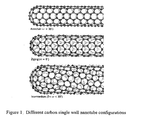
- the methods can further include adhering nanoreinforcement materials such as carbon nanotubes ( Fig 1 ) or nanofibers ( Fig 2 ) into a spread carbon tow or yam ( Fig 3 ) to form modified fiber tows or yarns.
- Nanoreinforcement materials such as carbon nanotubes ( ⁇ 1TPa modulus) or nanofibers may be aligned in the direction of micron-sized carbon fibers (i.e. after carbonization of polyacrylonitrile (PAN) precursors).
- PAN polyacrylonitrile
- Carbon fiber tows or yarns including the nanoreinforcement materials can be processed (woven, unidirectional, etc.) for impregnation with a thermoset resin or thermoplastic to form various composite structures or materials.
- Fig. 1 illustrates various carbon single wall configurations which can be used in the nanoreinforcement coating process described herein.
- Fig. 2 illustrates a carbon nanofiber
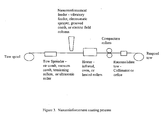
- Fig. 3 illustrates one embodiment of the method of applying nanoreinforcement materials to the fiber as described herein.
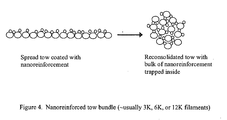
- Fig. 4 illustrates a spread tow coated with nanoreinforcement materials and the reconsolidated tow.
- nanoreinforcements can be added after the tow or yam has been manufactured (i.e., not during spinning or fabrication of the fibers).
- the tow or yam can be spread to expose the filaments for subsequent adherence of the nanoreinforcement.
- Carbon fiber as used herein is defined as fiber produced by pyrolysis of organic precursor fibers, including but not limited to those based on (polyacrylonitrile) PAN, rayon or pitch.
- Carbon fibers can be used primarily in composites, which are engineered structures or materials containing two or more components having differing chemical or physical properties where the resulting material has structural properties not present in the original materials. Normally, the components can be physically identified and exhibit an interface between one another. In the case of fiber reinforced composites, the components may be a fiber and a resin.
- Honeycomb cores are lightweight, cellular structures typically made from either metallic sheet materials or non-metallic materials (e.g., resin-impregnated paper or woven fabric) and formed into hexagonal nested cells.
- Nanoreinforcements include single wall carbon nanotubes, multi-wall carbon nanotubes, carbon nanofibers, graphite nanoplatelets, fullerenes, nanoparticles of elements, nanoparticles of binary and complex compounds, and the like.
- Polyacrylonitrile is a polymer which, when spun into fiber, can be used as a precursor material to make certain carbon fibers.
- Reinforcement materials can be combined with resin matrices to form composite materials.
- the reinforcements are typically in the form of continuous fibers, which may be woven or non-woven.
- fibers specifically includes carbon fibers, fiberglass, boron, aramid or other organic fibers.
- Reinforcement fabrics include woven carbon fiber, fiberglass, boron, aramid or other organic fibers used to prepare prepregs and honeycombs.
- repair and retrofit refer to the reinforcement or repair of existing structures.
- repair or retrofit is performed with composite materials, the result can be relatively light weight and lower in cost then other alternatives.
- Sizing is a neutral finishing agent (e.g., epoxy) that protects the fibers during further processing (e.g. prepregging) and acts as an interface to the resin system of the composite.
- neutral finishing agent e.g., epoxy
- Structures that can be made from the composite materials described herein include finished components for aircraft and industrial applications. When the structures are present in aeronautical applications, they can be used in primary or secondary external structures. In automotive applications, they can be used in chassis fairings and floors, among other applications.
- a surface treatment operation can form chemical bonds to the carbon surface, and can give better cohesion to the resin system of the composite.
- fibers including tows and yarns may be reinforced with the nanoreinforcements described herein.
- the types of fiber tows or yarns capable of reinforcement include the following:
- Carbon fiber can be described as a fiber containing at least 90% carbon obtained by the controlled pyrolysis of appropriate fibers. Carbon fibers are used, for example, in commercial and civilian aircraft, recreational, industrial, and transportation markets. Carbon fibers may be present in composites that are typically used in applications requiring strength, stiffness, relatively low weight, fatigue resistance, high temperature resistance, chemical inertness or high damping properties.
- a number of carbon fiber precursors can be pyrolized to produce carbon fibers, and, depending on the precursor used, the resulting carbon fiber will have different morphology and specific characteristics.
- Typical precursors include polyacrylonitrile (PAN), cellulosic fibers (viscose rayon, cotton), petroleum or coal tar pitch and certain phenolic fibers.
- PAN polyacrylonitrile
- cellulosic fibers viscose rayon, cotton
- petroleum or coal tar pitch certain phenolic fibers.
- Controlled pyrolysis can remove the oxygen, nitrogen and hydrogen from the fibers to form carbon fibers.
- the mechanical properties can be improved by increasing the crystallinity and orientation, and by reducing defects in the fiber.
- carbon fibers can be grouped into various types, including Ultra-high-modulus (modulus > about 450Gpa), High-modulus (modulus between about 300 and about 450Gpa ), Intermediate-modulus (modulus between about 250 and about 300Gpa), and Low-modulus (modulus ⁇ about 250GPa).
- High modulus fiber can be described as a more refined carbon fiber.
- modulus refers to "Young's Modulus", a measurement of stiffness, where higher numbers correlate to stiffer fiber.
- High modulus fibers can be typically produced by stripping off the outer layers of the individual fibers, leaving a stronger core.
- fibers can be reinforced using the nanoreinforcements described herein.
- examples include fiberglass such as E glass and S glass, and aramid fibers such as Kevlar.
- the fibers may comprise boron fiber, and car be formed of polymers, such as thermoplastic or other organic fibers.
- Boron fiber can be typically produced by chemical vapor deposition.
- boron can be deposited on a tungsten wire, glass, or graphite filament core.
- the resulting boron-coated filaments have nominal diameters ranging from about 0.1 to about 0.2 mm.
- the filaments have low density, high tensile strength as well as a high modulus of elasticity, and stiffness. Their stiffness can make the filaments difficult to weave, braid, or twist, but they can be formed into resin impregnated tapes. Such tapes can be used in hand lay-up and filament winding processes.
- High modulus carbon can be co-mingled with boron fiber, which exhibits high stiffness in compression. When combined with the high tensile stiffness of the carbon, a synergistic result can be achieved where the overall stiffness is greater than that predicted by the properties of the individual fibers.
- the ultra tough boron fiber also can protect the more brittle high modulus carbon fiber.
- Carbon fibers can tend to be brittle, and may need some protection or lubrication as they are handled.
- the fibers can be "sized” using “size materials” (also known as “sizing” or, simply, “size”) selected to protect the carbon fibers.
- size material also known as “sizing” or, simply, “size” selected to protect the carbon fibers.
- the size material is selected to provide consistent handling and to not build up any residue on the processing equipment.
- the sizing material preferably does not increase friction between the fiber and any point that is touched during handling, and does not impede the penetration of resin into the fiber bundle.
- Size materials should be compatible with the matrix resin.
- compatible with includes solubility in and reactivity with the formulated resin.
- the resin should be able to penetrate the fiber bundle and interact with the fiber surface.
- sizes that are used with epoxy resins can use an epoxy formulation as the sizing material.
- the size preferably should not change in chemical or physical characteristics during storage of the sized fiber to allow consistent handling after aging. Some sizes are water-soluble, and can be washed or burned off after weaving or braiding, but before the resin is applied. Others, such as polysiloxane and organosilane finishes, may be less water-soluble.
- Sizes can fall into two categories.
- the first can be relatively low molecular weight sizes, which allow the tow bundle to be soft and easily spread, and which are typically used for prepregging.
- the second can be made of film forming materials, which are relatively higher molecular weight polymers that form a tough film after the fiber is dried.
- the film can offer more protection to the tow bundle and also prevents broken filaments from depositing on process equipment.
- Some size materials such as epoxy resins, are not water-soluble and must be applied as either an aqueous dispersion or as an emulsion.
- the size can be uniformly distributed on the surface of the fibers, or can exist as droplets either on the fiber surface or sticking together a number of individual fibers. Accordingly, manufacturers typically strive to control the composition, concentration, and particle size of the emulsion in the sizing bath, as well as the drying conditions, to provide a consistent product.
- Unidirectional prepregs can be prepared using a hot melt process.
- the fiber preferably needs to spread easily and have consistent incoming width that will eliminate gaps and allow for thin prepregs to be made from less expensive larger tow bundles.
- relatively low levels of sizing ⁇ about 1%) can provide adequate protection.
- Manufacturers can use a solvent to wash or bum off sizing to determine overall size content. Because the sizing is applied at low levels versus the surface area of the fiber bundle, it can be difficult to assess the uniformity of coverage, Secondary characteristics such as friction, fiber damage and spreadability can be correlated to size level and uniformity of coverage.
- nanoreinforcements that can be used to modify the carbon fiber tows or yarns described herein. Examples include carbon nanotubes and carbon nanofibers, graphene sheets, fullerenes, nanoparticles, and nanowires.
- carbon nanofibers multi-wall carbon nanotube
- the carbon nanotubes can be pure or functionalized, and can be metal-coated or polysiloxane-modified. When a polysiloxane coating is applied, there can be ideally at least about 1% polysiloxane per total fiber weight.
- the nanofibers can be aligned along the fiber tows or yarns, to provide the reinforced fiber tows or yarns with advantageous reinforcement properties.
- the nanotubes can be aligned through various methods, including mechanical, chemical, and magnetic methods.
- the nanotubes can be mixed with the adhesive and extruded onto the fiber or tow to be coated.
- the feed screw can be vibrated to improve the alignment of fibers in the flow direction. This operation can be similar to vibration injection molding used with recycled thermoplastics.
- the nanotubes can be functionalized to react with the tail or head of each nanotube such that it will self-assemble (similar to lipid bi-layer assembly).
- the nanotubes can be prepared such that a nickel particle is attached to one end. Ferrous alloy nanoparticles and carbon nanotubes (with the nickel particle) can be added to the adhesive, primer, or paint and subjected to a magnetic field to align the nanotubes.
- a carbon nanotube-copper composite powder can be prepared by an electrodeposition process using a copper plating bath.
- the bath contains homogenously dispersed carbon nanotubes.
- Particles of the composite with a "spiky" ball structure are accumulated on the plating electrode during the initial stage of electroplating, and can be separated to produce a carbon nanotube-copper powder.
- the nanotubes may be embedded into the copper particles.
- Carbon nanotubes can be coated with metals, such as silver, using techniques known in the art.
- Metallic conducting 10,10 armchair configuration single wall nanotubes or metallic coated nanotubes or fibers can be used in the micron size fiber tows or yarns, for example, to improve the conductivity for EMI shielding or lightning strike protection.
- These modified fiber tows or yarns can also improve the thermal conductivity of the resulting composite prepared from the tows or yarns.
- carbon nanotubes are pre-treated, for example, by oxidation, hydrophilic treatment, sensitizing treatment, activating treatment or a combination thereof. Such treatment may be required because carbon nanotubes typically have low chemical reactivity, and do not act as a catalyst for the deposition of metal coatings.
- the pre-treatment provides activated sites that permit plating of metals such as silver. Other pre-treatment steps that provide such activated sites can also be used.
- Oxidation can be performed, for example, using nitric acid.
- Sensitization and activation can be carried out, for example, by immersing the tubes in an acidic tin chloride solution, rinsing, and then immersing the tubes in an acidic palladium chloride solution.
- the reaction mixtures can be agitated using ultrasound.
- Electroless plating can provide a metal coating layer roughly about 10 to about 20 nm in thickness.
- the metal atoms aggregate laterally and vertically to form a continuous layer.
- silver-coated carbon nanotubes can be used to provide an electrically conductive layer.
- the density of the microspheres, nanotubes or combination thereof preferably is close to the density of the fibers that are being reinforced.
- the density of silver-coated microspheres is about 0.13 lb/in 3 (3.5 g/cm 3 ) for about 70 micron average diameter with a about 5 micron silver coating.
- An ultrasonic horn or roller may be used to help mix and disperse the particles.
- Carbon nanotubes in a 10,10 configuration can have a resistivity close to copper and can be six times lighter than copper. These carbon nanotubes can preferably be aligned in-plane to conduct electricity.
- the nanotubes may be aligned through various methods. Mechanical, chemical, and magnetic methods can be used to align the nanotubes.
- the nanotubes can be mixed with the adhesive and extruded onto the fiber tows or yarns to be coated.
- the feed screw can be vibrated to improve the alignment of fiber tows or yarns in the flow direction.
- the nanotubes can be functionalized to react with the tail or head of each nanofiber such that it will self-assemble (similar to lipid bi-layer assembly).
- the nanotubes can be made such that a nickel particle is attached to one end.
- Ferrous alloy nanoparticles and carbon nanotubes (with the nickel particle) can be added to the adhesive, primer, or paint and subjected to a magnetic field to align the nanotubes.
- Carbon nanotubes or other nanoparticles may be modified to decrease their resistivity. By bonding metal atoms to the end or sides of carbon nanotubes the electron pathways are increased or made more efficient, hence lowering their resistivity. These modified nanotubes can be oriented in-plane or used within a two-phase polymer.
- NPP's The nanoscale graphene plates (NGP's) of one or several layers of graphene planes are commonly called graphite nanoplatelets (GNPs).
- GNPs graphite nanoplatelets
- Graphite flakes are usually exfoliated using ultrasonic energy, and the level of exfoliation can be controlled by adjusting the sonification time.
- the graphite nanoplatelets tend to be less expensive than single wall carbon nanotubes. Separation of the layers can be more desirable than full exfoliation of platelets as there can be a higher probability of contact with adjacent platelets.
- the platelets can be aligned in-plane via a vibration (ultrasonic or other mechanical), shear flow, or covalent bonding method.
- the platelets can also be coated with a polymer and aligned using an electric field.
- the graphene sheets can be covalently bonded to each other on the edges using technology similar to the processes referenced in US Patent Application Publication No. 2005/0069701 for covalently bonding carbon nanotubes to each other.
- Functional groups can be attached to the graphite nanoplatelet edges and then cross-linked to each other.
- the cross-linking agent should not be self polymerizable.
- An epoxy matrix may be cross-linked to the surface of the platelets to prevent cracking between the layers of platelets.
- the graphite nanoplatelets can be coated in a thermoplastic for alignment.
- Polyvinylidene fluoride PVDF
- PVDF Polyvinylidene fluoride
- a thermoplastic layer may be used for subsequent bonding of composite structures to each other.
- the thermoplastic can be used to provide an interlayer between the graphite nanoplatelet (or other nanoparticle) and the epoxy surface film.
- the thermoplastic can also be used for alignment of graphite nanoplatelets with subsequent processing.
- Other thermoplastics such as polystyrene (PS), polyphenylene sulphide (PPS), polyetherimide (PEI), and polyetheretherketones (PEEK) can also be used for this purpose.
- Nanowires Metal nanorods, nanowires, or nanostrands (collectively referred to hereinafter as “nanowires”) may also be used as reinforcement materials. Copper, silver, or aluminum may be preferred for their higher conductivity.
- the metal nanowires can be added directly to the resin.
- other elements can be used, including silicon.
- Nanoparticles of binary compounds, such as silicon oxide, titanium oxide, and complex compounds, such as titanium silicon oxide, silver copper alloy, and the like, can als be used. Nanopowders in the form of spheres, may also be used. Ideally, the nanoparticles can be embedded within the fiber tow or yam bundle to mechanically lock the low or yam in place.
- nanoparticulates such as silica can be used in place of or in addition to carbon nanofibers or nanotubes.
- the nanoparticulate silica powder can be deposited into the tow and adhered with the epoxy sizing on the tow or hermoplastic coating. This can allow for significantly improved fire resistance. ' During a fire of an aircraft engine nacelle component, the polymer matrix would burn off during the initial stages of the fire, leaving the carbon fibers to remain. When nanoparticulate silica is attached to the carbon fibers, it will turn into glass at the temperatures encountered during a fire, thus increasing the bum-through time. Ultimately, this resistance to burning allows for less number of plies to achieve a certain bum-through time.
- carbon nanotubes or nanoparticles can be sized with a polysiloxane, to perform the same function. The polysiloxane an be present at approximately 1% by weight of the standard carbon fiber.
- Fullerenes are within a family of carbon allotropes. Fullerenes can be described as molecules comprised entirely of carbon, in the form of a hollow sphere, ellipsoid, or tube. Spherical fullerenes are sometimes called “buckyballs,” and cylindrical fullerenes are called “buckytubes.” Fullerenes are similar in structure to graphite, which is composed of a sheet of linked hexagonal rings, but they contain pentagonal (or sometimes heptagonal) rings that prevent the sheet from being planar.
- fullerenes When used as nanoreinforcing materials, fullerenes can be pure or functionalized as is understood in the art, and can be metal-coated, for example, using the metals described above with respect to the carbon nanotubes.
- the nanoreinforcement materials recited herein may be applied to fiber tows or yarns.
- the nanoreinforcement materials are coated with a thermoplastic powder, and then are electrostatically sprayed onto the fiber tows or yarns.
- the nanoreinforcement materials are mixed into a liquid, for example, a solution that includes a solvent including adhesive, sizing, or a combination thereof, which is then sprayed onto the fiber tows or yarns.
- the nanoreinforcement materials may be introduced to micron size carbon fibers derived from (polyacrylonitrile) PAN precursors (i.e. after carbonization of (polyacrylonitrile) PAN).
- the nanoreinforcement materials can be applied in a random orientation, or an ordered orientation. When they are to be applied in an ordered manner, this can be accomplished using a variety of means, including electric field orientation, a moving tow, a special (i.e., spinning, vibration, etc.) nozzle or combing with grooved feeder or platen.
- Such application techniques are either as described herein or as known in the art, and can be applied singularly or in combination with other techniques.
- nanoreinforcement materials onto spread fiber tows or yarns can form modified fibers, tows or yarns, where the nanoreinforcement is adhered to or trapped within the tow yam.
- Figure 4 illustrates a nanoreinforced tow wherein the nanoreinforcement material is adhered or trapped within the carbon tow.
- aligning the nanoreinforcement materials such as carbon nanotubes or nanofibers
- aligning the nanoreinforcement materials such as carbon nanotubes or nanofibers
- aligning the nanoreinforcement materials such as carbon nanotubes or nanofibers
- aligning the nanoreinforcement materials such as carbon nanotubes or nanofibers
- aligning the nanoreinforcement materials such as carbon nanotubes or nanofibers
- these can optionally be coated with metals, or functionalized for further modification.
- nanoreinforcement materials such as nanotubes and nanofibers is dependent, at least in part, on the gaps and overlaps between the ends of the nanofibers or nanotubes.
- nanoreinforcement materials may be applied to carbon nanotubes or carbon nanofibers.
- the carbon nanotubes or nanofibers can be aligned for deposition into the tows or yarns using mechanical (e.g., vibration plated) or electrical means before powder coating.
- mechanical e.g., vibration plated
- the powder coated nanotubes or nanofibers can then be spread onto micron size carbon fiber tows or yarns.
- the tows or yarns can then be heated, pressed, or a combination thereof to ensure the carbon nanotubes or nanofibers adhere to the tow or yam for subsequent processing.
- the powder coated carbon nanotubes or nanofibers may be electrostaticly sprayed into a spread tow or yarn.
- a moving tow or yam may be used with a special (e.g., spinning, vibration, etc.) nozzle that may be used to help control orientation during spraying.
- the nanoreinforcement can also be applied using a liquid media.
- the materials are added to a liquid solution and sprayed or poured onto the fiber tows or yarns.
- the solution includes solvent and can optionally also include sizing and adhesive.
- the liquids may be applied to a moving tow or yam.
- the nanoreinforcement liquid may be applied using a special (e.g., spinning or vibrating) nozzle, a grooved feeder, a platen or a combination thereof.
- the dispensing head or the tow or yam can be vibrated or moved to help orient the nanotubes or nanofibers.
- the feeder may can contain grooves that simulate a comb. After the spread tow or yam is coated, the feeder can be pulled through platens with the grooves placed on the platens. Combing orients the nanotubes or nanofibers.
- the nanotube or nanofiber sizing is the same epoxy-compatible sizing used on the micron sized carbon fibers.
- nanoreinforcement materials such as nanotubes or nanofibers
- the nanoreinforcement materials may be coated with or contain ferromagnetic metals, which can enable the materials to be aligned in a subsequent magnetic field.
- the carbon nanotubes or nanofibers can be coated with ferromagnetic metals such as nickel or cobalt, or the nickel catalyst can be left in the grown nanotube and aligned in a subsequent magnetic field in a polystyrene solution.
- ferromagnetic metals such as nickel or cobalt
- the nickel catalyst can be left in the grown nanotube and aligned in a subsequent magnetic field in a polystyrene solution.
- Magnetic alignment methods typically require very strong magnets. Accordingly, this approach may be less desirable than mechanical or electric field alignment.
- a tow or yam spool is unrolled into a tow or yam spread, which can include an air comb, a vacuum comb, tensioning rollers, or an ultrasonic roller.
- a nanoreinforcement feeder is placed above the tow spreader to feed the nanoreinforcement materials onto the spread tow.
- the feeder can be or include, for example, a vibratory feeder, an electrostatic sprayer, a grooved comb, or an electric field column.
- the coated fiber tows or yarns pass through a heater, which can be an infrared heater, an oven, or heated rollers.
- the coated, heated fibers then can pass through a set of compaction rollers, and are reconsolidated into a tow using a collimator or an orifice.
- the reconsolidated tow can then be respooled.
- the resulting nanoreinforced fiber tows or yarns can be molded into high strength composite materials for structural applications.
- the nanoreinforced fiber tows or yarns can be processed into composite materials using either thermoset or thermoplastic polymers, via conventional methods (e.g., prepreg lay-up, towpreg, filament winding, resin transfer molding, fiber placement, and the like).
- fiber tows or yarns including the reinforced fibers described herein can be processed (e.g., woven, unidirectional, etc.) for impregnation with a thermoset resin or thermoplastic to form a composite structure.
- the resin-applied modified fiber tows or yarns can then be shaped into a composite structure before curing.
- the fiber tows or yarns can also be used in a woven or nonwoven dry form for resin transfer molding or resin film infusion of the composite structure.
- the thermoplastic-impregnated fibers are shaped and the thermoplastic is consolidated.
- the performance increase of the modified fiber tows or yarns relative to the unmodified fiber tows or yarns can be greater than the weight increase caused by the modification.
- the amount of carbon nanotubes or nanofibers is generally between about 0.1 and about 20% by weight, but can be between about 2 and about 8% by weight, of the carbon fiber tows or yarns.
- Increased fiber stiffness and strength can result in a significant weight saving, which can be particularly important in applications, e.g., airborne structures, where low weight and high strength are desired.
- the cost savings of adding a low percentage of carbon nanotubes or nanofibers to the tow bundle may be lower than switching to a higher performance micron size carbon fiber tow or yarn.
- nacelles and components thereof for use to house and operate with aircraft engines.
- nacelle components include monolithic carbon fiber thrust reverser cascades, nacelle cowling (such as inlet, fan, side, upper, lower, core, or nose cowls), acoustic panels, nacelle duct systems including engine build up (EBU) components, starter, cowl anti-ice, oil cooler and vent ducts, nacelle mounting and attach rings, thrust reversing systems such as fan reversers, flight control panels, airframe structures, fans, actuation accessories (pneumatic, electric, and hydraulic), exhaust nozzles, centerbodies, nose lipskins, nozzles surround the engine, fuel systems, lubrication systems, air-conditioning systems and fire warning systems.
- EBU engine build up
- starter cowl anti-ice
- oil cooler and vent ducts nacelle mounting and attach rings
- thrust reversing systems such as fan reversers, flight control panels, airframe structures, fans, actuation accessories (pneumatic, electric, and hydraulic), exhaust nozzles, centerbodies, nose lipskins, nozzles surround
- the composites can be used in a variety of repair and retrofit applications, for example, in the aerospace industry.
- the nanoreinforced fibers can be used to form lightning strike protection composite materials.
- a lightning strike protection material provides lightning strike protection to various structures, including those employed in the aircraft and aerospace industry.
- Various airworthiness certification authorities set forth or practice standards to which aircraft manufactures must comply. Based on the probability of a lightning strike and the probable intensity of the lightning current generated in the strike, various authorities designate different potential strike zones for each aircraft and the probable current waveforms to which structures and systems in these zones must be resistant. These are generally identified as Zones 1A and 1B, Zones 2A and 2B and Zone 3, as is known in the aircraft industry.
- strike zones on any aircraft is dependent on the geometry of the aircraft and operational factors, and often varies from one aircraft to another. Airworthiness authorities designate standards with which the aircraft manufacturers must comply. Different potential strike zones are assigned for each aircraft component and the current wave component is designated. The structure must be resistant to this strike without penetration through the thickness of the component.
- thermal cycling during ground to air to ground service.
- This thermal cycling may cause microcracking within the surface film.
- This microcracking may extend into the composite structure causing premature failure from exposure to moisture and/or other chemicals.
- composite materials include an outer layer of a lightning strike protection layer prepared using the nanoreinforced carbon fibers of this invention.
- Such reinforced composite materials can form a part of an exterior portion of an aircraft or aircraft components.
- the composite materials are prepared from carbon fiber tows or yarns which are reinforced using metal nanoparticles, nanowires, and the like, or metal-coated carbon nanotubes or nanofibers, and a carrier.
- the carrier may include a thermoset or thermoplastic polymer.
- the carrier can be a monomer that forms a thermoset polymer.
- a suitable polymer is an epoxy resin that, when cured, can form a thermoset polymer on the surface of the composite material, aircraft or aircraft part to which it is applied.
- the material can be applied as the top layer of a composite material used to form structural elements of an airplane, which may optionally include an overcoat of primer or paint or a combination thereof.
- the nanoreinforcements can be ideally sized to provide adequate electrical properties (i.e., resistance) for use as a lightning strike protection material.
- the concentration of nanoreinforcements may be sufficient such that the surface resistivity of the airplane to which the material is applied may be low enough to dissipate the energy from a strike without damage to the underlying plies (i.e., the plies in the composite material underlying the lightning strike protection layer).
- the composite material can optionally include an isolation ply, particularly where the resistivity of the material Is not sufficiently low to provide adequate protection without the use of such an isolation ply.
- multiple layers can be used to achieve a desired lightning protection effect.
- the composite material can include one or more layers of the nanoreinforced fiber tows or yarns, optionally with one or more fiberglass isolation plies.
- carbon nanotubes in the 10,10 armchair configuration can be used as all or part of the nanoreinforcement in the reinforced tows or yarns.
- These carbon nanotubes can have a resistivity close to copper and can be six times lighter than copper.
- the nanotubes may be aligned on the yarn or fiber through various methods, including mechanical, chemical, and magnetic methods, as discussed above.
- nanowires graphene platelets or metal nanorods, nanowires, or nanostrands (collectively called nanowires) can be used as all or part of the nanoreinforcement of the fiber tows or yarns.
- carbon nanotubes or other nanoparticles that have been modified to decrease their resistivity can be used as nanoreinforcement materials for the fiber tows or yarns.
- the composite materials prepared using the nanoreinforced tows or yarns can provide sufficient lightning strike protection to pass at least a Zone 2A lightning strike test, and, more preferably, can pass a Zone 1A lightning strike test.
- the materials ideally will have desirable thermal cycling properties for use in aircraft manufacture and use. For example, it is preferred that the composite material does not microcrack for at least 2,000 cycles when exposed to thermal cycling from about -54° (-65°F) to about 71°C (160°F).
- Carbon fiber is reinforced with about 5 to about 20% by weight carbon single wall nanotube with metallic conductivity (10,10 armchair configuration). This fiber is then woven into a fabric for use as the top layer of a composite structure for lightning strike protection for aircraft structures. This layer also provides increased strength, stiffness, and thermal conductivity in the composite structure.
- Carbon fiber is reinforced with about 2 to about 8% by weight carbon nanofibers.
- the carbon nanofibers are coated with a silane or an organosilane finish or contain a polysiloxane.
- the fibers are then woven into a fabric or uniweave or prepregged as a tape to provide a composite structure with increased strength, stiffness, and fire resistance for aircraft structures.
- Carbon fiber can be reinforced with about 5 to about 20% by weight carbon single wall nanotubes with metallic conductivity or about 10 to about 60% by weight metallic nanowires or nanopowders. These fibers are woven into a fabric to use for wet lay-up repair of aircraft structures. This layer can be used on the top surface to provide repair of the lightning strike material without using an additional layer of wire screen for aircraft structures.
Landscapes
- Chemical & Material Sciences (AREA)
- Engineering & Computer Science (AREA)
- Ceramic Engineering (AREA)
- Manufacturing & Machinery (AREA)
- Materials Engineering (AREA)
- Structural Engineering (AREA)
- Organic Chemistry (AREA)
- Textile Engineering (AREA)
- Composite Materials (AREA)
- Chemical Kinetics & Catalysis (AREA)
- Nanotechnology (AREA)
- Inorganic Chemistry (AREA)
- Dispersion Chemistry (AREA)
- General Physics & Mathematics (AREA)
- Crystallography & Structural Chemistry (AREA)
- Condensed Matter Physics & Semiconductors (AREA)
- Mechanical Engineering (AREA)
- Physics & Mathematics (AREA)
- Treatments For Attaching Organic Compounds To Fibrous Goods (AREA)
- Chemical Or Physical Treatment Of Fibers (AREA)
- Reinforced Plastic Materials (AREA)
- Woven Fabrics (AREA)
- Carbon And Carbon Compounds (AREA)
Claims (10)
- Triebwerkgondeln und Komponenten davon zur Verwendung in Flugzeugmotoren, Carbon-Faser enthaltenden Verbundwerkstoff umfassend, worin die Carbon-Faser von 0,1 bis 20 Gewichtsprozent Nanoverstärkungswerkstoff umfasst.
- Triebwerkgondeln und Komponenten nach Anspruch 1, von 2 bis 8 Gewichtsprozent des Nanoverstärkungswerkstoffs umfassend.
- Triebwerkgondeln und Komponenten nach Anspruch 1 oder 2, in denen der Nanoverstärkungswerkstoff ausgewählt ist aus der Gruppe bestehend aus Carbon-Nanoröhren, Carbon-Nanofasern, Graphenblätter, Nanodrähte, Nanopartikel von Elementen, Nanopartikel von Binärverbindungen, Nanopartikel von Komplexverbindungen und Kombinationen davon.
- Triebwerkgondeln und Komponenten nach einem der vorhergehenden Ansprüche, worin der Nanoverstärkungswerkstoff geschlichtet oder metallisch beschichtet oder thermoplastisch beschichtet ist, um Dispersion, Anwendung oder Multifunktionalität zu unterstützen.
- Triebwerkgondeln und Komponenten nach einem der vorhergehenden Ansprüche, worin der Nanoverstärkungswerkstoff aus Carbon-Nanoröhren besteht.
- Triebwerkgondeln und Komponenten nach einem der vorhergehenden Ansprüche, worin die Faser außerdem nanoverstärkte Fasern umfasst, die aus einem oder mehreren von Folgenden bestehen: Glas-, Aramid- oder Polymerfasern.
- Triebwerkgondeln und Komponenten nach einem der vorhergehenden Ansprüche, worin eine Vielzahl von Fasern gebündelt werden, um ein Kabel oder Garn zu formen.
- Triebwerkgondeln und Komponenten nach Anspruch 7, worin die Fasern geschlichtet sind.
- Triebwerkgondeln und Komponenten nach Anspruch 7, worin der Nanoverstärkungswerkstoff innerhalb des Kabels oder Garns ausgerichtet ist.
- Triebwerkgondeln und Komponenten nach Anspruch 7, worin das Faserkabel eins oder mehrere von Folgenden umfasst: Glas-, Aramid- und Polymerfasern.
Priority Applications (2)
| Application Number | Priority Date | Filing Date | Title |
|---|---|---|---|
| EP20080019213 EP2022886B1 (de) | 2006-05-02 | 2007-05-01 | Verfahren zur Herstellung nanoverstärkter Kohlenstofffasern sowie nanoverstärkte Kohlenstofffasern enthaltende Flugzeugkomponenten |
| EP13170335.7A EP2660385B1 (de) | 2006-05-02 | 2007-05-01 | Blitzschutzmaterial |
Applications Claiming Priority (2)
| Application Number | Priority Date | Filing Date | Title |
|---|---|---|---|
| US79699506P | 2006-05-02 | 2006-05-02 | |
| PCT/US2007/067934 WO2007130979A2 (en) | 2006-05-02 | 2007-05-01 | Modification of reinforcing fiber tows used in composite materials by using nanoreinforcements |
Related Child Applications (5)
| Application Number | Title | Priority Date | Filing Date |
|---|---|---|---|
| EP20080019213 Division-Into EP2022886B1 (de) | 2006-05-02 | 2007-05-01 | Verfahren zur Herstellung nanoverstärkter Kohlenstofffasern sowie nanoverstärkte Kohlenstofffasern enthaltende Flugzeugkomponenten |
| EP20080019213 Division EP2022886B1 (de) | 2006-05-02 | 2007-05-01 | Verfahren zur Herstellung nanoverstärkter Kohlenstofffasern sowie nanoverstärkte Kohlenstofffasern enthaltende Flugzeugkomponenten |
| EP13170335.7A Division-Into EP2660385B1 (de) | 2006-05-02 | 2007-05-01 | Blitzschutzmaterial |
| EP13170335.7A Division EP2660385B1 (de) | 2006-05-02 | 2007-05-01 | Blitzschutzmaterial |
| EP08019213.1 Division-Into | 2008-10-31 |
Publications (3)
| Publication Number | Publication Date |
|---|---|
| EP2013408A2 EP2013408A2 (de) | 2009-01-14 |
| EP2013408B1 true EP2013408B1 (de) | 2013-03-06 |
| EP2013408B2 EP2013408B2 (de) | 2016-09-28 |
Family
ID=38577925
Family Applications (3)
| Application Number | Title | Priority Date | Filing Date |
|---|---|---|---|
| EP13170335.7A Active EP2660385B1 (de) | 2006-05-02 | 2007-05-01 | Blitzschutzmaterial |
| EP20080019213 Revoked EP2022886B1 (de) | 2006-05-02 | 2007-05-01 | Verfahren zur Herstellung nanoverstärkter Kohlenstofffasern sowie nanoverstärkte Kohlenstofffasern enthaltende Flugzeugkomponenten |
| EP07761682.9A Active EP2013408B2 (de) | 2006-05-02 | 2007-05-01 | Triebwerksgondel und komponenten davon enthaltend nanoverstärkungen |
Family Applications Before (2)
| Application Number | Title | Priority Date | Filing Date |
|---|---|---|---|
| EP13170335.7A Active EP2660385B1 (de) | 2006-05-02 | 2007-05-01 | Blitzschutzmaterial |
| EP20080019213 Revoked EP2022886B1 (de) | 2006-05-02 | 2007-05-01 | Verfahren zur Herstellung nanoverstärkter Kohlenstofffasern sowie nanoverstärkte Kohlenstofffasern enthaltende Flugzeugkomponenten |
Country Status (5)
| Country | Link |
|---|---|
| US (2) | US7832983B2 (de) |
| EP (3) | EP2660385B1 (de) |
| JP (1) | JP2009535530A (de) |
| CN (2) | CN101565893B (de) |
| WO (1) | WO2007130979A2 (de) |
Cited By (3)
| Publication number | Priority date | Publication date | Assignee | Title |
|---|---|---|---|---|
| US11820880B2 (en) | 2019-07-10 | 2023-11-21 | Boston Materials, Inc. | Compositions and methods for carbon fiber-metal and other composites |
| EP3601646B1 (de) * | 2017-03-23 | 2024-12-25 | Boston Materials, Inc. | Faserverstärkter verbundstoff, verfahren dafür und artikel mit diesem verbundwerkstoff |
| US12428587B1 (en) | 2024-09-03 | 2025-09-30 | Boston Materials, Inc. | Liquid metal compositions and methods |
Families Citing this family (197)
| Publication number | Priority date | Publication date | Assignee | Title |
|---|---|---|---|---|
| EP2363429A1 (de) | 2006-03-10 | 2011-09-07 | Goodrich Corporation | Blitzschlagschutz mit geringer Dichte zur Verwendung in Flugzeugen |
| US7832983B2 (en) * | 2006-05-02 | 2010-11-16 | Goodrich Corporation | Nacelles and nacelle components containing nanoreinforced carbon fiber composite material |
| US9005755B2 (en) | 2007-01-03 | 2015-04-14 | Applied Nanostructured Solutions, Llc | CNS-infused carbon nanomaterials and process therefor |
| US20120189846A1 (en) * | 2007-01-03 | 2012-07-26 | Lockheed Martin Corporation | Cnt-infused ceramic fiber materials and process therefor |
| US8158217B2 (en) * | 2007-01-03 | 2012-04-17 | Applied Nanostructured Solutions, Llc | CNT-infused fiber and method therefor |
| US8951632B2 (en) * | 2007-01-03 | 2015-02-10 | Applied Nanostructured Solutions, Llc | CNT-infused carbon fiber materials and process therefor |
| US8951631B2 (en) * | 2007-01-03 | 2015-02-10 | Applied Nanostructured Solutions, Llc | CNT-infused metal fiber materials and process therefor |
| US7718220B2 (en) * | 2007-06-05 | 2010-05-18 | Johns Manville | Method and system for forming reinforcing fibers and reinforcing fibers having particulate protuberances directly attached to the surfaces |
| US7966711B2 (en) | 2007-08-14 | 2011-06-28 | The Boeing Company | Method and apparatus for fastening components using a composite two-piece fastening system |
| GB0715990D0 (en) * | 2007-08-16 | 2007-09-26 | Airbus Uk Ltd | Method and apparatus for manufacturing a component from a composite material |
| US8393068B2 (en) * | 2007-11-06 | 2013-03-12 | The Boeing Company | Method and apparatus for assembling composite structures |
| FR2924133B1 (fr) * | 2007-11-26 | 2012-12-14 | Porcher Ind | Element de renfort longitudinal a base de fibres minerales ou organiques et son procede d'obtention |
| EP2227633B1 (de) * | 2007-12-20 | 2013-01-23 | Vestas Wind Systems A/S | Windturbinenschaufel umfassend blitzrezeptoren mit kohlenstoffnanoröhrchen |
| US9012021B2 (en) | 2008-03-26 | 2015-04-21 | Xerox Corporation | Composition of matter for composite plastic contact elements featuring controlled conduction pathways, and related manufacturing processes |
| US7992823B2 (en) * | 2008-04-30 | 2011-08-09 | General Electric Company | Ice shed reduction for leading edge structures |
| US20110224330A1 (en) * | 2008-06-26 | 2011-09-15 | Sodano Henry A | Fibers coated with nanowires for reinforcing composites |
| US8130438B2 (en) * | 2008-07-03 | 2012-03-06 | Ajjer Llc | Metal coatings, conductive nanoparticles and applications of the same |
| WO2010007163A1 (en) * | 2008-07-17 | 2010-01-21 | Nanocyl S.A. | Method for the preparation of a reinforced thermoset polymer composite |
| JP5557992B2 (ja) * | 2008-09-02 | 2014-07-23 | 国立大学法人北海道大学 | カーボンナノチューブが付着した導電性繊維、導電性糸、繊維構造体およびそれらの製造方法 |
| US7981501B2 (en) * | 2008-12-02 | 2011-07-19 | GM Global Technology Operations LLC | Laminated composites and methods of making the same |
| US20100136866A1 (en) * | 2008-12-02 | 2010-06-03 | Gm Global Technology Operations, Inc. | Laminated composites and methods of making the same |
| US8023247B2 (en) * | 2008-12-10 | 2011-09-20 | Axcelis Technologies, Inc. | Electrostatic chuck with compliant coat |
| JP5251524B2 (ja) * | 2009-01-09 | 2013-07-31 | 東洋紡株式会社 | 高強度かつ高弾性率の炭素繊維を得るための前駆体繊維の製造方法 |
| JP5577356B2 (ja) | 2009-02-17 | 2014-08-20 | アプライド ナノストラクチャード ソリューションズ リミテッド ライアビリティー カンパニー | カーボン・ナノチューブを繊維上に含んで構成された複合材料 |
| KR101703340B1 (ko) | 2009-02-27 | 2017-02-06 | 어플라이드 나노스트럭처드 솔루션스, 엘엘씨. | 가스 예열법을 이용한 저온 cnt 성장 |
| US20100224129A1 (en) | 2009-03-03 | 2010-09-09 | Lockheed Martin Corporation | System and method for surface treatment and barrier coating of fibers for in situ cnt growth |
| KR101822349B1 (ko) * | 2009-03-16 | 2018-03-08 | 보르벡크 머터리얼스 코포레이션 | 중합체 섬유 및 이로부터 제조된 물품 |
| DE102009013884A1 (de) * | 2009-03-19 | 2010-09-30 | Fraunhofer-Gesellschaft zur Förderung der angewandten Forschung e.V. | Antimikrobiell behandelte und/oder schmutzabweisende Textilmaterialien sowie Verfahren zu deren Herstellung |
| WO2010111882A1 (zh) * | 2009-03-31 | 2010-10-07 | 东华大学 | 碳纤维、其原丝、以及预氧化纤维的制备方法 |
| US20100260931A1 (en) * | 2009-04-10 | 2010-10-14 | Lockheed Martin Corporation | Method and apparatus for using a vertical furnace to infuse carbon nanotubes to fiber |
| US20100260998A1 (en) * | 2009-04-10 | 2010-10-14 | Lockheed Martin Corporation | Fiber sizing comprising nanoparticles |
| US9111658B2 (en) | 2009-04-24 | 2015-08-18 | Applied Nanostructured Solutions, Llc | CNS-shielded wires |
| WO2010144183A1 (en) | 2009-04-24 | 2010-12-16 | Lockheed Martin Corporation | Cnt-based signature control material |
| AU2010245098B2 (en) | 2009-04-27 | 2014-11-13 | Applied Nanostructured Solutions, Llc. | CNT-based resistive heating for deicing composite structures |
| BR112012000203B1 (pt) * | 2009-06-12 | 2020-01-28 | Lord Corp | método para proteção de um substrato contra relâmpagos |
| WO2011007549A1 (ja) * | 2009-07-14 | 2011-01-20 | 川崎重工業株式会社 | ファイバー電極及びファイバー電池、並びにその製造方法、ファイバー電極及びファイバー電池の製造設備 |
| FR2948254B1 (fr) * | 2009-07-16 | 2011-12-30 | Airbus Operations Sas | Dispositif de protection de tuyauteries contre la foudre |
| EP2461953A4 (de) | 2009-08-03 | 2014-05-07 | Applied Nanostructured Sols | Einsatz von nanopartikeln in verbundfasern |
| DE102009036120A1 (de) * | 2009-08-05 | 2011-02-10 | Hexion Specialty Chemicals Gmbh | Beschichteter Festigkeitsträger |
| US8561934B2 (en) * | 2009-08-28 | 2013-10-22 | Teresa M. Kruckenberg | Lightning strike protection |
| BR112012010907A2 (pt) | 2009-11-23 | 2019-09-24 | Applied Nanostructured Sols | "materiais compósitos de cerâmica contendo materiais de fibra infundidos em nanotubo de carbono e métodos para a produção dos mesmos" |
| US20110123735A1 (en) * | 2009-11-23 | 2011-05-26 | Applied Nanostructured Solutions, Llc | Cnt-infused fibers in thermoset matrices |
| US20110124253A1 (en) * | 2009-11-23 | 2011-05-26 | Applied Nanostructured Solutions, Llc | Cnt-infused fibers in carbon-carbon composites |
| AU2010350689A1 (en) * | 2009-11-23 | 2012-04-19 | Applied Nanostructured Solutions, Llc | CNT-tailored composite land-based structures |
| EP2329936A1 (de) * | 2009-12-01 | 2011-06-08 | Siemens Aktiengesellschaft | Faserverstärktes Material |
| US8545963B2 (en) | 2009-12-14 | 2013-10-01 | Applied Nanostructured Solutions, Llc | Flame-resistant composite materials and articles containing carbon nanotube-infused fiber materials |
| JP5353689B2 (ja) * | 2009-12-28 | 2013-11-27 | 株式会社デンソー | Cnt繊維及びその製造方法 |
| KR101307378B1 (ko) * | 2009-12-31 | 2013-09-11 | 제일모직주식회사 | 전자파 차폐 특성이 우수한 열가소성 수지 조성물 |
| US9085678B2 (en) | 2010-01-08 | 2015-07-21 | King Abdulaziz City For Science And Technology | Clean flame retardant compositions with carbon nano tube for enhancing mechanical properties for insulation of wire and cable |
| US9167736B2 (en) | 2010-01-15 | 2015-10-20 | Applied Nanostructured Solutions, Llc | CNT-infused fiber as a self shielding wire for enhanced power transmission line |
| AU2011256789A1 (en) | 2010-02-02 | 2012-07-12 | Applied Nanostructured Solutions, Llc | Fiber containing parallel-aligned carbon nanotubes |
| US9180979B2 (en) | 2010-02-04 | 2015-11-10 | Saab Ab | Smooth surface forming tool and manufacture thereof |
| US20110205688A1 (en) * | 2010-02-19 | 2011-08-25 | Nthdegree Technologies Worldwide Inc. | Multilayer Carbon Nanotube Capacitor |
| KR101818640B1 (ko) | 2010-03-02 | 2018-01-15 | 어플라이드 나노스트럭처드 솔루션스, 엘엘씨. | 카본 나노튜브 주입된 섬유를 포함하는 전기 장치 및 그의 제조 방법 |
| BR112012021968A2 (pt) | 2010-03-02 | 2016-06-07 | Applied Nanostructured Sols | dispositivos elétricos enrolados em espiral que contêm materiais de eletrodo infundidos por nanotubo de carbono e métodos e aparelhos para a produção dos mesmos |
| US8980417B2 (en) | 2010-04-05 | 2015-03-17 | Nitto Boseki Co., Ltd. | Process for production of glass fiber fabric having silica microparticles adhered thereon, glass fiber fabric having silica microparticles adhered thereon, and fiber-reinforced molded resin article |
| EP2392700B1 (de) * | 2010-04-28 | 2012-06-20 | Teijin Aramid B.V. | Verfahren zum Spinnen von Graphenbandfasern |
| CN101845232B (zh) * | 2010-04-29 | 2012-09-26 | 中国科学院宁波材料技术与工程研究所 | 一种热塑性树脂基碳纤维复合材料及其制备方法 |
| US8780526B2 (en) | 2010-06-15 | 2014-07-15 | Applied Nanostructured Solutions, Llc | Electrical devices containing carbon nanotube-infused fibers and methods for production thereof |
| EP2595802B1 (de) * | 2010-07-22 | 2015-09-09 | Ferro Corporation | Hermetisch versiegelte elektronische vorrichtung mit beschichteten glasflocken |
| US9017854B2 (en) | 2010-08-30 | 2015-04-28 | Applied Nanostructured Solutions, Llc | Structural energy storage assemblies and methods for production thereof |
| AU2011302314A1 (en) | 2010-09-14 | 2013-02-28 | Applied Nanostructured Solutions, Llc | Glass substrates having carbon nanotubes grown thereon and methods for production thereof |
| EP2619133A1 (de) | 2010-09-22 | 2013-07-31 | Applied NanoStructured Solutions, LLC | Metallsubstrat mit darauf gezüchteten kohlenstoffnanoröhrchen und verfahren zu seiner herstellung |
| WO2012040038A2 (en) | 2010-09-23 | 2012-03-29 | Applied Nanostructured Solutions, Llc | Cnt-infused fiber as a self shielding wire for enhanced power transmission line |
| GB201016006D0 (en) * | 2010-09-23 | 2010-11-10 | Dyson Technology Ltd | A reinforced magnet |
| JP5864596B2 (ja) * | 2010-10-28 | 2016-02-17 | ユニバーシティ オブ セントラル フロリダ リサーチ ファウンデーション,インコーポレイテッド | 酸化グラファイトを製造する方法 |
| KR101234257B1 (ko) | 2010-12-08 | 2013-02-18 | 금오공과대학교 산학협력단 | 아라미드/그래핀 복합체 및 그 제조 방법 |
| CN102212967A (zh) * | 2011-04-06 | 2011-10-12 | 东华大学 | 一种碳纳米管改性的碳纤维乳液上浆剂及其制备方法 |
| US20120309246A1 (en) | 2011-06-03 | 2012-12-06 | Alexander Tseitlin | Curable biopolymer nanoparticle latex binder for mineral, natural organic, or synthetic fiber products and non-woven mats |
| DE102011077804A1 (de) | 2011-06-20 | 2012-12-20 | Siemens Aktiengesellschaft | Schaufel für eine thermische Strömungsmaschine |
| US9358756B2 (en) | 2011-08-04 | 2016-06-07 | Henry Sodano | Interlaminer reinforced composite structures |
| CN102327668B (zh) | 2011-08-12 | 2014-01-22 | 清华大学 | 植入式生物电极及包括所述电极的医疗组件 |
| CN102996257A (zh) * | 2011-09-13 | 2013-03-27 | 金涌 | 一种粉煤直燃的整体联合循环发电系统 |
| US9484123B2 (en) | 2011-09-16 | 2016-11-01 | Prc-Desoto International, Inc. | Conductive sealant compositions |
| DE102011114400A1 (de) * | 2011-09-22 | 2013-03-28 | Hydac Filtertechnik Gmbh | Filtermaterial |
| US8871019B2 (en) | 2011-11-01 | 2014-10-28 | King Abdulaziz City Science And Technology | Composition for construction materials manufacturing and the method of its production |
| US20150041326A1 (en) | 2011-11-16 | 2015-02-12 | Nanoridge Materials, Incorporated | Conductive metal enhanced with conductive nanomaterial |
| US20130157001A1 (en) * | 2011-12-19 | 2013-06-20 | E I Du Pont De Nemours And Company | Structural core |
| CN104011432A (zh) * | 2011-12-21 | 2014-08-27 | 帝斯曼知识产权资产管理有限公司 | 用于发动机或链条传动装置的滑动元件 |
| US20130196155A1 (en) | 2012-02-01 | 2013-08-01 | Ut-Battelle, Llc | Apparatus and process for the surface treatment of carbon fibers |
| US9488027B2 (en) | 2012-02-10 | 2016-11-08 | Baker Hughes Incorporated | Fiber reinforced polymer matrix nanocomposite downhole member |
| US9085464B2 (en) | 2012-03-07 | 2015-07-21 | Applied Nanostructured Solutions, Llc | Resistance measurement system and method of using the same |
| US20130260131A1 (en) * | 2012-03-28 | 2013-10-03 | Satoshi Seike | Thermoplastic molding preform |
| US9301558B2 (en) | 2012-05-10 | 2016-04-05 | Dan Schlager | Cardiopulmonary lightning protection garment |
| US20170188640A1 (en) * | 2012-05-10 | 2017-07-06 | Dan Schlager | Simplified cardiopulmonary lightning protection garment |
| CN103456409A (zh) * | 2012-06-05 | 2013-12-18 | 河南科信电缆有限公司 | 一种浸渍加强型碳纤维电缆 |
| US8932683B1 (en) | 2012-06-15 | 2015-01-13 | United States Of America As Represented By The Administrator Of National Aeronautics And Space Administration | Method for coating a tow with an electrospun nanofiber |
| CN102785437B (zh) * | 2012-07-19 | 2016-08-03 | 中国航空工业集团公司北京航空材料研究院 | 一种复合导电薄层及其制备方法和应用 |
| CN102785784A (zh) * | 2012-07-30 | 2012-11-21 | 无锡同春新能源科技有限公司 | 一种用石墨烯新材料制造大强度的高速信息化目标飞行器 |
| CN104718170A (zh) * | 2012-09-04 | 2015-06-17 | Ocv智识资本有限责任公司 | 碳强化的增强纤维在含水或非水介质内的分散 |
| CN102824689B (zh) | 2012-09-07 | 2014-12-24 | 清华大学 | 植入式电极及其制备方法以及包括所述电极的医疗组件 |
| US10766232B2 (en) | 2012-10-23 | 2020-09-08 | Saab Ab | Smooth surface forming tool and manufacture thereof |
| CN102977742B (zh) * | 2012-12-19 | 2015-11-25 | 中国科学院宁波材料技术与工程研究所 | 一种导电涂料 |
| RU2523483C1 (ru) * | 2012-12-21 | 2014-07-20 | Федеральное государственное бюджетное научное учреждение "Технологический институт сверхтвердых и новых углеродных материалов" (ФГБНУ ТИСНУМ) | Способ упрочнения углеродного волокна |
| MY174108A (en) | 2013-03-14 | 2020-03-10 | Bae Systems Plc | Lightning protection for vehicles |
| GB2514450B (en) * | 2013-03-14 | 2015-06-10 | Bae Systems Plc | Lightning protection system |
| CN104099687B (zh) * | 2013-04-10 | 2016-12-28 | 华为技术有限公司 | 一种石墨烯纤维及其制备方法 |
| CN103320881B (zh) * | 2013-07-16 | 2016-05-11 | 上海工程技术大学 | 一种制备皮芯结构导电碳纳米管复合纤维的装置及方法 |
| CN105593631A (zh) * | 2013-08-28 | 2016-05-18 | 证明与研究股份有限公司 | 高温复合物射弹枪管 |
| CN103571156B (zh) * | 2013-09-17 | 2016-04-06 | 广东生益科技股份有限公司 | 一种热固性树脂组合物及其用途 |
| EP3077169A4 (de) | 2013-12-05 | 2018-02-28 | EcoSynthetix Ltd. | Formaldehydfreies bindemittel und mehrkomponentige nanopartikel |
| US12016168B2 (en) | 2013-12-19 | 2024-06-18 | Hyundai Motor Company | Web for absorbing electromagnetic wave and housing of electronic parts using the same |
| GB2522841B (en) * | 2013-12-20 | 2018-08-15 | Hexcel Composites Ltd | Composite structure |
| CN103787686B (zh) * | 2014-01-26 | 2015-09-09 | 四川创越炭材料有限公司 | 一种碳纤维复合球及其制备方法 |
| US9834318B2 (en) | 2014-04-25 | 2017-12-05 | Rohr, Inc. | Lightning strike protection for composite components |
| EP2940251B1 (de) | 2014-04-28 | 2019-06-12 | Rolls-Royce Corporation | Gebläsegehäuse |
| CN104098081B (zh) * | 2014-06-26 | 2016-01-20 | 四川坤森微纳科技股份有限公司 | 一种小长径比碳纤维粉的制备工艺 |
| US10343372B2 (en) | 2014-07-03 | 2019-07-09 | Saab Ab | Composite article having multifunctional properties and method for its manufacture |
| DE102014213320A1 (de) * | 2014-07-09 | 2015-11-12 | Henkel Ag & Co. Kgaa | Verfahren zur Auftragung eines pulverförmigen Bindemittels |
| EP2979981B1 (de) * | 2014-08-01 | 2017-01-25 | Airbus Defence and Space GmbH | Blitzschutzschicht für Faserverbund-Strukturen |
| US9908820B2 (en) | 2014-09-05 | 2018-03-06 | United Technologies Corporation | Systems and methods for ceramic matrix composites |
| US10241293B2 (en) | 2014-09-26 | 2019-03-26 | Massachusetts Institute Of Technology | Methods and apparatus for deployable sparse-aperture telescopes |
| CN105583961A (zh) * | 2014-10-20 | 2016-05-18 | 中国石油化工股份有限公司 | 一种撒粉工艺制备碳纤维增强热塑性预浸料的方法 |
| CN105583962A (zh) * | 2014-10-20 | 2016-05-18 | 中国石油化工股份有限公司 | 一种采用双面撒粉工艺制备热塑性预浸料的方法 |
| JP6489519B2 (ja) | 2014-10-23 | 2019-03-27 | ニッタ株式会社 | 強化繊維の製造方法 |
| GB2531808A (en) | 2014-11-03 | 2016-05-04 | Short Brothers Plc | Methods and precursors for manufacturing a perforated composite part |
| CN104328523B (zh) * | 2014-11-20 | 2016-01-20 | 济南圣泉集团股份有限公司 | 包含石墨烯的粘胶纤维及其制备方法 |
| DE102014017198A1 (de) | 2014-11-21 | 2016-05-25 | Airbus Defence and Space GmbH | Strukturelement |
| CN105734831B (zh) * | 2014-12-10 | 2019-01-25 | 中国科学院大连化学物理研究所 | 一种纳米碳纤维毡及其制备和在全钒液流电池中的应用 |
| US9434826B2 (en) | 2015-01-05 | 2016-09-06 | The Boeing Company | Graphene-augmented carbon fiber for aerospace composites |
| US10266677B2 (en) | 2015-01-05 | 2019-04-23 | The Boeing Company | Graphene-augmented composite materials |
| US9421739B2 (en) | 2015-01-05 | 2016-08-23 | The Boeing Company | Graphene aerospace composites |
| US9518160B2 (en) | 2015-01-05 | 2016-12-13 | The Boeing Company | Graphene-augmented composite materials |
| US10875986B2 (en) | 2015-01-05 | 2020-12-29 | The Boeing Company | Graphene fiber for aerospace composites |
| WO2016118617A1 (en) | 2015-01-22 | 2016-07-28 | Neptune Research, Inc. | Composite reinforcement systems and methods of manufacturing the same |
| US10024188B2 (en) * | 2015-03-02 | 2018-07-17 | Rohr, Inc. | High temperature composite inner fixed structure |
| JP6800876B2 (ja) * | 2015-03-10 | 2020-12-16 | エボニック オペレーションズ ゲーエムベーハー | 炭素繊維のためのナノ粒子を含む繊維サイズ処理系 |
| JP6835393B2 (ja) | 2015-03-31 | 2021-02-24 | ニッタ株式会社 | 炭素繊維強化成形体の製造方法 |
| EP3283448B1 (de) * | 2015-04-13 | 2022-06-01 | Asbury Graphite of North Carolina, Inc. | Graphitoxidverstärkte faser in wirten wie beton oder asphalt |
| US9994324B2 (en) | 2015-05-26 | 2018-06-12 | Goodrich Corporation | Deicer boots having different elastomer fibers |
| US9994326B2 (en) | 2015-05-26 | 2018-06-12 | Goodrich Corporation | Deicer boots having elastomer fibers with aligned carbon allotrope materials |
| US9994325B2 (en) | 2015-05-26 | 2018-06-12 | Goodrich Corporation | Polyether urethane deicer boots |
| US10099435B2 (en) | 2015-06-04 | 2018-10-16 | Ford Global Technologies, Llc | Method of splitting fiber tows |
| CN104894869A (zh) * | 2015-06-05 | 2015-09-09 | 中国科学院山西煤炭化学研究所 | 一种碳纤维增强体的快速制备方法 |
| KR101728110B1 (ko) * | 2015-09-25 | 2017-05-02 | 재단법인 한국탄소융합기술원 | 전자파 차폐용 유연 박막 테이프 및 그 제조방법 |
| BR112018007175A2 (pt) * | 2015-10-08 | 2018-10-16 | Ocv Intellectual Capital Llc | composição de pós-revestimento para fibras de reforço |
| CN105332267B (zh) * | 2015-11-17 | 2017-12-26 | 山东大学 | 一种碳纤维用界面增强型碳纳米管上浆剂及其制备方法 |
| CN105462565B (zh) * | 2015-12-14 | 2018-09-21 | 德阳烯碳科技有限公司 | 一种石墨烯和碳纤维复合热界面材料的制备方法 |
| JP7007274B2 (ja) * | 2015-12-30 | 2022-01-24 | サイテック インダストリーズ インコーポレイテッド | 耐溶け落ち性を有する多機能表面材 |
| JP6703427B2 (ja) * | 2016-03-25 | 2020-06-03 | ニッタ株式会社 | 複合織物の製造方法 |
| US10540952B2 (en) * | 2016-03-30 | 2020-01-21 | Maryam Mohammadi Gojani | Sound absorbing structure including nanofibers |
| US10457410B2 (en) * | 2016-04-27 | 2019-10-29 | The Boeing Company | Magnetic carbon nanotube cluster systems and methods |
| CN106045418B (zh) * | 2016-05-31 | 2018-11-09 | 湖北工业大学 | 一种高延性水泥基复合材料用改性聚乙烯醇纤维、改性方法及其复合材料 |
| CN106198640B (zh) * | 2016-06-27 | 2020-04-17 | 北京航空航天大学 | 一种用于复合材料的可编织电阻传感器及其加工方法 |
| US10696424B2 (en) * | 2016-06-29 | 2020-06-30 | Lockheed Martin Corporation | Spacecraft structures incorporating graphene and operation thereof |
| KR101814496B1 (ko) * | 2016-07-27 | 2018-01-04 | (주)씨엔티솔루션 | 탄소나노튜브가 사이징 된 탄소섬유 펠렛 및 이의 제조방법 |
| JP7020633B2 (ja) * | 2017-02-13 | 2022-02-16 | ニッタ株式会社 | 複合素材、およびこれを用いたプリプレグ |
| WO2018151053A1 (ja) * | 2017-02-14 | 2018-08-23 | ニッタ株式会社 | 炭素繊維強化成形体 |
| CN108529599B (zh) * | 2017-03-06 | 2022-08-23 | 海南大学 | 一种块体碳增强体/碳复合材料及其制备方法 |
| CN106978718B (zh) * | 2017-03-28 | 2019-08-27 | 青岛科技大学 | 一种碳纤维快速贴附双相层碳纳米管的表面改性方法 |
| US10465694B2 (en) | 2017-04-05 | 2019-11-05 | Hamilton Sundstrand Corporation | Fan inlet diffuser housing with conductive composite body |
| BE1025159B1 (fr) * | 2017-04-21 | 2018-11-23 | Safran Aero Boosters S.A. | Carter composite de compresseur de turbomachine axiale |
| EP3638842A1 (de) * | 2017-08-01 | 2020-04-22 | SABIC Global Technologies B.V. | Wässrige polymerdispersionen, verfahren zu ihrer herstellung und geschlichtete faserkabel |
| WO2019026008A1 (en) * | 2017-08-01 | 2019-02-07 | Sabic Global Technologies B.V. | AQUEOUS POLYMERIC DISPERSIONS, PROCESSES FOR MAKING SUCH AQUEOUS POLYMER DISPERSIONS AND BOREHOLE FIBER WHEAT |
| US11370191B2 (en) | 2017-08-08 | 2022-06-28 | Lintec Of America, Inc. | Changing a density of a nanofiber sheet using an edged surface |
| DE202017105966U1 (de) * | 2017-09-29 | 2017-11-07 | Airbus Operations Gmbh | Carbon-Aerogel-Verbund-Prepreg |
| JPWO2019082757A1 (ja) * | 2017-10-27 | 2020-11-12 | 昭和電工株式会社 | 炭素繊維及びその製造方法 |
| CN111279030B (zh) * | 2017-10-27 | 2022-11-22 | 昭和电工株式会社 | 碳纤维及其制造方法 |
| WO2019082755A1 (ja) * | 2017-10-27 | 2019-05-02 | 昭和電工株式会社 | 炭素繊維及びその製造方法 |
| JP6993176B2 (ja) * | 2017-10-31 | 2022-01-13 | 住友化学株式会社 | 液晶ポリエステル樹脂組成物および射出成形体 |
| CN108060472A (zh) * | 2017-12-25 | 2018-05-22 | 中山市榄商置业发展有限公司 | 一种应用于新能源汽车的碳纤维复合材料及其制备方法 |
| CN108409348B (zh) * | 2018-03-19 | 2021-01-01 | 中南大学 | 一种纤维表面沉积界面层的设备及其方法 |
| AU2019242896B2 (en) | 2018-03-28 | 2023-08-03 | Zoltek Corporation | Electrically conductive sizing for carbon fibers |
| KR102793629B1 (ko) * | 2018-06-11 | 2025-04-11 | 니타 가부시키가이샤 | 복합 소재, 프리프레그, 탄소 섬유 강화 성형체 및 복합 소재의 제조 방법 |
| CN108976711A (zh) * | 2018-07-02 | 2018-12-11 | 中国民航大学 | 碳纳米管-碳纤维混合增强环氧树脂复合材料的制备方法 |
| US12060473B2 (en) | 2018-07-03 | 2024-08-13 | University Of Notre Dame Du Lac | Polymer/exfoliated nano-composite films with superior mechanical properties |
| CN109225773A (zh) * | 2018-11-09 | 2019-01-18 | 西安康普瑞新材料科技有限公司 | 石墨烯杀菌材料制备方法及石墨烯复合净化材料制备方法 |
| WO2020106679A1 (en) * | 2018-11-19 | 2020-05-28 | Bright Lite Structures Llc | High-strength low-heat release components including a resin layer having sp2 carbon-containing material therein |
| CN112969575B (zh) | 2018-11-19 | 2023-06-09 | 布莱特利特结构公司 | 高强度低热释放复合材料 |
| CN109206146B (zh) * | 2018-11-28 | 2021-12-31 | 西安工程大学 | 碳纤维/纳米纤维协同强韧陶瓷基复合材料及其制备方法 |
| US20200181316A1 (en) * | 2018-12-06 | 2020-06-11 | Warren Environmental & Coating, Llc | Spray applied reinforced epoxy |
| ES3013492T3 (en) | 2018-12-10 | 2025-04-14 | Boston Mat Inc | Systems and methods for carbon fiber alignment and fiber-reinforced composites |
| CN109826013B (zh) * | 2018-12-29 | 2021-09-28 | 华中科技大学鄂州工业技术研究院 | 一种纳米材料增强的耐高温型碳纤维热塑性上浆剂及其制备方法和应用 |
| CN109627030B (zh) * | 2019-01-29 | 2021-09-17 | 西北工业大学 | 纤维表面定向有序组装石墨烯层的高导热陶瓷基复合材料的制备方法 |
| CN109627032B (zh) * | 2019-01-29 | 2021-07-16 | 西北工业大学 | 一种内含三维有序石墨烯的高导热导电陶瓷基复合材料的制备方法 |
| US11166384B2 (en) * | 2019-03-20 | 2021-11-02 | Konica Minolta Laboratory U.S.A., Inc. | Fabrication process for flip chip bump bonds using nano-LEDs and conductive resin |
| CN110317434A (zh) * | 2019-06-18 | 2019-10-11 | 无锡山秀科技有限公司 | 一种碳纤维复合材料制品 |
| CN110241613B (zh) * | 2019-06-19 | 2022-02-15 | 华南理工大学 | 一种柔性超薄高导热电磁屏蔽薄膜及其制备方法 |
| KR102177348B1 (ko) * | 2019-07-18 | 2020-11-11 | 순천향대학교 산학협력단 | 장섬유 복합재의 제조방법 |
| US11207801B2 (en) | 2019-09-06 | 2021-12-28 | Eagle Technology | Systems and methods for making and/or using composite tube structures formed of hybrid laminates |
| WO2021092788A1 (zh) * | 2019-11-13 | 2021-05-20 | 远景能源有限公司 | 一种用于制造石墨烯改性纤维增强材料的方法及设备 |
| US11932539B2 (en) | 2020-04-01 | 2024-03-19 | Graphul Industries LLC | Columnar-carbon and graphene-plate lattice composite |
| CN111764158B (zh) * | 2020-07-28 | 2023-01-24 | 唐山烯彤科技有限公司 | 一种导电短纤维的制备方法 |
| CN112295315A (zh) * | 2020-10-27 | 2021-02-02 | 安徽中电环保材料股份有限公司 | 一种抗形变pps过滤材料、制备工艺及过滤袋 |
| JP6923978B1 (ja) | 2020-12-21 | 2021-08-25 | 竹本油脂株式会社 | 無機繊維用サイジング剤、無機繊維、その製造方法、及び複合材料 |
| CN112795134B (zh) * | 2021-01-04 | 2021-09-21 | 中国科学院兰州化学物理研究所 | 一种二维纳米材料改性碳纤维织物自润滑复合材料及其制备方法 |
| US12173431B2 (en) | 2021-12-20 | 2024-12-24 | Rtx Corporation | Fabric structure control using ultrasonic probe |
| CN114571571B (zh) * | 2022-03-28 | 2022-11-04 | 江苏苏林木业有限公司 | 一种环保型密度板的生产方法 |
| KR102704865B1 (ko) * | 2022-03-29 | 2024-09-06 | 도레이첨단소재 주식회사 | 에폭시 수지 조성물과 이를 이용한 탄소섬유 복합재료 |
| CN114904333B (zh) * | 2022-04-19 | 2023-10-13 | 江苏优风环保科技有限公司 | 一种高效多功能空气过滤材料的快速连续制备方法 |
| US12030296B2 (en) | 2022-09-14 | 2024-07-09 | The Boeing Company | Aircraft lightning strike protection |
| CN115353400B (zh) * | 2022-09-29 | 2023-06-06 | 四川交蓉思源科技有限公司 | 一种增韧氮化硅陶瓷材料及其制备方法 |
| DE102022128601A1 (de) * | 2022-10-28 | 2024-05-08 | Diehl Aviation Laupheim Gmbh | Luftführungsbauteil mit Spread-Tow-Gewebe |
| CN116642566A (zh) * | 2023-06-16 | 2023-08-25 | 常州恒尔称重设备制造有限公司 | 一种基于碳纤维压阻效应的动态汽车衡及其测试方法 |
| US20250100008A1 (en) * | 2023-09-27 | 2025-03-27 | Delstar Technologies, Inc. | Nanoparticle feed systems for manufacturing filter media |
| TWI843665B (zh) * | 2023-10-13 | 2024-05-21 | 陳英仁 | 增強碳纖維與壓克力樹脂界面強度的方法 |
| EP4552704B1 (de) * | 2023-11-09 | 2025-12-31 | Dräger Safety AG & Co. KGaA | Beatmungsvorrichtung, druckbehälter und zugehörige verfahren zur herstellung |
Family Cites Families (176)
| Publication number | Priority date | Publication date | Assignee | Title |
|---|---|---|---|---|
| US2496279A (en) * | 1945-02-10 | 1950-02-07 | Safeway Heat Elements Inc | Flexible electric heater for deicing airfoils |
| DE1615123U (de) | 1948-11-05 | 1950-10-26 | Heinrich Mundorf | Schoner fuer die backen von drehbankfuttern. |
| US2627012A (en) * | 1949-06-21 | 1953-01-27 | Napier & Son Ltd | Heating of surfaces by laminated foil resistance elements with timed connecting means |
| GB926025A (en) * | 1960-11-18 | 1963-05-15 | Dowty Rotol Ltd | Electrical de-icing devices |
| US3266005A (en) * | 1964-04-15 | 1966-08-09 | Western Electric Co | Apertured thin-film circuit components |
| US3367851A (en) * | 1964-04-09 | 1968-02-06 | Minnesota Mining & Mfg | Non-woven conductive paper mat |
| NL130393C (de) * | 1964-05-29 | |||
| US3349359A (en) | 1964-12-18 | 1967-10-24 | Templeton Coal Company | Electrical heating elment |
| US3397302A (en) * | 1965-12-06 | 1968-08-13 | Harry W. Hosford | Flexible sheet-like electric heater |
| GB1117843A (en) | 1966-02-25 | 1968-06-26 | Rolls Royce | Improvements relating to anti-icing heating apparatus |
| DE1273337B (de) * | 1966-05-04 | 1968-07-18 | Hamburger Flugzeugbau G M B H | Enteisungsanlage fuer Flugzeuge |
| US3495328A (en) * | 1967-07-07 | 1970-02-17 | Corning Glass Works | Electric heating unit |
| GB1247071A (en) | 1969-01-24 | 1971-09-22 | Rolls Royce | An aircraft engine nose cowl |
| GB1314162A (en) | 1969-05-08 | 1973-04-18 | Secr Defence | Intake anti-icing system for gas turbine engines |
| US3657516A (en) * | 1969-11-10 | 1972-04-18 | Kansai Hoon Kogyo Kk | Flexible panel-type heating unit |
| GB1386792A (en) * | 1971-04-08 | 1975-03-12 | Rotax Ltd | Electrical heating apparatus for reducing or preventing the formation of ice on aircraft parts |
| US3885758A (en) * | 1971-11-23 | 1975-05-27 | Jr Thomas L Croswell | Airplane wing camber control |
| US3935422A (en) * | 1974-02-12 | 1976-01-27 | Burlington Industries, Inc. | Electrically heated laminate with a glass heating fabric |
| US4021008A (en) * | 1974-05-22 | 1977-05-03 | Fritz Eichenauer | Device for preventing ice formation on parts of aircraft |
| DE2443224C3 (de) * | 1974-09-10 | 1979-02-22 | Licentia Patent-Verwaltungs-Gmbh, 6000 Frankfurt | Verfahren zum Enteisen von Triebwerks-, Flügel- und Leitwerksystemen an Flugkörpern |
| US4062917A (en) | 1976-11-05 | 1977-12-13 | Burlington Industries, Inc. | Method of molding resin-impregnated fabric layer using release sheet and absorbent sheet inside evacuated bag |
| US4250397A (en) * | 1977-06-01 | 1981-02-10 | International Paper Company | Heating element and methods of manufacturing therefor |
| DE2832119A1 (de) | 1977-07-25 | 1979-02-08 | Raychem Corp | Selbsterwaermbarer und waermerueckstellfaehiger gegenstand sowie verfahren zum aufbringen einer umhuellung auf einem gegenstand |
| US4473740A (en) | 1979-04-03 | 1984-09-25 | Ti Creda Manufacturing Limited | Dual temperature responsive control for air outlet of electric heater with heat storage capacity |
| US4291079A (en) | 1979-12-12 | 1981-09-22 | Rohr Industries, Inc. | Method of manufacturing a honeycomb noise attenuation structure and the structure resulting therefrom |
| US4429216A (en) * | 1979-12-11 | 1984-01-31 | Raychem Corporation | Conductive element |
| US4590122A (en) * | 1980-12-18 | 1986-05-20 | Fiberite Corporation | High conductivity graphite material with electrically conductive filaments wrapped around warp and fill elements |
| US4534886A (en) * | 1981-01-15 | 1985-08-13 | International Paper Company | Non-woven heating element |
| US4514619A (en) * | 1982-09-30 | 1985-04-30 | The B. F. Goodrich Company | Indirect current monitoring via voltage and impedance monitoring |
| AT383931B (de) * | 1982-11-11 | 1987-09-10 | Hans Oppitz | Flaechenheizelement, insbesondere fuer verbaende oder heizdecken |
| DE3301669A1 (de) * | 1983-01-20 | 1984-07-26 | Bayer Ag, 5090 Leverkusen | Blitzschutzverbundmaterial |
| US4468557A (en) * | 1983-02-03 | 1984-08-28 | Bylin Heating Systems, Inc. | Conformable electric heating apparatus |
| FR2578377B1 (fr) * | 1984-12-26 | 1988-07-01 | Aerospatiale | Element chauffant de dispositif de degivrage d'une structure alaire, dispositif et son procede d'obtention |
| US4743740A (en) * | 1985-10-07 | 1988-05-10 | Rohr Industries, Inc. | Buried element deicer |
| JPS62100968A (ja) * | 1985-10-29 | 1987-05-11 | 東レ株式会社 | 糸状発熱体及びその製造方法 |
| US4824713A (en) * | 1985-12-18 | 1989-04-25 | The Boeing Company | Lightning protected structural surface |
| JPH082106B2 (ja) * | 1986-11-10 | 1996-01-10 | 国際電信電話株式会社 | 動画像信号のハイブリツド符号化方式 |
| US4826108A (en) * | 1987-07-16 | 1989-05-02 | The B. F. Goodrich Company | De-icer |
| US4972197A (en) | 1987-09-03 | 1990-11-20 | Ford Aerospace Corporation | Integral heater for composite structure |
| US4942078A (en) * | 1988-09-30 | 1990-07-17 | Rockwell International Corporation | Electrically heated structural composite and method of its manufacture |
| US5023433A (en) * | 1989-05-25 | 1991-06-11 | Gordon Richard A | Electrical heating unit |
| US5445327A (en) * | 1989-07-27 | 1995-08-29 | Hyperion Catalysis International, Inc. | Process for preparing composite structures |
| US5098037A (en) * | 1989-11-06 | 1992-03-24 | The B. F. Goodrich Company | Structural airfoil having integral expulsive system |
| AU7304091A (en) | 1990-01-24 | 1991-08-21 | Otis H. Hastings | Electrically conductive laminate for temperature control of surfaces |
| GB2243412B (en) | 1990-03-30 | 1994-11-23 | United Technologies Corp | Aircraft engine propulsor blade deicing |
| EP0459216A3 (en) | 1990-06-01 | 1993-03-17 | The Bfgoodrich Company | Electrical heater de-icer |
| GB9107766D0 (en) † | 1991-04-12 | 1991-06-05 | Short Brothers Plc | A structural component |
| US5370921A (en) | 1991-07-11 | 1994-12-06 | The Dexter Corporation | Lightning strike composite and process |
| GB2258095B (en) | 1991-07-26 | 1995-02-08 | Paul Victor Brennan | Residual current device |
| GB2259287B (en) | 1991-09-04 | 1994-08-10 | Rolls Royce Plc | Apparatus for de-icing a surface and method of using the same |
| US5192605A (en) * | 1991-10-01 | 1993-03-09 | Ucar Carbon Technology Corporation | Epoxy resin bonded flexible graphite laminate and method |
| JP2687794B2 (ja) * | 1991-10-31 | 1997-12-08 | 日本電気株式会社 | 円筒状構造をもつ黒鉛繊維 |
| US5260124A (en) | 1991-11-25 | 1993-11-09 | The United States Of America As Represented By The Administrator Of The National Aeronautics And Space Administration | Intercalated hybrid graphite fiber composite |
| US5248116A (en) | 1992-02-07 | 1993-09-28 | The B. F. Goodrich Company | Airfoil with integral de-icer using overlapped tubes |
| US5584450A (en) | 1992-07-21 | 1996-12-17 | The B. F. Goodrich Company | Metal clad electro-expulsive deicer with segmented elements |
| US5356096A (en) | 1992-12-30 | 1994-10-18 | The B. F. Goodrich Company | Skin for a deicer |
| GB2275161B (en) | 1993-02-11 | 1996-05-15 | Ceramaspeed Ltd | Method of manufacturing a radiant electric heater |
| US5424054A (en) * | 1993-05-21 | 1995-06-13 | International Business Machines Corporation | Carbon fibers and method for their production |
| US5361183A (en) | 1993-06-30 | 1994-11-01 | Alliedsignal Inc. | Ground fault protection for electrothermal de-icing applications |
| US5427332A (en) * | 1993-11-10 | 1995-06-27 | The B. F. Goodrich Company | Modular ice protection assembly |
| CA2176359C (en) * | 1993-11-30 | 2004-01-27 | David Charles Lawson | An electrically conductive composite heater and method of manufacture |
| EP0680878B1 (de) | 1994-04-13 | 1999-12-22 | The B.F. Goodrich Company | Elektrothermisches System zur Enteisung |
| GB9502905D0 (en) * | 1995-02-15 | 1995-04-05 | Dunlop Ltd | Ice protection device |
| US5756206A (en) * | 1995-03-15 | 1998-05-26 | Custom Composite Materials, Inc. | Flexible low bulk pre-impregnated tow |
| FR2733871B1 (fr) * | 1995-05-04 | 1997-06-06 | Norton Pampus Gmbh | Element chauffant, procede de fabrication et application |
| US5657951A (en) * | 1995-06-23 | 1997-08-19 | The B.F. Goodrich Company | Electrothermal de-icing system |
| US5653836A (en) * | 1995-07-28 | 1997-08-05 | Rohr, Inc. | Method of repairing sound attenuation structure used for aircraft applications |
| US5657952A (en) * | 1995-07-31 | 1997-08-19 | Dynamic Controls Hs, Inc. | Electro-expulsive de-icing apparatus and method of use |
| FR2744872B1 (fr) * | 1996-02-08 | 1998-04-10 | Eurocopter France | Dispositif de chauffage d'un profil aerodynamique |
| US5846356A (en) | 1996-03-07 | 1998-12-08 | Board Of Trustees Operating Michigan State University | Method and apparatus for aligning discontinuous fibers |
| US5932124A (en) | 1996-04-19 | 1999-08-03 | Thermion Systems International | Method for heating a solid surface such as a floor, wall, or countertop surface |
| US5853877A (en) | 1996-05-31 | 1998-12-29 | Hyperion Catalysis International, Inc. | Method for disentangling hollow carbon microfibers, electrically conductive transparent carbon microfibers aggregation film amd coating for forming such film |
| US6094907A (en) | 1996-06-05 | 2000-08-01 | The Boeing Company | Jet engine and method for reducing jet engine noise by reducing nacelle boundary layer thickness |
| WO1998005920A1 (en) | 1996-08-08 | 1998-02-12 | William Marsh Rice University | Macroscopically manipulable nanoscale devices made from nanotube assemblies |
| US5824996A (en) | 1997-05-13 | 1998-10-20 | Thermosoft International Corp | Electroconductive textile heating element and method of manufacture |
| FR2756253B1 (fr) | 1996-11-27 | 1999-01-29 | Eurocopter France | Elements resistifs pour le chauffage d'un profil aerodynamique, et dispositif de chauffage d'un profil aerodynamique incorporant de tels elements |
| FR2756254B1 (fr) | 1996-11-27 | 1999-01-29 | Eurocopter France | Dispositif de chauffage d'un profil aerodynamique |
| US6683783B1 (en) | 1997-03-07 | 2004-01-27 | William Marsh Rice University | Carbon fibers formed from single-wall carbon nanotubes |
| EP0983437B1 (de) | 1997-05-20 | 2003-10-15 | Thermion Systems International | Einrichtung und verfahren zum heizen und enteisen von windturbinenblättern |
| US6027075A (en) * | 1997-06-16 | 2000-02-22 | Trustees Of Dartmouth College | Systems and methods for modifying ice adhesion strength |
| US6279856B1 (en) | 1997-09-22 | 2001-08-28 | Northcoast Technologies | Aircraft de-icing system |
| US6237874B1 (en) * | 1997-09-22 | 2001-05-29 | Northcoast Technologies | Zoned aircraft de-icing system and method |
| US5934617A (en) * | 1997-09-22 | 1999-08-10 | Northcoast Technologies | De-ice and anti-ice system and method for aircraft surfaces |
| FR2779314B1 (fr) * | 1998-05-27 | 2000-08-04 | Eurocopter France | Dispositif de chauffage a elements resistifs d'un profil aerodynamique |
| US6576115B2 (en) * | 1998-06-15 | 2003-06-10 | The Trustees Of Dartmouth College | Reduction of ice adhesion to land surfaces by electrolysis |
| ATE355222T1 (de) | 1998-10-27 | 2006-03-15 | Dartmouth College | Systeme und verfahren zum verändern der klebkraft von eis |
| FR2787509B1 (fr) | 1998-12-21 | 2001-03-30 | Aerospatiale | Structure d'entree d'air pour moteur d'aeronef |
| US6265466B1 (en) * | 1999-02-12 | 2001-07-24 | Eikos, Inc. | Electromagnetic shielding composite comprising nanotubes |
| ATE468000T1 (de) | 1999-03-01 | 2010-05-15 | Dartmouth College | Verfahren und systeme zum entfernen von eis von oberflächen. |
| GB9909581D0 (en) * | 1999-04-26 | 1999-06-23 | Short Brothers Plc | Noise attenuation panel |
| US6403935B2 (en) * | 1999-05-11 | 2002-06-11 | Thermosoft International Corporation | Soft heating element and method of its electrical termination |
| US20040069772A1 (en) * | 1999-07-22 | 2004-04-15 | Teruhisa Kondo | Heat generator |
| US6227492B1 (en) * | 1999-08-06 | 2001-05-08 | Bell Helicopter Textron Inc. | Redundant ice management system for aircraft |
| US6299812B1 (en) * | 1999-08-16 | 2001-10-09 | The Board Of Regents Of The University Of Oklahoma | Method for forming a fibers/composite material having an anisotropic structure |
| US6725542B1 (en) * | 1999-09-17 | 2004-04-27 | Alan R Maguire | Method of assembling a gas turbine engine and nacelle |
| US6483087B2 (en) | 1999-12-10 | 2002-11-19 | Thermion Systems International | Thermoplastic laminate fabric heater and methods for making same |
| JP2001172398A (ja) | 1999-12-17 | 2001-06-26 | Polymatech Co Ltd | 熱伝導性成形体およびその製造方法 |
| JP2002080617A (ja) | 2000-09-06 | 2002-03-19 | Polymatech Co Ltd | 熱伝導性シート |
| US20050031843A1 (en) * | 2000-09-20 | 2005-02-10 | Robinson John W. | Multi-layer fire barrier systems |
| US20080063875A1 (en) * | 2000-09-20 | 2008-03-13 | Robinson John W | High heat distortion resistant inorganic laminate |
| US20020096506A1 (en) * | 2000-10-12 | 2002-07-25 | Moreland Thomas R. | Electrically heated aircraft deicer panel |
| US6682677B2 (en) * | 2000-11-03 | 2004-01-27 | Honeywell International Inc. | Spinning, processing, and applications of carbon nanotube filaments, ribbons, and yarns |
| US6783746B1 (en) | 2000-12-12 | 2004-08-31 | Ashland, Inc. | Preparation of stable nanotube dispersions in liquids |
| US6723661B2 (en) * | 2001-03-02 | 2004-04-20 | Amberwave Systems Corporation | Relaxed silicon germanium platform for high speed CMOS electronics and high speed analog circuits |
| KR20040030553A (ko) * | 2001-03-26 | 2004-04-09 | 에이코스 인코포레이티드 | 탄소 나노튜브를 함유하는 코팅막 |
| EP1385481A4 (de) * | 2001-03-26 | 2006-06-07 | Eikos Inc | Kohlenstoff-nanoröhren in strukturen und reparaturzusammensetzungen |
| EP1412417A4 (de) * | 2001-04-02 | 2005-02-02 | Eikos Inc | Polymernanoverbundwerkstoffe und herstellungsverfahren |
| US6770848B2 (en) | 2001-04-19 | 2004-08-03 | William S. Haas | Thermal warming devices |
| CA2450014A1 (en) * | 2001-06-08 | 2002-12-19 | Eikos, Inc. | Nanocomposite dielectrics |
| US7288238B2 (en) * | 2001-07-06 | 2007-10-30 | William Marsh Rice University | Single-wall carbon nanotube alewives, process for making, and compositions thereof |
| US6835591B2 (en) | 2001-07-25 | 2004-12-28 | Nantero, Inc. | Methods of nanotube films and articles |
| US6706402B2 (en) * | 2001-07-25 | 2004-03-16 | Nantero, Inc. | Nanotube films and articles |
| EP1444701A4 (de) | 2001-07-27 | 2005-01-12 | Eikos Inc | Konforme beschichtungen mit kohlenstoffnanoröhren |
| US6680016B2 (en) * | 2001-08-17 | 2004-01-20 | University Of Dayton | Method of forming conductive polymeric nanocomposite materials |
| US20050127329A1 (en) * | 2001-08-17 | 2005-06-16 | Chyi-Shan Wang | Method of forming nanocomposite materials |
| WO2003024798A1 (en) | 2001-09-18 | 2003-03-27 | Eikos, Inc. | Esd coatings for use with spacecraft |
| US6639381B2 (en) | 2001-10-26 | 2003-10-28 | Medtronic Physio-Control Corp. | Defibrillator with replaceable and rechargeable power packs |
| US20030089893A1 (en) | 2001-10-29 | 2003-05-15 | Hyperion Catalysis International, Inc. | Polymers containing functionalized carbon nanotubes |
| US6521873B1 (en) * | 2002-01-15 | 2003-02-18 | Likely Medical International Inc. | Heating substrate |
| US6958572B2 (en) | 2002-02-06 | 2005-10-25 | Ut-Battelle Llc | Controlled non-normal alignment of catalytically grown nanostructures in a large-scale synthesis process |
| AU2003213017A1 (en) * | 2002-02-11 | 2003-09-04 | The Trustees Of Dartmouth College | Systems and methods for modifying an ice-to-object interface |
| JP3972674B2 (ja) | 2002-02-14 | 2007-09-05 | 東レ株式会社 | 炭素繊維その製造方法および炭素繊維強化樹脂組成物 |
| JP4107475B2 (ja) * | 2002-02-22 | 2008-06-25 | 三菱レイヨン株式会社 | 繊維強化複合材料用の補強繊維 |
| US6764628B2 (en) * | 2002-03-04 | 2004-07-20 | Honeywell International Inc. | Composite material comprising oriented carbon nanotubes in a carbon matrix and process for preparing same |
| EP1349179A1 (de) * | 2002-03-18 | 2003-10-01 | ATOFINA Research | Leitfähige Polyolefine mit guten mechanischen Eigenschaften |
| AU2003218335A1 (en) * | 2002-03-20 | 2003-10-08 | The Trustees Of The University Of Pennsylvania | Nanostructure composites |
| RU2324625C2 (ru) | 2002-04-18 | 2008-05-20 | Эйрбас Дойчланд Гмбх | Перфорированная конструкция обшивки для систем с ламинарным обтеканием |
| JP2003332028A (ja) * | 2002-05-09 | 2003-11-21 | Mitsubishi Pencil Co Ltd | 抵抗発熱体とその製造方法 |
| GB0211800D0 (en) * | 2002-05-22 | 2002-07-03 | Short Brothers Plc | An ice protection system for aircraft structures |
| JP3963788B2 (ja) * | 2002-06-20 | 2007-08-22 | 信越化学工業株式会社 | 静電吸着機能を有する加熱装置 |
| US7153452B2 (en) | 2002-09-12 | 2006-12-26 | Clemson University | Mesophase pitch-based carbon fibers with carbon nanotube reinforcements |
| US20040065659A1 (en) * | 2002-10-03 | 2004-04-08 | Heat Station International Co. Ltd. | Heating pad |
| US20040074898A1 (en) | 2002-10-21 | 2004-04-22 | Mariner John T. | Encapsulated graphite heater and process |
| US7645400B2 (en) * | 2002-11-01 | 2010-01-12 | Mitsubishi Rayon Co., Ltd. | Composition containing carbon nanotubes having a coating |
| CA2450150C (en) * | 2002-11-22 | 2012-01-24 | Minh-Tan Ton-That | Polymeric nanocomposites |
| WO2004052559A2 (en) | 2002-12-06 | 2004-06-24 | Eikos, Inc. | Optically transparent nanostructured electrical conductors |
| US7047725B2 (en) * | 2003-05-28 | 2006-05-23 | Rohr, Inc. | Assembly and method for aircraft engine noise reduction |
| US7229683B2 (en) * | 2003-05-30 | 2007-06-12 | 3M Innovative Properties Company | Thermal interface materials and method of making thermal interface materials |
| WO2005028174A2 (en) | 2003-06-16 | 2005-03-31 | William Marsh Rice University | Fabrication of carbon nanotube reinforced epoxy polymer composites using functionalized carbon nanotubes |
| US7273661B2 (en) | 2003-07-02 | 2007-09-25 | Dupont Toray Co., Ltd. | Electrically conductive polyimide compositions having a carbon nanotube filler component and methods relating thereto |
| US7588212B2 (en) | 2003-07-08 | 2009-09-15 | Rohr Inc. | Method and apparatus for noise abatement and ice protection of an aircraft engine nacelle inlet lip |
| JP5409999B2 (ja) | 2003-07-28 | 2014-02-05 | ウィリアム・マーシュ・ライス・ユニバーシティ | ポリマー複合物を得るための、有機シランによるカーボンナノチューブのサイドウォール官能化 |
| US7026432B2 (en) * | 2003-08-12 | 2006-04-11 | General Electric Company | Electrically conductive compositions and method of manufacture thereof |
| GB0320337D0 (en) * | 2003-08-29 | 2003-10-01 | Syrris Ltd | A microfluidic system |
| JP4380282B2 (ja) * | 2003-09-26 | 2009-12-09 | 富士ゼロックス株式会社 | カーボンナノチューブ複合構造体の製造方法 |
| KR20060133974A (ko) * | 2003-10-16 | 2006-12-27 | 더 유니버시티 오브 아크론 | 탄소 나노섬유 기판 상의 탄소 나노튜브 |
| WO2005079202A2 (en) | 2003-10-30 | 2005-09-01 | Eikos Inc. | Conductive coating with oxidative stability |
| US20050209392A1 (en) | 2003-12-17 | 2005-09-22 | Jiazhong Luo | Polymer binders for flexible and transparent conductive coatings containing carbon nanotubes |
| US20050221016A1 (en) | 2003-12-31 | 2005-10-06 | Glatkowski Paul J | Methods for modifying carbon nanotube structures to enhance coating optical and electronic properties of transparent conductive coatings |
| US20070189953A1 (en) * | 2004-01-30 | 2007-08-16 | Centre National De La Recherche Scientifique (Cnrs) | Method for obtaining carbon nanotubes on supports and composites comprising same |
| US8025960B2 (en) * | 2004-02-02 | 2011-09-27 | Nanosys, Inc. | Porous substrates, articles, systems and compositions comprising nanofibers and methods of their use and production |
| FR2866000B1 (fr) * | 2004-02-11 | 2007-04-06 | Eurocopter France | Tapis chauffant compose de fibres electriquement conductrices. |
| US7338684B1 (en) * | 2004-02-12 | 2008-03-04 | Performance Polymer Solutions, Inc. | Vapor grown carbon fiber reinforced composite materials and methods of making and using same |
| US7763833B2 (en) * | 2004-03-12 | 2010-07-27 | Goodrich Corp. | Foil heating element for an electrothermal deicer |
| JP4515798B2 (ja) * | 2004-03-24 | 2010-08-04 | 本田技研工業株式会社 | カーボンナノチューブ強化複合材料の製造方法 |
| EP1750859A2 (de) * | 2004-05-07 | 2007-02-14 | Elkos, Inc. | Strukturierung von kohlenstoffnanoröhrchenbeschichtungen mittels selektiver chemischer modifizierung |
| JP4245514B2 (ja) | 2004-05-24 | 2009-03-25 | 日信工業株式会社 | 炭素繊維複合材料及びその製造方法、炭素繊維複合金属材料の製造方法、炭素繊維複合非金属材料の製造方法 |
| CN1296436C (zh) * | 2004-06-07 | 2007-01-24 | 清华大学 | 一种基于碳纳米管的复合材料的制备方法 |
| US8048940B2 (en) | 2004-07-09 | 2011-11-01 | Vanderbilt University | Reactive graphitic carbon nanofiber reinforced polymeric composites showing enhanced flexural strength |
| US20060032983A1 (en) * | 2004-07-19 | 2006-02-16 | Brand Joseph H | Foreign object damage tolerant nacelle anti-icing system |
| US7378040B2 (en) * | 2004-08-11 | 2008-05-27 | Eikos, Inc. | Method of forming fluoropolymer binders for carbon nanotube-based transparent conductive coatings |
| WO2006051147A1 (es) * | 2004-11-11 | 2006-05-18 | Gamesa Innovation And Technology, S.L. | Sistema pararrayos para pala de aerogenerador con laminados de fibra de carbono |
| US7211772B2 (en) * | 2005-03-14 | 2007-05-01 | Goodrich Corporation | Patterned electrical foil heater element having regions with different ribbon widths |
| JP4233560B2 (ja) * | 2005-08-12 | 2009-03-04 | 株式会社Gsiクレオス | プリプレグの製造方法 |
| US7157663B1 (en) * | 2005-10-12 | 2007-01-02 | The Boeing Company | Conducting-fiber deicing systems and methods |
| WO2008048295A2 (en) * | 2005-11-18 | 2008-04-24 | Northwestern University | Stable dispersions of polymer-coated graphitic nanoplatelets |
| EP2363429A1 (de) * | 2006-03-10 | 2011-09-07 | Goodrich Corporation | Blitzschlagschutz mit geringer Dichte zur Verwendung in Flugzeugen |
| US7832983B2 (en) * | 2006-05-02 | 2010-11-16 | Goodrich Corporation | Nacelles and nacelle components containing nanoreinforced carbon fiber composite material |
| CA2585992C (en) | 2006-06-08 | 2014-06-17 | Sulzer Metco (Us) Inc. | Dysprosia stabilized zirconia abradable |
| US20080020193A1 (en) * | 2006-07-24 | 2008-01-24 | Jang Bor Z | Hybrid fiber tows containning both nano-fillers and continuous fibers, hybrid composites, and their production processes |
| US8088352B2 (en) | 2006-11-28 | 2012-01-03 | Vanderbilt University | Graphitic-carbon-nanofiber/polymer brushes as gas sensors |
| US7919151B2 (en) * | 2006-12-14 | 2011-04-05 | General Electric Company | Methods of preparing wetting-resistant surfaces and articles incorporating the same |
| US20080166563A1 (en) * | 2007-01-04 | 2008-07-10 | Goodrich Corporation | Electrothermal heater made from thermally conducting electrically insulating polymer material |
| US9233850B2 (en) | 2007-04-09 | 2016-01-12 | Nanotek Instruments, Inc. | Nano-scaled graphene plate films and articles |
| US8146861B2 (en) * | 2007-11-29 | 2012-04-03 | Airbus Deutschland Gmbh | Component with carbon nanotubes |
| GB0805640D0 (en) * | 2008-03-28 | 2008-04-30 | Hexcel Composites Ltd | Improved composite materials |
-
2007
- 2007-05-01 US US12/299,235 patent/US7832983B2/en active Active
- 2007-05-01 CN CN200910007352.9A patent/CN101565893B/zh active Active
- 2007-05-01 EP EP13170335.7A patent/EP2660385B1/de active Active
- 2007-05-01 WO PCT/US2007/067934 patent/WO2007130979A2/en not_active Ceased
- 2007-05-01 EP EP20080019213 patent/EP2022886B1/de not_active Revoked
- 2007-05-01 JP JP2009510028A patent/JP2009535530A/ja active Pending
- 2007-05-01 EP EP07761682.9A patent/EP2013408B2/de active Active
- 2007-05-01 CN CNA2007800252477A patent/CN101484628A/zh active Pending
-
2009
- 2009-03-25 US US12/410,996 patent/US20110001086A1/en not_active Abandoned
Cited By (3)
| Publication number | Priority date | Publication date | Assignee | Title |
|---|---|---|---|---|
| EP3601646B1 (de) * | 2017-03-23 | 2024-12-25 | Boston Materials, Inc. | Faserverstärkter verbundstoff, verfahren dafür und artikel mit diesem verbundwerkstoff |
| US11820880B2 (en) | 2019-07-10 | 2023-11-21 | Boston Materials, Inc. | Compositions and methods for carbon fiber-metal and other composites |
| US12428587B1 (en) | 2024-09-03 | 2025-09-30 | Boston Materials, Inc. | Liquid metal compositions and methods |
Also Published As
| Publication number | Publication date |
|---|---|
| JP2009535530A (ja) | 2009-10-01 |
| EP2013408B2 (de) | 2016-09-28 |
| EP2660385B1 (de) | 2018-07-04 |
| CN101484628A (zh) | 2009-07-15 |
| US20090176112A1 (en) | 2009-07-09 |
| CN101565893B (zh) | 2015-05-20 |
| EP2022886A1 (de) | 2009-02-11 |
| EP2022886B1 (de) | 2013-10-16 |
| EP2013408A2 (de) | 2009-01-14 |
| EP2660385A1 (de) | 2013-11-06 |
| US20110001086A1 (en) | 2011-01-06 |
| WO2007130979A3 (en) | 2008-01-10 |
| US7832983B2 (en) | 2010-11-16 |
| CN101565893A (zh) | 2009-10-28 |
| WO2007130979A2 (en) | 2007-11-15 |
Similar Documents
| Publication | Publication Date | Title |
|---|---|---|
| EP2013408B1 (de) | Triebwerksgondel und komponenten davon enthaltend nanoverstärkungen | |
| EP2289803B1 (de) | Verbesserter Blitzschlagschutz | |
| CN103079805B (zh) | 含有碳纳米管并入的纤维材料的防火复合材料和制品 | |
| JP5744008B2 (ja) | 複合材料構造体を除氷するためのcntベース抵抗加熱 | |
| JP5577356B2 (ja) | カーボン・ナノチューブを繊維上に含んで構成された複合材料 | |
| TWI567118B (zh) | 複合材料 | |
| US6265333B1 (en) | Delamination resistant composites prepared by small diameter fiber reinforcement at ply interfaces | |
| KR101770196B1 (ko) | Cnt 주입된 탄소 섬유 물질 및 그 제조방법 | |
| CN101466598B (zh) | 飞机中使用的低密度雷击防护物 | |
| CN102741465A (zh) | 包含平行排列的碳纳米管的碳纳米管并入的纤维材料、其制造方法及从其衍生的复合材料 | |
| KR20120101639A (ko) | 탄소-탄소 복합재 내의 cnt 주입 섬유 | |
| JP2013509503A5 (de) | ||
| PARAMBIL et al. | SABU THOMAS, International and Inter University Centre for Nanoscience and Nanotechnology & School of Chemical Sciences, Mahatma Gandhi University, Kottayam, Kerala, India JIJI ABRAHAM, International and Inter University Centre for Nanoscience and Nanotechnology, Mahatma Gandhi University, Kottayam, Kerala, India |
Legal Events
| Date | Code | Title | Description |
|---|---|---|---|
| PUAI | Public reference made under article 153(3) epc to a published international application that has entered the european phase |
Free format text: ORIGINAL CODE: 0009012 |
|
| 17P | Request for examination filed |
Effective date: 20081031 |
|
| AK | Designated contracting states |
Kind code of ref document: A2 Designated state(s): AT BE BG CH CY CZ DE DK EE ES FI FR GB GR HU IE IS IT LI LT LU LV MC MT NL PL PT RO SE SI SK TR |
|
| AX | Request for extension of the european patent |
Extension state: AL BA HR MK RS |
|
| DAX | Request for extension of the european patent (deleted) | ||
| 17Q | First examination report despatched |
Effective date: 20110524 |
|
| GRAP | Despatch of communication of intention to grant a patent |
Free format text: ORIGINAL CODE: EPIDOSNIGR1 |
|
| GRAS | Grant fee paid |
Free format text: ORIGINAL CODE: EPIDOSNIGR3 |
|
| GRAA | (expected) grant |
Free format text: ORIGINAL CODE: 0009210 |
|
| AK | Designated contracting states |
Kind code of ref document: B1 Designated state(s): AT BE BG CH CY CZ DE DK EE ES FI FR GB GR HU IE IS IT LI LT LU LV MC MT NL PL PT RO SE SI SK TR |
|
| REG | Reference to a national code |
Ref country code: GB Ref legal event code: FG4D |
|
| REG | Reference to a national code |
Ref country code: AT Ref legal event code: REF Ref document number: 599705 Country of ref document: AT Kind code of ref document: T Effective date: 20130315 Ref country code: CH Ref legal event code: EP |
|
| REG | Reference to a national code |
Ref country code: IE Ref legal event code: FG4D |
|
| REG | Reference to a national code |
Ref country code: DE Ref legal event code: R096 Ref document number: 602007028895 Country of ref document: DE Effective date: 20130502 |
|
| REG | Reference to a national code |
Ref country code: AT Ref legal event code: MK05 Ref document number: 599705 Country of ref document: AT Kind code of ref document: T Effective date: 20130306 |
|
| PG25 | Lapsed in a contracting state [announced via postgrant information from national office to epo] |
Ref country code: LT Free format text: LAPSE BECAUSE OF FAILURE TO SUBMIT A TRANSLATION OF THE DESCRIPTION OR TO PAY THE FEE WITHIN THE PRESCRIBED TIME-LIMIT Effective date: 20130306 Ref country code: ES Free format text: LAPSE BECAUSE OF FAILURE TO SUBMIT A TRANSLATION OF THE DESCRIPTION OR TO PAY THE FEE WITHIN THE PRESCRIBED TIME-LIMIT Effective date: 20130617 Ref country code: AT Free format text: LAPSE BECAUSE OF FAILURE TO SUBMIT A TRANSLATION OF THE DESCRIPTION OR TO PAY THE FEE WITHIN THE PRESCRIBED TIME-LIMIT Effective date: 20130306 Ref country code: BG Free format text: LAPSE BECAUSE OF FAILURE TO SUBMIT A TRANSLATION OF THE DESCRIPTION OR TO PAY THE FEE WITHIN THE PRESCRIBED TIME-LIMIT Effective date: 20130606 Ref country code: SE Free format text: LAPSE BECAUSE OF FAILURE TO SUBMIT A TRANSLATION OF THE DESCRIPTION OR TO PAY THE FEE WITHIN THE PRESCRIBED TIME-LIMIT Effective date: 20130306 |
|
| REG | Reference to a national code |
Ref country code: NL Ref legal event code: VDEP Effective date: 20130306 |
|
| REG | Reference to a national code |
Ref country code: LT Ref legal event code: MG4D |
|
| PG25 | Lapsed in a contracting state [announced via postgrant information from national office to epo] |
Ref country code: FI Free format text: LAPSE BECAUSE OF FAILURE TO SUBMIT A TRANSLATION OF THE DESCRIPTION OR TO PAY THE FEE WITHIN THE PRESCRIBED TIME-LIMIT Effective date: 20130306 Ref country code: GR Free format text: LAPSE BECAUSE OF FAILURE TO SUBMIT A TRANSLATION OF THE DESCRIPTION OR TO PAY THE FEE WITHIN THE PRESCRIBED TIME-LIMIT Effective date: 20130607 Ref country code: LV Free format text: LAPSE BECAUSE OF FAILURE TO SUBMIT A TRANSLATION OF THE DESCRIPTION OR TO PAY THE FEE WITHIN THE PRESCRIBED TIME-LIMIT Effective date: 20130306 Ref country code: SI Free format text: LAPSE BECAUSE OF FAILURE TO SUBMIT A TRANSLATION OF THE DESCRIPTION OR TO PAY THE FEE WITHIN THE PRESCRIBED TIME-LIMIT Effective date: 20130306 |
|
| PG25 | Lapsed in a contracting state [announced via postgrant information from national office to epo] |
Ref country code: BE Free format text: LAPSE BECAUSE OF FAILURE TO SUBMIT A TRANSLATION OF THE DESCRIPTION OR TO PAY THE FEE WITHIN THE PRESCRIBED TIME-LIMIT Effective date: 20130306 |
|
| PG25 | Lapsed in a contracting state [announced via postgrant information from national office to epo] |
Ref country code: SK Free format text: LAPSE BECAUSE OF FAILURE TO SUBMIT A TRANSLATION OF THE DESCRIPTION OR TO PAY THE FEE WITHIN THE PRESCRIBED TIME-LIMIT Effective date: 20130306 Ref country code: EE Free format text: LAPSE BECAUSE OF FAILURE TO SUBMIT A TRANSLATION OF THE DESCRIPTION OR TO PAY THE FEE WITHIN THE PRESCRIBED TIME-LIMIT Effective date: 20130306 Ref country code: IS Free format text: LAPSE BECAUSE OF FAILURE TO SUBMIT A TRANSLATION OF THE DESCRIPTION OR TO PAY THE FEE WITHIN THE PRESCRIBED TIME-LIMIT Effective date: 20130706 Ref country code: RO Free format text: LAPSE BECAUSE OF FAILURE TO SUBMIT A TRANSLATION OF THE DESCRIPTION OR TO PAY THE FEE WITHIN THE PRESCRIBED TIME-LIMIT Effective date: 20130306 Ref country code: PT Free format text: LAPSE BECAUSE OF FAILURE TO SUBMIT A TRANSLATION OF THE DESCRIPTION OR TO PAY THE FEE WITHIN THE PRESCRIBED TIME-LIMIT Effective date: 20130708 Ref country code: NL Free format text: LAPSE BECAUSE OF FAILURE TO SUBMIT A TRANSLATION OF THE DESCRIPTION OR TO PAY THE FEE WITHIN THE PRESCRIBED TIME-LIMIT Effective date: 20130306 Ref country code: CZ Free format text: LAPSE BECAUSE OF FAILURE TO SUBMIT A TRANSLATION OF THE DESCRIPTION OR TO PAY THE FEE WITHIN THE PRESCRIBED TIME-LIMIT Effective date: 20130306 |
|
| PG25 | Lapsed in a contracting state [announced via postgrant information from national office to epo] |
Ref country code: PL Free format text: LAPSE BECAUSE OF FAILURE TO SUBMIT A TRANSLATION OF THE DESCRIPTION OR TO PAY THE FEE WITHIN THE PRESCRIBED TIME-LIMIT Effective date: 20130306 Ref country code: CY Free format text: LAPSE BECAUSE OF FAILURE TO SUBMIT A TRANSLATION OF THE DESCRIPTION OR TO PAY THE FEE WITHIN THE PRESCRIBED TIME-LIMIT Effective date: 20130306 |
|
| PLBI | Opposition filed |
Free format text: ORIGINAL CODE: 0009260 |
|
| PG25 | Lapsed in a contracting state [announced via postgrant information from national office to epo] |
Ref country code: MC Free format text: LAPSE BECAUSE OF FAILURE TO SUBMIT A TRANSLATION OF THE DESCRIPTION OR TO PAY THE FEE WITHIN THE PRESCRIBED TIME-LIMIT Effective date: 20130306 |
|
| REG | Reference to a national code |
Ref country code: CH Ref legal event code: PL |
|
| 26 | Opposition filed |
Opponent name: AIRCELLE Effective date: 20131203 |
|
| PG25 | Lapsed in a contracting state [announced via postgrant information from national office to epo] |
Ref country code: CH Free format text: LAPSE BECAUSE OF NON-PAYMENT OF DUE FEES Effective date: 20130531 Ref country code: DK Free format text: LAPSE BECAUSE OF FAILURE TO SUBMIT A TRANSLATION OF THE DESCRIPTION OR TO PAY THE FEE WITHIN THE PRESCRIBED TIME-LIMIT Effective date: 20130306 Ref country code: LI Free format text: LAPSE BECAUSE OF NON-PAYMENT OF DUE FEES Effective date: 20130531 |
|
| PLAX | Notice of opposition and request to file observation + time limit sent |
Free format text: ORIGINAL CODE: EPIDOSNOBS2 |
|
| REG | Reference to a national code |
Ref country code: DE Ref legal event code: R026 Ref document number: 602007028895 Country of ref document: DE Effective date: 20131203 |
|
| REG | Reference to a national code |
Ref country code: IE Ref legal event code: MM4A |
|
| PG25 | Lapsed in a contracting state [announced via postgrant information from national office to epo] |
Ref country code: IT Free format text: LAPSE BECAUSE OF FAILURE TO SUBMIT A TRANSLATION OF THE DESCRIPTION OR TO PAY THE FEE WITHIN THE PRESCRIBED TIME-LIMIT Effective date: 20130306 |
|
| PG25 | Lapsed in a contracting state [announced via postgrant information from national office to epo] |
Ref country code: IE Free format text: LAPSE BECAUSE OF NON-PAYMENT OF DUE FEES Effective date: 20130501 |
|
| PLAF | Information modified related to communication of a notice of opposition and request to file observations + time limit |
Free format text: ORIGINAL CODE: EPIDOSCOBS2 |
|
| PLBB | Reply of patent proprietor to notice(s) of opposition received |
Free format text: ORIGINAL CODE: EPIDOSNOBS3 |
|
| PG25 | Lapsed in a contracting state [announced via postgrant information from national office to epo] |
Ref country code: MT Free format text: LAPSE BECAUSE OF FAILURE TO SUBMIT A TRANSLATION OF THE DESCRIPTION OR TO PAY THE FEE WITHIN THE PRESCRIBED TIME-LIMIT Effective date: 20130306 |
|
| PG25 | Lapsed in a contracting state [announced via postgrant information from national office to epo] |
Ref country code: TR Free format text: LAPSE BECAUSE OF FAILURE TO SUBMIT A TRANSLATION OF THE DESCRIPTION OR TO PAY THE FEE WITHIN THE PRESCRIBED TIME-LIMIT Effective date: 20130306 |
|
| PG25 | Lapsed in a contracting state [announced via postgrant information from national office to epo] |
Ref country code: LU Free format text: LAPSE BECAUSE OF NON-PAYMENT OF DUE FEES Effective date: 20130501 Ref country code: HU Free format text: LAPSE BECAUSE OF FAILURE TO SUBMIT A TRANSLATION OF THE DESCRIPTION OR TO PAY THE FEE WITHIN THE PRESCRIBED TIME-LIMIT; INVALID AB INITIO Effective date: 20070501 |
|
| APBM | Appeal reference recorded |
Free format text: ORIGINAL CODE: EPIDOSNREFNO |
|
| APBP | Date of receipt of notice of appeal recorded |
Free format text: ORIGINAL CODE: EPIDOSNNOA2O |
|
| APAH | Appeal reference modified |
Free format text: ORIGINAL CODE: EPIDOSCREFNO |
|
| APBU | Appeal procedure closed |
Free format text: ORIGINAL CODE: EPIDOSNNOA9O |
|
| REG | Reference to a national code |
Ref country code: FR Ref legal event code: PLFP Year of fee payment: 10 |
|
| PUAH | Patent maintained in amended form |
Free format text: ORIGINAL CODE: 0009272 |
|
| STAA | Information on the status of an ep patent application or granted ep patent |
Free format text: STATUS: PATENT MAINTAINED AS AMENDED |
|
| 27A | Patent maintained in amended form |
Effective date: 20160928 |
|
| AK | Designated contracting states |
Kind code of ref document: B2 Designated state(s): AT BE BG CH CY CZ DE DK EE ES FI FR GB GR HU IE IS IT LI LT LU LV MC MT NL PL PT RO SE SI SK TR |
|
| REG | Reference to a national code |
Ref country code: DE Ref legal event code: R102 Ref document number: 602007028895 Country of ref document: DE |
|
| REG | Reference to a national code |
Ref country code: DE Ref legal event code: R082 Ref document number: 602007028895 Country of ref document: DE Ref country code: DE Ref legal event code: R082 Ref document number: 602007028895 Country of ref document: DE Representative=s name: DEHNS, GB |
|
| REG | Reference to a national code |
Ref country code: DE Ref legal event code: R082 Ref document number: 602007028895 Country of ref document: DE |
|
| REG | Reference to a national code |
Ref country code: FR Ref legal event code: PLFP Year of fee payment: 11 |
|
| REG | Reference to a national code |
Ref country code: FR Ref legal event code: PLFP Year of fee payment: 12 |
|
| REG | Reference to a national code |
Ref country code: DE Ref legal event code: R082 Ref document number: 602007028895 Country of ref document: DE |
|
| PGFP | Annual fee paid to national office [announced via postgrant information from national office to epo] |
Ref country code: DE Payment date: 20250423 Year of fee payment: 19 |
|
| PGFP | Annual fee paid to national office [announced via postgrant information from national office to epo] |
Ref country code: GB Payment date: 20250423 Year of fee payment: 19 |
|
| PGFP | Annual fee paid to national office [announced via postgrant information from national office to epo] |
Ref country code: FR Payment date: 20250423 Year of fee payment: 19 |
|
| P01 | Opt-out of the competence of the unified patent court (upc) registered |
Free format text: CASE NUMBER: UPC_APP_0019550_2013408/2025 Effective date: 20251228 |