EP0817806B1 - Polymerization process based on atom (or group) transfer radical polymerization - Google Patents
Polymerization process based on atom (or group) transfer radical polymerization Download PDFInfo
- Publication number
- EP0817806B1 EP0817806B1 EP96909643A EP96909643A EP0817806B1 EP 0817806 B1 EP0817806 B1 EP 0817806B1 EP 96909643 A EP96909643 A EP 96909643A EP 96909643 A EP96909643 A EP 96909643A EP 0817806 B1 EP0817806 B1 EP 0817806B1
- Authority
- EP
- European Patent Office
- Prior art keywords
- group
- alkyl
- initiator
- polymerization
- carbon atoms
- Prior art date
- Legal status (The legal status is an assumption and is not a legal conclusion. Google has not performed a legal analysis and makes no representation as to the accuracy of the status listed.)
- Expired - Lifetime
Links
- 238000006116 polymerization reaction Methods 0.000 title claims abstract description 94
- 238000010526 radical polymerization reaction Methods 0.000 title claims abstract description 53
- 238000012546 transfer Methods 0.000 title claims abstract description 50
- 238000010560 atom transfer radical polymerization reaction Methods 0.000 claims abstract description 149
- 239000003999 initiator Substances 0.000 claims abstract description 134
- 229920000642 polymer Polymers 0.000 claims abstract description 126
- 238000000034 method Methods 0.000 claims abstract description 120
- 239000000178 monomer Substances 0.000 claims abstract description 118
- 230000008569 process Effects 0.000 claims abstract description 76
- 229920001577 copolymer Polymers 0.000 claims abstract description 56
- -1 Cu(I)/Cu(II) Chemical class 0.000 claims abstract description 43
- 229910052723 transition metal Inorganic materials 0.000 claims abstract description 43
- 150000003624 transition metals Chemical class 0.000 claims abstract description 43
- VMQMZMRVKUZKQL-UHFFFAOYSA-N Cu+ Chemical compound [Cu+] VMQMZMRVKUZKQL-UHFFFAOYSA-N 0.000 claims abstract description 38
- 125000005843 halogen group Chemical group 0.000 claims abstract description 29
- 150000004820 halides Chemical class 0.000 claims abstract description 21
- JPVYNHNXODAKFH-UHFFFAOYSA-N Cu2+ Chemical compound [Cu+2] JPVYNHNXODAKFH-UHFFFAOYSA-N 0.000 claims abstract description 10
- 125000002496 methyl group Chemical group [H]C([H])([H])* 0.000 claims abstract description 9
- 238000006243 chemical reaction Methods 0.000 claims description 61
- 125000004432 carbon atom Chemical group C* 0.000 claims description 58
- 239000003446 ligand Substances 0.000 claims description 56
- 125000003118 aryl group Chemical group 0.000 claims description 43
- 125000000623 heterocyclic group Chemical group 0.000 claims description 39
- 229910052736 halogen Inorganic materials 0.000 claims description 37
- 125000000217 alkyl group Chemical group 0.000 claims description 35
- 125000004429 atom Chemical group 0.000 claims description 33
- 229910052801 chlorine Inorganic materials 0.000 claims description 32
- 125000004169 (C1-C6) alkyl group Chemical group 0.000 claims description 30
- 150000003623 transition metal compounds Chemical class 0.000 claims description 29
- 150000002367 halogens Chemical class 0.000 claims description 28
- 230000000977 initiatory effect Effects 0.000 claims description 28
- 239000002904 solvent Substances 0.000 claims description 22
- 125000001424 substituent group Chemical group 0.000 claims description 22
- 229910052794 bromium Inorganic materials 0.000 claims description 18
- 125000003837 (C1-C20) alkyl group Chemical group 0.000 claims description 17
- 125000004435 hydrogen atom Chemical group [H]* 0.000 claims description 13
- 150000001875 compounds Chemical class 0.000 claims description 12
- 229910052739 hydrogen Inorganic materials 0.000 claims description 12
- 230000000379 polymerizing effect Effects 0.000 claims description 12
- 229910052799 carbon Inorganic materials 0.000 claims description 11
- 229910052740 iodine Inorganic materials 0.000 claims description 10
- 125000004178 (C1-C4) alkyl group Chemical group 0.000 claims description 9
- 125000004191 (C1-C6) alkoxy group Chemical group 0.000 claims description 9
- 125000006552 (C3-C8) cycloalkyl group Chemical group 0.000 claims description 9
- 125000003545 alkoxy group Chemical group 0.000 claims description 9
- 125000003342 alkenyl group Chemical group 0.000 claims description 8
- 125000002947 alkylene group Chemical group 0.000 claims description 8
- 125000003055 glycidyl group Chemical group C(C1CO1)* 0.000 claims description 8
- 125000000466 oxiranyl group Chemical group 0.000 claims description 8
- 125000000304 alkynyl group Chemical group 0.000 claims description 7
- 125000004104 aryloxy group Chemical group 0.000 claims description 7
- 125000000058 cyclopentadienyl group Chemical group C1(=CC=CC1)* 0.000 claims description 7
- ZSWFCLXCOIISFI-UHFFFAOYSA-N endo-cyclopentadiene Natural products C1C=CC=C1 ZSWFCLXCOIISFI-UHFFFAOYSA-N 0.000 claims description 7
- 125000005844 heterocyclyloxy group Chemical group 0.000 claims description 7
- 125000003710 aryl alkyl group Chemical group 0.000 claims description 6
- 125000000229 (C1-C4)alkoxy group Chemical group 0.000 claims description 5
- OKTJSMMVPCPJKN-UHFFFAOYSA-N Carbon Chemical compound [C] OKTJSMMVPCPJKN-UHFFFAOYSA-N 0.000 claims description 5
- 229910052751 metal Inorganic materials 0.000 claims description 5
- 239000002184 metal Substances 0.000 claims description 5
- 125000002373 5 membered heterocyclic group Chemical group 0.000 claims description 4
- 125000004070 6 membered heterocyclic group Chemical group 0.000 claims description 4
- 125000003358 C2-C20 alkenyl group Chemical group 0.000 claims description 4
- VGGSQFUCUMXWEO-UHFFFAOYSA-N Ethene Chemical compound C=C VGGSQFUCUMXWEO-UHFFFAOYSA-N 0.000 claims description 4
- 239000005977 Ethylene Substances 0.000 claims description 4
- 150000004945 aromatic hydrocarbons Chemical class 0.000 claims description 4
- 229910052760 oxygen Inorganic materials 0.000 claims description 4
- 150000004032 porphyrins Chemical class 0.000 claims description 4
- 125000004454 (C1-C6) alkoxycarbonyl group Chemical group 0.000 claims description 3
- CWYNVVGOOAEACU-UHFFFAOYSA-N Fe2+ Chemical compound [Fe+2] CWYNVVGOOAEACU-UHFFFAOYSA-N 0.000 claims description 3
- 239000000839 emulsion Substances 0.000 claims description 3
- 239000007789 gas Substances 0.000 claims description 3
- 229920006395 saturated elastomer Polymers 0.000 claims description 3
- 239000000725 suspension Substances 0.000 claims description 3
- 241001120493 Arene Species 0.000 claims description 2
- 125000003860 C1-C20 alkoxy group Chemical group 0.000 claims description 2
- VTLYFUHAOXGGBS-UHFFFAOYSA-N Fe3+ Chemical compound [Fe+3] VTLYFUHAOXGGBS-UHFFFAOYSA-N 0.000 claims description 2
- AFVFQIVMOAPDHO-UHFFFAOYSA-N Methanesulfonic acid Chemical compound CS(O)(=O)=O AFVFQIVMOAPDHO-UHFFFAOYSA-N 0.000 claims description 2
- 229910052783 alkali metal Inorganic materials 0.000 claims description 2
- 150000001340 alkali metals Chemical class 0.000 claims description 2
- 125000004450 alkenylene group Chemical group 0.000 claims description 2
- 125000005228 aryl sulfonate group Chemical group 0.000 claims description 2
- 125000000732 arylene group Chemical group 0.000 claims description 2
- 125000000753 cycloalkyl group Chemical group 0.000 claims description 2
- 125000004663 dialkyl amino group Chemical group 0.000 claims description 2
- 125000005677 ethinylene group Chemical group [*:2]C#C[*:1] 0.000 claims description 2
- 238000001556 precipitation Methods 0.000 claims description 2
- 125000004805 propylene group Chemical group [H]C([H])([H])C([H])([*:1])C([H])([H])[*:2] 0.000 claims description 2
- 229910052717 sulfur Inorganic materials 0.000 claims description 2
- ITMCEJHCFYSIIV-UHFFFAOYSA-M triflate Chemical compound [O-]S(=O)(=O)C(F)(F)F ITMCEJHCFYSIIV-UHFFFAOYSA-M 0.000 claims description 2
- 239000012530 fluid Substances 0.000 claims 1
- 150000003254 radicals Chemical class 0.000 abstract description 123
- PPBRXRYQALVLMV-UHFFFAOYSA-N Styrene Chemical compound C=CC1=CC=CC=C1 PPBRXRYQALVLMV-UHFFFAOYSA-N 0.000 abstract description 56
- 238000009826 distribution Methods 0.000 abstract description 24
- 239000003054 catalyst Substances 0.000 abstract description 18
- 239000000543 intermediate Substances 0.000 abstract description 11
- 150000001252 acrylic acid derivatives Chemical class 0.000 abstract description 7
- 238000006479 redox reaction Methods 0.000 abstract description 7
- 229920002725 thermoplastic elastomer Polymers 0.000 abstract description 4
- NIXOWILDQLNWCW-UHFFFAOYSA-M Acrylate Chemical compound [O-]C(=O)C=C NIXOWILDQLNWCW-UHFFFAOYSA-M 0.000 abstract description 3
- 101710141544 Allatotropin-related peptide Proteins 0.000 abstract description 3
- 238000004458 analytical method Methods 0.000 abstract description 3
- 229920001971 elastomer Polymers 0.000 abstract description 3
- 239000000806 elastomer Substances 0.000 abstract description 3
- 239000000853 adhesive Substances 0.000 abstract description 2
- 230000001070 adhesive effect Effects 0.000 abstract description 2
- 229920003023 plastic Polymers 0.000 abstract description 2
- 239000004033 plastic Substances 0.000 abstract description 2
- 239000003995 emulsifying agent Substances 0.000 abstract 1
- 239000002243 precursor Substances 0.000 abstract 1
- BAPJBEWLBFYGME-UHFFFAOYSA-N Methyl acrylate Chemical compound COC(=O)C=C BAPJBEWLBFYGME-UHFFFAOYSA-N 0.000 description 96
- ROFVEXUMMXZLPA-UHFFFAOYSA-N Bipyridyl Chemical compound N1=CC=CC=C1C1=CC=CC=N1 ROFVEXUMMXZLPA-UHFFFAOYSA-N 0.000 description 75
- 239000000460 chlorine Substances 0.000 description 75
- GTLWADFFABIGAE-UHFFFAOYSA-N 1-chloroethylbenzene Chemical compound CC(Cl)C1=CC=CC=C1 GTLWADFFABIGAE-UHFFFAOYSA-N 0.000 description 66
- 238000001542 size-exclusion chromatography Methods 0.000 description 41
- 229910021591 Copper(I) chloride Inorganic materials 0.000 description 37
- OXBLHERUFWYNTN-UHFFFAOYSA-M copper(I) chloride Chemical compound [Cu]Cl OXBLHERUFWYNTN-UHFFFAOYSA-M 0.000 description 37
- 241000894007 species Species 0.000 description 27
- VVQNEPGJFQJSBK-UHFFFAOYSA-N Methyl methacrylate Chemical compound COC(=O)C(C)=C VVQNEPGJFQJSBK-UHFFFAOYSA-N 0.000 description 26
- 125000001309 chloro group Chemical group Cl* 0.000 description 25
- 229920001400 block copolymer Polymers 0.000 description 22
- VZGDMQKNWNREIO-UHFFFAOYSA-N tetrachloromethane Chemical compound ClC(Cl)(Cl)Cl VZGDMQKNWNREIO-UHFFFAOYSA-N 0.000 description 20
- 150000001336 alkenes Chemical class 0.000 description 19
- 125000001997 phenyl group Chemical group [H]C1=C([H])C([H])=C(*)C([H])=C1[H] 0.000 description 19
- 229920003229 poly(methyl methacrylate) Polymers 0.000 description 19
- UHOVQNZJYSORNB-UHFFFAOYSA-N benzene Substances C1=CC=CC=C1 UHOVQNZJYSORNB-UHFFFAOYSA-N 0.000 description 18
- 239000000203 mixture Substances 0.000 description 18
- 239000004926 polymethyl methacrylate Substances 0.000 description 18
- 239000000047 product Substances 0.000 description 18
- 230000002441 reversible effect Effects 0.000 description 16
- OKKJLVBELUTLKV-UHFFFAOYSA-N Methanol Chemical compound OC OKKJLVBELUTLKV-UHFFFAOYSA-N 0.000 description 15
- 230000015572 biosynthetic process Effects 0.000 description 15
- 230000000694 effects Effects 0.000 description 14
- 230000007246 mechanism Effects 0.000 description 14
- YMWUJEATGCHHMB-UHFFFAOYSA-N Dichloromethane Chemical group ClCCl YMWUJEATGCHHMB-UHFFFAOYSA-N 0.000 description 13
- 239000004793 Polystyrene Substances 0.000 description 13
- 229920002521 macromolecule Polymers 0.000 description 13
- 238000003786 synthesis reaction Methods 0.000 description 13
- 229920002223 polystyrene Polymers 0.000 description 12
- XEKOWRVHYACXOJ-UHFFFAOYSA-N Ethyl acetate Chemical compound CCOC(C)=O XEKOWRVHYACXOJ-UHFFFAOYSA-N 0.000 description 11
- 229920002319 Poly(methyl acrylate) Polymers 0.000 description 11
- 238000007259 addition reaction Methods 0.000 description 11
- ZAMOUSCENKQFHK-UHFFFAOYSA-N Chlorine atom Chemical compound [Cl] ZAMOUSCENKQFHK-UHFFFAOYSA-N 0.000 description 10
- 238000007342 radical addition reaction Methods 0.000 description 10
- 229920002554 vinyl polymer Polymers 0.000 description 10
- 230000009849 deactivation Effects 0.000 description 9
- 230000009257 reactivity Effects 0.000 description 9
- 239000000243 solution Substances 0.000 description 9
- HEDRZPFGACZZDS-UHFFFAOYSA-N Chloroform Chemical compound ClC(Cl)Cl HEDRZPFGACZZDS-UHFFFAOYSA-N 0.000 description 8
- 229910021592 Copper(II) chloride Inorganic materials 0.000 description 8
- ORTQZVOHEJQUHG-UHFFFAOYSA-L copper(II) chloride Chemical compound Cl[Cu]Cl ORTQZVOHEJQUHG-UHFFFAOYSA-L 0.000 description 8
- VLKZOEOYAKHREP-UHFFFAOYSA-N n-Hexane Chemical compound CCCCCC VLKZOEOYAKHREP-UHFFFAOYSA-N 0.000 description 8
- 125000000391 vinyl group Chemical group [H]C([*])=C([H])[H] 0.000 description 8
- NLHHRLWOUZZQLW-UHFFFAOYSA-N Acrylonitrile Chemical compound C=CC#N NLHHRLWOUZZQLW-UHFFFAOYSA-N 0.000 description 7
- 238000002360 preparation method Methods 0.000 description 7
- OZAIFHULBGXAKX-UHFFFAOYSA-N 2-(2-cyanopropan-2-yldiazenyl)-2-methylpropanenitrile Chemical compound N#CC(C)(C)N=NC(C)(C)C#N OZAIFHULBGXAKX-UHFFFAOYSA-N 0.000 description 6
- WEVYAHXRMPXWCK-UHFFFAOYSA-N Acetonitrile Chemical compound CC#N WEVYAHXRMPXWCK-UHFFFAOYSA-N 0.000 description 6
- 239000004342 Benzoyl peroxide Substances 0.000 description 6
- OMPJBNCRMGITSC-UHFFFAOYSA-N Benzoylperoxide Chemical compound C=1C=CC=CC=1C(=O)OOC(=O)C1=CC=CC=C1 OMPJBNCRMGITSC-UHFFFAOYSA-N 0.000 description 6
- PXGOKWXKJXAPGV-UHFFFAOYSA-N Fluorine Chemical compound FF PXGOKWXKJXAPGV-UHFFFAOYSA-N 0.000 description 6
- 229910018583 Ni(O) Inorganic materials 0.000 description 6
- 238000013459 approach Methods 0.000 description 6
- 235000019400 benzoyl peroxide Nutrition 0.000 description 6
- 230000000875 corresponding effect Effects 0.000 description 6
- 229910052731 fluorine Inorganic materials 0.000 description 6
- 239000011737 fluorine Substances 0.000 description 6
- 229920005604 random copolymer Polymers 0.000 description 6
- KGKAYWMGPDWLQZ-UHFFFAOYSA-N 1,2-bis(bromomethyl)benzene Chemical group BrCC1=CC=CC=C1CBr KGKAYWMGPDWLQZ-UHFFFAOYSA-N 0.000 description 5
- JNAYPRPPXRWGQO-UHFFFAOYSA-N 2-chloropropanenitrile Chemical compound CC(Cl)C#N JNAYPRPPXRWGQO-UHFFFAOYSA-N 0.000 description 5
- OZAIFHULBGXAKX-VAWYXSNFSA-N AIBN Substances N#CC(C)(C)\N=N\C(C)(C)C#N OZAIFHULBGXAKX-VAWYXSNFSA-N 0.000 description 5
- 229910021589 Copper(I) bromide Inorganic materials 0.000 description 5
- 230000004913 activation Effects 0.000 description 5
- 238000007792 addition Methods 0.000 description 5
- 150000001721 carbon Chemical group 0.000 description 5
- 238000003780 insertion Methods 0.000 description 5
- 230000037431 insertion Effects 0.000 description 5
- 230000002829 reductive effect Effects 0.000 description 5
- 238000006276 transfer reaction Methods 0.000 description 5
- UUFQTNFCRMXOAE-UHFFFAOYSA-N 1-methylmethylene Chemical compound C[CH] UUFQTNFCRMXOAE-UHFFFAOYSA-N 0.000 description 4
- KGIGUEBEKRSTEW-UHFFFAOYSA-N 2-vinylpyridine Chemical compound C=CC1=CC=CC=N1 KGIGUEBEKRSTEW-UHFFFAOYSA-N 0.000 description 4
- IJGRMHOSHXDMSA-UHFFFAOYSA-N Atomic nitrogen Chemical compound N#N IJGRMHOSHXDMSA-UHFFFAOYSA-N 0.000 description 4
- 239000012190 activator Substances 0.000 description 4
- 230000002902 bimodal effect Effects 0.000 description 4
- 125000001246 bromo group Chemical group Br* 0.000 description 4
- CQEYYJKEWSMYFG-UHFFFAOYSA-N butyl acrylate Chemical compound CCCCOC(=O)C=C CQEYYJKEWSMYFG-UHFFFAOYSA-N 0.000 description 4
- 230000003197 catalytic effect Effects 0.000 description 4
- 230000003412 degenerative effect Effects 0.000 description 4
- 238000010494 dissociation reaction Methods 0.000 description 4
- 230000005593 dissociations Effects 0.000 description 4
- 235000019439 ethyl acetate Nutrition 0.000 description 4
- HOXINJBQVZWYGZ-UHFFFAOYSA-N fenbutatin oxide Chemical compound C=1C=CC=CC=1C(C)(C)C[Sn](O[Sn](CC(C)(C)C=1C=CC=CC=1)(CC(C)(C)C=1C=CC=CC=1)CC(C)(C)C=1C=CC=CC=1)(CC(C)(C)C=1C=CC=CC=1)CC(C)(C)C1=CC=CC=C1 HOXINJBQVZWYGZ-UHFFFAOYSA-N 0.000 description 4
- 229920001002 functional polymer Polymers 0.000 description 4
- 230000001939 inductive effect Effects 0.000 description 4
- 125000001624 naphthyl group Chemical group 0.000 description 4
- 230000001376 precipitating effect Effects 0.000 description 4
- 238000006894 reductive elimination reaction Methods 0.000 description 4
- 230000027756 respiratory electron transport chain Effects 0.000 description 4
- 238000007086 side reaction Methods 0.000 description 4
- 230000000087 stabilizing effect Effects 0.000 description 4
- 238000005160 1H NMR spectroscopy Methods 0.000 description 3
- NHTOCAPMPOWVNP-UHFFFAOYSA-L 2,4-ditert-butylphenolate;methylaluminum(2+) Chemical compound [Al+2]C.CC(C)(C)C1=CC=C([O-])C(C(C)(C)C)=C1.CC(C)(C)C1=CC=C([O-])C(C(C)(C)C)=C1 NHTOCAPMPOWVNP-UHFFFAOYSA-L 0.000 description 3
- RTZKZFJDLAIYFH-UHFFFAOYSA-N Diethyl ether Chemical compound CCOCC RTZKZFJDLAIYFH-UHFFFAOYSA-N 0.000 description 3
- LFQSCWFLJHTTHZ-UHFFFAOYSA-N Ethanol Chemical compound CCO LFQSCWFLJHTTHZ-UHFFFAOYSA-N 0.000 description 3
- LYCAIKOWRPUZTN-UHFFFAOYSA-N Ethylene glycol Chemical compound OCCO LYCAIKOWRPUZTN-UHFFFAOYSA-N 0.000 description 3
- ZMXDDKWLCZADIW-UHFFFAOYSA-N N,N-Dimethylformamide Chemical compound CN(C)C=O ZMXDDKWLCZADIW-UHFFFAOYSA-N 0.000 description 3
- DNIAPMSPPWPWGF-UHFFFAOYSA-N Propylene glycol Chemical compound CC(O)CO DNIAPMSPPWPWGF-UHFFFAOYSA-N 0.000 description 3
- YXFVVABEGXRONW-UHFFFAOYSA-N Toluene Chemical compound CC1=CC=CC=C1 YXFVVABEGXRONW-UHFFFAOYSA-N 0.000 description 3
- 150000001298 alcohols Chemical class 0.000 description 3
- 150000001348 alkyl chlorides Chemical class 0.000 description 3
- 150000001350 alkyl halides Chemical class 0.000 description 3
- 150000001351 alkyl iodides Chemical class 0.000 description 3
- 230000009286 beneficial effect Effects 0.000 description 3
- GDTBXPJZTBHREO-UHFFFAOYSA-N bromine Substances BrBr GDTBXPJZTBHREO-UHFFFAOYSA-N 0.000 description 3
- AOJDZKCUAATBGE-UHFFFAOYSA-N bromomethane Chemical compound Br[CH2] AOJDZKCUAATBGE-UHFFFAOYSA-N 0.000 description 3
- 238000012662 bulk polymerization Methods 0.000 description 3
- 238000001460 carbon-13 nuclear magnetic resonance spectrum Methods 0.000 description 3
- 238000006555 catalytic reaction Methods 0.000 description 3
- 230000008859 change Effects 0.000 description 3
- YACLQRRMGMJLJV-UHFFFAOYSA-N chloroprene Chemical compound ClC(=C)C=C YACLQRRMGMJLJV-UHFFFAOYSA-N 0.000 description 3
- 230000001276 controlling effect Effects 0.000 description 3
- XYNZKHQSHVOGHB-UHFFFAOYSA-N copper(3+) Chemical compound [Cu+3] XYNZKHQSHVOGHB-UHFFFAOYSA-N 0.000 description 3
- WIWBLJMBLGWSIN-UHFFFAOYSA-L dichlorotris(triphenylphosphine)ruthenium(ii) Chemical compound [Cl-].[Cl-].[Ru+2].C1=CC=CC=C1P(C=1C=CC=CC=1)C1=CC=CC=C1.C1=CC=CC=C1P(C=1C=CC=CC=1)C1=CC=CC=C1.C1=CC=CC=C1P(C=1C=CC=CC=1)C1=CC=CC=C1 WIWBLJMBLGWSIN-UHFFFAOYSA-L 0.000 description 3
- 150000005690 diesters Chemical class 0.000 description 3
- SBZXBUIDTXKZTM-UHFFFAOYSA-N diglyme Chemical compound COCCOCCOC SBZXBUIDTXKZTM-UHFFFAOYSA-N 0.000 description 3
- 238000001914 filtration Methods 0.000 description 3
- 125000000524 functional group Chemical group 0.000 description 3
- 150000008282 halocarbons Chemical class 0.000 description 3
- 238000010438 heat treatment Methods 0.000 description 3
- 229920001519 homopolymer Polymers 0.000 description 3
- 238000012690 ionic polymerization Methods 0.000 description 3
- 229910052748 manganese Inorganic materials 0.000 description 3
- 230000001404 mediated effect Effects 0.000 description 3
- 125000000896 monocarboxylic acid group Chemical group 0.000 description 3
- 229910052757 nitrogen Inorganic materials 0.000 description 3
- 125000002524 organometallic group Chemical group 0.000 description 3
- 230000037361 pathway Effects 0.000 description 3
- 229920000058 polyacrylate Polymers 0.000 description 3
- 229920002635 polyurethane Polymers 0.000 description 3
- 239000004814 polyurethane Substances 0.000 description 3
- 238000000425 proton nuclear magnetic resonance spectrum Methods 0.000 description 3
- 125000004076 pyridyl group Chemical group 0.000 description 3
- 239000012966 redox initiator Substances 0.000 description 3
- 229920000428 triblock copolymer Polymers 0.000 description 3
- OYSVBCSOQFXYHK-UHFFFAOYSA-N 1,3-dibromo-2,2-bis(bromomethyl)propane Chemical compound BrCC(CBr)(CBr)CBr OYSVBCSOQFXYHK-UHFFFAOYSA-N 0.000 description 2
- KPZGRMZPZLOPBS-UHFFFAOYSA-N 1,3-dichloro-2,2-bis(chloromethyl)propane Chemical compound ClCC(CCl)(CCl)CCl KPZGRMZPZLOPBS-UHFFFAOYSA-N 0.000 description 2
- CRRUGYDDEMGVDY-UHFFFAOYSA-N 1-bromoethylbenzene Chemical compound CC(Br)C1=CC=CC=C1 CRRUGYDDEMGVDY-UHFFFAOYSA-N 0.000 description 2
- 238000001644 13C nuclear magnetic resonance spectroscopy Methods 0.000 description 2
- GOXQRTZXKQZDDN-UHFFFAOYSA-N 2-Ethylhexyl acrylate Chemical compound CCCCC(CC)COC(=O)C=C GOXQRTZXKQZDDN-UHFFFAOYSA-N 0.000 description 2
- XXSPGBOGLXKMDU-UHFFFAOYSA-N 2-bromo-2-methylpropanoic acid Chemical compound CC(C)(Br)C(O)=O XXSPGBOGLXKMDU-UHFFFAOYSA-N 0.000 description 2
- GAWAYYRQGQZKCR-UHFFFAOYSA-N 2-chloropropionic acid Chemical compound CC(Cl)C(O)=O GAWAYYRQGQZKCR-UHFFFAOYSA-N 0.000 description 2
- PGMMQIGGQSIEGH-UHFFFAOYSA-N 2-ethenyl-1,3-oxazole Chemical compound C=CC1=NC=CO1 PGMMQIGGQSIEGH-UHFFFAOYSA-N 0.000 description 2
- JDCUKFVNOWJNBU-UHFFFAOYSA-N 2-ethenyl-1,3-thiazole Chemical compound C=CC1=NC=CS1 JDCUKFVNOWJNBU-UHFFFAOYSA-N 0.000 description 2
- MLMGJTAJUDSUKA-UHFFFAOYSA-N 2-ethenyl-1h-imidazole Chemical compound C=CC1=NC=CN1 MLMGJTAJUDSUKA-UHFFFAOYSA-N 0.000 description 2
- MZNSQRLUUXWLSB-UHFFFAOYSA-N 2-ethenyl-1h-pyrrole Chemical compound C=CC1=CC=CN1 MZNSQRLUUXWLSB-UHFFFAOYSA-N 0.000 description 2
- KANZWHBYRHQMKZ-UHFFFAOYSA-N 2-ethenylpyrazine Chemical compound C=CC1=CN=CC=N1 KANZWHBYRHQMKZ-UHFFFAOYSA-N 0.000 description 2
- ZDHWTWWXCXEGIC-UHFFFAOYSA-N 2-ethenylpyrimidine Chemical compound C=CC1=NC=CC=N1 ZDHWTWWXCXEGIC-UHFFFAOYSA-N 0.000 description 2
- DTYXUWCJYMNDQD-UHFFFAOYSA-N 3-ethenylpyridazine Chemical compound C=CC1=CC=CN=N1 DTYXUWCJYMNDQD-UHFFFAOYSA-N 0.000 description 2
- UMKWZZPKADNTRP-UHFFFAOYSA-N 4-ethenylpyrimidine Chemical compound C=CC1=CC=NC=N1 UMKWZZPKADNTRP-UHFFFAOYSA-N 0.000 description 2
- YPIINMAYDTYYSQ-UHFFFAOYSA-N 5-ethenyl-1h-pyrazole Chemical compound C=CC=1C=CNN=1 YPIINMAYDTYYSQ-UHFFFAOYSA-N 0.000 description 2
- ZCYVEMRRCGMTRW-UHFFFAOYSA-N 7553-56-2 Chemical group [I] ZCYVEMRRCGMTRW-UHFFFAOYSA-N 0.000 description 2
- XKRFYHLGVUSROY-UHFFFAOYSA-N Argon Chemical compound [Ar] XKRFYHLGVUSROY-UHFFFAOYSA-N 0.000 description 2
- KAKZBPTYRLMSJV-UHFFFAOYSA-N Butadiene Chemical compound C=CC=C KAKZBPTYRLMSJV-UHFFFAOYSA-N 0.000 description 2
- VEXZGXHMUGYJMC-UHFFFAOYSA-M Chloride anion Chemical compound [Cl-] VEXZGXHMUGYJMC-UHFFFAOYSA-M 0.000 description 2
- KZBUYRJDOAKODT-UHFFFAOYSA-N Chlorine Chemical compound ClCl KZBUYRJDOAKODT-UHFFFAOYSA-N 0.000 description 2
- XTHFKEDIFFGKHM-UHFFFAOYSA-N Dimethoxyethane Chemical compound COCCOC XTHFKEDIFFGKHM-UHFFFAOYSA-N 0.000 description 2
- KRHYYFGTRYWZRS-UHFFFAOYSA-M Fluoride anion Chemical compound [F-] KRHYYFGTRYWZRS-UHFFFAOYSA-M 0.000 description 2
- VZCYOOQTPOCHFL-OWOJBTEDSA-N Fumaric acid Chemical compound OC(=O)\C=C\C(O)=O VZCYOOQTPOCHFL-OWOJBTEDSA-N 0.000 description 2
- XEEYBQQBJWHFJM-UHFFFAOYSA-N Iron Chemical compound [Fe] XEEYBQQBJWHFJM-UHFFFAOYSA-N 0.000 description 2
- RRHGJUQNOFWUDK-UHFFFAOYSA-N Isoprene Chemical compound CC(=C)C=C RRHGJUQNOFWUDK-UHFFFAOYSA-N 0.000 description 2
- KFZMGEQAYNKOFK-UHFFFAOYSA-N Isopropanol Chemical compound CC(C)O KFZMGEQAYNKOFK-UHFFFAOYSA-N 0.000 description 2
- IMNFDUFMRHMDMM-UHFFFAOYSA-N N-Heptane Chemical compound CCCCCCC IMNFDUFMRHMDMM-UHFFFAOYSA-N 0.000 description 2
- 238000005481 NMR spectroscopy Methods 0.000 description 2
- CTQNGGLPUBDAKN-UHFFFAOYSA-N O-Xylene Chemical group CC1=CC=CC=C1C CTQNGGLPUBDAKN-UHFFFAOYSA-N 0.000 description 2
- URLKBWYHVLBVBO-UHFFFAOYSA-N Para-Xylene Chemical group CC1=CC=C(C)C=C1 URLKBWYHVLBVBO-UHFFFAOYSA-N 0.000 description 2
- OFBQJSOFQDEBGM-UHFFFAOYSA-N Pentane Chemical compound CCCCC OFBQJSOFQDEBGM-UHFFFAOYSA-N 0.000 description 2
- KFSLWBXXFJQRDL-UHFFFAOYSA-N Peracetic acid Chemical compound CC(=O)OO KFSLWBXXFJQRDL-UHFFFAOYSA-N 0.000 description 2
- 239000004952 Polyamide Substances 0.000 description 2
- HEDRZPFGACZZDS-MICDWDOJSA-N Trichloro(2H)methane Chemical compound [2H]C(Cl)(Cl)Cl HEDRZPFGACZZDS-MICDWDOJSA-N 0.000 description 2
- BZHJMEDXRYGGRV-UHFFFAOYSA-N Vinyl chloride Chemical compound ClC=C BZHJMEDXRYGGRV-UHFFFAOYSA-N 0.000 description 2
- DGEZNRSVGBDHLK-UHFFFAOYSA-N [1,10]phenanthroline Chemical compound C1=CN=C2C3=NC=CC=C3C=CC2=C1 DGEZNRSVGBDHLK-UHFFFAOYSA-N 0.000 description 2
- HRQFXWCZJISKOB-UHFFFAOYSA-N [Cu+3].[C+4] Chemical compound [Cu+3].[C+4] HRQFXWCZJISKOB-UHFFFAOYSA-N 0.000 description 2
- NIXOWILDQLNWCW-UHFFFAOYSA-N acrylic acid group Chemical group C(C=C)(=O)O NIXOWILDQLNWCW-UHFFFAOYSA-N 0.000 description 2
- 150000001335 aliphatic alkanes Chemical class 0.000 description 2
- MDFFNEOEWAXZRQ-UHFFFAOYSA-N aminyl Chemical compound [NH2] MDFFNEOEWAXZRQ-UHFFFAOYSA-N 0.000 description 2
- 230000003466 anti-cipated effect Effects 0.000 description 2
- 230000008901 benefit Effects 0.000 description 2
- KCXMKQUNVWSEMD-UHFFFAOYSA-N benzyl chloride Chemical compound ClCC1=CC=CC=C1 KCXMKQUNVWSEMD-UHFFFAOYSA-N 0.000 description 2
- INLLPKCGLOXCIV-UHFFFAOYSA-N bromoethene Chemical compound BrC=C INLLPKCGLOXCIV-UHFFFAOYSA-N 0.000 description 2
- 239000010949 copper Substances 0.000 description 2
- QTMDXZNDVAMKGV-UHFFFAOYSA-L copper(ii) bromide Chemical compound [Cu+2].[Br-].[Br-] QTMDXZNDVAMKGV-UHFFFAOYSA-L 0.000 description 2
- 150000003983 crown ethers Chemical class 0.000 description 2
- 239000002739 cryptand Substances 0.000 description 2
- RWGFKTVRMDUZSP-UHFFFAOYSA-N cumene Chemical class CC(C)C1=CC=CC=C1 RWGFKTVRMDUZSP-UHFFFAOYSA-N 0.000 description 2
- 125000004093 cyano group Chemical group *C#N 0.000 description 2
- 150000004292 cyclic ethers Chemical class 0.000 description 2
- 230000007423 decrease Effects 0.000 description 2
- 238000013461 design Methods 0.000 description 2
- 239000002270 dispersing agent Substances 0.000 description 2
- 238000001035 drying Methods 0.000 description 2
- 150000002170 ethers Chemical class 0.000 description 2
- IOLQWGVDEFWYNP-UHFFFAOYSA-N ethyl 2-bromo-2-methylpropanoate Chemical compound CCOC(=O)C(C)(C)Br IOLQWGVDEFWYNP-UHFFFAOYSA-N 0.000 description 2
- FKRCODPIKNYEAC-UHFFFAOYSA-N ethyl propionate Chemical compound CCOC(=O)CC FKRCODPIKNYEAC-UHFFFAOYSA-N 0.000 description 2
- 125000002541 furyl group Chemical group 0.000 description 2
- 238000004817 gas chromatography Methods 0.000 description 2
- 125000002883 imidazolyl group Chemical group 0.000 description 2
- 125000001041 indolyl group Chemical group 0.000 description 2
- 230000010354 integration Effects 0.000 description 2
- IVSZLXZYQVIEFR-UHFFFAOYSA-N m-xylene Chemical group CC1=CC=CC(C)=C1 IVSZLXZYQVIEFR-UHFFFAOYSA-N 0.000 description 2
- PQUSVJVVRXWKDG-UHFFFAOYSA-N methyl 2-bromo-2-methylpropanoate Chemical compound COC(=O)C(C)(C)Br PQUSVJVVRXWKDG-UHFFFAOYSA-N 0.000 description 2
- GDOPTJXRTPNYNR-UHFFFAOYSA-N methyl-cyclopentane Natural products CC1CCCC1 GDOPTJXRTPNYNR-UHFFFAOYSA-N 0.000 description 2
- 238000006464 oxidative addition reaction Methods 0.000 description 2
- 239000001301 oxygen Substances 0.000 description 2
- 239000003415 peat Substances 0.000 description 2
- 229920002647 polyamide Polymers 0.000 description 2
- 229920000728 polyester Polymers 0.000 description 2
- 229920002959 polymer blend Polymers 0.000 description 2
- 125000004309 pyranyl group Chemical group O1C(C=CC=C1)* 0.000 description 2
- 125000003373 pyrazinyl group Chemical group 0.000 description 2
- 125000003226 pyrazolyl group Chemical group 0.000 description 2
- 125000002098 pyridazinyl group Chemical group 0.000 description 2
- 150000003222 pyridines Chemical class 0.000 description 2
- 125000000714 pyrimidinyl group Chemical group 0.000 description 2
- 125000000168 pyrrolyl group Chemical group 0.000 description 2
- 230000002000 scavenging effect Effects 0.000 description 2
- 150000003440 styrenes Chemical class 0.000 description 2
- 239000013589 supplement Substances 0.000 description 2
- 125000001544 thienyl group Chemical group 0.000 description 2
- VZCYOOQTPOCHFL-UHFFFAOYSA-N trans-butenedioic acid Natural products OC(=O)C=CC(O)=O VZCYOOQTPOCHFL-UHFFFAOYSA-N 0.000 description 2
- 230000009466 transformation Effects 0.000 description 2
- 230000007704 transition Effects 0.000 description 2
- RIOQSEWOXXDEQQ-UHFFFAOYSA-N triphenylphosphine Chemical compound C1=CC=CC=C1P(C=1C=CC=CC=1)C1=CC=CC=C1 RIOQSEWOXXDEQQ-UHFFFAOYSA-N 0.000 description 2
- 238000005406 washing Methods 0.000 description 2
- PCPYTNCQOSFKGG-ONEGZZNKSA-N (1e)-1-chlorobuta-1,3-diene Chemical compound Cl\C=C\C=C PCPYTNCQOSFKGG-ONEGZZNKSA-N 0.000 description 1
- 125000000008 (C1-C10) alkyl group Chemical group 0.000 description 1
- 125000006823 (C1-C6) acyl group Chemical group 0.000 description 1
- 125000006727 (C1-C6) alkenyl group Chemical group 0.000 description 1
- 125000004890 (C1-C6) alkylamino group Chemical group 0.000 description 1
- 125000006728 (C1-C6) alkynyl group Chemical group 0.000 description 1
- 125000006619 (C1-C6) dialkylamino group Chemical group 0.000 description 1
- OWXJKYNZGFSVRC-NSCUHMNNSA-N (e)-1-chloroprop-1-ene Chemical compound C\C=C\Cl OWXJKYNZGFSVRC-NSCUHMNNSA-N 0.000 description 1
- BSSNZUFKXJJCBG-UPHRSURJSA-N (z)-but-2-enediamide Chemical class NC(=O)\C=C/C(N)=O BSSNZUFKXJJCBG-UPHRSURJSA-N 0.000 description 1
- OVRRJBSHBOXFQE-UHFFFAOYSA-N 1,1,2,2-tetrabromoethene Chemical group BrC(Br)=C(Br)Br OVRRJBSHBOXFQE-UHFFFAOYSA-N 0.000 description 1
- OZVJKTHTULCNHB-UHFFFAOYSA-N 1,1,2-tribromoethene Chemical group BrC=C(Br)Br OZVJKTHTULCNHB-UHFFFAOYSA-N 0.000 description 1
- WSLDOOZREJYCGB-UHFFFAOYSA-N 1,2-Dichloroethane Chemical group ClCCCl WSLDOOZREJYCGB-UHFFFAOYSA-N 0.000 description 1
- FMGGHNGKHRCJLL-UHFFFAOYSA-N 1,2-bis(chloromethyl)benzene Chemical group ClCC1=CC=CC=C1CCl FMGGHNGKHRCJLL-UHFFFAOYSA-N 0.000 description 1
- UWTUEMKLYAGTNQ-UHFFFAOYSA-N 1,2-dibromoethene Chemical compound BrC=CBr UWTUEMKLYAGTNQ-UHFFFAOYSA-N 0.000 description 1
- NLMDJJTUQPXZFG-UHFFFAOYSA-N 1,4,10,13-tetraoxa-7,16-diazacyclooctadecane Chemical compound C1COCCOCCNCCOCCOCCN1 NLMDJJTUQPXZFG-UHFFFAOYSA-N 0.000 description 1
- RYHBNJHYFVUHQT-UHFFFAOYSA-N 1,4-Dioxane Chemical compound C1COCCO1 RYHBNJHYFVUHQT-UHFFFAOYSA-N 0.000 description 1
- PGRNEGLBSNLPNP-UHFFFAOYSA-N 1,6-dichloro-3-methylhex-1-ene Chemical compound ClC=CC(C)CCCCl PGRNEGLBSNLPNP-UHFFFAOYSA-N 0.000 description 1
- BKNZCUVCWRQARP-UHFFFAOYSA-N 1-bromo-1,2,2-trichloroethene Chemical compound ClC(Cl)=C(Cl)Br BKNZCUVCWRQARP-UHFFFAOYSA-N 0.000 description 1
- VFWCMGCRMGJXDK-UHFFFAOYSA-N 1-chlorobutane Chemical compound CCCCCl VFWCMGCRMGJXDK-UHFFFAOYSA-N 0.000 description 1
- OGNSDRMLWYNUED-UHFFFAOYSA-N 1-cyclohexyl-4-[4-[4-(4-cyclohexylcyclohexyl)cyclohexyl]cyclohexyl]cyclohexane Chemical group C1CCCCC1C1CCC(C2CCC(CC2)C2CCC(CC2)C2CCC(CC2)C2CCCCC2)CC1 OGNSDRMLWYNUED-UHFFFAOYSA-N 0.000 description 1
- NVJUHMXYKCUMQA-UHFFFAOYSA-N 1-ethoxypropane Chemical compound CCCOCC NVJUHMXYKCUMQA-UHFFFAOYSA-N 0.000 description 1
- ZMYIIHDQURVDRB-UHFFFAOYSA-N 1-phenylethenylbenzene Chemical group C=1C=CC=CC=1C(=C)C1=CC=CC=C1 ZMYIIHDQURVDRB-UHFFFAOYSA-N 0.000 description 1
- KUIZKZHDMPERHR-UHFFFAOYSA-N 1-phenylprop-2-en-1-one Chemical compound C=CC(=O)C1=CC=CC=C1 KUIZKZHDMPERHR-UHFFFAOYSA-N 0.000 description 1
- XEZNGIUYQVAUSS-UHFFFAOYSA-N 18-crown-6 Chemical compound C1COCCOCCOCCOCCOCCO1 XEZNGIUYQVAUSS-UHFFFAOYSA-N 0.000 description 1
- HZAXFHJVJLSVMW-UHFFFAOYSA-N 2-Aminoethan-1-ol Chemical compound NCCO HZAXFHJVJLSVMW-UHFFFAOYSA-N 0.000 description 1
- MXZROAOUCUVNHX-UHFFFAOYSA-N 2-Aminopropanol Chemical compound CCC(N)O MXZROAOUCUVNHX-UHFFFAOYSA-N 0.000 description 1
- MONMFXREYOKQTI-UHFFFAOYSA-N 2-bromopropanoic acid Chemical compound CC(Br)C(O)=O MONMFXREYOKQTI-UHFFFAOYSA-N 0.000 description 1
- MYCXCBCDXVFXNE-UHFFFAOYSA-N 2-chloro-2-methylpropanoic acid Chemical compound CC(C)(Cl)C(O)=O MYCXCBCDXVFXNE-UHFFFAOYSA-N 0.000 description 1
- MNNZINNZIQVULG-UHFFFAOYSA-N 2-chloroethylbenzene Chemical compound ClCCC1=CC=CC=C1 MNNZINNZIQVULG-UHFFFAOYSA-N 0.000 description 1
- PNLQPWWBHXMFCA-UHFFFAOYSA-N 2-chloroprop-1-ene Chemical compound CC(Cl)=C PNLQPWWBHXMFCA-UHFFFAOYSA-N 0.000 description 1
- LBLYYCQCTBFVLH-UHFFFAOYSA-M 2-methylbenzenesulfonate Chemical compound CC1=CC=CC=C1S([O-])(=O)=O LBLYYCQCTBFVLH-UHFFFAOYSA-M 0.000 description 1
- WHALRBQHHBHKEO-UHFFFAOYSA-N 3-ethenyl-1,2-oxazole Chemical compound C=CC=1C=CON=1 WHALRBQHHBHKEO-UHFFFAOYSA-N 0.000 description 1
- DRIPCNMXVSPFBC-UHFFFAOYSA-N 3-ethenyl-1,2-thiazole Chemical class C=CC=1C=CSN=1 DRIPCNMXVSPFBC-UHFFFAOYSA-N 0.000 description 1
- CDHFJMAKBNRMFE-UHFFFAOYSA-N 5-ethenyl-1,3-oxazole Chemical compound C=CC1=CN=CO1 CDHFJMAKBNRMFE-UHFFFAOYSA-N 0.000 description 1
- SZMYFESRCUFULU-UHFFFAOYSA-N 5-ethenyl-1,3-thiazole Chemical compound C=CC1=CN=CS1 SZMYFESRCUFULU-UHFFFAOYSA-N 0.000 description 1
- MHQZDNQHLGFBRN-UHFFFAOYSA-N 5-ethenyl-1h-imidazole Chemical compound C=CC1=CNC=N1 MHQZDNQHLGFBRN-UHFFFAOYSA-N 0.000 description 1
- OAAGDVLVOKMRCQ-UHFFFAOYSA-N 5-piperidin-4-yl-3-pyridin-4-yl-1,2,4-oxadiazole Chemical compound C1CNCCC1C1=NC(C=2C=CN=CC=2)=NO1 OAAGDVLVOKMRCQ-UHFFFAOYSA-N 0.000 description 1
- 125000003341 7 membered heterocyclic group Chemical group 0.000 description 1
- WKBOTKDWSSQWDR-UHFFFAOYSA-N Bromine atom Chemical compound [Br] WKBOTKDWSSQWDR-UHFFFAOYSA-N 0.000 description 1
- 125000000882 C2-C6 alkenyl group Chemical group 0.000 description 1
- UGFAIRIUMAVXCW-UHFFFAOYSA-N Carbon monoxide Chemical compound [O+]#[C-] UGFAIRIUMAVXCW-UHFFFAOYSA-N 0.000 description 1
- RYGMFSIKBFXOCR-UHFFFAOYSA-N Copper Chemical compound [Cu] RYGMFSIKBFXOCR-UHFFFAOYSA-N 0.000 description 1
- 229910021590 Copper(II) bromide Inorganic materials 0.000 description 1
- 229910019813 Cr(CO)6 Inorganic materials 0.000 description 1
- XDTMQSROBMDMFD-UHFFFAOYSA-N Cyclohexane Chemical compound C1CCCCC1 XDTMQSROBMDMFD-UHFFFAOYSA-N 0.000 description 1
- 238000010485 C−C bond formation reaction Methods 0.000 description 1
- MYMOFIZGZYHOMD-UHFFFAOYSA-N Dioxygen Chemical compound O=O MYMOFIZGZYHOMD-UHFFFAOYSA-N 0.000 description 1
- PIICEJLVQHRZGT-UHFFFAOYSA-N Ethylenediamine Chemical compound NCCN PIICEJLVQHRZGT-UHFFFAOYSA-N 0.000 description 1
- VEXZGXHMUGYJMC-UHFFFAOYSA-N Hydrochloric acid Chemical group Cl VEXZGXHMUGYJMC-UHFFFAOYSA-N 0.000 description 1
- 229910021577 Iron(II) chloride Inorganic materials 0.000 description 1
- CERQOIWHTDAKMF-UHFFFAOYSA-N Methacrylic acid Chemical compound CC(=C)C(O)=O CERQOIWHTDAKMF-UHFFFAOYSA-N 0.000 description 1
- BZLVMXJERCGZMT-UHFFFAOYSA-N Methyl tert-butyl ether Chemical compound COC(C)(C)C BZLVMXJERCGZMT-UHFFFAOYSA-N 0.000 description 1
- 229910017333 Mo(CO)6 Inorganic materials 0.000 description 1
- CYTYCFOTNPOANT-UHFFFAOYSA-N Perchloroethylene Chemical compound ClC(Cl)=C(Cl)Cl CYTYCFOTNPOANT-UHFFFAOYSA-N 0.000 description 1
- OAICVXFJPJFONN-UHFFFAOYSA-N Phosphorus Chemical compound [P] OAICVXFJPJFONN-UHFFFAOYSA-N 0.000 description 1
- 239000004642 Polyimide Substances 0.000 description 1
- OFOBLEOULBTSOW-UHFFFAOYSA-N Propanedioic acid Natural products OC(=O)CC(O)=O OFOBLEOULBTSOW-UHFFFAOYSA-N 0.000 description 1
- KJTLSVCANCCWHF-UHFFFAOYSA-N Ruthenium Chemical compound [Ru] KJTLSVCANCCWHF-UHFFFAOYSA-N 0.000 description 1
- 239000002174 Styrene-butadiene Substances 0.000 description 1
- NINIDFKCEFEMDL-UHFFFAOYSA-N Sulfur Chemical compound [S] NINIDFKCEFEMDL-UHFFFAOYSA-N 0.000 description 1
- XTXRWKRVRITETP-UHFFFAOYSA-N Vinyl acetate Chemical compound CC(=O)OC=C XTXRWKRVRITETP-UHFFFAOYSA-N 0.000 description 1
- 125000000641 acridinyl group Chemical group C1(=CC=CC2=NC3=CC=CC=C3C=C12)* 0.000 description 1
- 229920006397 acrylic thermoplastic Polymers 0.000 description 1
- 125000002252 acyl group Chemical group 0.000 description 1
- 239000000654 additive Substances 0.000 description 1
- 125000005262 alkoxyamine group Chemical group 0.000 description 1
- 125000004453 alkoxycarbonyl group Chemical group 0.000 description 1
- 125000005234 alkyl aluminium group Chemical group 0.000 description 1
- 239000012947 alkyl halide initiator Substances 0.000 description 1
- 125000005103 alkyl silyl group Chemical group 0.000 description 1
- 125000004414 alkyl thio group Chemical group 0.000 description 1
- 125000000129 anionic group Chemical group 0.000 description 1
- 150000001450 anions Chemical class 0.000 description 1
- 125000002178 anthracenyl group Chemical group C1(=CC=CC2=CC3=CC=CC=C3C=C12)* 0.000 description 1
- 229910052786 argon Inorganic materials 0.000 description 1
- QVGXLLKOCUKJST-UHFFFAOYSA-N atomic oxygen Chemical compound [O] QVGXLLKOCUKJST-UHFFFAOYSA-N 0.000 description 1
- CREXVNNSNOKDHW-UHFFFAOYSA-N azaniumylideneazanide Chemical group N[N] CREXVNNSNOKDHW-UHFFFAOYSA-N 0.000 description 1
- 230000004888 barrier function Effects 0.000 description 1
- SRSXLGNVWSONIS-UHFFFAOYSA-M benzenesulfonate Chemical compound [O-]S(=O)(=O)C1=CC=CC=C1 SRSXLGNVWSONIS-UHFFFAOYSA-M 0.000 description 1
- 229940077388 benzenesulfonate Drugs 0.000 description 1
- 125000004618 benzofuryl group Chemical group O1C(=CC2=C1C=CC=C2)* 0.000 description 1
- 125000004196 benzothienyl group Chemical group S1C(=CC2=C1C=CC=C2)* 0.000 description 1
- 229940073608 benzyl chloride Drugs 0.000 description 1
- QJMWBGFDDXANCP-UHFFFAOYSA-L bis(2,6-ditert-butylphenoxy)-methylalumane Chemical compound [Al+2]C.CC(C)(C)C1=CC=CC(C(C)(C)C)=C1[O-].CC(C)(C)C1=CC=CC(C(C)(C)C)=C1[O-] QJMWBGFDDXANCP-UHFFFAOYSA-L 0.000 description 1
- 230000000903 blocking effect Effects 0.000 description 1
- MTAZNLWOLGHBHU-UHFFFAOYSA-N butadiene-styrene rubber Chemical compound C=CC=C.C=CC1=CC=CC=C1 MTAZNLWOLGHBHU-UHFFFAOYSA-N 0.000 description 1
- 125000003917 carbamoyl group Chemical group [H]N([H])C(*)=O 0.000 description 1
- 125000000609 carbazolyl group Chemical group C1(=CC=CC=2C3=CC=CC=C3NC12)* 0.000 description 1
- 150000001723 carbon free-radicals Chemical class 0.000 description 1
- 229910002091 carbon monoxide Inorganic materials 0.000 description 1
- 150000001732 carboxylic acid derivatives Chemical class 0.000 description 1
- 125000002057 carboxymethyl group Chemical group [H]OC(=O)C([H])([H])[*] 0.000 description 1
- 125000002091 cationic group Chemical group 0.000 description 1
- 150000001768 cations Chemical class 0.000 description 1
- 238000004587 chromatography analysis Methods 0.000 description 1
- 125000004230 chromenyl group Chemical group O1C(C=CC2=CC=CC=C12)* 0.000 description 1
- WYYQVWLEPYFFLP-UHFFFAOYSA-K chromium(3+);triacetate Chemical compound [Cr+3].CC([O-])=O.CC([O-])=O.CC([O-])=O WYYQVWLEPYFFLP-UHFFFAOYSA-K 0.000 description 1
- 125000002676 chrysenyl group Chemical group C1(=CC=CC=2C3=CC=C4C=CC=CC4=C3C=CC12)* 0.000 description 1
- 125000000259 cinnolinyl group Chemical group N1=NC(=CC2=CC=CC=C12)* 0.000 description 1
- 229910052802 copper Inorganic materials 0.000 description 1
- 230000002596 correlated effect Effects 0.000 description 1
- 229920006037 cross link polymer Polymers 0.000 description 1
- 238000004132 cross linking Methods 0.000 description 1
- NLCKLZIHJQEMCU-UHFFFAOYSA-N cyano prop-2-enoate Chemical class C=CC(=O)OC#N NLCKLZIHJQEMCU-UHFFFAOYSA-N 0.000 description 1
- 125000004122 cyclic group Chemical group 0.000 description 1
- 150000001924 cycloalkanes Chemical class 0.000 description 1
- 238000000354 decomposition reaction Methods 0.000 description 1
- 230000003413 degradative effect Effects 0.000 description 1
- AQEFLFZSWDEAIP-UHFFFAOYSA-N di-tert-butyl ether Chemical compound CC(C)(C)OC(C)(C)C AQEFLFZSWDEAIP-UHFFFAOYSA-N 0.000 description 1
- DHCWLIOIJZJFJE-UHFFFAOYSA-L dichlororuthenium Chemical compound Cl[Ru]Cl DHCWLIOIJZJFJE-UHFFFAOYSA-L 0.000 description 1
- 150000001993 dienes Chemical class 0.000 description 1
- 238000009792 diffusion process Methods 0.000 description 1
- POLCUAVZOMRGSN-UHFFFAOYSA-N dipropyl ether Chemical compound CCCOCCC POLCUAVZOMRGSN-UHFFFAOYSA-N 0.000 description 1
- 238000000804 electron spin resonance spectroscopy Methods 0.000 description 1
- 238000007720 emulsion polymerization reaction Methods 0.000 description 1
- 125000004185 ester group Chemical group 0.000 description 1
- 150000002148 esters Chemical class 0.000 description 1
- 238000002474 experimental method Methods 0.000 description 1
- 230000002349 favourable effect Effects 0.000 description 1
- 125000003914 fluoranthenyl group Chemical group C1(=CC=C2C=CC=C3C4=CC=CC=C4C1=C23)* 0.000 description 1
- 239000012634 fragment Substances 0.000 description 1
- 239000001530 fumaric acid Substances 0.000 description 1
- 238000007306 functionalization reaction Methods 0.000 description 1
- 239000011521 glass Substances 0.000 description 1
- 230000005484 gravity Effects 0.000 description 1
- 229920006158 high molecular weight polymer Polymers 0.000 description 1
- 238000006197 hydroboration reaction Methods 0.000 description 1
- 125000004356 hydroxy functional group Chemical group O* 0.000 description 1
- 238000011065 in-situ storage Methods 0.000 description 1
- 125000003453 indazolyl group Chemical group N1N=C(C2=C1C=CC=C2)* 0.000 description 1
- 239000003112 inhibitor Substances 0.000 description 1
- 239000013033 iniferter Substances 0.000 description 1
- 238000001746 injection moulding Methods 0.000 description 1
- 229910052500 inorganic mineral Inorganic materials 0.000 description 1
- 229910017053 inorganic salt Inorganic materials 0.000 description 1
- 230000003993 interaction Effects 0.000 description 1
- 229910052742 iron Inorganic materials 0.000 description 1
- NMCUIPGRVMDVDB-UHFFFAOYSA-L iron dichloride Chemical compound Cl[Fe]Cl NMCUIPGRVMDVDB-UHFFFAOYSA-L 0.000 description 1
- 125000005990 isobenzothienyl group Chemical group 0.000 description 1
- 125000000904 isoindolyl group Chemical group C=1(NC=C2C=CC=CC12)* 0.000 description 1
- 238000002955 isolation Methods 0.000 description 1
- 125000005956 isoquinolyl group Chemical group 0.000 description 1
- 125000001786 isothiazolyl group Chemical group 0.000 description 1
- 125000000842 isoxazolyl group Chemical group 0.000 description 1
- 125000005647 linker group Chemical group 0.000 description 1
- 238000010550 living polymerization reaction Methods 0.000 description 1
- 238000003760 magnetic stirring Methods 0.000 description 1
- VZCYOOQTPOCHFL-UPHRSURJSA-N maleic acid Chemical compound OC(=O)\C=C/C(O)=O VZCYOOQTPOCHFL-UPHRSURJSA-N 0.000 description 1
- 239000011976 maleic acid Substances 0.000 description 1
- FPYJFEHAWHCUMM-UHFFFAOYSA-N maleic anhydride Chemical compound O=C1OC(=O)C=C1 FPYJFEHAWHCUMM-UHFFFAOYSA-N 0.000 description 1
- 239000000463 material Substances 0.000 description 1
- 238000005259 measurement Methods 0.000 description 1
- ACEONLNNWKIPTM-UHFFFAOYSA-N methyl 2-bromopropanoate Chemical compound COC(=O)C(C)Br ACEONLNNWKIPTM-UHFFFAOYSA-N 0.000 description 1
- JLEJCNOTNLZCHQ-UHFFFAOYSA-N methyl 2-chloropropanoate Chemical compound COC(=O)C(C)Cl JLEJCNOTNLZCHQ-UHFFFAOYSA-N 0.000 description 1
- 239000011707 mineral Substances 0.000 description 1
- 239000012778 molding material Substances 0.000 description 1
- SYSQUGFVNFXIIT-UHFFFAOYSA-N n-[4-(1,3-benzoxazol-2-yl)phenyl]-4-nitrobenzenesulfonamide Chemical class C1=CC([N+](=O)[O-])=CC=C1S(=O)(=O)NC1=CC=C(C=2OC3=CC=CC=C3N=2)C=C1 SYSQUGFVNFXIIT-UHFFFAOYSA-N 0.000 description 1
- 125000004593 naphthyridinyl group Chemical group N1=C(C=CC2=CC=CN=C12)* 0.000 description 1
- 230000007935 neutral effect Effects 0.000 description 1
- 229910052759 nickel Inorganic materials 0.000 description 1
- 229910052758 niobium Inorganic materials 0.000 description 1
- 239000010955 niobium Substances 0.000 description 1
- GUCVJGMIXFAOAE-UHFFFAOYSA-N niobium atom Chemical compound [Nb] GUCVJGMIXFAOAE-UHFFFAOYSA-N 0.000 description 1
- 238000006396 nitration reaction Methods 0.000 description 1
- 125000004433 nitrogen atom Chemical group N* 0.000 description 1
- 229940078552 o-xylene Drugs 0.000 description 1
- 238000005580 one pot reaction Methods 0.000 description 1
- 125000002971 oxazolyl group Chemical group 0.000 description 1
- 230000003647 oxidation Effects 0.000 description 1
- 238000007254 oxidation reaction Methods 0.000 description 1
- 125000004430 oxygen atom Chemical group O* 0.000 description 1
- UCUUFSAXZMGPGH-UHFFFAOYSA-N penta-1,4-dien-3-one Chemical class C=CC(=O)C=C UCUUFSAXZMGPGH-UHFFFAOYSA-N 0.000 description 1
- 125000003933 pentacenyl group Chemical group C1(=CC=CC2=CC3=CC4=CC5=CC=CC=C5C=C4C=C3C=C12)* 0.000 description 1
- 150000002978 peroxides Chemical class 0.000 description 1
- 150000004965 peroxy acids Chemical class 0.000 description 1
- XCRBXWCUXJNEFX-UHFFFAOYSA-N peroxybenzoic acid Chemical compound OOC(=O)C1=CC=CC=C1 XCRBXWCUXJNEFX-UHFFFAOYSA-N 0.000 description 1
- 230000002085 persistent effect Effects 0.000 description 1
- 125000002080 perylenyl group Chemical group C1(=CC=C2C=CC=C3C4=CC=CC5=CC=CC(C1=C23)=C45)* 0.000 description 1
- 125000001828 phenalenyl group Chemical group C1(C=CC2=CC=CC3=CC=CC1=C23)* 0.000 description 1
- 125000004934 phenanthridinyl group Chemical group C1(=CC=CC2=NC=C3C=CC=CC3=C12)* 0.000 description 1
- 125000005561 phenanthryl group Chemical group 0.000 description 1
- 125000001791 phenazinyl group Chemical group C1(=CC=CC2=NC3=CC=CC=C3N=C12)* 0.000 description 1
- 125000001484 phenothiazinyl group Chemical group C1(=CC=CC=2SC3=CC=CC=C3NC12)* 0.000 description 1
- 125000005954 phenoxathiinyl group Chemical group 0.000 description 1
- 125000001644 phenoxazinyl group Chemical group C1(=CC=CC=2OC3=CC=CC=C3NC12)* 0.000 description 1
- 229910052698 phosphorus Inorganic materials 0.000 description 1
- 239000011574 phosphorus Substances 0.000 description 1
- 125000004592 phthalazinyl group Chemical group C1(=NN=CC2=CC=CC=C12)* 0.000 description 1
- 125000001388 picenyl group Chemical group C1(=CC=CC2=CC=C3C4=CC=C5C=CC=CC5=C4C=CC3=C21)* 0.000 description 1
- 229920002239 polyacrylonitrile Polymers 0.000 description 1
- 229920001721 polyimide Polymers 0.000 description 1
- 229920001195 polyisoprene Polymers 0.000 description 1
- 229920000193 polymethacrylate Polymers 0.000 description 1
- 229920005553 polystyrene-acrylate Polymers 0.000 description 1
- 239000011118 polyvinyl acetate Substances 0.000 description 1
- 229920002689 polyvinyl acetate Polymers 0.000 description 1
- 238000012673 precipitation polymerization Methods 0.000 description 1
- 150000003138 primary alcohols Chemical group 0.000 description 1
- 230000001902 propagating effect Effects 0.000 description 1
- AOHJOMMDDJHIJH-UHFFFAOYSA-N propylenediamine Chemical compound CC(N)CN AOHJOMMDDJHIJH-UHFFFAOYSA-N 0.000 description 1
- 125000006239 protecting group Chemical group 0.000 description 1
- 125000001042 pteridinyl group Chemical group N1=C(N=CC2=NC=CN=C12)* 0.000 description 1
- 125000000561 purinyl group Chemical group N1=C(N=C2N=CNC2=C1)* 0.000 description 1
- 125000001725 pyrenyl group Chemical group 0.000 description 1
- 238000010791 quenching Methods 0.000 description 1
- 230000000171 quenching effect Effects 0.000 description 1
- 125000002294 quinazolinyl group Chemical group N1=C(N=CC2=CC=CC=C12)* 0.000 description 1
- 125000005493 quinolyl group Chemical group 0.000 description 1
- 125000001567 quinoxalinyl group Chemical group N1=C(C=NC2=CC=CC=C12)* 0.000 description 1
- 238000007154 radical cyclization reaction Methods 0.000 description 1
- 239000011541 reaction mixture Substances 0.000 description 1
- 230000035484 reaction time Effects 0.000 description 1
- 230000009467 reduction Effects 0.000 description 1
- 230000003252 repetitive effect Effects 0.000 description 1
- 238000012552 review Methods 0.000 description 1
- 238000007363 ring formation reaction Methods 0.000 description 1
- 229910052707 ruthenium Inorganic materials 0.000 description 1
- 150000003839 salts Chemical class 0.000 description 1
- 238000001228 spectrum Methods 0.000 description 1
- 235000015096 spirit Nutrition 0.000 description 1
- 230000002269 spontaneous effect Effects 0.000 description 1
- 239000011115 styrene butadiene Substances 0.000 description 1
- 229920003048 styrene butadiene rubber Polymers 0.000 description 1
- 238000006467 substitution reaction Methods 0.000 description 1
- 125000004434 sulfur atom Chemical group 0.000 description 1
- 239000004094 surface-active agent Substances 0.000 description 1
- 238000010557 suspension polymerization reaction Methods 0.000 description 1
- 125000001935 tetracenyl group Chemical group C1(=CC=CC2=CC3=CC4=CC=CC=C4C=C3C=C12)* 0.000 description 1
- ZUHZGEOKBKGPSW-UHFFFAOYSA-N tetraglyme Chemical compound COCCOCCOCCOCCOC ZUHZGEOKBKGPSW-UHFFFAOYSA-N 0.000 description 1
- 125000000335 thiazolyl group Chemical group 0.000 description 1
- 125000003944 tolyl group Chemical group 0.000 description 1
- DBGVGMSCBYYSLD-UHFFFAOYSA-N tributylstannane Chemical compound CCCC[SnH](CCCC)CCCC DBGVGMSCBYYSLD-UHFFFAOYSA-N 0.000 description 1
- BDZBKCUKTQZUTL-UHFFFAOYSA-N triethyl phosphite Chemical compound CCOP(OCC)OCC BDZBKCUKTQZUTL-UHFFFAOYSA-N 0.000 description 1
- YFNKIDBQEZZDLK-UHFFFAOYSA-N triglyme Chemical compound COCCOCCOCCOC YFNKIDBQEZZDLK-UHFFFAOYSA-N 0.000 description 1
- HVLLSGMXQDNUAL-UHFFFAOYSA-N triphenyl phosphite Chemical compound C=1C=CC=CC=1OP(OC=1C=CC=CC=1)OC1=CC=CC=C1 HVLLSGMXQDNUAL-UHFFFAOYSA-N 0.000 description 1
- 125000003960 triphenylenyl group Chemical group C1(=CC=CC=2C3=CC=CC=C3C3=CC=CC=C3C12)* 0.000 description 1
- 238000003828 vacuum filtration Methods 0.000 description 1
- 229910052720 vanadium Inorganic materials 0.000 description 1
- GPPXJZIENCGNKB-UHFFFAOYSA-N vanadium Chemical compound [V]#[V] GPPXJZIENCGNKB-UHFFFAOYSA-N 0.000 description 1
- XLYOFNOQVPJJNP-UHFFFAOYSA-N water Substances O XLYOFNOQVPJJNP-UHFFFAOYSA-N 0.000 description 1
- 125000001834 xanthenyl group Chemical group C1=CC=CC=2OC3=CC=CC=C3C(C12)* 0.000 description 1
Images






Classifications
-
- C—CHEMISTRY; METALLURGY
- C08—ORGANIC MACROMOLECULAR COMPOUNDS; THEIR PREPARATION OR CHEMICAL WORKING-UP; COMPOSITIONS BASED THEREON
- C08F—MACROMOLECULAR COMPOUNDS OBTAINED BY REACTIONS ONLY INVOLVING CARBON-TO-CARBON UNSATURATED BONDS
- C08F4/00—Polymerisation catalysts
- C08F4/40—Redox systems
-
- C—CHEMISTRY; METALLURGY
- C08—ORGANIC MACROMOLECULAR COMPOUNDS; THEIR PREPARATION OR CHEMICAL WORKING-UP; COMPOSITIONS BASED THEREON
- C08F—MACROMOLECULAR COMPOUNDS OBTAINED BY REACTIONS ONLY INVOLVING CARBON-TO-CARBON UNSATURATED BONDS
- C08F136/00—Homopolymers of compounds having one or more unsaturated aliphatic radicals, at least one having two or more carbon-to-carbon double bonds
- C08F136/02—Homopolymers of compounds having one or more unsaturated aliphatic radicals, at least one having two or more carbon-to-carbon double bonds the radical having only two carbon-to-carbon double bonds
- C08F136/04—Homopolymers of compounds having one or more unsaturated aliphatic radicals, at least one having two or more carbon-to-carbon double bonds the radical having only two carbon-to-carbon double bonds conjugated
- C08F136/08—Isoprene
-
- C—CHEMISTRY; METALLURGY
- C08—ORGANIC MACROMOLECULAR COMPOUNDS; THEIR PREPARATION OR CHEMICAL WORKING-UP; COMPOSITIONS BASED THEREON
- C08F—MACROMOLECULAR COMPOUNDS OBTAINED BY REACTIONS ONLY INVOLVING CARBON-TO-CARBON UNSATURATED BONDS
- C08F2/00—Processes of polymerisation
- C08F2/38—Polymerisation using regulators, e.g. chain terminating agents, e.g. telomerisation
-
- C—CHEMISTRY; METALLURGY
- C08—ORGANIC MACROMOLECULAR COMPOUNDS; THEIR PREPARATION OR CHEMICAL WORKING-UP; COMPOSITIONS BASED THEREON
- C08F—MACROMOLECULAR COMPOUNDS OBTAINED BY REACTIONS ONLY INVOLVING CARBON-TO-CARBON UNSATURATED BONDS
- C08F291/00—Macromolecular compounds obtained by polymerising monomers on to macromolecular compounds according to more than one of the groups C08F251/00 - C08F289/00
-
- C—CHEMISTRY; METALLURGY
- C08—ORGANIC MACROMOLECULAR COMPOUNDS; THEIR PREPARATION OR CHEMICAL WORKING-UP; COMPOSITIONS BASED THEREON
- C08F—MACROMOLECULAR COMPOUNDS OBTAINED BY REACTIONS ONLY INVOLVING CARBON-TO-CARBON UNSATURATED BONDS
- C08F293/00—Macromolecular compounds obtained by polymerisation on to a macromolecule having groups capable of inducing the formation of new polymer chains bound exclusively at one or both ends of the starting macromolecule
- C08F293/005—Macromolecular compounds obtained by polymerisation on to a macromolecule having groups capable of inducing the formation of new polymer chains bound exclusively at one or both ends of the starting macromolecule using free radical "living" or "controlled" polymerisation, e.g. using a complexing agent
-
- C—CHEMISTRY; METALLURGY
- C08—ORGANIC MACROMOLECULAR COMPOUNDS; THEIR PREPARATION OR CHEMICAL WORKING-UP; COMPOSITIONS BASED THEREON
- C08F—MACROMOLECULAR COMPOUNDS OBTAINED BY REACTIONS ONLY INVOLVING CARBON-TO-CARBON UNSATURATED BONDS
- C08F297/00—Macromolecular compounds obtained by successively polymerising different monomer systems using a catalyst of the ionic or coordination type without deactivating the intermediate polymer
-
- C—CHEMISTRY; METALLURGY
- C08—ORGANIC MACROMOLECULAR COMPOUNDS; THEIR PREPARATION OR CHEMICAL WORKING-UP; COMPOSITIONS BASED THEREON
- C08F—MACROMOLECULAR COMPOUNDS OBTAINED BY REACTIONS ONLY INVOLVING CARBON-TO-CARBON UNSATURATED BONDS
- C08F4/00—Polymerisation catalysts
-
- C—CHEMISTRY; METALLURGY
- C08—ORGANIC MACROMOLECULAR COMPOUNDS; THEIR PREPARATION OR CHEMICAL WORKING-UP; COMPOSITIONS BASED THEREON
- C08L—COMPOSITIONS OF MACROMOLECULAR COMPOUNDS
- C08L51/00—Compositions of graft polymers in which the grafted component is obtained by reactions only involving carbon-to-carbon unsaturated bonds; Compositions of derivatives of such polymers
- C08L51/003—Compositions of graft polymers in which the grafted component is obtained by reactions only involving carbon-to-carbon unsaturated bonds; Compositions of derivatives of such polymers grafted on to macromolecular compounds obtained by reactions only involving unsaturated carbon-to-carbon bonds
-
- C—CHEMISTRY; METALLURGY
- C08—ORGANIC MACROMOLECULAR COMPOUNDS; THEIR PREPARATION OR CHEMICAL WORKING-UP; COMPOSITIONS BASED THEREON
- C08L—COMPOSITIONS OF MACROMOLECULAR COMPOUNDS
- C08L53/00—Compositions of block copolymers containing at least one sequence of a polymer obtained by reactions only involving carbon-to-carbon unsaturated bonds; Compositions of derivatives of such polymers
-
- C—CHEMISTRY; METALLURGY
- C09—DYES; PAINTS; POLISHES; NATURAL RESINS; ADHESIVES; COMPOSITIONS NOT OTHERWISE PROVIDED FOR; APPLICATIONS OF MATERIALS NOT OTHERWISE PROVIDED FOR
- C09D—COATING COMPOSITIONS, e.g. PAINTS, VARNISHES OR LACQUERS; FILLING PASTES; CHEMICAL PAINT OR INK REMOVERS; INKS; CORRECTING FLUIDS; WOODSTAINS; PASTES OR SOLIDS FOR COLOURING OR PRINTING; USE OF MATERIALS THEREFOR
- C09D151/00—Coating compositions based on graft polymers in which the grafted component is obtained by reactions only involving carbon-to-carbon unsaturated bonds; Coating compositions based on derivatives of such polymers
- C09D151/003—Coating compositions based on graft polymers in which the grafted component is obtained by reactions only involving carbon-to-carbon unsaturated bonds; Coating compositions based on derivatives of such polymers grafted on to macromolecular compounds obtained by reactions only involving unsaturated carbon-to-carbon bonds
-
- C—CHEMISTRY; METALLURGY
- C09—DYES; PAINTS; POLISHES; NATURAL RESINS; ADHESIVES; COMPOSITIONS NOT OTHERWISE PROVIDED FOR; APPLICATIONS OF MATERIALS NOT OTHERWISE PROVIDED FOR
- C09D—COATING COMPOSITIONS, e.g. PAINTS, VARNISHES OR LACQUERS; FILLING PASTES; CHEMICAL PAINT OR INK REMOVERS; INKS; CORRECTING FLUIDS; WOODSTAINS; PASTES OR SOLIDS FOR COLOURING OR PRINTING; USE OF MATERIALS THEREFOR
- C09D153/00—Coating compositions based on block copolymers containing at least one sequence of a polymer obtained by reactions only involving carbon-to-carbon unsaturated bonds; Coating compositions based on derivatives of such polymers
-
- C—CHEMISTRY; METALLURGY
- C09—DYES; PAINTS; POLISHES; NATURAL RESINS; ADHESIVES; COMPOSITIONS NOT OTHERWISE PROVIDED FOR; APPLICATIONS OF MATERIALS NOT OTHERWISE PROVIDED FOR
- C09J—ADHESIVES; NON-MECHANICAL ASPECTS OF ADHESIVE PROCESSES IN GENERAL; ADHESIVE PROCESSES NOT PROVIDED FOR ELSEWHERE; USE OF MATERIALS AS ADHESIVES
- C09J151/00—Adhesives based on graft polymers in which the grafted component is obtained by reactions only involving carbon-to-carbon unsaturated bonds; Adhesives based on derivatives of such polymers
- C09J151/003—Adhesives based on graft polymers in which the grafted component is obtained by reactions only involving carbon-to-carbon unsaturated bonds; Adhesives based on derivatives of such polymers grafted on to macromolecular compounds obtained by reactions only involving unsaturated carbon-to-carbon bonds
-
- C—CHEMISTRY; METALLURGY
- C09—DYES; PAINTS; POLISHES; NATURAL RESINS; ADHESIVES; COMPOSITIONS NOT OTHERWISE PROVIDED FOR; APPLICATIONS OF MATERIALS NOT OTHERWISE PROVIDED FOR
- C09J—ADHESIVES; NON-MECHANICAL ASPECTS OF ADHESIVE PROCESSES IN GENERAL; ADHESIVE PROCESSES NOT PROVIDED FOR ELSEWHERE; USE OF MATERIALS AS ADHESIVES
- C09J153/00—Adhesives based on block copolymers containing at least one sequence of a polymer obtained by reactions only involving carbon-to-carbon unsaturated bonds; Adhesives based on derivatives of such polymers
-
- C—CHEMISTRY; METALLURGY
- C08—ORGANIC MACROMOLECULAR COMPOUNDS; THEIR PREPARATION OR CHEMICAL WORKING-UP; COMPOSITIONS BASED THEREON
- C08F—MACROMOLECULAR COMPOUNDS OBTAINED BY REACTIONS ONLY INVOLVING CARBON-TO-CARBON UNSATURATED BONDS
- C08F2438/00—Living radical polymerisation
- C08F2438/01—Atom Transfer Radical Polymerization [ATRP] or reverse ATRP
-
- Y—GENERAL TAGGING OF NEW TECHNOLOGICAL DEVELOPMENTS; GENERAL TAGGING OF CROSS-SECTIONAL TECHNOLOGIES SPANNING OVER SEVERAL SECTIONS OF THE IPC; TECHNICAL SUBJECTS COVERED BY FORMER USPC CROSS-REFERENCE ART COLLECTIONS [XRACs] AND DIGESTS
- Y10—TECHNICAL SUBJECTS COVERED BY FORMER USPC
- Y10S—TECHNICAL SUBJECTS COVERED BY FORMER USPC CROSS-REFERENCE ART COLLECTIONS [XRACs] AND DIGESTS
- Y10S526/00—Synthetic resins or natural rubbers -- part of the class 520 series
- Y10S526/901—Monomer polymerized in vapor state in presence of transition metal containing catalyst
Definitions
- the present invention concerns a radical polymerization process based on transition metal-mediated atom or group transfer polymerization ("atom transfer radical polymerization").
- Living polymerization renders unique possibilities of preparing a multitude of polymers which are well-defined in terms of molecular dimension, polydispersity, topology, composition, functionalization and microstructure. Many living systems based on anionic, cationic and several other types of initiators have been developed over the past 40 years (see O.W. Webster, Science, 251, 887 (1991)).
- radical polymerization offers the advantages of being applicable to polymerization of a wide variety of commercially important monomers, many of which cannot be polymerized by other polymerization processes. Moreover, it is easier to make random copolymers by radical polymerization than by other (e.g., ionic) polymerization processes. Certain block copolymers cannot be made by other polymerization processes. Further, radical polymerization processes can be conducted in bulk, in solution, in suspension or in an emulsion, in contrast to other polymerization processes.
- the first approach involves the situation where growing radicals react reversibly with scavenging radicals to form covalent species.
- the second approach involves the situation where growing radicals react reversibly with covalent species to produce persistent radicals.
- the third approach involves the situation where growing radicals participate in a degenerative transfer reaction which regenerates the same type of radicals.
- a "living" poly(vinyl acetate) can be prepared using an Al(i-Bu) 3 : Bpy:TEMPO initiating system ( Mardare et al, Macromolecules, 27 , 645 (1994)).
- An initiating system based on benzoyl peroxide and chromium acetate has been used to conduct the controlled radical polymerization of methyl methacrylate and vinyl acetate (Lee et al, J . Chem. Soc. Trans. Faraday Soc. I, 74 , 1726 (1978); Mardare et al, Polym. Prep. (ACS), 36 (1) (1995)).
- Atom transfer radical addition is a well-known method for carbon-carbon bond formation in organic synthesis.
- ATRA Atom transfer radical addition
- alkyl iodides may induce the degenerative transfer process in radical polymerization, leading to a controlled radical polymerization of several alkenes.
- alkyl iodides are outstanding iodine atom donors that can undergo a fast and reversible transfer in an initiation step and degenerative transfer in a propagation step (see Gaynor et al, Polym. Prep. (Am. Chem. Soc., Polym. Chem. Div.), 1995, 36(1), 467; Wang et al, Polym. Prep. (Am. Chem. Soc., Polym. Chem. Div.), 1995 , 36(1), 465).
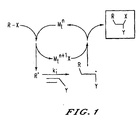
- the transition metal species, M t n abstracts halogen atom X from the organic halide, R-X, to form the oxidized species, M t n+1 X, and the carbon-centered radical R*.
- the radical, R* reacts with alkene, M, with the formation of the intermediate radical species, R-M*.
- the reaction between M t n+1 X and R-M* results in the target product, R-M-X, and regenerates the reduced transition metal species, M t n , which further reacts with R-X and promotes a new redox process.
- a need is strongly felt for a radical polymerization process which provides (co)polymers having a predictable molecular weight and a narrow molecular weight distribution (low “polydispersity").
- a further need is strongly felt for a radical polymerization process which is sufficiently flexible to provide a wide variety of products, but which can be controlled to the degree necessary to provide highly uniform products with a controlled structure (i.e., controllable topology, composition, stereoregularity, etc.), many of which are suitable for highly specialized uses (such as thermoplastic elastomers, end-functional polymers for chain-extended polyurethanes, polyesters and polyamides, dispersants for polymer blends, etc.).
- one object of the present invention is to provide a method for radical polymerization of alkenes based on atom transfer radical polymerization (ATRP), which provides a high degree of control over the polymerization process.
- ATRP atom transfer radical polymerization
- a further object of the present invention is to provide a method for radical polymerization of alkenes based on atom transfer radical polymerization (ATRP), which leads to more uniform and more highly controllable products (which are now obtainable only by living ionic polymerization methods).
- ATRP atom transfer radical polymerization
- Living/controlled polymerization i.e., when chain breaking reactions such as transfer and termination are substantially absent
- Living/controlled polymerization enables control of various parameters of macromolecular structure such as molecular weight, molecular weight distribution and terminal functionalities. It also allows the preparation of various copolymers, including block and star copolymers.
- Living/controlled radical polymerization requires a low stationary concentration of radicals, in equilibrium with various dormant species.
- the present invention describes use of initiating systems leading to living/controlled radical polymerization.
- the initiation system is based on the reversible formation of growing radicals in a redox reaction between various transition metal compounds and an initiator, wherein said initiators are of the formula: (R 11 R 12 R 13 C)-X where:
- a key factor in the present invention is to achieve rapid exchange between growing radicals present at low stationary concentrations (in the range of from 10 -9 mol/L to 10 -6 mol/L, preferably 10 -8 mol/L to 10 -6 mol/L) and dormant chains present at higher concentrations (typically in the range 10 -4 mol/L to 1 mol/L, preferably 10 -2 mol/L to 10 -1 mol/L). It may be desirable to "match" the initiator/catalyst/ligand system and monomer(s) such that these concentration ranges are achieved.
- concentration ranges are not essential to conducting polymerization, certain disadvantageous effects may result if the concentration ranges are exceeded. For example, if the concentration of growing radicals exceeds 10 -6 mol/L, there may be too many active species in the reaction, which may lead to an undesirable increase in the rate of side reactions (e.g., radical-radical quenching, radical abstraction from species other than the catalyst system, etc.). If the concentration of growing radicals is less than 10 -9 mol/L, the rate may be undesirably slow.
- the concentration of dormant chains is less than 10 -4 mol/L, the molecular weight of the product polymer may increase dramatically, thus leading to a potential loss of control of the polydispersity of the product.
- the concentration of dormant species is greater than 1 mol/L, the molecular weight of the product may become too small, and the properties of the product may more closely resemble the properties of oligomers.
- a concentration of dormant chains of about 10 -2 mol/L provides product having a molecular weight of about 100,000 g/mol.
- a concentration of dormant chains exceeding 1 M leads to formation of (roughly) decameric products.
- the various initiating systems of the present invention work for any radically polymerizable alkene, including (meth)acrylates, styrenes and dienes. It also provides various controlled copolymers, including block, random, gradient, star, graft or "comb,” hyperbranched and dendritic (co)polymers. (In the present application, "(co)polymer” refers to a homopolymer, copolymer, or mixture thereof.) Similar systems have been used previously in organic synthesis, but have not been used for the preparation of well-defined macromolecular compounds.
- any radically polymerizable alkene can serve as a monomer for polymerization.
- alkyl alkenyl and alkynyl refer to straight-chain or branched groups (except for C 1 and C 2 groups).
- aryl refers to phenyl, naphthyl, phenanthryl, phenalenyl, anthracenyl, triphenylenyl, fluoranthenyl, pyrenyl, pentacenyl, chrysenyl, naphthacenyl, hexaphenyl, picenyl and perylenyl (preferably phenyl and naphthyl), in which each hydrogen atom may be replaced with alkyl of from 1 to 20 carbon atoms (preferably from 1 to 6 carbon atoms and more preferably methyl), alkyl of from 1 to 20 carbon atoms (preferably from 1 to 6 carbon atoms and more preferably methyl) in which each of the hydrogen atoms is independently replaced by a halide (preferably a fluoride or a chloride), alkenyl of from 2 to 20 carbon atoms, alkynyl of from 1 to 20 carbon atoms, alkoxy of from 1 to
- aryl also applies to the aryl groups in “aryloxy” and “aralkyl."
- phenyl may be substituted from 1 to 5 times and naphthyl may be substituted from 1 to 7 times (preferably, any aryl group, if substituted, is substituted from 1 to 3 times) with one of the above substituents.
- aryl refers to phenyl, naphthyl, phenyl substituted from 1 to 5 times with fluorine or chlorine, and phenyl substituted from 1 to 3 times with a substituent selected from the group consisting of alkyl of from 1 to 6 carbon atoms, alkoxy of from 1 to 4 carbon atoms and phenyl.
- aryl refers to phenyl, tolyl and methoxyphenyl.
- heterocyclyl refers to pyridyl, furyl, pyrrolyl, thienyl, imidazolyl, pyrazolyl, pyrazinyl, pyrimidinyl, pyridazinyl, pyranyl, indolyl, isoindolyl, indazolyl, benzofuryl, isobenzofuryl, benzothienyl, isobenzothienyl, chromenyl, xanthenyl, purinyl, pteridinyl, quinolyl, isoquinolyl, phthalazinyl, quinazolinyl, quinoxalinyl, naphthyridinyl, phenoxathiinyl, carbazolyl, cinnolinyl, phenanthridinyl, acridinyl, 1,10-phenanthrolinyl, phenazinyl,
- Preferred heterocyclyl groups include pyridyl, furyl, pyrrolyl, thienyl, imidazolyl, pyrazolyl, pyrazinyl, pyrimidinyl, pyridazinyl, pyranyl and indolyl, the most preferred heterocyclyl group being pyridyl.
- suitable vinyl heterocycles to be used as a monomer in the present invention include 2-vinyl pyridine, 6-vinyl pyridine, 2-vinyl pyrrole, 5-vinyl pyrrole, 2-vinyl oxazole, 5-vinyl oxazole, 2-vinyl thiazole, 5-vinyl thiazole, 2-vinyl imidazole, 5-vinyl imidazole, 3-vinyl pyrazole, 5-vinyl pyrazole, 3-vinyl pyridazine, 6-vinyl pyridazine, 3-vinyl isoxazole, 3-vinyl isothiazoles, 2-vinyl pyrimidine, 4-vinyl pyrimidine, 6-vinyl pyrimidine, and any vinyl pyrazine, the most preferred being 2-vinyl pyridine.
- the vinyl heterocycles mentioned above may bear one or more (preferably 1 or 2) C 1 -C 6 alkyl or alkoxy groups, cyano groups, ester groups or halogen atoms, either on the vinyl group or the heterocyclyl group, but preferably on the heterocyclyl group.
- those vinyl heterocycles which, when unsubstituted, contain an N-H group may be protected at that position with a conventional blocking or protecting group, such as a C 1 -C 6 alkyl group, a tris-C 1 -C 6 alkylsilyl group, an acyl group of the formula R 10 CO (where R 10 is alkyl of from 1 to 20 carbon atoms, in which each of the hydrogen atoms may be independently replaced by halide [preferably fluoride or chloride]), alkenyl of from 2 to 20 carbon atoms (preferably vinyl), alkynyl of from 2 to 10 carbon atoms (preferably acetylenyl), phenyl which may be substituted with from 1 to 5 halogen atoms or alkyl groups of from 1 to 4 carbon atoms, or aralkyl (aryl-substituted alkyl, in which the aryl group is phenyl or substituted phenyl and the alkyl group is from 1 to 6 carbon
- preferred monomers include (meth)acrylate esters of C 1 -C 20 alcohols, acrylonitrile, cyanoacrylate esters of C 1 -C 20 alcohols, didehydromalonate diesters of C 1 -C 6 alcohols, vinyl pyridines, vinyl N-C 1 -C 6- alkylpyrroles, vinyl oxazoles, vinyl thiazoles, vinyl pyrimidines and vinyl imidazoles, vinyl ketones in which the ⁇ -carbon atom of the alkyl group does not bear a hydrogen atom (e.g., vinyl C 1 -C 6 -alkyl ketones in which both ⁇ -hydrogens are replaced with C 1 -C 4 alkyl, halogen, etc., or a vinyl phenyl ketone in which the phenyl may be substituted with from 1 to 5 C 1 -C 6 -alkyl groups and/or halogen atoms), and styrenes which may bear a C 1
- the most preferred monomers are methyl acrylate (MA), methyl methacrylate (MMA), butyl acrylate (BA), 2-ethylhexyl acrylate (EHA), acrylonitrile (AN) and styrene.
- the initiators are those of the formula: R 11 R 12 R 13 C-X where:
- X is preferably Cl or Br.
- Cl-containing initiators generally provide (1) a slower reaction rate and (2) higher product polydispersity than the corresponding Br-containing initiators. Thus, a Br-containing initiator is most preferred.
- the alkyl group may be further substituted with an X group as defined above.
- the initiator it is possible for the initiator to serve as a starting molecule for branch or star (co) polymers.
- an initiator is a 2,2-bis(halomethyl)-1,3-dihalopropane (e.g., 2,2-bis(chloromethyl)-1,3-dichloropropane, 2,2-bis(bromomethyl)-1,3-dibromopropane), and a preferred example is where one of R 11 , R 12 and R 13 is phenyl substituted with from one to five C 1 -C 6 alkyl substituents, each of which may independently be further substituted with a X group (e.g., ⁇ , ⁇ '-dibromoxylene, hexakis( ⁇ -chloro- or ⁇ -bromomethyl)-benzene).
- a X group e.g., ⁇ , ⁇ '-dibromoxylene, hexakis( ⁇ -chloro- or ⁇ -bromomethyl)-benzene.
- More preferred initiators include 1-phenylethyl chloride, 1-phenylethyl bromide, methyl 2-chloropropionate, ethyl 2-chloropropionate, methyl 2-bromopropionate, ethyl 2-bromoisobutyrate, ⁇ , ⁇ '-dichloroxylene, ⁇ , ⁇ '-dibromoxylene and hexakis ( ⁇ -bromomethyl) benzene.
- transition metal compound which can participate in a redox cycle with the initiator and dormant polymer chain, but which does not form a direct carbon-metal bond with the polymer chain, is suitable for use in the present invention.
- Preferred transition metal compounds are those of the formula M t n+ X' n , where:
- Suitable ligands for use in the present invention include ligands having one or more nitrogen, oxygen, phosphorus and/or sulfur atoms which can coordinate to the transition metal through a ⁇ -bond, ligands containing two or more carbon atoms which can coordinate to the transition metal through a ⁇ -bond, and ligands which can coordinate to the transition metal through a ⁇ -bond or a ⁇ -bond.
- preferred N-, O-, P- and S- containing ligands may have one of the following formulas: R 16 -Z-R 17 R 16 -Z-(R 18 -Z) m -R 17 where:
- each of R 16 -Z and R 17 -Z can form a ring with the R 18 group to which the Z is bound to form a linked or fused heterocyclic ring system (such as is described above for "heterocyclyl").
- R 16 and/or R 17 are heterocyclyl
- Z can be a covalent bond (which may be single or double), CH 2 or a 4- to 7-membered ring fused to R 16 and/or R 17 , in addition to the definitions given above for Z.
- Exemplary ring systems for the present ligand include bipyridine, bipyrrole, 1,10-phenanthroline, a cryptand, a crown ether, etc.
- R 19 can also be C 1 -C 20 -alkoxy.
- CO carbon monoxide
- porphyrins and porphycenes the latter two of which may be substituted with from 1 to 6 (preferably from 1 to 4) halogen atoms, C 1 -C 6 alkyl groups, C 1 -C 6 -alkoxy groups, C 1 -C 6 alkoxycarbonyl, aryl groups, heterocyclyl groups, and C 1 -C 6 alkyl groups further substituted with from 1 to 3 halogens.
- one of R 20 and R 21 is H or a negative charge.
- Additional suitable ligands include, for example, ethylenediamine and propylenediamine, both of which may be substituted from one to four times on the amino nitrogen atom with a C 1 -C 4 alkyl group or a carboxymethyl group; aminoethanol and aminopropanol, both of which may be substituted from one to three times on the oxygen and/or nitrogen atom with a C 1 -C 4 alkyl group; ethylene glycol and propylene glycol, both of which may be substituted one or two times on the oxygen atoms with a C 1 -C 4 alkyl group; diglyme, triglyme, tetraglyme, etc.
- Suitable carbon-based ligands include arenes (as described above for the "aryl” group) and the cyclopentadienyl ligand.
- Preferred carbon-based ligands include benzene (which may be substituted with from one to six C 1 -C 4 alkyl groups [e.g., methyl]) and cyclopentadienyl (which may be substituted with from one to five methyl groups, or which may be linked through an ethylene or propylene chain to a second cyclopentadienyl ligand). Where the cyclopentadienyl ligand is used, it may not be necessary to include a counteranion (X') in the transition metal compound.
- X' counteranion
- Preferred ligands include unsubstituted and substituted pyridines and bipyridines (where the substituted pyridines and bipyridines are as described above for "heterocyclyl"), acetonitrile, (R 10 O) 3 P, PR 10 3 , 1,10-phenanthroline, porphyrin, cryptands such as K 222 and crown ethers such as 18-crown-6.
- the most preferred ligands are bipyridine and (R 10 O) 3 P.
- the amounts and relative proportions of initiator, transition metal compound and ligand are those effective to conduct ATRP. Initiator efficiencies with the present initiator/transition metal compound/ligand system are generally very good (at least 50%, preferably ⁇ 80%, more preferably ⁇ 90%). Accordingly, the amount of initiator can be selected such that the initiator concentration is from 10 -4 M to 1 M, preferably 10 -3 -10 -1 M. Alternatively, the initiator can be present in a molar ratio of from 10 -4 :1 to 10 -1 :1, preferably from 10 -3 :1 to 5 x 10 -2 :1, relative to monomer. An initiator concentration of 0.1-1 M is particularly useful for preparing end-functional polymers.
- the molar proportion of transition metal compound relative to initiator is generally that which is effective to polymerize the selected monomer(s), but may be from 0.0001:1 to 10:1, preferably from 0.1:1 to 5:1, more preferably from 0.3:1 to 2:1, and most preferably from 0.9:1 to 1.1:1. Conducting the polymerization in a homogeneous system may permit reducing the concentration of transition metal and ligand such that the molar proportion of transition metal compound to initiator is as low as 0.001:1.
- the molar proportion of ligand relative to transition metal compound is generally that which is effective to polymerize the selected monomer(s), but can depend upon the number of coordination sites on the transition metal compound which the selected ligand will occupy. (One of ordinary skill understands the number of coordination sites on a given transition metal compound which a selected ligand will occupy.)
- the amount of ligand may be selected such that the ratio of (a) coordination sites on the transition metal compound to (b) coordination sites which the ligand will occupy is from 0.1:1 to 100:1, preferably from 0.2:1 to 10:1, more preferably from 0.5:1 to 3:1, and most preferably from 0.8:1 to 2:1.
- a solvent or for a monomer to act as a ligand.
- a monomer is treated as being (a) distinct from and (b) not included within the scope of the ligand.
- the present polymerization may be conducted in the absence of solvent ("bulk" polymerization).
- suitable solvents include ethers, cyclic ethers, C 5 -C 10 alkanes, C 5 -C 8 cycloalkanes which may be substituted with from 1 to 3 C 1 -C 4 alkyl groups, aromatic hydrocarbon solvents, halogenated hydrocarbon solvents, acetonitrile, dimethylformamide, mixtures of such solvents, and supercritical solvents (such as CO 2 , C 1 -C 4 alkanes in which any H may be replaced with F, etc.).
- the present polymerization may also be conducted in accordance with known suspension, emulsion and precipitation polymerization processes.
- Suitable ethers include compounds of the formula R 22 OR 23 , in which each of R 22 and R 23 is independently an alkyl group of from 1 to 6 carbon atoms which may be further substituted with a C 1 -C 4 -alkoxy group.
- R 22 and R 23 is methyl
- the other of R 22 and R 23 is alkyl of from 4 to 6 carbon atoms or C 1 -C 4 -alkoxyethyl.
- Examples include diethyl ether, ethyl propyl ether, dipropyl ether, methyl t-butyl ether, di-t-butyl ether, glyme (dimethoxyethane), diglyme (diethylene glycol dimethyl ether), etc.
- Suitable cyclic ethers include THF and dioxane.
- Suitable aromatic hydrocarbon solvents include benzene, toluene, o-xylene, m-xylene, p-xylene and any isomer or mixture of isomers of cumene.
- Suitable halogenated hydrocarbon solvents include CH 2 Cl 2 , 1,2-dichloroethane and benzene substituted from 1 to 6 times with fluorine and/or chlorine, although one should ensure that the selected halogenated hydrocarbon solvent(s) does not act as an initiator under the reaction conditions.
- Keys to controlling the polymerization reaction may include (1) matching the reactivity of the groups in the initiator (R 11 , R 12 and R 13 ) with the group(s) on the monomer (R 1 -R 4 ), and (2) matching the energetics of bond breaking and bond forming in dormant species (e.g., dormant polymer chains) and transition metal species (as discussed elsewhere in the specification). Matching the reactivities of the initiator with the monomer depends to some degree on the radical stabilizing effects of the substituents.
- the monomer is a simple alkene or halogenated alkene (e.g., ethylene, propylene, vinyl chloride, etc.)
- an alkyl halide initiator e.g., where two or three of R 11 , R 12 and R 13 are C 1 -C 6 alkyl.
- an arene- or ester-stabilized monomer e.g., a (meth)acrylate, acrylonitrile or styrene
- the monomer, initiator, transition metal compound and ligand are selected such that the rate of initiation is not less than 1,000 times (preferably not less than 100 times) slower than the rate of propagation and/or transfer of the X group to the polymer radical.
- rate of initiation is not less than 1,000 times (preferably not less than 100 times) slower than the rate of propagation and/or transfer of the X group to the polymer radical.
- propagation refers to the reaction of a polymer radical with a monomer to form a polymer-monomer adduct radical.
- the present polymerization may be conducted in bulk, in the gas phase (e.g., by passing the monomer in the gas phase over a bed of the catalyst which has been previously contacted with the initiator and ligand), in a sealed vessel or in an autoclave.
- Polymerizing may be conducted at a temperature of from -78° to 200°, preferably from 0° to 160° and most preferably from 80° to 140°.
- the reaction should be conducted for a length of time sufficient to convert at least 10% (preferably at least 50%, more preferably at least 75% and most preferably at least 90%) of the monomer to polymer. Typically, the reaction time will be from several minutes to 5 days, preferably from 30 minutes to 3 days, and most preferably from 1 to 24 hours.
- Polymerizing may be conducted at a pressure of from 0.1 to 100 atmospheres, preferably from 1 to 50 atmospheres and most preferably from 1 to 10 atmospheres (although the pressure may not be measurable directly if conducted in a sealed vessel).
- a radical initiator such as azobis(isobutyronitrile) (“AIBN”)
- AIBN azobis(isobutyronitrile)
- BPO benzoyl peroxide
- peroxy acid such as peroxyacetic acid or peroxybenzoic acid.
- the radical initiator is believed to initiate "reverse" ATRP in the following fashion: I-I ⁇ 2 I* I* + M t n+1 X n ⁇ I-X + M t n X n-1 I* + M ⁇ I-M* I-M* + M t n+1 X n ⁇ I-M-X + M t n X n-1 I-M* + n M ⁇ I-M n+1 * I-M n+1 * + M t n+1 X n ⁇ I-M n+1 -X + M t n X n-1
- I is the initiator
- M t n X n-1 is the transition metal compound
- M is the monomer
- I-M-X and M t n X n-1 participate in "conventional" or "forward" ATRP in the manner described above.
- the isolating step of the present process is conducted by known procedures, and may comprise precipitating in a suitable solvent, filtering the precipitated polymer, washing the polymer and drying the polymer.
- Precipitation can be typically conducted using a suitable C 5 -C 8 -alkane or C 5 -C 8 -cycloalkane solvent, such as pentane, hexane, heptane, cyclohexane or mineral spirits, or using a C 1- C 6 -alcohol, such as methanol, ethanol or isopropanol, or any mixture of suitable solvents.
- a suitable C 5 -C 8 -alkane or C 5 -C 8 -cycloalkane solvent such as pentane, hexane, heptane, cyclohexane or mineral spirits, or using a C 1- C 6 -alcohol, such as methanol, ethanol or isopropanol, or any mixture of suitable solvents.
- the solvent for precipitating is hexane, mixtures of hexanes, or methanol.
- the precipitated (co)polymer can be filtered by gravity or by vacuum filtration, in accordance with known methods (e.g., using a Büchner funnel and an aspirator).
- the polymer can then be washed with the solvent used to precipitate the polymer, if desired.
- the steps of precipitating, filtering and washing may be repeated, as desired.
- the (co)polymer may be dried by drawing air through the (co)polymer, by vacuum, etc., in accordance with known methods (preferably by vacuum).
- the present (co)polymer may be analyzed and/or characterized by size exclusion chromatography, in accordance with known procedures.
- Polymers produced by the present process may be useful in general as molding materials (e.g., polystyrene containers) and as barrier or surface materials (e.g., poly(methyl methacrylate), or PMMA, is well-known in this regard as PLEXIGLASTM)
- the polymers produced by the present process which typically will have more uniform properties than polymers produced by conventional radical polymerization, will be most suitable for use in specialized applications.
- block copolymers of polystyrene and polyacrylate are useful thermoplastic elastomers.
- Poly(methyl methacrylate)-polyacrylate triblock copolymers e.g., PMMA-PA-PMMA
- Homo- and copolymers of styrene, (meth)acrylates and/or acrylonitrile are useful plastics, elastomers and adhesives.
- Either block or random copolymers of styrene and a (meth)acrylate or acrylonitrile may be useful thermoplastic elastomers having high solvent resistance.
- block copolymers in which the blocks alternate between polar monomers and non-polar monomers produced by the present invention are useful amphiphilic surfactants or dispersants for making highly uniform polymer blends.
- Star polymers produced by the present process are useful high-impact (co)polymers.
- STYROLUXTM and anionically-polymerized styrene-butadiene star block copolymer, is a known, useful high-impact copolymer.
- the (co)polymers may have a number average molecular weight of from 1,000 to 500,000 g/mol, preferably of from 2,000 to 250,000 g/mol, and more preferably of from 3,000 to 200,000 g/mol. When produced in bulk, the number average molecular weight may be up to 1,000,000 (with the same minimum weights as mentioned above).
- the number average molecular weight may be determined by size exclusion chromatography (SEC) or, when the initiator has a group which can be easily distinguished from the monomer (s) by NMR spectroscopy (e.g., when 1-phenylethyl chloride is the initiator and methyl methacrylate is the monomer).
- the present process gives block, multi-block, star, gradient, random hyperbranched and dendritic copolymers, as well as graft or "comb” copolymers.
- graft or "comb” copolymers Each of the these different types of copolymers will be described hereunder.
- ATRP is a "living" polymerization, it can be started and stopped, practically at will. Further, the polymer product retains the functional group "X" necessary to initiate a further polymerization.
- a second monomer can then be added to form a second block on the growing polymer chain in a second polymerizing step. Additional polymerizations with the same or different monomer(s) can be performed to prepare multi-block copolymers.
- blocks can be prepared in essentially any order.
- certain advantageous reaction design choices will become apparent. However, one is not limited to those advantageous reaction design choices in the present invention.
- a multi-block copolymer in which a polyacrylonitrile or a poly(meth)acrylate block is prepared first, then a styrene or butadiene block is attached thereto.
- a linking group is not necessary to join the different blocks of the present block copolymer.
- the block copolymers are of the formula: R 11 R 12 R 13 C-(M 1 ) p -(M 2 ) q -X R 11 R 12 R 13 C-(M 1 ) p -(M 2 ) q -(M 3 ) r -X R11 R 12 R 13 C-(M 1 ) p -(M 2 ) q -(M 3 ) r -...-(M u ) s -X wherein R 11 , R 12 , R 13 and X are as defined above; M 1 , M 2 , M 3 , ...
- M u are each a radically polymerizable monomer (as defined above) selected such that the monomers in adjacent blocks are not identical (although monomers in non-adjacent blocks may be identical) and p, q, r,... up to s are independently selected such that the number average molecular weight of each block is from 1,000 to 250,000 g/mol.
- X may also be, for example, H, OH, N 3 , NH 2 , COOH or CONH 2 .
- the block copolymers may have one of the following formulas: X-(M 2 ) q -(M 1 ) p -(R 11 R 12 R 13 C)-(M 1 ) p -(M 2 ) q -X X-(M 3 ) r -(M 2 ) q -(M 1 ) p -(R 11 R 12 R 13 C)-(M 1 ) p -(M 2 ) q -(M 3 ) r -X X-(M u ) -...-(M 3 ) r -(M 2 ) q -(M 1 ) p -( R11 R 12 R 13 C-(M 1 ) p -(M 2 ) q -(M 3 ) r -...-(M u ) s -X wherein R 11 , R 12 R 13 C)-(M 1 ) p -(M 2 ) q -(
- the present invention is also useful for making essentially random copolymers.
- essentially random copolymers the copolymers are as close to statistically random as is possible under radical polymerization conditions.
- the present ATRP process is particularly useful for producing random copolymers where one of the monomers has one or two bulky substituents (e.g., 1,1-diarylethylene, didehydromalonate C 1 -C 20 diesters, C 1 -C 20 , diesters of maleic or fumaric acid, maleic anhydride and/or maleic diimides [where Y is NR 8 as defined above], etc.), from which homopolymers may be difficult to prepare, due to steric considerations.
- bulky substituents e.g., 1,1-diarylethylene, didehydromalonate C 1 -C 20 diesters, C 1 -C 20 , diesters of maleic or fumaric acid, maleic anhydride and/or maleic diimides [where
- the random copolymer is one of the formula: R 11 R 12 R 13 C-(M 1 -M 2 ) p -(M 2 -M 1 ) q (M 1 -M 2 ) r -...-(M v -M y ) s -X or (R 11 R 12 R 13 C)-[(M 1 -M 2 ) p -(M 2 -M 1 ) q -(M 1 -M 2 ) r -...-(M v -M y ) s -X
- R 11 , R 12 , R 13 and X are as defined for the block copolymer above
- M 1 and M 2 are different radically-polymerizable monomers (as defined above)
- M v is one of M 1 and M 2
- M y is the other of M 1 and M 2 .
- p, q, r,... up to s are independently selected such that the number average molecular weight of the copolymer is from 1,000 to 1,000,000 g/mol, preferably from 2,000 to 250,000, and more preferably from 3,000 to 150,000 g/mol.
- the ratio of (1) the total number of "blocks" of statistically random units to (2) the total number of monomer units is preferably at least 1:5, more preferably at least 1:8, and most preferably at least 1:10.
- the present random copolymer can also serve as a block in any of the present block copolymers.
- More preferred monomers for the present include styrene, acrylonitrile, C 1 -C 8 esters of (meth)acrylic acid and 1,1-diphenylethylene.
- the present invention is also useful for forming so-called "star” polymers and copolymers.
- each of the "X" groups can serve as a polymerization initiation site.
- the star (co)polymers are of the formula: (R 11' R 12' R 13' C)-[(M 1 ) p -X] z (R 11' R 12' R 13' C)-[(M 1 ) p -(M 2 ) q -X] z (R 11' R 12' R 13 'C)-[(M 1 ) p -(M 2 ) q -(M 3 ) r -X] z (R 11' R 12' R 13' C)-[(M 1 ) p -(M 2 ) q -(M 3 ) r -...-(M u ) s -X] z where R 11' , R 12' and R 13' are the same as R 11
- Initiator suitable for use in preparing the present star (co)polymers are those in which the R 11 R 12 R 13 C group possesses at least two substituents which can be "X" (as defined above). Preferably, these substituents are identical to "X”. Examples of such initiators include chloroform, carbon tetrachloride.
- Preferred initiators of this type include 2,2-bis(chloromethyl)-1,3-dichloropropane, 2,2-bis(bromomethyl)-1,3-dibromopropane), ⁇ , ⁇ ', ⁇ "-trichloro- and ⁇ , ⁇ ', ⁇ "-tribromocumene, and hexakis( ⁇ -chloro- and ⁇ -bromomethyl)benzene), the most preferred being hexakis( ⁇ -bromomethyl)benzene.
- each of the blocks may have a number average molecular weight in accordance with the homopolymers described above.
- the copolymers may have a molecular weight which corresponds to the number of blocks (or in the case of star polymers, the number of branches times the number of blocks) times the number average molecular weight range for each block.
- Graft or "comb” copolymers can be prepared by sequential ATRP's.
- a (co) polymer is produced by a first ATRP, in which at least one of the monomers has a R 1 -R 4 substituent which is encompassed by the description of the "X" group above.
- this substituent is Cl or Br.
- preferred monomers would thus include vinyl chloride, 1- or 2- chloropropene, vinyl bromide, 1,1- or 1,2-dichloro- or dibromoethene, trichloro- or tribromoethylene, tetrachloro- or tetrabromoethylene, chloroprene, 1-chlorobutadiene, 1- or 2-bromodutadiene, etc.
- More preferred monomers include vinyl chloride, vinyl bromide and chloroprene. It may be necessary to hydrogenate (by known methods) a (co)polymer produced in the first ATRP of chloroprene prior to the second ATRP, using the polymer produced by the first ATRP as the initiator.
- Gradient or tapered copolymers can be produced using ATRP by controlling the proportion of two or more monomers being added. For example, one can prepare a first block (or a oligomer) of a first monomer, then a mixture of the first monomer and a second, distinct monomer can be added in proportions of from, for example, 1:1 to 9:1 of first monomer to second monomer. After conversion of all monomer(s) is complete, sequential additions of first monomer-second monomers mixtures can provide subsequent "blocks" in which the proportions of first monomer to second monomer vary.
- the copolymer is one of the formula: R 11 R 12 R 13 C-(M 1 a M 2 b )-(M 1 c M 2 d )-(M 1 e M 2 f )-...-(M 1 g M 2 h )-(M 1 i M 2 j )-X
- R 11 , R 12 , R 13 and X are as defined for the block copolymer above
- M 1 and M 2 are different radically-polymerizable monomers (as defined above)
- the relative proportions of first monomer to second monomer can be controlled in a continuous manner, using for example a programmable syringe or feedstock supply pump.
- ATRP can be used to prepare cross-linked polymers and copolymers.
- Polymers and copolymers produced by the present process have surprisingly low polydispersity for (co)polymers produced by radical polymerization.
- the ratio of the weight average molecular weight to number average molecular weight (“M w /M n ”) is ⁇ 1.5, preferably ⁇ 1.4, and can be as low as 1.10 or less.
- the "living" (co)polymer chains retain an initiator fragment including X or X' as an end group, or in one embodiment, as a substituent in a monomeric unit of the polymer chain, they may be considered end-functional or in-chain functional (co)polymers.
- Such (co)polymers may be used directly or be converted to other functional groups for further reactions, including crosslinking, chain extension, reactive injection molding (RIM), and preparation of other types of polymers (such as polyurethanes, polyimides, etc.).
- ATRP atom transfer radical polymerization
- the atom transfer radical polymerization of styrene and various (meth)acrylates at different temperatures also affords the product polymers with the predicted molecular weight (up to M n > 10 5 ), having excellent low polydispersity (as low as 1.15; see Table 1 below).
- Figure 3 presents the kinetics of methyl acrylate ("MA") bulk polymerization at 130°C, initiated with 1-PECl in the presence of Cu(I)Cl (1 equiv.) and Bpy (3 equiv.).
- MA methyl acrylate
- the straight semilogarithmic kinetic plot of ln([M] o /[M]) vs. time ("t", in minutes) indicates that the concentration of growing radicals is constant, and that termination reactions are minimal.
- M n ( ⁇ [ M ] / [ R - X ] 0 ) ⁇ ( MW ) 0
- ⁇ [M] represents the concentration of consumed monomer MA
- [R-X] 0 represents the initial concentration of 1-PECl
- (MW) 0 represents the molecular weight of MA.
- the assignment of the 13 C signals was performed to Peat and Reynolds (see Bamford, Reactivity, Mechanism and Structure in Polymer Chemistry, Jenkins, A. D. and Ledwith, A., eds, John Wiley & Sons, London (1974), p. 52; and Peat et al, Tetrahedron Lett., 1972 , 14, 1359).
- Table 3 reports the data for the ATRP of styrene at 130°C using various commercially available alkyl chlorides, Cu(I)Cl (1 molar equiv.) and Bpy (3 molar equiv.) as initiator, catalyst, and ligand, respectively.
- Initiators which possess either inductive or resonance- stabilizing substituents (e.g., two or more halogen atoms in addition to the Cl transfer atom, CN, COOR, and/or aryl [Ph]) can serve as efficient mono- or bi- functional initiators (i.e, providing high initiator efficiency ["f" > 0.9] and narrow molecular weight distribution [e.g., M w /M n - 1.25-1-5]).
- inductive or resonance- stabilizing substituents e.g., two or more halogen atoms in addition to the Cl transfer atom, CN, COOR, and/or aryl [Ph]
- mono- or bi- functional initiators i.e, providing high initiator efficiency ["f" > 0.9] and narrow molecular weight distribution [e.g., M w /M n - 1.25-1-5]).
- the results shown in Table 3 may be tentatively correlated with the carbon-halide bond strength or bond dissociation energy (BDE).
- BDE carbon-halide bond strength or bond dissociation energy
- Figure 9 illustrates the kinetic plots of the ATRP of three typical monomers, St, MA, and MMA, using the same initiator system 1-PECl/CuCl/Bpy (1/1/3), under the same experimental conditions, in bulk and at 130°C.
- Table 4 shows the kinetic data and estimated concentrations of growing radicals in bulk ATRP of St, MMA, and MA initiated with 1-PECl/CuCl/Bpy (1/1/3) at 130°C.
- the concentration of growing radicals decreases in the order [P i * .MMA ] > [P i * .St ] ⁇ [P i * .MA] .
- ATRP is essentially faster when X is bromine as compared to when X is chlorine. This can be explained by the presence of more growing radicals in the polymerization process when X is bromine as compared to when X is chlorine.
- the effect of the leaving group, X, on the living character of the polymerization is also significant.
- X the leaving group
- the polydispersity of resulting polymers obtained by Cl ATRP is usually larger than the polydispersity obtained by Br ATRP (e.g., an M w /M n of 1.15-1.35 vs. 1.30-1.50; see Figures 10 and 11).
- Transition Metal Catalyzed-Atom Transfer Radical Addition and Transition Metal Catalyzed-Atom Transfer Radical Polymerization can be considered as a succession of consecutive atom transfer radical additions, ATRA's.
- ATRA atom transfer radical polymerization
- the prerequisite for a successful transformation of transition metal catalyzed-ATRA to transition metal catalyzed-ATRP is that a number of polymeric halides, M n -X, can be effectively activated by M t n (Fig. 2).
- M n -X polymeric halides
- organic chemists often use either (1) activated organic halogens as radical sources, (2) terminal alkenes without resonance-stabilizing substituents or (3) both activated organic halogens as radical sources and terminal alkenes without resonance-stabilizing substituents (see (a) Bellus, D. Pure & Appl. Chem. 1985, 57, 1827; (b) Nagashima, H.; Ozaki, N.; Ishii, M.; Seki, K.; Washiyama, M.; Itoh, K. J . Org. Chem.
- the following parameters appear to be important to promote the successful transformation of ATRA to ATRP.
- suitable ligands e.g., Bpy, P(OET) 3
- the presence of either inductive or resonance stabilizing substituents in the initiator are beneficial for generating initiating radicals, R*, in growing PSt and PMMA chains.
- the use of a high polymerization temperature is beneficial, particularly for Cl ATRP (Table 5). In fact, many ATRA processes also appear to use rather high temperatures.
- RuCl 2 (PPh 3 ) 3 was known to promote only the monomeric addition of CCl 4 to alkenes. Very recently, it was reported that RuCl 2 (PPh 3 ) 3 induced the controlled radical polymerization of MMA at 60°C in the presence of methylaluminum bis(2,4-di-tert-butylphenoxide) ( Sawamoto et al , Macromolecules , 1995 , 28, 1721).
- polymerization temperatures e.g., 130°C
- a number of radically polymerizable monomers undergo ATRP in the absence of methylaluminum bis(2,4-di-tert-butylphenoxide) or other such activators.
- polymerization temperature rather than include methylaluminum bis(2,4-di-tert-butylphenoxide) or other activator
- an activator may lead to a change in the polymerization mechanism.
- R-X/transition metal species-based redox initiators such as Mo(CO) 6 /CHCl 3 , Cr(CO) 6 /CCl 4 , Co 4 (CO) 12 /CCl 4 , and Ni[P(OPh) 3 ] 4 /CCl 4 , promote radical polymerization (see Bamford, Comprehensive polymer Science, Allen, G., Aggarwal, S. L., Russo, S., eds., Pergamon: Oxford, 1991, vol. 3, p. 123).
- transition metal species may act in a different manner. They may induce an atom transfer reaction or provide a source of metal-complexed radicals or even initiate a catalytic cycle that does not involve radical intermediates (Curran et al , J. Org. Chem. and J. Am. Chem . Soc., supra) .
- the present invention shows that the polymerization of alkenes occurs when halide initiators, including CCl 4 , are used with CuX complexed by Bpy as a catalyst.
- halide initiators including CCl 4
- the uncomplexed CuX species may not be powerful enough to abstract the halogen atom from the 1:1 monomeric adduct to promote atom transfer radical polymerization.
- the polymerization of St initiated with 1-PECl/CuCl without ligand is an ill-controlled, thermally self-initiated polymerization.
- redox radical telomerization represents a degradative transfer process, in which the resulting polymeric halides, R-M n -X, are dead chains (see Scheme 2 above). Consequently, the molecular weight obtained in redox radical telomerization does not increase with the monomer conversion, whereas the molecular weight increases linearly with increasing monomer conversion in ATRP.
- Free radicals which are the growing species in radical polymerization, are highly reactive species. Unlike anions or cations, they recombine and/or disproportionate at rates approaching the diffusion controlled limit (i.e., k t of about 10 8-10 M -1 ⁇ sec -1 ), which is much higher than the corresponding propagating rate constant (i.e., k p ⁇ 10 2-4 M -1 ⁇ sec -1 ). Moreover, initiation is incomplete due to slow decomposition of classic radical initiator (i.e., k d ⁇ 10 -4--6 sec -1 ). These are the kinetic reasons why classic radical polymerization yields ill-defined polymers with unpredictable molecular weight, broad molecular weight distribution, and uncontrolled structures.
- the polymerization degree can be predetermined by the ratio of the concentration of the consumed monomer to that of the dormant chains (eq. 14), and the molecular weight distribution may remain narrow.
- Recent progress in controlled radical polymerization can be indeed related to the approach illustrated in the M n -D reaction above, in which growing radicals, Mn*, react reversibly with species D, which may be carbon-, sulfur-, and oxygen-centered radicals ( Otsu et al, Makromol. Chem, Rapid Commun ., 1982, 127; Otsu et al, Macromolecules, 1992, 25, 5554; Bledzki et al, Makromol. Chem, 1983, 184, 745; Druliner, Macromolecules , 1991 , 24, 6079; U.S. Patent No.
- the concentrations of uncontrolled polymer chains, "UC" are all less than 3% in ATRP's of St, MMA, and MA, when 1-PECl/CuCl/Bpy (1/1/3) is used as the initiator system at 130°C. This may be why ATRP proceeds in a "living" manner.
- the termination rate constant is larger in MA radical polymerization than in the other two processes, ATRP of MA is better controlled than ATRPs of St and MMA. This appears to be due to a lower concentration of growing radicals in the ATRP of MA (Table 6).
- the molecular weight of the resulting polymers can be predicted by eq. (14), and low polydispersity polymers can be obtained.
- reaction rate constants between (1) PSt* and CuCl 2 and (2) PMMA* radicals and CuCl 2 are 10 4 and 10 3 times greater in comparison with the corresponding propagation rate constants, respectively. Therefore, the existence of a fast deactivation (scavenging) reaction can explain the low polydispersity obtained in ATRP.
- the R-Cl/Ni(O) combined initiator of Otsu et al appears to act as a conventional redox initiator, similar to the initiators developed by Bamford (see Reactivity, Mechanism and Structure in Polymer Chemistry, Jenkins, A. D. and Ledwith, A., eds, John Wiley & Sons, London (1974), p. 52; and Comprehensive Polymer Science, Allen, G., Aggarwal, S. L., Russo, S., eds., Pergamon: Oxford, 1991, vol. 3, p. 123).
- the concentration of growing (initiating) radicals is proportional and inversely proportional to the activation and deactivation rate constants, respectively, which strongly depend on the structure of the R 11 R 12 R 13 C group in the initiator, the structure of the repeating monomer units M in R-M n -X, the leaving group X, and the polymerization temperature (see Tables 3, 4 and 5, Figure 9).
- the deactivation reaction between PMA and CuCl 2 is usually 10 times slower than that between Pst* and CuCl 2 (i.e., k deact.PSt-/CuCl2 > k deact.PMA-/CuCl2 ) (see Bamford , Comprehensive Polymer Science, Allen, G., Aggarwal, S. L., Russo, S., eds., Pergamon: Oxford, 1991, p. 1).
- the similar concentration of radicals found in the ATRP of St relative to the ATRP of MA indicates that the activation reaction between CuCl and PSt-Cl is faster than the one between PMA-Cl and CuCl (i.e., k act.PSt-Cl > k act.PMA-Cl ).
- This is in good agreement with the lower bond dissociation energy in PSt-Cl as compared to PMA-Cl (see Danen, W. C., in Methods in Free Radical Chemistry, Huyser, E. L. S., ed., Dekker, New York, 1974, vol. 5, p.1; and Poutsma, supra ).
- the polymerization is much faster in the Br-ATRP of MA than in the Cl-ATRP of MA, due to a higher stationary concentration of radicals in the former system as compared to the latter one.
- the polydispersity is much narrower in Br ATRP than in Cl-ATRP. According to the discussion in the preceding section, this suggests that deactivation of free radicals with CuBr 2 is faster in comparison to deactivation of free radicals with CuCl 2 .
- the concentration of growing radicals in Br-ATRP is larger than in Cl-ATRP (see Table 5)
- the activation of PMA-Br by Br-containing Cu(I) species must be faster than the activation of PMA-Cl by Cl-containing Cu(I) species.
- Halogen Atom Transfer (Abstraction) vs. Outer-Sphere Electron Transfer.
- the generation of free radicals by reacting an organic halide with a transition metal compound may involve two different mechanisms: either halogen atom transfer (Figure 18A) or outer-sphere electron transfer (Figure 18B).
- the former process depends on the carbon-halogen bond dissociation energy, whereas the latter is a function of the electrode potential for the reaction of the organic halide (i.e., RX + e* ⁇ R* + X*).
- the outer sphere electron transfer process is usually less sensitive than halogen atom transfer to the leaving atom X in R-X and to temperature ( Howes et al, Inorg. Chem. 1988, 27, 3147; and references therein).
- the results presented herein show that transition metal-mediated ATRP has a strong dependence on the leaving group X in R-X, as well as on the reaction temperature.
- the results herein suggest that ATRP involves a direct atom transfer process.
- the reversible conversion of the radicals R* and R-M n * to organic halides R-X and R-M n -X may involve direct atom transfer (see Kochi, J.K., Organometallic Mechanisms and Catalysis, Academic Press, New York, 1978, and references cited therein; Asscher, M., Vofsi, D. J . Chem. Soc., Perkin II. 1968, 947; and Cohen, H., Meyerstein, D. Inorg. Chem. 1974, 13, 2434) or oxidative addition/reductive elimination with the formation of organocopper(III) intermediates (see Kochi , supra ; Orochov, A., Asscher, M., Vofsi D. J .
- ATRP atom transfer radical polymerization
- Cu(I)/Cu(II) model redox process a successful extension of atom transfer radical addition, ATRA, to atom transfer radical polymerization, ATRP has been demonstrated in a Cu(I)/Cu(II) model redox process.
- the present process opens a new pathway to conduct a "living" or controlled radical polymerization of alkenes.
- the controlled process found in ATRP results from two important contributions: (1) a low stationary concentration of growing radicals and (2) a fast and reversible equilibrium between the growing radicals and the dormant species.
- Many parameters, such as the nature of transition metals, the structure and property of ligands, the polymerization conditions, etc, may affect the course of "living" ATRP.
- ATRP will provide a powerful tool for producing various tailor-made polymers.
- An aralkyl chloride, 1-phenylethyl chloride, 1-PECl, is an efficient initiator, and a transition metal halide, CuCl, complexed by 2,2'-bipyridine, bpy, is an efficient chlorine atom transfer promoter.
- This model initiating system affords controlled polymers with predicted molecular weight and narrower molecular weight distribution, M w /M n ⁇ 1.5, than obtained by conventional free radical polymerization.
- Phenylethyl chloride, 1-PECl was prepared according to a literature procedure (Landini, D.; Rolla, F. J. Org. Chem. , 1980 , 45 , 3527).
- a typical polymerization was carried out by heating a reddish brown solution of styrene (St), 1-PECl (0.01 molar equiv. relative to monomer), CuCl (1 molar equiv. relative to 1-PECl), and bpy (3 molar equiv. relative to CuCl), in a glass tube sealed under vacuum at 130°C. (The reddish brown color of a slightly heterogeneous solution was formed within 30 seconds at 130°C.) The formed polymer was then dissolved in THF and precipitated in MeOH (three times), filtered and dried at 60°C under vacuum for 48 hr. Yield, 95%.
- St styrene
- 1-PECl 0.01 molar equiv. relative to monomer
- CuCl (1 molar equiv. relative to 1-PECl
- bpy 3 molar equiv. relative to CuCl
- M n,SEC number average molecular weight
- [M] 0 and [1-PECl] 0 represent the initial concentrations of monomer (St) and 1-PECl, respectively, and (MW) 0 is the molecular weight of monomer.
- St monomer
- MW molecular weight of monomer.
- Table 7 summarizes the results of styrene polymerization under various experimental conditions. In the absence of 1-PECl, CuCl or bpy, the polymers obtained are ill-controlled with unpredictable molecular weights and with broad molecular weight distributions.
- the same initiating system, 1-PECl/CuCl/Bpy (1/1/3), can be also used for the controlled polymerization of acrylic monomers, such as methyl methacrylate, MMA, methyl acrylate, MA, and butyl acrylate, BA.
- the model catalyst Cu I Cl acts as a carrier of the chlorine atom in a redox reaction between Cu(I) and Cu(II),
- the coordination of the bidentate nitrogen ligand to Cu I Cl increases the solubility of the inorganic salt and can also affect the position of the redox equilibrium, so as to facilitate the abstraction of a chlorine from the initiator, 1-PECl, and the dormant species, P 1 -Cl, with the formation of initiating and growing radicals, respectively.
- the reversible conversion of radicals, R* and P 1 *, to the corresponding halides, R-C1 and P 1 -Cl may involve a direct atom transfer reaction (Kochi, J.K.
- the concentration of growing radicals is low and the redox reaction is fast compared to bimolecular reactions of the radicals, the extent of the termination reactions is minimized, resulting in a "living" process.
- the rate of reversible exchange between P 1 -Cl and P 1 * is comparable to that of propagation, the number average molecular weight should be defined by eq. (21), and the molecular weight distribution should remain narrow.
- the tacticity of the polymers is similar to those synthesized by typical radical initiators.
- organocuprate (III) species if it exists, probably does not react directly with monomer, otherwise some effect on tacticity would be expected.
- addition of 1.5 molar equiv. of galvinoxyl effectively inhibits the polymerization. In the presence of galvinoxyl, no styrene polymerization was found within 18 hours.
- the low proportion of termination may be explained by stabilizing interactions between radicals P i * and CuCl 2 . It may be possible that the monomer reacts with a radical P i * within a solvent cage, in which the ratio of rate constants of propagation to termination is higher than for uncomplexed radicals in solution.
- styrene may polymerize thermally by self-initiation.
- self-initiation Moad, G., Rizzardo, E., Solomon, D. H. Polym. Bull., 1982, 6 , 589.
- the contribution of this reaction in ATRP is rather small, because (1) ATRP is fast and (2) the relative rate of self-initiation is further reduced with the progress of the reaction.
- the small contribution of self-initiation may enhance polydispersities to the range of M w /M n ⁇ 1.4, and may reduce molecular weights to slightly lower values than theoretically predicted.
- transition-metal promoted ATRP in which the molecular weight linearly increases with monomer conversion, is very different from typical redox radical telomerization promoted by transition metal species in which the molecular weight does not increase with conversion
- transition metal species in which the molecular weight does not increase with conversion
- model alkyl chloride initiator, 1-PECl, and model transition metal complex CuCl/bpy polymerize styrene by repetitive atom transfer radical additions to give well-defined high molecular weight polymers with narrow molecular weight distributions.
- Polystyrene was prepared by heating styrene (0.9 g), 1-phenylethyl chloride (1 ⁇ L, 7.54 x 10 -6 mol), Cu(I)Cl (7.54 x 10 -6 mol) and 2,2'-bipyridine (Bpy; 2.26 x 10 -5 mol) at 130° in a sealed tube for 21.5 h.
- the polymerization reaction mixture was then dissolved in THF, and precipitated in methanol.
- the precipitated polymer was filtered, and the dissolving, precipitating and filtering steps were repeated two additional times.
- the obtained polymer was dried at 60°C under vacuum for 48 h.
- the dried polymer had a number average molecular weight as measured by size exclusion chromatography (SEC), M nSEC , of 95,000, in good agreement with the theoretical number average molecular weight, M n,th ., of 102,000.
- SEC size exclusion chromatography
- M nSEC size exclusion chromatography
- Polystyrene was prepared according to the procedure described in Example 3, except polymerization was conducted at 100°C for 88 h. The polymer was obtained in 80% yield. The M n,SEC of 93,300 was in excellent agreement with the M n,th. of 97,000. The M w /M n of the obtained polymer was 1.50.
- Example 3 The procedure of Example 3 was repeated, except that 0.45 g of styrene and 2.5 ⁇ L (1.89 x 10 -5 mol) of 1-PECl were employed, Ni(O) (2.73 x 10 -5 mol) was used as the transition metal in place of Cu(I)Cl, and PPh 3 (1.41 ⁇ 10 -4 mol) was used as the ligand in place of Bpy. The reaction was conducted at 130°C for 12 h.
- the polymer was obtained in 85% yield.
- the polymerization was conducted at 130°C for 13.5 h.
- the polymer was obtained in 90% yield.
- the M n,SEC of 18,300 was in excellent agreement with the M n,th. of 17,900.
- the obtained polymer had an M w /M n of 2.0.
- Polystyrene was prepared according to the procedure of Example 3, except that AIBN (1.7 x 10 -5 mol) was used in place of 1-PECl, Cu(II)Cl 2 (3 x 10 -5 mol) was used in place of Cu(I)Cl, and Bpy was present in a molar amount of 7 x 10 -5 mol.
- the polymerization was conducted at 130°C for 5 h.
- the polymer was obtained in 90% yield.
- the K n,SEC of 18,500 was in agreement with the K n,th. of 25,000.
- the obtained polymer had an M w /M n of 1.7.
- Polystyrene was prepared according to the procedure of Example 3, except that 2-chloropropionitrile (3.75 x 10 -6 mol) was used in place of 1-PECl; Cu(I)Cl and Cu(II)Cl 2 were used in an equimolar mixture (3.76 x 10 -6 mol of each) in place of Cu(I)Cl alone; and Bpy was present in a molar amount of 1.9 x 10 -5 mol.
- the polymerization was conducted at 130°C for 33 h.
- the polymer was obtained in 80% yield.
- the H n,SEC of 81,500 was in good agreement with the K n,th. of 95,500.
- the obtained polymer had an M w /M n of 1.4.
- Polystyrene was prepared according to the procedure of Example 3, except that benzyl chloride (3.75 ⁇ 10 -5 mol) was used in place of 1-PECl, FeCl 2 (3.75 ⁇ 10 -5 mol) was used in place of Cu(I)Cl, and (EtO) 3 P (1.15 ⁇ 10 -4 mol) was used in place of Bpy.
- the polymerization was conducted at 130°C for 5.5 h.
- the polymer was obtained in 85% yield.
- the M n,SEC of 19,300 was in good agreement with the M n,th of 21,100.
- the obtained polymer had an M w /M n of 3.0.
- Poly(methyl acrylate), PMA was prepared according to the procedure of Example 3, except that 1.45 grams of MA were used, ⁇ , ⁇ '-dibromoxylene (4.4 x 10 -5 mol) was used in place of 1-PECl, Cu(I)Br (8 x 10 -5 mol) was used in place of Cu(I)Cl, and Bpy was present in a molar amount of 2.5 x 10 -4 mol.
- the polymerization was conducted at 80°C for 36 h. The polymer was obtained in 90% yield.
- the M n,SEC of 31,000 was in very good agreement with the M n,th . of 29,500,
- the obtained polymer had an M w /M n of 1.2.
- Poly(methyl acrylate) was prepared according to the procedure of Example 10, except that 0.48 g of MA were used, 2-methylbromopropionate (1.47 x 10 -5 mol) was used in place of ⁇ , ⁇ '-dibromoxylene, Cu(I)Br was used in an amount of 1.47 x 10 -5 mol, and Bpy was present in a molar amount of 4.5 x 10 -5 mol.
- the polymerization was conducted at 100°C for 15 h. The polymer was obtained in 95% yield.
- the M n,SEC of 29,500 was in very good agreement with the M n,th. of 31,000.
- the obtained polymer had an M w /M n of 1.15.
- Poly(methyl methacrylate), PMMA was prepared according to the procedure of Example 3, except that 0.5 g of MMA were used, 0.5 ml of ethyl acetate was employed as a solvent, 2-ethyl bromoisobutyrate (2.5 x 10 -5 mol) was used in place of 1-PECl, Cu(I)Br (1.5 x 10 -5 mol) was used in place of Cu(I)Cl, and Bpy was present in a molar amount of 4.5 x 10 -5 mol.
- the polymerization was conducted at 100°C for 1.5 h. The polymer was obtained in 95% yield.
- the M n,SEC of 20,500 was in excellent agreement with the M n,th. of 19,000.
- the obtained polymer had an M w /M n of 1.40.
- Polyisoprene was prepared according to the procedure of Example 3, except that 0.45 g of isoprene was used in place of St, 3.77 x 10 -5 mol of 1-PECl was used, 3.9 x 10 -5 mol of . Cu(I)Cl was used, and Bpy was present in a molar amount of 1.2 x 10 -4 mol.
- the polymerization was conducted at 130°C for 45 h.
- the polymer was obtained in 80% yield.
- the M n,SEC of 12,700 was in agreement with the M n,th. of 9,500.
- the obtained polymer had an M w /M n of 2.0.
- a PSt-b-PMA-b-PSt triblock copolymer was produced as follows. To a flask equipped with a water condenser and a magnetic stirring bar, the initiator ⁇ , ⁇ '-dibromoxylene (1 x 10 -4 mol), CuBr (2 x 10 -4 mol), Bpy (6 x 10 -4 mol), MA (3 g) and EtOAc (10 ml) were added. Argon was then bubbled through the solution, and the solution was heated at 100°C for 18 h. One ml of solution was withdrawn using a syringe and was analyzed by gas chromatography (GC) and SEC to determine the monomer conversion and M n , respectively. PMA was obtained in 100% yield. The M n,SEC of 30,500 was in excellent agreement with the M n,th. of 30,000, and the M w /M n of the PMA was 1.3.
- a random P(St-co-MA) copolymer was prepared according to the procedure of Example 3, except that mixture of MA (0.48 g) and St (0.45 g) was used as comonomers, 1-PECl was used in an amount of 3 ⁇ L (2.26 x 10 -5 mol), Cu(I)Cl was used in an amount of 2.22 x 10 -5 mol and Bpy was present in a molar amount of 6.5 x 10 -5 mol. The polymerization was conducted at 130°C for 5 h. The polymer was obtained in 95% yield. The M n,SEC of 39,000 was in excellent agreement with the M n,th. of 39,100. The obtained polymer had an M w /M n of 1.45.
- composition as determined by 1 H NMR contained 48% MA, and 52% St.
- a random P(St-co-MMA) copolymer was prepared according to the procedure of Example 17, except that mixture of MMA (0.45 g) and St (0.45 g) was used as comonomers, 1-PEBr (3 ⁇ L, 2.2 x 10 -5 mol) was used in place of 1-PECl, Cu(I)Br (2.0 x 10 -5 mol) was used in place of Cu(I)Cl and Bpy was present in a molar amount of 4.5 x 10 -5 mol. The polymerization was conducted at 100°C for 14 h. The polymer was obtained in 90% yield. The M n,SEC of 38,000 was in excellent agreement with the M n,th. of 36,900. The obtained polymer had an M w /M n of 1.55.
- a six arm star PMA polymer was prepared according to the procedure of Example 3, except that C 6 (CH 2 Br) 6 (1 x 10 -4 mol) was used in place of 1-PECl, MA (1 ml, 0.96 g) was used as the monomer, CuBr (1.8 x 10 -4 mol) was used in place of Cu(I)Cl, and Bpy was present in a molar amount of 5.8 x 10 -4 mol.
- the polymerization was conducted at 110°C for 45 h. The polymer was obtained in 100% yield.
- the M n,SEC of 9,600 was in perfect agreement with the K n,th. of 9,600.
- the obtained polymer had an M w /M n of 2.0.
- a six-arm star PSt polymer was prepared according to the procedure of Example 3, except that 1.53 x 10 -5 mol of C 6 (CH 2 Br) 6 was used in place of 1-PECl. The polymer was obtained in 90% yield. The M n,SEC of 24,100 was in close agreement with the M n,th. of 26,800. The obtained polymer had an M w /M n of 1.25.
- An end-functional PSt having a COOH end group was prepared according to the procedure of Example 3, except that 2-chloropropionic acid (1.74 x 10 -5 mol) was used in place of 1-PECl, and the reaction was conducted for 14 h.
- a telechelic PMMA with two Br end groups was prepared at 100°C in ethyl acetate according to the procedure of Example 3, except that 1.00 x 10 -4 mol of C 6 H 4 (CH 2 Br) 2 was used in place of 1-PECl, 0.5 g of MMA was used, 2.00 x 10 -4 mol of CuCl was used, and 5.2 x 10 -4 mol of Bpy was present.
- the polymer was obtained in 100% yield after 8 h.
- the M n,SEC of 4,800 was in close agreement with the M n,th of 5,000.
- the obtained polymer had an M w /M n of 1.35.
- HBr abstraction (by known methods) of the Br-functional PMMA produced in Example 22 can lead to a telechelic (co)polymer with olefinic end groups, from which a telechelic (co)polymer with primary alcohol end groups can be formed by sequential hydroboration/oxidation (by known methods). Nitration/reduction (by known methods) gives the corresponding amine-ended telechelic (co)polymer.
- a Br-ended telechelic (co)polymer (“Br-P n -Br”) can be converted to other groups in one or two step as follows:
- An end-functional and in-chain functional PSt with two Br end groups and two central Br groups was prepared at 100°C according to the procedure of Example 3, except that 0.900 x 10 -4 mol of CBr, was used in place of 1-PECl, 0.5 g of St was used, 1.5 x 10 -4 mol of CuCl was used, and 3.2 x 10 -4 mol of Bpy was present.
- the polymer was obtained in 90% yield after 20 h.
- the M n,SEC of 4,500 was in agreement with the M n,th. of 5,000.
- the obtained polymer had an M w /M n of 1.45.
- the obtained polymer can be converted to any of the other four functional PSt's according to the procedures described in Example 23.
- a number of ATRP's of styrene using transition metal complexes other than CuCl/Bpy are summarized in Table 8
- a number of ATRP's of methyl methacrylate using transition metal complexes other than CuCl/Bpy are summarized in Table 9.
Landscapes
- Chemical & Material Sciences (AREA)
- Chemical Kinetics & Catalysis (AREA)
- Organic Chemistry (AREA)
- Health & Medical Sciences (AREA)
- Medicinal Chemistry (AREA)
- Polymers & Plastics (AREA)
- Materials Engineering (AREA)
- Engineering & Computer Science (AREA)
- Life Sciences & Earth Sciences (AREA)
- Wood Science & Technology (AREA)
- Inorganic Chemistry (AREA)
- Graft Or Block Polymers (AREA)
- Addition Polymer Or Copolymer, Post-Treatments, Or Chemical Modifications (AREA)
- Polymerisation Methods In General (AREA)
- Polymerization Catalysts (AREA)
- Polymers With Sulfur, Phosphorus Or Metals In The Main Chain (AREA)
Priority Applications (1)
| Application Number | Priority Date | Filing Date | Title |
|---|---|---|---|
| EP05025891A EP1637543A3 (en) | 1995-03-31 | 1996-03-19 | Polymerization process based on atom (or group) transfer radical polymerization |
Applications Claiming Priority (3)
| Application Number | Priority Date | Filing Date | Title |
|---|---|---|---|
| US414415 | 1982-09-02 | ||
| US08/414,415 US5763548A (en) | 1995-03-31 | 1995-03-31 | (Co)polymers and a novel polymerization process based on atom (or group) transfer radical polymerization |
| PCT/US1996/003302 WO1996030421A1 (en) | 1995-03-31 | 1996-03-19 | Novel (co)polymers and a novel polymerization process based on atom (or group) transfer radical polymerization |
Related Child Applications (1)
| Application Number | Title | Priority Date | Filing Date |
|---|---|---|---|
| EP05025891A Division EP1637543A3 (en) | 1995-03-31 | 1996-03-19 | Polymerization process based on atom (or group) transfer radical polymerization |
Publications (3)
| Publication Number | Publication Date |
|---|---|
| EP0817806A1 EP0817806A1 (en) | 1998-01-14 |
| EP0817806A4 EP0817806A4 (en) | 1998-05-27 |
| EP0817806B1 true EP0817806B1 (en) | 2006-02-08 |
Family
ID=23641358
Family Applications (2)
| Application Number | Title | Priority Date | Filing Date |
|---|---|---|---|
| EP96909643A Expired - Lifetime EP0817806B1 (en) | 1995-03-31 | 1996-03-19 | Polymerization process based on atom (or group) transfer radical polymerization |
| EP05025891A Withdrawn EP1637543A3 (en) | 1995-03-31 | 1996-03-19 | Polymerization process based on atom (or group) transfer radical polymerization |
Family Applications After (1)
| Application Number | Title | Priority Date | Filing Date |
|---|---|---|---|
| EP05025891A Withdrawn EP1637543A3 (en) | 1995-03-31 | 1996-03-19 | Polymerization process based on atom (or group) transfer radical polymerization |
Country Status (14)
| Country | Link |
|---|---|
| US (4) | US5763548A (enExample) |
| EP (2) | EP0817806B1 (enExample) |
| JP (1) | JP3040172B2 (enExample) |
| KR (2) | KR100282757B1 (enExample) |
| CN (2) | CN1150234C (enExample) |
| AT (1) | ATE317405T1 (enExample) |
| AU (1) | AU720512B2 (enExample) |
| BR (1) | BR9604887A (enExample) |
| CA (1) | CA2216853C (enExample) |
| DE (1) | DE69635802T2 (enExample) |
| IL (1) | IL117626A (enExample) |
| MX (2) | MX244246B (enExample) |
| TW (2) | TWI254720B (enExample) |
| WO (1) | WO1996030421A1 (enExample) |
Cited By (1)
| Publication number | Priority date | Publication date | Assignee | Title |
|---|---|---|---|---|
| EP1555273B2 (en) † | 1995-11-15 | 2014-09-17 | Carnegie Mellon University | Improved processes based on atom (or group) transfer radical polymerization and novel (co) polymers having useful structures and properties |
Families Citing this family (571)
| Publication number | Priority date | Publication date | Assignee | Title |
|---|---|---|---|---|
| FR2730241B1 (fr) * | 1995-02-07 | 1997-02-28 | Atofina | Procede de fabrication d'une composition comprenant un polymere vinylaromatique et un caoutchouc par polymerisation en presence d'un radical libre stable |
| US5763548A (en) * | 1995-03-31 | 1998-06-09 | Carnegie-Mellon University | (Co)polymers and a novel polymerization process based on atom (or group) transfer radical polymerization |
| US6541580B1 (en) * | 1995-03-31 | 2003-04-01 | Carnegie Mellon University | Atom or group transfer radical polymerization |
| JP3806475B2 (ja) | 1996-02-08 | 2006-08-09 | 株式会社カネカ | 末端に官能基を有する(メタ)アクリル系重合体の 製造方法 |
| US6310149B1 (en) | 1996-06-12 | 2001-10-30 | University Of Warwick | Polymerization catalyst and process |
| DE69710130T2 (de) * | 1996-06-26 | 2002-08-29 | Kaneka Corp., Osaka | Verfahren zur Herstellung von Vinylpolymeren |
| US5789487A (en) * | 1996-07-10 | 1998-08-04 | Carnegie-Mellon University | Preparation of novel homo- and copolymers using atom transfer radical polymerization |
| FR2752238B1 (fr) * | 1996-08-12 | 1998-09-18 | Atochem Elf Sa | Procede de polymerisation ou copolymerisation radicalaire controlee de monomeres (meth)acryliques et vinyliques et (co)polymeres obtenus |
| US5910549A (en) | 1996-08-22 | 1999-06-08 | Carnegie-Mellon University | Method for preparation of alkoxyamines from nitroxyl radicals |
| US20030198825A1 (en) * | 1996-08-26 | 2003-10-23 | Massachusetts Institute Of Technology | Polymeric membranes and other polymer articles having desired surface characteristics and method for their preparation |
| EP0845479B1 (en) | 1996-11-28 | 2004-07-14 | Kaneka Corporation | Method for producing a hydroxyl-terminated (meth)acrylic polymer, the said polymer |
| GB2321247A (en) * | 1997-01-20 | 1998-07-22 | Courtaulds Plc | Polymerisation reactions |
| TW593347B (en) * | 1997-03-11 | 2004-06-21 | Univ Carnegie Mellon | Improvements in atom or group transfer radical polymerization |
| US7125938B2 (en) * | 1997-03-11 | 2006-10-24 | Carnegie Mellon University | Atom or group transfer radical polymerization |
| US5886118C1 (en) * | 1997-04-14 | 2001-02-20 | Univ Case Western Reserve | Process for polymerizing acrylonitrile |
| US6423787B1 (en) * | 1997-04-18 | 2002-07-23 | Kaneka Corporation | Polymers, processes for producing the same, and curable compositions produced therefrom |
| US6136296A (en) * | 1997-04-25 | 2000-10-24 | The Procter & Gamble Company | Personal care compositions |
| US6113883A (en) * | 1997-04-25 | 2000-09-05 | The Procter & Gamble Company | Hair styling compositions comprising silicone-containing copolymers |
| US6074628A (en) * | 1997-04-25 | 2000-06-13 | Procter & Gamble | Hairspray compositions containing silicon block copolymers |
| US5986015A (en) * | 1997-05-16 | 1999-11-16 | The Procter & Gamble Company | Method of making graft polymers |
| ZA984087B (en) * | 1997-05-16 | 1998-11-16 | Procter & Gamble | Personal care compositions containing graft polymers |
| US6720395B2 (en) * | 1997-07-28 | 2004-04-13 | Kaneka Corporation | Method for producing a stellar polymer |
| US6274688B1 (en) * | 1997-07-28 | 2001-08-14 | Kaneka Corporation | Functional groups-terminated vinyl polymers |
| CN1137938C (zh) | 1997-07-28 | 2004-02-11 | 钟渊化学工业株式会社 | 可固化的粘合剂组合物 |
| CN1265116A (zh) * | 1997-07-28 | 2000-08-30 | 钟渊化学工业株式会社 | 聚合物和聚合物的制备方法 |
| US6388006B1 (en) | 1997-08-06 | 2002-05-14 | Kaneka Corporation | Self-adhesive composition |
| US6071980A (en) * | 1997-08-27 | 2000-06-06 | E. I. Du Pont De Nemours And Company | Atom transfer radical polymerization |
| US7002728B2 (en) | 1997-08-28 | 2006-02-21 | E Ink Corporation | Electrophoretic particles, and processes for the production thereof |
| US7247379B2 (en) | 1997-08-28 | 2007-07-24 | E Ink Corporation | Electrophoretic particles, and processes for the production thereof |
| WO1999015567A1 (en) * | 1997-09-22 | 1999-04-01 | Kaneka Corporation | Polymer, process for producing the polymer, and curable composition containing the polymer |
| US6069205A (en) * | 1997-10-03 | 2000-05-30 | Eastman Kodak Company | Block copolymers |
| US6143848A (en) | 1997-10-23 | 2000-11-07 | The B.F.Goodrich Company | End-functionalized polymers by controlled free-radical polymerization process and polymers made therefrom |
| FR2770219A1 (fr) * | 1997-10-24 | 1999-04-30 | Atochem Elf Sa | Procede de fabrication de copolymeres a architecture controlee a l'aide d'amorceurs radicalaires fonctionnels en polymerisation radicalaire vivante, et composes amorceurs et copolymeres correspondants |
| US6121380A (en) | 1997-11-06 | 2000-09-19 | Nitto Denko Corporation | Preparation of adhesive (CO) polymers from isocyanate chain extended narrow molecular weight distribution telechelic (CO) polymers made by pseudo living polymerization |
| GB9725455D0 (en) | 1997-12-02 | 1998-01-28 | Univ Warwick | Supported polymerisation catalyst |
| CN1152061C (zh) | 1998-02-27 | 2004-06-02 | 钟渊化学工业株式会社 | 丙烯酰基或甲基丙烯酰基封端的乙烯基聚合物及其用途 |
| JP4176900B2 (ja) * | 1998-02-27 | 2008-11-05 | 株式会社カネカ | 硬化性組成物 |
| DE19813353A1 (de) | 1998-03-26 | 1999-09-30 | Bayer Ag | Verfahren zur Herstellung von Telechelen, so hergestellte Telechele und ihre Verwendung |
| US6649701B1 (en) | 1998-03-27 | 2003-11-18 | Kaneka Corporation | Polymer and process for producing polymer |
| US6121371A (en) * | 1998-07-31 | 2000-09-19 | Carnegie Mellon University | Application of atom transfer radical polymerization to water-borne polymerization systems |
| EP0947527A1 (en) * | 1998-04-03 | 1999-10-06 | The B.F. Goodrich Company | Waterborne block copolymers and process for making the same |
| JP3776626B2 (ja) * | 1998-04-27 | 2006-05-17 | 株式会社カネカ | 末端に官能基を有する飽和炭化水素系重合体及びその製造方法 |
| WO1999055751A1 (en) | 1998-04-28 | 1999-11-04 | Kaneka Corporation | Block copolymer |
| JP4057190B2 (ja) * | 1998-04-28 | 2008-03-05 | 株式会社カネカ | ブロック共重合体 |
| AUPP337298A0 (en) | 1998-05-07 | 1998-05-28 | University Of Melbourne, The | Process for microgel preparation |
| GB9809926D0 (en) * | 1998-05-08 | 1998-07-08 | Bp Chem Int Ltd | Catalyst and polymerisation process |
| DE69930253T2 (de) | 1998-06-01 | 2006-12-07 | Kaneka Corp. | Verfahren zur polymerherstellung, polymer und härtbare zusammensetzung enthaltend das polymer |
| CA2333926A1 (en) | 1998-06-01 | 1999-12-09 | Kaneka Corporation | Method to control atom transfer radical polymerization |
| EP0962473A1 (en) * | 1998-06-04 | 1999-12-08 | Dsm N.V. | Block polymer and powder-paint binder composition |
| CN1294171C (zh) * | 1998-06-19 | 2007-01-10 | 钟渊化学工业株式会社 | 支链聚合物的制备方法和聚合物 |
| EP0970972A1 (en) * | 1998-07-10 | 2000-01-12 | Ciba SC Holding AG | Polymerizable composition containing Ru(II)-or Os(II)-complex catalysts |
| US6252025B1 (en) | 1998-08-11 | 2001-06-26 | Eastman Kodak Company | Vinyl hyperbranched polymer with photographically useful end groups |
| EP1153941B1 (en) * | 1998-08-20 | 2008-11-19 | Kaneka Corporation | Polymer and epoxy resin compositions |
| DE69940561D1 (de) | 1998-08-20 | 2009-04-23 | Kaneka Corp | Harzzusammensetzung, polymer und verfahren zu seiner herstellung |
| WO2000011082A1 (en) | 1998-08-20 | 2000-03-02 | Kaneka Corporation | Composition for roller and roller therefrom |
| US6319988B1 (en) | 1998-08-31 | 2001-11-20 | Ppg Industries Ohio, Inc. | Thermosetting compositions containing hydroxy functional polymers prepared by atom transfer radical polymerization |
| US6339126B1 (en) | 1998-08-31 | 2002-01-15 | Ppg Industries Ohio, Inc. | Thermosetting compositions containing carboxylic acid functional polymers prepared by atom transfer radical polymerization |
| US6191225B1 (en) | 1998-08-31 | 2001-02-20 | Ppg Industries Ohio, Inc. | Thermosetting compositions containing carboxylic acid functional polymers and epoxy functional polymers prepared by atom transfer radical polymerization |
| US6319987B1 (en) | 1998-08-31 | 2001-11-20 | Ppg Industries Ohio, Inc. | Thermosetting compositions containing hydroxyl-functional polymers prepared using atom transfer radical polymerization |
| US6365666B1 (en) | 1998-08-31 | 2002-04-02 | Ppg Industries Ohio, Inc. | Electrodepositable coating compositions comprising onium salt group-containing polymers prepared by atom transfer radical polymerization |
| US6355729B1 (en) | 1998-08-31 | 2002-03-12 | Ppg Industries Ohio, Inc. | Electrodepositable coating compositions comprising amine salt group-containing polymers prepared by atom transfer radical polymerization |
| US6319967B1 (en) | 1998-08-31 | 2001-11-20 | Ppg Industries Ohio, Inc. | Thermosetting compositions containing epoxy-functional polymers prepared using atom transfer radical polymerization |
| US6268433B1 (en) | 1998-08-31 | 2001-07-31 | Ppg Industries Ohio, Inc. | Thermosetting compositions containing epoxy functional polymers prepared by atom transfer radical polymerization |
| US6265489B1 (en) | 1998-08-31 | 2001-07-24 | Ppg Industries Ohio, Inc. | Thermosetting compositions containing carboxylic acid functional polymers prepared by atom transfer radical polymerization |
| US6306965B1 (en) | 1998-08-31 | 2001-10-23 | Ppg Industries Ohio, Inc. | Thermosetting compositions containing carbamate-functional polylmers prepared using atom transfer radical polymerization |
| US6930147B1 (en) * | 1998-09-02 | 2005-08-16 | Kaneka Corporation | Polymer, processes for producing polymer, and composition |
| JP4015327B2 (ja) * | 1998-09-02 | 2007-11-28 | 株式会社カネカ | 重合体、重合体の製造方法及び組成物 |
| DE69931076T2 (de) | 1998-10-08 | 2006-12-07 | Kaneka Corp. | Härtbare zusammensetzungen |
| US6137012A (en) * | 1998-10-13 | 2000-10-24 | E. I. Du Pont De Nemours And Company | Phosphole and diphosphole ligands for catalysis |
| JP3984381B2 (ja) * | 1998-12-08 | 2007-10-03 | 株式会社カネカ | 星型重合体の製造方法 |
| JP4572006B2 (ja) * | 1998-12-08 | 2010-10-27 | 日東電工株式会社 | 粘着剤組成物およびその製造方法と粘着シ―ト類 |
| GB9827080D0 (en) * | 1998-12-10 | 1999-02-03 | Ici Ltd | Production of vinylic polymers |
| US6162578A (en) * | 1998-12-18 | 2000-12-19 | Eastman Kodak Company | Imaging member containing heat sensitive hyperbranched polymer and methods of use |
| DE69833800T3 (de) * | 1998-12-29 | 2013-08-22 | Minnesota Mining And Mfg. Co. | Schmelzklebstoffe aus blockcopolymeren, verfahren zu ihrer herstellung und gegenstände daraus |
| US6734256B1 (en) * | 1998-12-29 | 2004-05-11 | 3M Innovative Properties Company | Block copolymer hot-melt processable adhesives, methods of their preparation, and articles therefrom |
| ATE438667T1 (de) * | 1998-12-31 | 2009-08-15 | Ciba Holding Inc | Pigmentzusammensetzung enthaltend atrp polymere |
| US6855780B1 (en) * | 1999-01-28 | 2005-02-15 | Kaneka Corporation | Polymer, process for producing the polymer, and curable composition containing the polymer |
| GB9902564D0 (en) * | 1999-02-08 | 1999-03-24 | Ici Plc | Production of vinylic polymers |
| US6472486B2 (en) | 1999-03-09 | 2002-10-29 | Symyx Technologies, Inc. | Controlled stable free radical emulsion polymerization processes |
| EP1637550B1 (en) * | 1999-03-23 | 2017-09-20 | Carnegie Mellon University | Catalytic processes for the controlled polymerization of free radically (co) polymerizable monomers and functional polymeric systems prepared thereby |
| AU3919500A (en) * | 1999-03-23 | 2000-10-09 | Carnegie Wave Energy Limited | Catalytic processes for the controlled polymerization of free radically (co)polymerizable monomers and functional polymeric systems prepared thereby |
| DE19914953A1 (de) | 1999-04-01 | 2000-10-05 | Basf Ag | Verfahren der radikalisch initiierten wässrigen Emulsionspolymerisation |
| DE19917675A1 (de) * | 1999-04-19 | 2000-10-26 | Basf Ag | Verfahren und Herstellung von Blockcopolymeren |
| US6355756B1 (en) | 1999-05-18 | 2002-03-12 | International Business Machines Corporation | Dual purpose electroactive copolymers, preparation thereof, and use in opto-electronic devices |
| US6288173B1 (en) | 1999-06-03 | 2001-09-11 | Ppg Industries Ohio, Inc. | Block copolymers |
| US6197883B1 (en) | 1999-06-03 | 2001-03-06 | Ppg Industries Ohio, Inc. | Thermosetting coating compositions containing flow modifiers prepared by controlled radical polymerization |
| US7049373B2 (en) * | 1999-08-06 | 2006-05-23 | Carnegie Mellon University | Process for preparation of graft polymers |
| WO2001021678A1 (en) * | 1999-09-21 | 2001-03-29 | Northwestern University | Self-assembling compounds and use of the same to induce order in organic media |
| US6310175B1 (en) | 1999-10-23 | 2001-10-30 | Nippon Shokubai Co., Ltd. | Star-shaped block copolymer and production process therefor |
| JP2001200026A (ja) * | 1999-11-12 | 2001-07-24 | Kanegafuchi Chem Ind Co Ltd | ブロック共重合体の製法およびその製法で得られたブロック共重合体 |
| US6403746B1 (en) * | 1999-11-30 | 2002-06-11 | Rohmax Additives Gmbh | Method for preparation of a composition that contains polymer ester compounds with long-chain alkyl residues and use of this composition |
| US6391996B1 (en) * | 1999-11-30 | 2002-05-21 | Rohmax Additives Gmbh | Copolymers obtainable by the ATRP method and a method for their preparation and their use |
| US6403745B1 (en) | 1999-11-30 | 2002-06-11 | Rohmax Additives Gmbh | Gradient copolymers, as well as a method for their preparation and their use |
| US6326420B1 (en) | 1999-12-16 | 2001-12-04 | Ppg Industries Ohio, Inc. | Pigment dispersions containing dispersants prepared by controlled radical polymerization |
| US6294014B1 (en) | 1999-12-16 | 2001-09-25 | Ppg Industries Ohio, Inc. | Pigment dispersions containing dispersants prepared by controlled radical polymerization and having pendent hydrophilic polymeric segments |
| US6462125B1 (en) | 1999-12-16 | 2002-10-08 | Ppg Industries Ohio, Inc. | Pigment dispersions containing dispersants prepared by controlled radical polymerization having hydrophilic and hydrophobic segments |
| US6306209B1 (en) | 1999-12-16 | 2001-10-23 | Ppg Industries Ohio, Inc. | Pigment dispersions containing dispersants having pendent hydrophobic polymeric segments prepared by controlled radical polymerization |
| US6336966B1 (en) | 1999-12-16 | 2002-01-08 | Ppg Industries Ohio, Inc. | Pigment dispersions containing dispersants having core and arm star architecture prepared by controlled radical polymerization |
| US6441066B1 (en) | 1999-12-16 | 2002-08-27 | Ppg Industries Ohio, Inc. | Pigment dispersions containing dispersants prepared by controlled radical polymerization and having pendent hydrophobic polymeric segments |
| US6590049B1 (en) | 1999-12-16 | 2003-07-08 | Ppg Industries Ohio, Inc. | Multi-functional initiators for atom transfer radical (Co)polymerization |
| US6376597B1 (en) | 1999-12-16 | 2002-04-23 | Ppg Industries Ohio, Inc. | Pigment dispersions containing dispersants having pendent hydrophilic polymeric segments prepared by controlled radical polymerization |
| MXPA02006782A (es) * | 2000-01-11 | 2002-10-23 | Ciba Sc Holding Ag | Polimeros tipo peine a partir de macromonomeros de polimerizacion de radicales por transferencia atomica (atrp). |
| JP4607275B2 (ja) * | 2000-02-24 | 2011-01-05 | 日東電工株式会社 | 粘着剤組成物とその粘着シ―ト類およびこれらの製造方法 |
| JP4607274B2 (ja) * | 2000-02-24 | 2011-01-05 | 日東電工株式会社 | 粘着剤組成物とその粘着シ―ト類およびこれらの製造方法 |
| JP4977286B2 (ja) | 2000-03-07 | 2012-07-18 | 日東電工株式会社 | 重合体の製造方法 |
| US6503975B1 (en) | 2000-03-29 | 2003-01-07 | E. I Du Pont De Nemours And Company | Surfactant free aqueous emulsions |
| DE60135985D1 (de) | 2000-05-12 | 2008-11-13 | Kaneka Corp | Verfahren zur reinigung von vinylpolymer |
| DE10027153A1 (de) * | 2000-05-31 | 2001-12-06 | Bayer Ag | Blockcopolymere zur optischen Datenspeicherung |
| US6815010B2 (en) * | 2000-05-31 | 2004-11-09 | Rohm and Naas Company | Method of inhibiting the loss of solar reflectance over time of an exterior elastomeric |
| JP4768103B2 (ja) * | 2000-06-06 | 2011-09-07 | 日東電工株式会社 | 粘着剤組成物とその粘着シ―ト類およびこれらの製造方法 |
| US6500871B1 (en) | 2000-06-08 | 2002-12-31 | Rhodia Chimie | Process for preparing colloids of particles coming from the hydrolysis of a salt of a metal cation |
| GB0014225D0 (en) | 2000-06-09 | 2000-08-02 | Univ Warwick | Polymerisation initiator and use |
| DE10036803A1 (de) * | 2000-07-28 | 2002-02-07 | Tesa Ag | Haftklebemassen auf Basis von Blockcopolymeren der Struktur P(A/C)-P(B)-P(A/C) |
| DE10036802A1 (de) * | 2000-07-28 | 2002-02-07 | Tesa Ag | Haftklebemassen auf Basis von Blockcopolymeren der Struktur P(A)-P(B)-P(A) |
| US6506859B1 (en) | 2000-08-18 | 2003-01-14 | Exxonmobil Research And Engineering Company | Polymerization using late transition metal catalyst complexes formed in situ |
| US6479425B1 (en) | 2000-08-18 | 2002-11-12 | Exxonmobile Research And Engineering Company | Late transition metal complexes, their use as catalysts and polymers therefrom |
| DE60144361D1 (de) | 2000-08-25 | 2011-05-19 | Kaneka Corp | Verfahren zur Reinigung von Vinylpolymeren |
| JP4679703B2 (ja) * | 2000-09-05 | 2011-04-27 | ダイセル化学工業株式会社 | 複合系重合開始剤 |
| JP5049452B2 (ja) * | 2000-10-06 | 2012-10-17 | バイオコンパティブルズ ユーケー リミテッド | 両性イオン重合体 |
| DE60125409T2 (de) | 2000-10-06 | 2007-09-27 | Carnegie Mellon University | Polymerisationsverfahren für ionische monomere |
| US7332550B2 (en) * | 2000-10-06 | 2008-02-19 | Carnegie Mellon University | Stabilization of transition metal complexes for catalysis in diverse environments |
| WO2002028914A2 (en) | 2000-10-06 | 2002-04-11 | Carnegie Mellon University | A catalyst system for controlled polymerization |
| WO2002028912A2 (en) | 2000-10-06 | 2002-04-11 | Carnegie Mellon University | Preparation of nanocomposite structures by controlled polymerization |
| US6610801B1 (en) * | 2000-11-13 | 2003-08-26 | Rohmax Additives Gmbh | Processes for synthesis of polymer compositions |
| US6639029B1 (en) | 2000-11-13 | 2003-10-28 | Rohmax Additives Gmbh | Process for continuous synthesis of polymer compositions as well as use of same |
| JP4768115B2 (ja) * | 2000-12-01 | 2011-09-07 | 日東電工株式会社 | 紫外線架橋型粘着剤組成物とその製造方法ならびに粘着シ―トとその製造方法 |
| US6576722B2 (en) * | 2000-12-13 | 2003-06-10 | Ppg Industries Ohio, Inc. | Acrylic-halogenated polyolefin copolymer adhesion promoters |
| US6716918B2 (en) | 2000-12-22 | 2004-04-06 | Mitsubishi Chemical Corporation | Methacrylate-based polymer and process for producing the same |
| US6437044B1 (en) * | 2001-01-26 | 2002-08-20 | University Of Pennsylvania | Living radical graft copolymerization of vinyl monomers initiated from the structural defects of polyvinylchloride |
| US6579947B2 (en) | 2001-02-20 | 2003-06-17 | Rhodia Chimie | Hydraulic fracturing fluid comprising a block copolymer containing at least one water-soluble block and one hydrophobic block |
| DE10109067A1 (de) * | 2001-02-24 | 2002-09-12 | Tesa Ag | Haftklebemasse mit geringem Ausgasungsverhalten |
| US7345127B2 (en) * | 2001-03-23 | 2008-03-18 | University Of Pennsylvania | Living radical polymerization of halogen-containing and acrylic monomers and the formation of block copolymers therefrom |
| US6911515B2 (en) | 2001-03-23 | 2005-06-28 | University Of Pennsylvania | Aqueous room temperature living radical polymerization of vinyl halides |
| US6838535B2 (en) * | 2001-03-23 | 2005-01-04 | University Of Pennsylvania | Process for the living radical polymerization of chlorine containing monomers |
| US7230750B2 (en) | 2001-05-15 | 2007-06-12 | E Ink Corporation | Electrophoretic media and processes for the production thereof |
| EP1377519B1 (en) * | 2001-04-06 | 2010-06-09 | Carnegie-Mellon University | A process for the preparation of nanostructured materials |
| US6875832B2 (en) * | 2001-04-24 | 2005-04-05 | Ppg Industries Ohio, Inc. | Synthesis of vinyl polymers by controlled radical polymerization |
| WO2002093246A1 (en) * | 2001-05-15 | 2002-11-21 | E Ink Corporation | Electrophoretic particles |
| US6689844B2 (en) * | 2001-05-29 | 2004-02-10 | Rohmax Additives Gmbh | Process for synthesis of polymer compositions with reduced halogen content, polymer composition with reduced halogen content as well as use of this composition |
| FR2829494B1 (fr) | 2001-07-13 | 2005-10-28 | Rhodia Chimie Sa | Compositions aqueuses comprenant un microgel chimique associe a un polymere pontant, preparation et utilisation |
| JP2003342133A (ja) * | 2002-05-30 | 2003-12-03 | Mitsubishi Chemicals Corp | 毛髪化粧料用重合体組成物およびそれを用いた毛髪化粧料 |
| JP2004051549A (ja) * | 2002-07-19 | 2004-02-19 | Mitsubishi Chemicals Corp | 毛髪化粧料用重合体組成物およびそれを用いた毛髪化粧料 |
| JP4039829B2 (ja) * | 2001-09-13 | 2008-01-30 | 三菱化学株式会社 | 化粧料用樹脂組成物およびそれを用いた化粧料 |
| JP2003335637A (ja) * | 2002-05-21 | 2003-11-25 | Mitsubishi Chemicals Corp | 毛髪化粧料用重合体組成物およびそれを用いた毛髪化粧料 |
| JP2004051569A (ja) * | 2002-07-22 | 2004-02-19 | Mitsubishi Chemicals Corp | 毛髪化粧料用重合体組成物およびそれを用いた毛髪化粧料 |
| JP2003342132A (ja) * | 2002-05-28 | 2003-12-03 | Mitsubishi Chemicals Corp | 毛髪化粧料用重合体組成物およびそれを用いた毛髪化粧料 |
| JP2003286142A (ja) * | 2002-03-29 | 2003-10-07 | Mitsubishi Chemicals Corp | 毛髪化粧料用重合体組成物およびそれを用いた毛髪化粧料 |
| JP4806501B2 (ja) * | 2001-09-25 | 2011-11-02 | 日東電工株式会社 | 非架橋型粘着剤組成物およびその製造方法と粘着シート |
| US6841641B2 (en) | 2001-09-27 | 2005-01-11 | Ppg Industries Ohio, Inc. | Copolymers comprising low surface tension (meth) acrylates |
| US6586530B1 (en) | 2001-09-27 | 2003-07-01 | Ppg Industries Ohio, Inc. | Low surface tension (meth) acrylate containing block copolymer prepared by controlled radical polymerization |
| US6583223B2 (en) | 2001-09-27 | 2003-06-24 | Ppg Industries Ohio, Inc. | Coating compositions which contain a low surface tension (meth) acrylate containing block copolymer flow control agent |
| US7064166B2 (en) * | 2001-10-12 | 2006-06-20 | Carnegie Mellon University | Process for monomer sequence control in polymerizations |
| WO2003031481A2 (en) * | 2001-10-12 | 2003-04-17 | Carnegie Mellon University | Simultaneous reverse and normal initiation of atrp |
| US20030144441A1 (en) * | 2001-11-13 | 2003-07-31 | Ayusman Sen | Controlled copolymerization of methyl acrylate with olefins under mild conditions |
| FR2832719B1 (fr) * | 2001-11-29 | 2004-02-13 | Oreal | Copolymeres ethyleniques sequences adhesifs, compositions cosmetiques les contenant, et utilisation de ces copolymeres en cosmetique |
| TW200407363A (en) | 2001-11-29 | 2004-05-16 | Ciba Sc Holding Ag | Pigment compositions with modified ATRP copolymer dispersants |
| GB0131112D0 (en) * | 2001-12-31 | 2002-02-13 | Univ London Pharmacy | Block copolymers |
| US20030225623A1 (en) * | 2002-01-04 | 2003-12-04 | John Wankmueller | Method and system for conducting transactions using a payment card with account information encoded in bar code |
| US20030153708A1 (en) * | 2002-01-11 | 2003-08-14 | Caneba Gerald Tablada | Free radical retrograde precipitation copolymers and process for making same |
| DE60315949T2 (de) * | 2002-01-16 | 2008-06-12 | Biocompatibles Uk Ltd., Farnham | Polymerkonjugate |
| EP1329455A1 (en) * | 2002-01-22 | 2003-07-23 | Universiteit Gent | Metal carbene complexes, methods and intermediates for making them and their use in metathesis reactions |
| WO2003062253A1 (en) | 2002-01-22 | 2003-07-31 | Universiteit Gent | Metal complexes for use in metathesis |
| JP4189815B2 (ja) * | 2002-01-22 | 2008-12-03 | アルケマ フランス | ニトロオキシド存在下の制御されたラジカル重合で得られるブロック共重合体を含む耐衝撃性に優れた材料の製造方法および使用 |
| EP1483362B2 (en) | 2002-02-11 | 2012-12-26 | Rhodia Chimie | Dishwashing detergent composition comprising a block copolymer |
| US20040143079A1 (en) * | 2003-01-21 | 2004-07-22 | Simion Coca | Compositions containing copolymers of isobutylene type monomers |
| US7619040B2 (en) * | 2002-02-15 | 2009-11-17 | Ppg Industries Ohio, Inc. | Compositions containing copolymers of olefinic monomers |
| US6784248B2 (en) * | 2002-02-15 | 2004-08-31 | Ppg Industries Ohio, Inc. | Thermosetting compositions containing alternating copolymers of isobutylene type monomers |
| US20030216528A1 (en) * | 2002-03-13 | 2003-11-20 | Krzysztof Matyjaszewski | Novel (co)polymers and a novel polymerization process based on atom (or group) transfer radical polymerization |
| EP1578884B1 (en) | 2002-03-29 | 2013-04-24 | Nitto Denko Corporation | Polymer, producing method thereof, and photorefractive composition |
| US6930151B2 (en) * | 2002-04-04 | 2005-08-16 | University Of Akron | Star block copolymers comprising polyisobutylene-B-polyacrylonitrile arms radiating from an aromatic core |
| DE10227338B4 (de) | 2002-06-19 | 2006-05-24 | Byk-Chemie Gmbh | Verwendung von Polyacrylat-modifizierten Polysiloxanen als Verlaufmittel in Beschichtungsmitteln |
| SE0202016D0 (sv) * | 2002-06-27 | 2002-06-27 | Amersham Biosciences Ab | Polymeric Support Having Novel Pore Structures |
| JP3606855B2 (ja) * | 2002-06-28 | 2005-01-05 | ドン ウン インターナショナル カンパニー リミテッド | 炭素ナノ粒子の製造方法 |
| DE10234246A1 (de) * | 2002-07-27 | 2004-02-05 | Tesa Ag | Haftklebemassen mit hohem Brechungsindex auf Basis von Acrylatblockcopolymeren |
| JP2004059783A (ja) * | 2002-07-30 | 2004-02-26 | Kanegafuchi Chem Ind Co Ltd | 金型離型性を有する硬化性組成物 |
| WO2004013192A1 (ja) * | 2002-08-02 | 2004-02-12 | Kaneka Corporation | アクリル系ブロック共重合体および熱可塑性樹脂組成物 |
| DE10235696B4 (de) * | 2002-08-03 | 2005-09-15 | Degussa Construction Chemicals Gmbh | Verfahren zur Herstellung von Homo-, Co- und Blockpolymeren |
| FR2843314B1 (fr) | 2002-08-06 | 2004-09-24 | Rhodia Chimie Sa | Synthese de microgels statistiques par polymerisation radicalaire controlee |
| DE10236133A1 (de) * | 2002-08-07 | 2004-02-26 | Byk-Chemie Gmbh | Verwendung von Gradientencopolymeren als Dispergiermittel zur Behandlung von Pigmenten und Feststoffen |
| FR2843394B1 (fr) * | 2002-08-07 | 2005-12-30 | Atofina | Alcoxyamines issues de nitroxydes b-phosphore, leur utilisation en polymerisation radicalaire |
| WO2004014963A2 (en) * | 2002-08-09 | 2004-02-19 | Carnegie Mellon University | Polymers, supersoft elastomers and methods for preparing the same |
| DE10237286A1 (de) * | 2002-08-14 | 2004-02-26 | Degussa Construction Chemicals Gmbh | Verwendung von Blockcopolymeren als Dilpergiermittel für wässrige Feststoff-Suspensionen |
| US7375175B2 (en) * | 2002-08-19 | 2008-05-20 | National Starch And Chemical Investment Holding Corporation | Dispersions containing living radicals |
| US6841636B2 (en) * | 2002-08-19 | 2005-01-11 | National Starch And Chemical Investment Holding Corporation | Dispersions containing living radicals |
| FR2846973B1 (fr) | 2002-11-07 | 2004-12-17 | Rhodia Chimie Sa | Composition d'antifroissage comprenant un copolymere a architecture controlee, pour articles en fibres textiles |
| US6806320B2 (en) * | 2002-11-15 | 2004-10-19 | 3M Innovative Properties Company | Block copolymer melt-processable compositions, methods of their preparation, and articles therefrom |
| US6894133B2 (en) * | 2002-12-11 | 2005-05-17 | 3M Innovative Properties Company | Azlactone initiators for atom transfer radical polymerization |
| US6992217B2 (en) * | 2002-12-11 | 2006-01-31 | 3M Innovative Properties Company | Ring-opened azlactone initiators for atom transfer radical polymerization |
| EP1433799A3 (en) * | 2002-12-23 | 2004-07-14 | Ucb, S.A. | Star shaped acrylic block copolymer |
| US9348226B2 (en) * | 2002-12-28 | 2016-05-24 | Jsr Corporation | Radiation-sensitive resin composition |
| TWI237032B (en) * | 2002-12-31 | 2005-08-01 | Ind Tech Res Inst | Polyacrylonitrile block copolymer and method for producing the same |
| GB0301014D0 (en) | 2003-01-16 | 2003-02-19 | Biocompatibles Ltd | Conjugation reactions |
| US6680362B1 (en) | 2003-02-05 | 2004-01-20 | 3M Innovative Properties Company | Ring-opened azlactone initiators for nitroxide-mediated polymerization |
| US6677413B1 (en) | 2003-02-05 | 2004-01-13 | 3M Innovative Properties Company | Azlactone initiators for nitroxide-mediated polymerization |
| US7422836B2 (en) * | 2003-02-20 | 2008-09-09 | Promerus Llc | Dissolution rate modifiers for photoresist compositions |
| US7754839B2 (en) * | 2003-03-03 | 2010-07-13 | The Regents Of The University Of California | Quasi-living metal catalyst for ethylene homo-polymerization and co-polymerization with 5-norbornen -2-yl acetate |
| US6747104B1 (en) | 2003-03-21 | 2004-06-08 | 3M Innovative Properties Company | Azlactone photoiniferters for radical polymerization |
| US6908952B2 (en) * | 2003-03-21 | 2005-06-21 | 3M Innovative Properties Company | Ring-opened azlactone photoiniferters for radical polymerization |
| US6762257B1 (en) * | 2003-05-05 | 2004-07-13 | 3M Innovative Properties Company | Azlactone chain transfer agents for radical polymerization |
| US6753391B1 (en) * | 2003-05-05 | 2004-06-22 | 3M Innovative Properties Company | Ring-opened azlactone chain transfer agents for radical polymerization |
| CN100591708C (zh) * | 2003-06-18 | 2010-02-24 | 日立化成工业株式会社 | 含有金属配位化合物的高分子共聚物及使用它的有机电致发光元件 |
| GB0314472D0 (en) * | 2003-06-20 | 2003-07-23 | Warwick Effect Polymers Ltd | Polymer |
| US20070276066A1 (en) | 2003-07-08 | 2007-11-29 | Shigeki Ohno | Curing Composition |
| US20050238594A1 (en) * | 2003-09-15 | 2005-10-27 | Nathalie Mougin | Block ethylenic copolymers comprising a vinyllactam block, cosmetic or pharmaceutical compositions comprising them and cosmetic use of these copolymers |
| FR2859728B1 (fr) * | 2003-09-15 | 2008-07-11 | Oreal | Copolymeres ethyleniques sequences comprenant une sequence vinyllactame, compositions cosmetiques ou pharmaceutiques les contenant, et utilisation de ces copolymeres en cosmetique |
| JP2005139251A (ja) * | 2003-11-05 | 2005-06-02 | Canon Inc | ブロック共重合体、それ含有するポリマー含有組成物、インク組成物、インク付与方法および装置 |
| KR100814315B1 (ko) * | 2003-11-26 | 2008-03-18 | 닛뽕소다 가부시키가이샤 | 신규한 다분기 고분자 |
| US7468413B2 (en) | 2004-01-30 | 2008-12-23 | Khodia Inc. | Rare earth aggregate formulation using di-block copolmers |
| US20060057180A1 (en) * | 2004-02-20 | 2006-03-16 | Ashutosh Chilkoti | Tunable nonfouling surface of oligoethylene glycol |
| US20070185343A1 (en) * | 2004-02-26 | 2007-08-09 | Universiteit Gent | Metal complexes for use in olefin metathesis and atom group transfer reactions |
| US7375174B2 (en) * | 2004-03-04 | 2008-05-20 | Basf Corporation | Acrylic composition and a curable coating composition including the same |
| US7250480B2 (en) * | 2004-03-04 | 2007-07-31 | Basf Corporation | Acrylic composition and a curable coating composition including the same |
| US7220811B2 (en) * | 2004-03-04 | 2007-05-22 | Basf Corporation | Acrylic composition and a curable coating composition including the same |
| US7342077B2 (en) | 2004-06-04 | 2008-03-11 | Basf Corporation | Acrylic composition and a method of forming the same via free-radical polymerization |
| US7893174B2 (en) * | 2004-03-05 | 2011-02-22 | Carnegie Mellon University | Atom transfer radical polymerization process |
| US7795355B2 (en) * | 2004-03-05 | 2010-09-14 | Carnegie Mellon University | Preparation of functional polymers |
| US7632905B2 (en) * | 2004-04-09 | 2009-12-15 | L'oreal S.A. | Block copolymer, composition comprising it and cosmetic treatment process |
| US8067498B2 (en) | 2004-04-05 | 2011-11-29 | Kaneka Corporation | Curable composition |
| US20050253120A1 (en) * | 2004-05-13 | 2005-11-17 | Michiharu Yamamoto | Non-linear optical device material composition |
| US7250121B2 (en) * | 2004-05-13 | 2007-07-31 | Nitto Denko Corporation | Non-linear optical device material composition |
| DE602005014972D1 (de) * | 2004-05-26 | 2009-07-30 | Dentsply Detrey Gmbh | Teilchen |
| FR2871470B1 (fr) | 2004-06-11 | 2007-01-12 | Oreal | Copolymere a gradient, composition et procede cosmetique de maquillage ou de soin |
| FR2872039B1 (fr) * | 2004-06-23 | 2006-08-04 | Rhodia Chimie Sa | Composition cosmetique comprenant un polyorganosiloxane et ses utilisations |
| JP2006016488A (ja) * | 2004-07-01 | 2006-01-19 | Toyo Ink Mfg Co Ltd | 樹脂のグラフトされた有機顔料およびその製造方法 |
| EP1776399B1 (en) * | 2004-07-01 | 2012-11-14 | Universiteit Gent | Monodisperse polymers containing (alkyl)acrylic acid moieties, precursors and methods for making them and their applications |
| US8563213B2 (en) | 2004-07-16 | 2013-10-22 | Transitions Optical, Inc. | Methods for producing photosensitive microparticles |
| US20060079624A1 (en) * | 2004-10-08 | 2006-04-13 | Hildeberto Nava | Crosslinkable polymer systems |
| EP1814924A2 (en) * | 2004-10-08 | 2007-08-08 | Firmenich Sa | Amphiphilic star block copolymers |
| US7317058B2 (en) * | 2004-11-01 | 2008-01-08 | Nitto Denko Corporation | (Meth)acrylate polymer and non-linear optical device material composition |
| US7279446B2 (en) | 2004-11-15 | 2007-10-09 | Rhodia Inc. | Viscoelastic surfactant fluids having enhanced shear recovery, rheology and stability performance |
| JP5225689B2 (ja) | 2005-01-11 | 2013-07-03 | チバ ホールディング インコーポレーテッド | 制御されたフリーラジカル重合プロセスにより製造したホモ及びコポリマーの後変性プロセス |
| US20060173142A1 (en) * | 2005-02-01 | 2006-08-03 | Hildeberto Nava | Functionalized thermosetting resin systems |
| US7691937B2 (en) * | 2005-02-04 | 2010-04-06 | Agfa Graphics Nv | Polymeric dispersants containing (meth)acryloyloxybenzoic acid |
| JP4768997B2 (ja) * | 2005-02-24 | 2011-09-07 | 株式会社リコー | 化合物 |
| CN101128491B (zh) | 2005-02-25 | 2010-09-08 | 三井化学株式会社 | 聚合催化剂组合物及聚合物的制造方法 |
| JP4742647B2 (ja) * | 2005-03-31 | 2011-08-10 | 住友化学株式会社 | 極性モノマー−オレフィン共重合体の製造方法 |
| US8357616B2 (en) * | 2005-04-14 | 2013-01-22 | President And Fellows Of Harvard College | Adjustable solubility in sacrificial layers for microfabrication |
| US7279527B2 (en) * | 2005-04-22 | 2007-10-09 | Bridgestone Corporation | Method of converting anionic living end to protected free radical living end and applications thereof |
| JP5591468B2 (ja) * | 2005-06-13 | 2014-09-17 | アルコン,インコーポレイテッド | 眼科及び耳鼻咽喉科用のデバイス材料 |
| RU2414481C2 (ru) * | 2005-06-13 | 2011-03-20 | Алькон, Инк. | Материалы для офтальмологических и оториноларингологических устройств |
| US8263721B2 (en) * | 2005-06-13 | 2012-09-11 | Novartis Ag | Ophthalmic and otorhinolaryngological device materials |
| EP1754731A1 (en) | 2005-08-16 | 2007-02-21 | Nederlandse Organisatie voor Toegepast-Natuuurwetenschappelijk Onderzoek TNO | Method of modifying materials surfaces |
| GB0517137D0 (en) | 2005-08-22 | 2005-09-28 | Viacatt N V | Multicoordinated metal complexes for use in metalthesis reactions |
| US8273823B2 (en) | 2005-08-23 | 2012-09-25 | Carnegie Mellon University | Atom transfer radical polymerization in microemulsion and true emulsion polymerization processes |
| DE602006017416D1 (de) * | 2005-08-26 | 2010-11-18 | Univ Carnegie Mellon | Polymerisationsverfahren mit katalysatorreaktivierung |
| US20080319131A1 (en) * | 2005-08-26 | 2008-12-25 | Mccullough Richard D | Electrically Conductive Polymers and Raft Polymerization |
| DE102005041528A1 (de) | 2005-08-31 | 2007-03-01 | Rohmax Additives Gmbh | Öllösliche Polymere |
| JPWO2007029733A1 (ja) | 2005-09-08 | 2009-03-19 | 株式会社カネカ | 硬化性組成物 |
| US20070123646A1 (en) * | 2005-09-13 | 2007-05-31 | Lele Bhalchandra S | Protein-polymer conjugates and synthesis thereof |
| AU2006290567A1 (en) | 2005-09-14 | 2007-03-22 | Ucb Pharma S.A | Comb polymers |
| WO2007035527A2 (en) | 2005-09-15 | 2007-03-29 | Duke University | Non-fouling polymeric surface modification and signal amplification method for biomolecular detection |
| EP1947129B1 (en) | 2005-09-22 | 2014-12-10 | Kaneka Corporation | Photoradical- and photocation-curable composition |
| EP1767564B2 (en) * | 2005-09-26 | 2013-09-25 | Nippon Shokubai Co., Ltd. | Polymer, a method for producing the polymer, and a cement admixture using the same |
| US20090292075A1 (en) | 2005-12-13 | 2009-11-26 | Kaneka Corporation | Curable composition for damping material and damping material |
| WO2007075817A1 (en) * | 2005-12-21 | 2007-07-05 | Carnegie Mellon University | Preparation of block copolymers |
| US7671152B2 (en) * | 2005-12-22 | 2010-03-02 | The Goodyear Tire & Rubber Company | Surfactantless synthesis of amphiphilic cationic block copolymers |
| EP1970408B1 (en) | 2005-12-28 | 2011-12-28 | Kaneka Corporation | Curable composition |
| EP1967539A4 (en) | 2005-12-28 | 2012-01-18 | Kaneka Corp | HARDENABLE COMPOSITION IN COMBINATION WITH THERMALLY RADICALLY HARDENED / THERMALLY LATENT HARDENABLE EPOXY RESIN |
| EP1967533B1 (en) | 2005-12-28 | 2013-03-13 | Kaneka Corporation | Photoradically and thermally radically curable composition |
| US20100222449A1 (en) | 2006-01-18 | 2010-09-02 | Kaneka Corporation | Curable composition |
| EP1992646A4 (en) | 2006-02-14 | 2010-02-24 | Kaneka Corp | VINYL POLYMER HAVING POLAR FUNCTIONAL GROUP AND PROCESS FOR PRODUCTION THEREOF |
| LT1988910T (lt) | 2006-02-28 | 2018-01-10 | Kodiak Sciences Inc. | Akriloiloksietilfosforilcholiną turintys polimero konjugatai ir jų gavimo būdas |
| US20090136774A1 (en) | 2006-03-29 | 2009-05-28 | Takayuki Onogi | Resin Composition Comprising Olefinic Block polymer and Application Thereof |
| US7728092B1 (en) | 2006-04-13 | 2010-06-01 | Henkel Corporation | Anaerobically curable compositions |
| US20090095668A1 (en) * | 2006-05-29 | 2009-04-16 | Ge Healthcare Bio-Sciences Ab | Preparation of monolithic articles |
| EP1873205A1 (en) * | 2006-06-12 | 2008-01-02 | Corning Incorporated | Thermo-responsive blends and uses thereof |
| US20080153077A1 (en) * | 2006-06-12 | 2008-06-26 | David Henry | Substrates for immobilizing cells and tissues and methods of use thereof |
| US7736548B2 (en) * | 2006-07-25 | 2010-06-15 | Nitto Denko Corporation | Non-linear optical device with long grating persistency |
| JP5421773B2 (ja) * | 2006-07-25 | 2014-02-19 | 日東電工株式会社 | 緑色レーザーに敏感な非線形光学装置 |
| WO2008019100A2 (en) * | 2006-08-04 | 2008-02-14 | The Trustees Of The University Of Pennsylvania | Living radical polymerization of activated and nonactivated monomers containing electron-withdrawing side groups |
| WO2008021500A2 (en) | 2006-08-17 | 2008-02-21 | University Of Pittsburgh-Of The Commonwealth System Of Higher Education | Modification of surfaces with polymers |
| US20100016509A1 (en) | 2006-08-18 | 2010-01-21 | Kaneka Coorporation | Method for producing branched vinyl polymer having functional group |
| JP2010502855A (ja) * | 2006-09-06 | 2010-01-28 | コーニング インコーポレイテッド | ナノファイバー、ナノフィルムおよびそれらの製造/使用方法 |
| JP5550831B2 (ja) | 2006-10-05 | 2014-07-16 | 株式会社カネカ | 硬化性組成物 |
| WO2008057163A2 (en) * | 2006-10-09 | 2008-05-15 | Carnegie Mellon University | Preparation of functional gel particles with a dual crosslink network |
| FR2909093B1 (fr) * | 2006-11-28 | 2012-07-13 | Arkema France | Memoire optique 3d comprenant un copolymere a blocs contenant un monomere photoactif porteur d'un groupement photoisomerisable. |
| FR2909094A1 (fr) * | 2006-11-28 | 2008-05-30 | Arkema France | Memoire optique 3d comprenant des particules multicouches comprenant un monomere photoactif porteur d'un groupement photoisomerisable. |
| US7994101B2 (en) * | 2006-12-12 | 2011-08-09 | Halliburton Energy Services, Inc. | Corrosion inhibitor intensifier compositions and associated methods |
| US7396887B1 (en) * | 2006-12-29 | 2008-07-08 | Bridgestone Corporation | Insitu removal of chelator from anionic polymerization reactions |
| US7560509B2 (en) * | 2006-12-29 | 2009-07-14 | Bridgestone Corporation | Method of directing grafting by controlling the location of high vinyl segments in a polymer |
| US8030410B2 (en) | 2006-12-29 | 2011-10-04 | Bridgestone Corporation | Method for generating free radical capable polymers using carbonyl-containing compounds |
| US7737218B2 (en) | 2006-12-29 | 2010-06-15 | Bridgestone Corporation | Method for generating free radical capable polymers using tin or silicon halide compounds |
| US20080157641A1 (en) * | 2006-12-31 | 2008-07-03 | Rachael Wren Grout | Multi-use Free Standing Seating and Storage Unit |
| FR2911609B1 (fr) * | 2007-01-19 | 2009-03-06 | Rhodia Recherches & Tech | Copolymere dibloc comprenant des unites derivant du styrene et des unites derivant d'acide acrylique |
| FR2923487B1 (fr) * | 2007-11-09 | 2009-12-04 | Rhodia Operations | Copolymere ampholyte a architecture controlee |
| DE102007006105A1 (de) | 2007-02-02 | 2008-08-07 | Evonik Röhm Gmbh | Verfahren zur Herstellung telecheler Polymere |
| US9056988B2 (en) | 2007-02-05 | 2015-06-16 | Ppg Industries Ohio, Inc. | Solar reflective coatings and coating systems |
| US20100136353A1 (en) * | 2007-04-05 | 2010-06-03 | Michael Arnoldus Jacobus Schellekens | Aqueous oligomer / polymer emulsion with cationic functionality |
| FI122734B (fi) | 2007-05-21 | 2012-06-15 | Kemira Oyj | Prosessikemikaali käytettäväksi paperin tai kartongin valmistuksessa |
| WO2008148000A1 (en) * | 2007-05-23 | 2008-12-04 | Carnegie Mellon University | Atom transfer dispersion polymerization |
| WO2009023353A1 (en) * | 2007-05-23 | 2009-02-19 | Carnegie Mellon University | Hybrid particle composite structures with reduced scattering |
| US8138369B2 (en) * | 2007-06-07 | 2012-03-20 | Chevron U.S.A. Inc. | Removal of branched dibenzothiophenes from hydrocarbon mixtures via charge transfer complexes with a TAPA-functionalized adsorbent |
| DE102007046223A1 (de) | 2007-09-26 | 2009-04-02 | Evonik Rohmax Additives Gmbh | Verwendung von Kammpolymeren zur Verringerung des Kraftstoffverbrauchs |
| DE102007032120A1 (de) | 2007-07-09 | 2009-01-15 | Evonik Rohmax Additives Gmbh | Verwendung von Kammpolymeren zur Verringerung des Kraftstoffverbrauchs |
| DE102007036856A1 (de) | 2007-08-06 | 2009-02-26 | Evonik Rohmax Additives Gmbh | Verwendung von Estergruppen-umfassenden Polymeren als Antifatigue-Additive |
| DE102007043048A1 (de) | 2007-09-11 | 2009-03-12 | Byk-Chemie Gmbh | Polypropylenoxid-haltige Polyether und deren Mischungen mit Poly(meth)acrylaten als Pulverlackverlaufmittel |
| US20090074709A1 (en) * | 2007-09-14 | 2009-03-19 | Koepsel Richard R | Methods, devices and systems for biocidal surface activity |
| FR2921663A1 (fr) | 2007-10-02 | 2009-04-03 | Bluestar Silicones France Soc | Polyorganosiloxanes a fonction piperidine depourvus de toxicite par contact cutane et utilisation de ces derniers dans des compositions cosmetiques |
| TWI426931B (zh) * | 2007-10-03 | 2014-02-21 | Alcon Inc | 眼科與耳鼻喉科裝置材料(一) |
| TWI461186B (zh) * | 2007-10-05 | 2014-11-21 | Alcon Inc | 眼科與耳鼻喉科裝置材料(二) |
| TWI426932B (zh) | 2007-10-05 | 2014-02-21 | Alcon Inc | 眼科與耳鼻喉科裝置材料(三) |
| US7789160B2 (en) * | 2007-10-31 | 2010-09-07 | Rhodia Inc. | Addition of nonionic surfactants to water soluble block copolymers to increase the stability of the copolymer in aqueous solutions containing salt and/or surfactants |
| US20090111957A1 (en) * | 2007-10-31 | 2009-04-30 | National Taipei University Of Technology | Fluoro-ponytailed bipyridine derivatives and their use as ligands in the metal-catalyzed atrp |
| CA2704171C (en) * | 2007-10-31 | 2017-01-24 | Rhodia Inc. | Addition of zwitterionic surfactant to water soluble polymer to increase the stability of the polymers in aqueous solutions containing salt and/or surfactants |
| US8058211B2 (en) * | 2007-12-12 | 2011-11-15 | Halliburton Energy Services, Inc. | Corrosion inhibitor intensifier compositions and associated methods |
| US20090156771A1 (en) * | 2007-12-17 | 2009-06-18 | Youqing Shen | Amine-Containing Compounds for Enhancing the Activity of ATRP Catalysts and Removal of the Terminal Halogen Groups from the ATRP Polymer Products |
| BRPI0821204A2 (pt) * | 2007-12-18 | 2017-05-09 | Basf Se | composição de combustível de biodisel, e, método para melhorar as propriedades de fluxo frio de uma composição de combustível de biodisel |
| US20090171049A1 (en) * | 2007-12-27 | 2009-07-02 | Linhardt Jeffrey G | Segmented reactive block copolymers |
| WO2009085759A1 (en) * | 2007-12-27 | 2009-07-09 | Bausch & Lomb Incorporated | Segmented reactive block copolymers |
| WO2009085754A1 (en) * | 2007-12-27 | 2009-07-09 | Bausch & Lomb Incorporated | Segmented interactive block copolymers |
| US8796184B2 (en) | 2008-03-28 | 2014-08-05 | Sentilus, Inc. | Detection assay devices and methods of making and using the same |
| CN101784568B (zh) | 2008-05-07 | 2014-03-26 | 高级软质材料株式会社 | 聚轮烷、聚轮烷与聚合物的交联体以及它们的制造方法 |
| FR2931827A1 (fr) * | 2008-05-27 | 2009-12-04 | Arkema France | Copolymere a blocs contenant un monomere photoactif porteur d'un groupement photoisomerisable, son utilisation dans une memoire optique 3d. |
| US8829136B2 (en) * | 2008-06-18 | 2014-09-09 | Henkel US IP LLC | Apparatus and methods for controlled radical polymerization |
| WO2009155303A2 (en) * | 2008-06-18 | 2009-12-23 | Henkel Corporation | Apparatus and methods for controlled radical polymerization |
| WO2009156277A1 (en) | 2008-06-23 | 2009-12-30 | Basf Se | Pigment dispersants with modified copolymers |
| FR2934154B1 (fr) * | 2008-07-23 | 2010-08-13 | Rhodia Operations | Emulsions thermosensibles |
| ES2397073T3 (es) * | 2008-08-05 | 2013-03-04 | Polymers Crc Limited | Membranas de poliamida en película delgada funcionalizadas |
| EP2160945A1 (en) | 2008-09-09 | 2010-03-10 | Polymers CRC Limited | Antimicrobial Article |
| EP2160946A1 (en) | 2008-09-09 | 2010-03-10 | Polymers CRC Limited | Process for the preparation of an antimicrobial article |
| US20100096603A1 (en) * | 2008-10-20 | 2010-04-22 | Nitto Denko Corporation | Optical devices responsive to near infrared laser and methods of modulating light |
| US20100099789A1 (en) * | 2008-10-20 | 2010-04-22 | Nitto Denko Corporation | Method for modulating light of photorefractive composition |
| FR2937336B1 (fr) | 2008-10-22 | 2011-06-10 | Rhodia Operations | Composition pour les soins menagers comprenant un nanogel cationique |
| US8822610B2 (en) * | 2008-12-22 | 2014-09-02 | ATRP Solutions, Inc. | Control over controlled radical polymerization processes |
| US8815971B2 (en) | 2008-12-22 | 2014-08-26 | ATRP Solutions, Inc. | Control over controlled radical polymerization processes |
| US20100162693A1 (en) | 2008-12-31 | 2010-07-01 | Michael Paul W | Method of reducing torque ripple in hydraulic motors |
| CN102282242A (zh) | 2009-01-13 | 2011-12-14 | 赢创罗曼克斯添加剂有限公司 | 具有改进的浊点和改进的储存性能的燃料组合物 |
| FR2941704B1 (fr) | 2009-01-30 | 2011-12-23 | Arkema France | Copolymeres a blocs porteurs de groupes associatifs et adhesif les comprenant |
| US8110797B2 (en) | 2009-02-06 | 2012-02-07 | Florida State University Research Foundation, Inc. | Electrospray ionization mass spectrometry methodology |
| DE102009001446A1 (de) | 2009-03-10 | 2010-09-23 | Evonik Rohmax Additives Gmbh | Verwendung von Kammpolymeren als Antifatigue-Additive |
| DE102009001447A1 (de) | 2009-03-10 | 2010-09-16 | Evonik Rohmax Additives Gmbh | Verwendung von Kammpolymeren zur Verbesserung des Lasttragevermögens |
| US8962764B2 (en) | 2009-03-27 | 2015-02-24 | Carnegie Mellon University | Preparation of functional star macromolecules |
| US8569421B2 (en) | 2009-04-23 | 2013-10-29 | ATRP Solutions, Inc. | Star macromolecules for personal and home care |
| US9783628B2 (en) | 2009-04-23 | 2017-10-10 | ATRP Solutions, Inc. | Dual-mechanism thickening agents for hydraulic fracturing fluids |
| WO2010123575A1 (en) | 2009-04-23 | 2010-10-28 | Atrp Solutions Inc | Well defined stars with segmented arms |
| US8173750B2 (en) | 2009-04-23 | 2012-05-08 | ATRP Solutions, Inc. | Star macromolecules for personal and home care |
| DE102009002730A1 (de) | 2009-04-29 | 2010-11-04 | Evonik Rohmax Additives Gmbh | Verfahren zur Herstellung von polymeren (VI)-Verbesserern mit polaren Gruppen sowie deren Verwendung |
| US8673295B2 (en) | 2009-04-30 | 2014-03-18 | University of Pittsburgh—of the Commonwealth System of Higher Education | Thermoresponsive, biodegradable, elastomeric material and uses therefor |
| US8470205B2 (en) | 2009-06-05 | 2013-06-25 | Air Products And Chemicals, Inc. | Electrically conductive films formed from dispersions comprising conductive polymers and hyperbranched polymers |
| GB0912160D0 (en) | 2009-07-13 | 2009-08-26 | Warwick Effect Polymers Ltd | Polymer modified macromolecules |
| DK2453942T3 (en) | 2009-07-15 | 2014-11-24 | Univ Denmark Tech Dtu | Polymer coating, which comprises 2-methoxyethylacrylatenheder synthesized by surface-initiated Atom transfer radical polymerisation |
| ES2382420T3 (es) | 2009-09-25 | 2012-06-08 | Evonik Rohmax Additives Gmbh | Una composición para mejorar las propiedades de fluidez en frío de aceites combustibles |
| CN101691417B (zh) * | 2009-10-13 | 2011-05-25 | 华东理工大学 | 一种星型聚(甲基)丙烯酸长链酯聚合物的制备方法 |
| US9062209B2 (en) | 2009-12-01 | 2015-06-23 | Silberline Manufacturing Company, Inc. | Polymer encapsulated aluminum particulates |
| US8765432B2 (en) | 2009-12-18 | 2014-07-01 | Oligasis, Llc | Targeted drug phosphorylcholine polymer conjugates |
| DE102010001040A1 (de) | 2010-01-20 | 2011-07-21 | Evonik RohMax Additives GmbH, 64293 | (Meth)acrylat-Polymere zur Verbesserung des Viskositätsindexes |
| US20110192076A1 (en) | 2010-02-05 | 2011-08-11 | Evonik Rohmax Additives Gmbh | Composition having improved filterability |
| CN101787093B (zh) * | 2010-03-12 | 2012-01-18 | 江苏工业学院 | 甲基丙烯酸二甲氨基乙酯的自引发原子转移自由基聚合方法 |
| DE102010028195A1 (de) | 2010-04-26 | 2011-10-27 | Evonik Rohmax Additives Gmbh | Schmiermittel für Getriebe |
| EP2571907B1 (en) | 2010-04-26 | 2015-04-08 | Evonik Oil Additives GmbH | A polymer useful as viscosity index improver |
| ES2645210T3 (es) | 2010-05-17 | 2017-12-04 | Sentilus Holdco, Llc | Dispositivos de detección y métodos de uso relacionados |
| CN102295712B (zh) * | 2010-06-24 | 2013-02-27 | 中国科学院化学研究所 | 水相无配体的过渡金属催化活性/可控自由基聚合方法 |
| US8815982B2 (en) | 2010-07-20 | 2014-08-26 | Silberline Manufacturing Company, Inc. | Colored system |
| US8912252B2 (en) | 2010-07-20 | 2014-12-16 | Silberline Manufacturing Company, Inc. | Film-forming pigments and coating system including the same |
| DE102010038615A1 (de) | 2010-07-29 | 2012-02-02 | Evonik Rohmax Additives Gmbh | Polyalkyl(meth)acrylat zur Verbesserung von Schmieröleigenschaften |
| EP2604633B1 (en) | 2010-08-10 | 2015-07-08 | Kaneka Corporation | Manufacturing method of (meth) acrylic polymer |
| US8816001B2 (en) | 2010-09-10 | 2014-08-26 | Franklin And Marshall College | Genetically encoded initiator for polymer growth from proteins |
| FR2965264B1 (fr) | 2010-09-27 | 2013-11-29 | Rhodia Operations | Polymerisation radicalaire controlee de n-vinyl lactames en milieu aqueux |
| US20130253143A1 (en) | 2010-09-30 | 2013-09-26 | Kaneka Corporation | Composition containing branched polymer for damping material |
| FR2965564B1 (fr) | 2010-09-30 | 2012-10-26 | Rhodia Operations | Preparation de polymeres hydrophiles de haute masse par polymerisation radicalaire controlee |
| CN103201362A (zh) | 2010-10-29 | 2013-07-10 | 赢创油品添加剂有限公司 | 具有改进的性能的柴油发动机 |
| US9587064B2 (en) | 2010-12-08 | 2017-03-07 | ATRP Solutions, Inc. | Salt-tolerant star macromolecules |
| WO2012076676A1 (en) | 2010-12-10 | 2012-06-14 | Evonik Rohmax Additives Gmbh | A viscosity index improver comprising a polyalkyl(meth)acrylate polymer |
| WO2012076285A1 (en) | 2010-12-10 | 2012-06-14 | Evonik Rohmax Additives Gmbh | A lubricant composition |
| US9518249B2 (en) | 2010-12-16 | 2016-12-13 | General Electric Company | Cell carrier, associated methods for making cell carrier and culturing cells using the same |
| US9453196B2 (en) | 2010-12-16 | 2016-09-27 | General Electric Company | Cell carrier, methods of making and use |
| US9926523B2 (en) | 2010-12-16 | 2018-03-27 | General Electric Company | Cell carriers and methods for culturing cells |
| US9453197B2 (en) | 2010-12-16 | 2016-09-27 | General Electric Company | Methods of making cell carrier |
| US9534206B2 (en) | 2010-12-16 | 2017-01-03 | General Electric Company | Cell carrier, associated methods for making cell carrier and culturing cells using the same |
| WO2012091965A1 (en) | 2010-12-17 | 2012-07-05 | Carnegie Mellon University | Electrochemically mediated atom transfer radical polymerization |
| DE102011003855A1 (de) | 2011-02-09 | 2012-08-09 | Evonik Rohmax Additives Gmbh | Verfahren zur Entparaffinierung von Mineralölzusammensetzungen |
| CA2831370A1 (en) | 2011-03-25 | 2012-10-04 | Evonik Oil Additives Gmbh | A composition to improve oxidation stability of fuel oils |
| DE102011075969A1 (de) | 2011-05-17 | 2012-11-22 | Evonik Rohmax Additives Gmbh | Reibungsverbessernde Polymere für DLC-beschichtete Oberflächen |
| DE102011076364A1 (de) | 2011-05-24 | 2012-11-29 | Evonik Rohmax Additives Gmbh | Schmiermittelzusammensetzung mit phosphatfunktionalisierten Polymeren |
| US9057835B2 (en) | 2011-06-06 | 2015-06-16 | Ppg Industries Ohio, Inc. | Coating compositions that transmit infrared radiation and exhibit color stability and related coating systems |
| EP2551338A1 (en) | 2011-07-27 | 2013-01-30 | Henkel AG & Co. KGaA | Laundry detergent compositions with stain removal properties |
| EP2747753B1 (en) | 2011-08-22 | 2023-03-29 | Carnegie Mellon University | Atom transfer radical polymerization under biologically compatible conditions |
| RU2014111849A (ru) | 2011-08-30 | 2015-10-10 | Басф Се | Получение полимеров контролируемой радикальной полимеризацией |
| US9790305B2 (en) | 2011-09-09 | 2017-10-17 | Franklin And Marshall College | Site specifically incorporated initiator for growth of polymers from proteins |
| US10294375B2 (en) | 2011-09-30 | 2019-05-21 | Ppg Industries Ohio, Inc. | Electrically conductive coatings containing graphenic carbon particles |
| US10763490B2 (en) | 2011-09-30 | 2020-09-01 | Ppg Industries Ohio, Inc. | Methods of coating an electrically conductive substrate and related electrodepositable compositions including graphenic carbon particles |
| US9475946B2 (en) | 2011-09-30 | 2016-10-25 | Ppg Industries Ohio, Inc. | Graphenic carbon particle co-dispersions and methods of making same |
| US9574094B2 (en) | 2013-12-09 | 2017-02-21 | Ppg Industries Ohio, Inc. | Graphenic carbon particle dispersions and methods of making same |
| US9832818B2 (en) | 2011-09-30 | 2017-11-28 | Ppg Industries Ohio, Inc. | Resistive heating coatings containing graphenic carbon particles |
| US9988551B2 (en) | 2011-09-30 | 2018-06-05 | Ppg Industries Ohio, Inc. | Black pigments comprising graphenic carbon particles |
| US9938416B2 (en) | 2011-09-30 | 2018-04-10 | Ppg Industries Ohio, Inc. | Absorptive pigments comprising graphenic carbon particles |
| US12421118B2 (en) | 2011-09-30 | 2025-09-23 | Ppg Industries Ohio, Inc. | Graphenic carbon particles |
| US9761903B2 (en) | 2011-09-30 | 2017-09-12 | Ppg Industries Ohio, Inc. | Lithium ion battery electrodes including graphenic carbon particles |
| US10240052B2 (en) | 2011-09-30 | 2019-03-26 | Ppg Industries Ohio, Inc. | Supercapacitor electrodes including graphenic carbon particles |
| EP2780383B1 (fr) | 2011-10-24 | 2016-03-16 | Rhodia Operations | Preparation de polymeres sequences amphiphiles par polymerisation radicalaire micellaire a caractere controle |
| JP2015500915A (ja) * | 2011-12-22 | 2015-01-08 | ランクセス・インターナショナル・エス・アー | 硬化重合体の製造方法 |
| CN108623762B (zh) | 2012-01-18 | 2021-11-23 | 爱荷华州立大学研究基金会有限公司 | 经由植物油的原子转移自由基聚合的热塑性弹性体 |
| WO2013158183A2 (en) | 2012-01-27 | 2013-10-24 | Carnegie Mellon University | Processable self-organizing nanoparticles |
| EP2809697B1 (fr) | 2012-01-31 | 2017-07-19 | Rhodia Operations | Stabilisants réactifs poly(n-vinyl lactame) vivants pour polymérisation en phase dispersée |
| US9255163B2 (en) | 2012-01-31 | 2016-02-09 | Rhodia Operations | Dispersed phase polymerization of halogenated vinyl monomers in the presence of live reactive stabilizers |
| CN104125984B9 (zh) | 2012-02-23 | 2017-09-22 | 巴斯夫欧洲公司 | 具有低动态表面张力的氟代丙烯酸酯嵌段共聚物 |
| WO2013126745A2 (en) | 2012-02-23 | 2013-08-29 | Carnegie Mellon University | Ligands designed to provide highly active catalyst complexes |
| JP5888648B2 (ja) * | 2012-02-29 | 2016-03-22 | ニッタ株式会社 | 感温性粘着剤の製造方法 |
| FR2987837B1 (fr) | 2012-03-09 | 2014-03-14 | Rhodia Operations | Polymerisation radicalaire controlee en dispersion eau-dans-l'eau |
| US9382387B2 (en) | 2012-03-13 | 2016-07-05 | California Institute Of Technology | Rapid self-assembly of block copolymers to photonic crystals |
| WO2013138494A1 (en) | 2012-03-13 | 2013-09-19 | California Institute Of Technology | Periodic nanostructures from self assembled wedge-type block-copolymers |
| RU2014147608A (ru) | 2012-04-27 | 2016-06-20 | Эвоник Ойл Эддитивс ГмбХ | Применение добавки для улучшения хладотекучести композиций топлива, его смесей с биотопливом и их состав |
| US8975346B2 (en) * | 2012-05-18 | 2015-03-10 | Sabic Global Technologies B.V. | Polycarbonate copolymers via controlled radical polymerization |
| EP2859072A1 (en) | 2012-06-06 | 2015-04-15 | Vanderbilt Chemicals, LLC | Fuel efficient lubricating oils |
| US9453943B2 (en) | 2012-06-28 | 2016-09-27 | California Institute Of Technology | Photonic structures from self assembly of brush block copolymers and polymer blends |
| JP6294885B2 (ja) | 2012-08-30 | 2018-03-14 | エーティーアールピー ソリューションズ インコーポレイテッドATRP Solutions,Inc. | 星形高分子、星形高分子組成物および星形高分子の製造方法 |
| CA2884715A1 (en) | 2012-09-13 | 2014-03-20 | Evonik Oil Additives Gmbh | A composition to improve low temperature properties and oxidation stability of vegetable oils and animal fats |
| ES2868093T3 (es) | 2012-09-17 | 2021-10-21 | Grace W R & Co | Medio y dispositivos de cromatografía |
| WO2014043644A1 (en) | 2012-09-17 | 2014-03-20 | Alltech Associates, Inc. | Functionalized particulate support material and methods of making and using the same |
| WO2014116672A1 (en) | 2013-01-22 | 2014-07-31 | Carnegie Mellon University | Lignin-containing polymers and compositions including lignin-containing polymers |
| EP2951220B1 (en) | 2013-02-04 | 2020-11-25 | Pilot Polymer Technologies, Inc. | Salt-tolerant star macromolecules |
| ES2584839T5 (en) | 2013-02-04 | 2025-04-22 | Evonik Operations Gmbh | Cold flow improver with broad applicability in mineral diesel, biodiesel and blends thereof |
| US20140256874A1 (en) | 2013-03-05 | 2014-09-11 | Ppg Industries Ohio, Inc. | Curable solid particulate compositions |
| WO2014151543A1 (en) | 2013-03-15 | 2014-09-25 | Ppg Industries Ohio, Inc. | Controlled radical polymerization initiators |
| CN103205202A (zh) * | 2013-04-03 | 2013-07-17 | 中山职业技术学院 | 一种表面张力梯度性变化的梯度功能涂料及其制备方法 |
| FR3004458A1 (fr) | 2013-04-11 | 2014-10-17 | Rhodia Operations | Fluides de fracturation a base de polymeres associatifs et de tensioactifs labiles |
| WO2014172557A1 (en) | 2013-04-18 | 2014-10-23 | Carnegie Mellon University | Functionalized polymer hybrids |
| EP3632942A1 (en) | 2013-05-20 | 2020-04-08 | Iowa State University Research Foundation, Inc. | Thermoplastic elastomers via reversible addition-fragmentation chain transfer polymerization of triglycerides |
| EP2999738B1 (en) | 2013-05-22 | 2019-02-20 | Triblue Corporation | Methods of forming a polymer layer on a polymer surface |
| EP2824117A1 (de) | 2013-07-09 | 2015-01-14 | HILTI Aktiengesellschaft | Reaktionsharz-Zusammensetzung und deren Verwendung |
| EP2824155A1 (de) | 2013-07-09 | 2015-01-14 | HILTI Aktiengesellschaft | Reaktionsharz-Zusammensetzung und deren Verwendung |
| EP3041513B1 (en) | 2013-09-08 | 2020-08-05 | Kodiak Sciences Inc. | Factor viii zwitterionic polymer conjugates |
| FR3011555A1 (fr) | 2013-10-04 | 2015-04-10 | Rhodia Operations | Polymeres sequences pour le controle du filtrat |
| JP2015117356A (ja) | 2013-11-18 | 2015-06-25 | 株式会社リコー | ポリマーの製造方法、ポリマー生成物、粒子、フィルム、成形品、及び繊維 |
| SG11201605712SA (en) | 2014-01-16 | 2016-08-30 | Grace W R & Co | Affinity chromatography media and chromatography devices |
| EP2896637A1 (en) | 2014-01-21 | 2015-07-22 | Rhodia Operations | Copolymer comprising units of type A deriving from carboxylic acid monomers and units of type B deriving from sulfonic acid monomers |
| CN103788266B (zh) * | 2014-02-12 | 2016-03-30 | 中国科学院长春应用化学研究所 | 一种原子转移自由基聚合的方法 |
| DE112015001730T5 (de) * | 2014-04-08 | 2016-12-29 | Toyo Tire & Rubber Co., Ltd. | Kautschukzusammensetzung und pneumatischer Reifen |
| US10589002B2 (en) | 2014-04-14 | 2020-03-17 | University of Pittsburgh—of the Commonwealth System of Higher Education | Biodegradable, thermally responsive injectable hydrogel for treatment of ischemic cardiomyopathy |
| EP3137209B1 (en) | 2014-05-02 | 2022-10-05 | W.R. Grace & CO. - CONN. | Functionalized support material and methods of making and using functionalized support material |
| AU2015264207A1 (en) | 2014-05-21 | 2016-11-03 | Iowa State University Research Foundation, Inc. | Poly(acrylated polyol) and method for making and using thereof as asphalt rubber modifiers, adhesives, fracking additives, or fracking fluids |
| CN106459256A (zh) | 2014-06-27 | 2017-02-22 | 汉高知识产权控股有限责任公司 | 烷氧基化硅烷官能化的烃化合物、其中间体及其制备方法 |
| EP3161000A4 (en) | 2014-06-28 | 2018-05-02 | Kodiak Sciences Inc. | Dual pdgf/vegf antagonists |
| MX385886B (es) | 2014-07-03 | 2025-03-18 | Pilot Polymer Tech Inc | Macromoleculas estrellas compatibles con tensoactivos. |
| EP3195846B1 (en) | 2014-09-17 | 2020-01-01 | Kuraray Noritake Dental Inc. | Dental polymerizable composition |
| KR20210013299A (ko) | 2014-10-17 | 2021-02-03 | 코디악 사이언시스 인코포레이티드 | 부티릴콜린에스테라제 양성이온성 중합체 컨쥬게이트 |
| FR3027309B1 (fr) | 2014-10-17 | 2018-08-10 | Rhodia Operations | Polymeres polyfonctionnels a base d'unites phosphonates et d'unites amines |
| KR102184435B1 (ko) | 2014-10-28 | 2020-11-30 | 피피지 인더스트리즈 오하이오 인코포레이티드 | 그래핀계 탄소 입자를 포함하는 흑색 안료 |
| CN107075002B (zh) * | 2014-10-29 | 2019-11-19 | 日本瑞翁株式会社 | 共轭二烯聚合物的制造方法 |
| WO2016070068A1 (en) | 2014-10-31 | 2016-05-06 | Ppg Industries Ohio, Inc. | Resistive heating coatings containing graphene carbon particles and use of such coatings for low energy curing |
| EP3034573A1 (en) | 2014-12-16 | 2016-06-22 | ALLNEX AUSTRIA GmbH | Flow modifier for coating compositions |
| EP3034520A1 (de) | 2014-12-19 | 2016-06-22 | HILTI Aktiengesellschaft | Reaktionsharz-Zusammensetzung und deren Verwendung |
| JP2018501383A (ja) * | 2015-01-08 | 2018-01-18 | ヘンケル アイピー アンド ホールディング ゲゼルシャフト ミット ベシュレンクテル ハフツング | 狭い多分散指数を有する高分子量ポリアクリレートの製造方法、および、それから製造された組成物 |
| US9982070B2 (en) | 2015-01-12 | 2018-05-29 | Carnegie Mellon University | Aqueous ATRP in the presence of an activator regenerator |
| CN107427589A (zh) | 2015-02-10 | 2017-12-01 | 卡内基梅隆大学 | 酶‑聚合物缀合物的非水溶液和相关方法 |
| US10153513B2 (en) | 2015-03-09 | 2018-12-11 | California Institute Of Technology | Triblock brush block copolymers |
| FR3034777A1 (fr) | 2015-04-07 | 2016-10-14 | Rhodia Operations | Polymeres sequences pour le controle du filtrat et de la rheologie |
| FR3034776A1 (fr) | 2015-04-07 | 2016-10-14 | Rhodia Operations | Polymeres sequences pour le controle du filtrat |
| FR3034768B1 (fr) | 2015-04-07 | 2017-05-05 | Rhodia Operations | Polymeres sequences pour le controle du filtrat |
| US9650480B2 (en) | 2015-04-15 | 2017-05-16 | Ppg Industries Ohio, Inc. | Curable film-forming compositions containing encapsulated catalyst components |
| WO2016177839A2 (fr) | 2015-05-04 | 2016-11-10 | Rhodia Operations | Copolymères pour la lubrification des métaux |
| FR3037074B1 (fr) | 2015-06-03 | 2017-07-14 | Rhodia Operations | Agents de suspension obtenus par polymerisation micellaire |
| BR112017026193B1 (pt) | 2015-06-05 | 2021-09-14 | W.R. Grace & Co-Conn | Adsorventes, método de produção dos adsorventes e uso dos adsorventes |
| ES2865259T3 (es) | 2015-07-20 | 2021-10-15 | Sentilus Holdco LLC | Chips, detectores y métodos para fabricarlos y utilizarlos |
| EP3331557B1 (en) | 2015-08-04 | 2021-04-07 | Duke University | Genetically encoded intrinsically disordered stealth polymers for delivery and methods of using same |
| FR3043083B1 (fr) | 2015-10-30 | 2019-04-19 | Rhodia Operations | Polymeres sequences amphiphiles solubles en milieu fortement salin |
| RU2769260C2 (ru) | 2015-12-10 | 2022-03-29 | Адама Махтешим Лтд. | Блок-сополимеры, формирующие полиэлектролитный слой, композиции с ними и их применение |
| WO2017103635A1 (en) | 2015-12-16 | 2017-06-22 | Rhodia Poliamida E Especialidades Ltda | Emulsifier system for explosive emulsions |
| US11752213B2 (en) | 2015-12-21 | 2023-09-12 | Duke University | Surfaces having reduced non-specific binding and antigenicity |
| EP3184499A1 (de) | 2015-12-21 | 2017-06-28 | HILTI Aktiengesellschaft | Reaktionsharz-zusammensetzung, mehrkomponenten-system und deren verwendung |
| US11066465B2 (en) | 2015-12-30 | 2021-07-20 | Kodiak Sciences Inc. | Antibodies and conjugates thereof |
| US10934383B2 (en) | 2016-01-25 | 2021-03-02 | Carnegie Mellon University | Composite compositions and modification of inorganic particles for use in composite compositions |
| EP3455266B1 (en) | 2016-05-13 | 2020-10-28 | Evonik Operations GmbH | Graft copolymers based on polyolefin backbone and methacrylate side chains |
| US11467156B2 (en) | 2016-06-01 | 2022-10-11 | Duke University | Nonfouling biosensors |
| EP3478751B1 (en) | 2016-07-02 | 2026-03-11 | Rheomod De Mexico, S.A.P.I. De C.V. | Grafted polymers |
| US11072674B2 (en) | 2016-07-07 | 2021-07-27 | Iowa State University Research Foundation, Inc. | Multiblock copolymer and method of making thereof |
| WO2018031373A1 (en) | 2016-08-12 | 2018-02-15 | Iowa State University Research Foundation, Inc. | Acrylated and acylated or acetalized polyol as a biobased substitute for hard, rigid thermoplastic and thermoplastic and thermoset materials |
| WO2018041755A1 (en) | 2016-08-31 | 2018-03-08 | Evonik Oil Additives Gmbh | Comb polymers for improving noack evaporation loss of engine oil formulations |
| WO2018057847A1 (en) | 2016-09-23 | 2018-03-29 | Duke University | Unstructured non-repetitive polypeptides having lcst behavior |
| WO2018067948A1 (en) | 2016-10-07 | 2018-04-12 | University Of Pittsburgh - Of The Commonwealth System Of Higher Education | Biodegradable, antioxidant, thermally responsive injectable hydrogel and uses therefor |
| US10982266B2 (en) | 2016-11-03 | 2021-04-20 | Carnegie Mellon University | Nucleic acid-polymer conjugates for bright fluorescent tags |
| CN110023454A (zh) | 2016-11-29 | 2019-07-16 | 罗地亚经营管理公司 | 用于颗粒分散的聚合物体系 |
| RU2019121715A (ru) | 2016-12-19 | 2021-01-19 | Эвоник Оперейшнс Гмбх | Комопозиция смазочного масла, содержащая диспергирующие гребенчатые полимеры |
| WO2018132696A2 (en) | 2017-01-12 | 2018-07-19 | Russell Alan J | Stomach acid-stable and mucin-binding protein-polymer conjugates |
| WO2018132732A1 (en) | 2017-01-12 | 2018-07-19 | Duke University | Genetically encoded lipid-polypeptide hybrid biomaterials that exhibit temperature triggered hierarchical self-assembly |
| WO2018132582A1 (en) | 2017-01-12 | 2018-07-19 | Carnegie Mellon University | Surfactant assisted formation of a catalyst complex for emulsion atom transfer radical polymerization processes |
| EP3571548B1 (en) | 2017-01-20 | 2025-06-11 | E Ink Corporation | Color organic pigments and electrophoretic display media containing the same |
| US11053356B2 (en) | 2017-03-07 | 2021-07-06 | California Institute Of Technology | Control of polymer architectures by living ring-opening metathesis copolymerization |
| US9995987B1 (en) | 2017-03-20 | 2018-06-12 | E Ink Corporation | Composite particles and method for making the same |
| FR3064641A1 (fr) | 2017-04-03 | 2018-10-05 | Rhodia Operations | Association pour le controle du filtrat et la migration de gaz |
| US11554097B2 (en) | 2017-05-15 | 2023-01-17 | Duke University | Recombinant production of hybrid lipid-biopolymer materials that self-assemble and encapsulate agents |
| WO2019006374A1 (en) | 2017-06-30 | 2019-01-03 | Duke University | ORDER AND DISORDER AS A DESIGN PRINCIPLE FOR STIMULI-SENSITIVE BIOPOLYMER NETWORKS |
| JP7143395B2 (ja) | 2017-07-14 | 2022-09-28 | エボニック オペレーションズ ゲーエムベーハー | イミド官能性を有するくし型ポリマー |
| FR3070043B1 (fr) | 2017-08-09 | 2019-08-16 | Rhodia Operations | Formulation contenant un polymere associatif |
| EP3450527B1 (en) | 2017-09-04 | 2020-12-02 | Evonik Operations GmbH | New viscosity index improvers with defined molecular weight distributions |
| CN111601912B (zh) | 2017-09-14 | 2022-07-22 | 凯密特尔有限责任公司 | 预处理铝材料,特别是铝轮毂的方法 |
| US11292906B2 (en) | 2017-10-23 | 2022-04-05 | Basf Se | Aqueous silicone polymer emulsion |
| WO2019092036A1 (de) | 2017-11-07 | 2019-05-16 | Clariant Plastics & Coatings Ltd | Dispergiermittel für pigmente in nicht wässrigen farbmittelpräparationen |
| US20190144686A1 (en) * | 2017-11-10 | 2019-05-16 | Aculon, Inc. | Surface treatment compositions and coated articles prepared therefrom |
| JP7153665B2 (ja) | 2017-11-15 | 2022-10-14 | 株式会社クラレ | (メタ)アクリル系ブロック共重合体およびそれを含有する活性エネルギー線硬化性組成物 |
| ES2801327T3 (es) | 2017-12-13 | 2021-01-11 | Evonik Operations Gmbh | Mejorador del índice de viscosidad con resistencia al cizallamiento y solubilidad después del cizallamiento mejoradas |
| WO2019121298A1 (fr) | 2017-12-19 | 2019-06-27 | Rhodia Operations | Formulations aqueuses de tensioactifs et polymeres associatifs pour la recuperation assistee du petrole |
| CN111492035B (zh) | 2017-12-20 | 2023-05-02 | 罗地亚经营管理公司 | 用于颗粒分散的聚合物体系 |
| AR114185A1 (es) | 2018-01-23 | 2020-07-29 | Adama Makhteshim Ltd | Síntesis de 5-cloro-2-[(3,4,4-trifluoro-3-buten-1-il)tio]-tiazol |
| US12296018B2 (en) | 2018-01-26 | 2025-05-13 | Duke University | Albumin binding peptide-drug (AlBiPeD) conjugates and methods of making and using same |
| US12071476B2 (en) | 2018-03-02 | 2024-08-27 | Kodiak Sciences Inc. | IL-6 antibodies and fusion constructs and conjugates thereof |
| US12049934B2 (en) * | 2018-03-26 | 2024-07-30 | Goodrich Corporation | Carbon fiber crystal orientation improvement by polymer modification, fiber stretching and oxidation for brake application |
| FR3079833B1 (fr) | 2018-04-10 | 2020-10-09 | Rhodia Operations | Composition aqueuse gelifiee pour l'extraction petroliere |
| CN108251898A (zh) * | 2018-04-12 | 2018-07-06 | 江苏恒神股份有限公司 | 聚丙烯腈基碳纤维上油系统 |
| WO2019204799A1 (en) | 2018-04-20 | 2019-10-24 | University Of Pittsburgh -Of The Commonwealth System Of Higher Education | Cationic amphiphilic polymers for codelivery of hydrophobic agents and nucleic acids |
| WO2019213150A1 (en) | 2018-04-30 | 2019-11-07 | Duke University | Stimuli-responsive peg-like polymer-based drug delivery platform |
| WO2019230326A1 (ja) | 2018-05-29 | 2019-12-05 | 株式会社 資生堂 | ブロックコポリマーを含む毛髪化粧料 |
| WO2019230378A1 (ja) | 2018-05-29 | 2019-12-05 | 株式会社 資生堂 | ブロックコポリマーを含む化粧料用無機粒子分散液 |
| JP2021528537A (ja) | 2018-06-18 | 2021-10-21 | コーネル・ユニバーシティーCornell University | 高性能、低コストかつ適用が容易な抗菌コーティングのためのn−ハラミン−ドーパミン共重合体のシステムおよび方法 |
| FR3083238A1 (fr) | 2018-07-02 | 2020-01-03 | Rhodia Operations | Relargage progressif de chaines polymeres en milieu liquide |
| US12043758B2 (en) | 2018-07-05 | 2024-07-23 | Specialty Operations France | Method for treating metallic surfaces with an acidic aqueous composition to improve corrosion resistance |
| CN112384644A (zh) | 2018-07-05 | 2021-02-19 | 凯密特尔有限责任公司 | 用酸性含水组合物和后冲洗组合物处理金属表面以提高耐腐蚀性的方法 |
| US11472894B2 (en) | 2018-07-23 | 2022-10-18 | Carnegie Mellon University | Enzyme-assisted ATRP procedures |
| WO2020028715A1 (en) | 2018-08-01 | 2020-02-06 | Russell Alan J | Amino-reactive positively charged atrp initiators that maintain their positive charge during synthesis of biomacro-initiators |
| EP3829622A4 (en) | 2018-08-02 | 2022-05-11 | Duke University | DOUBLE AGONIST FUSION PROTEINS |
| JP7458378B2 (ja) | 2018-08-27 | 2024-03-29 | ビーエーエスエフ コーティングス ゲゼルシャフト ミット ベシュレンクテル ハフツング | コーティング用の顔料分散剤 |
| WO2020043453A1 (en) | 2018-08-29 | 2020-03-05 | Basf Coatings Gmbh | Pigment dispersant |
| WO2020049134A1 (en) | 2018-09-07 | 2020-03-12 | Chemetall Gmbh | Method for treating surfaces of aluminum containing substrates |
| US12594347B2 (en) | 2018-09-07 | 2026-04-07 | Duke University | Nanoparticulate drug delivery systems |
| WO2020049132A1 (en) | 2018-09-07 | 2020-03-12 | Chemetall Gmbh | Method for treating surfaces of aluminum containing substrates |
| BR112021005418A2 (pt) | 2018-10-08 | 2021-06-15 | Chemetall Gmbh | método para tratamento de pelo menos uma superfície de um substrato, composição aquosa, mistura mestre, kit de componentes, e, substrato revestido |
| MX2021004003A (es) | 2018-10-08 | 2021-06-23 | Rhodia Operations | Metodo para la fosfatacion libre de ni de superficies metalicas y composicion para su uso en dicho metodo. |
| US11649400B2 (en) | 2018-10-11 | 2023-05-16 | Energy Solutions (US) LLC | Polymer dispersion by controlled radical polymerization |
| WO2020077170A1 (en) | 2018-10-12 | 2020-04-16 | University Of Pittsburgh- Of The Commonwealth System Of Higher Education | Small polymeric carriers for delivery of agents |
| CA3118972A1 (en) | 2018-11-13 | 2020-05-22 | Evonik Operations Gmbh | Random copolymers for use as base oils or lubricant additives |
| KR20210093874A (ko) * | 2018-12-19 | 2021-07-28 | 헨켈 아게 운트 코. 카게아아 | 계내(In situ) 중합을 통한 직접 기판 코팅 |
| EP3917994A4 (en) | 2019-01-30 | 2023-04-12 | Colorado State University Research Foundation | PHOTONIC POLYMER COMPOSITE CRYSTAL COATINGS |
| JP7391098B2 (ja) | 2019-02-01 | 2023-12-04 | コロラド・ステート・ユニバーシティ・リサーチ・ファウンデーション | マルチコートポリマーフォトニック結晶フィルム |
| US12084349B2 (en) | 2019-02-20 | 2024-09-10 | Ppg Industries Ohio, Inc. | Dispersions containing graphenic carbon nanoparticles and dispersant resins |
| BR112021013733A2 (pt) | 2019-02-28 | 2021-09-21 | Rhodia Operations | Composições para alta estabilização de emulsões |
| FR3093514A1 (fr) | 2019-03-05 | 2020-09-11 | Rhodia Operations | Suspension de polymères associatifs pour le traitement de formations souterraines |
| EP3708640B1 (en) | 2019-03-11 | 2021-03-17 | Evonik Operations GmbH | Polyalkylmethacrylate viscosity index improvers |
| CN113557284A (zh) | 2019-03-12 | 2021-10-26 | 罗地亚经营管理公司 | 稳定化的减摩剂乳液 |
| WO2020190622A1 (en) | 2019-03-15 | 2020-09-24 | Rhodia Operations | Polymer compositions and use of the same |
| SG11202110027XA (en) | 2019-03-20 | 2021-10-28 | Evonik Operations Gmbh | Polyalkyl(meth)acrylates for improving fuel economy, dispersancy and deposits performance |
| CN113795527A (zh) | 2019-04-16 | 2021-12-14 | 罗地亚管理公司 | 使用选择性亲水大分子-raft试剂制备高固体、低粘度胶乳的方法 |
| US11733647B2 (en) * | 2019-05-08 | 2023-08-22 | Meta Platforms Technologies, Llc | Light-activated controlled radical polymerization |
| US11512314B2 (en) | 2019-07-12 | 2022-11-29 | Duke University | Amphiphilic polynucleotides |
| WO2021012172A1 (en) | 2019-07-23 | 2021-01-28 | Rhodia Operations | Method for controlling production of excessive water and aqueous fluids in oil and gas wells |
| EP3778839B1 (en) | 2019-08-13 | 2021-08-04 | Evonik Operations GmbH | Viscosity index improver with improved shear-resistance |
| CN114786731A (zh) | 2019-10-10 | 2022-07-22 | 科达制药股份有限公司 | 治疗眼部病症的方法 |
| CA3160563A1 (en) | 2019-12-02 | 2021-06-10 | Qing Wang | Polymer dispersions for oilfield friction reduction |
| US11384311B2 (en) | 2019-12-16 | 2022-07-12 | Infineum International Limited | High viscosity index comb polymer viscosity modifiers and methods of modifying lubricant viscosity using same |
| US11365273B2 (en) | 2019-12-16 | 2022-06-21 | Infineum International Limited | High viscosity index comb polymer viscosity modifiers and methods of modifying lubricant viscosity using same |
| US11685874B2 (en) | 2019-12-16 | 2023-06-27 | Infineum International Limited | High viscosity index comb polymer viscosity modifiers and methods of modifying lubricant viscosity using same |
| CN114829473A (zh) | 2019-12-20 | 2022-07-29 | 罗地亚经营管理公司 | 用于断裂聚合物的方法 |
| EP4100790A4 (en) | 2020-02-06 | 2024-03-13 | E Ink Corporation | ELECTROPHORETIC CORE-SHELL PARTICLES HAVING AN ORGANIC PIGMENT CORE AND A SHELL WITH A THIN METAL OXIDE LAYER AND A SILANE LAYER |
| EP4136128A1 (en) | 2020-04-14 | 2023-02-22 | Basf Se | An amine-modified polymer, a controlled free radical polymerization for preparing the same and implementations thereof |
| CN115702178B (zh) * | 2020-04-30 | 2026-03-17 | 陶氏环球技术有限责任公司 | 用于通过atrp制备烯烃-丙烯酸酯嵌段共聚物的方法 |
| ES2950909T3 (es) | 2020-05-05 | 2023-10-16 | Evonik Operations Gmbh | Copolímeros de polidieno lineales hidrogenados como material base o aditivos lubricantes para composiciones lubricantes |
| JP7919329B2 (ja) | 2020-08-25 | 2026-09-11 | スソニティ コマーシャル ゲーエムベーハー | フッ素含有ポリマー |
| MX2023004398A (es) | 2020-10-23 | 2023-07-11 | Energy Solutions Us Llc | Sistemas polimericos que tienen viscosidad mejorada y propiedades de transporte de apuntalantes. |
| EP4247923B1 (en) | 2020-11-18 | 2024-08-07 | Evonik Operations GmbH | Compressor oils with high viscosity index |
| EP4060009B1 (en) | 2021-03-19 | 2023-05-03 | Evonik Operations GmbH | Viscosity index improver and lubricant compositions thereof |
| EP4337734B1 (en) | 2021-05-12 | 2025-04-23 | Basf Se | Compositions, comprising platelet-shaped transition metal particles |
| FR3125296A1 (fr) | 2021-07-13 | 2023-01-20 | Rhodia Operations | Préparation de polymères séquencés amphiphiles par polymérisation radicalaire micellaire inverse |
| ES2955513T3 (es) | 2021-07-16 | 2023-12-04 | Evonik Operations Gmbh | Composición de aditivo de lubricante que contiene poli(metacrilatos de alquilo) |
| WO2023006322A1 (en) | 2021-07-29 | 2023-02-02 | Evonik Operations Gmbh | Process for preparing low molecular weight polyacrylates and products thereof |
| US20260132298A1 (en) | 2021-10-26 | 2026-05-14 | Basf Se | A method for producing interference elements |
| MX2024006282A (es) | 2021-11-22 | 2024-07-19 | Ppg Ind Ohio Inc | Materiales acrílicos y usos de estos. |
| WO2023099630A1 (en) | 2021-12-03 | 2023-06-08 | Evonik Operations Gmbh | Boronic ester modified polyalkyl(meth)acrylate polymers |
| WO2023099634A1 (en) | 2021-12-03 | 2023-06-08 | Totalenergies Onetech | Lubricant compositions |
| WO2023099631A1 (en) | 2021-12-03 | 2023-06-08 | Evonik Operations Gmbh | Boronic ester modified polyalkyl(meth)acrylate polymers |
| EP4441180A1 (en) | 2021-12-03 | 2024-10-09 | TotalEnergies OneTech | Lubricant compositions |
| WO2023099632A1 (en) | 2021-12-03 | 2023-06-08 | Evonik Operations Gmbh | Boronic ester modified polyalkyl(meth)acrylate polymers |
| WO2023099635A1 (en) | 2021-12-03 | 2023-06-08 | Totalenergies Onetech | Lubricant compositions |
| EP4381033B1 (en) | 2022-08-08 | 2024-10-16 | Evonik Operations GmbH | Polyalkyl (meth)acrylate-based polymers with improved low temperature properties |
| EP4321602B1 (en) | 2022-08-10 | 2024-09-11 | Evonik Operations GmbH | Sulfur free poly alkyl(meth)acrylate copolymers as viscosity index improvers in lubricants |
| KR20250121347A (ko) | 2022-12-07 | 2025-08-12 | 에보니크 오퍼레이션즈 게엠베하 | 산업적 적용을 위한 황-무함유 분산제 중합체 |
| US20250076723A1 (en) | 2023-08-29 | 2025-03-06 | E Ink Corporation | Electrophoretic Particles Comprising an Organic Pigment and Graphene Oxide |
| CN121866284A (zh) | 2023-09-26 | 2026-04-14 | 株式会社钟化 | 固化性组合物、固化物和导热材料 |
| WO2025147504A1 (en) | 2024-01-05 | 2025-07-10 | E Ink Corporation | An electrophoretic medium comprising particles having a pigment core and a polymeric shell |
| WO2025176598A1 (en) | 2024-02-19 | 2025-08-28 | Evonik Operations Gmbh | Low volatility comb polymer composition for engine oils |
| EP4658739A1 (en) | 2024-02-19 | 2025-12-10 | Evonik Operations GmbH | Low volatility comb polymer composition for engine oils |
| WO2026162566A1 (en) | 2025-01-29 | 2026-08-06 | Evonik Operations Gmbh | Water-based formulations comprising polyalkyl (meth)acrylate-based viscosity index improvers |
| WO2026162568A1 (en) | 2025-01-29 | 2026-08-06 | Evonik Operations Gmbh | Polyalkyl (meth)acrylate-based viscosity index improvers for water-based formulations |
Family Cites Families (32)
| Publication number | Priority date | Publication date | Assignee | Title |
|---|---|---|---|---|
| US3862978A (en) | 1967-08-24 | 1975-01-28 | Dow Chemical Co | Catalytic synthesis of organic halogen compounds from an ethylenically unsaturated compound and a halogenated organic compound |
| US4145486A (en) | 1974-08-29 | 1979-03-20 | Mobil Oil Corporation | Insoluble weak base exchange resin-metal compound complex |
| DE3486145T2 (de) * | 1983-07-11 | 1993-09-23 | Commw Scient Ind Res Org | Verfahren zur polymerisation und nach diesem verfahren hergestellte polymere. |
| US5324879A (en) * | 1985-12-03 | 1994-06-28 | Commonwealth Scientific And Industrial Research Organisation | Oligomerization process |
| US4728706A (en) * | 1986-08-29 | 1988-03-01 | E. I. Du Pont De Nemours And Company | Titanium, zirconium- and hafnium containing initiators in the polymerization of acrylic monomers to "living" polymers |
| AU7895387A (en) | 1986-09-29 | 1988-03-31 | E.I. Du Pont De Nemours And Company | Living polymers from unsaturated si, sn or ge initiators |
| US4940760A (en) * | 1988-02-16 | 1990-07-10 | E. I. Du Pont De Nemours And Company | Group Transfer Polymerization process employing supported initiators |
| US5169914A (en) | 1988-05-03 | 1992-12-08 | Edison Polymer Innovation Corporation | Uniform molecular weight polymers |
| CA1326322C (en) * | 1988-05-03 | 1994-01-18 | Gabor Kaszas | Uniform molecular weight polymers |
| CA2113456C (en) * | 1991-07-15 | 1999-09-28 | Rudolf Faust | Living carbocationic polymerization process |
| US5405913A (en) * | 1993-03-22 | 1995-04-11 | The University Of Akron | Free radical copper(II)-enolate polymerization initiators |
| US5312871A (en) * | 1993-07-27 | 1994-05-17 | Carnegie Mellon University | Free radical polymerization process |
| US5530079A (en) * | 1995-01-03 | 1996-06-25 | Xerox Corporation | Polymerization processes |
| FR2730240A1 (fr) | 1995-02-07 | 1996-08-09 | Atochem Elf Sa | Stabilisation d'un polymere par un radical libre stable |
| US5708102A (en) | 1995-03-03 | 1998-01-13 | E. I. Du Pont De Nemours And Company | Living radical polymerization of vinyl monomers |
| US5763548A (en) | 1995-03-31 | 1998-06-09 | Carnegie-Mellon University | (Co)polymers and a novel polymerization process based on atom (or group) transfer radical polymerization |
| US5807937A (en) | 1995-11-15 | 1998-09-15 | Carnegie Mellon University | Processes based on atom (or group) transfer radical polymerization and novel (co) polymers having useful structures and properties |
| JP3806475B2 (ja) | 1996-02-08 | 2006-08-09 | 株式会社カネカ | 末端に官能基を有する(メタ)アクリル系重合体の 製造方法 |
| US6310149B1 (en) | 1996-06-12 | 2001-10-30 | University Of Warwick | Polymerization catalyst and process |
| DE69710130T2 (de) | 1996-06-26 | 2002-08-29 | Kaneka Corp., Osaka | Verfahren zur Herstellung von Vinylpolymeren |
| US5789487A (en) * | 1996-07-10 | 1998-08-04 | Carnegie-Mellon University | Preparation of novel homo- and copolymers using atom transfer radical polymerization |
| TW505665B (en) | 1996-08-09 | 2002-10-11 | Du Pont | Process for polymerization of olefinic monomers |
| FR2752237B1 (fr) | 1996-08-12 | 1998-09-18 | Atochem Elf Sa | Procede de polymerisation ou copolymerisation radicalaire controlee de monomeres (meth)acryliques et vinyliques et (co)polymeres obtenus |
| FR2752238B1 (fr) | 1996-08-12 | 1998-09-18 | Atochem Elf Sa | Procede de polymerisation ou copolymerisation radicalaire controlee de monomeres (meth)acryliques et vinyliques et (co)polymeres obtenus |
| US5910549A (en) | 1996-08-22 | 1999-06-08 | Carnegie-Mellon University | Method for preparation of alkoxyamines from nitroxyl radicals |
| FR2752845B1 (fr) | 1996-08-30 | 1998-10-30 | Atochem Elf Sa | Procede de (co)polymerisation radicalaire controlee de monomeres (meth)acryliques et vinyliques en presence d'un complexe de fe, ru ou os et (co)polymeres obtenus |
| AU5155898A (en) | 1996-11-01 | 1998-05-29 | E.I. Du Pont De Nemours And Company | Polymerization of vinyl monomers |
| FR2755441B1 (fr) | 1996-11-07 | 1998-12-24 | Atochem Elf Sa | Procede de (co)polymerisation radicalaire controlee de monomeres (meth)acryliques, vinyliques, vinylideniques et dieniques en presence d'un complexe de rh, co ou ir |
| FR2757865B1 (fr) | 1996-12-26 | 1999-04-02 | Atochem Elf Sa | Procede de polymerisation ou copolymerisation radicalaire controlee de monomeres (meth)acryliques, vinyliques, vinylideniques et dieniques et (co)polymeres obtenus |
| CN1165828A (zh) | 1997-03-13 | 1997-11-26 | 华东理工大学 | 一种可以控制聚合反应的催化剂及应用 |
| US5886118C1 (en) | 1997-04-14 | 2001-02-20 | Univ Case Western Reserve | Process for polymerizing acrylonitrile |
| US5773538A (en) | 1997-07-16 | 1998-06-30 | E. I. Du Pont De Nemours And Company | Process for polymerization of olefinic monomers |
-
1995
- 1995-03-31 US US08/414,415 patent/US5763548A/en not_active Expired - Lifetime
-
1996
- 1996-03-19 KR KR1019970706823A patent/KR100282757B1/ko not_active Expired - Lifetime
- 1996-03-19 JP JP08529428A patent/JP3040172B2/ja not_active Expired - Fee Related
- 1996-03-19 KR KR1019970706823A patent/KR19980703419A/ko active Granted
- 1996-03-19 EP EP96909643A patent/EP0817806B1/en not_active Expired - Lifetime
- 1996-03-19 BR BR9604887-5A patent/BR9604887A/pt not_active IP Right Cessation
- 1996-03-19 AT AT96909643T patent/ATE317405T1/de not_active IP Right Cessation
- 1996-03-19 AU AU53069/96A patent/AU720512B2/en not_active Ceased
- 1996-03-19 DE DE69635802T patent/DE69635802T2/de not_active Expired - Lifetime
- 1996-03-19 CA CA002216853A patent/CA2216853C/en not_active Expired - Lifetime
- 1996-03-19 WO PCT/US1996/003302 patent/WO1996030421A1/en not_active Ceased
- 1996-03-19 CN CNB961936215A patent/CN1150234C/zh not_active Expired - Lifetime
- 1996-03-19 EP EP05025891A patent/EP1637543A3/en not_active Withdrawn
- 1996-03-19 CN CNA2003101183124A patent/CN1515599A/zh not_active Ceased
- 1996-03-24 IL IL117626A patent/IL117626A/en not_active IP Right Cessation
- 1996-03-28 TW TW091106374A patent/TWI254720B/zh not_active IP Right Cessation
- 1996-03-28 TW TW085103747A patent/TW520380B/zh not_active IP Right Cessation
-
1997
- 1997-09-29 MX MX0008668A patent/MX244246B/es unknown
- 1997-09-29 MX MX9707437A patent/MX9707437A/es unknown
-
1998
- 1998-03-03 US US09/034,187 patent/US6407187B1/en not_active Expired - Lifetime
-
1999
- 1999-07-23 US US09/359,591 patent/US6512060B1/en not_active Expired - Lifetime
-
2002
- 2002-03-13 US US10/098,052 patent/US6624263B2/en not_active Expired - Fee Related
Cited By (1)
| Publication number | Priority date | Publication date | Assignee | Title |
|---|---|---|---|---|
| EP1555273B2 (en) † | 1995-11-15 | 2014-09-17 | Carnegie Mellon University | Improved processes based on atom (or group) transfer radical polymerization and novel (co) polymers having useful structures and properties |
Also Published As
| Publication number | Publication date |
|---|---|
| CA2216853C (en) | 2005-10-25 |
| EP0817806A4 (en) | 1998-05-27 |
| EP1637543A3 (en) | 2006-11-22 |
| US6624263B2 (en) | 2003-09-23 |
| IL117626A (en) | 2006-08-20 |
| KR19980703419A (ko) | 1998-11-05 |
| JP3040172B2 (ja) | 2000-05-08 |
| CN1150234C (zh) | 2004-05-19 |
| AU720512B2 (en) | 2000-06-01 |
| DE69635802D1 (de) | 2006-04-20 |
| IL117626A0 (en) | 1996-07-23 |
| KR100282757B1 (ko) | 2001-02-15 |
| EP0817806A1 (en) | 1998-01-14 |
| US5763548A (en) | 1998-06-09 |
| US6512060B1 (en) | 2003-01-28 |
| TW520380B (en) | 2003-02-11 |
| WO1996030421A1 (en) | 1996-10-03 |
| ATE317405T1 (de) | 2006-02-15 |
| AU5306996A (en) | 1996-10-16 |
| KR19987003419A (enExample) | 1998-11-05 |
| US6407187B1 (en) | 2002-06-18 |
| CA2216853A1 (en) | 1996-10-03 |
| MX244246B (en) | 2007-03-20 |
| EP1637543A2 (en) | 2006-03-22 |
| DE69635802T2 (de) | 2006-10-19 |
| TWI254720B (en) | 2006-05-11 |
| JPH10509475A (ja) | 1998-09-14 |
| MX206034B (enExample) | 2002-01-18 |
| BR9604887A (pt) | 1999-11-30 |
| CN1515599A (zh) | 2004-07-28 |
| US20020193538A1 (en) | 2002-12-19 |
| MX9707437A (es) | 1998-07-31 |
| CN1183107A (zh) | 1998-05-27 |
Similar Documents
| Publication | Publication Date | Title |
|---|---|---|
| US5763548A (en) | (Co)polymers and a novel polymerization process based on atom (or group) transfer radical polymerization | |
| EP0861272B1 (en) | Improved processes based on atom (or group) transfer radical polymerization and novel (co)polymers having useful structures and properties | |
| Matyjaszewski | Overview: fundamentals of controlled/living radical polymerization | |
| MXPA98003888A (en) | Improved processes based on polymerization of radical transfer of atomo (or group) and novedosos (c0) polymers that have uti properties and structures | |
| US9862789B2 (en) | Polymerization of diene monomers | |
| EP2257573B1 (en) | Improved controlled radical polymerization processes | |
| US20050090632A1 (en) | Noel (co) polymers and a novel polymerization process based on atom (or group) transfer radical polymerization | |
| US20030216528A1 (en) | Novel (co)polymers and a novel polymerization process based on atom (or group) transfer radical polymerization | |
| Matyjaszewski | General concepts and history of living radical polymerization | |
| CA2510397C (en) | Novel (co)polymers and a novel polymerization process based on atom (or group) transfer radical polymerization | |
| WO1999054365A1 (en) | Removal of halogens from polymerization product and the reduced halogen polymer and method | |
| AU4719600A (en) | Novel (Co)Polymers and a novel polymerization process based on atom (or group) transfer radical polymerization | |
| CA2585469C (en) | Improved processes based on atom (or group) transfer radical polymerization and novel (co)polymers having useful structures and properties | |
| Golas et al. | Fundamentals of Atom Transfer Radical Polymerization | |
| ROUMAINE | Rvu Rouw AINE |
Legal Events
| Date | Code | Title | Description |
|---|---|---|---|
| PUAI | Public reference made under article 153(3) epc to a published international application that has entered the european phase |
Free format text: ORIGINAL CODE: 0009012 |
|
| 17P | Request for examination filed |
Effective date: 19970925 |
|
| AK | Designated contracting states |
Kind code of ref document: A1 Designated state(s): AT BE CH DE DK ES FI FR GB GR IE IT LI LU MC NL PT SE |
|
| AX | Request for extension of the european patent |
Free format text: SI PAYMENT 970925 |
|
| A4 | Supplementary search report drawn up and despatched |
Effective date: 19980408 |
|
| AK | Designated contracting states |
Kind code of ref document: A4 Designated state(s): AT BE CH DE DK ES FI FR GB GR IE IT LI LU MC NL PT SE |
|
| 17Q | First examination report despatched |
Effective date: 19990301 |
|
| RTI1 | Title (correction) |
Free format text: POLYMERIZATION PROCESS BASED ON ATOM (OR GROUP) TRANSFER RADICAL POLYMERIZATION |
|
| GRAP | Despatch of communication of intention to grant a patent |
Free format text: ORIGINAL CODE: EPIDOSNIGR1 |
|
| GRAS | Grant fee paid |
Free format text: ORIGINAL CODE: EPIDOSNIGR3 |
|
| GRAA | (expected) grant |
Free format text: ORIGINAL CODE: 0009210 |
|
| AK | Designated contracting states |
Kind code of ref document: B1 Designated state(s): AT BE CH DE DK ES FI FR GB GR IE IT LI LU MC NL PT SE |
|
| AX | Request for extension of the european patent |
Extension state: SI |
|
| PG25 | Lapsed in a contracting state [announced via postgrant information from national office to epo] |
Ref country code: NL Free format text: LAPSE BECAUSE OF FAILURE TO SUBMIT A TRANSLATION OF THE DESCRIPTION OR TO PAY THE FEE WITHIN THE PRESCRIBED TIME-LIMIT Effective date: 20060208 Ref country code: LI Free format text: LAPSE BECAUSE OF FAILURE TO SUBMIT A TRANSLATION OF THE DESCRIPTION OR TO PAY THE FEE WITHIN THE PRESCRIBED TIME-LIMIT Effective date: 20060208 Ref country code: IT Free format text: LAPSE BECAUSE OF FAILURE TO SUBMIT A TRANSLATION OF THE DESCRIPTION OR TO PAY THE FEE WITHIN THE PRESCRIBED TIME-LIMIT;WARNING: LAPSES OF ITALIAN PATENTS WITH EFFECTIVE DATE BEFORE 2007 MAY HAVE OCCURRED AT ANY TIME BEFORE 2007. THE CORRECT EFFECTIVE DATE MAY BE DIFFERENT FROM THE ONE RECORDED. Effective date: 20060208 Ref country code: FI Free format text: LAPSE BECAUSE OF FAILURE TO SUBMIT A TRANSLATION OF THE DESCRIPTION OR TO PAY THE FEE WITHIN THE PRESCRIBED TIME-LIMIT Effective date: 20060208 Ref country code: CH Free format text: LAPSE BECAUSE OF FAILURE TO SUBMIT A TRANSLATION OF THE DESCRIPTION OR TO PAY THE FEE WITHIN THE PRESCRIBED TIME-LIMIT Effective date: 20060208 Ref country code: BE Free format text: LAPSE BECAUSE OF FAILURE TO SUBMIT A TRANSLATION OF THE DESCRIPTION OR TO PAY THE FEE WITHIN THE PRESCRIBED TIME-LIMIT Effective date: 20060208 Ref country code: AT Free format text: LAPSE BECAUSE OF FAILURE TO SUBMIT A TRANSLATION OF THE DESCRIPTION OR TO PAY THE FEE WITHIN THE PRESCRIBED TIME-LIMIT Effective date: 20060208 |
|
| REG | Reference to a national code |
Ref country code: GB Ref legal event code: FG4D |
|
| REG | Reference to a national code |
Ref country code: CH Ref legal event code: EP |
|
| REG | Reference to a national code |
Ref country code: IE Ref legal event code: FG4D |
|
| PG25 | Lapsed in a contracting state [announced via postgrant information from national office to epo] |
Ref country code: IE Free format text: LAPSE BECAUSE OF NON-PAYMENT OF DUE FEES Effective date: 20060320 |
|
| PG25 | Lapsed in a contracting state [announced via postgrant information from national office to epo] |
Ref country code: MC Free format text: LAPSE BECAUSE OF NON-PAYMENT OF DUE FEES Effective date: 20060331 |
|
| REF | Corresponds to: |
Ref document number: 69635802 Country of ref document: DE Date of ref document: 20060420 Kind code of ref document: P |
|
| PG25 | Lapsed in a contracting state [announced via postgrant information from national office to epo] |
Ref country code: SE Free format text: LAPSE BECAUSE OF FAILURE TO SUBMIT A TRANSLATION OF THE DESCRIPTION OR TO PAY THE FEE WITHIN THE PRESCRIBED TIME-LIMIT Effective date: 20060508 Ref country code: DK Free format text: LAPSE BECAUSE OF FAILURE TO SUBMIT A TRANSLATION OF THE DESCRIPTION OR TO PAY THE FEE WITHIN THE PRESCRIBED TIME-LIMIT Effective date: 20060508 |
|
| PG25 | Lapsed in a contracting state [announced via postgrant information from national office to epo] |
Ref country code: ES Free format text: LAPSE BECAUSE OF FAILURE TO SUBMIT A TRANSLATION OF THE DESCRIPTION OR TO PAY THE FEE WITHIN THE PRESCRIBED TIME-LIMIT Effective date: 20060519 |
|
| NLV1 | Nl: lapsed or annulled due to failure to fulfill the requirements of art. 29p and 29m of the patents act | ||
| PG25 | Lapsed in a contracting state [announced via postgrant information from national office to epo] |
Ref country code: PT Free format text: LAPSE BECAUSE OF FAILURE TO SUBMIT A TRANSLATION OF THE DESCRIPTION OR TO PAY THE FEE WITHIN THE PRESCRIBED TIME-LIMIT Effective date: 20060710 |
|
| REG | Reference to a national code |
Ref country code: CH Ref legal event code: PL |
|
| ET | Fr: translation filed | ||
| PLBE | No opposition filed within time limit |
Free format text: ORIGINAL CODE: 0009261 |
|
| STAA | Information on the status of an ep patent application or granted ep patent |
Free format text: STATUS: NO OPPOSITION FILED WITHIN TIME LIMIT |
|
| 26N | No opposition filed |
Effective date: 20061109 |
|
| PG25 | Lapsed in a contracting state [announced via postgrant information from national office to epo] |
Ref country code: GR Free format text: LAPSE BECAUSE OF FAILURE TO SUBMIT A TRANSLATION OF THE DESCRIPTION OR TO PAY THE FEE WITHIN THE PRESCRIBED TIME-LIMIT Effective date: 20060509 |
|
| PG25 | Lapsed in a contracting state [announced via postgrant information from national office to epo] |
Ref country code: LU Free format text: LAPSE BECAUSE OF NON-PAYMENT OF DUE FEES Effective date: 20060319 |
|
| REG | Reference to a national code |
Ref country code: FR Ref legal event code: PLFP Year of fee payment: 20 |
|
| PGFP | Annual fee paid to national office [announced via postgrant information from national office to epo] |
Ref country code: DE Payment date: 20150310 Year of fee payment: 20 |
|
| PGFP | Annual fee paid to national office [announced via postgrant information from national office to epo] |
Ref country code: GB Payment date: 20150318 Year of fee payment: 20 Ref country code: FR Payment date: 20150309 Year of fee payment: 20 |
|
| REG | Reference to a national code |
Ref country code: DE Ref legal event code: R071 Ref document number: 69635802 Country of ref document: DE |
|
| REG | Reference to a national code |
Ref country code: GB Ref legal event code: PE20 Expiry date: 20160318 |
|
| PG25 | Lapsed in a contracting state [announced via postgrant information from national office to epo] |
Ref country code: GB Free format text: LAPSE BECAUSE OF EXPIRATION OF PROTECTION Effective date: 20160318 |