EP0656941B1 - Methods for producing members of specific binding pairs - Google Patents
Methods for producing members of specific binding pairs Download PDFInfo
- Publication number
- EP0656941B1 EP0656941B1 EP93906742A EP93906742A EP0656941B1 EP 0656941 B1 EP0656941 B1 EP 0656941B1 EP 93906742 A EP93906742 A EP 93906742A EP 93906742 A EP93906742 A EP 93906742A EP 0656941 B1 EP0656941 B1 EP 0656941B1
- Authority
- EP
- European Patent Office
- Prior art keywords
- site
- vectors
- specific recombination
- sequence
- nucleic acid
- Prior art date
- Legal status (The legal status is an assumption and is not a legal conclusion. Google has not performed a legal analysis and makes no representation as to the accuracy of the status listed.)
- Expired - Lifetime
Links
Images



Classifications
-
- C—CHEMISTRY; METALLURGY
- C40—COMBINATORIAL TECHNOLOGY
- C40B—COMBINATORIAL CHEMISTRY; LIBRARIES, e.g. CHEMICAL LIBRARIES
- C40B40/00—Libraries per se, e.g. arrays, mixtures
- C40B40/02—Libraries contained in or displayed by microorganisms, e.g. bacteria or animal cells; Libraries contained in or displayed by vectors, e.g. plasmids; Libraries containing only microorganisms or vectors
-
- C—CHEMISTRY; METALLURGY
- C07—ORGANIC CHEMISTRY
- C07K—PEPTIDES
- C07K16/00—Immunoglobulins [IG], e.g. monoclonal or polyclonal antibodies
- C07K16/18—Immunoglobulins [IG], e.g. monoclonal or polyclonal antibodies against material from animals or humans
-
- C—CHEMISTRY; METALLURGY
- C07—ORGANIC CHEMISTRY
- C07K—PEPTIDES
- C07K16/00—Immunoglobulins [IG], e.g. monoclonal or polyclonal antibodies
- C07K16/18—Immunoglobulins [IG], e.g. monoclonal or polyclonal antibodies against material from animals or humans
- C07K16/22—Immunoglobulins [IG], e.g. monoclonal or polyclonal antibodies against material from animals or humans against growth factors ; against growth regulators
-
- C—CHEMISTRY; METALLURGY
- C07—ORGANIC CHEMISTRY
- C07K—PEPTIDES
- C07K16/00—Immunoglobulins [IG], e.g. monoclonal or polyclonal antibodies
- C07K16/18—Immunoglobulins [IG], e.g. monoclonal or polyclonal antibodies against material from animals or humans
- C07K16/24—Immunoglobulins [IG], e.g. monoclonal or polyclonal antibodies against material from animals or humans against cytokines, lymphokines or interferons
- C07K16/241—Tumor Necrosis Factors
-
- C—CHEMISTRY; METALLURGY
- C07—ORGANIC CHEMISTRY
- C07K—PEPTIDES
- C07K16/00—Immunoglobulins [IG], e.g. monoclonal or polyclonal antibodies
- C07K16/18—Immunoglobulins [IG], e.g. monoclonal or polyclonal antibodies against material from animals or humans
- C07K16/28—Immunoglobulins [IG], e.g. monoclonal or polyclonal antibodies against material from animals or humans against receptors, cell surface antigens or cell surface determinants
- C07K16/2803—Immunoglobulins [IG], e.g. monoclonal or polyclonal antibodies against material from animals or humans against receptors, cell surface antigens or cell surface determinants against the immunoglobulin superfamily
- C07K16/2812—Immunoglobulins [IG], e.g. monoclonal or polyclonal antibodies against material from animals or humans against receptors, cell surface antigens or cell surface determinants against the immunoglobulin superfamily against CD4
-
- C—CHEMISTRY; METALLURGY
- C07—ORGANIC CHEMISTRY
- C07K—PEPTIDES
- C07K16/00—Immunoglobulins [IG], e.g. monoclonal or polyclonal antibodies
- C07K16/18—Immunoglobulins [IG], e.g. monoclonal or polyclonal antibodies against material from animals or humans
- C07K16/28—Immunoglobulins [IG], e.g. monoclonal or polyclonal antibodies against material from animals or humans against receptors, cell surface antigens or cell surface determinants
- C07K16/2863—Immunoglobulins [IG], e.g. monoclonal or polyclonal antibodies against material from animals or humans against receptors, cell surface antigens or cell surface determinants against receptors for growth factors, growth regulators
-
- C—CHEMISTRY; METALLURGY
- C07—ORGANIC CHEMISTRY
- C07K—PEPTIDES
- C07K16/00—Immunoglobulins [IG], e.g. monoclonal or polyclonal antibodies
- C07K16/18—Immunoglobulins [IG], e.g. monoclonal or polyclonal antibodies against material from animals or humans
- C07K16/28—Immunoglobulins [IG], e.g. monoclonal or polyclonal antibodies against material from animals or humans against receptors, cell surface antigens or cell surface determinants
- C07K16/2866—Immunoglobulins [IG], e.g. monoclonal or polyclonal antibodies against material from animals or humans against receptors, cell surface antigens or cell surface determinants against receptors for cytokines, lymphokines, interferons
-
- C—CHEMISTRY; METALLURGY
- C07—ORGANIC CHEMISTRY
- C07K—PEPTIDES
- C07K16/00—Immunoglobulins [IG], e.g. monoclonal or polyclonal antibodies
- C07K16/18—Immunoglobulins [IG], e.g. monoclonal or polyclonal antibodies against material from animals or humans
- C07K16/28—Immunoglobulins [IG], e.g. monoclonal or polyclonal antibodies against material from animals or humans against receptors, cell surface antigens or cell surface determinants
- C07K16/30—Immunoglobulins [IG], e.g. monoclonal or polyclonal antibodies against material from animals or humans against receptors, cell surface antigens or cell surface determinants from tumour cells
- C07K16/3007—Carcino-embryonic Antigens
-
- C—CHEMISTRY; METALLURGY
- C07—ORGANIC CHEMISTRY
- C07K—PEPTIDES
- C07K16/00—Immunoglobulins [IG], e.g. monoclonal or polyclonal antibodies
- C07K16/40—Immunoglobulins [IG], e.g. monoclonal or polyclonal antibodies against enzymes
-
- C—CHEMISTRY; METALLURGY
- C07—ORGANIC CHEMISTRY
- C07K—PEPTIDES
- C07K16/00—Immunoglobulins [IG], e.g. monoclonal or polyclonal antibodies
- C07K16/42—Immunoglobulins [IG], e.g. monoclonal or polyclonal antibodies against immunoglobulins
- C07K16/4208—Immunoglobulins [IG], e.g. monoclonal or polyclonal antibodies against immunoglobulins against an idiotypic determinant on Ig
-
- C—CHEMISTRY; METALLURGY
- C07—ORGANIC CHEMISTRY
- C07K—PEPTIDES
- C07K16/00—Immunoglobulins [IG], e.g. monoclonal or polyclonal antibodies
- C07K16/46—Hybrid immunoglobulins
- C07K16/461—Igs containing Ig-regions, -domains or -residues form different species
- C07K16/462—Igs containing a variable region (Fv) from one specie and a constant region (Fc) from another
-
- C—CHEMISTRY; METALLURGY
- C07—ORGANIC CHEMISTRY
- C07K—PEPTIDES
- C07K16/00—Immunoglobulins [IG], e.g. monoclonal or polyclonal antibodies
- C07K16/46—Hybrid immunoglobulins
- C07K16/468—Immunoglobulins having two or more different antigen binding sites, e.g. multifunctional antibodies
-
- C—CHEMISTRY; METALLURGY
- C12—BIOCHEMISTRY; BEER; SPIRITS; WINE; VINEGAR; MICROBIOLOGY; ENZYMOLOGY; MUTATION OR GENETIC ENGINEERING
- C12N—MICROORGANISMS OR ENZYMES; COMPOSITIONS THEREOF; PROPAGATING, PRESERVING, OR MAINTAINING MICROORGANISMS; MUTATION OR GENETIC ENGINEERING; CULTURE MEDIA
- C12N15/00—Mutation or genetic engineering; DNA or RNA concerning genetic engineering, vectors, e.g. plasmids, or their isolation, preparation or purification; Use of hosts therefor
- C12N15/09—Recombinant DNA-technology
- C12N15/10—Processes for the isolation, preparation or purification of DNA or RNA
- C12N15/1034—Isolating an individual clone by screening libraries
- C12N15/1037—Screening libraries presented on the surface of microorganisms, e.g. phage display, E. coli display
-
- C—CHEMISTRY; METALLURGY
- C12—BIOCHEMISTRY; BEER; SPIRITS; WINE; VINEGAR; MICROBIOLOGY; ENZYMOLOGY; MUTATION OR GENETIC ENGINEERING
- C12N—MICROORGANISMS OR ENZYMES; COMPOSITIONS THEREOF; PROPAGATING, PRESERVING, OR MAINTAINING MICROORGANISMS; MUTATION OR GENETIC ENGINEERING; CULTURE MEDIA
- C12N15/00—Mutation or genetic engineering; DNA or RNA concerning genetic engineering, vectors, e.g. plasmids, or their isolation, preparation or purification; Use of hosts therefor
- C12N15/09—Recombinant DNA-technology
- C12N15/11—DNA or RNA fragments; Modified forms thereof; Non-coding nucleic acids having a biological activity
- C12N15/62—DNA sequences coding for fusion proteins
-
- B—PERFORMING OPERATIONS; TRANSPORTING
- B01—PHYSICAL OR CHEMICAL PROCESSES OR APPARATUS IN GENERAL
- B01J—CHEMICAL OR PHYSICAL PROCESSES, e.g. CATALYSIS OR COLLOID CHEMISTRY; THEIR RELEVANT APPARATUS
- B01J2219/00—Chemical, physical or physico-chemical processes in general; Their relevant apparatus
- B01J2219/00274—Sequential or parallel reactions; Apparatus and devices for combinatorial chemistry or for making arrays; Chemical library technology
- B01J2219/00718—Type of compounds synthesised
-
- C—CHEMISTRY; METALLURGY
- C07—ORGANIC CHEMISTRY
- C07K—PEPTIDES
- C07K2317/00—Immunoglobulins specific features
- C07K2317/20—Immunoglobulins specific features characterized by taxonomic origin
- C07K2317/24—Immunoglobulins specific features characterized by taxonomic origin containing regions, domains or residues from different species, e.g. chimeric, humanized or veneered
-
- C—CHEMISTRY; METALLURGY
- C07—ORGANIC CHEMISTRY
- C07K—PEPTIDES
- C07K2317/00—Immunoglobulins specific features
- C07K2317/50—Immunoglobulins specific features characterized by immunoglobulin fragments
- C07K2317/55—Fab or Fab'
-
- C—CHEMISTRY; METALLURGY
- C07—ORGANIC CHEMISTRY
- C07K—PEPTIDES
- C07K2317/00—Immunoglobulins specific features
- C07K2317/60—Immunoglobulins specific features characterized by non-natural combinations of immunoglobulin fragments
- C07K2317/62—Immunoglobulins specific features characterized by non-natural combinations of immunoglobulin fragments comprising only variable region components
- C07K2317/622—Single chain antibody (scFv)
-
- C—CHEMISTRY; METALLURGY
- C07—ORGANIC CHEMISTRY
- C07K—PEPTIDES
- C07K2319/00—Fusion polypeptide
-
- C—CHEMISTRY; METALLURGY
- C07—ORGANIC CHEMISTRY
- C07K—PEPTIDES
- C07K2319/00—Fusion polypeptide
- C07K2319/01—Fusion polypeptide containing a localisation/targetting motif
- C07K2319/02—Fusion polypeptide containing a localisation/targetting motif containing a signal sequence
-
- C—CHEMISTRY; METALLURGY
- C07—ORGANIC CHEMISTRY
- C07K—PEPTIDES
- C07K2319/00—Fusion polypeptide
- C07K2319/40—Fusion polypeptide containing a tag for immunodetection, or an epitope for immunisation
- C07K2319/41—Fusion polypeptide containing a tag for immunodetection, or an epitope for immunisation containing a Myc-tag
-
- C—CHEMISTRY; METALLURGY
- C07—ORGANIC CHEMISTRY
- C07K—PEPTIDES
- C07K2319/00—Fusion polypeptide
- C07K2319/70—Fusion polypeptide containing domain for protein-protein interaction
- C07K2319/735—Fusion polypeptide containing domain for protein-protein interaction containing a domain for self-assembly, e.g. a viral coat protein (includes phage display)
Definitions
- the present invention relates to methods for producing members of specific binding pairs (sbp).
- the present invention relates to methods for producing members of specific binding pairs involving recombination between vectors which comprise nucleic acid encoding polypeptide chain components of sbp members.
- the simplest antibody comprises four polypeptide chains, two heavy (H) chains and two light (L) chains inter-connected by disulphide bonds.
- the light chains exist in two distinct forms called kappa (K) and lambda ( ⁇ ).
- K kappa
- ⁇ lambda
- Each chain has a constant region (C) and a variable region (V).
- Each chain is organized into a series of domains.
- the light chains have two domains, corresponding to the C region and the other to the V region.
- the heavy chains have four domains, one corresponding to the V region and three domains (1,2 and 3) in the C region.
- the antibody has two arms (each arm being a Fab region), each of which has a VL and a VH region associated with each other.
- each V region is made up from three complementarity determining regions (CDR) separated by four framework regions (FR).
- CDR complementarity determining regions
- FR framework regions
- Example binding fragments are (i) the Fab fragment consisting of the VL, VH, CL and CH1 domains; (ii) the Fd fragment consisting of the VH and CH1 domains; (iii) the Fv fragment consisting of the VL and VH domains of a single arm of an antibody, (iv) the dAb fragment (Ward, E.S. et al., Nature 341, 544-546 (1989) which consists of a VH domain; (v) isolated CDR regions; and (vi) F(ab') 2 fragments, a bivalent fragment comprising two Fab fragments linked by a disulphide bridge at the hinge region.
- Bacteriophage have been constructed that express and display at their surface a large biologically functional binding molecule (eg antibody fragments, and enzymes and receptors) and which remain intact and infectious. This is described in WO 92/01047. Readers of the present document are urged to consult WO 92/01047 for detailed explanation of many of the procedures used in the experiments described herein.
- the applicants have called the structure which comprises a virus particle and a binding molecule displayed at the viral surface a 'package'. Where the binding molecule is an antibody, an antibody derivative or fragment, or a domain that is homologous to an immunoglobulin domain, the applicants call the package a 'phage antibody' (pAb). However, except where the context demands otherwise, where the term phage antibody is used generally, it should also be interpreted as referring to any package comprising a virus particle and a biologically functional binding molecule displayed at the viral surface.
- pAbs have a range of applications in selecting antibody genes encoding antigen binding activities.
- pAbs could be used for the cloning and rescue of hybridomas (Orlandi, R., et al (1989) PNAS 86 p3833-3837), and in the screening of large combinatorial libraries (such as found in Huse, W.D. et al., 1989, Science 246, 1275-1281).
- rounds of selection using pAbs may help in rescuing the higher affinity antibodies from the latter libraries.
- pAbs may also allow the construction of entirely synthetic antibodies.
- antibodies may be made which have some synthetic sequences e.g. CDRs, and some naturally derived sequences.
- V-gene repertoires could be made in vitro by combining unrearranged V genes, with D and J segments. Libraries of pAbs could then be selected by binding to antigen, hypermutated in vitro in the antigen-binding loops or V domain framework regions, and subjected to further rounds of selection and mutagenesis.
- phage vectors could be used to clone and select genes by the binding properties of the displayed protein.
- variants of proteins, including epitope libraries built into the surface of the protein could be made and readily selected for binding activities. In effect, other protein architectures might serve as "nouvelle" antibodies.
- the technique provides the possibility of building antibodies from first principles, taking advantage of the structural framework on which the antigen binding loops fold. In general, these loops have a limited number of conformations which generate a variety of binding sites by alternative loop combinations and by diverse side chains. Recent successes in modelling antigen binding sites augurs well for de novo design. In any case, a high resolution structure of the antigen is needed. However, the approach is attractive for making e.g. catalytic antibodies, particularly for small substrates. Here side chains or binding sites for prosthetic groups might be introduced, not only to bind selectively to the transition state of the substrate, but also to participate directly in bond making and breaking. The only question is whether the antibody architecture, specialised for binding, is the best starting point for building catalysts.
- TIM enzymes such as the triose phosphate isomerase (TIM) barrel
- TIM enzymes also have a framework structure (a barrel of ⁇ -strands and ⁇ -helices) and loops to bind substrate.
- Many enzymes with a diversity of catalytic properties are based on this architecture and the loops might be manipulated independently on the frameworks for design of new catalytic and binding properties.
- the phage selection system as provided by the present disclosure can be used to select for antigen binding activities and the CDR loops thus selected, used on either an antibody framework or a TIM barrel framework. Loops placed on a e.g. a TIM barrel framework could be further modified by mutagenesis and subjected to further selection.
- the strategy of the immune system in which low affinity evolves to high affinity seems more realistic and can be mimicked using this invention.
- receptors One class of molecules that could be useful in this type of application are receptors. For example, a specific receptor could be displayed on the surface of the phage such that it would bind its ligand. The receptor could then be modified by, for example, in vitro mutagenesis and variants having higher binding affinity for the ligand selected. The selection may be carried out according to one or more of the formats described below.
- the phage-receptor could be used as the basis of a rapid screening system for the binding of ligands, altered ligands, or potential drug candidates.
- receptor means a molecule that binds a specific, or group of specific, ligand(s).
- the natural receptor could be expressed on the surface of a population of cells, or it could be the extracellular domain of such a molecule (whether such a form exists naturally or not), or a soluble molecule performing a natural binding function in the plasma, or within a cell or organ.
- Another possibility is the display of an enzyme molecule or active site of an enzyme molecule on the surface of a phage (see examples 11,12,30,31,32 and 36 of WO 92/01047).
- the phage enzyme Once the phage enzyme is expressed, it can be selected by affinity chromatography, for instance on columns derivatized with transition state analogues. If an enzyme with a different or modified specificity is desired, it may be possible to mutate an enzyme displayed as a fusion on bacteriophage and then select on a column derivatised with an analogue selected to have a higher affinity for an enzyme with the desired modified specificity.
- pAbs also allow the selection of antibodies for improved stability. It has been noted for many antibodies, that yield and stability are improved when the antibodies are expressed at 30°C rather than 37°C. If pAbs are displayed at 37°C, only those which are stable will be available for affinity selection. When antibodies are to be used in vivo for therapeutic or diagnostic purposes, increased stability would extend the half-life of antibodies in circulation.
- Fv fragments which are formed by the non-covalent association of VH and VL fragments.
- Fv fragments have a tendency to dissociate and have a much reduced half-life in circulation compared to whole antibodies.
- Fv fragments are displayed on the surface of phage, by the association of one chain expressed as a gene III protein fusion with the complementary chain expressed as a soluble fragment. If pairs of chains have a high tendency to dissociate, they will be much less likely to be selected as pAbs. Therefore, the population will be enriched for pairs which do associate stably.
- pAbs allow selection for stability to protease attack, only those pAbs that are not cleaved by proteases will be capable of binding their ligand and therefore populations of phage will be enriched for those displaying stable antibody domains.
- the technique of displaying binding molecules on the phage surface can also be used as a primary cloning system.
- a cDNA library can be constructed and inserted into the bacteriophage and this phage library screened for the ability to bind a ligand.
- the ligand/binding molecule combination could include any pair of molecules with an ability to specifically bind to one another e.g. receptor/ligand, enzyme/substrate (or analogue), nucleic acid binding protein/nucleic acid etc. If one member of the complementary pair is available, this may be a preferred way of isolating a clone for the other member of the pair.
- the first functional antibody molecules to be expressed on the surface of filamentous phage were single-chain Fv's (scFv), so-called because heavy and light chain variable domains, normally on two separate proteins, are covalently joined by a flexible linker peptide.
- scFv single-chain Fv's
- Alternative expression strategies have also been successful.
- Fab molecules can be displayed on phage if one of the chains (heavy or light) is fused to g3 capsid protein and the complementary chain exported to the periplasm as a soluble molecule.
- the two chains can be encoded on the same or on different replicons; the important point is that the two antibody chains in each fab molecule assemble post-translationally and the dimer is incorporated into the phage particle via linkage of one of the chains to g3p.
- phagemid' vectors which have ca. 100-fold higher transformation efficiencies than phage DNA.
- These are plasmids containing the intergenic region from filamentous phages which enables single-stranded copies of the phagemid DNA to be produced, and packaged into infectious filamentous particles when cells harbouring them are infected with 'helper' phages providing the phage components in trans.
- phagemids contain gIII fused to an antibody gene (eg pHEN-1), the resulting fusion protein is displayed on the phagemid particle (Hoogenboom, H. R., A. D. Griffiths, K. S. Johnson, D. J. Chiswell, P. Hudson and G. Winter. (1991).
- Multi-subunit proteins on the surface of filamentous phage methodologies for displaying antibody (Fab) heavy and light chains. Nucleic Acids Res. 19 (15), 4133-4137). Efficient strategies have been developed for cloning antibody genes, a factor which becomes most important when dealing with large numbers of different antibody fragments such as repertoires.
- the cloning vector fd-DOG-1 was used in early work with phage antibody repertoires in which scFv fragments were derived from spleen mRNA of mice immunised with the hapten oxazalone (Clackson, T., H. R. Hoogenboom, A. D. Griffiths and G. Winter. (1991). Making antibody fragments using phage display libraries. Nature. 352 , 624-628.); VH and VL domains were separately amplified then linked at random via a short DNA fragment encoding the scFv linker peptide to produce a library of approxiamtely 10 5 different clones. This was panned against the immunising antigen to select combinations of VH and VL which produced functional antibodies. Several binders were isolated, one in particular having an affinity not far below that of the best monoclonal antibodies produced by conventional hybridoma technology.
- New binders can be created from clones isolated from phage antibody libraries using a procedure called 'chain-shuffling'. In this process one of the two chains is fixed and the other varied. For example, by fixing the heavy chain from the highest affinity mouse anti-OX phage antibody and recloning the repertoire of light chains alongside it, libraries of 4.10 7 were constructed. Several new OX-binders were isolated, and the majority of these had light chains that were distinct from those first isolated and considerably more diverse. These observations reflect the fact that a small library is sufficient to tap the available diversity when only one chain is varied, a useful procedure if the original library was not sufficiently large to contain the available diversity.
- the size of the library is of critical importance. This is especially true when attempting to isolate antibodies from a naive human repertoire, but is equally relevant to isolation of the highest affinity antibodies from an immunised source.
- Perelson and Oster have given theoretical consideration to the relationship between size of the immune repertoire and the likelihood of generating an antibody capable recognising a given epitope with greater than a certain threshold affinity, K.
- K a certain threshold affinity
- p[K] is inversely proportional to affinity, although an algorithm describing this relationship precisely has not been deduced. Despite this, it is apparent that the higher the affinity of the antibody, the lower its p[K] and the larger the repertoire needs to be to achieve a reasonable probability of isolating that antibody.
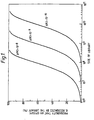
- the other important feature is that the function is exponential; as shown in fig 1, a small change in library size can have either a negligible or a dramatic effect on the probability of isolating an antibody with a given p[K] value, depending upon what point on the curve is given by the library size.
- WO 92/01047 and WO92/20791 describe how the limitations of transformation efficiency (and therefore the upper limit on library size) can be overcome by use of other methods for introducing DNA into cells, such as infection.
- heavy and light chain genes are cloned separately on two different replicons, at least one of which is capable of being incorporated into a filamentous particle. Infectious particles carrying one chain are infected into cells harbouring the complementary chain; infection frequencies of >90% can be readily achieved. Heavy and light chains are then able to associate post-translationally in the periplasm and the combination displayed on the surface of the filamentous particle by virtue of one or both chains being connected to g3p.
- a library of 10 7 heavy chains is cloned as an unfused population in a phagemid, and 10 7 light chains are cloned as g3 fusions in fd-DOG-1. Both populations are then expanded by growth such that there are 10 7 of each heavy chain-containing cell and 10 7 copies of each light chain phage.
- 10 7 x 10 7 10 14 unique combinations can be created, because there are 10 7 cells carrying the same heavy chain which can each be infected by 10 7 phage carrying different light chains. When this is repeated for each different heavy chain clone then one ends up with up to 10 14 different heavy/light combinations in different cells.
- the considerably reduced heavy and light chain populations can be cloned onto the same replicon and analysed by conventional means. Selection from the, say, 10 14 combinations produces a population of phages displaying a particular combination of H and L chains having the desired specificity. The phages selected however, will only contain DNA encloding one partner of the paired H and L chains. Selection for the two replicons may be as follows. Vectors of the H chain library may encode tetracycline resistance, with vectors of the L chain library encoding ampicillin resistance. The sample elute containing the population is divided into two portions. A first portion is grown on e.g.
- tetracycline plates to select those bacteriophage containing DNA encoding H chains which are involved in the desired antigen binding.
- a second portion is grown on e.g. ampicillin plates to select those bacteriophage containg phagemid DNA encoding L chains which are involved in the desired antigen binding.
- a set of colonies from individually isolated clones e.g. from the tetracycline plates are then used to infect specific colonies e.g. from the ampicillin plates. This results in bacteriophage expressing specific combinations of H and L chains which can then be assayed for antigen binding.
- One of the pair of molecules has an area on its surface, or a cavity which specifically binds to, and is therefore defined as complementary with a particular spatial and polar organisation of the other molecule, so that the pair have the property of binding specifically to each other.
- types of specific binding pairs are antigen-antibody, biotin-avidin, hormone-hormone receptor, receptor-ligand, enzyme-substrate, lgG-protein A.
- first polypeptide which will associate with at least a second polypeptide, when the polypeptides are expressed in free form and/or on the surface of a substrate.
- the substrate may be provided by a bacteriophage. Where there are two associated polypeptides, the associated polypeptide complex is a dimer, where there are three, a trimer etc.
- the dimer, trimer, multimer etc or the multimeric member may comprise a member of a specific binding pair.
- Example multimeric members are heavy domains based on an immunoglobulin molecule, light domains based on an immunoglobulin molecule, T-cell receptor subunits.
- the particle can display on its surface at least part of a polypeptide.
- the polypeptide can be encoded by genetic information native to the particle and/or artificially placed into the particle or an ancestor of it.
- the displayed polypeptide may be any member of a specific binding pair eg. heavy or light chain domains based on an immunoglobulin molecule, an enzyme or a receptor etc.
- the particle may be a virus eg. a bacteriophage such as fd or M13.
- the package may be a bacteriophage which displays an antigen binding domain at its surface.
- This type of package has been called a phage antibody (pAb).
- immunoglobulin whether natural or partly or wholly synthetically produced.
- the term also covers any protein having a binding domain which is homologous to an immunoglobulin binding domain.
- proteins can be derived from natural sources, or partly or wholly synthetically produced.
- Example antibodies are the immunoglobulin isotypes and the Fab, F(ab 1 ) 2 , scFv, Fv, dAb, Fd fragments.
- Example members of an immunoglobulin superfamily are CD4, platelet derived growth factor receptor (PDGFR), intercellular adhesion molecule. (ICAM). Except where the context otherwise dictates, reference to immunoglobulins and immunoglobulin homologs in this application includes members of the immunoglobulin superfamily and homologs thereof.
- polypeptides having the same or conserved residues at a corresponding position in their primary, secondary or tertiary structure indicates polypeptides having the same or conserved residues at a corresponding position in their primary, secondary or tertiary structure.
- the term also extends to two or more nucleotide sequences encoding the homologous polypeptides.
- Example homologous peptides are the immunoglobulin isotypes.
- sbp member displayed on the surface of a rgdp means that the sbp member is presented in a folded form in which its specific binding domain for its complementary sbp member is the same or closely analogous to its native configuration, whereby it exhibits similar specificity with respect to the complementary sbp member. In this respect, it differs from the peptides of Smith et al, supra, which do not have a definite folded configuration and can assume a variety of configurations determined by the complementary members with which they may be contacted.
- Mutation in vitro may for example, involve random mutagenesis using oligonucleotides having random mutations of the sequence desired to be varied.
- In vivo mutagenesis may for example, use mutator strains of host microorganisms to harbour the DNA (see Example 38 of WO 92/01047).
- the word "population" itself may be used to denote a plurality of e.g. polypeptide chains, which are not genetically diverse i.e. they are all the same.
- a domain is a part of a protein that is folded within itself and independently of other parts of the same protein and independently of a complementary binding member.
- Domains and folded units contain structures that bring together amino acids that are not adjacent in the primary structure.
- a gene may express a protein which is defective under one set of conditions, but not under another set.
- An example is a gene with a temperature sensitive mutation.
- Example mutator strains are NR9046mutD5 and NR9046 mut T1 (see Example 38).
- the defective phage genome can be a phagemid or a phage with some function encoding gene sequences removed.
- helper phages are M13K07, M13K07 gene III no. 3; and phage displaying or encoding a binding molecule fused to a capsid protein.
- This is a vector derived by modification of a plasmid genome, containing an origin of replication for a bacteriophage as well as the plasmid origin of replication.
- a collection of naturally occurring nucleotides eg DNA sequences which encoded expressed immunoglobulin genes in an animal.
- the sequences are generated by the in vivo rearrangement of eg V, D and J segments for H chains and eg the V and J segments for L chains.
- the sequences may be generated from a cell line immunised in vitro and in which the rearrangement in response to immunisation occurs intracellularly.
- the word "repertoire" is used to indicate genetic diversity.
- DNA sequences may be derived by oligonucleotide synthesis.
- the linkage can be a non-covalent or covalent bond(s).
- the two molecules can be members of a sbp.
- the derivative polypeptide may differ from the encoded polypeptide by the addition, deletion, substitution or insertion of amino acids, or by the linkage of other molecules to the encoded polypetide. These changes may be made at the nucleotide or protein level.
- the encoded polypeptide may be a Fab fragment which is then linked to an Fc tail from another source.
- markers such as enzymes, flouresceins etc may be linked to eg Fab, scFv fragments.
- a method for producing multimeric specific binding pair (sbp) members comprises causing or allowing recombination between (a) first vectors comprising nucleic acid encoding a population of a fusion of a first polypeptide chain of a specific binding pair member and a component of a replicable genetic display package (rgdp) and (b) second vectors comprising nucleic acid encoding a population of a second polypeptide chain of a specific binding pair member, at least one of said populations being genetically diverse, the recombination resulting in recombinant vectors each of which comprises nucleic acid encoding a said polypeptide fusion and a said second polypeptide chain and capable of being packaged into rgdps using said rgdp component.
- first vectors comprising nucleic acid encoding a population of a fusion of a first polypeptide chain of a specific binding pair member and a component of a replicable genetic display package (rgdp)
- One or other or both of the populations of first and second polypeptide chains may be genetically diverse. Where both are genetically diverse, the recombinant vectors will represent an enormously diverse repertoire of sbp members. Either or both of the populations may be genetically diverse but restricted compared with the full repertoire available, perhaps by virtue of a preceding selection or screening step.
- a library of nucleic acid encoding a restricted population of polypeptide chains may be the product of selection or screening using rgdp display.
- a method of producing multimeric specific binding pair (sbp) members which method comprises:
- the recombination may take place intracellularly or in vitro, although it is preferable that it takes place in recombinant host cells. This is discussed elsewhere, but briefly this may involve introducing a library of vectors including nucleic acid encoding first (or second) polypeptide chain components of sbp member into host cells harbouring a library of vectors comprising nucleic acid encoding second (or first) polypeptide chain components of sbp members.
- polypeptide fusions first polypeptide chains fused to a rgdp component
- the second polypeptide chains may be expressed, producing rgdps which display at their surface said first and second polypeptide chains and which each comprise nucleic acid encoding a said first polypeptide chain and a said second polypeptide chain, by virtue of the packaging of the recombinant vectors into rgdps.
- This expression may therefore produce an extremely diverse library of sbp members displayed on rgdp.
- the rgdps displaying sbp member are pAbs (ie phage displaying antibodies or antibody fragments or derivatives), and those which bind antigen of interest may be selected using their binding capability. Since each pAb contains within it nucleic acid encoding both polypeptide chains of the antibody displayed on its surface, pAbs selected by binding to an antigen of interest will provide nucleic acid encoding an antibody which binds that antigen. The nucleic acid may be isolated from the selected pAbs and used in subsequent obtention of desired antibodies, after any amplification and cloning required in a given case.
- pAbs ie phage displaying antibodies or antibody fragments or derivatives
- the recombination may be promoted by inclusion in the vectors of sequences at which site-specific recombination will occur.
- This enables accurate design of the resultant recombinant vectors.
- a sequence at which site-specific recombination will occur may be position in the nucleic acid which encodes a polypeptide linker which joins the two domains of a single chain sbp member.
- the single chain sbp member may consist of an immunoglobulin VH domain linked to an immunoglobulin VL domain. VH and VL domains may associate to form an antigen binding site.
- the resultant recombinant vector may then comprise nucleic acid encoding a single chain Fv derivative of an immunoglobulin resulting from recombination between first and second vectors.
- a single chain sbp member such as a scFv fragment or derivative of an antibody, may be considered to be multimeric (dimeric) because it consists of two polypeptide chain domains, such as VL and VH of an antibody.
- sequences at which site-specific recombination will occur may be lox P sequences obtainable from coliphage P1, with site-specific recombination catalysed by Cre-recombinase, also obtainable from coliphage P1.
- the site-specific recombination sequences used may be derived from a lox P sequence obtainable from coliphage P1.
- the Cre-recombinase used may be expressible under the control of a regulatable promoter.
- each vector may include two site-specific recombination sequences each of which is different from the other. The sequences should then be such that recombination will take place between like sequences on different vectors but not between the different sequences on the same vector.
- Each of the first vectors and each of the second vectors may include a first site-specific recombination sequence and a second site-specific recombination sequence different from the first, site-specific recombination taking place between first site-specific recombination sequences on different vectors and between second site-specific recombination sequences on different vectors but not between a first site-specific recombination sequence and a second site-specific recombination sequence on the same vector.
- the first site-specific recombination sequence may be lox P obtainable from coliphage P1 and the second site-specific recombination sequence a mutant lox P sequence, or vice versa. Potentially, both the first and second site-specific recombination sequences may be mutants, as long as the first sequence will not recombine with the second sequence but first sequences will recombine with each other and second sequences will recombine with each other.
- a suitable mutant lox P sequence is lox P 511.
- the first vectors may be phages or phagemids and the second vectors plasmids, or the first vectors may be plasmids and the second vectors phages or phagemids.
- the recombination is intracellular and takes place in a bacterial host which replicates the recombinant vector preferentially over the first vectors and the second vectors. This may be used to enrich selection of successful recombination events.
- the intracellular recombination may take place in a bacterial host which replicates plasmids preferentially over phages or phagemids, or which replicates phages or phagemids preferentially over plasmids.
- the bacterial host may be a Pol A strain of E.coli or of another gram-negative bacterium.
- Pol A cells are unable to support replication of plasmids, but can support replication of filamentous phage and phagemids (plasmids containing filamentous phage intergenic regions). So, for instance, if the first vectors are plasmids containing a first marker gene, and the second vectors are phage or phagemids containing a second marker gene, selection for both markers will yield recombinant vectors which are the product of a successful recombination event, since recombination transferring the first marker from plasmid must take place in order for that marker to be replicated and expressed.
- Nucleic acid from one or more rgdp's may be taken and used in a further method to obtain an individual sbp member or a mixed population of sbp members, or polypeptide chain components thereof, or encoding nucleic acid therefor.
- the present invention also provides a kit for use in carrying out methods provided, having:
- the kit may contain ancillary components needed for working the method.
- Also provided by the present invention are recombinant host cells harbouring a library of first vectors each comprising nucleic acid encoding a first polypeptide chain of a sbp member fused to a component of a secretable replicable genetic display package (rgdp) and second vectors each comprising nucleic acid encoding a second polypeptide chain of a sbp member, the first vectors or the second vectors or both being capable of being packaged into rgdps using the rgdp component, and the vectors having sequences at which site-specific recombination will occur.
- rgdp secretable replicable genetic display package
- a population of rgdps each displaying at its surface a sbp member and each containing nucleic acid which encodes a first and a second polypeptide chain of the sbp member displayed at its surface and which includes a site-specific recombination sequence.
- the invention allows to be provided a population of rgdps each displaying at its surface a sbp member and each containing nucleic acid which comprises a combination of (i) nucleic acid encoding a first polypeptide chain of a sbp member and (ii) nucleic acid encoding a second poypeptide chain of a sbp member, the population containing 10 10 or more combinations of (i) and (ii).
- Such a population exceeds in size the maximum which is achievable using available techniques.
- the present invention enables production of enormously diverse libraries or populations of rgdps displaying sbp members.
- the nucleic acid encoding a first polypeptide chain of a sbp member may have, for instance, 10 7 different sequences throughout the population. Where the nucleic acid encoding a second polypeptide chain of a sbp member also has such a genetic diversity throughout the population, the number of different combinations of nucleic acid encoding first and second polypeptide chains is immense.
- Heavy and light chains cloned on separate replicons may be introduced into host cells.
- the heavy and light chain genes are recombined onto the same replicon such that the final number of combinations created is the number of heavy chains multiplied by the number of light chains. Recombination can occur in vivo or in vitro.
- the recipient replicon is capable of being incorporated into an rgdp such that functional combinations of heavy and light chain genes can be selected.
- Such a format is particularly advantageous for construction of extremely diverse libraries of antibody heavy and light chains, for example, from unimmunised donors, immunised donors or a repertoire of an artificially rearranged immunoglobulin gene or genes, and is also convenient for chain-shuffling, mutagenesis, humanising and CDR 'imprinting'.
- the genes for both subunits present on two separate replicons can be brought together onto the same rgdp such that favourable combinations of subunit genes may be isolated directly without recourse to extensive recloning. This may be achieved by recombination between the replicons once they have been introduced into the same cell.
- recombination events are effected such that the genes for one of the chains is recombined onto a recipient replicon which contains the gene for a partner chain.
- the recipient replicon is capable of being packaged into an rgdp.
- the genes encoding one or more of the subunits is fused to a capsid gene such as gIII in order that the functional multimer can be displayed on the surface of the rgdp.
- Example recombination systems include general recombination, transposition and site-specific recombination.
- General recombination is a process whereby genetic exchange occurs between DNA segments that share some homology, and is also known as 'homologous recombination'. It is the principal mechanism by which genetic material is transferred between chromosones, and in E.coli the process is catalysed by the rec BCD enzyme (In "Escherichia coli and Salmonella typhimurium. Cellular and Molecular Biology.”(1987). pp1034-1043. Neidhart, F.C. Editor in Chief. American Society for Microbiology).
- a general recombination mechanism could be used to transfer genes from one replicon to the other if, for example, the rgdp genome has a gene for one of the chains and a 'dummy' partner chain gene such that recombination would have to occur to replace the dummy gene on the rgdp replicon with the functional gene on the second replicon in order to produce a functional pairing.
- Transposition could also be used to effect transfer of genetic information from one replicon to another (In "Escherichia coli and Salmonella typhimurium. Cellular and Molecular Biology.”(1987). pp1061-1070. Neidhart, F.C. Editor in Chief. American Society for Microbiology). Transposons such as Tn 3 and Tn 10 are DNA segments that have also been called 'jumping genes' and 'selfish DNA' and are found on plasmids and in the E.coli chromosome.
- Transposon structure is variable, but usually comprises recombinase genes flanked by repeated DNA sequences; the recombinase(s) together with host factors catalyse insertion of the transposon into sites on the chromosone, by a mechanism which usually results in a duplication of site at which the transposon has inserted. Insertion by some transposons can be highly site-specific wheras others insert essentially at random. For the purpose of transferring genes from one replicon to another, the donor gene could be incorporated within a highly site specific transposon such as Tn 7. The recipient plasmid would be engineered to contain the target DNA sequence.
- bacteriophage lambda In "Escherichia coli and Salmonella typhimurium. Cellular and Molecular Biology. "(1987). pp1054-1060. Neidhart, F.C. Editor in Chief. American Society for Microbiology).
- This bacteriophage can follow two developmental pathways once inside the cell: lysis or lysogeny.
- the lysogenic pathway involves integration of the lambda genome into the chromosome of the infected bacterium; integration is the result of a site-specific recombination between a ca.
- the integration event is catalysed by a host encoded factor called IHF and a phage encoded enzyme called Int recombinase, which recognises a 15bp region common to the two att sites.
- the integrated DNA is flanked by sequences derived from att B and att P, and these are called att L and att R.
- the integration event is reversible and is catalysed by Int, IHF and a second bacteriophage encoded enzyme, Xis. It is envisaged that this system could be used for sequence transfer between replicons within E.coli.
- the donor gene could be flanked by att L and att R sites such that when Int and Xis proteins are provided in the host cell, recombination between att L and att R sites would create a circular DNA segment containing the donor gene and a recreated att B site. This circular segment could then recombine with an att P site engineered into the recipient plasmid.
- lox P/Cre recombinase system of coliphage P1 (Hoess, R.H. and Abremski, K. (1990) The Cre-lox recombination system. In 'Nucleic acids and Molecular Biology.' Eckstein, F. and Lilley, D.M.J. eds. Vol 4, pp99-109, Springer-Verlag, Berlin, Heidelberg). Cre-recombinase catalyses a highly specific recombination event at sequences called lox. lox P, the recombination site in phage P1 consists of two 13bp inverted repeats separated by an 8bp non-symmetrical core (fig 3). For the work descended in this application, the lox P/Cre system was chosen of the alternatives available because the recombination is highly sequence-specific, very efficient and occurs at a short target site that is readily incorporated into cloning vectors.
- soluble light chain is cloned onto a phagemid containing a single lox P site.
- the heavy chains are cloned onto a plasmid as g3 fusions. Alongside the g3 fusion is the gene for a selectable marker, and the heavychain/g3/marker sequence flanked by two lox P sites.
- This plasmid also contains the Cre recombinase on a regulatable promoter and has an origin of double-stranded replication that is compatible with that on the phagemid in addition to that on the helper phage e.g. p15A, RSF 1010 and col E1 origins will co-exist in the same cell.
- the phagemids are then infected into cells containing the donor plasmid and the Cre recombinase promoter induced, so that recombination between the lox P sites occurs inside infected cells. Some of these recombination events will lead to the heavychain/g3/marker sequences transferring as a block onto the phagemid at its single lox P site. Phagemids are then rescued with a helper phage such as M13KO7 (see WO92/01047)and the resulting phagemid particles either directly selected on antigen or infected into fresh host cells and grown with selection for the presence of both markers; one from the phagemid itself and the other from the heavychain/g3/marker block.
- helper phage such as M13KO7
- site-specific recombination to bring genes onto the same replicon may be extended to creation of a continuous coding sequence on the same replicon, for example to construct single-chain Fv molecules.
- There is a single open reading frame in the loxP sequence that could be incorporated into an scFv linker which would then be a substrate for Cre-catalysed site-specific recombination. Placement of such modified scFv linker sequences at one or both ends of the genes to be fused can then result in creation of continuous open reading frames in vivo or in vitro when Cre recombinase is provided.
- Cre-catalysed recombination is reversible such that productive recombinants form only a fraction of the recombinants.
- Selection of productive rearrangements may be facilitated by use of a polA strain of bacteria, preferably E.coli or other gram negative bacterium. These cells are deficient in DNA polymerase I and are unable to support replication of plasmids (Johnston, S. and Ray, D.S. 1984, supra.). However, they are able to support replication of filamentous phage and plasmids containing filamentous phage intergenic regions.
- Cre-catalysed recombination is performed in polA bacteria, by selecting for the presence of both selectable markers in the same pol A cell successful recombination events are enriched, since recombination must take place for the second marker gene to be replicated and expressed.
- the resulting cells then contain the complete repertoire and can be propagated as cells and infected with helper phage to produce phagemids containing the genes for both chains and expressing them on their surface.
- loxP sites Another way of enriching for productive recombination events is to employ mutant loxP sites.
- mutants of the loxP sequence are known, and these are compromised with respect to their ability to recombine with each other and the wild-type loxP sequence (Hoess, R.H., Wierzbicki, A. and Abremski, K. (1986) Nucl. Acids Res. 14, 2287-2300).
- loxP 511 has a G->A point mutation in the central 8bp segement, with the result that it will only recombine with other loxP 511 sites, but not the wild-type loxP sequence (Hoess, R.H., Wierzbicki, A. and Abremski, K.
- target DNA sequences for site-specific recombination in the vectors has utility for subsequent manipulation of the genes.
- Naturally occurring or artificially introduced loxP sequences in the genomes of prokaryotic and eukaryotic organisms can be used as target sites for insertion of genes.
- Cre-catalysed recombination occurs readily in vitro, rapid and efficient transfer of genes in vitro, for example between different vectors, is also contemplated (Boyd, A.C. (1993) Nuc. Acids Res. 21, 817-821)
- Neisseria IgA protease (Klauser, T., Pohler, J. and Meyer, T.F. (1990) Extracellular transport of cholera toxin B subunit using Neisseria IgA protease B domain: conformation-dependent outer membrane translocation. EMBO 9, 1991-1999).
- Other surface proteins such as pili, ompA or the surface-exposed lipoprotein Tra T could also be used, and gram positive organisms such as lactobacilli and streptococci employed. Cloning and expression in Eukaryotic organisms is also contemplated.
- replicons can be introduced into the cells by conjugation, in addition to transformation and infection.
- one or more genes can be recombined or transposed into the chromosome reducing the limitation of having to use compatible replicons.
- the methods described here are applicable to multimeric proteins other than antibodies, such a T cell receptors, CD3 and insulin receptor.
- Libraries of proteins having more than two different and diverse subunits can be created by, for example, more than one cycle of infection. Cells containing one of the subunits are infected with phage containing the second subunit and the resulting population infected a second time with a compatible phage carrying the third subunit.
- the numbers of combinations possible with the polycombinatorial approach is limited only by the number of clones present in each of the repertoires, and, in the specific instance of using phage supplying one chain to infect cells containing the other, by the numbers of phage and cells that can be produced.
- the use of more sophisticated methods, for example fermentation technology, will allow even greater numbers of combinations to be accessed.
- the nucleic acid encoding first and second polypeptide components of antibodies may be derived from the repertoire of an immunised or unimmunised animal or human, or from an artificially rearranged immunoglobulin gene or genes.
- Artificial rearrangement of immunoglobulin genes may involve joining of germ-line V segments in vitro to J segments and, in the case of VH domains, D segments. Any of the V, D and J segments may be synthetic.
- the joining may use a PCR-based process which may use primers which have a region of random sequence to introduce sequence diversity into the product, artificially rearranged immunoglobulin genes.
- Filamentous F-specific bacteriophages are suitable examples of the type of phage which provide a vehicle for the display of binding molecules e.g. antibodies and antibody fragments and derivatives thereof, on their surface and facilitate subsequent selection and manipulation.
- the F-specific phages (e.g. fl, fd and M13) have evolved a method of propagation which does not kill the host cell and they are used commonly as vehicles for recombinant DNA (Kornberg, A., DNA Replication, W.H. Freeman and Co., San Francisco, 1980).
- Gene III of phage fd is attractive for the insertion of biologically active foreign sequences.
- candidate sites including for example gene VIII and gene VI.
- the protein encoded by gene III has several domains (Pratt, D., et al., 1969 Virology 39 :42-53., Grant, R.A., et al., 1981, J. Biol. Chem. 256: 539-546 and Armstrong, J., et al., FEBS Lett. 135: 167-172 1981).
- the gene coding sequences for biologically active antibody fragments have been inserted into the gene III region of fd to express a large fusion protein.
- An initial vector used was fd-tet (Zacher, A.N., et al., 1980, Gene 9, 127-140) a tetracycline resistant version of fd bacteriophage that can be propagated as a plasmid that confers tetracycline resistance to the infected E.coli host.
- the applicants chose to insert after the signal sequence of the fd gene III protein for several reasons. In particular, the applicants chose to insert after amino acid 1 of the mature protein to retain the context for the signal peptidase cleavage.
- the inserted immunoglobulin sequences were designed to include residues from the switch region that links VH-VL to CH1-CL (Lesk, A., and Chothia, C., Nature 335, 188-190, 1988).
- bacteriophage fd By manipulating gene III of bacteriophage fd, one can construct a bacteriophage that displays on its surface large biologically functional antibody, enzyme, and receptor molecules whilst remaining intact and infectious. Furthermore, the phages bearing antibodies of desired specificity, can be selected from a background of phages not showing this specificity.
- the sequences coding for a population of antibody molecules and for insertion into the vector to give expression of antibody binding functions on the phage surface can be derived from a variety of sources. For example, immunised or non-immunised rodents or humans, and from organs such as spleen and peripheral blood lymphocytes.
- the coding sequences are derived from these sources by techniques familiar to those skilled in the art (Orlandi, R., et al., 1989 supra; Larrick, J.W., et al., 1989 supra; Chiang, Y.L., et al., 1989 Bio Techniques 7 , p. 360-366; Ward, E.S, et al., 1989 supra; Sastry, L., et al., 1989 supra.)
- an expression vector containing sequences coding for the antibody polypeptide chains is used to transform e.g. E.coli.
- the antibody polypeptides are expressed and detected by use of standard screening systems. When the screen detects an antibody polypeptide of the desired specificity, one has to return to the particular transformed E.coli expressing the desired antibody polypeptide.
- the vector containing the coding sequence for the desired antibody polypeptide then has to be isolated for use from E.coli in further processing steps.
- the desired antibody polypeptide when expressed is already packaged with its gene coding sequence. This means that when the an antibody polypeptide of desired specificity is selected, there is no need to return to the original culture for isolation of that sequence. Furthermore, in previous methods in standard recombinant techniques, each clone expressing antibody needs to be screened individually.
- the present application provides for the selection of clones expressing antibodies with desired properties.
- a rgdp displays a member of a specific binding pair (eg. an antibody of monoclonal antigen-binding specificity) at the surface of a relatively simple replicable structure also containing the genetic information encoding the member
- rgdps eg pAbs that bind to the complementary member of the specific binding pair (eg antigen) can be recovered very efficiently by either eluting off the complementary member using for example diethylamine, high salt etc and infecting suitable bacteria, or by denaturing the structure, and specifically amplifying the sequences encoding the member using PCR. That is, there is no necessity to refer back to the original bacterial clone that gave rise to the pAb.
- Individual rgdps eg pAbs expressing the desired specificity eg for an antigen can be isolated from the complex library using the conventional screening techniques (e.g. as described in Harlow, E., and Lane, D., 1988, supra Gherardi, E et al. 1990. J. Immunol. meth. 126 p61-68).
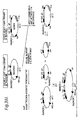
- the population/library of pAbs to be screened could be generated from immunised or other animals; or be created in vitro by mutagenising pre-existing phage antibodies (using techniques well-known in the art such as oligonucleotide directed mutagenesis (Sambrook, J., et al., 1989 Molecular Cloning a Laboratory Manual, Cold Spring Harbor Laboratory Press). This population can be screened in one or more of the formats described below with reference to figure 5, to derive those individual pAbs whose antigen binding properties are different from sample c.
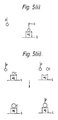
- Figure 5(i) shows antigen (ag) bound to a solid surface (s) the solid surface (s) may be provided by a petri dish, chromatography beads, magnetic beads and the like.
- the population/library of pAbs is then passed over the ag, and those individuals p that bind are retained after washing, and optionally detected with detection system d.
- a detection system based upon anti-fd antisera is illustrated in more detail in example 4 of WO 92/01047. If samples of bound population p are removed under increasingly stringent conditions, the binding affinity represented in each sample will increase. Conditions of increased stringency can be obtained, for example, by increasing the time of soaking or changing the pH of the soak solution, etc.
- antigen ag can be bound to a solid support s and bound to saturation by the original binding molecule c. If a population of mutant pAb (or a set of unrelated pAbs) is offered to the complex, only those that have higher affinity for antigen ag than c will bind. In most examples, only a minority of population c will be displaced by individuals from population p. If c is a traditional antibody molecule, all bound material can be recovered and bound p recovered by infecting suitable bacteria and/or by use of standard techniques such as PCR.
- ag is used as a receptor and c the corresponding ligand.
- the recovered bound population p is then related structurally to the receptor binding site/and or ligand. This type of specificity is known to be very useful in the pharmaceutical industry.
- ag is an antibody and c its antigen.
- the recovered bound population p is then an anti-idiotype antibody which have numerous uses in research and the diagnostic and pharmaceutical industries.
- pAbs would give the ability to do this directly by binding pAb libraries (eg a naive library) to B cells (which express antibodies on their surface) and isolating those phage that bound well.
- pAb libraries eg a naive library
- p can be absorbed against a related antibody that does not bind the antigen.
- c is a pAb
- either or both c and p can advantageously be marked in some way to both distinguish and select for bound p over bound c.
- This marking can be physical, for example, by pre-labelling p with biotin; or more advantageously, genetic.
- c can be marked with an EcoB restriction site
- p can be marked with an EcoK restriction site (see Carter, P. et al., 1985, Nucl. Acids Res. 13, 4431-4443).
- EcoB restricting bacteria there is restriction (and thus no growth) of population c (i.e. EcoB restricting bacteria in this example). Any phage that grew, would be greatly enriched for those individuals from p with higher binding affinities.
- the genetic marking can be achieved by marking p with new sequences, which can be used to specifically amplify p from the mixture using PCR.
- the bound pAbs can be amplified using for example PCR or bacterial infection, it is also possible to rescue the desired specificity even when insufficient individuals are bound to allow detection via conventional techniques.
- the preferred method for selection of a phage displaying a protein molecule with a desired specificity or affinity will often be elution from an affinity matrix with a ligand (eg example 21 of WO 92/01047). Elution with increasing concentrations of ligand should elute phage displaying binding molecules of increasing affinity.
- a pAb binds to its antigen with high affinity or avidity (or another protein to its binding partner) it may not be possible to elute the pAb from an affinity matrix with molecule related to the antigen.
- This elution procedure is just one example of an elution procedure under mild conditions.
- a particularly advantageous method would be to introduce a nucleotide sequence encoding amino acids constituting a recognition site for cleavage by a highly specific protease between the foreign gene inserted, in this instance a gene for an antibody fragment, and the sequence of the remainder of gene III.
- highly specific proteases are Factor X and thrombin.
- An alternative procedure to the above is to take the affinity matrix which has retained the strongly bound pAb and extract the DNA, for example by boiling in SDS solution. Extracted DNA can then be used to directly transform E.coli host cells or alternatively the antibody encoding sequences can be amplified, for example using PCR with suitable primers such as those disclosed herein, and then inserted into a vector for expression as a soluble antibody for further study or a pAb for further rounds of selection.
- Another preferred method for selection according to affinity would be by binding to an affinity matrix containing low amounts of ligand.
- a preferred strategy is to bind a population of phage to an affinity matrix which contains a low amount of ligand.
- affinity matrix which contains a low amount of ligand.
- Phage displaying high affinity protein is preferentially bound and low affinity protein is washed away.
- the high affinity protein is then recovered by elution with the ligand or by other procedures which elute the phage from the affinity matrix (example 35 of WO 92/01047 demonstrates this procedure).
- the package can be simply eluted, it can be eluted in the presence of a homologous sbp member which competes with said package for binding to a complementary sbp member; it could be removed by boiling, it could be removed by proteolytic cleavage of the protein; and other methods will be apparent to those skilled in the art eg. destroying the link between the substrate and complementary sbp member to release said packaged DNA and sbp member.
- the objective is to obtain the DNA from the package so that it can be used directly or indirectly, to express the sbp member encoded thereby.
- the efficiency of this selection procedure for pAbs and the ability to create very large libraries means that the immunisation techniques developed to increase the proportion of screened cells producing antibodies of interest will not be an absolute requirement.
- the technique allows the rapid isolation of binding specificities eg antigen-binding specificities, including those that would be difficult or even unobtainable by conventional techniques, for example, catalytic or anti-idiotypic antibodies. Removal of the animal altogether is now possible, once a complete library of the immune repertoire has been constructed.
- the structure of the pAb molecule can be used in a number of other applications, some examples of which are:
- rgdps eg pAbs combine the ability to bind a specific molecule eg antigen with amplification, if the major coat protein is used to attach another moiety.
- This moiety can be attached via immunological, chemical, or any other means and can be used, for example, to label the complex with detection reagents or cytotoxic molecules for use in vivo or in vitro.
- the size of the rgdps eg pAbs can be used as a marker particularly with respect to physical methods of detection such as electron microscopy and/or some biosensors, e.g. surface plasmon resonance.
- the rgdps eg pAbs also have advantageous uses in diagnostic assays, particularly where separation can be effected using their physical properties for example centrifugation, filtration etc.
- Example 1 In vivo recombination of antibody genes between replicons using Cre/lox
- This example illustrates using the Cre/loxP system to transfer antibody genes between two replicons in the same cell. Here, recombination must occur to produce a functional pairing of antibody genes.
- A encodes the light chain of a first antibody (and the heavy chain from a second, different antibody): B encodes the heavy chain of the first antibody.
- B encodes the heavy chain of the first antibody.
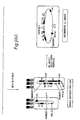
- the VH genes are flanked by two loxP sites (see Fig 4.). To avoid deletion of the VH genes in the presence of Cre, one of the loxP sites is wild-type but the other contains a G to A point mutation within the 8 bp spacer region loxP 511 (Hoess, R.H., Wierzbicki, A.
- the wild-type loxP site and the mutant loxP 511 site do not recombine with each other in the same vector, but will, as shown below, recombine with sites of matching sequence in different vectors.
- Cre recombinase is provided in vivo by infecting the E. coli with phage P1Cm c1.100 (Rosner, J.L. (1972) Virology, 48, 679-689).
- a and B can co-integrate by recombination between either mutant or wild-type loxP sites to create chimaeric plasmids C or D respectively.
- FdDOG-2lox and pUC19-2lox vectors were derived from fdDOG-1 and pUC19 respectively (WO 92/01047 and WO 92/20791; fdDOG-1 previously called fdCAT-2).
- the cloning sites of these vectors were engineered using a combination of site-directed mutagenesis and ligation of double-stranded synthetic oligonucleotides using standard molecular biology techniques (Sambrook, J., Fritsch, E.F. and Maniatis, T. (1990) "Molecular cloning-a laboratory manual”. Cold Spring Harbor Laboratory, New York.). These constructs were used to produce donor plasmid B and acceptor phage A depicted in figure 4.
- Plasmid B contains the VH gene of the anti-phOx (2-phenyloxazol-5-one) hybridoma NQ10.12.5 (Griffiths, G.M., Berek, C., Kaartinen, M. and Milstein, C. (1984) Nature , 312, 271-275.) linked to a human Cg1 segment, and cloned into pUC19-2lox as an Sfi 1-Not 1 fragment.
- Acceptor phage A contains the VL partner of the anti-phOx hybridoma NQ10.12.5 linked to a human Ckl segment cloned into fdDOG-2lox as an Apa LI-Asc I fragment.
- Acceptor phage A also contains a VH segment from an anti-Tumour Necrosis Factor antibody (Rathjen, D.A., Furphy, L.J. and Aston, R. (1992) Br. J. Cancer, 65, 852-856.) linked to a human Cm1 segment, and cloned into fdDOG-2lox as an Sfi 1-Not 1 fragment.
- an anti-Tumour Necrosis Factor antibody Rathjen, D.A., Furphy, L.J. and Aston, R. (1992) Br. J. Cancer, 65, 852-856.
- construct A conferring resistance to tetracyclin
- construct B conferring resistance to ampicillin.
- Phage particles were harvested from the medium of construct B clones grown overnight in 2x YT containing tetracycline, as described in PCT WO 92/01047, example 6.
- Colony hybridisation was performed with the array using standard techniques as described in Sambrook et al. (1989, supra.).
- the probe used was a radiolabelled oligonucleotide VHNQ10PR which binds specifically to CDR3 of NQ10.12.5 VH. 73 of the 96 colonies were positive and therefore correspond to vectors C, D or E.
- PCR reactions were performed essentially as described in example 11, WO 92/01047. Cells from each of the 96 clones were carefully transferred using a toothpick into 20ml sterile water in a 0.5ml centrifuge tube. The samples were then placed in a boiling water bath for 5 minutes and 2ml of this used as template for each 20ml PCR reaction. Thirty cycles of amplification were performed each of 94°C 1 minute, 50°C 1 minute and 72°C 2 minutes, using primers FDPCRBACK and VHNQ10PR. PCR reaction products were resolved on 1% TAE agarose gels (Sambrook et al. (1989) supra.). 72 of the 96 clones clones gave a ca. 1Kb PCR fragment and were thus scored as positive. These clones correspond to vectors C and E.
- Example 2 Creation of an extremely large combinatorial library using in vivo recombination.
- This example describes construction of an extremely large library of V-genes from unimmunised donors, using the in vivo recombination strategy outlined in the previous example. Many of the procedures detailed below have been previously described (Marks, J et al. (1991) et supra.).
- VH genes were PCR-amplified using the HuIgMFOR primer in conjunction with each of the HuVHBACK primers individually.
- Six separate PCR amplifications were performed each of 50 ⁇ l reaction volume containing 5 ⁇ l of the supernatant from the cDNA synthesis using the HUIGMFOR primer, 20 pmol total concentration of the BACK primers, 20 pmol concentration of the FORWARD primer, 250 ⁇ M dNTPs, 10mM KCl, 10 mM (NH4)2SO4, 20 mM Tris.HCl (pH 8.8), 2.0 mM MgCl2, 100 mg/ml BSA and 1 ⁇ l (1 unit) Vent DNA polymerase (New England Biolabs).
- the reaction mixture was overlaid with mineral (paraffin) oil and subjected to 30 cycles of amplification using a Techne PHC-2 thermal cycler.
- the cycle was 94°C for 1 minute (denaturation), 57°C for 1 minute (annealing) and 72°C for 2.5 minutes (extension).
- the products were purified on a 1.0% agarose gel, isolated from the gel by Geneclean (Bio-101) and resuspended in 25 ⁇ lof H 2 O. The six products were then pooled and 'pullthrough' PCR reactions performed to attach Sfi I and Not I restriction sites.
- Pullthrough reactions were set up with the primers HUVHBACKSfi (equimolar mix of all 6 primers) and HUCM1FONO. 50 ml reactions of containing 5 ⁇ l of the pooled PCR products from the previous step were amplified using the same conditions as for the primary PCR except that 25 cycles of amplification were used. The resulting fragments were digested with Sfi I and Not I, gel-purified, and the fragments ligated to Sfi I and Not I -cut pUC19-21ox using previously described procedures (Sambrook, J. et al. (1989) et supra; PCT WO 92/01047).
- the ligation mixes were phenol-chloroform extracted prior to electroporation into TG1 cells (Marks, J et al. (1991) et supra.). Briefly, the ligated DNA was resuspended in 20 ⁇ l of water, and 2.5 ⁇ l samples were electroporated into 50 ⁇ l aliquots of electro-competent E.coli TG1. Cells were grown in SOC for 1 hr and then plated on 2YT agar with 100 ⁇ g/ml ampicillin and 1% glucose (2YTAG) in 243 x 243 mm dishes (Nunc) then grown overnight at 30°C. Colonies were scraped off the plates into 2YTAG containing 15% glycerol for storage at -70°C as library stocks.
- the heavy chain repertoire was calculated to have ca. 1.10 7 independant recombinants, which by Bst NI fingerprinting was shown to be extremely diverse (PCT WO 92/01047).
- Kappa and lambda-chain genes were amplified separately.
- Kappa chain genes were amplified using an equimolar mixture of the 12 SYNKB primers in conjunction with HuCKFORCYS (Table 1).
- 1-chain genes were amplified from the cDNA synthesis using an equimolar mix of the 8 DPVL primers in conjunction with the HUCLFORCYS primer.
- reaction mixtures were prepared containing 5 ⁇ l of the supernatant from the appropriate cDNA synthesis, 20 pmol total concentration of the BACK primers, 20 pmol concentration of the FORWARD primers, 250 ⁇ M dNTPs, 10mM KCl, 10 mM (NH4)2SO4, 20 mM Tris.HCl (pH 8.8), 2.0 mM MgCl2, 100 mg/ml BSA and 1 ⁇ l (1 unit) Vent DNA polymerase (New England Biolabs).
- the reaction mixture was overlaid with mineral (paraffin) oil and subjected to 30 cycles of amplification using a Techne thermal cycler.
- the cycle was 94°C for 1 minute (denaturation), 57°C for 1 minute (annealing) and 72°C for 2.5 minutes (extension).
- the products were purified on a 1% agarose gel, isolated from the gel by Geneclean (Bio-101) and resuspended in 25 ⁇ l of H 2 O.
- kappa-chain genes were amplified using an equimolar mixture of the 12 SYNKBApa primers in conjunction with either HUCKFORCYSNOT.
- lambda-chain genes were amplified using an equimolar mixture of the 8 DPVLApa primers in conjunction with HUCLFORCYSNOT. Pullthrough conditions were performed as for the primary light chain PCRs above except that 25 cycles of amplification were used.
- Kappa and lambda-chain repertoires were processed seperately.
- PCR products were digested with Apa LI and Not I and ligated into Apa LI-Not I-cut fdDOG-2lox (prepared using the standard format), the ligation mixes were purified by phenol extraction and ethanol precipitated prior to electroporation into TG1 as above, except that transformed cells were plated on 2YT agar with 12.5 ⁇ g/ml tetracycline in 243 x 243 mm dishes (Nunc) then grown overnight at 30°C. Colonies were scraped off the plates into 2YT containing 15% glycerol for storage at -70°C as library stocks.
- the kappa and lambda-chain repertoires were calculated to have ca. 1.10 6 independent recombinants; again, Bst NI fingerprinting indicates that both libraries were extremely diverse.
- the kappa and lambda-chain repertoires were seperately recombined with the heavy chain repertoire using a scale-up of the procedure described in example 1.
- Approximately 1.10 10 cells from each of the kappa and lambda-chain repertoires in fdDOG-2lox were inoculated into 1 litre volumes of 2xYT containing 12.5 ⁇ g/ml tetracycline and grown for 30hrs at 37 C with rapid shaking.
- Phage particles were harvested from the clarified growth medium as described in PCT WO 92/01047, example 6, and stocks adjusted to ca. 1.10 12 TU ml-1.
- the cell pellets were resuspended in 1litre of 2 xTY, 100 mg/ml ampicillin, 12.5 mg/ml tetracycline, 12.5 mg/ml chloramphenicol, 1% glucose and the cultures shaken for 40 hours at 30°C.
- Phage fd particles (including recombinant phage) were harvested from the culture supernatant by centrifuging out bacteria at 13000 g for 15minutes and the particles PEG precipitated.
- the recombined library phage were then resuspended in 10mM TRIS-HCl (pH 8.0), 1mM EDTA and adjusted to 1.10 12 TU ml-1: this stock represents the library.
- These phage are selected on antigen, reinfected into fresh E.coli and recovered by plating on 2x YT agar containing 12.5 ⁇ g/ml tetracycline. Growth of selected phages is achieved by culture in 2x YT containing 12.5 ⁇ g/ml tetracycline (no other antibiotics necessary- see fig 4, construct E), and phages bearing functional antibodies recovered from the growth medium.
- Sbp members and encoding nucleic acid therefor obtained using the present invention may be used in the production of derivatives.
- the term derivative is discussed above.
Landscapes
- Health & Medical Sciences (AREA)
- Chemical & Material Sciences (AREA)
- Organic Chemistry (AREA)
- Immunology (AREA)
- Life Sciences & Earth Sciences (AREA)
- Genetics & Genomics (AREA)
- Molecular Biology (AREA)
- Biochemistry (AREA)
- General Health & Medical Sciences (AREA)
- Biophysics (AREA)
- Medicinal Chemistry (AREA)
- Proteomics, Peptides & Aminoacids (AREA)
- Engineering & Computer Science (AREA)
- Biomedical Technology (AREA)
- Wood Science & Technology (AREA)
- Zoology (AREA)
- Bioinformatics & Cheminformatics (AREA)
- Biotechnology (AREA)
- General Engineering & Computer Science (AREA)
- Microbiology (AREA)
- Physics & Mathematics (AREA)
- Plant Pathology (AREA)
- Cell Biology (AREA)
- Oncology (AREA)
- Chemical Kinetics & Catalysis (AREA)
- Crystallography & Structural Chemistry (AREA)
- Virology (AREA)
- General Chemical & Material Sciences (AREA)
- Micro-Organisms Or Cultivation Processes Thereof (AREA)
- Peptides Or Proteins (AREA)
- Preparation Of Compounds By Using Micro-Organisms (AREA)
Applications Claiming Priority (5)
| Application Number | Priority Date | Filing Date | Title |
|---|---|---|---|
| GB929206318A GB9206318D0 (en) | 1992-03-24 | 1992-03-24 | Binding substances |
| GB9206318 | 1992-03-24 | ||
| WOPCT/GB92/00883 | 1992-05-15 | ||
| PCT/GB1992/000883 WO1992020791A1 (en) | 1990-07-10 | 1992-05-15 | Methods for producing members of specific binding pairs |
| PCT/GB1993/000605 WO1993019172A1 (en) | 1992-03-24 | 1993-03-24 | Methods for producing members of specific binding pairs |
Publications (2)
| Publication Number | Publication Date |
|---|---|
| EP0656941A1 EP0656941A1 (en) | 1995-06-14 |
| EP0656941B1 true EP0656941B1 (en) | 2005-06-01 |
Family
ID=26300161
Family Applications (1)
| Application Number | Title | Priority Date | Filing Date |
|---|---|---|---|
| EP93906742A Expired - Lifetime EP0656941B1 (en) | 1992-03-24 | 1993-03-24 | Methods for producing members of specific binding pairs |
Country Status (5)
| Country | Link |
|---|---|
| EP (1) | EP0656941B1 (enExample) |
| JP (1) | JP3507073B2 (enExample) |
| CA (1) | CA2131151A1 (enExample) |
| DE (1) | DE69333823T2 (enExample) |
| WO (1) | WO1993019172A1 (enExample) |
Cited By (2)
| Publication number | Priority date | Publication date | Assignee | Title |
|---|---|---|---|---|
| US7527791B2 (en) | 2004-03-31 | 2009-05-05 | Genentech, Inc. | Humanized anti-TGF-beta antibodies |
| US8921281B2 (en) | 2009-05-20 | 2014-12-30 | Novimmune S.A. | Synthetic polypeptide libraries and methods for generating naturally diversified polypeptide variants |
Families Citing this family (317)
| Publication number | Priority date | Publication date | Assignee | Title |
|---|---|---|---|---|
| GB9206318D0 (en) * | 1992-03-24 | 1992-05-06 | Cambridge Antibody Tech | Binding substances |
| US5837242A (en) * | 1992-12-04 | 1998-11-17 | Medical Research Council | Multivalent and multispecific binding proteins, their manufacture and use |
| CA2177367A1 (en) * | 1993-12-03 | 1995-06-08 | Andrew David Griffiths | Recombinant binding proteins and peptides |
| ES2201097T3 (es) | 1994-01-31 | 2004-03-16 | Trustees Of Boston University | Bibliotecas de anticuerpos policlonales. |
| FR2715940B1 (fr) * | 1994-02-10 | 1996-04-26 | Pasteur Merieux Serums Vacc | Procédé de préparation d'une banque multicombinatoire de vecteurs d'expression de gènes d'anticorps, banque et systèmes d'expression d'anticorps "coliclonaux" obtenus. |
| US5605793A (en) | 1994-02-17 | 1997-02-25 | Affymax Technologies N.V. | Methods for in vitro recombination |
| US6335160B1 (en) | 1995-02-17 | 2002-01-01 | Maxygen, Inc. | Methods and compositions for polypeptide engineering |
| US6995017B1 (en) | 1994-02-17 | 2006-02-07 | Maxygen, Inc. | Methods for generating polynucleotides having desired characteristics by iterative selection and recombination |
| FR2731014B1 (fr) * | 1995-02-23 | 1997-03-28 | Rhone Poulenc Rorer Sa | Molecules d'adn, preparation et utilisation en therapie genique |
| US6091001A (en) * | 1995-03-29 | 2000-07-18 | Abgenix, Inc. | Production of antibodies using Cre-mediated site-specific recombination |
| US6130364A (en) * | 1995-03-29 | 2000-10-10 | Abgenix, Inc. | Production of antibodies using Cre-mediated site-specific recombination |
| US6143557A (en) | 1995-06-07 | 2000-11-07 | Life Technologies, Inc. | Recombination cloning using engineered recombination sites |
| US6720140B1 (en) | 1995-06-07 | 2004-04-13 | Invitrogen Corporation | Recombinational cloning using engineered recombination sites |
| CA2226463A1 (en) | 1995-06-07 | 1996-12-19 | Life Technologies Corporation | Recombinational cloning using engineered recombination sites |
| US6964861B1 (en) | 1998-11-13 | 2005-11-15 | Invitrogen Corporation | Enhanced in vitro recombinational cloning of using ribosomal proteins |
| SE9503151D0 (sv) * | 1995-09-13 | 1995-09-13 | Bioinvent Internatioal Ab | Combined ligand and receptor display |
| FR2741892B1 (fr) * | 1995-12-04 | 1998-02-13 | Pasteur Merieux Serums Vacc | Procede de preparation d'une banque multicombinatoire de vecteurs d'expression de genes d'anticorps, banque et systemes d'expression d'anticorps "coliclonaux" obtenus |
| JP2000505306A (ja) * | 1996-02-26 | 2000-05-09 | モルフォシス・アクチェンゲゼルシャフト | 2つまたはそれ以上の相互作用性(ポリ)ペプチドをコードする核酸配列の新規同定方法 |
| US5916771A (en) | 1996-10-11 | 1999-06-29 | Abgenix, Inc. | Production of a multimeric protein by cell fusion method |
| US6420140B1 (en) | 1996-10-11 | 2002-07-16 | Abgenix, Inc. | Production of multimeric protein by cell fusion method |
| IL119587A (en) * | 1996-11-07 | 2000-12-06 | Univ Ramot | Method of preparing and for obtaining bimolecular interactions |
| US5851808A (en) | 1997-02-28 | 1998-12-22 | Baylor College Of Medicine | Rapid subcloning using site-specific recombination |
| US6342369B1 (en) | 1997-05-15 | 2002-01-29 | Genentech, Inc. | Apo-2-receptor |
| GB9712512D0 (en) | 1997-06-16 | 1997-08-20 | Bioinvent Int Ab | A method for in vitro molecular evolution of protein function |
| WO1999006587A2 (en) | 1997-08-01 | 1999-02-11 | Morphosys Ag | Novel method and phage for the identification of nucleic acid sequences encoding members of a multimeric (poly)peptide complex |
| US6342220B1 (en) | 1997-08-25 | 2002-01-29 | Genentech, Inc. | Agonist antibodies |
| CA2307016A1 (en) * | 1997-10-24 | 1999-05-06 | Life Technologies Corporation | Recombinational cloning using nucleic acids having recombination sites |
| US7351578B2 (en) | 1999-12-10 | 2008-04-01 | Invitrogen Corp. | Use of multiple recombination sites with unique specificity in recombinational cloning |
| EP2270234B1 (en) | 1997-12-08 | 2013-03-06 | California Institute of Technology | Method for creating polynucleotide and polypeptide sequences |
| AU2583899A (en) | 1998-02-04 | 1999-08-23 | Invitrogen Corporation | Microarrays and uses therefor |
| ATE443723T1 (de) | 1998-06-12 | 2009-10-15 | Genentech Inc | Monoklonale antikörper, kreuz-reaktive antikörper und deren produktionsverfahren |
| CA2363924A1 (en) | 1999-03-02 | 2000-09-08 | Life Technologies Corporation | Compositions and methods for use in recombinational cloning of nucleic acids |
| AU781628B2 (en) * | 1999-07-14 | 2005-06-02 | Clontech Laboratories, Inc. | Recombinase-based methods for producing expression vectors and compositions for use in practicing the same |
| WO2001013940A1 (en) | 1999-08-23 | 2001-03-01 | Chugai Seiyaku Kabushiki Kaisha | Hm1.24 antigen expression potentiators |
| EP1978098A3 (en) | 1999-12-10 | 2009-02-18 | Invitrogen Corporation | Use of multiple recombination sites with unique specificity in recombinational cloning |
| US7244560B2 (en) | 2000-05-21 | 2007-07-17 | Invitrogen Corporation | Methods and compositions for synthesis of nucleic acid molecules using multiple recognition sites |
| US7087415B2 (en) | 2000-07-31 | 2006-08-08 | Athena Biotechnologies, Inc. | Methods and compositions for directed gene assembly |
| US7198924B2 (en) | 2000-12-11 | 2007-04-03 | Invitrogen Corporation | Methods and compositions for synthesis of nucleic acid molecules using multiple recognition sites |
| US6958213B2 (en) | 2000-12-12 | 2005-10-25 | Alligator Bioscience Ab | Method for in vitro molecular evolution of protein function |
| US20020086292A1 (en) | 2000-12-22 | 2002-07-04 | Shigeaki Harayama | Synthesis of hybrid polynucleotide molecules using single-stranded polynucleotide molecules |
| EP1364657B1 (en) | 2001-02-07 | 2016-12-28 | Chugai Seiyaku Kabushiki Kaisha | Remedies for myelocytic leukemia |
| UA80091C2 (en) | 2001-04-02 | 2007-08-27 | Chugai Pharmaceutical Co Ltd | Remedies for infant chronic arthritis-relating diseases and still's disease which contain an interleukin-6 (il-6) antagonist |
| EP1429143A4 (en) * | 2001-08-22 | 2006-04-12 | Inst Antibodies Co Ltd | SELECTION PROCEDURE FOR BINDING MOLECULES |
| EP1298207B2 (de) | 2001-10-01 | 2015-12-30 | Deutsches Krebsforschungszentrum Stiftung des öffentlichen Rechts | Verfahren zur Herstellung von Protein-Bibliotheken und zur Selektion von Proteinen daraus |
| MXPA04007924A (es) | 2002-02-14 | 2005-05-17 | Chugai Pharmaceutical Co Ltd | Formulaciones en solucion que contienen anticuerpo. |
| EP2305710A3 (en) | 2002-06-03 | 2013-05-29 | Genentech, Inc. | Synthetic antibody phage libraries |
| AU2003239966B9 (en) | 2002-06-03 | 2010-08-26 | Genentech, Inc. | Synthetic antibody phage libraries |
| EP2269656B1 (en) | 2002-07-15 | 2014-08-20 | Board Of Regents, The University Of Texas | Selected antibodies binding to aminophospholipids and their use in treatment, such as cancer |
| JP4489591B2 (ja) | 2002-08-27 | 2010-06-23 | 中外製薬株式会社 | タンパク質溶液製剤の安定化方法 |
| SI1561756T1 (sl) | 2002-09-11 | 2016-02-29 | Chugai Seiyaku Kabushiki Kaisha | Postopek čiščenja proteinov |
| GB2401040A (en) | 2003-04-28 | 2004-11-03 | Chugai Pharmaceutical Co Ltd | Method for treating interleukin-6 related diseases |
| US9708410B2 (en) | 2003-05-30 | 2017-07-18 | Janssen Biotech, Inc. | Anti-tissue factor antibodies and compositions |
| US20040248323A1 (en) | 2003-06-09 | 2004-12-09 | Protometrix, Inc. | Methods for conducting assays for enzyme activity on protein microarrays |
| ATE474921T1 (de) | 2003-06-18 | 2010-08-15 | Chugai Pharmaceutical Co Ltd | Fucosetransporter |
| US20080153104A1 (en) | 2003-08-08 | 2008-06-26 | Hiroyuki Aburantai | Gene Overexpressed in Cancer |
| JP2007512838A (ja) | 2003-12-01 | 2007-05-24 | インヴィトロジェン コーポレーション | 組換え部位を含む核酸分子およびその使用方法 |
| ATE452147T1 (de) | 2004-02-19 | 2010-01-15 | Genentech Inc | Antikörper mit korrigierten cdr |
| US7785903B2 (en) | 2004-04-09 | 2010-08-31 | Genentech, Inc. | Variable domain library and uses |
| US9228008B2 (en) | 2004-05-28 | 2016-01-05 | Idexx Laboratories, Inc. | Canine anti-CD20 antibodies |
| EP2208783A1 (en) | 2004-12-22 | 2010-07-21 | Chugai Seiyaku Kabushiki Kaisha | Method of producing an antibody using a cell in which the function of fucose transporter is inhibited |
| EP1863849B1 (en) | 2005-03-11 | 2011-04-27 | Syngenta Limited | Rodent pest control |
| AU2006232287B2 (en) | 2005-03-31 | 2011-10-06 | Chugai Seiyaku Kabushiki Kaisha | Methods for producing polypeptides by regulating polypeptide association |
| CN101237890A (zh) | 2005-06-10 | 2008-08-06 | 中外制药株式会社 | 含有葡甲胺的蛋白质制剂的稳定剂及其利用 |
| AU2006300234B2 (en) | 2005-10-14 | 2013-01-10 | Chugai Seiyaku Kabushiki Kaisha | Agents for suppressing damage to transplanted islets after islet transplantation |
| AR058135A1 (es) | 2005-10-21 | 2008-01-23 | Chugai Pharmaceutical Co Ltd | Agentes para el tratamiento de cardiopatias |
| EP2465870A1 (en) | 2005-11-07 | 2012-06-20 | Genentech, Inc. | Binding polypeptides with diversified and consensus VH/VL hypervariable sequences |
| US8128934B2 (en) | 2005-11-14 | 2012-03-06 | Ribomic, Inc. | Method for treatment or prevention of disease associated with functional disorder of regulatory T cell |
| AR057582A1 (es) | 2005-11-15 | 2007-12-05 | Nat Hospital Organization | Agentes para suprimir la induccion de linfocitos t citotoxicos |
| WO2007061029A1 (ja) | 2005-11-25 | 2007-05-31 | Keio University | 前立腺癌治療剤 |
| EP1957540B1 (en) | 2005-12-02 | 2012-06-13 | Genentech, Inc. | Binding polypeptides and uses thereof |
| US9084777B2 (en) | 2005-12-28 | 2015-07-21 | Chugai Seiyaku Kabushiki Kaisha | Stabilized antibody-containing formulations |
| EP1990060B1 (en) | 2006-01-27 | 2016-09-28 | Keio University | Therapeutic agents for diseases associated involving choroidal neovascularization |
| JP2009529915A (ja) | 2006-03-20 | 2009-08-27 | ゾーマ テクノロジー リミテッド | ガストリン物質に対して特異的なヒト抗体および方法 |
| EP4342995A3 (en) | 2006-03-31 | 2024-05-15 | Chugai Seiyaku Kabushiki Kaisha | Methods for controlling blood pharmacokinetics of antibodies |
| EP3345616A1 (en) | 2006-03-31 | 2018-07-11 | Chugai Seiyaku Kabushiki Kaisha | Antibody modification method for purifying bispecific antibody |
| CN101495146B (zh) | 2006-04-07 | 2012-10-17 | 国立大学法人大阪大学 | 肌肉再生促进剂 |
| EP2011870A4 (en) | 2006-04-14 | 2010-09-15 | Medical & Biol Lab Co Ltd | MUTANT POLYPEPTIDE WITH EFFECTOR FUNCTION |
| KR20090024243A (ko) | 2006-06-08 | 2009-03-06 | 추가이 세이야쿠 가부시키가이샤 | 염증성 질환의 예방 또는 치료제 |
| AR061986A1 (es) | 2006-07-13 | 2008-08-10 | Chugai Pharmaceutical Co Ltd | Agentes inductores de muerte celular |
| EP2574625B1 (en) | 2006-07-21 | 2015-02-25 | HuBit genomix, Inc. | Remedy for renal disease |
| CA2659820A1 (en) | 2006-08-04 | 2008-02-14 | Novartis Ag | Ephb3-specific antibody and uses thereof |
| EP3111955B1 (en) | 2006-08-14 | 2019-01-23 | Chugai Seiyaku Kabushiki Kaisha | Diagnosis and treatment of cancer using anti-desmoglein-3 antibody |
| ES2444065T3 (es) | 2006-08-18 | 2014-02-24 | Novartis Ag | Anticuerpo específico para PRLR y usos del mismo |
| US20100297103A1 (en) | 2006-09-14 | 2010-11-25 | Medical & Biological Laboratories Co., Ltd. | Antibody having enhanced adcc activity and method for production thereof |
| MY162056A (en) | 2006-10-12 | 2017-05-31 | Univ Tokyo | Diagnosis and treatment of cancer using anti -ereg antibody |
| JP5676849B2 (ja) | 2006-10-20 | 2015-02-25 | 中外製薬株式会社 | 抗hb−egf抗体を有効成分として含む癌治療剤 |
| EP2078731A4 (en) | 2006-10-20 | 2012-08-01 | Forerunner Pharma Res Co Ltd | ANTI-HB-EGF ANTIBODY AS PHARMACEUTICAL COMPOSITION CONTAINING ACTIVE SUBSTANCE |
| AU2007329307B2 (en) | 2006-12-07 | 2012-08-02 | Novartis Ag | Antagonist antibodies against EphB3 |
| CN101663322A (zh) | 2006-12-14 | 2010-03-03 | 株式会社未来创药研究所 | 抗紧密连接蛋白3单克隆抗体以及使用该抗体的癌症的治疗和诊断 |
| US20100111851A1 (en) | 2007-01-05 | 2010-05-06 | The University Of Tokyo | Diagnosis and treatment of cancer by using anti-prg-3 antibody |
| ES2564392T3 (es) | 2007-01-23 | 2016-03-22 | Shinshu University | Inhibidores de IL-6 para el tratamiento de rechazo crónico |
| CN101951953A (zh) | 2007-02-27 | 2011-01-19 | 株式会社未来创药研究所 | 含抗grp78抗体作为有效成分的药物组合物 |
| CL2008000719A1 (es) | 2007-03-12 | 2008-09-05 | Univ Tokushima Chugai Seiyaku | Agente terapeutico para cancer resistente a agentes quimioterapeuticos que comprende un anticuerpo que reconoce hla de clase i como ingrediente activo; composicion farmaceutica que comprende dicho anticuerpo; y metodo para tratar cancer resistente a |
| JP5117765B2 (ja) | 2007-05-28 | 2013-01-16 | 国立大学法人 東京大学 | 抗robo1抗体を含むpet用腫瘍診断剤 |
| JP5424330B2 (ja) | 2007-07-26 | 2014-02-26 | 国立大学法人大阪大学 | インターロイキン6受容体阻害剤を有効成分とする眼炎症疾患治療剤 |
| ES2618316T3 (es) | 2007-08-30 | 2017-06-21 | Daiichi Sankyo Company, Limited | Anticuerpo anti EPHA2 |
| BRPI0817294A2 (pt) | 2007-09-26 | 2015-03-17 | Chugai Pharmaceutical Co Ltd | Método de modificação do ponto isoelétrico de anticorpo via substituição de aminoácido em cdr. |
| KR20100085067A (ko) | 2007-09-28 | 2010-07-28 | 추가이 세이야쿠 가부시키가이샤 | 혈장 중 반응속도가 개선된 항-글리피칸-3 항체 |
| KR101601986B1 (ko) | 2007-10-02 | 2016-03-17 | 추가이 세이야쿠 가부시키가이샤 | 인터류킨 6 수용체 저해제를 유효 성분으로 하는 이식편대숙주병 치료제 |
| KR101534884B1 (ko) | 2007-10-11 | 2015-07-08 | 다이이찌 산쿄 가부시키가이샤 | 파골 세포 관련 단백질 Siglec-15 를 표적으로 한 항체 |
| BRPI0818674B1 (pt) | 2007-10-15 | 2023-01-17 | Chugai Seiyaku Kabushiki Kaisha | Métodos para produção de um anticorpo inteiro ou de um fragmento do mesmo e para preparação de fármacos, bem como vetor recombinante |
| US20120047586A9 (en) | 2007-10-24 | 2012-02-23 | Otsuka Chemical Co., Ltd | Polypeptide having enhanced effector function |
| AU2008321840B2 (en) | 2007-11-14 | 2014-02-06 | Chugai Seiyaku Kabushiki Kaisha | Diagnosis and treatment of cancer using anti-GPR49 antibody |
| BRPI0820543A2 (pt) | 2007-11-15 | 2015-06-16 | Chugai Pharmaceutical Co Ltd | Anticorpo monoclonal capaz de ligar a anexelekto, e uso do mesmo |
| JP5682995B2 (ja) | 2007-12-05 | 2015-03-11 | 中外製薬株式会社 | 抗nr10抗体、およびその利用 |
| KR101595134B1 (ko) | 2007-12-05 | 2016-02-17 | 추가이 세이야쿠 가부시키가이샤 | 소양증 치료제 |
| EP2241333A1 (en) | 2007-12-12 | 2010-10-20 | National Cancer Center | Therapeutic agent for mll leukemia and moz leukemia of which molecular target is m-csf receptor, and use thereof |
| AU2008343855B2 (en) | 2007-12-21 | 2013-08-15 | Amgen Inc. | Anti-amyloid antibodies and uses thereof |
| PE20091174A1 (es) | 2007-12-27 | 2009-08-03 | Chugai Pharmaceutical Co Ltd | Formulacion liquida con contenido de alta concentracion de anticuerpo |
| BRPI0907237A2 (pt) | 2008-01-11 | 2015-07-14 | Univ Tokyo | Anticorpo anti-cldn6 |
| EP2247618B1 (en) | 2008-01-25 | 2014-06-11 | Amgen, Inc | Ferroportin antibodies and methods of use |
| CL2009000647A1 (es) | 2008-04-04 | 2010-06-04 | Chugai Pharmaceutical Co Ltd | Composicion farmaceutica para tratar o prevenir cancer hepatico que comprende una combinacion de un agente quimioterapeutico y un anticuerpo anti-glipicano 3; agente para atenuar un efecto secundario que comprende dicho anticuerpo; metodo para tratar o prevenir un cancer hepatico de un sujeto. |
| PL2275443T3 (pl) | 2008-04-11 | 2016-05-31 | Chugai Pharmaceutical Co Ltd | Cząsteczka wiążąca antygen zdolna do wiązania dwóch lub więcej cząsteczek antygenu w sposób powtarzalny |
| JP2011519279A (ja) | 2008-05-01 | 2011-07-07 | アムジエン・インコーポレーテツド | 抗ヘプシジン抗体及び使用の方法 |
| WO2009147695A1 (ja) | 2008-06-02 | 2009-12-10 | 国立大学法人東京大学 | 抗がん剤 |
| CA2728243C (en) | 2008-06-05 | 2020-03-10 | Chugai Seiyaku Kabushiki Kaisha | Il-6 inhibitor for suppressing neuroinvasion in pancreatic cancer |
| US8575314B2 (en) | 2008-06-20 | 2013-11-05 | National University Corporation Okayama University | Antibody against oxidized LDL/β2GPI complex and use of the same |
| EA026110B1 (ru) | 2008-08-14 | 2017-03-31 | Сефалон Острэйлиа Пти Лтд. | Антитела против il-12/il-23 |
| CA2748990A1 (en) | 2008-12-26 | 2010-07-01 | The University Of Tokyo | Diagnosis and treatment of cancer using anti-lgr7 antibody |
| JP2010210772A (ja) | 2009-03-13 | 2010-09-24 | Dainippon Screen Mfg Co Ltd | 液晶表示装置の製造方法 |
| CA2755133A1 (en) | 2009-03-20 | 2010-09-23 | Amgen Inc. | Selective and potent peptide inhibitors of kv1.3 |
| NZ605450A (en) | 2009-04-09 | 2014-07-25 | Daiichi Sankyo Co Ltd | Anti-siglec-15 antibody |
| US8455249B2 (en) | 2009-05-01 | 2013-06-04 | The University Of Tokyo | Highly effective anti-cadherin antibody for induction of antibody-dependent cellular cytotoxicity in vivo |
| EP2270053A1 (en) | 2009-05-11 | 2011-01-05 | U3 Pharma GmbH | Humanized AXL antibodies |
| NZ596603A (en) | 2009-05-29 | 2013-07-26 | Morphosys Ag | A collection of antibodies or fragments having properties relevant to developability |
| US20120141501A1 (en) | 2009-05-29 | 2012-06-07 | Forerunner Pharma Research Co. Ltd | Pharmaceutical Composition Containing Antagonist of EGF Family Ligand as Component |
| JP5752038B2 (ja) | 2009-07-31 | 2015-07-22 | 愼 前田 | 癌の転移抑制剤 |
| US20120282173A1 (en) | 2009-08-17 | 2012-11-08 | Forerunner Pharma Research Co., Ltd. | Pharmaceutical composition comprising anti-hb-egf antibody as active ingredient |
| TW201118166A (en) | 2009-09-24 | 2011-06-01 | Chugai Pharmaceutical Co Ltd | HLA class I-recognizing antibodies |
| CN102597775A (zh) | 2009-09-25 | 2012-07-18 | 佐马技术有限公司 | 筛选方法 |
| US8926976B2 (en) | 2009-09-25 | 2015-01-06 | Xoma Technology Ltd. | Modulators |
| CA2781532A1 (en) | 2009-11-20 | 2011-05-26 | Amgen Inc. | Anti-orai1 antigen binding protein that binds the second extracellular loop of orai1 |
| TWI505838B (zh) | 2010-01-20 | 2015-11-01 | 中外製藥股份有限公司 | Stabilized antibody solution containing |
| EP2530109A4 (en) | 2010-01-29 | 2013-08-28 | Toray Industries | RESIN SHEET BASED ON POLYLACTIC ACID |
| US8815211B2 (en) | 2010-02-10 | 2014-08-26 | Fujifilm Ri Pharma Co., Ltd. | Radioactive metal-labeled anti-cadherin antibody |
| WO2011108714A1 (ja) | 2010-03-04 | 2011-09-09 | 中外製薬株式会社 | 抗体定常領域改変体 |
| JP2011182645A (ja) * | 2010-03-04 | 2011-09-22 | Kyushu Univ | 動物細胞ディスプレイ法およびそれを利用した完全ヒトモノクローナル抗体の体外成熟法 |
| TWI667257B (zh) | 2010-03-30 | 2019-08-01 | 中外製藥股份有限公司 | 促進抗原消失之具有經修飾的FcRn親和力之抗體 |
| US20130149302A1 (en) | 2010-05-28 | 2013-06-13 | Chugai Seiyaku Kabushiki Kaisha | Therapeutic agents for pancreatic cancer |
| RS63800B1 (sr) | 2010-05-28 | 2022-12-30 | Chugai Pharmaceutical Co Ltd | Poboljšanje antitumorskog odgovora t ćelije |
| CN103282042B (zh) | 2010-09-17 | 2014-12-10 | 巴克斯特国际公司 | 通过具有组氨酸的水性制剂在弱酸性至中性pH稳定的免疫球蛋白 |
| BR112013006679A2 (pt) | 2010-09-22 | 2016-06-07 | Amgen Inc | imunoglobulinas carreadoras e seus usos |
| BR112013010136A2 (pt) | 2010-10-25 | 2019-09-24 | Univ Minnesota | vacina, composição terapêutica e métodos para o tratamento ou inibição de gliblastoma |
| HRP20181438T1 (hr) | 2010-10-29 | 2018-11-16 | Perseus Proteomics Inc. | Protutijelo protiv cdh3 s visokom sposobnošću internaliziranja |
| AU2011321374B2 (en) | 2010-10-29 | 2016-04-28 | Daiichi Sankyo Company,Limited | Novel anti-DR5 antibody |
| AU2011331129B2 (en) | 2010-11-19 | 2016-10-06 | Morphosys Ag | A collection and methods for its use |
| SG190726A1 (en) | 2010-11-30 | 2013-07-31 | Chugai Pharmaceutical Co Ltd | Cytotoxicity-inducing therapeutic agent |
| KR102385507B1 (ko) | 2010-11-30 | 2022-04-12 | 추가이 세이야쿠 가부시키가이샤 | 복수 분자의 항원에 반복해서 결합하는 항원 결합 분자 |
| WO2012092323A1 (en) | 2010-12-28 | 2012-07-05 | Xoma Technology Ltd. | Cell surface display using pdz domains |
| WO2012106615A1 (en) | 2011-02-03 | 2012-08-09 | Xoma Technology Ltd. | Methods and materials for enhancing functional protein expression in bacteria |
| MX352889B (es) | 2011-02-25 | 2017-12-13 | Chugai Pharmaceutical Co Ltd | Anticuerpo de fc especifico para fcyriib. |
| WO2012133782A1 (ja) | 2011-03-30 | 2012-10-04 | 中外製薬株式会社 | 抗原結合分子の血漿中滞留性と免疫原性を改変する方法 |
| KR20140027211A (ko) | 2011-04-04 | 2014-03-06 | 유니버시티 오브 아이오와 리써치 파운데이션 | 백신 면역원성의 개선 방법 |
| JP6104794B2 (ja) | 2011-04-18 | 2017-03-29 | 国立大学法人 東京大学 | 抗itm2a抗体を用いる癌の診断および治療 |
| TWI561531B (en) | 2011-04-25 | 2016-12-11 | Daiichi Sankyo Co Ltd | Anti b7-h3 antibody |
| CA2835603A1 (en) | 2011-05-09 | 2012-11-15 | Perseus Proteomics Inc. | Antibody capable of specifically recognizing transferrin receptor |
| SI2714735T1 (sl) | 2011-06-03 | 2021-12-31 | Xoma Technology Ltd. | Protitelesa, specifična za TGF-beta |
| JP5997151B2 (ja) | 2011-06-30 | 2016-09-28 | 中外製薬株式会社 | ヘテロ二量化ポリペプチド |
| US9574005B2 (en) | 2011-07-19 | 2017-02-21 | Chugai Seiyaku Kabushiki Kaisha | Stable Protein-containing preparation containing argininamide or analogous compound thereof |
| JP6101205B2 (ja) | 2011-08-23 | 2017-03-22 | 中外製薬株式会社 | 抗腫瘍活性を有する新規な抗ddr1抗体 |
| WO2013035824A1 (ja) | 2011-09-07 | 2013-03-14 | ファーマロジカルズ・リサーチ プライベート リミテッド | 癌幹細胞の分離 |
| KR102239138B1 (ko) | 2011-09-30 | 2021-04-12 | 추가이 세이야쿠 가부시키가이샤 | 표적 항원에 대한 면역응답을 유도하는 항원 결합 분자 |
| WO2013047748A1 (ja) | 2011-09-30 | 2013-04-04 | 中外製薬株式会社 | 複数の生理活性を有する抗原の消失を促進する抗原結合分子 |
| KR20140076593A (ko) | 2011-09-30 | 2014-06-20 | 추가이 세이야쿠 가부시키가이샤 | 항원의 소실을 촉진시키는 항원 결합 분자 |
| EP2762564B1 (en) | 2011-09-30 | 2020-09-16 | Chugai Seiyaku Kabushiki Kaisha | Ion concentration-dependent binding molecule library |
| TW201326209A (zh) | 2011-09-30 | 2013-07-01 | Chugai Pharmaceutical Co Ltd | 具有促進抗原清除之FcRn結合域的治療性抗原結合分子 |
| EP3617313A1 (en) | 2011-10-05 | 2020-03-04 | Chugai Seiyaku Kabushiki Kaisha | Antigen-binding molecule for promoting clearance from plasma of antigen comprising saccharide chain receptor-binding domain |
| EP3603671A3 (en) | 2011-10-28 | 2020-07-29 | Chugai Seiyaku Kabushiki Kaisha | Cancer stem cell-specific molecule |
| US11851476B2 (en) | 2011-10-31 | 2023-12-26 | Chugai Seiyaku Kabushiki Kaisha | Antigen-binding molecule having regulated conjugation between heavy-chain and light-chain |
| EP2787081A4 (en) | 2011-11-30 | 2015-10-07 | Chugai Pharmaceutical Co Ltd | PHARMACEUTICAL CARRIER IN CELLS FOR THE FORMATION OF AN IMMUNOMOPLEX |
| TWI593705B (zh) | 2011-12-28 | 2017-08-01 | Chugai Pharmaceutical Co Ltd | Humanized anti-epiregulin antibody and cancer therapeutic agent containing the antibody as an active ingredient |
| EP4624490A3 (en) | 2012-02-09 | 2025-11-05 | Chugai Seiyaku Kabushiki Kaisha | Modified fc region of antibody |
| MX370668B (es) | 2012-02-24 | 2019-12-19 | Chugai Pharmaceutical Co Ltd | Molécula de unión al antígeno para promover la pérdida de antígeno a través de fc gamma riib. |
| JP6280031B2 (ja) | 2012-03-29 | 2018-02-14 | 中外製薬株式会社 | 抗lamp5抗体およびその利用 |
| CA2868965A1 (en) | 2012-03-30 | 2013-10-03 | Daiichi Sankyo Company, Limited | Anti-siglec-15 antibody |
| AU2012376421A1 (en) | 2012-04-04 | 2014-11-13 | Perseus Proteomics Inc. | Drug conjugate comprising anti-cdh3 (p-cadherin) antibody |
| WO2013154206A1 (ja) | 2012-04-09 | 2013-10-17 | 第一三共株式会社 | 抗fgfr2抗体 |
| ES2733434T3 (es) | 2012-04-27 | 2019-11-29 | Daiichi Sankyo Co Ltd | Anticuerpos anti-ROBO4 |
| ES2856272T3 (es) | 2012-05-30 | 2021-09-27 | Chugai Pharmaceutical Co Ltd | Molécula de unión a antígenos para eliminar antígenos agregados |
| US20150166654A1 (en) | 2012-05-30 | 2015-06-18 | Chugai Seiyaku Kabushiki Kaisha | Target tissue-specific antigen-binding molecule |
| WO2013187495A1 (ja) | 2012-06-14 | 2013-12-19 | 中外製薬株式会社 | 改変されたFc領域を含む抗原結合分子 |
| US11236168B2 (en) | 2012-08-24 | 2022-02-01 | Chugai Seiyaku Kabushiki Kaisha | Mouse FcγammaRII-specific Fc antibody |
| EP3721900A1 (en) | 2012-08-24 | 2020-10-14 | Chugai Seiyaku Kabushiki Kaisha | Fcgammariib-specific fc region variant |
| CN107501413A (zh) | 2012-09-27 | 2017-12-22 | 中外制药株式会社 | Fgfr3融合基因和以其作为标靶的药物 |
| RS57278B1 (sr) | 2012-10-11 | 2018-08-31 | Daiichi Sankyo Co Ltd | Antitelo-lek konjugat |
| WO2014061277A1 (ja) | 2012-10-19 | 2014-04-24 | 第一三共株式会社 | 親水性構造を含むリンカーで結合させた抗体-薬物コンジュゲート |
| RS57696B1 (sr) | 2012-11-08 | 2018-12-31 | Univ Miyazaki | Antitelo sposobno da specifično prepozna transferinski receptor |
| ES2876009T3 (es) | 2012-12-27 | 2021-11-11 | Chugai Pharmaceutical Co Ltd | Polipéptido heterodimerizado |
| CA2902789A1 (en) | 2013-03-14 | 2014-09-18 | The Governing Council Of The University Of Toronto | Scaffolded peptidic libraries and methods of making and screening the same |
| MX376661B (es) | 2013-04-02 | 2025-03-07 | Chugai Pharmaceutical Co Ltd | Variante de la región fc. |
| EP3168233A3 (en) | 2013-05-16 | 2017-07-26 | Kyoto University | Method for determining prognosis of cancer |
| US10782290B2 (en) | 2013-06-11 | 2020-09-22 | National Center Of Neurology And Psychiatry | Method for predicting post-therapy prognosis of relapsing-remitting multiple sclerosis (RRMS) patient, and method for determining applicability of novel therapy |
| BR112015032414A2 (pt) | 2013-06-24 | 2017-11-07 | Chugai Pharmaceutical Co Ltd | agente terapêutico compreendendo anticorpo antiepirregulina humanizado como ingrediente ativo para carcinoma de pulmão de célula não pequena excluindo adenocarcinoma |
| EP3042956A4 (en) | 2013-09-05 | 2017-03-15 | University of Miyazaki | Antibody which specifically reacts with human integrin a6b4 |
| TWI673063B (zh) | 2013-09-20 | 2019-10-01 | 日商中外製藥股份有限公司 | 抗蛋白c抗體之出血性疾病的治療 |
| BR112016006197B1 (pt) | 2013-09-27 | 2023-04-11 | Chugai Seiyaku Kabushiki Kaisha | Método para produzir um anticorpo biespecífico de polipeptídeos |
| BR112016006428A2 (pt) | 2013-09-30 | 2017-09-26 | Daiichi Sankyo Co Ltd | anticorpo, fragmento de ligação a antígeno do anticorpo, composição farmacêutica, métodos para tratamento e/ou profilaxia de infecção por pseudomona e para produzir um anticorpo, agente de diagnóstico para infecção por pseudomona, kit de detecção para pseudomonas aeruginosa, polinucleotídeo, vetor, e, célula hospedeira transformada |
| KR20160066024A (ko) | 2013-10-08 | 2016-06-09 | 다이이찌 산쿄 가부시키가이샤 | 항 fgfr2 항체와 타제의 조합 |
| EP3070168B1 (en) | 2013-11-11 | 2024-07-31 | Chugai Seiyaku Kabushiki Kaisha | Antigen-binding molecule containing modified antibody variable region |
| KR102454360B1 (ko) | 2013-12-04 | 2022-10-12 | 추가이 세이야쿠 가부시키가이샤 | 화합물의 농도에 따라 항원 결합능이 변화되는 항원 결합 분자 및 그의 라이브러리 |
| KR102351164B1 (ko) | 2013-12-25 | 2022-01-13 | 다이이찌 산쿄 가부시키가이샤 | 항 trop2 항체-약물 컨쥬게이트 |
| CN106029682B (zh) | 2013-12-27 | 2021-04-13 | 中外制药株式会社 | 等电点低的抗体的纯化方法 |
| US10391081B2 (en) | 2013-12-27 | 2019-08-27 | Chugai Seiyaku Kabushiki Kaisha | FGFR gatekeeper mutant gene and drug targeting same |
| RS58415B1 (sr) | 2014-01-31 | 2019-04-30 | Daiichi Sankyo Co Ltd | Anti-her2 antitelo-lek konjugat |
| CA2943405A1 (en) | 2014-03-31 | 2015-10-08 | Debiopharm International Sa | Fgfr fusions |
| TWI871998B (zh) | 2014-04-10 | 2025-02-01 | 日商第一三共股份有限公司 | 抗her3抗體-藥物結合物 |
| EP4056993A1 (en) | 2014-08-20 | 2022-09-14 | Chugai Seiyaku Kabushiki Kaisha | Method for measuring viscosity of protein solution |
| MA40764A (fr) | 2014-09-26 | 2017-08-01 | Chugai Pharmaceutical Co Ltd | Agent thérapeutique induisant une cytotoxicité |
| WO2016073157A1 (en) | 2014-11-06 | 2016-05-12 | Genentech, Inc. | Anti-ang2 antibodies and methods of use thereof |
| EP3219724A4 (en) | 2014-11-11 | 2018-09-26 | Chugai Seiyaku Kabushiki Kaisha | Library of antigen-binding molecules including modified antibody variable region |
| ES2981450T3 (es) | 2014-11-19 | 2024-10-08 | P & M Venge Ab | Métodos de diagnóstico que emplean HNL |
| SG11201705093UA (en) | 2015-02-27 | 2017-07-28 | Chugai Pharmaceutical Co Ltd | Composition for treating il-6-related diseases |
| EP3095465A1 (en) | 2015-05-19 | 2016-11-23 | U3 Pharma GmbH | Combination of fgfr4-inhibitor and bile acid sequestrant |
| US9969792B2 (en) * | 2015-06-12 | 2018-05-15 | Axiomx, Inc. | Methods and compositions for producing a chimeric polypeptide |
| KR20260042518A (ko) | 2015-06-29 | 2026-03-31 | 다이이찌 산쿄 가부시키가이샤 | 항체-약물 콘주게이트의 선택적 제조 방법 |
| TWI748962B (zh) | 2015-09-23 | 2021-12-11 | 美商建南德克公司 | 抗vegf抗體之最佳化變異體 |
| SG10201912570UA (en) | 2015-09-24 | 2020-02-27 | Daiichi Sankyo Co Ltd | Anti-garp antibody |
| JP6931329B2 (ja) | 2015-11-18 | 2021-09-01 | 中外製薬株式会社 | 免疫抑制機能を有する細胞に対するt細胞リダイレクト抗原結合分子を用いた併用療法 |
| JP6925278B2 (ja) | 2015-11-18 | 2021-08-25 | 中外製薬株式会社 | 液性免疫応答の増強方法 |
| CN117205314A (zh) | 2016-03-14 | 2023-12-12 | 中外制药株式会社 | 用于癌症治疗的诱导细胞损伤的治疗药物 |
| EP3524267A4 (en) | 2016-10-07 | 2020-06-10 | Daiichi Sankyo Company, Limited | THERAPY FOR DRUG-RESISTANT CANCER BY ADMINISTERING ANTI-HER2 ANTIBODIES / DRUG CONJUGATE |
| ES3078800T3 (en) | 2016-11-16 | 2026-09-17 | Janssen Biotech Inc | Method of treating psoriasis with anti-il-23 specific antibody |
| US12060654B2 (en) | 2016-11-28 | 2024-08-13 | Chugai Seiyaku Kabushiki Kaisha | Ligand-binding molecule having adjustable ligand binding activity |
| CN118126180A (zh) | 2016-12-22 | 2024-06-04 | 第一三共株式会社 | 抗cd3抗体和包含所述抗体的分子 |
| IL268102B2 (en) | 2017-01-17 | 2024-12-01 | Daiichi Sankyo Co Ltd | Anti-GPR 20 antibody and anti-GPR 20 antibody-drug conjugate |
| MX2019008989A (es) | 2017-01-30 | 2019-10-09 | Janssen Biotech Inc | Anticuerpos anti-tnf, composiciones y metodos para el tratamiento de la artritis psoriasica activa. |
| AU2018218753A1 (en) | 2017-02-07 | 2019-09-26 | Daiichi Sankyo Company, Limited | Anti-GPRC5D antibody and molecule containing same |
| EP3579871A4 (en) | 2017-02-07 | 2021-07-21 | Janssen Biotech, Inc. | ANTI-TNF ANTIBODIES, COMPOSITIONS, AND METHODS OF TREATMENT FOR ACTIVE BECHTEREW'S LIVER |
| KR20190133005A (ko) | 2017-03-24 | 2019-11-29 | 젠야쿠코교가부시키가이샤 | 항 IgM/B 세포 표면 항원 이중 특이성 항체 |
| WO2018203545A1 (ja) | 2017-05-02 | 2018-11-08 | 国立研究開発法人国立精神・神経医療研究センター | Il-6及び好中球の関連する疾患の治療効果の予測及び判定方法 |
| TWI929784B (zh) | 2017-05-15 | 2026-06-21 | 日商第一三共股份有限公司 | 抗體-藥物結合物之用途 |
| WO2019004487A1 (ja) | 2017-06-30 | 2019-01-03 | 国立大学法人北海道大学 | 成長障害を生じない小児骨粗鬆症治療薬 |
| KR102724790B1 (ko) | 2017-07-27 | 2024-11-01 | 다이이찌 산쿄 가부시키가이샤 | 항 cd147 항체 |
| EP3444275A1 (en) | 2017-08-16 | 2019-02-20 | Exiris S.r.l. | Monoclonal antibody anti-fgfr4 |
| TW201922780A (zh) | 2017-09-25 | 2019-06-16 | 美商健生生物科技公司 | 以抗il12/il23抗體治療狼瘡之安全且有效之方法 |
| TWI820044B (zh) | 2017-09-29 | 2023-11-01 | 日商第一三共股份有限公司 | 抗體-吡咯并苯二氮呯衍生物複合體 |
| KR102818021B1 (ko) | 2017-10-05 | 2025-06-10 | 다이이찌 산쿄 가부시키가이샤 | 세포 상해성 t 세포 고갈용 조성물 |
| JP7235249B2 (ja) | 2017-10-20 | 2023-03-08 | 学校法人兵庫医科大学 | 抗il-6受容体抗体を含有する術後の癒着を抑制するための医薬組成物 |
| EP3706794B1 (en) | 2017-11-06 | 2026-08-12 | Janssen Biotech, Inc. | Safe and effective method of treating psoriatic arthritis with anti-il23 specific antibody |
| JP7266532B2 (ja) | 2017-11-28 | 2023-04-28 | 中外製薬株式会社 | リガンド結合活性が調整可能なリガンド結合分子 |
| EP3732195A4 (en) | 2017-12-28 | 2022-02-09 | Chugai Seiyaku Kabushiki Kaisha | CYTOTOXICITY-INDUCING THERAPEUTIC |
| JP7458790B2 (ja) | 2018-01-31 | 2024-04-01 | 元一 加藤 | Il-6阻害剤を含有する喘息の治療剤 |
| AU2019231380A1 (en) | 2018-03-05 | 2020-09-24 | Daiichi Sankyo Company, Limited | Pharmaceutical composition for treating or preventing heterotopic ossification |
| RS67837B1 (sr) | 2018-03-05 | 2026-03-31 | Janssen Biotech Inc | Guselkumab za upotrebu u tretmanu kronove bolesti sa režimom doziranja |
| US20210196568A1 (en) | 2018-05-21 | 2021-07-01 | Chugai Seiyaku Kabushiki Kaisha | Lyophilized formulation sealed in glass container |
| JP7634474B2 (ja) | 2018-07-18 | 2025-02-21 | ヤンセン バイオテツク,インコーポレーテツド | 抗il23特異的抗体で治療した後の持続応答予測因子 |
| PT3883606T (pt) | 2018-09-24 | 2023-10-18 | Janssen Biotech Inc | Método seguro e eficaz de tratamento da colite ulcerosa com anticorpo anti il12/il23 |
| US20210388087A1 (en) | 2018-09-28 | 2021-12-16 | Chugai Seiyaku Kabushiki Kaisha | Antigen-binding molecules capable of binding cd3 and cd137 but not simultaneously |
| WO2020100954A1 (ja) | 2018-11-14 | 2020-05-22 | 第一三共株式会社 | 抗cdh6抗体-ピロロベンゾジアゼピン誘導体コンジュゲート |
| SMT202600343T1 (it) | 2018-11-20 | 2026-09-22 | Janssen Biotech Inc | Metodo sicuro ed efficace di trattamento della psoriasi con guselkumab |
| SG11202105163UA (en) | 2018-11-20 | 2021-06-29 | Perseus Proteomics Inc | Agent for inhibiting iron uptake into cells |
| EP3897722A4 (en) | 2018-12-18 | 2022-09-14 | Janssen Biotech, Inc. | SAFE AND EFFECTIVE METHOD OF TREATMENT OF LUPUS WITH ANTI-IL12/IL23 ANTIBODIES |
| JPWO2020153467A1 (ja) | 2019-01-24 | 2021-12-02 | 中外製薬株式会社 | 新規がん抗原及びそれらの抗原に対する抗体 |
| EP3932952A4 (en) | 2019-02-28 | 2022-11-30 | Juntendo Educational Foundation | ANTIBODIES BINDING TO TRUNKED MUTANT CALRETICULIN AND DIAGNOSTIC, PROPHYLACTIC OR THERAPEUTIC DRUG FOR MYELOPROLIFERATIVE NEOPLASMA |
| CN113840838A (zh) | 2019-03-14 | 2021-12-24 | 詹森生物科技公司 | 用于产生抗tnf抗体组合物的制造方法 |
| JP7635137B2 (ja) | 2019-03-14 | 2025-02-25 | ヤンセン バイオテツク,インコーポレーテツド | 抗tnf抗体組成物を産生するための方法 |
| CA3133388A1 (en) | 2019-03-14 | 2020-09-17 | Janssen Biotech, Inc. | Methods for producing anti-tnf antibody compositions |
| WO2020183418A1 (en) | 2019-03-14 | 2020-09-17 | Janssen Biotech, Inc. | Manufacturing methods for producing anti-il12/il23 antibody compositions |
| EP3941934A4 (en) | 2019-03-18 | 2022-12-07 | Janssen Biotech, Inc. | METHODS OF TREATMENT OF PSORIASIS IN CHILDREN WITH ANTI-IL12/IL23 ANTIBODIES |
| WO2020189748A1 (ja) | 2019-03-19 | 2020-09-24 | 中外製薬株式会社 | Mta依存的に抗原に対する結合活性が変化する抗原結合ドメインを含む抗原結合分子及び当該抗原結合ドメイン取得用ライブラリ |
| EP3950061A4 (en) | 2019-03-25 | 2022-11-16 | Daiichi Sankyo Company, Limited | ANTIBODY PYRROLOBENZODIAZEPINE DERIVATIVE CONJUGATE |
| AU2020246448A1 (en) | 2019-03-25 | 2021-10-14 | Daiichi Sankyo Company, Limited | Anti-HER2 antibody-pyrrolobenzodiazepine derivative conjugate |
| WO2020196712A1 (ja) | 2019-03-27 | 2020-10-01 | 第一三共株式会社 | 抗体-ピロロベンゾジアゼピン誘導体コンジュゲートとparp阻害剤の組み合わせ |
| KR20210149779A (ko) | 2019-04-10 | 2021-12-09 | 추가이 세이야쿠 가부시키가이샤 | Fc 영역 개변 항체의 정제 방법 |
| TWI868126B (zh) | 2019-04-17 | 2025-01-01 | 國立大學法人廣島大學 | 以組合投予il-6 抑制劑與ccr2 抑制劑為特徵之泌尿器官癌的治療劑 |
| CN113874073A (zh) | 2019-05-23 | 2021-12-31 | 詹森生物科技公司 | 用针对IL-23和TNFα的抗体的联合疗法治疗炎性肠病的方法 |
| IL288485B2 (en) | 2019-05-29 | 2026-04-01 | Daiichi Sankyo Co Ltd | Anti-TROP2 antibody conjugates - a drug for use in cancer treatment |
| KR20220016954A (ko) | 2019-06-04 | 2022-02-10 | 얀센 바이오테크 인코포레이티드 | 항-il23 특이적 항체에 의해 건선성 관절염을 치료하는 안전하고 효과적인 방법 |
| WO2020246563A1 (ja) | 2019-06-05 | 2020-12-10 | 中外製薬株式会社 | 抗体切断部位結合分子 |
| EP4008350A4 (en) | 2019-07-26 | 2023-06-14 | Saitama Medical University | ANTIBODY RECOGNIZING THE EXTRACELLULAR REGION OF ALK2/ACVR1 |
| JP7560815B2 (ja) | 2019-09-04 | 2024-10-03 | 株式会社ペルセウスプロテオミクス | 多血症治療薬 |
| TWI887285B (zh) | 2019-10-25 | 2025-06-21 | 日商第一三共股份有限公司 | 抗garp抗體與免疫調節劑之組合及其用途 |
| WO2021107082A1 (ja) | 2019-11-27 | 2021-06-03 | 株式会社ペルセウスプロテオミクス | 癌性腹膜炎の治療薬 |
| CN115335082A (zh) | 2020-03-27 | 2022-11-11 | 光爱科技公司 | 用于杀死肿瘤细胞的医药品 |
| MX2022010751A (es) | 2020-03-30 | 2022-09-23 | Univ Mie | Anticuerpo biespecifico. |
| CN115379858A (zh) | 2020-04-06 | 2022-11-22 | 光爱科技公司 | 用于杀死肿瘤细胞的医药品 |
| EP4146273A4 (en) | 2020-05-05 | 2024-07-31 | Janssen Biotech, Inc. | METHODS OF TREATING CROHN'S DISEASE USING A SPECIFIC ANTI-IL23 ANTIBODY |
| JP2023528265A (ja) | 2020-05-21 | 2023-07-04 | ヤンセン バイオテツク,インコーポレーテツド | Il-23に対する抗体及びtnfアルファに対する抗体の組み合わせ療法を用いた炎症性腸疾患の治療方法 |
| WO2021261546A1 (ja) | 2020-06-24 | 2021-12-30 | 国立大学法人 東京大学 | 光増感色素 |
| CA3189402A1 (en) | 2020-07-13 | 2022-01-20 | Janssen Biotech, Inc. | Safe and effective method of treating psoriatic arthritis with anti-il23 specific antibody |
| BR112023000216A2 (pt) | 2020-07-28 | 2023-02-07 | Chugai Pharmaceutical Co Ltd | Preparação de seringa pré-carregada com agulha, com proteção de agulha e incluindo anticorpo modificado |
| WO2022024065A1 (en) | 2020-07-30 | 2022-02-03 | Janssen Biotech, Inc. | Method of treating psoriasis in pediatric subjects with anti-il12/il23 antibody |
| TW202220677A (zh) | 2020-07-31 | 2022-06-01 | 日商中外製藥股份有限公司 | 含有表現嵌合受體之細胞的醫藥組成物 |
| US20240092890A1 (en) | 2020-08-27 | 2024-03-21 | Juntendo Educational Foundation | Anti-cleaved mutant calr-cd3 bispecific antibody and pharmaceutical composition |
| WO2022075439A1 (ja) | 2020-10-08 | 2022-04-14 | 国立大学法人東海国立大学機構 | 抗トランスフェリンレセプター抗体の薬効又は感受性の判定方法 |
| MX2023008261A (es) | 2021-01-13 | 2023-09-12 | Memorial Sloan Kettering Cancer Center | Conjugado de anticuerpo-derivado de pirrolobenzodiazepina. |
| MX2023008285A (es) | 2021-01-13 | 2023-09-12 | Memorial Sloan Kettering Cancer Center | Conjugado de anticuerpo anti-dll3-farmaco. |
| US12521444B2 (en) | 2021-02-25 | 2026-01-13 | Fortvita Biologics Limited | Anti-HER2 antibody-drug conjugates and uses thereof |
| WO2022190034A1 (en) | 2021-03-12 | 2022-09-15 | Janssen Biotech, Inc. | Method of treating psoriatic arthritis patients with inadequate response to tnf therapy with anti-il23 specific antibody |
| JPWO2022191306A1 (enExample) | 2021-03-12 | 2022-09-15 | ||
| US20240182569A1 (en) | 2021-03-29 | 2024-06-06 | Daiichi Sankyo Company, Limited | Stable multispecific molecule and use thereof |
| AU2022308201A1 (en) | 2021-07-09 | 2024-02-22 | Janssen Biotech, Inc. | Manufacturing methods for producing anti-tnf antibody compositions |
| US20240352142A1 (en) | 2021-08-26 | 2024-10-24 | Perseus Proteomics Inc. | Ros (reactive oxygen species) production enhancing agent |
| AU2022347380A1 (en) | 2021-09-15 | 2024-04-11 | Daiichi Sankyo Company, Limited | Antibody-drug conjugate for use in methods of treating chemotherapy-resistant cancer |
| JPWO2023048231A1 (enExample) | 2021-09-24 | 2023-03-30 | ||
| CN118043031A (zh) | 2021-10-04 | 2024-05-14 | 诺华股份有限公司 | 表面活性剂稳定剂 |
| TW202333781A (zh) | 2021-10-08 | 2023-09-01 | 日商中外製藥股份有限公司 | 抗hla-dq2﹒5抗體製劑 |
| EP4420683A1 (en) | 2021-10-18 | 2024-08-28 | Daiichi Sankyo Company, Limited | Anti-cd37 antibody-drug conjugate |
| WO2023090361A1 (ja) | 2021-11-16 | 2023-05-25 | 国立大学法人鳥取大学 | 改変d領域を含むヒト免疫グロブリン重鎖遺伝子座を有する哺乳動物人工染色体ベクター、及びそのベクターを保持する細胞又は非ヒト動物 |
| JPWO2023100829A1 (enExample) | 2021-11-30 | 2023-06-08 | ||
| KR20240011866A (ko) | 2021-12-01 | 2024-01-26 | 추가이 세이야쿠 가부시키가이샤 | 항체 함유 제제의 조제 방법 |
| TW202342106A (zh) | 2022-02-09 | 2023-11-01 | 日商第一三共股份有限公司 | 環境應答性遮蔽抗體及其利用 |
| CN118742324A (zh) | 2022-02-25 | 2024-10-01 | 学校法人顺天堂 | 抗突变calr抗体与其他药剂组合而成的医药 |
| JPWO2023176881A1 (enExample) | 2022-03-16 | 2023-09-21 | ||
| JPWO2023204181A1 (enExample) | 2022-04-19 | 2023-10-26 | ||
| WO2023210670A1 (ja) | 2022-04-26 | 2023-11-02 | 中外製薬株式会社 | 医薬製剤含有フィルター内蔵シリンジ |
| JP2025517908A (ja) | 2022-05-24 | 2025-06-12 | 第一三共株式会社 | 抗cdh6抗体-薬物コンジュゲートの投薬量レジメン |
| CA3266599A1 (en) | 2022-09-07 | 2024-11-07 | Quantitative Biosciences, Inc. | UNIQUE VARIABLE DOMAIN ANTIBODIES SPECIFIC TO FENTANYL AND USE IN A CONTINUOUS AGGLUTINATION TEST |
| KR20250090297A (ko) | 2022-10-25 | 2025-06-19 | 다이이찌 산쿄 가부시키가이샤 | 억제형 kir 에 대한 아고니스트를 사용한 면역 거절의 회피 방법 |
| JPWO2024158047A1 (enExample) | 2023-01-27 | 2024-08-02 | ||
| WO2024204629A1 (ja) | 2023-03-29 | 2024-10-03 | 第一三共株式会社 | 抗cd25抗体及び抗cd25抗体-薬物コンジュゲート |
| JPWO2024214811A1 (enExample) | 2023-04-14 | 2024-10-17 | ||
| KR20250175330A (ko) | 2023-04-19 | 2025-12-16 | 다이이찌 산쿄 가부시키가이샤 | 항체-약물 콘주게이트와 다른 약제의 조합 |
| JPWO2025105486A1 (enExample) | 2023-11-17 | 2025-05-22 | ||
| KR20260122888A (ko) | 2023-12-11 | 2026-08-12 | 저스트-에보텍 바이오로직스, 아이엔씨. | 트랜스-스플라이싱과 분할된 선별성 마커를 이용한 단백질 발현 |
| WO2025169945A1 (ja) | 2024-02-06 | 2025-08-14 | 中外製薬株式会社 | 安定性が改善されたcd3標的抗原結合分子 |
| WO2025198912A1 (en) | 2024-03-21 | 2025-09-25 | Hoffmann-La Roche Inc. | Methods of treating myasthenia gravis |
Family Cites Families (4)
| Publication number | Priority date | Publication date | Assignee | Title |
|---|---|---|---|---|
| WO1991002801A1 (en) * | 1989-08-22 | 1991-03-07 | E.I. Du Pont De Nemours And Company | An in vitro packaging system for cloning dna fragments of 95 kb |
| AU665190B2 (en) * | 1990-07-10 | 1995-12-21 | Cambridge Antibody Technology Limited | Methods for producing members of specific binding pairs |
| GB9015198D0 (en) * | 1990-07-10 | 1990-08-29 | Brien Caroline J O | Binding substance |
| PT1696031E (pt) * | 1991-12-02 | 2010-06-25 | Medical Res Council | Produção de auto-anticorpos a partir de reportórios de segmentos de anticorpo e exibidos em fagos |
-
1993
- 1993-03-24 CA CA002131151A patent/CA2131151A1/en not_active Abandoned
- 1993-03-24 EP EP93906742A patent/EP0656941B1/en not_active Expired - Lifetime
- 1993-03-24 DE DE69333823T patent/DE69333823T2/de not_active Expired - Fee Related
- 1993-03-24 JP JP51640093A patent/JP3507073B2/ja not_active Expired - Fee Related
- 1993-03-24 WO PCT/GB1993/000605 patent/WO1993019172A1/en not_active Ceased
Cited By (3)
| Publication number | Priority date | Publication date | Assignee | Title |
|---|---|---|---|---|
| US7527791B2 (en) | 2004-03-31 | 2009-05-05 | Genentech, Inc. | Humanized anti-TGF-beta antibodies |
| US8012482B2 (en) | 2004-03-31 | 2011-09-06 | Genentech, Inc. | Humanized anti-TGF-beta antibodies |
| US8921281B2 (en) | 2009-05-20 | 2014-12-30 | Novimmune S.A. | Synthetic polypeptide libraries and methods for generating naturally diversified polypeptide variants |
Also Published As
| Publication number | Publication date |
|---|---|
| WO1993019172A1 (en) | 1993-09-30 |
| JPH07505055A (ja) | 1995-06-08 |
| DE69333823T2 (de) | 2006-05-04 |
| CA2131151A1 (en) | 1994-09-30 |
| EP0656941A1 (en) | 1995-06-14 |
| JP3507073B2 (ja) | 2004-03-15 |
| DE69333823D1 (de) | 2005-07-07 |
Similar Documents
| Publication | Publication Date | Title |
|---|---|---|
| US5733743A (en) | Methods for producing members of specific binding pairs | |
| AU673515B2 (en) | Methods for producing members of specific binding pairs | |
| US6225447B1 (en) | Methods for producing members of specific binding pairs | |
| US6291650B1 (en) | Methods for producing members of specific binding pairs | |
| JP3507073B2 (ja) | 特異的結合対の成員の製造方法 | |
| US5858657A (en) | Methods for producing members of specific binding pairs | |
| EP0585287B1 (en) | Methods for producing members of specific binding pairs | |
| CA2086936C (en) | Method for producing members of specific binding pairs | |
| US7195866B2 (en) | Production of anti-self antibodies from antibody segment repertoires and displayed on phage | |
| US5962255A (en) | Methods for producing recombinant vectors | |
| US7063943B1 (en) | Methods for producing members of specific binding pairs | |
| US6916605B1 (en) | Methods for producing members of specific binding pairs | |
| EP1024191A2 (en) | Production of chimeric antibodies from antibody segment repertoires and displayed on phage | |
| HK1108714A (en) | Methods for producing members of specific binding pairs | |
| HK1131637B (en) | Methods for producing members of specific binding pairs |
Legal Events
| Date | Code | Title | Description |
|---|---|---|---|
| PUAI | Public reference made under article 153(3) epc to a published international application that has entered the european phase |
Free format text: ORIGINAL CODE: 0009012 |
|
| 17P | Request for examination filed |
Effective date: 19941013 |
|
| AK | Designated contracting states |
Kind code of ref document: A1 Designated state(s): AT BE CH DE DK ES FR GB GR IE IT LI LU MC NL PT SE |
|
| 17Q | First examination report despatched |
Effective date: 19990528 |
|
| RIC1 | Information provided on ipc code assigned before grant |
Ipc: 7G 01N 33/68 B Ipc: 7G 01N 33/531 B Ipc: 7C 07K 14/00 B Ipc: 7C 12N 15/62 B Ipc: 7C 12N 15/13 B Ipc: 7C 12N 15/00 A |
|
| RIC1 | Information provided on ipc code assigned before grant |
Ipc: 7G 01N 33/68 B Ipc: 7G 01N 33/531 B Ipc: 7C 07K 14/00 B Ipc: 7C 12N 15/62 B Ipc: 7C 12N 15/13 B Ipc: 7C 12N 15/00 A |
|
| RIC1 | Information provided on ipc code assigned before grant |
Ipc: 7G 01N 33/68 B Ipc: 7G 01N 33/531 B Ipc: 7C 07K 14/00 B Ipc: 7C 12N 15/62 B Ipc: 7C 12N 15/13 B Ipc: 7C 12N 15/00 A |
|
| RAP1 | Party data changed (applicant data changed or rights of an application transferred) |
Owner name: MEDICAL RESEARCH COUNCIL Owner name: CAMBRIDGE ANTIBODY TECHNOLOGY LIMITED |
|
| GRAP | Despatch of communication of intention to grant a patent |
Free format text: ORIGINAL CODE: EPIDOSNIGR1 |
|
| GRAS | Grant fee paid |
Free format text: ORIGINAL CODE: EPIDOSNIGR3 |
|
| GRAA | (expected) grant |
Free format text: ORIGINAL CODE: 0009210 |
|
| AK | Designated contracting states |
Kind code of ref document: B1 Designated state(s): AT BE CH DE DK ES FR GB GR IE IT LI LU MC NL PT SE |
|
| PG25 | Lapsed in a contracting state [announced via postgrant information from national office to epo] |
Ref country code: NL Free format text: LAPSE BECAUSE OF FAILURE TO SUBMIT A TRANSLATION OF THE DESCRIPTION OR TO PAY THE FEE WITHIN THE PRESCRIBED TIME-LIMIT Effective date: 20050601 Ref country code: IT Free format text: LAPSE BECAUSE OF FAILURE TO SUBMIT A TRANSLATION OF THE DESCRIPTION OR TO PAY THE FEE WITHIN THE PRESCRIBED TIME-LIMIT;WARNING: LAPSES OF ITALIAN PATENTS WITH EFFECTIVE DATE BEFORE 2007 MAY HAVE OCCURRED AT ANY TIME BEFORE 2007. THE CORRECT EFFECTIVE DATE MAY BE DIFFERENT FROM THE ONE RECORDED. Effective date: 20050601 Ref country code: BE Free format text: LAPSE BECAUSE OF FAILURE TO SUBMIT A TRANSLATION OF THE DESCRIPTION OR TO PAY THE FEE WITHIN THE PRESCRIBED TIME-LIMIT Effective date: 20050601 Ref country code: AT Free format text: LAPSE BECAUSE OF FAILURE TO SUBMIT A TRANSLATION OF THE DESCRIPTION OR TO PAY THE FEE WITHIN THE PRESCRIBED TIME-LIMIT Effective date: 20050601 |
|
| REG | Reference to a national code |
Ref country code: GB Ref legal event code: FG4D |
|
| REG | Reference to a national code |
Ref country code: CH Ref legal event code: EP |
|
| REG | Reference to a national code |
Ref country code: IE Ref legal event code: FG4D |
|
| REF | Corresponds to: |
Ref document number: 69333823 Country of ref document: DE Date of ref document: 20050707 Kind code of ref document: P |
|
| PG25 | Lapsed in a contracting state [announced via postgrant information from national office to epo] |
Ref country code: SE Free format text: LAPSE BECAUSE OF FAILURE TO SUBMIT A TRANSLATION OF THE DESCRIPTION OR TO PAY THE FEE WITHIN THE PRESCRIBED TIME-LIMIT Effective date: 20050901 Ref country code: GR Free format text: LAPSE BECAUSE OF FAILURE TO SUBMIT A TRANSLATION OF THE DESCRIPTION OR TO PAY THE FEE WITHIN THE PRESCRIBED TIME-LIMIT Effective date: 20050901 Ref country code: DK Free format text: LAPSE BECAUSE OF FAILURE TO SUBMIT A TRANSLATION OF THE DESCRIPTION OR TO PAY THE FEE WITHIN THE PRESCRIBED TIME-LIMIT Effective date: 20050901 |
|
| PG25 | Lapsed in a contracting state [announced via postgrant information from national office to epo] |
Ref country code: ES Free format text: LAPSE BECAUSE OF FAILURE TO SUBMIT A TRANSLATION OF THE DESCRIPTION OR TO PAY THE FEE WITHIN THE PRESCRIBED TIME-LIMIT Effective date: 20050912 |
|
| RAP2 | Party data changed (patent owner data changed or rights of a patent transferred) |
Owner name: MEDICAL RESEARCH COUNCIL Owner name: CAMBRIDGE ANTIBODY TECHNOLOGY LIMITED |
|
| PG25 | Lapsed in a contracting state [announced via postgrant information from national office to epo] |
Ref country code: PT Free format text: LAPSE BECAUSE OF FAILURE TO SUBMIT A TRANSLATION OF THE DESCRIPTION OR TO PAY THE FEE WITHIN THE PRESCRIBED TIME-LIMIT Effective date: 20051103 |
|
| NLT2 | Nl: modifications (of names), taken from the european patent patent bulletin |
Owner name: CAMBRIDGE ANTIBODY TECHNOLOGY LIMITED EN MEDICAL R Effective date: 20051012 |
|
| NLV1 | Nl: lapsed or annulled due to failure to fulfill the requirements of art. 29p and 29m of the patents act | ||
| PGFP | Annual fee paid to national office [announced via postgrant information from national office to epo] |
Ref country code: GB Payment date: 20060321 Year of fee payment: 14 |
|
| PG25 | Lapsed in a contracting state [announced via postgrant information from national office to epo] |
Ref country code: IE Free format text: LAPSE BECAUSE OF NON-PAYMENT OF DUE FEES Effective date: 20060324 |
|
| PGFP | Annual fee paid to national office [announced via postgrant information from national office to epo] |
Ref country code: CH Payment date: 20060324 Year of fee payment: 14 |
|
| PGFP | Annual fee paid to national office [announced via postgrant information from national office to epo] |
Ref country code: DE Payment date: 20060330 Year of fee payment: 14 |
|
| ET | Fr: translation filed | ||
| PG25 | Lapsed in a contracting state [announced via postgrant information from national office to epo] |
Ref country code: MC Free format text: LAPSE BECAUSE OF NON-PAYMENT OF DUE FEES Effective date: 20060331 Ref country code: LU Free format text: LAPSE BECAUSE OF NON-PAYMENT OF DUE FEES Effective date: 20060331 |
|
| PLBE | No opposition filed within time limit |
Free format text: ORIGINAL CODE: 0009261 |
|
| STAA | Information on the status of an ep patent application or granted ep patent |
Free format text: STATUS: NO OPPOSITION FILED WITHIN TIME LIMIT |
|
| 26N | No opposition filed |
Effective date: 20060302 |
|
| REG | Reference to a national code |
Ref country code: IE Ref legal event code: MM4A |
|
| REG | Reference to a national code |
Ref country code: FR Ref legal event code: ST Effective date: 20061130 |
|
| REG | Reference to a national code |
Ref country code: CH Ref legal event code: PL |
|
| GBPC | Gb: european patent ceased through non-payment of renewal fee |
Effective date: 20070324 |
|
| PG25 | Lapsed in a contracting state [announced via postgrant information from national office to epo] |
Ref country code: FR Free format text: LAPSE BECAUSE OF NON-PAYMENT OF DUE FEES Effective date: 20060331 Ref country code: DE Free format text: LAPSE BECAUSE OF NON-PAYMENT OF DUE FEES Effective date: 20071002 |
|
| PG25 | Lapsed in a contracting state [announced via postgrant information from national office to epo] |
Ref country code: CH Free format text: LAPSE BECAUSE OF NON-PAYMENT OF DUE FEES Effective date: 20070331 Ref country code: LI Free format text: LAPSE BECAUSE OF NON-PAYMENT OF DUE FEES Effective date: 20070331 |
|
| PG25 | Lapsed in a contracting state [announced via postgrant information from national office to epo] |
Ref country code: GB Free format text: LAPSE BECAUSE OF NON-PAYMENT OF DUE FEES Effective date: 20070324 |