WO2017051910A1 - 粉末油脂組成物及びその製造方法 - Google Patents
粉末油脂組成物及びその製造方法 Download PDFInfo
- Publication number
- WO2017051910A1 WO2017051910A1 PCT/JP2016/078122 JP2016078122W WO2017051910A1 WO 2017051910 A1 WO2017051910 A1 WO 2017051910A1 JP 2016078122 W JP2016078122 W JP 2016078122W WO 2017051910 A1 WO2017051910 A1 WO 2017051910A1
- Authority
- WO
- WIPO (PCT)
- Prior art keywords
- oil
- fat
- fat composition
- mass
- powdered
- Prior art date
- Legal status (The legal status is an assumption and is not a legal conclusion. Google has not performed a legal analysis and makes no representation as to the accuracy of the status listed.)
- Ceased
Links
Images





Classifications
-
- A—HUMAN NECESSITIES
- A23—FOODS OR FOODSTUFFS; TREATMENT THEREOF, NOT COVERED BY OTHER CLASSES
- A23D—EDIBLE OILS OR FATS, e.g. MARGARINES, SHORTENINGS OR COOKING OILS
- A23D9/00—Other edible oils or fats, e.g. shortenings or cooking oils
- A23D9/02—Other edible oils or fats, e.g. shortenings or cooking oils characterised by the production or working-up
- A23D9/04—Working-up
- A23D9/05—Forming free-flowing pieces
-
- A—HUMAN NECESSITIES
- A23—FOODS OR FOODSTUFFS; TREATMENT THEREOF, NOT COVERED BY OTHER CLASSES
- A23D—EDIBLE OILS OR FATS, e.g. MARGARINES, SHORTENINGS OR COOKING OILS
- A23D7/00—Edible oil or fat compositions containing an aqueous phase, e.g. margarines
- A23D7/02—Edible oil or fat compositions containing an aqueous phase, e.g. margarines characterised by the production or working-up
-
- A—HUMAN NECESSITIES
- A23—FOODS OR FOODSTUFFS; TREATMENT THEREOF, NOT COVERED BY OTHER CLASSES
- A23D—EDIBLE OILS OR FATS, e.g. MARGARINES, SHORTENINGS OR COOKING OILS
- A23D9/00—Other edible oils or fats, e.g. shortenings or cooking oils
- A23D9/02—Other edible oils or fats, e.g. shortenings or cooking oils characterised by the production or working-up
-
- A—HUMAN NECESSITIES
- A23—FOODS OR FOODSTUFFS; TREATMENT THEREOF, NOT COVERED BY OTHER CLASSES
- A23G—COCOA; COCOA PRODUCTS, e.g. CHOCOLATE; SUBSTITUTES FOR COCOA OR COCOA PRODUCTS; CONFECTIONERY; CHEWING GUM; ICE-CREAM; PREPARATION THEREOF
- A23G1/00—Cocoa; Cocoa products, e.g. chocolate; Substitutes therefor
- A23G1/30—Cocoa products, e.g. chocolate; Substitutes therefor
- A23G1/32—Cocoa products, e.g. chocolate; Substitutes therefor characterised by the composition containing organic or inorganic compounds
- A23G1/36—Cocoa products, e.g. chocolate; Substitutes therefor characterised by the composition containing organic or inorganic compounds characterised by the fats used
-
- A—HUMAN NECESSITIES
- A23—FOODS OR FOODSTUFFS; TREATMENT THEREOF, NOT COVERED BY OTHER CLASSES
- A23G—COCOA; COCOA PRODUCTS, e.g. CHOCOLATE; SUBSTITUTES FOR COCOA OR COCOA PRODUCTS; CONFECTIONERY; CHEWING GUM; ICE-CREAM; PREPARATION THEREOF
- A23G1/00—Cocoa; Cocoa products, e.g. chocolate; Substitutes therefor
- A23G1/0003—Processes of manufacture not relating to composition or compounding ingredients
- A23G1/0079—Chocolate moulds processing
- A23G1/0083—Chocolate moulds processing characterised by the material of the moulds
- A23G1/0086—Moulding in plastic or elastomeric material, or plastic or elastomer coated material
-
- A—HUMAN NECESSITIES
- A23—FOODS OR FOODSTUFFS; TREATMENT THEREOF, NOT COVERED BY OTHER CLASSES
- A23G—COCOA; COCOA PRODUCTS, e.g. CHOCOLATE; SUBSTITUTES FOR COCOA OR COCOA PRODUCTS; CONFECTIONERY; CHEWING GUM; ICE-CREAM; PREPARATION THEREOF
- A23G1/00—Cocoa; Cocoa products, e.g. chocolate; Substitutes therefor
- A23G1/0003—Processes of manufacture not relating to composition or compounding ingredients
- A23G1/0096—Removing chocolate from a mould
-
- A—HUMAN NECESSITIES
- A23—FOODS OR FOODSTUFFS; TREATMENT THEREOF, NOT COVERED BY OTHER CLASSES
- A23V—INDEXING SCHEME RELATING TO FOODS, FOODSTUFFS OR NON-ALCOHOLIC BEVERAGES AND LACTIC OR PROPIONIC ACID BACTERIA USED IN FOODSTUFFS OR FOOD PREPARATION
- A23V2002/00—Food compositions, function of food ingredients or processes for food or foodstuffs
-
- A—HUMAN NECESSITIES
- A23—FOODS OR FOODSTUFFS; TREATMENT THEREOF, NOT COVERED BY OTHER CLASSES
- A23V—INDEXING SCHEME RELATING TO FOODS, FOODSTUFFS OR NON-ALCOHOLIC BEVERAGES AND LACTIC OR PROPIONIC ACID BACTERIA USED IN FOODSTUFFS OR FOOD PREPARATION
- A23V2300/00—Processes
- A23V2300/24—Heat, thermal treatment
-
- A—HUMAN NECESSITIES
- A23—FOODS OR FOODSTUFFS; TREATMENT THEREOF, NOT COVERED BY OTHER CLASSES
- A23V—INDEXING SCHEME RELATING TO FOODS, FOODSTUFFS OR NON-ALCOHOLIC BEVERAGES AND LACTIC OR PROPIONIC ACID BACTERIA USED IN FOODSTUFFS OR FOOD PREPARATION
- A23V2300/00—Processes
- A23V2300/38—Multiple-step
-
- A—HUMAN NECESSITIES
- A23—FOODS OR FOODSTUFFS; TREATMENT THEREOF, NOT COVERED BY OTHER CLASSES
- A23V—INDEXING SCHEME RELATING TO FOODS, FOODSTUFFS OR NON-ALCOHOLIC BEVERAGES AND LACTIC OR PROPIONIC ACID BACTERIA USED IN FOODSTUFFS OR FOOD PREPARATION
- A23V2300/00—Processes
- A23V2300/40—Precipitation
Definitions
- the present invention relates to a powdered oil / fat composition and a method for producing the same. More specifically, the present invention is a powdered fat composition containing an oil and fat component containing XXX type triglyceride (at least a part of the fat and oil component is a ⁇ -type fat and oil), and the particles of the powdered fat and oil composition are plate-shaped.
- a powder oil composition, a loose bulk density of the powder oil composition is 0.05 to 0.6 g / cm 3 , and a method for producing the powder oil composition, the powder It is related with the foodstuff containing an oil-fat composition, the manufacturing method of the said foodstuff, the adhesive agent and coating agent containing the said powdered oil-fat composition, those manufacturing methods, etc.
- the powdered fat composition has been widely used in the food field such as cake mix, coffee cream, shortening and the like.
- a method for pulverizing oils and fats many methods of pulverizing by spray drying are known (Patent Documents 1 to 3).
- Patent Documents 1 to 3 an emulsion in which fats and oils are dissolved in water has to be prepared for spray drying, and the process is complicated and expensive, and the stability of the emulsion has always been a problem.
- it is necessary to add various emulsifiers for stabilization of the emulsion and it has not been possible to prepare a powdered oil / fat composition consisting only of fat / oil.
- the present invention is a powdery fat composition containing an oil and fat component containing XXX type triglyceride, wherein the fat and oil component contains ⁇ type fat and oil, and the particles of the powdered fat and oil composition have a plate-like shape,
- An object of the present invention is to provide a powdery fat composition having a loose bulk density of 0.05 to 0.6 g / cm 3 .
- the present invention is also a method for producing the powdered fat composition, comprising the steps of preparing a fat composition raw material containing the XXX type triglyceride, and cooling and solidifying the fat composition raw material to contain a beta fat And it aims at providing the manufacturing method of a powdery fat composition including the process of obtaining the powdery fat composition whose particle shape is plate shape.
- the present invention further relates to a ⁇ -type oil and fat containing the XXX type triglyceride, wherein the carbon number x is an integer selected from 10 to 22, the ⁇ -type oil and fat particles have a plate-like shape,
- An object of the present invention is to provide a ⁇ -type oil or fat characterized by having a diffraction peak at 4.5 to 4.7 mm in line diffraction measurement.
- the present invention further aims to provide a food containing the powdered fat composition, a method for producing the food, an adhesive and a coating agent containing the powdered fat composition, and a method for producing the same.
- the present inventors have disclosed a powder composition containing a specific XXX type triglyceride (one or more types) containing a ⁇ type fat.
- the present invention has been found by having plate-like particles and having a loose bulk density of 0.05 to 0.6 g / cm 3 to form a suitable powder. That is, the present invention can include the following aspects.
- a powder oil composition comprising an oil / fat component containing one or more XXX type triglycerides having a fatty acid residue X having carbon number x at positions 1 to 3 of glycerin, wherein the carbon number x is 10 to 22 is an integer selected from the above, wherein the oil / fat component contains ⁇ -type oil / fat, the particles of the powder / fat composition have a plate shape, and the loose bulk density of the powder / fat composition is 0.05 to 0.00. 6 g / cm 3 It is a powdery fat composition characterized by the above-mentioned.
- a powder oil composition comprising an oil or fat component comprising one or more XXX type triglycerides having a fatty acid residue X having carbon number x at positions 1 to 3 of glycerin, wherein the carbon number x is 10 to 22, at least a part of the oil / fat component is ⁇ -type oil / fat, the particles of the powder / fat composition have a plate shape, and the loose bulk density of the powder / fat composition is 0.
- a method for producing a powdery fat composition characterized in that it is from 05 to 0.6 g / cm 3 , The following steps, (A) a step of preparing an oil and fat composition raw material containing XXX type triglyceride, (D) a step of cooling and solidifying the oil-and-fat composition raw material to obtain a powdered oil-and-fat composition containing ⁇ -type oil and fat and having a plate-like particle shape; The manufacturing method of the powdery fat composition containing this. [13] A step of heating the fat composition raw material obtained in step (a) as step (b) to dissolve the triglyceride contained in the fat composition raw material to obtain the molten fat composition raw material.
- the method according to [12] above comprising: [14] The method according to [12] or [13], which includes (c1) a seeding step, (c2) a tempering step, and / or (c3) a preliminary cooling step before step (d).
- the (c1) seeding step includes adding 0.1 to 1 part by mass of the ⁇ -type oil / fat with respect to 100 parts by mass of the oil / fat composition raw material during the cooling of the step (d),
- the tempering step includes a step of maintaining the temperature at a temperature lower than the cooling temperature of the step (d) before the cooling of the step (d), and the (c3) preliminary cooling step includes the step ( A method comprising a step of precooling the molten oil composition used in d) at a temperature higher than the cooling temperature in the step (d).
- the powdered fat composition obtained in the step (d) is obtained by the step (e) of pulverizing a solid obtained after cooling in the step (d) to obtain a powdered fat composition.
- the carbon number x is an integer selected from 16 to 18.
- the ⁇ -type fats and oils are characterized in that the ⁇ -type fats and oils have a plate-like shape and have a diffraction peak at 4.5 to 4.7 mm in X-ray diffraction measurement.
- the food according to [21] comprising 0.1 to 99% by mass of the powdered fat composition with respect to 100% by mass of the whole food.
- a method for producing a food comprising the powdered fat composition according to any one of [1] to [11].
- a food quality improver comprising as an active ingredient the powdered oil composition according to any one of [1] to [11].
- a method for producing an adhesive comprising blending the powdered fat composition according to the above [1] to [11].
- a coating agent comprising the powdery fat composition according to any one of [1] to [11].
- the coating agent according to [31] comprising 1 to 99% by mass of the powdered fat composition with respect to 100% by mass of the entire coating agent.
- a method for producing a coating agent comprising blending the powdered oil composition according to the above [1] to [11].
- a fat and oil composition comprising an oil and fat component comprising one or more XXX type triglycerides having a fatty acid residue X having a carbon number x at positions 1 to 3 of glycerin, wherein the carbon number x is 10 Is an integer selected from ⁇ 22, and at least a part of the oil / fat component is ⁇ -type oil / fat, the particles of the powder / fat composition have a plate shape, and the loose bulk density of the powder / fat composition is 0. It is possible to provide a powdery fat composition characterized by being from 0.05 to 0.6 g / cm 3 .
- a powdery fat composition comprising an fat or oil component comprising one or more XXX type triglycerides having a fatty acid residue X having carbon number x at positions 1 to 3 of glycerin, wherein the carbon number x is 10 Is an integer selected from ⁇ 22, the oil / fat component contains ⁇ -type oil / fat, the particles of the powder / fat composition have a plate shape, and the loose bulk density of the powder / fat composition is 0.05-0.
- a fatty acid residue X with carbon number x in positions 1 to 3-position of (a) glycerol A step of preparing an oil and fat composition raw material containing XXX type triglycerides of at least species, (d) a powdered fat and oil composition containing ⁇ -type oil and fat, and having a plate shape as a result of cooling and solidifying the oil and fat composition raw material
- a process for producing a powdered oil composition comprising: It is possible to provide a.
- a ⁇ -type oil containing one or more XXX type triglycerides having a fatty acid residue X having x carbon atoms at positions 1 to 3 of glycerin, wherein the carbon number x is selected from 10 to 22
- the ⁇ -type fats and oils are characterized in that the ⁇ -type fats and oils particles have a plate-like shape and have a diffraction peak at 4.5 to 4.7 mm in X-ray diffraction measurement. be able to.
- the foodstuff which added the powdered oil-fat composition obtained in this way by this invention can be provided.
- the present invention is a powder oil composition comprising an oil or fat component comprising one or more XXX type triglycerides having a fatty acid residue X having carbon number x at positions 1 to 3 of glycerin, wherein the carbon number x is 10 Is an integer selected from ⁇ 22, the oil / fat component contains ⁇ -type oil / fat, the particles of the powder / fat composition have a plate shape, and the loose bulk density of the powder / fat composition is 0.05-0.
- the present invention relates to a powdery oil / fat composition, characterized by being 6 g / cm 3 .
- the powdery fat composition of the present invention will be described in detail.
- the powdered oil / fat composition of the present invention contains an oil / fat component.
- the fat component contains at least XXX type triglyceride, and optionally other triglycerides.
- the fat component includes ⁇ -type fat.
- the ⁇ -type fats and oils are fats and oils composed only of ⁇ -type crystals, which is one of crystal polymorphs of fats and oils.
- Other crystalline polymorphic fats and oils include ⁇ ′ type fats and oils and ⁇ type fats and oils, and ⁇ ′ type fats and oils are fats and oils composed only of ⁇ ′ type crystals that are one of the polymorphic forms of fats and oils.
- ⁇ -type fats and oils are fats and oils composed only of ⁇ -type crystals, which is one of crystal polymorphs of fats and oils. Some fats and oils crystals have the same composition but have different sublattice structures (crystal structures) and are called crystal polymorphs. Typically, there are a hexagonal type, an orthorhombic vertical type, and a triclinic parallel type, which are called ⁇ type, ⁇ ′ type, and ⁇ type, respectively. In addition, the melting points of each polymorph increase in the order of ⁇ , ⁇ ′, ⁇ , and the melting point of each polymorph varies depending on the type of fatty acid residue X having carbon number x.
- Table 1 was prepared based on Nissim Garti et al., “Crystallization and Polymorphism of Fats and Fatty Acids”, Marcel Dekker Inc., 1988, pp. 32-33. In preparing Table 1, the melting point temperature (° C.) was rounded to the first decimal place. Further, if the composition of the oil and fat and the melting point of each polymorph are known, it can be detected whether or not ⁇ -type oil or fat is present in the oil or fat.
- d is a lattice constant
- ⁇ is a diffraction (incident) angle
- ⁇ is an X-ray wavelength
- the crystal polymorphism of the above fats and oils can also be predicted by a differential scanning calorimetry (DSC method).
- DSC method differential scanning calorimetry
- the prediction of ⁇ -type fats and oils is based on a DSC curve obtained by heating up to 100 ° C. at a rate of temperature increase of 10 ° C./min with a differential scanning calorimeter (product number, BSC 6220, manufactured by SII Nano Technology Co., Ltd.). This is done by predicting the crystal structure of the oil.
- the fat and oil component only needs to contain ⁇ -type fat or oil, or contains ⁇ -type fat and oil as a main component (greater than 50% by mass).
- the fat and oil component is substantially from ⁇ -type fat and oil.
- the oil and fat component is composed of ⁇ -type oil and fat, and in a particularly preferred embodiment, the oil and fat component is composed only of ⁇ -type oil and fat.
- the case where all of the oil and fat components are ⁇ -type oils and fats is a case where ⁇ -type oils and / or ⁇ ′-type oils and fats are not detected by differential scanning calorimetry.
- the above fat component (or powdered fat composition containing the fat component) has a diffraction peak in the vicinity of 4.5 to 4.7 mm, preferably in the vicinity of 4.6 mm in the X-ray diffraction measurement.
- the fat component in the present invention includes “ ⁇ -type fat” and an index of the relative amount of ⁇ -type fat with respect to ⁇ -type fat and ⁇ -type fat is the ⁇ -type characteristic peak among the X-ray diffraction peaks. Intensity ratio between [alpha] -type characteristic peak and [[beta] -type characteristic peak intensity / [[alpha] -type characteristic peak intensity + [beta] -type characteristic peak intensity)] (hereinafter also referred to as peak intensity ratio). ).
- the lower limit value of the peak intensity ratio is, for example, 0.4 or more, preferably 0. 5 or more, more preferably 0.6 or more, still more preferably 0.7 or more, particularly preferably 0.75 or more, and even more preferably 0.8 or more is appropriate. If the peak intensity is 0.4 or more, the ⁇ -type oil can be regarded as having a main component of more than 50% by mass.
- the upper limit of the peak intensity ratio is preferably 1, but 0.99 or less, 0.98 or less, 0.95 or less, 0.93 or less, 0.90 or less, 0.85 or less, 0.80 or less Etc.
- the peak intensity ratio may be any one or any combination of the above lower limit value and upper limit value.
- the oil and fat component of the present invention contains one or more XXX type triglycerides having a fatty acid residue X having x carbon atoms at the 1st to 3rd positions of glycerin.
- the XXX type triglyceride is a triglyceride having a fatty acid residue X having x carbon atoms at the 1st to 3rd positions of glycerin, and each fatty acid residue X is the same as each other.
- the carbon number x is an integer selected from 10 to 22, preferably an integer selected from 12 to 22, more preferably an integer selected from 14 to 20, and still more preferably selected from 16 to 18 Is an integer.
- the fatty acid residue X may be a saturated or unsaturated fatty acid residue.
- Specific examples of the fatty acid residue X include residues such as capric acid, lauric acid, myristic acid, palmitic acid, stearic acid, arachidic acid, and behenic acid, but are not limited thereto. More preferred as fatty acids are lauric acid, myristic acid, palmitic acid, stearic acid, arachidic acid and behenic acid, more preferred are myristic acid, palmitic acid, stearic acid and arachidic acid, and even more preferred is palmitic acid. Acids and stearic acid.
- the content of the XXX type triglyceride is, for example, 50% by mass or more, preferably 60% by mass or more, more preferably 70% by mass or more, and still more preferably 80% by mass when the total mass of the fat and oil component is 100% by mass.
- the lower limit is, for example, 100% by mass or less, preferably 99% by mass or less, and more preferably 95% by mass or less.
- XXX type triglycerides can be used singly or in combination of two or more, preferably one or two, more preferably one. When there are two or more types of XXX type triglycerides, the total value is the content of XXX type triglycerides.
- the oil and fat component of the present invention may contain other triglycerides other than the XXX type triglyceride as long as the effects of the present invention are not impaired.
- the other triglycerides may be a plurality of types of triglycerides, and may be synthetic fats and oils or natural fats and oils. Examples of synthetic fats and oils include glyceryl tricaprylate and glyceryl tricaprate. Examples of natural fats and oils include cocoa butter, sunflower oil, rapeseed oil, soybean oil, and cottonseed oil.
- the total triglyceride in the oil and fat component of the present invention is 100% by mass, there is no problem even if other triglycerides are contained in an amount of 1% by mass or more, for example, about 5 to 50% by mass.
- the content of other triglycerides is, for example, 0 to 30% by mass, preferably 0 to 18% by mass, more preferably 0 to 15% by mass, and further preferably 0 to 8% by mass.
- the powder oil and fat composition of the present invention optionally includes other components such as emulsifiers, fragrances, skim milk powder, whole fat milk powder, cocoa powder, sugar, dextrin, sweetener, colorant and the like (additions) Agent).
- these optional components can be externally added to the powdered fat composition of the present invention, but by including them in the powdered fat composition in advance, these optional components can be reliably and easily adhered onto the food base. it can.
- the amount of these other components may be any amount as long as the effects of the present invention are not impaired.
- the total mass of the powdered oil and fat composition is 100% by mass, 0 to 70% by mass, preferably Is 0 to 65% by mass, more preferably 0 to 30% by mass.
- 90% by mass or more of the other components are preferably a powder having an average particle size of 1000 ⁇ m or less, and more preferably a powder having an average particle size of 500 ⁇ m or less.
- the powder has an average particle size of 20 ⁇ m or less, preferably 0.1 to 20 ⁇ m, more preferably 1 to 10 ⁇ m, This is preferable because the rough and rough feel of the powder when it is contained is eliminated.
- the average particle diameter in the present specification is a value measured by a laser diffraction scattering method (ISO133201 and ISO9276-1).
- the preferred powdered fat composition of the present invention consists essentially of the above fat component, and the fat component preferably consists essentially of triglyceride.
- “substantially” means that the component other than the fat component contained in the fat composition or the component other than the triglyceride contained in the fat component is 100% by mass of the powdered fat composition or fat component, For example, it means 0 to 15% by mass, preferably 0 to 10% by mass, more preferably 0 to 5% by mass.
- the powdered oil and fat composition of the present invention is prepared by melting an oil and fat composition raw material containing one or more XXX type triglycerides having a fatty acid residue X having a carbon number of x at the 1st to 3rd positions of glycerin at a specific cooling temperature.
- a powdery oil / fat composition can be obtained without taking special processing means such as mechanical pulverization by a pulverizer such as spray or mill.
- step (a) preparing an oil and fat composition raw material containing the XXX type triglyceride, optionally heating the oil and fat composition raw material obtained in step (a) as step (b),
- the oil and fat composition raw material in a molten state is obtained by dissolving the triglyceride contained in the raw material, and
- the oil and fat composition raw material is cooled and solidified to contain ⁇ -type oil and fat, and the particle shape is plate-like Is obtained.
- the powder oil composition can also be produced by applying known pulverization processing means such as a hammer mill and a cutter mill to the solid obtained after cooling.
- the term “fine” refers to the case where the primary particles (smallest size crystals) are, for example, 20 ⁇ m or less, preferably 15 ⁇ m or less, more preferably 10 ⁇ m.
- the powdery fat composition of the present invention is a powdery solid at ordinary temperature (20 ° C.).
- Loose bulk density of the powder fat and oil composition of the present invention for example, be comprised of substantially only the oil component, 0.05 ⁇ 0.6g / cm 3, preferably 0.1 ⁇ 0.5g / cm 3, More preferably, it is 0.1 to 0.4 g / cm 3 or 0.15 to 0.4 g / cm 3 , and further preferably 0.2 to 0.3 g / cm 3 .
- the “loosened bulk density” is a packing density in a state where the powder is naturally dropped.
- the loose bulk density (g / cm 3 ) is measured by, for example, dropping an appropriate amount of the powdered fat composition from about 2 cm above the upper opening end of the graduated cylinder into a graduated cylinder with an inner diameter of 15 mm ⁇ 25 mL, It can be determined by measuring the filled mass (g) and reading the volume (mL), and calculating the mass (g) of the powdered oil / fat composition per mL.
- the loose bulk density can also be calculated from the bulk specific gravity measured based on JIS K-6720 (or ISO 1060-1 and 2) using a bulk density measuring instrument of Kuramochi Scientific Instruments.
- the powdered fat composition of the present invention usually has a plate-like particle shape, for example, 5 to 200 ⁇ m, preferably 10 to 150 ⁇ m, more preferably 20 to 120 ⁇ m, and even more preferably 25 to It has an average particle diameter (effective diameter) of 100 ⁇ m.
- the average particle diameter (effective diameter) can be determined based on a laser diffraction scattering method (ISO133201, ISO9276-1) with a particle size distribution measuring device (for example, Microtrac MT3300ExII manufactured by Nikkiso Co., Ltd.).
- the effective diameter means the particle diameter of the spherical shape when the actually measured diffraction pattern of the crystal to be measured matches the theoretical diffraction pattern obtained on the assumption that it is spherical.
- the effective diameter is calculated by fitting the theoretical diffraction pattern obtained on the assumption of a sphere and the actual diffraction pattern, so even if the measurement target is a plate shape Even a spherical shape can be measured by the same principle.
- the plate-like shape preferably has an aspect ratio of 1.1 or more, more preferably an aspect ratio of 1.2 or more, still more preferably 1.2 to 3.0, particularly preferably The aspect ratio is 1.3 to 2.5, particularly preferably 1.4 to 2.0.
- the aspect ratio here is defined as the ratio of the length of the long side to the length of the short side of the particle figure surrounded by a rectangle circumscribing so as to minimize the area. Further, when the particles are spherical, the aspect ratio is smaller than 1.1. In the conventional method, in which oils with a high solid fat content such as extremely hardened oil are dissolved and sprayed directly, the particles of the powdered oil composition become spherical due to surface tension, and the aspect ratio is less than 1.1. Become.
- the aspect ratio is measured, for example, by measuring the length in the major axis direction and the length in the minor axis direction of the arbitrarily selected particles by direct observation with an optical microscope, a scanning electron microscope, or the like.
- the powdered fat composition of the present invention in order to add the powdered fat composition of the present invention to food, specifically, for example, when the additive is attached to the surface of food or used as an adhesive or coating agent, for example, 0.1 ⁇ m Or more, preferably 1 ⁇ m or more, more preferably 2 ⁇ m or more, further preferably 4 ⁇ m or more, and for example, 20 ⁇ m or less, preferably 15 ⁇ m or less, more preferably 10 ⁇ m or less, and even more preferably 5 ⁇ m or less (average diameter). It is appropriate to have The method for measuring the average particle diameter (effective diameter) is the same as described above. In particular, an average particle size of 20 ⁇ m or less is preferred because the rough and rough feel of the powder when it is contained in the mouth is eliminated.
- the powdered fat composition of the present invention comprises the following steps: (A) a step of preparing an oil and fat composition raw material containing XXX type triglyceride, (B) The optional step of heating the fat composition raw material obtained in step (a) arbitrarily to obtain the molten fat composition raw material by dissolving the triglyceride contained in the fat composition raw material, (D) a step of cooling and solidifying the oil-and-fat composition raw material to obtain a powdered oil-and-fat composition containing ⁇ -type oil and fat and having a plate-like particle shape; It can manufacture by the method containing.
- stimulating powder production as a process (c) for example, (c1) Seeding process, (c2) Tempering process, and / or (c3) A pre-cooling step may be included.
- the powdered fat composition obtained in the step (d) may be obtained by the step (e) of obtaining a powdery fat composition by grinding the solid obtained after cooling in the step (d). Good.
- the steps (a) to (e) will be described.
- the oil and fat composition raw material containing XXX type triglyceride prepared in step (a) is one or more XXX type triglycerides having a fatty acid residue X of carbon number x at the 1st to 3rd positions of glycerin. It is manufactured based on the manufacturing method of fats and oils, such as normal XXX type triglyceride containing, or can be easily obtained from the market.
- the XXX-type triglyceride specified by the carbon number x and the fatty acid residue X is the same as that of the finally obtained fat component except for the crystal polymorph.
- the raw material may contain ⁇ -type fats and oils, for example, the ⁇ -type fats and oils may contain 0.1% by mass or less, 0.05% by mass or less, or 0.01% by mass or less. .
- the raw material may be a raw material in a molten state.
- the fact that ⁇ -type fats and oils are substantially not included is not limited to XXX type triglycerides, but also means that substantially all of the fat and oil components are not ⁇ -type fats and oils.
- Presence of the type fat / oil can be confirmed by confirming the diffraction peak due to the ⁇ type fat / oil by the above-mentioned X-ray diffraction measurement, the ⁇ type fat / oil by the differential scanning calorimetry, and the like.
- the amount of ⁇ -type oil / fat in the case of “substantially free of ⁇ -type oil / fat” is the intensity ratio between the characteristic peak of ⁇ -type and the characteristic peak of ⁇ -type among the X-ray diffraction peaks [characteristic of ⁇ -type It can be assumed from the following: intensity of target peak / (intensity of characteristic peak of ⁇ type + intensity of characteristic peak of ⁇ type)] (peak intensity ratio).
- the said peak intensity ratio of the said fat-and-oil composition raw material is 0.2 or less, for example, Preferably, it is 0.15 or less, More preferably, it is 0.10 or less.
- the oil and fat composition raw material may contain one or more XXX triglycerides as described above, preferably one or two, more preferably one.
- the XXX type triglyceride can be produced by direct synthesis using a fatty acid or a fatty acid derivative and glycerin.
- a method of directly synthesizing XXX type triglyceride (i) a method of directly esterifying a fatty acid having X carbon atoms and glycerin (direct ester synthesis), (ii) a carboxyl group of fatty acid X having carbon number x is an alkoxyl group
- the method (acid halide synthesis
- XXX type triglycerides can be produced by any of the above-mentioned methods (i) to (iii), but from the viewpoint of ease of production, (i) direct ester synthesis or (ii) transesterification synthesis using fatty acid alkyl is Preferably, (i) direct ester synthesis is more preferred.
- reaction temperature in the (i) direct ester synthesis of the XXX type triglyceride may be a temperature at which the water produced by the esterification reaction can be removed out of the system, for example, preferably 120 ° C. to 300 ° C. More preferably, 180 ° C. to 250 ° C. is even more preferable. By carrying out the reaction at 180 to 250 ° C., XXX type triglyceride can be produced particularly efficiently.
- a catalyst for promoting the esterification reaction may be used.
- the catalyst include an acid catalyst and an alkaline earth metal alkoxide.
- the amount of the catalyst used is preferably about 0.001 to 1% by mass relative to the total mass of the reaction raw materials.
- the catalyst and raw material unreacted substances are removed by performing known purification treatments such as washing with water, alkaline deoxidation and / or vacuum deoxidation, and adsorption treatment. can do.
- the obtained reaction product can be further purified by performing decolorization / deodorization treatment.
- the amount of the XXX type triglyceride contained in the oil and fat composition raw material is, for example, 100 to 50% by mass, preferably 95 to 55% by mass, when the total mass of all triglycerides contained in the raw material is 100% by mass. More preferably, it is 90 to 60% by mass. Even more preferably, it is 85 to 65% by mass.
- triglyceride serving as the raw material for the oil and fat composition containing the XXX type triglyceride
- various triglycerides may be included in addition to the XXX type triglyceride as long as the effects of the present invention are not impaired.
- other triglycerides for example, an X2Y type triglyceride in which one fatty acid residue X of the XXX type triglyceride is substituted with a fatty acid residue Y, and two fatty acid residues X in the XXX type triglyceride are substituted with a fatty acid residue Y.
- the amount of the other triglycerides is, for example, 0 to 100% by mass, preferably 0 to 70% by mass, more preferably 1 to 40% by mass, when the total mass of the XXX type triglyceride is 100% by mass.
- a natural triglyceride composition obtained by hydrogenation, transesterification or fractionation may be used as the oil and fat composition raw material of the present invention.
- naturally occurring triglyceride compositions include rapeseed oil, soybean oil, sunflower oil, high oleic sunflower oil, safflower oil, palm stearin, and mixtures thereof.
- hardened oils, partially hardened oils and extremely hardened oils of these naturally derived triglyceride compositions More preferred are hard palm stearin, high oleic sunflower oil extremely hardened oil, rapeseed extremely hardened oil, and soybean extremely hardened oil.
- examples of the oil / fat composition raw material of the present invention include a commercially available triglyceride composition or synthetic oil / fat.
- a triglyceride composition hard palm stearin (manufactured by Nisshin Oillio Group Co., Ltd.), rapeseed extremely hardened oil (manufactured by Yokoseki Yushi Kogyo Co., Ltd.), soybean super hardened oil (manufactured by Yokoseki Yushi Kogyo Co., Ltd.) can be mentioned. it can.
- Synthetic fats and oils include tripalmitin (manufactured by Tokyo Chemical Industry Co., Ltd.), tristearin (manufactured by Sigma Aldrich), tristearin (manufactured by Tokyo Chemical Industry Co., Ltd.), triarachidin (manufactured by Tokyo Chemical Industry Co., Ltd.) and tribehenine (manufactured by Tokyo Chemical Industry Co., Ltd.). Manufactured by Kogyo Co., Ltd.).
- palm extremely hardened oil has a low content of XXX type triglyceride, and therefore can be used as a dilute component of triglyceride.
- the oil and fat composition raw material may optionally contain other components such as a partial glyceride, a fatty acid, an antioxidant, an emulsifier, and a solvent such as water.
- the amount of these other components may be any amount as long as the effects of the present invention are not impaired. For example, when the total mass of the XXX triglyceride is 100% by mass, 0 to 5% by mass, preferably It is 0-2% by mass, more preferably 0-1% by mass.
- the said fat-and-oil composition raw material contains two or more components
- a paddle mixer, an adihomo mixer, a disper mixer, or the like can be used. You may mix the said heating under a heating as needed.
- the heating is preferably at the same level as the heating temperature in the step (b) described later, for example, 50 to 120 ° C., preferably 60 to 100 ° C., more preferably 70 to 90 ° C., more preferably 80 ° C. Is called.
- the heating of the oil / fat composition raw material is performed at a temperature equal to or higher than the melting point of the triglyceride contained in the oil / fat composition raw material, particularly at a temperature at which the XXX type triglyceride can be melted, for example, 70 to 200 ° C., preferably 75 to 150 ° C. More preferably, the temperature is 80 to 100 ° C.
- the heating is suitably continued, for example, for 0.1 to 3 hours, preferably 0.3 to 2 hours, more preferably 0.5 to 1 hour.
- Step D Step of cooling the molten fat composition to obtain a powdered fat composition
- the molten fat composition raw material prepared in the above step (a) or (b) is further cooled and solidified to form ⁇ -type A powdery fat composition containing fats and oils and having a plate-like particle shape is formed.
- the upper limit value of the cooling temperature is obtained by using the molten fat composition raw material as a ⁇ -type fat of the fat component contained in the fat composition raw material. It is necessary to keep the temperature lower than the melting point of.
- the melting point of ⁇ type fat is: Since it is 74 ° C. (Table 1), it is 1-30 ° C. lower than the melting point (ie, 44-73 ° C.), preferably 1-20 ° C. lower than the melting point (ie, 54-73 ° C.), more preferably 1-15 ° C. below the melting point (ie 59-73 ° C.), particularly preferably 1 ° C., 2 ° C., 3 ° C., 4 ° C., 5 ° C., 6 ° C., 7 ° C., 8 ° C., 9 ° C.
- Cooling temperature (° C.) Carbon number ⁇ 6.6 ⁇ 68 (In the formula, carbon number x is carbon number x of XXX type triglyceride contained in the oil and fat composition raw material)
- the cooling temperature is set to ⁇ -type fats other than ⁇ -type fats and ⁇ ′-type fats and oils other than ⁇ -type fats. This is because it is necessary to set a temperature at which crystallization does not occur.
- the cooling temperature mainly depends on the molecular size of the XXX type triglyceride, it can be understood that there is a certain correlation between the carbon number x and the lower limit of the optimum cooling temperature.
- the XXX type triglyceride contained in the oil and fat composition raw material is XXX type triglyceride having 3 stearic acid residues having 18 carbon atoms
- the lower limit of the cooling temperature is 50.8 ° C. or more. Therefore, in the case of the XXX type triglyceride having 3 stearic acid residues having 18 carbon atoms, the temperature for “cooling and solidifying the molten oil composition raw material” is more preferably 50.8 ° C.
- the lower limit can be determined according to the cooling temperature with the smaller carbon number x.
- the XXX type triglyceride contained in the oil and fat composition raw material is a mixture of XXX type triglyceride having 3 palmitic acid residues having 16 carbon atoms and XXX type triglyceride having 3 stearic acid residues having 18 carbon atoms.
- the lower limit of the cooling temperature is 37.6 ° C. or higher in accordance with the smaller carbon number of 16.
- the lower limit value of the cooling temperature is suitably a temperature equal to or higher than the melting point of the ⁇ -type oil or fat corresponding to the ⁇ -type oil or fat of the oil or fat composition raw material containing XXX type triglyceride.
- the XXX type triglyceride contained in the oil and fat composition raw material is an XXX type triglyceride having 3 stearic acid residues having 18 carbon atoms
- the temperature for “cooling and solidifying the molten oil and fat composition raw material” in this case is preferably 55 ° C. or more and 72 ° C. or less.
- the cooling of the raw material for the fat and oil composition in the molten state is, for example, when x is 10 to 12, the final temperature is preferably ⁇ 2 to 46 ° C., more preferably 12 to 44 ° C., and still more preferably. It is performed by cooling to a temperature of 14 to 42 ° C.
- the final temperature in cooling is preferably 24 to 56 ° C., more preferably 32 to 54 ° C., still more preferably 40 to 52 ° C., and when x is 15 or 16, Preferably it is 36 to 66 ° C., more preferably 44 to 64 ° C., further preferably 52 to 62 ° C., and when x is 17 or 18, it is preferably 50 to 72 ° C., more preferably 54 to 70 ° C. Preferably, it is 58 to 68 ° C. When x is 19 or 20, it is preferably 62 to 80 ° C, more preferably 66 to 78 ° C, still more preferably 70 to 77 ° C, and when x is 21 or 22.
- At the final temperature for example, preferably 2 hours or more, more preferably 4 hours or more, still more preferably 6 hours or more, preferably 2 days or less, more preferably 24 hours or less, still more preferably 12 hours or less, It is appropriate to stand still.
- step (a) or (b) and step (d) is after step (a) or (b) in step (a) or (b) and in step (d). It means to include the previous step (d).
- the seeding method (c1) and the tempering method (c2) are carried out before the cooling to the final temperature in order to make the oil and fat composition raw material in a molten state more reliable in the production of the oil and fat composition of the present invention. And a method for accelerating the production of powder for treating a raw material of an oil and fat composition in a molten state.
- the seeding method (c1) is a method in which a small amount of a component that becomes a powder core (seed) is added at the time of cooling the oil and fat composition raw material in a molten state to promote powdering.
- the XXX type triglyceride having the same carbon number as that of the XXX type triglyceride in the fat and oil composition raw material is preferably 80% by mass or more to the fat and oil composition raw material in the molten state obtained in the step (b). More preferably, an oil and fat powder containing 90% by mass or more is prepared as a core (seed) component.
- the temperature of the fat composition raw material reaches, for example, the final cooling temperature ⁇ 0 to + 10 ° C., preferably +5 to + 10 ° C.
- the tempering method (c2) is a temperature lower than the cooling temperature in the step (d), for example, 5 to 20 ° C., before cooling at the final cooling temperature in the cooling of the fat and oil composition raw material in a molten state.
- the pulverization of the oil and fat composition is promoted by cooling to a low temperature, preferably 7 to 15 ° C., more preferably about 10 ° C., preferably for 10 to 120 minutes, more preferably about 30 to 90 minutes. It is a method to do.
- the preliminary cooling method (c3) includes the XXX type triglyceride before the molten oil composition raw material obtained in the step (a) or (b) is cooled in the step (d).
- a method of once cooling at a temperature between the temperature at which the oil / fat composition raw material is prepared and the cooling temperature at the time of cooling the oil / fat composition raw material in other words, from the molten state temperature in the step (a) or (b) Is preliminarily cooled at a temperature higher than the cooling temperature of step (d).
- C3 Subsequent to the pre-cooling method, cooling is performed at the cooling temperature at the time of cooling the fat composition raw material in the step (d).
- the temperature higher than the cooling temperature of step (d) is, for example, a temperature 2 to 40 ° C. higher than the cooling temperature of step (d), preferably a temperature higher by 3 to 30 ° C., more preferably a temperature higher by 4 to 30 ° C., More preferably, the temperature may be as high as 5 to 10 ° C.
- the lower the temperature for the preliminary cooling the shorter the main cooling time at the cooling temperature in the step (d). That is, unlike the seeding method or the tempering method, the pre-cooling method is a method that can promote the pulverization of the oil / fat composition by simply lowering the cooling temperature stepwise, and has a great advantage in industrial production.
- Step of obtaining a powdered fat composition by pulverizing a solid matter is more specifically a solid matter obtained by cooling in the step (d). It may be performed by the process (e) which grind
- the fat and oil composition that has become a solid having voids can be pulverized by applying a light impact, and the solid is easily disintegrated into a powder form.
- a means for applying a light impact is not particularly specified, but a method of lightly applying vibration (impact) and pulverizing (raising) by shaking, sieving, etc. is simple and preferable.
- the solid material may be pulverized by a known pulverization means. Examples of such pulverization means include a hammer mill and a cutter mill.
- the powdered fat composition of the present invention can be used in various fields using powdered fat as a raw material. In particular, it can be used in the food field such as cake mix, coffee cream, shortening, and chocolate. Moreover, the powdery fat composition of this invention can be widely utilized not only in the foodstuff field
- the powdered fat composition of the present invention can be included in various foods.
- the food material to which the powdered oil / fat composition is added include cakes such as cake mix as described above, coffee cream, shortening, chocolate, breads, marine products, baked goods, creams, and the like.
- the content of the powdered oil / fat composition in the food of the present invention varies depending on the type of the target food. %, Preferably 1 to 90% by mass, more preferably 5 to 85% by mass, and still more preferably 10 to 80% by mass.
- This invention also relates to the manufacturing method of the foodstuff containing the said powder fat composition. Specifically, (d) the step of obtaining the powdered oil composition containing the ⁇ -type oil and fat and having a plate-like particle shape by cooling and solidifying the above-described oil and fat composition raw material in the molten state, or (e ) The step of adding the powdered fat composition obtained after pulverizing the solid to obtain the powdered fat composition to the food material, that is, (F) adding the obtained powdered fat composition to a food material to obtain a food containing the powdered fat composition; Can be included. In the step (f), the addition method is not particularly limited.
- the powdered oil and fat composition is once dissolved and then added.
- the powdered oil and fat composition is once dissolved and then added.
- the obtained powdered fat composition is added to the food material (for example, applied or coated on the food surface) As well as being included in the whole food).
- “chocolate” means “fair competition rules regarding the display of chocolates (S46.3.39 Notification of Fair Trade Commission No. 16, Change H2.6.22, Notification No.
- the main raw materials are cocoa mass, cocoa powder, edible fats and oils (cocoa butter, vegetable fats and oils), and sugars (sugar, lactose, maltose, fructose, etc.) If necessary, dairy products, fragrances, emulsifiers, and the like are added, and it is not particularly limited as long as it is manufactured through a chocolate manufacturing process (mixing process, atomization process, refining process, cooling process, etc.).
- Examples of “chocolate” of the present invention include dark chocolate, black chocolate, milk chocolate, white chocolate, color chocolate and the like that do not use cacao mass. Particularly preferred in the present invention is chocolate using hard butter.
- the “improved chocolate” refers to the above-defined chocolate containing the “powder fat composition” or “fat composition” as defined above. Compared to chocolate that does not contain a product or oil composition, the solidification rate is improved, the mold release rate is improved, and the heat resistance is increased.
- Hard butter in the present invention is a general term for cacao substitute fats used as fats and oils for chocolate.
- “Hard butter” is generally classified into a tempering type and a non-tempering type.
- Tempering type hard butter is mainly composed of symmetrical triglycerides contained in cocoa butter. For example, it contains oleic acid at the 2-position and SOS-type triglyceride (hereinafter also referred to as SOS) in which a saturated fatty acid having 16 or more carbon atoms is bound at the 3-position. Therefore, tempering type hard butter is highly compatible with cocoa butter. Further, the tempering type hard butter needs to be tempered in the same manner as cocoa butter.
- non-tempering type hard butter is similar to cacao butter in melting properties, but has a completely different fat structure. Therefore, non-tempering hard butter has low compatibility with cocoa butter. However, since tempering is unnecessary and workability is good, it is widely used in the chocolate region.
- Non-tempering type hard butter is roughly classified into a lauric acid type and a non-lauric acid type. Lauric acid type hard butter contains lauric acid as a main constituent fatty acid, and typically contains hardened high melting point (palm kernel stearin) obtained by fractionating palm kernel oil and extremely hardened. Yes.
- Non-lauric acid type hard butter is also called trans acid type hard butter.
- liquid oil such as low melting point palm olein or soybean oil is hydroisomerized or hydroisomerized.
- a high melting point portion or a middle melting point portion obtained by separating the above-described products is included.
- the melting properties of this type of hard butter lack the characteristics of dissolving slightly faster than the lauric acid type, the compatibility with cocoa butter is better than that of the lauric acid type, and the cocoa butter is relatively higher than the lauric acid type. Can be blended.
- the “improved hard butter” is the above-mentioned “hard butter” defined above containing “powder fat composition” or “fat composition” defined above, Compared with hard butter that does not contain “powder fat composition” or “fat composition”, when using the improved hard butter, the solidification speed is improved, the mold release speed is improved, and the heat resistance is increased. It can be made of chocolate.
- the “solidification rate” in the present invention can be determined from a curve relating to the solid fat content (SFC) of fats and oils. For example, the higher the solid fat content (SFC) after 15 minutes when cooled at 20 ° C., the higher the solidification rate is measured.
- SFC of fats and oils can be measured using a well-known SFC measuring apparatus. For example, an SFC measuring device (product name: Minispec MQ-20, manufactured by Bruker Optics) can be mentioned. Examples of the measuring method include a method of measuring SFC every 5 minutes while putting oil and fat in a molten state heated at 45 ° C. into an SFC measuring apparatus and cooling at 20 ° C.
- the “die release speed” in the present invention can be determined from the cooling time until the mold release rate reaches 90% after chocolate begins to come out of the mold. That is, first, the melted chocolate dough is poured into a mold (for example, a transparent polycarbonate mold having a top surface of 167 mm ⁇ 84 mm ⁇ 11 mm with a release of 167 mm ⁇ 84 mm) and removed from the mold at regular intervals from the start of cooling. Visually count the number of chocolates going (for example, using a clear polycarbonate mold, the chocolate will pop up when it peels).
- a mold for example, a transparent polycarbonate mold having a top surface of 167 mm ⁇ 84 mm ⁇ 11 mm with a release of 167 mm ⁇ 84 mm
- the “mold release rate” is high when chocolate begins to come off in a shorter cooling time and the mold release rate becomes 90% in a shorter cooling time.
- the reason why the end point of the “mold release speed” is the release rate of 90% is that it is difficult for all chocolates to come out of the mold, and the measurement tends to vary when the release rate is 100%.
- a mold release rate becomes a standard of the mold release property and productivity of chocolate.
- the time when the mold release rate measured using the above-mentioned 167 mm ⁇ 84 mm ⁇ 11 mm transparent polycarbonate mold is 90% or more is 20 minutes or less, the releasability (mold release) of chocolate is good. Judged that productivity is good.
- a mold release rate can be calculated
- equation. Release rate (%) number of peeled cells / total number of cells ⁇ 100
- Heat resistance in the present invention can be evaluated from a curve relating to the solid fat content (SFC) of fats and oils.
- SFC solid fat content
- SFC of fats and oils can be measured using a well-known SFC measuring apparatus.
- an SFC measuring device product name: Minispec MQ-20, manufactured by Bruker Optics
- As a measurement method for example, fats and oils hardened at 10 ° C. are put into an SFC measuring device and the temperature is raised while measuring SFC at 20 ° C. and 25 ° C. Then, every time the temperature rises to 2.5 ° C. The method of measuring is mentioned.
- an average particle diameter of the powdered fat composition used for the production of the improved chocolate of the present invention for example, an average particle diameter of 20 ⁇ m or less can be mentioned.
- the method for measuring the average particle diameter is as described above. Since fine particles of 20 ⁇ m or less are difficult to be sensed by human senses, it is possible to add a powder oil composition having a high melting point to chocolate without giving a rough texture by using particles of 20 ⁇ m or less. it can. Furthermore, by using particles of 20 ⁇ m or less, even if a powdery fat composition having a high melting point is added to chocolate, the fat bloom phenomenon (cocoa butter contained in the chocolate melts on the product surface due to a rise in temperature, resulting in white crystals. (Hereinafter referred to simply as “bloom”). These are great advantages of using the powdered fat composition of the present invention for chocolate.
- the content of the powdered oil / fat composition in the food of the present invention varies depending on the type of the target food, for example, 1 to 10% by mass with respect to 100% by mass of the oil in the food. More preferably, it is 1 to 8% by mass, and still more preferably 1 to 5% by mass.
- the object food is chocolate
- the improved chocolate of the present invention can be obtained. That is, the improved chocolate contains 1 to 10% by mass with respect to 100% by mass of oil in the chocolate. More preferably, it is 1 to 8% by mass, and still more preferably 1 to 5% by mass.
- the target food is hard butter
- it is contained at 1 to 10% by mass with respect to 100% by mass of hard butter (all corresponding to oil). More preferably, it is 1 to 8% by mass, and still more preferably 1 to 5% by mass.
- 1% by weight of the powdered fat composition is 40% by weight of the oil content in the chocolate.
- 0.398 mass% powder fat composition will be contained with respect to the chocolate finally obtained (Example 22).
- Example 23 when 5% by mass of a powdered oil / fat composition is contained with respect to 40% by mass of the oil content in the chocolate, 1.96% by mass of the powdered oil / fat composition is included for the finally obtained chocolate.
- the desired effect of the present invention can be obtained by adding at least 1% by mass or more of the powdered fat composition of the present invention to the oil in the improved hard butter or improved chocolate.
- the said powder fat composition may melt
- the content of the oil / fat composition is the same as defined in the powder oil / fat composition.
- the oil-containing raw material for chocolate in addition to the hard butter defined above and the edible fat and oil defined in the following paragraph, the oil-containing raw material for chocolate (cocoa mass, cocoa powder, whole fat powdered milk, etc.)
- the derived oil is also included.
- cocoa mass is cocoa butter (oil)
- 11% by mass in cocoa powder is cocoa butter (oil)
- 25% by mass of whole milk powder is milk fat (oil).
- the “oil” contained in the improved chocolate in the present invention may be a total value of hard butter, edible fat and oil, and oil derived from the oil-containing raw material of chocolate.
- the "oil content" in the improved chocolate includes the powdered fat composition of the present invention. I can't.
- the improved chocolate of the present invention can contain any edible fat.
- edible oils and fats include edible oil, margarine, fat spread, and shortening, and one or more of these can be used in combination.
- the raw material for the edible fat include palm oil, palm kernel oil, palm oil, palm fractionated oil (palm olein, palm super olein, etc.), shea fat, shea fractionated oil, monkey fat, monkey fractionated oil, iripe fat, Soybean oil, rapeseed oil, cottonseed oil, safflower oil, sunflower oil, rice oil, corn oil, sesame oil, olive oil, milk fat, cocoa butter and the like, and mixed oils, processed oils and the like thereof can be used.
- the amount of these edible fats and oils can be any amount as long as the effects of the present invention are not impaired. It is 0 to 100% by mass, preferably 0 to 75% by mass, more preferably 0 to 50% by mass.
- the improved chocolate of the present invention preferably contains a saccharide.
- sugars include sucrose (sugar, powdered sugar), lactose, glucose, fructose, maltose, reduced starch saccharified product, liquid sugar, enzyme-converted starch syrup, isomerized liquid sugar, sucrose-conjugated starch syrup, reducing sugar polydextrose, Oligosaccharides, sorbitol, reduced lactose, trehalose, xylose, xylitolose, maltitol, erythritol, mannitol, raffinose, dextrin and the like can be used.
- the content of the saccharide contained in the improved chocolate of the present invention is preferably 20 to 60% by mass, more preferably 25 to 55% by mass, even more preferably, when the total mass of the chocolate is 100% by mass. 30 to 50% by mass.
- the improved chocolate of this invention can use the raw material generally mix
- dairy products such as whole milk powder and skim milk powder, cacao ingredients such as cacao mass and cocoa powder, various powders such as soy flour, soy protein, processed fruit products, processed vegetable products, matcha tea powder, coffee powder, etc.
- Gums, starches, antioxidants, colorants, fragrances, emulsifiers and the like can be used.
- Preferred embodiments of “edible fats and oils”, “saccharides” and “other ingredients” contained in the improved chocolate can also be applied to the food of the present invention.
- the food of the present invention can be produced by a conventionally known method.
- the improved chocolate of the present invention has, for example, fat and oil (including hard butter), cacao ingredients, sugars, dairy products, emulsifiers, etc. as the raw material, and the final fat content in the chocolate.
- the powdered fat composition is once dissolved and added as a molten fat composition as part of the raw material, or the powdered fat composition is added as it is, mixing step, fine particles It can be manufactured through a refining step (refining), a scouring step (conching), a cooling step, and the like.
- ⁇ Food quality improver> By the way, as described above, when the powdered fat composition used in the present invention is added as a part of the raw material of the chocolate, the conventional chocolate improves the solidification speed, the mold release speed is improved, and the heat resistance is improved. Since it improves to what was raised, this invention relates also to the quality improvement agent for foodstuffs (especially for chocolate) which uses the said powdered oil-fat composition as an active ingredient. As shown below, by blending the food quality improver of the present invention in the raw material of the conventional chocolate, the solidification speed of the chocolate is improved, the mold release speed is improved, and the heat resistance is increased. The quality improvement effect can be achieved.
- the food quality improver of the present invention contains the above-described powdered fat composition.
- the above-described powdered oil composition is preferably contained in an amount of 60% by mass or more, more preferably 80% by mass or more, and further preferably 100% by mass. % Or more.
- the quality improver for foods of the present invention only needs to contain the above-described powdered oil composition as an active ingredient, and in addition, so long as the effects of the present invention are not impaired, soybean oil, rapeseed oil, etc.
- Other ingredients such as an oil and fat, dextrin, starch and other excipients, quality improvers and the like may be used.
- the preferred food quality improver of the present invention preferably consists essentially of the powdered fat composition.
- ingredients other than the powdered fat composition contained in the food quality improver are, for example, 0 to 15% by mass, preferably, when the food quality improver is 100% by mass, It means 0 to 10% by mass, more preferably 0 to 5% by mass.
- the powdery fat composition of the present invention can be used as an adhesive for adhering foods, feeds, pharmaceuticals, cosmetics and the like to each other by taking advantage of its adhesiveness.
- it can be used to manufacture foods that are assembled and played like a plastic model by pasting pastries such as biscuits and cookies, or foods that express colors and three-dimensional sensations by combining various foods. It can also be used to produce a solid preparation by compression-molding food and colorant or fragrance.
- it can be used as a coating agent applied on the surface of a granular material which is a raw material such as food, feed, pharmaceuticals and cosmetics.
- the powdery fat composition of the present invention is edible in itself, and unlike food additives such as calcium stearate conventionally used as food adhesives, it is a food itself and can be easily used. Moreover, it can utilize as a food additive with adhesiveness by including the said various additives in the powder oil-fat composition of this invention. If the oil and fat component of the present invention contains an oil and fat component, the powdered oil and fat composition of the present invention can be used while ensuring safety as a food because it is not necessary to include an existing adhesive separately.
- the powdery fat composition of the present invention can be used as an adhesive or as part of an adhesive.
- the powdered fat composition of the present invention can be used for bonding two articles (food, feed, pharmaceuticals, cosmetics, etc.).
- the particles of the powdered fat composition of the present invention have a plate shape, the area to which the particles adhere when adhering to an article is larger than that of spherical particles, and has a stronger adhesive force.
- the adhesive force tends to increase.
- the average particle size of the particles of the powdered fat composition is 20 ⁇ m or less, preferably 0.1 From the viewpoint of adhesive strength, it is preferably from ⁇ 20 ⁇ m, more preferably 10 ⁇ m or less, and even more preferably from 1 to 10 ⁇ m.
- the adhesive strength of the powdery fat-containing adhesive composition of the present invention having an average particle size of 6.4 to 10.4 ⁇ m is 5.0 nN.
- it is preferably 10.0 nN or more, and more preferably 15.0 nN or more.
- a suitable range of the adhesive force is, for example, 5 to 50.0 nN, preferably 10.0 to 40.0 nN, and more preferably 15.0 to 35.0 nN.
- the adhesive strength of the powdery fat-containing adhesive composition of the present invention having an average particle size of 7.2 to 7.9 ⁇ m is 0. It is preferably 1 nN or more, more preferably 0.3 nN or more, and further preferably 0.5 nN or more.
- a suitable range of the adhesive force is, for example, 0.1 to 10.0 nN, preferably 0.3 to 5.0 nN, more preferably 0.5 to 3.0 nN.
- the amount of the adhesive of the present invention with respect to food is the same as the content of the powdered oil / fat composition in the food containing the above-described oil / fat composition.
- the content of the powdered oil / fat composition in the adhesive of the present invention is, for example, 1% by mass or more, 5% by mass or more, 10% by mass or more when the entire adhesive finally obtained is 100% by mass, for example. , 30% by mass or more, 50% by mass or more, 70% by mass or more, 80% by mass or more, 90% by mass or more, and 100% or less, 90% by mass or less, 80% by mass or less, 70% by mass or less. 50 mass% or less, 40 mass% or less, 30 mass% or less, 10 mass% or less, or 100 mass%.
- the content of the powdery fat composition in the adhesive of the present invention is, for example, 1 to 99% by mass, preferably 10 to 90% by mass, more preferably 15 to 85% by mass, and still more preferably 20 to 80%. It may be mass%.
- the powdery fat composition of the present invention can also be used as a coating agent.
- the powdered fat composition of the present invention can be used when coating the surface of a granular material that is a raw material for food, feed, pharmaceuticals, cosmetics and the like.
- the powdery fat composition of the present invention itself has adhesiveness, it can be coated on the surface of the granular material with sufficient adhesive force without using an additional adhesive.
- the surface of a granular material that easily absorbs moisture such as sucrose can be coated to prevent moisture absorption and solidification.
- the powdered fat composition of the present invention when applying the powdered fat composition of the present invention on the surface of an article having fluidity such as jelly, even if the surface of the jelly is impacted or cut to remove a part of the coating on the surface, It has a self-healing ability that the surrounding powder oil and fat composition gathers and covers the removed part again. Furthermore, since the particles of the powdered oil and fat composition of the present invention have a plate shape, the coated area when adhered to the article is larger than the spherical (or circular) shaped particles, and is not coated. The article surface can be minimized.
- the powdered fat composition of the present invention can cover about 80% or more, preferably 85% or more, more preferably 90% or more, for example, about 98% or less of the surface area of the article. , Preferably 99% or less, more preferably 99.5% or less.
- the content of the powdered oil / fat composition in the coating agent of the present invention is, for example, 100% by mass based on the final obtained adhesive, for example, 1% by mass or more, 5% by mass or more, and 10% by mass or more. , 30% by mass or more, 50% by mass or more, 70% by mass or more, 80% by mass or more, 90% by mass or more, and 100% or less, 90% by mass or less, 80% by mass or less, 70% by mass or less.
- the content of the powdery fat composition in the coating agent of the present invention is, for example, 1 to 99% by mass, preferably 10 to 90% by mass, more preferably 15 to 85% by mass, and still more preferably 20 to 80%. It may be mass%.
- the centrifugal method is a measurement method that is simple in principle and easy to handle in a wide range of measurement conditions, and can be preferably used as the evaluation method of the present invention.
- a specific centrifugation method for example, an adhesion test method to a stainless steel plate can be mentioned.
- an adhesion force measuring device N-C300-HK, etc., manufactured by Nano Seeds Co., Ltd.
- the sample powder is adhered to the surface of a standard stainless steel plate, and centrifuged with a specific centrifugal force.
- Condition 1 Centrifugal force 1000, 2000, 4000, 8000, 12000, 16000 (G) (centrifugation for 1 minute at each centrifugal force)
- Condition 2 Centrifugal force 100, 200, 400, 800, 1600, 3200, 6400 (G) (centrifugation for 1 minute at each centrifugal force)
- the adhesion of the powdered fat composition of the present invention is proportional to the first power of the particle size (average particle size) of the composition. It is said that gravity is proportional to the cube of the particle size.
- the particle size is balanced by about 30 ⁇ m (Reference 3: Creation and manufacturing / processing technology of powder / nanoparticles, from basic physical properties to practical / problem handling of process design, Technosystem, P137-139; Reference 4: “Introduction to Powder Technology” Industrial Research Committee, P27-29; Reference 5: “The World of Mysterious Powder”, Japan Powder Industry Technology Association, Nikkan Kogyo Shimbun, P36- 37). That is, if the particle size is usually 30 ⁇ m or less, the adhesion force is stronger than gravity, and the particles do not fall off due to their own weight, and are likely to adhere to a substance. Therefore, in order to obtain a particle size with strong adhesion, the particle size should be as small as possible.
- the present invention is a fat and oil component containing a specific XXX type triglyceride and containing a ⁇ type fat and oil and having a specific particle size even if the above-described electrostatic force and liquid crosslinking force cannot be expected. It has been found that a high adhesion can be obtained with the powdered oil / fat composition (particles).
- the loose bulk density (g / cm 3 ) of the powdered fat composition obtained in the examples and the like is measured in a measuring cylinder having an inner diameter of 15 mm ⁇ 25 mL from about 2 cm above the upper opening end of the measuring cylinder.
- the composition was dropped and loosely filled, the filled mass (g) was measured and the capacity (mL) was read, and the mass (g) of the powdered oil / fat composition per mL was calculated.
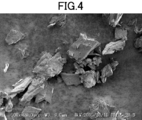
- ⁇ Crystal (micrograph) The crystals of the powdered oil / fat composition obtained with a 3D real surface view microscope VE-8800 (manufactured by Keyence Corporation) were photographed. The obtained micrographs are shown in FIG. 4 (Production Example 7) and FIG.
- XXX type 69.9% by mass, hard palm stearin, Nisshin Oilio Group Co., Ltd.
- Example 4 Seeding method Triglyceride (XXX type: 89.7% by mass, tripalmitin, Tokyo Chemical Industry) having a palmitic acid residue (carbon number 16) at the 1st to 3rd positions Co., Ltd.) 15g at 80 ° C for 0.5 hours, completely melted and cooled in a 60 ° C constant temperature bath until the product temperature reaches 60 ° C. 0.1% by mass, left in a 60 ° C. constant temperature bath for 2 hours to form a solid having voids with increased volume, and after crystallization is completed, cool to room temperature (25 ° C.) state did.
- Triglyceride XXX type: 89.7% by mass, tripalmitin, Tokyo Chemical Industry
- the mixture was completely melted and cooled in a constant temperature bath at 55 ° C. for 12 hours to form a solid having voids with an increased volume, and after crystallization was completed, it was cooled to a room temperature (25 ° C.) state.
- XXX type 79.1% by mass, rapeseed extremely hardened oil, manufactured by Yokoseki Oil & Fat Co., Ltd.
- XXX type 66.7% by mass, soybean hardened oil, produced by Yokoseki Oil & Fat Co., Ltd.
- Example 10 Triglycerides having a stearic acid residue (18 carbon atoms) at positions 1 to 3 (XXX type: 66.7% by mass, soybean hardened oil, manufactured by Yokoseki Oil & Fat Co., Ltd.), 18.75 g, Triglyceride having a stearic acid residue (carbon number 18) at the 3-position (XXX type: 11.1% by mass, palm extremely hardened oil, manufactured by Yokoseki Oil & Fat Co., Ltd.) 6.25 g was mixed to obtain a raw material fat (XXX Type: 53.6% by mass). After the raw fat / oil is completely melted by maintaining at 80 ° C.
- Example 11 Seeding method Triglyceride having stearic acid residue (18 carbon atoms) at 1st to 3rd positions (XXX type: 96.0% by mass, Tristearin, Tokyo Chemical Industry) (Made by Co., Ltd.) 25 g at 80 ° C. for 0.5 hours to completely melt and cool in a 70 ° C. constant temperature bath until the product temperature reaches 70 ° C. 0.1% by mass, left in a constant temperature bath at 70 ° C. for 12 hours to form a solid having voids with an increased volume, and after crystallization is completed, cool to room temperature (25 ° C.) state did.
- XXX type 96.0% by mass, Tristearin, Tokyo Chemical Industry
- XXX type 97.4% by mass, tribehenine, manufactured by Tokyo Chemical Industry Co., Ltd.
- powder Crystal composition (relaxed bulk density: 0.2 g / cm 3 , aspect ratio 1.6, average particle size 74 ⁇ m, X-ray diffraction measurement diffraction peak: 4.6 ⁇ , peak intensity ratio: 0.90) was obtained. .
- Example 18 Triglycerides having a palmitic acid residue (carbon number 16) at the 1st to 3rd positions (XXX type: 69.9% by mass, hard palm stearin, Nisshin Oilio Group Co., Ltd.) 12.5g, 1st to 3rd positions 12.5 g of a triglyceride having a stearic acid residue (18 carbon atoms) (XXX type: 79.1% by mass, rapeseed extremely hardened oil, manufactured by Yokoseki Yushi Kogyo Co., Ltd.) was used as a raw material fat (XXX type: 75.3%). The raw oil / fat is completely melted by maintaining at 80 ° C.
- powder Crystal composition (relaxed bulk density: 0.3 g / cm 3 , aspect ratio 1.4, average particle diameter 77 ⁇ m, X-ray diffraction measurement diffraction peak: 4.6 ⁇ , peak intensity ratio: 0.88) was obtained. .
- Example and comparative example regarding a foodstuff are given and this invention is demonstrated further in detail, this invention is not restrict
- Powdered fat composition A 25 g of triglyceride having a stearic acid residue (carbon number 18) at the 1st to 3rd positions (XXX type: 79.1% by mass, rapeseed extremely hardened oil, manufactured by Yokoseki Oil & Fat Co., Ltd.) at 80 ° C. for 0.5 hour It was maintained and completely melted, cooled in a thermostatic bath at 60 ° C.
- Rapeseed extremely hardened oil Triglyceride (XXX type: 79.1% by mass, rapeseed extremely hardened oil, manufactured by Yokoseki Oil & Fat Co., Ltd.) having a stearic acid residue (carbon number 18) at the 1st to 3rd positions was used.
- the rapeseed extremely hardened oil is a raw material of the above-mentioned powdered oil and fat composition, which is obtained by grinding and crushing in a mortar (solid average particle size 129 ⁇ m) before making it into a molten state at 80 ° C. It is not powdery and does not wipe oil.
- ⁇ Other raw materials> In examples of chocolate and hard butter, lecithin (manufactured by Nissin Oilio Group Co., Ltd.), cacao mass (manufactured by Daito Cacao Co., Ltd.), whole milk powder (manufactured by Yotsuba Dairy Co., Ltd.), and sugar (manufactured by Tokukura Co., Ltd.) A commercially available product was used.
- the hard butter A in the Example of chocolate and a hard butter was manufactured as follows. 8.8 parts by mass of high oleic sunflower oil, 48.4 parts by mass of palm stearin (iodine value 36), 18.8 parts by mass of extremely hardened oil of soybean oil and 24.0 parts by mass of palm oil were mixed. The resulting mixed oil (palmitic acid 40.9% by mass, stearic acid 20.0% by mass, oleic acid 30.6% by mass, linoleic acid 6.3% by mass, linolenic acid 0.2% by mass, trans fatty acid 0 (% By mass) was subjected to random transesterification using sodium methylate as a catalyst to obtain transesterified fats and oils.
- the obtained transesterified fat was subjected to dry fractionation at 37 ⁇ 1 ° C., and the high melting point was removed to obtain a low melting point.
- the obtained low melting point portion was fractionated with acetone at 1 ⁇ 1 ° C., and the low melting point portion was removed to obtain a high melting point portion (iodine value 32).
- the obtained high melting point part was refine
- the solid fat content (vertical axis) at 20 ° C. is higher in Examples 19 to 21 than in Comparative Example 5. It was found that the solidification rate was improved. In addition, when Examples 19 to 21 are compared, the solid fat content (vertical axis) increases as the amount of powdered oil composition A increases, and the solidification rate improves depending on the amount of powdered oil composition A. It was also found that it can be done. Thus, when the powdered fat composition of the present invention is used, the solidification rate of hard butter is improved. Therefore, in the chocolate produced using such improved hard butter, the solidification rate is similarly improved. it was thought. Moreover, it was also suggested that the solidification rate can be improved by using the powdered fat composition of the present invention in the chocolate without using the hard butter itself.
- the obtained chocolate dough was ground with a roll refiner (SDY type hydraulic three roll mill: manufactured by BUHLER) and atomized until the average particle size became about 20 ⁇ m.
- the refined chocolate dough was kneaded with the mixer over 20 minutes, and after liquefaction, the oil content was adjusted to obtain a chocolate stock solution.
- the chocolate stock solution was adjusted to 45 ° C., poured into a mold and molded, and then the chocolate stock solution was cooled and solidified at 10 to 20 ° C. to obtain the chocolate.
- 1% by mass of the powdered oil / fat composition A was added to the oil in the chocolate, and in Example 23, 5% by mass of the powdered oil / fat composition A with respect to the oil in the chocolate. % Added.
- Comparative Example 6 is a normal chocolate to which no powdered oil / fat composition A is added, and Comparative Example 7 has 1 mass of rapeseed extremely hardened oil instead of the powdered oil / fat composition based on the oil content in the chocolate. % Added.
- the chocolate produced above was melted, and 120 g was filled in a transparent polycarbonate mold (167 mm ⁇ 84 mm ⁇ 11 mm), and molded in a 7 ° C. refrigerator.
- the bottom surface of the polycarbonate mold used for molding has a grid shape (the top surface of 167 mm ⁇ 84 mm is open), and the total number of grids is 30 (5 ⁇ 6).
- the mold release rate of the molded chocolate was calculated by the following formula by visually counting the squares from which the chocolate peeled every 5 minutes after the start of cooling (when the chocolate peels, it appears to float in the squares).
- the time for starting the mold release and the time for the mold release rate to be 90% or more were measured, and the results are shown in FIG.
- Example 22 when Examples 22 to 23 were compared, it was found that the mold release speed increased as the amount of the powdered oil / fat composition increased, and that the mold release speed could be improved depending on the dose of the powdered oil / fat composition. Moreover, compared with the comparative example 7, in Example 22, the time which a mold release starts is about 1 minute earlier, and it can be said that the mold release speed is improved. Furthermore, in Example 23, although the time to start the mold release is almost the same, the time to reach the mold release rate of 90% is about 1 minute faster, and it can be said that the mold release speed is improved. Thus, it was found that the mold release rate of chocolate was improved by using the powdered fat composition of the present invention.
- the effect of increasing the heat resistance of chocolate was measured using an SFC measuring device (product name: Minispec MQ-20, manufactured by Bruker Optics). While the chocolate solidified at 10 ° C. was put into the SFC measuring apparatus and the temperature was raised, SFC at 20 ° C. and 25 ° C. was measured. The results are shown in FIG.
- the “heat resistance” increasing effect of chocolate was determined from a curve relating to the solid fat content (SFC) of the chocolate. That is, it was determined that the higher the temperature immediately before the chocolate melts, for example, the higher the temperature when the SFC is 10%, the higher the heat resistance.
- Example 23 the SFC curve came out on the upper side as compared with Comparative Examples 6 and 7.
- Comparative Examples 6 and 7 it is about 40 degreeC
- Comparative Examples 6 and 7 it is about 37 degreeC. Therefore, in Example 23, it turned out that heat resistance is rising clearly.
- Example 22 was not changed in heat resistance as compared with Comparative Examples 6 and 7.
- the improvement in heat resistance was due to the addition of a large amount of fats and oils having a high melting point.
- the powdered fat composition of the present invention has considerably small particles, so that it does not feel rough (residue), whereas the rapeseed extremely hardened oil having the same melting point.
- the obtained solid was pulverized with a hammer mill (pulverizer) to obtain a powdery crystal composition.
- this operation was repeated 9 times, and according to the order, the powdered oil / fat composition A of Examples 24-32 (relaxed bulk density: 0.185 to 0.24 g / cm 3 , aspect ratio) Ratio 1.6, average particle size 6.4 to 10.4 ⁇ m, X-ray diffraction measurement diffraction peak: 4.6 ⁇ , peak intensity ratio: 0.89) were obtained
- Extreme rapeseed used in Comparative Example 8 Hardened oil 25 g of triglyceride (XXX type: 79.1% by mass, rapeseed extremely hardened oil, produced by Yokoseki Yushi Kogyo Co., Ltd.) having a stearic acid residue (carbon number 18) at the 1st to 3rd positions is obtained at 80 ° C.
- the ordinate represents the centrifugal force
- the abscissa represents the residual ratio of the composition on the plate
- the centrifugal force at the residual ratio of 50% was calculated as the adhesive force.
- the following two types were used as measurement conditions for adhesive force measurement.
- Condition 1 Centrifugal force 1000, 2000, 4000, 8000, 12000, 16000
- Condition 2 Centrifugal force 100, 200, 400, 800, 1600, 3200, 6400 (G)
- Example 24 and Comparative Example 9 were adhered to glass beads (manufactured by ASONE, model number BZ-01, dimensions 0.105 to 0.125 mm ⁇ ), and observed with an electron microscope.
- FIG. 11 shows a case where 1% by mass of each composition is adhered when the glass beads are 100% by mass.
- the coating characteristics of the powdered oil and fat composition A of Example 24 of the present invention were as excellent as the coating characteristics of Comparative Example 9. That is, it turned out that the powdery fat composition A of this invention substitutes for the calcium stearate which is a well-known adhesive agent.
- the powdery product produced using the powdered oil / fat composition A of the present invention is hygroscopic as compared to the powdery product produced using ordinary powdered palm oil. Was suppressed, and it was found that caking was prevented. That is, it was confirmed that the powdered oil / fat composition A of the present invention functions as a coating agent and is excellent in a moisture absorption preventing function and a caking preventing function.
- ⁇ Powder production and storage test About the powdery material of Example 33, Comparative Example 10, and Reference Example 1, each raw material was weighed again according to the composition shown in Table 7, and then mixed in a beaker for production. After standing at room temperature of 20 ° C. for 1 day, 4 days, and 7 days (after storage test), each beaker was held by hand and the state when shaken 6 times to the left and right was visually observed according to the following evaluation method. Table 9 shows the results of the storage test.
- the powdery product produced using the powdered oil and fat composition A of the present invention was compared with the powdery product produced using ordinary powdered palm oil, Similarly to the result of 8, it was found that moisture absorption was suppressed and caking was prevented. That is, it was also confirmed in the storage test that the powdered oil / fat composition A of the present invention functions as a coating agent and is excellent in a moisture absorption and moisture prevention function and a caking prevention function.
Landscapes
- Chemical & Material Sciences (AREA)
- Polymers & Plastics (AREA)
- Life Sciences & Earth Sciences (AREA)
- Engineering & Computer Science (AREA)
- Food Science & Technology (AREA)
- Oil, Petroleum & Natural Gas (AREA)
- Inorganic Chemistry (AREA)
- Edible Oils And Fats (AREA)
- Fats And Perfumes (AREA)
- Paints Or Removers (AREA)
- Adhesives Or Adhesive Processes (AREA)
- Confectionery (AREA)
- General Preparation And Processing Of Foods (AREA)
Abstract
Description
油脂のみからなる粉末の製造方法としては、油脂を液体窒素中で凍結粉砕する方法等や、極度硬化油等の常温で固体脂含量が高い油脂を粉砕機で粉砕後、篩で粒度を揃える方法や、極度硬化油等の常温で固体脂含量が高い油脂を融解し、直接噴霧する方法が知られているが(特許文献4、5)、いずれにしても煩雑で、工業化に適するものではなかった。
本発明は、又、上記粉末油脂組成物の製造方法であって、上記XXX型トリグリセリドを含む油脂組成物原料を準備する工程と、上記油脂組成物原料を冷却固化して、β型油脂を含有し、その粒子形状が板状である粉末油脂組成物を得る工程とを含む、粉末油脂組成物の製造方法を提供することを目的とする。
本発明は、さらに、上記XXX型トリグリセリドを含むβ型油脂であって、上記炭素数xは10~22から選択される整数であり、上記β型油脂の粒子が板状形状を有し、X線回折測定において4.5~4.7Åに回析ピークを有することを特徴とする、β型油脂を提供することを目的とする。
加えて、本発明は、さらに、上記粉末油脂組成物を含む食品並びに当該食品を製造する方法、また、上記粉末油脂組成物を含む接着剤及びコーティング剤並びにそれらの製造方法を提供することを目的とする。
〔2〕前記油脂成分がβ型油脂からなる、前記〔1〕に記載の粉末油脂組成物。
〔3〕前記XXX型トリグリセリドが、前記油脂成分の全質量を100質量%とした場合、50質量%以上含有する、前記〔1〕又は〔2〕に記載の粉末油脂組成物。
〔4〕前記炭素数xが16~18から選択される整数である、前記〔1〕~〔3〕のいずれか1項に記載の粉末油脂組成物。
〔5〕前記粉末油脂組成物のゆるめ嵩密度が、0.1~0.4g/cm3である、前記〔1〕~〔4〕のいずれか1項に記載の粉末油脂組成物。
〔6〕前記粉末油脂組成物の板状形状が、1.1以上のアスペクト比を有する、前記〔1〕~〔5〕のいずれかに記載の粉末油脂組成物。
〔7〕前記粉末油脂組成物が、示差走査熱量測定法によってα型油脂が検出されない、前記〔1〕~〔6〕のいずれか1項に記載の粉末油脂組成物。
〔8〕前記粉末油脂組成物が、X線回折測定において4.5~4.7Åに回析ピークを有する、前記〔1〕~〔7〕のいずれか1項に記載の粉末油脂組成物。
〔9〕前記粉末油脂組成物のX線回折測定におけるピーク強度比(4.6Åのピーク強度/(4.6Åのピーク強度+4.2Åのピーク強度))が0.2以上である、前記〔1〕~〔8〕のいずれか1項に記載の粉末油脂組成物。
〔10〕前記粉末油脂組成物が、XXX型トリグリセリドを含む油脂組成物原料を、下記式から得られる冷却温度以上に保ち、冷却固化して得たβ型油脂を含有する、前記〔1〕~〔9〕のいずれか1項に記載の粉末油脂組成物。
冷却温度(℃) = 炭素数x × 6.6 ― 68
〔11〕前記粉末油脂組成物が、XXX型トリグリセリドを含む油脂組成物原料を、前記β型油脂に対応するα型油脂の融点以上の温度に保ち、冷却固化して得たβ型油脂を含有する、前記〔1〕~〔9〕のいずれか1項に記載の粉末油脂組成物。
〔12〕グリセリンの1位~3位に炭素数xの脂肪酸残基Xを有する1種以上のXXX型トリグリセリドを含む油脂成分を含有する粉末油脂組成物であって、前記炭素数xは10~22から選択される整数であり、前記油脂成分の少なくとも一部はβ型油脂であり、前記粉末油脂組成物の粒子は板状形状を有し、前記粉末油脂組成物のゆるめ嵩密度が0.05~0.6g/cm3であることを特徴とする、粉末油脂組成物の製造方法であって、
以下の工程、
(a)XXX型トリグリセリドを含む油脂組成物原料を準備する工程、
(d)前記油脂組成物原料を冷却固化して、β型油脂を含有し、その粒子形状が板状である粉末油脂組成物を得る工程、
を含む、粉末油脂組成物の製造方法。
〔13〕工程(b)として、工程(a)で得られた油脂組成物原料を加熱し、前記油脂組成物原料中に含まれるトリグリセリドを溶解して溶融状態の前記油脂組成物原料を得る工程を含む、前記〔12〕に記載の方法。
〔14〕工程(d)の前に、(c1)シーディング工程、(c2)テンパリング工程、及び/又は(c3)予備冷却工程を含む、前記〔12〕または〔13〕に記載の方法であって、前記(c1)シーディング工程は、前記工程(d)の冷却中に前記β型油脂を、前記油脂組成物原料100質量部に対して0.1~1質量部加えることを含み、前記(c2)テンパリング工程は、工程(d)の冷却の前に、当該工程(d)の冷却温度よりも低い温度に温度を維持する工程を含み、前記(c3)予備冷却工程は、前記工程(d)で使用する溶融状態の油脂組成物を、前記工程(d)の冷却温度よりも高い温度で予備冷却する工程を含む、方法。
〔15〕前記工程(d)で得られる粉末油脂組成物が、工程(d)の冷却後に得られる固形物を粉砕して粉末油脂組成物を得る工程(e)によって得られたものである、前記〔12〕~〔14〕のいずれか1項に記載の方法。
〔16〕前記XXX型トリグリセリドが前記油脂成分の全質量を100質量%とした場合、50質量%以上含有する、前記〔12〕~〔15〕のいずれか1項に記載の方法。
〔17〕前記炭素数xが16~18から選択される整数である、前記〔12〕~〔16〕のいずれか1項に記載の方法。
〔18〕工程(d)の冷却が、下記式から得られる冷却温度以上の温度で行われる、前記〔12〕~〔17〕のいずれか1項に記載の方法。
冷却温度(℃) = 炭素数x × 6.6 ― 68
〔19〕工程(d)の冷却が、前記β型油脂に対応するα型結晶の融点以上の温度で行われる、前記〔12〕~〔17〕のいずれか1項に記載の方法。
〔20〕グリセリンの1位~3位に炭素数xの脂肪酸残基Xを有する1種以上のXXX型トリグリセリドを含むβ型油脂であって、前記炭素数xは10~22から選択される整数であり、前記β型油脂の粒子が板状形状を有し、X線回折測定において4.5~4.7Åに回析ピークを有することを特徴とする、β型油脂。
〔21〕前記〔1〕~〔11〕のいずれか1項に記載の粉末油脂組成物を含有する、食品。
〔22〕前記食品全体100質量%に対し、前記粉末油脂組成物を0.1~99質量%含有してなる、〔21〕に記載の食品。
〔23〕前記粉末油脂組成物を溶融状態で含有する、〔21〕又は〔22〕に記載の食品。
〔24〕前記〔1〕~〔11〕のいずれか1項に記載の粉末油脂組成物を配合する、食品の製造方法。
〔25〕前記食品全体100質量%に対し、前記粉末油脂組成物を0.1~99質量%配合する、〔24〕に記載の食品の製造方法。
〔26〕前記〔1〕~〔11〕のいずれか1項に記載の粉末油脂組成物を有効成分とする、食品用品質改良剤。
〔27〕前記〔1〕~〔11〕のいずれか1項に記載の粉末油脂組成物を含有する、接着剤。
〔28〕前記接着剤全体100質量%に対し、前記粉末油脂組成物を1~99質量%含有してなる、〔27〕に記載の接着剤。
〔29〕前記〔1〕~〔11〕に記載の粉末油脂組成物を配合する、接着剤の製造方法。
〔30〕前記接着剤全体100質量%に対し、前記粉末油脂組成物を1~99質量%配合する、〔29〕に記載の接着剤の製造方法。
〔31〕前記〔1〕~〔11〕のいずれか1項に記載の粉末油脂組成物を含有する、コーティング剤。
〔32〕前記コーティング剤全体100質量%に対し、前記粉末油脂組成物を1~99質量%含有してなる、〔31〕に記載のコーティング剤。
〔33〕前記〔1〕~〔11〕に記載の粉末油脂組成物を配合する、コーティング剤の製造方法。
〔34〕前記コーティング剤全体100質量%に対し、前記粉末油脂組成物を1~99質量%配合する、〔33〕に記載のコーティング剤の製造方法。
本発明に従って、グリセリンの1位~3位に炭素数xの脂肪酸残基Xを有する1種以上のXXX型トリグリセリドを含む油脂成分を含有する粉末油脂組成物であって、前記炭素数xは10~22から選択される整数であり、前記油脂成分がβ型油脂を含み、前記粉末油脂組成物の粒子は板状形状を有し、前記粉末油脂組成物のゆるめ嵩密度が0.05~0.6g/cm3であることを特徴とする、粉末油脂組成物の製造方法であって、以下の工程、(a)グリセリンの1位~3位に炭素数xの脂肪酸残基Xを有する1種以上のXXX型トリグリセリドを含む油脂組成物原料を準備する工程、(d)前記油脂組成物原料を冷却固化して、β型油脂を含有し、その粒子形状が板状である粉末油脂組成物を得る工程、を含む、粉末油脂組成物の製造方法を提供することができる。
さらに、本発明により、グリセリンの1位~3位に炭素数xの脂肪酸残基Xを有する1種以上のXXX型トリグリセリドを含むβ型油脂であって、前記炭素数xは10~22から選択される整数であり、前記β型油脂の粒子が板状形状を有し、X線回折測定において4.5~4.7Åに回析ピークを有することを特徴とする、β型油脂を提供することができる。
さらに、本発明により、このようにして得られた粉末油脂組成物を添加した食品を提供することができる。また、本発明により、十分な接着性を有する接着剤及び十分な被覆性を有するコーティング剤を提供することができる。
本発明は、グリセリンの1位~3位に炭素数xの脂肪酸残基Xを有する1種以上のXXX型トリグリセリドを含む油脂成分を含有する粉末油脂組成物であって、前記炭素数xは10~22から選択される整数であり、前記油脂成分がβ型油脂を含み、前記粉末油脂組成物の粒子は板状形状を有し、前記粉末油脂組成物のゆるめ嵩密度が0.05~0.6g/cm3であることを特徴とする、粉末油脂組成物に関する。以下、本発明の粉末油脂組成物を詳細に説明する。
本発明の粉末油脂組成物は、油脂成分を含有する。当該油脂成分は、少なくともXXX型トリグリセリドを含み、任意にその他のトリグリセリドを含む。
上記油脂成分はβ型油脂を含む。ここで、β型油脂とは、油脂の結晶多形の一つであるβ型の結晶のみからなる油脂である。その他の結晶多形の油脂としては、β’型油脂及びα型油脂があり、β’型油脂とは、油脂の結晶多形の一つであるβ’型の結晶のみからなる油脂である。α型油脂とは、油脂の結晶多形の一つであるα型の結晶のみからなる油脂である。油脂の結晶には、同一組成でありながら、異なる副格子構造(結晶構造)を持つものがあり、結晶多形と呼ばれている。代表的には、六方晶型、斜方晶垂直型及び三斜晶平行型があり、それぞれα型、β’型及びβ型と呼ばれている。また、各多形の融点はα、β’、βの順に融点が高くなり、各多形の融点は、炭素数xの脂肪酸残基Xの種類により異なるので、以下、表1にそれぞれ、トリカプリン、トリラウリン、トリミリスチン、トリパルミチン、トリステアリン、トリアラキジン、トリベヘニンである場合の各多形の融点(℃)を示す。なお、表1は、Nissim Garti et al.、”Crystallization and Polymorphism of Fats and Fatty Acids”、Marcel Dekker Inc.、1988、pp.32-33に基づいて作成した。そして、表1の作成にあたり、融点の温度(℃)は小数点第1位を四捨五入した。また、油脂の組成とその各多形の融点がわかれば、少なくとも当該油脂中にβ型油脂が存在するか否かを検出することができる。

2dsinθ=nλ(n=1,2,3・・・)
この式を満たす位置に回折ピークが現れる。ここでdは格子定数、θは回折(入射)角、λはX線の波長、nは自然数である。短面間隔に対応する回折ピークの2θ=16~27°からは、結晶中の側面のパッキング(副格子)に関する情報が得られ、多形の同定を行なうことができる。特にトリアシルグリセロールの場合、2θ=19、23、24°(4.6Å付近、3.9Å付近、3.8Å付近)にβ型の特徴的ピークが、21°(4.2Å)付近にα型の特徴的なピークが出現する。なお、X線回折測定は、例えば、20℃に維持したX線回折装置((株)リガク、試料水平型X線回折装置UItimaIV)を用いて測定される。X線の光源としてはCuKα線(1.54Å)が最もよく利用される。
本発明の油脂成分は、グリセリンの1位~3位に炭素数xの脂肪酸残基Xを有する1種以上のXXX型トリグリセリドを含む。当該XXX型トリグリセリドは、グリセリンの1位~3位に炭素数xの脂肪酸残基Xを有するトリグリセリドであり、各脂肪酸残基Xは互いに同一である。ここで、当該炭素数xは10~22から選択される整数であり、好ましくは12~22から選択される整数、より好ましくは14~20から選択される整数、更に好ましくは16~18から選択される整数である。
脂肪酸残基Xは、飽和あるいは不飽和の脂肪酸残基であってもよい。具体的な脂肪酸残基Xとしては、例えば、カプリン酸、ラウリン酸、ミリスチン酸、パルミチン酸、ステアリン酸、アラキジン酸、ベヘン酸等の残基が挙げられるがこれに限定するものではない。脂肪酸としてより好ましくは、ラウリン酸、ミリスチン酸、パルミチン酸、ステアリン酸、アラキジン酸及びベヘン酸であり、さらに好ましくは、ミリスチン酸、パルミチン酸、ステアリン酸、及びアラキジン酸であり、殊更好ましくは、パルミチン酸及びステアリン酸である。
当該XXX型トリグリセリドの含有量は、油脂成分の全質量を100質量%とした場合、例えば、50質量%以上、好ましくは60質量%以上、より好ましくは、70質量%以上、さらに好ましくは、80質量%以上を下限とし、例えば、100質量%以下、好ましくは、99質量%以下、より好ましくは、95質量%以下を上限とする範囲である。XXX型トリグリセリドは1種類又は2種類以上用いることができ、好ましくは1種類又は2種類であり、より好ましくは1種類が用いられる。XXX型トリグリセリドが2種類以上の場合は、その合計値がXXX型トリグリセリドの含有量となる。
本発明の油脂成分は、本発明の効果を損なわない限り、上記XXX型トリグリセリド以外の、その他のトリグリセリドを含んでいてもよい。その他のトリグリセリドは、複数の種類のトリグリセリドであってもよく、合成油脂であっても天然油脂であってもよい。合成油脂としては、トリカプリル酸グリセリル、トリカプリン酸グリセリル等が挙げられる。天然油脂としては、例えば、ココアバター、ヒマワリ油、菜種油、大豆油、綿実油等が挙げられる。本発明の油脂成分中の全トリグリセリドを100質量%とした場合、その他のトリグリセリドは、1質量%以上、例えば、5~50質量%程度含まれていても問題はない。その他のトリグリセリドの含有量は、例えば、0~30質量%、好ましくは0~18質量%、より好ましくは0~15質量%、更に好ましくは0~8質量%である。
本発明の粉末油脂組成物は、上記トリグリセリド等の油脂成分の他、任意に乳化剤、香料、脱脂粉乳、全脂粉乳、ココアパウダー、砂糖、デキストリン、甘味料、着色料等のその他の成分(添加剤)を含んでいてもよい。これらの任意成分は本発明の粉末油脂組成物に外添することもできるが、あらかじめ粉末油脂組成物中に含めることにより、これらの任意成分を確実かつ容易に食品基材上に接着することができる。これらその他の成分の量は、本発明の効果を損なわない限り任意の量とすることができるが、例えば、粉末油脂組成物の全質量を100質量%とした場合、0~70質量%、好ましくは0~65質量%、より好ましくは0~30質量%である。その他の成分は、その90質量%以上が、平均粒径が1000μm以下である粉体であることが好ましく、平均粒径が500μm以下の粉体であることがより好ましい。さらに、20μm以下の細かい粒子は人間の感覚では感じとることが困難であるので、平均粒径が例えば20μm以下、好ましくは0.1~20μm、より好ましくは1~10μmの粉体であれば、口に含んだ際の粉体の粗いざらついた感触がなくなるので好ましい。なお、特に断らない限り、本明細書でいう平均粒径は、レーザー回折散乱法(ISO133201及びISO9276-1)によって測定した値である。
但し、本発明の好ましい粉末油脂組成物は、実質的に上記油脂成分のみからなることが好ましく、かつ、油脂成分は、実質的にトリグリセリドのみからなることが好ましい。また、「実質的に」とは、油脂組成物中に含まれる油脂成分以外の成分または油脂成分中に含まれるトリグリセリド以外の成分が、粉末油脂組成物または油脂成分を100質量%とした場合、例えば、0~15質量%、好ましくは0~10質量%、より好ましくは0~5質量%であることを意味する。
本発明の粉末油脂組成物は、グリセリンの1位~3位に炭素数xの脂肪酸残基Xを有する1種以上のXXX型トリグリセリドを含む油脂組成物原料を溶融状態とし、特定の冷却温度に保ち、冷却固化することにより、噴霧やミル等の粉砕機による機械粉砕等特別の加工手段を採らなくても、粉末状の油脂組成物(粉末油脂組成物)を得ることができる。より具体的には、(a)上記XXX型トリグリセリドを含む油脂組成物原料を準備し、任意に工程(b)として、工程(a)で得られた油脂組成物原料を加熱し、前記油脂組成物原料中に含まれるトリグリセリドを溶解して溶融状態の前記油脂組成物原料を得、さらに(d)前記油脂組成物原料を冷却固化して、β型油脂を含有し、その粒子形状が板状である粉末油脂組成物を得る。なお、冷却後に得られる固形物に対して、ハンマーミル、カッターミル等、公知の粉砕加工手段を適用して、該粉末油脂組成物を生産することもできる。
冷却温度(℃) = 炭素数x × 6.6 ― 68
から求められる冷却温度以上の温度で行われる。このような温度範囲で冷却すれば、β型油脂を効率よく生成でき、細かい結晶ができるので、粉末油脂組成物を容易に得ることができる。なお、前記「細かい」とは、一次粒子(一番小さい大きさの結晶)が、例えば20μm以下、好ましくは、15μm以下、より好ましくは10μmの場合をいう。また、このような温度範囲で冷却しないと、β型油脂が生成せず、油脂組成物原料よりも体積が増加した空隙を有する固形物ができない場合がある(比較例1、3)。さらに、本発明では、このような温度範囲で冷却することによって、静置した状態でβ型油脂を生成させ、粉末油脂組成物の粒子を板状形状とさせたものであり、冷却方法は、本発明の粉末油脂組成物を特定するために有益なものである。
本発明の粉末油脂組成物は、常温(20℃)で粉末状の固体である。
本発明の粉末油脂組成物のゆるめ嵩密度は、例えば実質的に油脂成分のみからなる場合、0.05~0.6g/cm3、好ましくは0.1~0.5g/cm3であり、より好ましくは0.1~0.4g/cm3又は0.15~0.4g/cm3であり、さらに好ましくは0.2~0.3g/cm3である。ここで「ゆるめ嵩密度」とは、粉体を自然落下させた状態の充填密度である。ゆるめ嵩密度(g/cm3)の測定は、例えば、内径15mm×25mLのメスシリンダーに、当該メスシリンダーの上部開口端から2cm程度上方から粉末油脂組成物の適量を落下させて疎充填し、充填された質量(g)の測定と容量(mL)の読み取りを行い、mL当たりの当該粉末油脂組成物の質量(g)を算出することで求めることができる。また、ゆるめ嵩密度は、(株)蔵持科学器械製作所のカサ比重測定器を使用し、JIS K-6720(又はISO 1060-1及び2)に基づいて測定したカサ比重から算出することもできる。具体的には、試料120mLを、受器(内径40mm×高さ85mmの100mL円柱形容器)の上部開口部から38mmの高さの位置から、該受器に落とす。受器から盛り上がった試料はすり落とし、受器の内容積(100mL)分の試料の質量(Ag)を秤量し、以下の式からゆるめ嵩密度を求めることができる。
ゆるめ嵩密度(g/mL)=A(g)/100(mL)
測定は3回行ってその平均値を取ることが好ましい。
さらに本発明の粉末油脂組成物を食品に添加するため、具体的には、例えば食品等の表面に添加剤を付着させたり、それ自体接着剤やコーティング剤として使用する場合、例えば、0.1μm以上、好ましくは1μm以上、より好ましくは2μm以上、さらに好ましくは4μm以上で、かつ、例えば20μm以下、好ましくは15μm以下、より好ましくは10μm以下、さらに好ましくは5μm以下の平均粒径(有効径)を有することが適当である。当該平均粒径(有効径)の測定方法は上述と同様である。特に20μm以下の平均粒径とすることにより、口に含んだ際の粉体の粗いざらついた感触がなくなるので好ましい。
本発明の粉末油脂組成物は、以下の工程、
(a)XXX型トリグリセリドを含む油脂組成物原料を準備する工程、
(b)工程(a)で得られた油脂組成物原料を任意に加熱等し、前記油脂組成物原料中に含まれるトリグリセリドを溶解して溶融状態の前記油脂組成物原料を得る任意の工程、
(d)前記油脂組成物原料を冷却固化して、β型油脂を含有し、その粒子形状が板状である粉末油脂組成物を得る工程、
を含む方法によって製造することができる。
また、上記工程(b)と(d)の間に、工程(c)として粉末生成を促進するための任意工程、例えば(c1)シーディング工程、(c2)テンパリング工程、及び/又は(c3)予備冷却工程を含んでいてもよい。さらに上記工程(d)で得られる粉末油脂組成物は、工程(d)の冷却後に得られる固形物を粉砕して粉末状の油脂組成物を得る工程(e)によって得られるものであってもよい。以下、上記工程(a)~(e)について説明する。
工程(a)で準備されるXXX型トリグリセリドを含む油脂組成物原料は、グリセリンの1位~3位に炭素数xの脂肪酸残基Xを有する1種以上のXXX型トリグリセリドを含む通常のXXX型トリグリセリド等の油脂の製造方法に基づいて製造され、もしくは容易に市場から入手され得る。ここで、上記炭素数x及び脂肪酸残基Xで特定されるXXX型トリグリセリドは、最終的に得られる目的の油脂成分のものと結晶多形以外の点で同じである。当該原料にはβ型油脂が含まれていてもよく、例えば、β型油脂の含有量が0.1質量%以下、0.05質量%以下、又は0.01質量%以下含んでいてもよい。但し、β型油脂は、当該原料を加熱等により溶融状態にすることにより消失するので、当該原料は溶融状態の原料であってもよい。当該原料が、例えば溶融状態である場合に、β型油脂を実質的に含まないことは、XXX型トリグリセリドに限らず、実質的に全ての油脂成分がβ型油脂ではない場合も意味し、β型油脂の存在は、上述したX線回折測定によりβ型油脂に起因する回折ピーク、示差走査熱量測定法によるβ型油脂の確認等によって確認することができる。「β型油脂を実質的に含まない」場合のβ型油脂の存在量は、X線回折ピークのうち、β型の特徴的ピークとα型の特徴的ピークとの強度比率[β型の特徴的ピークの強度/(α型の特徴的ピークの強度+β型の特徴的ピークの強度)](ピーク強度比)から想定できる。上記油脂組成物原料の当該ピーク強度比は、例えば0.2以下であり、好ましくは、0.15以下であり、より好ましくは、0.10以下である。油脂組成物原料には、上述したとおりのXXX型トリグリセリドを1種類又は2種以上含んでいてもよく、好ましくは1種類又は2種類であり、より好ましくは1種類である。
具体的には、例えば、上記XXX型トリグリセリドは、脂肪酸または脂肪酸誘導体とグリセリンを用いた直接合成によって製造することができる。XXX型トリグリセリドを直接合成する方法としては、(i)炭素数Xの脂肪酸とグリセリンとを直接エステル化する方法(直接エステル合成)、(ii)炭素数xである脂肪酸Xのカルボキシル基がアルコキシル基と結合した脂肪酸アルキル(例えば、脂肪酸メチル及び脂肪酸エチル)とグリセリンとを塩基性または酸性触媒条件下にて反応させる方法(脂肪酸アルキルを用いたエステル交換合成)、(iii)炭素数xである脂肪酸Xのカルボキシル基の水酸基がハロゲンに置換された脂肪酸ハロゲン化物(例えば、脂肪酸クロリド及び脂肪酸ブロミド)とグリセリンとを塩基性触媒下にて反応させる方法(酸ハライド合成)が挙げられる。
XXX型トリグリセリドは前述の(i)~(iii)のいずれの方法によっても製造できるが、製造の容易さの観点から、(i)直接エステル合成又は(ii)脂肪酸アルキルを用いたエステル交換合成が好ましく、(i)直接エステル合成がより好ましい。
XXX型トリグリセリドの(i)直接エステル合成における反応温度は、エステル化反応によって生ずる生成水が系外に除去できる温度であればよく、例えば、120℃~300℃が好ましく、150℃~270℃がより好ましく、180℃~250℃がさらに好ましい。反応を180~250℃で行うことで、特に効率的にXXX型トリグリセリドを製造することができる。
XXX型トリグリセリドの(i)直接エステル合成においては、反応後、水洗、アルカリ脱酸及び/又は減圧脱酸、及び吸着処理等の公知の精製処理を行うことで、触媒や原料未反応物を除去することができる。更に、脱色・脱臭処理を施すことで、得られた反応物をさらに精製することができる。
XXX型トリグリセリドを含む油脂組成物原料となるその他のトリグリセリドとしては、上記XXX型トリグリセリドの他、本発明の効果を損なわない限り、各種トリグリセリドを含めてもよい。その他のトリグリセリドとしては、例えば、上記XXX型トリグリセリドの脂肪酸残基Xの1つが脂肪酸残基Yに置換したX2Y型トリグリセリド、上記XXX型トリグリセリドの脂肪酸残基Xの2つが脂肪酸残基Yに置換したXY2型トリグリセリド等を挙げることができる。
上記その他のトリグリセリドの量は、例えば、XXX型トリグリセリドの全質量を100質量%とした場合、0~100質量%、好ましくは0~70質量%、より好ましくは1~40質量%である。
上記油脂組成物原料としては、上記トリグリセリドの他、任意に部分グリセリド、脂肪酸、抗酸化剤、乳化剤、水などの溶媒等のその他の成分を含んでいてもよい。これらその他の成分の量は、本発明の効果を損なわない限り任意の量とすることができるが、例えば、XXX型トリグリセリドの全質量を100質量%とした場合、0~5質量%、好ましくは0~2質量%、より好ましくは0~1質量%である。
当該混合は、必要に応じて加熱下で混合してもよい。加熱は、後述の工程(b)における加熱温度と同程度であることが好ましく、例えば、50~120℃、好ましくは60~100℃、より好ましくは70~90℃、さらに好ましくは80℃で行われる。
上記(d)工程の前に、上記工程(a)で準備された油脂組成物原料は、準備された時点で溶融状態にある場合、加熱せずにそのまま冷却されるが、準備された時点で溶融状態にない場合は、任意に加熱され、該油脂組成物原料中に含まれるトリグリセリドを融解して溶融状態の油脂組成物原料を得る。
ここで、油脂組成物原料の加熱は、上記油脂組成物原料中に含まれるトリグリセリドの融点以上の温度、特にXXX型トリグリセリドを融解できる温度、例えば、70~200℃、好ましくは、75~150℃、より好ましくは80~100℃であることが適当である。また、加熱は、例えば、0.1~3時間、好ましくは、0.3~2時間、より好ましくは0.5~1時間継続することが適当である。
上記工程(a)又は(b)で準備された溶融状態の油脂組成物原料は、さらに冷却固化されて、β型油脂を含有し、その粒子形状が板状である粉末油脂組成物を形成する。
ここで、「溶融状態の油脂組成物原料を冷却固化」するためには、冷却温度の上限値として、溶融状態の油脂組成物原料を、当該油脂組成物原料に含まれる油脂成分のβ型油脂の融点より低い温度に保つことが必要である。「油脂組成物原料に含まれる油脂成分のβ型油脂の融点より低い温度」とは、例えば、炭素数が18のステアリン酸残基を3つ有するXXX型トリグリセリドの場合、β型油脂の融点は74℃であるので(表1)、当該融点より1~30℃低い温度(即ち44~73℃)、好ましくは当該融点より1~20℃低い温度(即ち54~73℃)、より好ましくは当該融点より1~15℃低い温度(即ち59~73℃)、特に好ましくは、1℃、2℃、3℃、4℃、5℃、6℃、7℃、8℃、9℃または10℃低い温度である。
より好ましくは、β型油脂を得るためには、冷却温度の下限値として、以下の式から求められる冷却温度以上に保つことが適当である。
冷却温度(℃) = 炭素数x × 6.6 ― 68
(式中、炭素数xは、油脂組成物原料中に含まれるXXX型トリグリセリドの炭素数x)
このような冷却温度以上とするのは、XXX型トリグリセリドを含有するβ型油脂を得るために、当該油脂の結晶化の際、冷却温度をβ型油脂以外のα型油脂やβ’型油脂が結晶化しない温度に設定する必要があるためである。冷却温度は、主にXXX型トリグリセリドの分子の大きさに依存するので、炭素数xと最適な冷却温度の下限値との間には一定の相関関係があることが理解できる。
例えば、油脂組成物原料に含まれるXXX型トリグリセリドが、炭素数が18のステアリン酸残基を3つ有するXXX型トリグリセリドである場合、冷却温度の下限値は50.8℃以上となる。従って、炭素数が18のステアリン酸残基を3つ有するXXX型トリグリセリドの場合、「溶融状態の油脂組成物原料を冷却固化」する温度は、50.8℃以上72℃以下がより好ましいこととなる。
また、XXX型トリグリセリドが2種以上の混合物である場合は、炭素数xが小さい方の冷却温度に合わせてその下限値を決定することができる。例えば、油脂組成物原料に含まれるXXX型トリグリセリドが、炭素数が16のパルミチン酸残基を3つ有するXXX型トリグリセリドと炭素数が18のステアリン酸残基を3つ有するXXX型トリグリセリドとの混合物である場合、冷却温度の下限値は小さい方の炭素数16に合わせて37.6℃以上となる。
さらに、工程(d)の前、上記工程(a)又は(b)と(d)との間に、(c)粉末生成を促進するための任意工程として、工程(d)で使用する溶融状態の油脂組成物原料に対し、シーディング法(c1)、テンパリング法(c2)及び/又は(c3)予備冷却法による処理を行ってもよい。これらの任意工程(c1)~(c3)は、いずれか単独で行ってもよいし、複数の工程を組み合わせて行ってもよい。ここで、工程(a)又は(b)と工程(d)との間とは、工程(a)又は(b)中、工程(a)又は(b)の後であって工程(d)の前、工程(d)中を含む意味である。
シーディング法(c1)及びテンパリング法(c2)は、本発明の粉末油脂組成物の製造において、溶融状態にある油脂組成物原料をより確実に粉末状とするために、最終温度まで冷却する前に、溶融状態にある油脂組成物原料を処置する粉末生成促進方法である。
ここで、シーディング法(c1)とは、粉末の核(種)となる成分を溶融状態にある油脂組成物原料の冷却時に少量添加して、粉末化を促進する方法である。具体的には、例えば、工程(b)で得られた溶融状態にある油脂組成物原料に、当該油脂組成物原料中のXXX型トリグリセリドと炭素数が同じXXX型トリグリセリドを好ましくは80質量%以上、より好ましくは90質量%以上含む油脂粉末を核(種)となる成分として準備する。この核となる油脂粉末を、溶融状態にある油脂組成物原料の冷却時、当該油脂組成物原料の温度が、例えば、最終冷却温度±0~+10℃、好ましくは+5~+10℃の温度に到達した時点で、当該溶融状態にある油脂組成物原料100質量部に対して0.1~1質量部、好ましくは0.2~0.8質量部添加することにより、油脂組成物の粉末化を促進する方法である。
また、テンパリング法(c2)とは、溶融状態にある油脂組成物原料の冷却において、最終冷却温度で静置する前に一度、工程(d)の冷却温度よりも低い温度、例えば5~20℃低い温度、好ましくは7~15℃低い温度、より好ましくは10℃程度低い温度に、好ましくは10~120分間、より好ましくは30~90分間程度冷却することにより、油脂組成物の粉末化を促進する方法である。
さらに、予備冷却法(c3)とは、前記工程(a)又は(b)で得られた溶融状態の油脂組成物原料を、工程(d)にて冷却する前に、前記XXX型トリグリセリドを含む油脂組成物原料を準備した時の温度と前記油脂組成物原料の冷却時の冷却温度との間の温度で一旦冷却する方法、言い換えれば、工程(a)又は(b)の溶融状態の温度よりも低く、工程(d)の冷却温度よりも高い温度で一旦予備冷却する方法である。(c3)予備冷却法に続いて、工程(d)の油脂組成物原料の冷却時の冷却温度で冷却することが行われる。工程(d)の冷却温度より高い温度とは、例えば、工程(d)の冷却温度よりも2~40℃高い温度、好ましくは3~30℃高い温度、より好ましくは4~30℃高い温度、さらに好ましくは5~10℃程度高い温度であり得る。前記予備冷却する温度を低く設定すればするほど、工程(d)の冷却温度における本冷却時間を短くすることができる。すなわち、予備冷却法とは、シーディング法やテンパリング法と異なり、冷却温度を段階的に下げるだけで油脂組成物の粉末化を促進できる方法であり、工業的に製造する場合に利点が大きい。
上記工程(d)の冷却によって粉末油脂組成物を得る工程は、より具体的には、工程(d)の冷却によって得られる固形物を粉砕して粉末油脂組成物を得る工程(e)によって行われてもよい。
詳細に説明すると、まず、上記油脂組成物原料を融解して溶融状態の油脂組成物を得、その後冷却して溶融状態の油脂組成物原料よりも体積が増加した空隙を有する固形物を形成する。空隙を有する固形物となった油脂組成物は、軽い衝撃を加えることで粉砕でき、固形物が容易に崩壊して粉末状となる。
ここで、軽い衝撃を加える手段は特に特定されないが、振る、篩に掛ける等により、軽く振動(衝撃)を与えて粉砕する(ほぐす)方法が、簡便で好ましい。
なお、該固形物を公知の粉砕加工手段により粉砕してもよい。このような粉砕加工手段の一例としては、ハンマーミル、カッターミル等が挙げられる。
本発明の粉末油脂組成物は、粉末油脂を原料とする各種分野で利用できる。特に、ケーキミックス、コーヒークリーム、ショートニング、チョコレート等の食品分野で利用することができる。また、本発明の粉末油脂組成物は、食品等を付着させるための接着剤やコーティング剤として食品分野に限らず広く利用することができる。
本発明の粉末油脂組成物は、各種食品に含めることができる。粉末油脂組成物が添加される食品原料としては、上述したようなケーキミックスのようなケーキ類、コーヒークリーム、ショートニング、チョコレート、パン類、水産練り製品、焼き菓子、クリーム等を挙げることができる。本発明の食品中の粉末油脂組成物の含有量は、対象とする食品の種類によって異なるが、例えば、最終的に得られる食品全体を100質量%とした場合、例えば、0.1~99質量%、好ましくは、1~90質量%、より好ましくは、5~85質量%、さらに好ましくは、10~80質量%である。
本発明の粉末油脂組成物をチョコレートの原材料の一部として含めることにより、チョコレートの固化速度を改善するとともに、型抜け速度が向上し、耐熱性が上昇したものへ改良することができる。詳しくは後述する。
本発明は、また、上記粉末油脂組成物を含む食品の製造方法に関する。
具体的には、上述した
(d)溶融状態の前記油脂組成物原料を冷却固化して、β型油脂を含有し、その粒子形状が板状である粉末油脂組成物を得る工程、又は
(e)固形物を粉砕して粉末油脂組成物を得る工程
の後に得られた粉末油脂組成物を食品原料に添加する工程、即ち、
(f)得られた粉末油脂組成物を食品原料に添加して前記粉末油脂組成物を含有する食品を得る工程、
を含めることができる。
上記(f)工程において、添加方法は特に制限されないが、例えば、チョコレートの場合、混合工程時に添加される。この際、混合しやすさの観点から、一旦、粉末状の油脂組成物を一旦溶かしてから加えるが、粉末状のまま加えることもある。一旦溶かす場合は、融点以上に加温し完全に溶解したものを用いる。食品中に粉末油脂組成物が十分に均一になる時間、混合することが好ましい。
上記(f)工程において、例えば、粉末油脂組成物を接着剤又はコーティング剤として使用する場合、前記食品原料に上記得られた粉末油脂組成物を添加する(例えば、食品表面に対し塗付又は被覆するだけでなく、食品全体に対し含まれていることも含む)方法が挙げられる。
<チョコレート>
本発明において「チョコレート」とは、「チョコレート類の表示に関する公正競争規約(S46.3.29公正取引委員会告示第16号、変更 H2.6.22同告示第18号)」(全国チョコレート業公正取引協議会)乃至法規上の規定により限定されるものに限らず、カカオマス、ココアパウダー、食用油脂(ココアバター、植物油脂など)、糖類(砂糖、乳糖、麦芽糖、果糖など)を主原料とし、必要に応じて、乳製品、香料、乳化剤等を加え、チョコレートの製造工程(混合工程、微粒化工程、精錬工程、冷却工程など)を経て製造されるものであれば特に限定されない。本発明の「チョコレート」としては、ダークチョコレート、ブラックチョコレート、ミルクチョコレートの他に、カカオマスを使用しない、ホワイトチョコレート、カラーチョコレート等が挙げられる。本発明において特に好ましくは、ハードバターを用いたチョコレートである。
なお、本発明において「改良チョコレート」とは、上記で定義したチョコレートに対して、上記で定義した「粉末油脂組成物」ないし「油脂組成物」を含有させたものであり、前記「粉末油脂組成物」ないし「油脂組成物」を含有させていないチョコレートに比べて、固化速度が改善し、型抜け速度が向上し、耐熱性が上昇したチョコレートをいう。
本発明における「ハードバター」は、チョコレートの油脂として使用されるカカオ代用脂の総称である。「ハードバター」は、一般に、テンパリング型とノンテンパリング型に分類される。テンパリング型ハードバターは、カカオ脂に多く含まれる対称型トリグリセリドを主成分としている。例えば、2位にオレイン酸、1、3位に炭素数16以上の飽和脂肪酸が結合したSOS型トリグリセリド(以下、SOSとも記載する)を含有する。そのため、テンパリング型ハードバターは、カカオ脂との相溶性が高い。また、テンパリング型ハードバターは、カカオ脂と同様にテンパリングを行う必要がある。
一方、ノンテンパリング型ハードバターは、カカオ脂と融解性状は似ているが、油脂構造は全く異なるものである。そのため、ノンテンパリング型ハードバターは、カカオ脂との相溶性は低い。しかしながら、テンパリングが不要で作業性が良いため、チョコレート領域で広く使用されている。また、ノンテンパリング型ハードバターは、ラウリン酸型と非ラウリン酸型に大きく分けられる。ラウリン酸型ハードバターは、ラウリン酸を主な構成脂肪酸としており、典型的にはパーム核油を分別して得られる高融点部(パーム核ステアリン)を水素添加して極度硬化したものが含まれている。この種のハードバターは速やかに融解する特徴があるが、カカオ脂との相溶性が極端に悪いため、カカオ脂の配合率を極力少なくしなければならず、カカオ風味に乏しいものとなる。また、非ラウリン酸型ハードバターは、トランス酸型ハードバターとも言われているが、典型的には低融点パームオレイン又は大豆油等の液体油を異性化水素添加したものや、異性化水素添加したものを分別した高融点部又は中融点部が含まれている。この種のハードバターの融解性状はラウリン酸型と比較してやや速やかに溶解する特徴が欠けるものの、カカオ脂との相溶性はラウリン酸型よりは良く、カカオ脂をラウリン酸型よりも比較的多く配合することができる。しかしながら、多量のトランス脂肪酸を含有するため、トランス脂肪酸の健康への悪影響が認識されるようになって以来、使用が敬遠されている。このような背景から、非ラウリン酸型ハードバターには、トランス脂肪酸の低減が求められている。
なお、本発明において「改良ハードバター」とは、上記で定義した「ハードバター」に対して、上記で定義した「粉末油脂組成物」ないし「油脂組成物」を含有させたものであり、前記「粉末油脂組成物」ないし「油脂組成物」を含有させていないハードバターに比べて、前記改良ハードバターを使用した場合に、固化速度が改善し、型抜け速度が向上し、耐熱性が上昇したチョコレートが製造できるものをいう。
本発明における「固化速度」は、油脂の固体脂含量(SFC)に関する曲線から求めることができる。例えば、20℃で冷却した際の15分後における固体脂含量(SFC)が多いものほど、固化速度が速い油脂であると測定される。なお、油脂のSFCは、周知のSFC測定装置を用いて測定することができる。例えば、SFC測定装置(製品名:Minispec MQ-20、Bruker Optics社製)が挙げられる。測定方法としては、例えば、45℃で温められた溶融状態にある油脂をSFC測定装置に入れて20℃で冷却しながら、5分おきにSFCを測定する方法などが挙げられる。
本発明における「型抜け速度」は、チョコレートが型から抜け始めてから、離型率が90%になるまでの冷却時間から求めることができる。すなわち、まず融解したチョコレート生地を成形型(例えば、167mm×84mm×11mmで167mm×84mmの上面が解放された透明なポリカーボネート製の型)に流し込み、冷却開始から一定時間ごとに成形型から抜けていくチョコレートの数を目視で数える(例えば、透明なポリカーボネート製の型を用いると、チョコレートが剥離すると浮き上がって見える)。より短い冷却時間でチョコレートが抜け始め、より短い冷却時間で離形率が90%になることを、本発明では、「型抜け速度」が速いという。「型抜け速度」の終点が、離型率90%である理由は、全てのチョコレートが型から抜けることは難しく、離型率100%を基準とすると、測定にばらつきが生じやすいためである。また、離形率はチョコレートの離形性及び生産性の目安となる。上記167mm×84mm×11mmの透明なポリカーボネート製の型を使用して測定した離型率が90%以上になる時間が20分以下である場合、チョコレートの離型性(型抜け)は良好であり、生産性が良いと判断した。なお、離型率は次の式で求めることができる。
離型率(%)= 剥離した升目の数 / 升目の総数 × 100
本発明における「耐熱性」は、油脂の固体脂含量(SFC)に関する曲線から評価することができる。チョコレートが溶け切る直前の温度、例えば、SFCが10%となるときの温度が高いものほど、耐熱性が上昇したものであると評価される。なお、油脂のSFCは、周知のSFC測定装置を用いて測定することができる。例えば、SFC測定装置(製品名:Minispec MQ-20、Bruker Optics社製)が挙げられる。測定方法としては、例えば、10℃で固められた油脂をSFC測定装置に入れて温度を上げながら、20℃、25℃におけるSFCを測定し、次いで、2.5℃温度が上がるたびにSFCを測定する方法などが挙げられる。
まず、本発明の食品中の粉末油脂組成物の含有量は、対象とする食品の種類によって異なるが、例えば、食品中の油分100質量%に対して、1~10質量%で含有される。より好ましくは、1~8質量%であり、さらに好ましくは、1~5質量%である。対象となる食品がチョコレートである場合は、チョコレート中の油分を基準にしてチョコレート中に含有され、本発明の改良チョコレートを得ることができる。すなわち、改良チョコレートにおいては、チョコレート中の油分100質量%に対して、1~10質量%で含有される。より好ましくは、1~8質量%であり、さらに好ましくは、1~5質量%である。また、対象となる食品がハードバターである場合は、ハードバター(全てが油分に相当)100質量%に対して、1~10質量%で含有される。より好ましくは、1~8質量%であり、さらに好ましくは、1~5質量%である。
例えば、上記で規定した数値範囲を最終的に得られる改良チョコレート中に存在する粉末油脂組成物の量に換算すると、チョコレート中の油分40質量%に対して、1質量%の粉末油脂組成物を含有させた場合、最終的に得られるチョコレートに対しては、0.398質量%の粉末油脂組成物が含まれることになる(実施例22)。また、チョコレート中の油分40質量%に対して、5質量%の粉末油脂組成物を含有させた場合、最終的に得られるチョコレートに対しては、1.96質量%の粉末油脂組成物が含まれることになる(実施例23)。
改良ハードバター又は改良チョコレート中の油分に対して、本発明の粉末油脂組成物を少なくとも1質量%以上含有させれば、本発明の所望の効果が得られる。また、チョコレート中の油分100質量%に対して、10質量%以下の粉末油脂組成物を含有させると、物性や食感等への悪影響が出ないので好ましい。なお、上記粉末油脂組成物はチョコレートの製造過程で熱により溶融することもあり得るので、上記粉末油脂組成物に代えて、溶融状態の上記油脂組成物を含有させることも可能である。当該油脂組成物の含有量は上記粉末油脂組成物で定義したのと同様である。
本発明の改良チョコレートは、任意の食用油脂を含むことができる。このような食用油脂としては、食用油、マーガリン、ファットスプレッド、及びショートニングなどが挙げられ、これらの一種又は2種以上を併用することができる。前記食用油脂の原料としては、例えば、ヤシ油、パーム核油、パーム油、パーム分別油(パームオレイン、パームスーパーオレイン等)、シア脂、シア分別油、サル脂、サル分別油、イリッペ脂、大豆油、菜種油、綿実油、サフラワー油、ひまわり油、米油、コーン油、ゴマ油、オリーブ油、乳脂、ココアバター等やこれらの混合油、加工油脂等を使用することができる。これら食用油脂の量は、本発明の効果を損なわない限り任意の量とすることができるが、例えば、チョコレートの含油原料に由来する油分の全質量を100質量%とした場合、それに対して、0~100質量%、好ましくは0~75質量%、より好ましくは0~50質量%である。
本発明の改良チョコレートは、好ましくは糖類を含有する。糖類としては、例えば、ショ糖(砂糖、粉糖)、乳糖、ブドウ糖、果糖、麦芽糖、還元澱粉糖化物、液糖、酵素転化水飴、異性化液糖、ショ糖結合水飴、還元糖ポリデキストロース、オリゴ糖、ソルビトール、還元乳糖、トレハロース、キシロース、キシリトース、マルチトール、エリスリトール、マンニトール、ラフィノース、デキストリン等を使用することができる。本発明の改良チョコレート中に含まれる糖類の含量は、チョコレートの全質量を100質量%とした場合、好ましくは20~60質量%であり、より好ましくは25~55質量%であり、さらに好ましくは30~50質量%である。
本発明の改良チョコレートは、油脂、糖類以外にも、チョコレートの製造において一般的に配合される原料を使用することができる。具体的には、例えば、全脂粉乳、脱脂粉乳等の乳製品、カカオマス、ココアパウダー等のカカオ成分、大豆粉、大豆蛋白、果実加工品、野菜加工品、抹茶粉末、コーヒー粉末等の各種粉末、ガム類、澱粉類、酸化防止剤、着色料、香料、乳化剤等を使用することができる。
上記改良チョコレート中に含まれる「食用油脂」、「糖類」及び「他の成分」の好ましい態様は、本発明の食品にも適用することができる。
本発明の食品は、従来公知の方法により製造することができる。例えば、本発明の改良チョコレートを例にとってみると、改良チョコレートは、例えば、油脂(ハードバターを含む)、カカオ成分、糖類、乳製品、乳化剤等を原材料として、チョコレート中の最終的な油脂含量が25~65質量%となるように、前記原材料の一部として、上記粉末油脂組成物を一旦溶かして溶融状態の油脂組成物として加えるか、又は粉末油脂組成物をそのまま加えて、混合工程、微粒化工程(リファイニング)、精練工程(コンチング)、冷却工程等を経て製造することができる。例えば、チョコレートの原材料をミキシング(混合工程)し、ロール掛けによるリファイニング(微粒化工程)した後、コンチング(精練工程)を行い、型に入れて冷却固化(冷却工程)することにより製造することができる。なお、本発明の改良チョコレートの製造方法において、テンパリングを行うかどうかは、用いるハードバターの種類による。
ところで、以上述べたように、本発明に用いる粉末油脂組成物は、チョコレートの原材料の一部として加えると、従来のチョコレートを、固化速度を改善するとともに、型抜け速度が向上し、耐熱性が上昇したものへ改良するから、本発明は、上記粉末油脂組成物を有効成分とする、食品用(特にチョコレート用)品質改良剤にも関する。以下に示すように、本発明の食品用品質改良剤を従来のチョコレートの原材料中に配合することにより、当該チョコレートの固化速度を改善するとともに、型抜け速度が向上し、耐熱性が上昇したものへと変更する品質改良効果を達成することができる。
本発明の食品用品質改良剤は、上述の粉末油脂組成物を含有する。本発明の食品用品質改良剤は、少量で効果を発揮するため、上記の粉末油脂組成物を、好ましくは60質量%以上含有し、より好ましくは80質量%以上含有し、さらに好ましくは100質量%以上含有する。
また、本発明の食品用品質改良剤は、有効成分であると上述した粉末油脂組成物を含有したものであればよく、この他に本発明の効果を損なわない範囲で、大豆油、菜種油などの油脂、デキストリン、澱粉等の賦形剤、品質改良剤等の他の成分を含有させたものであってもよい。
但し、本発明の好ましい食品用品質改良剤は、実質的に当該粉末油脂組成物のみからなることが好ましい。また「実質的に」とは、食品用品質改良剤中に含まれる粉末油脂組成物以外の成分が、食品用品質改良剤を100質量%とした場合、例えば、0~15質量%、好ましくは0~10質量%、より好ましくは0~5質量%であることを意味する。
本発明の粉末油脂組成物は、その接着性を生かし、食品、飼料、医薬品、化粧品などを互いに接着させるための接着剤として使用することができる。例えば、ビスケットやクッキーなどの菓子を貼り合わせて、プラモデルのように組み立てて遊ぶ食品や、種々の食品を組み合わせて色彩や立体感覚を表現した食品を製造するために使用することができる。また、食品と着色剤又は香料等を圧縮成型して固形製剤を製造するためにも使用することができる。さらに、食品、飼料、医薬品、化粧品など原料である粉粒体の表面上に適用されるコーティング剤として使用することができる。例えば、食品の表面をコーティングして外気や水分と接触することによる劣化や吸湿を防止し、流動性の改善、徐放性、マスキング性、溶出防止性、耐酸性などを付与するために使用することができる。本発明の粉末油脂組成物は、それ自体が食用であり、従来から食品用接着剤として使用されてきたステアリン酸カルシウムのような食品添加剤と異なって、食品そのものであり、容易に使用できる。また、上記種々の添加剤を本発明の粉末油脂組成物中に含ませることによって、接着性のある食品添加剤として利用することができる。本発明の粉末油脂組成物は、原料として油脂成分が含まれていれば、別途既存の接着剤を含める必要がないので、食品としての安全性を担保しつつ使用することができる。
本発明の粉末油脂組成物は、接着剤として、又は接着剤の一部として利用することができる。例えば、本発明の粉末油脂組成物を、2つの物品(食品、飼料、医薬品、化粧品等)を接着する際に使用することができる。特に、本発明の粉末油脂組成物の粒子は、板状形状を有しているので、球形形状の粒子に比べ、物品に付着した際に当該粒子が付着する面積が広く、より強い接着力を有する。接着剤としての本発明の粉末油脂組成物の平均粒径が細かいほど、接着力が増大する傾向にあり、例えば、粉末油脂組成物の粒子の平均粒径が20μm以下、好ましくは、0.1~20μm、より好ましくは10μm以下、さらに好ましくは1~10μmであることが、接着力から見て好ましい。例えば、下記実施例記載のステンレスプレートへの付着試験条件1で測定した場合、平均粒径が6.4~10.4μmの本発明の粉末油脂含有接着性組成物の接着力は、5.0nN以上であることが好ましく、10.0nN以上であることがより好ましく、15.0nN以上であることがさらに好ましい。当該接着力の好適な範囲は、例えば、5~50.0nN、好ましくは10.0~40.0nN、より好ましくは15.0~35.0nNである。また、例えば、下記実施例記載のステンレスプレートへの付着試験条件2で測定した場合、平均粒径が7.2~7.9μmの本発明の粉末油脂含有接着性組成物の接着力は、0.1nN以上であることが好ましく、0.3nN以上であることがより好ましく、0.5nN以上であることがさらに好ましい。当該接着力の好適な範囲は、例えば、0.1~10.0nN、好ましくは0.3~5.0nN、より好ましくは0.5~3.0nNである。食品に対する本発明の接着剤の量としては、上述の油脂組成物を含む食品中の粉末油脂組成物の含有量と同様である。
本発明の接着剤中の粉末油脂組成物の含有量は、例えば、最終的に得られる接着剤全体を100質量%とした場合、例えば、1質量%以上、5質量%以上、10質量%以上、30質量%以上、50質量%以上、70質量%以上、80質量%以上、90質量%以上であってよく、また、100%以下、90質量%以下、80質量%以下、70質量%以下、50質量%以下、40質量%以下、30質量%以下、10質量%以下であってもよく、100質量%であってもよい。本発明の接着剤中の粉末油脂組成物の含有量は、例えば、1~99質量%、好ましくは、10~90質量%、より好ましくは、15~85質量%、さらに好ましくは、20~80質量%であってもよい。
本発明の粉末油脂組成物は、コーティング剤としても利用することができる。例えば、本発明の粉末油脂組成物は、食品、飼料、医薬品、化粧品等の原料である粉粒体の表面を被覆する際に使用することができる。特に、本発明の粉末油脂組成物は、それ自体が接着性を有するため、別途接着剤を使用することなく、十分な接着力を持って粉粒体の表面に被覆することができる。例えば、上白糖のような吸湿しやすい粉粒体の表面を被覆し、吸湿及び固結化を防止することができる。また、本発明の粉末油脂組成物をゼリーのような流動性を有する物品の表面上に適用する場合、当該ゼリーの表面に衝撃や切り込みを入れて当該表面のコーティングを一部除去しても、周辺の粉末油脂組成物が集まってきて当該除去した部分を再度被覆すると言った、自己修復能力を有する。さらに、本発明の粉末油脂組成物の粒子は、板状形状を有しているので、球形(又は円形状)形状の粒子に比べ、物品に付着した際の被覆面積が大きく、被覆されていない物品表面を最小限にすることができる。例えば、物品の表面積に対して、本発明の粉末油脂組成物はその約80%以上、好ましくは85%以上、より好ましくは90%以上を被覆することができ、また、例えばその約98%以下、好ましくは99%以下、より好ましくは99.5%以下を被覆することができる。 本発明のコーティング剤中の粉末油脂組成物の含有量は、例えば、最終的に得られる接着剤全体を100質量%とした場合、例えば、1質量%以上、5質量%以上、10質量%以上、30質量%以上、50質量%以上、70質量%以上、80質量%以上、90質量%以上であってよく、また、100%以下、90質量%以下、80質量%以下、70質量%以下、50質量%以下、40質量%以下、30質量%以下、10質量%以下であってもよく、100質量%であってもよい。本発明のコーティング剤中の粉末油脂組成物の含有量は、例えば、1~99質量%、好ましくは、10~90質量%、より好ましくは、15~85質量%、さらに好ましくは、20~80質量%であってもよい。
ここで、理論にとらわれるわけではないが、2粒子間に働く付着力には、ファンデルワールス力、静電気力、液架橋力があり、静電気力、ファンデルワールス力、液架橋力の順に大きくなると言われている。付着力の測定方法としては、単一粒子もしくは、粉体層の付着力を測定する場合に大別できる。単一粒子の測定方法には、スプリングバランス法、振り子法、遠心法、衝撃法、振動法、原子間力顕微鏡による方法等がある(参考文献1:粉体・ナノ粒子の創製と製造・処理技術、基礎物性からプロセス設計の実務・トラブル処理まで、テクノシステム、P137-139;参考文献2:「はじめての粉体技術」工業調査会、P27-29)。中でも遠心法は、原理も単純で、測定条件も幅広く扱いやすい測定方法であり、本発明の評価方法として好ましく利用できる。
具体的な遠心法としては、例えば、ステンレスプレートへの付着試験法が挙げられる。例えば、付着力測定装置(株式会社ナノシーズ製 NS-C300-HK等)を用いて、標準のステンレスプレート表面上にサンプルとなる粉末を付着させ、特定の遠心力にて遠心分離を行い、縦軸に遠心力、横軸にプレート上の粉末の残存率をプロットし、残存率50質量%時の遠心力を付着力として算出する方法である。具体的な測定条件としては、遠心力を段階的に上げていく、以下の条件1及び条件2を挙げることができる。なお、遠心力の単位として、地球の重力加速度との比で表し「相対遠心加速度」(RCF:Rerative Centrifugal Force)を用いる。通常”G”を付けて表す。
条件1
遠心力1000、2000、4000、8000、12000、16000(G)(各遠心力にて1分間遠心)
条件2
遠心力100、200、400、800、1600、3200、6400(G)(各遠心力にて1分間遠心)
理論によって本発明が限定的に解釈されることを意図していないが、本発明の粉末油脂組成物の付着力は、当該組成物の粒径(平均粒径)のほぼ1乗に比例すること言われており、重力は、粒径の3乗に比例すると言われている。そして、粒径が約30μmで釣り合うといわれている(参考文献3:粉体・ナノ粒子の創製と製造・処理技術、基礎物性からプロセス設計の実務・トラブル処理まで、テクノシステム、P137-139;参考文献4:「はじめての粉体技術」工業調査会、P27-29;参考文献5:「不思議な粉の世界」粉を科学する、日本粉体工業技術協会編、日刊工業新聞社、P36-37)。つまり、通常30μm以下の粒径であれば、重力より付着力が強く、自重により落下することはなく、物質に付着しやすい粒子となる。従って、付着力が強い粒径を得るには、粒径をなるべく小さくすればよいが、特に油脂粉末においては、粒径が小さい粒子を産業的に製造するには、非常に困難であるという課題があったことは言うまでもない。本発明は、上述した静電気力や液架橋力が期待できなくても、特定のXXX型トリグリセリドを含む油脂成分であって、β型油脂を含むものを有し、特定の粒径を有する板状の粉体油脂組成物(粒子)であれば、高い付着力を得ることができることを見出したものである。
[分析方法]
・トリグリセリド組成
ガスクロマトグラフィー分析条件
DB1-ht(0.32mm×0.1μm×5m)Agilent Technologies社(123-1131)
注入量 :1.0μL
注入口 :370℃
検出器 :370℃
スプリット比 :50/1 35.1kPa コンスタントプレッシャー
カラムCT :200℃(0min hold)~(15℃/min)~370℃(4min hold)
・X線回折測定
X線回折装置UltimaIV(株式会社リガク社製)を用いて、CuKα(λ=1.542Å)を線源とし、Cu用フィルタ使用、出力1.6kW、操作角0.96~30.0°、測定速度2°/分の条件で測定した。この測定により、XXX型トリグリセリドを含む油脂成分におけるα型油脂、β’型油脂、及びβ型油脂の存在を確認した。4.6Å付近のピークのみを有し、4.1~4.2Å付近のピークを有しない場合は、油脂成分のすべてがβ型油脂であると判断した。
なお、上記X線回析測定の結果から、ピーク強度比=[β型の特徴的ピークの強度(2θ=19°(4.6Å))/(α型の特徴的ピークの強度(2θ=21°(4.2Å))+β型の特徴的ピークの強度(2θ=19°(4.6Å)))]をβ型油脂の存在量を表す指標として測定した。
実施例等で得られた粉末油脂組成物のゆるめ嵩密度(g/cm3)は、内径15mm×25mLのメスシリンダーに、当該メスシリンダーの上部開口端から2cm程度上方から粉末油脂組成物を落下させて疎充填し、充填された質量(g)の測定と容量(mL)の読み取りを行い、mL当たりの当該粉末油脂組成物の質量(g)を算出することで求めた。
・結晶(顕微鏡写真)
3Dリアルサーフェスビュー顕微鏡VE-8800(株式会社キーエンス製)にて得られた粉末油脂組成物の結晶の撮影を行った。得られた顕微鏡写真を図4(製造実施例7)及び図5(製造比較例3)に示す。
・アスペクト比
走査型電子顕微鏡S-3400N(株式会社日立ハイテクノロジーズ製)により直接観察し、画像解析式粒度分布測定ソフトウェア(株式会社マウンテック製 Mac-View)を用いて、任意に選択した粒子について、その長軸方向の長さおよび短軸方向の長さを計測し、計測した個数の平均値として測定した。
・平均粒径
粒度分布測定装置(日機装株式会社製 Microtrac MT3300ExII)でレーザー回折散乱法(ISO133201,ISO9276-1)に基づいて測定した。
(実施例1):x=16
1位~3位にパルミチン酸残基(炭素数16)を有するトリグリセリド(XXX型:89.7質量%、トリパルミチン、東京化成工業株式会社製)25gを80℃にて0.5時間維持して完全に融解し、50℃恒温槽にて12時間冷却し、体積が増加した空隙を有する固形物を形成させ、結晶化を完了させた後、室温(25℃)状態まで冷却した。得られた固形物をほぐすことで粉末状の結晶組成物(ゆるめ嵩密度:0.2g/cm3、アスペクト比:2.0、平均粒径:119μm、X線回折測定回析ピーク:4.6Å、ピーク強度比:0.90)を得た。
1位~3位にパルミチン酸残基(炭素数16)を有するトリグリセリド(XXX型:69.9質量%、ハードパームステアリン、日清オイリオグループ株式会社製)25gを80℃にて0.5時間維持して完全に融解し、50℃恒温槽にて12時間冷却し、体積が増加した空隙を有する固形物を形成させ、結晶化を完了させた後、室温(25℃)状態まで冷却した。得られた固形物をほぐすことで粉末状の結晶組成物(ゆるめ嵩密度:0.3g/cm3、アスペクト比1.4、平均粒径99μm、X線回折測定回析ピーク:4.6Å、ピーク強度比:0.88)を得た。
1位~3位にパルミチン酸残基(炭素数16)を有するトリグリセリド(XXX型:89.7質量%、トリパルミチン、東京化成工業株式会社製)15gを、80℃にて0.5時間維持して完全に融解し、30℃恒温槽にて0.01時間冷却した後、60℃恒温槽にて2時間静置し、体積が増加した空隙を有する固形物を形成させ、結晶化を完了させた後、室温(25℃)状態まで冷却した。得られた固形物をほぐすことで粉末状の結晶組成物(ゆるめ嵩密度:0.2g/cm3、アスペクト比2.0、平均粒径87μm、X線回折測定回析ピーク:4.6Å、ピーク強度比:0.89)を得た。
1位~3位にパルミチン酸残基(炭素数16)を有するトリグリセリド(XXX型:89.7質量%、トリパルミチン、東京化成工業株式会社製)15gを80℃にて0.5時間維持して完全に融解し、60℃恒温槽にて品温が60℃になるまで冷却した後、トリパルミチン油脂粉末を原料油脂に対して、0.1質量%添加し、60℃恒温槽にて2時間静置し、体積が増加した空隙を有する固形物を形成させ、結晶化を完了させた後、室温(25℃)状態まで冷却した。得られた固形物をほぐすことで粉末状の結晶組成物(ゆるめ嵩密度:0.2g/cm3、アスペクト比2.0、平均粒径92μm、X線回折測定回析ピーク:4.6Å、ピーク強度比:0.89)を得た。
1位~3位にステアリン酸残基(炭素数18)を有するトリグリセリド(XXX型:99.6質量%、トリステアリン、シグマアルドリッチ製)3gを80℃にて0.5時間維持して完全に融解し、60℃恒温槽にて12時間冷却し、体積が増加した空隙を有する固形物を形成させ、結晶化を完了させた後、室温(25℃)状態まで冷却した。得られた固形物をほぐすことで粉末状の結晶組成物(ゆるめ嵩密度:0.2g/cm3、アスペクト比2.0、平均粒径30μm、X線回折測定回析ピーク:4.6Å、ピーク強度比:0.93)を得た。
1位~3位にステアリン酸残基(炭素数18)を有するトリグリセリド(XXX型:96.0質量%、トリステアリン、東京化成工業株式会社製)25gを80℃にて0.5時間維持して完全に融解し、55℃恒温槽にて12時間冷却し、体積が増加した空隙を有する固形物を形成させ、結晶化を完了させた後、室温(25℃)状態まで冷却した。得られた固形物をほぐすことで粉末状の結晶組成物(ゆるめ嵩密度:0.2g/cm3、アスペクト比2.0、平均粒径31μm、X線回折測定回析ピーク:4.6Å、ピーク強度比:0.88)を得た。
1位~3位にステアリン酸残基(炭素数18)を有するトリグリセリド(XXX型:79.1質量%、菜種極度硬化油、横関油脂工業株式会社製)25gを80℃にて0.5時間維持して完全に融解し、55℃恒温槽にて12時間冷却し、体積が増加した空隙を有する固形物を形成させ、結晶化を完了させた後、室温(25℃)状態まで冷却した。得られた固形物をほぐすことで粉末状の結晶組成物(ゆるめ嵩密度:0.2g/cm3、アスペクト比1.6、平均粒径54μm、X線回折測定回析ピーク:4.6Å、ピーク強度比:0.89)を得た。
1位~3位にステアリン酸残基(炭素数18)を有するトリグリセリド(XXX型:66.7質量%、大豆極度硬化油、横関油脂工業株式会社製)25gを80℃にて0.5時間維持して完全に融解し、55℃恒温槽にて12時間冷却し、体積が増加した空隙を有する固形物を形成させ結晶化を完了させた後、室温(25℃)状態まで冷却した。得られた固形物をほぐすことで粉末状の結晶組成物(ゆるめ嵩密度:0.3g/cm3、アスペクト比1.4、平均粒径60μm、X線回折測定回析ピーク:4.6Å、ピーク強度比:0.91)を得た。
1位~3位にステアリン酸残基(炭素数18)を有するトリグリセリド(XXX型:84.1質量%、日清ひまわり油(S)(ハイオレイックヒマワリ油)、日清オイリオグループ株式会社製)を定法により完全水素添加処理を行い水素添加物(XXX型:83.9質量%)を得た。得られたハイオレイックヒマワリ油極度硬化油25gを80℃にて0.5時間維持して完全に融解し、55℃恒温槽にて12時間冷却し、体積が増加した空隙を有する固形物を形成させ結晶化を完了させた後、室温(25℃)状態まで冷却した。得られた固形物をほぐすことで粉末状の結晶組成物(ゆるめ嵩密度:0.2g/cm3、アスペクト比1.6、平均粒径48μm、X線回折測定回析ピーク:4.6Å、ピーク強度比:0.89)を得た。
1位~3位にステアリン酸残基(炭素数18)を有するトリグリセリド(XXX型:66.7質量%、大豆極度硬化油、横関油脂工業株式会社製)18.75gと、別の1位~3位にステアリン酸残基(炭素数18)を有するトリグリセリド(XXX型:11.1質量%、パーム極度硬化油、横関油脂工業株式会社製)6.25gを混合し、原料油脂とした(XXX型:53.6質量%)。原料油脂を80℃にて0.5時間維持して完全に融解し、55℃恒温槽にて12時間冷却し、体積が増加した空隙を有する固形物を形成させ、結晶化を完了させた後、室温(25℃)状態まで冷却した。得られた固形物をほぐすことで粉末状の結晶組成物(ゆるめ嵩密度:0.3g/cm3、アスペクト比1.4、平均粒径63μm、X線回折測定回析ピーク:4.6Å、ピーク強度比:0.78)を得た。なお、パーム極度硬化油は、XXX型トリグリセリドの含量が極めて少ないので、希釈成分として使用した(以下、同様)。
1位~3位にステアリン酸残基(炭素数18)を有するトリグリセリド(XXX型:96.0質量%、トリステアリン、東京化成工業株式会社製)25gを80℃にて0.5時間維持して完全に融解し、70℃恒温槽にて品温が70℃になるまで冷却した後、トリステアリン油脂粉末を原料油脂に対して、0.1質量%添加し、70℃恒温槽にて12時間静置し、体積が増加した空隙を有する固形物を形成させ、結晶化を完了させた後、室温(25℃)状態まで冷却した。得られた固形物をほぐすことで粉末状の結晶組成物(ゆるめ嵩密度:0.2g/cm3、アスペクト比2.0、平均粒径36μm、X線回折測定回析ピーク:4.6Å、ピーク強度比:0.88)を得た。
1位~3位にステアリン酸残基(炭素数18)を有するトリグリセリド(XXX型:79.1質量%、菜種極度硬化油、横関油脂工業株式会社製)15gを80℃にて0.5時間維持して完全に融解し、50℃恒温槽にて0.1時間冷却した後、65℃恒温槽にて6時間静置し、体積が増加した空隙を有する固形物を形成させ、結晶化を完了させた後、室温(25℃)状態まで冷却した。得られた固形物をほぐすことで粉末状の結晶組成物(ゆるめ嵩密度:0.2g/cm3、アスペクト比1.6、平均粒径50μm、X線回折測定回析ピーク:4.6Å、ピーク強度比:0.90)を得た。
1位~3位にステアリン酸残基(炭素数18)を有するトリグリセリド(XXX型:79.1質量%、菜種極度硬化油、横関油脂工業株式会社製)15gを、80℃にて0.5時間維持して完全に融解し、40℃恒温槽にて0.01時間冷却した後、65℃恒温槽にて2時間静置し、体積が増加した空隙を有する固形物を形成させ、結晶化を完了させた後、室温(25℃)状態まで冷却した。得られた固形物をほぐすことで粉末状の結晶組成物(ゆるめ嵩密度:0.2g/cm3、アスペクト比1.6、平均粒径52μm、X線回折測定回析ピーク:4.6Å、ピーク強度比:0.89)を得た。
1位~3位にステアリン酸残基(炭素数18)を有するトリグリセリド(XXX型:79.1質量%、菜種極度硬化油、横関油脂工業株式会社製)25gを80℃にて0.5時間維持して完全に融解し、原料油脂を70℃になるまで70℃の恒温槽で保持し、65℃恒温槽にて8時間冷却し、体積が増加した空隙を有する固形物を形成させ、結晶化を完了させた後、室温(25℃)状態まで冷却した。得られた固形物をほぐすことで粉末状の結晶組成物(ゆるめ嵩密度:0.2g/cm3、アスペクト比1.6、平均粒径60μm、X線回折測定回析ピーク:4.6Å、ピーク強度比:0.89)を得た。
1位~3位にアラキジン酸残基(炭素数20)を有するトリグリセリド(XXX型:99.5質量%、トリアラキジン、東京化成工業株式会社製)10gを90℃にて0.5時間維持して完全に融解し、72℃恒温槽にて12時間冷却し、体積が増加した空隙を有する固形物を形成させ、結晶化を完了させた後、室温(25℃)状態まで冷却した。得られた固形物をほぐすことで粉末状の結晶組成物(ゆるめ嵩密度:0.2g/cm3、アスペクト比2.0、平均粒径42μm、X線回折測定回析ピーク:4.6Å、ピーク強度比:0.92)を得た。
1位~3位にベヘン酸残基(炭素数22)を有するトリグリセリド(XXX型:97.4質量%、トリベヘニン、東京化成工業株式会社製)10gを90℃にて0.5時間維持して完全に融解し、79℃恒温槽にて12時間冷却し、体積が増加した空隙を有する固形物を形成させ、結晶化を完了させた後、室温(25℃)状態まで冷却した。得られた固形物をほぐすことで粉末状の結晶組成物(ゆるめ嵩密度:0.2g/cm3、アスペクト比2.0、平均粒径52μm、X線回折測定回析ピーク:4.6Å、ピーク強度比:0.93)を得た。
1位~3位にパルミチン酸残基(炭素数16)を有するトリグリセリド(XXX型:89.7質量%、トリパルミチン、東京化成工業株式会社製)12.5gと、1位~3位にステアリン酸残基(炭素数18)を有するトリグリセリド(XXX型:96.0質量%、トリステアリン、東京化成工業株式会社)12.5gを混合し、原料油脂とした(XXX型:93.8%)。原料油脂を80℃にて0.5時間維持して完全に融解し、55℃恒温槽にて16時間冷却し、体積が増加した空隙を有する固形物を形成させた後、ほぐすことで粉末状の結晶組成物(ゆるめ嵩密度:0.2g/cm3、アスペクト比1.6、平均粒径74μm、X線回折測定回析ピーク:4.6Å、ピーク強度比:0.90)を得た。
1位~3位にパルミチン酸残基(炭素数16)を有するトリグリセリド(XXX型:69.9質量%、ハードパームステアリン、日清オイリオグループ株式会社製)12.5gと、1位~3位にステアリン酸残基(炭素数18)を有するトリグリセリド(XXX型:79.1質量%、菜種極度硬化油、横関油脂工業株式会社製)12.5gを混合し、原料油脂とした(XXX型:75.3%)。原料油脂を80℃にて0.5時間維持して完全に融解し、55℃恒温槽にて16時間冷却し、体積が増加した空隙を有する固形物を形成させた後、ほぐすことで粉末状の結晶組成物(ゆるめ嵩密度:0.3g/cm3、アスペクト比1.4、平均粒径77μm、X線回折測定回析ピーク:4.6Å、ピーク強度比:0.88)を得た。
1位~3位にパルミチン酸残基(炭素数16)を有するトリグリセリド(XXX型:89.7質量%、トリパルミチン、東京化成工業株式会社製)25gを80℃にて0.5時間維持して完全に融解し、25℃恒温槽にて4時間冷却したところ、完全に固化し(X線回折測定回析ピーク:4.1Å、ピーク強度比:0.10)、粉末状の結晶組成物には至らなかった。
1位~3位にパルミチン酸残基(炭素数16)を有するトリグリセリド(XXX型:69.9質量%、ハードパームステアリン、日清オイリオグループ株式会社製)12.5gと、1位~3位にステアリン酸残基(炭素数18)を有するトリグリセリド(XXX型:11.1質量%、パーム極度硬化油、横関油脂工業株式会社製)12.5gを混合し、原料油脂とした(XXX型:39.6質量%)。原料油脂を80℃にて0.5時間維持して完全に融解し、40℃恒温槽にて12時間冷却したところ、完全に固化し(X線回折測定回析ピーク:4.2Å、ピーク強度比:0.12)、粉末状の結晶組成物には至らなかった。
1位~3位にステアリン酸残基(炭素数18)を有するトリグリセリド(XXX型:79.1質量%、菜種極度硬化油、横関油脂工業株式会社製)25gを80℃にて0.5時間維持して完全に融解し、40℃恒温槽にて3時間冷却したところ、完全に固化し(X線回折測定回析ピーク:4.1Å、ピーク強度比:0.11)、粉末状の結晶組成物には至らなかった。
1位~3位にステアリン酸残基(炭素数18)を有するトリグリセリド(XXX型:66.7質量%、大豆極度硬化油、横関油脂工業株式会社製)12.5gと、別の1位~3位にステアリン酸残基(炭素数18)を有するトリグリセリド(XXX型:11.1質量%、パーム極度硬化油、横関油脂工業株式会社製)12.5gを混合し、原料油脂とした(XXX型:39.7質量%)。原料油脂を80℃にて0.5時間維持して完全に融解し、55℃恒温槽にて12時間冷却したところ、完全に固化し(X線回折測定回析ピーク:4.2Å、ピーク強度比:0.12)、粉末状の結晶組成物には至らなかった。
〔表2〕
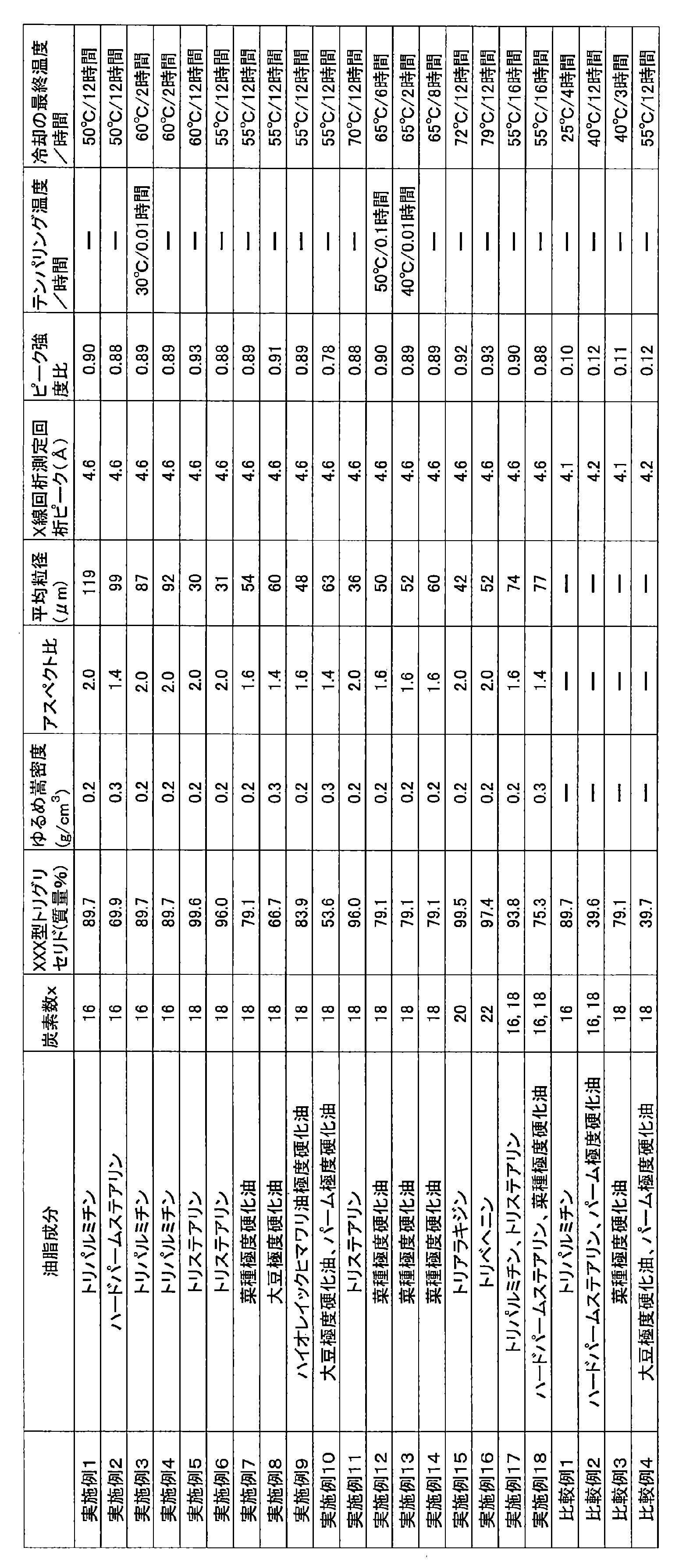
次に、食品に関する実施例および比較例を挙げ、本発明を更に詳しく説明するが、本発明はこれらに何ら制限されるものではない。
<原料油脂>
(1)粉末油脂組成物A
1位~3位にステアリン酸残基(炭素数18)を有するトリグリセリド(XXX型:79.1質量%、菜種極度硬化油、横関油脂工業株式会社製)25gを80℃にて0.5時間維持して完全に融解し、60℃恒温槽にて12時間冷却し、体積が増加した空隙を有する固形物を形成させ、結晶化を完了させた後、室温(25℃)状態まで冷却した。得られた固形物をハンマーミルで粉砕することで粉末状の結晶組成物(ゆるめ嵩密度:0.2g/cm3、アスペクト比1.6、平均粒径14.4μm、X線回折測定回析ピーク:4.6Å、ピーク強度比:0.89)を得た。この粉末油脂組成物Aを用いた。
(2)菜種極度硬化油
1位~3位にステアリン酸残基(炭素数18)を有するトリグリセリド(XXX型:79.1質量%、菜種極度硬化油、横関油脂工業株式会社製)を用いた。前記菜種極度硬化油は、上記粉末油脂組成物を原料であって、上記80℃で溶融状態とする前の固体状のものを乳鉢で摺り潰したもの(平均粒径129μm)であり、β型油脂をふくまず、粉末状ではない。
チョコレート及びハードバターの実施例における、レシチン(日清オイリオグループ株式会社製)、カカオマス(大東カカオ株式会社製)、全脂粉乳(よつ葉乳業株式会社製)、砂糖(株式会社徳倉製)はいずれも、市販されているものを用いた。
ハイオレイックヒマワリ油8.8質量部、パームステアリン(ヨウ素価36)48.4質量部、大豆油の極度硬化油18.8質量部及びパーム油24.0質量部を混合した。得られた混合油(パルミチン酸40.9質量%、ステアリン酸20.0質量%、オレイン酸30.6質量%、リノール酸6.3質量%、リノレン酸0.2質量%、トランス型脂肪酸0質量%)を、ナトリウムメチラートを触媒としてランダムエステル交換することにより、エステル交換油脂を得た。得られたエステル交換油脂を37±1℃でドライ分別し、高融点部を除去することで低融点部を得た。得られた低融点部を1±1℃でアセトン分別し、低融点部を除去することで高融点部(ヨウ素価32)を得た。得られた高融点部を常法に従って精製し、これを実施例で用いるハードバターAとした。
<改良ハードバターの製造>
下記表3の配合に従って、実施例19~21の改良ハードバター及び比較例5のハードバターを製造した。より詳細には、上記ハードバターAを60℃で一旦溶解し、次いで45℃で調温した後、上記粉末油脂組成物Aを、前記ハードバター100質量%に対して1質量%、3質量%及び5質量%もしくは0質量%となるように添加して、ミキサー(万能混合撹拌機8XDML:DALTON社製)で45℃を維持するように加熱しながら約30分間均質化した。これにより、実施例19~21の改良ハードバター及び比較例5のハードバターを製造した。

実施例19~21の改良ハードバター及び比較例5のハードバターの固体脂含量を、SFC測定装置(製品名:Minispec MQ-20、Bruker Optics社製)を用いて測定した。その結果を図8に示した。そして、「固化速度」の改善効果は、上記ハードバターの固体脂含量(SFC)に関する曲線から求めた。すなわち、45℃の状態にある試験対象のハードバターを、20℃に冷却した時を0分とし、5分おきに測定した。15分後における固体脂含量(SFC、ハードバターを100質量%としたときの固体脂の質量%)を測定し、SFCが高いものほど、固化速度が速いハードバターであると判断した。
<改良チョコレートの製造>
下記表4の配合に従って、実施例22~23の改良チョコレート及び比較例6~7のチョコレートを、テンパリングを行わない常法に従って、混合処理、微粒化(リファイニング)処理、精錬(コンチング)処理を経て、冷却固化することにより製造した。より詳細には、原料(カカオマス、ハードバターA、粉末油脂組成物A等)1000gをミキサー(万能混合撹拌機8XDML:DALTON社製)で60℃に加熱しながら均質になるように約5分間混合し、チョコレート生地を得た。得られたチョコレート生地をロールリファイナー(SDY型油圧式3本ロールミル:BUHLER社製)で磨り潰し、平均粒度が20μm程度になるまで微粒化した。リファイングしたチョコレート生地を、前記ミキサーにより20分以上かけて練り込み、液化後、油分を調整し、チョコレート原液とした。チョコレート原液を45℃に調温し、型に流し込み成形した後、チョコレート原液を10~20℃で冷却固化して上記チョコレートを得た。
なお、実施例22は、粉末油脂組成物Aがチョコレート中の油分に対して1質量%添加されたものであり、実施例23は、粉末油脂組成物Aがチョコレート中の油分に対して5質量%添加されたものである。また、比較例6は、粉末油脂組成物Aが全く添加されていない通常のチョコレートであり、比較例7は、粉末油脂組成物の代わりに菜種極度硬化油がチョコレート中の油分に対して1質量%添加されたものである。

上記で得たチョコレートを用いて口溶け感の評価を行った。専門パネラー5名がチョコレートを食して、得られたチョコレートの口溶けについて、以下の基準に従い評価した。評価結果は表4に示した。
○:口溶けがよく、口残り(ざらつき感)が感じられなかった。
△:口溶けがよく、口残り(ざらつき感)がほとんど感じられなかった。
×:口溶けがわるく、口残り(ざらつき感)がかなり感じられた。
チョコレートを15℃の温度で12時間、更に25℃の温度で12時間置き、これを1サイクルとする周期的な温度変化をかけて、19サイクル保存した。そして、19サイクル終了時に、目視によりブルームの発生を評価した。
○:ブルームの発生が確認されなかった。
×:ブルームの発生が確認された。
上記で製造したチョコレートを融解させて、透明なポリカーボネート製の型(167mm×84mm×11mm)に120gを充填し、7℃の冷蔵庫に入れて成型した。なお、成型に用いたポリカーボネート製の型の底面は升目状(167mm×84mmの上面が開放)になっており、升目の総数は30(5×6)マスである。成型したチョコレートの離型率は、冷却開始から5分後毎にチョコレートの剥離した升目(チョコレートが剥離すると升目の中で浮き上がって見える)を目視で数えて、下記の数式で算出した。離型をし始める時間と、離型率が90%以上になる時間を測定し、その結果を図9に示した。なお、離型性は、チョコレートの生産性の目安となる。離型率が90%以上になる時間が20分以下である場合、チョコレートの離型性(型抜け)は良好であり、生産性が良いと判断した。
離型率(%)= 剥離した升目の数 / 升目の総数 × 100
実施例22~23の改良チョコレート及び比較例6~7のチョコレートにおける固体脂含量を、SFC測定装置(製品名:Minispec MQ-20、Bruker Optics社製)を用いて測定した。10℃で固められたチョコレートを前記SFC測定装置に入れて温度を上げながら、20℃、25℃におけるSFCを測定し、次いで、2.5℃温度が上がるたびにSFCを測定した。その結果を図10に示した。
チョコレートの「耐熱性」上昇効果は、上記チョコレートの固体脂含量(SFC)に関する曲線から求めた。すなわち、チョコレートが溶け切る直前の温度、例えば、SFCが10%となるときの温度が高いものほど、耐熱性が上昇したものであると判断した。
<実施例及び比較例の組成物の調製>
(1)実施例24~32で使用する粉末油脂組成物A
1位~3位にステアリン酸残基(炭素数18)を有するトリグリセリド(XXX型:79.1質量%、菜種極度硬化油、横関油脂工業株式会社製)25gを80℃にて0.5時間維持して完全に融解し、60℃恒温槽にて12時間冷却し、体積が増加した空隙を有する固形物を形成させ、結晶化を完了させた後、室温(25℃)状態まで冷却した。得られた固形物をハンマーミル(粉砕機)で粉砕し、粉末状の結晶組成物を得た。様々な平均粒径のものを得るため、この作業を9回繰り返し、その順番に従い、実施例24~32の粉末油脂組成物A(ゆるめ嵩密度:0.185~0.24g/cm3、アスペクト比1.6、平均粒径6.4~10.4μm、X線回折測定回析ピーク:4.6Å、ピーク強度比:0.89)を得た
(2)比較例8で使用する菜種極度硬化油
1位~3位にステアリン酸残基(炭素数18)を有するトリグリセリド(XXX型:79.1質量%、菜種極度硬化油、横関油脂工業株式会社製)25gを80℃にて0.5時間維持して完全に融解し、40℃恒温槽にて3時間冷却し、ハンマーミルで粉砕し、塊状の組成物(ゆるめ嵩密度:0.3g/cm3、アスペクト比1.4、平均粒径21.6μm、X線回折測定回析ピーク:4.1Å、ピーク強度比:0.11)を得た(比較例8はβ型油脂を含まない)。
(3)比較例9で使用するステアリン酸カルシウム
比較例9で使用するステアリン酸カルシウムとして、メルク株式会社製パーテックLUB CST(ゆるめ嵩密度:0.13g/cm3、アスペクト比1.4、平均粒径6.5μm)を準備した。
(4)比較例10で使用するパーム硬化油
パーム油硬化油(横関油脂工業株式会社製)を原料として、スプレークーラーによる噴霧冷却で油脂粉末(ゆるめ嵩密度:0.5g/cm3、アスペクト比1.0、平均粒径162μm)を得た。
付着力測定装置(株式会社ナノシーズ製 NS-C300-HK)を用いて、ステンレスプレート(寸法30mm×20mm)の表面上に上記実施例24~32及び比較例8~9の組成物を付着させ、遠心力により組成物をプレート上から分離させる実験を行った。より詳しくは、条件1又は2に従って段階的に遠心力を上げ、各遠心力にて1分間遠心分離を行い、その後、それぞれプレート上に残存している組成物の状態を画像で記録し、遠心する前の最初の状態と比較して残存率を計算した。縦軸に遠心力、横軸にプレート上の組成物の残存率をプロットし、残存率50%時の遠心力を付着力として算出した。なお、付着力測定の測定条件として以下の2種類を用いた。
条件1
遠心力1000、2000、4000、8000、12000、16000(G)
条件2
遠心力100、200、400、800、1600、3200、6400(G)

ガラスビーズ(アズワン株式会社製、型番BZ-01、寸法0.105~0.125mmφ)に上記実施例24及び比較例9の組成物を付着させ、電子顕微鏡にて観察した。図11はガラスビーズを100質量%とした場合に各組成物を1質量%付着させたものである。試験の結果、本発明の実施例24の粉末油脂組成物Aのコーティング特性が、比較例9のコーティング特性と同程度に優れていることがわかった。すなわち、本発明の粉末油脂組成物Aは周知の接着剤であるステアリン酸カルシウムに代替するものであることがわかった。
下記表7の配合表に従って、実施例33、比較例10及び参考例1の粉状物(下記粉粒体をコーティング剤で被覆したもの)を作成した。表7にある原材料を計量後、100mlビーカーに入れてよく混合し、粉粒体(上白糖、平均粒径100μm:三井製糖株式会社製)を粉末油脂組成物A又はパーム硬化油でコーティングして上記粉状物を製造した。室温(20℃)で30分間静置後、各ビーカーの中身をロート(口径:90mm、円錐部分の高さ:70mm、足径:10mm、足長:90mm)へ移し、ロートからすべての粉状物が落下するまでの時間(秒)を測定した。その評価結果を表8に示した。すべての粉状物が落下するまでの時間が短いほど、吸湿が抑制され、固結化が防止されていると理解することができる。


実施例33、比較例10及び参考例1の粉状物について、表7の配合に従って再び、各原料を計量後、ビーカーに入れて混合し、製造した。室温20℃で1日、4日、7日静置後(保存試験後)、各々のビーカーを手で持ち、左右に6回軽く振った時の状態を下記の評価方法に従って目視により観察した。その保存試験の結果を表9に示す。
5:固まらず、サラサラしている。
4:粉状物全体100質量%に対し、10~30質量%が固まっている。
3:粉状物全体100質量%に対し、30~60質量%固まっている。
2:粉状物全体100質量%に対し、60~90質量%固まっている。
1:ほとんど固まっている。

Claims (34)
- グリセリンの1位~3位に炭素数xの脂肪酸残基Xを有する1種以上のXXX型トリグリセリドを含む油脂成分を含有する粉末油脂組成物であって、前記炭素数xは10~22から選択される整数であり、前記油脂成分がβ型油脂を含み、前記粉末油脂組成物の粒子は板状形状を有し、前記粉末油脂組成物のゆるめ嵩密度が0.05~0.6g/cm3であることを特徴とする、粉末油脂組成物。
- 前記油脂成分がβ型油脂からなる、請求項1に記載の粉末油脂組成物。
- 前記XXX型トリグリセリドが、前記油脂成分の全質量を100質量%とした場合、50質量%以上含有する、請求項1又は2に記載の粉末油脂組成物。
- 前記炭素数xが16~18から選択される整数である、請求項1~3のいずれか1項に記載の粉末油脂組成物。
- 前記粉末油脂組成物のゆるめ嵩密度が、0.1~0.4g/cm3である、請求項1~4のいずれか1項に記載の粉末油脂組成物。
- 前記粉末油脂組成物の板状形状が、1.1以上のアスペクト比を有する、請求項1~5のいずれかに記載の粉末油脂組成物。
- 前記粉末油脂組成物が、示差走査熱量測定法によってα型油脂が検出されない、請求項1~6のいずれか1項に記載の粉末油脂組成物。
- 前記粉末油脂組成物が、X線回折測定において4.5~4.7Åに回析ピークを有する、請求項1~7のいずれか1項に記載の粉末油脂組成物。
- 前記粉末油脂組成物のX線回折測定におけるピーク強度比(4.6Åのピーク強度/(4.6Åのピーク強度+4.2Åのピーク強度))が0.2以上である、請求項1~8のいずれか1項に記載の粉末油脂組成物。
- 前記粉末油脂組成物が、XXX型トリグリセリドを含む油脂組成物原料を、下記式から得られる冷却温度以上に保ち、冷却固化して得たβ型油脂を含有する、請求項1~9のいずれか1項に記載の粉末油脂組成物。
冷却温度(℃) = 炭素数x × 6.6 ― 68 - 前記粉末油脂組成物が、XXX型トリグリセリドを含む油脂組成物原料を、前記β型油脂に対応するα型油脂の融点以上の温度に保ち、冷却固化して得たβ型油脂を含有する、請求項1~9のいずれか1項に記載の粉末油脂組成物。
- グリセリンの1位~3位に炭素数xの脂肪酸残基Xを有する1種以上のXXX型トリグリセリドを含む油脂成分を含有する粉末油脂組成物であって、前記炭素数xは10~22から選択される整数であり、前記油脂成分の少なくとも一部はβ型油脂であり、前記粉末油脂組成物の粒子は板状形状を有し、前記粉末油脂組成物のゆるめ嵩密度が0.05~0.6g/cm3であることを特徴とする、粉末油脂組成物の製造方法であって、
以下の工程、
(a)XXX型トリグリセリドを含む油脂組成物原料を準備する工程、
(d)前記油脂組成物原料を冷却固化して、β型油脂を含有し、その粒子形状が板状である粉末油脂組成物を得る工程、
を含む、粉末油脂組成物の製造方法。 - 工程(b)として、工程(a)で得られた油脂組成物原料を加熱し、前記油脂組成物原料中に含まれるトリグリセリドを溶解して溶融状態の前記油脂組成物原料を得る工程を含む、請求項12に記載の方法。
- 工程(d)の前に、(c1)シーディング工程、(c2)テンパリング工程、及び/又は(c3)予備冷却工程を含む、請求項12または13に記載の方法であって、前記(c1)シーディング工程は、前記工程(d)の冷却中に前記β型油脂を、前記油脂組成物原料100質量部に対して0.1~1質量部加えることを含み、前記(c2)テンパリング工程は、工程(d)の冷却の前に、当該工程(d)の冷却温度よりも低い温度に温度を維持する工程を含み、前記(c3)予備冷却工程は、前記工程(d)で使用する溶融状態の油脂組成物を、前記工程(d)の冷却温度よりも高い温度で予備冷却する工程を含む、方法。
- 前記工程(d)で得られる粉末油脂組成物が、工程(d)の冷却後に得られる固形物を粉砕して粉末油脂組成物を得る工程(e)によって得られたものである、請求項12~14のいずれか1項に記載の方法。
- 前記XXX型トリグリセリドが前記油脂成分の全質量を100質量%とした場合、50質量%以上含有する、請求項12~15のいずれか1項に記載の方法。
- 前記炭素数xが16~18から選択される整数である、請求項12~16のいずれか1項に記載の方法。
- 工程(d)の冷却が、下記式から得られる冷却温度以上の温度で行われる、請求項12~17のいずれか1項に記載の方法。
冷却温度(℃) = 炭素数x × 6.6 ― 68 - 工程(d)の冷却が、前記β型油脂に対応するα型結晶の融点以上の温度で行われる、請求項12~17のいずれか1項に記載の方法。
- グリセリンの1位~3位に炭素数xの脂肪酸残基Xを有する1種以上のXXX型トリグリセリドを含むβ型油脂であって、前記炭素数xは10~22から選択される整数であり、前記β型油脂の粒子が板状形状を有し、X線回折測定において4.5~4.7Åに回析ピークを有することを特徴とする、β型油脂。
- 請求項1~11のいずれか1項に記載の粉末油脂組成物を含有する、食品。
- 前記食品全体100質量%に対し、前記粉末油脂組成物を0.1~99質量%含有してなる、請求項21に記載の食品。
- 前記粉末油脂組成物を溶融状態で含有する、請求項21又は22に記載の食品。
- 請求項1~11のいずれか1項に記載の粉末油脂組成物を配合する、食品の製造方法。
- 前記食品全体100質量%に対し、前記粉末油脂組成物を0.1~99質量%配合する、請求項24に記載の食品の製造方法。
- 請求項1~11のいずれか1項に記載の粉末油脂組成物を有効成分とする、食品用品質改良剤。
- 請求項1~11のいずれか1項に記載の粉末油脂組成物を含有する、接着剤。
- 前記接着剤全体100質量%に対し、前記粉末油脂組成物を1~99質量%含有してなる、請求項27に記載の接着剤。
- 請求項1~11のいずれか1項に記載の粉末油脂組成物を配合する、接着剤の製造方法。
- 前記接着剤全体100質量%に対し、前記粉末油脂組成物を1~99質量%配合する、請求項29に記載の接着剤の製造方法。
- 請求項1~11のいずれか1項に記載の粉末油脂組成物を含有する、コーティング剤。
- 前記コーティング剤全体100質量%に対し、前記粉末油脂組成物を1~99質量%含有してなる、請求項31に記載のコーティング剤。
- 請求項1~11のいずれか1項に記載の粉末油脂組成物を配合する、コーティング剤の製造方法。
- 前記コーティング剤全体100質量%に対し、前記粉末油脂組成物を1~99質量%配合する、請求項33に記載のコーティング剤の製造方法。
Priority Applications (4)
| Application Number | Priority Date | Filing Date | Title |
|---|---|---|---|
| CN201680055298.3A CN108024550B (zh) | 2015-09-24 | 2016-09-23 | 粉末油脂组合物和其制造方法 |
| EP16848698.3A EP3354138B1 (en) | 2015-09-24 | 2016-09-23 | Powdery fat or oil composition and method for producing same |
| JP2017540935A JP6529597B2 (ja) | 2015-09-24 | 2016-09-23 | 粉末油脂組成物及びその製造方法 |
| US15/762,971 US11147285B2 (en) | 2015-09-24 | 2016-09-23 | Powdery fat or oil composition and method for producing same |
Applications Claiming Priority (2)
| Application Number | Priority Date | Filing Date | Title |
|---|---|---|---|
| JP2015187271 | 2015-09-24 | ||
| JP2015-187271 | 2015-09-24 |
Publications (1)
| Publication Number | Publication Date |
|---|---|
| WO2017051910A1 true WO2017051910A1 (ja) | 2017-03-30 |
Family
ID=58386723
Family Applications (1)
| Application Number | Title | Priority Date | Filing Date |
|---|---|---|---|
| PCT/JP2016/078122 Ceased WO2017051910A1 (ja) | 2015-09-24 | 2016-09-23 | 粉末油脂組成物及びその製造方法 |
Country Status (5)
| Country | Link |
|---|---|
| US (1) | US11147285B2 (ja) |
| EP (1) | EP3354138B1 (ja) |
| JP (1) | JP6529597B2 (ja) |
| CN (1) | CN108024550B (ja) |
| WO (1) | WO2017051910A1 (ja) |
Cited By (21)
| Publication number | Priority date | Publication date | Assignee | Title |
|---|---|---|---|---|
| WO2018056415A1 (ja) * | 2016-09-23 | 2018-03-29 | 日清オイリオグループ株式会社 | 粉末油脂含有接着性組成物及びその製造方法 |
| WO2018164202A1 (ja) * | 2017-03-08 | 2018-09-13 | 日清オイリオグループ株式会社 | 乳化用粉末油脂組成物および乳化組成物 |
| WO2018174201A1 (ja) * | 2017-03-23 | 2018-09-27 | 日清オイリオグループ株式会社 | 粉末油脂組成物及びその製造方法 |
| WO2018174204A1 (ja) * | 2017-03-23 | 2018-09-27 | 日清オイリオグループ株式会社 | 離水防止用粉末油脂組成物 |
| WO2018174203A1 (ja) * | 2017-03-23 | 2018-09-27 | 日清オイリオグループ株式会社 | 製菓製パン用粉末油脂組成物 |
| JP2019154420A (ja) * | 2018-03-09 | 2019-09-19 | 日清オイリオグループ株式会社 | 粉末油脂組成物付着パン粉、及びそれを用いた油ちょう済食品 |
| JP2019170240A (ja) * | 2018-03-28 | 2019-10-10 | 日清オイリオグループ株式会社 | チョコレート |
| JP2019178242A (ja) * | 2018-03-30 | 2019-10-17 | 日清オイリオグループ株式会社 | 油中分散剤、油中分散用組成物、及び油中水滴型分散体 |
| JP2019187347A (ja) * | 2018-04-27 | 2019-10-31 | 日清オイリオグループ株式会社 | 可塑性油脂組成物およびその製造方法 |
| JP2019187383A (ja) * | 2018-04-27 | 2019-10-31 | 日清オイリオグループ株式会社 | トッピング用粉末油脂組成物 |
| JP2020010614A (ja) * | 2018-07-13 | 2020-01-23 | 日清オイリオグループ株式会社 | 可塑性油脂組成物 |
| JP2020010677A (ja) * | 2018-07-05 | 2020-01-23 | 日清オイリオグループ株式会社 | 麺皮食品 |
| WO2020026946A1 (ja) * | 2018-07-31 | 2020-02-06 | 日清オイリオグループ株式会社 | ソフトカプセル充填用組成物、及びそれを充填したソフトカプセル |
| JP2020164684A (ja) * | 2019-03-29 | 2020-10-08 | 日清オイリオグループ株式会社 | ワックス用粉末油脂組成物およびワックス組成物 |
| JP2021048814A (ja) * | 2019-09-26 | 2021-04-01 | 日清オイリオグループ株式会社 | 可塑性油脂組成物 |
| WO2021241351A1 (ja) * | 2020-05-28 | 2021-12-02 | 大阪瓦斯株式会社 | 3-ヒドロキシ酪酸含有油脂組成物 |
| JP2022527095A (ja) * | 2019-03-28 | 2022-05-30 | カーギル インコーポレイテッド | 結晶性脂肪を含むショートニング |
| WO2022230559A1 (ja) | 2021-04-30 | 2022-11-03 | 日清オイリオグループ株式会社 | 粉末油脂組成物の製造方法 |
| JPWO2022254764A1 (ja) * | 2021-06-01 | 2022-12-08 | ||
| JP2022191595A (ja) * | 2021-06-16 | 2022-12-28 | 日清オイリオグループ株式会社 | 油性食品 |
| JP2023044533A (ja) * | 2021-09-17 | 2023-03-30 | 日清オイリオグループ株式会社 | 食品組成物 |
Families Citing this family (7)
| Publication number | Priority date | Publication date | Assignee | Title |
|---|---|---|---|---|
| KR102511744B1 (ko) | 2014-07-22 | 2023-03-20 | 닛신 오일리오그룹 가부시키가이샤 | 분말 유지 조성물, 분말 유지 조성물을 포함하는 식품 및 이들의 제조 방법 |
| JP6529597B2 (ja) | 2015-09-24 | 2019-06-12 | 日清オイリオグループ株式会社 | 粉末油脂組成物及びその製造方法 |
| US11219224B2 (en) | 2016-01-21 | 2022-01-11 | The Nisshin Oillio Group, Ltd. | Thickener for liquid component |
| WO2017126665A1 (ja) | 2016-01-21 | 2017-07-27 | 日清オイリオグループ株式会社 | 液状成分の粉末化剤 |
| US11241020B2 (en) | 2016-01-21 | 2022-02-08 | The Nisshin Oillio Group, Ltd. | Powderizing agent for liquid component |
| US11246322B2 (en) | 2016-01-21 | 2022-02-15 | The Nisshin Oillio Group, Ltd. | Thickener for liquid component |
| CN111227057B (zh) * | 2018-11-29 | 2023-06-16 | 丰益(上海)生物技术研发中心有限公司 | 含豆粉的植脂末及其制备方法 |
Citations (4)
| Publication number | Priority date | Publication date | Assignee | Title |
|---|---|---|---|---|
| JPS5271390A (en) * | 1975-12-09 | 1977-06-14 | Dynamit Nobel Ag | Coagulation accelerator and coagulation acceleration of fats or fat containing drugs |
| JP2009249614A (ja) * | 2008-04-11 | 2009-10-29 | J-Oil Mills Inc | 油脂の分別方法 |
| JP2015070837A (ja) * | 2013-09-06 | 2015-04-16 | 日清オイリオグループ株式会社 | チョコレート |
| WO2016013582A1 (ja) * | 2014-07-22 | 2016-01-28 | 日清オイリオグループ株式会社 | 粉末油脂組成物、粉末油脂組成物を含む食品及びこれらの製造方法 |
Family Cites Families (57)
| Publication number | Priority date | Publication date | Assignee | Title |
|---|---|---|---|---|
| GB879211A (en) | 1958-06-20 | 1961-10-04 | Bibby & Sons Ltd J | Improvements in or relating to glyceride esters |
| GB1316079A (en) | 1971-07-20 | 1973-05-09 | Procter & Gamble | Hard butter comprising randomly esterified triglycerides of c12 nad c16-18 fatty acids |
| US3796816A (en) | 1972-07-05 | 1974-03-12 | Scm Corp | Hard butter compositions from non-randomized triglycerides |
| DE2832636C2 (de) | 1978-07-25 | 1986-01-16 | Walter Rau Lebensmittelwerke GmbH & Co. KG, 4517 Hilter | Fettkompositionen mit einem Gehalt an einem Triglyceridgemisch auf Basis von Fettsäuren mit 8 und 10 Kohlenstoffatomen und einem Zusatz an hochschmelzenden Fetten und ihre Verwendung |
| GB2178752B (en) | 1985-07-12 | 1989-10-11 | Unilever Plc | Substitute milk fat |
| US4877636A (en) | 1986-11-11 | 1989-10-31 | Meiji Seika Kaisha, Ltd. | Chocolate and chocolate additive |
| JPS63240745A (ja) | 1986-11-11 | 1988-10-06 | Meiji Seika Kaisha Ltd | チョコレート添加剤 |
| JPH0827B2 (ja) | 1989-05-13 | 1996-01-10 | 月島食品工業株式会社 | 可塑性油脂及びその製造法 |
| JP2809804B2 (ja) * | 1990-03-30 | 1998-10-15 | 株式会社クラレ | 皮革様シート状物 |
| DE69206099T3 (de) | 1991-10-03 | 2000-01-20 | Unilever N.V., Rotterdam | Nicht-temperiertes Fett für Süsswaren. |
| JPH05137506A (ja) | 1991-11-22 | 1993-06-01 | Taiyo Kagaku Co Ltd | 粉末油脂およびその製造方法 |
| JPH0633087A (ja) | 1992-07-17 | 1994-02-08 | Nippon Oil & Fats Co Ltd | 粉末油脂組成物 |
| JPH06245700A (ja) | 1993-02-23 | 1994-09-06 | Snow Brand Milk Prod Co Ltd | 消化吸収性を低減した油脂組成物 |
| JP2700377B2 (ja) | 1993-10-28 | 1998-01-21 | 日清製油株式会社 | 有機液体のゲル化又は固化剤 |
| JP2646422B2 (ja) | 1993-12-10 | 1997-08-27 | 日清製油株式会社 | 有機液状物のゲル化又は固化剤 |
| JPH0827A (ja) | 1994-06-24 | 1996-01-09 | Kubota Corp | 田植機 |
| JP3083967B2 (ja) | 1995-02-06 | 2000-09-04 | 明治製菓株式会社 | 可溶性粉末チョコレートおよびその製造方法 |
| US6090598A (en) | 1997-01-30 | 2000-07-18 | Fuji Oil Company, Limited | Enzymatic process for interesterification of fats and oils using distillation |
| JPH10295307A (ja) | 1997-04-21 | 1998-11-10 | Snow Brand Food Co Ltd | ミルフィーユ用クリーム粉末ミックス |
| IL129086A0 (en) | 1999-03-22 | 2000-02-17 | Enzymotec Ltd | Surfactant-lipase complex immobilized on insoluble matrix |
| JP3817450B2 (ja) | 2001-08-03 | 2006-09-06 | 明治製菓株式会社 | 粉末チョコレートとその製造方法及びそれを含有した飲食物 |
| JP2003135001A (ja) | 2001-11-02 | 2003-05-13 | Nisshin Oillio Ltd | 食用油脂及びそれを用いた乳化油脂組成物 |
| EP1642959B1 (en) | 2003-07-09 | 2010-05-19 | The Nisshin OilliO Group, Ltd. | Process for producing symmetrical triglyceride |
| JP2005073610A (ja) | 2003-09-01 | 2005-03-24 | Ezaki Glico Co Ltd | 含気チョコレートおよびその製造方法 |
| JP2005350660A (ja) * | 2004-05-10 | 2005-12-22 | Asahi Denka Kogyo Kk | 可塑性油脂組成物 |
| JP2006000087A (ja) | 2004-06-21 | 2006-01-05 | Sanei Gen Ffi Inc | 粉末製剤 |
| ES2367436T3 (es) | 2005-10-21 | 2011-11-03 | KRAFT FOODS R & D, INC. | Producto de confitería que comprende un mejorador de manteca de cacao. |
| JP4648855B2 (ja) | 2006-03-09 | 2011-03-09 | 理研ビタミン株式会社 | 含気チョコレート |
| JP4627513B2 (ja) | 2006-04-27 | 2011-02-09 | ミヨシ油脂株式会社 | 粉末油脂 |
| US20080089981A1 (en) | 2006-10-17 | 2008-04-17 | N.V. Nutricia | Ketogenic diet |
| JP5435441B2 (ja) | 2007-02-16 | 2014-03-05 | 三栄源エフ・エフ・アイ株式会社 | 咀嚼・嚥下困難者用ゲル化剤 |
| WO2008104381A1 (en) | 2007-02-28 | 2008-09-04 | Loders Croklaan B.V. | Process for producing a glyceride composition |
| ES2674369T3 (es) | 2007-04-02 | 2018-06-29 | Nestec S.A. | Composiciones alimenticias que incorporan triglicéridos de cadena media |
| TWI441915B (zh) | 2007-09-07 | 2014-06-21 | Nisshin Oillio Group Ltd | 1,3-二飽和-2-不飽和三酸甘油酯的區分方法 |
| GB0723255D0 (en) | 2007-11-28 | 2008-01-09 | Barry Callebaut Ag | Process and product |
| WO2009081777A1 (ja) | 2007-12-26 | 2009-07-02 | The Nisshin Oillio Group, Ltd. | 油脂組成物とその製造方法及びチョコレート類とその製造方法 |
| CA2741842C (en) | 2008-11-06 | 2015-12-29 | The Nisshin Oillio Group, Ltd. | Concentrated liquid diet |
| ATE509529T1 (de) | 2008-11-19 | 2011-06-15 | Nestec Sa | Feste ölpulver |
| JP5557457B2 (ja) | 2009-03-06 | 2014-07-23 | 日清オイリオグループ株式会社 | 油脂の製造方法 |
| WO2011134627A1 (en) | 2010-04-30 | 2011-11-03 | Loders Croklaan B.V. | Edible oil composition |
| CN103188944B (zh) | 2010-09-27 | 2015-12-16 | 日清奥利友集团株式会社 | 油脂组合物及其制造方法 |
| KR101732766B1 (ko) | 2011-03-04 | 2017-05-04 | 닛신 오일리오그룹 가부시키가이샤 | 유지 조성물 및 그 유지 조성물을 이용한 버터크림, 및 이들의 제조 방법 |
| WO2012169457A1 (ja) | 2011-06-06 | 2012-12-13 | 日清オイリオグループ株式会社 | 油脂の分別方法 |
| JP5995413B2 (ja) | 2011-06-07 | 2016-09-21 | 日清オイリオグループ株式会社 | 油脂組成物及び該油脂組成物を用いた含気泡チョコレート |
| JP5756074B2 (ja) | 2012-11-02 | 2015-07-29 | 日清オイリオグループ株式会社 | 耐熱性チョコレート及び耐熱性チョコレートの製造方法 |
| JP5601432B1 (ja) | 2012-12-06 | 2014-10-08 | 不二製油株式会社 | 粉末油脂及びその製造法と、それを用いたチョコレート様食品 |
| JP6222921B2 (ja) | 2012-12-25 | 2017-11-01 | 日清オイリオグループ株式会社 | ホイップして使用されるチョコレート |
| JP6085217B2 (ja) | 2013-04-25 | 2017-02-22 | 上野製薬株式会社 | 粉末状油脂 |
| EP2839750B1 (en) | 2013-08-22 | 2018-01-03 | Loders Croklaan B.V. | Fat composition |
| US20180042259A1 (en) | 2015-02-26 | 2018-02-15 | The Nisshin Oillio Group, Ltd. | Powdered fat composition for chocolate |
| EP3262950A4 (en) | 2015-02-26 | 2018-10-24 | The Nisshin OilliO Group, Ltd. | Powdered chocolate |
| WO2016136808A1 (ja) | 2015-02-26 | 2016-09-01 | 日清オイリオグループ株式会社 | クリーム類用粉末油脂組成物 |
| JP6529597B2 (ja) | 2015-09-24 | 2019-06-12 | 日清オイリオグループ株式会社 | 粉末油脂組成物及びその製造方法 |
| US11219224B2 (en) | 2016-01-21 | 2022-01-11 | The Nisshin Oillio Group, Ltd. | Thickener for liquid component |
| WO2017126665A1 (ja) | 2016-01-21 | 2017-07-27 | 日清オイリオグループ株式会社 | 液状成分の粉末化剤 |
| US11241020B2 (en) | 2016-01-21 | 2022-02-08 | The Nisshin Oillio Group, Ltd. | Powderizing agent for liquid component |
| US11246322B2 (en) | 2016-01-21 | 2022-02-15 | The Nisshin Oillio Group, Ltd. | Thickener for liquid component |
-
2016
- 2016-09-23 JP JP2017540935A patent/JP6529597B2/ja active Active
- 2016-09-23 US US15/762,971 patent/US11147285B2/en active Active
- 2016-09-23 EP EP16848698.3A patent/EP3354138B1/en active Active
- 2016-09-23 CN CN201680055298.3A patent/CN108024550B/zh active Active
- 2016-09-23 WO PCT/JP2016/078122 patent/WO2017051910A1/ja not_active Ceased
Patent Citations (4)
| Publication number | Priority date | Publication date | Assignee | Title |
|---|---|---|---|---|
| JPS5271390A (en) * | 1975-12-09 | 1977-06-14 | Dynamit Nobel Ag | Coagulation accelerator and coagulation acceleration of fats or fat containing drugs |
| JP2009249614A (ja) * | 2008-04-11 | 2009-10-29 | J-Oil Mills Inc | 油脂の分別方法 |
| JP2015070837A (ja) * | 2013-09-06 | 2015-04-16 | 日清オイリオグループ株式会社 | チョコレート |
| WO2016013582A1 (ja) * | 2014-07-22 | 2016-01-28 | 日清オイリオグループ株式会社 | 粉末油脂組成物、粉末油脂組成物を含む食品及びこれらの製造方法 |
Non-Patent Citations (1)
| Title |
|---|
| See also references of EP3354138A4 * |
Cited By (37)
| Publication number | Priority date | Publication date | Assignee | Title |
|---|---|---|---|---|
| WO2018056415A1 (ja) * | 2016-09-23 | 2018-03-29 | 日清オイリオグループ株式会社 | 粉末油脂含有接着性組成物及びその製造方法 |
| WO2018164202A1 (ja) * | 2017-03-08 | 2018-09-13 | 日清オイリオグループ株式会社 | 乳化用粉末油脂組成物および乳化組成物 |
| JP6398035B1 (ja) * | 2017-03-08 | 2018-09-26 | 日清オイリオグループ株式会社 | 乳化用粉末油脂組成物および乳化組成物 |
| WO2018174201A1 (ja) * | 2017-03-23 | 2018-09-27 | 日清オイリオグループ株式会社 | 粉末油脂組成物及びその製造方法 |
| WO2018174204A1 (ja) * | 2017-03-23 | 2018-09-27 | 日清オイリオグループ株式会社 | 離水防止用粉末油脂組成物 |
| WO2018174203A1 (ja) * | 2017-03-23 | 2018-09-27 | 日清オイリオグループ株式会社 | 製菓製パン用粉末油脂組成物 |
| JP2019154420A (ja) * | 2018-03-09 | 2019-09-19 | 日清オイリオグループ株式会社 | 粉末油脂組成物付着パン粉、及びそれを用いた油ちょう済食品 |
| JP7076905B2 (ja) | 2018-03-09 | 2022-05-30 | 日清オイリオグループ株式会社 | 粉末油脂組成物付着パン粉、及びそれを用いた油ちょう済食品 |
| JP7090982B2 (ja) | 2018-03-28 | 2022-06-27 | 日清オイリオグループ株式会社 | チョコレート |
| JP2019170240A (ja) * | 2018-03-28 | 2019-10-10 | 日清オイリオグループ株式会社 | チョコレート |
| JP2019178242A (ja) * | 2018-03-30 | 2019-10-17 | 日清オイリオグループ株式会社 | 油中分散剤、油中分散用組成物、及び油中水滴型分散体 |
| JP7114322B2 (ja) | 2018-04-27 | 2022-08-08 | 日清オイリオグループ株式会社 | 可塑性油脂組成物およびその製造方法 |
| JP2019187383A (ja) * | 2018-04-27 | 2019-10-31 | 日清オイリオグループ株式会社 | トッピング用粉末油脂組成物 |
| JP2019187347A (ja) * | 2018-04-27 | 2019-10-31 | 日清オイリオグループ株式会社 | 可塑性油脂組成物およびその製造方法 |
| JP2020010677A (ja) * | 2018-07-05 | 2020-01-23 | 日清オイリオグループ株式会社 | 麺皮食品 |
| JP2020010614A (ja) * | 2018-07-13 | 2020-01-23 | 日清オイリオグループ株式会社 | 可塑性油脂組成物 |
| JP7154694B2 (ja) | 2018-07-13 | 2022-10-18 | 日清オイリオグループ株式会社 | 可塑性油脂組成物 |
| WO2020026946A1 (ja) * | 2018-07-31 | 2020-02-06 | 日清オイリオグループ株式会社 | ソフトカプセル充填用組成物、及びそれを充填したソフトカプセル |
| JP2022527095A (ja) * | 2019-03-28 | 2022-05-30 | カーギル インコーポレイテッド | 結晶性脂肪を含むショートニング |
| US12389923B2 (en) | 2019-03-28 | 2025-08-19 | Cargill, Incorporated | Shortening with crystalline fat |
| JP7214322B2 (ja) | 2019-03-29 | 2023-01-30 | 日清オイリオグループ株式会社 | ワックス用粉末油脂組成物およびワックス組成物 |
| JP2020164684A (ja) * | 2019-03-29 | 2020-10-08 | 日清オイリオグループ株式会社 | ワックス用粉末油脂組成物およびワックス組成物 |
| JP2021048814A (ja) * | 2019-09-26 | 2021-04-01 | 日清オイリオグループ株式会社 | 可塑性油脂組成物 |
| JP7490300B2 (ja) | 2019-09-26 | 2024-05-27 | 日清オイリオグループ株式会社 | 可塑性油脂組成物 |
| WO2021241351A1 (ja) * | 2020-05-28 | 2021-12-02 | 大阪瓦斯株式会社 | 3-ヒドロキシ酪酸含有油脂組成物 |
| JP2021185799A (ja) * | 2020-05-28 | 2021-12-13 | 大阪瓦斯株式会社 | 3−ヒドロキシ酪酸含有油脂組成物 |
| WO2022230559A1 (ja) | 2021-04-30 | 2022-11-03 | 日清オイリオグループ株式会社 | 粉末油脂組成物の製造方法 |
| CN117320558A (zh) * | 2021-04-30 | 2023-12-29 | 日清奥利友集团株式会社 | 粉末油脂组合物的制造方法 |
| EP4331370A4 (en) * | 2021-04-30 | 2025-04-09 | The Nisshin Oillio Group, Ltd. | Method for producing powdered fat or oil composition |
| WO2022254764A1 (ja) * | 2021-06-01 | 2022-12-08 | 大阪瓦斯株式会社 | 3-ヒドロキシ酪酸含有油脂組成物 |
| EP4256966A4 (en) * | 2021-06-01 | 2024-12-11 | Osaka Gas Co., Ltd. | 3-hydroxybutyric-acid-containing oil and fat composition |
| JPWO2022254764A1 (ja) * | 2021-06-01 | 2022-12-08 | ||
| JP7757401B2 (ja) | 2021-06-01 | 2025-10-21 | 大阪瓦斯株式会社 | 3-ヒドロキシ酪酸含有油脂組成物 |
| JP2022191595A (ja) * | 2021-06-16 | 2022-12-28 | 日清オイリオグループ株式会社 | 油性食品 |
| JP7837651B2 (ja) | 2021-06-16 | 2026-03-31 | 日清オイリオグループ株式会社 | 油性食品 |
| JP2023044533A (ja) * | 2021-09-17 | 2023-03-30 | 日清オイリオグループ株式会社 | 食品組成物 |
| JP7772536B2 (ja) | 2021-09-17 | 2025-11-18 | 日清オイリオグループ株式会社 | 食品組成物 |
Also Published As
| Publication number | Publication date |
|---|---|
| JP6529597B2 (ja) | 2019-06-12 |
| CN108024550A (zh) | 2018-05-11 |
| JPWO2017051910A1 (ja) | 2018-09-20 |
| EP3354138A4 (en) | 2019-06-19 |
| US20180249729A1 (en) | 2018-09-06 |
| US11147285B2 (en) | 2021-10-19 |
| EP3354138A1 (en) | 2018-08-01 |
| EP3354138B1 (en) | 2023-07-12 |
| CN108024550B (zh) | 2021-11-26 |
Similar Documents
| Publication | Publication Date | Title |
|---|---|---|
| JP6529597B2 (ja) | 粉末油脂組成物及びその製造方法 | |
| JP6313917B1 (ja) | 粉末油脂含有接着性組成物及びその製造方法 | |
| JP6703882B2 (ja) | 油脂組成物及びそれを含む食品 | |
| JP6783018B2 (ja) | チョコレート用粉末油脂組成物 | |
| KR102352611B1 (ko) | 함수형 내열성 초콜릿의 제조방법, 함수형 내열성 초콜릿, 함수 초콜릿 반죽의 점도 상승 억제방법, 및 함수형 내열성 초콜릿중의 당골격 형성방법 | |
| JP5756074B2 (ja) | 耐熱性チョコレート及び耐熱性チョコレートの製造方法 | |
| JP6573403B2 (ja) | チョコレート用粉末油脂組成物 | |
| WO2018174201A1 (ja) | 粉末油脂組成物及びその製造方法 | |
| TWI626011B (zh) | grease | |
| JP7090982B2 (ja) | チョコレート | |
| JP7195695B2 (ja) | チョコレート | |
| JP7339108B2 (ja) | フレーク状又は粉末状チョコレートの製造方法 | |
| JP6957128B1 (ja) | チョコレート | |
| WO2020026946A1 (ja) | ソフトカプセル充填用組成物、及びそれを充填したソフトカプセル | |
| JP2020010614A (ja) | 可塑性油脂組成物 | |
| JP2019187383A (ja) | トッピング用粉末油脂組成物 | |
| JP7336882B2 (ja) | 餅とり粉用粉末油脂組成物、及び餅生地の硬化抑制剤。 | |
| JP2021048814A (ja) | 可塑性油脂組成物 | |
| JP7466986B2 (ja) | 油脂組成物 | |
| JP2018143190A (ja) | 含気泡油脂組成物 | |
| JP2018157782A (ja) | 餅類用粉末油脂組成物 | |
| JP6532830B2 (ja) | コーティング用粉末油脂組成物 | |
| JP2018093842A (ja) | 無洗米、および無洗米の製造方法 | |
| JP2018157780A (ja) | 麺皮用粉末油脂組成物 |
Legal Events
| Date | Code | Title | Description |
|---|---|---|---|
| 121 | Ep: the epo has been informed by wipo that ep was designated in this application |
Ref document number: 16848698 Country of ref document: EP Kind code of ref document: A1 |
|
| ENP | Entry into the national phase |
Ref document number: 2017540935 Country of ref document: JP Kind code of ref document: A |
|
| WWE | Wipo information: entry into national phase |
Ref document number: 15762971 Country of ref document: US |
|
| NENP | Non-entry into the national phase |
Ref country code: DE |
|
| WWE | Wipo information: entry into national phase |
Ref document number: 2016848698 Country of ref document: EP |