EP4190786B1 - Als atr-kinasehemmer nützliche verbindungen - Google Patents
Als atr-kinasehemmer nützliche verbindungen Download PDFInfo
- Publication number
- EP4190786B1 EP4190786B1 EP23153078.3A EP23153078A EP4190786B1 EP 4190786 B1 EP4190786 B1 EP 4190786B1 EP 23153078 A EP23153078 A EP 23153078A EP 4190786 B1 EP4190786 B1 EP 4190786B1
- Authority
- EP
- European Patent Office
- Prior art keywords
- compound
- cancer
- formula
- cell
- ring
- Prior art date
- Legal status (The legal status is an assumption and is not a legal conclusion. Google has not performed a legal analysis and makes no representation as to the accuracy of the status listed.)
- Active
Links
Classifications
-
- A—HUMAN NECESSITIES
- A61—MEDICAL OR VETERINARY SCIENCE; HYGIENE
- A61K—PREPARATIONS FOR MEDICAL, DENTAL OR TOILETRY PURPOSES
- A61K31/00—Medicinal preparations containing organic active ingredients
- A61K31/33—Heterocyclic compounds
- A61K31/395—Heterocyclic compounds having nitrogen as a ring hetero atom, e.g. guanethidine or rifamycins
- A61K31/495—Heterocyclic compounds having nitrogen as a ring hetero atom, e.g. guanethidine or rifamycins having six-membered rings with two or more nitrogen atoms as the only ring heteroatoms, e.g. piperazine or tetrazines
- A61K31/505—Pyrimidines; Hydrogenated pyrimidines, e.g. trimethoprim
- A61K31/519—Pyrimidines; Hydrogenated pyrimidines, e.g. trimethoprim ortho- or peri-condensed with heterocyclic rings
-
- A—HUMAN NECESSITIES
- A61—MEDICAL OR VETERINARY SCIENCE; HYGIENE
- A61P—SPECIFIC THERAPEUTIC ACTIVITY OF CHEMICAL COMPOUNDS OR MEDICINAL PREPARATIONS
- A61P1/00—Drugs for disorders of the alimentary tract or the digestive system
- A61P1/02—Stomatological preparations, e.g. drugs for caries, aphtae, periodontitis
-
- A—HUMAN NECESSITIES
- A61—MEDICAL OR VETERINARY SCIENCE; HYGIENE
- A61P—SPECIFIC THERAPEUTIC ACTIVITY OF CHEMICAL COMPOUNDS OR MEDICINAL PREPARATIONS
- A61P1/00—Drugs for disorders of the alimentary tract or the digestive system
- A61P1/04—Drugs for disorders of the alimentary tract or the digestive system for ulcers, gastritis or reflux esophagitis, e.g. antacids, inhibitors of acid secretion, mucosal protectants
-
- A—HUMAN NECESSITIES
- A61—MEDICAL OR VETERINARY SCIENCE; HYGIENE
- A61P—SPECIFIC THERAPEUTIC ACTIVITY OF CHEMICAL COMPOUNDS OR MEDICINAL PREPARATIONS
- A61P1/00—Drugs for disorders of the alimentary tract or the digestive system
- A61P1/16—Drugs for disorders of the alimentary tract or the digestive system for liver or gallbladder disorders, e.g. hepatoprotective agents, cholagogues, litholytics
-
- A—HUMAN NECESSITIES
- A61—MEDICAL OR VETERINARY SCIENCE; HYGIENE
- A61P—SPECIFIC THERAPEUTIC ACTIVITY OF CHEMICAL COMPOUNDS OR MEDICINAL PREPARATIONS
- A61P1/00—Drugs for disorders of the alimentary tract or the digestive system
- A61P1/18—Drugs for disorders of the alimentary tract or the digestive system for pancreatic disorders, e.g. pancreatic enzymes
-
- A—HUMAN NECESSITIES
- A61—MEDICAL OR VETERINARY SCIENCE; HYGIENE
- A61P—SPECIFIC THERAPEUTIC ACTIVITY OF CHEMICAL COMPOUNDS OR MEDICINAL PREPARATIONS
- A61P11/00—Drugs for disorders of the respiratory system
-
- A—HUMAN NECESSITIES
- A61—MEDICAL OR VETERINARY SCIENCE; HYGIENE
- A61P—SPECIFIC THERAPEUTIC ACTIVITY OF CHEMICAL COMPOUNDS OR MEDICINAL PREPARATIONS
- A61P13/00—Drugs for disorders of the urinary system
-
- A—HUMAN NECESSITIES
- A61—MEDICAL OR VETERINARY SCIENCE; HYGIENE
- A61P—SPECIFIC THERAPEUTIC ACTIVITY OF CHEMICAL COMPOUNDS OR MEDICINAL PREPARATIONS
- A61P13/00—Drugs for disorders of the urinary system
- A61P13/10—Drugs for disorders of the urinary system of the bladder
-
- A—HUMAN NECESSITIES
- A61—MEDICAL OR VETERINARY SCIENCE; HYGIENE
- A61P—SPECIFIC THERAPEUTIC ACTIVITY OF CHEMICAL COMPOUNDS OR MEDICINAL PREPARATIONS
- A61P15/00—Drugs for genital or sexual disorders; Contraceptives
-
- A—HUMAN NECESSITIES
- A61—MEDICAL OR VETERINARY SCIENCE; HYGIENE
- A61P—SPECIFIC THERAPEUTIC ACTIVITY OF CHEMICAL COMPOUNDS OR MEDICINAL PREPARATIONS
- A61P17/00—Drugs for dermatological disorders
-
- A—HUMAN NECESSITIES
- A61—MEDICAL OR VETERINARY SCIENCE; HYGIENE
- A61P—SPECIFIC THERAPEUTIC ACTIVITY OF CHEMICAL COMPOUNDS OR MEDICINAL PREPARATIONS
- A61P19/00—Drugs for skeletal disorders
-
- A—HUMAN NECESSITIES
- A61—MEDICAL OR VETERINARY SCIENCE; HYGIENE
- A61P—SPECIFIC THERAPEUTIC ACTIVITY OF CHEMICAL COMPOUNDS OR MEDICINAL PREPARATIONS
- A61P21/00—Drugs for disorders of the muscular or neuromuscular system
-
- A—HUMAN NECESSITIES
- A61—MEDICAL OR VETERINARY SCIENCE; HYGIENE
- A61P—SPECIFIC THERAPEUTIC ACTIVITY OF CHEMICAL COMPOUNDS OR MEDICINAL PREPARATIONS
- A61P25/00—Drugs for disorders of the nervous system
-
- A—HUMAN NECESSITIES
- A61—MEDICAL OR VETERINARY SCIENCE; HYGIENE
- A61P—SPECIFIC THERAPEUTIC ACTIVITY OF CHEMICAL COMPOUNDS OR MEDICINAL PREPARATIONS
- A61P35/00—Antineoplastic agents
-
- A—HUMAN NECESSITIES
- A61—MEDICAL OR VETERINARY SCIENCE; HYGIENE
- A61P—SPECIFIC THERAPEUTIC ACTIVITY OF CHEMICAL COMPOUNDS OR MEDICINAL PREPARATIONS
- A61P35/00—Antineoplastic agents
- A61P35/02—Antineoplastic agents specific for leukemia
-
- A—HUMAN NECESSITIES
- A61—MEDICAL OR VETERINARY SCIENCE; HYGIENE
- A61P—SPECIFIC THERAPEUTIC ACTIVITY OF CHEMICAL COMPOUNDS OR MEDICINAL PREPARATIONS
- A61P43/00—Drugs for specific purposes, not provided for in groups A61P1/00-A61P41/00
-
- A—HUMAN NECESSITIES
- A61—MEDICAL OR VETERINARY SCIENCE; HYGIENE
- A61P—SPECIFIC THERAPEUTIC ACTIVITY OF CHEMICAL COMPOUNDS OR MEDICINAL PREPARATIONS
- A61P5/00—Drugs for disorders of the endocrine system
-
- C—CHEMISTRY; METALLURGY
- C07—ORGANIC CHEMISTRY
- C07D—HETEROCYCLIC COMPOUNDS
- C07D401/00—Heterocyclic compounds containing two or more hetero rings, having nitrogen atoms as the only ring hetero atoms, at least one ring being a six-membered ring with only one nitrogen atom
- C07D401/02—Heterocyclic compounds containing two or more hetero rings, having nitrogen atoms as the only ring hetero atoms, at least one ring being a six-membered ring with only one nitrogen atom containing two hetero rings
- C07D401/04—Heterocyclic compounds containing two or more hetero rings, having nitrogen atoms as the only ring hetero atoms, at least one ring being a six-membered ring with only one nitrogen atom containing two hetero rings directly linked by a ring-member-to-ring-member bond
-
- C—CHEMISTRY; METALLURGY
- C07—ORGANIC CHEMISTRY
- C07D—HETEROCYCLIC COMPOUNDS
- C07D453/00—Heterocyclic compounds containing quinuclidine or iso-quinuclidine ring systems, e.g. quinine alkaloids
- C07D453/02—Heterocyclic compounds containing quinuclidine or iso-quinuclidine ring systems, e.g. quinine alkaloids containing not further condensed quinuclidine ring systems
-
- C—CHEMISTRY; METALLURGY
- C07—ORGANIC CHEMISTRY
- C07D—HETEROCYCLIC COMPOUNDS
- C07D471/00—Heterocyclic compounds containing nitrogen atoms as the only ring hetero atoms in the condensed system, at least one ring being a six-membered ring with one nitrogen atom, not provided for by groups C07D451/00 - C07D463/00
- C07D471/02—Heterocyclic compounds containing nitrogen atoms as the only ring hetero atoms in the condensed system, at least one ring being a six-membered ring with one nitrogen atom, not provided for by groups C07D451/00 - C07D463/00 in which the condensed system contains two hetero rings
- C07D471/08—Bridged systems
-
- C—CHEMISTRY; METALLURGY
- C07—ORGANIC CHEMISTRY
- C07D—HETEROCYCLIC COMPOUNDS
- C07D487/00—Heterocyclic compounds containing nitrogen atoms as the only ring hetero atoms in the condensed system, not provided for by groups C07D451/00 - C07D477/00
- C07D487/02—Heterocyclic compounds containing nitrogen atoms as the only ring hetero atoms in the condensed system, not provided for by groups C07D451/00 - C07D477/00 in which the condensed system contains two hetero rings
- C07D487/04—Ortho-condensed systems
-
- C—CHEMISTRY; METALLURGY
- C07—ORGANIC CHEMISTRY
- C07D—HETEROCYCLIC COMPOUNDS
- C07D487/00—Heterocyclic compounds containing nitrogen atoms as the only ring hetero atoms in the condensed system, not provided for by groups C07D451/00 - C07D477/00
- C07D487/02—Heterocyclic compounds containing nitrogen atoms as the only ring hetero atoms in the condensed system, not provided for by groups C07D451/00 - C07D477/00 in which the condensed system contains two hetero rings
- C07D487/08—Bridged systems
-
- C—CHEMISTRY; METALLURGY
- C07—ORGANIC CHEMISTRY
- C07D—HETEROCYCLIC COMPOUNDS
- C07D491/00—Heterocyclic compounds containing in the condensed ring system both one or more rings having oxygen atoms as the only ring hetero atoms and one or more rings having nitrogen atoms as the only ring hetero atoms, not provided for by groups C07D451/00 - C07D459/00, C07D463/00, C07D477/00 or C07D489/00
- C07D491/02—Heterocyclic compounds containing in the condensed ring system both one or more rings having oxygen atoms as the only ring hetero atoms and one or more rings having nitrogen atoms as the only ring hetero atoms, not provided for by groups C07D451/00 - C07D459/00, C07D463/00, C07D477/00 or C07D489/00 in which the condensed system contains two hetero rings
- C07D491/10—Spiro-condensed systems
- C07D491/107—Spiro-condensed systems with only one oxygen atom as ring hetero atom in the oxygen-containing ring
-
- C—CHEMISTRY; METALLURGY
- C07—ORGANIC CHEMISTRY
- C07D—HETEROCYCLIC COMPOUNDS
- C07D498/00—Heterocyclic compounds containing in the condensed system at least one hetero ring having nitrogen and oxygen atoms as the only ring hetero atoms
- C07D498/02—Heterocyclic compounds containing in the condensed system at least one hetero ring having nitrogen and oxygen atoms as the only ring hetero atoms in which the condensed system contains two hetero rings
- C07D498/04—Ortho-condensed systems
-
- C—CHEMISTRY; METALLURGY
- C07—ORGANIC CHEMISTRY
- C07D—HETEROCYCLIC COMPOUNDS
- C07D498/00—Heterocyclic compounds containing in the condensed system at least one hetero ring having nitrogen and oxygen atoms as the only ring hetero atoms
- C07D498/02—Heterocyclic compounds containing in the condensed system at least one hetero ring having nitrogen and oxygen atoms as the only ring hetero atoms in which the condensed system contains two hetero rings
- C07D498/10—Spiro-condensed systems
-
- C—CHEMISTRY; METALLURGY
- C07—ORGANIC CHEMISTRY
- C07D—HETEROCYCLIC COMPOUNDS
- C07D519/00—Heterocyclic compounds containing more than one system of two or more relevant hetero rings condensed among themselves or condensed with a common carbocyclic ring system not provided for in groups C07D453/00 or C07D455/00
Definitions
- ATR ATM and Rad3 related
- ATM and Rad3 related kinase is a protein kinase involved in cellular responses to certain forms of DNA damage (e.g., double strand breaks and replication stress).
- ATR kinase acts with ATM ("ataxia telangiectasia mutated") kinase and many other proteins to regulate a cell's response to double strand DNA breaks and replication stress, commonly referred to as the DNA Damage Response ("DDR").
- DDR DNA Damage Response
- the DDR stimulates DNA repair, promotes survival and stalls cell cycle progression by activating cell cycle checkpoints, which provide time for repair. Without the DDR, cells are much more sensitive to DNA damage and readily die from DNA lesions induced by endogenous cellular processes such as DNA replication or exogenous DNA damaging agents commonly used in cancer therapy.
- Healthy cells can rely on a host of different proteins for DNA repair including the DDR kinases ATR and ATM. In some cases these proteins can compensate for one another by activating functionally redundant DNA repair processes. On the contrary, many cancer cells harbour defects in some of their DNA repair processes, such as ATM signaling, and therefore display a greater reliance on their remaining intact DNA repair proteins which include ATR.
- ATR has been implicated as a critical component of the DDR in response to disrupted DNA replication. As a result, these cancer cells are more dependent on ATR activity for survival than healthy cells. Accordingly, ATR inhibitors may be useful for cancer treatment, either used alone or in combination with DNA damaging agents, because they shut down a DNA repair mechanism that is more important for cellular survival in many cancer cells than in healthy normal cells.
- ATR inhibitors may be effective both as single agents and as potent sensitizers to radiotherapy or genotoxic chemotherapy.
- ATR peptide can be expressed and isolated using a variety of methods known in the literature (see e.g., Ünsal-Ka maz et al, PNAS 99: 10, pp6673-6678, May 14, 2002 ; see also Kumagai et al. Cell 124, pp943-955, March 10, 2006 ; Unsal-Kacmaz et al. Molecular and Cellular Biology, Feb 2004, p1292-1300 ; and Hall-Jackson et al. Oncogene 1999, 18, 6707-6713 ).
- the present invention relates to compounds useful as inhibitors of ATR protein kinase.
- the invention also relates to pharmaceutically acceptable compositions comprising the compounds of this invention; methods of treating of various diseases, disorders, and conditions using the compounds of this invention; processes for preparing the compounds of this invention; intermediates for the preparation of the compounds of this invention; and methods of using the compounds in in vitro applications, such as the study of kinases in biological and pathological phenomena; the study of intracellular signal transduction pathways mediated by such kinases; and the comparative evaluation of new kinase inhibitors.
- the compounds of the invention are very potent ATR inhibitors. These compounds also show surprising synergy with other cancer agents, such as cisplatin and gemcitabine, in combination therapies.
- One aspect of the invention provides a compound of Formula I, as defined in the claims: or a pharmaceutically acceptable salt or prodrug thereof, wherein:
- the present invention is a compound of formula I, wherein R 9 is H.
- the present invention is a compound of formula I, wherein R 9 is M.
- the present invention is a compound of formula I, wherein M is a C 1-8 aliphatic wherein up to three methylene units are optionally replaced with -O- or -NR-.
- the present invention is a compound of formula I, wherein M is C 1-4 alkyl, - (C 1-4 alkyl)O(C 1-3 aliphatic), -(C 1-3 alkyl)OH, -O(C 1-4 alkyl)N(C 1-2 alkyl) 2 , -NH(C 1-4 alkyl), or - (C 1-4 alkyl)NH(C 1-4 alkyl).
- the present invention is a compound of formula I, wherein M is C 1-4 alkyl.
- the present invention is a compound of formula I, wherein J LM is halo.
- the present invention is a compound of formula I, wherein R 9 is -(L) k -W.
- the present invention is a compound of formula I, wherein k is 1. In other examples, the present invention is a compound of formula I, wherein k is 0.
- the present invention is a compound of formula I, wherein L is a C 1-8 aliphatic wherein up to three methylene units are optionally replaced with -O- or - NR-.
- the present invention is a compound of formula I, wherein L is -O-, -O(C1-4aliphatic)-, or -NR(C 1-3 alkyl)-.
- the present invention is a compound of formula I,
- the present invention is a compound of formula I, wherein W is a 7-12 membered fully saturated, partially unsaturated, or aromatic bicyclic ring having 0-5 heteroatoms selected from oxygen, nitrogen, or sulfur.
- the present invention is a compound of formula I, wherein W is octahydropyrrolo[1,2-a]pyrazine.
- the present invention is a compound of formula I, wherein J W is selected form C 1-3 alkyl or CF 3 .
- the present invention is a compound of formula I, wherein two occurrences of J W on the same atom, together with atom to which they are joined, form a 3-6 membered ring having 0-2 heteroatoms selected from oxygen, nitrogen, or sulfur.
- the present invention is a compound of formula I, wherein the ring formed by the two occurrences of J W on the same atom is oxetanyl.
- Another aspect of the invention provides a compound of Formula I-A: or a pharmaceutically acceptable salt or prodrug thereof, wherein:
- Another aspect of the invention provides a compound of Formula I-A: or a pharmaceutically acceptable salt or prodrug thereof, wherein:
- Another aspect of the invention provides a compound of formula I-A: or a pharmaceutically acceptable salt or prodrug thereof, wherein:
- the present invention is a compound represented by structural formula I or I-A, wherein R 1 is fluoro. In another embodiment, the present invention is a compound represented by structural formula I or I-A, wherein R 1 is -CH 2 CN. In another embodiment R 1 is -CH(C 1-2 alkyl)CN. In another embodiment, the present invention is a compound represented by structural formula I or I-A, wherein R 1 is C(CH 3 ) 2 CN. In yet another embodiment, the present invention is a compound represented by structural formula I or I-A, wherein R 1 is chloro.
- the present invention is a compound represented by structural formula I or I-A, wherein R 2 is independently selected from -CF 3 , -NH(C 1-2 alkyl), chloro, or H.
- the present invention is a compound represented by structural formula I or I-A, wherein R 2 is H.
- the present invention is a compound represented by structural formula I or I-A, wherein R 2 is -chloro.
- the present invention is a compound represented by structural formula I or I-A, wherein R 3 is independently selected from H, chloro, fluoro, CHF 2 , -CN, cyclopropyl, or C 1-4 alkyl.
- the present invention is a compound represented by structural formula I or I-A, wherein R 3 is independently selected from H, chloro, or fluoro.
- the present invention is a compound represented by structural formula I or I-A, wherein R 3 is H.
- the present invention is a compound represented by structural formula I or I-A, wherein R 3 is - O(C 1-2 alkyl).
- the present invention is a compound represented by structural formula I or I-A, wherein R 3 is chloro.
- the present invention is a compound represented by structural formula I or I-A, wherein R 3 is fluoro.
- the present invention is a compound represented by structural formula I or I-A, wherein when R 4 is -O-, J Q is Q 2 .
- the present invention is a compound represented by structural formula I or I-A, wherein when R 4 is -O-, Q 2 is a 3-7 membered fully saturated, partially unsaturated, or aromatic monocyclic ring having 0-3 heteroatoms selected from oxygen, sulfur, or nitrogen.
- the present invention is a compound represented by structural formula I or I-A, wherein when R 4 is -O-, Q 2 is independently selected from a 5-6 membered aryl, a 5-6 membered heteroaryl, a 4-6 membered cycloaliphatic, or a 4-7 membered heterocyclyl.
- the present invention is a compound represented by structural formula I or I-A, wherein when R 4 is -O-, Q 2 is a 4-7 membered heterocyclyl.
- the present invention is a compound represented by structural formula I or I-A, wherein when R 4 is -O-, Q 2 is independently selected from pyrrolidinyl, piperidinyl, azepanyl, pyrazolidinyl, isoxazolidinyl, oxazolidinyl, thiazolidinyl, imidazolidinyl, piperazinyl, morpholinyl, thiomorpholinyl, 1,3-oxazinanyl, 1,3-thiazinanyl, dihydropyridinyl, dihydroimidazolyl, 1,3-tetrahydropyrimidinyl, dihydropyrimidinyl, 1,4-diazepanyl, 1,4-oxazepanyl, 1,4-thiazepanyl, tetrahydrothiopyranyl, tetrahydrofuranyl, tetrahydropyranyl, azetidinyl,
- the present invention is a compound represented by structural formula I or I-A, wherein when R 4 is -O-, Q 2 is independently selected from tetrahydrothiopyranyl, pyrrolidinyl, piperidinyl, piperazinyl, tetrahydrofuranyl, tetrahydropyranyl, or azetidinyl.
- the present invention is a compound represented by structural formula I or I-A, wherein when R 4 is -O-, Q 2 is piperidinyl.
- the present invention is a compound represented by structural formula I or I-A, wherein when R 4 is -O-, Q 2 is a 5-6 membered heteroaryl.
- the present invention is a compound represented by structural formula I or I-A, wherein when R 4 is -O-, Q 2 is independently selected from imidazolyl, pyrrolyl, pyridinyl, pyrazinyl, pyrimidinyl, pyrazolyl, 1,2,3-triazolyl, or 1,2,4-triazolyl.
- the present invention is a compound represented by structural formula I or I-A, wherein when R 4 is -O-, Q 2 is pyridinyl.
- the present invention is a compound represented by structural formula I or I-A, wherein when R 4 is -O-, Q 2 is a 4-6 membered cycloaliphatic.
- the present invention is a compound represented by structural formula I or I-A, wherein when R 4 is -O-, Q 2 is independently selected from cyclobutyl or cyclohexyl.
- the present invention is a compound represented by structural formula I or I-A, wherein when R 4 is -O-, Q 2 is phenyl.
- the present invention is a compound represented by structural formula I or I-A, wherein when R 4 is -O-, Q 2 is an 8-12 membered fully saturated, partially unsaturated, or aromatic bicyclic ring having 0-5 heteroatoms selected from oxygen, nitrogen, or sulfur.
- the present invention is a compound represented by structural formula I or I-A, wherein when R 4 is -O-, Q 2 is a 7-12 membered fully saturated, partially unsaturated, or aromatic bicyclic ring having 0-5 heteroatoms selected from oxygen, nitrogen, or sulfur.
- the present invention is a compound represented by structural formula I or I-A, wherein when R 4 is -O-, Q 2 is 6,7-dihydro-5H-pyrrolo[1,2-a]imidazole.
- the present invention is a compound represented by structural formula I or I-A, wherein when R 4 is -O-, J R is a C 1-6 aliphatic chain wherein up to two methylene units of the aliphatic chain are optionally replaced with -O-, -NR-, -S-, -C(O)-, or -S(O) n -.
- the present invention is a compound represented by structural formula I or I-A, wherein when R 4 is -O-, J R is independently selected from C 1-4 alkyl, -N(C 1-4 alkyl) 2 , -C(O)OH, -C(O)O(C 1-4 alkyl), -C(O)N(C 1-4 alkyl) 2 , -(C 1-4 alkyl)O(C 1-4 alkyl), or -C(O)-.
- the present invention is a compound represented by structural formula I or I-A, wherein when R 4 is -O-, J R is C 1-4 alkyl.
- the present invention is a compound represented by structural formula I or I-A, wherein when R 4 is -O-, J R is a 3-6 membered fully saturated, partially unsaturated, or aromatic monocyclic ring having 0-3 heteroatoms selected from oxygen, sulfur, or nitrogen.
- the present invention is a compound represented by structural formula I or I-A, wherein when R 4 is -O-, J R is a 3-6 membered heterocyclyl having 1-3 heteroatoms selected from oxygen, nitrogen, or sulfur.
- the present invention is a compound represented by structural formula I or I-A, wherein when R 4 is -O-, J R is independently independently selected from oxetanyl, piperidinyl, azetidinyl, piperazinyl, pyrrolidinyl, morpholinyl.
- the present invention is a compound represented by structural formula I or I-A, wherein when R 4 is -O-, J R is oxetanyl.
- the present invention is a compound represented by structural formula I or I-A, wherein when R 4 is -O-, J R is cyclopropyl.
- the present invention is a compound represented by structural formula I or I-A, wherein when R 4 is -O-, J R is Q 3 .
- the present invention is a compound represented by structural formula I or I-A, wherein Q 3 is a 3-6 membered fully saturated, partially unsaturated, or aromatic monocyclic ring having 0-3 heteroatoms selected from oxygen, sulfur, or nitrogen.
- the present invention is a compound represented by structural formula I or I-A, wherein when R 4 is -O-, Q 3 is a 3-6 membered heterocyclyl having 1-3 heteroatoms selected from oxygen, nitrogen, or sulfur.
- the present invention is a compound represented by structural formula I or I-A, wherein when R 4 is -O-, Q 3 is independently independently selected from oxetanyl, piperidinyl, azetidinyl, piperazinyl, pyrrolidinyl, morpholinyl. In other embodiments, when R 4 is -O-, Q 3 is oxetanyl. In still other embodiments, the present invention is a compound represented by structural formula I or I-A, wherein when R 4 is -O-, Q 3 is cyclopropyl.
- the present invention is a compound represented by structural formula I or I-A, wherein when R 4 is -O-, two occurrences of J R on the same atom, taken together with the atom to which they are joined, form a 3-6 membered non-aromatic ring having 0-2 heteroatoms selected from oxygen, nitrogen, or sulfur.
- the present invention is a compound represented by structural formula I or I-A, wherein when R 4 is -O-, the ring formed by the two occurrences of J R on the same atom, taken together with the atom to which they are joined, is selected from oxetanyl, cyclobutyl, or azetidinyl.
- the present invention is a compound represented by structural formula I or I-A, wherein when R 4 is -O-, J T is a 4-6 membered heterocyclyl ring having 1-2 heteroatoms selected from oxygen, nitrogen, or sulfur.
- the present invention is a compound represented by structural formula I or I-A, wherein when R 4 is -O-, J T is piperazinyl.
- the compounds of formula I and I-A of this invention are represented in Table 1. It will be appreciated by those skilled in the art that the compounds of the present invention may be represented in varying tautomeric forms.
- the present invention is a compound represented by structural formula I or I-A, wherein R 4 is Ring A, which is represented by the structure:
- the present invention is a compound represented by structural formula I or I-A, wherein Ring A is a is a 3-7 membered fully saturated, partially unsaturated, or aromatic monocyclic ring having 1-3 heteroatoms selected from oxygen, nitrogen or sulfur.
- the present invention is a compound represented by structural formula I or I-A, wherein Ring A is a 4-6 membered heterocyclyl.
- the present invention is a compound represented by structural formula I or I-A, wherein Ring A is a 3-7 membered heterocyclyl.
- the present invention is a compound represented by structural formula I or I-A, wherein Ring A is independently selected from pyrrolidinyl, piperidinyl, azepanyl, pyrazolidinyl, isoxazolidinyl, oxazolidinyl, thiazolidinyl, imidazolidinyl, piperazinyl, morpholinyl, thiomorpholinyl, 1,3-oxazinanyl, 1,3-thiazinanyl, dihydropyridinyl, dihydroimidazolyl, 1,3-tetrahydropyrimidinyl, dihydropyrimidinyl, 1,4-diazepanyl, 1,4-oxazepanyl, 1,4-thiazepanyl, and azetidinyl.
- Ring A is independently selected from pyrrolidinyl, piperidinyl, azepanyl, pyrazolidinyl, isoxazolidiny
- the present invention is a compound represented by structural formula I or I-A, wherein Ring A is independently selected from piperidinyl, piperazinyl, 1,4-diazepanyl, thiomorpholinyl, pyrrolidinyl, azepanyl, and morpholinyl.
- the present invention is a compound represented by structural formula I or I-A, wherein Ring A is independently selected from piperazinyl or piperidinyl.
- the present invention is a compound represented by structural formula I or I-A, wherein Ring A is a 5 membered heteroaryl.
- the present invention is a compound represented by structural formula I or I-A, wherein Ring A is independently selected from pyrrolyl, imidazolyl, pyrazolyl, 1,2,3-triazolyl, or 1,2,4-triazolyl.
- the present invention is a compound represented by structural formula I or I-A, wherein Ring A is independently selected from pyrazolyl or imidazolyl.
- the present invention is a compound represented by structural formula I or I-A, wherein Ring A is a 7-12 membered fully saturated, partially unsaturated, or aromatic bicyclic ring having 1-5 heteroatoms selected from oxygen, nitrogen, or sulfur.
- the present invention is a compound represented by structural formula I or I-A, wherein Ring A is independently selected from octahydropyrrolo[1,2-a]pyrazinyl, 5,6,7,8-tetrahydroimidazo[1,2-a]pyridinyl, octahydro-1H-pyrazino[1,2-a]pyrazinyl, 5,6,7,8-tetrahydroimidazo[1,5-a]pyrazinyl, 2,5-diazabicyclo[4.1.0], or octahydropyrazino[2,1-c][1,4]oxazinyl.
- Ring A is independently selected from octahydropyrrolo[1,2-a]pyrazinyl, 5,6,7,8-tetrahydroimidazo[1,2-a]pyridinyl, octahydro-1H-pyrazino[1,2-a]pyrazinyl, 5,6,7,8-tetrahydro
- the present invention is a compound represented by structural formula I or I-A, wherein when R 4 is Ring A, J Q is C 1-8 aliphatic chain wherein up to two methylene units of the aliphatic chain are optionally replaced with -O-, -NR-, or - C(O)-.
- the present invention is a compound represented by structural formula I or I-A, wherein when R 4 is Ring A, J Q is a C 1-6 aliphatic chain wherein up to two methylene units of the aliphatic chain are optionally replaced with -O-, -NR-, or - C(O)-.
- the present invention is a compound represented by structural formula I or I-A, wherein when R 4 is Ring A, J Q is independently selected from -O-, -C(O)-, -S(O) 2 -, C 1-4 alkyl, -(C 0-4 alkyl)NH 2 , -(C 0-4 alkyl)NH(C 1-4 alkyl), -(C 0-4 alkyl)N(C 1-4 alkyl) 2 , -(C 0-4 alkyl)OH, -(C 0-4 alkyl)O(C 1-4 alkyl), -C(O)OH, -S(O) 2 N(C 1-3 alkyl)-, -C(O)(C 1-4 alkyl)-, - (O)C(C 1-4 alkyl)N(C 1-2 alkyl) 2 or -C(O)O(C 1-4 alkyl).
- the present invention is a compound represented by structural formula I or I-A, wherein when R 4 is Ring A, J Q is independently selected from -C(O)-, C 1-4 alkyl, -(C 0-4 alkyl)NH 2 , -(C 0-4 alkyl)NH(C 1-4 alkyl), -(C 0-4 alkyl)N(C 1-4 alkyl) 2 , -(C 0-4 alkyl)OH, -(C 0-4 alkyl)O(C 1-4 alkyl), -C(O)OH, - C(O)O(C 1-4 alkyl).
- the present invention is a compound represented by structural formula I or I-A, wherein when R 4 is Ring A, J Q is C 1-4 alkyl. In still other embodiments, the present invention is a compound represented by structural formula I or I-A, wherein when R 4 is Ring A, J Q is C 1-4 alkyl, -O-, or -C(O)-.
- J Q is Q 2 .
- the present invention is a compound represented by structural formula I or I-A, wherein when R 4 is Ring A, Q 2 is a 3-7 membered heterocyclyl or carbocyclyl; the heterocyclyl having 1-3 heteroatoms selected from oxygen, nitrogen, or sulfur.
- the present invention is a compound represented by structural formula I or I-A , wherein when R 4 is Ring A, Q 2 is independently selected from selected from oxetanyl, tetrahydropyranyl, tetrahydrofuranyl, cyclopropyl, azetidinyl, pyrrolidinyl, piperazinyl, cyclobutyl, thiomorpholinyl, or morpholinyl.
- the present invention is a compound represented by structural formula I or I-A, wherein when R 4 is Ring A, Q 2 is independently selected from oxetanyl, tetrahydropyranyl, or tetrahydrofuranyl. In some examples, the present invention is a compound represented by structural formula I or I-A, wherein when R 4 is Ring A, Q 2 is oxetanyl.
- the present invention is a compound represented by structural formula I or I-A, wherein when R 4 is Ring A, Q 2 is a 7-12 membered fully saturated, partially unsaturated, or aromatic bicyclic ring having 0-5 heteroatoms selected from oxygen, nitrogen, or sulfur. In some embodiments, the present invention is a compound represented by structural formula I or I-A, wherein when R 4 is Ring A, Q 2 is an 8-12 membered fully saturated, partially unsaturated, or aromatic bicyclic ring having 0-5 heteroatoms selected from oxygen, nitrogen, or sulfur.
- the present invention is a compound represented by structural formula I or I-A, wherein when R 4 is Ring A, Q 2 is independently selected from 5,6,7,8-tetrahydroimidazo[1,5-a]pyrazinyl or 5,6,7,8-tetrahydroimidazo[1,2-a]pyrazinyl.
- the present invention is a compound represented by structural formula I or I-A, wherein two occurrences of J Q , together with Ring A, form a bridged ring system.
- the present invention is a compound represented by structural formula I or I-A, wherein when R 4 is Ring A, J R is a 3-6 membered heterocyclyl having 1-3 heteroatoms selected from oxygen, nitrogen, or sulfur.
- the present invention is a compound represented by structural formula I or I-A, wherein when R 4 is Ring A, J R is independently selected from oxetanyl, piperadinyl, azetidinyl, piperazinyl, pyrrolidinyl, or morpholinyl.
- the present invention is a compound represented by structural formula I or I-A, wherein when R 4 is Ring A, J R is a piperazinyl.
- the present invention is a compound represented by structural formula I or I-A, wherein when R 4 is Ring A, two occurrences of J R on the same atom, together with the atom to which they are joined, form a 3-6 membered aromatic or non-aromatic ring having 0-2 heteroatoms selected from oxygen, nitrogen, or sulfur.
- the present invention is a compound represented by structural formula I or I-A, wherein when R 4 is Ring A, J R is independently selected from oxetanyl or azetidinyl.
- the present invention is a compound represented by structural formula I or I-A, wherein two occurrences of J R , together with Ring A, form a bridged ring system.
- the present invention is a compound represented by structural formula I or I-A, wherein J T is a 3-6 membered non-aromatic ring having 0-2 heteroatoms selected from oxygen, nitrogen, or sulfur.
- the present invention is a compound represented by structural formula I or I-A, wherein J T is oxytanyl.
- J T is a C 1-6 aliphatic.
- J T is methyl.
- Another aspect of the present invention provides a compound of formula I-A-1: wherein:
- the present invention is a compound represented by structural formula I-A-1, wherein R 1 in formula I-A-1 is fluoro.
- the present invention is a compound represented by structural formula I-A-1, wherein R 5 is C 1-4 aliphatic. In yet other embodiments, the present invention is a compound represented by structural formula I-A-1, wherein R 5 is independently selected from methyl or ethyl.
- the present invention is a compound represented by structural formula I-A-1, wherein R 5 is a 3-6 membered cycloalkyl. In other embodiments, the present invention is a compound represented by structural formula I-A-1, wherein R 5 is cyclopropyl.
- the present invention is a compound represented by structural formula I-A-1, wherein R 5 is a 3-6 membered heterocyclyl having 1-2 heteroatoms selected from oxygen or sulfur. In some embodiments, the present invention is a compound represented by structural formula I-A-1, wherein R 5 is tetrahydrofuranyl or oxetanyl.
- the present invention is a compound represented by structural formula I-A-1, wherein R 5 and R 8 , taken together with the atoms to which they are bound, form a 5-6 membered non-aromatic ring having 1-2 heteroatoms selected form oxygen, nitrogen or sulfur.
- the present invention is a compound represented by structural formula I-A-1, wherein the ring formed by R 5 and R 8 is a five-membered ring.
- the present invention is a compound represented by structural formula I-A-1, wherein the ring formed by R 5 and R 8 is a six-membered ring.
- the compounds of the present invention are selected from one of the followin:
- the present invention is a compound represented by structural formula I or I-A, wherein R 4 is Ring B, which is respresented by the structure:
- the present invention is a compound represented by structural formula I or I-A, wherein p is 1.
- the present invention is a compound represented by structural formula I or I-A, wherein when p is 1, Ring B is a 3-7 membered cycloaliphatic or heterocyclyl ring having 1-2 heteroatoms selected from oxygen, nitrogen or sulfur.
- the present invention is a compound represented by structural formula I or I-A, wherein when p is 1, Ring B is independently selected from selected from cyclopropyl, cyclobutyl, cyclopentyl, cyclohexyl, cycloheptyl, pyrrolidinyl, piperidinyl, azepanyl, pyrazolidinyl, isoxazolidinyl, oxazolidinyl, thiazolidinyl, imidazolidinyl, piperazinyl, morpholinyl, thiomorpholinyl, 1,3-oxazinanyl, 1,3-thiazinanyl, dihydropyridinyl, dihydroimidazolyl, 1,3-tetrahydropyrimidinyl, dihydropyrimidinyl, 1,4-diazepanyl, 1,4-oxazepanyl, 1,4-thiazepanyl, 1,2,3,6-t
- the present invention is a compound represented by structural formula I or I-A, wherein when R 4 is Ring B, J Q is -C(O)- or C 1-4 alkyl. In some embodiments, the present invention is a compound represented by structural formula I or I-A, wherein when R 4 is Ring B, J Q is C 1-4 alkyl.
- the present invention is a compound represented by structural formula I or I-A, wherein when R 4 is Ring B, J Q is Q 2 .
- the present invention is a compound represented by structural formula I or I-A, wherein Q 2 is independently selected from Q 2 is independently selected from oxetanyl, tetrahydropyranyl, tetrahydrofuranyl, cyclopropyl, azetidinyl, pyrrolidinyl, piperazinyl, piperidinyl, cyclobutyl, thiomorpholinyl, or morpholinyl.
- the present invention is a compound represented by structural formula I or I-A, wherein when R 4 is Ring B, Q 2 is oxetanyl.
- the present invention is a compound represented by structural formula I or I-A, wherein p is 0.
- the present invention is a compound represented by structural formula I or I-A, wherein when p is 0, Ring B is independently selected from phenyl, pyridinyl, pyrazinyl, pyrimidinyl, tetrahydropyridinyl, pyridizinyl, or pyrazolyl.
- the present invention is a compound represented by structural formula I or I-A, wherein when p is 0, Ring B is imidazolyl.
- the present invention is a compound represented by structural formula I or I-A, wherein when p is 0, Ring B is independently selected from phenyl or pyridinyl.
- the present invention is a compound represented by structural formula I or I-A, wherein R 4 is -CH 2 -(R 7 ). In yet another embodiment, the present invention is a compound represented by structural formula I or I-A, wherein R 7 is H.
- the present invention is a compound represented by structural formula I or I-A, wherein the compounds of this invention are represented in Table 3.
- the compounds of the present invention are selected from one of the following:
- Another aspect of the present invention provides a compound of Formula I-B: or a pharmaceutically acceptable salt or prodrug thereof, wherein:
- Another aspect of the present invention provides a compound of Formula I-B: or a pharmaceutically acceptable salt or prodrug thereof, wherein:
- Another aspect of the present invention provides a compound of Formula I-B: or a pharmaceutically acceptable salt or prodrug thereof, wherein:
- Another aspect of the present invention provides a compound of Formula I-B: or a pharmaceutically acceptable salt or prodrug thereof, wherein:
- R 1 of formula I-B is fluoro. In yet another example, R 1 of formula I-B is -CH 2 CN. In still other examples, R 1 of formula I-B is chloro.
- R 3 of formula I-B is independently selected from H, chloro, fluoro, cyclopropyl, or C 1-4 alkyl. In one or more embodiments, R 3 of formula I-B is independently selected from H, chloro, or fluoro. In yet another embodiment, R 3 of formula I-B is H. In other embodiments, R 3 of formula I-B is chloro. In still other embodiments, R 3 of formula I-B is fluoro.
- the present invention is a compound represented by structural formula I-B, wherein L 1 and L 2 are independently selected from H; -(C 1-3 alkyl)O(C 1-2 alkyl); -(C 1-3 alkyl)N(C 1-2 alkyl) 2 ; C 1-4 alkyl; azetidinyl; piperidinyl; oxytanyl; or pyrrolidinyl.
- the present invention is a compound represented by structural formula I-B, wherein L 1 and L 2 are C 1-3 alkyl.
- the present invention is a compound represented by structural formula I-B, wherein L 1 and L 2 , together with the nitrogen to which they are attached, form Ring D.
- the present invention is a compound represented by structural formula I-B, wherein Ring D is a 3-7 membered heterocyclyl ring having 1-2 heteroatoms selected from oxygen, nitrogen, or sulfur.
- the present invention is a compound represented by structural formula I-B, wherein Ring D is independently selected from piperazinyl, piperidinyl, morpholinyl, tetrahydopyranyl, azetidinyl, pyrrolidinyl, or 1,4-diazepanyl.
- the present invention is a compound represented by structural formula I-B, wherein Ring D is piperazinyl, piperidinyl, 1,4-diazepanyl, pyrrolidinyl or azetidinyl.
- the present invention is a compound represented by structural formula I-B, wherein Ring D is piperidinyl or piperazinyl. In still other embodiments, Ring D is piperazinyl.
- the present invention is a compound represented by structural formula I-B, wherein Ring D is an 8-12 membered fully saturated or partially unsaturated bicyclic ring having 0-5 heteroatoms selected from oxygen, nitrogen, or sulfur.
- the present invention is a compound represented by structural formula I-B, wherein Ring D is octahydropyrrolo[1,2-a]pyrazine or octahydropyrrolo[3,4-c]pyrrole.
- Ring D is octahydropyrrolo[1,2-a]pyrazine.
- the present invention is a compound represented by structural formula I-B, wherein J G is halo, C 1-4 alkyl, -O(C 1-3 alkyl), C 3-6 cycloalkyl, a 3-6 membered heterocyclyl, -NH(C 1-3 alkyl), -OH, or -N(C 1-4 alkyl) 2 .
- the present invention is a compound represented by structural formula I-B, wherein J G is methyl, -N(C 1-4 alkyl) 2 , ethyl, -O(C 1-3 alkyl), cyclopropyl, oxetanyl, cyclobutyl, pyrrolidinyl, piperidinyl, or azetidinyl.
- the present invention is a compound represented by structural formula I-B, wherein J G is methyl, -O(C 1-3 alkyl), oxetanyl, pyrrolidinyl, piperidinyl, or azetidinyl.
- the present invention is a compound represented by structural formula I-B, wherein J G is C 1-4 alkyl, C 3-5 cycloalkyl, or - N(C 1-4 alkyl) 2 .
- the present invention is a compound represented by structural formula I-B, wherein J G is methyl, ethyl, or cyclopropyl.
- the present invention is a compound represented by structural formula I-B, wherein J G is methyl.
- the present invention is a compound represented by structural formula I-B, wherein J G is oxetanyl.
- the present invention is a compound represented by structural formula I-B, wherein two occurrences of J G , together with Ring D, form a 6-10 membered saturated or partially unsaturated bridged ring system.
- the present invention is a compound represented by structural formula I-B, wherein the bridged ring system is 1,4- diazabicyclo[3.2.2]nonane, 1,4-diazabicyclo[3.2.1]octane, or 2,5-diazabicyclo[2.2.1]heptane.
- the present invention is a compound represented by structural formula I-B, wherein the bridged ring system is 1,4-diazabicyclo[3.2.2]nonane.
- the present invention is a compound represented by structural formula I-B, wherein two occurrences of J G on the same atom, together with the atom to which they are joined, form a 3-6 membered ring having 0-2 heteroatoms selected from oxygen, nitrogen, or sulfur.
- the present invention is a compound represented by structural formula I-B, wherein In other embodiments, the ring formed by the two occurrences of J G on the same atom is selected from oxetanyl or cyclopropyl
- the present invention is a compound represented by structural formula I, I-A, and I-B, wherein the compounds of this invention are represented in Table 4.
- the compound of the present invention is selected from one of the following:
- the compound has the structure I-G-32: or a pharmaceutically acceptable salt.
- Another aspect of the present invention comprises a process for preparing a compound of formula I-A: comprising reacting a compound of formula 6: under suitable conditions to form an amide bond, wherein J, R 1 , R 2 , R 3 , and R 4 are as defined herein.
- the suitable conditions for forming the amide bond comprises reacting the compound of formula 6 with a substituted 3-amino pyridine in an aprotic solvent under heat.
- the aprotic solvent is selected from NMP, optionally substituted pyridine, or DMF.
- the aprotic solvent is optionally substituted pyridine.
- the reaction temperature is at least 80°C. In another embodiment, the reaction temperature is at least 100°C
- the process further comprises preparing a compound of formula 6: by reacting a compound of formula 5: under suitable conditions to form an activated ester, wherein J and R 1 is as defined herein.
- suitable conditions for forming the activated ester comprises reacting the compound of formula 5 with an amide coupling agent in the presence of an organic base.
- the organic base is an aliphatic amine.
- the organic base is independently selected from triethylamine or DIPEA.
- the amide coupling agent is independently selected from EDCI, TBTU, TCTU, HATU, T3P, or COMU.
- the amide coupling agent is independently selected from TBTU or TCTU.
- the amide coupling agent is TCTU.
- Another aspect of the invention comprises a process for preparing a compound of formula I-A: comprising reacting a compound of formula 5: under suitable conditions to form an amide bond, wherein R 1 , R 2 , R 3 , and R 4 are as defined herein.
- Yet another apect of the present invention comprises a process for preparing a compound of formula 5: by reacting a compound of formula 4: under suitable hydrolytic conditions, wherein R 1 is as defined herein.
- suitable hydrolytic conditions comprise reacting the compound of formula 4 with a silane in the presence of a metal catalyst.
- the silane is a phenylsilane.
- the metal catalyst is a palladium catalyst.
- the palladium catalyst is Pd(PPh 3 ) 4 .
- suitable hydrolytic conditions comprise reacting the compound of formula 4 with 4-methylbenzenesulfinate in the presence of a metal catalyst.
- suitable hydrolytic conditions comprise reacting the compound of formula 4 with an aqueous alkali.
- the aqueous alkali is selected from LiOH, NaOH or KOH.
- Another aspect of the present invention comprises a process for preparing a compound of formula 4: by reacting a compound of formula 3: under suitable condensation conditions to form a pyrimidine ring.
- suitable condensation conditions to form a pyrimidine ring comprise reacting the compound of formula 3 with a 1,3-dielectrophilic species in the presence of a solvent.
- the 1,3-dielectrophilic species is selected from 1,3-dialdehyde or 3-(dialkylamino)-prop-2-enal.
- the solvent is selected from DMF or DMSO in water.
- the 1,3-dielectrophilic species is generated in situ from a protected 1,3-dielectrophilic species.
- the 1,3-dielectrophilic species is generated from a ketal in the presence of a sulfonic acid.
- the sulfonic acid is PTSA.
- Another aspect of the present invention comprises a process for preparing the compound of formula 3: by reacting a compound of formula 2: under suitable condensation conditions to form a pyrazole ring.
- suitable condensation conditions to form a pyrazole ring comprise reacting the compound of formula 2 with a hydrazine or hydrazine hydrate in the presence of an aprotic solvent under basic conditions.
- the aprotic solvent is DMF.
- the basic conditions comprise reacting the compound of formula 2 in the presence of potassium acetate or sodium acetate.
- Yet another aspect of the present invention comprises a process for preparing a compound of formula 2: by reacting a compound of formula 1: under suitable anion condensation conditions.
- suitable anion condensation conditions comprise 1) reacting the compound of formula 1 with a base, in the presence of a solvent, to generate the anion of the compound of formula 1 ; and 2) reacting the anion of the compound of formula 1 with trichloroacetonitrile.
- the base is potassium acetate.
- the solvent is an alcohol. In other embodiments, the solvent is isopropylalcohol.
- One embodiment of the present invention comprises a process for preparing a compound of formula I-A: comprising reacting a compound of formula 9: under suitable condensation conditions to form a pyrimidine ring, wherein R 1 , R 2 , R 3 and R 4 are as defined herein.
- suitable condensation conditions to form a pyrimidine ring comprise reacting the compound of formula 9 with a 1,3-dielectrophilic species in the presence of a solvent.
- the 1,3-dielectrophilic species is selected from 1,3-dialdehyde or 3-(dialkylamino)-prop-2-enal.
- the solvent is selected from DMF or DMSO in water.
- the 1,3-dielectrophilic species is generated in situ from a protected 1,3-dielectrophlic species.
- the 1,3-dielectrophilic species is generated from a ketal in the presence of a sulfonic acid.
- the sulfonic acid is PTSA.
- Another embodiment of the present invention comprises a process for preparing a compound of formula 9: by reacting a compound of formula 8: under suitable condensation conditions to form a pyrazole ring.
- suitable condensation conditions to form a pyrazole ring comprise 1) reacting the compound of formula 8 with a base, in the presence of a solvent, to generate the anion of the compound of formula I ; 2) reacting the anion with trichloroacetonitrile; and 3) reacting the product from 2) with a hydrazine or hydrazine hydrate in the presence of an aprotic solvent.
- the aprotic solvent is NMP or DMF.
- the base is selected from sodium acetate or potassium acetate.
- Yet another embodiment comprises a process for preparing a compound of formula 8: by reacting a compound of formula 7: under suitable conditions to form an amide bond.
- the suitable conditions for forming the amide bond comprises reacting the compound of formula 7 with a substituted 3-amino pyridine with an amide coupling agent in the presence of an aprotic solvent and an organic base.
- the aprotic solvent is selected from NMP or DMF.
- the organic base is an aliphatic amine.
- the organic base is independently selected from triethylamine or DIPEA.
- the amide coupling agent is independently selected from TBTU or TCTU.
- Another aspect of the present invention provides a process of preparing a compound of formula I-G-32: comprising the step of reacting the compound of formula 29: with a compound of formula 25: under suitable conditions to form an amide bond.
- Still other embodiments of the present invention comprise provides a process for preparing the compound of formula 29: by reacting the compound of formula 28: under suitable deprotection conditions to form the carboxylic acid.
- Another embodiment provides a process for preparing a compound of formula 28: by reacting the compound of formula 6a*: with a compound of formula 27: under suitable conditions to form an amide bond.
- suitable conditions for forming the amide bond comprise reacting the compound of formula 29 with the compound of formula 25 in the presence of an amide coupling partner, an aprotic solvent, and a base.
- the aprotic solvent is independently selected from NMP, DMF, or tetrahydrofuran.
- the aprotic solvent is tetrahydrofuran.
- the base is an aliphatic amine.
- the base is DIPEA.
- the amide coupling partner is independently selected from TBTU or TCTU. In one or more embodiments, the amide coupling partner is TCTU.
- suitable deprotection conditions comprise reacting the compound of formula 28 with an acid in the presence of a solvent.
- the acid is HCl.
- the solvent is 1,4-dioxane.
- suitable conditions for forming the amide bond comprise reacting the compound of formula 6a* with the compound of formula 27 in an aprotic solvent under heat.
- the aprotic solvent is independently selected from NMP, pyridine, or DMF.
- the aprotic solvent is pyridine.
- the reaction is carried out at a temperature of at least 80°C.
- Another aspect of the present invention provides a process of preparing a compound of formula 27: comprising the step of reacting a compound of formula 26: under suitable conditions to form an amine.
- suitable conditions to form an amine comprise reacting the compound of formula 27 under Buchwald-Hartwig amination conditions, known to those skilled in the art.
- Yet another embodiment provides a process for preparing a compound of formula 26: by 1) reacting a compound of formula 18: under suitable halogen exchange conditions to generate the compound of formula 32 and 2) reacting the compound of formula 32: with a compound of formula 22: under suitable displacement conditions.
- suitable halogen exchange conditions comprise reacting the compound of formula 18 with potassium fluoride in the presence of an aprotic solvent and a phase transfer catalyst.
- the aprotic solvent is independently selected from DMSO, DMF, or sulfolane.
- the phase transfer catalyst is Me 4 NCl.
- suitable displacement conditions comprise reacting the compound of formula 32 with a compound of formula 22 in the presence of a base.
- the base is an aliphatic amine.
- the aliphatic amine is DIPEA.
- suitable halogenation conditions comprise 1) reacting the compound of formula 31 with a base to generate an anion; and 2) reacting the anion with a chlorinating agent.
- the base is LDA.
- the chlorinating agent is 1,1,1,2,2,2-hexachloroethane.
- a specified number range of atoms includes any integer therein.
- a group having from 1-4 atoms could have 1, 2, 3, or 4 atoms.
- compounds of the invention may optionally be substituted with one or more substituents, such as are illustrated generally herein, or as exemplified by particular classes, subclasses, and species of the invention.
- substituents such as are illustrated generally herein, or as exemplified by particular classes, subclasses, and species of the invention.
- phrase “optionally substituted” is used interchangeably with the phrase “substituted or unsubstituted.”
- substituted refers to the replacement of hydrogen radicals in a given structure with the radical of a specified substituent.
- an optionally substituted group may have a substituent at each substitutable position of the group, and when more than one position in any given structure may be substituted with more than one substituent selected from a specified group, the substituent may be either the same or different at every position.
- Combinations of substituents envisioned by this invention are preferably those that result in the formation of stable or chemically feasible compounds.
- a substituent connected by a bond drawn from the center of a ring means that the substituent can be bonded to any position in the ring.
- J w can be bonded to any position on the pyridyl ring.
- a bond drawn through both rings indicates that the substituent can be bonded from any position of the bicyclic ring.
- J w can be bonded to the 5-membered ring (on the nitrogen atom, for instance), and to the 6-membered ring.
- stable refers to compounds that are not substantially altered when subjected to conditions to allow for their production, detection, recovery, purification, and use for one or more of the purposes disclosed herein.
- a stable compound or chemically feasible compound is one that is not substantially altered when kept at a temperature of 40°C or less, in the absence of moisture or other chemically reactive conditions, for at least a week.
- dative bond is defined as the coordination bond formed upon interaction between molecular species, one of which serves as a donor and the other as an acceptor of the electron pair to be shared in the complex formed.
- aliphatic or "aliphatic group”, as used herein, means a straight-chain (i.e., unbranched), branched, or cyclic, substituted or unsubstituted hydrocarbon chain that is completely saturated or that contains one or more units of unsaturation that has a single point of attachment to the rest of the molecule.
- aliphatic groups contain 1-20 aliphatic carbon atoms. In some embodiments, aliphatic groups contain 1-10 aliphatic carbon atoms. In other embodiments, aliphatic groups contain 1-8 aliphatic carbon atoms. In still other embodiments, aliphatic groups contain 1-6 aliphatic carbon atoms, and in yet other embodiments aliphatic groups contain 1-4 aliphatic carbon atoms. Aliphatic groups may be linear or branched, substituted or unsubstituted alkyl, alkenyl, or alkynyl groups.
- Aliphatic groups may also be cyclic, or have a combination of linear or branched and cyclic groups. Examples of such types of aliphatic groups include, but are not limited to cyclopropyl, cyclobutyl, cyclopentyl, cyclohexyl, cyclohexenyl, -CH 2 -cyclopropyl, CH 2 CH 2 CH(CH 3 )-cyclohexyl.
- cycloaliphatic refers to a monocyclic C 3 -C 8 hydrocarbon or bicyclic C 8 -C 12 hydrocarbon that is completely saturated or that contains one or more units of unsaturation, but which is not aromatic, that has a single point of attachment to the rest of the molecule wherein any individual ring in said bicyclic ring system has 3-7 members.
- cycloaliphatic groups include, but are not limited to, cycloalkyl and cycloalkenyl groups. Specific examples include, but are not limited to, cyclohexyl, cyclopropyl, and cyclobutyl.
- heterocycle means non-aromatic, monocyclic, bicyclic, or tricyclic ring systems in which one or more ring members are an independently selected heteroatom.
- the "heterocycle”, “heterocyclyl”, or “heterocyclic” group has three to fourteen ring members in which one or more ring members is a heteroatom independently selected from oxygen, sulfur, nitrogen, or phosphorus, and each ring in the system contains 3 to 7 ring members.
- heterocycles include, but are not limited to, 3-1H-benzimidazol-2-one, 3-(1-alkyl)-benzimidazol-2-one, 2-tetrahydrofuranyl, 3-tetrahydrofuranyl, 2-tetrahydrothiophenyl, 3-tetrahydrothiophenyl, 2-morpholino, 3-morpholino, 4-morpholino, 2-thiomorpholino, 3-thiomorpholino, 4-thiomorpholino, 1-pyrrolidinyl, 2-pyrrolidinyl, 3-pyrrolidinyl, 1-tetrahydropiperazinyl, 2-tetrahydropiperazinyl, 3-tetrahydropiperazinyl, 1-piperidinyl, 2-piperidinyl, 3-piperidinyl, 1-pyrazolinyl, 3-pyrazolinyl, 4-pyrazolinyl, 5-pyrazolinyl, 1-piperidinyl, 2-piperidinyl, 3-piperidiny
- Cyclic groups (e.g. cycloaliphatic and heterocycles), can be linearly fused, bridged, or spirocyclic.
- heteroatom means one or more of oxygen, sulfur, nitrogen, phosphorus, or silicon (including, any oxidized form of nitrogen, sulfur, phosphorus, or silicon; the quaternized form of any basic nitrogen or; a substitutable nitrogen of a heterocyclic ring, for example N (as in 3,4-dihydro-2H-pyrrolyl), NH (as in pyrrolidinyl) or NR + (as in N-substituted pyrrolidinyl)).
- unsaturated means that a moiety has one or more units of unsaturation.
- unsaturated groups can be partially unsaturated or fully unsaturated. Examples of partially unsaturated groups include, but are not limited to, butene, cyclohexene, and tetrahydropyridine.
- Fully unsaturated groups can be aromatic, anti-aromatic, or non-aromatic. Examples of fully unsaturated groups include, but are not limited to, phenyl, cyclooctatetraene, pyridyl, thienyl, and 1-methylpyridin-2(1H)-one.
- alkoxy refers to an alkyl group, as previously defined, attached through an oxygen (“alkoxy”) or sulfur (“thioalkyl”) atom.
- haloalkyl mean alkyl, alkenyl or alkoxy, as the case may be, substituted with one or more halogen atoms.
- This term includes perfluorinated alkyl groups, such as -CF 3 and -CF 2 CF 3 .
- halogen means F, Cl, Br, or I.
- aryl used alone or as part of a larger moiety as in “arylalkyl”, “arylalkoxy”, or “aryloxyalkyl”, refers to monocyclic, bicyclic, and tricyclic ring systems having a total of five to fourteen ring members, wherein at least one ring in the system is aromatic and wherein each ring in the system contains 3 to 7 ring members.
- aryl may be used interchangeably with the term “aryl ring”.
- heteroaryl used alone or as part of a larger moiety as in “heteroarylalkyl” or “heteroarylalkoxy”, refers to monocyclic, bicyclic, and tricyclic ring systems having a total of five to fourteen ring members, wherein at least one ring in the system is aromatic, at least one ring in the system contains one or more heteroatoms, and wherein each ring in the system contains 3 to 7 ring members.
- heteroaryl may be used interchangeably with the term “heteroaryl ring” or the term “heteroaromatic".
- heteroaryl rings include, but are not limited to, 2-furanyl, 3-furanyl, N-imidazolyl, 2-imidazolyl, 4-imidazolyl, 5-imidazolyl, benzimidazolyl, 3-isoxazolyl, 4-isoxazolyl, 5-isoxazolyl, 2-oxazolyl, 4-oxazolyl, 5-oxazolyl, N-pyrrolyl, 2-pyrrolyl, 3-pyrrolyl, 2-pyridyl, 3-pyridyl, 4-pyridyl, 2-pyrimidinyl, 4-pyrimidinyl, 5-pyrimidinyl, pyridazinyl (e.g., 3-pyridazinyl), 2-thiazolyl, 4-thiazolyl, 5-thiazolyl, tetrazolyl (e.g., 5-tetrazolyl), triazolyl (e.g., 2-triazolyl and 5-triazolyl), 2-thieny
- heteroaryl includes certain types of heteroaryl rings that exist in equilibrium between two different forms. More specifically, for example, species such hydropyridine and pyridinone (and likewise hydroxypyrimidine and pyrimidinone) are meant to be encompassed within the definition of "heteroaryl.”
- a protecting group and “protective group” as used herein, are interchangeable and refer to an agent used to temporarily block one or more desired functional groups in a compound with multiple reactive sites.
- a protecting group has one or more, or preferably all, of the following characteristics: a) is added selectively to a functional group in good yield to give a protected substrate that is b) stable to reactions occurring at one or more of the other reactive sites; and c) is selectively removable in good yield by reagents that do not attack the regenerated, deprotected functional group.
- the reagents do not attack other reactive groups in the compound. In other cases, the reagents may also react with other reactive groups in the compound.
- nitrogen protecting group refers to an agent used to temporarily block one or more desired nitrogen reactive sites in a multifunctional compound.
- Preferred nitrogen protecting groups also possess the characteristics exemplified for a protecting group above, and certain exemplary nitrogen protecting groups are also detailed in Chapter 7 in Greene, T.W., Wuts, P. G in "Protective Groups in Organic Synthesis", Third Edition, John Wiley & Sons, New York: 1999 , the entire contents of which are hereby incorporated by reference.
- a methylene unit of an alkyl or aliphatic chain is optionally replaced with another atom or group.
- an optional replacement nitrogen atom in this case
- an optional replacement can be bonded to the aliphatic group via a triple bond.
- One example of this would be CH 2 CH 2 CH 2 C ⁇ N. It should be understood that in this situation, the terminal nitrogen is not bonded to another atom.
- methylene unit can also refer to branched or substituted methylene units.
- a nitrogen atom e.g. NR
- dimethylamine e.g. N(CH 3 ) 2 .
- the optional replacements form a chemically stable compound.
- Optional replacements can occur both within the chain and/or at either end of the chain; i.e. both at the point of attachment and/or also at the terminal end.
- Two optional replacements can also be adjacent to each other within a chain so long as it results in a chemically stable compound.
- a C 3 aliphatic can be optionally replaced by 2 nitrogen atoms to form -C-N ⁇ N.
- the optional replacements can also completely replace all of the carbon atoms in a chain.
- a C 3 aliphatic can be optionally replaced by -NR-, -C(O)-, and -NR- to form -NRC(O)NR- (a urea).
- the replacement atom is bound to a hydrogen atom on the terminal end.
- the resulting compound could be -OCH 2 CH 3 , -CH 2 OCH 3 , or -CH 2 CH 2 OH.
- a methylene unit of -CH 2 CH 2 CH 3 was optionally replaced with -NH-, the resulting compound could be - NHCH 2 CH 3 , -CH 2 NHCH 3 , or -CH 2 CH 2 NH 2 .
- structures depicted herein are also meant to include all isomeric (e.g., enantiomeric, diastereomeric, geometric, conformational, and rotational) forms of the structure.
- isomeric e.g., enantiomeric, diastereomeric, geometric, conformational, and rotational
- the R and S configurations for each asymmetric center, (Z) and (E) double bond isomers, and (Z) and (E) conformational isomers are included in this invention.
- a substituent can freely rotate around any rotatable bonds.
- structures depicted herein are also meant to include compounds that differ only in the presence of one or more isotopically enriched atoms.
- compounds having the present structures except for the replacement of hydrogen by deuterium or tritium, or the replacement of a carbon by a 13 C- or 14 C-enriched carbon are within the scope of this invention.
- Such compounds are useful, for example, as analytical tools or probes in biological assays.
- the compounds described herein can exist in free form, or, where appropriate, as salts. Those salts that are pharmaceutically acceptable are of particular interest since they are useful in administering the compounds described below for medical purposes. Salts that are not pharmaceutically acceptable are useful in manufacturing processes, for isolation and purification purposes, and in some instances, for use in separating stereoisomeric forms of the compounds of the invention or intermediates thereof.
- the term "pharmaceutically acceptable salt” refers to salts of a compound which are, within the scope of sound medical judgment, suitable for use in contact with the tissues of humans and lower animals without undue side effects, such as, toxicity, irritation, allergic response and the like, and are commensurate with a reasonable benefit/risk ratio.
- Pharmaceutically acceptable salts are well known in the art. For example, S. M. Berge et al., describe pharmaceutically acceptable salts in detail in J. Pharmaceutical Sciences, 1977, 66, 1-19 , incorporated herein by reference.
- Pharmaceutically acceptable salts of the compounds described herein include those derived from suitable inorganic and organic acids and bases. These salts can be prepared in situ during the final isolation and purification of the compounds.
- acid addition salts can be prepared by 1) reacting the purified compound in its free-base form with a suitable organic or inorganic acid and 2) isolating the salt thus formed.
- acid addition salts might be a more convenient form for use and use of the salt amounts to use of the free basic form.
- Examples of pharmaceutically acceptable, non-toxic acid addition salts are salts of an amino group formed with inorganic acids such as hydrochloric acid, hydrobromic acid, phosphoric acid, sulfuric acid and perchloric acid or with organic acids such as acetic acid, oxalic acid, maleic acid, tartaric acid, citric acid, succinic acid or malonic acid or by using other methods used in the art such as ion exchange.
- inorganic acids such as hydrochloric acid, hydrobromic acid, phosphoric acid, sulfuric acid and perchloric acid
- organic acids such as acetic acid, oxalic acid, maleic acid, tartaric acid, citric acid, succinic acid or malonic acid or by using other methods used in the art such as ion exchange.
- salts include adipate, alginate, ascorbate, aspartate, benzenesulfonate, benzoate, bisulfate, borate, butyrate, camphorate, camphorsulfonate, citrate, cyclopentanepropionate, digluconate, dodecylsulfate, ethanesulfonate, formate, fumarate, glucoheptonate, glycerophosphate, glycolate, gluconate, glycolate, hemisulfate, heptanoate, hexanoate, hydrochloride, hydrobromide, hydroiodide, 2-hydroxy-ethanesulfonate, lactobionate, lactate, laurate, lauryl sulfate, malate, maleate, malonate, methanesulfonate, 2-naphthalenesulfonate, nicotinate, nitrate, oleate, ox
- base addition salts can be prepared by 1) reacting the purified compound in its acid form with a suitable organic or inorganic base and 2) isolating the salt thus formed.
- base addition salt might be more convenient and use of the salt form inherently amounts to use of the free acid form.
- Salts derived from appropriate bases include alkali metal (e.g., sodium, lithium, and potassium), alkaline earth metal (e.g., magnesium and calcium), ammonium and N + (C 1-4 alkyl) 4 salts.
- This invention also envisions the quaternization of any basic nitrogen-containing groups of the compounds disclosed herein. Water or oil-soluble or dispersible products may be obtained by such quaternization.
- Basic addition salts include pharmaceutically acceptable metal and amine salts.
- Suitable metal salts include the sodium, potassium, calcium, barium, zinc, magnesium, and aluminum.
- the sodium and potassium salts are usually preferred.
- Further pharmaceutically acceptable salts include, when appropriate, nontoxic ammonium, quaternary ammonium, and amine cations formed using counterions such as halide, hydroxide, carboxylate, sulfate, phosphate, nitrate, lower alkyl sulfonate and aryl sulfonate.
- Suitable inorganic base addition salts are prepared from metal bases, which include sodium hydride, sodium hydroxide, potassium hydroxide, calcium hydroxide, aluminium hydroxide, lithium hydroxide, magnesium hydroxide, zinc hydroxide and the like.
- Suitable amine base addition salts are prepared from amines which are frequently used in medicinal chemistry because of their low toxicity and acceptability for medical use.
- Ammonia ethylenediamine, N-methyl-glucamine, lysine, arginine, ornithine, choline, N, N'-dibenzylethylenediamine, chloroprocaine, dietanolamine, procaine, N-benzylphenethylamine, diethylamine, piperazine, tris(hydroxymethyl)-aminomethane, tetramethylammonium hydroxide, triethylamine, dibenzylamine, ephenamine, dehydroabietylamine, N-ethylpiperidine, benzylamine, tetramethylammonium, tetraethylammonium, methylamine, dimethylamine, trimethylamine, ethylamine, basic amino acids, dicyclohexylamine and the like are examples of suitable base addition salts.
- acids and bases while not in themselves pharmaceutically acceptable, may be employed in the preparation of salts useful as intermediates in obtaining the compounds described herein and their pharmaceutically acceptable acid or base addition salts.
- the compounds described herein can also exist as pharmaceutically acceptable solvates (e.g., hydrates) and clathrates.
- pharmaceutically acceptable solvate is a solvate formed from the association of one or more pharmaceutically acceptable solvent molecules to one of the compounds described herein.
- solvate includes hydrates (e.g., hemihydrate, monohydrate, dihydrate, trihydrate, tetrahydrate, and the like).
- hydrate means a compound described herein or a salt thereof that further includes a stoichiometric or non-stoichiometric amount of water bound by non-covalent intermolecular forces.
- clathrate means a compound described herein or a salt thereof in the form of a crystal lattice that contains spaces (e.g., channels) that have a guest molecule (e.g., a solvent or water) trapped within.
- compositions may also be employed in compositions to treat or prevent the herein identified disorders.
- a "pharmaceutically acceptable derivative or prodrug” includes any pharmaceutically acceptable ester, salt of an ester, or other derivative or salt thereof of a compound described herein which, upon administration to a recipient, is capable of providing, either directly or indirectly, a compound described herein or an inhibitorily active metabolite or residue thereof.
- Particularly favoured derivatives or prodrugs are those that increase the bioavailability of the compounds when such compounds are administered to a patient (e.g., by allowing an orally administered compound to be more readily absorbed into the blood) or which enhance delivery of the parent compound to a biological compartment (e.g., the brain or lymphatic system) relative to the parent species.
- prodrug means a derivative of a compound that can hydrolyze, oxidize, or otherwise react under biological conditions ( in vitro or in vivo ) to provide a compound described herein.
- Prodrugs may become active upon such reaction under biological conditions, or they may have activity in their unreacted forms.
- Examples of prodrugs contemplated in this invention include, but are not limited to, analogs or derivatives of compounds of the invention that comprise biohydrolyzable moieties such as biohydrolyzable amides, biohydrolyzable esters, biohydrolyzable carbamates, biohydrolyzable carbonates, biohydrolyzable ureides, and biohydrolyzable phosphate analogues.
- prodrugs include derivatives of compounds described herein that comprise -NO, -NO 2 , -ONO, or -ONO 2 moieties.
- Prodrugs can typically be prepared using well-known methods, such as those described by BURGER'S MEDICINAL CHEMISTRY AND DRUG DISCOVERY (1995) 172-178, 949-982 (Manfred E. Wolff ed., 5th ed).
- One aspect of this invention provides compounds that are inhibitors of ATR kinase, and thus are useful for treating or lessening the severity of a disease, condition, or disorder in a subject or patient where ATR is implicated in the disease, condition, or disorder.
- Another aspect of this invention provides compounds that are useful for the treatment of diseases, disorders, and conditions characterized by excessive or abnormal cell proliferation.
- diseases include a proliferative or hyperproliferative disease.
- proliferative and hyperproliferative diseases include, without limitation, cancer and myeloproliferative disorders.
- said compounds are selected from the group consisting of a compound of formula I-A. In another aspect, said compounds are selected from the group consisting of formula I-B. In another apect, said compounds are selected from the group consisting of formula I or I-A-1.
- cancer includes, but is not limited to the following cancers.
- Oral buccal cavity, lip, tongue, mouth, pharynx; Cardiac: sarcoma (angiosarcoma, fibrosarcoma, rhabdomyosarcoma, liposarcoma), myxoma, rhabdomyoma, fibroma, lipoma and teratoma; Lung : non-small cell, bronchogenic carcinoma (squamous cell or epidermoid, undifferentiated small cell, undifferentiated large cell, adenocarcinoma), alveolar (bronchiolar) carcinoma, bronchial adenoma, sarcoma, lymphoma, chondromatous hamartoma, mesothelioma; Gastrointestinal: esophagus (squamous cell carcinoma, larynx, adenocarcinoma, leiomyosarcoma, lymphoma), stomach (carcinoma, lymphoma, leiomyo
- the cancer is selected from a cancer of the lung or the pancreas. In other embodiments, the cancer is selected from lung cancer, head and neck cancer, pancreatic cancer, gastric cancer, or brain cancer. In yet other embodiments, the cancer is selected from non-small cell lung cancer, small cell lung cancer, pancreatic cancer, biliary tract cancer, head and neck cancer, bladder cancer, colorectal cancer, glioblastoma, esophageal cancer, breast cancer, hepatocellular carcinoma, or ovarian cancer.
- the cancer is lung cancer. In other embodiments, the lung cancer is non-small cell lung cancer or small cell lung cancer. In another embodiment, the cancer is non-small cell lung cancer. In yet another embodiment, the non-small cell lung cancer is squamous non-small cell lung cancer.
- cancer includes a cell afflicted by any one of the above-identified conditions.
- the cancer is selected from colorectal, thyroid, or breast cancer. In other embodiments, the cancer is triple negative breast cancer.
- myeloproliferative disorders includes disorders such as polycythemia vera, thrombocythemia, myeloid metaplasia with myelofibrosis, hypereosinophilic syndrome, juvenile myelomonocytic leukemia, systemic mast cell disease, and hematopoietic disorders, in particular, acute-myelogenous leukemia (AML), chronic-myelogenous leukemia (CML), acute-promyelocytic leukemia (APL), and acute lymphocytic leukemia (ALL).
- AML acute-myelogenous leukemia
- CML chronic-myelogenous leukemia
- APL acute-promyelocytic leukemia
- ALL acute lymphocytic leukemia
- the present invention also provides compounds and compositions that are useful as inhibitors of ATR kinase.
- compositions that comprise any of the compounds as described herein, and optionally comprise a pharmaceutically acceptable carrier, adjuvant or vehicle.
- the pharmaceutically acceptable carrier, adjuvant, or vehicle includes any and all solvents, diluents, or other liquid vehicle, dispersion or suspension aids, surface active agents, isotonic agents, thickening or emulsifying agents, preservatives, solid binders, lubricants and the like, as suited to the particular dosage form desired.
- Remington's Pharmaceutical Sciences, Sixteenth Edition, E. W. Martin (Mack Publishing Co., Easton, Pa., 1980 ) discloses various carriers used in formulating pharmaceutically acceptable compositions and known techniques for the preparation thereof.
- any conventional carrier medium is incompatible with the compounds of the invention, such as by producing any undesirable biological effect or otherwise interacting in a deleterious manner with any other component(s) of the pharmaceutically acceptable composition, its use is contemplated to be within the scope of this invention.
- materials which can serve as pharmaceutically acceptable carriers include, but are not limited to, ion exchangers, alumina, aluminum stearate, lecithin, serum proteins, such as human serum albumin, buffer substances such as phosphates, glycine, sorbic acid, or potassium sorbate, partial glyceride mixtures of saturated vegetable fatty acids, water, salts or electrolytes, such as protamine sulfate, disodium hydrogen phosphate, potassium hydrogen phosphate, sodium chloride, zinc salts, colloidal silica, magnesium trisilicate, polyvinyl pyrrolidone, polyacrylates, waxes, polyethylene-polyoxypropylene-block polymers, wool fat, sugars such as lactose, glucose and sucrose; starches such as corn starch and potato starch; cellulose and its derivatives such as sodium carboxymethyl cellulose, ethyl cellulose and cellulose acetate; powdered tragacanth; malt; gelatin; talc
- Another aspect of this invention is directed towards a method of treating cancer in a subject in need thereof, comprising administration of a compound of this invention or a pharmaceutically acceptable salt thereof, and an additional therapeutic agent.
- said method comprises the sequential or co-administration of the compound or a pharmaceutically acceptable salt thereof, and the additional therapeutic agent.
- the term "in combination” or “co-administration” can be used interchangeably to refer to the use of more than one therapy (e.g., one or more therapeutic agents).
- the use of the term does not restrict the order in which therapies (e.g., therapeutic agents) are administered to a subject.
- said additional therapeutic agent is an anti-cancer agent. In other embodiments, said additional therapeutic agent is a DNA-damaging agent. In yet other embodiments, said additional therapeutic agent is selected from radiation therapy, chemotherapy, or other agents typically used in combination with radiation therapy or chemotherapy, such as radiosensitizers and chemosensitizers. In yet other embodiments, said additional therapeutic agent is ionizing radiation.
- radiosensitizers are agents that can be used in combination with radiation therapy. Radiosensitizers work in various different ways, including, but not limited to, making cancer cells more sensitive to radiation therapy, working in synergy with radiation therapy to provide an improved synergistic effect, acting additively with radiation therapy, or protecting surrounding healthy cells from damage caused by radiation therapy. Likewise chemosensitizers are agents that can be used in combination with chemotherapy. Similarly, chemosensitizers work in various different ways, including, but not limited to, making cancer cells more sensitive to chemotherapy, working in synergy with chemotherapy to provide an improved synergistic effect, acting additively to chemotherapy, or protecting surrounding healthy cells from damage caused by chemotherapy.
- DNA-damaging agents examples include, but are not limited to Platinating agents, such as Carboplatin, Nedaplatin, Satraplatin and other derivatives; Topo I inhibitors, such as Topotecan, irinotecan/SN38, rubitecan and other derivatives; Antimetabolites, such as Folic family (Methotrexate, Pemetrexed and relatives); Purine antagonists and Pyrimidine antagonists (Thioguanine, Fludarabine, Cladribine, Cytarabine, Gemcitabine, 6-Mercaptopurine, 5-Fluorouracil (5FU) and relatives); Alkylating agents, such as Nitrogen mustards (Cyclophosphamide, Melphalan, Chlorambucil, mechlorethamine, Ifosfamide and relatives); nitrosoureas (eg Carmustine); Triazenes (Dacarbazine, temozolomide); Alkyl sulphonates
- Platinating agents such as Carbo
- therapies or anticancer agents that may be used in combination with the inventive agents of the present invention include surgery, radiotherapy (in but a few examples, gamma-radiation, neutron beam radiotherapy, electron beam radiotherapy, proton therapy, brachytherapy, and systemic radioactive isotopes, to name a few), endocrine therapy, biologic response modifiers (interferons, interleukins, and tumor necrosis factor (TNF) to name a few), hyperthermia and cryotherapy, agents to attenuate any adverse effects (e.g., antiemetics), and other approved chemotherapeutic drugs, including, but not limited to, the DNA damaging agents listed herein, spindle poisons (Vinblastine, Vincristine, Vinorelbine, Paclitaxel), podophyllotoxins (Etoposide, Irinotecan, Topotecan), nitrosoureas (Carmustine, Lomustine), inorganic ions (Cisplatin, Carboplatin), enzymes
- a compound of the instant invention may also be useful for treating cancer in combination with any of the following therapeutic agents: abarelix (Plenaxis depot ® ); aldesleukin (Prokine ® ); Aldesleukin (Proleukin ® ); Alemtuzumabb (Campath ® ); alitretinoin (Panretin ® ); allopurinol (Zyloprim ® ); altretamine (Hexalen ® ); amifostine (Ethyol ® ); anastrozole (Arimidex ® ); arsenic trioxide (Trisenox ® ); asparaginase (Elspar ® ); azacitidine (Vidaza ® ); bevacuzimab (Avastin ® ); bexarotene capsules (Targretin ® ); bexarotene gel (Targretin ® ); bleomycin (Blenoxane ® );
- the ATR kinase inhibitors or pharmaceutical salts thereof may be formulated into pharmaceutical compositions for administration to animals or humans.
- These pharmaceutical compositions which comprise an amount of the ATR inhibitor effective to treat or prevent the diseases or conditions described herein and a pharmaceutically acceptable carrier, are another embodiment of the present invention.
- the exact amount of compound required for treatment will vary from subject to subject, depending on the species, age, and general condition of the subject, the severity of the disorder, the particular agent, its mode of administration, and the like.
- the compounds of the invention are preferably formulated in dosage unit form for ease of administration and uniformity of dosage.
- dosage unit form refers to a physically discrete unit of agent appropriate for the patient to be treated. It will be understood, however, that the total daily usage of the compounds and compositions of the present invention will be decided by the attending physician within the scope of sound medical judgment.
- the specific effective dose level for any particular patient or organism will depend upon a variety of factors including the disorder being treated and the severity of the disorder; the activity of the specific compound employed; the specific composition employed; the age, body weight, general health, sex and diet of the patient; the time of administration, route of administration, and rate of excretion of the specific compound employed; the duration of the treatment; drugs used in combination or coincidental with the specific compound employed, and like factors well known in the medical arts.
- patient means an animal, preferably a mammal, and most preferably a human.
- these compositions optionally further comprise one or more additional therapeutic agents.
- additional therapeutic agents chemotherapeutic agents or other antiproliferative agents may be combined with the compounds of this invention to treat proliferative diseases and cancer. Examples of known agents with which these compositions can be combined are listed above under the "Combination Therapies" section and also throughout the specification. Some embodiments provide a simultaneous, separate or sequential use of a combined preparation.
- compositions of this invention can be administered to humans and other animals orally, rectally, parenterally, intracisternally, intravaginally, intraperitoneally, topically (as by powders, ointments, or drops), bucally, as an oral or nasal spray, or the like, depending on the severity of the disorder being treated.
- the compounds of the invention may be administered orally or parenterally at dosage levels of about 0.01 mg/kg to about 50 mg/kg and preferably from about 1 mg/kg to about 25 mg/kg, of subject body weight per day, one or more times a day, to obtain the desired therapeutic effect.
- the dosing schedule of the compounds of the present invention may vary.
- Liquid dosage forms for oral administration include, but are not limited to, pharmaceutically acceptable emulsions, microemulsions, solutions, suspensions, syrups and elixirs.
- the liquid dosage forms may contain inert diluents commonly used in the art such as, for example, water or other solvents, solubilizing agents and emulsifiers such as ethyl alcohol, isopropyl alcohol, ethyl carbonate, ethyl acetate, benzyl alcohol, benzyl benzoate, propylene glycol, 1,3-butylene glycol, dimethylformamide, oils (in particular, cottonseed, groundnut, corn, germ, olive, castor, and sesame oils), glycerol, tetrahydrofurfuryl alcohol, polyethylene glycols and fatty acid esters of sorbitan, and mixtures thereof.
- the oral compositions can also include adjuvants such as, for example, water or other solvents, solubil
- sterile injectable aqueous or oleaginous suspensions may be formulated according to the known art using suitable dispersing or wetting agents and suspending agents.
- the sterile injectable preparation may also be a sterile injectable solution, suspension or emulsion in a nontoxic parenterally acceptable diluent or solvent, for example, as a solution in 1,3-butanediol.
- acceptable vehicles and solvents that may be employed are water, Ringer's solution, U.S.P. and isotonic sodium chloride solution.
- sterile, fixed oils are conventionally employed as a solvent or suspending medium.
- any bland fixed oil can be employed including synthetic mono- or diglycerides.
- fatty acids such as oleic acid are used in the preparation of injectables.
- the injectable formulations can be sterilized, for example, by filtration through a bacterial-retaining filter, or by incorporating sterilizing agents in the form of sterile solid compositions which can be dissolved or dispersed in sterile water or other sterile injectable medium prior to use.
- the rate of compound release can be controlled.
- biodegradable polymers include poly(orthoesters) and poly(anhydrides).
- Depot injectable formulations are also prepared by entrapping the compound in liposomes or microemulsions that are compatible with body tissues.
- compositions for rectal or vaginal administration are preferably suppositories which can be prepared by mixing the compounds of this invention with suitable non-irritating excipients or carriers such as cocoa butter, polyethylene glycol or a suppository wax which are solid at ambient temperature but liquid at body temperature and therefore melt in the rectum or vaginal cavity and release the active compound.
- suitable non-irritating excipients or carriers such as cocoa butter, polyethylene glycol or a suppository wax which are solid at ambient temperature but liquid at body temperature and therefore melt in the rectum or vaginal cavity and release the active compound.
- Solid dosage forms for oral administration include capsules, tablets, pills, powders, and granules.
- the active compound is mixed with at least one inert, pharmaceutically acceptable excipient or carrier such as sodium citrate or dicalcium phosphate and/or a) fillers or extenders such as starches, lactose, sucrose, glucose, mannitol, and silicic acid, b) binders such as, for example, carboxymethylcellulose, alginates, gelatin, polyvinylpyrrolidinone, sucrose, and acacia, c) humectants such as glycerol, d) disintegrating agents such as agar--agar, calcium carbonate, potato or tapioca starch, alginic acid, certain silicates, and sodium carbonate, e) solution retarding agents such as paraffin, f) absorption accelerators such as quaternary ammonium compounds, g) wetting agents such as, for example, cetyl alcohol and g
- Solid compositions of a similar type may also be employed as fillers in soft and hard-filled gelatin capsules using such excipients as lactose or milk sugar as well as high molecular weight polyethylene glycols and the like.
- the solid dosage forms of tablets, dragees, capsules, pills, and granules can be prepared with coatings and shells such as enteric coatings and other coatings well known in the pharmaceutical formulating art. They may optionally contain opacifying agents and can also be of a composition that they release the active ingredient(s) only, or preferentially, in a certain part of the intestinal tract, optionally, in a delayed manner. Examples of embedding compositions that can be used include polymeric substances and waxes. Solid compositions of a similar type may also be employed as fillers in soft and hard-filled gelatin capsules using such excipients as lactose or milk sugar as well as high molecular weight polethylene glycols and the like.
- the active compounds can also be in microencapsulated form with one or more excipients as noted above.
- the solid dosage forms of tablets, dragees, capsules, pills, and granules can be prepared with coatings and shells such as enteric coatings, release controlling coatings and other coatings well known in the pharmaceutical formulating art.
- the active compound may be admixed with at least one inert diluent such as sucrose, lactose or starch.
- Such dosage forms may also comprise, as is normal practice, additional substances other than inert diluents, e.g., tableting lubricants and other tableting aids such a magnesium stearate and microcrystalline cellulose.
- the dosage forms may also comprise buffering agents. They may optionally contain opacifying agents and can also be of a composition that they release the active ingredient(s) only, or preferentially, in a certain part of the intestinal tract, optionally, in a delayed manner.
- buffering agents include polymeric substances and waxes.
- Dosage forms for topical or transdermal administration of a compound of this invention include ointments, pastes, creams, lotions, gels, powders, solutions, sprays, inhalants or patches.
- the active component is admixed under sterile conditions with a pharmaceutically acceptable carrier and any needed preservatives or buffers as may be required.
- Ophthalmic formulation, eardrops, and eye drops are also contemplated as being within the scope of this invention.
- the present invention contemplates the use of transdermal patches, which have the added advantage of providing controlled delivery of a compound to the body.
- Such dosage forms can be made by dissolving or dispensing the compound in the proper medium.
- Absorption enhancers can also be used to increase the flux of the compound across the skin. The rate can be controlled by either providing a rate controlling membrane or by dispersing the compound in a polymer matrix or gel.
- compositions of the present invention may be administered orally, parenterally, by inhalation spray, topically, rectally, nasally, buccally, vaginally or via an implanted reservoir.
- parenteral as used herein includes, but is not limited to, subcutaneous, intravenous, intramuscular, intra-articular, intra-synovial, intrasternal, intrathecal, intrahepatic, intralesional and intracranial injection or infusion techniques.
- the compositions are administered orally, intraperitoneally or intravenously.
- Sterile injectable forms of the compositions of this invention may be aqueous or oleaginous suspension. These suspensions may be formulated according to techniques known in the art using suitable dispersing or wetting agents and suspending agents.
- the sterile injectable preparation may also be a sterile injectable solution or suspension in a nontoxic parenterally-acceptable diluent or solvent, for example as a solution in 1,3-butanediol.
- the acceptable vehicles and solvents that may be employed are water, Ringer's solution and isotonic sodium chloride solution.
- sterile, fixed oils are conventionally employed as a solvent or suspending medium. For this purpose, any bland fixed oil may be employed including synthetic mono- or di-glycerides.
- Fatty acids such as oleic acid and its glyceride derivatives are useful in the preparation of injectables, as are natural pharmaceutically-acceptable oils, such as olive oil or castor oil, especially in their polyoxyethylated versions.
- These oil solutions or suspensions may also contain a long-chain alcohol diluent or dispersant, such as carboxymethyl cellulose or similar dispersing agents which are commonly used in the formulation of pharmaceutically acceptable dosage forms including emulsions and suspensions.
- a long-chain alcohol diluent or dispersant such as carboxymethyl cellulose or similar dispersing agents which are commonly used in the formulation of pharmaceutically acceptable dosage forms including emulsions and suspensions.
- Other commonly used surfactants such as Tweens, Spans and other emulsifying agents or bioavailability enhancers which are commonly used in the manufacture of pharmaceutically acceptable solid, liquid, or other dosage forms may also be used for the purposes of formulation.
- compositions of this invention may be orally administered in any orally acceptable dosage form including, but not limited to, capsules, tablets, aqueous suspensions or solutions.
- carriers commonly used include, but are not limited to, lactose and corn starch.
- Lubricating agents such as magnesium stearate, are also typically added.
- useful diluents include lactose and dried cornstarch.
- aqueous suspensions are required for oral use, the active ingredient is combined with emulsifying and suspending agents. If desired, certain sweetening, flavoring or coloring agents may also be added.
- compositions of this invention may be administered in the form of suppositories for rectal administration.
- suppositories for rectal administration.
- suppositories can be prepared by mixing the agent with a suitable non-irritating excipient that is solid at room temperature but liquid at rectal temperature and therefore will melt in the rectum to release the drug.
- suitable non-irritating excipient include, but are not limited to, cocoa butter, beeswax and polyethylene glycols.
- compositions of this invention may also be administered topically, especially when the target of treatment includes areas or organs readily accessible by topical application, including diseases of the eye, the skin, or the lower intestinal tract. Suitable topical formulations are readily prepared for each of these areas or organs.
- Topical application for the lower intestinal tract can be effected in a rectal suppository formulation (see above) or in a suitable enema formulation. Topicallytransdermal patches may also be used.
- the pharmaceutical compositions may be formulated in a suitable ointment containing the active component suspended or dissolved in one or more carriers.
- Carriers for topical administration of the compounds of this invention include, but are not limited to, mineral oil, liquid petrolatum, white petrolatum, propylene glycol, polyoxyethylene, polyoxypropylene compound, emulsifying wax and water.
- the pharmaceutical compositions can be formulated in a suitable lotion or cream containing the active components suspended or dissolved in one or more pharmaceutically acceptable carriers.
- Suitable carriers include, but are not limited to, mineral oil, sorbitan monostearate, polysorbate 60, cetyl esters wax, cetearyl alcohol, 2-octyldodecanol, benzyl alcohol and water.
- the pharmaceutical compositions may be formulated as micronized suspensions in isotonic, pH adjusted sterile saline, or, preferably, as solutions in isotonic, pH adjusted sterile saline, either with or without a preservative such as benzylalkonium chloride.
- the pharmaceutical compositions may be formulated in an ointment such as petrolatum.
- compositions of this invention may also be administered by nasal aerosol or inhalation.
- Such compositions are prepared according to techniques well-known in the art of pharmaceutical formulation and may be prepared as solutions in saline, employing benzyl alcohol or other suitable preservatives, absorption promoters to enhance bioavailability, fluorocarbons, and/or other conventional solubilizing or dispersing agents.
- the amount of protein kinase inhibitor that may be combined with the carrier materials to produce a single dosage form will vary depending upon the host treated, the particular mode of administration.
- the compositions should be formulated so that a dosage of between 0.01 - 100 mg/kg body weight/day of the inhibitor can be administered to a patient receiving these compositions.
- a dosage of between 0.01 - 50 mg/kg body weight/dose of the inhibitor can be administered to a patient receiving these compounds.
- a specific dosage and treatment regimen for any particular patient will depend upon a variety of factors, including the activity of the specific compound employed, the age, body weight, general health, sex, diet, time of administration, rate of excretion, drug combination, and the judgment of the treating physician and the severity of the particular disease being treated.
- the amount of inhibitor will also depend upon the particular compound in the composition.
- additional drugs which are normally administered to treat or prevent that condition, may be administered together with the compounds of this invention.
- those additional agents may be administered separately, as part of a multiple dosage regimen, from the protein kinase inhibitor-containing compound or composition.
- those agents may be part of a single dosage form, mixed together with the protein kinase inhibitor in a single composition.
- Another aspect of this invention is directed towards a method of treating cancer in a subject in need thereof, comprising the sequential or co-administration of a compound of this invention or a pharmaceutically acceptable salt thereof, and an anti-cancer agent.
- said anti-cancer agent is selected from Platinating agents, such as Cisplatin, Oxaliplatin, Carboplatin, Nedaplatin, or Satraplatin and other derivatives; Topo I inhibitors, such as Camptothecin, Topotecan, irinotecan/SN38, rubitecan and other derivatives; Antimetabolites, such as Folic family (Methotrexate, Pemetrexed and relatives); Purine family (Thioguanine, Fludarabine, Cladribine, 6-Mercaptopurine and relatives); Pyrimidine family (Cytarabine, Gemcitabine, 5-Fluorouracil and relatives); Alkylating agents, such as Nitrogen mustards (Cyclophosphamide, Melphalan, Chlorambuci
- Carmustine Triazenes (Dacarbazine, temozolomide); Alkyl sulphonates (e.g. Busulfan); Procarbazine and Aziridines; Antibiotics, such as Hydroxyurea; Anthracyclines (doxorubicin, daunorubicin, epirubicin and other derivatives); Anthracenediones (Mitoxantrone and relatives); Streptomyces family (Bleomycin, Mitomycin C, actinomycin) and Ultraviolet light.
- Triazenes Dacarbazine, temozolomide
- Alkyl sulphonates e.g. Busulfan
- Procarbazine and Aziridines Antibiotics, such as Hydroxyurea
- Anthracyclines doxorubicin, daunorubicin, epirubicin and other derivatives
- Anthracenediones Mitoxantrone and relatives
- Streptomyces family Boleomycin
- the base excision repair protein is selected from UNG, SMUG1, MBD4, TDG, OGG1, MYH, NTH1, MPG, NEIL1, NEIL2, NEIL3 (DNA glycosylases); APE1, APEX2 (AP endonucleases); LIG1, LIG3 (DNA ligases I and III); XRCC1 (LIG3 accessory); PNK, PNKP (polynucleotide kinase and phosphatase); PARP1, PARP2 (Poly(ADP-Ribose) Polymerases); PolB, PolG (polymerases); FEN1 (endonuclease) or Aprataxin.
- the base excision repair protein is selected from PARP1, PARP2, or PolB. In yet other embodiments, the base excision repair protein is selected from PARP1 or PARP2.
- the agent is selected from Olaparib (also known as AZD2281 or KU-0059436), Iniparib (also known as BSI-201 or SAR240550), Veliparib (also known as ABT-888), Rucaparib (also known as PF-01367338), CEP-9722, INO-1001, MK-4827, E7016, BMN673, or AZD2461.
- the compounds and compositions of this invention are also useful in biological samples.
- One aspect of the invention relates to inhibiting ATR kinase activity in a biological sample, which method comprises contacting said biological sample with a compound described herein or a composition comprising said compound.
- biological sample means an in vitro or an ex vivo sample, including, without limitation, cell cultures or extracts thereof; biopsied material obtained from a mammal or extracts thereof; and blood, saliva, urine, feces, semen, tears, or other body fluids or extracts thereof.
- compounds described herein includes compounds of formula I, I-A, I-A-1, and I-B.
- Inhibition of ATR kinase activity in a biological sample is useful for a variety of purposes that are known to one of skill in the art. Examples of such purposes include, but are not limited to, blood transfusion, organ-transplantation, and biological specimen storage.
- Another aspect of this invention relates to the study of protein kinases in biological and pathological phenomena; the study of intracellular signal transduction pathways mediated by such protein kinases; and the comparative evaluation of new protein kinase inhibitors.
- uses include, but are not limited to, biological assays such as enzyme assays and cell-based assays.
- the activity of the compounds as protein kinase inhibitors may be assayed in vitro, in vivo or in a cell line.
- In vitro assays include assays that determine inhibition of either the kinase activity or ATPase activity of the activated kinase. Alternate in vitro assays quantitate the ability of the inhibitor to bind to the protein kinase and may be measured either by radiolabelling the inhibitor prior to binding, isolating the inhibitor/kinase complex and determining the amount of radiolabel bound, or by running a competition experiment where new inhibitors are incubated with the kinase bound to known radioligands.
- Detailed conditions for assaying a compound utilized in this invention as an inhibitor of ATR is set forth in the Examples below.
- Another aspect of the invention provides a method for modulating enzyme activity by contacting a compound described herein with ATR kinase.
- the present invention provides a method for treating or lessening the severity of a disease, condition, or disorder where ATR kinase is implicated in the disease state. In another aspect, the present invention provides a method for treating or lessening the severity of an ATR kinase disease, condition, or disorder where inhibition of enzymatic activity is implicated in the treatment of the disease. In another aspect, this invention provides a method for treating or lessening the severity of a disease, condition, or disorder with compounds that inhibit enzymatic activity by binding to the ATR kinase. Another aspect provides a method for treating or lessening the severity of a kinase disease, condition, or disorder by inhibiting enzymatic activity of ATR kinase with an ATR kinase inhibitor.
- One aspect of the invention relates to a method of inhibiting ATR kinase activity in a patient, which method comprises administering to the patient a compound described herein, or a composition comprising said compound.
- said method is used to treat or prevent a condition selected from proliferative and hyperproliferative diseases, such as cancer.
- Another aspect of this invention provides a method for treating, preventing, or lessening the severity of proliferative or hyperproliferative diseases comprising administering an effective amount of a compound, or a pharmaceutically acceptable composition comprising a compound, to a subject in need thereof.
- said method is used to treat or prevent cancer.
- said method is used to treat or prevent a type of cancer with solid tumors.
- said cancer is selected from the following cancers: Oral: buccal cavity, lip, tongue, mouth, pharynx; Cardiac: sarcoma (angiosarcoma, fibrosarcoma, rhabdomyosarcoma, liposarcoma), myxoma, rhabdomyoma, fibroma, lipoma and teratoma; Lung: non-small cell, bronchogenic carcinoma (squamous cell or epidermoid, undifferentiated small cell, undifferentiated large cell, adenocarcinoma), alveolar (bronchiolar) carcinoma, bronchial adenoma, sarcoma, lymphoma, chondromatous hamartoma, mesothelioma; Gastrointestinal: esophagus (squamous cell carcinoma, larynx, adenocarcinoma, leiomyosarcoma, lymphoma), stomach (
- the cancer is selected from the cancers described herein.
- said cancer is lung cancer, head and neck cancer, pancreatic cancer, gastric cancer, or brain cancer.
- the cancer is selected from a cancer of the lung or the pancreas.
- the cancer is selected from non-small cell lung cancer, small cell lung cancer, pancreatic cancer, biliary tract cancer, head and neck cancer, bladder cancer, colorectal cancer, glioblastoma, esophageal cancer, breast cancer, hepatocellular carcinoma, or ovarian cancer.
- the lung cancer is small cell lung cancer and the additional therapeutic agents are cisplatin and etoposide.
- the lung cancer is non-small cell lung cancer and the additional therapeutic agents are gemcitabine and cisplatin.
- the non-small cell lung cancer is squamous non-small cell lung cancer.
- the cancer is breast cancer and the additional therapeutic agent is cisplatin.
- the cancer is triple negative breast cancer.
- an "effective amount" of the compound or pharmaceutically acceptable composition is that amount effective in order to treat said disease.
- the compounds and compositions, according to the method of the present invention may be administered using any amount and any route of administration effective for treating or lessening the severity of said disease.
- One aspect provides a method for inhibiting ATR in a patient comprising administering a compound described herein as described herein.
- Another embodiment provides a method of treating cancer comprising administering to a patient a compound described herein, wherein the variables are as defined herein.
- Some embodiments comprising administering to said patient an additional therapeutic agent selected from a DNA-damaging agent; wherein said additional therapeutic agent is appropriate for the disease being treated; and said additional therapeutic agent is administered together with said compound as a single dosage form or separately from said compound as part of a multiple dosage form.
- said DNA-damaging agent is selected from ionizing radiation, radiomimetic neocarzinostatin, a platinating agent, a Topo I inhibitor, a Topo II inhibitor, an antimetabolite, an alkylating agent, an alkyl sulphonates, an antimetabolite, or an antibiotic.
- said DNA-damaging agent is selected from ionizing radiation, a platinating agent, a Topo I inhibitor, a Topo II inhibitor, or an antibiotic.
- Platinating agents include Cisplatin, Oxaliplatin, Carboplatin, Nedaplatin, Satraplatin and other derivatives.
- Other platinating agents include Lobaplatin, and Triplatin.
- Other platinating agents include Tetranitrate, Picoplatin, Satraplatin, ProLindac and Aroplatin.
- Topo I inhibitor examples include Camptothecin, Topotecan, irinotecan/SN38, rubitecan and other derivatives.
- Other Topo I inhibitors include Belotecan.
- Topo II inhibitors examples include Etoposide, Daunorubicin, Doxorubicin, Aclarubicin, Epirubicin, Idarubicin, Amrubicin, Pirarubicin, Valrubicin, Zorubicin and Teniposide.
- Antimetabolites include members of the Folic family, Purine family (purine antagonists), or Pyrimidine family (pyrimidine antagonists).
- Examples of the Folic family include methotrexate, pemetrexed and relatives; examples of the Purine family include Thioguanine, Fludarabine, Cladribine, 6-Mercaptopurine, and relatives; examples of the Pyrimidine family include Cytarabine, gemcitabine, 5-Fluorouracil (5FU) and relatives.
- antimetabolites include Aminopterin, Methotrexate, Pemetrexed, Raltitrexed, Pentostatin, Cladribine, Clofarabine, Fludarabine, Thioguanine, Mercaptopurine, Fluorouracil, Capecitabine, Tegafur, Carmofur, Floxuridine, Cytarabine, Gemcitabine, Azacitidine and Hydroxyurea.
- alkylating agents include Nitrogen mustards, Triazenes, alkyl sulphonates, Procarbazine and Aziridines.
- Nitrogen mustards include Cyclophosphamide, Melphalan, Chlorambucil and relatives; examples of nitrosoureas include Carmustine; examples of triazenes include dacarbazine and temozolomide; examples of alkyl sulphonates include Busulfan.
- alkylating agents include Mechlorethamine, Cyclophosphamide, Ifosfamide, Trofosfamide, Chlorambucil, Melphalan, Prednimustine, Bendamustine, Uramustine, Estramustine, Carmustine, Lomustine, Semustine, Fotemustine, Nimustine, Ranimustine, Streptozocin, Busulfan, Mannosulfan, Treosulfan, Carboquone, ThioTEPA, Triaziquone, Triethylenemelamine, Procarbazine, dacarbazine, Temozolomide, Altretamine, Mitobronitol, Actinomycin, Bleomycin, Mitomycin and Plicamycin.
- antibiotics include Mitomycin, Hydroxyurea; Anthracyclines, Anthracenediones, Streptomyces family.
- Anthracyclines include doxorubicin, daunorubicin, epirubicin and other derivatives; examples of Anthracenediones include Mitoxantrone and relatives; examples of Streptomyces family includee Bleomycin, Mitomycin C, and actinomycin.
- said platinating agent is Cisplatin or Oxaliplatin; said Topo I inhibitor is Camptothecin; said Topo II inhibitor is Etoposide; and said antibiotic is Mitomycin.
- said platinating agent is selected from Cisplatin, Oxaliplatin, Carboplatin, Nedaplatin, or Satraplatin; said Topo I inhibitor is selected from Camptothecin, Topotecan, irinotecan/SN38, rubitecan; said Topo II inhibitor is selected from Etoposide; said antimetabolite is selected from a member of the Folic Family, the Purine Family, or the Pyrimidine Family; said alkylating agent is selected from nitrogen mustards, nitrosoureas, triazenes, alkyl sulfonates, Procarbazine, or aziridines; and said antibiotic is selected from Hydroxyurea, Anthracyclines, Anthracenediones, or Streptomyces family.
- the additional therapeutic agent is ionizing radiation. In other embodiments, the additional therapeutic agent is Cisplatin or Carboplatin. In yet other embodiments, the additional therapeutic agent is Etoposide. In yet other embodiments, the additional therapeutic agent is Temozolomide.
- the additional therapeutic agent is selected from one or more of the following: Cisplatin, Carboplatin, gemcitabine, Etoposide, Temozolomide, or ionizing radiation.
- pancreatic cancer comprises one of the following cell lines: PSN-1, MiaPaCa-2 or Panc-1.
- the cancer comprises one of the following primary tumor lines: Panc-M or MRC5.
- Another aspect of the invention includes administering a compound described herein in combination with radiation therapy. Yet another aspect provides a method of abolishing radiation-induced G2/M checkpoint by administering a compound described herein in combination with radiation treatment.
- Another aspect provides a method of treating pancreatic cancer by administering to pancreatic cancer cells a compound described herein in combination with one or more cancer therapies.
- the compound is combined with chemoradiation, chemotherapy, and/or radiation therapy.
- chemoradiation refers to a treatment regime that includes both chemotherapy (such as gemcitabine) and radiation.
- the chemotherapy is gemcitabine.
- the cancer therapy is gemcitabine. In other embodiments, the cancer therapy is radiation therapy. In yet another embodiment the cancer therapy is chemoradiation.
- Another aspect provides a method of inhibiting phosphorylation of Chk1 (Ser 345) in a pancreatic cancer cell comprising administering a compound described herein after treatment with gemcitabine (100 nM) and/or radiation (6 Gy) to a pancreatic cancer cell.
- Another aspect provides method of radiosensitizing hypoxic PSN-1, MiaPaCa-2 or PancM tumor cells by administering a compound described herein to the tumor cell in combination with radiation therapy.
- Yet another aspect provides a method of sensitizing hypoxic PSN-1, MiaPaCa-2 or PancM tumor cells by administering a compound described herein to the tumor cell in combination with gemcitabine.
- Another aspect provides a method of sensitizing PSN-1 and MiaPaCa-2 tumor cells to chemoradiation by administering a compound described herein to the tumor cells in combination with chemoradiation.
- Another aspect provides a method of disrupting damage-induced cell cycle checkpoints by administering a compound described herein in combination with radiation therapy to a pancreatic cancer cell.
- Another aspect provides a method of inhibiting repair of DNA damage by homologous recombination in a pancreatic cancer cell by administering a compound described herein in combination with one or more of the following treatments: chemoradiation, chemotherapy, and radiation therapy.
- the chemotherapy is gemcitabine.
- Another aspect provides a method of inhibiting repair of DNA damage by homologous recombination in a pancreatic cancer cell by administering a compound described herein in combination with gemcitabine and radiation therapy.
- the pancreatic cancer cells are derived from a pancreatic cell line selected from PSN-1, MiaPaCa-2 or Panc-1.
- the pancreatic cancer cells are in a cancer patient.
- Another aspect of the invention provides a method of treating non-small cell lung cancer comprising administering to a patient a compound described herein in combination with one or more of the following additional therapeutic agents: Cisplatin or Carboplatin, Etoposide, and ionizing radiation. Some embodiments comprise administering to a patient a compound described herein in combination with Cisplatin or Carboplatin, Etoposide, and ionizing radiation. In some embodiments the combination is Cisplatin, Etoposide, and ionizing radiation. In other embodiments the combination is Carboplatin, Etoposide, and ionizing radiation.
- Another embodiment provides a method of promoting cell death in cancer cells comprising administering to a patient a compound described herein, , or a composition comprising said compound.
- Another embodiment provides a method of sensitizing cells to DNA damaging agents comprising administering to a patient a compound described herein, or a composition comprising said compound.
- the method is used on a cancer cell having defects in the ATM signaling cascade.
- said defect is altered expression or activity of one or more of the following: ATM, p53, CHK2, MRE11, RAD50, NBS1, 53BP1, MDC1, H2AX, MCPH1/BRIT1, CTIP, or SMC1.
- said defect is altered expression or activity of one or more of the following: ATM, p53, CHK2, MRE11, RAD50, NBS1, 53BP1, MDC1 or H2AX.
- the method is used on a cancer, cancer cell, or cell expressing DNA damaging oncogenes.
- the cell is a cancer cell expressing DNA damaging oncogenes.
- said cancer cell has altered expression or activity of one or more of the following: K-Ras, N-Ras, H-Ras, Raf, Myc, Mos, E2F, Cdc25A, CDC4, CDK2, Cyclin E, Cyclin A and Rb.
- the method is used on a cancer, cancer cell, or cell has a defect in a protein involved in base excision repair ("base excision repair protein").
- base excision repair protein a protein involved in base excision repair
- sequencing of either the genomic DNA or mRNA products of each base excision repair gene e.g., UNG, PARP1, or LIG1 can be performed on a sample of the tumor to establish whether mutations expected to modulate the function or expression of the gene product are present (Wang et al., Cancer Research 52:4824 (1992)).
- tumor cells can modulate a DNA repair gene by hypermethylating its promoter region, leading to reduced gene expression.
- PCR methylation-specific polymerase chain reaction
- the base excision repair protein is UNG, SMUG1, MBD4, TDG, OGG1, MYH, NTH1, MPG, NEIL1, NEIL2, NEIL3 (DNA glycosylases); APE1, APEX2 (AP endonucleases); LIG1, LIG3 (DNA ligases I and III); XRCC1 (LIG3 accessory); PNK, PNKP (polynucleotide kinase and phosphatase); PARP1, PARP2 (Poly(ADP-Ribose) Polymerases); PolB, PolG (polymerases); FEN1 (endonuclease) or Aprataxin.
- the base excision repair protein is PARP1, PARP2, or PolB. In other embodiments, the base excision repair protein is PARP1 or PARP2.
- the methods described above may also be used to characterize the status (e.g., expression or mutation) of other genes or proteins of interesting, such DNA-damaging oncogenes expressed bv a tumor or defects in the ATM signaling cascade of a cell.
- Yet another embodiment provides use of a compound described herein as a radio-sensitizer or a chemo-sensitizer.
- a compound of formula I as a single agent (monotherapy) for treating cancer.
- the compounds of formula I are used for treating patients having cancer with a DNA-damage response (DDR) defect.
- said defect is a mutation or loss of ATM, p53, CHK2, MRE11, RAD50, NBS1, 53BP1, MDC1, or H2AX.
- One embodiment provides a compound or composition as described herein for use as a radio-sensitizer or a chemo-sensitizer. Another embodiment provides a compound or composition as described herein for use as a single agent (monotherapy) for treating cancer.
- Another embodiment provides a compound or composition as described herein for treating patients having cancer with a DNA-damage response (DDR) defect.
- said defect is a mutation or loss of ATM, p53, CHK2, MRE11, RAD50, NBS1, 53BP1, MDC1, or H2AX.
- said defect is a mutation or loss of ATM, p53, CHK2, MRE11, RAD50, NBS1, 53BP1, MDC1, H2AX, MCPH1/BRIT1, CTIP, or SMC1.
- Another embodiment provides compounds or compositions described herein for treating cancer.
- the compound or composition is further combined with an additional therapeutic agent described herein.
- the compound or composition is further combined with a DNA damaging agent described herein.
- the cancer has a defect in a pathway described herein.
- One embodiment provides the use of a compound or composition described herein for the manufacture of a medicament for use as a radio-sensitizer or a chemo-sensitizer.
- Another embodiment provides the use of a compound or composition described herein for the manufacture of a medicament for the manufacture of a medicament for use as a single agent (monotherapy) for treating cancer.
- Yet another embodiment provides the use of a compound or composition described herein for the manufacture of a medicament for the manufacture of a medicament for treating patients having cancer with a DNA-damage response (DDR) defect.
- DDR DNA-damage response
- said defect is a mutation or loss of ATM, p53, CHK2, MRE11, RAD50, NBS1, 53BP1, MDC1, or H2AX. In other embodiments, said defect is a mutation or loss of ATM, p53, CHK2, MRE11, RAD50, NBS1, 53BP1, MDC1, H2AX, MCPH1/BRIT1, CTIP, or SMC1.
- Another embodiment provides the use of a compound or composition described herein for the manufacture of a medicament for treating cancer.
- the compound or composition is combined with an additional therapeutic agent, such as a DNA damaging agent, described herein.
- the cancer has a defect in a pathway described herein.
- MS samples were analyzed on a Waters SQD mass spectrometer with electrospray ionization operating in positive and negative ion mode. Samples were introduced into the mass spectrometer using chromatography. All final products had a purity ⁇ 95%, unless specified otherwise in the experimental details. HPLC purity was measured on a Waters Acquity UPLC system with a Waters SQD MS instrument equipped with a Waters UPLC BEH C8 1.7 ⁇ m, 2.1 ⁇ 50 mm column and a Vanguard BEH C8 1.7 ⁇ m, 2.1 ⁇ 5 mm guard column.
- Rt(min) refers to the HPLC retention time, in minutes, associated with the compound. Unless otherwise indicated, the HPLC methods utilized to obtain the reported retention times are as described below:
- the compounds of the disclosure may be prepared in light of the specification using steps generally known to those of ordinary skill in the art. Those compounds may be analyzed by known methods, including but not limited to LCMS (liquid chromatography mass spectrometry) and NMR (nuclear magnetic resonance).
- LCMS liquid chromatography mass spectrometry
- NMR nuclear magnetic resonance
- the anion of commercially available allyl cyanoacetate 1 can react with trichloroacetonitrile to provide intermediate 2.
- the anion of commercially available allyl cyanoacetate 1 can be generated with a base such as potassium acetate in an appropriate solvent such as an alcohol (e.g., isopropylalcohol).
- the anion then reacts with trichloroacetonitrile at room temperature (specific details are given in Preparation 1, Step 1 below).
- Intermediate 2 then reacts with hydrazine to form the diaminopyrazole 3.
- intermediate 2 is reacted with hydrazine (or its hydrate) in an aprotic solvent, such as DMF, to provide the diaminopyrazole 3.
- aprotic solvent such as DMF
- the reaction occurs under basic conditions (e.g., in the presence of potassium acetate or AcONa) with heating (e.g., 110°C) to ensure complete cyclisation (specific details are given in Preparation 1, Step 2 below).
- Intermediate 3 can further be condensed with a dielectrophilic coupling partner to form the pyrimidine 4a-c.
- a dielectrophilic coupling partner to form the pyrimidine 4a-c.
- intermediate 3 is reacted with a 1,3-dielectrophilic species (e.g., a 1,3-dialdehyde or a 3-(dialkylamino)-prop-2-enal) in various types of solvents (e.g., DMF or DMSO/water) to furnish the bicyclic cores 4a-c.
- a 1,3-dielectrophilic species e.g., a 1,3-dialdehyde or a 3-(dialkylamino)-prop-2-enal
- solvents e.g., DMF or DMSO/water
- Deprotection, e.g, via hydrolysis, of the allyl ester leads to the carboxylic acids 5a-c.
- compound 4a-c is subjected to hydrolytic conditions that are known to those skilled in the art. For example, treatment of 4a-c with phenylsilane or 4-methylbenzenesulfinate in the presence of a catalytic amount of palladium (e.g., Pd(PPh 3 ) 4 ) leads to the formation of the corresponding carboxylic acid 5a-c.
- compounds 4a-c could be treated with aqueous alkali (e.g., NaOH, KOH) to produce acids 5a-c (specific details are given in Preparation 4, Step 2 below).
- the carboxylic acids 5a-c are reacted with amide coupling agents known to those skilled in the art.
- the coupling agent is chosen appropriately, the reactions can proceed rapidly ( ⁇ 1h) at room temperature in the presence of an organic base (e.g., triethylamine, DIPEA) to provide the activated esters 6a-c.
- an organic base e.g., triethylamine, DIPEA
- activated esters 6a-c prior to the amide bond formation to prepare I-A is generally preferred, although a direct conversion of 5a-c into the compounds of formula I-A of this invention is also possible.
- Alternative activated esters can also be utilised (isolated or formed in situ ) and will be known to those skilled in the art (e.g., using TBTU, TCTU, HATU, T3P, COMU coupling agents).
- activated esters 6a-c can react with a substituted 3-aminopyridine to provide compounds of formula I-A of this invention.
- the reaction conditions for the amide coupling are generally in an aprotic solvent (e.g., NMP, pyridine, DMF, etc ...) with heating (e.g., ⁇ 90°C) (specific details are given in Example 1 below).
- the 3-aminopyridine may be further functionalized following amide bond formation.
- carboxylic acids 5a-c can be used as starting points for the amide bond formation, the activated esters being generated in situ, using the same amide couplings agents as those described above.
- Compounds I-A of this invention are isolated in a similar manner to the one described above (specific details are given in Example 3a below).
- the amide 8 can readily be prepared from commercially available cyanoacetic acid 7.
- cyanoacetic acid 7 can react with a substituted 3-aminopyridine to provide compounds 8 of this invention.
- the reaction conditions for the amide coupling are generally in an aprotic solvent (e.g., DCM, NMP, DMF, etc), in the presence of an organic base, such as an aliphatic amine, (e.g., triethylamine or DIPEA) and an amide coupling agent known to those skilled in the art: for example EDCI, TBTU, COMU, T3P, etc (specific details are given in Example 3e, step 1 below).
- an aprotic solvent e.g., DCM, NMP, DMF, etc
- an organic base such as an aliphatic amine, (e.g., triethylamine or DIPEA) and an amide coupling agent known to those skilled in the art: for example EDCI, TBTU, COMU, T3
- the anion of cyanoamide 8 can be generated with a base (such as potassium or sodium acetate) in an appropriate solvent such as an alcohol (e.g., ethanol).
- a base such as potassium or sodium acetate
- an appropriate solvent such as an alcohol (e.g., ethanol).
- the anion then reacts with trichloroacetonitrile at room temperature (specific details are given in Example 3e, step 2 below).
- the resulting solid which can be collected by filtration, is then reacted with hydrazine (or its hydrate) in an aprotic solvent, such as DMF or NMP, to provide the diaminopyrazole 9, the latter being further condensed with a dielectrophilic coupling partner to form the pyrimidine portion of the compounds of formula I-A of this invention.
- intermediate 9 is reacted with a 1,3-dielectrophilic species (e.g., a 1,3-dialdehyde or a 3-(dialkylamino)-prop-2-enal) in various types of solvents (e.g., iPrOH/water, DMF, or DMSO/water) to furnish the desired products I-A.
- a 1,3-dielectrophilic species e.g., a 1,3-dialdehyde or a 3-(dialkylamino)-prop-2-enal
- solvents e.g., iPrOH/water, DMF, or DMSO/water
- a sulfonic acid e.g., PTSA
- 2-Amino-6-fluoropyrazolo[1,5-a]pyrimidine-3-carboxylic acid 5a (30g, 153 mmol) was slurried in acetonitrile (540ml). Triethylamine (22.5ml, 153mmol) was added, followed by [(6-chlorobenzotriazol-1yl)oxy-(dimethylamino)methylene]-dimethylammonium tetrafluoroborate (TCTU, 54.4g, 153mmol). The mixture was stirred at room temperature for 2 hrs.
- reaction mixture was filtered and the solid was washed with DCM and dried under vacuum to provide 2-amino-6-(cyanomethyl)-pyrazolo[1,5-a]pyrimidine-3-carboxylic acid 5c as a yellow solid (8.61g, 100% yield).
- reaction mixture was cooled to RT and then passed through a pre-wetted SCX cartridge (2 x 50 g cartridge) and the cartridge was washed with methanol.
- the product was eluted with 2M ammonia in methanol and the eluent was concentrated in vacuo to leave a dark solid that was purified by column chromatography on silica using the ISCO column companion, eluting with DCM and 90:10:1 DCM:MeOH:NH 3 (0-100% gradient, 40 g column).
- Product fractions were combined and concentrated in vacuo to leave the product as a yellow solid which was then recrystallised from methanol to leave pure product as a yellow solid.
- Example 3a 2-amino-6-fluoro- N -(4-(4-methylpiperazin-1-yl)pyridin-3-yl)pyrazolo[1,5- a ]pyrimidine-3-carboxamide (Compound I-N-3)
- compound I-N-3 can be prepared according to Scheme 2 using the procedure described in Example 3b.
- Example 3b 2-amino-6-fluoro- N -(4-(4-methylpiperazin-1-yl)pyridin-3-yl)pyrazolo[1,5- a ]pyrimidine-3-carboxamide (Compound I-N-3)
- compound I-G-4 can be prepared as follows:
- compound I-G-4 can be prepared as follows:
- Step 1 2-cyano-N-(5-fluoro-4-(4-(4-methylpiperazine-1-carbonyl)piperidin-1-yl)pyridin-3-yl)acetamide 8a
- Step 3 2-amino-6-fluoro-N-(5-fluoro-4-(4-(4-methylpiperazine-1-carbonyl)piperidin-1-yl)pyridin-3-yl)pyrazolo[1,5-a]pyrimidine-3-carboxamide I-G-4
- Example 3f 2-amino-6-fluoro-N-[5-fluoro-4-[4-[4-(oxetan-3-yl)piperazine-1-carbonyl]-1-piperidyl]-3-pyridyl]pyrazolo[1,5-a]pyrimidine-3-carboxamide (Compound I-G-32)
- Step 1 tert-butyl 1-[3-[(2-amino-6-fluoro-pyrazolo[1,5-a]pyrimidine-3-carbonyl)amino]-5-fluoro-4-pyridyl]piperidine-4-carboxylate 28
- Step 2 1-[3-[(2-amino-6-fluoro-pyrazolo[1,5-a]pyrimidine-3-carbonyl)amino]-5-fluoro-4-pyridyl]piperidine-4-carboxylic acid trifluorocetate 29
- Step 3 1-[3-[(2-amino-6-fluoro-pyrazolo[1,5-a]pyrimidine-3-carbonyl)amino]-5-fluoro-4-pyridyl]piperidine-4-carboxylic acid hydrochloride 30
- Step 4 2-amino-6-fluoro-N-[5-fluoro-4-[4-[4-(oxetan-3-yl)piperazine-1-carbonyl]-1-piperidyl]-3-pyridyl]pyrazo[1,5-a]pyrimidine-3-carboxamide ( Compound I-G-32 )
- Step 2 1-(3-(2-amino-6-fluoropyrazolo[1,5-a]pyrimidine- 3-carboxamido)-5-fluoropyridin-4-yl)piperidine-4-carboxylic acid 29
- Step 3 2-amino-6-fluoro-N-(5-fluoro-4-(4-(4-(oxetan-3-yl)piperazine-1-carbonyl)piperidin-1-yl)pyridin-3-yl)pyrazolo[1,5-a]pyrimidine-3-carboxamide (compound I-G-32)
- Tetraethylammonium cyanide 142.3g, 910.8mmol was added portionwise over 10 minutes to a solution of [2-(dimethoxymethyl)-3,3-dimethoxypropyl]methanesulfonate (124g, 455.4mmol) in MeCN (1.24L). The reaction mixture was stirred at room temperature for 72h, then portioned between ethyl acetate (1.24L) and water (1.24L). The layers were separated and the organic layer was isolated, washed with brine. The organics were dried over MgSO 4 , filtered and evaporated to give 3-(dimethoxymethyl)-4,4-dimethoxybutanenitrile 11 as a dark brown oil (86.1g).
- Step 2 3-(dimethoxymethyl)-4,4-dimethoxy-2-methylbutanenitrile 12a and 3-(dimethoxymethyl)-4,4-dimethoxy-2,2-dimethylbutanenitrile 13a
- Step 3 3-(dimethoxymethyl)-2-ethyl-4,4-dimethoxybutanenitrile 12b and 3-(dimethoxymethyl)-2-diethyl-4,4-dimethoxybutanenitrile 13b
- Step 1 tert-butyl (1-(3-aminopyridin-4-yl)piperidin-4-yl)(methyl)carbamate
- tert-butyl carbamate (709.9 mg, 6.060 mmol), xantphos (146.1 mg, 0.2525 mmol) and Pd 2 (dba) 3 (231.2 mg, 0.2525 mmol) was added and the mixture was further heated at 120°C in the microwave for 1h.
- the reaction mixture was then filtered through a celite pad and washed with methanol and the filtrate concentrated in vacuo.
- the residue was purified by column chromatography on silica, using the ISCO column companion system eluting with 0-10% MeOH/DCM. Product fractions were combined and concentrated in vacuo to yield 5-fluoro-4-(4-methylpiperazin-1-yl)pyridin-3-amine as a light brown viscous oil. (642mg, 60%). MS (ES+) 211.1.
- Step 1 tert-butyl 4-(3-chloro-5-nitropyridin-4-yl)piperazine-1-carboxylate
- Step 2 tert-butyl 4-(3-amino-5-chloropyridin-4-yl)piperazine-1-carboxylate
- Step 3 (1-(3-amino-5-fluoropyridin-4-yl)piperidin-4-yl)(4-methylpiperazin-1-yl)methanone hydrochloride 17b
- Step 3a (1-(3-amino-5-fluoropyridin-4-yl)piperidin-4-yl)(4-methylpiperazin-1-yl)methanone 17
- Tris(dibenzylideneacetone)dipalladium (1.189 g, 1.298 mmol) and xantphos (1.502 g, 2.596 mmol) were added to a degassed (3 x vacuum/N 2 cycles) mixture of [1-(3-bromo-5-fluoro-4-pyridyl)-4-piperidyl]-(4-methylpiperazin-1-yl)methanone 19 (10 g, 25.96 mmol) and Cs 2 CO 3 (16.92 g, 51.92 mmol) in dioxane (150 mL) under N 2 . The mixture was stirred at 100°C overnight.
- a 3L flange flask equipped with a thermometer, condensor, nitrogen line and overhead stirrer was heated at 40°C (external) then charged with cyclohexanol (750 mL), disodium carbonate (129.8 g, 1.225 mol), 3-bromo-4-chloro-5-fluoro-pyridine (Hydrochloric Acid 18 ) (137.5 g, 556.8 mmol) and tert-butyl piperidine-4-carboxylate (123.8 g, 668.2 mmol) rinsed in with cyclohexanol (350 mL). Mixture was heated to 120°C internal temperature overnight (18h).
- 3-bromo-4-chloro-5-fluoro-pyridine hydrochloride 18 (62 g, 251.1 mmol) was suspended in DCM (600 mL) and stirred. The mixture was cooled in an ice bath and sodium hydroxide (276.2 mL of 1 M, 276.2 mmol) was added slowly. The resulting mixture was stirred for 1 hour. The mixture was phase-separated. More DCM/water was added to aid phase separation. Some tarry particulates remained in the aqueous phase. The organic phase was washed with brine, dried (MgSO 4 ), filtered and concentrated. The residue was triturated with heptane. The heptane solution was filtered through a florsil pad, eluting with heptane. The filtrate was concentrated to an oil which solidified. This gave 41g of free base.
- Step 1 (S)-1-(3-chloro-5-fluoropyridin-4-yl)-4-(tetrahydrofuran-3-yl)piperazine
- N-methyl-4-(4-methylpiperazin-1-yl)-5-nitro-pyridin-2-amine 243 mg, 0.9670 mmol
- methanol 10 mL
- Degussa 50 mg, 0.4698 mmol
- the reaction was evacuated and filled with hydrogen three times and left to stir at RT overnight.
- the catalyst was filtered off and the solvent was removed under reduced pressure to yield N2-methyl-4-(4-methylpiperazin-1-yl)pyridine-2,5-diamine (173 mg, 81%).
- Step 2 S-(1-(3-chloro-5-fluoropyridin-4-yl)piperidin-4-yl) ethanethioate
- isopropyl (NE)-N-isopropoxycarbonyliminocarbamate 723.1 mg, 3.576 mmol
- NE isopropyl
- 1-(3-chloro-5-fluoro-4-pyridyl)piperidin-4-ol 750 mg, 3.251 mmol
- Triphenylphosphine 937.9 mg, 828.5 ⁇ L, 3.576 mmol
- THF -20°C.
- ethanethioic S-acid 272.2 mg, 255.6 ⁇ L, 3.576 mmol
- Step 5 5-fluoro-4-(4-((4-methylpiperazin-1-yl)sulfonyl)piperidin-1-yl)pyridin-3-amine
- Step 1 tert-butyl 4-(((methylsulfonyl)oxy)methyl)piperidine-1-carboxylate
- Methanesulfonyl chloride (186.3 mg, 125.9 ⁇ L, 1.626 mmol) was added dropwise to a stirred solution of tert-butyl 4-(hydroxymethyl)piperidine-1-carboxylate (350 mg, 1.626 mmol) and DIPEA (222.8 mg, 300.3 ⁇ L, 1.724 mmol) in DCM (5 mL) at 0°C.
- the reaction mixture was allowed to warm to ambient temperature over 16 hours then treated with water. The phases were separated and the aqueous phase extracted with DCM (x 3).
- Step 2 tert-butyl 4-((4-methyl-2-oxopiperazin-1-yl)methyl)piperidine-1-carboxylate
- Step 4 tert-butyl 4-(((methylsulfonyl)oxy)methyl)piperidine-1-carboxylate
- Step 1 tert-butyl 4-((3,3-difluoropyrrolidin-1-yl)methyl)piperidine-1-carboxylate
- Step 3 4-(4-((3,3-difluoropyrrolidin-1-yl)methyl)piperidin-1-yl)pyridin-3-amine
Landscapes
- Chemical & Material Sciences (AREA)
- Organic Chemistry (AREA)
- Health & Medical Sciences (AREA)
- Medicinal Chemistry (AREA)
- Pharmacology & Pharmacy (AREA)
- Life Sciences & Earth Sciences (AREA)
- Animal Behavior & Ethology (AREA)
- General Health & Medical Sciences (AREA)
- Public Health (AREA)
- Veterinary Medicine (AREA)
- Chemical Kinetics & Catalysis (AREA)
- General Chemical & Material Sciences (AREA)
- Nuclear Medicine, Radiotherapy & Molecular Imaging (AREA)
- Engineering & Computer Science (AREA)
- Bioinformatics & Cheminformatics (AREA)
- Endocrinology (AREA)
- Neurology (AREA)
- Physical Education & Sports Medicine (AREA)
- Urology & Nephrology (AREA)
- Epidemiology (AREA)
- Neurosurgery (AREA)
- Dermatology (AREA)
- Pulmonology (AREA)
- Orthopedic Medicine & Surgery (AREA)
- Hematology (AREA)
- Biomedical Technology (AREA)
- Oncology (AREA)
- Gastroenterology & Hepatology (AREA)
- Reproductive Health (AREA)
- Diabetes (AREA)
- Pharmaceuticals Containing Other Organic And Inorganic Compounds (AREA)
- Nitrogen Condensed Heterocyclic Rings (AREA)
- Medicines That Contain Protein Lipid Enzymes And Other Medicines (AREA)
- Acyclic And Carbocyclic Compounds In Medicinal Compositions (AREA)
- Nitrogen And Oxygen Or Sulfur-Condensed Heterocyclic Ring Systems (AREA)
- Plural Heterocyclic Compounds (AREA)
Claims (24)
- Verbindung der Formal I-C-79:

- Verbindung nach Anspruch 1, wobei die Verbindung ein pharmazeutisch annehmbares Salz von I-C-79 ist

- Pharmazeutische Zusammensetzung, umfassend die Verbindung nach einem der Ansprüche 1 bis 2 oder ein pharmazeutisch annehmbares Salz davon und einen pharmazeutisch annehmbaren Träger.
- Verbindung oder ein pharmazeutisch annehmbares Salz davon nach einem der Ansprüche 1 bis 2 oder eine pharmazeutische Zusammensetzung nach Anspruch 3 zur Verwendung bei der Behandlung von Krebs bei einem Patienten.
- Verbindung oder ein pharmazeutisch annehmbares Salz davon nach einem der Ansprüche 1 bis 2 oder eine pharmazeutische Zusammensetzung nach Anspruch 3 zur Verwendung gemäß Anspruch 4, wobei die Verwendung ferner die Verabreichung eines zusätzlichen therapeutischen Mittels an den Patienten umfasst, das unabhängig ausgewählt ist aus einem DNA-schädigenden Mittel, wobei das zusätzliche therapeutische Mittel für die zu behandelnde Krankheit geeignet ist und das zusätzliche therapeutische Mittel zusammen mit der Verbindung als eine Einzeldosierungsform oder getrennt von der Verbindung als Teil einer Mehrfachdosierungsform verabreicht wird, wobei gegebenenfalls(I) das DNA-schädigende Mittel eine ausgewählte Chemotherapie oder Strahlenbehandlung ist; oder(II) das DNA-schädigende Mittel unabhängig ausgewählt ist aus ionisierender Strahlung, radiomimetischem Neocarzinostatin, einem Platinierungsmittel, einem Topo I-Inhibitor, einem Topo II-Inhibitor, einem Antimetabolit, einem Alkylierungsmittel, einem Alkylsulfonat oder einem Antibiotikum; wobei gegebenenfalls(i) das DNA-schädigende Mittel unabhängig ausgewählt ist aus ionisierender Strahlung, einem Platinierungsmittel, einem Topo I-Inhibitor, einem Topo II-Inhibitor oder einem Antibiotikum; oder wobei(ii) das DNA-schädigende Mittel unabhängig ausgewählt ist aus ionisierender Strahlung, einem Platinierungsmittel, einem Topo I-Inhibitor, einem Topo II-Inhibitor, einem Antimetabolit, einem Alkylierungsmittel oder einem Alkylsulfonat; wobei gegebenenfalls(a) das Platinierungsmittel unabhängig ausgewählt ist aus Cisplatin, Oxaliplatin, Carboplatin, Nedaplatin, Lobaplatin, Triplatintetranitrat, Picoplatin, Satraplatin, ProLindac und Aroplatin; der Topo I-Inhibitor ausgewählt ist aus Camptothecin, Topotecan, Irinotecan / SN38, Rubitecan und Belotecan; der Topo II-Inhibitor ausgewählt ist aus Etoposid, Daunorubicin, Doxorubicin, Aclarubicin, Epirubicin, Idarubicin, Amrubicin, Pirarubicin, Valrubicin, Zorubicin und Teniposid; der Antimetabolit ausgewählt ist aus Aminopterin, Methotrexat, Pemetrexed, Raltitrexed, Pentostatin, Cladribin, Clofarabin, Fludarabin, Thioguanin, Mercaptopurin, Fluorouracil, Capecitabin, Tegafur, Carmofur, Floxuridin, Cytarabin, Gemcitabin, Azacitidin und Hydroxyharnstoff; das Alkylierungsmittel ausgewählt ist aus Mechlorethamin, Cyclophosphamid, Ifosfamid, Trofosfamid, Chlorambucil, Melphalan, Prednimustin, Bendamustin, Uramustin, Estramustin, Carmustin, Lomustin, Semustin, Fotemustin, Nimustin, Ranimustin, Streptozocin, Busulfan, Mannosulfan, Treosulfan, Carboquone, ThioTEPA, Triaziquon, Triethylenmelamin, Procarbazin, Dacarbazin, Temozolomid, Altretamin, Mitobronitol, Actinomycin, Bleomycin, Mitomycin und Plicamycin; gegebenenfalls wobei(aa) das Platinierungsmittel unabhängig ausgewählt ist aus Cisplatin, Oxaliplatin, Carboplatin, Nedaplatin oder Satraplatin; der Topo I-Inhibitor ausgewählt ist aus Camptothecin, Topotecan, Irinotecan / SN38, Rubitecan; der Topo II-Inhibitor ausgewählt ist aus Etoposid; der Antimetabolit ausgewählt ist aus Methotrexat, Pemetrexed, Thioguanin, Fludarabin, Cladribin, Cytarabin, Gemcitabin, 6-Mercaptopurin oder 5-Fluoruracil; das Alkylierungsmittel ausgewählt ist aus Stickstoff-Senfgasverbindungen, Nitrosoharnstoffen, Triazenen, Alkylsulfonaten, Procarbazin oder Aziridinen; und das Antibiotikum ausgewählt ist aus Hydroxyharnstoff, Anthracyclinen, Anthracenedionen oder der Streptomyces-Familie; oder wobei:(bb) das DNA-schädigende Mittel unabhängig ausgewählt ist aus einem Platinierungsmittel oder einer ionisierenden Strahlung; oder wobei(b) der Antimetabolit Gemcitabin ist; oder wobei(c) das DNA-schädigende Mittel ionisierende Strahlung ist; oder wobei(d) das DNA-schädigende Mittel ein Platinierungsmittel ist, das unabhängig ausgewählt ist aus Cisplatin oder Carboplatin; oder wobei(e) das DNA-schädigende Mittel ein Topo II-Inhibitor ist, der ausgewählt ist aus Etoposid; oder wobei(f) das DNA-schädigende Mittel ein Alkalisierungsmittel ist, das ausgewählt ist aus Temozolomid; oder wobei(g) das DNA-schädigende Mittel unabhängig ausgewählt ist aus einem oder mehreren der folgenden Mittel: Cisplatin, Carboplatin, Gemcitabin, Etoposid, Temozolomid oder ionisierender Strahlung; gegebenenfalls dazu, wobei die zusätzlichen therapeutischen Mittel aus einem oder mehreren der folgenden ausgewählt sind: Gemcitabin, Cisplatin oder Carboplatin und Etoposid.
- Verbindung oder ein pharmazeutisch annehmbares Salz davon nach einem der Ansprüche 1 bis 2 oder eine pharmazeutische Zusammensetzung nach Anspruch 3 zur Verwendung gemäß Anspruch 4 oder 5, wobei der Krebs ein fester Tumor ist, der aus den folgenden Krebsarten ausgewählt ist: Oral: Wangenhöhle, Lippe, Zunge, Mund, Rachen; Herz: Sarkom (Angiosarkom, Fibrosarkom, Rhabdomyosarkom, Liposarkom), Myxom, Rhabdomyom, Fibrom, Lipom und Teratom; Lunge: Bronchogenes Karzinom (Plattenepithel- oder Epidermoidkarzinom, undifferenziertes kleinzelliges Karzinom, undifferenziertes großzelliges Karzinom, Adenokarzinom), alveoläres (bronchioläres) Karzinom, bronchiales Adenom, Sarkom, Lymphom, chondromatöses Hamartom, Mesotheliom; Gastrointestinal: Speiseröhre (Plattenepithelkarzinom, Kehlkopf, Adenokarzinom, Leiomyosarkom, Lymphom), Magen (Karzinom, Lymphom, Leiomyosarkom), Bauchspeicheldrüse (duktales Adenokarzinom, Insulinom, Glukagonom, Gastrinom, karzinoide Tumore, Vipom), Dünndarm oder Dünndarm (Adenokarzinom, Lymphom, karzinoide Tumore, Karposi-Sarkom, Leiomyom, Hämangiom, Lipom, Neurofibrom, Fibrom), Dickdarm oder Dickdarm (Adenokarzinom, tubuläres Adenom, villöses Adenom, Hamartom, Leiomyom), Dickdarm, Dickdarm-Rektum, Kolorektum; Rektum, Urogenitaltrakt: Niere (Adenokarzinom, Wilm-Tumor [Nephroblastom], Lymphom), Harnblase und Harnröhre (Plattenepithelkarzinom, Übergangszellkarzinom, Adenokarzinom), Prostata (Adenokarzinom, Sarkom), Hoden (Seminom, Teratom, embryonales Karzinom, Teratokarzinom, Choriokarzinom, Sarkom, interstitielles Zellkarzinom, Fibrom, Fibroadenom, adenomatoide Tumore, Lipom); Leber: Hepatom (hepatozelluläres Karzinom), Cholangiokarzinom, Hepatoblastom, Angiosarkom, hepatozelluläres Adenom, Hämangiom, Gallengänge; Knochen: Osteogenes Sarkom (Osteosarkom), Fibrosarkom, malignes fibröses Histiozytom, Chondrosarkom, Ewing-Sarkom, malignes Lymphom (Retikulumzellsarkom), multiples Myelom, bösartiger Riesenzelltumor, Chordom, Osteochronfrom (osteokartilaginöse Exostosen), gutartiges Chondrom, Chondroblastom, Chondromyxofibrom, Osteoidosteom und Riesenzelltumore; Nervensystem: Schädel (Osteom, Hämangiom, Granulom, Xanthom, Osteitis deformans), Hirnhäute (Meningiom, Meningiosarkom, Gliomatose), Gehirn (Astrozytom, Medulloblastom, Gliom, Ependymom, Germinom [Pinealom], Glioblastom multiform, Oligodendrogliom, Schwannom, Retinoblastom, angeborene Tumore), Rückenmark (Neurofibrom, Meningeom, Gliom, Sarkom); Gynäkologisch/Frauen: Gebärmutter (Endometriumkarzinom), Gebärmutterhals (Zervixkarzinom, prätumorale Dysplasie des Gebärmutterhalses), Eierstöcke (Ovarialkarzinom [seröses Zystadenokarzinom, muzinöses Zystadenokarzinom, nicht klassifiziertes Karzinom], Granulosa-Thekal-Zelltumore, Sertoli-Leydig-Zelltumore, Dysgerminom, malignes Teratom), Vulva (Plattenepithelkarzinom, intraepitheliales Karzinom, Adenokarzinom, Fibrosarkom, Melanom), Vagina (klarzelliges Karzinom, Plattenepithelkarzinom, botryoides Sarkom (embryonales Rhabdomyosarkom), Eileiter (Karzinom), Brust; Haut: Malignes Melanom, Basalzellkarzinom, Plattenepithelkarzinom, Karposi-Sarkom, Keratoakanthom, Muttermale, dysplastische Nävi, Lipom, Angiom, Dermatofibrom, Keloide, Psoriasis, Schilddrüse: papilläres Schilddrüsenkarzinom, follikuläres Schilddrüsenkarzinom; medulläres Schilddrüsenkarzinom, multiple endokrine Neoplasie Typ 2A, multiple endokrine Neoplasie Typ 2B, familiärer medullärer Schilddrüsenkrebs, Phäochromozytom, Paragangliom; und Nebennieren: Neuroblastom: optional: wobei der Krebs ausgewählt ist aus einem Krebs der Lunge oder der Bauchspeicheldrüse; optional dazu:wobei es sich bei dem Krebs um Lungenkrebs handelt; optional dazu:wobei der Lungenkrebs ein nicht-kleinzelliger Lungenkrebs oder ein kleinzelliger Lungenkrebs ist; gegebenenfalls dazu, wobei(I) der Lungenkrebs ein kleinzelliger Lungenkrebs ist und die zusätzlichen therapeutischen Mittel Cisplatin und Etoposid sind; oder(II) der Lungenkrebs ein nicht-kleinzelliger Lungenkrebs ist und die zusätzlichen therapeutischen Mittel Gemcitabin und Cisplatin sind; wobei es sich bei dem nicht-kleinzelligen Lungenkrebs gegebenenfalls um einen nicht-kleinzelligen Plattenepithel-Lungenkrebs handelt.
- Verbindung oder ein pharmazeutisch annehmbares Salz davon nach einem der Ansprüche 1 bis 2 oder eine pharmazeutische Zusammensetzung nach Anspruch 3 zur Verwendung nach Anspruch 4 oder 5, wobei(I) der Krebs ausgewählt ist aus Lungenkrebs, Kopf- und Halskrebs, Bauchspeicheldrüsenkrebs, Magenkrebs oder Gehirnkrebs; oder(II) der Krebs ausgewählt ist aus nicht-kleinzelligem Lungenkrebs, kleinzelligem Lungenkrebs, Bauchspeicheldrüsenkrebs, Gallengangkrebs, Kopf- und Halskrebs, Blasenkrebs, kolorektalem Krebs, Glioblastom, Speiseröhrenkrebs, Brustkrebs, hepatozellulärem Karzinom oder Eierstockkrebs; gegebenenfalls wobei(i) es sich bei dem Krebs um Brustkrebs handelt und das zusätzliche therapeutische Mittel Cisplatin ist; optional dazu, wobei es sich bei dem Krebs um dreifach negativen Brustkrebs handelt; oder(ii) das zusätzliche therapeutische Mittel Gemcitabin ist und der Krebs Bauchspeicheldrüsenkrebs ist.
- Verbindung oder ein pharmazeutisch annehmbares Salz davon nach einem der Ansprüche 1 bis 2 in Kombination mit einem zusätzlichen therapeutischen Mittel, ausgewählt aus Gemcitabin, Strahlentherapie oder sowohl Gemcitabin als auch Strahlentherapie, zur Verwendung bei der Behandlung von Pankreaskrebs.
- Verbindung oder ein pharmazeutisch annehmbares Salz davon nach einem der Ansprüche 1 bis 2 zur Verwendung in einer Behandlung, die die Empfindlichkeit von Bauchspeicheldrüsenkrebszellen gegenüber einer Krebstherapie, ausgewählt aus Chemotherapie oder Bestrahlung, erhöht, wobei gegebenenfalls(I) die Chemotherapie Gemcitabin ist; oder(II) die Krebstherapie Gemcitabin ist; oder(III) die Krebstherapie eine Bestrahlung ist; oder(IV) die Krebstherapie Gemcitabin und Bestrahlung ist.
- Verbindung oder ein pharmazeutisch annehmbares Salz davon nach einem der Ansprüche 1 bis 2 oder eine pharmazeutische Zusammensetzung nach Anspruch 3 in Kombination mit Gemcitabin (100 nM) und/oder Bestrahlung (6 Gy) zur Verwendung in einer Behandlung, die die Phosphorylierung von Chk1 (Ser 345) in einer Pankreaskrebszelle hemmt.
- Verbindung oder ein pharmazeutisch annehmbares Salz davon nach einem der Ansprüche 1 bis 2 zur Verwendung in einer Behandlung, die Bauchspeicheldrüsenkrebszellen für eine Chemobestrahlung in Kombination mit einer Chemobestrahlung sensibilisiert, wobei die Chemobestrahlung gegebenenfalls Gemcitabin und Strahlung ist.
- Verbindung oder ein pharmazeutisch annehmbares Salz davon nach einem der Ansprüche 1 bis 2 zur Verwendung bei einer Behandlung, die Folgendes umfasst(I) Radiosensibilisierung von hypoxischen Bauchspeicheldrüsenkrebszellen in Kombination mit Strahlentherapie; oder(II) Sensibilisierung von hypoxischen Bauchspeicheldrüsenkrebszellen in Kombination mit Chemotherapie.
- Verbindung oder ein pharmazeutisch annehmbares Salz davon zur Verwendung nach Anspruch 11 oder Anspruch 12, wobei die Krebszelle eine PSN-1-, MiaPaCa-2- oder PancM-Krebszelle ist.
- Verbindung oder ein pharmazeutisch annehmbares Salz davon nach einem der Ansprüche 1 bis 2 zur Verwendung in einer Behandlung, die die Unterbrechung von schadensinduzierten Zellzykluskontrollpunkten in Kombination mit Strahlentherapie und/oder Gemcitabin umfasst.
- Verbindung oder ein pharmazeutisch annehmbares Salz davon nach einem der Ansprüche 1 bis 2 zur Verwendung in einer Behandlung, die die Hemmung der Reparatur von DNA-Schäden durch homologe Rekombination in einer Pankreaskrebszelle in Kombination mit Strahlentherapie und/oder Gemcitabin umfasst.
- Verbindung oder ein pharmazeutisch annehmbares Salz davon zur Verwendung nach einem der Ansprüche 11 bis 15, wobei die Verbindung an eine Bauchspeicheldrüsenkrebszelle verabreicht wird, wobei die Bauchspeicheldrüsenkrebszellen gegebenenfalls von einer Bauchspeicheldrüsenzelllinie stammen, die aus PSN-1, MiaPaCa-2 oder Panc-1 ausgewählt ist.
- Verbindung oder ein pharmazeutisch annehmbares Salz davon nach einem der Ansprüche 1 bis 2 zur Verwendung bei einer Behandlung(I) umfassend die Behandlung von nicht-kleinzelligem Lungenkrebs in Kombination mit einem oder mehreren der folgenden zusätzlichen therapeutischen Mittel: Cisplatin oder Carboplatin, Etoposid und ionisierende Strahlung; oder(II) die den Zelltod in Krebszellen fördert; oder(III) die die Zellreparatur von DNA-Schäden verhindert; oder(IV) die ATR in einer biologischen Probe inhibiert, umfassend den Schritt des In-Kontakt-Bringens einer Verbindung nach einem der Ansprüche 1 bis 2 mit der biologischen Probe; wobei die biologische Probe gegebenenfalls eine Zelle ist; oder(V) die Zellen für DNA-schädigende Mittel sensibilisiert.
- Verbindung nach einem der Ansprüche 1 bis 2 oder ein pharmazeutisch annehmbares Salz davon oder eine pharmazeutische Zusammensetzung nach Anspruch 3 zur Verwendung nach den Ansprüchen 5 bis 17, wobei(I) die Zelle eine Krebszelle ist, die Defekte in der ATM-Signalkaskade aufweist; wobei wahlweise(i) der Defekt eine veränderte Expression oder Aktivität von einem oder mehreren der folgenden ist: ATM, p53, CHK2, MRE11, RAD50, NBS1, 53BP1, MDC1, H2AX, MCPH1/BRIT1, CTIP, oder SMC1; oder(ii) der Defekt eine veränderte Expression oder Aktivität von einem oder mehreren der folgenden Faktoren ist: ATM, p53, CHK2, MRE11, RAD50, NBS1, 53BP1, MDC1 oder H2AX; oder(II) der Krebs, die Krebszelle oder die Zelle einen Defekt in einem Basen-Exzisions-Reparaturprotein aufweist; wobei es sich bei dem Basen-Exzisions-Reparaturprotein gegebenenfalls um UNG, SMUG1, MBD4, TDG, OGG1, MYH, NTH1, MPG, NEIL1, NEIL2, NEIL3 (DNA-Glycosylasen); APE1, APEX2 (AP-Endonucleasen); LIG1, LIG3 (DNA-Ligasen I und III); XRCC1 (LIG3-Accessory); PNK, PNKP (Polynukleotidkinase und -phosphatase); PARP1, PARP2 (Poly(ADP-Ribose)-Polymerasen); PolB, PolG (Polymerasen); FEN1 (Endonuklease) oder Aprataxin handelt; optional dazu, wobei das Basen-Exzisions-Reparaturprotein PARP1, PARP2 oder PolB ist; optional dazu, wobei das Basen-Exzisions-Reparaturprotein PARP1 oder PARP2 ist.
- Verbindung nach einem der Ansprüche 1 bis 2 oder ein pharmazeutisch annehmbares Salz davon oder eine pharmazeutische Zusammensetzung nach Anspruch 3 zur Verwendung nach den Ansprüchen 4 bis 17, wobei die Zelle eine Krebszelle ist, die DNA-schädigende Onkogene exprimiert; gegebenenfalls wobei die Krebszelle eine veränderte Expression oder Aktivität von einem oder mehreren der folgenden aufweist: K-Ras, N-Ras, H-Ras, Raf, Myc, Mos, E2F, Cdc25A, CDC4, CDK2, Cyclin E, Cyclin A und Rb.
- Verbindung nach einem der Ansprüche 1 bis 2 oder ein pharmazeutisch annehmbares Salz davon oder eine pharmazeutische Zusammensetzung nach Anspruch 3 zur Verwendung nach den Ansprüchen 5 bis 19, wobei die Verwendung ferner die Verabreichung eines zusätzlichen therapeutischen Mittels an den Patienten umfasst, wobei das Mittel ein Basenexzisions-Reparaturprotein hemmt oder moduliert; wobei das Basenexzisions-Reparaturprotein gegebenenfalls ausgewählt ist aus UNG, SMUG1, MBD4, TDG, OGG1, MYH, NTH1, MPG, NEIL1, NEIL2, NEIL3 (DNA-Glycosylasen); APE1, APEX2 (AP-Endonucleasen); LIG1, LIG3 (DNA-Ligasen I und III); XRCC1 (LIG3-Accessory); PNK, PNKP (Polynukleotidkinase und - phosphatase); PARP1, PARP2 (Poly(ADP-Ribose)-Polymerasen); PolB, PolG (Polymerasen); FEN1 (Endonuklease) oder Aprataxin; gegebenenfalls dazu, wobei das Basenexzisions-Reparaturprotein ausgewählt ist aus PARP1, PARP2 oder PolB; gegebenenfalls dazu, wobei das Basenexzisions -Reparaturprotein ausgewählt ist aus PARP1 oder PARP2; gegebenenfalls dazu, wobei das Mittel ausgewählt ist aus Olaparib (auch bekannt als AZD2281 oder KU-0059436), Iniparib (auch bekannt als BSI-201 oder SAR240550), Veliparib (auch bekannt als ABT-888), Rucaparib (auch bekannt als PF 01367338), CEP-9722, INO 1001, MK-4827, E7016, BMN673 oder AZD2461.
- Verfahren zur Herstellung einer Verbindung der Formel I-C-79

 unter Bedingungen, die geeignet sind, eine Amidbindung zu bilden, wobei R1 -F ist und J wie hierin definiert ist,
bevorzugt wobei(i) geeignete Bedingungen für die Bildung einer Amidbindung die Umsetzung der Verbindung der Formel 6 mit einem substituierten 3-Aminopyridin in einem aprotischen Lösungsmittel in Gegenwart von Wärme umfasst, vorzugsweise dazu(a) wobei das aprotische Lösungsmittel ausgewählt ist aus NMP, Pyridin oder DMF, oder(b) wobei das aprotische Lösungsmittel gegebenenfalls substituiertes Pyridin istund/oder(ii) wobei die Reaktion bei einer Temperatur von mindestens 80 °C, bevorzugt mindestens 100 °C, durchgeführt wird,bevorzugt wobei das Verfahren ferner den Schritt des Herstellens einer Verbindung der Formel 6 wobei R1 -F ist und J wie hierin definiert ist, umfasst,indem eine Verbindung der Formel 5:
 worin R1 -F ist,unter Bedingungen, die geeignet sind, einen aktivierten Ester zu bilden, umgesetzt wird,
bevorzugt wobei(i) geeignete Bedingungen für die Bildung des aktivierten Esters die Umsetzung der Verbindung der Formel 5 mit einem Amid-Kupplungsmittel in Gegenwart einer organischen Base umfasst, vorzugsweise dazu, wobei(a) die organische Base ein aliphatisches Amin ist, bevorzugt ausgewählt aus DIPEA oder Triethylamin, und/oder(b) Amid-Kupplungsmittel unabhängig ausgewählt ist aus EDCI, TBTU, TCTU, HATU, T3P, oder COMU, bevorzugt TBTU oder TCTU, weiter bevorzugt TCTU. - Verfahren zur Herstellung einer Verbindung der Formel I-C-79

 worin R1 -F ist,unter Bedingungen, die geeignet sind, eine Amidbindung zu bilden, umgesetzt wird.
 - Verfahren nach Anspruch 21 oder 22, ferner umfassend den Schritt des Herstellens einer Verbindung der Formel 5

 worin R1 -F ist,unter geeigneten Entschützungsbedingungen umgesetzt wird,
bevorzugt wobei:(i) geeignete Bedingungen das Umsetzen der Verbindung der Formel 4 mit einem Silan in Gegenwart eines Metallkatalysators umfassen, wobei das Silan bevorzugt Phenylsilan ist, bevorzugt dazu, wobei der Metallkatalysator ein Palladiumkatalysator ist, bevorzugt Pd (PPh3)4, oder(ii) geeignete Bedingungen das Umsetzen der Verbindung der Formel 4 mit einer wässrigen Base umfassen, wobei die wässrige Base bevorzugt unabhängig ausgewählt ist aus LiOH, NaOH, oder KOH,bevorzugt ferner umfassend den Schritt des Herstellens der Verbindung der Formel 4vorzugsweise wobei geeignete Bedingungen für die Anion-Kondensation darin bestehen, dass 1) die Verbindung der Formel 1 mit einer Base in Gegenwart eines Lösungsmittels umgesetzt wird, um das Anion der Verbindung der Formel 1 zu erzeugen; und 2) das Anion der Verbindung der Formel 1 mit Trichloracetonitril umgesetzt wird, wobei die Base vorzugsweise Kaliumacetat ist, wobei das Lösungsmittel vorzugsweise ein Alkohol, vorzugsweise Isopropylalkohol, ist.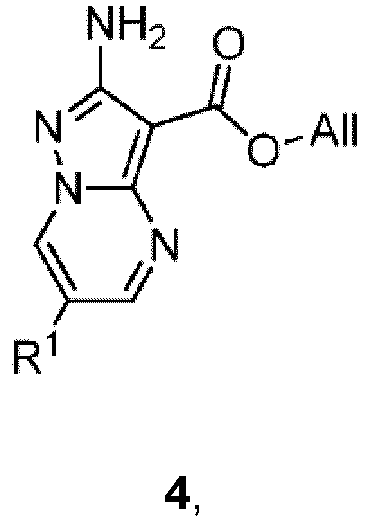 worin R1 -F ist,indem eine Verbindung der Formel 3
 unter Bedingungen umgesetzt wird, die geeignet sind, einen Pyrimidinring zu bilden,
bevorzugt wobei geeignete Kondensationsbedingungen zur Bildung eines Pyrimidinrings die Umsetzung der Verbindung der Formel 3 mit einer 1,3-dielektrophilen Spezies in Gegenwart eines Lösungsmittels umfassen, wobei die 1,3-dielektrophile Spezies vorzugsweise 1,3-Dialdehyd oder 3-(Dialkylamino)-prop-2-enal ist, wobei das Lösungsmittel vorzugsweise aus DMF oder DMSO ausgewählt ist, wobei die 1,3-dielektrophile Spezies vorzugsweise in situ aus einer geschützten 1,3-dielektrophilen Spezies erzeugt wird, wobei die 1,3-dielektrophile Spezies vorzugsweise aus einem Ketal in Gegenwart einer Sulfonsäure erzeugt wird, wobei die Sulfonsäure vorzugsweise PTSA ist,weiter bevorzugt ferner umfassend den Schritt des Herstellens einer Verbindung der Formel 3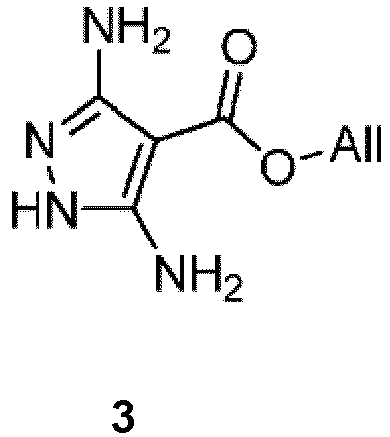 indem eine Verbindung der Formel 2
 unter Bedingungen, die geeignet sind, einen Pyrazolring zu bilden, umgesetzt wird,
vorzugsweise wobei geeignete Kondensationsbedingungen zum Bilden eines Pyrazolrings die Umsetzung der Verbindung der Formel 2 mit einem Hydrazin oder Hydrazinhydrat in Gegenwart eines aprotischen Lösungsmittels unter basischen Bedingungen umfassen, wobei das aprotische Lösungsmittel vorzugsweise DMF ist, und wobei die basischen Bedingungen vorzugsweise die Umsetzung der Verbindung der Formel 2 in Gegenwart von Kaliumacetat oder Natriumacetat umfassen,weiter bevorzugt ferner umfassend den Schritt des Herstellens einer Verbindung der Formel 2 indem eine Verbindung der Formel 1
 unter geeigneten Anion-Kondensationsbedingungen umgesetzt wird,
 - Verfahren zur Herstellung einer Verbindung der Formel I-C-79
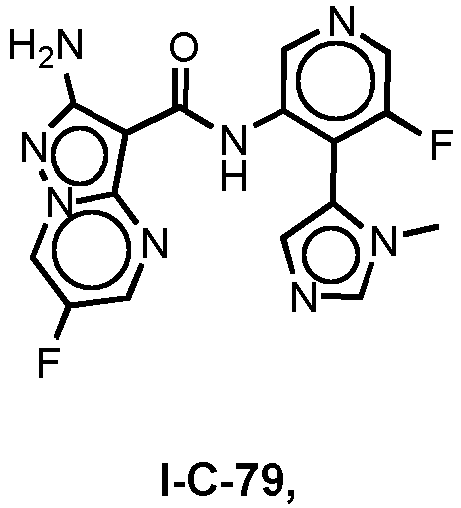
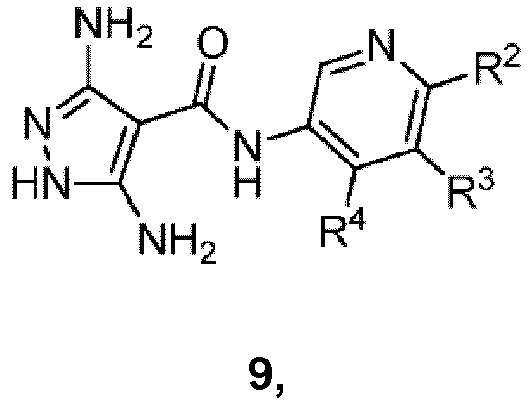 worin R2 H ist, R3 -F ist, und R4
 unter geeigneten Kondensationsbedingungen, um einen Pyrimidinring zu bilden, umgesetzt wird,vorzugsweise wobei das Verfahren ferner den Schritt des Herstellens der Verbindung der Formal 9
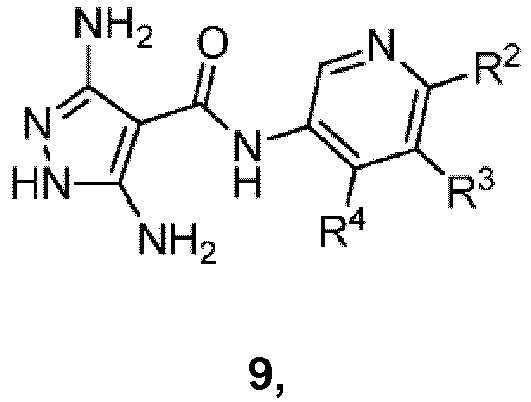 umfasst, indem eine Verbindung der Formel 8
 unter Bedingungen, die geeignet sind, einen Pyrazolring zu bilden, umgesetzt wird,weiter bevorzugt, wobei das Verfahren ferner den Schritt des Herstellens der Verbindung der Formel 8
 worin R2 H ist, R3 -F ist, und R4
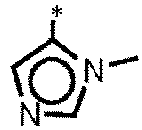 umfasst, indem eine Verbindung der Formel 7
Priority Applications (4)
| Application Number | Priority Date | Filing Date | Title |
|---|---|---|---|
| SI201332100T SI4190786T1 (sl) | 2012-12-07 | 2013-12-06 | Spojine, uporabne kot inhibitorji atr kinaze |
| RS20250504A RS66820B1 (sr) | 2012-12-07 | 2013-12-06 | Jedinjenja korisna kao inhibitori atr kinaze |
| HRP20250581TT HRP20250581T1 (hr) | 2012-12-07 | 2013-12-06 | Spojevi korisni kao inhibitori atr kinaze |
| EP25159476.8A EP4534538A3 (de) | 2012-12-07 | 2013-12-06 | Als atr-kinasehemmer nützliche verbindungen |
Applications Claiming Priority (7)
| Application Number | Priority Date | Filing Date | Title |
|---|---|---|---|
| US201261734726P | 2012-12-07 | 2012-12-07 | |
| US201361787568P | 2013-03-15 | 2013-03-15 | |
| US201361868132P | 2013-08-21 | 2013-08-21 | |
| EP13811716.3A EP2941432B8 (de) | 2012-12-07 | 2013-12-06 | 2-amino-6-fluoro-n-(5-fluoro-4-(4-(4-(oxetan-3-yl)piperazin-1-carbonyl)piperidin-1-yl)pyridin-3-yl)pyrazolo[1,5alpha]pyrimidine-3-carboxamid als hemmstoff der atr kinase |
| EP20198773.2A EP3808749B1 (de) | 2012-12-07 | 2013-12-06 | Pyrazolo[1,5-a]pyrimidine als atr-kinase-inhibitoren nützliche verbindungen zur behandlung von krebserkrankungen |
| PCT/US2013/073457 WO2014089379A1 (en) | 2012-12-07 | 2013-12-06 | Compounds useful as inhibitors of atr kinase |
| EP18159811.1A EP3418281B1 (de) | 2012-12-07 | 2013-12-06 | Pyrazolo[1,5-a]pyrimidine als atr-kinase-inhibitoren nützliche verbindungen zur behandlung von krebserkrankungen |
Related Parent Applications (4)
| Application Number | Title | Priority Date | Filing Date |
|---|---|---|---|
| EP20198773.2A Division EP3808749B1 (de) | 2012-12-07 | 2013-12-06 | Pyrazolo[1,5-a]pyrimidine als atr-kinase-inhibitoren nützliche verbindungen zur behandlung von krebserkrankungen |
| EP20198773.2A Division-Into EP3808749B1 (de) | 2012-12-07 | 2013-12-06 | Pyrazolo[1,5-a]pyrimidine als atr-kinase-inhibitoren nützliche verbindungen zur behandlung von krebserkrankungen |
| EP18159811.1A Division EP3418281B1 (de) | 2012-12-07 | 2013-12-06 | Pyrazolo[1,5-a]pyrimidine als atr-kinase-inhibitoren nützliche verbindungen zur behandlung von krebserkrankungen |
| EP13811716.3A Division EP2941432B8 (de) | 2012-12-07 | 2013-12-06 | 2-amino-6-fluoro-n-(5-fluoro-4-(4-(4-(oxetan-3-yl)piperazin-1-carbonyl)piperidin-1-yl)pyridin-3-yl)pyrazolo[1,5alpha]pyrimidine-3-carboxamid als hemmstoff der atr kinase |
Related Child Applications (1)
| Application Number | Title | Priority Date | Filing Date |
|---|---|---|---|
| EP25159476.8A Division EP4534538A3 (de) | 2012-12-07 | 2013-12-06 | Als atr-kinasehemmer nützliche verbindungen |
Publications (2)
| Publication Number | Publication Date |
|---|---|
| EP4190786A1 EP4190786A1 (de) | 2023-06-07 |
| EP4190786B1 true EP4190786B1 (de) | 2025-02-26 |
Family
ID=49877035
Family Applications (6)
| Application Number | Title | Priority Date | Filing Date |
|---|---|---|---|
| EP20198773.2A Active EP3808749B1 (de) | 2012-12-07 | 2013-12-06 | Pyrazolo[1,5-a]pyrimidine als atr-kinase-inhibitoren nützliche verbindungen zur behandlung von krebserkrankungen |
| EP23153078.3A Active EP4190786B1 (de) | 2012-12-07 | 2013-12-06 | Als atr-kinasehemmer nützliche verbindungen |
| EP25159476.8A Pending EP4534538A3 (de) | 2012-12-07 | 2013-12-06 | Als atr-kinasehemmer nützliche verbindungen |
| EP18159811.1A Active EP3418281B1 (de) | 2012-12-07 | 2013-12-06 | Pyrazolo[1,5-a]pyrimidine als atr-kinase-inhibitoren nützliche verbindungen zur behandlung von krebserkrankungen |
| EP18212042.8A Active EP3486245B1 (de) | 2012-12-07 | 2013-12-06 | 2-amino-n-(piperidin-1-yl-pyridin-3-yl) pyrazolo[1,5alpha]pyrimidine-3-carboxamide als hemmstoff der atr kinase |
| EP13811716.3A Active EP2941432B8 (de) | 2012-12-07 | 2013-12-06 | 2-amino-6-fluoro-n-(5-fluoro-4-(4-(4-(oxetan-3-yl)piperazin-1-carbonyl)piperidin-1-yl)pyridin-3-yl)pyrazolo[1,5alpha]pyrimidine-3-carboxamid als hemmstoff der atr kinase |
Family Applications Before (1)
| Application Number | Title | Priority Date | Filing Date |
|---|---|---|---|
| EP20198773.2A Active EP3808749B1 (de) | 2012-12-07 | 2013-12-06 | Pyrazolo[1,5-a]pyrimidine als atr-kinase-inhibitoren nützliche verbindungen zur behandlung von krebserkrankungen |
Family Applications After (4)
| Application Number | Title | Priority Date | Filing Date |
|---|---|---|---|
| EP25159476.8A Pending EP4534538A3 (de) | 2012-12-07 | 2013-12-06 | Als atr-kinasehemmer nützliche verbindungen |
| EP18159811.1A Active EP3418281B1 (de) | 2012-12-07 | 2013-12-06 | Pyrazolo[1,5-a]pyrimidine als atr-kinase-inhibitoren nützliche verbindungen zur behandlung von krebserkrankungen |
| EP18212042.8A Active EP3486245B1 (de) | 2012-12-07 | 2013-12-06 | 2-amino-n-(piperidin-1-yl-pyridin-3-yl) pyrazolo[1,5alpha]pyrimidine-3-carboxamide als hemmstoff der atr kinase |
| EP13811716.3A Active EP2941432B8 (de) | 2012-12-07 | 2013-12-06 | 2-amino-6-fluoro-n-(5-fluoro-4-(4-(4-(oxetan-3-yl)piperazin-1-carbonyl)piperidin-1-yl)pyridin-3-yl)pyrazolo[1,5alpha]pyrimidine-3-carboxamid als hemmstoff der atr kinase |
Country Status (31)
| Country | Link |
|---|---|
| US (9) | US9340546B2 (de) |
| EP (6) | EP3808749B1 (de) |
| JP (2) | JP6401709B2 (de) |
| KR (1) | KR102213986B1 (de) |
| CN (4) | CN107501275B (de) |
| AU (2) | AU2013355124B2 (de) |
| BR (1) | BR112015012454B1 (de) |
| CA (1) | CA2892608C (de) |
| CY (4) | CY1120232T1 (de) |
| DK (5) | DK3418281T3 (de) |
| ES (5) | ES3030549T3 (de) |
| FI (2) | FI3808749T3 (de) |
| HK (1) | HK1209746A1 (de) |
| HR (5) | HRP20250581T1 (de) |
| HU (5) | HUE061909T2 (de) |
| IL (2) | IL239218A0 (de) |
| LT (5) | LT3808749T (de) |
| ME (1) | ME03036B (de) |
| MX (1) | MX368042B (de) |
| NZ (2) | NZ731337A (de) |
| PL (4) | PL3486245T3 (de) |
| PT (5) | PT3808749T (de) |
| RS (5) | RS64234B1 (de) |
| RU (1) | RU2689996C2 (de) |
| SG (2) | SG11201504467YA (de) |
| SI (5) | SI2941432T1 (de) |
| SM (4) | SMT201800279T1 (de) |
| TR (1) | TR201807740T4 (de) |
| TW (1) | TWI618706B (de) |
| WO (1) | WO2014089379A1 (de) |
| ZA (2) | ZA201503871B (de) |
Families Citing this family (67)
| Publication number | Priority date | Publication date | Assignee | Title |
|---|---|---|---|---|
| MX2011006503A (es) | 2008-12-19 | 2011-09-06 | Vertex Pharma | Derivados de pirazina utiles como inhibidores de la cinasa de atr. |
| JP2014517079A (ja) | 2011-06-22 | 2014-07-17 | バーテックス ファーマシューティカルズ インコーポレイテッド | Atrキナーゼ阻害剤として有用な化合物 |
| CA2850491C (en) | 2011-09-30 | 2020-10-27 | Vertex Pharmaceuticals Incorporated | Treating pancreatic cancer and non-small cell lung cancer with atr inhibiors |
| CN106496173A (zh) | 2011-09-30 | 2017-03-15 | 沃泰克斯药物股份有限公司 | 用于制备可用作atr激酶抑制剂的化合物的方法 |
| WO2013152298A1 (en) | 2012-04-05 | 2013-10-10 | Vertex Pharmaceuticals Incorporated | Compounds useful as inhibitors of atr kinase and combination therapies thereof |
| TR201807740T4 (tr) | 2012-12-07 | 2018-06-21 | Vertex Pharma | ATR kinaz inhibitörü olarak 2-amino-6-fluoro-n-(5-fluoro-4-(4-(4-(oksetan-3-il)piperazin-1-karbonil)piperidin-1-il)piridin-3-il)pirazolo[1,5alfa]pirimidin-3-karboksamid. |
| ES2649156T3 (es) | 2013-01-14 | 2018-01-10 | Incyte Holdings Corporation | Compuestos bicíclicos de carboxamida aromática útiles como inhibidores de quinasas Pim |
| CA2897333C (en) | 2013-01-15 | 2021-07-06 | Incyte Corporation | Thiazolecarboxamides and pyridinecarboxamide compounds useful as pim kinase inhibitors |
| WO2014143241A1 (en) | 2013-03-15 | 2014-09-18 | Vertex Pharmaceuticals Incorporated | Compounds useful as inhibitors of atr kinase |
| EP2970286A1 (de) | 2013-03-15 | 2016-01-20 | Vertex Pharmaceuticals Inc. | Kondensierte pyrazolopyrimidinderivate als inhibitoren der atr-kinase |
| EP2970288A1 (de) | 2013-03-15 | 2016-01-20 | Vertex Pharmaceuticals Incorporated | Als atr-kinaseinhibitoren nützliche verbindungen |
| CR20160135A (es) * | 2013-08-23 | 2016-08-05 | Incyte Corp | Compuestos de carboxamida de furo y tienopiridina útiles como inhibidores de cinasas pim |
| WO2015085132A1 (en) * | 2013-12-06 | 2015-06-11 | Vertex Pharmaceuticals Incorporated | 2-amino-6-fluoro-n-[5-fluoro-pyridin-3-yl]pyrazolo[1,5-a]pyrimidin-3-carboxamide compound useful as atr kinase inhibitor, its preparation, different solid forms and radiolabelled derivatives thereof |
| SI3152212T1 (sl) * | 2014-06-05 | 2020-06-30 | Vertex Pharmaceuticals Inc. | Radioaktivno označeni derivati 2-amino-6-fluoro-N-(5-fluoro-piridin-3-IL)-pirazolo (1,5-A)pirimidin-3- karboksamidne spojine, koristni kot inhibitor kinaze ATR, priprava navedene spojine in njene različne trdne oblike |
| LT3157566T (lt) * | 2014-06-17 | 2019-08-12 | Vertex Pharmaceuticals Incorporated | Vėžio gydymo būdas, panaudojant chk1 ir atr inhibitorių derinį |
| US9580418B2 (en) | 2014-07-14 | 2017-02-28 | Incyte Corporation | Bicyclic aromatic carboxamide compounds useful as Pim kinase inhibitors |
| WO2016010897A1 (en) * | 2014-07-14 | 2016-01-21 | Incyte Corporation | Bicyclic heteroaromatic carboxamide compounds useful as pim kinase inhibitors |
| TWI656121B (zh) | 2014-08-04 | 2019-04-11 | 德商拜耳製藥公司 | 2-(嗎啉-4-基)-1,7-萘啶 |
| CN107108581B (zh) * | 2014-08-21 | 2020-06-23 | 百时美施贵宝公司 | 作为强效rock抑制剂的回接苯甲酰胺衍生物 |
| SMT202400187T1 (it) | 2014-11-06 | 2024-07-09 | Bial R&D Investments S A | Pirazolo(1,5-a)pirimidine sostituite e loro utilizzo nel trattamento di disturbi medici |
| EP3215509B1 (de) | 2014-11-06 | 2020-02-26 | Lysosomal Therapeutics Inc. | Substituierte pyrrolo[1,2-a]pyrimidine und deren verwendung bei der behandlung von medizinischen störungen |
| ES2958391T3 (es) | 2014-11-06 | 2024-02-08 | Bial R&D Invest S A | Imidazo[1,5-a]pirimidinas sustituidas y su uso en el tratamiento de trastornos médicos |
| US9540347B2 (en) | 2015-05-29 | 2017-01-10 | Incyte Corporation | Pyridineamine compounds useful as Pim kinase inhibitors |
| TWI734699B (zh) | 2015-09-09 | 2021-08-01 | 美商英塞特公司 | Pim激酶抑制劑之鹽 |
| AU2016331955B2 (en) * | 2015-09-30 | 2022-07-21 | Vertex Pharmaceuticals Incorporated | Method for treating cancer using a combination of DNA damaging agents and ATR inhibitors |
| TW201718546A (zh) | 2015-10-02 | 2017-06-01 | 英塞特公司 | 適用作pim激酶抑制劑之雜環化合物 |
| EP3399983A1 (de) * | 2016-01-08 | 2018-11-14 | The Institute of Cancer Research: Royal Cancer Hospital | Inhibitoren von ataxia-telangiectasia-mutierter und rad3-verwandter proteinkinase (atr) zur verwendung bei der krebsbehandlung |
| CN108697811B (zh) | 2016-01-11 | 2023-04-07 | 梅里麦克制药股份有限公司 | 抑制共济失调毛细血管扩张和Rad3相关蛋白(ATR) |
| CA3012846A1 (en) * | 2016-02-16 | 2017-08-24 | Massachusetts Institute Of Technology | Max binders as myc modulators and uses thereof |
| WO2017176962A1 (en) | 2016-04-06 | 2017-10-12 | Lysosomal Therapeutics, Inc. | Pyrrolo[1,2-a]pyrimidinyl carboxamide compounds and their use in the treatment of medical disorders |
| US10787454B2 (en) | 2016-04-06 | 2020-09-29 | BIAL—BioTech Investments, Inc. | Imidazo[1,5-a]pyrimidinyl carboxamide compounds and their use in the treatment of medical disorders |
| AU2017246455B2 (en) | 2016-04-06 | 2021-09-30 | Bial - R&D Investments, S.A. | Pyrazolo[1,5-a]pyrimidinyl carboxamide compounds and their use in the treatment of medical disorders |
| US11345698B2 (en) | 2016-05-05 | 2022-05-31 | Bial—R&D Investments, S.A. | Substituted imidazo[1,2-a]pyridines, substituted imidazo[1,2-a]pyrazines, related compounds, and their use in the treatment of medical disorders |
| BR112018072552A8 (pt) | 2016-05-05 | 2023-03-14 | Lysosomal Therapeutics Inc | Compostos de imidazo [1,2-b]piridazinas e imidazo [1,5-b] piridazinas substituídas, composição farmacêutica que os compreende e seu uso no tratamento de distúrbios médicos |
| CN109890829B (zh) * | 2016-11-02 | 2022-07-15 | 豪夫迈·罗氏有限公司 | 作为IRAK4调节剂的吡唑并[1,5a]嘧啶衍生物 |
| UY37616A (es) | 2017-02-24 | 2018-09-28 | Bayer Ag | Combinación de inhibidores de quinasa atr con sal de radio-223 |
| JOP20190197A1 (ar) | 2017-02-24 | 2019-08-22 | Bayer Pharma AG | مثبط كيناز ايه تي آر للاستخدام في طريقة لعلاج مرض فرط التكاثر |
| WO2018153972A1 (en) | 2017-02-24 | 2018-08-30 | Bayer Pharma Aktiengesellschaft | Combination of atr kinase inhibitors and antiandrogens |
| CN106946890A (zh) * | 2017-04-26 | 2017-07-14 | 中国药科大学 | 吡啶类irak4抑制剂、其制备方法及应用 |
| WO2018206547A1 (en) | 2017-05-12 | 2018-11-15 | Bayer Pharma Aktiengesellschaft | Combination of bub1 and atr inhibitors |
| WO2018218197A2 (en) | 2017-05-26 | 2018-11-29 | Board Of Regents, The University Of Texas System | Tetrahydropyrido[4,3-d]pyrimidine inhibitors of atr kinase |
| LT3651768T (lt) | 2017-07-13 | 2024-04-25 | Board Of Regents, The University Of Texas System | Heterocikliniai atr kinazės inhibitoriai |
| WO2019023468A1 (en) | 2017-07-28 | 2019-01-31 | Nimbus Lakshmi, Inc. | TYK2 INHIBITORS AND USES THEREOF |
| CA3071760A1 (en) | 2017-08-04 | 2019-02-07 | Bayer Pharma Aktiengesellschaft | Combination of atr kinase inhibitors and pd-1/pd-l1 inhibitors |
| EP3668839B1 (de) | 2017-08-17 | 2023-04-12 | Board of Regents, The University of Texas System | Heterocyclische inhibitoren der atr-kinase |
| EP3461480A1 (de) | 2017-09-27 | 2019-04-03 | Onxeo | Kombination von checkpoint-hemmern des dna-schädigungsantwort-zellzyklus und belinostat zur behandlung von krebs |
| CN107935918A (zh) * | 2017-11-15 | 2018-04-20 | 山东潍坊润丰化工股份有限公司 | 一种百草枯的制备方法 |
| US11612666B2 (en) | 2017-11-30 | 2023-03-28 | Seagen Inc. | Process for the preparation of drug linker compounds |
| WO2019113487A1 (en) | 2017-12-08 | 2019-06-13 | Incyte Corporation | Low dose combination therapy for treatment of myeloproliferative neoplasms |
| WO2019110586A1 (en) | 2017-12-08 | 2019-06-13 | Bayer Aktiengesellschaft | Predictive markers for atr kinase inhibitors |
| CN111526889B (zh) * | 2017-12-29 | 2023-06-02 | 沃泰克斯药物股份有限公司 | 使用atr抑制剂治疗癌症的方法 |
| WO2019178590A1 (en) | 2018-03-16 | 2019-09-19 | Board Of Regents, The University Of Texas System | Heterocyclic inhibitors of atr kinase |
| KR20210066837A (ko) | 2018-09-26 | 2021-06-07 | 메르크 파텐트 게엠베하 | 암 치료를 위한 pd-1 안타고니스트, atr 억제제 및 백금화제의 조합 |
| WO2020078905A1 (en) | 2018-10-15 | 2020-04-23 | Merck Patent Gmbh | Combination therapy utilizing dna alkylating agents and atr inhibitors |
| CA3116230A1 (en) | 2018-10-16 | 2020-04-23 | Bayer Aktiengesellschaft | Combination of atr kinase inhibitors with 2,3-dihydroimidazo[1,2-c]quinazoline compounds |
| CN112142744A (zh) * | 2019-06-28 | 2020-12-29 | 上海瑛派药业有限公司 | 取代的稠合杂芳双环化合物作为激酶抑制剂及其应用 |
| US20230119558A1 (en) * | 2020-03-06 | 2023-04-20 | The Henry M. Jackson Foundation For The Advancement Of Military Medicine, Inc. | Dna damage repair genes in cancer |
| WO2021187605A1 (ja) * | 2020-03-19 | 2021-09-23 | 田辺三菱製薬株式会社 | 含窒素複素環αシアノカルボニル化合物 |
| AU2021291358A1 (en) | 2020-06-18 | 2022-12-15 | Merck Patent Gmbh | Compounds for the treatment of viral infections |
| TW202214642A (zh) * | 2020-07-02 | 2022-04-16 | 大陸商江蘇恆瑞醫藥股份有限公司 | 咪唑并嘧啶類衍生物、其製備方法及其在醫藥上的應用 |
| MX2023000577A (es) * | 2020-07-13 | 2023-03-23 | Beijing Tide Pharmaceutical Co Ltd | Compuesto de pirazolopirimidina usado como inhibidor de atr cinasa. |
| US20240166596A1 (en) * | 2021-07-16 | 2024-05-23 | Aphiotx Inc. | Sulfamoyl benzene derivatives and uses thereof |
| EP4392418A4 (de) * | 2021-08-24 | 2025-06-18 | The Johns Hopkins University | Zusammensetzungen und verfahren zur behandlung von proteotoxizitätsbedingten erkrankungen |
| CN116283960A (zh) | 2021-12-21 | 2023-06-23 | 上海安诺达生物科技有限公司 | 取代的稠杂环化合物及其制备方法与应用 |
| WO2023116865A1 (zh) * | 2021-12-23 | 2023-06-29 | 优领医药科技(上海)有限公司 | 含吡唑类衍生物、其药学上可接受的盐及其制备方法和应用 |
| CN115322143B (zh) * | 2022-07-21 | 2023-07-14 | 安徽德诺医药股份有限公司 | 一种4-哌啶甲酸叔丁酯盐酸盐的制备方法 |
| TW202521539A (zh) | 2023-08-01 | 2025-06-01 | 美商普林斯匹亞生物製藥公司 | 製造2-[(3r)-2-[4-胺基-3-(2-氟-4-苯氧基-苯基)吡唑并[3,4-d]嘧啶-1-基]哌啶-1-羰基]-4-甲基-4[4-(氧雜環丁烷-3-基)哌𠯤-1-基]-戊-2-烯腈及其溶劑合物形式之方法 |
Family Cites Families (265)
| Publication number | Priority date | Publication date | Assignee | Title |
|---|---|---|---|---|
| US4309430A (en) | 1980-06-27 | 1982-01-05 | Merck & Co., Inc. | Pyrazinyl-1,2,4-oxadiazole-5-ones, for treatment of edema, and processes for preparing same |
| US5329012A (en) | 1987-10-29 | 1994-07-12 | The Research Foundation Of State University Of New York | Bis(acyloxmethyl)imidazole compounds |
| JP2597917B2 (ja) | 1990-04-26 | 1997-04-09 | 富士写真フイルム株式会社 | 新規な色素形成カプラー及びそれを用いたハロゲン化銀カラー写真感光材料 |
| AU700001B2 (en) | 1995-05-09 | 1998-12-17 | Basf Aktiengesellschaft | Pyrazolo-(1,5a)pyrimidines, their preparation and their use |
| CA2253910A1 (en) | 1996-05-11 | 1997-11-20 | King's College London | Pyrazines |
| EA006626B1 (ru) | 1996-07-24 | 2006-02-24 | Дюпон Фармасьютикалз Компани | Азолопиримидины, фармацевтическая композиция и способ лечения |
| US6191131B1 (en) | 1997-07-23 | 2001-02-20 | Dupont Pharmaceuticals Company | Azolo triazines and pyrimidines |
| US6060478A (en) | 1996-07-24 | 2000-05-09 | Dupont Pharmaceuticals | Azolo triazines and pyrimidines |
| JPH10218881A (ja) | 1997-02-03 | 1998-08-18 | Pola Chem Ind Inc | 新規なピロロピラゾロピリミジン誘導体 |
| GB2323861B (en) | 1997-02-05 | 2001-06-20 | Sector Exhibiting Systems | Artificial wall structure |
| JP2002241379A (ja) | 1997-03-21 | 2002-08-28 | Dainippon Pharmaceut Co Ltd | 3−オキサジアゾリルキノキサリン誘導体 |
| US6235741B1 (en) | 1997-05-30 | 2001-05-22 | Merck & Co., Inc. | Angiogenesis inhibitors |
| EP0984692A4 (de) | 1997-05-30 | 2001-02-21 | Merck & Co Inc | Angiogenese-inhibitoren |
| CN1146561C (zh) | 1998-07-16 | 2004-04-21 | 盐野义制药株式会社 | 具有抗肿瘤活性的嘧啶衍生物 |
| US6245759B1 (en) | 1999-03-11 | 2001-06-12 | Merck & Co., Inc. | Tyrosine kinase inhibitors |
| US6660753B2 (en) | 1999-08-19 | 2003-12-09 | Nps Pharmaceuticals, Inc. | Heteropolycyclic compounds and their use as metabotropic glutamate receptor antagonists |
| JP2001302666A (ja) | 1999-09-21 | 2001-10-31 | Nissan Chem Ind Ltd | アゾール縮合ヘテロ環アニライド化合物及び除草剤 |
| MY125533A (en) | 1999-12-06 | 2006-08-30 | Bristol Myers Squibb Co | Heterocyclic dihydropyrimidine compounds |
| PT1237880E (pt) | 1999-12-17 | 2008-03-05 | Novartis Vaccines & Diagnostic | Inibidores baseados em pirazina da cinase 3 da glicogénio sintase |
| AU2001264932A1 (en) | 2000-05-26 | 2001-12-11 | Neurogen Corporation | Oxo-imidazopyrimidine-carboxamides and their use as gaba brain receptor ligands |
| US20020041880A1 (en) | 2000-07-05 | 2002-04-11 | Defeo-Jones Deborah | Method of treating cancer |
| US6849660B1 (en) | 2000-08-01 | 2005-02-01 | Isis Pharmaceuticals, Inc. | Antimicrobial biaryl compounds |
| US7067520B2 (en) | 2000-11-17 | 2006-06-27 | Ishihara Sangyo Kaisha, Ltd. | Preventive or therapeutic medicines for diabetes containing fused-heterocyclic compounds or their salts |
| EP1217000A1 (de) | 2000-12-23 | 2002-06-26 | Aventis Pharma Deutschland GmbH | Faktor Xa und Faktor VIIa Inhibitoren |
| US6420637B1 (en) | 2001-01-29 | 2002-07-16 | Asgrow Seed Company L.L.C. | Plants and seeds of corn variety I389972 |
| GB0103926D0 (en) | 2001-02-17 | 2001-04-04 | Astrazeneca Ab | Chemical compounds |
| EP1408986B1 (de) | 2001-05-08 | 2008-09-24 | Yale University | Proteomimetische verbindungen und verfahren |
| EP1463742A4 (de) | 2001-06-21 | 2006-05-10 | Ariad Pharma Inc | Neue pyrazolo- und pyrrolo-pyrimidine und ihre verwendungszwecke |
| SE0102438D0 (sv) | 2001-07-05 | 2001-07-05 | Astrazeneca Ab | New compounds |
| SE0102439D0 (sv) | 2001-07-05 | 2001-07-05 | Astrazeneca Ab | New compounds |
| US6833371B2 (en) | 2001-11-01 | 2004-12-21 | Icagen, Inc. | Pyrazolopyrimidines |
| WO2003045924A1 (en) | 2001-11-21 | 2003-06-05 | Pharmacia & Upjohn Company | Substituted aryl 1,4-pyrazine derivatives |
| US6992087B2 (en) | 2001-11-21 | 2006-01-31 | Pfizer Inc | Substituted aryl 1,4-pyrazine derivatives |
| RU2004126671A (ru) | 2002-02-06 | 2005-04-10 | Вертекс Фармасьютикалз Инкорпорейтед (Us) | Гетероарилсоединения, полезные в качестве ингибиторов gsk-3 |
| ATE395343T1 (de) | 2002-03-13 | 2008-05-15 | Janssen Pharmaceutica Nv | Sulfonylderivate als histone-deacetylase- inhibitoren |
| GB0206860D0 (en) | 2002-03-22 | 2002-05-01 | Glaxo Group Ltd | Compounds |
| TWI319387B (en) | 2002-04-05 | 2010-01-11 | Astrazeneca Ab | Benzamide derivatives |
| MXPA04010441A (es) * | 2002-04-23 | 2005-02-14 | Shionogi & Co | Derivado de pirazolo[1,5-a]pirimidina e inhibidor de nad(p)h oxidasa que contiene el mismo. |
| GB0209715D0 (en) | 2002-04-27 | 2002-06-05 | Astrazeneca Ab | Chemical compounds |
| US7704995B2 (en) | 2002-05-03 | 2010-04-27 | Exelixis, Inc. | Protein kinase modulators and methods of use |
| WO2003093297A2 (en) | 2002-05-03 | 2003-11-13 | Exelixis, Inc. | Protein kinase modulators and methods of use |
| AU2003241925A1 (en) | 2002-05-31 | 2003-12-19 | Eisai R&D Management Co., Ltd. | Pyrazole compound and medicinal composition containing the same |
| US7449488B2 (en) | 2002-06-04 | 2008-11-11 | Schering Corporation | Pyrazolopyrimidines as protein kinase inhibitors |
| CA2487211C (en) | 2002-06-04 | 2010-09-14 | Neogenesis Pharmaceuticals, Inc. | Pyrazolo(1,5a) pyrimidine compounds as antiviral agents |
| AU2003249369A1 (en) | 2002-06-21 | 2004-01-06 | Cellular Genomics, Inc. | Certain amino-substituted monocycles as kinase modulators |
| US7196092B2 (en) | 2002-09-04 | 2007-03-27 | Schering Corporation | N-heteroaryl pyrazolopyrimidines as cyclin dependent kinase inhibitors |
| US7601724B2 (en) | 2002-09-04 | 2009-10-13 | Schering Corporation | Substituted pyrazolo[1,5-a]pyrimidines as protein kinase inhibitors |
| ATE364608T1 (de) | 2002-09-04 | 2007-07-15 | Schering Corp | Pyrazolopyrimidine als hemmstoffe cyclin- abhängiger kinasen |
| US7205308B2 (en) | 2002-09-04 | 2007-04-17 | Schering Corporation | Trisubstituted 7-aminopyrazolopyrimidines as cyclin dependent kinase inhibitors |
| US8673924B2 (en) | 2002-09-04 | 2014-03-18 | Merck Sharp & Dohme Corp. | Substituted pyrazolo[1,5-a]pyrimidines as cyclin dependent kinase inhibitors |
| DK1537116T3 (da) | 2002-09-04 | 2010-09-27 | Schering Corp | Pyrazolopyrimidiner egnede til behandling af cancersygdomme |
| US7119200B2 (en) | 2002-09-04 | 2006-10-10 | Schering Corporation | Pyrazolopyrimidines as cyclin dependent kinase inhibitors |
| US8580782B2 (en) | 2002-09-04 | 2013-11-12 | Merck Sharp & Dohme Corp. | Substituted pyrazolo[1,5-a]pyrimidines as cyclin dependent kinase inhibitors |
| AR041136A1 (es) | 2002-09-04 | 2005-05-04 | Pharmacopeia Drug Discovery | Pirazolopirimidinas como inhibidores de cinasas dependientes de clclinas |
| US7563798B2 (en) | 2002-09-04 | 2009-07-21 | Schering Corporation | Substituted pyrazolo[1,5-a]pyrimidines as protein kinase inhibitors |
| NZ539161A (en) | 2002-09-04 | 2006-05-26 | Schering Corp | Pyrazolopyrimidines as cyclin dependent kinase inhibitors |
| US7196078B2 (en) | 2002-09-04 | 2007-03-27 | Schering Corpoartion | Trisubstituted and tetrasubstituted pyrazolopyrimidines as cyclin dependent kinase inhibitors |
| WO2004033431A2 (en) | 2002-10-04 | 2004-04-22 | Arena Pharmaceuticals, Inc. | Hydroxypyrazoles for use against metabolic-related disorders |
| AU2003299651A1 (en) | 2002-12-11 | 2004-06-30 | Merck And Co., Inc. | Tyrosine kinase inhibitors |
| SE0203754D0 (sv) | 2002-12-17 | 2002-12-17 | Astrazeneca Ab | New compounds |
| SE0203752D0 (sv) | 2002-12-17 | 2002-12-17 | Astrazeneca Ab | New compounds |
| WO2004076412A2 (en) | 2003-02-26 | 2004-09-10 | Sugen, Inc. | Aminoheteroaryl compounds as protein kinase inhibitors |
| KR20050115252A (ko) | 2003-02-28 | 2005-12-07 | 데이진 화-마 가부시키가이샤 | 피라졸로[1,5-a]피리미딘 유도체 |
| ATE402929T1 (de) | 2003-03-11 | 2008-08-15 | Pfizer Prod Inc | Pyrazinverbindungen als inhibitoren des transforming growth factor (tgf) |
| JP2006520794A (ja) | 2003-03-21 | 2006-09-14 | スミスクライン ビーチャム コーポレーション | 化合物 |
| EP1608622A4 (de) | 2003-03-24 | 2009-04-01 | Merck & Co Inc | Biarylsubstituierte 6-gliedrige heterocyclen als natriumkanalblocker |
| GB2400101A (en) | 2003-03-28 | 2004-10-06 | Biofocus Discovery Ltd | Compounds capable of binding to the active site of protein kinases |
| CN1788008A (zh) | 2003-05-15 | 2006-06-14 | 麦克公司 | 作为s1p受体激动剂的3-(2-氨基-1-氮杂环基)-5-芳基-1,2,4-噁二唑 |
| TWI339206B (en) | 2003-09-04 | 2011-03-21 | Vertex Pharma | Compositions useful as inhibitors of protein kinases |
| US7138401B2 (en) | 2003-09-18 | 2006-11-21 | Conforma Therapeutics Corporation | 2-aminopurine analogs having HSP90-inhibiting activity |
| US7807696B2 (en) | 2003-10-07 | 2010-10-05 | The Feinstein Institute For Medical Research | Isoxazole and isothiazole compounds useful in the treatment of inflammation |
| BRPI0416692A (pt) | 2003-11-19 | 2007-01-30 | Array Biopharma Inc | inibidores heterocìclicos de mek e métodos de emprego destes |
| DE10356579A1 (de) | 2003-12-04 | 2005-07-07 | Merck Patent Gmbh | Aminderivate |
| JP2007524682A (ja) | 2004-02-12 | 2007-08-30 | メルク エンド カムパニー インコーポレーテッド | 代謝調節型グルタミン酸受容体−5の調節物質としてのビピリジルアミド |
| WO2005080396A2 (de) | 2004-02-25 | 2005-09-01 | Basf Aktiengesellschaft | Azolopyrimidin-verbindungen und ihre verwendung zur bekämpfung von schadpilzen |
| US8076338B2 (en) | 2004-04-23 | 2011-12-13 | Exelixis, Inc. | Kinase modulators and methods of use |
| WO2005123672A2 (en) | 2004-06-14 | 2005-12-29 | Takeda San Diego, Inc. | Kinase inhibitors |
| AU2005269387A1 (en) | 2004-07-27 | 2006-02-09 | Sgx Pharmaceuticals, Inc. | Fused ring heterocycle kinase modulators |
| US7626021B2 (en) | 2004-07-27 | 2009-12-01 | Sgx Pharmaceuticals, Inc. | Fused ring heterocycle kinase modulators |
| MX337817B (es) | 2004-11-04 | 2011-11-04 | Vertex Pharma | Pirazolo [1,5-a] pirimidinas de utilidad como inhibidores de proteina quinasas. |
| EP1828144A2 (de) | 2004-11-12 | 2007-09-05 | OSI Pharmaceuticals, Inc. | Als antikrebsmittel geeignete integrinantagonisten |
| CN101098872B (zh) | 2004-11-22 | 2012-09-05 | 沃泰克斯药物股份有限公司 | 可用作蛋白激酶抑制剂的吡咯并吡嗪和吡唑并吡嗪 |
| GB0428235D0 (en) | 2004-12-23 | 2005-01-26 | Glaxo Group Ltd | Novel compounds |
| JP2008525453A (ja) | 2004-12-27 | 2008-07-17 | アルコン,インコーポレイティド | 緑内障と、rhoキナーゼを媒介とした他の疾患および症状を治療するためのアミノピラジン・アナログ |
| US7635699B2 (en) | 2004-12-29 | 2009-12-22 | Bristol-Myers Squibb Company | Azolopyrimidine-based inhibitors of dipeptidyl peptidase IV and methods |
| GB0500492D0 (en) | 2005-01-11 | 2005-02-16 | Cyclacel Ltd | Compound |
| US20060156482A1 (en) | 2005-01-14 | 2006-07-20 | The Procter & Gamble Company | Keratin dyeing compounds, keratin dyeing compositions containing them, and use thereof |
| US7622583B2 (en) | 2005-01-14 | 2009-11-24 | Chemocentryx, Inc. | Heteroaryl sulfonamides and CCR2 |
| GB0501999D0 (en) | 2005-02-01 | 2005-03-09 | Sentinel Oncology Ltd | Pharmaceutical compounds |
| CA2598456A1 (en) | 2005-02-16 | 2006-08-24 | Schering Corporation | Heterocyclic substituted piperazines with cxcr3 antagonist activity |
| DE102005007534A1 (de) | 2005-02-17 | 2006-08-31 | Bayer Cropscience Ag | Pyrazolopyrimidine |
| AU2006239632B2 (en) | 2005-04-25 | 2012-03-15 | Merck Patent Gmbh | Novel AZA- heterocycles serving as kinase inhibitors |
| US20070155737A1 (en) | 2005-05-20 | 2007-07-05 | Alantos Pharmaceuticals, Inc. | Heterobicyclic metalloprotease inhibitors |
| WO2006128184A2 (en) | 2005-05-20 | 2006-11-30 | Alantos-Pharmaceuticals, Inc. | Pyrimidine or triazine fused bicyclic metalloprotease inhibitors |
| US20070155738A1 (en) | 2005-05-20 | 2007-07-05 | Alantos Pharmaceuticals, Inc. | Heterobicyclic metalloprotease inhibitors |
| WO2007015632A1 (en) | 2005-08-04 | 2007-02-08 | Cgk Co., Ltd. | Atm and atr inhibitor |
| PE20070543A1 (es) | 2005-10-06 | 2007-06-14 | Schering Corp | Pirazolopirimidinas como inhibidores de protein quinasas |
| US20070082900A1 (en) | 2005-10-06 | 2007-04-12 | Schering Corporation | Methods for inhibiting protein kinases |
| CA2624500A1 (en) | 2005-10-06 | 2007-04-19 | Schering Corporation | Pyrazolopyrimidines as protein kinase inhibitors |
| WO2007044426A2 (en) | 2005-10-06 | 2007-04-19 | Schering Corporation | Pyrazolopyrimidines as protein kinase inhibitors |
| CA2626742A1 (en) | 2005-10-21 | 2007-04-26 | Exelixis, Inc. | Pyrazolo-pyrimidines as casein kinase ii (ck2) modulators |
| AU2006305104B2 (en) | 2005-10-21 | 2009-10-22 | Mitsubishi Tanabe Pharma Corporation | Pyrazolo[1,5-a]pyrimidine compounds as cannabinoid receptor antagonists |
| AR056786A1 (es) | 2005-11-10 | 2007-10-24 | Smithkline Beecham Corp | Compuesto de 1h- imidazo ( 4,5-c) piridin-2-ilo, composicion farmaceutica que lo comprende, procedimiento para preparar dicha composicion, su uso para preparar unmedicamento, uso de una combinacion que omprende al compuesto y al menos un agente antineoplasico para preparar un medicamento y dicha com |
| CN101321525B (zh) | 2005-12-01 | 2013-01-30 | 霍夫曼-拉罗奇有限公司 | 作为l-cpt1抑制剂的杂芳基取代的哌啶衍生物 |
| EP1970377A4 (de) | 2005-12-09 | 2013-02-27 | Meiji Seika Kaisha | Lincomycinderivat und antibakterielles mittel, das dieses als wirkstoff enthält |
| KR20080077652A (ko) | 2005-12-22 | 2008-08-25 | 알콘 리서치, 리미티드 | 로 키나제-매개 질환 및 증상 치료용 (인다졸-5-일)피라진및 (1,3-디하이드로인돌-2-온)피라진 |
| ITMI20060311A1 (it) | 2006-02-21 | 2007-08-22 | Btsr Int Spa | Dispositivo perfezionato di alimentazione di filo o filatio ad una macchina tessile e metodo per attuare tale alimentazione |
| GB0603684D0 (en) | 2006-02-23 | 2006-04-05 | Novartis Ag | Organic compounds |
| WO2007096764A2 (en) | 2006-02-27 | 2007-08-30 | Glenmark Pharmaceuticals S.A. | Bicyclic heteroaryl derivatives as cannabinoid receptor modulators |
| TW200800203A (en) | 2006-03-08 | 2008-01-01 | Astrazeneca Ab | New use |
| RU2008141761A (ru) | 2006-03-22 | 2010-04-27 | Вертекс Фармасьютикалз Инкорпорейтед (Us) | ИНГИБИТОРЫ с-МЕТ ПРОТЕИНКИНАЗЫ |
| BRPI0709699A2 (pt) | 2006-03-29 | 2011-07-26 | Foldrx Pharmaceuticals Inc | inibiÇço da toxidez da alfa-sinucleina |
| MX2008012658A (es) | 2006-03-31 | 2008-12-16 | Schering Corp | Inhibidores de cinasa. |
| CN101495481A (zh) | 2006-05-22 | 2009-07-29 | 先灵公司 | 作为CDK抑制剂的吡唑并[1,5-α]嘧啶 |
| US9216963B2 (en) | 2006-06-22 | 2015-12-22 | Medibeacon Inc. | Pyrazine derivatives with extended conjugation and methods of using the same in optical applications |
| JP2009541268A (ja) | 2006-06-22 | 2009-11-26 | ビオヴィトルム・アクチボラゲット(プブリクト) | Mnkキナーゼ阻害剤としてのピリジンおよびピラジン誘導体 |
| AR061793A1 (es) | 2006-07-05 | 2008-09-24 | Mitsubishi Tanabe Pharma Corp | Compuesto de pirazolo[1,5-a] pirimidina y composicion farmaceutica |
| US8198448B2 (en) | 2006-07-14 | 2012-06-12 | Amgen Inc. | Fused heterocyclic derivatives and methods of use |
| PE20121506A1 (es) | 2006-07-14 | 2012-11-26 | Amgen Inc | Compuestos triazolopiridinas como inhibidores de c-met |
| US8217177B2 (en) | 2006-07-14 | 2012-07-10 | Amgen Inc. | Fused heterocyclic derivatives and methods of use |
| MX2009003185A (es) | 2006-09-29 | 2009-04-03 | Novartis Ag | Pirazolopirimidinas como inhibidores de lipido cinasa pi3k. |
| GB0619342D0 (en) | 2006-09-30 | 2006-11-08 | Vernalis R&D Ltd | New chemical compounds |
| AU2007304365A1 (en) | 2006-10-04 | 2008-04-10 | F. Hoffmann-La Roche Ag | 3-pyridinecarboxamide and 2-pyrazinecarboxamide derivatives as HDL-cholesterol raising agents |
| KR20140104060A (ko) | 2006-10-19 | 2014-08-27 | 시그날 파마소티칼 엘엘씨 | 헤테로아릴 화합물, 이들의 조성물 그리고 단백질 키나아제 억제제로서의 이들의 용도 |
| US8148361B2 (en) | 2006-11-10 | 2012-04-03 | Bristol-Myers Squibb Company | Kinase inhibitors |
| US20080176870A1 (en) | 2006-11-20 | 2008-07-24 | Bert Nolte | Heterobicyclic metalloprotease inhibitors |
| EP2125808A2 (de) | 2006-12-15 | 2009-12-02 | Bayer Schering Pharma Aktiengesellschaft | 3h-pyrazolopyridine und deren salze, pharmazeutische zusammensetzungen, die diese enthalten, verfahren zu deren herstellung und deren verwendung |
| US7687522B2 (en) | 2006-12-20 | 2010-03-30 | Amgen Inc. | Substituted pyridines and pyrimidines and their use in treatment of cancer |
| PE20121126A1 (es) | 2006-12-21 | 2012-08-24 | Plexxikon Inc | Compuestos pirrolo [2,3-b] piridinas como moduladores de quinasa |
| GB0625659D0 (en) | 2006-12-21 | 2007-01-31 | Cancer Rec Tech Ltd | Therapeutic compounds and their use |
| AU2008219166B2 (en) | 2007-02-16 | 2013-05-16 | Amgen Inc. | Nitrogen-containing heterocyclyl ketones and their use as c-Met inhibitors |
| US8822497B2 (en) | 2007-03-01 | 2014-09-02 | Novartis Ag | PIM kinase inhibitors and methods of their use |
| US8372867B2 (en) | 2007-04-10 | 2013-02-12 | Bayer Cropscience Ag | Insecticidal aryl isoxazoline derivatives |
| EP2150255A4 (de) | 2007-05-10 | 2011-10-05 | Glaxosmithkline Llc | Chinoxalinderivate als p13-kinase-inhibitoren |
| PE20090717A1 (es) | 2007-05-18 | 2009-07-18 | Smithkline Beecham Corp | Derivados de quinolina como inhibidores de la pi3 quinasa |
| EP2014661A1 (de) | 2007-06-13 | 2009-01-14 | Bayer CropScience AG | Heterocyclisch substituierte Heterocyclyl-carbonsäurederivate |
| UY31137A1 (es) | 2007-06-14 | 2009-01-05 | Smithkline Beecham Corp | Derivados de quinazolina como inhibidores de la pi3 quinasa |
| WO2008156174A1 (ja) | 2007-06-21 | 2008-12-24 | Taisho Pharmaceutical Co., Ltd. | ピラジンアミド化合物 |
| JP2010531888A (ja) | 2007-06-26 | 2010-09-30 | レクシコン ファーマシューティカルズ インコーポレイテッド | セロトニン媒介性の疾患及び障害を治療する方法 |
| WO2009006580A1 (en) | 2007-07-05 | 2009-01-08 | Cv Therapeutics, Inc. | Optionally condensed dihydropyridine, dihydropyrimidine and dihydropyrane derivatives acting as late sodium channel blockers |
| US20090012103A1 (en) | 2007-07-05 | 2009-01-08 | Matthew Abelman | Substituted heterocyclic compounds |
| GB0713259D0 (en) | 2007-07-09 | 2007-08-15 | Astrazeneca Ab | Pyrazine derivatives 954 |
| JP2010533736A (ja) | 2007-07-19 | 2010-10-28 | ハー・ルンドベック・アクチエゼルスカベット | 5員複素環アミドおよび関連化合物 |
| AU2008279776B2 (en) | 2007-07-19 | 2013-05-23 | Merck Sharp & Dohme Corp. | Heterocyclic amide compounds as protein kinase inhibitors |
| WO2009017954A1 (en) | 2007-08-01 | 2009-02-05 | Phenomix Corporation | Inhibitors of jak2 kinase |
| EA201000113A1 (ru) | 2007-08-01 | 2010-08-30 | Пфайзер Инк. | Пиразольные соединения |
| WO2009024825A1 (en) | 2007-08-21 | 2009-02-26 | Astrazeneca Ab | 2-pyrazinylbenzimidazole derivatives as receptor tyrosine kinase inhibitors |
| US8415358B2 (en) | 2007-09-17 | 2013-04-09 | Neurosearch A/S | Pyrazine derivatives and their use as potassium channel modulators |
| KR20100089090A (ko) | 2007-10-25 | 2010-08-11 | 아스트라제네카 아베 | 세포 증식 장애의 치료에 유용한 피리딘 및 피라진 유도체 |
| CA2706946A1 (en) | 2007-11-28 | 2009-06-04 | Schering Corporation | 2-fluoropyrazolo[1,5-a]pyrimidines as protein kinase inhibitors |
| WO2009075790A1 (en) | 2007-12-07 | 2009-06-18 | Alantos Pharmaceuticals Holding, Inc. | Metalloprotease inhibitors for intra-articular application |
| NZ586662A (en) | 2007-12-19 | 2012-08-31 | Vertex Pharma | PYRAZOLO[1,5-a]PYRIMIDINES USEFUL AS JANUS KINASE 2 INHIBITORS |
| DK2240451T3 (da) | 2008-01-04 | 2017-11-20 | Intellikine Llc | Isoquinolinonderivater substitueret med en purin, der er anvendelig som pi3k-inhibitorer |
| EP2085398A1 (de) | 2008-02-01 | 2009-08-05 | Merz Pharma GmbH & Co. KGaA | Pyrazolopyrimidine, Verfahren zu ihrer Herstellung und Verwendung als Arzneimittel |
| JP5284377B2 (ja) | 2008-02-25 | 2013-09-11 | エフ.ホフマン−ラ ロシュ アーゲー | ピロロピラジンキナーゼ阻害剤 |
| PL2250172T3 (pl) | 2008-02-25 | 2012-01-31 | Hoffmann La Roche | Pirolopirazynowe inhibitory kinazy |
| ATE517107T1 (de) | 2008-02-25 | 2011-08-15 | Hoffmann La Roche | Pyrrolopyrazinkinaseinhibitoren |
| MX2010008198A (es) | 2008-02-25 | 2010-08-23 | Hoffmann La Roche | Inhibidores de cinasa de pirrolopirazina. |
| TW200940537A (en) | 2008-02-26 | 2009-10-01 | Astrazeneca Ab | Heterocyclic urea derivatives and methods of use thereof |
| EP2288611B1 (de) | 2008-03-20 | 2013-05-15 | Amgen Inc. | Aurorakinasemodulatoren und anwendungsverfahren |
| US8110576B2 (en) | 2008-06-10 | 2012-02-07 | Plexxikon Inc. | Substituted pyrrolo[2,3b]pyrazines and methods for treatment of raf protein kinase-mediated indications |
| US9096611B2 (en) | 2008-07-08 | 2015-08-04 | Intellikine Llc | Kinase inhibitors and methods of use |
| GB0814364D0 (en) | 2008-08-05 | 2008-09-10 | Eisai London Res Lab Ltd | Diazaindole derivatives and their use in the inhibition of c-Jun N-terminal kinase |
| AU2009279936A1 (en) | 2008-08-05 | 2010-02-11 | Banyu Pharmaceutical Co., Ltd. | Therapeutic compounds |
| CN102223798A (zh) | 2008-09-24 | 2011-10-19 | 巴斯夫欧洲公司 | 用于防治无脊椎动物害虫的吡唑化合物 |
| MX2011004188A (es) | 2008-10-21 | 2011-06-09 | Vertex Pharma | Inhibidores de la proteina cinasa c-met. |
| BRPI0914404A2 (pt) | 2008-10-31 | 2019-03-06 | Genentech Inc | "compostos, composição farmacêutica e método para tratar ou atenuar a gravidade de uma doença ou condição responsiva à inibição da atividade jak quinase em um paciente" |
| MX2011004953A (es) | 2008-11-10 | 2011-12-14 | Vertex Pharma | Compuestos utiles como inhibidores de cinasa atr. |
| WO2010059836A1 (en) | 2008-11-20 | 2010-05-27 | Decode Genetics Ehf | Substituted aza-bridged bicyclics for cardiovascular and cns disease |
| ES2554375T3 (es) | 2008-11-25 | 2015-12-18 | University Of Rochester | Inhibidores de las MLK y métodos de uso |
| CA2744507A1 (en) | 2008-12-05 | 2010-06-10 | F.Hoffmann-La Roche Ag | Pyrrolopyrazinyl urea kinase inhibitors |
| MX2011006503A (es) * | 2008-12-19 | 2011-09-06 | Vertex Pharma | Derivados de pirazina utiles como inhibidores de la cinasa de atr. |
| MX2011006332A (es) | 2008-12-23 | 2011-06-27 | Abbott Lab | Compuestos antivirales. |
| WO2010086040A1 (en) | 2009-01-29 | 2010-08-05 | Biomarin Iga, Ltd. | Pyrazolo-pyrimidines for treatment of duchenne muscular dystrophy |
| SG173027A1 (en) | 2009-01-30 | 2011-08-29 | Toyama Chemical Co Ltd | N-acyl anthranilic acid derivative or salt thereof |
| US20100204265A1 (en) | 2009-02-09 | 2010-08-12 | Genelabs Technologies, Inc. | Certain Nitrogen Containing Bicyclic Chemical Entities for Treating Viral Infections |
| KR20110132564A (ko) | 2009-02-11 | 2011-12-08 | 선오비온 파마슈티컬스 인코포레이티드 | 히스타민 h3 역 작용제 및 길항제, 및 이의 사용 방법 |
| CN101537007A (zh) | 2009-03-18 | 2009-09-23 | 中国医学科学院血液病医院(血液学研究所) | N-(噻吩-2)吡唑并[1,5-a]嘧啶-3-甲酰胺类化合物在制备抗恶性肿瘤药物方面的应用 |
| JP2012522013A (ja) | 2009-03-27 | 2012-09-20 | ザ ユーエービー リサーチ ファウンデーション | 調節ires媒介翻訳 |
| UA110324C2 (en) | 2009-07-02 | 2015-12-25 | Genentech Inc | Jak inhibitory compounds based on pyrazolo pyrimidine |
| AR077468A1 (es) | 2009-07-09 | 2011-08-31 | Array Biopharma Inc | Compuestos de pirazolo (1,5 -a) pirimidina sustituidos como inhibidores de trk- quinasa |
| CN102471345A (zh) | 2009-07-15 | 2012-05-23 | 雅培制药有限公司 | 激酶的吡咯并吡嗪抑制剂 |
| KR101721280B1 (ko) | 2009-08-17 | 2017-03-29 | 인텔리카인, 엘엘씨 | 헤테로사이클릭 화합물 및 이의 용도 |
| US8669259B2 (en) | 2009-08-26 | 2014-03-11 | Merck Sharp & Dohme Corp. | Heterocyclic amide compounds as protein kinase inhibitors |
| CN101671336B (zh) | 2009-09-23 | 2013-11-13 | 辽宁利锋科技开发有限公司 | 芳杂环并嘧啶衍生物和类似物及其制备方法和用途 |
| PL2509602T3 (pl) | 2009-12-04 | 2017-08-31 | Senhwa Biosciences, Inc. | Pirazolopirymidyny i podobne heterocykle jako inhibitory ck2 |
| DE112009005466T5 (de) | 2009-12-22 | 2012-10-31 | Intel Corporation | Verfahren und Vorrichtung zum Bereitstellen einer sicheren Anwendungsausführung |
| SG10201502109VA (en) | 2010-03-18 | 2015-05-28 | Pasteur Institut Korea | Anti-infective compounds |
| US8518945B2 (en) | 2010-03-22 | 2013-08-27 | Hoffmann-La Roche Inc. | Pyrrolopyrazine kinase inhibitors |
| WO2011121096A1 (en) | 2010-03-31 | 2011-10-06 | Dkfz Deutsches Krebsforschungszentrum | PYRAZOL[1,5-a]PYRIMIDINE DERIVATIVES AS WNT PATHWAY ANTAGONISTS |
| CN102933563A (zh) | 2010-04-08 | 2013-02-13 | Ah美国42有限责任公司 | 作为杀虫剂和杀螨剂的取代的3,5-二苯基异噁唑啉衍生物 |
| EP2558866B1 (de) | 2010-04-15 | 2016-08-17 | Tracon Pharmaceuticals, Inc. | Potenzierung einer antikrebs-wirkung durch eine kombinationstherapie mit ber-pfad-hemmern |
| EP2569289A1 (de) | 2010-05-12 | 2013-03-20 | Vertex Pharmaceuticals Incorporated | Pyrazine als hemmer der atr-kinase |
| NZ603477A (en) | 2010-05-12 | 2014-09-26 | Vertex Pharma | Compounds useful as inhibitors of atr kinase |
| JP5856151B2 (ja) | 2010-05-12 | 2016-02-09 | バーテックス ファーマシューティカルズ インコーポレイテッドVertex Pharmaceuticals Incorporated | Atrキナーゼ阻害剤として有用な2−アミノピリジン誘導体 |
| WO2011143399A1 (en) | 2010-05-12 | 2011-11-17 | Vertex Pharmaceuticals Incorporated | Compounds useful as inhibitors of atr kinase |
| WO2011143425A2 (en) | 2010-05-12 | 2011-11-17 | Vertex Pharmaceuticals Incorporated | Compounds useful as inhibitors of atr kinase |
| JP2013529200A (ja) | 2010-05-12 | 2013-07-18 | バーテックス ファーマシューティカルズ インコーポレイテッド | Atrキナーゼ阻害剤として有用な化合物 |
| JP2013529204A (ja) | 2010-05-20 | 2013-07-18 | エフ.ホフマン−ラ ロシュ アーゲー | ピロロ[2,3−b]ピラジン−7−カルボキサミド誘導体とJAK及びSYK及び阻害剤としてのそれらの使用 |
| CA2798970A1 (en) | 2010-05-20 | 2011-11-24 | F. Hoffmann-La Roche Ag | Pyrrolopyrazine derivatives as syk and jak inhibitors |
| WO2011163527A1 (en) | 2010-06-23 | 2011-12-29 | Vertex Pharmaceuticals Incorporated | Pyrrolo- pyrazine derivatives useful as inhibitors of atr kinase |
| US8486938B2 (en) | 2010-06-24 | 2013-07-16 | Gilead Sciences, Inc. | Pyrazolo[1,5-a]pyrimidines for antiviral treatment |
| CN102311396B (zh) | 2010-07-05 | 2015-01-07 | 暨南大学 | 一种吡嗪类衍生物和其制备方法及在制药中的应用 |
| MX340490B (es) | 2010-07-13 | 2016-07-11 | F Hoffmann-La Roche Ag * | Derivados de pirazolo [1, 5a] pirimidina y de tieno [3, 2b] pirimidina como moduladores de la cinasa asociada al receptor de la interleucina 4 (irak4). |
| EP2407478A1 (de) | 2010-07-14 | 2012-01-18 | GENETADI Biotech, S.L. | Neue Cyclotetrapeptide mit pro-angiogenen Eigenschaften |
| WO2012022045A1 (en) | 2010-08-20 | 2012-02-23 | Hutchison Medipharma Limited | Pyrrolopyrimidine compounds and uses thereof |
| EP2608669B1 (de) | 2010-08-23 | 2016-06-22 | Merck Sharp & Dohme Corp. | Neue pyrazolo-[1,5-a-]pyrimidinderivate als mtor-hemmer |
| KR101884960B1 (ko) | 2010-11-16 | 2018-08-30 | 어레이 바이오파마 인크. | 체크포인트 키나제 1 억제제 및 wee 1 키나제 억제제의 조합 |
| WO2012067822A1 (en) | 2010-11-16 | 2012-05-24 | Abbott Laboratories | Pyrazolo [1, 5 -a] pyrimidin potassium channel modulators |
| SI3366688T1 (sl) | 2010-12-08 | 2022-07-29 | The U.S.A. As Represented By The Secretary, Department Of Health And Human Services | Substituirani pirazolopirimidini kot aktivatorji glukocerebrozidaze |
| CA2825098C (en) | 2011-01-27 | 2020-03-10 | Universite De Montreal | Pyrazolopyridine and pyrazolopyrimidine derivatives as melanocortin-4 receptor modulators |
| EP2694498B1 (de) | 2011-04-05 | 2016-03-30 | Vertex Pharmaceuticals Incorporated | Aminopyrazinverbindungen als tra kinase-hemmer |
| WO2012143510A1 (de) | 2011-04-21 | 2012-10-26 | Bayer Intellectual Property Gmbh | Fluoralkyl-substituierte pyrazolopyridine und ihre verwendung |
| KR20140093610A (ko) | 2011-04-21 | 2014-07-28 | 재단법인 한국파스퇴르연구소 | 소염 화합물 |
| JP2014513728A (ja) | 2011-05-17 | 2014-06-05 | プリンシピア バイオファーマ インコーポレイテッド | チロシンキナーゼ阻害剤としてのアザインドール誘導体 |
| JP2014517079A (ja) | 2011-06-22 | 2014-07-17 | バーテックス ファーマシューティカルズ インコーポレイテッド | Atrキナーゼ阻害剤として有用な化合物 |
| EP2723745A1 (de) | 2011-06-22 | 2014-04-30 | Vertex Pharmaceuticals Inc. | Als art-kinasehemmer nützliche verbindungen |
| EP2723747A1 (de) | 2011-06-22 | 2014-04-30 | Vertex Pharmaceuticals Inc. | Als art-kinasehemmer nützliche verbindungen |
| WO2012177997A1 (en) | 2011-06-22 | 2012-12-27 | The General Hospital Corporation | Treatment of proteinopathies |
| EP2731612A4 (de) | 2011-07-13 | 2015-04-08 | Pharmacyclics Inc | Hemmer der bruton-tyrosinkinase |
| WO2013052263A2 (en) | 2011-09-16 | 2013-04-11 | Microbiotix, Inc. | Antifungal compounds |
| US8765751B2 (en) | 2011-09-30 | 2014-07-01 | Vertex Pharmaceuticals Incorporated | Compounds useful as inhibitors of ATR kinase |
| EP2751099B1 (de) | 2011-09-30 | 2017-06-14 | Vertex Pharmaceuticals Incorporated | Als art-kinasehemmer nützliche verbindungen |
| US8853217B2 (en) | 2011-09-30 | 2014-10-07 | Vertex Pharmaceuticals Incorporated | Compounds useful as inhibitors of ATR kinase |
| CA2850491C (en) | 2011-09-30 | 2020-10-27 | Vertex Pharmaceuticals Incorporated | Treating pancreatic cancer and non-small cell lung cancer with atr inhibiors |
| CN106496173A (zh) | 2011-09-30 | 2017-03-15 | 沃泰克斯药物股份有限公司 | 用于制备可用作atr激酶抑制剂的化合物的方法 |
| US9957271B2 (en) | 2011-10-20 | 2018-05-01 | Glaxosmithkline Llc | Substituted bicyclic aza-heterocycles and analogues as sirtuin modulators |
| WO2013071093A1 (en) | 2011-11-09 | 2013-05-16 | Vertex Pharmaceuticals Incorporated | Pyrazine compounds useful as inhibitors of atr kinase |
| US8846917B2 (en) | 2011-11-09 | 2014-09-30 | Vertex Pharmaceuticals Incorporated | Compounds useful as inhibitors of ATR kinase |
| EP2776422A1 (de) | 2011-11-09 | 2014-09-17 | Vertex Pharmaceuticals Incorporated | Als atr-kinasehemmer nützliche verbindungen |
| JP2015502925A (ja) | 2011-11-09 | 2015-01-29 | バーテックス ファーマシューティカルズ インコーポレイテッドVertex Pharmaceuticals Incorporated | Atrキナーゼの阻害剤として有用なピラジン化合物 |
| US8846918B2 (en) | 2011-11-09 | 2014-09-30 | Vertex Pharmaceuticals Incorporated | Compounds useful as inhibitors of ATR kinase |
| WO2013138436A1 (en) | 2012-03-14 | 2013-09-19 | Bristol-Myers Squibb Company | Cyclolic hydrazine derivatives as hiv attachment inhibitors |
| MX354965B (es) | 2012-04-02 | 2018-03-27 | Cytokinetics Inc | Metodo para mejorar la funcion del diafragma. |
| AR090548A1 (es) | 2012-04-02 | 2014-11-19 | Incyte Corp | Azaheterociclobencilaminas biciclicas como inhibidores de pi3k |
| WO2013152298A1 (en) | 2012-04-05 | 2013-10-10 | Vertex Pharmaceuticals Incorporated | Compounds useful as inhibitors of atr kinase and combination therapies thereof |
| US8940742B2 (en) | 2012-04-10 | 2015-01-27 | Infinity Pharmaceuticals, Inc. | Heterocyclic compounds and uses thereof |
| CN103373996A (zh) | 2012-04-20 | 2013-10-30 | 山东亨利医药科技有限责任公司 | 作为crth2受体拮抗剂的二并环衍生物 |
| DK2855448T3 (en) | 2012-05-15 | 2017-05-01 | Cancer Res Tech Ltd | 5 - [[4 - [[MORPHOLIN-2-YL] METHYLAMINO] -5- (TRIFLUORMETHYL) -2-PYRIDYL] AMINO] PYRAZINE-2-CARBONITRIL AND THERAPEUTIC APPLICATIONS THEREOF |
| US20130317021A1 (en) | 2012-05-23 | 2013-11-28 | Savira Pharmaceuticals Gmbh | Heterocyclic pyrimidine carbonic acid derivatives which are useful in the treatment, amelioration or prevention of a viral disease |
| JP2015517555A (ja) | 2012-05-23 | 2015-06-22 | ザヴィラ ファーマシューティカルズ ゲーエムベーハー | 7−オキソ−チアゾロピリジン炭酸誘導体及びウイルス性疾患の治療、改善又は予防におけるその使用 |
| WO2014011911A2 (en) | 2012-07-11 | 2014-01-16 | Nimbus Iris, Inc. | Irak inhibitors and uses thereof |
| WO2014015523A1 (en) | 2012-07-27 | 2014-01-30 | Hutchison Medipharma Limited | Novel heteroaryl and heterocycle compounds, compositions and methods |
| BR112015002516A2 (pt) | 2012-08-06 | 2017-07-04 | European Molecular Biology Laboratory | derivados de ácido carbônico di-hidroxipirimidina e seu uso no tratamento, melhora ou prevenção de doença viral. |
| US9655888B2 (en) | 2012-08-09 | 2017-05-23 | VIIV Healthcare UK (No.5) Limited | Tricyclic alkene derivatives as HIV attachment inhibitors |
| ES2614034T3 (es) | 2012-08-09 | 2017-05-29 | VIIV Healthcare UK (No.5) Limited | Derivados de amidina tricíclica como inhibidores de la unión del VIH |
| EP2895471B1 (de) | 2012-08-09 | 2016-11-23 | VIIV Healthcare UK (No.5) Limited | Piperidinamid-derivate als hiv-bindungsinhibitoren |
| IN2015DN01061A (de) | 2012-08-17 | 2015-06-26 | Bayer Cropscience Ag | |
| BR112015002950A2 (pt) | 2012-08-24 | 2017-08-08 | Hoffmann La Roche | novos derivados de bicíclico-piridina |
| WO2014035140A2 (en) | 2012-08-30 | 2014-03-06 | Kainos Medicine, Inc. | Compounds and compositions for modulating histone methyltransferase activity |
| EP2909212B1 (de) | 2012-09-07 | 2017-02-22 | Takeda Pharmaceutical Company Limited | Substituierte 1,4-dihydropyrazolo[4,3-b]indole |
| WO2014042433A2 (en) | 2012-09-14 | 2014-03-20 | Kainos Medicine, Inc. | Compounds and compositions for modulating adenosine a3 receptor activity |
| TW201412740A (zh) | 2012-09-20 | 2014-04-01 | Bayer Pharma AG | 經取代之吡咯并嘧啶胺基苯并噻唑酮 |
| US9688635B2 (en) | 2012-09-24 | 2017-06-27 | Neupharma, Inc. | Certain chemical entities, compositions, and methods |
| DK2904406T3 (en) | 2012-10-04 | 2018-06-18 | Vertex Pharma | METHOD OF DETERMINING THE ATR INHIBITION, INCREASED DNA DAMAGE |
| AU2013334707B2 (en) | 2012-10-22 | 2018-02-22 | City Of Hope | ETP derivatives |
| EP2912464B1 (de) | 2012-10-24 | 2017-04-26 | Becton Dickinson and Company | Hydroxamatsubstituierte azaindolincyanin-farbstoffe und biokonjugate daraus |
| TR201807740T4 (tr) | 2012-12-07 | 2018-06-21 | Vertex Pharma | ATR kinaz inhibitörü olarak 2-amino-6-fluoro-n-(5-fluoro-4-(4-(4-(oksetan-3-il)piperazin-1-karbonil)piperidin-1-il)piridin-3-il)pirazolo[1,5alfa]pirimidin-3-karboksamid. |
| EP2970286A1 (de) | 2013-03-15 | 2016-01-20 | Vertex Pharmaceuticals Inc. | Kondensierte pyrazolopyrimidinderivate als inhibitoren der atr-kinase |
| EP2970288A1 (de) | 2013-03-15 | 2016-01-20 | Vertex Pharmaceuticals Incorporated | Als atr-kinaseinhibitoren nützliche verbindungen |
| WO2014143241A1 (en) | 2013-03-15 | 2014-09-18 | Vertex Pharmaceuticals Incorporated | Compounds useful as inhibitors of atr kinase |
| US20150158868A1 (en) | 2013-12-06 | 2015-06-11 | Vertex Pharmaceuticals Incorporated | Compounds useful as inhibitors of atr kinase |
| WO2015085132A1 (en) | 2013-12-06 | 2015-06-11 | Vertex Pharmaceuticals Incorporated | 2-amino-6-fluoro-n-[5-fluoro-pyridin-3-yl]pyrazolo[1,5-a]pyrimidin-3-carboxamide compound useful as atr kinase inhibitor, its preparation, different solid forms and radiolabelled derivatives thereof |
| SI3152212T1 (sl) | 2014-06-05 | 2020-06-30 | Vertex Pharmaceuticals Inc. | Radioaktivno označeni derivati 2-amino-6-fluoro-N-(5-fluoro-piridin-3-IL)-pirazolo (1,5-A)pirimidin-3- karboksamidne spojine, koristni kot inhibitor kinaze ATR, priprava navedene spojine in njene različne trdne oblike |
| LT3157566T (lt) | 2014-06-17 | 2019-08-12 | Vertex Pharmaceuticals Incorporated | Vėžio gydymo būdas, panaudojant chk1 ir atr inhibitorių derinį |
-
2013
- 2013-12-06 TR TR2018/07740T patent/TR201807740T4/tr unknown
- 2013-12-06 ME MEP-2018-134A patent/ME03036B/de unknown
- 2013-12-06 HU HUE20198773A patent/HUE061909T2/hu unknown
- 2013-12-06 HR HRP20250581TT patent/HRP20250581T1/hr unknown
- 2013-12-06 DK DK18159811.1T patent/DK3418281T3/da active
- 2013-12-06 PL PL18212042T patent/PL3486245T3/pl unknown
- 2013-12-06 FI FIEP20198773.2T patent/FI3808749T3/fi active
- 2013-12-06 EP EP20198773.2A patent/EP3808749B1/de active Active
- 2013-12-06 ES ES23153078T patent/ES3030549T3/es active Active
- 2013-12-06 EP EP23153078.3A patent/EP4190786B1/de active Active
- 2013-12-06 HU HUE13811716A patent/HUE037371T2/hu unknown
- 2013-12-06 HU HUE18212042A patent/HUE055618T2/hu unknown
- 2013-12-06 DK DK20198773.2T patent/DK3808749T3/da active
- 2013-12-06 SI SI201331041T patent/SI2941432T1/en unknown
- 2013-12-06 LT LTEP20198773.2T patent/LT3808749T/lt unknown
- 2013-12-06 ES ES20198773T patent/ES2946360T3/es active Active
- 2013-12-06 CA CA2892608A patent/CA2892608C/en active Active
- 2013-12-06 CN CN201710853113.XA patent/CN107501275B/zh active Active
- 2013-12-06 SI SI201332044T patent/SI3808749T1/sl unknown
- 2013-12-06 SM SM20180279T patent/SMT201800279T1/it unknown
- 2013-12-06 PT PT201987732T patent/PT3808749T/pt unknown
- 2013-12-06 RS RS20230413A patent/RS64234B1/sr unknown
- 2013-12-06 RS RS20201590A patent/RS61319B1/sr unknown
- 2013-12-06 PT PT182120428T patent/PT3486245T/pt unknown
- 2013-12-06 PL PL13811716T patent/PL2941432T3/pl unknown
- 2013-12-06 SI SI201332100T patent/SI4190786T1/sl unknown
- 2013-12-06 FI FIEP23153078.3T patent/FI4190786T3/fi active
- 2013-12-06 HK HK15110631.7A patent/HK1209746A1/xx unknown
- 2013-12-06 ES ES18212042T patent/ES2884030T3/es active Active
- 2013-12-06 RU RU2015127079A patent/RU2689996C2/ru active
- 2013-12-06 ES ES13811716.3T patent/ES2669423T3/es active Active
- 2013-12-06 PT PT231530783T patent/PT4190786T/pt unknown
- 2013-12-06 SM SM20210425T patent/SMT202100425T1/it unknown
- 2013-12-06 PT PT181598111T patent/PT3418281T/pt unknown
- 2013-12-06 NZ NZ731337A patent/NZ731337A/en unknown
- 2013-12-06 LT LTEP13811716.3T patent/LT2941432T/lt unknown
- 2013-12-06 CN CN201380069648.8A patent/CN104903325B/zh active Active
- 2013-12-06 RS RS20210933A patent/RS62174B1/sr unknown
- 2013-12-06 RS RS20180554A patent/RS57210B1/sr unknown
- 2013-12-06 DK DK18212042.8T patent/DK3486245T3/da active
- 2013-12-06 CN CN201710848735.3A patent/CN107629059B/zh active Active
- 2013-12-06 PL PL23153078.3T patent/PL4190786T3/pl unknown
- 2013-12-06 EP EP25159476.8A patent/EP4534538A3/de active Pending
- 2013-12-06 SI SI201331909T patent/SI3486245T1/sl unknown
- 2013-12-06 AU AU2013355124A patent/AU2013355124B2/en active Active
- 2013-12-06 ES ES18159811T patent/ES2842876T3/es active Active
- 2013-12-06 TW TW102144997A patent/TWI618706B/zh active
- 2013-12-06 US US14/098,606 patent/US9340546B2/en active Active
- 2013-12-06 DK DK13811716.3T patent/DK2941432T3/en active
- 2013-12-06 LT LTEP18212042.8T patent/LT3486245T/lt unknown
- 2013-12-06 HU HUE23153078A patent/HUE071468T2/hu unknown
- 2013-12-06 EP EP18159811.1A patent/EP3418281B1/de active Active
- 2013-12-06 SM SM20230157T patent/SMT202300157T1/it unknown
- 2013-12-06 HR HRP20230476TT patent/HRP20230476T1/hr unknown
- 2013-12-06 SI SI201331830T patent/SI3418281T1/sl unknown
- 2013-12-06 HR HRP20180859TT patent/HRP20180859T1/hr unknown
- 2013-12-06 LT LTEP23153078.3T patent/LT4190786T/lt unknown
- 2013-12-06 SG SG11201504467YA patent/SG11201504467YA/en unknown
- 2013-12-06 KR KR1020157018098A patent/KR102213986B1/ko active Active
- 2013-12-06 PL PL20198773.2T patent/PL3808749T3/pl unknown
- 2013-12-06 DK DK23153078.3T patent/DK4190786T3/da active
- 2013-12-06 RS RS20250504A patent/RS66820B1/sr unknown
- 2013-12-06 JP JP2015545859A patent/JP6401709B2/ja active Active
- 2013-12-06 EP EP18212042.8A patent/EP3486245B1/de active Active
- 2013-12-06 LT LTEP18159811.1T patent/LT3418281T/lt unknown
- 2013-12-06 MX MX2015007101A patent/MX368042B/es active IP Right Grant
- 2013-12-06 EP EP13811716.3A patent/EP2941432B8/de active Active
- 2013-12-06 WO PCT/US2013/073457 patent/WO2014089379A1/en not_active Ceased
- 2013-12-06 BR BR112015012454-2A patent/BR112015012454B1/pt active IP Right Grant
- 2013-12-06 PT PT138117163T patent/PT2941432T/pt unknown
- 2013-12-06 HU HUE18159811A patent/HUE052808T2/hu unknown
- 2013-12-06 SM SM20200713T patent/SMT202000713T1/it unknown
- 2013-12-06 SG SG10201606373XA patent/SG10201606373XA/en unknown
- 2013-12-06 NZ NZ630457A patent/NZ630457A/en unknown
- 2013-12-06 CN CN201710848732.XA patent/CN107501274B/zh active Active
-
2014
- 2014-03-07 US US14/201,037 patent/US9650381B2/en active Active
-
2015
- 2015-05-29 ZA ZA2015/03871A patent/ZA201503871B/en unknown
- 2015-06-04 IL IL239218A patent/IL239218A0/en unknown
-
2016
- 2016-04-29 US US15/142,338 patent/US9718827B2/en active Active
- 2016-08-29 ZA ZA2016/05990A patent/ZA201605990B/en unknown
-
2017
- 2017-04-25 US US15/496,180 patent/US10787452B2/en active Active
- 2017-06-26 US US15/633,477 patent/US10392391B2/en active Active
-
2018
- 2018-01-31 JP JP2018014886A patent/JP6574859B2/ja active Active
- 2018-05-18 CY CY20181100515T patent/CY1120232T1/el unknown
- 2018-06-20 AU AU2018204431A patent/AU2018204431B2/en active Active
- 2018-11-25 IL IL263262A patent/IL263262B/en active IP Right Grant
-
2019
- 2019-08-06 US US16/532,596 patent/US11117900B2/en active Active
-
2020
- 2020-08-31 US US17/007,412 patent/US11370798B2/en active Active
- 2020-12-23 CY CY20201101212T patent/CY1123702T1/el unknown
- 2020-12-23 HR HRP20202058TT patent/HRP20202058T1/hr unknown
-
2021
- 2021-06-30 HR HRP20211034TT patent/HRP20211034T1/hr unknown
- 2021-07-02 CY CY20211100593T patent/CY1124291T1/el unknown
-
2022
- 2022-06-23 US US17/847,938 patent/US12187731B2/en active Active
-
2023
- 2023-05-18 CY CY20231100238T patent/CY1126044T1/el unknown
-
2024
- 2024-11-20 US US18/953,888 patent/US20250223292A1/en active Pending
Also Published As
Similar Documents
| Publication | Publication Date | Title |
|---|---|---|
| US12187731B2 (en) | Compounds useful as inhibitors of ATR kinase | |
| HK40094993A (en) | Compounds useful as inhibitors of atr kinase | |
| HK40094993B (en) | Compounds useful as inhibitors of atr kinase | |
| HK40050074A (en) | Pyrazolo[1,5-a]pyrimidines useful as inhibitors of atr kinase for the treatment of cancer diseases | |
| HK40050074B (en) | Pyrazolo[1,5-a]pyrimidines useful as inhibitors of atr kinase for the treatment of cancer diseases | |
| HK40008986B (en) | 2-amino-n-(piperidin-1-yl-pyridin-3-yl) pyrazolo[1,5alpha]pyrimidine-3-carboxamid as inhibitor of atr kinase | |
| HK40008986A (en) | 2-amino-n-(piperidin-1-yl-pyridin-3-yl) pyrazolo[1,5alpha]pyrimidine-3-carboxamid as inhibitor of atr kinase | |
| HK40001947A (en) | Pyrazolo[1,5-a]pyrimidines useful as inhibitors of atr kinase for the treatment of cancer diseases | |
| HK40001947B (en) | Pyrazolo[1,5-a]pyrimidines useful as inhibitors of atr kinase for the treatment of cancer diseases | |
| HK1217190B (en) | 2-amino-6-fluoro-n-(5-fluoro-4-(4-(4-(oxetan-3-yl)piperazine-1-carbonyl)piperidin-1-yl)pyridin-3-yl)pyrazolo[1,5alpha]pyrimidine-3-carboxamide as inhibitor of atr kinase |
Legal Events
| Date | Code | Title | Description |
|---|---|---|---|
| REG | Reference to a national code |
Ref country code: HR Ref legal event code: TUEP Ref document number: P20250581T Country of ref document: HR |
|
| PUAI | Public reference made under article 153(3) epc to a published international application that has entered the european phase |
Free format text: ORIGINAL CODE: 0009012 |
|
| STAA | Information on the status of an ep patent application or granted ep patent |
Free format text: STATUS: THE APPLICATION HAS BEEN PUBLISHED |
|
| AC | Divisional application: reference to earlier application |
Ref document number: 2941432 Country of ref document: EP Kind code of ref document: P Ref document number: 3418281 Country of ref document: EP Kind code of ref document: P Ref document number: 3808749 Country of ref document: EP Kind code of ref document: P |
|
| AK | Designated contracting states |
Kind code of ref document: A1 Designated state(s): AL AT BE BG CH CY CZ DE DK EE ES FI FR GB GR HR HU IE IS IT LI LT LU LV MC MK MT NL NO PL PT RO RS SE SI SK SM TR |
|
| P01 | Opt-out of the competence of the unified patent court (upc) registered |
Effective date: 20230919 |
|
| STAA | Information on the status of an ep patent application or granted ep patent |
Free format text: STATUS: REQUEST FOR EXAMINATION WAS MADE |
|
| 17P | Request for examination filed |
Effective date: 20231207 |
|
| RBV | Designated contracting states (corrected) |
Designated state(s): AL AT BE BG CH CY CZ DE DK EE ES FI FR GB GR HR HU IE IS IT LI LT LU LV MC MK MT NL NO PL PT RO RS SE SI SK SM TR |
|
| REG | Reference to a national code |
Ref country code: HK Ref legal event code: DE Ref document number: 40094993 Country of ref document: HK |
|
| GRAP | Despatch of communication of intention to grant a patent |
Free format text: ORIGINAL CODE: EPIDOSNIGR1 |
|
| STAA | Information on the status of an ep patent application or granted ep patent |
Free format text: STATUS: GRANT OF PATENT IS INTENDED |
|
| RIC1 | Information provided on ipc code assigned before grant |
Ipc: C07D 487/08 20060101ALI20240402BHEP Ipc: A61P 35/00 20060101ALI20240402BHEP Ipc: C07D 498/10 20060101ALI20240402BHEP Ipc: C07D 498/04 20060101ALI20240402BHEP Ipc: C07D 491/107 20060101ALI20240402BHEP Ipc: C07D 471/08 20060101ALI20240402BHEP Ipc: C07D 453/02 20060101ALI20240402BHEP Ipc: A61K 31/495 20060101ALI20240402BHEP Ipc: C07D 487/04 20060101AFI20240402BHEP |
|
| INTG | Intention to grant announced |
Effective date: 20240424 |
|
| GRAJ | Information related to disapproval of communication of intention to grant by the applicant or resumption of examination proceedings by the epo deleted |
Free format text: ORIGINAL CODE: EPIDOSDIGR1 |
|
| STAA | Information on the status of an ep patent application or granted ep patent |
Free format text: STATUS: REQUEST FOR EXAMINATION WAS MADE |
|
| GRAP | Despatch of communication of intention to grant a patent |
Free format text: ORIGINAL CODE: EPIDOSNIGR1 |
|
| STAA | Information on the status of an ep patent application or granted ep patent |
Free format text: STATUS: GRANT OF PATENT IS INTENDED |
|
| INTC | Intention to grant announced (deleted) | ||
| INTG | Intention to grant announced |
Effective date: 20240920 |
|
| GRAS | Grant fee paid |
Free format text: ORIGINAL CODE: EPIDOSNIGR3 |
|
| GRAA | (expected) grant |
Free format text: ORIGINAL CODE: 0009210 |
|
| STAA | Information on the status of an ep patent application or granted ep patent |
Free format text: STATUS: THE PATENT HAS BEEN GRANTED |
|
| AC | Divisional application: reference to earlier application |
Ref document number: 2941432 Country of ref document: EP Kind code of ref document: P Ref document number: 3418281 Country of ref document: EP Kind code of ref document: P Ref document number: 3808749 Country of ref document: EP Kind code of ref document: P |
|
| AK | Designated contracting states |
Kind code of ref document: B1 Designated state(s): AL AT BE BG CH CY CZ DE DK EE ES FI FR GB GR HR HU IE IS IT LI LT LU LV MC MK MT NL NO PL PT RO RS SE SI SK SM TR |
|
| REG | Reference to a national code |
Ref country code: GB Ref legal event code: FG4D |
|
| REG | Reference to a national code |
Ref country code: CH Ref legal event code: EP |
|
| REG | Reference to a national code |
Ref country code: DE Ref legal event code: R096 Ref document number: 602013086555 Country of ref document: DE |
|
| REG | Reference to a national code |
Ref country code: IE Ref legal event code: FG4D |
|
| REG | Reference to a national code |
Ref country code: FI Ref legal event code: FGE |
|
| REG | Reference to a national code |
Ref country code: PT Ref legal event code: SC4A Ref document number: 4190786 Country of ref document: PT Date of ref document: 20250529 Kind code of ref document: T Free format text: AVAILABILITY OF NATIONAL TRANSLATION Effective date: 20250522 |
|
| REG | Reference to a national code |
Ref country code: DK Ref legal event code: T3 Effective date: 20250526 |
|
| REG | Reference to a national code |
Ref country code: SE Ref legal event code: TRGR |
|
| REG | Reference to a national code |
Ref country code: NL Ref legal event code: FP |
|
| REG | Reference to a national code |
Ref country code: ES Ref legal event code: FG2A Ref document number: 3030549 Country of ref document: ES Kind code of ref document: T3 Effective date: 20250630 |
|
| REG | Reference to a national code |
Ref country code: HR Ref legal event code: T1PR Ref document number: P20250581 Country of ref document: HR |
|
| PG25 | Lapsed in a contracting state [announced via postgrant information from national office to epo] |
Ref country code: IS Free format text: LAPSE BECAUSE OF FAILURE TO SUBMIT A TRANSLATION OF THE DESCRIPTION OR TO PAY THE FEE WITHIN THE PRESCRIBED TIME-LIMIT Effective date: 20250626 |
|
| REG | Reference to a national code |
Ref country code: SK Ref legal event code: T3 Ref document number: E 46460 Country of ref document: SK |
|
| REG | Reference to a national code |
Ref country code: GR Ref legal event code: EP Ref document number: 20250401051 Country of ref document: GR Effective date: 20250613 |
|
| REG | Reference to a national code |
Ref country code: HU Ref legal event code: AG4A Ref document number: E071468 Country of ref document: HU |
|
| REG | Reference to a national code |
Ref country code: EE Ref legal event code: FG4A Ref document number: E025105 Country of ref document: EE Effective date: 20250515 |
|
| PGFP | Annual fee paid to national office [announced via postgrant information from national office to epo] |
Ref country code: PT Payment date: 20251118 Year of fee payment: 13 |