EP2780375B1 - Binding molecules for bcma and cd3 - Google Patents
Binding molecules for bcma and cd3 Download PDFInfo
- Publication number
- EP2780375B1 EP2780375B1 EP12805432.7A EP12805432A EP2780375B1 EP 2780375 B1 EP2780375 B1 EP 2780375B1 EP 12805432 A EP12805432 A EP 12805432A EP 2780375 B1 EP2780375 B1 EP 2780375B1
- Authority
- EP
- European Patent Office
- Prior art keywords
- seq
- depicted
- cdr
- region
- bcma
- Prior art date
- Legal status (The legal status is an assumption and is not a legal conclusion. Google has not performed a legal analysis and makes no representation as to the accuracy of the status listed.)
- Revoked
Links
Images




Classifications
-
- C—CHEMISTRY; METALLURGY
- C07—ORGANIC CHEMISTRY
- C07K—PEPTIDES
- C07K16/00—Immunoglobulins [IGs], e.g. monoclonal or polyclonal antibodies
- C07K16/46—Hybrid immunoglobulins
- C07K16/468—Immunoglobulins having two or more different antigen binding sites, e.g. multifunctional antibodies
-
- A—HUMAN NECESSITIES
- A61—MEDICAL OR VETERINARY SCIENCE; HYGIENE
- A61K—PREPARATIONS FOR MEDICAL, DENTAL OR TOILETRY PURPOSES
- A61K39/00—Medicinal preparations containing antigens or antibodies
- A61K39/0005—Vertebrate antigens
-
- A—HUMAN NECESSITIES
- A61—MEDICAL OR VETERINARY SCIENCE; HYGIENE
- A61P—SPECIFIC THERAPEUTIC ACTIVITY OF CHEMICAL COMPOUNDS OR MEDICINAL PREPARATIONS
- A61P17/00—Drugs for dermatological disorders
-
- A—HUMAN NECESSITIES
- A61—MEDICAL OR VETERINARY SCIENCE; HYGIENE
- A61P—SPECIFIC THERAPEUTIC ACTIVITY OF CHEMICAL COMPOUNDS OR MEDICINAL PREPARATIONS
- A61P19/00—Drugs for skeletal disorders
-
- A—HUMAN NECESSITIES
- A61—MEDICAL OR VETERINARY SCIENCE; HYGIENE
- A61P—SPECIFIC THERAPEUTIC ACTIVITY OF CHEMICAL COMPOUNDS OR MEDICINAL PREPARATIONS
- A61P3/00—Drugs for disorders of the metabolism
-
- A—HUMAN NECESSITIES
- A61—MEDICAL OR VETERINARY SCIENCE; HYGIENE
- A61P—SPECIFIC THERAPEUTIC ACTIVITY OF CHEMICAL COMPOUNDS OR MEDICINAL PREPARATIONS
- A61P35/00—Antineoplastic agents
-
- A—HUMAN NECESSITIES
- A61—MEDICAL OR VETERINARY SCIENCE; HYGIENE
- A61P—SPECIFIC THERAPEUTIC ACTIVITY OF CHEMICAL COMPOUNDS OR MEDICINAL PREPARATIONS
- A61P35/00—Antineoplastic agents
- A61P35/02—Antineoplastic agents specific for leukemia
-
- A—HUMAN NECESSITIES
- A61—MEDICAL OR VETERINARY SCIENCE; HYGIENE
- A61P—SPECIFIC THERAPEUTIC ACTIVITY OF CHEMICAL COMPOUNDS OR MEDICINAL PREPARATIONS
- A61P35/00—Antineoplastic agents
- A61P35/04—Antineoplastic agents specific for metastasis
-
- A—HUMAN NECESSITIES
- A61—MEDICAL OR VETERINARY SCIENCE; HYGIENE
- A61P—SPECIFIC THERAPEUTIC ACTIVITY OF CHEMICAL COMPOUNDS OR MEDICINAL PREPARATIONS
- A61P37/00—Drugs for immunological or allergic disorders
-
- A—HUMAN NECESSITIES
- A61—MEDICAL OR VETERINARY SCIENCE; HYGIENE
- A61P—SPECIFIC THERAPEUTIC ACTIVITY OF CHEMICAL COMPOUNDS OR MEDICINAL PREPARATIONS
- A61P37/00—Drugs for immunological or allergic disorders
- A61P37/02—Immunomodulators
-
- A—HUMAN NECESSITIES
- A61—MEDICAL OR VETERINARY SCIENCE; HYGIENE
- A61P—SPECIFIC THERAPEUTIC ACTIVITY OF CHEMICAL COMPOUNDS OR MEDICINAL PREPARATIONS
- A61P37/00—Drugs for immunological or allergic disorders
- A61P37/02—Immunomodulators
- A61P37/06—Immunosuppressants, e.g. drugs for graft rejection
-
- A—HUMAN NECESSITIES
- A61—MEDICAL OR VETERINARY SCIENCE; HYGIENE
- A61P—SPECIFIC THERAPEUTIC ACTIVITY OF CHEMICAL COMPOUNDS OR MEDICINAL PREPARATIONS
- A61P43/00—Drugs for specific purposes, not provided for in groups A61P1/00-A61P41/00
-
- A—HUMAN NECESSITIES
- A61—MEDICAL OR VETERINARY SCIENCE; HYGIENE
- A61P—SPECIFIC THERAPEUTIC ACTIVITY OF CHEMICAL COMPOUNDS OR MEDICINAL PREPARATIONS
- A61P7/00—Drugs for disorders of the blood or the extracellular fluid
-
- C—CHEMISTRY; METALLURGY
- C07—ORGANIC CHEMISTRY
- C07K—PEPTIDES
- C07K14/00—Peptides having more than 20 amino acids; Gastrins; Somatostatins; Melanotropins; Derivatives thereof
- C07K14/435—Peptides having more than 20 amino acids; Gastrins; Somatostatins; Melanotropins; Derivatives thereof from animals; from humans
- C07K14/705—Receptors; Cell surface antigens; Cell surface determinants
- C07K14/70578—NGF-receptor/TNF-receptor superfamily, e.g. CD27, CD30, CD40, CD95
-
- C—CHEMISTRY; METALLURGY
- C07—ORGANIC CHEMISTRY
- C07K—PEPTIDES
- C07K16/00—Immunoglobulins [IGs], e.g. monoclonal or polyclonal antibodies
- C07K16/18—Immunoglobulins [IGs], e.g. monoclonal or polyclonal antibodies against material from animals or humans
- C07K16/28—Immunoglobulins [IGs], e.g. monoclonal or polyclonal antibodies against material from animals or humans against receptors, cell surface antigens or cell surface determinants
- C07K16/2803—Immunoglobulins [IGs], e.g. monoclonal or polyclonal antibodies against material from animals or humans against receptors, cell surface antigens or cell surface determinants against the immunoglobulin superfamily
- C07K16/2809—Immunoglobulins [IGs], e.g. monoclonal or polyclonal antibodies against material from animals or humans against receptors, cell surface antigens or cell surface determinants against the immunoglobulin superfamily against the T-cell receptor (TcR)-CD3 complex
-
- C—CHEMISTRY; METALLURGY
- C07—ORGANIC CHEMISTRY
- C07K—PEPTIDES
- C07K16/00—Immunoglobulins [IGs], e.g. monoclonal or polyclonal antibodies
- C07K16/18—Immunoglobulins [IGs], e.g. monoclonal or polyclonal antibodies against material from animals or humans
- C07K16/28—Immunoglobulins [IGs], e.g. monoclonal or polyclonal antibodies against material from animals or humans against receptors, cell surface antigens or cell surface determinants
- C07K16/2875—Immunoglobulins [IGs], e.g. monoclonal or polyclonal antibodies against material from animals or humans against receptors, cell surface antigens or cell surface determinants against the NGF/TNF superfamily, e.g. CD70, CD95L, CD153, CD154
-
- C—CHEMISTRY; METALLURGY
- C07—ORGANIC CHEMISTRY
- C07K—PEPTIDES
- C07K16/00—Immunoglobulins [IGs], e.g. monoclonal or polyclonal antibodies
- C07K16/18—Immunoglobulins [IGs], e.g. monoclonal or polyclonal antibodies against material from animals or humans
- C07K16/28—Immunoglobulins [IGs], e.g. monoclonal or polyclonal antibodies against material from animals or humans against receptors, cell surface antigens or cell surface determinants
- C07K16/2878—Immunoglobulins [IGs], e.g. monoclonal or polyclonal antibodies against material from animals or humans against receptors, cell surface antigens or cell surface determinants against the NGF-receptor/TNF-receptor superfamily, e.g. CD27, CD30, CD40, CD95
-
- A—HUMAN NECESSITIES
- A61—MEDICAL OR VETERINARY SCIENCE; HYGIENE
- A61K—PREPARATIONS FOR MEDICAL, DENTAL OR TOILETRY PURPOSES
- A61K39/00—Medicinal preparations containing antigens or antibodies
- A61K2039/505—Medicinal preparations containing antigens or antibodies comprising antibodies
-
- A—HUMAN NECESSITIES
- A61—MEDICAL OR VETERINARY SCIENCE; HYGIENE
- A61K—PREPARATIONS FOR MEDICAL, DENTAL OR TOILETRY PURPOSES
- A61K39/00—Medicinal preparations containing antigens or antibodies
- A61K2039/57—Medicinal preparations containing antigens or antibodies characterised by the type of response, e.g. Th1, Th2
- A61K2039/575—Medicinal preparations containing antigens or antibodies characterised by the type of response, e.g. Th1, Th2 humoral response
-
- C—CHEMISTRY; METALLURGY
- C07—ORGANIC CHEMISTRY
- C07K—PEPTIDES
- C07K2317/00—Immunoglobulins specific features
- C07K2317/30—Immunoglobulins specific features characterized by aspects of specificity or valency
- C07K2317/31—Immunoglobulins specific features characterized by aspects of specificity or valency multispecific
-
- C—CHEMISTRY; METALLURGY
- C07—ORGANIC CHEMISTRY
- C07K—PEPTIDES
- C07K2317/00—Immunoglobulins specific features
- C07K2317/30—Immunoglobulins specific features characterized by aspects of specificity or valency
- C07K2317/33—Crossreactivity, e.g. for species or epitope, or lack of said crossreactivity
-
- C—CHEMISTRY; METALLURGY
- C07—ORGANIC CHEMISTRY
- C07K—PEPTIDES
- C07K2317/00—Immunoglobulins specific features
- C07K2317/30—Immunoglobulins specific features characterized by aspects of specificity or valency
- C07K2317/34—Identification of a linear epitope shorter than 20 amino acid residues or of a conformational epitope defined by amino acid residues
-
- C—CHEMISTRY; METALLURGY
- C07—ORGANIC CHEMISTRY
- C07K—PEPTIDES
- C07K2317/00—Immunoglobulins specific features
- C07K2317/50—Immunoglobulins specific features characterized by immunoglobulin fragments
- C07K2317/56—Immunoglobulins specific features characterized by immunoglobulin fragments variable (Fv) region, i.e. VH and/or VL
-
- C—CHEMISTRY; METALLURGY
- C07—ORGANIC CHEMISTRY
- C07K—PEPTIDES
- C07K2317/00—Immunoglobulins specific features
- C07K2317/50—Immunoglobulins specific features characterized by immunoglobulin fragments
- C07K2317/56—Immunoglobulins specific features characterized by immunoglobulin fragments variable (Fv) region, i.e. VH and/or VL
- C07K2317/565—Complementarity determining region [CDR]
-
- C—CHEMISTRY; METALLURGY
- C07—ORGANIC CHEMISTRY
- C07K—PEPTIDES
- C07K2317/00—Immunoglobulins specific features
- C07K2317/60—Immunoglobulins specific features characterized by non-natural combinations of immunoglobulin fragments
- C07K2317/62—Immunoglobulins specific features characterized by non-natural combinations of immunoglobulin fragments comprising only variable region components
- C07K2317/622—Single chain antibody (scFv)
-
- C—CHEMISTRY; METALLURGY
- C07—ORGANIC CHEMISTRY
- C07K—PEPTIDES
- C07K2317/00—Immunoglobulins specific features
- C07K2317/70—Immunoglobulins specific features characterized by effect upon binding to a cell or to an antigen
- C07K2317/73—Inducing cell death, e.g. apoptosis, necrosis or inhibition of cell proliferation
-
- C—CHEMISTRY; METALLURGY
- C07—ORGANIC CHEMISTRY
- C07K—PEPTIDES
- C07K2317/00—Immunoglobulins specific features
- C07K2317/90—Immunoglobulins specific features characterized by (pharmaco)kinetic aspects or by stability of the immunoglobulin
- C07K2317/92—Affinity (KD), association rate (Ka), dissociation rate (Kd) or EC50 value
-
- C—CHEMISTRY; METALLURGY
- C07—ORGANIC CHEMISTRY
- C07K—PEPTIDES
- C07K2317/00—Immunoglobulins specific features
- C07K2317/90—Immunoglobulins specific features characterized by (pharmaco)kinetic aspects or by stability of the immunoglobulin
- C07K2317/94—Stability, e.g. half-life, pH, temperature or enzyme-resistance
-
- C—CHEMISTRY; METALLURGY
- C07—ORGANIC CHEMISTRY
- C07K—PEPTIDES
- C07K2319/00—Fusion polypeptide
-
- C—CHEMISTRY; METALLURGY
- C07—ORGANIC CHEMISTRY
- C07K—PEPTIDES
- C07K2319/00—Fusion polypeptide
- C07K2319/20—Fusion polypeptide containing a tag with affinity for a non-protein ligand
- C07K2319/21—Fusion polypeptide containing a tag with affinity for a non-protein ligand containing a His-tag
-
- C—CHEMISTRY; METALLURGY
- C07—ORGANIC CHEMISTRY
- C07K—PEPTIDES
- C07K2319/00—Fusion polypeptide
- C07K2319/30—Non-immunoglobulin-derived peptide or protein having an immunoglobulin constant or Fc region, or a fragment thereof, attached thereto
-
- C—CHEMISTRY; METALLURGY
- C07—ORGANIC CHEMISTRY
- C07K—PEPTIDES
- C07K2319/00—Fusion polypeptide
- C07K2319/31—Fusion polypeptide fusions, other than Fc, for prolonged plasma life, e.g. albumin
-
- C—CHEMISTRY; METALLURGY
- C07—ORGANIC CHEMISTRY
- C07K—PEPTIDES
- C07K2319/00—Fusion polypeptide
- C07K2319/40—Fusion polypeptide containing a tag for immunodetection, or an epitope for immunisation
- C07K2319/43—Fusion polypeptide containing a tag for immunodetection, or an epitope for immunisation containing a FLAG-tag
Definitions
- the present invention relates to a binding molecule which is at least bispecific comprising a first and a second binding domain, wherein the first binding domain is capable of binding to epitope cluster 3 of BCMA, and the second binding domain is capable of binding to CD3.
- the invention provides a nucleic acid sequence encoding the binding molecule, a vector comprising said nucleic acid sequence and a host cell transformed or transfected with said vector.
- the invention provides a process for the production of the binding molecule of the invention, a medical use of said binding molecule and a kit comprising said binding molecule.
- BCMA B-cell maturation antigen, TNFRSF17, CD269
- BCMA is a transmembrane protein belonging to the TNF receptor super family.
- BCMA is originally reported as an integral membrane protein in the Golgi apparatus of human mature B lymphocytes, i.e., as an intracellular protein ( Gras et al., (1995) International Immunol 7(7):1093-1105 ) showing that BCMA seems to have an important role during B-cell development and homeostasis.
- the finding of Gras et al. might be associated with the fact that the BCMA protein that was described in Gras et al. is, because of a chromosomal translocation, a fusion protein between BCMA and IL-2.
- BCMA is, however, established to be a B-cell marker that is essential for B-cell development and homeostasis ( Schliemann et al., (2001) Science 293 (5537):2111-2114 ) due to its presumably essential interaction with its ligands BAFF (B cell activating factor), also designated as TALL-1 or TNFSF13B, and APRIL (A proliferation-inducing ligand).
- BAFF B cell activating factor
- TALL-1 or TNFSF13B also designated as TALL-1 or TNFSF13B
- APRIL A proliferation-inducing ligand
- BCMA expression is restricted to the B-cell lineage and mainly present on plasma cells and plasmablasts and to some extent on memory B-cells, but virtually absent on peripheral and naive B-cells. BCMA is also expressed on multiple myeloma (MM) cells. Together with its family members transmembrane activator and cyclophylin ligand interactor (TACI) and B cell activation factor of TNF family receptor (BAFF-R), BCMA regulates different aspects of humoral immunity, B-cell development and homeostasis. Expression of BCMA appears rather late in B-cell differentiation and contributes to the long term survival of plasmablasts and plasma cells in the bone marrow.
- TACI transmembrane activator and cyclophylin ligand interactor
- BAFF-R B cell activation factor of TNF family receptor
- BCMA gene in mice does not affect the generation of mature B-cells, the quality and magnitude of humoral immune responses, formation of germinal center and the generation of short-lived plasma cells.
- such mice have significantly reduced numbers of long-lived plasma cells in the bone marrow, indicating the importance of BCMA for their survival (O'Connor et al., 2004).
- BCMA also supports growth and survival of multiple myeloma (MM) cells.
- MM myeloma
- Novak et al found that MM cell lines and freshly isolated MM cells express BCMA and TACI protein on their cell surfaces and have variable expression of BAFF-R protein on their cell surface ( Novak et al., (2004) Blood 103(2):689-694 ).
- MM Multiple myeloma
- MM is the second most common hematological malignancy and constitutes 2% of all cancer deaths.
- MM is a heterogenous disease and caused by mostly by chromosome translocations inter alia t(11;14),t(4;14),t(8;14),del(13),del(17) ( Drach et al., (1998) Blood 92(3):802-809 ; Gertz et al., (2005) Blood 106(8):2837-2840 ; Facon et al., (2001) Blood 97(6):1566-1571 ).
- MM-affected patients may experience a variety of disease-related symptoms due to, bone marrow infiltration, bone destruction, renal failure, immunodeficiency, and the psychosocial burden of a cancer diagnosis.
- the 5-year relative survival rate for MM was approximately 34% highlighting that MM is a difficult-to-treat disease where there are currently no curative options.
- Chemotherapeutic agents used for treating the disease are Cyclophosphamid, Doxorubicin, Vincristin and Melphalan, combination therapies with immunomodulating agents such as thalidomide (Thalomid®), lenalidomide (Revlimid®), bortezomib (Velcade®) and corticosteroids (e.g. Dexamethasone) have emerged as important options for the treatment of myeloma, both in newly diagnosed patients and in patients with advanced disease in whom chemotherapy or transplantation have failed.
- immunomodulating agents such as thalidomide (Thalomid®), lenalidomide (Revlimid®), bortezomib (Velcade®) and corticosteroids (e.g. Dexamethasone)
- WO 2009/132058 provides a diagnostic assay for measuring the levels of BCMA on the surface of B cells. It also discusses bispecific antibodies directed against B cell markers and T cell receptor molecules.
- Atacicept is currently in clinical trials for the treatment of Systemic Lupus Erythematosus (SLE, phase III), multiple sclerosis (MS, phase II) and rheumatoid arthritis (RA, phase II), as well as in phase I clinical trials for the treatment of the B-cell malignancies chronic lymphocytic leukaemia (CLL), non-Hodgkins lymphoma (NHL) and MM.
- SLE Systemic Lupus Erythematosus
- MS multiple sclerosis
- RA rheumatoid arthritis
- CLL chronic lymphocytic leukaemia
- NHL non-Hodgkins lymphoma
- MM B-cell malignancies chronic lymphocytic leukaemia
- NHL non-Hodgkins lymphoma
- MM B-cell malignancies chronic lymphocytic leukaemia
- NHL non-Hodgkins lymphoma
- MM B-cell malignancies chronic lymphocytic leuka
- BCMA-specific antibodies that cross react with TACI have been described ( WO 02/066516 ).
- Belimumab blocks the binding of soluble BAFF to its receptors BAFF-R, BCMA and TACI on B cells. Belimumab does not bind B cells directly, but by binding BAFF, belimumab inhibits the survival of B cells, including autoreactive B cells, and reduces the differentiation of B cells into immunoglobulin-producing plasma cells.
- BAFF and APRIL are subject to therapies in fighting against cancer and/or autoimmune disorders, there is still a need for having available further options for the treatment of such medical conditions.
- a binding molecule which is at least bispecific with one binding domain to cytotoxic cells, i.e., cytotoxic T cells, and with a second binding domain to BCMA.
- the present invention provides a binding molecule which is at least bispecific comprising a first and a second binding domain, wherein
- the present invention relates to a binding molecule which is at least bispecific comprising a first and a second binding domain, wherein
- the present invention relates to the binding molecule above, wherein the first binding domain is further capable of binding to epitope cluster 3 of macaque BCMA (CQLRCSSTPPLTCQRYC).
- the present invention also relates to the binding molecule mentioned above, wherein the second binding domain is capable of binding to CD3 epsilon.
- the present invention relates to the binding molecule mentioned above, wherein the first and/or the second binding domain comprise the CDRs of an antibody.
- the present invention relates to the binding molecule mentioned above, wherein the first and the second domain form a molecule that is selected from the group of (scFv) 2 , (single domain mAb) 2 , scFv-single domain mAb, diabody or oligomers thereof.
- the present invention additionally relates to the binding molecules mentioned above, wherein the first binding domain comprises a VH region comprising CDR-H1, CDR-H2 and CDR-H3 and a VL region comprising CDR-L1, CDR-L2 and CDR-L3 selected from the group consisting of:
- the present invention also relates to the binding molecule mentioned above, wherein the first binding domain comprises a VH region selected from the group consisting of VH regions as depicted in SEQ ID NO: 7, SEQ ID NO: 17, SEQ ID NO: 27, SEQ ID NO: 37, SEQ ID NO: 47, SEQ ID NO: 57, SEQ ID NO: 67, SEQ ID NO: 77, SEQ ID NO: 167, SEQ ID NO: 177, SEQ ID NO: 187, SEQ ID NO: 197, SEQ ID NO: 207, SEQ ID NO: 217, SEQ ID NO: 227, SEQ ID NO: 317, SEQ ID NO: 327, SEQ ID NO: 337, SEQ ID NO: 347, SEQ ID NO: 357, SEQ ID NO: 367, SEQ ID NO: 377, SEQ ID NO: 387, SEQ ID NO: 587, SEQ ID NO: 597, SEQ ID NO: 607, SEQ ID NO: 617, SEQ ID NO:
- the present invention also relates to the binding molecule as mentioned above, wherein the first binding domain comprises a VL region selected from the group consisting of VL regions as depicted in SEQ ID NO: 8, SEQ ID NO: 18, SEQ ID NO: 28, SEQ ID NO: 38, SEQ ID NO: 48, SEQ ID NO: 58, SEQ ID NO: 68, SEQ ID NO: 78, SEQ ID NO: 168, SEQ ID NO: 178, SEQ ID NO: 188, SEQ ID NO: 198, SEQ ID NO: 208, SEQ ID NO: 218, SEQ ID NO: 228, SEQ ID NO: 318, SEQ ID NO: 328, SEQ ID NO: 338, SEQ ID NO: 348, SEQ ID NO: 358, SEQ ID NO: 368, SEQ ID NO: 378, SEQ ID NO: 388, SEQ ID NO: 588, SEQ ID NO: 598, SEQ ID NO: 608, SEQ ID NO: 618, SEQ ID NO: 6
- the present invention also relates to the binding molecule mentioned above, wherein the first binding domain comprises a VH region and a VL region selected from the group consisting of:
- the present invention also relates to the binding molecule mentioned above having the amino acid sequence shown in SEQ ID NO: 340 or SEQ ID NO: 980.
- the present invention also relates to the binding molecule mentioned above characterized by an EC50 (pg/ml) of 350 or less, preferably 320 or less.
- the present invention further relates to the binding molecule mentioned above characterized by an EC50 (pg/ml) which equates to the EC50 (pg/ml) of any one of the BCMA/CD3 bispecific binding molecules as set out in SEQ ID NO:829xCD3, SEQ ID NO:619xCD3 SEQ ID NO:49xCD3, SEQ ID NO:979xCD3, SEQ ID NO:709xCD3, SEQ ID NO:339xCD3, SEQ ID NO:739xCD3 or SEQ ID NO:199xCD3.
- an EC50 pg/ml
- the present invention also relates to a nucleic acid sequence encoding a binding molecule as defined above.
- the present invention also relates to a vector comprising a nucleic acid sequence as defined above.
- the present invention also relates to a host cell transformed or transfected with the nucleic acid sequence as defined above or with the vector as defined above.
- the present invention also relates to a process for the production of a binding molecule as defined above, said process comprising culturing a host cell as defined herein under conditions allowing the expression of the binding molecule as defined herein and recovering the produced binding molecule from the culture.
- the present invention relates to a pharmaceutical composition
- a pharmaceutical composition comprising a binding molecule as defined herein, or produced according to the process defined above.
- the present invention relates to the binding molecule as mentioned above, or produced according to the defined process for use in the prevention, treatment or amelioration of a disease selected from the group consisting of plasma cell disorders, other B cell disorders that correlate with BCMA expression and autoimmune diseases.
- the present invention further relates to a kit comprising a binding molecule as defined above, a nucleic acid molecule as defined herein, a vector as defined above, and/or a host cell as defined above as well.
- the present invention relates to the binding molecule as mentioned above, wherein said second binding domain is capable of binding to human CD3 and to macaque CD3.
- the present invention relates to the binding molecule as mentioned above, wherein said binding domains are derived from an antibody, lipocalin or anticalin.
- the present invention relates to the binding molecule as mentioned above, wherein the first and/or the second binding domain is an antibody.
- the present invention further relates to the binding molecule as mentioned above, wherein said antibody includes monoclonal, chimeric, single chain, humanized and human antibodies.
- the present invention further relates to the binding molecule as mentioned above, wherein said antibody includes Fab fragments, F(ab') 2 , Fv, scFv fragments, single domain antibodies, nanobodies, diabodies, DART antibodies, single chain diabodies, tandem diabodies, minibodies, Fc DART antibodies, IgG DART antibodies, and multibodies.
- said antibody includes Fab fragments, F(ab') 2 , Fv, scFv fragments, single domain antibodies, nanobodies, diabodies, DART antibodies, single chain diabodies, tandem diabodies, minibodies, Fc DART antibodies, IgG DART antibodies, and multibodies.
- the present invention relates to the binding molecule as mentioned above, wherein said antibody is an affinity matured antibody.
- the present invention relates to the binding molecule as mentioned above, wherein said binding to epitope cluster 3 of BCMA is tested by exchange with the respective epitope cluster of a non-human BCMA antigen or by alanine scanning.
- Epitope cluster 3 is comprised by the extracellular domain of BCMA.
- the "BCMA extracellular domain” or “BCMA ECD” refers to a form of BCMA which is essentially free of transmembrane and cytoplasmic domains of BCMA. It will be understood by the skilled artisan that the transmembrane domain identified for the BCMA polypeptide of the present invention is identified pursuant to criteria routinely employed in the art for identifying that type of hydrophobic domain. The exact boundaries of a transmembrane domain may vary but most likely by no more than about 5 amino acids at either end of the domain specifically mentioned herein. A preferred BCMA ECD is shown in SEQ ID NO: 1007.
- CD3 is a protein complex and is composed of four distinct chains. In mammals, the complex contains a CD3 ⁇ chain, a CD3 ⁇ chain, and two CD3 ⁇ (epsilon) chains. These chains associate with a molecule known as the T cell receptor (TCR) and the ⁇ chain to generate an activation signal in T lymphocytes.
- TCR T cell receptor
- the redirected lysis of target cells via the recruitment of T cells by bispecific molecules involves cytolytic synapse formation and delivery of perforin and granzymes.
- the engaged T cells are capable of serial target cell lysis, and are not affected by immune escape mechanisms interfering with peptide antigen processing and presentation, or clonal T cell differentiation; see, for example, WO 2007/042261 .
- binding molecule in the sense of the present disclosure indicates any molecule capable of (specifically) binding to, interacting with or recognizing the target molecules BCMA and CD3.
- binding molecules are specifically polypeptides.
- Such polypeptides may include proteinaceous parts and non-proteinaceous parts (e.g. chemical linkers or chemical cross-linking agents such as glutaraldehyde).
- a binding molecule so to say, provides the scaffold for said one or more binding domains so that said binding domains can bind/interact with the target molecules BCMA and CD3.
- such a scaffold could be provided by protein A, in particular, the Z-domain thereof (affibodies), ImmE7 (immunity proteins), BPTI/APPI (Kunitz domains), Ras-binding protein AF-6 (PDZ-domains), charybdotoxin (Scorpion toxin), CTLA-4, Min-23 (knottins), lipocalins (anticalins), neokarzinostatin, a fibronectin domain, an ankyrin consensus repeat domain or thioredoxin ( Skerra, Curr. Opin. Biotechnol. 18, 295-304 (2005 ); Hosse et al., Protein Sci.
- a preferred binding molecule is an antibody. It is envisaged that the binding molecule is produced by (or obtainable by) phage-display or library screening methods rather than by grafting CDR sequences from a pre-existing (monoclonal) antibody into a scaffold, for example, a scaffold as disclosed herein.
- binding molecule which comprises at least a first and a second binding domain, wherein the first binding domain is capable of binding to one antigen or target, and the second binding domain is capable of binding to another antigen or target.
- binding molecule also comprises multispecific binding molecules such as e.g. trispecific binding molecules, the latter ones including three binding domains.
- the binding molecule of the invention has, in addition to its function to bind to the target molecules BCMA and CD3, a further function.
- the binding molecule is a tri-or multifunctional binding molecule by targeting plasma cells through binding to BCMA, mediating cytotoxic T cell activity through CD3 binding and providing a further function such as a fully functional Fc constant domain mediating antibody-dependent cellular cytotoxicity through recruitment of effector cells like NK cells, a label (fluorescent etc.), a therapeutic agent such as, e.g. a toxin or radionuclide, and/or means to enhance serum half-life, etc.
- binding domain characterizes in connection with the present invention a domain which is capable of specifically binding to / interacting with a given target epitope or a given target site on the target molecules BCMA and CD3.
- Binding domains can be derived from a binding domain donor such as for example an antibody, protein A, ImmE7 (immunity proteins), BPTI/APPI (Kunitz domains), Ras-binding protein AF-6 (PDZ-domains), charybdotoxin (Scorpion toxin), CTLA-4, Min-23 (knottins), lipocalins (anticalins), neokarzinostatin, a fibronectin domain, an ankyrin consensus repeat domain or thioredoxin ( Skerra, Curr.
- a preferred binding domain is derived from an antibody. It is envisaged that a binding domain of the present invention comprises at least said part of any of the aforementioned binding domains that is required for binding to/interacting with a given target epitope or a given target site on the target molecules BCMA and CD3.
- the binding domain of the aforementioned binding domain donors is characterized by that part of these donors that is responsible for binding the respective target, i.e. when that part is removed from the binding domain donor, said donor loses its binding capability.
- “Loses” means a reduction of at least 50% of the binding capability when compared with the binding donor. Methods to map these binding sites are well known in the art - it is therefore within the standard knowledge of the skilled person to locate/map the binding site of a binding domain donor and, thereby, to "derive" said binding domain from the respective binding domain donors.
- epitope refers to a site on an antigen to which a binding domain, such as an antibody or immunoglobulin or derivative or fragment of an antibody or of an immunoglobulin, specifically binds.
- a binding domain such as an antibody or immunoglobulin or derivative or fragment of an antibody or of an immunoglobulin, specifically binds.
- An “epitope” is antigenic and thus the term epitope is sometimes also referred to herein as “antigenic structure” or “antigenic determinant”.
- the binding domain is an "antigen-interaction-site”. Said binding/interaction is also understood to define a "specific recognition”.
- said binding domain which (specifically) binds to / interacts with a given target epitope or a given target site on the target molecules BCMA and CD3 is an antibody or immunoglobulin, and said binding domain is a VH and/or VL region of an antibody or of an immunoglobulin.
- Epipes can be formed both by contiguous amino acids or non-contiguous amino acids juxtaposed by tertiary folding of a protein.
- a "linear epitope” is an epitope where an amino acid primary sequence comprises the recognized epitope.
- a linear epitope typically includes at least 3 or at least 4, and more usually, at least 5 or at least 6 or at least 7, for example, about 8 to about 10 amino acids in a unique sequence.
- a “conformational epitope”, in contrast to a linear epitope, is an epitope wherein the primary sequence of the amino acids comprising the epitope is not the sole defining component of the epitope recognized (e.g., an epitope wherein the primary sequence of amino acids is not necessarily recognized by the binding domain).
- a conformational epitope comprises an increased number of amino acids relative to a linear epitope.
- the binding domain recognizes a three-dimensional structure of the antigen, preferably a peptide or protein or fragment thereof (in the context of the present invention, the antigen for one of the binding domains is comprised within the BCMA protein).
- a protein molecule folds to form a three-dimensional structure, certain amino acids and/or the polypeptide backbone forming the conformational epitope become juxtaposed enabling the antibody to recognize the epitope.
- Methods of determining the conformation of epitopes include, but are not limited to, x-ray crystallography, two-dimensional nuclear magnetic resonance (2D-NMR) spectroscopy and site-directed spin labelling and electron paramagnetic resonance (EPR) spectroscopy.
- EPR electron paramagnetic resonance
- the provided examples describe a further method to test whether a given binding domain binds to one or more epitope cluster(s) of a given protein, in particular BCMA.
- the first binding domain of the present invention is capable of binding to epitope cluster 3 of human BCMA, preferably human BCMA ECD. Accordingly, when the respective epitope cluster in the human BCMA protein is exchanged with the respective epitope cluster of a murine BCMA antigen (resulting in a construct comprising human BCMA, wherein human epitope cluster 3 is replaced with murine epitope cluster 3; see SEQ ID NO: 1011), a decrease in the binding of the binding domain will occur.
- Said decrease is preferably at least 10%, 20%, 30%, 40%, 50%; more preferably at least 60%, 70%, 80%, 90%, 95% or even 100% in comparison to the respective epitope cluster in the human BCMA protein, whereby binding to the respective epitope cluster in the human BCMA protein is set to be 100%.
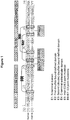
- the aforementioned human BCMA/murine BCMA chimeras are expressed in CHO cells. It is also envisaged that the human BCMA/murine BCMA chimeras are fused with a transmembrane domain and/or cytoplasmic domain of a different membrane-bound protein such as EpCAM; see Figure 2a .
- a method to test this loss of binding due to exchange with the respective epitope cluster of a non-human e.g.
- BCMA antigen BCMA antigen is described in the appended Examples, in particular in Examples 1-3.
- a further method to determine the contribution of a specific residue of a target antigen to the recognition by a given binding molecule or binding domain is alanine scanning (see e.g. Morrison KL & Weiss GA. Cur Opin Chem Biol. 2001 Jun;5(3):302-7 ), where each residue to be analyzed is replaced by alanine, e.g. via site-directed mutagenesis.
- Alanine is used because of its non-bulky, chemically inert, methyl functional group that nevertheless mimics the secondary structure references that many of the other amino acids possess.
- epitope cluster denotes the entirety of epitopes lying in a defined contiguous stretch of an antigen.
- An epitope cluster can comprise one, two or more epitopes. The epitope clusters that were defined - in the context of the present invention - in the extracellular domain of BCMA are described above and depicted in Figure 1 .
- binding domain is capable of specifically interacting with one or more, preferably at least two, more preferably at least three and most preferably at least four amino acids of an epitope.
- binding domain exhibits appreciable affinity for a particular protein or antigen and, generally, does not exhibit significant reactivity with proteins or antigens other than BCMA or CD3.
- Appreciable affinity includes binding with an affinity of about 10 -6 M (KD) or stronger.
- binding affinity is considered specific when binding affinity is about 10 -12 to 10 -8 M, 10 -12 to 10 -9 M, 10 -12 to 10 -10 M, 10 -11 to 10 -8 M, preferably of about 10 -11 to 10 -9 M.
- a binding domain specifically reacts with or binds to a target can be tested readily by, inter alia, comparing the reaction of said binding domain with a target protein or antigen with the reaction of said binding domain with proteins or antigens other than BCMA or CD3.
- a binding domain of the invention does not essentially bind or is not capable of binding to proteins or antigens other than BCMA or CD3 (i.e. the first binding domain is not capable of binding to proteins other than BCMA and the second binding domain is not capable of binding to proteins other than CD3).
- binding domain of the present invention does not bind another protein or antigen other than BCMA or CD3, i.e., does not show reactivity of more than 30%, preferably not more than 20%, more preferably not more than 10%, particularly preferably not more than 9%, 8%, 7%, 6% or 5% with proteins or antigens other than BCMA or CD3, whereby binding to BCMA or CD3, respectively, is set to be 100%.
- Specific binding is believed to be effected by specific motifs in the amino acid sequence of the binding domain and the antigen. Thus, binding is achieved as a result of their primary, secondary and/or tertiary structure as well as the result of secondary modifications of said structures.
- the specific interaction of the antigen-interaction-site with its specific antigen may result in a simple binding of said site to the antigen.
- the specific interaction of the antigen-interaction-site with its specific antigen may alternatively or additionally result in the initiation of a signal, e.g. due to the induction of a change of the conformation of the antigen, an oligomerization of the antigen, etc.
- the first binding domain of the present invention binds to epitope cluster 3 of human BCMA and is further capable of binding to epitope cluster 3 of macaque BCMA such as BCMA from Macaca mulatta (SEQ ID NO:1017) or Macaca fascicularis (SEQ ID NO:1017). It is envisaged that the first binding domain does or does not bind to murine BCMA.
- a binding domain which binds to human BCMA specifically to epitope cluster 3 of the extracellular protein domain of BCMA formed by amino acid residues 24 to 41 of the human sequence as depicted in SEQ ID NO: 1002 also binds to macaque BCMA, in particular to epitope cluster 3 of the extracellular protein domain of BCMA formed by amino acid residues 24 to 41 of the macaque BCMA sequence as depicted in SEQ ID NO: 1006.
- a first binding domain of a binding molecule is capable of binding to epitope cluster 3 of BCMA, wherein epitope cluster 3 of BCMA corresponds to amino acid residues 24 to 41 of the sequence as depicted in SEQ ID NO: 1002 (human BCMA full-length polypeptide) or SEQ ID NO: 1007 (human BCMA extracellular domain: amino acids 1-54 of SEQ ID NO: 1002).
- the first binding domain of the binding molecule is additionally or alternatively capable of binding to epitope cluster 3 of Callithrix jacchus, Saguinus oedipus and/or Saimiri sciureus BCMA.
- Proteins (including fragments thereof, preferably biologically active fragments, and peptides, usually having less than 30 amino acids) comprise one or more amino acids coupled to each other via a covalent peptide bond (resulting in a chain of amino acids).
- polypeptide as used herein describes a group of molecules, which consist of more than 30 amino acids. Polypeptides may further form multimers such as dimers, trimers and higher oligomers, i.e. consisting of more than one polypeptide molecule. Polypeptide molecules forming such dimers, trimers etc. may be identical or non-identical. The corresponding higher order structures of such multimers are, consequently, termed homo- or heterodimers, homo- or heterotrimers etc.
- polypeptide and “protein” also refer to naturally modified polypeptides/proteins wherein the modification is effected e.g. by post-translational modifications like glycosylation, acetylation, phosphorylation and the like.
- a "polypeptide” when referred to herein may also be chemically modified such as pegylated. Such modifications are well known in the art.
- the second binding domain is capable of binding to CD3 epsilon.
- the second binding domain is capable of binding to human CD3 and to macaque CD3, preferably to human CD3 epsilon and to macaque CD3 epsilon. Additionally or alternatively, the second binding domain is capable of binding to Callithrix jacchus, Saguinus oedipus and/or Saimiri sciureus CD3 epsilon. According to these embodiments, one or both binding domains of the binding molecule of the invention are preferably cross-species specific for members of the mammalian order of primates. Cross-species specific CD3 binding domains are, for example, described in WO 2008/119567 .
- the second binding domain capable of binding to CD3 comprises a VL region comprising CDR-L1, CDR-L2 and CDR-L3 selected from:
- the binding molecule of the present invention comprises a VL region selected from the group consisting of a VL region as depicted in SEQ ID NO: 35, 39, 125, 129, 161 or 165 of WO 2008/119567 .
- the second binding domain capable of binding to CD3 comprises a VH region selected from the group consisting of a VH region as depicted in SEQ ID NO: 15, 19, 33, 37, 51, 55, 69, 73, 87, 91, 105, 109, 123, 127, 141, 145, 159, 163, 177 or 181 of WO 2008/119567 .
- the binding molecule of the present invention is characterized by the second binding domain capable of binding to CD3 comprising a VL region and a VH region selected from the group consisting of:
- the pairs of VH-regions and VL-regions are in the format of a single chain antibody (scFv).
- the VH and VL regions are arranged in the order VH-VL or VL-VH. It is preferred that the VH-region is positioned N-terminally to a linker sequence.
- the VL-region is positioned C-terminally of the linker sequence.
- a preferred embodiment of the above described binding molecule of the present invention is characterized by the second binding domain capable of binding to CD3 comprising an amino acid sequence selected from the group consisting of SEQ ID NOs: 23, 25, 41, 43, 59, 61, 77, 79, 95, 97, 113, 115, 131, 133, 149, 151, 167, 169, 185 or 187 of WO 2008/119567 .
- the affinity of the first binding domain for human BCMA is preferably ⁇ 15 nM, more preferably ⁇ 10 nM, even more preferably ⁇ 5 nM, even more preferably ⁇ 1 nM, even more preferably ⁇ 0.5 nM, even more preferably ⁇ 0.1 nM, and most preferably ⁇ 0.05 nM.
- the affinity of the first binding domain for macaque BCMA is preferably ⁇ 15 nM, more preferably ⁇ 10 nM, even more preferably ⁇ 5 nM, even more preferably ⁇ 1 nM, even more preferably ⁇ 0.5 nM, even more preferably ⁇ 0.1 nM, and most preferably ⁇ 0.05 nM or even ⁇ 0.01 nM.
- the affinity can be measured for example in a Biacore assay or in a Scatchard assay, e.g. as described in the Examples.
- the affinity gap for binding to macaque BCMA versus human BCMA is preferably [1:10-1:5] or [5:1-10:1], more preferably [1:5-5:1], and most preferably [1:2-3:1] or even [1:1-3:1].
- Other methods of determining the affinity are well-known to the skilled person.
- Cytotoxicity mediated by BCMA/CD3 bispecific binding molecules can be measured in various ways.
- Effector cells can be e.g. stimulated enriched (human) CD8 positive T cells or unstimulated (human) peripheral blood mononuclear cells (PBMC). If the target cells are of macaque origin or express or are transfected with macaque BCMA, the effector cells should also be of macaque origin such as a macaque T cell line, e.g. 4119LnPx.
- the target cells should express (at least the extracellular domain of) BCMA, e.g. human or macaque BCMA.
- Target cells can be a cell line (such as CHO) which is stably or transiently transfected with BCMA, e.g.
- the target cells can be a BCMA positive natural expresser cell line, such as the human multiple myeloma cell line L363 or NCI-H929. Usually EC50-values are expected to be lower with target cell lines expressing higher levels of BCMA on the cell surface.
- the effector to target cell (E:T) ratio is usually about 10:1, but can also vary. Cytotoxic activity of BCMA/CD3 bispecific binding molecules can be measured in an 51-chromium release assay (incubation time of about 18 hours) or in a in a FACS-based cytotoxicity assay (incubation time of about 48 hours). Modifications of the assay incubation time (cytotoxic reaction) are also possible.
- MTT or MTS assays include bioluminescent assays, the sulforhodamine B (SRB) assay, WST assay, clonogenic assay and the ECIS technology.
- SRB sulforhodamine B
- the cytotoxic activity mediated by BCMA/CD3 bispecific binding molecules of the present invention is preferably measured in a cell-based cytotoxicity assay. It is represented by the EC 50 value, which corresponds to the half maximal effective concentration (concentration of the binding molecule which induces a cytotoxic response halfway between the baseline and maximum).
- the EC 50 value of the BCMA/CD3 bispecific binding molecules is ⁇ 20.000 pg/ml, more preferably ⁇ 5000 pg/ml, even more preferably ⁇ 1000 pg/ml, even more preferably ⁇ 500 pg/ml, even more preferably ⁇ 350 pg/ml, even more preferably ⁇ 320 pg/ml, even more preferably ⁇ 250 pg/ml, even more preferably ⁇ 100 pg/ml, even more preferably ⁇ 50 pg/ml, even more preferably ⁇ 10 pg/ml, and most preferably ⁇ 5 pg/ml.
- the EC 50 value of the BCMA/CD3 bispecific binding molecule is preferably ⁇ 1000 pg/ml, more preferably ⁇ 500 pg/ml, even more preferably ⁇ 250 pg/ml, even more preferably ⁇ 100 pg/ml, even more preferably ⁇ 50 pg/ml, even more preferably ⁇ 10 pg/ml, and most preferably ⁇ 5 pg/ml.
- the target cells are (human or macaque) BCMA transfected cells such as CHO cells
- the EC 50 value of the BCMA/CD3 bispecific binding molecule is preferably ⁇ 150 pg/ml, more preferably ⁇ 100 pg/ml, even more preferably ⁇ 50 pg/ml, even more preferably ⁇ 30 pg/ml, even more preferably ⁇ 10 pg/ml, and most preferably ⁇ 5 pg/ml.
- the EC 50 value is preferably ⁇ 350 pg/ml, more preferably ⁇ 320 pg/ml, even more preferably ⁇ 250 pg/ml, even more preferably ⁇ 200 pg/ml, even more preferably ⁇ 100 pg/ml, even more preferably ⁇ 150 pg/ml, even more preferably ⁇ 100 pg/ml, and most preferably ⁇ 50 pg/ml, or lower.
- the EC 50 value of the BCMA/CD3 bispecific binding molecule is preferably ⁇ 1000 pg/ml, more preferably ⁇ 750 pg/ml, more preferably ⁇ 500 pg/ml, even more preferably ⁇ 350 pg/ml, even more preferably ⁇ 320 pg/ml, even more preferably ⁇ 250 pg/ml, even more preferably ⁇ 100 pg/ml, and most preferably ⁇ 50 pg/ml, or lower.
- the BCMA/CD3 bispecific binding molecules of the present invention are characterized by an EC50 of ⁇ 350 pg/ml or less, more preferably ⁇ 320 pg/ml or less.
- the target cells are L363 cells and the effector cells are unstimulated human PBMCs.
- the skilled person knows how to measure the EC50 value without further ado.
- the specification teaches a specific instruction how to measure the EC50 value; see, for example, Example 8.3, below.A suitable protocol is as follows:
- the binding molecule of the present invention is characterized by an EC50 (pg/ml) of 350 or less, preferably 320 or less.
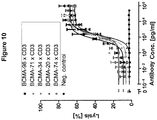
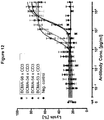
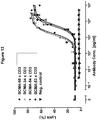
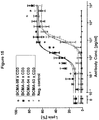
- the present invention also relates to binding molecules described herein which are characterized by an EC50 (pg/ml) which equates to the EC50 (pg/ml) of any one of the BCMA/CD3 bispecific binding molecules BCMA-83 x CD3, BCMA-62 x CD3, BCMA-5 x CD3, BCMA-98 x CD3, BCMA-71 x CD3, BCMA-34 x CD3, BCMA-74 x CD3, BCMA-20 x CD3.
- the EC50 of a binding molecule as described herein equates to the EC50 of any one of BCMA-83 x CD3, BCMA-62 x CD3, BCMA-5 x CD3, BCMA-98 x CD3, BCMA-71 x CD3, BCMA-34 x CD3, BCMA-74 x CD3, BCMA-20 x CD3, it is envisaged that for the determination of the EC50 value the same assay is applied.
- the term "equates to” includes thereby a deviation of +/- 10%, preferably +/- 7.5%, more preferably +/-5%, even more preferably +/- 2.5% of the respective EC50 value.
- BCMA/CD3 bispecific binding molecules BCMA-83 x CD3, BCMA-62 x CD3, BCMA-5 x CD3, BCMA-98 x CD3, BCMA-71 x CD3, BCMA-34 x CD3, BCMA-74 x CD3, BCMA-20 x CD3 that serve as "reference" binding molecules in the above described assay are preferably produced in CHO cells.
- Potency gap The difference in cytotoxic activity between the monomeric and the dimeric isoform of individual BCMA/CD3 bispecific binding molecules (such as antibodies) is referred to as "potency gap".
- This potency gap can e.g. be calculated as ratio between EC 50 values of the molecule's monomeric and dimeric form.
- Potency gaps of the BCMA/CD3 bispecific binding molecules of the present invention are preferably ⁇ 5, more preferably ⁇ 4, even more preferably ⁇ 3, even more preferably ⁇ 2 and most preferably ⁇ 1.
- the BCMA/CD3 bispecific binding molecules of the present invention do not bind to, interact with, recognize or cross-react with human BAFF-R and/or human TACI.
- Methods to detect cross-reactivity with human BAFF-R and/or human TACI are disclosed in Example 9.
- the BCMA/CD3 bispecific binding molecules of the present invention present with very low dimer conversion after a number of freeze/thaw cycles.
- the dimer percentages are ⁇ 5%, more preferably ⁇ 4%, even more preferably ⁇ 3%, even more preferably ⁇ 2.5%, even more preferably ⁇ 2%, even more preferably ⁇ 1.5%, and most preferably ⁇ 1%, for example after three freeze/thaw cycles.
- a freeze-thaw cycle and the determination of the dimer percentage can be carried out in accordance with Example 16.
- the BCMA/CD3 bispecific binding molecules (such as antibodies) of the present invention preferably show a favorable thermostability with melting temperatures above 60°C.
- a plasma interference test can be carried out (see e.g. Example 18).
- the relative plasma interference value is preferably ⁇ 2.
- the BCMA/CD3 bispecific binding molecules of the present invention are capable of exhibiting therapeutic efficacy or anti-tumor activity. This can be assessed e.g. in a study as disclosed in Example 19 (advanced stage human tumor xenograft model). The skilled person knows how to modify or adapt certain parameters of this study, such as the number of injected tumor cells, the site of injection, the number of transplanted human T cells, the amount of BCMA/CD3 bispecific binding molecules to be administered, and the timelines, while still arriving at a meaningful and reproducible result.
- the tumor growth inhibition T/C [%] is 70 or 60 or lower, more preferably 50 or 40 or lower, even more preferably at least 30 or 20 or lower and most preferably 10 or lower, 5 or lower or even 2.5 or lower.
- the BCMA/CD3 bispecific binding molecules of the present invention do not induce / mediate lysis or do not essentially induce / mediate lysis of BCMA negative cells such as HL60, MES-SA, and SNU-16.
- the term "do not induce lysis”, “do not essentially induce lysis”, “do not mediate lysis” or “do not essentially mediate lysis” means that a binding molecule of the present invention does not induce or mediate lysis of more than 30%, preferably not more than 20%, more preferably not more than 10%, particularly preferably not more than 9%, 8%, 7%, 6% or 5% of BCMA negative cells, whereby lysis of a BCMA positive cell line such as NCI-H929, L-363 or OPM-2 is set to be 100%.
- the first or the second binding domain is or is derived from an antibody. In another embodiment, both binding domains are or are derived from an antibody.
- antibody includes embodiments such as monoclonal, chimeric, single chain, humanized and human antibodies. In addition to full-length antibodies, the definition also includes antibody derivatives and antibody fragments, like, inter alia, Fab fragments. Antibody fragments or derivatives further comprise F(ab') 2 , Fv, scFv fragments or single domain antibodies such as domain antibodies or nanobodies, single variable domain antibodies or immunoglobulin single variable domain comprising merely one variable domain, which might be VHH, VH or VL, that specifically bind an antigen or epitope independently of other V regions or domains; see, for example, Harlow and Lane (1988) and (1999), loc.
- Immunoglobulin single variable domains encompass not only an isolated antibody single variable domain polypeptide, but also larger polypeptides that comprise one or more monomers of an antibody single variable domain polypeptide sequence.
- (antibody) derivatives can be produced by peptidomimetics.
- techniques described for the production of single chain antibodies see, inter alia, US Patent 4,946,778 , Kontermann and Dübel (2010), loc. cit. and Little (2009), loc. cit.
- transgenic animals may be used to express humanized antibodies specific for polypeptides and fusion proteins of this invention.
- any technique, providing antibodies produced by continuous cell line cultures can be used.
- Examples for such techniques include the hybridoma technique ( Kohler and Milstein Nature 256 (1975), 495-497 ), the trioma technique, the human B cell hybridoma technique (Kozbor, Immunology Today 4 (1983), 72) and the EBV hybridoma technique to produce human monoclonal antibodies ( Cole et al., Monoclonal Antibodies and Cancer Therapy, Alan R. Liss, Inc. (1985), 77-96 ).
- antibody comprises antibody constructs, which may be expressed in a host as described herein below, e.g. antibody constructs which may be transfected and/or transduced via, inter alia, viruses or plasmid vectors.
- antibody as employed herein also relates to derivatives or variants of the antibodies described herein which display the same specificity as the described antibodies.
- antibody variants include humanized variants of non-human antibodies, "affinity matured” antibodies (see, e.g. Hawkins et al. J. Mol. Biol. 254, 889-896 (1992 ) and Lowman et al., Biochemistry 30, 10832- 10837 (1991 )) and antibody mutants with altered effector function(s) (see, e.g., US Patent 5, 648, 260 , Kontermann and Dübel (2010), loc. cit. and Little(2009), loc. cit.).
- an antigen-binding domain refers to a part of an antibody molecule that comprises amino acids responsible for the specific binding between antibody and antigen.
- the part of the antigen that is specifically recognized and bound by the antibody is referred to as the "epitope" as described herein above.
- an antigen-binding domain may typically comprise an antibody light chain variable region (VL) and an antibody heavy chain variable region (VH); however, it does not have to comprise both.
- Fd fragments for example, have two VH regions and often retain some antigen-binding function of the intact antigen-binding domain.
- antigen-binding fragments of an antibody examples include (1) a Fab fragment, a monovalent fragment having the VL, VH, CL and CH1 domains; (2) a F(ab')2 fragment, a bivalent fragment having two Fab fragments linked by a disulfide bridge at the hinge region; (3) an Fd fragment having the two VH and CH1 domains; (4) an Fv fragment having the VL and VH domains of a single arm of an antibody, (5) a dAb fragment ( Ward et al., (1989) Nature 341 :544-546 ), which has a VH domain; (6) an isolated complementarity determining region (CDR), and (7) a single chain Fv (scFv), the latter being preferred (for example, derived from a scFV-library).
- a Fab fragment a monovalent fragment having the VL, VH, CL and CH1 domains
- F(ab')2 fragment a bivalent fragment having two Fab fragments linked by a
- the two domains of the Fv fragment, VL and VH are coded for by separate genes, they can be joined, using recombinant methods, by a synthetic linker that enables them to be made as a single protein chain in which the VL and VH regions pair to form monovalent molecules (known as single chain Fv (scFv); see e.g., Huston et al. (1988) Proc. Natl. Acad. Sci USA 85:5879-5883 ).
- scFv single chain Fv
- the term "monoclonal antibody” as used herein refers to an antibody obtained from a population of substantially homogeneous antibodies, i.e., the individual antibodies comprising the population are identical except for possible naturally occurring mutations and/or post- translation modifications (e.g., isomerizations, amidations) that may be present in minor amounts.
- Monoclonal antibodies are highly specific, being directed against a single antigenic site. Furthermore, in contrast to conventional (polyclonal) antibody preparations which typically include different antibodies directed against different determinants (epitopes), each monoclonal antibody is directed against a single determinant on the antigen. In addition to their specificity, the monoclonal antibodies are advantageous in that they are synthesized by the hybridoma culture, uncontaminated by other immunoglobulins.
- the modifier "monoclonal" indicates the character of the antibody as being obtained from a substantially homogeneous population of antibodies, and is not to be construed as requiring production of the antibody by any particular method.
- the monoclonal antibodies to be used in accordance with the present invention may be made by the hybridoma method first described by Kohler et al., Nature, 256: 495 (1975 ), or may be made by recombinant DNA methods (see, e.g., U. S. Patent No. 4,816,567 ).
- the "monoclonal antibodies” may also be isolated from phage antibody libraries using the techniques described in Clackson et al., Nature, 352: 624-628 (1991 ) and Marks et al., J. Mol. Biol., 222: 581-597 (1991 ), for example.
- the monoclonal antibodies of the present invention specifically include "chimeric" antibodies (immunoglobulins) in which a portion of the heavy and/or light chain is identical with or homologous to corresponding sequences in antibodies derived from a particular species or belonging to a particular antibody class or subclass, while the remainder of the chain (s) is (are) identical with or homologous to corresponding sequences in antibodies derived from another species or belonging to another antibody class or subclass, as well as fragments of such antibodies, so long as they exhibit the desired biological activity ( U. S. Patent No. 4,816 , 567 ; Morrison et al., Proc. Natl. Acad. Sci. USA, 81: 6851-6855 (1984 )).
- chimeric antibodies immunoglobulins in which a portion of the heavy and/or light chain is identical with or homologous to corresponding sequences in antibodies derived from a particular species or belonging to a particular antibody class or subclass, while the remainder of the chain (s) is (are
- Chimeric antibodies of interest herein include "primitized” antibodies comprising variable domain antigen-binding sequences derived from a non-human primate (e.g., Old World Monkey, Ape etc.) and human constant region sequences.
- "Humanized” forms of non-human (e.g., murine) antibodies are chimeric immunoglobulins, immunoglobulin chains or fragments thereof (such as Fv, Fab, Fab', F(ab')2 or other antigen-binding subsequences of antibodies) of mostly human sequences, which contain minimal sequence derived from non-human immunoglobulin.
- humanized antibodies are human immunoglobulins (recipient antibody) in which residues from a hypervariable region (also CDR) of the recipient are replaced by residues from a hypervariable region of a non-human species (donor antibody) such as mouse, rat or rabbit having the desired specificity, affinity, and capacity.
- donor antibody such as mouse, rat or rabbit having the desired specificity, affinity, and capacity.
- Fv framework region (FR) residues of the human immunoglobulin are replaced by corresponding non-human residues.
- "humanized antibodies” as used herein may also comprise residues which are found neither in the recipient antibody nor the donor antibody. These modifications are made to further refine and optimize antibody performance.
- the humanized antibody optimally also will comprise at least a portion of an immunoglobulin constant region (Fc), typically that of a human immunoglobulin.
- Fc immunoglobulin constant region
- human antibody includes antibodies having variable and constant regions corresponding substantially to human germline immunoglobulin sequences known in the art, including, for example, those described by Kabat et al. (See Kabat et al. (1991) loc. cit.).
- the human antibodies of the invention may include amino acid residues not encoded by human germline immunoglobulin sequences (e.g., mutations introduced by random or site-specific mutagenesis in vitro or by somatic mutation in vivo ), for example in the CDRs, and in particular, CDR3.
- the human antibody can have at least one, two, three, four, five, or more positions replaced with an amino acid residue that is not encoded by the human germline immunoglobulin sequence.
- in vitro generated antibody refers to an antibody where all or part of the variable region (e.g., at least one CDR) is generated in a non-immune cell selection (e.g., an in vitro phage display, protein chip or any other method in which candidate sequences can be tested for their ability to bind to an antigen). This term thus preferably excludes sequences generated by genomic rearrangement in an immune cell.
- a "bispecific” or “bifunctional” antibody or immunoglobulin is an artificial hybrid antibody or immunoglobulin having two different heavy/light chain pairs and two different binding sites.
- Bispecific antibodies can be produced by a variety of methods including fusion of hybridomas or linking of Fab' fragments. See, e.g., Songsivilai & Lachmann, Clin. Exp. Immunol. 79:315-321 (1990 ). Numerous methods known to those skilled in the art are available for obtaining antibodies or antigen-binding fragments thereof. For example, antibodies can be produced using recombinant DNA methods ( U.S. Patent No. 4,816,567 ).
- Monoclonal antibodies may also be produced by generation of hybridomas (see e.g., Kohler and Milstein (1975) Nature, 256: 495-499 ) in accordance with known methods. Hybridomas formed in this manner are then screened using standard methods, such as enzyme-linked immunosorbent assay (ELISA) and surface plasmon resonance (BIACORETM) analysis, to identify one or more hybridomas that produce an antibody that specifically binds with a specified antigen. Any form of the specified antigen may be used as the immunogen, e.g., recombinant antigen, naturally occurring forms, any variants or fragments thereof, as well as antigenic peptide thereof.”
- ELISA enzyme-linked immunosorbent assay
- BIACORETM surface plasmon resonance
- One exemplary method of making antibodies includes screening protein expression libraries, e.g., phage or ribosome display libraries.
- Phage display is described, for example, in Ladner et al., U.S. Patent No. 5,223,409 ; Smith (1985) Science 228:1315-1317 ; Clackson et al. (1991) Nature, 352: 624-628 .
- the specified antigen can be used to immunize a non-human animal, e.g., a rodent, e.g., a mouse, hamster, or rat.
- the non-human animal includes at least a part of a human immunoglobulin gene.
- antigen-specific monoclonal antibodies derived from the genes with the desired specificity may be produced and selected. See, e.g., XENOMOUSETM, Green et al. (1994) Nature Genetics 7:13-21 , US 2003- 0070185 , WO 96/34096 , and WO96/33735 .
- a monoclonal antibody can be obtained from a non-human animal, and then modified, e.g., humanized, deimmunized, chimeric, may be produced using recombinant DNA techniques known in the art.
- modified e.g., humanized, deimmunized, chimeric
- a variety of approaches for making chimeric antibodies have been described. See e.g., Morrison et al., Proc. Natl. Acad. ScL U.S.A. 81:6851 , 1985 ; Takeda et al., Nature 314:452, 1985 , Cabilly et al., U.S. Patent No. 4,816,567 ; Boss et al., U.S. Patent No.
- Humanized antibodies may also be produced, for example, using transgenic mice that express human heavy and light chain genes, but are incapable of expressing the endogenous mouse immunoglobulin heavy and light chain genes. Winter describes an exemplary CDR-grafting method that may be used to prepare the humanized antibodies described herein ( U.S. Patent No. 5,225,539 ). All of the CDRs of a particular human antibody may be replaced with at least a portion of a non-human CDR, or only some of the CDRs may be replaced with non-human CDRs. It is only necessary to replace the number of CDRs required for binding of the humanized antibody to a predetermined antigen.
- Humanized antibodies or fragments thereof can be generated by replacing sequences of the Fv variable domain that are not directly involved in antigen binding with equivalent sequences from human Fv variable domains.
- Exemplary methods for generating humanized antibodies or fragments thereof are provided by Morrison (1985) Science 229:1202-1207 ; by Oi et al. (1986) BioTechniques 4:214 ; and by US 5,585,089 ; US 5,693,761 ; US 5,693,762 ; US 5,859,205 ; and US 6,407,213 .
- Those methods include isolating, manipulating, and expressing the nucleic acid sequences that encode all or part of immunoglobulin Fv variable domains from at least one of a heavy or light chain.
- nucleic acids may be obtained from a hybridoma producing an antibody against a predetermined target, as described above, as well as from other sources.
- the recombinant DNA encoding the humanized antibody molecule can then be cloned into an appropriate expression vector.
- a humanized antibody can be optimized by the introduction of conservative substitutions, consensus sequence substitutions, germline substitutions and/or back mutations.
- Such altered immunoglobulin molecules can be made by any of several techniques known in the art, (e.g., Teng et al., Proc. Natl. Acad. Sci. U.S.A., 80: 7308-7312, 1983 ; Kozbor et al., Immunology Today, 4: 7279, 1983 ; Olsson et al., Meth. Enzymol., 92: 3-16, 1982 ), and may be made according to the teachings of EP 239 400 .
- An antibody or fragment thereof may also be modified by specific deletion of human T cell epitopes or "deimmunization" by the methods disclosed in WO 98/52976 and WO 00/34317 . Briefly, the heavy and light chain variable domains of an antibody can be analyzed for peptides that bind to MHC class II; these peptides represent potential T cell epitopes (as defined in WO 98/52976 and WO 00/34317 ).
- peptide threading For detection of potential T cell epitopes, a computer modeling approach termed "peptide threading" can be applied, and in addition a database of human MHC class II binding peptides can be searched for motifs present in the VH and VL sequences, as described in WO 98/52976 and WO 00/34317 . These motifs bind to any of the 18 major MHC class II DR allotypes, and thus constitute potential T cell epitopes.
- Potential T-cell epitopes detected can be eliminated by substituting small numbers of amino acid residues in the variable domains, or preferably, by single amino acid substitutions. Typically, conservative substitutions are made. Often, but not exclusively, an amino acid common to a position in human germline antibody sequences may be used.
- Human germline sequences e.g., are disclosed in Tomlinson, et al. (1992) J. Mol. Biol. 227:776-798 ; Cook, G.P. et al. (1995) Immunol. Today Vol. 16 (5): 237-242 ; and Tomlinson et al. (1995) EMBO J. 14: 14:4628-4638 .
- the V BASE directory provides a comprehensive directory of human immunoglobulin variable region sequences (compiled by Tomlinson, LA. et al. MRC Centre for Protein Engineering, Cambridge, UK ). These sequences can be used as a source of human sequence, e.g., for framework regions and CDRs. Consensus human framework regions can also be used, e.g., as described in US Patent No. 6,300,064 .
- the pairing of a VH and VL together forms a single antigen-binding site.
- the CH domain most proximal to VH is designated as CH1.
- Each L chain is linked to an H chain by one covalent disulfide bond, while the two H chains are linked to each other by one or more disulfide bonds depending on the H chain isotype.
- the VH and VL domains consist of four regions of relatively conserved sequences called framework regions (FR1, FR2, FR3, and FR4), which form a scaffold for three regions of hypervariable sequences (complementarity determining regions, CDRs).
- the CDRs contain most of the residues responsible for specific interactions of the antibody with the antigen. CDRs are referred to as CDR 1, CDR2, and CDR3.
- CDR constituents on the heavy chain are referred to as H1, H2, and H3, while CDR constituents on the light chain are referred to as L1, L2, and L3.
- variable refers to the portions of the immunoglobulin domains that exhibit variability in their sequence and that are involved in determining the specificity and binding affinity of a particular antibody (i.e., the "variable domain(s)"). Variability is not evenly distributed throughout the variable domains of antibodies; it is concentrated in sub-domains of each of the heavy and light chain variable regions. These sub-domains are called “hypervariable” regions or “complementarity determining regions” (CDRs).
- variable domains of naturally occurring heavy and light chains each comprise four FRM regions, largely adopting a ⁇ -sheet configuration, connected by three hypervariable regions, which form loops connecting, and in some cases forming part of, the ⁇ -sheet structure.
- the hypervariable regions in each chain are held together in close proximity by the FRM and, with the hypervariable regions from the other chain, contribute to the formation of the antigen-binding site (see Kabat et al., loc. cit.).
- the constant domains are not directly involved in antigen binding, but exhibit various effector functions, such as, for example, antibody-dependent, cell-mediated cytotoxicity and complement activation.
- first and the second domain form a molecule that is selected from the group of (scFv) 2 , (single domain mAb) 2 , scFv-single domain mAb, diabody or oligomeres thereof.
- CDR refers to a complementarity determining region (CDR) of which three make up the binding character of a light chain variable region (CDRL1, CDRL2 and CDRL3) and three make up the binding character of a heavy chain variable region (CDRH1, CDRH2 and CDRH3).
- CDRs contribute to the functional activity of an antibody molecule and are separated by amino acid sequences that comprise scaffolding or framework regions.
- the exact definitional CDR boundaries and lengths are subject to different classification and numbering systems. CDRs may therefore be referred to by Kabat, Chothia, contact or any other boundary definitions, including the numbering system described herein.
- CDR definitions according to these systems may therefore differ in length and boundary areas with respect to the adjacent framework region. See for example Kabat, Chothia, and/or MacCallum (Kabat et al., loc. cit.; Chothia et al., J. Mol. Biol, 1987, 196: 901 ; and MacCallum et al., J. Mol. Biol, 1996, 262: 732 ). However, the numbering in accordance with the so-called Kabat system is preferred.
- amino acid typically refers to an amino acid having its art recognized definition such as an amino acid selected from the group consisting of: alanine (Ala or A); arginine (Arg or R); asparagine (Asn or N); aspartic acid (Asp or D); cysteine (Cys or C); glutamine (Gln or Q); glutamic acid (Glu or E); glycine (Gly or G); histidine (His or H); isoleucine (He or I): leucine (Leu or L); lysine (Lys or K); methionine (Met or M); phenylalanine (Phe or F); pro line (Pro or P); serine (Ser or S); threonine (Thr or T); tryptophan (Trp or W); tyrosine (Tyr or Y); and valine (Val or V), although modified, synthetic, or rare amino acids may be used as desired.
- alanine Al or A
- arginine
- amino acids can be grouped as having a nonpolar side chain (e.g., Ala, Cys, He, Leu, Met, Phe, Pro, Val); a negatively charged side chain (e.g., Asp, Glu); a positively charged sidechain (e.g., Arg, His, Lys); or an uncharged polar side chain (e.g., Asn, Cys, Gln, Gly, His, Met, Phe, Ser, Thr, Trp, and Tyr).
- a nonpolar side chain e.g., Ala, Cys, He, Leu, Met, Phe, Pro, Val
- a negatively charged side chain e.g., Asp, Glu
- a positively charged sidechain e.g., Arg, His, Lys
- an uncharged polar side chain e.g., Asn, Cys, Gln, Gly, His, Met, Phe, Ser, Thr, Trp, and Tyr.
- hypervariable region also known as “complementarity determining regions” or CDRs
- CDRs complementarity determining regions
- CDR residues are preferably identified in accordance with the so-called Kabat (numbering) system.
- framework region refers to the art-recognized portions of an antibody variable region that exist between the more divergent (i.e., hypervariable) CDRs.
- framework regions are typically referred to as frameworks 1 through 4 (FR1, FR2, FR3, and FR4) and provide a scaffold for the presentation of the six CDRs (three from the heavy chain and three from the light chain) in three dimensional space, to form an antigen-binding surface.
- CDRs form a loop structure that can be classified as a canonical structure.
- canonical structure refers to the main chain conformation that is adopted by the antigen binding (CDR) loops. From comparative structural studies, it has been found that five of the six antigen binding loops have only a limited repertoire of available conformations. Each canonical structure can be characterized by the torsion angles of the polypeptide backbone. Correspondent loops between antibodies may, therefore, have very similar three dimensional structures, despite high amino acid sequence variability in most parts of the loops ( Chothia and Lesk, J. Mol.
- canonical structure may also include considerations as to the linear sequence of the antibody, for example, as catalogued by Kabat (Kabat et al., loc. cit.).
- Kabat numbering scheme system
- a given antibody sequence may be placed into a canonical class which allows for, among other things, identifying appropriate chassis sequences (e.g., based on a desire to include a variety of canonical structures in a library). Kabat numbering of antibody amino acid sequences and structural considerations as described by Chothia et al., loc. cit. and their implications for construing canonical aspects of antibody structure, are described in the literature.
- CDR3 is typically the greatest source of molecular diversity within the antibody-binding site.
- H3 for example, can be as short as two amino acid residues or greater than 26 amino acids.
- the subunit structures and three-dimensional configurations of different classes of immunoglobulins are well known in the art. For a review of the antibody structure, see Antibodies: A Laboratory Manual, Cold Spring Harbor Laboratory, eds. Harlow et al., 1988 .
- each subunit structure e.g., a CH, VH, CL, VL, CDR, FR structure
- comprises active fragments e.g., the portion of the VH, VL, or CDR subunit the binds to the antigen, i.e., the antigen-binding fragment, or, e.g., the portion of the CH subunit that binds to and/or activates, e.g., an Fc receptor and/or complement.
- the CDRs typically refer to the Kabat CDRs, as described in Sequences of Proteins of immunological Interest, US Department of Health and Human Services (1991), eds. Kab at et al.
- Another standard for characterizing the antigen binding site is to refer to the hypervariable loops as described by Chothia. See, e.g., Chothia, et al. (1987; J. Mol. Biol. 227:799-817 ); and Tomlinson et al. (1995) EMBO J. 14: 4628-4638 . Still another standard is the AbM definition used by Oxford Molecular's AbM antibody modeling software. See, generally, e.g., Protein Sequence and Structure Analysis of Antibody Variable Domains. In: Antibody Engineering Lab Manual (Ed.: Duebel, S. and Kontermann, R., Springer-Verlag, Heidelberg ). Embodiments described with respect to Kabat CDRs can alternatively be implemented using similar described relationships with respect to Chothia hypervariable loops or to the AbM-defined loops.
- the sequence of antibody genes after assembly and somatic mutation is highly varied, and these varied genes are estimated to encode 10 10 different antibody molecules ( Immunoglobulin Genes, 2nd ed., eds. Jonio et al., Academic Press, San Diego, CA, 1995 ). Accordingly, the immune system provides a repertoire of immunoglobulins.
- the term "repertoire” refers to at least one nucleotide sequence derived wholly or partially from at least one sequence encoding at least one immunoglobulin.
- the sequence(s) may be generated by rearrangement in vivo of the V, D, and J segments of heavy chains, and the V and J segments of light chains.
- sequence(s) can be generated from a cell in response to which rearrangement occurs, e.g., in vitro stimulation.
- part or all of the sequence(s) may be obtained by DNA splicing, nucleotide synthesis, mutagenesis, and other methods, see, e.g., U.S. Patent 5,565,332 .
- a repertoire may include only one sequence or may include a plurality of sequences, including ones in a genetically diverse collection.
- the first binding domain of the binding molecule of the invention comprises a VH region comprising CDR-H1, CDR-H2 and CDR-H3 and a VL region comprising CDR-L1, CDR-L2 and CDR-L3 selected from the group consisting of:
- the first binding domain of the binding molecule comprises a VH region selected from the group consisting of a VH region as depicted in SEQ ID NO: 7, SEQ ID NO: 17, SEQ ID NO: 27, SEQ ID NO: 37, SEQ ID NO: 47, SEQ ID NO: 57, SEQ ID NO: 67, SEQ ID NO: 77, SEQ ID NO: 167, SEQ ID NO: 177, SEQ ID NO: 187, SEQ ID NO: 197, SEQ ID NO: 207, SEQ ID NO: 217, SEQ ID NO: 227, SEQ ID NO: 317, SEQ ID NO: 327, SEQ ID NO: 337, SEQ ID NO: 347, SEQ ID NO: 357, SEQ ID NO: 367, SEQ ID NO: 377, SEQ ID NO: 387, SEQ ID NO: 587, SEQ ID NO: 597, SEQ ID NO: 607, SEQ ID NO: 617, SEQ ID NO: 627, SEQ
- the first binding domain of the binding molecule comprises a VL region selected from the group consisting of a VL region as depicted in SEQ ID in SEQ ID NO: 8, SEQ ID NO: 18, SEQ ID NO: 28, SEQ ID NO: 38, SEQ ID NO: 48, SEQ ID NO: 58, SEQ ID NO: 68, SEQ ID NO: 78, SEQ ID NO: 168, SEQ ID NO: 178, SEQ ID NO: 188, SEQ ID NO: 198, SEQ ID NO: 208, SEQ ID NO: 218, SEQ ID NO: 228, SEQ ID NO: 318, SEQ ID NO: 328, SEQ ID NO: 338, SEQ ID NO: 348, SEQ ID NO: 358, SEQ ID NO: 368, SEQ ID NO: 378, SEQ ID NO: 388, SEQ ID NO: 588, SEQ ID NO: 598, SEQ ID NO: 608, SEQ ID NO: 618, SEQ ID NO: 628, SEQ ID NO:
- the first binding domain of the binding molecule comprises a VH region and a VL region selected from the group consisting of:
- the first binding domain comprises an amino acid sequence selected from the group consisting of SEQ ID NO: 9, SEQ ID NO: 19, SEQ ID NO: 29, SEQ ID NO: 39, SEQ ID NO: 49, SEQ ID NO: 59, SEQ ID NO: 69, SEQ ID NO: 79, SEQ ID NO: 169, SEQ ID NO: 179, SEQ ID NO: 189, SEQ ID NO: 199, SEQ ID NO: 209, SEQ ID NO: 219, SEQ ID NO: 229, SEQ ID NO: 319, SEQ ID NO: 329, SEQ ID NO: 339, SEQ ID NO: 349, SEQ ID NO: 359, SEQ ID NO: 369, SEQ ID NO: 379, SEQ ID NO: 389, SEQ ID NO: 589, SEQ ID NO: 599, SEQ ID NO: 609, SEQ ID NO: 619, SEQ ID NO: 629, SEQ ID NO: 639, SEQ ID NO: 649, SEQ ID NO: 9
- a binding molecule of the present invention has a CDR-H3 region of 12 amino acids in length, wherein a tyrosine (Y) residue is present at position 3, 4 and 12.
- a preferred CDR-H3 is shown in SEQ ID NOs: 43, 193, 333, 613, 703, 733, 823, or 973.
- a binding molecule of the present invention has in a preferred embodiment a CDR-H3 shown in of SEQ ID NOs: 43, 193, 333, 613, 703, 733, 823, or 973.
- binding molecule having the amino acid sequence shown in SEQ ID NO: 340. Also preferred is a binding molecule having the amino acid sequence shown in or SEQ ID NO: 980.
- the binding molecule of the present invention is preferably an "isolated" binding molecule. "Isolated” when used to describe the binding molecule disclosed herein, means a binding molecule that has been identified, separated and/or recovered from a component of its production environment. Preferably, the isolated binding molecule is free of association with all other components from its production environment.
- Contaminant components of its production environment are materials that would typically interfere with diagnostic or therapeutic uses for the polypeptide, and may include enzymes, hormones, and other proteinaceous or non-proteinaceous solutes.
- the binding molecule will be purified (1) to a degree sufficient to obtain at least 15 residues of N-terminal or internal amino acid sequence by use of a spinning cup sequenator, or (2) to homogeneity by SDS-PAGE under non-reducing or reducing conditions using Coomassie blue or, preferably, silver stain. Ordinarily, however, an isolated antibody will be prepared by at least one purification step.
- Amino acid sequence modifications of the binding molecules described herein are contemplated. For example, it may be desirable to improve the binding affinity and/or other biological properties of the antibody.
- Amino acid sequence variants of the binding molecules are prepared by introducing appropriate nucleotide changes into the binding molecules nucleic acid, or by peptide synthesis.
- Such modifications include, for example, deletions from, and/or insertions into, and/or substitutions of, residues within the amino acid sequences of the binding molecules. Any combination of deletion, insertion, and substitution is made to arrive at the final construct, provided that the final construct possesses the desired characteristics.
- the amino acid changes also may alter post-translational processes of the binding molecules, such as changing the number or position of glycosylation sites.
- 1, 2, 3, 4, 5, 6, 7, 8, 9, or 10 amino acids may be substituted in a CDR, while 1, 2, 3, 4, 5, 6, 7, 8, 9, 10, 11, 12, 13, 14, 15, 16, 17, 18, 19, 20, or 25 amino acids may be substituted in the framework regions (FRs).
- the substitutions are preferably conservative substitutions as described herein.
- 1, 2, 3, 4, 5, or 6 amino acids may be inserted or deleted in each of the CDRs (of course, dependent on their length), while 1, 2, 3, 4, 5, 6, 7, 8, 9, 10, 11, 12, 13, 14, 15, 16, 17, 18, 19, 20, or 25 amino acids may be inserted or deleted in each of the FRs.
- a useful method for identification of certain residues or regions of the binding molecules that are preferred locations for mutagenesis is called "alanine scanning mutagenesis" as described by Cunningham and Wells in Science, 244: 1081-1085 (1989 ).
- a residue or group of target residues within the binding molecule is/are identified (e.g. charged residues such as arg, asp, his, lys, and glu) and replaced by a neutral or negatively charged amino acid (most preferably alanine or polyalanine) to affect the interaction of the amino acids with the epitope.
- Those amino acid locations demonstrating functional sensitivity to the substitutions then are refined by introducing further or other variants at, or for, the sites of substitution.
- the site for introducing an amino acid sequence variation is predetermined, the nature of the mutation per se needs not to be predetermined. For example, to analyze the performance of a mutation at a given site, ala scanning or random mutagenesis is conducted at a target codon or region and the expressed binding molecule variants are screened for the desired activity.
- amino acid sequence insertions include amino- and/or carboxyl-terminal fusions ranging in length from 1, 2, 3, 4, 5, 6, 7, 8, 9 or 10 residues to polypeptides containing a hundred or more residues, as well as intrasequence insertions of single or multiple amino acid residues.
- An insertional variant of the binding molecule includes the fusion to the N-or C-terminus of the antibody to an enzyme or a fusion to a polypeptide which increases the serum half-life of the antibody.
- variants are an amino acid substitution variant. These variants have preferably at least 1, 2, 3, 4, 5, 6, 7, 8, 9 or 10 amino acid residues in the binding molecule replaced by a different residue.
- the sites of greatest interest for substitutional mutagenesis include the CDRs of the heavy and/or light chain, in particular the hypervariable regions, but FR alterations in the heavy and/or light chain are also contemplated.
- a CDR sequence encompasses 6 amino acids, it is envisaged that one, two or three of these amino acids are substituted. Similarly, if a CDR sequence encompasses 15 amino acids it is envisaged that one, two, three, four, five or six of these amino acids are substituted.
- the then-obtained "substituted" sequence is at least 60%, more preferably 65%, even more preferably 70%, particularly preferably 75%, more particularly preferably 80% identical to the "original" CDR sequence. This means that it is dependent of the length of the CDR to which degree it is identical to the "substituted" sequence.
- a CDR having 5 amino acids is preferably 80% identical to its substituted sequence in order to have at least one amino acid substituted.
- the CDRs of the binding molecule may have different degrees of identity to their substituted sequences, e.g., CDRL1 may have 80%, while CDRL3 may have 90%.
- substitutions are conservative substitutions.
- any substitution including non-conservative substitution or one or more from the "exemplary substitutions” listed in Table 1, below is envisaged as long as the binding molecule retains its capability to bind to BCMA via the first binding domain and to CD3 epsilon via the second binding domain and/or its CDRs have an identity to the then substituted sequence (at least 60%, more preferably 65%, even more preferably 70%, particularly preferably 75%, more particularly preferably 80% identical to the "original" CDR sequence).
- Substantial modifications in the biological properties of the binding molecule of the present invention are accomplished by selecting substitutions that differ significantly in their effect on maintaining (a) the structure of the polypeptide backbone in the area of the substitution, for example, as a sheet or helical conformation, (b) the charge or hydrophobicity of the molecule at the target site, or (c) the bulk of the side chain.
- Naturally occurring residues are divided into groups based on common side-chain properties: (1) hydrophobic: norleucine, met, ala, val, leu, ile; (2) neutral hydrophilic: cys, ser, thr; (3) acidic: asp, glu; (4) basic: asn, gin, his, lys, arg; (5) residues that influence chain orientation: gly, pro; and (6) aromatic: trp, tyr, phe.
- Non-conservative substitutions will entail exchanging a member of one of these classes for another class. Any cysteine residue not involved in maintaining the proper conformation of the binding molecule may be substituted, generally with serine, to improve the oxidative stability of the molecule and prevent aberrant crosslinking. Conversely, cysteine bond(s) may be added to the antibody to improve its stability (particularly where the antibody is an antibody fragment such as an Fv fragment).
- a particularly preferred type of substitutional variant involves substituting one or more hypervariable region residues of a parent antibody (e. g. a humanized or human antibody).
- a parent antibody e. g. a humanized or human antibody
- the resulting variant(s) selected for further development will have improved biological properties relative to the parent antibody from which they are generated.
- a convenient way for generating such substitutional variants involves affinity maturation using phage display. Briefly, several hypervariable region sites (e. g. 6-7 sites) are mutated to generate all possible amino acid substitutions at each site.
- the antibody variants thus generated are displayed in a monovalent fashion from filamentous phage particles as fusions to the gene III product of M13 packaged within each particle. The phage-displayed variants are then screened for their biological activity (e. g.
- alanine scanning mutagenesis can be performed to identify hypervariable region residues contributing significantly to antigen binding.
- Such contact residues and neighbouring residues are candidates for substitution according to the techniques elaborated herein.
- the binding molecule may be linked to one of a variety of non-proteinaceous polymers, e.g., polyethylene glycol, polypropylene glycol, polyoxyalkylenes, or copolymers of polyethylene glycol and polypropylene glycol.
- non-proteinaceous polymers e.g., polyethylene glycol, polypropylene glycol, polyoxyalkylenes, or copolymers of polyethylene glycol and polypropylene glycol.
- the binding molecule may also be entrapped in microcapsules prepared, for example, by coacervation techniques or by interfacial polymerization (for example, hydroxymethylcellulose or gelatine-microcapsules and poly (methylmethacylate) microcapsules, respectively), in colloidal drug delivery systems (for example, liposomes, albumin microspheres, microemulsions, nanoparticles and nanocapsules), or in macroemulsions.
- colloidal drug delivery systems for example, liposomes, albumin microspheres, microemulsions, nanoparticles and nanocapsules
- the binding molecules disclosed herein may also be formulated as immuno-liposomes.
- a "liposome” is a small vesicle composed of various types of lipids, phospholipids and/or surfactant which is useful for delivery of a drug to a mammal. The components of the liposome are commonly arranged in a bilayer formation, similar to the lipid arrangement of biological membranes. Liposomes containing the antibody are prepared by methods known in the art, such as described in Epstein et al., Proc. Natl. Acad. Sci. USA, 82: 3688 (1985 ); Hwang et al., Proc. Natl Acad. Sci. USA, 77: 4030 (1980 ); US Pat. Nos.
- Liposomes with enhanced circulation time are disclosed in US Patent No. 5,013, 556 .
- Particularly useful liposomes can be generated by the reverse phase evaporation method with a lipid composition comprising phosphatidylcholine, cholesterol and PEG-derivatized phosphatidylethanolamine (PEG-PE). Liposomes are extruded through filters of defined pore size to yield liposomes with the desired diameter.
- Fab' fragments of the antibody of the present invention can be conjugated to the liposomes as described in Martin et al. J. Biol. Chem.
- chemotherapeutic agent is optionally contained within the liposome. See Gabizon et al. J. National Cancer Inst. 81 (19) 1484 (1989 ).
- the binding molecule can be produced intracellularly, in the periplasmic space, or directly secreted into the medium. If the binding molecule is produced intracellularly, as a first step, the particulate debris, either host cells or lysed fragments, are removed, for example, by centrifugation or ultrafiltration. Carter et al., Bio/Technology 10: 163-167 (1992 ) describe a procedure for isolating antibodies which are secreted to the periplasmic space of E . coli.
- the binding molecule composition prepared from the cells can be purified using, for example, hydroxylapatite chromatography, gel electrophoresis, dialysis, and affinity chromatography, with affinity chromatography being the preferred purification technique.
- the present invention also relates to a nucleic acid sequence encoding a binding molecule of the invention.
- nucleic acid is well known to the skilled person and encompasses DNA (such as cDNA) and RNA (such as mRNA).
- the nucleic acid can be double stranded and single stranded, linear and circular.
- Said nucleic acid molecule is preferably comprised in a vector which is preferably comprised in a host cell. Said host cell is, e.g. after transformation or transfection with the nucleic acid sequence of the invention, capable of expressing the binding molecule.
- the nucleic acid molecule is operatively linked with control sequences.
- a vector of the present invention is a nucleic acid molecule used as a vehicle to transfer (foreign) genetic material into a cell.
- the term "vector” encompasses - but is not restricted to - plasmids, viruses, cosmids and artificial chromosomes.
- engineered vectors comprise an origin of replication, a multicloning site and a selectable marker.
- the vector itself is generally a nucleotide sequence, commonly a DNA sequence that comprises an insert (transgene) and a larger sequence that serves as the "backbone” of the vector.
- Modern vectors may encompass additional features besides the transgene insert and a backbone: promoter, genetic marker, antibiotic resistance, reporter gene, targeting sequence, protein purification tag.
- Vectors called expression vectors specifically are for the expression of the transgene in the target cell, and generally have control sequences such as a promoter sequence that drives expression of the transgene. Insertion of a vector into the target cell is usually called “transformation” for bacterial cells, “transfection” for eukaryotic cells, although insertion of a viral vector is also called “transduction”.
- the term "host cell” of the present invention is intended to refer to a cell into which a nucleic acid encoding the binding molecule of the invention is introduced by way of transformation, transfection and the like. It should be understood that such terms refer not only to the particular subject cell but to the progeny or potential progeny of such a cell. Because certain modifications may occur in succeeding generations due to either mutation or environmental influences, such progeny may not, in fact, be identical to the parent cell, but are still included within the scope of the term as used herein.
- the term "expression” includes any step involved in the production of a binding molecule of the invention including, but not limited to, transcription, post-transcriptional modification, translation, post-translational modification, and secretion.
- control sequences refers to DNA sequences necessary for the expression of an operably linked coding sequence in a particular host organism.
- the control sequences that are suitable for prokaryotes include a promoter, optionally an operator sequence, and a ribosome binding site.
- Eukaryotic cells are known to utilize promoters, polyadenylation signals, and enhancers.
- a nucleic acid is "operably linked" when it is placed into a functional relationship with another nucleic acid sequence.
- DNA for a presequence or secretory leader is operably linked to DNA for a polypeptide if it is expressed as a preprotein that participates in the secretion of the polypeptide;
- a promoter or enhancer is operably linked to a coding sequence if it affects the transcription of the sequence; or
- a ribosome binding site is operably linked to a coding sequence if it is positioned so as to facilitate translation.
- "operably linked” means that the DNA sequences being linked are contiguous, and, in the case of a secretory leader, contiguous and in reading phase. However, enhancers do not have to be contiguous. Linking is accomplished by ligation at convenient restriction sites. If such sites do not exist, the synthetic oligonucleotide adaptors or linkers are used in accordance with conventional practice.
- host cell intended to include any individual cell or cell culture that can be or has/have been recipients for vectors or the incorporation of exogenous nucleic acid molecules, polynucleotides and/or proteins. It also is intended to include progeny of a single cell, and the progeny may not necessarily be completely identical (in morphology or in genomic or total DNA complement) to the original parent cell due to natural, accidental, or deliberate mutation.
- the cells may be prokaryotic or eukaryotic, and include but are not limited to bacterial cells, yeast cells, animal cells, and mammalian cells, e.g., murine, rat, macaque or human.
- Suitable host cells include prokaryotes and eukaryotic host cells including yeasts, fungi, insect cells and mammalian cells.
- the binding molecule of the invention can be produced in bacteria. After expression, the binding molecule of the invention, preferably the binding molecule is isolated from the E . coli cell paste in a soluble fraction and can be purified through, e.g., affinity chromatography and/or size exclusion. Final purification can be carried out similar to the process for purifying antibody expressed e. g, in CHO cells.
- eukaryotic microbes such as filamentous fungi or yeast are suitable cloning or expression hosts for the binding molecule of the invention.
- Saccharomyces cerevisiae or common baker's yeast, is the most commonly used among lower eukaryotic host microorganisms.
- a number of other genera, species, and strains are commonly available and useful herein, such as Schizosaccharomyces pombe, Kluyveromyces hosts such as, e.g., K. lactis, K. fragilis (ATCC 12424), K. bulgaricus (ATCC 16045), K. wickeramii (ATCC 24178), K. waltii (ATCC 56500), K.
- drosophilarum ATCC 36906
- K. thermotolerans K. marxianus
- yarrowia EP 402 226
- Pichia pastoris EP 183 070
- Candida Trichoderma reesia
- Neurospora crassa Schwanniomyces such as Schwanniomyces occidentalis
- filamentous fungi such as, e.g., Neurospora, Penicillium, Tolypocladium, and Aspergillus hosts such as A. nidulans and A. niger.
- Suitable host cells for the expression of glycosylated binding molecule of the invention are derived from multicellular organisms.
- invertebrate cells include plant and insect cells.
- Numerous baculoviral strains and variants and corresponding permissive insect host cells from hosts such as Spodoptera frugiperda (caterpillar), Aedes aegypti (mosquito), Aedes albopictus (mosquito), Drosophila melanogaster (fruit fly), and Bombyx mori have been identified.
- a variety of viral strains for transfection are publicly available, e. g.
- the L-1 variant of Autographa californica NPV and the Bm-5 strain of Bombyx mori NPV, and such viruses may be used as the virus herein according to the present invention, particularly for transfection of Spodoptera frugiperda cells.
- Plant cell cultures of cotton, corn, potato, soybean, petunia, tomato, Arabidopsis and tobacco can also be utilized as hosts.
- Cloning and expression vectors useful in the production of proteins in plant cell culture are known to those of skill in the art. See e.g. Hiatt et al., Nature (1989) 342: 76-78 , Owen et al. (1992) Bio/Technology 10: 790-794 , Artsaenko et al.(1995) The Plant J 8: 745-750 , and Fecker et al. (1996) Plant Mol Biol 32: 979-986 .
- interest has been greatest in vertebrate cells, and propagation of vertebrate cells in culture (tissue culture) has become a routine procedure.
- Examples of useful mammalian host cell lines are monkey kidney CV1 line transformed by SV40 (COS-7, ATCC CRL 1651); human embryonic kidney line (293 or 293 cells subcloned for growth in suspension culture, Graham et al. , J. Gen Virol. 36 : 59 (1977 )); baby hamster kidney cells (BHK, ATCC CCL 10); Chinese hamster ovary cells/-DHFR (CHO, Urlaub et al. , Proc. Natl. Acad. Sci. USA 77: 4216 (1980 )); mouse sertoli cells (TM4, Mather, Biol. Reprod.
- monkey kidney cells CVI ATCC CCL 70); African green monkey kidney cells (VERO-76, ATCC CRL1587) ; human cervical carcinoma cells (HELA, ATCC CCL 2); canine kidney cells (MDCK, ATCC CCL 34); buffalo rat liver cells (BRL 3A, ATCC CRL 1442); human lung cells (W138, ATCC CCL 75); human liver cells (Hep G2,1413 8065); mouse mammary tumor (MMT 060562, ATCC CCL5 1); TRI cells ( Mather et al., Annals N. Y Acad. Sci. 383 : 44-68 (1982 )) ; MRC 5 cells; FS4 cells; and a human hepatoma line (Hep G2).
- the binding molecule of the invention can be produced intracellularly, in the periplasmic space, or directly secreted into the medium. If the binding molecule is produced intracellularly, as a first step, the particulate debris, either host cells or lysed fragments, are removed, for example, by centrifugation or ultrafiltration. Carter et al., Bio/Technology 10: 163-167 (1992 ) describe a procedure for isolating antibodies which are secreted to the periplasmic space of E. coli. Briefly, cell paste is thawed in the presence of sodium acetate (pH 3.5), EDTA, and phenylmethylsulfonylfluoride (PMSF) over about 30 min.
- sodium acetate pH 3.5
- EDTA EDTA
- PMSF phenylmethylsulfonylfluoride
- Cell debris can be removed by centrifugation.
- supernatants from such expression systems are generally first concentrated using a commercially available protein concentration filter, for example, an Amicon or Millipore Pellicon ultrafiltration unit.
- a protease inhibitor such as PMSF may be included in any of the foregoing steps to inhibit proteolysis and antibiotics may be included to prevent the growth of adventitious contaminants.
- the binding molecule of the invention prepared from the host cells can be purified using, for example, hydroxylapatite chromatography, gel electrophoresis, dialysis, and affinity chromatography, with affinity chromatography being the preferred purification technique.
- the matrix to which the affinity ligand is attached is most often agarose, but other matrices are available.
- Mechanically stable matrices such as controlled pore glass or poly (styrenedivinyl) benzene allow for faster flow rates and shorter processing times than can be achieved with agarose.
- the binding molecule of the invention comprises a CH3 domain
- the Bakerbond ABXMresin J. T. Baker, Phillipsburg, NJ
- processes are provided for producing binding molecules of the invention, said processes comprising culturing a host cell defined herein under conditions allowing the expression of the binding molecule and recovering the produced binding molecule from the culture.
- culture refers to the in vitro maintenance, differentiation, growth, proliferation and/or propagation of cells under suitable conditions in a medium.
- the present invention also relates to compositions comprising a binding molecule of the invention, or produced according to the process of the invention.
- said composition is a pharmaceutical composition.
- the term "pharmaceutical composition” relates to a composition for administration to a patient, preferably a human patient.
- the particular preferred pharmaceutical composition of this invention comprises the binding molecule of the invention.
- the pharmaceutical composition comprises suitable formulations of carriers, stabilizers and/or excipients.
- the pharmaceutical composition comprises a composition for parenteral, transdermal, intraluminal, intraarterial, intrathecal and/or intranasal administration or by direct injection into tissue. It is in particular envisaged that said composition is administered to a patient via infusion or injection.
- Administration of the suitable compositions may be effected by different ways, e.g., by intravenous, intraperitoneal, subcutaneous, intramuscular, topical or intradermal administration.
- the present invention provides for an uninterrupted administration of the suitable composition.
- uninterrupted, i.e. continuous administration may be realized by a small pump system worn by the patient for metering the influx of therapeutic agent into the body of the patient.
- the pharmaceutical composition comprising the binding molecule of the invention can be administered by using said pump systems.
- Such pump systems are generally known in the art, and commonly rely on periodic exchange of cartridges containing the therapeutic agent to be infused.
- the continuous or uninterrupted administration of these binding molecules of the invention may be intravenous or subcutaneous by way of a fluid delivery device or small pump system including a fluid driving mechanism for driving fluid out of a reservoir and an actuating mechanism for actuating the driving mechanism.
- Pump systems for subcutaneous administration may include a needle or a cannula for penetrating the skin of a patient and delivering the suitable composition into the patient's body. Said pump systems may be directly fixed or attached to the skin of the patient independently of a vein, artery or blood vessel, thereby allowing a direct contact between the pump system and the skin of the patient.
- the pump system can be attached to the skin of the patient for 24 hours up to several days.
- the pump system may be of small size with a reservoir for small volumes. As a non-limiting example, the volume of the reservoir for the suitable pharmaceutical composition to be administered can be between 0.1 and 50 ml.
- the continuous administration may be transdermal by way of a patch worn on the skin and replaced at intervals.
- a patch worn on the skin worn on the skin and replaced at intervals.
- patch systems for drug delivery suitable for this purpose. It is of note that transdermal administration is especially amenable to uninterrupted administration, as exchange of a first exhausted patch can advantageously be accomplished simultaneously with the placement of a new, second patch, for example on the surface of the skin immediately adjacent to the first exhausted patch and immediately prior to removal of the first exhausted patch. Issues of flow interruption or power cell failure do not arise.
- compositions may further comprise a pharmaceutically acceptable carrier.
- suitable pharmaceutical carriers include solutions, e.g. phosphate buffered saline solutions, water, emulsions, such as oil/water emulsions, various types of wetting agents, sterile solutions, liposomes, etc.
- Compositions comprising such carriers can be formulated by well known conventional methods.
- Formulations can comprise carbohydrates, buffer solutions, amino acids and/or surfactants.
- Carbohydrates may be non-reducing sugars, preferably trehalose, sucrose, octasulfate, sorbitol or xylitol.
- pharmaceutically acceptable carrier means any and all solvents, dispersion media, coatings, antibacterial and antifungal agents, isotonic and absorption delaying agents, compatible with pharmaceutical administration.
- solvents dispersion media, coatings, antibacterial and antifungal agents, isotonic and absorption delaying agents, compatible with pharmaceutical administration.
- the use of such media and agents for pharmaceutically active substances is well known in the art.
- Acceptable carriers, excipients, or stabilizers are nontoxic to recipients at the dosages and concentrations employed and include: additional buffering agents; preservatives; co-solvents; antioxidants, including ascorbic acid and methionine; chelating agents such as EDTA; metal complexes (e.g., Zn-protein complexes); biodegradable polymers, such as polyesters; salt-forming counter-ions, such as sodium, polyhydric sugar alcohols; amino acids, such as alanine, glycine, asparagine, 2-phenylalanine, and threonine; sugars or sugar alcohols, such as trehalose, sucrose, octasulfate, sorbitol or xylitol stachyose, mannose, sorbose, xylose, ribose, myoinisitose, galactose, lactitol, ribitol, myoinisitol, galacti
- Such formulations may be used for continuous administrations which may be intravenuous or subcutaneous with and/or without pump systems.
- Amino acids may be charged amino acids, preferably lysine, lysine acetate, arginine, glutamate and/or histidine.
- Surfactants may be detergents, preferably with a molecular weight of >1.2 KD and/or a polyether, preferably with a molecular weight of >3 KD.
- Non-limiting examples for preferred detergents are Tween 20, Tween 40, Tween 60, Tween 80 or Tween 85.
- Non-limiting examples for preferred polyethers are PEG 3000, PEG 3350, PEG 4000 or PEG 5000.
- Buffer systems used in the present invention can have a preferred pH of 5-9 and may comprise citrate, succinate, phosphate, histidine and acetate.
- compositions of the present invention can be administered to the subject at a suitable dose which can be determined e.g. by dose escalating studies by administration of increasing doses of the polypeptide of the invention exhibiting cross-species specificity described herein to non-chimpanzee primates, for instance macaques.
- the binding molecule of the invention exhibiting cross-species specificity described herein can be advantageously used in identical form in preclinical testing in non-chimpanzee primates and as drug in humans.
- These compositions can also be administered in combination with other proteinaceous and non-proteinaceous drugs. These drugs may be administered simultaneously with the composition comprising the polypeptide of the invention as defined herein or separately before or after administration of said polypeptide in timely defined intervals and doses.
- dosage regimen will be determined by the attending physician and clinical factors. As is well known in the medical arts, dosages for any one patient depend upon many factors, including the patient's size, body surface area, age, the particular compound to be administered, sex, time and route of administration, general health, and other drugs being administered concurrently. Preparations for parenteral administration include sterile aqueous or non-aqueous solutions, suspensions, and emulsions. Examples of non-aqueous solvents are propylene glycol, polyethylene glycol, vegetable oils such as olive oil, and injectable organic esters such as ethyl oleate. Aqueous carriers include water, alcoholic/aqueous solutions, emulsions or suspensions, including saline and buffered media.
- Parenteral vehicles include sodium chloride solution, Ringer's dextrose, dextrose and sodium chloride, lactated Ringer's, or fixed oils.
- Intravenous vehicles include fluid and nutrient replenishers, electrolyte replenishers (such as those based on Ringer's dextrose), and the like. Preservatives and other additives may also be present such as, for example, antimicrobials, anti-oxidants, chelating agents, inert gases and the like.
- the composition of the present invention might comprise proteinaceous carriers, like, e.g., serum albumin or immunoglobulin, preferably of human origin.
- composition of the invention might comprise, in addition to the polypeptide of the invention defined herein, further biologically active agents, depending on the intended use of the composition.
- agents might be drugs acting on the gastro-intestinal system, drugs acting as cytostatica, drugs preventing hyperurikemia, drugs inhibiting immunoreactions (e.g. corticosteroids), drugs modulating the inflammatory response, drugs acting on the circulatory system and/or agents such as cytokines known in the art.
- the binding molecule of the present invention is applied in a co-therapy, i.e., in combination with another anti-cancer medicament.
- the biological activity of the pharmaceutical composition defined herein can be determined for instance by cytotoxicity assays, as described in the following examples, in WO 99/54440 or by Schlereth et al. (Cancer Immunol. Immunother. 20 (2005), 1-12 ).
- "Efficacy” or "in vivo efficacy” as used herein refers to the response to therapy by the pharmaceutical composition of the invention, using e.g. standardized NCI response criteria.
- the success or in vivo efficacy of the therapy using a pharmaceutical composition of the invention refers to the effectiveness of the composition for its intended purpose, i.e. the ability of the composition to cause its desired effect, i.e. depletion of pathologic cells, e.g. tumor cells.
- the in vivo efficacy may be monitored by established standard methods for the respective disease entities including, but not limited to white blood cell counts, differentials, Fluorescence Activated Cell Sorting, bone marrow aspiration.
- various disease specific clinical chemistry parameters and other established standard methods may be used.
- computer-aided tomography, X-ray, nuclear magnetic resonance tomography e.g.
- positron-emission tomography scanning white blood cell counts, differentials, Fluorescence Activated Cell Sorting, bone marrow aspiration, lymph node biopsies/histologies, and various lymphoma specific clinical chemistry parameters (e.g. lactate dehydrogenase) and other established standard methods may be used.
- a pharmacokinetic profile of the drug candidate i.e. a profile of the pharmacokinetic parameters that affect the ability of a particular drug to treat a given condition
- Pharmacokinetic parameters of the drug influencing the ability of a drug for treating a certain disease entity include, but are not limited to: half-life, volume of distribution, hepatic first-pass metabolism and the degree of blood serum binding.
- the efficacy of a given drug agent can be influenced by each of the parameters mentioned above.
- Half-life means the time where 50% of an administered drug are eliminated through biological processes, e.g. metabolism, excretion, etc.
- hepatic first-pass metabolism is meant the propensity of a drug to be metabolized upon first contact with the liver, i.e. during its first pass through the liver.
- Volume of distribution means the degree of retention of a drug throughout the various compartments of the body, like e.g. intracellular and extracellular spaces, tissues and organs, etc. and the distribution of the drug within these compartments.
- “Degree of blood serum binding” means the propensity of a drug to interact with and bind to blood serum proteins, such as albumin, leading to a reduction or loss of biological activity of the drug.
- Pharmacokinetic parameters also include bioavailability, lag time (Tlag), Tmax, absorption rates, more onset and/or Cmax for a given amount of drug administered.
- Bioavailability means the amount of a drug in the blood compartment.
- Lag time means the time delay between the administration of the drug and its detection and measurability in blood or plasma.
- Tmax is the time after which maximal blood concentration of the drug is reached
- Cmax is the blood concentration maximally obtained with a given drug.
- the time to reach a blood or tissue concentration of the drug which is required for its biological effect is influenced by all parameters.
- Pharmacokinetic parameters of bispecific single chain antibodies exhibiting cross-species specificity which may be determined in preclinical animal testing in non-chimpanzee primates as outlined above, are also set forth e.g. in the publication by Schlereth et al. (Cancer Immunol. Immunother. 20 (2005), 1-12 ).
- toxicity refers to the toxic effects of a drug manifested in adverse events or severe adverse events. These side events might refer to a lack of tolerability of the drug in general and/or a lack of local tolerance after administration. Toxicity could also include teratogenic or carcinogenic effects caused by the drug.
- safety means the administration of a drug without inducing severe adverse events directly after administration (local tolerance) and during a longer period of application of the drug.
- Safety can be evaluated e.g. at regular intervals during the treatment and follow-up period. Measurements include clinical evaluation, e.g. organ manifestations, and screening of laboratory abnormalities. Clinical evaluation may be carried out and deviations to normal findings recorded/coded according to NCI-CTC and/or MedDRA standards. Organ manifestations may include criteria such as allergy/immunology, blood/bone marrow, cardiac arrhythmia, coagulation and the like, as set forth e.g.
- CCAE Common Terminology Criteria for adverse events v3.0
- Laboratory parameters which may be tested include for instance hematology, clinical chemistry, coagulation profile and urine analysis and examination of other body fluids such as serum, plasma, lymphoid or spinal fluid, liquor and the like.
- Safety can thus be assessed e.g. by physical examination, imaging techniques (i.e. ultrasound, x-ray, CT scans, Magnetic Resonance Imaging (MRI), other measures with technical devices (i.e. electrocardiogram), vital signs, by measuring laboratory parameters and recording adverse events.
- imaging techniques i.e. ultrasound, x-ray, CT scans, Magnetic Resonance Imaging (MRI), other measures with technical devices (i.e. electrocardiogram), vital signs
- adverse events in non-chimpanzee primates in the uses and methods according to the invention may be examined by histopathological and/or histochemical methods.
- an effective dose or "effective dosage” is defined as an amount sufficient to achieve or at least partially achieve the desired effect.
- therapeutically effective dose is defined as an amount sufficient to cure or at least partially arrest the disease and its complications in a patient already suffering from the disease. Amounts effective for this use will depend upon the severity of the infection and the general state of the subject's own immune system.
- patient includes human and other mammalian subjects that receive either prophylactic or therapeutic treatment.
- effective and non-toxic dose refers to a tolerable dose of an inventive binding molecule which is high enough to cause depletion of pathologic cells, tumor elimination, tumor shrinkage or stabilization of disease without or essentially without major toxic effects.
- effective and non-toxic doses may be determined e.g. by dose escalation studies described in the art and should be below the dose inducing severe adverse side events (dose limiting toxicity, DLT).
- the appropriate dosage, or therapeutically effective amount, of the binding molecule of the invention will depend on the condition to be treated, the severity of the condition, prior therapy, and the patient's clinical history and response to the therapeutic agent.
- the proper dose can be adjusted according to the judgment of the attending physician such that it can be administered to the patient one time or over a series of administrations.
- the pharmaceutical composition can be administered as a sole therapeutic or in combination with additional therapies such as anti-cancer therapies as needed.
- compositions of this invention are particularly useful for parenteral administration, i.e., subcutaneously, intramuscularly, intravenously, intra-articular and/or intra-synovial.
- Parenteral administration can be by bolus injection or continuous infusion.
- the lyophilized material is first reconstituted in an appropriate liquid prior to administration.
- the lyophilized material may be reconstituted in, e.g., bacteriostatic water for injection (BWFI), physiological saline, phosphate buffered saline (PBS), or the same formulation the protein had been in prior to lyophilization.
- BWFI bacteriostatic water for injection
- PBS phosphate buffered saline
- the binding molecule of the invention or produced by a process of the invention is used in the prevention, treatment or amelioration of a disease selected from a proliferative disease, a tumorous disease, or an immunological disorder.
- the present invention also relates to a method for the prevention, treatment or amelioration of a disease selected from a proliferative disease, a tumorous disease, or an immunological disorder comprising the step of administering to a patient in the need thereof the binding molecule of the invention or produced by a process of the invention.
- treatment refers to both therapeutic treatment and prophylactic or preventative measures.
- Treatment includes the application or administration of the formulation to the body, an isolated tissue, or cell from a patient who has a disease/disorder, a symptom of a disease/disorder, or a predisposition toward a disease/disorder, with the purpose to cure, heal, alleviate, relieve, alter, remedy, ameliorate, improve, or affect the disease, the symptom of the disease, or the predisposition toward the disease.
- Those "in need of treatment” include those already with the disorder, as well as those in which the disorder is to be prevented.
- the term “disease” is any condition that would benefit from treatment with the protein formulation described herein. This includes chronic and acute disorders or diseases including those pathological conditions that predispose the mammal to the disease in question.
- diseases/disorders to be treated herein include proliferative disease, a tumorous disease, or an immunological disorder.
- the binding molecule of the invention is for use in the prevention, treatment or amelioration of B cell disorders that correlate with BCMA (over)expression such as plasma cell disorders, and/or autoimmune diseases.
- the autoimmune disease is, for example, systemic lupus erythematodes or rheumatoid arthritis.
- Also provided by the present invention is a method for the treatment or amelioration of B cell disorders that correlate with BCMA (over)expression such as plasma cell disorders, and/or autoimmune diseases, comprising the step of administering to a subject in need thereof the binding molecule of the invention.
- the autoimmune disease is, for example, systemic lupus erythematodes or rheumatoid arthritis.
- plasma cell disorders one clone of plasma cells multiplies uncontrollably. As a result, this clone produces vast amounts of a single (monoclonal) antibody known as the M-protein.
- the antibody produced is incomplete, consisting of only light chains or heavy chains.
- the plasma cell disorder is selected from the group consisting of multiple myeloma, plasmacytoma, plasma cell leukemia, macroglobulinemia, amyloidosis, Waldenstrom's macroglobulinemia, solitary bone plasmacytoma, extramedullary plasmacytoma, osteosclerotic myeloma, heavy chain diseases, monoclonal gammopathy of undetermined significance, and smoldering multiple myeloma.
- the present invention also relates to kits comprising a binding molecule of the invention, a nucleic acid molecule of the invention, a vector of the invention, or a host cell of the invention.
- the kit may comprise one or more vials containing the binding molecule and instructions for use.
- the kit may also contain means for administering the binding molecule of the present invention such as a syringe, pump, infuser or the like, means for reconstituting the binding molecule of the invention and/or means for diluting the binding molecule of the invention.
- the present disclosure relates to the use of epitope cluster 3 of BCMA, preferably human BCMA, for the generation of a binding molecule, preferably an antibody, which is capable of binding to BCMA, preferably human BCMA.
- the epitope cluster 3 of BCMA preferably corresponds to amino acid residues 24 to 41 of the sequence as depicted in SEQ ID NO: 1002.
- the present disclosure provides a method for the generation of an antibody, preferably a bispecific binding molecule, which is capable of binding to BCMA, preferably human BCMA, comprising
- the method may further include testing as to whether the antibody binds to epitope cluster 3 of human BCMA and is further capable of binding to epitope cluster 3 of macaque BCMA such as BCMA from Macaca mulatta (SEQ ID NO:1017) or Macaca fascicularis (SEQ ID NO:1017).
- binding molecules comprising any one of the amino acid sequences shown in SEQ ID NOs: 1-1000 and 1022-1093.
- a binding molecule comprises three VH CDR sequences (named “VH CDR1”, “VH CDR2”, “VH CDR3”, see 4 th column of the appended Sequence Table) from a binding molecule termed "BCMA-(X)", wherein X is 1-100 (see 2 nd column of the appended Sequence Table) and/or three VL CDR sequences (named “VL CDR1", “VH CDR2", “VH CDR3”, see 4 th column of the appended Sequence Table) from a binding molecule term BCMA-X, wherein X is 1-100 (see 2 nd column of the appended Sequence Table).
- a binding molecule comprises a VH and/or VL sequence as is given in the appended Sequence Table (see 4 th column of the appended Sequence Table: “VH” and “VL”).
- a binding molecule comprises a scFV sequence as is given in the appended Sequence Table (see 4 th column of the appended Sequence Table: “scFv”).
- a binding molecule comprises a bispecific molecule sequence as is given in the appended Sequence Table (see 4 th column of the appended Sequence Table: "bispecific molecule”).
- a bispecific binding agent comprising at least two binding domains, comprising a first binding domain and a second binding domain, wherein said first binding domain binds to the B cell maturation antigen BCMA and wherein said second binding domain binds to CD3 (item 1) also including the following items:
- the amino acid sequence of the respective epitope domains or the single amino acid residue of human BCMA was changed to the murine sequence.
- the following molecules were constructed:
- Eukaryotic protein expression in DHFR deficient CHO cells was performed as described by Kaufman R.J. (1990) Methods Enzymol. 185, 537-566 . Gene amplification of the constructs was induced by increasing concentrations of methotrexate (MTX) to a final concentration of up to 20 nM MTX.
- MTX methotrexate
- Clones of the expression plasmids with sequence-verified nucleotide sequences were used for transfection and protein expression in the FreeStyle 293 Expression System (Invitrogen GmbH, Düsseldorf, Germany) according to the manufacturer's protocol. Supernatants containing the expressed proteins were obtained, cells were removed by centrifugation and the supernatants were stored at -20 C.
- Clones of the expression plasmids with sequence-verified nucleotide sequences were transfected into DHFR deficient CHO cells for eukaryotic expression of the constructs.
- Eukaryotic protein expression in DHFR deficient CHO cells was performed as described by Kaufman R.J. (1990) Methods Enzymol. 185, 537-566 .
- Gene amplification of the constructs was induced by increasing concentrations of methotrexate (MTX) to a final concentration of 20 nM MTX.
- MTX methotrexate
- the cells were grown in roller bottles with nucleoside-free HyQ PF CHO liquid soy medium (with 4.0 mM L-Glutamine with 0.1 % Pluronic F - 68; HyClone) for 7 days before harvest.
- the cells were removed by centrifugation and the supernatant containing the expressed protein was stored at -20 C.
- Eluted protein fractions from step 2 were pooled for further purification. All chemicals were of research grade and purchased from Sigma (Deisenhofen) or Merck (Darmstadt).
- Proteins obtained via transient expression in HEK 293 cells were used for immunizations. Proteins obtained via stable expression in CHO cells were used for selection of binders and for measurement of binding.
- the modified cDNA fragments were designed as to contain first a Kozak site for eukaryotic expression of the constructs and the coding sequence of a 19 amino acid immunoglobulin leader peptide, followed in frame by the coding sequence of the extracellular domain of the respective BCMA protein followed in frame by the coding sequence of an artificial Ser1-Gly4-Ser1-linker, followed in frame by the coding sequence of the respective serum albumin, followed in frame by the coding sequence of a Flag tag, followed in frame by the coding sequence of a modified histidine tag (SGHHGGHHGGHH) and a stop codon.
- a 19 amino acid immunoglobulin leader peptide followed in frame by the coding sequence of the extracellular domain of the respective BCMA protein followed in frame by the coding sequence of an artificial Ser1-Gly4-Ser1-linker, followed in frame by the coding sequence of the respective serum albumin, followed in frame by the coding sequence of a Flag tag, followed in frame by the coding sequence of a modified
- the modified cDNA fragments were designed as to contain first a Kozak site for eukaryotic expression of the constructs and the coding sequence of a 19 amino acid immunoglobulin leader peptide, followed in frame by the coding sequence of the extracellular domain of the respective BCMA protein followed in frame by the coding sequence of an artificial Ser1-Gly4-Ser1-linker, except for human IgG1 Fc where an artificial Ser1-Gly1-linker was used, followed in frame by the coding sequence of the hinge and Fc gamma portion of the respective IgG, followed in frame by the coding sequence of a Flag tag, followed in frame by the coding sequence of a modified histidine tag (SGHHGGHHGGHH) and a stop codon.
- a modified histidine tag SGHHGGHHGGHH
- the modified cDNA fragments were designed as to contain first a Kozak site for eukaryotic expression of the constructs and the coding sequence of a 19 amino acid immunoglobulin leader peptide, followed in frame by the coding sequence of the extracellular domain of the respective BCMA protein followed in frame by the coding sequence of an artificial Ser1-Gly1-linker, followed in frame by the coding sequence of a Flag tag, followed in frame by the coding sequence of a modified histidine tag (SGHHGGHHGGHH) and a stop codon.
- a Kozak site for eukaryotic expression of the constructs and the coding sequence of a 19 amino acid immunoglobulin leader peptide, followed in frame by the coding sequence of the extracellular domain of the respective BCMA protein followed in frame by the coding sequence of an artificial Ser1-Gly1-linker, followed in frame by the coding sequence of a Flag tag, followed in frame by the coding sequence of a modified histidine tag (SGHHGGHHGGHH) and
- the following constructs were designed to enable directed panning on distinct epitopes.
- the coding sequence of murine-human BCMA chimeras and murine-macaque BCMA chimeras (mouse, human and macaque BCMA sequences as described above) and coding sequences of murine albumin and murine Fc ⁇ 1 were used for the construction of artificial cDNA sequences encoding soluble fusion proteins of murine-human and murine-macaque BCMA chimeras respectively and murine IgG1 Fc and murine albumin, respectively.
- cDNA fragments of murine BCMA (amino acid 1-49) with the respective epitope domains mutated to the human and macaque sequence respectively were obtained by gene synthesis according to standard protocols. Cloning of constructs was carried out as described above and according to standard protocols (Sambrook, 2001).
- Biacore analysis experiments were performed using recombinant BCMA fusion proteins with human serum albumin (ALB) to determine BCMA target binding.
- ALB human serum albumin
- recombinant fusion proteins having the N-terminal 27 amino acids of the CD3 epsilon (CD3e) fused to human antibody Fc portion were used. This recombinant protein exists in a human CD3e1-27 version and in a cynomolgous CD3e version, both bearing the epitope of the CD3 binder in the bispecific antibodies.
- CM5 Sensor Chips (GE Healthcare) were immobilized with approximately 100 to 150 RU of the respective recombinant antigen using acetate buffer pH4.5 according to the manufacturer's manual.
- the bispecific antibody samples were loaded in five concentrations: 50 nM, 25 nM, 12.5 nM, 6.25 nM and 3.13 nM diluted in HBS-EP running buffer (GE Healthcare). Flow rate was 30 to 35 ⁇ l/min for 3 min, then HBS-EP running buffer was applied for 8 min again at a flow rate of 30 to 35 ⁇ l/ml. Regeneration of the chip was performed using 10 mM glycine 0.5 M NaCl pH 2.45. Data sets were analyzed using BiaEval Software (see
- Binding affinities of BCMA/CD3 bispecific antibodies to human and macaque BCMA were determined by Biacore analysis using recombinant BCMA fusion proteins with mouse albumin (ALB).
- CM5 Sensor Chips (GE Healthcare) were immobilized with approximately 150 to 200 RU of the respective recombinant antigen using acetate buffer pH4.5 according to the manufacturer's manual.
- the bispecific antibody samples were loaded in five concentrations: 50 nM, 25 nM, 12.5 nM, 6.25 nM and 3.13 nM diluted in HBS-EP running buffer (GE Healthcare).
- HBS-EP running buffer GE Healthcare
- the flow rate was 35 ⁇ l/min for 3 min, then HBS-EP running buffer was applied for 10, 30 or 60 min again at a flow rate of 35 ⁇ l/ml.
- Regeneration of the chip was performed using a buffer consisting of a 1:1 mixture of 10 mM glycine 0.5 M NaCl pH 1.5 and 6 M guanidine chloride solution. Data sets were analyzed using BiaEval Software (see Figure 6 ). In general two independent experiments were performed.
- BCMA/CD3 bispecific antibodies of epitope cluster E3 showed high affinities to human BCMA in the sub-nanomolar range down to 1-digit picomolar range. Binding to macaque BCMA was balanced, also showing affinities in the 1-digit nanomolar down to subnanomolar range. Affinities and affinity gaps of BCMA/CD3 bispecific antibodies are shown in Table 2. Table 2: Affinities of BCMA/CD3 bispecific antibodies of the epitope cluster E3 to human and macaque BCMA as determined by Biacore analysis, and calculated affinity gaps (ma BCMA : hu BCMA).
- affinities of the BCMA/CD3 bispecific antibodies of the epitope cluster E3 were clearly subnanomolar down to 1-digit picomolar, see examples in Table 3.
- Table 3 Affinities (KD) of BCMA/CD3 bispecific antibodies of the epitope cluster E3 from Biacore experiments using extended dissociation times (two independent experiments each).
- BCMA / CD3 bispecific antibody KD [nM] human BCMA KD [nM] macaque BCMA BCMA-83 0.053 ⁇ 0.017 0.062 ⁇ 0.011 BCMA-98 0.025 ⁇ 0.003 0.060 ⁇ 0.001 BCMA-71 0.242 ⁇ 0.007 0.720 ⁇ 0.028 BCMA-34 0.089 ⁇ 0.019 0.056 ⁇ 0.003 BCMA-74 0.076 ⁇ 0.002 0.134 ⁇ 0.010 BCMA-20 0.0095 ⁇ 0.0050 0.0060 ⁇ 0.0038
- bispecific antibodies were tested by flow cytometry using CHO cells transfected with human and macaque BCMA, respectively, the human multiple myeloma cell line NCI-H929 expressing native human BCMA, CD3-expressing human T cell leukemia cell line HPB-ALL (DSMZ, Braunschweig, ACC483) and the CD3-expressing macaque T cell line 4119LnPx ( Knappe A, et al., Blood, 2000, 95, 3256-3261 ). Moreover, untransfected CHO cells were used as negative control.
- the BCMA/CD3 bispecific antibodies of epitope cluster E3 stained CHO cells transfected with human and macaque BCMA, the human BCMA-expressing multiple myeloma cell line NCI-H929 as well as human and macaque T cells. Moreover, there was no staining of untransfected CHO cells (see Figure 7 ).
- 2 x 10 4 cells of the respective cell line (recombinantly human BCMA-expressing CHO cell line, recombinantly macaque BCMA-expressing CHO cell line) are incubated with each 50 ⁇ l of a triplet dilution series (eight dilutions at 1:2) of the respective BCMA bispecific antibody starting at 100 nM followed by 16 h incubation at 4°C under agitation and one residual washing step. Then, the cells are incubated for further 30 min with 30 ⁇ l of an anti-His Fab/Alexa488 solution (Micromet; 30 ⁇ g/ml).
- the cells are resuspended in 150 ⁇ l FACS buffer containing 3.5 % formaldehyde, incubated for further 15 min, centrifuged, resuspended in FACS buffer and analyzed using a FACS Cantoll machine and FACS Diva software. Data are generated from two independent sets of experiments. Values are plotted as hyperbole binding curves. Respective Scatchard analysis is calculated to extrapolate maximal binding (Bmax). The concentrations of bispecific antibodies at half-maximal binding are determined reflecting the respective KDs. Values of triplicate measurements are plotted as hyperbolic curves. Maximal binding is determined using Scatchard evaluation and the respective KDs are calculated.
- affinities of BCMA/CD3 bispecific antibodies to CHO cells transfected with human or macaque BCMA were determined by Scatchard analysis as the most reliable method for measuring potential affinity gaps between human and macaque BCMA.
- BCMA/CD3 bispecific antibody Cells expressing the BCMA antigen were incubated with increasing concentrations of the respective monomeric BCMA/CD3 bispecific antibody until saturation was reached (16 h). Bound bispecific antibody was detected by flow cytometry. The concentrations of BCMA/CD3 bispecific antibodies at half-maximal binding were determined reflecting the respective KDs.
- BCMA/CD3 bispecific antibodies of the epitope cluster E3 are subnanomolar in affinity to human BCMA and present with a small interspecies BCMA affinity gap of below five.
- Table 4 Affinities (KD) of BCMA/CD3 bispecific antibodies of the epitope cluster E3 from cell based Scatchard analysis (two independent experiments each) with the calculated affinity gap KD macaque BCMA / KD human BCMA.
- Stimulated T cells enriched for CD8 + T cells were obtained as described below.
- a petri dish (145 mm diameter, Greiner bio-one GmbH, Kremsmünster) was coated with a commercially available anti-CD3 specific antibody (OKT3, Orthoclone) in a final concentration of 1 ⁇ g/ml for 1 hour at 37°C. Unbound protein was removed by one washing step with PBS. 3 - 5 x 10 7 human PBMC were added to the precoated petri dish in 120 ml of RPMI 1640 with stabilized glutamine / 10% FCS / IL-2 20 U/ml (Proleukin®, Chiron) and stimulated for 2 days. On the third day, the cells were collected and washed once with RPMI 1640. IL-2 was added to a final concentration of 20 U/ml and the cells were cultured again for one day in the same cell culture medium as above.
- a commercially available anti-CD3 specific antibody OKT3, Orthoclone
- CD8 + cytotoxic T lymphocytes were enriched by depletion of CD4 + T cells and CD56 + NK cells using Dynal-Beads according to the manufacturer's protocol.
- Macaque or human BCMA-transfected CHO target cells were washed twice with PBS and labeled with 11.1 MBq 51 Cr in a final volume of 100 ⁇ l RPMI with 50% FCS for 60 minutes at 37°C. Subsequently, the labeled target cells were washed 3 times with 5 ml RPMI and then used in the cytotoxicity assay.
- the assay was performed in a 96-well plate in a total volume of 200 ⁇ l supplemented RPMI with an E:T ratio of 10:1. A starting concentration of 0.01 - 1 ⁇ g/ml of purified bispecific antibody and threefold dilutions thereof were used. Incubation time for the assay was 18 hours.
- Cytotoxicity was determined as relative values of released chromium in the supernatant relative to the difference of maximum lysis (addition of Triton-X) and spontaneous lysis (without effector cells). All measurements were carried out in quadruplicates. Measurement of chromium activity in the supernatants was performed in a Wizard 3" gamma counter (Perkin Elmer Life Sciences GmbH, GmbH, Germany). Analysis of the results was carried out with Prism 5 for Windows (version 5.0, GraphPad Software Inc., San Diego, California, USA). EC50 values calculated by the analysis program from the sigmoidal dose response curves were used for comparison of cytotoxic activity (see Figure 5 ).
- the cytotoxic activity of BCMA/CD3 bispecific antibodies was analyzed in a 51-chromium ( 51 Cr) release cytotoxicity assay using CHO cells transfected with human BCMA as target cells, and stimulated enriched human CD8 T cells as effector cells. The experiment was carried out as described in Example 8.1.
- All BCMA/CD3 bispecific antibodies of epitope cluster E3 showed very potent cytotoxic activity against human BCMA transfected CHO cells with EC50-values in the 1-digit pg/ml range or even below ( Figure 9 and Table 5). So the epitope cluster E3 presents with a very favorable epitope-activity relationship supporting very potent bispecific antibody mediated cytotoxic activity.
- Table 5 EC50 values [pg/ml] of BCMA/CD3 bispecific antibodies of the epitope cluster E3 analyzed in a 51-chromium ( 51 Cr) release cytotoxicity assay using CHO cells transfected with human BCMA as target cells, and stimulated enriched human CD8 T cells as effector cells.
- BCMA / CD3 bispecific antibody EC50 [pg / ml] R square value BCMA-83 0.38 0.79 BCMA-98 0.27 0,85 BCMA-71 3.2 0.85 BCMA-34 3.4 0.81 BCMA-74 0.73 0.80 BCMA-20 0.83 0.82
- PBMC Human peripheral blood mononuclear cells
- PBMC Human peripheral blood mononuclear cells
- Buffy coats enriched lymphocyte preparations
- Buffy coats were supplied by a local blood bank and PBMC were prepared on the same day of blood collection.
- erythrocytes were removed from PBMC via incubation with erythrocyte lysis buffer (155 mM NH 4 Cl, 10 mM KHCO 3 , 100 ⁇ M EDTA). Platelets were removed via the supernatant upon centrifugation of PBMC at 100 x g.
- Remaining lymphocytes mainly encompass B and T lymphocytes, NK cells and monocytes.
- PBMC were kept in culture at 37°C/5% CO 2 in RPMI medium (Gibco) with 10% FCS (Gibco).
- CD14 MicroBeads and CD56 MicroBeads (20 ⁇ L/10 7 cells) were added and incubated for 15 min at 4 - 8°C. The cells were washed with MACS isolation buffer (1 - 2 mL/10 7 cells). After centrifugation (see above), supernatant was discarded and cells resuspended in MACS isolation buffer (500 ⁇ L/10 8 cells). CD14/CD56 negative cells were then isolated using LS Columns (Miltenyi Biotec, #130-042-401). PBMC w/o CD14+/CD56+ cells were cultured in RPMI complete medium i.e.
- RPMI1640 Biochrom AG, #FG1215) supplemented with 10% FBS (Biochrom AG, #S0115), 1x non-essential amino acids (Biochrom AG, #K0293), 10 mM Hepes buffer (Biochrom AG, #L1613), 1 mM sodium pyruvate (Biochrom AG, #L0473) and 100 U/mL penicillin/streptomycin (Biochrom AG, #A2213) at 37°C in an incubator until needed.
- FBS Biochrom AG, #S0115
- 1x non-essential amino acids Biochrom AG, #K0293
- 10 mM Hepes buffer Biochrom AG, #L1613
- 1 mM sodium pyruvate Biochrom AG, #L0473
- 100 U/mL penicillin/streptomycin Biochrom AG, #A2213
- the fluorescent membrane dye DiOC 18 (DiO) (Molecular Probes, #V22886) was used to label human BCMA- or macaque BCMA-transfected CHO cells as target cells and distinguish them from effector cells. Briefly, cells were harvested, washed once with PBS and adjusted to 10 6 cell/mL in PBS containing 2 % (v/v) FBS and the membrane dye DiO (5 ⁇ L/10 6 cells). After incubation for 3 min at 37°C, cells were washed twice in complete RPMI medium and the cell number adjusted to 1.25 x 10 5 cells/mL. The vitality of cells was determined using 0.5 % (v/v) isotonic EosinG solution (Roth, #45380).
- This assay was designed to quantify the lysis of macaque or human BCMA-transfected CHO cells in the presence of serial dilutions of BCMA bispecific antibodies.
- Equal volumes of DiO-labeled target cells and effector cells i.e., PBMC w/o CD14 + cells
- PBMC w/o CD14 + cells PBMC w/o CD14 + cells
- E:T cell ratio 10:1.
- 160 ⁇ L of this suspension were transferred to each well of a 96-well plate.
- 40 ⁇ L of serial dilutions of the BCMA bispecific antibodies and a negative control bispecific (an CD3-based bispecific antibody recognizing an irrelevant target antigen) or RPMI complete medium as an additional negative control were added.
- the bispecific antibody-mediated cytotoxic reaction proceeded for 48 hours in a 7% CO 2 humidified incubator.
- PI propidium iodide
- the cytotoxic activity of BCMA/CD3 bispecific antibodies was analyzed in a FACS-based cytotoxicity assay using CHO cells transfected with human BCMA as target cells, and unstimulated human PBMC as effector cells.
- the assay was carried out as described above (Example 8.3).
- BCMA / CD3 bispecific antibody EC50 [pg / ml] R square value BCMA-83 212 0.97 BCMA-7 102 0.97 BCMA-5 58.4 0.94 BCMA-98 53.4 0.95 BCMA-71 208 0.94 BCMA-34 149 0.94 BCMA-74 125 0.97 BCMA-20 176 0.98
- BCMA/CD3 bispecific antibodies were tested by flow cytometry using CHO cells transfected with human BAFF-R and TACI, respectively. Moreover, L363 multiple myeloma cells were used as positive control for binding to human BCMA. Expression of BAFF-R and TACI antigen on CHO cells was confirmed by two positive control antibodies. Flow cytometry was performed as described in the previous example.
- the cytotoxic activity of BCMA/CD3 bispecific antibodies was analyzed in a 51-chromium ( 51 Cr) release cytotoxicity assay using the BCMA-positive human multiple myeloma cell line L363 (DSMZ No. ACC49) as source of target cells, and stimulated enriched human CD8 T cells as effector cells.
- the assay was carried out as described in Example 8.1.
- BCMA/CD3 bispecific antibodies of epitope cluster E3 are very potent in cytotoxic activity ( Figure 12 and Table 7).
- Table 7 EC50 values [pg/ml] of BCMA/CD3 bispecific antibodies of epitope clusters E1/E4 (rows 1 and 2) and E3 (rows 3 to 8) analyzed in an 18-hour 51-chromium ( 51 Cr) release cytotoxicity assay with the BCMA-positive human multiple myeloma cell line L363 as source of target cells, and stimulated enriched human CD8 T cells as effector cells.
- BCMA / CD3 bispecific antibody EC50 [pg / ml] R square value 1 BCMA-54 685 0.84 2 BCMA-53 1107 0.82 3 BCMA-83 28 0.83 4 BCMA-98 10 0.81 5 BCMA-71 125 0.86 6 BCMA-34 42 0.81 7 BCMA-74 73 0.79 8 BCMA-20 21 0.85
- the cytotoxic activity of BCMA/CD3 bispecific antibodies was furthermore analyzed in a FACS-based cytotoxicity assay using the BCMA-positive human multiple myeloma cell line L363 (DSMZ, ACC49) - showing the weakest surface expression of native BCMA of all tested target T cell lines - as source of target cells and unstimulated human PBMC as effector cells.
- the assay was carried out as described above (Example 8.3).
- the BCMA/CD3 bispecific antibodies of epitope cluster E1/E4 - in contrast to their potent cytotoxic activity against CHO cell transfected with human BCMA - proved to be again less potent in redirecting the cytotoxic activity of unstimulated PBMC against the human multiple myeloma cell line L363 expressing native BCMA at low density on the cell surface.
- the E1/E4 epitope of human BCMA may be less well accessible on natural BCMA expressers than on BCMA-transfected cells.
- BCMA/CD3 bispecific antibodies of the epitope cluster E3 presented with 3-digit pg/ml EC50-values in this assay (see Figure 13 and Table 8).
- Table 8 EC50 values [pg/ml] of BCMA/CD3 bispecific antibodies of epitope clusters E1/E4 (rows 1 and 2) and E3 (rows 3 to 8) as measured in a 48-hour FACS-based cytotoxicity assay with unstimulated human PBMC as effector cells and the human multiple myeloma cell line L363 as source of target cells.
- BCMA / CD3 bispecific antibody EC50 [pg / ml] R square value 1 BCMA-54 3162 0.99 2 BCMA-53 2284 0.98 3 BCMA-83 241 0.99 4 BCMA-98 311 0.99 5 BCMA-71 284 0.99 6 BCMA-34 194 0.99 7 BCMA-74 185 0.99 8 BCMA-20 191 0.99
- EC50-values were higher in cytotoxicity assays with unstimulated PBMC as effector cells than in cytotoxicity assays using enriched stimulated human CD8 T cells.
- the cytotoxic activity of BCMA/CD3 bispecific antibodies was analyzed in a FACS-based cytotoxicity assay using the BCMA-positive human multiple myeloma cell line NCI-H929 (ATCC CRL-9068) as source of target cells and unstimulated human PBMC as effector cells.
- the assay was carried out as described above (Example 8.3).
- BCMA/CD3 bispecific antibodies of the epitope cluster E3 presented with 2- to 3-digit pg/ml EC50-values and hence redirected unstimulated PBMC against NCI-H929 target cells with very good EC50-values (see Figure 14 and Table 9).
- Table 9 EC50 values [pg/ml] of BCMA/CD3 bispecific antibodies of epitope clusters E1/E4 (rows 1 and 2) and E3 (rows 3 to 8) as measured in a 48-hour FACS-based cytotoxicity assay with unstimulated human PBMC as effector cells and the human multiple myeloma cell line NCI-H929 as source of target cells.
- BCMA / CD3 bispecific antibody EC50 [pg / ml] R square value 1 BCMA-54 2604 0.99 2 BCMA-53 2474 0.99 3 BCMA-83 154 0.93 4 BCMA-98 67.6 0.87 5 BCMA-71 50.7 0.96 6 BCMA-34 227 0.99 7 BCMA-74 103 0.97 8 BCMA-20 123 0.97
- cytotoxic activity of BCMA/CD3 bispecific antibodies was analyzed in a FACS-based cytotoxicity assay using CHO cells transfected with macaque BCMA as target cells, and a macaque T cell line as source of effector cells.
- the macaque T cell line 4119LnPx ( Knappe et al. Blood 95:3256-61 (2000 )) was used as source of effector cells.
- Target cell labeling of macaque BCMA-transfected CHO cells and flow cytometry based analysis of cytotoxic activity was performed as described above.
- Macaque T cells from cell line 4119LnPx were induced to efficiently kill macaque BCMA-transfected CHO cells by BCMA/CD3 bispecific antibodies of the E3 epitope cluster.
- the antibodies presented very potently with 1-digit to low 2-digit pg/ml EC50-values in this assay, confirming that these antibodies are very active in the macaque system.
- BCMA/CD3 bispecific antibodies of the epitope cluster E1/E4 showed a significantly weaker potency with EC50-values in the 2-digit to 3-digit pg/ml range (see Figure 15 and Table 10).
- the E3 specific antibodies are hence about 3 to almost 100 times more potent in the macaque system.
- Table 10 EC50 values [pg/ml] of BCMA/CD3 bispecific antibodies of epitope clusters E1/E4 (rows 1 and 2) and E3 (rows 3 to 8) as measured in a 48-hour FACS-based cytotoxicity assay with macaque T cell line 4119LnPx as effector cells and CHO cells transfected with macaque BCMA as target cells.
- BCMA / CD3 bispecific antibody EC50 [pg / ml] R square value 1 BCMA-54 78.5 0.98 2 BCMA-53 183 0.96 3 BCMA-83 10.9 0.97 4 BCMA-98 2.5 0.89 5 BCMA-71 3.2 0.97 6 BCMA-34 2.1 0.95 7 BCMA-74 2.0 0.95 8 BCMA-20 26 0.98
- potency gap In order to determine the difference in cytotoxic activity between the monomeric and the dimeric isoform of individual BCMA/CD3 bispecific antibodies (referred to as potency gap), a 51-chromium release cytotoxicity assay as described hereinabove (Example 8.1) was carried out with purified BCMA/CD3 bispecific antibody monomer and dimer. The potency gap was calculated as ratio between EC50 values of the bispecific antibody's monomer and dimer. Potency gaps of the tested BCMA/CD3 bispecific antibodies of the epitope cluster E3 were between 0.03 and 1.2. There is hence no substantially more active dimer compared to its respective monomer.
- Bispecific BCMA/CD3 antibody monomer were subjected to three freeze/thaw cycles followed by high performance SEC to determine the percentage of initially monomeric antibody, which had been converted into antibody dimer.
- the BCMA/CD3 bispecific antibodies of the epitope cluster E3 presented with dimer percentages of 0.7 to 1.1% after three freeze/thaw cycles, which is considered good.
- the dimer conversion rates of BCMA/CD3 bispecific antibodies of the epitope cluster E1/E4 reached unfavorably high values, exceeding the threshold to disadvantageous dimer values of ⁇ 2.5% (4.7% and 3.8%, respectively), see Table 11.
- Table 11 Percentage of monomeric versus dimeric BCMA/CD3 bispecific antibodies of epitope clusters E1/E4 (rows 1 and 2) and E3 (rows 3 to 8) after three freeze/thaw cycles as determined by High Performance Size Exclusion Chromatography (HP-SEC).
- Temperature melting curves were determined by Differential Scanning Calorimetry (DSC) to determine intrinsic biophysical protein stabilities of the BCMA/CD3 bispecific antibodies. These experiments were performed using a MicroCal LLC (Northampton, MA, U.S.A) VP-DSC device. The energy uptake of a sample containing BCMA/CD3 bispecific antibody was recorded from 20 to 90°C compared to a sample which just contained the antibody's formulation buffer.
- BCMA/CD3 bispecific antibodies were adjusted to a final concentration of 250 ⁇ g/ml in storage buffer.
- 300 ⁇ l of the prepared protein solutions were transferred into a deep well plate and placed into the cooled autosampler rack position of the DSC device. Additional wells were filled with the SEC running buffer as reference material for the measurement.
- the protein solution was transferred by the autosampler into a capillary. An additional capillary was filled with the SEC running buffer as reference. Heating and recording of required heating energy to heat up both capillaries at equal temperature ranging from 20 to 90°C was done for all samples.
- the overall sample temperature was increased stepwise. At each temperature T energy uptake of the sample and the formulation buffer reference was recorded. The difference in energy uptake Cp (kcal/mole/°C) of the sample minus the reference was plotted against the respective temperature.
- the melting temperature is defined as the temperature at the first maximum of energy uptake.
- BCMA/CD3 bispecific antibodies of the epitope cluster E3 showed favorable thermostability with melting temperatures above 60°C, more precisely between 61.62°C and 63.05°C.
- BCMA/CD3 bispecific antibodies To determine potential interaction of BCMA/CD3 bispecific antibodies with human plasma proteins, a plasma interference test was established. To this end, 10 ⁇ g/ml of the respective BCMA/CD3 bispecific antibodies were incubated for one hour at 37°C in 90 % human plasma. Subsequently, the binding to human BCMA expressing CHO cells was determined by flow cytometry.
- the relative plasma interference value was below a value of 2 in all cases, more precisely between 1.29 ⁇ 0.25 and 1.70 ⁇ 0.26 (with a value of "2" being considered as lower threshold for interference signals).
- the antibody treatment started on day 13, when the mean tumor volume had reached about 200 mm 3 .
- the mean tumor size of each treatment group on the day of treatment start was not statistically different from any other group (analysis of variance).
- Tumors were measured by caliper during the study and progress evaluated by intergroup comparison of tumor volumes (TV).
- Table 12 Median tumor volume (TV) and tumor growth inhibition (T/C) at days 13 to 30. Dose group Data d13 d14 d15 d16 d18 d19 d21 d23 d26 d28 d30 1 Vehi.
- BCMA/CD3 bispecific antibodies of epitope cluster E3 (BCMA-34 and BCMA-98) showed high potency and efficacy in the lysis of NCI-H929.
- BCMA negative cell lines HL60 AML / myeloblast morphology
- MES-SA uterus sarcoma, fibroblast morphology
- SNU-16 stomach carcinoma, epithelial morphology
- the results show that the degree of activation, as measured by the EC 50 value, is essentially in the same range for the different analyzed PBMC subsets.
- Table 13 EC50 values [ng/ml] of BCMA/CD3 bispecific antibodies of epitope cluster E3 as measured in a 48-hour FACS-based cytotoxicity assay with different subsets of human PBMC as effector cells and different human multiple myeloma cell lines as target cells.
- the levels of cytokine release [pg/ml] were determined at increasing concentrations of BCMA/CD3 bispecific antibodies of epitope cluster E3.
- the following cytokines were analyzed: II-2, IL-6, IL-10, TNF and IFN-gamma. The results are shown in Table 14 and Figure 17 .
Landscapes
- Health & Medical Sciences (AREA)
- Chemical & Material Sciences (AREA)
- Immunology (AREA)
- Organic Chemistry (AREA)
- Life Sciences & Earth Sciences (AREA)
- General Health & Medical Sciences (AREA)
- Medicinal Chemistry (AREA)
- Veterinary Medicine (AREA)
- Public Health (AREA)
- Animal Behavior & Ethology (AREA)
- Pharmacology & Pharmacy (AREA)
- Proteomics, Peptides & Aminoacids (AREA)
- Molecular Biology (AREA)
- Genetics & Genomics (AREA)
- Biophysics (AREA)
- Biochemistry (AREA)
- Chemical Kinetics & Catalysis (AREA)
- General Chemical & Material Sciences (AREA)
- Nuclear Medicine, Radiotherapy & Molecular Imaging (AREA)
- Engineering & Computer Science (AREA)
- Bioinformatics & Cheminformatics (AREA)
- Hematology (AREA)
- Toxicology (AREA)
- Gastroenterology & Hepatology (AREA)
- Cell Biology (AREA)
- Zoology (AREA)
- Diabetes (AREA)
- Oncology (AREA)
- Epidemiology (AREA)
- Microbiology (AREA)
- Mycology (AREA)
- Dermatology (AREA)
- Physical Education & Sports Medicine (AREA)
- Obesity (AREA)
- Transplantation (AREA)
- Peptides Or Proteins (AREA)
- Micro-Organisms Or Cultivation Processes Thereof (AREA)
- Preparation Of Compounds By Using Micro-Organisms (AREA)
- Medicines Containing Antibodies Or Antigens For Use As Internal Diagnostic Agents (AREA)
- Medicines That Contain Protein Lipid Enzymes And Other Medicines (AREA)
Priority Applications (8)
| Application Number | Priority Date | Filing Date | Title |
|---|---|---|---|
| EP24219338.1A EP4512481A3 (en) | 2011-11-15 | 2012-11-15 | Binding molecules for bcma and cd3 |
| MEP-2019-270A ME03521B (me) | 2011-11-15 | 2012-11-15 | Vezujući molekuli za bcma i cd3 |
| SM20190627T SMT201900627T1 (it) | 2011-11-15 | 2012-11-15 | Molecole di legame per bcma e cd3 |
| EP19196304.0A EP3611193A1 (en) | 2011-11-15 | 2012-11-15 | Binding molecules for bcma and cd3 |
| PL12805432T PL2780375T3 (pl) | 2011-11-15 | 2012-11-15 | Cząsteczki wiążące dla bcma i cd3 |
| RSP20191279 RS59373B1 (sr) | 2011-11-15 | 2012-11-15 | Vezujući molekuli za bcma i cd3 |
| SI201231673T SI2780375T1 (sl) | 2011-11-15 | 2012-11-15 | Vezavne molekule za BCMA in CD3 |
| HRP20191697 HRP20191697T1 (hr) | 2011-11-15 | 2012-11-15 | Vezujuće molekule za bcma i cd3 |
Applications Claiming Priority (8)
| Application Number | Priority Date | Filing Date | Title |
|---|---|---|---|
| US201161560178P | 2011-11-15 | 2011-11-15 | |
| US201161560149P | 2011-11-15 | 2011-11-15 | |
| US201161560183P | 2011-11-15 | 2011-11-15 | |
| US201161560144P | 2011-11-15 | 2011-11-15 | |
| US201161560162P | 2011-11-15 | 2011-11-15 | |
| US201261651474P | 2012-05-24 | 2012-05-24 | |
| US201261651486P | 2012-05-24 | 2012-05-24 | |
| PCT/EP2012/072699 WO2013072406A1 (en) | 2011-11-15 | 2012-11-15 | Binding molecules for bcma and cd3 |
Related Child Applications (2)
| Application Number | Title | Priority Date | Filing Date |
|---|---|---|---|
| EP24219338.1A Division EP4512481A3 (en) | 2011-11-15 | 2012-11-15 | Binding molecules for bcma and cd3 |
| EP19196304.0A Division EP3611193A1 (en) | 2011-11-15 | 2012-11-15 | Binding molecules for bcma and cd3 |
Publications (2)
| Publication Number | Publication Date |
|---|---|
| EP2780375A1 EP2780375A1 (en) | 2014-09-24 |
| EP2780375B1 true EP2780375B1 (en) | 2019-09-11 |
Family
ID=47388493
Family Applications (5)
| Application Number | Title | Priority Date | Filing Date |
|---|---|---|---|
| EP12805432.7A Revoked EP2780375B1 (en) | 2011-11-15 | 2012-11-15 | Binding molecules for bcma and cd3 |
| EP12803509.4A Revoked EP2780374B1 (en) | 2011-11-15 | 2012-11-15 | Binding molecules for bcma and cd3 |
| EP24219338.1A Pending EP4512481A3 (en) | 2011-11-15 | 2012-11-15 | Binding molecules for bcma and cd3 |
| EP19192268.1A Pending EP3623385A1 (en) | 2011-11-15 | 2012-11-15 | Binding molecules for bcma and cd3 |
| EP19196304.0A Pending EP3611193A1 (en) | 2011-11-15 | 2012-11-15 | Binding molecules for bcma and cd3 |
Family Applications After (4)
| Application Number | Title | Priority Date | Filing Date |
|---|---|---|---|
| EP12803509.4A Revoked EP2780374B1 (en) | 2011-11-15 | 2012-11-15 | Binding molecules for bcma and cd3 |
| EP24219338.1A Pending EP4512481A3 (en) | 2011-11-15 | 2012-11-15 | Binding molecules for bcma and cd3 |
| EP19192268.1A Pending EP3623385A1 (en) | 2011-11-15 | 2012-11-15 | Binding molecules for bcma and cd3 |
| EP19196304.0A Pending EP3611193A1 (en) | 2011-11-15 | 2012-11-15 | Binding molecules for bcma and cd3 |
Country Status (40)
Cited By (11)
| Publication number | Priority date | Publication date | Assignee | Title |
|---|---|---|---|---|
| EP2780374B1 (en) | 2011-11-15 | 2019-08-21 | Amgen Research (Munich) GmbH | Binding molecules for bcma and cd3 |
| US11384153B2 (en) | 2018-07-19 | 2022-07-12 | Regeneran Pharmaceuticals, Inc. | Bispecific anti-BCMA x anti-CD3 antibodies and uses thereof |
| US11390681B2 (en) | 2020-04-29 | 2022-07-19 | TeneoTwo, Inc. | Multispecific heavy chain antibodies with modified heavy chain constant regions |
| US11434299B2 (en) | 2016-12-21 | 2022-09-06 | Teneobio, Inc. | Anti-BCMA heavy chain-only antibodies |
| US11492409B2 (en) | 2018-06-01 | 2022-11-08 | Novartis Ag | Binding molecules against BCMA and uses thereof |
| US11505606B2 (en) | 2016-09-14 | 2022-11-22 | Teneobio, Inc. | CD3 binding antibodies |
| US11905326B2 (en) | 2019-06-14 | 2024-02-20 | Teneobio, Inc. | Multispecific heavy chain antibodies binding to CD22 and CD3 |
| EP4058148B1 (en) | 2019-11-11 | 2024-03-13 | Amgen Research (Munich) GmbH | Dosing regimen for anti-bcma agents |
| US11970540B2 (en) | 2017-06-20 | 2024-04-30 | Teneobio, Inc. | Anti-BCMA heavy chain-only antibodies |
| US12150959B2 (en) | 2018-07-19 | 2024-11-26 | Regeneron Pharmaceuticals, Inc. | Chimeric antigen receptors with BCMA specificity and uses thereof |
| US12221481B2 (en) | 2019-05-21 | 2025-02-11 | Novartis Ag | CD19 binding molecules and uses thereof |
Families Citing this family (179)
| Publication number | Priority date | Publication date | Assignee | Title |
|---|---|---|---|---|
| SG194399A1 (en) * | 2008-10-01 | 2013-11-29 | Amgen Res Munich Gmbh | Cross-species-specific pscaxcd3, cd19xcd3, c-metxcd3, endosialinxcd3, epcamxcd3, igf-1rxcd3 or fapalpha xcd3 bispecific single chain antibody |
| RS56443B1 (sr) | 2012-02-24 | 2018-01-31 | Abbvie Stemcentrx Llc | Ddl3 modulatori i postupci primene |
| TW201425336A (zh) | 2012-12-07 | 2014-07-01 | Amgen Inc | Bcma抗原結合蛋白質 |
| US9243058B2 (en) | 2012-12-07 | 2016-01-26 | Amgen, Inc. | BCMA antigen binding proteins |
| EP2762496A1 (en) * | 2013-02-05 | 2014-08-06 | EngMab AG | Method for the selection of antibodies against BCMA |
| JP2016507523A (ja) * | 2013-02-05 | 2016-03-10 | エンクマフ アーゲー | CD3εおよびBCMAに対する二重特異的抗体 |
| ME03394B (me) | 2013-02-22 | 2020-01-20 | Medimmune Ltd | Antidllз-antitelo-pbd konjugati i nihovа upotreba |
| AR095374A1 (es) * | 2013-03-15 | 2015-10-14 | Amgen Res Munich Gmbh | Moléculas de unión para bcma y cd3 |
| CN105848671B (zh) | 2013-08-28 | 2019-12-13 | 艾伯维施特姆森特克斯有限责任公司 | 位点特异性抗体缀合方法和组合物 |
| CA2926428C (en) * | 2013-10-09 | 2023-08-29 | Research Development Foundation | Monoclonal olfml-3 antibodies and uses thereof |
| GB201317929D0 (en) | 2013-10-10 | 2013-11-27 | Ucl Business Plc | Chimeric antigen receptor |
| GB201317928D0 (en) * | 2013-10-10 | 2013-11-27 | Ucl Business Plc | Molecule |
| CN106459990B (zh) | 2014-02-07 | 2021-06-01 | 麦克马斯特大学 | 三功能t细胞抗原偶联物及其制备方法和用途 |
| MX2016010677A (es) | 2014-02-21 | 2017-04-10 | Abbvie Stemcentrx Llc | Conjugados de anticuerpos anti-drosophila similar a delta 3 (anti-dll3) y medicamentos para usarse en el tratamiento contra melanoma. |
| AU2015221933B2 (en) | 2014-02-27 | 2019-09-12 | Autolus Limited | APRIL variants |
| JP6698546B2 (ja) * | 2014-04-14 | 2020-05-27 | セレクティスCellectis | 癌免疫療法のためのbcma(cd269)特異的キメラ抗原受容体 |
| US9884921B2 (en) | 2014-07-01 | 2018-02-06 | Pfizer Inc. | Bispecific heterodimeric diabodies and uses thereof |
| EP2982692A1 (en) | 2014-08-04 | 2016-02-10 | EngMab AG | Bispecific antibodies against CD3epsilon and BCMA |
| JP2017536341A (ja) * | 2014-10-09 | 2017-12-07 | エンクマフ アーゲー | 卵巣がんの処置における使用のためのCD3εおよびROR1に対する二特異性抗体 |
| MA40972B1 (fr) | 2014-11-20 | 2020-11-30 | Hoffmann La Roche | Molécules bispécifiques de liaison à l'antigène activant les lymphocytes t ciblant folr1 et cd3 |
| EP3023437A1 (en) * | 2014-11-20 | 2016-05-25 | EngMab AG | Bispecific antibodies against CD3epsilon and BCMA |
| ES2808853T3 (es) * | 2014-11-20 | 2021-03-02 | Hoffmann La Roche | Cadenas ligeras comunes y procedimientos de uso |
| EP3029068A1 (en) * | 2014-12-03 | 2016-06-08 | EngMab AG | Bispecific antibodies against CD3epsilon and BCMA for use in the treatment of diseases |
| SG11201704549UA (en) | 2014-12-05 | 2017-07-28 | Memorial Sloan Kettering Cancer Center | Chimeric antigen receptors targeting b-cell maturation antigen and uses thereof |
| CN113388036A (zh) | 2014-12-05 | 2021-09-14 | 纪念斯隆-凯特琳癌症中心 | 靶向b-细胞成熟抗原的抗体及其用途 |
| JP6764870B2 (ja) * | 2015-02-24 | 2020-10-07 | ザ・ユニバーシティ・オブ・ブリティッシュ・コロンビア | 連続フローマイクロ流体システム |
| CN119708245A (zh) | 2015-04-13 | 2025-03-28 | 辉瑞公司 | 治疗性抗体和它们的用途 |
| SG11201707089WA (en) | 2015-04-13 | 2017-10-30 | Pfizer | Chimeric antigen receptors targeting b-cell maturation antigen |
| EP3294319B1 (en) * | 2015-05-13 | 2024-04-24 | Ablynx NV | T cell recruiting polypeptides based on cd3 reactivity |
| PT3298033T (pt) | 2015-05-18 | 2020-09-22 | Tcr2 Therapeutics Inc | Composições e utilizações médicas para reprogramação de tcr utilizando proteínas de fusão |
| CA2986575A1 (en) | 2015-05-21 | 2016-11-24 | Harpoon Therapeutics, Inc. | Trispecific binding proteins and methods of use |
| EA039859B1 (ru) | 2015-07-31 | 2022-03-21 | Эмджен Рисерч (Мюник) Гмбх | Биспецифические конструкты антител, связывающие egfrviii и cd3 |
| TWI829617B (zh) | 2015-07-31 | 2024-01-21 | 德商安美基研究(慕尼黑)公司 | Flt3及cd3抗體構築體 |
| TWI796283B (zh) | 2015-07-31 | 2023-03-21 | 德商安美基研究(慕尼黑)公司 | Msln及cd3抗體構築體 |
| TWI744242B (zh) * | 2015-07-31 | 2021-11-01 | 德商安美基研究(慕尼黑)公司 | Egfrviii及cd3抗體構築體 |
| AU2016302881B2 (en) | 2015-08-03 | 2022-09-15 | Bristol-Myers Squibb Company | Monoclonal antibodies against BCMA |
| RU2765242C2 (ru) | 2015-08-07 | 2022-01-27 | Имаджинаб, Инк. | Антигенсвязывающие конструкции против молекул-мишеней |
| CN105384825B (zh) | 2015-08-11 | 2018-06-01 | 南京传奇生物科技有限公司 | 一种基于单域抗体的双特异性嵌合抗原受体及其应用 |
| CN108350076B (zh) * | 2015-08-17 | 2022-06-07 | 詹森药业有限公司 | 抗-bcma抗体,结合bcma和cd3的双特异性抗原结合分子及其用途 |
| PL3354729T3 (pl) | 2015-09-24 | 2024-05-20 | Daiichi Sankyo Company, Limited | Przeciwciało anty-garp |
| EP4285923A3 (en) | 2015-11-25 | 2024-03-06 | Visterra, Inc. | Antibody molecules to april and uses thereof |
| TWI797073B (zh) * | 2016-01-25 | 2023-04-01 | 德商安美基研究(慕尼黑)公司 | 包含雙特異性抗體建構物之醫藥組合物 |
| PL3411402T3 (pl) * | 2016-02-03 | 2022-02-28 | Amgen Research (Munich) Gmbh | Konstrukty bispecyficznych przeciwciał angażujących komórki T BCMA i CD3 |
| WO2017134158A1 (en) | 2016-02-03 | 2017-08-10 | Amgen Research (Munich) Gmbh | Psma and cd3 bispecific t cell engaging antibody constructs |
| UA127308C2 (uk) | 2016-03-22 | 2023-07-19 | Ф. Хоффманн-Ля Рош Аг | Активована протеазою біспецифічна молекула, яка зв'язує т-клітини |
| NZ746700A (en) | 2016-04-01 | 2023-04-28 | Kite Pharma Inc | Bcma binding molecules and methods of use thereof |
| JP7010491B2 (ja) * | 2016-04-11 | 2022-01-26 | ザ・トラスティーズ・オブ・コランビア・ユニバーシティー・イン・ザ・シティー・オブ・ニューヨーク | ヒト化抗rage抗体 |
| WO2017201493A1 (en) | 2016-05-20 | 2017-11-23 | Harpoon Therapeutics, Inc. | Single chain variable fragment cd3 binding proteins |
| US11623958B2 (en) | 2016-05-20 | 2023-04-11 | Harpoon Therapeutics, Inc. | Single chain variable fragment CD3 binding proteins |
| SG11201810327XA (en) | 2016-05-20 | 2018-12-28 | Harpoon Therapeutics Inc | Single domain serum albumin binding protein |
| CA3029209A1 (en) * | 2016-06-21 | 2017-12-28 | Teneobio, Inc. | Cd3 binding antibodies |
| WO2018014260A1 (en) * | 2016-07-20 | 2018-01-25 | Nanjing Legend Biotech Co., Ltd. | Multispecific antigen binding proteins and methods of use thereof |
| AU2017306432A1 (en) | 2016-08-02 | 2019-03-21 | TCR2 Therapeutics Inc. | Compositions and methods for TCR reprogramming using fusion proteins |
| CA3036745A1 (en) | 2016-10-07 | 2018-04-12 | TCR2 Therapeutics Inc. | Compositions and methods for t-cell receptors reprogramming using fusion proteins |
| WO2018068201A1 (en) | 2016-10-11 | 2018-04-19 | Nanjing Legend Biotech Co., Ltd. | Single-domain antibodies and variants thereof against ctla-4 |
| AU2017353427A1 (en) | 2016-11-02 | 2019-05-16 | Bristol-Myers Squibb Company | Bispecific antibody against BCMA and CD3 and an immunological drug for combined use in treating multiple myeloma |
| US20190352409A1 (en) * | 2016-11-11 | 2019-11-21 | Autolus Limited | Chimeric antigen receptor |
| CA3044593A1 (en) | 2016-11-22 | 2018-05-31 | TCR2 Therapeutics Inc. | Compositions and methods for tcr reprogramming using fusion proteins |
| KR20190087539A (ko) | 2016-11-23 | 2019-07-24 | 하푼 테라퓨틱스, 인크. | Psma 표적화 삼중특이성 단백질 및 사용 방법 |
| KR102275008B1 (ko) | 2016-11-23 | 2021-07-13 | 하푼 테라퓨틱스, 인크. | 전립선 특이 막 항원 결합 단백질 |
| KR20250072712A (ko) | 2016-12-02 | 2025-05-26 | 앤젤레스 테라퓨틱스, 인코포레이티드 | 합성 면역 수용체 및 이의 사용 방법 |
| WO2018144535A1 (en) | 2017-01-31 | 2018-08-09 | Novartis Ag | Treatment of cancer using chimeric t cell receptor proteins having multiple specificities |
| CA3054642A1 (en) * | 2017-02-10 | 2018-08-16 | Dragonfly Therapeutics, Inc. | Proteins binding bcma, nkg2d and cd16 |
| CA3052779A1 (en) | 2017-02-17 | 2018-08-23 | Fred Hutchinson Cancer Research Center | Combination therapies for treatment of bcma-related cancers and autoimmune disorders |
| CA3051062C (en) | 2017-02-28 | 2023-09-26 | Affimed Gmbh | Tandem diabody for cd16a-directed nk-cell engagement |
| US11535668B2 (en) | 2017-02-28 | 2022-12-27 | Harpoon Therapeutics, Inc. | Inducible monovalent antigen binding protein |
| US20200179511A1 (en) | 2017-04-28 | 2020-06-11 | Novartis Ag | Bcma-targeting agent, and combination therapy with a gamma secretase inhibitor |
| EP3615055A1 (en) | 2017-04-28 | 2020-03-04 | Novartis AG | Cells expressing a bcma-targeting chimeric antigen receptor, and combination therapy with a gamma secretase inhibitor |
| CN110913908B (zh) | 2017-05-12 | 2022-05-27 | 哈普恩治疗公司 | 靶向msln的三特异性蛋白质及使用方法 |
| EP3621994A4 (en) | 2017-05-12 | 2020-12-30 | Harpoon Therapeutics, Inc. | MESOTHELIN BINDING PROTEINS |
| JP7240335B2 (ja) | 2017-06-20 | 2023-03-15 | テネオワン, インコーポレイテッド | 抗bcma重鎖のみ抗体 |
| WO2019000223A1 (en) * | 2017-06-27 | 2019-01-03 | Nanjing Legend Biotech Co., Ltd. | ENABLERS OF IMMUNE EFFECTOR CELLS OF CHIMERIC ANTIBODIES AND METHODS OF USE THEREOF |
| JP7079171B2 (ja) | 2017-08-03 | 2022-06-01 | アムジエン・インコーポレーテツド | インターロイキン-21ムテイン及び治療方法 |
| WO2019035938A1 (en) | 2017-08-16 | 2019-02-21 | Elstar Therapeutics, Inc. | MULTISPECIFIC MOLECULES BINDING TO BCMA AND USES THEREOF |
| RS65380B1 (sr) | 2017-08-24 | 2024-04-30 | Novo Nordisk As | Glp-1 kompozicije i njihova upotreba |
| MX2020002502A (es) | 2017-09-08 | 2020-07-20 | Amgen Inc | Inhibidores de kras g12c y metodos para utilizarlos. |
| CN118557697A (zh) | 2017-09-14 | 2024-08-30 | 葛兰素史密斯克莱知识产权发展有限公司 | 用于癌症的组合治疗 |
| WO2019053613A2 (en) | 2017-09-14 | 2019-03-21 | Glaxosmithkline Intellectual Property Development Limited | POLY THERAPY FOR THE TREATMENT OF CANCER |
| CN111108125A (zh) | 2017-09-14 | 2020-05-05 | 葛兰素史密斯克莱知识产权发展有限公司 | 用于癌症的组合治疗 |
| CA3078637A1 (en) | 2017-10-12 | 2019-04-18 | Mcmaster University | T cell-antigen coupler with y182t mutation and methods and uses thereof |
| CN111630070B (zh) * | 2017-10-13 | 2024-07-30 | 哈普恩治疗公司 | 三特异性蛋白质及使用方法 |
| IL315737A (en) | 2017-10-13 | 2024-11-01 | Harpoon Therapeutics Inc | B-cell maturation antigen-binding proteins |
| SG11202003415XA (en) | 2017-10-18 | 2020-05-28 | Novartis Ag | Compositions and methods for selective protein degradation |
| KR20200074997A (ko) | 2017-11-01 | 2020-06-25 | 주노 쎄러퓨티크스 인코퍼레이티드 | B-세포 성숙 항원에 특이적인 항체 및 키메릭 항원 수용체 |
| DK3703750T3 (da) | 2017-11-01 | 2025-02-10 | Juno Therapeutics Inc | Kimæriske antigenreceptorer, der er specifikke for b-cellemodningsantigen, og som koder for polynukleotider |
| KR20200099137A (ko) | 2017-11-06 | 2020-08-21 | 주노 쎄러퓨티크스 인코퍼레이티드 | 세포 요법 및 감마 세크레타제 억제제의 조합 |
| CN111787938A (zh) | 2017-11-15 | 2020-10-16 | 诺华股份有限公司 | 靶向bcma的嵌合抗原受体、靶向cd19的嵌合抗原受体及组合疗法 |
| BR112020010579A2 (pt) | 2017-11-30 | 2020-11-10 | Novartis Ag | receptor de antígeno quimérico de alvejamento de bcma e usos do mesmo |
| KR20250093583A (ko) | 2017-12-22 | 2025-06-24 | 테네오바이오, 인코포레이티드 | Cd22에 결합하는 중쇄 항체 |
| JP2021508479A (ja) * | 2017-12-27 | 2021-03-11 | テネオバイオ, インコーポレイテッド | ヘテロ二量体特異的抗体上のcd3デルタ及びcd3イプシロン |
| KR20200104333A (ko) | 2017-12-28 | 2020-09-03 | 난징 레전드 바이오테크 씨오., 엘티디. | Tigit에 대한 단일-도메인 항체 및 이의 변이체 |
| TW201930591A (zh) | 2018-01-08 | 2019-08-01 | 瑞士商諾華公司 | 用於與嵌合抗原受體療法併用之免疫增強rna |
| EP3737692A4 (en) | 2018-01-09 | 2021-09-29 | Elstar Therapeutics, Inc. | CALRETICULIN AND MODIFIED T-LYMPHOCYTES BINDING CONSTRUCTIONS FOR THE TREATMENT OF DISEASES |
| US11518808B2 (en) | 2018-01-12 | 2022-12-06 | Amgen Inc. | Anti-PD-1 antibodies and methods of treatment |
| SG11202004233UA (en) | 2018-01-15 | 2020-06-29 | Nanjing Legend Biotech Co Ltd | Single-domain antibodies and variants thereof against pd-1 |
| AU2019211326B2 (en) | 2018-01-23 | 2025-11-27 | Nextcure, Inc. | B7-H4 antibodies and methods of use thereof |
| US20210038659A1 (en) | 2018-01-31 | 2021-02-11 | Novartis Ag | Combination therapy using a chimeric antigen receptor |
| US20200399383A1 (en) | 2018-02-13 | 2020-12-24 | Novartis Ag | Chimeric antigen receptor therapy in combination with il-15r and il15 |
| EP3759146A1 (en) | 2018-03-02 | 2021-01-06 | CDR-Life AG | Trispecific antigen binding proteins |
| WO2019178362A1 (en) | 2018-03-14 | 2019-09-19 | Elstar Therapeutics, Inc. | Multifunctional molecules that bind to calreticulin and uses thereof |
| CN116514995A (zh) * | 2018-04-12 | 2023-08-01 | 上海赛比曼生物科技有限公司 | 靶向bcma的嵌合抗原受体及其制法和应用 |
| AU2019252970A1 (en) | 2018-04-13 | 2020-11-26 | Affimed Gmbh | NK cell engaging antibody fusion constructs |
| CN119192397A (zh) | 2018-05-14 | 2024-12-27 | 哈普恩治疗公司 | 用于条件性激活免疫球蛋白分子的结合部分 |
| US12012461B2 (en) | 2018-05-16 | 2024-06-18 | Janssen Biotech, Inc. | Methods of treating cancers and enhancing efficacy of T cell redirecting therapeutics |
| AU2019282248A1 (en) | 2018-06-08 | 2021-01-07 | Imaginab, Inc. | Antigen binding constructs to CD4 |
| CN112955465A (zh) | 2018-07-03 | 2021-06-11 | 马伦戈治疗公司 | 抗tcr抗体分子及其用途 |
| US11110123B2 (en) | 2018-07-17 | 2021-09-07 | Triumvira Immunologics Usa, Inc. | T cell-antigen coupler with various construct optimizations |
| EP3823990B1 (en) | 2018-07-20 | 2025-12-17 | TeneoTwo, Inc. | Heavy chain antibodies binding to cd19 |
| CA3105729A1 (en) | 2018-07-31 | 2020-02-06 | Amgen Research (Munich) Gmbh | Dosing regimen for bcma-cd3 bispecific antibodies |
| CA3108427A1 (en) | 2018-08-08 | 2020-02-13 | Dragonfly Therapeutics, Inc. | Multi-specific binding proteins that bind bcma, nkg2d and cd16, and methods of use |
| CN112218877B (zh) | 2018-08-27 | 2025-07-25 | 瑞泽恩制药公司 | 拉曼光谱在下游纯化中的应用 |
| BR112021003436A2 (pt) * | 2018-08-27 | 2021-05-18 | Affimed Gmbh | células nk criopreservadas pré-carregadas com uma construção de anticorpo |
| AU2019331024A1 (en) | 2018-08-31 | 2021-03-18 | Regeneron Pharmaceuticals, Inc. | Dosing strategy that mitigates cytokine release syndrome for CD3/C20 bispecific antibodies |
| DK3844267T3 (da) | 2018-08-31 | 2025-09-22 | Novartis Ag | Fremgangsmåder til fremstilling af kimære antigenreceptorudtrykkende celler |
| US20210171909A1 (en) | 2018-08-31 | 2021-06-10 | Novartis Ag | Methods of making chimeric antigen receptor?expressing cells |
| WO2020061482A1 (en) | 2018-09-21 | 2020-03-26 | Harpoon Therapeutics, Inc. | Egfr binding proteins and methods of use |
| EP3856771A4 (en) | 2018-09-25 | 2022-06-29 | Harpoon Therapeutics, Inc. | Dll3 binding proteins and methods of use |
| MA53732A (fr) | 2018-09-28 | 2022-01-05 | Amgen Inc | Anticorps dirigés contre bcma soluble |
| CN109503716B (zh) * | 2018-10-08 | 2021-04-27 | 浙江生研生物科技有限公司 | 一种双特异性嵌合抗原受体分子及其在肿瘤治疗上的应用 |
| BR112021008055A2 (pt) | 2018-10-31 | 2021-08-10 | Glaxosmithkline Intellectual Property Development Limited | métodos para determinar o prognóstico de câncer em um paciente, para prever uma resposta do paciente ao tratamento com uma proteína de ligação ao antígeno bcma, para selecionar a dose de uma proteína de ligação ao antígeno bcma e para diagnosticar câncer, composições farmacêuticas, kit e uso de uma proteína de ligação ao antígeno bcma para tratar câncer |
| WO2020088164A1 (zh) | 2018-11-01 | 2020-05-07 | 山东新时代药业有限公司 | 双特异性抗体及其用途 |
| EP3873943A2 (en) | 2018-11-01 | 2021-09-08 | Juno Therapeutics, Inc. | Methods for treatment using chimeric antigen receptors specific for b-cell maturation antigen |
| GB2597851B (en) | 2019-02-21 | 2024-05-29 | Marengo Therapeutics Inc | Antibody molecules that bind to NKP30 and uses thereof |
| CA3130754A1 (en) | 2019-02-21 | 2020-08-27 | Marengo Therapeutics, Inc. | Multifunctional molecules that bind to t cell related cancer cells and uses thereof |
| SG11202107825WA (en) | 2019-02-25 | 2021-09-29 | Novartis Ag | Mesoporous silica particles compositions for viral delivery |
| SG11202109002XA (en) | 2019-03-21 | 2021-09-29 | Regeneron Pharma | Combination of il-4/il-13 pathway inhibitors and plasma cell ablation for treating allergy |
| EP3942025A1 (en) | 2019-03-21 | 2022-01-26 | Novartis AG | Car-t cell therapies with enhanced efficacy |
| CA3133654A1 (en) | 2019-04-05 | 2020-10-08 | Teneobio, Inc. | Heavy chain antibodies binding to psma |
| US20220168389A1 (en) | 2019-04-12 | 2022-06-02 | Novartis Ag | Methods of making chimeric antigen receptor-expressing cells |
| EP3959320A1 (en) | 2019-04-24 | 2022-03-02 | Novartis AG | Compositions and methods for selective protein degradation |
| US20220332821A1 (en) * | 2019-06-24 | 2022-10-20 | Novartis Ag | Dosing regimen and combination therapies for multispecific antibodies targeting b-cell maturation antigen |
| WO2021004400A1 (zh) * | 2019-07-06 | 2021-01-14 | 苏州克睿基因生物科技有限公司 | 一种表达cd3抗体受体复合物的免疫细胞及其用途 |
| CN112204135A (zh) * | 2019-07-06 | 2021-01-08 | 苏州克睿基因生物科技有限公司 | 一种表达cd3抗体受体复合物的免疫细胞及其用途 |
| WO2021024133A2 (en) | 2019-08-06 | 2021-02-11 | Glaxosmithkline Intellectual Property Development Limited | Biopharmacuetical compositions and related methods |
| MX2022003414A (es) * | 2019-09-25 | 2022-04-18 | Fate Therapeutics Inc | Celulas efectoras con multiples objetivos y uso de las mismas. |
| US12479922B2 (en) * | 2019-10-10 | 2025-11-25 | Cytolynx Therapeutics Hong Kong Limited | Humanized monoclonal antibody targeting BCMA and having human monkey cross-reactivity |
| AU2020393912B2 (en) | 2019-11-26 | 2025-11-20 | Novartis Ag | Chimeric antigen receptors binding BCMA and CD19 and uses thereof |
| EP4084823A4 (en) | 2020-01-03 | 2024-05-15 | Marengo Therapeutics, Inc. | ANTI-TCR ANTIBODY MOLECULES AND THEIR USES |
| CN115135304A (zh) | 2020-02-18 | 2022-09-30 | 诺和诺德股份有限公司 | Glp-1组合物及其用途 |
| KR20220144841A (ko) | 2020-02-21 | 2022-10-27 | 하푼 테라퓨틱스, 인크. | Flt3 결합 단백질 및 사용 방법 |
| CN115175695A (zh) | 2020-02-27 | 2022-10-11 | 诺华股份有限公司 | 制备表达嵌合抗原受体的细胞的方法 |
| JP7781761B2 (ja) | 2020-02-27 | 2025-12-08 | ノバルティス アーゲー | キメラ抗原受容体発現細胞を作製する方法 |
| JP7750852B2 (ja) | 2020-03-19 | 2025-10-07 | アムジエン・インコーポレーテツド | ムチン17に対する抗体及びその使用 |
| WO2021222578A1 (en) | 2020-04-29 | 2021-11-04 | Teneobio, Inc. | Multispecific heavy chain antibodies with modified heavy chain constant regions |
| BR112022022800A2 (pt) | 2020-05-11 | 2022-12-13 | Janssen Biotech Inc | Métodos para tratamento de mieloma múltiplo |
| BR112022023392A2 (pt) | 2020-05-19 | 2022-12-20 | Janssen Biotech Inc | Composições que compreendem um agente terapêutico de redirecionamento de células t e um inibidor da via de adesão de vla-4 |
| US20230332104A1 (en) | 2020-06-11 | 2023-10-19 | Novartis Ag | Zbtb32 inhibitors and uses thereof |
| WO2022006316A1 (en) | 2020-06-30 | 2022-01-06 | Teneobio, Inc. | Multi-specific antibodies binding to bcma |
| EP4199960A2 (en) | 2020-08-21 | 2023-06-28 | Novartis AG | Compositions and methods for in vivo generation of car expressing cells |
| JP2023542257A (ja) | 2020-09-16 | 2023-10-05 | アムジェン インコーポレイテッド | 癌の治療のために二重特異性t細胞誘導分子の治療用量を投与する方法 |
| US20250136704A1 (en) | 2020-11-10 | 2025-05-01 | Amgen Inc. | Methods for administering a bcmaxcd3 binding molecule |
| CN114573703A (zh) * | 2020-12-02 | 2022-06-03 | 康诺亚生物医药科技(成都)有限公司 | 一种t细胞衔接器治疗剂的开发和应用 |
| WO2022135468A1 (zh) * | 2020-12-23 | 2022-06-30 | 信达生物制药(苏州)有限公司 | 抗bcma×cd3双特异性抗体及其用途 |
| CN114763383B (zh) * | 2021-01-13 | 2024-12-17 | 博生吉医药科技(苏州)有限公司 | 靶向人bcma的单克隆抗体及其应用 |
| HUE071594T2 (hu) | 2021-01-28 | 2025-09-28 | Regeneron Pharma | Készítmények és módszerek a citokinfelszabadulási szindróma kezelésére |
| CN117597359A (zh) | 2021-04-08 | 2024-02-23 | 马伦戈治疗公司 | 与tcr结合的多功能分子及其用途 |
| JP2024515793A (ja) | 2021-04-27 | 2024-04-10 | ノバルティス アーゲー | ウイルスベクター生産システム |
| EP4347656A1 (en) | 2021-05-28 | 2024-04-10 | GlaxoSmithKline Intellectual Property Development Limited | Combination therapies for treating cancer |
| AU2022283819A1 (en) | 2021-06-01 | 2024-01-04 | Triumvira Immunologics Usa, Inc. | Claudin 18.2 t cell-antigen couplers and uses thereof |
| CN115521381B (zh) * | 2021-06-24 | 2024-10-29 | 益科思特(北京)医药科技发展有限公司 | 结合bcma和cd3的双特异性抗体及其制备方法与应用 |
| US11453723B1 (en) | 2021-06-25 | 2022-09-27 | Mcmaster University | BCMA T cell-antigen couplers and uses thereof |
| IL310392A (en) | 2021-08-03 | 2024-03-01 | Glaxosmithkline Ip Dev Ltd | Biopharmaceutical preparations and a peptide mapping method for stable isotope labeling |
| AR126838A1 (es) | 2021-08-20 | 2023-11-22 | Novartis Ag | Métodos para preparar células que expresan receptores de antígeno quiméricos |
| JP2024537863A (ja) | 2021-10-05 | 2024-10-16 | グラクソスミスクライン、インテレクチュアル、プロパティー、ディベロップメント、リミテッド | がんを処置するための組合せ療法 |
| JP2024540054A (ja) | 2021-11-03 | 2024-10-31 | ヤンセン バイオテツク,インコーポレーテツド | 癌を治療する方法及びbcma×cd3二重特異性抗体の有効性を向上させる方法 |
| CN118591560A (zh) | 2022-01-25 | 2024-09-03 | 葛兰素史密斯克莱知识产权发展有限公司 | 癌症的组合疗法 |
| AU2023254191A1 (en) | 2022-04-11 | 2024-10-17 | Regeneron Pharmaceuticals, Inc. | Compositions and methods for universal tumor cell killing |
| WO2024089639A1 (en) | 2022-10-26 | 2024-05-02 | Novartis Ag | Lentiviral formulations |
| EP4630454A1 (en) | 2022-12-05 | 2025-10-15 | GlaxoSmithKline Intellectual Property Development Ltd | Methods of treatment using b-cell maturation antigen antagonists |
| AU2024223918A1 (en) | 2023-02-17 | 2025-09-11 | Regeneron Pharmaceuticals, Inc. | Induced nk cells responsive to cd3/taa bispecific antibodies |
| TW202440636A (zh) | 2023-03-21 | 2024-10-16 | 美商傳記55有限公司 | Cd19/cd38多特異性抗體 |
| KR20250131823A (ko) | 2023-03-31 | 2025-09-03 | 아벨제타 인크. | Cd20 및 bcma를 표적화하는 이중특이적 키메라 항원 수용체 |
| AU2024255572A1 (en) * | 2023-04-11 | 2025-10-23 | AbelZeta Inc. | Bispecific chimeric antigen receptors targeting bcma and cd19 |
| TW202504918A (zh) | 2023-06-01 | 2025-02-01 | 瑞士商赫孚孟拉羅股份公司 | 靶向bcma及cd28的雙特異性抗體 |
| AR132805A1 (es) | 2023-06-01 | 2025-07-30 | Hoffmann La Roche | Moléculas de unión al antígeno inmunoestimuladoras que se unen específicamente a bcma |
| US20250242018A1 (en) | 2024-01-26 | 2025-07-31 | Regeneron Pharmaceuticals, Inc. | Combination immunosuppression for inhibiting an immune response and enabling immunogen administration and re-administration |
| WO2025160324A2 (en) | 2024-01-26 | 2025-07-31 | Regeneron Pharmaceuticals, Inc. | Methods and compositions for using plasma cell depleting agents and/or b cell depleting agents to suppress host anti-aav antibody response and enable aav transduction and re-dosing |
| US20250262300A1 (en) | 2024-02-16 | 2025-08-21 | Kite Pharma, Inc. | Systems, methods, and kits for generating and administering engineered t cells and cd38 targeting compounds as a combination therapy |
| WO2025184567A1 (en) | 2024-03-01 | 2025-09-04 | Regeneron Pharmaceuticals, Inc. | Methods and compositions for re-dosing aav using anti-cd40 antagonistic antibody to suppress host anti-aav antibody response |
Citations (22)
| Publication number | Priority date | Publication date | Assignee | Title |
|---|---|---|---|---|
| WO2000040716A2 (en) | 1999-01-07 | 2000-07-13 | Zymogenetics, Inc. | Soluble receptor br43x2 and methods of using them for therapy |
| WO2001012812A2 (en) | 1999-08-17 | 2001-02-22 | Biogen, Inc. | Baff receptor (bcma), an immunoregulatory agent |
| WO2001024811A1 (en) | 1999-10-06 | 2001-04-12 | Biogen, Inc. | April receptor (bcma) and uses thereof |
| WO2001087977A2 (en) | 2000-05-12 | 2001-11-22 | Amgen Inc. | Methods and compositions of matter concerning april/g70, bcma, blys/agp-3, and taci |
| WO2002066516A2 (en) | 2001-02-20 | 2002-08-29 | Zymogenetics, Inc. | Antibodies that bind both bcma and taci |
| WO2004106383A1 (en) | 2003-05-31 | 2004-12-09 | Micromet Ag | Pharmaceutical composition comprising a bispecific antibody for epcam |
| WO2005040220A1 (en) | 2003-10-16 | 2005-05-06 | Micromet Ag | Multispecific deimmunized cd3-binders |
| WO2005061547A2 (en) | 2003-12-22 | 2005-07-07 | Micromet Ag | Bispecific antibodies |
| WO2007042261A2 (en) | 2005-10-11 | 2007-04-19 | Micromet Ag | Compositions comprising cross-species-specific antibodies and uses thereof |
| US20070212733A1 (en) | 2005-11-23 | 2007-09-13 | Genentech, Inc. | Methods and compositions related to B cell assays |
| WO2008119567A2 (en) | 2007-04-03 | 2008-10-09 | Micromet Ag | Cross-species-specific cd3-epsilon binding domain |
| WO2008119566A2 (en) | 2007-04-03 | 2008-10-09 | Micromet Ag | Cross-species-specific bispecific binders |
| WO2008119565A2 (en) | 2007-04-03 | 2008-10-09 | Micromet Ag | Cross-species-specific binding domain |
| WO2009132058A2 (en) | 2008-04-25 | 2009-10-29 | Zymogenetics, Inc. | Levels of bcma protein expression on b cells and use in diagnostic methods |
| WO2010037836A2 (en) | 2008-10-01 | 2010-04-08 | Micromet Ag | Cross-species-specific psmaxcd3 bispecific single chain antibody |
| WO2010037835A2 (en) | 2008-10-01 | 2010-04-08 | Micromet Ag | Cross-species-specific pscaxcd3, cd19xcd3, c-metxcd3, endosialinxcd3, epcamxc d3, igf-1rxcd3 or fapalpha xcd3 bispecific single chain antibody |
| WO2010037838A2 (en) | 2008-10-01 | 2010-04-08 | Micromet Ag | Cross-species-specific single domain bispecific single chain antibody |
| WO2010037837A2 (en) | 2008-10-01 | 2010-04-08 | Micromet Ag | Bispecific single chain antibodies with specificity for high molecular weight target antigens |
| WO2010104949A2 (en) | 2009-03-10 | 2010-09-16 | Biogen Idec Ma Inc. | Anti-bcma antibodies |
| WO2012066058A1 (en) | 2010-11-16 | 2012-05-24 | Boehringer Ingelheim International Gmbh | Agents and methods for treating diseases that correlate with bcma expression |
| WO2013072406A1 (en) | 2011-11-15 | 2013-05-23 | Amgen Research (Munich) Gmbh | Binding molecules for bcma and cd3 |
| WO2014072406A1 (en) | 2012-11-07 | 2014-05-15 | St-Ericsson Sa | Loopback-based built-in-self-test |
Family Cites Families (193)
| Publication number | Priority date | Publication date | Assignee | Title |
|---|---|---|---|---|
| US556A (en) | 1838-01-09 | Machine foe | ||
| US1985A (en) | 1841-02-18 | Charles m | ||
| US567A (en) | 1838-01-09 | Machine for r-uibbii | ||
| US70185A (en) | 1867-10-29 | fan oh be | ||
| US2003A (en) | 1841-03-12 | Improvement in horizontal windivhlls | ||
| US5013A (en) | 1847-03-13 | Improvement in apparatus for the manufacture of malleable iron | ||
| US4816A (en) | 1846-10-17 | Bell machinery for hotels | ||
| US3773919A (en) | 1969-10-23 | 1973-11-20 | Du Pont | Polylactide-drug mixtures |
| US3691016A (en) | 1970-04-17 | 1972-09-12 | Monsanto Co | Process for the preparation of insoluble enzymes |
| CA1023287A (en) | 1972-12-08 | 1977-12-27 | Boehringer Mannheim G.M.B.H. | Process for the preparation of carrier-bound proteins |
| US4179337A (en) | 1973-07-20 | 1979-12-18 | Davis Frank F | Non-immunogenic polypeptides |
| US4195128A (en) | 1976-05-03 | 1980-03-25 | Bayer Aktiengesellschaft | Polymeric carrier bound ligands |
| US4330440A (en) | 1977-02-08 | 1982-05-18 | Development Finance Corporation Of New Zealand | Activated matrix and method of activation |
| CA1093991A (en) | 1977-02-17 | 1981-01-20 | Hideo Hirohara | Enzyme immobilization with pullulan gel |
| US4229537A (en) | 1978-02-09 | 1980-10-21 | New York University | Preparation of trichloro-s-triazine activated supports for coupling ligands |
| US4263428A (en) | 1978-03-24 | 1981-04-21 | The Regents Of The University Of California | Bis-anthracycline nucleic acid function inhibitors and improved method for administering the same |
| JPS6023084B2 (ja) | 1979-07-11 | 1985-06-05 | 味の素株式会社 | 代用血液 |
| US4281061A (en) | 1979-07-27 | 1981-07-28 | Syva Company | Double antibody for enhanced sensitivity in immunoassay |
| IE52535B1 (en) | 1981-02-16 | 1987-12-09 | Ici Plc | Continuous release pharmaceutical compositions |
| US4447233A (en) | 1981-04-10 | 1984-05-08 | Parker-Hannifin Corporation | Medication infusion pump |
| US4485045A (en) | 1981-07-06 | 1984-11-27 | Research Corporation | Synthetic phosphatidyl cholines useful in forming liposomes |
| US4640835A (en) | 1981-10-30 | 1987-02-03 | Nippon Chemiphar Company, Ltd. | Plasminogen activator derivatives |
| EP0088046B1 (de) | 1982-02-17 | 1987-12-09 | Ciba-Geigy Ag | Lipide in wässriger Phase |
| US4439196A (en) | 1982-03-18 | 1984-03-27 | Merck & Co., Inc. | Osmotic drug delivery system |
| US4475916A (en) | 1982-03-18 | 1984-10-09 | Merck & Co., Inc. | Osmotic drug delivery system |
| US4447224A (en) | 1982-09-20 | 1984-05-08 | Infusaid Corporation | Variable flow implantable infusion apparatus |
| US4487603A (en) | 1982-11-26 | 1984-12-11 | Cordis Corporation | Implantable microinfusion pump system |
| GB8308235D0 (en) | 1983-03-25 | 1983-05-05 | Celltech Ltd | Polypeptides |
| US4816567A (en) | 1983-04-08 | 1989-03-28 | Genentech, Inc. | Recombinant immunoglobin preparations |
| US4486194A (en) | 1983-06-08 | 1984-12-04 | James Ferrara | Therapeutic device for administering medicaments through the skin |
| US4544545A (en) | 1983-06-20 | 1985-10-01 | Trustees University Of Massachusetts | Liposomes containing modified cholesterol for organ targeting |
| HUT35524A (en) | 1983-08-02 | 1985-07-29 | Hoechst Ag | Process for preparing pharmaceutical compositions containing regulatory /regulative/ peptides providing for the retarded release of the active substance |
| US4615885A (en) | 1983-11-01 | 1986-10-07 | Terumo Kabushiki Kaisha | Pharmaceutical composition containing urokinase |
| US4496689A (en) | 1983-12-27 | 1985-01-29 | Miles Laboratories, Inc. | Covalently attached complex of alpha-1-proteinase inhibitor with a water soluble polymer |
| US4694778A (en) | 1984-05-04 | 1987-09-22 | Anicon, Inc. | Chemical vapor deposition wafer boat |
| JPS6147500A (ja) | 1984-08-15 | 1986-03-07 | Res Dev Corp Of Japan | キメラモノクロ−ナル抗体及びその製造法 |
| EP0173494A3 (en) | 1984-08-27 | 1987-11-25 | The Board Of Trustees Of The Leland Stanford Junior University | Chimeric receptors by dna splicing and expression |
| GB8422238D0 (en) | 1984-09-03 | 1984-10-10 | Neuberger M S | Chimeric proteins |
| US4879231A (en) | 1984-10-30 | 1989-11-07 | Phillips Petroleum Company | Transformation of yeasts of the genus pichia |
| US4596556A (en) | 1985-03-25 | 1986-06-24 | Bioject, Inc. | Hypodermic injection apparatus |
| US4751180A (en) | 1985-03-28 | 1988-06-14 | Chiron Corporation | Expression using fused genes providing for protein product |
| DE3675588D1 (de) | 1985-06-19 | 1990-12-20 | Ajinomoto Kk | Haemoglobin, das an ein poly(alkenylenoxid) gebunden ist. |
| US4935233A (en) | 1985-12-02 | 1990-06-19 | G. D. Searle And Company | Covalently linked polypeptide cell modulators |
| WO1987005330A1 (en) | 1986-03-07 | 1987-09-11 | Michel Louis Eugene Bergh | Method for enhancing glycoprotein stability |
| GB8607679D0 (en) | 1986-03-27 | 1986-04-30 | Winter G P | Recombinant dna product |
| US5225539A (en) | 1986-03-27 | 1993-07-06 | Medical Research Council | Recombinant altered antibodies and methods of making altered antibodies |
| GB8610600D0 (en) | 1986-04-30 | 1986-06-04 | Novo Industri As | Transformation of trichoderma |
| US4791192A (en) | 1986-06-26 | 1988-12-13 | Takeda Chemical Industries, Ltd. | Chemically modified protein with polyethyleneglycol |
| US5260203A (en) | 1986-09-02 | 1993-11-09 | Enzon, Inc. | Single polypeptide chain binding molecules |
| US4946778A (en) | 1987-09-21 | 1990-08-07 | Genex Corporation | Single polypeptide chain binding molecules |
| JP3101690B2 (ja) | 1987-03-18 | 2000-10-23 | エス・ビィ・2・インコーポレイテッド | 変性抗体の、または変性抗体に関する改良 |
| WO1988009344A1 (en) | 1987-05-21 | 1988-12-01 | Creative Biomolecules, Inc. | Targeted multifunctional proteins |
| US4790824A (en) | 1987-06-19 | 1988-12-13 | Bioject, Inc. | Non-invasive hypodermic injection device |
| US4941880A (en) | 1987-06-19 | 1990-07-17 | Bioject, Inc. | Pre-filled ampule and non-invasive hypodermic injection device assembly |
| US5476996A (en) | 1988-06-14 | 1995-12-19 | Lidak Pharmaceuticals | Human immune system in non-human animal |
| US5223409A (en) | 1988-09-02 | 1993-06-29 | Protein Engineering Corp. | Directed evolution of novel binding proteins |
| GB8823869D0 (en) | 1988-10-12 | 1988-11-16 | Medical Res Council | Production of antibodies |
| US5175384A (en) | 1988-12-05 | 1992-12-29 | Genpharm International | Transgenic mice depleted in mature t-cells and methods for making transgenic mice |
| US5530101A (en) | 1988-12-28 | 1996-06-25 | Protein Design Labs, Inc. | Humanized immunoglobulins |
| EP0402226A1 (en) | 1989-06-06 | 1990-12-12 | Institut National De La Recherche Agronomique | Transformation vectors for yeast yarrowia |
| US5683888A (en) | 1989-07-22 | 1997-11-04 | University Of Wales College Of Medicine | Modified bioluminescent proteins and their use |
| US5013556A (en) | 1989-10-20 | 1991-05-07 | Liposome Technology, Inc. | Liposomes with enhanced circulation time |
| JP2546544B2 (ja) | 1989-10-27 | 1996-10-23 | アーチ ディベラップメント コーポレイション | 免疫強化を促進するための方法と組成物 |
| US5312335A (en) | 1989-11-09 | 1994-05-17 | Bioject Inc. | Needleless hypodermic injection device |
| US5064413A (en) | 1989-11-09 | 1991-11-12 | Bioject, Inc. | Needleless hypodermic injection device |
| US5859205A (en) | 1989-12-21 | 1999-01-12 | Celltech Limited | Humanised antibodies |
| US5292658A (en) | 1989-12-29 | 1994-03-08 | University Of Georgia Research Foundation, Inc. Boyd Graduate Studies Research Center | Cloning and expressions of Renilla luciferase |
| US6075181A (en) | 1990-01-12 | 2000-06-13 | Abgenix, Inc. | Human antibodies derived from immunized xenomice |
| US6150584A (en) | 1990-01-12 | 2000-11-21 | Abgenix, Inc. | Human antibodies derived from immunized xenomice |
| US6673986B1 (en) | 1990-01-12 | 2004-01-06 | Abgenix, Inc. | Generation of xenogeneic antibodies |
| SG48759A1 (en) | 1990-01-12 | 2002-07-23 | Abgenix Inc | Generation of xenogenic antibodies |
| EP0546091B1 (en) | 1990-08-29 | 2007-01-24 | Pharming Intellectual Property BV | Homologous recombination in mammalian cells |
| US5814318A (en) | 1990-08-29 | 1998-09-29 | Genpharm International Inc. | Transgenic non-human animals for producing heterologous antibodies |
| US6255458B1 (en) | 1990-08-29 | 2001-07-03 | Genpharm International | High affinity human antibodies and human antibodies against digoxin |
| US5661016A (en) | 1990-08-29 | 1997-08-26 | Genpharm International Inc. | Transgenic non-human animals capable of producing heterologous antibodies of various isotypes |
| US5770429A (en) | 1990-08-29 | 1998-06-23 | Genpharm International, Inc. | Transgenic non-human animals capable of producing heterologous antibodies |
| US5874299A (en) | 1990-08-29 | 1999-02-23 | Genpharm International, Inc. | Transgenic non-human animals capable of producing heterologous antibodies |
| ES2246502T3 (es) | 1990-08-29 | 2006-02-16 | Genpharm International, Inc. | Animales no humanos transgenicos capaces de producir anticuerpos heterologos. |
| US5789650A (en) | 1990-08-29 | 1998-08-04 | Genpharm International, Inc. | Transgenic non-human animals for producing heterologous antibodies |
| US5877397A (en) | 1990-08-29 | 1999-03-02 | Genpharm International Inc. | Transgenic non-human animals capable of producing heterologous antibodies of various isotypes |
| US5633425A (en) | 1990-08-29 | 1997-05-27 | Genpharm International, Inc. | Transgenic non-human animals capable of producing heterologous antibodies |
| US5545806A (en) | 1990-08-29 | 1996-08-13 | Genpharm International, Inc. | Ransgenic non-human animals for producing heterologous antibodies |
| US5625126A (en) | 1990-08-29 | 1997-04-29 | Genpharm International, Inc. | Transgenic non-human animals for producing heterologous antibodies |
| DK0575319T3 (da) | 1991-03-11 | 2000-07-10 | Univ Georgia Res Found | Kloning og ekspression af Renilla-luciferase |
| WO1992022670A1 (en) | 1991-06-12 | 1992-12-23 | Genpharm International, Inc. | Early detection of transgenic embryos |
| JP4124480B2 (ja) | 1991-06-14 | 2008-07-23 | ジェネンテック・インコーポレーテッド | 免疫グロブリン変異体 |
| AU2235992A (en) | 1991-06-14 | 1993-01-12 | Genpharm International, Inc. | Transgenic immunodeficient non-human animals |
| WO1993004169A1 (en) | 1991-08-20 | 1993-03-04 | Genpharm International, Inc. | Gene targeting in animal cells using isogenic dna constructs |
| ES2136092T3 (es) | 1991-09-23 | 1999-11-16 | Medical Res Council | Procedimientos para la produccion de anticuerpos humanizados. |
| US5470582A (en) | 1992-02-07 | 1995-11-28 | Syntex (U.S.A.) Inc. | Controlled delivery of pharmaceuticals from preformed porous polymeric microparticles |
| US7381803B1 (en) | 1992-03-27 | 2008-06-03 | Pdl Biopharma, Inc. | Humanized antibodies against CD3 |
| US5383851A (en) | 1992-07-24 | 1995-01-24 | Bioject Inc. | Needleless hypodermic injection device |
| US5981175A (en) | 1993-01-07 | 1999-11-09 | Genpharm Internation, Inc. | Methods for producing recombinant mammalian cells harboring a yeast artificial chromosome |
| KR960705209A (ko) | 1993-09-10 | 1996-10-09 | 잭 엠. 그랜노위츠 | 녹색 형광 단백의 용도 |
| WO1995021191A1 (en) | 1994-02-04 | 1995-08-10 | William Ward | Bioluminescent indicator based upon the expression of a gene for a modified green-fluorescent protein |
| US5643763A (en) | 1994-11-04 | 1997-07-01 | Genpharm International, Inc. | Method for making recombinant yeast artificial chromosomes by minimizing diploid doubling during mating |
| US6214388B1 (en) | 1994-11-09 | 2001-04-10 | The Regents Of The University Of California | Immunoliposomes that optimize internalization into target cells |
| US5777079A (en) | 1994-11-10 | 1998-07-07 | The Regents Of The University Of California | Modified green fluorescent proteins |
| US5731168A (en) | 1995-03-01 | 1998-03-24 | Genentech, Inc. | Method for making heteromultimeric polypeptides |
| US6037453A (en) | 1995-03-15 | 2000-03-14 | Genentech, Inc. | Immunoglobulin variants |
| KR20050085971A (ko) | 1995-04-27 | 2005-08-29 | 아브게닉스, 인크. | 면역화된 제노마우스 유래의 인간 항체 |
| EP0823941A4 (en) | 1995-04-28 | 2001-09-19 | Abgenix Inc | HUMAN ANTIBODIES DERIVED FROM IMMUNIZED XENO MOUSES |
| US5811524A (en) | 1995-06-07 | 1998-09-22 | Idec Pharmaceuticals Corporation | Neutralizing high affinity human monoclonal antibodies specific to RSV F-protein and methods for their manufacture and therapeutic use thereof |
| WO1997000271A1 (en) | 1995-06-14 | 1997-01-03 | The Regents Of The University Of California | Novel high affinity human antibodies to tumor antigens |
| DK1143006T3 (da) | 1995-08-18 | 2008-07-14 | Morphosys Ip Gmbh | Vektorer/DNA-sekvenser fra humane kombinatoriske antistofbiblioteker |
| WO1997007671A1 (en) | 1995-08-29 | 1997-03-06 | Kirin Beer Kabushiki Kaisha | Chimeric animal and method for constructing the same |
| US5874304A (en) | 1996-01-18 | 1999-02-23 | University Of Florida Research Foundation, Inc. | Humanized green fluorescent protein genes and methods |
| US5804387A (en) | 1996-02-01 | 1998-09-08 | The Board Of Trustees Of The Leland Stanford Junior University | FACS-optimized mutants of the green fluorescent protein (GFP) |
| US5876995A (en) | 1996-02-06 | 1999-03-02 | Bryan; Bruce | Bioluminescent novelty items |
| US5925558A (en) | 1996-07-16 | 1999-07-20 | The Regents Of The University Of California | Assays for protein kinases using fluorescent protein substrates |
| US5976796A (en) | 1996-10-04 | 1999-11-02 | Loma Linda University | Construction and expression of renilla luciferase and green fluorescent protein fusion genes |
| WO1998024893A2 (en) | 1996-12-03 | 1998-06-11 | Abgenix, Inc. | TRANSGENIC MAMMALS HAVING HUMAN IG LOCI INCLUDING PLURAL VH AND Vλ REGIONS AND ANTIBODIES PRODUCED THEREFROM |
| AU741076B2 (en) | 1996-12-12 | 2001-11-22 | Prolume, Ltd. | Apparatus and method for detecting and identifying infectious agents |
| US20020062010A1 (en) | 1997-05-02 | 2002-05-23 | Genentech, Inc. | Method for making multispecific antibodies having heteromultimeric and common components |
| US20020173629A1 (en) | 1997-05-05 | 2002-11-21 | Aya Jakobovits | Human monoclonal antibodies to epidermal growth factor receptor |
| GB2339430A (en) | 1997-05-21 | 2000-01-26 | Biovation Ltd | Method for the production of non-immunogenic proteins |
| US5994511A (en) | 1997-07-02 | 1999-11-30 | Genentech, Inc. | Anti-IgE antibodies and methods of improving polypeptides |
| EP1019141B1 (en) | 1997-10-01 | 2007-04-18 | Boston Scientific Limited | Dilation systems |
| PL199747B1 (pl) | 1998-04-21 | 2008-10-31 | Micromet Ag | Jednołańcuchowy wielofunkcyjny polipeptyd, polinukleotyd, wektor, komórka, sposób wytwarzania polipeptydu, kompozycja, zastosowanie polipeptydu lub wektora lub polinukleotydu i zastosowanie polinukleotydu lub wektora oraz sposób identyfikacji aktywatorów lub inhibitorów aktywacji lub stymulacji komórek T |
| CA2335364C (en) | 1998-06-22 | 2010-05-04 | Immunomedics, Inc. | Use of bi-specific antibodies for pre-targeting diagnosis and therapy |
| ES2207278T3 (es) | 1998-07-28 | 2004-05-16 | Micromet Ag | Heterominicuerpos. |
| CA2342967A1 (en) | 1998-12-08 | 2000-06-15 | Biovation Limited | Modifying protein immunogenicity |
| US20020142000A1 (en) | 1999-01-15 | 2002-10-03 | Digan Mary Ellen | Anti-CD3 immunotoxins and therapeutic uses therefor |
| US6833268B1 (en) | 1999-06-10 | 2004-12-21 | Abgenix, Inc. | Transgenic animals for producing specific isotypes of human antibodies via non-cognate switch regions |
| SG138469A1 (en) | 2001-01-05 | 2008-01-28 | Pfizer | Antibodies to insulin-like growth factor i receptor |
| KR20090125840A (ko) | 2001-06-13 | 2009-12-07 | 젠맵 에이/에스 | 표피 성장 인자 수용체 (egfr)에 대한 인간 모노클로날 항체 |
| AR039067A1 (es) | 2001-11-09 | 2005-02-09 | Pfizer Prod Inc | Anticuerpos para cd40 |
| EP2319301B1 (en) | 2001-11-30 | 2017-09-06 | Amgen Fremont Inc. | Transgenic animals bearing human Ig lambda light chain genes |
| JP2005522514A (ja) | 2002-04-10 | 2005-07-28 | ジェネンテック・インコーポレーテッド | 抗her2抗体改変体 |
| US7615355B2 (en) | 2002-04-22 | 2009-11-10 | Georgetown University | Peripheral-type benzodiazepine receptor expression level as an index of organ damage and regeneration |
| ATE455127T1 (de) | 2003-05-31 | 2010-01-15 | Micromet Ag | Humane anti-humane cd3-bindungsmoleküle |
| JP2008501621A (ja) | 2003-05-31 | 2008-01-24 | マイクロメット アクツィエン ゲゼルシャフト | B細胞関連疾患を処置するための二重特異性抗cd3、抗cd19抗体構築物を含む薬学的組成物 |
| US20050142133A1 (en) | 2003-12-03 | 2005-06-30 | Xencor, Inc. | Optimized proteins that target the epidermal growth factor receptor |
| WO2005077981A2 (en) | 2003-12-22 | 2005-08-25 | Xencor, Inc. | Fc POLYPEPTIDES WITH NOVEL Fc LIGAND BINDING SITES |
| JP4541014B2 (ja) | 2004-01-13 | 2010-09-08 | キヤノンアネルバ株式会社 | プラズマ支援スパッタ成膜装置 |
| JP2008505607A (ja) | 2004-01-29 | 2008-02-28 | ジェネンテック・インコーポレーテッド | Bcmaの細胞外ドメインの変異体とその使用法 |
| KR20060131892A (ko) * | 2004-02-16 | 2006-12-20 | 마이크로메트 에이지 | 덜 면역원성인 결합 분자 |
| UA89780C2 (ru) | 2004-04-06 | 2010-03-10 | Новиммюн С.А. | Способ лечения или облегчения симптомов атеросклероза с помощью анти-cd3 антитела |
| AU2005250499B2 (en) | 2004-06-03 | 2011-12-08 | Novimmune S.A. | Anti-CD3 antibodies and methods of use thereof |
| US20060067930A1 (en) | 2004-08-19 | 2006-03-30 | Genentech, Inc. | Polypeptide variants with altered effector function |
| CN101217979A (zh) | 2005-06-14 | 2008-07-09 | 安姆根有限公司 | 自缓冲蛋白制剂 |
| US8663634B2 (en) | 2005-07-11 | 2014-03-04 | Macrogenics, Inc. | Methods for the treatment of autoimmune disorders using immunosuppressive monoclonal antibodies with reduced toxicity |
| EP1933868A2 (en) | 2005-09-12 | 2008-06-25 | NovImmune SA | Anti-cd3 antibody formulations |
| CN101370830A (zh) * | 2005-09-26 | 2009-02-18 | 米德列斯公司 | 抗cd70的人单克隆抗体 |
| EP1945674A2 (en) | 2005-11-03 | 2008-07-23 | Genentech, Inc. | Therapeutic anti-her2 antibody fusion polypeptides |
| US20070264687A1 (en) | 2005-12-15 | 2007-11-15 | Min-Yuan Chou | Recombinant triplex scaffold-based polypeptides |
| US7910703B2 (en) | 2006-03-10 | 2011-03-22 | Zymogenetics, Inc. | Antagonists to IL-17A, IL-17F, and IL-23P19 and methods of use |
| US8409577B2 (en) | 2006-06-12 | 2013-04-02 | Emergent Product Development Seattle, Llc | Single chain multivalent binding proteins with effector function |
| GB0614780D0 (en) | 2006-07-25 | 2006-09-06 | Ucb Sa | Biological products |
| US20230357444A1 (en) | 2007-04-03 | 2023-11-09 | Amgen Research (Munich) Gmbh | Cross-species-specific binding domain |
| US20080260738A1 (en) | 2007-04-18 | 2008-10-23 | Moore Margaret D | Single chain fc, methods of making and methods of treatment |
| US7998018B2 (en) | 2007-04-30 | 2011-08-16 | GM Global Technology Operations LLC | Multi-speed transmission |
| NZ581395A (en) | 2007-05-14 | 2012-08-31 | Biogen Idec Inc | Single-chain fc (scfc) regions, binding polypeptides comprising same, and methods related thereto |
| WO2010060486A1 (en) | 2008-11-26 | 2010-06-03 | Glaxo Group Limited | Ligands that bind il-13 |
| CA2759233C (en) | 2009-04-27 | 2019-07-16 | Oncomed Pharmaceuticals, Inc. | Method for making heteromultimeric molecules |
| UY32979A (es) | 2009-10-28 | 2011-02-28 | Abbott Lab | Inmunoglobulinas con dominio variable dual y usos de las mismas |
| US20130129723A1 (en) | 2009-12-29 | 2013-05-23 | Emergent Product Development Seattle, Llc | Heterodimer Binding Proteins and Uses Thereof |
| EA201690310A1 (ru) | 2010-04-13 | 2016-12-30 | Селлдекс Терапьютикс Инк. | Антитела, связывающие cd27 человека, и их применение |
| EP2571992B1 (en) | 2010-05-21 | 2018-04-25 | Merrimack Pharmaceuticals, Inc. | Bi-specific fusion proteins |
| US9410994B2 (en) | 2010-11-15 | 2016-08-09 | Lg Electronics Inc. | Refrigerator and operation method thereof |
| KR101960109B1 (ko) | 2010-11-30 | 2019-03-20 | 추가이 세이야쿠 가부시키가이샤 | 세포상해 유도 치료제 |
| EP2655624B1 (en) | 2010-12-23 | 2017-11-29 | Biogen MA Inc. | Linker peptides and polypeptides comprising same |
| BR112013028779B8 (pt) | 2011-05-27 | 2021-04-20 | Glaxo Group Ltd | proteína de ligação de antígeno ou imunoconjugado, imunoconjugado, composição farmacêutica, e, uso de uma composição |
| JP6339015B2 (ja) | 2011-08-23 | 2018-06-06 | ロシュ グリクアート アーゲー | 二重特異性t細胞活性化抗原結合分子 |
| WO2013026837A1 (en) | 2011-08-23 | 2013-02-28 | Roche Glycart Ag | Bispecific t cell activating antigen binding molecules |
| BR112015000798A2 (pt) | 2012-07-13 | 2017-06-27 | Zymeworks Inc | heterodímeros assimétricos biespecíficos compreendendo construtos anti-cd3 |
| JOP20200236A1 (ar) | 2012-09-21 | 2017-06-16 | Regeneron Pharma | الأجسام المضادة لمضاد cd3 وجزيئات ربط الأنتيجين ثنائية التحديد التي تربط cd3 وcd20 واستخداماتها |
| TW201425336A (zh) | 2012-12-07 | 2014-07-01 | Amgen Inc | Bcma抗原結合蛋白質 |
| US9243058B2 (en) | 2012-12-07 | 2016-01-26 | Amgen, Inc. | BCMA antigen binding proteins |
| CN110981964B (zh) | 2013-01-14 | 2023-09-15 | Xencor股份有限公司 | 新型异二聚体蛋白 |
| JO3519B1 (ar) | 2013-01-25 | 2020-07-05 | Amgen Inc | تركيبات أجسام مضادة لأجل cdh19 و cd3 |
| EP2762497A1 (en) | 2013-02-05 | 2014-08-06 | EngMab AG | Bispecific antibodies against CD3epsilon and BCMA |
| JP2016507523A (ja) | 2013-02-05 | 2016-03-10 | エンクマフ アーゲー | CD3εおよびBCMAに対する二重特異的抗体 |
| EP2964676A1 (en) | 2013-03-06 | 2016-01-13 | Merrimack Pharmaceuticals, Inc. | Anti-c-met tandem fc bispecific antibodies |
| AR095596A1 (es) | 2013-03-15 | 2015-10-28 | Amgen Res Munich Gmbh | Moléculas de unión de cadena única comprendiendo n-terminal abp |
| US20140308285A1 (en) | 2013-03-15 | 2014-10-16 | Amgen Inc. | Heterodimeric bispecific antibodies |
| AR095374A1 (es) * | 2013-03-15 | 2015-10-14 | Amgen Res Munich Gmbh | Moléculas de unión para bcma y cd3 |
| US20140302037A1 (en) | 2013-03-15 | 2014-10-09 | Amgen Inc. | BISPECIFIC-Fc MOLECULES |
| EP3049440B1 (en) | 2013-09-25 | 2020-03-25 | Amgen Inc. | V-c-fc-v-c antibody |
| AR101936A1 (es) | 2014-07-31 | 2017-01-25 | Amgen Res Munich Gmbh | Constructos de anticuerpos de cadena sencilla biespecífica específicos para especies cruzadas optimizadas |
| US10259887B2 (en) | 2014-11-26 | 2019-04-16 | Xencor, Inc. | Heterodimeric antibodies that bind CD3 and tumor antigens |
| MX384025B (es) | 2014-11-26 | 2025-03-14 | Xencor Inc | Anticuerpos heterodimericos que se unen a cd3 y a antigenos tumorales. |
| AR104309A1 (es) | 2015-04-17 | 2017-07-12 | Bayer Pharma AG | Construcciones de anticuerpos biespecíficos para cdh3 y cd3 |
| TWI796283B (zh) | 2015-07-31 | 2023-03-21 | 德商安美基研究(慕尼黑)公司 | Msln及cd3抗體構築體 |
| TWI717375B (zh) | 2015-07-31 | 2021-02-01 | 德商安美基研究(慕尼黑)公司 | Cd70及cd3抗體構築體 |
| TWI793062B (zh) | 2015-07-31 | 2023-02-21 | 德商安美基研究(慕尼黑)公司 | Dll3及cd3抗體構築體 |
| EA039859B1 (ru) | 2015-07-31 | 2022-03-21 | Эмджен Рисерч (Мюник) Гмбх | Биспецифические конструкты антител, связывающие egfrviii и cd3 |
| TWI829617B (zh) | 2015-07-31 | 2024-01-21 | 德商安美基研究(慕尼黑)公司 | Flt3及cd3抗體構築體 |
| TWI744242B (zh) | 2015-07-31 | 2021-11-01 | 德商安美基研究(慕尼黑)公司 | Egfrviii及cd3抗體構築體 |
| WO2017134158A1 (en) | 2016-02-03 | 2017-08-10 | Amgen Research (Munich) Gmbh | Psma and cd3 bispecific t cell engaging antibody constructs |
| PL3411402T3 (pl) | 2016-02-03 | 2022-02-28 | Amgen Research (Munich) Gmbh | Konstrukty bispecyficznych przeciwciał angażujących komórki T BCMA i CD3 |
| AU2017353427A1 (en) | 2016-11-02 | 2019-05-16 | Bristol-Myers Squibb Company | Bispecific antibody against BCMA and CD3 and an immunological drug for combined use in treating multiple myeloma |
| CN110913904A (zh) | 2017-05-05 | 2020-03-24 | 美国安进公司 | 用于改善的储存和施用的包含双特异性抗体构建体的药物组合物 |
-
2012
- 2012-11-14 TW TW101142376A patent/TWI679212B/zh active
- 2012-11-15 PT PT128054327T patent/PT2780375T/pt unknown
- 2012-11-15 JP JP2014541660A patent/JP6231007B2/ja active Active
- 2012-11-15 EP EP12805432.7A patent/EP2780375B1/en not_active Revoked
- 2012-11-15 BR BR112014010630-4A patent/BR112014010630B1/pt active IP Right Grant
- 2012-11-15 CN CN201280056357.0A patent/CN104114578B/zh active Active
- 2012-11-15 EP EP12803509.4A patent/EP2780374B1/en not_active Revoked
- 2012-11-15 SM SM20190627T patent/SMT201900627T1/it unknown
- 2012-11-15 KR KR1020197038468A patent/KR102229469B1/ko active Active
- 2012-11-15 WO PCT/EP2012/072730 patent/WO2013072415A1/en not_active Ceased
- 2012-11-15 AR ARP120104307 patent/AR088883A1/es active IP Right Grant
- 2012-11-15 US US14/358,511 patent/US10766969B2/en active Active
- 2012-11-15 RS RSP20191279 patent/RS59373B1/sr unknown
- 2012-11-15 CN CN201280056358.5A patent/CN104169300A/zh active Pending
- 2012-11-15 ME MEP-2019-270A patent/ME03521B/me unknown
- 2012-11-15 ES ES12803509T patent/ES2749451T3/es active Active
- 2012-11-15 MY MYPI2014001357A patent/MY189544A/en unknown
- 2012-11-15 SG SG10201606484SA patent/SG10201606484SA/en unknown
- 2012-11-15 GE GEAP201213496A patent/GEP20186928B/en unknown
- 2012-11-15 PL PL12805432T patent/PL2780375T3/pl unknown
- 2012-11-15 SI SI201231673T patent/SI2780375T1/sl unknown
- 2012-11-15 MX MX2014005852A patent/MX349396B/es active IP Right Grant
- 2012-11-15 SG SG10201704483RA patent/SG10201704483RA/en unknown
- 2012-11-15 HU HUE12805432A patent/HUE046682T2/hu unknown
- 2012-11-15 SG SG11201401729PA patent/SG11201401729PA/en unknown
- 2012-11-15 ES ES12805432T patent/ES2751996T3/es active Active
- 2012-11-15 PH PH1/2014/501076A patent/PH12014501076A1/en unknown
- 2012-11-15 EA EA201490932A patent/EA201490932A1/ru unknown
- 2012-11-15 BR BR112014010940A patent/BR112014010940A2/pt not_active Application Discontinuation
- 2012-11-15 UY UY34453A patent/UY34453A/es active IP Right Grant
- 2012-11-15 EP EP24219338.1A patent/EP4512481A3/en active Pending
- 2012-11-15 UY UY34454A patent/UY34454A/es not_active Application Discontinuation
- 2012-11-15 AP AP2014007529A patent/AP2014007529A0/xx unknown
- 2012-11-15 AU AU2012327203A patent/AU2012327203A1/en not_active Abandoned
- 2012-11-15 WO PCT/EP2012/072699 patent/WO2013072406A1/en not_active Ceased
- 2012-11-15 SG SG11201400671YA patent/SG11201400671YA/en unknown
- 2012-11-15 KR KR1020217007556A patent/KR102346029B1/ko active Active
- 2012-11-15 UA UAA201405451A patent/UA116766C2/uk unknown
- 2012-11-15 EA EA201490931A patent/EA028162B1/ru not_active IP Right Cessation
- 2012-11-15 US US13/678,264 patent/US9150664B2/en active Active
- 2012-11-15 KR KR20147016300A patent/KR20140105758A/ko not_active Withdrawn
- 2012-11-15 CA CA2849196A patent/CA2849196C/en active Active
- 2012-11-15 LT LT12805432T patent/LT2780375T/lt unknown
- 2012-11-15 MX MX2014005851A patent/MX2014005851A/es unknown
- 2012-11-15 KR KR1020147016296A patent/KR102062231B1/ko active Active
- 2012-11-15 JP JP2014541658A patent/JP6378087B2/ja active Active
- 2012-11-15 EP EP19192268.1A patent/EP3623385A1/en active Pending
- 2012-11-15 PE PE2014000669A patent/PE20141564A1/es active IP Right Grant
- 2012-11-15 HR HRP20191697 patent/HRP20191697T1/hr unknown
- 2012-11-15 US US14/358,520 patent/US9598500B2/en active Active
- 2012-11-15 CA CA 2850591 patent/CA2850591A1/en not_active Abandoned
- 2012-11-15 US US13/678,247 patent/US9340621B2/en active Active
- 2012-11-15 DK DK12805432T patent/DK2780375T3/da active
- 2012-11-15 EP EP19196304.0A patent/EP3611193A1/en active Pending
- 2012-11-15 CN CN201811036957.6A patent/CN109485729A/zh active Pending
-
2014
- 2014-03-04 ZA ZA2014/01615A patent/ZA201401615B/en unknown
- 2014-03-06 TN TNP2014000097A patent/TN2014000097A1/en unknown
- 2014-03-21 MA MA36845A patent/MA35449B1/fr unknown
- 2014-03-21 MA MA36846A patent/MA35450B1/fr unknown
- 2014-03-21 TN TNP2014000121A patent/TN2014000121A1/en unknown
- 2014-05-13 IL IL232603A patent/IL232603B/en active IP Right Grant
- 2014-05-13 CL CL2014001254A patent/CL2014001254A1/es unknown
- 2014-05-14 IL IL232636A patent/IL232636A0/en unknown
- 2014-05-14 PH PH12014501091A patent/PH12014501091A1/en unknown
- 2014-06-12 EC ECIEPI20144829A patent/ECSP14004829A/es unknown
- 2014-06-13 EC ECIEPI20144893A patent/ECSP14004893A/es unknown
-
2017
- 2017-06-05 JP JP2017110658A patent/JP2017195889A/ja active Pending
- 2017-11-02 JP JP2017212359A patent/JP6738314B2/ja active Active
-
2018
- 2018-06-20 IL IL260189A patent/IL260189A/en unknown
-
2019
- 2019-11-13 CY CY20191101198T patent/CY1122543T1/el unknown
-
2020
- 2020-07-17 JP JP2020122548A patent/JP7250736B2/ja active Active
- 2020-09-03 US US17/011,849 patent/US12281175B2/en active Active
-
2021
- 2021-06-01 US US17/336,152 patent/US12281176B2/en active Active
-
2022
- 2022-02-15 US US17/672,546 patent/US20220251243A1/en not_active Abandoned
-
2023
- 2023-02-22 FR FR23C1013C patent/FR23C1013I1/fr active Active
-
2025
- 2025-01-17 US US19/030,422 patent/US20250346684A1/en active Pending
Patent Citations (29)
| Publication number | Priority date | Publication date | Assignee | Title |
|---|---|---|---|---|
| WO2000040716A2 (en) | 1999-01-07 | 2000-07-13 | Zymogenetics, Inc. | Soluble receptor br43x2 and methods of using them for therapy |
| EP1210425B1 (en) | 1999-08-17 | 2007-04-25 | Biogen Idec MA Inc. | Baff receptor (bcma), an immunoregulatory agent |
| WO2001012812A2 (en) | 1999-08-17 | 2001-02-22 | Biogen, Inc. | Baff receptor (bcma), an immunoregulatory agent |
| EP1806143B1 (en) | 1999-08-17 | 2016-06-15 | Biogen MA Inc. | Baff receptor (BCMA), an immunoregulatory agent |
| WO2001024811A1 (en) | 1999-10-06 | 2001-04-12 | Biogen, Inc. | April receptor (bcma) and uses thereof |
| EP1223964B1 (en) | 1999-10-06 | 2007-04-25 | Biogen Idec MA Inc. | April receptor (bcma) and uses thereof |
| WO2001087977A2 (en) | 2000-05-12 | 2001-11-22 | Amgen Inc. | Methods and compositions of matter concerning april/g70, bcma, blys/agp-3, and taci |
| WO2002066516A2 (en) | 2001-02-20 | 2002-08-29 | Zymogenetics, Inc. | Antibodies that bind both bcma and taci |
| WO2004106383A1 (en) | 2003-05-31 | 2004-12-09 | Micromet Ag | Pharmaceutical composition comprising a bispecific antibody for epcam |
| WO2005040220A1 (en) | 2003-10-16 | 2005-05-06 | Micromet Ag | Multispecific deimmunized cd3-binders |
| WO2005061547A2 (en) | 2003-12-22 | 2005-07-07 | Micromet Ag | Bispecific antibodies |
| WO2007042261A2 (en) | 2005-10-11 | 2007-04-19 | Micromet Ag | Compositions comprising cross-species-specific antibodies and uses thereof |
| US20070212733A1 (en) | 2005-11-23 | 2007-09-13 | Genentech, Inc. | Methods and compositions related to B cell assays |
| WO2008119565A2 (en) | 2007-04-03 | 2008-10-09 | Micromet Ag | Cross-species-specific binding domain |
| WO2008119567A2 (en) | 2007-04-03 | 2008-10-09 | Micromet Ag | Cross-species-specific cd3-epsilon binding domain |
| WO2008119566A2 (en) | 2007-04-03 | 2008-10-09 | Micromet Ag | Cross-species-specific bispecific binders |
| WO2009132058A2 (en) | 2008-04-25 | 2009-10-29 | Zymogenetics, Inc. | Levels of bcma protein expression on b cells and use in diagnostic methods |
| WO2010037836A2 (en) | 2008-10-01 | 2010-04-08 | Micromet Ag | Cross-species-specific psmaxcd3 bispecific single chain antibody |
| WO2010037835A2 (en) | 2008-10-01 | 2010-04-08 | Micromet Ag | Cross-species-specific pscaxcd3, cd19xcd3, c-metxcd3, endosialinxcd3, epcamxc d3, igf-1rxcd3 or fapalpha xcd3 bispecific single chain antibody |
| WO2010037838A2 (en) | 2008-10-01 | 2010-04-08 | Micromet Ag | Cross-species-specific single domain bispecific single chain antibody |
| WO2010037837A2 (en) | 2008-10-01 | 2010-04-08 | Micromet Ag | Bispecific single chain antibodies with specificity for high molecular weight target antigens |
| WO2010104949A2 (en) | 2009-03-10 | 2010-09-16 | Biogen Idec Ma Inc. | Anti-bcma antibodies |
| EP2640750A1 (en) | 2010-11-16 | 2013-09-25 | Boehringer Ingelheim International GmbH | Agents and methods for treating diseases that correlate with bcma expression |
| WO2012066058A1 (en) | 2010-11-16 | 2012-05-24 | Boehringer Ingelheim International Gmbh | Agents and methods for treating diseases that correlate with bcma expression |
| WO2013072406A1 (en) | 2011-11-15 | 2013-05-23 | Amgen Research (Munich) Gmbh | Binding molecules for bcma and cd3 |
| US9150664B2 (en) | 2011-11-15 | 2015-10-06 | Amgen Research (Munich) Gmbh | Binding molecules for BCMA and CD3 |
| US9340621B2 (en) | 2011-11-15 | 2016-05-17 | Boehringer Ingelheim International Gmbh | Binding molecules for BCMA and CD3 |
| EP2780374B1 (en) | 2011-11-15 | 2019-08-21 | Amgen Research (Munich) GmbH | Binding molecules for bcma and cd3 |
| WO2014072406A1 (en) | 2012-11-07 | 2014-05-15 | St-Ericsson Sa | Loopback-based built-in-self-test |
Non-Patent Citations (84)
| Title |
|---|
| "BCMA (human) monoclonal antibody (Vicky-1)", ENZO DATA SHEET, 20 December 2019 (2019-12-20), XP055499522 |
| "BCMA (Vicky-1): sc-57037", SANTA CRUZ BIOTECHNOLOGY DATA SHEET, 2009, XP055720861 |
| "BCMA (Vicky-1): sc-57037", SANTA CRUZ BIOTECHNOLOGY DATASHEET, XP055720861 |
| "equate to", OXFORD ADVANCED LEARNER'S DICTIONARY, Retrieved from the Internet <URL:https:/ /www.oxfordlearnersdictionaries.com/definition/americanenglish/equate-to> |
| "Human BCMA/TNFRSF17 Antibody Catalog Number: MAB193", R&D SYSTEMS DATA SHEET, 2 July 2018 (2018-07-02), XP055720877 |
| A. J. NOVAK: "Expression of BCMA, TACI, and BAFF-R in multiple myeloma: a mechanism for growth and survival", BLOOD, vol. 103, no. 2, 15 January 2004 (2004-01-15), pages 689 - 694, XP055004448, ISSN: 00064971, DOI: 10.1182/blood-2003-06-2043 |
| ANONYMOUS: "BCMA (Vicky-1): sc-57037", SANTA CRUZ BIOTECHNOLOGY, 13 August 2009 (2009-08-13), XP055720861, Retrieved from the Internet <URL:http://datasheets.scbt.com/sc-57037.pdf> [retrieved on 20200807] |
| ANONYMOUS: "Homo sapiens CD3e molecule (CD3E), mRNA - Nucleotide - NCBI NM_000733", GENBANK NM_000733, 23 April 2020 (2020-04-23), pages 1 - 4, XP055756738, Retrieved from the Internet <URL:https://www.ncbi.nlm.nih.gov/nuccore/NM_000733.3> [retrieved on 20201204] |
| ANONYMOUS: "TNFRSF17 - Tumor necrosis factor receptor superfamily member 17 - Homo sapiens (Human) - TNFRSF17 gene & protein", UNIPROT Q02223 (TNR17_HUMAN), 3 August 2011 (2011-08-03), pages 1 - 8, XP055756686, Retrieved from the Internet <URL:https://www.uniprot.org/uniprot/Q02223> [retrieved on 20201204] |
| BAEUERLE ET AL.: "Bispecific T-cell engaging antibodies for cancer therapy", CANCER RESEARCH, vol. 69, no. 12, 2009, pages 4941 - 4944, XP002665118, DOI: 10.1158/0008-5472.CAN-09-0547 |
| BAEUERLE ET AL.: "BiTE: A new class of antibodies that recruit T-cells", DRUGS OF THE FUTURE, vol. 33, no. 2, 2008, pages 137 - 147, XP002667644, DOI: 10.1358/DOF.2008.033.02.1172578 |
| BAEUERLE ET AL.: "BiTE: Teaching antibodies to engage T-cells for cancer therapy", CURRENT OPINION IN MOLECULAR THERAPEUTICS, vol. 11, no. 1, 2009, pages 22 - 30, XP009151509 |
| BAEUERLE PATRICK A , REINHARDT CARSTEN: "Bispecific T-cell engaging antibodies for cancer therapy.", CANCER RESEARCH, vol. 69, no. 12, 15 June 2009 (2009-06-15), US, pages 4941 - 4944, XP002665118, ISSN: 1538-7445, DOI: 10.1158/0008-5472.CAN-09-0547 |
| BELLUCCI ET AL.: "Graft-versus-tumor response in patients with multiple myeloma is associated with antibody response to BCMA, a plasma- cell membrane receptor", BLOOD, vol. 105, no. 10, 15 May 2005 (2005-05-15), pages 3945 - 3950, XP002581271 |
| BELLUCCI ROBERTO, ET AL: "Graft-versus-tumor response in patients with multiple myeloma is associated with antibody response to BCMA, a plasma-cell membrane receptor.", BLOOD, vol. 105, no. 10, 15 May 2005 (2005-05-15), US, pages 3945 - 3950, XP002581271, ISSN: 0006-4971 |
| BELLUCCI, ET AL: "Complete response to donor lymphocyte infusion in patients with multiple myeloma is associated with antibody response to BCMA, a plasma cell membrane receptor", BLOOD, vol. 102, no. 11, 16 November 2003 (2003-11-16), pages 192a - 193a, XP055756724 |
| BODMER J.-L. ET AL.: "The molecular architecture of the TNF superfamily", TRENDS IN BIOCHEMICAL SCIENCES, ELSEVIER, AMSTERDAM, NL, vol. 27, no. 1, 1 January 2002 (2002-01-01), AMSTERDAM, NL, pages 19 - 26, XP002211955, ISSN: 0968-0004, DOI: 10.1016/S0968-0004(01)01995-8 |
| BODMER J-L, SCHNEIDER P, TSCHOPP J: "The molecular architecture of the TNF superfamily.", TRENDS IN BIOCHEMICAL SCIENCES, vol. 27, no. 1, 1 January 2002 (2002-01-01), AMSTERDAM, NL, pages 19 - 26, XP002276709, ISSN: 0968-0004, DOI: 10.1016/S0968-0004(01)01995-8 |
| BOSSEN, C. SCHNEIDER, P.: "BAFF, APRIL and their receptors: Structure, function and signaling", SEMINARS IN IMMUNOLOGY, vol. 18, no. 5, 1 October 2006 (2006-10-01), US, pages 263 - 275, XP005614343, ISSN: 1044-5323, DOI: 10.1016/j.smim.2006.04.006 |
| BOSSEN, C. SCHNEIDER, P.: "BAFF, APRIL and their receptors: Structure, function and signaling", SEMINARS IN IMMUNOLOGY., W.B. SAUNDERS COMPANY, PA., US, vol. 18, no. 5, 1 October 2006 (2006-10-01), US, pages 263 - 275, XP005614343, ISSN: 1044-5323, DOI: 10.1016/j.smim.2006.04.006 |
| CHAMES ET AL.: "Bispecific antibodies for cancer therapy. The light at the end of the tunnel?", MABS, vol. 1, November 2009 (2009-11-01), pages 539 - 547, XP002688758 |
| CHAMES PATRICK; BATY DANIEL: "Bispecific antibodies for cancer therapy.", CURRENT OPINION IN DRUG DISCOVERY & DEVELOPMENT, CURRENT DRUGS LTD., UK, vol. 12, no. 2, 1 March 2009 (2009-03-01), UK, pages 276 - 283, XP009145632, ISSN: 2040-3437 |
| CHAMES PATRICK; BATY DANIEL: "Bispecific antibodies for cancer therapy.", CURRENT OPINION IN DRUG DISCOVERY & DEVELOPMENT, vol. 12, no. 2, 1 March 2009 (2009-03-01), UK, pages 276 - 283, XP009145632, ISSN: 2040-3437 |
| CHOI BRYAN D; CAI MINGQING; BIGNER DARELL D; MEHTA ANKIT I; KUAN CHIEN-TSUN; SAMPSON JOHN H: "Bispecific antibodies engage T cells for antitumor immunotherapy.", EXPERT OPINION ON BIOLOGICAL THERAPY, vol. 11, no. 7, 1 July 2011 (2011-07-01), UK, pages 843 - 853, XP009169599, ISSN: 1744-7682, DOI: 10.1517/14712598.2011.572874 |
| CHOI ET AL.: "Bispecific antibodies engage T-cells for antitumor immunotherapy", EXPERT OPINION ON BIOLOGICAL THERAPY, vol. 11, no. 7, 2011, pages 843 - 853, XP055250825, DOI: 10.1517/14712598.2011.572874 |
| CLAYTON ET AL.: "CD3η and CD3ζ are alternatively spliced products of a common genetic locus and are transcriptionally and/or post-transcriptionally regulated during T-cell development", PROCEEDINGS OF THE NATIONAL ACADEMY OF SCIENCES USA, vol. 88, June 1991 (1991-06-01), pages 5202 - 5206, XP055718964 |
| CLIFFORD S GUY, VIGNALI, DARIO: "Organization of proximal signal initiation at the TCR:CD3 complex", IMMUNOL REV, vol. 232, no. 1, 1 January 2009 (2009-01-01), pages 7 - 21, XP055753147 |
| DAFNE MÜLLER, ET AL: "Recombinant bispecific antibodies for cancer therapy muller", HANDBOOK OF THERAPEUTIC ANTIBODIES, 1 January 2011 (2011-01-01), pages 235 - 249, XP055756680 |
| DAFNE MÜLLER, KONTERMANN, ROLAND: "Bispecific antibodies for cancer immunotherapy", BIODRUGS, vol. 24, no. 2, 1 January 2010 (2010-01-01), pages 89 - 98, XP055744248 |
| DATABASE GenBank "Homo sapiens gene for BCMA, complete cds", Database accession no. AB052772 |
| DILLON ET AL.: "An APRIL to remember Novel TNF ligands as therapeutic targets", NAT REV, vol. 5, March 2006 (2006-03-01), pages 235 - 246, XP002663210, DOI: 10.1038/NRD1982 |
| DONG DE; ZHENG LVQIN; LIN JIANQUAN; ZHANG BAILING; ZHU YUWEI; LI NINGNING; XIE SHUANGYU; WANG YUHANG; GAO NING; HUANG ZHIWEI: "Structural basis of assembly of the human T cell receptor–CD3 complex", NATURE, NATURE PUBLISHING GROUP UK, LONDON, vol. 573, no. 7775, 28 August 2019 (2019-08-28), London, pages 546 - 552, XP036888200, ISSN: 0028-0836, DOI: 10.1038/s41586-019-1537-0 |
| F. PIRRONE, ROXANA E. IACOB, JOHN R. ENGEN: "Applications of hydrogen/deuterium exchange MS from 2012 to 2014", ANALYTICAL CHEMISTRY, vol. 87, 1 January 2015 (2015-01-01), pages 99 - 118, XP055746626, DOI: 10.1021/ac5040242 |
| FITZGERALD ET AL., THE CYTOKINE FACTSBOOK, 2001, pages 151 - 152 |
| FRANK: "Specificity and Cross-Reactivity", IMMUNOLOGY AND EVOLUTION OF INFECTIOUS DISEASES, 2002, pages 33 - 56, XP055524479 |
| HAGER-BRAUN CHRISTINE; TOMER KENNETH B: "Determination of protein-derived epitopes by mass spectrometry.", EXPERT REVIEW OF PROTEOMICS, FUTURE DRUGS, LONDON, GB, vol. 2, no. 5, 1 October 2005 (2005-10-01), GB, pages 745 - 756, XP009182008, ISSN: 1744-8387, DOI: 10.1586/14789450.2.5.745 |
| HIPP ET AL.: "A novel BCMA/ CD 3 bispecific T- cell engager for the treatment of multiple myeloma induces selective lysis in vitro and in vivo", LEUKEMIA, vol. 31, 2017, pages 1743 - 1751, XP055547607, DOI: 10.1038/leu.2016.388 |
| HIPP ET AL.: "A novel BCMA/CD3 bispecific T-cell engager for the treatment of multiple myeloma induces selective lysis in vitro and in vivo", LEUKEMIA, vol. 31, 2017, pages 1743 - 1751, XP055547607 |
| HYMOWIT Z ET AL.: "Structures of APRIL-Receptor Complexes", JOURNAL OF BIOLOGICAL CHEMISTRY, vol. 280, no. 8, 2005, pages 7218 - 7227, XP002373779, DOI: 10.1074/jbc.M411714200 |
| HYMOWITZ ET AL., THE JOURNAL OF BIOLOGICAL CHEMISTRY, vol. 280, no. 8, 2005, pages 7218 - 7227, XP002373779 |
| HYMOWITZ ET AL.: "Structures of APRIL-receptor complexes - Like BCMA, TACI employs only a single cysteine-rich domain for high affinity ligand binding", J BIOL CHEM., vol. 280, no. 8, 2005, pages 7218 - 27, XP002373779 |
| HYMOWITZ ET AL.: "Structures of APRIL-receptor complexes - Like BCMA, TACI employs only a single cysteine-rich domain for high affinity ligand binding", JOURNAL OF BIOLOGICAL CHEMISTRY, vol. 280, February 2005 (2005-02-01), pages 7218 - 7227, XP002373779 |
| HYMOWITZ S G, ET AL.: "Structures of APRIL-receptor complexes - Like BCMA, TACI employs only a single cysteine-rich domain for high affinity ligand binding", JOURNAL OF BIOLOGICAL CHEMISTRY, vol. 280, no. 8, 25 February 2005 (2005-02-25), US, pages 7218 - 7227, XP002373779, ISSN: 0021-9258, DOI: 10.1074/jbc.M411714200 |
| KEVIN C., LINDQUIST DECLARATION AND ANNEXES 1 (D4A) AND 2 (D4B) AND C.V. (D4C |
| KISHIMOTO H, KUBO R T, YORIFUJI H, NAKAYAMA T, ASANO Y, TADA T: "Physical dissociation of the TCR-CD3 complex accompanies receptor ligation.", JOURNAL OF EXPERIMENTAL MEDICINE, ROCKEFELLER UNIVERSITY PRESS, US, vol. 182, no. 6, 1 December 1995 (1995-12-01), US , pages 1997 - 2006, XP093039006, ISSN: 0022-1007, DOI: 10.1084/jem.182.6.1997 |
| KJER-NIELSEN ET AL.: "Crystal structure of the human T cell receptor CD3 heterodimer complexed to the therapeutic mAb OKT3", PROCEEDINGS OF THE NATIONAL ACADEMY OF SCIENCES, vol. 101, May 2004 (2004-05-01), pages 7675 - 7680, XP055329073 |
| KONTERMANN ET AL.: "Recombinant bispecific antibodies for cancer therapy", ACTA PHARMACOLOGICA SINICA, vol. 26, 2005, pages 1 - 9, XP002426874 |
| KONTERMANN ROLAND E: "Recombinant bispecific antibodies for cancer therapy", ACTA PHARMACOLOGICA SINICA, NATURE PUBLISHING GROUP, GB, vol. 26, no. 1, 1 January 2005 (2005-01-01), GB, pages 1 - 9, XP002426874, ISSN: 1671-4083, DOI: 10.1111/j.1745-7254.2005.00008.x |
| KONTERMANN ROLAND E: "Recombinant bispecific antibodies for cancer therapy", ACTA PHARMACOLOGICA SINICA, vol. 26, no. 1, 1 January 2005 (2005-01-01), GB, pages 1 - 9, XP002426874, ISSN: 1671-4083, DOI: 10.1111/j.1745-7254.2005.00008.x |
| KONTERMANN, BISPECIFIC ANTIBODIES, 2011, Berlin Heidelber |
| KUFER, P. LUTTERBUSE, R. BAEUERLE, P.A.: "A revival of bispecific antibodies", TRENDS IN BIOTECHNOLOGY., ELSEVIER PUBLICATIONS, CAMBRIDGE., GB, vol. 22, no. 5, 1 May 2004 (2004-05-01), GB, pages 238 - 244, XP004504363, ISSN: 0167-7799, DOI: 10.1016/j.tibtech.2004.03.006 |
| KUHNS M S,ET AL: "Deconstructing the form and function of the TCR/CD3 complex", IMMUNITY, vol. 24, no. 2, 1 February 2006 (2006-02-01), AMSTERDAM, NL, pages 133 - 139, XP002396082, ISSN: 1074-7613, DOI: 10.1016/j.immuni.2006.01.006 |
| LIU ET AL.: "Ligand-receptor binding revealed by the TNF family member TALL-1", NATURE, vol. 423, 2003, pages 49 - 56, XP002328536, DOI: 10.1038/nature01543 |
| LIU Y, ET AL: "Ligand-receptor binding revealed by the TNF family member TALL-1.", NATURE, vol. 423, no. 6935, 1 May 2003 (2003-05-01), London, pages 49 - 56, XP002328536, ISSN: 0028-0836, DOI: 10.1038/nature01543 |
| MCPHERSON, A.: "Introduction to protein crystallization", METHODS, ACADEMIC PRESS, NL, vol. 34, no. 3, 1 November 2004 (2004-11-01), NL , pages 254 - 265, XP004528287, ISSN: 1046-2023, DOI: 10.1016/j.ymeth.2004.03.019 |
| MERAV LEIBA, ET AL: "Activation of b- cell maturation antigen (BCMA) on human multiple myeloma cells by a proliferation-inducing ligand (APRIL) promotes myeloma cell function in the bone marrow microenvironment", BLOOD, vol. 110, no. 11, 1 January 2007 (2007-01-01), pages 1503 - 1504, XP055744224 |
| MOREAUX ET AL.: "APRIL and TACl interact with syndecan-1 on the surface of multiple myeloma cells to form an essential survival loop", EUR J HEAMATOL, vol. 83, 2009, pages 119 - 129, XP055377292, DOI: 10.1111/j.1600-0609.2009.01262.x |
| MÜLLE R ET AL.: "Recombinant bispecific antibodies for cellular cancer immunotherapy", CURRENT OPINION IN MOLECULAR THERAPEUTICS, vol. 9, no. 4, 2006, pages 319 - 326, XP009169663 |
| MÜLLER ET AL.: "Bisecific antibodies for cancer immunotherapy", BIODRUGS, vol. 24, no. 2, 2010, pages 89 - 98 |
| NEISIG ET AL.: "Assembly of the T-cell antigen receptor. Participation of the CD3 omega chain", JOURNAL OF IMMUNOLOGY, vol. 151, July 1993 (1993-07-01), pages 870 - 879, XP055718970 |
| NOVAK ET AL.: "Expression of BCMA, TACI, and BAFF-R in multiple myeloma: a mechanism for growth and survival", BLOOD, vol. 103, no. 2, 15 January 2004 (2004-01-15), pages 689 - 694, XP055004448 |
| NOVAK ET AL.: "Expression of BCMA, TACI, and BAFF-R in multiple myeloma: a mechanism for growth and survival", BLOOD, vol. 103, no. 2, 2004, pages 689 - 694, XP055004448, DOI: 10.1182/blood-2003-06-2043 |
| PANOWSKI ET AL: "Preclinical Efficacy and Safety Comparison of CD3 Bispecific and ADC Modalities Targeting BCMA for the Treatment of Multiple Myeloma", MOLECULAR CANCER THERAPEUTICS, 21 August 2019 (2019-08-21), pages 1 - 13, XP055718531, [retrieved on 20200728] |
| PATEL D R,ET AL: "Engineering an APRIL-specific B cell maturation antigen", JOURNAL OF BIOLOGICAL CHEMISTRY, AMERICAN SOCIETY FOR BIOCHEMISTRY AND MOLECULAR BIOLOGY, US, vol. 279, no. 16, 16 April 2004 (2004-04-16), US, pages 16727 - 16735, XP002318161, ISSN: 0021-9258, DOI: 10.1074/jbc.M312316200 |
| PATEL D R,ET AL: "Engineering an APRIL-specific B cell maturation antigen", JOURNAL OF BIOLOGICAL CHEMISTRY, AMERICAN SOCIETY FOR BIOCHEMISTRY AND MOLECULAR BIOLOGY, vol. 279, no. 16, 16 April 2004 (2004-04-16), US, pages 16727 - 16735, XP002318161, ISSN: 0021-9258, DOI: 10.1074/jbc.M312316200 |
| PATEL D R,ET AL: "Engineering an APRIL-specific B cell maturation antigen", JOURNAL OF BIOLOGICAL CHEMISTRY, vol. 279, no. 16, 16 April 2004 (2004-04-16), US, pages 16727 - 16735, XP002318161, ISSN: 0021-9258, DOI: 10.1074/jbc.M312316200 |
| PATEL ET AL.: "Engineering an APRIL-specific B- Cell Maturation Antigen", JOURNAL OF BIOLOGICAL CHEMISTRY, vol. 279, no. 16, 2004, pages 16727 - 16735, XP002318161, DOI: 10.1074/jbc.M312316200 |
| PELEKANOU ET AL., BMC CANCER, vol. 8, no. 76, 2008, pages 1 - 9, XP021034711 |
| R&D SYSTEMS: "Human BCMA/TNFRSF17 Antibody Catalog Number: MAB193", R&D SYSTEMS, 2 July 2018 (2018-07-02), XP055720877, Retrieved from the Internet <URL:https://resources.rndsystems.com/pdfs/datasheets/mab193.pdf> [retrieved on 20200807] |
| RENNERT P, ET AL: "A soluble form of B cell maturation antigen, a receptor for the tumor necrosis factor family member APRIL, inhibits tumor cell growth", THE JOURNAL OF EXPERIMENTAL MEDICINE, vol. 192, no. 11, 4 December 2000 (2000-12-04), US, pages 1677 - 1683, XP002224719, ISSN: 0022-1007, DOI: 10.1084/jem.192.11.1677 |
| ROBERTO BELLUCCI, ET AL: "Complete response to donor lymphocyte infusion in multiple myeloma is associated with antibody responses to highlv expressed antigens", BLOOD, vol. 103, no. 2, 15 January 2004 (2004-01-15), pages 656 - 663, XP055744212 |
| RYAN ET AL., MOL CANCER THER, vol. 6, no. 11, 2007, pages 3009 - 3018, XP002581270 |
| RYAN ET AL.: "Antibody targeting of B- cell maturation antigen on malignant plasma cells", MOL CANCER THER, vol. 6, no. 11, 2007, pages 3009 - 3018, XP002581270 |
| RYAN ET AL.: "Antibody targeting of B-cell maturation antigen on malignant plasma cells", MOL CANCER THER., vol. 6, no. 11, 2007, pages 3009 - 3018, XP002581270 |
| RYAN ET AL.: "Antibody targeting of B-cell maturation antigen on malignant plasma cells", MOLECULAR CANCER THERAPEUTICS, vol. 6, November 2007 (2007-11-01), pages 3009 - 3018, XP002581270 |
| RYAN MAUREEN C, ET AL: "Antibody targeting of B-cell maturation antigen on malignant plasma cells.", MOLECULAR CANCER THERAPEUTICS, AMERICAN ASSOCIATION FOR CANCER RESEARCH, US, vol. 6, no. 11, 1 November 2007 (2007-11-01), US, pages 3009 - 3018, XP002581270, ISSN: 1535-7163 |
| RYAN MAUREEN C, ET AL: "Antibody targeting of B-cell maturation antigen on malignant plasma cells.", MOLECULAR CANCER THERAPEUTICS, vol. 6, no. 11, 1 November 2007 (2007-11-01), US, pages 3009 - 3018, XP002581270, ISSN: 1535-7163 |
| SYUICHI KOARADA, ET AL: "Autoantibody-producing RP105 B cells, from patients with systemic lupus erythematosus, showed more preferential expression of BCMA compared with BAFF-R than normal subjects", RHEUMATOLOGY, vol. 49, 22 January 2010 (2010-01-22), pages 662 - 670, XP055753149 |
| TARTE KARIN ET AL: "BAFF IS A SURVIVAL FACTOR FOR MULTIPLE MYELOMA CELLS.ABSTRACT NO 3203", BLOOD, THE AMERICAN SOCIETY OF HEMATOLOGY, US, vol. 100, no. 11, 1 December 2002 (2002-12-01), US, pages 811a, XP009084045, ISSN: 0006-4971 |
| THAKUR ARCHANA; LUM LAWRENCE G: "Cancer therapy with bispecific antibodies: Clinical experience.", CURRENT OPINION IN MOLECULAR THERAPEUTICS, vol. 12, no. 3, 1 June 2010 (2010-06-01), pages 340 - 349, XP009145639, ISSN: 2040-3445 |
| THAKUR ET AL.: "Cancer therapy with bispecific antibodies: Clinical experience", CURRENT OPINION IN MOLECULAR THERAPEUTICS, vol. 12, no. 3, 2010, pages 340 - 349, XP009145639 |
| VIDAL-LALIENA ET AL.: "Characterization of antibodies submitted to the B-cell section of the 8th human leukocyte differentiation antigens workshop by flow cytometry and immunohistochemistry", CHARACTERIZATION OF ANTIBODIES SUBMITTED TO THE B- CELL SECTION OF THE 8TH HUMAN LEUKOCYTE DIFFERENTIATION ANTIGENS WORKSHOP BY FLOW CYTOMETRY AND IMMUNOHISTOCHEMISTRY, vol. 236, 12 September 2005 (2005-09-12), pages 6 - 16, XP005197717, DOI: 10.1016/j.cellimm.2005.08.002 |
| WALLWEBER ET AL.: "The Crystal Structure of A Proliferation-inducing Ligand, APRIL", JOURNAL OF MOLECULAR BIOLOGY, vol. 343, 2004, pages 283 - 290, XP004608969, DOI: 10.1016/j.jmb.2004.08.040 |
| WALLWEBER, H.J.A. COMPAAN, D.M. STAROVASNIK, M.A. HYMOWITZ, S.G.: "The Crystal Structure of A Proliferation-inducing Ligand, APRIL", JOURNAL OF MOLECULAR BIOLOGY, vol. 343, no. 2, 15 October 2004 (2004-10-15), United Kingdom, pages 283 - 290, XP004576830, ISSN: 0022-2836, DOI: 10.1016/j.jmb.2004.08.040 |
Cited By (17)
| Publication number | Priority date | Publication date | Assignee | Title |
|---|---|---|---|---|
| US12281175B2 (en) | 2011-11-15 | 2025-04-22 | Amgen Inc. | Binding molecules for BCMA and CD3 |
| EP2780374B1 (en) | 2011-11-15 | 2019-08-21 | Amgen Research (Munich) GmbH | Binding molecules for bcma and cd3 |
| US12281176B2 (en) | 2011-11-15 | 2025-04-22 | Amgen Inc. | Binding molecules for BCMA and CD3 |
| US11505606B2 (en) | 2016-09-14 | 2022-11-22 | Teneobio, Inc. | CD3 binding antibodies |
| US12371505B2 (en) | 2016-12-21 | 2025-07-29 | Teneobio, Inc. | Anti-BCMA heavy chain-only antibodies |
| US11434299B2 (en) | 2016-12-21 | 2022-09-06 | Teneobio, Inc. | Anti-BCMA heavy chain-only antibodies |
| US11970540B2 (en) | 2017-06-20 | 2024-04-30 | Teneobio, Inc. | Anti-BCMA heavy chain-only antibodies |
| US11492409B2 (en) | 2018-06-01 | 2022-11-08 | Novartis Ag | Binding molecules against BCMA and uses thereof |
| US12275795B2 (en) | 2018-06-01 | 2025-04-15 | Novartis Ag | Binding molecules against BCMA and uses thereof |
| US12150959B2 (en) | 2018-07-19 | 2024-11-26 | Regeneron Pharmaceuticals, Inc. | Chimeric antigen receptors with BCMA specificity and uses thereof |
| US12258412B2 (en) | 2018-07-19 | 2025-03-25 | Regeneron Pharmaceuticals, Inc. | Nucleic acid molecules encoding bispecific anti-BCMA x anti-CD3 antibodies |
| US11384153B2 (en) | 2018-07-19 | 2022-07-12 | Regeneran Pharmaceuticals, Inc. | Bispecific anti-BCMA x anti-CD3 antibodies and uses thereof |
| US12221481B2 (en) | 2019-05-21 | 2025-02-11 | Novartis Ag | CD19 binding molecules and uses thereof |
| US11905326B2 (en) | 2019-06-14 | 2024-02-20 | Teneobio, Inc. | Multispecific heavy chain antibodies binding to CD22 and CD3 |
| EP4058148B1 (en) | 2019-11-11 | 2024-03-13 | Amgen Research (Munich) GmbH | Dosing regimen for anti-bcma agents |
| EP3819007B1 (en) | 2019-11-11 | 2024-07-10 | Amgen Research (Munich) GmbH | Dosing regimen for anti-bcma agents |
| US11390681B2 (en) | 2020-04-29 | 2022-07-19 | TeneoTwo, Inc. | Multispecific heavy chain antibodies with modified heavy chain constant regions |
Also Published As
Similar Documents
| Publication | Publication Date | Title |
|---|---|---|
| US12281176B2 (en) | Binding molecules for BCMA and CD3 | |
| US10752694B2 (en) | Binding molecules for BCMA and CD3 | |
| HK40122420A (en) | Binding molecules for bcma and cd3 | |
| HK40021467A (en) | Binding molecules for bcma and cd3 | |
| HK1198040A (en) | Binding molecules for bcma and cd3 | |
| HK1198040B (en) | Binding molecules for bcma and cd3 | |
| HK40022686A (en) | Binding molecules for bcma and cd3 | |
| AU2012327200A1 (en) | Binding molecules for BCMA and CD3 |
Legal Events
| Date | Code | Title | Description |
|---|---|---|---|
| PUAI | Public reference made under article 153(3) epc to a published international application that has entered the european phase |
Free format text: ORIGINAL CODE: 0009012 |
|
| 17P | Request for examination filed |
Effective date: 20140610 |
|
| AK | Designated contracting states |
Kind code of ref document: A1 Designated state(s): AL AT BE BG CH CY CZ DE DK EE ES FI FR GB GR HR HU IE IS IT LI LT LU LV MC MK MT NL NO PL PT RO RS SE SI SK SM TR |
|
| AX | Request for extension of the european patent |
Extension state: BA ME |
|
| REG | Reference to a national code |
Ref country code: HK Ref legal event code: DE Ref document number: 1198040 Country of ref document: HK |
|
| 17Q | First examination report despatched |
Effective date: 20151007 |
|
| STAA | Information on the status of an ep patent application or granted ep patent |
Free format text: STATUS: EXAMINATION IS IN PROGRESS |
|
| RAP1 | Party data changed (applicant data changed or rights of an application transferred) |
Owner name: AMGEN INC. Owner name: AMGEN RESEARCH (MUNICH) GMBH |
|
| GRAP | Despatch of communication of intention to grant a patent |
Free format text: ORIGINAL CODE: EPIDOSNIGR1 |
|
| STAA | Information on the status of an ep patent application or granted ep patent |
Free format text: STATUS: GRANT OF PATENT IS INTENDED |
|
| INTG | Intention to grant announced |
Effective date: 20180924 |
|
| GRAJ | Information related to disapproval of communication of intention to grant by the applicant or resumption of examination proceedings by the epo deleted |
Free format text: ORIGINAL CODE: EPIDOSDIGR1 |
|
| STAA | Information on the status of an ep patent application or granted ep patent |
Free format text: STATUS: EXAMINATION IS IN PROGRESS |
|
| INTC | Intention to grant announced (deleted) | ||
| GRAP | Despatch of communication of intention to grant a patent |
Free format text: ORIGINAL CODE: EPIDOSNIGR1 |
|
| STAA | Information on the status of an ep patent application or granted ep patent |
Free format text: STATUS: GRANT OF PATENT IS INTENDED |
|
| INTG | Intention to grant announced |
Effective date: 20190318 |
|
| GRAS | Grant fee paid |
Free format text: ORIGINAL CODE: EPIDOSNIGR3 |
|
| GRAA | (expected) grant |
Free format text: ORIGINAL CODE: 0009210 |
|
| STAA | Information on the status of an ep patent application or granted ep patent |
Free format text: STATUS: THE PATENT HAS BEEN GRANTED |
|
| AK | Designated contracting states |
Kind code of ref document: B1 Designated state(s): AL AT BE BG CH CY CZ DE DK EE ES FI FR GB GR HR HU IE IS IT LI LT LU LV MC MK MT NL NO PL PT RO RS SE SI SK SM TR |
|
| AX | Request for extension of the european patent |
Extension state: BA ME |
|
| REG | Reference to a national code |
Ref country code: GB Ref legal event code: FG4D |
|
| REG | Reference to a national code |
Ref country code: CH Ref legal event code: EP |
|
| REG | Reference to a national code |
Ref country code: AT Ref legal event code: REF Ref document number: 1178346 Country of ref document: AT Kind code of ref document: T Effective date: 20190915 |
|
| REG | Reference to a national code |
Ref country code: HR Ref legal event code: TUEP Ref document number: P20191697T Country of ref document: HR |
|
| REG | Reference to a national code |
Ref country code: DE Ref legal event code: R096 Ref document number: 602012063940 Country of ref document: DE Ref country code: IE Ref legal event code: FG4D |
|
| REG | Reference to a national code |
Ref country code: RO Ref legal event code: EPE |
|
| REG | Reference to a national code |
Ref country code: PT Ref legal event code: SC4A Ref document number: 2780375 Country of ref document: PT Date of ref document: 20191112 Kind code of ref document: T Free format text: AVAILABILITY OF NATIONAL TRANSLATION Effective date: 20191104 |
|
| REG | Reference to a national code |
Ref country code: DK Ref legal event code: T3 Effective date: 20191114 |
|
| REG | Reference to a national code |
Ref country code: HR Ref legal event code: ODRP Ref document number: P20191697T Country of ref document: HR Payment date: 20191010 Year of fee payment: 8 |
|
| REG | Reference to a national code |
Ref country code: SE Ref legal event code: TRGR |
|
| REG | Reference to a national code |
Ref country code: NL Ref legal event code: FP |
|
| REG | Reference to a national code |
Ref country code: HR Ref legal event code: T1PR Ref document number: P20191697 Country of ref document: HR |
|
| REG | Reference to a national code |
Ref country code: EE Ref legal event code: FG4A Ref document number: E018288 Country of ref document: EE Effective date: 20191015 |
|
| REG | Reference to a national code |
Ref country code: NO Ref legal event code: T2 Effective date: 20190911 |
|
| REG | Reference to a national code |
Ref country code: SK Ref legal event code: T3 Ref document number: E 32748 Country of ref document: SK |
|
| REG | Reference to a national code |
Ref country code: GR Ref legal event code: EP Ref document number: 20190403530 Country of ref document: GR Effective date: 20200213 |
|
| REG | Reference to a national code |
Ref country code: DE Ref legal event code: R026 Ref document number: 602012063940 Country of ref document: DE |
|
| PLBI | Opposition filed |
Free format text: ORIGINAL CODE: 0009260 |
|
| REG | Reference to a national code |
Ref country code: HU Ref legal event code: AG4A Ref document number: E046682 Country of ref document: HU |
|
| REG | Reference to a national code |
Ref country code: ES Ref legal event code: FG2A Ref document number: 2751996 Country of ref document: ES Kind code of ref document: T3 Effective date: 20200402 |
|
| 26 | Opposition filed |
Opponent name: ABBVIE INC. Effective date: 20200306 |
|
| PLBI | Opposition filed |
Free format text: ORIGINAL CODE: 0009260 |
|
| REG | Reference to a national code |
Ref country code: FI Ref legal event code: MDE Opponent name: TENEOBIO, INC. Ref country code: FI Ref legal event code: MDE Opponent name: JAMES POOLE LIMITED Ref country code: FI Ref legal event code: MDE Opponent name: PFIZER INC. Ref country code: FI Ref legal event code: MDE Opponent name: JANSSEN BIOTECH, INC. Ref country code: FI Ref legal event code: MDE Opponent name: MATHYS & SQUIRE LLP Ref country code: FI Ref legal event code: MDE Opponent name: REGENERON PHARMACEUTICALS, INC. Ref country code: FI Ref legal event code: MDE Opponent name: ABBVIE INC. Ref country code: FI Ref legal event code: MDE Opponent name: SANOFI |
|
| PLBI | Opposition filed |
Free format text: ORIGINAL CODE: 0009260 |
|
| REG | Reference to a national code |
Ref country code: FI Ref legal event code: MDE Opponent name: JANSSEN BIOTECH, INC. Ref country code: FI Ref legal event code: MDE Opponent name: SANOFI Ref country code: FI Ref legal event code: MDE Opponent name: ABBVIE INC. Ref country code: FI Ref legal event code: MDE Opponent name: JAMES POOLE LIMITED Ref country code: FI Ref legal event code: MDE Opponent name: PFIZER INC. Ref country code: FI Ref legal event code: MDE Opponent name: MATHYS & SQUIRE LLP Ref country code: FI Ref legal event code: MDE Opponent name: TENEOBIO, INC. Ref country code: FI Ref legal event code: MDE Opponent name: REGENERON PHARMACEUTICALS, INC. |
|
| 26 | Opposition filed |
Opponent name: JANSSEN BIOTECH, INC. Effective date: 20200414 |
|
| REG | Reference to a national code |
Ref country code: FI Ref legal event code: MDE Opponent name: JANSSEN BIOTECH, INC. Ref country code: FI Ref legal event code: MDE Opponent name: SANOFI Ref country code: FI Ref legal event code: MDE Opponent name: PFIZER INC. Ref country code: FI Ref legal event code: MDE Opponent name: TENEOBIO, INC. Ref country code: FI Ref legal event code: MDE Opponent name: JAMES POOLE LIMITED Ref country code: FI Ref legal event code: MDE Opponent name: REGENERON PHARMACEUTICALS, INC. Ref country code: FI Ref legal event code: MDE Opponent name: ABBVIE INC. Ref country code: FI Ref legal event code: MDE Opponent name: MATHYS & SQUIRE LLP |
|
| 26 | Opposition filed |
Opponent name: PFIZER INC. Effective date: 20200504 |
|
| PLBI | Opposition filed |
Free format text: ORIGINAL CODE: 0009260 |
|
| PLAB | Opposition data, opponent's data or that of the opponent's representative modified |
Free format text: ORIGINAL CODE: 0009299OPPO |
|
| PLBI | Opposition filed |
Free format text: ORIGINAL CODE: 0009260 |
|
| REG | Reference to a national code |
Ref country code: FI Ref legal event code: MDE Opponent name: PFIZER INC. Ref country code: FI Ref legal event code: MDE Opponent name: ABBVIE INC. Ref country code: FI Ref legal event code: MDE Opponent name: REGENERON PHARMACEUTICALS, INC. Ref country code: FI Ref legal event code: MDE Opponent name: JANSSEN BIOTECH, INC. Ref country code: FI Ref legal event code: MDE Opponent name: TENEOBIO, INC. Ref country code: FI Ref legal event code: MDE Opponent name: SANOFI Ref country code: FI Ref legal event code: MDE Opponent name: MATHYS & SQUIRE LLP Ref country code: FI Ref legal event code: MDE Opponent name: JAMES POOLE LIMITED |
|
| 26 | Opposition filed |
Opponent name: TENEOBIO, INC. Effective date: 20200610 |
|
| PLAX | Notice of opposition and request to file observation + time limit sent |
Free format text: ORIGINAL CODE: EPIDOSNOBS2 |
|
| REG | Reference to a national code |
Ref country code: FI Ref legal event code: MDE Opponent name: REGENERON PHARMACEUTICALS, INC. Ref country code: FI Ref legal event code: MDE Opponent name: JANSSEN BIOTECH, INC. Ref country code: FI Ref legal event code: MDE Opponent name: PFIZER INC. Ref country code: FI Ref legal event code: MDE Opponent name: JAMES POOLE LIMITED Ref country code: FI Ref legal event code: MDE Opponent name: TENEOBIO, INC. Ref country code: FI Ref legal event code: MDE Opponent name: MATHYS & SQUIRE LLP Ref country code: FI Ref legal event code: MDE Opponent name: SANOFI Ref country code: FI Ref legal event code: MDE Opponent name: ABBVIE INC. |
|
| 26 | Opposition filed |
Opponent name: MATHYS & SQUIRE LLP Effective date: 20200611 Opponent name: SANOFI Effective date: 20200612 Opponent name: JAMES POOLE LIMITED Effective date: 20200611 Opponent name: REGENERON PHARMACEUTICALS, INC. Effective date: 20200611 |
|
| R26 | Opposition filed (corrected) |
Opponent name: TENEOBIO, INC. Effective date: 20200610 |
|
| REG | Reference to a national code |
Ref country code: AT Ref legal event code: UEP Ref document number: 1178346 Country of ref document: AT Kind code of ref document: T Effective date: 20190911 |
|
| PLAF | Information modified related to communication of a notice of opposition and request to file observations + time limit |
Free format text: ORIGINAL CODE: EPIDOSCOBS2 |
|
| REG | Reference to a national code |
Ref country code: HR Ref legal event code: ODRP Ref document number: P20191697 Country of ref document: HR Payment date: 20201110 Year of fee payment: 9 |
|
| PLBB | Reply of patent proprietor to notice(s) of opposition received |
Free format text: ORIGINAL CODE: EPIDOSNOBS3 |
|
| PLAB | Opposition data, opponent's data or that of the opponent's representative modified |
Free format text: ORIGINAL CODE: 0009299OPPO |
|
| R26 | Opposition filed (corrected) |
Opponent name: JAMES POOLE LIMITED Effective date: 20200611 Opponent name: REGENERON PHARMACEUTICALS, INC. Effective date: 20200611 Opponent name: JANSSEN BIOTECH, INC. Effective date: 20200414 |
|
| REG | Reference to a national code |
Ref country code: HR Ref legal event code: ODRP Ref document number: P20191697 Country of ref document: HR Payment date: 20211112 Year of fee payment: 10 |
|
| PLAB | Opposition data, opponent's data or that of the opponent's representative modified |
Free format text: ORIGINAL CODE: 0009299OPPO |
|
| R26 | Opposition filed (corrected) |
Opponent name: ABBVIE INC. Effective date: 20200306 |
|
| REG | Reference to a national code |
Ref country code: FR Ref legal event code: PLFP Year of fee payment: 11 |
|
| REG | Reference to a national code |
Ref country code: GB Ref legal event code: S72Z Free format text: CLAIM LODGED; CLAIM FOR REVOCATION LODGED AT THE PATENTS COURT ON 10 AUGUST 2022 (HP-2022-000021) |
|
| REG | Reference to a national code |
Ref country code: HR Ref legal event code: ODRP Ref document number: P20191697 Country of ref document: HR Payment date: 20221115 Year of fee payment: 11 |
|
| PLBP | Opposition withdrawn |
Free format text: ORIGINAL CODE: 0009264 |
|
| REG | Reference to a national code |
Ref country code: FI Ref legal event code: MDE Opponent name: SANOFI Ref country code: FI Ref legal event code: MDE Opponent name: REGENERON PHARMACEUTICALS, INC. Ref country code: FI Ref legal event code: MDE Opponent name: JAMES POOLE LIMITED Ref country code: FI Ref legal event code: MDE Opponent name: MATHYS & SQUIRE LLP Ref country code: FI Ref legal event code: MDE Opponent name: TENEOBIO, INC. Ref country code: FI Ref legal event code: MDE Opponent name: PFIZER INC. Ref country code: FI Ref legal event code: MDE Opponent name: JANSSEN BIOTECH, INC. Ref country code: FI Ref legal event code: MDE Opponent name: ABBVIE INC. |
|
| REG | Reference to a national code |
Ref country code: FR Ref legal event code: CP Free format text: PRODUCT NAME: TECLISTAMAB; REGISTRATION NO/DATE: EU/1/22/1675 20220824 Spc suppl protection certif: 23C1013 Filing date: 20230222 |
|
| REG | Reference to a national code |
Ref country code: NL Ref legal event code: SPCF Free format text: PRODUCT NAME: TECLISTAMAB; REGISTRATION NO/DATE: EU/1/122/1675 20220824 Spc suppl protection certif: 301220 Filing date: 20230222 Expiry date: 20321114 Extension date: 20370823 |
|
| REG | Reference to a national code |
Ref country code: BE Ref legal event code: SPCF Free format text: PRODUCT NAME: TECLISTAMAB; AUTHORISATION NUMBER AND DATE: EU/1/22/1675 20220824 Spc suppl protection certif: 2023C/513 Filing date: 20230222 Expiry date: 20321115 Extension date: 20370824 |
|
| REG | Reference to a national code |
Ref country code: SE Ref legal event code: SPCF Free format text: PRODUCT NAME: TECLISTAMAB; REG. NO/DATE: EU/1/22/1675 20220824 Spc suppl protection certif: 2390500-3 |
|
| REG | Reference to a national code |
Ref country code: CH Ref legal event code: SPCF Free format text: PRODUCT NAME: TECLISTAMABUM; REGISTRATION NO/DATE: SWISSMEDIC-ZULASSUNG 68747 22.12.2022 Filing date: 20230303 Ref country code: IE Ref legal event code: SPCF Free format text: PRODUCT NAME: TECLISTAMAB; REGISTRATION NO/DATE: EU/1/22/1675 20220824 Spc suppl protection certif: 2023/006 Filing date: 20230221 |
|
| REG | Reference to a national code |
Ref country code: GB Ref legal event code: CTFF Free format text: PRODUCT NAME: TECLISTAMAB; REGISTERED: UK EU/1/22/1675(FOR NI) 20220823; UK FURTHER MA ON IPSUM 20220823 Spc suppl protection certif: SPC/GB23/008 Filing date: 20230222 |
|
| REG | Reference to a national code |
Ref country code: GB Ref legal event code: 746 Effective date: 20230306 |
|
| REG | Reference to a national code |
Ref country code: DE Ref legal event code: R065 Ref document number: 602012063940 Country of ref document: DE Free format text: PRODUCT NAME: TECLISTAMAB; REGISTRATION NO/DATE: EU/1/22/1675 20220823 Spc suppl protection certif: 122023000017 Filing date: 20230221 Expiry date: 20321116 |
|
| REG | Reference to a national code |
Ref country code: AT Ref legal event code: SPCF Ref document number: 1178346 Country of ref document: AT Kind code of ref document: T Free format text: PRODUCT NAME: TECLISTAMAB; REGISTRATION NO/DATE: EU/1/22/1675 (MITTEILUNG) 20220824 Spc suppl protection certif: 12/2023 Filing date: 20230221 Effective date: 20230415 |
|
| REG | Reference to a national code |
Ref country code: ES Ref legal event code: SPCF Free format text: PRODUCT NAME: TECLISTAMAB; NATIONAL AUTHORISATION NUMBER: EU/1/22/1675; DATE OF AUTHORISATION: 20220823; NUMBER OF FIRST AUTHORISATION IN EUROPEAN ECONOMIC AREA (EEA): EU/1/22/1675; DATE OF FIRST AUTHORISATION IN EEA: 20220823 Spc suppl protection certif: C202330012 Effective date: 20230222 |
|
| PLAB | Opposition data, opponent's data or that of the opponent's representative modified |
Free format text: ORIGINAL CODE: 0009299OPPO |
|
| P01 | Opt-out of the competence of the unified patent court (upc) registered |
Effective date: 20230522 |
|
| RDAF | Communication despatched that patent is revoked |
Free format text: ORIGINAL CODE: EPIDOSNREV1 |
|
| R26 | Opposition filed (corrected) |
Opponent name: PFIZER INC. Effective date: 20200504 |
|
| APBM | Appeal reference recorded |
Free format text: ORIGINAL CODE: EPIDOSNREFNO |
|
| APBP | Date of receipt of notice of appeal recorded |
Free format text: ORIGINAL CODE: EPIDOSNNOA2O |
|
| APAH | Appeal reference modified |
Free format text: ORIGINAL CODE: EPIDOSCREFNO |
|
| PLBP | Opposition withdrawn |
Free format text: ORIGINAL CODE: 0009264 |
|
| REG | Reference to a national code |
Ref country code: FI Ref legal event code: FGE |
|
| APBQ | Date of receipt of statement of grounds of appeal recorded |
Free format text: ORIGINAL CODE: EPIDOSNNOA3O |
|
| REG | Reference to a national code |
Ref country code: HR Ref legal event code: ODRP Ref document number: P20191697 Country of ref document: HR Payment date: 20231026 Year of fee payment: 12 |
|
| PGFP | Annual fee paid to national office [announced via postgrant information from national office to epo] |
Ref country code: NL Payment date: 20231020 Year of fee payment: 12 |
|
| PGFP | Annual fee paid to national office [announced via postgrant information from national office to epo] |
Ref country code: LU Payment date: 20231019 Year of fee payment: 12 |
|
| PGFP | Annual fee paid to national office [announced via postgrant information from national office to epo] |
Ref country code: SK Payment date: 20231025 Year of fee payment: 12 |
|
| PGFP | Annual fee paid to national office [announced via postgrant information from national office to epo] |
Ref country code: GR Payment date: 20231023 Year of fee payment: 12 Ref country code: GB Payment date: 20231019 Year of fee payment: 12 |
|
| PGFP | Annual fee paid to national office [announced via postgrant information from national office to epo] |
Ref country code: MC Payment date: 20231025 Year of fee payment: 12 |
|
| PGFP | Annual fee paid to national office [announced via postgrant information from national office to epo] |
Ref country code: ES Payment date: 20231201 Year of fee payment: 12 |
|
| PGFP | Annual fee paid to national office [announced via postgrant information from national office to epo] |
Ref country code: IS Payment date: 20231106 Year of fee payment: 12 |
|
| PGFP | Annual fee paid to national office [announced via postgrant information from national office to epo] |
Ref country code: TR Payment date: 20231027 Year of fee payment: 12 Ref country code: SM Payment date: 20231019 Year of fee payment: 12 Ref country code: SI Payment date: 20231108 Year of fee payment: 12 Ref country code: SE Payment date: 20231020 Year of fee payment: 12 Ref country code: RS Payment date: 20231114 Year of fee payment: 12 Ref country code: RO Payment date: 20231106 Year of fee payment: 12 Ref country code: PT Payment date: 20231019 Year of fee payment: 12 Ref country code: NO Payment date: 20231023 Year of fee payment: 12 Ref country code: MT Payment date: 20231030 Year of fee payment: 12 Ref country code: LV Payment date: 20231019 Year of fee payment: 12 Ref country code: LT Payment date: 20231019 Year of fee payment: 12 Ref country code: IT Payment date: 20231019 Year of fee payment: 12 Ref country code: IE Payment date: 20231023 Year of fee payment: 12 Ref country code: HU Payment date: 20231030 Year of fee payment: 12 Ref country code: HR Payment date: 20231026 Year of fee payment: 12 Ref country code: FR Payment date: 20231019 Year of fee payment: 12 Ref country code: FI Payment date: 20231019 Year of fee payment: 12 Ref country code: EE Payment date: 20231020 Year of fee payment: 12 Ref country code: DK Payment date: 20231019 Year of fee payment: 12 Ref country code: DE Payment date: 20231019 Year of fee payment: 12 Ref country code: CZ Payment date: 20231025 Year of fee payment: 12 Ref country code: CH Payment date: 20231201 Year of fee payment: 12 Ref country code: BG Payment date: 20231027 Year of fee payment: 12 Ref country code: AT Payment date: 20231023 Year of fee payment: 12 |
|
| PGFP | Annual fee paid to national office [announced via postgrant information from national office to epo] |
Ref country code: PL Payment date: 20231020 Year of fee payment: 12 Ref country code: BE Payment date: 20231019 Year of fee payment: 12 |
|
| PGFP | Annual fee paid to national office [announced via postgrant information from national office to epo] |
Ref country code: MK Payment date: 20231026 Year of fee payment: 12 |
|
| PGFP | Annual fee paid to national office [announced via postgrant information from national office to epo] |
Ref country code: CY Payment date: 20231020 Year of fee payment: 12 |
|
| REG | Reference to a national code |
Ref country code: DE Ref legal event code: R103 Ref document number: 602012063940 Country of ref document: DE Ref country code: DE Ref legal event code: R064 Ref document number: 602012063940 Country of ref document: DE |
|
| APBU | Appeal procedure closed |
Free format text: ORIGINAL CODE: EPIDOSNNOA9O |
|
| RDAG | Patent revoked |
Free format text: ORIGINAL CODE: 0009271 |
|
| STAA | Information on the status of an ep patent application or granted ep patent |
Free format text: STATUS: PATENT REVOKED |
|
| REG | Reference to a national code |
Ref country code: LT Ref legal event code: MM9A Effective date: 20321115 |
|
| REG | Reference to a national code |
Ref country code: CH Ref legal event code: PL |
|
| PGFP | Annual fee paid to national office [announced via postgrant information from national office to epo] |
Ref country code: AL Payment date: 20231122 Year of fee payment: 12 |
|
| REG | Reference to a national code |
Ref country code: CH Ref legal event code: SPCW Free format text: PRODUCT NAME: TECLISTAMABUM; REGISTRATION NO/DATE: SWISSMEDIC-ZULASSUNG 68747 22.12.2022 Spc suppl protection certif: C02780375/01 |
|
| 27W | Patent revoked |
Effective date: 20240522 |
|
| REG | Reference to a national code |
Ref country code: FR Ref legal event code: SPCW Free format text: PRODUCT NAME: TECLISTAMAB; REGISTRATION NO/DATE: EU/1/22/1675 20220824 Spc suppl protection certif: 23C1013 Filing date: 20230222 |
|
| REG | Reference to a national code |
Ref country code: AT Ref legal event code: SPCW Ref document number: 1178346 Country of ref document: AT Kind code of ref document: T Free format text: PRODUCT NAME: TECLISTAMAB; REGISTRATION NO/DATE: EU/1/22/1675 (MITTEILUNG) 20220824 Spc suppl protection certif: 12/2023 Filing date: 20230221 Effective date: 20240715 |
|
| REG | Reference to a national code |
Ref country code: NL Ref legal event code: SPCA Free format text: PRODUCT NAME: TECLISTAMAB; REGISTRATION NO/DATE: EU/1/22/1675 20220824 Spc suppl protection certif: 301220 Filing date: 20230222 Expiry date: 20321114 Extension date: 20370823 Effective date: 20240711 Ref country code: GB Ref legal event code: CTFW Free format text: PRODUCT NAME: TECLISTAMAB; REGISTERED: UK EU/1/22/1675(FOR NI) 20220823; UK FURTHER MA ON IPSUM 20220823 Spc suppl protection certif: SPC/GB23/008 Filing date: 20230222 |
|
| REG | Reference to a national code |
Ref country code: HR Ref legal event code: PNEV Ref document number: P20191697 Country of ref document: HR |
|
| REG | Reference to a national code |
Ref country code: SE Ref legal event code: SPCW Free format text: PRODUCT NAME: TECLISTAMAB; FIRST MARKETING AUTHORIZATION NUMBER SE: EU/1/22/1675, 20220824; Spc suppl protection certif: 2390500-3 |
|
| REG | Reference to a national code |
Ref country code: EE Ref legal event code: MF4A Ref document number: E018288 Country of ref document: EE Effective date: 20240702 Ref country code: AT Ref legal event code: MA03 Ref document number: 1178346 Country of ref document: AT Kind code of ref document: T Effective date: 20240522 |
|
| REG | Reference to a national code |
Ref country code: SE Ref legal event code: ECNC |
|
| PG25 | Lapsed in a contracting state [announced via postgrant information from national office to epo] |
Ref country code: SM Free format text: LAPSE BECAUSE OF NON-PAYMENT OF DUE FEES Effective date: 20250609 |
|
| PG25 | Lapsed in a contracting state [announced via postgrant information from national office to epo] |
Ref country code: LV Free format text: LAPSE BECAUSE OF NON-PAYMENT OF DUE FEES Effective date: 20241115 |
|
| PG25 | Lapsed in a contracting state [announced via postgrant information from national office to epo] |
Ref country code: GR Free format text: LAPSE BECAUSE OF NON-PAYMENT OF DUE FEES Effective date: 20250610 |
|
| PG25 | Lapsed in a contracting state [announced via postgrant information from national office to epo] |
Ref country code: CY Free format text: LAPSE BECAUSE OF NON-PAYMENT OF DUE FEES Effective date: 20241115 |