EP2619284B2 - Flüssigkristallanzeigen und flüssigkristalline medien mit homöotroper ausrichtung - Google Patents
Flüssigkristallanzeigen und flüssigkristalline medien mit homöotroper ausrichtung Download PDFInfo
- Publication number
- EP2619284B2 EP2619284B2 EP11764088.8A EP11764088A EP2619284B2 EP 2619284 B2 EP2619284 B2 EP 2619284B2 EP 11764088 A EP11764088 A EP 11764088A EP 2619284 B2 EP2619284 B2 EP 2619284B2
- Authority
- EP
- European Patent Office
- Prior art keywords
- group
- atoms
- oder
- alkyl
- medium
- Prior art date
- Legal status (The legal status is an assumption and is not a legal conclusion. Google has not performed a legal analysis and makes no representation as to the accuracy of the status listed.)
- Active
Links
Classifications
-
- C—CHEMISTRY; METALLURGY
- C09—DYES; PAINTS; POLISHES; NATURAL RESINS; ADHESIVES; COMPOSITIONS NOT OTHERWISE PROVIDED FOR; APPLICATIONS OF MATERIALS NOT OTHERWISE PROVIDED FOR
- C09K—MATERIALS FOR MISCELLANEOUS APPLICATIONS, NOT PROVIDED FOR ELSEWHERE
- C09K19/00—Liquid crystal materials
- C09K19/04—Liquid crystal materials characterised by the chemical structure of the liquid crystal components, e.g. by a specific unit
- C09K19/06—Non-steroidal liquid crystal compounds
- C09K19/08—Non-steroidal liquid crystal compounds containing at least two non-condensed rings
- C09K19/10—Non-steroidal liquid crystal compounds containing at least two non-condensed rings containing at least two benzene rings
- C09K19/12—Non-steroidal liquid crystal compounds containing at least two non-condensed rings containing at least two benzene rings at least two benzene rings directly linked, e.g. biphenyls
-
- C—CHEMISTRY; METALLURGY
- C07—ORGANIC CHEMISTRY
- C07C—ACYCLIC OR CARBOCYCLIC COMPOUNDS
- C07C217/00—Compounds containing amino and etherified hydroxy groups bound to the same carbon skeleton
- C07C217/54—Compounds containing amino and etherified hydroxy groups bound to the same carbon skeleton having etherified hydroxy groups bound to carbon atoms of at least one six-membered aromatic ring and amino groups bound to acyclic carbon atoms or to carbon atoms of rings other than six-membered aromatic rings of the same carbon skeleton
- C07C217/56—Compounds containing amino and etherified hydroxy groups bound to the same carbon skeleton having etherified hydroxy groups bound to carbon atoms of at least one six-membered aromatic ring and amino groups bound to acyclic carbon atoms or to carbon atoms of rings other than six-membered aromatic rings of the same carbon skeleton with amino groups linked to the six-membered aromatic ring, or to the condensed ring system containing that ring, by carbon chains not further substituted by singly-bound oxygen atoms
- C07C217/58—Compounds containing amino and etherified hydroxy groups bound to the same carbon skeleton having etherified hydroxy groups bound to carbon atoms of at least one six-membered aromatic ring and amino groups bound to acyclic carbon atoms or to carbon atoms of rings other than six-membered aromatic rings of the same carbon skeleton with amino groups linked to the six-membered aromatic ring, or to the condensed ring system containing that ring, by carbon chains not further substituted by singly-bound oxygen atoms with amino groups and the six-membered aromatic ring, or the condensed ring system containing that ring, bound to the same carbon atom of the carbon chain
-
- C—CHEMISTRY; METALLURGY
- C07—ORGANIC CHEMISTRY
- C07J—STEROIDS
- C07J9/00—Normal steroids containing carbon, hydrogen, halogen or oxygen substituted in position 17 beta by a chain of more than two carbon atoms, e.g. cholane, cholestane, coprostane
-
- C—CHEMISTRY; METALLURGY
- C09—DYES; PAINTS; POLISHES; NATURAL RESINS; ADHESIVES; COMPOSITIONS NOT OTHERWISE PROVIDED FOR; APPLICATIONS OF MATERIALS NOT OTHERWISE PROVIDED FOR
- C09K—MATERIALS FOR MISCELLANEOUS APPLICATIONS, NOT PROVIDED FOR ELSEWHERE
- C09K19/00—Liquid crystal materials
- C09K19/04—Liquid crystal materials characterised by the chemical structure of the liquid crystal components, e.g. by a specific unit
- C09K19/0403—Liquid crystal materials characterised by the chemical structure of the liquid crystal components, e.g. by a specific unit the structure containing one or more specific, optionally substituted ring or ring systems
-
- C—CHEMISTRY; METALLURGY
- C09—DYES; PAINTS; POLISHES; NATURAL RESINS; ADHESIVES; COMPOSITIONS NOT OTHERWISE PROVIDED FOR; APPLICATIONS OF MATERIALS NOT OTHERWISE PROVIDED FOR
- C09K—MATERIALS FOR MISCELLANEOUS APPLICATIONS, NOT PROVIDED FOR ELSEWHERE
- C09K19/00—Liquid crystal materials
- C09K19/04—Liquid crystal materials characterised by the chemical structure of the liquid crystal components, e.g. by a specific unit
- C09K19/06—Non-steroidal liquid crystal compounds
- C09K19/08—Non-steroidal liquid crystal compounds containing at least two non-condensed rings
- C09K19/30—Non-steroidal liquid crystal compounds containing at least two non-condensed rings containing saturated or unsaturated non-aromatic rings, e.g. cyclohexane rings
- C09K19/3001—Cyclohexane rings
- C09K19/3003—Compounds containing at least two rings in which the different rings are directly linked (covalent bond)
-
- C—CHEMISTRY; METALLURGY
- C09—DYES; PAINTS; POLISHES; NATURAL RESINS; ADHESIVES; COMPOSITIONS NOT OTHERWISE PROVIDED FOR; APPLICATIONS OF MATERIALS NOT OTHERWISE PROVIDED FOR
- C09K—MATERIALS FOR MISCELLANEOUS APPLICATIONS, NOT PROVIDED FOR ELSEWHERE
- C09K19/00—Liquid crystal materials
- C09K19/04—Liquid crystal materials characterised by the chemical structure of the liquid crystal components, e.g. by a specific unit
- C09K19/06—Non-steroidal liquid crystal compounds
- C09K19/08—Non-steroidal liquid crystal compounds containing at least two non-condensed rings
- C09K19/30—Non-steroidal liquid crystal compounds containing at least two non-condensed rings containing saturated or unsaturated non-aromatic rings, e.g. cyclohexane rings
- C09K19/3001—Cyclohexane rings
- C09K19/3066—Cyclohexane rings in which the rings are linked by a chain containing carbon and oxygen atoms, e.g. esters or ethers
- C09K19/3068—Cyclohexane rings in which the rings are linked by a chain containing carbon and oxygen atoms, e.g. esters or ethers chain containing -COO- or -OCO- groups
-
- C—CHEMISTRY; METALLURGY
- C09—DYES; PAINTS; POLISHES; NATURAL RESINS; ADHESIVES; COMPOSITIONS NOT OTHERWISE PROVIDED FOR; APPLICATIONS OF MATERIALS NOT OTHERWISE PROVIDED FOR
- C09K—MATERIALS FOR MISCELLANEOUS APPLICATIONS, NOT PROVIDED FOR ELSEWHERE
- C09K19/00—Liquid crystal materials
- C09K19/04—Liquid crystal materials characterised by the chemical structure of the liquid crystal components, e.g. by a specific unit
- C09K19/06—Non-steroidal liquid crystal compounds
- C09K19/32—Non-steroidal liquid crystal compounds containing condensed ring systems, i.e. fused, bridged or spiro ring systems
-
- C—CHEMISTRY; METALLURGY
- C09—DYES; PAINTS; POLISHES; NATURAL RESINS; ADHESIVES; COMPOSITIONS NOT OTHERWISE PROVIDED FOR; APPLICATIONS OF MATERIALS NOT OTHERWISE PROVIDED FOR
- C09K—MATERIALS FOR MISCELLANEOUS APPLICATIONS, NOT PROVIDED FOR ELSEWHERE
- C09K19/00—Liquid crystal materials
- C09K19/04—Liquid crystal materials characterised by the chemical structure of the liquid crystal components, e.g. by a specific unit
- C09K19/06—Non-steroidal liquid crystal compounds
- C09K19/34—Non-steroidal liquid crystal compounds containing at least one heterocyclic ring
- C09K19/3441—Non-steroidal liquid crystal compounds containing at least one heterocyclic ring having nitrogen as hetero atom
- C09K19/3444—Non-steroidal liquid crystal compounds containing at least one heterocyclic ring having nitrogen as hetero atom the heterocyclic ring being a six-membered aromatic ring containing one nitrogen atom, e.g. pyridine
-
- C—CHEMISTRY; METALLURGY
- C09—DYES; PAINTS; POLISHES; NATURAL RESINS; ADHESIVES; COMPOSITIONS NOT OTHERWISE PROVIDED FOR; APPLICATIONS OF MATERIALS NOT OTHERWISE PROVIDED FOR
- C09K—MATERIALS FOR MISCELLANEOUS APPLICATIONS, NOT PROVIDED FOR ELSEWHERE
- C09K19/00—Liquid crystal materials
- C09K19/04—Liquid crystal materials characterised by the chemical structure of the liquid crystal components, e.g. by a specific unit
- C09K19/06—Non-steroidal liquid crystal compounds
- C09K19/34—Non-steroidal liquid crystal compounds containing at least one heterocyclic ring
- C09K19/3441—Non-steroidal liquid crystal compounds containing at least one heterocyclic ring having nitrogen as hetero atom
- C09K19/345—Non-steroidal liquid crystal compounds containing at least one heterocyclic ring having nitrogen as hetero atom the heterocyclic ring being a six-membered aromatic ring containing two nitrogen atoms
-
- C—CHEMISTRY; METALLURGY
- C09—DYES; PAINTS; POLISHES; NATURAL RESINS; ADHESIVES; COMPOSITIONS NOT OTHERWISE PROVIDED FOR; APPLICATIONS OF MATERIALS NOT OTHERWISE PROVIDED FOR
- C09K—MATERIALS FOR MISCELLANEOUS APPLICATIONS, NOT PROVIDED FOR ELSEWHERE
- C09K19/00—Liquid crystal materials
- C09K19/04—Liquid crystal materials characterised by the chemical structure of the liquid crystal components, e.g. by a specific unit
- C09K19/06—Non-steroidal liquid crystal compounds
- C09K19/34—Non-steroidal liquid crystal compounds containing at least one heterocyclic ring
- C09K19/3441—Non-steroidal liquid crystal compounds containing at least one heterocyclic ring having nitrogen as hetero atom
- C09K19/3483—Non-steroidal liquid crystal compounds containing at least one heterocyclic ring having nitrogen as hetero atom the heterocyclic ring being a non-aromatic ring
- C09K19/3486—Non-steroidal liquid crystal compounds containing at least one heterocyclic ring having nitrogen as hetero atom the heterocyclic ring being a non-aromatic ring the heterocyclic ring containing nitrogen and oxygen atoms
-
- C—CHEMISTRY; METALLURGY
- C09—DYES; PAINTS; POLISHES; NATURAL RESINS; ADHESIVES; COMPOSITIONS NOT OTHERWISE PROVIDED FOR; APPLICATIONS OF MATERIALS NOT OTHERWISE PROVIDED FOR
- C09K—MATERIALS FOR MISCELLANEOUS APPLICATIONS, NOT PROVIDED FOR ELSEWHERE
- C09K19/00—Liquid crystal materials
- C09K19/04—Liquid crystal materials characterised by the chemical structure of the liquid crystal components, e.g. by a specific unit
- C09K19/36—Steroidal liquid crystal compounds
-
- C—CHEMISTRY; METALLURGY
- C09—DYES; PAINTS; POLISHES; NATURAL RESINS; ADHESIVES; COMPOSITIONS NOT OTHERWISE PROVIDED FOR; APPLICATIONS OF MATERIALS NOT OTHERWISE PROVIDED FOR
- C09K—MATERIALS FOR MISCELLANEOUS APPLICATIONS, NOT PROVIDED FOR ELSEWHERE
- C09K19/00—Liquid crystal materials
- C09K19/04—Liquid crystal materials characterised by the chemical structure of the liquid crystal components, e.g. by a specific unit
- C09K19/42—Mixtures of liquid crystal compounds covered by two or more of the preceding groups C09K19/06 - C09K19/40
-
- C—CHEMISTRY; METALLURGY
- C09—DYES; PAINTS; POLISHES; NATURAL RESINS; ADHESIVES; COMPOSITIONS NOT OTHERWISE PROVIDED FOR; APPLICATIONS OF MATERIALS NOT OTHERWISE PROVIDED FOR
- C09K—MATERIALS FOR MISCELLANEOUS APPLICATIONS, NOT PROVIDED FOR ELSEWHERE
- C09K19/00—Liquid crystal materials
- C09K19/52—Liquid crystal materials characterised by components which are not liquid crystals, e.g. additives with special physical aspect: solvents, solid particles
- C09K19/54—Additives having no specific mesophase characterised by their chemical composition
-
- C—CHEMISTRY; METALLURGY
- C09—DYES; PAINTS; POLISHES; NATURAL RESINS; ADHESIVES; COMPOSITIONS NOT OTHERWISE PROVIDED FOR; APPLICATIONS OF MATERIALS NOT OTHERWISE PROVIDED FOR
- C09K—MATERIALS FOR MISCELLANEOUS APPLICATIONS, NOT PROVIDED FOR ELSEWHERE
- C09K19/00—Liquid crystal materials
- C09K19/52—Liquid crystal materials characterised by components which are not liquid crystals, e.g. additives with special physical aspect: solvents, solid particles
- C09K19/54—Additives having no specific mesophase characterised by their chemical composition
- C09K19/56—Aligning agents
-
- G—PHYSICS
- G02—OPTICS
- G02F—OPTICAL DEVICES OR ARRANGEMENTS FOR THE CONTROL OF LIGHT BY MODIFICATION OF THE OPTICAL PROPERTIES OF THE MEDIA OF THE ELEMENTS INVOLVED THEREIN; NON-LINEAR OPTICS; FREQUENCY-CHANGING OF LIGHT; OPTICAL LOGIC ELEMENTS; OPTICAL ANALOGUE/DIGITAL CONVERTERS
- G02F1/00—Devices or arrangements for the control of the intensity, colour, phase, polarisation or direction of light arriving from an independent light source, e.g. switching, gating or modulating; Non-linear optics
- G02F1/01—Devices or arrangements for the control of the intensity, colour, phase, polarisation or direction of light arriving from an independent light source, e.g. switching, gating or modulating; Non-linear optics for the control of the intensity, phase, polarisation or colour
- G02F1/13—Devices or arrangements for the control of the intensity, colour, phase, polarisation or direction of light arriving from an independent light source, e.g. switching, gating or modulating; Non-linear optics for the control of the intensity, phase, polarisation or colour based on liquid crystals, e.g. single liquid crystal display cells
-
- G—PHYSICS
- G02—OPTICS
- G02F—OPTICAL DEVICES OR ARRANGEMENTS FOR THE CONTROL OF LIGHT BY MODIFICATION OF THE OPTICAL PROPERTIES OF THE MEDIA OF THE ELEMENTS INVOLVED THEREIN; NON-LINEAR OPTICS; FREQUENCY-CHANGING OF LIGHT; OPTICAL LOGIC ELEMENTS; OPTICAL ANALOGUE/DIGITAL CONVERTERS
- G02F1/00—Devices or arrangements for the control of the intensity, colour, phase, polarisation or direction of light arriving from an independent light source, e.g. switching, gating or modulating; Non-linear optics
- G02F1/01—Devices or arrangements for the control of the intensity, colour, phase, polarisation or direction of light arriving from an independent light source, e.g. switching, gating or modulating; Non-linear optics for the control of the intensity, phase, polarisation or colour
- G02F1/13—Devices or arrangements for the control of the intensity, colour, phase, polarisation or direction of light arriving from an independent light source, e.g. switching, gating or modulating; Non-linear optics for the control of the intensity, phase, polarisation or colour based on liquid crystals, e.g. single liquid crystal display cells
- G02F1/133—Constructional arrangements; Operation of liquid crystal cells; Circuit arrangements
- G02F1/1333—Constructional arrangements; Manufacturing methods
-
- G—PHYSICS
- G02—OPTICS
- G02F—OPTICAL DEVICES OR ARRANGEMENTS FOR THE CONTROL OF LIGHT BY MODIFICATION OF THE OPTICAL PROPERTIES OF THE MEDIA OF THE ELEMENTS INVOLVED THEREIN; NON-LINEAR OPTICS; FREQUENCY-CHANGING OF LIGHT; OPTICAL LOGIC ELEMENTS; OPTICAL ANALOGUE/DIGITAL CONVERTERS
- G02F1/00—Devices or arrangements for the control of the intensity, colour, phase, polarisation or direction of light arriving from an independent light source, e.g. switching, gating or modulating; Non-linear optics
- G02F1/01—Devices or arrangements for the control of the intensity, colour, phase, polarisation or direction of light arriving from an independent light source, e.g. switching, gating or modulating; Non-linear optics for the control of the intensity, phase, polarisation or colour
- G02F1/13—Devices or arrangements for the control of the intensity, colour, phase, polarisation or direction of light arriving from an independent light source, e.g. switching, gating or modulating; Non-linear optics for the control of the intensity, phase, polarisation or colour based on liquid crystals, e.g. single liquid crystal display cells
- G02F1/133—Constructional arrangements; Operation of liquid crystal cells; Circuit arrangements
- G02F1/1333—Constructional arrangements; Manufacturing methods
- G02F1/1337—Surface-induced orientation of the liquid crystal molecules, e.g. by alignment layers
- G02F1/133711—Surface-induced orientation of the liquid crystal molecules, e.g. by alignment layers by organic films, e.g. polymeric films
-
- C—CHEMISTRY; METALLURGY
- C09—DYES; PAINTS; POLISHES; NATURAL RESINS; ADHESIVES; COMPOSITIONS NOT OTHERWISE PROVIDED FOR; APPLICATIONS OF MATERIALS NOT OTHERWISE PROVIDED FOR
- C09K—MATERIALS FOR MISCELLANEOUS APPLICATIONS, NOT PROVIDED FOR ELSEWHERE
- C09K19/00—Liquid crystal materials
- C09K19/04—Liquid crystal materials characterised by the chemical structure of the liquid crystal components, e.g. by a specific unit
- C09K2019/0425—Liquid crystal materials characterised by the chemical structure of the liquid crystal components, e.g. by a specific unit characterized by a specific unit that results in a functional effect
-
- C—CHEMISTRY; METALLURGY
- C09—DYES; PAINTS; POLISHES; NATURAL RESINS; ADHESIVES; COMPOSITIONS NOT OTHERWISE PROVIDED FOR; APPLICATIONS OF MATERIALS NOT OTHERWISE PROVIDED FOR
- C09K—MATERIALS FOR MISCELLANEOUS APPLICATIONS, NOT PROVIDED FOR ELSEWHERE
- C09K19/00—Liquid crystal materials
- C09K19/04—Liquid crystal materials characterised by the chemical structure of the liquid crystal components, e.g. by a specific unit
- C09K2019/0444—Liquid crystal materials characterised by the chemical structure of the liquid crystal components, e.g. by a specific unit characterized by a linking chain between rings or ring systems, a bridging chain between extensive mesogenic moieties or an end chain group
- C09K2019/0448—Liquid crystal materials characterised by the chemical structure of the liquid crystal components, e.g. by a specific unit characterized by a linking chain between rings or ring systems, a bridging chain between extensive mesogenic moieties or an end chain group the end chain group being a polymerizable end group, e.g. -Sp-P or acrylate
Definitions
- the present invention relates to liquid-crystalline media (LC media) with negative dielectric anisotropy containing self-aligning mesogens (SAM, English 'self-aligning mesogenes') which have a homeotropic (vertical) alignment of the LC media on a surface or the cell walls of a liquid crystal display (FK display) effect.
- the invention therefore also includes LC displays with homeotropic alignment of the liquid-crystalline medium (LC medium) without conventional imide alignment layers.
- the LC media can be supplemented by a polymerizable or polymerized component that serves to stabilize the alignment, to adjust the tilt angle and/or as a passivation layer.
- VAN Very Aligned N ematic
- MVA Multi-Domain Vertical Alignment
- PVA- Patterned Vertical Alignment, e.g .: Kim, Sang Soo, Lecture 15.4: "Super PVA Sets New State-of-the-Art for LCD-TV", SID 2004 International Symposium, Digest of Technical Papers, XXXV, Book II, pp. 760-763
- ASV- A dvanced Super V iew , e.g.: Shigeta, Mitzuhiro and Fukuoka, Hirofumi, Lecture 15.2: "Development of High Quality LCDTV", SID 2004 International Symposium, Digest of Technical Papers, XXXV, Book II, pp.
- One aim of this invention is to simplify the manufacturing processes and the display devices themselves without giving up the advantages of VA technology, such as relatively fast switching times and good viewing angle dependency.
- VA displays containing LC media with positive dielectric anisotropy are used in SH Lee et al. appl. physics Lithuania (1997), 71, 2851-2853 described. These displays use interdigital electrodes (in-plane control electrode configuration with a comb-shaped structure) arranged on a substrate surface, such as those used in commercially available IPS ( i n -plane switching) displays (e.g. in DE 40 00 451 and EP 0 588 568 disclosed), and exhibit a homeotropic arrangement of the liquid crystal medium that changes to a planar arrangement upon application of an electric field.
- IPS i n -plane switching
- VA-IPS displays are also known as positive VA and HT-VA.
- VA-IPS displays In all such displays (hereinafter generally referred to as VA-IPS displays) an orientation layer for homeotropic alignment of the LC medium is applied to both substrate surfaces, the production of which has hitherto been associated with considerable effort.
- One aim of this invention is to simplify the manufacturing processes themselves without giving up the advantages of the VA-IPS technology, such as relatively fast switching times, good viewing angle dependency and high contrast.
- LC phases are required, which have to meet a large number of requirements.
- the chemical resistance to moisture, air, the materials in the substrate surfaces and physical influences such as heat, radiation in the infrared, visible and ultraviolet ranges and electrical DC and AC fields are particularly important here.
- liquid-crystalline mesophase in a suitable temperature range and a low viscosity are required of industrially usable LC phases.
- VA and VA-IPS displays should have a very high specific resistance combined with a large working temperature range, short switching times and a low threshold voltage, which can be used to generate different shades of gray.
- a polyimide layer on the substrate surfaces ensures the homeotropic orientation of the liquid crystal.
- the production of a suitable orientation layer in the display requires considerable effort.
- interactions between the alignment layer and the LC medium can degrade the electrical resistance of the display. Because of such possible interactions, the number of suitable liquid crystal components is reduced considerably. Therefore, it would be desirable to achieve the homeotropic alignment of the LC medium without polyimide.
- the disadvantage of the frequently used active matrix TN displays lies in their comparatively low contrast, the relatively high viewing angle dependency and the difficulty in generating gray scales in these displays.
- VA displays have significantly better viewing angle dependencies and are therefore mainly used for televisions and monitors.
- PS or PSA displays ("polymer sustained " or " polymer sustained alignment "), for which the term " polymer stabilized " is also occasionally used.
- PSA displays are characterized by the reduction in switching times.
- a small amount (for example 0.3% by weight, typically ⁇ 1% by weight) of one or more polymerizable compound(s) is added to the LC medium electrical voltage between the electrodes is polymerized or crosslinked in situ , usually by UV photopolymerization.
- the addition of polymerizable mesogenic or liquid-crystalline compounds, also referred to as reactive mesogens or "RM"s, to the LC mixture has proven to be particularly suitable. So far, the PSA technique has mainly been used for LC media with negative dielectric anisotropy.
- PSA PS displays and PSA displays unless otherwise specified.
- PSA-VA, PSA-OCB, PSA-IPS, PSA-FFS, and PSA-TN displays are known.
- the polymerization of the polymerizable compound(s) preferably takes place when an electrical voltage is applied, in the case of PSA-IPS displays with or without an applied electrical voltage.
- the PS(A) method leads to a 'pretilt' in the cell.
- PSA-OCB displays for example, the bend structure can be stabilized so that offset voltage can be avoided or reduced.
- the 'pretilt' has a positive effect on the switching times off.
- a standard MVA or PVA pixel and electrode layout can be used for PSA VA displays.
- PSA-VA ads are in JP 10-036847A , EP 1 170 626 A2 , U.S. 6,861,107 , U.S. 7,169,449 , U.S. 2004/0191428 A1 , U.S. 2006/0066793 A1 and U.S. 2006/0103804 A1 described.
- PSA-OCB ads are in T.-J-Chen et al., Jpn. J. Appl. physics 45, 2006, 2702-2704 and SH Kim, L.-C-Chien, Jpn. J. Appl. physics 43, 2004, 7643-7647 described.
- PSA IPS displays are in U.S.
- PSA-TN ads are in Optics Express 2004, 12(7), 1221 described.
- PSA-VA-IPS ads are for example in WO 2010/089092 A1 disclosed.
- PSA displays can be operated as active matrix or passive matrix displays.
- active matrix displays the individual pixels are usually controlled by integrated, non-linear active elements such as transistors (e.g. thin film transistors, English 'thin film transistor' or "TFT"), in passive matrix displays usually according to the multiplex method, both methods are known in the prior art.
- transistors e.g. thin film transistors, English 'thin film transistor' or "TFT"
- polymerizable compounds of the following formula are used for PSA-VA where P is a polymerizable group, usually an acrylate or methacrylate group, such as in U.S. 7,169,449 described.
- a SID 2010 conference poster (H.Y. Gim et al., P-128) describes that a phenethyl-substituted polyhedral oligomeric silsesquioxane is used at a concentration of 10% by weight in a PSA-VA type display without a conventional alignment layer.
- the LC medium with negative dielectric anisotropy is homeotropically oriented by the PSS.
- the large amount of dopant significantly influences the properties of the LC medium, which is why the number of liquid crystal components that can be used for such an LC display is very limited.
- the pamphlet JP 2010170090 A discloses a dendrimer as an additive to liquid-crystal mixtures, which brings about vertical alignment with respect to substrates.
- Liquid crystals with amino groups have seldom been reported because they have produced few desirable properties. Reported the homeotropic alignment of a liquid crystalline phase of N-alkylated p-(4-alkylcyclohexyl)aniline JH MacMillan et al. Mol. Cryst. Liq. Cryst., 1979, 55, 61-70 . A predominantly homeotropic alignment of the liquid crystal matrix is also observed on a bis-p-aminobenzoic acid ester of hydroquinone ( DC Schroeder et al. J.Am. Chem. Soc., 1974, 96(13), 4347-4348 ). Liquid crystals with amino groups have not hitherto been used in LC displays.
- the pamphlet US 5,698,134A discloses photoinitiators and a monomer which have an OH group and at the same time a ring.
- the LC medium has a positive dielectric anisotropy.
- the pamphlet US 6,106,908A discloses syntheses of liquid-crystalline compounds in which compounds with an OH group occur as precursors.
- the pamphlet U.S. 2012/032112 A1 discloses LC media with positive dielectric anisotropy and an optional stabilizer which has an OH group and at the same time a ring.
- US 6,339,925A discloses several LC media with positive dielectric anisotropy and also additives for controlling the electrical conductivity in very low concentrations, which have an OH group and a ring at the same time.
- JP 58-41827 A discloses as an intermediate in the synthesis an organic compound having a hydroxy compound and one or two ring groups.
- JP 57-1400737 A discloses organic compounds containing a hydroxy compound as an intermediate in the synthesis. Since this is not an end connection, the publication also does not disclose any LC medium with such connections.
- U.S. 2008/0090026 A1 discloses an LC medium with negative dielectric anisotropy exhibiting polymer-assisted alignment (PSA).
- U.S. 2009/103011 A1 discloses an LC medium with a polymerizable component.
- the polymerizable component includes (meth)acrylates and OH groups.
- a first subject matter of the present invention is an LC medium, as defined in the claims, with negative dielectric anisotropy containing a low-molecular liquid-crystalline component and one or more organic compounds which have at least one polar anchor group and at least one ring group (self-alignment additives), wherein the polar anchor group comprises at least one OH structure or one N atom in a primary or secondary amine group, and wherein the anchor group does not consist of an OH group that is shielded like the OH group in 2,6-di-tert-butylphenol .
- the LC medium according to the invention is preferably nematic.
- the LC medium also contains a polymerized or polymerizable component, the polymerized component being obtainable by polymerizing a polymerizable component. With this component, the LC medium and in particular its orientation can be stabilized and, if necessary, a desired 'pre-tilt' can be adjusted.
- Another object of the present invention is a method for Production of an LC medium as described above and comprising in claim 1 by mixing a low molecular weight liquid-crystalline component with one or more organic compounds which have at least one polar anchor group and at least one ring group, and optionally one or more polymerizable compounds and/or auxiliaries admits.
- Another object of the present invention is a liquid crystal display (LC display) containing a liquid crystal cell (LC cell) with two substrates and at least two electrodes, wherein at least one substrate is transparent and at least one substrate has one or two electrodes, and one between the Substrates located layer of a liquid crystal medium (LC medium) containing a low molecular weight liquid crystalline component and one or more organic compounds, wherein the organic compound is characterized in that it has at least one polar anchor group and has at least one ring group, and which is suitable, a homeotropic bring about (vertical) alignment of the LC medium with respect to the substrate surfaces.
- the anchor group is identified in more detail as above and below.
- the LC medium of the LC display also contains a polymerized or polymerizable component, the polymerized component being obtainable by polymerizing one or more polymerizable compounds between the substrates of the LC cell in the LC medium, optionally with application of an electrical voltage to the electrodes of the cell or under the action of another electric field.
- the organic compound having at least one polar anchor group and at least one ring group (the self-alignment additive) is dissolved or dispersed in the liquid crystal. It brings about a homeotropic alignment of the liquid crystal with respect to the substrate surfaces (such as a surface made of glass or coated with ITO or with polyimide). It appears, in view of the investigations of this invention, that the polar anchor group interacts with the substrate surface. As a result, the organic compounds align themselves on the substrate surface and induce a homeotropic orientation of the liquid crystal.
- the Anchor Group should, according to this view, be sterically accessible, i.e. not consist of a shielded OH group as in 2,6-di-tert-butylphenol.
- the self-alignment additive is preferably used in a concentration of less than 10% by weight, particularly preferably ⁇ 8% by weight and very particularly ⁇ 5% by weight. It is preferably used in a concentration of at least 0.1% by weight, preferably at least 0.2% by weight.
- the use of 0.1 to 2.5% by weight of the self-orientation additive generally already leads to completely homeotropic orientation of the LC layer with the usual cell thicknesses (3 to 4 ⁇ m).
- the polar anchor group preferably does not include a polymerizable group such as acrylate groups.
- the polar anchor group of the self-alignment additive preferably consists of a group which enters into a non-covalent interaction with the substrate surface made of glass or metal oxides.
- Suitable groups are polar groups comprising polar structural elements with atoms selected from N, O, S, and P.
- the groups should be sufficiently stable for use as an LC medium. In addition, they should only slightly influence the VHR values ('voltage holding ratio') of the LC medium.
- One or more, preferably two or more, of these heteroatoms are preferably present in the anchor group.
- the polar anchor group comprises at least one OH structure or one N atom in a primary or secondary amine group.
- the polar anchor group preferably consists of one to two structural elements containing heteroatoms selected from N and O and covalent linking structures between the heteroatoms and between one or more of the heteroatoms and the remainder of the molecule of formula I (without the anchor group).
- ring group includes all ring systems that can be prepared, i.e. also all aromatic, heteroaromatic, alicyclic or heterocyclic ring systems, including polycyclic ring systems, with at least one partial ring preferably comprising at least 4 ring atoms.
- the ring system creates a steric effect, thus serving as a bulky group, and renders the compound more or less mesogenic, improving solubility and compatibility in the LC medium.
- the nature of the ring group can therefore vary widely.
- the self-alignment additive is preferably an organic compound with a relative molar mass greater than 100 g/mol, so that the substances are less volatile. It particularly preferably has a relative molar mass greater than 126 g/mol in order to achieve an even more stable self-alignment effect. As an upper limit, it preferably has a relative molar mass of less than 700 g/mol.
- the self-orientation additives have a structure of general formula I: R 1 -A 1 -(Z 2 -A 2 ) m1 -R 2 (I)
- the group R 2 means precisely one group of the formulas (A1) or (A2).
- Particularly preferred nitrogen-containing groups R 2 are selected from -(CH 2 ) n -NH 2 , -(CH 2 ) n -NH-(CH 2 ) n 3 H, -NH- (CH 2 ) n -NH 2 , -NH -(CH 2 ) n -NH-(CH 2 ) n3 H, -(CH 2 ) n1 -NH-(CH 2 ) n2 -NH 2 , -(CH 2 ) n1 -NH-(CH 2 ) n2 -NH -(CH 2 ) n3 H, -O-(CH 2 ) n -NH 2 , -(CH 2 ) n1 -O-(CH 2 ) n -NH 2 , -(CH 2 ) n1 -NH-(CH 2 ) n2 -OH, -O(CH 2 ) n1 -NH-(CH 2 ) n2 -NH
- Particularly preferred nitrogen-free groups R 2 are selected from -(CH 2 ) n -OH, -O-(CH 2 ) n -OH, -[O-(CH 2 ) n1 -] n2 -OH, -(CH 2 ) n -(CO)OH, -O-(CH 2 ) n -(CO)OH or -[O-(CH 2 ) m -] n 2 -(CO)OH, where n, n1 and n2 are independently 1, 2, 3, 4, 5, 6, 7, 8, 9, 10, 11 or 12, especially 1, 2, 3 or 4.
- aryl means an aromatic carbon group or a group derived therefrom.
- heteroaryl means "aryl” as defined above containing one or more heteroatoms.
- Aryl and heteroaryl groups can be mononuclear or polynuclear, i.e. they can have one ring (such as phenyl) or two or more rings, which can also be fused (such as naphthyl) or covalently linked (such as biphenyl), or a combination of fused and linked rings.
- Heteroaryl groups contain one or more heteroatoms, preferably selected from O, N, S and Se.
- aryl groups are phenyl, biphenyl, terphenyl, [1,1':3',1'']terphenyl-2'-yl, naphthyl, anthracene, binaphthyl, phenanthrene, pyrene, dihydropyrene, chrysene, perylene, tetracene, pentacene, benzopyrene , fluorene, indene, indenofluorene, spirobifluorene, etc.
- Preferred heteroaryl groups are, for example, 5-membered rings such as pyrrole, pyrazole, imidazole, 1,2,3-triazole, 1,2,4-triazole, tetrazole, furan, thiophene, selenophene, oxazole, isoxazole, 1,2-thiazole, 1,3-thiazole, 1,2, 3-oxadiazole, 1,2,4-oxadiazole, 1,2,5-oxadiazole, 1,3,4-oxadiazole, 1,2,3-thiadiazole, 1,2,4-thiadiazole, 1,2,5- Thiadiazole, 1,3,4-thiadiazole, 6-membered rings such as pyridine, pyridazine, pyrimidine, pyrazine, 1,3,5-triazine, 1,2,4-triazine, 1,2,3-triazine, 1,2 ,4,5-tetrazine, 1,2,3,4-tetrazine, 1,2,
- the (non-aromatic) alicyclic and heterocyclic groups include both saturated rings, i.e. those containing only single bonds, and partially unsaturated rings, i.e. those which may also contain multiple bonds.
- Heterocyclic rings contain one or more heteroatoms, preferably selected from Si, O, N, S and Se.
- the (non-aromatic) alicyclic and heterocyclic groups can be mononuclear, ie contain only one ring (such as cyclohexane), or polynuclear, ie contain multiple rings (such as decahydronaphthalene or bicyclooctane). Saturated groups are particularly preferred. Also preferred are mono-, di- or trinuclear groups with 3 to 25 carbon atoms, which optionally contain fused rings and are optionally substituted.
- Preferred alicyclic and heterocyclic groups are, for example, 5-membered groups such as cyclopentane, tetrahydrofuran, tetrahydrothiofuran, pyrrolidine, 6-membered groups such as cyclohexane, cyclohexene, tetrahydropyran, tetrahydrothiopyran, 1,3-dioxane, 1,3-dithiane, piperidine, 7-membered Groups such as cycloheptane, and fused groups such as tetrahydronaphthalene, decahydronaphthalene, indane, bicyclo[1.1.1]pentane-1,3-diyl, bicyclo[2.2.2]octane-1,4-diyl, spiro[3.3]heptane-2, 6-diyl, octahydro-4,7-methano-indan-2,5-diyl.
- alkyl means a straight-chain or branched, saturated or unsaturated, preferably saturated, aliphatic hydrocarbon radical having 1 to 15 (i.e. 1, 2, 3, 4, 5, 6, 7, 8, 9, 10, 11, 12, 13, 14 or 15) carbon atoms.
- cyclic alkyl includes alkyl groups which have at least one carbocyclic part, for example also cycloalkylalkyl, alkylcycloalkyl and alkylcycloalkylalkyl.
- the carbocyclic groups include e.g. cyclopropyl, cyclobutyl, cyclopentyl, cyclohexyl, cycloheptyl, cyclooctyl, etc.
- halogen stands for fluorine, chlorine, bromine or iodine, preferably for fluorine or chlorine.
- Particularly preferred compounds of the formula I are selected from the following exemplary compounds, which at the same time represent particularly preferred groups R 2 of the self-alignment additives:
- organic compounds with the polar anchor group or compounds of the formula I are used which have one or more polymerizable groups as further functionalization in addition to the polar anchor (compare group P a or P b below).
- Preferred polymerizable groups are groups such as acrylate, methacrylate, fluoroacrylate, oxetane, vinyloxy or epoxy groups, particularly preferably acrylate and methacrylate.
- An advantage of the LC displays according to the invention is that the display achieves the desired homeotropic orientation without the customary polyimide orientation layer. This orientation is usually retained even at higher temperatures.
- the polymer stabilization additionally stabilizes the homeotropic orientation; this achieves improved temperature stability of the electro-optical switching.
- the polymer-stabilized displays according to the invention are distinguished by improved switching times and a better contrast ratio (pretilt angle and temperature dependence of the contrast).
- the optionally included polymerized component can also serve as a passivation layer that increases the reliability (the so-called 'reliability') of the display.
- the organic compounds with the polar anchor group or the compounds of the formula I do not destabilize the nematic phase of the LC medium, but instead contribute to the stability.
- the relatively small amount of compounds of the formula I has a practically insignificant effect on the properties of the LC media. Therefore, a wide variety of liquid crystal components can be used in the LC display.
- the LC displays according to the invention therefore preferably have no alignment layer for homeotropic alignment on the surfaces of the LC cell, i.e. they are polyimide-free. If the LC displays nevertheless have orientation layers on one or both sides, these are preferably made of polyimide.
- the orientation layers are preferably not rubbed. This eliminates the previously necessary rubbing of the orientation layer, a particularly time-consuming step in production.
- the unrubbed polyimide layer can serve as a passivation layer.
- the LC displays according to the invention use an LC medium with negative dielectric anisotropy ( ⁇ 1.5).
- this is a VA display with electrodes arranged on opposite sides of the LC cell, preferably with electrodes which are arranged in such a way that they are predominantly vertical can generate an electric field oriented to the substrate surface.
- Typical substrates used are those used from the VAN-mode and PSA-VA (structuring of the electrodes is therefore possible).
- the LC displays are provided with polarizer(s) in the usual way, which make the switching process of the LC medium visible.
- the polymerized component of the LC cell is obtainable by polymerizing a polymerizable component (monomers).
- the monomers are initially dissolved in the LC medium and are polymerized in the LC cell after a homeotropic alignment or a high tilt angle of the LC medium has been established.
- a voltage can be applied to the LC cell to aid in the desired alignment. In the simplest case, such a tension is unnecessary and the desired alignment is set solely by the nature of the LC medium and the cell geometry.
- Suitable monomers (polymerizable component) for the LC medium are those from the prior art which are used for PSA VA displays, in particular polymerizable compounds of the formula M mentioned below and/or the formulas M1 to M29.
- the LC media according to the invention for use in PSA displays preferably contain ⁇ 5% by weight, particularly preferably ⁇ 1% by weight and very particularly preferably ⁇ 0.5% by weight of polymerizable compounds, in particular polymerizable compounds of the formulas given below. In order to achieve a sufficient effect, 0.2% by weight or more is preferably used. The optimal amount depends on the layer thickness.
- the polymerisable group P a,b is a group which is suitable for a polymerisation reaction, such as free radical or ionic chain polymerisation, polyaddition or polycondensation, or for a polymer-analogous reaction, e.g. addition or condensation onto a polymer main chain.
- a polymerisation reaction such as free radical or ionic chain polymerisation, polyaddition or polycondensation, or for a polymer-analogous reaction, e.g. addition or condensation onto a polymer main chain.
- Groups for chain polymerisation are particularly preferred, in particular those containing a C ⁇ C double bond or —C ⁇ C triple bond, and groups suitable for polymerisation with ring opening, for example oxetane or epoxy groups.
- Typical spacer groups Sp are for example -(CH 2 )p 1 -, -(CH 2 CH 2 O) q1 -CH 2 CH 2 -, -CH 2 CH 2 -S-CH 2 CH 2 -, -CH 2 CH 2 -NH-CH 2 CH 2 - or -(SiR 00 R 000 -O) p1 - wherein p1 is an integer from 1 to 12, q1 is an integer from 1 to 3, and R 00 and R 000 are as above have the meanings given.
- Particularly preferred groups -Sp"-X"- are -(CH 2 ) p1 -, -(CH 2 ) p1 -O-, -(CH 2 ) p1 -O-CO-, -(CH 2 ) p1 -O- CO-O-, in which p1 and q1 have the meaning given above.
- Examples of particularly preferred groups Sp" are straight-chain ethylene, propylene, butylene, pentylene, hexylene, heptylene, octylene, nonylene, decylene, undecylene, dodecylene, octadecylene, ethyleneoxyethylene, methyleneoxybutylene, ethylenethioethylene, ethylene-N-methyliminoethylene, 1-methylalkylene , ethenylene, propenylene and butenylene.
- the LC medium or the polymerizable component preferably comprises one or more compounds selected from the group of the formulas M1-M21, particularly preferably the formulas M2-M15, very particularly preferably the formulas M2, M3, M9, M14 and M15.
- the LC medium or the polymerizable component preferably does not include any compounds of the formula M10 in which Z 2 and Z 3 are -(CO)O- or -O(CO)-.
- the polymerizable compounds in the LC medium are polymerized or crosslinked (if a polymerizable compound contains two or more polymerizable groups) between the substrates of the LC display, optionally with the application of a voltage, by in situ polymerization.
- the polymerization can be carried out in one step. It is also possible, in a first step, to carry out the polymerisation with the application of a voltage in order to produce a pretilt angle, and then in a second polymerisation step without any voltage being applied to polymerise or crosslink the unreacted compounds in the first step (" end-curing").
- Suitable and preferred polymerization methods are, for example, thermal or photopolymerization, preferably photopolymerization, in particular UV photopolymerization.
- one or more initiators can also be added here.
- Suitable conditions for the polymerization, as well as suitable types and amounts of the initiators, are known to the person skilled in the art and are described in the literature.
- the commercially available photoinitiators Irgacure651® , Irgacure184® , Irgacure907® , Irgacure369® , or Darocure1173® (Ciba AG) are suitable for free-radical polymerization.
- an initiator is used, its proportion is preferably from 0.001 to 5% by weight, particularly preferably from 0.001 to 1% by weight.
- the polymerizable compounds according to the invention are also suitable for polymerization without an initiator, which has considerable advantages, such as lower material costs and in particular less contamination of the LC medium by possible residual amounts of the initiator or its degradation products.
- the polymerization can therefore also take place without the addition of an initiator.
- the LC medium contains no polymerization initiator.
- the polymerizable component or the LC medium can also contain one or more stabilizers in order to prevent undesired spontaneous polymerization of the RMs, for example during storage or transport.
- stabilizers Suitable types and amounts of stabilizers are known to those skilled in the art and are described in the literature.
- the LC media for use in the LC displays according to the invention contain, in addition to the SAM described above and the optional polymerizable compounds (M), an LC mixture ("host mixture") containing one or more, preferably two or more low molecular weight (ie monomeric or unpolymerized) compounds.
- the latter are stable or unreactive towards a polymerization reaction under the conditions used to polymerize the polymerizable compounds.
- it is suitable as a host mixture any negative or positive LC dielectric composition suitable for use in conventional VA and VA-IPS displays.
- Suitable LC mixtures are known to those skilled in the art and are described in the literature.
- LC media for VA displays with negative dielectric anisotropy are in EP 1 378 557 A1 described.
- the liquid-crystal mixture according to the invention is dielectrically negative with a dielectric anisotropy ( ⁇ ) of ⁇ 1.5.
- the compounds of the formulas IIIA, IIIB, IIIC, LY1-LY18, Y1-Y16, T1-T24, FI, VK1-VK4, N1-N10, BC, CR, PH and BF are suitable as dielectrically negative components.
- the dielectrically negative compounds of the formulas are preferably selected from the formulas IIIA, IIIB and IIIC.
- the LC medium preferably has a ⁇ of -1.5 to -8.0, in particular of -2.5 to -6.0.
- the nematic phase of the negative dielectric LC medium according to the invention preferably has a nematic phase in a temperature range from 10° C. or less to 60° C. or more, particularly preferably from 0 or less to 70° C. or more.
- a code for the substituents R 1* , R 2* , L 1* and L 2* follows separately from the acronym for the basic structure with a dash: Code for R1 * , R2 * , L1 * , L2 * , L3 * R1 * R2 * L1 * L2 * nm CnH2n +1 C m H 2m+1 H H nom CnH2n +1 OC m H 2m+1 H H no.m OC n H 2n+1 C m H 2m+1 H H n CnH2n +1 CN H H n.F CnH2n +1 CN f H nN.FF CnH2n +1 CN f f nF CnH2n +1 f H H nCl CnH2n +1 class H H noOF OC n H 2n+1 f H H H nF.F CnH2n +1 f f H nF.FF CnH2nH2
- Preferred mixture components can be found in Tables A and B. ⁇ b> ⁇ u>Table A ⁇ /u> ⁇ /b> PYP PYRP BCH CBC CCH CCP CPTP CEPTP ECCP CECP EPCH PCH CH PTP CCPC CP BECH EBCH CPC B FET nF CGG CGU CFU n, m, z independently of one another preferably mean 1, 2, 3, 4, 5 or 6.
- the LC media according to the invention contain one or more compounds selected from the group consisting of compounds from Tables A and B.
- ⁇ b> ⁇ u>Table C ⁇ /u> ⁇ /b> Table C lists possible chiral dopants which can be added to the LC media according to the invention.
- the LC media optionally contain 0 to 10% by weight, in particular 0.01 to 5% by weight, particularly preferably 0.1 to 3% by weight, of dopants, preferably selected from the group consisting of compounds from Table C.
- dopants preferably selected from the group consisting of compounds from Table C.
- Table D lists possible stabilizers which can be added to the LC media according to the invention. (n here is an integer from 1 to 12, preferably 1, 2, 3, 4, 5, 6, 7 or 8, terminal methyl groups are not shown).
- the LC media preferably contain 0 to 10% by weight, in particular 1 ppm to 5% by weight, particularly preferably 1 ppm to 1% by weight, of stabilizers.
- the LC media preferably contain one or more stabilizers selected from the group consisting of compounds from Table D. ⁇ b> ⁇ u>Table E ⁇ /u> ⁇ /b> Table E lists example compounds which can preferably be used as reactive compounds in the LC media according to the present invention.
- the mesogenic media contain one or more compounds selected from the group of compounds in Table E.
- the term “compounds”, also written as “compound(s)”, means both one and more compounds, unless explicitly stated otherwise. Conversely, the term “compound” generally includes multiple compounds where such is defined as possible and unless otherwise specified. The same applies to the terms FK media and FK medium.
- the term “component” in each case includes one or more substances, compounds and/or particles.
- the polymerizable compounds are in the display or test cell polymerized by irradiation with UVA light (usually 365 nm) of a defined intensity for a predetermined time, optionally simultaneously applying a voltage to the display (usually 10 to 30 V AC, 1 kHz).
- a 100 mW/cm 2 mercury vapor lamp is used in the examples, and the intensity is measured with a standard UV meter (make Ushio UNI meter) which is equipped with a bandpass filter at 320 nm.
- N-[2-(2'-Fluoro-4-propyl-[1,1';4',1'']terphenyl-4''-yloxy)ethyl]ethane-1,2-diamine is obtained as a colorless solid .
- the compound from Synthesis Example 5 (0.2% by weight) is added to a nematic LC medium M1 of the VA type ( ⁇ 0) according to Table 1 and homogenized.
- test cells without pre-alignment layer ('alignment layer'):
- the resulting mixture is filled into a test cell (without polyimide alignment layer, layer thickness d ⁇ 4.0 ⁇ m, ITO coating on both sides, without passivation layer).
- the LC medium shows a spontaneous homeotropic (vertical) orientation to the substrate surfaces. This orientation remains stable up to 70 °C.
- the VA cell can be switched reversibly between crossed polarizers by applying a voltage between 0 and 30 V.
- the compound from synthesis example 5 (0.5% by weight) is added to a nematic LC medium M2 of the VA-IPS type ( ⁇ >0) according to Table 2 and homogenized.
- test cells without pre-alignment layer ('alignment layer'):
- the resulting mixture is filled into a test cell (without polyimide alignment layer, layer thickness d ⁇ 10 ⁇ m, ITO interdigital electrodes arranged on one substrate surface, glass on the opposite substrate surface, without passivation layer).
- the LC medium shows a spontaneous homeotropic (vertical) orientation to the substrate surfaces. This orientation remains stable up to 70 °C.
- the VA-IPS cell can be switched reversibly between crossed polarizers by applying a voltage between 0 and 20 V.
- the compounds of synthesis examples 1, 2, 3 and examples 6-17 are added analogously to mixture example 1 to a nematic LC medium M1 ( ⁇ 0) according to table 1 and homogenized.
- the proportions by weight of the compounds in the medium are given in Table 3.
- the LC medium obtained is filled into a test cell without a pre-orientation layer and has a spontaneous homeotropic (vertical) orientation to the substrate surfaces.
- the VA cell can be switched reversibly between crossed polarizers by applying a voltage between 0 and 30 V.
- the compounds of Synthesis Example 1 and Examples 6, 7, 10, 11 are added analogously to Mixing Example 2 to a nematic LC medium M2 ( ⁇ >0) according to Table 2 and homogenized.
- the proportions by weight of the compounds in the medium are given in Table 4.
- the LC medium obtained is filled into a test cell without a pre-orientation layer and has a spontaneous homeotropic (vertical) orientation to the substrate surfaces.
- the VA-IPS cell can be switched reversibly between crossed polarizers by applying a voltage between 0 and 20 V.
- a polymerizable compound ( RM-1 , 0.5% by weight) and a self-aligning compound ( 6 , 1.0% by weight) are added to a nematic LC medium M1 ( ⁇ 0) according to Table 1 and homogenized.
- test cells without pre-alignment layer ('alignment layer'):
- the resulting mixture is filled into a test cell (without polyimide alignment layer, layer thickness d ⁇ 4.0 ⁇ m, ITO coating on both sides, without passivation layer).
- the LC medium shows a spontaneous homeotropic (vertical) orientation to the substrate surfaces. With the application of a voltage greater than the optical threshold voltage, the cell is irradiated with UV light with an intensity of 100 mW/cm 2 at 40° C. for 15 min. As a result, polymerization of the monomeric, polymerizable compound takes place. The homeotropic orientation is thus additionally stabilized and a 'pre-tilt' is set.
- the PSA VA cell obtained can be switched reversibly up to 70 °C by applying a voltage between 0 and 30 V. The switching times are shorter compared to the non-polymerized cell.
- a polymerizable compound (RM-1 , 0.5% by weight) and a self-aligning compound (7, 1.7% by weight) are added to a nematic LC medium M1 ( ⁇ 0) according to Table 1 and homogenized.
- a nematic LC medium M1 ⁇ 0
- Table 1 nematic LC medium
- the LC medium shows a spontaneous homeotropic (vertical) orientation to the substrate surfaces. With the application of a voltage greater than the optical threshold voltage, the cell is irradiated with UV light with an intensity of 100 mW/cm 2 at 40° C. for 15 min.
- the PSA VA cell obtained can be switched reversibly up to 70 °C by applying a voltage between 0 and 30 V. The switching times are shorter compared to the non-polymerized cell.
Landscapes
- Chemical & Material Sciences (AREA)
- Organic Chemistry (AREA)
- Crystallography & Structural Chemistry (AREA)
- Engineering & Computer Science (AREA)
- Materials Engineering (AREA)
- Physics & Mathematics (AREA)
- Nonlinear Science (AREA)
- General Physics & Mathematics (AREA)
- Optics & Photonics (AREA)
- Mathematical Physics (AREA)
- Spectroscopy & Molecular Physics (AREA)
- Health & Medical Sciences (AREA)
- General Health & Medical Sciences (AREA)
- Liquid Crystal (AREA)
- Liquid Crystal Substances (AREA)
- Organic Low-Molecular-Weight Compounds And Preparation Thereof (AREA)
Description
- Die vorliegende Erfindung betrifft flüssigkristalline Medien (FK-Medien) mit negativer dielektrischer Anisotropie enthaltend selbstausrichtende Mesogene (SAM, engl. 'self-aligning mesogenes'), die eine homöotrope (vertikale) Ausrichtung der FK-Medien an einer Oberfläche oder den Zellwänden einer Flüssigkristallanzeige (FK-Anzeige) bewirken. Die Erfindung umfasst daher auch FK-Anzeigen mit homöotroper Ausrichtung des flüssigkristallinen Mediums (FK-Medium) ohne konventionelle Imid-Orientierungsschichten. Die FK-Medien können durch eine polymerisierbare oder polymerisierte Komponente ergänzt sein, die zur Stabilisierung der Ausrichtung, zur Justierung des Tiltwinkels und/oder als Passivierungsschicht dient.
- Das Prinzip der elektrisch kontrollierten Doppelbrechung, der ECB-Effekt (electrically controlled birefringence) oder auch DAP-Effekt (Deformation aufgerichteter Phasen) wurde erstmals 1971 beschrieben (M.F. Schieckel und K. Fahrenschon, "Deformation of nematic liquid crystals with vertical orientation in electrical fields", Appl. Phys. Lett. 19 (1971), 3912). Es folgten Arbeiten von J.F. Kahn (Appl. Phys. Lett. 20 (1972), 1193) und G. Labrunie und J. Robert (J. Appl. Phys. 44 (1973), 4869).
- Die Arbeiten von J. Robert und F. Clerc (SID 80 Digest Techn. Papers (1980), 30), J. Duchene (Displays 7 (1986), 3) und H. Schad (SID 82 Digest Techn. Papers (1982), 244) haben gezeigt, dass flüssigkristalline Phasen hohe Werte für das Verhältnis der elastischen Konstanten K3/K1, hohe Werte für die optische Anisotropie Δn und Werte für die dielektrische Anisotropie von Δε ≤ -0,5 aufweisen müssen, um für hochinformative Anzeigeelemente basierend auf dem ECB-Effekt eingesetzt werden zu können. Auf dem ECB-Effekt basierende elektrooptische Anzeigeelemente weisen eine homöotrope Randorientierung auf (VA-Technologie = Vertical Aligned).
- Anzeigen, die den ECB-Effekt verwenden, haben sich als sogenannte VAN-(Vertically Aligned Nematic) Anzeigen beispielsweise in den Bauformen MVA- (Multi-Domain Vertical Alignment, z.B.: Yoshide, H. et al., Vortrag 3.1: "MVA LCD for Notebook or Mobile PCs ...", SID 2004 International Symposium, Digest of Technical Papers, XXXV, Buch I, S. 6 bis 9 und Liu, C.T. et al., Vortrag 15.1: "A 46-inch TFT-LCD HDTV Technnology ...", SID 2004 International Symposium, Digest of Technical Papers, XXXV, Buch II, S. 750 bis 753), PVA- (Patterned Vertical Alignment, z.B.: Kim, Sang Soo, Vortrag 15.4: "Super PVA Sets New State-of-the-Art for LCD-TV", SID 2004 International Symposium, Digest of Technical Papers, XXXV, Buch II, S. 760 bis 763), ASV- (Advanced Super View, z.B.: Shigeta, Mitzuhiro und Fukuoka, Hirofumi, Vortrag 15.2: "Development of High Quality LCDTV", SID 2004 International Symposium, Digest of Technical Papers, XXXV, Buch II, S. 754 bis 757) Anzeigen, neben IPS-(In Plane Switching) (z.B.: Yeo, S.D., Vortrag 15.3: "A LC Display for the TV Application", SID 2004 International Symposium, Digest of Technical Papers, XXXV, Buch II, S. 758 & 759) und den lange bekannten TN- (Twisted Nematic) Anzeigen, als eine der drei zur Zeit wichtigsten neueren Typen von Flüssigkristallanzeigen, insbesondere für Fernsehanwendungen, etabliert. In allgemeiner Form werden die Technologien z.B. in Souk, Jun, SIDSeminar 2004, Seminar M-6: "Recent Advances in LCD Technology", Seminar Lecture Notes, M-6/1 bis M-6/26 und Miller, lan, SIDSeminar 2004, Seminar M-7: "LCD-Television", Seminar Lecture Notes, M-7/1 bis M-7/32, verglichen. Obwohl die Schaltzeiten moderner ECB-Anzeigen durch Ansteuerungsmethoden mit Übersteuerung (overdrive) bereits deutlich verbessert wurden, z.B.: Kim, Hyeon Kyeong et al., Vortrag 9.1: "A 57-in. Wide UXGA TFT-LCD for HDTV Application", SID 2004 International Symposium, Digest of Technical Papers, XXXV, Buch I, S. 106 bis 109, ist die Erzielung von videotauglichen Schaltzeiten, insbesondere beim Schalten von Graustufen, immer noch ein noch nicht zufriedenstellend gelöstes Problem.
- Mit der Erzeugung der VA-Displays mit zwei oder mehr Domänen unterschiedlicher Vorzugsrichtung ist ein beträchtlicher Aufwand verbunden. Ein Ziel dieser Erfindung ist es, die Herstellprozesse und die Anzeigevorrichtungen selbst zu vereinfachen, ohne die Vorteile der VA-Technik, wie relativ schnelle Schaltzeiten und gute Blickwinkelabhängigkeit, aufzugeben.
- VA-Anzeigen die FK-Medien mit positiver dielektrischer Anisotropie enthalten, werden in S.H. Lee et al. Appl. Phys. Lett. (1997), 71, 2851-2853 beschrieben. Diese Anzeigen verwenden auf eine Substratoberfläche angeordnete Interdigitalelektroden (In-plane Ansteuerelektroden-Konfiguration kammförmiger Struktur), wie sie unter anderem bei den kommerziell erhältlichen IPS-(in-plane switching) Anzeigen zum Einsatz kommen (wie z.B. in
DE 40 00 451 undEP 0 588 568 offenbart), und weisen eine homöotrope Anordnung des Flüssigkristallmediums auf, die zu einer planaren Anordnung beim Anlegen einer elektrischen Feldes wechselt. - Weiterentwicklungen der oben genannten Anzeige sind zum Beispiel in K.S. Hun et al. J. Appl. Phys. (2008), 104, 084515 (DSIPS: 'double-side in-plane switching' für Verbesserungen von Treiberspannung und Trasmission), M. Jiao et al. App. Phys. Lett (2008), 92, 111101 (DFFS: 'dual fringe field switching' für verbesserte Schaltzeiten) und Y.T. Kim et al. Jap. J. App. Phys. (2009), 48, 110205 (VAS: 'viewing angle switchable' LCD) zu finden. Darüber hinaus sind VA-IPS-Anzeigen auch unter dem Namen Positiv-VA und HT-VA bekannt.
- Bei allen solche Anzeigen (hier nachfolgend allgemein als VA-IPS-Anzeigen bezeichnet) ist auf beiden Substratoberflächen eine Orientierungsschicht zur homöotropen Ausrichtung des FK-Mediums aufgebracht, deren Erzeugung bisher mit einem beträchtlichen Aufwand verbunden ist.
- Ein Ziel dieser Erfindung ist es, die Herstellprozesse selbst zu vereinfachen, ohne die Vorteile der VA-IPS-Technik, wie relativ schnelle Schaltzeiten, gute Blickwinkelabhängigkeit und hohen Kontrast aufzugeben.
- Für die technische Anwendung dieser Effekte in elektrooptischen Anzeigeelementen werden FK-Phasen benötigt, die einer Vielzahl von Anforderungen genügen müssen. Besonders wichtig sind hier die chemische Beständigkeit gegenüber Feuchtigkeit, Luft, den Materialien in den Substratoberflächen und physikalischen Einflüssen wie Wärme, Strahlung im infraroten, sichtbaren und ultravioletten Bereich und elektrische Gleich-und Wechselfelder.
- Ferner wird von technisch verwendbaren FK-Phasen eine flüssigkristalline Mesophase in einem geeigneten Temperaturbereich und eine niedrige Viskosität gefordert.
- VA- und VA-IPS-Anzeigen sollen im Allgemeinen einen sehr hohen spezifischen Widerstand bei gleichzeitig großem Arbeitstemperaturbereich, kurze Schaltzeiten und niedriger Schwellenspannung, mit deren Hilfe verschiedene Graustufen erzeugt werden können, besitzen.
- In den herkömmlichen VA- und VA-IPS-Displays sorgt eine Polyimidschicht auf den Substratoberflächen für die homöotrope Orientierung des Flüssigkristalls. Die Herstellung einer geeigneten Orientierungsschicht im Display erfordert einen erheblichen Aufwand. Außerdem können Wechselwirkungen der Orientierungsschicht mit dem FK-Medium den elektrischen Widerstand der Anzeige verschlechtern. Wegen solcher möglichen Wechselwirkungen reduziert sich die Zahl der geeigneten Flüssigkristallkomponenten erheblich. Daher wäre es erstrebenswert die homöotrope Ausrichtung des FK-Mediums ohne Polyimid zu erreichen.
- Der Nachteil der häufig verwendeten Aktivmatrix-TN-Anzeigen beruht in ihrem vergleichsweise niedrigen Kontrast, der relativ hohen Blickwinkelabhängigkeit und der Schwierigkeit in diesen Anzeigen Graustufen zu erzeugen.
- Wesentlich bessere Blickwinkelabhängigkeiten weisen VA-Displays auf und werden daher hauptsächlich für Fernseher und Monitore verwendet.
- Eine Weiterentwicklung stellen die sogenannten PS-bzw. PSA-Anzeigen ("Polymer Sustained" bzw. "Polymer Sustained Alignment") dar, für die auch gelegentlich der Begriff "Polymer Stabilized" verwendet wird. Ohne nennenswerte Einbußen sonstiger Parameter, wie insbesondere der günstigen Blickwinkelabhängigkeit des Kontrastes, zeichnen sich die PSA-Anzeigen durch die Verkürzung der Schaltzeiten aus.
- In diesen Anzeigen wird dem FK-Medium eine geringe Menge (zum Beispiel 0,3 Gew.%, typischerweise <1 Gew.%) einer oder mehrerer polymerisierbarer Verbindung(en) zugesetzt, welche nach Einfüllen in die FK-Zelle mit oder ohne angelegte elektrische Spannung zwischen den Elektroden in situ polymerisiert bzw. vernetzt wird, üblicherweise durch UV-Photopolymerisation. Als besonders geeignet hat sich der Zusatz von polymerisierbaren mesogenen oder flüssigkristallinen Verbindungen, auch als reaktive Mesogene oder "RM"s bezeichnet, zur FK-Mischung erwiesen. Die PSA-Technik wird bisher hauptsächlich für FK-Medien mit negativer dielektrischer Anisotropie eingesetzt.
- Nachfolgend wir der Begriff "PSA", falls nicht anders angegeben, stellvertretend für PS-Anzeigen und PSA-Anzeigen verwendet.
- Mittlerweile wird das PSA-Prinzip in diversen klassischen FK-Anzeigen angewendet. So sind beispielsweise PSA-VA-, PSA-OCB-, PSA-IPS-, PSA-FFS- und PSA-TN-Anzeigen bekannt. Die Polymerisation der polymerisierbaren Verbindung(en) erfolgt bei PSA-VA- und PSA-OCB-Anzeigen vorzugsweise bei angelegter elektrischer Spannung, bei PSA-IPS-Anzeigen mit oder ohne angelegte elektrische Spannung. Wie man in Testzellen nachweisen kann, führt das PS(A)-Verfahren zu einem 'pretilt' in der Zelle. Bei PSA-OCB-Anzeigen beispielsweise kann man erreichen, dass die Bend-Struktur stabilisiert wird, so dass man ohne Offset-Spannung auskommt oder diese reduzieren kann. Im. Falle von PSA-VA-Anzeigen wirkt sich der 'pretilt' positiv auf die Schaltzeiten aus. Für PSA-VA-Anzeigen kann ein Standard-MVA- bzw. -PVA Pixel- und Elektroden-Layout verwendet werden. Darüber hinaus kann man aber beispielsweise auch mit nur einer strukturierten Elektrodenseite und ohne 'Protrusions' auskommen, was die Herstellung wesentlich vereinfacht und gleichzeitig zu einem sehr guten Kontrast bei sehr guter Lichtdurchlässigkeit führt.
- PSA-VA-Anzeigen sind beispielsweise in
JP 10-036847 A EP 1 170 626 A2 ,US 6,861,107 ,US 7,169,449 ,US 2004/0191428 A1 ,US 2006/0066793 A1 undUS 2006/0103804 A1 beschrieben. PSA-OCB-Anzeigen sind beispielsweise in T.-J- Chen et al., Jpn. J. Appl. Phys. 45, 2006, 2702-2704 und S. H. Kim, L.-C- Chien, Jpn. J. Appl. Phys. 43, 2004, 7643-7647 beschrieben. PSA-IPS-Anzeigen sind zum Beispiel inUS 6,177,972 und Appl. Phys. Lett. 1999, 75(21), 3264 beschrieben. PSA-TN-Anzeigen sind zum Beispiel in Optics Express 2004, 12(7), 1221 beschrieben. PSA-VA-IPS Anzeigen sind zum Beispiel inWO 2010/089092 A1 offenbart. - PSA-Anzeigen können ebenso wie die oben beschriebenen konventionellen FK-Anzeigen als Aktivmatrix- oder Passivmatrix-Anzeigen betrieben werden. Bei Aktivmatrix-Anzeigen erfolgt die Ansteuerung einzelner Bildpunkte üblicherweise durch integrierte, nicht-lineare aktive Elemente wie beispielsweise Transistoren (z.B. Dünnfilmtransistoren, engl. 'thin film transistor' bzw. "TFT"), bei Passivmatrix-Anzeigen üblicherweise nach dem Multiplex-Verfahren, wobei beide Verfahren aus dem Stand der Technik bekannt sind.
- Insbesondere für Monitor- und vor allem TV-Anwendungen ist nach wie vor die Optimierung der Schaltzeiten, wie aber auch des Kontrastes und der Luminanz (also auch Transmission) der FK-Anzeige gefragt. Hier kann das PSA-Verfahren entscheidende Vorteile bringen. Insbesondere bei PSA-VA-Anzeigen kann man ohne nennenswerte Einbußen sonstiger Parameter eine Verkürzung der Schaltzeiten erreichen, die mit einem in Testzellen messbaren 'pretilt' korrelieren.
- Im Stand der Technik werden für PSA-VA beispielsweise polymerisierbare Verbindungen der folgenden Formel verwendet
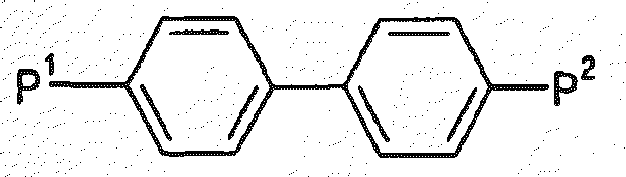
US 7,169,449 beschrieben. - Der Aufwand für das Erzeugen einer Polyimidschicht, Behandlung der Schicht und Verbesserung mit Erhebungen oder Polymerschichten, ist relativ groß. Eine vereinfachende Technologie wäre daher wünschenswert, die einerseits die Produktionskosten verringert und andererseits die Bildqualität (Blickwinkelabhängigkeit, Kontrast, Schaltzeiten) zu optimieren hilft.
- Über eine spontane horizontale bis vertikale Ausrichtung einer Flüssigkristallschicht mit Hilfe von Nanopartikeln basierend auf polyhedralen oligomeren Silsesquioxanen (nachfolgend einfach Silsesquioxane, PSS) berichtet die Druckschrift Shie-Chang Jeng et al. Optics Letters (2009), 34, 455-457. Ab einer Konzentration von ca. 1 Gew.-% wird eine nahezu homöotrope Ausrichtung beobachtet. Der 'pretilt' (engl.) ist nur durch die Konzentration beeinflussbar.
- In der Druckschrift
US 2008/0198301 A1 wird ebenfalls PSS als Orientierungsmaterial vorgeschlagen. Man erkennt, dass die Selbstorientierung auf ITO und auf planar orientierendem Polyimid funktioniert. - Auf das Problem der Temperaturabhängigkeit des Schaltvorgangs und der fehlenden Passivierungsschicht wird in beiden Druckschriften nicht hingewiesen. In der Tat hat es sich gezeigt, dass der Grad der von PSS induzierten homöotropen Orientierung mit steigender Temperatur rasch abnimmt. Eine Passivierungsschicht ist darüber hinaus besonders wichtig, da die Polyimidschicht nicht nur für die Orientierung des FK-Mediums, sondern auch für eine elektrische Isolierung sorgt. Ohne Passivierungsschicht können Probleme mit der Zuverlässigkeit der Anzeige ('Reliability') wie R-DC ('Residual-DC') erscheinen.
- Auf einem Konferenzposter zur SID 2010 (H.Y. Gim et al., P-128) wird beschrieben, dass ein phenethylsubstituiertes polyhedrales oligomeres Silsesquioxan in einer Konzentration von 10 Gew.-% in einer Anzeige ohne konventionelle Orientierungschicht vom PSA-VA-Typ verwendet wird. Das FK-Medium mit negativer dielektrischer Anisotropie wird durch das PSS homöotrop orientiert. Die große Menge an Dotierstoff beeinflusst aber erheblich die Eigenschaften des FK-Mediums, daher ist die Anzahl an einsetzbaren Flüssigkristallkomponenten für eine derartige FK-Anzeige sehr begrenzt.
- Die Druckschrift
JP 2010170090 A - Flüssigkristalle mit Aminogruppen sind bisher selten beschrieben worden, weil sie kaum wünschenswerte Eigenschaften erzeugt haben. Über die homöotrope Ausrichtung einer flüssigkristallinen Phase aus N-alkyliertem p-(4-Alkylcyclohexyl)anilin berichtet J.H. MacMillan et al. Mol. Cryst. Liq. Cryst., 1979, 55, 61-70. Ebenso wird eine überwiegend homöotrope Ausrichtung der Flüssigkristallmatrix an einem Bis-p-aminobenzoesäureester des Hydrochinons beobachtet (D.C. Schroeder et al. J. Am. Chem. Soc., 1974, 96(13), 4347-4348). Flüssigkristalle mit Aminogruppen kommen bisher nicht in FK-Anzeigen zum Einsatz.
- In den Druckschriften
US 2006/182897A1 ,US 4,482,472 ,US 4,564,694 undFR 2204002A1 US 2005/0092965A1 undUS 2008/0180608A1 werden 4-N-Morpholinderivate als Photoinitiator für dielektrisch neutrale Flüssigkristallmischungen offenbart. In den DruckschriftenUS 2006/0198967A1 ,DE 19539141A1 undDE 10117224A1 werden 2,6-Di-tert-butyl-phenolderivate als Antioxidantien für eine Flüssigkristallmischung offenbart. In der oben genannten DruckschriftUS 4,564,694 werden zusätzlich Verbindungen mit einer Endgruppe der Formel -CH2OH als synthetische Zwischenstufen offenbart. In der DruckschriftUS 2011/0113119A1 wird ein Anilinderivat als Zusatz für cholesterische Flüssigkristallmischungen mit positiver dielektrischer Anisotropie offenbart. - Die Druckschrift
US 5,698,134 A offenbart Photoinitiatoren und ein Monomer, die eine OH Gruppe und gleichzeitig einen Ring aufweisen. Das FK-Medium hat eine positive dielektrische Anisotropie. - Die Druckschrift
US 6,106,908 A offenbart Synthesen flüssigkristalliner Verbindungen, bei denen als Vorstufen Verbindungen mit einer OH-Gruppe auftreten. - Die Druckschrift
US 2012/032112 A1 offenbart FK-Medien mit positiver dielektrischer Anisotropie und einen optionalen Stabilisator, der eine OH Gruppe und gleichzeitig einen Ring aufweist. -
US 6,339,925 A offenbart mehrere FK-Medien mit positiver dielektrischer Anisotropie und weiterhin Additive zur Steuerung der elektrischen Leitfähigkeit in sehr geringen Konzentrationen, die eine OH Gruppe und gleichzeitig einen Ring aufweisen. -
JP 58-41827 A -
JP 57-1400737 A -
US 2008/0090026 A1 offenbart ein FK-Medium mit negativer dielektrischer Anisotropie, das eine polymerunterstützte Ausrichtung (PSA) aufweist. -
US 2009/103011 A1 offenbart ein FK-Medium mit einer polymerisierbaren Komponente. Die polymerisierbare Komponente umfasst in der allgemeinen Form (Meth-)Acrylate und OH-Gruppen. - Die bestehenden Ansätze um zu Displayanwendungen ohne Polyimidschicht zu gelangen sind daher noch nicht vollständig zufrieden stellend.
- Ein erster Gegenstand der vorliegenden Erfindung ist ein FK-Medium, wie in den Ansprüchen definiert, mit negativer dielektrischer Anisotropie enthaltend eine niedermolekulare flüssigkristalline Komponente und eine oder mehrere organische Verbindungen, die mindestens eine polare Ankergruppe und mindestens eine Ringgruppe aufweisen (Selbstorientierungsadditive), wobei die polare Ankergruppe mindestens eine OH-Struktur oder ein N-Atom in einer primären oder sekundären Amingruppe umfasst, und wobei die Ankergruppe nicht aus einer OH-Gruppe besteht, die wie die OH-Gruppe in 2,6-Di-tert-butylphenol abgeschirmt ist. Das erfindungsgemäße FK-Medium ist vorzugsweise nematisch.
- Das FK-Medium enthält außerdem eine polymerisierte oder polymerisierbare Komponente, wobei die polymerisierte Komponente erhältlich ist durch Polymerisation einer polymerisierbaren Komponente. Mit dieser Komponente lässt sich das FK-Medium und insbesondere seine Orientierung stabilisieren und gegebenenfalls ein gewünschter'pre-tilt' einstellen.
- Ein weiterer Gegenstand der vorliegenden Erfindung ist ein Verfahren zur Herstellung eines FK-Mediums wie vorangehend beschrieben und im Anspruch 1 umfasst, indem man eine niedermolekulare flüssigkristalline Komponente mit einer oder mehreren organischen Verbindungen, die mindestens eine polare Ankergruppe und mindestens eine Ringgruppe aufweisen, mischt und optional eine oder mehrere polymerisierbare Verbindungen und/oder Hilfsstoffe zugibt.
- Ein weiterer Gegenstand der vorliegenden Erfindung ist eine Flüssigkristallanzeige (FK-Anzeige) enthaltend eine Flüssigkristallzelle (FK-Zelle) mit zwei Substraten und mindestens zwei Elektroden, wobei mindestens ein Substrat lichtdurchlässig ist und mindestens ein Substrat eine oder zwei Elektroden aufweist, sowie einer zwischen den Substraten befindlichen Schicht eines Flüssigkristallmediums (FK-Mediums) enthaltend eine niedermolekulare flüssigkristalline Komponente und eine oder mehrere organische Verbindungen, wobei die organische Verbindung dadurch gekennzeichnet ist, dass sie mindestens eine polare Ankergruppe aufweist und mindestens eine Ringgruppe aufweist, und die geeignet ist, eine homöotrope (vertikale) Ausrichtung des FK-Mediums gegenüber den Substratoberflächen herbeizuführen. Die Ankergruppe ist wie vor- und nachstehend näher gekennzeichnet.
- Das FK-Medium der FK-Anzeige enthält außerdem eine polymerisierte oder polymerisierbare Komponente, wobei die polymerisierte Komponente erhältlich ist durch Polymerisation einer oder mehrerer polymerisierbarer Verbindungen zwischen den Substraten der FK-Zelle im FK-Medium, optional unter Anlegen einer elektrischen Spannung an die Elektroden der Zelle oder unter der Wirkung eines anderen elektrischen Feldes.
- Ein weiterer Gegenstand der Erfindung ist ein Verfahren zu Herstellung einer FK-Anzeige, vorzugsweise des PSA-VA-Typs, enthaltend eine FK-Zelle mit zwei Substraten und mindestens zwei Elektroden, wobei mindestens ein Substrat lichtdurchlässig ist und mindestens ein Substrat ein oder zwei Elektroden aufweist, umfassend die Verfahrensschritte:
- Befüllen der Zelle mit einem FK-Medium wie vor und nachstehend oder in den Ansprüchen beschrieben, umfassend eine organische Verbindung die geeignet ist, eine homöotrope (vertikale) Ausrichtung des FK-Mediums gegenüber den Substratoberflächen herbeizuführen, und optional:
- Polymerisieren einer gegebenenfalls enthaltenen polymerisierbaren Komponente, optional unter Anlegen einer Spannung an die Elektroden der Zelle oder unter der Wirkung eines elektrischen Feldes.
- Die organische Verbindung, die mindestens eine polare Ankergruppe und mindestens eine Ringgruppe aufweist (das Selbstorientierungsadditiv) wird im Flüssigkristall gelöst oder dispergiert. Sie bewirkt eine homöotrope Ausrichtung des Flüssigkristalls gegenüber den Substratoberflächen (wie z.B. eine Oberfläche aus Glas oder mit ITO oder mit Polyimid beschichtet). Es scheint in Anbetracht der Untersuchungen zu dieser Erfindung so, dass die polare Ankergruppe in Wechselwirkung mit der Substratoberfläche tritt. Dadurch richten sich die organischen Verbindungen auf der Substratoberfläche aus und induzieren eine homöotrope Orientierung des Flüssigkristalls. Die Ankergruppe sollte nach dieser Auffassung sterisch zugänglich sein, also beispielsweise nicht aus einer abgeschirmten OH-Gruppe wie in 2,6-Di-tert-butylphenol bestehen.
- Das Selbstorientierungsadditiv wird vorzugsweise in einer Konzentration von weniger als 10 Gew.-%, besonders bevorzugt ≤ 8 Gew.-% und ganz besonders ≤ 5 Gew.-% eingesetzt. Es wird bevorzugt in einer Konzentration von mindestens 0,1 Gew.-% eingesetzt, bevorzugt mindestens 0,2 Gew.-%. Der Einsatz von 0,1 bis 2,5 Gew.-% des Selbstorientierungsadditivs führt in der Regel schon zu vollständig homöotroper Orientierung der FK-Schicht bei den üblichen Zelldicken (3 bis 4 µm).
- Die polare Ankergruppe umfasst bevorzugt keine polymerisierbare Gruppe wie z.B. Acrylatgruppen.
- Die polare Ankergruppe des Selbstorientierungsadditivs besteht bevorzugt aus einer Gruppe, die eine nicht-kovalente Wechselwirkung mit der Substratoberfläche aus Glas oder Metalloxiden eingeht. Geeignete Gruppen sind polare Gruppen umfassend polare Strukturelemente mit Atomen ausgewählt aus N, O, S, und P. Die Gruppen sollten gleichzeitig ausreichend stabil für den Einsatz als LC-Medium sein. Sie sollen außerdem die VHR-Werte ('voltage holding ratio') des FK-Mediums nur gering beeinflussen. Bevorzugt sind ein oder mehrere, bevorzugt zwei oder mehr, dieser Heteroatome in der Ankergruppe enthalten.
- Die polare Ankergruppe umfasst mindestens eine OH-Struktur oder ein N-Atom in einer primären oder sekundären Amingruppe. Die polare Ankergruppe besteht bevorzugt aus ein bis zwei Strukturelementen enthaltend Heteroatome ausgewählt aus N und O und kovalenten, verknüpfenden Strukturen zwischen den Heteroatomen und zwischen einem oder mehreren der Heteroatome und dem Rest des Moleküls der Formel I (ohne die Ankergruppe).
- Unter den Begriff Ringgruppe fallen alle herstellbaren Ringsysteme, d.h. auch alle aromatischen, heteroaromatischen, alicyclischen oder heterocyclischen Ringsysteme, auch polycyclische Ringsysteme, wobei bevorzugt wenigstens ein Teilring mindestens 4 Ringatome umfassen sollte. Das Ringsystem erzeugt einen sterischen Effekt, dient also als raumerfüllende Gruppe, und macht die Verbindung mehr oder weniger mesogen, wodurch sich die Löslichkeit und Kompatibilität im FK-Medium verbessert. Die Art der Ringgruppe kann daher stark variieren.
- Das Selbstorientierungsadditiv ist bevorzugt eine organische Verbindung mit einer relativen Molmasse größer 100 g/mol, damit die Substanzen weniger flüchtig sind. Besonders bevorzugt weist es eine relative Molmasse größer 126 g/mol auf, um einen noch stabileren Effekt der Selbstausrichtung zu erzielen. Als Obergrenze hat es bevorzugt eine relativen Molmasse kleiner 700 g/mol.
Die Selbstorientierungsadditive haben eine Struktur der allgemeinen Formel I:
R1-A1-(Z2-A2)m1-R2 (I)
- In Formel I bedeutet der Rest R2 eine polare Ankergruppe wie vor- und nachstehend definiert, der Rest "R1-A1-(Z2-A2)m1-" bedeutet eine Ausführungsform für eine mesogene Gruppe MES. Insbesondere bedeuten in Formel (I):
- A1 und A2
- jeweils unabhängig voneinander eine aromatische, heteroaromatische, alicyclische oder heterocyclische Gruppe, vorzugsweise mit 4 bis 25 C-Atomen, welche auch anellierte Ringe enthalten kann, und welche auch durch L ein- oder mehrfach substituiert sein kann, besonders bevorzugt jeweils unabhängig voneinander 1,4-Phenylen, Naphthalin-1,4-diyl oder Naphthalin-2,6-diyl, wobei in diesen Gruppen auch eine oder mehrere CH-Gruppen durch N ersetzt sein können, Cyclohexan-1,4-diyl, worin auch eine oder mehrere nicht-benachbarte CH2-Gruppen durch O und/oder S ersetzt sein können, 3,3'-Bicyclobutyliden, 1,4-Cyclohexenylen, Bicyclo[1.1.1]pentan-1,3-diyl, Bicyclo[2.2.2]octan-1,4-diyl, Spiro[3.3]heptan-2,6-diyl, Piperidin-1,4-diyl, Decahydronaphthalin-2,6-diyl, 1,2,3,4-Tetrahydronaphthalin-2,6-diyl, Indan-2,5-diyl oder Octahydro-4,7-methano-indan-2,5-diyl, Perhydro-cyclopenta[a]phenanthren-3,17-diyl (insbesondere Gonan-3,17-diyl), wobei alle diese Gruppen unsubstituiert oder durch eine Gruppe L ein- oder mehrfach substituiert sein können,
- L
- jeweils unabhängig voneinander OH, -(CH2)n1-OH, F, Cl, Br, I, -CN, -NO2, -NCO, -NCS, -OCN, -SCN, -C(=O)N(R0)2, -C(=O)R0, -N(R0)2, -(CH2)n1-N(R0)2, optional substituiertes Silyl, optional substituiertes Aryl oder Cycloalkyl mit 6 bis 20 C-Atomen, oder geradkettiges oder verzweigtes Alkyl, Alkoxy, Alkylcarbonyl, Alkoxycarbonyl, Alkylcarbonyloxy oder Alkoxycarbonyloxy mit 1 bis 25 C-Atomen, worin auch ein oder mehrere H-Atome durch F oder Cl ersetzt sein können,
- Z2
- jeweils unabhängig voneinander eine Einfachbindung, -O-, -S-, -CO-, -CO-O-, -OCO-, -O-CO-O-, -OCH2-, -CH2O-, -SCH2-, -CH2S-, -CF2O-, -OCF2-, -CF2S-, -SCF2-, -(CH2)n1-, -CF2CH2-, -CH2CF2-, -(CF2)n1-, -CH=CH-, -CF=CF-, -C≡C-, -CH=CH-COO-, -OCO-CH=CH- oder CR0R00, bevorzugt eine Einfachbindung,
- R0 und R00
- jeweils unabhängig voneinander H oder Alkyl mit 1 bis 12 C-Atomen,
- R1
- H, Halogen, geradkettiges, verzweigtes oder cyclisches Alkyl mit 1 bis 25 C-Atomen, worin auch eine oder mehrere nicht benachbarte CH2-Gruppen durch -NR0-, -O-, -S-, -CO-, -CO-O-, -O-CO-, -O-CO-O- so ersetzt sein können, dass N-, O- und/oder S-Atome nicht direkt miteinander verknüpft sind, und worin auch ein oder mehrere tertiäre Kohlenstoffatome (CH-Gruppen) durch N ersetzt sein können, und worin auch ein oder mehrere H-Atome durch F oder Cl, ersetzt sein können, mit der Maßgabe, dass mindestens der Rest R2 eine vorangehend beschriebene polare Ankergruppe umfasst, bevorzugt dass mindestens der Rest R2 eine oder mehrere Gruppen NH, OH oder SH umfasst,
- m1
- 0, 1, 2, 3, 4 oder 5, und
- n1
- 1, 2, 3 oder 4.
- Die Gruppe R2 umfasst in den vorangehenden Formeln eine polare Ankergruppe, insbesondere eine Gruppe der Formel (A1)
-Sp-[X2-Z3-]kX1 (A1)
worin - Sp
- eine Abstandsgruppe definiert wie Spa wie nachstehend für Formel M definiert, bevorzugt eine Abstandsgruppe Sp"-X" wie für Formel M unten definiert, wobei Sp" ein Alkylen mit 1 bis 12 C-Atomen bedeutet,
- X1
- eine Gruppe -NH2, -NHR11 -NR11 2, -OR11, -OH, -(CO)OH oder eine Gruppe der Formeln


- R0
- H oder Alkyl mit 1 bis 12 C-Atomen,
- X2
- jeweils unabhängig -NH-, -NR11-, -O- oder eine Einfachbindung, Z3 jeweils unabhängig eine Alkylengruppe mit 1-15 C-Atomen, carbocyclische Ringe mit 5 oder 6 C-Atomen (z.B. optional substituiertes Benzol, Cyclohexan), oder Kombinationen aus einem oder mehreren Ringen und Alkylengruppen, worin jeweils optional ein oder mehrere Wasserstoffatome durch -OH, OR11, -(CO)OH, -NH2, -NHR11, -NR11 2, oder Halogen (bevorzugt F, Cl) sind,
- R11
- jeweils unabhängig einen halogenierten oder unsubstituierten Alkylrest mit 1 bis 15 C-Atomen, wobei in diesem Rest auch eine oder mehrere CH2-Gruppen jeweils unabhängig voneinander durch -C≡C-, -CH=CH-, -(CO)O-, -O(CO)-, -(CO)- oder -O- so ersetzt sein können, dass O-Atome nicht direkt miteinander verknüpft sind, und wobei zwei Reste R11 optional miteinander zu einem Ring verknüpft sind, und
- k
- 0 bis 3
- Besonders bevorzugt umfasst die Gruppe R2 in den vorangehenden Formeln eine (N/O)-heteroatomhaltige Gruppe der Teilformel (A2)

- R12
- H, F, Cl, CN, -OH, -NH2, oder einen halogenierten oder unsubstituierten Alkylrest mit 1 bis 15 C-Atomen, wobei in diesem Rest auch eine oder mehrere CH2-Gruppen jeweils unabhängig voneinander durch -C≡C-, -CH=CH-, -(CO)O-, -O(CO)-, -(CO)-, -O-, -NH-, oder -NR1- so ersetzt sein können, dass O- und N-Atome nicht direkt miteinander verknüpft sind, und
- N
- 1, 2 oder 3,
- Es bedeutet die Gruppe R2 genau eine Gruppe der Formeln (A1) bzw. (A2).
- Besonders bevorzugte stickstoffhaltige Gruppen R2 sind ausgewählt aus --(CH2)n-NH2, -(CH2)n-NH-(CH2)n3H, -NH-(CH2)n-NH2, -NH-(CH2)n-NH-(CH2)n3H, - (CH2)n1-NH-(CH2)n2-NH2, -(CH2)n1-NH-(CH2)n2-NH-(CH2)n3H, -O-(CH2)n-NH2, -(CH2)n1-O-(CH2)n-NH2, -(CH2)n1-NH-(CH2)n2-OH, -O(CH2)n1-NH-(CH2)n2-NH2, -O-(CH2)n1-NH-(CH2)n2-OH, -(CH2)n1-NH-(CH2)n2-NH-(CH2)n3H, worin n, n1, n2 und n3 unabhängig 1, 2, 3, 4, 5, 6, 7, 8, 9, 10, 11 oder 12, insbesondere 1,2,3 oder 4 bedeuten.
- Besonders bevorzugte stickstofffreie Gruppen R2 sind ausgewählt aus -(CH2)n-OH, -O-(CH2)n-OH, -[O-(CH2)n1-]n2-OH, -(CH2)n-(CO)OH, -O-(CH2)n-(CO)OH oder -[O-(CH2)m-]n2-(CO)OH,
worin n, n1 und n2 unabhängig 1, 2, 3, 4, 5, 6, 7, 8, 9, 10, 11 oder 12, insbesondere 1, 2, 3 oder 4 bedeuten. - Der Begriff "Aryl" bedeutet eine aromatische Kohlenstoffgruppe oder eine davon abgeleitete Gruppe. Der Begriff "Heteroaryl" bedeutet "Aryl" gemäß vorstehender Definition, enthaltend ein oder mehrere Heteroatome.
- Aryl- und Heteroarylgruppen können einkernig oder mehrkernig sein, d.h. sie können einen Ring (wie z.B. Phenyl) oder zwei oder mehr Ringe aufweisen, welche auch anelliert (wie z.B. Naphthyl) oder kovalent verknüpft sein können (wie z.B. Biphenyl), oder eine Kombination von anellierten und verknüpften Ringen beinhalten. Heteroarylgruppen enthalten ein oder mehrere Heteroatome, vorzugsweise ausgewählt aus O, N, S und Se.
- Besonders bevorzugt sind ein-, zwei- oder dreikernige Arylgruppen mit 6 bis 25 C-Atomen sowie ein-, zwei- oder dreikernige Heteroarylgruppen mit 2 bis 25 C-Atomen, welche optional anellierte Ringe enthalten und optional substituiert sind. Ferner bevorzugt sind 5-, 6- oder 7-gliedrige Aryl- und Heteroarylgruppen, worin auch eine oder mehrere CH-Gruppen durch N, S oder O so ersetzt sein können, dass O-Atome und/oder S-Atome nicht direkt miteinander verknüpft sind.
- Bevorzugte Arylgruppen sind beispielsweise Phenyl, Biphenyl, Terphenyl, [1,1':3',1"]Terphenyl-2'-yl, Naphthyl, Anthracen, Binaphthyl, Phenanthren, Pyren, Dihydropyren, Chrysen, Perylen, Tetracen, Pentacen, Benzpyren, Fluoren, Inden, Indenofluoren, Spirobifluoren, etc.
- Bevorzugte Heteroarylgruppen sind beispielsweise 5-gliedrige Ringe wie Pyrrol, Pyrazol, Imidazol, 1,2,3-Triazol, 1,2,4-Triazol, Tetrazol, Furan, Thiophen, Selenophen, Oxazol, Isoxazol, 1,2-Thiazol, 1,3-Thiazol, 1,2,3-Oxadiazol, 1,2,4-Oxadiazol, 1,2,5-Oxadiazol, 1,3,4-Oxadiazol, 1,2,3-Thiadiazol, 1,2,4-Thiadiazol, 1,2,5-Thiadiazol, 1,3,4-Thiadiazol, 6-gliedrige Ringe wie Pyridin, Pyridazin, Pyrimidin, Pyrazin, 1,3,5-Triazin, 1,2,4-Triazin, 1,2,3-Triazin, 1,2,4,5-Tetrazin, 1,2,3,4-Tetrazin, 1,2,3,5-Tetrazin, oder kondensierte Gruppen wie Indol, Isoindol, Indolizin, Indazol, Benzimidazol, Benzotriazol, Purin, Naphthimidazol, Phenanthrimidazol, Pyridimidazol, Pyrazinimidazol, Chinoxalinimidazol, Benzoxazol, Naphthoxazol, Anthroxazol, Phenanthroxazol, Isoxazol, Benzothiazol, Benzofuran, Isobenzofuran, Dibenzofuran, Chinolin, Isochinolin, Pteridin, Benzo-5,6-chinolin, Benzo-6,7-chinolin, Benzo-7,8-chinolin, Benzoisochinolin, Acridin, Phenothiazin, Phenoxazin, Benzopyridazin, Benzopyrimidin, Chinoxalin, Phenazin, Naphthyridin, Azacarbazol, Benzocarbolin, Phenanthridin, Phenanthrolin, Thieno[2,3b]thiophen, Thieno[3,2b]thiophen, Dithienothiophen, Isobenzothiophen, Dibenzothiophen, Benzothiadiazothiophen, oder Kombinationen dieser Gruppen. Die Heteroarylgruppen können auch mit Alkyl, Alkoxy, Thioalkyl, Fluor, Fluoralkyl oder weiteren Aryl- oder Heteroarylgruppen substituiert sein.
- Die (nicht-aromatischen) alicyclischen und heterocyclischen Gruppen umfassen sowohl gesättigte Ringe, d.h. solche die ausschließlich Einfachbindungen enthalten, als auch teilweise ungesättigte Ringe, d.h. solche die auch Mehrfachbindungen enthalten können. Heterocyclische Ringe enthalten ein oder mehrere Heteroatome, vorzugsweise ausgewählt aus Si, O, N, S und Se.
- Die (nicht-aromatischen) alicyclischen und heterocyclischen Gruppen können einkernig sein, d.h. nur einen Ring enthalten (wie z.B. Cyclohexan), oder mehrkernig sein, d.h. mehrere Ringe enthalten (wie z.B. Decahydronaphthalin oder Bicyclooctan). Besonders bevorzugt sind gesättigte Gruppen. Ferner bevorzugt sind ein-, zwei- oder dreikernige Gruppen mit 3 bis 25 C-Atomen, welche optional anellierte Ringe enthalten und optional substituiert sind. Ferner bevorzugt sind 5-, 6-, 7- oder 8-gliedrige carbocyclische Gruppen worin auch ein oder mehrere C-Atome durch Si ersetzt sein können und/oder eine oder mehrere CH-Gruppen durch N ersetzt sein können und/oder eine oder mehrere nicht-benachbarte CH2-Gruppen durch -O- und/oder -S- ersetzt sein können.
- Bevorzugte alicyclische und heterocyclische Gruppen sind beispielsweise 5-gliedrige Gruppen wie Cyclopentan, Tetrahydrofuran, Tetrahydrothiofuran, Pyrrolidin, 6-gliedrige Gruppen wie Cyclohexan, Cyclohexen, Tetrahydropyran, Tetrahydrothiopyran, 1,3-Dioxan, 1,3-Dithian, Piperidin, 7- gliedrige Gruppen wie Cycloheptan, und anellierte Gruppen wie Tetrahydronaphthalin, Decahydronaphthalin, Indan, Bicyclo[1.1.1]pentan-1,3-diyl, Bicyclo[2.2.2]octan-1,4-diyl, Spiro[3.3]heptan-2,6-diyl, Octahydro-4,7-methano-indan-2,5-diyl.
- Im Zusammenhang mit der vorliegenden Erfindung bedeutet der Ausdruck "Alkyl" einen geradkettigen oder verzweigten, gesättigten oder ungesättigten, bevorzugt gesättigten, aliphatischen Kohlenwasserstoffrest mit 1 bis 15 (d.h. 1, 2, 3, 4, 5, 6, 7, 8, 9, 10, 11, 12, 13, 14 oder 15) Kohlenstoffatomen.
- Der Begriff "cyclisches Alkyl" umfasst Alkylgruppen, die wenigstens einen carbocyclischen Teil aufweisen, also beispielsweise auch Cycloalkylalkyl, Alkylcycloalky und Alkylcycloalkylalkyl. Die carbocyclischen Gruppen umfassen z. B. Cyclopropyl, Cyclobutyl, Cyclopentyl, Cyclohexyl, Cycloheptyl, Cyclooctyl, usw.
- "Halogen" steht im Zusammenhang der vorliegenden Erfindung für Fluor, Chlor, Brom beziehungsweise Iod, bevorzugt für Fluor oder Chlor.
- Besonders bevorzugte Verbindungen der Formel I sind ausgewählt aus den folgenden beispielhaften Verbindungen, welche gleichzeitig besonders bevorzugte Gruppen R2 der Selbstorientierungsadditive wiedergeben:


- In einer weiteren bevorzugten Ausführungsform der Erfindung werden organische Verbindungen mit der polaren Ankergruppe bzw. Verbindungen der Formel I verwendet, die als weitere Funktionalisierung neben dem polaren Anker eine oder mehrere polymerisierbare Gruppen aufweisen (vergleiche Gruppe Pa oder Pb unten). Bevorzugte polymerisierbare Gruppen sind Gruppen wie Acrylat-, Methacrylat-, Fluoracrylat-, Oxetan-, Vinyloxy- oder Epoxygruppe, besonders bevorzugt Acrylat und Methacrylat. Durch den Einschluss der Verbindungen der Formel I in die Polymerisation werden die Verbindungen nachhaltig immobilisiert, wodurch sie ihre Funktion beibehalten.
- Ein Vorteil der erfindungsgemäßen FK-Anzeigen ist, dass die Anzeige ohne die übliche Polyimid-Orientierungsschicht die gewünschte homöotrope Orientierung erreicht. Diese Orientierung bleibt in der Regel auch bei höherer Temperatur erhalten. Durch die Polymerstabilisierung wird die homöotrope Orientierung zusätzlich stabilisiert; dadurch wird eine verbesserte Temperaturstabilität des elektrooptischen Schaltens erreicht. Die erfindungsgemäßen polymerstabilisierten Anzeigen zeichnen sich durch verbesserte Schaltzeiten und besseres Kontrastverhältnis (Pretilt-Winkel und Temperaturabhängigkeit des Kontrasts) aus. Die optional enthaltene polymerisierte Komponente kann gleichzeitig als eine Passivierungsschicht dienen, die die Zuverlässigkeit (die sog. 'reliability') des Displays erhöht.
- Die organischen Verbindungen mit der polaren Ankergruppe bzw. die Verbindungen der Formel I destabilisieren dank ihrer Struktur die nematische Phase des FK-Medium nicht, sondern tragen zu der Stabilität bei. Darüber hinaus beeinflusst die relativ kleine Menge an Verbindungen der Formel I die Eigenschaften der FK-Medien praktisch unerheblich. Daher kann eine breite Vielfalt an FlüssigkristallKomponenten in der FK-Anzeige verwendet werden.
- Die erfindungsgemäßen FK-Anzeigen besitzen daher bevorzugt keine Orientierungsschicht ('alignment layer') für homöotrope Ausrichtung auf den Oberflächen der FK-Zelle, d.h. sie sind polyimidfrei. Für den Fall, dass die FK-Anzeigen dennoch ein- oder beidseitig Orientierungsschichten aufweisen, so bestehen diese vorzugsweise aus Polyimid. Die Orientierungsschichten sind vorzugsweise nicht gerieben. Damit entfällt das bisher notwendige Reiben der Orientierungsschicht, ein besonders aufwändiger Schritt in der Herstellung. Die ungeriebene Polyimidschicht kann als Passivierungsschicht dienen.
- Die erfindungsgemäßen FK-Anzeigen verwenden ein FK-Medium mit negativer dielektrischer Anisotropie (Δε ≤ -1,5). In der Regel handelt es sich dabei um eine VA-Anzeige mit auf gegenüberliegenden Seiten der FK-Zelle angeordneten Elektroden, bevorzugt mit Elektroden, die so angeordnet sind, dass sie ein überwiegend senkrecht zur Substratoberfläche orientiertes elektrisches Feld erzeugen können. Typische verwendete Substrate sind die, die aus dem VAN-mode und PSA-VA verwendet werden (Strukturierung der Elektroden ist daher möglich).
- Die FK-Anzeigen sind in der üblichen Art und Weise mit Polarisator(en) versehen, die den Schaltvorgang des FK-Mediums sichtbar machen.
- Die polymerisierte Komponente der FK-Zelle (Polymer) ist erhältlich durch Polymerisieren einer polymerisierbaren Komponente (Monomere). In der Regel sind die Monomere zunächst in dem FK-Medium gelöst und werden in der FK-Zelle polymerisiert nachdem sich eine homöotrope Ausrichtung oder ein hoher Tiltwinkel des FK-Medium eingestellt hat. Zur Unterstützung der gewünschten Ausrichtung kann eine Spannung an die FK-Zelle angelegt werden. Im einfachsten Fall erübrigt sich eine solche Spannung und die gewünschte Ausrichtung stellt sich allein durch die Beschaffenheit des FK-Mediums und der Zellgeometrie ein.
- Geeignete Monomere (polymerisierbare Komponente) für das FK-Medium sind solche aus dem Stand der Technik, die für PSA-VA- Anzeigen verwendet werden, insbesondere polymerisierbare Verbindungen der unten genannten Formel M und/oder der Formeln M1 bis M29. Die erfindungsgemäßen FK-Medien zur Verwendung in PSA-Anzeigen enthalten vorzugsweise < 5 Gew.-%, besonders bevorzugt < 1 Gew.-% und ganz besonders bevorzugt < 0.5 Gew.-% an polymerisierbaren Verbindungen, insbesondere polymerisierbare Verbindungen der unten genannten Formeln. Um einen ausreichenden Effekt zu erreichen werden bevorzugt 0,2 Gew.-% oder mehr eingesetzt. Die optimale Menge ist abhängig von der Schichtdicke.
- Geeignete Monomere der polymerisierbaren Komponente des FK-Mediums werden durch die folgende Formel M beschrieben:
Pa-(Spa)s1-A2-(Z1-A1)n-(Spb)s2-Pb M
worin die einzelnen Reste folgende Bedeutung besitzen: - Pa, Pb
- jeweils unabhängig voneinander eine polymerisierbare Gruppe,
- Spa, Spb
- bei jedem Auftreten gleich oder verschieden eine Abstandsgruppe,
- s1, s2
- jeweils unabhängig voneinander 0 oder 1,
- A1, A2,
- jeweils unabhängig voneinander einen Rest ausgewählt aus folgenden Gruppen
- a) der Gruppe bestehend aus trans-1,4-Cyclohexylen, 1,4-Cyclohexenylen und 4,4'-Bicyclohexylen, worin auch eine oder mehrere nicht benachbarte CH2-Gruppen durch -O-und/oder -S- ersetzt sein können und worin auch ein oder mehrere H-Atome durch F ersetzt sein können,
- b) der Gruppe bestehend aus 1,4-Phenylen und 1,3-Phenylen, worin auch eine oder zwei CH-Gruppen durch N ersetzt sein können und worin auch ein oder mehrere H-Atome durch L ersetzt sein können,
- c) der Gruppe bestehend aus Tetrahydropyran-2,5-diyl, 1,3-Dioxan-2,5-diyl, Tetrahydrofuran-2,5-diyl, Cyclobut-1,3-diyl, Piperidin-1,4-diyl, Thiophen-2,5-diyl und Selenophen-2,5-diyl, welche auch ein oder mehrfach durch L substituiert sein können,
- d) der Gruppe bestehend aus gesättigten, teilweise ungesättigten oder vollständig ungesättigten, und optional substituierten, polycyclischen Resten mit 5 bis 20 cyclischen C-Atomen, von denen auch eines oder mehrere durch Heteroatome ersetzt sein können, vorzugsweise ausgewählt aus der Gruppe bestehend aus Bicyclo[1.1.1]pentan-1,3-diyl, Bicyclo[2.2.2]octan-1,4-diyl, Spiro[3.3]heptan-2,6-diyl,



- n
- 0, 1, 2 oder 3
- Z1
- jeweils unabhängig voneinander -CO-O-, -O-CO-, -CH2O-, -OCH2-,-CF2O-, -OCF2-, oder -(CH2)n-, wobei n 2, 3 oder 4 ist, -O-, -CO-, -C(RcRd)-, -CH2CF2-, -CF2CF2-, oder eine Einfachbindung,
- L
- bei jedem Auftreten gleich oder verschieden F, Cl, CN, SCN, SF5 oder geradkettiges oder verzweigtes, jeweils optional fluoriertes, Alkyl, Alkoxy, Alkylcarbonyl, Alkoxycarbonyl, Alkylcarbonyloxy oder Alkoxycarbonyloxy mit 1 bis 12 C-Atomen,
- R0, R00
- jeweils unabhängig voneinander H, F oder geradkettiges oder verzweigtes Alkyl mit 1 bis 12 C-Atomen, worin auch ein oder mehrere H-Atome durch F ersetzt sein können,
- M
- -O-, -S-, -CH2-, -CHY1- oder -CY1Y2-, und
- Y1, und Y2
- jeweils unabhängig voneinander eine der oben für R0 angegebenen Bedeutungen, Cl oder CN, und vorzugsweise H, F, Cl, CN, OCF3 oder CF3.
- W1, W2
- jeweils unabhängig voneinander -CH2CH2-, -CH=CH-, -CH2-O-, -O-CH2-, -C(RcRd)- oder -O- bedeuten,
- Rc und Rd
- jeweils unabhängig voneinander H oder Alkyl mit 1 bis 6 C-Atomen, vorzugsweise H, Methyl oder Ethyl, bedeuten,
- Die polymerisierbare Gruppe Pa,b ist eine Gruppe, die für eine Polymerisationsreaktion, wie beispielsweise die radikalische oder ionische Kettenpolymerisation, Polyaddition oder Polykondensation, oder für eine polymeranaloge Umsetzung, beispielsweise die Addition oder Kondensation an eine Polymerhauptkette, geeignet ist. Besonders bevorzugt sind Gruppen für die Kettenpolymerisation, insbesondere solche enthaltend eine C=C-Doppelbindung oder -C=C-Dreifachbindung, sowie zur Polymerisation unter Ringöffnung geeignete Gruppen wie beispielsweise Oxetan- oder Epoxygruppen Bevorzugte Gruppen Pa,b sind ausgewählt aus der Gruppe bestehend aus CH2=CW1-CO-O-, CH2=CW1-CO-,


CW1=CH-CO-NH-, CH2=CW1-CO-NH-, CH3-CH=CH-O-, (CH2=CH)2CH-OCO-, (CH2=CH-CH2)2CH-OCO-, (CH2=CH)2CH-O-, (CH2=CH-CH2)2N-, (CH2=CH-CH2)2N-CO-, HO-CW2W3-, HS-CW2W3-, HW2N-, HO-CW2W3-NH-, CH2=CW1-CO-NH-, CH2=CH-(COO)k1-Phe-(O)k2-, CH2=CH-(CO)k1-Phe-(O)k2-, Phe-CH=CH-, HOOC-, OCN-, und W4W5W6Si-, worin W1 H, F, Cl, CN, CF3, Phenyl oder Alkyl mit 1 bis 5 C-Atomen, insbesondere H, F, Cl oder CH3 bedeutet, W2 und W3 jeweils unabhängig voneinander H oder Alkyl mit 1 bis 5 C-Atomen, insbesondere H, Methyl, Ethyl oder n-Propyl bedeuten, W4, W5 und W6 jeweils unabhängig voneinander Cl, Oxaalkyl oder Oxacarbonylalkyl mit 1 bis 5 C-Atomen bedeuten, W7 und W8 jeweils unabhängig voneinander H, Cl oder Alkyl mit 1 bis 5 C-Atomen bedeuten, Phe 1,4-Phenylen bedeutet, welches optional mit einem oder mehreren, von P-Sp- verschiedenen Resten L wie oben definiert substituiert ist, k1, k2 und k3 jeweils unabhängig voneinander 0 oder 1 bedeuten, k3 vorzugsweise 1 bedeutet, und k4 eine ganze Zahl von 1 bis 10 bedeutet. - Besonders bevorzugte Gruppen Pa,b sind ausgewählt aus der Gruppe bestehend aus CH2=CW1-CO-O-, CH2=CW1-CO-,

- Ganz besonders bevorzugte Gruppen Pa,b sind sind ausgewählt aus der Gruppe bestehend aus CH2=CW1-CO-O-, insbesondere CH2=CH-CO-O-, CH2=C(CH3)-CO-O- und CH2=CF-CO-O-, ferner CH2=CH-O-,


- Bevorzugte Abstandsgruppen Spa,b sind ausgewählt aus der Formel Sp"-X", so dass der Rest Pa/b-Spa/b- der Formel Pa/b-Sp"-X"- entspricht, wobei
- Sp"
- Alkylen mit 1 bis 20, vorzugsweise 1 bis 12 C-Atomen bedeutet, welches optional durch F, Cl, Br, I oder CN ein- oder mehrfach substituiert ist, und worin auch eine oder mehrere nicht benachbarte CH2-Gruppen jeweils unabhängig voneinander so durch -O-, -S-, -NH-, -N(R0)-, -Si(R00R000)- -CO-, -CO-O-, -O-CO-, -O-CO-O-, -S-CO-, -CO-S-, -N(R00)-CO-O-, -O-CO-N(R00)-, -N(R00)-CO-N(R00)-, -CH=CH- oder -C=C- ersetzt sein können, dass O- und/oder S-Atome nicht direkt miteinander verknüpft sind,
- X"
- -O-, -S-, -CO-, -CO-O-, -O-CO-, -O-CO-O-, -CO-N(R00)-, -N(R00)-CO-, -N(R00)-CO-N(R00)-, -OCH2-, -CH2O-, -SCH2-, -CH2S-, -CF2O-, -OCF2-, -CF2S-, -SCF2-, -CF2CH2-, -CH2CF2-, -CF2CF2-, -CH=N-, -N=CH-, -N=N-, -CH=CR0-, -CY2=CY3-, -C=C-, -CH=CH-CO-O-, -O-CO-CH=CH- oder eine Einfachbindung bedeutet,
- R00 und R000
- jeweils unabhängig voneinander H oder Alkyl mit 1 bis 12 C-Atomen bedeuten, und
- Y2 und Y3
- jeweils unabhängig voneinander H, F, Cl oder CN bedeuten.
- Typische Abstandsgruppen Sp" sind beispielsweise -(CH2)p1-, -(CH2CH2O)q1-CH2CH2-, -CH2CH2-S-CH2CH2-, -CH2CH2-NH-CH2CH2- oder -(SiR00R000-O)p1-, worin p1 eine ganze Zahl von 1 bis 12 ist, q1 eine ganze Zahl von 1 bis 3 ist, und R00 und R000 die oben angegebenen Bedeutungen besitzen.
- Besonders bevorzugte Gruppen -Sp"-X"- sind -(CH2)p1-, -(CH2)p1-O-, -(CH2)p1-O-CO-, -(CH2)p1-O-CO-O-, worin p1 und q1 die oben angegebene Bedeutung haben.
- Besonders bevorzugte Gruppen Sp" sind beispielsweise jeweils geradkettiges Ethylen, Propylen, Butylen, Pentylen, Hexylen, Heptylen, Octylen, Nonylen, Decylen, Undecylen, Dodecylen, Octadecylen, Ethylenoxyethylen, Methylenoxybutylen, Ethylenthioethylen, Ethylen-N-methyl-iminoethylen, 1-Methylalkylen, Ethenylen, Propenylen und Butenylen.
- Besonders bevorzugte Monomere sind die folgenden:


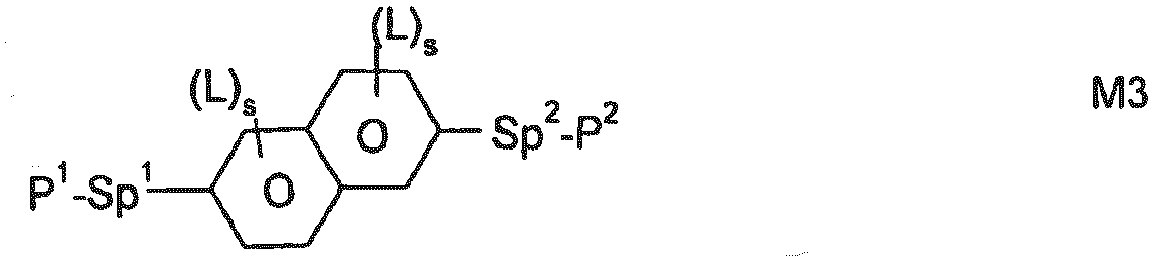


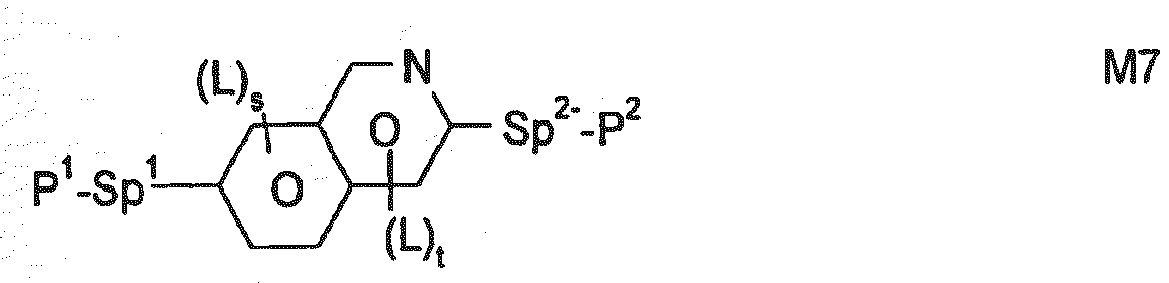


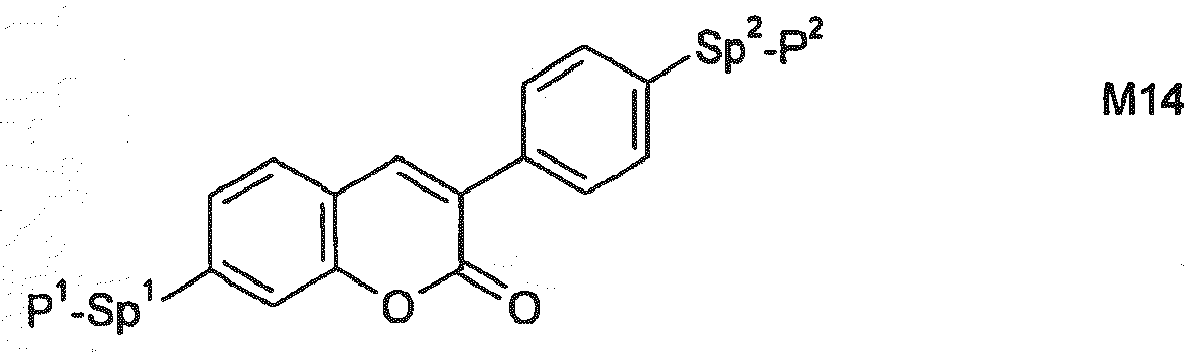





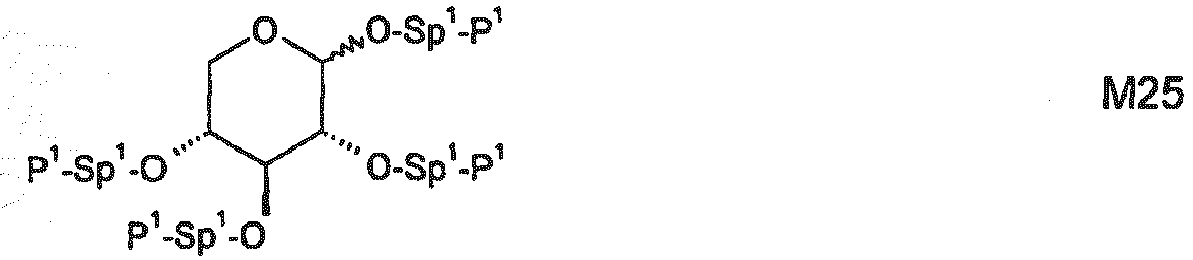


- P1 und P2
- jeweils unabhängig voneinander eine polymerisierbare Gruppe wie für Formel I definiert, bevorzugt eine Acrylat-, Methacrylat-, Fluoracrylat-, Oxetan-, Vinyloxy- oder Epoxygruppe,
- Sp1 und Sp2
- jeweils unabhängig voneinander eine Einfachbindung oder eine Abstandsgruppe, vorzugsweise mit einer der vor- und nachstehend für Spa angegebenen Bedeutungen, und besonders bevorzugt -(CH2)p1-, -(CH2)p1-O-, -(CH2)p1-CO-O- oder -(CH2)p1-O-CO-O-, worin p1 eine ganze Zahl von 1 bis 12 ist, und wobei in den letztgenannten Gruppen die Verknüpfung zur benachbarten Ring über das O-Atom erfolgt, wobei auch einer oder mehrere der Reste P1-Sp1- und P2-Sp2-einen Rest Raa bedeuten können, mit der Maßgabe dass mindestens einer der vorhandenen Reste P1-Sp1- und P2-Sp2-nicht Raa bedeutet,
- Raa
- H, F, Cl, CN oder geradkettiges oder verzweigtes Alkyl mit 1 bis 25 C-Atomen, worin auch eine oder mehrere nicht benachbarte CH2-Gruppen jeweils unabhängig voneinander durch C(R0)=C(R00)-, -C≡C-, -N(R0)-, -O-, -S-, -CO-, -CO-O-, -O-CO-, -O-CO-O- so ersetzt sein können, dass O- und/oder S-Atome nicht direkt miteinander verknüpft sind, und worin auch ein oder mehrere H-Atome durch F, Cl, CN oder P1-Sp1-ersetzt sein können, besonders bevorzugt geradkettiges oder verzweigtes, optional ein- oder mehrfach fluoriertes, Alkyl, Alkoxy, Alkenyl, Alkinyl, Alkylcarbonyl, Alkoxycarbonyl, oder Alkylcarbonyloxy mit 1 bis 12 C-Atomen (wobei die Alkenyl- und Alkinylreste mindestens zwei und die verzweigten Reste mindestens drei C-Atome aufweisen),
- R0, R00
- jeweils unabhängig voneinander H oder Alkyl mit 1 bis 12 C-Atomen,
- Ry und Rz
- jeweils unabhängig voneinander H, F, CH3 oder CF3,
- Z1
- -O-, -CO-, -C(RyRz)-, oder -CF2CF2-,
- Z2 und Z3
- jeweils unabhängig voneinander -CO-O-, -O-CO-, -CH2O-, -OCH2-, -CF2O-, -OCF2-, oder -(CH2)n-, wobei n 2, 3 oder 4 ist,
- L
- bei jedem Auftreten gleich oder verschieden F, Cl, CN, SCN, SF5 oder geradkettiges oder verzweigtes, optional ein- oder mehrfach fluoriertes, Alkyl, Alkoxy, Alkenyl, Alkinyl, Alkylcarbonyl, Alkoxycarbonyl, Alkylcarbonyloxy oder Alkoxycarbonyloxy mit 1 bis 12 C-Atomen, vorzugsweise F,
- L' und L"
- jeweils unabhängig voneinander H, F oder Cl,
- R
- 0, 1, 2, 3 oder 4,
- s
- 0, 1, 2 oder 3,
- t
- 0, 1 oder 2, und
- x
- 0 oder 1.
- Vorzugsweise umfasst das FK-Medium oder die polymerisierbare Komponente eine oder mehrere Verbindungen ausgewählt aus der Gruppe der Formeln M1-M21, besonders bevorzugt der Formeln M2-M15, ganz besonders bevorzugt der Formeln M2, M3, M9, M14 und M15.
- Vorzugsweise umfasst das FK-Medium oder die polymerisierbare Komponente keine Verbindungen der Formel M10, worin Z2 und Z3 -(CO)O-oder -O(CO)- bedeuten.
- Zur Herstellung von PSA-Anzeigen werden die polymerisierbaren Verbindungen im FK-Medium zwischen den Substraten der FK-Anzeige, optional unter Anlegen einer Spannung, durch in-situ-Polymerisation polymerisiert oder vernetzt (falls eine polymeriserbare Verbindung zwei oder mehr polymerisierbare Gruppen enthält). Die Polymerisation kann in einem Schritt durchgeführt werden. Es ist auch möglich, zunächst in einem ersten Schritt die Polymerisation unter Anlegen einer Spannung durchzuführen, um einen pretilt-Winkel zu erzeugen, und anschließend in einem zweiten Polymerisationsschritt ohne anliegende Spannung die im ersten Schritt nicht abreagierten Verbindungen zu polymerisieren bzw. zu vernetzen ("end curing").
- Geeignete und bevorzugte Polymerisationsmethoden sind beispielsweise die thermische oder Photopolymerisation, vorzugsweise Photopolymerisation, insbesondere UV-Photopolymerisation. Dabei können gegebenenfalls auch ein oder mehrere Initiatoren zugesetzt werden. Geeignete Bedingungen für die Polymerisation, sowie geeignete Arten und Mengen der Initiatoren, sind dem Fachmann bekannt und in der Literatur beschrieben. Für die radikalische Polymerisation eignen sich zum Beispiel die kommerziell erhältlichen Photoinitiatoren Irgacure651®, Irgacure184®, Irgacure907®, Irgacure369®, oder Darocure1173® (Ciba AG). Falls ein Initiator eingesetzt wird, beträgt dessen Anteil vorzugsweise 0,001 bis 5 Gew.-%, besonders bevorzugt 0,001 bis 1 Gew.-%.
- Die erfindungsgemäßen polymerisierbaren Verbindungen eignen sich auch für die Polymerisation ohne Initiator, was erhebliche Vorteile mit sich bringt, wie beispielsweise geringere Materialkosten und insbesondere eine geringere Verunreinigung des FK-Mediums durch mögliche Restmengen des Initiators oder dessen Abbauprodukte. Die Polymerisation kann somit auch ohne Zusatz eines Initiators erfolgen. Somit enthält das FK-Medium in einer bevorzugten Ausführungsform keinen Polymerisationsinitiator.
- Die polymerisierbare Komponente oder das FK-Medium können auch einen oder mehrere Stabilisatoren enthalten, um eine unerwünschte spontane Polymerisation der RMs, beispielsweise während der Lagerung oder des Transports, zu verhindern. Geeignete Arten und Mengen der Stabilisatoren sind dem Fachmann bekannt und in der Literatur beschrieben. Besonders geeignet sind zum Beispiel die kommerziell erhältlichen Stabilisatoren der Serie Irganox® (Ciba AG), wie beispielsweise Irganox® 1076. Falls Stabilisatoren eingesetzt werden, beträgt deren Anteil, bezogen auf die Gesamtmenge der RMs beziehungsweise der polymerisierbaren Komponente, vorzugsweise 10 - 10000 ppm, besonders bevorzugt 50 - 500 ppm.
- Die FK-Medien zur Verwendung in den erfindungsgemäßen FK-Anzeigen enthalten, neben den oben beschriebenen SAM und den optionalen polymerisierbaren Verbindungen (M) eine FK-Mischung ("Host-Mischung") enthaltend eine oder mehr, vorzugsweise zwei oder mehr niedermolekulare (d.h. monomere bzw. unpolymerisierte) Verbindungen. Letztere sind stabil bzw. unreaktiv gegenüber einer Polymerisationsreaktion unter den zur Polymerisation der polymerisierbaren Verbindungen verwendeten Bedingungen. Prinzipiell eignet sich als Host-Mischung jede zur Verwendung in herkömmlichen VA- und VA-IPS-Anzeigen geeignete dielektrisch negative oder positive FK-Mischung.
- Geeignete FK-Mischungen sind dem Fachmann bekannt und in der Literatur beschrieben. FK-Medien für VA-Anzeigen mit negativer dielektrischer Anisotropie sind in
EP 1 378 557 A1 beschrieben. - Im Folgenden werden bevorzugte Ausführungsformen für das erfindungsgemäße flüssigkristalline Medium mit negativer dielektrischer Anisotropie angeführt:
- a) FK-Medium, welches zusätzlich eine oder mehrere Verbindungen ausgewählt aus der Gruppe der Verbindungen der Formeln A, B und C enthält,


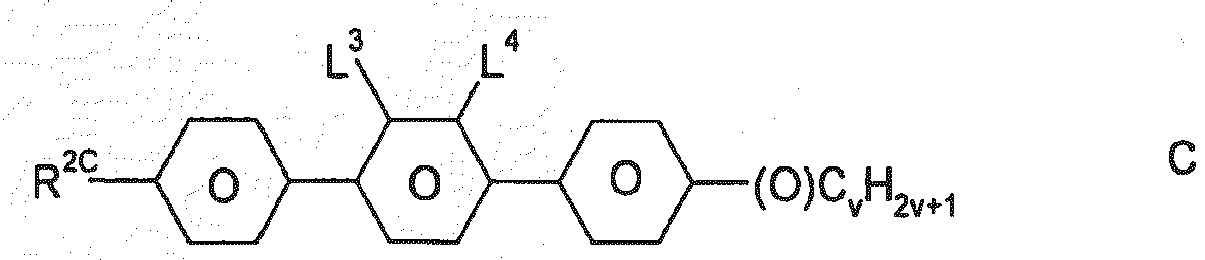
- R2A, R2B und R2C
- jeweils unabhängig voneinander H, einen unsubstituierten, einen einfach durch CN oder CF3 oder mindestens einfach durch Halogen substituierten Alkylrest mit bis zu 15 C-Atomen, wobei in diesen Resten auch eine oder mehrere CH2-Gruppen durch -O-, -S-,


- L1-4
- jeweils unabhängig voneinander F, Cl, CF3 oder CHF2,
- Z2 und Z2'
- jeweils unabhängig voneinander Einfachbindung, -CH2CH2-, -CH=CH-, -CF2O-, -OCF2-, -CH2O-, -OCH2-, -COO-, -OCO-, -C2F4-, -CF=CF-, -CH=CHCH2O-,
- p
- 1 oder 2,
- q
- 0 oder 1, und
- v
- 1 bis 6
In den Verbindungen der Formeln A und B können Z2 gleiche oder unterschiedliche Bedeutungen haben. In den Verbindungen der Formel B können Z2 und Z2' gleiche oder verschiedene Bedeutungen aufweisen.
In den Verbindungen der Formeln A, B und C bedeuten R2A, R2B und R2C jeweils vorzugsweise Alkyl mit 1-6 C-Atomen, insbesondere CH3, C2H5, n-C3H7, n-C4H9, n-C5H11.
In den Verbindungen der Formeln A und B bedeuten L1, L2, L3 und L4 vorzugsweise L1 = L2 = F und L3 = L4 = F, ferner L1 = F und L2 = Cl, L1 = Cl und L2 = F, L3 = F und L4 = Cl, L3 = Cl und L4 = F. Z2 und Z2' bedeuten in den Formeln A und B vorzugsweise jeweils unabhängig voneinander eine Einfachbindung, ferner eine -C2H4-Brücke.
Sofern in der Formel B Z2 = -C2H4- ist, ist Z2' vorzugsweise eine Einfachbindung bzw. falls Z2' = -C2H4- bedeutet, ist Z2 vorzugsweise eine Einfachbindung. In den Verbindungen der Formeln A und B bedeutet (O)CvH2v+1 vorzugsweise OCvH2v+1, ferner CvH2v+1. In den Verbindungen der Formel C bedeutet (O)CvH2v+1 vorzugsweise CvH2v+1. In den Verbindungen der Formel C bedeuten L3 und L4 vorzugsweise jeweils F.
Bevorzugte Verbindungen der Formeln A, B und C werden nachfolgend genannt:





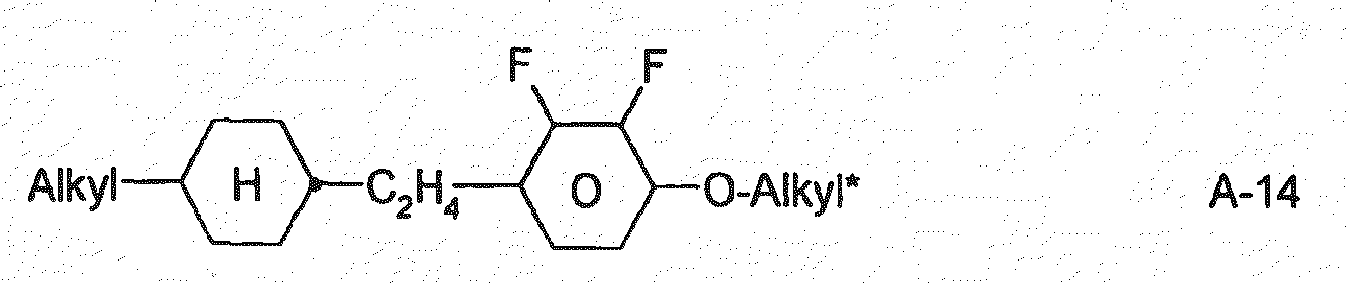
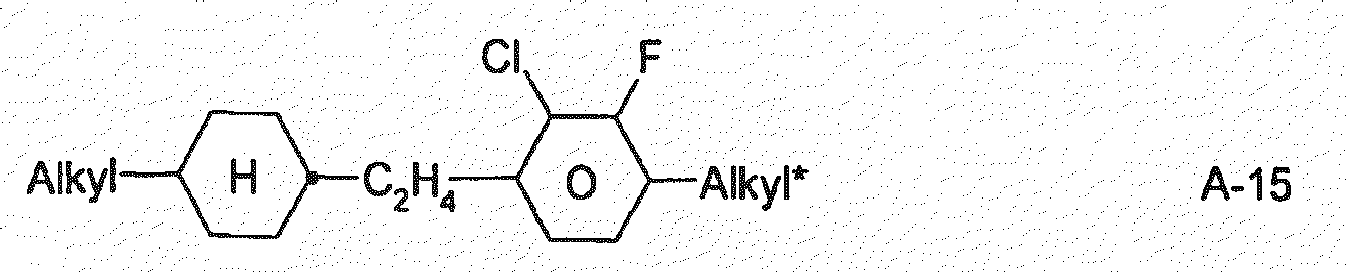










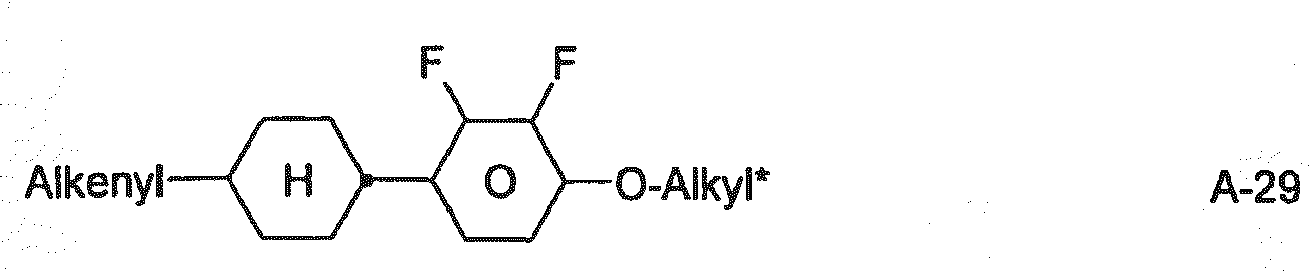





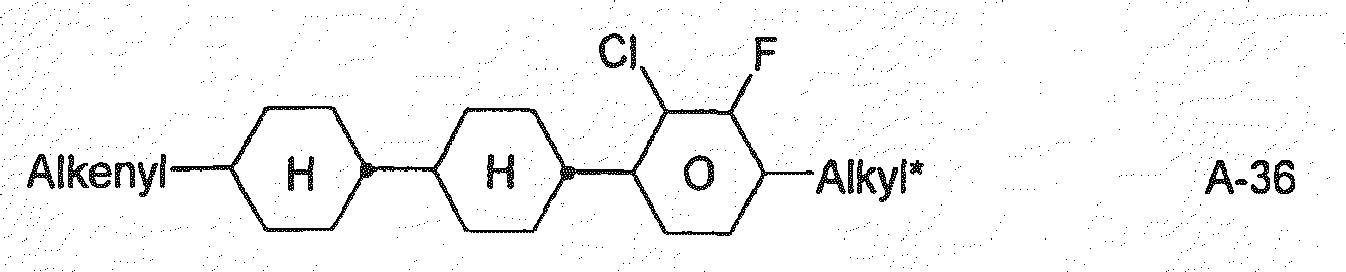


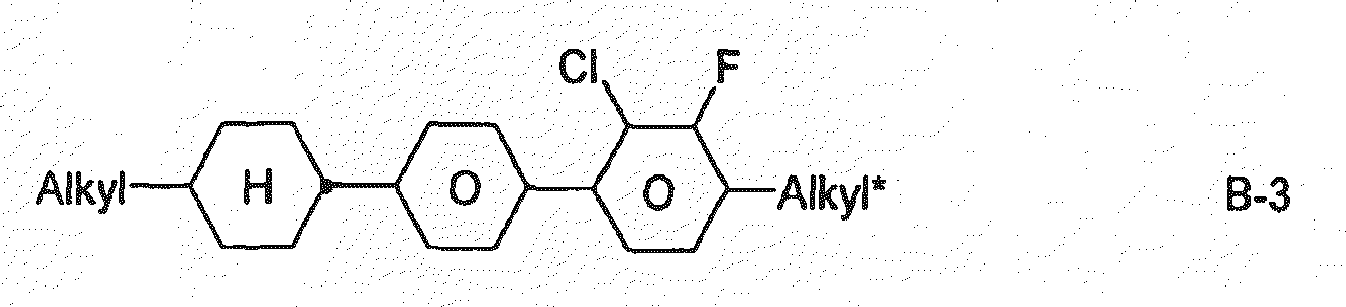


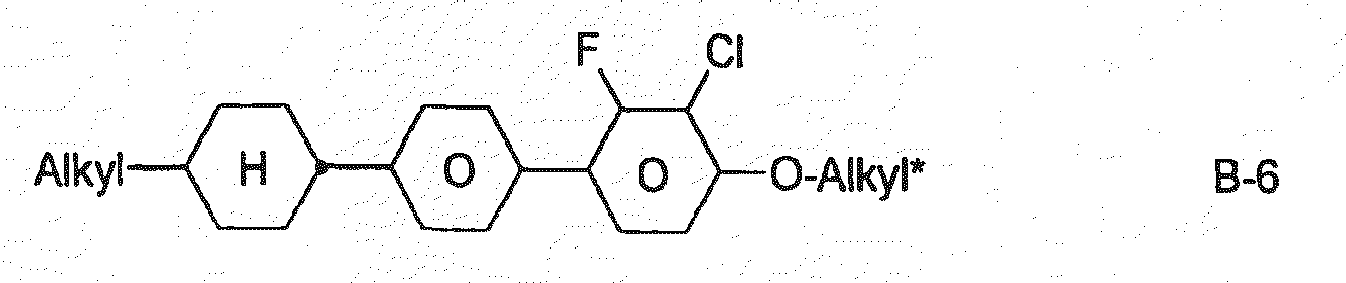








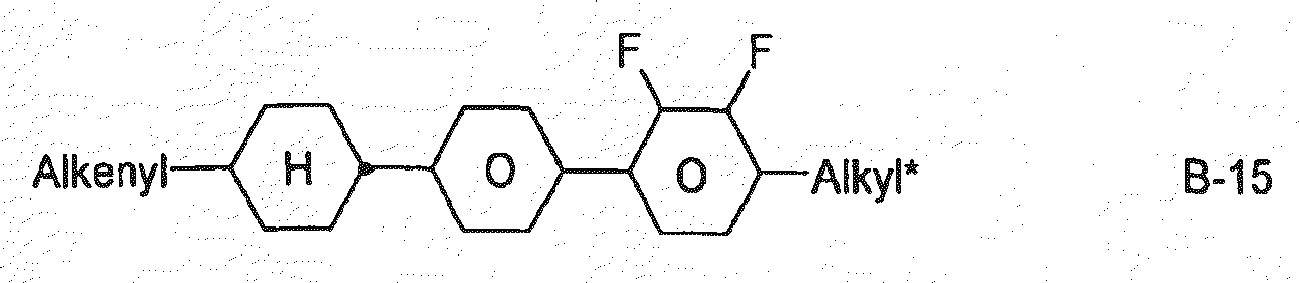


Besonders bevorzugte erfindungsgemäße Mischungen enthalten eine oder mehrere Verbindungen der Formeln A-2, A-8, A-14, A-29, A-35, B-2, B-11, B-16 und C-1. Vorzugsweise beträgt der Anteil an Verbindungen der Formeln A und/oder B im Gesamtgemisch mindestens 20 Gew.%. Besonders bevorzugte erfindungsgemäße Medien enthalten mindestens eine Verbindung der Formel C-1,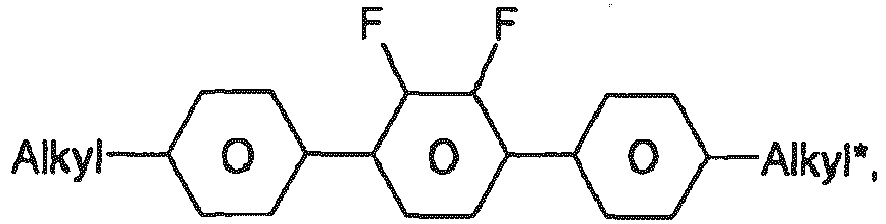
- b) FK-Medium, welches zusätzlich eine oder mehrere Verbindungen der folgenden Formel enthält:


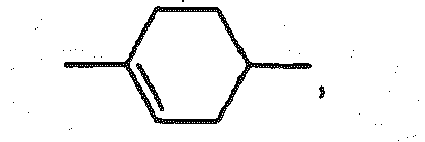

- R3 und R4
- jeweils unabhängig voneinander Alkyl mit 1 bis 12 C-Atomen, worin auch eine oder zwei nicht benachbarte CH2-Gruppen durch -O-, -CH=CH-, -CO-, -O-CO- oder -CO-O- so ersetzt sein können, dass O-Atome nicht direkt miteinander verknüpft sind,
- Zy
- -CH2CH2-, -CH=CH-, -CF2O-, -OCF2-, -CH2O-, -OCH2-, -CO-O-, -O-CO-, -C2F4-, -CF=CF-, -CH=CH-CH2O-, oder eine Einfachbindung, vorzugsweise eine Einfachbindung.
Die Verbindungen der Formel ZK sind vorzugsweise ausgewählt aus der Gruppe bestehend aus folgenden Unterformeln:






- c) FK-Medium, welches zusätzlich eine oder mehrere Verbindungen der folgenden Formel enthält:

- R5 und R6
- jeweils unabhängig voneinander eine der oben für R3/4 angegebenen Bedeutungen,


e 1 oder 2.
Die Verbindungen der Formel DK sind vorzugsweise ausgewählt aus der Gruppe bestehend aus folgenden Unterformeln:



- d) FK-Medium, welches zusätzlich eine oder mehrere Verbindungen der folgenden Formel enthält:


- f
- 0 oder 1,
- R1 und R2
- jeweils unabhängig voneinander Alkyl mit 1 bis 12 C-Atomen, wobei auch eine oder zwei nicht benachbarte CH2-Gruppen durch -O-, -CH=CH-, -CF=CF-, -CO-, -O(CO)-oder -(CO)O- so ersetzt sein können, dass O-Atome nicht direkt miteinander verknüpft sind,
- Zx und Zy
- jeweils unabhängig voneinander -CH2CH2-, -CH=CH-, -CF2O-, -OCF2-, -CH2O-, -OCH2-, -CO-O-, -O-CO-, -C2F4-, -CF=CF-, -CH=CH-CH2O-, oder eine Einfachbindung, vorzugsweise eine Einfachbindung,
- L1 und L2
- jeweils unabhängig voneinander F, Cl, OCF3, CF3, CH3, CH2F, CHF2.
Vorzugsweise bedeuten beide Reste L1 und L2 F oder einer der Reste L1 und L2 F und der andere Cl.
Die Verbindungen der Formel LY sind vorzugsweise ausgewählt aus der Gruppe bestehend aus folgenden Unterformeln


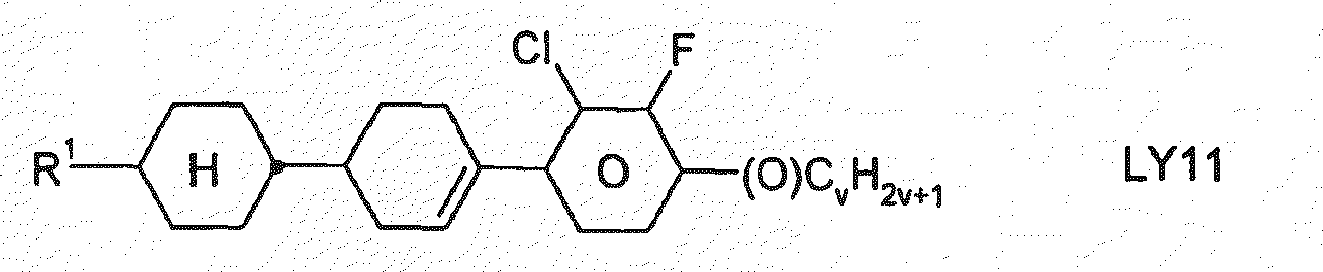



- e) FK-Medium, welches zusätzlich eine oder mehrere Verbindungen ausgewählt aus der Gruppe bestehend aus folgenden Formeln enthält:


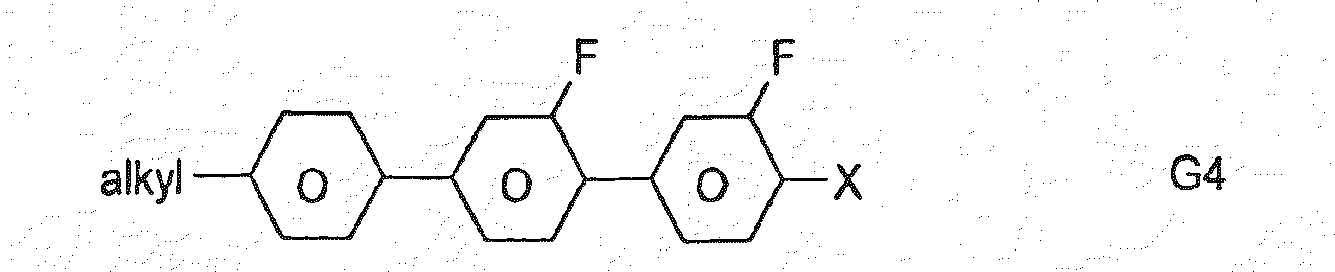
- f) FK-Medium, welches zusätzlich eine oder mehrere Verbindungen ausgewählt aus der Gruppe bestehend aus folgenden Formeln enthält:




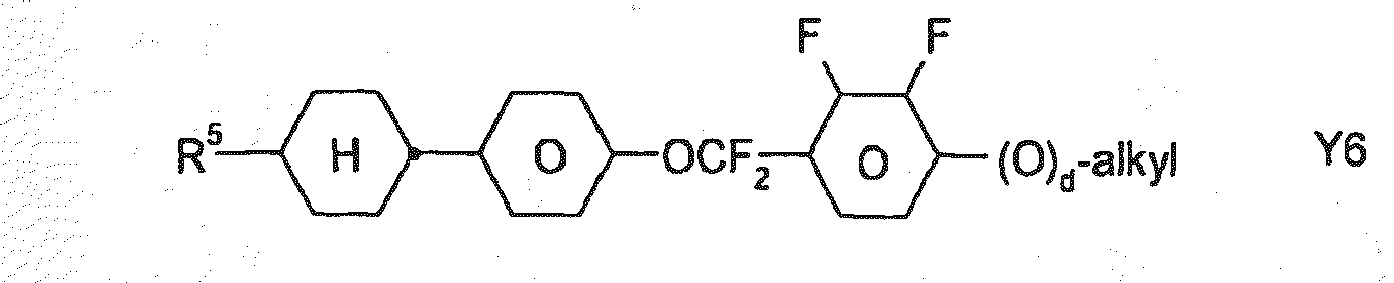


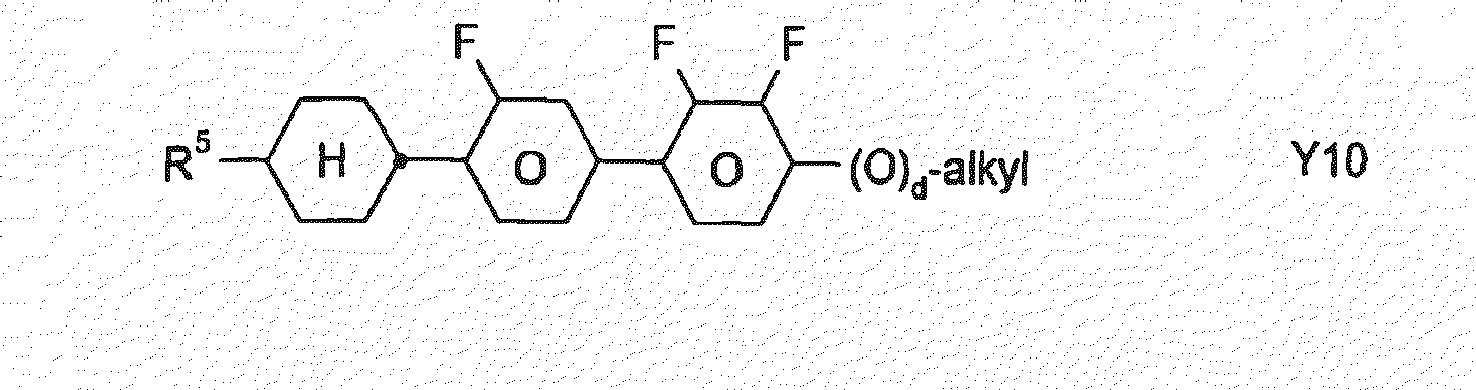


- g) FK-Medium, welches zusätzlich eine oder mehrere Biphenylverbindungen ausgewählt aus der Gruppe bestehend aus folgenden Formeln enthält:



Der Anteil der Biphenyle der Formeln B1 bis B3 in der FK-Mischung beträgt vorzugsweise mindestens 3 Gew.%, insbesondere ≥ 5 Gew.%. Die Verbindungen der Formel B2 sind besonders bevorzugt. Die Verbindungen der Formel B1 bis B3 sind vorzugsweise ausgewählt aus der Gruppe bestehend aus folgenden Unterformeln



- h) FK-Medium, welches zusätzlich eine oder mehrere Terphenylverbindungen der folgenden Formel enthält:


Die Verbindungen der Formel T sind vorzugsweise ausgewählt aus der Gruppe bestehend aus folgenden Unterformeln








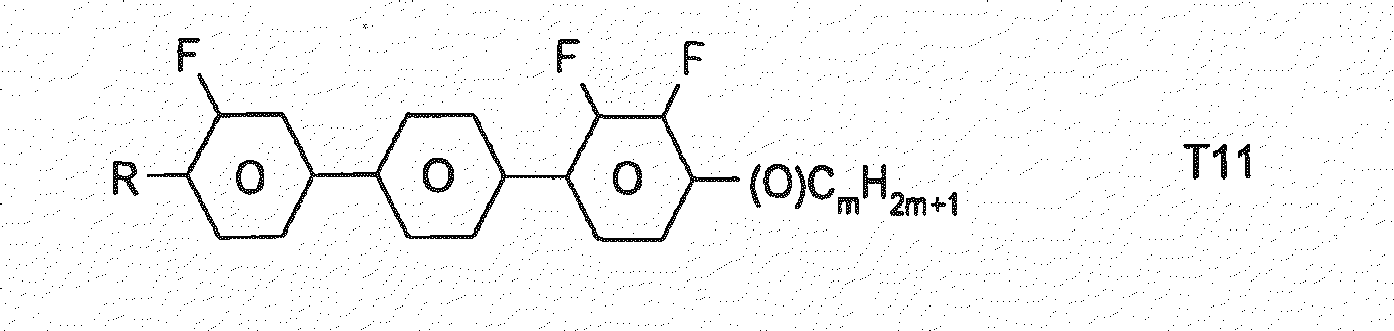

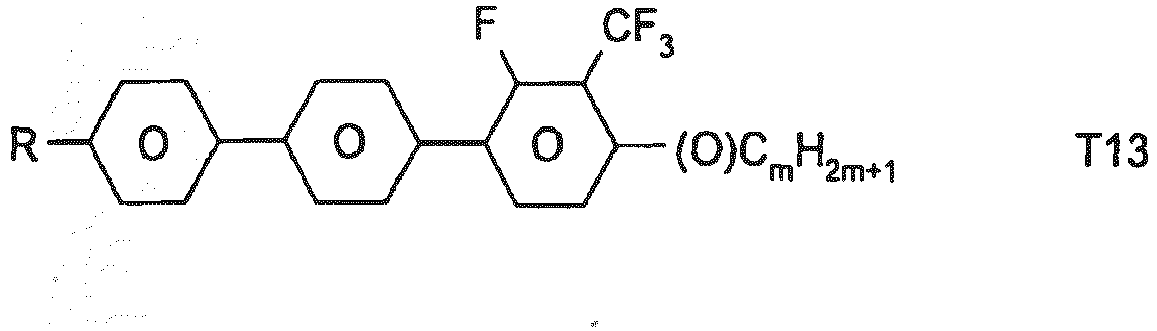

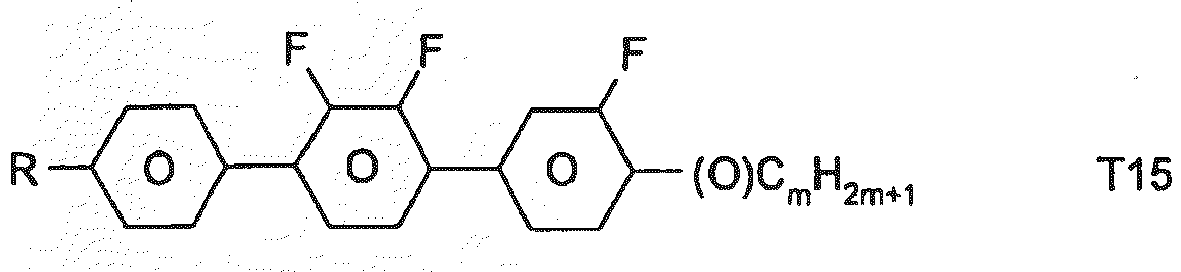
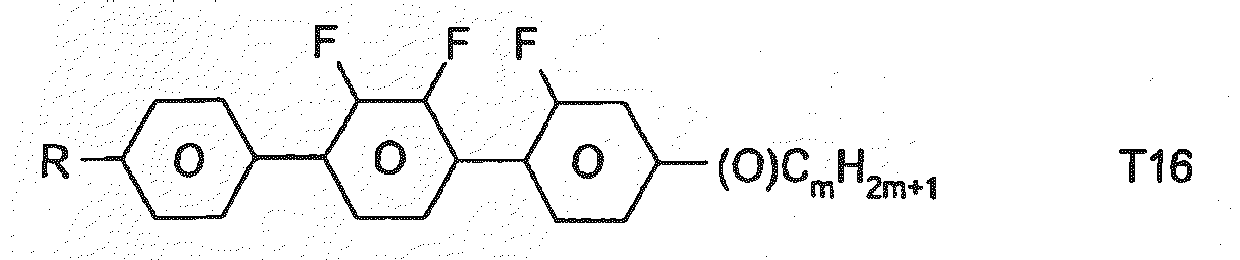

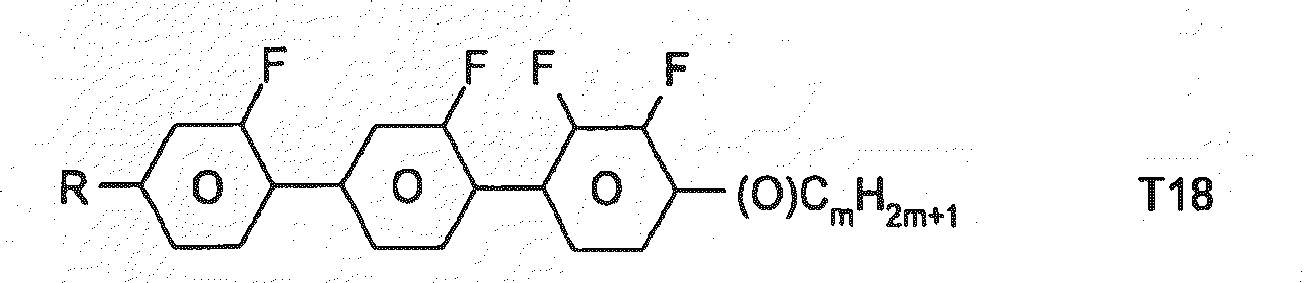


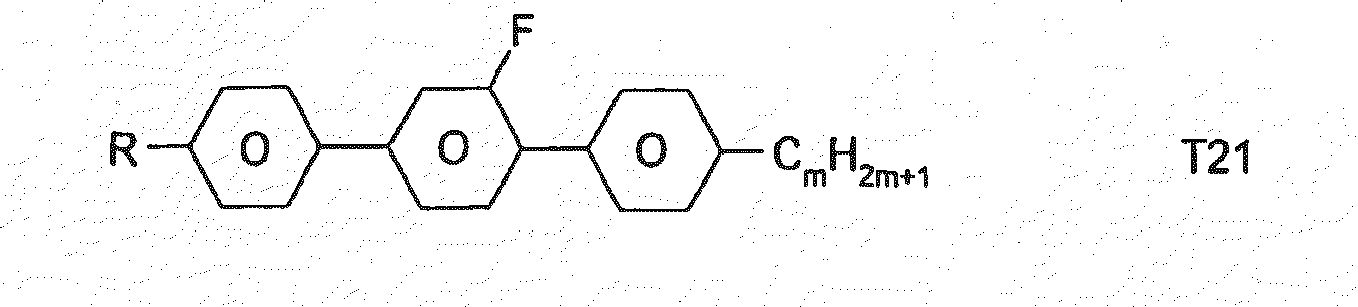



Das erfindungsgemäße FK-Medium enthält die Terphenyle der Formeln T und deren bevorzugte Unterformeln vorzugsweise in einer Menge von 0,5-30 Gew.%, insbesondere von 1-20 Gew.%. Besonders bevorzugt sind Verbindungen der Formeln T1, T2, T3 und T21. In diesen Verbindungen bedeutet R vorzugsweise Alkyl, ferner Alkoxy jeweils mit 1-5 C-Atomen. Vorzugsweise werden die Terphenyle in erfindungsgemäßen Mischungen eingesetzt, wenn der Δn-Wert der Mischung ≥ 0,1 sein soll. Bevorzugte Mischungen enthalten 2-20 Gew.% einer oder mehrerer TerphenylVerbindungen der Formel T, vorzugsweise ausgewählt aus der Gruppe der Verbindungen T1 bis T22. - i) FK-Medium, welches zusätzlich eine oder mehrere Verbindungen ausgewählt aus der Gruppe bestehend aus folgenden Formeln enthält:



Bevorzugte Medien enthalten eine oder mehrere Verbindungen ausgewählt aus den Formeln 01, 03 und 04. - k) FK-Medium, welches zusätzlich eine oder mehrere Verbindungen der folgenden Formel enthält:



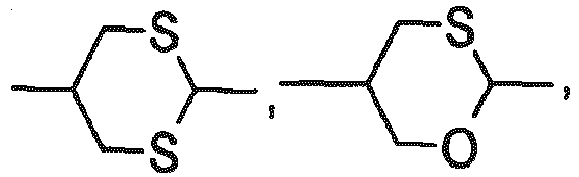
Besonders bevorzugte Verbindungen der Formel FI sind ausgewählt aus der Gruppe bestehend aus folgenden Unterformeln:
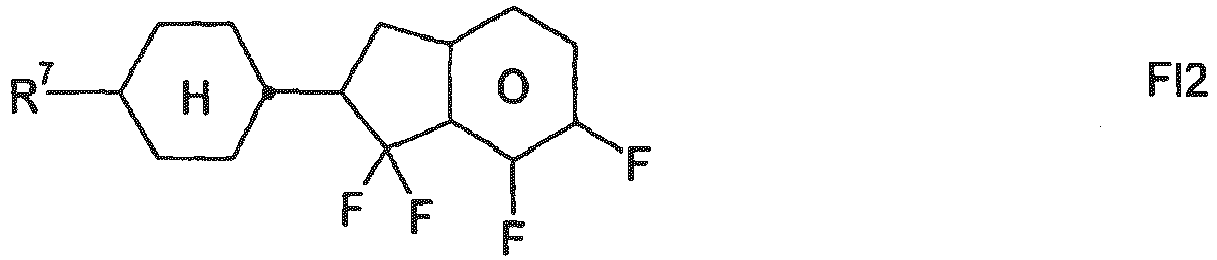
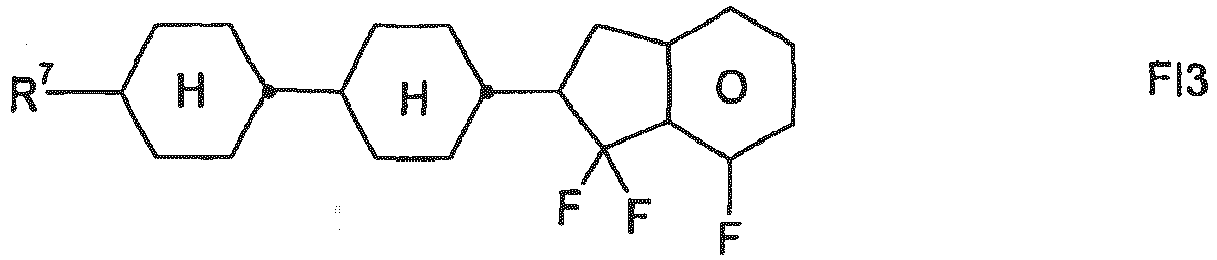


- m) FK-Medium, welches zusätzlich eine oder mehrere Verbindungen ausgewählt aus der Gruppe bestehend aus folgenden Formeln enthält:




- n) FK-Medium, welches zusätzlich eine oder mehrere Verbindungen enthält, die eine Tetrahydronaphthyl- oder Naphthyl-Einheit aufweisen, wie z.B. die Verbindungen ausgewählt aus der Gruppe bestehend aus folgenden Formeln:
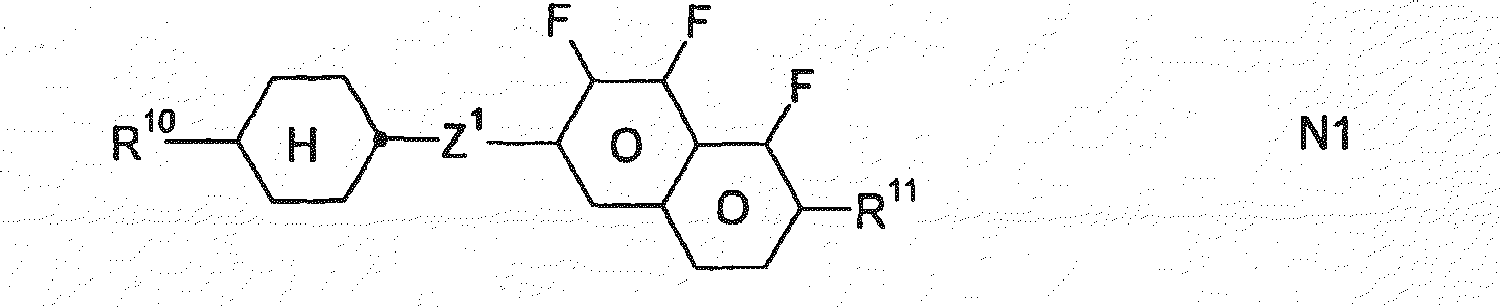


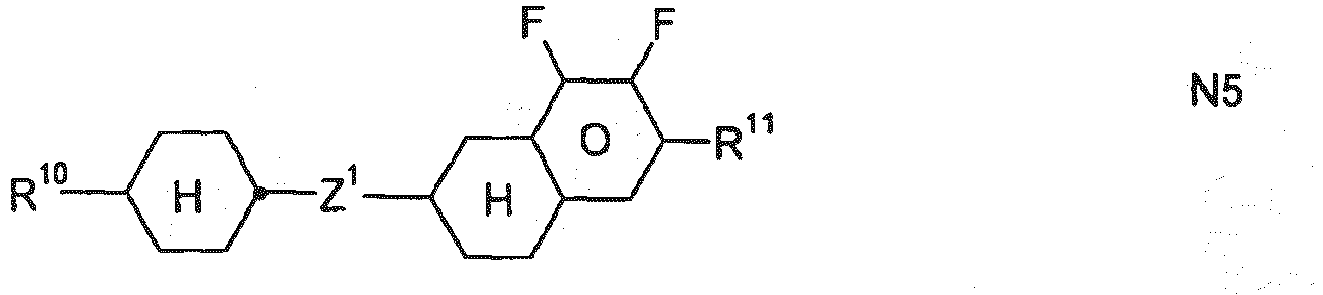

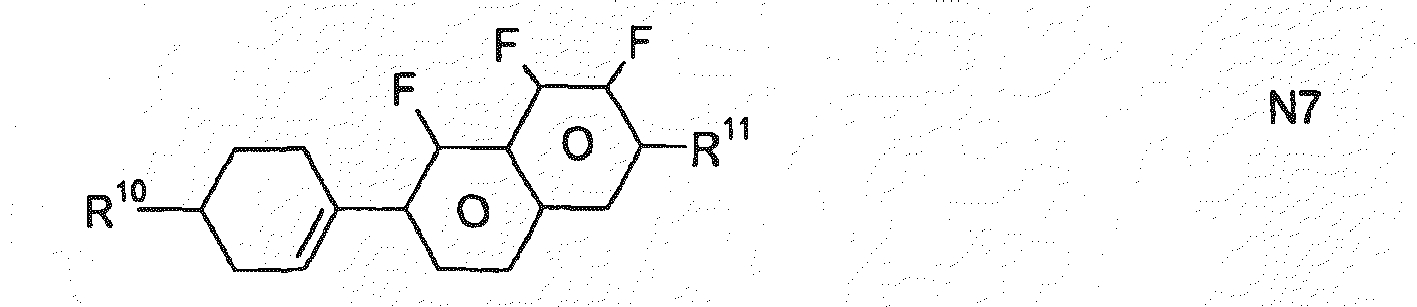
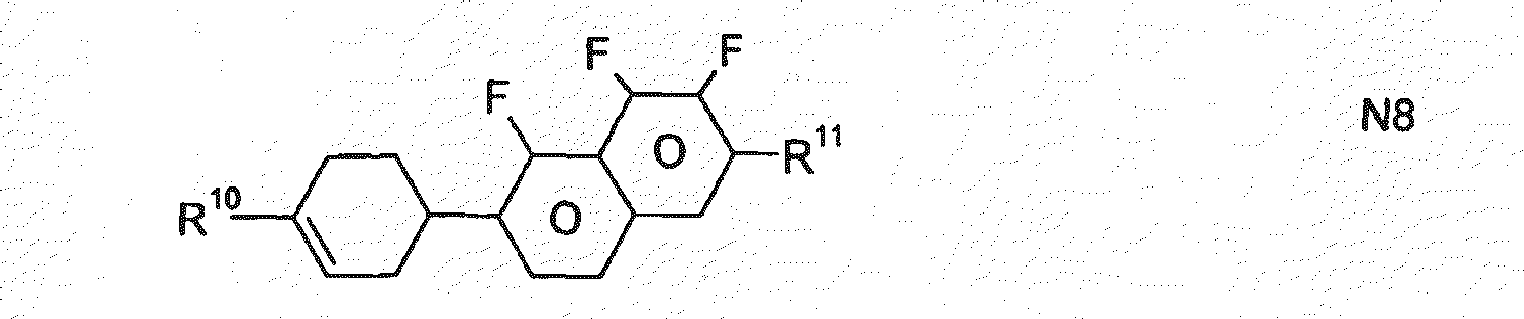


- o) FK-Medium, welches zusätzlich eine oder mehrere eine oder mehrere Difluordibenzochromane und/oder Chromane der folgenden Formeln enthält:


Besonders bevorzugte Verbindungen der Formeln BC und CR sind ausgewählt aus der Gruppe bestehend aus folgenden Unterformeln:






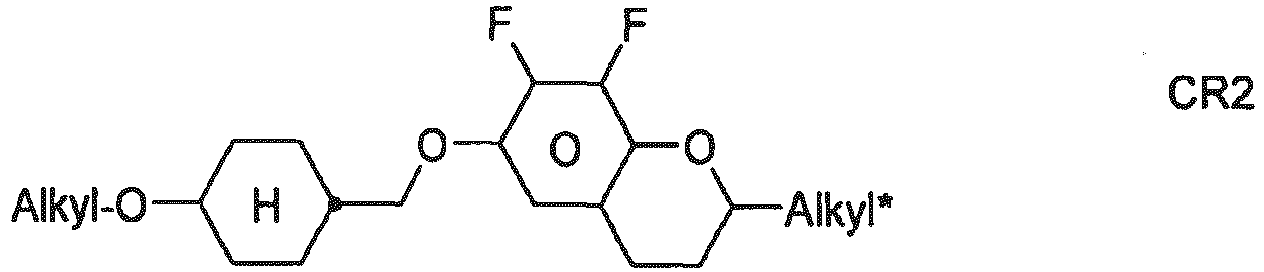


- p) FK-Medium, welches zusätzlich eine oder mehrere fluorierte Phenanthrene und/oder Dibenzofurane der folgenden Formeln enthält:


Besonders bevorzugte Verbindungen der Formeln PH und BF sind ausgewählt aus der Gruppe bestehend aus folgenden Unterformeln:



- Die erfindungsgemäße Flüssigkristallmischung ist mit einer dielektrischen Anisotropie (Δε) von ≤-1,5 dielektrisch negativ. Die Verbindungen der Formeln IIIA , IIIB, IIIC, LY1-LY18, Y1-Y16, T1-T24, FI, VK1-VK4, N1-N10, BC, CR, PH und BF eignen sich als dielektrisch negative Komponente. Bevorzugt sind die dielektrisch negativen Verbindungen der Formeln ausgewählt aus den Formeln IIIA , IIIB und IIIC. Das FK-Medium weist vorzugsweise ein Δε von -1,5 bis -8,0, insbesondere von -2,5 bis -6,0 auf.
- Die Werte der Doppelbrechung Δn in der Flüssigkristallmischung liegen in der Regel zwischen 0,07 und 0,16, vorzugsweise zwischen 0,08 und 0,12. Die Rotationsviskosität γ1 bei 20 °C vor der Polymerisation ist vorzugsweise ≤ 165 mPa·s, insbesondere ≤ 140 mPa·s.
- Das Medium enthält vorzugsweise 20-70 Gew.%, besonders bevorzugt 25-60 Gew.% an Verbindungen der Formel IIa;
- Das Medium enthält vorzugsweise 2-25 Gew.%, besonders bevorzugt 3-20 Gew.% ausgewählt aus der Gruppe der Verbindungen der VI-2;
- Das Medium enthält insgesamt 2-30 Gew.%, besonders bevorzugt 3-20 Gew.% an Verbindungen der Formeln XI und XXVII zusammen;
- Das Medium enthält vorzugsweise 1-20 Gew.%, besonders bevorzugt 2-15 Gew.% an Verbindungen der Formel XXIV;
- Das Medium enthält insgesamt 15-65 Gew.%, besonders bevorzugt 30-55 Gew.% ausgewählt aus den hochpolaren Verbindungen der Formeln VI-2, X, XI und XXV zusammen.
- Die nematische Phase des dielektrisch negativen FK-Mediums gemäß der Erfindung hat bevorzugt eine nematische Phasen in einem Temperaturbereich von 10 °C oder weniger bis 60 °C oder mehr, besonders bevorzugt von 0 oder weniger bis 70 °C oder mehr.
- In der vorliegenden Anmeldung und in den folgenden Beispielen sind die Strukturen der Flüssigkristallverbindungen durch Akronyme angegeben, wobei die Transformation in chemische Formeln gemäß folgender Tabellen A und B erfolgt. Alle Reste CnH2n+1 und CmH2m+1 sind geradkettige Alkylreste mit n bzw. m C-Atomen; n, m, z und k sind ganze Zahlen und bedeuten vorzugsweise 1, 2, 3, 4, 5, 6, 7, 8, 9, 10, 11 oder 12. Die Codierung gemäß Tabelle B versteht sich von selbst. In Tabelle A' ist nur das Akronym für den Grundkörper angegeben. Im Einzelfall folgt getrennt von Akronym für den Grundkörper mit einem Strich ein Code für die Substituenten R1*, R2*, L1* und L2*:
Code für R1*, R2*, L1*, L2*, L3* R1* R2* L1* L2* nm CnH2n+1 CmH2m+1 H H nOm CnH2n+1 OCmH2m+1 H H nO.m OCnH2n+1 CmH2m+1 H H n CnH2n+1 CN H H nN.F CnH2n+1 CN F H nN.F.F CnH2n+1 CN F F nF CnH2n+1 F H H nCl CnH2n+1 Cl H H nOF OCnH2n+1 F H H nF.F CnH2n+1 F F H nF.F.F CnH2n+1 F F F nOCF3 CnH2n+1 OCF3 H H nOCF3.F CnH2n+1 OCF3 F H n-Vm CnH2n+1 -CH=CH-CmH2m+1 H H nV-Vm CnH2n+1-CH=CH- -CH=CH-CmH2m+1 H H - Bevorzugte Mischungskomponenten finden sich in den Tabellen A und B.
Tabelle A 

PYP PYRP 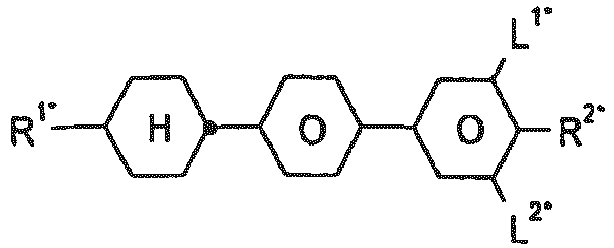

BCH CBC 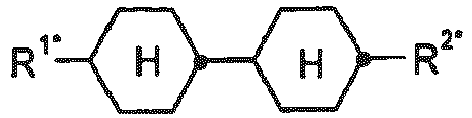
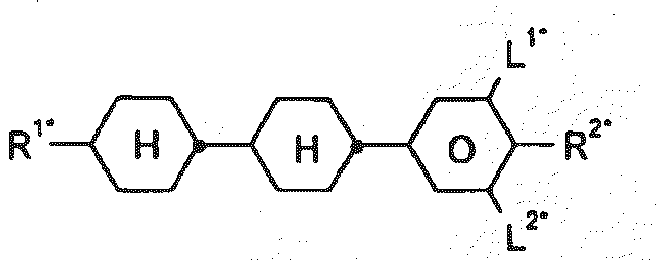
CCH CCP 

CPTP CEPTP 

ECCP CECP 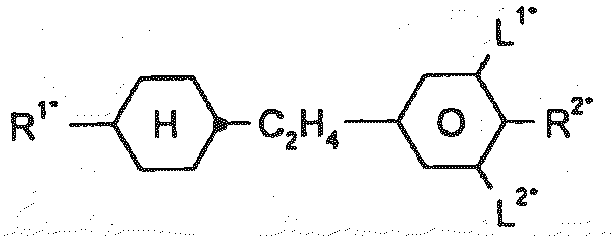

EPCH PCH 
CH 

PTP CCPC 
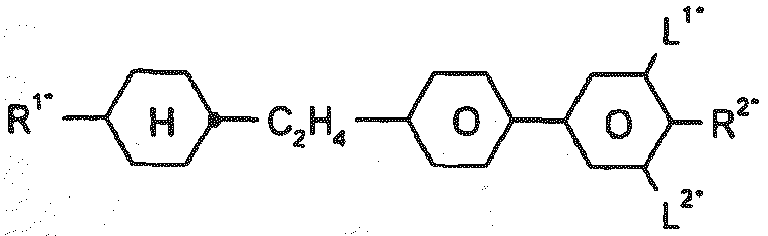
CP BECH 

EBCH CPC 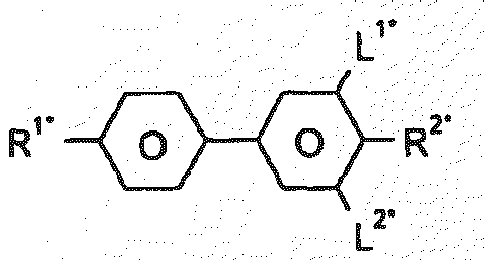

B FET-nF 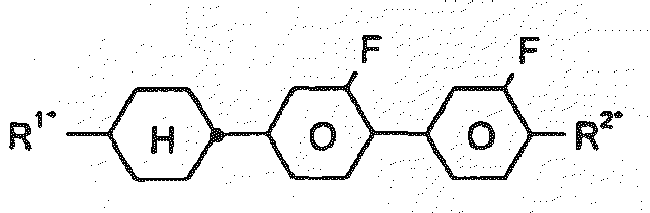

CGG CGU 
CFU Tabelle B n, m, z bedeuten unabhängig voneinander vorzugsweise 1, 2, 3, 4, 5 oder 6. 

CCH-nm CCH-nOm 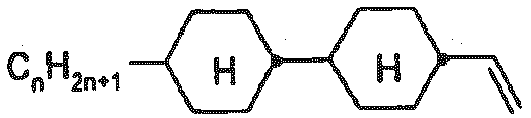

CC-n-V CC-n-V1 

CC-n-mV PP-n-m 

PP-n-Om PP-n-Vm 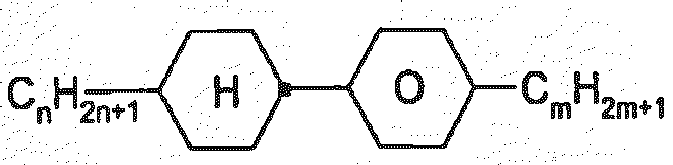

PCH-nm PCH-nOm 

CY-n-Om CY-n-m 

CY-V-Om CY-nV-(O)m 
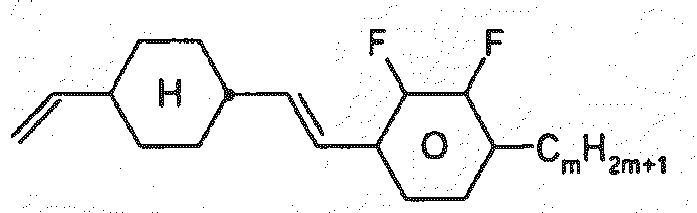
CVC-n-m CVY-V-m 

CEY-V-m PY-n-(O)m 

CCP-V-m CCP-Vn-m 

CCY-n-m CCY-n-Om 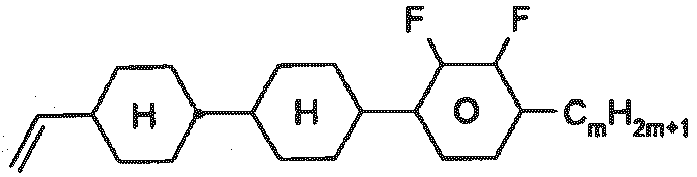

CCY-V-m CCY-Vn-m 

CCY-V-Om CCY-n-OmV 

CCY-n-zOm CCOC-n-m 
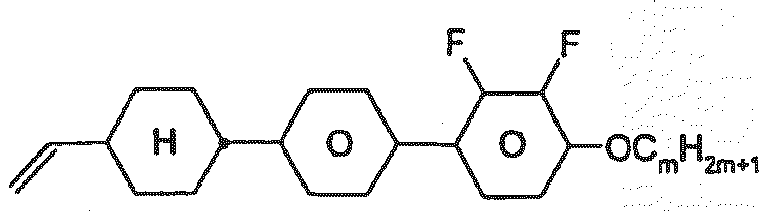
CPY-n-(O)m CPY-V-Om 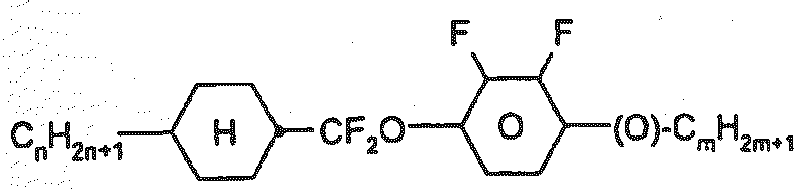

CQY-n-(O)m CQIY-n-(O)m 

CCQY-n-(O)m CCQIY-n-(O)m 

CPQY-n-(O)m CPQIY-n-Om 

CLY-n-(O)m CYLI-n-m 

LYLI-n-m LY-n-(O)m 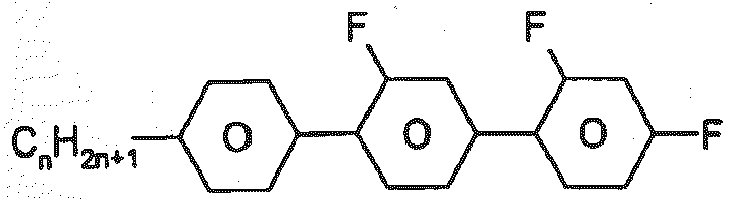

PGIGI-n-F PGP-n-m 
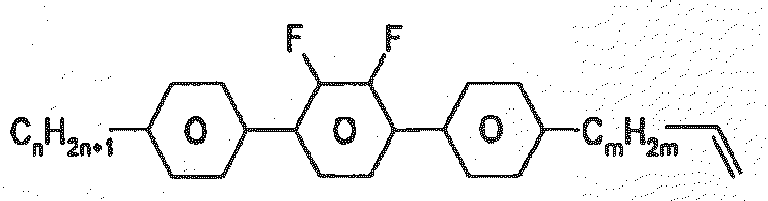
PYP-n-(O)m PYP-n-mV 
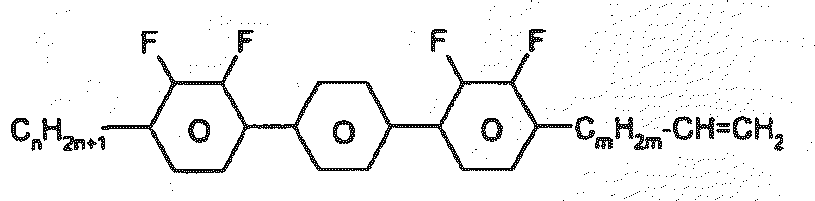
YPY-n-m YPY-n-mV 
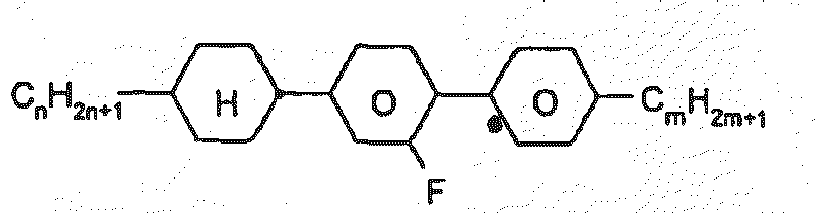
BCH-nm BCH-nmF 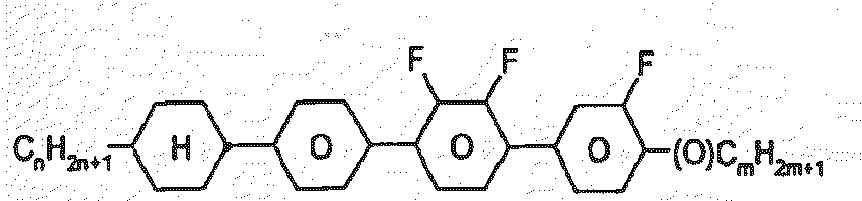
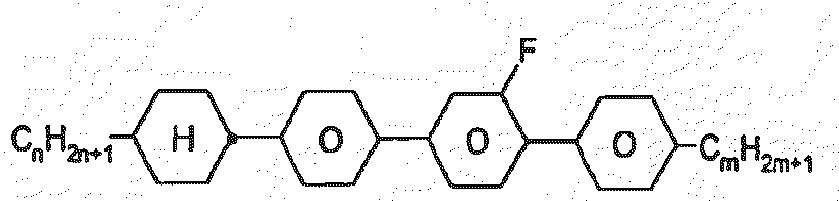
CPYP-n-(O)m CPGP-n-m 
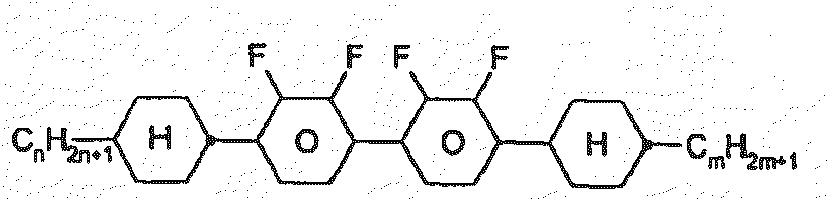
CPYC-n-m CYYC-n-m 

CCYY-n-m CPYG-n-(O)m 

CBC-nm CBC-nmF 

CNap-n-Om CCNap-n-Om 

CENap-n-Om CTNap-n-Om 

CETNap-n-Om CK-n-F 

DFDBC-n(O)-(O)m C-DFDBF-n-(O)m 
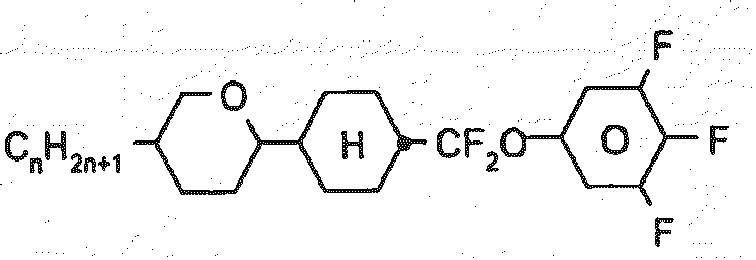
APU-n-OXF ACQU-n-F 
APUQU-n-F 

BCH-n.Fm CFU-n-F 
CBC-nmF 

ECCP-nm CCZU-n-F 

PGP-n-m CGU-n-F 
CDUQU-n-F 

CDU-n-F DCU-n-F 

CGG-n-F CPZG-n-OT 
CC-nV-Vm 

CCP-Vn-m CCG-V-F 
CCP-nV-m 

CCQU-n-F CC-n-Vm 
CPPC-nV-Vm 

CCQG-n-F CQU-n-F 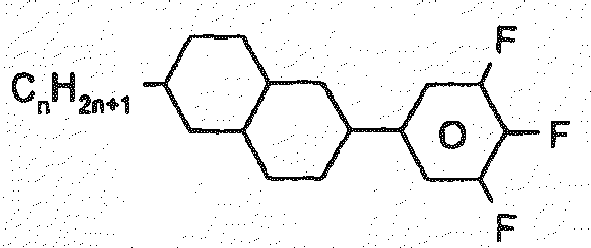

Dec-U-n-F CWCU-n-F 
CPGP-n-m 
CWCG-n-F 
CCOC-n-m 
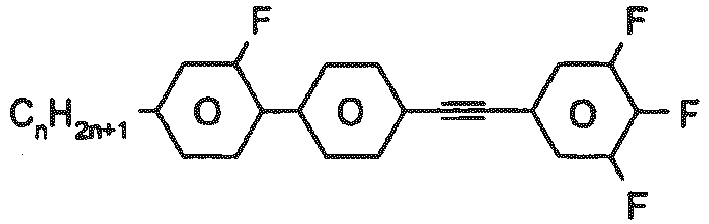
CPTU-n-F GPTU-n-F 

PQU-n-F PUQU-n-F 

PGU-n-F CGZP-n-OT 

CCGU-n-F CCQG-n-F 

DPGU-n-F DPGU-n-OT 
CUQU-n-F 
CCCQU-n-F 
CGUQU-n-F 
CPGU-n-OT 

PYP-n-F CPU-n-OXF 

CPGU-n-F CPGG-n-F 

CVCP-1V-OT GGP-n-Cl 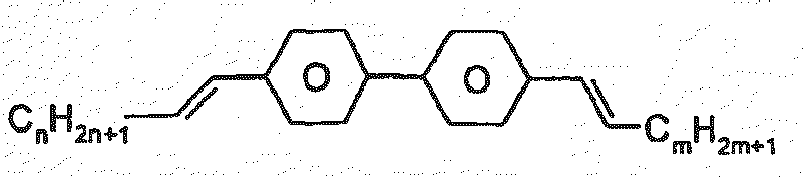

PP-nV-Vm PP-1-nVm 
CWCQU-n-F 
PPGU-n-F 
PGUQU-n-F 
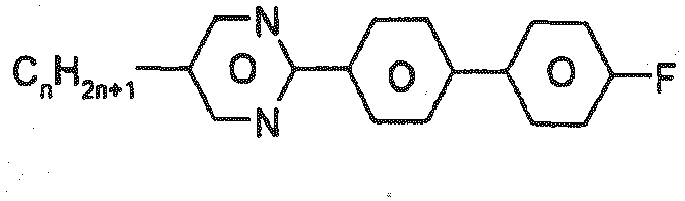
GPQU-n-F MPP-n-F 
PGP-n-kVm 
PP-n-kVm 

PCH-nCl GP-n-Cl 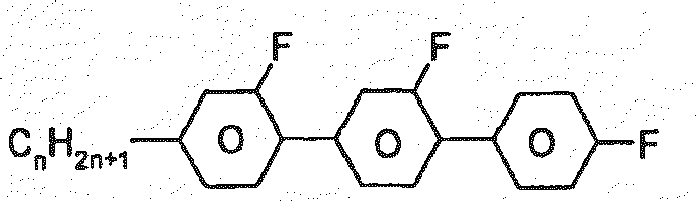

GGP-n-F PGIGI-n-F 
SUQU-n-F 
SPUQU-n-F - In einer bevorzugten Ausführungsform der vorliegenden Erfindung enthalten die erfindungsgemäßen LC-Medien eine oder mehrere Verbindungen ausgewählt aus der Gruppe bestehend aus Verbindungen der Tabelle A und B.
Tabelle C In der Tabelle C werden mögliche chirale Dotierstoffe angegeben, die den erfindungsgemäßen FK-Medien zugesetzt werden können. 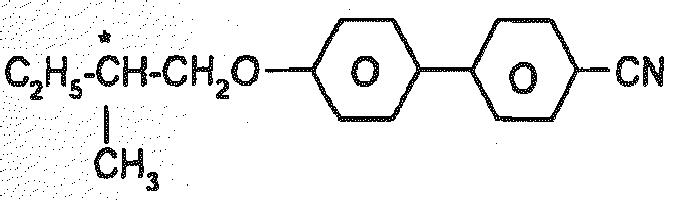

C 15 CB 15 

CM 21 R/S-811 

CM 44 CM 45 

CM 47 CN 

R/S-2011 R/S-3011 

R/S-4011 R/S-5011 
R/S-1011 - Optional enthalten die FK-Medien 0 bis 10 Gew.%, insbesondere 0,01 bis 5 Gew.%, besonders bevorzugt 0,1 bis 3 Gew.% an Dotierstoffen, vorzugsweise ausgewählt aus der Gruppe bestehend aus Verbindungen der Tabelle C.
Tabelle D In der Tabelle D werden mögliche Stabilisatoren angegeben, die den erfindungsgemäßen FK-Medien zugesetzt werden können. (n bedeutet hier eine ganze Zahl von 1 bis 12, vorzugsweise 1, 2, 3, 4, 5, 6, 7 oder 8, endständige Methylgruppen sind nicht gezeigt). 


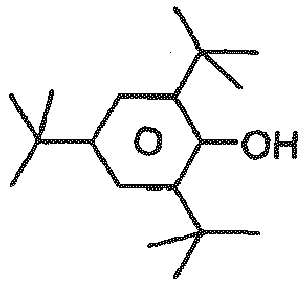


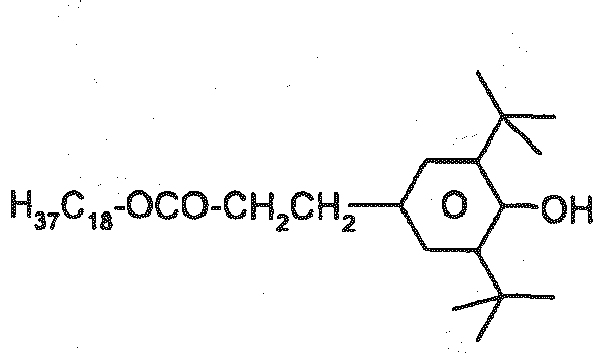
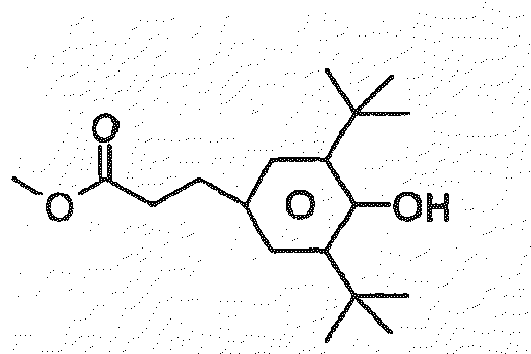

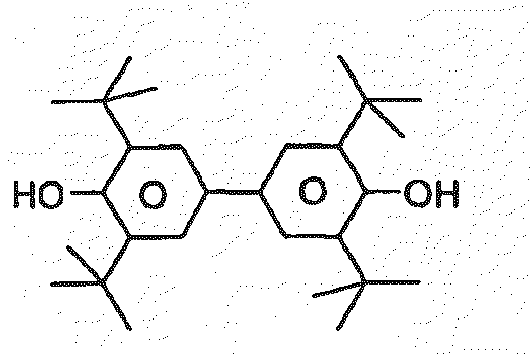


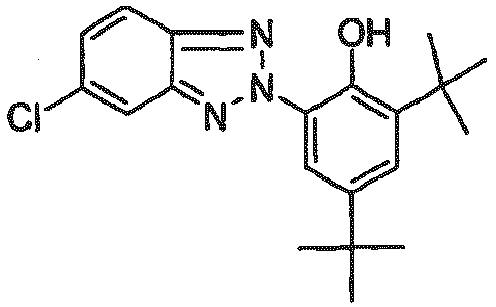


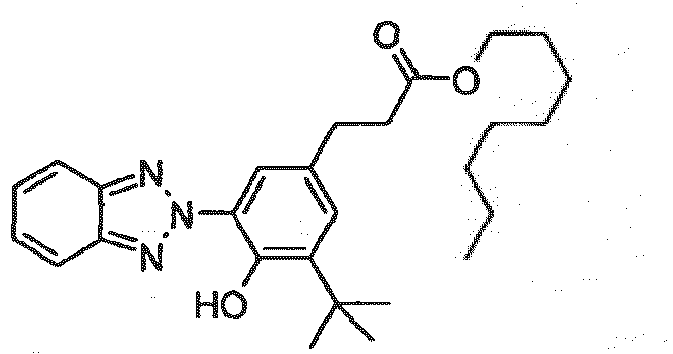
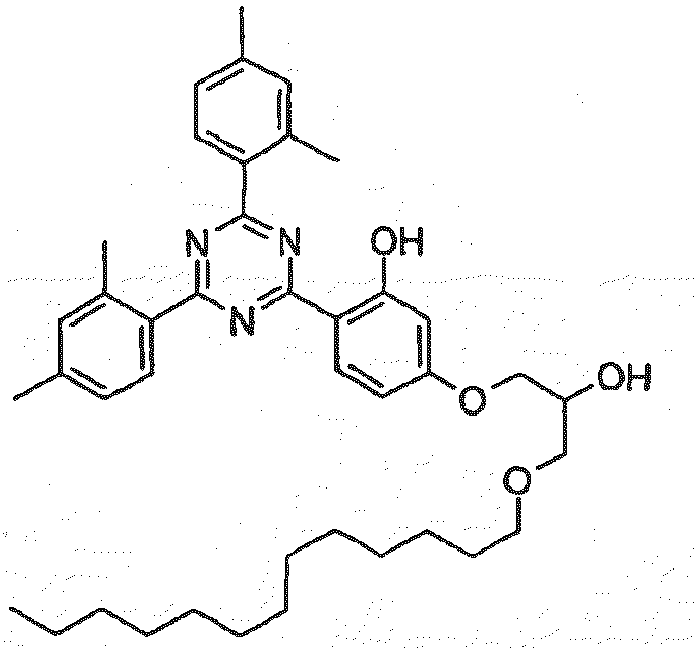


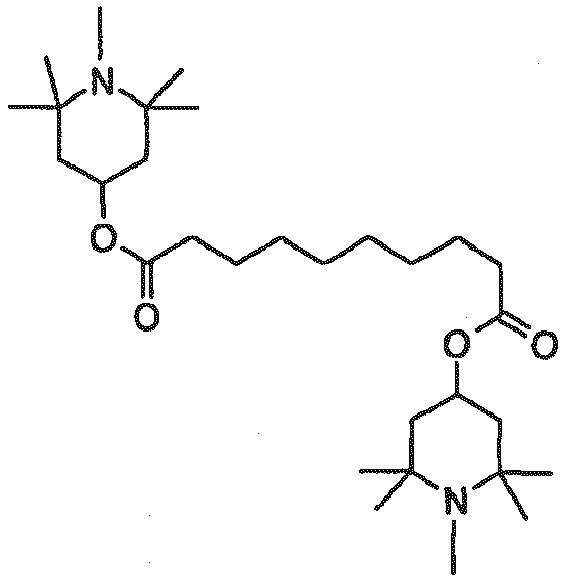
- Vorzugsweise enthalten die FK-Medien 0 bis 10 Gew.%, insbesondere 1 ppm bis 5 Gew.%, besonders bevorzugt 1ppm bis 1 Gew.% an Stabilisatoren. Vorzugsweise enthalten die FK-Medien einen oder mehrere Stabilisatoren ausgewählt aus der Gruppe bestehend aus Verbindungen der Tabelle D.
Tabelle E In der Tabelle E sind Beispielverbindungen zusammengestellt, die in den FK-Medien gemäß der vorliegenden Erfindung vorzugsweise als reaktive Verbindungen verwendet werden können. 

RM-1 RM-2 

RM-3 RM-4 
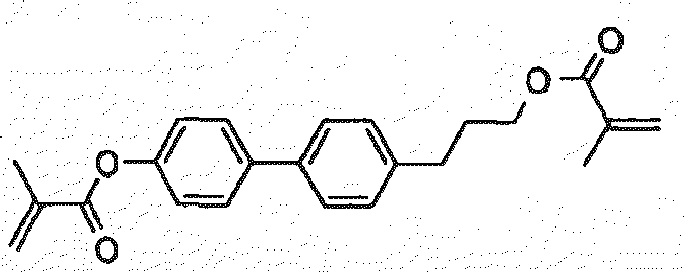
RM-5 RM-6 
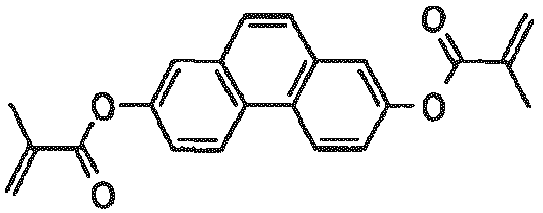
RM-7 RM-8 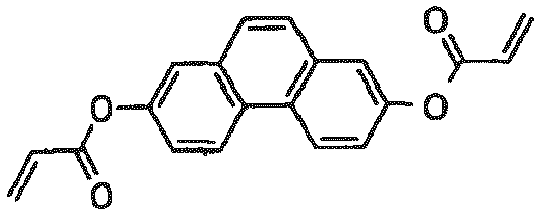

RM-9 RM-10 
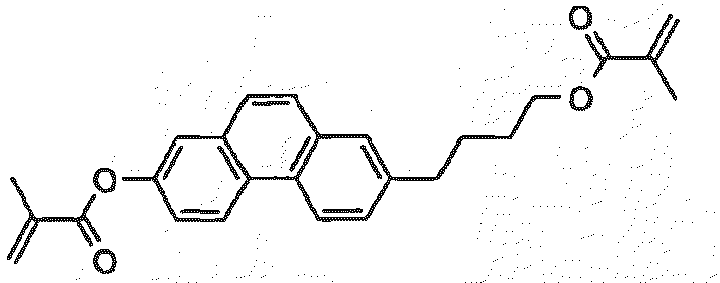
RM-11 RM-12 
RM-13 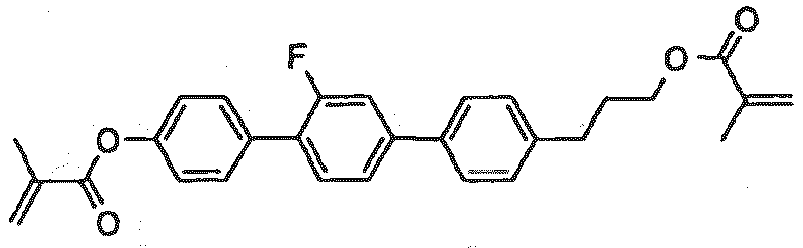
RM-14 
RM-15 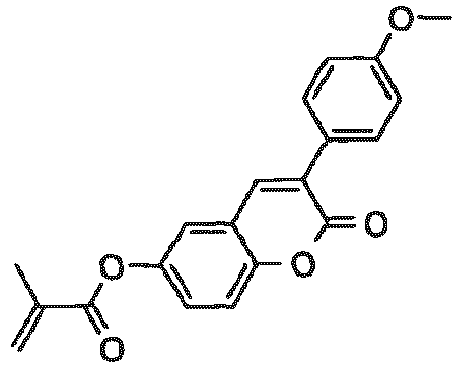
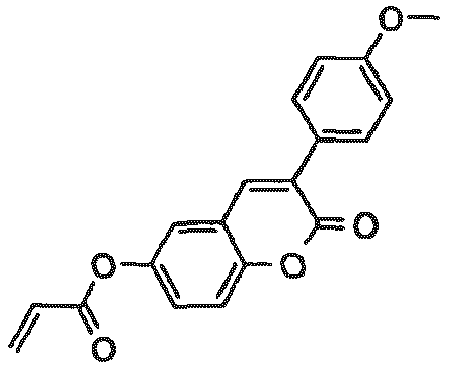
RM-16 RM-17 
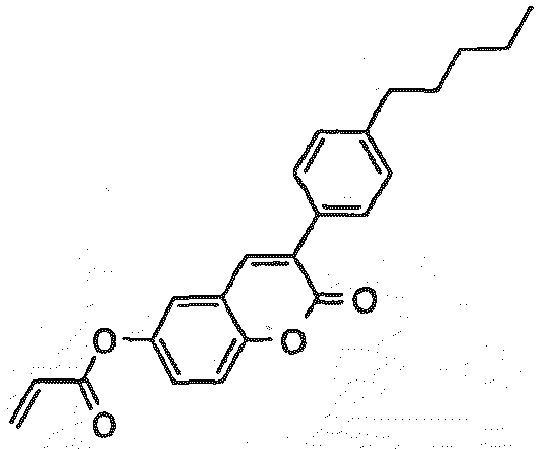
RM-18 RM-19 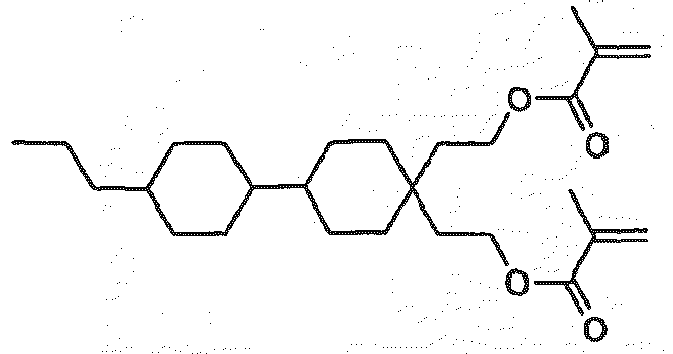

RM-20 RM-21 
RM-22 
RM-23 
RM-24 
RM-25 
RM-26 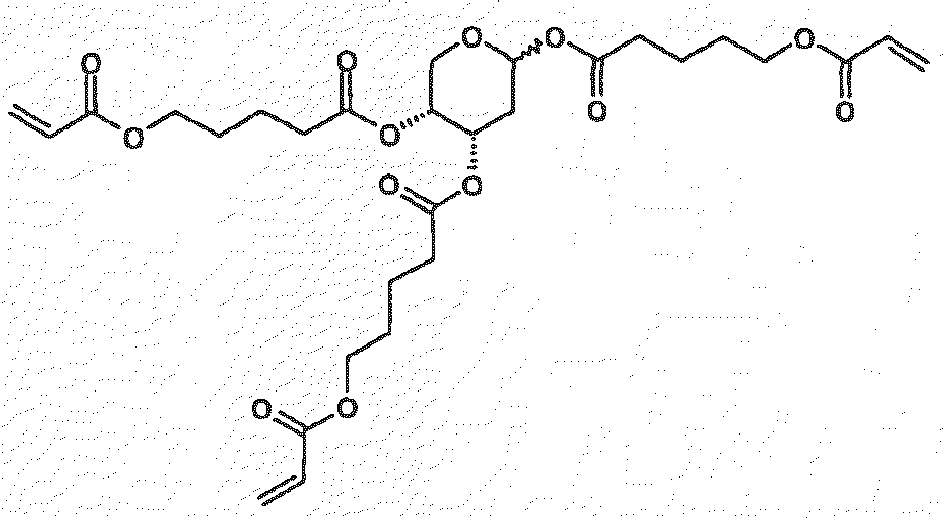
RM-27 
RM-28 - In einer bevorzugten Ausführungsform der vorliegenden Erfindung enthalten die mesogenen Medien eine oder mehrere Verbindungen ausgewählt aus der Gruppe der Verbindungen der Tabelle E.
- In der vorliegenden Anmeldung bedeutet der Begriff "Verbindungen", auch geschrieben als "Verbindung(en)", sofern nicht explizit anders angegeben, sowohl eine als auch mehrere Verbindungen. Umgekehrt schließt der Begriff "Verbindung" generell auch mehrere Verbindungen ein, sofern dies laut Definition möglich und nicht anders angegeben ist. Gleiches gilt für die Begriffe FK-Medien und FK-Medium. Der Begriff "Komponente" umfasst jeweils eine oder mehrere Stoffe, Verbindungen und/oder Teilchen.
- Außerdem werden folgende Abkürzungen und Symbole verwendet:
- ne
- außerordentlicher Brechungsindex bei 20°C und 589 nm,
- no
- ordentlicher Brechungsindex bei 20°C und 589 nm,
- Δn
- optische Anisotropie bei 20°C und 589 nm,
- ε⊥
- dielektrische Permittivität senkrecht zum Direktor bei 20°C und 1 kHz,
- ε||
- dielektrische Permittivität parallel zum Direktor bei 20°C und 1 kHz,
- Δε
- dielektrische Anisotropie bei 20°C und 1 kHz,
- Kp., T(N,I)
- Klärpunkt [°C],
- γ1
- Rotationsviskosität bei 20°C [mPa·s],
- K1
- elastische Konstante, "splay"-Deformation bei 20°C [pN],
- K2
- elastische Konstante, "twist"-Deformation bei 20°C [pN],
- K3
- elastische Konstante, "bend"-Deformation bei 20°C [pN].
- Soweit nicht explizit anders vermerkt, sind in der vorliegenden Anmeldung alle Konzentrationen in Gewichtsprozent angegeben und beziehen sich auf die entsprechende Gesamtmischung, enthaltend alle festen oder flüssigkristallinen Komponenten, ohne Lösungsmittel.
- Alle physikalischen Eigenschaften werden und wurden nach "Merck Liquid Crystals, Physical Properties of Liquid Crystals", Status Nov. 1997, Merck
- KGaA, Deutschland bestimmt und gelten für eine Temperatur von 20°C und Δn wird bei 589 nm und Δε bei 1 kHz bestimmt, sofern nicht jeweils explizit anders angegeben.
- Die polymerisierbaren Verbindungen werden in der Anzeige bzw. Testzelle durch Bestrahlung mit UVA-Licht (üblicherweise 365nm) einer definierten Intensität für eine vorgegebene Zeit polymerisiert, wobei optional gleichzeitig eine Spannung an die Anzeige angelegt wird (üblicherweise 10 bis 30 V Wechselstrom, 1 kHz). In den Beispielen wird, falls nicht anders angegeben, eine Quecksilberdampflampe mit 100 mW/cm2 verwendet, die Intensität wird mit einem Standard-UV-Meter (Fabrikat Ushio UNI meter) gemessen, der mit einem Bandpassfilter bei 320 nm ausgerüstet ist.
- Die folgenden Beispiele erläutern die vorliegende Erfindung, ohne sie in irgendeiner Weise beschränken zu sollen. Aus den physikalischen Eigenschaften wird dem Fachmann jedoch deutlich, welche Eigenschaften zu erzielen sind und in welchen Bereichen sie modifizierbar sind. Insbesondere ist also die Kombination der verschiedenen Eigenschaften, die vorzugsweise erreicht werden können, für den Fachmann gut definiert.
- Weitere Kombinationen der Ausführungsformen und Varianten der Erfindung gemäß der Beschreibung ergeben sich auch aus den Ansprüchen.
- Die eingesetzten Verbindungen, soweit nicht kommerziell erhältlich, werden nach Standard-Laborvorschriften synthetisiert. Die FK-Medien stammen von der Merck KGaA, Deutschland.
-

- 49,0 g (0,163 mol) 1-Brom-2-fluor-4-iodbenzol und 24,7 g (0,163 mol) 4-Methoxybenzolboronsäure werden in einer Mischung aus 325 ml Toluol, 165 ml Wasser und 165 ml Ethanol gelöst und nach Zugabe von 1,9 g (1,64 mmol) Tetrakis(triphenylphosphin)palladium und 34,9 g (0,33 mol) Natriumcarbonat über Nacht unter Rückfluss erhitzt. Die org. Phase wird abgetrennt, über Natriumsulfat getrocknet und eingeengt. Der Rückstand wird mit Heptan/Toluol (1:1) über Kieselgel filtriert und das Rohprodukt aus Ethanol umkristallisiert. Man erhält 4-Brom-3-fluor-4'-methoxy-biphenyl als farblosen Feststoff.
-

- 28,0 g (99,0 mmol) 4-Brom-3-fluor-4'-methoxy-biphenyl, 28,8 g (99,2 mmol) Natriummetaborat-Octahydrat und 1,4 g (1,96 mmol) Bis(triphenylphosphin)palladium(II)chlorid werden in 75 ml Wasser und 100 ml THF vorgelegt, mit 0,1 ml Hydrazinhydrat versetzt und nach Zugabe einer Lösung von 16,3 g (99,0 mmol) 4-Propylbenzolboronsäure über Nacht unter Rückfluß erhitzt. Die org. Phase wird abgetrennt, i. Vak. eingeengt, mit Heptan/Toluol über Kieselgel filtriert und das Rohprodukt aus Ethanol/Toluol (14:1) umkristallisiert. Man erhält 2'-Fluor-4"-methoxy-4-propyl-[1,1';4',1"]terphenyl als farblose Kristalle.
-

- 27,2 g (85 mmol) werden in 400 ml Dlchlormethan bei -10°C vorgelegt und tropfenweise mit 100 ml (100 mmol) einer 1 M Lösung von Bortribromid in Hexan versetzt. Die Kühlung wird entfernt und der Ansatz 3 h bei Raumtemp. rühren gelassen. Anschließend wird der Ansatz unter Kühlung mit 200 ml Wasser hydrolysiert, das ausgefallene Produkt durch Zugabe von 800 ml warmem Dichlormethan gelöst und die wässrige Phase abgetrennt. Die org. Phase wird mit Wasser und ges. Natriumhydrogencarbonatlsg. gewaschen und über Natriumsulfat getrocknet. Man erhält 2'-Fluor-4-propyl-[1,1';4',1"]terphenyl-4"-ol als farblosen Feststoff, der ohne weitere Aufreinigung in der nächsten Stufe eingesetzt wird.
-

- Das Rohprodukt aus Stufe 1.4 wird in 300 ml Ethylmethylketon gelöst, 23,9 g (173 mmol) Kaliumcarbonat sowie 20,0 g (90 mmol) 2-Benzyloxyethylbromid hinzugefügt und über Nacht unter Rückfluss erhitzt. Der Ansatz wird filtriert, das Filtrat eingeengt und der Rückstand mit Toluol über Kieselgel filtriert. Kristallisation des Rohproduktes aus Ethanol/Toluol (6:1) liefert 4"-(2-Benzyloxy-ethoxy)-2'-fluor-4-propyl-[1,1';4',1"]terphenyl als farblosen Feststoff.
-
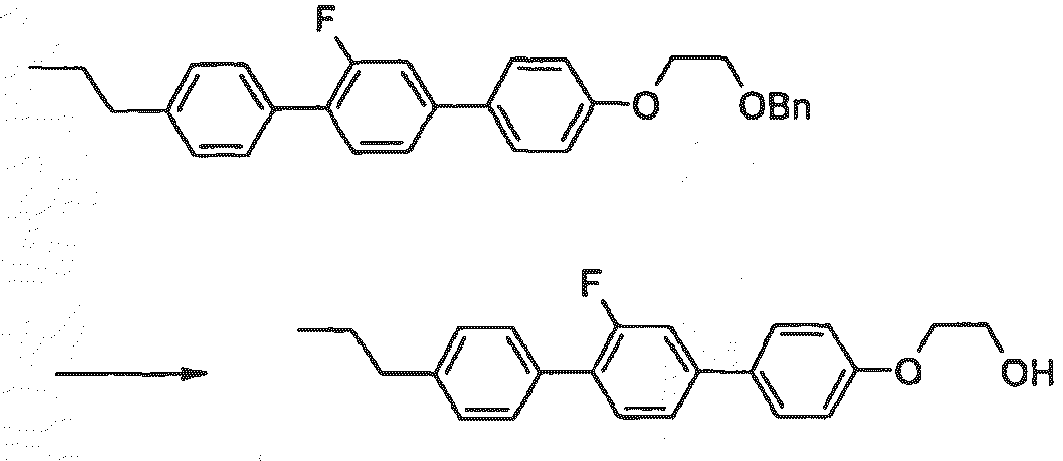
- 24,5 g (56 mmol) 4"-(2-Benzyloxy-ethoxy)-2'-fluor-4-propyl-[1,1';4',1"]terphenyl werden in THF an Palladiumkohle bis zum Stillstand hydriert. Der Katalysator wird abfiltriert, das Filtrat eingeengt und das Rohprodukt aus Ethanol/Toluol (8:1) umkristallisiert. Man erhält 2-(2'-Fluor-4-propyl-[1,1';4',1"]terphenyl-4"-yloxy)-ethanol als farblose Nadeln.
-

- 7,0 g (20 mmol) 2-(2'-Fluor-4-propyl-[1,1';4',1"]terphenyl-4"-yloxy)-ethanol werden in 200 ml Dichlormethan gelöst, 3,3 ml (40 mmol) Pyridin und 120 mg DMAP hinzugefügt und auf 10 °C gekühlt. Nach Zugabe von 4,6 g (24 mmol) Tosylchlorid wir der Ansatz über Nacht bei Raumtemperatur gerührt und anschließend mit 500 ml Wasser versetzt. Die wässrige Phase wird abgetrennt und mit Dichlormethan extrahiert. Die vereinigten org. Phasen werden mit verd. Salzsäure und mit ges. Natriumhydrogencarbonatlösung gewaschen und über Natriumsulfat getrocknet. Das Lösungsmittel wird i. Vak. entfernt und der Rückstand durch Chromatographie mit Toluol an Kieselgel gereinigt. Man erhält Toluol-4-sulfonsäure-2-(2'-fluor-4-propyl-[1,1';4',1"]terphenyl-4"-yloxy)-ethylester als farblosen Feststoff.
-

- 1,00 g (1,98 mmol) Toluol-4-sulfonsäure-2-(2'-fluor-4-propyl-[1,1';4',1"]terphenyl-4"-yloxy)-ethylester werden in 20 ml Ethylendiamin über Nacht auf 60 °C erwärmt. Anschließend wird das Amin i. Vak entfernt und der Rückstand mit Dichlormethan/Methanol/25proz. Ammoniak (80:20:2) über Kieselgel filtriert. Man erhält N-[2-(2'-Fluor-4-propyl-[1,1';4',1"]terphenyl-4"-yloxy)-ethyl]-ethan-1,2-diamin als farblosen Feststoff.
1H-NMR (300 MHz, CDCl3) δ = 0.98 ppm (t, J = 7,4 Hz, 3 H, CH3), 1,56 (s, br., 2 H, NH2), 1,69 (sext., J = 7,4 Hz, 2 H, CH2CH 2CH3), 2,64 (t, J = 7,4 Hz, 2 H, -CH 2Et), 2,76 (t, J = 5,8 Hz, 2 H, -CH 2NH2), 2,85 (t, J = 5,8 Hz, 2 H, CH 2-CH2NH2), 3,05 (t, J = 5,2 Hz, 2 H, OCH2CH 2-), 4,13 (t, J = 5,8 Hz, 2 H, -OCH2-), 6,99 (AB-d, J = 8,7 Hz, 2 H, Ar-H), 7,26 (d, J = 8,5 Hz, 2 H, Ar-H), 7,33 (dd, J = 1,7 Hz, J = 12,1 Hz, 1 H, Ar-H), 7,38 (dd, J = 1,7 Hz, J = 8,0 Hz, 1 H, Ar-H), 7,50 (mc, 2 H, Ar-H), 7,54 (AB-d, J = 8,7 Hz, 2 H, Ar-H). -

- In Analogie zu Beispiel 1 erhält man aus Toluol-4-sulfonsäure-2-(2'-fluor-4-propyl-[1,1';4',1"]terphenyl-4"-yloxy)-ethylester und 1,3-Diaminopropan das N-[2-(2'-Fluor-4-propyl-[1,1';4',1"]terphenyl-4"-yloxy)-ethyl]-propan-1,3-diamin.
1H-NMR (300 MHz, CDCl3) δ = 0.98 ppm (t, J = 7,3 Hz, 3 H, CH3), 1,55 - 1,90 (m, 6 H, darin: 1,67 (quint., J = 7,1 Hz, -NH-CH2-CH 2-CH2NH2); s, br., NH2; CH3CH 2CH2-), 2,63 (dd, J = 7,3 Hz, J = 8,0 Hz, 2 H, Ar-CH 2Et), 2,75 (t, J = 7,1 Hz, 2 H, - CH 2NH2), 2,78 (t, J = 6,9 Hz, 2 H, -NH-CH 2-(CH2)2NH2), 3,01 (t, J = 5,3 Hz, 2 H, -OCH2CH 2-NH), 3,41 (s, 1 H, -NH-), 4,11 (t, J = 5,3 Hz, 2 H, -O-CH2-), 6,98 (AB-d, J = 8,8 Hz, 2 H, Ar-H), 7,26 (d, J = 8,2 Hz, 2 H, Ar-H), 7,32 (dd, J = 1,8 Hz, J = 12,2 Hz, 1 H, Ar-H), 7,37 (dd, J = 1,8 Hz, J = 8,0 Hz, 1 H, Ar-H), 7,43 - 7,56 (m, 5 H, Ar-H). -

- In Analogie zu Beispiel 1 erhält man aus Toluol-4-sulfonsäure-2-(2'-fluor-4-propyl-[1,1';4',1"]terphenyl-4"-yloxy)-ethylester und 2-Methoxy-1-ethylamin das [2-(2'-Fluor-4-propyl-[1,1';4',1"]terphenyl-4"-yloxy)-ethyl]-(2-methoxy-ethyl)-amin als farblosen Feststoff.
1H-NMR (400 MHz, CDCl3) δ = 0.98 ppm (t, J = 7,3 Hz, 3 H, CH3), 1,69 (sext., J = 7,5 Hz, 2 H, CH3CH 2CH2-), 1,74 (s, br., NH), 2,64 (dd, J = 6,7 Hz, J = 8,6 Hz, 2 H, -CH 2-Et), 2,89 (t, J = 5,3 Hz, 2 H, - CH2-NH-), 3,06 (t, 5,3 Hz, 2 H, -CH2-NH-), 3,38 (s, 3 H, OCH3), 3,54 (dd, J = 5,3, J = 5,3 Hz, 2 H, -O-CH2-), 4,13 (t, 5,3 Hz, 2 H, -O-CH2-), 7,00 (AB-d, J = 8,7 Hz, 2 H, Ar-H), 7,26 (d, J = 8,3 Hz, 2 H, Ar-H), 7,32 (dd, J = 1,7 Hz, J = 12,2 Hz, 1 H, Ar-H), 7,39 (dd, J = 1,8 Hz, J = 8,0 Hz, 1 H, Ar-H), 7,44 - 7,57 (m, 5 H, Ar-H). -

- 735 mg (18,4 mmol) einer 60proz. Dispersion von Natriumhydrid in Mineralöl werden unter Stickstoff mit Pentan gewaschen und i. Vak. getrocknet. Anschließend werden 30 ml THF und 1,21 g (15,9 mmol) Ethylenglykolmonomethylether hinzugegeben und bis zum Ende der Gasentwicklung bei Raumtemp. rühren gelassen. Nach Zugabe einer Lösung von 5,00 g (12,2 mmol) Toluol-4-sulfonsäure-2-(2'-fluor-4-propyl-[1,1';4',1"]terphenyl-4"-yloxy)-ethylester in 10 ml THF wird der Ansatz 3 d bei Raumtemperatur rühren gelassen und dann überschüssiges Natriumhydrid durch Zugabe von Methanol zersetzt. Die Lösung wird auf Wasser gegeben, mit 2 M Salzäure angesäuert und dreimal mit MTB-Ether extrahiert. Die vereinigten org. Phasen werden über Natriumsulfat getrocknet und i. Vak. Eingeengt. Das Rohprodukt wird mit Dichlormethan über Kieselgel filtriert und aus Toluol umkristallisiert. Man erhält 2'-Fluor-4"-[2-(2-methoxy-ethoxy)-ethoxy]-4-propyl-[1,1';4',1"]terphenyl als farblose Kristalle.
-

- 1,15 g (28,8 mmol) einer 60proz. Suspension von Natriumhydrid in Paraffinöl werden in 70 ml THF vorgelegt und eine Lösung von 9,0 g (23,2 mmol) (3S,5S,8R,9S,10S,13R,14S,17R)-17-((R)-1,5-Dimethyl-hexyl)-10,13-dimethyl-hexadecahydro-cyclopenta[a]phenanthren-3-ol in 60 ml THF zutropfen gelassen. Der Ansatz wird 2 auf 70 °C erhitzt, mit einer Lösung von 10 ml (49 mmol) (2-Bromethoxy)-tert.-butyl-dimethylsilan in 50 ml THF versetzt und über Nacht bei 70 °C gerührt. Anschließend wird mit 300 ml Wasser hydrolysiert und dreimal mit MTB-Ether extrahiert. Die vereinigten org. Phasen werden mit Wasser gewaschen und über Natriumsulfat getrocknet. Das Lösungsmittel wird i. Vak. entfernt und der Rückstand mit Toluol an Kieselgel chromatographiert. Man erhält tert-Butyl-{2-[(3S,5S,8R,9S,10S,13R,14S,17R)-17-((R)-1,5-dimethyl-hexyl)-10,13-dimethyl-hexadecahydro-cyclopenta[a]phenanthren-3-yloxy]-ethoxy}-dimethylsilan als farblose Kristalle.
-

- 1,90 g (3,47 mmol) tert-Butyl-{2-[(3S,5S,8R,9S,10S,13R,14S,17R)-17-((R)-1,5-dimethyl-hexyl)-10,13-dimethyl-hexadecahydro-cyclopenta[a]-phenanthren-3-yloxy]-ethoxy}-dimethylsilan werden in 20 ml THF gelöst und unter Eiskühlung tropfenweise mit 3,8 ml (38 mmol) einer 1 M Lösung von Tetrabutylammoniumfluorid in THF versetzt. Die Kühlung wird entfernt, der Ansatz 15 min bei Raumtemp. rühren gelassen und auf Wasser gegeben. Die wässrige Phase wird abgetrennt und mit MTB-Ether extrahiert. Die vereinigten org. Phasen werden mit ges. Natriumchloridlsg. gewaschen, über Natriumsulfat getrocknet und das Lösungsmittel wird i. Vak. entfernt. Man erhält 2-[(3S,5S,8R,9S,10S,13R,14S,17R)-17-((R)-1,5-Dimethyl-hexyl)-10,13-dimethyl-hexadecahydro-cyclopenta[a]phenanthren-3-yloxy]-ethanol als zähes gelbes Öl, das ohne weitere Aufreinigung in der nächsten Stufe eingesetzt wird.
-

- In Analogie zu Beispiel 1 erhält man aus 2-[(3S,5S,8R,9S,10S,13R,14S,17R)-17-((R)-1,5-Dimethyl-hexyl)-10,13-dimethyl-hexadecahydro-cyclopenta[a]phenanthren-3-yloxy]-ethanol den Toluol-4-sulfonsäure-2-[(3S,5S,8R,9S,10S,13R,14S,17R)-17-((R)-1,5-dimethyl-hexyl)-10,13-dimethyl-hexadecahydro-cyclopenta[a]phenanthren-3-yloxy]-ethylester als zähes Öl.
-

- In Analogie zu Beispiel 1 erhielt man aus Toluol-4-sulfonsäure-2-[(3S,5S,8R,9S,10S,13R,14S,17R)-17-((R)-1,5-dimethyl-hexyl)-10,13-dimethyl-hexadecahydro-cyclopenta[a]phenanthren-3-yloxy]-ethylester das N-{2-[(3S,5S,8R,9S,10S,13R,14S,17R)-17-((R)-1,5-Dimethyl-hexyl)-10,13-dimethyl-hexadecahydro-cyclopenta[a]phenanthren-3-yloxy]-ethyl}-ethan-1,2-diamin als farbloses zähes Öl.
1H-NMR (500 MHz, CDCl3) δ = 0,65 (s, 3 H, -CH3), 0,75 - 0,89 (m, 46 H, darin: 0,79 (s, 3 H, -CH3),0,86 (d, J = 2,1 Hz, 3 H, -CH3), 0,87 (d, J = 2,1 Hz, 3 H, -CH3), 0,90 (d, J = 6,5 Hz, 3 H, -CH3), Alkyl-H, -NH-, -NH2), 1,96 (ddd, J = 12,6 Hz, J = 3,2 Hz, J = 3,2 Hz, 1 H), 2,69 (t, J = 6,0 Hz, 2 H, -CH 2NH2), 2,77 (dd, J = 5,4 Hz, J = 5,4 Hz, 2 H, -OCH2CH 2NH-), 2,81 (t, J = 6,0 Hz, 2 H, -NHCH 2CH2NH2), 3,22 (dddd, J = 4.7 Hz, J = 4.7 Hz, J = 4.7 Hz, J = 4.7 Hz, 1 H, >CH-O-), 3.58 (mc, 2 H, -CH2O-). - Analog oder nach Literaturvorschrift werden folgende Verbindungen zur Verwendung in FK-Medien hergestellt (teilweise auch kommerziell verfügbar):
Beispiel Nr. Strukturformel 6. 
7. 
8. 
9. 
10. 
11. 
12. 
13. 
14. 
15. 
16. 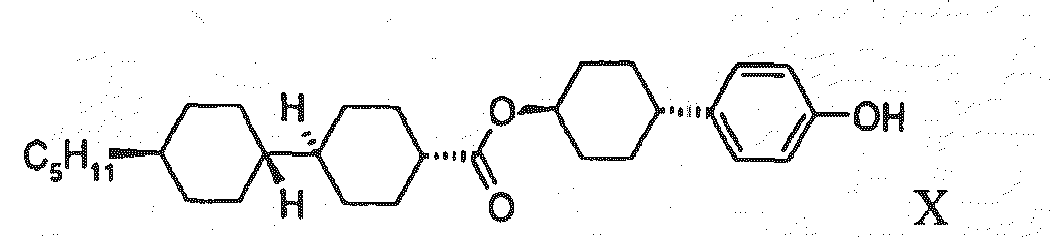
17. 
18. 
19. 
20. 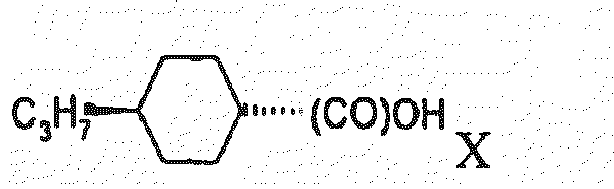
21. 
22. 
X = nicht erfindungsgemäß - Zur Herstellung von erfindungsgemäßen FK-Medien werden die folgenden flüssigkristallinen Mischungen bestehend aus niedermolekularen Komponenten in den angegebenen prozentualen Gewichtsanteilen verwendet.
Tabelle 1: Nematisches FK-Medium M1 (Δε < 0) CY-3-O4 14 % Kp. + 80 °C CCY-3-O2 9 % Δn 0,090 CCY-3-O3 9 % Δε -3,3 CPY-2-O2 10 % ε∥ 3,4 CPY-3-O2 10 % K3/K1 0,97 CCY-3-1 8 % CCH-34 9 % CCH-35 6 % PCH-53 10 % CCH-301 6 % CCH-303 9 % Tabelle 2: Nematisches FK-Medium M2 (Δε > 0) (Vergleich) CC-4-V 10 % Kp. + 77°C CC-5-V 13.5 % Δn 0.113 PGU-3-F 6.5 % Δε 19.2 ACQU-2-F 10 % ε∥ 23.8 ACQU-3-F 12 % K3/K1 0.97 PUQU-3-F 11 % CCP-V-1 12 % APUQU-2-F 6 % APUQU-3-F 7 % PGUQU-3-F 8% CPGU-3-OT 4% - Zu einem nematischen FK-Medium M1 des VA-Typs (Δε < 0) gemäß Tabelle 1 wird die Verbindung aus Synthesebeispiel 5 (0,2 Gew.%) zugesetzt und homogenisiert.
- Verwendung in Testzellen ohne Vororientierungsschicht ('alignment layer'): Die entstandene Mischung wird in eine Testzelle gefüllt (ohne Polyimid-Orientierungsschicht, Schichtdicke d ≈ 4,0 µm, beidseitige ITO-Beschichtung, ohne Passivierungsschicht). Das FK-Medium weist eine spontane homöotrope (vertikale) Orientierung zu den Substratoberflächen auf. Diese Orientierung bleibt bis 70 °C stabil. Im temperaturstabilen Bereich lässt sich die VA-Zelle zwischen gekreuzten Polarisatoren durch Anlegen einer Spannung zwischen 0 und 30 V reversibel schalten.
- Zu einem nematischen FK-Medium M2 des VA-IPS-Typs (Δε > 0) gemäß Tabelle 2 wird die Verbindung aus Synthesebeispiel 5 (0,5 Gew.%) zugesetzt und homogenisiert.
- Verwendung in Testzellen ohne Vororientierungsschicht ('alignment layer'): Die entstandene Mischung wird in eine Testzelle gefüllt (ohne Polyimid-Orientierungsschicht, Schichtdicke d ≈ 10 µm, auf einer Substratoberfläche angeordnete ITO-Interdigitalelektroden, Glas auf der gegenüberliegenden Substratoberfläche, ohne Passivierungsschicht). Das FK-Medium weist eine spontane homöotrope (vertikale) Orientierung zu den Substratoberflächen auf. Diese Orientierung bleibt bis 70 °C stabil. Im temperaturstabilen Bereich lässt sich die VA-IPS-Zelle zwischen gekreuzten Polarisatoren durch Anlegen einer Spannung zwischen 0 und 20 V reversibel schalten.
- Die Verbindungen der Synthesebeispiele 1, 2, 3 und der Beispiele 6-17 werden analog Mischungsbeispiel 1 zu einem nematischen FK-Medium M1 (Δε < 0) gemäß Tabelle 1 zugesetzt und homogenisiert. Die Gewichtsanteile der Verbindungen im Medium sind in der Tabelle 3 angegeben. Das erhaltene FK-Medium wird jeweils in eine Testzelle ohne Vororientierungsschicht gefüllt und weist eine spontane homöotrope (vertikale) Orientierung zu den Substratoberflächen auf. Im temperaturstabilen Bereich lässt sich die VA-Zelle zwischen gekreuzten Polarisatoren durch Anlegen einer Spannung zwischen 0 und 30 V reversibel schalten.
Tabelle 3: Gewichtsanteile für Dotierung in M1 und Orientierung der erhaltenen FK-Mischung bei 25°C und 70°C. Testzelle des VA-Typs Mischungsbeispiel Verbindung Beispiel Nr. Gewichtsanteil Orientierung bei 25 °C / schaltbar Orientierung bei 70 °C / schaltbar 3 1 0.25 % Homöotrop / Ja Homöotrop / Ja 4 2 0.15 % Homöotrop / Ja Homöotrop / Ja 5 3 5.0 % Homöotrop / Ja Homöotrop / Ja 6 6X 1.0 % Homöotrop / Ja Homöotrop / Ja 7 7X 1.5 % Homöotrop / Ja Homöotrop / Ja 8 8X 2.5 % Homöotrop / Ja Homöotrop / Ja 9 9X 2.5 % Homöotrop / Ja Homöotrop / Ja 10 10X 2.5 % Homöotrop / Ja Homöotrop / Ja 11 11X 2.5 % Homöotrop / Ja Homöotrop / Ja 12 12 0.5 % Homöotrop / Ja Homöotrop / Ja 13 13 0.5 % Homöotrop / Ja Homöotrop / Ja 14 14 2.0 % Homöotrop / Ja Homöotrop / Ja 15 15X 0.7 % Homöotrop / Ja Homöotrop / Ja 16 16X 1.0 % Homöotrop / Ja Homöotrop / Ja 17 17 2.0 % Homöotrop / Ja Homöotrop / Ja 18 18X 2.0 % Homöotrop / Ja 19 19X 2.0 % Homöotrop / Ja 20 20X 1.0 % Homöotrop / Ja 21 21X 0.7 % Homöotrop / Ja 22 22X 0.5 % Homöotrop / Ja X = nicht erfindungsgemäß - Die Verbindungen des Synthesesebeispiels 1 und der Beispiele 6, 7, 10, 11 werden analog Mischungsbeispiel 2 zu einem nematischen FK-Medium M2 (Δε > 0) gemäß Tabelle 2 zugesetzt und homogenisiert. Die Gewichtsanteile der Verbindungen im Medium sind in der Tabelle 4 angegeben. Das erhaltene FK-Medium wird jeweils in eine Testzelle ohne Vororientierungsschicht gefüllt und weist eine spontane homöotrope (vertikale) Orientierung zu den Substratoberflächen auf. Im temperaturstabilen Bereich lässt sich die VA-IPS-Zelle zwischen gekreuzten Polarisatoren durch Anlegen einer Spannung zwischen 0 und 20 V reversibel schalten.
Tabelle 4: Gewichtsanteile für Dotierung in M2 und Orientierung der erhaltenen FK-Mischung bei 25°C und 60°C. Testzelle des VA-IPS-Typs MischungsBeispiel Nr. Verbindung Beispiel Nr. Gewichtsanteil Orientierung bei 25 °C / schaltbar Orientierung bei 60 °C / schaltbar 22 1 0.5 % Homöotrop / Ja Homöotrop / Ja 23 6 3.0 % Homöotrop / Ja Planar 24 7 1.0 % Homöotrop / Ja Homöotrop / Ja 25 10 1.7 % Homöotrop / Ja Planar 26 11 2.5 % Homöotrop / Ja Planar 27 18 2.0 % Homöotrop / Ja 28 19 2.0 % Homöotrop / Ja 29 20 1.0 % Homöotrop / Ja 30 21 0.7 % Homöotrop / Ja 31 22 0.5 % Homöotrop / Ja - Zu einem nematischen FK-Medium M1 (Δε < 0) gemäß Tabelle 1 werden eine polymerisierbare Verbindung (RM-1, 0,5 Gew.%) und eine selbstorientierende Verbindung (6, 1,0 Gew.%) zugesetzt und homogenisiert.

- Verwendung in Testzellen ohne Vororientierungsschicht ('alignment layer'): Die entstandene Mischung wird in eine Testzelle gefüllt (ohne Polyimid-Orientierungsschicht, Schichtdicke d ≈ 4,0 µm, beidseitige ITO-Beschichtung, ohne Passivierungsschicht). Das FK-Medium weist eine spontane homöotrope (vertikale) Orientierung zu den Substratoberflächen auf. Unter Anlegen einer Spannung größer als die optische Schwellenspannung wird die Zelle 15 min mit UV-Licht der Intensität 100 mW/cm2 bei 40°C bestrahlt. Dadurch erfolgt Polymerisation der monomeren, polymerisierbaren Verbindung. Die homöotrope Orientierung wird damit zusätzlich stabilisiert und ein 'pre-tilt' wird eingestellt. Die erhaltene PSA-VA-Zelle lässt sich bis 70 °C unter Anlegen einer Spannung zwischen 0 und 30 V reversibel schalten. Die Schaltzeiten sind, im Vergleich zu der nicht polymerisierten Zelle, verkürzt.
- Zu einem nematischen FK-Medium M1 (Δε < 0) gemäß Tabelle 1 werden eine polymerisierbare Verbindung (RM-1, 0,5 Gew.%) und eine selbstorientierende Verbindung (7, 1,7 Gew.%) zugesetzt und homogenisiert.

Claims (14)
- FK-Medium mit negativer dielektrischer Anisotropie enthaltend eine niedermolekulare flüssigkristalline Komponente, zusätzlich eine polymerisierbare oder eine polymerisierte Komponente, wobei die polymerisierte Komponente erhältlich ist durch Polymerisation einer polymerisierbaren Komponente und eine oder mehrere organische Verbindungen, wobei die organische Verbindung dadurch gekennzeichnet ist, dass sie mindestens eine polare Ankergruppe aufweist und mindestens eine Ringgruppe aufweist, wobei die polare Ankergruppe mindestens eine OH-Struktur oder ein N-Atom in einer primären oder sekundären Amingruppe umfasst,und wobei die Ankergruppe nicht aus einer OH-Gruppe besteht, die wie die OH-Gruppe in 2,6-Di-tert-butylphenol abgeschirmt ist,und wobei die organische Verbindung eine Verbindung der Formel I:
R1-A1-(Z2-A2)m1-R2 (I)
umfasst, worinA1 und A2 jeweils unabhängig voneinander eine aromatische, heteroaromatische, alicyclische oder heterocyclische Gruppe, welche auch anellierte Ringe enthalten kann, und welche auch durch eine Gruppe L ein- oder mehrfach substituiert sein kann,L jeweils unabhängig voneinander -OH, -(CH2)n1-OH, F, Cl, Br, I, -CN, -NO2 , -NCO, -NCS, -OCN, -SCN, -C(=O)N(R0)2, -C(=O)R0, -N(R0)2, -(CH2)n1-N(R0)2, optional substituiertes Silyl, optional substituiertes Aryl oder Cycloalkyl mit 6 bis 20 C-Atomen, oder geradkettiges oder verzweigtes Alkyl, Alkoxy, Alkylcarbonyl, Alkoxycarbonyl, Alkylcarbonyloxy oder Alkoxycarbonyloxy mit 1 bis 25 C-Atomen, worin auch ein oder mehrere H-Atome durch F oder Cl ersetzt sein können,Z2 jeweils unabhängig voneinander -O-, -S-, -CO-, -CO-O-, -OCO-, -O-CO-O-, -OCH2-, -CH2O-, -SCH2-, -CH2S-, -CF2O-, -OCF2-, -CF2S-, -SCF2-, -(CH2)n1-, -CF2CH2-, -CH2CF2-, -(CF2)n1-, -CH=CH-, -CF=CF-, -C≡C-, -CH=CH-COO-, -OCO-CH=CH-, CR0R00 oder eine Einfachbindung,R0 und R00 jeweils unabhängig voneinander H oder Alkyl mit 1 bis 12 C-Atomen,R1H, Halogen, geradkettiges, verzweigtes oder cyclisches Alkyl mit 1 bis 25 C-Atomen, worin auch eine oder mehrere nicht benachbarte CH2-Gruppen durch, -NR0-, -O-, -S-, -CO-, -CO-O-, -O-CO-, -O-CO-O- so ersetzt sein können, dass N-, O- und/oder S-Atome nicht direkt miteinander verknüpft sind, und worin auch ein oder mehrere tertiäre Kohlenstoffatome (CH-Gruppen) durch N ersetzt sein können, und worin auch ein oder mehrere H-Atome durch F oder Cl, ersetzt sein können,m1 0, 1, 2, 3, 4 oder 5, undn1 1, 2, 3 oder 4,bedeutet,und wobei die Gruppe R2 eine Gruppe der Teilformel (A1)
-Sp-[X2-Z3-]kX1 (A1)
umfasst, worinSp eine Abstandsgruppe,X1 eine Gruppe -NH2, -NHR11 -NR11 2, -OH, -(CO)OH oder eine Gruppe der Formeln
 R0 H oder Alkyl mit 1 bis 12 C-Atomen,X2 jeweils unabhängig -NH-, -NR11-, -O- oder eine Einfachbindung,Z3 jeweils unabhängig jeweils unabhängig voneinander eine Alkylengruppe mit 1-15 C-Atomen, carbocyclische Ringe mit 5 oder 6 C-Atomen, oder Kombinationen aus einem oder mehreren Ringen und Alkylengruppen, worin jeweils Wasserstoff durch -OH, -OR11, -(CO)OH, -NH2, -NHR11, -NR11 2, oder Halogen (bevorzugt F, Cl) ersetzt sein kann,R11 jeweils unabhängig einen halogenierten oder unsubstituierten Alkylrest mit 1 bis 15 C-Atomen, wobei in diesem Rest auch eine oder mehrere CH2-Gruppen jeweils unabhängig voneinander durch -C≡C-, -CH=CH-, -(CO)O-, -O(CO)-, -(CO)-oder -O- so ersetzt sein können, dass O-Atome nicht direkt miteinander verknüpft sind, und wobei zwei Reste R11 miteinander zu einem Ring verknüpft sein können, undk 0, 1, 2 oder 3bedeuten.
 - FK-Medium nach Anspruch 1, dadurch gekennzeichnet, dass die organische Verbindung eine relative Molmasse von mehr als 100 g/mol hat.
- FK-Medium nach Anspruch 1 oder 2, dadurch gekennzeichnet, dass es zusätzlich eine oder mehrere Verbindungen ausgewählt aus der Gruppe der Verbindungen der Formeln A, B und C enthält,


 R2A, R2B und R2C jeweils unabhängig voneinander H, einen unsubstituierten, einen einfach durch CN oder CF3 oder mindestens einfach durch Halogen substituierten Alkylrest mit bis zu 15 C-Atomen, wobei in diesen Resten auch eine oder mehrere CH2-Gruppen durch -O-, -S-,
 L1-4 jeweils unabhängig voneinander F, Cl, CF3 oder CHF2,Z2 und Z2' jeweils unabhängig voneinander Einfachbindung, -CH2CH2-, -CH=CH-, -CF2O-, -OCF2-, -CH2O-, -OCH2-, -COO-, -OCO-, -C2F4-, -CF=CF-, -CH=CHCH2O-,p 1 oder 2,q 0 oder 1, undv 1 bis 6bedeuten.
 - FK-Medium nach einem oder mehreren der Ansprüche 1 bis 3 dadurch gekennzeichnet, dass für die Verbindung der Formel IZ2 eine Einfachbindungbedeutet.
- FK-Medium nach einem oder mehreren der Ansprüche 1 bis 4, dadurch gekennzeichnet, dass es die Verbindungen der Formel I in einer Konzentration von weniger als 10 Gew.-% enthält.
- FK-Medium nach einem oder mehreren der Ansprüche 1 bis 5, dadurch gekennzeichnet, dass es eine oder mehrere polymerisierbare Verbindungen der Formel M oder eine polymerisierte Komponente, die eine oder mehrere Verbindungen der Formel M in polymerisierter Form enthält, umfasst:
Pa-(Spa)s1-A2-(Z1-A1)n-(Spb)s2-Pb M
worin die einzelnen Reste folgende Bedeutung besitzen:Pa, Pb jeweils unabhängig voneinander eine polymerisierbare Gruppe,Spa, Spb bei jedem Auftreten gleich oder verschieden eine Abstandsgruppe,s1, s2 jeweils unabhängig voneinander 0 oder 1,A1, A2 jeweils unabhängig voneinander einen Rest ausgewählt aus folgenden Gruppena) der Gruppe bestehend aus trans-1,4-Cyclohexylen, 1,4-Cyclohexenylen und 4,4'-Bicyclohexylen, worin auch eine oder mehrere nicht benachbarte CH2-Gruppen durch -O-und/oder -S- ersetzt sein können und worin auch ein oder mehrere H-Atome durch F ersetzt sein können,b) der Gruppe bestehend aus 1,4-Phenylen und 1,3-Phenylen, worin auch eine oder zwei CH-Gruppen durch N ersetzt sein können und worin auch ein oder mehrere H-Atome durch L ersetzt sein können,c) der Gruppe bestehend aus Tetrahydropyran-2,5-diyl, 1,3-Dioxan-2,5-diyl, Tetrahydrofuran-2,5-diyl, Cyclobut-1,3-diyl, Piperidin-1,4-diyl, Thiophen-2,5-diyl und Selenophen-2,5-diyl, welche auch ein oder mehrfach durch L substituiert sein können,d) der Gruppe bestehend aus gesättigten, teilweise ungesättigten oder vollständig ungesättigten, und optional substituierten, polycyclischen Resten mit 5 bis 20 cyclischen C-Atomen, von denen auch eines oder mehrere durch Heteroatome ersetzt sein können, vorzugsweise ausgewählt aus der Gruppe bestehend aus Bicyclo[1.1.1]pentan-1,3-diyl, Bicyclo[2.2.2]octan-1,4-diyl, Spiro[3.3]heptan-2,6-diyl,


 n 0, 1, 2 oder 3,Z1 jeweils unabhängig voneinander -CO-O-, -O-CO-, -CH2O-, -OCH2-, -CF2O-, -OCF2-, oder -(CH2)n-, wobei n 2, 3 oder 4 ist, -O-, -CO-, -C(RcRd)-, -CH2CF2-, -CF2CF2-, oder eine Einfachbindung,Rc, Rd jeweils unabhängig voneinander H oder Alkyl mit 1 bis 6 C-Atomen,L bei jedem Auftreten gleich oder verschieden F, Cl, CN, SCN, SF5 oder geradkettiges oder verzwiegtes, jeweils optional fluoriertes, Alkyl, Alkoxy, Alkylcarbonyl, Alkoxycarbonyl, Alkylcarbonyloxy oder Alkoxycarbonyloxy mit 1 bis 12 C-Atomen,R0, R00 jeweils unabhängig voneinander H, F oder geradkettiges oder verzweigtes Alkyl mit 1 bis 12 C-Atomen, worin auch ein oder mehrere H-Atome durch F ersetzt sein können,M -O-, -S-, -CH2-, -CHY1- oder -CY1Y2-, undY1 und Y2 jeweils unabhängig voneinander eine der oben für R0 angegebenen Bedeutungen, Cl oder CN.
 - FK-Medium nach einem oder mehreren der Ansprüche 1 bis 6, dadurch gekennzeichnet, dass die Verbindung der Formel I eine oder mehrere polymerisierbare Gruppen aufweist.
- FK-Anzeige enthaltend eine FK-Zelle mit zwei Substraten und mindestens zwei Elektroden, wobei mindestens ein Substrat lichtdurchlässig ist und mindestens ein Substrat eine oder zwei Elektroden aufweist, sowie einer zwischen den Substraten befindlichen Schicht eines FK-Mediums nach einem oder mehreren der Ansprüche 1 bis 7,
wobei die organische Verbindung oder die Verbindung der Formel I geeignet ist, eine homöotrope Ausrichtung des FK-Mediums gegenüber den Substratoberflächen herbeizuführen. - FK-Anzeige nach Anspruch 8, dadurch gekennzeichnet, dass die Substrate keine Orientierungsschichten zur homöotropen Ausrichtung aufweisen.
- FK-Anzeige nach Anspruch 8, dadurch gekennzeichnet, dass die Substrate ein- oder beidseitig Orientierungsschichten aufweisen, die nicht gerieben sind.
- FK-Anzeige nach einem oder mehreren der Ansprüche 8 bis 10, dadurch gekennzeichnet, dass es sich um eine VA-Anzeige mit einem FK-Medium mit negativer dielektrischer Anisotropie und auf gegenüberliegenden Substraten angeordneten Elektroden handelt.
- Verfahren zu Herstellung eines FK-Mediums, dadurch gekennzeichnet, dass man eine oder mehrere organische Verbindungen mit mindestens einer polaren Ankergruppe und mindestens einer Ringgruppe nach Anspruch 1 mit einer niedermolekularen flüssigkristalline Komponente mischt und optional eine oder mehrere polymerisierbare Verbindungen und/oder Additive zugibt.
- Verwendung von organischen Verbindungen mit mindestens einer polaren Ankergruppe und mindestens einer Ringgruppe nach einem oder mehreren der vorangehenden Ansprüche als Additiv für FK-Medien zur Herbeiführung einer homöotropen Orientierung gegenüber einer das FK-Medium begrenzenden Oberfläche.
- Verfahren zu Herstellung einer FK-Anzeige enthaltend eine FK-Zelle mit zwei Substraten und mindestens zwei Elektroden, wobei mindestens ein Substrat lichtdurchlässig ist und mindestens ein Substrat eine oder zwei Elektroden aufweist, umfassend die Verfahrensschritte:- Befüllen der Zelle mit einem FK-Medium enthaltend eine niedermolekulare flüssigkristalline Komponente, eine polymerisierbare Komponente und eine organische Verbindung mit mindestens einer polaren Ankergruppe nach einem oder mehreren der Ansprüche 1 bis 7, die geeignet ist, eine homöotrope (vertikale) Ausrichtung des FK-Mediums gegenüber den Substratoberflächen herbeizuführen, und optional- Polymerisieren der polymerisierbaren Komponente, optional unter Anlegen einer Spannung an die Zelle oder unter der Wirkung eines elektrischen Feldes.
Priority Applications (2)
| Application Number | Priority Date | Filing Date | Title |
|---|---|---|---|
| EP17165814.9A EP3211059B1 (de) | 2010-09-25 | 2011-08-29 | Flüssigkristallanzeigen und flüssigkristalline medien mit homöotroper ausrichtung |
| EP19218449.7A EP3660130B1 (de) | 2010-09-25 | 2011-08-29 | Flüssigkristallanzeigen und flüssigkristalline medien mit homöotroper ausrichtung |
Applications Claiming Priority (2)
| Application Number | Priority Date | Filing Date | Title |
|---|---|---|---|
| DE102010046593 | 2010-09-25 | ||
| PCT/EP2011/004340 WO2012038026A1 (de) | 2010-09-25 | 2011-08-29 | Flüssigkristallanzeigen und flüssigkristalline medien mit homöotroper ausrichtung |
Related Child Applications (4)
| Application Number | Title | Priority Date | Filing Date |
|---|---|---|---|
| EP17165814.9A Division EP3211059B1 (de) | 2010-09-25 | 2011-08-29 | Flüssigkristallanzeigen und flüssigkristalline medien mit homöotroper ausrichtung |
| EP17165814.9A Division-Into EP3211059B1 (de) | 2010-09-25 | 2011-08-29 | Flüssigkristallanzeigen und flüssigkristalline medien mit homöotroper ausrichtung |
| EP19218449.7A Division EP3660130B1 (de) | 2010-09-25 | 2011-08-29 | Flüssigkristallanzeigen und flüssigkristalline medien mit homöotroper ausrichtung |
| EP19218449.7A Division-Into EP3660130B1 (de) | 2010-09-25 | 2011-08-29 | Flüssigkristallanzeigen und flüssigkristalline medien mit homöotroper ausrichtung |
Publications (3)
| Publication Number | Publication Date |
|---|---|
| EP2619284A1 EP2619284A1 (de) | 2013-07-31 |
| EP2619284B1 EP2619284B1 (de) | 2017-04-12 |
| EP2619284B2 true EP2619284B2 (de) | 2022-12-28 |
Family
ID=44735860
Family Applications (3)
| Application Number | Title | Priority Date | Filing Date |
|---|---|---|---|
| EP17165814.9A Active EP3211059B1 (de) | 2010-09-25 | 2011-08-29 | Flüssigkristallanzeigen und flüssigkristalline medien mit homöotroper ausrichtung |
| EP19218449.7A Active EP3660130B1 (de) | 2010-09-25 | 2011-08-29 | Flüssigkristallanzeigen und flüssigkristalline medien mit homöotroper ausrichtung |
| EP11764088.8A Active EP2619284B2 (de) | 2010-09-25 | 2011-08-29 | Flüssigkristallanzeigen und flüssigkristalline medien mit homöotroper ausrichtung |
Family Applications Before (2)
| Application Number | Title | Priority Date | Filing Date |
|---|---|---|---|
| EP17165814.9A Active EP3211059B1 (de) | 2010-09-25 | 2011-08-29 | Flüssigkristallanzeigen und flüssigkristalline medien mit homöotroper ausrichtung |
| EP19218449.7A Active EP3660130B1 (de) | 2010-09-25 | 2011-08-29 | Flüssigkristallanzeigen und flüssigkristalline medien mit homöotroper ausrichtung |
Country Status (8)
| Country | Link |
|---|---|
| US (3) | US9868904B2 (de) |
| EP (3) | EP3211059B1 (de) |
| JP (2) | JP6081361B2 (de) |
| KR (2) | KR101939739B1 (de) |
| CN (1) | CN103119128B (de) |
| DE (1) | DE102011108708A1 (de) |
| TW (2) | TWI639687B (de) |
| WO (1) | WO2012038026A1 (de) |
Families Citing this family (172)
| Publication number | Priority date | Publication date | Assignee | Title |
|---|---|---|---|---|
| DE102011108708A1 (de) * | 2010-09-25 | 2012-03-29 | Merck Patent Gmbh | Flüssigkristallanzeigen und flüssigkristalline Medien mit homöotroper Ausrichtung |
| CN103619993B (zh) | 2011-07-07 | 2016-10-12 | 默克专利股份有限公司 | 液晶介质 |
| TWI565790B (zh) * | 2012-08-08 | 2017-01-11 | 捷恩智股份有限公司 | 液晶組成物、液晶顯示元件及液晶組成物的使用 |
| EP2931836B1 (de) * | 2012-12-12 | 2020-03-18 | Merck Patent GmbH | Flüssigkristallines medium |
| EP2931838B1 (de) * | 2012-12-17 | 2017-08-16 | Merck Patent GmbH | Flüssigkristallanzeigen und flüssigkristalline medien mit homöotroper ausrichtung |
| WO2014169988A1 (en) * | 2013-04-16 | 2014-10-23 | Merck Patent Gmbh | Device containing a liquid-crystalline medium |
| PL2997109T3 (pl) * | 2013-05-14 | 2018-07-31 | Merck Patent Gmbh | Ośrodek ciekłokrystaliczny i urządzenie ciekłokrystaliczne |
| KR102073957B1 (ko) | 2013-09-11 | 2020-02-06 | 삼성디스플레이 주식회사 | 액정표시패널 및 그 제조방법 |
| EP3730590B1 (de) * | 2014-03-10 | 2025-12-24 | Merck Patent GmbH | Flüssigkristalline medien mit homöotroper ausrichtung |
| JP2015205982A (ja) | 2014-04-18 | 2015-11-19 | Jnc株式会社 | 液晶組成物および液晶表示素子 |
| KR102164961B1 (ko) | 2014-05-20 | 2020-10-14 | 삼성디스플레이 주식회사 | 액정 표시패널 제조방법 |
| KR101607479B1 (ko) * | 2014-06-10 | 2016-03-30 | 명지대학교 산학협력단 | 액정 배향층, 이를 이용한 액정표시소자 및 이의 제조방법 |
| JP2017521529A (ja) * | 2014-07-11 | 2017-08-03 | メルク パテント ゲゼルシャフト ミット ベシュレンクテル ハフツングMerck Patent Gesellschaft mit beschraenkter Haftung | メソゲン媒体および液晶ディスプレイ |
| KR102160489B1 (ko) | 2014-07-25 | 2020-09-29 | 삼성디스플레이 주식회사 | 표시 장치의 제조 방법 및 표시 장치 |
| DE102015008172A1 (de) | 2014-07-28 | 2016-01-28 | Merck Patent Gmbh | Flüssigkristalline Medien mit homöotroper Ausrichtung |
| EP2985334B1 (de) | 2014-08-15 | 2018-06-20 | Merck Patent GmbH | Flüssigkristallines medium |
| US9659965B2 (en) | 2014-09-12 | 2017-05-23 | Samsung Display Co., Ltd. | Liquid crystal display device and method of manufacturing the same |
| EP3218446B1 (de) * | 2014-11-11 | 2018-07-04 | Merck Patent GmbH | Bimesogene verbindungen und mesogene medien |
| KR102276994B1 (ko) | 2014-11-20 | 2021-07-13 | 삼성디스플레이 주식회사 | 액정 표시 장치 및 그 제조 방법 |
| CN104402683B (zh) * | 2014-11-21 | 2017-02-01 | 石家庄诚志永华显示材料有限公司 | 液晶化合物及包含该化合物的液晶混合物 |
| US20180023001A1 (en) | 2015-01-14 | 2018-01-25 | Jnc Corporation | Compound having polymerizable group, liquid crystal composition and liquid crystal display device |
| JP6729395B2 (ja) * | 2015-01-20 | 2020-07-22 | Jnc株式会社 | 液晶組成物および液晶表示素子 |
| JP6906309B2 (ja) | 2015-02-09 | 2021-07-21 | Jnc株式会社 | 重合性極性化合物、液晶組成物および液晶表示素子 |
| WO2016152340A1 (ja) * | 2015-03-24 | 2016-09-29 | Jnc株式会社 | 液晶組成物および液晶表示素子 |
| KR101672403B1 (ko) * | 2015-03-30 | 2016-11-16 | 명지대학교 산학협력단 | 발광특성을 갖는 액정 배향층, 이를 이용한 액정표시장치 및 그 제조방법 |
| KR101704400B1 (ko) * | 2015-04-02 | 2017-02-08 | 명지대학교 산학협력단 | 반응성 유기분자 배향막, 이를 이용한 액정표시소자 및 이의 제조방법 |
| JPWO2016170948A1 (ja) * | 2015-04-23 | 2018-02-15 | Jnc株式会社 | 液晶組成物および液晶表示素子 |
| CN104845644B (zh) * | 2015-05-27 | 2017-03-15 | 深圳市华星光电技术有限公司 | 一种液晶介质组合物 |
| DE102016007042A1 (de) * | 2015-07-03 | 2017-01-05 | Merck Patent Gmbh | Flüssigkristallines Medium und Flüssigkristallanzeige |
| TWI694140B (zh) | 2015-07-17 | 2020-05-21 | 日商捷恩智股份有限公司 | 聚合性極性化合物、液晶組成物及液晶顯示元件 |
| JP6809459B2 (ja) | 2015-07-23 | 2021-01-06 | Jnc株式会社 | 液晶組成物および液晶表示素子 |
| US11884862B2 (en) * | 2015-08-05 | 2024-01-30 | Merck Patent Gmbh | Liquid-crystalline medium |
| WO2017068875A1 (ja) * | 2015-10-23 | 2017-04-27 | Jnc株式会社 | 液晶組成物および液晶表示素子 |
| WO2017082062A1 (ja) * | 2015-11-10 | 2017-05-18 | Dic株式会社 | ネマチック液晶組成物及びこれを用いた液晶表示素子 |
| WO2017098933A1 (ja) | 2015-12-08 | 2017-06-15 | Jnc株式会社 | 液晶組成物および液晶表示素子 |
| WO2017102053A2 (en) | 2015-12-17 | 2017-06-22 | Merck Patent Gmbh | Cinnamic acid derivatives |
| US10442992B2 (en) | 2015-12-17 | 2019-10-15 | Jnc Corporation | Liquid crystal composition and liquid crystal display device |
| US10385269B2 (en) | 2015-12-21 | 2019-08-20 | Jnc Corporation | Liquid crystal composition and liquid crystal display device |
| US10190050B2 (en) * | 2016-01-21 | 2019-01-29 | Samsung Display Co., Ltd. | Liquid crystal composition, liquid crystal display device including the same, and method of manufacturing liquid crystal display device |
| US10041001B2 (en) | 2016-01-21 | 2018-08-07 | Samsung Display Co., Ltd. | Liquid crystal composition, liquid crystal display device including the same, and method of manufacturing liquid crystal display device |
| JP6747456B2 (ja) * | 2016-01-29 | 2020-08-26 | Jnc株式会社 | 液晶組成物および液晶表示素子 |
| CN105542796A (zh) * | 2016-02-01 | 2016-05-04 | 深圳市华星光电技术有限公司 | 自取向液晶介质组合物及液晶显示面板 |
| WO2017145611A1 (ja) * | 2016-02-25 | 2017-08-31 | Jnc株式会社 | 液晶組成物および液晶表示素子 |
| KR102499044B1 (ko) | 2016-03-08 | 2023-02-13 | 삼성디스플레이 주식회사 | 액정표시장치 |
| CN108473873A (zh) * | 2016-04-18 | 2018-08-31 | 捷恩智株式会社 | 液晶组合物、以及液晶显示元件 |
| KR102621459B1 (ko) * | 2016-04-20 | 2024-01-05 | 삼성디스플레이 주식회사 | 배향막 조성물, 이를 포함하는 액정 표시 장치 및 액정 표시 장치 제조방법 |
| EP3459928A4 (de) | 2016-05-18 | 2020-04-29 | JNC Corporation | Niedermolekulare polare verbindung zur homogenen ausrichtung eines flüssigkristallmediums sowie flüssigkristallmedium damit |
| JP6587033B2 (ja) | 2016-05-18 | 2019-10-09 | Jnc株式会社 | 液晶媒体をホモジニアス配向させる低分子極性化合物を含む液晶媒体を含有する液晶表示素子 |
| JP6669255B2 (ja) * | 2016-06-03 | 2020-03-18 | Jnc株式会社 | 重合性極性化合物、液晶組成物、および液晶表示素子 |
| CN107459993B (zh) * | 2016-06-06 | 2020-11-27 | 石家庄诚志永华显示材料有限公司 | 一种稳定剂及包含该稳定剂的液晶组合物 |
| JP6573091B2 (ja) | 2016-06-28 | 2019-09-11 | Jnc株式会社 | 液晶表示素子の製造方法および液晶表示素子 |
| US20180002604A1 (en) | 2016-06-30 | 2018-01-04 | Merck Patent Gmbh | Liquid-crystalline medium |
| DE102017005884A1 (de) | 2016-07-07 | 2018-01-11 | Merck Patent Gmbh | Elektronisches Schaltelement |
| CN106281363B (zh) * | 2016-07-18 | 2019-01-22 | 深圳市华星光电技术有限公司 | 自取向液晶介质组合物、液晶显示面板及其制作方法 |
| CN109476994B (zh) | 2016-07-20 | 2023-02-10 | 默克专利股份有限公司 | 用于光学切换元件的切换层 |
| CN106281364B (zh) * | 2016-07-21 | 2019-01-22 | 深圳市华星光电技术有限公司 | 自取向液晶介质组合物、液晶显示面板及其制作方法 |
| CN109476998A (zh) * | 2016-07-27 | 2019-03-15 | 捷恩智株式会社 | 液晶组合物及液晶显示元件 |
| JPWO2018025974A1 (ja) * | 2016-08-03 | 2019-06-06 | Jnc株式会社 | 液晶表示素子、表示装置 |
| TWI728101B (zh) | 2016-08-05 | 2021-05-21 | 日商捷恩智股份有限公司 | 聚合性極性化合物、液晶組成物及液晶顯示元件 |
| KR102637055B1 (ko) | 2016-08-09 | 2024-02-15 | 삼성디스플레이 주식회사 | 액정 표시 장치 및 그 제조 방법 |
| JP6638822B2 (ja) * | 2016-10-17 | 2020-01-29 | Dic株式会社 | 重合性液晶組成物、液晶表示素子、及び液晶表示素子の製造方法 |
| TWI737834B (zh) * | 2016-10-26 | 2021-09-01 | 日商迪愛生股份有限公司 | 液晶組成物用自發配向助劑 |
| JP6399261B1 (ja) * | 2016-11-01 | 2018-10-03 | Dic株式会社 | 液晶組成物用自発配向助剤 |
| DE102017010159A1 (de) | 2016-11-21 | 2018-05-24 | Merck Patent Gmbh | Verbindungen zur homöotropen Ausrichtung von flüssigkristallinen Medien |
| DE102017010942A1 (de) * | 2016-12-08 | 2018-06-14 | Merck Patent Gmbh | Additive für Flüssigkristallmischungen |
| JP7070429B2 (ja) | 2016-12-08 | 2022-05-18 | Jnc株式会社 | リバースモードの液晶デバイス |
| US10538705B2 (en) | 2016-12-13 | 2020-01-21 | Jnc Corporation | Liquid crystal composition and liquid crystal display device |
| CN106833677A (zh) | 2016-12-29 | 2017-06-13 | 深圳市华星光电技术有限公司 | 一种垂直取向剂材料 |
| CN106753428A (zh) * | 2016-12-30 | 2017-05-31 | 深圳市华星光电技术有限公司 | 一种反式pdlc液晶材料组合物、基板及显示器 |
| US11718791B2 (en) | 2017-03-09 | 2023-08-08 | Merck Patent Gmbh | Polymerisable compounds and the use thereof in liquid-crystal displays |
| CN110612476A (zh) | 2017-05-11 | 2019-12-24 | 默克专利股份有限公司 | 经聚合物稳定的液晶显示器的制造方法 |
| WO2019003935A1 (ja) * | 2017-06-29 | 2019-01-03 | Dic株式会社 | 液晶組成物及び液晶表示素子 |
| CN109423301B (zh) * | 2017-08-22 | 2021-07-06 | 北京八亿时空液晶科技股份有限公司 | 一种负介电各向异性液晶组合物及其应用 |
| KR102456697B1 (ko) | 2017-08-22 | 2022-10-19 | 삼성디스플레이 주식회사 | 액정 표시 장치 및 이의 제조 방법 |
| WO2019049673A1 (ja) * | 2017-09-08 | 2019-03-14 | Dic株式会社 | 配向助剤、液晶組成物及び液晶表示素子 |
| JP2019056036A (ja) * | 2017-09-20 | 2019-04-11 | シャープ株式会社 | ネガ型液晶材料、液晶セル及び液晶表示装置 |
| WO2019063585A1 (en) | 2017-09-29 | 2019-04-04 | Merck Patent Gmbh | POLYMERIZABLE COMPOUNDS AND THEIR USE IN LIQUID CRYSTAL DISPLAY DEVICES |
| JP2019073675A (ja) * | 2017-10-12 | 2019-05-16 | Jnc株式会社 | 液晶組成物および液晶表示素子 |
| WO2019089638A1 (en) * | 2017-10-31 | 2019-05-09 | The Regents Of The University Of California | Organic ligands for templatable mesoscale nanocapsules |
| CN107805506A (zh) * | 2017-11-14 | 2018-03-16 | 深圳市华星光电技术有限公司 | 液晶显示面板及其制作方法、自取向液晶介质混合物 |
| WO2019110473A1 (en) | 2017-12-04 | 2019-06-13 | Merck Patent Gmbh | Liquid-crystal medium |
| JP7238785B2 (ja) | 2017-12-05 | 2023-03-14 | Jnc株式会社 | 重合性極性化合物、液晶組成物、および液晶表示素子 |
| WO2019111892A1 (ja) * | 2017-12-06 | 2019-06-13 | Jnc株式会社 | 化合物、液晶組成物、および液晶表示素子 |
| EP3502209B1 (de) | 2017-12-20 | 2020-10-14 | Merck Patent GmbH | Flüssigkristalline medien mit homöotroper ausrichtung |
| EP3502210B1 (de) | 2017-12-20 | 2020-09-09 | Merck Patent GmbH | Flüssigkristallines medium |
| CN110093166B (zh) * | 2018-01-31 | 2021-03-16 | 北京八亿时空液晶科技股份有限公司 | 一种含有自配向化合物的液晶组合物及其应用 |
| DE102019000286A1 (de) * | 2018-02-05 | 2019-08-08 | Merck Patent Gmbh | Verbindungen zur homöotropen Ausrichtung von flüssigkristallinen Medien |
| TW201936907A (zh) | 2018-02-06 | 2019-09-16 | 德商馬克專利公司 | 液晶介質 |
| CN110229678B (zh) * | 2018-03-06 | 2020-10-27 | 北京八亿时空液晶科技股份有限公司 | 一种自配向添加剂及其制备方法与应用 |
| CN110229679B (zh) * | 2018-03-06 | 2020-11-17 | 北京八亿时空液晶科技股份有限公司 | 一种液晶介质的自配向添加剂及其制备方法与应用 |
| US11261192B2 (en) | 2018-03-09 | 2022-03-01 | Recurium Ip Holdings, Llc | Substituted 1,2-dihydro-3H-pyrazolo[3,4-D]pyrimidin-3-ones |
| JP7131048B2 (ja) * | 2018-04-20 | 2022-09-06 | Jnc株式会社 | 液晶組成物および液晶表示素子 |
| WO2019206788A1 (en) | 2018-04-23 | 2019-10-31 | Merck Patent Gmbh | Liquid crystal mixture and liquid crystal display |
| CN112004914B (zh) | 2018-04-23 | 2025-01-21 | 默克专利股份有限公司 | 液晶混合物及液晶显示器 |
| CN112004913B (zh) | 2018-04-23 | 2024-07-09 | 默克专利股份有限公司 | 液晶混合物及液晶显示器 |
| KR20210005122A (ko) | 2018-04-23 | 2021-01-13 | 메르크 파텐트 게엠베하 | 액정 혼합물 및 액정 디스플레이 |
| CN110396415B (zh) * | 2018-04-25 | 2021-01-26 | 北京八亿时空液晶科技股份有限公司 | 一种新型液晶垂直配向剂及其制备方法与应用 |
| CN110396414B (zh) * | 2018-04-25 | 2020-11-17 | 北京八亿时空液晶科技股份有限公司 | 一种自配向添加剂及其制备方法与应用 |
| WO2019233978A1 (en) | 2018-06-07 | 2019-12-12 | Merck Patent Gmbh | Additives for liquid-crystal mixtures |
| EP3944011A1 (de) | 2018-08-07 | 2022-01-26 | Merck Patent GmbH | Flüssigkristallanzeige |
| US20220380673A1 (en) | 2018-08-22 | 2022-12-01 | Merck Patent Gmbh | Liquid crystal mixture and liquid crystal display |
| US20220380672A1 (en) | 2018-08-22 | 2022-12-01 | Merck Patent Gmbh | Liquid Crystal Mixture and Liquid Crystal Display |
| WO2020043643A1 (en) | 2018-08-28 | 2020-03-05 | Merck Patent Gmbh | Liquid crystal mixture and liquid crystal display |
| CN110872520B (zh) * | 2018-08-31 | 2022-12-09 | 石家庄诚志永华显示材料有限公司 | 液晶显示器件 |
| EP3789470A1 (de) * | 2018-09-06 | 2021-03-10 | Merck Patent GmbH | Flüssigkristalline medien mit polymerisierbaren verbindungen |
| US20210348056A1 (en) | 2018-09-06 | 2021-11-11 | Merck Patent Gmbh | Polymerisable Compounds and the Use thereof in Liquid-Crystal Displays |
| WO2020074440A1 (en) | 2018-10-10 | 2020-04-16 | Merck Patent Gmbh | Liquid crystal mixture and liquid crystal display |
| CN112912468B (zh) | 2018-10-25 | 2024-03-08 | 默克专利股份有限公司 | 液晶介质 |
| EP3816264A1 (de) | 2018-10-31 | 2021-05-05 | Merck Patent GmbH | Flüssigkristalline medien, polymerisierbare verbindungen umfassend |
| WO2020094540A1 (en) | 2018-11-07 | 2020-05-14 | Merck Patent Gmbh | Liquid crystal media comprising polymerisable compounds |
| CN109705881A (zh) * | 2018-11-30 | 2019-05-03 | 成都中电熊猫显示科技有限公司 | 液晶以及显示面板和显示装置 |
| WO2020115089A1 (en) | 2018-12-07 | 2020-06-11 | Merck Patent Gmbh | Liquid-crystal medium comprising polymerisable compounds and the use thereof in liquid-crystal displays |
| EP3891250A1 (de) | 2018-12-07 | 2021-10-13 | Merck Patent GmbH | Polymerisierbare verbindungen und verwendung davon in flüssigkristallanzeigen |
| EP3666853B1 (de) | 2018-12-10 | 2021-06-16 | Merck Patent GmbH | Flüssigkristallmedium |
| EP3894513A2 (de) | 2018-12-12 | 2021-10-20 | Merck Patent GmbH | Flüssigkristallmischung und flüssigkristallanzeige |
| KR102712918B1 (ko) * | 2018-12-13 | 2024-10-04 | 메르크 파텐트 게엠베하 | 전환가능한 창 요소 |
| DE102019008296A1 (de) | 2018-12-20 | 2020-06-25 | Merck Patent Gmbh | Flüssigkristallines Medium |
| CN113423802B (zh) | 2019-02-15 | 2024-05-28 | 默克专利股份有限公司 | 可聚合化合物及其于液晶显示器中的用途 |
| US20220251448A1 (en) | 2019-06-04 | 2022-08-11 | Merck Patent Gmbh | Liquid Crystal Mixture and Liquid Crystal Display |
| CN110343530A (zh) * | 2019-06-11 | 2019-10-18 | 重庆惠科金渝光电科技有限公司 | 液晶材料、显示面板及显示面板制作方法 |
| CN112143507B (zh) | 2019-06-28 | 2025-03-18 | 默克专利股份有限公司 | Lc介质 |
| EP3792334B1 (de) | 2019-09-16 | 2022-01-19 | Merck Patent GmbH | Flüssigkristallmischung und flüssigkristallanzeige |
| KR102934101B1 (ko) | 2019-12-17 | 2026-03-06 | 메르크 파텐트 게엠베하 | 액정 매질 |
| CN111040780A (zh) * | 2019-12-27 | 2020-04-21 | Tcl华星光电技术有限公司 | 自取向液晶、显示装置及其制备方法 |
| EP4093837B1 (de) | 2020-01-23 | 2025-01-01 | Merck Patent GmbH | Flüssigkristallmedium |
| WO2021151846A1 (en) | 2020-01-29 | 2021-08-05 | Merck Patent Gmbh | Method for adjustment of alignment of liquid crystals |
| WO2021160633A1 (en) | 2020-02-13 | 2021-08-19 | Merck Patent Gmbh | Liquid crystal device |
| TWI895354B (zh) | 2020-02-13 | 2025-09-01 | 德商馬克專利公司 | 液晶裝置 |
| KR20210125922A (ko) | 2020-04-09 | 2021-10-19 | 메르크 파텐트 게엠베하 | 액정 매질 |
| CN113046096A (zh) | 2020-06-10 | 2021-06-29 | 默克专利股份有限公司 | 包含可聚合化合物的液晶介质 |
| JP7709473B2 (ja) | 2020-07-03 | 2025-07-16 | メルク パテント ゲゼルシャフト ミット ベシュレンクテル ハフツング | 液晶媒体 |
| WO2022003001A1 (en) | 2020-07-03 | 2022-01-06 | Merck Patent Gmbh | Liquid crystal medium |
| EP3933009B1 (de) | 2020-07-03 | 2023-08-16 | Merck Patent GmbH | Flüssigkristallmedium |
| CN114525139B (zh) | 2020-10-07 | 2025-07-25 | 默克专利股份有限公司 | 液晶介质 |
| US20220119711A1 (en) | 2020-10-19 | 2022-04-21 | Merck Patent Gmbh | Liquid-crystal medium |
| WO2022084168A1 (en) | 2020-10-19 | 2022-04-28 | Merck Patent Gmbh | 4,6-difluorodibenzothiophene derivatives and liquid-crystal medium containing these |
| JP2023548518A (ja) | 2020-11-06 | 2023-11-17 | メルク パテント ゲゼルシャフト ミット ベシュレンクテル ハフツング | 重合性化合物を含む液晶媒体 |
| CN116406416B (zh) | 2020-11-12 | 2025-04-25 | 默克专利股份有限公司 | 包含可聚合化合物的液晶介质 |
| EP4001378A1 (de) | 2020-11-17 | 2022-05-25 | Merck Patent GmbH | Flüssigkristallmedium |
| EP4012004A1 (de) | 2020-12-11 | 2022-06-15 | Merck Patent GmbH | Flüssigkristallvorrichtung |
| CN116568777A (zh) | 2020-12-11 | 2023-08-08 | 默克专利股份有限公司 | 液晶混合物和液晶显示器 |
| CN116940653B (zh) | 2020-12-22 | 2025-12-12 | 默克专利股份有限公司 | 可聚合化合物及其在液晶显示器中的用途 |
| CN113088297B (zh) | 2021-03-09 | 2026-05-01 | 默克专利股份有限公司 | 包含可聚合化合物的液晶介质 |
| TWI869571B (zh) * | 2021-03-12 | 2025-01-11 | 達興材料股份有限公司 | 液晶組成物及液晶顯示裝置 |
| CN115287081A (zh) | 2021-05-04 | 2022-11-04 | 默克专利股份有限公司 | 包含可聚合化合物的染料掺杂液晶介质 |
| DE102022001602A1 (de) | 2021-05-07 | 2022-11-10 | MERCK Patent Gesellschaft mit beschränkter Haftung | Flüssigkristallmedium enthaltend polymerisierbare Verbindungen |
| TW202330872A (zh) | 2021-09-28 | 2023-08-01 | 德商馬克專利公司 | 液晶介質 |
| EP4419622A1 (de) | 2021-10-20 | 2024-08-28 | Merck Patent GmbH | Flüssigkristallines medium mit polymerisierbaren verbindungen |
| WO2023094404A1 (en) | 2021-11-24 | 2023-06-01 | Merck Patent Gmbh | Liquid crystal medium and liquid crystal display |
| KR20230088622A (ko) | 2021-12-10 | 2023-06-20 | 메르크 파텐트 게엠베하 | 중합성 화합물을 포함하는 액정 매질 |
| KR20240122523A (ko) | 2021-12-17 | 2024-08-12 | 메르크 파텐트 게엠베하 | 액정 디스플레이 |
| CN116554891A (zh) | 2022-01-30 | 2023-08-08 | 默克专利股份有限公司 | 包含可聚合化合物的液晶介质 |
| EP4249570B1 (de) | 2022-03-21 | 2025-08-13 | Merck Patent GmbH | Flüssigkristallines medium |
| EP4508161A1 (de) | 2022-04-12 | 2025-02-19 | Merck Patent GmbH | Flüssigkristallines medium |
| CN119013374A (zh) | 2022-04-12 | 2024-11-22 | 默克专利股份有限公司 | 液晶介质 |
| CN118974207A (zh) | 2022-04-12 | 2024-11-15 | 默克专利股份有限公司 | 液晶介质 |
| CN119256066A (zh) | 2022-04-22 | 2025-01-03 | 默克专利股份有限公司 | 液晶介质 |
| CN119095933A (zh) | 2022-04-27 | 2024-12-06 | 默克专利股份有限公司 | 包含可聚合化合物的液晶介质 |
| CN119110839A (zh) | 2022-04-29 | 2024-12-10 | 默克专利股份有限公司 | 液晶介质 |
| EP4286493A1 (de) | 2022-06-02 | 2023-12-06 | Merck Patent GmbH | Flüssigkristallines medium |
| EP4306614B1 (de) | 2022-07-15 | 2025-12-10 | Merck Patent GmbH | Flüssigkristallines medium |
| EP4357438B1 (de) | 2022-10-19 | 2025-11-26 | Merck Patent GmbH | Flüssigkristallines medium mit polymerisierbaren verbindungen |
| EP4382586A1 (de) | 2022-12-07 | 2024-06-12 | Merck Patent GmbH | Flüssigkristallines medium |
| JP2026500322A (ja) | 2022-12-16 | 2026-01-06 | メルク パテント ゲゼルシャフト ミット ベシュレンクテル ハフツング | 液晶媒体 |
| GB2633139A (en) | 2023-02-17 | 2025-03-05 | Merck Patent Gmbh | Device, method for producing a liquid crystal cell, and method for operating a device |
| WO2024223484A1 (en) | 2023-04-24 | 2024-10-31 | Merck Patent Gmbh | Liquid-crystal medium comprising polymerizable compound |
| WO2025068290A1 (en) | 2023-09-28 | 2025-04-03 | Merck Patent Gmbh | Liquid-crystal display |
| EP4563674A1 (de) | 2023-11-29 | 2025-06-04 | Merck Patent GmbH | Flüssigkristallines medium |
| EP4574924A1 (de) | 2023-12-21 | 2025-06-25 | Merck Patent GmbH | Flüssigkristallines medium mit polymerisierbaren verbindungen |
| US20250277152A1 (en) | 2024-02-29 | 2025-09-04 | Merck Patent Gmbh | Liquid-crystal medium |
| EP4656703A1 (de) | 2024-05-28 | 2025-12-03 | Merck Patent GmbH | Flüssigkristallines medium mit polymerisierbaren verbindungen |
| EP4733370A1 (de) | 2024-10-22 | 2026-04-29 | Merck Patent GmbH | Flüssigkristallines medium |
Citations (10)
| Publication number | Priority date | Publication date | Assignee | Title |
|---|---|---|---|---|
| JPS5035076A (de) † | 1973-08-01 | 1975-04-03 | ||
| JPH02145531A (ja) † | 1988-11-26 | 1990-06-05 | Seiko Epson Corp | フッソ化合物 |
| US20020004108A1 (en) † | 2000-06-09 | 2002-01-10 | Hitachi, Ltd | Active matrix liquid crystal display device and liquid crystal material |
| JP2003003170A (ja) † | 2001-06-22 | 2003-01-08 | Nec Corp | 液晶素子及び液晶組成物 |
| US20030025865A1 (en) † | 1999-06-16 | 2003-02-06 | Ken-Ichi Takatori | Liquid crystal display and method of manufacturing the same and method of driving the same |
| US20030048401A1 (en) † | 2001-03-30 | 2003-03-13 | Fujitsu Limited | Liquid crystal display |
| JP2003253265A (ja) † | 2002-02-27 | 2003-09-10 | Dainippon Ink & Chem Inc | 調光層形成材料及び液晶デバイス |
| WO2007100136A1 (ja) † | 2006-03-03 | 2007-09-07 | The University Of Tokyo | 液晶性組成物 |
| US20090103011A1 (en) † | 2007-10-22 | 2009-04-23 | Georg Bernatz | Liquid-crystal medium |
| WO2010089092A1 (de) † | 2009-02-06 | 2010-08-12 | Merck Patent Gmbh | Flüssigkristallines medium und flüssigkristallanzeige |
Family Cites Families (53)
| Publication number | Priority date | Publication date | Assignee | Title |
|---|---|---|---|---|
| US3972589A (en) | 1972-06-23 | 1976-08-03 | General Electric Company | Nematic liquid crystal mixtures with stable homeotropic boundary conditions and methods of making the same |
| CH582229A5 (de) | 1972-08-19 | 1976-11-30 | Merck Patent Gmbh | |
| US3953491A (en) | 1972-08-19 | 1976-04-27 | Merck Patent Gesellschaft Mit Beschraenkter Haftung | Phenyl esters of 4-benzoyloxybenzoic acid |
| FR2204002A1 (en) * | 1972-10-20 | 1974-05-17 | Matsushita Electric Industrial Co Ltd | Liquid crystal screen with room temp nematic props - contg substd phenyl alkoxy benzoate(s), for use in electro-optical equipment |
| JPS57140737A (en) | 1981-02-25 | 1982-08-31 | Kanto Kagaku Kk | Colorless liquid crystal substance, colorless liquid crystal composition, and display element of liquid crystal |
| DE3268611D1 (en) * | 1981-02-25 | 1986-03-06 | Hitachi Ltd | Colorless liquid crystalline compounds |
| JPS5841827A (ja) * | 1981-08-06 | 1983-03-11 | イギリス国 | 液晶組成物 |
| US4482472A (en) * | 1981-08-06 | 1984-11-13 | The Secretary Of State For Defence In Her Britannic Majesty's Government Of The United Kingdom Of Great Britian And Northern Ireland | Liquid crystal materials |
| DE3211601A1 (de) | 1982-03-30 | 1983-10-06 | Merck Patent Gmbh | Hydroterphenyle |
| JPS6263691A (ja) | 1985-05-10 | 1987-03-20 | C Uyemura & Co Ltd | 鉄又は鉄合金めっき液中の3価の鉄イオンの除去方法 |
| DE4000451B4 (de) | 1990-01-09 | 2004-12-09 | Merck Patent Gmbh | Elektrooptisches Flüssigkristallschaltelement |
| US5576867A (en) | 1990-01-09 | 1996-11-19 | Merck Patent Gesellschaft Mit Beschrankter Haftung | Liquid crystal switching elements having a parallel electric field and βo which is not 0° or 90° |
| DE69229621D1 (de) | 1991-09-13 | 1999-08-26 | Merck Patent Gmbh | Elektrooptisches System |
| CA2131804C (en) * | 1992-03-10 | 2003-09-09 | Raychem Corporation | Encapsulated liquid crystal structures, apparatus containing the same, and methods therefor |
| EP0588568B1 (de) | 1992-09-18 | 2002-12-18 | Hitachi, Ltd. | Flüssigkristall-Anzeigevorrichtung |
| JPH07181439A (ja) | 1993-12-24 | 1995-07-21 | Hitachi Ltd | アクティブマトリクス型液晶表示装置 |
| JP3543351B2 (ja) | 1994-02-14 | 2004-07-14 | 株式会社日立製作所 | アクティブマトリクス型液晶表示装置 |
| US6830787B1 (en) | 1994-03-17 | 2004-12-14 | Hitachi, Ltd. | Active matrix liquid crystal display apparatus |
| TW262553B (de) | 1994-03-17 | 1995-11-11 | Hitachi Seisakusyo Kk | |
| DE19537802A1 (de) | 1995-10-11 | 1997-04-17 | Merck Patent Gmbh | Elektrooptische Flüssigkristallanzeige |
| US5993691A (en) | 1995-02-03 | 1999-11-30 | Merck Patent Gesellschaft Mit | Electro-optical liquid crystal display |
| DE19528106A1 (de) | 1995-02-03 | 1996-08-08 | Merck Patent Gmbh | Elektrooptische Flüssigkristallanzeige |
| DE19528107B4 (de) | 1995-03-17 | 2010-01-21 | Merck Patent Gmbh | Flüssigkristallines Medium und seine Verwendung in einer elektrooptischen Flüssigkristallanzeige |
| DE19509410A1 (de) | 1995-03-15 | 1996-09-19 | Merck Patent Gmbh | Elektrooptische Flüssigkristallanzeige |
| DE19539141B4 (de) * | 1995-10-20 | 2016-07-07 | Merck Patent Gmbh | 2,6-Di-tert.-butylphenole |
| JPH1036847A (ja) | 1996-07-25 | 1998-02-10 | Seiko Epson Corp | 液晶表示素子およびその製造方法 |
| EP1517344B1 (de) * | 1996-08-27 | 2007-06-06 | Omron Corporation | Matrix-Relais |
| GB9620061D0 (en) * | 1996-09-26 | 1996-11-13 | Secr Defence | Liquid crystalline (e,e)-butadiene compounds and mixtures and devices containing such compounds |
| JP3531713B2 (ja) | 1996-11-22 | 2004-05-31 | チッソ株式会社 | 液晶組成物および液晶表示素子 |
| JP3287288B2 (ja) | 1996-11-22 | 2002-06-04 | チッソ株式会社 | ポリハロアルキルエーテル誘導体とそれらを含む液晶組成物及び液晶表示素子 |
| EP0947495A4 (de) | 1996-12-19 | 2000-05-17 | Chisso Corp | Cyclohexanderivate, flüssigkristall-zubereitungen und flüssigkristall-anzeigeelemente |
| TWI239997B (en) | 1998-02-04 | 2005-09-21 | Merck Patent Gmbh | Liquid-crystal composition, method of adjusting the resistance of a liquid-crystal composition, liquid-crystal display and substituted phenols |
| DE19903746A1 (de) * | 1998-02-04 | 1999-08-05 | Merck Patent Gmbh | Flüssigkristallzusammensetzung, Verfahren zum Einstellen des Widerstands und substituierte Phenole |
| US6177972B1 (en) | 1999-02-04 | 2001-01-23 | International Business Machines Corporation | Polymer stabilized in-plane switched LCD |
| DE10117224B4 (de) * | 2000-04-19 | 2015-12-31 | Merck Patent Gmbh | Verfahren zur Stabilisierung von Halogenaromaten |
| JP2002023199A (ja) | 2000-07-07 | 2002-01-23 | Fujitsu Ltd | 液晶表示装置およびその製造方法 |
| JP4175826B2 (ja) | 2002-04-16 | 2008-11-05 | シャープ株式会社 | 液晶表示装置 |
| EP1378557B1 (de) * | 2002-07-06 | 2007-02-21 | MERCK PATENT GmbH | Flüssigkristallines Medium |
| US6905633B2 (en) * | 2002-12-13 | 2005-06-14 | Xerox Corporation | Compounds of formula (3) to stabilize liquid crystal domains |
| JP2004294605A (ja) | 2003-03-26 | 2004-10-21 | Fujitsu Display Technologies Corp | 液晶パネル |
| JP4506105B2 (ja) | 2003-06-10 | 2010-07-21 | Dic株式会社 | 液晶配向促進剤、液晶組成物及び光学異方体 |
| JP2005084271A (ja) * | 2003-09-08 | 2005-03-31 | Dainippon Printing Co Ltd | 光学機能層、光学機能層の形成方法、および液晶表示素子 |
| JP4387276B2 (ja) | 2004-09-24 | 2009-12-16 | シャープ株式会社 | 液晶表示装置 |
| JP2006139047A (ja) | 2004-11-12 | 2006-06-01 | Sharp Corp | 液晶表示装置およびその製造方法 |
| JP4876402B2 (ja) * | 2005-02-16 | 2012-02-15 | Jnc株式会社 | 液晶組成物および液晶表示素子 |
| JP4876408B2 (ja) * | 2005-03-01 | 2012-02-15 | Jnc株式会社 | 液晶組成物および液晶表示素子 |
| JP5315590B2 (ja) * | 2006-02-14 | 2013-10-16 | Jnc株式会社 | 液晶化合物、液晶組成物および液晶表示素子 |
| JP4720634B2 (ja) * | 2006-06-13 | 2011-07-13 | ソニー株式会社 | 重合性液晶組成物、光学素子、光学素子の製造方法、および液晶表示装置 |
| DE502007004908D1 (de) * | 2006-10-12 | 2010-10-14 | Merck Patent Gmbh | Flüssigkristallanzeige |
| TWI317038B (en) | 2007-02-16 | 2009-11-11 | Ind Tech Res Inst | Liquid crystal device |
| US7882201B2 (en) | 2008-03-31 | 2011-02-01 | Verizon Patent And Licensing Inc. | Location based content aggregation and distribution systems and methods |
| JP5093820B2 (ja) | 2008-12-26 | 2012-12-12 | エルジー ディスプレイ カンパニー リミテッド | 液晶表示装置及び液晶組成物 |
| DE102011108708A1 (de) * | 2010-09-25 | 2012-03-29 | Merck Patent Gmbh | Flüssigkristallanzeigen und flüssigkristalline Medien mit homöotroper Ausrichtung |
-
2011
- 2011-07-28 DE DE201110108708 patent/DE102011108708A1/de not_active Ceased
- 2011-08-29 KR KR1020137010426A patent/KR101939739B1/ko active Active
- 2011-08-29 EP EP17165814.9A patent/EP3211059B1/de active Active
- 2011-08-29 EP EP19218449.7A patent/EP3660130B1/de active Active
- 2011-08-29 JP JP2013529564A patent/JP6081361B2/ja active Active
- 2011-08-29 KR KR1020197000996A patent/KR102109819B1/ko active Active
- 2011-08-29 US US13/825,680 patent/US9868904B2/en active Active
- 2011-08-29 CN CN201180045589.1A patent/CN103119128B/zh active Active
- 2011-08-29 EP EP11764088.8A patent/EP2619284B2/de active Active
- 2011-08-29 WO PCT/EP2011/004340 patent/WO2012038026A1/de not_active Ceased
- 2011-09-23 TW TW105117448A patent/TWI639687B/zh active
- 2011-09-23 TW TW100134454A patent/TWI628270B/zh active
-
2016
- 2016-11-18 JP JP2016224700A patent/JP6513624B2/ja active Active
-
2017
- 2017-08-01 US US15/666,176 patent/US10273409B2/en active Active
-
2019
- 2019-04-29 US US16/397,782 patent/US11015121B2/en active Active
Patent Citations (10)
| Publication number | Priority date | Publication date | Assignee | Title |
|---|---|---|---|---|
| JPS5035076A (de) † | 1973-08-01 | 1975-04-03 | ||
| JPH02145531A (ja) † | 1988-11-26 | 1990-06-05 | Seiko Epson Corp | フッソ化合物 |
| US20030025865A1 (en) † | 1999-06-16 | 2003-02-06 | Ken-Ichi Takatori | Liquid crystal display and method of manufacturing the same and method of driving the same |
| US20020004108A1 (en) † | 2000-06-09 | 2002-01-10 | Hitachi, Ltd | Active matrix liquid crystal display device and liquid crystal material |
| US20030048401A1 (en) † | 2001-03-30 | 2003-03-13 | Fujitsu Limited | Liquid crystal display |
| JP2003003170A (ja) † | 2001-06-22 | 2003-01-08 | Nec Corp | 液晶素子及び液晶組成物 |
| JP2003253265A (ja) † | 2002-02-27 | 2003-09-10 | Dainippon Ink & Chem Inc | 調光層形成材料及び液晶デバイス |
| WO2007100136A1 (ja) † | 2006-03-03 | 2007-09-07 | The University Of Tokyo | 液晶性組成物 |
| US20090103011A1 (en) † | 2007-10-22 | 2009-04-23 | Georg Bernatz | Liquid-crystal medium |
| WO2010089092A1 (de) † | 2009-02-06 | 2010-08-12 | Merck Patent Gmbh | Flüssigkristallines medium und flüssigkristallanzeige |
Non-Patent Citations (1)
| Title |
|---|
| KAYARAD ET AL., RADIATION CURABLE PRODUCTS, pages 1 - 18 † |
Also Published As
| Publication number | Publication date |
|---|---|
| TW201631136A (zh) | 2016-09-01 |
| US20130182202A1 (en) | 2013-07-18 |
| JP2017043783A (ja) | 2017-03-02 |
| EP3211059A1 (de) | 2017-08-30 |
| EP3660130A1 (de) | 2020-06-03 |
| EP3660130B1 (de) | 2021-08-04 |
| TWI639687B (zh) | 2018-11-01 |
| US20190256771A1 (en) | 2019-08-22 |
| EP3211059B1 (de) | 2019-12-25 |
| TWI628270B (zh) | 2018-07-01 |
| US11015121B2 (en) | 2021-05-25 |
| JP6081361B2 (ja) | 2017-02-15 |
| CN103119128A (zh) | 2013-05-22 |
| WO2012038026A1 (de) | 2012-03-29 |
| KR20130110172A (ko) | 2013-10-08 |
| US20180022997A1 (en) | 2018-01-25 |
| EP2619284B1 (de) | 2017-04-12 |
| CN103119128B (zh) | 2015-03-11 |
| TW201300513A (zh) | 2013-01-01 |
| EP2619284A1 (de) | 2013-07-31 |
| US9868904B2 (en) | 2018-01-16 |
| US10273409B2 (en) | 2019-04-30 |
| KR102109819B1 (ko) | 2020-05-12 |
| JP6513624B2 (ja) | 2019-05-15 |
| KR101939739B1 (ko) | 2019-01-18 |
| DE102011108708A1 (de) | 2012-03-29 |
| JP2013543526A (ja) | 2013-12-05 |
| KR20190009415A (ko) | 2019-01-28 |
Similar Documents
| Publication | Publication Date | Title |
|---|---|---|
| EP2619284B1 (de) | Flüssigkristallanzeigen und flüssigkristalline medien mit homöotroper ausrichtung | |
| EP3174955B1 (de) | Flüssigkristalline medien mit homöotroper ausrichtung | |
| EP3730590B1 (de) | Flüssigkristalline medien mit homöotroper ausrichtung | |
| EP3521401B1 (de) | Verbindungen zur homöotropen ausrichtung von flüssigkristallinen medien | |
| EP3323872B1 (de) | Verbindungen zur homöotropen ausrichtung von flüssigkristallinen medien | |
| EP2670818B1 (de) | Flüssigkristallanzeigen mit homöotroper ausrichtung | |
| EP2593529B1 (de) | Flüssigkristalline medien und flüssigkristallanzeigen mit polymerstabilisierter homöotroper ausrichtung | |
| EP2483370B1 (de) | Polymerisierbare verbindungen und ihre verwendung in flüssigkristallanzeigen | |
| EP2181174B1 (de) | Flüssigkristallanzeige | |
| EP2181173B1 (de) | Flüssigkristallanzeige | |
| EP2585555B1 (de) | Polymerisierbare verbindungen und ihre verwendung in flüssigkristallanzeigen | |
| KR20190074991A (ko) | 호메오트로픽 정렬을 갖는 액정 매질 | |
| DE102011103182A1 (de) | Polymerisierbare Verbindungen und ihre Verwendung in Flüssigkristallanzeigen | |
| EP3279289A1 (de) | Piperidin-derivate und flüssigkristallines medium |
Legal Events
| Date | Code | Title | Description |
|---|---|---|---|
| PUAI | Public reference made under article 153(3) epc to a published international application that has entered the european phase |
Free format text: ORIGINAL CODE: 0009012 |
|
| 17P | Request for examination filed |
Effective date: 20130125 |
|
| AK | Designated contracting states |
Kind code of ref document: A1 Designated state(s): AL AT BE BG CH CY CZ DE DK EE ES FI FR GB GR HR HU IE IS IT LI LT LU LV MC MK MT NL NO PL PT RO RS SE SI SK SM TR |
|
| RIN1 | Information on inventor provided before grant (corrected) |
Inventor name: ARCHETTI, GRAZIANO Inventor name: TAUGERBECK, ANDREAS |
|
| DAX | Request for extension of the european patent (deleted) | ||
| 17Q | First examination report despatched |
Effective date: 20140411 |
|
| TPAC | Observations filed by third parties |
Free format text: ORIGINAL CODE: EPIDOSNTIPA |
|
| GRAP | Despatch of communication of intention to grant a patent |
Free format text: ORIGINAL CODE: EPIDOSNIGR1 |
|
| STAA | Information on the status of an ep patent application or granted ep patent |
Free format text: STATUS: GRANT OF PATENT IS INTENDED |
|
| RIC1 | Information provided on ipc code assigned before grant |
Ipc: C09K 19/04 20060101ALN20161116BHEP Ipc: G02F 1/1337 20060101ALN20161116BHEP Ipc: C09K 19/54 20060101AFI20161116BHEP Ipc: C09K 19/56 20060101ALI20161116BHEP Ipc: G02F 1/1333 20060101ALN20161116BHEP Ipc: C09K 19/42 20060101ALI20161116BHEP |
|
| INTG | Intention to grant announced |
Effective date: 20161202 |
|
| GRAS | Grant fee paid |
Free format text: ORIGINAL CODE: EPIDOSNIGR3 |
|
| GRAA | (expected) grant |
Free format text: ORIGINAL CODE: 0009210 |
|
| STAA | Information on the status of an ep patent application or granted ep patent |
Free format text: STATUS: THE PATENT HAS BEEN GRANTED |
|
| AK | Designated contracting states |
Kind code of ref document: B1 Designated state(s): AL AT BE BG CH CY CZ DE DK EE ES FI FR GB GR HR HU IE IS IT LI LT LU LV MC MK MT NL NO PL PT RO RS SE SI SK SM TR |
|
| REG | Reference to a national code |
Ref country code: GB Ref legal event code: FG4D Free format text: NOT ENGLISH |
|
| REG | Reference to a national code |
Ref country code: CH Ref legal event code: EP |
|
| REG | Reference to a national code |
Ref country code: IE Ref legal event code: FG4D Free format text: LANGUAGE OF EP DOCUMENT: GERMAN |
|
| REG | Reference to a national code |
Ref country code: AT Ref legal event code: REF Ref document number: 883853 Country of ref document: AT Kind code of ref document: T Effective date: 20170515 |
|
| REG | Reference to a national code |
Ref country code: DE Ref legal event code: R096 Ref document number: 502011012039 Country of ref document: DE |
|
| REG | Reference to a national code |
Ref country code: NL Ref legal event code: FP |
|
| REG | Reference to a national code |
Ref country code: LT Ref legal event code: MG4D |
|
| PG25 | Lapsed in a contracting state [announced via postgrant information from national office to epo] |
Ref country code: FI Free format text: LAPSE BECAUSE OF FAILURE TO SUBMIT A TRANSLATION OF THE DESCRIPTION OR TO PAY THE FEE WITHIN THE PRESCRIBED TIME-LIMIT Effective date: 20170412 Ref country code: NO Free format text: LAPSE BECAUSE OF FAILURE TO SUBMIT A TRANSLATION OF THE DESCRIPTION OR TO PAY THE FEE WITHIN THE PRESCRIBED TIME-LIMIT Effective date: 20170712 Ref country code: GR Free format text: LAPSE BECAUSE OF FAILURE TO SUBMIT A TRANSLATION OF THE DESCRIPTION OR TO PAY THE FEE WITHIN THE PRESCRIBED TIME-LIMIT Effective date: 20170713 Ref country code: ES Free format text: LAPSE BECAUSE OF FAILURE TO SUBMIT A TRANSLATION OF THE DESCRIPTION OR TO PAY THE FEE WITHIN THE PRESCRIBED TIME-LIMIT Effective date: 20170412 Ref country code: LT Free format text: LAPSE BECAUSE OF FAILURE TO SUBMIT A TRANSLATION OF THE DESCRIPTION OR TO PAY THE FEE WITHIN THE PRESCRIBED TIME-LIMIT Effective date: 20170412 Ref country code: HR Free format text: LAPSE BECAUSE OF FAILURE TO SUBMIT A TRANSLATION OF THE DESCRIPTION OR TO PAY THE FEE WITHIN THE PRESCRIBED TIME-LIMIT Effective date: 20170412 |
|
| PG25 | Lapsed in a contracting state [announced via postgrant information from national office to epo] |
Ref country code: LV Free format text: LAPSE BECAUSE OF FAILURE TO SUBMIT A TRANSLATION OF THE DESCRIPTION OR TO PAY THE FEE WITHIN THE PRESCRIBED TIME-LIMIT Effective date: 20170412 Ref country code: BG Free format text: LAPSE BECAUSE OF FAILURE TO SUBMIT A TRANSLATION OF THE DESCRIPTION OR TO PAY THE FEE WITHIN THE PRESCRIBED TIME-LIMIT Effective date: 20170712 Ref country code: SE Free format text: LAPSE BECAUSE OF FAILURE TO SUBMIT A TRANSLATION OF THE DESCRIPTION OR TO PAY THE FEE WITHIN THE PRESCRIBED TIME-LIMIT Effective date: 20170412 Ref country code: IS Free format text: LAPSE BECAUSE OF FAILURE TO SUBMIT A TRANSLATION OF THE DESCRIPTION OR TO PAY THE FEE WITHIN THE PRESCRIBED TIME-LIMIT Effective date: 20170812 Ref country code: RS Free format text: LAPSE BECAUSE OF FAILURE TO SUBMIT A TRANSLATION OF THE DESCRIPTION OR TO PAY THE FEE WITHIN THE PRESCRIBED TIME-LIMIT Effective date: 20170412 Ref country code: PL Free format text: LAPSE BECAUSE OF FAILURE TO SUBMIT A TRANSLATION OF THE DESCRIPTION OR TO PAY THE FEE WITHIN THE PRESCRIBED TIME-LIMIT Effective date: 20170412 |
|
| REG | Reference to a national code |
Ref country code: DE Ref legal event code: R026 Ref document number: 502011012039 Country of ref document: DE |
|
| PLBI | Opposition filed |
Free format text: ORIGINAL CODE: 0009260 |
|
| PLAX | Notice of opposition and request to file observation + time limit sent |
Free format text: ORIGINAL CODE: EPIDOSNOBS2 |
|
| PG25 | Lapsed in a contracting state [announced via postgrant information from national office to epo] |
Ref country code: DK Free format text: LAPSE BECAUSE OF FAILURE TO SUBMIT A TRANSLATION OF THE DESCRIPTION OR TO PAY THE FEE WITHIN THE PRESCRIBED TIME-LIMIT Effective date: 20170412 Ref country code: EE Free format text: LAPSE BECAUSE OF FAILURE TO SUBMIT A TRANSLATION OF THE DESCRIPTION OR TO PAY THE FEE WITHIN THE PRESCRIBED TIME-LIMIT Effective date: 20170412 Ref country code: CZ Free format text: LAPSE BECAUSE OF FAILURE TO SUBMIT A TRANSLATION OF THE DESCRIPTION OR TO PAY THE FEE WITHIN THE PRESCRIBED TIME-LIMIT Effective date: 20170412 Ref country code: SK Free format text: LAPSE BECAUSE OF FAILURE TO SUBMIT A TRANSLATION OF THE DESCRIPTION OR TO PAY THE FEE WITHIN THE PRESCRIBED TIME-LIMIT Effective date: 20170412 Ref country code: RO Free format text: LAPSE BECAUSE OF FAILURE TO SUBMIT A TRANSLATION OF THE DESCRIPTION OR TO PAY THE FEE WITHIN THE PRESCRIBED TIME-LIMIT Effective date: 20170412 |
|
| 26 | Opposition filed |
Opponent name: JNC CORPORATION Effective date: 20180111 |
|
| PG25 | Lapsed in a contracting state [announced via postgrant information from national office to epo] |
Ref country code: SM Free format text: LAPSE BECAUSE OF FAILURE TO SUBMIT A TRANSLATION OF THE DESCRIPTION OR TO PAY THE FEE WITHIN THE PRESCRIBED TIME-LIMIT Effective date: 20170412 Ref country code: IT Free format text: LAPSE BECAUSE OF FAILURE TO SUBMIT A TRANSLATION OF THE DESCRIPTION OR TO PAY THE FEE WITHIN THE PRESCRIBED TIME-LIMIT Effective date: 20170412 |
|
| REG | Reference to a national code |
Ref country code: CH Ref legal event code: PL |
|
| PG25 | Lapsed in a contracting state [announced via postgrant information from national office to epo] |
Ref country code: MC Free format text: LAPSE BECAUSE OF FAILURE TO SUBMIT A TRANSLATION OF THE DESCRIPTION OR TO PAY THE FEE WITHIN THE PRESCRIBED TIME-LIMIT Effective date: 20170412 |
|
| PG25 | Lapsed in a contracting state [announced via postgrant information from national office to epo] |
Ref country code: LI Free format text: LAPSE BECAUSE OF NON-PAYMENT OF DUE FEES Effective date: 20170831 Ref country code: CH Free format text: LAPSE BECAUSE OF NON-PAYMENT OF DUE FEES Effective date: 20170831 |
|
| PLBB | Reply of patent proprietor to notice(s) of opposition received |
Free format text: ORIGINAL CODE: EPIDOSNOBS3 |
|
| REG | Reference to a national code |
Ref country code: FR Ref legal event code: ST Effective date: 20180430 |
|
| REG | Reference to a national code |
Ref country code: IE Ref legal event code: MM4A |
|
| PG25 | Lapsed in a contracting state [announced via postgrant information from national office to epo] |
Ref country code: SI Free format text: LAPSE BECAUSE OF FAILURE TO SUBMIT A TRANSLATION OF THE DESCRIPTION OR TO PAY THE FEE WITHIN THE PRESCRIBED TIME-LIMIT Effective date: 20170412 |
|
| REG | Reference to a national code |
Ref country code: BE Ref legal event code: MM Effective date: 20170831 |
|
| PG25 | Lapsed in a contracting state [announced via postgrant information from national office to epo] |
Ref country code: LU Free format text: LAPSE BECAUSE OF NON-PAYMENT OF DUE FEES Effective date: 20170829 |
|
| PG25 | Lapsed in a contracting state [announced via postgrant information from national office to epo] |
Ref country code: IE Free format text: LAPSE BECAUSE OF NON-PAYMENT OF DUE FEES Effective date: 20170829 |
|
| PG25 | Lapsed in a contracting state [announced via postgrant information from national office to epo] |
Ref country code: FR Free format text: LAPSE BECAUSE OF NON-PAYMENT OF DUE FEES Effective date: 20170831 Ref country code: BE Free format text: LAPSE BECAUSE OF NON-PAYMENT OF DUE FEES Effective date: 20170831 |
|
| PG25 | Lapsed in a contracting state [announced via postgrant information from national office to epo] |
Ref country code: MT Free format text: LAPSE BECAUSE OF FAILURE TO SUBMIT A TRANSLATION OF THE DESCRIPTION OR TO PAY THE FEE WITHIN THE PRESCRIBED TIME-LIMIT Effective date: 20170412 |
|
| REG | Reference to a national code |
Ref country code: AT Ref legal event code: MM01 Ref document number: 883853 Country of ref document: AT Kind code of ref document: T Effective date: 20170829 |
|
| PGFP | Annual fee paid to national office [announced via postgrant information from national office to epo] |
Ref country code: NL Payment date: 20180712 Year of fee payment: 8 |
|
| PG25 | Lapsed in a contracting state [announced via postgrant information from national office to epo] |
Ref country code: AT Free format text: LAPSE BECAUSE OF NON-PAYMENT OF DUE FEES Effective date: 20170829 |
|
| PG25 | Lapsed in a contracting state [announced via postgrant information from national office to epo] |
Ref country code: HU Free format text: LAPSE BECAUSE OF FAILURE TO SUBMIT A TRANSLATION OF THE DESCRIPTION OR TO PAY THE FEE WITHIN THE PRESCRIBED TIME-LIMIT; INVALID AB INITIO Effective date: 20110829 |
|
| APBM | Appeal reference recorded |
Free format text: ORIGINAL CODE: EPIDOSNREFNO |
|
| APBP | Date of receipt of notice of appeal recorded |
Free format text: ORIGINAL CODE: EPIDOSNNOA2O |
|
| APAH | Appeal reference modified |
Free format text: ORIGINAL CODE: EPIDOSCREFNO |
|
| PG25 | Lapsed in a contracting state [announced via postgrant information from national office to epo] |
Ref country code: CY Free format text: LAPSE BECAUSE OF NON-PAYMENT OF DUE FEES Effective date: 20170412 |
|
| APBQ | Date of receipt of statement of grounds of appeal recorded |
Free format text: ORIGINAL CODE: EPIDOSNNOA3O |
|
| PG25 | Lapsed in a contracting state [announced via postgrant information from national office to epo] |
Ref country code: MK Free format text: LAPSE BECAUSE OF FAILURE TO SUBMIT A TRANSLATION OF THE DESCRIPTION OR TO PAY THE FEE WITHIN THE PRESCRIBED TIME-LIMIT Effective date: 20170412 |
|
| PGFP | Annual fee paid to national office [announced via postgrant information from national office to epo] |
Ref country code: GB Payment date: 20190830 Year of fee payment: 9 |
|
| PG25 | Lapsed in a contracting state [announced via postgrant information from national office to epo] |
Ref country code: TR Free format text: LAPSE BECAUSE OF FAILURE TO SUBMIT A TRANSLATION OF THE DESCRIPTION OR TO PAY THE FEE WITHIN THE PRESCRIBED TIME-LIMIT Effective date: 20170412 |
|
| REG | Reference to a national code |
Ref country code: NL Ref legal event code: MM Effective date: 20190901 |
|
| PG25 | Lapsed in a contracting state [announced via postgrant information from national office to epo] |
Ref country code: PT Free format text: LAPSE BECAUSE OF FAILURE TO SUBMIT A TRANSLATION OF THE DESCRIPTION OR TO PAY THE FEE WITHIN THE PRESCRIBED TIME-LIMIT Effective date: 20170412 |
|
| PG25 | Lapsed in a contracting state [announced via postgrant information from national office to epo] |
Ref country code: AL Free format text: LAPSE BECAUSE OF FAILURE TO SUBMIT A TRANSLATION OF THE DESCRIPTION OR TO PAY THE FEE WITHIN THE PRESCRIBED TIME-LIMIT Effective date: 20170412 Ref country code: NL Free format text: LAPSE BECAUSE OF NON-PAYMENT OF DUE FEES Effective date: 20190901 |
|
| GBPC | Gb: european patent ceased through non-payment of renewal fee |
Effective date: 20200829 |
|
| PG25 | Lapsed in a contracting state [announced via postgrant information from national office to epo] |
Ref country code: GB Free format text: LAPSE BECAUSE OF NON-PAYMENT OF DUE FEES Effective date: 20200829 |
|
| RAP4 | Party data changed (patent owner data changed or rights of a patent transferred) |
Owner name: MERCK PATENT GMBH |
|
| APBU | Appeal procedure closed |
Free format text: ORIGINAL CODE: EPIDOSNNOA9O |
|
| PUAH | Patent maintained in amended form |
Free format text: ORIGINAL CODE: 0009272 |
|
| STAA | Information on the status of an ep patent application or granted ep patent |
Free format text: STATUS: PATENT MAINTAINED AS AMENDED |
|
| 27A | Patent maintained in amended form |
Effective date: 20221228 |
|
| AK | Designated contracting states |
Kind code of ref document: B2 Designated state(s): AL AT BE BG CH CY CZ DE DK EE ES FI FR GB GR HR HU IE IS IT LI LT LU LV MC MK MT NL NO PL PT RO RS SE SI SK SM TR |
|
| REG | Reference to a national code |
Ref country code: DE Ref legal event code: R102 Ref document number: 502011012039 Country of ref document: DE |
|
| P01 | Opt-out of the competence of the unified patent court (upc) registered |
Effective date: 20230518 |
|
| PGFP | Annual fee paid to national office [announced via postgrant information from national office to epo] |
Ref country code: DE Payment date: 20250724 Year of fee payment: 15 |