WO2005035652A1 - ポリオキシメチレン樹脂組成物およびその成形体 - Google Patents
ポリオキシメチレン樹脂組成物およびその成形体 Download PDFInfo
- Publication number
- WO2005035652A1 WO2005035652A1 PCT/JP2004/014925 JP2004014925W WO2005035652A1 WO 2005035652 A1 WO2005035652 A1 WO 2005035652A1 JP 2004014925 W JP2004014925 W JP 2004014925W WO 2005035652 A1 WO2005035652 A1 WO 2005035652A1
- Authority
- WO
- WIPO (PCT)
- Prior art keywords
- weight
- group
- parts
- acid
- block
- Prior art date
- Legal status (The legal status is an assumption and is not a legal conclusion. Google has not performed a legal analysis and makes no representation as to the accuracy of the status listed.)
- Ceased
Links
Classifications
-
- C—CHEMISTRY; METALLURGY
- C08—ORGANIC MACROMOLECULAR COMPOUNDS; THEIR PREPARATION OR CHEMICAL WORKING-UP; COMPOSITIONS BASED THEREON
- C08L—COMPOSITIONS OF MACROMOLECULAR COMPOUNDS
- C08L53/00—Compositions of block copolymers containing at least one sequence of a polymer obtained by reactions only involving carbon-to-carbon unsaturated bonds; Compositions of derivatives of such polymers
- C08L53/02—Compositions of block copolymers containing at least one sequence of a polymer obtained by reactions only involving carbon-to-carbon unsaturated bonds; Compositions of derivatives of such polymers of vinyl-aromatic monomers and conjugated dienes
- C08L53/025—Compositions of block copolymers containing at least one sequence of a polymer obtained by reactions only involving carbon-to-carbon unsaturated bonds; Compositions of derivatives of such polymers of vinyl-aromatic monomers and conjugated dienes modified
-
- C—CHEMISTRY; METALLURGY
- C08—ORGANIC MACROMOLECULAR COMPOUNDS; THEIR PREPARATION OR CHEMICAL WORKING-UP; COMPOSITIONS BASED THEREON
- C08L—COMPOSITIONS OF MACROMOLECULAR COMPOUNDS
- C08L51/00—Compositions of graft polymers in which the grafted component is obtained by reactions only involving carbon-to-carbon unsaturated bonds; Compositions of derivatives of such polymers
- C08L51/06—Compositions of graft polymers in which the grafted component is obtained by reactions only involving carbon-to-carbon unsaturated bonds; Compositions of derivatives of such polymers grafted on to homopolymers or copolymers of aliphatic hydrocarbons containing only one carbon-to-carbon double bond
-
- C—CHEMISTRY; METALLURGY
- C08—ORGANIC MACROMOLECULAR COMPOUNDS; THEIR PREPARATION OR CHEMICAL WORKING-UP; COMPOSITIONS BASED THEREON
- C08L—COMPOSITIONS OF MACROMOLECULAR COMPOUNDS
- C08L53/00—Compositions of block copolymers containing at least one sequence of a polymer obtained by reactions only involving carbon-to-carbon unsaturated bonds; Compositions of derivatives of such polymers
-
- C—CHEMISTRY; METALLURGY
- C08—ORGANIC MACROMOLECULAR COMPOUNDS; THEIR PREPARATION OR CHEMICAL WORKING-UP; COMPOSITIONS BASED THEREON
- C08L—COMPOSITIONS OF MACROMOLECULAR COMPOUNDS
- C08L59/00—Compositions of polyacetals; Compositions of derivatives of polyacetals
-
- C—CHEMISTRY; METALLURGY
- C08—ORGANIC MACROMOLECULAR COMPOUNDS; THEIR PREPARATION OR CHEMICAL WORKING-UP; COMPOSITIONS BASED THEREON
- C08L—COMPOSITIONS OF MACROMOLECULAR COMPOUNDS
- C08L2205/00—Polymer mixtures characterised by other features
- C08L2205/03—Polymer mixtures characterised by other features containing three or more polymers in a blend
- C08L2205/035—Polymer mixtures characterised by other features containing three or more polymers in a blend containing four or more polymers in a blend
-
- C—CHEMISTRY; METALLURGY
- C08—ORGANIC MACROMOLECULAR COMPOUNDS; THEIR PREPARATION OR CHEMICAL WORKING-UP; COMPOSITIONS BASED THEREON
- C08L—COMPOSITIONS OF MACROMOLECULAR COMPOUNDS
- C08L23/00—Compositions of homopolymers or copolymers of unsaturated aliphatic hydrocarbons having only one carbon-to-carbon double bond; Compositions of derivatives of such polymers
-
- C—CHEMISTRY; METALLURGY
- C08—ORGANIC MACROMOLECULAR COMPOUNDS; THEIR PREPARATION OR CHEMICAL WORKING-UP; COMPOSITIONS BASED THEREON
- C08L—COMPOSITIONS OF MACROMOLECULAR COMPOUNDS
- C08L23/00—Compositions of homopolymers or copolymers of unsaturated aliphatic hydrocarbons having only one carbon-to-carbon double bond; Compositions of derivatives of such polymers
- C08L23/02—Compositions of homopolymers or copolymers of unsaturated aliphatic hydrocarbons having only one carbon-to-carbon double bond; Compositions of derivatives of such polymers not modified by chemical after-treatment
- C08L23/04—Homopolymers or copolymers of ethene
- C08L23/08—Copolymers of ethene
- C08L23/0807—Copolymers of ethene with unsaturated hydrocarbons only containing four or more carbon atoms
- C08L23/0815—Copolymers of ethene with unsaturated hydrocarbons only containing four or more carbon atoms with aliphatic 1-olefins containing one carbon-to-carbon double bond
-
- C—CHEMISTRY; METALLURGY
- C08—ORGANIC MACROMOLECULAR COMPOUNDS; THEIR PREPARATION OR CHEMICAL WORKING-UP; COMPOSITIONS BASED THEREON
- C08L—COMPOSITIONS OF MACROMOLECULAR COMPOUNDS
- C08L53/00—Compositions of block copolymers containing at least one sequence of a polymer obtained by reactions only involving carbon-to-carbon unsaturated bonds; Compositions of derivatives of such polymers
- C08L53/02—Compositions of block copolymers containing at least one sequence of a polymer obtained by reactions only involving carbon-to-carbon unsaturated bonds; Compositions of derivatives of such polymers of vinyl-aromatic monomers and conjugated dienes
Definitions
- the present invention relates to a resin composition provided with excellent flexibility, vibration damping and sound deadening properties, friction and wear properties under high load conditions, and resistance to polyoxymethylene resin.
- the resin composition of the present invention is suitable for parts in precision equipment, home appliances, automobile equipment, automobiles, industrial materials, miscellaneous goods, and the like.
- Polyoxymethylene resin is widely used as an engineering resin having balanced mechanical properties and excellent friction and wear performance in various mechanical parts, OA equipment, and the like.
- polyoxymethylene resin is not enough in terms of flexibility and impact resistance. For this reason, attempts have been made to use polyoxymethylene resin and an elastomer as a composition.
- Patent Document 1 for example, Patent Document 2
- Patent Document 3 for example, Patent Document 4
- polyoxymethylene resin for example, Patent Document 5
- Patent Document 7 Patent Document 7
- Patent Document 9 a technique of blending a thermoplastic polyurethane and a polyether block copolyamide with polyoxymethylene
- the technology of adding polyurethane is widely used.
- these compositions do not have vibration damping performance and further have extremely poor sliding performance, so they have not been used for applications intended for damping and silencing.
- Patent Document 11 a thermoplastic polyurethane block, a conjugated genie conjugate, and an aromatic vinyl conjugate.
- a composition for example, Patent Document 11
- Patent Document 12 corresponding to Patent Document 13
- Patent Document 12 comprises a polyethylene resin, a polymer compound having a main dispersion peak of tan ⁇ at 60 ° C.
- a polymer comprising an aromatic vinyl conjugate and a copolymerizable gen monomer is shown as a high molecular compound having a main dispersion peak of tan ⁇ at 60 ° C. or lower.
- Preferable! /
- a block polymer composed of a styrene segment (a) and a segment (b) that also has isoprene or isoprene butadiene force is shown, and the same block polymer is used in the examples. .
- the polymer used in the present application which has at least one hydrogenated aromatic vinylid conjugate-conjugated conjugated random copolymer block, is a polymer described in Patent Document 14.
- the publication also discloses polyoxymethylene resin as a resin that can be composed, but there is no specific example including an example.
- Patent Document 1 JP-A-59-155453
- Patent Document 2 U.S. Pat.No. 4,804,716
- Patent Document 3 JP-A-59-145243
- Patent Document 4 US Patent No. 498725
- Patent Document 5 JP-A-54-155248
- Patent Document 6 US Pat. No. 4,277,577
- Patent Document 7 JP-A-62-036451
- Patent Document 8 U.S. Pat.No. 4,665,126
- Patent Document 9 JP-A-63-280758
- Patent Document 10 European Patent No. 290761
- Patent Document 11 JP-A-9-310017
- Patent Document 12 JP-A-2002-194178
- Patent Document 13 US Pat. No. 6,750,287
- Patent Document 14 International Publication WO03Z035705
- the present inventors have proposed various kinds of polymers to impart excellent flexibility, vibration damping and sound deadening performance, friction and wear performance under high load conditions, and oil resistance to polyoxymethylene resin.
- the composition of the present invention is suitably used for electrical and electronic parts such as OA equipment, VTR equipment, music / video / information equipment, communication equipment, interior / exterior automobile parts, and industrial goods.
- the present invention relates to the following 117 inventions.
- a polyoxymethylene resin composition wherein the weight ratio of (B) Z (C) is in the range of 100Z0-20Z80.
- the polyoxymethylene resin is a polyoxymethylene block copolymer ( ⁇ -1) represented by the following formula (1) and having a number average molecular weight of 10,000 to 500,000. (I) any of the three items Polyoxymethylene resin composition according to item 1,
- k is an integer selected from 2 to 6, and two k's may be the same or different.
- R is a group selected from the group consisting of hydrogen, an alkyl group, a substituted alkyl group, an aryl group and a substituted aryl group, and may be the same or different.
- the S block is a polyoxymethylene copolymer residue represented by the following formula (2):
- R is a group selected from the group consisting of hydrogen, an alkyl group, a substituted alkyl group, an aryl group and a substituted aryl group, and may be the same or different.
- J is from 2-6 is an integer selected.
- x 95- 99. 9 mole 0/0
- y 5- 0. 1 mole 0/0
- x + y 100 mol%
- y is present randomly relative X.
- the average number average molecular weight of the two S blocks in (1) is 5,000-250,000.
- (A) polyoxymethylene ⁇ is, the Okishimechiren group as the main repeating unit, with respect Okishimechiren group number 2 or more Okishiarukiren group carbon, containing 0. 1 10 mol 0/0 polyoxy 5.
- a polymer having at least one block is at least one polymer mainly composed of a vinyl aromatic compound.
- Block B1 the content of the vinyl aromatic compound is at least 90% by weight or more
- BUL one content of the VN content
- the above item 115 wherein the content of the bullet aromatic compound is in the range of 50 to 90% by weight and the main dispersion peak of tan ⁇ in the viscoelastic spectrum is in the range of 60 ° C to 30 ° C, 2.
- a molded article obtained by molding, cutting, or molding the polyoxymethylene resin composition according to any one of the above items 17 to 17.
- the polyoxymethylene resin used in the component (A) of the present invention is obtained by polymerizing cyclic oligomers such as formaldehyde or its trimeric trioxane or tetrameric tetraoxane. Homopolymers whose ends are blocked with ether or ester groups; formaldehyde or its trimer trioxane or tetramer tetraoxane, ethylene oxide, propylene oxide, 1,3-dioxolan, glycol formal, having more branched chains; the Okishiaru Killen units of the resulting carbon number 2-8 by copolymerizing such a formal of glycol respect Okishimechiren, Okishimechirenko polymers containing 0. 1 40 mol 0/0 50% by weight of oxymethylene and 50% by weight of different segments
- preferred polyoxymethylene resins have an oxymethylene group as a main repeating unit, and an oxyalkylene group having 2 or more carbon atoms is 0.1-1 relative to the oxymethylene group.
- 0 mole 0/0 preferably from 0.5 1 5 mole 0/0, more preferably polio Kishimechiren copolymer containing 0. 2-3 mole 0/0 (A- 2).
- a particularly preferred polyoxymethylene resin is a polyoxymethylene block copolymer (A-1) represented by the following formula (1) and having a number average molecular weight of 10,000 to 500,000.
- This polyoxymethylene block copolymer (A-1) can be produced by the method described in International Publication WO01Z009213.
- k is an integer selected from 2 to 6, and two k's may be the same or different.
- R is a group selected from the group consisting of hydrogen, an alkyl group, a substituted alkyl group, an aryl group and a substituted aryl group, and may be the same or different.
- the S block is a polyoxymethylene copolymer residue represented by the following formula (2):
- the polyoxymethylene block copolymer (A-1) is effective in improving compatibility with a polymer containing an olefin component, and in that respect, the use of (A-1) alone is most effective.
- the weight ratio of (A-1) / (A-2) can be arbitrarily used within the range of 1 OOZO-10Z90. — A range of 20-80 is preferred. 100Z0—A range of 30-70 is particularly preferred.
- the melt flow rate (measured under the conditions of ASTM-D123 8-57 °) of the polyoxymethylene resin used in the present invention is 0.5 gZlO min or more from the viewpoint of molding, and the durability The range is 100 g / 10 min, preferably 1.0 to 80 g / 10 min, more preferably 5 to 60 g / 10 min, and most preferably 7 to 50 g.
- the polyoxymethylene resin of the present invention is used alone or in combination with stabilizers used in conventional polyoxymethylene resins, such as heat stabilizers and weather (light) stabilizers. Can be used. Antioxidants, formaldehyde / formic acid scavengers, and their combination are effective as heat stabilizers. As the antioxidant, a hindered phenol-based antioxidant is preferred.
- Hindered phenolic antioxidants include, for example, n-octadecyl-3- (3'5'-di-t-butyl-4, -hydroxyphenyl) propionate, n-octadecyl-3- (3,1-methyl-5) , 1-tert-butyl-4, -hydroxyphenyl) propionate, n-tetradecyl-3- (3,5, -di-tert-butyl-4, -hydroxyphenyl) propionate, 1,6-hexanediol-bis- (3- (3, (3, 5-di-tert-butyl-4-hydroxyphenylpropionate), 1,4-butanediol bis- (3- (3,5-di-tert-butyl-4-hydroxyphenyl) propionate), triethylene glycol bis (3- ( 3-tert-butyl-5-methyl-4-hydroxyphenyl) propionate).
- formaldehyde / formic acid scavenger examples include: (i) compounds and polymers containing formaldehyde-reactive nitrogen; (mouth) alkali metal or alkaline earth metal hydroxides, inorganic acid salts, and Carboxylates.
- Formaldehyde-reactive nitrogen-containing compounds and polymers include dicyandiamide, melamine, co-condensates of melamine and formaldehyde, polyamide resins (eg, nylon 46, nylon 6, nylon 6-6 , Nylon 6-10, nylon 6-12, nylon 12, nylon 6Z6-6, nylon 676-66-10, nylon 6Z6-12, etc.), poly-j8-alanine, polyacrylamide, and the like. Of these, copolycondensates of melamine and formaldehyde, polyamide resins, poly-j8-alanine, and polyamide resins and polyj8-alanine, which are more preferred, are more preferred.
- alkali metal or alkaline earth metal hydroxide, inorganic acid salt and carboxylic acid salt include, for example, hydroxides such as sodium, potassium, magnesium, calcium and norium; Metal carbonates, phosphates, silicates, borates, and carboxylate salts.
- calcium salts are most preferred, for example, calcium hydroxide, calcium carbonate, calcium phosphate, calcium silicate, calcium borate, and fatty acid salts (such as calcium stearate and calcium myristate). These fatty acids may be substituted with a hydroxyl group.
- fatty acid calcium salts (calcium stearate, calcium myristate, etc.) are preferred.
- Examples of the benzotriazole-based substance include 2- (2-hydroxy-5, -methyl-phenyl) benzotriazole, 2- (2'-hydroxy-3,5-dibutylbutyrol) benzotriazole, 2- (2, -Hydroxy-3,5-diisoamyl-phenyl) benzotriazole, 2- [2-Hydroxy-3,5bis- ( ⁇ , ⁇ -dimethylbenzyl) phenyl] —2 ⁇ — Benzotriazole, 2- (2-hydroxy-4,1 otoxyphenyl) benzotriazole and the like can be mentioned.
- oxalic acid-based substances examples include 2-ethoxy 2'-ethylisocaric acid bisanilide, 2 ethoxy-5t-butyl-2 'ethyl oxalic acid bis -Lido, 2 ethoxy-3, -dodecyloxalic acid bis-lide and the like. Each of these substances may be used alone or in combination of two or more.
- Hindered amine-based substances include 4-acetoxy 2,2,6,6-tetramethylpiperidine, 4-stearoyloxy 2,2,6,6-tetramethylpiperidine, and 4-attalilooxy 2,2,6,6-tetramethylpiperidine, 4- (phenylacetoxy) —2,2,6,6-tetramethylpiperidine, 4 benzoyloxy 2,2,6,6-tetramethylpiperidine, 4-methoxy 2,2,6,6-tetramethylpiperidine, 4-stearyloxy 2,2,6,6-tetramethylpiperidine, 4-cyclohexyloxy 2,2,6,6-tetramethylpiperidine, 4-benzyloxy 2 2,2,6,6-tetramethylpiperidine, 4 phenoxy 2,2,6,6-tetramethylbiperidine, 4 (ethylcarbamoyloxy) -2,2,6,6-tetramethylpiperidine, 4- ( Cyclohexylcarbamoyloki ) -2, 2, 6,
- bis (2,2,6,6-tetramethyl-4-piperidine) carbonate bis (2,2,6,6-tetramethyl-4-piperidyl) oxalate, bis (2,2,6,6-tetramethyl-4 —Pi Peridyl) malonate, bis (2,2,6,6-tetramethyl-4-piperidyl) sebacate, bis (2,2,6,6-tetramethyl-4-piperidyl) adipate, bis (2,2,6,6-tetramethyl-4-piperidyl) ) -Terephthalate, 1,2 bis (2,2,6,6-tetramethyl-4-piperidyloxy) ethane, at, ⁇ , 1-bis (2,2,6,6-tetramethyl-4-piperidyloxy) —xylene
- bis (2,2,6,6-tetramethyl-4-piperidine) carbonate bis (2,2,6,6-tetramethyl-4-piperidyl) oxalate, bis (2,2,6,6-tetramethyl-4
- Preferred combinations of stabilizers in the resin composition of the present invention include “hindered phenol (especially triethyleneglycol-l-bis- [3- (3-t-butyl-5-methyl-4-hydroxyphenyl) propionate]”, Tetrakis- [methylene 3- (3,, 5, -t-butyl-4, -hydroxyphenyl) propionate methane]), "Polymer containing formaldehyde-reactive nitrogen (especially polyamide resin, poly- ⁇ -alanine) )) and, if necessary, “alkaline earth metal fatty acid salts (especially fatty acid calcium salts)”. The amount added for Poriokishime styrene ⁇ , "hindered phenol” 0.5 05-0.
- the “aliphatic earth metal fatty acid salt (particularly, fatty acid metal salt)” is preferably in the range of 0.01 to 0.3% by weight.
- a weather (light) stabilizer is used, it is preferably used in the range of 0.1 to 3% by weight.
- the polymer having at least one block of the hydrogenated vinyl aromatic compound-one conjugated conjugated random copolymer used as the component ( ⁇ ) in the resin composition of the present invention is a vinyl aromatic compound. It is obtained by hydrogenating a polymer having at least one block in which a compound is randomly copolymerized with a conjugated conjugate.
- vinyl aromatic At least one polymer block B 1 (containing at least 90% by weight of a vinyl aromatic compound) mainly composed of a compound and at least one vinyl aromatic compound having a conjugated random copolymer
- a block copolymer composed of a united block B2 (the content of a vinyl aromatic compound is 3% by weight or more and less than 90% by weight)
- at least one polymer mainly composed of a conjugated genie conjugate is a vinyl aromatic compound.
- Block B3 (the content of the conjugated gen compound is at least 97% by weight) and at least one vinyl aromatic compound-conjugated conjugated random copolymer block B2 (the content of the butyl aromatic compound) Is at least 3% by weight and less than 90% by weight), and (3) at least one polymer block B1 (a vinyl aromatic compound) mainly composed of a vinyl aromatic compound. Is at least 90% by weight or more and at least one butyl aromatic compound-conjugated conjugated random copolymer block B2 (the content of the butyl aromatic compound is 3% by weight or more and 90% by weight or more). %) And at least one polymer block B 3 (containing at least 97% by weight or more of the conjugated disulfide compound) mainly composed of a conjugated diene compound. ) Vinyl aromatic compound-conjugated gen compound random copolymer.
- the vinyl aromatic compound of the random copolymer block in the block copolymer described above may be uniformly distributed or may be distributed in a tapered manner. Further, the random copolymer block may have a structure in which the aromatic compound is uniformly distributed, and a plurality of blocks and a plurality of blocks are distributed in a Z or tapered shape. In addition, the random copolymer block may include a plurality of blocks having different contents of the aromatic compound.
- the block copolymer comprising (1) a polymer block B1 mainly composed of a vinyl aromatic compound and at least one vinyl aromatic compound-conjugated gen compound random copolymer block B2 generally has the following structure: A block copolymer having the following is exemplified.
- z represents a residue of a coupling agent or a residue of an initiator of a polyfunctional organolithium compound.
- N, k, and m are integers of 1 or more, generally 115.
- Examples of the block copolymer generally include a block copolymer having the following structure.
- z represents a residue of a coupling agent or a residue of an initiator of a polyfunctional organolithium compound.
- N, k, and m are integers of 1 or more, generally 115.
- z represents a residue of a coupling agent or a residue of an initiator of a polyfunctional organolithium compound.
- N, k, and m are integers of 1 or more, generally 115.
- the vinyl aromatic compound used in the polymer having at least one block of the above-mentioned vinyl aromatic compound-one conjugated genie conjugate random copolymer includes styrene, ⁇ -methylstyrene, ⁇ - Examples include methylstyrene, divinylbenzene, 1,1-diphenylene, ⁇ , ⁇ ⁇ ⁇ ⁇ -dimethyl- ⁇ -aminoethylstyrene, ⁇ , ⁇ -ethyl- ⁇ -aminoethylstyrene, and the like. Of these, styrene is particularly preferable because two or more kinds can be used.
- a conjugated diene is a diolefin having a pair of conjugated double bonds, for example, 1,3-butadiene, 2-methyl-1,3-butadiene (isoprene), 2,3-dimethyl-1,3-butadiene, 1,3 —Pentagen, 2-methinolay 1,3-pentadiene, 1,3-hexadiene and the like. Particularly common ones include 1,3-butadiene and isoprene. You may use two or more of these! [0030]
- the content of the bullet aromatic compound in the polymer having at least one block of the hydrogenated bullet aromatic compound-conjugated gen compound random copolymer is usually suitably selected from a neutral force of 3 to 90% by weight.
- the object of the present application is to provide at least one polymer block B1 mainly composed of a vinyl aromatic compound (containing at least 90% by weight of a vinyl aromatic compound) and at least one polymer block B1.
- a block copolymer consisting of a vinyl aromatic compound-one conjugated conjugated random copolymer block B2 (the content of the vinyl aromatic compound is 3% by weight or more and less than 90% by weight) is preferred.
- the content of vinylaromatic compounds is in the range from 50 to 90% by weight, preferably in the range from 60 to 88% by weight, particularly preferably in the range from 62 to 86% by weight.
- the content of the bullet aromatic compound can be measured using an ultraviolet spectrophotometer, an infrared spectrophotometer, a nuclear magnetic resonance apparatus, or the like. Hereinafter, specific measurements were performed according to the measurement method described in International Publication WO03Z035705.
- 1,2-Bull bonds are 2-85%, preferably 8-85%, more preferably 10-85%.
- the total amount of Bull bonds is 2-85%, preferably 3-75%, more preferably 3-60
- the weight-average molecular weight (molecular weight in terms of polystyrene by gel permeation chromatography) of the polymer having at least one random copolymer block of the hydrogenated vinyl aromatic compound-conjugated conjugate is as follows. , In the range of 100,000—1,000,000,000, preferably in the range of 100,000—500,000, more preferably in the range of 13,000—400,000, particularly preferred ⁇ 150,000—300, 000 range. Molecular weight 100,000 If it exceeds 300, blocking resistance, loss coefficient and friction and wear performance will be good, and if it is less than 1,000,000, moldability will be good. Also, the ratio of the weight average molecular weight to the number average molecular weight (molecular weight in terms of polystyrene by gel permeation chromatography) of the polymer having at least one random copolymer block of the hydrogenated vinyl aromatic compound-conjugated conjugate is as follows. , In the range of 100,000—1,000,000,000, preferably in the range of 100,000—500,000, more preferably in the range of 13,000—
- MwZMn is preferably 1.5-5.0, more preferably 1.6-4.5, particularly preferably 1.8-4.0, from the viewpoint of moldability.
- the hydrogenation amount with respect to the component (B) in the resin composition of the present invention is such that 85% or more of the double bonds based on the conjugated compound are hydrogenated, and thus the anti-blocking property and the abrasion resistance. Also, a viewpoint of heat aging is desirable. It is preferably at least 90%, more preferably at least 92%, particularly preferably at least 95%.
- the above-mentioned polymer having at least one block of a conjugated conjugated polymer before hydrogenation and a random copolymer block of a vinyl aromatic compound-one conjugated conjugated polymer is prepared in a hydrocarbon solvent. It can be obtained by anion polymerization of a conjugated conjugate and a vinyl aromatic compound using an organic lithium compound as a polymerization initiator.
- a hydrocarbon solvent aliphatic, alicyclic and aromatic hydrocarbons can be used. For example, propane, isobutane, n-hexane, isooctane, cyclopentane, cyclohexane, benzene, toluene and the like can be mentioned.
- Particularly preferred solvents are n-hexane, cyclohexane and benzene, and these solvents may be used as one kind or as a mixed solvent of two or more kinds.
- the organolithium compound which is a polymerization initiator used for the polymerization include monoorganic lithium compounds such as n-propyllithium, isopropyllithium, n-butyllithium, sec-butyllithium, and tert-butyllithium.
- the amount of the 1,2-vinyl bond and the amount of the 3,4-vinyl bond in the microstructure, which is the polymerization form of the above-mentioned conjugated conjugated product, is increased, or both the vinyl aromatic compound and the conjugated gen compound are adjusted.
- polar conjugates such as ethers, tertiary amines, and alkali metal alkoxides can be used.
- Echinoleate ethylene glycolone 'Dimethinolate', ethyleneglycoleno ' -n- butinoreateno, ethylene glycolone ⁇ ⁇ -butinore tert-butinoreatenore, ethylene glycolonere.
- Tenoré diethylene glycolone 'dimethinoleate, triethylene glycol.
- the amount of the strong polar conjugate used is 0 mol or more, preferably 0-300 mol, per 1 mol of the organolithium compound.
- the method of copolymerizing the conjugated conjugate and the vinyl aromatic compound using an organolithium compound as a polymerization initiator may be batch polymerization, continuous polymerization, or A combination of these may be used.
- a continuous polymerization method is recommended for adjusting the molecular weight distribution to a preferable range.
- the polymerization temperature is generally between 0 and 180 ° C, preferably between 30 and 150 ° C.
- the time required for the polymerization depends on the conditions.
- the force is usually within 48 hours. Particularly preferred is 0.1-10 hours.
- the atmosphere of the polymerization system is preferably an inert gas atmosphere such as a nitrogen gas.
- the polymerization pressure is not particularly limited, as long as it is a pressure sufficient to maintain the monomer and the solvent in the liquid phase in the above-mentioned polymerization temperature range. Furthermore, it is necessary to take care not to mix impurities such as water, oxygen, carbon dioxide and the like which inactivate the catalyst and the living polymer in the polymerization system.
- a coupling reaction may be carried out by adding a required amount of a bifunctional or higher coupling agent, or a polar group-containing atom may be added to at least one polymer chain of the polymer as a copolymer.
- a modified copolymer having a group bonded thereto can also be used.
- Examples of the polar atomic group include a hydroxyl group, a carboxyl group, a carbonyl group, a thiocarbionyl group, an acid halide group, an acid anhydride group, a carboxylic acid group, a thiocarboxylic acid group, an aldehyde group, a thioaldehyde group, a carboxylic ester group, and an amide.
- the modified copolymer can be obtained by reacting the compound having the polar group-containing atomic group at the end of the polymerization of the copolymer.
- the modified hydrogenated copolymer which is preferred in the present invention has a hydroxyl group, an epoxy group, an amino group, an acid anhydride group, a carboxylic acid group, an amide group, a silanol group and an alkoxysilane group. It is a modified hydrogenated copolymer to which one kind of atomic group is bonded.
- a polymer having at least one unhydrogenated vinyl aromatic compound-one conjugated genie conjugate random copolymer block (including a modified copolymer modified with the above functional group) is treated with hydrogen in a hydrocarbon solvent.
- a hydrogenation reaction is performed by adding the added catalyst and hydrogen gas, and the olefinic unsaturated bond derived from the conjugated conjugate compound present in the polymer is 90% or less, preferably 55% or less, more preferably 20% or less.
- the vigorous hydrogenation reaction reduces the olefinic unsaturated bonds derived from the conjugated conjugates present in the polymer having at least one block of the butyl aromatic compound-conjugated conjugated random copolymer.
- Any manufacturing method may be used as long as the method can be used, as long as the manufacturing method is not limited.
- a supported heterogeneous hydrogenation catalyst in which metals such as Ni, Pt, Pd, and Ru are supported on carbon, silica, alumina, diatomaceous earth, etc .; organic acid salts such as Ni, Co, Fe, and Cr; or acetyl.
- a so-called Ziegler-type hydrogenation catalyst using a transition metal salt such as an acetone salt and a reducing agent such as organic aluminum, and a homogeneous hydrogenation catalyst such as a so-called organometallic complex such as Ti, Ru, Rh, and Zr are used.
- Specific hydrogenation catalysts include JP-B-42-8704, JP-B-43-6636, JP-A-60-220147, JP-A-61-33132, and JP-A-62-207303.
- the catalysts described in U.S. Pat. No. 5,037,098, U.S. Pat. No. 3,330,024 and U.S. Pat. No. 4,501,857 can be used.
- Preferred hydrogenation catalysts include titanocene compounds, reducing organometallic compounds, and mixtures thereof.
- titanocene conjugate the conjugate described in JP-A-8-109219 can be used. Specific examples include (substituted) cyclopentagel skeletons such as biscyclopentageltitanium dichloride and monopentamethylcyclopentageltitanium trichloride; Compounds having at least one ligand having a skeleton or a fluorenyl skeleton are listed.
- the reducing organic metal compound include an organic alkali metal compound such as organic lithium, an organic magnesium compound, an organic aluminum compound, an organic boron compound, and an organic zinc compound.
- the hydrogenation reaction generally ranges from 0 to 200 ° C., more preferably from 30 to 150 ° C., and the pressure of hydrogen used for hydrogenation is from 0.1 to 15 MPa, preferably from 0.2-10MPa, more preferably 0.3-5MPa is recommended.
- the hydrogenation reaction is performed for 3 minutes to 10 hours, preferably for 10 minutes to 5 hours.
- the hydrogenation reaction can be a batch process, a continuous process, or a combination thereof.
- the hydrogenation rate of the hydrogenated polymer obtained by these methods can be easily known by infrared spectroscopy, nuclear magnetic resonance analysis or the like.
- These polymers having at least one hydrogenated vinyl aromatic compound-conjugated conjugated random copolymer block have a main dispersion peak of tan ⁇ in the viscoelastic spectrum at 60 ° C or lower. It is necessary to be.
- the main dispersion peak of tan ⁇ in the viscoelastic spectrum is 60 ° C or less, the vibration damping and sound absorbing performance near normal temperature (23 ° C) becomes good.
- the temperature balance force of the vibration damping and sound deadening performance is preferably in the range of 60 to 30 ° C, more preferably in the range of 60 to 20 ° C, particularly preferably in the range of 50 to 10 ° C.
- the tan ⁇ was measured using an ARES dynamic analyzer (Rheometrics Scientific 'F' Co., Ltd., Japan) in a torsion mode (measuring frequency: 1 Hz).
- the polymer having at least one block of the hydrogenated vinyl aromatic compound-conjugated conjugated random copolymer of the present invention is an ⁇ , unsaturated carboxylic acid or a derivative thereof, for example, an anhydride thereof.
- a compound which is graft-modified with an ester compound, an amido conjugate, or an imido conjugate may be used.
- a, j8 Specific examples of the unsaturated carboxylic acid or its derivative include maleic anhydride, maleic anhydride, acrylic acid or its ester, methacrylic acid or its ester, endocis-bicyclo [2, 2, 1 ] — 5-heptene 2,3-dicarboxylic acid or its anhydride.
- the addition amount of a, j8-unsaturated carboxylic acid or a derivative thereof is 0.00 per 100 parts by weight of a polymer having at least one hydrogenated butyl aromatic compound-conjugated copolymer random copolymer block. It is in the range of 115 parts by weight, preferably 0.1 to 2 parts by weight.
- a polymer having at least one block of a hydrogenated hydrogenated aromatic compound-one conjugated genie conjugate random copolymer may be used as a crosslinked product by an organic peroxy tan product or the like. Is also possible. It is also possible to use mineral oil-based oils (naphthene-based and Z- or paraffin-based) as the softening material for rubber.
- the olefinic resin used as the component (C) in the resin composition of the present invention includes ethylene, propylene, butene, pentene, methylpentene, hexene, heptene, octene, nonene, decene, and undecene. And homopolymers of compounds such as dodecene, butadiene, isoprene, and norbornene Z copolymers, hydrogenated products thereof, and copolymers with other copolymerizable compounds.
- polyethylene high-density polyethylene, medium-density polyethylene, low-density polyethylene, linear low-density polyethylene, ultra-low-density polyethylene
- polypropylene ethylene-propylene copolymer, ethylene-butene copolymer, ethylene-otene copolymer , Propylene butene copolymer, polybutene, hydrogenated product of polybutadiene, hydrogenated product of isoprene, ethylene-vinyl acetate copolymer, ethylene-ethyl acrylate copolymer, ethylene-methyl methacrylate copolymer, ethylene Bull alcohol copolymer and the like.
- these compounds are treated with a, j8 unsaturated power rubonic acid (acrylic acid, methacrylic acid, maleic acid, fumaric acid, itaconic acid, citraconic acid, nadic acid) and Z or their acid anhydrides (peracid if necessary Acid-modified olefin resin modified by the use of a combination thereof). Further, those obtained by copolymerizing these olefin compounds and acid anhydrides may be used. Two or more of these unmodified olefin resins and acid-modified olefin resins can be used in combination.
- the mechanism of action of the component (C) used in the resin composition of the present invention can be elucidated.
- the use of an acid-modified olefin resin is preferable in terms of the impact resistance and the surface strength of the peel.
- the acid modification ratio (weight ratio of the acid used for the modification to the olefin resin) is preferably in the range of 3 to 0.01% by weight, more preferably 2 to 0.01% by weight. It is in the range of 05% by weight, particularly preferably in the range of 1.1-0.1% by weight. If the acid modification ratio exceeds 3% by weight, the thermal stability is impaired, which is not preferable. If it exceeds 0.01, an improving effect is exhibited.
- the acid modification rate of this acid-modified olefin resin is determined by dissolving the resin sample with hot xylene and titrating with sodium methylate using phenolphthalein as an indicator. You can do it.
- the ratio of the components (A), (B) and (C) of the resin composition of the present invention (when the total of the components (A), (B) and (C) is 100 parts by weight) is Component (A) is 10-99.5 parts by weight and component (B) + (C) is 90-0.5 parts by weight.
- (B) + (C) component is 85-1.0 parts by weight, more preferably 15-99.0 parts by weight, more preferably 20-98.0 parts by weight of component (A).
- Component (B) + (C) is 80-2.0 parts by weight.
- the weight ratio of the components (B) and (C) must be such that (B) Z (C) is in the range of 100 / 0—20 / 80, and the range of 100Z0—30Z70 is preferred. The range of 40 ⁇ 60 is more preferred. If the weight ratio of component (I) to the total of components (I) and (C) exceeds 20% by weight, the sound deadening and vibration damping effects will be good.
- the dispersion state of the components (A), ( ⁇ C) and H and (C) of the resin composition of the present invention is such that the component ( ⁇ ) takes a continuous phase, and the components ( ⁇ ) and (C) There is a case where the component exists as a dispersed phase, a case where the components ( ⁇ ) and (C) take a continuous phase and the component ( ⁇ ) exists as a dispersed phase, and an intermediate stage between the two. ,.
- the silicone grafted polyolefin resin used as the component (D) in the resin composition of the present invention is a mixture of a silicone gum and a resin obtained by performing a graft reaction of a silicone gum with a polyolefin resin. .
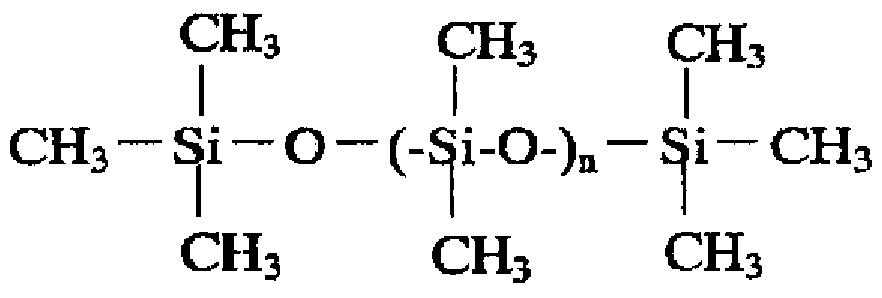
- Silicone gum is a compound represented by the following formula (3).
- methyl group in the formula is hydrogen, an alkyl group, a fluor group, an ether group, an ester group or a reactive substituent such as a hydroxy group, an amino group, an epoxy group, a carboxyl group, a carbinol group, a methacryl group, or a mercapto group. May be substituted with a substituent having a phenol group, a vinyl group, an aryl group, a polyether group, a fluorine-containing alkyl group, etc.
- n represents an average polymerization degree
- n l, 000-10
- the range of less than 000 or more than 10,000 is not preferable because the sliding performance is insufficient.
- the methyl group in the formula is hydrogen, an alkyl group, a fluor group, an ether group, an ester group or a reactive substituent such as a hydroxy group, an amino group, an epoxy group, a carboxyl group, a carbinol group, a methacryl group, or a mercapto group. May be substituted with a substituent having a phenol group, a vinyl group, an aryl group, a polyether group, a fluorine-containing alkyl group, or the like.
- a substituent having a bullet group or an aryl group preferably It is more preferable to have a group.
- the resin obtained by grafting a silicone gum onto the polyolefin is, as shown in Japanese Patent Publication No. 52-36898 (corresponding to US Patent No. 3865897), to specify the polyolefin resin and the silicone gum described above. It can be produced by melt-kneading under the conditions of temperature and shear.
- Silicone gum is grafted to the polyolefin resin in the resin composition of the present invention.
- the polyolefin-based resin has a silicone rubber that is gently mixed with the polyolefin-based resin (the silicone component does not have a high cross-linking structure enough to generate rubber elasticity due to the cross-linking structure, and does not impair the sliding performance improving effect of the silicone component). It is necessary to graft it.
- the graft ratio of silicone gum (the amount of added silicone is also determined by the dissolution test) using a solvent (halogenated hydrocarbons such as trichloroethylene and black form and aromatic hydrocarbons such as toluene and xylene).
- the degree of grafting be in the range of 95-30% by weight. Preferably it is in the range of 90-40% by weight, more preferably 90-50% by weight.
- the graft ratio is less than 30% by weight, the amount of free silicone gum is increased, so that thin molded articles and sagging are deteriorated, and the slidability after contact with a solvent is unfavorably deteriorated.
- the content exceeds 95% by weight, crosslinking of the silicone gum proceeds, so that slidability is deteriorated.
- the ratio of the polyolefin resin to the silicone gum in the resin obtained by grafting the silicone gum to the polyolefin resin is in the range of 80Z20 to 20Z80 by weight, preferably in the range of 70Z30 to 30Z70 by weight. . If the specific force of the polyolefin exceeds 0, the effect of improving the slidability is reduced, which is not preferable. Further, silicone gums having a weight ratio of more than 80 are not preferred because they are difficult to produce and it is difficult to maintain the graft ratio.
- the silicone conjugate used as a raw material is more preferably one in which the content of cyclic low-molecular monomers or oligomers is minimized from the viewpoint of electrical contact contamination.
- These resins obtained by grafting a silicone gum onto a polyolefin-based resin are commercially available as silicone master pellets from Dow Ko Jung'Asia. Specifically, grades such as SP-100, SP-110, SP-300, SP-310, and SP-350 are listed.
- the mixing ratio when these silicone conjugates are used is 0.1 to 30 parts by weight, preferably 0 to 30 parts by weight, based on 100 parts by weight of the resin component comprising (A), (B) and (C). 3-20 parts by weight, more preferably 0.3-10 parts by weight. If the amount is less than 0.1 part by weight, the effect of improving the slidability is insufficient.If the amount exceeds 30 parts by weight, the amount of wear increases and It is not preferable because the peeling of the molded article is bad.
- the lubricant used as the component (E) in the resin composition of the present invention includes alcohol, fatty acid, ester of alcohol and fatty acid, ester of alcohol and dicarboxylic acid, polyoxyalkylene glycol, and average polymerization. It is at least one kind selected from among intermediate compounds having a degree of 10-500.
- the alcohol used includes a monohydric alcohol and a polyhydric alcohol.
- monohydric alcohols include octyl alcohol, nor alcohol, decyl alcohol, undecyl alcohol, lauryl alcohol, tridecyl alcohol, myristyl alcohol, pentadecyl alcohol, cetyl alcohol, heptadecyl alcohol, stearyl alcohol.
- Oleyl alcohol nonadecyl alcohol, eicosyl alcohol, serino-leano-reco-norre, behe-nore-no-re-no-cone, melisino-re-no-re-no-cone, hexino-re-decino-reno-reco-le, otatildo-decyl-alcohol, Saturated or unsaturated alcohols such as decyl myristyl alcohol, decyl stearyl alcohol, and urin alcohol.
- polyhydric alcohol examples include ethylene glycol, diethylene glycol, triethylene glycol, propylene glycol, dipropylene glycol, butanediol, pentanediol, hexanediol, glycerin, diglycerin, triglycerin, tritol, Erythritol, pentaerythritol, arabitol, ribitol, xylitol, sorbite, sorbitan, sorbitol, mannitol.
- Fatty acids include caproic acid, enanthic acid, caprylic acid, pelargonic acid, capric acid, undecylic acid, lauric acid, tridecylic acid, myristic acid, pentadecylic acid, palmitic acid, pentadecylic acid, stearic acid, nanodecane Acids, araquinic acid, behenic acid, lignoceric acid, cerotic acid, heptaconic acid, montanic acid, melicic acid, rataceric acid, pendecilenic acid, oleic acid, elaidic acid, setreic acid, eric acid, brassic acid, sorbic acid, Linoleic acid, linolenic acid, arachidonic acid, propiolic acid and stearolic acid.
- Naturally occurring fatty acids containing such components, or mixtures thereof, and the like can be mentioned. These fatty acids may be substituted with a hydroxy group. Further, synthetic fatty acids obtained by carboxyl-modifying the ends of ulin alcohol, which is a synthetic aliphatic alcohol, may be used.
- esters used in such esters include monohydric alcohols and polyhydric alcohols.
- examples of the monohydric alcohols include methyl alcohol, ethyl alcohol, ethyl alcohol, ethyl alcohol, amino alcohol, amino alcohol, and methyl alcohol.
- the polyhydric alcohol used for the ester is a polyhydric alcohol containing 2 to 6 carbon atoms, such as ethylene glycol, diethylene glycol, triethylene glycol, propylene glycol, dipropylene glycol, butanediol, and the like.
- Fatty acids used in the esters include caproic acid, enanthic acid, caprylic acid, pelargonic acid, capric acid, pendecylic acid, lauric acid, tridecylic acid, myristic acid, pentadecylic acid, palmitic acid, and pentadecylic acid.
- Stearic acid Stearic acid, nanodecanoic acid, arachinic acid, behenic acid, lignoceric acid, serotic acid, heptaconic acid, montanic acid, mericinic acid, rataceric acid, pendecylenic acid, oleic acid, elaidic acid, setrenic acid, eric acid, brassic acid Sorbic acid, linoleic acid, linolenic acid, arachidonic acid, propiolic acid, and stearic acid.
- Naturally occurring fatty acids containing such components or mixtures thereof are mentioned.
- these fatty acids may be substituted with a hydroxy group.
- synthetic fatty acids obtained by carboxyl-modifying the ends of urin alcohol which is a synthetic aliphatic alcohol, may be used.
- fatty acids, and esters of alcohols and fatty acids Esters of 2 or more fatty acids and alcohols are preferred. Esters of 12 or more fatty acids and alcohols of 10 or more alcohols are more preferred. Esters of 12 to 30 fatty acids and alcohols of 10 to 30 carbons are preferred. Are more preferred.
- Esters of alcohol and dicarboxylic acid include octyl alcohol, nor alcohol, decyl alcohol, pendecyl alcohol, lauryl alcohol, tridecyl alcohol, myristyl alcohol, pentadecyl alcohol, cetyl alcohol, heptadecyl alcohol, Stearyl alcohol, oleyl alcohol, nonadecyl alcohol, eicosinoleanoreconore, serinoleanoreconore, behe-noreanoreconore, melisinoleanoreconore, hexyldecyl alcohol, otatyl dodecyl alcohol, Saturated 'unsaturated primary alcohols such as decyl myristyl alcohol, decyl stearyl alcohol, and urin alcohol, and oxalic acid, malonic acid, succinic acid, glutaric acid, adipic acid, pimelic acid, suberic acid,
- Examples of the polyoxyalkylene glycolide conjugate include three types of compounds.
- the first group includes polycondensates using alkylene glycol as a monomer.
- alkylene glycol for example, polyethylene glycol, polypropylene glycol, a block polymer of ethylene glycol and propylene glycol and the like can be mentioned.
- the preferred range of the number of moles of the polymerization is 5 to 1000, and the more preferred range is 10 to 500.
- the second group of the polyoxyalkylene glycol compounds is an ether compound of the first group and an aliphatic alcohol.
- polyethylene glycol oleyl ether ethylene oxide polymerization mole number 5-50
- polyethylene glycol cetyl ether ethylene oxide polymerization mole number 5-50
- polyethylene glycol stearyl ether ethylene oxide polymerization mole number 5-30
- Polyethylene glycol lauryl ether polymerized moles of ethylene oxide 5-30
- polyethylene glycol tridecyl ether polymerized moles of ethylene oxide 5-30
- polyethylene glycol norphenyl ether polymerized moles of ethylene oxide 2-100
- polyethylene glycol And an ether ether polymerization number of ethylene oxide: 4 to 50.
- the third group of polyoxyalkylene glycol compounds is an esterified product of the first group and a higher fatty acid.
- polyethylene glycol monolaurate polymerization number of ethylene oxide 2-30
- polyethylene glycol monostearate polymerization number of ethylene oxide 2-50
- polyethylene glycol monooleate polymerization number of ethylene oxide 2 ⁇ 2 50.
- the olefin compound having an average degree of polymerization of 10 to 500 is a compound represented by the following formula (4).
- R is selected from the group consisting of hydrogen, alkyl group, aryl group and ether group.
- m is an average degree of polymerization of 10 to 500.
- the alkyl group is, for example, an ethyl group, a propyl group, a butyl group, a hexyl group, an octyl group, a decyl group, a lauryl group, a cetyl group, a stearyl group, and the aryl group is, for example, a phenyl group, a p-butylphenyl group.
- the ether group is, for example, an ethyl ether group, a propyl ether group, a butyl ether group or the like.
- monomers constituting the olefin compound include, for example, ethylene, propylene, 1-butene, 2-butene, isobutylene, 1-pentene, 2-pentene, 4-methyl-pentene, 2-methyl-1-butene, and 3-methyl-1 And olefin monomers such as butene, 2-methyl-2-butene, 1 xen, 2,3-dimethyl-2-butene, 1-heptene, 1 otaten, 1 nonene and 1-decene.
- diolefin monomers represented by allene, 1,2 butadiene, 1,3-butadiene, 1,3 pentadiene, 1,4 pentadiene, 1,5 xadiene, cyclopentadiene and the like can also be mentioned.
- Compounds obtained by copolymerizing two or more of these olefin monomers and diolefin monomers will not work.
- the olefinic compound is a compound obtained by polymerizing a diolefin monomer, Perspective of improving thermal stability It is preferable to use an olefin-conjugated product in which carbon-carbon unsaturated bonds are reduced as much as possible using a conventional hydrogenation method.
- the average degree of polymerization n of the olefin units constituting the olefin compound must be between 10 and 500, preferably in the range of 15 to 300, and more preferably in the range of 15 to 100.
- the average degree of polymerization n is less than 10, the long-term sliding properties are lowered and the mold contamination is adversely affected, which is not preferable. If n is larger than 500, the initial sliding characteristics are significantly reduced, which is not preferable.
- the mixing ratio is preferably 0.05 to 20 parts by weight, and more preferably 100 parts by weight of the resin component (A), (B) and (C), which also has power. Is from 0.1 to 10 parts by weight, most preferably from 0.1 to 5 parts by weight.
- silicone adhesive and a lubricant in combination a performance corresponding to a sliding partner material can be obtained.
- the inorganic filler used as the component (F) in the resin composition of the present invention fibrous, particulate, plate-like and hollow fillers are used.
- the fibrous filler include glass fiber, asbestos fiber, carbon fiber, silica fiber, silica'alumina fiber, zirconia fiber, boron nitride fiber, silicon nitride fiber, boron fiber, potassium titanate fiber, and stainless steel and aluminum.
- inorganic fibers such as metal fibers of titanium, copper, brass and the like.
- whiskers and acicular wollastonite (calcium silicate) such as potassium titanate, zinc oxide, and titanium oxide having a short fiber length.
- Examples of the powdery filler include graphite, carbon black, conductive carbon black, carbon nanotubes, silica, quartz powder, glass beads, glass powder, aluminum silicate, aluminum oxide, talc, clay, diatomaceous earth, and nef. Erin sinite, cristobalite, wollastonite (calcium silicate), iron oxide, zinc oxide, titanium oxide, alumina, calcium sulfate, barium sulfate, calcium carbonate, magnesium carbonate, dolomite, calcium phosphate, hydroxyapatite, silicon carbide, Examples include silicon nitride, boron nitride, and various metal powders. Examples of the plate-like filler include My strength, glass flake, and various metal foils.
- the hollow filler examples include a glass tube, a glass balloon, a silica balloon, a shirasu balloon, a metal balloon and the like. These fillers can be used alone or in combination of two or more. [0072] Any of these fillers that have been subjected to surface treatment and those that have not been subjected to surface treatment can be used. Surface strength of molded product surface smoothness and mechanical properties It may be preferable to use a surface-treated product. Conventionally known surface treatment agents can be used. For example, various types of coupling agents such as silane, titanate, aluminum and zirconium can be used.
- the particle size of the inorganic filler From the viewpoint of imparting the surface appearance and excellent slidability of the molded product! / ⁇ ⁇ From the viewpoint of the particle size of the inorganic filler, those with a volume average particle size of 100 ⁇ m or less are used. It is more preferably 30 ⁇ m or less.
- Specific examples of the inorganic filler preferably used for this purpose include titanic acid liquor, wollastonite (needle-like, granular), calcium carbonate, talc, graphite, nepheline sinite, hydroxyapatite, silica, and carbon black. Particularly preferred are titanic acid whiskers, wollastonite (needle-like, granular), calcium carbonate, talc and carbon black, in which kaolin is preferred.
- carbon black conductive carbon black, carbon nanotube, carbon fiber, and the like are used.
- the ratio of addition varies widely depending on the purpose, but is generally 0.1 to 150 parts by weight with respect to 100 parts by weight of the resin component comprising (A), (B) and (C). Used in the range of 0.5 to 100 parts by weight. If the amount is less than 0.5 part by weight, the reinforcing effect of the filler is insufficient. Unfavorable because the impact resistance decreases.
- the polyoxymethylene resin composition of the present invention may be, if desired, various additives conventionally used in polyoxymethylene resins (for example, the present specification) within a range that does not impair the object of the present invention.
- Lubricants, impact modifiers, other resins, crystal nucleating agents, mold release agents, dyes, pigments, etc., other than those described in this document can be used.
- melt kneader In the method for producing the resin composition of the present invention, a generally used melt kneader can be used.
- the melt kneader include a single kneader, a roll mill, a single screw extruder, a twin screw extruder, and a multi-screw extruder.
- the processing temperature at this time is preferably 180 to 240 ° C.
- the molded article of the present invention can be produced by an injection molding method, a hot runner injection molding method, an outsert molding method, an insert molding method, a gas-assisted hollow injection molding method, a high-frequency heating injection molding method for a mold, a compression molding method, or an inflation method. It is formed by a molding method such as molding, blow molding, extrusion molding or cutting of an extruded product.
- Such a molded product takes advantage of its characteristics such as flexibility, vibration damping and noise reduction performance, friction and abrasion under high-load conditions, and oil resistance and the like, so that a latch, a stopper, a gear, a cam, a slider, a laser, and the like can be obtained.
- No.1 arm, clutch, felt clutch, idler gear, pulley, roller, roller, key stem, key top, shutter, reel, shaft, joint, shaft, bearing, guide, etc.
- Outsert to board 'parts' Used for insert molded parts, connectors and terminal caps. It is especially useful for vitality latches, stoppers, and noise reduction gears because of its flexibility, vibration damping and noise reduction performance, and friction and wear under high load conditions. It is also useful for caps of connectors and terminals because of its excellent hinge performance.
- Parts for office automation equipment such as printers and copiers, VTR (Video Tape Recorder), video movies, digital video cameras, parts for cameras or video equipment such as cameras and digital cameras, cassette players, DATs , LD (Laser Disk), MD (Mini Disk), CD (Compact Disk) [CD-ROM (Read Only Memory), CD-R (Recordable), CD—including RW (Rewritable)], DVD (Digital Versatile Disk) [DVD-ROM, DVD-R, DVD— RW, DVD-RAM (Random Access Memory), DVD— Audio), other electrical devices such as optical disc drives, HDDs, MFDs, MOs, navigation systems and music, video or information equipment typified by mopile personal computers, and parts for communication equipment typified by mobile phones and facsimile machines. ⁇ Parts for electronic equipment.
- the polymer is filtered and washed, and 1 part by weight of the crude polyoxymethylene copolymer after the filtration and washing is used as a quaternary ammonium compound as triethyl (2-hydroxyethyl) ammonium-formate.
- a quaternary ammonium compound as triethyl (2-hydroxyethyl) ammonium-formate.
- triethylene glycol bis [3- (3-tert-butyl-5-methyl-4-hydroxyphenyl) propionate] was used as an antioxidant with respect to 100 parts by weight of the dry crude polyoxymethylene copolymer.
- 0.32 parts by weight of calcium stearate were added, and the mixture was fed to a vented twin-screw extruder.
- add water and Z or triethylamine to the molten polyoxymethylene copolymer in the extruder, and set the extruder at a temperature of 200 ° C and a residence time of 5 minutes in the extruder. Decomposition was performed.
- the degraded polyoxymethylene copolymer at the unstable terminal was devolatilized under the condition of a vent vacuum of 20 °: and extruded as a strand from the extruder die and pelletized.
- the obtained polyoxymethylene block copolymer had a flexural modulus of 2,550 MPa and a melt flow rate of 9.3 g / 10 min (ASTM D-1238-57T).
- boron trifluoride di- n -butyl etherate dissolved in cyclohexane is dissolved in trioxane.
- trioxane 1 mole becomes 2 X 10- 3 mole
- the discharged polymer was poured into a 1% aqueous solution of triethylamine to completely deactivate the polymerization catalyst. Subsequently, the polymer is filtered and washed, and 1 part by weight of the crude polyoxymethylene copolymer after the filtration and washing is used as a quaternary ammonium compound.
- Til (2-hydroxyethyl) ammonium-formate was added at a concentration of 20 ppm by weight in terms of the amount of nitrogen, mixed uniformly, and dried at 120 ° C.
- triethylene glycol bis [3- (3-tert-butyl-5-methyl-4-hydroxyphenyl) propionate] was used as an antioxidant with respect to 100 parts by weight of the dry crude polyoxymethylene copolymer.
- 0.32 parts by weight of calcium stearate were added, and the mixture was fed to a vented twin-screw extruder.
- add water and Z or triethylamine to the molten polyoxymethylene copolymer in the extruder, and set the extruder at a temperature of 200 ° C and a residence time of 5 minutes in the extruder. Decomposition was performed.
- the degraded polyoxymethylene copolymer at the unstable terminal was devolatilized under the condition of a vent vacuum of 20 °: and extruded as a strand from the extruder die and pelletized.
- the resulting polyoxymethylene copolymer had a flexural modulus of 2,600 MPa and a melt flow rate of 9. Og Z10 minutes (ASTM D-1238-57T).
- a random styrene-butadiene copolymer having a B1-B2-B1 structure was polymerized in a cyclohexane solvent of a reactor equipped with a stirrer and purged with nitrogen gas, using n-butyllithium as a polymerization initiator. Thereafter, the polymerization solution was transferred to another reactor purged with nitrogen gas, and hydrogenation was performed on the ethylenically unsaturated groups in the polybutadiene portion using a hydrogenation catalyst under hydrogen pressure.
- the weight average weight measured by GPC was 190,000 and MwZMn was 1.9.
- the Tan ⁇ peak temperature of this polymer was 15 ° C.
- B-2 In a cyclohexane solvent of a reactor equipped with a stirrer replaced with nitrogen gas, n-butyllithium was used as a polymerization initiator to prepare a styrene-butadiene random copolymer having a B1-B2-B1 structure. Polymerized. Thereafter, the polymerization liquid was transferred to another reactor purged with nitrogen gas, and hydrogenation was performed on the ethylenically unsaturated groups in the polybutadiene portion using a hydrogenation catalyst under hydrogen pressure.
- the MwZMn was 1.8.
- the Tan ⁇ peak temperature of this polymer was 5 ° C.
- c-l Maleic anhydride-modified ethylene butene copolymer (trade name: Tuffmer MH7010, manufactured by Mitsui Iridaku Co., Ltd., maleic acid modification rate: 0.5% by weight)
- c-2 Ethylene butene copolymer (trade name: Toughmer A4090, manufactured by Mitsui Chemicals, Inc.)
- the graft ratio of the silicone grafted product in the silicone grafted polyolefin resin was 70% by weight, and the free silicone compound was 18% by weight.
- e-l polyethylene glycol (molecular weight 6,000)
- Inorganic filler material f-1 Wollastonite (average particle size 3 ⁇ m, aspect ratio 3)
- the cylinder temperature was set to 200 ° C (the inorganic filler addition system was set to 220 ° C) .5 oz.
- the injection speed is varied using an IS-100GN manufactured by Kikai Co., Ltd. to form a spiral thin-walled molded product with a thickness of lmm and a width of 5mm. Evaluated the peel.
- the evaluation criteria are as follows.
- ⁇ Ejection speed is 80% or more, and peeling is recognized.
- the pellets obtained in Examples and Comparative Examples were dried at 80 ° C for 3 hours, and then dried using a 5 ounce molding machine (Toshiba Machine Co., Ltd.IS-100E) set at a cylinder temperature of 200 ° C. Under the conditions of a mold temperature of 70 ° C and a cooling time of 30 seconds, a dumbbell molded product having a thickness of 3. Omm, a width of 13 mm and a length of 175 mm was prepared. Using this molded product, one end was fixed in an anechoic chamber, and the radiated sound when the base of the fixed end was hit with an impulse hammer was measured, and an acoustic analysis system CF manufactured by Ono Sokki Co., Ltd. was used. — Using 5220, the frequency response function of the excitation signal of the hammer and the sound pressure signal of the microphone was calculated. The larger the value, the better the damping performance • Excellent silencing performance.
- the mold temperature was set using a 1 oz molding machine (TOYO MACHINERY CO., LTD.TI-30G) set at a cylinder temperature of 200 ° C. Under a condition of 70 ° C. and a cooling time of 20 seconds, a flat plate having a thickness of 3 mm was formed into a test piece.
- This test specimen was reciprocated 5000 times at 60 ° C using a reciprocating friction and wear tester (AFT-15MS manufactured by Toyo Seimitsu Co., Ltd.) to support a load of 2 kg, a linear velocity of 30 mmZsec, a reciprocating distance of 20 mm, and a high load heat generation condition.
- the mold temperature was adjusted using a 1-oz molding machine (TOYO MACHINE METAL CO., LTD.TI30-G2) set at a cylinder temperature of 200 ° C.
- a cylindrical pulley having an inner diameter of 6 mm, an outer diameter of 12 mm, and a height of 17 mm was formed at 40 ° C or 60 ° C and a cooling time of 12 seconds, and used as a test piece.
- the fixed shaft (shaft) used was Tenac LA541T with an outer diameter of 6 mm.
- a meshing gear noise evaluator manufactured by Okura Industry Co., Ltd., it was operated at 3000 rpm, torque 150 kg-cm, and temperature 23 ° C, and the noise measurement range was 50 Hz with an Ono Sokki sound level meter. Measurements were made at 20 kHz in measurement mode A characteristics (approximately heard by human ears).
- the gear used for the measurement was a spur gear with 50 teeth, module 0.6, and a pitch circle diameter of 30 mm.
- melt kneading was performed at a screw rotation speed of 200 rpm and 10 kgZhr.
- the extruded resin was pelletized with a strand cutter. Table 1 shows the results of various measurements performed using the pellets.
- Example 1 was carried out in exactly the same manner as in Example 1 except that the component (bl) was changed to 40 parts by weight and (c 1) 15 parts by weight of an olefin resin was added. The results are shown in Table 1.
- Example 1 was carried out in exactly the same manner as in Example 1 except that the component (bl) 55 parts by weight was changed to the component (c1) 55 parts by weight. The results are shown in Table 1.
- Example 1 was carried out in exactly the same manner as in Example 1, except that the component (b-1) 55 parts by weight was changed to the component (b-3) 55 parts by weight. The results are shown in Table 1.
- Example 2 was carried out in exactly the same manner as in Example 1 except that the component (b-1) of 40 parts by weight was changed to the component (b-3) of 40 parts by weight. Table 1 shows the results.
- Example 1 was carried out in exactly the same manner as in Example 1 except that (d-1) 5 parts by weight of silicone-grafted polyolefin resin was further added. Table 2 shows the results.
- Example 2 was carried out in exactly the same manner as in Example 2 except that 5 parts by weight of (d-1) silicone-grafted polyolefin resin was further added. Table 2 shows the results.
- Example 4 was carried out in exactly the same manner as in Example 4, except that (e1) 2 parts by weight of a lubricant was further added. Table 2 shows the results.
- Example 5 was carried out in exactly the same manner as in Example 5, except that 2 parts by weight of the component (e-1) was changed to 2 parts by weight of the component (e-2). Table 2 shows the results.
- Example 3 was carried out in exactly the same manner as in Example 3, except that the component (b-1) 55 parts by weight was changed to the component (b-3) 55 parts by weight. Table 2 shows the results.
- Example 4 was carried out in exactly the same manner as in Example 4, except that the component (b-1) of 40 parts by weight was changed to the component (b-3) of 40 parts by weight. Table 2 shows the results.
- Example 4 was carried out in exactly the same manner as in Example 4 except that the components (b-1) and (c1) were changed to the amounts shown in Table 3. Table 3 shows the results.
- Example 3 was carried out in exactly the same manner as in Example 3 except that the component (b-1) 55 parts by weight was changed to the component (c1) 55 parts by weight. Table 3 shows the results.
- Example 4 The component (c-1) of Example 4 was changed to the combination of the component (c1) and the component (c2) as shown in Table 3, and Alternatively, the same operation as in Example 4 was carried out except that the component was changed to the component (c-2). Table 3 shows the results.
- Example 4 was carried out in exactly the same manner as in Example 4 except that the component (b-1) was changed to 40 parts by weight from the component (b-1) of 40 parts by weight. Table 3 shows the results.
- a polyoxymethylene resin of the component (a-1) 80 parts by weight of a polyoxymethylene resin of the component (a-1), 20 parts by weight of a polymer having at least one random copolymer block of an aromatic vinyl compound-conjugated conjugated conjugate of the component (b-1), And (d-1) 3 parts by weight of a silicone-grafted polyolefin, and also, based on the total weight of the components (a1) and (b-1), triethylene glycol bis- [3- (3-t-butyl-5 - methyl-4-hydroxy Hue - Le) propionate] 0.3 weight 0/0, polyamide 6 6 0.05 wt%, calcium stearate 0.10 wt% Ka ⁇ E were uniformly blanking trends in blender scratch.
- the extruded resin was pelletized with a strand cutter. The measurement was performed using this pellet, and the results are shown in Table 4.
- Example 12 was carried out in exactly the same manner as in Example 12, except that the component (b-1) was changed to 15 parts by weight and that (c-1) 5 parts by weight of an olefin resin was added. Table 4 shows the results.
- Example 13 was carried out in exactly the same manner as in Example 13, except that the component (a-1) was changed to 80 parts by weight, the component (a-1) was changed to 40 parts by weight, and the component (a-2) was changed to 40 parts by weight.
- Table 4 shows the results.
- Example 13 was carried out in exactly the same manner as in Example 13, except that the component (a-1) was changed to 80 parts by weight from the component (a-1) of 80 parts by weight. Table 4 shows the results.
- Example 13 was carried out in exactly the same manner as in Example 13, except that 5 parts by weight of the component (f1) was further added. Table 4 shows the results. [Comparative Example 7]
- Example 12 was carried out in the same manner as in Example 12, except that the component (b-1) was changed to 20 parts by weight of the component (b-1). Table 4 shows the results.
- Example 13 was carried out in exactly the same manner as in Example 12, except that the component (b-1) 15 parts by weight was changed to the component (b-3) 15 parts by weight. Table 4 shows the results.
- composition (D) Non-concentrated raft (d-1) (parts by weight) 5 5 5 5 5 5 5 *
- the present invention provides a composition in which polyoxymethylene resin is provided with excellent flexibility, vibration damping and sound deadening properties, friction and wear properties under high load conditions, and oil resistance. Molding this composition
- Mechanical parts (gears, cams, sliders, levers, arms, clutches, joints, shafts, bearings, key stems, key tops, and at least one group force selected from group forces including key top force), out Group strength consisting of resin parts of chassis, chassis, tray and side plate At least one selected part is used for the following applications.
- Parts used for industrial goods such as disposable cameras, toys, fasteners, conveyors, knockers, and household equipment
Landscapes
- Chemical & Material Sciences (AREA)
- Health & Medical Sciences (AREA)
- Chemical Kinetics & Catalysis (AREA)
- Medicinal Chemistry (AREA)
- Polymers & Plastics (AREA)
- Organic Chemistry (AREA)
- Compositions Of Macromolecular Compounds (AREA)
Abstract
Description



Claims
Priority Applications (3)
| Application Number | Priority Date | Filing Date | Title |
|---|---|---|---|
| US10/574,837 US20070129484A1 (en) | 2003-10-10 | 2004-10-08 | Polyoxymethylene resin composition and moldings thereof |
| DE112004001911T DE112004001911B4 (de) | 2003-10-10 | 2004-10-08 | Polyoxymethylen-Harzzusammensetzung und Formlinge daraus |
| JP2005514612A JP4767015B2 (ja) | 2003-10-10 | 2004-10-08 | ポリオキシメチレン樹脂組成物およびその成形体 |
Applications Claiming Priority (2)
| Application Number | Priority Date | Filing Date | Title |
|---|---|---|---|
| JP2003351730 | 2003-10-10 | ||
| JP2003-351730 | 2003-10-10 |
Publications (1)
| Publication Number | Publication Date |
|---|---|
| WO2005035652A1 true WO2005035652A1 (ja) | 2005-04-21 |
Family
ID=34431087
Family Applications (1)
| Application Number | Title | Priority Date | Filing Date |
|---|---|---|---|
| PCT/JP2004/014925 Ceased WO2005035652A1 (ja) | 2003-10-10 | 2004-10-08 | ポリオキシメチレン樹脂組成物およびその成形体 |
Country Status (7)
| Country | Link |
|---|---|
| US (1) | US20070129484A1 (ja) |
| JP (1) | JP4767015B2 (ja) |
| KR (1) | KR100773583B1 (ja) |
| CN (1) | CN100503721C (ja) |
| DE (1) | DE112004001911B4 (ja) |
| TW (1) | TWI259198B (ja) |
| WO (1) | WO2005035652A1 (ja) |
Cited By (13)
| Publication number | Priority date | Publication date | Assignee | Title |
|---|---|---|---|---|
| JP2008291088A (ja) * | 2007-05-23 | 2008-12-04 | Asahi Kasei Chemicals Corp | ポリオキシメチレン樹脂組成物およびその成形体 |
| JP2008308791A (ja) * | 2007-06-15 | 2008-12-25 | Asahi Kasei Chemicals Corp | ポリオキシメチレン樹脂製延伸体 |
| JP2010053229A (ja) * | 2008-08-27 | 2010-03-11 | Asahi Kasei Chemicals Corp | ポリオキシメチレン樹脂組成物及びその成形体 |
| JP2011516704A (ja) * | 2008-04-16 | 2011-05-26 | ティコナ ゲーエムベーハー | ポリオキシメチレン成形材料、成形品及びそれらの使用 |
| JP2011157448A (ja) * | 2010-01-29 | 2011-08-18 | Asahi Kasei Chemicals Corp | ポリオキシメチレン樹脂組成物及び成形体 |
| JP2011225746A (ja) * | 2010-04-21 | 2011-11-10 | Asahi Kasei Chemicals Corp | ハードディスクラッチ部品 |
| JP2012021097A (ja) * | 2010-07-15 | 2012-02-02 | Asahi Kasei Chemicals Corp | ポリオキシメチレン樹脂組成物および成形体 |
| WO2014021413A1 (ja) * | 2012-08-03 | 2014-02-06 | 三菱エンジニアリングプラスチックス株式会社 | ポリアセタール樹脂組成物、これを用いた複合成形体およびその製造方法 |
| JP2014031423A (ja) * | 2012-08-02 | 2014-02-20 | Asahi Kasei Chemicals Corp | ポリアセタール樹脂組成物及びその成形体 |
| JP2017080939A (ja) * | 2015-10-26 | 2017-05-18 | 三菱エンジニアリングプラスチックス株式会社 | 複合成形体およびその製造方法 |
| JP2017155117A (ja) * | 2016-03-01 | 2017-09-07 | 旭化成株式会社 | ポリオキシメチレン樹脂組成物 |
| JP2017155115A (ja) * | 2016-03-01 | 2017-09-07 | 旭化成株式会社 | ポリオキシメチレン樹脂組成物 |
| JP2021031506A (ja) * | 2019-08-13 | 2021-03-01 | 旭化成株式会社 | 熱可塑性樹脂組成物、成形体 |
Families Citing this family (20)
| Publication number | Priority date | Publication date | Assignee | Title |
|---|---|---|---|---|
| CN100537689C (zh) | 2003-12-04 | 2009-09-09 | 旭化成电子材料株式会社 | 各向异性的导电粘合片材及连接结构体 |
| CN101283027A (zh) * | 2005-08-08 | 2008-10-08 | 卡伯特公司 | 包含纳米管的聚合物组合物 |
| US20090048385A1 (en) * | 2005-09-16 | 2009-02-19 | Asahi Kasei Chemicals Corporation | Masterbatch and composition containing the same |
| DE102007025790B3 (de) * | 2007-06-01 | 2008-08-21 | Autoliv Development Ab | Schallgedämpftes Sicherheitsgurtschloss |
| EP2267075B1 (en) * | 2008-10-28 | 2014-01-22 | Asahi Kasei Chemicals Corporation | Polyacetal resin composition and method for producing the same |
| KR20100134523A (ko) * | 2009-06-15 | 2010-12-23 | 스미또모 가가꾸 가부시끼가이샤 | 수지 성형체 및 그 제조 방법, 그리고 릴레이 |
| CN101948606B (zh) * | 2010-11-02 | 2012-10-17 | 华东理工大学 | 一种高耐磨自润滑性聚甲醛复合材料及其制备方法 |
| US9676958B2 (en) * | 2011-12-16 | 2017-06-13 | Celanese Sales Germany Gmbh | Polymer dispersions and their use in pigmented coating compositions |
| US20140142228A1 (en) * | 2012-11-21 | 2014-05-22 | Ticona Llc | Plasticized, Conductive Polyoxymethylene for Fuel Applications |
| US20140137975A1 (en) * | 2012-11-21 | 2014-05-22 | Ticona Llc | Plasticized, Conductive Polyoxymethylene for Fuel Applications |
| US9341148B2 (en) * | 2013-02-04 | 2016-05-17 | Briggs & Stratton Corporation | Evaporative emissions fuel system |
| KR102119735B1 (ko) * | 2013-12-31 | 2020-06-08 | 코오롱플라스틱 주식회사 | 폴리옥시메틸렌 수지 조성물 및 이를 포함하는 성형품 |
| WO2015102405A1 (ko) * | 2013-12-31 | 2015-07-09 | 코오롱플라스틱 주식회사 | 폴리옥시메틸렌 수지 조성물 및 이를 포함하는 성형품 |
| CN106715989B (zh) * | 2014-07-02 | 2020-08-14 | 库博标准汽车配件有限公司 | 软管、耐磨组合物和软管制造工艺 |
| US10030118B2 (en) * | 2014-10-16 | 2018-07-24 | Asahi Kasei Kabushiki Kaisha | Polyacetal resin molded article |
| WO2017156053A1 (en) * | 2016-03-08 | 2017-09-14 | Ticona Llc | Orthopedic device and polymer compositions for making same |
| EP3526289A1 (en) | 2016-10-11 | 2019-08-21 | Celanese Sales Germany GmbH | Wear resistant polymer composition having improved surface appearance |
| JP6445226B1 (ja) * | 2017-06-15 | 2018-12-26 | 三菱エンジニアリングプラスチックス株式会社 | ポリアセタール樹脂組成物、成形品およびポリアセタール樹脂組成物の製造方法 |
| JP6985852B2 (ja) | 2017-08-25 | 2021-12-22 | 旭化成株式会社 | ポリオキシメチレン樹脂成形体、摺動部材、及びハードディスク用ランプ |
| JP7216496B2 (ja) * | 2018-08-09 | 2023-02-01 | 旭化成株式会社 | ポリオキシメチレン樹脂組成物及び成形体 |
Citations (4)
| Publication number | Priority date | Publication date | Assignee | Title |
|---|---|---|---|---|
| WO2001009213A1 (en) * | 1999-07-30 | 2001-02-08 | Asahi Kasei Kabushiki Kaisha | Polyacetal block copolymer |
| JP2001226558A (ja) * | 2000-02-14 | 2001-08-21 | Asahi Kasei Corp | 制振性に優れたポリオキシメチレン樹脂組成物とその成形体 |
| JP2002256134A (ja) * | 2000-12-26 | 2002-09-11 | Asahi Kasei Corp | ポリオキシメチレン樹脂組成物及びその成形体 |
| JP2004002816A (ja) * | 2002-04-15 | 2004-01-08 | Asahi Kasei Corp | 樹脂組成物及びその成形体 |
Family Cites Families (18)
| Publication number | Priority date | Publication date | Assignee | Title |
|---|---|---|---|---|
| US3333024A (en) * | 1963-04-25 | 1967-07-25 | Shell Oil Co | Block polymers, compositions containing them and process of their preparation |
| US3865897A (en) * | 1973-08-03 | 1975-02-11 | Dow Corning | Method of blending polyolefins and polydiorganosiloxane gums and blends thereof |
| DE2818240A1 (de) * | 1978-04-26 | 1979-11-08 | Hoechst Ag | Thermoplastische formmassen auf basis von polyoxymethylenen |
| US4252915A (en) * | 1979-01-31 | 1981-02-24 | Dow Corning Corporation | Method of blending ethylene vinylacetate copolymers and polydiorganosiloxane gums and the blends made by the method |
| GB2134909B (en) * | 1983-01-20 | 1986-08-20 | Asahi Chemical Ind | Catalytic hydrogenation of conjugated diene polymer |
| DE3303761A1 (de) * | 1983-02-04 | 1984-08-09 | Hoechst Ag, 6230 Frankfurt | Schlagzaeh modifiziertes polyoxymethylen und daraus hergestellte formkoerper |
| US4804716A (en) * | 1983-02-07 | 1989-02-14 | E. I. Du Pont De Nemours And Company | Toughened polyoxymethylene compositions |
| US4670508A (en) * | 1984-01-06 | 1987-06-02 | Mitsui Petrochemical Industries Ltd. | Thermoplastic resin composition |
| JPS60220147A (ja) * | 1984-04-18 | 1985-11-02 | Asahi Chem Ind Co Ltd | オレフイン水添触媒および該触媒を用いた重合体の水添方法 |
| US4665126A (en) * | 1985-08-09 | 1987-05-12 | Celanese Corporation | Acetal polymer compositions having improved impact strength |
| EP0709413B1 (en) * | 1989-05-19 | 1999-07-14 | Japan Synthetic Rubber Co., Ltd. | (Modified) Hydrogenated diene block copolymer and composition comprising the same |
| DE19528191A1 (de) * | 1995-08-01 | 1997-02-06 | Basf Ag | Schlagzähe thermoplastische Formmassen |
| TW567192B (en) * | 1999-04-14 | 2003-12-21 | Idemitsu Petrochemical Co | Styrene polymer and molded object obtained by molding the polymer |
| US6521704B1 (en) * | 2000-06-13 | 2003-02-18 | General Electric Company | Vibration dampening compositions and methods thereof |
| DE10162903B4 (de) * | 2000-12-26 | 2009-04-30 | Asahi Kasei Kabushiki Kaisha | Polyoxymethylenharzzusammensetzung und daraus hergestellte Formkörper |
| JP3706024B2 (ja) * | 2000-12-27 | 2005-10-12 | 旭化成ケミカルズ株式会社 | ポリオキシメチレン樹脂組成物とその成形体 |
| EP1225036B1 (de) * | 2001-01-17 | 2004-10-27 | Ponachem AG | Verbundkörper |
| WO2003035705A1 (en) * | 2001-10-23 | 2003-05-01 | Asahi Kasei Kabushiki Kaisha | Hydrogenated copolymer |
-
2004
- 2004-10-08 KR KR1020067006919A patent/KR100773583B1/ko not_active Expired - Fee Related
- 2004-10-08 JP JP2005514612A patent/JP4767015B2/ja not_active Expired - Fee Related
- 2004-10-08 WO PCT/JP2004/014925 patent/WO2005035652A1/ja not_active Ceased
- 2004-10-08 TW TW093130611A patent/TWI259198B/zh not_active IP Right Cessation
- 2004-10-08 DE DE112004001911T patent/DE112004001911B4/de not_active Expired - Fee Related
- 2004-10-08 US US10/574,837 patent/US20070129484A1/en not_active Abandoned
- 2004-10-08 CN CNB2004800296293A patent/CN100503721C/zh not_active Expired - Fee Related
Patent Citations (4)
| Publication number | Priority date | Publication date | Assignee | Title |
|---|---|---|---|---|
| WO2001009213A1 (en) * | 1999-07-30 | 2001-02-08 | Asahi Kasei Kabushiki Kaisha | Polyacetal block copolymer |
| JP2001226558A (ja) * | 2000-02-14 | 2001-08-21 | Asahi Kasei Corp | 制振性に優れたポリオキシメチレン樹脂組成物とその成形体 |
| JP2002256134A (ja) * | 2000-12-26 | 2002-09-11 | Asahi Kasei Corp | ポリオキシメチレン樹脂組成物及びその成形体 |
| JP2004002816A (ja) * | 2002-04-15 | 2004-01-08 | Asahi Kasei Corp | 樹脂組成物及びその成形体 |
Cited By (16)
| Publication number | Priority date | Publication date | Assignee | Title |
|---|---|---|---|---|
| JP2008291088A (ja) * | 2007-05-23 | 2008-12-04 | Asahi Kasei Chemicals Corp | ポリオキシメチレン樹脂組成物およびその成形体 |
| JP2008308791A (ja) * | 2007-06-15 | 2008-12-25 | Asahi Kasei Chemicals Corp | ポリオキシメチレン樹脂製延伸体 |
| JP2011516704A (ja) * | 2008-04-16 | 2011-05-26 | ティコナ ゲーエムベーハー | ポリオキシメチレン成形材料、成形品及びそれらの使用 |
| JP2010053229A (ja) * | 2008-08-27 | 2010-03-11 | Asahi Kasei Chemicals Corp | ポリオキシメチレン樹脂組成物及びその成形体 |
| JP2011157448A (ja) * | 2010-01-29 | 2011-08-18 | Asahi Kasei Chemicals Corp | ポリオキシメチレン樹脂組成物及び成形体 |
| JP2011225746A (ja) * | 2010-04-21 | 2011-11-10 | Asahi Kasei Chemicals Corp | ハードディスクラッチ部品 |
| JP2012021097A (ja) * | 2010-07-15 | 2012-02-02 | Asahi Kasei Chemicals Corp | ポリオキシメチレン樹脂組成物および成形体 |
| JP2014031423A (ja) * | 2012-08-02 | 2014-02-20 | Asahi Kasei Chemicals Corp | ポリアセタール樹脂組成物及びその成形体 |
| WO2014021413A1 (ja) * | 2012-08-03 | 2014-02-06 | 三菱エンジニアリングプラスチックス株式会社 | ポリアセタール樹脂組成物、これを用いた複合成形体およびその製造方法 |
| JPWO2014021413A1 (ja) * | 2012-08-03 | 2016-07-21 | 三菱エンジニアリングプラスチックス株式会社 | ポリアセタール樹脂組成物、これを用いた複合成形体およびその製造方法 |
| JP2018024894A (ja) * | 2012-08-03 | 2018-02-15 | 三菱エンジニアリングプラスチックス株式会社 | ポリアセタール樹脂組成物 |
| US10131781B2 (en) | 2012-08-03 | 2018-11-20 | Mitsubishi Engineering-Plastics Corporation | Polyacetal resin composition, composite molding using the same, and method for producing the same |
| JP2017080939A (ja) * | 2015-10-26 | 2017-05-18 | 三菱エンジニアリングプラスチックス株式会社 | 複合成形体およびその製造方法 |
| JP2017155117A (ja) * | 2016-03-01 | 2017-09-07 | 旭化成株式会社 | ポリオキシメチレン樹脂組成物 |
| JP2017155115A (ja) * | 2016-03-01 | 2017-09-07 | 旭化成株式会社 | ポリオキシメチレン樹脂組成物 |
| JP2021031506A (ja) * | 2019-08-13 | 2021-03-01 | 旭化成株式会社 | 熱可塑性樹脂組成物、成形体 |
Also Published As
| Publication number | Publication date |
|---|---|
| DE112004001911T5 (de) | 2006-07-27 |
| CN1867628A (zh) | 2006-11-22 |
| DE112004001911B4 (de) | 2011-05-12 |
| TW200530322A (en) | 2005-09-16 |
| CN100503721C (zh) | 2009-06-24 |
| KR20060086948A (ko) | 2006-08-01 |
| JPWO2005035652A1 (ja) | 2007-11-22 |
| JP4767015B2 (ja) | 2011-09-07 |
| TWI259198B (en) | 2006-08-01 |
| US20070129484A1 (en) | 2007-06-07 |
| KR100773583B1 (ko) | 2007-11-08 |
Similar Documents
| Publication | Publication Date | Title |
|---|---|---|
| WO2005035652A1 (ja) | ポリオキシメチレン樹脂組成物およびその成形体 | |
| JP4270787B2 (ja) | ポリオキシメチレン樹脂組成物 | |
| JPWO2001032775A1 (ja) | ポリオキシメチレン樹脂組成物 | |
| JP4904191B2 (ja) | ポリアセタール樹脂組成物 | |
| JPWO2003055945A1 (ja) | ポリオキシメチレン樹脂製ランプ | |
| JP5301794B2 (ja) | ポリオキシメチレン樹脂組成物およびその成形体 | |
| JP3821698B2 (ja) | ポリオキシメチレン樹脂組成物及びその成形体 | |
| JP5301926B2 (ja) | ポリオキシメチレン樹脂組成物及びその成形体 | |
| US6930145B2 (en) | Polyoxymethylene resin composition and molded articles made therefrom | |
| JP5145372B2 (ja) | ハードディスクラッチ部品 | |
| JP2004002816A (ja) | 樹脂組成物及びその成形体 | |
| JP5196623B2 (ja) | ポリオキシメチレン樹脂組成物およびその成形体 | |
| JP4904189B2 (ja) | ポリオキシメチレン樹脂組成物およびその成形体 | |
| JP4913380B2 (ja) | ポリオキシメチレン樹脂製ハードディスクランプ | |
| JP5730624B2 (ja) | ポリオキシメチレン樹脂組成物及びその製造方法 | |
| JP2005255734A (ja) | マスターバッチおよびそれを配合した組成物 | |
| JP2004323713A (ja) | 樹脂組成物、その成形体及びその部品 | |
| JP5530841B2 (ja) | ポリオキシメチレン樹脂組成物および成形体 | |
| JP5908695B2 (ja) | 摺動部材及び電子写真画像形成装置に用いられるトナー介在下で使用される機構部品 | |
| JP5800459B2 (ja) | ポリオキシメチレン樹脂組成物及び成形体 | |
| JP5545991B2 (ja) | ポリオキシメチレン樹脂組成物及び成形体 | |
| JP2007295239A (ja) | 音響機器用樹脂成形体 | |
| JP2012021095A (ja) | ポリオキシメチレン樹脂組成物及び成形体 | |
| JP2012021096A (ja) | ポリオキシメチレン樹脂組成物及び成形体 | |
| JP2006306992A (ja) | 樹脂組成物 |
Legal Events
| Date | Code | Title | Description |
|---|---|---|---|
| WWE | Wipo information: entry into national phase |
Ref document number: 200480029629.3 Country of ref document: CN |
|
| AK | Designated states |
Kind code of ref document: A1 Designated state(s): AE AG AL AM AT AU AZ BA BB BG BR BW BY BZ CA CH CN CO CR CU CZ DE DK DM DZ EC EE EG ES FI GB GD GE GH GM HR HU ID IL IN IS JP KE KG KP KR KZ LC LK LR LS LT LU LV MA MD MG MK MN MW MX MZ NA NI NO NZ OM PG PH PL PT RO RU SC SD SE SG SK SL SY TJ TM TN TR TT TZ UA UG US UZ VC VN YU ZA ZM ZW |
|
| AL | Designated countries for regional patents |
Kind code of ref document: A1 Designated state(s): GM KE LS MW MZ NA SD SL SZ TZ UG ZM ZW AM AZ BY KG KZ MD RU TJ TM AT BE BG CH CY CZ DE DK EE ES FI FR GB GR HU IE IT LU MC NL PL PT RO SE SI SK TR BF BJ CF CG CI CM GA GN GQ GW ML MR NE SN TD TG |
|
| DPEN | Request for preliminary examination filed prior to expiration of 19th month from priority date (pct application filed from 20040101) | ||
| 121 | Ep: the epo has been informed by wipo that ep was designated in this application | ||
| WWE | Wipo information: entry into national phase |
Ref document number: 2005514612 Country of ref document: JP |
|
| WWE | Wipo information: entry into national phase |
Ref document number: 2007129484 Country of ref document: US Ref document number: 10574837 Country of ref document: US |
|
| WWE | Wipo information: entry into national phase |
Ref document number: 1020067006919 Country of ref document: KR |
|
| WWE | Wipo information: entry into national phase |
Ref document number: 1120040019117 Country of ref document: DE |
|
| RET | De translation (de og part 6b) |
Ref document number: 112004001911 Country of ref document: DE Date of ref document: 20060727 Kind code of ref document: P |
|
| WWE | Wipo information: entry into national phase |
Ref document number: 112004001911 Country of ref document: DE |
|
| WWP | Wipo information: published in national office |
Ref document number: 1020067006919 Country of ref document: KR |
|
| 122 | Ep: pct application non-entry in european phase | ||
| WWP | Wipo information: published in national office |
Ref document number: 10574837 Country of ref document: US |
|
| REG | Reference to national code |
Ref country code: DE Ref legal event code: 8607 |