EP3395876B1 - Novel nanoparticles - Google Patents
Novel nanoparticles Download PDFInfo
- Publication number
- EP3395876B1 EP3395876B1 EP18174672.8A EP18174672A EP3395876B1 EP 3395876 B1 EP3395876 B1 EP 3395876B1 EP 18174672 A EP18174672 A EP 18174672A EP 3395876 B1 EP3395876 B1 EP 3395876B1
- Authority
- EP
- European Patent Office
- Prior art keywords
- shell
- silica
- copolymer
- nanoparticles
- pdma
- Prior art date
- Legal status (The legal status is an assumption and is not a legal conclusion. Google has not performed a legal analysis and makes no representation as to the accuracy of the status listed.)
- Active
Links
Images






Classifications
-
- C—CHEMISTRY; METALLURGY
- C09—DYES; PAINTS; POLISHES; NATURAL RESINS; ADHESIVES; COMPOSITIONS NOT OTHERWISE PROVIDED FOR; APPLICATIONS OF MATERIALS NOT OTHERWISE PROVIDED FOR
- C09D—COATING COMPOSITIONS, e.g. PAINTS, VARNISHES OR LACQUERS; FILLING PASTES; CHEMICAL PAINT OR INK REMOVERS; INKS; CORRECTING FLUIDS; WOODSTAINS; PASTES OR SOLIDS FOR COLOURING OR PRINTING; USE OF MATERIALS THEREFOR
- C09D7/00—Features of coating compositions, not provided for in group C09D5/00; Processes for incorporating ingredients in coating compositions
- C09D7/40—Additives
- C09D7/65—Additives macromolecular
-
- C—CHEMISTRY; METALLURGY
- C09—DYES; PAINTS; POLISHES; NATURAL RESINS; ADHESIVES; COMPOSITIONS NOT OTHERWISE PROVIDED FOR; APPLICATIONS OF MATERIALS NOT OTHERWISE PROVIDED FOR
- C09D—COATING COMPOSITIONS, e.g. PAINTS, VARNISHES OR LACQUERS; FILLING PASTES; CHEMICAL PAINT OR INK REMOVERS; INKS; CORRECTING FLUIDS; WOODSTAINS; PASTES OR SOLIDS FOR COLOURING OR PRINTING; USE OF MATERIALS THEREFOR
- C09D133/00—Coating compositions based on homopolymers or copolymers of compounds having one or more unsaturated aliphatic radicals, each having only one carbon-to-carbon double bond, and at least one being terminated by only one carboxyl radical, or of salts, anhydrides, esters, amides, imides, or nitriles thereof; Coating compositions based on derivatives of such polymers
- C09D133/04—Homopolymers or copolymers of esters
- C09D133/14—Homopolymers or copolymers of esters of esters containing halogen, nitrogen, sulfur or oxygen atoms in addition to the carboxy oxygen
-
- A—HUMAN NECESSITIES
- A61—MEDICAL OR VETERINARY SCIENCE; HYGIENE
- A61K—PREPARATIONS FOR MEDICAL, DENTAL OR TOILETRY PURPOSES
- A61K9/00—Medicinal preparations characterised by special physical form
- A61K9/48—Preparations in capsules, e.g. of gelatin, of chocolate
- A61K9/50—Microcapsules having a gas, liquid or semi-solid filling; Solid microparticles or pellets surrounded by a distinct coating layer, e.g. coated microspheres, coated drug crystals
-
- A—HUMAN NECESSITIES
- A61—MEDICAL OR VETERINARY SCIENCE; HYGIENE
- A61K—PREPARATIONS FOR MEDICAL, DENTAL OR TOILETRY PURPOSES
- A61K9/00—Medicinal preparations characterised by special physical form
- A61K9/48—Preparations in capsules, e.g. of gelatin, of chocolate
- A61K9/50—Microcapsules having a gas, liquid or semi-solid filling; Solid microparticles or pellets surrounded by a distinct coating layer, e.g. coated microspheres, coated drug crystals
- A61K9/5005—Wall or coating material
- A61K9/501—Inorganic compounds
-
- A—HUMAN NECESSITIES
- A61—MEDICAL OR VETERINARY SCIENCE; HYGIENE
- A61K—PREPARATIONS FOR MEDICAL, DENTAL OR TOILETRY PURPOSES
- A61K9/00—Medicinal preparations characterised by special physical form
- A61K9/48—Preparations in capsules, e.g. of gelatin, of chocolate
- A61K9/50—Microcapsules having a gas, liquid or semi-solid filling; Solid microparticles or pellets surrounded by a distinct coating layer, e.g. coated microspheres, coated drug crystals
- A61K9/5089—Processes
-
- A—HUMAN NECESSITIES
- A61—MEDICAL OR VETERINARY SCIENCE; HYGIENE
- A61P—SPECIFIC THERAPEUTIC ACTIVITY OF CHEMICAL COMPOUNDS OR MEDICINAL PREPARATIONS
- A61P43/00—Drugs for specific purposes, not provided for in groups A61P1/00-A61P41/00
-
- C—CHEMISTRY; METALLURGY
- C03—GLASS; MINERAL OR SLAG WOOL
- C03C—CHEMICAL COMPOSITION OF GLASSES, GLAZES OR VITREOUS ENAMELS; SURFACE TREATMENT OF GLASS; SURFACE TREATMENT OF FIBRES OR FILAMENTS MADE FROM GLASS, MINERALS OR SLAGS; JOINING GLASS TO GLASS OR OTHER MATERIALS
- C03C17/00—Surface treatment of glass, not in the form of fibres or filaments, by coating
- C03C17/006—Surface treatment of glass, not in the form of fibres or filaments, by coating with materials of composite character
- C03C17/008—Surface treatment of glass, not in the form of fibres or filaments, by coating with materials of composite character comprising a mixture of materials covered by two or more of the groups C03C17/02, C03C17/06, C03C17/22 and C03C17/28
- C03C17/009—Mixtures of organic and inorganic materials, e.g. ormosils and ormocers
-
- C—CHEMISTRY; METALLURGY
- C08—ORGANIC MACROMOLECULAR COMPOUNDS; THEIR PREPARATION OR CHEMICAL WORKING-UP; COMPOSITIONS BASED THEREON
- C08K—Use of inorganic or non-macromolecular organic substances as compounding ingredients
- C08K3/00—Use of inorganic substances as compounding ingredients
- C08K3/34—Silicon-containing compounds
-
- C—CHEMISTRY; METALLURGY
- C08—ORGANIC MACROMOLECULAR COMPOUNDS; THEIR PREPARATION OR CHEMICAL WORKING-UP; COMPOSITIONS BASED THEREON
- C08K—Use of inorganic or non-macromolecular organic substances as compounding ingredients
- C08K9/00—Use of pretreated ingredients
-
- C—CHEMISTRY; METALLURGY
- C08—ORGANIC MACROMOLECULAR COMPOUNDS; THEIR PREPARATION OR CHEMICAL WORKING-UP; COMPOSITIONS BASED THEREON
- C08K—Use of inorganic or non-macromolecular organic substances as compounding ingredients
- C08K9/00—Use of pretreated ingredients
- C08K9/12—Adsorbed ingredients, e.g. ingredients on carriers
-
- C—CHEMISTRY; METALLURGY
- C09—DYES; PAINTS; POLISHES; NATURAL RESINS; ADHESIVES; COMPOSITIONS NOT OTHERWISE PROVIDED FOR; APPLICATIONS OF MATERIALS NOT OTHERWISE PROVIDED FOR
- C09D—COATING COMPOSITIONS, e.g. PAINTS, VARNISHES OR LACQUERS; FILLING PASTES; CHEMICAL PAINT OR INK REMOVERS; INKS; CORRECTING FLUIDS; WOODSTAINS; PASTES OR SOLIDS FOR COLOURING OR PRINTING; USE OF MATERIALS THEREFOR
- C09D1/00—Coating compositions, e.g. paints, varnishes or lacquers, based on inorganic substances
-
- C—CHEMISTRY; METALLURGY
- C09—DYES; PAINTS; POLISHES; NATURAL RESINS; ADHESIVES; COMPOSITIONS NOT OTHERWISE PROVIDED FOR; APPLICATIONS OF MATERIALS NOT OTHERWISE PROVIDED FOR
- C09D—COATING COMPOSITIONS, e.g. PAINTS, VARNISHES OR LACQUERS; FILLING PASTES; CHEMICAL PAINT OR INK REMOVERS; INKS; CORRECTING FLUIDS; WOODSTAINS; PASTES OR SOLIDS FOR COLOURING OR PRINTING; USE OF MATERIALS THEREFOR
- C09D7/00—Features of coating compositions, not provided for in group C09D5/00; Processes for incorporating ingredients in coating compositions
- C09D7/40—Additives
- C09D7/60—Additives non-macromolecular
- C09D7/61—Additives non-macromolecular inorganic
-
- C—CHEMISTRY; METALLURGY
- C09—DYES; PAINTS; POLISHES; NATURAL RESINS; ADHESIVES; COMPOSITIONS NOT OTHERWISE PROVIDED FOR; APPLICATIONS OF MATERIALS NOT OTHERWISE PROVIDED FOR
- C09D—COATING COMPOSITIONS, e.g. PAINTS, VARNISHES OR LACQUERS; FILLING PASTES; CHEMICAL PAINT OR INK REMOVERS; INKS; CORRECTING FLUIDS; WOODSTAINS; PASTES OR SOLIDS FOR COLOURING OR PRINTING; USE OF MATERIALS THEREFOR
- C09D7/00—Features of coating compositions, not provided for in group C09D5/00; Processes for incorporating ingredients in coating compositions
- C09D7/40—Additives
- C09D7/70—Additives characterised by shape, e.g. fibres, flakes or microspheres
-
- C—CHEMISTRY; METALLURGY
- C23—COATING METALLIC MATERIAL; COATING MATERIAL WITH METALLIC MATERIAL; CHEMICAL SURFACE TREATMENT; DIFFUSION TREATMENT OF METALLIC MATERIAL; COATING BY VACUUM EVAPORATION, BY SPUTTERING, BY ION IMPLANTATION OR BY CHEMICAL VAPOUR DEPOSITION, IN GENERAL; INHIBITING CORROSION OF METALLIC MATERIAL OR INCRUSTATION IN GENERAL
- C23C—COATING METALLIC MATERIAL; COATING MATERIAL WITH METALLIC MATERIAL; SURFACE TREATMENT OF METALLIC MATERIAL BY DIFFUSION INTO THE SURFACE, BY CHEMICAL CONVERSION OR SUBSTITUTION; COATING BY VACUUM EVAPORATION, BY SPUTTERING, BY ION IMPLANTATION OR BY CHEMICAL VAPOUR DEPOSITION, IN GENERAL
- C23C18/00—Chemical coating by decomposition of either liquid compounds or solutions of the coating forming compounds, without leaving reaction products of surface material in the coating; Contact plating
- C23C18/02—Chemical coating by decomposition of either liquid compounds or solutions of the coating forming compounds, without leaving reaction products of surface material in the coating; Contact plating by thermal decomposition
- C23C18/12—Chemical coating by decomposition of either liquid compounds or solutions of the coating forming compounds, without leaving reaction products of surface material in the coating; Contact plating by thermal decomposition characterised by the deposition of inorganic material other than metallic material
- C23C18/125—Process of deposition of the inorganic material
- C23C18/1254—Sol or sol-gel processing
-
- C—CHEMISTRY; METALLURGY
- C23—COATING METALLIC MATERIAL; COATING MATERIAL WITH METALLIC MATERIAL; CHEMICAL SURFACE TREATMENT; DIFFUSION TREATMENT OF METALLIC MATERIAL; COATING BY VACUUM EVAPORATION, BY SPUTTERING, BY ION IMPLANTATION OR BY CHEMICAL VAPOUR DEPOSITION, IN GENERAL; INHIBITING CORROSION OF METALLIC MATERIAL OR INCRUSTATION IN GENERAL
- C23C—COATING METALLIC MATERIAL; COATING MATERIAL WITH METALLIC MATERIAL; SURFACE TREATMENT OF METALLIC MATERIAL BY DIFFUSION INTO THE SURFACE, BY CHEMICAL CONVERSION OR SUBSTITUTION; COATING BY VACUUM EVAPORATION, BY SPUTTERING, BY ION IMPLANTATION OR BY CHEMICAL VAPOUR DEPOSITION, IN GENERAL
- C23C18/00—Chemical coating by decomposition of either liquid compounds or solutions of the coating forming compounds, without leaving reaction products of surface material in the coating; Contact plating
- C23C18/02—Chemical coating by decomposition of either liquid compounds or solutions of the coating forming compounds, without leaving reaction products of surface material in the coating; Contact plating by thermal decomposition
- C23C18/12—Chemical coating by decomposition of either liquid compounds or solutions of the coating forming compounds, without leaving reaction products of surface material in the coating; Contact plating by thermal decomposition characterised by the deposition of inorganic material other than metallic material
- C23C18/125—Process of deposition of the inorganic material
- C23C18/1262—Process of deposition of the inorganic material involving particles, e.g. carbon nanotubes [CNT], flakes
- C23C18/127—Preformed particles
-
- G—PHYSICS
- G02—OPTICS
- G02B—OPTICAL ELEMENTS, SYSTEMS OR APPARATUS
- G02B1/00—Optical elements characterised by the material of which they are made; Optical coatings for optical elements
- G02B1/10—Optical coatings produced by application to, or surface treatment of, optical elements
-
- G—PHYSICS
- G02—OPTICS
- G02B—OPTICAL ELEMENTS, SYSTEMS OR APPARATUS
- G02B1/00—Optical elements characterised by the material of which they are made; Optical coatings for optical elements
- G02B1/10—Optical coatings produced by application to, or surface treatment of, optical elements
- G02B1/11—Anti-reflection coatings
-
- G—PHYSICS
- G02—OPTICS
- G02B—OPTICAL ELEMENTS, SYSTEMS OR APPARATUS
- G02B1/00—Optical elements characterised by the material of which they are made; Optical coatings for optical elements
- G02B1/10—Optical coatings produced by application to, or surface treatment of, optical elements
- G02B1/11—Anti-reflection coatings
- G02B1/111—Anti-reflection coatings using layers comprising organic materials
-
- B—PERFORMING OPERATIONS; TRANSPORTING
- B82—NANOTECHNOLOGY
- B82Y—SPECIFIC USES OR APPLICATIONS OF NANOSTRUCTURES; MEASUREMENT OR ANALYSIS OF NANOSTRUCTURES; MANUFACTURE OR TREATMENT OF NANOSTRUCTURES
- B82Y40/00—Manufacture or treatment of nanostructures
-
- C—CHEMISTRY; METALLURGY
- C08—ORGANIC MACROMOLECULAR COMPOUNDS; THEIR PREPARATION OR CHEMICAL WORKING-UP; COMPOSITIONS BASED THEREON
- C08K—Use of inorganic or non-macromolecular organic substances as compounding ingredients
- C08K2201/00—Specific properties of additives
- C08K2201/011—Nanostructured additives
-
- C—CHEMISTRY; METALLURGY
- C08—ORGANIC MACROMOLECULAR COMPOUNDS; THEIR PREPARATION OR CHEMICAL WORKING-UP; COMPOSITIONS BASED THEREON
- C08K—Use of inorganic or non-macromolecular organic substances as compounding ingredients
- C08K2201/00—Specific properties of additives
- C08K2201/013—Additives applied to the surface of polymers or polymer particles
-
- C—CHEMISTRY; METALLURGY
- C08—ORGANIC MACROMOLECULAR COMPOUNDS; THEIR PREPARATION OR CHEMICAL WORKING-UP; COMPOSITIONS BASED THEREON
- C08K—Use of inorganic or non-macromolecular organic substances as compounding ingredients
- C08K3/00—Use of inorganic substances as compounding ingredients
- C08K3/34—Silicon-containing compounds
- C08K3/36—Silica
-
- C—CHEMISTRY; METALLURGY
- C08—ORGANIC MACROMOLECULAR COMPOUNDS; THEIR PREPARATION OR CHEMICAL WORKING-UP; COMPOSITIONS BASED THEREON
- C08K—Use of inorganic or non-macromolecular organic substances as compounding ingredients
- C08K9/00—Use of pretreated ingredients
- C08K9/02—Ingredients treated with inorganic substances
-
- C—CHEMISTRY; METALLURGY
- C08—ORGANIC MACROMOLECULAR COMPOUNDS; THEIR PREPARATION OR CHEMICAL WORKING-UP; COMPOSITIONS BASED THEREON
- C08L—COMPOSITIONS OF MACROMOLECULAR COMPOUNDS
- C08L2207/00—Properties characterising the ingredient of the composition
- C08L2207/53—Core-shell polymer
-
- C—CHEMISTRY; METALLURGY
- C08—ORGANIC MACROMOLECULAR COMPOUNDS; THEIR PREPARATION OR CHEMICAL WORKING-UP; COMPOSITIONS BASED THEREON
- C08L—COMPOSITIONS OF MACROMOLECULAR COMPOUNDS
- C08L53/00—Compositions of block copolymers containing at least one sequence of a polymer obtained by reactions only involving carbon-to-carbon unsaturated bonds; Compositions of derivatives of such polymers
-
- Y—GENERAL TAGGING OF NEW TECHNOLOGICAL DEVELOPMENTS; GENERAL TAGGING OF CROSS-SECTIONAL TECHNOLOGIES SPANNING OVER SEVERAL SECTIONS OF THE IPC; TECHNICAL SUBJECTS COVERED BY FORMER USPC CROSS-REFERENCE ART COLLECTIONS [XRACs] AND DIGESTS
- Y10—TECHNICAL SUBJECTS COVERED BY FORMER USPC
- Y10T—TECHNICAL SUBJECTS COVERED BY FORMER US CLASSIFICATION
- Y10T428/00—Stock material or miscellaneous articles
- Y10T428/25—Web or sheet containing structurally defined element or component and including a second component containing structurally defined particles
- Y10T428/254—Polymeric or resinous material
-
- Y—GENERAL TAGGING OF NEW TECHNOLOGICAL DEVELOPMENTS; GENERAL TAGGING OF CROSS-SECTIONAL TECHNOLOGIES SPANNING OVER SEVERAL SECTIONS OF THE IPC; TECHNICAL SUBJECTS COVERED BY FORMER USPC CROSS-REFERENCE ART COLLECTIONS [XRACs] AND DIGESTS
- Y10—TECHNICAL SUBJECTS COVERED BY FORMER USPC
- Y10T—TECHNICAL SUBJECTS COVERED BY FORMER US CLASSIFICATION
- Y10T428/00—Stock material or miscellaneous articles
- Y10T428/29—Coated or structually defined flake, particle, cell, strand, strand portion, rod, filament, macroscopic fiber or mass thereof
- Y10T428/2982—Particulate matter [e.g., sphere, flake, etc.]
- Y10T428/2991—Coated
- Y10T428/2998—Coated including synthetic resin or polymer
Definitions
- the present invention is concerned with novel nanoparticles. More specifically, the invention relates to core-shell silica-copolymer nanoparticles, methods for their preparation, and their potential uses.
- nanoparticles most particularly nanoparticles having a core-shell structure in view of their potential use as delivery vehicles for active materials such as drugs. Consequently, much prior art is devoted to the preparation of nano-sized particles of this type.
- Caruso et al. disclosed for example a composition comprising core-shell nanoparticles, having a core comprising poly(diallyldimethylammonium chloride) and a silica shell ( F. Caruso, H. Möhwald: "Preparation and Characterization of Ordered Nanoparticle and Polymer Composite Multilayers on Colloids", LANGMUIR, AMERICAN CHEMICAL SOCIETY, vol. 15, pages 8276-8281 ).
- block copolymers can self-assemble into a wide range of nanostructures that can be used for controlling the formation of various inorganic materials.
- block copolymer-mediated silica formation is seldom reported.
- the production of such particles in a chemically efficient manner that allow for morphological and structural control remains a major challenge.
- Silica-based core-shell nanoparticles have been suggested for various bioanalytical applications, such as drug delivery, bioimaging and biolabeling.
- the particles have been previously synthesised by coating functional cores with silica shells either by using Stöber chemistry or by means of a microemulsion approach. Both methods do, however, require the use of non-ideal conditions, such as elevated temperatures, non-physiological pH values, and the presence of large amounts of surfactants and/or organic co-solvents.
- an anti-reflective coating composition comprising core-shell nanoparticles, wherein said nanoparticles comprise:
- the core material comprises copolymer micelles, more preferably diblock copolymer micelles.
- said diblock copolymer micelle has a core comprising at least one block of a first polymer and a corona comprising at least one block of a second polymer, wherein said second polymer is different to said first polymer.
- said copolymer comprises a first polymer and a second polymer which both comprise amino-based (alk)acrylate monomer units, more preferably tertiary amino-based (alk)acrylate units, most preferably tertiary aminoalkyl (alk)acrylate units.
- said (alk)acrylate units comprise acrylate or, more particularly, methacrylate units.
- said tertiary aminoalkyl methacrylate units comprise dialkylaminoalkyl methacrylate units, especially dialkylaminoethyl methacrylate units.
- said copolymer comprises poly[2-(diisopropylamino)ethyl methacrylate]- block -poly[2-(dimethylamino)ethyl methacrylate] (PDPA-PDMA).
- said micelles may either be non-crosslinked or shell crosslinked (SCL) micelles based on said polymers.
- SCL shell crosslinked
- especially preferred embodiments envisage non-crosslinked or shell crosslinked micelles based on tertiary amine methacrylate-derived block copolymers such as poly[2-(diisopropylamino)ethyl methacrylate]- block -poly[2-(dimethylamino)ethyl methacrylate].
- crosslinking of the micelles of said tertiary amino-based (alk)acrylate copolymers is most conveniently achieved by partially or fully quaternising the tertiary amino groups of said copolymers with bifunctional quaternising agents.
- partial crosslinking of poly[2-(diisopropylamino)ethyl methacrylate]-block-poly[2-(dimethylamino)ethyl methacrylate] may be achieved by selective quaternisation/crosslinking of the PDMA chains with a suitable bifunctional quaternising agent, for example a bis(haloalkoxy)alkane, such as 1,2-bis-(iodoethoxy)ethane (BIEE).
- a suitable bifunctional quaternising agent for example a bis(haloalkoxy)alkane, such as 1,2-bis-(iodoethoxy)ethane (BIEE).
- a bis(haloalkoxy)alkane such as 1,2-bis-(iodoethoxy)ethane (BIEE).
- the PDPA chains remain essentially unquaternised.
- the invention also envisages analogous non-crosslinked quaternised derivatives, wherein quaternisation is achieved by means of monofunctional quaternising agents, such as alkyl halides, in particular alkyl iodides such as iodomethane.
- monofunctional quaternising agents such as alkyl halides, in particular alkyl iodides such as iodomethane.
- control of the silica deposition process may be enhanced in the case of crosslinked materials.
- the degree of polymerisation of the polymer is preferably controlled within specified limits.
- the degree of polymerisation of the PDPA-PDMA copolymer is preferably controlled such that the mean degree of polymerisation of the PDPA falls in the range of 20-25 and the mean degree of polymerisation of the PDMA falls in the range of 65-70, with particularly favourable results having been obtained with the PDPA 23 -PDMA 68 copolymer, wherein the subscripts denote the mean degrees of polymerisation of each block.
- PDPA units form the cores of the micelles and PDMA units form the coronas of the micelles.
- said shell material comprises silica which is deposed on said core material from at least one silica precursor.
- said at least one silica precursor may comprise an inorganic silicate, for example an alkali metal silicate, such as sodium silicate.
- preferred silica precursors comprise organosilicate compounds, especially alkyl silicates such as tetramethyl orthosilicate or tetraethyl orthosilicate.
- said silica precursor comprises tetramethyl orthosilicate. Said treatment is found to effectively crosslink the copolymer chains in uncrosslinked micelles, and thereby stabilise the micelles towards dissociation.
- said nanoparticles have a particle size in the region of from 10-100 nm, more preferably from 20-50 nm, most preferably from 30-40 nm and, particularly preferably, the particle size is around 30 nm.
- the average specific size of the void is 1 nm or more, more preferably 3 nm or more, even more preferably 6 nm or more.
- the average specific size of the void is 100 nm or less, more preferably 80 nm or less, even more preferably 70 nm or less.
- the shell is at least 1 nm thick, more preferably at least 5 nm, even more preferably at least 10 nm.
- the shell is 75 nm thick or less, more preferably 50 nm or less, even more preferably 25 nm or less.
- composition comprising core-shell nanoparticles, wherein said nanoparticles comprise:
- a composition comprising core-shell nanoparticles according to the first aspect of the invention, said method comprising the steps of:
- the polymeric core material may be prepared by any suitable polymerisation technique, but particularly favourable results are achieved when employing methods such as group transfer polymerisation and controlled radical polymerisation. Said core material is then coated with silica by treatment with a suitable silica precursor.
- the method according to the second aspect of the invention is particularly suited to the preparation of the compositions comprising core-shell nanoparticles according to the more preferred and most preferred embodiments of the first aspect of the invention.
- particularly preferred embodiments envisage the preparation of cationic diblock copolymers by sequential monomer addition using group transfer polymerisation of tertiary aminoalkyl methacrylates.
- Full or partial quaternisation of said copolymers may be achieved by any of the standard quaternisation techniques reported in the literature.
- treatment of said tertiary amino-based copolymers with alkyl halides, most particularly alkyl iodides such as iodomethane, in suitable inert solvents facilitates the preparation of non-crosslinked quaternised derivatives, whilst crosslinked quaternised copolymers are obtained by treatment of the tertiary amino copolymers with bifunctional quaternising agents such as bis(haloalkoxy)alkanes, for example 1,2-bis-(iodoethoxy)ethane, in appropriate inert solvents.
- said quaternisation reactions are carried out by treating the tertiary amino copolymers with quaternising agents at or around ambient temperature (20-30°C), preferably about 25°C, for a period of time of between 1-100 hours, preferably between 24 and 72 hours.
- silica is carried out by simply treating the cationic polymers with suitable silica precursors under mild conditions.
- these materials may be stirred with a silica precursor, typically an organosilicate compound, especially an alkyl silicate such as tetraethyl orthosilicate or, most preferably, tetramethyl orthosilicate, for between 10 and 60 minutes at 5-30°C and a pH of between 6.2 and 9.0.
- PDPA-PDMA copolymer micelles may be treated with tetramethyl orthosilicate for 20 minutes at 20°C and pH 7.2.
- the method of the second aspect of the present invention does, in this regard, offer significant advantages over the methods of the prior art, which require that silica deposition procedures should be carried out at low pH values, and typically at pH 1.
- composition adapted to facilitate controlled delivery of at least one active agent into a system, said composition comprising core-shell nanoparticles according to the first aspect of the invention, wherein said composition is adapted to provide said controlled delivery in response to controlled changes in the pH of said system.
- a method for facilitating controlled delivery of at least one active agent into a system comprising introducing a composition according to the third aspect of the invention into said system and changing the pH of the system in a controlled manner so as to facilitate said delivery.
- said active agent include, for example, drugs, dyes and catalysts, and suitable systems into which they might be delivered include such diverse examples as human and animal bodies, coatings and chemical reactors.
- suitable systems into which they might be delivered include such diverse examples as human and animal bodies, coatings and chemical reactors.
- controlled delivery of active agents may be achieved by introducing said composition into a system and adjusting the pH of a system to a value of less than 6 by addition of a suitable acidic agent.
- a thin-film coating comprising the present nanoparticles.
- thin-film refers to coatings having an average thickness of 500nm or less.
- an optical coating comprising the present nanoparticles.
- optical coatings refers to coatings with an optical function as major functionality. Examples of optical coatings include those designed for anti-reflective, anti-glare, anti-dazzle, anti-static, EM-control (e.g. UV-control, solar-control, IR-control, RF-control etc.) functionalities.
- the present coatings have an anti-reflective functionality. More preferably the present coatings are such that, when measured for one coated side at a wavelength between 425 and 675 nm (the visible light region), the minimum reflection is about 2% or less, preferably about 1.5% or less, more preferably about 1% or less.
- the scope of the present invention encompasses core-shell nanoparticles where the core is present and where the core has been at least partially removed.
- compositions based on selectively quaternised non-crosslinked and shell crosslinked micelles derived from tertiary amine methacrylate-based block copolymers a specific example being poly[2-(diisopropylamino)ethyl methacrylate]-block-poly[2-(dimethylamino)ethyl methacrylate] (PDPA-PDMA), and such materials have proved to be particularly successful when used as templates for the biomimetic formation of well-defined copolymer-silica nanoparticles of less than 50 nm diameter.
- Diblock copolymer micelles comprising either partially or fully quaternised poly(2-(dimethylamino)ethyl methacrylate) (PDMA) coronas and hydrophobic poly(2-(diisopropylamino)ethyl methacrylate) (PDPA) cores in particular have been used as nano-sized templates for the deposition of silica from aqueous solution under mild conditions, i.e. at pH 7.2 and 20°C.
- PDMA dimethylamino)ethyl methacrylate
- PDPA hydrophobic poly(2-(diisopropylamino)ethyl methacrylate)
- PDPA-PDMA diblock copolymers of this type are relatively easy to synthesise over a range of block compositions and copolymer molecular weights using any suitable method such as group transfer polymerisation or controlled radical polymerisation.
- Such diblock copolymers dissolve molecularly in acidic solution due to protonation of both polyamine blocks.
- micellar self-assembly occurs at around neutral pH; the deprotonated hydrophobic PDPA chains form the micelle cores and the cationic (protonated) PDMA chains form the micelle coronas.
- selected diblock copolymers can be dissolved directly in water at around neutral pH to form well defined micelles.
- Both non-crosslinked and SCL micelles of this type can be coated with silica without loss of colloid stability.
- Silica deposition on the SCL micelles is primarily confined to the cationic PDMA shell, leading to core-shell copolymer-silica nanoparticles with pH-responsive PDPA cores.
- in situ silica deposition effectively stabilises the uncrosslinked PDPA-PDMA micelles, which remain intact on lowering the solution pH, whereas the original PDPA-PDMA micelles are found to dissociate to give individual copolymer chains in acidic solution.
- a poly(ethylene oxide)-PDMA-PDEA triblock copolymer facilitates the preparation of highly anisotropic rod-like silica particles.
- Shell crosslinking of these micelles can be readily achieved at high dilution using 1,2-bis-(2-iodoethoxy)ethane (BIEE) as a bifunctional quaternising reagent under mild conditions.
- BIEE 1,2-bis-(2-iodoethoxy)ethane quaternises the PDMA chains selectively, leaving the much less reactive PDPA chains untouched.
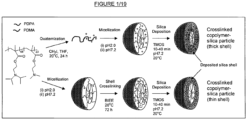
- the general approach to the preparation of the compositions according to the first aspect of the invention is shown in Figure 1 , from which it will be gleaned that the thickness of the deposited silica shell differs according to whether or not the copolymer micelle incorporates crosslinking.
- the degree of quaternisation of the PDMA block can also be an important factor.
- the PDMA shell has significant cationic character due to either protonation and/or quaternisation, so it can act both as a polymeric catalyst and also as a physical scaffold for silica formation.
- Tetramethyl orthosilicate (TMOS) was employed as a silica precursor and biomineralization was conducted in aqueous solution at 20°C at around neutral pH.
- a PDPA 23 -PDMA 68 block copolymer is either partially or fully quaternised by treatment with iodomethane in tetrahydrofuran at 20°C for 24 hours, and non-crosslinked micelles are formed by dissolution at pH 2 and adjustment of the pH to 7.2; finally, silica deposition occurs on treatment of the micelles with tetramethyl orthosilicate for 10-40 minutes at room temperature and pH 7.2, resulting in the formation of silica crosslinked nanoparticles having a relatively thick silica shell when using a relatively large excess of TMOS.
- micelles are formed by dissolution of the PDPA 23 -PDMA 68 block copolymer at pH 2 and adjustment of the pH to 7.2, and the micelles are then shell crosslinked by quaternisation by treatment with 1,2-bis-(2-iodoethoxy)ethane (BIEE) at 20°C for 72 hours; silica deposition is then carried out by treatment of the crosslinked micelles with tetramethyl orthosilicate for 10-40 minutes at room temperature and pH 7.2, resulting in the formation of silica nanoparticles having a relatively thin silica shell when using a relatively large excess of TMOS.
- BIEE 1,2-bis-(2-iodoethoxy)ethane
- the present inventors carried out silica deposition using non-crosslinked micelles prepared directly from the PDPA 23 -PDMA 68 copolymer precursor as templates.
- Dynamic light scattering (DLS) studies indicated an intensity-average diameter of 37 nm at 25°C for these micelle templates.
- the PDMA chains in the micelle shell are approximately 50% protonated, and therefore have appreciable cationic character.
- Silicification of the said micelles was achieved by mixing 2.0 ml of an aqueous micelle solution (0.25 w/v % at pH 7.2) with 1.0 ml tetramethyl orthosilicate, and then stirring the initially heterogeneous solution under ambient conditions for 20 minutes.
- the silica-coated nanoparticles thus obtained were washed with ethanol, then subjected to three centrifugation/redispersion cycles at 16,000 rpm for 5 minutes. Redispersal of the sedimented nanoparticles was subsequently achieved with the aid of an ultrasonic bath.
- TEM Transmission Electron Micrograph
- the formation of templated silica nanoparticles with core-shell structures is clearly observed, since the silica/PDMA hybrid shell is more electron-dense than the PDPA chains within the micelle cores.
- These nanoparticles have a number-average diameter of around 35 nm, which is in reasonably good agreement with the dimensions of the precursor micelles.
- silica formation should occur exclusively on the cationic copolymer micelles, rather than in bulk solution.
- the nanostructure of these copolymer-silica core-shell particles can be simply controlled by tuning the amount of TMOS used for silica deposition.
- TMOS used for silica deposition.
- silica particles with thin shells and large copolymer cores were obtained when using lower levels of TMOS.
- Well-defined silica particles with a number-average diameter of around 26 nm were formed by stirring a mixture of 58 mg TMOS with 2 ml of a 0.25 w/v% solution of 50% quaternised copolymer micelles for 20 minutes.
- thermogravimetric analysis of the product indicated that the mean copolymer content of these core-shell copolymer-silica particles was about 28% by mass, indicating a silica conversion of about 58%. Such particles have much thinner silica shells and larger copolymer cores. Moreover, colloidal stability was maintained even when the reaction time was increased from 20 minutes to 8 hours when using this reduced amount of TMOS (see Figure 12A/12B). The results obtained when increasing the quantity of TMOS in the above synthesis to 116 mg are shown in Figure 9C/9D . Again, there is no evidence for non-templated silica (such as that observed in Figure 2B), indicating efficient templating of these silica nanostructures.
- shell crosslinking is conducted at high dilution (normally less than 0.5 wt.% copolymer micelles) in order to avoid inter-micelle fusion.
- micelle crosslinking by biomimetic silica deposition can be successfully performed at somewhat higher concentrations.
- Figure 11A/11B the mixing of 1 ml of a solution of 1.0 w/v% copolymer micelles (50% quaternised with respect to the PDMA shell) with 116 mg TMOS for 20 minutes produced well-defined hybrid copolymer-silica core-shell particles with a number average diameter of about 26 nm. Similar-sized particles were also obtained using 2.0 w/v% copolymer micelles (see Figure 11C/11D ).
- the present inventors also prepared SCL micelles by selective quaternisation and crosslinking of the PDMA chains using 1,2-bis-(2-iodoethoxy)ethane, and evaluated the resulting cationic micelles as templates for silica deposition.
- the target degree of crosslinking for the PDMA coronal chains was 30 mol%.
- FIG. 3A shows a typical TEM image of the resulting silica nanoparticles.
- Their intensity-average and number-average diameters from DLS and TEM are 35 nm and 32 ⁇ 5 nm (see Figure 8 ), respectively, which are in reasonably good agreement with the values obtained for the SCL micelle precursor.
- their core-shell structure is also clearly evident.
- the silica nanoparticle indicated by the lower white square in Figure 3A has a PDPA core of approximately 14 nm and a silica/PDMA hybrid shell thickness of around 11 nm.
- Silica deposition was also performed at lower levels of TMOS. Thus, on mixing a 2 ml aliquot of a 0.25 w/v% copolymer micelle solution (50% target degree of crosslinking using BIEE) with 58 mg TMOS for 20 minutes, silica deposition led to aggregation, rather than a colloidally stable dispersion.
- TEM studies indicated the formation of core-shell silica particles of about 17 nm, as well as interconnected, fused primary particles (see Figure 10A/10B ). Thermogravimetric analyses (see Table 1) indicated a mean copolymer content of around 30% by mass, indicating a silica conversion of approximately 50%.
- Silica deposition can be also controlled using SCL micelles under initially homogeneous conditions.
- a 2.0 ml aliquot of a 0.25 wt.% SCL micelle solution was added to a mixture of 2.0 ml methanol and 2.0 ml tetramethyl orthosilicate, wherein the methanol acted as a co-solvent and ensured that the TMOS was miscible with the aqueous phase from the beginning of the reaction.
- TEM studies of the obtained product as illustrated in Figure 3C , confirmed the expected formation of well-defined core-shell copolymer-silica nanoparticles. Even after continuing the treatment for 120 minutes, however, no evidence for non-templated silica nanostructures was observed, as shown in Figure 3D .
- the SCL micelle-derived core-shell copolymer-silica nanoparticles shown in Figure 3A were further characterised using thermogravimetric analyses, FT-IR spectroscopy and aqueous electrophoresis.
- Thermogravimetric analyses indicated that the mean copolymer content of the copolymer-silica particles was about 19% by mass, whilst the FT-IR studies, illustrated in Figure 13 , confirmed silica formation, since bands were observed at 1080, 950, 800 and 470 cm -1 for these particles, due to the presence of the inorganic component; these bands were found to be absent in the spectra obtained for the copolymer micelles prior to biomineralisation. After calcination at 800°C, the characteristic bands at 1726 cm -1 , associated with the pyrolysed copolymer, completely disappeared, whilst those bands assigned to the thermally-stable silica were still observed.
- the inventors also attempted the deposition of gold nanoparticles within these hybrid copolymer-silica particles.
- HAuCl 4 was initially used to protonate the weakly basic PDPA chains within the cores of the nanoparticles.
- the AuCl 4 - counter-ions associated with the protonated PDPA chains were reduced in situ to produce zero-valent gold nanoparticles, using NaBH 4 as a reducing agent.
- the colour of the copolymer-silica hybrid nanoparticles changed from white to wine red after the reduction step, indicating the formation of nano-sized gold sols.
- silica also offers particular advantages in terms of the potential applications of the materials of the invention. Thus, since silica is usually considered to be a 'food-grade' material, these new particles have potential applications in food manufacturing.
- the core-shell copolymer-silica nanoparticles of the present invention are somewhat larger than those of the prior art (30 nm vs. 10 nm), and this should allow higher loading capacities.
- the core-shell nature of the hybrid copolymer-silica particles has been clearly illustrated by TEM studies, and these results have been corroborated by small angle x-ray scattering studies (SAXS). The mean wall thicknesses obtained by TEM and SAXS are in good agreement.
- the core-forming PDPA block in the claimed compositions is pH-responsive, and this offers the possibility of pH-triggered release of hydrophobic actives from the cores of the hybrid copolymer-silica nanoparticles.
- This copolymer was designed to self-assemble into colloidal micellar aggregates with PDPA cores, PEO coronas and PDMA inner shells. Since the PDMA block has a pK a of around 7.0, these residues are approximately 50% protonated at pH 7.2. Thus, silica deposition was expected to occur exclusively within the cationic PDMA inner shells, with the coronal PEO blocks imparting steric stabilization. Thus, it is believed that silica deposition can be performed at relatively high copolymer concentrations without inducing particle fusion.
- silica deposition was performed at 1.0% copolymer concentration to produce the anisotropic rod-like copolymer-silica particles, which were easily (re)dispersed by ultrasonication.
- the resulting silica rods were characterized using TEM, thermogravimetric analyses, FT-IR spectroscopy and zeta potential measurements.
- Figure 18 shows a representative TEM image of the silica rods.
- FT-IR studies confirmed silica formation and polymer encapsulation, since bands were observed at 1080, 950, 800 and 470 cm -1 due to the inorganic component, and at 1726 cm -1 due to the carbonyl ester stretch of polymer for these silica rods.
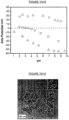
- Thermogravimetric analyses indicated that the mean copolymer content of these hollow silica rods was about 26 % by mass and, as shown in Figure 19 , zeta potential measurements indicated the successful coating of silica onto the copolymer micelles.
- PDPA 23 -PDMA 68 diblock copolymer was synthesised by sequential monomer addition using group transfer polymerisation according to Chem. Commun. 1997, 671-672 .
- Gel permeation chromatography analysis indicated an M n of 18,000 and an M w / M n of 1.08 using a series of near-monodisperse poly(methyl methacrylate) calibration standards.
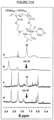
- the mean degrees of polymerisation of the PDPA and PDMA blocks were estimated to be 23 and 68, respectively, using 1 H NMR spectroscopy.
- Silicification of the said micelles was achieved by mixing 2.0 ml of an aqueous micelle solution (0.25 w/v % at pH 7.2) with 1.0 ml tetramethyl orthosilicate, and then stirring the initially heterogeneous solution under ambient conditions for 20 minutes.
- the hybrid core-shell copolymer-silica nanoparticles thus obtained were washed with ethanol, then subjected to three centrifugation/redispersion cycles at 16,000 rpm for 5 minutes. Redispersal of the sedimented core-shell copolymer-silica nanoparticles was subsequently achieved with the aid of an ultrasonic bath.
- PDPA 23 -PDMA 68 diblock copolymer was synthesised by sequential monomer addition using group transfer polymerisation as in Example 1.
- Partial quaternisation of the PDMA block (targeting a degree of quaternisation of either 50% or 100%) using iodomethane was conducted in THF for 24 hours, as described in Macromolecules 2001, 34, 1148-1159 .
- Non-crosslinked micelles prepared using either 50% or 100% quaternised PDPA 23 -PDMA 68 diblock copolymers were also prepared by pH adjustment, as described in Example 1.
- DLS studies conducted at pH 7.2 indicated intensity-average diameters of 29 nm and 26 nm for 0.25 wt.% aqueous solutions of 50% and 100% quaternised copolymer micelles, respectively.
- Tetramethyl orthosilicate (1.0 ml) was added at 20°C to 2.0 ml of a 0.25 wt.% aqueous solution of PDPA 23 -PDMA 68 copolymer micelles in which the PDMA chains were 50% quaternised, and silica deposition was allowed to continue for 20 minutes, with continuous stirring, prior to isolation via centrifugation.
- PDPA 23 -PDMA 68 diblock copolymer was synthesised by sequential monomer addition using group transfer polymerisation, and non-crosslinked micelles of the PDPA 23 -PDMA 68 diblock copolymer were prepared as described in Example 1.
- Shell crosslinking of the coronal PDMA chains was achieved by adding a bifunctional quaternising agent, 1,2-bis-(2-iodoethoxy)ethane (BIEE, 0.15 moles per DMA residue for a target degree of cross-linking of 30%) to a 0.25% PDPA 23 -PDMA 68 copolymer micelle solution at pH 7.2.
- Shell crosslinking was carried out at 25°C for at least 72 hours.
- DLS studies indicated an intensity-average diameter of 32 nm and TEM studies suggested a number-average diameter of 26 nm for the dried SCL micelles.
- DLS studies indicated an intensity-average diameter of 45 nm due to swelling of the SCL micelles.
- Silica deposition was achieved by adding a 2.0 ml aliquot of a 0.25 wt.% SCL micelle solution to a mixture of 2.0 ml methanol and 2.0 ml tetramethyl orthosilicate, wherein the methanol acted as a co-solvent and ensured that the TMOS was miscible with the aqueous phase.
- silica deposition for 40 minutes, TEM studies of the obtained product confirmed the formation of well-defined core-shell copolymer-silica nanoparticles, as illustrated in Figure 3C . Even after continuing the treatment for 120 minutes, however, no evidence for non-templated silica nanostructures was observed, as shown in Figure 3D .
- PEO 45 -PDMA 29 -PDPA 76 triblock copolymer was synthesized by Atom Transfer Radical Polymerisation using a PEO-based macro-initiator by firstly adding the macro-initiator (1.00 g, 0.463 mmol) to a 25 ml one-neck flask, then degassing by three vacuum/nitrogen cycles, followed by the addition of DMA (2.18 g, 13.88 mmol, target DP 30), 2, 2'-bipyridine (144.5 mg, 0.925 mmol) and then 3.2 ml of a degassed 95/5 v/v IPA/water mixture. The solution was placed in a 40°C oil bath and stirred until homogeneous.
- micellar rods formed by the PEO 45 -PDMA 29 -PDPA 76 triblock copolymer were prepared by molecular dissolution at pH 2, followed by adjusting the solution pH to 7.2 using NaOH. The final copolymer concentration was 1.0 wt.%.
- Silica deposition was achieved by adding excess TMOS (0.20 g; i.e. a TMOS:copolymer mass ratio of 20:1) to 1.0 ml of copolymer solution and silicification was then conducted for 20 minutes at 20°C and pH 7.2.
- Silica rods were obtained by washing with ethanol, followed by three centrifugation/redispersion cycles at 13,000 rpm for 15 minutes.
- Precursor micelles Mel(50) Mel(50) Mel(50) BIEE(50) BIEE(50) BIEE(50) Mel(50) Mel(50) Concentrations /wt.
Landscapes
- Chemical & Material Sciences (AREA)
- Organic Chemistry (AREA)
- Health & Medical Sciences (AREA)
- Engineering & Computer Science (AREA)
- Physics & Mathematics (AREA)
- Life Sciences & Earth Sciences (AREA)
- Materials Engineering (AREA)
- Medicinal Chemistry (AREA)
- Chemical Kinetics & Catalysis (AREA)
- Wood Science & Technology (AREA)
- Inorganic Chemistry (AREA)
- Optics & Photonics (AREA)
- General Physics & Mathematics (AREA)
- Polymers & Plastics (AREA)
- Public Health (AREA)
- General Health & Medical Sciences (AREA)
- Animal Behavior & Ethology (AREA)
- Pharmacology & Pharmacy (AREA)
- Veterinary Medicine (AREA)
- Bioinformatics & Cheminformatics (AREA)
- General Chemical & Material Sciences (AREA)
- Epidemiology (AREA)
- Mechanical Engineering (AREA)
- Metallurgy (AREA)
- Thermal Sciences (AREA)
- Nuclear Medicine, Radiotherapy & Molecular Imaging (AREA)
- Nanotechnology (AREA)
- Composite Materials (AREA)
- Geochemistry & Mineralogy (AREA)
- Dispersion Chemistry (AREA)
- Paints Or Removers (AREA)
- Silicon Compounds (AREA)
- Medicinal Preparation (AREA)
- Compositions Of Macromolecular Compounds (AREA)
- Cosmetics (AREA)
- Processes Of Treating Macromolecular Substances (AREA)
- Application Of Or Painting With Fluid Materials (AREA)
- Pigments, Carbon Blacks, Or Wood Stains (AREA)
- Surface Treatment Of Optical Elements (AREA)
- Manufacturing Of Micro-Capsules (AREA)
Applications Claiming Priority (3)
| Application Number | Priority Date | Filing Date | Title |
|---|---|---|---|
| GBGB0617480.9A GB0617480D0 (en) | 2006-09-06 | 2006-09-06 | Novel nanoparticles |
| PCT/EP2007/007729 WO2008028641A2 (en) | 2006-09-06 | 2007-09-05 | Novel nanoparticles |
| EP07802136.7A EP2059558B1 (en) | 2006-09-06 | 2007-09-05 | Novel nanoparticles |
Related Parent Applications (2)
| Application Number | Title | Priority Date | Filing Date |
|---|---|---|---|
| EP07802136.7A Division EP2059558B1 (en) | 2006-09-06 | 2007-09-05 | Novel nanoparticles |
| EP07802136.7A Division-Into EP2059558B1 (en) | 2006-09-06 | 2007-09-05 | Novel nanoparticles |
Publications (2)
| Publication Number | Publication Date |
|---|---|
| EP3395876A1 EP3395876A1 (en) | 2018-10-31 |
| EP3395876B1 true EP3395876B1 (en) | 2024-07-31 |
Family
ID=37232408
Family Applications (4)
| Application Number | Title | Priority Date | Filing Date |
|---|---|---|---|
| EP18174672.8A Active EP3395876B1 (en) | 2006-09-06 | 2007-09-05 | Novel nanoparticles |
| EP07802136.7A Active EP2059558B1 (en) | 2006-09-06 | 2007-09-05 | Novel nanoparticles |
| EP07802135.9A Active EP2059836B1 (en) | 2006-09-06 | 2007-09-05 | Coating composition comprising core-shell nanoparticles |
| EP18213801.6A Active EP3483638B1 (en) | 2006-09-06 | 2007-09-05 | Core-shell nanoparticles |
Family Applications After (3)
| Application Number | Title | Priority Date | Filing Date |
|---|---|---|---|
| EP07802136.7A Active EP2059558B1 (en) | 2006-09-06 | 2007-09-05 | Novel nanoparticles |
| EP07802135.9A Active EP2059836B1 (en) | 2006-09-06 | 2007-09-05 | Coating composition comprising core-shell nanoparticles |
| EP18213801.6A Active EP3483638B1 (en) | 2006-09-06 | 2007-09-05 | Core-shell nanoparticles |
Country Status (15)
| Country | Link |
|---|---|
| US (6) | US20100009001A1 (pl) |
| EP (4) | EP3395876B1 (pl) |
| JP (2) | JP5617241B2 (pl) |
| KR (2) | KR101440165B1 (pl) |
| CN (5) | CN101512387B (pl) |
| AU (2) | AU2007294173B2 (pl) |
| BR (2) | BRPI0716156A8 (pl) |
| CA (2) | CA2661930C (pl) |
| ES (1) | ES2903558T3 (pl) |
| GB (1) | GB0617480D0 (pl) |
| HK (1) | HK1221993A1 (pl) |
| PL (4) | PL2059558T4 (pl) |
| TR (1) | TR201901022T4 (pl) |
| TW (2) | TWI417330B (pl) |
| WO (2) | WO2008028641A2 (pl) |
Families Citing this family (81)
| Publication number | Priority date | Publication date | Assignee | Title |
|---|---|---|---|---|
| GB0617480D0 (en) | 2006-09-06 | 2006-10-18 | Univ Sheffield | Novel nanoparticles |
| KR20100108553A (ko) * | 2007-12-14 | 2010-10-07 | 디에스엠 아이피 어셋츠 비.브이. | 캡슐화된 촉매에 의한 졸-겔 방법 |
| JP5291971B2 (ja) * | 2008-04-08 | 2013-09-18 | 花王株式会社 | メソポーラスシリカ粒子の製造方法 |
| FR2936722B1 (fr) * | 2008-10-07 | 2013-11-22 | Nanolege Inc | Materiaux nanocomposites et procede de fabrication par nanoprecipitation. |
| CA2740551C (en) * | 2008-10-14 | 2016-08-02 | Dsm Ip Assets B.V. | Stain resistant particles |
| JP4793456B2 (ja) * | 2009-02-20 | 2011-10-12 | トヨタ自動車株式会社 | 熱伝導性絶縁樹脂成形体 |
| CA2750676C (en) * | 2009-03-06 | 2018-05-01 | Dsm Ip Assets B.V. | Slot die coating process |
| CN102378792A (zh) * | 2009-03-31 | 2012-03-14 | 3M创新有限公司 | 涂料组合物及其制备和使用方法 |
| CN101885905B (zh) * | 2009-05-12 | 2013-08-21 | 无锡纳奥新材料科技有限公司 | 聚合物/无机纳米粒子复合纳米颗粒及其制备和用途 |
| US8013065B2 (en) * | 2009-06-09 | 2011-09-06 | International Business Machines Corporation | Methods for making multi-branched polymers |
| BR112012011640A2 (pt) * | 2009-11-18 | 2016-06-28 | 3M Innovative Properties Co | métodos para fornecer um revestimento para um substrato e artigo de construção |
| US8470891B2 (en) * | 2009-12-23 | 2013-06-25 | International Business Machines Corporation | Biodegradable block polymers for drug delivery, and methods related thereto |
| US8361495B2 (en) | 2009-12-23 | 2013-01-29 | International Business Machines Corporation | Antimicrobial polymers and methods of manufacture thereof |
| US20110151566A1 (en) * | 2009-12-23 | 2011-06-23 | James Hedrick | Biodegradable polymers, complexes thereof for gene therapeutics and drug delivery, and methods related thereto |
| US8226985B2 (en) * | 2010-01-28 | 2012-07-24 | International Business Machines Corporation | Surface modified nanoparticles, methods of their preparation, and uses thereof for gene and drug delivery |
| US8765098B2 (en) | 2010-03-30 | 2014-07-01 | International Business Machines Corporation | Star polymers, methods of preparation thereof, and uses thereof |
| CN101891867B (zh) * | 2010-04-30 | 2012-09-19 | 中国科学院长春应用化学研究所 | 一种核-壳结构的SiO2@PDMAEMA纳米粒子的制备方法 |
| ES2538660T3 (es) * | 2010-06-18 | 2015-06-23 | Dsm Ip Assets B.V. | Revestimiento de óxido inorgánico |
| JP5579512B2 (ja) * | 2010-06-24 | 2014-08-27 | 電気化学工業株式会社 | 複合粒子およびその製造方法 |
| EP2431423A3 (en) | 2010-09-21 | 2013-07-10 | Rohm and Haas Company | Anti-reflective coatings |
| EP2431422A3 (en) | 2010-09-21 | 2013-07-10 | Rohm and Haas Company | IR - reflecting compositions |
| EP2431424A3 (en) | 2010-09-21 | 2014-03-05 | Rohm and Haas Company | UV - reflecting compositions |
| US20130220402A1 (en) * | 2010-10-06 | 2013-08-29 | 3M Innovative Properties Company | Coatings for optical components of solar energy systems |
| US20130213454A1 (en) * | 2010-10-06 | 2013-08-22 | Katherine A. Brown | Coatings for optical components of solar energy systems |
| WO2012045204A1 (en) * | 2010-10-06 | 2012-04-12 | 3M Innovative Properties Company | Coating composition and method of making and using the same |
| KR101311920B1 (ko) * | 2010-12-21 | 2013-09-26 | 한국생명공학연구원 | 란타나이드 금속착체를 이용한 형광 나노입자 및 그 제조방법 |
| JP5353916B2 (ja) * | 2011-02-01 | 2013-11-27 | トヨタ自動車株式会社 | 絶縁樹脂材料の製造方法 |
| WO2012107392A1 (en) | 2011-02-11 | 2012-08-16 | Dsm Ip Assets B.V. | Process for depositing an anti-reflective layer on a substrate |
| US8945513B2 (en) | 2011-03-18 | 2015-02-03 | International Business Machines Corporation | Star polymer nanoshells and methods of preparation thereof |
| CN103826617B (zh) * | 2011-09-29 | 2016-05-18 | 光谱系统公司 | 用于药物片剂及可摄取材料的可验证涂层 |
| US20130148205A1 (en) * | 2011-12-12 | 2013-06-13 | Canon Kabushiki Kaisha | Method of producing antireflection film |
| IN2014DN08764A (pl) * | 2012-05-22 | 2015-05-22 | Dsm Ip Assets Bv | |
| US9868130B2 (en) | 2012-08-09 | 2018-01-16 | Dsm Ip Assets B.V. | Roll coating process and apparatus |
| CN102827379B (zh) * | 2012-08-16 | 2014-04-02 | 华南理工大学 | 一种可再分散乳胶粉及其制备方法 |
| JP5617891B2 (ja) * | 2012-10-10 | 2014-11-05 | Dic株式会社 | コア−シェル型シリカナノ粒子及びその製造方法 |
| JP2016001199A (ja) * | 2012-10-15 | 2016-01-07 | 旭硝子株式会社 | シリカ系多孔質膜、シリカ系多孔質膜付き物品およびその製造方法 |
| HK1216240A1 (zh) | 2012-11-14 | 2016-10-28 | W. R. Grace & Co.-Conn. | 含有生物活性材料与无序无机氧化物的组合物 |
| JP6085035B2 (ja) * | 2012-11-16 | 2017-02-22 | エスエヌユー アールアンドディービー ファウンデーションSnu R&Db Foundation | コード化された高分子微粒子 |
| US20140170786A1 (en) | 2012-12-13 | 2014-06-19 | Juanita N. Kurtin | Ceramic composition having dispersion of nano-particles therein and methods of fabricating same |
| KR101604894B1 (ko) * | 2012-12-27 | 2016-03-18 | 주식회사 엘지화학 | 담체에 담지된 중공 금속 나노입자의 제조방법 |
| JP6206963B2 (ja) * | 2013-03-12 | 2017-10-04 | 国立大学法人 千葉大学 | 有機−無機ハイブリッド粒子の製造方法及び無機中空粒子の製造方法 |
| CH707947A1 (de) * | 2013-04-24 | 2014-10-31 | Timbatec Holzbauingenieure Schweiz Ag | Bauteil, Verfahren zur Verbindung von Holzelementen, Computerprogramm. |
| ES2959939T3 (es) * | 2013-11-22 | 2024-02-29 | Covestro Netherlands Bv | Procedimiento de fabricación de una composición de recubrimiento antirreflectante y de un recubrimiento poroso fabricado a partir de la misma |
| WO2016001280A1 (en) | 2014-07-04 | 2016-01-07 | Dsm Ip Assets B.V. | Co-extruded backsheet for solar cell modules |
| EP2977361A1 (en) * | 2014-07-21 | 2016-01-27 | DPX Holdings B.V. | Marking of substrates |
| CN105524551B (zh) * | 2014-09-29 | 2018-05-15 | 旭化成株式会社 | 光学涂膜、光学涂膜的制造方法以及防反射膜 |
| EP3209620A2 (en) * | 2014-10-21 | 2017-08-30 | DSM IP Assets B.V. | Method of coating substrate |
| EP3124112A1 (en) | 2015-07-30 | 2017-02-01 | DWI - Leibniz-Institut für Interaktive Materialien e.V. | Method for the encapsulation of substances in silica-based capsules and the products obtained thereof |
| ES2908479T3 (es) | 2015-08-26 | 2022-04-29 | Achillion Pharmaceuticals Inc | Compuestos para el tratamiento de trastornos inmunitarios e inflamatorios |
| AR106018A1 (es) | 2015-08-26 | 2017-12-06 | Achillion Pharmaceuticals Inc | Compuestos de arilo, heteroarilo y heterocíclicos para el tratamiento de trastornos médicos |
| CN105330168A (zh) * | 2015-10-19 | 2016-02-17 | 北京莱诺泰克科技有限公司 | 减反射镀膜液及其制备方法与应用 |
| TW201740096A (zh) | 2015-12-11 | 2017-11-16 | 帝斯曼知識產權資產管理有限公司 | 用於在透明片上的光學測量之系統及方法 |
| US10787582B2 (en) | 2015-12-25 | 2020-09-29 | 3M Innovative Properties Company | Composition, method of making composition, and article |
| US10793746B2 (en) | 2015-12-25 | 2020-10-06 | 3M Innovative Properties Company | Coating composition comprising silica-polymer core-shell particles, method of making composition and article |
| EP3211122A1 (en) | 2016-02-23 | 2017-08-30 | Fraunhofer-Gesellschaft zur Förderung der angewandten Forschung e.V. | A method of sintering, crystallizing and/or crosslinking of a coating material on a substrate |
| CN108027452B (zh) | 2016-03-09 | 2020-05-26 | 株式会社Lg化学 | 减反射膜 |
| KR101816093B1 (ko) | 2016-05-09 | 2018-01-08 | (주)디엔에프 | 반사방지용 코팅 조성물 |
| ES2902006T3 (es) | 2016-06-27 | 2022-03-24 | Achillion Pharmaceuticals Inc | Quinazolina y compuestos indol para tratar trastornos médicos |
| JP6967256B2 (ja) * | 2016-08-31 | 2021-11-17 | 国立大学法人 名古屋工業大学 | ナノシリカ中空粒子の製造方法 |
| CN106430222B (zh) * | 2016-09-29 | 2018-12-11 | 宁波特粒科技有限公司 | 一种纳米二氧化硅微球及其制备方法 |
| CN106543462A (zh) * | 2016-10-17 | 2017-03-29 | 华南理工大学 | 一种以环氧树脂为模板的核壳纳米粒子及其制备方法与应用 |
| CN110177553A (zh) | 2016-11-17 | 2019-08-27 | 北卡罗来纳大学教堂山分校 | 烷基吡咯并嘧啶类似物及其制备和使用方法 |
| EP3589628B1 (en) | 2017-03-01 | 2025-05-07 | Achillion Pharmaceuticals, Inc. | Aryl, heteroaryl, and heterocyclic pharmaceutical compounds for treatment of medical disorders |
| JP7276775B2 (ja) | 2017-04-18 | 2023-05-18 | コベストロ (ネザーランズ) ビー.ブイ. | コーティング及びコーティング配合物 |
| CN109133663A (zh) * | 2017-06-15 | 2019-01-04 | 阿特斯阳光电力集团有限公司 | 抗反射玻璃的制备方法及光伏组件 |
| JP7317004B2 (ja) * | 2018-04-27 | 2023-07-28 | キヤノン株式会社 | 粒子、及びその製造方法 |
| WO2019243623A1 (en) * | 2018-06-21 | 2019-12-26 | University College Cork - National University Of Ireland, Cork | A coating composition comprising integrated functionality |
| KR102142457B1 (ko) * | 2018-07-20 | 2020-08-10 | 엘지전자 주식회사 | 유무기 하이브리드 입자 및 그 제조 방법 |
| JP7538113B2 (ja) | 2018-08-20 | 2024-08-21 | アキリオン ファーマシューティカルズ,インコーポレーテッド | 補体d因子の医学的障害の治療のための医薬化合物 |
| JP7504088B2 (ja) | 2018-10-16 | 2024-06-21 | ジョージア ステイト ユニバーシティー リサーチ ファウンデーション インコーポレイテッド | 医学的障害の治療のための一酸化炭素プロドラッグ |
| CN109535315B (zh) * | 2018-11-29 | 2020-06-09 | 江南大学 | 一种具有自修复及防腐蚀功能的复合壳材微胶囊及其制备方法 |
| WO2020212526A1 (en) * | 2019-04-17 | 2020-10-22 | Adolphe Merkle Institute, University Of Fribourg | Method of production of controlled release silica nanoparticles for plant growth and/or defense enhancement |
| EP4058441A4 (en) | 2019-11-15 | 2023-12-20 | The University of North Carolina at Chapel Hill | Aryl aminopyrimidines as dual mertk and tyro3 inhibitors and methods thereof |
| JP7509396B2 (ja) * | 2019-11-26 | 2024-07-02 | 国立大学法人大阪大学 | pH応答性液晶混合物及びpH応答性液晶カプセル |
| WO2021168320A1 (en) | 2020-02-20 | 2021-08-26 | Achillion Pharmaceuticals, Inc. | Heteroaryl compounds for treatment of complement factor d mediated disorders |
| US20250171423A1 (en) | 2020-09-23 | 2025-05-29 | Achillion Pharmaceuticals, Inc. | Pharmaceutical compounds for the treatment of complement mediated disorders |
| US20230286047A1 (en) * | 2022-03-08 | 2023-09-14 | Northwestern University | Polymer-mediated particle coarsening within hollow silica shell nanoreactors |
| CN115746346B (zh) * | 2022-11-17 | 2025-09-26 | 复旦大学 | 具有高界面活性的混合壳型聚合物纳米粒子及其制备方法与应用 |
| US20250075087A1 (en) * | 2023-09-06 | 2025-03-06 | Saudi Arabian Oil Company | Multi-layer multi-functional smart coating |
| EP4528828A1 (en) | 2023-09-25 | 2025-03-26 | MEGA P&C Advanced Materials (Shanghai) Company Limited | Solar module with enhanced solar cell performance |
| WO2025077898A1 (en) * | 2023-10-13 | 2025-04-17 | The Chinese University Of Hong Kong | A therapeutic nucleic acid-encased nanoworm for gene delivery and endosomal escape |
Family Cites Families (47)
| Publication number | Priority date | Publication date | Assignee | Title |
|---|---|---|---|---|
| US2432484A (en) | 1943-03-12 | 1947-12-09 | American Optical Corp | Reflection reducing coating having a gradually increasing index of refraction |
| US4450498A (en) * | 1982-09-15 | 1984-05-22 | Coral Industrial Sales Co. | Electrically grounded, static absorbing drapery installation |
| US4540498A (en) * | 1983-05-31 | 1985-09-10 | The Standard Oil Company | Block copolymers for enhanced oil recovery |
| US4965091A (en) | 1987-10-01 | 1990-10-23 | At&T Bell Laboratories | Sol gel method for forming thin luminescent films |
| JPH0374440A (ja) * | 1989-08-16 | 1991-03-29 | Asahi Chem Ind Co Ltd | カチオン性中空重合体粒子、その製造方法及び該粒子を用いた充填紙 |
| US5100471A (en) * | 1990-06-27 | 1992-03-31 | Xerox Corporation | Liquid ink compositions |
| US5570120A (en) * | 1993-07-16 | 1996-10-29 | Canon Kabushiki Kaisha | Ink-jet recording method and color image forming method |
| US7109968B2 (en) | 1995-07-20 | 2006-09-19 | E Ink Corporation | Non-spherical cavity electrophoretic displays and methods and materials for making the same |
| JPH10182841A (ja) * | 1996-11-01 | 1998-07-07 | Mitsubishi Rayon Co Ltd | 複合体、その製法、及び複合体を含有する成形品 |
| JPH10282306A (ja) * | 1997-04-03 | 1998-10-23 | Fuji Photo Film Co Ltd | 反射防止膜およびそれを配置した表示装置 |
| US6132039A (en) * | 1997-05-12 | 2000-10-17 | General Company Limited | Ink acceptor and recording method using the same |
| FR2774994B1 (fr) * | 1998-02-13 | 2000-05-05 | Rhodia Chimie Sa | Particules composites comprenant un coeur a base d'un polymere organique contenant une matiere active et un revetement externe a base d'au moins un oxyde et/ou un hydroxyde, leur procede de preparation et leurs utilisations |
| JP2003522621A (ja) * | 1998-03-19 | 2003-07-29 | マックス−プランク−ゲゼルシャフト・ツア・フェルデルング・デア・ヴィッセンシャフテン・エー・ファオ | 分解性コロイド原型上のナノ複合多層の静電的自己集成体による多層被覆粒子及び中空シェルの製造 |
| JP4576035B2 (ja) * | 2000-09-26 | 2010-11-04 | 株式会社松風 | 歯科用表面改質有機複合フィラー |
| WO2001042155A1 (fr) | 1999-12-13 | 2001-06-14 | Nippon Sheet Glass Co., Ltd. | Article en verre a faible reflexion |
| US6624272B2 (en) * | 1999-12-20 | 2003-09-23 | Jsr Corporation | Hollow crosslinked cationic polymer particles, method of producing said particles, and paint composition, cationic electrodeposition paint composition, resin composition, filled paper, paper coating composition, and coated paper |
| JP2001247820A (ja) * | 1999-12-27 | 2001-09-14 | Jsr Corp | 塗料組成物 |
| JP4918743B2 (ja) | 2001-02-16 | 2012-04-18 | 凸版印刷株式会社 | 反射防止フィルム |
| US20040135126A1 (en) * | 2001-06-26 | 2004-07-15 | Schwark Dwight W. | Coating composition containing polythiophene and solvent mixture |
| EP1480619B1 (en) * | 2002-03-07 | 2013-08-07 | Biocompatibles UK Limited | Drug carriers comprising amphiphilic block copolymers |
| AU2003302222A1 (en) * | 2002-07-22 | 2004-06-30 | Massachusetts Institute Of Technolgoy | Porous material formation by chemical vapor deposition onto colloidal crystal templates |
| JP4069369B2 (ja) | 2002-09-25 | 2008-04-02 | 信越化学工業株式会社 | 反射防止膜及び反射防止膜の製造方法 |
| WO2004070436A1 (ja) | 2003-02-06 | 2004-08-19 | Sdc Technologies-Asia Ltd. | 低反射処理物品の製造方法、低反射層形成用溶液および低反射処理物品 |
| WO2004085493A1 (ja) * | 2003-03-25 | 2004-10-07 | Sekisui Plastics Co., Ltd. | シリカ被覆重合体粒子、その製造方法及びその用途 |
| JP2004300172A (ja) * | 2003-03-28 | 2004-10-28 | Dainippon Printing Co Ltd | コーティング組成物、その塗膜、反射防止膜、反射防止フィルム、及び、画像表示装置 |
| CN100523815C (zh) * | 2003-04-16 | 2009-08-05 | 积水化学工业株式会社 | 内含磁性体的粒子及其制造方法、免疫测定用粒子以及免疫测定方法 |
| GB2403920A (en) | 2003-04-30 | 2005-01-19 | Univ Sussex | Particulate emulsifiers |
| JP3772217B2 (ja) | 2003-07-07 | 2006-05-10 | 独立行政法人物質・材料研究機構 | 多孔質酸化物超薄膜および該超薄膜をシェル、ポリマーをコアとするコア・シェル粒子と該コア・シェル粒子から誘導されてなる多孔質中空酸化物シェル構造体およびこれらの製造方法 |
| KR101237822B1 (ko) | 2003-08-28 | 2013-02-28 | 니끼 쇼꾸바이 카세이 가부시키가이샤 | 반사 방지 적층체 |
| JP5183066B2 (ja) | 2003-11-21 | 2013-04-17 | ブリスマット インコーポレイテッド | シリカ膜およびその製造方法 |
| KR101074948B1 (ko) * | 2003-12-17 | 2011-10-18 | 가부시키가이샤 브리지스톤 | 반사 방지 필름, 전자파 실드성 광 투과창재, 가스 방전형발광 패널, 플랫 디스플레이 패널, 진열창재 및 태양 전지모듈 |
| JP2005181543A (ja) | 2003-12-17 | 2005-07-07 | Bridgestone Corp | 反射防止フィルム |
| US20090135356A1 (en) | 2004-09-13 | 2009-05-28 | Fujifilm Corporation | Anti-reflection film, polarizing plate, and liquid crystal display device |
| CN101052685B (zh) | 2004-09-22 | 2011-05-04 | 富士胶片株式会社 | 固化组合物、抗反射薄膜及其生产方法、偏振片以及图像显示装置 |
| US7713613B2 (en) * | 2004-10-01 | 2010-05-11 | Dai Nippon Printing Co., Ltd. | Composition for antistatic layer |
| JP2006113175A (ja) * | 2004-10-13 | 2006-04-27 | Konica Minolta Opto Inc | 光学フィルム、偏光板及び表示装置 |
| JP2006126737A (ja) * | 2004-11-01 | 2006-05-18 | Sekisui Chem Co Ltd | 拡散反射板用コーティング剤及び拡散反射板 |
| CN1257922C (zh) | 2004-11-11 | 2006-05-31 | 复旦大学 | 草莓型有机-无机纳米复合微球的制备方法 |
| US7373073B2 (en) * | 2004-12-07 | 2008-05-13 | Ulrich Kamp | Photonic colloidal crystal columns and their inverse structures for chromatography |
| JP2006178041A (ja) * | 2004-12-21 | 2006-07-06 | Asahi Kasei Corp | 反射防止拡散板 |
| EP1674891A1 (en) * | 2004-12-23 | 2006-06-28 | DSM IP Assets B.V. | Antireflection coating, process for its preparation and articles comprising same |
| CN100468083C (zh) * | 2005-02-16 | 2009-03-11 | 柯尼卡美能达精密光学株式会社 | 防反射膜、防反射膜的制法、偏振片及显示装置 |
| JP5057199B2 (ja) | 2005-06-02 | 2012-10-24 | 旭硝子株式会社 | 中空状SiO2微粒子分散液の製造方法、塗料組成物及び反射防止塗膜付き基材 |
| CN1331919C (zh) * | 2005-12-01 | 2007-08-15 | 上海交通大学 | 一种聚苯乙烯/二氧化锡核壳微球的制备方法 |
| CN100503448C (zh) * | 2006-05-23 | 2009-06-24 | 中国科学院理化技术研究所 | 水相一步合成锐钛矿型晶化二氧化钛纳米核壳或空壳结构材料的方法 |
| GB0617480D0 (en) | 2006-09-06 | 2006-10-18 | Univ Sheffield | Novel nanoparticles |
| CN101391199A (zh) | 2007-09-21 | 2009-03-25 | 中国科学院化学研究所 | 多腔复合微/纳米胶囊及其制备方法和装置 |
-
2006
- 2006-09-06 GB GBGB0617480.9A patent/GB0617480D0/en not_active Ceased
-
2007
- 2007-09-05 US US12/438,591 patent/US20100009001A1/en not_active Abandoned
- 2007-09-05 KR KR1020097006870A patent/KR101440165B1/ko active Active
- 2007-09-05 PL PL07802136T patent/PL2059558T4/pl unknown
- 2007-09-05 US US12/438,596 patent/US9855219B2/en active Active
- 2007-09-05 PL PL18213801T patent/PL3483638T3/pl unknown
- 2007-09-05 JP JP2009527050A patent/JP5617241B2/ja active Active
- 2007-09-05 WO PCT/EP2007/007729 patent/WO2008028641A2/en not_active Ceased
- 2007-09-05 WO PCT/EP2007/007728 patent/WO2008028640A2/en not_active Ceased
- 2007-09-05 CA CA2661930A patent/CA2661930C/en not_active Expired - Fee Related
- 2007-09-05 AU AU2007294173A patent/AU2007294173B2/en not_active Ceased
- 2007-09-05 EP EP18174672.8A patent/EP3395876B1/en active Active
- 2007-09-05 PL PL18174672.8T patent/PL3395876T3/pl unknown
- 2007-09-05 CA CA2662221A patent/CA2662221C/en not_active Expired - Fee Related
- 2007-09-05 ES ES18213801T patent/ES2903558T3/es active Active
- 2007-09-05 JP JP2009527049A patent/JP5266549B2/ja active Active
- 2007-09-05 CN CN2007800331182A patent/CN101512387B/zh not_active Expired - Fee Related
- 2007-09-05 CN CN201610154455.8A patent/CN105652349B/zh active Active
- 2007-09-05 KR KR1020097007025A patent/KR101378645B1/ko active Active
- 2007-09-05 TR TR2019/01022T patent/TR201901022T4/en unknown
- 2007-09-05 EP EP07802136.7A patent/EP2059558B1/en active Active
- 2007-09-05 CN CN201610301487.6A patent/CN105969022B/zh active Active
- 2007-09-05 BR BRPI0716156A patent/BRPI0716156A8/pt not_active Application Discontinuation
- 2007-09-05 PL PL07802135T patent/PL2059836T3/pl unknown
- 2007-09-05 CN CN201310308983.0A patent/CN103487849A/zh active Pending
- 2007-09-05 AU AU2007294172A patent/AU2007294172B2/en not_active Ceased
- 2007-09-05 EP EP07802135.9A patent/EP2059836B1/en active Active
- 2007-09-05 BR BRPI0716154-9A2A patent/BRPI0716154A2/pt not_active Application Discontinuation
- 2007-09-05 EP EP18213801.6A patent/EP3483638B1/en active Active
- 2007-09-05 CN CN2007800331286A patent/CN101611084B/zh active Active
- 2007-09-06 TW TW096133242A patent/TWI417330B/zh active
- 2007-09-06 TW TW096133251A patent/TWI424015B/zh active
-
2012
- 2012-01-31 US US13/363,114 patent/US8580311B2/en active Active
-
2013
- 2013-10-11 US US14/052,283 patent/US9220689B2/en active Active
-
2016
- 2016-08-24 HK HK16110084.8A patent/HK1221993A1/zh unknown
-
2017
- 2017-11-29 US US15/826,487 patent/US20180078509A1/en not_active Abandoned
-
2020
- 2020-04-08 US US16/842,831 patent/US20200230069A1/en not_active Abandoned
Non-Patent Citations (2)
| Title |
|---|
| AGNIESZKA DUDKIEWICZ ET AL: "A uniform measurement expression for cross method comparison of nanoparticle aggregate size distributions", ANALYST, vol. 140, no. 15, 1 January 2015 (2015-01-01), UK, pages 5257 - 5267, XP055351095, ISSN: 0003-2654, DOI: 10.1039/C5AN00561B * |
| T. A. EGERTON ET AL: "Physical characterization of titanium dioxide nanoparticles", INTERNATIONAL JOURNAL OF COSMETIC SCIENCE., vol. 36, no. 3, 1 June 2014 (2014-06-01), NL, pages 195 - 206, XP055351101, ISSN: 0142-5463, DOI: 10.1111/ics.12113 * |
Also Published As
Similar Documents
| Publication | Publication Date | Title |
|---|---|---|
| EP3395876B1 (en) | Novel nanoparticles | |
| JP5621950B2 (ja) | 有機無機複合シリカナノ粒子及びそれを有する分散液、並びにそれらの製造方法 | |
| Du et al. | Preparation of primary amine-based block copolymer vesicles by direct dissolution in water and subsequent stabilization by sol− gel chemistry | |
| Fu et al. | Facile morphology control during rapid fabrication of nanosized organosilica particles | |
| Park et al. | Thermoresponsive hollow polymeric shell nano/microparticles with interconnected nanoholes |
Legal Events
| Date | Code | Title | Description |
|---|---|---|---|
| PUAI | Public reference made under article 153(3) epc to a published international application that has entered the european phase |
Free format text: ORIGINAL CODE: 0009012 |
|
| STAA | Information on the status of an ep patent application or granted ep patent |
Free format text: STATUS: THE APPLICATION HAS BEEN PUBLISHED |
|
| AC | Divisional application: reference to earlier application |
Ref document number: 2059558 Country of ref document: EP Kind code of ref document: P |
|
| AK | Designated contracting states |
Kind code of ref document: A1 Designated state(s): AT BE BG CH CY CZ DE DK EE ES FI FR GB GR HU IE IS IT LI LT LU LV MC MT NL PL PT RO SE SI SK TR |
|
| STAA | Information on the status of an ep patent application or granted ep patent |
Free format text: STATUS: REQUEST FOR EXAMINATION WAS MADE |
|
| 17P | Request for examination filed |
Effective date: 20190430 |
|
| RBV | Designated contracting states (corrected) |
Designated state(s): AT BE BG CH CY CZ DE DK EE ES FI FR GB GR HU IE IS IT LI LT LU LV MC MT NL PL PT RO SE SI SK TR |
|
| STAA | Information on the status of an ep patent application or granted ep patent |
Free format text: STATUS: EXAMINATION IS IN PROGRESS |
|
| 17Q | First examination report despatched |
Effective date: 20190918 |
|
| RAP1 | Party data changed (applicant data changed or rights of an application transferred) |
Owner name: COVESTRO (NETHERLANDS) B.V. |
|
| RAP3 | Party data changed (applicant data changed or rights of an application transferred) |
Owner name: COVESTRO (NETHERLANDS) B.V. |
|
| REG | Reference to a national code |
Ref country code: DE Ref legal event code: R079 Ref document number: 602007061900 Country of ref document: DE Free format text: PREVIOUS MAIN CLASS: C08K0009100000 Ipc: G02B0001111000 Ref country code: DE Ref legal event code: R079 Free format text: PREVIOUS MAIN CLASS: C08K0009100000 Ipc: G02B0001111000 |
|
| GRAP | Despatch of communication of intention to grant a patent |
Free format text: ORIGINAL CODE: EPIDOSNIGR1 |
|
| STAA | Information on the status of an ep patent application or granted ep patent |
Free format text: STATUS: GRANT OF PATENT IS INTENDED |
|
| RIC1 | Information provided on ipc code assigned before grant |
Ipc: C08K 3/36 20060101ALI20240207BHEP Ipc: C09D 7/65 20180101ALI20240207BHEP Ipc: C09D 7/61 20180101ALI20240207BHEP Ipc: A61P 43/00 20060101ALI20240207BHEP Ipc: C08L 53/00 20060101ALI20240207BHEP Ipc: C08K 9/12 20060101ALI20240207BHEP Ipc: C09D 7/40 20180101ALI20240207BHEP Ipc: G02B 1/111 20150101AFI20240207BHEP |
|
| INTG | Intention to grant announced |
Effective date: 20240221 |
|
| GRAS | Grant fee paid |
Free format text: ORIGINAL CODE: EPIDOSNIGR3 |
|
| GRAA | (expected) grant |
Free format text: ORIGINAL CODE: 0009210 |
|
| STAA | Information on the status of an ep patent application or granted ep patent |
Free format text: STATUS: THE PATENT HAS BEEN GRANTED |
|
| AC | Divisional application: reference to earlier application |
Ref document number: 2059558 Country of ref document: EP Kind code of ref document: P |
|
| AK | Designated contracting states |
Kind code of ref document: B1 Designated state(s): AT BE BG CH CY CZ DE DK EE ES FI FR GB GR HU IE IS IT LI LT LU LV MC MT NL PL PT RO SE SI SK TR |
|
| REG | Reference to a national code |
Ref country code: CH Ref legal event code: EP Ref country code: GB Ref legal event code: FG4D |
|
| REG | Reference to a national code |
Ref country code: DE Ref legal event code: R096 Ref document number: 602007061900 Country of ref document: DE |
|
| REG | Reference to a national code |
Ref country code: IE Ref legal event code: FG4D |
|
| REG | Reference to a national code |
Ref country code: NL Ref legal event code: FP |
|
| REG | Reference to a national code |
Ref country code: LT Ref legal event code: MG9D |
|
| PG25 | Lapsed in a contracting state [announced via postgrant information from national office to epo] |
Ref country code: PT Free format text: LAPSE BECAUSE OF FAILURE TO SUBMIT A TRANSLATION OF THE DESCRIPTION OR TO PAY THE FEE WITHIN THE PRESCRIBED TIME-LIMIT Effective date: 20241202 |
|
| REG | Reference to a national code |
Ref country code: AT Ref legal event code: MK05 Ref document number: 1708994 Country of ref document: AT Kind code of ref document: T Effective date: 20240731 |
|
| PG25 | Lapsed in a contracting state [announced via postgrant information from national office to epo] |
Ref country code: PT Free format text: LAPSE BECAUSE OF FAILURE TO SUBMIT A TRANSLATION OF THE DESCRIPTION OR TO PAY THE FEE WITHIN THE PRESCRIBED TIME-LIMIT Effective date: 20241202 |
|
| PG25 | Lapsed in a contracting state [announced via postgrant information from national office to epo] |
Ref country code: FI Free format text: LAPSE BECAUSE OF FAILURE TO SUBMIT A TRANSLATION OF THE DESCRIPTION OR TO PAY THE FEE WITHIN THE PRESCRIBED TIME-LIMIT Effective date: 20240731 Ref country code: GR Free format text: LAPSE BECAUSE OF FAILURE TO SUBMIT A TRANSLATION OF THE DESCRIPTION OR TO PAY THE FEE WITHIN THE PRESCRIBED TIME-LIMIT Effective date: 20241101 |
|
| PG25 | Lapsed in a contracting state [announced via postgrant information from national office to epo] |
Ref country code: BG Free format text: LAPSE BECAUSE OF FAILURE TO SUBMIT A TRANSLATION OF THE DESCRIPTION OR TO PAY THE FEE WITHIN THE PRESCRIBED TIME-LIMIT Effective date: 20240731 |
|
| PG25 | Lapsed in a contracting state [announced via postgrant information from national office to epo] |
Ref country code: LV Free format text: LAPSE BECAUSE OF FAILURE TO SUBMIT A TRANSLATION OF THE DESCRIPTION OR TO PAY THE FEE WITHIN THE PRESCRIBED TIME-LIMIT Effective date: 20240731 |
|
| PG25 | Lapsed in a contracting state [announced via postgrant information from national office to epo] |
Ref country code: IS Free format text: LAPSE BECAUSE OF FAILURE TO SUBMIT A TRANSLATION OF THE DESCRIPTION OR TO PAY THE FEE WITHIN THE PRESCRIBED TIME-LIMIT Effective date: 20241130 Ref country code: AT Free format text: LAPSE BECAUSE OF FAILURE TO SUBMIT A TRANSLATION OF THE DESCRIPTION OR TO PAY THE FEE WITHIN THE PRESCRIBED TIME-LIMIT Effective date: 20240731 |
|
| PG25 | Lapsed in a contracting state [announced via postgrant information from national office to epo] |
Ref country code: ES Free format text: LAPSE BECAUSE OF FAILURE TO SUBMIT A TRANSLATION OF THE DESCRIPTION OR TO PAY THE FEE WITHIN THE PRESCRIBED TIME-LIMIT Effective date: 20240731 |
|
| PG25 | Lapsed in a contracting state [announced via postgrant information from national office to epo] |
Ref country code: LV Free format text: LAPSE BECAUSE OF FAILURE TO SUBMIT A TRANSLATION OF THE DESCRIPTION OR TO PAY THE FEE WITHIN THE PRESCRIBED TIME-LIMIT Effective date: 20240731 Ref country code: IS Free format text: LAPSE BECAUSE OF FAILURE TO SUBMIT A TRANSLATION OF THE DESCRIPTION OR TO PAY THE FEE WITHIN THE PRESCRIBED TIME-LIMIT Effective date: 20241130 Ref country code: GR Free format text: LAPSE BECAUSE OF FAILURE TO SUBMIT A TRANSLATION OF THE DESCRIPTION OR TO PAY THE FEE WITHIN THE PRESCRIBED TIME-LIMIT Effective date: 20241101 Ref country code: FI Free format text: LAPSE BECAUSE OF FAILURE TO SUBMIT A TRANSLATION OF THE DESCRIPTION OR TO PAY THE FEE WITHIN THE PRESCRIBED TIME-LIMIT Effective date: 20240731 Ref country code: ES Free format text: LAPSE BECAUSE OF FAILURE TO SUBMIT A TRANSLATION OF THE DESCRIPTION OR TO PAY THE FEE WITHIN THE PRESCRIBED TIME-LIMIT Effective date: 20240731 Ref country code: BG Free format text: LAPSE BECAUSE OF FAILURE TO SUBMIT A TRANSLATION OF THE DESCRIPTION OR TO PAY THE FEE WITHIN THE PRESCRIBED TIME-LIMIT Effective date: 20240731 Ref country code: AT Free format text: LAPSE BECAUSE OF FAILURE TO SUBMIT A TRANSLATION OF THE DESCRIPTION OR TO PAY THE FEE WITHIN THE PRESCRIBED TIME-LIMIT Effective date: 20240731 |
|
| REG | Reference to a national code |
Ref country code: DE Ref legal event code: R081 Ref document number: 602007061900 Country of ref document: DE Owner name: MEGA P&C ADVANCED MATERIALS (SHANGHAI) CO. LTD, CN Free format text: FORMER OWNER: COVESTRO (NETHERLANDS) B.V., GELEEN, NL |
|
| RAP2 | Party data changed (patent owner data changed or rights of a patent transferred) |
Owner name: MEGA P&C ADVANCED MATERIALS (SHANGHAI)COMPANY LIMITED |
|
| REG | Reference to a national code |
Ref country code: NL Ref legal event code: PD Owner name: MEGA P&C ADVANCED MATERIALS (SHANGHAI) COMPANY LIMITED; CN Free format text: DETAILS ASSIGNMENT: CHANGE OF OWNER(S), ASSIGNMENT; FORMER OWNER NAME: COVESTRO (NETHERLANDS) B.V. Effective date: 20250306 |
|
| PG25 | Lapsed in a contracting state [announced via postgrant information from national office to epo] |
Ref country code: DK Free format text: LAPSE BECAUSE OF FAILURE TO SUBMIT A TRANSLATION OF THE DESCRIPTION OR TO PAY THE FEE WITHIN THE PRESCRIBED TIME-LIMIT Effective date: 20240731 Ref country code: RO Free format text: LAPSE BECAUSE OF FAILURE TO SUBMIT A TRANSLATION OF THE DESCRIPTION OR TO PAY THE FEE WITHIN THE PRESCRIBED TIME-LIMIT Effective date: 20240731 |
|
| PG25 | Lapsed in a contracting state [announced via postgrant information from national office to epo] |
Ref country code: MC Free format text: LAPSE BECAUSE OF FAILURE TO SUBMIT A TRANSLATION OF THE DESCRIPTION OR TO PAY THE FEE WITHIN THE PRESCRIBED TIME-LIMIT Effective date: 20240731 Ref country code: EE Free format text: LAPSE BECAUSE OF FAILURE TO SUBMIT A TRANSLATION OF THE DESCRIPTION OR TO PAY THE FEE WITHIN THE PRESCRIBED TIME-LIMIT Effective date: 20240731 |
|
| PG25 | Lapsed in a contracting state [announced via postgrant information from national office to epo] |
Ref country code: CZ Free format text: LAPSE BECAUSE OF FAILURE TO SUBMIT A TRANSLATION OF THE DESCRIPTION OR TO PAY THE FEE WITHIN THE PRESCRIBED TIME-LIMIT Effective date: 20240731 |
|
| PG25 | Lapsed in a contracting state [announced via postgrant information from national office to epo] |
Ref country code: IT Free format text: LAPSE BECAUSE OF FAILURE TO SUBMIT A TRANSLATION OF THE DESCRIPTION OR TO PAY THE FEE WITHIN THE PRESCRIBED TIME-LIMIT Effective date: 20240731 Ref country code: SK Free format text: LAPSE BECAUSE OF FAILURE TO SUBMIT A TRANSLATION OF THE DESCRIPTION OR TO PAY THE FEE WITHIN THE PRESCRIBED TIME-LIMIT Effective date: 20240731 |
|
| REG | Reference to a national code |
Ref country code: CH Ref legal event code: PL |
|
| REG | Reference to a national code |
Ref country code: DE Ref legal event code: R097 Ref document number: 602007061900 Country of ref document: DE |
|
| PG25 | Lapsed in a contracting state [announced via postgrant information from national office to epo] |
Ref country code: LU Free format text: LAPSE BECAUSE OF NON-PAYMENT OF DUE FEES Effective date: 20240905 |
|
| PLBE | No opposition filed within time limit |
Free format text: ORIGINAL CODE: 0009261 |
|
| STAA | Information on the status of an ep patent application or granted ep patent |
Free format text: STATUS: NO OPPOSITION FILED WITHIN TIME LIMIT |
|
| GBPC | Gb: european patent ceased through non-payment of renewal fee |
Effective date: 20241031 |
|
| 26N | No opposition filed |
Effective date: 20250501 |
|
| PG25 | Lapsed in a contracting state [announced via postgrant information from national office to epo] |
Ref country code: GB Free format text: LAPSE BECAUSE OF NON-PAYMENT OF DUE FEES Effective date: 20241031 |
|
| REG | Reference to a national code |
Ref country code: BE Ref legal event code: MM Effective date: 20240930 |
|
| PG25 | Lapsed in a contracting state [announced via postgrant information from national office to epo] |
Ref country code: BE Free format text: LAPSE BECAUSE OF NON-PAYMENT OF DUE FEES Effective date: 20240930 |
|
| PG25 | Lapsed in a contracting state [announced via postgrant information from national office to epo] |
Ref country code: FR Free format text: LAPSE BECAUSE OF NON-PAYMENT OF DUE FEES Effective date: 20240930 |
|
| PG25 | Lapsed in a contracting state [announced via postgrant information from national office to epo] |
Ref country code: CH Free format text: LAPSE BECAUSE OF NON-PAYMENT OF DUE FEES Effective date: 20240930 |
|
| PG25 | Lapsed in a contracting state [announced via postgrant information from national office to epo] |
Ref country code: IE Free format text: LAPSE BECAUSE OF NON-PAYMENT OF DUE FEES Effective date: 20240905 |
|
| PG25 | Lapsed in a contracting state [announced via postgrant information from national office to epo] |
Ref country code: SE Free format text: LAPSE BECAUSE OF FAILURE TO SUBMIT A TRANSLATION OF THE DESCRIPTION OR TO PAY THE FEE WITHIN THE PRESCRIBED TIME-LIMIT Effective date: 20240731 |
|
| PGFP | Annual fee paid to national office [announced via postgrant information from national office to epo] |
Ref country code: DE Payment date: 20250901 Year of fee payment: 19 |
|
| PGFP | Annual fee paid to national office [announced via postgrant information from national office to epo] |
Ref country code: TR Payment date: 20250829 Year of fee payment: 19 Ref country code: NL Payment date: 20250924 Year of fee payment: 19 Ref country code: PL Payment date: 20250904 Year of fee payment: 19 |
|
| PG25 | Lapsed in a contracting state [announced via postgrant information from national office to epo] |
Ref country code: CY Free format text: LAPSE BECAUSE OF FAILURE TO SUBMIT A TRANSLATION OF THE DESCRIPTION OR TO PAY THE FEE WITHIN THE PRESCRIBED TIME-LIMIT; INVALID AB INITIO Effective date: 20070905 |