EP3211059B1 - Écrans à base de cristaux liquides et milieux cristallins liquides disposant d'un alignement homéotrope - Google Patents
Écrans à base de cristaux liquides et milieux cristallins liquides disposant d'un alignement homéotrope Download PDFInfo
- Publication number
- EP3211059B1 EP3211059B1 EP17165814.9A EP17165814A EP3211059B1 EP 3211059 B1 EP3211059 B1 EP 3211059B1 EP 17165814 A EP17165814 A EP 17165814A EP 3211059 B1 EP3211059 B1 EP 3211059B1
- Authority
- EP
- European Patent Office
- Prior art keywords
- atoms
- denotes
- group
- independently
- another
- Prior art date
- Legal status (The legal status is an assumption and is not a legal conclusion. Google has not performed a legal analysis and makes no representation as to the accuracy of the status listed.)
- Active
Links
- 0 CCC(C1)C2C(CC(C*)C3)C3C1C2 Chemical compound CCC(C1)C2C(CC(C*)C3)C3C1C2 0.000 description 49
- HBCXSSBLJOMEES-VHYPUYLQSA-N C/C=C/C(CC1)CCC1/C=C/C(CC1)CCC1c(cc1)ccc1OC(F)(F)F Chemical compound C/C=C/C(CC1)CCC1/C=C/C(CC1)CCC1c(cc1)ccc1OC(F)(F)F HBCXSSBLJOMEES-VHYPUYLQSA-N 0.000 description 1
- DGBQICMKJFVNTL-UHFFFAOYSA-N C=C(C1C2CC(CN=C)CC1)C2c(cc1)ccc1C#Cc(cc1N)cc(N)c1N Chemical compound C=C(C1C2CC(CN=C)CC1)C2c(cc1)ccc1C#Cc(cc1N)cc(N)c1N DGBQICMKJFVNTL-UHFFFAOYSA-N 0.000 description 1
- UCTRJBBIBXESRX-UHFFFAOYSA-N CC(C(OCCCCc(cc1cc2)ccc1c(cc1)c2cc1OC(C(C)=C)=O)=O)=C Chemical compound CC(C(OCCCCc(cc1cc2)ccc1c(cc1)c2cc1OC(C(C)=C)=O)=O)=C UCTRJBBIBXESRX-UHFFFAOYSA-N 0.000 description 1
- AGXCSOBZPDVZOT-UHFFFAOYSA-N CC(C)(C)c(cc(CCC(OC)=O)cc1N2N=C3C=CC=CC3N2)c1O Chemical compound CC(C)(C)c(cc(CCC(OC)=O)cc1N2N=C3C=CC=CC3N2)c1O AGXCSOBZPDVZOT-UHFFFAOYSA-N 0.000 description 1
- UPVYFJALDJUSOV-UHFFFAOYSA-N CC(C)(C)c(cc(cc1C(C)(C)C)C(OC)=O)c1O Chemical compound CC(C)(C)c(cc(cc1C(C)(C)C)C(OC)=O)c1O UPVYFJALDJUSOV-UHFFFAOYSA-N 0.000 description 1
- RSOILICUEWXSLA-UHFFFAOYSA-N CC(C)(C1)N(C)C(C)(C)CC1OC(CCCCCCCCC(OC1CC(C)(C)N(C)C(C)(C)C1)=O)=O Chemical compound CC(C)(C1)N(C)C(C)(C)CC1OC(CCCCCCCCC(OC1CC(C)(C)N(C)C(C)(C)C1)=O)=O RSOILICUEWXSLA-UHFFFAOYSA-N 0.000 description 1
- OSQNHRLOGSFEBV-DIYGSCSCSA-N CC(C)CCC[C@@H](C)[C@@H](CC1)[C@@](C)(CC2)[C@@H]1C(CC1)[C@H]2[C@@](C)(CC2)[C@@H]1C[C@H]2OCCO Chemical compound CC(C)CCC[C@@H](C)[C@@H](CC1)[C@@](C)(CC2)[C@@H]1C(CC1)[C@H]2[C@@](C)(CC2)[C@@H]1C[C@H]2OCCO OSQNHRLOGSFEBV-DIYGSCSCSA-N 0.000 description 1
- VGPUNBKDHUPPIT-UHFFFAOYSA-N CC(CC1)CCC1c(ccc(C)c1F)c1F Chemical compound CC(CC1)CCC1c(ccc(C)c1F)c1F VGPUNBKDHUPPIT-UHFFFAOYSA-N 0.000 description 1
- XKRRGRKWUWTEKP-UHFFFAOYSA-N CC1=CCNC=C1 Chemical compound CC1=CCNC=C1 XKRRGRKWUWTEKP-UHFFFAOYSA-N 0.000 description 1
- DEURSLRVGDUEHU-UHFFFAOYSA-N CC1CNC(c(cc2)ccc2-c(cc2)ccc2F)NC1 Chemical compound CC1CNC(c(cc2)ccc2-c(cc2)ccc2F)NC1 DEURSLRVGDUEHU-UHFFFAOYSA-N 0.000 description 1
- FPLMCQOYXVSLRU-UHFFFAOYSA-N CCCCC(C(C(OC1CC(C)(C)N(C)C(C)(C)C1)=O)C(OC1CC(C)(C)N(C)C(C)(C)C1)=O)c(cc1C(C)(C)C)cc(C(C)(C)C)c1O Chemical compound CCCCC(C(C(OC1CC(C)(C)N(C)C(C)(C)C1)=O)C(OC1CC(C)(C)N(C)C(C)(C)C1)=O)c(cc1C(C)(C)C)cc(C(C)(C)C)c1O FPLMCQOYXVSLRU-UHFFFAOYSA-N 0.000 description 1
- SITYOOWCYAYOKL-UHFFFAOYSA-N CCCCCCCCCCCCOCC(COc(cc1)cc(O)c1-c1nc(-c2c(C)cc(C)cc2)nc(-c2ccc(C)cc2C)n1)O Chemical compound CCCCCCCCCCCCOCC(COc(cc1)cc(O)c1-c1nc(-c2c(C)cc(C)cc2)nc(-c2ccc(C)cc2C)n1)O SITYOOWCYAYOKL-UHFFFAOYSA-N 0.000 description 1
- AQTCJDSGFLWKCT-UHFFFAOYSA-N CCCCCc(cc1)ccc1C1=Cc(cc(cc2)OC(C(C)=C)=O)c2OC1=O Chemical compound CCCCCc(cc1)ccc1C1=Cc(cc(cc2)OC(C(C)=C)=O)c2OC1=O AQTCJDSGFLWKCT-UHFFFAOYSA-N 0.000 description 1
- NLYRILPVLUKOGB-UHFFFAOYSA-N Cc(cc1)ccc1-c(c(N)c1N)ccc1P Chemical compound Cc(cc1)ccc1-c(c(N)c1N)ccc1P NLYRILPVLUKOGB-UHFFFAOYSA-N 0.000 description 1
- HXEBRPJFHIFBFQ-UHFFFAOYSA-N Cc(cc1)ccc1-c1ccc(-c2ccc(C)cc2)c(F)c1F Chemical compound Cc(cc1)ccc1-c1ccc(-c2ccc(C)cc2)c(F)c1F HXEBRPJFHIFBFQ-UHFFFAOYSA-N 0.000 description 1
- RUBNSEFSMLKYAM-UHFFFAOYSA-N NC(CC1)CCC1C(CC1)CCC1c(c(N)c1N)ccc1O Chemical compound NC(CC1)CCC1C(CC1)CCC1c(c(N)c1N)ccc1O RUBNSEFSMLKYAM-UHFFFAOYSA-N 0.000 description 1
Classifications
-
- C—CHEMISTRY; METALLURGY
- C09—DYES; PAINTS; POLISHES; NATURAL RESINS; ADHESIVES; COMPOSITIONS NOT OTHERWISE PROVIDED FOR; APPLICATIONS OF MATERIALS NOT OTHERWISE PROVIDED FOR
- C09K—MATERIALS FOR MISCELLANEOUS APPLICATIONS, NOT PROVIDED FOR ELSEWHERE
- C09K19/00—Liquid crystal materials
- C09K19/04—Liquid crystal materials characterised by the chemical structure of the liquid crystal components, e.g. by a specific unit
- C09K19/06—Non-steroidal liquid crystal compounds
- C09K19/08—Non-steroidal liquid crystal compounds containing at least two non-condensed rings
- C09K19/10—Non-steroidal liquid crystal compounds containing at least two non-condensed rings containing at least two benzene rings
- C09K19/12—Non-steroidal liquid crystal compounds containing at least two non-condensed rings containing at least two benzene rings at least two benzene rings directly linked, e.g. biphenyls
-
- C—CHEMISTRY; METALLURGY
- C07—ORGANIC CHEMISTRY
- C07C—ACYCLIC OR CARBOCYCLIC COMPOUNDS
- C07C217/00—Compounds containing amino and etherified hydroxy groups bound to the same carbon skeleton
- C07C217/54—Compounds containing amino and etherified hydroxy groups bound to the same carbon skeleton having etherified hydroxy groups bound to carbon atoms of at least one six-membered aromatic ring and amino groups bound to acyclic carbon atoms or to carbon atoms of rings other than six-membered aromatic rings of the same carbon skeleton
- C07C217/56—Compounds containing amino and etherified hydroxy groups bound to the same carbon skeleton having etherified hydroxy groups bound to carbon atoms of at least one six-membered aromatic ring and amino groups bound to acyclic carbon atoms or to carbon atoms of rings other than six-membered aromatic rings of the same carbon skeleton with amino groups linked to the six-membered aromatic ring, or to the condensed ring system containing that ring, by carbon chains not further substituted by singly-bound oxygen atoms
- C07C217/58—Compounds containing amino and etherified hydroxy groups bound to the same carbon skeleton having etherified hydroxy groups bound to carbon atoms of at least one six-membered aromatic ring and amino groups bound to acyclic carbon atoms or to carbon atoms of rings other than six-membered aromatic rings of the same carbon skeleton with amino groups linked to the six-membered aromatic ring, or to the condensed ring system containing that ring, by carbon chains not further substituted by singly-bound oxygen atoms with amino groups and the six-membered aromatic ring, or the condensed ring system containing that ring, bound to the same carbon atom of the carbon chain
-
- C—CHEMISTRY; METALLURGY
- C07—ORGANIC CHEMISTRY
- C07J—STEROIDS
- C07J9/00—Normal steroids containing carbon, hydrogen, halogen or oxygen substituted in position 17 beta by a chain of more than two carbon atoms, e.g. cholane, cholestane, coprostane
-
- C—CHEMISTRY; METALLURGY
- C09—DYES; PAINTS; POLISHES; NATURAL RESINS; ADHESIVES; COMPOSITIONS NOT OTHERWISE PROVIDED FOR; APPLICATIONS OF MATERIALS NOT OTHERWISE PROVIDED FOR
- C09K—MATERIALS FOR MISCELLANEOUS APPLICATIONS, NOT PROVIDED FOR ELSEWHERE
- C09K19/00—Liquid crystal materials
- C09K19/04—Liquid crystal materials characterised by the chemical structure of the liquid crystal components, e.g. by a specific unit
- C09K19/0403—Liquid crystal materials characterised by the chemical structure of the liquid crystal components, e.g. by a specific unit the structure containing one or more specific, optionally substituted ring or ring systems
-
- C—CHEMISTRY; METALLURGY
- C09—DYES; PAINTS; POLISHES; NATURAL RESINS; ADHESIVES; COMPOSITIONS NOT OTHERWISE PROVIDED FOR; APPLICATIONS OF MATERIALS NOT OTHERWISE PROVIDED FOR
- C09K—MATERIALS FOR MISCELLANEOUS APPLICATIONS, NOT PROVIDED FOR ELSEWHERE
- C09K19/00—Liquid crystal materials
- C09K19/04—Liquid crystal materials characterised by the chemical structure of the liquid crystal components, e.g. by a specific unit
- C09K19/06—Non-steroidal liquid crystal compounds
- C09K19/08—Non-steroidal liquid crystal compounds containing at least two non-condensed rings
- C09K19/30—Non-steroidal liquid crystal compounds containing at least two non-condensed rings containing saturated or unsaturated non-aromatic rings, e.g. cyclohexane rings
- C09K19/3001—Cyclohexane rings
- C09K19/3003—Compounds containing at least two rings in which the different rings are directly linked (covalent bond)
-
- C—CHEMISTRY; METALLURGY
- C09—DYES; PAINTS; POLISHES; NATURAL RESINS; ADHESIVES; COMPOSITIONS NOT OTHERWISE PROVIDED FOR; APPLICATIONS OF MATERIALS NOT OTHERWISE PROVIDED FOR
- C09K—MATERIALS FOR MISCELLANEOUS APPLICATIONS, NOT PROVIDED FOR ELSEWHERE
- C09K19/00—Liquid crystal materials
- C09K19/04—Liquid crystal materials characterised by the chemical structure of the liquid crystal components, e.g. by a specific unit
- C09K19/06—Non-steroidal liquid crystal compounds
- C09K19/08—Non-steroidal liquid crystal compounds containing at least two non-condensed rings
- C09K19/30—Non-steroidal liquid crystal compounds containing at least two non-condensed rings containing saturated or unsaturated non-aromatic rings, e.g. cyclohexane rings
- C09K19/3001—Cyclohexane rings
- C09K19/3066—Cyclohexane rings in which the rings are linked by a chain containing carbon and oxygen atoms, e.g. esters or ethers
- C09K19/3068—Cyclohexane rings in which the rings are linked by a chain containing carbon and oxygen atoms, e.g. esters or ethers chain containing -COO- or -OCO- groups
-
- C—CHEMISTRY; METALLURGY
- C09—DYES; PAINTS; POLISHES; NATURAL RESINS; ADHESIVES; COMPOSITIONS NOT OTHERWISE PROVIDED FOR; APPLICATIONS OF MATERIALS NOT OTHERWISE PROVIDED FOR
- C09K—MATERIALS FOR MISCELLANEOUS APPLICATIONS, NOT PROVIDED FOR ELSEWHERE
- C09K19/00—Liquid crystal materials
- C09K19/04—Liquid crystal materials characterised by the chemical structure of the liquid crystal components, e.g. by a specific unit
- C09K19/06—Non-steroidal liquid crystal compounds
- C09K19/32—Non-steroidal liquid crystal compounds containing condensed ring systems, i.e. fused, bridged or spiro ring systems
-
- C—CHEMISTRY; METALLURGY
- C09—DYES; PAINTS; POLISHES; NATURAL RESINS; ADHESIVES; COMPOSITIONS NOT OTHERWISE PROVIDED FOR; APPLICATIONS OF MATERIALS NOT OTHERWISE PROVIDED FOR
- C09K—MATERIALS FOR MISCELLANEOUS APPLICATIONS, NOT PROVIDED FOR ELSEWHERE
- C09K19/00—Liquid crystal materials
- C09K19/04—Liquid crystal materials characterised by the chemical structure of the liquid crystal components, e.g. by a specific unit
- C09K19/06—Non-steroidal liquid crystal compounds
- C09K19/34—Non-steroidal liquid crystal compounds containing at least one heterocyclic ring
- C09K19/3441—Non-steroidal liquid crystal compounds containing at least one heterocyclic ring having nitrogen as hetero atom
- C09K19/3444—Non-steroidal liquid crystal compounds containing at least one heterocyclic ring having nitrogen as hetero atom the heterocyclic ring being a six-membered aromatic ring containing one nitrogen atom, e.g. pyridine
-
- C—CHEMISTRY; METALLURGY
- C09—DYES; PAINTS; POLISHES; NATURAL RESINS; ADHESIVES; COMPOSITIONS NOT OTHERWISE PROVIDED FOR; APPLICATIONS OF MATERIALS NOT OTHERWISE PROVIDED FOR
- C09K—MATERIALS FOR MISCELLANEOUS APPLICATIONS, NOT PROVIDED FOR ELSEWHERE
- C09K19/00—Liquid crystal materials
- C09K19/04—Liquid crystal materials characterised by the chemical structure of the liquid crystal components, e.g. by a specific unit
- C09K19/06—Non-steroidal liquid crystal compounds
- C09K19/34—Non-steroidal liquid crystal compounds containing at least one heterocyclic ring
- C09K19/3441—Non-steroidal liquid crystal compounds containing at least one heterocyclic ring having nitrogen as hetero atom
- C09K19/345—Non-steroidal liquid crystal compounds containing at least one heterocyclic ring having nitrogen as hetero atom the heterocyclic ring being a six-membered aromatic ring containing two nitrogen atoms
-
- C—CHEMISTRY; METALLURGY
- C09—DYES; PAINTS; POLISHES; NATURAL RESINS; ADHESIVES; COMPOSITIONS NOT OTHERWISE PROVIDED FOR; APPLICATIONS OF MATERIALS NOT OTHERWISE PROVIDED FOR
- C09K—MATERIALS FOR MISCELLANEOUS APPLICATIONS, NOT PROVIDED FOR ELSEWHERE
- C09K19/00—Liquid crystal materials
- C09K19/04—Liquid crystal materials characterised by the chemical structure of the liquid crystal components, e.g. by a specific unit
- C09K19/06—Non-steroidal liquid crystal compounds
- C09K19/34—Non-steroidal liquid crystal compounds containing at least one heterocyclic ring
- C09K19/3441—Non-steroidal liquid crystal compounds containing at least one heterocyclic ring having nitrogen as hetero atom
- C09K19/3483—Non-steroidal liquid crystal compounds containing at least one heterocyclic ring having nitrogen as hetero atom the heterocyclic ring being a non-aromatic ring
- C09K19/3486—Non-steroidal liquid crystal compounds containing at least one heterocyclic ring having nitrogen as hetero atom the heterocyclic ring being a non-aromatic ring the heterocyclic ring containing nitrogen and oxygen atoms
-
- C—CHEMISTRY; METALLURGY
- C09—DYES; PAINTS; POLISHES; NATURAL RESINS; ADHESIVES; COMPOSITIONS NOT OTHERWISE PROVIDED FOR; APPLICATIONS OF MATERIALS NOT OTHERWISE PROVIDED FOR
- C09K—MATERIALS FOR MISCELLANEOUS APPLICATIONS, NOT PROVIDED FOR ELSEWHERE
- C09K19/00—Liquid crystal materials
- C09K19/04—Liquid crystal materials characterised by the chemical structure of the liquid crystal components, e.g. by a specific unit
- C09K19/36—Steroidal liquid crystal compounds
-
- C—CHEMISTRY; METALLURGY
- C09—DYES; PAINTS; POLISHES; NATURAL RESINS; ADHESIVES; COMPOSITIONS NOT OTHERWISE PROVIDED FOR; APPLICATIONS OF MATERIALS NOT OTHERWISE PROVIDED FOR
- C09K—MATERIALS FOR MISCELLANEOUS APPLICATIONS, NOT PROVIDED FOR ELSEWHERE
- C09K19/00—Liquid crystal materials
- C09K19/04—Liquid crystal materials characterised by the chemical structure of the liquid crystal components, e.g. by a specific unit
- C09K19/42—Mixtures of liquid crystal compounds covered by two or more of the preceding groups C09K19/06 - C09K19/40
-
- C—CHEMISTRY; METALLURGY
- C09—DYES; PAINTS; POLISHES; NATURAL RESINS; ADHESIVES; COMPOSITIONS NOT OTHERWISE PROVIDED FOR; APPLICATIONS OF MATERIALS NOT OTHERWISE PROVIDED FOR
- C09K—MATERIALS FOR MISCELLANEOUS APPLICATIONS, NOT PROVIDED FOR ELSEWHERE
- C09K19/00—Liquid crystal materials
- C09K19/52—Liquid crystal materials characterised by components which are not liquid crystals, e.g. additives with special physical aspect: solvents, solid particles
- C09K19/54—Additives having no specific mesophase characterised by their chemical composition
-
- C—CHEMISTRY; METALLURGY
- C09—DYES; PAINTS; POLISHES; NATURAL RESINS; ADHESIVES; COMPOSITIONS NOT OTHERWISE PROVIDED FOR; APPLICATIONS OF MATERIALS NOT OTHERWISE PROVIDED FOR
- C09K—MATERIALS FOR MISCELLANEOUS APPLICATIONS, NOT PROVIDED FOR ELSEWHERE
- C09K19/00—Liquid crystal materials
- C09K19/52—Liquid crystal materials characterised by components which are not liquid crystals, e.g. additives with special physical aspect: solvents, solid particles
- C09K19/54—Additives having no specific mesophase characterised by their chemical composition
- C09K19/56—Aligning agents
-
- G—PHYSICS
- G02—OPTICS
- G02F—OPTICAL DEVICES OR ARRANGEMENTS FOR THE CONTROL OF LIGHT BY MODIFICATION OF THE OPTICAL PROPERTIES OF THE MEDIA OF THE ELEMENTS INVOLVED THEREIN; NON-LINEAR OPTICS; FREQUENCY-CHANGING OF LIGHT; OPTICAL LOGIC ELEMENTS; OPTICAL ANALOGUE/DIGITAL CONVERTERS
- G02F1/00—Devices or arrangements for the control of the intensity, colour, phase, polarisation or direction of light arriving from an independent light source, e.g. switching, gating or modulating; Non-linear optics
- G02F1/01—Devices or arrangements for the control of the intensity, colour, phase, polarisation or direction of light arriving from an independent light source, e.g. switching, gating or modulating; Non-linear optics for the control of the intensity, phase, polarisation or colour
- G02F1/13—Devices or arrangements for the control of the intensity, colour, phase, polarisation or direction of light arriving from an independent light source, e.g. switching, gating or modulating; Non-linear optics for the control of the intensity, phase, polarisation or colour based on liquid crystals, e.g. single liquid crystal display cells
-
- G—PHYSICS
- G02—OPTICS
- G02F—OPTICAL DEVICES OR ARRANGEMENTS FOR THE CONTROL OF LIGHT BY MODIFICATION OF THE OPTICAL PROPERTIES OF THE MEDIA OF THE ELEMENTS INVOLVED THEREIN; NON-LINEAR OPTICS; FREQUENCY-CHANGING OF LIGHT; OPTICAL LOGIC ELEMENTS; OPTICAL ANALOGUE/DIGITAL CONVERTERS
- G02F1/00—Devices or arrangements for the control of the intensity, colour, phase, polarisation or direction of light arriving from an independent light source, e.g. switching, gating or modulating; Non-linear optics
- G02F1/01—Devices or arrangements for the control of the intensity, colour, phase, polarisation or direction of light arriving from an independent light source, e.g. switching, gating or modulating; Non-linear optics for the control of the intensity, phase, polarisation or colour
- G02F1/13—Devices or arrangements for the control of the intensity, colour, phase, polarisation or direction of light arriving from an independent light source, e.g. switching, gating or modulating; Non-linear optics for the control of the intensity, phase, polarisation or colour based on liquid crystals, e.g. single liquid crystal display cells
- G02F1/133—Constructional arrangements; Operation of liquid crystal cells; Circuit arrangements
- G02F1/1333—Constructional arrangements; Manufacturing methods
-
- G—PHYSICS
- G02—OPTICS
- G02F—OPTICAL DEVICES OR ARRANGEMENTS FOR THE CONTROL OF LIGHT BY MODIFICATION OF THE OPTICAL PROPERTIES OF THE MEDIA OF THE ELEMENTS INVOLVED THEREIN; NON-LINEAR OPTICS; FREQUENCY-CHANGING OF LIGHT; OPTICAL LOGIC ELEMENTS; OPTICAL ANALOGUE/DIGITAL CONVERTERS
- G02F1/00—Devices or arrangements for the control of the intensity, colour, phase, polarisation or direction of light arriving from an independent light source, e.g. switching, gating or modulating; Non-linear optics
- G02F1/01—Devices or arrangements for the control of the intensity, colour, phase, polarisation or direction of light arriving from an independent light source, e.g. switching, gating or modulating; Non-linear optics for the control of the intensity, phase, polarisation or colour
- G02F1/13—Devices or arrangements for the control of the intensity, colour, phase, polarisation or direction of light arriving from an independent light source, e.g. switching, gating or modulating; Non-linear optics for the control of the intensity, phase, polarisation or colour based on liquid crystals, e.g. single liquid crystal display cells
- G02F1/133—Constructional arrangements; Operation of liquid crystal cells; Circuit arrangements
- G02F1/1333—Constructional arrangements; Manufacturing methods
- G02F1/1337—Surface-induced orientation of the liquid crystal molecules, e.g. by alignment layers
- G02F1/133711—Surface-induced orientation of the liquid crystal molecules, e.g. by alignment layers by organic films, e.g. polymeric films
-
- C—CHEMISTRY; METALLURGY
- C09—DYES; PAINTS; POLISHES; NATURAL RESINS; ADHESIVES; COMPOSITIONS NOT OTHERWISE PROVIDED FOR; APPLICATIONS OF MATERIALS NOT OTHERWISE PROVIDED FOR
- C09K—MATERIALS FOR MISCELLANEOUS APPLICATIONS, NOT PROVIDED FOR ELSEWHERE
- C09K19/00—Liquid crystal materials
- C09K19/04—Liquid crystal materials characterised by the chemical structure of the liquid crystal components, e.g. by a specific unit
- C09K2019/0425—Liquid crystal materials characterised by the chemical structure of the liquid crystal components, e.g. by a specific unit characterized by a specific unit that results in a functional effect
-
- C—CHEMISTRY; METALLURGY
- C09—DYES; PAINTS; POLISHES; NATURAL RESINS; ADHESIVES; COMPOSITIONS NOT OTHERWISE PROVIDED FOR; APPLICATIONS OF MATERIALS NOT OTHERWISE PROVIDED FOR
- C09K—MATERIALS FOR MISCELLANEOUS APPLICATIONS, NOT PROVIDED FOR ELSEWHERE
- C09K19/00—Liquid crystal materials
- C09K19/04—Liquid crystal materials characterised by the chemical structure of the liquid crystal components, e.g. by a specific unit
- C09K2019/0444—Liquid crystal materials characterised by the chemical structure of the liquid crystal components, e.g. by a specific unit characterized by a linking chain between rings or ring systems, a bridging chain between extensive mesogenic moieties or an end chain group
- C09K2019/0448—Liquid crystal materials characterised by the chemical structure of the liquid crystal components, e.g. by a specific unit characterized by a linking chain between rings or ring systems, a bridging chain between extensive mesogenic moieties or an end chain group the end chain group being a polymerizable end group, e.g. -Sp-P or acrylate
Definitions
- the present invention relates to liquid-crystalline media (LC media) with negative or positive dielectric anisotropy containing self-aligning mesogens (SAM, English, 'self-aligning mesogenes'), the homeotropic (vertical) alignment of the LC media on a surface or the cell walls a liquid crystal display (LC display).
- the invention therefore also includes LC displays with homeotropic alignment of the liquid-crystalline medium (LC medium) without conventional imide orientation layers.
- the LC media can be supplemented by a polymerizable or polymerized component which serves to stabilize the alignment, to adjust the tilt angle and / or as a passivation layer.
- VAN V ertically A capitad N ematic
- MVA M ulti-Domain V ertical A lignment
- PVA- P atterned V ertical A lignment, e.g.: Kim, Sang Soo, Lecture 15.4: "Super PVA Sets New State-of-the-Art for LCD-TV", SID 2004 International Symposium, Digest of Technical Papers, XXXV, Book II, pp. 760 to 763
- ASV- A advanced S uper V iew, e.g.: Shigeta, Mitzuhiro and Fukuoka, Hirofumi, Lecture 15.2: "Development of High Quality LCDTV", SID 2004 International Symposium, Digest of Technical Papers, XXXV, Book II, pp.
- An aim of this invention is to simplify the manufacturing processes and the display devices themselves without giving up the advantages of VA technology, such as relatively fast switching times and good viewing angle dependency.
- VA displays that contain LC media with positive dielectric anisotropy are shown in SH Lee et al. Appl. Phys. Lett. (1997), 71, 2851-2853 described. These displays use on a substrate surface disposed interdigital electrodes (drive electrodes in-plane configuration of comb-shaped structure), as they are, inter alia, for the commercially available IPS (i n- p lane s witching) display is used (such as in DE 40 00 451 and EP 0 588 568 ), and have a homeotropic arrangement of the liquid crystal medium that changes to a planar arrangement when an electric field is applied.
- IPS i n- p lane s witching
- VA-IPS displays are also known under the names Positiv-VA and HT-VA.
- VA-IPS displays In all such displays (hereinafter generally referred to as VA-IPS displays), an orientation layer for homeotropic alignment of the LC medium is applied to both substrate surfaces, the production of which has so far been associated with considerable effort.
- An aim of this invention is to simplify the manufacturing processes themselves without giving up the advantages of VA-IPS technology, such as relatively fast switching times, good viewing angle dependency and high contrast.
- LC phases are required, which have to meet a variety of requirements.
- the chemical resistance to moisture, air, the materials in the substrate surfaces and physical influences such as heat, radiation in the infrared, visible and ultraviolet range and electrical DC and AC fields are particularly important here.
- LC phases require a liquid-crystalline mesophase in a suitable temperature range and a low viscosity.
- VA and VA-IPS displays are generally said to have a very high resistivity with a large working temperature range, short switching times and low threshold voltage, with the aid of which different shades of gray can be generated.
- a polyimide layer on the substrate surfaces ensures the homeotropic orientation of the liquid crystal.
- the production of a suitable orientation layer in the display requires considerable effort. You can also Interactions of the orientation layer with the LC medium deteriorate the electrical resistance of the display. Because of such possible interactions, the number of suitable liquid crystal components is considerably reduced. It would therefore be desirable to achieve the homeotropic alignment of the LC medium without polyimide.
- the disadvantage of the frequently used active matrix TN displays resides in their comparatively low contrast, the relatively high viewing angle dependency and the difficulty in producing gray levels in these displays.
- VA displays have significantly better viewing angle dependencies and are therefore mainly used for televisions and monitors.
- PSA displays ( "P olymer S ustained” or “P olymer S ustained A lignment”) is also occasionally for the term “P olymer S tabilized” is used. Without any appreciable loss of other parameters, such as the favorable viewing angle dependence of the contrast, the PSA displays are characterized by the shortening of the switching times.
- a small amount for example 0.3% by weight, typically ⁇ 1% by weight
- one or more polymerizable compound (s) is added to the LC medium, which, after being filled into the LC cell, with or without applied electrical voltage between the electrodes is polymerized or crosslinked in situ , usually by UV photopolymerization.
- the addition of polymerizable mesogenic or liquid-crystalline compounds, also referred to as reactive mesogens or “RMs”, to the LC mixture has proven to be particularly suitable. So far, PSA technology has mainly been used for LC media with negative dielectric anisotropy.
- PSA PS and PSA advertisements
- PSA-VA, PSA-OCB, PSA-IPS, PSA-FFS and PSA-TN displays are known.
- the polymerizable compound (s) are preferably polymerized with applied electrical voltage
- PSA-IPS displays with or without applied electrical voltage.
- the PS (A) method leads to a 'pretilt' in the cell.
- PSA-OCB displays for example, the bend structure can be stabilized so that one can do without or reduce the offset voltage.
- the 'pretilt' has a positive effect on the switching times.
- a standard MVA or PVA pixel and electrode layout can be used for PSA-VA displays.
- PSA-VA ads are for example in JP 10-036847 A .
- PSA OCB ads are, for example, in T.-J-Chen et al., Jpn. J. Appl. Phys. 45, 2006, 2702-2704 and SH Kim, L.-C-Chien, Jpn. J. Appl. Phys. 43, 2004, 7643-7647 described.
- PSA-IPS ads are for example in US 6,177,972 and Appl. Phys. Lett. 1999, 75 (21), 3264 described.
- PSA-TN displays are for example in Optics Express 2004, 12 (7), 1221 described.
- PSA-VA-IPS displays are for example in WO 2010/089092 A1 disclosed.
- PSA displays can be operated as active matrix or passive matrix displays become.
- active matrix displays the control of individual pixels is usually carried out by integrated, non-linear active elements such as, for example, transistors (for example thin film transistors or "TFT"
- TFT thin film transistors
- polymerizable compounds of the following formula are used for PSA-VA, for example where P is a polymerizable group, usually an acrylate or methacrylate group, such as in US 7,169,449 described.
- JP 2010170090 A discloses a dendrimer as an additive to liquid crystal mixtures which causes vertical alignment with substrates.
- Liquid crystals with amino groups have rarely been described because they have hardly produced any desirable properties. Reports on the homeotropic alignment of a liquid crystalline phase made of N-alkylated p- (4-alkylcyclohexyl) aniline JH MacMillan et al. Mol. Cryst. Liq. Cryst., 1979, 55, 61-70 , A predominantly homeotropic alignment of the liquid crystal matrix with a bis-p-aminobenzoic acid ester of hydroquinone is also observed ( DC Schroeder et al. J. Am. Chem. Soc., 1974, 96 (13), 4347-4348 ). Liquid crystals with amino groups have so far not been used in LC displays.
- a first object of the present invention is an LC medium containing a low molecular weight liquid-crystalline component and one or more organic compounds which have at least one polar anchor group and at least one ring group (self-orientation additives), characterized in that it additionally contains a polymerizable or a polymerized component, the polymerized component being obtainable by polymerizing a polymerizable component,
- the liquid-crystalline component or the LC medium can optionally have a positive or a negative dielectric anisotropy.
- the LC medium according to the invention is preferably nematic.
- the LC medium and in particular its orientation can be stabilized and, if necessary, a desired pre-tilt can be set.
- Another object of the present invention is a method for producing an LC medium by using a low molecular weight liquid-crystalline component with one or more organic compounds which have at least one polar anchor group and at least one ring group and are specified in accordance with claim 1 or compounds of formula I. according to claim 6 or 7, mixes and optionally adds one or more polymerizable compounds and / or auxiliaries.
- the liquid-crystalline component or the LC medium can optionally have a positive or a negative dielectric anisotropy.
- Another object of the present invention is a liquid crystal display (LC display) containing a liquid crystal cell (LC cell) with two substrates and at least two electrodes, at least one substrate being translucent and at least one substrate having one or two electrodes, and one between the Layer of a liquid crystal medium (LC medium) located on substrates according to claims 1 to 17 containing a low molecular weight liquid crystalline component and one or more organic compounds, the organic compound being characterized in that it has at least one polar anchor group and has at least one ring group, and which is suitable for bringing about a homeotropic (vertical) alignment of the LC medium with respect to the substrate surfaces.
- LC display liquid crystal display
- the LC medium of the LC display also contains a polymerized or polymerizable component, the polymerized component being obtainable by polymerizing one or more polymerizable connections between the substrates of the LC cell in the LC medium, optionally with the application of an electrical voltage to the electrodes of the cell or under the action of another electrical field.
- the organic compound which has at least one polar anchor group and at least one ring group (the self-orientation additive) is dissolved or dispersed in the liquid crystal. It brings about a homeotropic alignment of the liquid crystal with respect to the substrate surfaces (such as a surface made of glass or coated with ITO or with polyimide).
- the polar anchor group interacts with the substrate surface.
- the organic compounds align themselves on the substrate surface and induce a homeotropic orientation of the liquid crystal.
- the anchor group should be sterically accessible, for example not consist of a shielded OH group as in 2,6-di-tert-butylphenol.
- the self-orientation additive is preferably used in a concentration of less than 10% by weight, particularly preferably 8 8% by weight and very particularly ⁇ 5% by weight. It is preferably used in a concentration of at least 0.1% by weight, preferably at least 0.2% by weight.
- the use of 0.1 to 2.5% by weight of the self-orientation additive generally leads to a completely homeotropic orientation of the LC layer at the usual cell thicknesses (3 to 4 ⁇ m).
- the polar anchor group preferably does not include a polymerizable group such as e.g. Acrylate groups.
- the polar anchor group of the self-orientation additive preferably consists of a group which enters into a non-covalent interaction with the substrate surface made of glass or metal oxides.
- Suitable groups are polar groups comprising polar structural elements with atoms selected from N, O, S, and P.
- the groups should be sufficiently stable for use as an LC medium. They should also only have a minor influence on the VHR values ('voltage holding ratio') of the LC medium.
- One or more, preferably two or more, of these heteroatoms are preferably contained in the anchor group.
- the polar anchor group preferably consists of one to two structural elements containing heteroatoms selected from N and O and covalent, linking structures between the heteroatoms and between one or more of the heteroatoms and the rest of the molecule of the formula I (without the anchor group).
- the polar anchor group preferably comprises at least one OH structure or an N atom in a primary, secondary or tertiary amine group.
- ring group includes all ring systems that can be produced, ie also all aromatic, heteroaromatic, alicyclic or heterocyclic ring systems, including polycyclic ring systems, where preferably at least one partial ring should comprise at least 4 ring atoms.
- the ring system creates a steric effect, thus serves as a space-filling group, and makes the connection more or less mesogenic, which improves solubility and compatibility in the LC medium.
- the type of ring group can therefore vary widely.
- the self-orientation additive is preferably an organic compound with a relative molar mass greater than 100 g / mol, so that the substances are less volatile. It particularly preferably has a relative molar mass greater than 126 g / mol in order to achieve an even more stable effect of self-alignment.
- the upper limit is preferably a relative molar mass of less than 700 g / mol.
- MES preferably means a mesogenic group.
- Mesogenic residues are familiar to the person skilled in the art.
- mesogen means analog C. Tschierske et al. Angew. Chem. 2004, 116, 6340-86 or after M. Baron Pure Appl. Chem. 2001, 73, 845-895 that the compound in suitable concentrations and at suitable temperatures contributes to the formation of the desired mesophase.
- the self-orientation additives have a structure of the general formula I: R 1 -A 1 - (Z 2 -A 2 ) m1 -R 2 (I)
- R 2 thus includes, for example, alcohols, primary, secondary and tertiary amines, ketones, carboxylic acids, thiols, esters and (thio) ethers, and combinations thereof.
- the structure can be linear, branched, cyclic or a combination thereof. For example, replacing a CH 2 group in a residue -CH 3 with -O- creates an OH group.
- the group R 2 particularly preferably denotes exactly one group of the formulas (A1) or (A2).
- Particularly preferred nitrogen-containing groups R 2 are selected from -NH- (CH 2 ) n3 H, - (CH 2 ) n -NH 2 , - (CH 2 ) n -NH- (CH 2 ) n3 H, -NH- (CH 2 ) n -NH 2 , -NH- (CH 2 ) n -NH- (CH 2 ) n3 H, - (CH 2 ) n1 -NH- (CH 2 ) n2 -NH 2 , - (CH 2 ) n1 - NH- (CH 2 ) n2 -NH- (CH 2 ) n3 H, -O- (CH 2 ) n -NH 2 , - (CH 2 ) n1 -O- (CH 2 ) n -NH 2 , - (CH 2 ) n1 -O- (CH 2 ) n -NH 2 , - (CH 2 ) n1 -
- Particularly preferred nitrogen-free groups R 2 are selected from - (CH 2 ) n -OH, -O- (CH 2 ) n -OH, - [O- (CH 2 ) n1 -] n2 -OH, - (CO) OH, - (CH 2 ) n - (CO) OH, - O- (CH 2 ) n - (CO) OH or - [O- (CH 2 ) n1 -] n2 - (CO) OH, wherein n, n1 and n2 independently mean 1, 2, 3, 4, 5, 6, 7, 8, 9, 10, 11 or 12, in particular 1, 2, 3 or 4.
- aryl means an aromatic carbon group or a group derived therefrom.
- heteroaryl means "aryl” as defined above, containing one or more heteroatoms.
- Aryl and heteroaryl groups can be mononuclear or multinuclear, i.e. they can have one ring (such as phenyl) or two or more rings which can also be fused (such as naphthyl) or covalently linked (such as biphenyl), or a combination of fused and linked rings.
- Heteroaryl groups contain one or more heteroatoms, preferably selected from O, N, S and Se.
- Mono-, trinuclear or trinuclear aryl groups with 6 to 25 carbon atoms and mono-, dinuclear or trinuclear heteroaryl groups with 2 to 6 are particularly preferred 25 carbon atoms, which optionally contain fused rings and are optionally substituted. Also preferred are 5-, 6- or 7-membered aryl and heteroaryl groups, in which one or more CH groups can also be replaced by N, S or O such that O atoms and / or S atoms are not directly linked to one another are.
- Preferred aryl groups are, for example, phenyl, biphenyl, terphenyl, [1,1 ': 3', 1 "] terphenyl-2'-yl, naphthyl, anthracene, binaphthyl, phenanthrene, pyrene, dihydropyrene, chrysene, perylene, tetracene, pentacene, benzopyrene , Fluorene, indene, indenofluorene, spirobifluorene, etc.
- Preferred heteroaryl groups are, for example, 5-membered rings such as pyrrole, pyrazole, imidazole, 1,2,3-triazole, 1,2,4-triazole, tetrazole, furan, thiophene, selenophene, oxazole, isoxazole, 1,2-thiazole, 1 , 3-thiazole, 1,2,3-oxadiazole, 1,2,4-oxadiazole, 1,2,5-oxadiazole, 1,3,4-oxadiazole, 1,2,3-thiadiazole, 1,2,4 Thiadiazole, 1,2,5-thiadiazole, 1,3,4-thiadiazole, 6-membered rings such as pyridine, pyridazine, pyrimidine, pyrazine, 1,3,5-triazine, 1,2,4-triazine, 1, 2,3-triazine, 1,2,4,5-tetrazine, 1,2,3,4-tetrazine, 1,2,3,
- the (non-aromatic) alicyclic and heterocyclic groups include both saturated rings, i.e. those containing only single bonds, as well as partially unsaturated rings, i.e. those that can also contain multiple bonds.
- Heterocyclic rings contain one or more heteroatoms, preferably selected from Si, O, N, S and Se.
- the (non-aromatic) alicyclic and heterocyclic groups can be mononuclear, ie contain only one ring (such as cyclohexane), or be multinuclear, ie contain several rings (such as decahydronaphthalene or bicyclooctane). Saturated groups are particularly preferred. Also preferred are mono-, dinuclear or trinuclear groups with 3 to 25 carbon atoms, which optionally contain fused rings and are optionally substituted.
- 5-, 6-, 7- or 8-membered carbocyclic groups in which one or more C atoms can also be replaced by Si and / or one or more CH groups can be replaced by N and / or one or more non-adjacent CH 2 groups can be replaced by -O- and / or -S-.
- Preferred alicyclic and heterocyclic groups are, for example, 5-membered groups such as cyclopentane, tetrahydrofuran, tetrahydrothiofuran, pyrrolidine, 6-membered groups such as cyclohexane, cyclohexene, tetrahydropyran, tetrahydrothiopyran, 1,3-dioxane, 1,3-dithiane, pigeidine Groups such as cycloheptane, and fused groups such as tetrahydronaphthalene, decahydronaphthalene, indane, bicyclo [1.1.1] pentane-1,3-diyl, bicyclo [2.2.2] octane-1,4-diyl, spiro [3.3] heptane-2, 6-diyl, octahydro-4,7-methano-indane-2,5-diyl.
- alkyl means a straight-chain or branched, saturated or unsaturated, preferably saturated, aliphatic hydrocarbon radical with 1 to 15 (ie 1, 2, 3, 4, 5, 6, 7, 8, 9, 10, 11, 12, 13, 14 or 15) carbon atoms.
- cyclic alkyl encompasses alkyl groups which have at least one carbocyclic part, that is to say, for example, also cycloalkylalkyl, alkylcycloalkyl and alkylcycloalkylalkyl.
- the carbocyclic groups include e.g. B. cyclopropyl, cyclobutyl, cyclopentyl, cyclohexyl, cycloheptyl, cyclooctyl, etc.
- Halogen in the context of the present invention is fluorine, chlorine, bromine or iodine, preferably fluorine or chlorine.
- Particularly preferred compounds of the formula I are selected from the following exemplary compounds which simultaneously represent particularly preferred groups MES and R 2 of the self-orientation additives:
- organic compounds with the polar anchor group or compounds of the formula I are used which, as a further functionalization, have one or more polymerizable groups in addition to the polar anchor (compare group P a or P b below).
- Preferred polymerizable groups are groups such as acrylate, methacrylate, fluoroacrylate, oxetane, vinyloxy or epoxy group, particularly preferably acrylate and methacrylate.
- An advantage of the LC displays according to the invention is that the display achieves the desired homeotropic orientation without the usual polyimide orientation layer. This orientation is usually retained even at higher temperatures.
- the polymer stabilization additionally stabilizes the homeotropic orientation; improved temperature stability of the electro-optical switching is thereby achieved.
- the polymer-stabilized displays according to the invention are distinguished by improved switching times and a better contrast ratio (pretilt angle and temperature dependence of the contrast).
- the optionally contained polymerized component can simultaneously serve as a passivation layer, which increases the reliability of the display.
- the organic compounds with the polar anchor group or the compounds of the formula I do not destabilize the nematic phase of the LC medium, but instead contribute to the stability.
- the relatively small amount of compounds of the formula I has a practically negligible effect on the properties of the LC media. Therefore, a wide variety of liquid crystal components can be used in the LC display.
- the LC displays according to the invention therefore preferably do not have an alignment layer for homeotropic alignment on the surfaces of the LC cell, i.e. they are free of polyimide.
- the LC displays nevertheless have orientation layers on one or both sides, these preferably consist of polyimide.
- the orientation layers are preferably not rubbed. This eliminates the previously necessary rubbing of the orientation layer, a particularly complex step in production.
- the non-rubbed polyimide layer can serve as a passivation layer.
- the LC displays according to the invention use a LC medium with negative dielectric anisotropy ( ⁇ -1 -1.5).
- a LC medium with negative dielectric anisotropy ⁇ -1 -1.5
- this is a VA display with electrodes arranged on opposite sides of the LC cell, preferably with electrodes which are arranged in such a way that they can generate an electrical field oriented predominantly perpendicular to the substrate surface.
- Typical substrates used are those used in VAN mode and PSA-VA (structuring of the electrodes is therefore possible).
- the LC displays according to the invention use a LC medium with positive dielectric anisotropy ( ⁇ ⁇ 1.5).
- a LC medium with positive dielectric anisotropy ⁇ ⁇ 1.5
- this is a VA-IPS display with electrodes arranged on one side of the LC cell, preferably with electrodes which are arranged in such a way that they can generate an electrical field which is predominantly planar with respect to the substrate surface, e.g. B. Interdigital electrodes (in-plane drive electrode configuration comb-shaped structure).
- the LC displays are provided in the usual way with polarizer (s), which make the switching process of the LC medium visible.
- the polymerized component of the LC cell can be obtained by polymerizing a polymerizable component (monomers).
- the monomers are initially dissolved in the LC medium and are polymerized in the LC cell after a homeotropic alignment or a high tilt angle of the LC medium has occurred.
- a voltage can be applied to the LC cell to support the desired alignment. In the simplest case, there is no need for such tension and the desired alignment is achieved solely by the nature of the LC medium and the cell geometry.
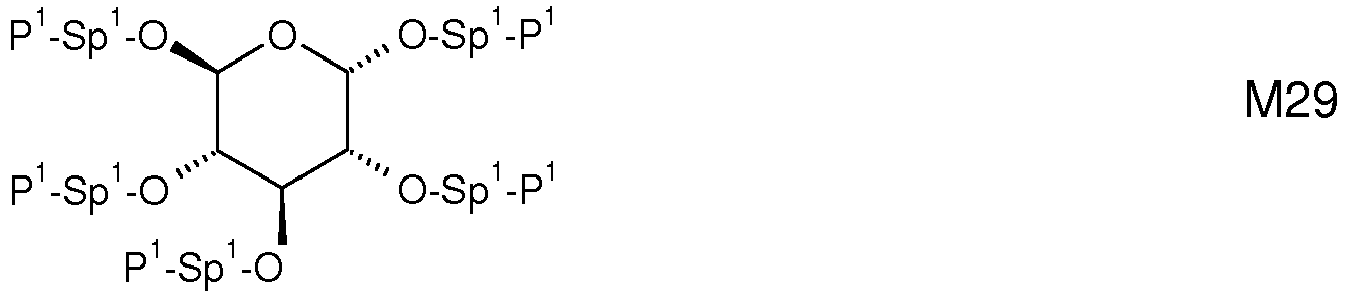
- Suitable monomers (polymerizable component) for the LC medium are those from the prior art which are used for PSA-VA displays, in particular polymerizable compounds of the formula M below and / or of the formulas M1 to M29.
- the LC media according to the invention for use in PSA displays preferably contain ⁇ 5% by weight, particularly preferably ⁇ 1% by weight and very particularly preferably ⁇ 0.5% by weight of polymerizable compounds, in particular polymerizable compounds of the formulas mentioned below. In order to achieve a sufficient effect, 0.2% by weight or more is preferably used. The optimal amount depends on the layer thickness.
- the polymerizable group P a, b is a group which is suitable for a polymerization reaction, such as, for example, radical or ionic chain polymerization, polyaddition or polycondensation, or for a polymer-analogous reaction, for example addition or condensation to a main polymer chain.
- a polymerization reaction such as, for example, radical or ionic chain polymerization, polyaddition or polycondensation, or for a polymer-analogous reaction, for example addition or condensation to a main polymer chain.
- Very particularly preferred groups P a, b are therefore selected from the group consisting of acrylate, methacrylate, fluoroacrylate, furthermore vinyloxy, chloroacrylate, oxetane and epoxy groups, and preferably an acrylate or methacrylate group.
- Preferred spacing groups Sp a, b are selected from the formula Sp "-X", so that the rest P a / b -Sp a / b - corresponds to the formula P a / b -Sp "-X" -, wherein Sp "means alkylene with 1 to 20, preferably 1 to 12, carbon atoms, which is optionally substituted by F, Cl, Br, I or CN, one or more times, and in which one or more non-adjacent CH 2 groups are each independent from each other by -O-, -S-, -NH-, -N (R 0 ) -, -Si (R 00 R 000 ) -, -CO-, -CO-O-, -O-CO-, - O-CO-O-, -S-CO-, -CO-S-, -N (R 00 ) -CO-O-, -O-CO-N (R 00 ) -, -N (
- X is preferably -O-, -S -CO-, -COO-, -OCO-, -O-COO-, -CO-NR 0 -, -NR 0 -CO-, -NR 0 -CO-NR 0 - or a single bond.
- Typical spacing groups Sp are for example - (CH 2 ) p1 -, - (CH 2 CH 2 O) q1 -CH 2 CH 2 -, -CH 2 CH 2 -S-CH 2 CH 2 -, -CH 2 CH 2 - NH-CH 2 CH 2 - or - (SiR 00 R 000 -O) p1 -, where p1 is an integer from 1 to 12, q1 is an integer from 1 to 3, and R 00 and R 000 are those given above Have meanings.
- Particularly preferred groups -Sp "-X" - are - (CH 2 ) p1 -, - (CH 2 ) p1 -O-, - (CH 2 ) p1 -O-CO-, - (CH 2 ) p1 -O- CO-O-, where p1 and q1 have the meaning given above.
- Particularly preferred groups Sp are, for example, straight-chain ethylene, propylene, butylene, pentylene, hexylene, heptylene, octylene, nonylene, decylene, undecylene, dodecylene, octadecylene, ethyleneoxyethylene, methyleneoxybutylene, ethylene thioethylene, ethylene-N-methyliminoethylene, 1-methylalkylene , Ethenylene, propenylene and butenylene.
- the LC medium or the polymerizable component preferably comprises one or more compounds selected from the group of the formulas M1-M21, particularly preferably the formulas M2-M15, very particularly preferably the formulas M2, M3, M9, M14 and M15.
- the LC medium or the polymerizable component preferably does not comprise any compounds of the formula M10, in which Z 2 and Z 3 are - (CO) O- or -O (CO) -.
- the polymerizable compounds in the LC medium between the substrates of the LC display are polymerized or crosslinked by in-situ polymerization (if a polymerizable compound contains two or more polymerizable groups) ,
- the polymerization can be carried out in one step. It is also possible to carry out the polymerization in a first step with the application of a voltage in order to produce a pretilt angle, and then to polymerize or crosslink the compounds which have not reacted in the first step in a second polymerization step without applied voltage (" end curing ").
- Suitable and preferred polymerization methods are, for example, thermal or photopolymerization, preferably photopolymerization, in particular UV photopolymerization.
- one or more initiators can also be added.
- Suitable conditions for the polymerization, as well as suitable types and amounts of the initiators, are known to the person skilled in the art and are described in the literature.
- the commercially available photoinitiators Irgacure651®, Irgacure184®, Irgacure907®, Irgacure369®, or Darocurel 1730 (Ciba AG), for example, are suitable for radical polymerization. If an initiator is used, its proportion is preferably 0.001 to 5% by weight, particularly preferably 0.001 to 1% by weight.
- the polymerizable compounds according to the invention are also suitable for polymerization without an initiator, which has considerable advantages, such as lower material costs and in particular one less contamination of the LC medium due to possible residual amounts of the initiator or its degradation products.
- the polymerization can thus also take place without the addition of an initiator.
- the LC medium therefore contains no polymerization initiator.
- the polymerizable component or the LC medium can also contain one or more stabilizers in order to prevent undesired spontaneous polymerization of the RMs, for example during storage or transport.
- stabilizers Suitable types and amounts of the stabilizers are known to the person skilled in the art and are described in the literature.
- the commercially available stabilizers of the Irganox® series (Ciba AG), such as Irganox® 1076 are particularly suitable. If stabilizers are used, their proportion, based on the total amount of the RMs or the polymerizable component, is preferably 10-10000 ppm. particularly preferably 50-500 ppm.
- the LC media for use in the LC displays according to the invention contain, in addition to the SAM described above and the optional polymerizable compounds (M), an LC mixture (“host mixture”) containing one or more, preferably two or more, low molecular weight (ie monomeric or unpolymerized) compounds.
- LC mixture containing one or more, preferably two or more, low molecular weight (ie monomeric or unpolymerized) compounds.
- the latter are stable or unreactive to a polymerization reaction under the conditions used to polymerize the polymerizable compounds.
- any dielectric negative or positive LC mixture suitable for use in conventional VA and VA-IPS displays is suitable as the host mixture.
- Suitable LC mixtures are known to the person skilled in the art and are described in the literature.
- LC media for VA displays with negative dielectric anisotropy are in EP 1 378 557 A1 described.
- Suitable LC mixtures with positive dielectric anisotropy which are suitable for LCDs and especially for IPS displays, are, for example, from JP 07-181 439 (A ) EP 0 667 555 . EP 0 673 986 . DE 195 09 410 . DE 195 28 106 . DE 195 28 107 . WO 96/23 851 and WO 96/28 521 known.
- Z 2 can have the same or different meanings.
- R 2A , R 2B and R 2C each preferably denote alkyl having 1-6 C atoms, in particular CH 3 , C 2 H 5 , nC 3 H 7 , nC 4 H 9 , nC 5 H 11 .
- Z 2 and Z 2 ' in formulas A and B preferably each independently represent a single bond, furthermore one -C 2 H 4 bridge.
- (O) C v H 2v + 1 is preferably OC v H 2v + 1 , furthermore C v H 2v + 1 .
- L 3 and L 4 are each preferably F.
- alkyl and alkyl * each independently represent a straight-chain alkyl radical having 1-6 C atoms.
- Particularly preferred mixtures according to the invention contain one or more compounds of the formulas A-2, A-8, A-14, A-29, A-35, B-2, B-11, B-16 and C-1.
- the proportion of compounds of the formulas A and / or B in the total mixture is preferably at least 20% by weight.
- the liquid crystal mixture according to the invention is dielectric negative with a dielectric anisotropy ( ⁇ ) of--1.5.
- the compounds of the formulas IIIA, IIIB, IIIC, LY1-LY18, Y1-Y16, T1-T24, FI, VK1-VK4, N1-N10, BC, CR, PH and BF are suitable as dielectric negative components.
- the dielectric negative compounds of the formulas are preferred selected from formulas IIIA, IIIB and IIIC.
- the LC medium preferably has a ⁇ of -1.5 to -8.0, in particular of -2.5 to -6.0.
- the values of the birefringence ⁇ n in the liquid crystal mixture are generally between 0.07 and 0.16, preferably between 0.08 and 0.12.
- the rotational viscosity ⁇ 1 at 20 ° C. before the polymerization is preferably 165 165 mPas, in particular 140 140 mPas.
- the nematic phase of the dielectric negative or positive LC medium according to the invention preferably has a nematic phase in a temperature range from 10 ° C. or less to 60 ° C. or more, particularly preferably from 0 or less to 70 ° C. or more.
- a code for the substituents R 1 * , R 2 * , L 1 * and L 2 * follows with a dash, separated from the acronym for the basic body: Code for R 1 * , R 2 * , L 1 * , L 2 * , L 3 * R 1 * R 2 * L 1 * L 2 * nm C n H 2n + 1 C m H 2m + 1 H H n Om C n H 2n + 1 OC m H 2m + 1 H H nO.m OC n H 2n + 1 C m H 2m + 1 H H n C n H 2n + 1 CN H H nN.F C n H 2n + 1 CN F H nN.FF C n H 2n + 1 CN F F nF C n H 2n + 1 F H H n Cl C n H 2n + 1 Cl H H nOF OC n H 2n + 1 F H H nF.F C n H 2n + 1 F
- Preferred mixture components can be found in Tables A and B. ⁇ b> ⁇ u> Table B ⁇ /u> ⁇ /b> n, m, z independently of one another are preferably 1, 2, 3, 4, 5 or 6.
- the LC media according to the invention contain one or more compounds selected from the group consisting of compounds from Tables A and B. ⁇ b> ⁇ u> Table C ⁇ /u> ⁇ /b> Table C shows possible chiral dopants that can be added to the LC media according to the invention.
- the LC media contain 0 to 10% by weight, in particular 0.01 to 5% by weight, particularly preferably 0.1 to 3% by weight, of dopants, preferably selected from the group consisting of compounds from Table C.
- dopants preferably selected from the group consisting of compounds from Table C.
- Table D ⁇ /u> ⁇ /b> Table D lists possible stabilizers that can be added to the LC media according to the invention. (n here means an integer from 1 to 12, preferably 1, 2, 3, 4, 5, 6, 7 or 8, terminal methyl groups are not shown).
- the LC media preferably contain 0 to 10% by weight, in particular 1 ppm to 5% by weight, particularly preferably 1 ppm to 1% by weight, of stabilizers.
- the LC media preferably contain one or more stabilizers selected from the group consisting of compounds from Table D. ⁇ b> ⁇ u> Table E ⁇ /u> ⁇ /b> Table E shows sample compounds which can preferably be used as reactive compounds in the LC media according to the present invention.
- the mesogenic media contain one or more compounds selected from the group of the compounds from Table E.
- connection generally also includes several connections, provided that this is possible by definition and not specified otherwise.
- FK media and FK medium The term “component” in each case encompasses one or more substances, compounds and / or particles.
- the polymerizable compounds are polymerized in the display or test cell by irradiation with UVA light (usually 365 nm) of a defined intensity for a predetermined time, with a voltage optionally being applied to the display at the same time (usually 10 to 30 V AC, 1 kHz) ,
- a mercury vapor lamp with 100 mW / cm 2 is used, the intensity is measured with a standard UV meter (manufacturer Ushio UNI meter), which is equipped with a bandpass filter at 320 nm.
- the compounds used are synthesized according to standard laboratory regulations.
- the FK media come from Merck KGaA, Germany.
- Example 5 N- ⁇ 2 - [(3S, 5S, 8R, 9S, 10S, 13R, 14S, 17R) -17 - ((R) -1,5-dimethylhexyl) -10,13-dimethylhexadecahydro cyclopenta [a] phenanthrene-3-yloxy] -ethyl ⁇ -ethane-1,2-diamine
- the compound from synthesis example 5 (0.2% by weight) is added to a nematic LC medium M1 of the VA type ( ⁇ ⁇ 0) according to Table 1 and homogenized.
- test cells without a pre-orientation layer ('alignment layer'):
- the resulting mixture is filled into a test cell (without a polyimide orientation layer, layer thickness d ⁇ 4.0 ⁇ m, ITO coating on both sides, without a passivation layer).
- the LC medium has a spontaneous homeotropic (vertical) orientation to the substrate surfaces. This orientation remains stable up to 70 ° C. In the temperature-stable range, the VA cell can be reversibly switched between crossed polarizers by applying a voltage between 0 and 30 V.
- the compound from synthesis example 5 (0.5% by weight) is added to a nematic LC medium M2 of the VA-IPS type ( ⁇ > 0) according to Table 2 and homogenized.
- test cells without an alignment layer The resulting mixture is filled into a test cell (without a polyimide orientation layer, layer thickness d ⁇ 10 ⁇ m, ITO interdigital electrodes arranged on a substrate surface, glass on the opposite substrate surface, without a passivation layer).
- the LC medium has a spontaneous homeotropic (vertical) orientation to the substrate surfaces. This orientation remains stable up to 70 ° C. In the temperature-stable range, the VA-IPS cell can be reversibly switched between crossed polarizers by applying a voltage between 0 and 20 V.
- the compounds of synthesis examples 1, 2, 3 and examples 6-17 are added to mixture 1 in a nematic LC medium M1 ( ⁇ ⁇ 0) according to table 1 and homogenized.
- the proportions by weight of the compounds in the medium are given in Table 3.
- the LC medium obtained is each filled into a test cell without a pre-orientation layer and has a spontaneous homeotropic (vertical) orientation to the substrate surfaces.
- the VA cell can be reversibly switched between crossed polarizers by applying a voltage between 0 and 30 V.
- Table 3 ⁇ /u> parts by weight for doping in ⁇ b> M1 ⁇ /b> and orientation of the LC mixture obtained at 25 ° C and 70 ° C.
- VA-type test cell mixture example Connection example no. weight proportion Orientation at 25 ° C / switchable Orientation at 70 ° C / switchable 3 1 0.25% Homeotropic / yes Homeotropic / yes 4 2 0.15% Homeotropic / yes Homeotropic / yes 5 3 5.0% Homeotropic / yes Homeotropic / yes 6 6 (*) 1.0% Homeotropic / yes Homeotropic / yes 7 7 (*) 1.5% Homeotropic / yes Homeotropic / yes 8th 8 (*) 2.5% Homeotropic / yes Homeotropic / yes 9 9 (*) 2.5% Homeotropic / yes Homeotropic / yes 10 10 (*) 2.5% Homeotropic / yes Homeotropic / yes 11 11 (*) 2.5% Homeotropic / yes Homeotropic / yes 12 12 0.5% Homeotropic / yes Homeotropic / yes 13 13 0.5% Homeotropic / yes Homeotropic / yes 14 14 2.0% Homeotropic / yes Homeotropic / yes 15 15 (*
- the compounds of synthesis example 1 and examples 6, 7, 10, 11 are added analogously to mixture example 2 to a nematic LC medium M2 ( ⁇ > 0) according to table 2 and homogenized.
- the proportions by weight of the compounds in the medium are given in Table 4.
- the LC medium obtained is each filled into a test cell without a pre-orientation layer and has a spontaneous homeotropic (vertical) orientation to the substrate surfaces.
- the VA-IPS cell can be reversibly switched between crossed polarizers by applying a voltage between 0 and 20 V.
- Table 4 ⁇ /u> parts by weight for doping in ⁇ b> M2 ⁇ /b> and orientation of the LC mixture obtained at 25 ° C and 60 ° C.
- Test cell of the VA-IPS type Mix Example No. Connection example no. weight proportion Orientation at 25 ° C / switchable Orientation at 60 ° C / switchable 22 1 0.5% Homeotropic / yes Homeotropic / yes 23 6 (*) 3.0% Homeotropic / yes planar 24 7 (*) 1.0% Homeotropic / yes Homeotropic / yes 25 10 (*) 1.7% Homeotropic / yes planar 26 11 (*) 2.5% Homeotropic / yes planar 27 18 (*) 2.0% Homeotropic / yes 28 19 (*) 2.0% Homeotropic / yes 29 20 (*) 1.0% Homeotropic / yes 30 21 (*) 0.7% Homeotropic / yes 31 22 (*) 0.5% Homeotropic / yes ( (*) : only for comparison)
- a polymerizable compound ( RM-1 , 0.5% by weight) and a self-orienting compound ( 6 , 1.0% by weight) are added to a nematic LC medium M1 ( ⁇ ⁇ 0) according to Table 1 and homogenized.
- the resulting mixture is filled into a test cell (without a polyimide orientation layer, layer thickness d ⁇ 4.0 ⁇ m, ITO coating on both sides, without a passivation layer).
- the LC medium has a spontaneous homeotropic (vertical) orientation to the substrate surfaces. Applying a voltage greater than the optical threshold voltage, the cell is irradiated for 15 min with UV light with an intensity of 100 mW / cm 2 at 40 ° C. As a result, the monomeric, polymerizable compound is polymerized. The homeotropic orientation is thus additionally stabilized and a 'pre-tilt' is set.
- the PSA-VA cell obtained can be reversibly switched up to 70 ° C by applying a voltage between 0 and 30 V. The switching times are reduced compared to the unpolymerized cell.
- a polymerizable compound ( RM-1 , 0.5% by weight) and a self-orienting compound ( 7 , 1.7% by weight) are added and homogenized to a nematic LC medium M1 ( ⁇ ⁇ 0) according to Table 1.
- the resulting mixture is filled into a test cell (without a polyimide orientation layer, layer thickness d ⁇ 4.0 ⁇ m, ITO coating on both sides, without a passivation layer).
- the LC medium has a spontaneous homeotropic (vertical) orientation to the substrate surfaces. Applying a voltage greater than the optical threshold voltage, the cell is irradiated for 15 min with UV light with an intensity of 100 mW / cm 2 at 40 ° C. This results in polymerization of the monomeric compound.
- the homeotropic orientation is thus additionally stabilized and a 'pre-tilt' is set.
- the PSA-VA cell obtained can be reversibly switched up to 70 ° C by applying a voltage between 0 and 30 V. The switching times are reduced compared to the unpolymerized cell.
Landscapes
- Chemical & Material Sciences (AREA)
- Organic Chemistry (AREA)
- Crystallography & Structural Chemistry (AREA)
- Engineering & Computer Science (AREA)
- Materials Engineering (AREA)
- Physics & Mathematics (AREA)
- Nonlinear Science (AREA)
- General Physics & Mathematics (AREA)
- Optics & Photonics (AREA)
- Mathematical Physics (AREA)
- Spectroscopy & Molecular Physics (AREA)
- Health & Medical Sciences (AREA)
- General Health & Medical Sciences (AREA)
- Liquid Crystal (AREA)
- Liquid Crystal Substances (AREA)
- Organic Low-Molecular-Weight Compounds And Preparation Thereof (AREA)
Claims (28)
- Milieu LC comprenant un composant cristallin liquide de poids moléculaire faible et un ou plusieurs composé(s) organique(s), dans lequel le composé organique est caractérisé en ce qu'il contient au moins un groupe d'ancrage polaire et en ce qu'il contient au moins un groupe de cycle ;
et en ce qu'il comprend de façon additionnelle un composant polymérisable ou polymérisé, dans lequel le composant polymérisé peut être obtenu par polymérisation d'un composant polymérisable ;
dans lequel le composé organique présente une structure de la formule :
MES-R2 ;
dans laquelle :MES représente un groupe qui contient au moins un système de cycle ; etR2 représente un groupe d'ancrage polaire ;et dans lequel le groupe polaire R2 contient un groupe de la sous-formule (A1) :
-Sp-[X2-Z3-]kX1 (A1)
dans laquelle :Sp représente un groupe d'espaceur ;X1 représente un groupe -NH2, -NHR11, -NR11 2, -OH, -(CO)OH ou un groupe de la formule : R0 représente H ou alkyle qui comporte de 1 à 12 atome(s) de C ;X2 représente, dans chaque cas de manière indépendante, -NH-, -NR11-, -O- ou une liaison simple ;Z3 représente, dans chaque cas de manière indépendante, un groupe alkylène qui comporte de 1 à 15 atome(s) de C, un cycle carbocyclique qui comporte 5 ou 6 atomes de C, ou une combinaison d'un ou de plusieurs cycle(s) et d'un ou de plusieurs groupe(s) alkylène, où, dans chaque cas, l'hydrogène peut être remplacé par -OH, -OR11, -(CO)OH, -NH2, -NHR11, -NR11 2 ou par halogène (de préférence par F, Cl) ;R11 représente, dans chaque cas de manière indépendante, un radical alkyle halogéné ou non substitué qui comporte de 1 à 15 atome(s) de C, où, en outre, un ou plusieurs groupe(s) CH2 dans ce radical peut/peuvent dans chaque cas être remplacé(s), de manière indépendante les uns des autres, par -C≡C-, -CH=CH-, -(CO)O-, -O(CO)-, -(CO)- ou -O- de telle sorte que des atomes de O ne soient pas liés directement les uns aux autres, et où deux radicaux R11 peuvent être liés l'un à l'autre de manière à former un cycle ; etk représente 0, 1, 2 ou 3.
 - Milieu LC selon la revendication 1, caractérisé en ce que le groupe d'ancrage polaire du composé organique représente un groupe de la formule R2, dans laquelle :R2 représente alkyle en chaîne droite, ramifié ou cyclique qui comporte de 1 à 25 atome(s) de C, dans lequel, en outre, un ou plusieurs groupe(s) CH2 non adjacents peut/peuvent être remplacé(s) par -NR0-, -O-, -S-, -CO-, -CO-O-, -O-CO-, -O-CO-O- de telle sorte que des atomes de N, de O et/ou de S ne soient pas liés directement les uns aux autres, et dans lequel, en outre, un ou plusieurs atome(s) de carbone tertiaire(s), (des groupes CH) peut/peuvent être remplacé(s) par N, et où, en outre, un ou plusieurs atome(s) de H peut/peuvent être remplacé(s) par F ou par Cl ;étant entendu que le radical R2 contient un ou plusieurs hétéroatome(s) qui est/sont sélectionné(s) parmi N, S et/ou O.
- Milieu LC selon une ou plusieurs des revendications 1 ou 2, caractérisé en ce que le groupe d'ancrage polaire du composé organique contient au moins une structure OH ou un atome de N à l'intérieur d'un groupe amino primaire ou secondaire ou tertiaire.
- Milieu LC selon une ou plusieurs des revendications 1 à 3, caractérisé en ce que le composé organique inclut un composé de la formule :
MES-R2 ;
dans laquelle :MES représente un groupe mésogène qui contient au moins un système de cycle ; etR2 représente un groupe d'ancrage polaire. - Milieu LC selon une ou plusieurs des revendications 1 à 4, caractérisé en ce que :
R2 représente un groupe qui contient un hétéroatome (N/O) de la sous-formule (A2) : dans laquelle Sp, X1 et X2 sont tels qu'ils ont été définis pour la formule (A1) selon la revendication 1 ; etR12 représente H, F, Cl, CN, -OH, -NH2, ou un radical alkyle halogéné ou non substitué qui comporte de 1 à 15 atome(s) de C, où, en outre, un ou plusieurs groupe(s) CH2 dans ce radical peut/peuvent chacun être remplacé(s), de manière indépendante les uns des autres, par -C≡C-, -CH=CH-, -(CO)O-, -O(CO)-, -(CO)-, -O-, -NH- ou -NR1 -de telle sorte que des atomes de O et de N ne soient pas liés directement les uns aux autres ; etn représente 1, 2 ou 3.
 - Milieu LC selon une ou plusieurs des revendications 1 à 5, caractérisé en ce que le composé organique inclut un composé de la formule I :
R1-A1-(Z2-A2)m1-R2 (I)
dans laquelle :A1 et A2 représentent, dans chaque cas de manière indépendante l'un de l'autre, un groupe aromatique, hétéroaromatique, alicyclique ou hétérocyclique, lequel peut également contenir des cycles annelés, et lequel peut également être mono- ou polysubstitué par un groupe L ;L représente, dans chaque cas de manière indépendante des autres, -OH, -(CH2)n1-OH, F, Cl, Br, I, -CN, -NO2, -NCO, -NCS, -OCN, -SCN, -C(=O)N(R0)2, -C(=O)R0, -N(R0)2, -(CH2)n1-N(R0)2, silyle en option substitué, aryle ou cycloalkyle en option substitué qui comporte de 6 à 20 atomes de C, ou alkyle, alcoxy, alkylcarbonyle, alcoxycarbonyle, alkylcarbonyloxy ou alcoxycarbonyloxy en chaîne droite ou ramifié qui comporte de 1 à 25 atome(s) de C, où, en outre, un ou plusieurs atome(s) de H peut/peuvent être remplacé(s) par F ou par Cl, ;Z2 représente, dans chaque cas de manière indépendante des autres, -O-, -S-, -CO-, -CO-O-, -OCO-, -O-CO-O-, -OCH2-, -CH2O-, -SCH2-, -CH2S-, -CF2O-, -OCF2-, -CF2S-, -SCF2-, -(CH2)n1-, -CF2CH2-, -CH2CF2-, -(CF2)n1-, -CH=CH-, -CF=CF-, -C≡C-, -CH=CH-COO-, -OCO-CH=CH-, CR0R00 ou une liaison simple ;R0 et R00 représentent, dans chaque cas de manière indépendante l'un de l'autre, H ou alkyle qui comporte de 1 à 12 atome(s) de C ;R1, R2 représentent, de manière indépendante l'un de l'autre, H, halogène, alkyle en chaîne droite, ramifié ou cyclique qui comporte de 1 à 25 atome(s) de C, où, en outre, un ou plusieurs groupe(s) CH2 non adjacents peut/peuvent être remplacé(s) par -NR0-, -O-, -S-, -CO-, -CO-O-, -O-CO-, -O-CO-O- de telle sorte que des atomes de N, de O et/ou de S ne soient pas liés directement les uns aux autres, et où, en outre, un ou plusieurs atome(s) de carbone tertiaire(s) (des groupes CH) peut/peuvent être remplacé(s) par N, et où, en outre, un ou plusieurs atome(s) de H peut/peuvent être remplacé(s) par F ou par Cl, ;
étant entendu qu'au moins le radical R2 contient un ou plusieurs hétéroatome(s) qui est/sont sélectionné(s) parmi N, S et/ou O ;m1 représente 0, 1, 2, 3, 4 ou 5 ; etn1 représente 1, 2, 3 ou 4. - Milieu LC selon une ou plusieurs des revendications 1 à 6, caractérisé en ce que, pour le composé de la formule I :Z2 représente une liaison simple.
- Milieu LC selon une ou plusieurs des revendications 1 à 7, caractérisé en ce qu'il comprend les composés de la formule I selon une concentration qui est inférieure à 10 % en poids.
- Milieu LC selon une ou plusieurs des revendications 1 à 8, caractérisé en ce qu'il comprend un ou plusieurs composé(s) polymérisable(s) de la formule M ou un composant polymérisé qui comprend un ou plusieurs composé(s) de la formule M selon une forme polymérisée :
Pa-(Spa)s1-A2-(Z1-A1)n-(Spb)s2-Pb M
dans laquelle les radicaux individuels présentent les significations qui suivent :Pa, Pb représentent, dans chaque cas de manière indépendante l'un de l'autre, un groupe polymérisable ;Spa, Spb représentent pour chaque occurrence, de manière identique ou différente, un groupe d'espaceur ;s1, s2 représentent, dans chaque cas de manière indépendante l'un de l'autre, 0 ou 1 ;A1, A2 représentent, dans chaque cas de manière indépendante l'un de l'autre, un radical qui est sélectionné parmi les groupes qui suivent :a) le groupe qui est constitué par trans-1,4-cyclohexylène, 1,4-cyclohexénylène et 4,4'-bicyclohexylène, où, en outre, un ou plusieurs groupe(s) CH2 non adjacents peut/peuvent être remplacé(s) par -O- et/ou par -S- et où, en outre, un ou plusieurs atome(s) de H peut/peuvent être remplacé(s) par F;b) le groupe qui est constitué par 1,4-phénylène et par 1,3-phénylène, où, en outre, un ou deux groupe(s) CH peut/ peuvent être remplacé(s) par N et où, en outre, un ou plusieurs atome(s) de H peut/peuvent être remplacé(s) par L ;c) le groupe qui est constitué par tétrahydropyran-2,5-diyle, 1,3-dioxane-2,5-diyle, tétrahydrofuran-2,5-diyle, cyclo-butane-1,3-diyle, pipéridine-1,4-diyle, thiophène-2,5-diyle et sélénophène-2,5-diyle, dont chacun peut également être mono- ou polysubstitué par L ; etd) le groupe qui est constitué par les radicaux polycycliques saturés, partiellement non saturés ou complètement non saturés et en option substitués qui comportent de 5 à 20 atomes de C cycliques, dont un ou plusieurs peut/peuvent, en outre, être remplacé(s) par des hétéroatomes, de préférence qui sont sélectionnés parmi le groupe qui est constitué par bicyclo[1.1.1]pentane-1,3-diyle, bicyclo[2.2.2]-octane-1,4-diyle, spiro[3.3]heptane-2,6-diyle,


 n représente 0, 1, 2 ou 3 ;Z1 représente, dans chaque cas de manière indépendante des autres, -CO-O-, -O-CO-, -CH2O-, -OCH2-, -CF2O-, -OCF2- ou -(CH2)n-, où n est 2, 3 ou 4, -O-, -CO-, -C(RyRz)-, -CH2CF2-, -CF2CF2- ou une liaison simple ;L représente pour chaque occurrence, de manière identique ou différente, F, Cl, CN, SCN, SF5 ou alkyle, alcoxy, alkylcarbonyle, alcoxycarbonyle, alkylcarbonyloxy ou alcoxycarbonyloxy en chaîne droite ou ramifié, dans chaque cas en option fluoré, qui comprend de 1 à 12 atome(s) de C ;R0, R00 représentent chacun, de manière indépendante l'un de l'autre, H, F ou alkyle en chaîne droite ou ramifié qui comporte de 1 à 12 atome(s) de C, où, en outre, un ou plusieurs atome(s) de H peut/peuvent être remplacé(s) par F ;M représente -O-, -S-, -CH2-, -CHY1- ou -CY1Y2- ; etY1 et Y2 présentent chacun, de manière indépendante l'un de l'autre, l'une des significations qui ont été indiquées ci-avant pour R0 ou représentent Cl ou CN.
 - Milieu LC selon une ou plusieurs des revendications 1 à 9, caractérisé en ce qu'un ou plusieurs composé(s) polymérisable(s) est/sont sélectionné(s) parmi les composés qui suivent :





 P1 et P2 représentent dans chaque cas, de manière indépendante l'un de l'autre, un groupe polymérisable comme il a été défini pour la formule I, de préférence un groupe acrylate, méthacrylate, fluoroacrylate, oxétane, vinyloxy ou époxyde ;Sp1 et Sp2 représentent, dans chaque cas de manière indépendante l'un de l'autre, une liaison simple ou un groupe d'espaceur ;où, en outre, un ou plusieurs des radicaux P1-Sp1- et P2-Sp2- peut/ peuvent représenter un radical Raa, étant entendu qu'au moins l'un des radicaux P1-Sp1- et P2-Sp2- qui est/sont présent(s) ne représente pas Raa ;Raa représente H, F, Cl, CN ou alkyle en chaîne droite ou ramifié qui comporte de 1 à 25 atome(s) de C, où, en outre, un ou plusieurs groupe(s) CH2 non adjacents peut/peuvent dans chaque cas être remplacé(s), de manière indépendante les uns des autres, par C(R0)=C(R00)-, -C≡C-, -N(R0)-, -O-, -S-, -CO-, -CO-O-, -O-CO-, -O-CO-O- de telle sorte que des atomes de O et/ou de S ne soient pas liés directement les uns aux autres, et où, en outre, un ou plusieurs atome(s) de H peut/peuvent être remplacé(s) par F, Cl, CN ou P1-Sp1-, de façon particulièrement préférable alkyle, alcoxy, alkényle, alkynyle, alkylcarbonyle, alcoxycarbonyle ou alkylcarbonyloxy en chaîne droite ou ramifié, en option mono- ou polyfluoré qui comporte de 1 à 12 atome(s) de C (où les radicaux alkényle et alkynyle comportent au moins deux atomes de C et les radicaux ramifiés comportent au moins trois atomes de C) ;R0, R00 représentent chacun, de manière indépendante l'un de l'autre, H ou alkyle qui comporte de 1 à 12 atome(s) de C ;Ry et Rz représentent chacun, de manière indépendante l'un de l'autre, H, F, CH3 ou CF3 ;Z1 représente -O-, -CO-, -C(RyRz)- ou -CF2CF2- ;Z2 et Z3 représentent chacun, de manière indépendante l'un de l'autre, -CO-O-, -O-CO-, -CH2O-, -OCH2-, -CF2O-, -OCF2- ou -(CH2)n-, où n est 2, 3 ou 4 ;L représente pour chaque occurrence, de manière identique ou différente, F, Cl, CN, SCN, SF5 ou alkyle, alcoxy, alkényle, alkynyle, alkylcarbonyle, alcoxycarbonyle, alkylcarbonyloxy ou alcoxycarbonyloxy en chaîne droite ou ramifié, en option mono- ou polyfluoré qui comporte de 1 à 12 atome(s) de C ;L' et L" représentent chacun, de manière indépendante l'un de l'autre, H, F ou Cl ;r représente 0, 1, 2, 3 ou 4 ;s représente 0, 1, 2 ou 3 ;t représente 0, 1 ou 2 ; etx représente 0 ou 1.
 - Milieu LC selon une ou plusieurs des revendications 1 à 10, caractérisé en ce que le composé organique selon la revendication 1 ou le composé de la formule I selon la revendication 6 ou 7 contient un ou plusieurs groupe(s) polymérisable(s).
- Milieu LC selon une ou plusieurs des revendications 1 à 11, caractérisé en ce qu'il s'agit d'un milieu LC qui présente une anisotropie diélectrique négative, de préférence qui présente un Δε de -1,5 à -8,0.
- Milieu LC selon une ou plusieurs des revendications 1 à 12, caractérisé en ce qu'il comprend un ou plusieurs composé(s) de la formule qui suit :





 R3 et R4 représentent chacun, de manière indépendante l'un de l'autre, alkyle qui comporte de 1 à 12 atome(s) de C, où, en outre, un ou deux groupes CH2 non adjacents peut/ peuvent être remplacé(s) par -O-, -CH=CH-, -CO-, -O-CO- ou -CO-O- de telle sorte que des atomes de O ne soient pas liés directement les uns aux autres ;etZy représente -CH2CH2-, -CH=CH-, -CF2O-, -OCF2-, -CH2O-, -OCH2-, -CO-O-, -O-CO-, -C2F4-, -CF=CF-, -CH=CH-CH2O- ou une liaison simple, de préférence une liaison simple.
 - Milieu LC selon une ou plusieurs des revendications 1 à 13, caractérisé en ce qu'il comprend un ou plusieurs composé(s) des formules qui suivent :





- Milieu LC selon une ou plusieurs des revendications 1 à 14, caractérisé en ce qu'il comprend un ou plusieurs composé(s) des formules qui suivent :


 R2A, R2B et R2C représentent dans chaque cas, de manière indépendante les uns des autres, H, un radical alkyle qui comporte jusqu'à 15 atomes de C, lequel est non substitué, monosubstitué par CN ou par CF3 ou au moins monosubstitué par halogène, où, en outre, un ou plusieurs groupe(s) CH2 dans ces radicaux peut/peuvent être remplacé(s) par -O-, -S-,
 L1-4 représentent, dans chaque cas de manière indépendante les uns des autres, F, Cl, CF3 ou CHF2 ;Z2 et Z2' représentent, dans chaque cas de manière indépendante l'un de l'autre, une liaison simple, -CH2CH2-, -CH=CH-, -CF2O-, -OCF2-, -CH2O-, -OCH2-, -COO-, -OCO-, -C2F4-, -CF=CF-, -CH=CHCH2O- ;p représente 1 ou 2 ;q représente 0 ou 1 ; etv représente 1 à 6.
 - Milieu LC selon une ou plusieurs des revendications 1 à 15, caractérisé en ce qu'il comprend un ou plusieurs composé(s) des formules qui suivent :















- Affichage LC contenant une cellule LC qui comporte deux substrats et au moins deux électrodes, dans lequel au moins un substrat est transparent vis-à-vis de la lumière et au moins un substrat comporte une ou deux électrode(s), et une couche d'un milieu LC selon une ou plusieurs des revendications 1 à 16 qui est localisée entre les substrats ; dans lequel le composé organique ou le composé de la formule I convient pour réaliser un alignement homéotrope du milieu LC par rapport aux surfaces de substrat.
- Affichage LC selon la revendication 17, caractérisé en ce que l'affichage ne comporte pas une couche d'alignement en polyimide.
- Affichage LC selon la revendication 18, caractérisé en ce que les substrats ne comportent pas de couches d'alignement pour un alignement homéotrope.
- Affichage LC selon la revendication 19, caractérisé en ce que les substrats comportent des couches d'alignement non frottées sur un côté ou sur les deux côtés.
- Affichage LC selon une ou plusieurs des revendications 17 à 20, caractérisé en ce qu'il s'agit d'un affichage VA qui contient un milieu LC qui présente une anisotropie diélectrique négative et qui comporte des électrodes qui sont agencées sur des substrats opposés.
- Affichage LC selon une ou plusieurs des revendications 18 à 21, caractérisé en ce qu'il s'agit d'un affichage VA-IPS qui contient un milieu LC qui présente une anisotropie diélectrique négative et qui comporte des électrodes imbriquées qui sont agencées sur au moins un substrat.
- Procédé pour la préparation d'un milieu LC, caractérisé en ce qu'un ou plusieurs composé(s) organique(s) qui contient/contiennent au moins un groupe d'ancrage polaire et au moins un groupe de cycle selon la revendication 1 ou un ou plusieurs composé(s) de la formule I selon la revendication 6 ou 7 est/sont mélangé(s) avec un composant cristallin liquide de poids moléculaire faible, et un ou plusieurs composé(s) polymérisable(s) et en option, des additifs sont ajoutés.
- Composés de la formule I :
R1-A1-(Z2-A2)m1-R2 (I)
dans laquelle :R2 représente un groupe de la formule (A1) :où le composé de la formule I contient un ou plusieurs groupe(s) polymérisable(s) en tant que fonctionnalisation supplémentaire en plus de l'ancrage polaire.
-Sp-[X2-Z3-]kX1 (A1)
dans laquelle :Sp représente un groupe d'espaceur ;X1 représente un groupe-NH2, -NHR11, -NR11 2, -OH, -(CO)OH ou un groupe de la formule : R0 représente H ou alkyle qui comporte de 1 à 12 atome(s) de C ;X2 représente, dans chaque cas de manière indépendante, -NH-, -NR11-, -O- ou une liaison simple ;Z3 représente, dans chaque cas de manière indépendante, un groupe alkylène qui comporte de 1 à 15 atome(s) de C, un cycle carbocyclique qui comporte 5 ou 6 atomes de C, ou une combinaison d'un ou de plusieurs cycle(s) et d'un ou de plusieurs groupe(s) alkylène, où, dans chaque cas, l'hydrogène peut être remplacé par -OH, -OR11, -(CO)OH, -NH2, -NHR11, -NR11 2 ou par halogène (de préférence par F, Cl) ;R11 représente, dans chaque cas de manière indépendante, un radical alkyle halogéné ou non substitué qui comporte de 1 à 15 atome(s) de C, où, en outre, un ou plusieurs groupe(s) CH2 dans ce radical peut/peuvent dans chaque cas être remplacé(s), de manière indépendante les uns des autres, par -C≡C-, -CH=CH-, -(CO)O-, -O(CO)-, -(CO)- ou -O- de telle sorte que des atomes de O ne soient pas liés directement les uns aux autres, et où deux radicaux R11 peuvent être liés l'un à l'autre de manière à former un cycle ; etk représente 0, 1, 2 ou 3 ;A1 et A2 représentent chacun, de manière indépendante l'un de l'autre, un groupe aromatique, hétéroaromatique, alicyclique ou hétérocyclique, lequel peut également contenir des cycles annelés, et lequel peut également être mono- ou polysubstitué par un groupe L ;L représente dans chaque cas, de manière indépendante des autres, -OH, -(CH2)n1-OH, F, Cl, Br, I, -CN, -NO2, -NCO, -NCS, -OCN, -SCN, -C(=O)N(R0)2, -C(=O)R0, -N(R0)2, -(CH2)n1-N(R0)2, silyle en option substitué, aryle ou alicyclyle en option substitué qui comporte de 6 à 20 atomes de C, ou alkyle, alcoxy, alkylcarbonyle, alcoxycarbonyle, alkylcarbonyloxy ou alcoxycarbonyloxy en chaîne droite ou ramifié qui comporte de 1 à 25 atome(s) de C, où, en outre, un ou plusieurs atome(s) de H peut/peuvent être remplacé(s) par F ou par Cl ;Z2 représente, dans chaque cas de manière indépendante des autres, une liaison simple, -O-, -S-, -CO-, -CO-O-, -OCO-, -O-CO-O-, -OCH2-, -CH2O-, -SCH2-, -CH2S-, -CF2O-, -OCF2-, -CF2S-, -SCF2-, -(CH2)n1-, -CF2CH2-, -CH2CF2-, -(CF2)n1-, -CH=CH-, -CF=CF-, -C≡C-, -CH=CH-COO-, -OCO-CH=CH- ou CR0R00 ;R0 et R00 représentent chacun, de manière indépendante l'un de l'autre, H ou alkyle qui comporte de 1 à 12 atome(s) de C ;R1 représente H, halogène, alkyle en chaîne droite, ramifié ou cyclique qui comporte de 1 à 25 atome(s) de C, où, en outre, un ou plusieurs groupe(s) CH2 non adjacents peut/peuvent être remplacé(s) par -NR2, -NR-, -O-, -S-, -CO-, -CO-O-, -O-CO-, -O-CO-O- de telle sorte que des atomes de O et/ou de S ne soient pas liés directement les uns aux autres, et où, en outre, un ou plusieurs atome(s) de H peut/peuvent être remplacé(s) par F ou par Cl ;m1 représente 0, 1, 2, 3 ou 4 ; etn1 représente 1, 2, 3 ou 4 ;
 - Composés selon la revendication 24, caractérisés en ce que les groupes polymérisables sont sélectionnés parmi acrylate ou méthacrylate.
- Composés selon la revendication 24 ou 25, caractérisés en ce que :m1 représente 1, 2 ou 3 ; etA1 et A2 représentent, de manière indépendante, 1,4-phénylène ou cyclohexane-1,4-diyle.
- Utilisation de composés organiques qui contiennent au moins un groupe d'ancrage polaire et au moins un groupe de cycle selon une ou plusieurs des revendications qui précèdent 1 à 5 ou de composés de la formule I selon une ou plusieurs des revendications 6 et 7 en tant qu'additif pour des milieux LC pour réaliser un alignement homéotrope par rapport à une surface qui délimite le milieu LC, caractérisée en ce que les milieux comprennent de façon additionnelle un composant polymérisable ou polymérisé, où le composant polymérisé peut être obtenu au moyen de la polymérisation d'un composant polymérisable.
- Procédé pour la fabrication d'un affichage LC qui contient une cellule LC qui comporte deux substrats et au moins deux électrodes, où au moins un substrat est transparent vis-à-vis de la lumière et au moins un substrat comporte une ou deux électrode(s), comprenant les étapes de procédé qui suivent :- le remplissage de la cellule à l'aide d'un milieu LC qui contient un composant cristallin liquide de poids moléculaire faible, un composant polymérisable et un composé organique qui contient au moins un groupe d'ancrage polaire selon une ou plusieurs des revendications 1 à 16, lequel convient pour réaliser un alignement homéotrope (vertical) du milieu LC par rapport aux surfaces de substrat ; et- la polymérisation du composant polymérisable, en option à l'aide de l'application d'une tension sur la cellule ou sous l'effet de l'action d'un champ électrique.
Priority Applications (1)
| Application Number | Priority Date | Filing Date | Title |
|---|---|---|---|
| EP19218449.7A EP3660130B1 (fr) | 2010-09-25 | 2011-08-29 | Écrans à cristaux liquides et milieux cristallins liquides à alignement homéotrope |
Applications Claiming Priority (3)
| Application Number | Priority Date | Filing Date | Title |
|---|---|---|---|
| DE102010046593 | 2010-09-25 | ||
| EP11764088.8A EP2619284B2 (fr) | 2010-09-25 | 2011-08-29 | Écrans à base de cristaux liquides et fluides cristallins liquides à orientation homéotrope |
| PCT/EP2011/004340 WO2012038026A1 (fr) | 2010-09-25 | 2011-08-29 | Écrans à cristaux liquides et fluides cristallins liquides à orientation homéotrope |
Related Parent Applications (2)
| Application Number | Title | Priority Date | Filing Date |
|---|---|---|---|
| EP11764088.8A Division EP2619284B2 (fr) | 2010-09-25 | 2011-08-29 | Écrans à base de cristaux liquides et fluides cristallins liquides à orientation homéotrope |
| EP11764088.8A Division-Into EP2619284B2 (fr) | 2010-09-25 | 2011-08-29 | Écrans à base de cristaux liquides et fluides cristallins liquides à orientation homéotrope |
Related Child Applications (1)
| Application Number | Title | Priority Date | Filing Date |
|---|---|---|---|
| EP19218449.7A Division EP3660130B1 (fr) | 2010-09-25 | 2011-08-29 | Écrans à cristaux liquides et milieux cristallins liquides à alignement homéotrope |
Publications (2)
| Publication Number | Publication Date |
|---|---|
| EP3211059A1 EP3211059A1 (fr) | 2017-08-30 |
| EP3211059B1 true EP3211059B1 (fr) | 2019-12-25 |
Family
ID=44735860
Family Applications (3)
| Application Number | Title | Priority Date | Filing Date |
|---|---|---|---|
| EP17165814.9A Active EP3211059B1 (fr) | 2010-09-25 | 2011-08-29 | Écrans à base de cristaux liquides et milieux cristallins liquides disposant d'un alignement homéotrope |
| EP19218449.7A Active EP3660130B1 (fr) | 2010-09-25 | 2011-08-29 | Écrans à cristaux liquides et milieux cristallins liquides à alignement homéotrope |
| EP11764088.8A Active EP2619284B2 (fr) | 2010-09-25 | 2011-08-29 | Écrans à base de cristaux liquides et fluides cristallins liquides à orientation homéotrope |
Family Applications After (2)
| Application Number | Title | Priority Date | Filing Date |
|---|---|---|---|
| EP19218449.7A Active EP3660130B1 (fr) | 2010-09-25 | 2011-08-29 | Écrans à cristaux liquides et milieux cristallins liquides à alignement homéotrope |
| EP11764088.8A Active EP2619284B2 (fr) | 2010-09-25 | 2011-08-29 | Écrans à base de cristaux liquides et fluides cristallins liquides à orientation homéotrope |
Country Status (8)
| Country | Link |
|---|---|
| US (3) | US9868904B2 (fr) |
| EP (3) | EP3211059B1 (fr) |
| JP (2) | JP6081361B2 (fr) |
| KR (2) | KR101939739B1 (fr) |
| CN (1) | CN103119128B (fr) |
| DE (1) | DE102011108708A1 (fr) |
| TW (2) | TWI639687B (fr) |
| WO (1) | WO2012038026A1 (fr) |
Families Citing this family (172)
| Publication number | Priority date | Publication date | Assignee | Title |
|---|---|---|---|---|
| DE102011108708A1 (de) * | 2010-09-25 | 2012-03-29 | Merck Patent Gmbh | Flüssigkristallanzeigen und flüssigkristalline Medien mit homöotroper Ausrichtung |
| CN103619993B (zh) | 2011-07-07 | 2016-10-12 | 默克专利股份有限公司 | 液晶介质 |
| TWI565790B (zh) * | 2012-08-08 | 2017-01-11 | 捷恩智股份有限公司 | 液晶組成物、液晶顯示元件及液晶組成物的使用 |
| EP2931836B1 (fr) * | 2012-12-12 | 2020-03-18 | Merck Patent GmbH | Support à cristaux liquides |
| EP2931838B1 (fr) * | 2012-12-17 | 2017-08-16 | Merck Patent GmbH | Affichages à cristaux liquides et milieux cristallins liquides possédant un alignement homéotropique |
| WO2014169988A1 (fr) * | 2013-04-16 | 2014-10-23 | Merck Patent Gmbh | Dispositif contenant un milieu cristallin liquide |
| PL2997109T3 (pl) * | 2013-05-14 | 2018-07-31 | Merck Patent Gmbh | Ośrodek ciekłokrystaliczny i urządzenie ciekłokrystaliczne |
| KR102073957B1 (ko) | 2013-09-11 | 2020-02-06 | 삼성디스플레이 주식회사 | 액정표시패널 및 그 제조방법 |
| EP3730590B1 (fr) * | 2014-03-10 | 2025-12-24 | Merck Patent GmbH | Milieux cristallins liquides à orientation homéotrope |
| JP2015205982A (ja) | 2014-04-18 | 2015-11-19 | Jnc株式会社 | 液晶組成物および液晶表示素子 |
| KR102164961B1 (ko) | 2014-05-20 | 2020-10-14 | 삼성디스플레이 주식회사 | 액정 표시패널 제조방법 |
| KR101607479B1 (ko) * | 2014-06-10 | 2016-03-30 | 명지대학교 산학협력단 | 액정 배향층, 이를 이용한 액정표시소자 및 이의 제조방법 |
| JP2017521529A (ja) * | 2014-07-11 | 2017-08-03 | メルク パテント ゲゼルシャフト ミット ベシュレンクテル ハフツングMerck Patent Gesellschaft mit beschraenkter Haftung | メソゲン媒体および液晶ディスプレイ |
| KR102160489B1 (ko) | 2014-07-25 | 2020-09-29 | 삼성디스플레이 주식회사 | 표시 장치의 제조 방법 및 표시 장치 |
| DE102015008172A1 (de) | 2014-07-28 | 2016-01-28 | Merck Patent Gmbh | Flüssigkristalline Medien mit homöotroper Ausrichtung |
| EP2985334B1 (fr) | 2014-08-15 | 2018-06-20 | Merck Patent GmbH | Milieu liquide cristallin |
| US9659965B2 (en) | 2014-09-12 | 2017-05-23 | Samsung Display Co., Ltd. | Liquid crystal display device and method of manufacturing the same |
| EP3218446B1 (fr) * | 2014-11-11 | 2018-07-04 | Merck Patent GmbH | Composés bimésogènes et milieux mésogènes |
| KR102276994B1 (ko) | 2014-11-20 | 2021-07-13 | 삼성디스플레이 주식회사 | 액정 표시 장치 및 그 제조 방법 |
| CN104402683B (zh) * | 2014-11-21 | 2017-02-01 | 石家庄诚志永华显示材料有限公司 | 液晶化合物及包含该化合物的液晶混合物 |
| US20180023001A1 (en) | 2015-01-14 | 2018-01-25 | Jnc Corporation | Compound having polymerizable group, liquid crystal composition and liquid crystal display device |
| JP6729395B2 (ja) * | 2015-01-20 | 2020-07-22 | Jnc株式会社 | 液晶組成物および液晶表示素子 |
| JP6906309B2 (ja) | 2015-02-09 | 2021-07-21 | Jnc株式会社 | 重合性極性化合物、液晶組成物および液晶表示素子 |
| WO2016152340A1 (fr) * | 2015-03-24 | 2016-09-29 | Jnc株式会社 | Composition de cristaux liquides et élément d'affichage à cristaux liquides |
| KR101672403B1 (ko) * | 2015-03-30 | 2016-11-16 | 명지대학교 산학협력단 | 발광특성을 갖는 액정 배향층, 이를 이용한 액정표시장치 및 그 제조방법 |
| KR101704400B1 (ko) * | 2015-04-02 | 2017-02-08 | 명지대학교 산학협력단 | 반응성 유기분자 배향막, 이를 이용한 액정표시소자 및 이의 제조방법 |
| JPWO2016170948A1 (ja) * | 2015-04-23 | 2018-02-15 | Jnc株式会社 | 液晶組成物および液晶表示素子 |
| CN104845644B (zh) * | 2015-05-27 | 2017-03-15 | 深圳市华星光电技术有限公司 | 一种液晶介质组合物 |
| DE102016007042A1 (de) * | 2015-07-03 | 2017-01-05 | Merck Patent Gmbh | Flüssigkristallines Medium und Flüssigkristallanzeige |
| TWI694140B (zh) | 2015-07-17 | 2020-05-21 | 日商捷恩智股份有限公司 | 聚合性極性化合物、液晶組成物及液晶顯示元件 |
| JP6809459B2 (ja) | 2015-07-23 | 2021-01-06 | Jnc株式会社 | 液晶組成物および液晶表示素子 |
| US11884862B2 (en) * | 2015-08-05 | 2024-01-30 | Merck Patent Gmbh | Liquid-crystalline medium |
| WO2017068875A1 (fr) * | 2015-10-23 | 2017-04-27 | Jnc株式会社 | Composition de cristaux liquides et élément d'affichage à cristaux liquides |
| WO2017082062A1 (fr) * | 2015-11-10 | 2017-05-18 | Dic株式会社 | Composition de cristaux liquides nématiques et élément d'affichage à cristaux liquides l'utilisant |
| WO2017098933A1 (fr) | 2015-12-08 | 2017-06-15 | Jnc株式会社 | Composition de cristaux liquides et élément d'affichage à cristaux liquides |
| WO2017102053A2 (fr) | 2015-12-17 | 2017-06-22 | Merck Patent Gmbh | Dérivés d'acide cinnamique |
| US10442992B2 (en) | 2015-12-17 | 2019-10-15 | Jnc Corporation | Liquid crystal composition and liquid crystal display device |
| US10385269B2 (en) | 2015-12-21 | 2019-08-20 | Jnc Corporation | Liquid crystal composition and liquid crystal display device |
| US10190050B2 (en) * | 2016-01-21 | 2019-01-29 | Samsung Display Co., Ltd. | Liquid crystal composition, liquid crystal display device including the same, and method of manufacturing liquid crystal display device |
| US10041001B2 (en) | 2016-01-21 | 2018-08-07 | Samsung Display Co., Ltd. | Liquid crystal composition, liquid crystal display device including the same, and method of manufacturing liquid crystal display device |
| JP6747456B2 (ja) * | 2016-01-29 | 2020-08-26 | Jnc株式会社 | 液晶組成物および液晶表示素子 |
| CN105542796A (zh) * | 2016-02-01 | 2016-05-04 | 深圳市华星光电技术有限公司 | 自取向液晶介质组合物及液晶显示面板 |
| WO2017145611A1 (fr) * | 2016-02-25 | 2017-08-31 | Jnc株式会社 | Composition de cristaux liquides et élément d'affichage à cristaux liquides |
| KR102499044B1 (ko) | 2016-03-08 | 2023-02-13 | 삼성디스플레이 주식회사 | 액정표시장치 |
| CN108473873A (zh) * | 2016-04-18 | 2018-08-31 | 捷恩智株式会社 | 液晶组合物、以及液晶显示元件 |
| KR102621459B1 (ko) * | 2016-04-20 | 2024-01-05 | 삼성디스플레이 주식회사 | 배향막 조성물, 이를 포함하는 액정 표시 장치 및 액정 표시 장치 제조방법 |
| EP3459928A4 (fr) | 2016-05-18 | 2020-04-29 | JNC Corporation | Composé polaire de faible poids moléculaire destiné à l'alignement homogène d'un milieu à cristaux liquides, et milieu à cristaux liquides comprenant le composé polaire de faible poids moléculaire |
| JP6587033B2 (ja) | 2016-05-18 | 2019-10-09 | Jnc株式会社 | 液晶媒体をホモジニアス配向させる低分子極性化合物を含む液晶媒体を含有する液晶表示素子 |
| JP6669255B2 (ja) * | 2016-06-03 | 2020-03-18 | Jnc株式会社 | 重合性極性化合物、液晶組成物、および液晶表示素子 |
| CN107459993B (zh) * | 2016-06-06 | 2020-11-27 | 石家庄诚志永华显示材料有限公司 | 一种稳定剂及包含该稳定剂的液晶组合物 |
| JP6573091B2 (ja) | 2016-06-28 | 2019-09-11 | Jnc株式会社 | 液晶表示素子の製造方法および液晶表示素子 |
| US20180002604A1 (en) | 2016-06-30 | 2018-01-04 | Merck Patent Gmbh | Liquid-crystalline medium |
| DE102017005884A1 (de) | 2016-07-07 | 2018-01-11 | Merck Patent Gmbh | Elektronisches Schaltelement |
| CN106281363B (zh) * | 2016-07-18 | 2019-01-22 | 深圳市华星光电技术有限公司 | 自取向液晶介质组合物、液晶显示面板及其制作方法 |
| CN109476994B (zh) | 2016-07-20 | 2023-02-10 | 默克专利股份有限公司 | 用于光学切换元件的切换层 |
| CN106281364B (zh) * | 2016-07-21 | 2019-01-22 | 深圳市华星光电技术有限公司 | 自取向液晶介质组合物、液晶显示面板及其制作方法 |
| CN109476998A (zh) * | 2016-07-27 | 2019-03-15 | 捷恩智株式会社 | 液晶组合物及液晶显示元件 |
| JPWO2018025974A1 (ja) * | 2016-08-03 | 2019-06-06 | Jnc株式会社 | 液晶表示素子、表示装置 |
| TWI728101B (zh) | 2016-08-05 | 2021-05-21 | 日商捷恩智股份有限公司 | 聚合性極性化合物、液晶組成物及液晶顯示元件 |
| KR102637055B1 (ko) | 2016-08-09 | 2024-02-15 | 삼성디스플레이 주식회사 | 액정 표시 장치 및 그 제조 방법 |
| JP6638822B2 (ja) * | 2016-10-17 | 2020-01-29 | Dic株式会社 | 重合性液晶組成物、液晶表示素子、及び液晶表示素子の製造方法 |
| TWI737834B (zh) * | 2016-10-26 | 2021-09-01 | 日商迪愛生股份有限公司 | 液晶組成物用自發配向助劑 |
| JP6399261B1 (ja) * | 2016-11-01 | 2018-10-03 | Dic株式会社 | 液晶組成物用自発配向助剤 |
| DE102017010159A1 (de) | 2016-11-21 | 2018-05-24 | Merck Patent Gmbh | Verbindungen zur homöotropen Ausrichtung von flüssigkristallinen Medien |
| DE102017010942A1 (de) * | 2016-12-08 | 2018-06-14 | Merck Patent Gmbh | Additive für Flüssigkristallmischungen |
| JP7070429B2 (ja) | 2016-12-08 | 2022-05-18 | Jnc株式会社 | リバースモードの液晶デバイス |
| US10538705B2 (en) | 2016-12-13 | 2020-01-21 | Jnc Corporation | Liquid crystal composition and liquid crystal display device |
| CN106833677A (zh) | 2016-12-29 | 2017-06-13 | 深圳市华星光电技术有限公司 | 一种垂直取向剂材料 |
| CN106753428A (zh) * | 2016-12-30 | 2017-05-31 | 深圳市华星光电技术有限公司 | 一种反式pdlc液晶材料组合物、基板及显示器 |
| US11718791B2 (en) | 2017-03-09 | 2023-08-08 | Merck Patent Gmbh | Polymerisable compounds and the use thereof in liquid-crystal displays |
| CN110612476A (zh) | 2017-05-11 | 2019-12-24 | 默克专利股份有限公司 | 经聚合物稳定的液晶显示器的制造方法 |
| WO2019003935A1 (fr) * | 2017-06-29 | 2019-01-03 | Dic株式会社 | Composition de cristaux liquides et élément d'affichage à cristaux liquides |
| CN109423301B (zh) * | 2017-08-22 | 2021-07-06 | 北京八亿时空液晶科技股份有限公司 | 一种负介电各向异性液晶组合物及其应用 |
| KR102456697B1 (ko) | 2017-08-22 | 2022-10-19 | 삼성디스플레이 주식회사 | 액정 표시 장치 및 이의 제조 방법 |
| WO2019049673A1 (fr) * | 2017-09-08 | 2019-03-14 | Dic株式会社 | Assistant d'alignement, composition de cristaux liquides et élément d'affichage à cristaux liquides |
| JP2019056036A (ja) * | 2017-09-20 | 2019-04-11 | シャープ株式会社 | ネガ型液晶材料、液晶セル及び液晶表示装置 |
| WO2019063585A1 (fr) | 2017-09-29 | 2019-04-04 | Merck Patent Gmbh | Composés polymérisables et leur utilisation dans des dispositifs d'affichage à cristaux liquides |
| JP2019073675A (ja) * | 2017-10-12 | 2019-05-16 | Jnc株式会社 | 液晶組成物および液晶表示素子 |
| WO2019089638A1 (fr) * | 2017-10-31 | 2019-05-09 | The Regents Of The University Of California | Ligands organiques pour nanocapsules de moyenne échelle modélisables |
| CN107805506A (zh) * | 2017-11-14 | 2018-03-16 | 深圳市华星光电技术有限公司 | 液晶显示面板及其制作方法、自取向液晶介质混合物 |
| WO2019110473A1 (fr) | 2017-12-04 | 2019-06-13 | Merck Patent Gmbh | Milieu à cristaux liquides |
| JP7238785B2 (ja) | 2017-12-05 | 2023-03-14 | Jnc株式会社 | 重合性極性化合物、液晶組成物、および液晶表示素子 |
| WO2019111892A1 (fr) * | 2017-12-06 | 2019-06-13 | Jnc株式会社 | Composé, composition de cristaux liquides, et élément d'affichage à cristaux liquides |
| EP3502209B1 (fr) | 2017-12-20 | 2020-10-14 | Merck Patent GmbH | Support à cristaux liquides doté d'un alignement homéotrope |
| EP3502210B1 (fr) | 2017-12-20 | 2020-09-09 | Merck Patent GmbH | Milieux à base de cristaux liquides |
| CN110093166B (zh) * | 2018-01-31 | 2021-03-16 | 北京八亿时空液晶科技股份有限公司 | 一种含有自配向化合物的液晶组合物及其应用 |
| DE102019000286A1 (de) * | 2018-02-05 | 2019-08-08 | Merck Patent Gmbh | Verbindungen zur homöotropen Ausrichtung von flüssigkristallinen Medien |
| TW201936907A (zh) | 2018-02-06 | 2019-09-16 | 德商馬克專利公司 | 液晶介質 |
| CN110229678B (zh) * | 2018-03-06 | 2020-10-27 | 北京八亿时空液晶科技股份有限公司 | 一种自配向添加剂及其制备方法与应用 |
| CN110229679B (zh) * | 2018-03-06 | 2020-11-17 | 北京八亿时空液晶科技股份有限公司 | 一种液晶介质的自配向添加剂及其制备方法与应用 |
| US11261192B2 (en) | 2018-03-09 | 2022-03-01 | Recurium Ip Holdings, Llc | Substituted 1,2-dihydro-3H-pyrazolo[3,4-D]pyrimidin-3-ones |
| JP7131048B2 (ja) * | 2018-04-20 | 2022-09-06 | Jnc株式会社 | 液晶組成物および液晶表示素子 |
| WO2019206788A1 (fr) | 2018-04-23 | 2019-10-31 | Merck Patent Gmbh | Mélange de cristaux liquides et affichage à cristaux liquides |
| CN112004914B (zh) | 2018-04-23 | 2025-01-21 | 默克专利股份有限公司 | 液晶混合物及液晶显示器 |
| CN112004913B (zh) | 2018-04-23 | 2024-07-09 | 默克专利股份有限公司 | 液晶混合物及液晶显示器 |
| KR20210005122A (ko) | 2018-04-23 | 2021-01-13 | 메르크 파텐트 게엠베하 | 액정 혼합물 및 액정 디스플레이 |
| CN110396415B (zh) * | 2018-04-25 | 2021-01-26 | 北京八亿时空液晶科技股份有限公司 | 一种新型液晶垂直配向剂及其制备方法与应用 |
| CN110396414B (zh) * | 2018-04-25 | 2020-11-17 | 北京八亿时空液晶科技股份有限公司 | 一种自配向添加剂及其制备方法与应用 |
| WO2019233978A1 (fr) | 2018-06-07 | 2019-12-12 | Merck Patent Gmbh | Additifs pour mélanges de cristaux liquides |
| EP3944011A1 (fr) | 2018-08-07 | 2022-01-26 | Merck Patent GmbH | Affichage à cristaux liquides |
| US20220380673A1 (en) | 2018-08-22 | 2022-12-01 | Merck Patent Gmbh | Liquid crystal mixture and liquid crystal display |
| US20220380672A1 (en) | 2018-08-22 | 2022-12-01 | Merck Patent Gmbh | Liquid Crystal Mixture and Liquid Crystal Display |
| WO2020043643A1 (fr) | 2018-08-28 | 2020-03-05 | Merck Patent Gmbh | Mélange de cristaux liquides et dispositif d'affichage à cristaux liquides |
| CN110872520B (zh) * | 2018-08-31 | 2022-12-09 | 石家庄诚志永华显示材料有限公司 | 液晶显示器件 |
| EP3789470A1 (fr) * | 2018-09-06 | 2021-03-10 | Merck Patent GmbH | Milieux à base de cristaux liquides comprenant des composés polymérisables |
| US20210348056A1 (en) | 2018-09-06 | 2021-11-11 | Merck Patent Gmbh | Polymerisable Compounds and the Use thereof in Liquid-Crystal Displays |
| WO2020074440A1 (fr) | 2018-10-10 | 2020-04-16 | Merck Patent Gmbh | Mélange de cristaux liquides et dispositif d'affichage à cristaux liquides |
| CN112912468B (zh) | 2018-10-25 | 2024-03-08 | 默克专利股份有限公司 | 液晶介质 |
| EP3816264A1 (fr) | 2018-10-31 | 2021-05-05 | Merck Patent GmbH | Milieux à cristaux liquides comprenant des composés polymérisables |
| WO2020094540A1 (fr) | 2018-11-07 | 2020-05-14 | Merck Patent Gmbh | Milieux cristaux liquides comprenant des composés polymérisables |
| CN109705881A (zh) * | 2018-11-30 | 2019-05-03 | 成都中电熊猫显示科技有限公司 | 液晶以及显示面板和显示装置 |
| WO2020115089A1 (fr) | 2018-12-07 | 2020-06-11 | Merck Patent Gmbh | Milieu à cristaux liquides comprenant des composés polymérisables et leur utilisation dans des affichages à cristaux liquides |
| EP3891250A1 (fr) | 2018-12-07 | 2021-10-13 | Merck Patent GmbH | Composés polymérisables et leur utilisation dans des affichages à cristaux liquides |
| EP3666853B1 (fr) | 2018-12-10 | 2021-06-16 | Merck Patent GmbH | Support à cristaux liquides |
| EP3894513A2 (fr) | 2018-12-12 | 2021-10-20 | Merck Patent GmbH | Mélange de cristaux liquides et affichage à cristaux liquides |
| KR102712918B1 (ko) * | 2018-12-13 | 2024-10-04 | 메르크 파텐트 게엠베하 | 전환가능한 창 요소 |
| DE102019008296A1 (de) | 2018-12-20 | 2020-06-25 | Merck Patent Gmbh | Flüssigkristallines Medium |
| CN113423802B (zh) | 2019-02-15 | 2024-05-28 | 默克专利股份有限公司 | 可聚合化合物及其于液晶显示器中的用途 |
| US20220251448A1 (en) | 2019-06-04 | 2022-08-11 | Merck Patent Gmbh | Liquid Crystal Mixture and Liquid Crystal Display |
| CN110343530A (zh) * | 2019-06-11 | 2019-10-18 | 重庆惠科金渝光电科技有限公司 | 液晶材料、显示面板及显示面板制作方法 |
| CN112143507B (zh) | 2019-06-28 | 2025-03-18 | 默克专利股份有限公司 | Lc介质 |
| EP3792334B1 (fr) | 2019-09-16 | 2022-01-19 | Merck Patent GmbH | Mélange de cristaux liquides et affichage à cristaux liquides |
| KR102934101B1 (ko) | 2019-12-17 | 2026-03-06 | 메르크 파텐트 게엠베하 | 액정 매질 |
| CN111040780A (zh) * | 2019-12-27 | 2020-04-21 | Tcl华星光电技术有限公司 | 自取向液晶、显示装置及其制备方法 |
| EP4093837B1 (fr) | 2020-01-23 | 2025-01-01 | Merck Patent GmbH | Milieu à cristaux liquides |
| WO2021151846A1 (fr) | 2020-01-29 | 2021-08-05 | Merck Patent Gmbh | Procédé de réglage de l'alignement de cristaux liquides |
| WO2021160633A1 (fr) | 2020-02-13 | 2021-08-19 | Merck Patent Gmbh | Dispositif à cristaux liquides |
| TWI895354B (zh) | 2020-02-13 | 2025-09-01 | 德商馬克專利公司 | 液晶裝置 |
| KR20210125922A (ko) | 2020-04-09 | 2021-10-19 | 메르크 파텐트 게엠베하 | 액정 매질 |
| CN113046096A (zh) | 2020-06-10 | 2021-06-29 | 默克专利股份有限公司 | 包含可聚合化合物的液晶介质 |
| JP7709473B2 (ja) | 2020-07-03 | 2025-07-16 | メルク パテント ゲゼルシャフト ミット ベシュレンクテル ハフツング | 液晶媒体 |
| WO2022003001A1 (fr) | 2020-07-03 | 2022-01-06 | Merck Patent Gmbh | Milieu à cristaux liquides |
| EP3933009B1 (fr) | 2020-07-03 | 2023-08-16 | Merck Patent GmbH | Support à cristaux liquides |
| CN114525139B (zh) | 2020-10-07 | 2025-07-25 | 默克专利股份有限公司 | 液晶介质 |
| US20220119711A1 (en) | 2020-10-19 | 2022-04-21 | Merck Patent Gmbh | Liquid-crystal medium |
| WO2022084168A1 (fr) | 2020-10-19 | 2022-04-28 | Merck Patent Gmbh | Dérivés de 4,6-difluorodibenzothiophène et milieu de cristaux liquides les contenant |
| JP2023548518A (ja) | 2020-11-06 | 2023-11-17 | メルク パテント ゲゼルシャフト ミット ベシュレンクテル ハフツング | 重合性化合物を含む液晶媒体 |
| CN116406416B (zh) | 2020-11-12 | 2025-04-25 | 默克专利股份有限公司 | 包含可聚合化合物的液晶介质 |
| EP4001378A1 (fr) | 2020-11-17 | 2022-05-25 | Merck Patent GmbH | Support à cristaux liquides |
| EP4012004A1 (fr) | 2020-12-11 | 2022-06-15 | Merck Patent GmbH | Dispositif à cristaux liquides |
| CN116568777A (zh) | 2020-12-11 | 2023-08-08 | 默克专利股份有限公司 | 液晶混合物和液晶显示器 |
| CN116940653B (zh) | 2020-12-22 | 2025-12-12 | 默克专利股份有限公司 | 可聚合化合物及其在液晶显示器中的用途 |
| CN113088297B (zh) | 2021-03-09 | 2026-05-01 | 默克专利股份有限公司 | 包含可聚合化合物的液晶介质 |
| TWI869571B (zh) * | 2021-03-12 | 2025-01-11 | 達興材料股份有限公司 | 液晶組成物及液晶顯示裝置 |
| CN115287081A (zh) | 2021-05-04 | 2022-11-04 | 默克专利股份有限公司 | 包含可聚合化合物的染料掺杂液晶介质 |
| DE102022001602A1 (de) | 2021-05-07 | 2022-11-10 | MERCK Patent Gesellschaft mit beschränkter Haftung | Flüssigkristallmedium enthaltend polymerisierbare Verbindungen |
| TW202330872A (zh) | 2021-09-28 | 2023-08-01 | 德商馬克專利公司 | 液晶介質 |
| EP4419622A1 (fr) | 2021-10-20 | 2024-08-28 | Merck Patent GmbH | Milieu à cristaux liquides comprenant des composés polymérisables |
| WO2023094404A1 (fr) | 2021-11-24 | 2023-06-01 | Merck Patent Gmbh | Milieu de cristaux liquides et dispositif d'affichage à cristaux liquides |
| KR20230088622A (ko) | 2021-12-10 | 2023-06-20 | 메르크 파텐트 게엠베하 | 중합성 화합물을 포함하는 액정 매질 |
| KR20240122523A (ko) | 2021-12-17 | 2024-08-12 | 메르크 파텐트 게엠베하 | 액정 디스플레이 |
| CN116554891A (zh) | 2022-01-30 | 2023-08-08 | 默克专利股份有限公司 | 包含可聚合化合物的液晶介质 |
| EP4249570B1 (fr) | 2022-03-21 | 2025-08-13 | Merck Patent GmbH | Milieu à base de cristaux liquides |
| EP4508161A1 (fr) | 2022-04-12 | 2025-02-19 | Merck Patent GmbH | Milieu cristallin liquide |
| CN119013374A (zh) | 2022-04-12 | 2024-11-22 | 默克专利股份有限公司 | 液晶介质 |
| CN118974207A (zh) | 2022-04-12 | 2024-11-15 | 默克专利股份有限公司 | 液晶介质 |
| CN119256066A (zh) | 2022-04-22 | 2025-01-03 | 默克专利股份有限公司 | 液晶介质 |
| CN119095933A (zh) | 2022-04-27 | 2024-12-06 | 默克专利股份有限公司 | 包含可聚合化合物的液晶介质 |
| CN119110839A (zh) | 2022-04-29 | 2024-12-10 | 默克专利股份有限公司 | 液晶介质 |
| EP4286493A1 (fr) | 2022-06-02 | 2023-12-06 | Merck Patent GmbH | Milieu à cristaux liquides |
| EP4306614B1 (fr) | 2022-07-15 | 2025-12-10 | Merck Patent GmbH | Milieu à base de cristaux liquides |
| EP4357438B1 (fr) | 2022-10-19 | 2025-11-26 | Merck Patent GmbH | Milieu à cristaux liquides comprenant des composés polymérisables |
| EP4382586A1 (fr) | 2022-12-07 | 2024-06-12 | Merck Patent GmbH | Milieu à base de cristaux liquides |
| JP2026500322A (ja) | 2022-12-16 | 2026-01-06 | メルク パテント ゲゼルシャフト ミット ベシュレンクテル ハフツング | 液晶媒体 |
| GB2633139A (en) | 2023-02-17 | 2025-03-05 | Merck Patent Gmbh | Device, method for producing a liquid crystal cell, and method for operating a device |
| WO2024223484A1 (fr) | 2023-04-24 | 2024-10-31 | Merck Patent Gmbh | Milieu à cristaux liquides comprenant un composé polymérisable |
| WO2025068290A1 (fr) | 2023-09-28 | 2025-04-03 | Merck Patent Gmbh | Dispositif d'affichage à cristaux liquides |
| EP4563674A1 (fr) | 2023-11-29 | 2025-06-04 | Merck Patent GmbH | Milieu à cristaux liquides |
| EP4574924A1 (fr) | 2023-12-21 | 2025-06-25 | Merck Patent GmbH | Milieu à cristaux liquides comprenant des composés polymérisables |
| US20250277152A1 (en) | 2024-02-29 | 2025-09-04 | Merck Patent Gmbh | Liquid-crystal medium |
| EP4656703A1 (fr) | 2024-05-28 | 2025-12-03 | Merck Patent GmbH | Milieu à cristaux liquides comprenant des composés polymérisables |
| EP4733370A1 (fr) | 2024-10-22 | 2026-04-29 | Merck Patent GmbH | Milieu à cristaux liquides |
Family Cites Families (63)
| Publication number | Priority date | Publication date | Assignee | Title |
|---|---|---|---|---|
| US3972589A (en) | 1972-06-23 | 1976-08-03 | General Electric Company | Nematic liquid crystal mixtures with stable homeotropic boundary conditions and methods of making the same |
| CH582229A5 (fr) | 1972-08-19 | 1976-11-30 | Merck Patent Gmbh | |
| US3953491A (en) | 1972-08-19 | 1976-04-27 | Merck Patent Gesellschaft Mit Beschraenkter Haftung | Phenyl esters of 4-benzoyloxybenzoic acid |
| FR2204002A1 (en) * | 1972-10-20 | 1974-05-17 | Matsushita Electric Industrial Co Ltd | Liquid crystal screen with room temp nematic props - contg substd phenyl alkoxy benzoate(s), for use in electro-optical equipment |
| JPS5035076A (fr) | 1973-08-01 | 1975-04-03 | ||
| JPS57140737A (en) | 1981-02-25 | 1982-08-31 | Kanto Kagaku Kk | Colorless liquid crystal substance, colorless liquid crystal composition, and display element of liquid crystal |
| DE3268611D1 (en) * | 1981-02-25 | 1986-03-06 | Hitachi Ltd | Colorless liquid crystalline compounds |
| JPS5841827A (ja) * | 1981-08-06 | 1983-03-11 | イギリス国 | 液晶組成物 |
| US4482472A (en) * | 1981-08-06 | 1984-11-13 | The Secretary Of State For Defence In Her Britannic Majesty's Government Of The United Kingdom Of Great Britian And Northern Ireland | Liquid crystal materials |
| DE3211601A1 (de) | 1982-03-30 | 1983-10-06 | Merck Patent Gmbh | Hydroterphenyle |
| JPS6263691A (ja) | 1985-05-10 | 1987-03-20 | C Uyemura & Co Ltd | 鉄又は鉄合金めっき液中の3価の鉄イオンの除去方法 |
| JPH02145531A (ja) | 1988-11-26 | 1990-06-05 | Seiko Epson Corp | フッソ化合物 |
| DE4000451B4 (de) | 1990-01-09 | 2004-12-09 | Merck Patent Gmbh | Elektrooptisches Flüssigkristallschaltelement |
| US5576867A (en) | 1990-01-09 | 1996-11-19 | Merck Patent Gesellschaft Mit Beschrankter Haftung | Liquid crystal switching elements having a parallel electric field and βo which is not 0° or 90° |
| DE69229621D1 (de) | 1991-09-13 | 1999-08-26 | Merck Patent Gmbh | Elektrooptisches System |
| CA2131804C (fr) * | 1992-03-10 | 2003-09-09 | Raychem Corporation | Structures cristallisees liquides encapsulees; dispositif qui en renferme; procede d'obtention |
| EP0588568B1 (fr) | 1992-09-18 | 2002-12-18 | Hitachi, Ltd. | Dispositif d'affichage à cristal liquide |
| JPH07181439A (ja) | 1993-12-24 | 1995-07-21 | Hitachi Ltd | アクティブマトリクス型液晶表示装置 |
| JP3543351B2 (ja) | 1994-02-14 | 2004-07-14 | 株式会社日立製作所 | アクティブマトリクス型液晶表示装置 |
| US6830787B1 (en) | 1994-03-17 | 2004-12-14 | Hitachi, Ltd. | Active matrix liquid crystal display apparatus |
| TW262553B (fr) | 1994-03-17 | 1995-11-11 | Hitachi Seisakusyo Kk | |
| DE19537802A1 (de) | 1995-10-11 | 1997-04-17 | Merck Patent Gmbh | Elektrooptische Flüssigkristallanzeige |
| US5993691A (en) | 1995-02-03 | 1999-11-30 | Merck Patent Gesellschaft Mit | Electro-optical liquid crystal display |
| DE19528106A1 (de) | 1995-02-03 | 1996-08-08 | Merck Patent Gmbh | Elektrooptische Flüssigkristallanzeige |
| DE19528107B4 (de) | 1995-03-17 | 2010-01-21 | Merck Patent Gmbh | Flüssigkristallines Medium und seine Verwendung in einer elektrooptischen Flüssigkristallanzeige |
| DE19509410A1 (de) | 1995-03-15 | 1996-09-19 | Merck Patent Gmbh | Elektrooptische Flüssigkristallanzeige |
| DE19539141B4 (de) * | 1995-10-20 | 2016-07-07 | Merck Patent Gmbh | 2,6-Di-tert.-butylphenole |
| JPH1036847A (ja) | 1996-07-25 | 1998-02-10 | Seiko Epson Corp | 液晶表示素子およびその製造方法 |
| EP1517344B1 (fr) * | 1996-08-27 | 2007-06-06 | Omron Corporation | Matrix-relais |
| GB9620061D0 (en) * | 1996-09-26 | 1996-11-13 | Secr Defence | Liquid crystalline (e,e)-butadiene compounds and mixtures and devices containing such compounds |
| JP3531713B2 (ja) | 1996-11-22 | 2004-05-31 | チッソ株式会社 | 液晶組成物および液晶表示素子 |
| JP3287288B2 (ja) | 1996-11-22 | 2002-06-04 | チッソ株式会社 | ポリハロアルキルエーテル誘導体とそれらを含む液晶組成物及び液晶表示素子 |
| EP0947495A4 (fr) | 1996-12-19 | 2000-05-17 | Chisso Corp | Derives de cyclohexane, composition de cristaux liquides et element d'affichage a cristaux liquides |
| TWI239997B (en) | 1998-02-04 | 2005-09-21 | Merck Patent Gmbh | Liquid-crystal composition, method of adjusting the resistance of a liquid-crystal composition, liquid-crystal display and substituted phenols |
| DE19903746A1 (de) * | 1998-02-04 | 1999-08-05 | Merck Patent Gmbh | Flüssigkristallzusammensetzung, Verfahren zum Einstellen des Widerstands und substituierte Phenole |
| US6177972B1 (en) | 1999-02-04 | 2001-01-23 | International Business Machines Corporation | Polymer stabilized in-plane switched LCD |
| US6504592B1 (en) | 1999-06-16 | 2003-01-07 | Nec Corporation | Liquid crystal display and method of manufacturing the same and method of driving the same |
| DE10117224B4 (de) * | 2000-04-19 | 2015-12-31 | Merck Patent Gmbh | Verfahren zur Stabilisierung von Halogenaromaten |
| JP2001354968A (ja) | 2000-06-09 | 2001-12-25 | Hitachi Ltd | アクティブ・マトリクス型液晶表示装置およびその液晶組成物質 |
| JP2002023199A (ja) | 2000-07-07 | 2002-01-23 | Fujitsu Ltd | 液晶表示装置およびその製造方法 |
| US6977704B2 (en) | 2001-03-30 | 2005-12-20 | Fujitsu Display Technologies Corporation | Liquid crystal display |
| JP2003003170A (ja) | 2001-06-22 | 2003-01-08 | Nec Corp | 液晶素子及び液晶組成物 |
| JP2003253265A (ja) * | 2002-02-27 | 2003-09-10 | Dainippon Ink & Chem Inc | 調光層形成材料及び液晶デバイス |
| JP4175826B2 (ja) | 2002-04-16 | 2008-11-05 | シャープ株式会社 | 液晶表示装置 |
| EP1378557B1 (fr) * | 2002-07-06 | 2007-02-21 | MERCK PATENT GmbH | Milieu liquide cristallin |
| US6905633B2 (en) * | 2002-12-13 | 2005-06-14 | Xerox Corporation | Compounds of formula (3) to stabilize liquid crystal domains |
| JP2004294605A (ja) | 2003-03-26 | 2004-10-21 | Fujitsu Display Technologies Corp | 液晶パネル |
| JP4506105B2 (ja) | 2003-06-10 | 2010-07-21 | Dic株式会社 | 液晶配向促進剤、液晶組成物及び光学異方体 |
| JP2005084271A (ja) * | 2003-09-08 | 2005-03-31 | Dainippon Printing Co Ltd | 光学機能層、光学機能層の形成方法、および液晶表示素子 |
| JP4387276B2 (ja) | 2004-09-24 | 2009-12-16 | シャープ株式会社 | 液晶表示装置 |
| JP2006139047A (ja) | 2004-11-12 | 2006-06-01 | Sharp Corp | 液晶表示装置およびその製造方法 |
| JP4876402B2 (ja) * | 2005-02-16 | 2012-02-15 | Jnc株式会社 | 液晶組成物および液晶表示素子 |
| JP4876408B2 (ja) * | 2005-03-01 | 2012-02-15 | Jnc株式会社 | 液晶組成物および液晶表示素子 |
| JP5315590B2 (ja) * | 2006-02-14 | 2013-10-16 | Jnc株式会社 | 液晶化合物、液晶組成物および液晶表示素子 |
| JPWO2007100136A1 (ja) | 2006-03-03 | 2009-07-23 | 国立大学法人 東京大学 | 液晶性組成物 |
| JP4720634B2 (ja) * | 2006-06-13 | 2011-07-13 | ソニー株式会社 | 重合性液晶組成物、光学素子、光学素子の製造方法、および液晶表示装置 |
| DE502007004908D1 (de) * | 2006-10-12 | 2010-10-14 | Merck Patent Gmbh | Flüssigkristallanzeige |
| TWI317038B (en) | 2007-02-16 | 2009-11-11 | Ind Tech Res Inst | Liquid crystal device |
| US8114310B2 (en) | 2007-10-22 | 2012-02-14 | Merck Patent Gmbh | Liquid-crystal display |
| US7882201B2 (en) | 2008-03-31 | 2011-02-01 | Verizon Patent And Licensing Inc. | Location based content aggregation and distribution systems and methods |
| JP5093820B2 (ja) | 2008-12-26 | 2012-12-12 | エルジー ディスプレイ カンパニー リミテッド | 液晶表示装置及び液晶組成物 |
| DE102010006691A1 (de) | 2009-02-06 | 2010-10-28 | Merck Patent Gmbh | Flüssigkristallines Medium und Flüssigkristallanzeige |
| DE102011108708A1 (de) * | 2010-09-25 | 2012-03-29 | Merck Patent Gmbh | Flüssigkristallanzeigen und flüssigkristalline Medien mit homöotroper Ausrichtung |
-
2011
- 2011-07-28 DE DE201110108708 patent/DE102011108708A1/de not_active Ceased
- 2011-08-29 KR KR1020137010426A patent/KR101939739B1/ko active Active
- 2011-08-29 EP EP17165814.9A patent/EP3211059B1/fr active Active
- 2011-08-29 EP EP19218449.7A patent/EP3660130B1/fr active Active
- 2011-08-29 JP JP2013529564A patent/JP6081361B2/ja active Active
- 2011-08-29 KR KR1020197000996A patent/KR102109819B1/ko active Active
- 2011-08-29 US US13/825,680 patent/US9868904B2/en active Active
- 2011-08-29 CN CN201180045589.1A patent/CN103119128B/zh active Active
- 2011-08-29 EP EP11764088.8A patent/EP2619284B2/fr active Active
- 2011-08-29 WO PCT/EP2011/004340 patent/WO2012038026A1/fr not_active Ceased
- 2011-09-23 TW TW105117448A patent/TWI639687B/zh active
- 2011-09-23 TW TW100134454A patent/TWI628270B/zh active
-
2016
- 2016-11-18 JP JP2016224700A patent/JP6513624B2/ja active Active
-
2017
- 2017-08-01 US US15/666,176 patent/US10273409B2/en active Active
-
2019
- 2019-04-29 US US16/397,782 patent/US11015121B2/en active Active
Non-Patent Citations (1)
| Title |
|---|
| None * |
Also Published As
| Publication number | Publication date |
|---|---|
| TW201631136A (zh) | 2016-09-01 |
| US20130182202A1 (en) | 2013-07-18 |
| JP2017043783A (ja) | 2017-03-02 |
| EP3211059A1 (fr) | 2017-08-30 |
| EP3660130A1 (fr) | 2020-06-03 |
| EP3660130B1 (fr) | 2021-08-04 |
| TWI639687B (zh) | 2018-11-01 |
| US20190256771A1 (en) | 2019-08-22 |
| TWI628270B (zh) | 2018-07-01 |
| US11015121B2 (en) | 2021-05-25 |
| JP6081361B2 (ja) | 2017-02-15 |
| CN103119128A (zh) | 2013-05-22 |
| WO2012038026A1 (fr) | 2012-03-29 |
| KR20130110172A (ko) | 2013-10-08 |
| US20180022997A1 (en) | 2018-01-25 |
| EP2619284B1 (fr) | 2017-04-12 |
| CN103119128B (zh) | 2015-03-11 |
| TW201300513A (zh) | 2013-01-01 |
| EP2619284A1 (fr) | 2013-07-31 |
| US9868904B2 (en) | 2018-01-16 |
| US10273409B2 (en) | 2019-04-30 |
| EP2619284B2 (fr) | 2022-12-28 |
| KR102109819B1 (ko) | 2020-05-12 |
| JP6513624B2 (ja) | 2019-05-15 |
| KR101939739B1 (ko) | 2019-01-18 |
| DE102011108708A1 (de) | 2012-03-29 |
| JP2013543526A (ja) | 2013-12-05 |
| KR20190009415A (ko) | 2019-01-28 |
Similar Documents
| Publication | Publication Date | Title |
|---|---|---|
| EP3660130B1 (fr) | Écrans à cristaux liquides et milieux cristallins liquides à alignement homéotrope | |
| EP3174955B1 (fr) | Milieux cristallins liquides à orientation homéotrope | |
| EP2918658B1 (fr) | Milieux cristallins liquides présentant une disposition homéotrope | |
| EP3323872B1 (fr) | Composés d'orientation homéotrope des milieux à cristaux liquides | |
| EP2670818B1 (fr) | Dispositifs d'affichage à base de cristaux liquides à orientation homéotrope | |
| EP3521401B1 (fr) | Composés d'orientation homéotrope des milieux à base de cristaux liquides | |
| EP2593529B1 (fr) | Fluides cristallins liquides et écrans à base de cristaux liquides à orientation homéotrope à stabilisation polymère | |
| EP2181174B1 (fr) | Affichage à base de cristaux liquides | |
| KR20190074991A (ko) | 호메오트로픽 정렬을 갖는 액정 매질 | |
| DE102011108276A1 (de) | Flüssigkristallines Medium und Flüssigkristallanzeigen | |
| DE102011103182A1 (de) | Polymerisierbare Verbindungen und ihre Verwendung in Flüssigkristallanzeigen | |
| DE102011103025A1 (de) | Polymerisierbare Verbindungen und ihre Verwendung in Flüssigkristallanzeigen |
Legal Events
| Date | Code | Title | Description |
|---|---|---|---|
| PUAI | Public reference made under article 153(3) epc to a published international application that has entered the european phase |
Free format text: ORIGINAL CODE: 0009012 |
|
| STAA | Information on the status of an ep patent application or granted ep patent |
Free format text: STATUS: REQUEST FOR EXAMINATION WAS MADE |
|
| 17P | Request for examination filed |
Effective date: 20170410 |
|
| AC | Divisional application: reference to earlier application |
Ref document number: 2619284 Country of ref document: EP Kind code of ref document: P |
|
| AK | Designated contracting states |
Kind code of ref document: A1 Designated state(s): AL AT BE BG CH CY CZ DE DK EE ES FI FR GB GR HR HU IE IS IT LI LT LU LV MC MK MT NL NO PL PT RO RS SE SI SK SM TR |
|
| STAA | Information on the status of an ep patent application or granted ep patent |
Free format text: STATUS: EXAMINATION IS IN PROGRESS |
|
| 17Q | First examination report despatched |
Effective date: 20180622 |
|
| GRAP | Despatch of communication of intention to grant a patent |
Free format text: ORIGINAL CODE: EPIDOSNIGR1 |
|
| STAA | Information on the status of an ep patent application or granted ep patent |
Free format text: STATUS: GRANT OF PATENT IS INTENDED |
|
| INTG | Intention to grant announced |
Effective date: 20190305 |
|
| GRAJ | Information related to disapproval of communication of intention to grant by the applicant or resumption of examination proceedings by the epo deleted |
Free format text: ORIGINAL CODE: EPIDOSDIGR1 |
|
| STAA | Information on the status of an ep patent application or granted ep patent |
Free format text: STATUS: EXAMINATION IS IN PROGRESS |
|
| GRAP | Despatch of communication of intention to grant a patent |
Free format text: ORIGINAL CODE: EPIDOSNIGR1 |
|
| STAA | Information on the status of an ep patent application or granted ep patent |
Free format text: STATUS: GRANT OF PATENT IS INTENDED |
|
| INTC | Intention to grant announced (deleted) | ||
| INTG | Intention to grant announced |
Effective date: 20190718 |
|
| GRAS | Grant fee paid |
Free format text: ORIGINAL CODE: EPIDOSNIGR3 |
|
| GRAA | (expected) grant |
Free format text: ORIGINAL CODE: 0009210 |
|
| STAA | Information on the status of an ep patent application or granted ep patent |
Free format text: STATUS: THE PATENT HAS BEEN GRANTED |
|
| AC | Divisional application: reference to earlier application |
Ref document number: 2619284 Country of ref document: EP Kind code of ref document: P |
|
| AK | Designated contracting states |
Kind code of ref document: B1 Designated state(s): AL AT BE BG CH CY CZ DE DK EE ES FI FR GB GR HR HU IE IS IT LI LT LU LV MC MK MT NL NO PL PT RO RS SE SI SK SM TR |
|
| REG | Reference to a national code |
Ref country code: GB Ref legal event code: FG4D Free format text: NOT ENGLISH |
|
| REG | Reference to a national code |
Ref country code: CH Ref legal event code: EP |
|
| REG | Reference to a national code |
Ref country code: AT Ref legal event code: REF Ref document number: 1217119 Country of ref document: AT Kind code of ref document: T Effective date: 20200115 |
|
| REG | Reference to a national code |
Ref country code: DE Ref legal event code: R096 Ref document number: 502011016350 Country of ref document: DE |
|
| REG | Reference to a national code |
Ref country code: IE Ref legal event code: FG4D Free format text: LANGUAGE OF EP DOCUMENT: GERMAN |
|
| REG | Reference to a national code |
Ref country code: NL Ref legal event code: MP Effective date: 20191225 |
|
| PG25 | Lapsed in a contracting state [announced via postgrant information from national office to epo] |
Ref country code: LV Free format text: LAPSE BECAUSE OF FAILURE TO SUBMIT A TRANSLATION OF THE DESCRIPTION OR TO PAY THE FEE WITHIN THE PRESCRIBED TIME-LIMIT Effective date: 20191225 Ref country code: SE Free format text: LAPSE BECAUSE OF FAILURE TO SUBMIT A TRANSLATION OF THE DESCRIPTION OR TO PAY THE FEE WITHIN THE PRESCRIBED TIME-LIMIT Effective date: 20191225 Ref country code: NO Free format text: LAPSE BECAUSE OF FAILURE TO SUBMIT A TRANSLATION OF THE DESCRIPTION OR TO PAY THE FEE WITHIN THE PRESCRIBED TIME-LIMIT Effective date: 20200325 Ref country code: LT Free format text: LAPSE BECAUSE OF FAILURE TO SUBMIT A TRANSLATION OF THE DESCRIPTION OR TO PAY THE FEE WITHIN THE PRESCRIBED TIME-LIMIT Effective date: 20191225 Ref country code: GR Free format text: LAPSE BECAUSE OF FAILURE TO SUBMIT A TRANSLATION OF THE DESCRIPTION OR TO PAY THE FEE WITHIN THE PRESCRIBED TIME-LIMIT Effective date: 20200326 Ref country code: BG Free format text: LAPSE BECAUSE OF FAILURE TO SUBMIT A TRANSLATION OF THE DESCRIPTION OR TO PAY THE FEE WITHIN THE PRESCRIBED TIME-LIMIT Effective date: 20200325 Ref country code: FI Free format text: LAPSE BECAUSE OF FAILURE TO SUBMIT A TRANSLATION OF THE DESCRIPTION OR TO PAY THE FEE WITHIN THE PRESCRIBED TIME-LIMIT Effective date: 20191225 |
|
| REG | Reference to a national code |
Ref country code: LT Ref legal event code: MG4D |
|
| PG25 | Lapsed in a contracting state [announced via postgrant information from national office to epo] |
Ref country code: RS Free format text: LAPSE BECAUSE OF FAILURE TO SUBMIT A TRANSLATION OF THE DESCRIPTION OR TO PAY THE FEE WITHIN THE PRESCRIBED TIME-LIMIT Effective date: 20191225 Ref country code: HR Free format text: LAPSE BECAUSE OF FAILURE TO SUBMIT A TRANSLATION OF THE DESCRIPTION OR TO PAY THE FEE WITHIN THE PRESCRIBED TIME-LIMIT Effective date: 20191225 |
|
| PG25 | Lapsed in a contracting state [announced via postgrant information from national office to epo] |
Ref country code: AL Free format text: LAPSE BECAUSE OF FAILURE TO SUBMIT A TRANSLATION OF THE DESCRIPTION OR TO PAY THE FEE WITHIN THE PRESCRIBED TIME-LIMIT Effective date: 20191225 |
|
| PG25 | Lapsed in a contracting state [announced via postgrant information from national office to epo] |
Ref country code: CZ Free format text: LAPSE BECAUSE OF FAILURE TO SUBMIT A TRANSLATION OF THE DESCRIPTION OR TO PAY THE FEE WITHIN THE PRESCRIBED TIME-LIMIT Effective date: 20191225 Ref country code: RO Free format text: LAPSE BECAUSE OF FAILURE TO SUBMIT A TRANSLATION OF THE DESCRIPTION OR TO PAY THE FEE WITHIN THE PRESCRIBED TIME-LIMIT Effective date: 20191225 Ref country code: NL Free format text: LAPSE BECAUSE OF FAILURE TO SUBMIT A TRANSLATION OF THE DESCRIPTION OR TO PAY THE FEE WITHIN THE PRESCRIBED TIME-LIMIT Effective date: 20191225 Ref country code: EE Free format text: LAPSE BECAUSE OF FAILURE TO SUBMIT A TRANSLATION OF THE DESCRIPTION OR TO PAY THE FEE WITHIN THE PRESCRIBED TIME-LIMIT Effective date: 20191225 Ref country code: PT Free format text: LAPSE BECAUSE OF FAILURE TO SUBMIT A TRANSLATION OF THE DESCRIPTION OR TO PAY THE FEE WITHIN THE PRESCRIBED TIME-LIMIT Effective date: 20200520 |
|
| PG25 | Lapsed in a contracting state [announced via postgrant information from national office to epo] |
Ref country code: IS Free format text: LAPSE BECAUSE OF FAILURE TO SUBMIT A TRANSLATION OF THE DESCRIPTION OR TO PAY THE FEE WITHIN THE PRESCRIBED TIME-LIMIT Effective date: 20200425 Ref country code: SK Free format text: LAPSE BECAUSE OF FAILURE TO SUBMIT A TRANSLATION OF THE DESCRIPTION OR TO PAY THE FEE WITHIN THE PRESCRIBED TIME-LIMIT Effective date: 20191225 Ref country code: SM Free format text: LAPSE BECAUSE OF FAILURE TO SUBMIT A TRANSLATION OF THE DESCRIPTION OR TO PAY THE FEE WITHIN THE PRESCRIBED TIME-LIMIT Effective date: 20191225 |
|
| REG | Reference to a national code |
Ref country code: DE Ref legal event code: R097 Ref document number: 502011016350 Country of ref document: DE |
|
| PG25 | Lapsed in a contracting state [announced via postgrant information from national office to epo] |
Ref country code: ES Free format text: LAPSE BECAUSE OF FAILURE TO SUBMIT A TRANSLATION OF THE DESCRIPTION OR TO PAY THE FEE WITHIN THE PRESCRIBED TIME-LIMIT Effective date: 20191225 Ref country code: DK Free format text: LAPSE BECAUSE OF FAILURE TO SUBMIT A TRANSLATION OF THE DESCRIPTION OR TO PAY THE FEE WITHIN THE PRESCRIBED TIME-LIMIT Effective date: 20191225 |
|
| PLBE | No opposition filed within time limit |
Free format text: ORIGINAL CODE: 0009261 |
|
| STAA | Information on the status of an ep patent application or granted ep patent |
Free format text: STATUS: NO OPPOSITION FILED WITHIN TIME LIMIT |
|
| PG25 | Lapsed in a contracting state [announced via postgrant information from national office to epo] |
Ref country code: SI Free format text: LAPSE BECAUSE OF FAILURE TO SUBMIT A TRANSLATION OF THE DESCRIPTION OR TO PAY THE FEE WITHIN THE PRESCRIBED TIME-LIMIT Effective date: 20191225 |
|
| 26N | No opposition filed |
Effective date: 20200928 |
|
| PG25 | Lapsed in a contracting state [announced via postgrant information from national office to epo] |
Ref country code: IT Free format text: LAPSE BECAUSE OF FAILURE TO SUBMIT A TRANSLATION OF THE DESCRIPTION OR TO PAY THE FEE WITHIN THE PRESCRIBED TIME-LIMIT Effective date: 20191225 |
|
| PG25 | Lapsed in a contracting state [announced via postgrant information from national office to epo] |
Ref country code: PL Free format text: LAPSE BECAUSE OF FAILURE TO SUBMIT A TRANSLATION OF THE DESCRIPTION OR TO PAY THE FEE WITHIN THE PRESCRIBED TIME-LIMIT Effective date: 20191225 |
|
| PG25 | Lapsed in a contracting state [announced via postgrant information from national office to epo] |
Ref country code: MC Free format text: LAPSE BECAUSE OF FAILURE TO SUBMIT A TRANSLATION OF THE DESCRIPTION OR TO PAY THE FEE WITHIN THE PRESCRIBED TIME-LIMIT Effective date: 20191225 |
|
| REG | Reference to a national code |
Ref country code: CH Ref legal event code: PL |
|
| GBPC | Gb: european patent ceased through non-payment of renewal fee |
Effective date: 20200829 |
|
| PG25 | Lapsed in a contracting state [announced via postgrant information from national office to epo] |
Ref country code: CH Free format text: LAPSE BECAUSE OF NON-PAYMENT OF DUE FEES Effective date: 20200831 Ref country code: LU Free format text: LAPSE BECAUSE OF NON-PAYMENT OF DUE FEES Effective date: 20200829 Ref country code: LI Free format text: LAPSE BECAUSE OF NON-PAYMENT OF DUE FEES Effective date: 20200831 |
|
| REG | Reference to a national code |
Ref country code: BE Ref legal event code: MM Effective date: 20200831 |
|
| PG25 | Lapsed in a contracting state [announced via postgrant information from national office to epo] |
Ref country code: FR Free format text: LAPSE BECAUSE OF NON-PAYMENT OF DUE FEES Effective date: 20200831 |
|
| PG25 | Lapsed in a contracting state [announced via postgrant information from national office to epo] |
Ref country code: GB Free format text: LAPSE BECAUSE OF NON-PAYMENT OF DUE FEES Effective date: 20200829 Ref country code: IE Free format text: LAPSE BECAUSE OF NON-PAYMENT OF DUE FEES Effective date: 20200829 Ref country code: BE Free format text: LAPSE BECAUSE OF NON-PAYMENT OF DUE FEES Effective date: 20200831 |
|
| REG | Reference to a national code |
Ref country code: AT Ref legal event code: MM01 Ref document number: 1217119 Country of ref document: AT Kind code of ref document: T Effective date: 20200829 |
|
| PG25 | Lapsed in a contracting state [announced via postgrant information from national office to epo] |
Ref country code: AT Free format text: LAPSE BECAUSE OF NON-PAYMENT OF DUE FEES Effective date: 20200829 |
|
| PG25 | Lapsed in a contracting state [announced via postgrant information from national office to epo] |
Ref country code: TR Free format text: LAPSE BECAUSE OF FAILURE TO SUBMIT A TRANSLATION OF THE DESCRIPTION OR TO PAY THE FEE WITHIN THE PRESCRIBED TIME-LIMIT Effective date: 20191225 Ref country code: MT Free format text: LAPSE BECAUSE OF FAILURE TO SUBMIT A TRANSLATION OF THE DESCRIPTION OR TO PAY THE FEE WITHIN THE PRESCRIBED TIME-LIMIT Effective date: 20191225 Ref country code: CY Free format text: LAPSE BECAUSE OF FAILURE TO SUBMIT A TRANSLATION OF THE DESCRIPTION OR TO PAY THE FEE WITHIN THE PRESCRIBED TIME-LIMIT Effective date: 20191225 |
|
| PG25 | Lapsed in a contracting state [announced via postgrant information from national office to epo] |
Ref country code: MK Free format text: LAPSE BECAUSE OF FAILURE TO SUBMIT A TRANSLATION OF THE DESCRIPTION OR TO PAY THE FEE WITHIN THE PRESCRIBED TIME-LIMIT Effective date: 20191225 |
|
| P01 | Opt-out of the competence of the unified patent court (upc) registered |
Effective date: 20230518 |
|
| PGFP | Annual fee paid to national office [announced via postgrant information from national office to epo] |
Ref country code: DE Payment date: 20250724 Year of fee payment: 15 |