EP2534725B1 - Wiederaufladbare elektrochemische Zelle - Google Patents
Wiederaufladbare elektrochemische Zelle Download PDFInfo
- Publication number
- EP2534725B1 EP2534725B1 EP11703396.9A EP11703396A EP2534725B1 EP 2534725 B1 EP2534725 B1 EP 2534725B1 EP 11703396 A EP11703396 A EP 11703396A EP 2534725 B1 EP2534725 B1 EP 2534725B1
- Authority
- EP
- European Patent Office
- Prior art keywords
- battery cell
- sulfur dioxide
- mmol
- cell according
- cell
- Prior art date
- Legal status (The legal status is an assumption and is not a legal conclusion. Google has not performed a legal analysis and makes no representation as to the accuracy of the status listed.)
- Active
Links
Images

Classifications
-
- H—ELECTRICITY
- H01—ELECTRIC ELEMENTS
- H01M—PROCESSES OR MEANS, e.g. BATTERIES, FOR THE DIRECT CONVERSION OF CHEMICAL ENERGY INTO ELECTRICAL ENERGY
- H01M4/00—Electrodes
- H01M4/02—Electrodes composed of, or comprising, active material
- H01M4/36—Selection of substances as active materials, active masses, active liquids
- H01M4/58—Selection of substances as active materials, active masses, active liquids of inorganic compounds other than oxides or hydroxides, e.g. sulfides, selenides, tellurides, halogenides or LiCoFy; of polyanionic structures, e.g. phosphates, silicates or borates
- H01M4/5825—Oxygenated metallic salts or polyanionic structures, e.g. borates, phosphates, silicates, olivines
-
- H—ELECTRICITY
- H01—ELECTRIC ELEMENTS
- H01M—PROCESSES OR MEANS, e.g. BATTERIES, FOR THE DIRECT CONVERSION OF CHEMICAL ENERGY INTO ELECTRICAL ENERGY
- H01M10/00—Secondary cells; Manufacture thereof
- H01M10/05—Accumulators with non-aqueous electrolyte
- H01M10/052—Li-accumulators
- H01M10/0525—Rocking-chair batteries, i.e. batteries with lithium insertion or intercalation in both electrodes; Lithium-ion batteries
-
- H—ELECTRICITY
- H01—ELECTRIC ELEMENTS
- H01M—PROCESSES OR MEANS, e.g. BATTERIES, FOR THE DIRECT CONVERSION OF CHEMICAL ENERGY INTO ELECTRICAL ENERGY
- H01M10/00—Secondary cells; Manufacture thereof
- H01M10/05—Accumulators with non-aqueous electrolyte
- H01M10/056—Accumulators with non-aqueous electrolyte characterised by the materials used as electrolytes, e.g. mixed inorganic/organic electrolytes
-
- H—ELECTRICITY
- H01—ELECTRIC ELEMENTS
- H01M—PROCESSES OR MEANS, e.g. BATTERIES, FOR THE DIRECT CONVERSION OF CHEMICAL ENERGY INTO ELECTRICAL ENERGY
- H01M10/00—Secondary cells; Manufacture thereof
- H01M10/05—Accumulators with non-aqueous electrolyte
- H01M10/056—Accumulators with non-aqueous electrolyte characterised by the materials used as electrolytes, e.g. mixed inorganic/organic electrolytes
- H01M10/0561—Accumulators with non-aqueous electrolyte characterised by the materials used as electrolytes, e.g. mixed inorganic/organic electrolytes the electrolyte being constituted of inorganic materials only
- H01M10/0563—Liquid materials, e.g. for Li-SOCl2 cells
-
- H—ELECTRICITY
- H01—ELECTRIC ELEMENTS
- H01M—PROCESSES OR MEANS, e.g. BATTERIES, FOR THE DIRECT CONVERSION OF CHEMICAL ENERGY INTO ELECTRICAL ENERGY
- H01M4/00—Electrodes
- H01M4/02—Electrodes composed of, or comprising, active material
- H01M4/04—Processes of manufacture in general
- H01M4/0402—Methods of deposition of the material
- H01M4/0404—Methods of deposition of the material by coating on electrode collectors
-
- H—ELECTRICITY
- H01—ELECTRIC ELEMENTS
- H01M—PROCESSES OR MEANS, e.g. BATTERIES, FOR THE DIRECT CONVERSION OF CHEMICAL ENERGY INTO ELECTRICAL ENERGY
- H01M4/00—Electrodes
- H01M4/02—Electrodes composed of, or comprising, active material
- H01M4/04—Processes of manufacture in general
- H01M4/043—Processes of manufacture in general involving compressing or compaction
- H01M4/0435—Rolling or calendering
-
- H—ELECTRICITY
- H01—ELECTRIC ELEMENTS
- H01M—PROCESSES OR MEANS, e.g. BATTERIES, FOR THE DIRECT CONVERSION OF CHEMICAL ENERGY INTO ELECTRICAL ENERGY
- H01M4/00—Electrodes
- H01M4/02—Electrodes composed of, or comprising, active material
- H01M4/04—Processes of manufacture in general
- H01M4/0471—Processes of manufacture in general involving thermal treatment, e.g. firing, sintering, backing particulate active material, thermal decomposition, pyrolysis
-
- H—ELECTRICITY
- H01—ELECTRIC ELEMENTS
- H01M—PROCESSES OR MEANS, e.g. BATTERIES, FOR THE DIRECT CONVERSION OF CHEMICAL ENERGY INTO ELECTRICAL ENERGY
- H01M4/00—Electrodes
- H01M4/02—Electrodes composed of, or comprising, active material
- H01M4/04—Processes of manufacture in general
- H01M4/0473—Filling tube-or pockets type electrodes; Applying active mass in cup-shaped terminals
-
- H—ELECTRICITY
- H01—ELECTRIC ELEMENTS
- H01M—PROCESSES OR MEANS, e.g. BATTERIES, FOR THE DIRECT CONVERSION OF CHEMICAL ENERGY INTO ELECTRICAL ENERGY
- H01M4/00—Electrodes
- H01M4/02—Electrodes composed of, or comprising, active material
- H01M4/04—Processes of manufacture in general
- H01M4/0473—Filling tube-or pockets type electrodes; Applying active mass in cup-shaped terminals
- H01M4/0478—Filling tube-or pockets type electrodes; Applying active mass in cup-shaped terminals with dispersions, suspensions or pastes
-
- H—ELECTRICITY
- H01—ELECTRIC ELEMENTS
- H01M—PROCESSES OR MEANS, e.g. BATTERIES, FOR THE DIRECT CONVERSION OF CHEMICAL ENERGY INTO ELECTRICAL ENERGY
- H01M4/00—Electrodes
- H01M4/02—Electrodes composed of, or comprising, active material
- H01M4/13—Electrodes for accumulators with non-aqueous electrolyte, e.g. for lithium-accumulators; Processes of manufacture thereof
- H01M4/136—Electrodes based on inorganic compounds other than oxides or hydroxides, e.g. sulfides, selenides, tellurides, halogenides or LiCoFy
-
- H—ELECTRICITY
- H01—ELECTRIC ELEMENTS
- H01M—PROCESSES OR MEANS, e.g. BATTERIES, FOR THE DIRECT CONVERSION OF CHEMICAL ENERGY INTO ELECTRICAL ENERGY
- H01M4/00—Electrodes
- H01M4/02—Electrodes composed of, or comprising, active material
- H01M4/13—Electrodes for accumulators with non-aqueous electrolyte, e.g. for lithium-accumulators; Processes of manufacture thereof
- H01M4/139—Processes of manufacture
- H01M4/1397—Processes of manufacture of electrodes based on inorganic compounds other than oxides or hydroxides, e.g. sulfides, selenides, tellurides, halogenides or LiCoFy
-
- H—ELECTRICITY
- H01—ELECTRIC ELEMENTS
- H01M—PROCESSES OR MEANS, e.g. BATTERIES, FOR THE DIRECT CONVERSION OF CHEMICAL ENERGY INTO ELECTRICAL ENERGY
- H01M4/00—Electrodes
- H01M4/02—Electrodes composed of, or comprising, active material
- H01M4/36—Selection of substances as active materials, active masses, active liquids
- H01M4/362—Composites
- H01M4/366—Composites as layered products
-
- H—ELECTRICITY
- H01—ELECTRIC ELEMENTS
- H01M—PROCESSES OR MEANS, e.g. BATTERIES, FOR THE DIRECT CONVERSION OF CHEMICAL ENERGY INTO ELECTRICAL ENERGY
- H01M4/00—Electrodes
- H01M4/02—Electrodes composed of, or comprising, active material
- H01M4/36—Selection of substances as active materials, active masses, active liquids
- H01M4/58—Selection of substances as active materials, active masses, active liquids of inorganic compounds other than oxides or hydroxides, e.g. sulfides, selenides, tellurides, halogenides or LiCoFy; of polyanionic structures, e.g. phosphates, silicates or borates
-
- H—ELECTRICITY
- H01—ELECTRIC ELEMENTS
- H01M—PROCESSES OR MEANS, e.g. BATTERIES, FOR THE DIRECT CONVERSION OF CHEMICAL ENERGY INTO ELECTRICAL ENERGY
- H01M4/00—Electrodes
- H01M4/02—Electrodes composed of, or comprising, active material
- H01M4/36—Selection of substances as active materials, active masses, active liquids
- H01M4/58—Selection of substances as active materials, active masses, active liquids of inorganic compounds other than oxides or hydroxides, e.g. sulfides, selenides, tellurides, halogenides or LiCoFy; of polyanionic structures, e.g. phosphates, silicates or borates
- H01M4/581—Chalcogenides or intercalation compounds thereof
-
- H—ELECTRICITY
- H01—ELECTRIC ELEMENTS
- H01M—PROCESSES OR MEANS, e.g. BATTERIES, FOR THE DIRECT CONVERSION OF CHEMICAL ENERGY INTO ELECTRICAL ENERGY
- H01M4/00—Electrodes
- H01M4/02—Electrodes composed of, or comprising, active material
- H01M4/36—Selection of substances as active materials, active masses, active liquids
- H01M4/58—Selection of substances as active materials, active masses, active liquids of inorganic compounds other than oxides or hydroxides, e.g. sulfides, selenides, tellurides, halogenides or LiCoFy; of polyanionic structures, e.g. phosphates, silicates or borates
- H01M4/583—Carbonaceous material, e.g. graphite-intercalation compounds or CFx
- H01M4/5835—Comprising fluorine or fluoride salts
-
- H—ELECTRICITY
- H01—ELECTRIC ELEMENTS
- H01M—PROCESSES OR MEANS, e.g. BATTERIES, FOR THE DIRECT CONVERSION OF CHEMICAL ENERGY INTO ELECTRICAL ENERGY
- H01M4/00—Electrodes
- H01M4/02—Electrodes composed of, or comprising, active material
- H01M4/36—Selection of substances as active materials, active masses, active liquids
- H01M4/58—Selection of substances as active materials, active masses, active liquids of inorganic compounds other than oxides or hydroxides, e.g. sulfides, selenides, tellurides, halogenides or LiCoFy; of polyanionic structures, e.g. phosphates, silicates or borates
- H01M4/583—Carbonaceous material, e.g. graphite-intercalation compounds or CFx
- H01M4/587—Carbonaceous material, e.g. graphite-intercalation compounds or CFx for inserting or intercalating light metals
-
- H—ELECTRICITY
- H01—ELECTRIC ELEMENTS
- H01M—PROCESSES OR MEANS, e.g. BATTERIES, FOR THE DIRECT CONVERSION OF CHEMICAL ENERGY INTO ELECTRICAL ENERGY
- H01M4/00—Electrodes
- H01M4/02—Electrodes composed of, or comprising, active material
- H01M4/62—Selection of inactive substances as ingredients for active masses, e.g. binders, fillers
-
- H—ELECTRICITY
- H01—ELECTRIC ELEMENTS
- H01M—PROCESSES OR MEANS, e.g. BATTERIES, FOR THE DIRECT CONVERSION OF CHEMICAL ENERGY INTO ELECTRICAL ENERGY
- H01M4/00—Electrodes
- H01M4/02—Electrodes composed of, or comprising, active material
- H01M4/62—Selection of inactive substances as ingredients for active masses, e.g. binders, fillers
- H01M4/621—Binders
- H01M4/622—Binders being polymers
- H01M4/623—Binders being polymers fluorinated polymers
-
- H—ELECTRICITY
- H01—ELECTRIC ELEMENTS
- H01M—PROCESSES OR MEANS, e.g. BATTERIES, FOR THE DIRECT CONVERSION OF CHEMICAL ENERGY INTO ELECTRICAL ENERGY
- H01M4/00—Electrodes
- H01M4/02—Electrodes composed of, or comprising, active material
- H01M4/64—Carriers or collectors
- H01M4/70—Carriers or collectors characterised by shape or form
- H01M4/80—Porous plates, e.g. sintered carriers
- H01M4/808—Foamed, spongy materials
-
- H—ELECTRICITY
- H01—ELECTRIC ELEMENTS
- H01M—PROCESSES OR MEANS, e.g. BATTERIES, FOR THE DIRECT CONVERSION OF CHEMICAL ENERGY INTO ELECTRICAL ENERGY
- H01M4/00—Electrodes
- H01M4/02—Electrodes composed of, or comprising, active material
- H01M2004/021—Physical characteristics, e.g. porosity, surface area
-
- H—ELECTRICITY
- H01—ELECTRIC ELEMENTS
- H01M—PROCESSES OR MEANS, e.g. BATTERIES, FOR THE DIRECT CONVERSION OF CHEMICAL ENERGY INTO ELECTRICAL ENERGY
- H01M4/00—Electrodes
- H01M4/02—Electrodes composed of, or comprising, active material
- H01M2004/026—Electrodes composed of, or comprising, active material characterised by the polarity
- H01M2004/028—Positive electrodes
-
- H—ELECTRICITY
- H01—ELECTRIC ELEMENTS
- H01M—PROCESSES OR MEANS, e.g. BATTERIES, FOR THE DIRECT CONVERSION OF CHEMICAL ENERGY INTO ELECTRICAL ENERGY
- H01M2300/00—Electrolytes
- H01M2300/0017—Non-aqueous electrolytes
- H01M2300/002—Inorganic electrolyte
-
- Y—GENERAL TAGGING OF NEW TECHNOLOGICAL DEVELOPMENTS; GENERAL TAGGING OF CROSS-SECTIONAL TECHNOLOGIES SPANNING OVER SEVERAL SECTIONS OF THE IPC; TECHNICAL SUBJECTS COVERED BY FORMER USPC CROSS-REFERENCE ART COLLECTIONS [XRACs] AND DIGESTS
- Y02—TECHNOLOGIES OR APPLICATIONS FOR MITIGATION OR ADAPTATION AGAINST CLIMATE CHANGE
- Y02E—REDUCTION OF GREENHOUSE GAS [GHG] EMISSIONS, RELATED TO ENERGY GENERATION, TRANSMISSION OR DISTRIBUTION
- Y02E60/00—Enabling technologies; Technologies with a potential or indirect contribution to GHG emissions mitigation
- Y02E60/10—Energy storage using batteries
Definitions
- the invention relates to a rechargeable electrochemical cell comprising a positive electrode, a negative electrode and an electrolyte containing sulfur dioxide (SO 2 ) and a conductive salt of the active metal of the cell.
- SO 2 sulfur dioxide
- the charge transport required for charging and discharging the cell is based on the mobility of the ions of a conducting salt in the electrolyte, which may in particular be liquid or gel.
- SO 2 electrolytes SO 2 -containing electrolytes
- the electrolyte may contain, in addition to the SO 2 , another solvent which contributes to the mobility of the ions of the conducting salt.
- These may be inorganic solvents (for example, sulfury chloride, thionyl chloride), organic solvents, and ionic liquids, which may be used alone or in admixture.
- an electrolytic solution is used, which contains SO 2 not only as an additive in low concentration, but in which the mobility of the ions of the conductive salt predominantly, more preferably substantially completely, is ensured by the SO 2 .
- SO 2 electrolytes have significant advantages (cf. The Handbook of Batteries "by David Linden, 1994, Mc Graw Hill ). Among these advantages is a higher conductivity compared to the organic electrolytes of conventional lithium-ion battery cells by a factor of 5 to 10. This allows high charging and discharging currents and consequently a high power density. Also in terms of the capacity of the cell, high electrolyte conductivity is advantageous because it allows the use of relatively thick electrodes with a high storage capacity for the active metal of the cell.
- the invention has for its object to provide battery cells with a SO 2 -Electrolyte available, which are characterized by improved properties, especially in terms of long-term operation with a variety of charging and discharging cycles.
- oxygen-containing impurities can significantly impair the long-term function of battery cells with an SO 2 -containing electrolyte.
- SO 2 -containing electrolyte oxygenated compounds that can react with sulfur dioxide to reduce sulfur dioxide, that is, under conditions known in the art practical operation of the battery cell are capable of such a reaction.
- Störoxide oxygenated compounds that can react with sulfur dioxide to reduce sulfur dioxide
- the abbreviation "Störoxide” is used below without limiting the generality.
- the reactions in question are often strongly inhibited kinetically, so that they only run for a very long time. However, they interfere with the battery function, considering the fact that batteries have to remain functional for a long time (several years).
- a cell tested in the invention in SubC format has a theoretical discharge capacity of 2.3 Ah.
- the function of such a cell can already be affected by the presence of about 5 to 10 mmol of stearoxide so that its capacity drops to zero during long-term use over many charging and discharging cycles.
- the theoretical capacity of the cell is determined by its electrodes, the theoretical capacity of the cell being understood in the context of the invention as the theoretical capacity of the positive electrode. This is the maximum amount of charge of the active metal theoretically stored in the electrode, that is, the amount of electric charge that corresponds to the maximum amount of the active metal that computationally contains the positive electrode based on stoichiometric considerations. This value is always higher than the actually achievable maximum capacity of the electrode (and thus of the cell), because the theoretically storable amount of charge can never be completely removed in practice.
- the content of radioactive oxides in the cell is below the limit values determined in the context of the invention, its long-term function is thereby substantially improved.
- the electrical capacitance remains substantially stable over many charging and discharging cycles, with a substantial improvement in overcharge resistance being achieved, i. H. the function of the cell is not destroyed by overloading.
- the invention preferably relates to cells having an electrolyte whose SO 2 content is so high that the mobility of the conducting salt ions is predominantly or even substantially entirely based on the presence of the SO 2 .
- the minimum amount of SO 2 per Ah theoretical capacity of the cell is preferably 1 mmol, wherein, based in each case on the theoretical capacity of the cell, a minimum amount of 5 mmol is particularly preferred and a minimum amount of 10 mmol is even more preferred.
- a typical oxygen-containing impurity on the active material of a negative carbon electrode is C 6 O. It reacts with the LiC 6 of the electrode and the SO 2 of the electrolyte with consumption of six electrons (e - ) according to the following reaction equation: (1) 6 LiC 6 + C 6 O + 2 S (+ IV) O 2 ⁇ 7 C 6 + Li 2 S (+ II) 2 O 3 + 2 Li 2 O; Charge consumption 6 e -
- the reaction products are carbon (C 6 ), lithium thiosulfate (Li 2 S 2 O 3 ) and lithium oxide (Li 2 O).
- the parenthesized Roman numeral indicates the oxidation number of the sulfur in each compound.
- the oxidation number of the sulfur decreases by 2.
- the sulfur dioxide is thus reduced in the formation of lithium thiosulfate.
- the lithium oxide resulting from reaction equation (1) reacts with the Lewis acid aluminum chloride (AlCl 3 ), which is usually contained in the electrolyte by autodissociation of the conductive salt, to aluminum oxychloride (AlOCl) and lithium chloride (LiCl).
- AlCl 3 Lewis acid aluminum chloride
- AlOCl aluminum oxychloride
- LiCl lithium chloride
- LiAlCl 4 can lead to the solution of the Li 2 O and further reaction with Li 2 S 2 O 4 : (2 ') 2 Li 2 O + 2 LiAlCl 4 ⁇ 2 LiAlOCl 2 + 4 LiCl (3a ') 4 Li 2 S (+ III) 2 O 4 + 2 LiAlOCl 2 + 2 LiAlCl 4 + 8 LiC 6 ⁇ 4 Li 2 S (+ II) 2 O 3 + 2 Al 2 O 3 + 12 LiCl + 8C 6 ; Charge consumption 8 e -
- lithium thiosulfate (Li 2 S 2 O 3 ) and lithium oxide (Li 2 O) is also to be considered. If the Li 2 O does not dissolve, the reaction (2) can not take place and thus the subsequent reactions (3a) and (4a) do not take place. The charge consumption is thus reduced to 6e - from the reaction (1). Calculated are per mole of C 6 O 162 mAh charge irreversibly consumed.
- the loss of capacitance which is caused by sputtering oxides on the active material of the negative electrode, is between 162 and 564 mAh.
- a typical oxygen-containing impurity on the positive electrode active material is a hydroxide which forms on the surface thereof in the case of a lithium metal oxide electrode of the general formula LiMeO 2 , for example, LiMeO (OH) 2 . It reacts with AlCl 3 present in the electrolyte according to the following reaction equation to aluminum oxychloride, a chloride of the metal Me, HCl and LiCl: (5) LiMeO (OH) 2 + 3 AlCl 3 ⁇ 3 AlOCl + MeCl 3 + 2 HCl + LiCl
- the hydroxide can also react with the neutral form of the conducting salt according to: (5 ') LiMeO (OH) 2 + 3 LiAlCl 4 ⁇ 3 LiAlOCl 2 + MeCl 3 + 2 HCl + LiCl
- LiMeO (OH) 2 leads to the consumption of 12 molecules of SO 2 and 24 e - , forming (with 3 molecules of AlOCl as an intermediate) 6 molecules of Li 2 S 2 O 3 and 2 molecules of HCl.
- the charge consumption corresponds, based on 1 mmol of LiMeO (OH) 2, to an amount of charge of 702 mAh.
- the lithium of one molecule of LiMeO (OH) 2 is no longer available as an active metal. This results in a further capacity loss of 27 mAh per mmol of LiMeO (OH) 2 .
- a capacity of 729 mAh is lost when the Complete reactions. Since each mole of oxide contains 3 moles of oxygen, this corresponds to 243 mAH per mole of oxygen.
- oxygen-containing impurities arise during the preparation of the electrolyte solution or by reaction of the electrolyte solution with other components of the cell (for example housing, separator, current conductor from and to the electrodes). They are also typically present as acidic (AlOCl) or neutral (LiAlOCl 2 ) aluminum oxychlorides and lead to the following reactions, the reaction equations (3c) and (4c) again corresponding to the moles (3a) and (4a).
- the charge consumption decreases accordingly in this case too, ie 4e - .
- Nickel or a nickel alloy is often used for the current conductors from and to the electrodes, it being possible for the surface of these components to be oxidized, that is to say containing nickel oxide. If the nickel chloride is not (yet) dissolved in the electrolyte solution, a direct reaction analogous to reaction equation (1) can take place during the charging of the cell with the formation of Li 2 S 2 O 3 .
- the charging voltage increases. From a certain, dependent on the cell type voltage, the increase of the charging voltage leads to the decomposition of the electrolyte solution. If this contains, for example, a tetrachloroaluminate as conductive salt, chlorine (Cl 2 ) is formed as an overcharge product at the positive electrode. This leads to further reactions in which the lithium thiosulfate formed in accordance with the reactions described above reacts further with chlorine which has been dif- fused to the negative electrode and the LiC 6 of the negative electrode over several reaction stages. The sulfur is disproportionated until it has reached the oxidation number -II in one end product and the oxidation number + VI in the other end product.
- Examples of such end products with oxidation number -II are metal sulfides (eg Li 2 S (-II) or Al 2 S (-II) 3 ).
- An example of an end product with the oxidation number + VI is lithium chlorosulfonate (LiSO 3 Cl).
- a characteristic reaction product formed upon overcharging in the presence of spurious oxides is a chlorosulfonate of the active metal, in a lithium cell lithium chlorosulfonate.
- the amount of electrical charge needed for these reactions is supplied by the cell and is no longer available as usable battery capacity.
- the above-mentioned stoichiometries are examples of any type of extraneous oxides (as defined above) located on or in the materials of the cell.
- the positive electrode may contain, for example, stub oxides in the form of various oxygen-containing compounds located on the surface of the electrode material. These include hydroxides (including water), oxide dihydroxides, carbonates, borates, etc.
- formulation C 6 O is a simplified representation of oxygen bound to a negative carbon electrode.
- oxygen is in covalently bonded form, for example, as ketones, aldehydes, carbonyls, alcohols, epoxides, carboxylic acids, etc.
- the oxygen may also in the form of adsorbed water or adsorbed metal hydroxide or the like.
- a sulfur-oxygen compound is formed in which the sulfur has an oxidation state of at most 3, eg, a thiosulfate of the active metal.
- Overload operation typically produces a sulfur-oxygen compound which also contains a halogen and where the oxidation state of sulfur is + VI.
- a chlorosulfonate of the active metal of the cell is formed.
- the stoichiometric oxides contained in the electrolyte cause the relatively least capacity loss per mmole. From the numerical value of about 100 mAh / mmol, it is found that upon complete reaction of the steroxide contained in the electrolyte (without the described Kochladerepressen), the capacity of the cell drops to zero, if the electrolyte more than about 10 mmol Störoxid per Ah theoretical capacity contains the cell and no further Störoxide in the cell are present.
- the cell therefore contains at most 5 mmol, preferably at most 2 mmol, more preferably at most 1 mmol, even more preferably at most 0.5 mmol and most preferably at most 0.1 mmol of steroids per Ah theoretical capacity of the cell.
- FIG. 2 The results of such an experiment are in FIG. 2 shown. It refers to electrochemical measurements made on an E cell in three-electrode arrangements. Shown is the electrical voltage U in volts as a function of time t in hours during the first charging of two different negative graphite electrodes. For the first electrode, commercial graphite was used without additional treatment. The second electrode was treated for 90 hours at 1000 ° C in an oven under argon blanket to remove the stub oxides.
- the cell was charged with both electrodes at a constant current of 11 mA.
- the resulting voltage-time diagram is designated A for the untreated electrode and B for the pretreated electrode.
- overcoat layers are formed on the graphite, namely a lithium dithionite overlay advantageous for cell function and an undesirable lithium thiosulfate overcoat, the formation of which is due to the presence of extraneous oxides. From other experiments it is known that the overcoat is completed at a voltage of 0.2 volts. FIG. 2 shows that this voltage value for the treated electrode is reached after 0.2 hours and for the untreated electrode after 0.3 hours. Since the current flow was constant 11 mA, a consumed charge of 2.2 mAh is calculated for the pretreated, substantially stoichydroxide-free electrode and 3.3 mAh for the untreated electrode. This shows that normal graphite contains relatively large amounts of interfering oxides, which only react when the cell is charged.
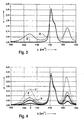
- FIG. 3 Measurement results measured by FTIR spectroscopy (Fourier transform infrared spectroscopy). Shown is the FTIR spectrum of an electrolyte composition LiAlCl 4 x 1.5 SO 2 , which was taken from a cell after about 550 charge and discharge cycles (solid line A) compared to the same SO 2 electrolyte, however not yet cycled (thin line B with crosses). The absorbance a is plotted in arbitrary units over the wavenumber k in cm -1 .
- the spectrum shows typical maxima of the chlorosulfonate at about 1218 cm -1 and at about 1070 cm 01 .
- the large maximum at about 1160 cm -1 is attributed to the sulfur dioxide of the electrolyte solution.
- the formation of chlorosulphonate during the cycle is clearly visible.
- FIG. 4 shows a representation accordingly FIG. 3 for the SO 2 -electrolyte of a cycled cell (curve A as in FIG. 3 ) and for three calibration solutions containing one wt% chlorosulfonate (curve a), 3% chlorosulfonate (curve b) and 10 wt% chlorosulfonate (curve c).
- the content of extraneous oxides on the positive electrode material can be reduced by annealing at higher temperatures, whereby both the entire electrode (active material and current collector) and only the active material isolated can be subjected to the temperature treatment.
- a high temperature is advantageous, but it must not be so high that (especially by reactions of a binder used in the electrode material) new Störoxide arise.
- carbon formed by reduction of the binder at excessively high temperatures reduces the lithium metal oxide to metal oxide to form lithium oxide and carbon dioxide: 4 LiMeO 2 + C ⁇ 2 Li 2 O + 4 MeO + CO 2
- the negative electrode can be freed by a temperature treatment so much of Störoxiden that the content is below the critical limit.
- the starting material graphite or the entire electrode including current conductor is heated to more than 1000 ° C under an inert gas atmosphere.
- the resulting virtually oxide-free material has a completely different consistency compared to normal graphite. It flows like a liquid. Therefore, a special procedure is required in the production of the oxide-free graphite negative electrode.
- another carbon material eg graphite which has been annealed at 500 ° C., in a concentration of 15%
- Even such an admixture is sufficient to modify the flow behavior of the largely oxide-free graphite to the extent that the production of an electrode is possible.
- One way to reduce the content of Störoxiden in a SO 2 -Elektrolytaims is the drying of the starting material lithium chloride (LiCl).
- the salt is heated for example in an argon atmosphere for 12 hours at 450 ° C.
- a graphite electrode or its active mass
- a thin layer of an inert but permeable to the ions of the conductive salt ceramic material, in particular aluminum oxide (Al 2 O 3 ).
- Al 2 O 3 aluminum oxide
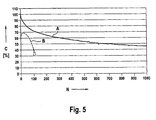
- FIG. 5 shows the behavior of two cells with different levels of steroids.
- the capacity C obtained in each case during unloading (in percent of the initial capacity) is plotted against the number of cycles N.
- Curve A shows the cycling behavior of a cell with about 0.25 mmoles of oxygen contained in oxides of strontium on the positive electrode, about 0.25 mmoles of oxygen contained in oxides of strontium in the electrolyte and about 1.1 mmoles of oxygen contained in oxides of strontium on the negative electrode.
- the total content of oxygen in Störoxiden was thus 1.6 mmol (each per Ah theoretical capacity of the cell).
- Curve B describes the Zykel a cell with about 12 mmol oxygen contained in Störoxiden per Ah theoretical capacity of the cell.
- the cell with fewer extraneous oxides still has a usable capacity of 50% after one thousand cycles, while the capacity of the cell with the higher level of oxide content rapidly drops to very low values even in less than one hundred cycles.
- the low stoichiometric cell had a capacity of 1125 mAh after formation of the lithium dithionite overcoat. After 1000 cycles, the capacity was about 416 mAh, the capacity loss thus 709 mAh. This value is in good agreement with the loss of capacity in terms of measurement accuracy, which can be calculated on the basis of the considerations outlined above.
Landscapes
- Chemical & Material Sciences (AREA)
- Chemical Kinetics & Catalysis (AREA)
- Electrochemistry (AREA)
- General Chemical & Material Sciences (AREA)
- Engineering & Computer Science (AREA)
- Manufacturing & Machinery (AREA)
- Inorganic Chemistry (AREA)
- Materials Engineering (AREA)
- Composite Materials (AREA)
- Crystallography & Structural Chemistry (AREA)
- Dispersion Chemistry (AREA)
- Battery Electrode And Active Subsutance (AREA)
- Secondary Cells (AREA)
- Cell Electrode Carriers And Collectors (AREA)
Description
- Die Erfindung betrifft eine wiederaufladbare elektrochemische Zelle mit einer positiven Elektrode, einer negativen Elektrode und einem Elektrolyten, der Schwefeldioxid (SO2) und ein Leitsalz des aktiven Metalls der Zelle enthält.
- Der zum Laden und Entladen der Zelle erforderliche Ladungstransport basiert auf der Beweglichkeit der Ionen eines Leitsalzes in dem Elektrolyt, der insbesondere flüssig oder gelförmig sein kann. In SO2-haltigen Elektrolyten (nachfolgend "SO2-Elektrolyten") trägt das SO2 zu der Beweglichkeit der Ionen des Leitsalzes bei, die diesen Ladungstransport bewirkten. In diesem Sinne stellt SO2 ein Lösungsmittel für das Leitsalz dar. Der Elektrolyt kann neben dem SO2 ein anderes Lösungsmittel enthalten, das zur Beweglichkeit der Ionen des Leitsalzes beiträgt. Dies können anorganische Lösungsmittel (beispielsweise Sulfurychlorid, Thionylchlorid), organische Lösungsmittel und ionische Flüssigkeiten (ionic liquids) sein, welche einzein oder in Mischung eingesetzt werden können. Vorzugsweise wird bei der Erfindung eine Elektrolytlösung verwendet, die SO2 nicht nur als Zusatz in geringer Konzentration enthält, sondern bei der die Beweglichkeit der Ionen des Leitsalzes überwiegend, besonders bevorzugt im Wesentlichen vollständig, durch das SO2 gewährleistet wird.
- Schon seit langem ist bekannt, dass SO2-Elektrolyten wesentliche Vorteile haben (vgl. "The Handbook of Batteries" von David Linden, 1994, Mc Graw Hill). Zu diesen Vorteilen gehört eine im Vergleich zu den organischen Elektrolyten üblicher Lithium-Ionen-Batteriezellen um einen Faktor 5 bis 10 höhere Leitfähigkeit. Dies ermöglicht hohe Lade- und Entladeströme und demzufolge eine hohe Leistungsdichte. Auch hinsichtlich der Kapazität der Zelle ist eine hohe Elektrolyt-Leitfähigkeit vorteilhaft, weil sie die Verwendung verhältnismäßig dicker Elektroden mit einer hohen Speicherkapazität für das aktive Metall der Zelle ermöglicht.
- Unterschiedliche Typen von Zellen mit SO2-Elektrolyt unterscheiden sich unter anderem hinsichtlich des aktiven Metalls, hinsichtlich des Leitsalzes und hinsichtlich der für die positiven und negativen Elektroden verwendeten Materialien. Insbesondere richtet sich die vorliegende Erfindung auf Batteriezellen mit folgenden Merkmalen:
- a) Das aktive Metall ist vorzugsweise ein Alkalimetall, insbesondere Lithium oder Natrium. In diesem Fall ist das Leitsalz vorzugsweise ein Tetrahalogenoaluminat, insbesondere ein Tetrachloroaluminat des Alkalimetalls, beispielsweise LiAlCl4. Jedenfalls, also unabhängig von dem Anion des Leitsalzes, enthält der Elektrolyt bevorzugt mindestens ein Mol des Leitsalzes pro 22 Mol SO2. Das bevorzugte maximale Molzahlverhältnis ist 1 Mol Leitsalz pro 0,5 Mol SO2. Im Rahmen der Erfindung bevorzugte aktive Metalle sind neben den Alkalimetallen auch die Erdalkalimetalle und die Metalle der zweiten Nebengruppe des Periodensystems, insbesondere Kalzium und Zink. Als Leitsalze eignen sich insbesondere deren Halogenide, Oxalate, Borate, Phosphate, Arsenate und Gallate.
- b) Die positive Elektrode enthält (zum Speichern des aktiven Metalls) vorzugsweise ein Metalloxid oder ein Metallphosphat, insbesondere in Form einer Interkalationsverbindung. Das Metall des Oxids oder Phosphats ist vorzugsweise ein Übergangsmetall der Ordnungszahlen 22 bis 28, insbesondere Kobalt, Mangan, Nickel oder Eisen. Praktische Bedeutung haben insbesondere auch binäre oder ternäre Oxide oder Phosphate, die zwei oder drei unterschiedliche Übergangsmetalle in der Gitterstruktur enthalten, wie beispielsweise Lithium-Nickel-Kobalt-Oxid. Die Erfindung kann jedoch auch in Verbindung mit anderen positiven Elektroden, beispielsweise auf der Grundlage eines Metallhalogenids, wie beispielsweise CuCl2 verwendet werden.
- c) Die negative Elektrode ist vorzugsweise als Insertionselektrode ausgebildet. Dieser Begriff bezeichnet generell Elektroden, die das aktive Metall derartig in ihrem Inneren enthalten, dass es zum Austausch mit dem Elektrolyt beim Laden und Entladen der Zelle bereit ist. Von besonderer Bedeutung sind allgemein und auch für die vorliegende Erfindung negative Elektroden, die Graphit enthalten, wobei im Inneren des Graphits beim Laden der Zelle aktives Metall aufgenommen wird (Lithiumionenzellen). Beim normalen Laden der Zelle kommt es dabei nicht zu einer Abscheidung von aktivem Metall auf der Elektrodenoberfläche.
Die Erfindung bezieht sich aber auch auf Zellen, bei denen das aktive Metall an der negativen Elektrode metallisch abgeschieden wird (Lithiummetallzellen). Besonders bevorzugt enthält dabei die negative Elektrode eine poröse Abscheideschicht, in deren Poren die aktive Masse beim Laden aufgenommen wird. Eine solche Elektrode wird ebenfalls als Insertionselektrode (im weiteren Sinne) bezeichnet. Zur Herstellung einer solchen Abscheideschicht kann beispielsweise ein Glasgewebe verwendet werden, welches vorzugsweise einen Porendurchmesser von mindestens 6 µm hat. - d) Die erforderliche elektrische Trennung der positiven und der negativen Elektrode kann entweder mittels eines Separators oder mittels eines Isolators realisiert sein.
Ein Separator ist eine Struktur, die den Durchtritt von an der negativen Elektrode abgeschiedenem metallischem Lithium zur Oberfläche der positiven Elektrode verhindert. Für Zellen mit SO2-Elektrolyt sind insbesondere Keramikmaterialien mit einem Porendurchmesser von höchstens 1 µm und inerte Polymermaterialien, oder auch Mischungen aus beiden Materialien, geeignet. Grundsätzlich können auch Separatoren aus Polyethylen (PE), Polypropylen (PP) oder Ethylentetrafluorethylen (ETFE) verwendet werden. Um unerwünschte Reaktionen zu vermeiden, sollten für derartige Zellen vorgesehene Ladegeräte aber so ausgebildet sein, dass ein Überladen vermieden wird.
Als Isolator wird in diesem Zusammenhang eine Struktur bezeichnet, die eine elektrische Trennung von positiver und negativer Elektrode bewirkt, aber nicht so ausgebildet ist, dass der Durchtritt von metallischem Lithium zur Oberfläche der positiven Elektrode verhindert wird. In derWO 2005/031908 wird beschrieben, dass dabei auftretende lokale Kurzschlüsse nicht schädlich sein müssen, sondern sogar positive Wirkungen haben können. Der Isolator dient vorzugsweise gleichzeitig als Abscheideschicht. - Hinsichtlich näherer Informationen zu Batteriezellen mit SO2-Elektrolyten kann beispielsweise auf folgende Dokumente verwiesen werden:
- (1)
US-Patent 5,213,914 - (2)
WO 00/79631 US-Patent 6,730,441 - (3)
WO 2005/031908 undUS 2007/0065714 - (4)
WO 2008/058685 undUS 2010/0062341 - (5)
WO 2009/077140 - Der Erfindung liegt die Aufgabe zugrunde, Batteriezellen mit einem SO2-Elektrolyt zur Verfügung zu stellen, die sich durch verbesserte Eigenschaften, insbesondere hinsichtlich des langfristigen Betriebs mit einer Vielzahl von Lade- und Entladezyklen auszeichnen.
- Die Aufgabe wird gelöst durch eine elektrochemische wiederaufladbare Batteriezelle mit einem Gehäuse, einer positiven Elektrode, einer negativen Elektrode und einem Elektrolyten, der Schwefeldioxid und ein Leitsalz des aktiven Metalls der Zelle enthält, die dadurch gekennzeichnet ist, dass die Gesamtmenge an in der Zelle enthaltenen Oxiden, die mit Schwefeldioxid unter Reduktion des Schwefeldioxids reagieren können, höchstens 10 mMol je Ah theoretische Kapazität der Zelle beträgt.
- Im Rahmen der Erfindung wurde festgestellt, dass bestimmte sauerstoffhaltige Verunreinigungen die langfristige Funktion von Batteriezellen mit einem SO2-haltigen Elektrolyt wesentlich beeinträchtigen können. Das sind sauerstoffhaltige Verbindungen, die mit Schwefeldioxid unter Reduktion des Schwefeldioxids reagieren können, das heißt unter Bedingungen, die im praktischen Betrieb der Batteriezelle vorkommen können, zu einer solchen Reaktion fähig sind. Für solche sauerstoffhaltige Verbindungen wird nachfolgend ohne Beschränkung der Allgemeinheit die Kurzbezeichnung "Störoxide" verwendet. Die in Rede stehenden Reaktionen sind kinetisch oft stark gehemmt, so dass sie nur über sehr lange Zeit ablaufen. Dennoch stören sie die Batteriefunktion unter Berücksichtigung der Tatsache, dass Batterien über lange Zeit (mehrere Jahre) funktionsfähig bleiben müssen.
- Diese Beobachtung gilt sowohl für Lithiumionenzellen als auch für Lithiummetallzellen. Im Rahmen der Erfindung wurde festgestellt, dass das Auftreten von metallischem Lithium die Reaktionen der Störoxide nicht verändert. Dies trifft unabhängig davon zu, ob lokale Kurzschlüsse entstehen (Isolator) oder ob eine Trennung des aktiven Metalls von der positiven Elektrode gewährleistet ist (Separator). In beiden Fällen verringert auch eine geringe Menge von Störoxiden die Kapazität der Zelle sehr stark.
- Besonders überraschend ist, dass schon sehr kleine Konzentrationen an Störoxiden die langfristige Funktion der Zelle massiv stören können. Beispielsweise hat eine im Rahmen der Erfindung erprobte Zelle im SubC-Format eine theoretische Entladekapazität von 2,3 Ah. Die Funktion einer solchen Zelle kann schon durch die Gegenwart von etwa 5 bis 10 mMol Störoxid so beeinträchtigt werden, dass ihre Kapazität im Laufe der langfristigen Benutzung über viele Lade- und Entladezyklen bis auf Null absinkt.
- Die theoretische Kapazität der Zelle wird durch deren Elektroden bestimmt, wobei im Rahmen der Erfindung als theoretische Kapazität der Zelle die theoretische Kapazität der positiven Elektrode verstanden wird. Dies ist die maximale theoretisch in der Elektrode gespeicherte Ladungsmenge des aktiven Metalls, d.h. die elektrische Ladungsmenge, die der maximalen Menge des aktiven Metalls entspricht, die die positive Elektrode auf Basis stöchiometrischer Überlegungen rechnerisch enthält. Dieser Wert ist stets höher als die tatsächlich erreichbare maximale Kapazität der Elektrode (und damit der Zelle), weil die theoretisch speicherbare Ladungsmenge in der Praxis nie vollständig aus dieser entnommen werden kann.
- Wenn der Gehalt an Störoxiden in der Zelle unterhalb der im Rahmen der Erfindung ermittelten Grenzwerte liegt, wird dadurch deren Langzeitfunktion wesentlich verbessert. Insbesondere bleibt die elektrische Kapazität über viele Lade- und Entladezyklen im Wesentlichen stabil, wobei auch eine wesentliche Verbesserung der Überladefestigkeit erreicht wird, d. h. die Funktion der Zelle wird auch durch Überladen nicht zerstört.
- Wie einleitend dargelegt, bezieht sich die Erfindung vorzugsweise auf Zellen mit einem Elektrolyt, dessen SO2-Gehalt so hoch ist, dass die Beweglichkeit der Leitsalz-Ionen überwiegend oder sogar im Wesentlichen vollständig auf der Gegenwart des SO2 basiert. Die Mindestmenge an SO2 je Ah theoretische Kapazität der Zelle ist vorzugsweise 1 mMol, wobei, jeweils bezogen auf die theoretische Kapazität der Zelle, eine Mindestmenge von 5 mMol besonders bevorzugt und eine Mindestmenge von 10 mMol noch weiter bevorzugt ist.
- In Kenntnis der Erfindung lässt sich deren Wirkung durch eine Vielzahl von Reaktionen erklären, an denen in der Regel mehrere Elemente der Zelle (Elektroden, Elektrolyt) beteiligt sind. Dies wird nachfolgend anhand einer elektrochemischen Zelle mit einer negativen Elektrode auf Basis von Kohlenstoff und einer positiven Elektrode auf Basis eines Metalloxids erläutert.
- Beim normalen Laden und Entladen der Zelle (ohne Überladen) führen nach dem gegenwärtigen Kenntnisstand der Erfinder die nachfolgend erläuterten Reaktionen von Störoxiden zu einer Reduktion des Schwefeldioxids und letztlich zu Kapazitätsverlusten.
- Eine typische sauerstoffhaltige Verunreinigung am aktiven Material einer negativen Kohlenstoffelektrode ist C6O. Es reagiert mit dem LiC6 der Elektrode und dem SO2 des Elektrolyten unter Verbrauch von sechs Elektronen (e-) gemäß folgender Reaktionsgleichung:
(1) 6 LiC6 + C6O + 2 S(+IV)O2 → 7 C6 + Li2S(+II) 2O3 + 2 Li2O; Ladungsverbrauch 6 e-
- Die Reaktionsprodukte sind Kohlenstoff (C6), Lithiumthiosulfat (Li2S2O3) und Lithiumoxid (Li2O).
- Durch die in Klammern hochgestellte römische Ziffer wird die Oxidationszahl des Schwefels in der jeweiligen Verbindung bezeichnet. Bei der Reaktion sinkt die Oxidationszahl des Schwefels um 2. Das Schwefeldioxid wird also bei der Bildung des Lithiumthiosulfats reduziert.
- Die Gegenwart des Störoxids C6O führt indirekt zu folgender weiterer Reaktionsfolge, die mit einer Reduktion des Schwefeldioxids, letztlich unter Bildung von Lithiumthiosulfat, einhergeht:
(2) 2 Li2O + 2 AlCl3 → 2 AIOCI + 4 LiCl
(3a) 4 Li2S(+III) 2O4 + 2 AIOCI + 2 AlCl3 + 8 LiC6 + → 4 Li2S(+II)2O3 + 2 Al2O3 + 8 LiCl + 8C6; Ladungsverbrauch 8 e-
- Gemäß (2) reagiert das aus Reaktionsgleichung (1) resultierende Lithiumoxid mit der Lewis-Säure Aluminiumchlorid (AlCl3), die durch Autodissozation des Leitsalzes in der Regel in dem Elektrolyt enthalten ist, zu Aluminiumoxichlorid (AIOCI) und Lithiumchlorid (LiCl). Aber auch die neutrale Form des Leitsalzes (LiAlCl4) kann zur Lösung des Li2O und weiteren Reaktion mit Li2S2O4 führen:
(2') 2 Li2O + 2 LiAlCl4 → 2 LiAlOCl2 + 4 LiCl
(3a') 4 Li2S(+III) 2O4 + 2 LiAlOCl2 + 2 LiAlCl4 + 8 LiC6 → 4 Li2S(+II) 2O3 + 2 Al2O3 + 12 LiCl + 8C6; Ladungsverbrauch 8 e-
- Bei der weiteren Reaktion (3a) ist zu berücksichtigen, dass in derartigen Zellen eine (in der Regel für die Funktion der Zelle vorteilhafte und deshalb erwünschte) Deckschicht aus Lithiumdithionit vorhanden ist, die gemäß
(4a) 8 LiC6 + 8 SO2 → 8 C6 + 4 Li2S2O4; Ladungsverbrauch 8 e'
unter Verbrauch von acht Elektronen aus dem LiC6 der Elektrode und dem SO2 des Elektrolyten gebildet wird und aus Lithiumdithionit (Li2S2O4) besteht. Diese Verbindung der Deckschicht reagiert gemäß (3a) weiter, wobei wiederum das SO2 des Lithiumdithionit unter Bildung von Lithiumthiosulfat reduziert wird (die Oxidationszahl des Schwefels wird von +III auf +II vermindert). - Insgesamt führt die Gegenwart von einem Molekül C6O zu einem Verbrauch von 10 Molekülen SO2 und 22 e' (wobei 5 Moleküle Li2S2O3 gebildet werden). Umgerechnet bedeutet dies, dass je mMol C6O 594 mAh Ladung irreversibel verbraucht werden.
- Bei den vorstehenden Überlegungen ist zusätzlich die Löslichkeit der aus der Reaktion (1) resultierenden Reaktionsprodukte Lithiumthiosulfat (Li2S2O3) und Lithiumoxid (Li2O) zu berücksichtigen. Wenn sich das Li2O nicht löst, kann die Reaktion (2) nicht stattfinden und damit finden auch die Folgereaktionen (3a) und (4a) nicht statt. Der Ladungsverbrauch wird folglich auf 6e- aus der Reaktion (1) reduziert. Umgerechnet werden dabei je mMol C6O 162 mAh Ladung irreversibel verbraucht.
- Wenn sich das Li2O löst, nicht jedoch das Li2S2O3, so findet die Reaktion (4a) nicht statt. In diesem Fall ist der Ladungsverbrauch auf 14e- reduziert. Dies bedeutet, dass je mMol C6O 378 mAh Ladung irreversibel verbraucht werden.
- Je nach der Löslichkeit der genannten Komponenten (welche unter anderem von der Temperatur und der SO2-Konzentration abhängt) liegt der Kapazitätsverlust, der durch Störoxide an dem aktiven Material der negativen Elektrode verursacht wird, also zwischen 162 und 564 mAh.
- Eine typische sauerstoffhaltige Verunreinigung am aktiven Material der positiven Elektrode ist ein Hydroxid, das sich an deren Oberfläche bildet, im Falle einer Lithiummetalloxid-Elektrode der allgemeinen Formel LiMeO2, beispielsweise LiMeO(OH)2. Es reagiert mit in dem Elektrolyt anwesendem AlCl3 gemäß folgender Reaktionsgleichung zu Aluminiumoxichlorid, einem Chlorid des Metalls Me, HCl und LiCl:
(5) LiMeO(OH)2 + 3 AlCl3 → 3 AlOCl + MeCl3 + 2 HCl + LiCl
- Das Hydroxid kann auch mit der neutralen Form des Leitsalzes reagieren gemäß:
(5') LiMeO(OH)2 + 3 LiAlCl4 → 3 LiAlOCl2 + MeCl3 + 2 HCl + LiCl
- Das dabei gebildete Aluminiumoxichlorid reagiert mit der Lithiumdithionit-Deckschicht gemäß den nachfolgenden Gleichungen (3b) und (4b) weiter, wobei sich diese nur hinsichtlich der Mol-Zahlen von der Gleichung (3a) und (4a) unterscheiden und deswegen nicht nochmals erläutert werden müssen:
(3b) 6 Li2S(+III) 2O4 + 3 AlOCl + 3 AlCl3 + 12 LiC6 → 6 Li2S(+II) 2O3 + 3 Al2O3 + 12 LiCl + 12 Ce; Ladungsverbrauch 12 e-
- Selbstverständlich ist auch hier der Reaktionsweg über das Lithiumaluminiumoxichlorid (LiAlOCl2) analog (3a') möglich.
(4b) 12 LiC6 + 12 SO2 → 12 C6 + 6 Li2S2O4; Ladungsverbrauch 12e-
- Insgesamt führt die Gegenwart von einem Molekül LiMeO(OH)2 zum Verbrauch von 12 Molekülen SO2 und 24 e-, wobei (mit 3 Molekülen AlOCl als Zwischenprodukt) 6 Moleküle Li2S2O3 und 2 Moleküle HCl gebildet werden. Der Ladungsverbrauch entspricht, bezogen auf 1 mMol LiMeO(OH)2 einer Ladungsmenge von 702 mAh. Zusätzlich steht das Lithium aus einem Molekül LiMeO(OH)2 nicht mehr als aktives Metall zur Verfügung. Daraus resultiert ein weiterer Kapazitätsverlust von 27 mAh pro mMol LiMeO(OH)2. Insgesamt geht somit je mMol LiMeO(OH)2 eine Kapazität von 729 mAh verloren, wenn die Reaktionen vollständig ablaufen. Da jedes Mol Störoxid 3 Mol Sauerstoff enthält, entspricht dies 243 mAH je Mol Sauerstoff.
- Wie oben erwähnt, finden die Reaktionen (3b) und (4b) nur statt, wenn sich das gemäß (3b) gebildete Lithiumthiosulfat löst und infolgedessen die Neubildung von Lithiumdithionid gemäß (4b) stattfindet. Wenn dies nicht der Fall ist, verringert sich der Ladungsverbrauch auf 12e-. Dies entspricht je mMol LiMeO(OH)2 einer Kapazität von 351 mAh, die irreversibel verloren geht. Hinzu kommt auch hier der Kapazitätsverlust durch verbrauchtes aktives Metall in Höhe von 27 mAh. Der gesamte Kapazitätsverlust beträgt in diesem Fall also 378 mAh, d.h. 126 mAh je Mol Sauerstoff.
- Weitere sauerstoffhaltige Verunreinigungen entstehen bei der Herstellung der Elektrolytlösung oder durch Reaktion der Elektrolytlösung mit sonstigen Komponenten der Zelle (beispielsweise Gehäuse, Separator, Stromableiter von und zu den Elektroden). Sie liegen typischerweise ebenfalls als saure (AlOCl) oder neutrale (LiAlOCl2) Aluminiumoxichloride vor und führen zu folgenden Reaktionen, wobei die Reaktionsgleichungen (3c) und (4c) bis auf die Mol-Zahlen wiederum (3a) und (4a) entsprechen.
(3c) 2 Li2S(+III) 2O4 + AlOCl + AlCl3 + 4 LiC6 → 2 Li2S(+II) 2O3 + 2 Al2O3 + 4 LiCl + 4 C6; Ladungsverbrauch 4 e-
- Auch in diesem Fall ist der alternative Reaktionsweg analog (3a') möglich.
(4c) 4 LiC6 + 4 SO2 → 4 C6 + 2 Li2S2O4; Ladungsverbrauch 4 e-
- Die Gegenwart von einem Molekül AlOCl führt zum Verbrauch von 4 Molekülen SO2 und 8 e-, wobei 2 Moleküle Li2S2O3 erzeugt werden. Der entsprechende Ladungsbrauch je mMol AIOCI ist 216 mAh.
- Wenn sich das Lithiumthiosulfat nicht löst, verringert sich auch in diesem Fall der Ladungsverbrauch entsprechend, also auf 4e-. Dies entspricht 108 mAh. Für die Stromableiter von und zu den Elektroden wird häufig Nickel oder eine Nickellegierung verwendet, wobei die Oberfläche dieser Bauteile oxidiert sein kann, also Nickeloxid enthält. Ist das Nickelchlorid (noch) nicht in der Elektrolytlösung gelöst, kann beim Laden der Zelle eine direkte Reaktion analog Reaktionsgleichung (1) unter Bildung von Li2S2O3 stattfinden.
- Beim Überladen der Zelle steigt die Ladespannung an. Ab einer bestimmten, von dem Zelltyp abhängigen Spannung führt der Anstieg der Ladespannung zur Zersetzung der Elektrolytlösung. Wenn diese als Leitsalz beispielsweise ein Tetrachloroaluminat enthält, wird Chlor (Cl2) als Überladeprodukt an der positiven Elektrode gebildet. Dies führt zu weiteren Reaktionen, bei denen das gemäß den zuvor beschriebenen Reaktionen gebildete Lithiumthiosulfat mit zu der negativen Elektrode difundiertem Chlor und dem LiC6 der negativen Elektrode über mehrere Reaktionsstufen weiter reagiert. Dabei wird der Schwefel disproportioniert bis er in einem Endprodukt die Oxidationszahl -II und im anderen Endprodukt die Oxidationszahl +VI erreicht hat. Beispiele solcher Endprodukte mit Oxidationszahl -II sind Metallsulfide (z. B. Li2S(-II) oder Al2S(-II) 3). Ein Beispiel für ein Endprodukt mit der Oxidationszahl +VI ist Lithiumchlorsulfonat (LiSO3Cl).
- Die Summengleichung der mehrstufigen Reaktion lässt sich wie folgt angeben:
(6) 6 LiC6 + Li2S2O3 + 3 Cl2 → 6 C6 + LiS(+VI)O3Cl + Li2S(-II) + 5 LiCl
- Für die Reduktion von einem Molekül Li2S(+II) 2O3 zu Schwefelverbindungen laut Gleichung (6) werden 6 e- benötigt. Umgerechnet bedeutet dies, dass für die Reaktion von einem mMol Lithiumthiosulfat 162 mAh an Kapazität irreversibel verbraucht werden.
- Zusammenfassend ergibt sich aus den vorstehenden Erläuterungen, dass die Gegenwart von Störoxiden beim normalen Laden und Entladen der Zelle (ohne Überladen) zur Bildung einer Schwefel-Sauerstoff-Verbindung führt, bei der der Schwefel eine Oxidationsstufe von maximal +III besitzt. Ein wichtiges Beispiel ist ein Thiosulfat des aktiven Metalls (im Fall einer Lithiumzelle Lithiumthiosulfat). Bei der Reaktionsfolge wird Schwefeldioxid des Elektrolyts reduziert. Wird die Zelle unter Bildung von Überladeprodukten überladen, führt dies zu weiteren Reaktionen, bei denen der Schwefel des Thiosulfats zu Schwefelverbindungen mit den Oxidationszahlen -II und +VI disproportioniert wird. Ein charakteristisches Reaktionsprodukt, das beim Überladen in Gegenwart von Störoxiden gebildet wird, ist ein Chlorsulfonat des aktiven Metalls, in einer Lithiumzelle Lithiumchlorsulfonat. Die elektrische Ladungsmenge, die für diese Reaktionen gebraucht wird, wird von der Zelle geliefert und steht nicht mehr als nutzbare Batteriekapazität zur Verfügung.
- Die vorstehend genannten Störoxide sind Beispiele für jegliche Art von Störoxiden (im Sinne der weiter oben gegebenen Definition), die sich auf bzw. in den Materialien der Zelle befinden.
- Die positive Elektrode kann beispielsweise Störoxide in Form von verschiedenen sauerstoffhaltigen Verbindungen enthalten, die sich auf der Oberfläche des Elektrodenmaterials befinden. Hierzu gehören auch Hydroxide (einschließlich Wasser), Oxiddihydroxide, Carbonate, Borate etc.
- In ähnlicher Weise stellt die Formulierung C6O eine vereinfachte Darstellung eines an einer negativen Kohlenstoffelektrode gebundenen Sauerstoffs dar. Auf der Graphitoberfläche befindet sich Sauerstoff in kovalent gebundener Form, beispielsweise als Ketone, Aldehyde, Carbonyle, Alkohole, Epoxide, Karbonsäuren etc. Der Sauerstoff kann auch in Form von adsorbiertem Wasser oder adsorbiertem Metallhydroxid oder ähnlichem vorliegen.
- Allen Störoxiden gemeinsam ist nach den Feststellungen der Erfinder jedoch, dass sie mit in dem Elektrolyt enthaltendem Schwefeldioxid unter Reduktion des Schwefeldioxids reagieren können. Typischerweise wird beim Normalbetrieb der Zelle (ohne Überladen) eine Schwefel-Sauerstoff-Verbindung gebildet, bei der der Schwefel eine Oxidationsstufe von maximal 3 besitzt, z.B. ein Thiosulfat des aktiven Metalls. Beim Betrieb mit Überladen entsteht typischerweise eine Schwefel-Sauerstoff-Verbindung, die zusätzlich ein Halogen enthält und bei der die Oxidationsstufe des Schwefels +VI ist. Zum Beispiel wird ein Chlorsulfonat des aktiven Metalls der Zelle gebildet.
- Folgende Tabelle fasst den erläuterten Zusammenhang zwischen der Konzentration von Sauerstoff in sauerstoffhaltingen Verbindungen (O in StO) an der negativen Elektrode (NE), der positiven Elektrode (PE) und im Elektrolyt zusammen:
Tabelle 1: Laden und Entladen Überladen Gesamt Ort SO2-Verbrauch Li2S2O3-Bildung Kap.verlust mAh/mMol O in StO Kap.verlust mAh/mMol O in StO Kap.verlust mAh/mMol O in StO NE 2-10 mMol 1 - 5 mMol 162 - 594 810 1404 PE 0-12 mMol 6 mMol 126-243 324 567 Elektrolyt 0-4 mMol 2 mMol 108-216 324 540 - Da der Kapazitätsverlust beim Laden und Entladen (wie erläutert) von der Löslichkeit der Komponenten in dem Elektrolyt abhängt, wurden in der Tabelle die entsprechenden Bereiche angegeben. Entsprechendes gilt für den SO2-Verbrauch, der ebenfalls von der Löslichkeit der Reaktionskomponenten abhängt. Je nach Ausgangskonzentration des SO2 kann auch durch den SO2-Verbrauch die Funktionsfähigkeit der Zelle beeinträchtigt oder zerstört werden, weil der Ladungstransport in dem Elektrolyten von der SO2-Konzentration abhängt.
- Beim Überladen laufen nach den Feststellungen der Erfinder auch die zuvor mangels Löslichkeit gehemmten Reaktionen ab. Deshalb ist für den Kapazitätsverlust beim Überladen jeweils nur ein Wert angegeben.
- Wie sich aus der Tabelle ergibt, verursachen Störoxide, die in dem Elektrolyt enthalten sind, den relativ geringsten Kapazitätsverlust je mMol. Aus dem Zahlenwert von ca. 100 mAh/mMol ergibt sich, dass bei vollständiger Reaktion des in dem Elektrolyt enthaltenen Störoxids (ohne die erläuterten Überladereaktionen) die Kapazität der Zelle auf Null absinkt, wenn der Elektrolyt mehr als etwa 10 mMol Störoxid je Ah theoretische Kapazität der Zelle enthält und keine weiteren Störoxide in der Zelle vorhanden sind.
- In der Praxis ist aber zu berücksichtigen, dass je nach Einsatzgebiet der Batterie Betriebsbedingungen herrschen können, bei denen die Störoxide nur partiell reagieren. Dies gilt beispielsweise für Batterien, die für Niedertemperatureinsätze gedacht sind oder für Batteriesysteme, bei denen durch entsprechende Konstruktion der Ladegeräte ein Überladen der Batteriezelle zuverlässig verhindert wird. In diesen Fällen können höhere Konzentrationen an Störoxiden tolerierbar sein.
- Umgekehrt sollten bei hohen Anforderungen an die Langzeitstabilität der Zelle und diesbezüglich ungünstigen Betriebsbedingungen (z.B. Hochtemperaturanwendungen) geringere Gesamtmengen an Störoxiden in der Zelle enthalten sein. Gemäß bevorzugten Ausführungen enthält sie deswegen höchstens 5 mMol, vorzugsweise höchstens 2 mMol, besonders bevorzugt höchstens 1 mMol, noch weiter bevorzugt höchstens 0,5 mMol und ganz besonders bevorzugt höchstens 0,1 mMol Störoxide je Ah theoretische Kapazität der Zelle.
- Im Rahmen der Erfindung wurden Experimente durchgeführt, bei denen typische Materialien der negativen und positiven Elektrode, nämlich Graphit und ein Trimetalloxid [Li(Ni0,77Co0,13Mn0,1)O2] bei 60°C über achtzehn Tage in einer Elektrolytlösung der Zusammensetzung LiAlCl4 x 1,5 SO2 gelagert wurden. Während dieser Lagerzeit wurde mehrfach der Karl-Fischer-Wert bestimmt, der ein Maß für in dem Elektrolyt enthaltene Störoxide ist. Die Ergebnisse sind in
Figur 1 dargestellt. Sie zeigt die nach Karl Fischer bestimmte O2--Konzentration in ppm gegenüber der Zeit in Tagen für drei Versuche, nämlich mit dem reinen Elektrolyt (runde Punkte), dem Elektrolyt mit Trimetalloxid (Rechtecke) und dem Elektrolyt mit Graphit (Dreiecke). - Daraus lassen sich folgende Feststellungen ableiten:
- Der Elektrolyt enthält sehr geringe Mengen an O2-, wobei die Schwankung des Kurvenverlaufs innerhalb der Fehlergrenze liegt.
- Bei dem Experiment mit Trimetalloxid ist erst ein Anstieg, dann ein Plateau und danach ein weiterer Anstieg zu erkennen. Dies deutet auf mindestens zwei Störoxide hin, die sich mit unterschiedlicher Geschwindigkeit lösen.
- Bei dem Experiment mit Graphit ist der Anstieg des O2- sehr gering, jedenfalls geringer als bei dem Trimetalloxid. Nach dem Kenntnisstand der Erfinder ist dies darauf zurückzuführen, dass von den auf dem Graphit vorhandenen Störoxiden nur ein kleiner Teil sich ohne weiteres in der Elektrolytlösung löst. Dies sind nach dem Kenntnisstand der Erfinder Störoxide, die nicht kovalent gebunden sind. Dies bedeutet jedoch nicht, dass auf dem Graphit keine größeren Mengen an Störoxiden vorhanden sind. Vielmehr wurde im Rahmen weiterer experimenteller Untersuchungen festgestellt, dass auf normalem Graphit relativ große Mengen Störoxide vorhanden sind, die jedoch kovalent gebunden sind und deswegen erst beim Laden der Zelle reagieren.
- Die Ergebnisse eines solches Experimentes sind in
Figur 2 dargestellt. Sie bezieht sich auf elektrochemische Messungen, die an einer E-Zelle in Drei-Elektroden-Anordnungen durchgeführt wurden. Dargestellt ist die elektrische Spannung U in Volt in Abhängigkeit von der Zeit t in Stunden beim ersten Laden von zwei verschiedenen negativen Graphit-Elektroden. Für die erste Elektrode wurde kommerzielles Graphit ohne zusätzliche Behandlung verwendet. Die zweite Elektrode wurde zur Entfernung der Störoxide für 90 Stunden bei 1000°C in einem Ofen unter Argon-Schutzgas behandelt. - Die Zelle wurde mit beiden Elektroden bei einem konstanten Strom von 11 mA geladen. Das daraus resultierende Spannungs-Zeit-Diagramm ist für die unbehandelte Elektrode mit A und für die vorbehandelte Elektrode mit B bezeichnet.
- Beim ersten Laden einer negativen Elektrode bilden sich Deckschichten auf dem Graphit, nämlich eine Deckschicht aus Lithiumdithionit, die für die Funktion der Zelle vorteilhaft ist und eine unerwünschte Deckschicht aus Lithiumthiosulfat, deren Bildung auf die Gegenwart von Störoxiden zurückzuführen ist. Aus anderen Experimenten ist bekannt, dass die Deckschichtbildung bei einer Spannung von 0,2 Volt abgeschlossen ist.
Figur 2 zeigt, dass dieser Spannungswert für die behandelte Elektrode nach 0,2 Stunden und für die unbehandelte Elektrode nach 0,3 Stunden erreicht ist. Da der Stromfluss konstant 11 mA betrug, errechnet sich eine verbrauchte Ladungsmenge von 2,2 mAh für die vorbehandelte, im wesentlichen störoxidfreie Elektrode und 3,3 mAh für die unbehandelte Elektrode. Dies zeigt, dass normales Graphit relativ große Mengen Störoxide enthält, die erst beim Laden der Zelle reagieren. - Weitere Experimente wurden mit verschiedenen Materialien durchgeführt, die für positive Elektroden geeignet sind. Dabei wurden die in der nachfolgenden Tabelle genannten Materialien jeweils in kommerziell erhältlicher Form in Elektrolytlösung bei 60°C 21 Tage gelagert. Die Zunahme des Störoxidgehalts des Elektrolyten wurde nach Karl Fischer bestimmt. Sie entspricht der Abgabe der Störoxide des Elektrodenmaterials. Die Ergebnisse sind in der nachfolgenden Tabelle 2 dargestellt.
Tabelle 2: Material Formel Störoxid-Gehalt Lithiumkobaltoxid LiCoO2 33.000 ppm Lithiumeisenphosphat LiFePO4 1.600 ppm Trimetalloxid Charge 1 Li/Ni0,77Co0,13Mn0,1)O2 2.800 ppm Trimetalloxid Charge 2 Li/Ni0,77CO0,13Mn0,1)O2 4.500 ppm - Extrem hoch ist der Störoxidgehalt von Lithiumkobaltoxid. Obwohl die Werte der anderen Elektrodenmaterialien etwa einen Größenordnung niedriger sind, sind auch diese Werte noch so hoch, dass bei unveränderter Verwendung dieser Materialien die Funktionsfähigkeit der Zelle stark beeinträchtigt wird.
- Ähnliche Experimente wurden auch mit anderen in erfindungsgemäßen Zellen verwendeten Materialien durchgeführt. Beispielsweise wurde der Störoxidgehalt von Nickelschaum (gebräuchlich als Ableiter der Elektroden), jeweils in kommerziell erhältlichem Zustand, und Glasgewebe (gebräuchlich als Isolator zwischen den Elektroden) bestimmt. Die Materialien wurden in Elektrolytlösung sieben Tage bei 60°C gelagert. Die daraus resultierende Zunahme des Störoxidgehaltes des Elektrolyten wurde mit Hilfe der Karl-Fischer-Methode bestimmt. Daraus resultierten folgende Störoxidgehalte:
Tabelle 3: Material Störoxid-Gehalt Nickelschaum 19,2 ppm Glasgewebe 33,8 ppm - Neben der Karl-Fischer-Methode können selbstverständlich auch andere chemisch-analytische Nachweisverfahren verwendet werden, um Störoxide oder aus der Reaktion der Störoxide in der Zelle resultierende Reaktionsprodukte zu bestimmen. Beispielsweise zeigt
Figur 3 Messergebnisse, die mittels der FTIR-Spektroskopie (Fourier Transformation Infrarot Spektroskopie) gemessen wurden. Dargestellt ist das FTIR-Spektrum eines Elektrolyten der Zusammensetzung LiAlCl4 x 1,5 SO2, der aus einer Zelle nach ca. 550 Lade- und Entladezyklen entnommen wurde (durchgezogene Linie A) im Vergleich zu dem gleichen SO2-Elektrolyten, der jedoch noch nicht gezykelt wurde (dünne Linie B mit Kreuzen). Dabei ist die Absorbanz a in willkürlichen Einheiten aufgetragen über die Wellenzahl k in cm-1. Das Spektrum zeigt typische Maxima des Chlorsulfonats bei ca. 1218 cm-1 und bei ca. 1070 cm01. Das große Maximum bei ca. 1160 cm-1 ist dem Schwefeldioxid der Elektrolytlösung zuzuordnen. Die Bildung des Chlorsulfonats während des Zykelns ist deutlich zu erkennen. - Durch entsprechende Kalibration ist eine quantitative Bestimmung des charakteristischen Reaktionsproduktes möglich.
Figur 4 zeigt eine Darstellung entsprechendFigur 3 für den SO2-Elektrolyt einer gezykelten Zelle (Kurve A wie beiFigur 3 ) und für drei Kalibrationslösungen, welche ein Gew% Chlorsulfonat (Kurve a), 3 % Chlorsulfonat (Kurve b) und 10 Gew% Chlorsulfonat (Kurve c) enthielten. - In Kenntnis der Erfindung sind dem Fachmann auf der Grundlage der nachfolgenden Erläuterungen verschiedene Möglichkeiten zugänglich, den Störoxidgehalt der Komponenten der Zelle zu reduzieren.
- Der Gehalt an Störoxiden auf dem Material der positiven Elektrode kann durch Tempern bei höheren Temperaturen reduziert werden, wobei sowohl die gesamte Elektrode (aktives Material und Stromableiter) als auch nur das aktive Material isoliert der Temperaturbehandlung unterworfen werden kann. Grundsätzlich ist eine hohe Temperatur vorteilhaft, jedoch darf sie nicht so hoch sein, dass (insbesondere durch Reaktionen eines in dem Elektrodenmaterial verwendeten Bindemittels) neue Störoxide entstehen. Im Rahmen der Erfindung wurde festgestellt, dass bei zu hohen Temperaturen durch Reduktion des Bindemittels gebildeter Kohlenstoff das Lithiummetalloxid zu Metalloxid unter Bildung von Lithiumoxid und Kohlendioxid reduziert:
4 LiMeO2 + C ↔ 2 Li2O + 4 MeO + CO2
- In Kenntnis der Erfindung ist es ohne weiteres möglich, das Bindemittel und die Temperatur so aufeinander abzustimmen, dass der Störoxidgehalt auf unkritische Werte reduziert wird.
- Auch die negative Elektrode kann durch eine Temperaturbehandlung so weitgehend von Störoxiden befreit werden, dass der Gehalt unterhalb der kritischen Grenze liegt. Dazu wird das Ausgangsmaterial Graphit oder die gesamte Elektrode einschließlich Stromableiter auf mehr als 1000°C unter Inertgasatmosphäre erhitzt.
- Das resultierende praktisch oxidfreie Material hat im Vergleich zu normalem Graphit eine völlig andere Konsistenz. Es fließt wie eine Flüssigkeit. Deshalb ist bei der Herstellung der negativen Elektrode aus oxidfreiem Graphit eine besondere Verfahrensweise erforderlich. Um eine Bindung der oxidfreien Graphitpartikel zu erreichen, kann beispielsweise ein anderes Kohlenstoff-Material (z.B. Graphit, das bei 500°C getempert wurde, in einer Konzentration von 15%) zugemischt werden. Schon eine solche Beimischung reicht aus, um das Fließverhalten des weitgehend oxidfreien Graphits soweit zu modifizieren, dass die Herstellung einer Elektrode möglich ist.
- Eine Möglichkeit, den Gehalt an Störoxiden in einer SO2-Elektrolytlösung zu senken, ist die Trocknung der Ausgangssubstanz Lithiumchlorid (LiCl). Zu diesem Zweck wird das Salz beispielsweise in einer Argonatmosphäre für 12 Stunden auf 450°C aufgeheizt.
- Die genauen Bedingungen der Behandlung zur Störoxidreduzierung müssen für jedes Material bzw. für jede Elektrode individuell angepasst werden. In Kenntnis der vorliegenden Erfindung können verschiedene Verfahrensweisen erprobt werden, wobei das Ergebnis beispielsweise mittels der Karl-Fischer-Methode oder mittels einer elektrochemischen Messung überprüft werden kann.
- Grundsätzlich besteht auch die Möglichkeit, die Zelle dadurch von Störoxiden zu befreien, dass die entsprechenden Bauteile mit einer dünnen Sperrschicht überzogen werden, durch die verhindert wird, dass eine Reaktion eines auf dem entsprechenden Bauteil vorhandenen Oxids mit dem Schwefeldioxid des Elektrolyten unter Reduktion des Schwefeldioxids stattfinden kann. Beispielsweise besteht die Möglichkeit, eine Graphitelektrode (bzw. deren aktive Masse) mit einer dünnen Schicht aus einem inerten, aber für die Ionen des Leitsalzes durchlässigen keramischen Material, insbesondere Aluminiumoxid (Al2O3) zu beschichten. Auch in diesem Fall kann durch experimentelle Untersuchungen geprüft werden, ob das Oxid so vollständig abgesperrt ist, dass es nicht mehr mit Schwefeldioxid unter Reduktion des Schwefeldioxids reagieren kann und demzufolge kein Störoxid mehr ist.
-
Figur 5 zeigt das Verhalten zweier Zellen mit unterschiedlichen Störoxidgehalten. Aufgetragen ist die jeweils beim Entladen gewonnene Kapazität C (in Prozent der Anfangskapazität) gegen die Zykelzahl N. - Die Kurve A zeigt das Zykelverhalten einer Zelle mit etwa 0,25 mMol in Störoxiden enthaltenem Sauerstoff auf der positiven Elektrode, etwa 0,25 mMol in Störoxiden enthaltenem Sauerstoff im Elektrolyten und etwa 1,1 mMol in Störoxiden enthaltenem Sauerstoff auf der negativen Elektrode. Der Gesamtgehalt an Sauerstoff in Störoxiden betrug also 1,6 mMol (jeweils je Ah theoretische Kapazität der Zelle).
- Die Kurve B beschreibt das Zykelverhalten einer Zelle mit etwa 12 mMol in Störoxiden enthaltenem Sauerstoff je Ah theoretische Kapazität der Zelle.
- Die Zelle mit weniger Störoxiden (Kurve A) hat noch nach tausend Zyklen eine nutzbare Kapazität von 50 %, während die Kapazität der Zelle mit dem höheren Störoxidgehalt schon bei weniger als hundert Zyklen rasch auf sehr niedrige Werte abfällt.
- Die Zelle mit dem geringen Störoxidgehalt hatte nach der Bildung der Deckschicht aus Lithiumdithionit eine Kapazität von 1125 mAh. Nach 1000 Zyklen betrug die Kapazität ca. 416 mAh, der Kapazitätsverlust somit 709 mAh. Dieser Wert stimmt im Rahmen der Messgenauigkeit gut mit dem Kapazitätsverlust überein, der sich auf der Grundlage der oben erläuterten Überlegungen errechnen lässt.
Claims (15)
- Elektrochemische wiederaufladbare Batteriezelle mit einem Gehäuse, einer positiven Elektrode, einer negativen Elektrode und einem Elektrolyten, der Schwefeldioxid und ein Leitsalz des aktiven Metalls der Zelle enthält,
dadurch gekennzeichnet, dass die Gesamtmenge von Sauerstoff, der in der Zelle in Verbindungen enthalten ist, die mit Schwefeldioxid unter Reduktion des Schwefeldioxids reagieren können, höchstens 10 mMol je Ah theoretische Kapazität der Zelle beträgt. - Batteriezelle nach Anspruch 1, dadurch gekennzeichnet, dass die Gesamtmenge von Sauerstoff, der in der Zelle in Verbindungen enthalten ist, die mit Schwefeldioxid unter Reduktion des Schwefeldioxids reagieren können, höchstens 5 mMol, vorzugsweise höchstens 1 mMol, besonders bevorzugt höchstens 0,5 mMol und noch weiter bevorzugt 0,1 mMol je Ah theoretische Kapazität der Zelle beträgt.
- Batteriezelle nach Anspruch 1,
dadurch gekennzeichnet, dass die Menge von Sauerstoff, der in der negativen Elektrode in Verbindungen enthaltenen ist, die mit Schwefeldioxid unter Reduktion des Schwefeldioxids reagieren können, höchstens 6 mMol je Ah theoretische Kapazität der Zelle beträgt. - Batteriezelle nach Anspruch 1,
dadurch gekennzeichnet, dass die Menge von Sauerstoff, der in der positiven Elektrode in Verbindungen enthalten ist, die mit Schwefeldioxid unter Reduktion des Schwefeldioxids reagieren können, höchstens 8 mMol je Ah theoretische Kapazität der Zelle beträgt. - Batteriezelle nach Anspruch 1,
dadurch gekennzeichnet, dass die Menge an Sauerstoff, der in dem Elektrolyt in Verbindungen enthalten ist, die mit Schwefeldioxid unter Reduktion des Schwefeldioxids reagieren können, höchstens 10 mMol je Ah theoretische Kapazität der Zelle beträgt. - Batteriezelle nach einem der vorhergehenden Ansprüche, dadurch gekennzeichnet, dass der Elektrolyt je Ah theoretische Kapazität der Zelle mindestens 1 mMol, bevorzugt mindestens 5 mMol und besonders bevorzugt mindestens 10 mMol Schwefeldioxid enthält.
- Batteriezelle nach einem der vorhergehenden Ansprüche, dadurch gekennzeichnet, dass das aktive Metall Lithium, Natrium, Calcium, Zink oder Aluminium ist.
- Batteriezelle nach einem der vorhergehenden Ansprüche, dadurch gekennzeichnet, dass die negative Elektrode eine Insertionselektrode ist.
- Batteriezelle nach Anspruch 8, dadurch gekennzeichnet, dass die negative Elektrode Kohlenstoff enthält.
- Batteriezelle nach einem der vorhergehenden Ansprüche, dadurch gekennzeichnet, dass die positive Elektrode ein Metalloxid oder ein Metallhalogenid oder ein Metallphosphat enthält, wobei das Metall vorzugsweise ein Übergangsmetall der Ordnungszahlen 22 bis 28, insbesondere Kobalt, Nickel, Mangan oder Eisen ist.
- Batteriezelle nach Anspruch 10, dadurch gekennzeichnet, dass die positive Elektrode eine Interkalationsverbindung enthält.
- Batteriezelle nach einem der vorhergehenden Ansprüche, dadurch gekennzeichnet, dass die Konzentration an Leitsalz in dem Elektrolyt mindestens 0,01 mol/l, bevorzugt mindestens 0,1 mol/l, weiter bevorzugt mindestens 1 mol/l und ganz besonders bevorzugt mindestens 5 mol/l beträgt.
- Batteriezelle nach einem der vorhergehenden Ansprüche, dadurch gekennzeichnet, dass die Menge des Elektrolyt je Ah theoretische Kapazität der Zelle höchstens 50 ml, bevorzugt höchstens 20 ml und besonders bevorzugt höchstens 10 ml beträgt.
- Batteriezelle nach einem der vorhergehenden Ansprüche, dadurch gekennzeichnet, dass sie einen Separator enthält, der die negative und die positive Elektrode voneinander trennt und den Durchtritt von an der negativen Elektrode abgeschiedenem metallischem Lithium zur Oberfläche der positiven Elektrode verhindert.
- Batteriezelle nach einem der Ansprüche 1 bis 13, dadurch gekennzeichnet, dass sie einen Isolator enthält, der die negative Elektrode elektrisch von der positiven Elektrode trennt, wobei er so ausgebildet ist, dass während des Ladens der Zelle an der negativen Elektrode abgeschiedenes aktives Metall derartig in Kontakt zu der positiven Elektrode kommen kann, dass an der Oberfläche der positiven Elektrode lokal begrenzte Kurzschlussreaktionen stattfinden.
Priority Applications (1)
| Application Number | Priority Date | Filing Date | Title |
|---|---|---|---|
| EP11703396.9A EP2534725B1 (de) | 2010-02-12 | 2011-02-04 | Wiederaufladbare elektrochemische Zelle |
Applications Claiming Priority (3)
| Application Number | Priority Date | Filing Date | Title |
|---|---|---|---|
| EP10001458A EP2360772A1 (de) | 2010-02-12 | 2010-02-12 | Wiederaufladbare elektrochemische Zelle |
| PCT/EP2011/000506 WO2011098232A1 (de) | 2010-02-12 | 2011-02-04 | Wiederaufladbare elektrochemische zelle |
| EP11703396.9A EP2534725B1 (de) | 2010-02-12 | 2011-02-04 | Wiederaufladbare elektrochemische Zelle |
Publications (2)
| Publication Number | Publication Date |
|---|---|
| EP2534725A1 EP2534725A1 (de) | 2012-12-19 |
| EP2534725B1 true EP2534725B1 (de) | 2015-04-08 |
Family
ID=42237019
Family Applications (5)
| Application Number | Title | Priority Date | Filing Date |
|---|---|---|---|
| EP10001458A Withdrawn EP2360772A1 (de) | 2010-02-10 | 2010-02-12 | Wiederaufladbare elektrochemische Zelle |
| EP19201816.6A Active EP3611788B1 (de) | 2010-02-12 | 2011-02-04 | Wiederaufladbare elektrochemische zelle |
| EP11703396.9A Active EP2534725B1 (de) | 2010-02-12 | 2011-02-04 | Wiederaufladbare elektrochemische Zelle |
| EP11702403.4A Active EP2534719B1 (de) | 2010-02-12 | 2011-02-04 | Wiederaufladbare elektrochemische zelle |
| EP17152622.1A Active EP3208869B1 (de) | 2010-02-12 | 2011-02-04 | Wiederaufladbare elektrochemische zelle |
Family Applications Before (2)
| Application Number | Title | Priority Date | Filing Date |
|---|---|---|---|
| EP10001458A Withdrawn EP2360772A1 (de) | 2010-02-10 | 2010-02-12 | Wiederaufladbare elektrochemische Zelle |
| EP19201816.6A Active EP3611788B1 (de) | 2010-02-12 | 2011-02-04 | Wiederaufladbare elektrochemische zelle |
Family Applications After (2)
| Application Number | Title | Priority Date | Filing Date |
|---|---|---|---|
| EP11702403.4A Active EP2534719B1 (de) | 2010-02-12 | 2011-02-04 | Wiederaufladbare elektrochemische zelle |
| EP17152622.1A Active EP3208869B1 (de) | 2010-02-12 | 2011-02-04 | Wiederaufladbare elektrochemische zelle |
Country Status (17)
| Country | Link |
|---|---|
| US (3) | US20120308876A1 (de) |
| EP (5) | EP2360772A1 (de) |
| JP (2) | JP6083078B2 (de) |
| KR (4) | KR101909084B1 (de) |
| CN (2) | CN102742062B (de) |
| AU (1) | AU2011214615B2 (de) |
| BR (1) | BR112012020118B1 (de) |
| CA (1) | CA2787918C (de) |
| DK (2) | DK3208869T3 (de) |
| ES (4) | ES2617354T3 (de) |
| HU (2) | HUE055534T2 (de) |
| IL (1) | IL221368A (de) |
| MX (1) | MX349280B (de) |
| PL (3) | PL2534719T3 (de) |
| RU (2) | RU2569328C2 (de) |
| WO (2) | WO2011098233A2 (de) |
| ZA (1) | ZA201206696B (de) |
Cited By (1)
| Publication number | Priority date | Publication date | Assignee | Title |
|---|---|---|---|---|
| EP4037051A1 (de) | 2021-01-29 | 2022-08-03 | Innolith Technology AG | Wiederaufladbare batteriezelle |
Families Citing this family (66)
| Publication number | Priority date | Publication date | Assignee | Title |
|---|---|---|---|---|
| US20130040188A1 (en) | 2011-08-12 | 2013-02-14 | Fortu Intellectual Property Ag | Rechargeable electrochemical battery cell |
| EP2608309A1 (de) | 2011-12-21 | 2013-06-26 | Fortu Intellectual Property AG | Batteriemodul mit Batteriemodulgehäuse und Batteriezellen |
| TWI473320B (zh) | 2012-01-06 | 2015-02-11 | Univ Nat Taiwan Science Tech | 鋰離子電池其陽極保護層之結構及製造方法 |
| KR20130118716A (ko) | 2012-04-20 | 2013-10-30 | 주식회사 엘지화학 | 전극 조립체, 이를 포함하는 전지셀 및 디바이스 |
| KR101387424B1 (ko) | 2012-11-22 | 2014-04-25 | 주식회사 엘지화학 | 전폭의 길이가 동일하고 전장의 길이가 상이한 전극 유닛들로 이루어진 전극 조립체, 이를 포함하는 전지셀 및 디바이스 |
| JP6303260B2 (ja) * | 2012-12-06 | 2018-04-04 | 株式会社村田製作所 | 正極活物質およびその製造方法、正極、電池、電池パック、電子機器、電動車両、蓄電装置ならびに電力システム |
| CN103887479B (zh) * | 2012-12-19 | 2017-08-25 | 株式会社杰士汤浅国际 | 电极板、层叠型电极组、电池及圆筒形电池 |
| EP2954588B1 (de) | 2013-02-07 | 2017-04-12 | Alevo International S.A. | Elektrolyt für eine elektrochemische batteriezelle und den elektrolyten enthaltende batteriezelle |
| DE102013016560A1 (de) | 2013-09-27 | 2015-04-02 | Heide Biollaz | Wiederaufladbare elektrochemische Batteriezelle |
| KR101542880B1 (ko) * | 2013-10-08 | 2015-08-07 | 전자부품연구원 | 나트륨-금속염화물계 이차 전지 및 그의 제조 방법 |
| KR101520606B1 (ko) | 2013-10-08 | 2015-05-15 | 전자부품연구원 | 나트륨-이산화황계 이차 전지 및 이의 제조 방법 |
| DE102013112385A1 (de) * | 2013-11-11 | 2015-05-13 | Günther Hambitzer | Wiederaufladbare elektrochemische Zelle |
| US9356291B2 (en) * | 2013-12-04 | 2016-05-31 | The United States Of America, As Represented By The Secretary Of The Army | High voltage lithium ion positive electrode material |
| CN103647047A (zh) * | 2013-12-23 | 2014-03-19 | 中国科学院上海硅酸盐研究所 | 一种碳纳米管/SnO2同轴复合阵列锂离子电池负极材料 |
| US20170047581A1 (en) * | 2014-02-11 | 2017-02-16 | Batelle Memorial Institute | Additives to enhance electrode wetting and performance and methods of making electrodes comprising the same |
| US9947964B2 (en) | 2014-05-02 | 2018-04-17 | Murata Manufacturing Co., Ltd. | Battery, battery pack, electronic equipment, electric vehicle, power storage device, and power system |
| US9755235B2 (en) | 2014-07-17 | 2017-09-05 | Ada Technologies, Inc. | Extreme long life, high energy density batteries and method of making and using the same |
| KR101586194B1 (ko) * | 2014-09-16 | 2016-01-20 | 전자부품연구원 | 금속염화물과 알칼리금속염화물을 함유하는 양극 및 그를 포함하는 알칼리금속이온 이차 전지 |
| WO2016152860A1 (ja) * | 2015-03-24 | 2016-09-29 | 日本電気株式会社 | リチウムイオン二次電池、およびその製造方法 |
| WO2016209460A2 (en) | 2015-05-21 | 2016-12-29 | Ada Technologies, Inc. | High energy density hybrid pseudocapacitors and method of making and using the same |
| US11996564B2 (en) | 2015-06-01 | 2024-05-28 | Forge Nano Inc. | Nano-engineered coatings for anode active materials, cathode active materials, and solid-state electrolytes and methods of making batteries containing nano-engineered coatings |
| US12401042B2 (en) | 2015-06-01 | 2025-08-26 | Forge Nano Inc. | Nano-engineered coatings for anode active materials, cathode active materials, and solid-state electrolytes and methods of making batteries containing nano-engineered coatings |
| US12027661B2 (en) | 2015-06-01 | 2024-07-02 | Forge Nano Inc. | Nano-engineered coatings for anode active materials, cathode active materials, and solid-state electrolytes and methods of making batteries containing nano-engineered coatings |
| WO2017023797A1 (en) | 2015-07-31 | 2017-02-09 | Ada Technologies, Inc. | High energy and power electrochemical device and method of making and using same |
| FI126390B (en) | 2015-09-30 | 2016-11-15 | Broadbit Batteries Oy | Electrochemical batteries for use in high-energy or high-power batteries |
| FI128461B (en) * | 2016-03-04 | 2020-05-29 | Broadbit Batteries Oy | Rechargeable sodium cells for high energy density battery use |
| DE102016106947A1 (de) * | 2016-04-14 | 2017-10-19 | Fortu New Battery Technology Gmbh | Elektrolyt für wiederaufladbare elektrochemische Batteriezellen |
| DE102016209594A1 (de) * | 2016-06-01 | 2017-12-07 | Robert Bosch Gmbh | Hybridsuperkondensator umfassend Elektrolytzusammensetzung mit verbesserter Leitfähigkeit |
| US10435797B2 (en) | 2016-06-26 | 2019-10-08 | Global Graphene Group, Inc. | Electrochemical production of graphene sheets from coke or coal |
| US10081550B2 (en) | 2016-06-26 | 2018-09-25 | Nanotek Instruments, Inc. | Direct ultrasonication production of graphene sheets from coke or coal |
| US10081551B2 (en) | 2016-07-15 | 2018-09-25 | Nanotek Instruments, Inc. | Supercritical fluid process for producing graphene from coke or coal |
| US20180019069A1 (en) * | 2016-07-15 | 2018-01-18 | Nanotek Instruments, Inc. | Production of Graphene-Based Supercapacitor Electrode from Coke or Coal Using Direct Ultrasonication |
| US11121360B2 (en) * | 2016-07-15 | 2021-09-14 | Nanotek Instruments Group, Llc | Supercritical fluid production of graphene-based supercapacitor electrode from coke or coal |
| US20180076458A1 (en) * | 2016-09-09 | 2018-03-15 | Bayerische Motoren Werke Aktiengesellschaft | Porous Silicon Materials and Conductive Polymer Binder Electrodes |
| TWI627786B (zh) | 2016-10-03 | 2018-06-21 | 財團法人工業技術研究院 | 電極及包含其之裝置 |
| US20180175434A1 (en) * | 2016-12-20 | 2018-06-21 | Nanotek Instruments, Inc. | Process for Producing Flexible and Shape-Conformal Cable-Type Alkali Metal Batteries |
| DE102016125177A1 (de) * | 2016-12-21 | 2018-06-21 | Fortu New Battery Technology Gmbh | Elektrode-Separator-Element mit einer keramischen Separatorschicht |
| EP3367483A1 (de) * | 2017-02-23 | 2018-08-29 | Alevo International, S.A. | Wiederaufladbare batteriezelle mit einem separator |
| JP6979186B2 (ja) * | 2017-02-24 | 2021-12-08 | エリーパワー株式会社 | 非水電解質二次電池及び充電方法 |
| US11024846B2 (en) | 2017-03-23 | 2021-06-01 | Ada Technologies, Inc. | High energy/power density, long cycle life, safe lithium-ion battery capable of long-term deep discharge/storage near zero volt and method of making and using the same |
| CN107634177A (zh) * | 2017-07-24 | 2018-01-26 | 中国科学院上海微系统与信息技术研究所 | 一种表面金属氧化物涂层的磷酸铁锂复合电极 |
| FI129573B (en) * | 2017-08-04 | 2022-05-13 | Broadbit Batteries Oy | Improved electrochemical cells for high energy battery use |
| KR102465701B1 (ko) * | 2017-09-25 | 2022-11-10 | 한양대학교 산학협력단 | 무기 액체 전해질을 채용한 리튬이차전지용 분리막 |
| KR102459678B1 (ko) * | 2018-10-31 | 2022-10-28 | 주식회사 엘지에너지솔루션 | 리튬 이차 전지용 음극, 이를 포함하는 리튬 이차 전지 및 이의 제조방법 |
| EP3703161A1 (de) * | 2019-02-28 | 2020-09-02 | Innolith Technology AG | Wiederaufladbare batteriezelle mit einem aktiven elektrodendepolarisator |
| ES2951119T3 (es) * | 2019-04-30 | 2023-10-18 | Innolith Tech Ag | Celda de batería recargable |
| PL3772129T3 (pl) | 2019-07-31 | 2021-09-27 | Innolith Technology AG | Elektrolit na bazie so2 do ogniwa akumulatorowego umożliwiającego wielokrotne ładowanie i zawierające ten elektrolit ogniwo akumulatorowe umożliwiające wielokrotne ładowanie |
| RU2713401C1 (ru) * | 2019-08-09 | 2020-02-05 | Федеральное государственное бюджетное учреждение науки Ордена Трудового Красного Знамени Институт химии силикатов им. И.В. Гребенщикова Российской академии наук (ИХС РАН) Российской Федерации | Способ получения электродов на основе TiS3 для электрохимических накопителей энергии с неорганическим водным Mg-ионным электролитом |
| FI130513B (en) * | 2019-08-13 | 2023-10-18 | Broadbit Batteries Oy | An electrode material and components thereof for use in an electrochemical apparatus and processes for their manufacture |
| EP3771011A3 (de) | 2020-12-09 | 2021-06-30 | Innolith Technology AG | Auf so2-basierender elektrolyt für eine wiederaufladbare batteriezelle und wiederaufladbare batteriezellen damit |
| US20220238906A1 (en) * | 2021-01-28 | 2022-07-28 | Benan Energy | Bipolar aqueous intercalation battery devices and associated systems and methods |
| EP4037056B1 (de) | 2021-01-29 | 2026-03-25 | Innolith Technology AG | Auf so2-basierender elektrolyt für eine wiederaufladbare batteriezelle und wiederaufladbare batteriezelle |
| US11283070B1 (en) | 2021-04-22 | 2022-03-22 | Massachusetts Instilute of Technology | Aluminum-chalcogen batteries with alkali halide molten salt electrolytes |
| DE102021118811A1 (de) | 2021-07-21 | 2023-01-26 | Bayerische Motoren Werke Aktiengesellschaft | Flüssige Elektrolytzusammensetzung sowie eine elektrochemische Zelle mit der Elektrolytzusammensetzung |
| CN113764753B (zh) * | 2021-11-10 | 2022-02-11 | 浙江浙能技术研究院有限公司 | 负极补锂方法及锂离子储能器件的制作方法 |
| DE102021132740A1 (de) | 2021-12-10 | 2023-06-15 | Bayerische Motoren Werke Aktiengesellschaft | Batteriespeicher mit einer Filtervorrichtung |
| DE102021132745A1 (de) | 2021-12-10 | 2023-06-15 | Bayerische Motoren Werke Aktiengesellschaft | Batteriespeicher mit einer Sicherheitsvorrichtung sowie Verfahren zum Auslösen der Sicherheitsvorrichtung |
| DE102021132746A1 (de) | 2021-12-10 | 2023-06-15 | Bayerische Motoren Werke Aktiengesellschaft | Batteriespeicher mit einer Sicherheitsvorrichtung sowie Verfahren zum Auslösen der Sicherheitsvorrichtung |
| DE102021132747A1 (de) | 2021-12-10 | 2023-06-15 | Bayerische Motoren Werke Aktiengesellschaft | Batteriezelle sowie Batteriespeicher mit der Batteriezelle |
| DE102021132739A1 (de) | 2021-12-10 | 2023-06-15 | Bayerische Motoren Werke Aktiengesellschaft | Batteriespeicher mit einer Sicherheitsvorrichtung und ein Verfahren zum Auslösen der Sicherheitsvorrichtung |
| DE102021132742A1 (de) | 2021-12-10 | 2023-06-15 | Bayerische Motoren Werke Aktiengesellschaft | Batteriespeicher mit einer Sicherheitsvorrichtung sowie Verfahren zum Auslösen der Sicherheitsvorrichtung |
| US11827526B2 (en) | 2022-04-29 | 2023-11-28 | Toyota Motor Engineering & Manufacturing North America, Inc. | Inorganic compounds for lithium-ion conductors |
| US11539072B1 (en) | 2022-04-29 | 2022-12-27 | Toyota Motor Engineering & Manufacturing North America, Inc. | Lithium-ion conducting composite material |
| WO2024012974A1 (de) | 2022-07-13 | 2024-01-18 | Bayerische Motoren Werke Aktiengesellschaft | Flüssige elektrolytzusammensetzung mit einem salz, elektrochemische zelle mit der elektrolytzusammensetzung, salz sowie verwendung des salzes in der elektrochemischen zelle |
| EP4555566A1 (de) | 2022-07-13 | 2025-05-21 | Bayerische Motoren Werke Aktiengesellschaft | Flüssige elektrolytzusammensetzung mit einem salz, elektrochemische zelle mit der elektrolytzusammensetzung, salz sowie verwendung des salzes in der elektrochemischen zelle |
| DE102023120084A1 (de) | 2023-07-28 | 2025-01-30 | Bayerische Motoren Werke Aktiengesellschaft | Flüssige Elektrolytzusammensetzung mit einem Salz, elektrochemische Zelle mit der Elektrolytzusammensetzung, Salz sowie Verwendung des Salzes in der elektrochemischen Zelle |
Family Cites Families (31)
| Publication number | Priority date | Publication date | Assignee | Title |
|---|---|---|---|---|
| DE3604541A1 (de) * | 1986-02-13 | 1987-08-20 | Finke Hans Dieter Dr | Als akkumulator verwendbares galvanisches element mit einer negativen elektrode aus einem alkalimetall und einem nichtwaessrigen, so(pfeil abwaerts)2(pfeil abwaerts) enthaltenden elektrolyten |
| DE3826812A1 (de) | 1988-08-06 | 1990-02-08 | Heitbaum Joachim | Nichtwaessriges, wiederaufladbares galvanisches lithiumelement mit anorganischer elektrolytloesung |
| US5145755A (en) * | 1991-08-29 | 1992-09-08 | The United States Of America As Represented By The Secretary Of The Navy | Method of making tetrachloroaluminate + sulfur dioxide electrolytes in which hydrolysis products are removed |
| DE19612769A1 (de) * | 1996-03-29 | 1997-10-02 | Basf Ag | Als Trägermaterial für Festelektrolyten oder Separatoren für elektrochemische Zellen geeignete Gemische |
| US5910382A (en) | 1996-04-23 | 1999-06-08 | Board Of Regents, University Of Texas Systems | Cathode materials for secondary (rechargeable) lithium batteries |
| JP4831588B2 (ja) * | 1997-01-17 | 2011-12-07 | バシウム・カナダ・インコーポレーテッド | 電気化学発電装置 |
| JPH10334948A (ja) | 1997-05-30 | 1998-12-18 | Tdk Corp | 電極、この電極を用いたリチウム2次電池および電気2重層キャパシタ |
| EP1083618B1 (de) | 1998-05-20 | 2013-04-03 | KRI Inc. | Nichtwässrige sekundärzelle |
| ATE243367T1 (de) | 1999-01-23 | 2003-07-15 | Fortu Bat Batterien Gmbh | Nichtwässrige elektrochemische zelle |
| JP5172059B2 (ja) * | 1999-06-18 | 2013-03-27 | ハンビッツァー,ギュンター | 再充電可能な電気化学電池 |
| US6777132B2 (en) | 2000-04-27 | 2004-08-17 | Valence Technology, Inc. | Alkali/transition metal halo—and hydroxy-phosphates and related electrode active materials |
| US6511773B1 (en) * | 2000-06-30 | 2003-01-28 | Lithium Energy Associates, Inc. | Lithium rechargeable inorganic electrolyte cell |
| US6767671B2 (en) | 2000-07-14 | 2004-07-27 | Mitsubishi Chemical Corporation | Non-aqueous electrolytic solution and secondary battery containing same |
| DE10110716A1 (de) * | 2001-03-07 | 2002-09-12 | Fortu Bat Batterien Gmbh | Wiederaufladbare nichtwässrige Batteriezelle |
| DE10128970A1 (de) * | 2001-06-15 | 2002-12-19 | Fortu Bat Batterien Gmbh | Bei Normaltemperatur betreibbare, wiederaufladbare Batteriezelle |
| KR101209358B1 (ko) | 2001-12-21 | 2012-12-07 | 메사추세츠 인스티튜트 오브 테크놀로지 | 전도성 리튬 저장 전극 |
| US20030157409A1 (en) * | 2002-02-21 | 2003-08-21 | Sui-Yang Huang | Polymer lithium battery with ionic electrolyte |
| RU2222075C1 (ru) * | 2002-04-25 | 2004-01-20 | ООО Инженерная фирма "Орион ХИТ" | СПОСОБ ИЗГОТОВЛЕНИЯ РАСТВОРА ЭЛЕКТРОЛИТА ДЛЯ Li/SO2 АККУМУЛЯТОРА |
| JP2005056489A (ja) * | 2003-08-04 | 2005-03-03 | Fuji Photo Film Co Ltd | 磁気記録媒体 |
| PL2290738T3 (pl) | 2003-09-23 | 2020-01-31 | Innolith Assets Ag | Elektrochemiczne ogniwo akumulatorowe |
| GB2412484B (en) * | 2004-07-27 | 2006-03-22 | Intellikraft Ltd | Improvements relating to electrode structures in batteries |
| CN100416893C (zh) * | 2004-11-17 | 2008-09-03 | 比亚迪股份有限公司 | 一种锂离子电池正极及其锂离子电池 |
| US7851092B2 (en) * | 2005-03-02 | 2010-12-14 | U Chicago Argonne Llc | Redox shuttles for overcharge protection of lithium batteries |
| WO2007075867A2 (en) * | 2005-12-19 | 2007-07-05 | Polyplus Battery Company | Composite solid electrolyte for protection of active metal anodes |
| FR2902576B1 (fr) * | 2006-06-16 | 2009-05-29 | Univ Technologie De Varsovie | Procede de modification de la resistance interfaciale d'une electrode de lithium metallique. |
| EP1923934A1 (de) * | 2006-11-14 | 2008-05-21 | Fortu Intellectual Property AG | Wiederaufladbare elektrochemische Batteriezelle |
| CN101212070A (zh) * | 2006-12-30 | 2008-07-02 | 比亚迪股份有限公司 | 一种叠片式锂离子二次电池及其制备方法 |
| WO2008138132A1 (en) * | 2007-05-15 | 2008-11-20 | National Research Council Of Cananda | Dinitrile-based liquid electrolytes |
| US8313866B2 (en) * | 2007-05-22 | 2012-11-20 | Tiax Llc | Non-aqueous electrolytes and electrochemical devices including the same |
| JP2009004285A (ja) * | 2007-06-25 | 2009-01-08 | Sanyo Electric Co Ltd | 正極活物質、正極活物質の製造方法および非水電解質二次電池 |
| EP2071658A1 (de) | 2007-12-14 | 2009-06-17 | Fortu Intellectual Property AG | Elektrolyt für eine elektrochemische Batteriezelle |
-
2010
- 2010-02-12 EP EP10001458A patent/EP2360772A1/de not_active Withdrawn
-
2011
- 2011-02-04 KR KR1020127023887A patent/KR101909084B1/ko active Active
- 2011-02-04 JP JP2012552299A patent/JP6083078B2/ja active Active
- 2011-02-04 CN CN201180009309.1A patent/CN102742062B/zh active Active
- 2011-02-04 JP JP2012552298A patent/JP5901539B2/ja active Active
- 2011-02-04 ES ES11702403.4T patent/ES2617354T3/es active Active
- 2011-02-04 DK DK17152622.1T patent/DK3208869T3/da active
- 2011-02-04 EP EP19201816.6A patent/EP3611788B1/de active Active
- 2011-02-04 HU HUE19201816A patent/HUE055534T2/hu unknown
- 2011-02-04 ES ES11703396.9T patent/ES2536892T3/es active Active
- 2011-02-04 CN CN201180009322.7A patent/CN102742049B/zh active Active
- 2011-02-04 WO PCT/EP2011/000507 patent/WO2011098233A2/de not_active Ceased
- 2011-02-04 RU RU2012137863/07A patent/RU2569328C2/ru active
- 2011-02-04 US US13/578,110 patent/US20120308876A1/en not_active Abandoned
- 2011-02-04 WO PCT/EP2011/000506 patent/WO2011098232A1/de not_active Ceased
- 2011-02-04 KR KR1020127023888A patent/KR20130006614A/ko not_active Ceased
- 2011-02-04 KR KR1020197032499A patent/KR102128405B1/ko active Active
- 2011-02-04 ES ES17152622T patent/ES2764205T3/es active Active
- 2011-02-04 PL PL11702403T patent/PL2534719T3/pl unknown
- 2011-02-04 MX MX2012008872A patent/MX349280B/es active IP Right Grant
- 2011-02-04 EP EP11703396.9A patent/EP2534725B1/de active Active
- 2011-02-04 RU RU2012136194/07A patent/RU2560717C2/ru active
- 2011-02-04 EP EP11702403.4A patent/EP2534719B1/de active Active
- 2011-02-04 CA CA2787918A patent/CA2787918C/en active Active
- 2011-02-04 DK DK11702403.4T patent/DK2534719T3/en active
- 2011-02-04 BR BR112012020118-2A patent/BR112012020118B1/pt active IP Right Grant
- 2011-02-04 ES ES19201816T patent/ES2880692T3/es active Active
- 2011-02-04 EP EP17152622.1A patent/EP3208869B1/de active Active
- 2011-02-04 AU AU2011214615A patent/AU2011214615B2/en active Active
- 2011-02-04 KR KR1020187029370A patent/KR102043247B1/ko active Active
- 2011-02-04 PL PL19201816T patent/PL3611788T3/pl unknown
- 2011-02-04 HU HUE17152622A patent/HUE047163T2/hu unknown
- 2011-02-04 PL PL17152622T patent/PL3208869T3/pl unknown
- 2011-04-21 US US13/091,495 patent/US9263745B2/en active Active
-
2012
- 2012-08-09 IL IL221368A patent/IL221368A/en active IP Right Grant
- 2012-09-07 ZA ZA2012/06696A patent/ZA201206696B/en unknown
-
2013
- 2013-10-17 US US14/056,556 patent/US10892487B2/en active Active
Cited By (2)
| Publication number | Priority date | Publication date | Assignee | Title |
|---|---|---|---|---|
| EP4037051A1 (de) | 2021-01-29 | 2022-08-03 | Innolith Technology AG | Wiederaufladbare batteriezelle |
| WO2022161996A1 (de) | 2021-01-29 | 2022-08-04 | Innolith Technology AG | Wiederaufladbare batteriezelle |
Also Published As
Similar Documents
| Publication | Publication Date | Title |
|---|---|---|
| EP2534725B1 (de) | Wiederaufladbare elektrochemische Zelle | |
| DE102015111814B4 (de) | Positivaktivmaterial für eine Lithiumionen-Sekundärbatterie, Positivelektrode für die Lithiumionen-Sekundärbatterie und Lithiumionen-Sekundärbatterie | |
| EP1665447B1 (de) | Elektrochemische batteriezelle | |
| DE69936706T2 (de) | Lithiumspeicherbatterie | |
| DE102012203139A1 (de) | Feststoffzelle | |
| WO2015043573A2 (de) | Wiederaufladbare elektrochemische zelle | |
| EP2071658A1 (de) | Elektrolyt für eine elektrochemische Batteriezelle | |
| EP3703161A1 (de) | Wiederaufladbare batteriezelle mit einem aktiven elektrodendepolarisator | |
| DE102014223147A1 (de) | Chromdotiertes Lithium-Titanat als Kathodenmaterial | |
| WO2020083812A1 (de) | Feststoffelektrolytmaterial mit verbesserter chemischer stabilität | |
| EP3771011A2 (de) | Auf so2-basierender elektrolyt für eine wiederaufladbare batteriezelle und wiederaufladbare batteriezellen damit | |
| DE102020123448A1 (de) | Kathodenaktives Material für Lithium-Sekundärbatterie und Verfahren zur Herstellung desselben | |
| EP3308418A1 (de) | Na-dotiertes und nb-, w- und/oder mo-dotiertes he-ncm | |
| DE112016003378T5 (de) | Batterie-positivelektrodenaktivmaterial, batterie und verfahren zum herstellen eines batterie-positivelektrodenaktivmaterials | |
| DE102021100169A1 (de) | Modifizierter festkörperelektrolyt für li-metall-festkörperbatterien | |
| EP3120400B1 (de) | Elektrode für eine lithium-zelle | |
| EP4037051A1 (de) | Wiederaufladbare batteriezelle | |
| DE102012200080A1 (de) | Eisendotiertes Lithiumtitanat als Kathodenmaterial | |
| DE102018219586A1 (de) | Beschichtung von Anoden- und Kathodenaktivmaterialien mit hochvoltstabilen Festelektrolyten und einem Elektronenleiter im Mehrschichtsystem und Lithium-Ionen-Batteriezelle | |
| WO2023111072A1 (de) | Wiederaufladbare batteriezelle | |
| DE10110716A1 (de) | Wiederaufladbare nichtwässrige Batteriezelle | |
| DE102021127939A1 (de) | Lithiumionen-Festkörperbatterie mit einer prälithiierten Anode sowie ein Verfahren zur Herstellung der prälithiierten Anode | |
| DE102024103447A1 (de) | Dotiertes Zinkferrit als Aktivmaterial für Elektroden | |
| DE102023135320A1 (de) | Festkörperelektrolyt auf Sulfidbasis, dessen Herstellung und Verwendung sowie Festkörperbatteriezelle, enthaltend diesen | |
| DE102023103517A1 (de) | Verfahren zur Herstellung einer Kathode für Lithium-Ionen-Batterien sowie entsprechende Kathode für Lithium-Ionen-Batterien |
Legal Events
| Date | Code | Title | Description |
|---|---|---|---|
| PUAI | Public reference made under article 153(3) epc to a published international application that has entered the european phase |
Free format text: ORIGINAL CODE: 0009012 |
|
| 17P | Request for examination filed |
Effective date: 20120825 |
|
| AK | Designated contracting states |
Kind code of ref document: A1 Designated state(s): AL AT BE BG CH CY CZ DE DK EE ES FI FR GB GR HR HU IE IS IT LI LT LU LV MC MK MT NL NO PL PT RO RS SE SI SK SM TR |
|
| RIN1 | Information on inventor provided before grant (corrected) |
Inventor name: RIPP, CHRISTIANE Inventor name: HEITBAUM, JOACHIM Inventor name: KAMPA, MARTIN Inventor name: HAMBITZER, GUENTHER Inventor name: PSZOLLA, CHRISTIAN Inventor name: DAMBACH, CLAUS |
|
| DAX | Request for extension of the european patent (deleted) | ||
| GRAP | Despatch of communication of intention to grant a patent |
Free format text: ORIGINAL CODE: EPIDOSNIGR1 |
|
| RIC1 | Information provided on ipc code assigned before grant |
Ipc: H01M 4/587 20100101ALI20130614BHEP Ipc: H01M 4/80 20060101ALI20130614BHEP Ipc: H01M 4/62 20060101ALI20130614BHEP Ipc: H01M 4/583 20100101ALI20130614BHEP Ipc: H01M 4/58 20100101ALI20130614BHEP Ipc: H01M 4/136 20100101ALI20130614BHEP Ipc: H01M 4/02 20060101ALI20130614BHEP Ipc: H01M 10/054 20100101ALI20130614BHEP Ipc: H01M 4/04 20060101ALI20130614BHEP Ipc: H01M 4/1397 20100101ALI20130614BHEP Ipc: H01M 4/36 20060101ALI20130614BHEP Ipc: H01M 10/0563 20100101AFI20130614BHEP Ipc: H01M 10/0525 20100101ALI20130614BHEP |
|
| INTG | Intention to grant announced |
Effective date: 20130708 |
|
| 19U | Interruption of proceedings before grant |
Effective date: 20130820 |
|
| 19W | Proceedings resumed before grant after interruption of proceedings |
Effective date: 20141201 |
|
| GRAS | Grant fee paid |
Free format text: ORIGINAL CODE: EPIDOSNIGR3 |
|
| RAP1 | Party data changed (applicant data changed or rights of an application transferred) |
Owner name: ALEVO RESEARCH AG |
|
| GRAA | (expected) grant |
Free format text: ORIGINAL CODE: 0009210 |
|
| AK | Designated contracting states |
Kind code of ref document: B1 Designated state(s): AL AT BE BG CH CY CZ DE DK EE ES FI FR GB GR HR HU IE IS IT LI LT LU LV MC MK MT NL NO PL PT RO RS SE SI SK SM TR |
|
| REG | Reference to a national code |
Ref country code: GB Ref legal event code: FG4D Free format text: NOT ENGLISH |
|
| REG | Reference to a national code |
Ref country code: CH Ref legal event code: EP |
|
| REG | Reference to a national code |
Ref country code: IE Ref legal event code: FG4D Free format text: LANGUAGE OF EP DOCUMENT: GERMAN |
|
| REG | Reference to a national code |
Ref country code: AT Ref legal event code: REF Ref document number: 721164 Country of ref document: AT Kind code of ref document: T Effective date: 20150515 Ref country code: CH Ref legal event code: NV Representative=s name: ISLER AND PEDRAZZINI AG, CH |
|
| REG | Reference to a national code |
Ref country code: DE Ref legal event code: R096 Ref document number: 502011006511 Country of ref document: DE Effective date: 20150521 |
|
| REG | Reference to a national code |
Ref country code: ES Ref legal event code: FG2A Ref document number: 2536892 Country of ref document: ES Kind code of ref document: T3 Effective date: 20150529 |
|
| REG | Reference to a national code |
Ref country code: NO Ref legal event code: T2 Effective date: 20150408 |
|
| REG | Reference to a national code |
Ref country code: NL Ref legal event code: VDEP Effective date: 20150408 |
|
| REG | Reference to a national code |
Ref country code: LT Ref legal event code: MG4D |
|
| PG25 | Lapsed in a contracting state [announced via postgrant information from national office to epo] |
Ref country code: NL Free format text: LAPSE BECAUSE OF FAILURE TO SUBMIT A TRANSLATION OF THE DESCRIPTION OR TO PAY THE FEE WITHIN THE PRESCRIBED TIME-LIMIT Effective date: 20150408 |
|
| PG25 | Lapsed in a contracting state [announced via postgrant information from national office to epo] |
Ref country code: PT Free format text: LAPSE BECAUSE OF FAILURE TO SUBMIT A TRANSLATION OF THE DESCRIPTION OR TO PAY THE FEE WITHIN THE PRESCRIBED TIME-LIMIT Effective date: 20150810 Ref country code: LT Free format text: LAPSE BECAUSE OF FAILURE TO SUBMIT A TRANSLATION OF THE DESCRIPTION OR TO PAY THE FEE WITHIN THE PRESCRIBED TIME-LIMIT Effective date: 20150408 Ref country code: FI Free format text: LAPSE BECAUSE OF FAILURE TO SUBMIT A TRANSLATION OF THE DESCRIPTION OR TO PAY THE FEE WITHIN THE PRESCRIBED TIME-LIMIT Effective date: 20150408 Ref country code: HR Free format text: LAPSE BECAUSE OF FAILURE TO SUBMIT A TRANSLATION OF THE DESCRIPTION OR TO PAY THE FEE WITHIN THE PRESCRIBED TIME-LIMIT Effective date: 20150408 |
|
| PG25 | Lapsed in a contracting state [announced via postgrant information from national office to epo] |
Ref country code: IS Free format text: LAPSE BECAUSE OF FAILURE TO SUBMIT A TRANSLATION OF THE DESCRIPTION OR TO PAY THE FEE WITHIN THE PRESCRIBED TIME-LIMIT Effective date: 20150808 Ref country code: LV Free format text: LAPSE BECAUSE OF FAILURE TO SUBMIT A TRANSLATION OF THE DESCRIPTION OR TO PAY THE FEE WITHIN THE PRESCRIBED TIME-LIMIT Effective date: 20150408 Ref country code: GR Free format text: LAPSE BECAUSE OF FAILURE TO SUBMIT A TRANSLATION OF THE DESCRIPTION OR TO PAY THE FEE WITHIN THE PRESCRIBED TIME-LIMIT Effective date: 20150709 Ref country code: RS Free format text: LAPSE BECAUSE OF FAILURE TO SUBMIT A TRANSLATION OF THE DESCRIPTION OR TO PAY THE FEE WITHIN THE PRESCRIBED TIME-LIMIT Effective date: 20150408 |
|
| REG | Reference to a national code |
Ref country code: DE Ref legal event code: R097 Ref document number: 502011006511 Country of ref document: DE |
|
| PG25 | Lapsed in a contracting state [announced via postgrant information from national office to epo] |
Ref country code: EE Free format text: LAPSE BECAUSE OF FAILURE TO SUBMIT A TRANSLATION OF THE DESCRIPTION OR TO PAY THE FEE WITHIN THE PRESCRIBED TIME-LIMIT Effective date: 20150408 Ref country code: DK Free format text: LAPSE BECAUSE OF FAILURE TO SUBMIT A TRANSLATION OF THE DESCRIPTION OR TO PAY THE FEE WITHIN THE PRESCRIBED TIME-LIMIT Effective date: 20150408 |
|
| PLBE | No opposition filed within time limit |
Free format text: ORIGINAL CODE: 0009261 |
|
| STAA | Information on the status of an ep patent application or granted ep patent |
Free format text: STATUS: NO OPPOSITION FILED WITHIN TIME LIMIT |
|
| REG | Reference to a national code |
Ref country code: FR Ref legal event code: PLFP Year of fee payment: 6 |
|
| PG25 | Lapsed in a contracting state [announced via postgrant information from national office to epo] |
Ref country code: SK Free format text: LAPSE BECAUSE OF FAILURE TO SUBMIT A TRANSLATION OF THE DESCRIPTION OR TO PAY THE FEE WITHIN THE PRESCRIBED TIME-LIMIT Effective date: 20150408 Ref country code: PL Free format text: LAPSE BECAUSE OF FAILURE TO SUBMIT A TRANSLATION OF THE DESCRIPTION OR TO PAY THE FEE WITHIN THE PRESCRIBED TIME-LIMIT Effective date: 20150408 Ref country code: RO Free format text: LAPSE BECAUSE OF NON-PAYMENT OF DUE FEES Effective date: 20150408 Ref country code: CZ Free format text: LAPSE BECAUSE OF FAILURE TO SUBMIT A TRANSLATION OF THE DESCRIPTION OR TO PAY THE FEE WITHIN THE PRESCRIBED TIME-LIMIT Effective date: 20150408 |
|
| 26N | No opposition filed |
Effective date: 20160111 |
|
| REG | Reference to a national code |
Ref country code: DE Ref legal event code: R082 Ref document number: 502011006511 Country of ref document: DE Representative=s name: DURM & PARTNER PATENTANWAELTE, DE Ref country code: DE Ref legal event code: R081 Ref document number: 502011006511 Country of ref document: DE Owner name: ALEVO INTERNATIONAL S.A., CH Free format text: FORMER OWNER: ALEVO RESEARCH AG, ZUG, CH Ref country code: DE Ref legal event code: R082 Ref document number: 502011006511 Country of ref document: DE Representative=s name: DURM PATENTANWAELTE PARTG MBB, DE Ref country code: DE Ref legal event code: R082 Ref document number: 502011006511 Country of ref document: DE Representative=s name: LEMCKE, BROMMER & PARTNER, PATENTANWAELTE PART, DE Ref country code: DE Ref legal event code: R081 Ref document number: 502011006511 Country of ref document: DE Owner name: INNOLITH ASSETS AG, CH Free format text: FORMER OWNER: ALEVO RESEARCH AG, ZUG, CH |
|
| PG25 | Lapsed in a contracting state [announced via postgrant information from national office to epo] |
Ref country code: SI Free format text: LAPSE BECAUSE OF FAILURE TO SUBMIT A TRANSLATION OF THE DESCRIPTION OR TO PAY THE FEE WITHIN THE PRESCRIBED TIME-LIMIT Effective date: 20150408 Ref country code: BE Free format text: LAPSE BECAUSE OF NON-PAYMENT OF DUE FEES Effective date: 20160229 |
|
| REG | Reference to a national code |
Ref country code: CH Ref legal event code: PUE Owner name: ALEVO INTERNATIONAL S.A., CH Free format text: FORMER OWNER: ALEVO RESEARCH AG, CH |
|
| REG | Reference to a national code |
Ref country code: GB Ref legal event code: 732E Free format text: REGISTERED BETWEEN 20160609 AND 20160615 |
|
| PG25 | Lapsed in a contracting state [announced via postgrant information from national office to epo] |
Ref country code: MC Free format text: LAPSE BECAUSE OF FAILURE TO SUBMIT A TRANSLATION OF THE DESCRIPTION OR TO PAY THE FEE WITHIN THE PRESCRIBED TIME-LIMIT Effective date: 20150408 Ref country code: LU Free format text: LAPSE BECAUSE OF FAILURE TO SUBMIT A TRANSLATION OF THE DESCRIPTION OR TO PAY THE FEE WITHIN THE PRESCRIBED TIME-LIMIT Effective date: 20160204 |
|
| REG | Reference to a national code |
Ref country code: NO Ref legal event code: CHAD Owner name: ALEVO INTERNATIONAL S.A., CH |
|
| REG | Reference to a national code |
Ref country code: ES Ref legal event code: PC2A Owner name: ALEVO INTERNATIONAL S.A. Effective date: 20161024 Ref country code: FR Ref legal event code: TP Owner name: ALEVO INTERNATIONAL S.A., CH Effective date: 20160928 |
|
| REG | Reference to a national code |
Ref country code: IE Ref legal event code: MM4A |
|
| PG25 | Lapsed in a contracting state [announced via postgrant information from national office to epo] |
Ref country code: IE Free format text: LAPSE BECAUSE OF NON-PAYMENT OF DUE FEES Effective date: 20160204 |
|
| REG | Reference to a national code |
Ref country code: FR Ref legal event code: PLFP Year of fee payment: 7 |
|
| REG | Reference to a national code |
Ref country code: AT Ref legal event code: MM01 Ref document number: 721164 Country of ref document: AT Kind code of ref document: T Effective date: 20160204 |
|
| PG25 | Lapsed in a contracting state [announced via postgrant information from national office to epo] |
Ref country code: AT Free format text: LAPSE BECAUSE OF NON-PAYMENT OF DUE FEES Effective date: 20160204 |
|
| PG25 | Lapsed in a contracting state [announced via postgrant information from national office to epo] |
Ref country code: SE Free format text: LAPSE BECAUSE OF FAILURE TO SUBMIT A TRANSLATION OF THE DESCRIPTION OR TO PAY THE FEE WITHIN THE PRESCRIBED TIME-LIMIT Effective date: 20150408 |
|
| PG25 | Lapsed in a contracting state [announced via postgrant information from national office to epo] |
Ref country code: MT Free format text: LAPSE BECAUSE OF FAILURE TO SUBMIT A TRANSLATION OF THE DESCRIPTION OR TO PAY THE FEE WITHIN THE PRESCRIBED TIME-LIMIT Effective date: 20150408 |
|
| REG | Reference to a national code |
Ref country code: FR Ref legal event code: PLFP Year of fee payment: 8 |
|
| REG | Reference to a national code |
Ref country code: DE Ref legal event code: R082 Ref document number: 502011006511 Country of ref document: DE Representative=s name: LBP LEMCKE, BROMMER & PARTNER PATENTANWAELTE M, DE Ref country code: DE Ref legal event code: R082 Ref document number: 502011006511 Country of ref document: DE Representative=s name: LEMCKE, BROMMER & PARTNER, PATENTANWAELTE PART, DE |
|
| PG25 | Lapsed in a contracting state [announced via postgrant information from national office to epo] |
Ref country code: SM Free format text: LAPSE BECAUSE OF FAILURE TO SUBMIT A TRANSLATION OF THE DESCRIPTION OR TO PAY THE FEE WITHIN THE PRESCRIBED TIME-LIMIT Effective date: 20150408 Ref country code: HU Free format text: LAPSE BECAUSE OF FAILURE TO SUBMIT A TRANSLATION OF THE DESCRIPTION OR TO PAY THE FEE WITHIN THE PRESCRIBED TIME-LIMIT; INVALID AB INITIO Effective date: 20110204 Ref country code: CY Free format text: LAPSE BECAUSE OF FAILURE TO SUBMIT A TRANSLATION OF THE DESCRIPTION OR TO PAY THE FEE WITHIN THE PRESCRIBED TIME-LIMIT Effective date: 20150408 |
|
| PG25 | Lapsed in a contracting state [announced via postgrant information from national office to epo] |
Ref country code: MK Free format text: LAPSE BECAUSE OF FAILURE TO SUBMIT A TRANSLATION OF THE DESCRIPTION OR TO PAY THE FEE WITHIN THE PRESCRIBED TIME-LIMIT Effective date: 20150408 |
|
| PG25 | Lapsed in a contracting state [announced via postgrant information from national office to epo] |
Ref country code: BG Free format text: LAPSE BECAUSE OF FAILURE TO SUBMIT A TRANSLATION OF THE DESCRIPTION OR TO PAY THE FEE WITHIN THE PRESCRIBED TIME-LIMIT Effective date: 20150408 |
|
| REG | Reference to a national code |
Ref country code: DE Ref legal event code: R082 Ref document number: 502011006511 Country of ref document: DE Representative=s name: LEMCKE, BROMMER & PARTNER, PATENTANWAELTE PART, DE Ref country code: DE Ref legal event code: R081 Ref document number: 502011006511 Country of ref document: DE Owner name: INNOLITH ASSETS AG, CH Free format text: FORMER OWNER: ALEVO INTERNATIONAL S.A., MARTIGNY, CH |
|
| PG25 | Lapsed in a contracting state [announced via postgrant information from national office to epo] |
Ref country code: AL Free format text: LAPSE BECAUSE OF FAILURE TO SUBMIT A TRANSLATION OF THE DESCRIPTION OR TO PAY THE FEE WITHIN THE PRESCRIBED TIME-LIMIT Effective date: 20150408 |
|
| REG | Reference to a national code |
Ref country code: CH Ref legal event code: PUE Owner name: INNOLITH ASSETS AG, CH Free format text: FORMER OWNER: BLUEHORN SA, CH Ref country code: CH Ref legal event code: PUE Owner name: BLUEHORN SA, CH Free format text: FORMER OWNER: ALEVO INTERNATIONAL S.A., CH |
|
| REG | Reference to a national code |
Ref country code: NO Ref legal event code: CHAD Owner name: INNOLITH ASSETS AG, CH |
|
| REG | Reference to a national code |
Ref country code: ES Ref legal event code: PC2A Owner name: INNOLITH ASSETS AG Effective date: 20190717 |
|
| REG | Reference to a national code |
Ref country code: GB Ref legal event code: 732E Free format text: REGISTERED BETWEEN 20190718 AND 20190724 |
|
| P01 | Opt-out of the competence of the unified patent court (upc) registered |
Effective date: 20230516 |
|
| PGFP | Annual fee paid to national office [announced via postgrant information from national office to epo] |
Ref country code: ES Payment date: 20250318 Year of fee payment: 15 |
|
| PGFP | Annual fee paid to national office [announced via postgrant information from national office to epo] |
Ref country code: NO Payment date: 20250218 Year of fee payment: 15 |
|
| PGFP | Annual fee paid to national office [announced via postgrant information from national office to epo] |
Ref country code: CH Payment date: 20250301 Year of fee payment: 15 |
|
| PGFP | Annual fee paid to national office [announced via postgrant information from national office to epo] |
Ref country code: FR Payment date: 20250220 Year of fee payment: 15 |
|
| PGFP | Annual fee paid to national office [announced via postgrant information from national office to epo] |
Ref country code: IT Payment date: 20250228 Year of fee payment: 15 Ref country code: GB Payment date: 20250220 Year of fee payment: 15 |
|
| PGFP | Annual fee paid to national office [announced via postgrant information from national office to epo] |
Ref country code: TR Payment date: 20250128 Year of fee payment: 15 |
|
| PGFP | Annual fee paid to national office [announced via postgrant information from national office to epo] |
Ref country code: DE Payment date: 20260121 Year of fee payment: 16 |