EP2212248B1 - Process for the preparation of graphene - Google Patents
Process for the preparation of graphene Download PDFInfo
- Publication number
- EP2212248B1 EP2212248B1 EP08839659.3A EP08839659A EP2212248B1 EP 2212248 B1 EP2212248 B1 EP 2212248B1 EP 08839659 A EP08839659 A EP 08839659A EP 2212248 B1 EP2212248 B1 EP 2212248B1
- Authority
- EP
- European Patent Office
- Prior art keywords
- graphene
- paper
- dispersion
- sheets
- process according
- Prior art date
- Legal status (The legal status is an assumption and is not a legal conclusion. Google has not performed a legal analysis and makes no representation as to the accuracy of the status listed.)
- Not-in-force
Links
- OKTJSMMVPCPJKN-UHFFFAOYSA-N Carbon Chemical compound [C] OKTJSMMVPCPJKN-UHFFFAOYSA-N 0.000 title claims description 284
- 229910021389 graphene Inorganic materials 0.000 title claims description 223
- 238000000034 method Methods 0.000 title claims description 40
- 230000008569 process Effects 0.000 title claims description 24
- 238000002360 preparation method Methods 0.000 title claims description 6
- 239000006185 dispersion Substances 0.000 claims description 75
- 229910002804 graphite Inorganic materials 0.000 claims description 45
- 239000010439 graphite Substances 0.000 claims description 45
- OAKJQQAXSVQMHS-UHFFFAOYSA-N hydrazine group Chemical group NN OAKJQQAXSVQMHS-UHFFFAOYSA-N 0.000 claims description 36
- XLYOFNOQVPJJNP-UHFFFAOYSA-N water Substances O XLYOFNOQVPJJNP-UHFFFAOYSA-N 0.000 claims description 35
- QGZKDVFQNNGYKY-UHFFFAOYSA-N Ammonia Chemical compound N QGZKDVFQNNGYKY-UHFFFAOYSA-N 0.000 claims description 24
- 239000003638 chemical reducing agent Substances 0.000 claims description 15
- KWYUFKZDYYNOTN-UHFFFAOYSA-M Potassium hydroxide Chemical compound [OH-].[K+] KWYUFKZDYYNOTN-UHFFFAOYSA-M 0.000 claims description 12
- HEMHJVSKTPXQMS-UHFFFAOYSA-M Sodium hydroxide Chemical compound [OH-].[Na+] HEMHJVSKTPXQMS-UHFFFAOYSA-M 0.000 claims description 12
- 229910021529 ammonia Inorganic materials 0.000 claims description 12
- 230000002829 reductive effect Effects 0.000 claims description 11
- ROSDSFDQCJNGOL-UHFFFAOYSA-N Dimethylamine Chemical compound CNC ROSDSFDQCJNGOL-UHFFFAOYSA-N 0.000 claims description 9
- 239000000126 substance Substances 0.000 claims description 9
- HZAXFHJVJLSVMW-UHFFFAOYSA-N 2-Aminoethan-1-ol Chemical compound NCCO HZAXFHJVJLSVMW-UHFFFAOYSA-N 0.000 claims description 8
- GETQZCLCWQTVFV-UHFFFAOYSA-N trimethylamine Chemical compound CN(C)C GETQZCLCWQTVFV-UHFFFAOYSA-N 0.000 claims description 8
- BAVYZALUXZFZLV-UHFFFAOYSA-N Methylamine Chemical compound NC BAVYZALUXZFZLV-UHFFFAOYSA-N 0.000 claims description 7
- 150000007529 inorganic bases Chemical class 0.000 claims description 4
- 150000007530 organic bases Chemical class 0.000 claims description 4
- QIGBRXMKCJKVMJ-UHFFFAOYSA-N 1,4-Benzenediol Natural products OC1=CC=C(O)C=C1 QIGBRXMKCJKVMJ-UHFFFAOYSA-N 0.000 claims description 3
- 230000003647 oxidation Effects 0.000 claims description 3
- 238000007254 oxidation reaction Methods 0.000 claims description 3
- DIIIISSCIXVANO-UHFFFAOYSA-N 1,2-Dimethylhydrazine Chemical compound CNNC DIIIISSCIXVANO-UHFFFAOYSA-N 0.000 claims description 2
- 229920001174 Diethylhydroxylamine Polymers 0.000 claims description 2
- 229910052757 nitrogen Inorganic materials 0.000 claims description 2
- 239000012279 sodium borohydride Substances 0.000 claims description 2
- 229910000033 sodium borohydride Inorganic materials 0.000 claims description 2
- 125000000687 hydroquinonyl group Chemical group C1(O)=C(C=C(O)C=C1)* 0.000 claims 1
- 125000000250 methylamino group Chemical group [H]N(*)C([H])([H])[H] 0.000 claims 1
- 239000010408 film Substances 0.000 description 22
- 238000006722 reduction reaction Methods 0.000 description 21
- 230000009467 reduction Effects 0.000 description 18
- 230000015572 biosynthetic process Effects 0.000 description 14
- 239000010410 layer Substances 0.000 description 13
- 238000005259 measurement Methods 0.000 description 11
- 238000000137 annealing Methods 0.000 description 10
- 239000002041 carbon nanotube Substances 0.000 description 10
- 229910021393 carbon nanotube Inorganic materials 0.000 description 10
- 238000000576 coating method Methods 0.000 description 10
- 239000000243 solution Substances 0.000 description 10
- 210000004027 cell Anatomy 0.000 description 8
- 239000002131 composite material Substances 0.000 description 8
- 238000001914 filtration Methods 0.000 description 7
- 239000007788 liquid Substances 0.000 description 7
- 239000000463 material Substances 0.000 description 7
- 239000002245 particle Substances 0.000 description 7
- 239000000523 sample Substances 0.000 description 7
- 238000002441 X-ray diffraction Methods 0.000 description 6
- 238000010521 absorption reaction Methods 0.000 description 6
- 238000004519 manufacturing process Methods 0.000 description 6
- 239000012528 membrane Substances 0.000 description 6
- 239000002114 nanocomposite Substances 0.000 description 6
- 239000000758 substrate Substances 0.000 description 6
- 238000003828 vacuum filtration Methods 0.000 description 6
- 230000002776 aggregation Effects 0.000 description 5
- 238000004220 aggregation Methods 0.000 description 5
- 239000000084 colloidal system Substances 0.000 description 5
- 230000001419 dependent effect Effects 0.000 description 5
- 238000000502 dialysis Methods 0.000 description 5
- 230000000694 effects Effects 0.000 description 5
- 238000002474 experimental method Methods 0.000 description 5
- 229920000642 polymer Polymers 0.000 description 5
- 238000002525 ultrasonication Methods 0.000 description 5
- XKRFYHLGVUSROY-UHFFFAOYSA-N Argon Chemical compound [Ar] XKRFYHLGVUSROY-UHFFFAOYSA-N 0.000 description 4
- XOJVVFBFDXDTEG-UHFFFAOYSA-N Norphytane Natural products CC(C)CCCC(C)CCCC(C)CCCC(C)C XOJVVFBFDXDTEG-UHFFFAOYSA-N 0.000 description 4
- 239000002253 acid Substances 0.000 description 4
- 150000007513 acids Chemical class 0.000 description 4
- 238000013459 approach Methods 0.000 description 4
- 125000002843 carboxylic acid group Chemical group 0.000 description 4
- 238000005119 centrifugation Methods 0.000 description 4
- 238000006243 chemical reaction Methods 0.000 description 4
- 239000011248 coating agent Substances 0.000 description 4
- 238000011161 development Methods 0.000 description 4
- 239000002086 nanomaterial Substances 0.000 description 4
- 239000002064 nanoplatelet Substances 0.000 description 4
- 229910021382 natural graphite Inorganic materials 0.000 description 4
- 238000012545 processing Methods 0.000 description 4
- 150000003839 salts Chemical class 0.000 description 4
- 239000003381 stabilizer Substances 0.000 description 4
- 239000004094 surface-active agent Substances 0.000 description 4
- 238000012360 testing method Methods 0.000 description 4
- 238000002411 thermogravimetry Methods 0.000 description 4
- UFHFLCQGNIYNRP-UHFFFAOYSA-N Hydrogen Chemical compound [H][H] UFHFLCQGNIYNRP-UHFFFAOYSA-N 0.000 description 3
- YXFVVABEGXRONW-UHFFFAOYSA-N Toluene Chemical compound CC1=CC=CC=C1 YXFVVABEGXRONW-UHFFFAOYSA-N 0.000 description 3
- 238000004458 analytical method Methods 0.000 description 3
- 238000004630 atomic force microscopy Methods 0.000 description 3
- QVGXLLKOCUKJST-UHFFFAOYSA-N atomic oxygen Chemical compound [O] QVGXLLKOCUKJST-UHFFFAOYSA-N 0.000 description 3
- 229910052799 carbon Inorganic materials 0.000 description 3
- 239000003575 carbonaceous material Substances 0.000 description 3
- 238000004113 cell culture Methods 0.000 description 3
- 238000012512 characterization method Methods 0.000 description 3
- 210000002950 fibroblast Anatomy 0.000 description 3
- 230000006870 function Effects 0.000 description 3
- 239000011521 glass Substances 0.000 description 3
- 239000001257 hydrogen Substances 0.000 description 3
- 229910052739 hydrogen Inorganic materials 0.000 description 3
- 230000002209 hydrophobic effect Effects 0.000 description 3
- 230000003993 interaction Effects 0.000 description 3
- 239000001301 oxygen Substances 0.000 description 3
- 229910052760 oxygen Inorganic materials 0.000 description 3
- 239000004033 plastic Substances 0.000 description 3
- 229920003023 plastic Polymers 0.000 description 3
- 239000000047 product Substances 0.000 description 3
- 238000010850 salt effect Methods 0.000 description 3
- 238000001878 scanning electron micrograph Methods 0.000 description 3
- 238000003860 storage Methods 0.000 description 3
- 238000003786 synthesis reaction Methods 0.000 description 3
- 238000000411 transmission spectrum Methods 0.000 description 3
- NLXLAEXVIDQMFP-UHFFFAOYSA-N Ammonium chloride Substances [NH4+].[Cl-] NLXLAEXVIDQMFP-UHFFFAOYSA-N 0.000 description 2
- VHUUQVKOLVNVRT-UHFFFAOYSA-N Ammonium hydroxide Chemical compound [NH4+].[OH-] VHUUQVKOLVNVRT-UHFFFAOYSA-N 0.000 description 2
- 102000004190 Enzymes Human genes 0.000 description 2
- 108090000790 Enzymes Proteins 0.000 description 2
- LFQSCWFLJHTTHZ-UHFFFAOYSA-N Ethanol Chemical compound CCO LFQSCWFLJHTTHZ-UHFFFAOYSA-N 0.000 description 2
- 238000005033 Fourier transform infrared spectroscopy Methods 0.000 description 2
- 238000001157 Fourier transform infrared spectrum Methods 0.000 description 2
- GRYLNZFGIOXLOG-UHFFFAOYSA-N Nitric acid Chemical compound O[N+]([O-])=O GRYLNZFGIOXLOG-UHFFFAOYSA-N 0.000 description 2
- 239000004793 Polystyrene Substances 0.000 description 2
- XUIMIQQOPSSXEZ-UHFFFAOYSA-N Silicon Chemical compound [Si] XUIMIQQOPSSXEZ-UHFFFAOYSA-N 0.000 description 2
- FAPWRFPIFSIZLT-UHFFFAOYSA-M Sodium chloride Chemical compound [Na+].[Cl-] FAPWRFPIFSIZLT-UHFFFAOYSA-M 0.000 description 2
- QAOWNCQODCNURD-UHFFFAOYSA-N Sulfuric acid Chemical compound OS(O)(=O)=O QAOWNCQODCNURD-UHFFFAOYSA-N 0.000 description 2
- 238000000862 absorption spectrum Methods 0.000 description 2
- 238000007605 air drying Methods 0.000 description 2
- 235000011114 ammonium hydroxide Nutrition 0.000 description 2
- 229910052786 argon Inorganic materials 0.000 description 2
- 238000005266 casting Methods 0.000 description 2
- 239000002322 conducting polymer Substances 0.000 description 2
- 229920001940 conductive polymer Polymers 0.000 description 2
- 239000004020 conductor Substances 0.000 description 2
- 229920000547 conjugated polymer Polymers 0.000 description 2
- 230000021615 conjugation Effects 0.000 description 2
- 238000006392 deoxygenation reaction Methods 0.000 description 2
- 239000003792 electrolyte Substances 0.000 description 2
- 238000001704 evaporation Methods 0.000 description 2
- 230000008020 evaporation Effects 0.000 description 2
- 239000007789 gas Substances 0.000 description 2
- 230000002427 irreversible effect Effects 0.000 description 2
- 239000002932 luster Substances 0.000 description 2
- 229910052751 metal Inorganic materials 0.000 description 2
- 239000002184 metal Substances 0.000 description 2
- 239000002480 mineral oil Substances 0.000 description 2
- 235000010446 mineral oil Nutrition 0.000 description 2
- 238000012544 monitoring process Methods 0.000 description 2
- 229910017604 nitric acid Inorganic materials 0.000 description 2
- 239000003921 oil Substances 0.000 description 2
- 229920002223 polystyrene Polymers 0.000 description 2
- 229910001487 potassium perchlorate Inorganic materials 0.000 description 2
- 230000035755 proliferation Effects 0.000 description 2
- 239000011541 reaction mixture Substances 0.000 description 2
- 230000035484 reaction time Effects 0.000 description 2
- 229910052710 silicon Inorganic materials 0.000 description 2
- 239000010703 silicon Substances 0.000 description 2
- 239000007787 solid Substances 0.000 description 2
- 238000005507 spraying Methods 0.000 description 2
- 230000006641 stabilisation Effects 0.000 description 2
- 239000000725 suspension Substances 0.000 description 2
- 238000009864 tensile test Methods 0.000 description 2
- 238000005979 thermal decomposition reaction Methods 0.000 description 2
- 238000002834 transmittance Methods 0.000 description 2
- 238000002371 ultraviolet--visible spectrum Methods 0.000 description 2
- 238000005406 washing Methods 0.000 description 2
- 230000004580 weight loss Effects 0.000 description 2
- NWZSZGALRFJKBT-KNIFDHDWSA-N (2s)-2,6-diaminohexanoic acid;(2s)-2-hydroxybutanedioic acid Chemical compound OC(=O)[C@@H](O)CC(O)=O.NCCCC[C@H](N)C(O)=O NWZSZGALRFJKBT-KNIFDHDWSA-N 0.000 description 1
- 241001323501 Apamea zeta Species 0.000 description 1
- IJGRMHOSHXDMSA-UHFFFAOYSA-N Atomic nitrogen Chemical compound N#N IJGRMHOSHXDMSA-UHFFFAOYSA-N 0.000 description 1
- 239000006144 Dulbecco’s modified Eagle's medium Substances 0.000 description 1
- 108010043121 Green Fluorescent Proteins Proteins 0.000 description 1
- 238000002835 absorbance Methods 0.000 description 1
- PNEYBMLMFCGWSK-UHFFFAOYSA-N aluminium oxide Inorganic materials [O-2].[O-2].[O-2].[Al+3].[Al+3] PNEYBMLMFCGWSK-UHFFFAOYSA-N 0.000 description 1
- 239000007864 aqueous solution Substances 0.000 description 1
- 238000000149 argon plasma sintering Methods 0.000 description 1
- 238000000089 atomic force micrograph Methods 0.000 description 1
- 238000005102 attenuated total reflection Methods 0.000 description 1
- 239000000560 biocompatible material Substances 0.000 description 1
- 238000009835 boiling Methods 0.000 description 1
- 238000012769 bulk production Methods 0.000 description 1
- DEGAKNSWVGKMLS-UHFFFAOYSA-N calcein Chemical compound O1C(=O)C2=CC=CC=C2C21C1=CC(CN(CC(O)=O)CC(O)=O)=C(O)C=C1OC1=C2C=C(CN(CC(O)=O)CC(=O)O)C(O)=C1 DEGAKNSWVGKMLS-UHFFFAOYSA-N 0.000 description 1
- BQRGNLJZBFXNCZ-UHFFFAOYSA-N calcein am Chemical compound O1C(=O)C2=CC=CC=C2C21C1=CC(CN(CC(=O)OCOC(C)=O)CC(=O)OCOC(C)=O)=C(OC(C)=O)C=C1OC1=C2C=C(CN(CC(=O)OCOC(C)=O)CC(=O)OCOC(=O)C)C(OC(C)=O)=C1 BQRGNLJZBFXNCZ-UHFFFAOYSA-N 0.000 description 1
- 125000003178 carboxy group Chemical group [H]OC(*)=O 0.000 description 1
- 150000001732 carboxylic acid derivatives Chemical class 0.000 description 1
- 230000003197 catalytic effect Effects 0.000 description 1
- 150000001768 cations Chemical class 0.000 description 1
- 230000010261 cell growth Effects 0.000 description 1
- 230000008859 change Effects 0.000 description 1
- 238000003776 cleavage reaction Methods 0.000 description 1
- 238000005345 coagulation Methods 0.000 description 1
- 230000015271 coagulation Effects 0.000 description 1
- 238000001246 colloidal dispersion Methods 0.000 description 1
- 230000002860 competitive effect Effects 0.000 description 1
- 239000013078 crystal Substances 0.000 description 1
- 231100000135 cytotoxicity Toxicity 0.000 description 1
- 230000003013 cytotoxicity Effects 0.000 description 1
- 231100000263 cytotoxicity test Toxicity 0.000 description 1
- 230000006378 damage Effects 0.000 description 1
- 238000000354 decomposition reaction Methods 0.000 description 1
- 230000001627 detrimental effect Effects 0.000 description 1
- 238000010586 diagram Methods 0.000 description 1
- 229910001873 dinitrogen Inorganic materials 0.000 description 1
- 238000004090 dissolution Methods 0.000 description 1
- 239000003814 drug Substances 0.000 description 1
- 229940079593 drug Drugs 0.000 description 1
- 238000001473 dynamic force microscopy Methods 0.000 description 1
- 239000008151 electrolyte solution Substances 0.000 description 1
- 238000005516 engineering process Methods 0.000 description 1
- 238000004299 exfoliation Methods 0.000 description 1
- 230000001747 exhibiting effect Effects 0.000 description 1
- 239000000945 filler Substances 0.000 description 1
- 238000002073 fluorescence micrograph Methods 0.000 description 1
- 239000011888 foil Substances 0.000 description 1
- 125000000524 functional group Chemical group 0.000 description 1
- 229910052732 germanium Inorganic materials 0.000 description 1
- GNPVGFCGXDBREM-UHFFFAOYSA-N germanium atom Chemical compound [Ge] GNPVGFCGXDBREM-UHFFFAOYSA-N 0.000 description 1
- 230000012010 growth Effects 0.000 description 1
- 239000003102 growth factor Substances 0.000 description 1
- 239000001963 growth medium Substances 0.000 description 1
- 239000007952 growth promoter Substances 0.000 description 1
- 210000003709 heart valve Anatomy 0.000 description 1
- 238000010438 heat treatment Methods 0.000 description 1
- 239000007970 homogeneous dispersion Substances 0.000 description 1
- IKDUDTNKRLTJSI-UHFFFAOYSA-N hydrazine monohydrate Substances O.NN IKDUDTNKRLTJSI-UHFFFAOYSA-N 0.000 description 1
- 125000002887 hydroxy group Chemical group [H]O* 0.000 description 1
- 239000007943 implant Substances 0.000 description 1
- 239000012535 impurity Substances 0.000 description 1
- 239000011229 interlayer Substances 0.000 description 1
- 239000002608 ionic liquid Substances 0.000 description 1
- 238000011031 large-scale manufacturing process Methods 0.000 description 1
- 238000000707 layer-by-layer assembly Methods 0.000 description 1
- 230000000670 limiting effect Effects 0.000 description 1
- 239000008292 lyophobic colloid Substances 0.000 description 1
- 239000011159 matrix material Substances 0.000 description 1
- 238000010907 mechanical stirring Methods 0.000 description 1
- 230000007246 mechanism Effects 0.000 description 1
- 239000002082 metal nanoparticle Substances 0.000 description 1
- VNWKTOKETHGBQD-UHFFFAOYSA-N methane Chemical compound C VNWKTOKETHGBQD-UHFFFAOYSA-N 0.000 description 1
- 230000000877 morphologic effect Effects 0.000 description 1
- 239000011664 nicotinic acid Substances 0.000 description 1
- 229960002378 oftasceine Drugs 0.000 description 1
- 230000003287 optical effect Effects 0.000 description 1
- 239000003960 organic solvent Substances 0.000 description 1
- 239000007800 oxidant agent Substances 0.000 description 1
- 239000012188 paraffin wax Substances 0.000 description 1
- ISWSIDIOOBJBQZ-UHFFFAOYSA-N phenol group Chemical group C1(=CC=CC=C1)O ISWSIDIOOBJBQZ-UHFFFAOYSA-N 0.000 description 1
- -1 poly(diallyldimethylammonium chloride) Polymers 0.000 description 1
- 229920000371 poly(diallyldimethylammonium chloride) polymer Polymers 0.000 description 1
- 239000011148 porous material Substances 0.000 description 1
- 150000004032 porphyrins Chemical class 0.000 description 1
- 239000012286 potassium permanganate Substances 0.000 description 1
- 239000002244 precipitate Substances 0.000 description 1
- 230000036316 preload Effects 0.000 description 1
- 230000002265 prevention Effects 0.000 description 1
- 239000010453 quartz Substances 0.000 description 1
- 230000005855 radiation Effects 0.000 description 1
- 238000011946 reduction process Methods 0.000 description 1
- 230000000717 retained effect Effects 0.000 description 1
- 238000010079 rubber tapping Methods 0.000 description 1
- 238000004626 scanning electron microscopy Methods 0.000 description 1
- 230000007017 scission Effects 0.000 description 1
- 239000013049 sediment Substances 0.000 description 1
- VYPSYNLAJGMNEJ-UHFFFAOYSA-N silicon dioxide Inorganic materials O=[Si]=O VYPSYNLAJGMNEJ-UHFFFAOYSA-N 0.000 description 1
- 239000002356 single layer Substances 0.000 description 1
- 239000002109 single walled nanotube Substances 0.000 description 1
- 239000011780 sodium chloride Substances 0.000 description 1
- 230000003595 spectral effect Effects 0.000 description 1
- 238000001228 spectrum Methods 0.000 description 1
- 230000003068 static effect Effects 0.000 description 1
- 230000007847 structural defect Effects 0.000 description 1
- 239000010409 thin film Substances 0.000 description 1
- 231100000331 toxic Toxicity 0.000 description 1
- 230000002588 toxic effect Effects 0.000 description 1
- 238000000870 ultraviolet spectroscopy Methods 0.000 description 1
- 230000000007 visual effect Effects 0.000 description 1
- 238000000733 zeta-potential measurement Methods 0.000 description 1
Images


Classifications
-
- C—CHEMISTRY; METALLURGY
- C01—INORGANIC CHEMISTRY
- C01B—NON-METALLIC ELEMENTS; COMPOUNDS THEREOF; METALLOIDS OR COMPOUNDS THEREOF NOT COVERED BY SUBCLASS C01C
- C01B32/00—Carbon; Compounds thereof
- C01B32/15—Nano-sized carbon materials
-
- B—PERFORMING OPERATIONS; TRANSPORTING
- B82—NANOTECHNOLOGY
- B82Y—SPECIFIC USES OR APPLICATIONS OF NANOSTRUCTURES; MEASUREMENT OR ANALYSIS OF NANOSTRUCTURES; MANUFACTURE OR TREATMENT OF NANOSTRUCTURES
- B82Y30/00—Nanotechnology for materials or surface science, e.g. nanocomposites
-
- B—PERFORMING OPERATIONS; TRANSPORTING
- B82—NANOTECHNOLOGY
- B82Y—SPECIFIC USES OR APPLICATIONS OF NANOSTRUCTURES; MEASUREMENT OR ANALYSIS OF NANOSTRUCTURES; MANUFACTURE OR TREATMENT OF NANOSTRUCTURES
- B82Y40/00—Manufacture or treatment of nanostructures
-
- C—CHEMISTRY; METALLURGY
- C01—INORGANIC CHEMISTRY
- C01P—INDEXING SCHEME RELATING TO STRUCTURAL AND PHYSICAL ASPECTS OF SOLID INORGANIC COMPOUNDS
- C01P2002/00—Crystal-structural characteristics
- C01P2002/70—Crystal-structural characteristics defined by measured X-ray, neutron or electron diffraction data
- C01P2002/72—Crystal-structural characteristics defined by measured X-ray, neutron or electron diffraction data by d-values or two theta-values, e.g. as X-ray diagram
-
- C—CHEMISTRY; METALLURGY
- C01—INORGANIC CHEMISTRY
- C01P—INDEXING SCHEME RELATING TO STRUCTURAL AND PHYSICAL ASPECTS OF SOLID INORGANIC COMPOUNDS
- C01P2002/00—Crystal-structural characteristics
- C01P2002/80—Crystal-structural characteristics defined by measured data other than those specified in group C01P2002/70
- C01P2002/84—Crystal-structural characteristics defined by measured data other than those specified in group C01P2002/70 by UV- or VIS- data
-
- C—CHEMISTRY; METALLURGY
- C01—INORGANIC CHEMISTRY
- C01P—INDEXING SCHEME RELATING TO STRUCTURAL AND PHYSICAL ASPECTS OF SOLID INORGANIC COMPOUNDS
- C01P2002/00—Crystal-structural characteristics
- C01P2002/80—Crystal-structural characteristics defined by measured data other than those specified in group C01P2002/70
- C01P2002/88—Crystal-structural characteristics defined by measured data other than those specified in group C01P2002/70 by thermal analysis data, e.g. TGA, DTA, DSC
-
- C—CHEMISTRY; METALLURGY
- C01—INORGANIC CHEMISTRY
- C01P—INDEXING SCHEME RELATING TO STRUCTURAL AND PHYSICAL ASPECTS OF SOLID INORGANIC COMPOUNDS
- C01P2004/00—Particle morphology
- C01P2004/01—Particle morphology depicted by an image
- C01P2004/03—Particle morphology depicted by an image obtained by SEM
-
- C—CHEMISTRY; METALLURGY
- C01—INORGANIC CHEMISTRY
- C01P—INDEXING SCHEME RELATING TO STRUCTURAL AND PHYSICAL ASPECTS OF SOLID INORGANIC COMPOUNDS
- C01P2004/00—Particle morphology
- C01P2004/20—Particle morphology extending in two dimensions, e.g. plate-like
- C01P2004/24—Nanoplates, i.e. plate-like particles with a thickness from 1-100 nanometer
-
- H—ELECTRICITY
- H01—ELECTRIC ELEMENTS
- H01B—CABLES; CONDUCTORS; INSULATORS; SELECTION OF MATERIALS FOR THEIR CONDUCTIVE, INSULATING OR DIELECTRIC PROPERTIES
- H01B1/00—Conductors or conductive bodies characterised by the conductive materials; Selection of materials as conductors
- H01B1/20—Conductive material dispersed in non-conductive organic material
- H01B1/24—Conductive material dispersed in non-conductive organic material the conductive material comprising carbon-silicon compounds, carbon or silicon
Definitions
- the present invention relates to a process for the preparation of graphene which can be used in the development of graphene paper or films, graphene-based composites and articles for nanoelectronics, nanocomposites, batteries, supercapacitors, hydrogen storage and bioapplications.
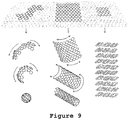
- Graphene is essentially an individual layer of graphite. Graphene can also be thought of as a carbon nanotube unrolled as shown in Figure 9 .
- Graphene sheets offer many extraordinary properties and are being investigated for use in nanoelectronics, nanocomposites, batteries, supercapacitors, hydrogen storage and bioapplications.
- the main limitation for the use of graphene sheets is the current inability to mass produce them.
- a key challenge in the synthesis and processing of bulk-quantity graphene sheets is aggregation.
- Graphene sheets with high specific surface area, unless well separated from each other, tend to form irreversible agglomerates or even restack to form graphite due to van der Waals interactions. This problem has been encountered in all previous efforts aimed at large-scale production of graphene through chemical conversion or thermal expansion/reduction.
- Graphite consisting of a stack of flat graphene sheets, is inexpensive and available in large quantities from both natural and synthetic sources. This ordinary carbon material is the most readily available and least expensive source for the production of graphene sheets. Mechanical cleavage of graphite originally led to the discovery of graphene sheets and is currently used in most experimental studies of graphene. However, the low productivity of this method makes it unsuitable for large-scale use. Chemical conversion from graphite appears to be a much more efficient approach to bulk production of graphene sheets at low cost.
- the solution-based route involves chemical oxidation of graphite to hydrophilic graphite oxide, which can be readily exfoliated as individual graphene oxide sheets by ultrasonication in water.
- Graphene oxide which is electrically insulating, can be converted back to conducting graphene by chemical reduction, e.g. using hydrazine.
- chemically converted graphene (CCG) sheets obtained through this method precipitate as irreversible agglomerates due to their hydrophobic nature.
- the resulting graphene agglomerates appear to be insoluble in water and organic solvents, making further processing difficult.
- the present invention relates to a process for the preparation of a graphene dispersion which comprises reducing a graphene oxide dispersion in the presence of a base, wherein the base is a water soluble inorganic or organic base selected from ammonia, sodium hydroxide, potassium hydroxide, methylamine, ethanolamine, dimethylamine and trimethylamine.
- a base is a water soluble inorganic or organic base selected from ammonia, sodium hydroxide, potassium hydroxide, methylamine, ethanolamine, dimethylamine and trimethylamine.
- the graphene dispersion may be an aqueous graphene dispersion.
- the process of the present invention results in the large scale preparation of the graphene dispersion which does not require presence of foreign polymermic or surfactant stablisisers which can be used in the development of graphene paper or films, graphene-based composites or articles for nanoelectronics, nanocomposites, batteries, supercapacitors, hydrogen storage and bioapplications.
- the article may be paper, film or a composite.
- a process for preparing a graphene paper or film which comprises filtration of the graphene dispersion prepared by the process defined above.
- the present invention relates to a process for the preparation of a graphene dispersion.
- Graphene is essentially an individual layer of graphite or graphite nanoplatelets and is generally in the form of graphene sheets.
- Graphite nanoplatelets have recently attracted considerable attention as a viable and inexpensive filler substitute for carbon nanotubes in nanocomposites, given the predicted excellent in-plane mechanical, structural, thermal and electrical properties of graphite. As with carbon nanotubes, full utilisation of graphite nanoplatelets in polymer nanocomposite applications will inevitably depend on the ability to achieve complete dispersion of the nanoplatelets in the polymer matrix of choice.
- the graphene prepared by the process of the present invention is in the form of a graphene dispersion including an aqueous graphene dispersion which enables the use of solution phase chemistry to further functionalise the graphene sheets.
- the process of the present invention involves reducing purified exfoliated graphite oxide in the presence of a base.
- Graphite which consists of a stack of flat graphene sheets is inexpensive and available in large quantities both from natural and synthetic sources.
- Graphite oxide can be synthesised by chemical oxidation of graphite using any suitable known oxidising agents such as a combination of H 2 SO 4 , HNO 3 and KClO 4 1 ; a combination of H 2 SO 4 and KMnO 4 2 ; or a combination of KClO 4 and fuming HNO 3 3 .
- Graphite oxide is hydrophilic and therefore may also be prepared in the form of a graphite oxide dispersion.
- Exfoliated graphite oxide or graphene oxide can form well-dispersed aqueous dispersions.
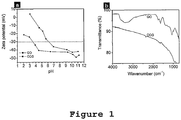
- a study conducted on the surface charge (zeta potential) of as-prepared graphene oxide (GO) sheets shows that these sheets are highly negatively charged when dispersed in water (see Figure la), apparently as a result of ionisation of carboxylic acid and phenolic hydroxyl groups that are known to exist on the graphene oxide sheets.
- This result suggests that the formation of stable graphene oxide dispersions should be attributed to electrostatic repulsion, rather than just the hydrophilicity of graphene oxide as previously presumed.
- carboxylic acid groups are unlikely to be reduced, these groups should therefore remain in the reduced product as confirmed by FT-IR analysis (see Figure 1b ).
- the purified graphite oxide is exfoliated to graphene oxide by using any suitable known technique such as ultrasonication or mechanical stirring. Again, both the purified graphite oxide and the graphene oxide may be in the form of dispersions. The graphene oxide or graphene oxide dispersions may then be further purified using, for example, centrifugation, to remove any unexfoliated graphite oxide which may be present in small amounts.
- the purified exfoliated graphite oxide which is now in the form of graphene oxide is then subjected to reduction in the presence of a base.
- the reduction is preferably a chemical reduction which involves adding a reducing agent to the graphene oxide.
- suitable reducing agents include inorganic reducing agents such as hydrazine or NaBH 4 and organic reducing agents such as hydroquinone, dimethylhydrazine or N,N'-diethylhydroxylamine.
- the reducing agent is hydrazine.
- the reducing agent when it is hydrazine, it may be added in an amount of 1.0 to 7.0g of 35% hydrazine per gram of graphite oxide, preferably 1.5 to 5.0g of 35% hydrazine per gram of graphite oxide, more preferably 1.5 to 2.5g of 35% hydrazine per gram of graphite oxide.
- the colloidal stability of an electrostatically stabilised dispersion is dependent on pH, the electrolyte concentration as well as the content of dispersed particles. By controlling these parameters, it has now been found graphene sheets are able to form stable colloids through electrostatic stabilisation. Graphene oxide dispersions can be directly converted to stable graphene colloids through reduction under controlled conditions. The use of polymeric or surfactant stabilisers is not required. In order to obtain maximal charge density on the resulting graphene sheets, a base is added during the reduction to increase the pH, preferably 6 or greater, more preferably 9 to 11.
- the base includes a water soluble inorganic base selected from ammonia, sodium hydroxide and potassium hydroxide, or a water soluble organic base selected from methylamine, ethanolamine, dimethylamine and trimethylamine.
- the base is a volatile base such as ammonia which can be removed after the graphene sheets are processed into solid films or composites.
- the base may be added in an amount of 7.0 to 20.0g of 28% ammonia per gram of graphite oxide, preferably 8.0 to 16.0g of 28% ammonia per gram of graphite oxide, more preferably 10.0 to 13.0g of 28% ammonia per gram of graphite oxide. It will be appreciated that the amount of base is dependent on the type of base used.
- Suitable water-immiscible liquids include oils such as water immiscible oils having densities lower than water (to float on water) and boiling temperatures higher than 100°C such as toluene, mineral oil, paraffin and hydrophobic ionic liquids. It will be understood that the amount of water-immiscible liquid will be dependent on the area of water surface. A layer of water-immiscible liquid that can substantially cover the water surface will suffice.
- the zeta potential of the reduced graphene dispersion is pH dependent, which is consistent with the fact that the ionisation of carboxylic acid groups is strongly related to the pH.
- the magnitude of the zeta potential is lower than that of the original graphene oxide sheets at the same pH, the zeta potential is below 30 mV when the pH is greater than 6.1 and can reach -43 mV when the pH approaches 10 Zeta potential values more negative than -30 mV are generally considered to represent sufficient mutual repulsion to ensure stability of a dispersion as is well known from colloidal science 2 .
- the graphene dispersions prepared by the process of the invention can be used in the development of graphene papers or films, graphene-based composites and articles for engineering applications.
- the graphene may be deposited on substrates and membranes in any suitable form including sheets, films, paper and coatings. It is envisaged that biomolecules including antibodies, growth factors and enzymes could be incorporated into the graphene.
- biomolecules including antibodies, growth factors and enzymes could be incorporated into the graphene.
- the formation of composites with other conductors including conducting polymers, metal or carbon nanotubes, metal nanoparticles, bucky balls or the formation of unique catalytic structures ( e.g . containing porphyrins or enzymes) is also expected to be possible.
- the formation of biologically functional composites containing specific growth promoters, drugs, antibodies or other biological entities is also envisaged.
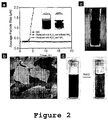
- a single layer of graphene sheets can be deposited on a substrate by drop-casting from a dilute graphene dispersion (see Figure 2b ), which provides a facile approach to obtain single graphene sheets for device fabrication or studies on the properties of individual sheets.
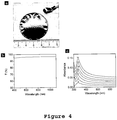
- Uniform graphene papers or films can also be readily formed on a membrane filter by vacuum filtration of as-reduced dispersions. Free-standing films or graphene paper can be peeled off from the membrane. The samples of graphene paper were then annealed at different temperatures before being cooled down to room temperature for various measurements. The resulting films are bendable and exhibit a shiny metallic luster ( Figure 4a ).
- the conductivity is found to be -6000 S/m at room temperature, which is comparable to that of chemically modified single-walled carbon nanotube paper 5 .
- the graphene dispersions are dried, they are not dispersible in water any more, making as-prepared graphene films water-resistant.
- strong graphene oxide paper can be prepared using a similar strategy 6 .
- the resulting paper could find use in many fields such as membranes, anisotropic conductors and supercapacitors.
- Preliminary measurements show that the graphene paper obtained from direct filtration of the stable graphene dispersions gives a tensile modulus up to 35 GPa, which is close to that of the graphene oxide paper. It is expected that strong, conductive, flexible, and thermally stable graphene paper should be more attractive than non-conductive, less thermally stable graphene oxide paper for practical applications.
- graphene paper Another remarkable property of graphene paper is the high thermal stability, especially when compared with graphene oxide using thermogravimetric analysis (TGA) ( Figure 6A ).
- TGA thermogravimetric analysis
- the mass loss below 200°C can be attributed to the evaporation of adsorbed water.
- there is no sharp weight loss at around 200°C for graphene paper indicating that most oxygen-containing groups have been removed by the hydrazine reduction.
- the total weight loss ( ⁇ 10%) of graphene paper between 200°C and 500°C is much lower than that of graphene oxide paper ( ⁇ 30% loss).
- the d-spacing of the resulting graphene paper is slightly greater than, but quite close to that of graphene layers in pristine natural graphite, indicating that chemically prepared graphene sheets are similar to the pristine sheets.
- the slightly increased d-spacing of chemically prepared graphene paper can be ascribed to the presence of a small amount of residual oxygen-containing functional groups or other structural defects.
- the electrical conductivity of graphene paper is found to increase with treatment temperature ( Figure 6C ). It is noteworthy that although graphene oxide can be converted to conductive graphene by thermal deoxygenation, the electrical conductivity of thermally treated graphene oxide paper is found to be lower than that of the graphene paper of the present invention, most likely owing to the disrupted structure of heat treated graphene oxide. For example, the conductivity of graphene oxide paper heat treated at 220 and 500 °C is around 0.8 and 59 S/cm, respectively, while the graphene paper of the present invention treated at the same temperatures exhibits a conductivity of 118 and 351 S/cm, respectively. The conductivity of the graphene paper sample treated at 500 °C is an order of magnitude higher than that reported for compressed pristine graphite powder, again indicative of a strong inter-sheet interaction in the graphene paper. 12
- graphene paper is supposed to be formed by stacking and interlocking of individual sheets under a filtration-induced directional flow. Given that individual graphene sheets are predicted to have a tensile modulus of up to 1.01 TPa 13 and the sheets are well packed in graphene paper, it is postulated that like graphene oxide paper, graphene paper should have excellent mechanical properties. Mechanical analysis of the graphene paper reveals that the stiffness and tensile strength is comparable to or, if properly annealed, higher than those of graphene oxide paper.
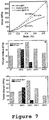
- Figure 7A presents typical stress-strain curves of graphene paper annealed at various temperatures.
- the sample annealed at 220°C yields the greatest mean Young's modulus at 41.8 GPa, and the greatest mean tensile strength at 293.3 MPa. Although the values are still much lower than those of individual sheets (likely due to the weaker bonding between sheets), they are both higher than those of graphene oxide paper and over ten times higher than the corresponding values for flexible graphite foils 6,14,15 . When the heat treatment is performed at temperatures above 220°C, the graphene paper becomes more brittle and the measured stiffness and strength tend to decrease with annealing temperature.
- Spraying techniques such as air-brushing can also be used to produce conductive graphene coatings on various substrates.
- Figure 4b shows a transmittance spectrum of a sprayed graphene coating on a glass slide.
- the coating gives a sheet resistivity of 2.0 x 10 7 ⁇ / ⁇ at room temperature, while the transmittance in the visible wavelength range is higher than 96%.
- the conductivity of this as-sprayed coating is sufficient for antistatic applications.
- Antistatic coatings are vital to the safety of materials, machinery and individuals across many different industries. This could lead to the development of a new generation of antistatic coatings that can combine electrical conductivity with transparency, excellent thermal and chemical stability, water-resistance and low production cost. Graphene dispersions may thus find immediate practical uses.
- the highly charged state of the graphene sheets in water makes it possible to use the known layer-by-layer electrostatic assembly technique 7-11 to build up complex and controllable graphene-based nanosystems with other functional molecules, polymers and nanostructures.
- This possibility has been demonstrated by alternately immersing a quartz slide in a dilute graphene dispersion and a typical cation polyelectrolyte-poly(diallyldimethylammonium chloride).
- Figure 4c the absorption spectra
- AFM analysis similar to Figure 2b and therefore not shown
- aqueous graphene dispersions can be readily formed by reduction of graphene oxide without the need for either polymeric or surfactant stabilisers.
- Graphene sheets are superior to normal synthetic conducting polymers in terms of thermal and chemical stability and mechanical strength, and more competitive than carbon nanotubes in terms of production cost.
- the successful dissolution of graphene sheets in solution as well as the residual carboxylic groups on the sheets enables the use of solution-phase chemistry to further functionalise graphene sheets for new uses.
- the ease of synthesis and the exceptional solution-phase processability of graphene sheets make this conductive nanostructure attractive not only for future nanoelectronics, but also for large-scale applications in both conventional technological fields, e.g. transparent antistatic coatings and electrochemical devices, and emerging areas, e.g. flexible/transparent electronics, high-performance nanocomposites, nanomedicines and bionic materials.
- the graphene can be used to prepare transparent conductive coatings to be used for example on LCD and other visual screens including flexible screen technology.
- graphene paper can be prepared by directional flow-induced assembly of graphene sheets that are well dispersed in solution. Moderate thermal annealing can enhance its mechanical stiffness and strength as well as electrical conductivity.
- the results of cell culture experiments also indicate that graphene paper may be biocompatible and therefore suitable for biomedical applications.
- the combination of the exceptional mechanical strength, thermal stability, high electrical conductivity and biocompatibility makes graphene paper a promising material for many technological applications from electrodes for flexible batteries to biomedical applications, such as inclusion in heart valves.
- Graphite oxide was synthesised from natural graphite (SP-1, Bay Carbon) by applying the Hummers method 1 with an additional dialysis step used to purify the product. As-synthesized graphite oxide was suspended in water to give a brown dispersion, which was subjected to dialysis to completely remove residual salts and acids. Ultrapure Milli-Q ® water was used in all experiments. As-purified graphite oxide suspensions were then dispersed in water to create a 0.05 wt% dispersion. Exfoliation of graphite oxide to graphene oxide was achieved by ultrasonication of the dispersion using a Brandson Digital Sonifier (S450D, 500 W, 30% amplitude) for 30 min.
- S450D Brandson Digital Sonifier
- the obtained brown dispersion was then subjected to 30 min of centrifugation at 3000 RPM to remove any unexfoliated graphite oxide (usually present in a very small amount).
- the resulting homogeneous dispersion (5.0 mL) was mixed with 5.0 mL of water, 5.0 ⁇ L of hydrazine solution (35 wt% in water, Aldrich) and 35.0 ⁇ L of ammonia solution (28 wt% in water, Crown Scientific) in a 20 mL-glass vial. After being vigorously shaken or stirred for a few minutes, the vial was put in a water bath ( ⁇ 95 °C) for 1 h. The excess hydrazine in the reaction mixture can be removed by dialysis against a dilute ammonia solution.
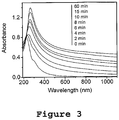
- UV-visible absorption and/or transmission spectra were taken using a Shimadzu UV 1601 spectrophotometer. The spectra were taken from the reaction mixture (diluted by a factor of 30) at different times.
- the dispersion/aggregation state of CCG sheets in water was monitored by measuring their average particle size using a Malvern Zetasizer Nano-ZS particle analyzer. Note that the particle size measurement on this instrument is based on the assumption that the particles are spherical, thus the instrument is unable to give the absolute sizes of graphene sheets. Nevertheless, the measurements obtained provide a means of monitoring dispersion stability.
- Attenuated total reflectance FT-IR spectra of free-standing films prepared by vacuum filtration were recorded on a Nicolet AVATAR 360 FTIR spectrometer with a Smart OMNI Sampler with a germanium crystal. AFM images were taken in tapping mode with the SPM Dimension 3100 from Veeco. Conductivity measurements of free-standing CCG films prepared by vacuum filtration were carried out on a Jandel RM3 Test Unit using a 4-point-probe head with a pin-distance of about 1 mm.
- Graphene paper was fabricated by vacuum filtration of graphene dispersions.
- graphite oxide was synthesized from natural graphite powder (SP-1, Bay Carbon, Bay City, MI) using a modified Hummers method 2,17 . After being purified by filtration and subsequent dialysis or by several runs of centrifugation/washing, graphite oxide was exfoliated into water by ultrasonication for 30 min using a Branson Digital Sonifier (S450D, 500W, 30% amplitude).
- the obtained graphene oxide was diluted to 0.25 mg mL -1 .
- Biocompatibility Test Graphene paper that was thermally annealed at 100°C was screened for biocompatibility by monitoring the growth of L-929 (mouse fibroblast) cells.
- the graphene paper samples were placed into wells of a 96 well polystyrene cell culture plate and soaked overnight in two changes of culture media, then rinsed with water to remove soluble impurities.
- the samples were sterilized by rinsing with 70% ethanol, followed by air-drying and placing under UV light for 20 min.
- Samples were seeded with 5x10³ L-929 mouse fibroblast cells per well, and cultured in DMEM:F12 media supplemented with 5 % FBS for 48 h. Finally the cells were stained with Calcein AM, which was cleaved to yield a green fluorescent product by metabolically active cells. Images were obtained using a Leica DMIL inverted fluorescence microscope equipped with a Leica DC500 camera.
Landscapes
- Chemical & Material Sciences (AREA)
- Engineering & Computer Science (AREA)
- Nanotechnology (AREA)
- Physics & Mathematics (AREA)
- Organic Chemistry (AREA)
- Materials Engineering (AREA)
- Condensed Matter Physics & Semiconductors (AREA)
- General Physics & Mathematics (AREA)
- Crystallography & Structural Chemistry (AREA)
- Inorganic Chemistry (AREA)
- Manufacturing & Machinery (AREA)
- Composite Materials (AREA)
- Carbon And Carbon Compounds (AREA)
Applications Claiming Priority (2)
| Application Number | Priority Date | Filing Date | Title |
|---|---|---|---|
| AU2007905796A AU2007905796A0 (en) | 2007-10-19 | Process for the preparation of graphene | |
| PCT/AU2008/001543 WO2009049375A1 (en) | 2007-10-19 | 2008-10-17 | Process for the preparation of graphene |
Publications (3)
| Publication Number | Publication Date |
|---|---|
| EP2212248A1 EP2212248A1 (en) | 2010-08-04 |
| EP2212248A4 EP2212248A4 (en) | 2015-07-08 |
| EP2212248B1 true EP2212248B1 (en) | 2017-05-24 |
Family
ID=40566933
Family Applications (1)
| Application Number | Title | Priority Date | Filing Date |
|---|---|---|---|
| EP08839659.3A Not-in-force EP2212248B1 (en) | 2007-10-19 | 2008-10-17 | Process for the preparation of graphene |
Country Status (6)
| Country | Link |
|---|---|
| US (1) | US8715610B2 (enExample) |
| EP (1) | EP2212248B1 (enExample) |
| JP (1) | JP5605650B2 (enExample) |
| CN (1) | CN102066245B (enExample) |
| AU (1) | AU2008314512B2 (enExample) |
| WO (1) | WO2009049375A1 (enExample) |
Families Citing this family (170)
| Publication number | Priority date | Publication date | Assignee | Title |
|---|---|---|---|---|
| US20050077503A1 (en) * | 2003-07-23 | 2005-04-14 | Takuya Gotou | Dispersion comprising thin particles having a skeleton consisting of carbons, electroconductive coating film, electroconductive composite material, and a process for producing them |
| CN101383231B (zh) * | 2008-10-24 | 2011-04-06 | 南开大学 | 以单层石墨材料为电极材料的超级电容器 |
| US9428394B2 (en) * | 2009-05-22 | 2016-08-30 | William Marsh Rice University | Highly oxidized graphene oxide and methods for production thereof |
| EP3865454A3 (en) * | 2009-05-26 | 2021-11-24 | Belenos Clean Power Holding AG | Stable dispersions of single and multiple graphene layers in solution |
| JP2011032156A (ja) * | 2009-07-06 | 2011-02-17 | Kaneka Corp | グラフェンまたは薄膜グラファイトの製造方法 |
| JP2011018415A (ja) * | 2009-07-10 | 2011-01-27 | Tdk Corp | 磁気センサ |
| US10167572B2 (en) | 2009-08-07 | 2019-01-01 | Guardian Glass, LLC | Large area deposition of graphene via hetero-epitaxial growth, and products including the same |
| US8507797B2 (en) | 2009-08-07 | 2013-08-13 | Guardian Industries Corp. | Large area deposition and doping of graphene, and products including the same |
| US10164135B2 (en) | 2009-08-07 | 2018-12-25 | Guardian Glass, LLC | Electronic device including graphene-based layer(s), and/or method or making the same |
| US8968695B2 (en) | 2009-08-10 | 2015-03-03 | Idt International Co., Ltd. | Method of producing nano-size graphene-based material and an equipment for producing the same |
| CN101654243B (zh) * | 2009-08-28 | 2011-11-23 | 青岛大学 | 一种功能纳米石墨烯的制备方法 |
| RU2403207C1 (ru) * | 2009-09-17 | 2010-11-10 | Учреждение Российской академии наук Институт физики полупроводников им. А.В. Ржанова Сибирского отделения РАН (ИФП СО РАН) | Способ получения углеродного слоя на непроводящей подложке |
| IT1396193B1 (it) | 2009-10-07 | 2012-11-16 | Polimeri Europa Spa | Composizioni polimeriche nanocomposite termoplastiche espansibili con migliorata capacita' di isolamento termico. |
| IT1396918B1 (it) | 2009-11-03 | 2012-12-20 | Polimeri Europa Spa | Procedimento per la preparazione di nanopiastrine grafeniche ad elevata disperdibilita' in matrici polimeriche a bassa polarita' e relative composizioni polimeriche |
| FR2962121B1 (fr) | 2009-11-03 | 2012-07-13 | Centre Nat Rech Scient | Preparation de graphene par amincissement mecanique de materiaux graphitiques |
| JP2011111367A (ja) * | 2009-11-27 | 2011-06-09 | Sekisui Chem Co Ltd | 薄片化黒鉛分散液の製造方法、薄片化黒鉛分散液及び薄膜の製造方法 |
| CN101702345B (zh) * | 2009-11-27 | 2011-08-03 | 南京邮电大学 | 一种叠层石墨烯导电薄膜的制备方法 |
| JP5276026B2 (ja) * | 2010-01-13 | 2013-08-28 | 積水化学工業株式会社 | 薄片化黒鉛分散液の製造方法、薄片化黒鉛の製造方法、及び、複合材料の製造方法 |
| JP5337062B2 (ja) * | 2010-01-14 | 2013-11-06 | 積水化学工業株式会社 | 薄片化黒鉛分散液の製造方法、薄片化黒鉛分散液及び薄膜の製造方法 |
| JP5477037B2 (ja) * | 2010-02-19 | 2014-04-23 | 富士電機株式会社 | グラフェン膜の製造方法 |
| JP2011184264A (ja) * | 2010-03-10 | 2011-09-22 | Sekisui Chem Co Ltd | 薄片化黒鉛分散液の製造方法、薄片化黒鉛分散液及び薄膜の製造方法 |
| KR101154482B1 (ko) | 2010-04-27 | 2012-06-13 | 한국과학기술연구원 | 그라펜을 이용한 투명 대전방지 코팅의 제조방법 및 이에 의해 제조된 투명 대전방지 코팅 |
| US9577243B2 (en) | 2010-05-28 | 2017-02-21 | Sion Power Corporation | Use of expanded graphite in lithium/sulphur batteries |
| CN101844761B (zh) * | 2010-05-28 | 2012-08-15 | 上海师范大学 | 激光照射法制备还原氧化石墨烯 |
| JP2012015481A (ja) * | 2010-06-01 | 2012-01-19 | Sony Corp | 電界効果トランジスタの製造方法、電界効果トランジスタおよび半導体酸化グラフェンの製造方法 |
| CN101844763B (zh) * | 2010-06-24 | 2012-05-30 | 上海交通大学 | 基于酚酞啉的石墨烯制备方法 |
| US9751763B2 (en) * | 2010-07-14 | 2017-09-05 | Monash University | Material and applications therefor |
| JP5499980B2 (ja) * | 2010-08-02 | 2014-05-21 | 富士電機株式会社 | グラフェン薄膜の製造方法 |
| CN102403050B (zh) * | 2010-09-08 | 2013-12-18 | 中国科学院金属研究所 | 基于纳米复合材料及其制备方法和在柔性储能器件的应用 |
| GB201016925D0 (en) * | 2010-10-07 | 2010-11-24 | Univ Manchester | Graphene oxide |
| CN102452650B (zh) * | 2010-10-27 | 2013-08-21 | 清华大学 | 一种低温化学法制备石墨烯的方法 |
| CA2815836C (en) * | 2010-10-28 | 2017-04-25 | University Of Central Florida Research Foundation, Inc. | Oxidized graphite and carbon fiber |
| CN101966989B (zh) * | 2010-11-18 | 2012-11-07 | 东华大学 | 一种采用四角氧化锌光催化还原氧化石墨烯的方法 |
| US8796361B2 (en) | 2010-11-19 | 2014-08-05 | Ppg Industries Ohio, Inc. | Adhesive compositions containing graphenic carbon particles |
| US20140150970A1 (en) | 2010-11-19 | 2014-06-05 | Ppg Industries Ohio, Inc. | Structural adhesive compositions |
| WO2012078464A2 (en) | 2010-12-08 | 2012-06-14 | 3M Innovative Properties Company | Article and method of making and using the same |
| WO2012086260A1 (ja) * | 2010-12-24 | 2012-06-28 | 株式会社豊田中央研究所 | 窒素含有グラフェン構造体及び蛍光体分散液 |
| WO2012086261A1 (ja) | 2010-12-24 | 2012-06-28 | 株式会社豊田中央研究所 | 発光体 |
| JP5609789B2 (ja) * | 2011-06-23 | 2014-10-22 | 株式会社豊田中央研究所 | 窒素含有グラフェン構造体及び蛍光体分散液 |
| JP5516392B2 (ja) * | 2010-12-24 | 2014-06-11 | 株式会社豊田中央研究所 | カーボン蛍光体及び蛍光体分散液 |
| CN102557013B (zh) * | 2010-12-28 | 2013-10-30 | 国家纳米科学中心 | 一种还原氧化石墨烯的制备方法 |
| DE102010056572B4 (de) * | 2010-12-30 | 2018-12-27 | Snaptrack, Inc. | Elektronisches Bauelement und Verfahren zur Herstellung des elektronischen Bauelements |
| DE102010056562B4 (de) | 2010-12-30 | 2018-10-11 | Snaptrack, Inc. | Elektroakustisches Bauelement und Verfahren zur Herstellung des elektroakustischen Bauelements |
| KR101254425B1 (ko) | 2011-01-20 | 2013-04-15 | 거림테크 주식회사 | 그래핀옥사이드-폴리비닐알콜 복합체를 함유하는 그래핀 필름 및 그 제조방법 |
| CN102145882B (zh) * | 2011-02-24 | 2013-05-15 | 暨南大学 | 一种水溶性石墨烯的制备方法 |
| CN102070140B (zh) * | 2011-02-28 | 2012-08-29 | 无锡第六元素高科技发展有限公司 | 一种利用强碱化学处理得到高比表面积石墨烯材料的方法 |
| WO2012128748A1 (en) * | 2011-03-18 | 2012-09-27 | William Marsh Rice University | Patterned graphite oxide films and methods to make and use same |
| CN102249220A (zh) * | 2011-03-18 | 2011-11-23 | 太原理工大学 | 一种氧化石墨烯薄膜的快速制备方法 |
| WO2012134954A1 (en) * | 2011-03-25 | 2012-10-04 | Howard University | Methods and apparatus to control reaction rates of chemical reactions by applying a magnetic field |
| CN102730668B (zh) * | 2011-04-07 | 2015-04-29 | 东丽纤维研究所(中国)有限公司 | 一种基于芳香醇通过溶剂热制备石墨烯的方法 |
| CN102730667B (zh) * | 2011-04-08 | 2014-04-09 | 安炬科技股份有限公司 | 单层石墨的制备方法 |
| JP2012224526A (ja) * | 2011-04-21 | 2012-11-15 | Hiroshima Univ | グラフェンの製造方法 |
| JP5793704B2 (ja) * | 2011-05-16 | 2015-10-14 | パナソニックIpマネジメント株式会社 | 多層のグラフェン層の製造方法 |
| KR102198085B1 (ko) | 2011-06-03 | 2021-01-05 | 가부시키가이샤 한도오따이 에네루기 켄큐쇼 | 정극, 리튬 이온 이차 전지, 이동체, 차량, 시스템, 및 전자 기기 |
| CN102275906B (zh) * | 2011-06-09 | 2012-12-26 | 西安工业大学 | 一种常温制备石墨烯的方法 |
| CN102321994A (zh) * | 2011-06-13 | 2012-01-18 | 哈尔滨工业大学 | 含有石墨烯的纳米纸制备方法 |
| CN102320595A (zh) * | 2011-06-16 | 2012-01-18 | 华南理工大学 | 一种可分散的乙醇胺功能化石墨烯及其制备方法 |
| CN102307024B (zh) * | 2011-06-21 | 2014-04-02 | 南京航空航天大学 | 一种基于石墨烯的流体发电装置或波动传感装置 |
| JP2013001882A (ja) * | 2011-06-21 | 2013-01-07 | Ulvac Japan Ltd | グラフェンインク及びその製造方法 |
| US9218916B2 (en) | 2011-06-24 | 2015-12-22 | Semiconductor Energy Laboratory Co., Ltd. | Graphene, power storage device, and electric device |
| EP2731498A4 (en) | 2011-07-14 | 2015-04-22 | Univ South Florida | LONG-TERM IMPLANTABLE NEURAL INTERFACE DEVICE MADE OF SILICON CARBIDE USING ELECTRIC FIELD EFFECTS |
| CN102320597B (zh) * | 2011-07-15 | 2012-11-07 | 天津大学 | 一种石墨烯的制备方法 |
| WO2013015229A1 (en) * | 2011-07-22 | 2013-01-31 | Semiconductor Energy Laboratory Co., Ltd. | Graphite oxide, graphene oxide or graphene, electric device using the same and method of manufacturing the same, and electrodialysis apparatus |
| CN102320598A (zh) * | 2011-07-26 | 2012-01-18 | 河南大学 | 一种石墨烯的制备方法 |
| JP5748606B2 (ja) * | 2011-08-09 | 2015-07-15 | 三菱瓦斯化学株式会社 | 導電性塗料 |
| CN103748035B (zh) * | 2011-08-18 | 2016-02-10 | 株式会社半导体能源研究所 | 形成石墨烯及氧化石墨烯盐的方法、以及氧化石墨烯盐 |
| KR101294223B1 (ko) * | 2011-08-22 | 2013-08-16 | 한국과학기술원 | 대면적 그래핀 필름의 제조방법 |
| WO2013031526A1 (en) * | 2011-08-26 | 2013-03-07 | Semiconductor Energy Laboratory Co., Ltd. | Power storage device |
| US9249524B2 (en) | 2011-08-31 | 2016-02-02 | Semiconductor Energy Laboratory Co., Ltd. | Manufacturing method of composite oxide and manufacturing method of power storage device |
| KR101303285B1 (ko) * | 2011-09-08 | 2013-09-04 | 한국기계연구원 | 환원된 산화 그래핀층 및 코팅층이 순차적으로 적층되는 그래핀 페이퍼 및 이의 제조방법 |
| WO2013036272A1 (en) | 2011-09-09 | 2013-03-14 | Board Of Trustees Of Northern Illinois University | Crystalline graphene and method of making crystalline graphene |
| US12421118B2 (en) | 2011-09-30 | 2025-09-23 | Ppg Industries Ohio, Inc. | Graphenic carbon particles |
| US9938416B2 (en) | 2011-09-30 | 2018-04-10 | Ppg Industries Ohio, Inc. | Absorptive pigments comprising graphenic carbon particles |
| US10294375B2 (en) | 2011-09-30 | 2019-05-21 | Ppg Industries Ohio, Inc. | Electrically conductive coatings containing graphenic carbon particles |
| US9574094B2 (en) | 2013-12-09 | 2017-02-21 | Ppg Industries Ohio, Inc. | Graphenic carbon particle dispersions and methods of making same |
| US10240052B2 (en) | 2011-09-30 | 2019-03-26 | Ppg Industries Ohio, Inc. | Supercapacitor electrodes including graphenic carbon particles |
| US10763490B2 (en) | 2011-09-30 | 2020-09-01 | Ppg Industries Ohio, Inc. | Methods of coating an electrically conductive substrate and related electrodepositable compositions including graphenic carbon particles |
| US9988551B2 (en) | 2011-09-30 | 2018-06-05 | Ppg Industries Ohio, Inc. | Black pigments comprising graphenic carbon particles |
| US9832818B2 (en) | 2011-09-30 | 2017-11-28 | Ppg Industries Ohio, Inc. | Resistive heating coatings containing graphenic carbon particles |
| US9475946B2 (en) | 2011-09-30 | 2016-10-25 | Ppg Industries Ohio, Inc. | Graphenic carbon particle co-dispersions and methods of making same |
| KR102304204B1 (ko) | 2011-09-30 | 2021-09-17 | 가부시키가이샤 한도오따이 에네루기 켄큐쇼 | 양극, 리튬 이차 전지, 전기 자동차, 하이브리드 자동차, 이동체, 시스템, 및 전기 기기 |
| US8486363B2 (en) | 2011-09-30 | 2013-07-16 | Ppg Industries Ohio, Inc. | Production of graphenic carbon particles utilizing hydrocarbon precursor materials |
| US9761903B2 (en) | 2011-09-30 | 2017-09-12 | Ppg Industries Ohio, Inc. | Lithium ion battery electrodes including graphenic carbon particles |
| CN103035922B (zh) | 2011-10-07 | 2019-02-19 | 株式会社半导体能源研究所 | 蓄电装置 |
| US9487880B2 (en) | 2011-11-25 | 2016-11-08 | Semiconductor Energy Laboratory Co., Ltd. | Flexible substrate processing apparatus |
| KR101297423B1 (ko) * | 2011-11-30 | 2013-08-14 | 한국전기연구원 | 양이온-파이 상호작용에 의해 고농도 분산된 산화 그래핀 환원물 및 그 제조방법 |
| JP6016597B2 (ja) | 2011-12-16 | 2016-10-26 | 株式会社半導体エネルギー研究所 | リチウムイオン二次電池用正極の製造方法 |
| JP5806618B2 (ja) * | 2012-01-26 | 2015-11-10 | Dowaエレクトロニクス株式会社 | 酸化グラフェンの還元方法およびその方法を利用した電極材料の製造方法 |
| US8771630B2 (en) | 2012-01-26 | 2014-07-08 | Enerage, Inc. | Method for the preparation of graphene |
| KR101427033B1 (ko) | 2012-01-30 | 2014-08-06 | 연세대학교 산학협력단 | 3차원 구조의 그래핀 구조체 및 그 제조 방법 |
| WO2013119215A1 (en) * | 2012-02-08 | 2013-08-15 | Empire Technology Development Llc | Coating a substance with graphene |
| WO2013123339A1 (en) * | 2012-02-17 | 2013-08-22 | Aksay Ilhan A | Graphene-ionic liquid composites |
| CN103255670A (zh) * | 2012-02-20 | 2013-08-21 | 海洋王照明科技股份有限公司 | 利用电场引导制备石墨烯纸的方法 |
| JP5719859B2 (ja) | 2012-02-29 | 2015-05-20 | 株式会社半導体エネルギー研究所 | 蓄電装置 |
| WO2013133803A1 (en) | 2012-03-06 | 2013-09-12 | Empire Technology Development Llc | Graphene production |
| CN103367696A (zh) * | 2012-03-29 | 2013-10-23 | 海洋王照明科技股份有限公司 | 正极片、其制备方法及锂离子电池 |
| WO2013143147A1 (zh) * | 2012-03-31 | 2013-10-03 | 海洋王照明科技股份有限公司 | 一种石墨烯纸的制备方法 |
| RU2495752C1 (ru) * | 2012-04-02 | 2013-10-20 | Федеральное государственное бюджетное учреждение науки Институт неорганической химии им. А.В. Николаева Сибирского отделения Российской академии наук (ИНХ СО РАН) | Способ получения композиционного материала, содержащего слоистые материалы на основе графита и сульфида молибдена |
| US9630848B2 (en) | 2012-04-05 | 2017-04-25 | The Research Foundation for The State of New York | Three-dimensional carbon structures |
| CN103383898A (zh) * | 2012-05-04 | 2013-11-06 | 海洋王照明科技股份有限公司 | 石墨烯纸集流体的制备方法 |
| US9225003B2 (en) | 2012-06-15 | 2015-12-29 | Semiconductor Energy Laboratory Co., Ltd. | Method for manufacturing storage battery electrode, storage battery electrode, storage battery, and electronic device |
| JP5994422B2 (ja) * | 2012-06-21 | 2016-09-21 | 株式会社豊田中央研究所 | 造影剤 |
| JP6119128B2 (ja) * | 2012-06-29 | 2017-04-26 | 株式会社ニデック | 生体埋植装置 |
| CN102750998B (zh) * | 2012-07-09 | 2014-11-19 | 深圳市贝特瑞纳米科技有限公司 | 石墨烯透明导电薄膜及其制备方法 |
| CN102719803B (zh) * | 2012-07-09 | 2014-05-07 | 深圳市贝特瑞纳米科技有限公司 | 一种石墨烯透明薄膜的制备和转移方法 |
| CN102926272B (zh) * | 2012-10-09 | 2015-02-11 | 重庆大学 | 一种生物医用氧化石墨烯纸的制备方法 |
| GB201218952D0 (en) | 2012-10-22 | 2012-12-05 | Cambridge Entpr Ltd | Functional inks based on layered materials and printed layered materials |
| CN103794370A (zh) * | 2012-10-29 | 2014-05-14 | 海洋王照明科技股份有限公司 | 石墨烯/离子液体复合材料及其制备方法、复合电极及其制备方法和电化学电容器 |
| JP6159228B2 (ja) | 2012-11-07 | 2017-07-05 | 株式会社半導体エネルギー研究所 | 非水系二次電池用正極の製造方法 |
| CN103903877B (zh) * | 2012-12-26 | 2016-06-29 | 海洋王照明科技股份有限公司 | 一种石墨烯/氧化石墨烯复合集流体的制备方法 |
| US9673454B2 (en) | 2013-02-18 | 2017-06-06 | Semiconductor Energy Laboratory Co., Ltd. | Sodium-ion secondary battery |
| US10431354B2 (en) | 2013-03-15 | 2019-10-01 | Guardian Glass, LLC | Methods for direct production of graphene on dielectric substrates, and associated articles/devices |
| US9593019B2 (en) | 2013-03-15 | 2017-03-14 | Guardian Industries Corp. | Methods for low-temperature graphene precipitation onto glass, and associated articles/devices |
| US11430979B2 (en) | 2013-03-15 | 2022-08-30 | Ppg Industries Ohio, Inc. | Lithium ion battery anodes including graphenic carbon particles |
| CN103145124B (zh) * | 2013-03-27 | 2015-01-14 | 北京大学 | 高性能石墨烯纸及其制备方法 |
| US9490472B2 (en) | 2013-03-28 | 2016-11-08 | Semiconductor Energy Laboratory Co., Ltd. | Method for manufacturing electrode for storage battery |
| CN103233296B (zh) * | 2013-05-17 | 2015-09-30 | 山西大学 | 一种n掺杂柔性石墨烯纤维的制备方法 |
| CN103335741B (zh) * | 2013-06-19 | 2016-02-24 | 暨南大学 | 一种基于石墨烯的光纤温度传感器及其制作方法 |
| CN103337381A (zh) * | 2013-07-05 | 2013-10-02 | 电子科技大学 | 一种制造柔性电极的方法 |
| KR20150027870A (ko) * | 2013-08-29 | 2015-03-13 | 연세대학교 산학협력단 | 그래핀 기반 나노복합소재의 합성 방법 및 상기 방법을 이용하여 합성된 그래핀 기반 나노복합소재 |
| CN103466610B (zh) * | 2013-09-25 | 2015-05-20 | 中国科学院理化技术研究所 | 一种石墨烯化学修饰方法 |
| CN103570012B (zh) * | 2013-10-29 | 2016-04-27 | 安徽百特新材料科技有限公司 | 一种石墨烯的制备方法 |
| JP6363708B2 (ja) * | 2013-11-05 | 2018-07-25 | ザ リージェンツ オブ ザ ユニバーシティ オブ カリフォルニア | グラフェン酸化物とカーボンナノチューブのインク及び、これを生成する方法 |
| US10727465B2 (en) | 2013-11-15 | 2020-07-28 | Semiconductor Energy Laboratory Co., Ltd. | Nonaqueous secondary battery |
| CN105765763B (zh) | 2013-11-28 | 2019-08-30 | 株式会社半导体能源研究所 | 蓄电单元以及具备该蓄电单元的电子设备 |
| JP2016013958A (ja) | 2013-12-02 | 2016-01-28 | 株式会社半導体エネルギー研究所 | 素子、膜の作製方法 |
| KR102306495B1 (ko) | 2013-12-04 | 2021-09-28 | 가부시키가이샤 한도오따이 에네루기 켄큐쇼 | 축전체 및 전자 기기 |
| US10879534B2 (en) * | 2013-12-12 | 2020-12-29 | Rensselaer Polytechnic Institute | Porous graphene network electrodes and an all-carbon lithium ion battery containing the same |
| US20150166348A1 (en) | 2013-12-18 | 2015-06-18 | Semiconductor Energy Laboratory Co., Ltd. | Graphene, graphene-including layer, electrode, and power storage device |
| WO2015164916A1 (en) * | 2014-05-01 | 2015-11-05 | Rmit University | Graphene production process |
| DE102014007137A1 (de) * | 2014-05-16 | 2015-11-19 | Dräger Safety AG & Co. KGaA | Elektrode für einen elektronischen Gassensor, Herstellungsverfahren für eine Elektrode und Verwendung einer Elektrode |
| US10586954B2 (en) | 2014-05-23 | 2020-03-10 | Semiconductor Energy Laboratory Co., Ltd. | Electronic device including secondary battery |
| JP6745587B2 (ja) | 2014-05-29 | 2020-08-26 | 株式会社半導体エネルギー研究所 | 電極の製造方法 |
| CN104118872B (zh) * | 2014-08-04 | 2017-03-22 | 长沙赛维能源科技有限公司 | 一种氧化石墨烯/石墨烯溶液的提纯方法及装置 |
| CN104183824B (zh) * | 2014-09-09 | 2015-10-21 | 南京中储新能源有限公司 | 石墨烯/醌类化合物复合材料、制备方法和二次铝电池 |
| KR102860367B1 (ko) | 2014-09-19 | 2025-09-16 | 가부시키가이샤 한도오따이 에네루기 켄큐쇼 | 이차 전지 |
| AU2015349612A1 (en) | 2014-11-17 | 2017-06-29 | Imagine Intelligent Materials Limited | Graphene electrode |
| WO2016088753A1 (ja) * | 2014-12-02 | 2016-06-09 | 大日本印刷株式会社 | 薄片状黒鉛、黒鉛材料、及び薄片状黒鉛分散液 |
| JP6437825B2 (ja) * | 2015-01-06 | 2018-12-12 | 国立大学法人広島大学 | グラフェン/シリカ複合体の製造方法およびその方法により製造されたグラフェン/シリカ複合体 |
| JP6475862B2 (ja) * | 2015-03-24 | 2019-02-27 | 国立大学法人九州大学 | アニオン交換膜及びその製造方法 |
| US10541390B2 (en) | 2015-05-18 | 2020-01-21 | Semiconductor Energy Laboratory Co., Ltd. | Power storage unit and electronic device |
| CN107735360B (zh) | 2015-05-26 | 2022-01-28 | 加利福尼亚大学董事会 | 多孔石墨烯材料的分散液及其应用 |
| JP6756331B2 (ja) * | 2015-05-27 | 2020-09-16 | 日本ゼオン株式会社 | 炭素膜およびその製造方法、ならびに、繊維状炭素ナノ構造体分散液およびその製造方法 |
| JP2016222526A (ja) | 2015-05-29 | 2016-12-28 | 株式会社半導体エネルギー研究所 | 膜の作製方法および素子 |
| US10145005B2 (en) | 2015-08-19 | 2018-12-04 | Guardian Glass, LLC | Techniques for low temperature direct graphene growth on glass |
| CN105140045A (zh) * | 2015-08-20 | 2015-12-09 | 西安岳达植物科技有限公司 | 一种基于石墨烯聚吡咯的赝电容超级电容器的电极材料 |
| US10351661B2 (en) | 2015-12-10 | 2019-07-16 | Ppg Industries Ohio, Inc. | Method for producing an aminimide |
| US10377928B2 (en) | 2015-12-10 | 2019-08-13 | Ppg Industries Ohio, Inc. | Structural adhesive compositions |
| CN105883790A (zh) * | 2016-05-26 | 2016-08-24 | 同济大学 | 一种低温剥离修饰石墨烯及其制备方法 |
| CN109562933A (zh) * | 2016-05-31 | 2019-04-02 | 新泽西鲁特格斯州立大学 | 由二维材料形成的空心颗粒 |
| JP6809985B2 (ja) * | 2016-06-22 | 2021-01-06 | 三ツ星ベルト株式会社 | 摩擦伝動ベルト |
| JP6795466B2 (ja) * | 2016-07-19 | 2020-12-02 | 三ツ星ベルト株式会社 | 伝動ベルト及びその製造方法 |
| US11827520B2 (en) * | 2016-09-19 | 2023-11-28 | University Of Houston System | Orientation of materials via application of a magnetic field and use of magnetically-oriented devices and device component |
| CN106629696A (zh) * | 2016-09-20 | 2017-05-10 | 天津工业大学 | 真空蒸镀法制备还原氧化石墨烯薄膜 |
| CN107064277B (zh) * | 2017-06-23 | 2018-03-20 | 湖北民族学院 | 一种电化学传感器的制备方法及应用 |
| KR20200075353A (ko) * | 2018-12-18 | 2020-06-26 | 대주전자재료 주식회사 | 환원된 그래핀 옥사이드 및 이의 제조 방법 |
| CN114026714B (zh) | 2019-05-20 | 2024-11-19 | 纳诺格拉夫公司 | 包含低缺陷乱层碳的阳极活性材料 |
| CA3146177A1 (en) | 2019-07-08 | 2021-01-14 | Alter Biota Inc. | Preparation of hydrous graphene oxide for use as a concrete admixture |
| DE112019007339T5 (de) * | 2019-09-06 | 2022-01-27 | Robert Bosch Gesellschaft mit beschränkter Haftung | Gasdiffusionsschicht einer Protonenaustauschmembran-Brennstoffzelle und Herstellungsverfahren dafür |
| US20230022519A1 (en) * | 2019-12-23 | 2023-01-26 | Nippon Telegraph And Telephone Corporation | Three-dimensional structure and method for manufacturing the same |
| CH717232A1 (de) | 2020-03-16 | 2021-09-30 | Shcheblanov Aleksandr | Generator zum Erzeugen rigförmiger und räumlicher Wirbel in einer Flüssigkeit. |
| KR102850997B1 (ko) * | 2020-08-12 | 2025-08-27 | 한국전기연구원 | 고내열성 그래핀-실리콘-탄소나노튜브 복합체의 제조방법, 이로부터 제조되는 복합체 및 이를 포함하는 이차전지 |
| KR102778068B1 (ko) | 2020-09-14 | 2025-03-10 | 삼성전자주식회사 | 배선 구조물, 그 형성 방법, 및 상기 배선 구조물을 포함하는 반도체 장치 |
| CN113135563A (zh) * | 2021-05-25 | 2021-07-20 | 北京航空航天大学 | 一种可连续调控水浸润性的石墨烯纸及其应用 |
| CN113311045B (zh) * | 2021-07-16 | 2022-09-20 | 福建师范大学 | 一种石墨烯纳米卷固化盐酸克仑特罗传感器制备方法 |
| CN114027320B (zh) * | 2021-12-27 | 2023-06-02 | 上海金铎禹辰水环境工程有限公司 | 一种石墨烯抗菌材料及其制备方法和应用 |
| GB2620171B (en) * | 2022-06-30 | 2024-12-25 | Toraphene Ltd | Biodegradable packaging material, use and method for manufacturing thereof |
| CN116004093B (zh) * | 2022-12-26 | 2023-10-03 | 中国科学院福建物质结构研究所 | 一种防腐涂层及其制备方法 |
| CN116375009B (zh) * | 2022-12-26 | 2024-06-11 | 中国科学院福建物质结构研究所 | 一种改性石墨烯的制备方法 |
| CN116688945A (zh) * | 2023-07-06 | 2023-09-05 | 桂林清研皓隆新材料有限公司 | 一种多孔石墨烯吸附材料及其制备方法与应用 |
Family Cites Families (12)
| Publication number | Priority date | Publication date | Assignee | Title |
|---|---|---|---|---|
| US2798878A (en) * | 1954-07-19 | 1957-07-09 | Nat Lead Co | Preparation of graphitic acid |
| JP2690982B2 (ja) * | 1988-12-06 | 1997-12-17 | 日本化成株式会社 | 熱膨張性黒鉛及びその製造方法 |
| JP2000044219A (ja) * | 1998-07-30 | 2000-02-15 | Sumikin Chemical Co Ltd | 熱膨張性黒鉛の製造方法 |
| EP1072585B1 (en) * | 1999-07-29 | 2003-10-01 | Mitsubishi Gas Chemical Company, Inc. | Process for producing dimethylcyanamide |
| JP4798411B2 (ja) * | 2000-08-09 | 2011-10-19 | 三菱瓦斯化学株式会社 | 炭素からなる骨格を持つ薄膜状粒子の合成方法 |
| JP4591666B2 (ja) * | 2003-07-23 | 2010-12-01 | 三菱瓦斯化学株式会社 | 炭素からなる骨格を持つ薄膜状粒子を含む分散液、導電性塗膜および導電性複合材料ならびにこれらの製造方法 |
| JP2006015291A (ja) * | 2004-07-05 | 2006-01-19 | Hitachi Powdered Metals Co Ltd | 黒鉛系水素吸蔵材料及びその製造方法 |
| EP1825038B1 (en) * | 2004-12-16 | 2012-09-12 | Nantero, Inc. | Aqueous carbon nanotube applicator liquids and methods for producing applicator liquids thereof |
| US7914844B2 (en) * | 2005-11-18 | 2011-03-29 | Northwestern University | Stable dispersions of polymer-coated graphitic nanoplatelets |
| US20080048152A1 (en) * | 2006-08-25 | 2008-02-28 | Jang Bor Z | Process for producing nano-scaled platelets and nanocompsites |
| US8132746B2 (en) * | 2007-04-17 | 2012-03-13 | Nanotek Instruments, Inc. | Low-temperature method of producing nano-scaled graphene platelets and their nanocomposites |
| US7824651B2 (en) * | 2007-05-08 | 2010-11-02 | Nanotek Instruments, Inc. | Method of producing exfoliated graphite, flexible graphite, and nano-scaled graphene platelets |
-
2008
- 2008-10-17 US US12/738,758 patent/US8715610B2/en not_active Expired - Fee Related
- 2008-10-17 CN CN200880121723.XA patent/CN102066245B/zh not_active Expired - Fee Related
- 2008-10-17 WO PCT/AU2008/001543 patent/WO2009049375A1/en not_active Ceased
- 2008-10-17 AU AU2008314512A patent/AU2008314512B2/en not_active Ceased
- 2008-10-17 EP EP08839659.3A patent/EP2212248B1/en not_active Not-in-force
- 2008-10-17 JP JP2010529196A patent/JP5605650B2/ja not_active Expired - Fee Related
Also Published As
| Publication number | Publication date |
|---|---|
| US20100303706A1 (en) | 2010-12-02 |
| JP2011500488A (ja) | 2011-01-06 |
| EP2212248A4 (en) | 2015-07-08 |
| AU2008314512A1 (en) | 2009-04-23 |
| CN102066245A (zh) | 2011-05-18 |
| US8715610B2 (en) | 2014-05-06 |
| CN102066245B (zh) | 2014-07-16 |
| JP5605650B2 (ja) | 2014-10-15 |
| WO2009049375A1 (en) | 2009-04-23 |
| EP2212248A1 (en) | 2010-08-04 |
| AU2008314512B2 (en) | 2014-07-24 |
Similar Documents
| Publication | Publication Date | Title |
|---|---|---|
| US8715610B2 (en) | Process for the preparation of graphene | |
| Gautam et al. | Methods of hexagonal boron nitride exfoliation and its functionalization: covalent and non-covalent approaches | |
| Chen et al. | Mechanically strong, electrically conductive, and biocompatible graphene paper | |
| Lee et al. | Highly controllable transparent and conducting thin films using layer-by-layer assembly of oppositely charged reduced graphene oxides | |
| Kang et al. | Nylon 610 and carbon nanotube composite by in situ interfacial polymerization | |
| Zhou et al. | Scotch-tape-like exfoliation effect of graphene quantum dots for efficient preparation of graphene nanosheets in water | |
| Khan et al. | A review of graphene oxide, graphene buckypaper, and polymer/graphene composites: Properties and fabrication techniques | |
| Pan et al. | Green fabrication of chitosan films reinforced with parallel aligned graphene oxide | |
| Roy et al. | Physical and electrochemical characterization of reduced graphene oxide/silver nanocomposites synthesized by adopting a green approach | |
| Sattler | Handbook of nanophysics: functional nanomaterials | |
| Meng et al. | Polymer composites of boron nitride nanotubes and nanosheets | |
| CN105492126B (zh) | 由组合的石墨烯和导电纳米丝超声喷涂导电且透明的膜 | |
| Cui et al. | Exfoliation of graphite to few-layer graphene in aqueous media with vinylimidazole-based polymer as high-performance stabilizer | |
| Zhang et al. | Aqueous stabilization of graphene sheets using exfoliated montmorillonite nanoplatelets for multifunctional free-standing hybrid films via vacuum-assisted self-assembly | |
| Wang et al. | Enhanced electrical and mechanical properties of rubber/graphene film through layer-by-layer electrostatic assembly | |
| US20100092809A1 (en) | Electrically conductive, optically transparent films of exfoliated graphite nanoparticles and methods of making the same | |
| US10807048B2 (en) | Compositions of graphene materials with metal nanostructures and microstructures and methods of making and using including pressure sensors | |
| US20160254070A1 (en) | Hybrid pani/carbon nano-composites for production of thin, transparent and conductive films | |
| KR101294223B1 (ko) | 대면적 그래핀 필름의 제조방법 | |
| Wang et al. | Tailoring the characteristics of graphite oxide nanosheets for the production of high-performance poly (vinyl alcohol) composites | |
| Lu et al. | Stable Aqueous Suspension and Self‐Assembly of Graphite Nanoplatelets Coated with Various Polyelectrolytes | |
| Gurunathan et al. | An environmentally friendly approach to the reduction of graphene oxide by Escherichia fergusoni | |
| Bai et al. | Preparation of stable aqueous dispersion of edge-oxidized graphene and its transparent conductive films | |
| JP2014001098A (ja) | グラフェン分散液、グラフェン分散液を用いて形成される膜及び該膜を備える部材 | |
| Yamanaka et al. | Production of thin graphite sheets for a high electrical conductivity film by the mechanical delamination of ternary graphite intercalation compounds |
Legal Events
| Date | Code | Title | Description |
|---|---|---|---|
| PUAI | Public reference made under article 153(3) epc to a published international application that has entered the european phase |
Free format text: ORIGINAL CODE: 0009012 |
|
| 17P | Request for examination filed |
Effective date: 20100423 |
|
| AK | Designated contracting states |
Kind code of ref document: A1 Designated state(s): AT BE BG CH CY CZ DE DK EE ES FI FR GB GR HR HU IE IS IT LI LT LU LV MC MT NL NO PL PT RO SE SI SK TR |
|
| AX | Request for extension of the european patent |
Extension state: AL BA MK RS |
|
| DAX | Request for extension of the european patent (deleted) | ||
| RA4 | Supplementary search report drawn up and despatched (corrected) |
Effective date: 20150610 |
|
| RIC1 | Information provided on ipc code assigned before grant |
Ipc: C01B 31/00 20060101ALI20150603BHEP Ipc: B82Y 40/00 20110101ALI20150603BHEP Ipc: B82Y 30/00 20110101ALI20150603BHEP Ipc: B82B 3/00 20060101ALI20150603BHEP Ipc: B82B 1/00 20060101ALI20150603BHEP Ipc: C01B 31/02 20060101ALI20150603BHEP Ipc: C01B 31/04 20060101AFI20150603BHEP Ipc: H01B 1/24 20060101ALI20150603BHEP |
|
| GRAP | Despatch of communication of intention to grant a patent |
Free format text: ORIGINAL CODE: EPIDOSNIGR1 |
|
| RIC1 | Information provided on ipc code assigned before grant |
Ipc: B82B 1/00 20060101ALI20161007BHEP Ipc: B82Y 40/00 20110101ALI20161007BHEP Ipc: C01B 31/00 20060101ALI20161007BHEP Ipc: B82B 3/00 20060101ALI20161007BHEP Ipc: C01B 31/04 20060101AFI20161007BHEP Ipc: C01B 31/02 20060101ALI20161007BHEP Ipc: H01B 1/24 20060101ALI20161007BHEP Ipc: B82Y 30/00 20110101ALI20161007BHEP |
|
| INTG | Intention to grant announced |
Effective date: 20161102 |
|
| GRAS | Grant fee paid |
Free format text: ORIGINAL CODE: EPIDOSNIGR3 |
|
| REG | Reference to a national code |
Ref country code: DE Ref legal event code: R079 Ref document number: 602008050417 Country of ref document: DE Free format text: PREVIOUS MAIN CLASS: C01B0031040000 Ipc: C01B0032200000 |
|
| GRAA | (expected) grant |
Free format text: ORIGINAL CODE: 0009210 |
|
| RIC1 | Information provided on ipc code assigned before grant |
Ipc: C01B 32/00 20170101ALI20170413BHEP Ipc: C01B 32/05 20170101ALI20170413BHEP Ipc: C01B 32/20 20170101AFI20170413BHEP Ipc: H01B 1/24 20060101ALI20170413BHEP Ipc: B82Y 30/00 20110101ALI20170413BHEP Ipc: B82B 3/00 20060101ALI20170413BHEP Ipc: B82B 1/00 20060101ALI20170413BHEP |
|
| AK | Designated contracting states |
Kind code of ref document: B1 Designated state(s): AT BE BG CH CY CZ DE DK EE ES FI FR GB GR HR HU IE IS IT LI LT LU LV MC MT NL NO PL PT RO SE SI SK TR |
|
| REG | Reference to a national code |
Ref country code: GB Ref legal event code: FG4D |
|
| REG | Reference to a national code |
Ref country code: CH Ref legal event code: EP |
|
| REG | Reference to a national code |
Ref country code: IE Ref legal event code: FG4D |
|
| REG | Reference to a national code |
Ref country code: AT Ref legal event code: REF Ref document number: 895936 Country of ref document: AT Kind code of ref document: T Effective date: 20170615 |
|
| REG | Reference to a national code |
Ref country code: DE Ref legal event code: R096 Ref document number: 602008050417 Country of ref document: DE |
|
| REG | Reference to a national code |
Ref country code: NL Ref legal event code: MP Effective date: 20170524 |
|
| REG | Reference to a national code |
Ref country code: LT Ref legal event code: MG4D |
|
| REG | Reference to a national code |
Ref country code: AT Ref legal event code: MK05 Ref document number: 895936 Country of ref document: AT Kind code of ref document: T Effective date: 20170524 |
|
| REG | Reference to a national code |
Ref country code: FR Ref legal event code: PLFP Year of fee payment: 10 |
|
| PG25 | Lapsed in a contracting state [announced via postgrant information from national office to epo] |
Ref country code: ES Free format text: LAPSE BECAUSE OF FAILURE TO SUBMIT A TRANSLATION OF THE DESCRIPTION OR TO PAY THE FEE WITHIN THE PRESCRIBED TIME-LIMIT Effective date: 20170524 Ref country code: NO Free format text: LAPSE BECAUSE OF FAILURE TO SUBMIT A TRANSLATION OF THE DESCRIPTION OR TO PAY THE FEE WITHIN THE PRESCRIBED TIME-LIMIT Effective date: 20170824 Ref country code: GR Free format text: LAPSE BECAUSE OF FAILURE TO SUBMIT A TRANSLATION OF THE DESCRIPTION OR TO PAY THE FEE WITHIN THE PRESCRIBED TIME-LIMIT Effective date: 20170825 Ref country code: LT Free format text: LAPSE BECAUSE OF FAILURE TO SUBMIT A TRANSLATION OF THE DESCRIPTION OR TO PAY THE FEE WITHIN THE PRESCRIBED TIME-LIMIT Effective date: 20170524 Ref country code: HR Free format text: LAPSE BECAUSE OF FAILURE TO SUBMIT A TRANSLATION OF THE DESCRIPTION OR TO PAY THE FEE WITHIN THE PRESCRIBED TIME-LIMIT Effective date: 20170524 Ref country code: AT Free format text: LAPSE BECAUSE OF FAILURE TO SUBMIT A TRANSLATION OF THE DESCRIPTION OR TO PAY THE FEE WITHIN THE PRESCRIBED TIME-LIMIT Effective date: 20170524 Ref country code: FI Free format text: LAPSE BECAUSE OF FAILURE TO SUBMIT A TRANSLATION OF THE DESCRIPTION OR TO PAY THE FEE WITHIN THE PRESCRIBED TIME-LIMIT Effective date: 20170524 |
|
| PG25 | Lapsed in a contracting state [announced via postgrant information from national office to epo] |
Ref country code: NL Free format text: LAPSE BECAUSE OF FAILURE TO SUBMIT A TRANSLATION OF THE DESCRIPTION OR TO PAY THE FEE WITHIN THE PRESCRIBED TIME-LIMIT Effective date: 20170524 Ref country code: SE Free format text: LAPSE BECAUSE OF FAILURE TO SUBMIT A TRANSLATION OF THE DESCRIPTION OR TO PAY THE FEE WITHIN THE PRESCRIBED TIME-LIMIT Effective date: 20170524 Ref country code: IS Free format text: LAPSE BECAUSE OF FAILURE TO SUBMIT A TRANSLATION OF THE DESCRIPTION OR TO PAY THE FEE WITHIN THE PRESCRIBED TIME-LIMIT Effective date: 20170924 Ref country code: LV Free format text: LAPSE BECAUSE OF FAILURE TO SUBMIT A TRANSLATION OF THE DESCRIPTION OR TO PAY THE FEE WITHIN THE PRESCRIBED TIME-LIMIT Effective date: 20170524 Ref country code: BG Free format text: LAPSE BECAUSE OF FAILURE TO SUBMIT A TRANSLATION OF THE DESCRIPTION OR TO PAY THE FEE WITHIN THE PRESCRIBED TIME-LIMIT Effective date: 20170824 |
|
| PG25 | Lapsed in a contracting state [announced via postgrant information from national office to epo] |
Ref country code: CZ Free format text: LAPSE BECAUSE OF FAILURE TO SUBMIT A TRANSLATION OF THE DESCRIPTION OR TO PAY THE FEE WITHIN THE PRESCRIBED TIME-LIMIT Effective date: 20170524 Ref country code: EE Free format text: LAPSE BECAUSE OF FAILURE TO SUBMIT A TRANSLATION OF THE DESCRIPTION OR TO PAY THE FEE WITHIN THE PRESCRIBED TIME-LIMIT Effective date: 20170524 Ref country code: RO Free format text: LAPSE BECAUSE OF FAILURE TO SUBMIT A TRANSLATION OF THE DESCRIPTION OR TO PAY THE FEE WITHIN THE PRESCRIBED TIME-LIMIT Effective date: 20170524 Ref country code: SK Free format text: LAPSE BECAUSE OF FAILURE TO SUBMIT A TRANSLATION OF THE DESCRIPTION OR TO PAY THE FEE WITHIN THE PRESCRIBED TIME-LIMIT Effective date: 20170524 Ref country code: DK Free format text: LAPSE BECAUSE OF FAILURE TO SUBMIT A TRANSLATION OF THE DESCRIPTION OR TO PAY THE FEE WITHIN THE PRESCRIBED TIME-LIMIT Effective date: 20170524 |
|
| REG | Reference to a national code |
Ref country code: DE Ref legal event code: R097 Ref document number: 602008050417 Country of ref document: DE |
|
| PG25 | Lapsed in a contracting state [announced via postgrant information from national office to epo] |
Ref country code: PL Free format text: LAPSE BECAUSE OF FAILURE TO SUBMIT A TRANSLATION OF THE DESCRIPTION OR TO PAY THE FEE WITHIN THE PRESCRIBED TIME-LIMIT Effective date: 20170524 |
|
| PLBE | No opposition filed within time limit |
Free format text: ORIGINAL CODE: 0009261 |
|
| STAA | Information on the status of an ep patent application or granted ep patent |
Free format text: STATUS: NO OPPOSITION FILED WITHIN TIME LIMIT |
|
| 26N | No opposition filed |
Effective date: 20180227 |
|
| PG25 | Lapsed in a contracting state [announced via postgrant information from national office to epo] |
Ref country code: SI Free format text: LAPSE BECAUSE OF FAILURE TO SUBMIT A TRANSLATION OF THE DESCRIPTION OR TO PAY THE FEE WITHIN THE PRESCRIBED TIME-LIMIT Effective date: 20170524 Ref country code: MC Free format text: LAPSE BECAUSE OF FAILURE TO SUBMIT A TRANSLATION OF THE DESCRIPTION OR TO PAY THE FEE WITHIN THE PRESCRIBED TIME-LIMIT Effective date: 20170524 |
|
| REG | Reference to a national code |
Ref country code: CH Ref legal event code: PL |
|
| REG | Reference to a national code |
Ref country code: IE Ref legal event code: MM4A |
|
| PG25 | Lapsed in a contracting state [announced via postgrant information from national office to epo] |
Ref country code: LI Free format text: LAPSE BECAUSE OF NON-PAYMENT OF DUE FEES Effective date: 20171031 Ref country code: CH Free format text: LAPSE BECAUSE OF NON-PAYMENT OF DUE FEES Effective date: 20171031 Ref country code: LU Free format text: LAPSE BECAUSE OF NON-PAYMENT OF DUE FEES Effective date: 20171017 |
|
| REG | Reference to a national code |
Ref country code: BE Ref legal event code: MM Effective date: 20171031 |
|
| PG25 | Lapsed in a contracting state [announced via postgrant information from national office to epo] |
Ref country code: BE Free format text: LAPSE BECAUSE OF NON-PAYMENT OF DUE FEES Effective date: 20171031 |
|
| PG25 | Lapsed in a contracting state [announced via postgrant information from national office to epo] |
Ref country code: MT Free format text: LAPSE BECAUSE OF NON-PAYMENT OF DUE FEES Effective date: 20171017 |
|
| REG | Reference to a national code |
Ref country code: FR Ref legal event code: PLFP Year of fee payment: 11 |
|
| PG25 | Lapsed in a contracting state [announced via postgrant information from national office to epo] |
Ref country code: IE Free format text: LAPSE BECAUSE OF NON-PAYMENT OF DUE FEES Effective date: 20171017 |
|
| PG25 | Lapsed in a contracting state [announced via postgrant information from national office to epo] |
Ref country code: HU Free format text: LAPSE BECAUSE OF FAILURE TO SUBMIT A TRANSLATION OF THE DESCRIPTION OR TO PAY THE FEE WITHIN THE PRESCRIBED TIME-LIMIT; INVALID AB INITIO Effective date: 20081017 |
|
| PG25 | Lapsed in a contracting state [announced via postgrant information from national office to epo] |
Ref country code: CY Free format text: LAPSE BECAUSE OF NON-PAYMENT OF DUE FEES Effective date: 20170524 |
|
| PG25 | Lapsed in a contracting state [announced via postgrant information from national office to epo] |
Ref country code: TR Free format text: LAPSE BECAUSE OF FAILURE TO SUBMIT A TRANSLATION OF THE DESCRIPTION OR TO PAY THE FEE WITHIN THE PRESCRIBED TIME-LIMIT Effective date: 20170524 |
|
| PG25 | Lapsed in a contracting state [announced via postgrant information from national office to epo] |
Ref country code: PT Free format text: LAPSE BECAUSE OF FAILURE TO SUBMIT A TRANSLATION OF THE DESCRIPTION OR TO PAY THE FEE WITHIN THE PRESCRIBED TIME-LIMIT Effective date: 20170524 |
|
| PGFP | Annual fee paid to national office [announced via postgrant information from national office to epo] |
Ref country code: IT Payment date: 20201026 Year of fee payment: 13 Ref country code: DE Payment date: 20201022 Year of fee payment: 13 Ref country code: FR Payment date: 20201022 Year of fee payment: 13 Ref country code: GB Payment date: 20201022 Year of fee payment: 13 |
|
| REG | Reference to a national code |
Ref country code: DE Ref legal event code: R119 Ref document number: 602008050417 Country of ref document: DE |
|
| GBPC | Gb: european patent ceased through non-payment of renewal fee |
Effective date: 20211017 |
|
| PG25 | Lapsed in a contracting state [announced via postgrant information from national office to epo] |
Ref country code: GB Free format text: LAPSE BECAUSE OF NON-PAYMENT OF DUE FEES Effective date: 20211017 Ref country code: DE Free format text: LAPSE BECAUSE OF NON-PAYMENT OF DUE FEES Effective date: 20220503 |
|
| PG25 | Lapsed in a contracting state [announced via postgrant information from national office to epo] |
Ref country code: FR Free format text: LAPSE BECAUSE OF NON-PAYMENT OF DUE FEES Effective date: 20211031 |
|
| PG25 | Lapsed in a contracting state [announced via postgrant information from national office to epo] |
Ref country code: IT Free format text: LAPSE BECAUSE OF NON-PAYMENT OF DUE FEES Effective date: 20211017 |