EP1481992B1 - Humanized antibodies that sequester amyloid beta peptide - Google Patents
Humanized antibodies that sequester amyloid beta peptide Download PDFInfo
- Publication number
- EP1481992B1 EP1481992B1 EP04011466.2A EP04011466A EP1481992B1 EP 1481992 B1 EP1481992 B1 EP 1481992B1 EP 04011466 A EP04011466 A EP 04011466A EP 1481992 B1 EP1481992 B1 EP 1481992B1
- Authority
- EP
- European Patent Office
- Prior art keywords
- xaa
- heavy chain
- light chain
- antibody
- peptide
- Prior art date
- Legal status (The legal status is an assumption and is not a legal conclusion. Google has not performed a legal analysis and makes no representation as to the accuracy of the status listed.)
- Expired - Lifetime
Links
Images




Classifications
-
- A—HUMAN NECESSITIES
- A61—MEDICAL OR VETERINARY SCIENCE; HYGIENE
- A61K—PREPARATIONS FOR MEDICAL, DENTAL OR TOILETRY PURPOSES
- A61K39/00—Medicinal preparations containing antigens or antibodies
- A61K39/395—Antibodies; Immunoglobulins; Immune serum, e.g. antilymphocytic serum
- A61K39/39533—Antibodies; Immunoglobulins; Immune serum, e.g. antilymphocytic serum against materials from animals
-
- C—CHEMISTRY; METALLURGY
- C07—ORGANIC CHEMISTRY
- C07K—PEPTIDES
- C07K16/00—Immunoglobulins [IG], e.g. monoclonal or polyclonal antibodies
- C07K16/18—Immunoglobulins [IG], e.g. monoclonal or polyclonal antibodies against material from animals or humans
-
- A—HUMAN NECESSITIES
- A61—MEDICAL OR VETERINARY SCIENCE; HYGIENE
- A61P—SPECIFIC THERAPEUTIC ACTIVITY OF CHEMICAL COMPOUNDS OR MEDICINAL PREPARATIONS
- A61P25/00—Drugs for disorders of the nervous system
-
- A—HUMAN NECESSITIES
- A61—MEDICAL OR VETERINARY SCIENCE; HYGIENE
- A61P—SPECIFIC THERAPEUTIC ACTIVITY OF CHEMICAL COMPOUNDS OR MEDICINAL PREPARATIONS
- A61P25/00—Drugs for disorders of the nervous system
- A61P25/28—Drugs for disorders of the nervous system for treating neurodegenerative disorders of the central nervous system, e.g. nootropic agents, cognition enhancers, drugs for treating Alzheimer's disease or other forms of dementia
-
- A—HUMAN NECESSITIES
- A61—MEDICAL OR VETERINARY SCIENCE; HYGIENE
- A61K—PREPARATIONS FOR MEDICAL, DENTAL OR TOILETRY PURPOSES
- A61K39/00—Medicinal preparations containing antigens or antibodies
- A61K2039/505—Medicinal preparations containing antigens or antibodies comprising antibodies
-
- C—CHEMISTRY; METALLURGY
- C07—ORGANIC CHEMISTRY
- C07K—PEPTIDES
- C07K2317/00—Immunoglobulins specific features
- C07K2317/20—Immunoglobulins specific features characterized by taxonomic origin
- C07K2317/24—Immunoglobulins specific features characterized by taxonomic origin containing regions, domains or residues from different species, e.g. chimeric, humanized or veneered
-
- C—CHEMISTRY; METALLURGY
- C07—ORGANIC CHEMISTRY
- C07K—PEPTIDES
- C07K2317/00—Immunoglobulins specific features
- C07K2317/30—Immunoglobulins specific features characterized by aspects of specificity or valency
- C07K2317/34—Identification of a linear epitope shorter than 20 amino acid residues or of a conformational epitope defined by amino acid residues
-
- C—CHEMISTRY; METALLURGY
- C07—ORGANIC CHEMISTRY
- C07K—PEPTIDES
- C07K2317/00—Immunoglobulins specific features
- C07K2317/50—Immunoglobulins specific features characterized by immunoglobulin fragments
- C07K2317/56—Immunoglobulins specific features characterized by immunoglobulin fragments variable (Fv) region, i.e. VH and/or VL
- C07K2317/565—Complementarity determining region [CDR]
-
- C—CHEMISTRY; METALLURGY
- C07—ORGANIC CHEMISTRY
- C07K—PEPTIDES
- C07K2317/00—Immunoglobulins specific features
- C07K2317/50—Immunoglobulins specific features characterized by immunoglobulin fragments
- C07K2317/56—Immunoglobulins specific features characterized by immunoglobulin fragments variable (Fv) region, i.e. VH and/or VL
- C07K2317/567—Framework region [FR]
-
- C—CHEMISTRY; METALLURGY
- C07—ORGANIC CHEMISTRY
- C07K—PEPTIDES
- C07K2317/00—Immunoglobulins specific features
- C07K2317/70—Immunoglobulins specific features characterized by effect upon binding to a cell or to an antigen
- C07K2317/76—Antagonist effect on antigen, e.g. neutralization or inhibition of binding
-
- C—CHEMISTRY; METALLURGY
- C07—ORGANIC CHEMISTRY
- C07K—PEPTIDES
- C07K2317/00—Immunoglobulins specific features
- C07K2317/90—Immunoglobulins specific features characterized by (pharmaco)kinetic aspects or by stability of the immunoglobulin
- C07K2317/92—Affinity (KD), association rate (Ka), dissociation rate (Kd) or EC50 value
Definitions
- the invention relates to humanized antibodies that bind to an epitope between amino acids 13 and 28 of the A ⁇ peptide and to preventive and therapeutic treatment of conditions associated with beta amyloid, such as Alzheimer's disease. More specifically, it concerns use of humanized monoclonal antibodies to sequester amyloid beta (A ⁇ ) peptide in plasma, brain, and cerebrospinal fluid to prevent accumulation or to reverse deposition of the A ⁇ peptide within the brain and in the cerebrovasculature and to improve cognition.
- a ⁇ sequester amyloid beta
- a ⁇ amyloid beta peptide
- CSF cerebrospinal fluid
- the A ⁇ peptide in circulating form is composed of 39-43 amino acids (mostly 40 or 42 amino acids) resulting from the cleavage of a common precursor protein, amyloid precursor protein, often designated APP.
- Some forms of soluble A ⁇ are themselves neurotoxic and may determine the severity of neurodegeneration and/or cognitive decline ( McLean, C. A., et al., Ann. Neurol. (1999) 46:860-866 ; Lambert, M. P., et al. (1998) 95:6448-6453; Naslund, J., J. Am. Med. Assoc. (2000) 283:1571 ).
- a ⁇ in plaques is in an equilibrium with soluble A ⁇ in the brain and blood ( Kawarabayashi T, et al., J. Neurosci. (2001) 21:372-381 ).
- the peptides are supplied using adjuvants and antibody titers formed from the immunization, as well as levels of A ⁇ peptide and of the precursor peptide, are determined.
- the publication strongly suggests that A ⁇ plaque must be reduced in order to alleviate Alzheimer's symptoms, and that cell-mediated processes are required for successful reduction of A ⁇ plaque.
- WO 99/60024 published 25 November 1999 , is directed to methods for amyloid removal using anti-amyloid antibodies.
- the mechanism is stated to utilize the ability of anti-A ⁇ antibodies to bind to pre-formed amyloid deposits (i.e., plaques) and result in subsequent local microglial clearance of localized plaques. This mechanism was not proved in vivo.
- This publication further states that to be effective against A ⁇ plaques, anti-A ⁇ antibodies must gain access to the brain parenchyma and cross the blood brain barrier.
- WO 00/72880 describes significant reduction in plaque in cortex and hippocampus in a transgenic mouse model of Alzheimer's disease when treated using N-terminal fragments of A ⁇ peptides and antibodies that bind to them, but not when treated with the A ⁇ 13-28 fragment conjugated to sheep anti-mouse IgG or with an antibody against the 13-28 fragment, antibody 266.
- the N-terminal directed antibodies were asserted to cross the blood-brain barrier and to induce phagocytosis of amyloid plaques in in vitro studies.
- WO 00/72876 has virtually the same disclosure as WO 00/72880 and is directed to immunization with the amyloid fibril components themselves.
- WO 00/77178 describes antibodies that were designed to catalyze the hydrolysis of ⁇ -amyloid, including antibodies raised against a mixture of the phenylalanine statine transition compounds Cys-A ⁇ 10-25 , statine Phe 19 -Phe 20 and Cys-A ⁇ 10-25 statine Phe 20 -Ala 21 and antibodies raised against A ⁇ 10-25 having a reduced amide bond between Phe 19 and Phe 20 .
- the document provides no in vivo evidence that administration of antibodies causes efflux of A ⁇ from the central nervous system, interferes with plaque formation, reduces plaque burden, forms complexes between the antibodies and A ⁇ in tissue samples, or affects cognition.
- the invention provides humanized antibodies, or fragments thereof, that positively affect cognition in diseases and conditions where Ap may be involved, such as clinical or pre-clinical Alzheimer's disease.
- the antibodies or fragments thereof need not cross the blood-brain barrier, decorate amyloid plaque, activate cellular responses, or even necessarily reduce amyloid plaque burden.
- this invention provides humanized antibodies and fragments thereof, wherein the variable regions have sequences comprising the CDR from mouse antibody 266 and specific human framework sequences (sequences SEQ ID NO: 7-SEQ ID NO: 10), wherein the antibody specifically binds an epitope contained within positions 13-28 of A ⁇ .
- this invention provides humanized antibodies and fragments thereof, wherein the light chain is SEQ ID NO: 11 and the heavy chain is SEQ ID NO: 12.
- polynucleotide sequences that encode the humanized antibodies or fragments thereof disclosed above, vectors comprising the polynucleotide sequences encoding the humanized antibodies or fragments thereof, host cells transformed with the vectors or incorporating the polynucleotides that express the humanized antibodies or fragments thereof, pharmaceutical formulations of the humanized antibodies and fragments thereof disclosed herein, and methods of making and using the same.
- Such humanized antibodies and fragments thereof are useful for sequestering A ⁇ in humans; for treating and preventing diseases and conditions characterized by A ⁇ plaques or A ⁇ toxicity in the brain, such as Alzheimer's disease; for diagnosing these diseases in humans; and for determining whether a human subject will respond to treatment using human antibodies against A ⁇ .
- an appropriate humanized antibody in vivo to sequester A ⁇ peptide circulating in biological fluids is useful for preventive and therapeutic treatment of conditions associated with the formation of A ⁇ -containing diffuse, neuritic, and cerebrovascular plaques in the brain.
- the humanized antibody including an immunologically reactive fragment thereof, results in removal of the A ⁇ peptide from macromolecular complexes which would normally be relevant in transporting it in body fluids to and from sites where plaques can form or where it can be toxic.
- sequestering of plasma A ⁇ peptide with the antibody or fragment thereof behaves as a "sink,” effectively sequestering soluble A ⁇ peptide in the plasma compartment, and inducing A ⁇ to enter the plasma from locations in the central nervous system (CNS).
- CNS central nervous system
- a ⁇ in the blood By sequestering A ⁇ in the blood, net afflux from the brain is enhanced and soluble A ⁇ is prevented from depositing in insoluble plaques and from forming toxic soluble species in the brain.
- insoluble A ⁇ in plaques which is in equilibrium with soluble A ⁇ can be removed from the brain through a sequestering effect in the blood. Sequestering the A ⁇ peptide with the antibody also enhances its removal from the body and inhibits toxic effects of soluble A ⁇ in the brain and the development and further accumulation of insoluble A ⁇ as amyloid in plaques.
- the antibodies useful in the invention do not cross the blood-brain barrier in large amounts ( ⁇ 0.1% plasma levels).
- humanized antibodies used in the invention when administered peripherally, do not need to elicit a cellular immune response in brain when bound to A ⁇ peptide or when freely circulating to have their beneficial effects. Further, when administered peripherally they do not need to appreciably bind aggregated A ⁇ peptide in the brain to have their beneficial effects.
- the invention is directed to a method to treat and to prevent conditions characterized by the formation of plaques containing beta-amyloid protein in humans, which method comprises administering, preferably peripherally, to a human in need of such treatment a therapeutically or prophylactically effective amount of humanized monoclonal antibody or immunologically reactive fragment thereof, which antibody specifically binds to the mid-region of the A ⁇ peptide.
- the invention is directed to a method to inhibit the formation of amyloid plaques and to clear amyloid plaques in humans, which method comprises administering to a human subject in need of such inhibition an effective amount of a humanized antibody that sequesters A ⁇ peptide from its circulating form in blood and induces efflux out of the brain as well as altered A ⁇ clearance in plasma and the brain.
- the invention is directed to such humanized antibodies, including immunologically effective portions thereof, and to methods for their preparation.
- the invention also includes methods of reversing cognitive decline, improving cognition, treating cognitive decline, and preventing cognitive decline in a subject diagnosed with clinical or pre-clinical Alzheimer's disease, comprising administering to the subject an effective amount of a humanized antibody of the invention.
- the invention also includes use of a humanized antibody of the invention for the manufacture of a medicament, including prolonged expression of recombinant sequences of the antibody or antibody fragment in human tissues, for treating, preventing, or reversing Alzheimer's disease; for treating, preventing, or reversing cognitive decline in clinical or pre-clinical Alzheimer's disease.
- the invention is related to the surprising observation that within a short period of time after administration of an antibody of the present invention, relatively large quantities of A ⁇ efflux from the central nervous system to the blood.
- methods to assess the response of a human subject to treatment with an antibody that binds A ⁇ or a fragment thereof comprising: a) administering the antibody or a fragment thereof to the subject; and b) measuring the concentration of A ⁇ in the subject's blood.
- Also disclosed is a method of treating a human subject with an antibody that binds A ⁇ or a fragment thereof comprising: a) administering a first amount of the antibody or fragment thereof to the subject; b) within 3 hours to two weeks after administering the first dose, measuring the concentration of A ⁇ in the subject's blood; c) if necessary, calculating a second amount of antibody or fragment thereof based on the result of step b), which second amount is the same as or different than the first amount; and d) administering the second amount of the antibody or fragment.
- Also disclosed is a method of assessing in a human subject the efficacy of an antibody that binds to A ⁇ , or a fragment thereof, for inhibiting or preventing A ⁇ amyloid plaque formation, for reducing A ⁇ amyloid plaque, for reducing the effects of toxic soluble A ⁇ species, or for treating a condition or a disease associated with A ⁇ plaque comprising: a) obtaining a first sample of the subject's plasma or CSF; b) measuring a baseline concentration of A ⁇ in the first sample; c) administering the antibody or fragment thereof to the subject; d) within 3 hours to two weeks after administering the antibody or fragment thereof, obtaining a second sample of the subject's plasma or CSF; and e) measuring the concentration of A ⁇ in the second sample; wherein, efficacy is related to the quantity of A ⁇ bound to the antibody in the blood and the concentration of A ⁇ in the CSF.
- the A ⁇ peptides that circulate in human biological fluids represent the carboxy terminal region of a precursor protein encoded on chromosome 21. It has been reported from the results of in vitro experiments that the A ⁇ peptide has poor solubility in physiological solutions, since it contains a stretch of hydrophobic amino acids which are a part of the region that anchors its longer precursor to the lipid membranes of cells. It is thus not surprising that circulating A ⁇ peptide is normally complexed with other moieties that prevent it from aggregating. This has resulted in difficulties in detecting circulating A ⁇ peptide in biological fluids.
- antibodies of this specificity modified to reduce their immunogenicity by converting them to a humanized form, offer the opportunity to treat, both prophylactically and therapeutically, conditions that are associated with formation of beta-amyloid plaques. These conditions include, as noted above, pre-clinical and clinical Alzheimer's, Down's syndrome, and pre-clinical and clinical cerebral amyloid angiopathy.
- treat includes therapeutic treatment, where a condition to be treated is already known to be present and prophylaxis - i.e., prevention of, or amelioration of, the possible future onset of a condition.
- monoclonal antibodies that bind to the mid-region of A ⁇ peptide is meant monoclonal antibodies (Mab or Mabs) that bind an amino acid sequence representing an epitope contained between positions 13-28 of A ⁇ . The entire region need not be targeted. As long as the antibody binds at least an epitope within this region (especially, e.g., including the ⁇ -secretase site 16-17 or the site at which antibody 266 binds), such antibodies are effective in the method of the invention.
- antibody is meant a monoclonal antibody per se, or an immunologically effective fragment thereof, such as an F ab , F ab' , or F (ab')2 fragment thereof.
- fragments will be mentioned specifically for emphasis; nevertheless, it will be understood that regardless of whether fragments are specified, the term “antibody” includes such fragments as well as single-chain forms.
- the protein retains the ability specifically to bind its intended target, and in this case, to sequester A ⁇ peptide from its carrier proteins in blood, it is included within the term “antibody.”
- antibody also included within the definition "antibody” for example, are single chain forms, generally designated F v regions, of antibodies with this specificity.
- the antibodies useful in the invention are produced recombinantly, as manipulation of the typically murine or other non-human antibodies with the appropriate specificity is required in order to convert them to humanized form.
- Antibodies may or may not be glycosylated, though glycosylated antibodies are preferred.
- Antibodies are properly cross-linked via disulfide bonds, as is well-known.
- the basic antibody structure unit is known to comprise a tetramer.
- Each tetramer is composed of two identical pairs of polypeptide chains, each pair having one "light” (about 25 kDa) and one "heavy" chain (about 50-70 kDa).
- the amino-terminal portion of each chain includes a variable region of about 100 to 110 or more amino acids primarily responsible for antigen recognition.
- the carboxy-terminal portion of each chain defines a constant region primarily responsible for effector function.
- Light chains are classified as gamma, mu, alpha, and lambda.
- Heavy chains are classified as gamma, mu, alpha, delta, or epsilon, and define the antibody's isotype as IgG, IgM, IgA, IgD and IgE, respectively.
- the variable and constant regions are joined by a "J" region of about 12 or more amino acids, with the heavy chain also including a "D" region of about 10 more amino acids.
- variable regions of each light/heavy chain pair form the antibody binding site.
- the chains all exhibit the same general structure of relatively conserved framework regions (FR) joined by three hypervariable regions, also called complementarily determining regions or CDRs.
- the CDRs from the two chains of each pair are aligned by the framework regions, enabling binding to a specific epitope.
- FR1, CDR1, FR2, CDR2, FR3, CDR3 and FR4 From N- terminal to C-terminal, both light and heavy chains comprise the domains FR1, CDR1, FR2, CDR2, FR3, CDR3 and FR4.
- monoclonal antibodies can readily be generated with appropriate specificity by standard techniques of immunization of mammals, forming hybridomas from the antibody-producing cells of said mammals or otherwise immortalizing them, and culturing the hybridomas or immortalized cells to assess them for the appropriate specificity.
- such antibodies could be generated by immunizing a human, rabbit, rat or mouse, for example, with a peptide representing an epitopc encompassing the 13-28 region of the A ⁇ peptide or an appropriate subregion thereof.
- Materials for recombinant manipulation can be obtained by retrieving the nucleotide sequences encoding the desired antibody from the hybridoma or other cell that produces it. These nucleotide sequences can then be manipulated to provide them in humanized form.
- humanized antibody is meant an antibody that is composed partially or fully of amino acid sequences derived from a human antibody germline by altering the sequence of an antibody having non-human complementarity determining regions (CDR).
- CDR complementarity determining regions
- the variable region of the antibody and even the CDR is also humanized by techniques that are by now well known in the art.
- the framework regions of the variable regions are substituted by the corresponding human framework regions leaving the non-human CDR substantially intact, or even replacing the CDR with sequences derived from a human genome.
- Fully human antibodies are produced in genetically modified mice whose immune systems have been altered to correspond to human immune systems. As mentioned above, it is sufficient for use in the methods of the invention, to employ an immunologically specific fragment of the antibody, including fragments representing single chain forms.
- a humanized antibody again refers to an antibody comprising a human framework, at least one CDR from a non-human antibody, and in which any constant region present is substantially identical to a human immunoglobulin constant region, i. e ., at least about 85-90%, preferably at least 95% identical.
- all parts of a humanized antibody, except possibly the CDRs, are substantially identical to corresponding parts of one or more native human immunoglobulin sequences.
- a humanized immunoglobulin would typically not encompass a chimeric mouse variable region/human constant region antibody.
- humanized immunoglobulins may be carried out as follows. When an amino acid falls under the following category, the framework amino acid of a human immunoglobulin to be used (acceptor immunoglobulin) is replaced by a framework amino acid from a CDR-providing non-human immunoglobulin (donor immunoglobulin):
- the humanized antibody is a humanized form of mouse antibody 266.
- the CDRs of humanized 266 have the following amino acid sequences:
- a preferred light chain variable region of a humanized antibody of the present invention has the following amino acid sequence, in which the framework originated from human germline Vk segments DPK18 and J seqment Jkl, with several amino acid substitutions to the consensus amino acids in the same human V subgroup to reduce potential immunogenicity: wherein:
- a heavy chain variable region of a humanized antibody of one aspect of the present invention has the following amino acid sequence, in which the framework originated from human germline VH segments DP53 and J segment JH4, with several amino acid substitutions to the consensus amino acids in the same human subgroup to reduce potential immunogenicity: wherein:
- a particularly preferred light chain variable region of a humanized antibody of the present invention has the following amino acid sequence, in which the framework originated from human germline Vk segments DPK18 and J segment Jkl, with several amino acid substitutions to the consensus amino acids in the same human V subgroup to reduce potential immunogenicity:
- a particularly preferred heavy chain variable region of a humanized antibody of the present invention has the following amino acid sequence, in which the framework originated from human germline VH segments DP53 and J segment JH4:
- a preferred light chain for a humanized antibody of the present invention has the amino acid sequence:
- a preferred heavy chain for a humanized antibody of the present invention has the amino acid sequence:
- the immunoglobulins can have two pairs of light chain/heavy chain complexes, at least one chain comprising mouse complementarity determining regions functionally joined to human framework region segments.
- polynucleotides encoding antibodies which, when expressed, comprise the heavy and light chain CDRs from an antibody of the present invention.
- a framework or variable region amino acid sequence of a CDR-providing non-human immunoglobulin is compared with corresponding sequences in a human immunoglobulin variable region sequence collection, and a sequence having a high percentage of identical amino acids is selected.
- Exemplary polynucleotides, which on expression code for the polypeptide chains comprising the heavy and light chain CDRs of monoclonal antibody 266 are given in Figures 4 and 5 .
- polynucleotide sequences can be readily substituted for those sequences.
- Particularly preferred polynucleotides of the present invention encode antibodies, which when expressed, comprise the CDRs of SEQ ID NO: 1-SEQ ID NO: 6, or any of the variable regions of SEQ ID NO: 7-SEQ 1D NO : 10, or the light and heavy chains of SEQ ID NO: 11 and SEQ ID NO: 12.
- the polynucleotides will typically further include an expression control polynucleotide sequence operably linked to the humanized immimoglobulin encoding sequences, including naturally-associated or heterologous promoter regions.
- the expression control sequences will be eukaryotic promoter systems in vectors capable of transforming or transfecting eukaryotic host cells, but control sequences for prokaryotic hosts may also be used.
- the nucleotide sequences capable of ultimately expressing the desired humanized antibodies can be formed from a variety of different polynucleotides (genomic or cDNA, RNA, synthetic oligonucleotides, etc.) and components (e.g., V, J, D, and C regions), as well as by a variety of different techniques. Joining appropriate genomic and synthetic sequences is a common method of production, but cDNA sequences may also be utilized.
- Human constant region DNA sequences can be isolated in accordance with well known procedures from a variety of human cells, but preferably from immortalized B-cells.
- the CDRs for producing the immunoglobulins of the present invention will be similarly derived from non-human monoclonal antibodies capable of binding to an epitope between amino acids 13 and 28 of the A ⁇ peptide, which monoclonal antibodies are produced in any convenient mammalian source, including, mice, rats, rabbits, or other vertebrates capable of producing antibodies by well known methods, as described above.
- Suitable source cells for the polynucleotide sequences and host cells for immunoglobulin expression and secretion can be obtained from a number of sources well-known in the art.
- the framework regions can vary from the native sequences at the primary structure level by several amino acid substitutions, terminal and intermediate additions and deletions, and the like.
- a variety of different human framework regions may be used singly or in combination as a basis for the humanized immunoglobulins of the present invention.
- modifications of the genes may be readily accomplished by a variety of well-known techniques, such as site-directed mutagenesis.
- polypeptide fragments comprising only a portion of the primary antibody structure may be produced, which fragments possess one or more immunoglobulin activities (e.g., complement fixation activity).
- immunoglobulin activities e.g., complement fixation activity
- These polypeptide fragments may be produced by proteolytic cleavage of intact antibodies by methods well known in the art, or by inserting stop codons at the desired locations in vectors using site-directed mutagenesis, such as after CH1 to produce Fab fragments or after the hinge region to produce F(ab') 2 fragments.
- Single chain antibodies may be produced by joining VL and VH with a DNA linker.
- the encoding nucleotide sequences will be expressed in hosts after the sequences have been operably linked to (i.e., positioned to ensure the functioning of) an expression control sequence.
- These expression vectors are typically replicable in the host organisms either as episomes or as an integral part of the host chromosomal DNA.
- expression vectors will contain selection markers, e.g., tetracycli.ne or neomycin, to permit detection of those cells transformed with the desired DNA sequences.
- E. coli is a prokaryotic host useful particularly for cloning the polynucleotides of the present invention.
- Other microbial hosts suitable for use include bacilli, such as Bacillus subtilus, and other enterobacteriaceae, such as Salmonella, Serratia, and various Pseudomonas species.
- bacilli such as Bacillus subtilus
- enterobacteriaceae such as Salmonella, Serratia, and various Pseudomonas species.
- prokaryotic hosts one can also make expression vectors, which will typically contain expression control sequences compatible with the host cell (e.g., an origin of replication).
- any of a number of well-known promoters may be present, such as the lactose promoter system, a tryptophan (trp) promoter system, a beta-lactamase promoter system, or a promoter system from phage lambda.
- the promoters will typically control expression, optionally with an operator sequence, and have ribosome binding site sequences and the like, for initiating and completing transcription and translation.
- Saccharomyces is a preferred host, with suitable vectors having expression control sequences, such as promoters, including 3-phosphoglycerate kinase or other glycolytic enzymes, and an origin of replication, termination sequences and the like as desired.
- mammalian tissue cell culture may also be used to express and produce the polypeptides of the present invention.
- Eukaryotic cells are actually preferred, because a number of suitable host cell lines capable of secreting intact immunoglobulins have been developed in the art, and include the CHO cell lines, various COS cell lines, Syrian Hamster Ovary cell lines, HeLa cells, preferably myeloma cell lines, transformed B-cells, human embryonic kidney cell lines, or hybridomas.
- Expression vectors for these cells can include expression control sequences, such as an origin of replication, a promoter, an enhancer, and necessary processing information sites, such as ribosome binding sites, RNA splice sites, polyadenylation sites, and transcriptional terminator sequences.
- Preferred expression control sequences are promoters derived from immunoglobulin genes, SV40, Adenovirus, Bovine Papilloma Virus, cytomegalovirus and the like.
- the vectors containing the nucleotide sequences of interest can be transferred into the host cell by well-known methods, which vary depending on the type of cellular host. For example, calcium chloride transfection is commonly utilized for prokaryotic cells, whereas calcium phosphate treatment or electroporation may be used for other cellular hosts.
- the whole antibodies, their dimers, individual light and heavy chains, or other immunoglobulin forms of the present invention can be purified according to standard procedures of the art, including ammonium sulfate precipitation, ion exchange, affinity, reverse phase, hydrophobic interaction column chromatography, gel electrophoresis and the like. Substantially pure immunoglobulins of at least about 90 to 95% homogeneity are preferred, and 98 to 99% or more homogeneity most preferred, for pharmaceutical uses. Once purified, partially or to homogeneity as desired, the polypeptides may then be used therapeutically or prophylactically, as directed herein.
- the antibodies are administered to a subject at risk for or exhibiting A ⁇ -related symptoms or pathology such as clinical or pre-clinical Alzheimer's disease, Down's syndrome, or clinical or pre-clinical amyloid angiopathy, using standard administration techniques, preferably peripherally ( i.e. not by administration into the central nervous system) by intravenous, intraperitoneal, subcutaneous, pulmonary, transdermal, intramuscular, intranasal, buccal, sublingual, or suppository administration.
- peripherally i.e. not by administration into the central nervous system
- intravenous, intraperitoneal, subcutaneous, pulmonary, transdermal, intramuscular, intranasal, buccal, sublingual, or suppository administration may be administered directly into the ventricular system, spinal fluid, or brain parenchyma, and techniques for addressing these locations are well known in the art, it is not necessary to utilize these more difficult procedures.
- the antibodies of the invention are effective when administered by the more simple techniques that rely on the peripheral circulation system.
- the advantages of the present invention include the ability of the antibody exert its beneficial effects even though not provided directly to the central nervous system itself. Indeed, it has been demonstrated herein that the amount of antibody which crosses the blood-brain barrier is ⁇ 0.1% of plasma levels and that the antibodies of the invention exert their ability to sequester A ⁇ in the peripheral circulation as well as to alter CNS and plasma soluble A ⁇ clearance.
- compositions for administration are designed to be appropriate for the selected mode of administration, and pharmaceutically acceptable excipients such as dispersing agents, buffers, surfactants, preservatives, solubilizing agents, isotonicity agents, stabilizing agents and the like are used as appropriate.
- pharmaceutically acceptable excipients such as dispersing agents, buffers, surfactants, preservatives, solubilizing agents, isotonicity agents, stabilizing agents and the like are used as appropriate.
- Remington's Pharmaceutical Sciences, Mack Publishing Co., Easton PA, latest editi on provides a compendium of formulation techniques as are generally known to practitioners. It may be particularly useful to alter the solubility characteristics of the antibodies of the invention, making them more lipophilic, for example, by encapsulating them in liposomes or by blocking polar groups.
- Suitable vehicles for such injections are straightforward.
- administration may also be effected through the mucosal membranes by means of nasal aerosols or suppositories.
- Suitable formulations for such modes of administration are well known and typically include surfactants that facilitate cross-membrane transfer.
- surfactants are often derived from steroids or are cationic lipids, such as N-[1-(2,3-dioleoyl)propyl-N,N,N-trimethylammoniumchloride(DOTMA) or various compounds such as cholesterol hemisuccinate, phosphatidyl glycerols and the like.
- the concentration of the humanized antibody in formulations from as low as about 0.1 % to as much as 15 or 20% by weight and will be selected primarily based on fluid volumes, viscosities, and so forth, in accordance with the particular mode of administration selected.
- a typical pharmaceutical composition for injection could be made up to contain 1 mL sterile buffered water of phosphate buffered saline and 1-100 mg of the humanized antibody of the present invention.
- the formulation could be sterile filtered after making the formulation, or otherwise made microbiologically acceptable.
- a typical composition for intravenous infusion could have a volume as much as 250 mL of fluid, such as sterile Ringer's solution, and 1-100 mg per mL, or more in antibody concentration.
- Therapeutic agents of the invention can be frozen or lyophilized for storage and reconstituted in a suitable sterile carrier prior to use. Lyophilization and reconstitution can lead to varying degrees of antibody activity loss (e.g. with conventional immune globulins, IgM antibodies tend to have greater activity loss than IgG antibodies). Dosages may have to be adjusted to compensate.
- the pH of the formulation will be selected to balance antibody stability (chemical and physical) and comfort to the patient when administered. Generally, pH between 4 and 8 is tolerated.
- biodegradable films and matrices or osmotic mini-pumps, or delivery systems based on dextran beads, alginate, or collagen.
- formulations are available for administering the antibodies of the invention and are well-known in the art and may be chosen from a variety of options.
- Typical dosage levels can be optimized using standard clinical techniques and will be dependent on the mode of administration and the condition of the patient.
- the examples hereinbelow employ, among others, a murine monoclonal antibody designated "266" which was originally prepared by immunization with a peptide composed of residues 13-28 of human A ⁇ peptide.
- the antibody was confirmed to immunoreact with this peptide, but had previously been reported to not react with the peptide containing only residues 17-28 of human A ⁇ peptide, or at any other epitopes within the A ⁇ peptide.
- the preparation of this antibody is described in U.S. patent 5,766,846 , incorporated herein by reference.
- the use of murine monoclonal antibodies is satisfactory.
- humanized forms of the antibodies with the immunospecificity corresponding to that of antibody 266 are preferred.
- CSF cerebrospinal fluid
- human plasma 50 ⁇ l
- non-denaturing gradient electrophoresis NDGGE
- the samples were then electrophoresed on a 4-25% non-denaturing gradient gel, i.e., non-denaturing gradient electrophoresis (NDGGE) and transferred to nitrocellulose.
- NDGGE non-denaturing gradient electrophoresis
- the blots were then stained with Ponceau S or, for Western blot, probed with biotin-labeled monoclonal antibody (3D6) which is directed against the first five amino acids of A ⁇ peptide, developed with streptavidin-horse radish peroxidase and detected by enhanced chemiluminescence (ECL).
- ECL enhanced chemiluminescence
- the hydrated diameters of the materials contained in bands on the blots were estimated using Pharmacia molecular weight markers. Thus, if the A ⁇ peptide is bound to other molecules, it would run at the size of the resulting complex.
- APP V717F are transgenic mice representing a mouse model of Alzheimer's disease in which the human amyloid precursor protein transgene with a familial Alzheimer's disease mutation is expressed and results in the production of human A ⁇ peptide in the central nervous system.
- the samples were incubated with or without various Mabs (1 ⁇ g) for 1 hour at room temperature and then electrophoresed on a 4-25% NDGGE and blotted onto nitrocellulose as described in Example 1.
- the antibodies were as follows:
- Example 1 Biotin labeled 3D6 (to the A ⁇ peptide N-terminus) followed by streptavidin-HRP and ECL. Similar detection in human CSF incubated with Mab 266, in some instances substituted QCB 40,42 , which binds to the carboxyl terminus of A ⁇ peptide, for 3D6.
- a sample containing 50 ng A ⁇ 40 peptide was incubated with 2 ⁇ g Mab 266 at 37°C for 3 hours. A corresponding incubation of Mab 266 alone was used as a control.
- the samples were then subjected to 2-dimensional gel electrophoresis.
- the incubated samples were subjected to NDGGE as described in Example 1.
- the polyacrylamide gel was then cut into individual lanes perpendicular to the direction of the first dimensional flow and gel separation under denaturing/reducing conditions by SDS-PAGE (Tricine urea gel) was performed in the second dimension.
- SDS-PAGE Tricine urea gel
- the presence of the bands was detected either by Ponceau-S staining (any protein) or by specific development using 6E10 Mab (Senetek, Inc.) and biotinylated anti-mouse A ⁇ in the HRP-based detection system.
- a ⁇ peptide as it circulates in plasma and CSF is thought to be contained in a complex with proteins, including apolipoprotein E.
- proteins including apolipoprotein E.
- the present example demonstrates that antibodies to apoE, while able to bind to the complex, do not sequester apoE from the remainder of the complex.
- ApoE complexes 500 ng were incubated with Mab or polyclonal antibodies to apoE (2 ⁇ g) at 37°C for one hour. The incubated samples were then subjected to NDGGE using the techniques described in Example 1. Following NDGGE, Western blotting was performed with affinity, purified goat anti-apoE antibodies with detection by ECL. When no antibody is present, apoE can be detected at 8-13 nm consistent with its presence in lipoprotein particles. The presence of monoclonal or polyclonal antibodies to apoE results in a population shift of apoE to a larger molecular species, a "super shift". This demonstrates that the antibodies to apoE did not sequester, i.e., remove apoE from a lipoprotein particle, rather they bind to apoE on the lipoproteins creating a larger molecular species.
- Example 1 A sample of 100 ⁇ l human CSF was incubated either with Mab 266 alone, or with polyclonal anti-apoE, or with both antibodies for 60 minutes at 37°C. The samples were then analyzed by NDGGE as described in Example 1 and the detection of bands performed as described in Example 1.
- CSF represents an extracellular compartment within the CNS and concentration of molecules in the CSF reflects to some extent the concentration of substances in the extracellular space of the brain.
- CSF was isolated from the cisterna magna compartment. Mice were anesthetized with pentobarbital and the musculature from the base of the skull to the first vertebrae was removed. CSF was collected by carefully puncturing the arachnoid membrane covering the cistern with a micro needle under a dissecting microscope and withdrawing the CSF into a polypropylene micropipette.
- the monoclonal antibody m2G3, specific for A ⁇ 40 was utilized.
- the ELISA described Johnson-Wood, K., et al., Proc. Natl. Acad. Sci. USA (1997) 94:1550-1555 ) was modified into an RIA by replacing the Streptavidin-HRP reagent with 125 I-Streptavidin.
- the procedure was performed under non-denaturing conditions that lacked guanidine in the buffers.
- samples were homogenized with 100 mM carbonate, 40 mM NaCl, pH 11.5 (4°C), spun at 10,000 x g for 15 min, and A ⁇ was assessed in the supernatant (soluble) and the pellet (insoluble) fractions as described ( Johnson-Wood, K., et al., Proc. Natl. Acad. Sci. USA (1997) 94:1550-1555 ) and listed above.
- the measurement of A ⁇ /Mab 266 complex in plasma was performed by a modified RIA. Mice were injected with biotinylated Mab 266 (Mab 266B) and plasma was isolated at multiple time points.
- Total A ⁇ bound to Mab 266 was measured by using 96-well Optiplates (Packard, Inc.) coated with m3D6. Diluted plasma samples and standards (varying concentrations of A ⁇ 40 and Mab 266B) were incubated overnight in the coated plates and the amount of total A ⁇ /Mab 266B complex was determined with the use of 125 I-Streptavidin.
- Mab 266 Acts as an A ⁇ Peptide Sink In Vitro
- a dialysis chamber was constructed as an in vitro system to test the ability of Mab 266 to act as a sink for A ⁇ peptide.
- One mL of human CSF was placed in the top chamber of a polypropylene tube separated by a dialysis membrane with a specified cutoff in the range 10-100 kD from a bottom chamber containing 75 ⁇ L PBS with or without 1 ⁇ g of Mab 266.
- the results for various molecular weight cutoffs in the presence and absence of Mab 266 are shown in Figure 1 .
- astrocyte-secreted apoE4 which was purified as described by DeMattos, R.B., et al., J. Biol. Chem. (1998) 273:4206-4212 ; Sun, Y., et al., J. Neurosci. (1998) 18:3261-3272 , had a small by statistically significant effect in increasing the mass of A ⁇ peptide in the bottom chamber. No apparent affect was observed when polyclonal IgG or BSA was substituted for Mab 266.
- mice Four month old APP V717F +/+ mice were treated every 2 weeks for 5 months with IP injections of saline, Mab 266 (500 ⁇ g), or control mouse IgG (100 ⁇ g, Pharmigen). The mice were sacrificed at nine months of age, and A ⁇ deposition in the cortex was determined. The % area covered by A ⁇ -immunoreactivity, as identified with a rabbit pan-A ⁇ antibody (QCB, Inc.), was quantified in the cortex immediately overlying the dorsal hippocampus as described by Holtzman, D.M., et al., Ann. Neurol. (2000) 97:2892-2897 . The results are shown in Figure 3A .
- APP V717F mice can develop large amounts of A ⁇ deposits by nine months, there is great variability with about 50% showing no deposits and about 50% showing substantial deposits.
- 6/14 and 5/13 mice had greater than 50% of the cortex covered by A ⁇ staining, while only one of 14 mice treated with Mab 266 had this level of staining. Almost 50% of the animals in all groups still had not developed A ⁇ deposition by 9 months of age.
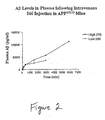
- mice Sixteen hemizygous transgenic mice (APP V717F ) were used. The mice were approximately 24 months old at the start of the study. All injections were intraperitoneal (i.p.). Half the mice received weekly injections of phosphate buffered saline (PBS, "Control") and the other half received 500 micrograms of mouse antibody 266 dissolved in PBS. Injections were made over a period of seven weeks (42 days) for a total of six injections. Three days following the last injection, the behavior of the animals was assessed using an object recognition task, essentially as described in J.-C. Dodart, et al., Behavioral Neuroscience, 113 (5) 982-990 (1999 ).
- PBS phosphate buffered saline
- amyloid burden (% area covered by immunoreactive material after staining with anti-A ⁇ antibodies 3D6 or 21F12) was quantified in the cortex immediately overlying the hippocampus including areas of the cingulate and parietal cortex from the brains of the 24 month-old animals treated with mouse antibody 266 for seven weeks, as described above. The results are presented in the table below. The differences between the treatment groups are not statistically significant. Table 2. Amyloid plaque burden in APP V717F+/- mice following treatment with mouse 266 anti-A ⁇ antibody Plaque Burden (%) Using 3D6 Using 21F12 N Mean Standard Error Mean Standard Error Control (PBS) 7 44.3 5.93 0.77 0.14 Antibody 266 8 38.0 2.96 0.93 0.11
- the recognition index of the m266-treated group was not significantly different than what would be expected for a wild type cohort of 24 month old mice! This indicates a complete reversal of cognitive decline in these transgenic animals.
- mice Fifty-four (54) homozygous, transgenic mice (APP V717F ) were used. Twenty-tree (23) mice were approximately two months old at the start of the study. The remaining mice were approximately four months old at the start of the study. The duration of treatment was five months. Thus, at study termination, the mice were either approximately seven (7) months old or approximately nine (9) months old.
- Each mouse in "PBS” control groups received a weekly injection of phosphate buffered saline (PBS; 200 ⁇ L).
- PBS phosphate buffered saline
- Each mouse in the "2gG” control groups received a weekly injection of IgG1 ⁇ 1 isotype control (100 ⁇ g/mouse/week).
- Each mouse in the "High Dose” groups received a weekly injection of 500 microgram of antibody 266 dissolved in PBS ("HD”).
- Each mouse in the "Low Dose” group received a weekly injection of 100 micrograms of antibody 266 dissolved in PBS ("LD").
- Mouse myeloma cell line Sp2/0 was obtained from ATCC (Manassas, VA) and maintained in DME medium containing 10% FBS (Cat # SH32661.03, HyClone, Logan, UT) in a 37°C CO 2 incubator.
- Mouse 266 hybridoma cells were first grown in RPMI-1640 medium containing 10% FBS (HyClone), 10 mM HEPES, 2 mM glutamine, 0.1 mM non-essential amino acids, 1 mM sodium pyruvate, 25 ⁇ g/ml gentamicin, and then expanded in serum-free media (Hybridoma SFM, Cat # 12045-076, Life Technologies, Rockville, MD) containing 2% low Ig FBS (Cat # 30151.03, HyClone) to a 2.5 liter volume in roller bottles.
- Mouse monoclonal antibody 266 (Mu266) was purified from the culture supernatant by affinity chromatography using a proteins-G Sepharose column.
- Biotinylated Mu266 was prepared using EZ-Link Sulfo-NHS-LC-LC-Biotin (Cat # 21338ZZ, Pierce, Rockford, IL).
- variable region cDNAs for the light and heavy chains were amplified by polymerase chain reaction (PCR) using 3' primers that anneal respectively to the mouse kappa and gamma chain constant regions, and a 5' universal primer provided in the SMARTTMRACE cDNA Amplification Kit.
- PCR polymerase chain reaction
- 3' primer has the sequence:
- the light and heavy chain variable region genes were constructed and amplified using eight overlapping synthetic oligonucleotides ranging in length from approximately 65 to 80 bases [ He, X. Y., et al., J. Immunol. 160: 029-1035 (1998 )].
- the oligonucleotides were annealed pairwise and extended with the Klenow fragment of DNA polymerase I, yielding four double-stranded fragments.
- the resulting fragments were denatured, annealed pairwise, and extended with Klenow, yielding two fragments. These fragments were denatured, annealed pairwise, and extended once again, yielding a full-length gene.
- the resulting product was amplified by PCR using the Expand High Fidelity PCR System (Roche Molecular Biochemicals, Indianapolis, IN).
- the PCR-amplified fragments were gel-purified and cloned into pCR4Blunt-TOPO vector.
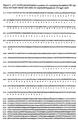
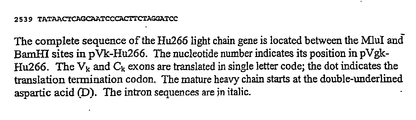
- the VL and VH genes were digested with MIuI and XbaI, gel-purified, and subcloned respectively into vectors for expression of light and heavy chains to make pVk-Hu266 and pVg1-Hu266 (see Figures 6 and 7 , respectively, herein) [ Co, M. S., et al., J. Immunol. 148:1149-1154 (1992 )].
- the mature humanized 266 antibody expressed from these plasmids has the light chain of SEQ ID NO: 11 and the heavy chain of SEQ ID NO: 12.
- Stable transfection Stable transfection into mouse myeloma cell line Sp2/0 was accomplished by electroporation using a Gene Pulser apparatus (BioRad, Hercules, CA) at 360 V and 25 ⁇ F as described (Co et al.,1992). Before transfection, pVk-Hu266 and pVgl-Hu266 plasmid DNAs were linearized using FspI. Approximately 10 7 Sp2/0 cells were transfected with 20 ⁇ g of pVk-Hu266 and 40 ⁇ g of pVgl-Hu266. The transfected cells were suspended in DME medium containing 10% FBS and plated into several 96-well plates.
- selection media DME medium containing 10% FBS, HT media supplement, 0.3 mg/ml xanthine and 1 ⁇ g/ml mycophenolic acid
- DME medium containing 10% FBS, HT media supplement, 0.3 mg/ml xanthine and 1 ⁇ g/ml mycophenolic acid
- ELISA Buffer PBS containing 1% BSA and 0.1% Tween 20
- HuM195 humanized anti-CD33 IgG1 monoclonal antibody
- the ELISA plate was incubated for 2 hr at room temperature and the wells were washed with Wash Buffer. Then, 100 ⁇ l of 1/1,000-diluted HRP-conjugated goat anti-human kappa polyclonal antibodies (Cat # 1050-05, Southern Biotechnology, Birmingham, AL) in ELISA Buffer was applied to each well.
- ABTS substrate Cat #s 507602 and 506502, Kirkegaard and Perry Laboratories, Gaithersburg, MD
- Color development was stopped by adding 100 ⁇ l of 2% oxalic acid per well.
- Absorbance was read at 415 nm using an GPTImax microplate reader (Molecular Devices, Menlo Park, CA).
- Hu266 Purification of Hu266 .
- One of the high Hu266-expressing Sp2/0 stable transfectants (clone 1D9) was adapted to growth in Hybridoma SFM and expanded to 2 liter in roller bottles.
- Spent culture supernatant was harvested when cell viability reached 10% or below and loaded onto a protein-A Sepharose column.
- the column was washed with PBS before the antibody was eluted with 0.1 M glycine-HCl (pH 2.5), 0.1 M NaCl.
- the eluted protein was dialyzed against 3 changes of 2 liter PBS and filtered through a 0.2 ⁇ m filter prior to storage at 4°C.
- the A ⁇ 1-42 -BSA conjugate was prepared by dissolving 7.5 mg of A ⁇ 1-42 -Cys 43 (C-terminal cysteine A ⁇ 1-42 , AnaSpec) in 500 ⁇ l of dimethylsulfoxide, and then immediately adding 1,500 ⁇ L of distilled water. Two (2) milligrams of maleimide-activated bovine serum albumin (Pierce) was dissolved in 200 ⁇ L of distilled water. The two solutions were combined, thoroughly mixed, and allowed to stand at room temperature for two (2) hours. A gel chromatography column was used to separate unreacted peptide from A ⁇ 1-42 -Cys-BSA conjugate.
- a mixture of biotinylated Mu266 (0.3 ⁇ g/ml final concentration) and competitor antibody (Mu266 or Hu266; starting at 750 ⁇ g/ml final concentration and serial 3-fold dilutions) in ELISA Buffer were added in triplicate in a final volume of 100 ⁇ l per well.
- As a no-competitor control 100 ⁇ l of 0.3 ⁇ g/ml biotinylated Mu266 was added.
- As a background control 100 ⁇ l of ELISA Buffer was added. The ELISA plate was incubated at room temperature for 90 min.
- a capture antibody (rabbit antimouse) was coupled via free amine groups to carboxyl groups on flow cell 2 of a biosensor chip (CM5) using N-ethyl-N-dimethylaminopropyl carbodiimide and N-hydroxysuccinimide (EDC/NHS).
- EDC/NHS N-ethyl-N-dimethylaminopropyl carbodiimide and N-hydroxysuccinimide
- a non-specific rabbit IgG was coupled to flow cell 1 as a background control.
- Monoclonal antibodies were captured to yield 300 resonance units (RU).
- Amyloid-beta 1-40 or 1-42 (Biosource International, Inc.) was then flowed over the chip at decreasing concentrations (1000 to 0.1 times KD). To regenerate the chip, bound anti-A ⁇ antibody was eluted from the chip using a wash with glycine-HCl (pH 2). A control injection containing no amyloid-beta served as a control for baseline subtraction. Sensorgrams demonstrating association and dissociation phases were analyzed to determine Kd and Ka. Using this method, the affinity of mouse antibody 266 for both A ⁇ 1-40 and for A ⁇ 1-42 was found to be 4 pM. The affinity of 4G8 for A ⁇ 1-40 was 23 nM and for A ⁇ 1-42 was 24 nM.
- both 266 and 4G8 which bind to epitopes between amino acids 13 and 28 of A ⁇ , effectively sequester A ⁇ from human CSF. Therefore, the location of the epitope is paramount, rather than binding affinity, in determining the ability of an antibody to sequester A ⁇ and to provide the beneficial and surprising advantages of the present invention.
- the BIAcore is an automated biosensor system for measuring molecular interactions [ Karlsson R., et al. J. Immunol. Methods 145:229-240 (1991 )].
- the advantage of the BIAcore over other binding assays is that binding of the antigen can be measured without having to label or immobilize the antigen (i.e. the antigen maintains a more native conformation).
- the BIAcore methodology was used to assess the binding of various amyloid-beta peptide fragments to mouse antibody 266, essentially as described above in Example 12, except that all dilutions were made with HEPES buffered saline containing Tween 20, a variety of fragments of A ⁇ (BioSource International) were injected, and a single concentration of each fragment was injected (440 nM).
- the affinity (KD Kd / Ka) of humanized 266 antibody, synthesized and purified as described above, was determined essentially as described above in Example 15. Using this method, the affinity of humanized 266 for A ⁇ 1-42 was found to be 4 pM.
Landscapes
- Health & Medical Sciences (AREA)
- Chemical & Material Sciences (AREA)
- Organic Chemistry (AREA)
- Medicinal Chemistry (AREA)
- Life Sciences & Earth Sciences (AREA)
- General Health & Medical Sciences (AREA)
- Engineering & Computer Science (AREA)
- Bioinformatics & Cheminformatics (AREA)
- Immunology (AREA)
- Animal Behavior & Ethology (AREA)
- Biophysics (AREA)
- Proteomics, Peptides & Aminoacids (AREA)
- Molecular Biology (AREA)
- Genetics & Genomics (AREA)
- Pharmacology & Pharmacy (AREA)
- Neurosurgery (AREA)
- Neurology (AREA)
- Biochemistry (AREA)
- Public Health (AREA)
- Veterinary Medicine (AREA)
- Biomedical Technology (AREA)
- Nuclear Medicine, Radiotherapy & Molecular Imaging (AREA)
- General Chemical & Material Sciences (AREA)
- Chemical Kinetics & Catalysis (AREA)
- Mycology (AREA)
- Psychiatry (AREA)
- Microbiology (AREA)
- Hospice & Palliative Care (AREA)
- Epidemiology (AREA)
- Medicines Containing Antibodies Or Antigens For Use As Internal Diagnostic Agents (AREA)
- Peptides Or Proteins (AREA)
- Medicines That Contain Protein Lipid Enzymes And Other Medicines (AREA)
- Medicines Containing Material From Animals Or Micro-Organisms (AREA)
- Preparation Of Compounds By Using Micro-Organisms (AREA)
- Micro-Organisms Or Cultivation Processes Thereof (AREA)
Priority Applications (3)
| Application Number | Priority Date | Filing Date | Title |
|---|---|---|---|
| SI200131058A SI1481992T1 (sl) | 2000-02-24 | 2001-02-26 | Humanizirana protitelesa, ki vežejo amiloidni peptid beta |
| EP16196667.6A EP3150633A1 (en) | 2000-02-24 | 2001-02-26 | Humanized antibodies that sequester amyloid beta peptide |
| EP16161726.1A EP3070100B1 (en) | 2000-02-24 | 2001-02-26 | Humanized antibodies that sequester amyloid beta peptide |
Applications Claiming Priority (7)
| Application Number | Priority Date | Filing Date | Title |
|---|---|---|---|
| US18460100P | 2000-02-24 | 2000-02-24 | |
| US184601P | 2000-02-24 | ||
| US25449800P | 2000-12-08 | 2000-12-08 | |
| US25446500P | 2000-12-08 | 2000-12-08 | |
| US254498P | 2000-12-08 | ||
| US254465P | 2000-12-08 | ||
| EP01913081A EP1257584B2 (en) | 2000-02-24 | 2001-02-26 | Humanized antibodies that sequester amyloid beta peptide |
Related Parent Applications (1)
| Application Number | Title | Priority Date | Filing Date |
|---|---|---|---|
| EP01913081A Division EP1257584B2 (en) | 2000-02-24 | 2001-02-26 | Humanized antibodies that sequester amyloid beta peptide |
Related Child Applications (4)
| Application Number | Title | Priority Date | Filing Date |
|---|---|---|---|
| EP16196667.6A Division EP3150633A1 (en) | 2000-02-24 | 2001-02-26 | Humanized antibodies that sequester amyloid beta peptide |
| EP16161726.1A Division EP3070100B1 (en) | 2000-02-24 | 2001-02-26 | Humanized antibodies that sequester amyloid beta peptide |
| EP16161726.1A Previously-Filed-Application EP3070100B1 (en) | 2000-02-24 | 2001-02-26 | Humanized antibodies that sequester amyloid beta peptide |
| EP16161726.1A Division-Into EP3070100B1 (en) | 2000-02-24 | 2001-02-26 | Humanized antibodies that sequester amyloid beta peptide |
Publications (3)
| Publication Number | Publication Date |
|---|---|
| EP1481992A2 EP1481992A2 (en) | 2004-12-01 |
| EP1481992A3 EP1481992A3 (en) | 2004-12-08 |
| EP1481992B1 true EP1481992B1 (en) | 2016-11-02 |
Family
ID=27391859
Family Applications (4)
| Application Number | Title | Priority Date | Filing Date |
|---|---|---|---|
| EP04011466.2A Expired - Lifetime EP1481992B1 (en) | 2000-02-24 | 2001-02-26 | Humanized antibodies that sequester amyloid beta peptide |
| EP16196667.6A Withdrawn EP3150633A1 (en) | 2000-02-24 | 2001-02-26 | Humanized antibodies that sequester amyloid beta peptide |
| EP16161726.1A Expired - Lifetime EP3070100B1 (en) | 2000-02-24 | 2001-02-26 | Humanized antibodies that sequester amyloid beta peptide |
| EP01913081A Expired - Lifetime EP1257584B2 (en) | 2000-02-24 | 2001-02-26 | Humanized antibodies that sequester amyloid beta peptide |
Family Applications After (3)
| Application Number | Title | Priority Date | Filing Date |
|---|---|---|---|
| EP16196667.6A Withdrawn EP3150633A1 (en) | 2000-02-24 | 2001-02-26 | Humanized antibodies that sequester amyloid beta peptide |
| EP16161726.1A Expired - Lifetime EP3070100B1 (en) | 2000-02-24 | 2001-02-26 | Humanized antibodies that sequester amyloid beta peptide |
| EP01913081A Expired - Lifetime EP1257584B2 (en) | 2000-02-24 | 2001-02-26 | Humanized antibodies that sequester amyloid beta peptide |
Country Status (32)
| Country | Link |
|---|---|
| US (4) | US7195761B2 (https=) |
| EP (4) | EP1481992B1 (https=) |
| JP (2) | JP4738696B2 (https=) |
| KR (1) | KR100767146B1 (https=) |
| CN (3) | CN104341500A (https=) |
| AT (1) | ATE279442T1 (https=) |
| AU (1) | AU4178601A (https=) |
| BR (1) | BRPI0108676B8 (https=) |
| CA (1) | CA2400559C (https=) |
| CY (1) | CY1118381T1 (https=) |
| CZ (2) | CZ306683B6 (https=) |
| DE (2) | DE60106394T3 (https=) |
| DK (2) | DK1481992T3 (https=) |
| DZ (1) | DZ3295A1 (https=) |
| EA (1) | EA006606B1 (https=) |
| ES (2) | ES2184660T5 (https=) |
| HK (1) | HK1048640B (https=) |
| HR (2) | HRP20020693B1 (https=) |
| HU (2) | HUP0204074A3 (https=) |
| IL (3) | IL151378A0 (https=) |
| LT (1) | LT1481992T (https=) |
| MX (1) | MXPA02008145A (https=) |
| NO (2) | NO329840B1 (https=) |
| NZ (1) | NZ520800A (https=) |
| PL (2) | PL210157B1 (https=) |
| PT (2) | PT1257584E (https=) |
| SI (2) | SI1257584T2 (https=) |
| SK (2) | SK288711B6 (https=) |
| TR (1) | TR200202799T3 (https=) |
| UA (1) | UA75881C2 (https=) |
| WO (1) | WO2001062801A2 (https=) |
| ZA (1) | ZA200206712B (https=) |
Families Citing this family (209)
| Publication number | Priority date | Publication date | Assignee | Title |
|---|---|---|---|---|
| US6913745B1 (en) | 1997-12-02 | 2005-07-05 | Neuralab Limited | Passive immunization of Alzheimer's disease |
| US7179892B2 (en) * | 2000-12-06 | 2007-02-20 | Neuralab Limited | Humanized antibodies that recognize beta amyloid peptide |
| US6750324B1 (en) | 1997-12-02 | 2004-06-15 | Neuralab Limited | Humanized and chimeric N-terminal amyloid beta-antibodies |
| US6787523B1 (en) | 1997-12-02 | 2004-09-07 | Neuralab Limited | Prevention and treatment of amyloidogenic disease |
| TWI239847B (en) | 1997-12-02 | 2005-09-21 | Elan Pharm Inc | N-terminal fragment of Abeta peptide and an adjuvant for preventing and treating amyloidogenic disease |
| US6905686B1 (en) | 1997-12-02 | 2005-06-14 | Neuralab Limited | Active immunization for treatment of alzheimer's disease |
| US7790856B2 (en) | 1998-04-07 | 2010-09-07 | Janssen Alzheimer Immunotherapy | Humanized antibodies that recognize beta amyloid peptide |
| US6923964B1 (en) | 1997-12-02 | 2005-08-02 | Neuralab Limited | Active immunization of AScr for prion disorders |
| US7588766B1 (en) | 2000-05-26 | 2009-09-15 | Elan Pharma International Limited | Treatment of amyloidogenic disease |
| US7964192B1 (en) * | 1997-12-02 | 2011-06-21 | Janssen Alzheimer Immunotherapy | Prevention and treatment of amyloidgenic disease |
| US6761888B1 (en) | 2000-05-26 | 2004-07-13 | Neuralab Limited | Passive immunization treatment of Alzheimer's disease |
| US20080050367A1 (en) | 1998-04-07 | 2008-02-28 | Guriq Basi | Humanized antibodies that recognize beta amyloid peptide |
| US20050059802A1 (en) * | 1998-04-07 | 2005-03-17 | Neuralab Ltd | Prevention and treatment of amyloidogenic disease |
| US20030147882A1 (en) | 1998-05-21 | 2003-08-07 | Alan Solomon | Methods for amyloid removal using anti-amyloid antibodies |
| US6787637B1 (en) | 1999-05-28 | 2004-09-07 | Neuralab Limited | N-Terminal amyloid-β antibodies |
| UA81216C2 (en) | 1999-06-01 | 2007-12-25 | Prevention and treatment of amyloid disease | |
| WO2000077178A1 (en) | 1999-06-16 | 2000-12-21 | Boston Biomedical Research Institute | IMMUNOLOGICAL CONTROL OF β-AMYLOID LEVELS IN VIVO |
| BRPI0108676B8 (pt) | 2000-02-24 | 2021-05-25 | Lilly Co Eli | anticorpos humanizados que sequestram peptídeo amilóide beta e seus usos no tratamento de condições caracterizadas por formação de placas amiloides, bem como composição farmacêutica que compreende os referidos anticorpos |
| TWI255272B (en) | 2000-12-06 | 2006-05-21 | Guriq Basi | Humanized antibodies that recognize beta amyloid peptide |
| US7700751B2 (en) | 2000-12-06 | 2010-04-20 | Janssen Alzheimer Immunotherapy | Humanized antibodies that recognize β-amyloid peptide |
| ES2437875T3 (es) * | 2001-04-30 | 2014-01-14 | Eli Lilly And Company | Anticuerpos humanizados que reconocen el péptido beta-amiloide |
| US7320790B2 (en) * | 2001-04-30 | 2008-01-22 | Eli Lilly And Company | Humanized antibodies |
| WO2003000714A2 (en) * | 2001-06-22 | 2003-01-03 | Panacea Pharmaceuticals, Inc. | Compositions and methods for preventing protein aggregation in neurodegenerative diseases |
| DE60226036T9 (de) † | 2001-08-03 | 2016-09-29 | Medical & Biological Laboratories Co., Ltd. | ANTIKÖRPER, DER DAS GM1-GANGLIOSID-GEBUNDENE AMYLOID-b-PROTEIN ERKENNT, UND DNA, DIE FÜR DIESEN ANTIKÖRPER CODIERT |
| PT1944040E (pt) | 2001-08-17 | 2012-10-31 | Univ Washington | Método de avaliação para a doença de alzheimer |
| US20060073149A1 (en) * | 2001-08-17 | 2006-04-06 | Bales Kelly R | Rapid improvement of cognition in condition related to abeta |
| CA2457145C (en) * | 2001-08-17 | 2010-12-21 | Washington University | Assay method for alzheimer's disease |
| EP1429805A4 (en) * | 2001-08-17 | 2005-09-21 | Lilly Co Eli | USE OF ANTIBODIES WITH HIGH AFFINITY FOR A $ G (B) PEPTIDE IN THE TREATMENT OF DISEASES AND DISEASES RELATED TO A $ G (B) |
| JP2005503789A (ja) * | 2001-08-17 | 2005-02-10 | イーライ・リリー・アンド・カンパニー | 抗Aβ抗体 |
| US7179606B2 (en) * | 2001-11-23 | 2007-02-20 | Syn X Pharma, Inc. | IG heavy chain, IG kappa, IG lambda biopolymer markers predictive of Alzheimer's disease |
| MY139983A (en) * | 2002-03-12 | 2009-11-30 | Janssen Alzheimer Immunotherap | Humanized antibodies that recognize beta amyloid peptide |
| AU2003223474B2 (en) * | 2002-04-25 | 2008-09-04 | Eli Lilly And Company | Method for treating anxiety and mood disorders in older subjects |
| WO2004029629A1 (en) * | 2002-09-27 | 2004-04-08 | Janssen Pharmaceutica N.V. | N-11 truncated amyloid-beta nomoclonal antibodies, compositions, methods and uses |
| FR2846667B1 (fr) * | 2002-11-06 | 2004-12-31 | Pasteur Institut | Fragments variables d'anticorps de camelides a chaine unique diriges contre le peptide beta-amyloide 1-42 et leurs applications pour le diagnostic et le traitement des maladies neuroagregatives |
| WO2004056318A2 (en) | 2002-12-19 | 2004-07-08 | New York University | Method for treating amyloid disease |
| DE10303974A1 (de) | 2003-01-31 | 2004-08-05 | Abbott Gmbh & Co. Kg | Amyloid-β(1-42)-Oligomere, Verfahren zu deren Herstellung und deren Verwendung |
| MXPA05008156A (es) * | 2003-02-01 | 2005-09-30 | Neuralab Ltd | Inmunizacion activa para generar anticuerpos para beta-a soluble. |
| DE602004027348D1 (de) | 2003-02-10 | 2010-07-08 | Applied Molecular Evolution | Abeta-bindende moleküle |
| US8663650B2 (en) | 2003-02-21 | 2014-03-04 | Ac Immune Sa | Methods and compositions comprising supramolecular constructs |
| US7732162B2 (en) | 2003-05-05 | 2010-06-08 | Probiodrug Ag | Inhibitors of glutaminyl cyclase for treating neurodegenerative diseases |
| PE20050627A1 (es) * | 2003-05-30 | 2005-08-10 | Wyeth Corp | Anticuerpos humanizados que reconocen el peptido beta amiloideo |
| CN102558352A (zh) | 2003-06-27 | 2012-07-11 | 艾默根佛蒙特有限公司 | 针对表皮生长因子受体的缺失突变体的抗体及其使用 |
| AT413336B (de) | 2003-09-12 | 2006-02-15 | Mattner Frank Dr | Apherese-vorrichtung |
| KR101139103B1 (ko) * | 2003-09-12 | 2012-07-05 | 아피리스 아게 | 아페레시스 장치 |
| US7848543B2 (en) * | 2004-02-05 | 2010-12-07 | Brainlab Ag | Method and system for prediction and management of material and information transport in an organism |
| AU2005217596B2 (en) * | 2004-02-23 | 2012-01-19 | Eli Lilly And Company | Anti-ABeta antibody |
| WO2005105998A1 (ja) * | 2004-04-27 | 2005-11-10 | Juridical Foundation The Chemo-Sero-Therapeutic Research Institute | ヒト抗アミロイドβペプチド抗体およびその抗体フラグメント |
| AU2005269940A1 (en) * | 2004-07-02 | 2006-02-09 | Northwestern University | Monolocal antibodies that target pathological assemblies of amyloid beta (Abeta) |
| US20060024667A1 (en) | 2004-07-29 | 2006-02-02 | Karen Manucharyan | Compositions and methods for Alzheimer's disease |
| EA200700751A1 (ru) * | 2004-10-05 | 2008-06-30 | Элан Фарма Интернэшнл Лимитед | Способы и композиции для улучшения продуцирования рекомбинантного белка |
| US9901413B2 (en) * | 2004-10-15 | 2018-02-27 | Brainlab Ag | Targeted infusion of agents for treatment of ALS |
| US9907485B2 (en) * | 2004-10-15 | 2018-03-06 | Brainlab Ag | Targeted immunization and plaque destruction against Alzheimer's disease |
| US9924888B2 (en) * | 2004-10-15 | 2018-03-27 | Brainlab Ag | Targeted infusion of agents against parkinson's disease |
| WO2006066089A1 (en) | 2004-12-15 | 2006-06-22 | Neuralab Limited | Humanized amyloid beta antibodies for use in improving cognition |
| EP1838349A1 (en) * | 2004-12-15 | 2007-10-03 | Neuralab, Ltd. | Amyloid beta antibodies for use in improving cognition |
| TW200636066A (en) | 2004-12-15 | 2006-10-16 | Elan Pharm Inc | Humanized antibodies that recognize beta amyloid peptide |
| WO2006069081A2 (en) * | 2004-12-22 | 2006-06-29 | Washington University In St. Louis | USE OF ANTI-Aβ ANTIBODY TO TREAT TRAUMATIC BRAIN INJURY |
| US7906625B2 (en) * | 2005-01-24 | 2011-03-15 | Amgen Inc. | Humanized anti-amyloid antibody |
| GT200600031A (es) | 2005-01-28 | 2006-08-29 | Formulacion anticuerpo anti a beta | |
| TWI372763B (en) | 2005-06-17 | 2012-09-21 | Wyeth Llc | Methods of purifying anti a beta antibodies |
| RU2432362C2 (ru) * | 2005-11-30 | 2011-10-27 | Эбботт Лэборетриз | Моноклональные антитела и их применения |
| PL2289909T3 (pl) * | 2005-11-30 | 2015-04-30 | Abbvie Inc | Sposób przeszukiwania, proces oczyszczania niedyfundujących oligomerów Abeta, selektywne przeciwciała przeciw niedyfundującym oligomerom Abeta i sposób wytwarzania tych przeciwciał |
| SG10201404801YA (en) | 2005-12-12 | 2014-09-26 | Ac Immune Sa | Monoclonal antibody |
| UA99097C2 (ru) | 2005-12-12 | 2012-07-25 | Ф. Хоффманн-Ля Рош Аг | Композиция, содержащая антитела к амилоиду бета 4, имеющие гликозилированный вариабельный участок |
| KR101263294B1 (ko) * | 2006-03-30 | 2013-06-04 | 글락소 그룹 리미티드 | 아밀로이드베타 펩티드에 대한 항체 |
| US8784810B2 (en) | 2006-04-18 | 2014-07-22 | Janssen Alzheimer Immunotherapy | Treatment of amyloidogenic diseases |
| CN101058608B (zh) * | 2006-04-21 | 2011-02-23 | 杜如昱 | 人类抗Aβ1-32淀粉样蛋白抗体、其纯化方法及用途 |
| NO348280B1 (no) * | 2006-07-14 | 2024-11-04 | Genentech Inc | Humanisert antistoff |
| LT2468770T (lt) * | 2006-07-14 | 2018-05-25 | Ac Immune S.A. | Humanizuotas antikūnas prieš beta amiloidą |
| EP3988566A1 (en) * | 2006-07-14 | 2022-04-27 | AC Immune SA | Humanized antibody against amyloid beta |
| NZ574188A (en) * | 2006-07-14 | 2012-05-25 | Ac Immune Sa | Humanized antibody against amyloid beta |
| KR20150002879A (ko) * | 2006-10-02 | 2015-01-07 | 에이씨 이뮨 에스.에이. | 아밀로이드 베타에 대해 인간화된 항체 |
| EP2076287A2 (en) | 2006-10-12 | 2009-07-08 | Wyeth | Methods and compositions with reduced opalescence |
| US8455626B2 (en) * | 2006-11-30 | 2013-06-04 | Abbott Laboratories | Aβ conformer selective anti-aβ globulomer monoclonal antibodies |
| JP2010515717A (ja) | 2007-01-11 | 2010-05-13 | フィリップス−ウニベルジテート・マールブルク | アルツハイマーおよび他の神経性認知症疾患の診断ならびに処置 |
| PT2121754E (pt) | 2007-01-18 | 2015-05-11 | Lilly Co Eli | Fab de beta-amilóide peguilado |
| CA2676715A1 (en) | 2007-02-12 | 2008-08-21 | Merck & Co., Inc. | Piperazine derivatives for treatment of ad and related conditions |
| EP2124952A2 (en) | 2007-02-27 | 2009-12-02 | Abbott GmbH & Co. KG | Method for the treatment of amyloidoses |
| AU2008220785B2 (en) | 2007-03-01 | 2013-02-21 | Vivoryon Therapeutics N.V. | New use of glutaminyl cyclase inhibitors |
| JP5667440B2 (ja) | 2007-04-18 | 2015-02-12 | プロビオドルグ エージー | グルタミニルシクラーゼ阻害剤としてのチオ尿素誘導体 |
| US20080292625A1 (en) * | 2007-04-18 | 2008-11-27 | Sally Schroeter | Prevention and treatment of cerebral amyloid angiopathy |
| US8003097B2 (en) | 2007-04-18 | 2011-08-23 | Janssen Alzheimer Immunotherapy | Treatment of cerebral amyloid angiopathy |
| AU2008254328A1 (en) | 2007-05-18 | 2008-11-27 | The Johns Hopkins University | A treatment simulator for brain diseases and method of use thereof |
| US20090232801A1 (en) * | 2007-05-30 | 2009-09-17 | Abbot Laboratories | Humanized Antibodies Which Bind To AB (1-42) Globulomer And Uses Thereof |
| JP2010528583A (ja) * | 2007-06-11 | 2010-08-26 | エーシー イミューン ソシエテ アノニム | アミロイドβに対するヒト化抗体 |
| US8613923B2 (en) | 2007-06-12 | 2013-12-24 | Ac Immune S.A. | Monoclonal antibody |
| US8048420B2 (en) * | 2007-06-12 | 2011-11-01 | Ac Immune S.A. | Monoclonal antibody |
| PL2170389T3 (pl) * | 2007-06-12 | 2015-03-31 | Ac Immune Sa | Humanizowane przeciwciało przeciw amyloidowi beta |
| PT2182983E (pt) | 2007-07-27 | 2014-09-01 | Janssen Alzheimer Immunotherap | Tratamento de doenças amiloidogénicas com anticorpos anti-abeta humanizados |
| EP2197914A1 (en) * | 2007-09-13 | 2010-06-23 | Delenex Therapeutics AG | HUMANIZED ANTIBODIES AGAINST THE ß-AMYLOYD PEPTIDE |
| CA2701788C (en) * | 2007-10-05 | 2017-06-13 | Genentech, Inc. | Humanized beta-amyloid antibody for treating ocular diseases |
| RS53174B (sr) | 2007-10-05 | 2014-06-30 | Genentech Inc. | Upotreba antiamiloidnog beta antitela u slučaju oboljenja oka |
| JO3076B1 (ar) | 2007-10-17 | 2017-03-15 | Janssen Alzheimer Immunotherap | نظم العلاج المناعي المعتمد على حالة apoe |
| DK2207568T3 (en) * | 2007-11-16 | 2017-09-18 | Univ Rockefeller | ANTIBODIES SPECIFIC TO THE PROTOFIBRILE FORM OF BETA AMYLOID PROTEIN |
| WO2009085200A2 (en) | 2007-12-21 | 2009-07-09 | Amgen Inc. | Anti-amyloid antibodies and uses thereof |
| EP2106802A1 (en) | 2008-04-02 | 2009-10-07 | SIGMA-TAU Industrie Farmaceutiche Riunite S.p.A. | Modified peptides as synthetic vaccines in amyloid-associated disease |
| EP2149380A1 (en) * | 2008-07-29 | 2010-02-03 | Medivet Pharma, S.L. | Veterinary immunotherapy compositions for the Aged Related Cognitive Dysfunction. |
| US8815794B2 (en) | 2008-08-28 | 2014-08-26 | The Research Foundation For The State University Of New York | Treatment of amyloidoses using myelin basic protein and fragments thereof |
| US9067981B1 (en) | 2008-10-30 | 2015-06-30 | Janssen Sciences Ireland Uc | Hybrid amyloid-beta antibodies |
| US8614297B2 (en) | 2008-12-22 | 2013-12-24 | Hoffmann-La Roche Inc. | Anti-idiotype antibody against an antibody against the amyloid β peptide |
| JP5934645B2 (ja) | 2009-09-11 | 2016-06-15 | プロビオドルグ エージー | グルタミニルシクラーゼ阻害剤としてのヘテロ環式誘導体 |
| WO2011070174A1 (en) | 2009-12-11 | 2011-06-16 | Araclon Biotech, S.L. | Methods and reagents for improved detection of amyloid beta peptides |
| WO2011109246A1 (en) | 2010-03-01 | 2011-09-09 | The J. David Gladstone Institutes | Antibody specific for apolipoprotein and methods of use thereof |
| WO2011107530A2 (en) | 2010-03-03 | 2011-09-09 | Probiodrug Ag | Novel inhibitors |
| JP5688745B2 (ja) | 2010-03-10 | 2015-03-25 | プロビオドルグ エージー | グルタミニルシクラーゼ(qc、ec2.3.2.5)の複素環阻害剤 |
| ES2684475T3 (es) | 2010-04-15 | 2018-10-03 | Abbvie Inc. | Proteínas que se unen a beta amiloide |
| WO2011131748A2 (en) | 2010-04-21 | 2011-10-27 | Probiodrug Ag | Novel inhibitors |
| WO2011149461A1 (en) | 2010-05-27 | 2011-12-01 | Medtronic, Inc. | Anti-amyloid beta antibodies conjugated to sialic acid-containing molecules |
| RU2607368C2 (ru) | 2010-07-30 | 2017-01-10 | Ац Иммуне С.А. | Безопасные и функциональные гуманизированные антитела |
| WO2012019168A2 (en) | 2010-08-06 | 2012-02-09 | Moderna Therapeutics, Inc. | Engineered nucleic acids and methods of use thereof |
| CN103298833B (zh) | 2010-08-14 | 2015-12-16 | Abbvie公司 | β淀粉样蛋白结合蛋白 |
| RU2013120302A (ru) | 2010-10-01 | 2014-11-20 | Модерна Терапьютикс, Инк. | Сконструированные нуклеиновые кислоты и способы их применения |
| EP2686313B1 (en) | 2011-03-16 | 2016-02-03 | Probiodrug AG | Benzimidazole derivatives as inhibitors of glutaminyl cyclase |
| EP2691101A2 (en) | 2011-03-31 | 2014-02-05 | Moderna Therapeutics, Inc. | Delivery and formulation of engineered nucleic acids |
| EP2691393B1 (en) | 2011-03-31 | 2016-09-14 | Pfizer Inc | Novel bicyclic pyridinones |
| EP2511296A1 (en) | 2011-04-12 | 2012-10-17 | Araclón Biotech, S. L. | Antibody, kit and method for determination of amyloid peptides |
| WO2012172449A1 (en) | 2011-06-13 | 2012-12-20 | Pfizer Inc. | Lactams as beta secretase inhibitors |
| ES2605565T3 (es) | 2011-08-31 | 2017-03-15 | Pfizer Inc | Compuestos de hexahidropirano [3,4-D][1,3]tiazin-2-amina |
| US9464124B2 (en) | 2011-09-12 | 2016-10-11 | Moderna Therapeutics, Inc. | Engineered nucleic acids and methods of use thereof |
| JP2012050437A (ja) * | 2011-09-12 | 2012-03-15 | Janssen Alzheimer Immunotherapy | ベータアミロイドペプチドを認識するヒト化抗体 |
| RU2648950C2 (ru) | 2011-10-03 | 2018-04-02 | Модерна Терапьютикс, Инк. | Модифицированные нуклеозиды, нуклеотиды и нуклеиновые кислоты и их применение |
| CN104114572A (zh) | 2011-12-16 | 2014-10-22 | 现代治疗公司 | 经修饰的核苷、核苷酸和核酸组合物 |
| EP2794878B1 (en) * | 2011-12-22 | 2020-03-18 | F.Hoffmann-La Roche Ag | Expression vector organization, novel production cell generation methods and their use for the recombinant production of polypeptides |
| AU2013243948A1 (en) | 2012-04-02 | 2014-10-30 | Moderna Therapeutics, Inc. | Modified polynucleotides for the production of proteins associated with human disease |
| US9572897B2 (en) | 2012-04-02 | 2017-02-21 | Modernatx, Inc. | Modified polynucleotides for the production of cytoplasmic and cytoskeletal proteins |
| US9283287B2 (en) | 2012-04-02 | 2016-03-15 | Moderna Therapeutics, Inc. | Modified polynucleotides for the production of nuclear proteins |
| US9254311B2 (en) | 2012-04-02 | 2016-02-09 | Moderna Therapeutics, Inc. | Modified polynucleotides for the production of proteins |
| ES2585262T3 (es) | 2012-05-04 | 2016-10-04 | Pfizer Inc | Compuestos heterocíclicos de hexahidropiran[3,4-d][1,3]tiazin-2-amina sustituidos como inhibidores de PPA, BACE1 y BACE2 |
| WO2014001973A1 (en) | 2012-06-29 | 2014-01-03 | Pfizer Inc. | NOVEL 4-(SUBSTITUTED-AMINO)-7H-PYRROLO[2,3-d]PYRIMIDINES AS LRRK2 INHIBITORS |
| RU2014153675A (ru) * | 2012-07-03 | 2016-08-27 | Янссен Альцгеймер Иммунотерапи | Антитела к с-концевым и центральным эпитопам а-бета |
| CA2882389A1 (en) | 2012-09-20 | 2014-03-27 | Pfizer Inc. | Alkyl-substituted hexahydropyrano[3,4-d][1,3]thiazin-2-amine compounds |
| UA110688C2 (uk) | 2012-09-21 | 2016-01-25 | Пфайзер Інк. | Біциклічні піридинони |
| WO2014081507A1 (en) | 2012-11-26 | 2014-05-30 | Moderna Therapeutics, Inc. | Terminally modified rna |
| WO2014091352A1 (en) | 2012-12-11 | 2014-06-19 | Pfizer Inc. | Hexahydropyrano [3,4-d][1,3]thiazin-2-amine compounds as inhibitors of bace1 |
| CA2893333C (en) | 2012-12-19 | 2017-10-24 | Pfizer Inc. | Carbocyclic-and heterocyclic-substituted hexahydropyrano[3,4-d][1,3]thiazin-2-amine compounds |
| WO2014125394A1 (en) | 2013-02-13 | 2014-08-21 | Pfizer Inc. | HETEROARYL-SUBSTITUTED HEXAHYDROPYRANO [3,4-d][1,3] THIAZIN-2-AMINE COMPOUNDS |
| US9233981B1 (en) | 2013-02-15 | 2016-01-12 | Pfizer Inc. | Substituted phenyl hexahydropyrano[3,4-d][1,3]thiazin-2-amine compounds |
| CN105121439A (zh) | 2013-02-19 | 2015-12-02 | 辉瑞公司 | 作为pde4亚型抑制剂用于治疗cns和其他病症的氮杂苯并咪唑化合物 |
| US8980864B2 (en) | 2013-03-15 | 2015-03-17 | Moderna Therapeutics, Inc. | Compositions and methods of altering cholesterol levels |
| WO2014189973A2 (en) | 2013-05-20 | 2014-11-27 | Genentech, Inc. | Anti-transferrin receptor antibodies and methods of use |
| EP4331605A3 (en) | 2013-09-13 | 2024-05-22 | F. Hoffmann-La Roche AG | Methods and compositions comprising purified recombinant polypeptides |
| ES2915378T3 (es) | 2013-09-13 | 2022-06-22 | Hoffmann La Roche | Procedimientos para detectar y cuantificar una proteína de célula huésped en líneas celulares |
| US10023626B2 (en) | 2013-09-30 | 2018-07-17 | Modernatx, Inc. | Polynucleotides encoding immune modulating polypeptides |
| JP2016538829A (ja) | 2013-10-03 | 2016-12-15 | モデルナ セラピューティクス インコーポレイテッドModerna Therapeutics,Inc. | 低密度リポタンパク質受容体をコードするポリヌクレオチド |
| ES2742078T3 (es) | 2013-10-04 | 2020-02-13 | Pfizer | Piridonas bicíclicas novedosas como moduladores de gamma-secretasa |
| JP6487921B2 (ja) | 2013-12-17 | 2019-03-20 | ファイザー・インク | LRRK2阻害薬としての新規の3,4−二置換−1H−ピロロ[2,3−b]ピリジンおよび4,5−二置換−7H−ピロロ[2,3−c]ピリダジン |
| DK3126361T3 (da) | 2014-04-01 | 2020-01-02 | Pfizer | Chromen og 1,1a,2,7b-tetrahydrocyclopropa[c]chromen- pyridopyrazindioner som gamma-sekretase-modulatorer |
| PE20170327A1 (es) | 2014-04-10 | 2017-04-21 | Pfizer | 2-AMINO-6-METIL-4,4a,5,6-TETRAHIDROPIRANO[3,4d] [1,3] TIAZIN-8a(8H)-IL-1,3-TIAZOL-4-ILAMIDAS |
| WO2015165961A1 (en) | 2014-04-29 | 2015-11-05 | Affiris Ag | Treatment and prevention of alzheimer's disease (ad) |
| WO2016012896A1 (en) | 2014-07-24 | 2016-01-28 | Pfizer Inc. | Pyrazolopyrimidine compounds |
| PL3177624T3 (pl) | 2014-08-06 | 2019-09-30 | Pfizer Inc. | Związki imidazopirydazynowe |
| EP3221362B1 (en) | 2014-11-19 | 2019-07-24 | F.Hoffmann-La Roche Ag | Anti-transferrin receptor antibodies and methods of use |
| EP3221361B1 (en) | 2014-11-19 | 2021-04-21 | Genentech, Inc. | Anti-transferrin receptor / anti-bace1 multispecific antibodies and methods of use |
| SI3221349T1 (sl) | 2014-11-19 | 2021-02-26 | Axon Neuroscience Se | Humanizirano tau protitelo pri alzheimerjevi bolezni |
| MX368391B (es) | 2015-02-03 | 2019-09-30 | Pfizer | Ciclopropabenzofuranil-piridopirazindionas novedosas. |
| EP3766885B1 (en) | 2015-06-17 | 2022-05-25 | Pfizer Inc. | Tricyclic compounds and their use as phosphodiesterase inhibitors |
| US11327080B2 (en) | 2015-07-21 | 2022-05-10 | BioArctic Neruoscience AB | Method for treatment of traumatic brain injury targeting aggregated peptides |
| IL257146B2 (en) | 2015-08-21 | 2025-01-01 | Hoffmann La Roche | Method for reducing host cell proteins by affinity chromatography |
| KR102161364B1 (ko) | 2015-09-14 | 2020-09-29 | 화이자 인코포레이티드 | LRRK2 억제제로서 이미다조[4,5-c]퀴놀린 및 이미다조[4,5-c][1,5]나프티리딘 유도체 |
| WO2017051294A1 (en) | 2015-09-24 | 2017-03-30 | Pfizer Inc. | N-[2-(3-amino-2,5-dimethyl-1,1-dioxido-5,6-dihydro-2h-1,2,4-thiadiazin-5-yl)-1,3-thiazol-4-yl] amides useful as bace inhibitors |
| EP3353182A1 (en) | 2015-09-24 | 2018-08-01 | Pfizer Inc | Tetrahydropyrano[3,4-d][1,3]oxazin derivatives and their use as bace inhibitors |
| WO2017051276A1 (en) | 2015-09-24 | 2017-03-30 | Pfizer Inc. | N-[2-(2-amino-6,6-disubstituted-4, 4a, 5, 6-tetrahydropyrano [3,4-d][1,3] thiazin-8a (8h)-yl) -1, 3-thiazol-4-yl] amides |
| AR106189A1 (es) | 2015-10-02 | 2017-12-20 | Hoffmann La Roche | ANTICUERPOS BIESPECÍFICOS CONTRA EL A-b HUMANO Y EL RECEPTOR DE TRANSFERRINA HUMANO Y MÉTODOS DE USO |
| HK1257801A1 (zh) | 2015-10-28 | 2019-11-01 | 宾夕法尼亚州大学信托人 | 用於基因治疗的腺伴随病毒载体的鞘内给药 |
| US10759837B2 (en) | 2015-11-09 | 2020-09-01 | The University Of British Columbia | Anti-amyloid beta antibodies binding to a cyclic amyloid beta peptide |
| CA3004494A1 (en) * | 2015-11-09 | 2017-05-18 | The University Of British Columiba | Epitopes in amyloid beta mid-region and conformationally-selective antibodies thereto |
| US10772969B2 (en) | 2015-11-09 | 2020-09-15 | The University Of British Columbia | N-terminal epitopes in amyloid beta and conformationally-selective antibodies thereto |
| SG11201806383TA (en) | 2016-02-23 | 2018-09-27 | Pfizer | 6,7-dihydro-5h-pyrazolo[5,1-b][1,3]oxazine-2-carboxamide compounds |
| TWI798751B (zh) | 2016-07-01 | 2023-04-11 | 美商美國禮來大藥廠 | 抗-N3pGlu類澱粉β肽抗體及其用途 |
| WO2018002760A1 (en) | 2016-07-01 | 2018-01-04 | Pfizer Inc. | 5,7-dihydro-pyrrolo-pyridine derivatives for treating neurological and neurodegenerative diseases |
| CN109476729A (zh) | 2016-07-18 | 2019-03-15 | 英属哥伦比亚大学 | 淀粉样蛋白β的抗体 |
| EP3496750A2 (en) | 2016-08-09 | 2019-06-19 | Eli Lilly and Company | Combination therapy |
| EP4089116A1 (en) | 2016-09-27 | 2022-11-16 | Cero Therapeutics, Inc. | Chimeric engulfment receptor molecules |
| EP3532034A4 (en) * | 2016-10-28 | 2020-12-02 | Washington University | ANTI-APOE ANTIBODY |
| US20180125920A1 (en) | 2016-11-09 | 2018-05-10 | The University Of British Columbia | Methods for preventing and treating A-beta oligomer-associated and/or -induced diseases and conditions |
| WO2018163066A1 (en) | 2017-03-10 | 2018-09-13 | Pfizer Inc. | Novel imidazo[4,5-c]quinoline derivatives as lrrk2 inhibitors |
| EP3592740B1 (en) | 2017-03-10 | 2022-02-09 | Pfizer Inc. | Cyclic substituted imidazo[4,5-c]quinoline derivatives |
| TWI705975B (zh) * | 2017-04-20 | 2020-10-01 | 美商美國禮來大藥廠 | 抗-N3pGlu類澱粉β肽抗體及其用途 |
| CN110997693A (zh) | 2017-06-07 | 2020-04-10 | 阿德克斯公司 | τ聚集抑制剂 |
| BR112019026955A2 (pt) | 2017-06-22 | 2020-06-30 | Pfizer Inc. | derivados de di-hidro-pirrolo-piridina |
| RU2746325C1 (ru) * | 2017-06-29 | 2021-04-12 | Зе Трастис Оф Коламбия Юниверсити Ин Зе Сити Оф Нью-Йорк | Химерные антитела для лечения заболеваний, характеризующихся отложением амилоида |
| US12286469B2 (en) | 2017-07-18 | 2025-04-29 | The University Of British Columbia | Humanized antibodies binding to amyloid-beta (A-beta) |
| ES2984844T3 (es) | 2017-07-18 | 2024-10-31 | Univ British Columbia | Anticuerpos contra beta amiloide |
| AU2018308088B2 (en) | 2017-07-25 | 2025-05-29 | Truebinding, Inc. | Treating cancer by blocking the interaction of TIM-3 and its ligand |
| US11382974B2 (en) | 2017-08-01 | 2022-07-12 | The Trustees Of Columbia University In The City Of New York | Methods and compositions for treatment of amyloid deposition diseases |
| US11453701B2 (en) | 2017-08-18 | 2022-09-27 | Adrx, Inc. | Tau aggregation peptide inhibitors |
| EP3688032B1 (en) | 2017-09-26 | 2025-11-05 | Cero Therapeutics Holdings, Inc. | Chimeric engulfment receptor molecules and methods of use |
| ES2812698T3 (es) | 2017-09-29 | 2021-03-18 | Probiodrug Ag | Inhibidores de glutaminil ciclasa |
| WO2019074840A1 (en) * | 2017-10-09 | 2019-04-18 | Keith Black | COMPOSITIONS AND METHODS FOR TREATING ALZHEIMER'S DISEASE AND OTHER AMYLOID RELATED DISEASES |
| EP4219464A1 (en) | 2018-03-23 | 2023-08-02 | Pfizer Inc. | Piperazine azaspiro derivaves |
| US20210015865A1 (en) | 2018-03-28 | 2021-01-21 | Cero Therapeutics, Inc. | Chimeric engulfment receptors and uses thereof for neurodegenerative diseases |
| JP7444781B2 (ja) | 2018-03-28 | 2024-03-06 | セロ・セラピューティクス・インコーポレイテッド | 細胞免疫療法組成物およびその使用 |
| WO2019226690A1 (en) * | 2018-05-21 | 2019-11-28 | New York University | Treatment of melanoma brain metastasis by inhibition of amyloid precursor protein cleavage |
| US12018069B2 (en) | 2018-06-28 | 2024-06-25 | The Trustees Of Columbia University In The City Of New York | Methods and compositions for imaging amyloid deposits |
| US12311035B2 (en) | 2018-10-04 | 2025-05-27 | University Of Rochester | Glymphatic delivery by manipulating plasma osmolarity |
| AR117453A1 (es) | 2018-12-20 | 2021-08-04 | Genentech Inc | Fc de anticuerpos modificados y métodos para utilizarlas |
| FR3091999A1 (fr) * | 2019-01-25 | 2020-07-31 | Mexbrain | Dispositif d’extraction conjointe d’un cation métallique et d’une molécule cible |
| AU2020214796A1 (en) | 2019-01-30 | 2021-07-29 | Truebinding, Inc. | Anti-Gal3 antibodies and uses thereof |
| EP4045641A1 (en) | 2019-10-15 | 2022-08-24 | Eli Lilly and Company | Recombinantly engineered, lipase/esterase-deficient mammalian cell lines |
| WO2021242776A2 (en) | 2020-05-26 | 2021-12-02 | Truebinding, Inc. | Methods of treating inflammatory diseases by blocking galectin-3 |
| MX2023000949A (es) | 2020-07-23 | 2023-02-22 | Othair Prothena Ltd | Anticuerpos anti-beta-amiloide (abeta). |
| TWI843040B (zh) | 2021-01-11 | 2024-05-21 | 美商美國禮來大藥廠 | 抗N3pGlu類澱粉β抗體及其用途 |
| EP4297868A4 (en) | 2021-02-23 | 2025-01-08 | Hoth Therapeutics, Inc. | USE OF APREPITANT TO TREAT ALZHEIMER'S |
| TW202300518A (zh) | 2021-03-12 | 2023-01-01 | 美商美國禮來大藥廠 | 抗N3pGlu類澱粉β抗體及其用途 |
| TW202300517A (zh) | 2021-03-12 | 2023-01-01 | 美商美國禮來大藥廠 | 抗類澱粉β抗體及其用途 |
| WO2022251048A1 (en) | 2021-05-24 | 2022-12-01 | Eli Lilly And Company | Anti-amyloid beta antibodies and uses thereof |
| WO2023150483A1 (en) | 2022-02-03 | 2023-08-10 | Eli Lilly And Company | Regional tau imaging for diagnosing and treating alzheimer's disease |
| KR20260051039A (ko) | 2023-08-09 | 2026-04-15 | 에프. 호프만-라 로슈 아게 | 항-a-베타 단백질 항체, 이의 제조 방법 및 용도 |
| WO2025145091A1 (en) | 2023-12-29 | 2025-07-03 | Pfizer Inc. | Crystalline forms of a muscarinic m4 receptor modulator and methods of treating diseases |
Citations (1)
| Publication number | Priority date | Publication date | Assignee | Title |
|---|---|---|---|---|
| WO1999027944A1 (en) * | 1997-12-02 | 1999-06-10 | Neuralab Limited | Prevention and treatment of amyloidogenic disease |
Family Cites Families (36)
| Publication number | Priority date | Publication date | Assignee | Title |
|---|---|---|---|---|
| US5278049A (en) * | 1986-06-03 | 1994-01-11 | Incyte Pharmaceuticals, Inc. | Recombinant molecule encoding human protease nexin |
| FR2608669A1 (fr) | 1986-12-19 | 1988-06-24 | Boussois Sa | Vitrage pret a sa pose et son procede de fabrication et de fixation |
| US4933156A (en) | 1987-04-08 | 1990-06-12 | Salutar, Inc. | Amyloidosis and Alzheimer's disease diagnostic assay and reagents therefor |
| US5004697A (en) * | 1987-08-17 | 1991-04-02 | Univ. Of Ca | Cationized antibodies for delivery through the blood-brain barrier |
| IL162181A (en) | 1988-12-28 | 2006-04-10 | Pdl Biopharma Inc | A method of producing humanized immunoglubulin, and polynucleotides encoding the same |
| US5530101A (en) * | 1988-12-28 | 1996-06-25 | Protein Design Labs, Inc. | Humanized immunoglobulins |
| GB8928874D0 (en) | 1989-12-21 | 1990-02-28 | Celltech Ltd | Humanised antibodies |
| US5753624A (en) * | 1990-04-27 | 1998-05-19 | Milkhaus Laboratory, Inc. | Materials and methods for treatment of plaquing disease |
| US5837822A (en) * | 1992-01-27 | 1998-11-17 | Icos Corporation | Humanized antibodies specific for ICAM related protein |
| US5766846A (en) * | 1992-07-10 | 1998-06-16 | Athena Neurosciences | Methods of screening for compounds which inhibit soluble β-amyloid peptide production |
| US5837672A (en) | 1992-07-10 | 1998-11-17 | Athena Neurosciences, Inc. | Methods and compositions for the detection of soluble β-amyloid peptide |
| DE667959T1 (de) * | 1992-10-26 | 2000-04-20 | Dale B Schenk | VERFAHREN UND ZUSAMMENSETZUNGEN FÜR DEN NACHWEIS VON LÖSLICHEM-g(b)-AMYLOIDPEPTID. |
| CA2115900A1 (en) | 1993-02-22 | 1994-08-23 | Gerald W. Becker | Pharmaceutical screens and antibodies |
| JPH09505465A (ja) * | 1993-09-28 | 1997-06-03 | ザ ジェネラル ホスピタル コーポレイション | 神経増殖を調整し、β/A4アミロイド誘発形態を逆転させる為のアンチセンスオリゴヌクレオチドの使用 |
| JPH09511492A (ja) * | 1994-02-03 | 1997-11-18 | ザ ピコワー インスティテュート フォア メディカル リサーチ | アミロイドーシスの前進性グリコシル化終末産物仲介モジュレーション用組成物及び方法 |
| US5688651A (en) | 1994-12-16 | 1997-11-18 | Ramot University Authority For Applied Research And Development Ltd. | Prevention of protein aggregation |
| US5786180A (en) | 1995-02-14 | 1998-07-28 | Bayer Corporation | Monoclonal antibody 369.2B specific for β A4 peptide |
| US6037454A (en) * | 1996-11-27 | 2000-03-14 | Genentech, Inc. | Humanized anti-CD11a antibodies |
| US6218506B1 (en) * | 1997-02-05 | 2001-04-17 | Northwestern University | Amyloid β protein (globular assembly and uses thereof) |
| US20020086847A1 (en) * | 1997-04-09 | 2002-07-04 | Mindset Biopharmaceuticals (Usa) | Recombinant antibodies specific for beta-amyloid ends, DNA encoding and methods of use thereof |
| EP2006303A1 (en) | 1997-04-09 | 2008-12-24 | Intellect Neurosciences, Inc. | Recombinant antibodies specific for Beta-Amyloid ends, DNA encoding and methods of use thereof |
| US6787319B2 (en) * | 1997-04-16 | 2004-09-07 | American Home Products Corp. | β-amyloid peptide-binding proteins and polynucleotides encoding the same |
| IT1293511B1 (it) | 1997-07-30 | 1999-03-01 | Gentili Ist Spa | Anticorpi monoclonali catalitici ad attivita' proteasica per la lisi selettiva della componente proteica di placche e aggregati correlati |
| US6114113A (en) * | 1997-08-11 | 2000-09-05 | Chiron Corporation | High efficiency genetic modification method |
| US7964192B1 (en) * | 1997-12-02 | 2011-06-21 | Janssen Alzheimer Immunotherapy | Prevention and treatment of amyloidgenic disease |
| DE69942274D1 (de) | 1998-05-21 | 2010-06-02 | Univ Tennessee Res Foundation | Methoden zur amyloidentfernung mit anti-amyloid-antikörper |
| UA81216C2 (en) | 1999-06-01 | 2007-12-25 | Prevention and treatment of amyloid disease | |
| WO2000077178A1 (en) | 1999-06-16 | 2000-12-21 | Boston Biomedical Research Institute | IMMUNOLOGICAL CONTROL OF β-AMYLOID LEVELS IN VIVO |
| ATE283285T1 (de) | 1999-08-04 | 2004-12-15 | Univ Southern California | Globularer aufbau vom amyloid-beta- protein und deren verwendungen |
| JP2003509020A (ja) | 1999-09-03 | 2003-03-11 | ラモット・ユニバーシティ・オーソリティ・フォー・アプライド・リサーチ・アンド・インダストリアル・ディベロップメント・リミテッド | プラーク形成疾患の診断、治療、予防に有用な薬剤、組成物、その使用法 |
| US6294171B2 (en) | 1999-09-14 | 2001-09-25 | Milkhaus Laboratory, Inc. | Methods for treating disease states comprising administration of low levels of antibodies |
| BRPI0108676B8 (pt) | 2000-02-24 | 2021-05-25 | Lilly Co Eli | anticorpos humanizados que sequestram peptídeo amilóide beta e seus usos no tratamento de condições caracterizadas por formação de placas amiloides, bem como composição farmacêutica que compreende os referidos anticorpos |
| US20020009445A1 (en) * | 2000-07-12 | 2002-01-24 | Yansheng Du | Human beta-amyloid antibody and use thereof for treatment of alzheimer's disease |
| JP5153986B2 (ja) | 2000-09-06 | 2013-02-27 | アベンティス・ファーマ・ソシエテ・アノニム | アミロイドーシスと関連する疾患のための方法及び組成物 |
| TWI255272B (en) | 2000-12-06 | 2006-05-21 | Guriq Basi | Humanized antibodies that recognize beta amyloid peptide |
| CA2457145C (en) | 2001-08-17 | 2010-12-21 | Washington University | Assay method for alzheimer's disease |
-
2001
- 2001-02-26 BR BRPI0108676A patent/BRPI0108676B8/pt not_active IP Right Cessation
- 2001-02-26 CA CA2400559A patent/CA2400559C/en not_active Expired - Lifetime
- 2001-02-26 PT PT01913081T patent/PT1257584E/pt unknown
- 2001-02-26 CZ CZ2008-595A patent/CZ306683B6/cs not_active IP Right Cessation
- 2001-02-26 EP EP04011466.2A patent/EP1481992B1/en not_active Expired - Lifetime
- 2001-02-26 CN CN201410322976.0A patent/CN104341500A/zh active Pending
- 2001-02-26 PL PL356798A patent/PL210157B1/pl unknown
- 2001-02-26 EP EP16196667.6A patent/EP3150633A1/en not_active Withdrawn
- 2001-02-26 EP EP16161726.1A patent/EP3070100B1/en not_active Expired - Lifetime
- 2001-02-26 LT LTEP04011466.2T patent/LT1481992T/lt unknown
- 2001-02-26 ES ES01913081T patent/ES2184660T5/es not_active Expired - Lifetime
- 2001-02-26 SI SI200130240T patent/SI1257584T2/sl unknown
- 2001-02-26 KR KR1020027011027A patent/KR100767146B1/ko not_active Expired - Fee Related
- 2001-02-26 SK SK12212002A patent/SK288711B6/sk not_active IP Right Cessation
- 2001-02-26 HR HR20020693A patent/HRP20020693B1/xx not_active IP Right Cessation
- 2001-02-26 TR TR2002/02799T patent/TR200202799T3/xx unknown
- 2001-02-26 PT PT40114662T patent/PT1481992T/pt unknown
- 2001-02-26 DE DE60106394T patent/DE60106394T3/de not_active Expired - Lifetime
- 2001-02-26 HR HRP20080430AA patent/HRP20080430B1/hr not_active IP Right Cessation
- 2001-02-26 HK HK03100011.2A patent/HK1048640B/en active IP Right Maintenance
- 2001-02-26 NZ NZ520800A patent/NZ520800A/en not_active IP Right Cessation
- 2001-02-26 EP EP01913081A patent/EP1257584B2/en not_active Expired - Lifetime
- 2001-02-26 DE DE1257584T patent/DE1257584T1/de active Pending
- 2001-02-26 ES ES04011466.2T patent/ES2611427T3/es not_active Expired - Lifetime
- 2001-02-26 WO PCT/US2001/006191 patent/WO2001062801A2/en not_active Ceased
- 2001-02-26 EA EA200200897A patent/EA006606B1/ru not_active IP Right Cessation
- 2001-02-26 DZ DZ013295A patent/DZ3295A1/fr active
- 2001-02-26 CZ CZ2002-2851A patent/CZ304211B6/cs not_active IP Right Cessation
- 2001-02-26 UA UA2002086888A patent/UA75881C2/uk unknown
- 2001-02-26 DK DK04011466.2T patent/DK1481992T3/en active
- 2001-02-26 AU AU4178601A patent/AU4178601A/xx active Pending
- 2001-02-26 CN CN018084303A patent/CN1426423B/zh not_active Expired - Lifetime
- 2001-02-26 HU HU0204074A patent/HUP0204074A3/hu unknown
- 2001-02-26 SI SI200131058A patent/SI1481992T1/sl unknown
- 2001-02-26 IL IL15137801A patent/IL151378A0/xx unknown
- 2001-02-26 SK SK69-2008A patent/SK288723B6/sk not_active IP Right Cessation
- 2001-02-26 MX MXPA02008145A patent/MXPA02008145A/es active IP Right Grant
- 2001-02-26 DK DK01913081.4T patent/DK1257584T4/da active
- 2001-02-26 PL PL386125A patent/PL218883B1/pl unknown
- 2001-02-26 AT AT01913081T patent/ATE279442T1/de active
- 2001-02-26 CN CN200810214672.7A patent/CN101670105B/zh not_active Expired - Lifetime
- 2001-02-26 JP JP2001562582A patent/JP4738696B2/ja not_active Expired - Lifetime
-
2002
- 2002-08-20 NO NO20023957A patent/NO329840B1/no not_active IP Right Cessation
- 2002-08-21 IL IL151378A patent/IL151378A/en active IP Right Grant
- 2002-08-21 US US10/226,435 patent/US7195761B2/en not_active Expired - Lifetime
- 2002-08-21 ZA ZA200206712A patent/ZA200206712B/en unknown
-
2005
- 2005-09-12 US US11/224,623 patent/US20060039906A1/en not_active Abandoned
-
2008
- 2008-02-08 US US12/028,641 patent/US7892545B2/en not_active Expired - Fee Related
- 2008-08-21 IL IL193631A patent/IL193631A/en active IP Right Grant
- 2008-09-04 NO NO20083805A patent/NO337363B1/no not_active IP Right Cessation
- 2008-09-19 JP JP2008240971A patent/JP4914412B2/ja not_active Expired - Lifetime
-
2010
- 2010-12-22 US US12/976,282 patent/US8591894B2/en not_active Expired - Fee Related
-
2011
- 2011-02-26 HU HU0800571A patent/HU230768B1/hu unknown
-
2016
- 2016-12-15 CY CY20161101301T patent/CY1118381T1/el unknown
Patent Citations (1)
| Publication number | Priority date | Publication date | Assignee | Title |
|---|---|---|---|---|
| WO1999027944A1 (en) * | 1997-12-02 | 1999-06-10 | Neuralab Limited | Prevention and treatment of amyloidogenic disease |
Non-Patent Citations (1)
| Title |
|---|
| SCHENK D ET AL: "IMMUNIZATION WITH AMYLOID-BETA ATTENUATES ALZHEIMER-DISEASE-LIKE PATHOLOGY IN THE PDAPP MOUSE", NATURE: INTERNATIONAL WEEKLY JOURNAL OF SCIENCE, NATURE PUBLISHING GROUP, UNITED KINGDOM, vol. 400, 8 July 1999 (1999-07-08), pages 173 - 177, XP002942852, ISSN: 0028-0836, DOI: 10.1038/22124 * |
Also Published As
Similar Documents
| Publication | Publication Date | Title |
|---|---|---|
| EP1481992B1 (en) | Humanized antibodies that sequester amyloid beta peptide | |
| HK1048640C (en) | Humanized antibodies that sequester amyloid beta peptide | |
| AU2001241786B2 (en) | Humanized antibodies that sequester abeta peptide | |
| AU2006249277B2 (en) | Humanized antibodies that sequester amyloid beta peptide | |
| HK1071145A (en) | Humanized antibodies that sequester amyloid beta peptide | |
| AU2001241786A1 (en) | Humanized antibodies that sequester abeta peptide |
Legal Events
| Date | Code | Title | Description |
|---|---|---|---|
| PUAI | Public reference made under article 153(3) epc to a published international application that has entered the european phase |
Free format text: ORIGINAL CODE: 0009012 |
|
| PUAL | Search report despatched |
Free format text: ORIGINAL CODE: 0009013 |
|
| 17P | Request for examination filed |
Effective date: 20040513 |
|
| AC | Divisional application: reference to earlier application |
Ref document number: 1257584 Country of ref document: EP Kind code of ref document: P |
|
| AK | Designated contracting states |
Kind code of ref document: A2 Designated state(s): AT BE CH CY DE DK ES FI FR GB GR IE IT LI LU MC NL PT SE TR |
|
| AX | Request for extension of the european patent |
Extension state: AL LT LV MK RO SI |
|
| AK | Designated contracting states |
Kind code of ref document: A3 Designated state(s): AT BE CH CY DE DK ES FI FR GB GR IE IT LI LU MC NL PT SE TR |
|
| AX | Request for extension of the european patent |
Extension state: AL LT LV MK RO SI |
|
| REG | Reference to a national code |
Ref country code: HK Ref legal event code: DE Ref document number: 1071145 Country of ref document: HK |
|
| 17Q | First examination report despatched |
Effective date: 20050527 |
|
| AKX | Designation fees paid |
Designated state(s): AT BE CH CY DE DK ES FI FR GB GR IE IT LI LU MC NL PT SE TR |
|
| AXX | Extension fees paid |
Extension state: RO Payment date: 20040513 Extension state: LV Payment date: 20040513 Extension state: MK Payment date: 20040513 Extension state: AL Payment date: 20040513 Extension state: SI Payment date: 20040513 Extension state: LT Payment date: 20040513 |
|
| 17Q | First examination report despatched |
Effective date: 20050527 |
|
| GRAP | Despatch of communication of intention to grant a patent |
Free format text: ORIGINAL CODE: EPIDOSNIGR1 |
|
| INTG | Intention to grant announced |
Effective date: 20151006 |
|
| GRAS | Grant fee paid |
Free format text: ORIGINAL CODE: EPIDOSNIGR3 |
|
| GRAJ | Information related to disapproval of communication of intention to grant by the applicant or resumption of examination proceedings by the epo deleted |
Free format text: ORIGINAL CODE: EPIDOSDIGR1 |
|
| GRAP | Despatch of communication of intention to grant a patent |
Free format text: ORIGINAL CODE: EPIDOSNIGR1 |
|
| GRAJ | Information related to disapproval of communication of intention to grant by the applicant or resumption of examination proceedings by the epo deleted |
Free format text: ORIGINAL CODE: EPIDOSDIGR1 |
|
| GRAP | Despatch of communication of intention to grant a patent |
Free format text: ORIGINAL CODE: EPIDOSNIGR1 |
|
| INTG | Intention to grant announced |
Effective date: 20160301 |
|
| INTG | Intention to grant announced |
Effective date: 20160316 |
|
| GRAP | Despatch of communication of intention to grant a patent |
Free format text: ORIGINAL CODE: EPIDOSNIGR1 |
|
| INTG | Intention to grant announced |
Effective date: 20160520 |
|
| GRAS | Grant fee paid |
Free format text: ORIGINAL CODE: EPIDOSNIGR3 |
|
| GRAA | (expected) grant |
Free format text: ORIGINAL CODE: 0009210 |
|
| AC | Divisional application: reference to earlier application |
Ref document number: 1257584 Country of ref document: EP Kind code of ref document: P |
|
| AK | Designated contracting states |
Kind code of ref document: B1 Designated state(s): AT BE CH CY DE DK ES FI FR GB GR IE IT LI LU MC NL PT SE TR |
|
| AX | Request for extension of the european patent |
Extension state: AL LT LV MK RO SI |
|
| REG | Reference to a national code |
Ref country code: GB Ref legal event code: FG4D |
|
| REG | Reference to a national code |
Ref country code: AT Ref legal event code: REF Ref document number: 841781 Country of ref document: AT Kind code of ref document: T Effective date: 20161115 Ref country code: CH Ref legal event code: EP Ref country code: CH Ref legal event code: NV Representative=s name: E. BLUM AND CO. AG PATENT- UND MARKENANWAELTE , CH |
|
| REG | Reference to a national code |
Ref country code: IE Ref legal event code: FG4D |
|
| REG | Reference to a national code |
Ref country code: DE Ref legal event code: R096 Ref document number: 60150192 Country of ref document: DE |
|
| REG | Reference to a national code |
Ref country code: FR Ref legal event code: PLFP Year of fee payment: 17 |
|
| REG | Reference to a national code |
Ref country code: PT Ref legal event code: SC4A Ref document number: 1481992 Country of ref document: PT Date of ref document: 20170102 Kind code of ref document: T Free format text: AVAILABILITY OF NATIONAL TRANSLATION Effective date: 20161223 |
|
| REG | Reference to a national code |
Ref country code: NL Ref legal event code: FP |
|
| REG | Reference to a national code |
Ref country code: DK Ref legal event code: T3 Effective date: 20170124 |
|
| REG | Reference to a national code |
Ref country code: SE Ref legal event code: TRGR |
|
| REG | Reference to a national code |
Ref country code: ES Ref legal event code: FG2A Ref document number: 2611427 Country of ref document: ES Kind code of ref document: T3 Effective date: 20170508 |
|
| REG | Reference to a national code |
Ref country code: GR Ref legal event code: EP Ref document number: 20160403137 Country of ref document: GR Effective date: 20170410 |
|
| REG | Reference to a national code |
Ref country code: DE Ref legal event code: R097 Ref document number: 60150192 Country of ref document: DE |
|
| PLBE | No opposition filed within time limit |
Free format text: ORIGINAL CODE: 0009261 |
|
| STAA | Information on the status of an ep patent application or granted ep patent |
Free format text: STATUS: NO OPPOSITION FILED WITHIN TIME LIMIT |
|
| 26N | No opposition filed |
Effective date: 20170803 |
|
| REG | Reference to a national code |
Ref country code: FR Ref legal event code: PLFP Year of fee payment: 18 |
|
| REG | Reference to a national code |
Ref country code: HK Ref legal event code: WD Ref document number: 1071145 Country of ref document: HK |
|
| REG | Reference to a national code |
Ref country code: AT Ref legal event code: UEP Ref document number: 841781 Country of ref document: AT Kind code of ref document: T Effective date: 20161102 |
|
| PGFP | Annual fee paid to national office [announced via postgrant information from national office to epo] |
Ref country code: LU Payment date: 20191230 Year of fee payment: 20 |
|
| PGFP | Annual fee paid to national office [announced via postgrant information from national office to epo] |
Ref country code: GR Payment date: 20200128 Year of fee payment: 20 Ref country code: SE Payment date: 20200210 Year of fee payment: 20 Ref country code: DE Payment date: 20200115 Year of fee payment: 20 Ref country code: MC Payment date: 20200211 Year of fee payment: 20 Ref country code: AT Payment date: 20200128 Year of fee payment: 20 Ref country code: IT Payment date: 20200220 Year of fee payment: 20 Ref country code: NL Payment date: 20200130 Year of fee payment: 20 Ref country code: ES Payment date: 20200302 Year of fee payment: 20 Ref country code: GB Payment date: 20200130 Year of fee payment: 20 Ref country code: FI Payment date: 20200128 Year of fee payment: 20 Ref country code: PT Payment date: 20200129 Year of fee payment: 20 Ref country code: IE Payment date: 20200128 Year of fee payment: 20 Ref country code: DK Payment date: 20200128 Year of fee payment: 20 |
|
| PGFP | Annual fee paid to national office [announced via postgrant information from national office to epo] |
Ref country code: BE Payment date: 20200117 Year of fee payment: 20 Ref country code: CY Payment date: 20200220 Year of fee payment: 20 Ref country code: CH Payment date: 20200106 Year of fee payment: 20 |
|
| PGFP | Annual fee paid to national office [announced via postgrant information from national office to epo] |
Ref country code: TR Payment date: 20200211 Year of fee payment: 20 Ref country code: FR Payment date: 20200124 Year of fee payment: 20 |
|
| REG | Reference to a national code |
Ref country code: DE Ref legal event code: R071 Ref document number: 60150192 Country of ref document: DE |
|
| REG | Reference to a national code |
Ref country code: DK Ref legal event code: EUP Expiry date: 20210226 |
|
| REG | Reference to a national code |
Ref country code: NL Ref legal event code: MK Effective date: 20210225 |
|
| REG | Reference to a national code |
Ref country code: CH Ref legal event code: PL |
|
| REG | Reference to a national code |
Ref country code: GB Ref legal event code: PE20 Expiry date: 20210225 |
|
| REG | Reference to a national code |
Ref country code: FI Ref legal event code: MAE |
|
| REG | Reference to a national code |
Ref country code: SE Ref legal event code: EUG |
|
| REG | Reference to a national code |
Ref country code: IE Ref legal event code: MK9A |
|
| REG | Reference to a national code |
Ref country code: AT Ref legal event code: MK07 Ref document number: 841781 Country of ref document: AT Kind code of ref document: T Effective date: 20210226 |
|
| REG | Reference to a national code |
Ref country code: BE Ref legal event code: MK Effective date: 20210226 |
|
| PG25 | Lapsed in a contracting state [announced via postgrant information from national office to epo] |
Ref country code: GB Free format text: LAPSE BECAUSE OF EXPIRATION OF PROTECTION Effective date: 20210225 Ref country code: PT Free format text: LAPSE BECAUSE OF EXPIRATION OF PROTECTION Effective date: 20210308 Ref country code: IE Free format text: LAPSE BECAUSE OF EXPIRATION OF PROTECTION Effective date: 20210226 |
|
| REG | Reference to a national code |
Ref country code: ES Ref legal event code: FD2A Effective date: 20210729 |
|
| PG25 | Lapsed in a contracting state [announced via postgrant information from national office to epo] |
Ref country code: ES Free format text: LAPSE BECAUSE OF EXPIRATION OF PROTECTION Effective date: 20210227 |