EP3363902B1 - Crispr-based genome modification and regulation - Google Patents
Crispr-based genome modification and regulation Download PDFInfo
- Publication number
- EP3363902B1 EP3363902B1 EP18160519.7A EP18160519A EP3363902B1 EP 3363902 B1 EP3363902 B1 EP 3363902B1 EP 18160519 A EP18160519 A EP 18160519A EP 3363902 B1 EP3363902 B1 EP 3363902B1
- Authority
- EP
- European Patent Office
- Prior art keywords
- sequence
- vectors
- rna
- cell
- guide rna
- Prior art date
- Legal status (The legal status is an assumption and is not a legal conclusion. Google has not performed a legal analysis and makes no representation as to the accuracy of the status listed.)
- Revoked
Links
Images


Classifications
-
- C—CHEMISTRY; METALLURGY
- C12—BIOCHEMISTRY; BEER; SPIRITS; WINE; VINEGAR; MICROBIOLOGY; ENZYMOLOGY; MUTATION OR GENETIC ENGINEERING
- C12N—MICROORGANISMS OR ENZYMES; COMPOSITIONS THEREOF; PROPAGATING, PRESERVING, OR MAINTAINING MICROORGANISMS; MUTATION OR GENETIC ENGINEERING; CULTURE MEDIA
- C12N15/00—Mutation or genetic engineering; DNA or RNA concerning genetic engineering, vectors, e.g. plasmids, or their isolation, preparation or purification; Use of hosts therefor
- C12N15/09—Recombinant DNA-technology
- C12N15/87—Introduction of foreign genetic material using processes not otherwise provided for, e.g. co-transformation
- C12N15/90—Stable introduction of foreign DNA into chromosome
- C12N15/902—Stable introduction of foreign DNA into chromosome using homologous recombination
- C12N15/907—Stable introduction of foreign DNA into chromosome using homologous recombination in mammalian cells
-
- A—HUMAN NECESSITIES
- A61—MEDICAL OR VETERINARY SCIENCE; HYGIENE
- A61K—PREPARATIONS FOR MEDICAL, DENTAL OR TOILETRY PURPOSES
- A61K9/00—Medicinal preparations characterised by special physical form
- A61K9/0012—Galenical forms characterised by the site of application
- A61K9/0048—Eye, e.g. artificial tears
-
- C—CHEMISTRY; METALLURGY
- C12—BIOCHEMISTRY; BEER; SPIRITS; WINE; VINEGAR; MICROBIOLOGY; ENZYMOLOGY; MUTATION OR GENETIC ENGINEERING
- C12N—MICROORGANISMS OR ENZYMES; COMPOSITIONS THEREOF; PROPAGATING, PRESERVING, OR MAINTAINING MICROORGANISMS; MUTATION OR GENETIC ENGINEERING; CULTURE MEDIA
- C12N9/00—Enzymes; Proenzymes; Compositions thereof; Processes for preparing, activating, inhibiting, separating or purifying enzymes
- C12N9/14—Hydrolases (3)
- C12N9/16—Hydrolases (3) acting on ester bonds (3.1)
- C12N9/22—Ribonucleases [RNase]; Deoxyribonucleases [DNase]
-
- A—HUMAN NECESSITIES
- A61—MEDICAL OR VETERINARY SCIENCE; HYGIENE
- A61K—PREPARATIONS FOR MEDICAL, DENTAL OR TOILETRY PURPOSES
- A61K38/00—Medicinal preparations containing peptides
-
- A—HUMAN NECESSITIES
- A61—MEDICAL OR VETERINARY SCIENCE; HYGIENE
- A61P—SPECIFIC THERAPEUTIC ACTIVITY OF CHEMICAL COMPOUNDS OR MEDICINAL PREPARATIONS
- A61P27/00—Drugs for disorders of the senses
- A61P27/02—Ophthalmic agents
- A61P27/10—Ophthalmic agents for accommodation disorders, e.g. myopia
-
- C—CHEMISTRY; METALLURGY
- C07—ORGANIC CHEMISTRY
- C07K—PEPTIDES
- C07K14/00—Peptides having more than 20 amino acids; Gastrins; Somatostatins; Melanotropins; Derivatives thereof
- C07K14/435—Peptides having more than 20 amino acids; Gastrins; Somatostatins; Melanotropins; Derivatives thereof from animals; from humans
- C07K14/46—Peptides having more than 20 amino acids; Gastrins; Somatostatins; Melanotropins; Derivatives thereof from animals; from humans from vertebrates
- C07K14/463—Peptides having more than 20 amino acids; Gastrins; Somatostatins; Melanotropins; Derivatives thereof from animals; from humans from vertebrates from amphibians
-
- C—CHEMISTRY; METALLURGY
- C07—ORGANIC CHEMISTRY
- C07K—PEPTIDES
- C07K7/00—Peptides having 5 to 20 amino acids in a fully defined sequence; Derivatives thereof
- C07K7/04—Linear peptides containing only normal peptide links
- C07K7/06—Linear peptides containing only normal peptide links having 5 to 11 amino acids
-
- C—CHEMISTRY; METALLURGY
- C12—BIOCHEMISTRY; BEER; SPIRITS; WINE; VINEGAR; MICROBIOLOGY; ENZYMOLOGY; MUTATION OR GENETIC ENGINEERING
- C12N—MICROORGANISMS OR ENZYMES; COMPOSITIONS THEREOF; PROPAGATING, PRESERVING, OR MAINTAINING MICROORGANISMS; MUTATION OR GENETIC ENGINEERING; CULTURE MEDIA
- C12N15/00—Mutation or genetic engineering; DNA or RNA concerning genetic engineering, vectors, e.g. plasmids, or their isolation, preparation or purification; Use of hosts therefor
- C12N15/09—Recombinant DNA-technology
- C12N15/10—Processes for the isolation, preparation or purification of DNA or RNA
- C12N15/102—Mutagenizing nucleic acids
-
- C—CHEMISTRY; METALLURGY
- C12—BIOCHEMISTRY; BEER; SPIRITS; WINE; VINEGAR; MICROBIOLOGY; ENZYMOLOGY; MUTATION OR GENETIC ENGINEERING
- C12N—MICROORGANISMS OR ENZYMES; COMPOSITIONS THEREOF; PROPAGATING, PRESERVING, OR MAINTAINING MICROORGANISMS; MUTATION OR GENETIC ENGINEERING; CULTURE MEDIA
- C12N15/00—Mutation or genetic engineering; DNA or RNA concerning genetic engineering, vectors, e.g. plasmids, or their isolation, preparation or purification; Use of hosts therefor
- C12N15/09—Recombinant DNA-technology
- C12N15/11—DNA or RNA fragments; Modified forms thereof; Non-coding nucleic acids having a biological activity
-
- C—CHEMISTRY; METALLURGY
- C12—BIOCHEMISTRY; BEER; SPIRITS; WINE; VINEGAR; MICROBIOLOGY; ENZYMOLOGY; MUTATION OR GENETIC ENGINEERING
- C12N—MICROORGANISMS OR ENZYMES; COMPOSITIONS THEREOF; PROPAGATING, PRESERVING, OR MAINTAINING MICROORGANISMS; MUTATION OR GENETIC ENGINEERING; CULTURE MEDIA
- C12N15/00—Mutation or genetic engineering; DNA or RNA concerning genetic engineering, vectors, e.g. plasmids, or their isolation, preparation or purification; Use of hosts therefor
- C12N15/09—Recombinant DNA-technology
- C12N15/63—Introduction of foreign genetic material using vectors; Vectors; Use of hosts therefor; Regulation of expression
-
- C—CHEMISTRY; METALLURGY
- C12—BIOCHEMISTRY; BEER; SPIRITS; WINE; VINEGAR; MICROBIOLOGY; ENZYMOLOGY; MUTATION OR GENETIC ENGINEERING
- C12N—MICROORGANISMS OR ENZYMES; COMPOSITIONS THEREOF; PROPAGATING, PRESERVING, OR MAINTAINING MICROORGANISMS; MUTATION OR GENETIC ENGINEERING; CULTURE MEDIA
- C12N15/00—Mutation or genetic engineering; DNA or RNA concerning genetic engineering, vectors, e.g. plasmids, or their isolation, preparation or purification; Use of hosts therefor
- C12N15/09—Recombinant DNA-technology
- C12N15/63—Introduction of foreign genetic material using vectors; Vectors; Use of hosts therefor; Regulation of expression
- C12N15/67—General methods for enhancing the expression
-
- C—CHEMISTRY; METALLURGY
- C12—BIOCHEMISTRY; BEER; SPIRITS; WINE; VINEGAR; MICROBIOLOGY; ENZYMOLOGY; MUTATION OR GENETIC ENGINEERING
- C12N—MICROORGANISMS OR ENZYMES; COMPOSITIONS THEREOF; PROPAGATING, PRESERVING, OR MAINTAINING MICROORGANISMS; MUTATION OR GENETIC ENGINEERING; CULTURE MEDIA
- C12N15/00—Mutation or genetic engineering; DNA or RNA concerning genetic engineering, vectors, e.g. plasmids, or their isolation, preparation or purification; Use of hosts therefor
- C12N15/09—Recombinant DNA-technology
- C12N15/63—Introduction of foreign genetic material using vectors; Vectors; Use of hosts therefor; Regulation of expression
- C12N15/79—Vectors or expression systems specially adapted for eukaryotic hosts
- C12N15/85—Vectors or expression systems specially adapted for eukaryotic hosts for animal cells
-
- C—CHEMISTRY; METALLURGY
- C12—BIOCHEMISTRY; BEER; SPIRITS; WINE; VINEGAR; MICROBIOLOGY; ENZYMOLOGY; MUTATION OR GENETIC ENGINEERING
- C12N—MICROORGANISMS OR ENZYMES; COMPOSITIONS THEREOF; PROPAGATING, PRESERVING, OR MAINTAINING MICROORGANISMS; MUTATION OR GENETIC ENGINEERING; CULTURE MEDIA
- C12N15/00—Mutation or genetic engineering; DNA or RNA concerning genetic engineering, vectors, e.g. plasmids, or their isolation, preparation or purification; Use of hosts therefor
- C12N15/09—Recombinant DNA-technology
- C12N15/63—Introduction of foreign genetic material using vectors; Vectors; Use of hosts therefor; Regulation of expression
- C12N15/79—Vectors or expression systems specially adapted for eukaryotic hosts
- C12N15/85—Vectors or expression systems specially adapted for eukaryotic hosts for animal cells
- C12N15/86—Viral vectors
-
- C—CHEMISTRY; METALLURGY
- C12—BIOCHEMISTRY; BEER; SPIRITS; WINE; VINEGAR; MICROBIOLOGY; ENZYMOLOGY; MUTATION OR GENETIC ENGINEERING
- C12N—MICROORGANISMS OR ENZYMES; COMPOSITIONS THEREOF; PROPAGATING, PRESERVING, OR MAINTAINING MICROORGANISMS; MUTATION OR GENETIC ENGINEERING; CULTURE MEDIA
- C12N7/00—Viruses; Bacteriophages; Compositions thereof; Preparation or purification thereof
-
- C—CHEMISTRY; METALLURGY
- C12—BIOCHEMISTRY; BEER; SPIRITS; WINE; VINEGAR; MICROBIOLOGY; ENZYMOLOGY; MUTATION OR GENETIC ENGINEERING
- C12N—MICROORGANISMS OR ENZYMES; COMPOSITIONS THEREOF; PROPAGATING, PRESERVING, OR MAINTAINING MICROORGANISMS; MUTATION OR GENETIC ENGINEERING; CULTURE MEDIA
- C12N9/00—Enzymes; Proenzymes; Compositions thereof; Processes for preparing, activating, inhibiting, separating or purifying enzymes
- C12N9/96—Stabilising an enzyme by forming an adduct or a composition; Forming enzyme conjugates
-
- C—CHEMISTRY; METALLURGY
- C12—BIOCHEMISTRY; BEER; SPIRITS; WINE; VINEGAR; MICROBIOLOGY; ENZYMOLOGY; MUTATION OR GENETIC ENGINEERING
- C12Y—ENZYMES
- C12Y301/00—Hydrolases acting on ester bonds (3.1)
-
- C—CHEMISTRY; METALLURGY
- C12—BIOCHEMISTRY; BEER; SPIRITS; WINE; VINEGAR; MICROBIOLOGY; ENZYMOLOGY; MUTATION OR GENETIC ENGINEERING
- C12Y—ENZYMES
- C12Y301/00—Hydrolases acting on ester bonds (3.1)
- C12Y301/21—Endodeoxyribonucleases producing 5'-phosphomonoesters (3.1.21)
- C12Y301/21004—Type II site-specific deoxyribonuclease (3.1.21.4)
-
- C—CHEMISTRY; METALLURGY
- C07—ORGANIC CHEMISTRY
- C07K—PEPTIDES
- C07K2319/00—Fusion polypeptide
- C07K2319/01—Fusion polypeptide containing a localisation/targetting motif
- C07K2319/09—Fusion polypeptide containing a localisation/targetting motif containing a nuclear localisation signal
-
- C—CHEMISTRY; METALLURGY
- C07—ORGANIC CHEMISTRY
- C07K—PEPTIDES
- C07K2319/00—Fusion polypeptide
- C07K2319/01—Fusion polypeptide containing a localisation/targetting motif
- C07K2319/10—Fusion polypeptide containing a localisation/targetting motif containing a tag for extracellular membrane crossing, e.g. TAT or VP22
-
- C—CHEMISTRY; METALLURGY
- C07—ORGANIC CHEMISTRY
- C07K—PEPTIDES
- C07K2319/00—Fusion polypeptide
- C07K2319/80—Fusion polypeptide containing a DNA binding domain, e.g. Lacl or Tet-repressor
- C07K2319/81—Fusion polypeptide containing a DNA binding domain, e.g. Lacl or Tet-repressor containing a Zn-finger domain for DNA binding
-
- C—CHEMISTRY; METALLURGY
- C12—BIOCHEMISTRY; BEER; SPIRITS; WINE; VINEGAR; MICROBIOLOGY; ENZYMOLOGY; MUTATION OR GENETIC ENGINEERING
- C12N—MICROORGANISMS OR ENZYMES; COMPOSITIONS THEREOF; PROPAGATING, PRESERVING, OR MAINTAINING MICROORGANISMS; MUTATION OR GENETIC ENGINEERING; CULTURE MEDIA
- C12N2310/00—Structure or type of the nucleic acid
- C12N2310/10—Type of nucleic acid
- C12N2310/20—Type of nucleic acid involving clustered regularly interspaced short palindromic repeats [CRISPR]
-
- C—CHEMISTRY; METALLURGY
- C12—BIOCHEMISTRY; BEER; SPIRITS; WINE; VINEGAR; MICROBIOLOGY; ENZYMOLOGY; MUTATION OR GENETIC ENGINEERING
- C12N—MICROORGANISMS OR ENZYMES; COMPOSITIONS THEREOF; PROPAGATING, PRESERVING, OR MAINTAINING MICROORGANISMS; MUTATION OR GENETIC ENGINEERING; CULTURE MEDIA
- C12N2310/00—Structure or type of the nucleic acid
- C12N2310/30—Chemical structure
- C12N2310/35—Nature of the modification
- C12N2310/351—Conjugate
- C12N2310/3513—Protein; Peptide
-
- C—CHEMISTRY; METALLURGY
- C12—BIOCHEMISTRY; BEER; SPIRITS; WINE; VINEGAR; MICROBIOLOGY; ENZYMOLOGY; MUTATION OR GENETIC ENGINEERING
- C12N—MICROORGANISMS OR ENZYMES; COMPOSITIONS THEREOF; PROPAGATING, PRESERVING, OR MAINTAINING MICROORGANISMS; MUTATION OR GENETIC ENGINEERING; CULTURE MEDIA
- C12N2750/00—MICROORGANISMS OR ENZYMES; COMPOSITIONS THEREOF; PROPAGATING, PRESERVING, OR MAINTAINING MICROORGANISMS; MUTATION OR GENETIC ENGINEERING; CULTURE MEDIA ssDNA viruses
- C12N2750/00011—Details
- C12N2750/14011—Parvoviridae
- C12N2750/14111—Dependovirus, e.g. adenoassociated viruses
- C12N2750/14141—Use of virus, viral particle or viral elements as a vector
- C12N2750/14143—Use of virus, viral particle or viral elements as a vector viral genome or elements thereof as genetic vector
-
- C—CHEMISTRY; METALLURGY
- C12—BIOCHEMISTRY; BEER; SPIRITS; WINE; VINEGAR; MICROBIOLOGY; ENZYMOLOGY; MUTATION OR GENETIC ENGINEERING
- C12N—MICROORGANISMS OR ENZYMES; COMPOSITIONS THEREOF; PROPAGATING, PRESERVING, OR MAINTAINING MICROORGANISMS; MUTATION OR GENETIC ENGINEERING; CULTURE MEDIA
- C12N2800/00—Nucleic acids vectors
- C12N2800/22—Vectors comprising a coding region that has been codon optimised for expression in a respective host
-
- C—CHEMISTRY; METALLURGY
- C12—BIOCHEMISTRY; BEER; SPIRITS; WINE; VINEGAR; MICROBIOLOGY; ENZYMOLOGY; MUTATION OR GENETIC ENGINEERING
- C12N—MICROORGANISMS OR ENZYMES; COMPOSITIONS THEREOF; PROPAGATING, PRESERVING, OR MAINTAINING MICROORGANISMS; MUTATION OR GENETIC ENGINEERING; CULTURE MEDIA
- C12N2800/00—Nucleic acids vectors
- C12N2800/80—Vectors containing sites for inducing double-stranded breaks, e.g. meganuclease restriction sites
-
- Y—GENERAL TAGGING OF NEW TECHNOLOGICAL DEVELOPMENTS; GENERAL TAGGING OF CROSS-SECTIONAL TECHNOLOGIES SPANNING OVER SEVERAL SECTIONS OF THE IPC; TECHNICAL SUBJECTS COVERED BY FORMER USPC CROSS-REFERENCE ART COLLECTIONS [XRACs] AND DIGESTS
- Y02—TECHNOLOGIES OR APPLICATIONS FOR MITIGATION OR ADAPTATION AGAINST CLIMATE CHANGE
- Y02A—TECHNOLOGIES FOR ADAPTATION TO CLIMATE CHANGE
- Y02A50/00—TECHNOLOGIES FOR ADAPTATION TO CLIMATE CHANGE in human health protection, e.g. against extreme weather
- Y02A50/30—Against vector-borne diseases, e.g. mosquito-borne, fly-borne, tick-borne or waterborne diseases whose impact is exacerbated by climate change
Definitions
- the present disclosure relates targeted genome modification.
- the disclosure relates to vectors encoding RNA-guided endonucleases comprising CRISPR/Cas-like protein and use of said vectors to modify or regulate targeted chromosomal sequences.
- Targeted genome modification is a powerful tool for genetic manipulation of eukaryotic cells, embryos, and animals.
- exogenous sequences can be integrated at targeted genomic locations and/or specific endogenous chromosomal sequences can be deleted, inactivated, or modified.
- Current methods rely on the use of engineered nuclease enzymes, such as, for example, zinc finger nucleases (ZFNs) or transcription activator-like effector nucleases (TALENs).
- ZFNs zinc finger nucleases
- TALENs transcription activator-like effector nucleases
- These chimeric nucleases contain programmable, sequence-specific DNA-binding modules linked to a nonspecific DNA cleavage domain.
- Each new genomic target however, requires the design of a new ZFN or TALEN comprising a novel sequence-specific DNA-binding module.
- these custom designed nucleases tend to be costly and time-consuming to prepare.
- the specificities of ZFNs and TALENS are such
- the present invention provides vectors comprising:
- Another aspect of the present invention encompasses the use of said vectors, and optionally at least one donor polynucleotide comprising a donor sequence, for modifying a chromosomal sequence, wherein the use does not comprise a process for modifying the germ line genetic identity of a human being and, wherein the use does not comprise a method for treatment of the human or animal body by surgery or therapy.
- the eukaryotic cell can be a human cell, a non-human mammalian cell, a stem cell, a non-mammalian vertebrate cell, an invertebrate cell, a plant cell, or a single cell eukaryotic organism.
- the embryo is a non-human one cell animal embryo.
- vectors comprising DNA encoding RNA-guided endonucleases, which comprise at least one nuclear localization signal, at least one nuclease domain, and at least one domain that interacts with a guide RNA to target the endonuclease to a specific nucleotide sequence for cleavage.
- the RNA-guided endonuclease interacts with specific guide RNAs, each of which directs the endonuclease to a specific targeted site, at which site the RNA-guided endonuclease introduces a double-stranded break that can be repaired by a DNA repair process such that the chromosomal sequence is modified.
- the RNA-based endonuclease is universal and can be used with different guide RNAs to target different genomic sequences.
- the vectors disclosed herein can be used to target and modify specific chromosomal sequences and/or introduce exogenous sequences at targeted locations in the genome of cells or embryos. Furthermore, the targeting is specific with limited off target effects. Uses which comprise a process for modifying the germ line genetic identity of a human being are excluded.
- RNA-guided endonucleases comprising at least one nuclear localization signal, which permits entry of the endonuclease into the nuclei of eukaryotic cells and embryos such as, for example, non-human one cell embryos.
- RNA-guided endonucleases also comprise at least one nuclease domain and at least one domain that interacts with a guide RNA.
- An RNA-guided endonuclease is directed to a specific nucleic acid sequence (or target site) by a guide RNA.
- the guide RNA interacts with the RNA-guided endonuclease as well as the target site such that, once directed to the target site, the RNA-guided endonuclease is able to introduce a double-stranded break into the target site nucleic acid sequence. Since the guide RNA provides the specificity for the targeted cleavage, the endonuclease of the RNA-guided endonuclease is universal and can be used with different guide RNAs to cleave different target nucleic acid sequences.
- RNA-guided endonucleases isolated nucleic acids (i.e., RNA or DNA) encoding the RNA-guided endonucleases, vectors comprising nucleic acids encoding the RNA-guided endonucleases, and protein-RNA complexes comprising the RNA-guided endonuclease plus a guide RNA.
- isolated nucleic acids i.e., RNA or DNA
- vectors comprising nucleic acids encoding the RNA-guided endonucleases
- protein-RNA complexes comprising the RNA-guided endonuclease plus a guide RNA.
- the RNA-guided endonuclease can be derived from a c lustered r egularly i nterspersed s hort p alindromic r epeats (CRISPR)/CRISPR-associated (Cas) system.
- CRISPR/Cas system can be a type I, a type II, or a type III system.
- Non-limiting examples of alternative suitable CRISPR/Cas proteins include Cas3, Cas4, Cas5, Cas5e (or CasD), Cas6, Cas6e, Cas6f, Cas7, Cas8a1, Cas8a2, Cas8b, Cas8c, Cas9, Cas10, Cas10d, CasF, CasG, CasH, Csy1, Csy2, Csy3, Cse1 (or CasA), Cse2 (or CasB), Cse3 (or CasE), Cse4 (or CasC), Csc1, Csc2, Csa5, Csn2, Csm2, Csm3, Csm4, Csm5, Csm6, Cmr1, Cmr3, Cmr4, Cmr5, Cmr6, Csb1, Csb2, Csb3,Csx17, Csx14, Csx10, Csx16, CsaX, Csx3, Csz1, Csx15
- the RNA-guided endonuclease is derived from a type II CRISPR/Cas system, specifically a Cas9 protein.
- the Cas9 protein can be from Streptococcus pyogenes, Streptococcus thermophilus, Streptococcus sp., Nocardiopsis rougevillei, Streptomyces pristinaespiralis, Streptomyces viridochromogenes, Streptomyces viridochromogenes, Streptosporangium roseum, Streptosporangium roseum, Alicyclobacillus acidocaldarius, Bacillus pseudomycoides, Bacillus selenitireducens, Exiguobacterium sibiricum, Lactobacillus delbrueckii, Lactobacillus salivarius, Microscilla marina, Burkholderiales bacterium, Polaromonas naphthalenivorans, Polaromonas sp
- CRISPR/Cas proteins comprise at least one RNA recognition and/or RNA binding domain.
- RNA recognition and/or RNA binding domains interact with guide RNAs.
- CRISPR/Cas proteins can also comprise nuclease domains (i.e., DNase or RNase domains), DNA binding domains, helicase domains, RNAse domains, protein-protein interaction domains, dimerization domains, as well as other domains.
- the CRISPR/Cas-like protein encoded by the vectors described herein can be a wild type CRISPR/Cas protein, a modified CRISPR/Cas protein, or a fragment of a wild type or modified CRISPR/Cas protein.
- the CRISPR/Cas-like protein can be modified to increase nucleic acid binding affinity and/or specificity, alter an enzymatic activity, and/or change another property of the protein.
- nuclease i.e., DNase, RNase domains of the CRISPR/Cas-like protein can be modified, deleted, or inactivated.
- the CRISPR/Cas-like protein can be derived from a wild type Cas9 protein or fragment thereof.
- the CRISPR/Cas-like protein can be derived from modified Cas9 protein.
- the amino acid sequence of the Cas9 protein can be modified to alter one or more properties (e.g., nuclease activity, affinity, stability, etc.) of the protein.
- domains of the Cas9 protein not involved in RNA-guided cleavage can be eliminated from the protein such that the modified Cas9 protein is smaller than the wild type Cas9 protein.
- a Cas9 protein comprises at least two nuclease (i.e., DNase) domains.
- a Cas9 protein can comprise a RuvC-like nuclease domain and a HNH-like nuclease domain. The RuvC and HNH domains work together to cut single strands to make a double-stranded break in DNA. ( Jinek et al., Science, 337: 816-821 ).
- the Cas9-derived protein can be modified to contain only one functional nuclease domain (either a RuvC-like or a HNH-like nuclease domain).
- the Cas9-derived protein can be modified such that one of the nuclease domains is deleted or mutated such that it is no longer functional (i.e., the nuclease activity is absent).
- the Cas9-derived protein is able to introduce a nick into a double-stranded nucleic acid (such protein is termed a "nickase"), but not cleave the double-stranded DNA.
- nickase a double-stranded nucleic acid
- an aspartate to alanine (D10A) conversion in a RuvC-like domain converts the Cas9-derived protein into a nickase.
- H840A or H839A a histidine to alanine (H840A or H839A) conversion in a HNH domain converts the Cas9-derived protein into a nickase.
- Each nuclease domain can be modified using well-known methods, such as site-directed mutagenesis, PCR-mediated mutagenesis, and total gene synthesis, as well as other methods known in the art.
- the RNA-guided endonuclease disclosed herein comprises at least one nuclear localization signal.
- an NLS comprises a stretch of basic amino acids. Nuclear localization signals are known in the art (see, e.g., Lange et al., J. Biol. Chem., 2007, 282:5101-5105 ).
- the NLS can be a monopartite sequence, such as PKKKRKV (SEQ ID NO:1) or PKKKRRV (SEQ ID NO:2).
- the NLS can be a bipartite sequence.
- the NLS can be KRPAATKKAGQAKKKK (SEQ ID NO:3).
- the NLS can be located at the N-terminus, the C-terminal, or in an internal location of the RNA-guided endonuclease.
- the RNA-guided endonuclease can further comprise at least one cell-penetrating domain.
- the cell-penetrating domain can be a cell-penetrating peptide sequence derived from the HIV-1 TAT protein.
- the TAT cell-penetrating sequence can be GRKKRRQRRRPPQPKKKRKV (SEQ ID NO:4).
- the cell-penetrating domain can be TLM (PLSSIFSRIGDPPKKKRKV; SEQ ID NO:5), a cell-penetrating peptide sequence derived from the human hepatitis B virus.
- the cell-penetrating domain can be MPG (GALFLGWLGAAGSTMGAPKKKRKV; SEQ ID NO:6 or GALFLGFLGAAGSTMGAWSQPKKKRKV; SEQ ID NO:7).
- the cell-penetrating domain can be Pep-1 (KETWWETWWTEWSQPKKKRKV; SEQ ID NO:8), VP22, a cell penetrating peptide from Herpes simplex virus, or a polyarginine peptide sequence.
- the cell-penetrating domain can be located at the N-terminus, the C-terminus, or in an internal location of the protein.
- the RNA-guided endonuclease can also comprise at least one marker domain.
- marker domains include fluorescent proteins, purification tags, and epitope tags.
- the marker domain can be a fluorescent protein.
- suitable fluorescent proteins include green fluorescent proteins (e.g., GFP, GFP-2, tagGFP, turboGFP, EGFP, Emerald, Azami Green, Monomeric Azami Green, CopGFP, AceGFP, ZsGreen1), yellow fluorescent proteins (e.g. YFP, EYFP, Citrine, Venus, YPet, PhiYFP, ZsYellow1,), blue fluorescent proteins (e.g.
- EBFP EBFP2, Azurite, mKalama1, GFPuv, Sapphire, T-sapphire,), cyan fluorescent proteins (e.g. ECFP, Cerulean, CyPet, AmCyan1, Midoriishi-Cyan), red fluorescent proteins (mKate, mKate2, mPlum, DsRed monomer, mCherry, mRFP1, DsRed-Express, DsRed2, DsRed-Monomer, HcRed-Tandem, HcRed1, AsRed2, eqFP611, mRasberry, mStrawberry, Jred), and orange fluorescent proteins (mOrange, mKO, Kusabira-Orange, Monomeric Kusabira-Orange, mTangerine, tdTomato) or any other suitable fluorescent protein.
- cyan fluorescent proteins e.g. ECFP, Cerulean, CyPet, AmCyan1, Midoriishi-
- the marker domain can be a purification tag and/or an epitope tag.
- tags include, but are not limited to, glutathione-S-transferase (GST), chitin binding protein (CBP), maltose binding protein, thioredoxin (TRX), poly(NANP), tandem affinity purification (TAP) tag, myc, AcV5, AU1, AU5, E, ECS, E2, FLAG, HA, nus, Softag 1, Softag 3, Strep, SBP, Glu-Glu, HSV, KT3, S, S1, T7, V5, VSV-G, 6xHis, biotin carboxyl carrier protein (BCCP), and calmodulin.
- GST glutathione-S-transferase
- CBP chitin binding protein
- TRX thioredoxin
- poly(NANP) tandem affinity purification
- TAP tandem affinity purification
- the RNA-guided endonuclease may be part of a protein-RNA complex comprising a guide RNA.
- the guide RNA interacts with the RNA-guided endonuclease to direct the endonuclease to a specific target site, wherein the 5' end of the guide RNA base pairs with a specific protospacer sequence.
- nucleic acids encoding any of the RNA-guided endonucleases described above in section (I).
- the nucleic acid can be RNA or DNA.
- the nucleic acid encoding the RNA-guided endonuclease is mRNA.
- the mRNA can be 5' capped and/or 3' polyadenylated.
- the nucleic acid encoding the RNA-guided endonuclease is DNA.
- the DNA can be present in a vector (see below).
- the nucleic acid encoding the RNA-guided endonuclease can be codon optimized for efficient translation into protein in the eukaryotic cell or animal of interest.
- codons can be optimized for expression in humans, mice, rats, hamsters, cows, pigs, cats, dogs, fish, amphibians, plants, yeast, insects, and so forth (see Codon Usage Database at www.kazusa.or.jp/codon/).
- Programs for codon optimization are available as freeware (e.g., OPTIMIZER at genomes.urv.es/OPTIMIZER; OptimumGeneTM from GenScript at www.genscript.com/codon_opt.html).
- Commercial codon optimization programs are also available.
- DNA encoding the RNA-guided endonuclease is operably linked to at least one promoter control sequence, more specifically a promoter control sequence for expression in the eukaryotic cell or animal of interest.
- the promoter control sequence can be constitutive, regulated, or tissue-specific.
- Suitable constitutive promoter control sequences include, but are not limited to, cytomegalovirus immediate early promoter (CMV), simian virus (SV40) promoter, adenovirus major late promoter, Rous sarcoma virus (RSV) promoter, mouse mammary tumor virus (MMTV) promoter, phosphoglycerate kinase (PGK) promoter, elongation factor (ED1)-alpha promoter, ubiquitin promoters, actin promoters, tubulin promoters, immunoglobulin promoters, fragments thereof, or combinations of any of the foregoing.
- suitable regulated promoter control sequences include without limit those regulated by heat shock, metals, steroids, antibiotics, or alcohol.
- tissue-specific promoters include B29 promoter, CD14 promoter, CD43 promoter, CD45 promoter, CD68 promoter, desmin promoter, elastase-1 promoter, endoglin promoter, fibronectin promoter, Flt-1 promoter, GFAP promoter, GPIIb promoter, ICAM-2 promoter, INF- ⁇ promoter, Mb promoter, Nphsl promoter, OG-2 promoter, SP-B promoter, SYN1 promoter, and WASP promoter.
- the promoter sequence can be wild type or it can be modified for more efficient or efficacious expression.
- the encoding DNA can be operably linked to a CMV promoter for constitutive expression in mammalian cells.
- the sequence encoding the RNA-guided endonuclease can be operably linked to a promoter sequence that is recognized by a phage RNA polymerase for in vitro mRNA synthesis.
- the in vitro-transcribed RNA can be purified for use in the methods detailed below in section (III).
- the promoter sequence can be a T7, T3, or SP6 promoter sequence or a variation of a T7, T3, or SP6 promoter sequence.
- the DNA encoding the protein is operably linked to a T7 promoter for in vitro mRNA synthesis using T7 RNA polymerase.
- the sequence encoding the RNA-guided endonuclease can be operably linked to a promoter sequence for in vitro expression of the RNA-guided endonuclease in bacterial or eukaryotic cells.
- the expressed protein can be purified for use in the methods detailed below in section (III).
- Suitable bacterial promoters include, without limit, T7 promoters, lac operon promoters, trp promoters, variations thereof, and combinations thereof.
- An exemplary bacterial promoter is tac which is a hybrid of trp and la c promoters.
- suitable eukaryotic promoters are listed above.
- the DNA encoding the RNA-guided endonuclease also can be linked to a polyadenylation signal (e.g., SV40 polyA signal, bovine growth hormone (BGH) polyA signal, etc.) and/or at least one transcriptional termination sequence.
- a polyadenylation signal e.g., SV40 polyA signal, bovine growth hormone (BGH) polyA signal, etc.
- BGH bovine growth hormone
- the sequence encoding the RNA-guided endonuclease or fusion protein also can be linked to sequence encoding at least one nuclear localization signal, at least one cell-penetrating domain, and/or at least one marker domain, which are detailed above in section (I).
- the DNA encoding the RNA-guided endonuclease is present in a vector.
- Suitable vectors include plasmid vectors, phagemids, cosmids, artificial/mini-chromosomes, transposons, and viral vectors (e.g., lentiviral vectors, adeno-associated viral vectors, etc.).
- the DNA encoding the RNA-guided endonuclease is present in a plasmid vector.
- suitable plasmid vectors include pUC, pBR322, pET, pBluescript, and variants thereof.
- the vector can comprise additional expression control sequences (e.g., enhancer sequences, Kozak sequences, polyadenylation sequences, transcriptional termination sequences, etc.), selectable marker sequences (e.g., antibiotic resistance genes), origins of replication, and the like. Additional information can be found in “ Current Protocols in Molecular Biology” Ausubel et al., John Wiley & Sons, New York, 2003 or " Molecular Cloning: A Laboratory Manual” Sambrook & Russell, Cold Spring Harbor Press, Cold Spring Harbor, NY, 3rd edition, 2001 .
- additional expression control sequences e.g., enhancer sequences, Kozak sequences, polyadenylation sequences, transcriptional termination sequences, etc.
- selectable marker sequences e.g., antibiotic resistance genes
- the expression vector comprising the sequence encoding the RNA-guided endonuclease can further comprise sequence encoding a guide RNA.
- the sequence encoding the guide RNA generally is operably linked to at least one transcriptional control sequence for expression of the guide RNA in the cell or embryo of interest.
- DNA encoding the guide RNA can be operably linked to a promoter sequence that is recognized by RNA polymerase III (Pol III).
- Pol III RNA polymerase III
- suitable Pol III promoters include, but are not limited to, mammalian U6, U3, H1, and 7SL RNA promoters.
- Another aspect of the present invention is the use of the vectors of the invention, and optionally at least one donor polynucleotide comprising a donor sequence, for modifying a chromosomal sequence, wherein the use does not comprise a process for modifying the germ line genetic identity of a human being and, wherein the use does not comprise a method for treatment of the human or animal body by surgery or therapy.
- each guide RNA directs an RNA-guided endonuclease to a targeted site in the chromosomal sequence where the RNA-guided endonuclease introduces a double-stranded break in the targeted site, and the double-stranded break is repaired by a DNA repair process such that the chromosomal sequence is modified.
- the method can comprise introducing vectors comprising DNA encoding an RNA-guided endonuclease and one guide RNA into a cell or embryo, wherein the RNA-guided endonuclease introduces one double-stranded break in the targeted chromosomal sequence.
- the double-stranded break in the chromosomal sequence can be repaired by a non-homologous end-joining (NHEJ) repair process.
- NHEJ non-homologous end-joining
- the targeted chromosomal sequence can be modified or inactivated.
- a single nucleotide change can give rise to an altered protein product, or a shift in the reading frame of a coding sequence can inactivate or "knock out" the sequence such that no protein product is made.
- the donor sequence in the donor polynucleotide can be exchanged with or integrated into the chromosomal sequence at the targeted site during repair of the double-stranded break.
- the donor sequence in embodiments in which the donor sequence is flanked by upstream and downstream sequences having substantial sequence identity with upstream and downstream sequences, respectively, of the targeted site in the chromosomal sequence, the donor sequence can be exchanged with or integrated into the chromosomal sequence at the targeted site during repair mediated by homology-directed repair process.
- the donor sequence can be ligated directly with the cleaved chromosomal sequence by a non-homologous repair process during repair of the double-stranded break.
- Exchange or integration of the donor sequence into the chromosomal sequence modifies the targeted chromosomal sequence or introduces an exogenous sequence into the chromosomal sequence of the cell or embryo.
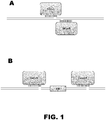
- the method can comprise introducing two vectors comprising DNA encoding an RNA-guided endonuclease and two vectors comprising DNA encoding guide RNAsinto a cell or embryo, wherein the RNA-guided endonucleases introduce two double-stranded breaks in the chromosomal sequence. See FIG. 1B .
- the two breaks can be within several base pairs, within tens of base pairs, or can be separated by many thousands of base pairs.
- the resultant double-stranded breaks can be repaired by a non-homologous repair process such that the sequence between the two cleavage sites is lost and/or deletions of at least one nucleotide, insertions of at least one nucleotide, substitutions of at least one nucleotide, or combinations thereof can occur during the repair of the break(s).
- the donor sequence in the donor polynucleotide can be exchanged with or integrated into the chromosomal sequence during repair of the double-stranded breaks by either a homology-based repair process (e.g., in embodiments in which the donor sequence is flanked by upstream and downstream sequences having substantial sequence identity with upstream and downstream sequences, respectively, of the targeted sites in the chromosomal sequence) or a non-homologous repair process (e.g., in embodiments in which the donor sequence is flanked by compatible overhangs).
- a homology-based repair process e.g., in embodiments in which the donor sequence is flanked by upstream and downstream sequences having substantial sequence identity with upstream and downstream sequences, respectively, of the targeted sites in the chromosomal sequence
- a non-homologous repair process e.g., in embodiments in which the donor sequence is flanked by compatible overhangs.
- the use can comprise introducing vectors comprising DNA encoding one RNA-guided endonuclease modified to cleave one strand of a double-stranded sequence (or encoding nucleic acid) and two guide RNAs (or encoding DNA) into a cell or embryo, wherein each guide RNA directs the RNA-guided endonuclease to a specific target site, at which site the modified endonuclease cleaves one strand (i.e., nicks) of the double-stranded chromosomal sequence, and wherein the two nicks are in opposite stands and in close enough proximity to constitute a double-stranded break. See FIG. 1A .
- the resultant double-stranded break can be repaired by a non-homologous repair process such that deletions of at least one nucleotide, insertions of at least one nucleotide, substitutions of at least one nucleotide, or combinations thereof can occur during the repair of the break.
- the donor sequence in the donor polynucleotide can be exchanged with or integrated into the chromosomal sequence during repair of the double-stranded break by either a homology-based repair process (e.g., in embodiments in which the donor sequence is flanked by upstream and downstream sequences having substantial sequence identity with upstream and downstream sequences, respectively, of the targeted sites in the chromosomal sequence) or a non-homologous repair process (e.g., in embodiments in which the donor sequence is flanked by compatible overhangs).
- a homology-based repair process e.g., in embodiments in which the donor sequence is flanked by upstream and downstream sequences having substantial sequence identity with upstream and downstream sequences, respectively, of the targeted sites in the chromosomal sequence
- a non-homologous repair process e.g., in embodiments in which the donor sequence is flanked by compatible overhangs.
- the use comprises introducing into a cell or non-human embryo vectors comprising DNA encoding at least one RNA-guided endonuclease comprising at least one nuclear localization signal.
- RNA-guided endonucleases and nucleic acids encoding RNA-guided endonucleases are described above in sections (I) and (II), respectively.
- the claimed uses exclude those which comprise a process for modifying the germ line genetic identity of a human being.
- DNA encoding the RNA-guided endonuclease can further comprise sequence encoding a guide RNA.
- Each of the sequences encoding the RNA-guided endonuclease and the guide RNA is operably linked to appropriate promoter control sequence that allows expression of the RNA-guided endonuclease and the guide RNA, respectively, in the cell or embryo.
- the DNA sequence encoding the RNA-guided endonuclease and the guide RNA can further comprise additional expression control, regulatory, and/or processing sequence(s).
- the DNA sequence encoding the RNA-guided endonuclease and the guide RNA can be linear or can be part of a vector
- the use also comprises introducing into a cell or embryo at least one vector comprising DNA encoding at least one guide RNA.
- a guide RNA interacts with the RNA-guided endonuclease to direct the endonuclease to a specific target site, at which site the 5' end of the guide RNA base pairs with a specific protospacer sequence in the chromosomal sequence.
- Each guide RNA comprises three regions: a first region at the 5' end that is complementary to the target site in the chromosomal sequence, a second internal region that forms a stem loop structure, and a third 3' region that remains essentially single-stranded.
- the first region of each guide RNA is different such that each guide RNA guides a fusion protein to a specific target site.
- the second and third regions of each guide RNA can be the same in all guide RNAs.
- the first region of the guide RNA is complementary to sequence (i.e., protospacer sequence) at the target site in the chromosomal sequence such that the first region of the guide RNA can base pair with the target site.
- the first region of the guide RNA can comprise from about 10 nucleotides to more than about 25 nucleotides.
- the region of base pairing between the first region of the guide RNA and the target site in the chromosomal sequence can be about 10, 11, 12, 13, 14, 15, 16, 17, 18, 19, 20, 22, 23, 24, 25, or more than 25 nucleotides in length.
- the first region of the guide RNA is about 19, 20, or 21 nucleotides in length.
- the guide RNA also comprises a second region that forms a secondary structure.
- the secondary structure comprises a stem (or hairpin) and a loop.
- the length of the loop and the stem can vary.
- the loop can range from about 3 to about 10 nucleotides in length
- the stem can range from about 6 to about 20 base pairs in length.
- the stem can comprise one or more bulges of 1 to about 10 nucleotides.
- the overall length of the second region can range from about 16 to about 60 nucleotides in length.
- the loop is about 4 nucleotides in length and the stem comprises about 12 base pairs.
- the guide RNA also comprises a third region at the 3' end that remains essentially single-stranded.
- the third region has no complementarity to any chromosomal sequence in the cell of interest and has no complementarity to the rest of the guide RNA.
- the length of the third region can vary. In general, the third region is more than about 4 nucleotides in length. For example, the length of the third region can range from about 5 to about 60 nucleotides in length.
- the combined length of the second and third regions (also called the universal or scaffold region) of the guide RNA can range from about 30 to about 120 nucleotides in length. In one aspect, the combined length of the second and third regions of the guide RNA range from about 70 to about 100 nucleotides in length.
- the guide RNA comprises a single molecule comprising all three regions.
- the guide RNA can comprise two separate molecules.
- the first RNA molecule can comprise the first region of the guide RNA and one half of the "stem" of the second region of the guide RNA.
- the second RNA molecule can comprise the other half of the "stem” of the second region of the guide RNA and the third region of the guide RNA.
- the first and second RNA molecules each contain a sequence of nucleotides that are complementary to one another.
- the first and second RNA molecules each comprise a sequence (of about 6 to about 20 nucleotides) that base pairs to the other sequence to form a functional guide RNA.
- the guide RNA is introduced into the cell or embryo as a DNA molecule.
- the DNA encoding the guide RNA is operably linked to promoter control sequence for expression of the guide RNA in the cell or embryo of interest.
- the RNA coding sequence can be operably linked to a promoter sequence that is recognized by RNA polymerase III (Pol III).
- Pol III RNA polymerase III
- suitable Pol III promoters include, but are not limited to, mammalian U6 or H1 promoters.
- the RNA coding sequence is linked to a mouse or human U6 promoter.
- the RNA coding sequence is linked to a mouse or human H1 promoter.
- the DNA molecule encoding the guide RNA is part of a vector.
- Suitable vectors include plasmid vectors, phagemids, cosmids, artificial/mini-chromosomes, transposons, and viral vectors.
- the DNA encoding the RNA-guided endonuclease is present in a plasmid vector.
- suitable plasmid vectors include pUC, pBR322, pET, pBluescript, and variants thereof.
- the vector can comprise additional expression control sequences (e.g., enhancer sequences, Kozak sequences, polyadenylation sequences, transcriptional termination sequences, etc.), selectable marker sequences (e.g., antibiotic resistance genes), origins of replication, and the like.
- additional expression control sequences e.g., enhancer sequences, Kozak sequences, polyadenylation sequences, transcriptional termination sequences, etc.
- selectable marker sequences e.g., antibiotic resistance genes
- each can be part of a separate molecule (e.g., one vector containing fusion protein coding sequence and a second vector containing guide RNA coding sequence) or both can be part of the same molecule (e.g., one vector containing coding (and regulatory) sequence for both the fusion protein and the guide RNA).
- RNA-guided endonuclease in conjunction with a guide RNA is directed to a target site in the chromosomal sequence, wherein the RNA-guided endonuclease introduces a double-stranded break in the chromosomal sequence.
- the target site has no sequence limitation except that the sequence is immediately followed (downstream) by a consensus sequence.
- This consensus sequence is also known as a p rotospacer a djacent m otif (PAM).
- PAM include, but are not limited to, NGG, NGGNG, and NNAGAAW (wherein N is defined as any nucleotide and W is defined as either A or T).
- the first region (at the 5' end) of the guide RNA is complementary to the protospacer of the target sequence.
- the first region of the guide RNA is about 19 to 21 nucleotides in length.
- the sequence of the target site in the chromosomal sequence is 5'-N 19-21 - NGG -3'.
- the PAM is in italics.
- the target site can be in the coding region of a gene, in an intron of a gene, in a control region of a gene, in a non-coding region between genes, etc.
- the gene can be a protein coding gene or an RNA coding gene.
- the gene can be any gene of interest.
- the use further comprises introducing at least one donor polynucleotide into the cell or embryo.
- a donor polynucleotide comprises at least one donor sequence.
- a donor sequence of the donor polynucleotide corresponds to an endogenous or native chromosomal sequence.
- the donor sequence can be essentially identical to a portion of the chromosomal sequence at or near the targeted site, but which comprises at least one nucleotide change.
- the donor sequence can comprise a modified version of the wild type sequence at the targeted site such that, upon integration or exchange with the native sequence, the sequence at the targeted chromosomal location comprises at least one nucleotide change.
- the change can be an insertion of one or more nucleotides, a deletion of one or more nucleotides, a substitution of one or more nucleotides, or combinations thereof.
- the cell or embryo/animal can produce a modified gene product from the targeted chromosomal sequence.
- the donor sequence of the donor polynucleotide corresponds to an exogenous sequence.
- an "exogenous" sequence refers to a sequence that is not native to the cell or embryo, or a sequence whose native location in the genome of the cell or embryo is in a different location.
- the exogenous sequence can comprise protein coding sequence, which can be operably linked to an exogenous promoter control sequence such that, upon integration into the genome, the cell or embryo/animal is able to express the protein coded by the integrated sequence.
- the exogenous sequence can be integrated into the chromosomal sequence such that its expression is regulated by an endogenous promoter control sequence.
- the exogenous sequence can be a transcriptional control sequence, another expression control sequence, an RNA coding sequence, and so forth. Integration of an exogenous sequence into a chromosomal sequence is termed a "knock in.”
- the length of the donor sequence can and will vary.
- the donor sequence can vary in length from several nucleotides to hundreds of nucleotides to hundreds of thousands of nucleotides.
- Donor polynucleotide comprising upstream and downstream sequences .
- the donor sequence in the donor polynucleotide is flanked by an upstream sequence and a downstream sequence, which have substantial sequence identity to sequences located upstream and downstream, respectively, of the targeted site in the chromosomal sequence. Because of these sequence similarities, the upstream and downstream sequences of the donor polynucleotide permit homologous recombination between the donor polynucleotide and the targeted chromosomal sequence such that the donor sequence can be integrated into (or exchanged with) the chromosomal sequence.
- the upstream sequence refers to a nucleic acid sequence that shares substantial sequence identity with a chromosomal sequence upstream of the targeted site.
- the downstream sequence refers to a nucleic acid sequence that shares substantial sequence identity with a chromosomal sequence downstream of the targeted site.
- the phrase "substantial sequence identity" refers to sequences having at least about 75% sequence identity.
- the upstream and downstream sequences in the donor polynucleotide can have about 75%, 76%, 77%, 78%, 79%, 80%, 81%, 82%, 83%, 84%, 85%, 86%, 87%, 88%, 89%, 90%, 91%, 92%, 93%, 94%, 95%, 96%, 97%, 98%, or 99% sequence identity with sequence upstream or downstream to the targeted site.
- the upstream and downstream sequences in the donor polynucleotide can have about 95% or 100% sequence identity with chromosomal sequences upstream or downstream to the targeted site.
- the upstream sequence shares substantial sequence identity with a chromosomal sequence located immediately upstream of the targeted site (i.e., adjacent to the targeted site). In other embodiments, the upstream sequence shares substantial sequence identity with a chromosomal sequence that is located within about one hundred (100) nucleotides upstream from the targeted site. Thus, for example, the upstream sequence can share substantial sequence identity with a chromosomal sequence that is located about 1 to about 20, about 21 to about 40, about 41 to about 60, about 61 to about 80, or about 81 to about 100 nucleotides upstream from the targeted site.
- the downstream sequence shares substantial sequence identity with a chromosomal sequence located immediately downstream of the targeted site (i.e., adjacent to the targeted site). In other embodiments, the downstream sequence shares substantial sequence identity with a chromosomal sequence that is located within about one hundred (100) nucleotides downstream from the targeted site. Thus, for example, the downstream sequence can share substantial sequence identity with a chromosomal sequence that is located about 1 to about 20, about 21 to about 40, about 41 to about 60, about 61 to about 80, or about 81 to about 100 nucleotides downstream from the targeted site.
- Each upstream or downstream sequence can range in length from about 20 nucleotides to about 5000 nucleotides.
- upstream and downstream sequences can comprise about 50, 100, 200, 300, 400, 500, 600, 700, 800, 900, 1000, 1100, 1200, 1300, 1400, 1500, 1600, 1700, 1800, 1900, 2000, 2100, 2200, 2300, 2400, 2500, 2600, 2800, 3000, 3200, 3400, 3600, 3800, 4000, 4200, 4400, 4600, 4800, or 5000 nucleotides.
- upstream and downstream sequences can range in length from about 50 to about 1500 nucleotides.
- Donor polynucleotides comprising the upstream and downstream sequences with sequence similarity to the targeted chromosomal sequence can be linear or circular.
- the donor polynucleotide can be part of a vector.
- the vector can be a plasmid vector.
- Donor polynucleotide comprising targeted cleavage site(s) .
- the donor polynucleotide can additionally comprise at least one targeted cleavage site that is recognized by the RNA-guided endonuclease.
- the targeted cleavage site added to the donor polynucleotide can be placed upstream or downstream or both upstream and downstream of the donor sequence.
- the donor sequence can be flanked by targeted cleavage sites such that, upon cleavage by the RNA-guided endonuclease, the donor sequence is flanked by overhangs that are compatible with those in the chromosomal sequence generated upon cleavage by the RNA-guided endonuclease.
- the donor sequence can be ligated with the cleaved chromosomal sequence during repair of the double stranded break by a non-homologous repair process.
- donor polynucleotides comprising the targeted cleavage site(s) will be circular (e.g., can be part of a plasmid vector).
- Donor polynucleotide comprising a short donor sequence with optional overhangs .
- the donor polynucleotide can be a linear molecule comprising a short donor sequence with optional short overhangs that are compatible with the overhangs generated by the RNA-guided endonuclease.
- the donor sequence can be ligated directly with the cleaved chromosomal sequence during repair of the double-stranded break.
- the donor sequence can be less than about 1,000, less than about 500, less than about 250, or less than about 100 nucleotides.
- the donor polynucleotide can be a linear molecule comprising a short donor sequence with blunt ends.
- the donor polynucleotide can be a linear molecule comprising a short donor sequence with 5' and/or 3' overhangs.
- the overhangs can comprise 1, 2, 3, 4, or 5 nucleotides.
- the donor polynucleotide will be DNA.
- the DNA may be single-stranded or double-stranded and/or linear or circular.
- the donor polynucleotide may be a DNA plasmid, a bacterial artificial chromosome (BAC), a yeast artificial chromosome (YAC), a viral vector, a linear piece of DNA, a PCR fragment, a naked nucleic acid, or a nucleic acid complexed with a delivery vehicle such as a liposome or poloxamer.
- the donor polynucleotide comprising the donor sequence can be part of a plasmid vector. In any of these situations, the donor polynucleotide comprising the donor sequence can further comprise at least one additional sequence.
- RNA-targeted endonuclease(s) (or encoding nucleic acid), the guide RNA(s) (or encoding DNA), and the optional donor polynucleotide(s) can be introduced into a cell or embryo by a variety of means. In some embodiments, the cell or embryo is transfected.
- Suitable transfection methods include calcium phosphate-mediated transfection, nucleofection (or electroporation), cationic polymer transfection (e.g., DEAE-dextran or polyethylenimine), viral transduction, virosome transfection, virion transfection, liposome transfection, cationic liposome transfection, immunoliposome transfection, nonliposomal lipid transfection, dendrimer transfection, heat shock transfection, magnetofection, lipofection, gene gun delivery, impalefection, sonoporation, optical transfection, and proprietary agent-enhanced uptake of nucleic acids.
- nucleofection or electroporation
- cationic polymer transfection e.g., DEAE-dextran or polyethylenimine
- viral transduction virosome transfection, virion transfection, liposome transfection, cationic liposome transfection, immunoliposome transfection, nonliposomal lipid transfection, dendrimer transfection, heat shock trans
- the molecules are introduced into the cell or embryo by microinjection.
- the embryo is a fertilized one-cell stage embryo of the species of interest.
- the molecules can be injected into the pronuclei of one cell embryos.
- RNA-targeted endonuclease(s) (or encoding nucleic acid), the guide RNA(s) (or DNAs encoding the guide RNA), and the optional donor polynucleotide(s) can be introduced into the cell or embryo simultaneously or sequentially.
- the ratio of the RNA-targeted endonuclease(s) (or encoding nucleic acid) to the guide RNA(s) (or encoding DNA) generally will be about stoichiometric such that they can form an RNA-protein complex.
- DNA encoding an RNA-targeted endonuclease and DNA encoding a guide RNA are delivered together within the plasmid vector.
- the use further comprises maintaining the cell or embryo under appropriate conditions such that the guide RNA(s) directs the RNA-guided endonuclease(s) to the targeted site(s) in the chromosomal sequence, and the RNA-guided endonuclease(s) introduce at least one double-stranded break in the chromosomal sequence.
- a double-stranded break can be repaired by a DNA repair process such that the chromosomal sequence is modified by a deletion of at least one nucleotide, an insertion of at least one nucleotide, a substitution of at least one nucleotide, or a combination thereof.
- the double-stranded break can be repaired via a non-homologous end-joining (NHEJ) repair process.
- NHEJ non-homologous end-joining
- sequence at the chromosomal sequence can be modified such that the reading frame of a coding region can be shifted and that the chromosomal sequence is inactivated or "knocked out.”
- An inactivated protein-coding chromosomal sequence does not give rise to the protein coded by the wild type chromosomal sequence.
- the double-stranded break can be repaired by a homology-directed repair (HDR) process such that the donor sequence is integrated into the chromosomal sequence.
- HDR homology-directed repair
- an exogenous sequence can be integrated into the genome of the cell or embryo, or the targeted chromosomal sequence can be modified by exchange of a modified sequence for the wild type chromosomal sequence.
- the RNA-guided endonuclease can cleave both the targeted chromosomal sequence and the donor polynucleotide.
- the linearized donor polynucleotide can be integrated into the chromosomal sequence at the site of the double-stranded break by ligation between the donor polynucleotide and the cleaved chromosomal sequence via a NHEJ process.
- the short donor sequence can be integrated into the chromosomal sequence at the site of the double-stranded break via a NHEJ process.
- the integration can proceed via the ligation of blunt ends between the short donor sequence and the chromosomal sequence at the site of the double stranded break.
- the integration can proceed via the ligation of sticky ends (i.e., having 5' or 3' overhangs) between a short donor sequence that is flanked by overhangs that are compatible with those generated by the RNA-targeting endonuclease in the cleaved chromosomal sequence.
- the cell is maintained under conditions appropriate for cell growth and/or maintenance. Suitable cell culture conditions are well known in the art and are described, for example, in Santiago et al. (2008) PNAS 105:5809-5814 ; Moehle et al. (2007) PNAS 104:3055-3060 ; Urnov et al. (2005) Nature 435:646-651 ; and Lombardo et al (2007) Nat. Biotechnology 25:1298-1306 . Those of skill in the art appreciate that methods for culturing cells are known in the art and can and will vary depending on the cell type. Routine optimization may be used, in all cases, to determine the best techniques for a particular cell type.
- An embryo can be cultured in vitro (e.g., in cell culture). Typically, the embryo is cultured at an appropriate temperature and in appropriate media with the necessary O 2 /CO 2 ratio to allow the expression of the RNA endonuclease and guide RNA, if necessary. Suitable non-limiting examples of media include M2, M16, KSOM, BMOC, and HTF media. A skilled artisan will appreciate that culture conditions can and will vary depending on the species of embryo. Routine optimization may be used, in all cases, to determine the best culture conditions for a particular species of embryo. In some cases, a cell line may be derived from an in vitro-cultured embryo (e.g., an embryonic stem cell line).
- an embryo may be cultured in vivo by transferring the embryo into the uterus of a female host.
- the female host is from the same or similar species as the embryo.
- the female host is pseudo-pregnant.
- Methods of preparing pseudo-pregnant female hosts are known in the art.
- methods of transferring an embryo into a female host are known. Culturing an embryo in vivo permits the embryo to develop and can result in a live birth of an animal derived from the embryo. Such an animal would comprise the modified chromosomal sequence in every cell of the body. Uses which comprise a process for modifying the germ line genetic identity of a human being are specifically excluded from the scope of the invention.
- the cell can be a human cell, a non-human mammalian cell, a non-mammalian vertebrate cell, an invertebrate cell, an insect cell, a plant cell, a yeast cell, or a single cell eukaryotic organism.
- the embryo is non-human mammalian embryo.
- the embryos can be a one cell non-human mammalian embryo.
- Exemplary mammalian embryos including one cell embryos, include without limit mouse, rat, hamster, rodent, rabbit, feline, canine, ovine, porcine, bovine, equine, and primate embryos.
- the cell can be a stem cell. Suitable stem cells include without limit embryonic stem cells, ES-like stem cells, fetal stem cells, adult stem cells, pluripotent stem cells, induced pluripotent stem cells, multipotent stem cells, oligopotent stem cells, unipotent stem cells and others.
- the cell is a mammalian cell.
- Non-limiting examples of suitable mammalian cells include Chinese hamster ovary (CHO) cells, baby hamster kidney (BHK) cells; mouse myeloma NS0 cells, mouse embryonic fibroblast 3T3 cells (NIH3T3), mouse B lymphoma A20 cells; mouse melanoma B16 cells; mouse myoblast C2C12 cells; mouse myeloma SP2/0 cells; mouse embryonic mesenchymal C3H-10T1/2 cells; mouse carcinoma CT26 cells, mouse prostate DuCuP cells; mouse breast EMT6 cells; mouse hepatoma Hepa1c1c7 cells; mouse myeloma J5582 cells; mouse epithelial MTD-1A cells; mouse myocardial MyEnd cells; mouse renal RenCa cells; mouse pancreatic RIN-5F cells; mouse melanoma X64 cells; mouse lymphoma YAC-1 cells; rat glioblastoma 9L cells; rat B lymphoma RBL cells;
- the present disclosure describes genetically modified cells, non-human embryos, and non-human animals comprising at least one chromosomal sequence that has been modified using an RNA-guided endonuclease-mediated process, for example, using the vectors described herein.
- the disclosure describes cells comprising at least one vector comprising DNA encoding an RNA-guided endonuclease targeted to a chromosomal sequence of interest, at least one guide RNA, and optionally one or more donor polynucleotide(s).
- the disclosure also provides non-human embryos comprising at least one vector comprising DNA encoding an RNA-guided endonuclease targeted to a chromosomal sequence of interest, at least one guide RNA, and optionally one or more donor polynucleotide(s).
- the present disclosure describes genetically modified non-human animals, non-human embryos, or animal cells comprising at least one modified chromosomal sequence.
- the modified chromosomal sequence may be modified such that it is (1) inactivated, (2) has an altered expression or produces an altered protein product, or (3) comprises an integrated sequence.
- the chromosomal sequence is modified with an RNA guided endonuclease-mediated or fusion protein-mediated process, using the methods described herein.
- one example disclosed herein is of a genetically modified animal in which at least one chromosomal sequence has been modified.
- the genetically modified animal comprises at least one inactivated chromosomal sequence.
- the modified chromosomal sequence may be inactivated such that the sequence is not transcribed and/or a functional protein product is not produced.
- a genetically modified animal comprising an inactivated chromosomal sequence may be termed a "knock out” or a "conditional knock out.”
- the inactivated chromosomal sequence can include a deletion mutation (i.e., deletion of one or more nucleotides), an insertion mutation (i.e., insertion of one or more nucleotides), or a nonsense mutation (i.e., substitution of a single nucleotide for another nucleotide such that a stop codon is introduced).
- a deletion mutation i.e., deletion of one or more nucleotides
- an insertion mutation i.e., insertion of one or more nucleotides
- a nonsense mutation i.e., substitution of a single nucleotide for another nucleotide such that a stop codon is introduced.
- the inactivated chromosomal sequence comprises no exogenously introduced sequence.
- genetically modified animals in which two, three, four, five
- the modified chromosomal sequence can be altered such that it codes for a variant protein product.
- a genetically modified animal comprising a modified chromosomal sequence can comprise a targeted point mutation(s) or other modification such that an altered protein product is produced.
- the chromosomal sequence can be modified such that at least one nucleotide is changed and the expressed protein comprises one changed amino acid residue (missense mutation).
- the chromosomal sequence can be modified to comprise more than one missense mutation such that more than one amino acid is changed.
- the chromosomal sequence can be modified to have a three nucleotide deletion or insertion such that the expressed protein comprises a single amino acid deletion or insertion.
- the altered or variant protein can have altered properties or activities compared to the wild type protein, such as altered substrate specificity, altered enzyme activity, altered kinetic rates, etc.
- the genetically modified animal can comprise at least one chromosomally integrated sequence.
- a genetically modified animal comprising an integrated sequence may be termed a "knock in” or a "conditional knock in.”
- the chromosomally integrated sequence can, for example, encode an orthologous protein, an endogenous protein, or combinations of both.
- a sequence encoding an orthologous protein or an endogenous protein can be integrated into a chromosomal sequence encoding a protein such that the chromosomal sequence is inactivated, but the exogenous sequence is expressed.
- the sequence encoding the orthologous protein or endogenous protein may be operably linked to a promoter control sequence.
- a sequence encoding an orthologous protein or an endogenous protein may be integrated into a chromosomal sequence without affecting expression of a chromosomal sequence.
- a sequence encoding a protein can be integrated into a "safe harbor" locus, such as the Rosa26 locus, HPRT locus, or AAV locus.
- the present disclosure also encompasses genetically modified animals in which two, three, four, five, six, seven, eight, nine, or ten or more sequences, including sequences encoding protein(s), are integrated into the genome.
- the chromosomally integrated sequence encoding a protein can encode the wild type form of a protein of interest or can encode a protein comprising at least one modification such that an altered version of the protein is produced.
- a chromosomally integrated sequence encoding a protein related to a disease or disorder can comprise at least one modification such that the altered version of the protein produced causes or potentiates the associated disorder.
- the chromosomally integrated sequence encoding a protein related to a disease or disorder can comprise at least one modification such that the altered version of the protein protects against the development of the associated disorder.
- the genetically modified animal can be a "humanized" animal comprising at least one chromosomally integrated sequence encoding a functional human protein.
- the functional human protein can have no corresponding ortholog in the genetically modified animal.
- the wild type animal from which the genetically modified animal is derived may comprise an ortholog corresponding to the functional human protein.
- the orthologous sequence in the "humanized” animal is inactivated such that no functional protein is made and the "humanized” animal comprises at least one chromosomally integrated sequence encoding the human protein.
- the genetically modified animal can comprise at least one modified chromosomal sequence encoding a protein such that the expression pattern of the protein is altered.
- regulatory regions controlling the expression of the protein such as a promoter or a transcription factor binding site, can be altered such that the protein is over-produced, or the tissue-specific or temporal expression of the protein is altered, or a combination thereof.
- the expression pattern of the protein can be altered using a conditional knockout system.
- a non-limiting example of a conditional knockout system includes a Cre-lox recombination system.
- a Cre-lox recombination system comprises a Cre recombinase enzyme, a site-specific DNA recombinase that can catalyze the recombination of a nucleic acid sequence between specific sites (lox sites) in a nucleic acid molecule.
- Methods of using this system to produce temporal and tissue specific expression are known in the art.
- a genetically modified animal is generated with lox sites flanking a chromosomal sequence.
- the genetically modified animal comprising the lox-flanked chromosomal sequence can then be crossed with another genetically modified animal expressing Cre recombinase.
- Progeny animals comprising the lox-flanked chromosomal sequence and the Cre recombinase are then produced, and the lox-flanked chromosomal sequence is recombined, leading to deletion or inversion of the chromosomal sequence encoding the protein.
- Expression of Cre recombinase can be temporally and conditionally regulated to effect temporally and conditionally regulated recombination of the chromosomal sequence.
- the genetically modified animal disclosed herein can be heterozygous for the modified chromosomal sequence.
- the genetically modified animal can be homozygous for the modified chromosomal sequence.
- the genetically modified animals disclosed herein can be crossbred to create animals comprising more than one modified chromosomal sequence or to create animals that are homozygous for one or more modified chromosomal sequences.
- two animals comprising the same modified chromosomal sequence can be crossbred to create an animal homozygous for the modified chromosomal sequence.
- animals with different modified chromosomal sequences can be crossbred to create an animal comprising both modified chromosomal sequences.
- a first animal comprising an inactivated chromosomal sequence gene "x” can be crossed with a second animal comprising a chromosomally integrated sequence encoding a human gene "X" protein to give rise to "humanized” gene "X” offspring comprising both the inactivated gene "x” chromosomal sequence and the chromosomally integrated human gene "X” sequence.
- a humanized gene "X” animal can be crossed with a humanized gene "Y” animal to create humanized gene X/gene Y offspring.
- an animal comprising a modified chromosomal sequence can be crossbred to combine the modified chromosomal sequence with other genetic backgrounds.
- other genetic backgrounds may include wild-type genetic backgrounds, genetic backgrounds with deletion mutations, genetic backgrounds with another targeted integration, and genetic backgrounds with non-targeted integrations.
- animal refers to a non-human animal.
- the animal may be an embryo, a juvenile, or an adult.
- Suitable animals include vertebrates such as mammals, birds, reptiles, amphibians, shellfish, and fish. Examples of suitable mammals include without limit rodents, companion animals, livestock, and primates.
- rodents include mice, rats, hamsters, gerbils, and guinea pigs.
- Suitable companion animals include but are not limited to cats, dogs, rabbits, hedgehogs, and ferrets.
- livestock include horses, goats, sheep, swine, cattle, llamas, and alpacas.
- Suitable primates include but are not limited to capuchin monkeys, chimpanzees, lemurs, macaques, marmosets, tamarins, spider monkeys, squirrel monkeys, and vervet monkeys.
- Non-limiting examples of birds include chickens, turkeys, ducks, and geese.
- the animal may be an invertebrate such as an insect, a nematode, and the like.
- Non-limiting examples of insects include Drosophila and mosquitoes.
- An exemplary animal is a rat.
- suitable rat strains include Dahl Salt-Sensitive, Fischer 344, Lewis, Long Evans Hooded, Sprague-Dawley, and Wistar.
- the animal is not a genetically modified mouse. In each of the foregoing iterations of suitable animals for the invention, the animal does not include exogenously introduced, randomly integrated transposon sequences.
- a further example of the present disclosure describes genetically modified cells or cell lines comprising at least one modified chromosomal sequence.
- the genetically modified cell or cell line can be derived from any of the genetically modified animals disclosed herein.
- the chromosomal sequence can be modified in a cell as described herein above (in the paragraphs describing chromosomal sequence modifications in animals) using the methods descried herein.
- the disclosure also encompasses a lysate of said cells or cell lines.
- the cells are eukaryotic cells. Suitable host cells include fungi or yeast, such as Pichia, Saccharomyces, or Schizosaccharomyces; insect cells, such as SF9 cells from Spodoptera frugiperda or S2 cells from Drosophila melanogaster; and animal cells, such as mouse, rat, hamster, non-human primate, or human cells. Exemplary cells are mammalian. The mammalian cells can be primary cells. In general, any primary cell that is sensitive to double strand breaks may be used. The cells may be of a variety of cell types, e.g., fibroblast, myoblast, T or B cell, macrophage, epithelial cell, and so forth.
- the cell line can be any established cell line or a primary cell line that is not yet described.
- the cell line can be adherent or non-adherent, or the cell line can be grown under conditions that encourage adherent, non-adherent or organotypic growth using standard techniques known to individuals skilled in the art.
- suitable mammalian cells and cell lines are provided herein in section (III)(g).
- the cell can be a stem cell.
- suitable stem cells are provided in section (III)(g).
- the present disclosure also provides a genetically modified non-human embryo comprising at least one modified chromosomal sequence.
- the chromosomal sequence can be modified in an embryo as described herein above (in the paragraphs describing chromosomal sequence modifications in animals) using the methods descried herein.
- the embryo is a non-human fertilized one-cell stage embryo of the animal species of interest.
- Exemplary mammalian embryos, including one cell embryos include without limit, mouse, rat, hamster, rodent, rabbit, feline, canine, ovine, porcine, bovine, equine, and primate embryos.
- endogenous sequence refers to a chromosomal sequence that is native to the cell.
- exogenous refers to a sequence that is not native to the cell, or a chromosomal sequence whose native location in the genome of the cell is in a different chromosomal location.
- a “gene,” as used herein, refers to a DNA region (including exons and introns) encoding a gene product, as well as all DNA regions which regulate the production of the gene product, whether or not such regulatory sequences are adjacent to coding and/or transcribed sequences. Accordingly, a gene includes, but is not necessarily limited to, promoter sequences, terminators, translational regulatory sequences such as ribosome binding sites and internal ribosome entry sites, enhancers, silencers, insulators, boundary elements, replication origins, matrix attachment sites, and locus control regions.
- heterologous refers to an entity that is not endogenous or native to the cell of interest.
- a heterologous protein refers to a protein that is derived from or was originally derived from an exogenous source, such as an exogenously introduced nucleic acid sequence. In some instances, the heterologous protein is not normally produced by the cell of interest.
- nucleic acid and polynucleotide refer to a deoxyribonucleotide or ribonucleotide polymer, in linear or circular conformation, and in either single- or double-stranded form. For the purposes of the present disclosure, these terms are not to be construed as limiting with respect to the length of a polymer.
- the terms can encompass known analogs of natural nucleotides, as well as nucleotides that are modified in the base, sugar and/or phosphate moieties (e.g., phosphorothioate backbones). In general, an analog of a particular nucleotide has the same base-pairing specificity; i.e., an analog of A will base-pair with T.
- nucleotide refers to deoxyribonucleotides or ribonucleotides.
- the nucleotides may be standard nucleotides (i.e., adenosine, guanosine, cytidine, thymidine, and uridine) or nucleotide analogs.
- a nucleotide analog refers to a nucleotide having a modified purine or pyrimidine base or a modified ribose moiety.
- a nucleotide analog may be a naturally occurring nucleotide (e.g., inosine) or a non-naturally occurring nucleotide.
- Non-limiting examples of modifications on the sugar or base moieties of a nucleotide include the addition (or removal) of acetyl groups, amino groups, carboxyl groups, carboxymethyl groups, hydroxyl groups, methyl groups, phosphoryl groups, and thiol groups, as well as the substitution of the carbon and nitrogen atoms of the bases with other atoms (e.g., 7-deaza purines).
- Nucleotide analogs also include dideoxy nucleotides, 2'-O-methyl nucleotides, locked nucleic acids (LNA), peptide nucleic acids (PNA), and morpholinos.
- polypeptide and “protein” are used interchangeably to refer to a polymer of amino acid residues.
- nucleic acid and amino acid sequence identity are known in the art. Typically, such techniques include determining the nucleotide sequence of the mRNA for a gene and/or determining the amino acid sequence encoded thereby, and comparing these sequences to a second nucleotide or amino acid sequence. Genomic sequences can also be determined and compared in this fashion. In general, identity refers to an exact nucleotide-to-nucleotide or amino acid-to-amino acid correspondence of two polynucleotides or polypeptide sequences, respectively. Two or more sequences (polynucleotide or amino acid) can be compared by determining their percent identity.
- the percent identity of two sequences is the number of exact matches between two aligned sequences divided by the length of the shorter sequences and multiplied by 100.
- An approximate alignment for nucleic acid sequences is provided by the local homology algorithm of Smith and Waterman, Advances in Applied Mathematics 2:482-489 (1981 ). This algorithm can be applied to amino acid sequences by using the scoring matrix developed by Dayhoff, Atlas of Protein Sequences and Structure, M. O. Dayhoff ed., 5 suppl. 3:353-358, National Biomedical Research Foundation, Washington, D.C., USA , and normalized by Gribskov, Nucl. Acids Res. 14(6):6745-6763 (1986 ).
- a Cas9 gene from Streptococcus pyogenes strain MGAS15252 was optimized with Homo sapiens codon preference to enhance its translation in mammalian cells.
- the Cas9 gene also was modified by adding a nuclear localization signal PKKKRKV (SEQ ID NO:1) at the C terminus for targeting the protein into the nuclei of mammalian cells.
- Table 1 presents the modified Cas9 amino acid sequence, with the nuclear localization sequence underlined.
- Table 2 presents the codon optimized, modified Cas9 DNA sequence.
- the modified Cas9 DNA sequence was placed under the control of cytomegalovirus (CMV) promoter for constituent expression in mammalian cells.
- CMV cytomegalovirus
- the modified Cas9 DNA sequence was also placed under the control T7 promoter for in vitro mRNA synthesis with T7 RNA polymerase.
- In vitro RNA transcription was performed by using MessageMAX T7 ARCA-Capped Message Transcription Kit and T7 mScript Standard mRNA Production System (Cellscript).
- the adeno-associated virus integration site 1 (AAVS1) locus was used as a target for Cas9-mediated human genome modification.
- the human AAVS1 locus is located in intron 1 (4427 bp) of protein phosphatase 1, regulatory subunit 12C (PPP1R12C).
- PPP1R12C protein phosphatase 1, regulatory subunit 12C
- Table 3 presents the first exon (shaded gray) and the first intron of PPP1R12C.
- the underlined sequence within the intron is the targeted modification site (i.e., AAVS1 locus).
- Cas9 guide RNAs were designed for targeting the human AAVS1 locus.
- a 42 nucleotide RNA (referred to herein as a "crRNA” sequence) comprising (5' to 3') a target recognition sequence (i.e., sequence complementary to the non-coding strand of the target sequence) and protospacer sequence; a 85 nucleotide RNA (referred to herein as a "tracrRNA” sequence) comprising 5' sequence with complementarity to the 3' sequence of the crRNA and additional hairpin sequence; and a chimeric RNA comprising nucleotides 1-32 of the crRNA, a GAAA loop, and nucleotides 19-45 of the tracrRNA were prepared.
- the crRNA was chemically synthesized by Sigma-Aldrich.
- the tracrRNA and chimeric RNA were synthesized by in vitro transcription with T7 RNA polymerase using T7-Scribe Standard RNA IVT Kit (Cellscript).
- the chimeric RNA coding sequence was also placed under the control of human U6 promoter for in vivo transcription in human cells.
- Table 4 presents the sequences of the guide RNAs. Table 4.
- AAVS1-GFP DNA donor contained a 5' (1185 bp) AAVS1 locus homologous arm, an RNA splicing receptor, a turbo GFP coding sequence, a 3' transcription terminator, and a 3' (1217 bp) AAVS1 locus homologous arm.
- Table 5 presents the sequences of the RNA splicing receptor and the GFP coding sequence followed by the 3' transcription terminator.
- Plasmid DNA was prepared by using GenElute Endotoxin-Free Plasmid Maxiprep Kit (Sigma). Table 5. Sequences in the AAVS1-GFP DNA donor sequence 5'-3' Sequence SEQ ID NO: RNA splicing receptor CTGACCTCTTCTCTTCCTCCCACAG 15 GFP coding sequence and transcription terminator 16
- Targeted gene integration will result in a fusion protein between the first 107 amino acids of the PPP1R12C and the turbo GFP.
- the expected fusion protein contains the first 107 amino acid residues of PPP1R12C (highlighted in grey) from RNA splicing between the first exon of PPP1R12C and the engineered splice receptor (see Table 6).
- the K562 cell line was obtained from American Type Culture Collection (ATCC) and grown in Iscove's Modified Dulbecco's Medium, supplemented with 10% FBS and 2 mM L-glutamine. All media and supplements were obtained from Sigma-Aldrich. Cultures were split one day before transfection (at approximately 0.5 million cells per mL before transfection). Cells were transfected with Nucleofector Solution V (Lonza) on a Nucleofector (Lonza) with the T-016 program. Each nucleofection contained approximately 0.6 million cells. Transfection treatments are detailed in Table 7. Cells were grown at 37°C and 5% CO 2 immediately after nucleofection. Table 7. Transfection Treatments.
- Fluorescence-activated cell sorting was performed 4 days after transfection. FACS data are presented in FIG. 2 . The percent GFP detected in each of the four experimental treatments (A-D) was greater than in the control treatments (E, F), confirming integration of the donor sequence and expression of the fusion protein.
- Genomic DNA was extracted from transfected cells with GenElute Mammalian Genomic DNA Miniprep Kit (Sigma) 12 days after transfection. Genomic DNA was then PCR amplified with a forward primer located outside the 5' homologous arm of the AAVS1-GFP plasmid donor and a reverse primer located at the 5' region of the GFP.
- the forward primer was 5'- CCACTCTGTGCTGACCACTCT-3' (SEQ ID NO:18) and reverse primer was 5'- GCGGCACTCGATCTCCA-3' (SEQ ID NO:19).
- the expected fragment size from the junction PCR was 1388 bp.
- the amplification was carried out with JumpStart Taq ReadyMix (Sigma), using the following cycling conditions: 98°C for 2 minutes for initial denaturation; 35 cycles of 98°C for 15 seconds, 62°C for 30 seconds, and 72°C for 1minutes and 30 seconds; and a final extension at 72°C for 5 minutes.
- PCR products were resolved on 1% agarose gel.
- the mouse Rosa26 locus can be targeted for genome modifications.
- Table 8 presents a portion of the mouse Rosa26 sequence in which potential target sites are shown in bold. Each target site comprises a protospacer.
- RNAs were designed to target each of the target sites in the mouse Rosa26 locus. The sequences are shown in Table 9, each is 42 nucleotides in length and the 5' region is complementary to the strand that is not presented in Table 8 (i.e., the strand that is complementary to the strand shown in Table 8). Table 9. Mouse Rosa26 Guide RNAs RNA 5'-3'Sequence SEQ ID NO: mRosa26-crRNA-1 21 mRosa26-crRNA-2 22 mRosa26-crRNA-3 23
- the crRNAs were chemically synthesized and pre-annealed to the tracrRNA (SEQ ID NO:13; see Example 2).
- Pre-annealed crRNA / tracrRNA and in vitro transcribed mRNA encoding modified Cas9 protein (SEQ ID NO. 9; see Example 1) can be microinjected into the pronuclei of fertilized mouse embryos.
- the Cas9 protein cleaves the target site, and the resultant double-stranded break can be repaired via a non-homologous end-joining (NHEJ) repair process.
- NHEJ non-homologous end-joining
- the injected embryos can be either incubated at 37°C, 5% CO 2 overnight or for up to 4 days, followed by genotyping analysis, or the injected embryos can be implanted into recipient female mice such that live born animals can be genotyped.
- the in vitro -incubated embryos or tissues from live born animals can be screened for the presence of Cas9-induced mutation at the Rosa locus using standard methods.
- the embryos or tissues from fetus or live-born animals can be harvested for DNA extraction and analysis. DNA can be isolated using standard procedures.
- the targeted region of the Rosa26 locus can be PCR amplified using appropriate primers.
- NHEJ is error-prone, deletions of at least one nucleotide, insertions of at least one nucleotide, substitutions of at least one nucleotide, or combinations thereof can occur during the repair of the break. Mutations can be detected using PCR-based genotyping methods, such as Cel-I mismatch assays and DNA sequencing.
- the Rosa26 locus can be modified in mouse embryos by co-injecting a donor polynucleotide, as detailed above in section (IV)(d), along with the pre-annealed crRNA / tracrRNA and mRNA encoding modified Cas9 as described above in Example 6.
- a donor polynucleotide as detailed above in section (IV)(d)
- mRNA encoding modified Cas9 as described above in Example 6.
- In vitro -incubated embryos or tissues from live born animals (as described in Example 6) can be screened for a modified Rosa26 locus using PCR-based genotyping methods, such as RFLP assays, junction PCR, and DNA sequencing.
- the rat Rosa26 locus can be targeted for genome modifications.
- Table 10 presents a portion of the rat sequence in which potential target sites are shown in bold. Each target site comprises a protospacer.
- Rat Rosa26 Guide RNAs were designed to target each of the target sites in the rat Rosa26 locus. The sequences are shown in Table 11, each is 42 nucleotides in length and the 5' region is complementary to the strand that is not presented in Table 10 (i.e., the strand that is complementary to the strand shown in Table 10). Table 11. Rat Rosa26 Guide RNAs RNA 5'-3'Sequence SEQ ID NO: rRosa26-crRNA-1 -- 25 rRosa26-crRNA-2 26 rRosa26-crRNA-3 27
- the crRNAs were chemically synthesized and pre-annealed to the tracrRNA (SEQ ID NO:13; see Example 2).
- Pre-annealed crRNA / tracrRNA and in vitro transcribed mRNA encoding modified Cas9 protein (SEQ ID NO. 9; see Example 1) can be microinjected into the pronuclei of fertilized rat embryos.
- the Cas9 protein cleaves the target site, and the resultant double-stranded break can be repaired via a non-homologous end-joining (NHEJ) repair process.
- NHEJ non-homologous end-joining
- the injected embryos can be either incubated at 37°C, 5% CO 2 overnight or for up to 4 days, followed by genotyping analysis, or the injected embryos can be implanted into recipient female mice such that live born animals can be genotyped.
- the in vitro -incubated embryos or tissues from live born animals can be screened for the presence of Cas9-induced mutation at the Rosa locus using standard methods.
- the embryos or tissues from fetus or live-born animals can be harvested for DNA extraction and analysis. DNA can be isolated using standard procedures.
- the targeted region of the Rosa26 locus can be PCR amplified using appropriate primers.
- NHEJ is error-prone, deletions of at least one nucleotide, insertions of at least one nucleotide, substitutions of at least one nucleotide, or combinations thereof can occur during the repair of the break. Mutations can be detected using PCR-based genotyping methods, such as Cel-I mismatch assays and DNA sequencing.
- the Rosa26 locus can be modified in rat embryos by co-injecting a donor polynucleotide, as detailed above in section (III)(d), along with the pre-annealed crRNA / tracrRNA and mRNA encoding modified Cas9 as described above in Example 8.
- a donor polynucleotide as detailed above in section (III)(d)
- mRNA encoding modified Cas9 as described above in Example 8.
- In vitro -incubated embryos or tissues from live born rats (as described in Example 8) can be screened for a modified Rosa26 locus using PCR-based genotyping methods, such as RFLP assays, junction PCR, and DNA sequencing.
Landscapes
- Health & Medical Sciences (AREA)
- Life Sciences & Earth Sciences (AREA)
- Genetics & Genomics (AREA)
- Chemical & Material Sciences (AREA)
- Engineering & Computer Science (AREA)
- Organic Chemistry (AREA)
- Bioinformatics & Cheminformatics (AREA)
- Zoology (AREA)
- Wood Science & Technology (AREA)
- General Engineering & Computer Science (AREA)
- Biomedical Technology (AREA)
- Biotechnology (AREA)
- General Health & Medical Sciences (AREA)
- Molecular Biology (AREA)
- Biochemistry (AREA)
- Microbiology (AREA)
- Biophysics (AREA)
- Plant Pathology (AREA)
- Physics & Mathematics (AREA)
- Medicinal Chemistry (AREA)
- Proteomics, Peptides & Aminoacids (AREA)
- Virology (AREA)
- Immunology (AREA)
- Crystallography & Structural Chemistry (AREA)
- Veterinary Medicine (AREA)
- Pharmacology & Pharmacy (AREA)
- Animal Behavior & Ethology (AREA)
- Public Health (AREA)
- Mycology (AREA)
- Cell Biology (AREA)
- Epidemiology (AREA)
- Toxicology (AREA)
- Gastroenterology & Hepatology (AREA)
- Ophthalmology & Optometry (AREA)
- Chemical Kinetics & Catalysis (AREA)
- General Chemical & Material Sciences (AREA)
- Nuclear Medicine, Radiotherapy & Molecular Imaging (AREA)
- Enzymes And Modification Thereof (AREA)
- Peptides Or Proteins (AREA)
- Micro-Organisms Or Cultivation Processes Thereof (AREA)
Priority Applications (1)
| Application Number | Priority Date | Filing Date | Title |
|---|---|---|---|
| PL18160519T PL3363902T3 (pl) | 2012-12-06 | 2013-12-05 | Modyfikacja i regulacja genomu w oparciu o CRISPR |
Applications Claiming Priority (6)
| Application Number | Priority Date | Filing Date | Title |
|---|---|---|---|
| US201261734256P | 2012-12-06 | 2012-12-06 | |
| US201361758624P | 2013-01-30 | 2013-01-30 | |
| US201361761046P | 2013-02-05 | 2013-02-05 | |
| US201361794422P | 2013-03-15 | 2013-03-15 | |
| EP13859964.2A EP2928496B1 (en) | 2012-12-06 | 2013-12-05 | Crispr-based genome modification and regulation |
| PCT/US2013/073307 WO2014089290A1 (en) | 2012-12-06 | 2013-12-05 | Crispr-based genome modification and regulation |
Related Parent Applications (2)
| Application Number | Title | Priority Date | Filing Date |
|---|---|---|---|
| EP13859964.2A Division-Into EP2928496B1 (en) | 2012-12-06 | 2013-12-05 | Crispr-based genome modification and regulation |
| EP13859964.2A Division EP2928496B1 (en) | 2012-12-06 | 2013-12-05 | Crispr-based genome modification and regulation |
Publications (2)
| Publication Number | Publication Date |
|---|---|
| EP3363902A1 EP3363902A1 (en) | 2018-08-22 |
| EP3363902B1 true EP3363902B1 (en) | 2019-11-27 |
Family
ID=50883989
Family Applications (11)
| Application Number | Title | Priority Date | Filing Date |
|---|---|---|---|
| EP18160519.7A Revoked EP3363902B1 (en) | 2012-12-06 | 2013-12-05 | Crispr-based genome modification and regulation |
| EP19201769.7A Pending EP3611263A1 (en) | 2012-12-06 | 2013-12-05 | Crispr-based genome modification and regulation |
| EP16183725.7A Revoked EP3138912B1 (en) | 2012-12-06 | 2013-12-05 | Crispr-based genome modification and regulation |
| EP13859964.2A Revoked EP2928496B1 (en) | 2012-12-06 | 2013-12-05 | Crispr-based genome modification and regulation |
| EP18156734.8A Revoked EP3360964B1 (en) | 2012-12-06 | 2013-12-05 | Crispr-based genome modification and regulation |
| EP16183717.4A Withdrawn EP3138909A1 (en) | 2012-12-06 | 2013-12-05 | Crispr-based genome modification and regulation |
| EP16183719.0A Withdrawn EP3135765A1 (en) | 2012-12-06 | 2013-12-05 | Crispr-based genome modification and regulation |
| EP19189913.7A Pending EP3617309A3 (en) | 2012-12-06 | 2013-12-05 | Crispr-based genome modification and regulation |
| EP16183724.0A Revoked EP3138911B1 (en) | 2012-12-06 | 2013-12-05 | Crispr-based genome modification and regulation |
| EP16183723.2A Revoked EP3138910B1 (en) | 2012-12-06 | 2013-12-05 | Crispr-based genome modification and regulation |
| EP16183720.8A Withdrawn EP3141604A1 (en) | 2012-12-06 | 2013-12-05 | Crispr-based genome modification and regulation |
Family Applications After (10)
| Application Number | Title | Priority Date | Filing Date |
|---|---|---|---|
| EP19201769.7A Pending EP3611263A1 (en) | 2012-12-06 | 2013-12-05 | Crispr-based genome modification and regulation |
| EP16183725.7A Revoked EP3138912B1 (en) | 2012-12-06 | 2013-12-05 | Crispr-based genome modification and regulation |
| EP13859964.2A Revoked EP2928496B1 (en) | 2012-12-06 | 2013-12-05 | Crispr-based genome modification and regulation |
| EP18156734.8A Revoked EP3360964B1 (en) | 2012-12-06 | 2013-12-05 | Crispr-based genome modification and regulation |
| EP16183717.4A Withdrawn EP3138909A1 (en) | 2012-12-06 | 2013-12-05 | Crispr-based genome modification and regulation |
| EP16183719.0A Withdrawn EP3135765A1 (en) | 2012-12-06 | 2013-12-05 | Crispr-based genome modification and regulation |
| EP19189913.7A Pending EP3617309A3 (en) | 2012-12-06 | 2013-12-05 | Crispr-based genome modification and regulation |
| EP16183724.0A Revoked EP3138911B1 (en) | 2012-12-06 | 2013-12-05 | Crispr-based genome modification and regulation |
| EP16183723.2A Revoked EP3138910B1 (en) | 2012-12-06 | 2013-12-05 | Crispr-based genome modification and regulation |
| EP16183720.8A Withdrawn EP3141604A1 (en) | 2012-12-06 | 2013-12-05 | Crispr-based genome modification and regulation |
Country Status (16)
| Country | Link |
|---|---|
| US (15) | US20160017366A1 (https=) |
| EP (11) | EP3363902B1 (https=) |
| JP (6) | JP6620018B2 (https=) |
| KR (7) | KR102243092B1 (https=) |
| CN (3) | CN108913676B (https=) |
| AU (9) | AU2013355214B2 (https=) |
| BR (1) | BR112015012375A2 (https=) |
| CA (3) | CA3034794A1 (https=) |
| DK (6) | DK3138910T3 (https=) |
| ES (6) | ES2713243T3 (https=) |
| IL (5) | IL300199B2 (https=) |
| LT (4) | LT3138912T (https=) |
| PL (6) | PL3360964T3 (https=) |
| PT (6) | PT3363902T (https=) |
| SG (4) | SG11201503824SA (https=) |
| WO (1) | WO2014089290A1 (https=) |
Families Citing this family (456)
| Publication number | Priority date | Publication date | Assignee | Title |
|---|---|---|---|---|
| WO2008027558A2 (en) | 2006-08-31 | 2008-03-06 | Codon Devices, Inc. | Iterative nucleic acid assembly using activation of vector-encoded traits |
| CN103502448B (zh) | 2010-11-12 | 2017-03-29 | Gen9股份有限公司 | 核酸合成的方法和设备 |
| EP2637780B1 (en) | 2010-11-12 | 2022-02-09 | Gen9, Inc. | Protein arrays and methods of using and making the same |
| MX2013010911A (es) | 2011-03-23 | 2015-03-03 | Pioneer Hi Bred Int | Metodos para producir un locus de rasgo transgenico complejo. |
| JP6261500B2 (ja) | 2011-07-22 | 2018-01-17 | プレジデント アンド フェローズ オブ ハーバード カレッジ | ヌクレアーゼ切断特異性の評価および改善 |
| LT2944693T (lt) | 2011-08-26 | 2019-08-26 | Gen9, Inc. | Kompozicijos ir būdai, skirti nukleorūgščių didelio tikslumo sąrankai |
| WO2013055995A2 (en) | 2011-10-14 | 2013-04-18 | President And Fellows Of Harvard College | Sequencing by structure assembly |
| ES2991004T3 (es) | 2011-12-22 | 2024-12-02 | Harvard College | Métodos para la detección de analitos |
| GB201122458D0 (en) | 2011-12-30 | 2012-02-08 | Univ Wageningen | Modified cascade ribonucleoproteins and uses thereof |
| US9637739B2 (en) | 2012-03-20 | 2017-05-02 | Vilnius University | RNA-directed DNA cleavage by the Cas9-crRNA complex |
| US9150853B2 (en) | 2012-03-21 | 2015-10-06 | Gen9, Inc. | Methods for screening proteins using DNA encoded chemical libraries as templates for enzyme catalysis |
| CN111876409A (zh) | 2012-04-24 | 2020-11-03 | Gen9股份有限公司 | 在体外克隆中分选核酸和多重制备物的方法 |
| IN2014DN09261A (https=) | 2012-04-25 | 2015-07-10 | Regeneron Pharma | |
| EP3597741A1 (en) | 2012-04-27 | 2020-01-22 | Duke University | Genetic correction of mutated genes |
| EP3241902B1 (en) | 2012-05-25 | 2018-02-28 | The Regents of The University of California | Methods and compositions for rna-directed target dna modification and for rna-directed modulation of transcription |
| EP2861737B1 (en) | 2012-06-19 | 2019-04-17 | Regents Of The University Of Minnesota | Gene targeting in plants using dna viruses |
| AU2013280661A1 (en) | 2012-06-25 | 2015-01-22 | Gen9, Inc. | Methods for nucleic acid assembly and high throughput sequencing |
| KR102530118B1 (ko) * | 2012-07-25 | 2023-05-08 | 더 브로드 인스티튜트, 인코퍼레이티드 | 유도 dna 결합 단백질 및 게놈 교란 도구 및 이의 적용 |
| EP4357457B1 (en) * | 2012-10-23 | 2024-10-16 | Toolgen Incorporated | Composition for cleaving a target dna comprising a guide rna specific for the target dna and cas protein-encoding nucleic acid or cas protein, and use thereof |
| ES2778033T3 (es) | 2012-11-16 | 2020-08-07 | Poseida Therapeutics Inc | Enzimas específicas de sitio y métodos de uso |
| EP3363902B1 (en) | 2012-12-06 | 2019-11-27 | Sigma Aldrich Co. LLC | Crispr-based genome modification and regulation |
| AU2013359262C1 (en) * | 2012-12-12 | 2021-05-13 | Massachusetts Institute Of Technology | CRISPR-Cas component systems, methods and compositions for sequence manipulation |
| DK2931897T3 (en) | 2012-12-12 | 2018-02-05 | Broad Inst Inc | CONSTRUCTION, MODIFICATION AND OPTIMIZATION OF SYSTEMS, PROCEDURES AND COMPOSITIONS FOR SEQUENCE MANIPULATION AND THERAPEUTICAL APPLICATIONS |
| WO2014093709A1 (en) | 2012-12-12 | 2014-06-19 | The Broad Institute, Inc. | Methods, models, systems, and apparatus for identifying target sequences for cas enzymes or crispr-cas systems for target sequences and conveying results thereof |
| US8697359B1 (en) | 2012-12-12 | 2014-04-15 | The Broad Institute, Inc. | CRISPR-Cas systems and methods for altering expression of gene products |
| DK2931898T3 (en) | 2012-12-12 | 2016-06-20 | Massachusetts Inst Technology | CONSTRUCTION AND OPTIMIZATION OF SYSTEMS, PROCEDURES AND COMPOSITIONS FOR SEQUENCE MANIPULATION WITH FUNCTIONAL DOMAINS |
| WO2014093694A1 (en) | 2012-12-12 | 2014-06-19 | The Broad Institute, Inc. | Crispr-cas nickase systems, methods and compositions for sequence manipulation in eukaryotes |
| EP2931899A1 (en) | 2012-12-12 | 2015-10-21 | The Broad Institute, Inc. | Functional genomics using crispr-cas systems, compositions, methods, knock out libraries and applications thereof |
| CA2894684A1 (en) * | 2012-12-12 | 2014-06-19 | The Broad Institute, Inc. | Engineering and optimization of improved crispr-cas systems, methods and enzyme compositions for sequence manipulation in eukaryotes |
| CN105121648B (zh) * | 2012-12-12 | 2021-05-07 | 布罗德研究所有限公司 | 用于序列操纵的系统、方法和优化的指导组合物的工程化 |
| WO2014093718A1 (en) | 2012-12-12 | 2014-06-19 | The Broad Institute, Inc. | Methods, systems, and apparatus for identifying target sequences for cas enzymes or crispr-cas systems for target sequences and conveying results thereof |
| CA2895155C (en) * | 2012-12-17 | 2021-07-06 | President And Fellows Of Harvard College | Rna-guided human genome engineering |
| WO2014131833A1 (en) | 2013-02-27 | 2014-09-04 | Helmholtz Zentrum München Deutsches Forschungszentrum Für Gesundheit Und Umwelt (Gmbh) | Gene editing in the oocyte by cas9 nucleases |
| EP3578666A1 (en) | 2013-03-12 | 2019-12-11 | President and Fellows of Harvard College | Method of generating a three-dimensional nucleic acid containing matrix |
| MX374090B (es) | 2013-03-14 | 2025-03-05 | Caribou Biosciences Inc | Composiciones y métodos de ácidos nucleicos dirigidos al ácido nucleico. |
| WO2014204578A1 (en) | 2013-06-21 | 2014-12-24 | The General Hospital Corporation | Using rna-guided foki nucleases (rfns) to increase specificity for rna-guided genome editing |
| US20140273230A1 (en) * | 2013-03-15 | 2014-09-18 | Sigma-Aldrich Co., Llc | Crispr-based genome modification and regulation |
| AU2014227653B2 (en) | 2013-03-15 | 2017-04-20 | The General Hospital Corporation | Using RNA-guided foki nucleases (RFNs) to increase specificity for RNA-guided genome editing |
| US20140273235A1 (en) * | 2013-03-15 | 2014-09-18 | Regents Of The University Of Minnesota | ENGINEERING PLANT GENOMES USING CRISPR/Cas SYSTEMS |
| US10760064B2 (en) | 2013-03-15 | 2020-09-01 | The General Hospital Corporation | RNA-guided targeting of genetic and epigenomic regulatory proteins to specific genomic loci |
| US9828582B2 (en) | 2013-03-19 | 2017-11-28 | Duke University | Compositions and methods for the induction and tuning of gene expression |
| US20160186208A1 (en) * | 2013-04-16 | 2016-06-30 | Whitehead Institute For Biomedical Research | Methods of Mutating, Modifying or Modulating Nucleic Acid in a Cell or Nonhuman Mammal |
| SI2986729T1 (sl) | 2013-04-16 | 2019-02-28 | Regeneron Pharmaceuticals, Inc. | Ciljana sprememba genoma podgane |
| CN105683376A (zh) * | 2013-05-15 | 2016-06-15 | 桑格摩生物科学股份有限公司 | 用于治疗遗传病状的方法和组合物 |
| US20160122774A1 (en) * | 2013-05-29 | 2016-05-05 | Cellectis | A method for producing precise dna cleavage using cas9 nickase activity |
| EP4596565A3 (en) | 2013-06-04 | 2025-11-05 | President And Fellows Of Harvard College | Rna-guided transcriptional regulation |
| US20140356956A1 (en) | 2013-06-04 | 2014-12-04 | President And Fellows Of Harvard College | RNA-Guided Transcriptional Regulation |
| EP3004370B1 (en) * | 2013-06-05 | 2024-08-21 | Duke University | Rna-guided gene editing and gene regulation |
| CN105531372A (zh) | 2013-06-14 | 2016-04-27 | 塞尔克蒂斯股份有限公司 | 植物中非转基因基因组编辑方法 |
| EP3725885A1 (en) | 2013-06-17 | 2020-10-21 | The Broad Institute, Inc. | Functional genomics using crispr-cas systems, compositions methods, screens and applications thereof |
| MX2015017312A (es) * | 2013-06-17 | 2017-04-10 | Broad Inst Inc | Suministro y uso de composiciones, vectores y sistemas crispr-cas para la modificación dirigida y terapia hepáticas. |
| KR20160019553A (ko) * | 2013-06-17 | 2016-02-19 | 더 브로드 인스티튜트, 인코퍼레이티드 | 유사분열 후 세포의 질병 및 장애를 표적화하고 모델링하기 위한 시스템, 방법 및 조성물의 전달, 유전자 조작 및 최적화 |
| EP3011030B1 (en) * | 2013-06-17 | 2023-11-08 | The Broad Institute, Inc. | Optimized crispr-cas double nickase systems, methods and compositions for sequence manipulation |
| KR20250012194A (ko) * | 2013-06-17 | 2025-01-23 | 더 브로드 인스티튜트, 인코퍼레이티드 | 바이러스 구성성분을 사용하여 장애 및 질환을 표적화하기 위한 crispr-cas 시스템 및 조성물의 전달, 용도 및 치료 적용 |
| WO2014204724A1 (en) | 2013-06-17 | 2014-12-24 | The Broad Institute Inc. | Delivery, engineering and optimization of tandem guide systems, methods and compositions for sequence manipulation |
| WO2015006294A2 (en) * | 2013-07-10 | 2015-01-15 | President And Fellows Of Harvard College | Orthogonal cas9 proteins for rna-guided gene regulation and editing |
| US10563225B2 (en) * | 2013-07-26 | 2020-02-18 | President And Fellows Of Harvard College | Genome engineering |
| US20150044192A1 (en) | 2013-08-09 | 2015-02-12 | President And Fellows Of Harvard College | Methods for identifying a target site of a cas9 nuclease |
| CA3109801C (en) | 2013-08-22 | 2024-01-09 | Andrew Cigan | Plant genome modification using guide rna/cas endonuclease systems and methods of use |
| US9359599B2 (en) | 2013-08-22 | 2016-06-07 | President And Fellows Of Harvard College | Engineered transcription activator-like effector (TALE) domains and uses thereof |
| US9340799B2 (en) | 2013-09-06 | 2016-05-17 | President And Fellows Of Harvard College | MRNA-sensing switchable gRNAs |
| US9526784B2 (en) | 2013-09-06 | 2016-12-27 | President And Fellows Of Harvard College | Delivery system for functional nucleases |
| US9388430B2 (en) | 2013-09-06 | 2016-07-12 | President And Fellows Of Harvard College | Cas9-recombinase fusion proteins and uses thereof |
| EP3418379B1 (en) | 2013-09-18 | 2020-12-09 | Kymab Limited | Methods, cells & organisms |
| WO2015065964A1 (en) | 2013-10-28 | 2015-05-07 | The Broad Institute Inc. | Functional genomics using crispr-cas systems, compositions, methods, screens and applications thereof |
| WO2015066119A1 (en) | 2013-10-30 | 2015-05-07 | North Carolina State University | Compositions and methods related to a type-ii crispr-cas system in lactobacillus buchneri |
| AU2014346559B2 (en) | 2013-11-07 | 2020-07-09 | Editas Medicine,Inc. | CRISPR-related methods and compositions with governing gRNAs |
| US9546384B2 (en) | 2013-12-11 | 2017-01-17 | Regeneron Pharmaceuticals, Inc. | Methods and compositions for the targeted modification of a mouse genome |
| SMT201800653T1 (it) | 2013-12-11 | 2019-01-11 | Regeneron Pharma | Metodi e composizioni per la modificazione indirizzata a bersaglio di un genoma |
| JP6793547B2 (ja) | 2013-12-12 | 2020-12-02 | ザ・ブロード・インスティテュート・インコーポレイテッド | 最適化機能CRISPR−Cas系による配列操作のための系、方法および組成物 |
| EP3080259B1 (en) | 2013-12-12 | 2023-02-01 | The Broad Institute, Inc. | Engineering of systems, methods and optimized guide compositions with new architectures for sequence manipulation |
| US20150165054A1 (en) * | 2013-12-12 | 2015-06-18 | President And Fellows Of Harvard College | Methods for correcting caspase-9 point mutations |
| MX2016007325A (es) | 2013-12-12 | 2017-07-19 | Broad Inst Inc | Composiciones y metodos de uso de sistemas crispr-cas en desordenes debidos a repeticion de nucleotidos. |
| WO2015089364A1 (en) | 2013-12-12 | 2015-06-18 | The Broad Institute Inc. | Crystal structure of a crispr-cas system, and uses thereof |
| AU2014361834B2 (en) | 2013-12-12 | 2020-10-22 | Massachusetts Institute Of Technology | CRISPR-Cas systems and methods for altering expression of gene products, structural information and inducible modular Cas enzymes |
| BR112016013207A2 (pt) | 2013-12-12 | 2017-09-26 | Massachusetts Inst Technology | administração, uso e aplicações terapêuticas dos sistemas crispr-cas e composições para o hbv e distúrbios e doenças virais |
| AU2014361781B2 (en) | 2013-12-12 | 2021-04-01 | Massachusetts Institute Of Technology | Delivery, use and therapeutic applications of the CRISPR -Cas systems and compositions for genome editing |
| US10787654B2 (en) * | 2014-01-24 | 2020-09-29 | North Carolina State University | Methods and compositions for sequence guiding Cas9 targeting |
| EP4063503A1 (en) | 2014-02-11 | 2022-09-28 | The Regents of the University of Colorado, a body corporate | Crispr enabled multiplexed genome engineering |
| JP2017506893A (ja) | 2014-02-18 | 2017-03-16 | デューク ユニバーシティ | ウイルス複製不活化組成物並びにその製造方法及び使用 |
| WO2015134812A1 (en) | 2014-03-05 | 2015-09-11 | Editas Medicine, Inc. | Crispr/cas-related methods and compositions for treating usher syndrome and retinitis pigmentosa |
| US11339437B2 (en) | 2014-03-10 | 2022-05-24 | Editas Medicine, Inc. | Compositions and methods for treating CEP290-associated disease |
| WO2015138510A1 (en) | 2014-03-10 | 2015-09-17 | Editas Medicine., Inc. | Crispr/cas-related methods and compositions for treating leber's congenital amaurosis 10 (lca10) |
| US11141493B2 (en) | 2014-03-10 | 2021-10-12 | Editas Medicine, Inc. | Compositions and methods for treating CEP290-associated disease |
| CA2943622A1 (en) * | 2014-03-25 | 2015-10-01 | Editas Medicine Inc. | Crispr/cas-related methods and compositions for treating hiv infection and aids |
| US11242525B2 (en) | 2014-03-26 | 2022-02-08 | Editas Medicine, Inc. | CRISPR/CAS-related methods and compositions for treating sickle cell disease |
| US12460231B2 (en) | 2014-04-02 | 2025-11-04 | Editas Medicine, Inc. | Crispr/CAS-related methods and compositions for treating primary open angle glaucoma |
| US11439712B2 (en) | 2014-04-08 | 2022-09-13 | North Carolina State University | Methods and compositions for RNA-directed repression of transcription using CRISPR-associated genes |
| WO2015168125A1 (en) | 2014-04-28 | 2015-11-05 | Recombinetics, Inc. | Multiplex gene editing in swine |
| EP3152319A4 (en) * | 2014-06-05 | 2017-12-27 | Sangamo BioSciences, Inc. | Methods and compositions for nuclease design |
| RS60359B1 (sr) | 2014-06-06 | 2020-07-31 | Regeneron Pharma | Postupci i kompozicije za modifikovanje ciljanog lokusa |
| DK3155101T3 (da) | 2014-06-16 | 2020-05-04 | Univ Johns Hopkins | Sammensætninger og fremgangsmåder til ekspression af CRISPR-leder-RNA´er under anvendelse af H1-promotoren |
| EP3157328B1 (en) * | 2014-06-17 | 2021-08-04 | Poseida Therapeutics, Inc. | A method for directing proteins to specific loci in the genome and uses thereof |
| HUE049405T2 (hu) * | 2014-06-23 | 2020-09-28 | Regeneron Pharma | Nukleáz-közvetített DNS-összeállítás |
| KR102386101B1 (ko) | 2014-06-26 | 2022-04-14 | 리제너론 파마슈티칼스 인코포레이티드 | 표적화된 유전자 변형을 위한 방법 및 그 조성물, 및 사용 방법 |
| WO2016007604A1 (en) * | 2014-07-09 | 2016-01-14 | Gen9, Inc. | Compositions and methods for site-directed dna nicking and cleaving |
| WO2016007839A1 (en) | 2014-07-11 | 2016-01-14 | President And Fellows Of Harvard College | Methods for high-throughput labelling and detection of biological features in situ using microscopy |
| ES3047792T3 (en) * | 2014-07-14 | 2025-12-04 | Univ California | Crispr/cas transcriptional modulation |
| WO2016022363A2 (en) | 2014-07-30 | 2016-02-11 | President And Fellows Of Harvard College | Cas9 proteins including ligand-dependent inteins |
| CN106922154B (zh) | 2014-08-06 | 2022-01-07 | 基因工具股份有限公司 | 使用空肠弯曲杆菌crispr/cas系统衍生的rna引导的工程化核酸酶的基因编辑 |
| EP3633032A3 (en) | 2014-08-28 | 2020-07-29 | North Carolina State University | Novel cas9 proteins and guiding features for dna targeting and genome editing |
| WO2016036754A1 (en) | 2014-09-02 | 2016-03-10 | The Regents Of The University Of California | Methods and compositions for rna-directed target dna modification |
| CN108064129A (zh) | 2014-09-12 | 2018-05-22 | 纳幕尔杜邦公司 | 玉米和大豆中复合性状基因座的位点特异性整合位点的产生和使用方法 |
| WO2016057951A2 (en) * | 2014-10-09 | 2016-04-14 | Life Technologies Corporation | Crispr oligonucleotides and gene editing |
| DK3204399T3 (da) * | 2014-10-09 | 2025-02-24 | Seattle Childrens Hospital Dba Seattle Childrens Res Inst | Lange poly (a)-plasmider og fremgangsmåder til indføring af lange poly (a)-sekvenser i plasmidet |
| EP3204496A1 (en) | 2014-10-10 | 2017-08-16 | Editas Medicine, Inc. | Compositions and methods for promoting homology directed repair |
| DK3207124T3 (da) | 2014-10-15 | 2019-08-12 | Regeneron Pharma | Fremgangsmåder og sammensætninger til generering eller bevaring af pluripotente celler |
| GB201418965D0 (https=) | 2014-10-24 | 2014-12-10 | Ospedale San Raffaele And Fond Telethon | |
| US20170306306A1 (en) * | 2014-10-24 | 2017-10-26 | Life Technologies Corporation | Compositions and Methods for Enhancing Homologous Recombination |
| CN107429246B (zh) * | 2014-10-31 | 2021-06-01 | 麻省理工学院 | 用于crispr的大规模并行组合遗传学 |
| CN107406838A (zh) * | 2014-11-06 | 2017-11-28 | 纳幕尔杜邦公司 | Rna引导的内切核酸酶向细胞中的肽介导的递送 |
| CA2963820A1 (en) | 2014-11-07 | 2016-05-12 | Editas Medicine, Inc. | Methods for improving crispr/cas-mediated genome-editing |
| CN107532142A (zh) * | 2014-11-11 | 2018-01-02 | 应用干细胞有限公司 | 使用同源重组改造间充质干细胞 |
| US10858662B2 (en) | 2014-11-19 | 2020-12-08 | Institute For Basic Science | Genome editing with split Cas9 expressed from two vectors |
| ES2731437T3 (es) | 2014-11-21 | 2019-11-15 | Regeneron Pharma | Métodos y composiciones para la modificación genética dirigida mediante el uso de pares de ARN guías |
| GB201421096D0 (en) | 2014-11-27 | 2015-01-14 | Imp Innovations Ltd | Genome editing methods |
| US10900034B2 (en) | 2014-12-03 | 2021-01-26 | Agilent Technologies, Inc. | Guide RNA with chemical modifications |
| AU2015360502A1 (en) | 2014-12-10 | 2017-06-29 | Regents Of The University Of Minnesota | Genetically modified cells, tissues, and organs for treating disease |
| EP3889260A1 (en) | 2014-12-12 | 2021-10-06 | The Broad Institute, Inc. | Protected guide rnas (pgrnas) |
| CN112877327B (zh) * | 2014-12-18 | 2024-11-22 | 综合基因技术公司 | 基于crispr的组合物和使用方法 |
| WO2016100857A1 (en) | 2014-12-19 | 2016-06-23 | Regeneron Pharmaceuticals, Inc. | Stem cells for modeling type 2 diabetes |
| KR102530821B1 (ko) | 2014-12-19 | 2023-05-10 | 리제너론 파마슈티칼스 인코포레이티드 | 단일 단계 다중 표적화를 통한 표적화된 유전자 변형을 위한 방법 및 조성물 |
| WO2016106244A1 (en) | 2014-12-24 | 2016-06-30 | The Broad Institute Inc. | Crispr having or associated with destabilization domains |
| US11248240B2 (en) | 2015-01-29 | 2022-02-15 | Meiogenix | Method for inducing targeted meiotic recombinations |
| US10676726B2 (en) | 2015-02-09 | 2020-06-09 | Duke University | Compositions and methods for epigenome editing |
| EP3280803B1 (en) | 2015-04-06 | 2021-05-26 | The Board of Trustees of the Leland Stanford Junior University | Chemically modified guide rnas for crispr/cas-mediated gene regulation |
| CA2982966C (en) | 2015-04-24 | 2024-02-20 | Editas Medicine, Inc. | Evaluation of cas9 molecule/guide rna molecule complexes |
| WO2016176617A2 (en) | 2015-04-29 | 2016-11-03 | New York University | Method for treating high-grade gliomas |
| EP3292219B9 (en) | 2015-05-04 | 2022-05-18 | Ramot at Tel-Aviv University Ltd. | Methods and kits for fragmenting dna |
| AU2016261358B2 (en) | 2015-05-11 | 2021-09-16 | Editas Medicine, Inc. | Optimized CRISPR/Cas9 systems and methods for gene editing in stem cells |
| MX382223B (es) * | 2015-05-12 | 2025-03-13 | Sangamo Therapeutics Inc | Regulacion de expresion genica mediada por nucleasa. |
| KR20220139447A (ko) | 2015-05-29 | 2022-10-14 | 노쓰 캐롤라이나 스테이트 유니버시티 | 크리스퍼 핵산을 사용하여 박테리아, 고세균, 조류 및 효모를 스크리닝하는 방법 |
| WO2016196887A1 (en) | 2015-06-03 | 2016-12-08 | Board Of Regents Of The University Of Nebraska | Dna editing using single-stranded dna |
| EP3307887A1 (en) | 2015-06-09 | 2018-04-18 | Editas Medicine, Inc. | Crispr/cas-related methods and compositions for improving transplantation |
| KR102468240B1 (ko) | 2015-06-15 | 2022-11-17 | 노쓰 캐롤라이나 스테이트 유니버시티 | 핵산 및 rna-기반 항미생물제를 효율적으로 전달하기 위한 방법 및 조성물 |
| EP3929286A1 (en) * | 2015-06-17 | 2021-12-29 | Poseida Therapeutics, Inc. | Compositions and methods for directing proteins to specific loci in the genome |
| TWI813532B (zh) | 2015-06-18 | 2023-09-01 | 美商博得學院股份有限公司 | 降低脱靶效應的crispr酶突變 |
| WO2016205759A1 (en) | 2015-06-18 | 2016-12-22 | The Broad Institute Inc. | Engineering and optimization of systems, methods, enzymes and guide scaffolds of cas9 orthologs and variants for sequence manipulation |
| WO2016210271A1 (en) * | 2015-06-24 | 2016-12-29 | Sigma-Aldrich Co. Llc | Cell cycle dependent genome regulation and modification |
| GB2592821B (en) | 2015-07-31 | 2022-01-12 | Univ Minnesota | Modified cells and methods of therapy |
| CA3033909A1 (en) | 2015-08-14 | 2017-02-23 | The University Of Sydney | Connexin 45 inhibition for therapy |
| EP3341727B1 (en) | 2015-08-25 | 2022-08-10 | Duke University | Compositions and methods of improving specificity in genomic engineering using rna-guided endonucleases |
| US9512446B1 (en) | 2015-08-28 | 2016-12-06 | The General Hospital Corporation | Engineered CRISPR-Cas9 nucleases |
| US9926546B2 (en) | 2015-08-28 | 2018-03-27 | The General Hospital Corporation | Engineered CRISPR-Cas9 nucleases |
| AU2016316845B2 (en) | 2015-08-28 | 2022-03-10 | The General Hospital Corporation | Engineered CRISPR-Cas9 nucleases |
| AU2016326711B2 (en) | 2015-09-24 | 2022-11-03 | Editas Medicine, Inc. | Use of exonucleases to improve CRISPR/Cas-mediated genome editing |
| KR101745863B1 (ko) | 2015-09-25 | 2017-06-12 | 전남대학교산학협력단 | Crispr/cas9 시스템을 이용한 프로히비틴2 유전자 제거용 시발체 |
| KR101795999B1 (ko) | 2015-09-25 | 2017-11-09 | 전남대학교산학협력단 | Crispr/cas9 시스템을 이용한 베타2-마이크로글로불린 유전자 제거용 시발체 |
| WO2017058751A1 (en) | 2015-09-28 | 2017-04-06 | North Carolina State University | Methods and compositions for sequence specific antimicrobials |
| EP4089175A1 (en) * | 2015-10-13 | 2022-11-16 | Duke University | Genome engineering with type i crispr systems in eukaryotic cells |
| JP2018537891A (ja) | 2015-10-22 | 2018-12-20 | テレフオンアクチーボラゲット エルエム エリクソン(パブル) | 無線信号の選択的な強化に関する方法および装置 |
| JP7109784B2 (ja) * | 2015-10-23 | 2022-08-01 | プレジデント アンド フェローズ オブ ハーバード カレッジ | 遺伝子編集のための進化したCas9蛋白質 |
| US20180230489A1 (en) | 2015-10-28 | 2018-08-16 | Voyager Therapeutics, Inc. | Regulatable expression using adeno-associated virus (aav) |
| JP6882282B2 (ja) | 2015-11-03 | 2021-06-02 | プレジデント アンド フェローズ オブ ハーバード カレッジ | 三次元核酸含有マトリックスの立体撮像のための方法と装置 |
| CN106893739A (zh) | 2015-11-17 | 2017-06-27 | 香港中文大学 | 用于靶向基因操作的新方法和系统 |
| US10240145B2 (en) * | 2015-11-25 | 2019-03-26 | The Board Of Trustees Of The Leland Stanford Junior University | CRISPR/Cas-mediated genome editing to treat EGFR-mutant lung cancer |
| EA201891317A3 (ru) | 2015-11-30 | 2019-04-30 | Дьюк Юниверсити | Терапевтические мишени для коррекции гена дистрофина человека с помощью редактирования генов и способы их применения |
| US11542466B2 (en) | 2015-12-22 | 2023-01-03 | North Carolina State University | Methods and compositions for delivery of CRISPR based antimicrobials |
| WO2017123559A2 (en) | 2016-01-11 | 2017-07-20 | The Board Of Trustees Of The Leland Stanford Junior University | Chimeric proteins and methods of regulating gene expression |
| ES2875747T3 (es) | 2016-01-11 | 2021-11-11 | Univ Leland Stanford Junior | Proteínas quiméricas y métodos de inmunoterapia |
| EP3219799A1 (en) | 2016-03-17 | 2017-09-20 | IMBA-Institut für Molekulare Biotechnologie GmbH | Conditional crispr sgrna expression |
| WO2017165862A1 (en) | 2016-03-25 | 2017-09-28 | Editas Medicine, Inc. | Systems and methods for treating alpha 1-antitrypsin (a1at) deficiency |
| EP3433363A1 (en) | 2016-03-25 | 2019-01-30 | Editas Medicine, Inc. | Genome editing systems comprising repair-modulating enzyme molecules and methods of their use |
| US20190127713A1 (en) | 2016-04-13 | 2019-05-02 | Duke University | Crispr/cas9-based repressors for silencing gene targets in vivo and methods of use |
| WO2017180694A1 (en) | 2016-04-13 | 2017-10-19 | Editas Medicine, Inc. | Cas9 fusion molecules gene editing systems, and methods of use thereof |
| WO2017180926A1 (en) * | 2016-04-14 | 2017-10-19 | Boco Silicon Valley. Inc. | Genome editing of human neural stem cells using nucleases |
| US11499168B2 (en) * | 2016-04-25 | 2022-11-15 | Universitat Basel | Allele editing and applications thereof |
| CN109415761B (zh) | 2016-04-25 | 2022-09-20 | 哈佛学院董事及会员团体 | 用于原位分子检测的杂交链反应方法 |
| CN116850305A (zh) * | 2016-05-06 | 2023-10-10 | 朱诺治疗学股份有限公司 | 基因工程化细胞及其制备方法 |
| IL323024A (en) | 2016-05-20 | 2025-10-01 | Regeneron Pharma | Methods for breaking immunological tolerance using multiple guide RNAs |
| LT3604527T (lt) * | 2016-06-02 | 2021-06-25 | Sigma-Aldrich Co., Llc | Programuojamų, dnr surišančių baltymų panaudojimas tiksliniam genomo modifikavimui pagerinti |
| CA3026332A1 (en) * | 2016-06-03 | 2017-12-14 | Temple University - Of The Commonwealth System Of Higher Education | Negative feedback regulation of hiv-1 by gene editing strategy |
| CN116064534A (zh) * | 2016-06-03 | 2023-05-05 | 国家医疗保健研究所 | 编码Cas9核酸酶的核酸的饮食控制的表达及其用途 |
| US10767175B2 (en) | 2016-06-08 | 2020-09-08 | Agilent Technologies, Inc. | High specificity genome editing using chemically modified guide RNAs |
| US10337051B2 (en) | 2016-06-16 | 2019-07-02 | The Regents Of The University Of California | Methods and compositions for detecting a target RNA |
| US11293021B1 (en) | 2016-06-23 | 2022-04-05 | Inscripta, Inc. | Automated cell processing methods, modules, instruments, and systems |
| US10017760B2 (en) | 2016-06-24 | 2018-07-10 | Inscripta, Inc. | Methods for generating barcoded combinatorial libraries |
| US11603533B2 (en) | 2016-07-12 | 2023-03-14 | Washington University | Incorporation of internal polya-encoded poly-lysine sequence tags and their variations for the tunable control of protein synthesis in bacterial and eukaryotic cells |
| WO2018017754A1 (en) | 2016-07-19 | 2018-01-25 | Duke University | Therapeutic applications of cpf1-based genome editing |
| JP7556688B2 (ja) | 2016-07-28 | 2024-09-26 | リジェネロン・ファーマシューティカルズ・インコーポレイテッド | Gpr156変異体及びその使用 |
| JP2019523009A (ja) | 2016-07-29 | 2019-08-22 | リジェネロン・ファーマシューティカルズ・インコーポレイテッドRegeneron Pharmaceuticals, Inc. | C末端切断型フィブリリン−1の発現をもたらす変異を有するマウス |
| WO2018026976A1 (en) | 2016-08-02 | 2018-02-08 | Editas Medicine, Inc. | Compositions and methods for treating cep290 associated disease |
| KR102547316B1 (ko) | 2016-08-03 | 2023-06-23 | 프레지던트 앤드 펠로우즈 오브 하바드 칼리지 | 아데노신 핵염기 편집제 및 그의 용도 |
| US11078481B1 (en) | 2016-08-03 | 2021-08-03 | KSQ Therapeutics, Inc. | Methods for screening for cancer targets |
| US11661590B2 (en) | 2016-08-09 | 2023-05-30 | President And Fellows Of Harvard College | Programmable CAS9-recombinase fusion proteins and uses thereof |
| JP2019524149A (ja) * | 2016-08-20 | 2019-09-05 | アベリノ ラボ ユーエスエー インコーポレイテッドAvellino Lab USA, Inc. | 一本鎖ガイドRNA、CRISPR/Cas9システム、及びそれらの使用方法 |
| US11542509B2 (en) | 2016-08-24 | 2023-01-03 | President And Fellows Of Harvard College | Incorporation of unnatural amino acids into proteins using base editing |
| CN109923216B (zh) | 2016-08-31 | 2024-08-02 | 哈佛学院董事及会员团体 | 将生物分子的检测组合到使用荧光原位测序的单个试验的方法 |
| US11078483B1 (en) | 2016-09-02 | 2021-08-03 | KSQ Therapeutics, Inc. | Methods for measuring and improving CRISPR reagent function |
| WO2018048827A1 (en) * | 2016-09-07 | 2018-03-15 | Massachusetts Institute Of Technology | Rna-guided endonuclease-based dna assembly |
| CN106636197B (zh) * | 2016-09-22 | 2019-09-03 | 南京市妇幼保健院 | 一种定向敲降斑马鱼基因组中多拷贝基因的方法 |
| US20190225974A1 (en) | 2016-09-23 | 2019-07-25 | BASF Agricultural Solutions Seed US LLC | Targeted genome optimization in plants |
| JP7306696B2 (ja) | 2016-09-30 | 2023-07-11 | ザ リージェンツ オブ ザ ユニバーシティ オブ カリフォルニア | Rna誘導型核酸修飾酵素及びその使用方法 |
| CA3038960A1 (en) | 2016-09-30 | 2018-04-05 | The Regents Of The University Of California | Rna-guided nucleic acid modifying enzymes and methods of use thereof |
| EP3525831A4 (en) * | 2016-10-11 | 2020-06-03 | Stemgenics, Inc. | NANOPARTICLES FUNCTIONALIZED WITH GENE EDITING TOOLS AND RELATED METHODS |
| AU2017341926B2 (en) | 2016-10-14 | 2022-06-30 | The General Hospital Corporation | Epigenetically regulated site-specific nucleases |
| EP3526320A1 (en) | 2016-10-14 | 2019-08-21 | President and Fellows of Harvard College | Aav delivery of nucleobase editors |
| GB201617559D0 (en) | 2016-10-17 | 2016-11-30 | University Court Of The University Of Edinburgh The | Swine comprising modified cd163 and associated methods |
| JP7181862B2 (ja) | 2016-10-18 | 2022-12-01 | リージェンツ オブ ザ ユニバーシティ オブ ミネソタ | 腫瘍浸潤リンパ球および治療の方法 |
| AU2017355218B2 (en) * | 2016-11-02 | 2024-02-22 | Universität Basel | Immunologically discernible cell surface variants for use in cell therapy |
| WO2018119010A1 (en) | 2016-12-19 | 2018-06-28 | Editas Medicine, Inc. | Assessing nuclease cleavage |
| AU2017379073B2 (en) * | 2016-12-22 | 2023-12-14 | Intellia Therapeutics, Inc. | Compositions and methods for treating alpha-1 antitrypsin deficiency |
| WO2018119359A1 (en) | 2016-12-23 | 2018-06-28 | President And Fellows Of Harvard College | Editing of ccr5 receptor gene to protect against hiv infection |
| KR102151065B1 (ko) * | 2016-12-23 | 2020-09-02 | 기초과학연구원 | 동물 배아의 염기 교정용 조성물 및 염기 교정 방법 |
| US11859219B1 (en) | 2016-12-30 | 2024-01-02 | Flagship Pioneering Innovations V, Inc. | Methods of altering a target nucleotide sequence with an RNA-guided nuclease and a single guide RNA |
| EP3565907B1 (en) | 2017-01-06 | 2022-05-04 | Editas Medicine, Inc. | Methods of assessing nuclease cleavage |
| IL314915B1 (en) | 2017-01-23 | 2026-02-01 | Regeneron Pharma | Variants of 17-beta-hydroxysteroid dehydrogenase and their uses |
| WO2018140497A1 (en) | 2017-01-25 | 2018-08-02 | Efimov Igor R | Apparatus and methods for in vitro preclinical human trials |
| TW201839136A (zh) | 2017-02-06 | 2018-11-01 | 瑞士商諾華公司 | 治療血色素異常症之組合物及方法 |
| CN106978438B (zh) * | 2017-02-27 | 2020-08-28 | 北京大北农生物技术有限公司 | 提高同源重组效率的方法 |
| JP2020510038A (ja) | 2017-03-09 | 2020-04-02 | プレジデント アンド フェローズ オブ ハーバード カレッジ | がんワクチン |
| EP3592853A1 (en) | 2017-03-09 | 2020-01-15 | President and Fellows of Harvard College | Suppression of pain by gene editing |
| JP2020510439A (ja) | 2017-03-10 | 2020-04-09 | プレジデント アンド フェローズ オブ ハーバード カレッジ | シトシンからグアニンへの塩基編集因子 |
| EP3596217A1 (en) | 2017-03-14 | 2020-01-22 | Editas Medicine, Inc. | Systems and methods for the treatment of hemoglobinopathies |
| CA3057192A1 (en) | 2017-03-23 | 2018-09-27 | President And Fellows Of Harvard College | Nucleobase editors comprising nucleic acid programmable dna binding proteins |
| US11913015B2 (en) | 2017-04-17 | 2024-02-27 | University Of Maryland, College Park | Embryonic cell cultures and methods of using the same |
| US11834670B2 (en) | 2017-04-19 | 2023-12-05 | Global Life Sciences Solutions Usa Llc | Site-specific DNA modification using a donor DNA repair template having tandem repeat sequences |
| WO2018195402A1 (en) | 2017-04-20 | 2018-10-25 | Egenesis, Inc. | Methods for generating genetically modified animals |
| WO2018195545A2 (en) | 2017-04-21 | 2018-10-25 | The General Hospital Corporation | Variants of cpf1 (cas12a) with altered pam specificity |
| US11499151B2 (en) | 2017-04-28 | 2022-11-15 | Editas Medicine, Inc. | Methods and systems for analyzing guide RNA molecules |
| EP3622070A2 (en) | 2017-05-10 | 2020-03-18 | Editas Medicine, Inc. | Crispr/rna-guided nuclease systems and methods |
| WO2018209320A1 (en) | 2017-05-12 | 2018-11-15 | President And Fellows Of Harvard College | Aptazyme-embedded guide rnas for use with crispr-cas9 in genome editing and transcriptional activation |
| US20200172895A1 (en) | 2017-05-25 | 2020-06-04 | The General Hospital Corporation | Using split deaminases to limit unwanted off-target base editor deamination |
| MX2019014661A (es) | 2017-06-05 | 2020-07-29 | Regeneron Pharma | Variantes de b4galt1 y usos de estas. |
| WO2018227114A1 (en) | 2017-06-09 | 2018-12-13 | Editas Medicine, Inc. | Engineered cas9 nucleases |
| CA3067382A1 (en) | 2017-06-15 | 2018-12-20 | The Regents Of The University Of California | Targeted non-viral dna insertions |
| US9982279B1 (en) | 2017-06-23 | 2018-05-29 | Inscripta, Inc. | Nucleic acid-guided nucleases |
| US10011849B1 (en) | 2017-06-23 | 2018-07-03 | Inscripta, Inc. | Nucleic acid-guided nucleases |
| EP4484562A3 (en) | 2017-06-27 | 2025-03-26 | Regeneron Pharmaceuticals, Inc. | Non-human animals comprising a humanized asgr1 locus |
| MX2019015505A (es) | 2017-06-30 | 2020-07-28 | Inscripta Inc | Metodos, modulos, instrumentos y sistemas de procesamiento de celulas automatizados. |
| WO2019006418A2 (en) | 2017-06-30 | 2019-01-03 | Intima Bioscience, Inc. | ADENO-ASSOCIATED VIRAL VECTORS FOR GENE THERAPY |
| KR102523217B1 (ko) | 2017-07-11 | 2023-04-20 | 시그마-알드리치 컴퍼니., 엘엘씨 | 표적된 게놈 변형을 개선하기 위한 뉴클레오솜 상호작용 단백질 도메인 사용 |
| US11866726B2 (en) | 2017-07-14 | 2024-01-09 | Editas Medicine, Inc. | Systems and methods for targeted integration and genome editing and detection thereof using integrated priming sites |
| WO2019023680A1 (en) | 2017-07-28 | 2019-01-31 | President And Fellows Of Harvard College | METHODS AND COMPOSITIONS FOR EVOLUTION OF BASIC EDITORS USING PHAGE-ASSISTED CONTINUOUS EVOLUTION (PACE) |
| BR112019028146A2 (pt) * | 2017-07-31 | 2020-07-07 | Sigma-Aldrich Co. Llc | rna guia sintético para sistemas ativadores de crispr/cas |
| WO2019028032A1 (en) | 2017-07-31 | 2019-02-07 | Regeneron Pharmaceuticals, Inc. | EMBRYONIC STEM CELLS OF TRANSGENIC MOUSE CASES AND MICE AND USES THEREOF |
| CN111182790A (zh) | 2017-07-31 | 2020-05-19 | 瑞泽恩制药公司 | Crispr报告体非人类动物及其用途 |
| CN110891419A (zh) | 2017-07-31 | 2020-03-17 | 瑞泽恩制药公司 | 评价crispr/cas-诱导的与外源供体核酸的体内重组 |
| JP7355730B2 (ja) * | 2017-08-09 | 2023-10-03 | ベンソン ヒル,インコーポレイティド | ゲノムを修飾するための組成物及び方法 |
| US10738327B2 (en) | 2017-08-28 | 2020-08-11 | Inscripta, Inc. | Electroporation cuvettes for automation |
| EP3676376B1 (en) | 2017-08-30 | 2025-01-15 | President and Fellows of Harvard College | High efficiency base editors comprising gam |
| WO2019050948A1 (en) * | 2017-09-05 | 2019-03-14 | Regeneron Pharmaceuticals, Inc. | ADMINISTRATION OF A GENE EDITION SYSTEM HAVING ONLY ONE RETROVIRAL PARTICLE AND METHODS OF GENERATING AND USING |
| CA3074652A1 (en) | 2017-09-06 | 2019-03-14 | Regeneron Pharmaceuticals, Inc. | Single immunoglobulin interleukin-1 receptor related (sigirr) variants and uses thereof |
| JP2020536500A (ja) | 2017-09-07 | 2020-12-17 | リジェネロン・ファーマシューティカルズ・インコーポレイテッドRegeneron Pharmaceuticals, Inc. | 溶質キャリアファミリー14メンバー1(slc14a1)の変異型及びその使用 |
| MX394999B (es) | 2017-09-29 | 2025-03-24 | Regeneron Pharma | Animales no humanos que comprenden un locus ttr humanizado y metodos de uso |
| EP3687621A4 (en) | 2017-09-30 | 2021-08-11 | Inscripta, Inc. | Flow through electroporation instrumentation |
| EP3697807A1 (en) | 2017-10-16 | 2020-08-26 | Regeneron Pharmaceuticals, Inc. | Cornulin (crnn) variants and uses thereof |
| KR20250107288A (ko) | 2017-10-16 | 2025-07-11 | 더 브로드 인스티튜트, 인코퍼레이티드 | 아데노신 염기 편집제의 용도 |
| US11634716B2 (en) | 2017-10-16 | 2023-04-25 | University of Pittsburgh—of the Commonwealth System of Higher Education | Genetically modified mesenchymal stem cells for use in cardiovascular prosthetics |
| KR102503130B1 (ko) | 2017-10-27 | 2023-02-24 | 더 리전트 오브 더 유니버시티 오브 캘리포니아 | 내인성 t 세포 수용체의 표적화된 대체 |
| WO2019089804A1 (en) | 2017-11-01 | 2019-05-09 | The Regents Of The University Of California | Casy compositions and methods of use |
| JP2021503278A (ja) | 2017-11-01 | 2021-02-12 | ザ リージェンツ オブ ザ ユニバーシティ オブ カリフォルニア | CasZ組成物及び使用方法 |
| WO2019089808A1 (en) | 2017-11-01 | 2019-05-09 | The Regents Of The University Of California | Class 2 crispr/cas compositions and methods of use |
| WO2019090261A1 (en) | 2017-11-03 | 2019-05-09 | University Of Florida Research Foundation, Inc. | Methods and compositions for plant pathogen resistance in plants |
| ES2911249T3 (es) | 2017-11-10 | 2022-05-18 | Regeneron Pharma | Animales no humanos que comprenden una mutación de slc30a8 y métodos de uso |
| CN111448313A (zh) * | 2017-11-16 | 2020-07-24 | 阿斯利康(瑞典)有限公司 | 用于改善基于Cas9的敲入策略的有效性的组合物和方法 |
| IL310006A (en) | 2017-11-30 | 2024-03-01 | Regeneron Pharma | Non-human animals containing a humanized TRKB locus |
| WO2019118949A1 (en) | 2017-12-15 | 2019-06-20 | The Broad Institute, Inc. | Systems and methods for predicting repair outcomes in genetic engineering |
| WO2019126578A1 (en) * | 2017-12-20 | 2019-06-27 | Poseida Therapeutics, Inc. | Compositions and methods for directing proteins to specific loci in the genome |
| KR20210152597A (ko) | 2017-12-22 | 2021-12-15 | (주)지플러스생명과학 | 키메라 게놈 조작 분자 및 방법 |
| CA3086620A1 (en) | 2018-01-12 | 2019-07-18 | Basf Se | Gene underlying the number of spikelets per spike qtl in wheat on chromosome 7a |
| WO2019144061A1 (en) | 2018-01-19 | 2019-07-25 | Duke University | Genome engineering with crispr-cas systems in eukaryotes |
| US12098363B2 (en) * | 2018-01-26 | 2024-09-24 | The Children's Medical Center Corporation | Targeting BCL11A distal regulatory elements with a CAS9-CAS9 fusion for fetal hemoglobin reinduction |
| CN111902536B (zh) * | 2018-02-15 | 2024-07-30 | 西格马-奥尔德里奇有限责任公司 | 用于真核基因组修饰的改造的cas9系统 |
| KR20200124702A (ko) | 2018-02-23 | 2020-11-03 | 파이어니어 하이 부렛드 인터내쇼날 인코포레이팃드 | 신규한 cas9 오르소로그 |
| WO2019178426A1 (en) | 2018-03-14 | 2019-09-19 | Editas Medicine, Inc. | Systems and methods for the treatment of hemoglobinopathies |
| CN111885915B (zh) | 2018-03-19 | 2023-04-28 | 瑞泽恩制药公司 | 使用crispr/cas系统对动物进行转录调制 |
| WO2019190874A1 (en) | 2018-03-29 | 2019-10-03 | Inscripta, Inc. | Automated control of cell growth rates for induction and transformation |
| US10376889B1 (en) | 2018-04-13 | 2019-08-13 | Inscripta, Inc. | Automated cell processing instruments comprising reagent cartridges |
| JP7555822B2 (ja) | 2018-04-19 | 2024-09-25 | ザ・リージエンツ・オブ・ザ・ユニバーシテイー・オブ・カリフオルニア | ゲノム編集のための組成物および方法 |
| US10858761B2 (en) | 2018-04-24 | 2020-12-08 | Inscripta, Inc. | Nucleic acid-guided editing of exogenous polynucleotides in heterologous cells |
| US10526598B2 (en) | 2018-04-24 | 2020-01-07 | Inscripta, Inc. | Methods for identifying T-cell receptor antigens |
| US10508273B2 (en) | 2018-04-24 | 2019-12-17 | Inscripta, Inc. | Methods for identifying selective binding pairs |
| US20210324381A1 (en) * | 2018-04-27 | 2021-10-21 | Seattle Children's Hospital (dba Seattle Children's Research Institute) | Therapeutic genome editing in x-linked hyper igm syndrome |
| WO2019213430A1 (en) * | 2018-05-03 | 2019-11-07 | The Board Of Trustees Of The Leland Stanford Junior University | Compositions and methods for nicking target dna sequences |
| WO2019217803A1 (en) | 2018-05-10 | 2019-11-14 | Auxolytic Ltd. | Gene therapy methods and compositions using auxotrophic regulatable cells |
| CN112105732A (zh) * | 2018-05-10 | 2020-12-18 | 先正达参股股份有限公司 | 用于多核苷酸的靶向编辑的方法和组合物 |
| CN121555430A (zh) | 2018-05-11 | 2026-02-24 | 比姆医疗股份有限公司 | 使用可编程碱基编辑器系统取代病原性氨基酸的方法 |
| CN108624622A (zh) * | 2018-05-16 | 2018-10-09 | 湖南艾佳生物科技股份有限公司 | 一种基于CRISPR-Cas9系统构建的能分泌小鼠白细胞介素-6的基因工程细胞株 |
| KR20210045360A (ko) | 2018-05-16 | 2021-04-26 | 신테고 코포레이션 | 가이드 rna 설계 및 사용을 위한 방법 및 시스템 |
| EP3797160A1 (en) | 2018-05-23 | 2021-03-31 | The Broad Institute Inc. | Base editors and uses thereof |
| EP3575402A1 (en) * | 2018-06-01 | 2019-12-04 | Algentech SAS | Gene targeting |
| EP3800998A1 (en) | 2018-06-07 | 2021-04-14 | The State of Israel, Ministry of Agriculture & Rural Development, Agricultural Research Organization (ARO) (Volcani Center) | Methods of regenerating and transforming cannabis |
| EP3802839A1 (en) | 2018-06-07 | 2021-04-14 | The State of Israel, Ministry of Agriculture & Rural Development, Agricultural Research Organization (ARO) (Volcani Center) | Nucleic acid constructs and methods of using same |
| EP4159872B1 (en) * | 2018-06-25 | 2024-09-11 | Bionano Genomics, Inc. | Labeling of dna |
| EP3823633A4 (en) | 2018-06-29 | 2023-05-03 | Editas Medicine, Inc. | SYNTHETIC LEAD MOLECULES, COMPOSITIONS AND METHODS RELATED THERETO |
| AU2019292919A1 (en) | 2018-06-30 | 2021-03-11 | Inscripta, Inc. | Instruments, modules, and methods for improved detection of edited sequences in live cells |
| US12522807B2 (en) | 2018-07-09 | 2026-01-13 | The Broad Institute, Inc. | RNA programmable epigenetic RNA modifiers and uses thereof |
| AU2019316094B2 (en) * | 2018-08-03 | 2026-02-19 | Beam Therapeutics Inc. | Multi-effector nucleobase editors and methods of using same to modify a nucleic acid target sequence |
| GB201813011D0 (en) | 2018-08-10 | 2018-09-26 | Vib Vzw | Means and methods for drought tolerance in crops |
| US10532324B1 (en) | 2018-08-14 | 2020-01-14 | Inscripta, Inc. | Instruments, modules, and methods for improved detection of edited sequences in live cells |
| US11142740B2 (en) | 2018-08-14 | 2021-10-12 | Inscripta, Inc. | Detection of nuclease edited sequences in automated modules and instruments |
| US10752874B2 (en) | 2018-08-14 | 2020-08-25 | Inscripta, Inc. | Instruments, modules, and methods for improved detection of edited sequences in live cells |
| KR102103103B1 (ko) | 2018-08-16 | 2020-04-21 | (주)라트바이오 | 인위적 뉴클레아제를 생산하는 형질전환 동물 및 형질전환 배아 |
| US20210246472A1 (en) * | 2018-08-21 | 2021-08-12 | Sigma-Aldrich Co. Llc | Down-regulation of the cytosolic dna sensor pathway |
| US11965154B2 (en) | 2018-08-30 | 2024-04-23 | Inscripta, Inc. | Detection of nuclease edited sequences in automated modules and instruments |
| EP3850088A4 (en) | 2018-09-07 | 2023-07-19 | Beam Therapeutics, Inc. | Compositions and methods for improving base editing |
| KR20210055733A (ko) | 2018-09-07 | 2021-05-17 | 빔 테라퓨틱스, 인크. | 핵염기 편집 시스템을 전달하기 위한 조성물 및 방법 |
| CN109055379B (zh) * | 2018-09-10 | 2022-04-15 | 石铭 | 一种转基因鸡输卵管生物反应器的制备方法 |
| KR102121817B1 (ko) * | 2018-09-12 | 2020-06-26 | 한국화학연구원 | Crispr 편집 기술을 이용한 재조합 항원을 발현시키는 벡터 및 이를 동시에 다중 삽입시키는 방법 |
| JP7222075B2 (ja) | 2018-09-13 | 2023-02-14 | リジェネロン・ファーマシューティカルズ・インコーポレイテッド | C3糸球体症のモデルとしての補体因子h遺伝子ノックアウトラット |
| WO2020072248A1 (en) | 2018-10-01 | 2020-04-09 | North Carolina State University | Recombinant type i crispr-cas system |
| WO2020072250A1 (en) | 2018-10-01 | 2020-04-09 | North Carolina State University | Recombinant type i crispr-cas system and uses thereof for genome modification and alteration of expression |
| US12264330B2 (en) | 2018-10-01 | 2025-04-01 | North Carolina State University | Recombinant type I CRISPR-Cas system and uses thereof for killing target cells |
| WO2020072253A1 (en) | 2018-10-01 | 2020-04-09 | North Carolina State University | Recombinant type i crispr-cas system and uses thereof for screening for variant cells |
| WO2020076976A1 (en) | 2018-10-10 | 2020-04-16 | Readcoor, Inc. | Three-dimensional spatial molecular indexing |
| JP7460643B2 (ja) | 2018-10-16 | 2024-04-02 | ブルーアレル, エルエルシー | 遺伝子へのdnaの標的化挿入のための方法 |
| JP7578590B2 (ja) | 2018-10-18 | 2024-11-06 | インテリア セラピューティクス,インコーポレーテッド | 第ix因子を発現するための組成物及び方法 |
| AU2019368215B2 (en) | 2018-10-22 | 2023-05-18 | Inscripta, Inc. | Engineered enzymes |
| US11214781B2 (en) | 2018-10-22 | 2022-01-04 | Inscripta, Inc. | Engineered enzyme |
| WO2020086908A1 (en) * | 2018-10-24 | 2020-04-30 | The Broad Institute, Inc. | Constructs for improved hdr-dependent genomic editing |
| WO2020092453A1 (en) | 2018-10-29 | 2020-05-07 | The Broad Institute, Inc. | Nucleobase editors comprising geocas9 and uses thereof |
| KR20200071198A (ko) | 2018-12-10 | 2020-06-19 | 네오이뮨텍, 인코퍼레이티드 | Nrf2 발현 조절 기반 T 세포 항암면역치료법 |
| US12365888B2 (en) | 2018-12-14 | 2025-07-22 | Pioneer Hi-Bred International, Inc. | CRISPR-Cas systems for genome editing |
| WO2020128478A1 (en) | 2018-12-19 | 2020-06-25 | King's College London | Immunotherapeutic methods and compositions |
| CA3120799A1 (en) | 2018-12-20 | 2020-06-25 | Regeneron Pharmaceuticals, Inc. | Nuclease-mediated repeat expansion |
| WO2020142676A1 (en) * | 2019-01-04 | 2020-07-09 | The University Of Chicago | Systems and methods for modulating rna |
| WO2020146899A1 (en) * | 2019-01-11 | 2020-07-16 | Chan Zuckerberg Biohub, Inc. | Targeted in vivo genome modification |
| US12351837B2 (en) | 2019-01-23 | 2025-07-08 | The Broad Institute, Inc. | Supernegatively charged proteins and uses thereof |
| US11946040B2 (en) | 2019-02-04 | 2024-04-02 | The General Hospital Corporation | Adenine DNA base editor variants with reduced off-target RNA editing |
| WO2020168122A1 (en) | 2019-02-13 | 2020-08-20 | Beam Therapeutics Inc. | Modified immune cells having adenosine deaminase base editors for modifying a nucleobase in a target sequence |
| US20220298494A1 (en) * | 2019-02-14 | 2022-09-22 | Metagenomi Ip Technologies, Llc | Enzymes with ruvc domains |
| US10913941B2 (en) | 2019-02-14 | 2021-02-09 | Metagenomi Ip Technologies, Llc | Enzymes with RuvC domains |
| CA3129835A1 (en) * | 2019-02-15 | 2020-08-20 | Sigma-Aldrich Co. Llc | Crispr/cas fusion proteins and systems |
| GB201902277D0 (en) | 2019-02-19 | 2019-04-03 | King S College London | Therapeutic agents |
| CA3130789A1 (en) | 2019-03-07 | 2020-09-10 | The Regents Of The University Of California | Crispr-cas effector polypeptides and methods of use thereof |
| EP3768826B1 (en) | 2019-03-18 | 2023-12-13 | Regeneron Pharmaceuticals, Inc. | Crispr/cas screening platform to identify genetic modifiers of tau seeding or aggregation |
| CA3127814C (en) | 2019-03-18 | 2024-05-14 | Regeneron Pharmaceuticals, Inc. | Crispr/cas dropout screening platform to reveal genetic vulnerabilities associated with tau aggregation |
| JP7657726B2 (ja) | 2019-03-19 | 2025-04-07 | ザ ブロード インスティテュート,インコーポレーテッド | 編集ヌクレオチド配列を編集するための方法および組成物 |
| US11001831B2 (en) | 2019-03-25 | 2021-05-11 | Inscripta, Inc. | Simultaneous multiplex genome editing in yeast |
| CN113631713A (zh) | 2019-03-25 | 2021-11-09 | 因思科瑞普特公司 | 酵母中的同时多重基因组编辑 |
| WO2020206162A1 (en) | 2019-04-03 | 2020-10-08 | Regeneron Pharmaceuticals, Inc. | Methods and compositions for insertion of antibody coding sequences into a safe harbor locus |
| ES2966625T3 (es) | 2019-04-04 | 2024-04-23 | Regeneron Pharma | Roedores que comprenden un locus del factor de coagulación 12 humanizado |
| WO2020206134A1 (en) | 2019-04-04 | 2020-10-08 | Regeneron Pharmaceuticals, Inc. | Methods for scarless introduction of targeted modifications into targeting vectors |
| GB201905360D0 (en) | 2019-04-16 | 2019-05-29 | Univ Nottingham | Fungal strains, production and uses thereof |
| US12473543B2 (en) | 2019-04-17 | 2025-11-18 | The Broad Institute, Inc. | Adenine base editors with reduced off-target effects |
| CN113825838A (zh) | 2019-05-10 | 2021-12-21 | 巴斯夫欧洲公司 | 增强植物中基因表达的调节性核酸分子 |
| US11891618B2 (en) | 2019-06-04 | 2024-02-06 | Regeneron Pharmaceuticals, Inc. | Mouse comprising a humanized TTR locus with a beta-slip mutation and methods of use |
| AU2020288623A1 (en) | 2019-06-06 | 2022-01-06 | Inscripta, Inc. | Curing for recursive nucleic acid-guided cell editing |
| US11622547B2 (en) | 2019-06-07 | 2023-04-11 | Regeneran Pharmaceuticals, Inc. | Genetically modified mouse that expresses human albumin |
| US11845957B2 (en) | 2019-06-14 | 2023-12-19 | Regeneron Pharmaceuticals, Inc. | Models of tauopathy |
| US10907125B2 (en) | 2019-06-20 | 2021-02-02 | Inscripta, Inc. | Flow through electroporation modules and instrumentation |
| US10920189B2 (en) | 2019-06-21 | 2021-02-16 | Inscripta, Inc. | Genome-wide rationally-designed mutations leading to enhanced lysine production in E. coli |
| US10927385B2 (en) | 2019-06-25 | 2021-02-23 | Inscripta, Inc. | Increased nucleic-acid guided cell editing in yeast |
| EP3783104A1 (en) * | 2019-08-20 | 2021-02-24 | Kemijski Institut | Coiled-coil mediated tethering of crispr-cas and exonucleases for enhanced genome editing |
| WO2021050398A1 (en) * | 2019-09-10 | 2021-03-18 | The Regents Of The University Of California | Synthetic lethality screening platform for cells undergoing alt |
| WO2021048316A1 (en) | 2019-09-12 | 2021-03-18 | Basf Se | Regulatory nucleic acid molecules for enhancing gene expression in plants |
| CN114616002A (zh) | 2019-09-13 | 2022-06-10 | 瑞泽恩制药公司 | 使用由脂质纳米颗粒递送的crispr/cas系统在动物中进行的转录调控 |
| EP4034138A4 (en) | 2019-09-27 | 2024-07-31 | Beam Therapeutics, Inc. | COMPOSITIONS AND METHODS FOR THE TREATMENT OF LIQUID CANCERS |
| WO2021069387A1 (en) | 2019-10-07 | 2021-04-15 | Basf Se | Regulatory nucleic acid molecules for enhancing gene expression in plants |
| US12435330B2 (en) | 2019-10-10 | 2025-10-07 | The Broad Institute, Inc. | Methods and compositions for prime editing RNA |
| CN110628825A (zh) * | 2019-10-14 | 2019-12-31 | 上海捷易生物科技有限公司 | 一种依赖nhej的报告基因敲入组合物及其使用方法 |
| US12521451B2 (en) | 2019-11-08 | 2026-01-13 | Regeneron Pharmaceuticals, Inc. | CRISPR and AAV strategies for x-linked juvenile retinoschisis therapy |
| US11203762B2 (en) | 2019-11-19 | 2021-12-21 | Inscripta, Inc. | Methods for increasing observed editing in bacteria |
| WO2021108363A1 (en) | 2019-11-25 | 2021-06-03 | Regeneron Pharmaceuticals, Inc. | Crispr/cas-mediated upregulation of humanized ttr allele |
| CN114787365A (zh) | 2019-12-03 | 2022-07-22 | 巴斯夫欧洲公司 | 用于在植物中增强基因表达的调节性核酸分子 |
| KR102776469B1 (ko) | 2019-12-10 | 2025-03-05 | 인스크립타 인코포레이티드 | 신규 mad 뉴클레아제 |
| US10704033B1 (en) | 2019-12-13 | 2020-07-07 | Inscripta, Inc. | Nucleic acid-guided nucleases |
| KR20220116485A (ko) | 2019-12-16 | 2022-08-23 | 바스프 아그리컬쳐럴 솔루션즈 시드 유에스 엘엘씨 | 쌍을 형성한 닉카제를 이용하는 개선된 게놈 편집 |
| EP4069851A4 (en) | 2019-12-18 | 2023-11-22 | Inscripta, Inc. | Cascade/dcas3 complementation assays for in vivo detection of nucleic acid-guided nuclease edited cells |
| WO2021141890A1 (en) * | 2020-01-09 | 2021-07-15 | Pioneer Hi-Bred International, Inc. | Two-step gene swap |
| US10689669B1 (en) | 2020-01-11 | 2020-06-23 | Inscripta, Inc. | Automated multi-module cell processing methods, instruments, and systems |
| AU2021213705A1 (en) | 2020-01-27 | 2022-06-16 | Inscripta, Inc. | Electroporation modules and instrumentation |
| EP4096396A1 (en) | 2020-01-28 | 2022-12-07 | Regeneron Pharmaceuticals, Inc. | Non-human animals comprising a humanized pnpla3 locus and methods of use |
| WO2021155063A1 (en) | 2020-01-29 | 2021-08-05 | Readcoor, Llc | Compositions and methods for analyte detection |
| EP4099821A1 (en) | 2020-02-07 | 2022-12-14 | Regeneron Pharmaceuticals, Inc. | <smallcaps/>? ? ?klkb1? ? ? ? ?non-human animals comprising a humanizedlocus and methods of use |
| CN115485385A (zh) | 2020-03-04 | 2022-12-16 | 瑞泽恩制药公司 | 用于使肿瘤细胞对免疫疗法敏感的方法和组合物 |
| EP4114952A4 (en) * | 2020-03-05 | 2024-05-08 | Board of Regents of the University of Nebraska | Crispr/cas9 system for multistrain hiv-1 treatment |
| WO2021195079A1 (en) | 2020-03-23 | 2021-09-30 | Regeneron Pharmaceuticals, Inc. | Non-human animals comprising a humanized ttr locus comprising a v30m mutation and methods of use |
| GB2608292B (en) | 2020-03-31 | 2024-02-14 | Metagenomi Inc | Class II, type II CRISPR systems |
| WO2021202938A1 (en) | 2020-04-03 | 2021-10-07 | Creyon Bio, Inc. | Oligonucleotide-based machine learning |
| US20210332388A1 (en) | 2020-04-24 | 2021-10-28 | Inscripta, Inc. | Compositions, methods, modules and instruments for automated nucleic acid-guided nuclease editing in mammalian cells |
| DE112021002672T5 (de) | 2020-05-08 | 2023-04-13 | President And Fellows Of Harvard College | Vefahren und zusammensetzungen zum gleichzeitigen editieren beider stränge einer doppelsträngigen nukleotid-zielsequenz |
| US11787841B2 (en) | 2020-05-19 | 2023-10-17 | Inscripta, Inc. | Rationally-designed mutations to the thrA gene for enhanced lysine production in E. coli |
| US20230232796A1 (en) | 2020-06-26 | 2023-07-27 | Regeneron Pharmaceuticals, Inc. | Non-human animals comprising a humanized ace2 locus |
| CN111849986A (zh) * | 2020-07-24 | 2020-10-30 | 江苏集萃药康生物科技有限公司 | 一种减少CRISPR-Cas9基因编辑中双链DNA片段串联的方法及其应用 |
| US20220049303A1 (en) | 2020-08-17 | 2022-02-17 | Readcoor, Llc | Methods and systems for spatial mapping of genetic variants |
| WO2022060749A1 (en) | 2020-09-15 | 2022-03-24 | Inscripta, Inc. | Crispr editing to embed nucleic acid landing pads into genomes of live cells |
| AU2021347359A1 (en) | 2020-09-25 | 2023-05-18 | Beam Therapeutics Inc. | Fratricide resistant modified immune cells and methods of using the same |
| US11512297B2 (en) | 2020-11-09 | 2022-11-29 | Inscripta, Inc. | Affinity tag for recombination protein recruitment |
| US20240002839A1 (en) | 2020-12-02 | 2024-01-04 | Decibel Therapeutics, Inc. | Crispr sam biosensor cell lines and methods of use thereof |
| US20240058390A1 (en) * | 2020-12-16 | 2024-02-22 | The Administrators Of The Tulane Educational Fund | Wnt+ adipocytes, exosomes from wnt+ adipocytes, and methods of making and using them |
| AU2021415461A1 (en) | 2021-01-04 | 2023-08-17 | Inscripta, Inc. | Mad nucleases |
| US20240376451A1 (en) | 2021-01-07 | 2024-11-14 | Inscripta, Inc. | Mad nucleases |
| BR112023014719A2 (pt) * | 2021-01-22 | 2023-12-05 | Metagenomi Inc | Novas nucleases quiméricas e manipuladas |
| EP4288541A1 (en) | 2021-02-05 | 2023-12-13 | Christiana Care Gene Editing Institute, Inc. | Methods of and compositions for reducing gene expression and/or activity |
| US11884924B2 (en) | 2021-02-16 | 2024-01-30 | Inscripta, Inc. | Dual strand nucleic acid-guided nickase editing |
| GB202103131D0 (en) | 2021-03-05 | 2021-04-21 | Biosystems Tech Limited | Method for preparation of research organisms |
| WO2022240846A1 (en) | 2021-05-10 | 2022-11-17 | Sqz Biotechnologies Company | Methods for delivering genome editing molecules to the nucleus or cytosol of a cell and uses thereof |
| WO2022251644A1 (en) | 2021-05-28 | 2022-12-01 | Lyell Immunopharma, Inc. | Nr4a3-deficient immune cells and uses thereof |
| KR20240027676A (ko) | 2021-06-02 | 2024-03-04 | 라이엘 이뮤노파마, 인크. | Nr4a3-결핍 면역 세포 및 이의 용도 |
| CA3225082A1 (en) | 2021-08-27 | 2023-03-02 | Brian C. Thomas | Enzymes with ruvc domains |
| JP2024534945A (ja) | 2021-09-10 | 2024-09-26 | アジレント・テクノロジーズ・インク | 化学修飾を有するプライム編集のためのガイドrna |
| AU2022366987A1 (en) | 2021-10-14 | 2024-05-16 | Arsenal Biosciences, Inc. | Immune cells having co-expressed shrnas and logic gate systems |
| US20240336896A1 (en) | 2021-10-14 | 2024-10-10 | Lonza Sales Ag | Modified producer cells for extracellular vesicle production |
| EP4423271A2 (en) | 2021-10-28 | 2024-09-04 | Regeneron Pharmaceuticals, Inc. | Crispr/cas-related methods and compositions for knocking out c5 |
| KR20240099393A (ko) | 2021-11-01 | 2024-06-28 | 톰 바이오사이언시스, 인코포레이티드 | 유전자 편집 기구와 핵산 카고의 동시 전달을 위한 단일 작제물 플랫폼 |
| CN118488784A (zh) | 2021-11-04 | 2024-08-13 | 瑞泽恩制药公司 | 包含经修饰的cacng1基因座的非人动物 |
| MX2024006257A (es) | 2021-11-24 | 2024-07-29 | Metagenomi Inc | Sistemas de endonucleasas. |
| CN118632622A (zh) | 2021-12-08 | 2024-09-10 | 瑞泽恩制药公司 | 突变型肌纤蛋白疾病模型及其用途 |
| GB202118058D0 (en) | 2021-12-14 | 2022-01-26 | Univ Warwick | Methods to increase yields in crops |
| US20230279442A1 (en) | 2021-12-15 | 2023-09-07 | Versitech Limited | Engineered cas9-nucleases and method of use thereof |
| WO2023122506A1 (en) | 2021-12-20 | 2023-06-29 | Regeneron Pharmaceuticals, Inc. | Non-human animals comprising humanized ace2 and tmprss loci |
| WO2023122764A1 (en) | 2021-12-22 | 2023-06-29 | Tome Biosciences, Inc. | Co-delivery of a gene editor construct and a donor template |
| KR20240128067A (ko) | 2021-12-29 | 2024-08-23 | 브리스톨-마이어스 스큅 컴퍼니 | 랜딩 패드 세포주의 생성 |
| WO2023150181A1 (en) | 2022-02-01 | 2023-08-10 | President And Fellows Of Harvard College | Methods and compositions for treating cancer |
| EP4473103A2 (en) | 2022-02-02 | 2024-12-11 | Regeneron Pharmaceuticals, Inc. | Anti-tfr:gaa and anti-cd63:gaa insertions for treatment of pompe disease |
| US20250194571A1 (en) | 2022-02-07 | 2025-06-19 | Regeneron Pharmaceuticals, Inc. | Compositions and methods for defining optimal treatment timeframes in lysosomal disease |
| WO2023205744A1 (en) | 2022-04-20 | 2023-10-26 | Tome Biosciences, Inc. | Programmable gene insertion compositions |
| WO2023212677A2 (en) | 2022-04-29 | 2023-11-02 | Regeneron Pharmaceuticals, Inc. | Identification of tissue-specific extragenic safe harbors for gene therapy approaches |
| WO2023215831A1 (en) | 2022-05-04 | 2023-11-09 | Tome Biosciences, Inc. | Guide rna compositions for programmable gene insertion |
| US20250302998A1 (en) | 2022-05-09 | 2025-10-02 | Regeneron Pharmaceuticals, Inc. | Vectors and methods for in vivo antibody production |
| KR20250027283A (ko) | 2022-05-19 | 2025-02-25 | 라이엘 이뮤노파마, 인크. | nr4a3을 표적하는 폴리뉴클레오타이드 및 이의 용도 |
| WO2023225670A2 (en) | 2022-05-20 | 2023-11-23 | Tome Biosciences, Inc. | Ex vivo programmable gene insertion |
| CN119421951A (zh) | 2022-05-31 | 2025-02-11 | 瑞泽恩制药公司 | 用于c9orf72重复序列扩增疾病的crispr干扰疗法 |
| WO2023235725A2 (en) | 2022-05-31 | 2023-12-07 | Regeneron Pharmaceuticals, Inc. | Crispr-based therapeutics for c9orf72 repeat expansion disease |
| WO2023250384A2 (en) * | 2022-06-22 | 2023-12-28 | The Regents Of The University Of California | Crispr-cas effector polypeptides and methods of use thereof |
| IL317874A (en) | 2022-06-24 | 2025-02-01 | Tune Therapeutics Inc | Compounds, systems and methods for reducing low density lipoproteins through targeted gene suppression |
| GB2621813A (en) | 2022-06-30 | 2024-02-28 | Univ Newcastle | Preventing disease recurrence in Mitochondrial replacement therapy |
| WO2024020587A2 (en) | 2022-07-22 | 2024-01-25 | Tome Biosciences, Inc. | Pleiopluripotent stem cell programmable gene insertion |
| IL318625A (en) | 2022-07-29 | 2025-03-01 | Regeneron Pharma | Compositions and methods for transferrin receptor (TFR)-mediated delivery to brain and muscle |
| AU2023316646A1 (en) | 2022-07-29 | 2024-12-12 | Regeneron Pharmaceuticals, Inc. | Non-human animals comprising a modified transferrin receptor locus |
| IL318553A (en) | 2022-08-05 | 2025-03-01 | Regeneron Pharma | Aggregation-resistant TDP-43 variants |
| WO2024064952A1 (en) | 2022-09-23 | 2024-03-28 | Lyell Immunopharma, Inc. | Methods for culturing nr4a-deficient cells overexpressing c-jun |
| WO2024064958A1 (en) | 2022-09-23 | 2024-03-28 | Lyell Immunopharma, Inc. | Methods for culturing nr4a-deficient cells |
| CN120265314A (zh) | 2022-09-28 | 2025-07-04 | 瑞泽恩制药公司 | 抗体抗性修饰受体以增强基于细胞的疗法 |
| WO2024077174A1 (en) | 2022-10-05 | 2024-04-11 | Lyell Immunopharma, Inc. | Methods for culturing nr4a-deficient cells |
| WO2024083579A1 (en) | 2022-10-20 | 2024-04-25 | Basf Se | Regulatory nucleic acid molecules for enhancing gene expression in plants |
| IL320016A (en) | 2022-11-04 | 2025-06-01 | Regeneron Pharma | Calcium voltage-gated channel auxiliary subunit gamma 1 (cacng1) binding proteins and cacng1-mediated delivery to skeletal muscle |
| AU2023379457A1 (en) | 2022-11-14 | 2025-05-15 | Regeneron Pharmaceuticals, Inc. | Compositions and methods for fibroblast growth factor receptor 3-mediated delivery to astrocytes |
| EP4619420A1 (en) | 2022-11-16 | 2025-09-24 | Regeneron Pharmaceuticals, Inc. | Chimeric proteins comprising membrane bound il-12 with protease cleavable linkers |
| US12415172B2 (en) | 2022-12-22 | 2025-09-16 | Synthego Corporation | Systems and method for automated oligonucleotide synthesis |
| WO2024138194A1 (en) | 2022-12-22 | 2024-06-27 | Tome Biosciences, Inc. | Platforms, compositions, and methods for in vivo programmable gene insertion |
| EP4654982A1 (en) | 2023-01-27 | 2025-12-03 | Regeneron Pharmaceuticals, Inc. | Modified rhabdovirus glycoproteins and uses thereof |
| WO2024234006A1 (en) | 2023-05-11 | 2024-11-14 | Tome Biosciences, Inc. | Systems, compositions, and methods for targeting liver sinusodial endothelial cells (lsecs) |
| CN121568725A (zh) | 2023-06-15 | 2026-02-24 | 里珍纳龙药品有限公司 | 用于听力病症的基因疗法 |
| AU2024309884A1 (en) | 2023-06-30 | 2025-12-18 | Regeneron Pharmaceuticals, Inc. | Methods and compositions for increasing homology-directed repair |
| AU2024315073A1 (en) | 2023-07-28 | 2026-01-22 | Regeneron Pharmaceuticals, Inc. | Use of bgh-sv40l tandem polya to enhance transgene expression during unidirectional gene insertion |
| AU2024317483A1 (en) | 2023-07-28 | 2026-01-29 | Regeneron Pharmaceuticals, Inc. | Anti-tfr:gaa and anti-cd63:gaa insertion for treatment of pompe disease |
| US20250049896A1 (en) | 2023-07-28 | 2025-02-13 | Regeneron Pharmaceuticals, Inc. | Anti-tfr:acid sphingomyelinase for treatment of acid sphingomyelinase deficiency |
| WO2025038750A2 (en) | 2023-08-14 | 2025-02-20 | President And Fellows Of Harvard College | Methods and compositions for treating cancer |
| WO2025049524A1 (en) | 2023-08-28 | 2025-03-06 | Regeneron Pharmaceuticals, Inc. | Cxcr4 antibody-resistant modified receptors |
| WO2025050069A1 (en) | 2023-09-01 | 2025-03-06 | Tome Biosciences, Inc. | Programmable gene insertion using engineered integration enzymes |
| GB202314578D0 (en) | 2023-09-22 | 2023-11-08 | Univ Manchester | Methods of producing homoplasmic modified plants or parts thereof |
| WO2025122754A1 (en) | 2023-12-07 | 2025-06-12 | Regeneron Pharmaceuticals, Inc. | Gaa knockout non-human animals |
| WO2025184567A1 (en) | 2024-03-01 | 2025-09-04 | Regeneron Pharmaceuticals, Inc. | Methods and compositions for re-dosing aav using anti-cd40 antagonistic antibody to suppress host anti-aav antibody response |
| WO2025217398A1 (en) | 2024-04-10 | 2025-10-16 | Lyell Immunopharma, Inc. | Methods for culturing cells with improved culture medium |
| EP4677108A1 (en) | 2024-04-22 | 2026-01-14 | Basecamp Research Ltd | Method and compositions for detecting off-target editing |
| WO2025224182A2 (en) | 2024-04-23 | 2025-10-30 | Basecamp Research Ltd | Single construct platform for simultaneous delivery of gene editing machinery and nucleic acid cargo |
| WO2025235388A1 (en) | 2024-05-06 | 2025-11-13 | Regeneron Pharmaceuticals, Inc. | Transgene genomic identification by nuclease-mediated long read sequencing |
| WO2025259669A1 (en) | 2024-06-10 | 2025-12-18 | Regeneron Pharmaceuticals, Inc. | Methods and systems for characterizing modified oligonucleotides |
| WO2025265017A1 (en) | 2024-06-20 | 2025-12-26 | Regeneron Pharmaceuticals, Inc. | Ass1 gene insertion for the treatment of citrullinemia type i |
| WO2026006542A2 (en) | 2024-06-26 | 2026-01-02 | Yale University | Compositions and methods for crispr/cas9 based reactivation of human angelman syndrome |
| WO2026064425A2 (en) | 2024-09-17 | 2026-03-26 | Dxome Co., Ltd. | Mirror image crispr-cas compositions |
| WO2026072529A1 (en) | 2024-09-24 | 2026-04-02 | University Of Florida Research Foundation, Incorporated | Mettl7a for improved embryo competence |
| WO2026080515A2 (en) | 2024-10-08 | 2026-04-16 | Regeneron Pharmaceuticals, Inc. | Crispr sam biosensor cells and cell lines and methods of use thereof |
Citations (10)
| Publication number | Priority date | Publication date | Assignee | Title |
|---|---|---|---|---|
| US20050220796A1 (en) | 2004-03-31 | 2005-10-06 | Dynan William S | Compositions and methods for modulating DNA repair |
| US20100076057A1 (en) | 2008-09-23 | 2010-03-25 | Northwestern University | TARGET DNA INTERFERENCE WITH crRNA |
| WO2011146121A1 (en) | 2010-05-17 | 2011-11-24 | Sangamo Biosciences, Inc. | Novel dna-binding proteins and uses thereof |
| WO2013176772A1 (en) | 2012-05-25 | 2013-11-28 | The Regents Of The University Of California | Methods and compositions for rna-directed target dna modification and for rna-directed modulation of transcription |
| WO2014065596A1 (en) | 2012-10-23 | 2014-05-01 | Toolgen Incorporated | Composition for cleaving a target dna comprising a guide rna specific for the target dna and cas protein-encoding nucleic acid or cas protein, and use thereof |
| WO2014089290A1 (en) | 2012-12-06 | 2014-06-12 | Sigma-Aldrich Co. Llc | Crispr-based genome modification and regulation |
| WO2014093595A1 (en) | 2012-12-12 | 2014-06-19 | The Broad Institute, Inc. | Crispr-cas component systems, methods and compositions for sequence manipulation |
| WO2014093622A2 (en) | 2012-12-12 | 2014-06-19 | The Broad Institute, Inc. | Delivery, engineering and optimization of systems, methods and compositions for sequence manipulation and therapeutic applications |
| WO2014093712A1 (en) | 2012-12-12 | 2014-06-19 | The Broad Institute, Inc. | Engineering of systems, methods and optimized guide compositions for sequence manipulation |
| WO2014099750A2 (en) | 2012-12-17 | 2014-06-26 | President And Fellows Of Harvard College | Rna-guided human genome engineering |
Family Cites Families (158)
| Publication number | Priority date | Publication date | Assignee | Title |
|---|---|---|---|---|
| US4952496A (en) | 1984-03-30 | 1990-08-28 | Associated Universities, Inc. | Cloning and expression of the gene for bacteriophage T7 RNA polymerase |
| WO1988008450A1 (en) | 1987-05-01 | 1988-11-03 | Birdwell Finlayson | Gene therapy for metabolite disorders |
| US5350689A (en) | 1987-05-20 | 1994-09-27 | Ciba-Geigy Corporation | Zea mays plants and transgenic Zea mays plants regenerated from protoplasts or protoplast-derived cells |
| US5767367A (en) | 1990-06-23 | 1998-06-16 | Hoechst Aktiengesellschaft | Zea mays (L.) with capability of long term, highly efficient plant regeneration including fertile transgenic maize plants having a heterologous gene, and their preparation |
| US7150982B2 (en) | 1991-09-09 | 2006-12-19 | Third Wave Technologies, Inc. | RNA detection assays |
| FR2763797B1 (fr) * | 1997-05-30 | 1999-07-16 | Tabacs & Allumettes Ind | Cigarette a tres faible taux de goudron presentant un gout de tabac comparable a celui d'une cigarette classique a plus fort taux de goudron |
| US20040186071A1 (en) | 1998-04-13 | 2004-09-23 | Bennett C. Frank | Antisense modulation of CD40 expression |
| US20020182673A1 (en) | 1998-05-15 | 2002-12-05 | Genentech, Inc. | IL-17 homologous polypedies and therapeutic uses thereof |
| WO2000046386A2 (en) | 1999-02-03 | 2000-08-10 | The Children's Medical Center Corporation | Gene repair involving the induction of double-stranded dna cleavage at a chromosomal target site |
| US8183339B1 (en) * | 1999-10-12 | 2012-05-22 | Xigen S.A. | Cell-permeable peptide inhibitors of the JNK signal transduction pathway |
| WO2002026967A2 (en) | 2000-09-25 | 2002-04-04 | Thomas Jefferson University | Targeted gene correction by single-stranded oligodeoxynucleotides |
| DK1328543T3 (da) | 2000-10-27 | 2009-11-23 | Novartis Vaccines & Diagnostic | Nukleinsyrer og proteiner fra streptococcus-gruppe A & B |
| US7033744B2 (en) * | 2001-03-16 | 2006-04-25 | Naoya Kobayashi | Method for proliferating a liver cell, a liver cell obtained thereby, and use thereof |
| EP2345720A3 (en) | 2001-07-12 | 2012-01-25 | University of Massachusetts | In vivo production of small interfering RNAs that mediate gene silencing |
| US20060253913A1 (en) | 2001-12-21 | 2006-11-09 | Yue-Jin Huang | Production of hSA-linked butyrylcholinesterases in transgenic mammals |
| EP1476547B1 (en) * | 2002-01-23 | 2006-12-06 | The University of Utah Research Foundation | Targeted chromosomal mutagenesis using zinc finger nucleases |
| US20030232410A1 (en) | 2002-03-21 | 2003-12-18 | Monika Liljedahl | Methods and compositions for using zinc finger endonucleases to enhance homologous recombination |
| AU2003224897A1 (en) | 2002-04-09 | 2003-10-27 | Kenneth L. Beattie | Oligonucleotide probes for genosensor chips |
| WO2003104451A2 (en) * | 2002-06-06 | 2003-12-18 | Her Majesty The Queen In Right Of Canada As Represented By The Minister Of Agriculture And Agri-Food | Modifying dna recombination and repair |
| EP2806025B1 (en) | 2002-09-05 | 2019-04-03 | California Institute of Technology | Use of zinc finger nucleases to stimulate gene targeting |
| DE10260805A1 (de) * | 2002-12-23 | 2004-07-22 | Geneart Gmbh | Verfahren und Vorrichtung zum Optimieren einer Nucleotidsequenz zur Expression eines Proteins |
| JP4555292B2 (ja) * | 2003-08-08 | 2010-09-29 | サンガモ バイオサイエンシズ インコーポレイテッド | 標的化された切断及び組換えの方法及び組成物 |
| WO2005070948A1 (en) | 2004-01-23 | 2005-08-04 | Intronn, Inc. | Correction of alpha-1-antitrypsin genetic defects using spliceosome mediated rna trans splicing |
| US7972854B2 (en) | 2004-02-05 | 2011-07-05 | Sangamo Biosciences, Inc. | Methods and compositions for targeted cleavage and recombination |
| US7919277B2 (en) | 2004-04-28 | 2011-04-05 | Danisco A/S | Detection and typing of bacterial strains |
| EP2316942B1 (en) * | 2004-12-22 | 2021-04-21 | Alnylam Pharmaceuticals, Inc. | Conserved hbv and hcv sequences useful for gene silencing |
| US7892224B2 (en) | 2005-06-01 | 2011-02-22 | Brainlab Ag | Inverse catheter planning |
| US7534819B2 (en) | 2005-06-10 | 2009-05-19 | University Of Washington | Compositions and methods for intracellular delivery of biotinylated cargo |
| US20060282289A1 (en) | 2005-06-14 | 2006-12-14 | Healthmatch Solutions, Llc | System and method for health care financing |
| WO2007014181A2 (en) * | 2005-07-25 | 2007-02-01 | Johns Hopkins University | Site-specific modification of the human genome using custom-designed zinc finger nucleases |
| AU2006272634B2 (en) | 2005-07-26 | 2013-01-24 | Sangamo Therapeutics, Inc. | Targeted integration and expression of exogenous nucleic acid sequences |
| US10022457B2 (en) | 2005-08-05 | 2018-07-17 | Gholam A. Peyman | Methods to regulate polarization and enhance function of cells |
| ES2398918T3 (es) | 2005-08-26 | 2013-03-22 | Dupont Nutrition Biosciences Aps | Un método y una ordenación para soportar verticalmente elementos de resistencia eléctrica pendientes |
| KR100877824B1 (ko) * | 2005-11-11 | 2009-01-12 | 한국생명공학연구원 | E2epf ucp-vhl 상호작용 및 그 용도 |
| ES2448491T3 (es) * | 2006-03-02 | 2014-03-14 | The Ohio State University Research Foundation | Perfil de expresión de microARN asociado con cáncer de páncreas |
| WO2007106690A2 (en) | 2006-03-15 | 2007-09-20 | Siemens Healthcare Diagnostics Inc. | Degenerate nucleobase analogs |
| JP2009531444A (ja) * | 2006-03-28 | 2009-09-03 | ノバルティス アーゲー | HIVTATタンパク質およびEnvタンパク質の共有結合的に連結された複合体 |
| WO2007128338A1 (en) | 2006-05-10 | 2007-11-15 | Deinove | Process for chromosomal engineering using a novel dna repair system |
| PL2018441T3 (pl) | 2006-05-19 | 2012-03-30 | Dupont Nutrition Biosci Aps | Mikroorganizmy znakowane i sposoby znakowania |
| ES2465996T3 (es) | 2006-05-25 | 2014-06-09 | Sangamo Biosciences, Inc. | Métodos y composiciones para la inactivación genética |
| DK2034848T3 (en) | 2006-06-16 | 2017-02-06 | Dupont Nutrition Biosci Aps | STREPTOCOCCUS THERMOPHILUS BACTERIA |
| WO2008019123A2 (en) * | 2006-08-04 | 2008-02-14 | Georgia State University Research Foundation, Inc. | Enzyme sensors, methods for preparing and using such sensors, and methods of detecting protease activity |
| AU2008223544B2 (en) | 2007-03-02 | 2014-06-05 | Dupont Nutrition Biosciences Aps | Cultures with improved phage resistance |
| GB0806086D0 (en) | 2008-04-04 | 2008-05-14 | Ulive Entpr Ltd | Dendrimer polymer hybrids |
| WO2010011961A2 (en) | 2008-07-25 | 2010-01-28 | University Of Georgia Research Foundation, Inc. | Prokaryotic rnai-like system and methods of use |
| SG191561A1 (en) | 2008-08-22 | 2013-07-31 | Sangamo Biosciences Inc | Methods and compositions for targeted single-stranded cleavage and targeted integration |
| EP2334794B8 (en) | 2008-09-15 | 2017-04-19 | The Children's Medical Center Corporation | Modulation of bcl11a for treatment of hemoglobinopathies |
| WO2010054108A2 (en) | 2008-11-06 | 2010-05-14 | University Of Georgia Research Foundation, Inc. | Cas6 polypeptides and methods of use |
| MX337838B (es) | 2008-11-07 | 2016-03-22 | Dupont Nutrition Biosci Aps | Secuencias de repetidos palindromicos cortos regularmente intercalados agrupados de bifidobacterias. |
| DK2367938T3 (da) | 2008-12-12 | 2014-08-25 | Dupont Nutrition Biosci Aps | Genetisk cluster af stammer af streptococcus thermophilus med unikke rheologiske egenskaber til mælkefermentering |
| WO2010075424A2 (en) | 2008-12-22 | 2010-07-01 | The Regents Of University Of California | Compositions and methods for downregulating prokaryotic genes |
| GB0823658D0 (en) | 2008-12-30 | 2009-02-04 | Angiomed Ag | Stent delivery device |
| US8392349B2 (en) | 2009-02-23 | 2013-03-05 | Shalini Vajjhala | Global adaptation atlas and method of creating same |
| AU2010235161B2 (en) | 2009-04-09 | 2015-01-22 | Sangamo Therapeutics, Inc. | Targeted integration into stem cells |
| LT2424571T (lt) | 2009-04-30 | 2020-08-10 | Ospedale San Raffaele S.R.L. | Genų vektorius |
| WO2011011767A1 (en) | 2009-07-24 | 2011-01-27 | Sigma-Aldrich Co. | Method for genome editing |
| US20120192298A1 (en) * | 2009-07-24 | 2012-07-26 | Sigma Aldrich Co. Llc | Method for genome editing |
| JP5866283B2 (ja) | 2009-07-28 | 2016-02-17 | サンガモ バイオサイエンシーズ, インコーポレイテッド | トリヌクレオチド反復疾患を治療するための方法および組成物 |
| KR101418355B1 (ko) | 2009-10-23 | 2014-07-11 | (주)바이오니아 | 고밀도 유전자 합성기 |
| DE102009052674B4 (de) | 2009-11-12 | 2012-10-18 | Karl Weinhold | Verfahren und Vorrichtung zum Verbinden von Doppelmantelrohren |
| US20110294114A1 (en) | 2009-12-04 | 2011-12-01 | Cincinnati Children's Hospital Medical Center | Optimization of determinants for successful genetic correction of diseases, mediated by hematopoietic stem cells |
| HUE041436T2 (hu) | 2009-12-10 | 2019-05-28 | Univ Minnesota | Tal-effektor-közvetített DNS-módosítás |
| EP2534163B1 (en) | 2010-02-09 | 2015-11-04 | Sangamo BioSciences, Inc. | Targeted genomic modification with partially single-stranded donor molecules |
| US10087431B2 (en) | 2010-03-10 | 2018-10-02 | The Regents Of The University Of California | Methods of generating nucleic acid fragments |
| SG185481A1 (en) | 2010-05-10 | 2012-12-28 | Univ California | Endoribonuclease compositions and methods of use thereof |
| EP2392208B1 (en) * | 2010-06-07 | 2016-05-04 | Helmholtz Zentrum München Deutsches Forschungszentrum für Gesundheit und Umwelt (GmbH) | Fusion proteins comprising a DNA-binding domain of a Tal effector protein and a non-specific cleavage domain of a restriction nuclease and their use |
| US20140148361A1 (en) | 2010-06-07 | 2014-05-29 | Barry L. Stoddard | Generation and Expression of Engineered I-ONUI Endonuclease and Its Homologues and Uses Thereof |
| AU2011265733B2 (en) | 2010-06-14 | 2014-04-17 | Iowa State University Research Foundation, Inc. | Nuclease activity of TAL effector and Foki fusion protein |
| WO2012012738A1 (en) * | 2010-07-23 | 2012-01-26 | Sigma-Aldrich Co., Llc | Genome editing using targeting endonucleases and single-stranded nucleic acids |
| US9081737B2 (en) | 2010-08-02 | 2015-07-14 | Integrated Dna Technologies, Inc. | Methods for predicting stability and melting temperatures of nucleic acid duplexes |
| CN103261213A (zh) | 2010-10-20 | 2013-08-21 | 杜邦营养生物科学有限公司 | 乳球菌CRISPR-Cas序列 |
| WO2012069657A1 (en) * | 2010-11-26 | 2012-05-31 | Institut Pasteur | Identification of a human gyrovirus and applications. |
| US20120214241A1 (en) | 2010-12-22 | 2012-08-23 | Josee Laganiere | Zinc finger nuclease modification of leucine rich repeat kinase 2 (lrrk2) mutant fibroblasts and ipscs |
| KR20120096395A (ko) | 2011-02-22 | 2012-08-30 | 주식회사 툴젠 | 뉴클레아제에 의해 유전자 변형된 세포를 농축시키는 방법 |
| WO2012164565A1 (en) | 2011-06-01 | 2012-12-06 | Yeda Research And Development Co. Ltd. | Compositions and methods for downregulating prokaryotic genes |
| AU2012312260B2 (en) | 2011-09-21 | 2017-08-31 | Sangamo Therapeutics, Inc. | Methods and compositions for regulation of transgene expression |
| AU2012340213B2 (en) * | 2011-11-16 | 2017-12-07 | Sangamo Therapeutics, Inc. | Modified DNA-binding proteins and uses thereof |
| US8450107B1 (en) | 2011-11-30 | 2013-05-28 | The Broad Institute Inc. | Nucleotide-specific recognition sequences for designer TAL effectors |
| GB201122458D0 (en) | 2011-12-30 | 2012-02-08 | Univ Wageningen | Modified cascade ribonucleoproteins and uses thereof |
| RU2650811C2 (ru) | 2012-02-24 | 2018-04-17 | Фред Хатчинсон Кэнсер Рисерч Сентер | Композиции и способы лечения гемоглобинопатии |
| CN108285491B (zh) | 2012-02-29 | 2021-08-10 | 桑格摩生物科学股份有限公司 | 治疗亨廷顿氏病的方法和组合物 |
| WO2013141680A1 (en) | 2012-03-20 | 2013-09-26 | Vilnius University | RNA-DIRECTED DNA CLEAVAGE BY THE Cas9-crRNA COMPLEX |
| US9637739B2 (en) | 2012-03-20 | 2017-05-02 | Vilnius University | RNA-directed DNA cleavage by the Cas9-crRNA complex |
| AU2013204327B2 (en) | 2012-04-20 | 2016-09-01 | Aviagen | Cell transfection method |
| AU2013254857B2 (en) | 2012-04-23 | 2018-04-26 | Bayer Cropscience Nv | Targeted genome engineering in plants |
| IN2014DN09261A (https=) | 2012-04-25 | 2015-07-10 | Regeneron Pharma | |
| CA2872124C (en) | 2012-05-02 | 2022-05-03 | Dow Agrosciences Llc | Plant with targeted modification of the endogenous malate dehydrogenase gene |
| AU2013259647B2 (en) * | 2012-05-07 | 2018-11-08 | Corteva Agriscience Llc | Methods and compositions for nuclease-mediated targeted integration of transgenes |
| US11120889B2 (en) | 2012-05-09 | 2021-09-14 | Georgia Tech Research Corporation | Method for synthesizing a nuclease with reduced off-site cleavage |
| US20140056868A1 (en) | 2012-05-30 | 2014-02-27 | University of Washington Center for Commercialization | Supercoiled MiniVectors as a Tool for DNA Repair, Alteration and Replacement |
| US9102936B2 (en) | 2012-06-11 | 2015-08-11 | Agilent Technologies, Inc. | Method of adaptor-dimer subtraction using a CRISPR CAS6 protein |
| CN104540382A (zh) | 2012-06-12 | 2015-04-22 | 弗·哈夫曼-拉罗切有限公司 | 用于产生条件性敲除等位基因的方法和组合物 |
| EP2674501A1 (en) | 2012-06-14 | 2013-12-18 | Agence nationale de sécurité sanitaire de l'alimentation,de l'environnement et du travail | Method for detecting and identifying enterohemorrhagic Escherichia coli |
| WO2013188638A2 (en) | 2012-06-15 | 2013-12-19 | The Regents Of The University Of California | Endoribonucleases and methods of use thereof |
| EP2861737B1 (en) | 2012-06-19 | 2019-04-17 | Regents Of The University Of Minnesota | Gene targeting in plants using dna viruses |
| WO2014011901A2 (en) | 2012-07-11 | 2014-01-16 | Sangamo Biosciences, Inc. | Methods and compositions for delivery of biologics |
| DK3444342T3 (da) | 2012-07-11 | 2020-08-24 | Sangamo Therapeutics Inc | Fremgangsmåder og sammensætninger til behandlingen af lysosomale aflejringssygdomme |
| KR102530118B1 (ko) | 2012-07-25 | 2023-05-08 | 더 브로드 인스티튜트, 인코퍼레이티드 | 유도 dna 결합 단백질 및 게놈 교란 도구 및 이의 적용 |
| HK1207111A1 (en) | 2012-08-03 | 2016-01-22 | 加利福尼亚大学董事会 | Methods and compositions for controlling gene expression by rna processing |
| SI2890780T1 (sl) | 2012-08-29 | 2020-11-30 | Sangamo Therapeutics, Inc. | Postopki in sestavki za zdravljenje genetskega stanja |
| UA118090C2 (uk) | 2012-09-07 | 2018-11-26 | ДАУ АГРОСАЙЄНСІЗ ЕлЕлСі | Спосіб інтегрування послідовності нуклеїнової кислоти, що представляє інтерес, у ген fad2 у клітині сої та специфічний для локусу fad2 білок, що зв'язується, здатний індукувати спрямований розрив |
| UA119135C2 (uk) | 2012-09-07 | 2019-05-10 | ДАУ АГРОСАЙЄНСІЗ ЕлЕлСі | Спосіб отримання трансгенної рослини |
| CA2884162C (en) | 2012-09-07 | 2020-12-29 | Dow Agrosciences Llc | Fad3 performance loci and corresponding target site specific binding proteins capable of inducing targeted breaks |
| EP3789405A1 (en) | 2012-10-12 | 2021-03-10 | The General Hospital Corporation | Transcription activator-like effector (tale) - lysine-specific demethylase 1 (lsd1) fusion proteins |
| CA2889502A1 (en) | 2012-10-30 | 2014-05-08 | Recombinetics, Inc. | Control of sexual maturation in animals |
| CA2890160A1 (en) | 2012-10-31 | 2014-05-08 | Cellectis | Coupling herbicide resistance with targeted insertion of transgenes in plants |
| US20140127752A1 (en) | 2012-11-07 | 2014-05-08 | Zhaohui Zhou | Method, composition, and reagent kit for targeted genomic enrichment |
| WO2014093479A1 (en) | 2012-12-11 | 2014-06-19 | Montana State University | Crispr (clustered regularly interspaced short palindromic repeats) rna-guided control of gene regulation |
| DK2931898T3 (en) * | 2012-12-12 | 2016-06-20 | Massachusetts Inst Technology | CONSTRUCTION AND OPTIMIZATION OF SYSTEMS, PROCEDURES AND COMPOSITIONS FOR SEQUENCE MANIPULATION WITH FUNCTIONAL DOMAINS |
| US8697359B1 (en) | 2012-12-12 | 2014-04-15 | The Broad Institute, Inc. | CRISPR-Cas systems and methods for altering expression of gene products |
| EP2931899A1 (en) | 2012-12-12 | 2015-10-21 | The Broad Institute, Inc. | Functional genomics using crispr-cas systems, compositions, methods, knock out libraries and applications thereof |
| CA2894684A1 (en) | 2012-12-12 | 2014-06-19 | The Broad Institute, Inc. | Engineering and optimization of improved crispr-cas systems, methods and enzyme compositions for sequence manipulation in eukaryotes |
| WO2014093694A1 (en) | 2012-12-12 | 2014-06-19 | The Broad Institute, Inc. | Crispr-cas nickase systems, methods and compositions for sequence manipulation in eukaryotes |
| WO2014093718A1 (en) | 2012-12-12 | 2014-06-19 | The Broad Institute, Inc. | Methods, systems, and apparatus for identifying target sequences for cas enzymes or crispr-cas systems for target sequences and conveying results thereof |
| WO2014093709A1 (en) | 2012-12-12 | 2014-06-19 | The Broad Institute, Inc. | Methods, models, systems, and apparatus for identifying target sequences for cas enzymes or crispr-cas systems for target sequences and conveying results thereof |
| KR102240135B1 (ko) | 2012-12-13 | 2021-04-14 | 다우 아그로사이언시즈 엘엘씨 | 부위 특이적 뉴클레아제 활성에 대한 dna 검출 방법 |
| ES2953523T3 (es) | 2012-12-27 | 2023-11-14 | Keygene Nv | Método para inducir una translocación dirigida en una planta |
| EP3919505B1 (en) | 2013-01-16 | 2023-08-30 | Emory University | Uses of cas9-nucleic acid complexes |
| CN103233028B (zh) | 2013-01-25 | 2015-05-13 | 南京徇齐生物技术有限公司 | 一种无物种限制无生物安全性问题的真核生物基因打靶方法及螺旋结构dna序列 |
| WO2014127287A1 (en) | 2013-02-14 | 2014-08-21 | Massachusetts Institute Of Technology | Method for in vivo tergated mutagenesis |
| MX2015010841A (es) | 2013-02-20 | 2016-05-09 | Regeneron Pharma | Modificacion genetica de ratas. |
| US10227610B2 (en) | 2013-02-25 | 2019-03-12 | Sangamo Therapeutics, Inc. | Methods and compositions for enhancing nuclease-mediated gene disruption |
| MX374090B (es) | 2013-03-14 | 2025-03-05 | Caribou Biosciences Inc | Composiciones y métodos de ácidos nucleicos dirigidos al ácido nucleico. |
| US11332719B2 (en) | 2013-03-15 | 2022-05-17 | The Broad Institute, Inc. | Recombinant virus and preparations thereof |
| US20140364333A1 (en) | 2013-03-15 | 2014-12-11 | President And Fellows Of Harvard College | Methods for Live Imaging of Cells |
| US10760064B2 (en) | 2013-03-15 | 2020-09-01 | The General Hospital Corporation | RNA-guided targeting of genetic and epigenomic regulatory proteins to specific genomic loci |
| US20140273235A1 (en) | 2013-03-15 | 2014-09-18 | Regents Of The University Of Minnesota | ENGINEERING PLANT GENOMES USING CRISPR/Cas SYSTEMS |
| AU2014227653B2 (en) | 2013-03-15 | 2017-04-20 | The General Hospital Corporation | Using RNA-guided foki nucleases (RFNs) to increase specificity for RNA-guided genome editing |
| US20140273230A1 (en) | 2013-03-15 | 2014-09-18 | Sigma-Aldrich Co., Llc | Crispr-based genome modification and regulation |
| US9234213B2 (en) | 2013-03-15 | 2016-01-12 | System Biosciences, Llc | Compositions and methods directed to CRISPR/Cas genomic engineering systems |
| JP2016522679A (ja) | 2013-04-04 | 2016-08-04 | プレジデント アンド フェローズ オブ ハーバード カレッジ | CRISPR/Cas系を用いたゲノム編集の治療的使用 |
| EP2981166B1 (en) | 2013-04-05 | 2020-09-09 | Dow AgroSciences LLC | Methods and compositions for integration of an exogenous sequence within the genome of plants |
| SI2986729T1 (sl) | 2013-04-16 | 2019-02-28 | Regeneron Pharmaceuticals, Inc. | Ciljana sprememba genoma podgane |
| CN103224947B (zh) | 2013-04-28 | 2015-06-10 | 陕西师范大学 | 一种基因打靶系统 |
| US10604771B2 (en) | 2013-05-10 | 2020-03-31 | Sangamo Therapeutics, Inc. | Delivery methods and compositions for nuclease-mediated genome engineering |
| EP3778899A1 (en) | 2013-05-22 | 2021-02-17 | Northwestern University | Rna-directed dna cleavage and gene editing by cas9 enzyme from neisseria meningitidis |
| US11414695B2 (en) | 2013-05-29 | 2022-08-16 | Agilent Technologies, Inc. | Nucleic acid enrichment using Cas9 |
| US20140356956A1 (en) | 2013-06-04 | 2014-12-04 | President And Fellows Of Harvard College | RNA-Guided Transcriptional Regulation |
| MX2015017312A (es) | 2013-06-17 | 2017-04-10 | Broad Inst Inc | Suministro y uso de composiciones, vectores y sistemas crispr-cas para la modificación dirigida y terapia hepáticas. |
| KR20250012194A (ko) | 2013-06-17 | 2025-01-23 | 더 브로드 인스티튜트, 인코퍼레이티드 | 바이러스 구성성분을 사용하여 장애 및 질환을 표적화하기 위한 crispr-cas 시스템 및 조성물의 전달, 용도 및 치료 적용 |
| KR20160019553A (ko) | 2013-06-17 | 2016-02-19 | 더 브로드 인스티튜트, 인코퍼레이티드 | 유사분열 후 세포의 질병 및 장애를 표적화하고 모델링하기 위한 시스템, 방법 및 조성물의 전달, 유전자 조작 및 최적화 |
| EP3011030B1 (en) | 2013-06-17 | 2023-11-08 | The Broad Institute, Inc. | Optimized crispr-cas double nickase systems, methods and compositions for sequence manipulation |
| EP3725885A1 (en) | 2013-06-17 | 2020-10-21 | The Broad Institute, Inc. | Functional genomics using crispr-cas systems, compositions methods, screens and applications thereof |
| CN103382468B (zh) * | 2013-07-04 | 2015-04-29 | 中国科学院遗传与发育生物学研究所 | 一种水稻基因组定点改造方法 |
| CN103343120B (zh) | 2013-07-04 | 2015-03-04 | 中国科学院遗传与发育生物学研究所 | 一种小麦基因组定点改造方法 |
| WO2015006294A2 (en) | 2013-07-10 | 2015-01-15 | President And Fellows Of Harvard College | Orthogonal cas9 proteins for rna-guided gene regulation and editing |
| CN103388006B (zh) | 2013-07-26 | 2015-10-28 | 华东师范大学 | 一种基因定点突变的构建方法 |
| US10421957B2 (en) | 2013-07-29 | 2019-09-24 | Agilent Technologies, Inc. | DNA assembly using an RNA-programmable nickase |
| UY35814A (es) | 2013-11-04 | 2015-05-29 | Dow Agrosciences Llc | ?lugares óptimos para la soja?. |
| MX358066B (es) | 2013-11-04 | 2018-08-03 | Dow Agrosciences Llc | Óptimos loci de soya. |
| KR102269769B1 (ko) | 2013-11-04 | 2021-06-28 | 코르테바 애그리사이언스 엘엘씨 | 최적 메이즈 유전자좌 |
| AU2014346559B2 (en) | 2013-11-07 | 2020-07-09 | Editas Medicine,Inc. | CRISPR-related methods and compositions with governing gRNAs |
| US9546384B2 (en) | 2013-12-11 | 2017-01-17 | Regeneron Pharmaceuticals, Inc. | Methods and compositions for the targeted modification of a mouse genome |
| WO2015116686A1 (en) | 2014-01-29 | 2015-08-06 | Agilent Technologies, Inc. | Cas9-based isothermal method of detection of specific dna sequence |
| US20150291969A1 (en) | 2014-01-30 | 2015-10-15 | Chromatin, Inc. | Compositions for reduced lignin content in sorghum and improving cell wall digestibility, and methods of making the same |
| US20150225801A1 (en) | 2014-02-11 | 2015-08-13 | California Institute Of Technology | Recording and mapping lineage information and molecular events in individual cells |
| AU2015218576B2 (en) | 2014-02-24 | 2020-02-27 | Sangamo Therapeutics, Inc. | Methods and compositions for nuclease-mediated targeted integration |
| CN106459894B (zh) | 2014-03-18 | 2020-02-18 | 桑格摩生物科学股份有限公司 | 用于调控锌指蛋白表达的方法和组合物 |
-
2013
- 2013-12-05 EP EP18160519.7A patent/EP3363902B1/en not_active Revoked
- 2013-12-05 KR KR1020207023229A patent/KR102243092B1/ko active Active
- 2013-12-05 ES ES16183725T patent/ES2713243T3/es active Active
- 2013-12-05 BR BR112015012375A patent/BR112015012375A2/pt active Search and Examination
- 2013-12-05 PT PT181605197T patent/PT3363902T/pt unknown
- 2013-12-05 ES ES18156734T patent/ES2757808T3/es active Active
- 2013-12-05 PT PT138599642T patent/PT2928496T/pt unknown
- 2013-12-05 DK DK16183723.2T patent/DK3138910T3/en active
- 2013-12-05 LT LTEP16183725.7T patent/LT3138912T/lt unknown
- 2013-12-05 KR KR1020217011309A patent/KR102479178B1/ko active Active
- 2013-12-05 KR KR1020187001934A patent/KR102006880B1/ko active Active
- 2013-12-05 EP EP19201769.7A patent/EP3611263A1/en active Pending
- 2013-12-05 SG SG11201503824SA patent/SG11201503824SA/en unknown
- 2013-12-05 PL PL18156734T patent/PL3360964T3/pl unknown
- 2013-12-05 US US14/649,777 patent/US20160017366A1/en not_active Abandoned
- 2013-12-05 CN CN201810574719.4A patent/CN108913676B/zh active Active
- 2013-12-05 SG SG10201910987SA patent/SG10201910987SA/en unknown
- 2013-12-05 WO PCT/US2013/073307 patent/WO2014089290A1/en not_active Ceased
- 2013-12-05 CN CN201810540449.5A patent/CN108715602A/zh active Pending
- 2013-12-05 PT PT181567348T patent/PT3360964T/pt unknown
- 2013-12-05 SG SG10202107423UA patent/SG10202107423UA/en unknown
- 2013-12-05 CA CA3034794A patent/CA3034794A1/en active Pending
- 2013-12-05 DK DK13859964T patent/DK2928496T3/da active
- 2013-12-05 ES ES16183723.2T patent/ES2653212T3/es active Active
- 2013-12-05 EP EP16183725.7A patent/EP3138912B1/en not_active Revoked
- 2013-12-05 KR KR1020197022305A patent/KR102145760B1/ko active Active
- 2013-12-05 LT LTEP16183724.0T patent/LT3138911T/lt unknown
- 2013-12-05 EP EP13859964.2A patent/EP2928496B1/en not_active Revoked
- 2013-12-05 CA CA2891347A patent/CA2891347C/en active Active
- 2013-12-05 EP EP18156734.8A patent/EP3360964B1/en not_active Revoked
- 2013-12-05 PT PT16183725T patent/PT3138912T/pt unknown
- 2013-12-05 DK DK16183724.0T patent/DK3138911T3/en active
- 2013-12-05 KR KR1020237015558A patent/KR102676910B1/ko active Active
- 2013-12-05 PL PL16183724T patent/PL3138911T3/pl unknown
- 2013-12-05 KR KR1020227043854A patent/KR102531576B1/ko active Active
- 2013-12-05 DK DK16183725.7T patent/DK3138912T3/en active
- 2013-12-05 ES ES13859964T patent/ES2757325T3/es active Active
- 2013-12-05 LT LTEP16183723.2T patent/LT3138910T/lt unknown
- 2013-12-05 EP EP16183717.4A patent/EP3138909A1/en not_active Withdrawn
- 2013-12-05 EP EP16183719.0A patent/EP3135765A1/en not_active Withdrawn
- 2013-12-05 CA CA2977152A patent/CA2977152C/en active Active
- 2013-12-05 JP JP2015545838A patent/JP6620018B2/ja active Active
- 2013-12-05 EP EP19189913.7A patent/EP3617309A3/en active Pending
- 2013-12-05 SG SG10201800585VA patent/SG10201800585VA/en unknown
- 2013-12-05 EP EP16183724.0A patent/EP3138911B1/en not_active Revoked
- 2013-12-05 LT LTEP18160519.7T patent/LT3363902T/lt unknown
- 2013-12-05 ES ES16183724T patent/ES2714154T3/es active Active
- 2013-12-05 PT PT161837232T patent/PT3138910T/pt unknown
- 2013-12-05 DK DK18156734T patent/DK3360964T3/da active
- 2013-12-05 PL PL16183725T patent/PL3138912T3/pl unknown
- 2013-12-05 EP EP16183723.2A patent/EP3138910B1/en not_active Revoked
- 2013-12-05 PL PL16183723T patent/PL3138910T3/pl unknown
- 2013-12-05 CN CN201380072477.4A patent/CN105142669B/zh active Active
- 2013-12-05 DK DK18160519.7T patent/DK3363902T3/da active
- 2013-12-05 PT PT16183724T patent/PT3138911T/pt unknown
- 2013-12-05 PL PL18160519T patent/PL3363902T3/pl unknown
- 2013-12-05 ES ES18160519T patent/ES2769310T3/es active Active
- 2013-12-05 KR KR1020157013843A patent/KR101844123B1/ko active Active
- 2013-12-05 AU AU2013355214A patent/AU2013355214B2/en active Active
- 2013-12-05 PL PL13859964T patent/PL2928496T3/pl unknown
- 2013-12-05 IL IL300199A patent/IL300199B2/en unknown
- 2013-12-05 EP EP16183720.8A patent/EP3141604A1/en not_active Withdrawn
-
2015
- 2015-05-17 IL IL238856A patent/IL238856B/en active IP Right Grant
-
2016
- 2016-06-21 US US15/188,899 patent/US20160298125A1/en not_active Abandoned
- 2016-06-21 US US15/188,933 patent/US20160298138A1/en not_active Abandoned
- 2016-06-21 US US15/188,924 patent/US10745716B2/en active Active
- 2016-06-21 US US15/188,909 patent/US20160298133A1/en not_active Abandoned
- 2016-06-21 US US15/188,931 patent/US20160298137A1/en not_active Abandoned
- 2016-06-21 US US15/188,902 patent/US20160298132A1/en not_active Abandoned
- 2016-06-21 US US15/188,927 patent/US20160298136A1/en not_active Abandoned
- 2016-06-21 US US15/188,911 patent/US10731181B2/en active Active
- 2016-11-03 US US15/342,976 patent/US20170073705A1/en not_active Abandoned
-
2017
- 2017-03-10 US US15/456,204 patent/US20170191082A1/en active Pending
- 2017-06-13 JP JP2017115672A patent/JP2017192392A/ja active Pending
- 2017-06-15 AU AU2017204031A patent/AU2017204031B2/en active Active
-
2018
- 2018-01-28 IL IL257178A patent/IL257178B/en active IP Right Grant
- 2018-09-13 AU AU2018229489A patent/AU2018229489B2/en active Active
- 2018-09-28 JP JP2018183815A patent/JP2019037231A/ja active Pending
-
2019
- 2019-02-26 AU AU2019201344A patent/AU2019201344C1/en active Active
- 2019-06-24 IL IL267598A patent/IL267598B/en unknown
- 2019-10-16 US US16/654,613 patent/US20200140897A1/en not_active Abandoned
-
2020
- 2020-04-17 JP JP2020074283A patent/JP2020120674A/ja active Pending
- 2020-07-30 US US16/943,792 patent/US20210079427A1/en not_active Abandoned
- 2020-07-30 US US16/943,767 patent/US20210207173A1/en active Pending
- 2020-09-08 AU AU2020230246A patent/AU2020230246B2/en active Active
- 2020-09-08 AU AU2020230243A patent/AU2020230243B2/en active Active
- 2020-11-19 AU AU2020273316A patent/AU2020273316B2/en active Active
-
2021
- 2021-03-03 JP JP2021033258A patent/JP2021101706A/ja active Pending
- 2021-08-10 US US17/398,648 patent/US20210388396A1/en active Pending
-
2022
- 2022-01-19 AU AU2022200330A patent/AU2022200330B2/en active Active
- 2022-03-06 IL IL291129A patent/IL291129B2/en unknown
- 2022-05-06 JP JP2022076698A patent/JP7478772B2/ja active Active
-
2023
- 2023-08-17 AU AU2023216829A patent/AU2023216829B2/en active Active
Patent Citations (14)
| Publication number | Priority date | Publication date | Assignee | Title |
|---|---|---|---|---|
| US20050220796A1 (en) | 2004-03-31 | 2005-10-06 | Dynan William S | Compositions and methods for modulating DNA repair |
| US20100076057A1 (en) | 2008-09-23 | 2010-03-25 | Northwestern University | TARGET DNA INTERFERENCE WITH crRNA |
| WO2011146121A1 (en) | 2010-05-17 | 2011-11-24 | Sangamo Biosciences, Inc. | Novel dna-binding proteins and uses thereof |
| EP2800811B1 (en) | 2012-05-25 | 2017-05-10 | The Regents of The University of California | Methods and compositions for rna-directed target dna modification and for rna-directed modulation of transcription |
| WO2013176772A1 (en) | 2012-05-25 | 2013-11-28 | The Regents Of The University Of California | Methods and compositions for rna-directed target dna modification and for rna-directed modulation of transcription |
| EP3401400B1 (en) | 2012-05-25 | 2019-04-03 | The Regents of The University of California | Methods and compositions for rna-directed target dna modification and for rna-directed modulation of transcription |
| EP3241902B1 (en) | 2012-05-25 | 2018-02-28 | The Regents of The University of California | Methods and compositions for rna-directed target dna modification and for rna-directed modulation of transcription |
| WO2014065596A1 (en) | 2012-10-23 | 2014-05-01 | Toolgen Incorporated | Composition for cleaving a target dna comprising a guide rna specific for the target dna and cas protein-encoding nucleic acid or cas protein, and use thereof |
| WO2014089290A1 (en) | 2012-12-06 | 2014-06-12 | Sigma-Aldrich Co. Llc | Crispr-based genome modification and regulation |
| WO2014093595A1 (en) | 2012-12-12 | 2014-06-19 | The Broad Institute, Inc. | Crispr-cas component systems, methods and compositions for sequence manipulation |
| EP2825654A1 (en) | 2012-12-12 | 2015-01-21 | The Broad Institute, Inc. | Crispr-cas component systems, methods and compositions for sequence manipulation |
| WO2014093712A1 (en) | 2012-12-12 | 2014-06-19 | The Broad Institute, Inc. | Engineering of systems, methods and optimized guide compositions for sequence manipulation |
| WO2014093622A2 (en) | 2012-12-12 | 2014-06-19 | The Broad Institute, Inc. | Delivery, engineering and optimization of systems, methods and compositions for sequence manipulation and therapeutic applications |
| WO2014099750A2 (en) | 2012-12-17 | 2014-06-26 | President And Fellows Of Harvard College | Rna-guided human genome engineering |
Non-Patent Citations (226)
| Title |
|---|
| "cNLS Mapper Result - report of predicted NLSs in the S. pyogenes Cas9 sequence generated using the online cNLS mapper algorithm", CNLS MAPPER, Retrieved from the Internet <URL:www.nls- mapper. iab.keio.ac.jp> |
| "Molecular Biology of the Cell fourth edition", 2002, GARLAND SCIENCE, New York, USA, article ALBERTS: "Chapter 12", pages: 671 - 676, XP055486976 |
| "pShooter Vector User Guide", INVITROGEN BY LIFE TECHHNOLOGIES, 29 March 2012 (2012-03-29), XP055753282 |
| "Vector information sheet for pHcRed1", VECTOR INFORMATION, 11 March 2003 (2003-03-11), XP055753280 |
| 10-K ANNUAL REPORT SIGMA-ALDRICH CORPORATION, 2012, pages 1 - 80 |
| BAIKER ET AL.: "The Immediate-Early 63 Protein of 2004 Varicella-Zoster Virus: Analysis of Functional Domains Required for Replication In Vitro and for T- Cell and Skin Tropism in the SCIDhu Model In Vivo", JOURNAL OF VIROLOGY, vol. 78, no. 3, pages 1181 - 1194, XP055268139, DOI: 10.1128/JVI.78.3.1181-1194.2004 |
| BARRANGOU R.: "RNA-mediated programmable DNA cleavage", NATURE BIOTECHNOLOGY, vol. 30, no. 9, 10 September 2012 (2012-09-10), New York, pages 836 - 838, XP055118675, ISSN: 1087-0156, DOI: 10.1038/nbt.2357 |
| BARRANGOU, R.: "RNA-mediated programmable DNA cleavage", NATURE BIOTECH., vol. 30, no. 9, 10 September 2012 (2012-09-10), pages 836 - 838, XP055118675, DOI: 10.1038/nbt.2357 |
| BARRANGOU: "RNA-mediated programmable DNA cleavage", NATURE BIOTECHNOLOGY, vol. 30, no. 9, 2011, pages 836 - 838, XP055118675, DOI: 10.1038/nbt.2357 |
| BARRANGOU: "RNA-mediated programmable DNA cleavage", NATURE BIOTECHNOLOGY, vol. 30, no. 9, September 2012 (2012-09-01), pages 836 - 838, XP055118675, DOI: 10.1038/nbt.2357 |
| BEDELL, V.M. ET AL.: "In vivo genome editing using a high-efficiency TALEN system", NATURE, vol. 491, 2012, pages 114 - 118, XP055048281, DOI: 10.1038/nature11537 |
| BELHAJ ET AL.: "Plant genome editing made easy: targeted mutagenesis in model and crop plants online ) using the CRISPR/Cas system", PLANT METHODS, vol. 9, no. 39, 11 October 2013 (2013-10-11), pages 1 - 10, XP021164954 |
| BEUMER K. ET AL: "Efficient gene targeting in Drosophila by direct embryo injection with zinc-finger nucleases.", PNAS, PROCEEDINGS OF THE NATIONAL ACADEMY OF SCIENCES, vol. 105, no. 50, 16 December 2008 (2008-12-16), US , pages 19821 - 19826, XP002782686, ISSN: 1091-6490, DOI: 10.1073/pnas.0810475105 |
| BIZZARRI ET AL.: "Fluorescence recovery after photobleaching reveals the biochemistry of nucleocytoplasmic exchange", ANALYTICAL AND BIOANALYTICAL CHEMISTRY, vol. 403, no. 8, 15 May 2012 (2012-05-15), Berlin, DE , pages 2339 - 2351, XP035069015, ISSN: 1618-2650, DOI: 10.1007/s00216-012-6025-4 |
| BONTEMS ET AL.: "Phosphorylation of Varicella-Zoster 2002 Virus IE 63 Protein by Casein Kinases Influences Its Cellular Localization and Gene Regulation Activity", THE JOURNAL OF BIOLOGICAL CHEMISTRY, vol. 277, no. 23, pages 21050 - 21060, XP055899851 |
| BROUNS S. J. J.: "A Swiss Army Knife of Immunity", SCIENCE, AMERICAN ASSOCIATION FOR THE ADVANCEMENT OF SCIENCE, vol. 337, no. 6096, 17 August 2012 (2012-08-17), pages 808 - 809, XP055113718, ISSN: 00368075, DOI: 10.1126/science.1227253 |
| BROUNS, S.: "A Swiss army knife of immunity", SCIENCE, vol. 337, 17 August 2012 (2012-08-17), pages 808 - 809, XP055113718, DOI: 10.1126/science.1227253 |
| BROUNS: "A Swiss Army Knife of Immunity", SCIENCE, vol. 337, 17 August 2012 (2012-08-17), pages 808 - 809, XP055113718, DOI: 10.1126/science.1227253 |
| BROUNS: "A Swiss Army Knife of Immunity", SCIENCE, vol. 337, no. 6096, 28 June 2012 (2012-06-28), pages 808 - 809, XP055113718, DOI: 10.1126/science.1227253 |
| BRUMMELKAMP ET AL.: "A System for Stable 2002 Expression of Short Interfering RNAs in Mammalian Cells", SCIENCE, vol. 296, pages 550 - 553, XP055884260, DOI: 10.1126/science.1068999 |
| CARNEY ET AL.: "Induction of DNA Double- Strand Breaks by Electroporation of Restriction Enzymes into Mammalian Cells", METHODS IN MOL BIOL, vol. 113, 1999, pages 465 - 71, XP055340155, DOI: 10.1385/1-59259-675-4:465 |
| CARROLL D ET AL.: "Design, construction and in vitro testing of zinc finger nucleases.", NATURE PROTOCOLS, vol. 1, no. 3, 1 January 2006 (2006-01-01), GB , pages 1329 - 1341, XP001539641, ISSN: 1750-2799, DOI: 10.1038/nprot.2006.231 |
| CARROLL D.: "A CRISPR Approach to Gene Targeting", MOLECULAR THERAPY, vol. 20, no. 9, 1 September 2012 (2012-09-01), pages 1658 - 1660, XP055106489, ISSN: 15250016, DOI: 10.1038/mt.2012.171 |
| CARROLL D: "Progress and prospects: Zinc-finger nucleases as gene therapy agents", GENE THERAPY, vol. 15, no. 22, 11 September 2008 (2008-09-11), GB , pages 1463 - 1468, XP037774186, ISSN: 0969-7128, DOI: 10.1038/gt.2008.145 |
| CARROLL, D. ET AL.: "Progress and prospects: zinc-finger nucleases as gene therapy agents", GENE THERAPY, vol. 15, 2008, pages 1463 - 1468, XP055041104, DOI: 10.1038/gt.2008.145 |
| CARROLL, D.: "A CRISPR approach to gene targeting", MOLECULAR THERAPY, vol. 20, no. 9, September 2012 (2012-09-01), pages 1658, XP055106489, DOI: 10.1038/mt.2012.171 |
| CARROLL: "A CRISPR Approach to Gene Targeting", MOLECULAR THERAPY, vol. 20, no. 9, 1 September 2012 (2012-09-01), pages 1658 - 1660, XP055106489, DOI: 10.1038/mt.2012.171 |
| CARROLL: "A CRISPR approach to gene targeting", MOLECULAR THERAPY, vol. 20, no. 9, 9 September 2012 (2012-09-09), pages 1658 - 1660, XP055106489, DOI: 10.1038/mt.2012.171 |
| CERMAK ET AL.: "Efficient design and assembly of custom TALEN and other TAL effector-based constructs for DNA targeting", NUCLEIC ACIDS RESEARCH, vol. 39, no. 12, 14 April 2011 (2011-04-14), pages e82, 1 - 11, XP055130093 |
| CERMAK ET AL.: "Efficient design and assembly of custom TALEN and other TAL effector-based constructs for DNA targeting.", NUCLEIC ACIDS RESEARCH, vol. 39, no. 12, 1 July 2011 (2011-07-01), GB , pages 1 - 11, XP002659530, ISSN: 1362-4962, DOI: 10.1093/nar/gkr218 |
| CERMAK, T. ET AL.: "Efficient design and assembly of custom TALEN and other TAL effector-based constructs for DNA targeting", NUCLEIC ACIDS RESEARCH, vol. 39, no. 12, 2011, pages e82, XP055130093, DOI: 10.1093/nar/gkr218 |
| CHANG ET AL.: "Genome editing with RNA-guided Cas9 nuclease in Zebrafish embryos", CELL RESEARCH, vol. 23, no. 4, 1 April 2013 (2013-04-01), Singapore , pages 465 - 472, XP055251146, ISSN: 1001-0602, DOI: 10.1038/cr.2013.45 |
| CHANG ET AL.: "Genome editing with RNA-guided Cas9 nuclease in zebrafish embryos", CELL RESEARCH, vol. 23, no. 4, 26 March 2013 (2013-03-26), pages 465, XP055251146, DOI: 10.1038/cr.2013.45 |
| CHANG, ET AL.: "Microtubule-based localization of a synaptic calcium-signaling complex is required for left-right neuronal asymmetry in C. elegans", DEVELOPMENT, vol. 138, no. 16, 15 August 2011 (2011-08-15), GB , pages 3509 - 3518, XP055502632, ISSN: 0950-1991, DOI: 10.1242/dev.069740 |
| CHEN ET AL.: "Efficient genome editing in Caenorhabditis elegans by CRISPR-targeted homologous recombination", NUCLEIC ACIDS RESEARCH, vol. 41, no. 20, 5 September 2013 (2013-09-05), pages e193, 1 - 6, XP055598257 |
| CHEN ET AL.: "Transfection and expression of plasmid DNA in plant cells by an arginine‐rich intracellular delivery peptide without protoplast preparation", FEBS LETTERS, vol. 581, no. 9, 9 April 2007 (2007-04-09), NL , pages 1891 - 1897, XP071249466, ISSN: 0014-5793, DOI: 10.1016/j.febslet.2007.03.076 |
| CHO ET AL: "Targeted genome engineering in human cells with the Cas9 RNA-guided endonuclease (includes Supplementary information)", NATURE BIOTECHNOLOGY, vol. 31, no. 3, 1 March 2013 (2013-03-01), New York, pages 230 - 232+1-11, XP002699850, ISSN: 1087-0156, DOI: 10.1038/nbt.2507 |
| CHO, S. ET AL.: "Targeted genome engineering in human cells with the Cas9 RNA-guided endonuclease", NATURE BIOTECHNOLOGY, vol. 31, 29 January 2013 (2013-01-29), pages 230 - 232, XP002699850 |
| CHRISTIAN ET AL: "Targeting DNA Double-Strand Breaks with TAL Effector Nucleases (plus supporting information)", GENETICS, vol. 186, no. 2, 1 October 2010 (2010-10-01), US , pages 757 - 761, XP002632806, ISSN: 0016-6731, DOI: 10.1534/GENETICS.110.120717 |
| CHUGH, ET AL.: "Cell-penetrating peptides: Nanocarrier for macromolecule delivery in living cells", IUBMB LIFE, vol. 62, no. 3, 25 March 2010 (2010-03-25), pages 183 - 193, XP055071760, ISSN: 15216543, DOI: 10.1002/iub.297 |
| CONG ET AL.: "Multiplex Genome Engineering Using CRISPR/Cas Systems", SCIENCE, vol. 339, 3 January 2013 (2013-01-03), pages 819 - 823, XP055300065, DOI: 10.1126/science.1231143 |
| CONG, L. ET AL.: "Multiplex Genome Engineering Using CRISPR/Cas Systems", SCIENCE, vol. 339, 2013, pages 819 - 823, XP055458249, DOI: 10.1126/science.1231143 |
| CONG, L. ET AL.: "Multiplex genome engineering using CRISPR/Cas systems", SCIENCE, vol. 339, 3 January 2013 (2013-01-03), pages 819 - 823, XP055300065, DOI: 10.1126/science.1231143 |
| D CARROLL: "Progress and prospects: Zinc-finger nucleases as gene therapy agents", GENE THERAPY, MACMILLAN PRESS LTD., vol. 15, no. 22, 1 November 2008 (2008-11-01), pages 1463 - 1468, XP055041104, ISSN: 09697128, DOI: 10.1038/gt.2008.145 |
| D. CARROLL: "Genome Engineering With Zinc-Finger Nucleases", GENETICS, GENETICS SOCIETY OF AMERICA [ETC.], vol. 188, no. 4, 1 August 2011 (2011-08-01), pages 773 - 782, XP055171682, ISSN: 00166731, DOI: 10.1534/genetics.111.131433 |
| D. CARROLL: "Genome Engineering With Zinc-Finger Nucleases", GENETICS, vol. 188, no. 4, 1 August 2011 (2011-08-01), pages 773 - 782, XP055171682, ISSN: 00166731, DOI: 10.1534/genetics.111.131433 |
| DANA CARROLL: "A CRISPR Approach to Gene Targeting", MOLECULAR THERAPY, NO LONGER PUBLISHED BY ELSEVIER, vol. 20, no. 9, 1 September 2012 (2012-09-01), pages 1658 - 1660, XP055106489, ISSN: 15250016, DOI: 10.1038/mt.2012.171 |
| DANIEL F CARLSON, SCOTT C FAHRENKRUG, PERRY B HACKETT: "Targeting DNA With Fingers and TALENs", MOLECULAR THERAPY — NUCLEIC ACIDS, vol. 1, no. 1, 1 January 2012 (2012-01-01), pages 1 - 4, XP055182775, DOI: 10.1038/mtna.2011.5 |
| DE SOUZA: "research highlights Improving gene-editing nucleases", NATURE METHODS, vol. 9, no. 6, 1 June 2012 (2012-06-01), pages 536, XP055784803 |
| DEKELVER ET AL.: "Functional genomics , Exhibit proteomics, and regulatory DNA analysis in RR5 isogenic settings using zinc finger nuclease- driven transgenesis into a safe harbor locus in the human genome", GENOME RESEARCH, vol. 20, 27 May 2010 (2010-05-27), pages 1133 - 1142, XP055265374, DOI: 10.1101/gr.106773.110 |
| DEROSSI ET AL.: "Cell internalization of the third helix of the Antennapedia homeodomain is receptor-independent", J. BIOL. CHEM., vol. 271, 1996, pages 18188 - 18193, XP002024485, DOI: 10.1074/jbc.271.30.18188 |
| DEROSSI, D. ET AL.: "Cell internalization of the third helix of the Antennapedia homeodomain is receptor-independent", J. BIOL. CHEM., vol. 271, no. 30, 1996, pages 18188 - 18193, XP002024485, DOI: 10.1074/jbc.271.30.18188 |
| DEROSSI, THE JOURNAL OF BIOLOGICAL BIOCHEMISTRY, vol. 271, 1996, pages 18188 - 18193, XP002024485 |
| DICARLO ET AL.: "Genome engineering in Saccharomyces cerevisiae using CRISPR-Cas online systems", NUCLEIC ACIDS RESEARCH, vol. 41, no. 7, 4 March 2013 (2013-03-04), pages 4336 - 4343, XP055086617 |
| DICARLO ET AL: "Genome engineering in Saccharomyces cerevisiae using CRISPR-Cas systems", NUCLEIC ACIDS RESEARCH, vol. 41, no. 7, 1 April 2013 (2013-04-01), pages 4336 - 4343, XP055086617, ISSN: 03051048, DOI: 10.1093/nar/gkt135 |
| DICARLO, J. ET AL.: "Genome engineering in Saccharomyces cerevisiae using CRISPR/Cas systems", NUCL ACID RES., vol. 41, no. 7, 4 March 2013 (2013-03-04), pages 4336 - 4343, XP055086617, DOI: 10.1093/nar/gkt135 |
| DINGWALL ET AL.: "The nucleoplasmin nuclear location sequence is larger and more complex than that of SV-40 large T antigen", THE JOURNAL OF CELL BIOLOGY, vol. 107, no. 3, 1 September 1988 (1988-09-01), US , pages 841 - 849, XP055514316, ISSN: 0021-9525, DOI: 10.1083/jcb.107.3.841 |
| DINGWALL, C ET AL.: "A polypeptide domain that specifies migration of nucleoplasmin into the nucleus", CELL, vol. 30, no. 2, 1 September 1982 (1982-09-01), Amsterdam NL , pages 449 - 458, XP023875960, ISSN: 0092-8674, DOI: 10.1016/0092-8674(82)90242-2 |
| DO ET AL.: "Identification of multiple nuclear localization signals in murine Elf3, an ETS transcription factor", FEBS LETTERS, vol. 580, no. 7, 28 February 2006 (2006-02-28), pages 1865 - 1871, XP028030315, DOI: 10.1016/j.febslet.2006.02.049 |
| DO, H.J. ET AL.: "Identification of multiple nuclear localization signals in murine Elf3, an ETS transcription factor", FEBS LETTERS, vol. 580, no. 7, 20 March 2006 (2006-03-20), NL , pages 1865 - 1871, XP005335679, ISSN: 0014-5793, DOI: 10.1016/j.febslet.2006.02.049 |
| DUCRY, LAURENT (ED.): "Antibody-drug conjugates; IN: Methods in Molecular Biology; ISSN 1064-3745; Vol. 263", vol. 113, 21 June 1999, HUMANA PRESS , US , ISBN: 978-1-62703-541-5, article JAMES P CARNEY AND WILLIAM F MORGAN: "Induction of DNA Double-Strand Breaks by Electroporation of Restriction Enzymes into Mammalian Cells", pages: 465 - 471, XP055340155, DOI: 10.1385/1-59259-675-4:465 |
| EFTHYMIADIS A, BRIGGS L J, JANS D A: "The HIV-1 tat nuclear localization sequence confers novel nuclear import properties", JOURNAL OF BIOLOGICAL CHEMISTRY, vol. 273, no. 3, 16 January 1998 (1998-01-16), US , pages 1623 - 1628, XP003000854, ISSN: 0021-9258, DOI: 10.1074/jbc.273.3.1623 |
| EFTHYMIADIS ET AL.: "The HIV-1 Tat Nuclear Localization Sequence Confers Novel Nuclear Import Properties", THE JOURNAL OF BIOLOGICAL CHEMISTRY, vol. 273, no. 3, 16 January 1998 (1998-01-16), pages 1623 - 1628, XP003000854, DOI: 10.1074/jbc.273.3.1623 |
| ERIC CAMPEAU, ET AL: "A Versatile Viral System for Expression and Depletion of Proteins in Mammalian Cells. article e6529", PLOS ONE, vol. 4, no. 8, 1 August 2009 (2009-08-01), pages 1 - 18, XP055251120, DOI: 10.1371/journal.pone.0006529 |
| FIECK ET AL.: "Modifications of the E. coli Lac repressor for expression in eukaryotic cells: effects of nuclear signal sequences on protein activity and nuclear accumulation", NUCLEIC ACIDS RES., vol. 20, no. 7, 1992, pages 1785 - 1791, XP002095852 |
| FIECK ET AL: "Modifications of the E. coli Lac repressor for expression in eukaryotic cells: effects of nuclear signal sequences on protein activity and nuclear acumulation", NUCLEIC ACIDS RESEARCH, vol. 20, no. 07, 1 January 1992 (1992-01-01), GB , pages 1785 - 1791, XP002095852, ISSN: 0305-1048 |
| FISCHER-FANTUZZI ET AL.: "Cell -dependent efficiency of reiterated nuclear signals in a mutant simian virus 40 oncoprotein targeted to the nucleus", MOL CELL BIOL., vol. 8, no. 12, 1988, pages 5495 - 5503, XP009140368, DOI: 10.1128/MCB.8.12.549 |
| FISCHER-FANTUZZI ET AL.: "Cell -Dependent Efficiency of Reiterated Nuclear Signals in a Mutant Simian Virus 40 Oncoprotein Targeted to the Nucleus", MOLECULAR AND CELLULAR BIOLOGY, vol. 8, no. 12, December 1988 (1988-12-01), pages 5495 - 5503, XP009140368, DOI: 10.1128/MCB.8.12.549 |
| FISCHER-FANTUZZI L; VESCO C: "Cell-dependent efficiency of reiterated nuclear signals in a mutant simian virus 40 oncoprotein targeted to the nucleus", MOLECULAR AND CELLULAR BIOLOGY, vol. 8, no. 12, 1 December 1998 (1998-12-01), US , pages 5495 - 5503, XP009140368, ISSN: 0270-7306, DOI: 10.1128/MCB.8.12.549 |
| FOECKING ET AL.: "Powerful and versatile enhancer-promoter unit for mammalian expression vectors", GENE, vol. 45, 1986, pages 101 - 105, XP025688566, DOI: 10.1016/0378-1119(86)90137-X |
| FOECKING, GENE, vol. 45, 1986, pages 101 - 105, XP009061501 |
| FREITAS ET AL.: "Mechanisms and Signals for the Nuclear Import of Proteins", CURRENT GENOMICS, vol. 10, no. 29, 1 January 2009 (2009-01-01), pages 550 - 557, XP055502464 |
| FURUTAMA, ET AL.: "Expression of the IP3R1 promoter-driven nls-lacZ transgene in Purkinje cell parasagittal arrays of developing mouse cerebellum", JOURNAL OF NEUROSCIENCE RESEARCH, vol. 88, 1 January 2010 (2010-01-01), US , pages 2810 - 2825, XP055502574, ISSN: 0360-4012, DOI: 10.1002/jnr.22451 |
| G. GASIUNAS, R. BARRANGOU, P. HORVATH, V. SIKSNYS: "Cas9-crRNA ribonucleoprotein complex mediates specific DNA cleavage for adaptive immunity in bacteria", PROCEEDINGS OF THE NATIONAL ACADEMY OF SCIENCES, NATIONAL ACADEMY OF SCIENCES, vol. 109, no. 39, 25 September 2012 (2012-09-25), pages E2579 - E2586, XP055068588, ISSN: 0027-8424, DOI: 10.1073/pnas.1208507109 |
| GARNEAU, ET AL.: "The CRISPR/Cas bacterial immune system cleaves bacteriophage and plasmid DNA", NATURE, vol. 468, no. 7320, 4 November 2010 (2010-11-04), pages 67 - 71, XP055181397, ISSN: 00280836, DOI: 10.1038/nature09523 |
| GASIUNAS, ET AL.: "Cas9-crRNA ribonucleoprotein complex mediates specific DNA cleavage for adaptive immunity in bacteria", PROCEEDINGS OF THE NATIONAL ACADEMY OF SCIENCES, vol. 109, no. 39, 25 September 2012 (2012-09-25), pages E2579 - E2586, XP055068588, ISSN: 0027-8424, DOI: 10.1073/pnas.1208507109 |
| GEURTS ET AL: "Knockout Rats via Embryo Microinjection of Zinc-Finger Nucleases", SCIENCE, vol. 325, no. 5939, 24 July 2009 (2009-07-24), US , pages 433, XP002580718, ISSN: 0036-8075, DOI: 10.1126/SCIENCE.1172447 |
| GOLDFARB, ET AL.: "Importin α: a multipurpose nuclear-transport receptor", TRENDS IN CELL BIOLOGY, vol. 14, no. 9, 1 September 2004 (2004-09-01), XX , pages 505 - 514, XP004552656, ISSN: 0962-8924, DOI: 10.1016/j.tcb.2004.07.016 |
| GRATZ ET AL.: "Genome Engineering of Drosophila with the CRISPR RNA-Guided Cas9 Nuclease", GENETICS, vol. 194, 24 May 2013 (2013-05-24), pages 1029, XP055102690 |
| GRATZ ET AL.: "Genome Engineering of Drosophila with the CRISPR RNA-Guided Cas9 Nuclease", GENETICS, vol. 194, August 2013 (2013-08-01), pages 1029 - 1035, XP055102690, DOI: 10.1534/genetics.113.152710 |
| GRATZ, GENETICS, vol. 194, 2013, pages 1029 - 35, XP055102690 |
| GREENWALD, ET AL.: "Engineered Zinc Finger Nuclease–Mediated Homologous Recombination of the Human Rhodopsin Gene", INVESTIGATIVE OPTHALMOLOGY & VISUAL SCIENCE, vol. 51, no. 12, 1 December 2010 (2010-12-01), US , pages 6374, XP055557463, ISSN: 1552-5783, DOI: 10.1167/iovs.10-5781 |
| GREGORY D. DAVIS ET AL: "Zinc Finger Nucleases for Genome Editing", GENETIC ENGINEERING AND BIOTECHNOLOGY NEWS, vol. 30, no. 13, 2010, XP055340181 |
| HAN ET AL.: "Efficient Intracellular Delivery of GFP by Homeodomains of Drosophila Fushi-tarazu and Engrailed Proteins", MOLECULES AND CELLS, vol. 10, no. 6, 1 January 2001 (2001-01-01), KR , pages 728 - 732, XP019361393, ISSN: 1016-8478 |
| HÄNDEL ET AL.: "Versatile and Efficient Genome Editing in Human Cells by Combining Zing-Finger Nucleases with Adeno-Associated Viral Vectors", HUMAN GENE THERAPY, vol. 23, March 2012 (2012-03-01), pages 321 - 329, XP002730956, DOI: 10.1089/hum.2011.140 |
| HANDEL, E.M. ET AL.: "Versatile and Efficient Genome Editing in Human Cells by Combining Zinc-Finger Nucleases With Adeno-Associated Viral Vectors", HUMAN GENE THERAPY, vol. 23, 2012, pages 321 - 329, XP002730956, DOI: 10.1089/hum.2011.140 |
| HOCKEMEYER ET AL.: "Highly efficient gene targeting of expressed and silent genes in human ESCs and iPSCs using zinc finger nucleases", NAT. BIOTECHNOL., vol. 27, no. 9, 2009, pages 851 - 857, XP055642140, DOI: 10.1038/nbt.1562 |
| HODEL, ET AL.: "Nuclear Localization Signal Receptor Affinity Correlates with in Vivo Localization in Saccharomyces cerevisiae", JOURNAL OF BIOLOGICAL CHEMISTRY, vol. 281, no. 33, 18 August 2006 (2006-08-18), US , pages 23545 - 23556, XP055502581, ISSN: 0021-9258, DOI: 10.1074/jbc.M601718200 |
| HSU ET AL.: "DNA targeting specificity of RNA-guided Cas9 nucleases", NATURE BIOTECH, vol. 31, no. 9, 21 July 2013 (2013-07-21), pages 827 - 834, XP055382777, DOI: 10.1038/nbt.2647 |
| HWANG ET AL.: "Efficient genome editing in zebrafish using a CRISPR- Cas system", NATURE BIOTECHNOLOGY, vol. 31, no. 3, 29 January 2013 (2013-01-29), pages 227 - 229, XP055086625, DOI: 10.1038/nbt.2501 |
| HWANG ET AL.: "Efficient genome editing in zebrafish using a CRISPR-Cas system", NATURE BIOTECHNOLOGY, vol. 31, no. 3, 29 January 2013 (2013-01-29), New York, pages 227 - 229, XP055086625, ISSN: 1087-0156, DOI: 10.1038/nbt.2501 |
| HWANG ET AL.: "Efficient genome editing in zebrafish using a CRISPR-Cas system", NATURE BIOTECHNOLOGY, vol. 31, no. 3, 29 January 2013 (2013-01-29), pages 227 - 229, XP055086625, DOI: 10.1038/nbt.2501 |
| IMAGAWA M.ET AL.: "Two nuclear localization signals are required for nuclear translocation of nuclear factor 1-A", FEBS LETTERS, vol. 484, no. 2, 3 November 2000 (2000-11-03), NL , pages 118 - 124, XP004337724, ISSN: 0014-5793, DOI: 10.1016/S0014-5793(00)02119-0 |
| JINEK ET AL., SCIENCE, vol. 337, 2012, pages 816 - 821, XP055549487 |
| JINEK ET AL.: "A Programmable Dual-RNA-Guided DNA Endonuclease in Adaptive Bacterial Immunity", SCIENCE, vol. 337, 17 August 2012 (2012-08-17), pages 816 - 821, XP055549487, DOI: 10.1126/science.1225829 |
| JINEK ET AL.: "A Programmable Dual-RNA-Guided DNA Endonuclease in Adaptive Bacterial Immunity", SCIENCE, vol. 337, no. 6096, 28 June 2012 (2012-06-28), pages 816 - 821, XP055549487, DOI: 10.1126/science.1225829 |
| JINEK ET AL.: "RNA-programmed genome editing in human cells", ELIFE, vol. 2, 29 January 2013 (2013-01-29), pages e00471, XP002699851, Retrieved from the Internet <URL:http://elifesciences.org/content/2/e00471> DOI: 10.7554/eLife.00471 |
| JINEK ET AL.: "RNA-programmed genome editing in human cells", ELIFE, vol. 2, no. e00471, 29 January 2013 (2013-01-29), pages 1 - 9, XP055245475, DOI: 10.7554/eLife.00471 |
| JINEK ET AL.: "RNA-programmed genome editing in human cells.", ELIFE, vol. 2, 29 January 2013 (2013-01-29), GB , pages e00471 - e00471-9, XP002699851, ISSN: 2050-084X, DOI: 10.7554/eLife.00471 |
| JINEK ET AL: "A Programmable Dual-RNA-Guided DNA Endonuclease in Adaptive Bacterial Immunity", SCIENCE, vol. 337, no. 6096, 17 August 2012 (2012-08-17), US , pages 816 - 821, XP055549487, ISSN: 0036-8075, DOI: 10.1126/science.1225829 |
| JINEK, ET AL: "RNA-programmed genome editing in human cells.", ELIFE, vol. 2, 29 January 2013 (2013-01-29), GB , pages e00471 - e00471-9, XP002699851, ISSN: 2050-084X, DOI: 10.7554/eLife.00471 |
| JINEK, M. ET AL.: "A programmable dual-RNA-guided DNA endonuclease in adaptive bacterial immunity", SCIENCE, vol. 337, 2012, pages 816 - 821, XP055549487, DOI: 10.1126/science.1225829 |
| JOUNG ET AL.: "TALENs: a widely applicable technology for targeted genome editing", NAT. REV. MOL. CELL BIOL., vol. 14, no. 1, 21 November 2012 (2012-11-21), pages 49 - 55, XP055282847, DOI: 10.1038/nrm3486 |
| JOUNG, J. ET AL.: "TALENS: a widely applicable technology for targeted genome editing", NAT. REV. MOL. CELL BIOL., vol. 14, 21 November 2012 (2012-11-21), pages 49 - 55, XP055282847, DOI: 10.1038/nrm3486 |
| JOUNG,ET AL.: "TALENs: a widely applicable technology for targeted genome editing", NATURE REVIEWS MOLECULAR CELL BIOLOGY, vol. 14, no. 1, 2012-11-21, GB, pages 49 - 55, XP055282847, ISSN: 1471-0072, DOI: 10.1038/nrm3486 |
| K. G. GOLIC: "RNA-Guided Nucleases: A New Era for Engineering the Genomes of Model and Nonmodel Organisms", GENETICS, vol. 195, no. 2, 1 October 2013 (2013-10-01), US , pages 303 - 308, XP055340188, ISSN: 0016-6731, DOI: 10.1534/genetics.113.155093 |
| KALDERON D; ET AL: "A SHORT AMINO ACID SEQUENCE ABLE TO SPECIFY NUCLEAR LOCATION", CELL, vol. 39, 1984, pages 499 - 509, XP002255041 |
| KALDERON ET AL.: "A short Amino Acid Sequence Able to Specify Nuclear Location", CELL, vol. 38, December 1984 (1984-12-01), pages 499 - 509, XP023912340, DOI: 10.1016/0092-8674(84)90457-4 |
| KIM, ET AL.: "USE OF THE HUMAN ELONGATION FACTOR 1ALPHA PROMOTER AS A VERSATILE AND EFFICIENT EXPRESSION SYSTEM", GENE, vol. 91, no. 91, 1 January 1990 (1990-01-01), NL , pages 217 - 223, XP002952510, ISSN: 0378-1119, DOI: 10.1016/0378-1119(90)90091-5 |
| KUWAYAMA: "Enhancement of homologous recombination efficiency by homologous oligonucleotides", TECH OPEN SCIENCE, vol. 9, 2012, pages 233 - 244, XP055394404, DOI: 10.5772/47779 |
| LANGE ET AL.: "Classical nuclear localization signals: Definition, function, and interaction with importin [alpha]", JOURNAL OF BIOLOGICAL CHEMISTRY, vol. 282, no. 8, 23 February 2007 (2007-02-23), US , pages 5101 - 5105, XP002674492, ISSN: 0021-9258, DOI: 10.1074/JBC.R600026200 |
| LANGE ET AL.: "Classical nuclear localization signals: definition, function, and interaction with importin alpha", J. BIOL. CHEM., vol. 282, no. 8, 2007, pages 5101 - 5105, XP002674492, DOI: 10.1074/JBC.R600026200 |
| LAUMONIER, ET AL.: "Lentivirus mediated HO-1 gene transfer enhances myogenic precursor cell survival after autologous transplantation in pig", MOLECULAR THERAPY, vol. 16, no. 2, 1 February 2008 (2008-02-01), US , pages 404 - 410, XP008159717, ISSN: 1525-0016, DOI: 10.1038/sj.mt.6300354 |
| LE CONG ET AL.: "Multiplex Genome Engineering Using CRISPR/Cas Systems", SCIENCE, vol. 339, no. 6121, 15 February 2013 (2013-02-15), US , pages 819 - 823, XP055458249, ISSN: 0036-8075, DOI: 10.1126/science.1231143 |
| LE CONG, F. ET AL.: "Multiplex Genome Engineering Using CRISPR/Cas Systems", SCIENCE, vol. 339, no. 6121, 15 February 2013 (2013-02-15), US , pages 819 - 823, XP055458249, ISSN: 0036-8075, DOI: 10.1126/science.1231143 |
| LEE ET AL.: "RNA-Guided Genome Editing in Drosophila with the Purified Cas9 Protein", G3 - GENES|GENOMES|GENETICS, vol. 4, no. 7, 1 July 2014 (2014-07-01), pages 1291 - 1295, XP055647268, DOI: 10.1534/g3.114.012179 |
| LEI, ET AL.: "Gene Editing of Human Embryonic Stem Cells via an Engineered Baculoviral Vector Carrying Zinc-finger Nucleases", MOLECULAR THERAPY, vol. 19, no. 5, 1 May 2011 (2011-05-01), US , pages 942 - 950, XP055639632, ISSN: 1525-0016, DOI: 10.1038/mt.2011.12 |
| LI ET AL.: "Modularly assembled designer TAL effector nucleases for targeted gene knockout and gene replacement in eukaryotes", NUCLEIC ACIDS RESEARCH, vol. 39, no. 14, 31 March 2011 (2011-03-31), pages 6315 - 6325, XP002681969, DOI: 10.1093/NAR/GKR188 |
| LI, T. ET AL.: "Modularly assembled designer TAL effector nucleases for targeted gene knockout and gene replacement in eukaryotes", NUCLEIC ACIDS RESEARCH, vol. 39, no. 14, 2011, pages 6315 - 6325, XP002681969, DOI: 10.1093/NAR/GKR188 |
| LIANG, ET AL.: "Homology-directed repair is a major double-strand break repair pathway in mammalian cells", PNAS, vol. 95, no. 18, 1 April 1998 (1998-04-01), pages 5172 - 5177, XP055502633, DOI: 10.1073/pnas.95.9.5172 |
| LIU ET AL.: "Sequence space coverage, entropy of genomes and the potential to detect non-human DNA in human samples", BMC GENOMICS, vol. 9, no. 509, 30 October 2008 (2008-10-30), pages 1 - 17, XP021048024 |
| LOMBARDO ANGELO, ET AL: "Gene editing in human stem cells using zinc finger nucleases and integrase-defective lentiviral vector delivery.", NATURE BIOTECHNOLOGY, vol. 25, no. 11, 1 November 2007 (2007-11-01), New York, pages 1298 - 1306, XP002465562, ISSN: 1087-0156, DOI: 10.1038/nbt1353 |
| LUO ET AL.: "Multiple nuclear localization sequences allow modulation of 5-lipoxygenase nuclear import", TRAFFIC, vol. 5, no. 11, 2004, pages 847 - 854, XP055267791, DOI: 10.1111/j.1600-0854.2004.00227.x |
| LUO, C. ET AL.: "Multiple Nuclear Localization Sequences Allow Modulation of 5-Lipoxygenase Nuclear Import", TRAFFIC, vol. 5, no. 11, 1 September 2004 (2004-09-01), DK , pages 847 - 854, XP055267733, ISSN: 1398-9219, DOI: 10.1111/j.1600-0854.2004.00227.x |
| LYSSENKO ET AL.: "Cognate putative nuclear localization signal effects strong nuclear localization of a GFP reporter and facilitates gene expression studies in Caenorhabditis elegans", BIOTECHNIQUES, vol. 43, November 2007 (2007-11-01), pages 596 - 600, XP055268137, DOI: 10.2144/000112615 |
| M. JINEK ET AL: "A Programmable Dual-RNA-Guided DNA Endonuclease in Adaptive Bacterial Immunity", SCIENCE, AMERICAN ASSOCIATION FOR THE ADVANCEMENT OF SCIENCE, vol. 337, no. 6096, 17 August 2012 (2012-08-17), US , pages 816 - 821, XP055549487, ISSN: 0036-8075, DOI: 10.1126/science.1225829 |
| M. SHIEH, ET AL: "Nuclear targeting of the maize R protein requires two nuclear localization sequences", PLANT PHYSIOLOGY, vol. 101, no. 2, 1 February 1993 (1993-02-01), pages 353 - 361, XP055241771, DOI: 10.1104/pp.101.2.353 |
| MA, PLOS ONE, vol. 7, 2012, pages e45035 |
| MAHFOUZ, M.M. ET AL.: "De novo-engineered transcription activator-like effector (TALE) hybrid nuclease with novel DNA binding specificity creates double- strand breaks", PNAS, vol. 108, no. 6, 2011, pages 2623 - 2628, XP055007615, DOI: 10.1073/pnas.1019533108 |
| MAKAROVA ET AL.: "Evolution and classification of the CRISPR-Cas systems", NATURE REVIEWS MICROBIOLOGY, vol. 9, no. 6, 9 May 2011 (2011-05-09), GB , pages 467 - 477, XP009155547, ISSN: 1740-1526, DOI: 10.1038/nrmicro2577 |
| MALI ET AL., SCIENCE, vol. 339, 3 January 2013 (2013-01-03), pages 823 - 826, XP055469277 |
| MALI ET AL.: "RNA-guided human genome engineering via Cas9", SCIENCE, AMERICAN ASSOCIATION FOR THE ADVANCEMENT OF SCIENCE, vol. 339, 1 January 2013 (2013-01-01), US , pages 823 - 826, XP055362871, ISSN: 0036-8075, DOI: 10.1126/science.1232033 |
| MALI ET AL.: "RNA-Guided Human Genome Engineering via Cas9", SCIENCE, vol. 339, 3 January 2013 (2013-01-03), pages 823 - 826, XP055362871, DOI: 10.1126/science.1232033 |
| MALI P ET AL.: "RNA Guided Human Genome Engineering via Cas9", SCIENCE, vol. 339, no. 6121, 15 February 2013 (2013-02-15), US , pages 823 - 826, XP055469277, ISSN: 0036-8075, DOI: 10.1126/science.1232033 |
| MALI, P. ET AL.: "CAS9 transcriptional activators for target specificity screening and paired nickases for cooperative genome engineering", NAT. BIOTECHNOL., vol. 31, 1 August 2013 (2013-08-01), pages 833 - 840, XP055149275 |
| MALI, P. ET AL.: "RNA-guided human genome engineering via Cas9", SCIENCE, vol. 339, 2013, pages 823 - 826, XP055469277, DOI: 10.1126/science.1232033 |
| MALINA ET AL.: "Repurposing CRISPR/Cas9 for in situ functional assays", GENES DEV., vol. 27, no. 23, 1 December 2013 (2013-12-01), pages 2602 - 2614, XP055177303, DOI: 10.1101/gad.227132.113 |
| MANUELA VILLION, SYLVAIN MOINEAU: "The double-edged sword of CRISPR-Cas systems", CELL RESEARCH, vol. 23, no. 1, 4 September 2012 (2012-09-04), pages 15 - 17, XP055086684, ISSN: 10010602, DOI: 10.1038/cr.2012.124 |
| MARFORI ET AL.: "Molecular basis for specificity of nuclear import and prediction of nuclear localization", BIOCHIM. BIOPHYS. ACTA, vol. 1813, 2011, pages 1562 - 1577, XP055378211, DOI: 10.1016/j.bbamcr.2010.10.013 |
| MARTIN JINEK, ALEXANDRA EAST, AARON CHENG, STEVEN LIN, ENBO MA, JENNIFER DOUDNA: "RNA-programmed genome editing in human cells.", ELIFE SCIENCES PUBLICATIONS LTD, vol. 2, 29 January 2013 (2013-01-29), GB , pages e00471 - e00471-9, XP002699851, ISSN: 2050-084X, DOI: 10.7554/eLife.00471 |
| MCCONNELL ET AL.: "Nuclear and cytoplasmic LIMK1 enhances human breast cancer progression", MOLECULAR CANCER, vol. 10, no. 1, 18 June 2011 (2011-06-18), GB , pages 1 - 13, XP021103688, ISSN: 1476-4598, DOI: 10.1186/1476-4598-10-75 |
| MEDINA ET AL.: "RNA polymerase III-driven expression cassettes in human gene therapy", CURRENT OPINION IN MOLECULAR THERAPEUTICS, vol. 1, no. 5, pages 580 - 594, XP001055319 |
| MI Z, ET AL.: "CHARACTERIZATION OF A CLASS OF CATIONIC PEPTIDES ABLE TO FACILITATEEFFICIENT PROTEIN TRANSDUCTION IN VITRO AND IN VIVO", MOLECULAR THERAPY, ELSEVIER INC, vol. 02, no. 04, 1 October 2000 (2000-10-01), US , pages 339 - 347, XP000998662, ISSN: 1525-0016, DOI: 10.1006/mthe.2000.0137 |
| MICHELLE CHRISTIAN ET AL: "Targeting DNA Double-Strand Breaks with TAL Effector Nucleases (plus supporting information)", GENETICS, GENETICS SOCIETY OF AMERICA, AUSTIN, TX, US, vol. 186, no. 2, 1 October 2010 (2010-10-01), US , pages 757 - 761, 1SI-8SI, XP002632806, ISSN: 0016-6731, DOI: 10.1534/GENETICS.110.120717 |
| MICHELLE CHRISTIAN ET AL: "Targeting DNA Double-Strand Breaks with TAL Effector Nucleases (plus supporting information)", GENETICS, GENETICS SOCIETY OF AMERICA, AUSTIN, TX, US, vol. 186, no. 2, 1 October 2010 (2010-10-01), US , pages 757 - 761, XP002632806, ISSN: 0016-6731, DOI: 10.1534/GENETICS.110.120717 |
| MICHELLE CHRISTIAN ET AL: "Targeting DNA Double-Strand Breaks with TAL Effector Nucleases (plus supporting information)", GENETICS, GENETICS SOCIETY OF AMERICA, AUSTIN, TX, US, vol. 186, no. 2, 1 October 2010 (2010-10-01), US, pages 757 - 761, 1SI-8SI, XP002632806, ISSN: 0016-6731, DOI: 10.1534/GENETICS.110.120717 |
| MILLER ET AL.: "A TALE nuclease architecture for efficient genome editing", NATURE BIOTECHNOLOGY, vol. 29, no. 2, 22 December 2011 (2011-12-22), pages 143 - 148, XP055568321, DOI: 10.1038/nbt.1755 |
| MILLER ET AL.: "A TALE nuclease architecture for efficient genome editing", NATURE BIOTECHNOLOGY, vol. 29, no. 2, 22 December 2011 (2011-12-22), pages 143 - 48, XP055568321, DOI: 10.1038/nbt.1755 |
| MILLER, ET AL.: "Human Gene Targeting by Adeno-Associated Virus Vectors Is Enhanced by DNA Double-Strand Breaks", MOLECULAR AND CELLULAR BIOLOGY, vol. 23, no. 10, 15 May 2003 (2003-05-15), US , pages 3550 - 3557, XP055502623, ISSN: 0270-7306, DOI: 10.1128/MCB.23.10.3550-3557.2003 |
| MILLER, ET AL: "A TALE nuclease architecture for efficient genome editing", NATURE BIOTECHNOLOGY, vol. 29, no. 2, 1 February 2011 (2011-02-01), New York, pages 143 - 148, XP055568321, ISSN: 1087-0156, DOI: 10.1038/nbt.1755 |
| MILLER, J. C. ET AL.: "A TALE nuclease architecture for efficient genome editing", NAT. BIOTECHNOL., vol. 29, 22 December 2010 (2010-12-22), pages 143, XP055285157, DOI: 10.1038/nbt.1755 |
| MILLER, J.C. ET AL.: "A TALE nuclease architecture for efficient genome editing", NATURE BIOTECHNOLOGY, vol. 29, no. 2, 2011, pages 143 - 148, XP055568321, DOI: 10.1038/nbt.1755 |
| MIYAGISHI M; TAIRA K: "U6 promoter-driven siRNs with four uridine 3' overhangs efficiently suppress targeted gene expression in mammalian cells", NATURE BIOTECHNOLOGY, vol. 19, no. 5, 2002, pages 497 - 500, XP001153719 |
| MOEHLE ET AL.: "Targeted gene addition into a Exhibit specified location in the human genome using RR4 designed zinc finger nucleases", PROC. NATL. ACAD. SCI., vol. 104, no. 9, 27 February 2007 (2007-02-27), pages 3055 - 3060, XP002518477, DOI: 10.1073/PNAS.0611478104 |
| MOJICA, ET AL.: "Short motif sequences determine the targets of the prokaryotic CRISPR defence system", MICROBIOLOGY, vol. 155, no. 3, 1 March 2009 (2009-03-01), pages 733 - 740, XP055118366, ISSN: 13500872, DOI: 10.1099/mic.0.023960-0 |
| MORGAN W F, ET AL.: "Inducible expression and cytogenetic effects of the EcoRI restriction endonuclease in Chinese hamster ovary cells.", MOLECULAR AND CELLULAR BIOLOGY, vol. 08, no. 10, 1 October 1988 (1988-10-01), US , pages 4204 - 4211, XP008014767, ISSN: 0270-7306 |
| MUSSOLINO, C. ET AL.: "TALE nucleases: tailored genome engineering made easy", CURRENT OPINION BIOTECHNOLOGY, vol. 23, no. 5, 2012, pages 644 - 650, XP055071668, DOI: 10.1016/j.copbio.2012.01.013 |
| NICHOLAS LYSSENKO, HANNA-ROSE WENDY, SCHLEGEL ROBERT: "Cognate putative nuclear localization signal effects strong nuclear localization of a GFP reporter and facilitates gene expression studies in Caenorhabditis elegans", BIOTECHNIQUES, vol. 43, no. 5, 1 November 2007 (2007-11-01), US , pages 596 - 600, XP055268137, ISSN: 0736-6205, DOI: 10.2144/000112615 |
| NOGUCHI ET AL.: "PDX-1 containing its own Antennapedia-like protein transduction domain can transduce pancreatic duct and islet cells", DIABETES, vol. 52, 2003, pages 1732 - 1737, XP002549995, DOI: 10.2337/diabetes.52.7.1732 |
| NOGUCHI HIROFUMI ET AL: "PDX-1 protein containing its own antennapedia-like protein transduction domain can transduce pancreatic duct and islet cells.", DIABETES, AMERICAN DIABETES ASSOCIATION, vol. 52, no. 7, 1 July 2003 (2003-07-01), US , pages 1732 - 1737, XP002354481, ISSN: 0012-1797, DOI: 10.2337/diabetes.52.7.1732 |
| NOGUCHI, H. ET AL.: "PDX-1 Protein Containing Its Own 07/2003 Antennapedia-Like Protein Transduction Domain Can Transduce Pancreatic Duct and Islet Cells", DIABETES, vol. 52, 2003, pages 1732 - 1737, XP002549995, DOI: 10.2337/diabetes.52.7.1732 |
| PARK, ET AL: "Regulation of Ribosomal S6 Kinase 2 by Mammalian Target of Rapamycin", JOURNAL OF BIOLOGICAL CHEMISTRY, vol. 277, no. 35, 23 August 2002 (2002-08-23), US , pages 31423 - 31429, XP055251717, ISSN: 0021-9258, DOI: 10.1074/jbc.M204080200 |
| PATTERSON, J. IND. MICROBIOL. BIOTECHNOL, vol. 32, 2005, pages 115 - 123, XP002503994 |
| PAUL ET AL.: "Localized Expression of Small RNA Inhibitors in Human Cells", MOLECULAR THERAPY, vol. 7, no. 2, 2003, pages 237 - 247, XP002975767, DOI: 10.1016/S1525-0016(02)00038-2 |
| PEREZ-PINERA, P.: "Advances in Targeted Genome Editing", CURRENT OPINION IN CHEMICAL BIOLOGY, vol. 16, no. 3-4, 2012, pages 268 - 277, XP055065262, DOI: 10.1016/j.cbpa.2012.06.007 |
| PLANEY, ET AL: "Inhibition of Glucocorticoid-induced Apoptosis in 697 Pre-B Lymphocytes by the Mineralocorticoid Receptor N-terminal Domain", JOURNAL OF BIOLOGICAL CHEMISTRY, vol. 277, no. 44, 1 November 2002 (2002-11-01), US , pages 42188 - 42196, XP055251719, ISSN: 0021-9258, DOI: 10.1074/jbc.M205085200 |
| PORTEUS, M.H. ET AL.: "Gene targeting using zinc finger nucleases", NATURE BIOTECHNOLOGY, vol. 23, no. 8, 2005, pages 967 - 973, XP002467422, DOI: 10.1038/nbt1125 |
| PSVK3 VECTOR, Retrieved from the Internet <URL:http://www.addgene.org/vector- database/4288> |
| RADULOVICH, N. ET AL.: "Modified gateway system for double shRNA expression and Cre/lox based gene expression", BMC BIOTECH., vol. 11, 2011, pages 1 - 9, XP021096706, DOI: 10.1186/1472-6750-11-24 |
| RAN ET AL.: "Double Nicking by RNA-Guided CRISPR Cas9 for Enhanced Genome Editing Specificity", CELL, vol. 154, 12 September 2013 (2013-09-12), pages 1380 - 1389, XP055299681, DOI: 10.1016/j.cell.2013.08.021 |
| RAN, ET AL.: "Double nicking by RNA-guided CRISPR Cas9 for enhanced genome editing specificity.", CELL, vol. 154, no. 6, 12 September 2013 (2013-09-12), NL, pages 1380 - 1389, XP002718603, ISSN: 0092-8674, DOI: 10.1016/j.cell.2013.08.021 |
| RAN, F.A. ET AL.: "Double Nicking by RNA-Guided CRISPR Cas9 for Enhanced Genome Editing Specificity", CELL, vol. 154, 12 September 2013 (2013-09-12), pages 1380 - 1389, XP055299681, DOI: 10.1016/j.cell.2013.08.021 |
| RAYMOND ET AL.: "High-Efficiency FLP and ) phiC31 Site-Specific Recombination in Mammalian Cells", PLOS ONE, vol. 1, no. e162, January 2007 (2007-01-01), XP055069998 |
| RAYMOND ET AL.: "High-Efficiency FLP and PHIC31 Site-Specific Recombination in Mammalian Cells", PLOS ONE, vol. 2, no. 1, 17 January 2007 (2007-01-17), XP055069825, DOI: 10.1371/journal.pone.0000162 |
| RAYMOND, PLOS ONE, vol. 2, no. 1, 2007, pages e162, XP055069825 |
| REBAR ET AL.: "Induction of angiogenesis in a mouse model using engineered transcription factors", NATURE MEDICINE, vol. 8, no. 12, December 2002 (2002-12-01), pages 1427 - 32, XP002993087, DOI: 10.1038/nm795 |
| REBAR ET AL: "Induction of angiogenesis in a mouse model using engineered transcription factors", NATURE MEDICINE, vol. 8, no. 12, 4 November 2002 (2002-11-04), New York, pages 1427 - 1432, XP002993087, ISSN: 1078-8956, DOI: 10.1038/nm795 |
| REDREJO-RODRIGUEZ MODESTO, ET AL: "Functional eukaryotic nuclear localization signals are widespread in terminal proteins of bacteriophages", PNAS, vol. 109, no. 45, 6 November 2012 (2012-11-06), pages 18482 - 14487, XP055810468 |
| REISS B. ET AL.: "RecA protein stimulates homologous recombination in plants", PROCEEDINGS OF THE NATIONAL ACADEMY OF SCIENCES ( PNAS), vol. 93, no. 7, 2 April 1996 (1996-04-02), pages 3094 - 3098, XP002023622, ISSN: 0027-8424, DOI: 10.1073/pnas.93.7.3094 |
| REISS ET AL.: "RecA protein stimulates homologous recombination in plants", PNAS, vol. 93, April 1996 (1996-04-01), pages 3094 - 98, XP002023622, DOI: 10.1073/pnas.93.7.3094 |
| Retrieved from the Internet <URL:http://www.addgene.org/vector- database/4288> |
| REYON, D. ET AL.: "FLASH Assembly of TALENS Enables High-Throughput Genome Editing", NATURE BIOTECHNOLOGY, vol. 30, no. 5, 2012, pages 460 - 465, XP055565802, DOI: 10.1038/nbt.2170 |
| RODOLPHE BARRANGOU: "RNA-mediated programmable DNA cleavage", NATURE BIOTECHNOLOGY, NATURE PUBLISHING GROUP US, NEW YORK, vol. 30, no. 9, 10 September 2012 (2012-09-10), New York, pages 836 - 838, XP055118675, ISSN: 1087-0156, DOI: 10.1038/nbt.2357 |
| RUBEN ET AL.: "Structural and Functional Characterization of Human Immunodeficiency Virus tat Protein", JOURNAL OF VIROLOGY, vol. 63, no. 1, January 1989 (1989-01-01), pages 1 - 8, XP009013914 |
| RUBEN S, ET AL.: "STRUCTURAL AND FUNCTIONAL CHARACTERIZATION OF HUMAN IMMUNODEFICIENCY VIRUS TAT PROTEIN", JOURNAL OF VIROLOGY, vol. 63, no. 01, 1 January 1989 (1989-01-01), US , pages 01 - 08, XP009013914, ISSN: 0022-538X |
| S. J. J. BROUNS: "A Swiss Army Knife of Immunity", SCIENCE, AMERICAN ASSOCIATION FOR THE ADVANCEMENT OF SCIENCE, vol. 337, no. 6096, 17 August 2012 (2012-08-17), pages 808 - 809, XP055113718, ISSN: 00368075, DOI: 10.1126/science.1227253 |
| SAPRANAUSKAS, ET AL.: "The Streptococcus thermophilus CRISPR/Cas system provides immunity in Escherichia coli", NUCLEIC ACIDS RESEARCH, vol. 39, no. 21, 1 November 2011 (2011-11-01), GB , pages 9275 - 9282, XP055011535, ISSN: 0305-1048, DOI: 10.1093/nar/gkr606 |
| SAUER B.: "FUNCTIONAL EXPRESSION OF THE CRE-LOX SITE-SPECIFIC RECOMBINATION SYSTEM IN THE YEAST SACCHAROMYCES CEREVISIAE.", MOLECULAR AND CELLULAR BIOLOGY, vol. 07., no. 06., 1 June 1987 (1987-06-01), US , pages 2087 - 2096., XP000923364, ISSN: 0270-7306 |
| SAUER: "Functional Expression of the cre-lox Site-Specific Recombination System in the Yeast Socchoromyces cerevisiae", MOLECULAR AND CELLULAR BIOLOGY, vol. 7, no. 6, June 1987 (1987-06-01), pages 2087 - 96, XP055393438 |
| SCHRAMM, GENES DEV., vol. 16, 2002, pages 2593 - 2620, XP055183585 |
| SEUNG WOO CHO ET AL: "Targeted genome engineering in human cells with the Cas9 RNA-guided endonuclease (includes Supplementary information)", NATURE BIOTECHNOLOGY, GALE GROUP INC., NEW YORK, vol. 31, no. 3, 1 March 2013 (2013-03-01), New York, pages 230 - 232+1-11, XP002699850, ISSN: 1087-0156, DOI: 10.1038/nbt.2507 |
| SHEN ET AL.: "Generation of gene -modified mice via Cas9/RNA- mediated gene targeting", CELL RESEARCH, vol. 23, 2013, pages 720 - 723, XP055141533, DOI: 10.1038/cr.2013.46 |
| SHEN ET AL.: "Generation of gene -modified mice via Cas9/RNA-mediated gene targeting", CELL RESEARCH, vol. 23, 2 April 2013 (2013-04-02), pages 720 - 723, XP055141533, DOI: 10.1038/cr.2013.46 |
| SHEN ET AL.: "Generation of gene -modified mice via Cas9/RNA-mediated gene targeting", CELL RESEARCH, vol. 23, no. 5, 2 April 2013 (2013-04-02), pages 720 - 723, XP055141533, DOI: 10.1038/cr.2013.46 |
| SHEN ET AL.: "Generation of gene-modified mice via Cas9/RNA-mediated gene targeting", CELL RESEARCH, vol. 23, no. 5, 1 May 2013 (2013-05-01), Singapore , pages 720 - 723, XP055141533, ISSN: 1001-0602, DOI: 10.1038/cr.2013.46 |
| SHIEH ET AL.: "Nuclear Targeting of the maize R protein requires two nuclear localization sequences", PLANT PHYSIOL., vol. 101, 1993, pages 353 - 361, XP055241771, DOI: 10.1104/pp.101.2.353 |
| SOUILHOL, ET AL.: "Nas transgenic mouse line allows visualization of Notch pathway activity in vivo", GENESIS, vol. 44, no. 6, 1 June 2006 (2006-06-01), pages 277 - 286, XP055502571, ISSN: 1526-954X, DOI: 10.1002/dvg.20208 |
| TESSON, ET AL.: "Knockout rats generated by embryo microinjection of TALENs.", NATURE BIOTECHNOLOGY, vol. 29, no. 8, 1 August 2011 (2011-08-01), New York, pages 695 - 696, XP002681970, ISSN: 1087-0156, DOI: 10.1038/NBT.1940 |
| THOMAS, ET AL.: "High frequency targeting of genes to specific sites in the mammalian genome", CELL, vol. 44, no. 3, 14 February 1986 (1986-02-14), Amsterdam NL , pages 419 - 428, XP023871836, ISSN: 0092-8674, DOI: 10.1016/0092-8674(86)90463-0 |
| TINLAND, ET AL: "The T-DNA-linked VirD2 protein contains two distinct functional nuclear localization signals", PROC. NATL. ACAD. SCI. ( PNAS ), vol. 89, 1 August 1992 (1992-08-01), pages 7442 - 7446, XP055254906, DOI: 10.1073/pnas.89.16.7442 |
| TOMAS CERMAK ET AL: "Efficient design and assembly of custom TALEN and other TAL effector-based constructs for DNA targeting.", NUCLEIC ACIDS RESEARCH, OXFORD UNIVERSITY PRESS, GB, vol. 39, no. 12, 1 July 2011 (2011-07-01), GB, pages 1 - 11, XP002659530, ISSN: 1362-4962, DOI: 10.1093/nar/gkr218 |
| TOVKACH A, ET AL.: "A toolbox and procedural notes for characterizing novel zinc finger nucleases for genome editing in plant cells", THE PLANT JOURNAL, vol. 57, no. 4, 1 February 2009 (2009-02-01), GB , pages 747 - 757, XP002591473, ISSN: 0960-7412, DOI: 10.1111/J.1365-313X.2008.03718.X |
| TRUANT ET AL.: "The Arginine-Rich Domains Present in Human Immunodeficiency Virus Type 1 Tat and Rev Function as Direct Importin beta- Dependent Nuclear Localization Signals", MOLECULAR AND CELLULAR BIOLOGY, vol. 19, no. 2, February 1999 (1999-02-01), pages 1210 - 1217, XP002964815 |
| TRUANT R, CULLEN B R: "The arginine-rich domains present in human immunodeficiency virus type 1 tat and rev function as direct importin B-dependent nuclear localization signals", MOLECULAR AND CELLULAR BIOLOGY, vol. 19, no. 2, 1 February 1999 (1999-02-01), US , pages 1210 - 1217, XP002964815, ISSN: 0270-7306 |
| URNOV ET AL.: "Genome editing with engineered zinc finger nucleases", NAT REV. GENET, vol. 11, 11 September 2010 (2010-09-11), pages 636 - 646, XP055198280, DOI: 10.1038/nrg2842 |
| URNOV ET AL.: "Genome editing with engineered zinc finger nucleases", NAT. REV. GENE, vol. 11, September 2010 (2010-09-01), pages 636 - 646, XP055198280, DOI: 10.1038/nrg2842 |
| URNOV F D ET AL: "Highly efficient endogenous human gene correction using designed zinc-finger nucleases.", NATURE, vol. 435, no. 7042, 2 June 2005 (2005-06-02), London, pages 646 - 651, XP002411069, ISSN: 0028-0836, DOI: 10.1038/nature03556 |
| URNOV, ET AL.: "Genome editing with engineered zinc finger nucleases", NATURE REVIEWS: GENETICS, vol. 11, no. 9, 1 September 2010 (2010-09-01), United Kingdom , pages 636 - 646, XP008150557, ISSN: 1471-0064, DOI: 10.1038/nrg2842 |
| URNOV, F. ET AL.: "Genome editing with engineered zinc finger nucleases", NAT. REV. GENE, vol. 11, September 2010 (2010-09-01), pages 636 - 646, XP055198280, DOI: 10.1038/nrg2842 |
| URNOV, F.D. ET AL.: "Genome editing with engineered zinc finger nucleases", NATURE REVIEWS GENETICS, vol. 11, 2010, pages 636 - 646, XP055198280, DOI: 10.1038/nrg2842 |
| URNOV, F.D. ET AL.: "Highly efficient endogenous human gene correction using zinc-finger nucleases", NATURE, vol. 435, 2005, pages 646 - 651, XP002411069, DOI: 10.1038/nature03556 |
| VAN DEN ACKERVEKEN GUIDO; MAROIS ERIC; BONAS ULLA: "Recognition of the Bacterial Avirulence Protein AvrBs3 Occurs inside the Host Plant Cell", CELL, vol. 87, no. 7, 27 December 1995 (1995-12-27), NL, pages 1307 - 1316, XP029186424, ISSN: 0092-8674, DOI: 10.1016/S0092-8674(00)81825-5 |
| WANG ET AL.: "One-step generation of mice carrying mutations in multiple genes by CRISPR/Cas- mediated genome engineering", CELL, vol. 153, no. 4, 2 May 2013 (2013-05-02), pages 910 - 8, XP028538358, DOI: 10.1016/j.cell.2013.04.025 |
| WANG, CELL, vol. 153, 2013, pages 910 - 8, XP028538358 |
| XU K.: "The Next Generation Biotechnology for Apple Improvement and Beyond: The CRISPR/Cas9 Story", NEW YORK FRUIT QUARTERLY, vol. 21, no. 4, 1 January 2013 (2013-01-01), pages 19 - 22, XP055340191 |
| Y.-S. DAI, ET AL: "The Transcription Factors GATA4 and dHAND Physically Interact to Synergistically Activate Cardiac Gene Expression through a p300-dependent Mechanism", JOURNAL OF BIOLOGICAL CHEMISTRY, vol. 277, no. 27, 5 July 2002 (2002-07-05), US , pages 24390 - 24398, XP055251716, ISSN: 0021-9258, DOI: 10.1074/jbc.M202490200 |
| YANG ET AL.: "HIV TAT-mediated protein transduction and subcellular localization using novel expression vectors", FEBS LETTERS, vol. 532, 2002, pages 36 - 44, XP004395339, DOI: 10.1016/S0014-5793(02)03624-4 |
| YANG ET AL.: "HIV-1 TAT-mediated protein transduction and subcellular localization using novel expression vectors", FEBS LETTERS, vol. 532, 1 November 2002 (2002-11-01), pages 36 - 44, XP004395339, DOI: 10.1016/S0014-5793(02)03624-4 |
| YANG ET AL.: "Sequence analysis and protein 2020 interactions of Arabidopsis CIA2 and CIL proteins", BOTANICAL STUDIES, vol. 61, no. 20, pages 1 - 13, XP021278227, DOI: 10.1186/s40529-020-00297-z |
| YANG Y. ET AL.: "HIV-1 TAT-mediated protein transduction and subcellular localization using novel expression vectors", FEBS LETTERS, vol. 532, 2002, pages 36 - 44, XP004395339, DOI: 10.1016/S0014-5793(02)03624-4 |
| YANG, Y. ET AL.: "HIV-1 TAT-mediated protein 01.11.2002 transduction and subcellular localization using novel expression vectors", FEBS LETTERS, vol. 532, 2002, pages 36 - 44, XP004395339, DOI: 10.1016/S0014-5793(02)03624-4 |
| YANG, Y. MA, J. SONG, Z. WU, M.: "HIV-1 TAT-mediated protein transduction and subcellular localization using novel expression vectors", FEBS LETTERS, ELSEVIER, vol. 532, no. 1-2, 4 December 2002 (2002-12-04), NL , pages 36 - 44, XP004395339, ISSN: 0014-5793, DOI: 10.1016/S0014-5793(02)03624-4 |
| YU ET AL.: "Highly efficient genome modifications mediated by CRISPR/Cas9 in Drosophila", GENETICS, vol. 95, no. 1, 5 July 2013 (2013-07-05), pages 289 - 91, XP055765469 |
| ZHANG ET AL.: "MDV-1 VP22: a transporter that can selectively deliver proteins into cells", ARCHIVES OF VIROLOGY, vol. 154, no. 7, 4 June 2009 (2009-06-04), Vi , pages 1027 - 1034, XP019722961, ISSN: 1432-8798 |
| ZOLKIEWSKA: "ADAM Proteases: Ligand Processing 2008 and Modulation of the Notch Pathway", CELL MOL LIFE SCI., vol. 65, no. 13, pages 2056 - 2068, XP019619944 |
| ZURIS ET AL.: "Cationic lipid-mediated delivery of proteins enables efficient protein-based genome editing in vitro and in vivo", NATURE BIOTECHNOLOGY, vol. 33, no. 1, 2015, New York, pages 73 - 80, XP055246826, ISSN: 1087-0156, DOI: 10.1038/nbt.3081 |
Also Published As
Similar Documents
| Publication | Publication Date | Title |
|---|---|---|
| EP3363902B1 (en) | Crispr-based genome modification and regulation |
Legal Events
| Date | Code | Title | Description |
|---|---|---|---|
| PUAI | Public reference made under article 153(3) epc to a published international application that has entered the european phase |
Free format text: ORIGINAL CODE: 0009012 |
|
| STAA | Information on the status of an ep patent application or granted ep patent |
Free format text: STATUS: THE APPLICATION HAS BEEN PUBLISHED |
|
| AC | Divisional application: reference to earlier application |
Ref document number: 2928496 Country of ref document: EP Kind code of ref document: P |
|
| AK | Designated contracting states |
Kind code of ref document: A1 Designated state(s): AL AT BE BG CH CY CZ DE DK EE ES FI FR GB GR HR HU IE IS IT LI LT LU LV MC MK MT NL NO PL PT RO RS SE SI SK SM TR |
|
| STAA | Information on the status of an ep patent application or granted ep patent |
Free format text: STATUS: REQUEST FOR EXAMINATION WAS MADE |
|
| 17P | Request for examination filed |
Effective date: 20181005 |
|
| RBV | Designated contracting states (corrected) |
Designated state(s): AL AT BE BG CH CY CZ DE DK EE ES FI FR GB GR HR HU IE IS IT LI LT LU LV MC MK MT NL NO PL PT RO RS SE SI SK SM TR |
|
| STAA | Information on the status of an ep patent application or granted ep patent |
Free format text: STATUS: EXAMINATION IS IN PROGRESS |
|
| 17Q | First examination report despatched |
Effective date: 20190117 |
|
| TPAC | Observations filed by third parties |
Free format text: ORIGINAL CODE: EPIDOSNTIPA |
|
| TPAC | Observations filed by third parties |
Free format text: ORIGINAL CODE: EPIDOSNTIPA |
|
| GRAP | Despatch of communication of intention to grant a patent |
Free format text: ORIGINAL CODE: EPIDOSNIGR1 |
|
| STAA | Information on the status of an ep patent application or granted ep patent |
Free format text: STATUS: GRANT OF PATENT IS INTENDED |
|
| INTG | Intention to grant announced |
Effective date: 20190715 |
|
| GRAS | Grant fee paid |
Free format text: ORIGINAL CODE: EPIDOSNIGR3 |
|
| GRAA | (expected) grant |
Free format text: ORIGINAL CODE: 0009210 |
|
| STAA | Information on the status of an ep patent application or granted ep patent |
Free format text: STATUS: THE PATENT HAS BEEN GRANTED |
|
| AC | Divisional application: reference to earlier application |
Ref document number: 2928496 Country of ref document: EP Kind code of ref document: P |
|
| AK | Designated contracting states |
Kind code of ref document: B1 Designated state(s): AL AT BE BG CH CY CZ DE DK EE ES FI FR GB GR HR HU IE IS IT LI LT LU LV MC MK MT NL NO PL PT RO RS SE SI SK SM TR |
|
| REG | Reference to a national code |
Ref country code: GB Ref legal event code: FG4D Ref country code: DE Ref legal event code: R026 Ref document number: 602013063497 Country of ref document: DE |
|
| REG | Reference to a national code |
Ref country code: CH Ref legal event code: EP |
|
| PLBI | Opposition filed |
Free format text: ORIGINAL CODE: 0009260 |
|
| REG | Reference to a national code |
Ref country code: AT Ref legal event code: REF Ref document number: 1206692 Country of ref document: AT Kind code of ref document: T Effective date: 20191215 |
|
| REG | Reference to a national code |
Ref country code: DE Ref legal event code: R096 Ref document number: 602013063497 Country of ref document: DE Ref country code: PT Ref legal event code: SC4A Ref document number: 3363902 Country of ref document: PT Date of ref document: 20191219 Kind code of ref document: T Free format text: AVAILABILITY OF NATIONAL TRANSLATION Effective date: 20191212 |
|
| REG | Reference to a national code |
Ref country code: IE Ref legal event code: FG4D |
|
| 26 | Opposition filed |
Opponent name: VOSSIUS & PARTNER PATENTANWAELTE RECHTSANWAELTE MB Effective date: 20191127 |
|
| REG | Reference to a national code |
Ref country code: DK Ref legal event code: T3 Effective date: 20191217 Ref country code: FI Ref legal event code: MDE Opponent name: PATENT BOUTIQUE LLP Ref country code: FI Ref legal event code: MDE Opponent name: VOSSIUS & PARTNER PATENTANWA LTE RECHTSANWA LTE MBB Ref country code: FI Ref legal event code: MDE Opponent name: BAYER AG / BAYER INTELLECTUAL PROPERTY GMBH Ref country code: FI Ref legal event code: MDE Opponent name: GRUND, DR., MARTIN |
|
| PLBI | Opposition filed |
Free format text: ORIGINAL CODE: 0009260 |
|
| REG | Reference to a national code |
Ref country code: NL Ref legal event code: FP |
|
| REG | Reference to a national code |
Ref country code: CH Ref legal event code: NV Representative=s name: LATSCHA SCHOELLHORN PARTNER AG, CH |
|
| REG | Reference to a national code |
Ref country code: NO Ref legal event code: T2 Effective date: 20191127 |
|
| REG | Reference to a national code |
Ref country code: SE Ref legal event code: TRGR |
|
| PLBI | Opposition filed |
Free format text: ORIGINAL CODE: 0009260 |
|
| 26 | Opposition filed |
Opponent name: BAYER AG / BAYER INTELLECTUAL PROPERTY GMBH Effective date: 20191223 |
|
| REG | Reference to a national code |
Ref country code: FI Ref legal event code: MDE Opponent name: PATENT BOUTIQUE LLP Ref country code: FI Ref legal event code: MDE Opponent name: VOSSIUS & PARTNER PATENTANWA LTE RECHTSANWA LTE MBB Ref country code: FI Ref legal event code: MDE Opponent name: GRUND, DR., MARTIN Ref country code: FI Ref legal event code: MDE Opponent name: BAYER AG / BAYER INTELLECTUAL PROPERTY GMBH |
|
| REG | Reference to a national code |
Ref country code: SK Ref legal event code: T3 Ref document number: E 32992 Country of ref document: SK |
|
| PLBI | Opposition filed |
Free format text: ORIGINAL CODE: 0009260 |
|
| REG | Reference to a national code |
Ref country code: FI Ref legal event code: MDE Opponent name: VOSSIUS & PARTNER PATENTANWA LTE RECHTSANWA LTE MBB Ref country code: FI Ref legal event code: MDE Opponent name: PATENT BOUTIQUE LLP Ref country code: FI Ref legal event code: MDE Opponent name: GRUND, DR., MARTIN Ref country code: FI Ref legal event code: MDE Opponent name: BAYER AG / BAYER INTELLECTUAL PROPERTY GMBH |
|
| 26 | Opposition filed |
Opponent name: GRUND, DR., MARTIN Effective date: 20200204 |
|
| REG | Reference to a national code |
Ref country code: EE Ref legal event code: FG4A Ref document number: E018630 Country of ref document: EE Effective date: 20191216 |
|
| 26 | Opposition filed |
Opponent name: PATENT BOUTIQUE LLP Effective date: 20200302 |
|
| REG | Reference to a national code |
Ref country code: FI Ref legal event code: MDE Opponent name: VOSSIUS & PARTNER PATENTANWA LTE RECHTSANWA LTE MBB Ref country code: FI Ref legal event code: MDE Opponent name: BAYER AG / BAYER INTELLECTUAL PROPERTY GMBH Ref country code: FI Ref legal event code: MDE Opponent name: PATENT BOUTIQUE LLP Ref country code: FI Ref legal event code: MDE Opponent name: GRUND, DR., MARTIN |
|
| PG25 | Lapsed in a contracting state [announced via postgrant information from national office to epo] |
Ref country code: LV Free format text: LAPSE BECAUSE OF FAILURE TO SUBMIT A TRANSLATION OF THE DESCRIPTION OR TO PAY THE FEE WITHIN THE PRESCRIBED TIME-LIMIT Effective date: 20191127 Ref country code: GR Free format text: LAPSE BECAUSE OF FAILURE TO SUBMIT A TRANSLATION OF THE DESCRIPTION OR TO PAY THE FEE WITHIN THE PRESCRIBED TIME-LIMIT Effective date: 20200228 Ref country code: BG Free format text: LAPSE BECAUSE OF FAILURE TO SUBMIT A TRANSLATION OF THE DESCRIPTION OR TO PAY THE FEE WITHIN THE PRESCRIBED TIME-LIMIT Effective date: 20200227 |
|
| PG25 | Lapsed in a contracting state [announced via postgrant information from national office to epo] |
Ref country code: RS Free format text: LAPSE BECAUSE OF FAILURE TO SUBMIT A TRANSLATION OF THE DESCRIPTION OR TO PAY THE FEE WITHIN THE PRESCRIBED TIME-LIMIT Effective date: 20191127 Ref country code: HR Free format text: LAPSE BECAUSE OF FAILURE TO SUBMIT A TRANSLATION OF THE DESCRIPTION OR TO PAY THE FEE WITHIN THE PRESCRIBED TIME-LIMIT Effective date: 20191127 |
|
| REG | Reference to a national code |
Ref country code: ES Ref legal event code: FG2A Ref document number: 2769310 Country of ref document: ES Kind code of ref document: T3 Effective date: 20200625 |
|
| PG25 | Lapsed in a contracting state [announced via postgrant information from national office to epo] |
Ref country code: AL Free format text: LAPSE BECAUSE OF FAILURE TO SUBMIT A TRANSLATION OF THE DESCRIPTION OR TO PAY THE FEE WITHIN THE PRESCRIBED TIME-LIMIT Effective date: 20191127 |
|
| PG25 | Lapsed in a contracting state [announced via postgrant information from national office to epo] |
Ref country code: RO Free format text: LAPSE BECAUSE OF FAILURE TO SUBMIT A TRANSLATION OF THE DESCRIPTION OR TO PAY THE FEE WITHIN THE PRESCRIBED TIME-LIMIT Effective date: 20191127 |
|
| PLAZ | Examination of admissibility of opposition: despatch of communication + time limit |
Free format text: ORIGINAL CODE: EPIDOSNOPE2 |
|
| PLBA | Examination of admissibility of opposition: reply received |
Free format text: ORIGINAL CODE: EPIDOSNOPE4 |
|
| PLBI | Opposition filed |
Free format text: ORIGINAL CODE: 0009260 |
|
| PG25 | Lapsed in a contracting state [announced via postgrant information from national office to epo] |
Ref country code: SM Free format text: LAPSE BECAUSE OF FAILURE TO SUBMIT A TRANSLATION OF THE DESCRIPTION OR TO PAY THE FEE WITHIN THE PRESCRIBED TIME-LIMIT Effective date: 20191127 Ref country code: MC Free format text: LAPSE BECAUSE OF FAILURE TO SUBMIT A TRANSLATION OF THE DESCRIPTION OR TO PAY THE FEE WITHIN THE PRESCRIBED TIME-LIMIT Effective date: 20191127 |
|
| PLBI | Opposition filed |
Free format text: ORIGINAL CODE: 0009260 |
|
| PLAX | Notice of opposition and request to file observation + time limit sent |
Free format text: ORIGINAL CODE: EPIDOSNOBS2 |
|
| REG | Reference to a national code |
Ref country code: FI Ref legal event code: MDE Opponent name: VOSSIUS & PARTNER PATENTANWAELTE RECHTSANWAELTE MBB Ref country code: FI Ref legal event code: MDE Opponent name: BAYER AG / BAYER INTELLECTUAL PROPERTY GMBH Ref country code: FI Ref legal event code: MDE Opponent name: GRUND, DR., MARTIN Ref country code: FI Ref legal event code: MDE Opponent name: PATENT BOUTIQUE LLP Ref country code: FI Ref legal event code: MDE Opponent name: BASF SE Ref country code: FI Ref legal event code: MDE Opponent name: PATENTANWAELTE ISENBRUCK BOESL HOERSCHLER PARTG MBB Ref country code: FI Ref legal event code: MDE Opponent name: SCHLICH, GEORGE |
|
| 26 | Opposition filed |
Opponent name: BASF SE Effective date: 20200825 Opponent name: PATENTANWAELTE ISENBRUCK BOESL HOERSCHLER PARTG MBB Effective date: 20200827 |
|
| REG | Reference to a national code |
Ref country code: FI Ref legal event code: MDE Opponent name: VOSSIUS & PARTNER PATENTANWAELTE RECHTSANWAELTE MBB Ref country code: FI Ref legal event code: MDE Opponent name: BAYER AG / BAYER INTELLECTUAL PROPERTY GMBH Ref country code: FI Ref legal event code: MDE Opponent name: GRUND, DR., MARTIN Ref country code: FI Ref legal event code: MDE Opponent name: PATENT BOUTIQUE LLP Ref country code: FI Ref legal event code: MDE Opponent name: BASF SE Ref country code: FI Ref legal event code: MDE Opponent name: PATENTANWAELTE ISENBRUCK BOESL HOERSCHLER PARTG MBB Ref country code: FI Ref legal event code: MDE Opponent name: SCHLICH, GEORGE |
|
| 26 | Opposition filed |
Opponent name: SCHLICH, GEORGE Effective date: 20200827 |
|
| PLAF | Information modified related to communication of a notice of opposition and request to file observations + time limit |
Free format text: ORIGINAL CODE: EPIDOSCOBS2 |
|
| PG25 | Lapsed in a contracting state [announced via postgrant information from national office to epo] |
Ref country code: SI Free format text: LAPSE BECAUSE OF FAILURE TO SUBMIT A TRANSLATION OF THE DESCRIPTION OR TO PAY THE FEE WITHIN THE PRESCRIBED TIME-LIMIT Effective date: 20191127 |
|
| REG | Reference to a national code |
Ref country code: AT Ref legal event code: UEP Ref document number: 1206692 Country of ref document: AT Kind code of ref document: T Effective date: 20191127 |
|
| PLAB | Opposition data, opponent's data or that of the opponent's representative modified |
Free format text: ORIGINAL CODE: 0009299OPPO |
|
| PLBB | Reply of patent proprietor to notice(s) of opposition received |
Free format text: ORIGINAL CODE: EPIDOSNOBS3 |
|
| PLAB | Opposition data, opponent's data or that of the opponent's representative modified |
Free format text: ORIGINAL CODE: 0009299OPPO |
|
| R26 | Opposition filed (corrected) |
Opponent name: VOSSIUS & PARTNER PATENTANWAELTE RECHTSANWAELTE MBB Effective date: 20191127 |
|
| R26 | Opposition filed (corrected) |
Opponent name: SCHLICH, GEORGE Effective date: 20200827 |
|
| PG25 | Lapsed in a contracting state [announced via postgrant information from national office to epo] |
Ref country code: CY Free format text: LAPSE BECAUSE OF FAILURE TO SUBMIT A TRANSLATION OF THE DESCRIPTION OR TO PAY THE FEE WITHIN THE PRESCRIBED TIME-LIMIT Effective date: 20191127 |
|
| PG25 | Lapsed in a contracting state [announced via postgrant information from national office to epo] |
Ref country code: MT Free format text: LAPSE BECAUSE OF FAILURE TO SUBMIT A TRANSLATION OF THE DESCRIPTION OR TO PAY THE FEE WITHIN THE PRESCRIBED TIME-LIMIT Effective date: 20191127 Ref country code: HU Free format text: LAPSE BECAUSE OF FAILURE TO SUBMIT A TRANSLATION OF THE DESCRIPTION OR TO PAY THE FEE WITHIN THE PRESCRIBED TIME-LIMIT; INVALID AB INITIO Effective date: 20131205 |
|
| PLAB | Opposition data, opponent's data or that of the opponent's representative modified |
Free format text: ORIGINAL CODE: 0009299OPPO |
|
| R26 | Opposition filed (corrected) |
Opponent name: PATENTANWAELTE ISENBRUCK BOESL HOERSCHLER PARTG MBB Effective date: 20200827 |
|
| PLAB | Opposition data, opponent's data or that of the opponent's representative modified |
Free format text: ORIGINAL CODE: 0009299OPPO |
|
| R26 | Opposition filed (corrected) |
Opponent name: GRUND, DR., MARTIN Effective date: 20200204 |
|
| PLAB | Opposition data, opponent's data or that of the opponent's representative modified |
Free format text: ORIGINAL CODE: 0009299OPPO |
|
| PG25 | Lapsed in a contracting state [announced via postgrant information from national office to epo] |
Ref country code: MK Free format text: LAPSE BECAUSE OF FAILURE TO SUBMIT A TRANSLATION OF THE DESCRIPTION OR TO PAY THE FEE WITHIN THE PRESCRIBED TIME-LIMIT Effective date: 20191127 |
|
| R26 | Opposition filed (corrected) |
Opponent name: GRUND, DR., MARTIN Effective date: 20200204 |
|
| RDAF | Communication despatched that patent is revoked |
Free format text: ORIGINAL CODE: EPIDOSNREV1 |
|
| APBM | Appeal reference recorded |
Free format text: ORIGINAL CODE: EPIDOSNREFNO |
|
| APBP | Date of receipt of notice of appeal recorded |
Free format text: ORIGINAL CODE: EPIDOSNNOA2O |
|
| RDAF | Communication despatched that patent is revoked |
Free format text: ORIGINAL CODE: EPIDOSNREV1 |
|
| APAH | Appeal reference modified |
Free format text: ORIGINAL CODE: EPIDOSCREFNO |
|
| APBQ | Date of receipt of statement of grounds of appeal recorded |
Free format text: ORIGINAL CODE: EPIDOSNNOA3O |
|
| P01 | Opt-out of the competence of the unified patent court (upc) registered |
Effective date: 20230602 |
|
| REG | Reference to a national code |
Ref country code: DE Ref legal event code: R082 Ref document number: 602013063497 Country of ref document: DE Representative=s name: MAIWALD GMBH, DE |
|
| PLAB | Opposition data, opponent's data or that of the opponent's representative modified |
Free format text: ORIGINAL CODE: 0009299OPPO |
|
| R26 | Opposition filed (corrected) |
Opponent name: PATENTANWAELTE ISENBRUCK BOESL HOERSCHLER PARTG MBB Effective date: 20200827 |
|
| PLAB | Opposition data, opponent's data or that of the opponent's representative modified |
Free format text: ORIGINAL CODE: 0009299OPPO |
|
| R26 | Opposition filed (corrected) |
Opponent name: SCHLICH, GEORGE WILLIAM Effective date: 20200827 |
|
| PGFP | Annual fee paid to national office [announced via postgrant information from national office to epo] |
Ref country code: NL Payment date: 20241004 Year of fee payment: 12 |
|
| PGFP | Annual fee paid to national office [announced via postgrant information from national office to epo] |
Ref country code: PT Payment date: 20241205 Year of fee payment: 12 |
|
| PGFP | Annual fee paid to national office [announced via postgrant information from national office to epo] |
Ref country code: LU Payment date: 20241128 Year of fee payment: 12 |
|
| PGFP | Annual fee paid to national office [announced via postgrant information from national office to epo] |
Ref country code: LT Payment date: 20241025 Year of fee payment: 12 |
|
| PGFP | Annual fee paid to national office [announced via postgrant information from national office to epo] |
Ref country code: DE Payment date: 20241001 Year of fee payment: 12 |
|
| PGFP | Annual fee paid to national office [announced via postgrant information from national office to epo] |
Ref country code: NO Payment date: 20241211 Year of fee payment: 12 |
|
| PGFP | Annual fee paid to national office [announced via postgrant information from national office to epo] |
Ref country code: DK Payment date: 20241212 Year of fee payment: 12 |
|
| PGFP | Annual fee paid to national office [announced via postgrant information from national office to epo] |
Ref country code: BE Payment date: 20241007 Year of fee payment: 12 Ref country code: PL Payment date: 20241008 Year of fee payment: 12 Ref country code: FI Payment date: 20241219 Year of fee payment: 12 |
|
| PGFP | Annual fee paid to national office [announced via postgrant information from national office to epo] |
Ref country code: GB Payment date: 20241001 Year of fee payment: 12 |
|
| PGFP | Annual fee paid to national office [announced via postgrant information from national office to epo] |
Ref country code: EE Payment date: 20241021 Year of fee payment: 12 |
|
| PGFP | Annual fee paid to national office [announced via postgrant information from national office to epo] |
Ref country code: IS Payment date: 20241105 Year of fee payment: 12 Ref country code: FR Payment date: 20241001 Year of fee payment: 12 Ref country code: AT Payment date: 20241126 Year of fee payment: 12 |
|
| PGFP | Annual fee paid to national office [announced via postgrant information from national office to epo] |
Ref country code: CZ Payment date: 20241119 Year of fee payment: 12 Ref country code: IE Payment date: 20241001 Year of fee payment: 12 |
|
| PGFP | Annual fee paid to national office [announced via postgrant information from national office to epo] |
Ref country code: SK Payment date: 20241023 Year of fee payment: 12 |
|
| PGFP | Annual fee paid to national office [announced via postgrant information from national office to epo] |
Ref country code: IT Payment date: 20241112 Year of fee payment: 12 |
|
| PGFP | Annual fee paid to national office [announced via postgrant information from national office to epo] |
Ref country code: ES Payment date: 20250103 Year of fee payment: 12 |
|
| PGFP | Annual fee paid to national office [announced via postgrant information from national office to epo] |
Ref country code: CH Payment date: 20250101 Year of fee payment: 12 |
|
| REG | Reference to a national code |
Ref country code: DE Ref legal event code: R064 Ref document number: 602013063497 Country of ref document: DE Ref country code: DE Ref legal event code: R103 Ref document number: 602013063497 Country of ref document: DE |
|
| APBU | Appeal procedure closed |
Free format text: ORIGINAL CODE: EPIDOSNNOA9O |
|
| RDAG | Patent revoked |
Free format text: ORIGINAL CODE: 0009271 |
|
| STAA | Information on the status of an ep patent application or granted ep patent |
Free format text: STATUS: PATENT REVOKED |
|
| REG | Reference to a national code |
Ref country code: CH Ref legal event code: PL |
|
| REG | Reference to a national code |
Ref country code: LT Ref legal event code: MM9A Effective date: 20331205 |
|
| 27W | Patent revoked |
Effective date: 20250731 |
|
| GBPR | Gb: patent revoked under art. 102 of the ep convention designating the uk as contracting state |
Effective date: 20250731 |
|
| REG | Reference to a national code |
Ref country code: SK Ref legal event code: MC4A Ref document number: E 32992 Country of ref document: SK Effective date: 20250731 |
|
| REG | Reference to a national code |
Ref country code: AT Ref legal event code: MA03 Ref document number: 1206692 Country of ref document: AT Kind code of ref document: T Effective date: 20250731 |
|
| REG | Reference to a national code |
Ref country code: SE Ref legal event code: ECNC |
|
| PGFP | Annual fee paid to national office [announced via postgrant information from national office to epo] |
Ref country code: TR Payment date: 20251127 Year of fee payment: 13 |
|
| PGFP | Annual fee paid to national office [announced via postgrant information from national office to epo] |
Ref country code: SE Payment date: 20251119 Year of fee payment: 13 |