EP1049182B1 - Matériaux d'électrode présentant une conductivité de surface élevée - Google Patents
Matériaux d'électrode présentant une conductivité de surface élevée Download PDFInfo
- Publication number
- EP1049182B1 EP1049182B1 EP00401207A EP00401207A EP1049182B1 EP 1049182 B1 EP1049182 B1 EP 1049182B1 EP 00401207 A EP00401207 A EP 00401207A EP 00401207 A EP00401207 A EP 00401207A EP 1049182 B1 EP1049182 B1 EP 1049182B1
- Authority
- EP
- European Patent Office
- Prior art keywords
- carbon
- complex oxide
- acid
- precursor
- carbonaceous material
- Prior art date
- Legal status (The legal status is an assumption and is not a legal conclusion. Google has not performed a legal analysis and makes no representation as to the accuracy of the status listed.)
- Expired - Lifetime
Links
Images

Classifications
-
- H—ELECTRICITY
- H01—ELECTRIC ELEMENTS
- H01M—PROCESSES OR MEANS, e.g. BATTERIES, FOR THE DIRECT CONVERSION OF CHEMICAL ENERGY INTO ELECTRICAL ENERGY
- H01M4/00—Electrodes
- H01M4/02—Electrodes composed of, or comprising, active material
- H01M4/13—Electrodes for accumulators with non-aqueous electrolyte, e.g. for lithium-accumulators; Processes of manufacture thereof
- H01M4/136—Electrodes based on inorganic compounds other than oxides or hydroxides, e.g. sulfides, selenides, tellurides, halogenides or LiCoFy
-
- H—ELECTRICITY
- H01—ELECTRIC ELEMENTS
- H01B—CABLES; CONDUCTORS; INSULATORS; SELECTION OF MATERIALS FOR THEIR CONDUCTIVE, INSULATING OR DIELECTRIC PROPERTIES
- H01B1/00—Conductors or conductive bodies characterised by the conductive materials; Selection of materials as conductors
- H01B1/20—Conductive material dispersed in non-conductive organic material
- H01B1/24—Conductive material dispersed in non-conductive organic material the conductive material comprising carbon-silicon compounds, carbon or silicon
-
- H—ELECTRICITY
- H01—ELECTRIC ELEMENTS
- H01G—CAPACITORS; CAPACITORS, RECTIFIERS, DETECTORS, SWITCHING DEVICES, LIGHT-SENSITIVE OR TEMPERATURE-SENSITIVE DEVICES OF THE ELECTROLYTIC TYPE
- H01G11/00—Hybrid capacitors, i.e. capacitors having different positive and negative electrodes; Electric double-layer [EDL] capacitors; Processes for the manufacture thereof or of parts thereof
- H01G11/22—Electrodes
- H01G11/30—Electrodes characterised by their material
- H01G11/32—Carbon-based
- H01G11/44—Raw materials therefor, e.g. resins or coal
-
- H—ELECTRICITY
- H01—ELECTRIC ELEMENTS
- H01G—CAPACITORS; CAPACITORS, RECTIFIERS, DETECTORS, SWITCHING DEVICES, LIGHT-SENSITIVE OR TEMPERATURE-SENSITIVE DEVICES OF THE ELECTROLYTIC TYPE
- H01G11/00—Hybrid capacitors, i.e. capacitors having different positive and negative electrodes; Electric double-layer [EDL] capacitors; Processes for the manufacture thereof or of parts thereof
- H01G11/22—Electrodes
- H01G11/30—Electrodes characterised by their material
- H01G11/48—Conductive polymers
-
- H—ELECTRICITY
- H01—ELECTRIC ELEMENTS
- H01G—CAPACITORS; CAPACITORS, RECTIFIERS, DETECTORS, SWITCHING DEVICES, LIGHT-SENSITIVE OR TEMPERATURE-SENSITIVE DEVICES OF THE ELECTROLYTIC TYPE
- H01G11/00—Hybrid capacitors, i.e. capacitors having different positive and negative electrodes; Electric double-layer [EDL] capacitors; Processes for the manufacture thereof or of parts thereof
- H01G11/84—Processes for the manufacture of hybrid or EDL capacitors, or components thereof
- H01G11/86—Processes for the manufacture of hybrid or EDL capacitors, or components thereof specially adapted for electrodes
-
- H—ELECTRICITY
- H01—ELECTRIC ELEMENTS
- H01G—CAPACITORS; CAPACITORS, RECTIFIERS, DETECTORS, SWITCHING DEVICES, LIGHT-SENSITIVE OR TEMPERATURE-SENSITIVE DEVICES OF THE ELECTROLYTIC TYPE
- H01G9/00—Electrolytic capacitors, rectifiers, detectors, switching devices, light-sensitive or temperature-sensitive devices; Processes of their manufacture
- H01G9/004—Details
- H01G9/04—Electrodes or formation of dielectric layers thereon
- H01G9/042—Electrodes or formation of dielectric layers thereon characterised by the material
-
- H—ELECTRICITY
- H01—ELECTRIC ELEMENTS
- H01M—PROCESSES OR MEANS, e.g. BATTERIES, FOR THE DIRECT CONVERSION OF CHEMICAL ENERGY INTO ELECTRICAL ENERGY
- H01M10/00—Secondary cells; Manufacture thereof
- H01M10/05—Accumulators with non-aqueous electrolyte
- H01M10/056—Accumulators with non-aqueous electrolyte characterised by the materials used as electrolytes, e.g. mixed inorganic/organic electrolytes
- H01M10/0564—Accumulators with non-aqueous electrolyte characterised by the materials used as electrolytes, e.g. mixed inorganic/organic electrolytes the electrolyte being constituted of organic materials only
- H01M10/0565—Polymeric materials, e.g. gel-type or solid-type
-
- H—ELECTRICITY
- H01—ELECTRIC ELEMENTS
- H01M—PROCESSES OR MEANS, e.g. BATTERIES, FOR THE DIRECT CONVERSION OF CHEMICAL ENERGY INTO ELECTRICAL ENERGY
- H01M4/00—Electrodes
- H01M4/02—Electrodes composed of, or comprising, active material
- H01M4/36—Selection of substances as active materials, active masses, active liquids
- H01M4/362—Composites
- H01M4/364—Composites as mixtures
-
- H—ELECTRICITY
- H01—ELECTRIC ELEMENTS
- H01M—PROCESSES OR MEANS, e.g. BATTERIES, FOR THE DIRECT CONVERSION OF CHEMICAL ENERGY INTO ELECTRICAL ENERGY
- H01M4/00—Electrodes
- H01M4/02—Electrodes composed of, or comprising, active material
- H01M4/36—Selection of substances as active materials, active masses, active liquids
- H01M4/48—Selection of substances as active materials, active masses, active liquids of inorganic oxides or hydroxides
-
- H—ELECTRICITY
- H01—ELECTRIC ELEMENTS
- H01M—PROCESSES OR MEANS, e.g. BATTERIES, FOR THE DIRECT CONVERSION OF CHEMICAL ENERGY INTO ELECTRICAL ENERGY
- H01M4/00—Electrodes
- H01M4/02—Electrodes composed of, or comprising, active material
- H01M4/36—Selection of substances as active materials, active masses, active liquids
- H01M4/48—Selection of substances as active materials, active masses, active liquids of inorganic oxides or hydroxides
- H01M4/485—Selection of substances as active materials, active masses, active liquids of inorganic oxides or hydroxides of mixed oxides or hydroxides for inserting or intercalating light metals, e.g. LiTi2O4 or LiTi2OxFy
-
- H—ELECTRICITY
- H01—ELECTRIC ELEMENTS
- H01M—PROCESSES OR MEANS, e.g. BATTERIES, FOR THE DIRECT CONVERSION OF CHEMICAL ENERGY INTO ELECTRICAL ENERGY
- H01M4/00—Electrodes
- H01M4/02—Electrodes composed of, or comprising, active material
- H01M4/36—Selection of substances as active materials, active masses, active liquids
- H01M4/48—Selection of substances as active materials, active masses, active liquids of inorganic oxides or hydroxides
- H01M4/50—Selection of substances as active materials, active masses, active liquids of inorganic oxides or hydroxides of manganese
-
- H—ELECTRICITY
- H01—ELECTRIC ELEMENTS
- H01M—PROCESSES OR MEANS, e.g. BATTERIES, FOR THE DIRECT CONVERSION OF CHEMICAL ENERGY INTO ELECTRICAL ENERGY
- H01M4/00—Electrodes
- H01M4/02—Electrodes composed of, or comprising, active material
- H01M4/36—Selection of substances as active materials, active masses, active liquids
- H01M4/48—Selection of substances as active materials, active masses, active liquids of inorganic oxides or hydroxides
- H01M4/52—Selection of substances as active materials, active masses, active liquids of inorganic oxides or hydroxides of nickel, cobalt or iron
-
- H—ELECTRICITY
- H01—ELECTRIC ELEMENTS
- H01M—PROCESSES OR MEANS, e.g. BATTERIES, FOR THE DIRECT CONVERSION OF CHEMICAL ENERGY INTO ELECTRICAL ENERGY
- H01M4/00—Electrodes
- H01M4/02—Electrodes composed of, or comprising, active material
- H01M4/36—Selection of substances as active materials, active masses, active liquids
- H01M4/58—Selection of substances as active materials, active masses, active liquids of inorganic compounds other than oxides or hydroxides, e.g. sulfides, selenides, tellurides, halogenides or LiCoFy; of polyanionic structures, e.g. phosphates, silicates or borates
-
- H—ELECTRICITY
- H01—ELECTRIC ELEMENTS
- H01M—PROCESSES OR MEANS, e.g. BATTERIES, FOR THE DIRECT CONVERSION OF CHEMICAL ENERGY INTO ELECTRICAL ENERGY
- H01M4/00—Electrodes
- H01M4/02—Electrodes composed of, or comprising, active material
- H01M4/36—Selection of substances as active materials, active masses, active liquids
- H01M4/58—Selection of substances as active materials, active masses, active liquids of inorganic compounds other than oxides or hydroxides, e.g. sulfides, selenides, tellurides, halogenides or LiCoFy; of polyanionic structures, e.g. phosphates, silicates or borates
- H01M4/5825—Oxygenated metallic salts or polyanionic structures, e.g. borates, phosphates, silicates, olivines
-
- H—ELECTRICITY
- H01—ELECTRIC ELEMENTS
- H01M—PROCESSES OR MEANS, e.g. BATTERIES, FOR THE DIRECT CONVERSION OF CHEMICAL ENERGY INTO ELECTRICAL ENERGY
- H01M4/00—Electrodes
- H01M4/02—Electrodes composed of, or comprising, active material
- H01M4/36—Selection of substances as active materials, active masses, active liquids
- H01M4/58—Selection of substances as active materials, active masses, active liquids of inorganic compounds other than oxides or hydroxides, e.g. sulfides, selenides, tellurides, halogenides or LiCoFy; of polyanionic structures, e.g. phosphates, silicates or borates
- H01M4/583—Carbonaceous material, e.g. graphite-intercalation compounds or CFx
-
- H—ELECTRICITY
- H01—ELECTRIC ELEMENTS
- H01M—PROCESSES OR MEANS, e.g. BATTERIES, FOR THE DIRECT CONVERSION OF CHEMICAL ENERGY INTO ELECTRICAL ENERGY
- H01M4/00—Electrodes
- H01M4/02—Electrodes composed of, or comprising, active material
- H01M4/62—Selection of inactive substances as ingredients for active masses, e.g. binders, fillers
- H01M4/621—Binders
- H01M4/622—Binders being polymers
-
- H—ELECTRICITY
- H01—ELECTRIC ELEMENTS
- H01M—PROCESSES OR MEANS, e.g. BATTERIES, FOR THE DIRECT CONVERSION OF CHEMICAL ENERGY INTO ELECTRICAL ENERGY
- H01M4/00—Electrodes
- H01M4/02—Electrodes composed of, or comprising, active material
- H01M4/62—Selection of inactive substances as ingredients for active masses, e.g. binders, fillers
- H01M4/624—Electric conductive fillers
- H01M4/625—Carbon or graphite
-
- H—ELECTRICITY
- H01—ELECTRIC ELEMENTS
- H01M—PROCESSES OR MEANS, e.g. BATTERIES, FOR THE DIRECT CONVERSION OF CHEMICAL ENERGY INTO ELECTRICAL ENERGY
- H01M10/00—Secondary cells; Manufacture thereof
- H01M10/05—Accumulators with non-aqueous electrolyte
- H01M10/052—Li-accumulators
-
- H—ELECTRICITY
- H01—ELECTRIC ELEMENTS
- H01M—PROCESSES OR MEANS, e.g. BATTERIES, FOR THE DIRECT CONVERSION OF CHEMICAL ENERGY INTO ELECTRICAL ENERGY
- H01M2300/00—Electrolytes
- H01M2300/0017—Non-aqueous electrolytes
- H01M2300/0065—Solid electrolytes
- H01M2300/0082—Organic polymers
-
- Y—GENERAL TAGGING OF NEW TECHNOLOGICAL DEVELOPMENTS; GENERAL TAGGING OF CROSS-SECTIONAL TECHNOLOGIES SPANNING OVER SEVERAL SECTIONS OF THE IPC; TECHNICAL SUBJECTS COVERED BY FORMER USPC CROSS-REFERENCE ART COLLECTIONS [XRACs] AND DIGESTS
- Y02—TECHNOLOGIES OR APPLICATIONS FOR MITIGATION OR ADAPTATION AGAINST CLIMATE CHANGE
- Y02E—REDUCTION OF GREENHOUSE GAS [GHG] EMISSIONS, RELATED TO ENERGY GENERATION, TRANSMISSION OR DISTRIBUTION
- Y02E60/00—Enabling technologies; Technologies with a potential or indirect contribution to GHG emissions mitigation
- Y02E60/10—Energy storage using batteries
-
- Y—GENERAL TAGGING OF NEW TECHNOLOGICAL DEVELOPMENTS; GENERAL TAGGING OF CROSS-SECTIONAL TECHNOLOGIES SPANNING OVER SEVERAL SECTIONS OF THE IPC; TECHNICAL SUBJECTS COVERED BY FORMER USPC CROSS-REFERENCE ART COLLECTIONS [XRACs] AND DIGESTS
- Y02—TECHNOLOGIES OR APPLICATIONS FOR MITIGATION OR ADAPTATION AGAINST CLIMATE CHANGE
- Y02E—REDUCTION OF GREENHOUSE GAS [GHG] EMISSIONS, RELATED TO ENERGY GENERATION, TRANSMISSION OR DISTRIBUTION
- Y02E60/00—Enabling technologies; Technologies with a potential or indirect contribution to GHG emissions mitigation
- Y02E60/13—Energy storage using capacitors
Definitions
- the present invention relates to electrode materials capable of redox reaction by exchange of alkaline ions and electrons with an electrolyte.
- the applications are in the field of primary or secondary electrochemical (battery) generators, supercapacitors and electrochromic light modulation systems.
- the insertion compounds (hereinafter also referred to as electroactive materials or redox materials) whose operation is based on the exchange of alkaline ions, in particular lithium ions, and the valence electrons of at least one element, are known. transition to ensure neutrality in the solid matrix.
- the partial or total maintenance of the structural integrity of the material allows the reversibility of the reaction. Redox reactions resulting from the formation of several phases are usually not reversible, or very little. It is also possible to carry out solid-phase reactions involving the reversible cleavage of sulfur-sulfur bonds or the redox reactions involved in the conversion of aromatic organic structures into quinone forms, in particular in the conjugated polymers.
- Insertion materials are the active ingredients of the electrochemical reactions used in particular in electrochemical generators, supercapacitors or modulation systems of light transmission (electrochromic).
- gel By gel is meant a polymer matrix, itself solvating or not, retaining a polar liquid and a salt, so as to confer on the assembly the mechanical properties of a solid while retaining at least a portion of the conductivity of the polar liquid.
- a liquid electrolyte and the electrode material can also be kept in contact by a small fraction of an inert polymer binder, i.e. not interacting with the solvent.
- EP-A-0612 117 describes batteries that have an anode whose active material is formed of particles of carbonaceous material.
- the particles are obtained by pyrolysis of a carbon precursor in the presence of fine particles of heart, consisting either of a metal compound or of a compound of such a metal.
- the core particles are introduced in the form of metal compound particles, said metal compound is decomposed before the carbon begins to deposit upon pyrolysis of the carbon precursor.
- the metal content is preferably from 0.005 to 10 atomic%, the content of carbonaceous material being from 90 to 0.095 atomic%.
- the goal is the development of carbon particles containing the smallest possible amount of non-electrochemically active material, the metal core of the particles being used only during the elaboration.
- US-A-5,789,114 discloses a material for a cathode, consisting of particles of a metal oxide coated with a carbon powder, in particular a manganese oxide and a lithium oxide and a second element selected from Mn, Ni , Fe and Co, or mixtures thereof.
- the composite particles are obtained by a process of mixing metal oxide particles and carbon powder having a specific surface area of at least 150 m 2 / g and applying pressure to the mixture to cover the surface of the individual particles. of metal oxide by the carbon powder so that at least 15% of the apparent surface area of the metal oxide particles is covered.
- the contact between the solid powders is a point contact, and the structural integrity is not preserved during charge / discharge cycles.
- a cathode consisting of Li 1-x CoO 2 (0 ⁇ x 1 1), the surface of which is covered with graphite, at 7-14 parts by weight per 100 parts by weight of Li 1-x CoO 2 is described in Patent Abstracts of Japan, vol. 015, No. 383 .
- the material is obtained by a mechanical application process, on LiCoO 2 , of highly oriented pyrolytic graphite (Highly Oriented Pyrolytic Graphite).
- the development of graphite HOPG type requires temperatures of at least 1000 ° C.
- the present invention relates to an electrode material according to claim 1.
- the conductive carbonaceous material is deposited on the surface of the material in a homogeneous manner so as to obtain a substantially regular distribution of the electric field at the surface of the grains of the material.
- the similarity of the ionic rays between oxygen, fluorine and nitrogen allows the mutual replacement of these elements as long as electroneutrality is maintained. For reasons of simplification, and considering that oxygen is used most frequently, these materials will be called complex oxides.
- Preferred transition metals include iron, manganese, vanadium, titanium, molybdenum, niobium, zinc and tungsten, alone or in mixtures.
- Non-preferred transition metals include magnesium or aluminum, and preferential non-metals include sulfur, selenium, phosphorus, arsenic, silicon, germanium, boron and tin. , alone or in mixtures.
- the final mass content of carbonaceous material is between 0.1 and 55%, and more preferably between 0.2 and 15%.
- the complex oxide comprises sulphates, phosphates, silicates, oxysulfates, oxyphosphates and oxysilicates, or mixtures thereof, of a transition metal and lithium, and mixtures thereof. It may be interesting, for reasons of structural stability, to partially substitute the transition metal with an element of the same ionic radius but inactive from the point of view of redox. For example, magnesium and aluminum, in preferential proportions of 1 to 25%.
- the invention further comprises an electrochemical cell in which at least one electrode is made from an electrode material according to the invention.
- the cell can operate as a primary or secondary battery, super capacity, or light modulation system, the primary or secondary battery being the preferred mode of operation.
- the present invention allows the realization of electrode materials of extremely varied compositions whose characteristic is to be coated on the surface, or on most of the surface, of a uniform coating of conductive carbonaceous material deposited by pyrolysis.
- the presence in the electrode materials of the invention of a uniform coating in comparison with the point contact obtained with the carbon powders or other conductive additives of the prior art allows a regular distribution of the electric field on the surface of the electrodes. grains of the electroactive material.
- ion concentration gradients are significantly decreased. This better distribution of the electrochemical reaction on the surface of the particles on the one hand preserves the structural integrity of the material, and on the other hand improves the kinetics, in terms of current density and available power at the electrode, thanks to the larger surface offered.
- carbon material is meant a solid polymer containing predominantly carbon, 60 to 100 mol%, and having an electronic conductivity greater than 10 -5 Scm -1 at room temperature, preferably greater than 10 -3 Scm -1 .
- Other elements present may be hydrogen, oxygen, nitrogen, as long as they do not interfere with the chemical inertia specific to carbon during electrochemical processes.
- the carbonaceous material can be obtained by thermal decomposition, eg, partial oxidation, of various organic compounds. In general, any material which, by a reaction or sequence of reactions, leads to a solid carbonaceous material having the desirable properties without affecting the stability of the complex oxide, represents an acceptable precursor.
- Acceptable precursors include, but are not limited to, hydrocarbons and their derivatives, particularly polycyclic aromatic species such as tar or pitch, perylene and its derivatives, polyhydric compounds such as sugars and carbohydrates, their derivatives, and the like.
- polymers include polyolefins, polybutadienes, polyvinyl alcohol, condensation products of phenols, including those obtained from reaction with aldehydes, polymers derived from furfuryl alcohol, polymers derived from styrene. divinylbenzene, naphthalene, perylene, acrylonitrile, and vinyl acetate; cellulose, starch and their esters and ethers, and mixtures thereof.
- the improvement in the grain surface conductivity obtained by the carbon material coating according to the present invention allows the satisfactory operation of electrodes containing electroactive materials whose electronic conductivity is insufficient to obtain acceptable performance.
- the choice of structures or phase mixtures having redox properties but whose electronic conductivity is too low, is much wider than that of the compounds of the prior art, mixed oxide type of transition metals and lithium.
- the redox structures include in the redox structures one or more of the elements chosen from non-metals (metalloids) such as sulfur, selenium, phosphorus, arsenic, silicon or germanium, the Greater electronegativity can modulate the redox potential of transition elements, but at the expense of electronic conductivity. A similar effect is obtained by a partial or total substitution of the oxygen atoms by fluorine or nitrogen.
- non-metals metallicoids
- Preferred oxides according to the present invention include those of the formulas Li 1 + x MP 1-x Si x O 4 ; Li 1 + xy MP 1-x Si x O 4-y F y ; Li 3-x + z M 2 (P 1- x 2 S x Si z O 4 ) 3 ; or Li 3 + ux + z V 2-zw Fe u Ti w (P 1-xz S x Si z O 4 ) 3 in which w ⁇ 2; 0 ⁇ x; y ⁇ 1; z ⁇ 1 and M comprises Fe or Mn.
- the carbonaceous coating is deposited by a preferred method which consists in pyrolyzing an organic material, preferably rich in carbon, in the presence of the redox material.
- organic material preferably rich in carbon
- redox material Especially advantageous are mesomolecules and polymers which can readily form, either mechanically or by impregnation from a solution or by in situ polymerization, a uniform layer on the surface of the grains of the redox material. Pyrolysis of the assembly makes it possible to obtain a thin and uniform layer of carbonaceous material on the surface of the grains of the redox material. So that the composition of the latter is not affected by the pyrolysis reaction, it is advisable to choose compositions whose oxygen pressure released by the material is low enough to prevent oxidation of the carbon formed by the pyrolysis.
- the oxygen activity of the compounds A a M m Z z O o N n F f can be controlled by the content of alkali metal, which itself determines the oxidation state of the transition elements or contained in the material and is an integral part of the invention.
- alkali metal which itself determines the oxidation state of the transition elements or contained in the material and is an integral part of the invention.
- compositions in which the coefficient "a" of the alkali metal content makes it possible to maintain the following oxidation states: Fe 2+ , Mn 2+ , V 2+ , V 3+ , Ti 2+ , Ti 3+ , Mo 3+ , Mo 4+ , Nb 3+ , Nb 4+ , W 4+ .
- the carbonaceous material can be thermodynamically stable with respect to the complex oxide.
- the complex oxide particles may be contacted with pure carbon monoxide or diluted with an inert gas, at temperatures ranging from 100 to 750 ° C, preferably from 300 to 650 ° C.
- the reaction is conducted in a fluidized bed technique, so as to have a large exchange surface between the gas phase and the solid phase.
- the elements and cations of the transition metals present in the complex oxide are catalysts of the disproportionation reaction. It may be advantageous to add small amounts of transition metal salts, preferably iron, nickel, cobalt on the surface of the grains, these elements being particularly active as a catalyst for the disproportionation reaction. It is also possible to use the decomposition of hydrocarbons in the gas phase, such as alkanes, or preferably those rich in carbon, such as alkene, alkynes or aromatic hydrocarbons.
- the deposition of carbonaceous material can be carried out simultaneously with a variation of the alkali metal composition A.
- a salt of an organic acid or polyacid is mixed with the complex oxide.
- Another possibility consists of starting from a monomer or a mixture of monomers which are polymerized in situ . By pyrolysis, the compound deposits a film of carbonaceous material on the surface and the alkali metal A is incorporated according to the equation: A a ' M m Z z O o N n F f + A a-a' C c O o R ' ⁇ A a M m Z z Y o N n F f R 'being any organic radical, possibly forming part of a polymer matrix.
- carboxylic acid salts such as the salts of oxalic, malonic, succinic, citric, polyacrylic, polymethacrylic, benzoic, phthalic, propiolic and acetylene dicarboxylic acids. , di- or tetracarboxylic naphthalene, perylene tetracarboxylic, diphenic.
- CY-CY + 2e - ⁇ -C C- + 2Y -
- Y represents a halogen or a pseudo-halogen.
- pseudo-halogen is meant an organic or inorganic radical which may exist in the form of Y - ion and form the corresponding proton compound HY.
- halogens and pseudo-halogens mention may be made in a nonlimiting manner of F, Cl, Br, I, CN, SCN, CNO, OH, N 3 , RCO 2 , RSO 3 where R represents H or an organic radical.
- the CY bond reduction formation is preferably carried out in the presence of reducing elements, for example hydrogen, zinc, magnesium, Ti 3+ , Ti 2+ , Sm 2+ , Cr 2+ , V 2+ , tetrakis (dialkylamino ethylene) or phosphines.
- reducing elements for example hydrogen, zinc, magnesium, Ti 3+ , Ti 2+ , Sm 2+ , Cr 2+ , V 2+ , tetrakis (dialkylamino ethylene) or phosphines.
- reducing elements for example hydrogen, zinc, magnesium, Ti 3+ , Ti 2+ , Sm 2+ , Cr 2+ , V 2+ , tetrakis (dialkylamino ethylene) or phosphines.
- These reagents can optionally be obtained or regenerated electrochemically.
- catalysts increasing the reduction kinetics.
- Particularly effective are the derivatives of palladium or nickel, especially in the form of complexe
- these compounds can be generated in the active form chemically in the presence of reducing agents, in particular those mentioned above, or electrochemically.
- reducing agents in particular those mentioned above, or electrochemically.
- perhalocarbons in particular in the form of polymers, hexachlorobutadiene, hexachlorocyclopentadiene.
- organic compounds comprising an equivalent number of hydrogen atoms and of Y groups, such as hydrohalocarbons, in particular in the form of polymers, such as polyfluoride, polychloride or polybromide or polyvinylidene acetate, carbohydrates.
- Dehydro (pseudo) halogenation can be achieved at low temperature, including ambient temperature, by the action of a base capable of reacting with the compound HY to form a salt.
- tertiary bases amines, amidines, guanidines, imidazoles, inorganic bases such as alkali hydroxides, and organometallic compounds which act as strong bases such as A (N (Si (CH 3 ) 3 ) 2 , LiN [CH (CH 3 ) 2 ] 2 or butyl lithium.
- This treatment allows an improvement of the structure or crystallinity of carbon.
- the treatment can be carried out at a temperature ranging from 100 to 1000 ° C., preferably from 100 to 700 ° C., which makes it possible to avoid any reduction of the complex oxide by the carbonaceous material.
- the thick coatings make it possible to obtain a conductivity sufficient for the binary mixture of the complex oxide grains coated with carbonaceous material with the electrolyte, liquid or polymer, or the macromolecular inert binder intended to be impregnated with electrolyte, to be conductive by simple contact between the particles. In general, this behavior can be observed at volume fractions of between 10 and 70%.
- the binary mixtures do not possibly have sufficient electronic conductivity to ensure electronic exchanges with the support of the electrode (current collector).
- a third electronic conductive component in the form of fine powder or fibers, makes it possible to obtain a satisfactory macroscopic conductivity and improves the electronic exchanges with the support of the electrode.
- the carbon blacks or the carbon fibers are particularly advantageous for this function, and give satisfactory results at volume levels which have little or no effect on the rheology during the implementation of the electrode because of the existence of an electronic conductivity at the grain surface of the electrode material.
- Voluminal fractions of 0.5 to 10% are particularly preferred.
- Black type carbon blacks from Shawinigan® or Ketjenblack® are preferred.
- the carbon fibers those obtained by pyrolysis of polymers such as pitch, tar, polyacrylonitrile and those obtained by "cracking" hydrocarbons are preferred.
- the electrolyte is preferably a polymer, solvating or non-solvating, optionally plasticized or gelled by a polar liquid containing in solution one or more metal salts, and preferably at least one lithium salt.
- the polymer is preferably formed from oxyethylene, oxypropylene, acrylonitrile, vinylidene fluoride, esters of acrylic or methacrylic acid, esters of itaconic acid with alkyl or oxaalkyl groups.
- the electrolyte may also be a polar liquid immobilized in a microporous separator such as a polyolefin, a polyester, nanoparticles of silica, alumina or LiAlO 2 lithium aluminate.
- polar liquids include cyclic or linear carbonates, alkyl formates, ⁇ - ⁇ alkylethers, oligoethylene glycols, N-methylpyrrolidinone, ⁇ -butyrolactone, tetraalkylsulfamides, and mixtures thereof.
- This example illustrates the synthesis of a material of the invention leading directly to an insertion material covered with a carbon deposit.
- Polypropylene powder was added in a proportion representing 3% of the weight of vivianite.
- the weighed amounts of each of the components as well as the polypropylene powder were thoroughly milled together in a zirconia ball mill.
- the mixture was then heated under an inert atmosphere of argon, initially at 350 ° C for 3 hours to dehydrate vivianite, and then the temperature was gradually raised to 700 ° C to crystallize the material and carbonize the polypropylene. .
- the temperature was maintained at 700 ° C for 7 hours.
- the structure of the material obtained was verified by RX and corresponds to that published for triphyllite.
- the percentage of carbon present in the sample was determined by elemental analysis. At the precision of the measurement, the carbon content is 0.56% in the example presented.
- a sample was prepared under the same conditions omitting the polypropylene powder. This sample also has a pure crystalline structure of LiFePO 4 type
- the prepared materials were tested in CR 2032 button cells at room temperature and at 80 ° C.
- the cathodes were prepared by mixing together the powder of the active material with carbon black (Ketjenblack®) to provide electronic exchange with the current collector and polyethylene oxide 400,000 mass used as a binder of a share and ionic conductor on the other hand. The proportions by weight are 35: 9: 56. Acetonitrile is added to the mixture to dissolve the polyethylene oxide. The homogenized mixture is then poured onto a 1.7 cm 2 stainless steel disc. The cathode is dried under vacuum and then transferred to Vacuum Atmosphere glove box under helium ( ⁇ 1 vpm H 2 O, O 2 ). A lithium sheet (27 ⁇ m) laminated on a nickel substrate was used as the anode.
- the polymer electrolyte was composed of polyethylene oxide of mass 5000000 and LiTFSI (lithium salt of bistrifluoromethanesulfonimide) in the oxygen proportions of the oxyethylene / lithium units of 20: 1.
- the electrochemical experiments were conducted at 80 ° C, at which temperature the ionic conductivity of the electrolyte is sufficient (2 x 10 -3 Scm -1 ).
- the electrochemical studies were carried out by slow voltammetry (20 mV.h -1 ) controlled by a battery cycler of Macpile® type. The batteries were charged and discharged between 3.7 and 3 volts.
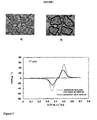
- Figure 2 shows the first cycle obtained for the carbonaceous and non-carbon materials whose synthesis is described above.
- the oxidation and reduction phenomena extend over a wide range of potential.
- the peaks are better defined.
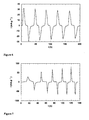
- the evolution of the two materials course of the first 5 cycles and very different ( Figure 3).
- the carbon-coated sample the oxidation and reduction kinetics are becoming faster, resulting in better and better defined peaks (higher peak currents and narrower peaks) .
- the kinetics appear more and more slowly.
- the evolution of the capacity of these two samples is shown in Figure 4. In the case of the carbon sample, the capacity exchanged is stable.
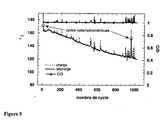
- the carbon sample was cycled in an intentiostatic mode between 3.8 and 3 V with fast charging and discharging regimes.
- the imposed currents correspond to a regime in C / 1, which means that all the capacity is exchanged in 1 hour.
- Figure 5 The first 5 cycles were performed in voltammetric mode to activate the cathode and determine its capacity. In this case, 100% of the theoretical capacity was exchanged during the first voltammetric cycles and 96% during the first 80 intentiostatic cycles. Subsequently the capacity decreases slowly and after 1000 cycles, 70% of the capacity (120 mAh.g -1 ) is still exchanged at this regime. Cycling in potentiodynamic mode after 950 cycles shows that in fact 89% of initial capacity is still available at slower discharge regimes.
- LiFePO 4 material coated with a carbon deposit was also tested at room temperature.
- the composite cathode is prepared by mixing the active material with carbon black and EPDM (previously dissolved in cyclohexane) in the proportions 85: 5: 10. The mixture is spread over a 1.7 cm 2 disc-shaped stainless steel current collector, dried under vacuum and stored in a glove box under helium atmosphere. As before, lithium is used as anode. The two electrodes are separated by a Celgard TM 2400 porous membrane. The electrolyte used is a molar LiTFSI 0.8 solution in gamma-butyrolactone.
- This example illustrates that the improvement of the studied material, due to the presence of carbon deposition on the surface of the grains, relates to the kinetics, the capacity and cyclability. In addition, its role is independent of that of the added carbon during the preparation of composite cathodes.
- This example illustrates the formation of a conductive carbonaceous deposit from a hydrocarbon type gas.
- the synthesis described in Example 1 for the repair of lithium and iron double phosphate was repeated omitting the polypropylene powder and replacing the inert atmosphere of the heat treatment with a mixture of 1% propene in the nitrogen .
- propene decomposes to form a carbon deposit on the material being synthesized.
- the sample obtained contains 2.5% of carbon, determined by chemical analysis.
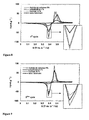
- a cyclic voltammetry performed under the conditions described in Example 1 on this sample shows an important phenomenon of activation during the first cycles (see Figure 7). The improvement in kinetics is accompanied in this case by an increase in the reversibly exchanged capacity.
- the initial capacity value of the LiFePO 4 sample prepared represents 77% of the theoretical capacity, taking into account the 2.5% electrochemically inactive carbon. After 5 cycles, this capacity reaches 91.4%.
- the observed activation phenomenon is related to the thickness of the possibly porous carbon layer coating the grains and can slow the diffusion of the cations.
- Examples 3-5 illustrate the treatment of the complex oxide, namely the LiFePO 4 lithium iron and lithium double phosphate, prepared independently thermally, so as to obtain a conductive carbon coating.
- the Trypinite LiFePO 4 sample as synthesized previously was analyzed. Its mass composition is: Fe 34.6%, Li 4.2%, P 19.2%, a stoichiometric difference of about 5%.
- the powder to be treated was impregnated with an aqueous solution of commercial sucrose and then dried. The amount of solution was chosen to correspond to 10% of the weight of sucrose relative to the weight of the material to be treated. The evaporation of the water to complete dryness was done with stirring to obtain a homogeneous distribution.
- the use of sugar is a preferred implementation because it melts before carbonizing, which allows to coat the grains well. Its relatively low carbon yield after pyrolysis is offset by its low price.
- the LiFePO 4 double phosphate of Example 3 was added with cellulose acetate as precursor of the carbon coating.
- This polymer is known to decompose with good carbonization yields, ie of the order of 24%. It decomposes between 200 and 400 ° C. Beyond this temperature, the amorphous carbon obtained is reorganized to give a graphite type structure which is favorable to obtaining coherent and highly conductive carbon deposits.
- the cellulose acetate was dissolved in acetone in a proportion corresponding to 5% of the weight of the material to be treated and dried before proceeding as described above. The content of the final carbon product is 1.5%.
- the heat treatment conducts in a manner similar to a black powder having surface electronic conductivity.
- Perylene and its derivatives are known to give, after pyrolysis, graphitic-type carbons because of the existence of condensed rings in the starting molecule.
- the anhydride of perylene-tetracarboxylic acid decomposes above 560 ° C giving very high carbon coatings.
- this product is present in very low solubility, and their intimate mixture with the complex oxide, also here LiFePO 4 according to Example 3, is difficult to put into practice.
- LiFePO 4 LiFePO 4 according to Example 3
- the oxyethylene segments are selected sufficiently long to act as solubilizing agents for the aromatic groups in the usual organic solvents.
- This polymer was dissolved in dichloromethane in a proportion corresponding to 5% of the weight of the material to be treated before proceeding as described in Examples 3 and 4.
- the content of the final product of carbon is 1%.
- the heat treatment leads as before to a black conductive powder.
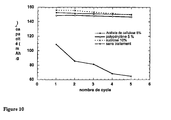
- Its electroactivity, as measured on the first cycle ( Figure 8) and the fifth cycle ( Figure 9) charge-discharge is 148 mAhg -1 and 146.9 mAhg -1 , 87.4% and 86.4% of the theory. These values are to be compared to those of the product not coated with the carbon deposit, which only 64% are electroactive during the first cycle. After 5 cycles, this value falls to 37.9% (see Figure 10).
- This example illustrates the use of an elimination reaction from a polymer to form a carbonaceous deposit according to the present invention.
- Fe 2 (SO 4 ) 3 ferric (ferric) sulphate having an orthorhombic "Nasicon” structure is obtained from commercial hydrated iron (III) sulphate (Aldrich) by dehydration at 450 ° C. under vacuum. Cooling and stirring, the powder is suspended in hexane and lithiated with a stoichiometric amount of 2M butyl lithium to give the composition Li 1.5 Fe 2 (SO 4 ) 3 .
- the material coated with the carbonaceous material was tested for its electrochemical activity in a lithium battery comprising a lithium metal electrode, 1M lithium bis (trifluoromethanesulfonimide) in a 50:50 mixture of ethylene-dimethoxyethane carbonate as an immobilized electrolyte in a separator of microporous polypropylene 25 ⁇ m.
- the cathode was obtained from the redox material prepared with carbon black (Ketjenblack TM ) and slurried in a solution of the ethylene-propylene-diene polymer, the solids content being 85: 10: 5.
- the mixture of the cathode is spread on an expanded aluminum mesh, and pressed to a ton / cm 2 to give a thickness of 230 microns.
- This button cell assembly is loaded (the tested material being the anode) at 1 mAcm -2 between potentials of 2.8 and 3.9 volts.
- the capacity of the material is 120 mAgh -1 , corresponding to 89% of the theoretical value.
- the average potential was obtained at 3.6 V vs. Li + : Li o .
- This example illustrates the use of a compound comprising nitrogen as the electrode material.
- Both manganous oxide MnO and lithium nitride powders are mixed in a dry box under a helium atmosphere in a ratio of 1: 1.
- the reagents are placed in a vitreous carbon crucible and treated under oxygen-free nitrogen ( ⁇ 1 vpm) at 800 ° C.
- 12 g of the resulting oxynitride having an anti-fluorite structure Li 3 MnNO are added to 0.7 g of a polyethylene powder having particles of the order of one micrometer, and mixed in a ball mixer under a helium atmosphere in a polyethylene container with dry heptane as a dispersing agent and 20 mg Brij TM 35 (ICI) as a surfactant.
- the filtered mixture is then treated under a stream of oxygen-free nitrogen in an oven at 750 ° C to decompose the polyethylene to carbon.
- the carbon-coated electrode material appears as a black powder rapidly hydrolysed in moist air. All subsequent manipulations are therefore conducted in a dry box in which a battery similar to that of Example 6 was constructed and tested for the electrochemical activity of the prepared material.
- the electrolyte in this case, is a mixture of commercial tetraethylsulfamide (Fluka) and dioxolane in a volume ratio of 40:60. Both solvents were purified by distillation in the presence of sodium hydride (under reduced pressure of 10 torr in the case of the sulfonamide). To this mixture of solvents is added lithium bis (trifluoromethanesulfonimide) (LiTFSI) to form a solution of 0.85 molar.
- the cell comprises a lithium electrode, an electrolyte immobilized in a porous polypropylene separator of 25 ⁇ m, and the material prepared in the same manner as in example 6.
- the cathode is obtained from the redox material prepared in admixture with the carbon black (Ketjenblack TM ) and pulped in an ethylene-polypropylene-diene polymer solution, the proportion of solids being 90: 5: 5.
- the cathode mixture is pressed onto an expanded copper mesh at 1 ton / cm 2 with a resultant thickness of 125 ⁇ m.
- the button cell assembly is charged at 0.5 mAcm -2 (the oxynitride being the anode) between potentials of 0.9 and 1.8 volts.
- the capacity of the materials is 370 mAgh -1 , ie, 70% of the theoretical value for two electrons per unit of the formula.
- the average potential was measured at 1.1 V vs. Li + : Li o .
- This material can be used as negative electrode materials in lithium ion batteries.
- An experimental cell of this type was constructed with the electrode material on a copper screen similar to that previously tested, and a positive electrode material obtained by the chemical delithiation of the iron and lithium phosphate of Example 1. presence of bromine in acetonitrile.
- the iron (III) phosphate obtained is pressed on an aluminum mesh to form the positive electrode and the 0.85 M solution of LiTFSI tetraethylsulfamide / dioxolane is used as the electrolyte.
- the average voltage of this cell is 2.1 volts and its energy density, based on the weight of the active materials, is 240 Wh / Kg.
- the lithium vanadium (III) phosphonosilicate Lh 3.5 V 2 (PO 4 ) 2.5 (SiO 4 ) 0.5 , having a Nasicon structure, is prepared in the following manner.
- Lithium carbonate (13.85 g), Li 2 SiO 3 lithium silicate (6.74 g), dihydrogen ammonium phosphate (43.2 g) and ammonium vanadate (35.1 g) are mixed with 250 ml of ethyl methyl ketone. and processed in a bead mixer comprising alumina beads and a thick-walled polyethylene container for 3 days. The resulting paste is filtered, dried and treated in a tubular oven under a stream of nitrogen comprising 10% hydrogen at 600 ° C for 12 hours. After cooling, 10 g of the resulting powder is introduced into a planetary ball mixer comprising tungsten carbide balls.
- the resulting powder is added to a solution of the polyaromatic polymer prepared in Example 5 (polyoxethylene-co-perylene tetracarboxylic diimide, 0.8 g in 5 mL of acetone), homogenized, and the solvent evaporated.
- the red-brown powder was thermolysed in an oxygen-free argon stream at 700 ° C for 2 hours to give a black powder after cooling after having a measurable surface conductivity.
- the material covered with the carbonaceous material has been tested for its electrochemical activity in a lithium-ion battery comprising a natural graphite electrode (NG7) coated with a copper current collector and corresponding to 24 mg / cm 2 , 1 M lithium hexafluorophosphate in a ethylene carbonate mixture: 50:50 dimethylcarbonate as immobilized electrolyte in a 25 ⁇ m microporous polypropylene separator.
- NG7 natural graphite electrode
- the cathode was obtained from lithium and vanadium phosphosilicate mixed with carbon black (Ketjenblack TM ) and pulverized in a solution of copolymer of vinylidene fluoride-hexafluoropropene in acetone, the solids proportions being 85: 10: 5.
- the mixture of the cathode is spread on an expanded foil mesh and pressed to a ton / cm 2 , resulting in a thickness of 190 ⁇ m corresponding to a load of active material of 35 mg / cm 2 .
- the button cell assembly is charged (the tested material being the anode) at 1 mAcm -2 between the potentials of 0 and 4.1 volts.
- the capacity of the carbon-coated material is 184 mAgh -1 , which corresponds to 78% of the theoretical value (3.5 lithium per formula unit), with a slight decrease after cycling.
- a similar cell constructed using an uncoated material, as obtained after mixing the heat treated inorganic precursor, but omitting the addition of the perylene polymer demonstrates a capacity of 105 mAgh -1 , which decreases rapidly with cycling.
- This example illustrates the formation of a carbonaceous coating by varying the alkali metal content in the redox material.
- the electrode material was tested for its capacity in a cell similar to that of Example 6 with the difference that the cell is first tested for discharge (the electrode material being the cathode), and then recharged.
- the voltages were between 2.8 and 3.7 volts.
- the experimental capacity during the first cycle was 190 mAgh -1 , which corresponds to 83% of the theoretical value.
- a cell with FeF 3 as electrode material and no carbon coating has a theoretical capacity of 246 mAgh -1 .
- the first discharge cycle obtained under conditions similar to that of the material of the invention is 137 mAgh -1 .
- This example also illustrates the formation of a carbonaceous coating by varying the alkali metal content in the redox materials.
- the resulting product contains, according to elemental analysis: Fe: 34%, P: 18.8%, Li: 4.4%, C: 3.2%.
- X-ray analysis confirmed the existence of pure LiFePO 4 triphyllite as the sole crystalline compound.
- the electrode material was tested for its capacity in a cell similar to that of Example 1 with a polyethylene oxide electrolyte, and then recharged. The voltages were chosen between 2.8 and 3.7 volts.
- the experimental capacity during the first cycle was 135 mAgh -1 , which corresponds to 77% of the theoretical value, which increases to 156 mAgh -1 (89%) when the definition of the peak has improved after several cycles. 80% of this capacity is accessible in the area of potential 3.3 - 3.6 volts vs. Li + : Li o .
- the LiCo 0 75 Mn 0.25 PO 4 compound was prepared by intimate grinding of cobalt oxalate dihydrate, manganese oxalate dihydrate and dihydrogenated ammonium phosphate by injecting air at 850 ° C for 10 hours.
- the resulting purple powder is mixed in a planetary ball mixer comprising tungsten carbide balls to obtain particles of the order of 4 microns.
- 10 g of this complex phosphate are triturated in a mortar with 10 ml of a 6% solution of the perylene polymer of Example 5 in methyl formate. The solvent evaporated rapidly.
- the resulting powder was treated under a stream of oxygen-free dry argon in a tubular furnace at 740 ° C for 3 hours, resulting in a black powder.
- the activity the electrochemical cell was tested in a lithium-ion battery similar to that of Example 6.
- the electrolyte was, in this case, lithium bis-fluoromethanesulfonimide (Li [FSO 2 ] 2 N) dissolved at a concentration 1M in dimethylamino-trifluoroethyl sulfamate CF 3 CH 2 OSO 2 N (CH 3 ) 2 , which is an oxidation-resistant solvent.
- Li + Li o .
- the battery could be cycled for 50 cycles of deep charges / discharges with less than 10% loss of capacity, thus showing the resistance of the electrolyte to high potentials.
- the Li 2 MnSiO 4 compound was prepared by calcining the gel resulting from the action of a stoichiometric mixture of lithium acetate dihydrate, manganese acetate tetrahydrate and tetraethoxysilane in an 80:20 ethanol / water mixture.
- the gel was dried in an oven at 80 ° C for 48 hours, reduced to powder and calcined in air at 800 ° C.
- 3.28 g of the resulting silicate and 12.62 g of the lithium iron phosphate of Example 3 were mixed in a planetary bead mixer similar to that of Example 11, and the powder was treated under a stream of dry argon without of oxygen in a tubular oven at 740 ° C for 6 hours.
- the complex oxide obtained after cooling has the formula Li 1.2 Fe 0.8 Mn 0.2 P 0.8 Si 0.2 O 4 .
- the powder was wetted with 3 mL of a 2% solution of cobalt acetate, and dried. This powder was treated in the same tubular furnace at 500 ° C under a flow of 1 mL / sec of a gas comprising 10% carbon monoxide in nitrogen for 2 hours. After cooling, the resulting black powder was tested for its electrochemical activity under conditions similar to those of Example 1. With a polyethylene oxide electrolyte at 80 ° C, the measured capacity, from a cyclic curve voltamogram at 185 mAgh -1 (88% of the theory) between the voltages of 2.8 and 3.9 volts vs. Li + : Li o . The uncovered material tested under similar conditions has a specific capacity of 105 mAgh -1 .
- a light modulation system (electrochromic window) was constructed as follows.
- the LiFePO 4 of Example 3 is mixed in a high-energy ball mixer to obtain particles of about 120 nm. 2 g of this powder are mixed with 1 ml of a 2% by weight solution of the perylene-co-polyoxyethylene polymer of Example 5 in methyl formate. The paste is triturated to ensure uniform distribution of the polymer on the surface of the particles, and the solvent is then evaporated. The dry powder obtained is treated under a stream of oxygen-free dry nitrogen in a tubular oven at 700 ° C for 3 hours, to yield a pale gray powder.
- This system turns blue in 30 seconds on application of a voltage (1.5 V, the LiFePO 4 side being the anode) and bleached in reverse voltage.
- the light transmission is modulated from 85% (whitened state) to 20% (colored state).
Landscapes
- Chemical & Material Sciences (AREA)
- Engineering & Computer Science (AREA)
- Chemical Kinetics & Catalysis (AREA)
- Electrochemistry (AREA)
- General Chemical & Material Sciences (AREA)
- Inorganic Chemistry (AREA)
- Power Engineering (AREA)
- Materials Engineering (AREA)
- Microelectronics & Electronic Packaging (AREA)
- Composite Materials (AREA)
- Dispersion Chemistry (AREA)
- Physics & Mathematics (AREA)
- Manufacturing & Machinery (AREA)
- Crystallography & Structural Chemistry (AREA)
- Spectroscopy & Molecular Physics (AREA)
- Condensed Matter Physics & Semiconductors (AREA)
- General Physics & Mathematics (AREA)
- Battery Electrode And Active Subsutance (AREA)
- Electric Double-Layer Capacitors Or The Like (AREA)
- Carbon And Carbon Compounds (AREA)
- Secondary Cells (AREA)
- Primary Cells (AREA)
- Electrochromic Elements, Electrophoresis, Or Variable Reflection Or Absorption Elements (AREA)
- Inorganic Compounds Of Heavy Metals (AREA)
- Compounds Of Iron (AREA)
- Silicon Compounds (AREA)
- Silicates, Zeolites, And Molecular Sieves (AREA)
Priority Applications (1)
| Application Number | Priority Date | Filing Date | Title |
|---|---|---|---|
| EP07004289A EP1796189B1 (fr) | 1999-04-30 | 2000-05-02 | Matériaux d'électrode présentant une conductivité de surface élevée |
Applications Claiming Priority (2)
| Application Number | Priority Date | Filing Date | Title |
|---|---|---|---|
| CA002270771A CA2270771A1 (fr) | 1999-04-30 | 1999-04-30 | Nouveaux materiaux d'electrode presentant une conductivite de surface elevee |
| CA2270771 | 1999-04-30 |
Related Child Applications (1)
| Application Number | Title | Priority Date | Filing Date |
|---|---|---|---|
| EP07004289A Division EP1796189B1 (fr) | 1999-04-30 | 2000-05-02 | Matériaux d'électrode présentant une conductivité de surface élevée |
Publications (3)
| Publication Number | Publication Date |
|---|---|
| EP1049182A2 EP1049182A2 (fr) | 2000-11-02 |
| EP1049182A3 EP1049182A3 (fr) | 2004-02-11 |
| EP1049182B1 true EP1049182B1 (fr) | 2008-01-02 |
Family
ID=4163509
Family Applications (2)
| Application Number | Title | Priority Date | Filing Date |
|---|---|---|---|
| EP00401207A Expired - Lifetime EP1049182B1 (fr) | 1999-04-30 | 2000-05-02 | Matériaux d'électrode présentant une conductivité de surface élevée |
| EP07004289A Expired - Lifetime EP1796189B1 (fr) | 1999-04-30 | 2000-05-02 | Matériaux d'électrode présentant une conductivité de surface élevée |
Family Applications After (1)
| Application Number | Title | Priority Date | Filing Date |
|---|---|---|---|
| EP07004289A Expired - Lifetime EP1796189B1 (fr) | 1999-04-30 | 2000-05-02 | Matériaux d'électrode présentant une conductivité de surface élevée |
Country Status (5)
| Country | Link |
|---|---|
| US (12) | US6855273B2 (enExample) |
| EP (2) | EP1049182B1 (enExample) |
| JP (8) | JP5175011B2 (enExample) |
| CA (1) | CA2270771A1 (enExample) |
| DE (2) | DE60041896D1 (enExample) |
Cited By (9)
| Publication number | Priority date | Publication date | Assignee | Title |
|---|---|---|---|---|
| WO2011092277A1 (de) | 2010-01-28 | 2011-08-04 | Süd-Chemie AG | Leitmittelzusatzfreie elektrode für eine sekundärlithiumionenbatterie |
| WO2011092279A1 (de) | 2010-01-28 | 2011-08-04 | Süd-Chemie AG | Elektrode für eine sekundärlithiumionenbatterie |
| WO2011131553A2 (de) | 2010-04-23 | 2011-10-27 | Süd-Chemie AG | Kohlenstoffhaltiges verbundmaterial enthaltend eine sauerstoffhaltige lithium-übergangsmetallverbindung |
| WO2011147907A1 (de) | 2010-05-27 | 2011-12-01 | Süd-Chemie AG | Kohlenstoff -lithiumübergangsmetallphosphat -verbundmaterial mit einem niedrigen kohlenstoffgehalt |
| DE102010032207A1 (de) | 2010-07-26 | 2012-01-26 | Süd-Chemie AG | Verfahren zur Verminderung von magnetischen und/oder oxidischen Verunreinigungen in Lithium-Metall-Sauerstoff-Verbindungen |
| WO2012013685A2 (en) | 2010-07-26 | 2012-02-02 | Süd-Chemie AG | Carbon coated lithium transition metal phosphate and process for its manufacture |
| WO2012140035A1 (de) | 2011-04-12 | 2012-10-18 | Süd-Chemie AG | Verfahren zur herstellung von lithiumtitan-spinell |
| WO2013004632A1 (de) | 2011-07-01 | 2013-01-10 | Süd-Chemie AG | Verfahren zur herstellung von nanopartikulären lithiumübergangsmetallphosphaten |
| WO2013107861A1 (en) | 2012-01-18 | 2013-07-25 | Clariant Produkte (Deutschland) Gmbh | Method for producing high-purity electrode materials |
Families Citing this family (401)
| Publication number | Priority date | Publication date | Assignee | Title |
|---|---|---|---|---|
| US6203946B1 (en) | 1998-12-03 | 2001-03-20 | Valence Technology, Inc. | Lithium-containing phosphates, method of preparation, and uses thereof |
| US6153333A (en) | 1999-03-23 | 2000-11-28 | Valence Technology, Inc. | Lithium-containing phosphate active materials |
| CA2270771A1 (fr) * | 1999-04-30 | 2000-10-30 | Hydro-Quebec | Nouveaux materiaux d'electrode presentant une conductivite de surface elevee |
| EP1569289B1 (en) * | 1999-05-10 | 2018-07-25 | Hydro-Quebec | New lithium insertion electrode materials based on orthosilicate derivatives |
| US7001690B2 (en) | 2000-01-18 | 2006-02-21 | Valence Technology, Inc. | Lithium-based active materials and preparation thereof |
| US6528033B1 (en) | 2000-01-18 | 2003-03-04 | Valence Technology, Inc. | Method of making lithium-containing materials |
| JP4769995B2 (ja) * | 2000-03-06 | 2011-09-07 | ソニー株式会社 | 正極活物質の製造方法及び非水電解質電池の製造方法 |
| US7524584B2 (en) | 2000-04-27 | 2009-04-28 | Valence Technology, Inc. | Electrode active material for a secondary electrochemical cell |
| US6964827B2 (en) | 2000-04-27 | 2005-11-15 | Valence Technology, Inc. | Alkali/transition metal halo- and hydroxy-phosphates and related electrode active materials |
| US6777132B2 (en) * | 2000-04-27 | 2004-08-17 | Valence Technology, Inc. | Alkali/transition metal halo—and hydroxy-phosphates and related electrode active materials |
| US8057769B2 (en) | 2000-04-27 | 2011-11-15 | Valence Technology, Inc. | Method for making phosphate-based electrode active materials |
| US6387568B1 (en) | 2000-04-27 | 2002-05-14 | Valence Technology, Inc. | Lithium metal fluorophosphate materials and preparation thereof |
| CA2320661A1 (fr) * | 2000-09-26 | 2002-03-26 | Hydro-Quebec | Nouveau procede de synthese de materiaux limpo4 a structure olivine |
| JP4734700B2 (ja) * | 2000-09-29 | 2011-07-27 | ソニー株式会社 | 正極活物質の製造方法及び非水電解質電池の製造方法 |
| JP3921931B2 (ja) * | 2000-09-29 | 2007-05-30 | ソニー株式会社 | 正極活物質及び非水電解質電池 |
| JP4734701B2 (ja) * | 2000-09-29 | 2011-07-27 | ソニー株式会社 | 正極活物質の製造方法及び非水電解質電池の製造方法 |
| US7387851B2 (en) | 2001-07-27 | 2008-06-17 | A123 Systems, Inc. | Self-organizing battery structure with electrode particles that exert a repelling force on the opposite electrode |
| US7662265B2 (en) | 2000-10-20 | 2010-02-16 | Massachusetts Institute Of Technology | Electrophoretic assembly of electrochemical devices |
| EP1352436B1 (en) | 2000-10-20 | 2008-08-20 | Massachusetts Institute Of Technology | Reticulated and controlled porosity battery structures |
| US6645452B1 (en) | 2000-11-28 | 2003-11-11 | Valence Technology, Inc. | Methods of making lithium metal cathode active materials |
| CA2327370A1 (fr) * | 2000-12-05 | 2002-06-05 | Hydro-Quebec | Nouvelle methode de fabrication de li4ti5o12 pur a partir du compose ternaire tix-liy-carbone: effet du carbone sur la synthese et la conductivite de l'electrode |
| CA2750707A1 (en) | 2001-04-06 | 2002-12-05 | Valence Technology, Inc. | Sodium ion batteries |
| DE10117904B4 (de) * | 2001-04-10 | 2012-11-15 | Zentrum für Sonnenenergie- und Wasserstoff-Forschung Baden-Württemberg Gemeinnützige Stiftung | Binäre, ternäre und quaternäre Lithiumeisenphosphate, Verfahren zu ihrer Herstellung und ihre Verwendung |
| AU2002330924A1 (en) | 2001-07-27 | 2003-02-17 | A 123 Systems | Battery structures, self-organizing structures and related methods |
| CA2456056C (en) | 2001-07-31 | 2011-11-15 | Mitsui Engineering & Shipbuilding Co., Ltd. | Method of producing secondary battery cathode material, and secondary battery |
| US6878487B2 (en) * | 2001-09-05 | 2005-04-12 | Samsung Sdi, Co., Ltd. | Active material for battery and method of preparing same |
| US6706445B2 (en) | 2001-10-02 | 2004-03-16 | Valence Technology, Inc. | Synthesis of lithiated transition metal titanates for lithium cells |
| US6720112B2 (en) | 2001-10-02 | 2004-04-13 | Valence Technology, Inc. | Lithium cell based on lithiated transition metal titanates |
| US6908710B2 (en) | 2001-10-09 | 2005-06-21 | Valence Technology, Inc. | Lithiated molybdenum oxide active materials |
| JP4154561B2 (ja) * | 2001-10-19 | 2008-09-24 | 日本電気株式会社 | 二次電池 |
| EP1456895B1 (en) | 2001-12-21 | 2017-03-29 | Massachusetts Institute Of Technology | Conductive lithium storage electrode |
| US6815122B2 (en) | 2002-03-06 | 2004-11-09 | Valence Technology, Inc. | Alkali transition metal phosphates and related electrode active materials |
| JP2003272632A (ja) * | 2002-03-15 | 2003-09-26 | Mikuni Color Ltd | 炭素被覆リチウム遷移金属酸化物、2次電池正極材料及び2次電池 |
| US20030190527A1 (en) | 2002-04-03 | 2003-10-09 | James Pugh | Batteries comprising alkali-transition metal phosphates and preferred electrolytes |
| US7482097B2 (en) * | 2002-04-03 | 2009-01-27 | Valence Technology, Inc. | Alkali-transition metal phosphates having a +3 valence non-transition element and related electrode active materials |
| US7422823B2 (en) | 2002-04-03 | 2008-09-09 | Valence Technology, Inc. | Alkali-iron-cobalt phosphates and related electrode active materials |
| US20110052986A1 (en) * | 2002-04-04 | 2011-03-03 | Jeremy Barker | Sodium Ion Batteries |
| EP2583939A3 (en) * | 2002-05-17 | 2015-03-11 | Valence Technology (Nevada), Inc. | Synthesis of metal compounds useful as cathode active materials |
| CA2389555A1 (fr) | 2002-05-30 | 2003-11-30 | Hydro Quebec | Procede de preparation de poudres ceramiques en presence de carbone, poudres ainsi obtenues et leur utilisation |
| WO2004001881A2 (en) | 2002-06-21 | 2003-12-31 | Umicore | Carbon-coated li-containing powders and process for production thereof |
| CA2394056A1 (fr) * | 2002-07-12 | 2004-01-12 | Hydro-Quebec | Particules comportant un noyau non conducteur ou semi conducteur recouvert d'un couche conductrice, leurs procedes d'obtention et leur utilisation dans des dispositifs electrochimiques |
| WO2004012286A1 (en) | 2002-07-26 | 2004-02-05 | A123 Systems, Inc. | Bipolar articles and related methods |
| US7087348B2 (en) | 2002-07-26 | 2006-08-08 | A123 Systems, Inc. | Coated electrode particles for composite electrodes and electrochemical cells |
| US7625671B2 (en) | 2002-10-01 | 2009-12-01 | Rutgers, The State University | Transition metal fluoride: carbon nanoamalgam rechargeable battery cell electrode material |
| US7390472B1 (en) * | 2002-10-29 | 2008-06-24 | Nei Corp. | Method of making nanostructured lithium iron phosphate—based powders with an olivine type structure |
| WO2004051772A2 (en) * | 2002-11-27 | 2004-06-17 | Rutgers, The State University | Metal fluorides as electrode materials |
| FR2848549B1 (fr) * | 2002-12-16 | 2005-01-21 | Commissariat Energie Atomique | Procede de preparation de composes d'insertion d'un metal alcalin, materiaux actifs les contenant, et dispositifs comprenant ces materiaux actifs |
| ATE433202T1 (de) | 2002-12-19 | 2009-06-15 | Valence Technology Inc | Aktives elektrodenmaterial und verfahren zur herstellung desselben |
| US7326494B2 (en) * | 2003-01-30 | 2008-02-05 | T/J Technologies, Inc. | Composite material and electrodes made therefrom |
| JP4822416B2 (ja) * | 2003-01-31 | 2011-11-24 | 三井造船株式会社 | 二次電池用正極材料、その製造方法、および二次電池 |
| US20070141468A1 (en) * | 2003-04-03 | 2007-06-21 | Jeremy Barker | Electrodes Comprising Mixed Active Particles |
| US7041239B2 (en) * | 2003-04-03 | 2006-05-09 | Valence Technology, Inc. | Electrodes comprising mixed active particles |
| US7008566B2 (en) * | 2003-04-08 | 2006-03-07 | Valence Technology, Inc. | Oligo phosphate-based electrode active materials and methods of making same |
| US20040202935A1 (en) * | 2003-04-08 | 2004-10-14 | Jeremy Barker | Cathode active material with increased alkali/metal content and method of making same |
| US7318982B2 (en) | 2003-06-23 | 2008-01-15 | A123 Systems, Inc. | Polymer composition for encapsulation of electrode particles |
| FR2860925A1 (fr) * | 2003-10-14 | 2005-04-15 | Commissariat Energie Atomique | Microbatterie dont au moins une electrode et l'electrolyte comportent chacun le groupement [xy1y2y3y4] et procede de fabrication d'une telle microbatterie. |
| JP4656653B2 (ja) * | 2003-10-27 | 2011-03-23 | 三井造船株式会社 | 二次電池用正極材料、二次電池用正極材料の製造方法、および二次電池 |
| KR20050041888A (ko) * | 2003-10-30 | 2005-05-04 | 니폰 파이오니쿠스 가부시키가이샤 | 절연막 성막용 원료 및 그것을 이용한 성막 방법 |
| JP4761239B2 (ja) * | 2003-10-31 | 2011-08-31 | 日立マクセルエナジー株式会社 | 非水二次電池の電極材料およびその製造方法、並びにそれを用いた非水二次電池 |
| JP2005191425A (ja) * | 2003-12-26 | 2005-07-14 | Tdk Corp | キャパシタ用電極の製造方法 |
| US7008726B2 (en) * | 2004-01-22 | 2006-03-07 | Valence Technology, Inc. | Secondary battery electrode active materials and methods for making the same |
| US20050163699A1 (en) * | 2004-01-23 | 2005-07-28 | Jeremy Barker | Fluorosulfate-based electrode active materials and method of making the same |
| FR2865576B1 (fr) * | 2004-01-28 | 2006-04-28 | Commissariat Energie Atomique | Procede de preparation de materiaux composites comprenant un compose actif d'electrode et un compose conducteur electronique tel que le carbone notamment pour accumulateurs au lithium |
| US7338647B2 (en) * | 2004-05-20 | 2008-03-04 | Valence Technology, Inc. | Synthesis of cathode active materials |
| JP5043290B2 (ja) * | 2004-06-08 | 2012-10-10 | パナソニック株式会社 | 非水電解質二次電池用正極活物質、その製造方法、およびそれを用いた非水電解質二次電池 |
| JP2006032321A (ja) * | 2004-06-16 | 2006-02-02 | Matsushita Electric Ind Co Ltd | 活物質材料、その製造方法、およびそれを含む非水電解質二次電池 |
| KR100725705B1 (ko) * | 2004-07-16 | 2007-06-07 | 주식회사 엘지화학 | 리튬 이차 전지용 전극 활물질 |
| JP4794833B2 (ja) * | 2004-07-21 | 2011-10-19 | 日本コークス工業株式会社 | リチウムイオン二次電池用正極材料、その製造方法、及びリチウムイオン二次電池 |
| JP4941623B2 (ja) * | 2004-07-28 | 2012-05-30 | 株式会社Gsユアサ | 電気化学デバイス用電極材料及びその製造方法、並びに、電気化学デバイス用電極及び電気化学デバイス |
| US20060088768A1 (en) * | 2004-10-25 | 2006-04-27 | Fang Jang C | Electrode structure of lithium battery |
| US20060091362A1 (en) * | 2004-11-02 | 2006-05-04 | Wixom Michael R | Composite electrochemical material |
| US7282301B2 (en) * | 2004-11-02 | 2007-10-16 | T/J Technologies, Inc. | Method for making a composite electrode material |
| US8449628B2 (en) * | 2005-01-25 | 2013-05-28 | Kyoto University | Lithium battery and manufacturing method thereof |
| US7842420B2 (en) * | 2005-02-03 | 2010-11-30 | A123 Systems, Inc. | Electrode material with enhanced ionic transport properties |
| WO2006086156A2 (en) * | 2005-02-08 | 2006-08-17 | Valence Technology, Inc. | Method and apparatus for dissipation of heat generated by a secondary electrochemical cell |
| CA2506104A1 (en) * | 2005-05-06 | 2006-11-06 | Michel Gauthier | Surface modified redox compounds and composite electrode obtain from them |
| US7824581B2 (en) * | 2007-06-18 | 2010-11-02 | Advanced Lithium Electrochemistry Co., Ltd. | Cocrystalline metallic compounds and electrochemical redox active material employing the same |
| CN101278422B (zh) * | 2005-05-16 | 2012-05-30 | 通用汽车环球科技运作公司 | 用于燃料电池电极的催化剂 |
| JP2008547157A (ja) * | 2005-06-01 | 2008-12-25 | ボード・オブ・リージエンツ,ザ・ユニバーシテイ・オブ・テキサス・システム | 再充電できるリチウムイオン電池用のカソード |
| CA2612642A1 (en) * | 2005-06-24 | 2007-01-04 | Valery Pavlovich Nedoshivin | Electrode and current collector for electrochemical capacitor having double electric layer and double electric layer electrochemical capacitor formed therewith |
| CA2612636C (en) * | 2005-06-24 | 2013-10-15 | Samvel Avakovich Kazaryan | Heterogeneous electrochemical supercapacitor and method of manufacture |
| MX2007016485A (es) * | 2005-06-24 | 2008-03-11 | Universal Supercapacitors Llc | Colector de corriente para capacitores electroquimicos de doble capa electrica y metodo de fabricacion del mismo. |
| BRPI0612557A2 (pt) * | 2005-06-29 | 2012-02-28 | Umicore Nv | processo para preparar pó de lifepo4 cristalino, pó de lifepo4 cristalino, isento de carbono, uso do mesmo, e, mistura de eletrodo para baterias secundárias de lìtio com eletrólito lìquido não aquoso |
| US7609146B2 (en) * | 2005-07-27 | 2009-10-27 | Lear Corporation | System and method for controlling a function using a variable sensitivity receiver |
| US8323832B2 (en) * | 2005-08-08 | 2012-12-04 | A123 Systems, Inc. | Nanoscale ion storage materials |
| US8158090B2 (en) | 2005-08-08 | 2012-04-17 | A123 Systems, Inc. | Amorphous and partially amorphous nanoscale ion storage materials |
| US7939201B2 (en) * | 2005-08-08 | 2011-05-10 | A123 Systems, Inc. | Nanoscale ion storage materials including co-existing phases or solid solutions |
| EP1936721B1 (en) | 2005-09-21 | 2015-11-11 | Kanto Denka Kogyo Co., Ltd. | Positive electrode active material, method for producing same, and nonaqueous electrolyte battery having positive electrode containing positive electrode active material |
| JP5098146B2 (ja) | 2005-10-14 | 2012-12-12 | 株式会社Gsユアサ | 非水電解質二次電池用正極材料の製造方法およびそれを備える非水電解質二次電池 |
| US20070160752A1 (en) * | 2006-01-09 | 2007-07-12 | Conocophillips Company | Process of making carbon-coated lithium metal phosphate powders |
| US8133616B2 (en) * | 2006-02-14 | 2012-03-13 | Dow Global Technologies Llc | Lithium manganese phosphate positive material for lithium secondary battery |
| KR20130106440A (ko) | 2006-02-28 | 2013-09-27 | 프리메트 프리시젼 머테리알스, 인크. | 리튬계 화합물 나노입자 조성물 및 이의 제조 방법 |
| FR2898885B1 (fr) * | 2006-03-27 | 2008-05-30 | Commissariat Energie Atomique | Compose a base de disphosphate de titane et de carbone, procede de preparation et utilisation comme materiau actif d'une electrode pour accumulateur au lithium. |
| US7696729B2 (en) * | 2006-05-02 | 2010-04-13 | Advanced Desalination Inc. | Configurable power tank |
| JP5235282B2 (ja) * | 2006-06-16 | 2013-07-10 | 国立大学法人九州大学 | 非水電解質二次電池用正極活物質及び電池 |
| US7265891B1 (en) * | 2006-06-20 | 2007-09-04 | Eclipse Energy Systems | Electrochromic device with self-forming ion transfer layer and lithium-fluoro-nitride electrolyte |
| US8236450B2 (en) | 2006-08-21 | 2012-08-07 | Lifesize Ab | Lithium insertion electrode materials based on orthosilicates derivatives |
| DE102006041762A1 (de) * | 2006-09-04 | 2008-03-06 | Daimler Ag | Vorrichtung und Verfahren zum Befeuchten eines zu einer Brennstoffzelle strömenden Gasstroms |
| US7718319B2 (en) | 2006-09-25 | 2010-05-18 | Board Of Regents, The University Of Texas System | Cation-substituted spinel oxide and oxyfluoride cathodes for lithium ion batteries |
| CA2566906A1 (en) * | 2006-10-30 | 2008-04-30 | Nathalie Ravet | Carbon-coated lifepo4 storage and handling |
| US8197719B2 (en) * | 2006-11-17 | 2012-06-12 | American Lithium Energy Corp. | Electroactive agglomerated particles |
| RU2483383C2 (ru) | 2006-11-27 | 2013-05-27 | ЮНИВЕРСАЛ СУПЕРКАПАСИТОРЗ ЭлЭлСи | Электрод для использования в электрохимическом конденсаторе с двойным электрическим слоем (варианты) |
| US20080153002A1 (en) * | 2006-11-27 | 2008-06-26 | Nazar Linda Faye | Mixed Lithium/Sodium Ion Iron Fluorophosphate Cathodes for Lithium Ion Batteries |
| CA2569991A1 (en) * | 2006-12-07 | 2008-06-07 | Michel Gauthier | C-treated nanoparticles and agglomerate and composite thereof as transition metal polyanion cathode materials and process for making |
| EP2124272B1 (en) | 2006-12-28 | 2015-06-03 | GS Yuasa International Ltd. | Positive electrode material for nonaqueous electrolyte secondary battery, nonaqueous electrolyte secondary battery comprising the same, and method for producing the same |
| US7824802B2 (en) * | 2007-01-17 | 2010-11-02 | The United States Of America As Represented By The Secretary Of The Army | Method of preparing a composite cathode active material for rechargeable electrochemical cell |
| RU2492540C2 (ru) * | 2007-02-19 | 2013-09-10 | ЮНИВЕРСАЛ СУПЕРКАПАСИТОРЗ ЭлЭлСи | Токосъемник отрицательного электрода для гетерогенного электрохимического конденсатора и способ его изготовления |
| WO2008105490A1 (ja) * | 2007-02-28 | 2008-09-04 | Santoku Corporation | オリビン型構造を有する化合物、非水電解質二次電池用正極、非水電解質二次電池 |
| US20080240480A1 (en) * | 2007-03-26 | 2008-10-02 | Pinnell Leslie J | Secondary Batteries for Hearing Aids |
| US20080241645A1 (en) * | 2007-03-26 | 2008-10-02 | Pinnell Leslie J | Lithium ion secondary batteries |
| US20080248375A1 (en) * | 2007-03-26 | 2008-10-09 | Cintra George M | Lithium secondary batteries |
| WO2008123311A1 (ja) * | 2007-03-27 | 2008-10-16 | Tokyo Institute Of Technology | 二次電池用正極材料の製造方法 |
| JP4317239B2 (ja) * | 2007-04-27 | 2009-08-19 | Tdk株式会社 | 電極用複合粒子の製造方法 |
| US7594703B2 (en) * | 2007-05-14 | 2009-09-29 | Hall David R | Pick with a reentrant |
| US20090202903A1 (en) | 2007-05-25 | 2009-08-13 | Massachusetts Institute Of Technology | Batteries and electrodes for use thereof |
| US20080303004A1 (en) * | 2007-06-08 | 2008-12-11 | Conocophillips Company | Method for producing lithium transition metal polyanion powders for batteries |
| US20080305256A1 (en) * | 2007-06-08 | 2008-12-11 | Conocophillips Company | Method for producing lithium vanadium polyanion powders for batteries |
| JP4843582B2 (ja) * | 2007-08-17 | 2011-12-21 | 株式会社アルバック | リン酸リチウム焼結体の製造方法およびスパッタリングターゲット |
| US20100189990A1 (en) * | 2007-09-19 | 2010-07-29 | Breault Richard D | High thermal conductivity electrode substrate |
| JP5223281B2 (ja) * | 2007-09-28 | 2013-06-26 | Tdk株式会社 | リチウムイオン二次電池又はリチウム二次電池の正極用複合粒子、及びリチウムイオン二次電池又はリチウム二次電池 |
| KR20090041947A (ko) * | 2007-10-25 | 2009-04-29 | 삼성전기주식회사 | 바나듐 산화물 나노입자 제조방법 |
| DE102007058674A1 (de) | 2007-12-06 | 2009-07-02 | Süd-Chemie AG | Nanopartikuläre Zusammensetzung und Verfahren zu deren Herstellung |
| JP5470700B2 (ja) | 2007-12-10 | 2014-04-16 | 住友大阪セメント株式会社 | 電極材料およびその製造方法、並びに、電極および電池 |
| TWI369019B (en) * | 2007-12-27 | 2012-07-21 | Ind Tech Res Inst | Cathodal materials for lithium cells, methods for fabricating the same, and lithium secondary cells using the same |
| TWI466370B (zh) | 2008-01-17 | 2014-12-21 | A123 Systems Inc | 鋰離子電池的混合式金屬橄欖石電極材料 |
| CA2623407A1 (en) * | 2008-02-28 | 2009-08-28 | Hydro-Quebec | Composite electrode material |
| EP2098483A1 (en) | 2008-03-05 | 2009-09-09 | High Power Lithium S.A. | Synthesis of lithium metal phosphate/carbon nanocomposites with phytic acid |
| DE102008001113B4 (de) * | 2008-04-10 | 2014-10-30 | Sineurop Nanotech Gmbh | Elektrodenmaterial, Verwendung eines Elektrodenmaterials und Verfahren zur Herstellung eines Elektrodenmaterials |
| TW200951066A (en) | 2008-04-17 | 2009-12-16 | Basf Se | Process for the preparation of crystalline lithium-, iron-and phosphate-comprising materials |
| TW201010944A (en) * | 2008-04-17 | 2010-03-16 | Basf Se | Process for the preparation of crystalline lithium-, iron-and phosphate-comprising materials |
| KR20160086979A (ko) * | 2008-07-15 | 2016-07-20 | 다우 글로벌 테크놀로지스 엘엘씨 | 전지 전극용 무기 결합제 및 이의 수계 공정 |
| CA2638410A1 (en) * | 2008-07-28 | 2010-01-28 | Hydro-Quebec | Composite electrode material |
| PL216549B1 (pl) * | 2008-08-19 | 2014-04-30 | Univ Jagielloński | Sposób wytwarzania przewodzących warstw węglowych na nośnikach proszkowych |
| DE102008050692B4 (de) | 2008-10-07 | 2014-04-03 | Süd-Chemie Ip Gmbh & Co. Kg | Kohlenstoffbeschichteter Lithiumtitan-Spinell |
| JP5273655B2 (ja) * | 2008-11-28 | 2013-08-28 | 独立行政法人産業技術総合研究所 | リチウム電池またはハイブリットキャパシタ用三成分系電極材用粒子及びその製造方法 |
| US9056944B2 (en) | 2009-02-11 | 2015-06-16 | Dow Global Technologies Llc | Ductile polymer binders and battery components using the same |
| KR20110121725A (ko) * | 2009-03-31 | 2011-11-08 | 미츠비시 쥬고교 가부시키가이샤 | 리튬 이온 2차 전지 및 전지 시스템 |
| DE102009020832A1 (de) * | 2009-05-11 | 2010-11-25 | Süd-Chemie AG | Verbundmaterial enthaltend ein gemischtes Lithium-Metalloxid |
| CN102439767B (zh) | 2009-05-22 | 2014-06-18 | 夏普株式会社 | 正极活性物质、正极及非水二次电池 |
| CA2763748C (en) | 2009-06-01 | 2019-04-02 | Universite Du Quebec A Montreal | Process to induce polymerization of an organic electronically conductive polymer |
| JP5886193B2 (ja) * | 2009-06-24 | 2016-03-16 | ビーエーエスエフ ソシエタス・ヨーロピアBasf Se | LiFePO4−炭素合成物を製造するための方法 |
| JP5480544B2 (ja) * | 2009-07-01 | 2014-04-23 | 三井造船株式会社 | 磁性不純物の生成抑制方法 |
| WO2011013652A1 (ja) | 2009-07-31 | 2011-02-03 | 戸田工業株式会社 | 非水電解質二次電池用正極活物質並びに非水電解質二次電池 |
| CN102714315A (zh) | 2009-08-09 | 2012-10-03 | 美洲锂能公司 | 电活性颗粒及由其组成的电极和电池 |
| EP2471128B1 (en) | 2009-08-24 | 2020-03-25 | Sion Power Corporation | Release system for electrochemical cells |
| US9178215B2 (en) | 2009-08-25 | 2015-11-03 | A123 Systems Llc | Mixed metal olivine electrode materials for lithium ion batteries having improved specific capacity and energy density |
| US8137841B2 (en) * | 2009-08-31 | 2012-03-20 | 3M Innovative Properties Company | Cathode compositions for lithium-ion electrochemical cells |
| CA2678540A1 (fr) | 2009-09-15 | 2011-03-15 | Hydro-Quebec | Materiau constitue de particules composites d'oxyde, procede pour sa preparation, et son utilisation comme matiere active d'electrode |
| US9660267B2 (en) | 2009-09-18 | 2017-05-23 | A123 Systems, LLC | High power electrode materials |
| US9174846B2 (en) * | 2009-09-18 | 2015-11-03 | A123 Systems Llc | Ferric phosphate and methods of preparation thereof |
| JP5594007B2 (ja) * | 2009-09-29 | 2014-09-24 | Tdk株式会社 | リチウムイオン二次電池用活物質の製造方法及びリチウムイオン二次電池の製造方法 |
| JP5489627B2 (ja) | 2009-10-02 | 2014-05-14 | トヨタ自動車株式会社 | リチウム二次電池 |
| CN102782902B (zh) * | 2009-12-17 | 2017-02-08 | 庄信万丰股份有限公司 | 用于改善碱金属氧阴离子电极材料的电化学性质的方法以及由此获得的碱金属氧阴离子电极材料 |
| US20120261622A1 (en) * | 2009-12-22 | 2012-10-18 | Masatoshi Honma | Lithium titanate, manufacturing method therefor, slurry used in said manufacturing method, electrode active material containing said lithium titanate, and lithium secondary battery using said electrode active material |
| WO2011091521A1 (en) * | 2010-01-28 | 2011-08-04 | Phostech Lithium Inc. | Method for reducing activation of lithium secondary battery and lithium secondary battery having reduced activation |
| CA2691265A1 (fr) * | 2010-01-28 | 2011-07-28 | Phostech Lithium Inc. | Materiau de cathode optimise pour une batterie de technologie lithium metal polymere |
| US9269950B2 (en) | 2010-01-28 | 2016-02-23 | Johnson Matthey Public Limited Company | Procedure to optimize materials for cathodes and cathode material having enhanced electrochemical properties |
| JP5544981B2 (ja) * | 2010-03-31 | 2014-07-09 | 住友大阪セメント株式会社 | 電極活物質の製造方法 |
| AU2011201595A1 (en) * | 2010-04-12 | 2011-10-27 | Belenos Clean Power Holding Ag | Transition metal oxidenitrides |
| US9318741B2 (en) | 2010-04-28 | 2016-04-19 | Semiconductor Energy Laboratory Co., Ltd. | Positive electrode active material of power storage device, power storage device, electrically propelled vehicle, and method for manufacturing power storage device |
| KR101084076B1 (ko) | 2010-05-06 | 2011-11-16 | 삼성에스디아이 주식회사 | 리튬 이차 전지용 양극 활물질 및 이를 포함하는 리튬 이차 전지 |
| US9972421B2 (en) | 2010-05-12 | 2018-05-15 | Nexans | FEP modification to reduce skew in data communications cables |
| US20110300446A1 (en) * | 2010-06-03 | 2011-12-08 | Hon Hai Precision Industry Co., Ltd. | Lithium battery cathode composite material |
| KR101393651B1 (ko) * | 2010-06-09 | 2014-05-13 | 주식회사 루트제이제이 | 리튬 이차전지용 양극 활 물질, 그 제조방법 및 이를 포함하는 리튬 이차전지 |
| US9373844B2 (en) | 2010-07-01 | 2016-06-21 | Sharp Kabushiki Kaisha | Positive electrode active substance containing lithium-containing metal oxide |
| JP5271975B2 (ja) * | 2010-07-01 | 2013-08-21 | シャープ株式会社 | 正極活物質、正極及び非水電解質二次電池 |
| US9005810B2 (en) | 2010-07-01 | 2015-04-14 | Sharp Kabushiki Kaisha | Cathode active material, cathode and non-aqueous secondary battery |
| JP5698929B2 (ja) * | 2010-07-09 | 2015-04-08 | シャープ株式会社 | 正極活物質、正極及び非水二次電池 |
| JP5132727B2 (ja) | 2010-07-12 | 2013-01-30 | シャープ株式会社 | 正極活物質、正極及び非水電解質二次電池 |
| KR101219395B1 (ko) * | 2010-07-15 | 2013-01-11 | 전자부품연구원 | 리튬이차전지용 양극재료 및 그의 제조방법 |
| EP2593984B1 (en) | 2010-07-15 | 2019-06-12 | Johnson Matthey Public Limited Company | Battery grade cathode coating formulation |
| JP5476246B2 (ja) * | 2010-07-26 | 2014-04-23 | 日立ビークルエナジー株式会社 | 非水電解質二次電池及び正極合剤の製造方法 |
| CN103270624A (zh) | 2010-08-24 | 2013-08-28 | 巴斯夫欧洲公司 | 用于在电化学电池中使用的电解质材料 |
| CN101950683B (zh) * | 2010-09-09 | 2012-07-11 | 江西财经大学 | 超级电容器半球状活性炭电极材料的制备方法 |
| KR101253319B1 (ko) * | 2010-09-10 | 2013-04-10 | 국립대학법인 울산과학기술대학교 산학협력단 | 리튬 이차 전지용 양극 활물질, 이의 제조방법 및 이를 포함하는 리튬 이차 전지 |
| US20120138867A1 (en) * | 2010-11-11 | 2012-06-07 | Phostech Lithium Inc. | Carbon-deposited alkali metal oxyanion electrode material and process for preparing same |
| CA2821882A1 (en) | 2010-12-17 | 2012-06-21 | Sumitomo Osaka Cement Co., Ltd. | Electrode material and method for producing the same |
| TWI441779B (zh) * | 2010-12-20 | 2014-06-21 | Ind Tech Res Inst | 摻雜磷之尖晶石結構鋰鈦氧化物材料及其製備方法 |
| DE102011003125A1 (de) | 2011-01-25 | 2012-07-26 | Chemische Fabrik Budenheim Kg | Eisen(III)orthophosphat-Kohlenstoff-Komposit |
| CN103347812A (zh) * | 2011-02-02 | 2013-10-09 | 古河电气工业株式会社 | 微粒混合物、正极活性物质材料、正极、二次电池以及它们的制造方法 |
| US20120212941A1 (en) * | 2011-02-22 | 2012-08-23 | Jomar Reschreiter | Cordless, portable, rechargeable food heating lamp |
| US9643842B2 (en) | 2011-03-14 | 2017-05-09 | Imra America, Inc. | Nanoarchitectured multi-component electrode materials and methods of making the same |
| JP5451671B2 (ja) | 2011-03-23 | 2014-03-26 | シャープ株式会社 | 正極活物質、正極及び非水系二次電池 |
| CN106450299A (zh) * | 2011-03-28 | 2017-02-22 | 公立大学法人兵库县立大学 | 二次电池用电极材料、二次电池用电极材料的制造方法及二次电池 |
| RU2453950C1 (ru) * | 2011-03-28 | 2012-06-20 | Открытое акционерное общество "Завод автономных источников тока" | Катодный активный материал на основе литированного фосфата железа с модифицирующей добавкой марганца |
| US9065093B2 (en) | 2011-04-07 | 2015-06-23 | Massachusetts Institute Of Technology | Controlled porosity in electrodes |
| CN103493265B (zh) | 2011-04-28 | 2016-10-12 | 昭和电工株式会社 | 锂二次电池用正极材料及其制造方法 |
| JP5731278B2 (ja) * | 2011-05-24 | 2015-06-10 | 株式会社オハラ | 全固体リチウムイオン電池 |
| JP5736965B2 (ja) * | 2011-05-27 | 2015-06-17 | 日立金属株式会社 | リチウム二次電池用正極活物質とその製造方法、リチウム二次電池用正極、及びリチウム二次電池 |
| WO2012164760A1 (ja) * | 2011-06-01 | 2012-12-06 | トヨタ自動車株式会社 | 電極活物質の製造方法及び電極活物質 |
| KR102198085B1 (ko) | 2011-06-03 | 2021-01-05 | 가부시키가이샤 한도오따이 에네루기 켄큐쇼 | 정극, 리튬 이온 이차 전지, 이동체, 차량, 시스템, 및 전자 기기 |
| US9218916B2 (en) | 2011-06-24 | 2015-12-22 | Semiconductor Energy Laboratory Co., Ltd. | Graphene, power storage device, and electric device |
| WO2013005739A1 (ja) * | 2011-07-06 | 2013-01-10 | 昭和電工株式会社 | リチウム二次電池用電極、リチウム二次電池及びリチウム二次電池用電極の製造方法 |
| JP5594247B2 (ja) * | 2011-07-25 | 2014-09-24 | トヨタ自動車株式会社 | 非水電解液リチウム空気二次電池の正極およびその製造方法 |
| JP5649068B2 (ja) * | 2011-08-03 | 2015-01-07 | 太平洋セメント株式会社 | リチウムイオン電池用正極活物質及びその製造法 |
| JP5660539B2 (ja) * | 2011-08-12 | 2015-01-28 | 独立行政法人産業技術総合研究所 | リチウムイオン二次電池用電極、リチウムイオン二次電池、および電気機器 |
| US9249524B2 (en) | 2011-08-31 | 2016-02-02 | Semiconductor Energy Laboratory Co., Ltd. | Manufacturing method of composite oxide and manufacturing method of power storage device |
| DE102011112948B3 (de) * | 2011-09-13 | 2012-12-06 | Gottfried Wilhelm Leibniz Universität Hannover | Verfahren zur Verbesserung der elektrischen Leitfähigkeit von anorganischen Partikeln und deren Verwendung |
| WO2013040101A1 (en) * | 2011-09-13 | 2013-03-21 | Wildcat Discovery Technologies, Inc. | Cathode for a battery |
| US9099735B2 (en) | 2011-09-13 | 2015-08-04 | Wildcat Discovery Technologies, Inc. | Cathode for a battery |
| JP5621740B2 (ja) | 2011-09-22 | 2014-11-12 | 住友大阪セメント株式会社 | 電極材料及び電極並びに電極材料の製造方法 |
| US9870844B2 (en) | 2012-11-27 | 2018-01-16 | Ppg Industries Ohio, Inc. | Methods of coating an electrically conductive substrate and related electrodepositable compositions |
| US9150736B2 (en) | 2012-11-27 | 2015-10-06 | Ppg Industries Ohio, Inc. | Methods of coating an electrically conductive substrate and related electrodepositable compositions |
| US10763490B2 (en) | 2011-09-30 | 2020-09-01 | Ppg Industries Ohio, Inc. | Methods of coating an electrically conductive substrate and related electrodepositable compositions including graphenic carbon particles |
| US12421118B2 (en) | 2011-09-30 | 2025-09-23 | Ppg Industries Ohio, Inc. | Graphenic carbon particles |
| KR102304204B1 (ko) | 2011-09-30 | 2021-09-17 | 가부시키가이샤 한도오따이 에네루기 켄큐쇼 | 양극, 리튬 이차 전지, 전기 자동차, 하이브리드 자동차, 이동체, 시스템, 및 전기 기기 |
| CA2754372A1 (en) * | 2011-10-04 | 2013-04-04 | Hydro-Quebec | Positive-electrode material for lithium-ion secondary battery and method of producing same |
| CN103035922B (zh) | 2011-10-07 | 2019-02-19 | 株式会社半导体能源研究所 | 蓄电装置 |
| DE102011115693A1 (de) * | 2011-10-12 | 2013-04-18 | Heraeus Quarzglas Gmbh & Co. Kg | Verfahren zur Herstellung einer Kompositstruktur aus porösem Kohlenstoff und elektrochemischem Aktivmaterial |
| JP5591205B2 (ja) * | 2011-10-24 | 2014-09-17 | ハイドロ−ケベック | オルトシリケート誘導体に基づく新規なリチウム挿入電極材料 |
| US9487880B2 (en) | 2011-11-25 | 2016-11-08 | Semiconductor Energy Laboratory Co., Ltd. | Flexible substrate processing apparatus |
| JP6016597B2 (ja) | 2011-12-16 | 2016-10-26 | 株式会社半導体エネルギー研究所 | リチウムイオン二次電池用正極の製造方法 |
| EP2634845B1 (en) | 2012-02-29 | 2020-09-16 | Belenos Clean Power Holding AG | Coating and lithiation of inorganic oxidants by reaction with lithiated reductants |
| US9099716B2 (en) | 2011-12-22 | 2015-08-04 | Belenos Clean Power Holding Ag | Coating and lithiation of inorganic oxidants by reaction with lithiated reductants |
| KR101394016B1 (ko) * | 2011-12-27 | 2014-05-13 | 충북대학교 산학협력단 | 금속산화물과 탄소재의 복합체의 제조방법과 그에 의한 복합체 및 상기 복합체를 이용한 축전식 수처리 전극 |
| JP6216965B2 (ja) | 2012-01-31 | 2017-10-25 | 住友大阪セメント株式会社 | 電極材料と電極板及びリチウムイオン電池並びに電極材料の製造方法、電極板の製造方法 |
| KR101443680B1 (ko) | 2012-02-09 | 2014-09-26 | 전자부품연구원 | 레독스 플로우 이차 전지 |
| FR2987498B1 (fr) * | 2012-02-29 | 2017-08-11 | Univ Picardie | Sulfates utiles comme materiaux d'electrode |
| JP5719859B2 (ja) | 2012-02-29 | 2015-05-20 | 株式会社半導体エネルギー研究所 | 蓄電装置 |
| JP5631346B2 (ja) * | 2012-02-29 | 2014-11-26 | 三菱重工業株式会社 | リチウムイオン二次電池の製造方法及びリチウムイオン二次電池 |
| US20130244100A1 (en) * | 2012-03-15 | 2013-09-19 | Imra America, Inc. | Iron phosphates: negative electrode materials for aqueous rechargeable sodium ion energy storage devices |
| US9090476B2 (en) | 2012-03-22 | 2015-07-28 | Chun-Chieh Chang | Direct deposition of graphene on substrate material |
| US9059466B2 (en) | 2012-03-22 | 2015-06-16 | Chun-Chieh Chang | Direct synthesis of lithium ion battery electrode materials using graphene treated raw materials as the reactant |
| GB201205170D0 (en) * | 2012-03-23 | 2012-05-09 | Faradion Ltd | Metallate electrodes |
| CN104272507A (zh) * | 2012-04-05 | 2015-01-07 | 日立金属株式会社 | 非水二次电池用正极活性物质的制造方法、非水二次电池用正极、及非水二次电池 |
| CN104170150B (zh) | 2012-04-17 | 2017-11-03 | 株式会社Lg化学 | 具有优异性能的锂二次电池 |
| CA2776205A1 (en) | 2012-05-08 | 2013-11-08 | Hydro-Quebec | Lithium-ion secondary battery and method of producing same |
| CA2873451C (en) | 2012-05-25 | 2021-07-13 | Bathium Canada Inc. | Electrode material for lithium electrochemical cells |
| TW201405920A (zh) | 2012-05-29 | 2014-02-01 | Clariant Canada Inc | 製備晶形電極材料的方法及由之獲致的材料 |
| JP5819782B2 (ja) * | 2012-06-01 | 2015-11-24 | 日本電信電話株式会社 | リチウム二次電池用正極材料の製造方法 |
| US9225003B2 (en) | 2012-06-15 | 2015-12-29 | Semiconductor Energy Laboratory Co., Ltd. | Method for manufacturing storage battery electrode, storage battery electrode, storage battery, and electronic device |
| US9692039B2 (en) | 2012-07-24 | 2017-06-27 | Quantumscape Corporation | Nanostructured materials for electrochemical conversion reactions |
| DE102012107199B4 (de) | 2012-08-06 | 2022-05-12 | Westfälische Wilhelms-Universität Münster | Verfahren zur Herstellung kohlenstoffbeschichteter metalldotierter Zinkoxid-Partikel, kohlenstoffbeschichtete metalldotierte Zinkoxid-Partikel, deren Verwendung, sowie Elektrodenmaterial, Elektrode und Elektrochemische Energiespeichervorrichtung |
| CN104603992B (zh) * | 2012-08-28 | 2018-08-21 | 电化株式会社 | 锂离子二次电池用电极材料、其制造方法及锂离子二次电池 |
| JP6143216B2 (ja) | 2012-08-29 | 2017-06-07 | 株式会社デンソー | 非水電解質二次電池用正極活物質の製造方法 |
| JP5838934B2 (ja) | 2012-08-30 | 2016-01-06 | 株式会社デンソー | 非水電解質二次電池用正極活物質の製造方法 |
| CA2794290A1 (en) * | 2012-10-22 | 2014-04-22 | Hydro-Quebec | Method of producing electrode material for lithium-ion secondary battery and lithium-ion secondary battery using such electrode material |
| JP6159228B2 (ja) | 2012-11-07 | 2017-07-05 | 株式会社半導体エネルギー研究所 | 非水系二次電池用正極の製造方法 |
| US9666857B2 (en) * | 2012-11-30 | 2017-05-30 | The Regents Of The University Of California | Low-temperature continuous process to derive size-controlled lithium ion anodes and cathodes |
| US9461341B2 (en) | 2012-12-26 | 2016-10-04 | Semiconductor Energy Laboratory Co., Ltd. | Power storage device and method for charging the same |
| JP5861650B2 (ja) | 2013-01-29 | 2016-02-16 | 住友大阪セメント株式会社 | 電極材料及び電極並びにリチウムイオン電池 |
| US9673454B2 (en) | 2013-02-18 | 2017-06-06 | Semiconductor Energy Laboratory Co., Ltd. | Sodium-ion secondary battery |
| JP5932688B2 (ja) * | 2013-03-14 | 2016-06-08 | 三井造船株式会社 | 電極材料の製造方法 |
| JP2014179291A (ja) | 2013-03-15 | 2014-09-25 | Sumitomo Osaka Cement Co Ltd | 電極材料及び電極並びにリチウムイオン電池 |
| KR102026508B1 (ko) | 2013-03-15 | 2019-09-27 | 시온 파워 코퍼레이션 | 보호된 전극 구조물 및 방법 |
| US9159999B2 (en) * | 2013-03-15 | 2015-10-13 | Nano One Materials Corp. | Complexometric precursor formulation methodology for industrial production of fine and ultrafine powders and nanopowders for lithium metal oxides for battery applications |
| WO2014144167A1 (en) | 2013-03-15 | 2014-09-18 | Wildcat Discovery Technologies, Inc. | High energy materials for a battery and methods for making and use |
| CN105122501B (zh) | 2013-03-15 | 2019-02-19 | 锡安能量公司 | 受保护电极结构 |
| WO2014144179A1 (en) | 2013-03-15 | 2014-09-18 | Wildcat Discovery Technologies, Inc. | High energy materials for a battery and methods for making and use |
| US20140272595A1 (en) | 2013-03-15 | 2014-09-18 | Basf Se | Compositions for use as protective layers and other components in electrochemical cells |
| US9755222B2 (en) | 2013-03-15 | 2017-09-05 | Johnson Matthey Public Limited Company | Alkali metal oxyanion electrode material having a carbon deposited by pyrolysis and process for making same |
| JP6042754B2 (ja) * | 2013-03-20 | 2016-12-14 | 東洋自動機株式会社 | エアバッグ付き袋への気体封入方法及び気体封入装置 |
| US9490472B2 (en) | 2013-03-28 | 2016-11-08 | Semiconductor Energy Laboratory Co., Ltd. | Method for manufacturing electrode for storage battery |
| DE102013206007A1 (de) | 2013-04-04 | 2014-10-09 | Chemische Fabrik Budenheim Kg | Amorphisiertes Eisen(III)phosphat |
| JP5861661B2 (ja) | 2013-04-26 | 2016-02-16 | 住友大阪セメント株式会社 | 電極材料及び電極並びにリチウムイオン電池 |
| CN105164054B (zh) | 2013-05-10 | 2019-05-14 | 株式会社半导体能源研究所 | 锂锰复合氧化物、二次电池及它们的制造方法 |
| US20160079601A1 (en) | 2013-05-15 | 2016-03-17 | Mitsui Engineering & Shipbuilding Co., Ltd. | Cathode material for secondary batteries, method for producing cathode material for secondary batteries, and secondary battery |
| CN105210216B (zh) | 2013-05-16 | 2017-07-14 | 住友大阪水泥股份有限公司 | 碳包覆活性物质复合体及锂离子电池 |
| JP6159585B2 (ja) * | 2013-06-14 | 2017-07-05 | 日清紡ホールディングス株式会社 | 多孔質炭素触媒及びその製造方法並びに電極及び電池 |
| JP6283743B2 (ja) | 2013-07-09 | 2018-02-21 | ダウ グローバル テクノロジーズ エルエルシー | カソードを形成する方法 |
| US9293236B2 (en) | 2013-07-15 | 2016-03-22 | Semidonconductor Energy Laboratory Co., Ltd. | Lithium—manganese composite oxide, secondary battery, and electric device |
| CN103400983B (zh) * | 2013-07-29 | 2015-07-08 | 海门容汇通用锂业有限公司 | 一种常压水相合成纳米无结晶水磷酸亚铁锂的方法 |
| CN105612640B (zh) | 2013-10-02 | 2017-12-12 | 尤米科尔公司 | 碳涂覆的电化学活性粉末 |
| US9865867B2 (en) | 2013-10-04 | 2018-01-09 | Semiconductor Energy Laboratory Co., Ltd. | Lithium manganese composite oxide, secondary battery, and electrical device |
| KR20160065837A (ko) | 2013-10-04 | 2016-06-09 | 가부시키가이샤 한도오따이 에네루기 켄큐쇼 | 리튬 망가니즈 복합 산화물, 이차 전지, 및 전자 기기, 및 층의 형성 방법 |
| JP6097198B2 (ja) | 2013-10-30 | 2017-03-15 | 住友大阪セメント株式会社 | 電極材料及び電極並びにリチウムイオン電池 |
| JP2014067718A (ja) * | 2013-11-01 | 2014-04-17 | Hydro Quebec | オルトシリケート誘導体に基づく新規なリチウム挿入電極材料 |
| JP5790745B2 (ja) | 2013-11-28 | 2015-10-07 | 住友大阪セメント株式会社 | リチウムイオン二次電池用電極材料およびその製造方法 |
| WO2015079372A1 (en) | 2013-11-29 | 2015-06-04 | Semiconductor Energy Laboratory Co., Ltd. | Lithium-manganese composite oxide and secondary battery |
| DE102013226011A1 (de) * | 2013-12-16 | 2015-06-18 | Robert Bosch Gmbh | Elektrodenmaterial für eine Lithium-Zelle |
| WO2015130831A1 (en) | 2014-02-25 | 2015-09-03 | Quantumscape Corporation | Hybrid electrodes with both intercalation and conversion materials |
| KR102327071B1 (ko) | 2014-05-09 | 2021-11-16 | 가부시키가이샤 한도오따이 에네루기 켄큐쇼 | 리튬 이온 이차 전지 및 전자 장치 |
| JP6745587B2 (ja) | 2014-05-29 | 2020-08-26 | 株式会社半導体エネルギー研究所 | 電極の製造方法 |
| JP6326492B2 (ja) * | 2014-06-19 | 2018-05-16 | 富士フイルム株式会社 | 感放射線性又は感活性光線性樹脂組成物、並びに、それを用いたレジスト膜、マスクブランクス、レジストパターン形成方法、及び電子デバイスの製造方法 |
| JP5743012B1 (ja) | 2014-06-27 | 2015-07-01 | 住友大阪セメント株式会社 | 電極材料、電極用ペースト及びリチウムイオン電池 |
| JP5743011B1 (ja) | 2014-06-27 | 2015-07-01 | 住友大阪セメント株式会社 | 電極材料、電極用ペースト及びリチウムイオン電池 |
| US10431823B2 (en) | 2014-08-04 | 2019-10-01 | National Institute For Materials Science | Method for manufacturing base material powder having carbon nano-coating layer, method for manufacturing MgB2 superconductor using the method, MgB2 superconductor, method for manufacturing positive electrode material for lithium ion battery, lithium ion battery, and method for manufacturing photocatalyst |
| US10326135B2 (en) | 2014-08-15 | 2019-06-18 | Quantumscape Corporation | Doped conversion materials for secondary battery cathodes |
| CN106575768B (zh) | 2014-09-26 | 2019-07-23 | 太平洋水泥株式会社 | 二次电池用正极活性物质及其制造方法 |
| JP6231966B2 (ja) | 2014-09-30 | 2017-11-15 | 住友大阪セメント株式会社 | 電極材料及びその製造方法、電極、並びにリチウムイオン電池 |
| US10675819B2 (en) | 2014-10-03 | 2020-06-09 | Massachusetts Institute Of Technology | Magnetic field alignment of emulsions to produce porous articles |
| US10569480B2 (en) | 2014-10-03 | 2020-02-25 | Massachusetts Institute Of Technology | Pore orientation using magnetic fields |
| JP5822017B1 (ja) | 2014-11-27 | 2015-11-24 | 住友大阪セメント株式会社 | 電極材料、電極用ペースト及びリチウムイオン電池 |
| JP6813487B2 (ja) | 2014-12-18 | 2021-01-13 | ダウ グローバル テクノロジーズ エルエルシー | 改善された熱安定性を有するリチウムイオンバッテリ |
| JP6693736B2 (ja) | 2014-12-26 | 2020-05-13 | 株式会社半導体エネルギー研究所 | 蓄電装置 |
| JP5888400B1 (ja) | 2014-12-26 | 2016-03-22 | 住友大阪セメント株式会社 | 電極材料及びその製造方法 |
| JP5892270B1 (ja) | 2015-01-30 | 2016-03-23 | 住友大阪セメント株式会社 | リチウムイオン二次電池用正極材料の製造方法、リチウムイオン二次電池用正極材料、リチウムイオン二次電池用正極、リチウムイオン二次電池 |
| CN107408693B (zh) | 2015-03-09 | 2020-12-18 | 太平洋水泥株式会社 | 二次电池用正极活性物质及其制造方法 |
| US10964950B2 (en) | 2015-03-26 | 2021-03-30 | Taiheiyo Cement Corporation | Secondary battery positive-electrode active material and method for producing same |
| WO2016151891A1 (ja) | 2015-03-26 | 2016-09-29 | 太平洋セメント株式会社 | 二次電池用正極活物質及びその製造方法 |
| JPWO2016159359A1 (ja) * | 2015-04-03 | 2018-02-08 | 日本ケミコン株式会社 | ハイブリッドキャパシタ及びハイブリッドキャパシタ用セパレータ |
| JP6500578B2 (ja) | 2015-04-27 | 2019-04-17 | 株式会社デンソー | 非水電解質二次電池用電極活物質及びその製造方法、並びに非水電解質二次電池 |
| CN105219387B (zh) * | 2015-07-31 | 2017-07-25 | 江苏师范大学 | 一种锰掺杂的钛酸盐基红色发光材料及其制备方法和应用 |
| US10903483B2 (en) | 2015-08-27 | 2021-01-26 | Wildcat Discovery Technologies, Inc | High energy materials for a battery and methods for making and use |
| JP5999240B1 (ja) | 2015-09-30 | 2016-09-28 | 住友大阪セメント株式会社 | リチウムイオン二次電池用電極材料およびその製造方法 |
| JP6128181B2 (ja) | 2015-09-30 | 2017-05-17 | 住友大阪セメント株式会社 | リチウムイオン二次電池用電極材料、リチウムイオン二次電池用電極材料の製造方法、リチウムイオン二次電池用電極およびリチウムイオン二次電池 |
| CN105355859B (zh) * | 2015-12-21 | 2017-10-13 | 宁波高新区锦众信息科技有限公司 | 一种锂离子电池用镁、钡掺杂磷酸铁锂正极材料的制备方法 |
| US10026995B2 (en) * | 2016-01-15 | 2018-07-17 | Nanotek Instruments, Inc. | Method of producing alkali metal or alkali-ion batteries having high volumetric and gravimetric energy densities |
| JP6065133B1 (ja) | 2016-02-26 | 2017-01-25 | 住友大阪セメント株式会社 | リチウムイオン二次電池用正極材料、リチウムイオン二次電池用正極、リチウムイオン二次電池 |
| JP6243946B2 (ja) * | 2016-03-28 | 2017-12-06 | 太平洋セメント株式会社 | 非水電解質二次電池用活物質含有粒子混合物及びその製造方法 |
| JP6156537B1 (ja) | 2016-03-28 | 2017-07-05 | 住友大阪セメント株式会社 | リチウムイオン二次電池用電極材料、リチウムイオン二次電池用電極およびリチウムイオン二次電池 |
| US10734642B2 (en) | 2016-03-30 | 2020-08-04 | Global Graphene Group, Inc. | Elastomer-encapsulated particles of high-capacity anode active materials for lithium batteries |
| KR101705856B1 (ko) | 2016-05-20 | 2017-02-10 | 한국에너지기술연구원 | 알루미늄 이온 커패시터 및 이의 용도 |
| DE202017007628U1 (de) | 2016-07-05 | 2023-12-21 | Semiconductor Energy Laboratory Co., Ltd. | Positivelektrodenaktivmaterial und Sekundärbatterie |
| JP6168218B1 (ja) * | 2016-08-31 | 2017-07-26 | 住友大阪セメント株式会社 | リチウムイオン二次電池用電極材料およびその製造方法 |
| US12308421B2 (en) | 2016-09-12 | 2025-05-20 | Semiconductor Energy Laboratory Co., Ltd. | Electrode and power storage device comprising graphene compound |
| KR102702963B1 (ko) | 2016-10-12 | 2024-09-04 | 가부시키가이샤 한도오따이 에네루기 켄큐쇼 | 양극 활물질 입자 및 양극 활물질 입자의 제작 방법 |
| CA3042432A1 (en) | 2016-11-14 | 2018-05-17 | Lilac Solutions, Inc. | Lithium extraction with coated ion exchange particles |
| US11495792B2 (en) | 2017-02-16 | 2022-11-08 | Global Graphene Group, Inc. | Method of manufacturing a lithium secondary battery having a protected high-capacity anode active material |
| US11978904B2 (en) | 2017-02-24 | 2024-05-07 | Honeycomb Battery Company | Polymer binder for lithium battery and method of manufacturing |
| US10840502B2 (en) | 2017-02-24 | 2020-11-17 | Global Graphene Group, Inc. | Polymer binder for lithium battery and method of manufacturing |
| US10985373B2 (en) | 2017-02-27 | 2021-04-20 | Global Graphene Group, Inc. | Lithium battery cathode and method of manufacturing |
| US11742475B2 (en) | 2017-04-03 | 2023-08-29 | Global Graphene Group, Inc. | Encapsulated anode active material particles, lithium secondary batteries containing same, and method of manufacturing |
| US10483533B2 (en) | 2017-04-10 | 2019-11-19 | Global Graphene Group, Inc. | Encapsulated cathode active material particles, lithium secondary batteries containing same, and method of manufacturing |
| US10862129B2 (en) | 2017-04-12 | 2020-12-08 | Global Graphene Group, Inc. | Lithium anode-protecting polymer layer for a lithium metal secondary battery and manufacturing method |
| WO2018207049A1 (ja) | 2017-05-12 | 2018-11-15 | 株式会社半導体エネルギー研究所 | 正極活物質粒子 |
| KR102986927B1 (ko) | 2017-05-19 | 2026-07-03 | 가부시키가이샤 한도오따이 에네루기 켄큐쇼 | 양극 활물질, 양극 활물질의 제작 방법, 및 이차 전지 |
| KR102529616B1 (ko) | 2017-06-26 | 2023-05-04 | 가부시키가이샤 한도오따이 에네루기 켄큐쇼 | 양극 활물질의 제작 방법 및 이차 전지 |
| EP3661619A4 (en) * | 2017-08-02 | 2021-05-05 | Lilac Solutions, Inc. | LITHIUM EXTRACTION WITH POROUS ION EXCHANGE BEADS |
| US10439200B2 (en) | 2017-08-02 | 2019-10-08 | Lilac Solutions, Inc. | Ion exchange system for lithium extraction |
| US10804537B2 (en) | 2017-08-14 | 2020-10-13 | Global Graphene Group, Inc. | Protected particles of anode active materials, lithium secondary batteries containing same and method of manufacturing |
| US10964951B2 (en) | 2017-08-14 | 2021-03-30 | Global Graphene Group, Inc. | Anode-protecting layer for a lithium metal secondary battery and manufacturing method |
| CN110679013B (zh) * | 2017-09-07 | 2023-04-25 | 华盛顿州立大学 | 具有碳涂覆宏观孔的硅的阳极的电池 |
| CN112352059A (zh) | 2018-02-17 | 2021-02-09 | 锂莱克解决方案公司 | 用于锂提取和转化的集成系统 |
| US10573894B2 (en) | 2018-02-21 | 2020-02-25 | Global Graphene Group, Inc. | Protected particles of anode active materials for lithium batteries |
| US10601034B2 (en) | 2018-02-21 | 2020-03-24 | Global Graphene Group, Inc. | Method of producing protected particles of anode active materials for lithium batteries |
| JP6939636B2 (ja) * | 2018-02-22 | 2021-09-22 | トヨタ自動車株式会社 | 電解液およびリチウムイオン電池 |
| US11721832B2 (en) | 2018-02-23 | 2023-08-08 | Global Graphene Group, Inc. | Elastomer composite-encapsulated particles of anode active materials for lithium batteries |
| MA52428A (fr) | 2018-02-28 | 2021-06-02 | Lilac Solutions Inc | Réacteur d'échange d'ions à piège à particules pour extraction de lithium |
| US10964936B2 (en) | 2018-03-02 | 2021-03-30 | Global Graphene Group, Inc. | Conducting elastomer composite-encapsulated particles of anode active materials for lithium batteries |
| US10971722B2 (en) | 2018-03-02 | 2021-04-06 | Global Graphene Group, Inc. | Method of manufacturing conducting elastomer composite-encapsulated particles of anode active materials for lithium batteries |
| US11251430B2 (en) | 2018-03-05 | 2022-02-15 | The Research Foundation For The State University Of New York | ϵ-VOPO4 cathode for lithium ion batteries |
| US10818926B2 (en) | 2018-03-07 | 2020-10-27 | Global Graphene Group, Inc. | Method of producing electrochemically stable elastomer-encapsulated particles of anode active materials for lithium batteries |
| US11005094B2 (en) | 2018-03-07 | 2021-05-11 | Global Graphene Group, Inc. | Electrochemically stable elastomer-encapsulated particles of anode active materials for lithium batteries |
| US11539047B2 (en) | 2018-03-12 | 2022-12-27 | Tdk Corporation | Positive electrode and lithium ion secondary battery |
| JP6892407B2 (ja) * | 2018-03-23 | 2021-06-23 | 株式会社東芝 | 電極、二次電池、電池パック、及び車両 |
| JP6497461B1 (ja) | 2018-03-30 | 2019-04-10 | 住友大阪セメント株式会社 | リチウムイオン二次電池用電極材料、リチウムイオン二次電池用電極材料造粒体、リチウムイオン二次電池用電極、リチウムイオン二次電池 |
| US11043694B2 (en) | 2018-04-16 | 2021-06-22 | Global Graphene Group, Inc. | Alkali metal-selenium secondary battery containing a cathode of encapsulated selenium particles |
| US10971723B2 (en) | 2018-04-16 | 2021-04-06 | Global Graphene Group, Inc. | Process for alkali metal-selenium secondary battery containing a cathode of encapsulated selenium particles |
| JP7352781B2 (ja) * | 2018-05-07 | 2023-09-29 | パナソニックIpマネジメント株式会社 | 電気化学デバイスおよびその製造方法 |
| JP6528886B1 (ja) | 2018-06-13 | 2019-06-12 | 住友大阪セメント株式会社 | 電極材料及びその製造方法 |
| US11121398B2 (en) | 2018-06-15 | 2021-09-14 | Global Graphene Group, Inc. | Alkali metal-sulfur secondary battery containing cathode material particulates |
| US10978698B2 (en) | 2018-06-15 | 2021-04-13 | Global Graphene Group, Inc. | Method of protecting sulfur cathode materials for alkali metal-sulfur secondary battery |
| US10957912B2 (en) | 2018-06-18 | 2021-03-23 | Global Graphene Group, Inc. | Method of extending cycle-life of a lithium-sulfur battery |
| US10854927B2 (en) | 2018-06-18 | 2020-12-01 | Global Graphene Group, Inc. | Method of improving cycle-life of alkali metal-sulfur secondary battery |
| US10862157B2 (en) | 2018-06-18 | 2020-12-08 | Global Graphene Group, Inc. | Alkali metal-sulfur secondary battery containing a conductive electrode-protecting layer |
| US10978744B2 (en) | 2018-06-18 | 2021-04-13 | Global Graphene Group, Inc. | Method of protecting anode of a lithium-sulfur battery |
| US12288883B2 (en) | 2018-06-21 | 2025-04-29 | Honeycomb Battery Company | Method of improving cycle-life of a lithium metal secondary battery |
| US12218346B2 (en) | 2018-06-21 | 2025-02-04 | Honeycomb Battery Company | Method of extending cycle-life of a lithium metal secondary battery |
| US10777810B2 (en) | 2018-06-21 | 2020-09-15 | Global Graphene Group, Inc. | Lithium metal secondary battery containing a protected lithium anode |
| US12609344B2 (en) | 2018-06-21 | 2026-04-21 | Honeycomb Battery Company | Method of improving the cycle stability and energy density of a lithium metal secondary battery |
| US11276852B2 (en) | 2018-06-21 | 2022-03-15 | Global Graphene Group, Inc. | Lithium metal secondary battery containing an elastic anode-protecting layer |
| WO2019243952A1 (ja) | 2018-06-22 | 2019-12-26 | 株式会社半導体エネルギー研究所 | 正極活物質、正極、および二次電池、ならびに正極の作製方法 |
| US10873088B2 (en) | 2018-06-25 | 2020-12-22 | Global Graphene Group, Inc. | Lithium-selenium battery containing an electrode-protecting layer and method of improving cycle-life |
| US11043662B2 (en) | 2018-08-22 | 2021-06-22 | Global Graphene Group, Inc. | Electrochemically stable elastomer-encapsulated particles of cathode active materials for lithium batteries |
| US11239460B2 (en) | 2018-08-22 | 2022-02-01 | Global Graphene Group, Inc. | Method of producing electrochemically stable elastomer-encapsulated particles of cathode active materials for lithium batteries |
| US10886528B2 (en) | 2018-08-24 | 2021-01-05 | Global Graphene Group, Inc. | Protected particles of cathode active materials for lithium batteries |
| US11223049B2 (en) | 2018-08-24 | 2022-01-11 | Global Graphene Group, Inc. | Method of producing protected particles of cathode active materials for lithium batteries |
| CN112740458A (zh) * | 2018-08-30 | 2021-04-30 | 株式会社杰士汤浅国际 | 硫化物固体电解质的制造方法、硫化物固体电解质、全固体电池以及用于硫化物固体电解质的制造的原料化合物的选择方法 |
| JP6593511B1 (ja) | 2018-09-28 | 2019-10-23 | 住友大阪セメント株式会社 | リチウムイオン二次電池用電極材料、リチウムイオン二次電池用電極、リチウムイオン二次電池 |
| EP3659967A3 (en) * | 2018-10-11 | 2020-08-05 | Samsung Electronics Co., Ltd. | Mixed conductor, electrochemical device, and method of preparing mixed conductor |
| US10629899B1 (en) | 2018-10-15 | 2020-04-21 | Global Graphene Group, Inc. | Production method for electrochemically stable anode particulates for lithium secondary batteries |
| US10971724B2 (en) | 2018-10-15 | 2021-04-06 | Global Graphene Group, Inc. | Method of producing electrochemically stable anode particulates for lithium secondary batteries |
| US12444744B2 (en) | 2018-10-15 | 2025-10-14 | Honeycomb Battery Company | Electrochemically stable anode particulates for lithium secondary batteries |
| US12148915B2 (en) | 2018-11-02 | 2024-11-19 | Nissan Chemical Corporation | Composition for forming an active material composite, an active material composite, and a method for producing an active material composite |
| KR102943001B1 (ko) | 2018-12-17 | 2026-03-23 | 가부시키가이샤 한도오따이 에네루기 켄큐쇼 | 양극 활물질 및 이차 전지 |
| US11791450B2 (en) | 2019-01-24 | 2023-10-17 | Global Graphene Group, Inc. | Method of improving cycle life of a rechargeable lithium metal battery |
| US10971725B2 (en) | 2019-01-24 | 2021-04-06 | Global Graphene Group, Inc. | Lithium metal secondary battery containing elastic polymer foam as an anode-protecting layer |
| KR102195187B1 (ko) * | 2019-02-18 | 2020-12-28 | 주식회사 에스엠랩 | 양극활물질, 이의 제조방법 및 이를 포함하는 양극을 포함한 리튬이차전지 |
| JPWO2020171072A1 (ja) | 2019-02-21 | 2021-12-16 | 日産化学株式会社 | 電池材料 |
| EP3930039A4 (en) | 2019-02-21 | 2022-11-16 | Nissan Chemical Corporation | BATTERY MATERIAL |
| JPWO2020171074A1 (ja) | 2019-02-21 | 2021-12-16 | 日産化学株式会社 | 電池材料および電極材料 |
| JP2020145108A (ja) | 2019-03-07 | 2020-09-10 | 住友大阪セメント株式会社 | 電極材料、該電極材料の製造方法、電極、及びリチウムイオン電池 |
| CN110648849B (zh) * | 2019-09-26 | 2021-12-14 | 宇启材料科技南通有限公司 | 一种阀金属多孔体涂层电极箔及制作方法和电解电容器 |
| US12051807B2 (en) | 2019-11-29 | 2024-07-30 | Waseda University | Electrode material |
| US12166239B2 (en) | 2019-12-20 | 2024-12-10 | Blue Current, Inc. | Polymer microspheres as binders for composite electrolytes |
| WO2021142147A1 (en) | 2020-01-09 | 2021-07-15 | Lilac Solutions, Inc. | Process for separating undesirable metals |
| EP4162087A4 (en) | 2020-06-09 | 2024-11-06 | Lilac Solutions, Inc. | LITHIUM EXTRACTION IN THE PRESENCE OF SCALANTIA |
| CA3199218A1 (en) | 2020-11-20 | 2022-05-27 | David Henry SNYDACKER | Lithium production with volatile acid |
| CN112701287A (zh) * | 2020-12-28 | 2021-04-23 | 中国科学院过程工程研究所 | 一种FeF3基复合正极材料、其制备方法和锂离子电池 |
| CN113054195B (zh) * | 2021-03-16 | 2022-05-03 | 河北九丛科技有限公司 | 一种磷酸盐正极材料的后处理方法 |
| KR20240014047A (ko) | 2021-04-23 | 2024-01-31 | 리락 솔루션즈, 인크. | 리튬 추출을 위한 이온 교환 장치 |
| WO2022235696A2 (en) * | 2021-05-03 | 2022-11-10 | Blue Current, Inc. | Solid-state lithium-ion battery cell conditioning process and composition |
| CN113745515A (zh) * | 2021-08-19 | 2021-12-03 | 湖州南木纳米科技有限公司 | 一种含锂材料 |
| WO2023192195A1 (en) | 2022-03-28 | 2023-10-05 | Lilac Solutions, Inc. | Devices for efficient sorbent utilization in lithium extraction |
| EP4504988A4 (en) | 2022-04-01 | 2026-04-29 | Lilac Solutions Inc | LITHIUM EXTRACTION WITH CHEMICAL ADDITIVES |
| US20250006998A1 (en) * | 2022-05-16 | 2025-01-02 | Lg Energy Solution, Ltd. | Non-Aqueous Electrolyte and Lithium Secondary Battery Including the Same |
| EP4547623A2 (en) * | 2022-06-30 | 2025-05-07 | Mitra Future Technologies, Inc. | MIXED SiO4 AND PO4 SYSTEM FOR FABRICATING HIGH-CAPACITY CATHODES |
| JP7892876B2 (ja) * | 2022-08-12 | 2026-07-21 | エルジー エナジー ソリューション リミテッド | 非水電解質およびそれを含むリチウム二次電池 |
| CN119631216A (zh) * | 2022-08-12 | 2025-03-14 | 株式会社Lg新能源 | 非水电解质和包含该非水电解质的锂二次电池 |
| JP2024545384A (ja) * | 2022-11-11 | 2024-12-06 | 香港時代新能源科技有限公司 | 正極材料組成物、正極シート及びその作製方法、電池並びに電力消費装置 |
| CN120266291A (zh) | 2022-11-29 | 2025-07-04 | 松下知识产权经营株式会社 | 二次电池用电极活性物质和二次电池 |
| EP4649054A1 (en) * | 2023-01-10 | 2025-11-19 | Ignis Lithium Inc. | MELT PROCESS FOR THE PREPARATION OF LIFE 1-xMNxPO4 COMPOSITIONS |
| TWI838175B (zh) * | 2023-03-21 | 2024-04-01 | 台灣立凱電能科技股份有限公司 | 碳包覆磷酸鋰鐵材料的製造方法 |
| US20260112698A1 (en) * | 2023-09-21 | 2026-04-23 | Lg Energy Solution, Ltd. | Lithium Secondary Battery |
| KR102791161B1 (ko) * | 2023-09-21 | 2025-04-07 | 주식회사 엘지에너지솔루션 | 리튬 이차전지 |
| JP7904428B2 (ja) * | 2023-09-21 | 2026-08-12 | エルジー エナジー ソリューション リミテッド | リチウム二次電池 |
| JPWO2025070418A1 (enExample) | 2023-09-29 | 2025-04-03 | ||
| CN121889894A (zh) | 2023-09-29 | 2026-04-17 | 松下知识产权经营株式会社 | 正极活性物质和二次电池 |
| WO2025069996A1 (ja) | 2023-09-29 | 2025-04-03 | パナソニックIpマネジメント株式会社 | 二次電池用正極、及び二次電池 |
| CN117175023A (zh) * | 2023-10-31 | 2023-12-05 | 宁德时代新能源科技股份有限公司 | 一种电池单体的制备工艺、电池单体、电池及用电装置 |
Family Cites Families (41)
| Publication number | Priority date | Publication date | Assignee | Title |
|---|---|---|---|---|
| US2079674A (en) * | 1933-12-21 | 1937-05-11 | Bell Gilbert | Machine for recording textile constructions or designs |
| US4018943A (en) * | 1970-08-24 | 1977-04-19 | Universal Oil Products Company | Method of forming a conducting material for a conducting device |
| US3940509A (en) * | 1973-12-19 | 1976-02-24 | Universal Oil Products Company | Semi-conducting materials and a method for the manufacture thereof |
| US4136213A (en) * | 1975-10-16 | 1979-01-23 | Exxon Research & Engineering Co. | Carbon article including electrodes and methods of making the same |
| JPS59100145A (ja) * | 1982-12-01 | 1984-06-09 | Denki Kagaku Kogyo Kk | 導電性組成物 |
| JPS60195014A (ja) * | 1984-03-16 | 1985-10-03 | Res Dev Corp Of Japan | 炭素皮膜の製造方法 |
| US4686116A (en) * | 1985-08-01 | 1987-08-11 | Northrop Corporation | Process for coating small refractory particles |
| JPH03152880A (ja) * | 1989-11-08 | 1991-06-28 | Matsushita Electric Ind Co Ltd | リチウム二次電池 |
| JP2911949B2 (ja) | 1990-03-06 | 1999-06-28 | 花王株式会社 | 熱分解炭素皮膜の生成方法 |
| US5079674A (en) * | 1990-12-24 | 1992-01-07 | Motorola, Inc. | Supercapacitor electrode and method of fabrication thereof |
| JP2643035B2 (ja) * | 1991-06-17 | 1997-08-20 | シャープ株式会社 | 非水系二次電池用炭素負極およびその製造方法 |
| EP0555080B1 (en) * | 1992-02-04 | 1996-05-15 | Sharp Kabushiki Kaisha | Carbon composite electrode material |
| JP2991884B2 (ja) * | 1993-02-16 | 1999-12-20 | シャープ株式会社 | 非水系二次電池 |
| JP3126007B2 (ja) | 1993-03-26 | 2001-01-22 | 日本電信電話株式会社 | 非水電解質電池 |
| US6174623B1 (en) * | 1994-03-08 | 2001-01-16 | Valence Technology, Inc. | Conductive-polymer-coated electrode particles |
| JPH0864203A (ja) * | 1994-08-25 | 1996-03-08 | Ricoh Co Ltd | 電極、電極の製造方法および該電極を用いた二次電池 |
| JP3601124B2 (ja) * | 1995-09-22 | 2004-12-15 | 株式会社デンソー | 非水溶液を用いる二次電池の正極活物質、および正極。 |
| JP3523397B2 (ja) * | 1995-11-07 | 2004-04-26 | 日本電信電話株式会社 | 非水電解質二次電池 |
| JP3484003B2 (ja) * | 1995-11-07 | 2004-01-06 | 日本電信電話株式会社 | 非水電解質二次電池 |
| JP3319258B2 (ja) | 1995-12-21 | 2002-08-26 | ソニー株式会社 | リチウム二次電池用正極活物質の製造方法及びリチウム二次電池の製造方法 |
| US5910382A (en) * | 1996-04-23 | 1999-06-08 | Board Of Regents, University Of Texas Systems | Cathode materials for secondary (rechargeable) lithium batteries |
| JPH09293510A (ja) * | 1996-04-25 | 1997-11-11 | Nikkiso Co Ltd | 非水電解質二次電池用正極材料及びその製造方法 |
| JPH09293509A (ja) * | 1996-04-25 | 1997-11-11 | Nikkiso Co Ltd | 非水電解質二次電池用正極材料及びその製造方法 |
| JP3920411B2 (ja) * | 1996-06-28 | 2007-05-30 | Tdk株式会社 | 電極材料の製造方法 |
| JP3577907B2 (ja) * | 1996-11-06 | 2004-10-20 | 株式会社デンソー | 非水電解液二次電池用正極の製造方法 |
| JP3633257B2 (ja) | 1997-02-04 | 2005-03-30 | 三菱化学株式会社 | リチウムイオン二次電池 |
| WO1998034291A1 (en) | 1997-02-04 | 1998-08-06 | Mitsubishi Chemical Corporation | Lithium ion secondary battery |
| US6037095A (en) * | 1997-03-28 | 2000-03-14 | Fuji Photo Film Co., Ltd. | Non-aqueous lithium ion secondary battery |
| US5766796A (en) * | 1997-05-06 | 1998-06-16 | Eic Laboratories, Inc. | Passivation-free solid state battery |
| JPH1140153A (ja) * | 1997-07-18 | 1999-02-12 | Hitachi Ltd | 電 池 |
| JPH11283623A (ja) * | 1998-03-31 | 1999-10-15 | Sanyo Electric Co Ltd | リチウムイオン電池及びその製造方法 |
| JP2000030709A (ja) * | 1998-07-15 | 2000-01-28 | Nissan Motor Co Ltd | マンガン系リチウムイオン電池 |
| JP2000058040A (ja) * | 1998-08-04 | 2000-02-25 | Toyota Central Res & Dev Lab Inc | リチウム二次電池用正極材料 |
| JP2000138063A (ja) * | 1998-11-02 | 2000-05-16 | Japan Storage Battery Co Ltd | 非水電解質二次電池 |
| CA2270771A1 (fr) * | 1999-04-30 | 2000-10-30 | Hydro-Quebec | Nouveaux materiaux d'electrode presentant une conductivite de surface elevee |
| CA2658741C (fr) | 1999-04-30 | 2010-09-28 | Hydro-Quebec | Nouveaux materiaux d`electrode presentant une conductivite de surface elevee |
| CA2320661A1 (fr) * | 2000-09-26 | 2002-03-26 | Hydro-Quebec | Nouveau procede de synthese de materiaux limpo4 a structure olivine |
| US6878487B2 (en) * | 2001-09-05 | 2005-04-12 | Samsung Sdi, Co., Ltd. | Active material for battery and method of preparing same |
| WO2004001881A2 (en) * | 2002-06-21 | 2003-12-31 | Umicore | Carbon-coated li-containing powders and process for production thereof |
| CA2411695A1 (fr) * | 2002-11-13 | 2004-05-13 | Hydro-Quebec | Electrode recouverte d'un film obtenu a partir d'une solution aqueuse comportant un liant soluble dans l'eau, son procede de fabrication et ses utilisations |
| CA2534276A1 (fr) * | 2006-01-26 | 2007-07-26 | Hydro Quebec | Melange cobroye d'un materiau actif et d'un materiau de conduction, ses procedes de preparation et ses applications |
-
1999
- 1999-04-30 CA CA002270771A patent/CA2270771A1/fr not_active Abandoned
-
2000
- 2000-05-01 JP JP2000132779A patent/JP5175011B2/ja not_active Expired - Lifetime
- 2000-05-02 EP EP00401207A patent/EP1049182B1/fr not_active Expired - Lifetime
- 2000-05-02 DE DE60041896T patent/DE60041896D1/de not_active Expired - Lifetime
- 2000-05-02 DE DE60037609T patent/DE60037609T2/de not_active Expired - Lifetime
- 2000-05-02 EP EP07004289A patent/EP1796189B1/fr not_active Expired - Lifetime
-
2002
- 2002-06-21 US US10/175,794 patent/US6855273B2/en not_active Expired - Lifetime
-
2003
- 2003-12-22 US US10/740,449 patent/US6962666B2/en not_active Expired - Lifetime
-
2005
- 2005-11-04 US US11/266,339 patent/US7344659B2/en not_active Expired - Lifetime
-
2008
- 2008-02-19 US US12/033,636 patent/US7815819B2/en not_active Expired - Fee Related
- 2008-02-22 JP JP2008041303A patent/JP5497990B2/ja not_active Expired - Lifetime
-
2010
- 2010-10-06 US US12/899,067 patent/US8257616B2/en not_active Expired - Fee Related
- 2010-11-22 US US12/951,335 patent/US8173049B2/en not_active Expired - Fee Related
-
2012
- 2012-05-04 US US13/449,156 patent/US8506852B2/en not_active Expired - Fee Related
- 2012-05-04 US US13/449,135 patent/US8506851B2/en not_active Expired - Fee Related
-
2013
- 2013-07-18 US US13/945,713 patent/US20130302673A1/en not_active Abandoned
- 2013-10-02 JP JP2013207009A patent/JP2014017268A/ja not_active Withdrawn
- 2013-10-25 JP JP2013221829A patent/JP6006709B2/ja not_active Expired - Lifetime
-
2015
- 2015-01-22 US US14/603,204 patent/US20150132660A1/en not_active Abandoned
-
2016
- 2016-01-29 JP JP2016028381A patent/JP2016106370A/ja active Pending
-
2017
- 2017-05-10 JP JP2017093896A patent/JP2017139240A/ja not_active Withdrawn
- 2017-10-20 US US15/789,343 patent/US20180040877A1/en not_active Abandoned
-
2018
- 2018-06-18 JP JP2018115540A patent/JP2018142555A/ja not_active Withdrawn
- 2018-07-26 US US16/046,619 patent/US20180342731A1/en not_active Abandoned
-
2019
- 2019-07-31 JP JP2019140658A patent/JP2019192652A/ja not_active Withdrawn
Cited By (16)
| Publication number | Priority date | Publication date | Assignee | Title |
|---|---|---|---|---|
| WO2011092277A1 (de) | 2010-01-28 | 2011-08-04 | Süd-Chemie AG | Leitmittelzusatzfreie elektrode für eine sekundärlithiumionenbatterie |
| WO2011092279A1 (de) | 2010-01-28 | 2011-08-04 | Süd-Chemie AG | Elektrode für eine sekundärlithiumionenbatterie |
| DE102010006076A1 (de) | 2010-01-28 | 2011-08-18 | Süd-Chemie AG, 80333 | Elektrode für eine Sekundärlithiumionenbatterie |
| DE102010006082A1 (de) | 2010-01-28 | 2011-08-18 | Süd-Chemie AG, 80333 | Leitmittelzusatzfreie Elektrode für eine Sekundärlithiumionenbatterie |
| WO2011131553A2 (de) | 2010-04-23 | 2011-10-27 | Süd-Chemie AG | Kohlenstoffhaltiges verbundmaterial enthaltend eine sauerstoffhaltige lithium-übergangsmetallverbindung |
| DE102010018041A1 (de) | 2010-04-23 | 2011-10-27 | Süd-Chemie AG | Kohlenstoffhaltiges Verbundmaterial enthaltend eine sauerstoffhaltige Lithium-Übergangsmetallverbindung |
| WO2011147907A1 (de) | 2010-05-27 | 2011-12-01 | Süd-Chemie AG | Kohlenstoff -lithiumübergangsmetallphosphat -verbundmaterial mit einem niedrigen kohlenstoffgehalt |
| DE102010021804A1 (de) | 2010-05-27 | 2011-12-01 | Süd-Chemie AG | Verbundmaterial enthaltend ein gemischtes Lithium-Metallphosphat |
| DE102010032207A1 (de) | 2010-07-26 | 2012-01-26 | Süd-Chemie AG | Verfahren zur Verminderung von magnetischen und/oder oxidischen Verunreinigungen in Lithium-Metall-Sauerstoff-Verbindungen |
| WO2012013454A1 (de) | 2010-07-26 | 2012-02-02 | Süd-Chemie AG | Verfahren zur verminderung von magnetischen und/oder oxidischen verunreinigungen in lithiium-metall-sauerstoff-verbindungen |
| WO2012013685A2 (en) | 2010-07-26 | 2012-02-02 | Süd-Chemie AG | Carbon coated lithium transition metal phosphate and process for its manufacture |
| DE102010032206A1 (de) | 2010-07-26 | 2012-04-05 | Süd-Chemie AG | Gasphasenbeschichtetes Lithium-Übergangsmetallphosphat und Verfahren zu dessen Herstellung |
| WO2012140035A1 (de) | 2011-04-12 | 2012-10-18 | Süd-Chemie AG | Verfahren zur herstellung von lithiumtitan-spinell |
| DE102011016836A1 (de) | 2011-04-12 | 2012-10-18 | Süd-Chemie AG | Verfahren zur Herstellung von Lithiumtitan-Spinell |
| WO2013004632A1 (de) | 2011-07-01 | 2013-01-10 | Süd-Chemie AG | Verfahren zur herstellung von nanopartikulären lithiumübergangsmetallphosphaten |
| WO2013107861A1 (en) | 2012-01-18 | 2013-07-25 | Clariant Produkte (Deutschland) Gmbh | Method for producing high-purity electrode materials |
Also Published As
Similar Documents
| Publication | Publication Date | Title |
|---|---|---|
| EP1796189B1 (fr) | Matériaux d'électrode présentant une conductivité de surface élevée | |
| EP2478580B1 (fr) | Matériau constitue de particules composites d'oxyde, procédé pour sa préparation, et son utilisation comme matière active d' électrode | |
| EP2362467B1 (fr) | Procédé de synthèse de matériaux rédox enrobés de carbone à taille contrôlée | |
| CA2307119C (fr) | Nouveaux materiaux d'electrode presentant une conductivite de surface elevee | |
| FR3071362B1 (fr) | Procede de fabrication d'une electrode pour accumulateur lithium-soufre a surface active importante |
Legal Events
| Date | Code | Title | Description |
|---|---|---|---|
| PUAI | Public reference made under article 153(3) epc to a published international application that has entered the european phase |
Free format text: ORIGINAL CODE: 0009012 |
|
| AK | Designated contracting states |
Kind code of ref document: A2 Designated state(s): AT BE CH CY DE DK ES FI FR GB GR IE IT LI LU MC NL PT SE |
|
| AX | Request for extension of the european patent |
Free format text: AL;LT;LV;MK;RO;SI |
|
| PUAL | Search report despatched |
Free format text: ORIGINAL CODE: 0009013 |
|
| AK | Designated contracting states |
Kind code of ref document: A3 Designated state(s): AT BE CH CY DE DK ES FI FR GB GR IE IT LI LU MC NL PT SE |
|
| AX | Request for extension of the european patent |
Extension state: AL LT LV MK RO SI |
|
| RIC1 | Information provided on ipc code assigned before grant |
Ipc: 7H 01M 4/48 A Ipc: 7H 01M 4/58 B Ipc: 7H 01M 4/04 B Ipc: 7H 01M 4/62 B |
|
| 17P | Request for examination filed |
Effective date: 20040811 |
|
| AKX | Designation fees paid |
Designated state(s): DE FR GB IT |
|
| 17Q | First examination report despatched |
Effective date: 20041206 |
|
| 17Q | First examination report despatched |
Effective date: 20041206 |
|
| GRAP | Despatch of communication of intention to grant a patent |
Free format text: ORIGINAL CODE: EPIDOSNIGR1 |
|
| GRAS | Grant fee paid |
Free format text: ORIGINAL CODE: EPIDOSNIGR3 |
|
| GRAA | (expected) grant |
Free format text: ORIGINAL CODE: 0009210 |
|
| AK | Designated contracting states |
Kind code of ref document: B1 Designated state(s): DE FR GB IT |
|
| REG | Reference to a national code |
Ref country code: GB Ref legal event code: FG4D Free format text: NOT ENGLISH |
|
| REF | Corresponds to: |
Ref document number: 60037609 Country of ref document: DE Date of ref document: 20080214 Kind code of ref document: P |
|
| RAP2 | Party data changed (patent owner data changed or rights of a patent transferred) |
Owner name: ACEP INC. |
|
| RAP2 | Party data changed (patent owner data changed or rights of a patent transferred) |
Owner name: UNIVERSITE DE MONTREAL Owner name: ACEP INC. Owner name: CNRS |
|
| GBT | Gb: translation of ep patent filed (gb section 77(6)(a)/1977) |
Effective date: 20080331 |
|
| PLBE | No opposition filed within time limit |
Free format text: ORIGINAL CODE: 0009261 |
|
| STAA | Information on the status of an ep patent application or granted ep patent |
Free format text: STATUS: NO OPPOSITION FILED WITHIN TIME LIMIT |
|
| 26N | No opposition filed |
Effective date: 20081003 |
|
| REG | Reference to a national code |
Ref country code: FR Ref legal event code: PLFP Year of fee payment: 17 |
|
| REG | Reference to a national code |
Ref country code: FR Ref legal event code: PLFP Year of fee payment: 18 |
|
| REG | Reference to a national code |
Ref country code: FR Ref legal event code: PLFP Year of fee payment: 19 |
|
| PGFP | Annual fee paid to national office [announced via postgrant information from national office to epo] |
Ref country code: IT Payment date: 20190418 Year of fee payment: 20 Ref country code: DE Payment date: 20190418 Year of fee payment: 20 |
|
| PGFP | Annual fee paid to national office [announced via postgrant information from national office to epo] |
Ref country code: FR Payment date: 20190418 Year of fee payment: 20 |
|
| PGFP | Annual fee paid to national office [announced via postgrant information from national office to epo] |
Ref country code: GB Payment date: 20190423 Year of fee payment: 20 |
|
| REG | Reference to a national code |
Ref country code: DE Ref legal event code: R071 Ref document number: 60037609 Country of ref document: DE |
|
| REG | Reference to a national code |
Ref country code: GB Ref legal event code: PE20 Expiry date: 20200501 |
|
| PG25 | Lapsed in a contracting state [announced via postgrant information from national office to epo] |
Ref country code: GB Free format text: LAPSE BECAUSE OF EXPIRATION OF PROTECTION Effective date: 20200501 |