EP0804599B2 - Selection positive a base de mannose ou de xylose - Google Patents
Selection positive a base de mannose ou de xylose Download PDFInfo
- Publication number
- EP0804599B2 EP0804599B2 EP94909084A EP94909084A EP0804599B2 EP 0804599 B2 EP0804599 B2 EP 0804599B2 EP 94909084 A EP94909084 A EP 94909084A EP 94909084 A EP94909084 A EP 94909084A EP 0804599 B2 EP0804599 B2 EP 0804599B2
- Authority
- EP
- European Patent Office
- Prior art keywords
- mannose
- cells
- compound
- transformed
- nucleotide sequence
- Prior art date
- Legal status (The legal status is an assumption and is not a legal conclusion. Google has not performed a legal analysis and makes no representation as to the accuracy of the status listed.)
- Expired - Lifetime
Links
- 0 CC(CN=C)*1CC1 Chemical compound CC(CN=C)*1CC1 0.000 description 1
Images



Classifications
-
- C—CHEMISTRY; METALLURGY
- C07—ORGANIC CHEMISTRY
- C07H—SUGARS; DERIVATIVES THEREOF; NUCLEOSIDES; NUCLEOTIDES; NUCLEIC ACIDS
- C07H15/00—Compounds containing hydrocarbon or substituted hydrocarbon radicals directly attached to hetero atoms of saccharide radicals
- C07H15/20—Carbocyclic rings
- C07H15/203—Monocyclic carbocyclic rings other than cyclohexane rings; Bicyclic carbocyclic ring systems
-
- C—CHEMISTRY; METALLURGY
- C07—ORGANIC CHEMISTRY
- C07H—SUGARS; DERIVATIVES THEREOF; NUCLEOSIDES; NUCLEOTIDES; NUCLEIC ACIDS
- C07H15/00—Compounds containing hydrocarbon or substituted hydrocarbon radicals directly attached to hetero atoms of saccharide radicals
- C07H15/26—Acyclic or carbocyclic radicals, substituted by hetero rings
-
- C—CHEMISTRY; METALLURGY
- C07—ORGANIC CHEMISTRY
- C07H—SUGARS; DERIVATIVES THEREOF; NUCLEOSIDES; NUCLEOTIDES; NUCLEIC ACIDS
- C07H17/00—Compounds containing heterocyclic radicals directly attached to hetero atoms of saccharide radicals
- C07H17/02—Heterocyclic radicals containing only nitrogen as ring hetero atoms
-
- C—CHEMISTRY; METALLURGY
- C07—ORGANIC CHEMISTRY
- C07H—SUGARS; DERIVATIVES THEREOF; NUCLEOSIDES; NUCLEOTIDES; NUCLEIC ACIDS
- C07H19/00—Compounds containing a hetero ring sharing one ring hetero atom with a saccharide radical; Nucleosides; Mononucleotides; Anhydro-derivatives thereof
- C07H19/02—Compounds containing a hetero ring sharing one ring hetero atom with a saccharide radical; Nucleosides; Mononucleotides; Anhydro-derivatives thereof sharing nitrogen
- C07H19/04—Heterocyclic radicals containing only nitrogen atoms as ring hetero atom
- C07H19/16—Purine radicals
-
- C—CHEMISTRY; METALLURGY
- C07—ORGANIC CHEMISTRY
- C07H—SUGARS; DERIVATIVES THEREOF; NUCLEOSIDES; NUCLEOTIDES; NUCLEIC ACIDS
- C07H19/00—Compounds containing a hetero ring sharing one ring hetero atom with a saccharide radical; Nucleosides; Mononucleotides; Anhydro-derivatives thereof
- C07H19/02—Compounds containing a hetero ring sharing one ring hetero atom with a saccharide radical; Nucleosides; Mononucleotides; Anhydro-derivatives thereof sharing nitrogen
- C07H19/04—Heterocyclic radicals containing only nitrogen atoms as ring hetero atom
- C07H19/16—Purine radicals
- C07H19/20—Purine radicals with the saccharide radical esterified by phosphoric or polyphosphoric acids
-
- C—CHEMISTRY; METALLURGY
- C12—BIOCHEMISTRY; BEER; SPIRITS; WINE; VINEGAR; MICROBIOLOGY; ENZYMOLOGY; MUTATION OR GENETIC ENGINEERING
- C12N—MICROORGANISMS OR ENZYMES; COMPOSITIONS THEREOF; PROPAGATING, PRESERVING, OR MAINTAINING MICROORGANISMS; MUTATION OR GENETIC ENGINEERING; CULTURE MEDIA
- C12N15/00—Mutation or genetic engineering; DNA or RNA concerning genetic engineering, vectors, e.g. plasmids, or their isolation, preparation or purification; Use of hosts therefor
- C12N15/09—Recombinant DNA-technology
- C12N15/63—Introduction of foreign genetic material using vectors; Vectors; Use of hosts therefor; Regulation of expression
- C12N15/65—Introduction of foreign genetic material using vectors; Vectors; Use of hosts therefor; Regulation of expression using markers
-
- C—CHEMISTRY; METALLURGY
- C12—BIOCHEMISTRY; BEER; SPIRITS; WINE; VINEGAR; MICROBIOLOGY; ENZYMOLOGY; MUTATION OR GENETIC ENGINEERING
- C12N—MICROORGANISMS OR ENZYMES; COMPOSITIONS THEREOF; PROPAGATING, PRESERVING, OR MAINTAINING MICROORGANISMS; MUTATION OR GENETIC ENGINEERING; CULTURE MEDIA
- C12N15/00—Mutation or genetic engineering; DNA or RNA concerning genetic engineering, vectors, e.g. plasmids, or their isolation, preparation or purification; Use of hosts therefor
- C12N15/09—Recombinant DNA-technology
- C12N15/63—Introduction of foreign genetic material using vectors; Vectors; Use of hosts therefor; Regulation of expression
- C12N15/79—Vectors or expression systems specially adapted for eukaryotic hosts
- C12N15/82—Vectors or expression systems specially adapted for eukaryotic hosts for plant cells, e.g. plant artificial chromosomes (PACs)
- C12N15/8201—Methods for introducing genetic material into plant cells, e.g. DNA, RNA, stable or transient incorporation, tissue culture methods adapted for transformation
- C12N15/8209—Selection, visualisation of transformants, reporter constructs, e.g. antibiotic resistance markers
-
- C—CHEMISTRY; METALLURGY
- C12—BIOCHEMISTRY; BEER; SPIRITS; WINE; VINEGAR; MICROBIOLOGY; ENZYMOLOGY; MUTATION OR GENETIC ENGINEERING
- C12N—MICROORGANISMS OR ENZYMES; COMPOSITIONS THEREOF; PROPAGATING, PRESERVING, OR MAINTAINING MICROORGANISMS; MUTATION OR GENETIC ENGINEERING; CULTURE MEDIA
- C12N15/00—Mutation or genetic engineering; DNA or RNA concerning genetic engineering, vectors, e.g. plasmids, or their isolation, preparation or purification; Use of hosts therefor
- C12N15/09—Recombinant DNA-technology
- C12N15/63—Introduction of foreign genetic material using vectors; Vectors; Use of hosts therefor; Regulation of expression
- C12N15/79—Vectors or expression systems specially adapted for eukaryotic hosts
- C12N15/82—Vectors or expression systems specially adapted for eukaryotic hosts for plant cells, e.g. plant artificial chromosomes (PACs)
- C12N15/8241—Phenotypically and genetically modified plants via recombinant DNA technology
- C12N15/8242—Phenotypically and genetically modified plants via recombinant DNA technology with non-agronomic quality (output) traits, e.g. for industrial processing; Value added, non-agronomic traits
- C12N15/8243—Phenotypically and genetically modified plants via recombinant DNA technology with non-agronomic quality (output) traits, e.g. for industrial processing; Value added, non-agronomic traits involving biosynthetic or metabolic pathways, i.e. metabolic engineering, e.g. nicotine, caffeine
- C12N15/8245—Phenotypically and genetically modified plants via recombinant DNA technology with non-agronomic quality (output) traits, e.g. for industrial processing; Value added, non-agronomic traits involving biosynthetic or metabolic pathways, i.e. metabolic engineering, e.g. nicotine, caffeine involving modified carbohydrate or sugar alcohol metabolism, e.g. starch biosynthesis
-
- C—CHEMISTRY; METALLURGY
- C12—BIOCHEMISTRY; BEER; SPIRITS; WINE; VINEGAR; MICROBIOLOGY; ENZYMOLOGY; MUTATION OR GENETIC ENGINEERING
- C12N—MICROORGANISMS OR ENZYMES; COMPOSITIONS THEREOF; PROPAGATING, PRESERVING, OR MAINTAINING MICROORGANISMS; MUTATION OR GENETIC ENGINEERING; CULTURE MEDIA
- C12N5/00—Undifferentiated human, animal or plant cells, e.g. cell lines; Tissues; Cultivation or maintenance thereof; Culture media therefor
- C12N5/0018—Culture media for cell or tissue culture
- C12N5/0025—Culture media for plant cell or plant tissue culture
-
- C—CHEMISTRY; METALLURGY
- C12—BIOCHEMISTRY; BEER; SPIRITS; WINE; VINEGAR; MICROBIOLOGY; ENZYMOLOGY; MUTATION OR GENETIC ENGINEERING
- C12N—MICROORGANISMS OR ENZYMES; COMPOSITIONS THEREOF; PROPAGATING, PRESERVING, OR MAINTAINING MICROORGANISMS; MUTATION OR GENETIC ENGINEERING; CULTURE MEDIA
- C12N9/00—Enzymes; Proenzymes; Compositions thereof; Processes for preparing, activating, inhibiting, separating or purifying enzymes
- C12N9/90—Isomerases (5.)
-
- C—CHEMISTRY; METALLURGY
- C12—BIOCHEMISTRY; BEER; SPIRITS; WINE; VINEGAR; MICROBIOLOGY; ENZYMOLOGY; MUTATION OR GENETIC ENGINEERING
- C12N—MICROORGANISMS OR ENZYMES; COMPOSITIONS THEREOF; PROPAGATING, PRESERVING, OR MAINTAINING MICROORGANISMS; MUTATION OR GENETIC ENGINEERING; CULTURE MEDIA
- C12N9/00—Enzymes; Proenzymes; Compositions thereof; Processes for preparing, activating, inhibiting, separating or purifying enzymes
- C12N9/90—Isomerases (5.)
- C12N9/92—Glucose isomerase (5.3.1.5; 5.3.1.9; 5.3.1.18)
-
- C—CHEMISTRY; METALLURGY
- C12—BIOCHEMISTRY; BEER; SPIRITS; WINE; VINEGAR; MICROBIOLOGY; ENZYMOLOGY; MUTATION OR GENETIC ENGINEERING
- C12Y—ENZYMES
- C12Y503/00—Intramolecular oxidoreductases (5.3)
- C12Y503/01—Intramolecular oxidoreductases (5.3) interconverting aldoses and ketoses (5.3.1)
- C12Y503/01008—Mannose-6-phosphate isomerase (5.3.1.8)
Definitions
- the present invention relates to a method for selecting genetically transformed plant cells into which a desired nucleotide sequence has been incorporated by providing the transformed cells with a selective advantage.
- the selective advantage possessed by the transformed plant cells may be due to their enhanced capacity, relative to non-transformed cells, to utilize an added compound as a nutrient, growth factor or energy source.
- selection of the transformed cells typically relies on the presence in the transformed cells of a "selection gene" which provides for antibiotic or herbicide resistance.
- selection gene which in itself may have no useful function in the transformed plant (and may in fact be undesirable in the plant) is coupled to or co-introduced with the desired gene to be incorporated into the plant, so that both genes are incorporated into the population of cells, or rather into certain of the cells in the population, since it is difficult, if not impossible, in practice to transform all of the cells.
- the cells are then cultivated on or in a medium containing the antibiotic or herbicide to which the genetically transformed cells are resistant by virtue of the selection gene, thereby allowing the transformed cells to be identified, since the non-transformed cells - which do not contain the antibiotic or herbicide resistance gene - are subjected to growth inhibition or are killed.
- the non-transformed cells may die because of the presence of antibiotics or herbicides in the growth medium.
- the population of cells is a coherent tissue there is a risk that not only the non-transformed cells but also the transformed cells may die, due to the fact that the death of the non-transformed cells may cut off the supply of nutrients to the transformed cells or because the damaged or dying non-transformed cells may excrete toxic compounds.
- Another disadvantage of negative selection is that the presence of an unnecessary gene, for example providing for antibiotic resistance, may be undesirable.
- a further disadvantage of negative selection is that plant tissues or cells treated with toxic substances become more susceptible to bacterial infection. This is a problem when Agrobacterium is used as a transformation vector, because the treated tissues or cells sometimes become overgrown with the bacteria even though antibiotics are used to prevent bacterial growth.
- transgenic cells or tissues using negative selection requires precise timing of expression of the introduced genes in relation to the selection process. If the transgenic cells are treated with a toxic compound before the detoxifying gene is expressed or before enough gene products are produced to ameliorate the action of the toxic compound, both the transgenic and the non-transgenic cells will be killed. If selection is performed too late, the selection of transgenic cells or tissues may be hindered by, for example, shoot or callus formation from non-transgenic cells or tissues which forms a barrier to the penetration of the compound used to select the transformed cells.
- US-P 4,857,467 discloses yeast strains of the genus Pichia which are transformed with DNA fragments encoding gene functions which the wild-type strain lacks or in which the wild-type strain is deficient.
- the transformed yeast cells are capable of growth on a carbon source which requires expression of the gene function provided by the DNA fragment. Thus, transformation with such DNA fragments allows for selection of transformed strains.
- WO 93/05163 was filed prior to the present application but published after the date of filing. It discloses a method for selecting genetically transformed plant cells from a population of cells which comprises supplying said population with a compound which can be metabolized by the expression product of a nucleotide sequence that has been introduced into said transformed plant cells.
- the use of mannose in combination with mannose-6-phosphate isomerase is specifically mentioned.
- the above-mentioned disadvantages of the know negative selection schemes are overcome at least to a substantial extent, by the method according to the present invention (termed “positive selection” or combined “positive/negative” selection) which makes it possible to identify and isolate genetically transformer plant cells without damaging or killing the non-transformed cells in the population and without co-introduction of antibiotic or herbicide resistance genes.
- the positive selection method according to the present invention is often far more efficient than traditional negative selection, and a combination of positive and negative selection gives a selection frequency of transgenic shoots as good as if not higher than that obtained using negative selection alone.
- the use of positive selection provides the advantage that a single gene may be used as both a reporter gene and a selection gene, resulting in simplification of vector constructions, more stable constructions and a 100% correlation between the expression of reporter and selection genes.
- Positive selection may also eliminate the above-mentioned problems with regard to timing, since selective compounds may be produced as a consequence of the action of gene products, resulting from expression of the introduced gene, on particular substrates. Thus, the selective compound may accumulate as a consequence of expression of the selection gene, the selection effect appearing when a sufficient amount of the selective compound has been produced.
- a method for identifying or selecting from a population of plant cells selected from the group consisting of fruits, small grain cereals vegetables canola, sunflower, tobacco, sugar beet, corn and cotton cultivated on or in a medium containing at least one compound, cells which have a metabolic advantage as a result of having being transformed wherein:
- the invention also includes a method for identifying or selecting from a population of plant cells selected from the group consisting of fruits, small grain cereals, vegetables canola, sunflower, tobacco, sugar beet, corn and cotton cultivated on or in a medium containing at least one compound, cells which have a metabolic advantage as a result of having being transformed, wherein:
- the compound is mannose and the nucleotide or co-introduced nucleotide sequence encodes mannose-6-phosphate isomerase.
- Cells which have a "metabolic advantage” inter alia are able to grow more quickly than disadvantaged cells, and/or are advantageously able to utilize substrates (such as nutrient precursors etc.) which disadvantaged cells are not able to utilize, and/or are able to detoxify substrates which are toxic or otherwise growth inhibitory to disadvantaged cells.
- substrates such as nutrient precursors etc.
- a protein which is "involved in the metabolism of a compound” is typically, but not exclusively, an enzyme which may be responsible directly or indirectly for the production or utilization of the compound or its derivatives or precursors.
- the protein may also be involved in the metabolism of a compound if it binds to it, transfers it from one site to another within the cell or tissue or organism or otherwise sequesters it thereby altering its local availability.
- a region of nucleotide sequence which "regulates the activity of a gene encoding a protein” may alter the level of expression of an endogenous gene by being a promoter, or having a promoter activity therefor, and by being introduced in or near its vicinity.
- Near is meant up to 10,000kb.
- indirect regulation may arise by altering the binding of RNA polymerase to the promoter of a structural gene encoding a protein, or complementary binding of the nucleotide sequence to at least a part of the structural gene, thus typically reducing the quantity of the protein in the cell.
- derivatives of mannose or xylose any compound capable of being utilized by, binding to, being a substrate for, or a product of any protein involved, either directly or indirectly, in the metabolism of mannose or xylose.
- mannose it will be appreciated that such derivatives include carbohydrates, such as glucose or galactose which may be subject to the actions of epimerases thereby yielding mannose or derivatives or precursors thereof.
- “Derivative” also includes mannose or xylose residues having one or more hydroxyl groups to which residues are covalently or ionically attached.
- Such attached residues include esters, ethers, amino groups, amido groups, phosphate groups, sulphate groups, carboxyl groups, carboxy-alkyl groups, and combinations thereof.
- Mannose or xylose derivatives may also include mannose or xylose precursors, if the derivatizations are capable of being removed in such a way as to yield mannose or xylose.
- cell within the context of the invention includes protoplasts, and the term “population of cells” includes a tissue, an organ or a portion thereof, a population of individual cells in or on a substrate, or a whole organism, for example, a plant.
- the present invention relates to transformed cells which have been selected using the method of the invention, and such transformed cells which are plant cells, as well as plants, progeny or seeds derived from such cells.
- Plants which may be selected according to the invention include: fruits, including tomatoes, mangoes, peaches, apples, pears, strawberries, bananas, and melons; field crops such as canola, sunflower, tobacco, sugar beet, small grain cereals such as wheat, barley and rice, corn and cotton, and vegetables such as potato, carrot, lettuce, cabbage and onion.
- the particularly preferred plants are sugar beet and corn.
- the present positive selection method in vivo is of particular relevance, for example, in connection with transformation performed on whole plants or on plant parts, in which the plants or parts comprise both transformed and non-transformed cells, since selection of the transformed cells is achieved without directly damaging the neighboring non-transformed cells.
- the transformed cells thus have a selective "advantage" compared to the non-transformed cells (e.g. the ability to form shoots), but the non-transformed cells do not suffer any severe disadvantage in the sense of being damaged or killed, as in the case with negative selection using antibiotics or herbicides.
- the selective advantage" possessed by the transformed plant cells may typically be n difference or advantage allowing the transformed cells to be identified by simple visual means, i.e. without the use of a separate assay to determine the presence of a marker gene.
- a population of plant cells may be cultivated on or in a medium containing at least one compound which may be inactive and which is directly or indirectly activated in the transformed cells, the compound being inactive in non-transformed cells or less active in non-transformed cells than in transformed cells, such that the transformed cells are provided with a selective advantage allowing them to be selected from the cell population.
- the population of plant cells may also be cultivated on or in a medium containing a compound which is made available for the transformed cells by expression or transcription of the nucleotide sequence, the compound not being available for the non-transformed cells or being less available for non-transformed cells, such that the transformed cells are provided with a selective advantage.
- the non-transformed cells may endogenously contain or produce a certain amount of the said polypeptide which may typically be an enzyme.
- the "inactive compound” need not necessarily be completely inactive in the non-transformed cells, since it may be sufficient that the compound or nutrient is merely substantially less active in non-transformed cells than in transformed cells. In other words, a qualitative difference between the transformed cells and the non-transformed cells with regard to activation of the initially inactive compound may be sufficient for selection purposes.
- inhibitors or substrates which compete with the native enzymes may be added to the cells. Especially suitable are inhibitors activated by the native enzyme, resulting in self-catalyzed production of the active inhibitor to a level at which the native enzyme is substantially totally inhibited
- nucleotide sequences are co-introduced into cells they may optionally be coupled to each other or otherwise introduced together in such a manner that the presence of one nucleotide sequence in the cell indicates the presence, or increased likelihood of the presence, of the other sequence in the cell
- the two nucleotide sequences are thus typically, although not necessarily, part of the same genetic construct and may be introduced via the same vector.
- a genetic construct containing the two nucleotide sequences will typically contain regulatory sequences enabling expression of the nucleotide sequences, e.g. known promoters and transcription terminators.
- the co-inrroduced nucleotide sequence will typically be associated with a promoter, which may be constitutive or regularable.
- the methods described herein may also be used when the two nucleotide sequences are introduced independently. This may be performed, for example, by using the same bacteria for incorporation of both genes and incorporating a relatively large number of copies of the desired nucleotide sequence into the cells, whereby the probability is relatively high that cells which are shown to express the co-introduced nucleotide sequence also will contain and express the desired nucleotide sequence. Independent introduction of two or more genes resulting in co-expression of the genes in the same cell is generally expected to have a low probability, and the improved selection frequencies obtained by the positive selection method are therefore expected be especially advantageous in such systems.
- a compound used for selection purposes may in addition have both a positive and a negative effect.
- mannose in sufficiently high concentrations is toxic to most plants, but in cells containing mannose metabolizing enzymes, the negative effect is eliminated and the cells further obtain the benefit of being able to use mannose as a carbohydrate source.
- a single compound and a single gene together provide a combined positive and negative selection system, although such a system may also be established using two or more genes which together are responsible for inhibition of the negative effects of a compound and manifestation of the positive effects of the compound in the transformed cells.
- expression or transcription of the nucleotide sequence results in blockage of the metabolism of a compound supplied to the population of plant cells or blockage of the synthesis of a compound in the transformed cells, whereby the transformed cells can be identified or selected from the non-transformed cells.
- the transformed plant cells may be selected using a combination of positive selection and negative selection, the nucleotide sequence in the transformed cells being co-introduced with a further nucleotide sequence coding for resistance to at least one member selected from the group consisting of toxins, antibiotics and herbicides, and the medium in or on which the cells are cultured comprising at least one member selected from the group consisting of toxins, antibiotics and herbicides to which the transformed cells are rendered resistant. It is preferred that the nucleotide sequence is co-introduced with at least two different selection genes.
- the compound is mannose or xylose.
- the compound may however, be a mannose derivative, for example mannose 6 phosphate, or a xylose derivative such as a xylose phosphate, or a mannose or xylose precursor.
- the cells may be transformed with any nucleotide sequence which it is desired to incorporate thereinto.
- a nucleotide sequence may encode genes providing for viral, fungal, bacterial or nematode resistance.
- the plant cells may be transformed by a bacterium, such as an Agrobacterium species, which is sensitive to the compound so that selection of the transformed cells by the compound has the advantage of reducing the risk of post-transformation infection of the transformed cells by the bacteria.
- a bacterium such as an Agrobacterium species
- the cells may be transformed by any suitable known means including electroporation, micro-injection, use of the micro-projectile gun, and transformation with Ri and Ti plasmids.
- the transformed cells may, in suitable cases, be regenerated into whole plants in which the recombinant DNA is stably incorporated into the genome.
- the protein is preferably an enzyme involved in mannose or xylose metabolism.
- enzymes include xyloisomerases and phosphomanno-isomerases such as mannose 6 phosphate isomerase and mannose 1 phosphate isomerase; phosphomanno mutase: mannose epimerases such as those which convert carbohydrates to mannose or mannose to carbohydrates such as glucose or galactose; phospharases such as mannose 6 phospharase and mannose 1 phospharase.
- the agent which reduces the toxicity of the compound to the cells is typically a glucose derivative such as methyl-3-O-glucose or phloridzin.
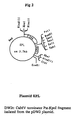
- the E. coli phosphomannose isomerase (EC 5.3.2.8) gene originates from plasmid pGS63 (Miles, H. et al. Gene 32, pp41-48 (1984)) ( Figure 1 ), a construction derived from pBR322, in which the region between the unique PstI and HindIII sites has been replaced by a section of the E. coli chromosome bearing the structural gene (man A) for phosphomannose isomerase and a fragment of the adjacent gene for fumarase (fum A).
- pGS63 has therefore lost a portion of the ⁇ -lactamase gene and has to be selected on tetracycline.
- the PstI/BamHI fragment (2466 bp) containing the entire PstI/HindIII chromosomal fragment and a 357 bp section of pBR322 was ligated into the multiple cloning site of pUC18 to form pDO18 (see Figure 1 ).
- pDO18 is digested with HindIII and the resultant recessed 3' termini are filled using Klenow polymerase.
- the open DO18 plasmid with the filled HindIII site (HindIII*) (See Figure 1 ) is digested with BcII and the 1218 bp BcII-HindIII* fragment containing the coding region of phosphomannose isomerase is cloned into the plasmid pEnhanced-Peter-Linker (pEPL). which was first digested with SmaI and then with BamHI. The resultant plasmid is called p(EPL-mannose).
- pEPL is constructed from pCaMVCN (Fromm et al. Proc. Natl. Acad. Sci. USA 82, p5824 (1985); Fromm et al. Nature 319, p791 (1986)) in which the CAT gene is removed by a PstI digestion.
- a small linker (linker: PstI-BamHI-BalI-PstI) is inserted into this plasmid PstI site, giving the plasmid called pLise(pL).
- pEL pEnhanced-Lise
- pEL differs essentially from pCaMVCN in that it contains a variant 35S promoter with a tandem duplication of the 250 bP of the upstream sequence of the promoter.
- the variant 35S promoter has a transcriptional activity approximately ten times higher than the natural 35S promoter (Kay et al. Science 236. pp. 1299-1302 (1987)).
- pEL is digested with PstI and BgIII, thereby removing the NOS terminator, and a CaMV terminator (DW2t) is inserted instead Finally, a linker (PstI-BamHI-SmaI-SacI-SacII-SphI) is inserted into the PstI site situated between the enhanced promoter and the CaMV terminator.
- This plasmid is called pEPL (see Figure 2 ).
- pfEPL-mannose is digested with HindIII in order to isolate the fragment containing the entire enhanced 355 promoter, the coding region of E. coli phosphomannose isomerase and the CaMV terminator.
- the isolated fragment is cloned into the HindIII site of the binary vector pBKL4 ( Figure 4 ).
- the resulting plasmid is termed p(BKL-mannose).
- the HindIII site in pBKL4 is situated between a kanamycin resistance gene and the ⁇ -glucuronidase (GUS) gene (see Figure 3 ).
- GUS ⁇ -glucuronidase
- the mannose chimeric gene, the kanamycin resistant gene (NPT II) and the GUS gene each have a promoter and terminator.
- Figure 4 shows the p(BKL-mannose) construction containing the chimeric phosphomarmose isomerase gene inserted between the GUS and the NPTII gene of plasmid
- the construct p(BKL-mannose) is isolated from E . coli and transformed into the Agrobaclerium rumefaciens strain LBA4404 which contains the disarmed helper plasmid pAL4404 (Hoekema, et al. Nature, 303 , pp. 179-180 (1983); Ooms et al . Plasmid 7 , pp. 15-29 (1982)) by the freeze thaw methods (Holsters et al. , Mol. Gen. Genet 163 , 181-187 (1978)).
- Co-cultivation - plates contain LS substrate (sucrose 30 g/l), agar (8 g/l). 2,4-dichlorophenoxyacetic acid (2.0 mg/l) and trans-zearin (0.5 mg/l).
- LS-substrate containing Agrobacterium tumefaciens transformed so that it contains a binary vector comprising genes which it is intended should be incorporated into the potato cells.
- genes include, for example, those encoding ⁇ -glucuronidase (GUS), the NPT II gene providing resistance to the antibiotic kanamycin and/or genes encoding proteins involved in mannose metabolism for example mannose 6 phosphate isomerase, mannose epimerases, phosphomannomutases etc. (see below).
- the Agrobacterium are cultured over-night in YMB-substrate (dipotassiumhydrogenphosphate (trihydrate) (0.66 g/l); magnesium sulphate (heptahydrate) (0.20 g/l); sodium chloride (0.10 g/l); mannitol (10.0 g/l); and yeast extract 0.40 g/l) containing appropriate antibiotics (corresponding to the resistance gene of the Agrobacterium strain) to an optical density at 660 nm (OD-660) of approx, 0.8.
- YMB-substrate dipotassiumhydrogenphosphate (trihydrate) (0.66 g/l); magnesium sulphate (heptahydrate) (0.20 g/l); sodium chloride (0.10 g/l); mannitol (10.0 g/l); and yeast extract 0.40 g/l) containing appropriate antibiotics (corresponding to the resistance gene of the Agrobacterium strain) to an optical density at 660 nm (OD-660) of approx
- internodal segments are then incubated in the suspension of the resuspended Agrobacterium for about 30 minutes, and then the excess of bacteria is removed from the segments by blotting them onto sterile fiber paper.
- the shoot segments are co-cultured with bacteria for 72 hours on filter paper on LS-substrate (as defined above) in petri-dishes covered with white paper tissues.
- This substrate is referred to hereafter as "co-cultivation substrate”.
- the substrate and segments are covered with sterile filter papers, and the petri dishes are placed at 25°C and subjected to cycles of 16h light/ 8h dark.
- the shoot segments are transferred to LS-medium supplemented with 800 mg/l carbenicillin.
- the thus transferred segments are then gently shaken to dislodge or destroy adherent Agrobacterium.
- the thus washed segments are then transferred to LS-substrate (as above) except that the trans-zeatin concentration was 1 mg/l, and the substrate is supplemented with gibberellic acid (0.1 mg/l) and carbenicillin (800 mg/l), and optionally kanamycin sulphate (50 mg/l) and/or mannose (0 - 20g/l) and/or sucrose (0 - 20 g/l).
- This substrate is referred to herafter as "selection/regeneration substrate".
- the segments are sub-cultured onto fresh substrate at fortnightly intervals or as described below. Within 2 to 4 weeks, shoots developed from the segments and the formation of new shoots continues for about 3-4 months.
- the regenerated shoots are transferred to rooting substrate composed of LS-substrate supplemented with carbenicillin (500 mg/l).
- the newly rooted regenerated shoots (plants) (height approx. 2-3 cm) are transplanted from rooting substrate to soil and placed in a growth chamber at 21°C having a 16 hour light/8 hour dark cycle and 200-400 E/sqm/sec- When the plants are sufficiently well established they are transferred to a greenhouse, where they are grown until tubers develop and the upper part of the plants exhibit senescence.
- the transgenic genotypes of the regenerated shoot are verified:
- Regenerated plants are produced as described above, except that the shoot segments are not co-cultured with bacteria and the washing procedure consequential thereon is omitted.
- the number of regenerated shoots is determined up to the 40th day from the start of experiment.
- Table 1 shows the inhibition by mannose of the regeneration of shoots from potato stem segments which had not been transformed with Agrobacrerium. It can be seen from Table 1 that mannose effectively inhibits regeneration of such shoots, and that sucrose promotes such regeneration.
- mannose cannot be used as a carbohydrate source in most plant species. When mannose is added to plants it is metabolized and mannose 6-phosphate accumulates.
- Mannose 6-phosphate can be converted to fructose 6 phosphate by mannose 6 phosphate isomerase, the amount converted being dependent on the activity of the isomerase.
- Such fructose 6 phosphate may be utilized by plants, but in principal high levels of mannose (whether or not an alternative carbohydrate source is available) are toxic to plants.
- shoot formation is totally inhibited when the mannose concentration is 5-10g/l, irrespective of the availability of sucrose, even when that is present in high concentrations.
- Table 1 Inhibition by mannose of the regeneration of shoots from non-transformed potato stem segments.
- Concn (g/l) sucrose Concn (g/l) mannose Regenerated shoots/explant (%) 0 0 0 0 5 0 0 10 0 0 20 0 10 0 50 10 5 3 10 10 0 10 20 0 20 0 53 20 5 0 20 10 0 20 20 0
- Regenerated plants are produced as described above.
- the Agrobacterium with which the shoot segments are co-incubated are transformed with construct p(BKL-mannose) which is obtained as described above, so that the bacteria harbour a vector comprising the genes encoding GUS and mannose 6 phosphate isomerase.
- Transgenic (GUS+) shoots are selected on the basis of their ability to metabolize mannose in the presence of an agent (methyl-3-O-glucose) which reduces the toxicity to the shoots of the mannose.
- GUS+ Transgenic
- Shoots which are GUS+ are selected on the basis of their ability to grow in the presence of mannose at a concentration of about 5g/l.
- a further experiment is performed in which the Agrobacterium which are used to transform the shoot segments harbour a vector similar to p(BKL-mannose) except that it lacks the gene encoding mannose 6 phosphate isomerase.
- a vector comprises the gene encoding NPT II which is capable of rendering cells transformed therewith resistant to kanamycin.
- GUS+ transformants are selected on the basis of their resistance to kanamycin present at a concentration of 50 mg/l. In this latter selection, a lower proportion than in Example 2 of the selected cells are GUS+.
- Example 3 is repeated, except that the Agrobacterium are transformed with p(BKL-mannose) and the GUS+ transformants are selected on the basis of their ability to grow on Kanamycin (50 mg/ml). In this case a lower proportion than in Example 3 of the selected shoots are GUS+.
- Table 2 shows that D-xylose does not inhibit shoot regeneration when sucrose is present and in addition that D-xylose is not utilized as a carbohydrate source. D-xylulose is a good carbohydrate source during shoot regeneration. Table 2. Test of the ability of D-xylose and D-xylulose to function as carbohydrate sources during shoot regeneration from tobacco leaf discs. Xylose g/l Sucrose g/l Xylulose g/l Number of regenerated shoots each leaf disc 0 0 0 0 10 0 0 10 10 0 4.3 0 10 0 2.3 0 0 10 4.1 0 10 10 11.7
- Xylose can be converted to xylulose by xylose isomerase. Accordingly, a functional xylose isomerase gene and a further structural gene under control of appropriate promoters and terminators, are introduced into plants, or parts or cells thereof, and the transformed plants, parts or cells thereof are selected on the basis of their ability to metabolism xylose as a carbohydrate source.
- Explants are produced and treated as described above under "selection of transformed tissue", except that the selection/regeneration substrate was not supplemented with kanamycin or carbenicillin, and that plant tissue is not transformed.
- selection/regeneration substrate was not supplemented with kanamycin or carbenicillin, and that plant tissue is not transformed.
- the only subcultivation step is when the explants are transferred from the co-cultivation substrate to the selection/regeneration substrate which is supplemented with xylose at the concentrations indicated below.
- the number of regenerated shoots is recorded after 12 weeks. Table 3.
- Table 3 shows that D-xylose (compared to D-mannose) is a weak inhibitor of shoot regeneration when sucrose is present and in addition D-xylose does not function as a carbohydrate source in plants which are non-transgenic in respect of a xylose metabolizing enzyme or protein. Moreover, D-xylulose (5 g/l) added to substrates in the absence of sucrose enabled the regeneration of 2.2 shoots per explant after 9 weeks.
- Example 5 is repeated except that the selection/regeneration substrate is supplemented with methyl-3-O-glucose (MOG) at the concentrations indicated in Table 4. The percentage of live explants is registered after 8 weeks.
- MOG methyl-3-O-glucose
- Table 4 shows that co-treatment with MOG inhibits the toxic effects of mannose on sensitive plant tissues. Because mannose is toxic in concentrations which are optimal for compounds which function as carbohydrate sources, the addition of MOG makes it possible to supplement the substrate with optimal carbohydrate concentrations in the form of mannose. This makes it possible to utilize mannose as a positive selection agent, in the absence of other carbohydrate sources. Table 4. Inhibition of the toxicity of mannose by co-treatment with methyl-3-O-glucose (MOG).
- Example 7 is repeated, except that the regeneration /selection substrate contains mannose (15g/l), methyl-3-O-glucose in the concentrations indicated in Table 5, and does not contain sucrose.
- the transformed plant material is transgenic for the mannose 6 phosphate isomerase gene. After 21 days the selected shoots are harvested. All harvested shoots are assayed for the expression the co-introduced ⁇ -glucuronidase gene and the total number (from 2 harvests) of transgenic ⁇ -glucuronidase expressing (GUS+) shoots per explants is calculated as is the fraction of the ⁇ -glucuronidase expressing (GUS+) shoots among the total number of shoots selected (Table 5.).
- Table 5 shows that when mannose is added together with methyl-3-O-glucose, selection of transgenic shoots is possible even at high concentrations of mannose, in the absence of other carbohydrate sources. Table 5. The effect of methyl-3-O-glucose on the selection of transgenic shoots on mannose containing substrates without sucrose. Mannose (g/l) 15 15 15 15 15 15 MOG (g/l) 0 2.5 5.0 10 15 GUS+ shoots/explant 0 0.2 1.0 0.5 0.6 GUS+ shoots/ sel. shoots (%) 0 57 81 89 53
- Example 8 is repeated except that MOG is substituted by phloridzin.
- Table 6 shows that when mannose is added together with phloridzin selection of 100% transgenic shoots is possible at high concentrations of mannose in the absence of other carbohydrate sources. This is an example of how cross feeding and the production of escapers can be minimized by the addition of a carbohydrate transport inhibitor.
- Table 6 0.5 g/l Phloridzin g/l Mannose GUS+ Shoots/Sel. Shoots GUS+ Shoots/Expl.
- Table 7 indicates that compounds other than mannose may be used as selection agents in transgenic plant tissue which comprises, inter alia, the mannose 6- phosphate isomerasse gene from E. coli. Table 7. No. of regenerated shoots per explant selected by compounds in addition to mannose. Number of regenerated shoots per explant Compound Genotype Wild type M-6-P-isomerase D-mannose 0 1.1 D-mannosamine 0 0.8 D-mannose-6-phosphate 0 0.7
- Sugar beet is transformed by the so-called cot-pet method as described in PCT Patent Application No. PCT/DK92/00108 wherein cotyledons including the petiole are used as explants. Seedlings are derived from seeds germinated and grown for 4-7 weeks at 12°C in a 16h day/8h night regime. Cotyledons are excised 2-3mm below the node, tawn apart and cultured either in the dark or in light and in the presence or absence of xylose.
- Table 8 shows that xylose is utilized as a carbohydrate source by sugar beet in the presence of light but not in the dark indicating that xylose based positive selection of sugar beet which are transgenic inter alia for the xylose isomerase gene should be carried out in the dark.
- Explants transgenic, inter alia, for the mannose 6 phosphate isomerase gene are produced, and the selection/regeneration substrate is supplemented with mannose and sucrose as indicated in Table 9.
- the number of regenerated shoots is registered after 11 weeks.
- Table 9 shows the number of regenerated shoots on substrates containing methyl-3-0-glucose as a percentage of the number of shoots regenerated on substrates without mannose and methyl-3-O-glucose.
- tissue specific expression of a gene encoding an enzyme involved in mannose or xylose metabolism, or the metabolism of a mannose or xylose derivative or a mannose or xylose pre-cursor may be used to control developmental regulation of such tissues upon exposure thereof to the substrate of modulator of the said enzyme.
- mannose or xylose including derivatives or precursors thereof
Landscapes
- Health & Medical Sciences (AREA)
- Life Sciences & Earth Sciences (AREA)
- Chemical & Material Sciences (AREA)
- Genetics & Genomics (AREA)
- Engineering & Computer Science (AREA)
- Organic Chemistry (AREA)
- Biotechnology (AREA)
- Zoology (AREA)
- Bioinformatics & Cheminformatics (AREA)
- Wood Science & Technology (AREA)
- Molecular Biology (AREA)
- Biomedical Technology (AREA)
- Biochemistry (AREA)
- General Health & Medical Sciences (AREA)
- General Engineering & Computer Science (AREA)
- Microbiology (AREA)
- Physics & Mathematics (AREA)
- Biophysics (AREA)
- Cell Biology (AREA)
- Plant Pathology (AREA)
- Nutrition Science (AREA)
- Medicinal Chemistry (AREA)
- Botany (AREA)
- Micro-Organisms Or Cultivation Processes Thereof (AREA)
- Breeding Of Plants And Reproduction By Means Of Culturing (AREA)
- Enzymes And Modification Thereof (AREA)
- Saccharide Compounds (AREA)
- Polysaccharides And Polysaccharide Derivatives (AREA)
- Measuring Or Testing Involving Enzymes Or Micro-Organisms (AREA)
- Preparation Of Compounds By Using Micro-Organisms (AREA)
- Pharmaceuticals Containing Other Organic And Inorganic Compounds (AREA)
- Feedback Control In General (AREA)
- Semiconductor Lasers (AREA)
- Led Devices (AREA)
- Nitrogen Condensed Heterocyclic Rings (AREA)
Claims (26)
- Méthode d'identification ou de sélection dans une population de cellules végétales choisie dans le groupe constitué de fruits, de céréales à petits grains, de légumes, de colza, de tournesol, de tabac, de betterave, de maïs et de coton, mises en culture sur ou dans un milieu contenant au moins un composé, de cellules qui ont un avantage métabolique en résultat du fait d'avoir été transformées, dans laquelle :i. les cellules sont transformées avec une séquence nucléotidique ou une séquence nucléotidique co-introduite dont l'une comprend une région qui code pour une protéine enzymatique qui est impliquée dans le métabolisme du composé, choisie dans le groupe constitué des phosphosucre-isomérases, des phosphosucre-mutases, des phosphatases, et des sucre-épimérases ;ii. le composé est le mannose ou le xylose ou un dérivé ou un précurseur de ceux-ci, ou un substrat de la protéine enzymatique impliquée, soit directement soit indirectement, dans le métabolisme du mannose ou du xylose ;iii. on ajoute un agent qui réduit la toxicité pour les cellules du composé.
- Méthode d'identification ou de sélection dans une population de cellules végétales choisie dans le groupe constitué de fruits, de céréales à petits grains, de légumes, de colza, de tournesol, de tabac, de betterave, de maïs et de coton, mises en culture sur ou dans un milieu contenant au moins un composé, de cellules qui ont un avantage métabolique en résultat du fait d'avoir été transformées, dans laquelle :i. les cellules sont transformées avec une séquence nucléotidique ou une séquence nucléotidique co-introduite dont l'une comprend une région qui code pour une protéine enzymatique qui est impliquée dans le métabolisme du composé, choisie dans le groupe constitué des phosphosucre-isomérases, des phosphosucre-mutases, des phosphatases, et des sucre-épimérases ;ii. le composé est le mannose ou le xylose ou un dérivé ou un précurseur de ceux-ci, ou un substrat de la protéine enzymatique impliquée, soit directement soit indirectement, dans le métabolisme du mannose ou du xylose, à condition que le composé ne soit pas le mannose lorsque la protéine est la mannose-6-phosphate isomérase.
- Méthode selon l'une quelconque des revendications 1 ou 2, dans laquelle au moins l'une des séquences nucléotidiques comprend l'ADN qui est modifié en ce que les codons qui sont préférés par l'organisme dans lequel les séquences ont été insérées sont utilisés de sorte que l'expression de l'ADN ainsi modifié dans ledit organisme produise une protéine enzymatique sensiblement similaire à celle obtenue par l'expression de l'ADN non modifié dans l'organisme dans lequel les composants codant pour la protéine enzymatique des séquences sont endogènes.
- Méthode selon l'une quelconque des revendications 1 à 3, dans laquelle les cellules ont été transformées avec une séquence nucléotidique contenant des séquences régulatrices permettant l'expression de la séquence nucléotidique.
- Méthode selon la revendication 4, dans laquelle les séquences régulatrices sont des promoteurs et des terminateurs de transcription.
- Méthode selon la revendication 5, dans laquelle les cellules ont été transformées avec une séquence nucléotidique codant pour un promoteur exogène qui est susceptible de recombinaison homologue avec une séquence d'ADN dans ou à proximité d'un gène structurel susceptible d'être contrôlé par ledit promoteur.
- Méthode selon l'une quelconque des revendications 5 ou 6, dans laquelle le promoteur est un promoteur constitutif.
- Méthode selon l'une quelconque des revendications 5 ou 6, dans laquelle le promoteur est un promoteur pouvant être régulé.
- Méthode selon l'une quelconque des revendications 1 à 8, dans laquelle les séquences nucléotidiques sont co-introduites dans les cellules végétales.
- Méthode selon l'une quelconque des revendications 1 à 8, dans laquelle les séquences nucléotidiques sont introduites indépendamment dans les cellules végétales.
- Méthode selon l'une quelconque des revendications 9 ou 10, dans laquelle au moins l'une des séquences nucléotidiques co-introduites ou indépendamment introduites confère la résistance virale, fongique, bactérienne ou aux nématodes.
- Méthode selon l'une quelconque des revendications 1 à 11, dans laquelle le composé est le mannose.
- Méthode selon l'une quelconque des revendications 1 à 12, dans laquelle le composé est le mannose et le nucléotide ou la séquence nucléotidique co-introduite code pour la mannose-6-phosphate isomérase.
- Méthode selon l'une quelconque des revendications 1 à 11, dans laquelle le composé est le mannose-6-phosphate, le xylose, ou le D-mannose amine.
- Méthode selon la revendication 14, dans laquelle le composé est le xylose.
- Méthode selon la revendication 15, dans laquelle l'enzyme est la xylose isomérase.
- Méthode selon l'une quelconque des revendications 1 à 11, dans laquelle la phosphosucre mutase est la phosphomanno-mutase et la phosphatase est la mannose-6-phosphatase.
- Méthode selon l'une quelconque des revendications 1 à 17, dans laquelle les cellules végétales sont transformées par une méthode choisie dans le groupe constitué de l'électroporation, la micro-injection, l'utilisation du canon à micro-projectiles, et la transformation avec les plasmides Ri et Ti.
- Méthode selon la revendication 18, dans laquelle les cellules végétales sont transformées en utilisant une espèce Agrobacterium.
- Méthode selon l'une quelconque des revendications 1 à 19, dans laquelle les cellules transformées sont choisies en utilisant une combinaison de sélection positive et de sélection négative, la séquence nucléotidique dans les cellules transformées étant co-introduite avec une autre séquence nucléotidique codant pour la résistance à au moins un membre choisi dans le groupe constitué de toxines, d'antibiotiques et d'herbicides, et le milieu dans ou sur lequel les cellules sont mises en culture comprenant au moins un membre choisi dans le groupe constitué de toxines, d'antibiotiques et d'herbicides contre lesquels les cellules transformées sont rendues résistantes.
- Méthode selon la revendication 20, dans laquelle la séquence nucléotidique est co-introduite avec au moins deux gènes de sélection différents.
- Méthode selon l'une quelconque des revendications 1 et 3 à 21, dans laquelle l'agent de réduction de la toxicité est choisi dans le groupe constitué de méthyl-3-O-glucose et de phloridzin.
- Méthode selon l'une quelconque des revendications 1 à 22, dans laquelle les cellules végétales sont issues de tomates, de mangues, de pêches, de pommes, de poires, de fraises, de bananes, et de melons.
- Méthode selon l'une quelconque des revendications 1 à 22, dans laquelle les cellules végétales sont issues d'une plante choisie dans le groupe constitué de colza, de tournesol, de tabac, de betterave, de maïs et de coton.
- Méthode selon l'une quelconque des revendications 1 à 22, dans laquelle les cellules végétales sont issues d'une plante choisie dans le groupe constitué du blé, de l'orge, et du riz.
- Méthode selon l'une quelconque des revendications 1 à 22, dans laquelle les cellules végétales sont issues d'une plante choisie dans le groupe constitué de la pomme de terre, de la carotte, de la laitue, du chou et de l'oignon.
Priority Applications (1)
| Application Number | Priority Date | Filing Date | Title |
|---|---|---|---|
| DE69434744T DE69434744T3 (de) | 1993-03-02 | 1994-02-28 | Positive selektion auf mannose oder xylose basierend |
Applications Claiming Priority (3)
| Application Number | Priority Date | Filing Date | Title |
|---|---|---|---|
| GB939304200A GB9304200D0 (en) | 1993-03-02 | 1993-03-02 | Improvements in or relating to organic compounds |
| GB9304200 | 1993-03-02 | ||
| PCT/EP1994/000575 WO1994020627A1 (fr) | 1993-03-02 | 1994-02-28 | Selection positive a base de mannose ou de xylose |
Publications (3)
| Publication Number | Publication Date |
|---|---|
| EP0804599A1 EP0804599A1 (fr) | 1997-11-05 |
| EP0804599B1 EP0804599B1 (fr) | 2006-05-24 |
| EP0804599B2 true EP0804599B2 (fr) | 2012-10-10 |
Family
ID=10731298
Family Applications (1)
| Application Number | Title | Priority Date | Filing Date |
|---|---|---|---|
| EP94909084A Expired - Lifetime EP0804599B2 (fr) | 1993-03-02 | 1994-02-28 | Selection positive a base de mannose ou de xylose |
Country Status (15)
| Country | Link |
|---|---|
| US (1) | US5767378A (fr) |
| EP (1) | EP0804599B2 (fr) |
| JP (3) | JP3698722B2 (fr) |
| AT (1) | ATE327336T1 (fr) |
| AU (1) | AU682495B2 (fr) |
| CA (1) | CA2157470C (fr) |
| DE (1) | DE69434744T3 (fr) |
| DK (1) | DK0804599T3 (fr) |
| ES (1) | ES2265144T3 (fr) |
| GB (1) | GB9304200D0 (fr) |
| HU (1) | HU225771B1 (fr) |
| SK (1) | SK285107B6 (fr) |
| UA (1) | UA57696C2 (fr) |
| WO (1) | WO1994020627A1 (fr) |
| ZA (1) | ZA941467B (fr) |
Families Citing this family (173)
| Publication number | Priority date | Publication date | Assignee | Title |
|---|---|---|---|---|
| MX9707666A (es) * | 1995-04-06 | 1997-11-29 | Seminis Vegetables | Proceso de seleccion de celulas de planta transgenica. |
| GB9702592D0 (en) * | 1997-02-07 | 1997-03-26 | Danisco | Selection method |
| EP0870836A1 (fr) | 1997-04-09 | 1998-10-14 | IPK Gatersleben | Séquences d'ADN codant pour 2-Deoxyglucose-6-Phosphate (2-DOG-6-P) Phosphatase comme marqueur de sélection en plantes |
| US6075134A (en) * | 1997-05-15 | 2000-06-13 | The Regents Of The University Of California | Glycoconjugates and methods |
| US6586661B1 (en) | 1997-06-12 | 2003-07-01 | North Carolina State University | Regulation of quinolate phosphoribosyl transferase expression by transformation with a tobacco quinolate phosphoribosyl transferase nucleic acid |
| US6391547B1 (en) * | 1997-09-09 | 2002-05-21 | Center For The Application Of Molecular Biology To International Agriculture | Microbial β-glucuronidase genes, gene products and uses thereof |
| US7087420B1 (en) | 1997-07-17 | 2006-08-08 | Cambia | Microbial β-glucuronidase genes, gene products and uses thereof |
| WO1999014331A2 (fr) | 1997-09-16 | 1999-03-25 | Cropdesign Nv | Inhibiteurs de la kinase cycline-dependante et utilisations de ceux-ci |
| AR020078A1 (es) | 1998-05-26 | 2002-04-10 | Syngenta Participations Ag | Metodo para alterar la expresion de un gen objetivo en una celula de planta |
| GB9817465D0 (en) * | 1998-08-11 | 1998-10-07 | Danisco | Selection method |
| DK1131450T3 (da) | 1998-11-12 | 2012-05-14 | Max Planck Gesellschaft | Kimære promotorer, der kan formidle genekspression i planter ved patogeninfektion, og anvendelser heraf |
| DE19926216A1 (de) * | 1999-06-09 | 2001-02-22 | Metallgesellschaft Ag | Verfahren zur Herstellung von Bariumsulfat, Bariumsulfat und Verwendung des Bariumsulfats |
| EP1255846B1 (fr) * | 2000-02-11 | 2010-01-06 | Metabolix, Inc. | Constructions a expression de genes mutiples contenant des inteines modifiees |
| US7005561B2 (en) | 2000-03-08 | 2006-02-28 | University Of Georgia Research Foundation, Inc. | Arabitol or ribitol as positive selectable markers |
| AU2001240117A1 (en) * | 2000-03-08 | 2001-09-17 | Univ. Of Georgia Research Foundation, Inc. | Arabitol or ribitol as positive selectable markers |
| CA2404900A1 (fr) | 2000-04-21 | 2001-11-01 | Martek Biosciences Corporation | Conversion trophique d'algues phototrophiques obligatoires, par l'intermediaire d'une ingenierie metabolique |
| EP1780283A1 (fr) * | 2000-04-21 | 2007-05-02 | Martek Biosciences Corporation | Conversion trophique d'algues phototropiques obligatoires, par l'intermediaire d'une ingenièrie métabolique |
| US7256050B2 (en) | 2000-06-16 | 2007-08-14 | Martek Biosciences Corp. | High fluorescent intensity cross-linked allophycocyanin |
| CN1452660A (zh) | 2000-08-11 | 2003-10-29 | 辛根塔参与股份公司 | 植物稳定转化的方法 |
| WO2002018607A2 (fr) | 2000-08-30 | 2002-03-07 | North Carolina State University | Plantes transgeniques contenant des leurres moleculaires qui modifient la teneur en proteines |
| EP1368467B1 (fr) | 2000-11-07 | 2007-04-25 | North Carolina State University | Promoteur de la putrescine-n-m thyltransf rase |
| ES2340915T3 (es) * | 2000-11-17 | 2010-06-11 | Metabolix, Inc. | Produccion de polihidroxialcanoatos de longitud media de cadena por caminos de biosintesis de acidos grasos. |
| SG132542A1 (en) * | 2001-06-08 | 2007-06-28 | Vector Tobacco Ltd | Modifying nicotine and nitrosamine levels in tobacco |
| US20060157072A1 (en) * | 2001-06-08 | 2006-07-20 | Anthony Albino | Method of reducing the harmful effects of orally or transdermally delivered nicotine |
| EP1925672A1 (fr) | 2001-06-22 | 2008-05-28 | Syngeta Participations AG | Polynucléotides et polypeptides sensibles au stress abiotique |
| NL1019308C2 (nl) | 2001-11-06 | 2003-05-07 | Stichting Tech Wetenschapp | Werkwijze voor het selecteren van genetisch getransformeerde cellen. |
| ATE539084T1 (de) | 2001-11-07 | 2012-01-15 | Syngenta Participations Ag | Promotoren zur regulierung der genexpression in pflanzenwurzeln |
| US7534934B2 (en) * | 2002-02-20 | 2009-05-19 | J.R. Simplot Company | Precise breeding |
| AU2003219806B8 (en) * | 2002-02-20 | 2011-01-27 | J.R. Simplot Company | Precise breeding |
| ES2537649T3 (es) * | 2002-02-26 | 2015-06-10 | Syngenta Limited | Método para producir selectivamente plantas estériles masculinas o femeninas |
| CA2481167A1 (fr) * | 2002-04-09 | 2003-10-23 | Vector Tobacco Ltd. | Tabac presentant une teneur en nicotine et en nitrosamines reduite |
| DE60230071D1 (de) | 2002-06-14 | 2009-01-08 | Monier Tadros | Methode für die herstellung von protamin |
| DK1521835T3 (da) | 2002-07-09 | 2010-07-05 | Basf Plant Science Gmbh | Anvendelse af AHAS mutantgener som selektionsmarkør ved transformation af kartofler |
| AU2003303589B2 (en) | 2002-12-26 | 2008-04-24 | Syngenta Participations Ag | Cell proliferation-related polypeptides and uses therefor |
| US8076459B2 (en) | 2003-10-16 | 2011-12-13 | Micromet Ag | Multispecfic deimmunized CD3-binders |
| CA2542574C (fr) | 2003-11-12 | 2014-03-18 | E. I. Du Pont De Nemours And Company | Delta-15 desaturases appropriees pour modifier les niveaux d'acides gras polyinsatures dans des plantes a graines oleagineuses et de la levure oleagineuse |
| CA2545550A1 (fr) | 2003-12-02 | 2005-06-16 | Basf Aktiengesellschaft | 2-methyl-6-solanylbenzoquinone methyltransferase utilisee comme cible pour des herbicides |
| CA2871472C (fr) | 2003-12-16 | 2017-08-08 | Pioneer Hi-Bred International, Inc. | Transgenes de suppression de gene dominant et leurs procedes d'utilisation |
| US20070169227A1 (en) | 2003-12-16 | 2007-07-19 | Pioneer Hi-Bred International Inc. | Dominant Gene Suppression Transgenes and Methods of Using Same |
| CN1950510B (zh) | 2004-03-08 | 2011-10-05 | 先正达合作有限公司 | 富含谷氨酰胺的玉米种子蛋白质和启动子 |
| UA94893C2 (ru) | 2004-03-25 | 2011-06-25 | Сингента Партисипейшнс Аг | Трансгенное растение кукурузы mir604 |
| WO2006071645A2 (fr) | 2004-12-23 | 2006-07-06 | Nonomura Arthur M | Compositions et procedes pour limiter la transpiration vegetale |
| WO2006101983A2 (fr) | 2005-03-16 | 2006-09-28 | Metabolix, Inc. | Expression inductible chimiquement de voies biosynthetiques |
| CA2636070A1 (fr) | 2006-01-06 | 2007-08-02 | North Carolina State University | Plantes transgeniques resistant au nematode des racines |
| JP2009523021A (ja) * | 2006-01-12 | 2009-06-18 | アヴェスタゲン リミテッド | 陽性選択に基づくヒマワリおよび脂肪種子の新規で効果的な形質転換法 |
| CA2641868A1 (fr) * | 2006-02-09 | 2007-08-16 | Avesthagen Limited | Procede de selection et de regeneration de brassica juncea transgenique sur du xylose |
| CN106222185B (zh) | 2006-08-04 | 2021-12-03 | 维莱尼姆公司 | 葡聚糖酶、编码它们的核酸及制备和使用它们的方法 |
| US8877478B2 (en) | 2006-09-21 | 2014-11-04 | Verenium Corporation | Phytases, nucleic acids encoding them and methods for making and using them |
| PL3101128T3 (pl) | 2006-12-21 | 2019-09-30 | Basf Enzymes Llc | Amylazy i glukoamylazy, kwasy nukleinowe kodujące te związki oraz sposoby wytwarzania tych związków oraz stosowania ich |
| WO2008119567A2 (fr) | 2007-04-03 | 2008-10-09 | Micromet Ag | Domaine de liaison spécifique d'espèces croisées |
| WO2008119565A2 (fr) | 2007-04-03 | 2008-10-09 | Micromet Ag | Domaine de liaison spécifique d'espèces croisées |
| CA2584934A1 (fr) | 2007-04-17 | 2008-10-17 | University Of Guelph | Gene et proteine de detection de sucre regules par l'azote et modulation associee |
| KR20100031700A (ko) | 2007-06-01 | 2010-03-24 | 사파이어 에너지, 인크. | 유전적으로 변형된 광합성 생물들의 고처리량 스크리닝 |
| AU2008299020A1 (en) | 2007-09-11 | 2009-03-19 | Sapphire Energy, Inc. | Molecule production by photosynthetic organisms |
| US8314222B2 (en) | 2007-10-05 | 2012-11-20 | Sapphire Energy, Inc. | System for capturing and modifying large pieces of genomic DNA and constructing organisms with chloroplasts |
| CA2704271C (fr) | 2007-12-03 | 2016-07-19 | Syngenta Participations Ag | Construction de phytases enzymatiquement sensibles |
| US8487159B2 (en) * | 2008-04-28 | 2013-07-16 | Metabolix, Inc. | Production of polyhydroxybutyrate in switchgrass |
| EP2664668A1 (fr) | 2008-06-27 | 2013-11-20 | Sapphire Energy, Inc. | Induction de floculation dans des organismes photosynthétiques |
| MX2011003502A (es) | 2008-10-01 | 2011-09-01 | Micromet Ag | Anticuerpo de cadena sencilla biespecifica de psmaxcd3 especifico a traves de especies. |
| AU2009299794B2 (en) | 2008-10-01 | 2015-08-13 | Amgen Research (Munich) Gmbh | Cross-species-specific single domain bispecific single chain antibody |
| BRPI0922656A2 (pt) | 2008-12-16 | 2015-08-04 | Syngenta Participations Ag | Semente de uma planta de milho transgênica, planta de milho transgênica, células e tecidos desta, molécula de ácido nucléico, amplicos, par de iniciadores de polinucleotídeos, método e kit de detecção da presença de uma molécula de ácido nucléico, molécula de dna, método para confirmar a ausência de uma molécula de ácido nucléico, amostra biológica e extrato derivados de planta, tecido, semente ou célula de milho do evento 5307, métodos de reprodução de uma planta de milho, de seleção auxiliada por marcadores para uma característica resistente a insetos em milho, e de produção de plantas de milho híbridas resistentes a insetos coleópteros, semente e plantas de milho híbridas, sítio-alvo de cromossomo de milho, e método de preparação de uma planta de milho transgênica |
| US7868688B2 (en) * | 2008-12-30 | 2011-01-11 | Cosmic Circuits Private Limited | Leakage independent very low bandwith current filter |
| CN101768213B (zh) | 2008-12-30 | 2012-05-30 | 中国科学院遗传与发育生物学研究所 | 一种与植物分蘖数目相关的蛋白及其编码基因与应用 |
| EP3156489B1 (fr) | 2009-01-22 | 2019-03-06 | Syngenta Participations Ag | Polypeptides de hydroxyphénylpyruvate dioxygénase mutante et procédés d'utilisation |
| MX2011007889A (es) | 2009-02-06 | 2011-08-15 | Syngenta Participations Ag | Modificacion de enzima multidominio para la expresion en plantas. |
| CN101817879A (zh) | 2009-02-26 | 2010-09-01 | 中国科学院遗传与发育生物学研究所 | 金属硫蛋白及其编码基因与应用 |
| WO2010102293A1 (fr) | 2009-03-06 | 2010-09-10 | Metabolix, Inc. | Méthode de sélection positive de plantes au moyen de la sorbitol déshydrogénase |
| HUE030948T2 (en) | 2009-05-21 | 2017-06-28 | Basf Enzymes Llc | Phytases, nucleic acids and processes encoding them for their production and use |
| AU2010326672A1 (en) | 2009-07-10 | 2011-08-04 | Syngenta Participations Ag | Novel hydroxyphenylpyruvate dioxygenase polypeptides and methods of use |
| EP2477477A1 (fr) | 2009-09-15 | 2012-07-25 | Metabolix, Inc. | Génération d'oléagineux produisant des taux élevés de polyhydroxybutrate |
| BR112012009381A2 (pt) | 2009-10-02 | 2017-03-01 | Syngenta Participations Ag | "proteínas inseticidas" |
| TWI653333B (zh) | 2010-04-01 | 2019-03-11 | 安進研究(慕尼黑)有限責任公司 | 跨物種專一性之PSMAxCD3雙專一性單鏈抗體 |
| UA111592C2 (uk) | 2010-07-07 | 2016-05-25 | Сінгента Партісіпейшнс Аг | Спосіб контролю над твердокрилими комахами-шкідниками |
| WO2012008748A2 (fr) * | 2010-07-14 | 2012-01-19 | 건국대학교 산학협력단 | Mannose 6-phosphate isomérase mutante issue de geobacillus thermodenitrificans et procédé de production de l-ribose à l'aide de celui-ci |
| US20120060413A1 (en) | 2010-09-15 | 2012-03-15 | Metabolix, Inc. | Increasing carbon flow for polyhydroxybutyrate production in biomass crops |
| EP2431471A1 (fr) | 2010-09-17 | 2012-03-21 | Université Catholique De Louvain | Procédés pour augmenter la taille des plantes ou organes de plantes |
| CA2820706C (fr) | 2010-12-03 | 2018-05-22 | Ms Technologies, Llc | Expression optimisee de molecules d'acide nucleique codant pour la resistance au glyphosate dans cellules vegetales |
| AR083029A1 (es) | 2010-12-09 | 2013-01-23 | Syngenta Participations Ag | Metodos y composiciones que utilizan arn interferente pequeño (arnip) para el control de nematodos en plantas |
| ES2461896B1 (es) | 2010-12-21 | 2015-03-18 | Centro De Investigación Y De Estudios Avanzados Del Instituto Politécnico Nacional | Métodos para obtener plantas resistentes a sequía |
| EP2697378A4 (fr) | 2011-04-11 | 2014-10-01 | Targeted Growth Inc | Identification et utilisation de mutants de krp dans des plantes |
| BR112013027031B1 (pt) | 2011-04-26 | 2021-02-02 | Syngenta Participations Ag | método para aumentar a frequência de transformação de um tecido de plantas monocotiledôneas, vetor recombinante e ácido nucleico |
| WO2012159891A1 (fr) | 2011-05-20 | 2012-11-29 | Syngenta Participations Ag | Promoteurs de plante spécifiques de l'endoderme et utilisations de ceux-ci |
| WO2013012788A2 (fr) | 2011-07-15 | 2013-01-24 | Syngenta Participations Ag | Procédés d'augmentation de rendement et de tolérance au stress d'une plante |
| BR122020017359B1 (pt) | 2011-07-28 | 2021-10-13 | Syngenta Participations Ag | Método para controle de uma praga de nemátodos |
| AU2012332343A1 (en) | 2011-11-03 | 2014-05-22 | Syngenta Participations Ag | Polynucleotides, polypeptides and methods for enhancing photossimilation in plants |
| US20140182011A1 (en) | 2011-11-03 | 2014-06-26 | The University Of Hong Kong | Methods Using Acyl-Coenzyme A-Binding Proteins to Enchance Drought Tolerance in Genetically Modified Plants |
| EP3783093B1 (fr) | 2011-11-21 | 2025-04-16 | Innovation Hammer LLC | Procédé de photoprotection par utilisation de glycopyranosides exogènes |
| US9506077B2 (en) | 2012-02-01 | 2016-11-29 | Dow Agrosciences Llc | Synthetic chloroplast transit peptides |
| WO2013113615A1 (fr) | 2012-02-03 | 2013-08-08 | F. Hoffmann-La Roche Ag | Molécules d'anticorps bispécifiques avec des lymphocytes t transfectés par un antigène et leur utilisation en médecine |
| BR112014020164B1 (pt) | 2012-02-16 | 2022-09-13 | Syngenta Participations Ag | Polipeptídeo pesticida vip3 manipulado, molécula de ácido nucleico, vetor e composição |
| US9644213B2 (en) | 2012-03-09 | 2017-05-09 | Board Of Trustees Of Michigan State University | Method of enhancing plant drought tolerance by expression of NDR1 |
| WO2013176731A2 (fr) | 2012-05-21 | 2013-11-28 | Nonomura Arthur M | Procédés destinés à rendre sûrs des complexes de coordination micellaire pour le traitement de plantes et formulations associées |
| WO2013184768A1 (fr) | 2012-06-05 | 2013-12-12 | University Of Georgia Research Foundation, Inc. | Compositions et méthodes d'inactivation génique dans les plantes |
| MX349486B (es) | 2012-06-22 | 2017-08-01 | Syngenta Participations Ag | Control biologico de plagas de coleopteros. |
| WO2014028426A1 (fr) | 2012-08-13 | 2014-02-20 | University Of Georgia Research Foundation, Inc. | Compositions et procédés d'amélioration de la résistance des plantes contre les parasites |
| JP2015532124A (ja) | 2012-10-23 | 2015-11-09 | モンタナ ステート ユニバーシティ | アミロース含量が増加した高品質デュラムコムギの生成 |
| WO2014138314A1 (fr) | 2013-03-05 | 2014-09-12 | Baylor College Of Medicine | Virus oncolytique |
| US20160015749A1 (en) | 2013-03-05 | 2016-01-21 | Baylor College Of Medicine | Engager cells for immunotherapy |
| CN105339498A (zh) | 2013-03-07 | 2016-02-17 | 贝勒医学院 | 癌症中靶向cd138 |
| US20160015750A1 (en) | 2013-03-09 | 2016-01-21 | Baylor College Of Medicine | Vascular-targeted t-cell therapy |
| WO2014172584A1 (fr) | 2013-04-17 | 2014-10-23 | Baylor College Of Medicine | Convertisseur de signal tgf-β immunosuppresseur |
| CA2911185C (fr) | 2013-06-11 | 2023-09-05 | Syngenta Participations Ag | Procedes de generation de plantes transgeniques |
| US20140380524A1 (en) | 2013-06-19 | 2014-12-25 | The University Of Hong Kong | Methods of using 3-hydroxy-3-methylglutaryl-coa synthase to enhance growth and/or seed yield of genetically modified plants |
| EP2808338B1 (fr) | 2013-09-16 | 2016-03-30 | CeMM - FORSCHUNGSZENTRUM FÜR MOLEKULARE MEDIZIN GmbH | Calréticuline de mutant pour le diagnostic de tumeurs malignes myéloïdes |
| HUE044975T2 (hu) | 2013-10-29 | 2019-12-30 | Biotech Inst Llc | Speciális kannabisz termesztése, feldolgozása és alkalmazása |
| EP3143143A1 (fr) | 2014-05-15 | 2017-03-22 | CeMM - Forschungszentrum für Molekulare Medizin GmbH | Antagonistes de slc38a9 et leur utilisation en thérapie |
| MA41538A (fr) | 2014-10-17 | 2017-12-26 | Baylor College Medicine | Cellules immunitaires bipartites et tripartites de signalisation |
| EP3795582B1 (fr) | 2014-12-12 | 2023-09-13 | Syngenta Participations Ag | Compositions et procédés permettant de lutter contre les parasites des plantes |
| WO2016100333A1 (fr) | 2014-12-15 | 2016-06-23 | Syngenta Participations Ag | Supports de micro-arn pesticides et leur utilisation |
| MX2017007904A (es) | 2014-12-23 | 2017-09-05 | Syngenta Participations Ag | Control biologico de plagas de coleopteros. |
| JP2018500037A (ja) | 2014-12-31 | 2018-01-11 | シンセティック ジェノミクス インコーポレーテッド | 高効率なインビボゲノム編集のための組成物及び方法 |
| MA41433A (fr) | 2015-01-26 | 2017-12-05 | Baylor College Medicine | Cellules immunitaires universelles pour l'immunothérapie anticancéreuse |
| EP3262064A1 (fr) | 2015-02-23 | 2018-01-03 | Seagull Therapeutics SAS | Sémaphorines 3 non naturelles et leur utilisation médicale |
| WO2016164810A1 (fr) | 2015-04-08 | 2016-10-13 | Metabolix, Inc. | Plantes à rendement amélioré et procédés de construction |
| CN107529787A (zh) | 2015-04-10 | 2018-01-02 | 先正达参股股份有限公司 | 动物饲料组合物及使用方法 |
| WO2016172372A1 (fr) | 2015-04-23 | 2016-10-27 | Baylor College Of Medicine | Sous-ensemble de cellules nkt pour la persistance et l'activité thérapeutique in vivo et propagation de celui-ci |
| AR105155A1 (es) | 2015-07-07 | 2017-09-13 | Syngenta Participations Ag | Composiciones y métodos para controlar plagas de plantas |
| EP3329282B1 (fr) | 2015-07-31 | 2024-05-22 | Misum Biotechnology, Inc. | Qualité de synapse immunologique prédisant l'efficacité de lymphocytes t de type récepteur d'antigène chimérique (car) |
| US20190338302A1 (en) | 2016-02-04 | 2019-11-07 | Yield10 Bioscience, Inc. | Transgenic land plants comprising a putative transporter protein of an edible eukaryotic algae |
| EP3216458A1 (fr) | 2016-03-07 | 2017-09-13 | Max-Planck-Gesellschaft zur Förderung der Wissenschaften e.V. | Facteur de croissance endothéliale vasculaire (vegf-a)modifié et son utilisation médicale |
| AU2017255439B2 (en) | 2016-04-29 | 2019-11-14 | Innovation Hammer Llc | Formulations and methods for treating photosynthetic organisms and enhancing qualities and quantities of yields with glycan composite formulations |
| EP3478722A1 (fr) | 2016-06-30 | 2019-05-08 | F. Hoffmann-La Roche AG | Thérapie adoptive améliorée des t-cell |
| AR109205A1 (es) | 2016-08-05 | 2018-11-07 | Syngenta Participations Ag | Control de plagas de coleópteros utilizando moléculas de arn |
| AR109206A1 (es) | 2016-08-05 | 2018-11-07 | Syngenta Participations Ag | Control de plagas de coleópteros utilizando moléculas de arn |
| RU2765304C2 (ru) | 2016-08-09 | 2022-01-28 | Зингента Партисипейшнс Аг | Инсектицидные белки |
| TW201825511A (zh) | 2016-09-09 | 2018-07-16 | 美商艾斯合顧問有限公司 | 表現免疫檢查點調節子的溶瘤病毒 |
| WO2018076335A1 (fr) | 2016-10-31 | 2018-05-03 | Institute Of Genetics And Developmental Biology, Chinese Academy Of Sciences | Compositions et procédés pour améliorer la tolérance au stress abiotique |
| WO2018083237A1 (fr) | 2016-11-03 | 2018-05-11 | Roche Diagnostics Operations Inc. | Nouveaux anticorps anti-py520-ddr1 |
| WO2018083235A1 (fr) | 2016-11-03 | 2018-05-11 | Roche Diagnostics Gmbh | Nouveaux anticorps anti-py 513 -ddr1 |
| WO2018083240A1 (fr) | 2016-11-03 | 2018-05-11 | Roche Diagnostics Gmbh | Nouveaux anticorps anti-py796-ddr1 |
| WO2018083238A1 (fr) | 2016-11-03 | 2018-05-11 | Roche Diagnostics Gmbh | Nouveaux anticorps anti-py792-ddr1 |
| EP3585149A4 (fr) | 2017-02-22 | 2020-10-28 | Yield10 Bioscience, Inc. | Plantes terrestres transgéniques comprenant des teneurs améliorées en protéine transporteuse mitochondriale |
| SG11201908470UA (en) | 2017-03-13 | 2019-10-30 | Bonumose Llc | Enzymatic production of hexoses |
| SG11201908784TA (en) | 2017-03-27 | 2019-10-30 | Hoffmann La Roche | Improved antigen binding receptor formats |
| CA3056837A1 (fr) | 2017-03-27 | 2018-10-04 | F. Hoffmann-La Roche Ag | Recepteurs de liaison a l'antigene ameliores |
| JP2020518244A (ja) | 2017-05-01 | 2020-06-25 | シンジェンタ パーティシペーションズ アーゲー | 動物飼料組成物及び使用方法 |
| ES3065893T3 (en) | 2017-07-13 | 2026-05-08 | Hoffmann La Roche | New binding agent and assay for pivka |
| AU2018309648B2 (en) | 2017-08-04 | 2024-10-31 | Syngenta Crop Protection Ag | Methods and compositions for targeted genomic insertion |
| EP3691453A4 (fr) | 2017-10-02 | 2021-07-07 | Syngenta Participations AG | Protéines pesticides génétiquement modifiées et procédés de lutte contre les parasites des plantes |
| AR113761A1 (es) | 2017-10-18 | 2020-06-10 | Syngenta Participations Ag | Control de plagas de hemípteros utilizando moléculas de arn |
| WO2019125851A1 (fr) | 2017-12-18 | 2019-06-27 | Syngenta Participations Ag | Sites d'insertion ciblés dans le génome du maïs |
| CA3091431A1 (fr) | 2018-02-26 | 2019-08-29 | Devgen Nv | Lutte contre les insectes nuisibles a l'aide de molecules d'arn |
| BR112020018235A2 (pt) | 2018-03-14 | 2020-12-29 | F. Hoffmann-La Roche Ag | Métodos para gerar uma biblioteca de polinucleotídeos, bibliotecas de polinucleotídeos, uso de uma biblioteca, método para gerar uma biblioteca de anticorpos e método de seleção de um anticorpo |
| CN111971300B (zh) | 2018-03-14 | 2024-10-29 | 豪夫迈·罗氏有限公司 | 新颖的抗-肌钙蛋白t抗体 |
| EP3561053A1 (fr) | 2018-04-26 | 2019-10-30 | Baylor College of Medicine | Cellules effectrices immunes et adaptateurs moléculaires avec un complexe antigène cytokine pour immunothérapie anticancéreuse efficace |
| EP3784784A1 (fr) | 2018-04-27 | 2021-03-03 | Devgen NV | Lutte contre les insectes nuisibles à l'aide de molécules d'arn |
| AU2019335193B2 (en) | 2018-09-04 | 2023-04-20 | Nuseed Nutritional Us Inc. | Genetically engineered land plants that express an increased seed yield protein and/or an increased seed yield RNA |
| EP3867358A1 (fr) | 2018-10-19 | 2021-08-25 | F. Hoffmann-La Roche AG | Facteurs de transcription synergiques pour induire une barrière transendothéliale à haute résistance |
| WO2020167796A1 (fr) * | 2019-02-12 | 2020-08-20 | Bonumose Llc | Production enzymatique de mannose |
| AU2020226376B2 (en) | 2019-02-20 | 2026-02-26 | Syngenta Crop Protection Ag | Engineered pesticidal proteins and methods of controlling plant pests |
| EP3942044A1 (fr) | 2019-03-21 | 2022-01-26 | Devgen NV | Lutte contre les insectes nuisibles à l'aide de molécules d'arn |
| EP3969466A4 (fr) | 2019-05-14 | 2023-01-18 | Yield10 Bioscience, Inc. | Plantes modifiées comprenant un polynucléotide à promoteur non apparenté lié de manière fonctionnelle à une séquence de codage codant pour un facteur de transcription |
| KR20220042367A (ko) | 2019-08-09 | 2022-04-05 | 에프. 호프만-라 로슈 아게 | 신규한 항-트로포닌t 항체 |
| CA3154740A1 (fr) | 2019-09-17 | 2021-03-25 | Beijing Dabeinong Biotechnology Co., Ltd. | Polypeptide mutant d'hydroxyphenylpyruvate dioxygenase, son gene codant et son utilisation |
| WO2022029051A1 (fr) | 2020-08-03 | 2022-02-10 | F. Hoffmann-La Roche Ag | Récepteurs de liaison à l'antigène améliorés |
| AR124562A1 (es) | 2020-10-28 | 2023-04-12 | Hoffmann La Roche | Receptores de unión al antígeno mejorada |
| WO2022093977A1 (fr) | 2020-10-30 | 2022-05-05 | Fortiphyte, Inc. | Résistance aux agents pathogénes chez des plantes |
| CN115336534A (zh) | 2021-05-12 | 2022-11-15 | 北京大北农生物技术有限公司 | 原卟啉原氧化酶的用途 |
| JP2024528631A (ja) | 2021-07-22 | 2024-07-30 | エフ・ホフマン-ラ・ロシュ・アクチェンゲゼルシャフト | ヘテロ二量体Fcドメイン抗体 |
| CA3237616A1 (fr) | 2021-11-25 | 2023-06-01 | F. Hoffmann-La Roche Ag | Recepteurs de liaison a l'antigene ameliores |
| JP7836895B2 (ja) | 2021-12-15 | 2026-03-27 | ベイジン ダーベイノン バイオテクノロジー カンパニー リミテッド | 変異ヒドロキシフェニルピルビン酸ジオキシゲナーゼポリペプチド、ならびにそのコード遺伝子およびその使用 |
| EP4448564A1 (fr) | 2021-12-17 | 2024-10-23 | F. Hoffmann-La Roche AG | Nouvel anticorps pour la détection de l'amyloïde bêta 42 (a-bêta42) |
| WO2023154887A1 (fr) | 2022-02-11 | 2023-08-17 | Northeast Agricultural University | Procédés et compositions pour augmenter la teneur en protéine et/ou en huile et modifier le profil oléagineux chez dans un végétal |
| JP2025512797A (ja) | 2022-03-25 | 2025-04-22 | エフ・ホフマン-ラ・ロシュ・アクチェンゲゼルシャフト | 改善されたキメラ受容体 |
| WO2023206126A1 (fr) | 2022-04-27 | 2023-11-02 | 北京大北农生物技术有限公司 | Utilisation de la protoporphyrinogène oxydase |
| EP4562168A1 (fr) | 2022-07-28 | 2025-06-04 | Institut Pasteur | Hsc70-4 utilisé dans le silençage génique induit par l'hôte et induit par pulvérisation |
| CA3267072A1 (fr) | 2022-09-09 | 2024-03-14 | Friedrich Alexander Universität Erlangen-Nürnberg | Éléments régulateurs chez des plantes et leurs utilisations |
| WO2024158934A1 (fr) | 2023-01-24 | 2024-08-02 | Yale University | Compositions et procédés de régulation du nombre de copies d'adn-t dans des plantes modifiées |
| WO2024166076A1 (fr) | 2023-02-10 | 2024-08-15 | King Abdullah University Of Science And Technology | Production recombinée de peptides antimicrobiens in planta |
| US12225874B2 (en) | 2023-03-27 | 2025-02-18 | Redsea Science And Technology Inc. | Tomato plant designated ‘X22-31’ |
| WO2024223802A2 (fr) | 2023-04-26 | 2024-10-31 | Syngenta Crop Protection Ag | Lutte contre des nuisibles des cultures à l'aide de molécules d'arn |
| US20250075226A1 (en) | 2023-08-29 | 2025-03-06 | University Of Freiburg | Proteins for regulation of symbiotic infection and associated regulatory elements |
| US20260223797A1 (en) | 2025-01-31 | 2026-08-06 | Harmoniz LTD | Cucumber plants with small fruit and increased number of fruit |
Citations (2)
| Publication number | Priority date | Publication date | Assignee | Title |
|---|---|---|---|---|
| US4931373A (en) † | 1984-05-25 | 1990-06-05 | Zymogenetics, Inc. | Stable DNA constructs for expression of α-1 antitrypsin |
| WO1993005163A1 (fr) † | 1991-08-28 | 1993-03-18 | Sandoz Ltd. | Procede de selection de cellules transformees genetiquement et composes destines a etre utilises dans ledit procede |
Family Cites Families (6)
| Publication number | Priority date | Publication date | Assignee | Title |
|---|---|---|---|---|
| US4857467A (en) * | 1986-07-23 | 1989-08-15 | Phillips Petroleum Company | Carbon and energy source markers for transformation of strains of the genes Pichia |
| DE3719053A1 (de) * | 1987-06-06 | 1988-12-15 | Hoechst Ag | Verbesserte nutzung von pflanzenverwertbarem stickstoff durch kulturpflanzen mit ueberexpression der glutaminsynthetase |
| JPH02138966A (ja) * | 1987-10-20 | 1990-05-28 | Oji Paper Co Ltd | 植物の形質転換体を作出する方法 |
| EP0540709A1 (fr) * | 1991-05-24 | 1993-05-12 | Universidad Politecnica De Madrid | Nouveaux peptides antipathogenes et compositions les contenant |
| WO2009113991A1 (fr) * | 2008-03-10 | 2009-09-17 | Mobank Solutions, Llc | Systèmes et procédés pour un dispositif mobile et dépôt, retrait et transfert d’argent à base de code |
| US8098881B2 (en) * | 2008-03-11 | 2012-01-17 | Sony Ericsson Mobile Communications Ab | Advertisement insertion systems and methods for digital cameras based on object recognition |
-
1993
- 1993-03-02 GB GB939304200A patent/GB9304200D0/en active Pending
-
1994
- 1994-02-28 HU HU9502566A patent/HU225771B1/hu unknown
- 1994-02-28 AT AT94909084T patent/ATE327336T1/de active
- 1994-02-28 WO PCT/EP1994/000575 patent/WO1994020627A1/fr not_active Ceased
- 1994-02-28 DK DK94909084T patent/DK0804599T3/da active
- 1994-02-28 ES ES94909084T patent/ES2265144T3/es not_active Expired - Lifetime
- 1994-02-28 UA UA95094009A patent/UA57696C2/uk unknown
- 1994-02-28 EP EP94909084A patent/EP0804599B2/fr not_active Expired - Lifetime
- 1994-02-28 CA CA2157470A patent/CA2157470C/fr not_active Expired - Lifetime
- 1994-02-28 US US08/505,302 patent/US5767378A/en not_active Expired - Lifetime
- 1994-02-28 AU AU62077/94A patent/AU682495B2/en not_active Expired
- 1994-02-28 SK SK1070-95A patent/SK285107B6/sk not_active IP Right Cessation
- 1994-02-28 DE DE69434744T patent/DE69434744T3/de not_active Expired - Lifetime
- 1994-02-28 JP JP51953794A patent/JP3698722B2/ja not_active Expired - Lifetime
- 1994-03-02 ZA ZA941467A patent/ZA941467B/xx unknown
-
2004
- 2004-05-19 JP JP2004149417A patent/JP4426376B2/ja not_active Expired - Lifetime
-
2008
- 2008-07-02 JP JP2008173331A patent/JP4805309B2/ja not_active Expired - Lifetime
Patent Citations (2)
| Publication number | Priority date | Publication date | Assignee | Title |
|---|---|---|---|---|
| US4931373A (en) † | 1984-05-25 | 1990-06-05 | Zymogenetics, Inc. | Stable DNA constructs for expression of α-1 antitrypsin |
| WO1993005163A1 (fr) † | 1991-08-28 | 1993-03-18 | Sandoz Ltd. | Procede de selection de cellules transformees genetiquement et composes destines a etre utilises dans ledit procede |
Non-Patent Citations (8)
Also Published As
| Publication number | Publication date |
|---|---|
| DE69434744D1 (de) | 2006-06-29 |
| HU9502566D0 (en) | 1995-10-30 |
| AU682495B2 (en) | 1997-10-09 |
| UA57696C2 (uk) | 2003-07-15 |
| HUT73387A (en) | 1996-07-29 |
| JPH08509861A (ja) | 1996-10-22 |
| HU225771B1 (en) | 2007-08-28 |
| ES2265144T3 (es) | 2007-02-01 |
| US5767378A (en) | 1998-06-16 |
| ZA941467B (en) | 1995-09-04 |
| ATE327336T1 (de) | 2006-06-15 |
| DK0804599T3 (da) | 2006-09-25 |
| JP2004254705A (ja) | 2004-09-16 |
| SK107095A3 (en) | 1995-12-06 |
| AU6207794A (en) | 1994-09-26 |
| WO1994020627A1 (fr) | 1994-09-15 |
| CA2157470A1 (fr) | 1994-09-15 |
| JP3698722B2 (ja) | 2005-09-21 |
| JP2008301827A (ja) | 2008-12-18 |
| DE69434744T3 (de) | 2013-03-21 |
| GB9304200D0 (en) | 1993-04-21 |
| DE69434744T2 (de) | 2007-05-03 |
| EP0804599B1 (fr) | 2006-05-24 |
| SK285107B6 (sk) | 2006-06-01 |
| EP0804599A1 (fr) | 1997-11-05 |
| JP4805309B2 (ja) | 2011-11-02 |
| JP4426376B2 (ja) | 2010-03-03 |
| CA2157470C (fr) | 2012-04-17 |
Similar Documents
| Publication | Publication Date | Title |
|---|---|---|
| EP0804599B1 (fr) | Selection positive a base de mannose ou de xylose | |
| US9968043B2 (en) | Potato cultivar Y9 | |
| Joersbo | Advances in the selection of transgenic plants using non‐antibiotic marker genes | |
| EP0901527B1 (fr) | Regulation du metabolisme par modification du taux de trehalose-6-phosphate | |
| AU720006B2 (en) | Process for selection of transgenic plant cells | |
| US20030177531A1 (en) | Regulating metabolism by modifying the level of trehalose-6-phosphate by inhibiting endogenous trehalase levels | |
| JP5608552B2 (ja) | 改変プロモーターを使用する植物老化の操作 | |
| JP2010524474A5 (fr) | ||
| CN103403168A (zh) | 获得抗旱植物的方法 | |
| US8889949B2 (en) | Method for increasing resistance of monocot plants against abiotic stresses, TPSP fusion enzyme gene constructs, and transformants | |
| Chung et al. | Modest calcium increase in tomatoes expressing a variant of Arabidopsis cation/H+ antiporter | |
| CN112969791A (zh) | 具有提高的糖含量的植物 | |
| CA2184741A1 (fr) | Methodes pour empecher ou induire la formation de fleurs chez les plantes | |
| RU2127759C1 (ru) | Способ идентификации или селекции эукариотических клеток | |
| US7005561B2 (en) | Arabitol or ribitol as positive selectable markers | |
| KR101857606B1 (ko) | 5-메틸트립토판 저항성 안트라닐레이트 합성효소 변이체 유전자의 형질전환식물체 선별마커로서의 용도 | |
| CN120158477A (zh) | 西瓜几丁质酶基因ClChitin在抗枯萎病中的应用 | |
| AU5189399A (en) | Selection method | |
| Raemakers et al. | Cassava | |
| HUP9903888A2 (hu) | Szabályozó mechanizmus trehalóz-6-foszfatáz szintjének a módosításával | |
| MXPA99000632A (en) | Method of increasing growth and performance in plan |
Legal Events
| Date | Code | Title | Description |
|---|---|---|---|
| PUAI | Public reference made under article 153(3) epc to a published international application that has entered the european phase |
Free format text: ORIGINAL CODE: 0009012 |
|
| 17P | Request for examination filed |
Effective date: 19950714 |
|
| AK | Designated contracting states |
Kind code of ref document: A1 Designated state(s): AT BE CH DE DK ES FR GB GR IE IT LI LU MC NL PT SE |
|
| RAP1 | Party data changed (applicant data changed or rights of an application transferred) |
Owner name: SANDOZ-ERFINDUNGEN VERWALTUNGSGESELLSCHAFT M.B.H. Owner name: SANDOZ LTD. |
|
| RAP1 | Party data changed (applicant data changed or rights of an application transferred) |
Owner name: NOVARTIS-ERFINDUNGEN VERWALTUNGSGESELLSCHAFT M.B. Owner name: NOVARTIS AG |
|
| RAP1 | Party data changed (applicant data changed or rights of an application transferred) |
Owner name: SYNGENTA PARTICIPATIONS AG |
|
| 17Q | First examination report despatched |
Effective date: 20010502 |
|
| GRAP | Despatch of communication of intention to grant a patent |
Free format text: ORIGINAL CODE: EPIDOSNIGR1 |
|
| GRAS | Grant fee paid |
Free format text: ORIGINAL CODE: EPIDOSNIGR3 |
|
| GRAA | (expected) grant |
Free format text: ORIGINAL CODE: 0009210 |
|
| AK | Designated contracting states |
Kind code of ref document: B1 Designated state(s): AT BE CH DE DK ES FR GB GR IE IT LI LU MC NL PT SE |
|
| PG25 | Lapsed in a contracting state [announced via postgrant information from national office to epo] |
Ref country code: IT Free format text: LAPSE BECAUSE OF FAILURE TO SUBMIT A TRANSLATION OF THE DESCRIPTION OR TO PAY THE FEE WITHIN THE PRE;WARNING: LAPSES OF ITALIAN PATENTS WITH EFFECTIVE DATE BEFORE 2007 MAY HAVE OCCURRED AT ANY TIME BEFORE 2007. THE CORRECT EFFECTIVE DATE MAY BE DIFFERENT FROM THE ONE RECORDED.SCRIBED TIME-LIMIT Effective date: 20060524 |
|
| REG | Reference to a national code |
Ref country code: GB Ref legal event code: FG4D |
|
| REG | Reference to a national code |
Ref country code: CH Ref legal event code: EP |
|
| REG | Reference to a national code |
Ref country code: IE Ref legal event code: FG4D |
|
| REF | Corresponds to: |
Ref document number: 69434744 Country of ref document: DE Date of ref document: 20060629 Kind code of ref document: P |
|
| REG | Reference to a national code |
Ref country code: SE Ref legal event code: TRGR |
|
| REG | Reference to a national code |
Ref country code: DK Ref legal event code: T3 |
|
| REG | Reference to a national code |
Ref country code: GR Ref legal event code: EP Ref document number: 20060402962 Country of ref document: GR |
|
| PG25 | Lapsed in a contracting state [announced via postgrant information from national office to epo] |
Ref country code: PT Free format text: LAPSE BECAUSE OF FAILURE TO SUBMIT A TRANSLATION OF THE DESCRIPTION OR TO PAY THE FEE WITHIN THE PRESCRIBED TIME-LIMIT Effective date: 20061024 |
|
| ET | Fr: translation filed | ||
| REG | Reference to a national code |
Ref country code: ES Ref legal event code: FG2A Ref document number: 2265144 Country of ref document: ES Kind code of ref document: T3 |
|
| PLBI | Opposition filed |
Free format text: ORIGINAL CODE: 0009260 |
|
| PLAX | Notice of opposition and request to file observation + time limit sent |
Free format text: ORIGINAL CODE: EPIDOSNOBS2 |
|
| 26 | Opposition filed |
Opponent name: SEMINIS VEGETABLE SEEDS, INC. Effective date: 20070223 |
|
| NLR1 | Nl: opposition has been filed with the epo |
Opponent name: SEMINIS VEGETABLE SEEDS, INC. |
|
| PLBB | Reply of patent proprietor to notice(s) of opposition received |
Free format text: ORIGINAL CODE: EPIDOSNOBS3 |
|
| APBM | Appeal reference recorded |
Free format text: ORIGINAL CODE: EPIDOSNREFNO |
|
| APBP | Date of receipt of notice of appeal recorded |
Free format text: ORIGINAL CODE: EPIDOSNNOA2O |
|
| APAH | Appeal reference modified |
Free format text: ORIGINAL CODE: EPIDOSCREFNO |
|
| APAW | Appeal reference deleted |
Free format text: ORIGINAL CODE: EPIDOSDREFNO |
|
| PGFP | Annual fee paid to national office [announced via postgrant information from national office to epo] |
Ref country code: LU Payment date: 20090303 Year of fee payment: 16 Ref country code: IE Payment date: 20090216 Year of fee payment: 16 |
|
| APBQ | Date of receipt of statement of grounds of appeal recorded |
Free format text: ORIGINAL CODE: EPIDOSNNOA3O |
|
| PLBP | Opposition withdrawn |
Free format text: ORIGINAL CODE: 0009264 |
|
| PGFP | Annual fee paid to national office [announced via postgrant information from national office to epo] |
Ref country code: MC Payment date: 20090128 Year of fee payment: 16 |
|
| PG25 | Lapsed in a contracting state [announced via postgrant information from national office to epo] |
Ref country code: MC Free format text: LAPSE BECAUSE OF NON-PAYMENT OF DUE FEES Effective date: 20100301 |
|
| PG25 | Lapsed in a contracting state [announced via postgrant information from national office to epo] |
Ref country code: IE Free format text: LAPSE BECAUSE OF NON-PAYMENT OF DUE FEES Effective date: 20100228 |
|
| PGFP | Annual fee paid to national office [announced via postgrant information from national office to epo] |
Ref country code: CH Payment date: 20120214 Year of fee payment: 19 |
|
| APBU | Appeal procedure closed |
Free format text: ORIGINAL CODE: EPIDOSNNOA9O |
|
| PGFP | Annual fee paid to national office [announced via postgrant information from national office to epo] |
Ref country code: BE Payment date: 20120214 Year of fee payment: 19 Ref country code: GR Payment date: 20120113 Year of fee payment: 19 Ref country code: DK Payment date: 20120210 Year of fee payment: 19 Ref country code: SE Payment date: 20120215 Year of fee payment: 19 Ref country code: IT Payment date: 20120220 Year of fee payment: 19 |
|
| PGFP | Annual fee paid to national office [announced via postgrant information from national office to epo] |
Ref country code: NL Payment date: 20120217 Year of fee payment: 19 |
|
| PUAH | Patent maintained in amended form |
Free format text: ORIGINAL CODE: 0009272 |
|
| STAA | Information on the status of an ep patent application or granted ep patent |
Free format text: STATUS: PATENT MAINTAINED AS AMENDED |
|
| PG25 | Lapsed in a contracting state [announced via postgrant information from national office to epo] |
Ref country code: LU Free format text: LAPSE BECAUSE OF NON-PAYMENT OF DUE FEES Effective date: 20100228 |
|
| 27A | Patent maintained in amended form |
Effective date: 20121010 |
|
| AK | Designated contracting states |
Kind code of ref document: B2 Designated state(s): AT BE CH DE DK ES FR GB GR IE IT LI LU MC NL PT SE |
|
| REG | Reference to a national code |
Ref country code: DE Ref legal event code: R102 Ref document number: 69434744 Country of ref document: DE |
|
| REG | Reference to a national code |
Ref country code: CH Ref legal event code: AEN Free format text: AUFRECHTERHALTUNG DES PATENTES IN GEAENDERTER FORM |
|
| REG | Reference to a national code |
Ref country code: DE Ref legal event code: R102 Ref document number: 69434744 Country of ref document: DE Effective date: 20121010 |
|
| REG | Reference to a national code |
Ref country code: DE Ref legal event code: R082 Ref document number: 69434744 Country of ref document: DE Ref country code: DE Ref legal event code: R082 Ref document number: 69434744 Country of ref document: DE Representative=s name: , |
|
| REG | Reference to a national code |
Ref country code: SE Ref legal event code: NAV |
|
| REG | Reference to a national code |
Ref country code: NL Ref legal event code: VDEP Effective date: 20121010 |
|
| REG | Reference to a national code |
Ref country code: AT Ref legal event code: MK05 Ref document number: 327336 Country of ref document: AT Kind code of ref document: T Effective date: 20060524 |
|
| PGFP | Annual fee paid to national office [announced via postgrant information from national office to epo] |
Ref country code: AT Payment date: 20120126 Year of fee payment: 19 |
|
| PG25 | Lapsed in a contracting state [announced via postgrant information from national office to epo] |
Ref country code: ES Free format text: LAPSE BECAUSE OF FAILURE TO SUBMIT A TRANSLATION OF THE DESCRIPTION OR TO PAY THE FEE WITHIN THE PRESCRIBED TIME-LIMIT Effective date: 20060904 Ref country code: NL Free format text: LAPSE BECAUSE OF FAILURE TO SUBMIT A TRANSLATION OF THE DESCRIPTION OR TO PAY THE FEE WITHIN THE PRESCRIBED TIME-LIMIT Effective date: 20121010 |
|
| PGFP | Annual fee paid to national office [announced via postgrant information from national office to epo] |
Ref country code: DE Payment date: 20130228 Year of fee payment: 20 Ref country code: GB Payment date: 20130125 Year of fee payment: 20 Ref country code: FR Payment date: 20130218 Year of fee payment: 20 |
|
| PG25 | Lapsed in a contracting state [announced via postgrant information from national office to epo] |
Ref country code: GR Free format text: LAPSE BECAUSE OF FAILURE TO SUBMIT A TRANSLATION OF THE DESCRIPTION OR TO PAY THE FEE WITHIN THE PRESCRIBED TIME-LIMIT Effective date: 20130111 |
|
| PGFP | Annual fee paid to national office [announced via postgrant information from national office to epo] |
Ref country code: ES Payment date: 20120307 Year of fee payment: 19 |
|
| PG25 | Lapsed in a contracting state [announced via postgrant information from national office to epo] |
Ref country code: DK Free format text: LAPSE BECAUSE OF FAILURE TO SUBMIT A TRANSLATION OF THE DESCRIPTION OR TO PAY THE FEE WITHIN THE PRESCRIBED TIME-LIMIT Effective date: 20130110 Ref country code: ES Free format text: LAPSE BECAUSE OF FAILURE TO SUBMIT A TRANSLATION OF THE DESCRIPTION OR TO PAY THE FEE WITHIN THE PRESCRIBED TIME-LIMIT Effective date: 20130121 |
|
| REG | Reference to a national code |
Ref country code: CH Ref legal event code: PL |
|
| PG25 | Lapsed in a contracting state [announced via postgrant information from national office to epo] |
Ref country code: CH Free format text: LAPSE BECAUSE OF NON-PAYMENT OF DUE FEES Effective date: 20130228 Ref country code: LI Free format text: LAPSE BECAUSE OF NON-PAYMENT OF DUE FEES Effective date: 20130228 |
|
| PG25 | Lapsed in a contracting state [announced via postgrant information from national office to epo] |
Ref country code: IT Free format text: LAPSE BECAUSE OF NON-PAYMENT OF DUE FEES Effective date: 20130228 |
|
| REG | Reference to a national code |
Ref country code: DE Ref legal event code: R071 Ref document number: 69434744 Country of ref document: DE |
|
| REG | Reference to a national code |
Ref country code: DE Ref legal event code: R071 Ref document number: 69434744 Country of ref document: DE |
|
| REG | Reference to a national code |
Ref country code: GB Ref legal event code: PE20 Expiry date: 20140227 |
|
| PG25 | Lapsed in a contracting state [announced via postgrant information from national office to epo] |
Ref country code: DE Free format text: LAPSE BECAUSE OF EXPIRATION OF PROTECTION Effective date: 20140301 Ref country code: GB Free format text: LAPSE BECAUSE OF EXPIRATION OF PROTECTION Effective date: 20140227 |
|
| PG25 | Lapsed in a contracting state [announced via postgrant information from national office to epo] |
Ref country code: BE Free format text: LAPSE BECAUSE OF NON-PAYMENT OF DUE FEES Effective date: 20130228 |
|
| PG25 | Lapsed in a contracting state [announced via postgrant information from national office to epo] |
Ref country code: SE Free format text: LAPSE BECAUSE OF NON-PAYMENT OF DUE FEES Effective date: 20130301 |