EP0328331A2 - Halbleiteranordnung und Verfahren zu dessen Herstellung - Google Patents
Halbleiteranordnung und Verfahren zu dessen Herstellung Download PDFInfo
- Publication number
- EP0328331A2 EP0328331A2 EP89301137A EP89301137A EP0328331A2 EP 0328331 A2 EP0328331 A2 EP 0328331A2 EP 89301137 A EP89301137 A EP 89301137A EP 89301137 A EP89301137 A EP 89301137A EP 0328331 A2 EP0328331 A2 EP 0328331A2
- Authority
- EP
- European Patent Office
- Prior art keywords
- substrate
- forming
- breakdown voltage
- semiconductor substrate
- semiconductor
- Prior art date
- Legal status (The legal status is an assumption and is not a legal conclusion. Google has not performed a legal analysis and makes no representation as to the accuracy of the status listed.)
- Withdrawn
Links
Images





Classifications
-
- H—ELECTRICITY
- H10—SEMICONDUCTOR DEVICES; ELECTRIC SOLID-STATE DEVICES NOT OTHERWISE PROVIDED FOR
- H10D—INORGANIC ELECTRIC SEMICONDUCTOR DEVICES
- H10D12/00—Bipolar devices controlled by the field effect, e.g. insulated-gate bipolar transistors [IGBT]
- H10D12/411—Insulated-gate bipolar transistors [IGBT]
- H10D12/421—Insulated-gate bipolar transistors [IGBT] on insulating layers or insulating substrates, e.g. thin-film IGBTs
-
- H—ELECTRICITY
- H10—SEMICONDUCTOR DEVICES; ELECTRIC SOLID-STATE DEVICES NOT OTHERWISE PROVIDED FOR
- H10D—INORGANIC ELECTRIC SEMICONDUCTOR DEVICES
- H10D84/00—Integrated devices formed in or on semiconductor substrates that comprise only semiconducting layers, e.g. on Si wafers or on GaAs-on-Si wafers
- H10D84/80—Integrated devices formed in or on semiconductor substrates that comprise only semiconducting layers, e.g. on Si wafers or on GaAs-on-Si wafers characterised by the integration of at least one component covered by groups H10D12/00 or H10D30/00, e.g. integration of IGFETs
- H10D84/82—Integrated devices formed in or on semiconductor substrates that comprise only semiconducting layers, e.g. on Si wafers or on GaAs-on-Si wafers characterised by the integration of at least one component covered by groups H10D12/00 or H10D30/00, e.g. integration of IGFETs of only field-effect components
- H10D84/83—Integrated devices formed in or on semiconductor substrates that comprise only semiconducting layers, e.g. on Si wafers or on GaAs-on-Si wafers characterised by the integration of at least one component covered by groups H10D12/00 or H10D30/00, e.g. integration of IGFETs of only field-effect components of only insulated-gate FETs [IGFET]
-
- H—ELECTRICITY
- H10—SEMICONDUCTOR DEVICES; ELECTRIC SOLID-STATE DEVICES NOT OTHERWISE PROVIDED FOR
- H10D—INORGANIC ELECTRIC SEMICONDUCTOR DEVICES
- H10D86/00—Integrated devices formed in or on insulating or conducting substrates, e.g. formed in silicon-on-insulator [SOI] substrates or on stainless steel or glass substrates
- H10D86/201—Integrated devices formed in or on insulating or conducting substrates, e.g. formed in silicon-on-insulator [SOI] substrates or on stainless steel or glass substrates the substrates comprising an insulating layer on a semiconductor body, e.g. SOI
-
- H—ELECTRICITY
- H10—SEMICONDUCTOR DEVICES; ELECTRIC SOLID-STATE DEVICES NOT OTHERWISE PROVIDED FOR
- H10P—GENERIC PROCESSES OR APPARATUS FOR THE MANUFACTURE OR TREATMENT OF DEVICES COVERED BY CLASS H10
- H10P90/00—Preparation of wafers not covered by a single main group of this subclass, e.g. wafer reinforcement
- H10P90/19—Preparing inhomogeneous wafers
- H10P90/1904—Preparing vertically inhomogeneous wafers
- H10P90/1906—Preparing SOI wafers
-
- H—ELECTRICITY
- H10—SEMICONDUCTOR DEVICES; ELECTRIC SOLID-STATE DEVICES NOT OTHERWISE PROVIDED FOR
- H10W—GENERIC PACKAGES, INTERCONNECTIONS, CONNECTORS OR OTHER CONSTRUCTIONAL DETAILS OF DEVICES COVERED BY CLASS H10
- H10W10/00—Isolation regions in semiconductor bodies between components of integrated devices
- H10W10/01—Manufacture or treatment
- H10W10/011—Manufacture or treatment of isolation regions comprising dielectric materials
- H10W10/019—Manufacture or treatment of isolation regions comprising dielectric materials using epitaxial passivated integrated circuit [EPIC] processes
-
- H—ELECTRICITY
- H10—SEMICONDUCTOR DEVICES; ELECTRIC SOLID-STATE DEVICES NOT OTHERWISE PROVIDED FOR
- H10W—GENERIC PACKAGES, INTERCONNECTIONS, CONNECTORS OR OTHER CONSTRUCTIONAL DETAILS OF DEVICES COVERED BY CLASS H10
- H10W10/00—Isolation regions in semiconductor bodies between components of integrated devices
- H10W10/01—Manufacture or treatment
- H10W10/031—Manufacture or treatment of isolation regions comprising PN junctions
-
- H—ELECTRICITY
- H10—SEMICONDUCTOR DEVICES; ELECTRIC SOLID-STATE DEVICES NOT OTHERWISE PROVIDED FOR
- H10W—GENERIC PACKAGES, INTERCONNECTIONS, CONNECTORS OR OTHER CONSTRUCTIONAL DETAILS OF DEVICES COVERED BY CLASS H10
- H10W10/00—Isolation regions in semiconductor bodies between components of integrated devices
- H10W10/01—Manufacture or treatment
- H10W10/041—Manufacture or treatment of isolation regions comprising polycrystalline semiconductor materials
-
- H—ELECTRICITY
- H10—SEMICONDUCTOR DEVICES; ELECTRIC SOLID-STATE DEVICES NOT OTHERWISE PROVIDED FOR
- H10W—GENERIC PACKAGES, INTERCONNECTIONS, CONNECTORS OR OTHER CONSTRUCTIONAL DETAILS OF DEVICES COVERED BY CLASS H10
- H10W10/00—Isolation regions in semiconductor bodies between components of integrated devices
- H10W10/01—Manufacture or treatment
- H10W10/061—Manufacture or treatment using SOI processes together with lateral isolation, e.g. combinations of SOI and shallow trench isolations
-
- H—ELECTRICITY
- H10—SEMICONDUCTOR DEVICES; ELECTRIC SOLID-STATE DEVICES NOT OTHERWISE PROVIDED FOR
- H10W—GENERIC PACKAGES, INTERCONNECTIONS, CONNECTORS OR OTHER CONSTRUCTIONAL DETAILS OF DEVICES COVERED BY CLASS H10
- H10W10/00—Isolation regions in semiconductor bodies between components of integrated devices
- H10W10/10—Isolation regions comprising dielectric materials
-
- H—ELECTRICITY
- H10—SEMICONDUCTOR DEVICES; ELECTRIC SOLID-STATE DEVICES NOT OTHERWISE PROVIDED FOR
- H10W—GENERIC PACKAGES, INTERCONNECTIONS, CONNECTORS OR OTHER CONSTRUCTIONAL DETAILS OF DEVICES COVERED BY CLASS H10
- H10W10/00—Isolation regions in semiconductor bodies between components of integrated devices
- H10W10/10—Isolation regions comprising dielectric materials
- H10W10/181—Semiconductor-on-insulator [SOI] isolation regions, e.g. buried oxide regions of SOI wafers
-
- H—ELECTRICITY
- H10—SEMICONDUCTOR DEVICES; ELECTRIC SOLID-STATE DEVICES NOT OTHERWISE PROVIDED FOR
- H10W—GENERIC PACKAGES, INTERCONNECTIONS, CONNECTORS OR OTHER CONSTRUCTIONAL DETAILS OF DEVICES COVERED BY CLASS H10
- H10W10/00—Isolation regions in semiconductor bodies between components of integrated devices
- H10W10/30—Isolation regions comprising PN junctions
-
- H—ELECTRICITY
- H10—SEMICONDUCTOR DEVICES; ELECTRIC SOLID-STATE DEVICES NOT OTHERWISE PROVIDED FOR
- H10W—GENERIC PACKAGES, INTERCONNECTIONS, CONNECTORS OR OTHER CONSTRUCTIONAL DETAILS OF DEVICES COVERED BY CLASS H10
- H10W10/00—Isolation regions in semiconductor bodies between components of integrated devices
- H10W10/40—Isolation regions comprising polycrystalline semiconductor materials
-
- H—ELECTRICITY
- H10—SEMICONDUCTOR DEVICES; ELECTRIC SOLID-STATE DEVICES NOT OTHERWISE PROVIDED FOR
- H10P—GENERIC PROCESSES OR APPARATUS FOR THE MANUFACTURE OR TREATMENT OF DEVICES COVERED BY CLASS H10
- H10P90/00—Preparation of wafers not covered by a single main group of this subclass, e.g. wafer reinforcement
- H10P90/19—Preparing inhomogeneous wafers
- H10P90/1904—Preparing vertically inhomogeneous wafers
- H10P90/1906—Preparing SOI wafers
- H10P90/1914—Preparing SOI wafers using bonding
-
- Y—GENERAL TAGGING OF NEW TECHNOLOGICAL DEVELOPMENTS; GENERAL TAGGING OF CROSS-SECTIONAL TECHNOLOGIES SPANNING OVER SEVERAL SECTIONS OF THE IPC; TECHNICAL SUBJECTS COVERED BY FORMER USPC CROSS-REFERENCE ART COLLECTIONS [XRACs] AND DIGESTS
- Y10—TECHNICAL SUBJECTS COVERED BY FORMER USPC
- Y10S—TECHNICAL SUBJECTS COVERED BY FORMER USPC CROSS-REFERENCE ART COLLECTIONS [XRACs] AND DIGESTS
- Y10S148/00—Metal treatment
- Y10S148/012—Bonding, e.g. electrostatic for strain gauges
Definitions
- the present invention relates to a semiconductor device having a high breakdown voltage element and a low breakdown voltage element formed in a single substrate and a method of manufacturing the same.
- Pn junction isolation and dielectric isolation are known as isolation techniques for semiconductor integrated circuits.
- Dielectric isolation is preferably employed to isolate a high breakdown voltage element used for large current switching from other elements so as to ensure reliable electrical isolation.
- dielectric isolation is preferably employed to prevent the low breakdown voltage elements from being electrically influenced by the high breakdown voltage element, e.g., prevent mixing of noise in the bipolar transistors due to large current switching.
- a plurality of low breakdown voltage elements are respectively formed in different island regions isolated by a dielectric material in a substrate.
- a structure wherein all the elements are isolated from each other by a dielectric material in such a manner is not preferable in terms of integration density, because dielectric isolation requires a larger area than pn junction isolation.
- a semiconductor device comprising a semiconductor substrate, a pair of low breakdown voltage elements formed on the substrate so as to be adjacent to each other, and a high breakdown voltage element formed to be adjacent to one of the low breakdown voltage elements, wherein the pair of low breakdown voltage elements are isolated from each other by a pn junction and the one of the low breakdown voltage elements and the high breakdown voltage element are isolated from each other by a dielectric material.
- a composite substrate formed by directly bonding a first substrate serving as an element region a second substrate serving as a supporting member with an insulating film interposed therebetween can be used as the semiconductor substrate.
- the second substrate is of a first conductivity type having a low impurity concentration and is divided into a plurality of island regions which are isolated from each other by an isolating layer formed by burying a dielectric material in a trench.
- the high breakdown voltage element is formed in one island region, whereas the low breakdown voltage elements are formed in the other island region.
- the low breakdown voltage elements are isolated from each other by a pn junction.
- a method of manufacturing a semiconductor substrate comprising the steps of mirror-polishing one surface of each of first semiconductor substrate of a first conductivity type and second semiconductor substrate, forming a first impurity region of the first conductivity type in the mirror-polished surface of the first semiconductor substrate, forming a first insulating film on at least one of a surface of the first impurity region and the mirror-polished surface of the second semiconductor substrate, forming a composite substrate by directly bonding the mirror-polished surface of the first semiconductor substrate to the mirror-polished surface of the second substrate, forming at least one groove by selectively etching a portion of the first semiconductor substrate of the composite substrate, forming second impurity regions by diffusing an impurity in side walls of a plurality of semiconductor layers which are isolated from each other by the groove, forming a second insulating film in surfaces of the second impurity regions, forming a high breakdown
- a method of manufacturing a semiconductor substrate comprising the steps of mirror-polishing one surface of each of first semiconductor substrate of a first conductivity type and second semiconductor substrate, forming a first impurity region of the first conductivity type in the mirror-polished surface of the first semiconductor substrate, forming a first insulating film on at least one of a surface of the first impurity region and the mirror-polished surface of the second semiconductor substrate, forming a composite substrate by directly bonding the mirror-polished surface of the first semiconductor substrate to the mirror-polished surface of the second substrate, forming a first groove which reaches the insulating film and a plurality of second grooves which do not reach the first impurity region by selectively etching a portion of the first semiconductor substrate of the composite substrate, the first substrate being divided into a first semiconductor region and a second semiconductor region having the second trench which are isolated from each other by the first trench, forming second impurity region by diffusing an im
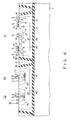
- Fig. 1 is a sectional view of a semiconductor device according to an embodiment of the present invention.
- lateral i nsulated g ate b ipolar t ransistor (IGBT) T1 as a high breakdown voltage element
- a plurality of bipolar transistors (Fig. 1 shows two transistors, i.e., pnp and npn transistors T2 and T3) as a plurality of low breakdown voltage elements used for a control circuit of transistor T1 are integrally formed.
- a plurality of p ⁇ -type Si layers 4a and 4b which are isolated from each other in island forms by SiO2 layers 3a and 3b are formed in Si substrate 4 on Si substrate 1.
- IGBT T1 is formed in one Si layer, i.e. layer 4a, whereas pnp and npn transistors T2 and T3 which are isolated from each other by pn junction isolation are formed in the other Si layer, i.e., layer 4b. This process will be described in detail in accordance with practical manufacturing steps.
- Figs. 2A to 2G show the manufacturing steps.
- two Si substrates 1 and 4 are prepared.
- One surface of each of Si substrates is mirror-polished.
- One substrate, i.e., Si substrate (first semiconductor substrate) 4 is a p ⁇ -type substrate for element formation, and has a resistivity of 70 to 100 ⁇ cm.
- SiO2 film 3a having a thickness of about 1 ⁇ m is formed on the surface of the resultant structure.
- the other substrate, i.e., Si substrate (second semiconductor substrate) 1 may be of p- or n-type, and has no limitation as to specific resistivity.
- Such two substrates 1 and 4 are bonded to each other by a silicon wafer direct-bonding technique. Then, a surface of substrate 4, which is opposite to the bonding surface, is polished to obtain p ⁇ -type Si layer 4 having a thickness of about 60 ⁇ m (Fig. 2B).
- SiO2 film 3a is used for element isolation. It has been confirmed from experiments performed by the present inventors that in order to reduce warpage of the resultant wafer, SiO2 film 3a must be formed on element formation substrate 4 in advance, and that bonding interface 2 must face the upper surface of SiO2 film 3a which is formed on element formation substrate 4 in advance.
- the steps of practical direct bonding are performed in the following manner.
- Substrates to be bonded are cleaned by an H2SO4-H2O2 mixture solution, HCl-H2O2 mixture solution, aqua regia, or the like.
- the substrates are cleaned by water for about ten minutes, and are dried by a spin dryer or the like.
- the substrates subjected to these processes are set in a clean atmosphere below, e.g., class 100, and their mirror-polished surfaces are bonded to each other in a state wherein substantially no contaminant is present therebetween. With this process, the two substrates are bonded to each other with a certain strength.
- heat-treatment can be performed in an oxygen, nitrogen, hydrogen, inert gas, steam, or a gas mixture thereof.
- cleaning was performed by an H2SO4-H2O2 mixture solution and an HCl-H2O2 mixture solution, and heat-treatment was performed a nitrogen atmosphere including a small amount of oxygen at 1,100°C for two hours.
- Si substrate 4 is lapped and polished to reduce the thickness.
- SiO2 film 31 is formed on the upper surface of Si substrate 4.
- Tapered isolation trench 32 is then formed by etching, e.g., anisotropic etching Si layer 4 to a depth reaching SiO2 film 3a using pattern 31a obtained by patterning SiO2 film 31 as a mask.
- Si layers 4a and 4b are isolated in the forms of islands (Fig. 2C). Boron is diffused in isolation trench 32 by diffusion so as to form p+-type layers 6b in the side walls of island Si layers 4a and 4b.
- p+-type layers 6b are integrated with p+-type layer 6a on the bottom of the isolation trench so as to constitute p+-type layer 6.
- SiO2 film 3b is formed in the side wall of each Si layer 4 by another thermal oxidation of the side wall. Then, SiO2 film 31 on the surface of Si layer 4b on the low breakdown voltage element side is patterned to form pattern 31a.
- Si layer 4 is etched by using pattern 31a as an etching mask to form recesses in the element region. Phosphorus or antimony is introduced in the recesses at a high concentration by diffusion to form n+-type layers 21a and 21b (Fig. 2D).
- SiO2 film 31b overhanging in the recesses need be theoretically removed when the epitaxial growth process in Fig. 2E is performed. However, if crystal growth is performed while SiO2 film 31b is locally left, a high-quality single crystal cannot be buried, and hence defects are often caused. In order to decrease the defects, SiO2 film 31b on the surface of Si layer 4b is preferably removed substantially entirely in crystal growth, as described above.
- Pnp transistor T2 and npn transistor T3 which are isolated from each other by a pn junction isolation are respectively formed in n ⁇ -type layers 22a and 22b buried in this manner.
- p-type layers 23 and 24 are formed in the surface region of n ⁇ -type 22a at a predetermined interval. Thereafter, collector, emitter, and base electrodes 27a, 28a, and 29a are formed. As a result, lateral type pnp transistor T2 having n ⁇ -type layer 22a serving as a base, and p-type layers 23 and 24 respectively serving as a collector and a emitter is formed.
- p-type layer 25 is formed in the surface region of n-type layer 22b by impurity diffusion.
- n-type layer 26 is formed in the surface region of p-type layer 25.
- collector, emitter, and base electrodes 27b, 28b, and 29b are formed to form vertical type npn transistor T3 having n ⁇ -type layer 22b as a collector, p-type layer 26 as a base, and n-type layer 26 as an emitter.
- p-type base layer 7 is formed in its peripheral portion, n-type source layer 8 is formed therein, n-type base layer 9 is formed in its central portion, and p-type drain layer 11 is formed therein by impurity diffusion.
- N ⁇ -type layer 10 serving as a guard ring is formed around n-type base layer 11 by impurity diffusion.
- Gate electrode 13 is formed on a region between n-type source layer 8 and n ⁇ -type layer 10 with gate insulating film 12 interposed therebetween.
- drain electrode 15 is formed on p-type drain layer 11
- source electrode 14 is formed on n-type source layer 8 and p-type base layer 7 so as to be simultaneously in contact with layers 8 and 7, thereby obtaining IGBT-T1 (Fig. 2G).
- high breakdown voltage IGBT-T1 processing a large current can be electrically isolated from low breakdown voltage transistors T2 and T3 operated by a small current with high reliability by a dielectric material.
- transistors T2 and T3 are isolated from each other by a pn junction isolation, an extra area for element isolation is not required. Therefore, a high integration density can be realized.
- two bipolar transistors are integrated as low breakdown voltage elements. The present invention, however, exhibits a noticeable effect in terms of integration density especially when a large number of low breakdown voltage elements are integrated.
- high-concentration p+-type layers 6 are formed on the oxide film interfaces of the bottom and side walls of the p ⁇ -type layers isolated in the forms of islands, thereby obtaining high reliability. More specifically, many defects are normally present in an oxide film interface. If a depletion layer extending from an element formed in the device reaches this interface, leak, a decrease in breakdown voltage, or the like may be caused. However, formation of p+-type layers 6 can prevent the depletion layer from reaching the interface.
- the high breakdown voltage elements preferably have a dielectric isolation structure.
- Fig. 3 shows an embodiment wherein transistors T2 and T3 in Fig. 1 are modified.
- n-type layers 33a and 33b respectively serving as a base layer and a collector layer of each of transistors T2 and T3 are formed by impurity diffusion.
- transistor characteristics are slightly inferior to those in the previous embodiment.
- the steps of forming the recesses, crystal growth, etching, and the like upon formation of the dielectric isolation structure are omitted, the overall steps can be greatly simplified, thereby decreasing the manufacturing cost.
- Fig. 4 shows an embodiment wherein lateral type MOSFET-T1 is used in place of IGBT-T1.
- n-type layer 9 is a drain layer, and drain electrode 15 is in direct contact therewith.
- MOSFET-T1 is not bipolar-operated but is unipolar-operated by ON/OFF control of a channel formed on its surface. In this embodiment, even when a plurality of identical lateral type MOSFETs are integrally formed, no specific element isolation is required between them.
- Fig. 5A shows an embodiment wherein vertical type MOSFET-T1 is used in place of IGBT-T1 in Fig. 1.
- substrate 1 has a double-layer structure consisting of n+- and n ⁇ -type layers 1a and 1b, and no SiO2 film is formed on bonding interface 2 in the region of MOSFET-T1.
- P-type base layer 52 is formed in a surface portion of n ⁇ -type layer 41a, n-type source layer 53 is formed therein, and n+-type layer 1a is formed as a drain, thereby forming vertical type MOSFET-T1.
- n+-type layer 1a can be replaced with p+-type layer.
- element T1 may be a MOS thyristor or IGBT.
- Fig. 5B shows an embodiment wherein npn transistor T1 is used in place of vertical type MOSFET-T1 in Fig. 5A.
- Npn transistor can be used in place of npn transistor.
- Fig. 5C shows an embodiment wherein GTO (gate turn-off thyristor) is used in place of vertical type MOSFET-T1 in Fig. 5A.
- Thyristor or MOSGTO can be used in place of GTO.
- Figs. 6 to 9 show embodiments wherein the arrangement of the bipolar transistor portions serving as low breakdown voltage elements is modified.
- p ⁇ -type layer 46, n-type well 61, and p-type well are formed by impurity diffusion, and a collector, a base, and an emitter are sequentially formed in the respective wells by impurity diffusion, thereby forming pnp and npn transistors T2 and T3.
- n- and p-type wells 61 and 62 are formed by diffusion, and hence lateral type pnp and npn transistors T2 and T3 are respectively formed therein.
- Fig. 6 p ⁇ -type layer 46, n-type well 61, and p-type well are formed by impurity diffusion, and a collector, a base, and an emitter are sequentially formed in the respective wells by impurity diffusion, thereby forming pnp and npn transistors T2 and T3.
- p-type layer 81 is formed in p ⁇ -type layer 4b independently of p+-type layer 6 prior to substrate bonding so as to reduce the resistance.
- lateral type transistor T2a and vertical type transistor T2b are simultaneously integrated as pnp transistors.
- Fig. 10 shows a structure of still another embodiment.
- space 91 is formed at a position of bonding interface 2 below the IGBT-T1 region serving as the high breakdown voltage element in Fig. 1.
- This structure is obtained by forming oxide film 3a to a sufficient thickness by a process prior to bonding, etching oxide film 3a in the high breakdown voltage element region, forming thin oxide film 3c in the etched portion again, and performing bonding. With this structure, a breakdown voltage in a bottom portion of the high breakdown voltage element side can be further increased.
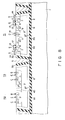
- Fig. 11 is a sectional view of a semiconductor device in which low breakdown voltage elements are formed in two wells having V-shaped sectional areas.
- the method of forming a trench and burying a semiconductor layer therein, and the method of impurity diffusion are described as methods of forming wells isolated by pn junction isolation.
- the method of forming trenches described with reference to Figs. 2A to 2G is performed independently of the selective etching process for forming island Si layers by isolation. In this embodiment, however, trenches are formed in the wells simultaneously with the selective etching process for isolation of the island Si layers.
- the trenches for isolating/forming the island layers must reach the bottom portions while the trenches in the well regions must not reach the bottom portions.
- Such conditions can be obtained by applying anisotropic etching capable of obtaining a predetermined taper angle to selective etching so as to select the size of an etching window.
- Figs. 12A to 12G are sectional views showing the steps in manufacturing the semiconductor device in Fig. 11.
- the steps shown in Figs. 12A and 12B are the same as those in Figs. 2A and 2B.
- Si layer 4a on the high breakdown voltage element side and Si layer 4b on the low breakdown voltage element side are isolated from each other by forming isolation trench 32 by selective etching.
- trenches 32a and 32b are formed in the well regions on the low breakdown voltage element side (Fig. 12C).
- trench 32 of the isolation region can be caused to reach the bottom portion while trenches 32a and 32b in the well regions do not reach the bottom portions.
- n+-type layers 6c, 21a, and 21b are formed in the side walls of trenches 32, 32a, and 32b upon diffusion of phosphorus or arsenic by epitaxial diffusion (Fig. 12D).
- n ⁇ -type Si layer 22 is formed by removing an oxide film on the low breakdown voltage element side and forming an Si layer by epitaxial growth.
- polysilicon layer 5 is deposited on the high breakdown voltage element covered with the oxide film (Fig. 12E).
- n ⁇ -type layers 22a and 22b serving as wells are buried in the respective recesses in Si layer 4, and polysilicon layer 5 is buried in the isolation trench (Fig. 12F).
- IGBT-T1 is formed in Si layer 4a, and lateral type pnp transistor T2 and vertical type npn transistor T3 which are isolated from each other by a pn junction isolation are formed in Si layer 4b (Fig. 12G).
- Fig. 13 shows an embodiment wherein the structure in Fig. 11 is slightly modified.
- p+-type layers 6a are formed in the bottom portions of Si layers 4a and 4b
- n+-type layers 6c are formed on the side walls of the isolation trench simultaneously with formation of the n+-type layers on the side surfaces of the well region trenches.
- the p+-type layers are formed on the bottom and side walls of the island Si layers.
- Fig. 14 shows a structure of still another embodiment.
- n- and p-channel MOS transistors T4 and T5 constituting a CMOS circuit together with bipolar transistors T2 and T3 are formed in Si layer 4b on the low breakdown voltage element side.
- Bipolar transistors T2 and T3 are formed such that n ⁇ -type layer 22a formed by epitaxial growth is divided into a plurality of regions which are isolated from each other by a pn junction isolation, and transistors T2 and T3 are respectively formed in the regions.
- MOS transistors T4 and T5 are respectively formed in p- and n-type layers 22c and 22b formed by impurity diffusion.
- a p+-type layer and an n+-type layer are formed on the inner surface of trench 32 shown in Figs. 2C and 12D, and SiO2 film 31, which has been used as the mask, is then removed by means or etching.
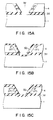
- SiO2 film 31 is removed away, SiO2 film 3a is inevitably etched away from the bottom of trench 32 as is shown in Fig. 15A.
- the side etching of SiO2 film 3a also proceeds. Thereafter, as is shown in Fig.
- SiO2 film 3b is formed on the inner surface of trench 32 by means of thermal oxidation.
- the thickness of SiO2 film 3a is determined by the breakdown voltage which is required of the interface between two Si substrates 1 and 4.
- the thickness of SiO2 film 3b is determined by the breakdown voltage which is required of the interface between island-shaped Si layers 4a and 4b.
- the breakdown voltage required of the interface between two Si substrates 1 and 4 is equal, in most cases, to that required of the interface between island-shaped Si layers 4a and 4b. Nonetheless, SiO2 film 3b is thinner than SiO2 film 3a since it is this SiO2 film 3b that isolates island-shaped Si layers 4a and 4b from each other.
- SiO2 film 3b is thinner than SiO2 film 3a, SiO2 film 3a is etched away from the bottom of trench 32 when SiO2 film 31 is etched away. Consequently, SiO2 film 3b formed on the bottom of trench 32 by thermal oxidation is thinner than SiO2 film 3a.
- the side-etched portion of SiO2 film 3a is particularly thin. SiO2 film 3b formed on the bottom of trench 32, which is thin, is electrically weak, and fails to have a breakdown voltage as high as is desired.
- SiO2 film 3b that is formed on the inner surface of trench 32, thicker than SiO2 film 3a formed between two Si substrates 1 and 4.
- SiO2 film 3b when SiO2 film 3b was made 1.5 ⁇ m thick, whereas SiO2 film 3a was made 1 ⁇ m thick, as is shown in Fig. 15C, the breakdown voltage of the interface between Si substrates 1 and 4 was as high as 700 to 800V.
- SiO2 film 3b was made 0.8 ⁇ m thick, while SiO2 film 3a was made 1 ⁇ m thick, the breakdown voltage of the interface between Si substrates 1 and 4 was only 500V to 600V.
- a dielectric isolation structure and a pn junction isolation structure are combined so that the integration density can be sufficiently increased while influences of noise and the like due to large current switching are effectively prevented.
Landscapes
- Element Separation (AREA)
- Metal-Oxide And Bipolar Metal-Oxide Semiconductor Integrated Circuits (AREA)
- Bipolar Integrated Circuits (AREA)
Priority Applications (1)
| Application Number | Priority Date | Filing Date | Title |
|---|---|---|---|
| EP96104114A EP0721211B1 (de) | 1988-02-08 | 1989-02-06 | Halbleiteranordnung |
Applications Claiming Priority (4)
| Application Number | Priority Date | Filing Date | Title |
|---|---|---|---|
| JP26787/88 | 1988-02-08 | ||
| JP2678788 | 1988-02-08 | ||
| JP246441/88 | 1988-09-30 | ||
| JP24644188 | 1988-09-30 |
Related Child Applications (2)
| Application Number | Title | Priority Date | Filing Date |
|---|---|---|---|
| EP96104114A Division EP0721211B1 (de) | 1988-02-08 | 1989-02-06 | Halbleiteranordnung |
| EP96104114.2 Division-Into | 1989-02-06 |
Publications (2)
| Publication Number | Publication Date |
|---|---|
| EP0328331A2 true EP0328331A2 (de) | 1989-08-16 |
| EP0328331A3 EP0328331A3 (de) | 1991-03-20 |
Family
ID=26364616
Family Applications (2)
| Application Number | Title | Priority Date | Filing Date |
|---|---|---|---|
| EP19890301137 Withdrawn EP0328331A3 (de) | 1988-02-08 | 1989-02-06 | Halbleiteranordnung und Verfahren zu dessen Herstellung |
| EP96104114A Expired - Lifetime EP0721211B1 (de) | 1988-02-08 | 1989-02-06 | Halbleiteranordnung |
Family Applications After (1)
| Application Number | Title | Priority Date | Filing Date |
|---|---|---|---|
| EP96104114A Expired - Lifetime EP0721211B1 (de) | 1988-02-08 | 1989-02-06 | Halbleiteranordnung |
Country Status (5)
| Country | Link |
|---|---|
| US (1) | US5072287A (de) |
| EP (2) | EP0328331A3 (de) |
| JP (1) | JP2788269B2 (de) |
| KR (1) | KR920003442B1 (de) |
| DE (1) | DE68929504T2 (de) |
Cited By (13)
| Publication number | Priority date | Publication date | Assignee | Title |
|---|---|---|---|---|
| EP0398468A3 (de) * | 1989-05-16 | 1991-03-13 | Kabushiki Kaisha Toshiba | Dielektrisch isoliertes Substrat und Halbleiteranordnung mit diesem Substrat |
| EP0418737A1 (de) * | 1989-09-13 | 1991-03-27 | Kabushiki Kaisha Toshiba | Verfahren zur Herstellung eines Halbleitersubstrats mit einer dielektrischen Struktur |
| DE4042334A1 (de) * | 1990-02-27 | 1991-09-05 | Fraunhofer Ges Forschung | Verfahren zum erzeugen einer isolierten, einkristallinen siliziuminsel |
| DE4006158A1 (de) * | 1990-02-27 | 1991-09-12 | Fraunhofer Ges Forschung | Verfahren zum erzeugen einer isolierten, einkristallinen siliziuminsel |
| WO1993003498A1 (de) * | 1991-08-08 | 1993-02-18 | Siemens Aktiengesellschaft | Integrierte schaltungsanordnung mit mindestens einem isolierten bauelement |
| DE4127925A1 (de) * | 1990-02-27 | 1993-02-25 | Fraunhofer Ges Forschung | Verfahren zum erzeugen einer isolierten, einkristallinen siliziuminsel |
| US5213993A (en) * | 1989-09-13 | 1993-05-25 | Kabushiki Kaisha Tobisha | Method of manufacturing semiconductor substrate dielectric isolating structure |
| US5496765A (en) * | 1993-06-23 | 1996-03-05 | Siemens Aktiengesellschaft | Method for manufacturing an insulating trench in a substrate for smart-power technologies |
| EP0813248A3 (de) * | 1996-06-12 | 2000-03-01 | Kabushiki Kaisha Toshiba | Dielektrisch isolierte integrierte Schaltung zusammen mit einer Überspannungsschutzschaltung und Herstellungsverfahren |
| WO2004053993A1 (en) * | 2002-12-10 | 2004-06-24 | Power Electronics Design Centre | Power integrated circuits |
| WO2004064123A2 (de) | 2003-01-10 | 2004-07-29 | Fraunhofer-Gesellschaft zur Förderung der angewandten Forschung e.V | Verfahren zur herstellung eines halbleiterbauelements |
| EP1191583A3 (de) * | 2000-09-08 | 2005-01-19 | Texas Instruments Incorporated | Niederspannungstransistor |
| EP1969634A4 (de) * | 2006-01-05 | 2011-04-20 | Int Rectifier Corp | Vertikal-dmos-anordnung in einer integrierten schaltung |
Families Citing this family (55)
| Publication number | Priority date | Publication date | Assignee | Title |
|---|---|---|---|---|
| US5294825A (en) * | 1987-02-26 | 1994-03-15 | Kabushiki Kaisha Toshiba | High breakdown voltage semiconductor device |
| US5592014A (en) * | 1987-02-26 | 1997-01-07 | Kabushiki Kaisha Toshiba | High breakdown voltage semiconductor device |
| US5241211A (en) * | 1989-12-20 | 1993-08-31 | Nec Corporation | Semiconductor device |
| US5294559A (en) * | 1990-07-30 | 1994-03-15 | Texas Instruments Incorporated | Method of forming a vertical transistor |
| JP3111500B2 (ja) * | 1991-05-09 | 2000-11-20 | 富士電機株式会社 | 誘電体分離ウエハの製造方法 |
| US5227653A (en) * | 1991-08-07 | 1993-07-13 | North American Philips Corp. | Lateral trench-gate bipolar transistors |
| EP0534632B1 (de) * | 1991-09-24 | 2002-01-16 | Matsushita Electronics Corporation, Ltd. | Integrierte Halbleiterschaltungsanordnung und Verfahren zu ihrer Herstellung |
| WO1993008596A1 (fr) * | 1991-10-14 | 1993-04-29 | Nippondenso Co., Ltd. | Procede pour la fabrication de dispositifs a semiconducteurs |
| US5389569A (en) * | 1992-03-03 | 1995-02-14 | Motorola, Inc. | Vertical and lateral isolation for a semiconductor device |
| JPH05251292A (ja) * | 1992-03-06 | 1993-09-28 | Nec Corp | 半導体装置の製造方法 |
| US5436173A (en) * | 1993-01-04 | 1995-07-25 | Texas Instruments Incorporated | Method for forming a semiconductor on insulator device |
| US5892264A (en) * | 1993-10-04 | 1999-04-06 | Harris Corporation | High frequency analog transistors, method of fabrication and circuit implementation |
| JP3252569B2 (ja) * | 1993-11-09 | 2002-02-04 | 株式会社デンソー | 絶縁分離基板及びそれを用いた半導体装置及びその製造方法 |
| JP3344598B2 (ja) * | 1993-11-25 | 2002-11-11 | 株式会社デンソー | 半導体不揮発メモリ装置 |
| JP3255547B2 (ja) * | 1994-03-09 | 2002-02-12 | 株式会社東芝 | 絶縁ゲート付きサイリスタ |
| US5841197A (en) * | 1994-11-18 | 1998-11-24 | Adamic, Jr.; Fred W. | Inverted dielectric isolation process |
| US6124179A (en) * | 1996-09-05 | 2000-09-26 | Adamic, Jr.; Fred W. | Inverted dielectric isolation process |
| FR2729008B1 (fr) * | 1994-12-30 | 1997-03-21 | Sgs Thomson Microelectronics | Circuit integre de puissance |
| US6411155B2 (en) | 1994-12-30 | 2002-06-25 | Sgs-Thomson Microelectronics S.A. | Power integrated circuit |
| JP3435930B2 (ja) * | 1995-09-28 | 2003-08-11 | 株式会社デンソー | 半導体装置及びその製造方法 |
| US6242787B1 (en) | 1995-11-15 | 2001-06-05 | Denso Corporation | Semiconductor device and manufacturing method thereof |
| US6831331B2 (en) | 1995-11-15 | 2004-12-14 | Denso Corporation | Power MOS transistor for absorbing surge current |
| US5874767A (en) * | 1996-05-14 | 1999-02-23 | Mitsubishi Denki Kabushiki Kaisha | Semiconductor device including a lateral power device |
| US5929368A (en) * | 1996-12-09 | 1999-07-27 | The Ensign-Bickford Company | Hybrid electronic detonator delay circuit assembly |
| US5889310A (en) * | 1997-04-21 | 1999-03-30 | Mitsubishi Denki Kabushiki Kaisha | Semiconductor device with high breakdown voltage island region |
| US6133607A (en) * | 1997-05-22 | 2000-10-17 | Kabushiki Kaisha Toshiba | Semiconductor device |
| WO1999022409A2 (en) * | 1997-10-28 | 1999-05-06 | Koninklijke Philips Electronics N.V. | Semiconductor device comprising a half-bridge circuit |
| EP0996158B9 (de) * | 1998-10-23 | 2008-06-18 | STMicroelectronics S.r.l. | Auf einem Halbleitersubstrat integrierte Hochspannungs-Widerstandsstruktur |
| JP4206543B2 (ja) | 1999-02-02 | 2009-01-14 | 株式会社デンソー | 半導体装置 |
| EP1028468A1 (de) * | 1999-02-09 | 2000-08-16 | STMicroelectronics S.r.l. | Vorspannungsschaltung für Isolationsbereich in integriertem Leistungsschaltkreis |
| TW502458B (en) | 1999-06-09 | 2002-09-11 | Toshiba Corp | Bonding type semiconductor substrate, semiconductor light emission element and manufacturing method thereof |
| US6879023B1 (en) * | 2000-03-22 | 2005-04-12 | Broadcom Corporation | Seal ring for integrated circuits |
| US6768183B2 (en) * | 2001-04-20 | 2004-07-27 | Denso Corporation | Semiconductor device having bipolar transistors |
| US6670255B2 (en) * | 2001-09-27 | 2003-12-30 | International Business Machines Corporation | Method of fabricating lateral diodes and bipolar transistors |
| JP2003264244A (ja) * | 2002-03-08 | 2003-09-19 | Seiko Epson Corp | 半導体装置およびその製造方法 |
| DE102004028474B4 (de) | 2004-06-11 | 2009-04-09 | X-Fab Semiconductor Foundries Ag | Integriertes Bauelement in einer SOI-Scheibe |
| KR100582374B1 (ko) * | 2004-09-08 | 2006-05-22 | 매그나칩 반도체 유한회사 | 고전압 트랜지스터 및 그 제조 방법 |
| DE102004053077B4 (de) * | 2004-11-03 | 2006-11-02 | X-Fab Semiconductor Foundries Ag | Vertikale PIN-Fotodiode und Verfahren zur Herstellung, kompatibel zu einem konventionellen CMOS-Prozess |
| US20070228505A1 (en) * | 2006-04-04 | 2007-10-04 | Mazzola Michael S | Junction barrier schottky rectifiers having epitaxially grown p+-n junctions and methods of making |
| JP4793078B2 (ja) * | 2006-04-25 | 2011-10-12 | 株式会社デンソー | 半導体装置 |
| JP5036234B2 (ja) | 2006-07-07 | 2012-09-26 | 三菱電機株式会社 | 半導体装置 |
| US20080128762A1 (en) * | 2006-10-31 | 2008-06-05 | Vora Madhukar B | Junction isolated poly-silicon gate JFET |
| US7700405B2 (en) * | 2007-02-28 | 2010-04-20 | Freescale Semiconductor, Inc. | Microelectronic assembly with improved isolation voltage performance and a method for forming the same |
| US8168466B2 (en) * | 2007-06-01 | 2012-05-01 | Semiconductor Components Industries, Llc | Schottky diode and method therefor |
| JP5479671B2 (ja) | 2007-09-10 | 2014-04-23 | ローム株式会社 | 半導体装置 |
| DE102008028452B4 (de) | 2008-06-14 | 2012-10-25 | X-Fab Semiconductor Foundries Ag | Leistungstransistor für hohe Spannungen in SOI-Technologie |
| DE102008049732B4 (de) | 2008-09-30 | 2011-06-09 | Amd Fab 36 Limited Liability Company & Co. Kg | Halbleiterbauelement mit vergrabenem Polysiliziumwiderstand sowie Verfahren zu seiner Herstellung |
| JP5446388B2 (ja) * | 2009-03-31 | 2014-03-19 | サンケン電気株式会社 | 集積化半導体装置の製造方法 |
| KR101148335B1 (ko) * | 2009-07-23 | 2012-05-21 | 삼성전기주식회사 | 실리콘 반도체를 이용한 광전자 증배관 및 그 구조 셀 |
| KR101084940B1 (ko) * | 2009-09-28 | 2011-11-17 | 삼성전기주식회사 | 실리콘 광전자 증배관 |
| JP5434961B2 (ja) | 2010-08-04 | 2014-03-05 | 株式会社デンソー | 横型ダイオードを有する半導体装置 |
| US8476684B2 (en) * | 2010-09-29 | 2013-07-02 | Analog Devices, Inc. | Field effect transistors having improved breakdown voltages and methods of forming the same |
| JP5711646B2 (ja) * | 2010-11-16 | 2015-05-07 | 株式会社豊田中央研究所 | ダイオード |
| CN104282552A (zh) * | 2013-07-03 | 2015-01-14 | 无锡华润上华半导体有限公司 | 一种igbt的制造方法 |
| JP6155911B2 (ja) | 2013-07-04 | 2017-07-05 | 三菱電機株式会社 | 半導体装置 |
Family Cites Families (25)
| Publication number | Priority date | Publication date | Assignee | Title |
|---|---|---|---|---|
| US3370995A (en) * | 1965-08-02 | 1968-02-27 | Texas Instruments Inc | Method for fabricating electrically isolated semiconductor devices in integrated circuits |
| FR1527898A (fr) * | 1967-03-16 | 1968-06-07 | Radiotechnique Coprim Rtc | Agencement de dispositifs semi-conducteurs portés par un support commun et son procédé de fabrication |
| JPS4944555A (de) * | 1972-09-04 | 1974-04-26 | ||
| US3858062A (en) * | 1973-02-15 | 1974-12-31 | Motorola Inc | Solid state current divider |
| JPS5423388A (en) * | 1977-07-22 | 1979-02-21 | Hitachi Ltd | Semiconductor integrated-circuit device and its manufacture |
| JPS5951743B2 (ja) * | 1978-11-08 | 1984-12-15 | 株式会社日立製作所 | 半導体集積装置 |
| JPS6042844A (ja) * | 1983-08-18 | 1985-03-07 | Nec Corp | 半導体集積回路 |
| JPS6051700A (ja) * | 1983-08-31 | 1985-03-23 | Toshiba Corp | シリコン結晶体の接合方法 |
| JPS6058633A (ja) * | 1983-09-12 | 1985-04-04 | Hitachi Ltd | 半導体集積回路装置 |
| EP0161740B1 (de) * | 1984-05-09 | 1991-06-12 | Kabushiki Kaisha Toshiba | Verfahren zur Herstellung eines Halbleitersubstrates |
| JPS6134971A (ja) * | 1984-07-25 | 1986-02-19 | Matsushita Electric Works Ltd | 半導体装置 |
| JPS6159852A (ja) * | 1984-08-31 | 1986-03-27 | Toshiba Corp | 半導体装置の製造方法 |
| FR2571544B1 (fr) * | 1984-10-05 | 1987-07-31 | Haond Michel | Procede de fabrication d'ilots de silicium monocristallin isoles electriquement les uns des autres |
| JPH0770476B2 (ja) * | 1985-02-08 | 1995-07-31 | 株式会社東芝 | 半導体装置の製造方法 |
| JPH0770474B2 (ja) * | 1985-02-08 | 1995-07-31 | 株式会社東芝 | 化合物半導体装置の製造方法 |
| JPS61184843A (ja) * | 1985-02-13 | 1986-08-18 | Toshiba Corp | 複合半導体装置とその製造方法 |
| CA1251514A (en) * | 1985-02-20 | 1989-03-21 | Tadashi Sakai | Ion selective field effect transistor sensor |
| JPS61196576A (ja) * | 1985-02-26 | 1986-08-30 | Nissan Motor Co Ltd | 半導体装置 |
| JPS6248039A (ja) * | 1985-08-28 | 1987-03-02 | Nec Corp | 誘電体分離集積回路 |
| JPH0671067B2 (ja) * | 1985-11-20 | 1994-09-07 | 株式会社日立製作所 | 半導体装置 |
| JPS6276645A (ja) * | 1985-09-30 | 1987-04-08 | Toshiba Corp | 複合半導体結晶体構造 |
| JPS6276646A (ja) * | 1985-09-30 | 1987-04-08 | Toshiba Corp | 半導体装置の製造方法 |
| US4751561A (en) * | 1986-04-29 | 1988-06-14 | Rca Corporation | Dielectrically isolated PMOS, NMOS, PNP and NPN transistors on a silicon wafer |
| US4897362A (en) * | 1987-09-02 | 1990-01-30 | Harris Corporation | Double epitaxial method of fabricating semiconductor devices on bonded wafers |
| JPH01179342A (ja) * | 1988-01-05 | 1989-07-17 | Toshiba Corp | 複合半導体結晶体 |
-
1988
- 1988-12-28 JP JP63333588A patent/JP2788269B2/ja not_active Expired - Lifetime
-
1989
- 1989-02-06 EP EP19890301137 patent/EP0328331A3/de not_active Withdrawn
- 1989-02-06 EP EP96104114A patent/EP0721211B1/de not_active Expired - Lifetime
- 1989-02-06 DE DE68929504T patent/DE68929504T2/de not_active Expired - Lifetime
- 1989-02-08 KR KR1019890001412A patent/KR920003442B1/ko not_active Expired
-
1991
- 1991-01-22 US US07/643,087 patent/US5072287A/en not_active Expired - Lifetime
Cited By (15)
| Publication number | Priority date | Publication date | Assignee | Title |
|---|---|---|---|---|
| EP0398468A3 (de) * | 1989-05-16 | 1991-03-13 | Kabushiki Kaisha Toshiba | Dielektrisch isoliertes Substrat und Halbleiteranordnung mit diesem Substrat |
| EP0418737A1 (de) * | 1989-09-13 | 1991-03-27 | Kabushiki Kaisha Toshiba | Verfahren zur Herstellung eines Halbleitersubstrats mit einer dielektrischen Struktur |
| US5213993A (en) * | 1989-09-13 | 1993-05-25 | Kabushiki Kaisha Tobisha | Method of manufacturing semiconductor substrate dielectric isolating structure |
| DE4006158A1 (de) * | 1990-02-27 | 1991-09-12 | Fraunhofer Ges Forschung | Verfahren zum erzeugen einer isolierten, einkristallinen siliziuminsel |
| DE4127925A1 (de) * | 1990-02-27 | 1993-02-25 | Fraunhofer Ges Forschung | Verfahren zum erzeugen einer isolierten, einkristallinen siliziuminsel |
| DE4042334A1 (de) * | 1990-02-27 | 1991-09-05 | Fraunhofer Ges Forschung | Verfahren zum erzeugen einer isolierten, einkristallinen siliziuminsel |
| WO1993003498A1 (de) * | 1991-08-08 | 1993-02-18 | Siemens Aktiengesellschaft | Integrierte schaltungsanordnung mit mindestens einem isolierten bauelement |
| US5496765A (en) * | 1993-06-23 | 1996-03-05 | Siemens Aktiengesellschaft | Method for manufacturing an insulating trench in a substrate for smart-power technologies |
| EP0813248A3 (de) * | 1996-06-12 | 2000-03-01 | Kabushiki Kaisha Toshiba | Dielektrisch isolierte integrierte Schaltung zusammen mit einer Überspannungsschutzschaltung und Herstellungsverfahren |
| EP1191583A3 (de) * | 2000-09-08 | 2005-01-19 | Texas Instruments Incorporated | Niederspannungstransistor |
| WO2004053993A1 (en) * | 2002-12-10 | 2004-06-24 | Power Electronics Design Centre | Power integrated circuits |
| WO2004064123A2 (de) | 2003-01-10 | 2004-07-29 | Fraunhofer-Gesellschaft zur Förderung der angewandten Forschung e.V | Verfahren zur herstellung eines halbleiterbauelements |
| WO2004064123A3 (de) * | 2003-01-10 | 2004-09-10 | Fraunhofer Ges Forschung | Verfahren zur herstellung eines halbleiterbauelements |
| US7719077B2 (en) | 2003-01-10 | 2010-05-18 | Fraunhofer-Gesellschaft zur Förderung der angewandten Forschung e.V. | Method for the production of a semiconductor component |
| EP1969634A4 (de) * | 2006-01-05 | 2011-04-20 | Int Rectifier Corp | Vertikal-dmos-anordnung in einer integrierten schaltung |
Also Published As
| Publication number | Publication date |
|---|---|
| EP0721211A2 (de) | 1996-07-10 |
| KR920003442B1 (ko) | 1992-05-01 |
| KR890013770A (ko) | 1989-09-26 |
| US5072287A (en) | 1991-12-10 |
| JPH02168646A (ja) | 1990-06-28 |
| DE68929504T2 (de) | 2004-09-23 |
| EP0328331A3 (de) | 1991-03-20 |
| DE68929504D1 (de) | 2004-01-15 |
| EP0721211B1 (de) | 2003-12-03 |
| EP0721211A3 (de) | 1996-12-27 |
| JP2788269B2 (ja) | 1998-08-20 |
Similar Documents
| Publication | Publication Date | Title |
|---|---|---|
| US5072287A (en) | Semiconductor device and method of manufacturing the same | |
| US5049968A (en) | Dielectrically isolated substrate and semiconductor device using the same | |
| US5332920A (en) | Dielectrically isolated high and low voltage substrate regions | |
| US5512774A (en) | Dielectrically isolated substrate and semiconductor device using the same | |
| US5304821A (en) | MOS-gate-turnoff thyristor | |
| US6559505B1 (en) | Power integrated circuit with vertical current flow and related manufacturing process | |
| US4892837A (en) | Method for manufacturing semiconductor integrated circuit device | |
| US4985745A (en) | Substrate structure for composite semiconductor device | |
| US4881107A (en) | IC device having a vertical MOSFET and an auxiliary component | |
| US4570330A (en) | Method of producing isolated regions for an integrated circuit substrate | |
| US6010950A (en) | Method of manufacturing semiconductor bonded substrate | |
| JP2979554B2 (ja) | 半導体装置の製造方法 | |
| KR100366896B1 (ko) | 반도체 장치 | |
| EP0398468A2 (de) | Dielektrisch isoliertes Substrat und Halbleiteranordnung mit diesem Substrat | |
| JP2000068372A (ja) | 半導体デバイス及びその製造方法 | |
| US3959812A (en) | High-voltage semiconductor integrated circuit | |
| JPH09129763A (ja) | 半導体集積回路 | |
| JPS6394667A (ja) | 半導体集積回路 | |
| JP2752655B2 (ja) | バイポーラ集積回路装置 | |
| JPS6140140B2 (de) | ||
| JPH0997853A (ja) | 半導体集積回路とその製造方法 | |
| JPS63140561A (ja) | 半導体集積回路の製造方法 | |
| JPH0346335A (ja) | バイポーラ型半導体集積回路 | |
| JPH0697275A (ja) | 半導体装置 | |
| JPS6156624B2 (de) |
Legal Events
| Date | Code | Title | Description |
|---|---|---|---|
| PUAI | Public reference made under article 153(3) epc to a published international application that has entered the european phase |
Free format text: ORIGINAL CODE: 0009012 |
|
| 17P | Request for examination filed |
Effective date: 19890216 |
|
| AK | Designated contracting states |
Kind code of ref document: A2 Designated state(s): DE FR IT |
|
| PUAL | Search report despatched |
Free format text: ORIGINAL CODE: 0009013 |
|
| AK | Designated contracting states |
Kind code of ref document: A3 Designated state(s): DE FR IT |
|
| 17Q | First examination report despatched |
Effective date: 19910827 |
|
| STAA | Information on the status of an ep patent application or granted ep patent |
Free format text: STATUS: THE APPLICATION IS DEEMED TO BE WITHDRAWN |
|
| 18D | Application deemed to be withdrawn |
Effective date: 19981105 |